From the FasterSkier archive — posts syndicated from athletes’ and coaches’ own blogs between 2004 and 2012, kept online as published. Current coverage is at fasterskier.com.

Tag: Dusseldorf

  • Düsseldorf Roundup

    Sprint Recap

    Thanks again to Jan over at WorldOfXC.com (and FIS’s ability to not wreck them, although they tried!) we have the sprint heat times from Saturday. Starting with the women’s semifinals:

    Semifinal 1 was markedly faster, no? It doesn’t appear that Kikkan suffered for it, but then the Düsseldorf course is unusually short for the women. Almost too short, in my opinion. Here are the heat times for the finalists:

    Riika Sarasoja got tangled up it seems, which is a shame since she was posting string time up to that point. Kikkan skied arguably the most consistently of the six (newcomer Laurien Van def Graaff did as well). But for the most part this final was quite close.

    The men’s semifinals didn’t display nearly as much of a difference:

    One thing that I find interesting is that both the men and women saw a lot of people slow down considerably in the quarters. As for the finalists:

    The lines for Petuhkov and Golberg are too close together to distinguish at the end. The men’s final was much less closely contested. But I’m still intrigued by how much slower many of the quarters were for both the men and women. I wonder if a lot of people got too excited by the flat, short-ish course, because I thought I read that the conditions actually got faster as the day went on. Anyway…

    Kikkan vs The World

    How good is Kikkan going to be this season? That seems to be what everyone is wondering. For me, I know she can ski into the finals of any freestyle sprint and (probably, maybe) any classic sprint at this point. But can she avoid the random disasters that happen in sprint racing? Here’s what her sprint results look like so far:

    Quite a change from four years ago. Think she can keep them all in the top 10 for the entire season…?

    Kikkan vs The US Women

    One thing that always fascinates me about US skiing is how quickly we latch on to whoever skied fast in the most recent race. Good results deserve praise, no doubt, regardless of whether they are a one off event, or part of a steady string of them. But since this site is all about context, here’s an interesting graph for you.

    These are the distance and sprint  WC, WSC, OWG and TdS results for the US women for the past few seasons divided into Kikkan and Not Kikkan. The distance results are measured in percent behind the median skier, and the sprint results simply in finishing place.

    Notice anything interesting?

    Kikkan has definitely been better than the rest of the US women in both disciplines. Obviously, the difference has been smaller in distance event. Kikkan has improved her distance results dramatically, and that improvement has been largely tracked by the rest of the US women (overall).

    But for some reason, Kikkan’s transformation into a world class sprinter hasn’t been matched by an equivalent improvement among the rest of the US women. I have no idea why this would be, but it’s interesting food for thought.

    Related posts:

    1. <Mid-Season Review: North American Sprint
    2. <Drammen Sprint Recap
    3. <Lahti Sprint Recap


  • Norway Takes Team Sprint Victory in Dusseldorf; Americans Pull Off Surprise Second

    Norway Takes Team Sprint Victory in Dusseldorf; Americans Pull Off Surprise Second

    For the second straight day of sprint racing in Dusseldorf, Germany, the American women brought the fireworks.

    During the second day of World Cup racing in Dusseldorf, the Norway I team of Mari Eide and Maiken Caspersen Falla took the win. In a surprise move, United States I featuring Sadie Bjornsen and Kikkan Randall crossed the line second, 1.6 seconds back of the Norwegians. The bronze medal went to Natalia Korosteleva and Natalia Matveeva of Russia I, who were 2.1 seconds behind Norway I.

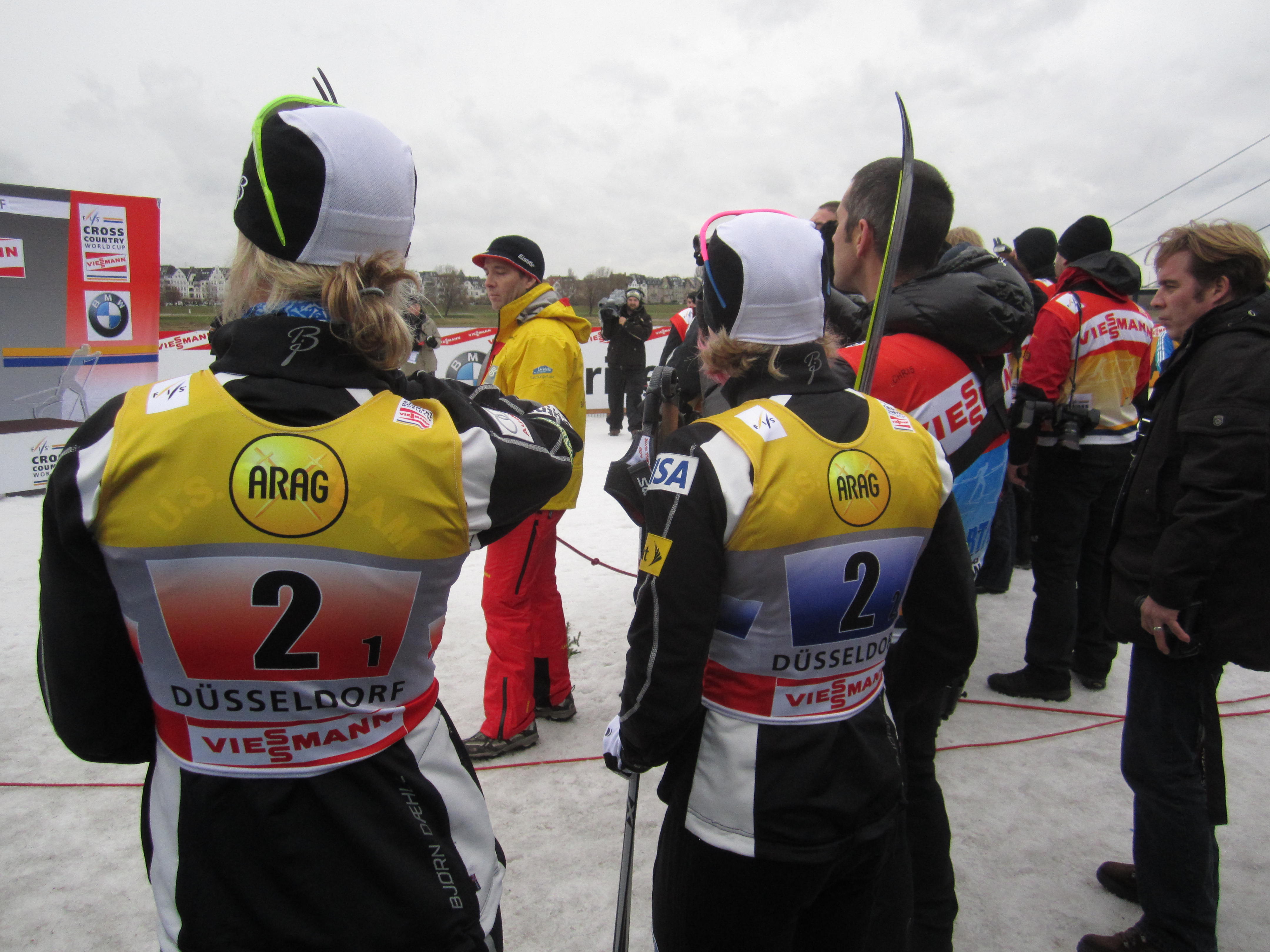
    While the Norwegians may have won the gold with an impressive final lap by Caspersen Falla, the story of the day was without a doubt the skiing of Kikkan Randall, paired with World Cup rookie Sadie Bjornsen, who picked up the first-ever Team Sprint medal for the U.S.

    Sadie Bjornsen (L) and Kikkan Randall (R) await the first-ever U.S. Team Sprint podium appearence

    From the early going, the American pair, while talented, was going to have to have a good day to make the final.

    They were packed into the first semi-final with ten other teams, including the favored Slovenia I with Vesna Fabjan and Katja Visnar, Finland I, Switzerland I, as well as Sweden II and Norway II.

    They action in the semi was fast and furious, with the Norwegians and Slovenians both launching attacks at various points. The Americans spent most of the first few laps bouncing around in the mid-pack, never falling out of contact.

    Randall (L) and Bjornsen (R) on the podium

    Bjornsen picked up the tag in fifth position on her last lap, and dropped a few spots back, but managed to tag off to Randall in a close eighth. Coming out of the exchange zone, Visnar (SLO) and Laure Barthelemy (FRA) made contact, and the Frenchwoman hit the snow hard, dropping her from contention.

    Hard on their hills, Randall avoided the pile-up, and skied smoothly down the back straight, gliding up into second. On the final corner, she was challenged by Finn Riika Sarasoja-Lilja, but the American held her off, and churned out a strong finish to earn an automatic qualifying berth in the final behind Hanna Falk of Sweden II, thereby avoiding the agonizing lucky-loser wait.

    In the second semi-final, Sweden I with Mia Eriksson and Hanna Brodin broke away from a contact-filled pack on the second last lap, skiing to a 1.4 second victory over Norway I. Canada I managed to secure third spot after Perianne Jones survived a dicey exchange with athletes falling all over the snow, including Germany I and Russia I. Chandra Crawford then skied anchor, and brought the Canucks home 2.4 seconds behind the Swedes in third place, which was good enough for a lucky loser position in the final.

    An hour later, the ladies were lined up on the start grid again, awaiting the start of the final.

    Just 200 meters in, narrow Dusseldorf claimed another victim, as Mia Eriksson (Sweden I) found herself lying on the snow, and it looked like the race was going to be about staying on your feet.

    Bjornsen, who was next to Eriksson, was able to avoid the sprawling Swede, but was forced to slow and change direction slightly. She quickly dropped from the second row off the back of the pack.

    Just one of the many hairy exchanges of the day. (Photo: Brad Jones)

    The pace was high, with the Swedes and Norwegians both making early bids to spread the field out. On the second lap, the women were stretched out into single-file, with slight gaps appearing in spots. Randall made up some ground for the US, and Bjornsen continued to creep back toward the pack on her second loop.

    However, on the third and fourth lap, the paced slacked off a little. While Sweden I and Norway I held strong at the front, the third spot was a revolving door of nations, including the Swiss, the Russians, and the Canadians. The slight down-turn in pace allowed Randall to regain contact with the top group as she made the hand-off, and Bjornsen settled in at the back of the main back as she headed out on her final lap.

    The young sprinter managed to hold position, but tagged off to Randall down in sixth place – they were not on the radar, as the battle raged up front between the Finns, Norwegians and Russians.

    The group bunched up a little climbing Mount Dusseldorf, and Randall made contact before blasting down the left, making several passes. Caspersen Falla broke contact with the tailing skiers, but Randall fought her way through the remaining traffic, including Canadian Chandra Crawford to lay down yet another incredibly strong finish to pick up the silver medal, leaving Russia I with third.

    With the silver, Randall secured her second medal in two days, and continued her blockbuster season that has yet to see her finish out of the top 20.

    “It’s just amazing,” said Randall after the race.

    “With this course so fast, you had to race every lap like it was the last shot.”

    Randall said she focused on skiing smooth, and didn’t worry too much about what place the team was in – she knew she wanted to set herself up for the final lap.

    “People were looking stiff on the last lap, and I was still feeling strong,” Kikkan said of her impressive final lap.

    After passing several people with what she described as “awesome” skis on the back portion of the course, she came hard around the outside of the last turn and headed for the line.

    “I was happy to have a lot left again on the final straight,” she said of her finishing kick.

    For Bjornsen, it was her first World Cup team sprint, and her first World Cup medal – the 21 year old was still in shock when FasterSkier talked to her.

    “It’s the greatest thing to happen so far!” she said. “It hasn’t even sunk in yet!”

    Bjornsen also appreciated the talent of Randall, who managed to secure the medal for the team.

    “It helps to have a sprint champion like Kikkan [Randall] on your team, that’s for sure,” said Bjornsen.

    While the Team Sprint is notoriously messy in Dusseldorf, both Americans felt the final was much cleaner than the previous heats had been, with skiers being “more calm.” However, Randall did note that the exchange zone was “always a mess.”

    In her first team sprint experience, Bjornsen said she barely had time to think about what was happening.

    “I was just going with it – it was so quick, and there was so much contact, you just had to react,” she said.

    Looking ahead, the Americans hope to carry the momentum from the weekend into the next World Cup races in Davos, Switzerland, on December 10th and 11th.

    Women’s Team Sprint Results

  • Kikkan Randall “On Fire” in Dusseldorf City Sprint

    Kikkan Randall “On Fire” in Dusseldorf City Sprint

    Kikkan Randall (USA) on top of the podium with Natalia Matveeva (RUS) 2nd (l) and Laurien Van der Graaf (SUI) 3rd (r) (Photo: Fishcer/NordicFocus)

    DUSSELDORF, Germany — Kikkan Randall is a World Cup Overall threat.

    At least, that was the way it felt in the city of Dusseldorf Saturday afternoon, when Randall hammered around the 900-meter manmade loop on her way to her first World Cup victory of the season.

    In the freestyle sprint, Randall out-gunned Natalia Matveeva (RUS) in the rush for the line, while Laurien Van Der Graaf (SUI)  picked up the bronze medal in her first-ever sprint final experience.

    Van Der Graaf beat out Canadian Chandra Crawford, while top-qualifier Riika Sarasoja-Lilja (SWE) and Hanna Brodin (SWE) got tangled up in the first corner and went down, and both finished off the back.

    A U.S. Ski Team (USST) veteran, Randall opened the season with a rash of strong distance results, including a 6th place finish in the Kuusamo mini-tour.

    And the first two World Cup weekends lacked the one race that Randall has become dominant in – the freestyle sprint.

    But Saturday in Dusseldorf, the American sprint-star turned World Cup overall contender took to the start line of the first freestyle sprint of the World Cup season, in a location that has long been one of her best.

    Randall was the favorite from the start – with World Cup leader Marit Bjoergen sitting out, the American was the top seed in qualification, and laid down the 10th fastest time around the short 900 meter course.

    From the very first round, it was clear that Randall was going to be a threat. She powered through her first heat, and despite a photo finish with Hanna Brodin, her advancement was never really in doubt.

    Randall holding down second in the quarterfinals behind Hanna Brodin (SWE). Brodin and Randall would match up in every heat of the day. (Photo: Fischer/NordicFocus)

    In her semifinal, Randall was matched up against Sarasoja-Lilja, and joined by Crawford, who also advanced past her quarterfinal convincingly, after a 17th place qualification.

    Randall and Crawford slotted themselves in second and third respectively around the first corner, and the jostling for position on the narrow course began in earnest.

    Randall attacked on Mt. Dusseldorf, the only hill on the course, and led over the top, while Crawford held third place.

    Coming down the finishing straight, Randall was able to hold her lead, and advanced easily to the final. Crawford was unable to squeak past Hanna Brodin (SWE) for an automatic spot in the final, finishing third, waiting on the hot sit to find out if she was fast enough to be the lucky loser.

    The second semifinal also included some top names, as home-town favorite Hanna Kolb (GER) was up against Matveeva, who qualified second, and third-place qualifier Mona-Lisa Malvalheto (FIN).

    To the disappointment of the crowd, Kolb took herself out of contention early on, falling out of the start gate.  In her first-ever semifinal, Van Der Graaf surprised everyone by taking control and opened up a small gap to win the heat and advance.

    In the moments leading up the women’s final, there was some apprehension among the North American fans in the crowd.

    Randall, Sarasoja-Lilja, Van Der Graaf and Brodin were all either lining up or preparing to do so, when the camera’s showed Crawford, who managed to advance as a lucky loser, kicking off her running shoes and stepping into her boots, held out for her by a Canadian wax tech.

    After Crawford did get to the line, the first freestyle sprint final of the World Cup season got underway, and with all six women close in ability, it was immediately crowded on the narrow course.

    Hanna Brodin (SWE) leads Randall and Crawford in the semifinals (Photo: Fischer/NordicFocus)

    Around the first corner, a fairly tight uphill left-hander, Sarasoja and Brodin, both at the back of the pack, got tangled up. Sarasoja came off the worst of the pair, going down hard and falling out of contention.

    Despite plenty of close calls, shoulder-to-shoulder action and lots of tactical moves, the four remaining women made it around the final corner without incident. North American coaches, staff, and fans were holding their collective breath, as three medals were up for grabs, and just four skiers in contention.

    Randall held off a strong late charge from Matveeva, who passed a fading Crawford, while Van Der Graaf also sneaked by the Canadian to pick up the bronze medal, the first World Cup medal of her career.

    “It was pretty scrappy out there, narrow course, contact at a couple points,” said Randall in an interview with FasterSkier following the race.

    “I was really happy to get into position coming into the finish, and have a good strong finish.”

    For Randall, the key to victory was mastering the tricky conditions.

    “The snow was really hard to balance on – it was hard to apply a lot of power. With the wind there were times where you really had to stay low, and work the lower body,” she said.

    Despite the slippery snow, Randall called the conditions “really good,” and was pleased with the course.

    USST Head Coach Chris Grover was enthusiastic about Randall’s day.

    “She’s on fire right now,” he said. “It’s great that she’s now at the level where she’s in the running for the World Cup overall.”

    “She’s so strong in the skate sprint, and this course has been traditionally good for her,” he added. “So it was great to get the first win of the year.”

    Surprise bronze medallist Van Der Graaf, advanced to the first final of her career in just thirteen World Cup starts, after having never finished higher than 21st.

    “That was amazing,” said Van Der Graaf of her race in an interview with FasterSkier. “I can’t believe it. It’s just like some dream.”

    She mentioned that the racing was very close-quarters and intense.

    “It was quite messy,” Van Der Graaf said. “I had some troubles with Chandra Crawford but that’s sprints, that’s normal.”

    With her first World Cup medal ever, Van Der Graaf couldn’t find any faults with the day – even rain, blustery winds, an icy course, and above zero temperatures didn’t faze her.

    “The conditions were really good – it was rainy and windy but the snow was really good. There is nothing to complain about,” she said with a big smile.

    For Crawford, there was slightly less smiling – she felt she had a chance at a medal and let it slip from her hands.

    “It was my first final since 2008, so I made my goal, but fourth? Wow,” she said. “I thought I had second, then I really thought I had third, but I got a bit stiff, and I lost a little bit [of speed]. … If you even get off balance the slightest bit on the final stretch, it can cost you a medal.”

    It’s not often that two North American women make a sprint final, much less Randall and Crawford, good friends, at least off the course.

    “She was extremely aggressive,” Crawford said of Randall’s skiing.“I got to encounter it in my semifinal, so for the final, I was like ‘I gotta be way more aggressive, way more’, but it still wasn’t enough.”

    As for scrambling to get her boots on at the start, the Canadians, like most teams, were running in between heats for warm-up and cool-down.

    “That’s a good way to channel some adrenaline,” said Crawford of the hurried preparation for the final.

    Tomorrow, the Americans will go with two teams – Randall and Sadie Bjornsen, and Ida Sargent and Holly Brooks making up the second tandem.

    Crawford team up with Perianne Jones in Canada I, while Dasha Gaiazova and Alysson Marshall will combine for Canada II.

    Complete women’s results.

    Complete men’s results.

  • FasterSkier Podcast: Randall’s Düsseldorf Podium, Davos Predictions, and the Russians

    FasterSkier Podcast: Randall’s Düsseldorf Podium, Davos Predictions, and the Russians

    As the World Cup season keeps rolling, so does the FasterSkier podcast! In this week’s edition, Topher Sabot and Nat Herz continue the series with the two founders of the Nordic Commentary Project blog, Colin Reuter and Christopher Tassava. Starting with the wild sprint races in Dusseldorf, Germany, we move on to predictions for Davos, ponder early-season peaking, and, of course, discuss the latest news on the anti-doping front to emerge from Russia. Tune in!

  • Chandra Crawford on Dusseldorf: “A Lottery-Winning Kind of Feeling”

    Chandra Crawford after a race in Canmore.

    The third place by Canadians Chandra Crawford and Dasha Gaiazova in Sunday’s team sprint in Dusseldorf was a breakthrough for both women. For Crawford, it was her first World Cup podium finish in three seasons, and her first-ever in the team sprint, while for Gaiazova, it was her first-ever World Cup podium, period. FasterSkier was able to catch up with Crawford after the race to hear about the hectic racing in Dusseldorf, how she and Gaiazova prepared for it, and the factors that have made the difference for the Canadians this year.

    FasterSkier: So, can you walk me through the final heat?

    Chandra Crawford: It was already a successful day, because we made the final, and we were the first Canadians to ever do that here in Dusseldorf. And certainly, Canada, the women’s side hasn’t had any medals in the team sprint since Sara [Renner] and Beckie [Scott] retired, so it’s a big step for our country, I think.

    FS: Do you feel like it’s a good event for you and Dasha?

    CC: Dasha really started that process of believing. That belief—that’s so critical for success for both of us. Two weeks ago, she started saying to me ‘I think we can do it, I think we can do it,’ and I was flattered she thought I was coming into enough fitness to be a good partner. This weekend, I think that belief was able to turn into a good result. I’ve never had a sprint relay like today. It’s always been just brutal for me. I’ve always thought it’s the hardest event by far, because by the second lap I’m usually really pumped out, really obliterated with all my fast-twitch

    Chandra Crawford racing in Rovaniemi, Finland earlier this year.

    muscle fibers. Today, we were able to ski relaxed, and it was really fast, and that made a big difference.

    FS: The final was pretty messy, but it looked like you guys navigated it well.

    CC: Yeah, it was really aggressive out there. It’s a narrow course, and it’s 1:45 race, so there were parts where Dasha would double pole along the inside of a corner, or make a sketchy pass, or one time someone’s basket got caught in her race suit—all these things were really chaotic. The falls, the crashes were just unreal. I think in fast conditions like that, if you’re not riding your flat ski, or if you’re really jittery, or nervous, or carrying the weight of the expectations of your country, it’s harder to stay on your feet. But for us, we were just having a good time, and skiing comfortable and aggressively in that pack, so that was a good way to do it.

    FS: There was obviously Visnar’s crash in the finish. But there was also an earlier crash in that lap crash on the uphill, right?

    CC: I think us and Italy were the only ones who didn’t crash. I was skiing as hard as I could [into the finish]—I was skiing in fourth, and I was just going all-out, all the way, and then somehow, yet another crash. She just crashed all on her own, and we just were so lucky to be out of the trouble, and to be able to react, and jump over people as they went down. And they were going down.

    FS: It looked like you guys managed to just sneak out of a few crashes. Do you feel like you were doing something in particular that helped?

    CC: Probably being relaxed and excited. But being prepared for it. We both went over what happened in our heats yesterday, and how aggressive we had to be, and shared tips back and forth. This is my third sprint relay here, so I’ve had a lot of things to learn from that we’ve been able to implement. As far as staying out of trouble, it was just a matter of staying calm around it, and reacting well. We knew this was going to be a factor in Dusseldorf. Last week when we were doing intervals we had help from one of our coaches [Eric de Nys], who was doing intervals with us. He was pushing us, and at one point he laid down on the course on the inside of one of the corners. It speaks to preparation. You can prepare for anything!

    FS: So, I’m assuming you knew you were in fourth place—what went through your mind when you saw the Slovenian go down?

    CC: It was a crazy feeling. It was a feeling of just total luck. A lottery-winning kind of feeling. Dasha and I are—I don’t know, some idiom or something where we’re just such big, overdramatic personalities both of us, so we really let our lack of inhibition shine and let out a whole bunch of screaming.

    FS: Do you think you’ll pay more attention to this event in the future? Or do you feel like your bread and butter is still the individual skate sprint?

    CC: I will reallocate a percentage of myself to the classic sprint at World Champs, and some good belief and teamwork with Dasha. Just the idea that we could possibly make that final at World Champs would be great, and certainly a lot of luck came our way today. A lot of the

    Chandra Crawford racing in Canmore last winter. Photo, Win Goodbody

    stronger teams weren’t on the start line, and everybody else crashed, but at the same time, that’s the way it goes in sprinting. So, I’m definitely fired up for World Champs more than I have ever been. This whole weekend got me fired up for that big, big event in Oslo.

    FS: And now you’re qualified, thanks to your eighth place Saturday, right?

    CC: Yeah! It was a big deal yesterday that I got my first top-10 in two years, and to get the podium today was just so surprising. The first podium for Dasha. Just great team environment. It really speaks to the big changes on our team. We’re really happy as a team—our atmosphere is really great as a team now. We got through the chaos and changes around trying to get ready for the Olympics, and made some big shakeups this spring that we’re really happy with. [It’s] the best environment ever, with coaching with Justin, with our technicians, within the team—everybody’s working together. We have therapists on the road so we don’t get injured, we have sports psychologists now, we have all these things that were just somehow lost in the frenzy of 2010. All the basic, important things that are now a part of our program that will enable us to succeed. And the women, my god. It’s cool to have our team grow towards a little more balance. Maybe we’ll be able to bring some of those up-and-comers on the World Cup next year. It’s really exciting to have that feeling that we’re a part of this team, and having that success. The guys are amazing right now, and we like to see it as a whole team with all of us.

    FS: Last question—we heard that you guys still don’t have your luggage from the trip from Finland. What did you race in?

    CC: It’s been a month on the road here, and we lost all our bags in Helsinki. I had my race suit and boots in my carry-on on the flight. I just raided this bag of [teammate] Devon [Kershaw’s] I found in the van, and I found these oversized warm-ups, but only one set, so in the driving sleet and rain I had to keep moving because I was wet, and I didn’t have anything dry to put on. It was tough, weatherwise, not having any of our gear, but we cobbled everything together.

  • FasterSkier Podcast: Kikkan Randall on Saturday’s Podium

    FasterSkier Podcast: Kikkan Randall on Saturday’s Podium

    Kikkan Randall racing in the U.S. last spring.

    After her podium finish in Saturday’s World Cup sprint in Dusseldorf, FasterSkier caught up with U.S. Ski Team member Kikkan Randall. Listen in to hear Randall talk about the team’s hectic travel to Germany, her tactics during the race, and what it felt like to cross the line in second place.

  • After Slow Start, Randall Skis to Second in Dusseldorf

    After Slow Start, Randall Skis to Second in Dusseldorf

    Bring on Marit Bjoergen.

    That was the message Kikkan Randall sent with her skiing in Dusseldorf, Germany on Saturday, racing to a sensational second place in a freestyle sprint on a short course that doesn’t even suit her strengths.

    After qualifying in eighth and blazing through the first two rounds, Randall overcame a poor start in her final heat, flying past Slovenian Vesna Fabjan on the homestretch to take her fifth-ever podium finish, just behind winner Arianna Follis (ITA).

    Kikkan Randall (r, in black) chasing Vesna Fabjan (middle, in neon) and Arianna Follis (l) in the women's sprint final in Dusseldorf.

    With a longer skate sprint on tap in Davos, Switzerland next weekend, Randall said that she is ready to take on Bjoergen, the undefeated Norwegian who has dominated the World Cup circuit this fall—and who was the only woman to get the better of Randall in a sprint race in Norway last March.

    “I’ve been wanting a chance with her in the skate sprint since Oslo last year,” Randall said.

    Randall wasn’t the only American who had a strong race on Saturday. Canadian Chandra Crawford was eighth, finishing fourth in the preliminary round and then leading her semifinal heat before fading late. The result was enough to pre-qualify Crawford to compete at the 2011 World Championships in March.

    For Follis, the victory was her first in an individual sprint since she won a world title in the event in 2009.

    She has raced every single edition of the Dusseldorf World Cup since its inception in 2002, but in nine tries, Saturday was the first time she cracked the podium in the individual sprint. (She won the team event last year, with Magda Genuin.)

    “A podium that seemed haunted to me here—this time, I really enjoyed it,” Follis told the Gazzetta dello Sport.

    But Follis was unchallenged over the last 200 meters, which meant that the real excitement was behind her, with Randall pinballing her way back to the front of the pack after a poor start.

    After jetting to an early lead in her first two heats—crucial on the Dusseldorf sprint course, which at 828 meters is one of the flattest and shortest on the World Cup circuit—Randall was glacial off the line in the final, heading to the first corner sitting fifth in a field of six racers.

    “My poles slipped a little bit, and so I was a little slower coming out. And then I kind of panicked—kind of got my weight a little too far forward, so I didn’t build the momentum on that first stretch that I had in the earlier rounds,” she said.

    With the women taking just two minutes to complete a circuit, Randall didn’t have much time to make up ground. But while she knew that she would have to be “really aggressive,” Randall also didn’t panic.

    “You…don’t want to be too frantic and too aggressive, because then you might end up getting tangled up with someone and going down,” she said. “You’ve gotta be smart.”

    On the back side of the course, heading up the tiny hill known as “Mount Dusseldorf,” Randall said she was getting ready to follow Hanna Falk, the 21-year-old Swedish phenom who won the Dusseldorf sprint last year in a breakout performance.

    But, Randall said, she could tell that Falk was starting to flag, so instead, she snuck into a narrow opening behind Follis and Fabjan, who were working their way up the climb on the opposite side.

    “I could definitely feel another skier right there, and I barely got into the spot,” she said.

    The move left Randall in third place going into the final turn, still trailing Follis, who was leading, and Fabjan, the Slovenian who had set the fastest time in qualifying.

    One of the tricks that Randall had learned on the Dusseldorf course, she said, was that cornering is crucial. “If you can accelerate out of a turn really well, then that can give you some space,” she said.

    And accelerate she did, passing Fabjan on the final straight, and even making up ground on Follis before running out of room. After a tough race last weekend in Finland, where she failed to qualify for the heats in the classic sprint, Randall said that the result was a relief.

    “All I could think was, ‘that’s more like it!’” she said. “This is really where I want to be—I want to be challenging for the

    Kikkan Randall in one of Dusseldorf's many corners.

    podium every time in a skate sprint.”

    Randall said that she was especially satisfied with her finish given that her big moves in past sprints have typically come on tough climbs—which were nowhere to be found on Saturday. In her two previous races in Duesseldorf, she had never placed higher than 28th.

    “It was a big question mark,” Randall said. “I was really excited today to feel so strong and powerful on the flats, because I think that’s where I’ve really been trying to improve my skate sprinting.”

    While Randall kept her cool during Saturday’s final round, her composure had already been tested numerous times over the last 48 hours.

    After a few days of training in Finland, the U.S. Ski Team (USST) was supposed to arrive to Dusseldorf on Thursday. But a strike by Finnair’s flight attendants left the Americans marooned in Helsinki for a night, and they didn’t arrive in Germany until Friday.

    Snowy weather then forced the USST to do their typical pre-race tune-up workout on foot, rather than on rollerskis. Even more problematic, the athletes were without their baggage.

    Fortunately, Head Coach Chris Grover had been around long enough to know not to depend on baggage handlers.

    “Before we left, we told [the athletes], ‘in your backpack that you carry on, have your skate boots, have your race suit, have your warm-ups,’” he said.

    The USST also had all of its skis, thanks to a cargo van that had already driven from Finland to Germany earlier in the week. As a result, Randall had everything she needed for Saturday’s race—except for her poles, which the USST shipped on the airplane with the rest of its baggage.

    While Andy Newell was forced to borrow a pair of poles from the Swedish team, Randall had a spare set—although they were a centimeter too short. But they worked well early in the day, Randall said, and she stuck with them, even though the Americans’ bags showed up in time for the finals.

    From Dusseldorf, Randall will now head to the resort town of Davos, Switzerland, for a distance classic race and another skate sprint. Ida Sargent headed home after last weekend’s races in Finland, so the U.S. women will not start Sunday’s team sprint.

    While Randall was disappointed to miss another day of racing, she said she was also looking forward the Davos sprint course, which suits her better than Dusseldorf’s. The women will be racing 1.4 kilometers—400 meters longer than last

    Kikkan Randall (r) congratulating Arianna Follis on her win in Dusseldorf.

    year, and the same distance as the men.

    That event will give Randall her first shot at Bjoergen in a skate sprint since Oslo, and according to Grover, the Alaskan is firing on all cylinders.

    “She’s proven all fall that her fitness is unbelievable,” he said. “She probably needed a skate sprint to be able to demonstrate how good in fact it was.”

    Before Davos, though, will come at least a little merriment, with help from the 10,000 Swiss francs (just over $10,000) that Randall earned for her second place.

    “It’s a good day at the office,” she said. “[I’ll] definitely be taking the team out and celebrating tonight.”

    —Topher Sabot contributed reporting.

    Link to full results

  • Wiley Win For Veteran Joensson in Dusseldorf, Newell 13th

    Emil Joensson (SWE) reminded the ski world that despite recent strong distance results, he is still a sprinter first and foremost, outlunging Italian Fulvio Scola at the line to capture the victory in a frantic battle on the streets of Dusseldorf.

    The 25-year-old defending Sprint Cup Champion added his seventh career World Cup victory, staging an impressive stretch run in the men’s final.

    Joensson navigated the narrow twisty course with aplomb, not panicking as he rubbed elbows in the fight for position on the final lap.

    Scola skied to the front early in the second lap, taking over from early leader Joensson. Trying to match the performance of teammate Arianna Follis, who just 10 minutes before, had won the women’s event, Scola led the pack down the final descent and into the finish stretch.

    The World Cup sprint specialist had never finished on the podium, let alone climbed to the top spot. But with just 100 meters remaining, it was his race to lose.

    Joensson held onto the second position, tight with eventual third-place finisher Oysten Pettersen (NOR) and Alexei Pethukov (RUS).

    As the men charged toward the line, Joensson reeled in the Italian, and the only question would be whether there would be enough course left for him to take the win.

    Both men drove a foot at the finish stripe, and despite his body remaining just behind Scola, Joensson had the reach by a mere four inches. Scola knew at once he wouldn’t be celebrating his first World Cup victory, raising his hands to his head in disappointment, before accepting congratulations from his coach and enjoying a still-groundbreaking day.

    Seven years and nearly 40 individual World Cup starts later, he had his first podium, as well as a cool 10,000 Swiss Francs.

    Joensson, who earned 15,000 Swiss Francs for his efforts, made his first finals appearance of the young season, despite having a sub-par qualification round.

    For most people, placing 13th in qualification would be plenty good, but Joensson is often in the top spot, not seven seconds back.

    “Qualification was really bad for me. In fact it was my worst qualifier ever,” Joensson said following the race. “But, then I felt better and better in every heat.”

    He ultimately described the race as “pretty strange,” but was happy to walk away with the victory in just his second Dusseldorf city sprint.

    Scola not only made the podium for the first time, he also was skiing in his first sprint final. Riding self-described “perfect” skis he did not worry about the likes of Joennson, Pettersen or Petuhkov, instead staying “focused only on myself.”

    Pettersen staged a strong comeback in the final to take the third spot. Slow out of the start he was sitting toward the back of the pack for most of the first lap. Along with Petuhkov he clawed his way into contention and held of the Russian in the homestretch.

    Scola, Pettersen and Petuhkov also matched up in the semis, with the Italian skiing the first half of the heat in last place. Sweden’s Jesper Modin led for two-thirds, closely followed by Renato Pasini (ITA).

    Pettersen attacked into the second lap pulling Petuhkov with him, and the two overtook Modin while Scola snuck up on the inside of the lone climb.

    “The Sausage,” as Pettersen is known, brought the race home with Petuhkov hot on his heels and Modin ran out of speed, but both he and Scola advanced as Lucky Losers.

    Joensson beat out teammate Mats Larsson in the other semi, giving the Swedes half the A-final. John Kristian Dahl (NOR), the winner of the classic sprint in Kuusamo, finished his day just back of Larsson.

    Andy Newell (USA), the lone North American qualifier in 3rd, drew an extremely tough assignment in the quarter finals, lining up with eventual winner Joensson, Olympic gold and silver medalists Nikita Kriukov and Alexander Panzhhinskiy of Russia, as well as former Sprint Cup Champion Ola Vigen Hattestad (NOR) and Mats Larsson (SWE).

    According to US Ski Team Head Coach Chris Grover, Newell skied an excellent tactical race.

    Newell concurred telling FasterSkier in an interview, “Tactically I skied well, and despite the long travel day yesterday, I felt good.”

    He started strong, holding position in second, skiing relaxed on Larsson’s tails. Joensson dropped the American to 3rd at the end of the lap, and when Hattestad made a strong move on the outside of the one wide corner early in the second loop to take over the lead, Newell found himself back in 4th.

    But he stayed calm and followed Larsson back to the front getting by Hattestad on the inside of the last corner.

    Newell was in excellent position as the pack dropped toward the finish stretch, but he opted to go wide for the kick, avoiding the inside right lane.

    “I was right on Mats Larsson’s heels going into the final stretch,” said Newell. “Some lanes are often faster in Dusseldorf and it seems like the right lane that hugs the fence is always really fast, but you run a risk of getting pinched against the fence there if anybody sees you shooting for that lane right away.”

    He hung back and opted to swing wide to the left around Larsson, still in 2nd. But that gave Joensson the short line along the fence, an advantage Newell couldn’t overcome.

    The US Team watched video of past Dusseldorf races to identify the critical areas of the course. Grover points to the final corner as the crux, noting that if a skier can enter the curve in first or second, it is very difficult for anyone to get by.

    Newell was where he needed to be at that point, but couldn’t match the Swedes’ closing speed.

    “In terms of his fitness, I think he is feeling pretty confident,” said Grover, but pointed out that due to travel issues Newell did not arrive in Dusseldorf until 10:00pm Friday night. While both Newell and Grover agreed that the long travel day, which included ten hours in an airport, did not break Newell’s day, Grover did say that “it certainly did not help.”

    Most of the North Americans were also missing gear. Though race skis arrived via van, Newell and teammate Kikkan Randall both raced the qualifier on old sets of poles borrowed from the Swedes.

    With the airline strikes in Finland, US coaches told athletes to pack boots and racing clothes in their carryon a move that paid off, when their luggage did not arrive in time for the start.

    The men’s course had been extended somewhat from previous years, with an additional 150 meters tacked on to make it one of the longest courses on the circuit. This, combined with all the corners, made for a controlled pace early, with hard bursts at critical points as athletes battled for position.

    Both Grover and Newell did not feel that the extra distance had much impact on how the course skied, and despite the lack of significant climbs, there is no real rest making it a tough event.

    While the Canadian men did not qualify anyone for the heats in the absence of Devon Kershaw and Alex Harvey (both training in Italy), Stefan Kuhn and Len Valjas had solid days, just missing out on the heats in 33rd and 34th respectively.

    For Valjas, this was his first World Cup skate sprint, and just his third start overall, while Kuhn had his best World Cup freestyle sprint finish outside the Tour de Ski, which prior to last year featured weaker sprint fields.

    Phil Widmer (CAN), who has made the World Cup heats six times, did not have his best day placing 53rd. His teammate Brent McMurty rounded out the field for the Canadians in 56th.

    Simi Hamilton was the second American in 51st.

    According to Grover, Hamilton was not pleased with his result in his first Dusseldorf appearance. The US coach was sympathetic, but noted Hamilton’s lack of experience and is unconcerned.

    “I know he wanted to a little bit better, but he is a young guy and he needs experience at this level,” Grover said. “This is just his second World Cup skate sprint…and people don’t usually do that great on these courses, against these fields the first time they ski them.”

    Hamilton also missed several early races due to a strained knee, an injury that Grover says he is recovering from, but did leave him with some ground to make up.

    Racing continue tomorrow in Dusseldorf with a team sprint. Hamilton will lead off for the first US team with Newell running second.

    A US second team of Torin Koos and Chris Cook will also race. Both men did not ski well today, with Koos placing 63rd, and Cook 70th, avoiding last by .06 seconds.

    Canada will also start two teams. Kuhn and Valjas will pair up for Canada I and Widmer and McMurtry represent as Canada II.

    Men’s 1.8km Freestyle Sprint – Complete Results

  • U.S., Canadian Teams Disperse; Sprinters Head to D-Dorf, Slowly

    U.S., Canadian Teams Disperse; Sprinters Head to D-Dorf, Slowly

    This weekend’s World Cup city sprints in Dusseldorf aren’t supposed to start in the airport. But the American and Canadian ski teams will be cutting it pretty close.

    Thanks to a strike by Finnair’s flight attendants, the two squads’ sprinters are spending Thursday night in Finland and departing for Germany on Friday—giving the teams a buffer of roughly 24 hours before the start of the races on Saturday. American Andy Newell’s schedule will be even tighter: due to a passport mishap, he won’t arrive in Dusseldorf until Friday night.

    But while limited prep time might be a disadvantage at other venues, it’s not at Dusseldorf, since the snow for the sprint isn’t laid out until the night before the race.

    “It’s not like you can ski on the course, anyways,” Newell said.

    Both North American teams will field larger squads in Dusseldorf than they have in years past.

    The U.S. will start Newell, Simi Hamilton, Chris Cook, Torin Koos, and Kikkan Randall in Saturday’s individual sprint, while the Canadians will have Chandra Crawford, Dasha Gaiazova, Len Valjas, Stefan Kuhn, Brent McMurtry, and Phil Widmer.

    On Sunday, barring health problems among the others, Randall will be the only one to sit out the team sprint—her potential partner, Ida Sargent, left Europe earlier this week to get back to Dartmouth College in time for finals.

    Kris Freeman, Noah Hoffman, Liz Stephen, and Morgan Arritola, the American distance contingent, are all training in Davos, Switzerland, in advance of next weekend’s World Cups there.

    Hoffman’s itinerary had originally called for him to return to North America for domestic racing in December, but his results this fall were strong enough for the U.S. Ski Team (USST) staff to opt to keep him on the World Cup circuit, for its stops in Davos and La Clusaz, France.

    Compared to dark, frigid Finland—where last weekend’s World Cup races were held—Davos, a Swiss resort town, is said to be paradise. As USST coach Matt Whitcomb put it on Twitter earlier this week, “perfect skiing in Davos, but at least it is sunny and the coffee is good.”

    Meanwhile, the Canadians have also split up. Their sprinters are headed for Dusseldorf, but Alex Harvey and Ivan Babikov flew back to North America after last weekend’s races in Finland. Babikov, who travels well, is planning his return to Europe for the Davos races, while Harvey won’t be back in action until December 31—the first stage of the Tour de Ski. George Grey and Devon Kershaw are staying in Europe but skipping Dusseldorf, instead hunkering down in Livigno, Italy, for some training. Apparently, the food at their hotel, the Bivio, does not suck.

    The sprinters, however, are all still stuck in Helsinki. Despite their plans for a last-minute arrival, the Americans won’t be cutting it any closer than last year, when a bird flew into their engine on one of their travel legs and delayed the team’s arrival in Dusseldorf until the day before the race.

    At the very least, the American equipment will be there, thanks to a van driven 1,800 miles from Finland to Germany by USST staff.

    That van, though, contained an unintended piece of cargo: Newell’s passport. He has to wait for it to arrive in Helsinki before he can fly out, but he said it shouldn’t be a problem. Plus, he added, with Dusseldorf, “it doesn’t matter when you get there, as long as you get there in time to race.”