From the FasterSkier archive — posts syndicated from athletes’ and coaches’ own blogs between 2004 and 2012, kept online as published. Current coverage is at fasterskier.com.

Tag: Eagle Glacier

  • A Summer Without Snow: Athletes and Coaches on a Year with No Summer Skiing

    A Summer Without Snow: Athletes and Coaches on a Year with No Summer Skiing

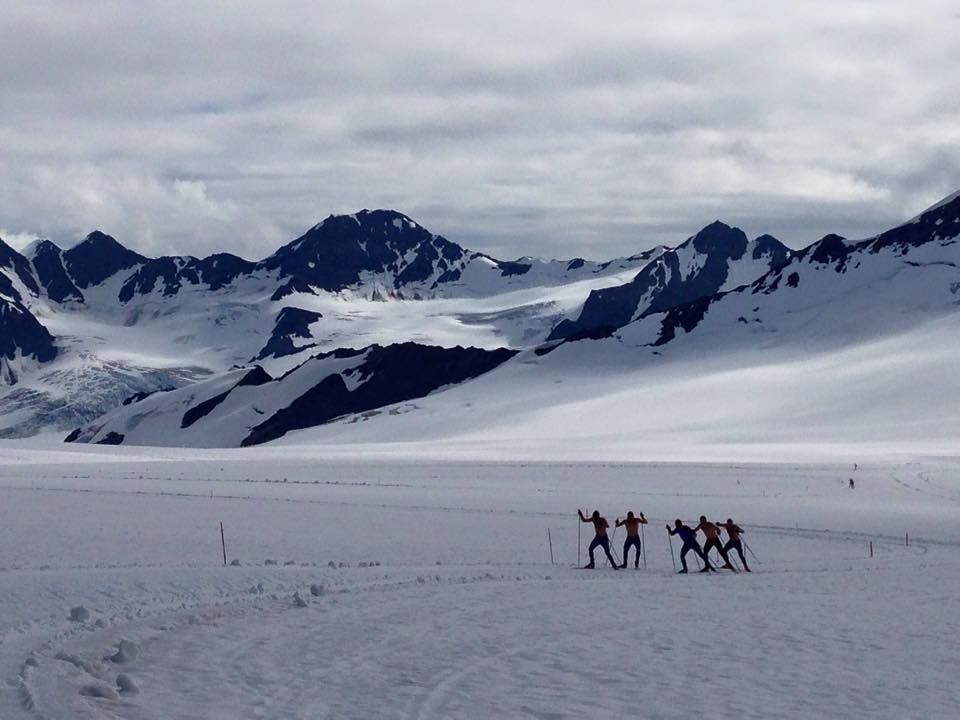
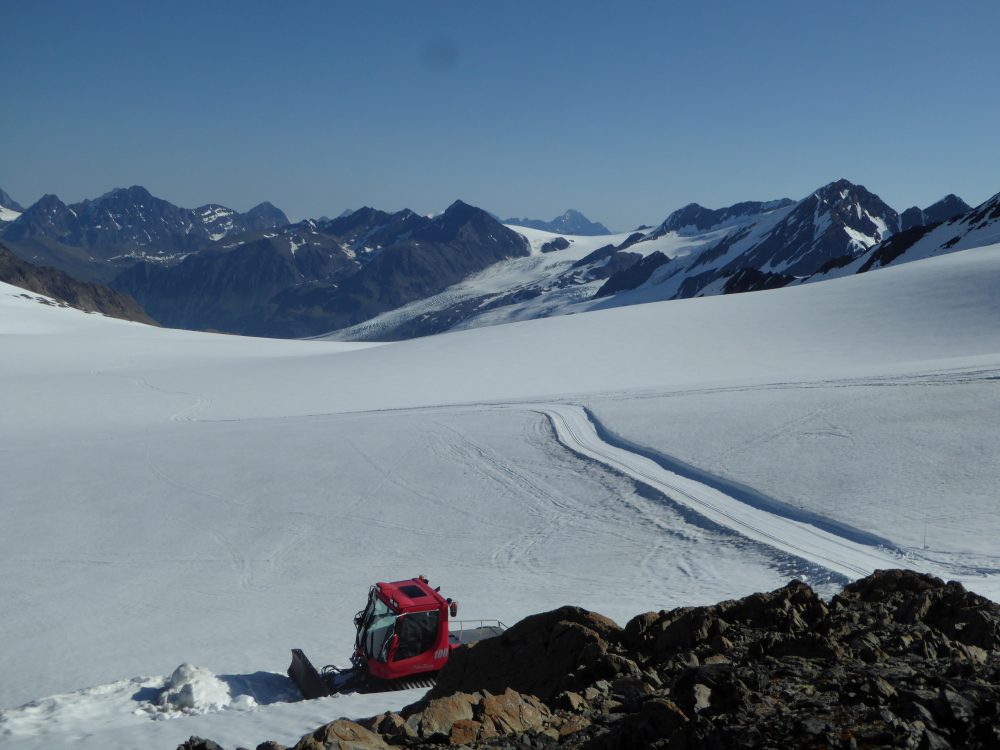
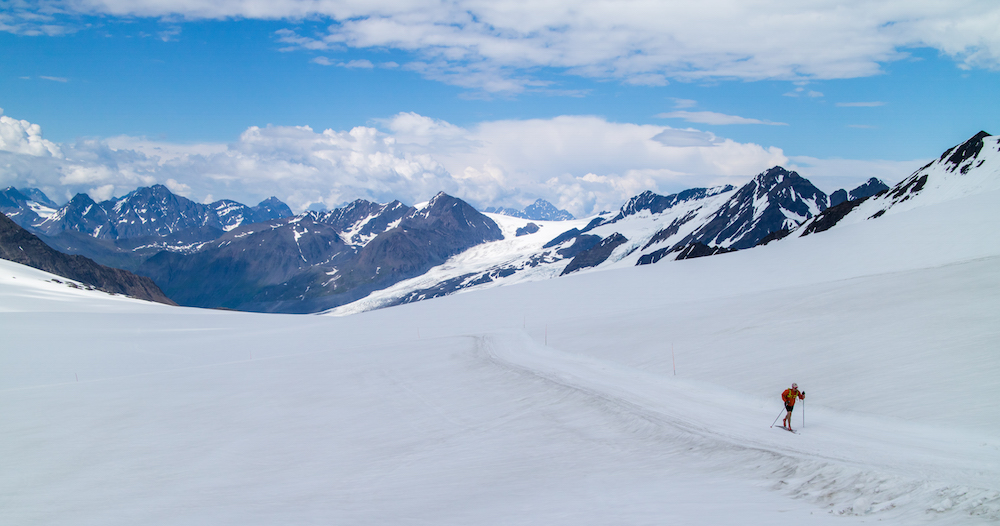
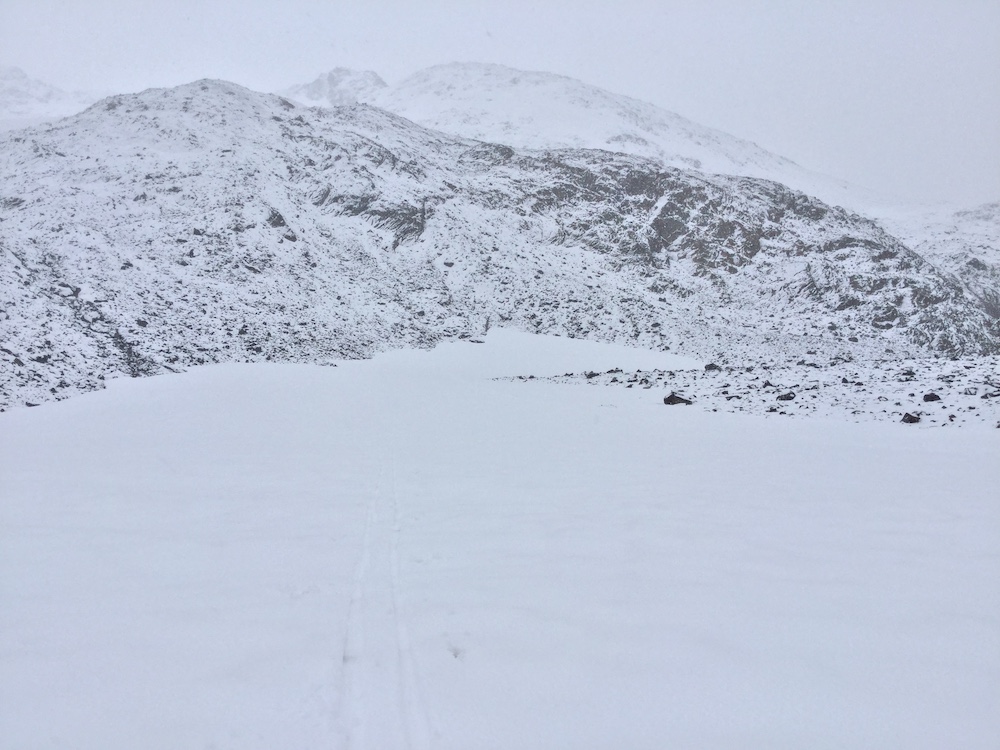
    DIY Dachstein: September tracks on a snowfield in the Chugach mountains, Sept. 27, 2020. (photo: Gavin Kentch)

    The koan that skiers are made in the summer has been around for longer than this website. The related truism, that summer snow time is necessary to effectively compete as a high-level skier come winter, also has a venerable history. 

    For example, here’s Luke Bodensteiner, writing in Endless Winter about why he had journeyed to a place where “the weather sucks all year long” to ski on the Sognefjellet snowfields in August 1993: “We all come to this spot simply to be able to ski a race faster than everyone else.” Or Billy Demong, discussing summer training on Eagle Glacier nearly 20 years ago: “In the late 90s and early 2000s, we were all working super hard, but we hadn’t quite broken through. I was on Eagle Glacier in 2002 because as a team we were committed to be the best.” Or Andy Newell, who first skied on Eagle the same year: “As the overall level on the World Cup continues to rise, summer training camps have become even more important. To be competitive at the very top level, you simply must get on snow at least once a summer.”

    Bottom line, as Reese Hanneman wrote in an essay for a Boulder Nordic Sport catalog a few years ago, “All the best skiers in the world are on snow in the summer. Do you really want to try to be the best skier who wasn’t on snow?”

    All well and good, but what happens when a global pandemic interrupts access to estival snow, for many athletes for the first time in a decade? More rollerskiing, of course, is the predictable and relatively simple answer. But bigger picture, it’s also a chance to introduce a new stimulus to long-established training patterns, and to replace travel and camps with increased consistency training out of a home base. Judging from conversations with three veteran athletes and two longtime coaches, high-level American skiers seem to be cautiously optimistic about how well this summer’s training will prepare them for the 2020/2021 World Cup season that starts in Ruka late next month.

    (Disclaimer: It should go without saying that the global health toll of the coronavirus pandemic, and resultant inequality, are bigger problems than the inability of professional athletes to train on snow in the summer in the manner to which they are accustomed. Because this is a ski news website, the rest of this article focuses on the latter, but that is not intended to deny the existence and importance of the former.)

    Background: In a normal year…

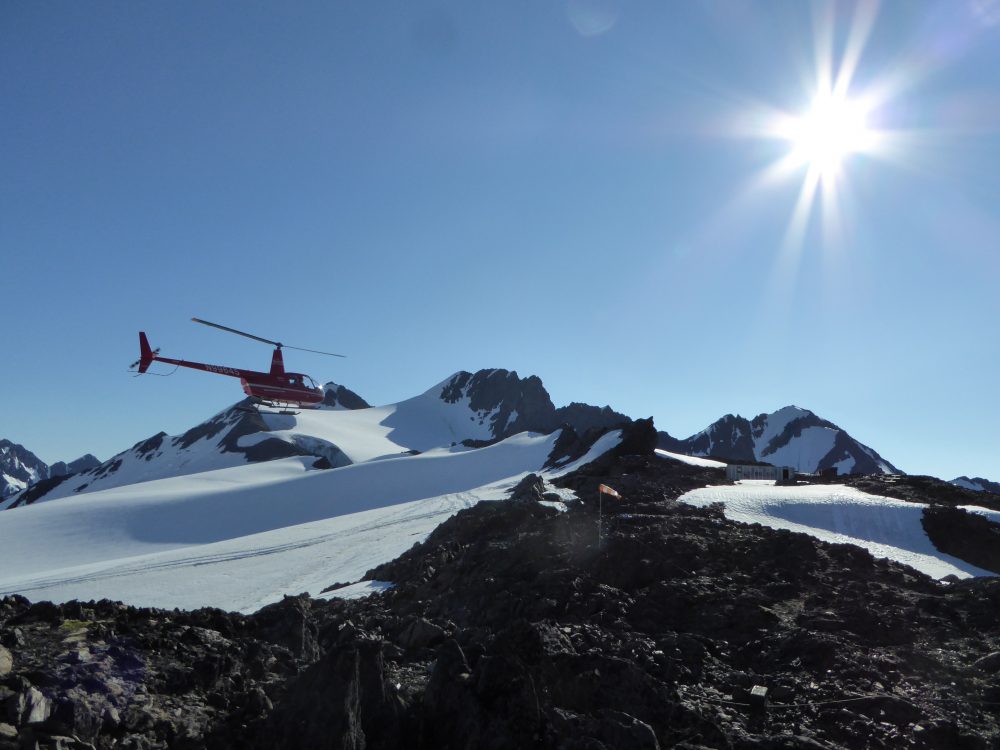
    Here’s another saying you may have heard recently: These are uncertain times. In a normal summer, the Alaskan skiers would be on snow through at least mid-May, then all national-team skiers would meet in Bend for a two-week on-snow camp in the second half of May. Skiers with Alaska Pacific University Nordic Training Center, or APU, would then spend one week a month in each of June, July, and August skiing on Eagle Glacier, a short helicopter flight above Girdwood, Alaska.

    Some national-team skiers – typically heavy on Stratton Mountain School and Craftsbury athletes, less so APU – would then spend two to three weeks in New Zealand in late August and early September, nearly all of it on snow at the Snow Farm. Groomed skiing returns to Independence Mine, about 75 minutes outside of Anchorage, in mid-October (probably), and to Frozen Thunder, in Canmore, about a week later (quite reliably). Arriving in Europe a few weeks ahead of the season’s first World Cup races typically affords athletes more on-snow time before first putting on a bib.
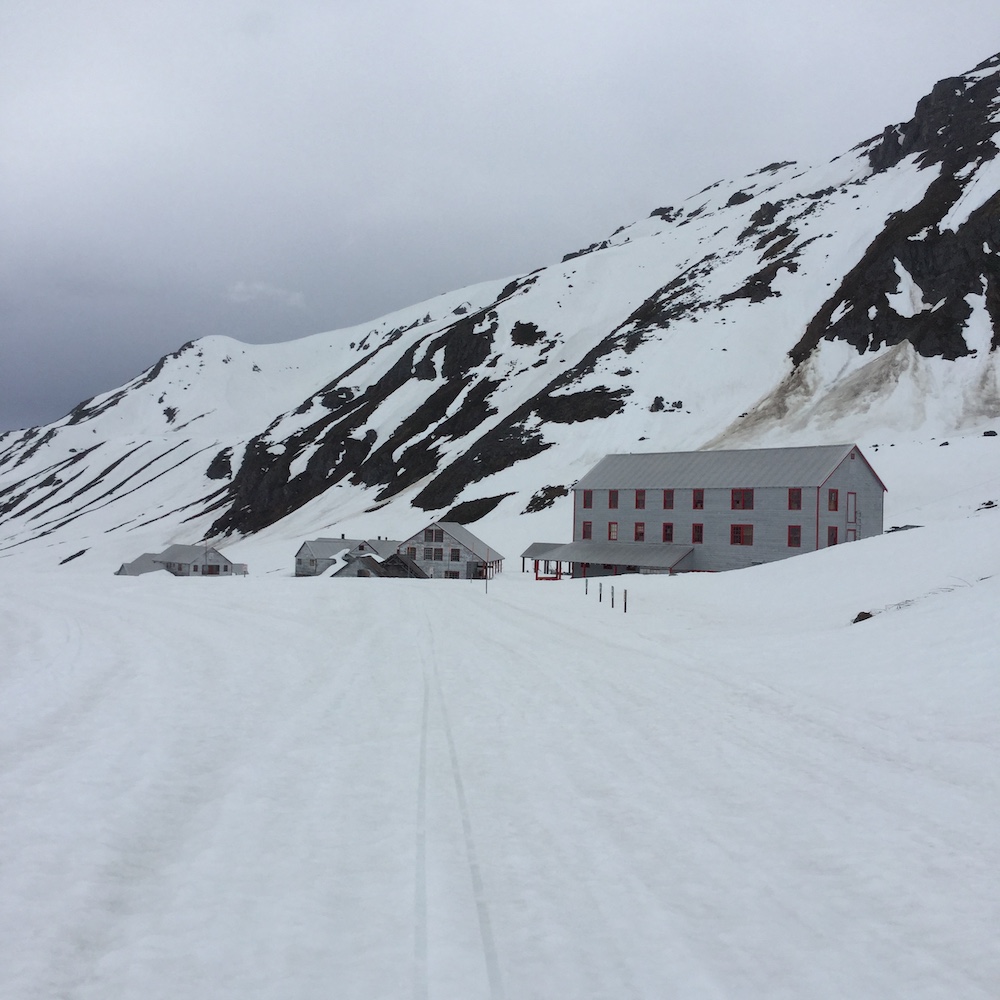
    Summer skiing at Independence Mine, above Palmer, Alaska, May 30, 2020. (photo: Gavin Kentch)

    This year, Independence Mine was skiable through the end of May, but everything else has been off the table. No Bend Camp; no Eagle Glacier; certainly no international travel to New Zealand, let alone to Canada for Frozen Thunder or Forêt Montmorency. It’s hard to survey the entire country, but this reporter’s cumulative four-plus hours of skiing since June 1, on snowfields in southcentral Alaska, may be among the highest on-snow summer nordic training loads in the nation, depending on how much time APU athlete Ari Endestad put in during a late-June (!) crust skiing trip in the Alaska Range. Until snow starts to accumulate at Independence Mine – the Mat-Su Ski Club’s historical first date of grooming there has recently been a tantalizingly close October 15 – American skiers’ collective summer snow drought looks likely to continue.

    What all this means

    So is this a problem when it comes to on-snow performance in the upcoming race season? Not really, according to multiple athletes and coaches.

    “You can accomplish 95 percent of your technique goals, perhaps,” on rollerskis, U.S. Cross Country Team Program Director Chris Grover said in a late-May interview with Cross Country Skier magazine (22:54 mark of podcast), speaking at a time when summer training options were still unknown. “And so we’re in a good place; even if we never touch snow this summer, we’ll be ready to race when we get to next winter.”

    “We’ve had many instances over the years with athletes who have missed on-snow opportunities in the preparation period, and gone on to have breakthrough winters,” echoed USST Head Coach Matt Whitcomb in a recent email to FasterSkier. “The dryland training is the cake, and the snow is the frosting. Americans will be frosting our cakes this fall when the snow flies, and this should lead to top performances during key mid-season international championships. I’m not one who attaches irreplaceable value to prep period on-snow training.”
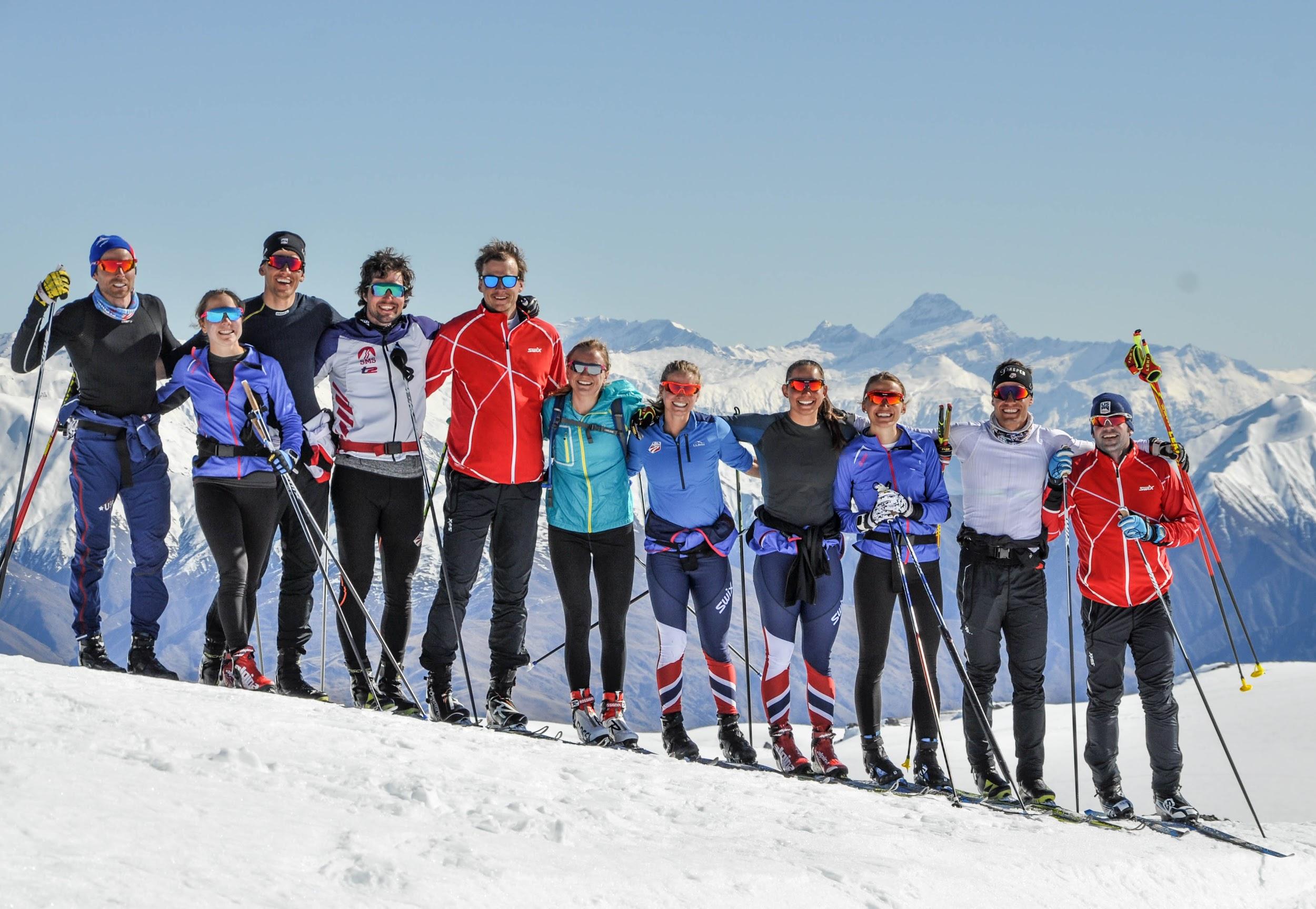
    2018 U.S. Ski Team camp at the Snow Farm in New Zealand. (Photo: Matt Whitcomb)

    “The assessment period, that’s still ahead of us; that’s the race season,” echoed longtime APU Head Coach Erik Flora in a recent phone interview. “But … at least the athletes I work with, they’re in a good position right now heading into the winter.”

    “Of course, we will have to see when the races hit,” APU and USST athlete Rosie Brennan wrote to FasterSkier, “but I feel very optimistic that the summer has had a positive impact on my training.”

    “I’m hoping that some other training strategies – workouts that I normally won’t do because of the glacier, and a different strength routine – will have actually given me an advantage,” emailed APU skier Becca Rorabaugh to FasterSkier. “This is a good year to try new things and shake it up!”

    (Against all this enthusiasm, Whitcomb did provide a more nuanced look at some potential disadvantages, while acknowledging a former athlete’s gentle chiding about his perennial optimism: “Since Holly Brooks once asked me to not always be so positive,” Whitcomb added, “I will start by saying that Norway will have an advantage in the early season. Many of them have found some snow. But Norwegians are often competing for start spots and racing very fast in period one, which allows us a window to catch up when their performance flattens. It all balances out. Beyond that, this is a global pandemic, and every team has been affected. Americans don’t have to do things better than we ever have, but just as good as we can. That will be good enough for this season. I’m confident in our preparation, and believe we’ll deliver great results to our fans.”)

    What’s happened instead

    “There is naturally more roller skiing” this summer than in prior years, Whitcomb noted, “since during an on-snow camp we will do little to no roller skiing. The sessions on roller skis versus on snow are similar.”

    This is sensible enough. But everyone contacted for this article also discussed the broader implications of this year’s changes, be it for the overall training stimulus, travel schedule, training schedule, or all of the above.

    Pepa Miloucheva skates behind CGRP biathlete Casey Smith while at a training camp at La Forêt Montmorency in Quebec in early November 2015. (Photo: Caitlin Patterson)

    Here’s Rorabaugh, for example, who as a longtime APU athlete has logged three glacier camps each year from 2007 through 2019, making for an impressive 39 cumulative weeks of summer glacier time. (Flora says that athletes typically log 20–30 hours of ski time in a week at Eagle Glacier. Taking the midpoint of this range, 25 hours, yields a healthy 975 total hours of summer snow time over the past 13 years.)

    “2020 has been structured similarly to a normal summer of training,” Rorabaugh wrote. “The only difference is that where we would usually have a high volume week on-snow, we have done one in town. My overall training volume may have decreased slightly, since it’s hard to get quite as carried away with dryland training, but it’s also been more consistent week-to-week. We might be doing slightly more running than in the past, but the balance between rollerskiing and running is very similar. My joints and feet are actually the healthiest they’ve been in years though, probably because I’m not able to pound them into the ground with the expectation of a low-impact glacier camp for reprieve. Staying in town is forcing me to be a more responsible athlete, and I think my body appreciates it. Actually the biggest challenge for me this summer has been adapting to at-home strength training. Not having access to a weight room has definitely tested my creativity and self-motivation.”

    Or here’s Scott Patterson, like Brennan also an APU and national team athlete, in an email to FasterSkier: “The big changes to my training have mostly been the consistency of time in Alaska and a few alterations for indoor training. We haven’t had any USST camps or APU glacier camps so there have been a lot of weeks just plugging away in Anchorage. It was nice that the snow held on fairly late so it’s only recently that the desire to get sliding on snow has really caught up to me. Not having camps definitely changes things and has its downsides, but I am also really appreciating having fewer obligations and travel days through the summer.”
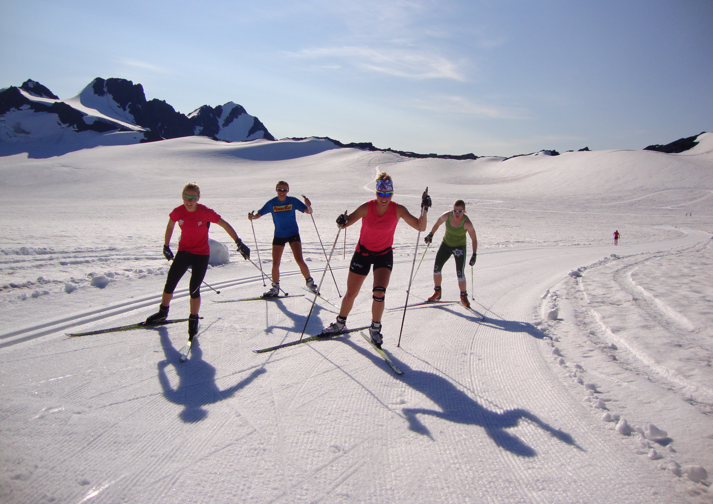
    Ida Sargent, Sophie Caldwell, Sadie Bjornsen, and Rosie Brennan enjoying freshly groomed snow on Eagle Glacier in summer 2011. Photo courtesy of Sophie Caldwell.

    And here’s Brennan, another veteran athlete with a long history of summer snow time: “It’s definitely been a bit of an experiment this year, but I have really chosen to look at the potential benefits. For one, as an older athlete it gets harder to introduce new stresses that create the adaptation needed to keep improving. This summer has certainly provided me a different set of stressors that I have had to adapt to. Travel also takes away training days and always comes with some sort of a need to adjust to the new training environment, so without travel, my training has been just so consistent.”

    What about technique work?

    As Grover said, “You can accomplish 95 percent of your technique goals” on rollerskis.

    Others were a little less sanguine. As Patterson noted, “Those weeks of glacier time in the middle of the summer are a great opportunity to preserve the on snow feel even when in town rollerskiing. It’s easy to forget that skis don’t kick like ratchets, pole plants are much softer than pavement, and asphalt never turns to deep slush. I usually try to use the glacier weeks as high volume periods with fairly intense focus on the technical aspects of actually skiing. In town, it has definitely taken some adapting to not have the focus week or the on snow technique.”

    And Rorabaugh, a Fairbanks native, sounded similar themes. (Relevant: Even in an era of climate change, Fairbanks, Alaska, reliably provides hard-wax skiing for at least four and probably five months a year, from early November through late March. Fairbanks skiers once started a spring marathon on the Chena River, in downtown Fairbanks, at temperatures of –12° F. On March 25.)

    Audrey Kentch, 5, skiing in wet-snow conditions in Alaska, June 2020. (photo: Gavin Kentch)

    As Rorabaugh wrote, “Summer on-snow training is a good time to work on technique and try new things, and to adapt to dramatically new ways of skiing. It’s also a vital opportunity to practice skiing in slushy conditions – something that an Alaskan skier might be unprepared for. At my first JNs in Lake Placid I remember being utterly shocked that people skied on sloppy trails, and having no idea how to do it! Thankfully I’ve had a lot of practice on Eagle Glacier since then.”

    Looking ahead to the start of the season, Rorabaugh noted, “I don’t think I’ll change my approach when I get on-snow this fall because it’s a different time of year. Early season snow is a good time to transfer dryland fitness to skiing, but it’s not as much of a technical laboratory. It’s more about technical honing than totally revamping.”

    No matter what the summer looks like, the first few times back on snow are necessarily different than rollerskis, and can potentially require some degree of transition. As Whitcomb observed, “It takes a few days for everyone; the skate skis feel long and awkward, and the greater hip area muscles get sore from slipping on classic skis. Our first few on-snow workouts in Finland each season call for short, easy training, and after that we’re good to go. I also think it is harder for juniors than for seniors, but neither case is a big deal.”

    A more nuanced aspect of this issue involves the optimal application of summer snow time for working on ski technique. Flora is a firm believer in his seriatim method, which involves one week on snow at roughly one-month intervals from June through August.

    The June camp is “usually the introduction of new ideas,” Flora told FasterSkier. “And the nice part about being on snow is that it’s real-time, real snow. So it applies 100 percent; you’re not adjusting for a rollerski kick, or, you know, road-style terrain; you’re on snow, and it’s World Cup-style terrain. And so, usually, June, we use to introduce ideas, and then July is kind of, refine and play with those, and then usually by August, you can see those changes kind of setting in. And so that’s a pattern that we’ve used for over a decade. And it’s an effective pattern.”
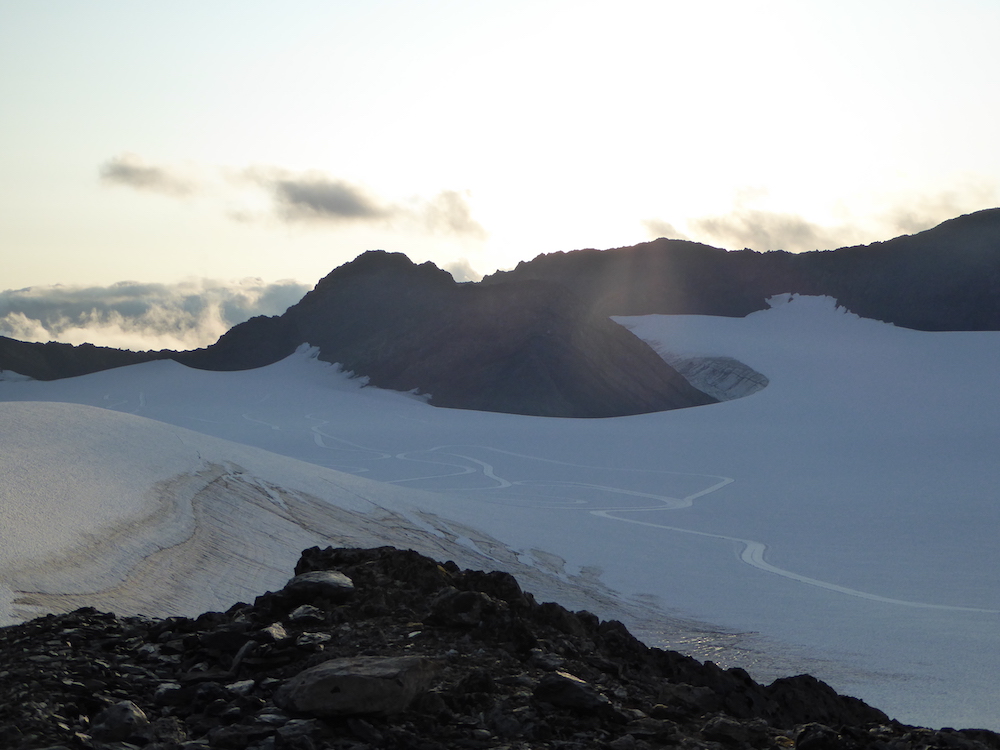
    World Cup terrain: The groomed ski trails on Eagle Glacier gleam in this view from the training center on a late-July evening in summer 2019. (photo: Gavin Kentch)

    When attempting to translate this pattern to an exclusively dryland paradigm, Flora explained, he found himself emphasizing more of a “steady amount of technique work in the summer” this year.

    Has it worked? With the significant caveat that the race season has yet to begin, Flora is cautiously optimistic: “As far as which one is more effective? Hard to say; I think they both work. One thing right now seems to be we have a number of athletes that have made jumps this summer, you know, similar to in years past. But again, we’ll see as the on-snow time comes.”

    Flora is similarly confident about an athlete’s ability to ski well in early-season races this year, even if they have transitioned from rollerski kick to hard-wax skiing at Independence Mine, only to be thrust into, say, a messy artificial snow, above-freezing, klister slopfest race in World Cup Period One. Flora expresses his hope that APU’s “style of coaching and education” has let the athletes “create an adaptable kind of platform to work from. And so when … they show up and it’s icy or soupy, or whichever it may be, that they’re ready just to jump on their skis and adjust.”

    Finally, Flora also cites his athletes’ accumulative lifetime on-snow experience: “The athletes that I’ve worked with for a while, I’m confident that they’re ready to kind of jump into any kind of conditions, that those athletes also have thousands and thousands of kilometers behind them, of glacier soup, and spring-like conditions. … I think for my main group [of athletes], everyone is comfortable kind of moving forward. I don’t know that one summer has a huge impact into that. … I guess I’ll know more about that in a few months.”


    Towards a philosophical understanding of summer snow

    Flora’s observation about lifetime glacial kilometers skied raises a final point: What, perhaps in a more fundamental sense, does summer skiing mean? The final paragraphs of this piece on FasterSkier attempt to limn an answer, and Chelsea Little’s lovely, lyrical essay on summer skiing at Italy’s Passo dello Stelvio does much the same. But what do coaches and athletes have to say about it?

    For Flora, summer skiing is, as discussed, an opportunity to install and ingrain technique changes relatively early, “so by the time they’re in the racing season it’s an automation or a natural movement, as opposed to trying to race and then also think about new movements.”

    But it’s also a chance to, well, ski a whole lot. This may seem obvious, if not downright unremarkable for professional skiers who ski all winter long, but for Flora it stands in contrast to, perhaps counterintuitively, the relatively reduced amount of actual skiing that occurs during the World Cup season, which brings with it travel days and recovery days and multiple venues with limited snow on small loops.

    https://www.instagram.com/p/CC2PpdbpXKD/

    As Flora notes, “What’s really interesting about those numbers is that if you go up to a glacier camp, and you ski, say you ski 20, 25, 30 hours that week. And you take that across roughly 15 k an hour, or you can even just look at the pure hours. Most of the athletes in the wintertime are training anywhere from, you know, 30 to probably upwards of 60 hours a month, at most, during the race season. And so the amount of time you get at a camp – if you’re having 30 hours in a week of training up there, take two camps and you have over a month of skiing already. And so the time up there is different than the race season too, because a lot of times when you’re traveling and racing, you’re skiing once a day, jogging in the afternoon, where on Eagle, you’re skiing twice a day. And so that time has a huge impact on kind of turning the body into a ski body.”

    All athletes and coaches also noted that summer skiing is some sort of change – a new physical stimulus, to be sure, but also just a change. Whitcomb spoke of the danger of “monotony,” and of the need to avoid not just an outright overuse injury, but also the “physical plateau” that can result from consistent use of one training mode. Brennan unconsciously mirrored Whitcomb almost verbatim, writing, “As for an overall approach, I have tried to remain very consistent all summer so no one activity gets into a level in which I’m risking overuse.” And Flora, similarly, said that he began the summer by telling his team, “the opportunity ahead of us is just the change in stimulus.”

    It’s hard to discuss these changes, in this year, without trafficking in tropes, but here are a few more to end things: Every disruption is a chance for improvement. It’s not a challenge, it’s an opportunity. The only thing constant is change.

    In all seriousness, though, in a sport where the increased sharing of information has led to high-level training looking relatively homogenous around the world, the unparalleled summer of 2020 provides a chance to see what winter results look like when traditional summer training is disrupted. As Flora said, he’s confident now, but we’ll all know more soon.

  • Torchia on the Ups, Downs and All He’s Learned Since His First USST Nomination

    Torchia on the Ups, Downs and All He’s Learned Since His First USST Nomination

    Ian Torchia (front) leading L3 intervals with the Stratton Mountain School (SMS) team in June. (Photo: Pat O’Brien)

    Two summers ago, with just five miles left of the Marquette Trails Fest 30-mile mountain bike race, all Ian Torchia could hear in his head was the voice of Krystof Kopal, his Northern Michigan University (NMU) teammate, snidely saying, “You drop out again?”

    Fifteen minutes earlier, Torchia had careened into a tree. After dusting himself off, he remounted his bike, but not before noticing his left wrist was badly injured.

    For a moment, Torchia considered pulling out of the race. Thoughts of Kopal, however, kept his feet on the pedals. A few months earlier, Kopal had given Torchia ceaseless verbal flak for dropping out of the 2016 Spring Series 50-kilometer ski race due to cramping. 

    “[Kopal] was playing in my head … so I finished the last five miles with a broken wrist,” Torchia, now 22, recalled on the phone this summer, noting that it wasn’t until after he had finished the race that he found out it was broken.

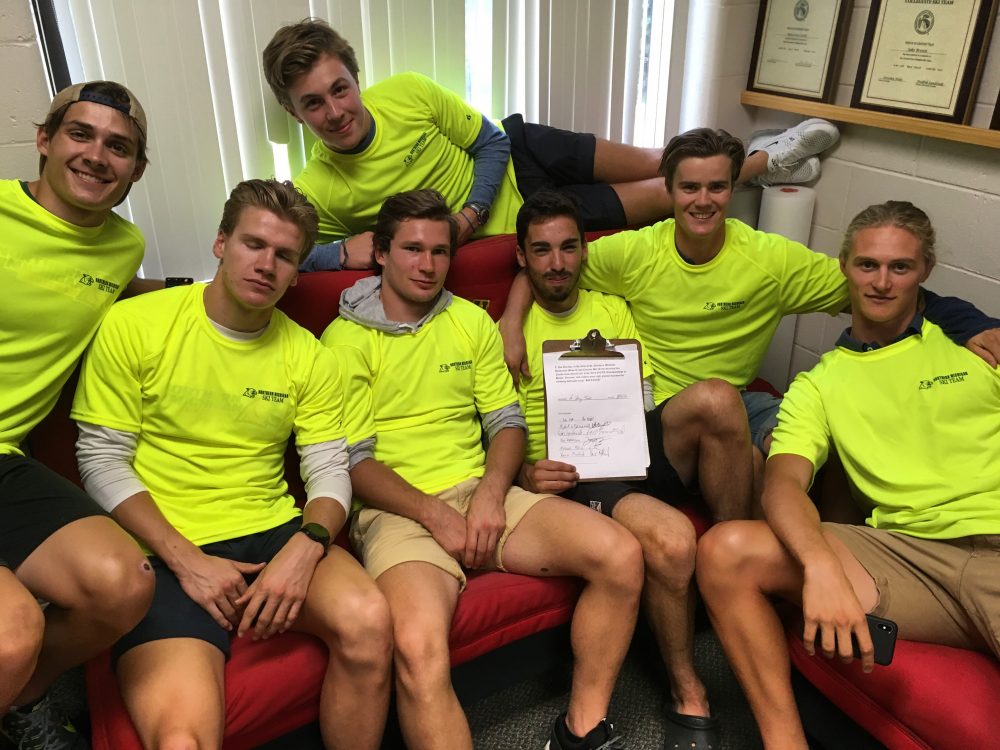
    The NMU men’s ski team with Ian Torchia (third from r) in late August. According to Torchia, the paper he’s holding is a contract. “If we win [the] team NCAA title [this winter], they get to tattoo my gluteus maximus,” Torchia wrote. (Photo: Andy Keller)
    Shortly after, Torchia had his wrist examined by doctor and was told he would need to have surgery. The procedure — scaphoid fixed via percutaneous fixation–left Torchia in a cast. 

    About a month before his crash, Torchia had been nominated to the U.S. Ski Team (USST) D-team and invited to two national-team training camps that summer. Torchia had intended to attend both camps, regardless of whether his wrist was healed or not.

    Fourteen days after his accident, Torchia departed Marquette, Michigan, his “home” since he began attending NMU in 2014, and headed for Eagle Glacier, Alaska, the location of the first USST camp.

    On the glacier, he skied with either one pole or none at all. When he returned to Marquette, the pattern continued for another two months. It wasn’t until the end of August that he had his cast removed. 

    “I kept training super hard with the broken wrist,” Torchia said.

    All that training led Torchia to what he recalled as being “in pretty good shape” leading up to November. Then things started to go south. Fast. Right around Thanksgiving, Torchia was exhausted and experiencing severe night sweats.

    buy inhalers

    “If you type in ‘mono’ on Google and look at the symptoms, I probably had seven out of the eight,” he said. “But I at the time was thinking ‘It’s just a bad virus. It will pass.’ ”

    The symptoms continued. Torchia’s girlfriend suggested he get tested for mononucleosis. He didn’t. 

    “I didn’t want to believe her,” Torchia said. 

    Soon enough he had to. In mid-December, hypothermia forced him to drop out of a race. At 2017 U.S. Cross Country Championships in Midway, Utah, he felt sluggish and “off” during training, so he visited a walk-in clinic in Park City. The doctor tested for mono, and the results came back positive. 

    “The doctor was kind of nonchalant about it,” Torchia said. “He came in and was like, ‘Oh yeah, you’ve got mono, but nordic skiing isn’t a contact sport so you should be good to go and ski at nationals. I was like, ‘Oh, sweet…that’s not how it works.’ ”

    Following the diagnosis, Torchia decided to skip nationals and return to his hometown of Rochester, Minnesota, for the holidays. He stopped exercising for a month before gradually returning to training.

    “A lot of different skiers messaged me saying, ‘On this return, you need to take it really easy,’ ” Torchia said. (One of those skiers included Tad Elliott, who caught the Epstein-Barr virus in 2014 and went on to win a national title in 2016).

    Torchia took their advice, as well as that of his NMU head coach, Sten Fjeldheim, who has helped other athletes diagnosed with mono safely return to training. The two worked out a meticulous day-by-day plan for Torchia’s return. Torchia redshirted the 2017 college season, but by March, he was back on skis.

    “I wasn’t really thinking about what other people thought,” Torchia said when asked if he was worried whether others were questioning his USST nomination during that time.

    “I was thinking more about the next steps,” he continued. “Like the day to day, ‘Oh, my morning heart rates are going down,’ or ‘This next weekend I can start running again.’ … I think before [mono], I was riding really high on skiing, and it was … a big, big part of my life. Getting mono kind of let me take a step back and realize, OK, there are other things [besides skiing].”

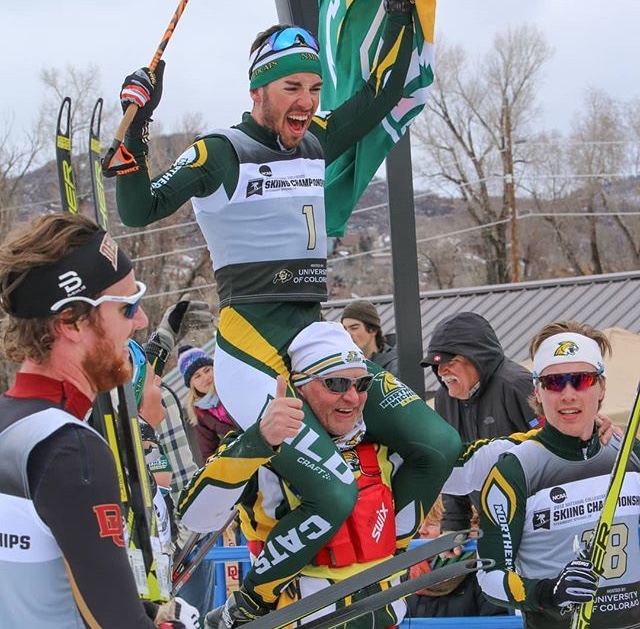
    Ian Torchia (1) on the shoulders of Northern Michigan University Head Coach Sten Fjeldheim after he won the men’s 20-kilometer freestyle race at 2018 NCAA Skiing Championships in Steamboat Springs, Colorado. (Courtesy photo)

    Mono not only gave Torchia a little perspective, but also an extension on his time to compete in college. By redshirting in 2017, Torchia retained eligibility to compete in 2018 (as a junior) and 2019 (as a senior). In his fifth year at NMU, he is currently working toward a master’s degree in exercise science.

    This past March, he won the 20 k freestyle at NCAA Skiing Championships to become NMU’s seventh NCAA champion in program history. In the other race at 2018 NCAA’s, the 10 k classic, he placed fifth for All-American status. Earlier last winter, Torchia qualified for and competed at U23 World Championships in Goms, Switzerland.

    “I try to look at the positives that mono brought,” Torchia said. “That first season of being on the USST brings a lot of pressure and inadvertently getting mono kind of lessened that. Afterward, when I got renominated to the team [last spring], I was like, ‘OK, they’ve given me this second chance, so I need to take it.’ ”

    Torchia was renominated to the D-team for 2017/2018 and again this past spring for the 2018/2019 season. After his third-straight nomination, he approached his summer with revitalized vigor. For the first time since enrolling at NMU, he decided to spend some time training outside of Marquette, largely as a result of a wedding invitation from his USST teammate, Erik Bjornsen. In July, Bjornsen and Marine Dusser were married in Villard-de-Lans, France.

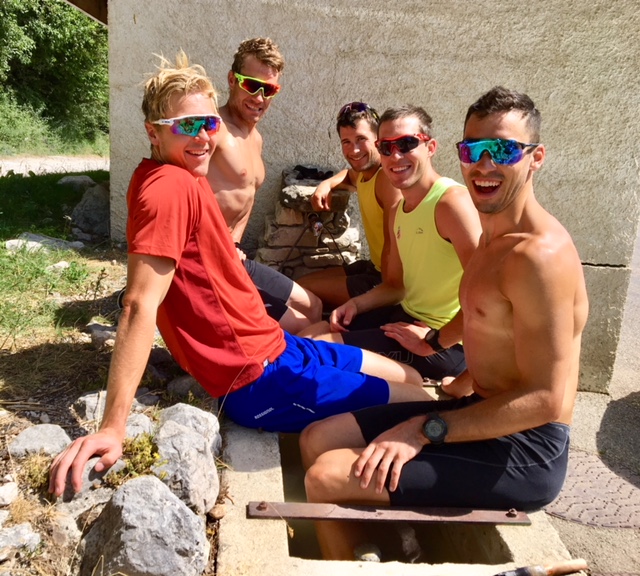
    Right to left: Ian Torchia, Paddy Caldwell, Adrien Backscheider, Simi Hamilton, and Erik Bjornsen during a post-interval cool down in Villard-de-Lans, France. (Courtesy photo)

    “After getting Erik and Marine’s ‘save the date’, I knew there was no way I was missing the wedding,” Torchia explained.

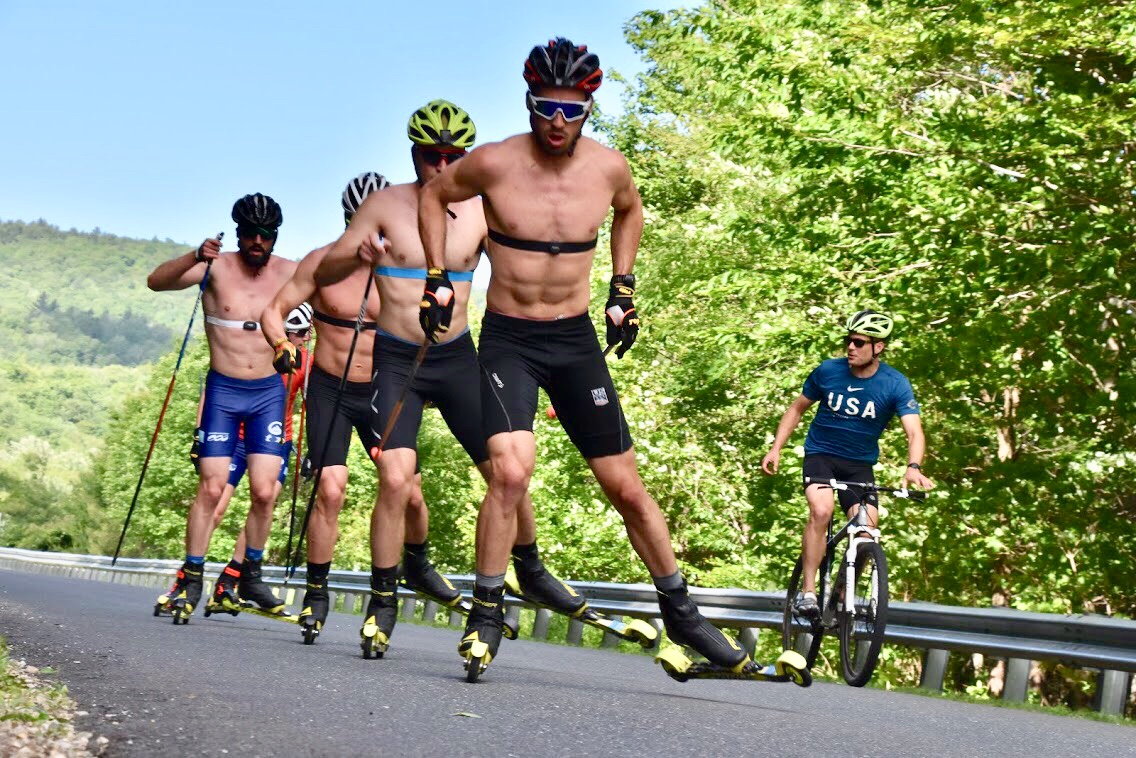
    After the wedding in early July, Torchia remained in France for the USST men’s training camp. The camp lasted 10 days and featured what Torchia described as “hard rollerski intervals and epic mountain runs.”

    He was accompanied by three teammates, Bjornsen, Simi Hamilton and Paddy Caldwell, and their coach Chris Grover. French national-team member Adrien Backscheider joined the group for interval sessions.

    Following the camp, Torchia had made arrangements to stay in Europe for another two and a half weeks, which was partially prompted by his Norwegian teammates at NMU. Over the years, many had encouraged him to travel to Norway and compete in the famed Lysebotn Opp, an uphill rollerski race in Norway’s Blink ski festival.

    Before heading to Sandnes, Norway, for Blink, Torchia made two stops. First, Oslo, where he stayed with his former NMU teammates Fredrik Schwencke, a native of the city, and Kristen Bourne, an American citizen currently training with the Lyn Ski Club in Olso.

    “Pretty lucky to have so many great friends and teammates that put me up throughout the trip,” Torchia wrote in an email.

    Torchia spent a week in Oslo before traveling to Kragerø, where he visited his current NMU teammate Mathias Aas-Rolid. A native of Redalen, Norway, Rolid has a cabin in Kragerø that he opened up to Torchia for “a pre-Blink training camp”.

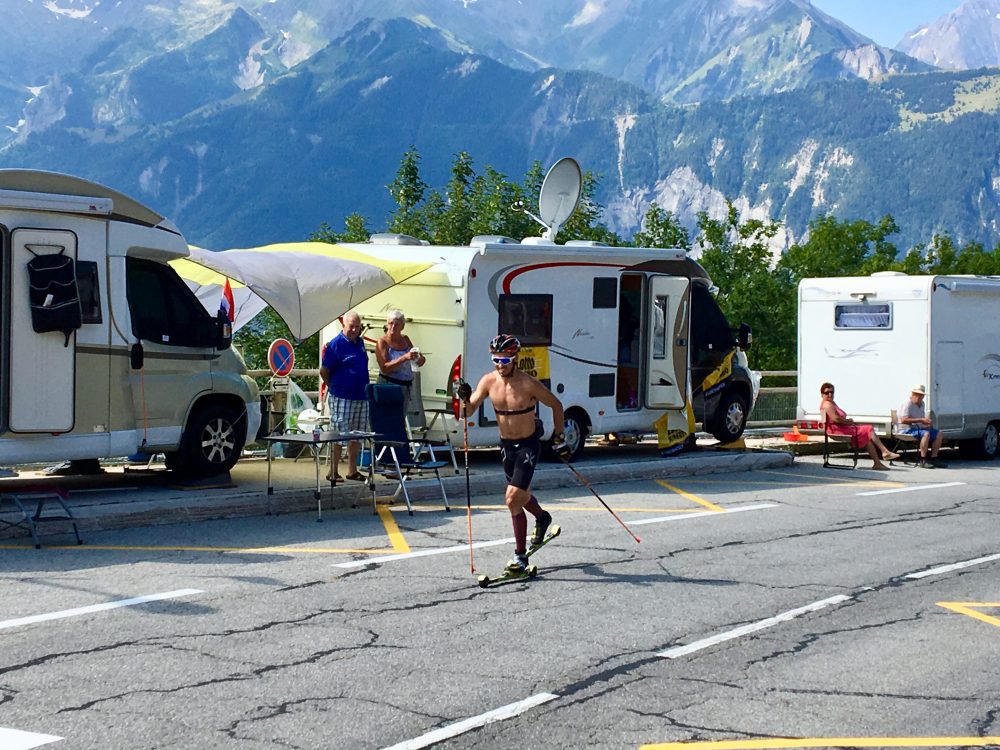
    Ian Torchia rollerskiing up Alpe d’Huez, two days before the Tour de France on July 17, 2018. (Photo: Chris Grover)

    Following Kragerø, Torchia headed to Sandnes for the Blink races. Canadians Evan Palmer-Charrette, Scott Hill and Bob Thomson had rented an Airbnb in Sandnes for the weekend, and keeping with his summer nomadic style, Torchia crashed on their couch during the festival.

    tetracycline buy online, betnovate

    tetracycline buy online, betnovate

    He competed in the 60 k distance race as well as the Lysebotn Opp. The 60 k was what Torchia referred to as “an add-on to the main focus of Lysebotn.

    “For the 60, I made a big blunder by not bringing a water pack and counting on getting feeds along the race course,” he recalled. “Turns out trying to get a feed from a stationary volunteer at 20+ mph is not very effective.” 

    Without feeds, Torchia explained that he “bonked” halfway through the 60 k and ended up finishing 55th. The result left him ready to “turn it around” for the 7.5 k Lysebotn Opp the next day. He managered to position himself well early on in the race’s mass start and within the first kilometer, found himself with the likes of Russia’s Sergey Ustiugov and Finland’s Iivo Niskanen.

    “After the 1 k tunnel, I passed Ustuigov and Niskanen and probably got a little too excited and blew my load about 2 k from the finish,” Torchia wrote of his Lysebotn start. “ ‘Twas a long 2 k in from there and almost managed to catch Harvey but just missed the auto qualifying for the mass start (top-10) by about 15 seconds. I’ve never done a rollerski race, period, so competing in Norway in the strongest field they’ve ever had was a hell of a way to start.”

    Torchia placed 13th, just over 2 minutes behind the winner (and 2018 Olympic skiathlon gold medalist) Simen Hegstad Krüger of Norway and 15 seconds behind Canada’s Alex Harvey, who placed 10th.

    Torchia’s summer adventure ended after Blink, and he flew back to the U.S. on Aug. 6.

    “Getting to do intervals with Adrien Backscheider, [South Korean/Norwegian skier] Magnus Kim, and then race with a World Cup field at Blink served me a big piece of humble pie but was a good indicator that the summer progress[ed] well,” Torchia wrote.

    Torchia is now back in Marquette, focused on school and skiing. Beyond college races, Torchia is targeting 2019 U.S. nationals in Craftsbury, Vermont, 2019 World Championships in Seefeld, Austria, and 2019 World Cup Finals in Québec City.

    “It’s been some ups and downs and definitely a learning experience,” Torchia said of the years since he was first nominated to the USST. “But it’s made me stronger in the process.”

    Ian Torchia (l) with girlfriend, Kameron Burmeister, hiking in Franconia Notch, N.H., during an East Coast road trip they took in June. (Courtesy photo)
  • Kikkan Randall: The Exit Interview (Part II): Looking Forward

    Kikkan Randall: The Exit Interview (Part II): Looking Forward

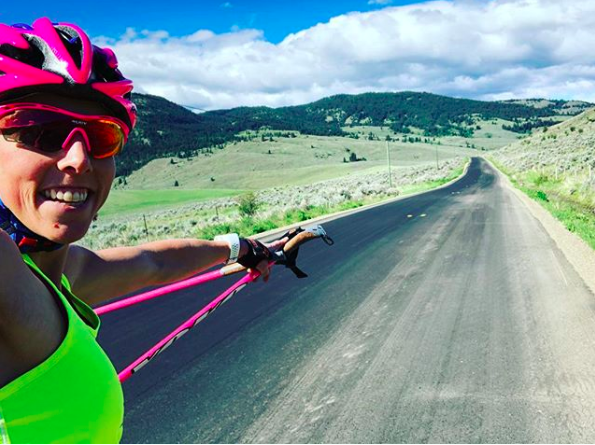
    Kikkan Randall explores new rollerski terrain in Penticton, B.C., earlier this month, following her family’s move to Canada. (Photo: Kikkan Randall/Instagram)

    As discussed last week in Part I of this interview, Kikkan Randall’s first-ever FIS race (that is, a race sanctioned by the International Ski Federation) occurred at U.S. nationals at Soldier Hollow in January 2000. Randall was 17 years old, the single youngest finisher in the race. Other athletes had been born in the 1960s and are now at least 48 years old. Randall raced in a first-generation Gold 2002 training suit for the fledgling Alaska Pacific University (APU) ski program. Every skier in the race had a FIS number starting with a 1.

    Fast-forward 18 years and nearly 600 FIS races later. Randall’s final FIS race was the 30-kilometer classic mass start at 2018 Spring Series this past March in Craftsbury, Vermont. She crossed the finish line in third, leading out a four-racer chase pack to claim the final podium spot in the final race of her career. She followed U.S. Ski Team (USST) teammate Jessie Diggins and USST and APU teammate Sadie Bjornsen, who took first and second in a tight finish.

    Randall was the oldest skier in the race by five years. She was the only athlete whose FIS number started with a 1; everyone else’s FIS number began with a 3. Earlier that week Randall’s competitors in the 10 k freestyle included Anchorage junior Molly Gellert (23rd overall), who had not yet been born when Randall did her first FIS race.

    And even among the 30 k podium finishers, Diggins famously got Randall’s signature on a piece of cardboard at 2008 Junior Nationals in Anchorage, after Randall had run out of posters to sign before Diggins got to the front of the line. Bjornsen likewise looked up to Randall as a junior skier, then moved to Alaska to train with her at APU. Randall’s been doing this for a long time.

    https://www.instagram.com/p/Bg1nV3YHWIJ/?taken-by=kikkanimal

    And when it was over, and when Randall had crossed her final finish line, she stood on the podium in a bespoke pink USA/APU suit, and sprayed champagne over her teammates. The next morning, she woke up as something other than a professional skier for the first time in nearly 20 years. She celebrated by leading a Fast and Female session in the area a few days later.

    Randall’s first month of retirement was marked by lots of media appearances and a series of well-deserved honors. She was recognized by the Anchorage Assembly (which gave her a Kikkan action figure), U.S. Ski & Snowboard, the Alaska Sports Hall of Fame, and the APU Nordic Ski Team, among others.

    And, perhaps most significantly of all, she inspired an ice-cream flavor in her honor. Gold & Glory debuted at Anchorage microcreamery Wild Scoops in early April, in advance of a “Welcome Home Olympians” celebration in nearby Town Square. The concoction involved “a sweet cream base with homemade GOLDen Graham toffee crunchies + pink strawberry sauce streaks,” store owner Elissa Brown explained on Instagram. “Topped with pink sprinkles and ‘gold medals’ while supplies last.”

    The ice-cream honor was the only thing in a month of awards and media attention that threatened to make the preternaturally poised Randall lose her focus. “Wow,” said a clearly surprised Randall upon being asked by a FasterSkier reporter about the significance of having an ice-cream flavor named for her. “That’s quite an honor. I do love ice cream; I’ll have to go check that out.”

    Gold & Glory Kikkan Randall commemorative ice cream at Wild Scoops microcreamery in Anchorage, Alaska. (Photo: Julie Kentch)

    Later that afternoon, Randall headlined the Welcome Home celebration for 16 local Olympians and Paralympians who had competed this year in PyeongChang. (Thanks to Paralympic alpine skier Andrew Kurka and his PyeongChang gold and silver, there were a healthy three Olympic medals in attendance. Another dozen or so local former Olympians joined the crowd, including skiers Nina Kemppel and Adam Verrier.)

    Randall rode in on a pink fire truck. She joined the cheerleaders from her high school alma mater, East Anchorage High School, in dancing to the school fight song. She accepted the Skis To The City from Anchorage Mayor Ethan Berkowitz, then sprayed a pink streak in Hizzoner’s hair. She listened as Alaska’s senior senator, Lisa Murkowski, praised the accomplishments of all the Olympians and told them that Alaska was proud of them.

    Finally, Randall took the microphone and addressed a crowd of hundreds filling Town Square on a blustery, raw, sub-freezing April afternoon. Hordes of local junior skiers clambered on to the snowbanks immediately in front of the stage to gaze up at her, Anchorage Junior Nordic hats on their heads and rapt admiration in their eyes.
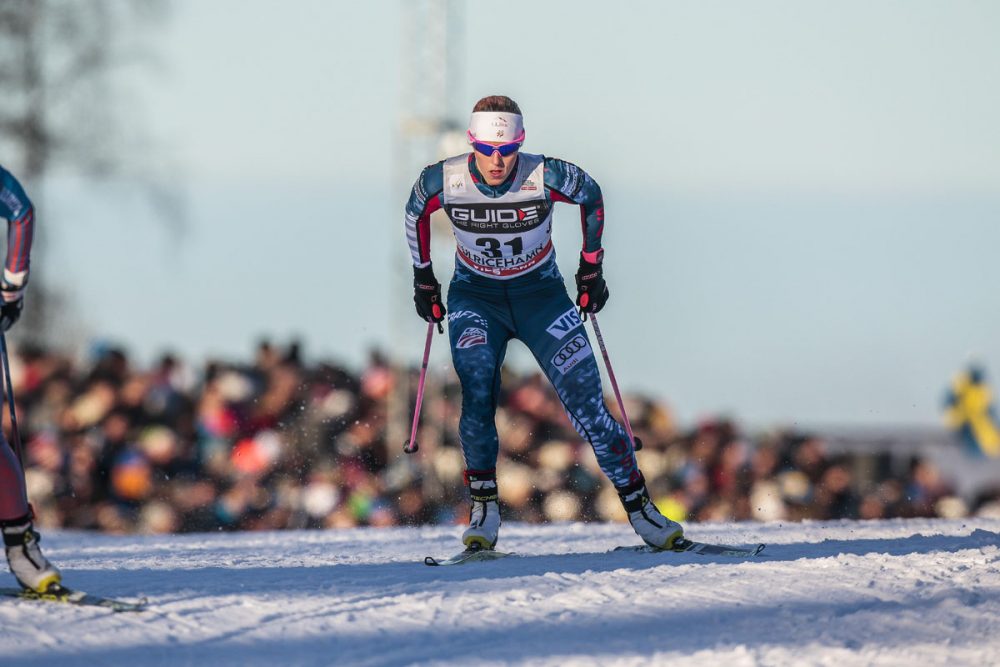
    “This is so amazing for us,” Randall said, “to come back to Alaska, finally, after a long and hard season traveling the world, to come back and get to celebrate with all of you guys that have been such an important part of making this gold medal and this Olympic team happen. We couldn’t be more proud to represent the state of Alaska.”

    She praised the support of the community and of her teammates, and detailed all the contributions from others that had made success possible.

    Randall ended her remarks by forecasting a bright future for American skiing: “It’s been a fairytale ending to an amazing journey. And now that my career’s coming to a close, I can’t wait to see what this next generation is going to do. Because they know it’s possible, we know we have the community and the support system to make it happen, and they’re going to take this far beyond. This may be the first medal in women’s cross-country, but it’s not going to be the last.”

    So that’s what’s next for U.S. skiing, but what’s next for Randall? Part II of this interview answers those questions.

    Note: The following story is based on an in-person interview with Randall in late April. FasterSkier’s narrative is in bold; everything else is a direct quote from Randall.

    So, what comes next? Randall largely answered this question last fall; go back and review the second half of this FasterSkier article for the full version of this answer.

    The short version is that she’s going to serve on the International Olympic Committee (IOC) Athletes’ Commission, take on a larger role with Fast and Female, and finish up her MBA through Alaska Pacific University (the school, not the ski team). Oh, and by the way, along with husband Jeff Ellis, parent their son, Breck Stuart Randall Ellis, while settling into the family’s new home in Penticton, British Columbia. And maybe it’d be nice to earn a living, too.

    Randall is asked whether the preview version of her new career, as written out last fall, is still accurate. Here’s what she had to say:

    Yes. That’s still the tentative plan.

    The gold medal, of course, has opened up some new opportunities to do some more motivational speaking, which I really enjoy doing, and would love to have a couple opportunities nationally a month to do that.

    https://www.instagram.com/p/BhaIZkIntcT/?taken-by=kikkanimal

    So that’s one part adding to the mix, and then the IOC role has turned out to be a little more than I knew I was getting into. I didn’t realize I would be on the USOC [United States Olympic Committee] Board of Directors, and so actively involved with other groups that kind of funnel into the IOC. So figuring out how to manage the time commitment there, given that it’s all volunteer.

    And my source of income, which has been racing, is now shifting, so figuring out how to do all these things that I’m passionate about, and I love, and I want to contribute to, but still be able to provide for my family.

    … And then realizing there’s only 24 hours in a day, and I want to be a good mom, and I want to be physically active, and still see my husband, and do all these other things. So it’s going to be – after the last 20 years being pretty darn predictable, it’s now a whole new scheduling challenge and energy-management challenge. But, there are so many good things to look forward to, that I think will help me transition out and give me really good focus, new passions.

    I’ve heard that some athletes really struggle after they retire because you are so passionate about your sport, and it gives you so much structure and daily accomplishment, that when you don’t have that anymore, you can really just kind of go into a mental tailspin. So having these great things already lined up that are going to be really engaging and fun to work on I think will be really helpful.

    Randall may be understating things somewhat when she talks about the structure and daily accomplishment of being a full-time athlete; she has trained twice a day, 48 weeks a year, for most of the past 20 years, and duly recorded every workout. That’s a lot of daily structure.

    But there is also a certain broader rhythm to the seasons that attaches to this lifestyle – starting up training again in May, volume in June, intensity in the fall, and so on. Randall is asked, in an interview conducted in late April, what it is going to feel like to not be beginning a new training year next week on May 1, or to spend a complete summer uninterrupted by training blocks on Eagle Glacier, or to spend mid-November somewhere other than far northern Scandinavia for pre-World Cup races. Randall is quick to acknowledge the magnitude of the change, while still concluding that it’s time to move on.
    You know, I’ve been surprised at how quickly I’m starting to realize that it’s gonna feel pretty weird. I did my last race, just coming up on the one-month mark, and, while I’ve been excited to finish a great career, to be able to now go and do new opportunities and things, it is kind of settling in, the fact that I won’t have the excuse to go out and train twice a day, and do all these exercises. And most importantly, that I won’t be meeting up with my teammates, who have really just become such close friends, and coaches and everything.
    https://www.instagram.com/p/BiOeBl_Bq2H/?taken-by=apunordicskiteam

    So I know it’s going to be a pretty dramatic stretch, and April has been kind of a free pass, in that it’s always kind of the time of year when we are flexible. It’s felt pretty normal so far, but as next week starts, and summer drags on, I’m sure it’s going to be pretty strange.

    But all good things come to an end, and I think it’s still the right time to transition out, so it just gives me a greater appreciation for what I’ve been able to do, and recognizing what parts of that life I want to continue forward – you know, I want to stay active and fit, and it’s just going to be a new challenge of how to figure out how to do that, while balancing everything else.

    That challenge, for an elite athlete, often involves coming to grips with the fact that they still love moving and being outside, yet by definition will spend the rest of their life older and slower than when training was their full-time job.

    Two models for how to negotiate this post-career period (which, it should be noted, represents multiple decades and the majority of one’s life) are suggested, the Adam Verrier model and the Nina Kemppel model, corresponding to two local former Olympians.

    Briefly put, Verrier moved to Anchorage after his college ski career ended, qualified for the 1994 Olympics, then stayed in Anchorage and basically never stopped racing. He has won nearly every notable trail race in southcentral Alaska, and placed on the podium of the 50 k Tour of Anchorage, the unofficial citizens race championship for the state of Alaska, eight times between 1995 and 2007, including three victories.

    Kemppel, by contrast, raced in four Olympics from 1992–2002, then ultimately returned to Anchorage after earning an MBA outside of Alaska. She has lived here for years, and presumably remains quite active, but does not seem to have entered an official running or skiing race since returning to Anchorage. “I’ve become more and more of a weekend warrior because of my job,” Kemppel told the Anchorage Daily News in a 2012 article noting her return home.

    Randall is asked with which pole of post-career racing she envisions being more closely aligned.

    I probably hope for something in between. I am already recognizing that with family commitments and some of the – I mean, the gold medal changed the reality a lot, in terms of what opportunities are available, and my position with the IOC is going to be very busy. So while I love the idea of just staying super-fit and doing all that, it’s going to be a challenge to be able to do that. But I also love being able to be active every single day, so I hope to be able to build that into my new life.

    As far as racing goes, I don’t have any real plans in the near future. I’ve always been interested in trying some mountain biking stuff, and I think it’d be cool to dabble with some new sports. There’s a big triathlon community down in B.C. where we’re going to be, so maybe that’s something to get into. [Randall has at least one victory and four runner-up finishes in Anchorage’s Gold Nugget Triathlon, one of the largest and longest-running women’s-only triathlons in the country.] Having races in the future is a good motivation for just making sure you get out the door every day, and you have a plan of what you’re working towards. So I like that idea, but I don’t need to necessarily keep racing at a high level all the time.

    And ski racing-wise, it would be fun to do some events I’ve never done, like the Birkie and stuff, but I don’t know at what level I’ll be racing.

    But I do really enjoy racing, I love the opportunity to just get out there with everybody, put the bib on, and go push yourself, so I think I’ll continue to do some of it.

    https://www.instagram.com/p/BgvooV9nZHF/?taken-by=kikkanimal

    [Randall has often spoken of shifting into a race gear or finishing gear when she is racing well, or of being unable to make that shift when she is not. She is asked what it’s going to be like, two months or two years from now, when she’s at the point in a race when all of her training and experience tell her that it’s time to make that shift, but her body won’t let her do what her mind wants to.]

    I’m sure that’s going to be tough. Thankfully the number of years I’ve been competing, I think I do have a nice window of time where that’s not going to just disappear overnight. But I can tell already, in the last month where I haven’t done a whole lot, and all of a sudden jumping into doing things a little harder again, it’s like, Whoa, what are you doing? So yeah, I’m sure it’s going to be tough to not be as fit as I would have been in the last 20 years… but that’s just the way it goes.

    That world-class fitness was not easily won. Over the course of her career, Randall increased her annual training hours consistently and substantially, from roughly 300 in high school to nearly 800 by the height of her career, adding in intensity along the way. “You hadn’t trained hard enough if you hadn’t started crying,” Randall once told Outside Magazine of 2008, “the year of intensity.” (It is worth noting that 2008 also saw Randall undergo two surgeries for the blood clot that nearly killed her. But they were both in April, so presumably she didn’t miss too much training. She would win her first World Championships medal, Liberec, Czech Republic, in February 2009.)

    But when asked what she won’t miss about this lifestyle, the first thing Randall mentions is not the staggeringly difficult Level 4 bounding workouts, but rather the simple quotidian drudgery of preparing for and completing two workouts a day, every day, over and over and over again.

    I think always having to do two workouts a day. Over the last couple of years, especially once we had Breck, it was hard at times, to just go, I’ve got to change my outfit again, I’ve got to go out there, maybe the weather’s not great, and I know I’ve got two hours to log. And just putting in the amount of time out there – it got tough. So some of that part I won’t miss, just having to do it all the time.

    Having the time open and available for new things now, not having to just constantly change outfits – into training clothes, out of training clothes. And traveling with so much gear. It’s just been nice to do a couple trips now where I just pack a couple things, and off you go, not have to drag a ski bag all around the world.

    The APU men pushing each other during a workout at an Eagle Glacier training camp, July 2015. (Photo: Zuzanna Rogers)

    Going up on the glacier was always – it was such a great training environment, and it was such an amazing resource to have, but you could never really appreciate it in the moment when you’re up there. When you’re on Day 2, and you’re staring down five more days of just what you know is going to be a lot of hard training, and just knowing you have nowhere to go, you’re stuck up there, you’re away from your family. And so, I won’t miss, again, just having to do that … at the same time, I think I’m quickly going to miss the opportunity where I got to do that.

    So it all comes into perspective: When you’re in the midst of it, you can’t wait to be done with it and not have to do it anymore, but then quickly you realize, like, what a cool opportunity it was.

    Now that Randall is no longer in the midst of it, she has one heck of a formidable resource: 20 years’ worth of training logs and data. And she has saved all of it, too, starting with a log provided by her high school coach, Harry Johnson, at the East High Cross-Country Team, and continuing through to more recent versions contained in an array of spreadsheets.

    Unsurprisingly for an athlete who has spent much of her career raising others up along with her, Randall is decidedly magnanimous when asked what she plans to do with all this training data.

    Erik [Flora] has all my logs, so he has all that data, and he’s of course free to use it however he sees fit. The U.S. Ski Team also has all my logs. I know they’ve already integrated a lot of stuff into their planning for the development pipeline, and kind of what we’ve learned.

    So yeah, it’s all open and available to those guys to use because I hope that my career can help just make the road better for the next group coming through. Because I learned a lot off of what people before me did, and what worked for them and what didn’t work for them, and then we kind of progressed that forward. And I think already we’ve been able to create a totally better training environment than when I even started. So keep pushing it forward, and I’m glad that that information’s out there.

    https://www.instagram.com/p/BiPkRmMnO0U/?taken-by=kikkanimal

    And it’s pretty fun to be able to get to the end of it now, and look back over the progression and the work, and what went well, what didn’t, and all that stuff.

    And I’m so glad that I recorded all that, because part of my log, too, is comments on training every day, and that in a sense is a diary for me, because I haven’t really recorded that anywhere else. And now that my career spans so long, it’s so nice to be able to go back and read through that, and realize what was going on in my life day-to-day, through all the years and the training. And it also helped my relationship with my coaches, to best understand what was going on with me, and to be able to adapt the training around that.

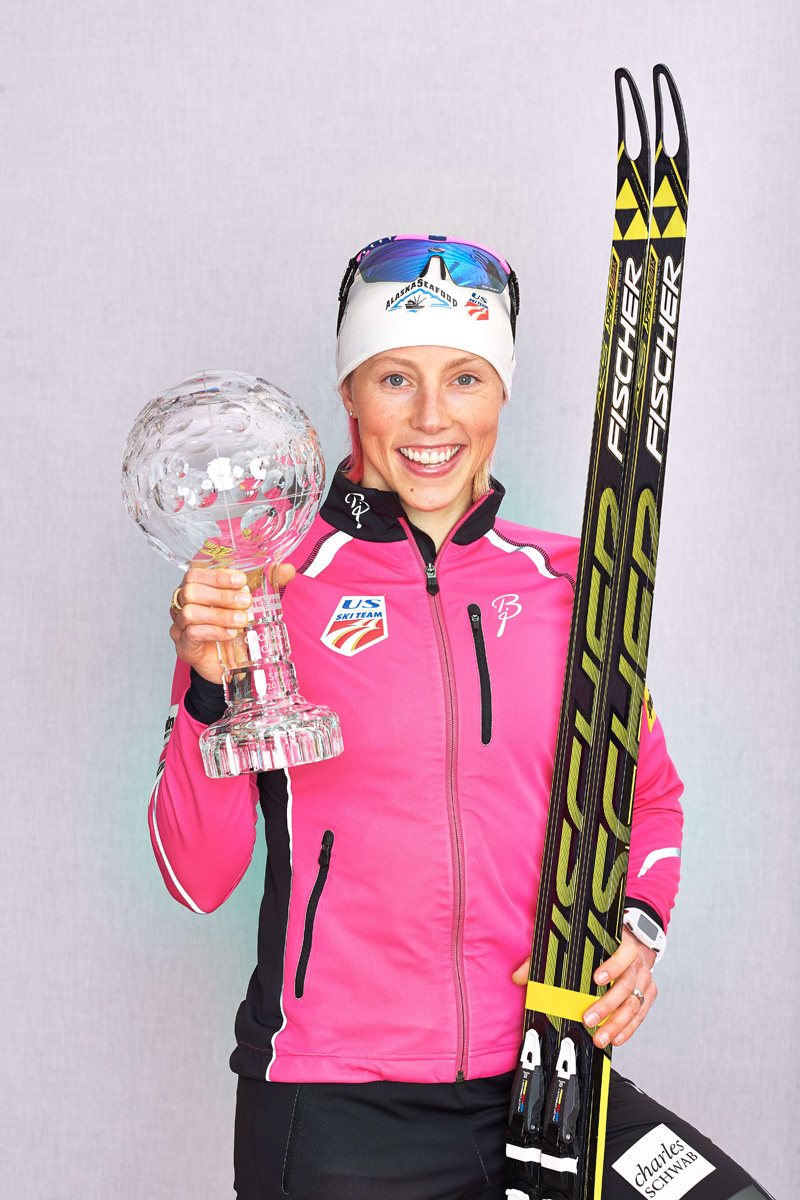
    While presumably no athlete has ever said that the physical hardware itself was the point or the telos – as opposed to the hard work that went into winning a race, the pride of accomplishment, the friendships made along the way, etc. – the fact remains that Randall’s personal trophy case is extensive. There’s an Olympic gold medal, for one. But also three World Championships medals. And three Sprint Cup Crystal Globes. And a medal for third overall in the 2012/2013 World Cup standings. And 29 World Cup podium medals.

    And even, if you go go back far enough, 10 Alaska state high school championship ribbons, three for cross-country running and seven for track, in distances from 800m to 3,200m. (Fun fact: Randall never won an Alaska high school state cross-country skiing title, but she did go on to have a more successful post-high school ski career than the girl who consistently beat her, Service High School’s Tara Hamilton, who went on to ski for the University of Denver and “only” won an NCAA national title.)

    Randall is asked where all these awards currently are, and what she plans to do with them.

    I’d love to find ways to get it out there. It’s been so fun, just carrying around the gold medal already, sharing it with everybody; it’s something for people to see, to look at. One of my crystal globes is at the L.L.Bean store in a case, so that’s already kind of being shared. The other two right now are just kind of sitting at home in their carrying cases. And I’m not sure exactly where my World Championships medals are; they’re packed somewhere in the move. But it would be fun to, I think, have some displays out, share it around.

    Kikkan Randall with her third consecutive Sprint World Cup Crystal Globe, 2014. (Photo: Fischer/Nordic Focus)

    Because, now that we’re kind of starting fresh with the new home in B.C., and as Breck grows up, and Jeff has some incredible accomplishments of his own, I would love our family space to be a little bit about our future, and not so much about my past in particular. So if I can get my awards in places that can inspire others, and people can share that piece of history, I think that would be better than just having it at my home somewhere.

    I’d love to see something here at APU, to really celebrate the connection of what we do with the ski team, so that everyone knows about it, gets to feel a part of it. And then the Alaska Sports Hall of Fame, of course, at the airport is a pretty cool demonstration, and who knows where else in town we can have some sort of display maybe. Anchorage certainly deserves a lot of the credit for this.

    As Randall observed, her focus in life is currently on the future of her family. But it’s worth noting that her husband, Jeff Ellis, was no athletic slouch himself; he was a World Cup skier for Canada who scored a podium in an Alpen Cup race as well as multiple podia in NorAm races. All of which begs the question, what will Randall and Ellis do when an 8-year-old Breck tells them he wants to do a local running race, or an 11-year-old Breck announces he wants to join a junior ski team?

    I would like to follow a lot of the lead that my parents had for me, in that they really felt like they wanted to let me direct the choices. And so when I got interested in something, and wanted to do it, I was welcome to try it.

    And then the rule was, once I signed up for something, I was committed to that for at least that season. And a lot of times, I would get excited, sign up for something, and then get into a few days of practice and go, ‘Yeah, I don’t think I want to do this.’ But my parents were like, ‘No, you committed to it, so you’re going to see it through to the end of the season. And then once the season is over, if you want to move on to something else, you’re more than welcome.’

    https://www.instagram.com/p/BhkEN0eHqYf/?taken-by=kikkanimal

    So I think I’d like to follow a similar thing with Breck – introduce him to some things that, you know, both Jeff and I are interested in, because we’d love to let him have a similar experience, but let him guide it. If he’s interested, he can keep doing it; if not, he can move on to something else, and just kind of learn that, once you commit to something, you’ve got to see it through.

    And then we’ll just see where it goes from there. I hope to be supportive of whatever direction he takes, and if he gets excited about competitive things and training and wanting to take that route, just support him along the way. So we’ll see.

    And finally, the woman who was, famously, the only mom on Team USA at PyeongChang (less fun fact: it was ultimately too expensive for Randall and Ellis to bring Breck to South Korea with them, and he spent the Games with his grandparents in Canada), who nursed an infant from birth through the first month of the 2016/2017 World Cup season and who spent two winters traveling through Europe with a child and a ton of baby gear in tow, is asked how much 2-year-old Breck understands about Mommy’s job.

    I think the coolest part right now is, because he’s not necessarily going to be aware of the specifics of what I do, he’s just been around it. He enjoys watching people ski by, he wants to put on skis himself and try it. He’s just kind of being unconsciously subjected to the lifestyle and the people, and that’s been really fun.

    And the night before the team sprint, I was Facetiming with him – he was back in Canada with Jeff’s parents – and I said, you know, “Tomorrow Mommy’s got a big race at the Olympics, do you have anything to say?” And he just said, “Gooooooooo!”

    And I think he was saying “go,” because my mother-in-law has coached him a little bit to say “Go go Mommy!” So he was kind of saying “go,” but at the same time it almost sounded like, “Gooooooold!”

    And last year at World Championships, when he was just 10 months old, he was playing with the bronze medal, and then this year I gave him the gold medal, and he actually kind of looked at, and then he just dropped it and walked away. And since then he’s seen it around a lot, so he’s getting a little bit more interested in it … but he won’t realize what it is for a while, but I think it will be really cool to show him that he was a part of it, and it will be interesting to see what his take on it is later on.

    https://www.instagram.com/p/Biusr86H10V/?taken-by=kikkanimal

    I know that Kateřina Neumannová – I thought it was such a cool moment, and I was there in Torino when she won the 30 k, and her two-year-old daughter came running out to the finish area. I just always loved the image of that.

    So a couple years ago, when I first got my pink Kikkan poles, she got in touch and said, “Kikkan, I need a pair of your poles.”

    I’m like, Kateřina Neumannová’s getting in touch with me? Like, ‘Whoa, you’re my hero.’ And she’s like, ‘My daughter just absolutely thinks you are amazing, you are her favorite racer, and if I can get a pair of your poles for her birthday, she’s trying to decide between tennis and ski racing right now, and I’m hoping she’ll choose skiing, hoping that this will help.’

    And I was like, ‘But does your daughter know who you are? And she’s like, Yeah, it’s kind of a she could care less who I am kind of thing, I’m just her mom.’

    [Randall sent the poles to Neumannová. They were appreciated:]

    https://www.instagram.com/p/zo3zfijSt7/

    So it will be funny to see what Breck’s reaction is to it all. I think it’s cool that he got to be a part of it, and we’ll get to show him the pictures and everything. But what he’s going to really grow up with is knowing me as his mom, beyond the career. So the focus gets to be on our family and on him.

    * * *

    Disclosure: The author is an Alaska Pacific University masters skier who grew up doing Anchorage youth sports in the same generation as Randall; they skied together in Anchorage Junior Nordic in the early 1990s.

  • Don’t Overfill Your Cup: APU Coach Erik Flora and the Complete Athlete

    Don’t Overfill Your Cup: APU Coach Erik Flora and the Complete Athlete

    Erik Flora, head coach of Alaska Pacific University, with one of his athletes, Rosie Brennan, also a U.S. Ski Team member, during training at 2017 Nordic World Championships in Lahti, Finland. (Photo: John Lazenby/Lazenbyphoto.com)

    This week’s featured articles are made possible thanks to the generous support of The Loppet Foundation, host of the Masters World Cup 2018. Registration opens in October.

    ***

    RIDING IN A PISTENBULLY ON EAGLE GLACIER, in the Chugach Mountains above Girdwood, Alaska — If you want to find the essence of Erik Flora, the longtime coach of the Alaska Pacific University (APU) ski team, you need to come here.

    You need to fly to Anchorage. You need to drive 45 minutes down Turnagain Arm to the small resort town of Girdwood. You need to bump over dirt back roads to the Girdwood “airport,” a dirt airstrip surrounded by wildflowers on the ground and glaciated peaks above. You need to make your way inside the Alpine Air hangar, past the curious tourists overdressed for summer sunshine, and pay for your ticket. You need to absorb the safety briefing, climb into the A-Star, put on ear protection, and get ready for one of the most scenic helicopter flights of your life.

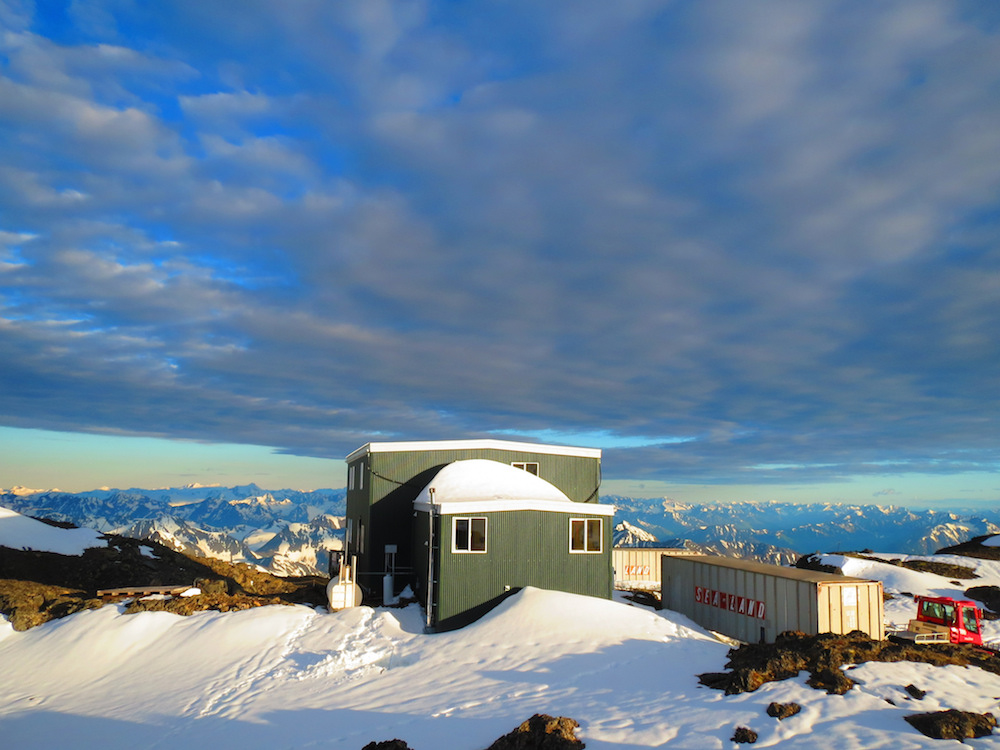
    Within 10 minutes, you will go from sea level to 6,000 feet, from summer to winter, from coastal hemlock rainforest to high alpine zone. You will marvel as the helicopter pilot effortlessly sets the machine down on a landing pad smaller than a spare bedroom, a ridiculously narrow patch of firm ground amidst the sea of friable black rock. You may notice that there is a glacier 100 feet to one side of you, and a cliff edge 100 feet to the other. You may notice that the residential building in the middle is literally bolted to the rock to hold it in place.

    Or you may just be wondering where the heck you are, and who would voluntarily spend several weeks each summer up here. And that is where you will find Erik Flora, a man squarely in his element: in a training environment of largely his own creation, shaped by a single-minded focus on helping American skiers to be the best in the world. Oh, and to become better people, help the community, and learn to coach themselves along the way. That’s all.

    ‘I was born in Nashville, Tennessee, which is kind of unusual for a cross-country skier’

    But before Flora could make it to a glacier in the Chugach Mountains, he had to get out of Nashville first. His family moved when he was young, following his father’s work as a city planner. This took them to the suburbs of Portland, Ore., a pleasant place but also still an unlikely venue for a future cross-country ski coach.

    Erik Flora (l) and his mother, Berit Flora, on Eagle Glacier in the Chugach Mountains, Alaska, in July 2016.

    The Floras were members of the Oregon Nordic Club, and Erik frequently cross-country skied at Mt. Hood, the alpine resort (with a smaller nordic area) about 90 minutes driving and 4,500 vertical feet above Clackamas. Bend, Ore., and Snoqualmie Pass in Washington were other frequent weekend destinations.

    The snow was plentiful but the drives were long, and by the time he was in high school Flora was realizing that Portland was not the optimal place for someone with long-term nordic aspirations. His plans crystallized at a Bend training camp in the summer after his sophomore year, featuring some logistical real talk from his coach.

    “After doing some testing and skiing around” at the training camp, Flora recounted, his coach encouraged him to move to Bend. “Because in Portland you can only ski a couple times a week, and with my goals being what they were, to be a World Cup skier, then it had to be a little more than twice a week. And so I moved to Bend when I was 17, … and moved in with this coach. And my parents were still in Portland.”

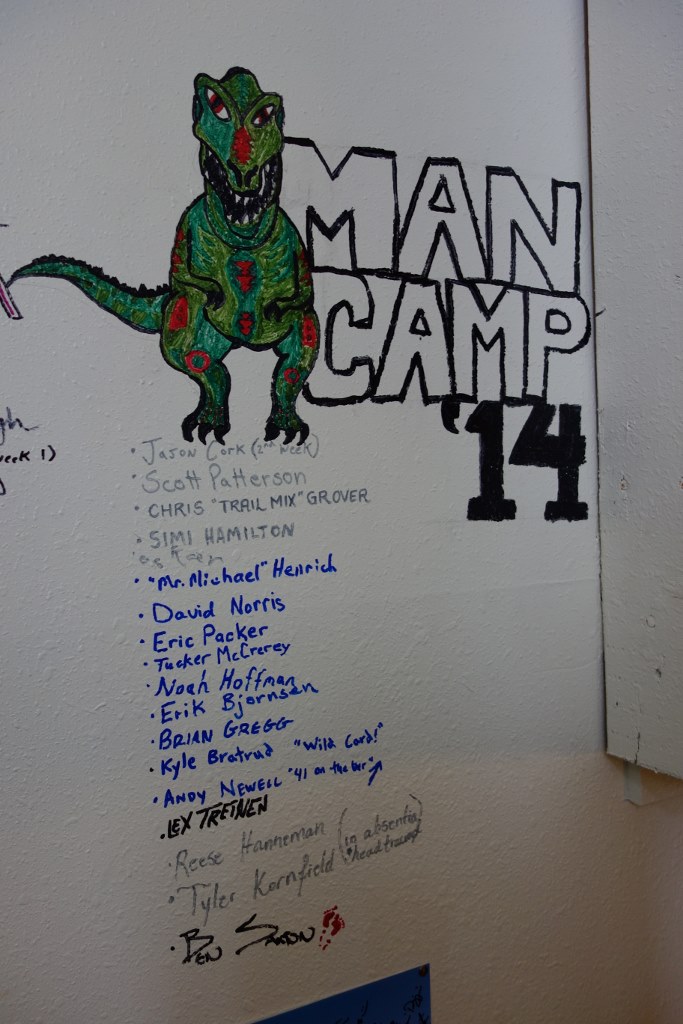
    (All direct quotes in this article come from an in-person interview with Erik Flora. The interview was conducted in the cab of a PistenBully on Eagle Glacier in July 2016 while Flora groomed from 10-11 p.m. for the next day’s skiing. Why so late? In part because of the need to groom in cooler temperatures to give the snow a chance to set up. And in part because, as Noah Hoffman noted following the 2014 Man Camp at Eagle Glacier, “Flora has nailed the grooming. (It helps that he never sleeps.)”)

    Within a year, Erik’s parents, Sam and Berit Flora, had followed him to Bend. A period of athletic wanderlust and nomadism followed, as Flora fils “kind of bounced around to different places around the West.” There was a school year spent in Norway, too.

    Throughout this time, Flora explains, he was “kind of figuring out more of what I wanted. I wanted a place where I could train at sea level, since when I was in Norway, that seemed to be something that most of the top racers in the world at that time came from sea-level locations. Some place that had a long winter and a ski community. And that was Anchorage.”

    View from riding shotgun in the PistenBully: grooming in the fog and summer twilight, on Eagle Glacier in the Chugach Mountains, Alaska, in July 2016.

    Flora contacted Bill Spencer, a former U.S. Ski Team member who was at the time the coach of the nordic team at the University of Alaska Anchorage (UAA). “And shortly after, I was driving my truck up the Alcan,” he recalled.

    Flora’s Alaska origin story is familiar to the point of cliché among Alaska transplants: “My plan was to move to Anchorage, and stay for a year, and see how it was. I lived here a year, and pretty much decided at that point, I was probably going to be in Alaska forever.”

    It didn’t hurt that Flora met his future wife, Gretchen Pfisterer (now Flora), in Anchorage around that time. Or at least started dating her then – they had met at World Junior Trials a few years earlier, when he was 18.

    “And I remember the moment I actually saw Gretchen for the first time,” Flora, now 44, recalls 25 years later. “She was walking up to get her medals – she was a good ski racer, for sure. And I saw this girl walk up, blond hair, and thought, ‘Wow, that – that is something. OK.’”

    The two of them skied on different teams for the next few years, before uniting on the UAA team in Anchorage when Erik Flora was around 20. (Pfisterer had grown up in Anchorage. She was the girls Anchorage Daily News Prep Athlete of the Year in 1989, an honor later awarded to future APU skiers Eric Strabel, Kikkan Randall, and Scott Patterson.) They began dating while both were at UAA, and “kind of figured out that Alaska” was going to be a good match for them, Erik now recalls.

    Career as an athlete

    That coach at the Bend summer camp was onto something. Flora found success at UAA, skiing to All-American status in 1994 and again in 1995. (His then-girlfriend, now-wife was no slouch either; Gretchen earned an All-American finish in 1992.)

    Flora’s collegiate results put him on the national development radar for U.S. skiing, and exposed him to opportunities outside of Alaska.

    Happy athlete, happy coach: Erik Flora with APU skier Chelsea Holmes after Holmes placed a career-best 13th in the women’s 30 k freestyle mass start at 2017 World Championships in Lahti, Finland. (Photo: John Lazenby/Lazenbyphoto.com)

    As Flora diplomatically notes, this experience, while another step on the ladder, ultimately showed him that Anchorage felt like the best match for him and his skiing: “After being in Anchorage for a couple years, the USOC had a development program based out of Marquette, Michigan, that I joined. I moved out of Alaska for a year, lived in Marquette, and tried a different program. It was kind of a good next step. And after trying that, I realized that what I had experienced here in Anchorage was really along the lines of kind of how I wanted to develop my ski racing.”

    Flora soon returned to Anchorage, this time for good. Three-time Olympian Jim Galanes had founded a program associated with Alaska Pacific University, Gold 2002, which was not shy about its aspirations. (The program would indeed send at least two Anchorage natives, Nina Kemppel and Kikkan Randall, to the Winter Olympics in Salt Lake City, though neither of them medalled. No American skier has yet won another Olympic medal in cross-country skiing since Bill Koch at Innsbruck in 1976.)

    In the Gold 2002 program, Flora says, “instantly I found what I was looking for.”

    Specifically, the team was the right match of coach, mindset, reliable snow, and a critical mass of athletes with unified goals. “I always knew that I wanted to be a ski racer,” Flora now recalls, “and the key was to find where I could make that happen. And … a lot of the places I lived, whether it was in Portland, where we didn’t have enough skiing, or some of the other places, in the early days, there wasn’t a team to work with – and that’s what I found in Anchorage, was Team Gold 2002 had a handful of athletes, and they were all talking about U.S. development.”

    Flora skied for Galanes for a few years. But in 1999 he was in a car accident while driving up to Hatcher Pass, in the Talkeetna Mountains outside of Palmer. He injured his back, not quite enough to prevent him from continuing with competitive skiing, but just enough to keep him from regaining his pre-accident levels of performance.

    The accident “kind of sidelined my ski racing career,” Flora says. “I was about 24, 25 years old at the time, and spent the better part of a year and a half trying to get back to where I was before the car accident. It never did pan out.”

    Career as a coach

    Flora stayed in Alaska following the car accident, but stepped away from ski racing. He devoted himself to learning to fly small airplanes in Bush Alaska. He pursued his airplane mechanic’s license. He obtained multiple levels of aviation ratings, including commercial instrument ratings and land and seaplane ratings.

    Erik Flora runs away from a departing helicopter at APU Masters Glacier Camp on Eagle Glacier in the Chugach Mountains, Alaska, in July 2016.

    “I thought I was going to be a pilot for a while,” Flora says… but “then realized partway through [the aviation certification process] that that my heart was really in cross-country skiing. So that’s where my coaching began.”

    Flora coached the Masters program for Gold 2002 for three years, starting in 1998 at a modest six hours a week. He took over coaching juniors in 2001. Following the Salt Lake City Olympics, Gold 2002 merged with and rebranded as what is now officially known as the Alaska Pacific University Nordic Ski Center, or APUNSC. Flora has been in charge of the APUNSC program since 2006.

    This narrative makes it look like the car accident was what set Flora on the path to coaching. That’s not inaccurate. But there are two other things that Flora mentions first when asked about life events that pushed him into coaching.

    First, he cited the influences of his childhood: “I grew up in a very active, supportive family that cross-country skied a lot. And that definitely set the lifestyle of wanting to spend my life, you know, ski racing and working with athletes, being in the ski world.”

    And second was his year abroad in Norway after high school: “Probably the next significant experience was going to school in Norway for a year, and being 19 years old or so, and kind of realized that – I went over and kind of saw how the Norwegians trained, and had this feeling like, ‘I can do this.’ So having that belief pretty young, certainly – ‘I’ve been racing with some of the top kids in Norway, this is something I can do.’”

    APU Head Coach Erik Flora runs alongside Sadie Bjornsen (APU/U.S. Ski Team) during a workout last summer. (Photo: Matt Whitcomb)

    Flora kept this experience in mind when he began coaching. But he changed his outlook from “I can do this” to “we can do this.” Part of this was the general shift from athlete to coach. And part of it was specifically watching the success of his former Norwegian training partners a decade down the line.

    As Flora says, “watching a friend of mine get an Olympic gold medal, that I had trained with when I was younger,” had an effect. It made him “take that same … idea when I started coaching, the approach of, ‘Hey, we have a lot of talented skiers, we can certainly do this. The United States can be one of the top nordic countries.’ And then really believing in it.”

    (While the famously circumspect Flora did not mention the friend by name in this interview, it has been elsewhere reported that the friend was Norwegian Tor Arne Hetland, who won the first-ever men’s sprint Olympic gold in Salt Lake City. “You know it’s possible for someone to win a medal,” Flora told Alaska Public Media when discussing Hetland in a 2014 interview. “But you’ve never seen it, you’ve never had breakfast with them. They don’t seem like they’re human. Being friends first with this athlete… and then all of the sudden he wins a gold medal. It’s like, ‘wait a second, I can do that.’”)

    The parallels to The Kikkan Effect are strong: As the theory goes, Randall’s breakthrough World Cup success inspired the current generation of American skiers to greater heights, largely by showing athletes what someone just like them was capable of. Just so, Hetland’s Olympic success inspired Flora to seek these same heights in America, just a few years before he took over the APU program and became Randall’s personal coach. If this theory is correct, then that year abroad in Norway ca. 1993 had some pretty far-reaching influences.

    The Kikkan Effect and APU’s success

    So let’s talk about Randall for a second. (Full disclosure, the author grew up doing Anchorage youth sports in the same generation as Randall, and, like many others of that generation, literally had a poster of her on his bedroom wall. His older daughter now has a signed picture of Randall in her room.)

    As previously profiled many times (for example, in this FasterSkier piece from 2012 called “The Kikkan Effect,” then later in this Outside Online piece from 2017 called “The Kikkan Effect”), Randall broke down barriers and achieved unprecedented success for American skiers, raising her countrywomen up along with her.

    Flora is chary of divulging too much about training plans, but some inklings of his work with Randall can be gleaned from the Outside Online version of The Kikkan Effect. Here are a couple paragraphs from that article:

    “By 2006, with new APU head coach Erik Flora in place, [Randall] increased her training load even more. ‘By 35 percent,’ says Flora. ‘That put her on par with the Scandinavians.’ In 2008, Flora ­dialed things up again. ‘The year of intensity,’ Randall calls it. ‘You hadn’t trained hard enough if you hadn’t started crying.’”

    At the risk of oversimplifying a lot of complicated science about supercompensation (see also Jason Cork’s arm tattoo if you ever get a chance), the changes seem to have worked. The volume increase of 2006 was followed by the first ever World Cup win for an American woman in 2007. The intensity increase of 2008 gave way to the first ever World Championships medal for an American woman in 2009. There was more to it than that, but the decisions made between coach and athlete seem to have paid off.

    Erik Flora officiates at the wedding of Kikkan Randall and Jeff Ellis in Talkeetna, Alaska, in May 2008. (Photo: FasterSkier blog)

    In the middle of this period, Flora officiated at Randall’s wedding to Canadian skier Jeff Ellis in May 2008, standing before an archway formed by superannuated pairs of skis with Denali looming in the background. Flora remains Randall’s personal coach to this day.

    Whatever the reason – be it Randall, Flora, greater trends in American skiing, or some combination of the above – the decade-plus since Flora began working with Randall has seen stunning success for the APU program.

    By the Ski Tour Canada at the end of the 2015/2016 World Cup season, APUNSC had eight athletes skiing on the World Cup, probably more than from any single other club in the world. (And this doesn’t include Randall, who was out for the season on maternity leave.) Going into the 2017/2018 season, APUNSC claims six of the 16 athletes currently on the U.S. Ski Team A, B, and D teams. (Stratton Mountain School counts another seven.) Oh, and there were the two World Championships medals this February, Randall’s third and Sadie Bjornsen’s first (with Jessie Diggins in the team sprint). Whatever Flora is doing at APU, it seems to be working.

    Flora was asked what he is most proud of other than these world-class results. He immediately mentions helping his athletes to develop as people:

    “My proudest accomplishment with this team is, you know, the medals and the ski performances I’m very proud of, but just seeing that the athletes I’m working with are having a good development experience, where they’re coming in at a young age and learning about that transitional place in life – where they’re going, how to chase a goal, and the life experience part. We have these outstanding individuals that, in my Elite program, they’re leaving as these exceptional individuals to the community. That’s one of my proudest parts.”

    He then mentions the overall success of the broader APU program – but, much as with his athletes, ties this to the personal development of the individuals involved:

    “Eagle Glacier, and the Nordic Ski Center, seeing the stability that we have right now, and the reputation as being a world-class elite ski area up on Eagle, and that our training center is one of the top clubs in the world, I’m incredibly proud of what we’ve accomplished. And a lot of that is due to the coaches that have worked for me. And to watch a lot of the coaches that started as either young coaches, or transitioned from athletes into coaches, and to be able to watch them along their journey and find their place where they can also do the same, they can help out and pass along what they’ve learned. Those are my proudest moments.”

    And even when the question is rephrased to hone in on results, Flora still evinces a care for the overall level of American skiing:

    “From the first time we watched Kikkan step onto the silver medal podium in Liberec in 2009 for World Championships, I’ve always believed that U.S. skiing can compete, it’s a matter of getting the right group together and having the right energy, and working hard toward a goal. And so every time I see one of our athletes on a podium, it just confirms that we’re doing the right thing. And we’re doing it in the right way, you know, we’re doing it in a way where the athlete’s having a good experience.”

    Erik Flora gestures at APU Masters Glacier Camp on Eagle Glacier in the Chugach Mountains, Alaska, in July 2016.

    As Flora says, he believes in U.S. skiing. In this vein, it’s a small but telling detail that the flags on display inside the Eagle Glacier training center are American flags. This is a program with “Alaska” in its name, that counts homegrown Alaskans as the majority of its roster. And Alaskans, to engage in a moment of gross understatement, tend to be very proud of Alaska. But the flags are all stars and bars, not eight stars of gold on a field of blue. Flora clearly loves it in Alaska, and has stayed because he believes it is the best place to pursue his goals, but his primary focus remains on international success for the country as a whole.

    Coaching philosophy

    So what’s the coaching philosophy that Flora uses to help American skiers reach these goals? In a word, it’s all about a cup. In two words, it’s all about a cup and the athletes.

    First, the cup. One of Flora’s favorite training images is to suggest that everyone’s life is a cup. [draws diagram on whiteboard with cross-section of a cup] And training fills up this much of your cup, and recovery fills up this much, and preparing and eating food fills up this much, and presumably you’d like to see your friends some, too… and pretty soon, your cup is in danger of overflowing.

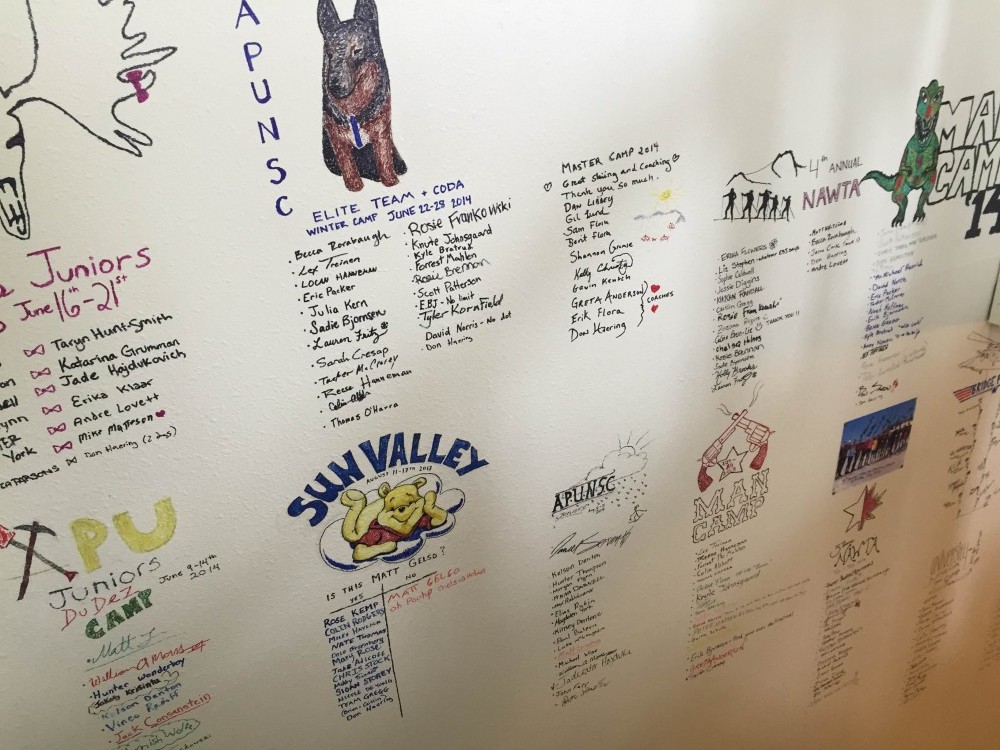
    It is a helpful metaphor for visualizing overall training and life stress. It is also a frequent training talk trope. Every training camp at Eagle Glacier, from juniors to masters, signs the wall of the training center, often beneath an image in some way symbolizing the camp or evoking an in-joke from the past week. A picture of the cup was chosen for one recent Elite Team glacier camp, suggesting that the cup was frequently discussed.

    As Flora now notes, “I began as an elite coach about 10 years ago. And when I started, I had this idea or this plan, that if I wrote a training plan, and it was the correct training plan, that I would have good success with my team and my athletes. And you know, sure enough, I was fortunate enough to have a good experience in coaching, and we had some good successes and that seemed to work. But what I’ve kind of learned to appreciate through the years is that to be a top-level skier, it’s very much a lifestyle. So the more I can help athletes find what the right balance is, the better the program goes, the better success we have.”

    Live the lifestyle and find the right balance – you can’t overfill your cup.

    The wall of fame inside the Thomas Training Center on Eagle Glacier. From left, the APU Juniors (teenage girls), APU Elite Team, 2014 Masters Camp, North American Women’s Training Alliance, and Man Camp (APU and USST men), among many others, have all left their mark. (Photo: Greta Anderson)

    And second, the athletes. Flora clearly believes in empowering his athletes to, if not literally coach themselves, at least to take a very active role in the process. As he notes, “I guess if I were to summarize my coaching style, [it would be] as: I believe very much in trying to educate or teach the athletes about training.”

    He continues, “And so … when they start from a young athlete, they learn all the different types of training, they get experience training in different ways, and they become the expert over time. And that’s been something I’ve been very proud of. It’s like, the team I have now, I feel very confident that – when it’s their turn to coach, that the experience level of the athletes is quite high. Because through the training process, they’ve, you know, learned ‘what happens when I train too much,’ ‘what happens when I train on the right sequence,’ ‘how do I get faster,’ ‘what are the basics.’ And so I would say that’s a way to sum up my basic philosophy of training.”

    Personal life

    So what does Flora do when he’s not coaching skiing? Well, he goes skiing for fun.

    No, really – Flora can often be seen skiing with his entire family in the offseason, either on the ski trails in spring or in the mountains in summer. These are often family affairs, as three generations – Berit and Sam, the septuagenarian (and still skiing) grandparents; Erik and Gretchen, the parents; and Oskar, Marit, and Ingrid, the children – can be seen hiking up steep trails with skis in backpacks.

    And, yes, all three children ski race. They are not bad at it, either; Marit was second among U14 girls, and Oskar first among U10 boys, in last winter’s Besh Cup Series of JO qualifying races.

    Despite, or perhaps because of, his day job as a high-level professional ski coach, Erik and Gretchen at a Besh Cup are less Ski Coach than Good Sports Parent. Leave it to the other parents to engage in a postmortem of tactics or wax efficacy following a zero-stakes U12 contest… Erik and Gretchen are the ones who reliably say only, “Good job! Did you have fun? Let’s go get some hot chocolate.”

    Presumably that cup is full of hot chocolate. But not too full.

    * * *

    Disclosure: The author is an unremarkable Masters skier with the APU Masters program. He receives coaching from Erik Flora on one occasion per year, for a few days in a group setting at APU Masters Eagle Glacier Camp, but has no other direct involvement with Flora as an athlete.

  • Masters Minds: From Texas to Eagle Glacier

    Masters Minds: From Texas to Eagle Glacier

    Gavin Kentch (APU) climbs back up to the training center on Eagle Glacier, in the Chugach Mountains, Alaska, during APU Masters Camp in July 2017. (Photo: Jim Falconer)

    By Jason Somers

    Introduction: Welcome to the jungle

    My quads were burning from too much snowplowing. My coach’s words were echoing in my head: “You are most stable when tucking.” I willed, begged, and pleaded with my legs to assume the position, but being in this aerodynamic position also meant I would go fast, too fast, because at the moment I had one small problem – I couldn’t see where I was going.

    This small problem could likely be overcome but combined with the fact that I was careening down a trail on Alaska’s Eagle Glacier in a July snowstorm, I had to keep the  trail markers to my right or risk going off the trail. Not a big deal except that going off the trail meant I could in theory fall through a previously unknown crevasse, the big one that would lead me all the way to China in a horrific tumble, if I were ever to be seen again.

    My mind began to wander. I pushed out of my mind my imagined eulogy that included the requisite nod to global warming and my major contributions to society at large, such as eating large quantities of breakfast tacos. I imagined a bronze cowboy hat statue with a ski hat on top that would commemorate the first loss of life by stupidity on the glacier. Also, of course, celebrities I never met like Eddie the Eagle would attend and say it was a shame. Kikkan Randall would be there, her hair colored extra bright pink.

    Was this a death-defying 70-percent gradient that I was attempting? No, it wasn’t, but I was most certainly a nerd. A nerd well over his head. I am also a stubborn nerd so this meant I came equipped with nerd glasses, which were now so badly fogged after having gone through rain, sleet, and snow that they were more of a blindfold. I could barely make out the trail markers, I was flying blind, the skis began to pick up more speed, I knew the trail turned but when, and would I have enough time to turn with it?

    Oh, and there was one more thing that made it especially intimidating: They don’t have these conditions or trails, or even snow, where I am from in Southern Texas. Yes, I, am a rollerskier who had not seen snow in four years, and this is my story.

    Day one of camp: Welcome to Alaska

    As my Egyptian Lyft driver courteously bid me farewell, I walked with my bags toward the small group gathered in the parking lot of Alaska Pacific University (APU) in midtown Anchorage, Alaska. The evening before I had flown into Anchorage and traveled from the airport with my mouth agape with awe at the large peaks towering above. My Airbnb host had been a Russian grandmother who insisted on playing me videos of Russian folk songs, as she sang along with tears in her eyes. This was turning out to be a memorable trip already.

    A helicopter approaches the landing zone at Eagle Glacier, in the Chugach Mountains, Alaska, during the 2017 APU Masters Camp in July. (Photo: Gavin Kentch)

    As introductions were made in the parking lot I considered it a rousing success that no one burst out in uncontrollable laughter when I told everyone that I was from San Antonio, Texas. The acceptance continued as we drove 45 minutes down Turnagain Arm to Girdwood in the APU van. Fragile ego still relatively intact, it was now time for the first of many firsts to come, a helicopter ride to Eagle Glacier.

    As any rollerskier in a southern climate will tell you, there are a few questions you get asked by strangers repeatedly. Unlike bicycling in Texas, in which you may be the recipient of a special howdy in the form of a beer can thrown from a pickup truck, most folks are genuinely curious about your rollerskis.

    When you are a rollerskier from Texas, at a premier skiing camp held at a world-renowned training center at almost 6,000 feet in the Chugach Mountains, you get asked questions, too. Number one goes something like, “How the hell did you hear about this place?” Answer: FasterSkier and athlete blogs (Noah Hoffman’s posts from 2013 and 2014 being a standout), and an APU promo video. An email to the world’s best nordic ski coach, Erik Flora, and the next thing you know you are flying in a red helicopter so small it looks like a good gust of arctic air could smack it into the side of a mountain.

    Thanks to FasterSkier’s own Gavin Kentch, who insisted that I sit up front; I experienced my first ride to the clouds in the front of our Alpine Air helicopter and felt like I was going to fall through the glass bubble around me. I snapped pictures like a Japanese tourist in Washington, D.C., during the cherry blossom bloom. My adventure was just starting, but as I would find out soon enough, getting there was the easy part.

    Secrets revealed

    Secrets: we all have them. But how many of us have real, dark, dirty skiing secrets? Well, I do, and they were going to be revealed in an utterly uncomfortable guilt-wrapped blanket of embarrassment followed by an epic explosion. Assumptions are dangerous also, especially if they help to keep your secret a secret. I had those, too, and I was leaning on them heavily already. Day 1 of skiing would reveal all the cracks in my rollerski kingdom, but the real meltdown would come the next day.

    The ski trails are faintly visible (in the background in the shade) from the second-story window of the Thomas Training Center above Eagle Glacier, in the Chugach Mountains, Alaska, during APU Masters Camp in July 2017. (Photo: Gavin Kentch)

    But first came room assignments. I would have three roommates in a dorm room with two bunkbeds.

    My first roommate would be Jeremy Littell, a USGS brainiac who studied climate change, something I might have wound up doing minus a few missteps and stutter steps in another direction. Jeremy would join myself and several others for a mountain run the day after camp; he struck me as someone who was very fit, and unsurprisingly he turned out to be a speedy skier.

    Next was Tom Corbin, with a skiing and ski coaching pedigree that looked like a Who’s Who of the history of American skiing, including decades of coaching and many years spent chasing an Olympic berth. Tom was such an animal that despite hip replacements and blown knees, he was out there everyday ripping it. He also complimented me at the end of the camp on my progress. I told him that coming from someone of his stature it meant a lot to me, and I really meant it.

    My other roommate was someone FasterSkier readers would recognize immediately, but I did not see the moniker through the bling at first. Whispers that there was another FasterSkier contributor at the camp led me to suspect and then realize that the author of the very article that led me to buy my last pair of rollerskis was bunking next to me… the man, the legend, the myth – Fast Big Dog, or FBD.

    “It’s all about how you look.” — FBD

    “It’s all about how you look,” he shouted to Gavin, part of the lively back and forth between the two. With that it was settled.

    In case anyone wondered, and I had, FBD is not just an irreverent authorial persona. He is exactly the same in real life as in his writing. There are few skiers who have their own monogrammed “Team FBD” tights and can pull it off. FBD really will throw down at any time, and if you thought it was all bravado, you would be mistaken – he was out skiing longer than anyone else for nearly every session on the glacier. The day after camp, he came away victorious in the T-Bar Row showdown in the APU weight room, though he was then crushed by all of the locals in his ill-advised rollerboard challenge.

    FBD was also generous in his encouragement of my progress, and spoke kindly about me at the end-of-camp sharing circle when Erik Flora asked us to share our reactions to camp. But before we could get to the kumbaya and the warm cuddly feeling of all surviving a sufferfest together, I had some dark secrets that were about to be revealed, some assumptions to be utterly disproven, and a near breakdown to weather. Nordic skiing has a way of exposing the rawness that lies beneath, and I was about to be exposed and the curtain was going to be pulled back – way back.

    Onto the snow. For the first time in four years.

    Time to get on skis. The first ski was classic skiing on the first afternoon.
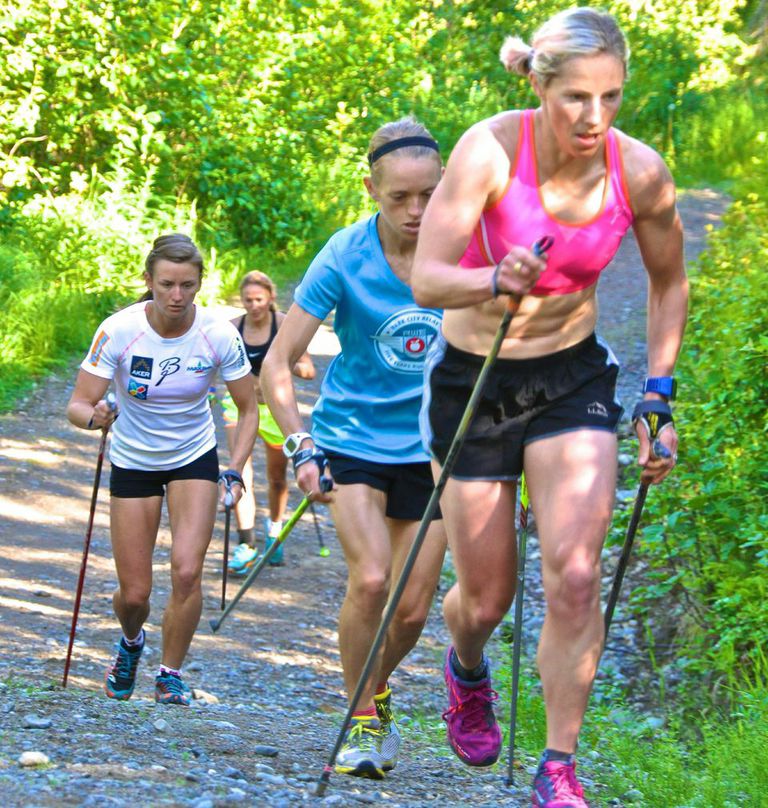
    Some background: I am primarily a rollerskier now, but the memory of snow after four years of asphalt still lingers. I went shuffling around years ago on a whim in Vermont when I used to live there, and after that I borrowed my neighbor’s ancient three-pin skis and used them in a field across the street from my converted farmhouse. Some years later, I took up classic skiing in Ukraine after I decided to stay around six more years after serving in the Peace Corps. Skiing in Ukraine consisted of making a track yourself and skiing back in it if you wanted to get home through the woods a little sooner before you froze to death.

    Looking down toward Girdwood and Turnagain Arm from the Thomas Training Center above Eagle Glacier, in the Chugach Mountains, Alaska, during 2017 APU Masters Camp in July. (Photo: Gavin Kentch)

    I got into rollerskiing in Texas after I moved back when, by some kind of water-into-wine miracle, I came across Roller Ski Texas, a group founded and organized by a Russian expat named Phillipp Dimitriev, who felt he could bring rollerskiing to Texas’s churro-loving masses by buying pneumatic wheeled skate skis and giving away free lessons. After a while when one day everyone looked at me and asked what are we going to do today and I completely made something up, I became the coach.

    The takeaway from this is that although I had some experience with classic skiing on snow, it was always in cold snow conditions and was never in groomed tracks. This was one of my secrets, but I could rollerski in my sleep, I trained everyday… “What could possibly go wrong?” I thought, as I laced up my boots to hit the trail, preparing to plummet 200 vertical feet from the edge of the glacier down to the “stadium” area and start of the main loop.

    Little did I know I was doomed from the start.

    I realized I was in trouble just seconds into the descent. I was not used to the speed. There were no hills in Texas that could simulate this; I managed to get to the bottom but this is where the fun really began.

    My assumption surrounding my secret had been that classic rollerskiing was just like skiing, or at least almost like skiing. Stories of developing a late kick from too much rollerskiing I passed off as unicorn stories spread by misanthropic ski snob haters. Time to go up.

    The minute I started to climb out of the stadium, going up a steady uphill in klister conditions at 65 degrees and sunny, I slipped, and then I slipped again, and then I slipped so hard I nearly faceplanted. Where was the kick? Was my coach just messing around when he applied the klister, did he secretly apply butter or motor oil after I left the wax Conex?

    I now encountered an additional problem – my poles were sinking almost to the handle.  This was made worse when I slipped especially badly. I quickly developed a strategy of trying to excavate my poles by widening the crater so that my basket would be released. About halfway through the first lap my pole came back up out of the snow without a basket on the end; already frustrated beyond belief and in not in one of my prouder moments, I just kept going.

    I was slipping so much in the tracks that I could only sometimes find a kick outside of the track. The pole without a basket made things more challenging because that pole would sink much deeper and consistently than the other. I found myself mostly sliding down most of the downhills on my face. My temper was flaring. I was lashing out at myself and cursing the snow gods.

    APU Coach Galen Johnston was “part David Blaine and part Dr. Phil with a six pack”

    By the end of the first lap I met up with my coach, APU Development and Masters Coach Galen Johnston. Proving himself to be part David Blaine and part Dr. Phil with a six pack, Galen went about assuaging my self-directed assault on myself while simultaneously running off the little devil perched prominently my shoulder whispering a long spew of the negative poison Kool-Aid that I had been drinking.
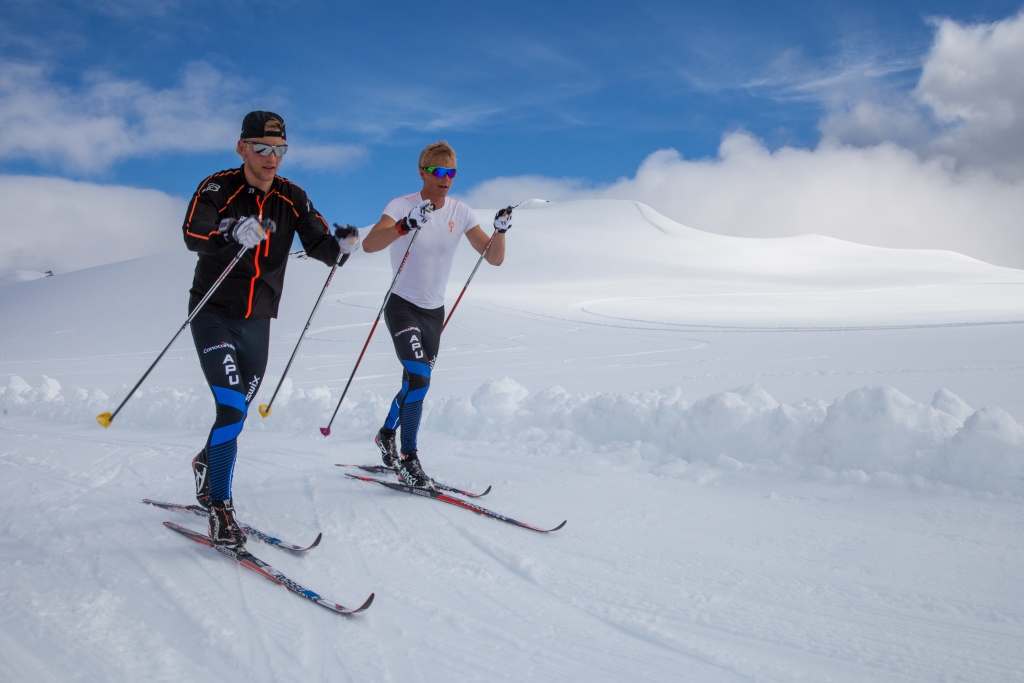
    “I’m so frustrated with myself,” I remember telling him. Galen promptly proceeded to take a look at my scissor kick flailing that I was trying to pass off as skiing and got to work. He quickly began to work with me on proper positioning, finding and feeling the kick, and making smaller movements while increasing the cadence. Pure Genius.

    He also takes photographs: APU coach Galen Johnston (r) gets a shot of Shannon Brockman (far left) in the stadium and gear drop area of Eagle Glacier, in the Chugach Mountains, Alaska, during 2017 APU Masters Camp in July. (Photo: Dan Libbey)

    The next lap I started feeling less slip, and the next after that I had begun to feel like a skier; I was still skiing without a basket, but I felt stronger with each lap. Galen skied with me, encouraged me, and even helped me nail a downhill that seemed to be my nemesis.

    Somehow I survived the first day. Even though I had improved greatly, my confidence was badly shaken. I thought about the hours of intervals, distance, and hills I did on rollerskis; the strength training, swimming, and cycling that had led me to believe I would somehow be competitive with a group of lifelong racers. Call it ignorance, but I still had an inkling of hope that the next day, with our first skate ski session in the morning, would be different… instead, after today’s black eye and ensuing attitude adjustment I would nearly have a breakdown the next day that found me questioning my very reasons for coming to Eagle Glacier.
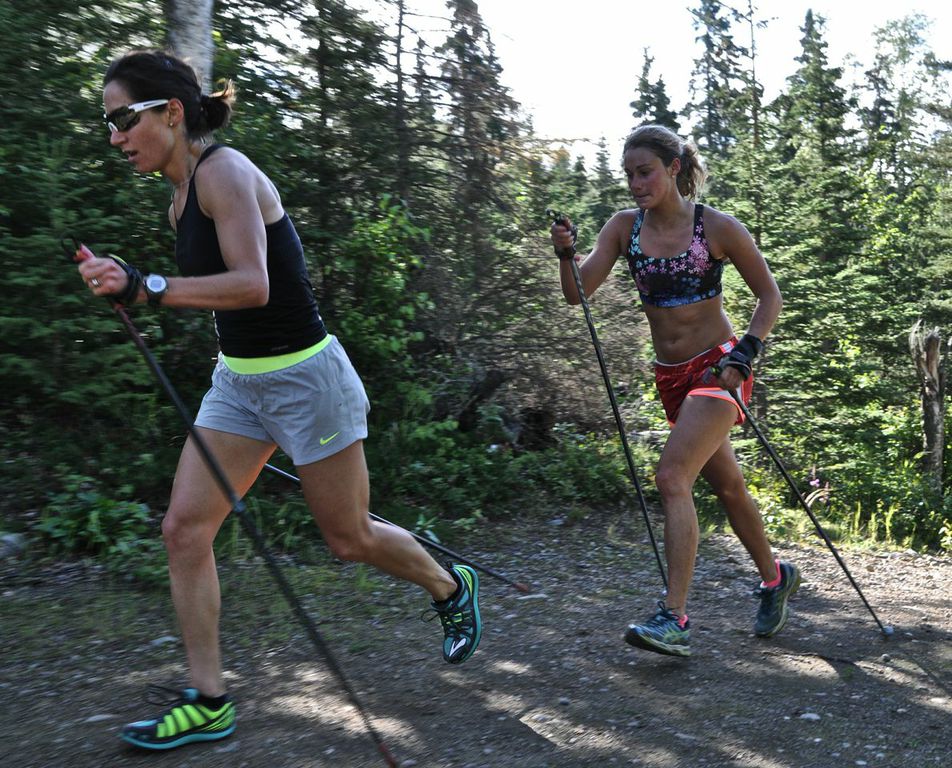
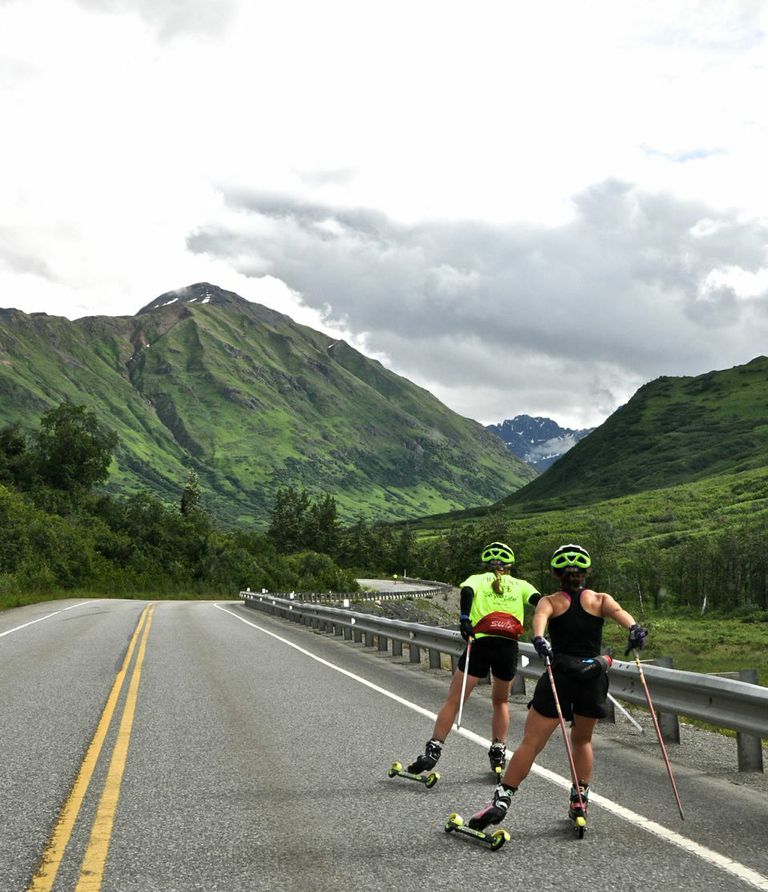
    Because sometimes the first skate skiing of your entire life happens on glacial slush at 6,000 feet

    The next morning I found myself at the bottom of the first climb, ready to open up the skate skiing. I was ready, or so I thought. Here, now, I would redeem myself.

    My rollerskiing group in Texas was a skate skiing club, I coach skating technique, I’d done it in front of the cameras for local news stations, I was sure that my upper body strength from years of training would help me… but somewhere my biggest deep dark secret was gnawing at me.

    I had never skated on snow of any kind in my entire life.

    You see, even though I had never skied on soft slushy snow in a track on classic skis – I had never skated on snow of any kind in my entire life. Since classic had been a disaster, my assumption that rollerskiing could simulate skiing was hanging by a thread.

    As I started up the first hill [the “first hill” at Eagle Glacier gains roughly 100 meters total over a series of rolling up and downs, though mostly ups – Ed.], the first problem I noticed was that I spend very little time doing V1 rollerskiing. In Texas, the “hilliest” terrain I can still full V2 on my medium-speed Marwes. I practiced V1 based on some video I had seen online, but mostly this was just jump skating the tops of hills.

    At Eagle you are either going up or going down, and going up for me meant skiing V1 for a long time. I began to notice immediately that my glide was virtually nil, so I began poling harder to compensate, which just sunk my poles deeper into the soft snow and decreased whatever glide I was getting even further. As soon as I pointed my skis out in a V-stance, my right abductor began to ache. A war injury from my soccer years, it would get worse as I went on before finally turning into a stabbing pain near the end of the lap that reminded me repeatedly that I was 41 years old and going up a steep hill at nearly 6,000 feet.

    It was about this time that I began to feel the altitude. Despite moving almost slow enough to fall over, I noticed that my heart rate was highly elevated. Even though I was constantly reminding myself to breathe, I found myself stopping repeatedly on every hill. I vowed to get through the first lap, and I did, but I called it quits after that. I was too demoralized to seek out a coach; I felt utterly broken.

    Later that evening, I began to question why I had come to this camp. I had come to get some on-snow time, but also, being highly competitive, I came to measure myself against others. It was not just the four years of training in 100-degree, 80-percent humidity since I had last seen snow that had prepared me for this. I had also spent six years before that skiing by myself in Ukraine.

    Fresh snowfall surrounds the Thomas Training Center above Eagle Glacier, in the Chugach Mountains, Alaska, during 2017 APU Masters Camp in July. (Photo: Gavin Kentch)

    Skiing had always been a place where I could find solace, peace, satisfaction, and happiness when I couldn’t find it elsewhere. Now it suddenly seemed like my greatest demon. Everything I had done before seemed for naught. It felt like I was just learning how to ski, like the tables had been turned and suddenly I was one of the beginner athletes I coached in Texas. About this time I thought of my family, my 18-month-old. I wondered how they were doing. I began to miss them. To complicate my crisis of conscience, others in our group were regularly seen texting and talking on their phones… I checked my phone and found that I had no service. I was at an all-time low.

    Some time before heading out for the classic afternoon session. Berit Flora offered me her phone so that I could call my family. Berit was affectionately referred to as the camp mom for her powers of making sure everyone was doing well and well fed, and her gesture in that moment seemed to give me new lifeblood. A dark cloud seemed to float away from above my head.

    (I had the pleasure and honor of later having dinner with Berit and her husband Sam and others after the camp finished. Both Berit and Sam (who are Erik Flora’s septuagenarian parents) were out there skiing every day, and had plenty of history in the form of great stories to add to mealtime discussion. Sam also drove me to my Airbnb room after camp, to Alaska Mountaineering and Hiking to return my rented skis, and to the airport. Their hospitality and kindness will not soon be forgotten.)

    About this time I began to reevaluate my goals. There were other reasons to come to this camp, such as receiving some of the best coaching from some of the best coaches in the world. Also I could personally gain from coaching because my first ski taught me I had more to learn than I realized. Also, if I could ski these conditions I could come away with some newfound confidence (maybe getting through it was the moral victory) as well as a desire to get on snow more often; more snow time was something that became apparent immediately that I needed.

    The wall of fame inside the Thomas Training Center on Eagle Glacier. From left, the APU Juniors (teenage girls), APU Elite Team, 2014 Masters Camp, North American Women’s Training Alliance (American and Canadian athletes, plus Norwegian skier Celine Brun-Lie), and Man Camp (APU and USST men), among many others, have all left their mark. (Photo: Greta Anderson)

    I also reminded myself of how few people get an opportunity to ski here, the names of elite athletes written on on the walls serving as gentle reminders of the caliber of skiers who typically come to Eagle. I vowed to take in the beautiful scenery more, and to receive as much coaching as possible. Once I put the shattered pieces of my ego aside I began to enjoy myself again.

    The next classic session I felt especially good and was able to catch Brandy Stewart (an elite skier from Montana) and Gavin, two skiers well above my level, on a climb. I was immediately dropped on the first descent, but it was something Galen would bring up on the last night. Credit to Galen, but also to Dylan Watts, the best cook/competitive skier/coach in the world, who jury-rigged a really sweet basket on my left classic pole. Feeling like I was skiing with two poles really made a difference.

    After talking to Erik Flora the night before, he immediately found me the next morning.  I got to ski with him for a while, which made my day, and made it apparent what I need to work on for the future.

    It was not lost on my me how much it would cost me to have the best coach in any other sport work with me one on one; the experience was priceless. A shooting lesson from Gregg Popovich or a tackling lesson from Bill Belichick I could never afford, even if they were willing to take the time. And yet Erik seemed to enjoy coaching me; that dedication and love for coaching is something that I hope I can duplicate with my rollerskiers. I tried to listen to everything he was telling me technique-wise, but when he skied in front of me I couldn’t help but imagine how hard it was for him to ski that slow; he is an amazing skier and within seemingly a second or two after the lesson ended he was out of sight, moving on to find and coach the next athlete.

    Morals and acknowledgments

    There plenty of others who gave me the courage to continue on and improve each day. Both of the FasterSkier crew gave me encouragement throughout, and everyone seemed to lift each other up with a kind word or two on the trail. Special thanks to Jeffrey Lynn, my hilarious dishwashing buddy that made the time spent doing chores enjoyable. Jeffrey was there to become a better skier to be able to ski with his son. I watched him put on Moleskin and heaps of duct tape to cover his blisters every day – you were inspirational to me.

    Special thanks to Galen, who even loaned me his skis, and to him and the APU Masters Group who let me join two of their workouts after camp. I truly felt like a part of the APU Masters skiing community, and I don’t recall ever feeling that much energy and excitement from working out with anyone else.

    I’d come far during the camp, from skiing alone in the woods in Ukraine, to braving the heat in Texas, to V1’ing up a glacier. I had come great distances to see, taste, and feel the ultimate. The ultimate venue, ultimate beauty (yes, Alaska is probably the most beautiful place I have ever seen), ultimate coaching, and ultimate community.

    It was only fitting that after coming from humble obscurity and a truly off-the-radar outpost like San Antonio, and overcoming some pretty personal lows, the helicopter I flew out of was bringing up two of our nation’s greatest skiing stars, Kikkan Randall and Sadie Bjornsen. They got out of the helicopter, with an NBC cameraman dressed more for L.A. weather than for Alaska filming every step they took.

    Total stars in our sport, they both smiled and waved. Sadie offered a quick handshake and Kikkan smiled and said hello, looking exactly like the Fischer ski poster of her on the second floor of the Thomas Training Center had suddenly come to life. If I would have had the time without the helicopter ready to lift off, and it wouldn’t have been so loud, I might have introduced myself: “Hi, I’m Jason, a skier from San Antonio.”

    — Gavin Kentch contributed 

    ***

    Masters Minds series: Are you a masters skier who loves your club? Submit camp or training recaps, announcements, or stories to info@fasterskier.com with the subject line “Masters Minds.” Articles can be first-person accounts or written from an observatory standpoint with comments from others.

    Related: 2014 APU Masters Camp | 2015 APU Masters Camp

  • U.S. News Roundup: From Alaska to the High Sierra

    Kikkan Randall leading the 2017 Alaska Run for Women with a smile on June 10. (Photo: Scott Broadwell)A little U.S.-based news to get your Tuesday going:

    — Watch out, World Cup, Kikkan Randall is feeling good. The longtime U.S. Ski Team (USST) and Alaska Pacific University (APU) skier took first place in the 25th annual Alaska Run for Women road race, held over Anchorage streets and bike trails this past Saturday. Randall led the field of several thousand women to the finish in 28:41, a pace of 5:44 per mile for the 5-mile, largely flat-road course.

    Mid-5:40s for five miles (in June) is nothing to sneeze at on its own, but let’s let the 34-year-old Randall put it in context: “I’m in the best shape of my life now,” she told the Alaska Dispatch News. This is so even though Randall was a few seconds per mile off her previous best on this course, a 28:18 that she clocked while winning this race in 2012. That winter, she went on to win her second of three consecutive Sprint Crystal Globes.

    “I’m in the best shape of my life now.” — Kikkan Randall in a recent interview with the Alaska Dispatch News

    Finishing just over a minute back for second place on Saturday was recent local high-school graduate and multi-time state track champ Briahna Gerlach, who will race Division I track and cross-country running this fall in the Lower 48. “I didn’t even know it was Kikkan Randall,” Gerlach told the Dispatch News of her competition over the first mile before Randall pulled away. “When I found out I said, ‘OK, she can go.’ She’s crazy. She didn’t even look tired.”

    Other skiers in the top 10 included Mandy Vincent-Lang (formerly University of New Hampshire) in third, Becca Rorabaugh (APU) in fourth, and Lauren Fritz (APU) in 10th.

    https://www.instagram.com/p/BVLNwkqDp3i/


    — If it’s summer, the rest of the APU Elite Team must be running up mountains. APU skiers took nearly every race in the seven-stage Alaska Mountain Runners Grand Prix last summer, highlighted by David Norris setting the course record at Mt. Marathon, the insanely steep climb and descent outside the harbor town of Seward, Alaska, that was first run as an organized race in 1915 and is believed to be the oldest mountain race in the country. (Norris took the record back from Kilian Jornet, a man widely acclaimed as the world’s best mountain runner.)

    This summer, they’re at it again. On the evening of Thursday, May 25, Norris took first place in Kal’s Knoya Ridge Run, ascending an uphill-only course in the Chugach foothills on the eastern edge of Anchorage. (Runners had to descend under their own power, but the clock stopped when they crossed the finish line.) Norris weathered an early-summer snowstorm to cover 8.5 kilometers, and 4,500 vertical feet of elevation gain, in 58:08 for a substantial margin of victory. First place among the women went to Jessica Yeaton (APU/Australian National Team).

    In a shorter version of the race (5.6 k and 2,900′ of climbing), APU skier Forrest Mahlen was the first across the line. Marine Dusser (formerly University of Alaska Anchorage (UAA), currently affianced to USST skier Erik Bjornsen) was the first woman, less than 90 seconds behind him. Other top-10 skiers included APU junior Maggie Meeds in third, APU junior Aubrey LeClair in fourth, and Jaime Bronga (formerly UAA) in seventh. In the long race, Kate Fitzgerald (formerly APU) was fourth among the women, while Kenny Brewer (formerly University of Alaska Fairbanks) was third and Mark Iverson (formerly APU) was sixth.

    — Nine days later, on the morning of Saturday, June 3, it was newly minted U.S. Ski Team member Scott Patterson edging out his APU teammate Erik Bjornsen (also of the USST) by the slimmest of margins, 0.3 seconds, after slightly more than 42 minutes of racing up 3 miles and 3,500′ of elevation gain in the uphill-only Government Peak Hill Climb outside of Palmer, Alaska. “I led the whole thing till maybe a minute to go, then we duked it out as I tried to come up with a little bit of a sprint,” Patterson told the Alaska Dispatch News after the race. “With three feet to go, Erik would have won. Even with two feet to go. He seemed to stumble a little when it was down to one step and I got him.”

    APU junior Hamish Wolfe was 8th.

    Dusser once again took the victory in the women’s division, in a time that would have placed her 12th among the 105 men in the field.

    — So who’s still skiing? More people than you might think, thanks to an epic winter in the western U.S. that brought dozens of feet of snow to the High Sierra and has the Squaw Valley alpine area making noises about running at least one chairlift all summer long. For example, here’s fresh grooming (!) on the Auburn Ski Club trails on June 6 (!!):

    https://www.instagram.com/p/BVBZo3GAt-A/

    Here’s Paul Kovacs (Australian National Team) on the ASC trails on the morning of June 7:

    Here’s FasterSkier contributor Jon Schafer with a Steamboat Springs Winter Sports Club junior camp, driving up to the nordic trails at Mt. Bachelor in Bend, Ore., in a June 10 snowstorm:

    https://www.instagram.com/p/BVKdwcMhDYL/

    Finally, farther north, the APU Elite Team arrived at Eagle Glacier earlier this week for their first Glacier Camp of the summer:

    https://www.instagram.com/p/BVQYFY1lGOo/

    – And earlier this month in Albuquerque, N.M., the University of New Mexico (UNM) announced that athletic director Paul Krebs will retire on June 30. The university’s press release did not indicate a reason for his departure, but the news came two days after the state auditor informed UNM Interim President Chaouki Abdallah that its athletic department would be the focus of a special audit, according to Deadspin.com. The Office of the State Auditor reportedly “received information raising concerns related to athletic fundraising activities and expenses of the University of New Mexico.” Krebs, who was UNM’s athletic director for 11 years, was criticized for spending nearly $65,000 dollars in taxpayer money on a 2015 golf trip to Scotland and was at the heart of the heated proposed discontinuation of the UNM ski team.

    * * *

    This article has been updated to reflect the correct historical status of the Mt. Marathon Race as believed to be the oldest mountain race in the country, not as “the second-oldest footrace in the country behind the Boston Marathon.”


  • APU Masters’ Glacier Camp July 6-9

    Have you ever wondered what summer training on Eagle Glacier is all about? Have you heard stories from your kids, friends or Elite athletes about the wonders of summer skiing? Well here is your chance to try it for yourself!

    As of this publication we have 9 remaining slots, so don’t wait! You don’t want to miss out on this awesome opportunity.

    Please RSVP to APU Masters Coach Galen Johnston at johnstonnordic@gmail.com to reserve your spot and receive a registration link.

  • After Five Weeks Away, Bjørgen Back on Top in Ulricehamn; Four Americans in Top 25

    After Five Weeks Away, Bjørgen Back on Top in Ulricehamn; Four Americans in Top 25

    Left to right: Finland's Krista Pärmäkoski, Norway's Marit Bjørgen and Sweden's Charlotte Kalla on the podium for the women's 10-kilometer freestyle race on Saturday in Ulricehamn, Sweden. (Photo: Fischer/Nordic Focus)
    Left to right: Finland’s Krista Pärmäkoski, Norway’s Marit Bjørgen and Sweden’s Charlotte Kalla on the podium at the World Cup women’s 10-kilometer freestyle on Saturday in Ulricehamn, Sweden. (Photo: Fischer/Nordic Focus)

    There are a lot of things Marit Bjørgen is not. She is not the only woman on Norway’s national team who knows how to win. She is not in the early stages of her cross-country career — her first World Cup debut came in December 1999. In comparison to many of her Norwegian teammates, she is not young. The average age of Norway’s women competing in Saturday’s 10-kilometer freestyle individual start in Ulricehamn, Sweden, (Bjørgen not included) was 25.

    At 36, Bjørgen’s age bests most of her teammates by close to a decade.

    But the new mom is also not letting any of that stop her from adding to her cache of cross-country wins. Saturday being the first opportunity she had since her last race in La Clusaz, France, to prove that winning is what she does.  

    “It’s so much fun to be back because I’ve been on my own for five weeks,” Bjørgen told NRK after Saturday’s race. “At least now I know that I’m on the right path.”

    Norway's Marit Bjørgen on her way to winning the women's 10-kilometer freestyle race on Saturday in Ulricehamn, Sweden. (Photo: Fischer/Nordic Focus)
    Norway’s Marit Bjørgen on her way to winning the World Cup women’s 10-kilometer freestyle on Saturday in Ulricehamn, Sweden. (Photo: Fischer/Nordic Focus)

    However, starting the Ulricehamn 10 k in bib 40, with 21 more racers still hungrily eyeing her back, Bjørgen would not know for sure if she made the right choice until the final starters behind her, including the likes of Sweden’s Charlotte Kalla, completed the course.

    Bjørgen’s Norwegian teammate Heidi Weng and Finland’s Krista Pärmäkoski — who both competed in this year’s Tour de Ski and finished first and second, respectively, in the overall — and started before Bjørgen, were also challenging her choice to forego five weeks of racing.

    Pärmäkoski was first to the front, leading both Weng and Bjørgen by exactly one second at the 1.5 k mark.

    Weng went next, this time Bjørgen and Pärmäkoski trailing behind by less than a second with 7 k still to go. Continually creeping up toward the top three was Kalla in fourth, less than four seconds back and American Jessie Diggins in fifth, within six seconds of the front.

    But with one 5 k lap down, Bjørgen began to break through.

    At 6.5 k, she had put close to three seconds into the Finn, now sitting in second place and more than 15 seconds into her teammate Weng, who had faded to fifth.

    With 2 k to go, Bjørgen continued to lead, while Kalla moved into third. The Swede, however, had no idea she was within 14 seconds of the front. The volume of a home crowd had her confused, thinking she was in 14th place instead.

    “It was all of the noise from the eager Swedish spectators that created the confusion, in addition to a sign with the number 14 on it,” Kalla told adressa.no. “It probably meant that I was 14 seconds behind, but I misunderstood.”

    Sweden's Charlotte Kalla racing to a third place finish in the women's 10-kilometer freestyle race on Saturday in Ulricehamn, Sweden. (Photo: Fischer/Nordic Focus)
    Sweden’s Charlotte Kalla racing to third place in the World Cup women’s 10-kilometer freestyle race on Saturday in Ulricehamn, Sweden. (Photo: Fischer/NordicFocus)

    With no intentional charge coming from Kalla, and Pärmäkoski pushing to the max of her 10 k skate pace, Bjørgen furthered her push for the win. She continued to put time into Pärmäkoski, ultimately finishing 10.7 seconds ahead of her in a time of 23:46.3 for her 104th individual World Cup title.

    When asked about the difference between her start and finishing speed, the Norwegian, who now also holds 22 individual wins on Swedish soil, responded with a bit of humor.

    “I’m starting to get old you know, it takes a while to get going,” Bjørgen told NRK.

    With a second place on Saturday, Pärmäkoski now has six individual podiums this season.

    “I had a great day,” Pärmäkoski said according to an International Ski Federation (FIS) press release. “I have proven to myself I can ski fast also in free technique.”

    Finishing 24.9 seconds behind Bjørgen, Kalla claimed the final podium spot in third, although unbeknownst to her until she received congratulations from Bjørgen and her Swedish teammate Hanna Falk, who finished eighth (+36.4).

    “I first realized that I had finished 3rd when Marit and Hanna gave a hug,” Kalla told adressa.no.

    “The audience [today] was world-class,” she added, according to a FIS press release.

    Four American Women in the Top 25

    Despite Saturday being an individual start, the two-lap 10 k course meant quite a few racers wound up skiing in company. For many of the American racers, that company came from their U.S. teammates.

    Though she started 30 seconds behind her fellow U.S. Ski Team (USST) member Kikkan Randall, Jessie Diggins in bib 32 soon managed to catch Randall in bib 31. The 25-year-old Diggins proceeded to pass her and lead Randall through the first of two laps.

    “I didn’t have the snappy good feelings I was hoping to have in my body today, but it was a solid race,” Diggins, who finished seventh (+34.9), wrote in an email to FasterSkier.

    American Jessie Diggins on her way to a seventh place finish in the women's 10-kilometer freestyle race on Saturday in Ulricehamn, Sweden. (Photo: Salomon/Nordic Focus)
    American Jessie Diggins on her way to a seventh place finish in the World Cup women’s 10-kilometer freestyle on Saturday in Ulricehamn, Sweden. (Photo: Salomon/NordicFocus)

    “It’s always hard when you know that on your best days you are capable of more, but at the same time we had great skis, and it was really fun for me to be able to ski with my teammates today!” she added.

    By the end of Diggins’s and Randall’s first lap together, their USST teammate Sadie Bjornsen cruised on course. For the next lap, Bjornsen led the trio of U.S. skiers.

    “Skating has been going well this year. I have a lot more confidence every time I start a race, so that is fun,” Bjornsen said on the phone after Saturday’s race.

    The U.S. trade-off train continued, with Bjornsen in bib 56 catching another USST member Rosie Brennan — who had start 30 seconds ahead of her in bib 55 — for their last lap.

    “It was an American line out there,” Bjornsen added, who ended the day as the second American in 12th (+1:00.5).

    The ‘American line,’ at least with Bjornsen, was something Brennan anticipated.

    “You never really want to get caught but … I love skiing with Sadie and so it was great to have her pull me into the finish,” Brennan said on the phone.

    Brennan further explained that having the comfort of a teammate, whose strengths and weakness could compliment her own, also made the pass more appreciated.

    “When some of these other fast girls come past you, [because] you’ve never skied with them before, it’s hard to truly believe you can keep up with them, but when it is someone you have spent so much time skiing with it was easy to convince myself like ‘oh of course I can stay with her’.” said Brennan, who ultimately finished 24th (+1:30.7).

    The one American who did not see any of her U.S. teammates during the race was Liz Stephen, who started 14th and finished the day in 16th (+1:07.30).

    Instead, Stephen found herself racing with another familiar face, Italy’s Virginia de Martin Topranin, who spent time training with Stephen on Eagle Glacier this summer.

    “We skied part of a lap together,” Stephen said on the phone. “But other than that I didn’t see anybody out there, which is good. That’s the point of an individual start … Mass starts you get to see plenty of people, sometimes it feels good just to be by yourself.”

    The fifth American woman to finish was Randall in 40th (+1:59.6) followed by Liz Guiney, the Period 1 SuperTour leader from the Craftsbury Green Racing Project, in 52nd (+2:33.2).

    “Competing in Ulricehamn was pretty awesome today,” Randall wrote in an email to several media outlets. “The course was packed with some of the most enthusiastic fans I’ve ever seen! It was a pretty cool course, too. Deceptively hard with a lot of gradual terrain and not many places to recover.

    “I had great skis today and a couple of really good opportunities to ski with my teammates,” she added. “But unfortunately I wasn’t able to fully capitalize on those rides and had a lackluster day. I had a decent race from about 2.5km to 7.5km but wasn’t able to keep the pedal down.”

    USST Head Coach Chris Grover noted that while there won’t be a 10 freestyle event at World Championships in a little over a month, the U.S. women’s team performance on Saturday was a good sign of where their training has taken them and where they are headed.

    “Of course you are always … hoping that we are going to have a podium but that’s not going to happen every day,” Grover said. “I think it is an excellent indication that we have a lot of women who are extremely fit and on the right day they can have some pretty extraordinary results.”

    American Kikkan Randall racing during the women's women's 10-kilometer freestyle race on Saturday in Ulricehamn, Sweden. (Photo: Fischer/Nordic Focus)
    American Kikkan Randall racing during the women’s women’s 10-kilometer freestyle race on Saturday in Ulricehamn, Sweden. (Photo: Fischer/Nordic Focus)

    The lone Canadian woman competing on Saturday in Ulricehamn, Cendrine Browne, of Canada’s national U25 Team, posted her career-best individual World Cup result in 35th (+1:52.0).

    “Along the race the coaches were telling me, ‘You’re five seconds away from top 30!’ ” Browne recalled on  the phone after. “So I was really trying to push harder. I was a little tired at the end, so next time I’d like to be less tired, but I guess you can’t really control that.”

    Browne explained that though most of her teammates remained in North America in order to prep for U23 or senior World Championships, she felt traveling to Europe and racing the World Cup was what she need to best prep for the upcoming Lahti cross-country events.

    “I had the choice to stay home, and train, and do races at home, but I also had the choice to come here and race instead, and I really love racing on the World Cup,” Browne explained.

    Athletes return tomorrow for the women’s 4 x 5 k relay. The U.S. women’s squad will field two teams, one with Brennan, Bjornsen, Stephen, and Diggins in bib 4, and the other with Randall, Sargent, Sophie Caldwell, and Guiney in bib 9.

    “I’m really looking forward to anchoring one of our TWO relay teams tomorrow!” Diggins wrote. “It’s really special for us to be able to field two teams and relays are my absolute favorite days. Time to break out the relay socks!”

    “So fun to see my teammates ski well today which has us all fired up for tomorrow’s relays!” Randall wrote. “Really pumped that we are fielding two women’s teams!”

    Results | Relay start list

  • Eric Packer: From Incremental Gains to World Cup Starts

    Len Valjas (Canadian World Cup Team) after placing 38th in the freestyle sprint the day before: "Now that my lungs are feeling a bit better I just don't have the snap. I'm stuck doing Zone 3 so it's frustrating, especially to be at home it's even worse ... but there's nothing I can do. I'm stuck. ... It's still a good day. ... It was a sweet event. I wished I could've raced a bit more."
    American Eric Packer (r) leads Canada’s Len Valjas (l) during the men’s 15 k freestyle pursuit at Stage 4 of the 2016 Ski Tour Canada in Quebec City in March. Packer placed 68th on the day. (Photo: FlyingPointRoad.com/NNF)

    Eric Packer is back home. The 26-year-old Anchorage native is in his third year of training with Alaska Pacific University (APU), after heading East for college at Dartmouth and following that with a two-year stint on the Vermont-based Stratton Mountain School (SMS) T2 Team. Now he’s back in Alaska for good, training with the APU men and enjoying the benefits of this environment.

    “We had a great summer of training with the whole [APU] team,” Packer said in a recent phone interview from Alaska. (Note: He’s currently in Europe on the World Cup circuit.) 

    “I feel really lucky to be part of this group of guys that’s really pushing the boundaries forward. Everybody’s looking really good, and I’m really excited to see what the team can do. I personally feel like I’ve made some big improvements. I’ve trained more than I ever have, and was more consistent throughout the entire summer than I ever have been before. So feeling really positive about that.”

    Packer reflected that the APU training facility on Eagle Glacier outside Girdwood, Alaska, is a key part of his estival endeavors. “Getting up on the glacier is a big component of that,” Packer said. “We had three really productive camps, with about 75 hours on snow. That really helped getting back on snow. I was having a conversation, I think, with Reese [Hanneman], and it was three-quarters of the way through the ski before he realized that it’s like technically our first ski. It’s like, ‘Oh yeah, this is the first ski.’ So that was kind of cool – just like having that contact with snow throughout the summer really makes the transition super easy, and that’s nice.”

    The APUNSC men pushing each other during the final workout of our recent Eagle Glacier training camp. (Photo: Zuzanna Rogers)
    The APU men on Eagle Glacier in summer 2015. (Photo: Zuzanna Rogers)

    While Packer was not logging 25 hours per week on snow for the entire summer, he did credit volume training for his steadily increasing fitness.

    Rather than a quantum leap, Packer identified the incremental gains that most athletes at his level are looking for. “Just every year chipping away at uphill running times, chipping away at ski bounding times,” Packer observed. “You never really see a big jump, but it’s just, every month, trying to get two, three, five seconds faster. And I felt like this year was a good continuation of the past few years – I saw a lot of improvements, just kind of across the board generally. … I’m feeling pretty good with that, where the base fitness is.”

    Packer said that he “was just able to train consistently through the whole summer, so I was really happy with that.”

    But that’s not a given after last summer, in June 2015, when Packer had a scary fall in the Chugach Mountains near Anchorage that left him falling off “a small vertical drop of 10-15” feet, then “tumbl[ing] head over heels down steep rocky terrain” for another 60 feet or so. “I had no control in the fall,” Packer wrote about the incident, “which was a really scary feeling, but I remember being pretty sure I was not going to survive.”

    The story has a happy ending: As Packer previously explained, “In terms of my actual injuries, I was incredibly fortunate for as bad as the fall was, I somehow managed to not break any bones, which still amazes me to this day.” Nonetheless, Packer said, “I was so banged up that I stayed home for a week with no training. Once I got the clearance from my doctor and PT to resume light activity, all I could do were easy walks.”

    Going through the injury and recovery process last year “definitely did” change his outlook for this year, Packer said. “It impacted my approach to last season, and I think this summer I just felt really lucky that I was injury-free, and was able to train at full capacity all summer long and not have any setbacks like that. It was definitely one of those moments where you take a step back, and kind of reflect on everything, and reflect on how lucky you are to be a ski racer, to be able-bodied and healthy and all those sorts of things. I have a history of ankle sprains; for the first time in six years I didn’t have a serious ankle sprain. Didn’t fall off any cliffs this time.”

    Packer planned to put that consistent training and improved fitness to the test in Europe; he had Period 1 World Cup start rights for 2016/2017 by virtue of being last season’s domestic SuperTour leader.

    But he didn’t think it would be easy. “Racing World Cups, Period 1 in Europe, is really tough,” Packer said before he left for northern Scandinavia. “There’s no question about that. It’s probably the hardest competition that you’ll see all year in terms of depth of the field.”

    (Packer’s comments seemed prescient a week later, when, in the season’s first World Cup race, Norway put two skiers on the podium it hadn’t planned on starting.)

    Nonetheless, Packer was “very excited” for his first World Cup races in Europe; he had previously raced in Europe and on the World Cup last season in Canada, but this marked his first overseas World Cup. “The Ski Tour Canada was obviously amazing and really a cool racing experience,” Packer enthused, “but getting to race at classic venues, in Finland and Norway and Switzerland, that’s really the dream. So I’m looking forward to it.”

    APU head coach Erik Flora (98) runs alongside his athletes Eric Packer (5) and Reese Hanneman during (4) the final of the men's 1.5 k classic sprint at U.S. nationals in Houghton, Mich., in January 2016. (Photo: Christopher Schmidt)
    APU head coach Erik Flora (98) runs alongside his athletes Eric Packer (5) and Reese Hanneman during (4) the final of the men’s 1.5 k classic sprint at U.S. nationals in Houghton, Mich., in January 2016. (Photo: Christopher Schmidt)

    Packer, who spoke with FasterSkier before leaving for Europe and racing in Ruka, said that he had two goals for his time in the opening swing of the World Cup season.

    “My main goal is to take advantage of the opportunity to get, potentially, nine World Cup starts, and build as much experience as I can over the next month, and also learn the venues, and learn the cadence of World Cup racing,” he said. “And just really … have my eyes and ears open, and learn as much as possible. And learn from what I’m seeing other competitors doing – tactically, technically, that sort of thing. So that’s the first goal.”

    “And the second goal,” he continued, “is to take each race as it comes. … I know that there will likely be tough days, but I’m just focused on taking each race, each day individually, and trying to give it my best shot in each one. It only takes one good day. So that’s really what I’m looking for, is to take advantage of the opportunity and give it my best on each day. Make the people back home proud.”

    By the “cadence” of World Cup racing, Packer explained, he meant “building comfort and familiarity with that routine. To the point that you have a system where you can be focused on preparing for the race, and not get distracted by all of the other things surrounding the race.”

    As an example, Packer cited the races at Gatineau this March: “At the World Cup venue there, they had a warmup track that was probably an 800-meter run from the wax cabin. And then the area that you actually accessed the course and accessed the start was yet a different location; that was probably like a 300- to 400-meter run. You’ve got ski boots on. And so just figuring out how to warm up, and then get on course.”

    A little wax testing on Gatineau's 1.7 k sprint course, with the start/finish area visible at the upper right. (Photo: John Lazenby/lazenbyphoto.com)
    A little wax testing on Gatineau’s 1.7 k sprint course, with the start/finish area visible at the upper right. (Photo: John Lazenby/lazenbyphoto.com)

    “More generally,” he said, the cadence involves “just figuring out the racing logistics, and getting used to the extra hurdles that exist at the World Cup level in the race-day routine, that’s a big goal, too. So that you get to the point where you’re focused on the racing, and you’re doing the optimum warmup and everything, and working within the constraints of that World Cup atmosphere.”

    When asked about his overall goals for the season, Packer hesitated to look much past Period 1 of the World Cup, although he acknowledged that World Championships in Lahti, Finland, were on his radar. “I would definitely be excited to qualify for Lahti, and that is one of the goals for the season,” Packer said. “I would say, right now my focus is first on Period 1, and doing my best there, and then I will reevaluate once that’s over.”

    Regarding possibilities for the second half of the winter, he reiterated, “It’s really hard to tell right now. There’s so many different potential paths through the winter. Definitely hoping to be racing in Europe, that’s always the goal. But if not, I would certainly like to come back and give the [American] Birkie my best shot, so there’s many different options there.”

    (Packer has raced the Birkie once before, in 2014, finishing 22nd overall.)

    But he was glad to look back to what he identified as the highlight of his ski career to date.

    “Winning Nationals last year,” was his immediate answer. “That was just – and not actually winning, but coming into the finish with Reese and with Tyler together,” Packer said, referring to his APU teammates Hanneman and Tyler Kornfield. “And having that moment of like, ‘Wow, we have three of us here in contention, and being part of that group.’”

    Packer continued: “And [APU head coach Erik] Flora was running next to us, and he was like swinging his arm around like a windmill, and just so excited. And then at the same time my childhood coach, Jan Buron from [Alaska] Winter Stars, and my college coach, Ruff Patterson, were both there at the finish. So kind of that moment of having everybody who’s been involved in my skiing from seventh grade all the way through now, and coming into the finish with my two teammates – that was a really special moment.

    Eric Packer racing in the Ski Tour Canada in March 2016, with the beard in full late-winter flourish. (Photo: FlyingPointRoad.com/NNF)
    Eric Packer racing in the Ski Tour Canada in March 2016, with the beard in full late-winter flourish. (Photo: FlyingPointRoad.com/NNF)

    “It was pretty fun. I got a big hug from Flora, then got a big hug from Jan, got a big hug from Ruff – it was a cool moment, for sure. It will definitely be a special moment for me.”

    Finally, Packer looked back more recently, to what he’d had for breakfast that morning, then once more ahead, to his plans for hirsute management over the course of the winter.

    “I had two pieces of toast, with avocado, and a fried egg on top of that; a cup of coffee, with just a little bit of half-and-half, no sugar; and a banana,” Packer explained, with the precision of someone whose Dartmouth degree is in mechanical engineering.

    And as for the facial hair? “So last winter,” recalled Packer, who was previously recognized with Bearded Honorable Mention #1: The Lumberjack in FasterSkier’s West Yellowstone beards roundup of Nov. 2015, “I went with the ‘grow it all season’ approach. I think I’m going to take a step back from that this year, and keep it more in check. We’ll see. You never know; it has a mind of its own.”

  • The U.S. Team’s Quest to be Mentally Toughest: An Interview with Coach Whitcomb

    The U.S. Team’s Quest to be Mentally Toughest: An Interview with Coach Whitcomb

    Matt Whitcomb (in yellow shirt and black ballcap) explains the day's workout to a joint USST-APU training group on July 9 in Anchorage, Alaska.
    Matt Whitcomb (in yellow shirt and black ballcap) explains the day’s workout to a joint USST-APU training group on July 9 in Anchorage, Alaska.


    ANCHORAGE, Alaska — Earlier this month, the U.S. Ski Team and its coaches came to Alaska for a two-week training camp, starting with one week of dryland training and then one week on snow at Eagle Glacier. Before heading up to the glacier, FasterSkier caught up with U.S. Ski Team (USST) Women’s Coach Matt Whitcomb for a brief in-person interview about the national team and their World Championships aspirations following a rollerski workout during the first half of camp.

    FasterSkier: So this is a World Championships year. I know that U.S. Ski Team Head Coach Chris Grover previously told FasterSkier that an announced program goal is two medals in Lahti. Do you have anything to add to that, and can you speak to some of the races where the team might be expecting success?

    Matt Whitcomb (pointing) explaining the day's workout to a joint USST-APU training group, including U.S. Ski Team member Jessie Diggins (behind) on July 9 in Anchorage, Alaska.
    Matt Whitcomb (pointing) explaining the day’s workout to a joint USST-APU training group, including U.S. Ski Team member Jessie Diggins (behind) on July 9 in Anchorage, Alaska.

    Matt Whitcomb: You know, all of our planning in the spring revolves around winning medals at the major championships of the year. So without overemphasizing our goals, we have in place what we feel are two realistic goals of two medals. We are more than happy to walk away with five. We will be disappointed with less [than two]. So we feel like, as a program, we are good enough so that two medals is an appropriate reach, and in many events, we have opportunities.

    Our highest strike rates for medal opportunities are certainly in both sprints [Note: Whitcomb clarified to explain he meant both genders in men’s and women’s team and individual sprints] as well as in the women’s 4 x 5 [kilometer] relay, but you also have the women’s 30 k, the women’s skiathlon, and we’re happy to be surprised in any of the other events.

    FS: You mentioned the skiathlon – from a domestic perspective, did you notice that there is going to be a skiathlon in the SuperTour this year [to be hosted by the Fairbanks Nordic Ski Club during Spring Series], and what role does that have for athlete development in this country?

    MW: [laughs] Leave it to John Estle [of Fairbanks] to be able to organize one of the more high-maintenance events. But in no way am I surprised; we’re just very thankful. It’s often that at the junior and even U23 level when we go internationally, that we’re scrambling last-minute to find skiathlon boots, or to teach athletes how to load an exchange zone and what the rules are. So we’ll consider this just a quick dose of education for our entire community, and I think it’s going to have a big effect. It’s going to be a really fun event – not for his volunteers, but we thank them.

    FS: Jessie Diggins spent a week in Norway in June at a Norwegian national team training camp. What does that say not only about Jessie as a skier, but also about the strength of this program?

    MW: Yeah, it’s a good question. First and foremost, not anybody is going to be accepted to a Norwegian camp, and that’s to really understate that. Jessie’s season and her attitude and her overall personality have a lot to do with it. So the first credit goes to her.

    But the next credit goes to, really, Norway. On the back of their old waxing bus, it says, “Sharing the knowledge and the experience” – that’s what they put right on their most prominent vehicle. And they have become such a huge asset to our program. Their coaches are our friends; we know all their athletes; they’re friends with our athletes; we interface at the World Cup. And they truly do want to help us. And so when we asked if Jessie could join a camp, they said, “let me talk with the girls” – make sure their team was okay with it – and then got back to us with some options. And we were so impressed by it.

    But I think it’s also a strong testament to our nation, and our program as a good partner to Norway as well.  We’ve had Astrid [Jacobsen] at a camp, we’ve had Celine [Brun-Lie] at camps – we are happy to help in any way we can while on the World Cup.

    Granted, a program like Norway needs very little. But it’s a multi-tiered reason that this is something that’s possible, that’s put a guy like [Andy] Newell in Norway right now, training with top-level athletes, and has put Liz [Stephen] and Kikkan [Randall] at multiple Norwegian National Team camps, where their coaches are spending time out of their day to discuss video with our athletes. It’s invaluable for us.

    And I should say that Jessie had a phenomenal experience.

    Matt Whitcomb says, "Hashtag #vanlife" -- view from the van, transporting USST coaches and media, during a joint USST-APU training camp on July 9 in Anchorage, Alaska.
    Matt Whitcomb says, “Hashtag #vanlife” — view from the van, transporting USST coaches and media, during a joint USST-APU training camp on July 9 in Anchorage, Alaska.

    FS: We can feel like we generally know what to expect by now from the veteran women’s team members.  What can you tell us about the three youngest members of the team: Hannah Halvorsen, Katharine Ogden and Julia Kern?

    MW: Really exciting to have a new member of our D-team this year in Hannah Halvorsen out of Truckee, California. We’ve begun working with her coach, Martin Benes, and their program [Sugar Bowl Academy] more closely in the last year or two and are very impressed with them. So that’s exciting to have some input from California these days.

    She’s a bright girl, she’s funny, she loves team, she’s very quickly friends with everybody on the team.  And she’s going to really complete this sort of what is a D-team squad now, with KO [Katharine Ogden], Julia [Kern], and Hannah, as well as Ian Torchia. So that’s really exciting.

    And with those three women, we can expect anything from podiums at World Juniors to something in the twenties or thirties could even be considered a solid race. We’re not looking to rush any results out of these women. What we’ve told them and their programs, their club programs, is that we want to exercise extreme patience. We have high confidence that these three athletes are some of the emerging stars that we feel like can mature into very successful World Cup athletes. And if that means having success at World Juniors, that’s great, U23s, that’s great, but we want it ultimately to be that these three women fill some of the shoes that will eventually retire.

    FS: With regard to other specific athletes, can you say anything about what it’s meant to have Kikkan back with the team?

    MW: It’s been so great to have Kikkan’s energy back and physical presence. In many ways, it just never left. She took some time out for pregnancy, and now we’re meeting her baby at an actual camp, and she’s training with us again. And it has just injected everybody with a high dose of energy again, so that’s really fun.

    To have Hannah join us at the lower ranks of the team, and Kikkan return at the upper end, has just created a great bookend for us to launch this season.

    FS: Chris Grover recently explained that the World Champs selection criteria have been changed.  I think it’s a fair summary to say that skiing well in Period 4 of last season is no longer as important, and that skiing well in Period 1 of this season is now more important. Accepting that premise for the moment, do you see that affecting your athletes’ preparation?  How do you think the athletes feel about that – maybe especially the athletes on the bubble either way?

    MW: It’s definitely a criterion that focuses more on how athletes are skiing closer to the Championships.  It’s a very important concept, I think, that from what I can tell the entire ski community is behind.

    From a World Cup perspective, we have a couple different options. Athletes can race through Period 1, and they need to be within a certain standard on the World Cup.  [For objective criteria: either a top-eight result in most of the individual races from Period 1, the Tour de Ski or the sprint weekend following the Tour de Ski, or a top-50 ranking in either the Sprint or Distance standings on Jan. 16, 2017.]  And if they are close to but not in that going into the Tour de Ski, they need to make a pretty important decision. And that is whether or not to go back to U.S. championships and qualify domestically, or to take a chance and go with what they know and qualify in the Tour de Ski, and the sprint weekend after the Tour de Ski in Toblach. And so there are a great number of options both domestically and internationally on the World Cup, that I think we feel is as fair as can be.

    FS: Is it fair to say that making discretionary picks is one of the harder parts of your job as a coach?

    MW: For sure. We love not to do it. But in any criteria, discretion can often be one of the most important pieces. We really envy these Olympic Trials [for American track and field athletes for the 2016 Rio Olympics] that we’re watching right now, where the top three go and fourth is either an alternate or they don’t go, and it’s just much more objective.

    FS: You’ve been very gracious with your time – anything else you want to add or wish I’d asked before we wrap up?

    MW: With athletes training over 800 and 900 hours a year, we have good confidence that we’re training as well and in some cases better than our competitors who are best in the world. The trick is to differentiate our training from our competitors’, and to make our 900 hours more effective than their 900 hours. And our team over the last several years has begun working more and more closely with individual sports psychologists as well as individual club coaches and national team coaches to become the mentally toughest team on the World Cup. And that is something we work hard to be. It is something that we feel can differentiate our 900 hours or our 800 hours from their 900 or 800.

  • APU Masters On-Snow Ski Camp July 27-30

    This summer APU is hosting a masters on-snow ski camp at the Thomas Training Center on Eagle Glacier. Come experience glacier training, just as APU’s Elite team and Olympians Kikkan Randall, Holly Brooks, Erik and Sadie Bjornsen make their seasons.

    “Skiers are made in the Summer”

    The camp is coached by Erik Flora, Dylan Watts, and Galen Johnston. Coaching staff has experience at nearly all ages and levels, from recreational to Olympic and World Championship level. Camp will be from July 27 to the morning of July 30, including 4-5 ski sessions.

    Camp includes classic and skate techniques. There is opportunity to ski a lot with the glacier house only 2-3 minute walk from skiing, plus take part in technique discussion and video review. Includes skiing, coaching, housing, and food. Space is limited. Cost is $825 plus helicopter.

    Please contact Erik Flora (erikflora@gmail.com) for registration info.

  • The Allure of Eagle Glacier: What Happens 5,700 Feet Up in Alaska (with Video)

    The Allure of Eagle Glacier: What Happens 5,700 Feet Up in Alaska (with Video)

    On June 28, Jon Schafer, known in U.S. nordic circles as Fast Big Dog (FBD), stepped foot on Eagle Glacier, 5,700 feet above Girdwood, Alaska, where he spent about a week training on snow with a masters camp, led by Alaska Pacific University Head Coach Erik Flora. It was FBD’s first journey to the glacier and in the following account, he explains its significance. Interviews were conducted in person and on the phone. 

    ***

    By Jon “Fast Big Dog” Schafer

    In just a few weeks, overweight and overpaid NFL players will assemble for training camps, subjecting themselves to the rigors of almost 60 total minutes of daily exercise.

    Each spring, Major League Baseball prepares its aging demographic of viewers for the tediousness of watching baseball with an even more tedious primer known as spring training.

    Elite rowers have long escaped ice-jammed winter rivers for a few weeks of cranking out miles in the Florida sun, and the list goes on and on.

    The offseason training camp has been a staple for top-level athletes in many sports for decades, providing a distraction-free environment for individuals to focus on sport-specific training, make technical improvements and provide the mind a much-needed break from the grind of offseason training.

    Nordic skiing is no exception. Nordic skiers have historically been very creative in their attempts to get on snow in the summer. European-based skiers have a few different options of glaciers and more recently, even ski tunnels. But what about North American athletes? What options are available to them? Is it necessary to make the pilgrimage to the tradition-laden glaciers of Europe or are there alternatives here in the U.S.?

    The answer is hiding in plain sight. One of America’s premier Olympic development centers, the Alaska Pacific University Nordic Ski Center (APUNSC), has been taking skiers up onto Eagle Glacier in Alaska for over two decades. What began as three very hardy skiers living in a tent on the glacier has grown into one of the world’s top nordic ski training facilities at the Thomas Training Center.

    This transformation wasn’t easy though. Alaska can be a cold, harsh environment and the development of the elite facility that exists today only happened thanks to thousands of hours of dedication spread over more than 20 years by driven, committed people with a vision. In many ways, Eagle Glacier is much more an outstanding training center; it is also an excellent metaphor for the ascension of U.S. skiing as a whole. Both journeys have been tumultuous at times, with great success only coming after countless hours of hard work, commitment and teamwork.

    Probably not coincidentally, one of the most frequent visitors to Eagle Glacier is also one of America’s most successful skiers: current U.S. Ski Team (USST) member, four-time Olympian, three-time overall Sprint World Cup winner, and team sprint world champion Kikkan Randall.

    “I went there for the first time in 2000,” Randall explained. “I was young, eager and ready for anything. The cabin and the overall facilities weren’t as nice as they are now, for sure. You had to be tough, but that’s not a bad thing. Skiing is a tough sport and the sooner you learn how to be tough, the better off your are.”

    With these humble roots, a solid foundation was laid for growth and success. As a whole crop of young talent began to mature on the World Cup circuit, so did Eagle Glacier. “So many people worked hard to make that place what it is today,” Randall continued. “I don’t know if I’ll ever be able to express all of my gratitude to the people who first got it started, Jim Galanes and then Erik Flora in particular, whose efforts in the last ten years have been nothing short of extraordinary.

    “We’ve kind of all grown up together,” she added. “As the level on the World Cup has risen, we’ve responded to this challenge by all pushing ourselves harder. Not only do the coaches and staff have Eagle more dialed, but so do the athletes. It used to be that you’d see people up at night watching movies, but not anymore. Now it’s just skiing, eating and sleeping. The whole operation is very professional in all aspects.”

    Olympic gold medalist and nordic-combined world champion Billy Demong agreed. ”In the late ’90s and early 2000s, we were all working super hard, but we hadn’t quite broken through,” he said. “I was on Eagle Glacier in 2002 because as a team we were committed to be the best. Johnny [Spillane] won the World Championships the next year in nordic combined and that was really the start of our run.

    “It wasn’t just nordic combined either,” Demong continued. “Kris Freeman had a fourth place at worlds that same year, Kikkan and Andy [Newell] began going really fast and Timmy Burke and Lowell Bailey started to have a big impact on the Biathlon World Cup in the next few years. It certainly wasn’t any one thing that took us all to the next level, rather the additive effect of lots of little things. Looking back, it’s amazing how far nordic skiing has come in the U.S. in a relatively short period of time. Hopefully the USSA [U.S. Ski and Snowboard Association] will continue to fund everyone so that we can all continue this remarkable trajectory.”

    As Eagle starting getting more traffic from elite skiers, its mystique also continued to grow. For four-time Olympian Andy Newell, his first visit was the same year as Demong’s and his recollections were somewhat similar to both Demong and Randall.

    “I went there for the first time in 2002 and I remember it was pretty spartan, but it was my first training camp with the U.S. Ski Team, so I still thought it was awesome,” Newell said via a Skype interview from the USST training camp in New Zealand. “I was just this punk kid, so I was so stoked that I was at a training camp with all of my idols that nothing else mattered,” recalled Newell. “I still remember what it felt like to hear I was rooming with Kris and Justin Freeman and Rob Whitney — I really looked up to those guys, so to be able to train and live with them was an incredible feeling.”

    If that had been the end of the story, the trip may have not been all that memorable, but what followed is just one of many examples of the aura of Eagle.

    “We got the rooming list and I was assigned to stay with Kris, Justin and Rob, which I thought was awesome,” Newell recalled. “Inexplicably, just before bed, Kris and Justin moved out to one of the other rooms. I thought this was odd, as the other bunk rooms were pretty crowded, but I didn’t care. I soon found out why though, as in the middle of the night, Rob woke up screaming that we were all going to die and that we had to get off the glacier immediately. I was terrified. Here it is my first night at U.S. Ski Team camp and one of the veterans, a guy I looked up to, is telling me that we were all about to die. I didn’t know to do, but I was thoroughly panicked. It turned out that Rob was widely known as a sleep talker. To make matters worse, he wouldn’t just mumble random stuff, he would address you by name and seemed very coherent. We laugh about it now, but it was scary as hell at the time. That’s the type of stuff that happens up on Eagle.”

    Demong agreed. “Any time you get a bunch of skiers together living in a confined environment, it’s always going to be interesting. I was there early on and we had a really good group, but the coaches were just getting crushed working on the groomer. Rumor had it that a new PistenBully [PB] was being flown up to us and we were all so stoked as we knew this was going to have a huge impact. It did, but not in the way we imagined.”

    While Demong wasn’t on site the day the groomer arrived, he recalled the story about its delivery. Just as the helicopter was coming into sight, the pilot got hit with a nasty down-draft and had to jettison the PistenBully from over 100 meters in the air to avoid crashing the helicopter. The PB came crashing toward the earth and smashed off the ice. Everyone was OK, but thinking back, Demong pondered, ” ‘I wonder if stuff like this happens in Norway?’ I still look back very fondly at those times, too, as in many ways those struggles, those battles and all of the crazy stuff was the best part of the whole adventure.”

    Two-time Olympian and APU skier Holly Brooks echoed these sentiments. “Yeah, Eagle could be rough in the early years, but the job that everyone has done, in particular Erik and his team in the last few years, is nothing short of amazing,” she said. “Everyone has steadily improved every aspect of the training center to allow skiers to focus exclusively on skiing. It is now a truly world-class facility. We’ve had several top European World Cup skiers like [Norway’s] Astrid Jacobsen and [Finland’s Aino] Kaisa Saarinen come over and they agree that this is one of the best summer training environments anywhere in the world.”

    The environment, while harsh at times, is proving to be more and more applicable to the conditions seen in racing season, something that coaches and athletes alike now recognize to be a huge strength. “Not every day on Eagle is bright, sunny, extra-blue conditions, so getting comfortable training in those bad conditions is key,” Brooks explained. “So many championship races end up being held in poor weather, so Eagle Glacier is huge in helping us prepared for that environment, both mentally and physically. In fact, we even have a running joke that when it is really lousy out, it is a ‘championship day.’ It’s funny, but it’s also very, very true. Many of the last championship races have been in bad weather [Holmenkollen, Val di Fiemme, Sochi] and a lot of our success at these venues is due to our training on Eagle.”

    Randall concurred, “With climate change, we are seeing conditions on more and more of the World Cups that are very similar to what we see on Eagle, so being able to train for this is very important. It is very interesting, we talk a lot about ‘championship days’ on Eagle, but I’ve come to learn that this means a lot more than just being comfortable in bad weather — it’s really more about being tough no matter what is thrown at you and no place teaches you that lesson better than Eagle Glacier.”

    In contrast to Randall and Brooks, Newell, a Vermont-based skier with the Stratton Mountain School T2 Team, didn’t witness the slow, steady progression of the training center firsthand, as he didn’t have the opportunity to return to Eagle until last year, but he echoed all of the same thoughts.

    “I was blown away when I finally got a chance to return,” he noted. “I went up there last summer and the changes were incredible. Flora absolutely has that place dialed. It is very structured now and it runs very, very smoothly. As the overall level on the World Cup continues to rise, summer training camps have become even more important. To be competitive at the very top level, you simply must get on snow at least once a summer. Our competition is getting on snow even more often, so we really need to capitalize on our time and Eagle Glacier is a perfect place to do that.”

    Newell went on to bring his experiences on Eagle full circle by summarizing the history and growth of the training center and the parallels with the success of the U.S. team. “One of the very special aspects of Eagle is the history. I was there at the very start of my career and I was able to learn a lot from the veterans, so it’s very exciting and rewarding to be able to return and help pay that forward to the up-and-coming group of skiers,” he said. “One of the walls is painted with the names of everyone who has trained and suffered on the glacier and it is a true badge of honor to have your name on that wall. I am very proud of what this represents and I am hopeful that younger skiers will see those names and be just as inspired today as I was in 2002. In many ways, Eagle Glacier represents the past, present and future of U.S. skiing.”

    Some of the newer members of the USST immediately picked up on that vibe on their first visit. “I went up to Eagle for the first time two years ago and I was immediately awestruck,” remarked Olympian and 2015 World Championships bronze medalist Caitlin Gregg.”I had heard lots of horror stories from the old days, but as soon as I arrived I knew the place was special. You see the names of all of these great skiers on the wall and suddenly it hits you, I am a part of this.

    “The Eagle Glacier experience goes way beyond just being on snow in the summer though,” she continued. “I left the place a few years ago so fired up about training that it really set the stage for me for the last two years, which have been the best years of my career. That’s the type of impact Eagle Glacier can have on a skier.”

    World Championships U23 silver medalist Noah Hoffman also tapped into the energy immediately, “I went for the first time two years ago and I didn’t know what to expect. I had previously skied on Dachstein and Stelvio glaciers and in both of these two places cross-country skiing is such an after-thought, it was incredibly exciting and refreshing to be on Eagle where it is so dialed in for elite cross-country training.”

    Like all attendees, Hoffman knew right away he was part of something special. “Everything about the place is amazing. The weather is crazy but Flora and his team do such a great job of grooming you feel like you’re on a World Cup course for every workout. The scenery is intense too: it feels so epic and so remote, yet you’ve never more than a few k’s from the lodge at any point on the loops. It is definitely a place unlike any other and I can’t wait to go back.”

    Even frequent visitors such as Randall and Brooks can still feel this magic and energy every time they walk through the door. “I’m always surprised at how much fun I have up there,” noted Randall. “Yes, it’s a lot of work, but the groups up there seem to have such good energy. We’ve grilled burgers in full snowsuits in crazy blizzards and loved every minute of it. Probably one of my favorite things is dishes — I LOVE doing the dishes with my teammates — we have so much fun that it makes the whole experience very special. I am certain that the emotional bond that we all develop on Eagle has gone a long way toward our successes on the World Cup.”

    “We’ve grilled burgers in full snowsuits in crazy blizzards and loved every minute of it.” — Kikkan Randall, Alaska Pacific University and U.S. Ski Team member, on training at home in Alaska on Eagle Glacier

    “Without a doubt, Eagle Glacier is magical,” exclaimed Brooks. “It is vast, wild and beautiful, yet it can kick the crap out of you. I skied so much up there that I’ve gotten home and not been able to remember how I got off the glacier. I’ve even had a few very intense camps in which I skied so hard and with so much focus, that I’ve come back to the cabin so drained that I once walked in, I started crying. And I’m not a crier. That’s just what happens to you up on Eagle.”

    ***

    Who is Fast Big Dog? “FBD is a cultural anomaly: part man, part myth. He spent the better part of a month hitchhiking from Costa Rica to Alaska, carrying his skis the entire time, with only his quick wit and love of tequila to keep him going. … He skis, he rides, he writes and he paddles.” — FBD

  • Wednesday Workout: ‘Last One, Long One,’ APU’s Three-Hour Ski on Eagle Glacier

    Wednesday Workout: ‘Last One, Long One,’ APU’s Three-Hour Ski on Eagle Glacier

    The APUNSC men pushing each other during the final workout of our recent Eagle Glacier training camp. (Photo: Zuzanna Rogers)
    The APUNSC men pushing each other during the final workout of their Eagle Glacier training camp from July 6-11. Becca Rorabaugh explained that the group collectively skied about 1,000 kilometers that day. (Photo: Zuzanna Rogers)

    Every summer, the Alaska Pacific University Nordic Ski Club (APUNSC) takes full advantage of Eagle Glacier, just south of Anchorage and some 5,700 feet above Girdwood, Alaska, holding on-snow camps there multiple times throughout the offseason. The APU Elite Team, with head coach Erik Flora, recently completed a camp on the glacier, and while conditions for the last day’s 50-kilometer ski softened and slowed as expected, athlete Becca Rorabaugh explained how she survived the 30-mile workout: “Beautiful weather and fabulous crunchy snow at the start…” she posted on Instagram on July 11. “Knowing I was approaching my 50km goal kept me focused through the slushy last bit.”

    Here is the 26-year-old Rorabaugh’s recap of the ultimate over-distance ski, which, she points out, can also be done on dry land (i.e. rollerskis):

    ***

    My Suunto Ambit3 at the end of our workout: 30 miles is 50km, and a goal achieved! (Photo: Becca Rorabaugh/Instagram)
    My Suunto Ambit3 at the end of our workout: 30 miles is 50km, and a goal achieved! “#APUNSC #eagleglacier #lastonelongone” (Photo: Becca Rorabaugh/Instagram)

    At last week’s APUNSC Elite Team glacier camp there were many hours trained and as a result, many tired athletes.  After a week of hard work the last day is always a 3-hour ski.  This can be either a fantastic opportunity to duke it out with teammates and see what you have left, or a really rough prospect to handle.  Especially if the snow looks like it’s going to get really soft, it can be a tough workout.

    The benefits of doing a long final workout are worth the slush-fest, and the effects rely on fatigue that has built throughout the week.  If you’ve ever finished a long race and found that you lacked the snappy finishing kick that you were looking for, this is for you.

    Flora sat us down beforehand and talked about trying to keep our movement quality throughout the workout, saying that making good race-like motions was paramount to skiing many hours.  If we could find a way to make those high-quality movements even without access to the easy energy of fresh ski-specific muscles, we could recruit and hone the sequence of secondary muscle groups.  Those are the muscles you’re relying on at the end of a race, and they’re difficult to train.  The secondary ski muscles only engage when the primary ones cannot do the work, so you have to be fatigued to train secondary muscle sequence and recruitment.  Keeping good technique throughout the workout reinforces good technique at the end of races, when you need it the most.

    The power of having positive teammates that push you!  From left: Becca Rorabaugh, Sadie Bjornsen, Zuzanna Rogers, and Rosie Frankowski during a water break. (Photo: Zuzanna Rogers)
    The power of having positive teammates that push you! From left to right: APU’s Becca Rorabaugh, Sadie Bjornsen, Zuzanna Rogers, and Rosie Frankowski during a water break. (Photo: Zuzanna Rogers)

    This last Saturday the day dawned clear and crusty, which on Eagle Glacier means two things. 1: The snow is going to be really crunchy and fast when you start, and 2:  if it doesn’t cloud over and start raining soon, you will be skiing on mashed potatoes by 10:00AM.

    Sadie Bjornsen and I began talking about trying to get 50km of skiing in, something made possible by the crusty skiing in the beginning, and I was excited to keep track of our progress using my new Suunto Ambit3.  We estimated 50km to be six laps of the course, and we turned out to be within a kilometer or two of accurate.

    I always ski better throughout the workout if I feel that I am aggressively pursuing a goal, whether that’s a time, a distance, or just hanging on to my Alaska Pacific University Nordic Ski Center teammates for dear life.  Starting into a long workout with a sense of purpose really sets the tone, and we started with strong intentions of skiing 50km.  We skied 4 loops in the first half of the time, just trying to get in some kilometers before the crust broke down.  The final two loops took almost twice as long as the first ones: once the crust breaks on a sunny Eagle Glacier day, it really disappears!

    “I always ski better throughout the workout if I feel that I am aggressively pursuing a goal, whether that’s a time, a distance, or just hanging on to my Alaska Pacific University Nordic Ski Center teammates for dear life.” — Becca Rorabaugh, APU Elite Team member

    The second half, in soft conditions and with tired legs, is the part that really counts.  This is where thinking about a single cue like ‘let your hands swing up’ makes the biggest difference.  It’s where technique breakthroughs occur because you’re so tired that you let yourself try different things.  Your usual neural sequences are shakier, and you’re able to ingrain new things.  At times like that, when you’re pushing the limits of good focused movement, having a defined finish line helps keep motivation.  Perhaps most importantly, skiing with friends lets you know whether your technique is working.  When you have to make subtle adjustments to keep up, you make the kinds of innate technical improvements that you can find again on race day.

    If you’re doing this workout in town, you can still benefit from a long rollerski at the end of a big week.  The second half is still the key part, and it’s still important to focus on a single cue.  I always recommend doing it with people that push you a little because that’s when you learn to hang on for dear life, adjust movements, and finish strong.  Knowing you can ski well when you’re tired will give you the confidence to push at the end of any tough race, be it the Birkie, US Nationals, or the Tour de Ski.

    50 k Over-Distance Training Ski Checklist

    – Focus on high-quality, race-like motions (and secondary muscle groups if you’re tired from previous workouts)

    – Maintain good technique to ensure you’ll have similar technique at the end of a long race

    – Get out early to avoid deteriorating conditions (i.e. snow- or weather/heat-related)

    – Start with a sense of purpose (you are going to complete 50 k!) and remember that intention when you start to fatigue, especially in the second half of the workout

    – Bring a buddy: “Skiing with friends lets you know whether your technique is working.” And pick people that can challenge you.

  • Summer Skiing on Eagle Glacier Report


    Toko Logo


    (Press release)
    Reese Hanneman - Toko

    Reese Hanneman putting the TOKO Convertible gloves through the paces. The weather on Eagle Glacier is extremely variable and a versatile glove such as the Convertible is perfect for these conditions. We couldn’t have a better tester!

    Eagle Glacier - Toko

    Many US elite athletes are currently training on Eagle Glacier in Alaska.  I thought you all might be interested to have some insight on what it is like waxing and training up there.  Here are some thoughts from Brian Gregg on last year’s camp:

    Summer Skiing on Eagle Glacier Report
    By Brian Gregg

    I love roller skiing but it is no match for skiing fresh corduroy on a bluebird day, especially in the middle of summer. The Eagle Glacier south of Anchorage, Alaska is home to Alaska Pacific University’s Thomas Training Center. With a relatively flat gradient, only 5,200 feet of elevation and just a 5 hour flight to Anchorage from my home in Minneapolis the Eagle Glacier is the perfect destination for summer ski training. Even better is sharing it with the US Ski Team men and the Alaska Pacific University men’s team.

    Brian Gregg Eagle Glacier Toko

    One of the best pieces of advice I received as a young ski racer is to wax your skis between every session. The faster your skis the more kilometers you can ski and the closer you will be training to race pace. Over the years I have become pretty good and it takes me about 5 minutes per ski for new glide wax. Wet snow tends to be real slow and so waxing each day on the glacier is super important. If possible waxing with either LF or HF can make a huge difference for some fast skis out on the snow. This is particularly true in warm and wet conditions. I find it best to just take a few minutes and throw on a quick layer of wax right after I return from my training session.

    One thing that can really slow down the waxing process is removing and cleaning klister. Don’t let this prevent you from having great skis everyday. A great trick from Coach Igor Badamshin is take a regular glide wax scraper and file a 45 degree angle on to it. Use this scraper to take off as much klister as you can in one slow controlled stroke. I like the scraper better than a putty knife as you are less likely to damage your ski if you slip. I color the scraper red to make sure I don’t confuse it with my clean scraper. Toko Wax Cleaner HC3 can help you take care of the rest. I cut a small section of scour pad, add a little bit of wax remover and use it to remove any remaining klister. I like to make it a game and try to finish in under 3 minutes.

  • APU Masters Glacier Camp June 28-July 1

    This summer APU is hosting a masters on-snow ski camp at the Thomas Training Center on Eagle Glacier. Come experience glacier training, just as APU’s Elite team and Olympians Kikkan Randall, Holly Brooks, Erik and Sadie Bjornsen make their seasons.

    “Skiers are made in the Summer”

    The camp is coached by APU Elite coach Erik Flora, Greta Anderson and Galen Johnson. Erik has coached at Olympic and World Championship levels, including three time Overall World Sprint Champion. Galen and Greta are APU Master coaches and skied for the APU Elite-University Team. Snow camp will be from the evening of June 28 to the morning of July 1, including 4-5 ski sessions.

    Camp includes classic and skate techniques. There is opportunity to ski a lot, plus take part in technique discussion and video review. Includes skiing, coaching, housing, and food. Space is limited.

    Please contact Greta Anderson (gretaanderson13@gmail.com) for registration.

    Registration form

  • U.S. Ski Team ‘Man Camp’ a Success on Eagle Glacier (Video and Photo Gallery)

    U.S. Ski Team ‘Man Camp’ a Success on Eagle Glacier (Video and Photo Gallery)

    Alaska's Eagle Glacier served as the location for second week of the 2014 'Man Camp.' The camp was a joint effort by the U.S. Ski Team and Alaska Pacific University to create a high volume, intense period of training both on-snow and off. (Photo: Andy Newell)
    Alaska’s Eagle Glacier served as the location for second week of the 2014 ‘Man Camp.’ The camp was a joint effort by the U.S. Ski Team and Alaska Pacific University to create a high volume, intense period of training both on-snow and off. (Photo: Andy Newell)

    Much has been said of the tight-knit dynamic of the U.S. Ski Team. Whether it’s the closeness of its members or the fun-filled atmosphere created by athletes and coaches, the Americans are often seen as the perfect example of a well functioning team.

    The full list of attendees at the joint U.S. Ski Team and APU 2014 'Man Camp' held in Alaska this July. (Photo: Noah Hoffman)
    The full list of attendees at the joint U.S. Ski Team and APU 2014 ‘Man Camp’ held in Alaska this July. (Photo: Noah Hoffman)

    However, this recognition is more-often-than-not attributed to the women’s side of the team. Maybe it’s due to the small number of males on the actual U.S. Ski Team or their contained demeanors, but the U.S. men do not have the same reputation as their female counterparts.

    The recent camp on Alaska’s Eagle Glacier underscores how wrong appearances can be.

    The joint U.S. Ski Team and Alaska Pacific University on-snow camp was held on the glacier from July 21 to July 26 and included the five U.S. Ski Team Athletes: Noah Hoffman, Andy Newell, Simi Hamilton, Erik Bjornsen, and Ben Saxton. APU skiers Reese Hanneman, David Norris, Lex Treinen, Tyler Kornfied, Eric Packer, and Scott Patterson were also in attendance along with APU training partners Tucker McCrerey, Kyle Bratrud and Brian Gregg.

    The group of fourteen skiers, who make up some of the best athletes in the U.S., used their talents to not only improve each other’s skiing but also to create a more cohesive environment for male cross country skiers in America.

    “It’s not too often that we can get all the best male skiers in the country together for two weeks of training sessions so it was pretty unique and we took advantage of it by skiing a log of big hours but also pushing each other,” wrote Newell in an email to FasterSkier.

    He continued, saying it’s hard not to grow close when you are living with 18 guys under one small roof.

    Hanneman agreed, writing, “This camp was pretty unique in that it put the best American male skiers all together on snow together during the heart of the training year. That never happens.”

    By all accounts the camp went very smoothly and athletes were able to get in roughly 25 to 27 hours of training in during the six days they spent on the glacier.

    The week on Eagle Glacier marked the second week of the joint USST/APU men’s camp in Alaska. Previously the men had been training in Anchorage while the women were on the glacier.

    According to U.S. Ski Team Head Coach Chris Grover, on-snow camp was intended to be one of the year’s biggest training weeks for many athletes in attendance. In addition to the large volume of training, Grover said there were two other goals to the camp from his perspective.

    The first was maintaining on-snow technique, which is often easy to lose during several months of rollerskiing.

    “This is a critical camp in terms of adjusting technique mid-summer,” Grover wrote in an email. “We won’t be back on snow for a few months now so this was an important camp for touching base with good skiing,”

    Hoffman felt the camp helped him do just that. The on-snow training allowed him to shift technique changes he made on rollerskis this spring and summer to his actual skiing.

    The second goal of the camp was to hold several workouts in which the men could push each other to their limits. One such workout was a sprint simulation on a course modeled after the 2015 World Championship course in Falun, Sweden.

    For Hamilton the soft, warm conditions helped him work on weaknesses he experienced in last year’s World Cup season. In addition, he felt the group training aided him in his tactical skiing, whether it was for sprinting or distance.

    “We did a lot of group workouts – both distance skis and interval sessions – and to re-familiarize yourself with skiing fast in big, tight packs is always a great thing to do in the summer,” Hamilton wrote. “Whether it’s a sprint heat or mass start distance race on the World Cup, being comfortable with skiing in a tight pack of guys is a really important thing.”

    Overall the camp was a huge success for both the U.S. Ski Team and APU skiers. However, there was a small mishap that ended the camp early for one APU athlete.

    During one of the group sprint workouts, Hanneman tripped and suffered a concussion after slamming his head into the snow. The 2014 classic sprint national champion left the camp to ensure there hadn’t been any further damage, and while he was cleared to return to training Hanneman opted to not return to the glacier.

    See Hanneman’s fall in his Instagram post documenting the accident (story continues below):

    http://instagram.com/p/rAAl-uFf80/?modal=true

    While the camp was an opportunity to increase fitness and improve technique, it also served as a time for few laughs.

    According to several of the camp’s attendees, the comedic highlight of the camp was finding a vintage VHS tape filmed primarily by Kikkan Randall at the 2001 World Junior Championships in Poland.

    Ben Saxton (l) and Andy Newell (r) pose on the Eagle Glacier. (Photo: Andy Newell)
    Ben Saxton (l) and Andy Newell (r) pose on the Eagle Glacier. (Photo: Andy Newell)

    “It was absolutely hilarious to witness what was regarded as ‘cool’ back then,” said Hamilton. “And of course seeing what people like Kikkan, Andy, Eric Strabel, and Colin Rodgers looked like 13 years ago gave us some pretty big laughs.”

    Apparently Randall also had a weakness for the Norwegian men’s team at the time.

    “We cracked up at Kikkan and her female teammates commenting on the looks of all the male athletes passing by in the race. Kikkan really liked the Norwegians,” Hofmann added.

    The camp is now over and its attendees have left feeling both tired and accomplished. Not only did they make several big steps forward to achieving their personal goals, they also demonstrated that the American men can be just as cohesive as the women; which can only mean good things for the future of the U.S. Ski Team.

    “Between my APU team-mates and the US Ski Team guys, I believe this is the group that, for the most part, is going to represent the US in international competition for the next few years,” said Hanneman.

    Check out video footage of the camp from Newell and a photo gallery of the camp from Newell and Hamilton below.


    Newell’s Eagle Glacier camp video, Alaska XC with Andy Newell:

  • Masters Minds: Motivating, ‘Part-Hardcore, Part-Fantasy’ APU Glacier Camp

    Masters Minds: Motivating, ‘Part-Hardcore, Part-Fantasy’ APU Glacier Camp

    Caption: 2014 APUNSC Masters Camp (L to R): Kathy Christy, Dan Libbey, Berit Flora, Coach Erik Flora, Sam Flora, Gavin Kentch, Coach Don Haering, Gil Lund, Coach Greta Anderson, Shannon Gramse. (All photos: Shannon Gramse/Flickr)Masters from around the world, we want to hear from you! FasterSkier is seeking dedicated masters contributors from various clubs and regions, including any and all skiers who aren’t quite pro or collegiate skiers anymore (or ever — as we know how many catch the bug later in life!) Whatever your level of skiing, if you can write, please do!

    Submit camp or training recaps or announcements to info@fasterskier.com with the subject line “Masters Minds”. Articles can be informal, first-person accounts or written from an observatory standpoint with thoughts from others, like below.

    ***

    By Shannon Gramse

    The gods of American skiing have gathered on Eagle Glacier over the past few weeks, but July started off with a very different group of skiers at this world-class training facility 5,000 feet above Girdwood, Alaska.

    From June 28 to July 1, Alaska Pacific University Nordic Ski Center (APUNSC) held its third-annual Masters Glacier Camp, hosting nine skiers ranging in age from their 30s to their early 70s. Skiers enjoyed outstanding coaching, good weather and excellent fresh summer snow over a few days that were part-hardcore training session, part-fantasy camp, part gathering of family and friends.

    Helicopter service to and from Eagle Glacier above Girdwood, Alaska.Eagle Glacier is permitted by the U.S. Forest Service as a special use Olympic development facility, and while Pyeongchang may be decidedly out of reach for these nine older athletes, it could be argued that no group of Eagle Glacier skiers — this month or ever — will have more fun.

    This year’s Masters Camp was coached by APUNSC mastermind Erik Flora, who was recently named U.S. Olympic Committee National Coach of the Year, and assisted by Don Haering and Greta Anderson, elite skiers turned APUNSC masters coaches.

    “I’m a nothing-special recreational skier,” said APUNSC master skier Gavin Kentch. “To have access like that to the same facilities and coaching as the best skiers in the world is obviously something that you don’t get in other sports.”

    Kentch, who at 32 was by far the youngest athlete at camp, saw immediate benefits from his time on Eagle Glacier. “I made more progress as a skier in just a few days than I would have thought possible.  I’ve been skiing nearly all my life, and skate skiing for over 20 years now.  In just a few days, we came up with some technique changes that bordered on the epiphanic.”

     “In just a few days, we came up with some technique changes that bordered on the epiphanic.” — Gavin Kentch, APUNSC master and Eagle Glacier camper

    Coach Anderson said such epiphanies are by design. “Due to the camp environment we can share a lot of ideas and technique concepts with instant trial and feedback in a relatively short window of time,” she said.  “On Eagle we have nothing but time to discuss, share and implement technical improvements.

    “The Stadium” on Eagle Glacier“It can be incredibly motivating after a month of ski walking/bounding and rollerskiing for the body to be reminded, ‘Oh hey, this is why we are bounding,’ ” Anderson continued. “That can be a really great boost in confidence and motivation. It’s also a great way to break up the summer training, give the joints a rest, and get in some high-quality skiing on challenging terrain in conditions that aren’t otherwise experienced in Alaska — which are relatively soft and wet or klister conditions.”

    And ice the Gatorade-and-Geritol narrative.  Like the elites, summer on-snow training is an important step toward these skiers’ upcoming race seasons, including, collectively, the Norwegian and American Birkebeiners, the 350-mile Iditarod Trail Invitational, and highly competitive age-group rankings in local events such as the Tour of Anchorage and the Anchorage Cup race series. Then again, these athletes are a reminder that skiing at a relatively high level has its own intrinsic rewards.

    More important in the end than race results is the active, outdoor lifestyle that undergirds one’s experience on race day, an ideology reflected by the APUNSC Masters Program goals: “to develop cross-country ski skills, improve fitness, and promote skiing in the community.”

    The facilities at Eagle Glacier overlook the Chugach and Kenai mountain ranges. Photo: Shannon Gramse/Flickr)
    The facilities at Eagle Glacier overlook the Chugach and Kenai mountain ranges.

    Compared to elite-glacier camps, Masters Camp was more individualized and less structured. As Coach Anderson put it, “Elite camps tend to be very structured and goal-oriented. In contrast, our camp for Masters this year was all about skiing many kilometers and learning as much as each individual desired. Whereas elite athletes tend to finish their recommended time skiing each day and head inside to recover for the next session, masters this year had four days to ski their legs off as much as they wanted.”

    A typical day at glacier camp started with a big breakfast and instruction on waxing, structure, or technique, then a two-to-three hour skating session on the immaculately groomed 10 K course.

    It snowed three feet on the glacier in June, so the skiing was fantastic, despite a relatively sparse winter and spring in Southcentral Alaska. After a tough morning of skating — elevation effects, big terrain and soft snow conspire to make glacier skiing especially exhausting — skiers returned to “The House” for lunch, naps, and World Cup videos while the indomitable coaches scrubbed the skate lanes and set track with the facility’s PistenBully 100 for a late afternoon red-klister classic ski session.  Athletes were free to ski at their own pace, for as long as they wished, and 40-50 k days were the norm.

    “My main goal for the camp was just to get in a lot of time on snow,” said Kentch, “because of the self-evident training benefits, but mostly because I just really, really like to ski.  So I went in hoping to have a lot of fun skiing for a lot of hours.  I skied 12 hours in five sessions, and had a blast in the process, so I’d say it was a successful camp.”

    Dessert on the glacierEvenings were filled with hearty family style meals, saunas and hours of stories and ski talk. The special sense of warmth and intimacy at this year’s camp had a lot to do with the presence of Flora’s parents, Sam and Berit, both internationally competitive ski marathoners, and longtime family friend and onetime Norwegian national-level racer Gil Lund. Tales from the trail and memories of races and ski trips of yore were intertwined with reflections on parenting, family, the passing of time and tradition.

    “One of the best parts of the trip was just the chance to spend more time with my coaches and teammates,” said Kentch.

    Coach Anderson echoed those feelings. “Master skiers generally have other things going on in life — jobs, families, home improvement projects, and cabins just to name a few. Sharing that really special period of time — a trip of a lifetime for some and a highlight in their year for others — is the greatest feeling,” she said.

    ***

    About the Author: Shannon Gramse is a longtime member of APU Nordic Ski Center’s Masters Program. When he’s not skiing, he’s thinking about skiing while being a father and a husband and a professor at the University of Alaska Anchorage.

  • Norway’s Brun-Lie Impressed with U.S. Women’s Team: ‘I Think We Have A Lot to Learn’

    Norway’s Brun-Lie Impressed with U.S. Women’s Team: ‘I Think We Have A Lot to Learn’

    Four women with the 2014 North American Women's Training Alliance (NAWTA) on Eagle Glacier last week (from left to right) Jessie Diggins (SMST2/USST), Celine Brun-Lie (Norway), Rosie Brennan (APU), and Rosie Frankowski (APU). (Photo: Chris Hodel)
    Four women with the 2014 North American Women’s Training Alliance (NAWTA) on Eagle Glacier last week (from left to right) Jessie Diggins (SMST2/USST), Celine Brun-Lie (Norway), Rosie Brennan (APU), and Rosie Frankowski (APU). (Photo: Chris Hodel)

    It all started with brown cheese and banana bread. While the U.S. Ski Team was just warming into its five-month World Cup grind, one act of kindness in Beitostølen, Norway, had a lasting effect into the following year.

    Last November, Norway’s Celine Brun-Lie visited the U.S. women’s team at their cabin in the village affectionately known at Beito, bringing Scandinavian cheese with her. Then, the group made banana bread.

    Eight months later, they were doing more of the same, baking some 4,000 miles away on Eagle Glacier near Anchorage, Alaska.

    “It’s amazing,” Brun-Lie, 26, said on the phone last Friday from the glacier. “We are, like, 14 girls and it works really well. The girls are just nice to each other. They want everybody to have a good time. We bake a lot and do nice stuff for each other, so we have good food and everybody’s just smiling.”

    Finding Falun on Eagle Glacier:

    Before the NAWTA arrived on Eagle Glacier, APU went to work on a loop that replicated the sprint course at the upcoming 2015 World Championships in Falun, Sweden.“It’s amazing how the tracks are,” Brun-Lie said of how the grooming holds up in often humid daytime conditions. “I don’t know what Erik [Flora] does with the grooming but it’s always really good.”

    As for the Falun-like course: “That’s really cool,” she said of the course with big hills and a technical, curving descent. “[It’s] really, really good training. You have to ski hard uphill and your legs are so tired and you have to ski down. I think it’s really important that you have to do that. It’s just amazing.”In Norway, she said her team will find terrain with similarities to a particular course, but in parts — nothing in its entirety like what APU created.

    In the fourth year of the North American Women’s Training Alliance (NAWTA), Brun-Lie, part of Norway’s selective Sochi Olympic team, was invited to be the Americans’ international guest at their Alaska training camp. She’d been to Alaska once before — at least 10 years ago.

    But back then, she went with her family on a cruise, visiting what she referred to as tourist spots in places like Juneau. Nothing like what she’d experience in Anchorage.

    For two-and-a-half weeks, Brun-Lie explored Anchorage and the Kenai Peninsula, stopping at places like Homer and Seward (for Mount Marathon on July 4) while staying with U.S. Ski Team (USST) member Sadie Bjornsen.

    “She is friends with Marine Dusser, my brother’s girlfriend, so I always heard how much fun she was from Marine,” Bjornsen wrote in an email. “Last winter we threw around the idea of her coming to Alaska to visit, and by World Cup Finals she was sold.”

    Visiting Alaska had been on Brun-Lie’s mind for the last several years, ever since U.S. women first asked the Norwegian women to come over. Astrid Uhrenholdt Jacobsen joined the camp last July and returned with raving reviews.

    “I just asked the girls if I could come and they said yes,” Brun-Lie explained.

    Brun-Lie booked her flight in April and took some classes toward her engineering degree at the Norwegian University of Science and Technology in May. With just one stop in Iceland en route from Norway, she arrived in Anchorage with a few days to play before the USST camp.

    “We went to all these cool places, doing all these Alaska things, which was really cool,” Brun-Lie explained.

    She watched Holly Brooks, Bjornsen’s Alaska Pacific University (APU) teammate, win the prestigious-and-gut-wrenching Mount Marathon hill climb, and later visited Brooks at her cabin in Hope. She took a ride in a bush plane (which she called one of her greatest experiences ever), ate Alaskan salmon (drier than Norwegian salmon, but still good), saw moose, and checked out Anchorage’s abundant recreation and rollerski trails.

    Norway's Celine Brun-Lie at the NAWTA Eagle Glacier camp last week. (Photo: Chris Hodel)
    Norway’s Celine Brun-Lie at the NAWTA Eagle Glacier camp last week. (Photo: Chris Hodel)

    After a week of dryland training around Anchorage and another week of on-snow skiing on Eagle Glacier, she spoke excitedly about the camp. Had she been home in Trondheim, Brun-Lie would’ve had the month of July to train by herself.

    Instead, she joined a selective group of 14 women in a foreign place. Five belonged to the USST (Bjornsen, Sophie Caldwell, Jessie Diggins, Kikkan Randall, and Liz Stephen), five more came from APU (Brooks, Rosie Brennan, Rosie Frankowski, Becca Rorabaugh, and Lauren Fritz), and three were from other U.S. clubs (Erika Flowers of SMST2, Chelsea Holmes of Sun Valley, and Caitlin Gregg of Team Gregg).

    Not only was the trip good for her English (she fielded questions from local reporters at media day on the glacier last Wednesday) , but it was also good for her skiing, Brun-Lie said. A week before the camp, she reviewed the Americans’ two-week training plan with her coaches. It was comparable to what she would’ve done on her own, so she had no problems jumping right in. To her surprise, the U.S. coaches gave her daily feedback.

    “I didn’t know if they would care so much about me, but they do,” she said of the camp’s coaches, including APU Head Coach Erik Flora, USST Women’s Coach Matt Whitcomb and USST assistant Jason Cork. “They tell me their ideas and I tell them about mine. It’s really fun to see how similar it actually is. Maybe Matt tells me a little different than something my coaches tell me.”

    International Exchange

    A sprinter by nature who placed sixth in the classic sprint at the 2010 Olympics, she had been focusing on her stability skills this summer. Last season wasn’t her best, she said.

    “I think I was in good shape most of the winter, but I had a tendency to fall in every sprint I did,” she said. “I’m more stable in skating than I am in classic.”

    One of eight women to make Norway’s selective 2014 Sochi Olympics team, Brun-Lie had previously claimed two Junior World Championships medals (in 2006 and 2008) and went on to win a Norwegian national skate sprint in 2009. At the pre-Olympics World Cup in Sochi in February 2013, she placed third in the skate sprint.

    But she didn’t compete in Russia. Her team was too competitive.

    “We have a lot of good skiers; I didn’t race so I didn’t really make the team … I was kind of the reserve,” she said. “It was really tough to know that you were in a dangerous position and you might make the team but maybe not … and then go to the Olympics and be there and really want to race, but I couldn’t race.

    “I learned a lot about those two weeks I was there, about myself, about how the team works and everything,” she continued. “It motivates me a lot for next season to not be in that position.”

    She was glad to have made the team in the first place, because not making the team would’ve meant she had a bad season, Brun-Lie explained.

    “I learned a lot about those two weeks I was there, about myself, about how the team works and everything. It motivates me a lot for next season to not be in that position.” — Celine Brun-Lie, on being ‘on the bubble’ of Norway’s Olympic team

    “The hard part this year was that I was good enough to take a medal, but I kept falling in every sprint, and I didn’t know why,” she said. “But just to be there with the girls and … the U.S. Ski Team girls were so nice to me. I got to hang out with them a lot — they took care of me. I was happy to be there.”

    Norway’s Untimely Tragedy

    The day before the Olympics started in Sochi, Russia, Astrid Jacobsen’s brother died unexpectedly, and the team was left to cope with the tragedy throughout the next two weeks of competition.“It’s really a sad thing and I knew him also,” Brun-Lie said. “No one saw it coming. … I’m amazed how we took care of each other and got a bigger perspective of what we were doing — the races were really important, but there was a life that was more important, especially for those who didn’t race well.

    “But at the same time we were there to do a job and it was important because we worked on it so long. We learned how the team works and it made us closer than we were before.”Staying in the Olympic village and speaking with athletes from other teams made for “a big family,” she added. “We had amazing coaches and doctors and all the people around us that were doing an amazing job. We got out of it pretty good compared to how tragic it was.”

    That kind of relationship prompted her to solidify her trip to Alaska, where she learned more about the U.S. women’s team. Close with her own teammates, especially after the sudden death of Jacobsen’s brother on the eve of the Sochi Olympics, Brun-Lie was especially in awe of the Americans.

    “I’ve always been impressed with how they can stay together and have a good time in Europe for five months at a time and not get sick of each other,” she said. “Everybody has their place on the team.”

    One thing she noticed was a lack of team-building activities, which they apparently didn’t need during the two-week camp.

    “We have a lot of meetings ,” she said of the Norwegian women’s team. “How we want to be with each other … You put kind of the most selfish girls in the country together and we have to work together and it’s amazing it works as well as it does.”

    But the Norwegians go home after every World Cup weekend and for some quality alone time, or time with people outside of their team.

    “I think it’s amazing how they keep up the good mood and if someone has a bad day, they learn how everyone reacts,” she said. “They learn how to handle it much better than we do. I think we have a lot to learn.”

    Bjornsen, 24, explained this year’s camp was one of the best to date — and she trains on Eagle Glacier multiple times a year.

    “We do a lot of baking, giggling, recalling stories from our fun times together — and our training is always great,” she wrote. “With 14 girls you can push each other and encourage each other to make one more step forward in training. There is always something to learn from someone else, and someone to follow! I have always loved girls camp.”

    As for her team in particular, Bjornsen felt they’re unique because of their different personalities and ability to work together.

    “We are all very patient and encouraging of each other which allows us to be individual,” she wrote. “In the summer for example, we are all working on different things. We have different training goals, and different approaches…. yet we are able to come to a camp, work together and have a ton of fun.”

    “I think it’s amazing how they keep up the good mood and if someone has a bad day, they learn how everyone reacts. They learn how to handle it much better than we do. I think we have a lot to learn.” — Brun-Lie after getting to know the U.S. women’s nordic team

    Bjornsen and Brun-Lie talked a lot about their teams, and ultimately, Bjornsen didn’t think the two were very different.

    Sochi Olympians (from left to right) Sophie Caldwell, Liz Stephen, Kikkan Randall, and Holly Brooks work on a one-pole cornering drill during their annual NAWTA camp on Eagle Glacier last week. (Photo: Chris Hodel)
    Sochi Olympians (from left to right) Sophie Caldwell, Liz Stephen, Kikkan Randall, and Holly Brooks work on a one-pole cornering drill during their annual NAWTA camp on Eagle Glacier last week. (Photo: Chris Hodel)

    “They too have tons of fun together, they have good chemistry, good leadership, and a great team,” she wrote. “I think the awe comes from seeing this phenomena in a different place. While we are not doing the ‘exact same thing’, we are finding a way to push each other along in a fun and healthy way! There are so many ways to do this that I think Celine just finds it interesting and exciting.

    “I can imagine it would feel the same way for any of the US girls when we join the Swedish Team, or the Norwegian Team, or maybe some others,” she added. “It is a natural thing for woman to bond together — we are just lucky we have some great leadership that has allowed this to happen!!”

    Brun-Lie even offered Bjornsen some training tips.

    “One day after training, Celine asked if she could tell me something, and she explained what she has been working on and what I was missing a bit,” Bjornsen wrote. “It has been amazing to see how open these girls are, and how we all just want to learn from each other and have a good time together. Training with new buddies, and learning new techniques and ideas keeps things fresh for everyone!”

    Six days before flying back to Oslo, before upcoming summer and fall training camps in Norway and Italy, Brun-Lie was already starting to feel nostalgic.

    “I was thinking about that, like, ‘Oh no we only have five days left!’ ” she said.

    Regardless, she was excited about her own team, with 11 women — the most Norway has had in recent years. In addition to distance skiers, she also has a number of sprinters to work with at home.

    Before she left on Tuesday, she extended an invite to her U.S. training partners.

    “I hope if they want to come to Norway, they will,” she said. “It’s really nice for the World Cup next year to know them, so if we want to hang out get a coffee, they will.”

  • U.S. Ski Team Women and Men Among the Masses at Alaska Training Camp

    U.S. Ski Team Women and Men Among the Masses at Alaska Training Camp

    Alaska Pacific University's Kikkan Randall (r) leads fellow U.S. Ski Team member Liz Stephen and Norway's Celine Brun-Lie (l) during a dryland session last week in Anchorage, Alaska, part of the North American Women's Training Alliance. (Photo: Matt Whitcomb)
    Alaska Pacific University’s Kikkan Randall (r) leads fellow U.S. Ski Team member Liz Stephen and Norway’s Celine Brun-Lie (l) during a dryland session last week in Anchorage, Alaska, part of the North American Women’s Training Alliance. (Photo: Matt Whitcomb)

    Watch out Dachstein, Stelvio and Oberhof — there’s a new summer hotspot for nordic skiers in the Northern Hemisphere, and for Americans, it doesn’t require a passport.

    While Eagle Glacier has been around since the Little Ice Age hundreds upon hundreds of years ago, its Thomas Training Center — contracted to the Alaska Pacific University (APU) nordic team — has only been around since the late 1990s.

    According to the U.S. Forest Service, it was created to help American nordic skiers reach international success. Build it and they will come.

    APU teammates Eric Packer (l) and Erik Bjornsen enjoy a clear day for training on Eagle Glacier near Girdwood, Alaska. (Photo: http://blogs.fasterskier.com/reesehanneman/)
    APU teammates Eric Packer (l) and Erik Bjornsen enjoy a clear day for training on Eagle Glacier near Girdwood, Alaska. (Photo: Reese Hanneman)

    At a given time, APU can put about 20 athletes on the glacier for each of its weeklong camps. There, at 5,500 feet and a 10-minute helicopter ride above sea level, skiers can log quality volume training amounting to several hours a day on snow. And they can get a taste of what the 2015 World Championships courses in Falun, Sweden, will be like.

    Just like last year, when APU put hours of GPS-mapping and grooming in to mimic the Sochi Olympic courses on Eagle Glacier, they’ve done it again — and APU Head Coach Erik Flora likes this loop better.

    “I think this is the best course we’ve ever built,” he said on the phone from Anchorage last week. “Sochi was interesting: one long time out of the bottom and that takes a lot out of the course. … There’s no less climb in this course, but it’s broken up a little bit. We probably spent eight to ten hours with the PistenBully mapping out the course in the snow.”

    That involved Flora and his team of coaches and wax techs (Dylan Watts, Don Haering, and Michael Matteson) making countless tracks and turns with the groomer, then getting out to ski them to see how each flows. They used a GPS to check their distance and measure grade.

    “The best part about it is when you get it in the snow and you get your camps up there and you see the changes,” Flora said.

    While APU hosts several of its own exclusive camps on its backyard glacier each spring, summer and fall, it’s also opened it up to other groups of elite skiers.

    “I think that’s the biggest change that I’ve seen,” Flora said, reflecting on his six years as APU’s nordic director. “We do have a team, but we also have an open door for anyone to come out and train with us.”

    Sun Valley's Chelsea Holmes (l) and Jessica Yeaton, who recently graduated from Montana State University and is now skiing for Australia, during a training run with the North American Women's Training Alliance in Anchorage, Alaska. (Photo: Matt Whitcomb)
    Sun Valley’s Chelsea Holmes (l) and Jessica Yeaton, who recently graduated from Montana State University and is now skiing for Australia, during a training run with the North American Women’s Training Alliance in Anchorage, Alaska. (Photo: Matt Whitcomb)

    From July 6-20, APU is hosting the North American Women’s Training Alliance (NAWTA): 13 women from across the U.S. and one Norwegian.

    In addition to the five U.S. Ski Team women (Sadie Bjornsen, Sophie Caldwell, Jessie Diggins, Kikkan Randall, and Liz Stephen), Norway’s Celine Brun-Lie joined the two-week camp as NAWTA’s international guest. Last year, they hosted Astrid Jacobsen.

    Then there’s two-time Olympian Holly Brooks and her APU teammates (in addition to Bjornsen and Randall) Rosie Brennan, Rosie Frankowski, Becca Rorabaugh, and Lauren Fritz. Erika Flowers (Stratton Mountain School T2), Chelsea Holmes (Sun Valley Gold Team) and Caitlin Gregg (Team Gregg) are also up on the glacier with the select training group.

    Three French biathletes — one of which recently retired — have also been in Anchorage training with these women, along with Stephanie Kirk, an APU training partner and University of Vermont skier, and Jessica Yeaton of Australia.

    Marie-Laure Brunet, who announced her retirement early last month, stayed with APU in May, along with Marine Bolliet, a current French biathlon national team member, who trained with the team in late May and June. Bolliet stuck around for one dryland day with the U.S. Ski Team (USST) last week before flying back for another camp in France.

    The two women came to town to visit their former teammate Marine Dusser, a current University of Alaska-Anchorage skier and Erik Bjornsen’s girlfriend.

    Sadie Bjornsen explained that having them around made for a “mini-France” up in Alaska, which she welcomed because “there is always something to learn from other athletes of other countries,” she wrote in an email. “We have had lots of time to talk about the way we train, how we approach training, and how we keep things fresh.”

    Two members of the North American Women's Training Alliance during a skate rollerski near Anchorage, Alaska. (Photo: Matt Whitcomb)
    Two members of the North American Women’s Training Alliance during a skate rollerski last week near Anchorage, Alaska. (Photo: Matt Whitcomb)

    Last Monday, the 14 women with the fourth-annual NAWTA started their Alaska camp with a week of dryland and rollerski training in places like Kincaid Park in Anchorage. And with people like Bolliet, Dusser, Kirk, Yeaton, and up to 70 others training with them on certain days, one would be hard pressed to find that many rollerskiers in one place anywhere else in the world right now.

    That scene left Flora talking excitedly about the rising interest in Anchorage as a training hub. He’d seen 40 athletes rollerskiing along Kincaid’s hillside before, but 70?

    “That’s by far the largest,” he said. “It’s becoming like a training center. On any given day you can have someone pop out that was a former World Cup medalist and … and having Celine with us, it’s the same thing. She joined us for our APU strength [session] the other night. She joined like it was just like her training club.”

    The U.S. women’s team invited Brun-Lie to the camp, as it had with past guests, including Finland’s Aino-Kaisa Saarinen and Canada’s Perianne Jones and Chandra Crawford.

    “She’s been a friend of our team for a couple years now so we knew what we’d be getting when she decided she’d like to join us,” USST women’s coach Matt Whitcomb explained of Brun-Lie in an email. “She’s about as nice as they come and brings with her not just World Cup podium experience, but some of the smoothest technique on the World Cup. She rides a ski like Sophie and brings a ton to our group. Norway is lucky to have her on their team. We’ll do our best to send her home a bit faster as well.”

    U.S. Men Arrive

    And while his women’s team transitioned from dryland intensity to on-snow training on Eagle Glacier this past weekend, the U.S. men’s team started camp in Anchorage today for the first time as a unified group (Noah Hoffman had trained there previously, along with APU’s Erik Bjornsen). They’ll head up to the glacier next week.

    The men’s training group includes 14 athletes as well, five of which are on the USST: Hoffman, Andy Newell, Simi Hamilton, Bjornsen, and Ben Saxton. APU skiers Reese Hanneman, David Norris, Lex Treinen, Tyler Kornfield, Eric Packer, and Scott Patterson were also invited, along with APU training partners Tucker McCrerey and Kyle Bratrud, and Brian Gregg (Team Gregg).

    As for the goals of this men’s camp (led USST Head Coach Chris Grover and assisted by USST coach Jason Cork, Flora, and Matteson), Grover wrote that they’re shooting for “high-quality training” in the form of four to five intensity sessions while in Anchorage, “followed by some of the biggest volume of the season on-snow on Eagle Glacier.”

    Celine Brun-Lie (l) leads Sophie Caldwell (c) and Rosie Brennan during a dryland session last week in Anchorage, Alaska, part of the North American Women's Training Alliance. (Photo: Matt Whitcomb)
    Celine Brun-Lie (l) leads Sophie Caldwell (c) and Rosie Brennan during a dryland session last week in Anchorage, Alaska, part of the North American Women’s Training Alliance. (Photo: Matt Whitcomb)

    Also assisted by Cork and Flora, Whitcomb explained that the primary goal of the women’s camp “is to get the best women in the country together to train hard for fourteen days – just like the rest of our camps.”

    Specifically, they’re aiming to become “just 1 or 2% faster each season,” which is where a competitive training atmosphere comes in handy.

    “The aging model of training on your own for most of the preparation period is just not something I believe in,” Whitcomb wrote. “If you want to be stronger, you must surround yourself in strength.”

    While he acknowledged there are exceptions, they’re rare.

    “If you’re comfortable in every training session you’re either plateauing or slowing down,” he explained. “We put ourselves in vulnerable situations where failure is a real possibility.  That’s how we succeed.  It’s the training group itself that does its own coaching. The athletes receive feedback relative to the group in just about every aspect of training.”

    Week 1 and Done

    After the first week in Alaska, Whitcomb wrote that it was too early to compare the quality of training sessions compared to those in the past.

    “The volume will be high [this] week so we’ll see how training is being absorbed soon enough,” he wrote. “It becomes fairly binary by Thursday.  It is or it isn’t. Week one has been a success. Mostly because we saw that awesome bear.”

    During a run, the group spotted a grizzly bear about 300 meters ahead on a hill — well off the trail.

    “It was sleeping in a meadow and popped up its head, stood up to talk a look at us, and walked away,” Whitcomb wrote. “We were well armed with bear spray if needed.”

    Luckily, they didn’t need it, but in an unrelated incident, Diggins had to get six stitches in her knee. According to Whitcomb, she tripped on her way to a swimming hole after a long skate rollerski at Hatcher Pass.

    “She’s on the tougher side of the spectrum and had to only modify one workout by changing it from a run to a hike,” he wrote. “Her knee is stiff and a bit sore but training is still going well.”

    As for other USST injuries, doctors cleared Caldwell for full training after she sustained a minor elbow fracture at the last training camp in Bend, Ore.

    “Her range of motion has a bit more to go but I’ve been really pleased with the work she has done between camps with SMS T2,” Whitcomb explained. “Her legs are stronger and working technically better as a result of so much no pole and one pole training. She’s never really skipped a beat.”

    According to Whitcomb, Erik Bjornsen’s back injury is recovered, and Newell’s back is “much better” after he tweaked it while weightlifting.

  • Brooks Earns Second Mount Marathon Title in Close Race

    Brooks Earns Second Mount Marathon Title in Close Race

    Brooks nears the top of Mount Marathon with Resurrection Bay in the background (Photo: Todd List)
    Holly Brooks nears the top of the 2014 Mount Marathon race course with Resurrection Bay in the background. Brooks won the 5 k race by two seconds to claim her second win. (Photo: Todd List)

    Holly Brooks understands the hazards of the acclaimed Mount Marathon. Having previously run the race six times the Olympian knew winning her second title wouldn’t be easy. Despite a brutal course, high temperatures, and challenging field of women Brooks was able to claim the 2014 Mount Marathon victory with a time of 52:49.

    The 5 k race which tests participants with a 3,000 foot climb and decent on the slopes of Mount Marathon in Seward, Alaska is often referred to as the “Olympics of Alaska.”  The race has claimed many causalities over the years ranging from severe injuries to the tragic and mysterious disappearance of Michael LeMatire from the course in 2012.

    Brooks races down scree in the 2014 Mount Marathon. (Photo: Free Frame Photography)
    Brooks races down scree in the 2014 Mount Marathon. (Photo: Free Frame Photography)

    Mount Marathon is also one of the most esteemed races in the state. The annual Fourth of July competition draws roughly 35,000 to 45,000 spectators to the small town, demonstrating the popularity and the importance of the race.

    “Mount Marathon is to Alaska what the Birkie is to Minnesota, only with the additional element of extreme danger,” Brooks wrote via email.

    Brooks, who won the Mount Marathon in 2012, sat out last year’s race to focus on training for the 2014 Olympics. While the former U.S. Ski Team member has big plans for international marathon racing this year, she decided to enter the race in 2014 despite its physical costs.

    Brooks was wary of the weather on race day as warm temperatures and intense sun greeted racers prior to the competition. It was a situation Brooks knew all too well. In 2009, the APU Skier was forced to drop out of the race due to extreme dehydration. According to Brooks, her recovery required four to five bags of IV fluid.

    Not only did she have to worry about the heat, she also faced a strong women’s field including 2013 champion Christy Marvin who was hungry for a back-to-back win.

    When the race began Brooks took an early lead, and by the top of the epic climb she was roughly two minutes ahead of the next competitor.

    From there, however, it was all downhill.

    As Brooks descended the peak she began to feel as if she had no control over her legs. She later joked to NPR that she felt like a “marionette running down a mountain.”

    Coming into the finish, Brooks struggled to maintain her speed. In addition, Marvin had decimated Brooks’ two minute lead and was rapidly approaching the finish.

    Fortunately for Brooks there wasn’t enough pavement for Marvin to catch her and she was able to claim the win by only two seconds.

    “The home stretch down Fourth Avenue was possibly the longest two minutes of my life and the finish line couldn’t have come sooner. Had the race been 10 yards more she would have passed me as she was charging hard,” wrote Brooks. “She had a great kick and I was described looking like ‘a race walker that wasn’t racing.’”

    Despite some embarrassment in regards to her condition in the finishing stretch of the race, Brooks was ecstatic to garner her second Mount Marathon win.

    Brooks falls to the ground after barely holding on to her win over Marvin. (Photo: Max Romey productions)
    Brooks falls to the ground after barely holding on to her win over Marvin in the 2014 Mount Marathon. (Photo: Max Romey productions)

    “I love to race and this is without a doubt, the biggest race in Alaska,” Brooks said.  “It’s good for people to see skiers excelling in non-ski events and I think it adds to our legitimacy as the good, all-around, tough athletes that we are.  I always told my kids when I was coaching that ‘skiers can do anything!’  I think that having a good result in Mt. Marathon proves that.”

    After proving her strength and toughness, Brooks did what any skier would have done; she continued to train. With the start of the U.S. Ski Team Women’s Camp in Anchorage on July 7, Brooks is now in preparing for the winter.

    However, even champions like Brooks have to take it easy sometimes.

    “While I’m participating I’m having to moderate workouts,” Brooks said. “It’s kind of a bummer but since the race went well this year it is worth it, I’m hoping by next week’s trip to Eagle Glacier that I’ll be 100% and can ski all the workouts with the girls.”

    In the men’s race, 2013 champion and APU coach, Eric Strabel, won the men’s race with a time of 44:46.

    Results for the 2014 Mount Marathon can be found here.