From the FasterSkier archive — posts syndicated from athletes’ and coaches’ own blogs between 2004 and 2012, kept online as published. Current coverage is at fasterskier.com.
For skiers and race organizers, remaining nimble and realistic are keystone 2020 attributes as the global pandemic commands our attention. Amidst the disruption, the New England Nordic Ski Association (NENSA) remains committed to organizing races for the 2020-2021 season. Justin Beckwith, Competitive Program Director at NENSA, said the aim is clear during uncertain times: under-promise and over-deliver.
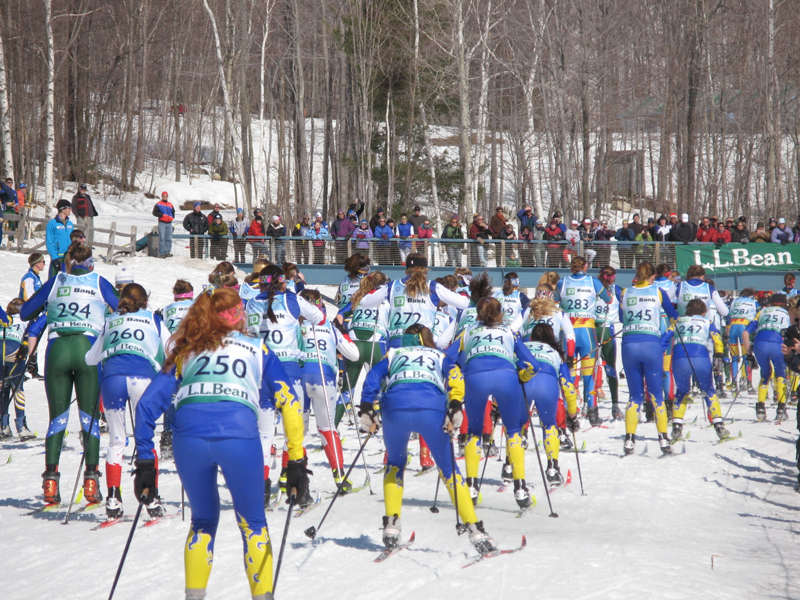
An older photo of NENSA athletes competing at the 2011 Eastern High School Championships in Rumford, Maine. This season will have a decidedly different look. (Photo courtesy Janice Sibilia.)
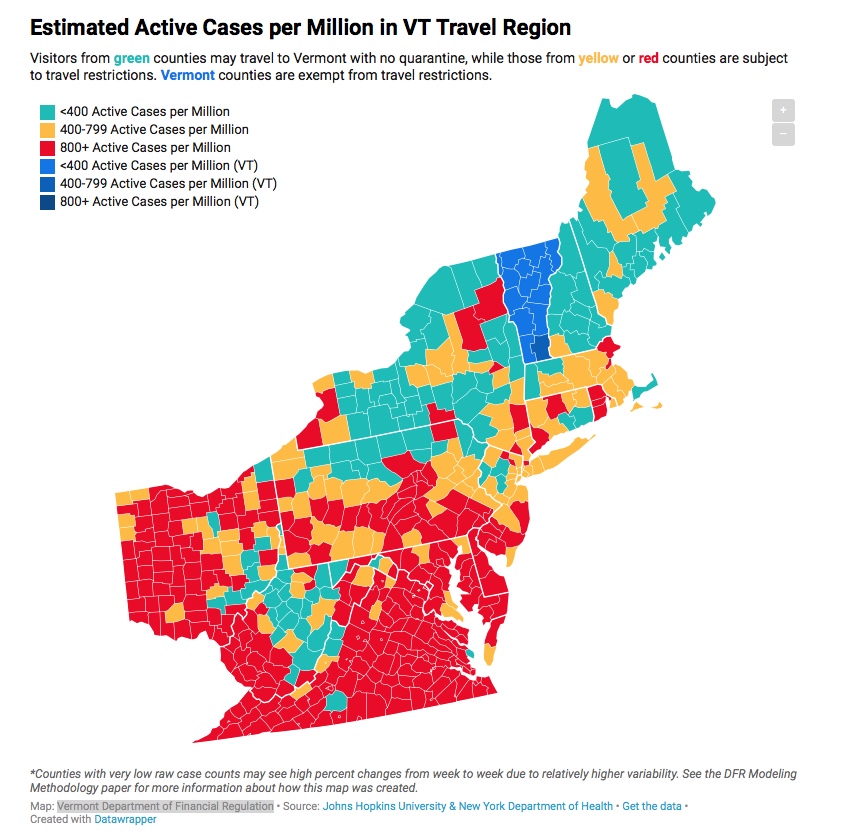
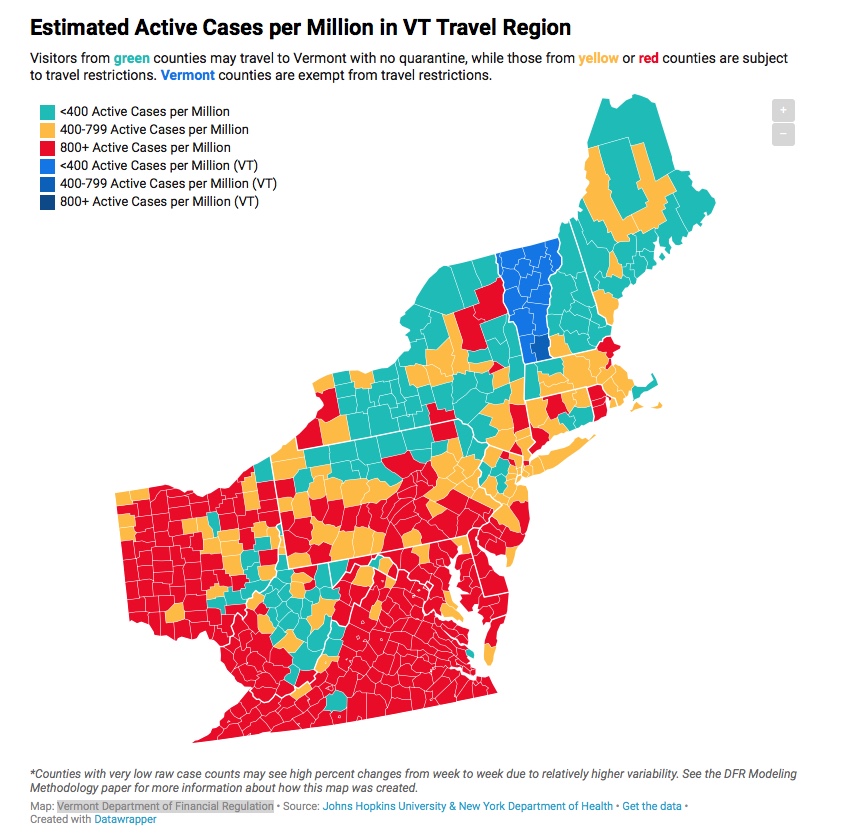
As a case study, New England poses several challenges. Geographically several states with differing Covid-19 mandates share borders or are within relatively close proximity to one another. In this piece, we’ll use Vermont as our Covid-19 focal point. Vermont’s Agency for Commerce and Community Development has posted criteria for those traveling from out of state along with a map to make travel decisions easier.
On the color-coded map depicting both state and county borders, it’s easy to determine who can travel to Vermont seamlessly with zero quarantine requirements. (There are no travel restrictions within Vermont.)
Hypothetically, using the current data, if you are a ski racer from a New England county and your county has between 400-799 active cases per million or greater, you are likely looking at a 14-day quarantine when entering Vermont, “or a 7-day quarantine followed by a negative test in [your] home state and enter Vermont without further quarantine restrictions.”
Currently, much of Massachusetts falls in the 400-799 active caseload category, as do several counties in Maine and a single New Hampshire county.
This all gets tricky for those crossing state borders to race.
Compounding the complexity, each state has unique caps on maximum group sizes for outdoor events. In Vermont, a state with favorable Covid-19 metrics relative to the nation as a whole, “outdoor organized events” are limited to 150 people. Skiers, coaches, spectators, volunteers, and officials — they add up quickly. The aim is to minimize the total number of individuals on-site for a race. That, said Beckwith, requires rolling race start times and the ability for racers to arrive promptly and leave the venue quickly post-race.
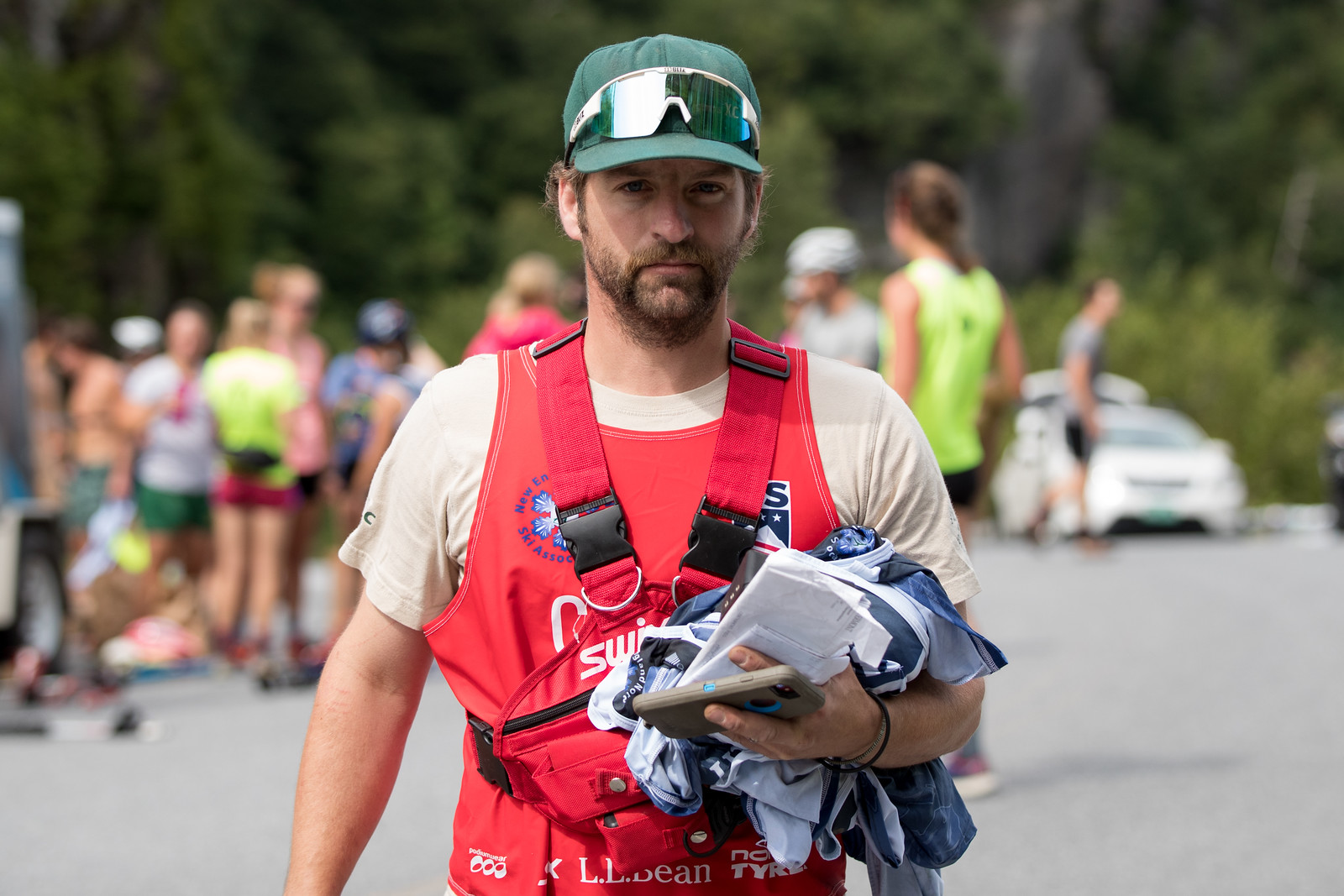
NENSA Competitive Programs Director Justin Beckwith at NENSA’s 2018 App Gap Challenge rollerski race, up the Appalachian Gap in Fayston, Vt.
“We are trying to really promote the local races, so we are saying stay home, try a popular race so to speak, that is a good step for a high school kid versus going to an Eastern Cup during a year where we would rather have slightly reduced field sizes to make it easier to pull events off,” said Beckwith. “Once you get to 100 competitors, that is pretty close with volunteers and coaches, if not over, to the cap here in Vermont.”.
Here’s our closer look at NENSA’s plan and how it may over-deliver. Regional will be the operative word as NENSA is encouraging skiers to minimize out-of-state travel.
“We are starting with the language of advising people to race within their region. Vermonters could go to the two Eastern Cups in Vermont, maybe they slide over to the one in Dublin, New Hampshire because it is not that far away,” Beckwith said. “Kids from Maine would do the Eastern Cup in Maine, they could slide over to New Hampshire and do those.”
On NENSA’s website, they have a dedicated page for COVID-19 considerations. There, interested racers can find specific contingencies for Eastern Cups, Eastern High School and U16 Championships, Women’s Day, the BKL Festival, and popular racing. Across the board, all NENSA races will be individual start (no mass start or sprint heats for the 2020-2021 season).
With the Eastern Cups arguably the most complex, we’ll focus on those contingencies. The streamlining and social distancing begins on October 1, when NENSA will open their portal for purchasing a bib and timing chip. The bib and timing chip remains with the skier for the season. Beckwith said NENSA plans for “touchless registration and timing” and no day of race registration.
Plan 1:
All races will be individual start with start times organized by age group.
On the Wednesday before the race, all athletes, coaches, athlete relatives attending the race, volunteers, timers, and staff must complete an on-line NENSA Event Health Screening Tool. This includes a temperature check.
Limited spectators will be allowed at the venue with the possibility of no movement beyond their personal vehicles.
No on-site indoor waxing will be available.
Likely limited coach access to the course.
Bathrooms will be assigned by state.
All present at the race site must wear a “face covering and cover their mouth and nose at all times. Athletes/coaches must cover their nose and mouth in the start and finish area and if they are within 6 ft of another individual on course.”
Plan 2:
Essentially, Plan 2 calls for eastern Cups to be moved to February or early March.
Plan3:
“Regional races within states in New England – states determine “Championship” Teams.
Plan 4:
This plan, the last on the list, appears to be a fall back in which even a semi-large gathering of people is untenable.
Races will be run over the course of nine days. Racers sign up for a start time and complete their race. NENSA makes clear in Plan 4 that during hours when racers will be present, NENSA timers and race marshals will officiate.
Beckwith added that no Eastern Cup races have been calendared with U.S. Ski & Snowboard, however, a schedule of events can be found on the NENSA site.
The most critical piece, reiterated numerous times by Beckwith, was safety. That tenant is front and center on the NENSA website: “Our first objective is to ensure the health of our community in New England,” reads the language.
“You have to think about this in the context of staying healthy and allowing everybody to participate,” Beckwith said. “Trying to deliver a little lower level event and do a really good job versus ‘oh yeah this is business as usual.’ We are probably going to have people go to all the races. I do not think we are going to prohibit that. But we might, for instance, format the Junior National criteria in a way so people feel like they don’t have to go to every race. It is again going to come down to education and messaging.”
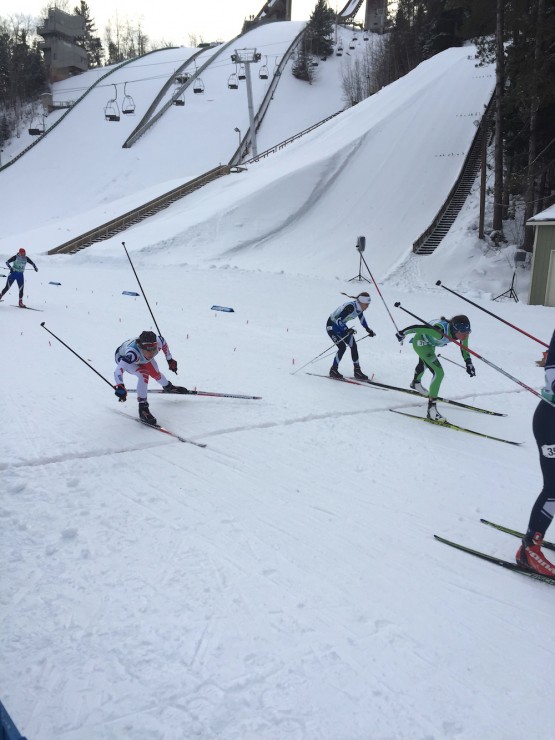
The start of the women’s freestyle sprint final at the SuperTour in Lake Placid, N.Y., with Anne Hart (front left), Chelsea Holmes (behind, second from l), Becca Rorabaugh (back left), Caitlin Patterson (center, in green), Jessica Yeaton (second from r) and eventual winner Kelsey Phinney (r). (Photo: Heidi and Bob Underwood)
Kelsey Phinney (Middlebury) after winning the women’s final at the SuperTour freestyle sprint on Jan. 30 in Lake Placid, N.Y. She beat out Caitlin Patterson (behind), Anne Hart (left, in red and white), and Jessica Yeaton (third from right) for her first SuperTour win. (Phot: Heidi and Bob Underwood)
Second through fifth in the women’s freestyle sprint final at the Jan. 30 SuperTour in Lake Placid, N.Y., with Caitlin Patterson (r) edging Anne Hart (l) for second, Jessica Yeaton (second from r) placing fourth and Chelsea Holmes (behind) bringing it home in fifth. (Photo: Heidi and Bob Underwood)
SuperTour action resumed this past weekend at the Lake Placid SuperTour/Eastern Cup and the podiums were shared by this season’s regulars as well as some new faces.
The 1.4-kilometer freestyle sprints were held Saturday in Lake Placid, N.Y., at the Olympic Ski Jumping Complex rather than the cross-country trails at Mount Van Hoevenberg, where they were originally scheduled, due to low snow. Sunday’s classic mass start was changed to an interval start as it was held on a 2.5 k lap with more than 200 skiers. The jump site, the home training venue for US Biathlon’s national team members during the offseason, made for a hilly race course with great snow conditions.
Day 1: Skate Sprint
The freestyle sprints belonged to the dark horses as Middlebury senior Kelsey Phinney and David Norris of Alaska Pacific University (APU) both captured the first SuperTour victories of their careers.
In contrast to the long finishing grind to the finish of the sprint at U.S. nationals in Houghton, Mich., the previous stop on the domestic circuit earlier in January, the Lake Placid course had a relatively short home stretch. A fast descent with a sharp turn led into the finish, making positioning on the downhill crucial as there was a significant advantage to drafting.
Phinney Beats the Pros
The women’s final included several names who have been regulars on domestic podiums all season including Caitlin Patterson (Craftsbury Green Racing Project), Anne Hart (Stratton Mountain School T2 Team), Chelsea Holmes (APU), Becca Rorabaugh (APU), Jessica Yeaton (APU), and Phinney, the lone collegiate athlete. In contrast to the heats, where the leaders could often create enough of a gap on the hill to be clear of the field after the descent, the final was a game of tactics.
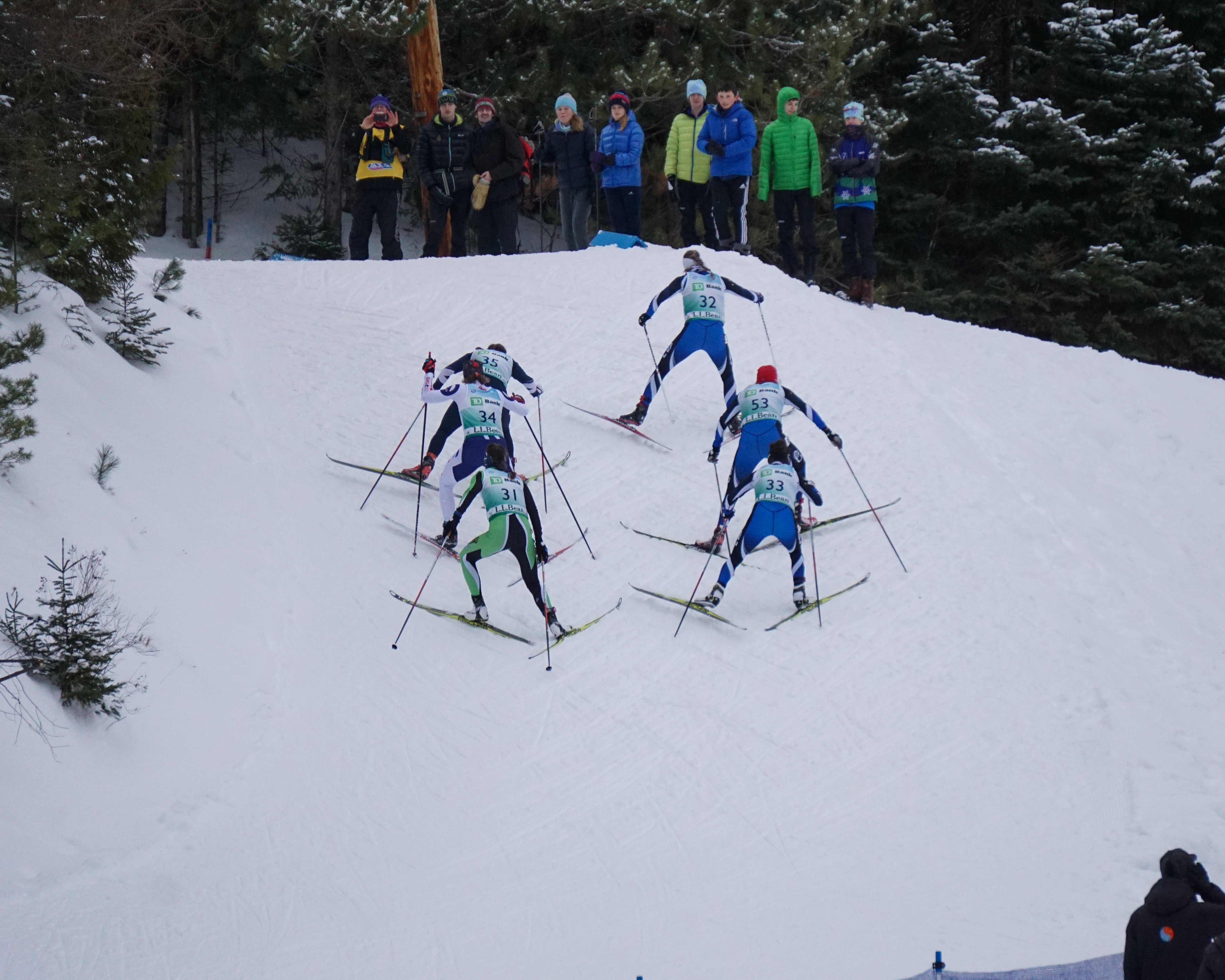
Jessica Yeaton (APU) leads up the hill during the SuperTour women’s freestyle sprint final on Saturday, Jan. 30, at the Olympic Ski Jumping Complex in Lake Placid, N.Y. (Photo: Alex Howe)
Although the pace in the final started out relaxed, Yeaton was the first to push the pace on the climbing section and Patterson, Hart and Holmes were shuffled to the back. Concerned that the pack would separate, Holmes made a move on the final climb and crested the top of the final hill in the lead.
Phinney slipped behind Holmes, allowing her to take advantage of the draft down the final hill and slingshot into the lead on the home stretch. Patterson followed Phinney through the inside line into second and was able to hold off the field but unable to overtake her for the win.
“My main focus in the final was to be in second or third going into the last downhill and to get the inside track around the final corner coming until the finishing straight,” Phinney, 21, wrote in an email. “I took the lead around the final corner and I felt confident in my ability to hold that lead to the line.”
In securing her first SuperTour win (and podium), Phinney held off Patterson by 0.45 seconds in the final straightaway. A hard-charging Hart fell short of catching the pair and placed third (+1.7). Yeaton followed just off the podium in fourth (+2.14).
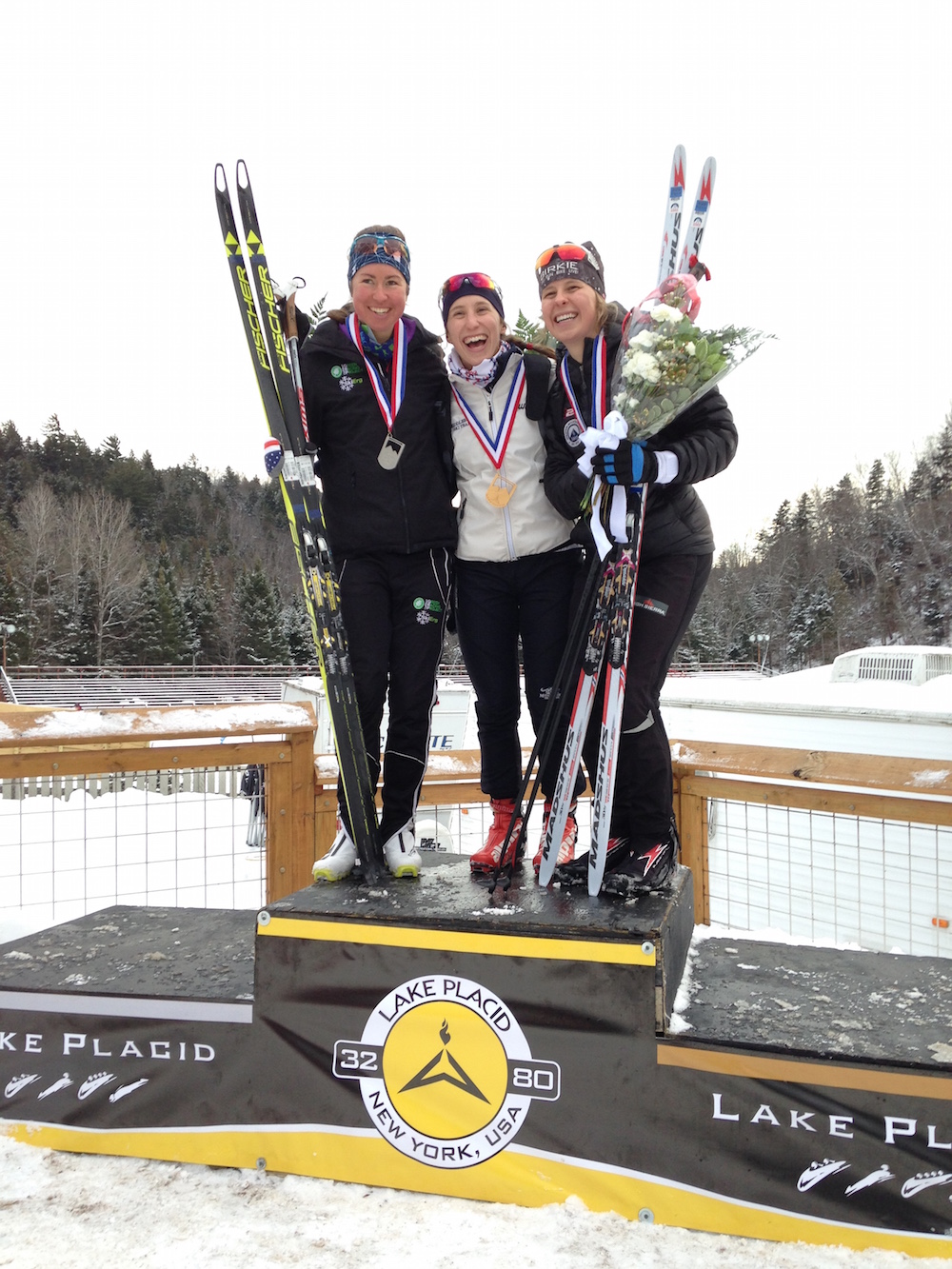
Middlebury senior Kelsey Phinney (c) takes her first SuperTour win at the Lake Placid freestyle sprint on Jan. 30, followed by Craftsbury’s Caitlin Patterson (l) in second and Stratton’s Anne Hart (r) in third. (Photo: Heidi and Bob Underwood)
For Phinney, the win was redemption after a rough freestyle sprint at nationals, where she finished 31st — missing qualifying for the heats by one place.
“I had placed some high expectations on the skate sprint and ended up having a tough day — just narrowly missing the heats after feeling pretty off in the qualifier,” Phinney reflected.
However, a couple of weekends of collegiate racing brought confidence and racing form, and Phinney put it to good use.
“I skied across the line into the arms of my teammate Annie Pokorny, who was waiting for us in the finishing area. That was such an amazing feeling!” she wrote.
Although Patterson had hoped to drive the pace up the hill, a bad start left her boxed in. Patterson stayed calm and patient and her opportunity arose on the final descent.
“I would have liked to have gotten off to a faster start and been in more control of the heat, but throughout the final I had both bad luck and good luck in positioning, and overall it turned out pretty well at the end,” Patterson wrote in an email.
Hart also had to recover from suboptimal positioning and was forced to the far outside on the final turn.
“I had a great last 100 meters with some nice maneuvering, but didn’t give myself the chance to battle for first — ran out of real estate at the end!” Hart wrote.
Although Holmes was able to use the downhill to her advantage to win her semifinal, she found herself at a disadvantage in the final leading down the last hill. The pack took advantage of her draft to set up the final sprint, and Holmes ended up fifth (+2.96).
“I felt like I was able to dig deeper than I have in awhile, which was really great. Moving through the heats it was definitely pretty hard but more than anything it was an important reminder to how tactics play a role in sprinting,” Holmes wrote.
Norris Nabs a Win
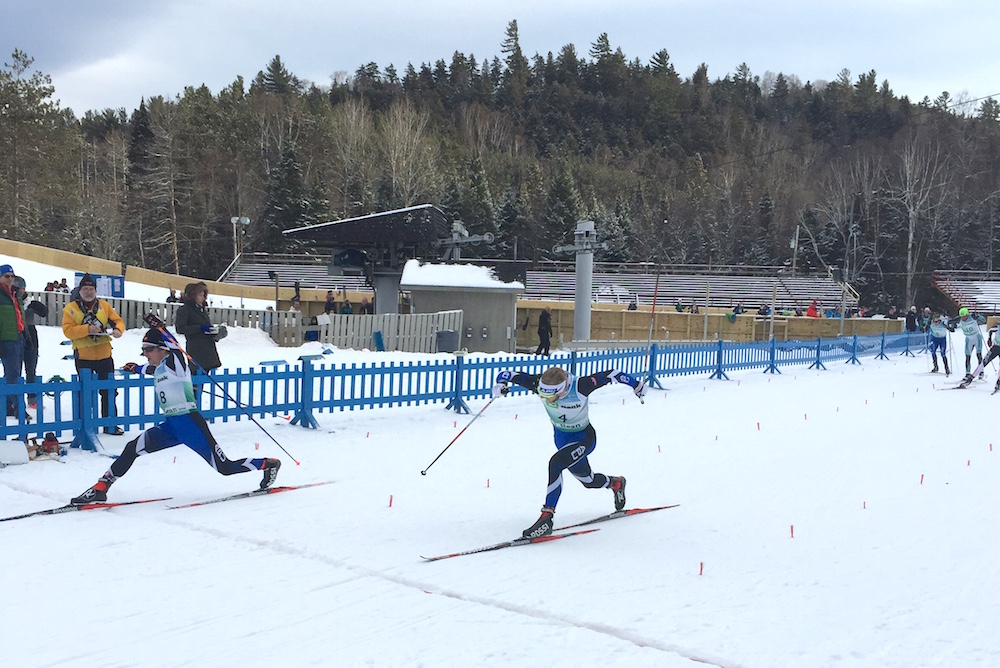
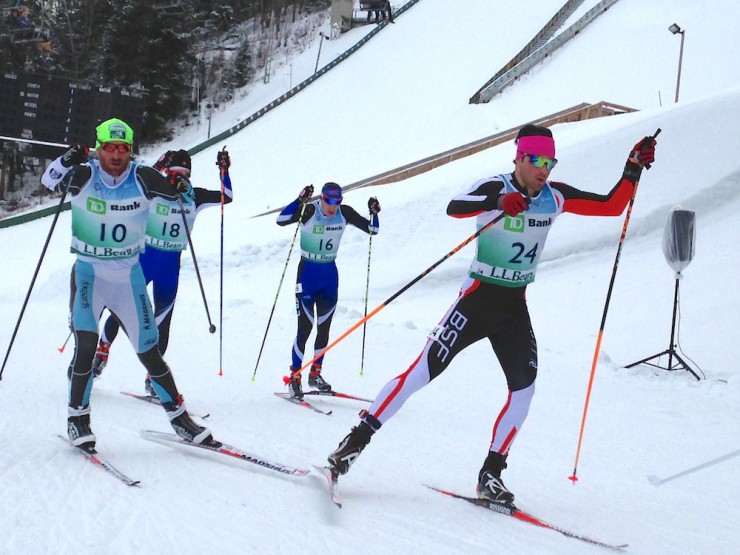
David Norris (l) lunges at the line to beat APU teammate Eric Packer (r) in the men’s freestyle sprint at the SuperTour in Lake Placid, N.Y. (Photo: Heidi and Bob Underwood)
In the men’s freestyle sprint, Norris cruised through the heats, winning both his quarterfinal and semifinal before topping the final in 3:18.9 minutes, 2.16 seconds ahead of APU teammate Eric Packer. Less than a second later, Akeo Maifeld-Carucci of the Bridger Ski Foundation took third (+3.0).
A third APU skier in the final, Tyler Kornfield fell on the downhill and had to settle for sixth. Brian Gregg (Team Gregg) took fourth (+5.17) followed by Canadian Alexis Turgeon (Skinouk) in fifth (+5.57).
The men’s heats again reflected the importance of the descent into the finish in the overall placings.
“I focused on skiing relaxed to the top of the course, which put me in last place at the top of the hill every heat. From the top I was able to use the draft to pass guys and work my way to the front for the final corner into the last 50 meters or so,” the 25-year-old Norris explained in an email. “By the time the final 100m sprint happened the speed was so high that it was tough to make or lose much ground to the competitors. I led into the finish every heat of the day and was able to hold it each time — thankfully!”
Packer also hoped to pull off the same strategy, but lost time when he narrowly avoided Kornfield, who had crashed hard in front of him on the descent.
“After that I no-pole skated as hard as I could to catch back on to the group,” Packer wrote in an email. “I really pushed hard over the top of the hill, and passed the group on the outside with 200m to go. At the same time, Dave passed the group on the inside, and he was first around the corner into the final stretch. I was closing on him in the finish lanes, but he beat me to the line.”
“David has an amazing no-pole skate, and that was just what you needed today,” Packer added. “I’m super happy to see David performing where he should, and he skied the race perfectly.”
For Maifeld-Carucci, a Harvard graduate in his first professional season, the day was a learning experience that he was able to immediately put into action.
“I just went into every round trying to focus on how I could ski better than the qualifier or the previous round,” he wrote in an email. “I learned a lot skiing in such strong competition all day. I tried to use some of that knowledge right away in the next heat but will keep thinking about it and finding takeaways for my next sprint race which will be at U23s.”
Despite placing fourth in his semifinal, Maifeld-Carucci earned a shot at his first SuperTour sprint final, advancing as a lucky loser along with Gregg.
Maifeld-Carucci just missed qualifying in two U.S. nationals sprints at the last two years, placing 31st in the 2015 freestyle sprint and 2016 classic sprint. However, he made it to the heats in the freestyle sprint at nationals this year, placing 15th overall.
“It was fun to see the depth of the field and see that even the lower qualifiers can be competitive in the finals,” he wrote. “It is also a nice reminder to see that even if you are fourth in your heat every fraction of a second matters and pushing hard to the line can be enough to get you through. Overall it was a very fun and exciting day.”
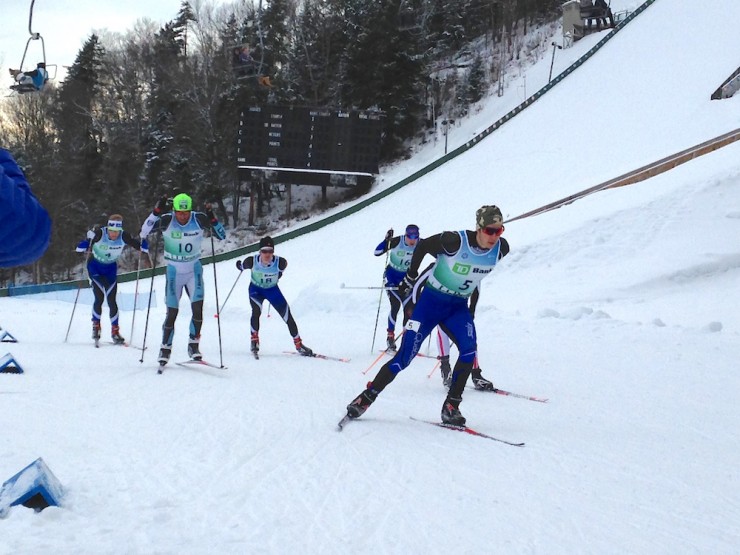
Canada’s Alexis Turgeon (Skinouk) leads early in the men’s freestyle sprint final at Saturday’s SuperTour in Lake Placid, N.Y. Turgeon finished fifth in the final, behind David Norris (third from l), Eric Packer (l), Akeo Maifeld-Carucci (behind) and Brian Gregg (second from l). Tyler Kornfield (second from r) fell on the downhill and placed sixth. (Photo: Heidi and Bob Underwood)
Akeo Maifeld-Carucci (r) of the Bridger Ski Foundation and Brian Gregg (l) early in the men’s freestyle sprint final at the SuperTour in Lake Placid, N.Y.
Day 2: 10 k Classic Individual Starts
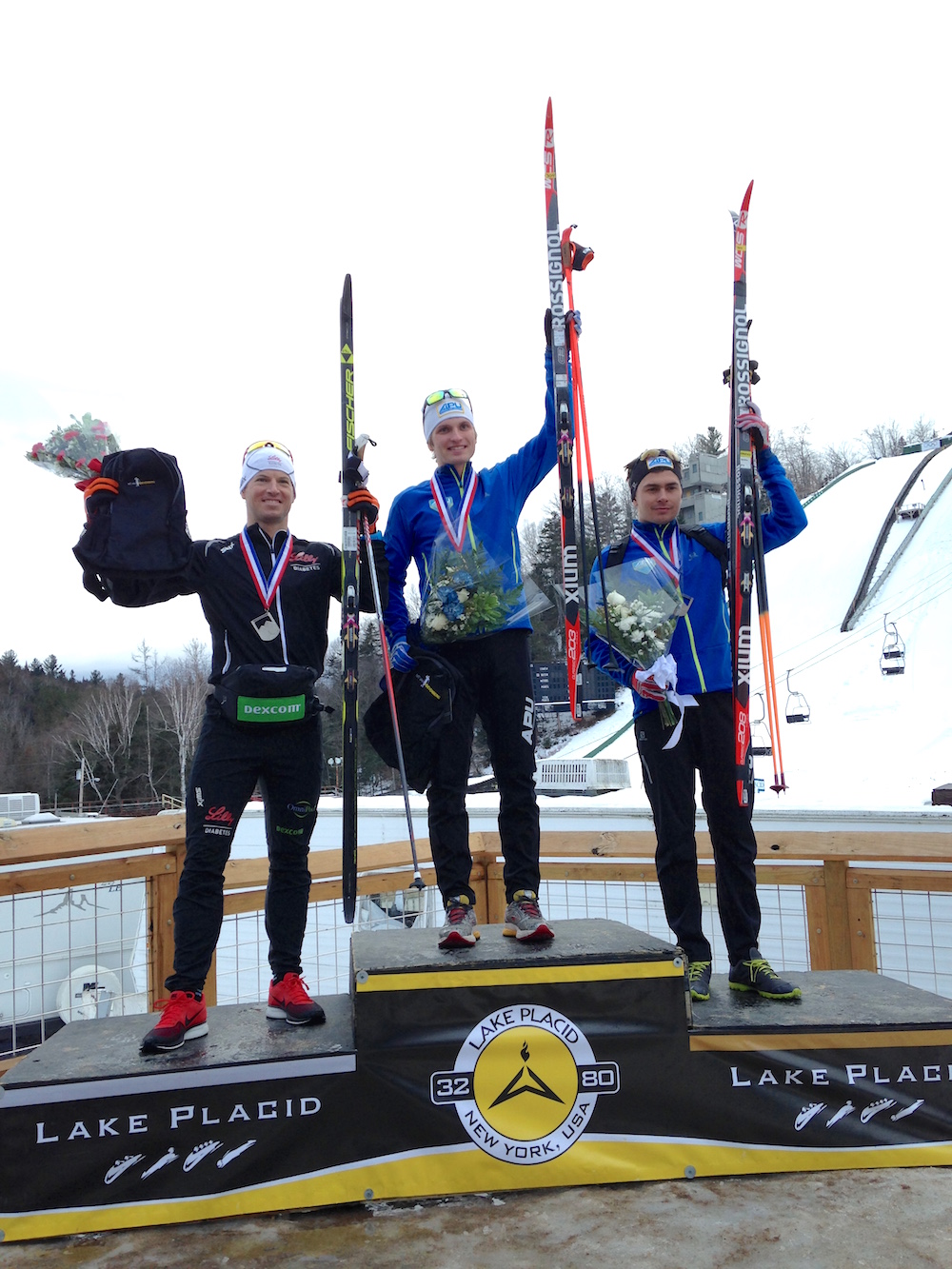
The men’s 10 k classic podium at the Lake Placid SuperTour on Sunday, with David Norris (APU) on top for the second-straight day, Kris Freeman (l) in second followed by Lex Treinen (r). (Photo: Heidi and Bob Underwood)
Sunday’s classic individual start consisted of four laps of a 2.5 k course for a total of 10 k for both the men’s and women’s races. The course consisted of several of the jump hills strung together in the beginning, followed by the descent winding back into the stadium.
With temperatures in the low 40s, the course conditions were variable, but most certainly requiring klister. With the challenging climbs of the jump area, going without kick wax was a disadvantage.
Norris Repeats
A day after winning his first SuperTour race in the freestyle sprint, Norris charged to the classic-distance race victory in 28:26, 45 seconds ahead of Kris Freeman (Team Freebird). The second APU skier on the podium, Lex Treinen placed third (+0.58).
The multiple-lap course made for interesting dynamics with many skiers on the course at a time.
“It was fun conditions because skis slowed after the first lap so some of the second seed skiers had the chance to draft off of the leaders, and we had the opportunity to ski with them,” Treinen wrote in an email.
Treinen posted the fastest split after the first lap, but by the second lap, Norris had a 14-second lead that he only increased over the final two laps.
“I burned up the nerves on the first lap and had the fastest split going into the first lap, something I have probably never ever done,” Treinen wrote.
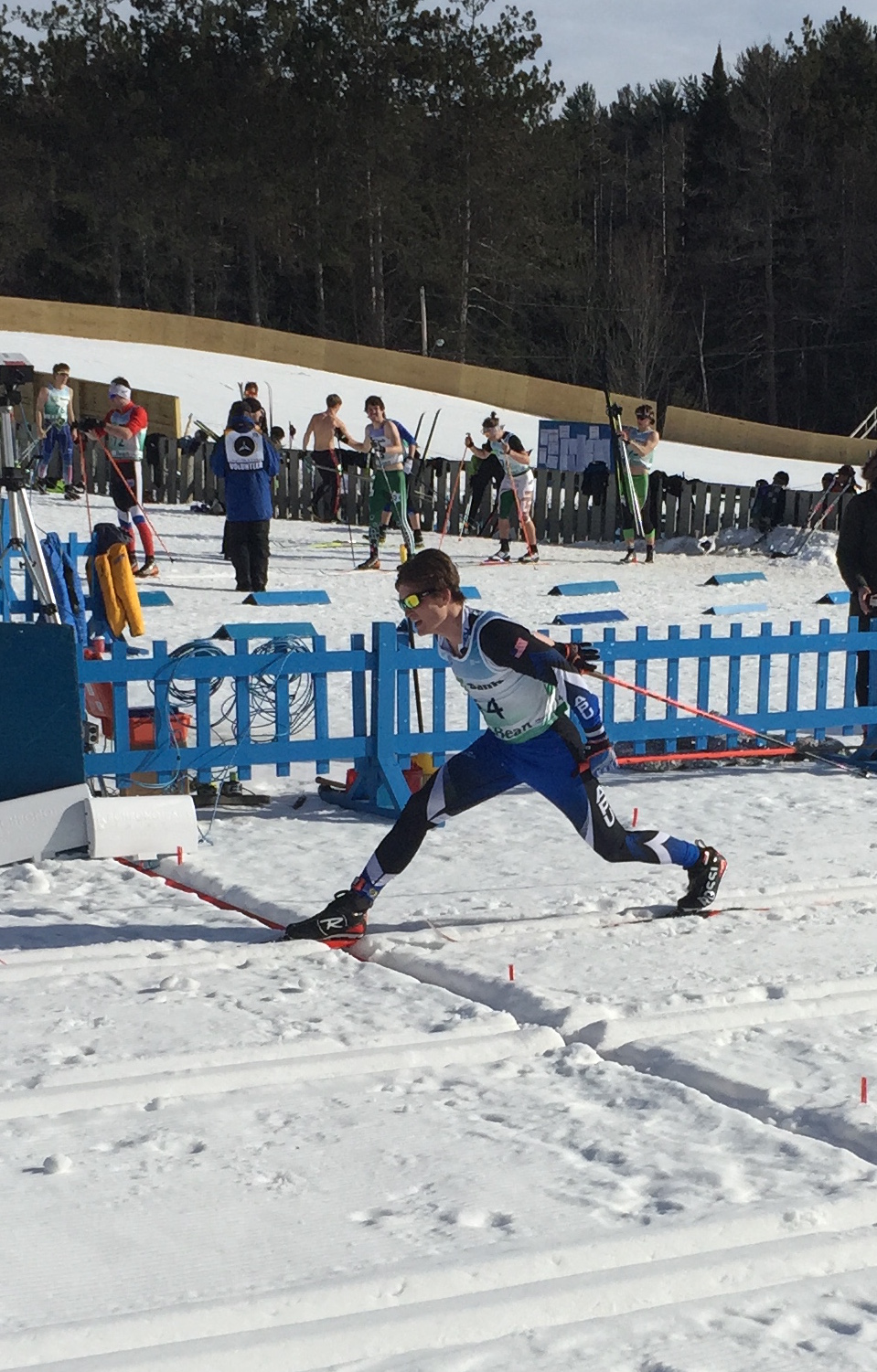
David Norris (APU) giving his all across the line to win the 10 k classic individual start at the Lake Placid SuperTour on Sunday. (Photo: Heidi and Bob Underwood)
Freeman explained in an email that he’s been feeling healthy for about three weeks.
“My overall energy felt much better than at any other time this season,” he explained.
His game plan for the 10 k wasn’t anything out of the ordinary: “Go out at a sustainable pace and try to speed up in the last lap,” Freeman wrote. “I think a mass start would have been very interesting and more fun but changing the race to a time trial was the right call give the width of the trail.”
After having never before won a SuperTour, Norris picked up back-to-back victories in Lake Placid.
“After Nationals I had a good chunk of time in Anchorage, which allowed me to get some quality rest and some really good mid-season training in,” Norris explained.
“I went pretty thin on the wax knowing that the course had a lot of double pole and tucking time each lap,” he added. “I’ve been trying to teach myself to race on faster classic skis with less kick and that has caused me to suffer in the last few kilometers of a few races, but today I was able to maintain my technique and keep finding kick.”
Similar to Norris, Treinen is seeing the results of consistent training and racing.
“I felt good going into Houghton, but I also didn’t have that much racing under my belt for the season, and I tend to start out the seasons slow and build throughout,” Treinen wrote. “It was fun to get some true East Coast klister skiing after having all of first races in cold, hard conditions.”
Freeman noted, “I had very accessible kick and pretty good glide.”
Same Ol’, Same Ol’
The women’s race was the epitome of consistency as the podium was identical to the same at nationals this year: the 10 k classic in Houghton.
Patterson, 26, continued to assert her dominance of the distance races (after winning both distance races at nationals) by winning by a full minute on Sunday in 31:45.
Her Craftsbury teammate, Kaitlynn Miller placed second (+1:00) and Holmes finished third (+1:19).
“Although it also was a somewhat variable and difficult day for snow conditions, so it was important to keep the technique together and stay smooth,” Patterson wrote. “I know I did a good job today of skiing through terrain changes and transitions, and I suspect that’s where I may have gained some time over competitors.”
Miller also attributed her success to good skis and adapting to the conditions.
“The conditions varied a fair amount over the 2.5k loop with flagpole hill becoming a bit slushy while other parts of the course remained slightly glazed,” she described. “I started right as Annie Hart was lapping through so she definitely helped push me along. Also, I was the last starter in the A-seed so was able to get some informative splits from my coaches out on course.”
Hart finished just off the podium in fourth (+1:29).
This weekend was Holmes’ first races in the U.S. after returning from Europe where she competed at the World Cup in Planica, Slovenia, and Nove Mesto, Czech Republic. Holmes placed 37th in the Nove Mesto 10 k freestyle in her international World Cup debut.
“I wish I had had more time on the World Cup as I really felt like I learned a lot in both the race experiences I had,” Holmes wrote. “Maybe it wasn’t ideal to do the back and forth so quickly like that — I was sick when I went over but other than that I’ve managed to stay healthy.”
This weekend marks the end of SuperTour Period 2. Period 3 will begin next weekend, Feb 5-6, at Trapp Family Lodge in Stowe, Vt.
The women’s 10 k classic podium on Sunday at the Lake Placid SuperTour: with winner Caitlin Patterson (c), Kaitlynn Miller (r) in second, and Chelsea Holmes (l) in third. (Photo: Heidi and Bob Underwood)
The men’s 10 k classic podium on Sunday at the Lake Placid SuperTour: with winner David Norris (c), runner-up Kris Freeman (l), and Lex Treinen (r) in third. (Photo: Heidi and Bob Underwood)