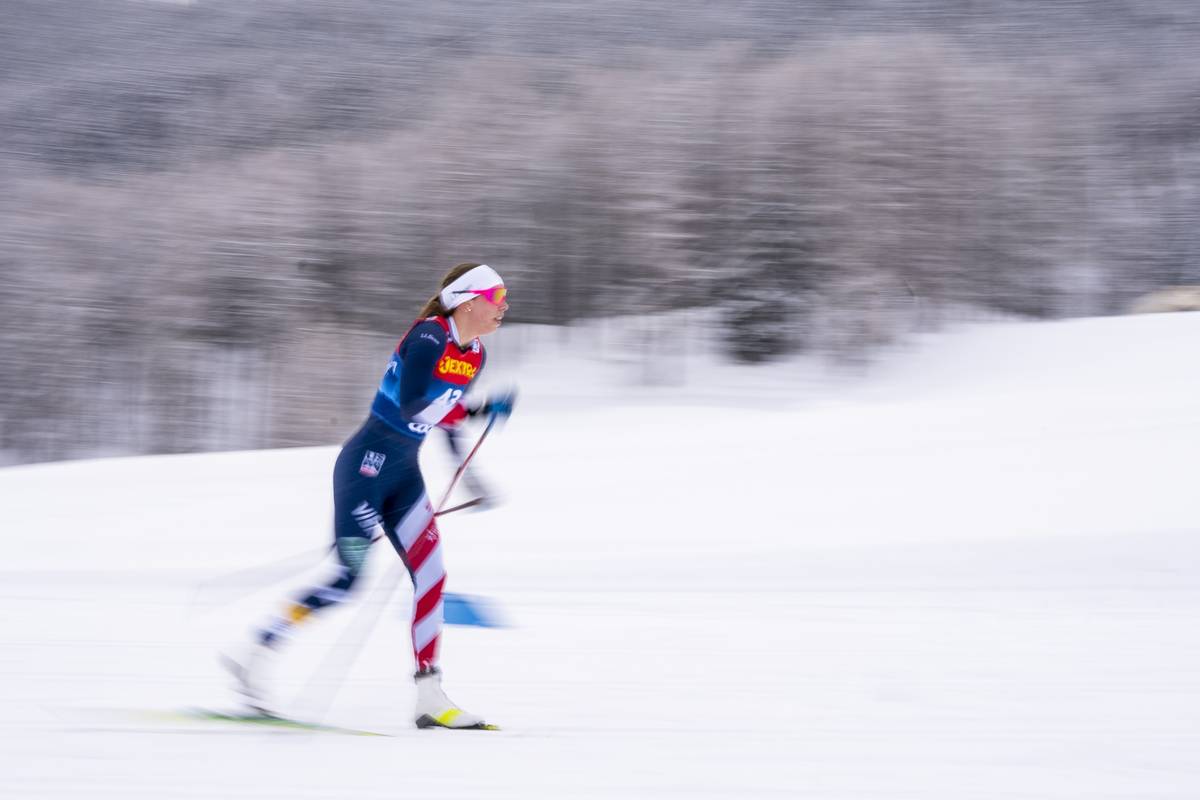
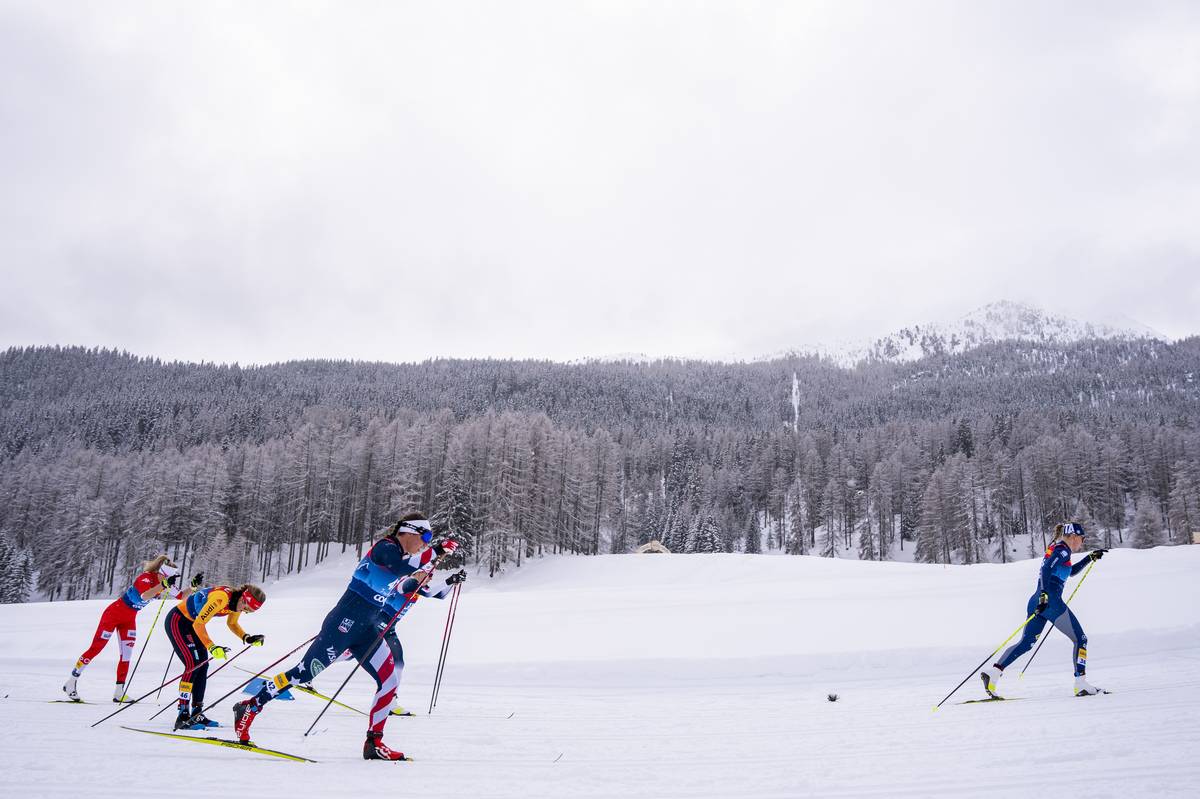
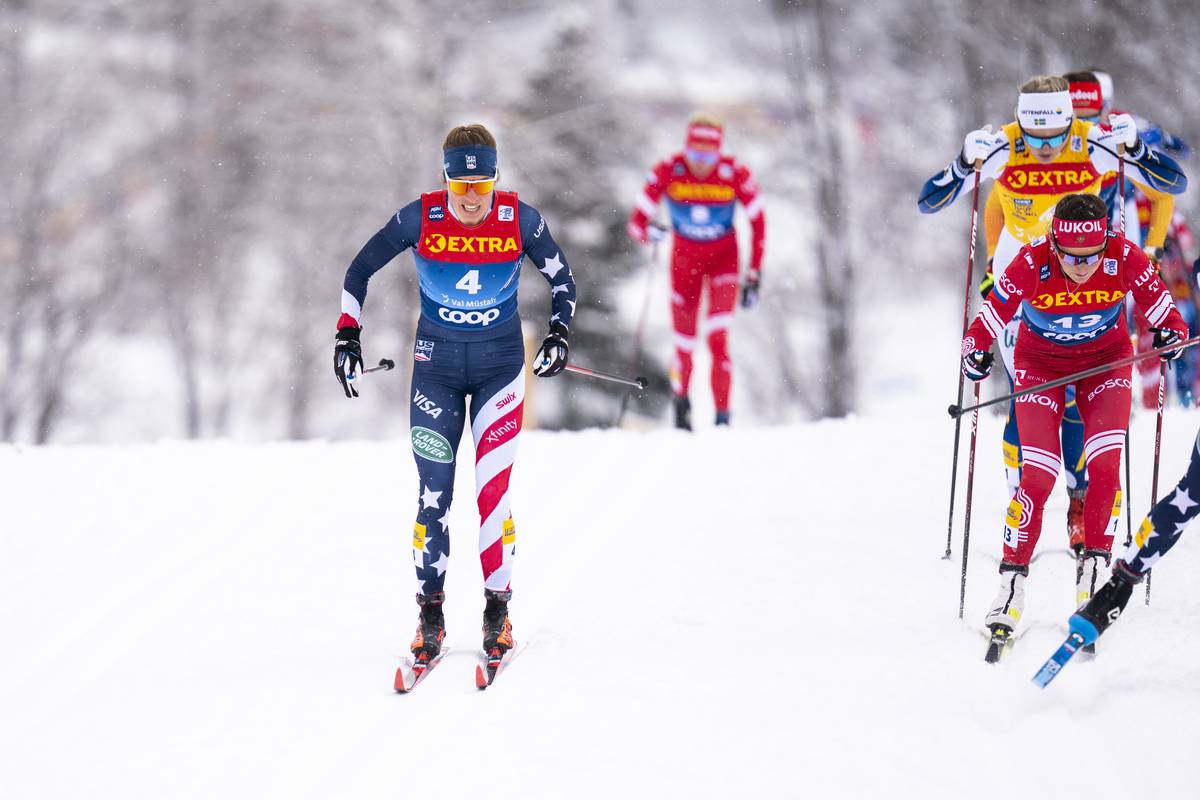
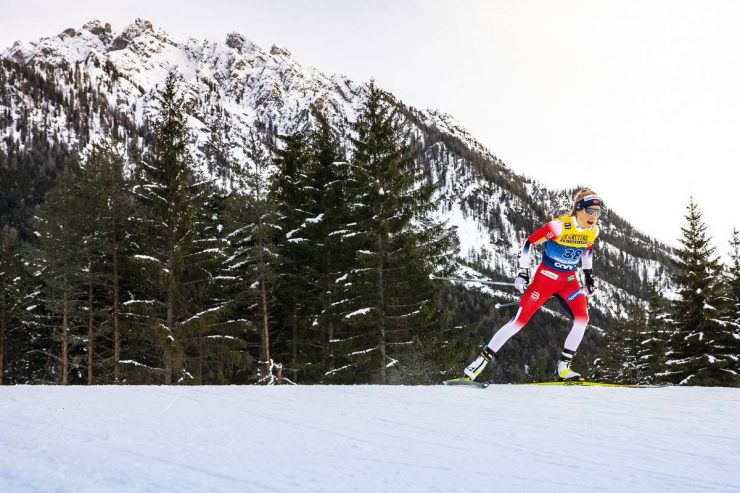
Remember on the last episode where we talked about how exciting we thought the women’s skiathlon would be? It delivered every ounce, and maybe a little bit more. We’ve got a full recap here.
Reach us by email at devon@fasterskier.com and nat@fasterskier.com. We’ll be back after Tuesday’s the individual start races.
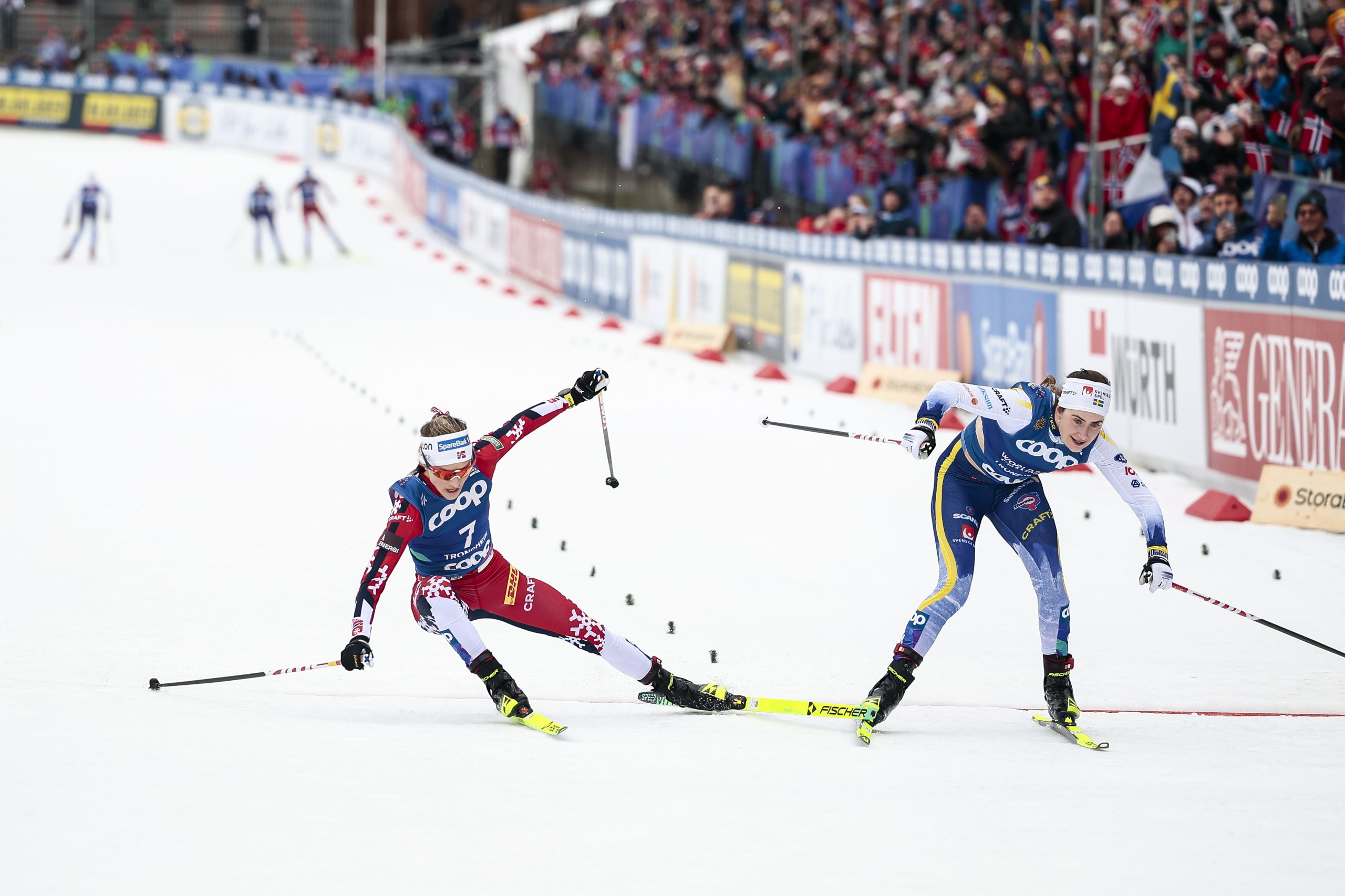
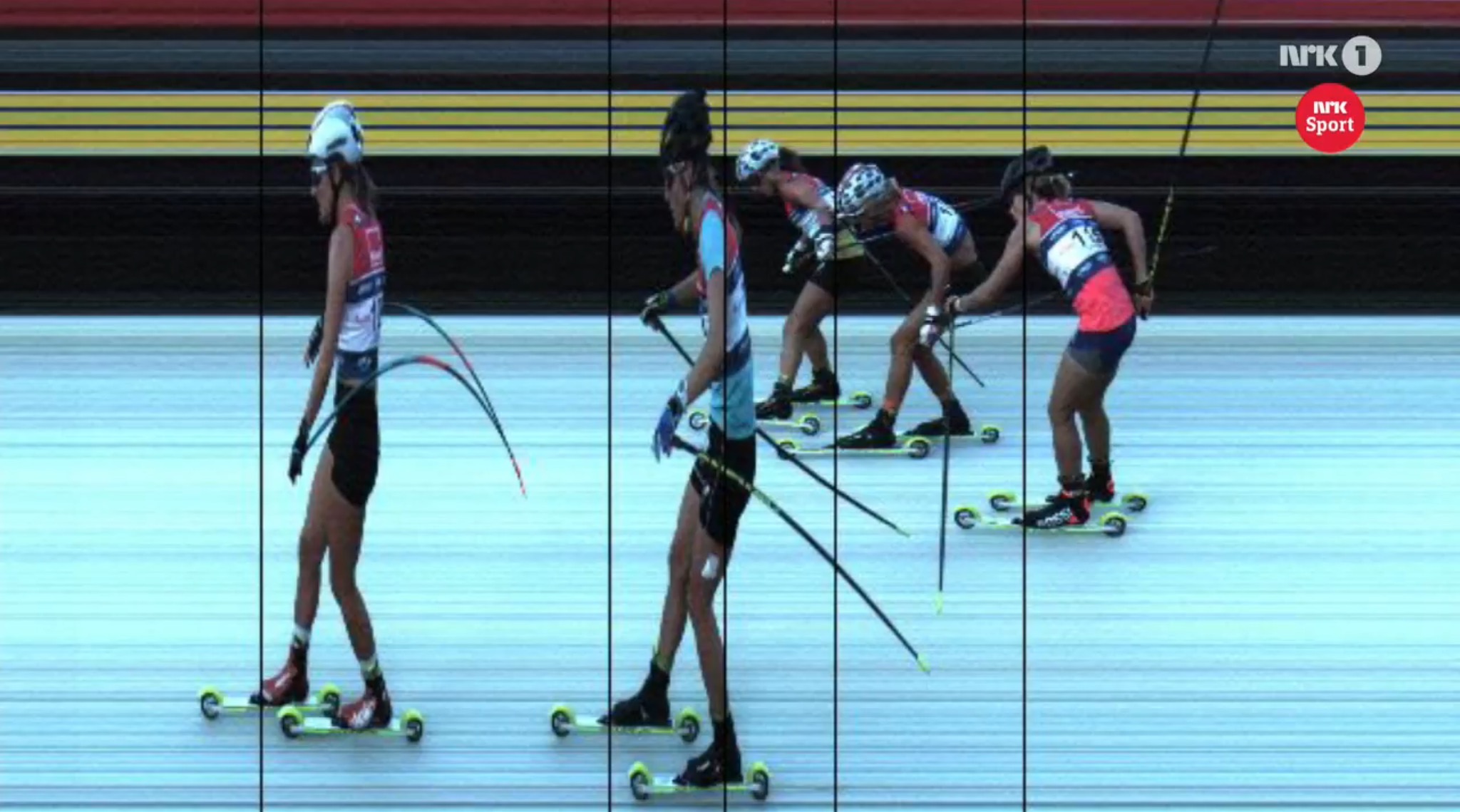
Therese Johaug (NOR) and Ebba Andersson (SWE), (l-r) lunge for the line and the win. (Photo: Modica/NordicFocus)
This coverage is made possible through the generous support of Marty and Kathy Hall and A Hall Mark of Excellence Award. To learn more about A Hall Mark of Excellence Award, or to learn how you can support FasterSkier’s coverage, please contact info@fasterskier.com.
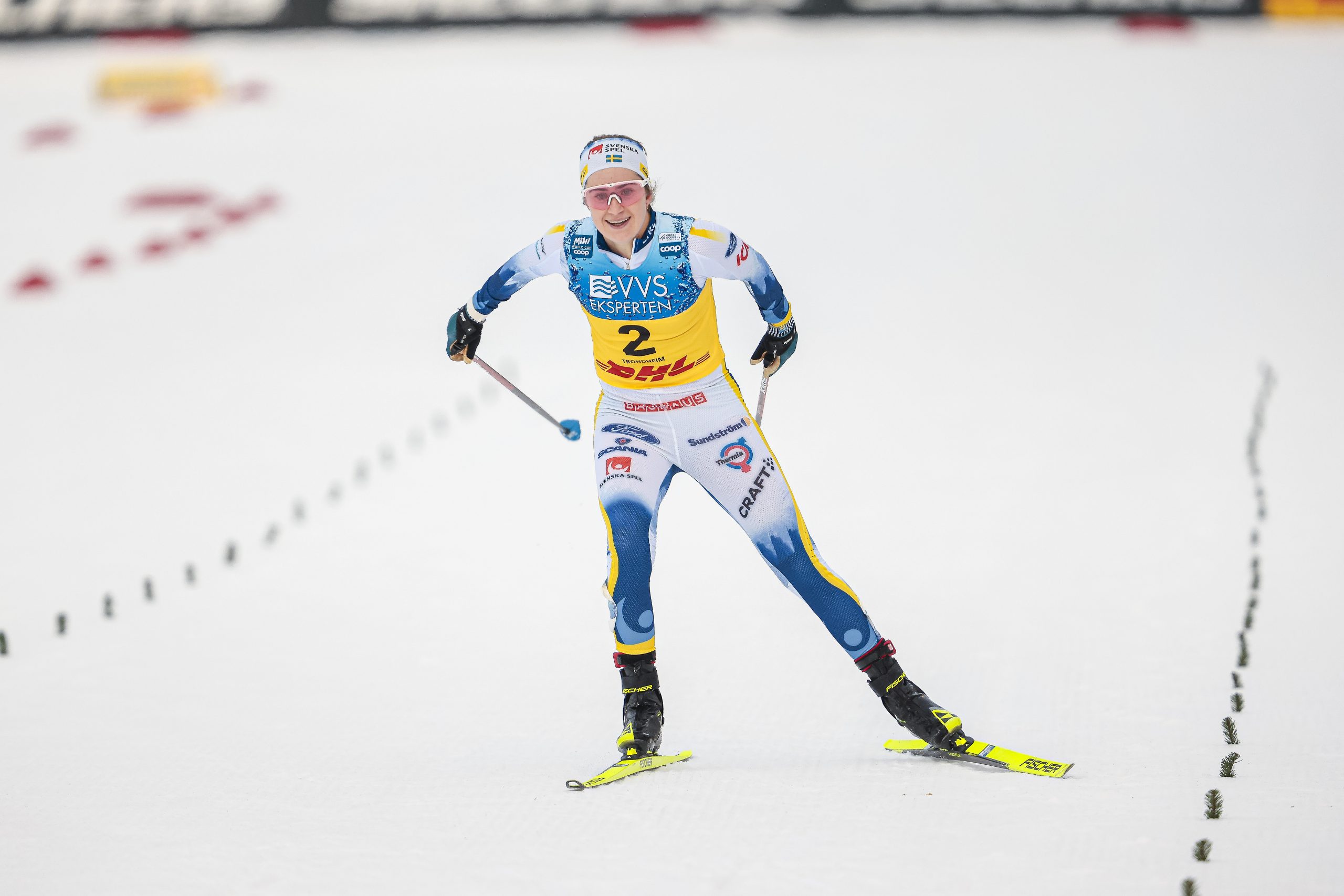
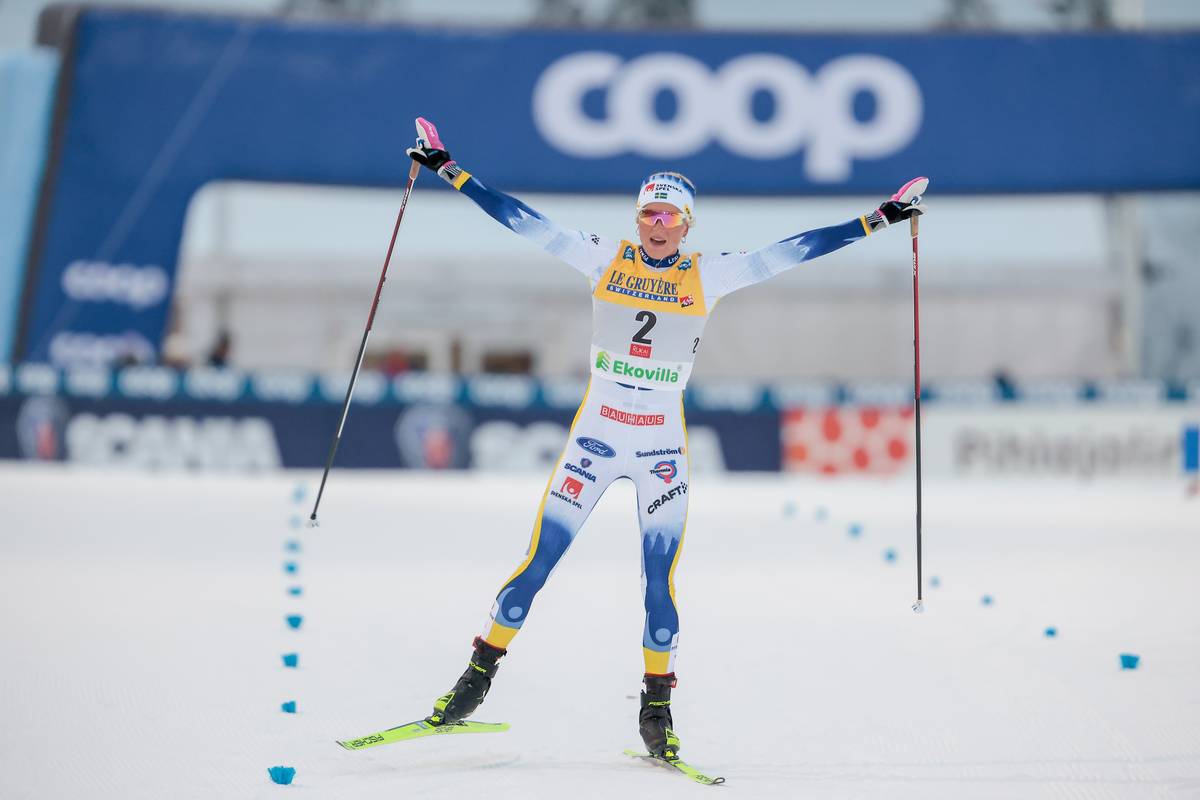
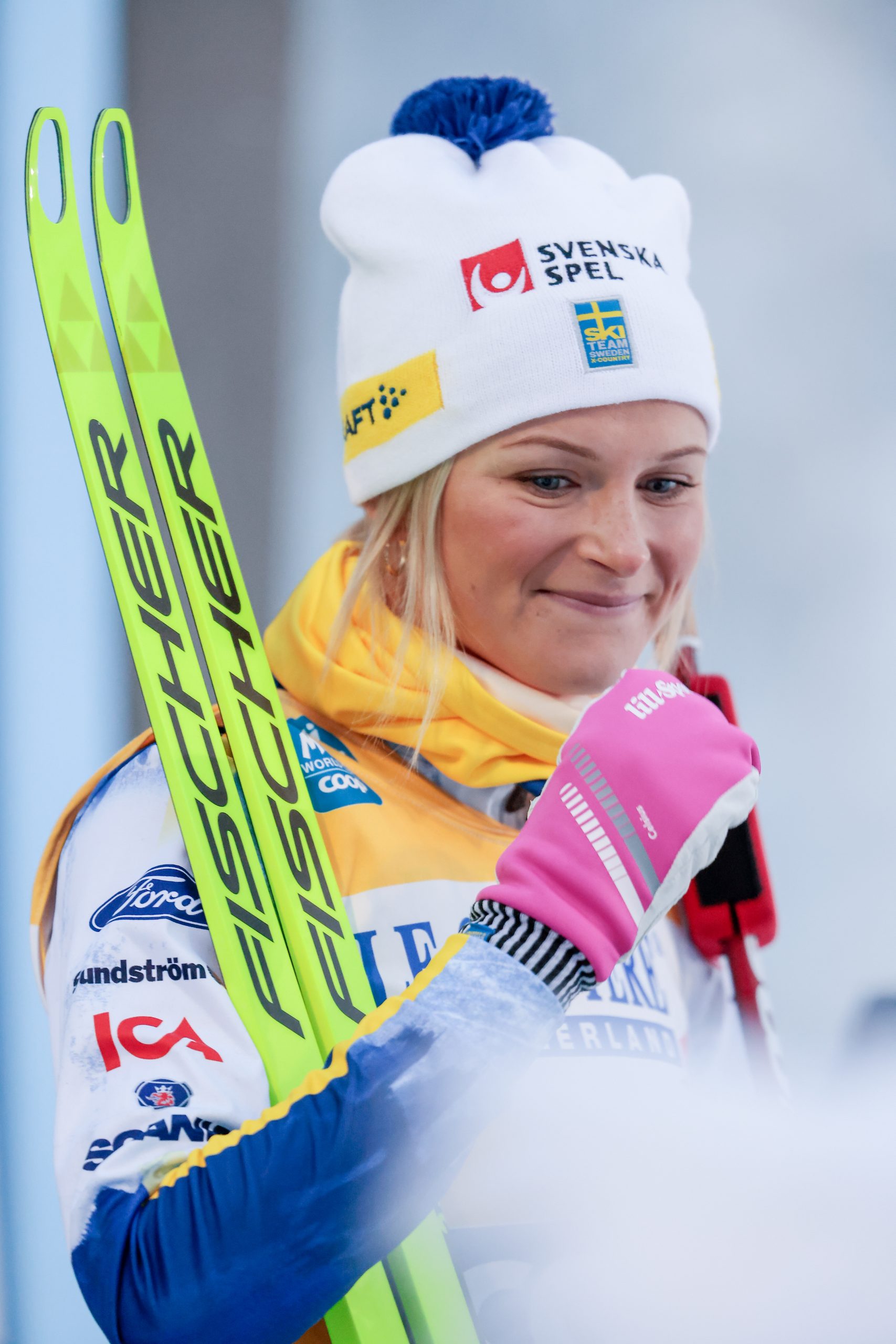
Ebba Andersson (SWE) smiles as she approaches the finish line of the the Trondheim World Cup 20 k Skiathlon, her second win of the World Cup season. (Photo: Modica/NordicFocus)
One of Norway’s most picturesque cities, Trondheim is also one of Norway’s least-wintry cities. The first three weekends of World Cup racing—Ruka, Gaelivare, and Oestersund—were an Arctic blast. The second day of World Cup competition in coastal Trondheim offered a morning that dawned cloudy and dreary, with rain in the forecast and temepratures hovering in the low 40’s F at race time. A foggy drizzle was suspended in Trondheim’s coastal air; humidity levels approached 100%. This would be a day heavily reliant on the skills and intuitions of each team’s wax technicians. Ski preparation was likely to be crucial, both in the tricky-to-prepare kick wax conditions, AND in the new waxing rules that prevent the use of fluoro waxes that, in the past, would have been heavily relied upon on such a warm day. Glide would be a challenge, kick would be a challenge . . . with World Cup points, prize money, and bragging rights at stake.
“It was definitely tricky today for the wax technicians,” reasoned Rosie Brennan (USA). “We haven’t had these conditions so far this year; also, it didn’t switch to this condition until literally last night.”
Ski choices and base prep may have played a role in Brennan’s freestyle leg, as well. “In classic . . . I had a pair of skis that I knew had worked well last year. [But] in skate we didn’t find the best pair, didn’t make the best decisions . . . I guess we will see these conditions again, so there’s room to learn and grow from that.”
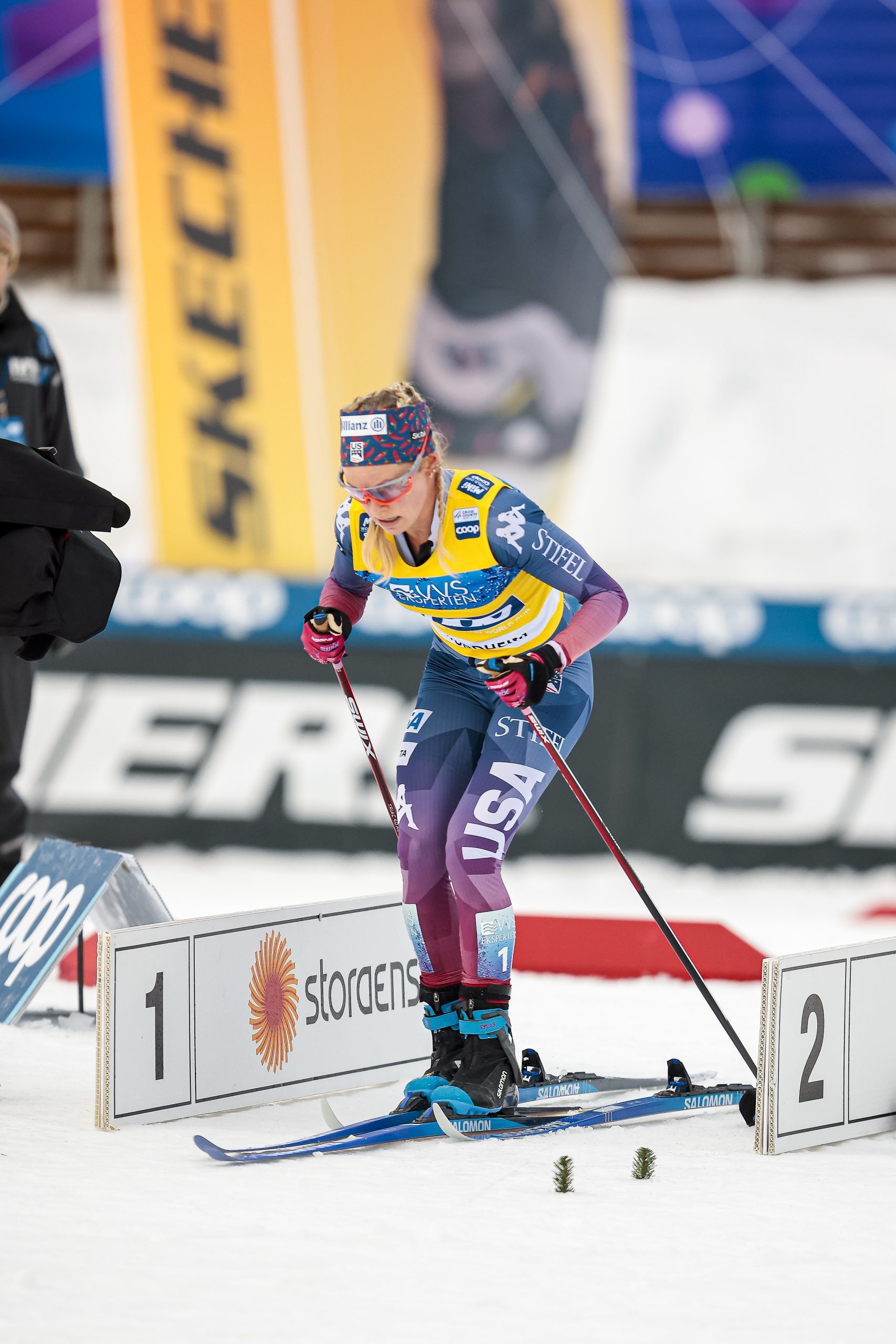
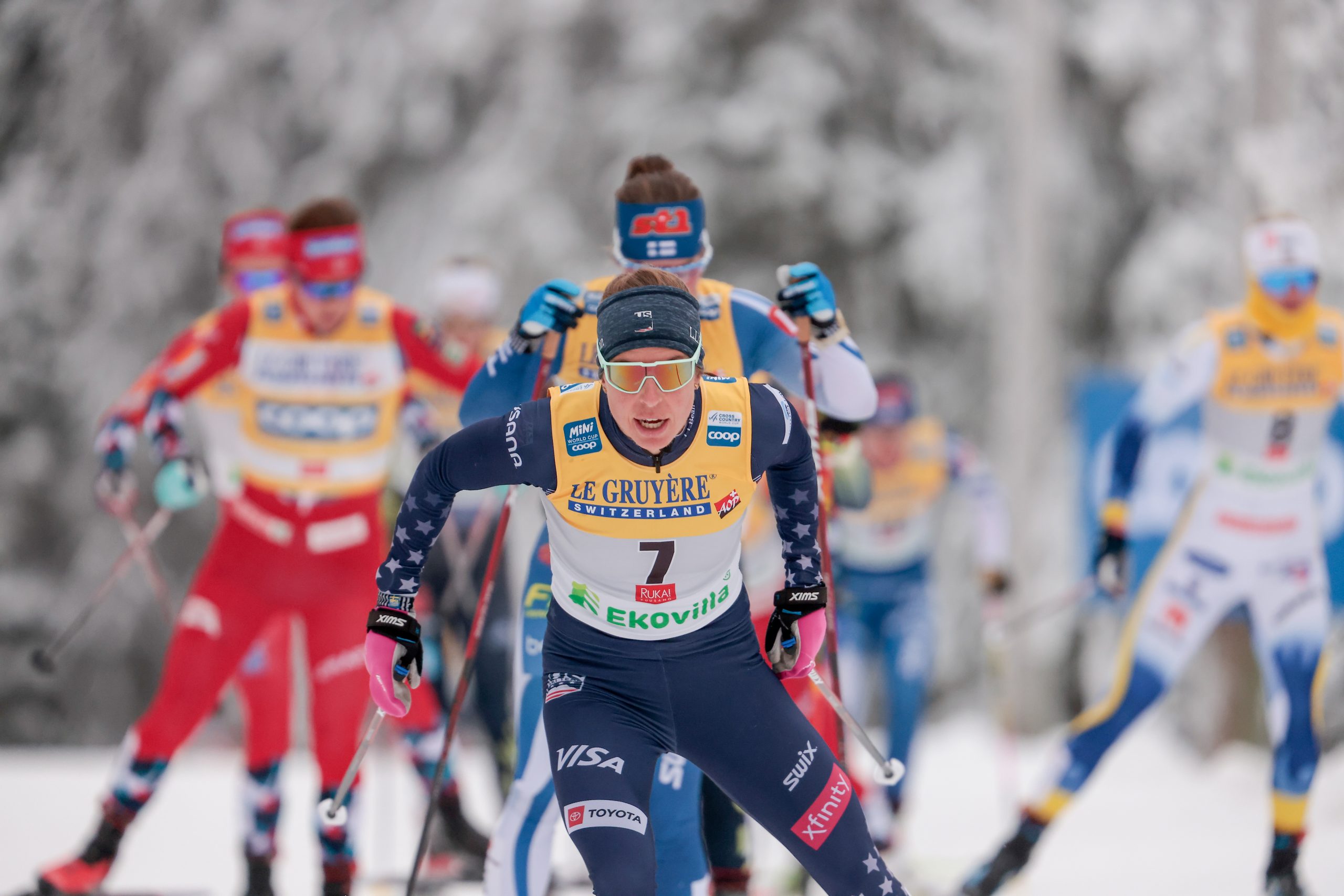
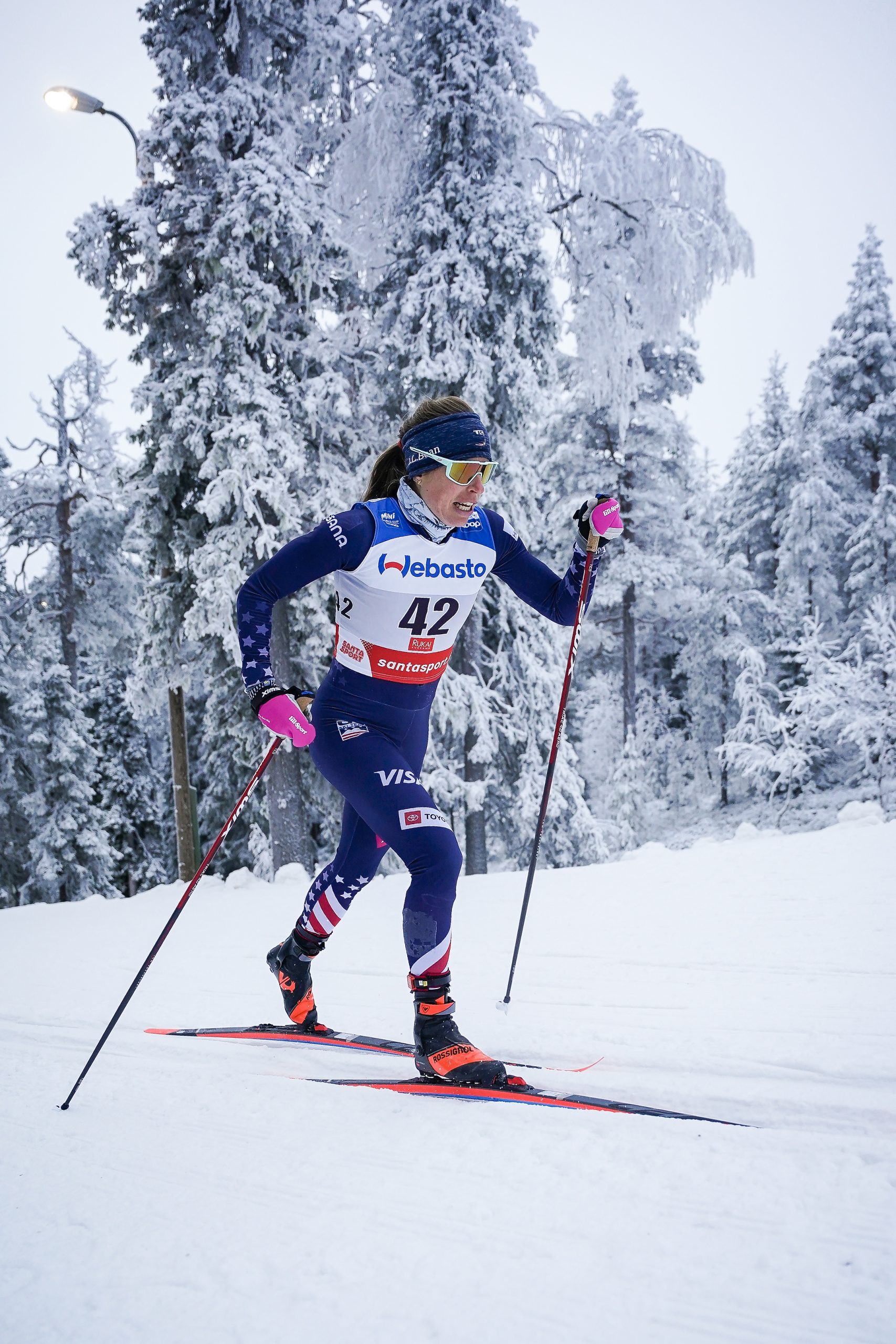
After her fourth-place finish in Friday’s Sprint, Jessie Diggins (USA) entered Saturday’s 20 k Skiathlon leading the season-long World Cup Overall chase: 34 points ahead of Emma Ribom (SWE). Rosie Brennan entered the day in third place in the World Cup overall standings, 33 points behind Ribom. Sitting first and third in the points standings, Diggins and Brennan lined up front and center for Saturday’s World Cup Skiathlon in Trondheim, Norway.
Trondheim’s World Cup Skiathlon delivered Ebba Andersson (SWE) her second victory of the season—the seventh World Cup win of her career—in conditions that proved challenging for athletes and ski technicians, alike. Ultimately, Diggins was able to finish second on the day, while Brennan pressed the pace early in the Classic leg before fading to eighth. Other American finishers included Nove McCabe 23rd, and Alayna Sonnesyn in 42nd. Julia Kern was originally slated to race, but it was reported before race time that she would not start. Among Canadians, Katherine Stewart-Jones finished 33rd, and Amelia Wells 46th.
Women’s 20 k Skiathlon
Skiathlon is a World Champinship and Olympic event—sometimes contested as a stage of the Tour de Ski—though on the World Cup tour it’s an event that is rarely scheduled more than once a season. Trondheim’s event also represented the first ever World Cup Skiathlon contested at the 20 k distance (usually it’s a 2 x 7.5 k), so this represented a significant opportunity for distance skiers. The Trondheim course offered two different courses—one Classic, one Freestyle—raced over three laps of 3.3 kilometers each.
Time checks at 3.9 k and 15.9 k offered a race-within-a-race, as World Cup bonus points would be awarded at those intermediate checkpoints. With the race for season-long World Cup being a closely contested affair in the early season, it appeared likely that someone would go out early in pursuit of those points. Andersson and Brennan obliged . . .
“I definitely knew that my Classic skiing has been going well this year,” said Brennan. “So, when my skis were good I thought I’ll try to keep pace with whoever’s leading . . . I feel like I’m in good shape, and it’s possible for me to ski 20 k with the lead. It’s always great when that also gets you some bonus points, but it’s rare that I start a race thinking that, but if you’re in the position I think it’s a good thing to go for.”
Andersson pushed to the front of the pack through the first lap, marked by Brennan and Astrid Oeyre slind (NOR). Andersson claimed the 15 points at 3.9 k ahead of Brennan and a group of chasers that formed behind them (led by Austrian, Teresa Stadlober, Olympic bronze medalist in this event). Andersson continued to lead through the end of the second Classic lap, with the chase group having briefly reeled in the breakaway as the field raced through the stadium. Andersson continued to press the issue in the final Classic leg, with only Brennan able to follow closely.
Unlike Diggins, Andersson didn’t ski the heats and finals in Friday’s Sprint competition. With Diggins having won the last two 10 k Freestyle competitions by 20+ second gaps, Andersson may have been hoping to establish an advantage before the start of the final freestyle leg, and she worked hard to enter the stadium at the end of the 10 k Classic leg with a lead of three seconds over Brennan, and 15 seconds over Diggins.
“My goal [in the Classic leg] was to stay smooth and smart, and just ski as relaxed as possible, Diggins said. “But then I realized I had awesome kick, but really really slow glide (which could’ve been my fault as a result of asking for more kick). Regardless, it meant that I was getting really dropped on the downhills. So, I started trying some alternative strategies—skating outside the tracks, skating at the far edge (nearly skiing off the track)—and that really helped. And I was proud of myself for getting creative.”
Diggins went on to describe the interior monologue that played out while she struggled through the Classic leg:
“[I realized] I’m not going to have the best classic leg, “ she remembered. “But if I can make it to the skate leg without blowing up, then I’m going to charge and really see what I can do.”
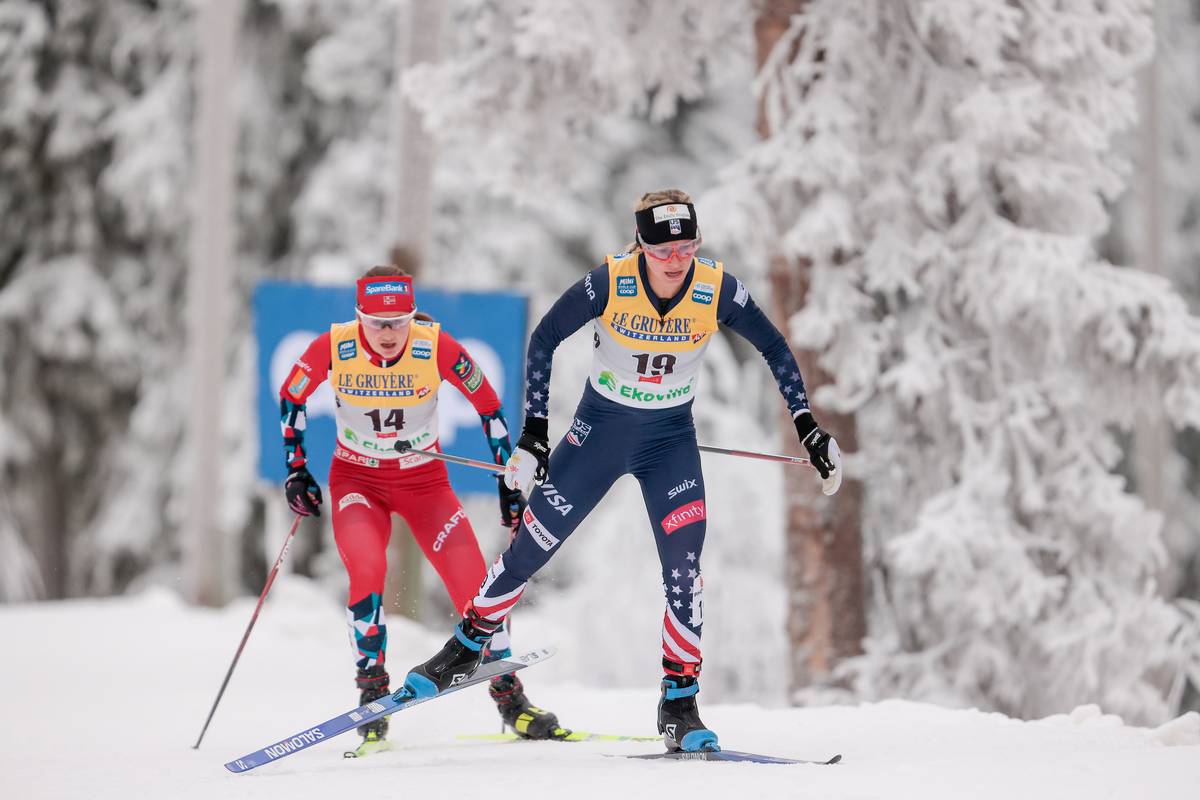
Jessie Diggins (USA) entered the transition zone 15 seconds behind the leader at the half-way point of Trondheim’s 20 k Skiathlon. Then she went to work . . . (Photo: Modica/NordicFocus)
Freestyle Leg
There were no apparent issues among the leaders in the transition from Classic to Freestyle, and all contenders exited the stadium in gaps similar to the way they entered. Diggins lost a few seconds in the transition, but she had narrowed her 20 second Classic deficit to 15 seconds before the exchange to Freestyle.
Diggins went to work—with Heidi Weng (NOR) in tow—quickly whittling down the gap to the group of early leaders, though Andersson had escaped off the front. Once the climbing began on the first Freestyle lap, Diggins pressed to the front of the chase group, her pace detaching Brennan and Victoria Carl (GER) as the group pressed forward in pursuit of Andersson.
Alone at the front, Andersson continued to ski strongly while Diggins cooperated with the other members of a chase group who seemed content to race for second. When Diggins would go to the front, the gap to Andersson would be reduced. When anyone else led (usually Stadlober) the gap to Andersson would widen. With one 3.3 k Freestyle lap remaining, Andersson enjoyed a gap of nearly 25 seconds.
Tactically, Diggins found herself somewhat isolated in her attempts to catch Andersson. “When I was leading, I was like ‘We’re gonna chase her down! We can totally catch her!’” she said. “But I wasn’t really getting the help I need in that endeavor.”
Diggins explained her tactical adjustments in the final lap of the Freestyle leg: “I had a lot of confidence from [yesterday’s] sprint,” she said. “I know if I can get around that top corner first, then I should be able to hold the gap . . . and that ended up happening!”
Ultimately, Andersson enjoyed a winning margin of just over 15 seconds, similar to what she had built at the end of the Classic leg. Diggins crossed the finish line alone in second, having carved into Andersson’s lead over the final kilometer.
Weng returned to the podium (for the second time this season) in third, Stadlober fourth, Slind fifth, Carl Sixth.
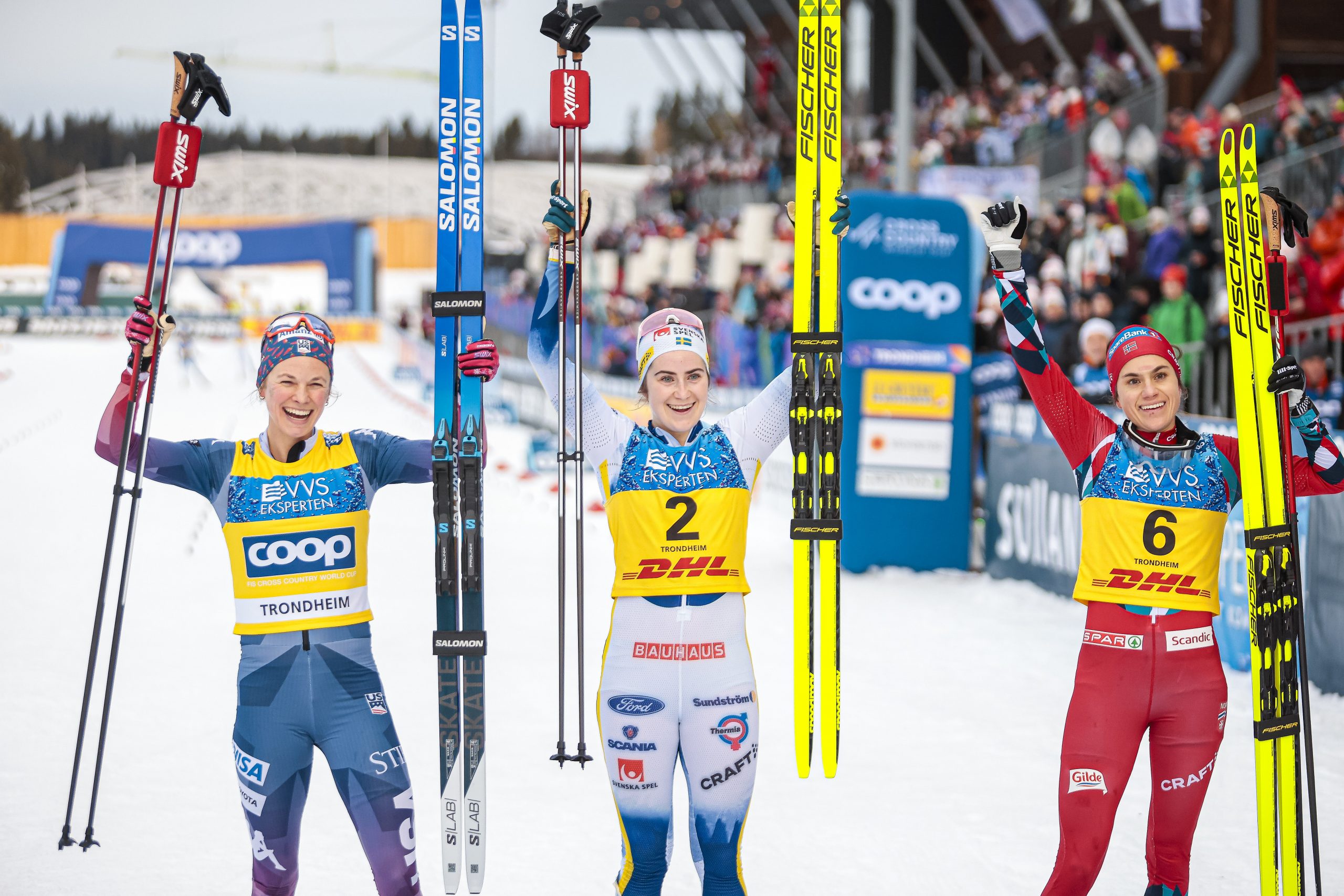
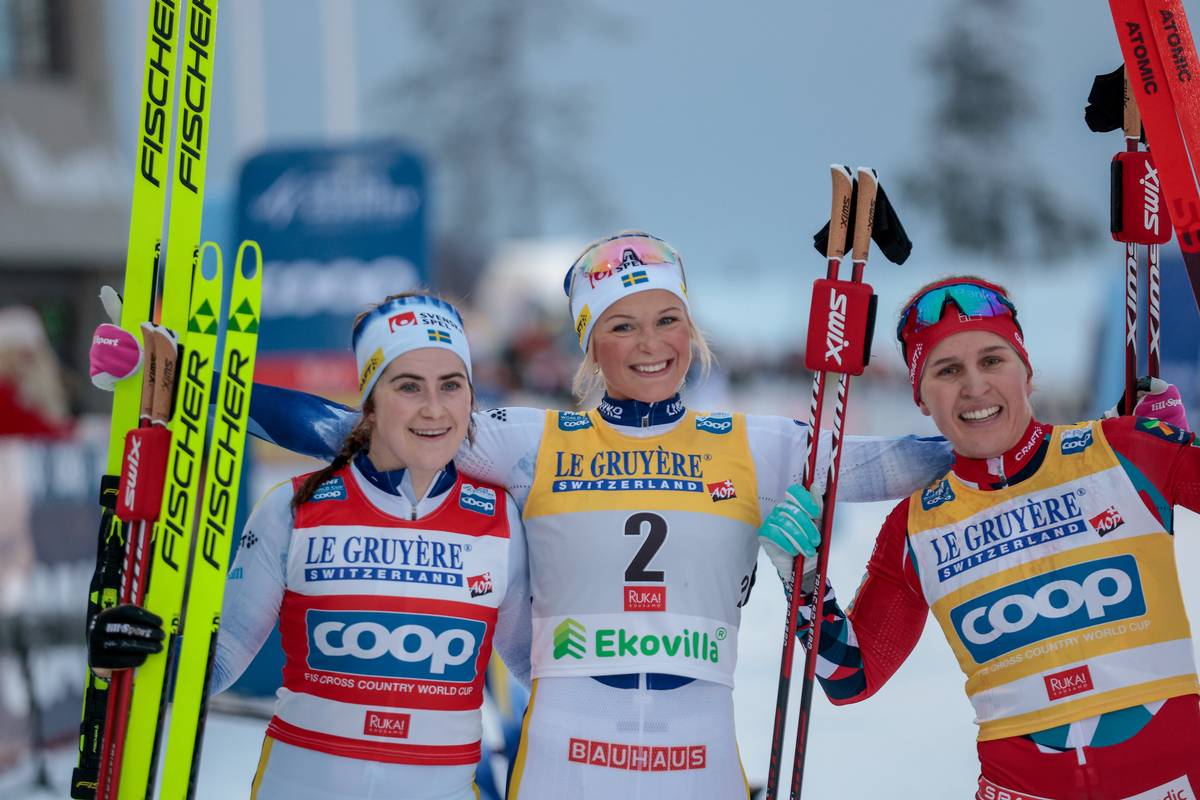
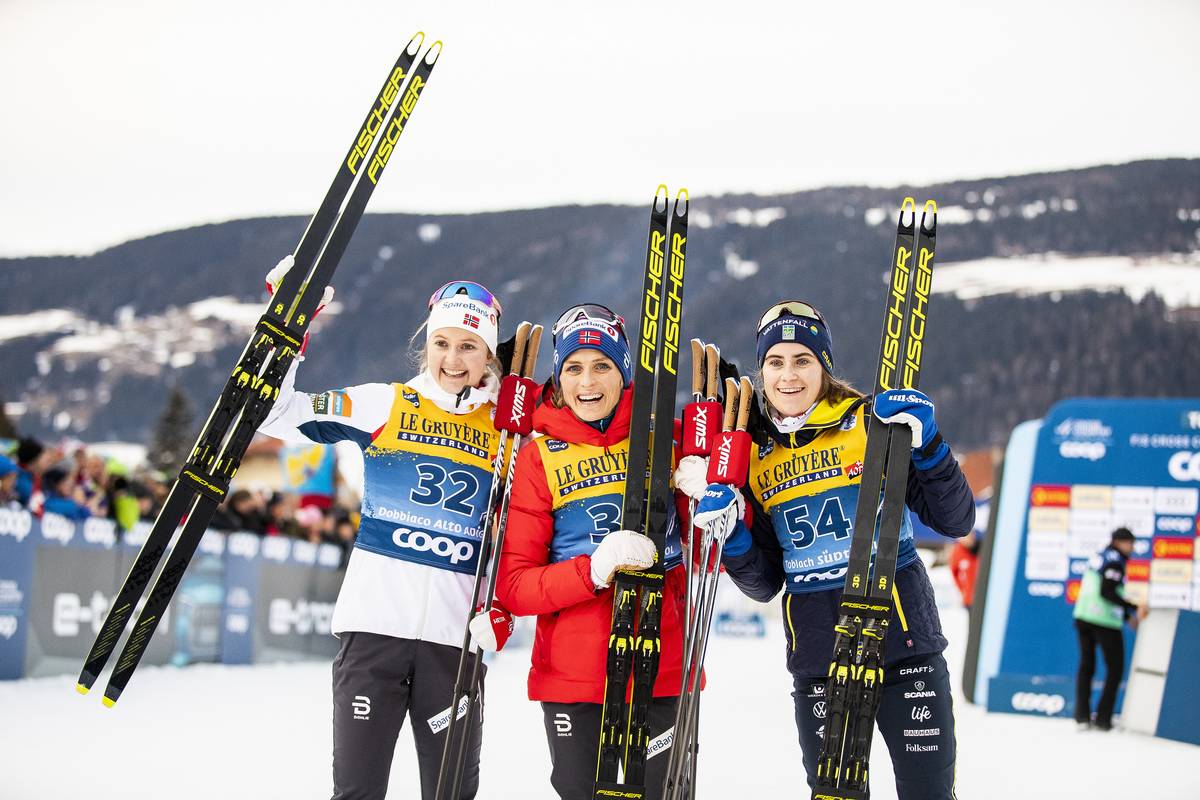
Jessie Diggins (USA), Ebba Andersson (SWE), and Heidi Weng (NOR), (l-r) celebrate their podium finishes in the 20 k Skiathlon in Trondheim , Norway. (Photo: Modica/NordicFocus)
This World Cup coverage is made possible through the generous support of Marty and Kathy Hall and A Hall Mark of Excellence Award. To learn more about A Hall Mark of Excellence Award, or to learn how you can support FasterSkier’s coverage, please contact info@fasterskier.com.
As dominant as Swedish women’s racing has been this season, it’s hard to imagine that a Swedish woman has never won a Skiathlon at the World Championships. The Swedish women were looking to break that streak; given the incredible run they have been on, it seemed that the odds were in their favor.
But Norway was still lurking, hoping to upset Sweden’s shot at history. The Americans were also waiting in the wings with Rosie Brennan (USA) vying to claim America’s first gold medal in an individual distance event at a World Cup Championship.
Jessie Diggins (USA) took the day off: as she had said in her pre-World Championships press conference, she did not intend to ski every race. U.S coach Chris Grover informed FasterSkier that she will be skiing the team sprint tomorrow along with Julia Kern. He also shared the news that J.C. Schoonmaker and Ben Ogden would be the men’s team.
After a warm day of racing, it was Sweden coming out on top again with Ebba Andersson taking the victory. She was followed by teammate Frida Karlsson. In a feel good story, Astrid Oyre Slind (NOR), who was called up to race as a last minute replacement, finished third. Slind is a long-distance specialist, competing on the Ski Classics tour, and in the warm Planica weather she stood out as she cut off her tights and turned them into shorts.
Rosie Brennan (USA) sharing the story of her struggles with teammate Sydney Palmer-Leger (USA) after the Skiathlon’s completion. Brennan’s broken binding spoiled what had been a promising day for the American. (Photo: NordicFocus)
The Americans’ day was mixed with success and heartbreak. Rosie Brennan had a soul rattling outing. While she was skiing with the leaders, a binding broke and her ski fell off. She ended up finishing 19th. Newcomer Sydney Palmer-Leger had a breakout day finishing 20th. Haley Swirbul was 26th, followed by Sophia Laukli, 29th.
For Canada, Katherine Stewart-Jones was the top finisher in 25th. Behind her were Jasmine Lyons 34th and Olivia Bouffard-Nesbitt in 40th.
Women’s 15 kilometer Skiathlon
It was a very warm day for the Women’s 15 k Skiathlon, as temperatures bumped up against the 50 degree mark. Most racers shed their hats, some took off their gloves, and in Slind’s case, converted her tights into shorts. According to U.S. coach Chris Grover, course officials decided to salt the course the night before the race.
While course conditions were the subject of much post-race discussion, Grover said that he thought, “in general, for how warm it was…the course was probably in as good as shape as it could have been.”
The day began with high hopes for the U.S. With Jessie Diggins resting, Rosie Brennan became the default front runner for team USA.
At the beginning all looked very good for the Americans. One kilometer into the race, skiing the classic section, Brennan was toward the front with Kerttu Niskanen (FIN) and Krista Parmakoski (FIN) setting the early pace. They were in a group with Frida Karlsson (SWE), Ebba Andersson (SWE) and Delphine Claudel (FRA).
Throughout the early stages, Brennan looked extremely strong and jockeyed for position with the leaders. Niskanen was still setting the pace using her classic technique prowess to try and establish an advantage before the transition to skating.
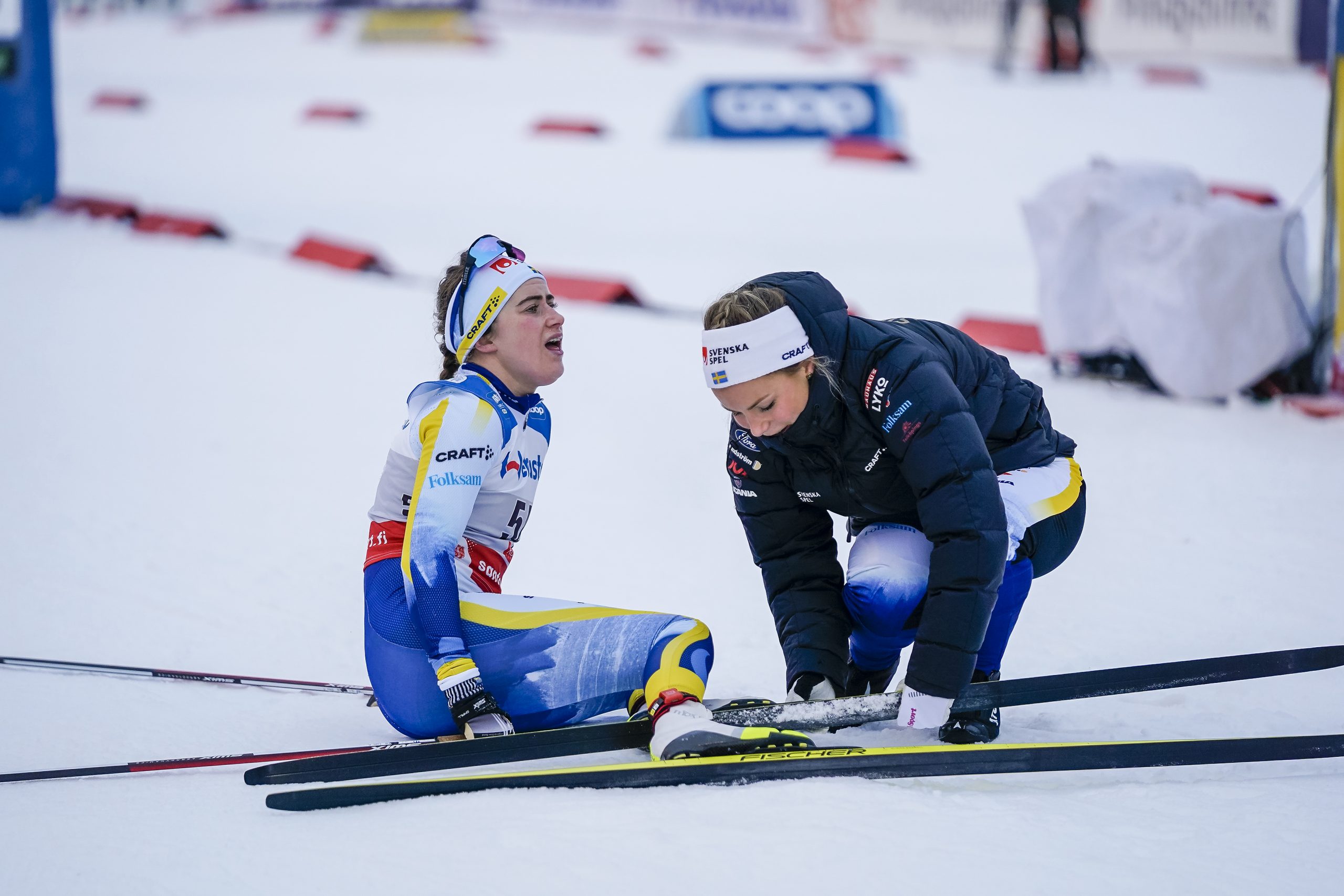
Rosie Brennan (USA) gamely stayed in the race after her binding broke and tried to make up time in the skate portion of the Skiathlon. (Photo: NordicFocus)
By the 3.8 kilometer mark, Andersson moved to the front of the pack with Slind joining the leaders. Brennan was right in the mix in eighth place, skiing with the leaders, and appeared to be skiing the race she wanted to.
It was at about the five kilometer mark that the wheels came off for Brennan—literally. As she was going through a corner, her binding broke sending her ski flying. Brennan immediately collected her ski and pushed herself along with one foot as the leaders sped away from her. After the equipment failure, Brennan moved from being in the front of the field to being forty seconds behind the leaders. By the time she reached the ski exchange, she was over a minute behind the lead. It was a deficit which would be impossible to overcome.
When the leaders reached the ski exchange, Andersson, Karlsson, Slind and Ingvild Oestberg (NOR) were in a virtual dead heat.
As the skate portion of the race unfolded, Andersson began to assert herself, putting a six second gap on Karlsson with Niskanen and Slind about 20 seconds behind. Anderson continued on a grinding pace which the rest of the group could not match. At 10 kilometers she had put another 10 seconds on Karlsson, but then Andersson fell on a downhill and opened the door for teammate. But Karlsson couldn’t take advantage of the fall as Andersson jumped to her feet quickly and only lost a few seconds. Karlsson was able to stay in touch through the 13 kilometer mark, but couldn’t make any progress reeling Andersson in. At about the 14 kilometer mark, Andersson found another gear which no one else could match, and she extended her lead to almost 20 seconds.
At the finish, Andersson was comfortably in the lead, finishing 22 seconds ahead of Karlsson. Slind had hung on to finish third about 48 seconds back, making her last second race call up a heartwarming story.
But, after the race, all the talk was about Brennan and what could have been.
In the reporters’ mix zone, Brennan—always the consummate professional—took events in stride when she elaborated about her days’ problems. “Everyone was putting on the brakes, and I did too, and I caught some slush and the binding came off the ski. It makes it kind of hard to go when you have only one ski.” Despite her equipment issues, Brennan sounded energetic and optimistic. She commented that her bad luck seemed to attract a great deal of media attention. With a mix of humor and irony she said while laughing that, “this is the most I’ve ever been stopped in the mix zone, and for one of the worst races…I don’t know what that says about the state of the world. People should be more concerned with the good things, not the bad things. Today is a day we can all forget about.” Brennan hadn’t initially realized that the binding had come off and tried to put the ski back on. After figuring out that her equipment was broken, she found coach Jason Cork for a replacement ski. But the damage was done: the pace at the front didn’t slacken and there was no catching up. Brennan had contemplated stopping, but just for a moment. “When you show up at a Championship, you’re here to represent your country and you always give it your all until the end. I decided to keep fighting until the finish. I felt great up until that point.” Brennan was not injured from the impact.
U.S. coach Matt Whitcomb was about three minutes away from Brennan when she fell. He said, “Jason [Cork] got her one of her skis…it did have race wax on the glide zones. But the time was lost, and you’re no longer in contact with people skiing your pace.” He continued that, “we’re grateful that she’s ok…we can move past this. She looked great [before the fall] and was controlling the pace up the hills.”
Grover told FasterSkier that, “She was skiing really well when this happened.” From the team perspective it hurts, but Grover elaborated that “it is part of sport…everyday there are some favorites that end up with some bad luck.”
Sydney Palmer-Leger (USA) provided the highlight for team USA. She finished 20th in her first World Championship race and her first Skiathlon. (Photo: NordicFocus)
Brennan’s disappointment was tempered some by the standout performance of Sydney Palmer-Leger (USA), who finished 20th. Today was Palmer-Leger’s first World Championship race and first Skiathlon competition ever. She told FasterSkier that she was able to avoid the crashes which claimed so many skiers. She said that her background as a bike racer helped her prepare for the Skiathlon. “The transition went pretty well. I’m used to calming myself down.” She continued that “the corners were sketchy…you needed to carry speed through the corners, not slow down. I don’t think snow plowing was the best move.” She added that, “I just turned 21, so getting top 20 at my first World Champs is pretty amazing.”
Grover added that the team took solace in Palmer-Leger’s performance. “It was definitely the high point of the day,” Grover said. “It was really fun to see that half way through the classic section she was just off the lead group, so she was really holding her own.”
Sophia Laukli (USA) overcame her own adversity to finish 29th in the Skiathlon. (Photo: NordicFocus)
Sophia Laukli also had her difficulties, falling twice. Her 29th place performance was all the more remarkable, as she shared with FasterSkier that she broke a pole on the second crash.
After the dust had settled, broken equipment repaired and collected, the day would be remembered as a continuation of Swedish dominance, a breakout performance by a new American star, and thoughts of what might have been for Rosie Brennan.
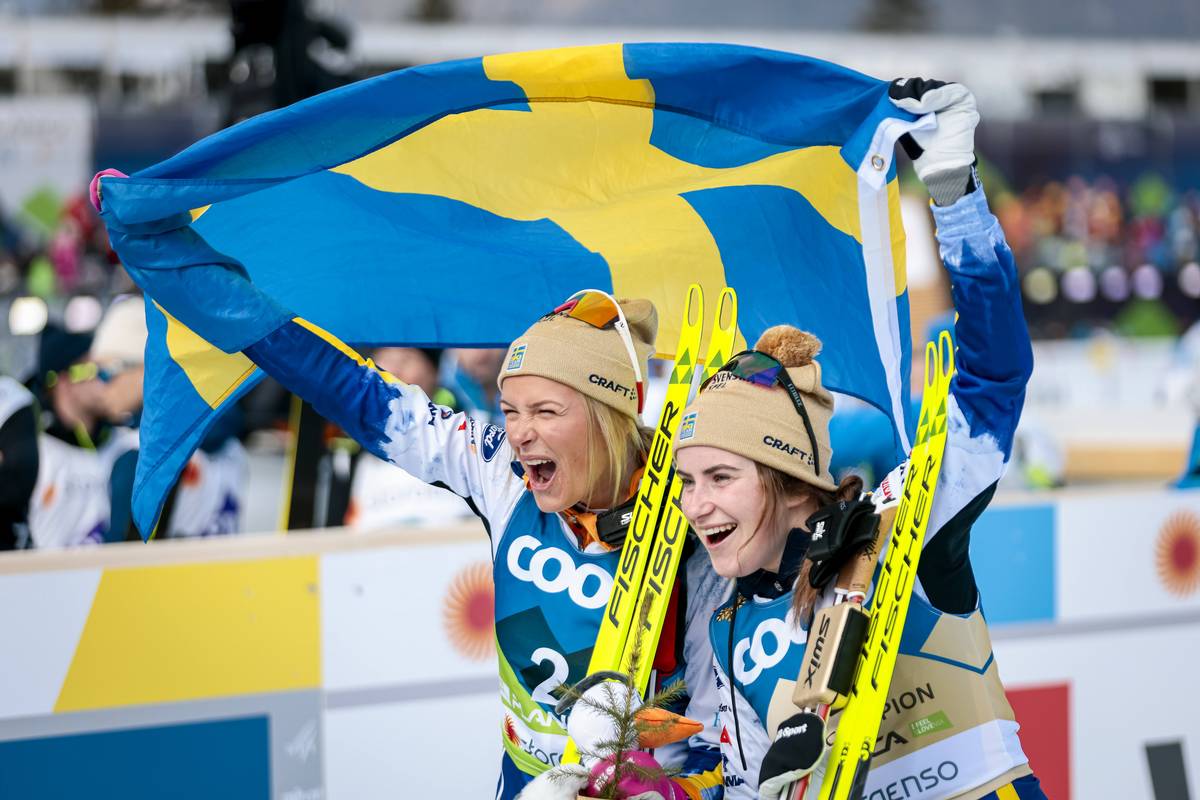
Frida Karlsson (SWE), Ebba Andersson (SWE), (l-r) celebrate Sweden going 1-2 in the women’s Skiathlon in Planica, Slovenia (Photo: NordicFocus)
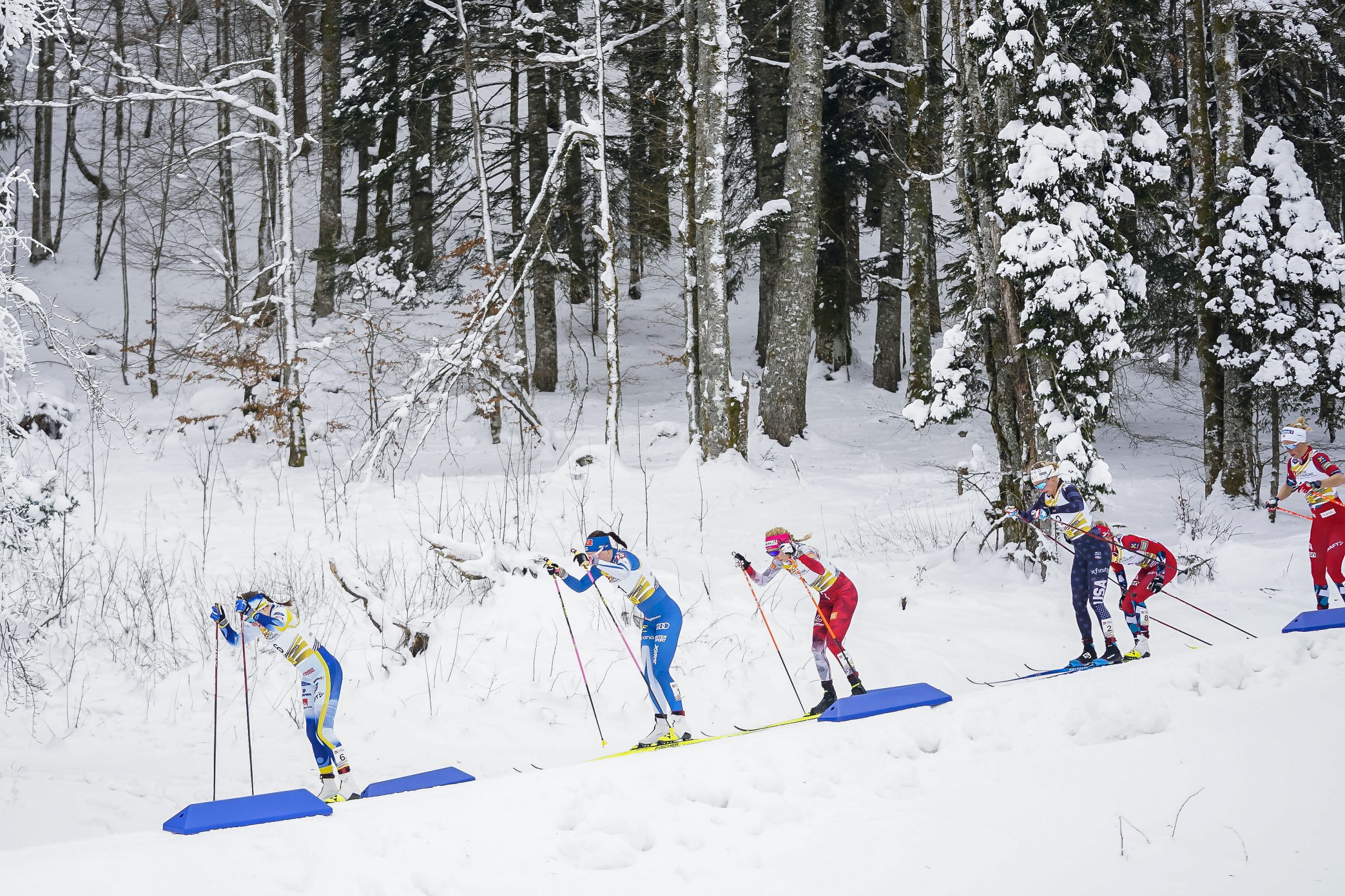
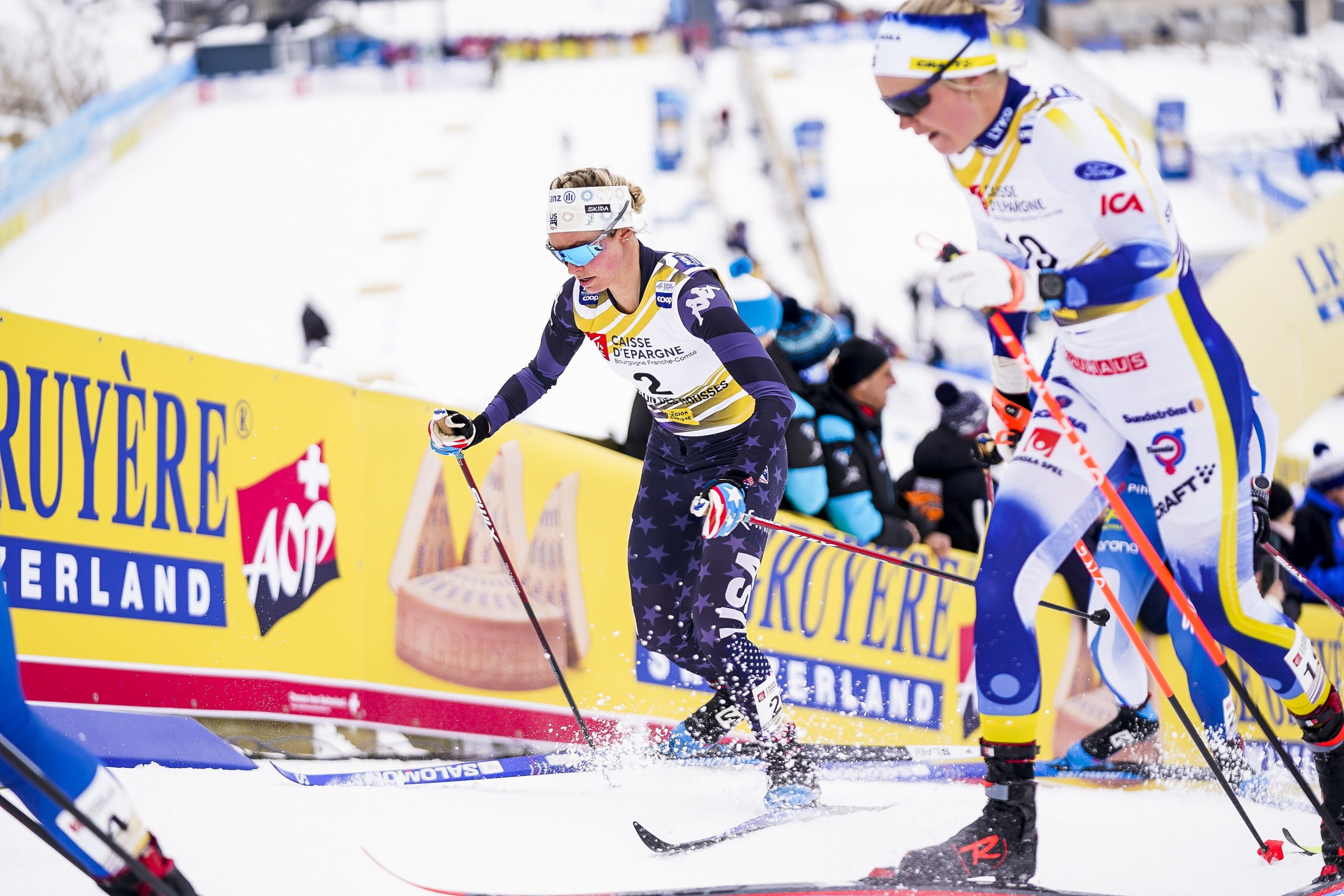
Today, the women competed in the final day of World Cup racing in Les Rousses, France with the 20 kilometer mass start. The course consisted of six laps on a 3.3-kilometer loop. The course featured an extremely difficult early climb up the side of the venue’s ski jump which Jessie Diggins (USA) had said was about as steep as Alpe di Cermis in the Tour de Ski. The repeated ascents would test skiers’ ability both aerobically and technically, as they would have to navigate a tricky descent after each uphill effort.
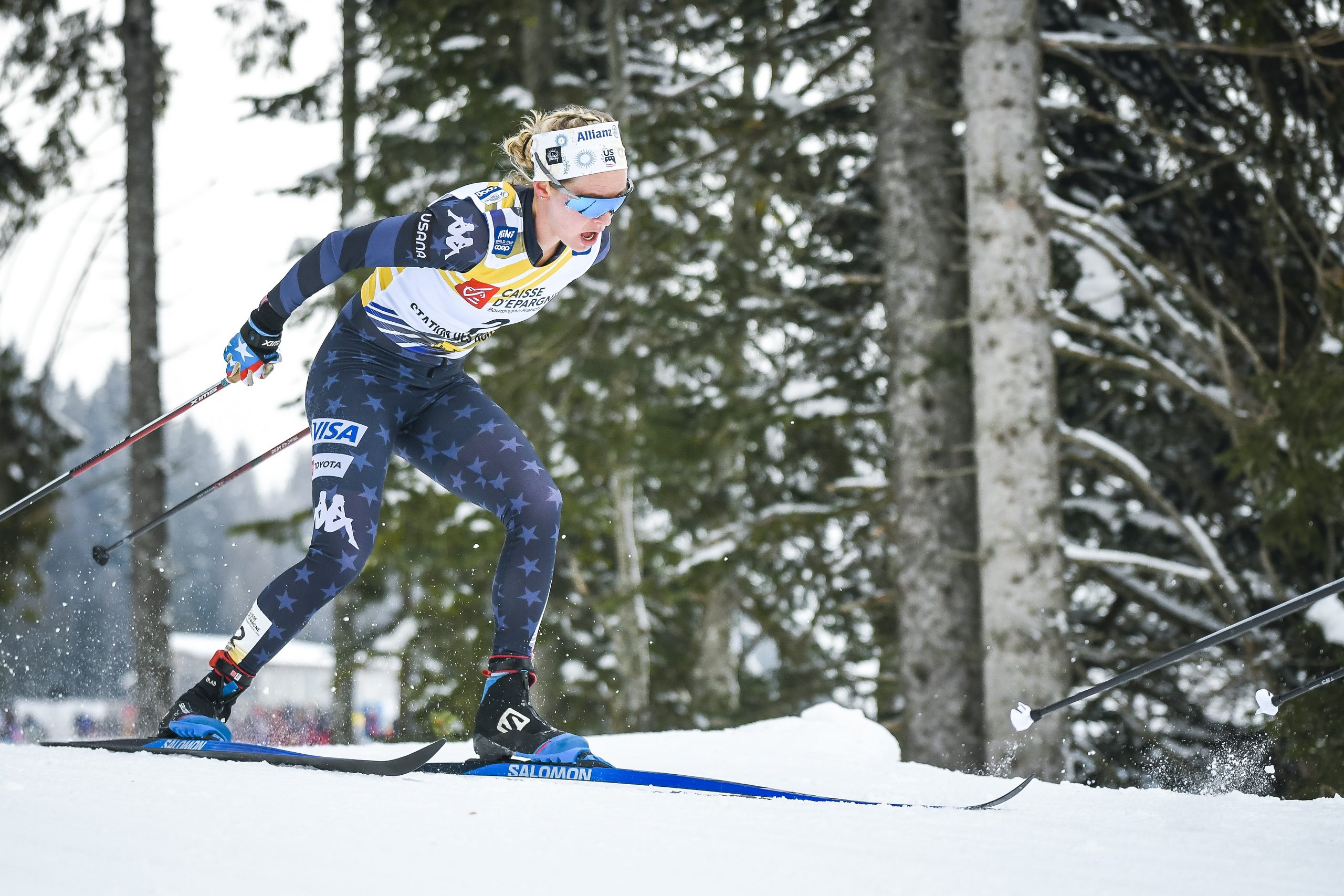
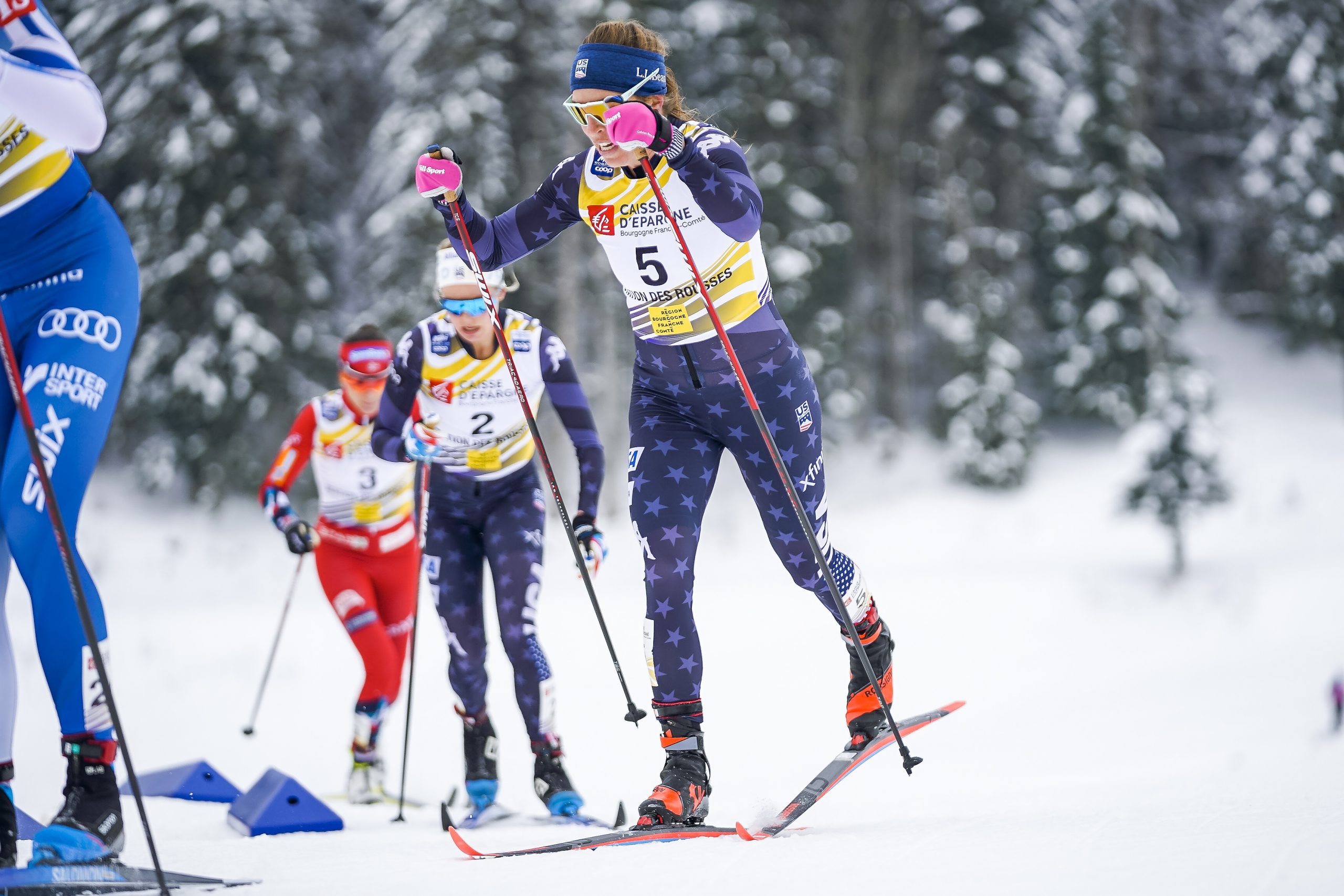
Jessie Diggins (USA) working her way to a ninth place finish in the World Cup 20 k Classic. (Photo: NordicFocus)
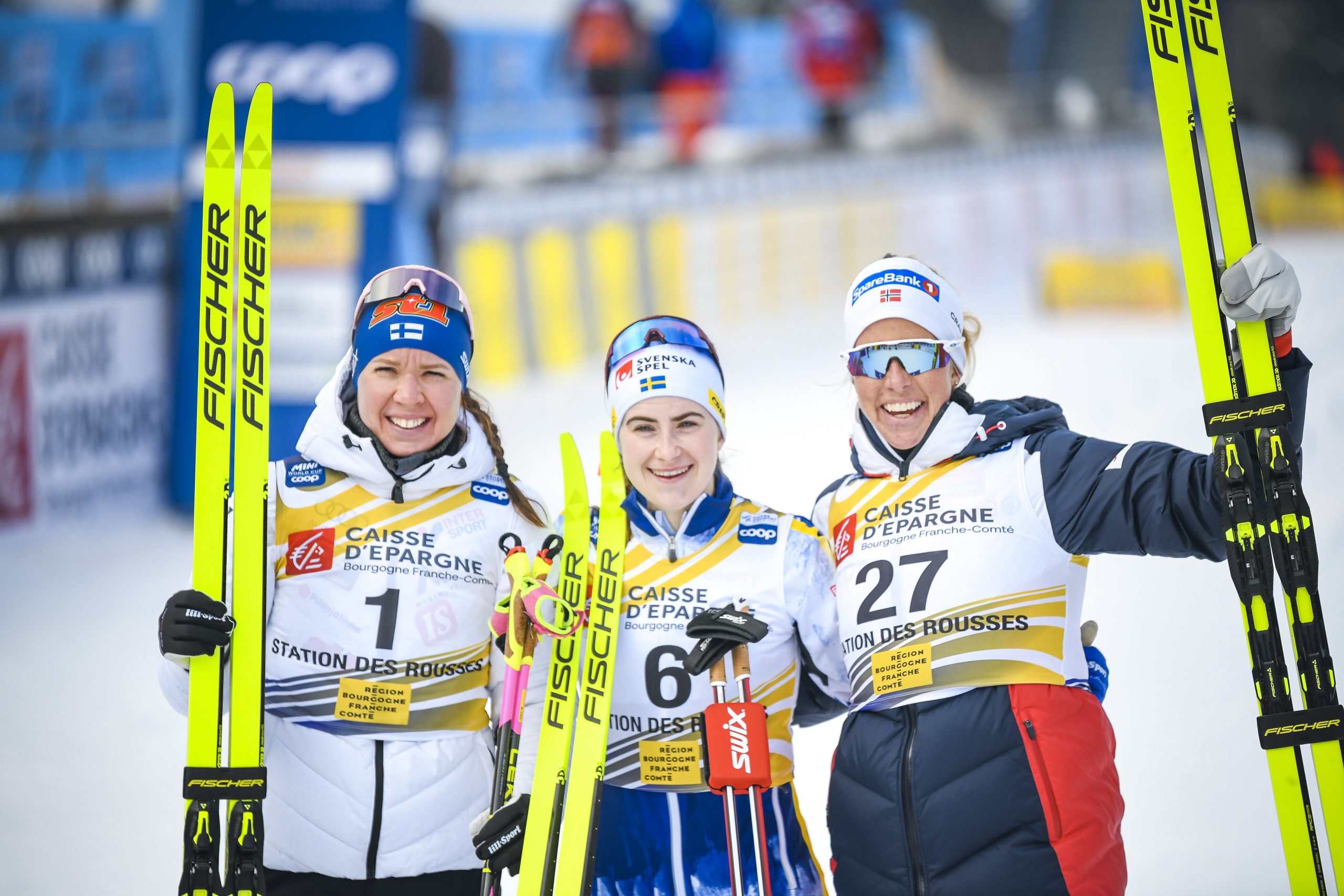
Finishing first was Ebba Andersson (SWE), followed by Kerttu Niskanen (FIN) and Astrid Oyre Slind (NOR). Jessie Diggins was the top American finishing ninth, 2:20 behind the leaders. Rosie Brennan was 12th, about 12 seconds behind Diggins. Other American finishers were Hailey Swirbul in 19th (3:30 out of first), Alayna Sonnesyn in 35th, Alexandra Lawson 39th, and Michigan native Sarah Goble in 40th. No Nordiq Canada team members were entered in today’s race.
After having reached yesterday’s sprint finals, Julia Kern (USA) did not start today’s race. According to U.S. coach, Kristen Bourne, it was a planned rest day for Kern; she was not suffering any ill effects from her injured thumb which had recently required stitches as documented in FasterSkier’s story yesterday.
Rosie Brennan (USA) giving it everything in Les Rousses, France. She would finish the 20 k Mass Start Classic in 12th place. (Photo: Thibaut/NordicFocus)
Le Rousses Women’s 20 k Mass Start
The undulating course broke up the field early on. The early lead was taken by Teresa Stadlober (AUT) who was seeking to become the first Austrian to win a World Cup cross country event. Those hopes were quickly dashed.
As the women navigated the steep climb, they were forced to slow to a painful herringbone simply to ascend the hill. The steep climb was followed by a quick descent with a sharp turn which the skiers had to navigate after having their legs blown up by the climb. Brennan described the climb to FasterSkier as “Incredibly steep.” Swirbul commented, “That hill was strange. On the first lap, I saw the skiers in front of me basically walking up it.”
At the start of the second lap, Niskanen—who excels at classic racing—jumped to the lead. She was followed closely by Andersson, Ingvild Flugstad Oestberg (NOR), and Slind. Stadlober had been gapped by the lead group.
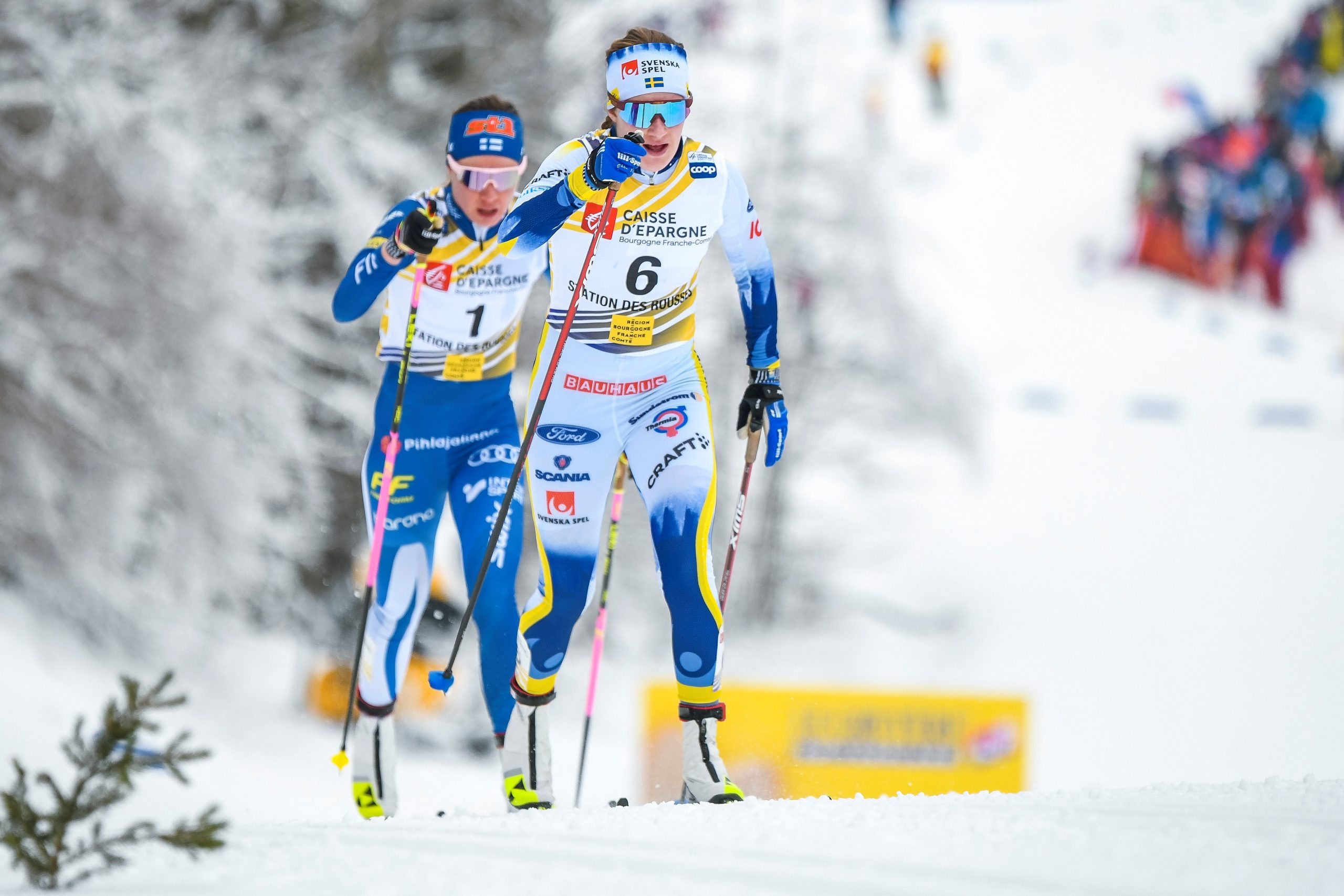
Ebba Andersson (SWE) and Kerttu Niskanen (FIN) battled for the lead most of the day. (Photo: NordicFocus)
Americans Diggins and Brennan had established a chase group ten seconds back with Brennan forcing the pace. But Brennan was unable to close the gap on the leaders. “I struggled with my skis today,” she said, “and didn’t have the glide I needed to be as competitive as I had hoped.” But, she was happy with the way she felt, “My body was in for the fight, and that’s encouraging as well.” The big hill and the weather proved challenging for wax technicians. As Bourne told FasterSkier, “It certainly was not a straight forward kick kind of day for us. There were sunny spots, and a mix of man-made snow and natural snow, so there’s variability throughout the course as well, so it’s not a super straight-forward place to figure out wax.”
As the third lap began, Niskanen continued to push the pace in a lead group which had been reduced to four skiers. Brennan and Diggins were in the middle of a chase group 15 seconds behind. By the time the skiers began the steep climb for the third time, the struggle navigating the ascent was clearly visible. Swirbul told FasterSkier that “It was comforting to know that everyone felt similarly about that hill, and many people seemed to treat it as a place to relax and save energy rather than push really hard.” Bourne added that “[The hill] was an added challenge trying to figure out how to pace the course. Quite a few of our athletes felt like you just had to make it through that section, then there are plenty of opportunities to push the rest of the course.”
After the third ascent, Andersson pushed ahead with Niskanen, reducing the lead pack to just the two skiers. Oestberg and Slind teamed up in a chase group of their own to try and regain the connection to the leaders. By the eight kilometer mark, the leaders had established a 13 second gap, with the Brennan/Diggins chase group 43 seconds back.
Hailey Swirbul (USA) battling Victoria Carl (GER) and Katherine Sauerbrey (GER). Swirbul continues to excel on the World Cup circuit, where she raced to 19th place today in Les Rousses. (Photo: NordicFocus)
As the leaders reached the half-way point, they had extended their lead to 30 seconds over Slind and Oestberg, who maintained a 40 second lead over the Brennan/Diggins chase group. The race pattern had become clear: Andersson would use her double poling strength to her advantage, Niskanen would then regain ground using her textbook diagonal stride technique.
At the start of the fourth lap Andersson made a break on Niskanen, when Andersson ignored hydration at an aid station and established a 10 second gap. Once again, Niskanen was able to use her beautiful classic technique to close the gap. It was now a game of cat and mouse between Andersson’s double poling strength and Niskanen’s diagonal stride.
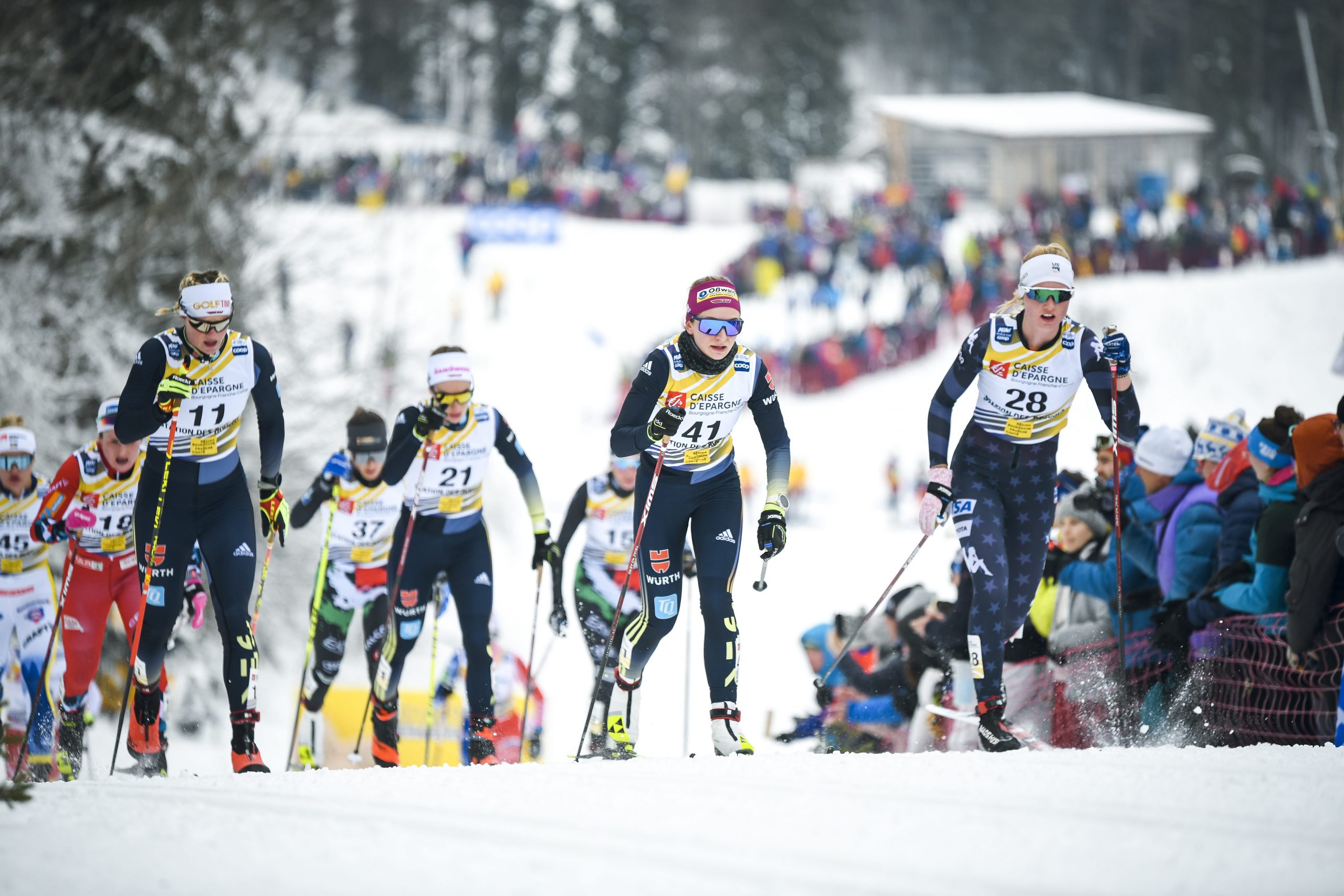
Ebba Andersson (SWE), Kerttu Niskanen (FIN), Teresa Stadlober (AUT), Jessie Diggins (USA), Silje Theodorsen (NOR), (l-r) early on in the 20-Kilometer Classic. Ultimately, Niskanen and Andersson would break away. (Photo: NordicFocus)
At 11 kilometers, the race story was boiling down to the two leaders fighting for first, and Slind and Oestberg fighting for third. The second chase group would be unlikely to reach the podium. Lead changes continued to epitomize the Andersson and Niskanen battle as the pair climbed the ski jump hill where Andersson again established an 11 second lead By the start of the final lap, the only remaining question was would Andersson be able to maintain her lead over Niskanen, and would the two Norwegians in the chase group establish a gap between each other?
Jessie Diggins (USA), like every racer, had to resort to herringbone to navigate the steep Les Rousses hills. (Photo: NordicFocus)
As the racers ascended the monster hill for the final time, it was clear that Andersson had established a big enough lead to hold off Niskanen and would be able to comfortably ski into the finish ahead of her rival. Meanwhile, Slind and Oestberg were caught in an intractable struggle to the finish, neither of them giving an inch. Slind and Oestberg fought right to the finish, sprinting into the final stretch. Slind went into a double pole frenzy which her country woman was unable to match. She nipped Oestberg by four seconds.
As the second chase group came to the finish, Brennan and Diggins had fallen off the pace and it was the sprint standout Emma Ribom (SWE) who used her sprint power to charge across the finish line in fifth.
Rosie Brennan (USA) pushing her chase group forward. Brennan would finish 12th. (Photo: NordicFocus)
Diggins would finish ninth, 13 seconds behind Ribom, with Brennan in 12th. Hailey Swirbul was the third American to cross the finish having an excellent day finishing in 19th place. Swirbul appears to have acclimated well to the transition to Europe once her initial illness was behind her. She commented “That was as good of an outcome as I could have hoped for with a hill that crazy!”
It was an exciting race and a beautiful day to finish racing in France.
This World Cup coverage is made possible through the generous support of Marty and Kathy Hall and A Hall Mark of Excellence Award. To learn more about A Hall Mark of Excellence Award or to learn how you can support FasterSkier’s coverage please contact info@fasterskier.com.
Women’s 20K Pursuit.
Today, Ruka, Finland was home to the inaugural running of the women’s 20K pursuit. The format is now a 20-kilometer skate race with interval starts based upon skiers’ finishing times taken from yesterday’s classic race. The weather has stayed consistent over the weekend. Temperature at the start was 21 (-6.0 Celsius). The humidity has been high all weekend, this morning it was 93 percent.
Frida Karlsson (SWE) celebrates the victory as she nears the finish of the 20k pursuit in Ruka (FIN). (Photo: NordicFocus)
The course was different from yesterday’s 10-kilometer race. Skiers raced six laps on a 3.33-kilometer course.
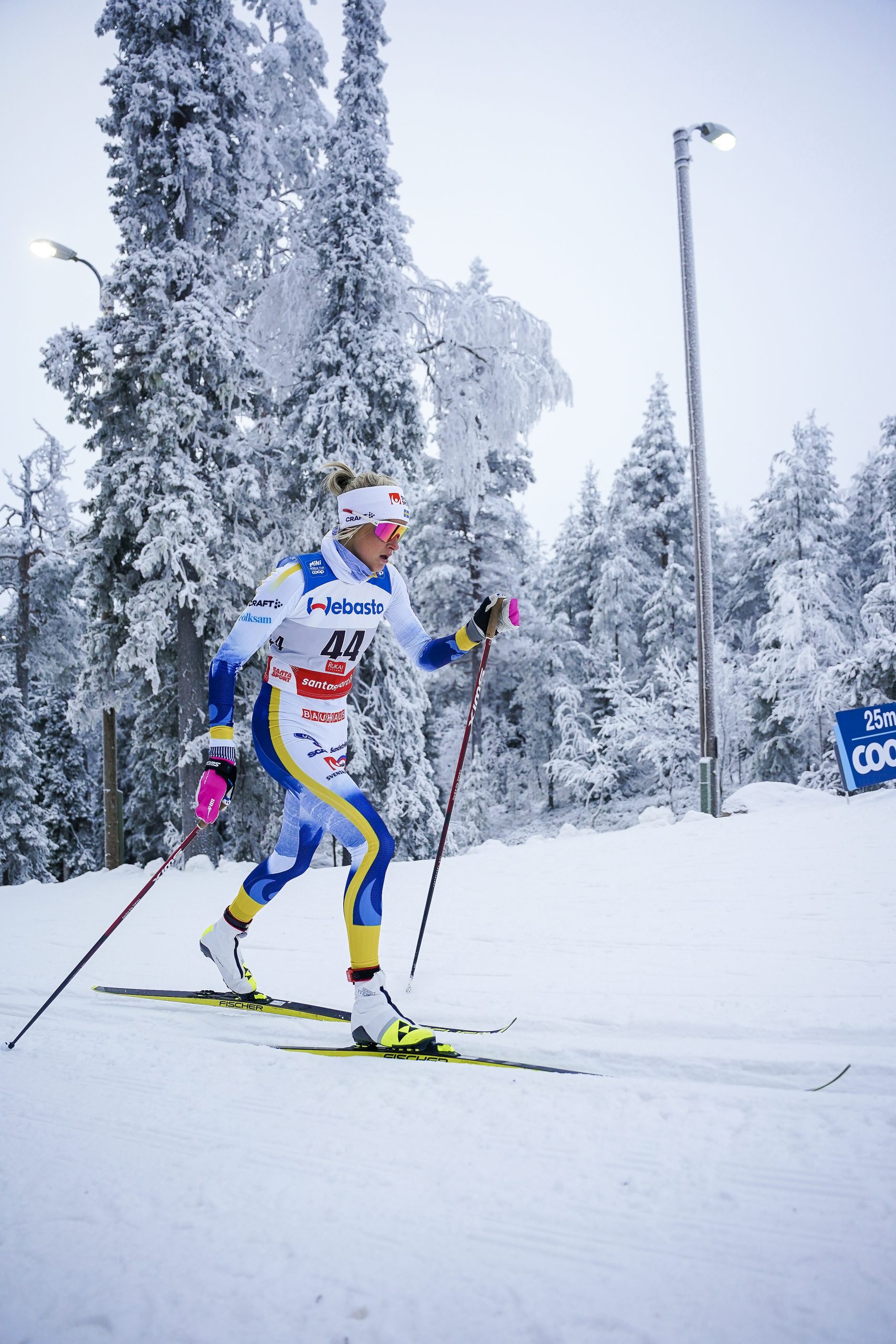
Ebba Andersson (Sweden) started first with a six second advantage over Frida Karlsson (Sweden) and 13 seconds over Katharina Henning (Germany).
American Rosie Brennan started 29 seconds back. Her teammate Jessie Diggins started at plus 1:18. Diggins usually performs well in this format but had a long way to come back to reach the podium. However, the new longer format could work to her advantage. The other Americans, Novie McCabe, Sophia Laukli, Alayna Sonnesyn, and Julia Kern, all began over two minutes after the starting gun.
Prior to the race Rosie Brennan expressed her excitement on the 20-kilometer format. “I’ve never done 20k on the world cup, but it is a distance I’ve done in the U.S. before, it’s super tight at the top ten and it will be fun and exciting.”
The Results.
First: Frida Karlsson (Sweden)
Second: Ebba Andersson (Sweden)
Third: Tiril Weng (Norway)
Fourth: Heidi Weng (Norway)
Fifth: Silje Theodorsen (Norway)
Sixth: Rosie Brennan (U.S.A)
Seventh: Maja Dahlqvist (Sweden)
Eighth: Anne Kalvaa (Norway)
Ninth: Krista Parmakoski (Finland)
Tenth: Jessie Diggins (U.S.A.)
Other American finishers: Novie McCabe, 25th, Alayna Sonnesyn 33rd, Sophia Lauklia 34th, and Julia Kern 35th
Jessie Diggins (USA) leads Ingvild Flugstad Oestberg (NOR) during the 20k pursuit. (Photo: NordicFocus)
The Race.
One minute before the race, competitors were part of one of the stranger sights at a World Cup start. The entire field of athletes were holding their hands over their ears trying to block the incredibly shrill piercing noise of the pre-race alarm going off. It was much like the frequency of a smoke detector. The athletes were visibly bothered, but the race began without a hitch.
Within the first two minutes, Karlsson had closed the initial gap on Andersson. The unanswered question arose: was this intentional team tactics to try and work as a group or was it simply two skiers racing?
At the 1.1-kilometer mark, Brennan had reduced her deficit by three seconds, and was only six seconds out of third place. Diggins had already shaved six seconds from her deficit moving into 19th place.
Pacing for the new 20-kilometer distance was going to be a challenge. It remained to be seen how racers would manage the new event. Brennan hooked up with a seven-person chase pack at about 2.5-kilometers. It included Maja Dahlquist, Heidi Weng, Tiril Weng, and Anne Kalvaa. Kalvaa had put in a strong performance yesterday, barely missing out on a podium.
By the 3.3 mark, the leading Swedes had slightly extended their advantage over the chase group. Brennan was 27.6 seconds back. But the lingering question of whether the leading Swedes were working together had been answered: they were.
Rosie Brennan (USA) leads the chase pack during the 20k pursuit. (Photo: NordicFocus)
At the 3.3-kilometer mark Diggins was 1:03.8 behind the two leaders and was now skiing in a group. She had trimmed 15 seconds from her original deficit. But the lead Swedes continued to press their advantage, increasing the gap on the next chase group by another couple of seconds at the 4.4-kilometer time check.
Going into the 6.6-kilometer mark, the lead Swedes continued to swap spots, while the chase group had now increased to ten racers. Brennan—perhaps realizing that the pace was not good enough to catch the leaders—moved to the front of the pack, but the group was still bleeding time to the lead Swedes, now 38.3 seconds behind.
Meanwhile, the second chase group—which contained Diggins—was working hard. Diggins was now only 57.2 seconds behind with over 13-kilometers to go. But, closing the gap to the next chase group would be a monumental task.
At 7.7-kilometers Brennan was clearly trying to push the pace and began to try and pull away from the rest of the chase group.
By the halfway point, the lead Swedes had extended their lead over the chase group to 49 seconds. It appeared that much of the chase group had given up the hunt and were jockeying for third place. Their pace had slowed enough to allow Diggins to join the group. At this point the chase group had swelled to twelve athletes with Diggins tucked in the middle.
Meanwhile, the front running Swedes calmly exchanged the lead, skiing in tandem, in almost perfect rhythm which each other.
At the start of the fifth lap, if any doubt had remained, it was clear that the chase group was now competing for third place. The chasers were about 50 seconds behind the leading Swedes.
27.11.2022, Ruka, Finland (FIN): Frida Karlsson (SWE),- FIS world cup cross-country, pursuit, Ruka (FIN). www.nordicfocus.com.
It was at this point that Norway tried to assert itself as a wave of red suits went to the front of the chase group. But Diggins would have none of it, and at 14.3 kilometers she had broken through the Norwegian wall and pushed herself to the front of the pack and was now in third place overall, having started the day in 19th.
With 3.5-kilometers to go, race tactics took over as the skiers in the chase group began to position themselves for what would surely be a sprint finish. The chase group was now over a minute back from the leaders, but it didn’t really matter as the top two spots had been conceded.
At the front of the race, Karlsson put in a gigantic turn of speed to establish a small gap over Andersson. It was the first time since the start that there had been any space between the two Swedes. Karlsson then shot up the next big climb putting several more seconds on her compatriot.
27.11.2022, Ruka, Finland (FIN): Rosie Brennan (USA) – FIS world cup cross-country, pursuit, Ruka (FIN). (Photo: NordicFocus).
At about the same time, the chase group pushed the pace and began racing for third.
With 2.4 to go Karlsson had amazingly gapped Andersson by over 18 seconds; a remarkable push to the lead in the short span of only 1.1-kilometers.
By the time the chase group reached 2.4-kilometers to go, the Norwegians created a gap on much of the group; fracturing it. Kalvaa went to the front trying to earn the podium spot which had barely eluded her yesterday.
Diggins gamely held onto the surging Norwegians. She then jumped to the front of the group with about 1.5- kilometers to go trying to break the Norwegian red suits. Having committed so much energy into making up her original deficit would she have enough left to gain a podium spot?
Julia Kern (USA) on her way to 35th place. (Photo: NordicFocus)
While the rest of the field was still fighting, Karlsson calmly skied across the finish line having broken away from Andersson, never looking back. Karlsson had put in such an impressive burst of speed that she ended up finishing 33 seconds ahead of Andersson.
Coming into the stadium the large chase group mounted a frenetic charge toward the finish with Diggins remarkably out front. But it was too much to ask, even for Diggins, as she faded slightly going up the final hill and the Norwegian skiers swallowed her up. Diggins eventually slowed up the final hill, as she stumbled slightly, but American hopes were kept alive as Brennan asserted herself and moved into third position in the chasse group. Coming into the finishing straight it was T. Weng, H. Weng, and Brennan.
Brennan gave it everything and tried to outsprint the Norwegians, but she fell just short as T. Weng, H. Weng and Silje Theodorsen beat her out at the finish. Brennan, having started seventh, ended up finishing sixth, in a photo finish with Theodorsen, missing the podium by just under one second!
Having started 19th, Jessie Diggins ended up in tenth, but, Diggins final placing didn’t reflect just how close she had come to making the podium as she lost several spots going into the finish. She ended up missing the podium by just eight seconds. A remarkable comeback.
Overall, the inaugural women’s 20-kilometer did not disappoint.
27.11.2022, Ruka, Finland (FIN):Jessie Diggins (USA) – FIS world cup cross-country, pursuit, Ruka (FIN). www.nordicfocus.com. .
After the race Karlsson said that she went hard from the start to maintain the gap and had planned to not push the pace until the final lap.
U.S. coach Matt Whitcomb was pleased with the day. “We are satisfied with our opening World Cup weekend. We had some very good results, but not as many big fireworks compared to what we are capable of. This is the fourth year of a team strategy of not doing a longer training camp prior to the first weekend of racing. The idea is that we shorten the amount of time on the road between day one, and World Championships. It’s a strategy to win races in February. Next season, we’ll consider a longer pre-camp, as it’s a non-championship year, and a good opportunity to test our strategies and try new things.”
This World Cup coverage is made possible through the generous support of Marty and Kathy Hall and A Hall Mark of Excellence Award. To learn more about A Hall Mark of Excellence Award or to learn how you can support FasterSkier’s coverage please contact info@fasterskier.com.
Ebba Andersson (SWE) on her way to victory in the women’s 10k classic in Ruka, Finland. (Photo: NordicFocus)
Women’s 10K Interval Start:
Today began a new chapter in World Cup racing as women and men competed at the same distances on the same course for the first time ever. This also marked the first distance competition since the retirement of Therese Johaug. With that competitive force no longer dominating the races, it would be left to the field to decide who would lead it into the future.
The Results:
The race was won by Ebba Andersson of Sweden, followed by Frida Karlsson of Sweden, and Katharina Henning of Germany. The top American was Rosie Brennan finishing in seventh place, 29 seconds out of first. Jessie Diggins was the second American, finishing 21st, 1:18:0 out of first place. Rounding out the field for the Americans were Novie McCabe in 39th, 2:03.4 back. Sophia Laukli in 45th, 2:26.2 back, Alayna Sonnesyn in 49th 2:38.4 back, Julia Kern 51st, 2:49.7. The top Canadian was Katherine Stewart-Jones, followed by Dahria Beatty and Olivia Bouffard-Nesbitt.
Ebba Andersson (SWE) earned the win in the season’s first distance World Cup, the 10km classic individual start at Ruka, Finland. (Photo: NordicFocus)
The Race:
The women’s individual race in Ruka, Finland was held this morning in cold, overcast conditions. The athletes competed on a five-kilometer course with a mix of natural and artificial snow with temperatures around 17 degrees Fahrenheit (-8.0 Centigrade) at the start. Humidity was 93%. Conditions were favorable as skiers used a mixture of klister and hard wax for kick.
First out for the American’s was Alayna Sonnesyn starting in the 18th spot, followed by Novie McCabe in 22nd, Sophia Laukli in 23rd, Julia Kern in 25th, Jessie Diggins in 38th, and Rosie Brennan in 42nd.
Racing to an impressive seventh place finish, Rosie Brennan (USA) was the top American finisher. FIS world cup cross-country, 10km, Ruka, Finland. (Photo: NordicFocus)
Karlsson Jumps out to the Lead:
The steep hills of Ruka proved challenging as many skiers stepped out of the tracks to take advantage of loose snow going up hills. Most were resorting to herringbone on the second lap. Karlsson asserted herself early, taking a lead at the 3.1kilometer interval by ten seconds over Andersson by 6.5 seconds. Even so, by the 6.1 kilometer mark, Ebba Andersson took a 2.7 second lead over Karlsson. Henning was in third place, 9.5 seconds back. At this point, Rosie Brennan was 21.9 seconds back in sixth place.
Frida Karlsson (SWE) on her way to 2nd place. (Photo: NordicFocus)
Andersson Takes a Slim Lead:
By the 8.1 K mark Andersson’s lead had been reduced to the narrowest of margins, leading Karlsson by just 0.6 seconds. Henning had dropped back to fourth place, 8.5 seconds back. Brennan was in fifth place, just behind Heidi Weng who had a very fast second half.
Karlsson crossed the finish line and had to wait to see how Andersson would fare. Karlsson had looked very strong as she finished, but would it be enough to hold off the surging Andersson? As it turned out, Karlsson’s time in the winner’s chair was short-lived as Andersson ferociously attacked the last hill to make time on Karlsson. Anderson had an incredible final two kilometers and ended up beating her teammate by 5.7 seconds to give Sweden first and second place.
The surprise of the day was Anne Kjersti Kalva of Norway. Kalva missed the Olympics with Covid, but on this day she battled back to a fourth place finish, falling just two tenths of a second short of a podium finish.
Frida Karlsson (SWE) – second place, Ebba Andersson (SWE) – first place and Katharina Hennig (GER) – third place share the women’s podium of the 10k classic in Ruka, Finland. (Photo: NordicFocus)
And they’re off! The women take to the course in Stage 2 of the 2021 Tour de Ski, a 10-kilometer mass start classic in Val Müstair, Switzerland. (Photo: NordicFocus)
This World Cup coverage is made possible through the generous support of Marty and Kathy Hall and their A Hall Mark of Excellence Award. To learn more about A Hall Mark of Excellence Award or to learn how you can support FasterSkier’s coverage please contact info@fasterskier.com.
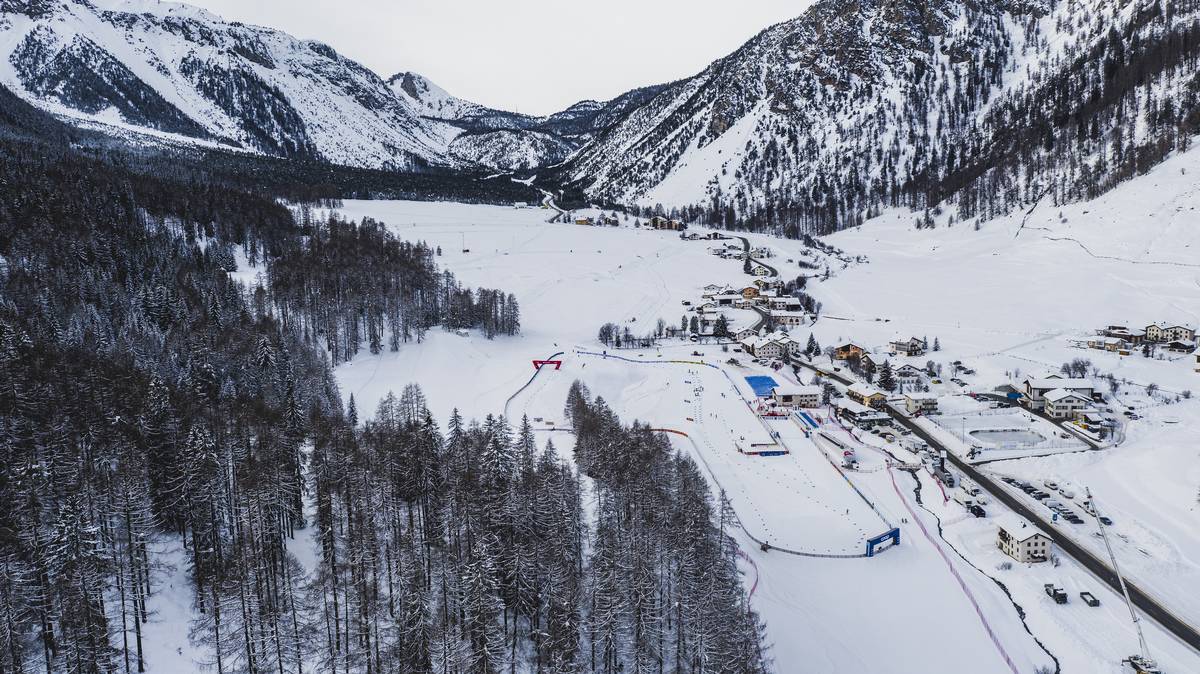
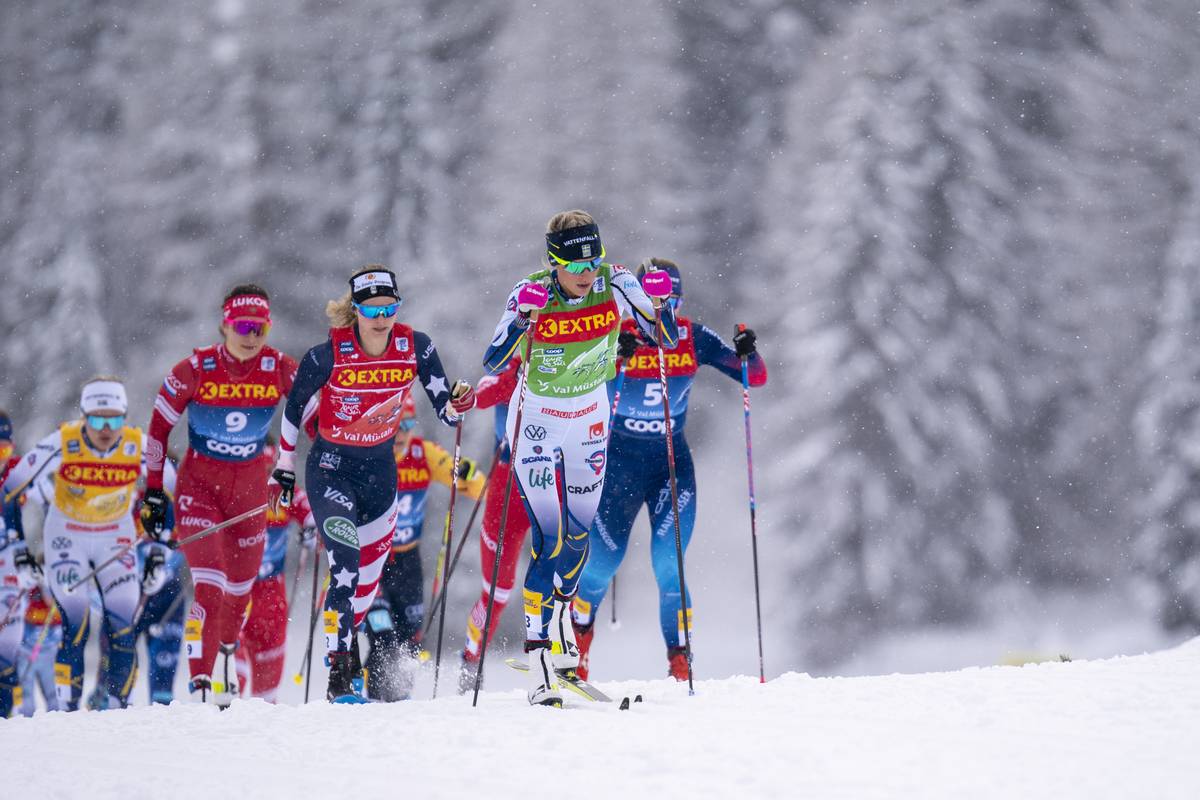
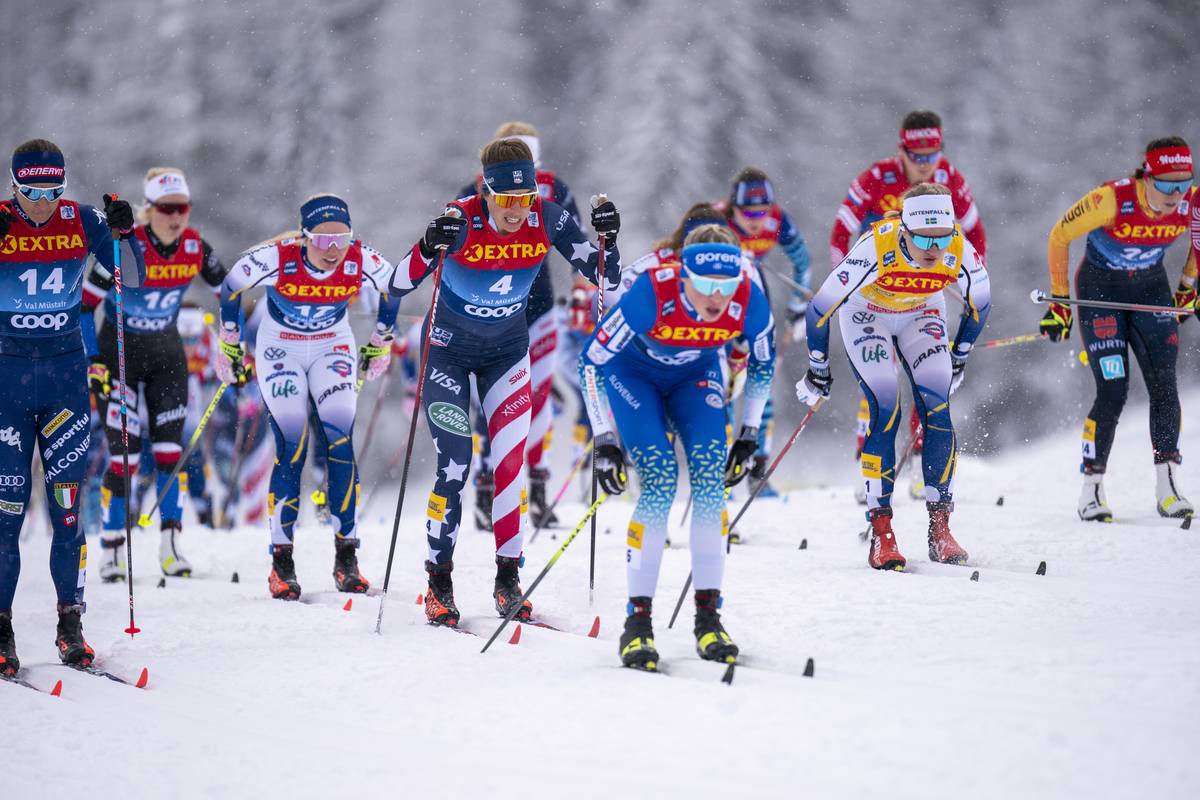
Light snow continued to fall in the quaint Swiss village nestled in Val Müstair as the athletes took to the tracks for the first distance stage of the 2021 Tour de Ski, a 10-kilometer mass start classic race. As the first mass start of the season, the women kicked, glided, and poled over 10-kilometers broken into four challenging laps, seeing exactly where they stacked up relative to their competitors.
With four consecutive distance stages, the Tour quickly becomes part poker match, part ultramarathon. Standings and cumulative time are influenced not only by the final result from each day, but by the bonus points athletes can garner at checkpoints on course; in today’s case, an opportunity at the 3.3 kilometer mark.
The picturesque village and tracks of Val Müstair play host the first three stages of the 2021 Tour de Ski. (Photo: NordicFocus)
As position in the field is relatively clear in a mass start — versus chasing the splits of a “ghost” racer in an interval start — tactics, patience, and drafting become more significant.
Today, it was soon evident who intended to make a run at the dealer in the Stage 2 match. Wearing a bright green bib as overall U23 leader, Sweden’s Frida Karlsson skied at the front of the pack from the start. She out-sprinted teammate Ebba Anderson approaching the 3.3 k checkpoint to snag the maximum of 15 bonus points, and seemed to be comfortably kicking up each of the steady climbs. After her defeat of Norway’s powerhouse Therese Johaug at last year’s Holmenkollen 30k, albeit in part attributed to Johaug’s decision not to change skis, Karlsson solidified her position as a woman to watch in distance races.
Frida Karlsson sets the pace with Diggins marking from behind during Stage 2 of the 2021 TdS. (Photo: NordicFocus)
However, despite her seeming authority at the front, she was unable to create any true gap to the women behind her. At the midpoint of the last lap, six women sat on her tails including two women whose stars and stripes flashed on their legs as they matched the tempo of the other women striding alongside them.
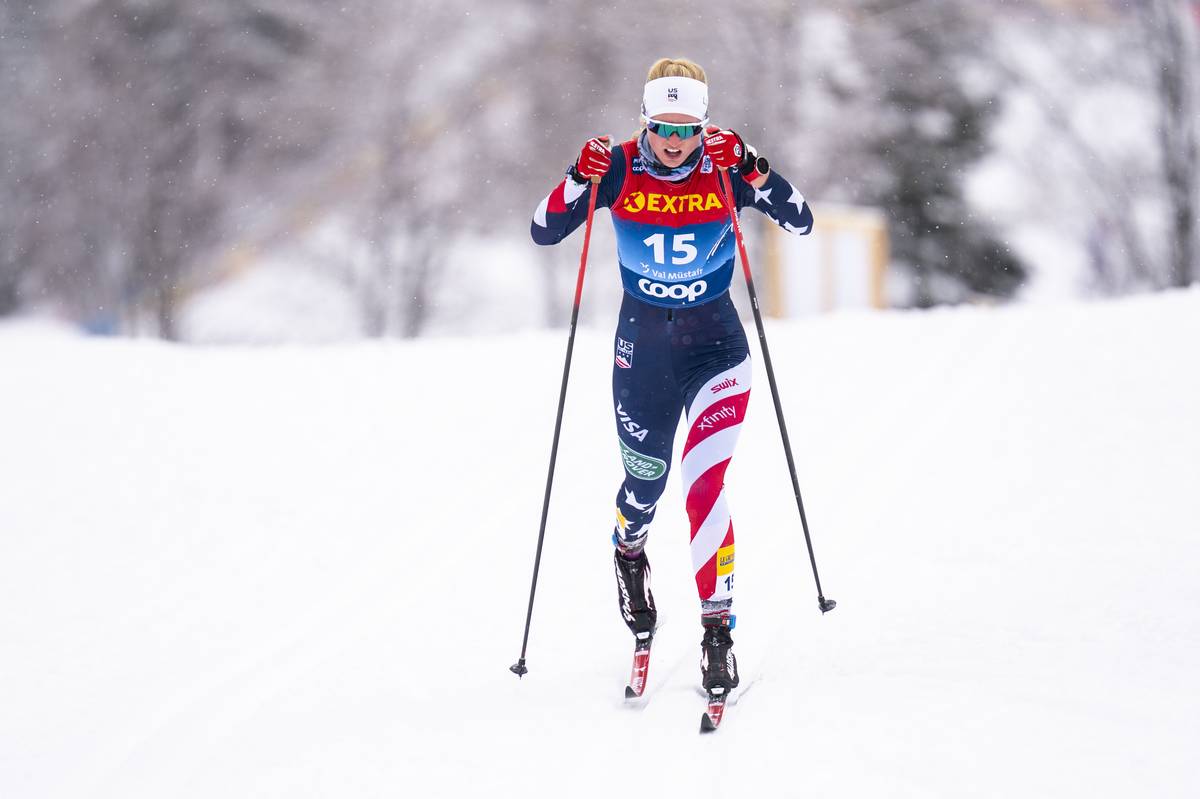
One of these women, Jessie Diggins, comes off a second place finish in yesterday’s sprint. Diggins held her position in the top three throughout the race, at times challenging Karlsson at the front, leaving no room for weakness or error on the young Swede’s part.
Rosie Brennan tucks into the lead group during Stage 2 of the Tour de Ski, a 10-kilometer mass start classic. (Photo: NordicFocus)
Fellow American Rosie Brennan, who finished fourth in Stage 1 also sat comfortably in the lead group, matching the surges that were made to break away as the race progressed.
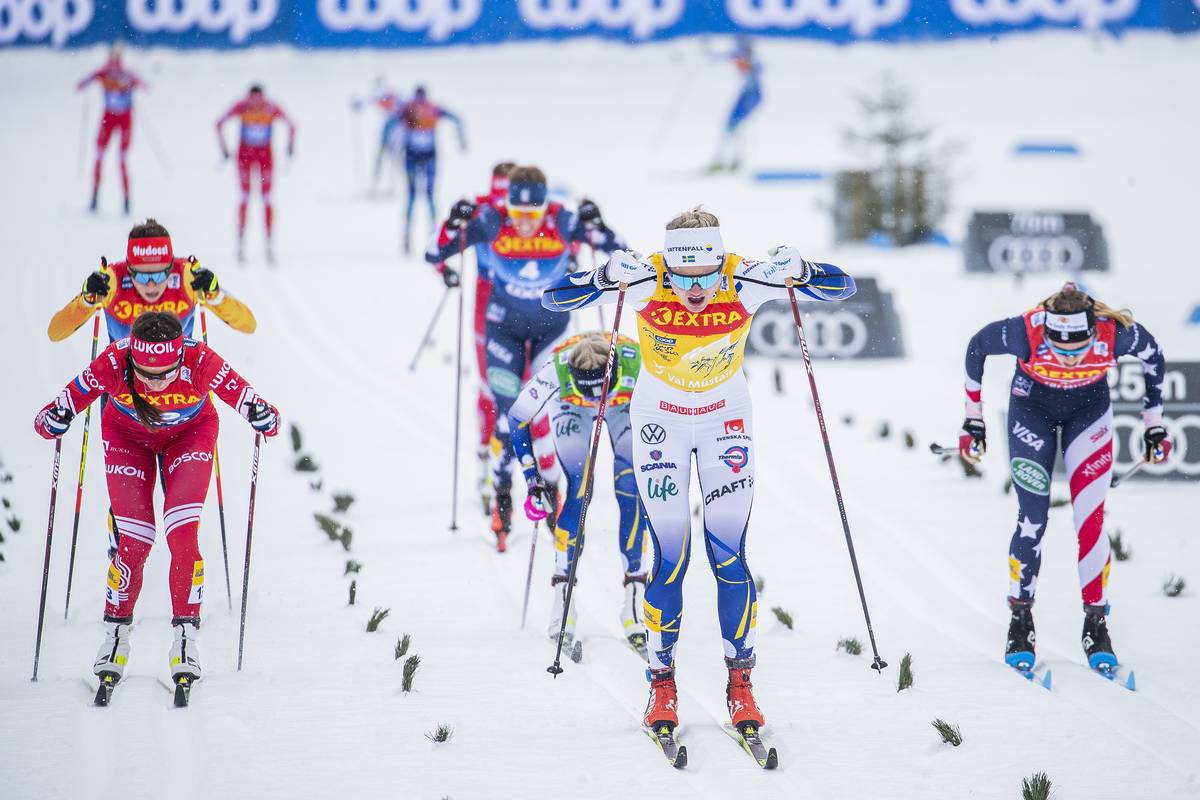
In the final two kilometers, the other women began their own runs for the win, challenging Karlsson who was faltering, but unwilling to fold. Up the final climb and down the same screaming S-turn descent featured in the sprint course, the women charged furiously toward the finish, Karlsson slowly being swallowed into the pack.
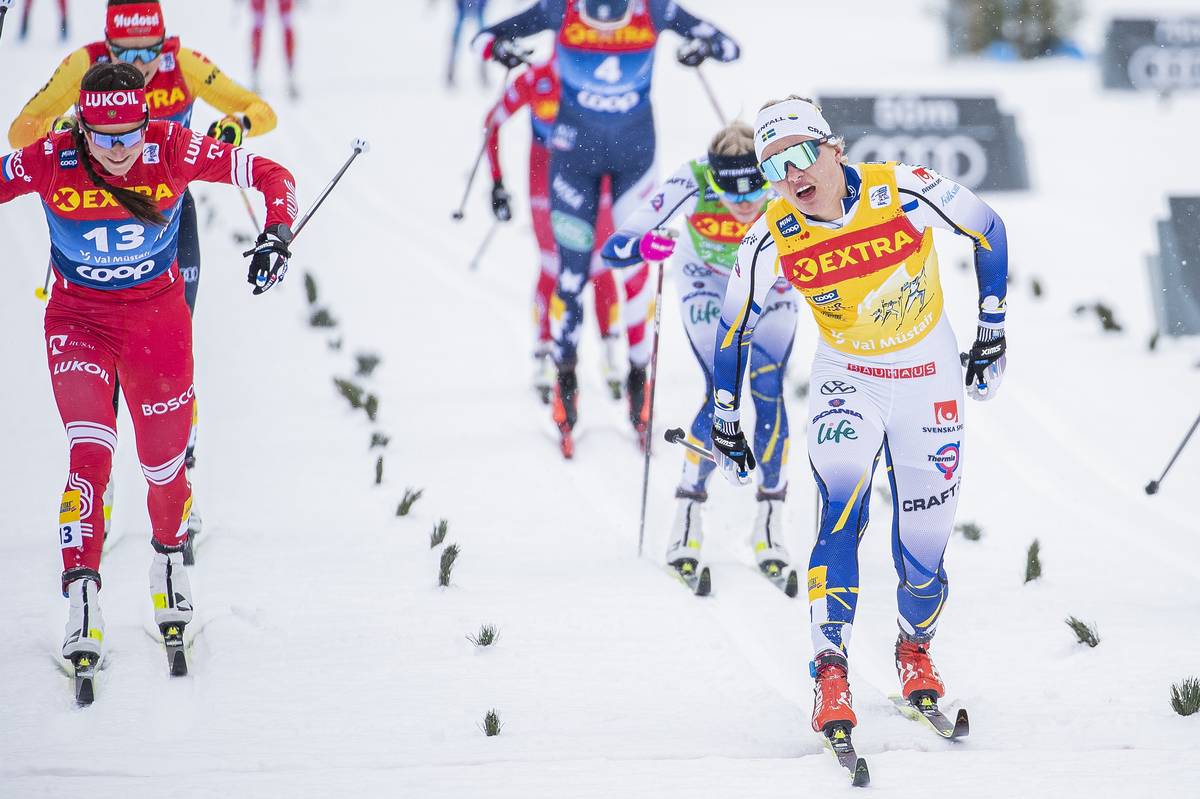
Rounding the final corner and thrashing her poles to accelerate toward the finish, a different woman in white lycra took the reins. 21-year-old Linn Svahn, the winner of yesterday’s skate sprint and of the 2019/2020 World Cup sprint globe, put her closing speed on display to stop the clock at 30:09.9. Though she has won FIS distance races on home soil, this is Svahn’s first distance win at the World Cup level.
The top women fight to the line during Stage 2 of the 2021 Tour de Ski. Sweden’s Linn Svahn took the win, with Yulia Stupak (RUS) and Jessie Diggins in 2nd and 3rd, respectively. (Photo: NordicFocus)Sweden’s Linn Svahn throws her boot to seal the deal on victory in Stage 2 of the TdS, a 10-kilometer mass start classic. (Photo: NordicFocus)
“It was really fun. I love going classic,” she told FIS after the race. “My plan was to just keep it as chill as I could, then watch the girls going strong on the uphill and try not to use so much energy. When I knew it was one lap left, I just kept thinking ‘I need to win this. I need to win this.’ So it was really good to race today.”
A champion in sprint and distance, Sweden’s Linn Svahn wins back-to-back stages of the 2021 Tour de Ski. (Photo: NordicFocus)
Just behind, a threesome including Diggins, Karlsson, and Yulia Stupak of Russia fought for the remaining spots on the podium. Stupak and Diggins crept ahead of the Swede, matching each other’s poling tempo before throwing their boots at the line. Stupak barely edged out Diggins, taking second (+0.7) with Diggins just behind in third (+0.8).
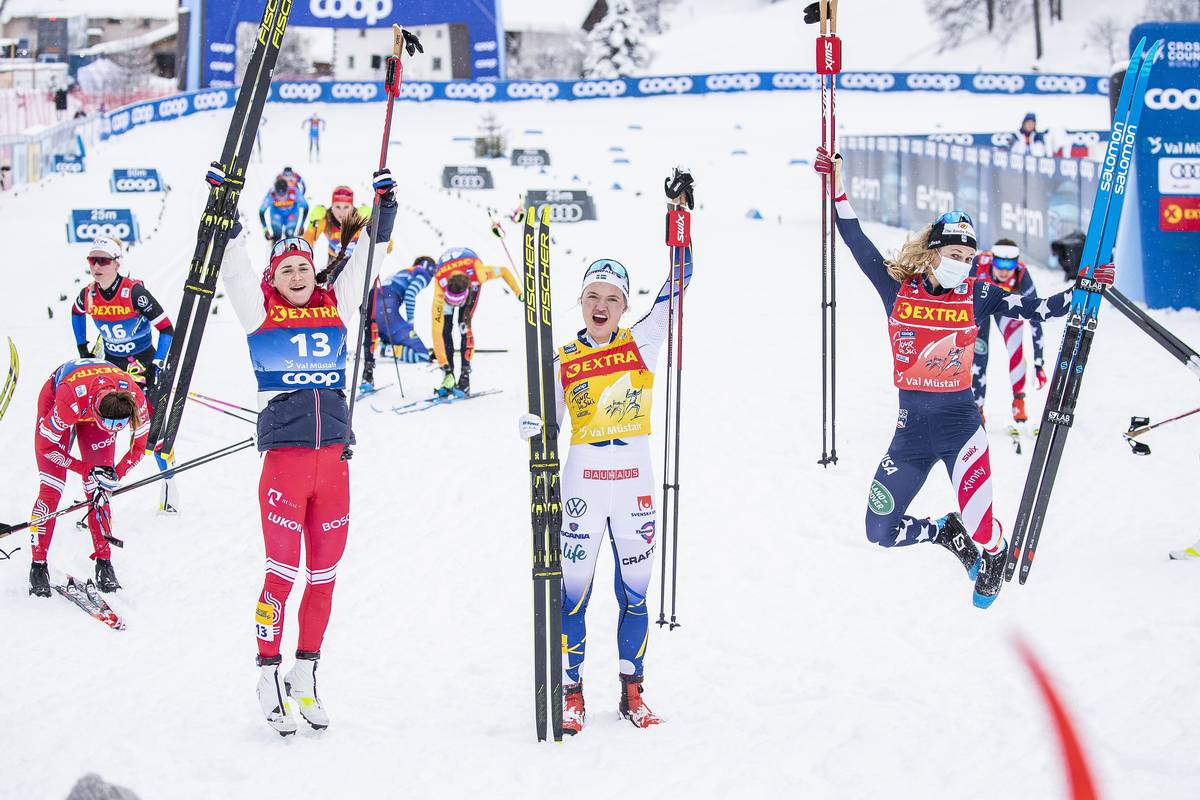
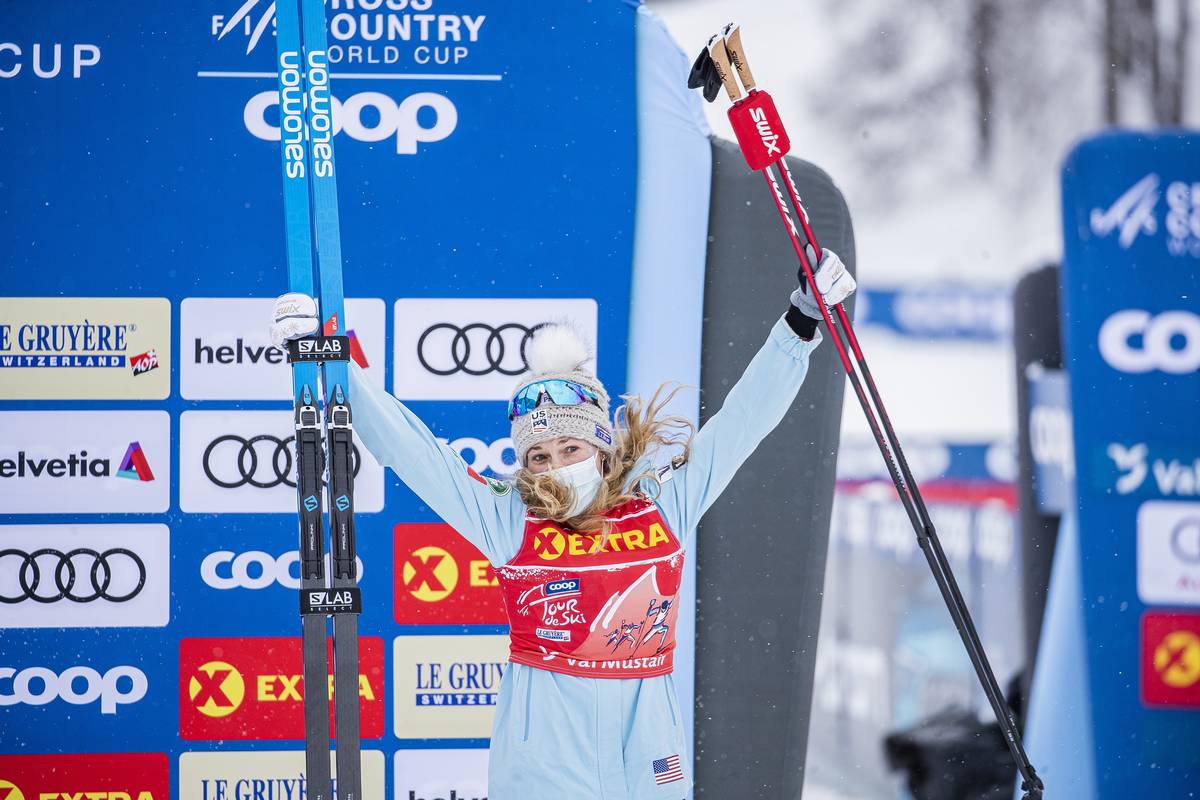
Airborne and on form, Diggins celebrates her third place finish in Stage 2 of the Tour de Ski. Sweden’s Linn Svahn (center) took the win, followed by Russia’s Yulia Stupak in 2nd. (Photo: NordicFocus)
“We had great skis out there!” wrote Diggins in an exuberant post race email. “Huge thanks to our service team and coaches for all their hard work, and the Salomon service team for their help picking my skis before the race!”
Diggins continued by commenting on today’s effort, and how this classic result represents years of focus on technique and collaboration with her coaches and teammates.
“My goals for today were to ski smooth and really work the downhills without letting them become a stress in a mass start environment, so I stayed near the front to keep out of trouble. This was a great course for me with all the long power-striding, and when I felt good on the last half of the last lap I just decided to push it! For someone previously labeled as a skater only, it was very exciting to find myself sprinting for the podium in a 10 km classic race, and confidence-boosting as well since I’ve been working so hard for so long on my classic striding! I think that improvement speaks to our coaches’ dedication and our positive team environment where we can learn from one another and push each other in our weaker areas. This summer I really benefitted from my SMST2 teammates helping me push the envelope in classic intervals and I’m extremely grateful to them!”
Coming on form in the 2021 Tour de Ski, Jessie Diggins takes third in Stage 2. (Photo: NordicFocus)
Despite spending over 8 kilometers at the front, Karlsson took the wooden medal in fourth (+1.4). She was followed closely by Katharina Hennig of Germany in fifth (+2.0), with Rosie Brennan on her tails for sixth (+4.5).
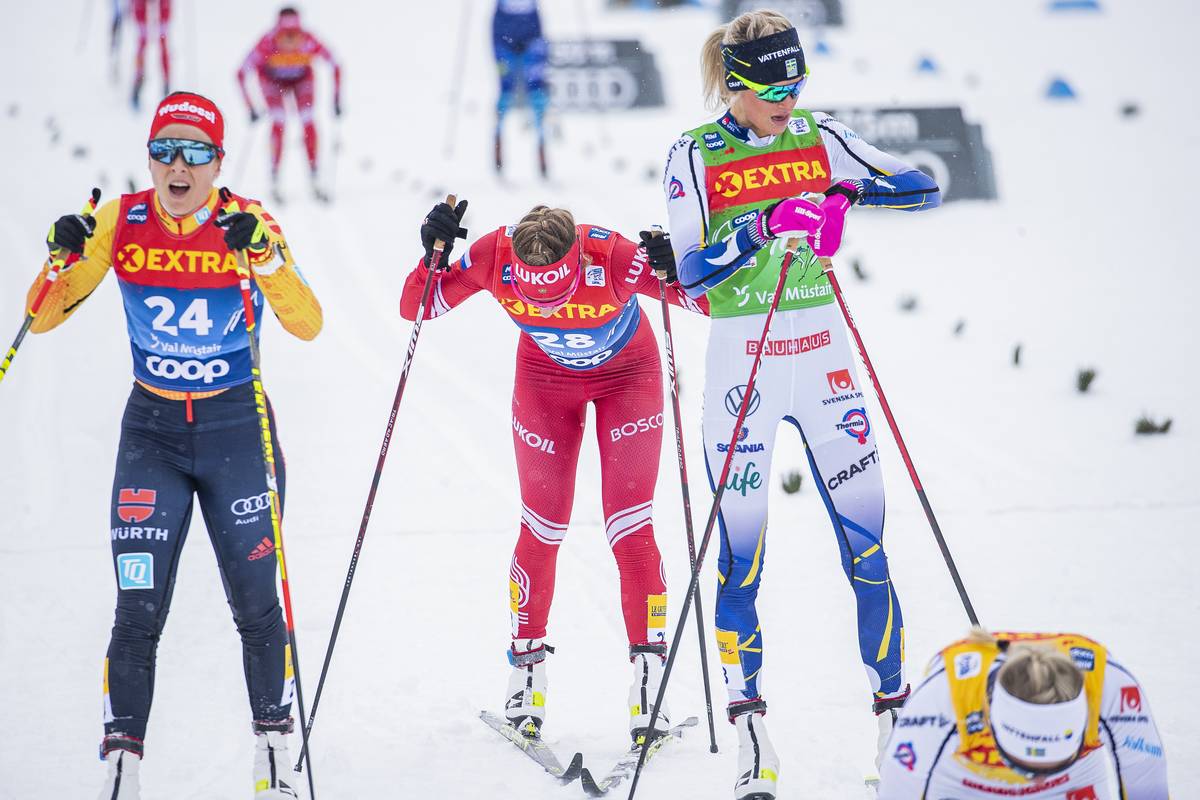
Evidence of the effort, the leaders of the Stage 2 of the 2021 TdS, a 10-kilometer mass start classic, gasp for air at the finish line. (Photo: NordicFocus)
“Today was the first mass start of the season, which is always a little nerve wracking for me as I prefer individual starts,” wrote Brennan in an email to multiple news outlets. “My goal was to keep things as close as possible and then see what I left in the end. I think I did this well as I skied in the front pack throughout the race. I was unhappy with my tactics on the long gradual downhill coming back towards the stadium. I took a gamble on lane choice that didn’t pan out and found myself out of contention for the sprint finish, but managed to minimize my time lost to the leaders and also get a career-best classic result so I am proud of that. I am in a great position for tomorrow’s pursuit start so I hope to find some good energy and take advantage of that!”
Outside the top-10 with noteworthy finishes were Hailey Swirbul in 17th (+40.5) and Katharine Ogden in 22nd (+1:21.2). Swirbul was among a larger lead group through the 5 k, dropping into a chase pack as the top 10 began to break away.
Hailey Swirbul on her way to a 17th place finish in Stage 2 of the 2021 Tour de Ski. (Photo: NordicFocus)Katharine Ogden on course in Stage 2 of the 2021 Tour de Ski. (Photo: NordicFocus)
Caitlin Patterson was the next American finisher in 38th (+2:10.4), followed by Julia Kern in 41st (+2:30.6), and Sophie Caldwell Hamilton in 46th (32.49.0). Caldwell Hamilton experienced a crash near the end of the first clustered lap; “You got it, Soph!” could be heard from a passing teammate.
Post-race comments on the women’s 10k mass start from U.S. Head Coach Matt Whitcomb.
Julia Kern on course in Stage 2 of the 2021 Tour de Ski. (Photo: NordicFocus)
Overall Tour de Ski and World Cup Standings
With back-to-back wins, Svahn leads the 2021 Tour de Ski by 13 seconds, with Diggins in 2nd, and Karlsson third (+0:18).
Because of snagging the bonus points in today’s stage, Karlsson sits at the top of the TdS point standings with Diggins one point behind in second, and Svahn three points back in third.
Brennan skis to 6th in Stage 2 of the 2021 Tour de Ski, adding to a string of outstanding performances. (Photo: NordicFocus)
Continuing her streak of outstanding races, Brennan remains in possession of the yellow bib as overall and distance World Cup points leader and sits 4th in the TdS standings for both time (+0:20) and FIS points.
The tour continues tomorrow with a 10-kilometer skate pursuit.
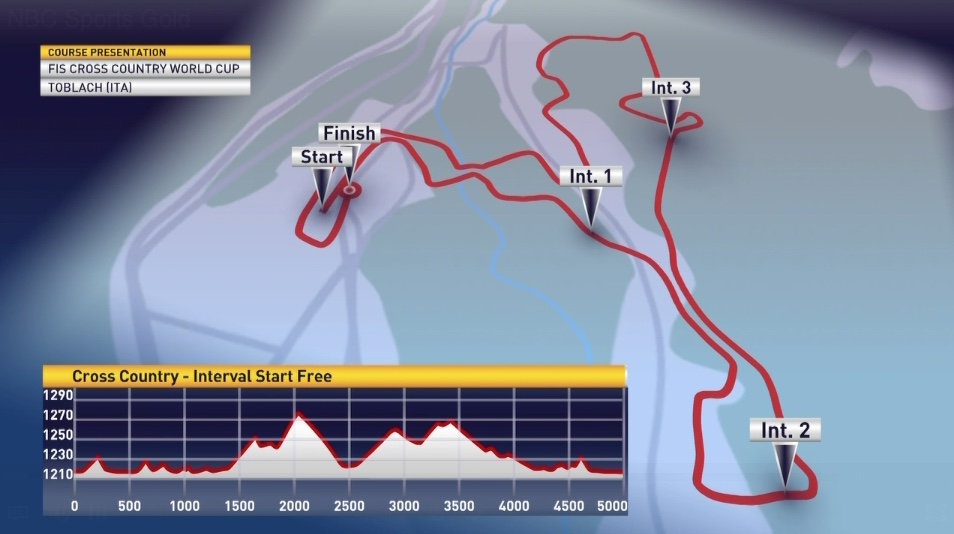
Toblach, Italy. A stunning stadium and backdrop with the Dolomites lording over the venue and a steady cling-clang of baritone bells greeted skiers along portions of the course. Stage 3 in Toblach, a 10-kilometer interval start skate, turbocharged the 2019-2020 Tour de Ski (TDS).
Another win for Therese Johaug, albeit by a small margin, during Stage 3 of the 2019/2020 Tour de Ski in Toblach, Italy. (Photo: NordicFocus)
After two stages, a Stage 1 mass start skate and Stage 2 skate sprint, Russia’s Natalia Nepryaeva sat atop the overall standings. In third overall, Norway’s imminent threat, Therese Johaug, was positioned only five seconds back. Other names to watch, like Ingvild Flugstad Østberg, also from Norway, was seventh overall, 27 seconds back.
With three distance stages in a row — today’s 10 k skate, Wednesday’s 10 k classic pursuit (both in Toblach) and a Stage 5 10 k classic mass start in Val di Fiemme — this mid-stretch of the TdS would firm up the overall standings.
We’ll say this upfront with a bit of biased towards the spectacle of mass starts — this was fun-to-watch on-the-edge-of-your-seat interval start racing. Imagine a window for FIS live timing open on the desktop, a live stream of the racing open in another, and some texting banter here and there about the close splits, and it was a highlight so far of the young ski racing year.
Two laps around a working 5 k course featuring two climbing sections, one beginning at 1.4 k, the other at 2.5 k, was enough to jostle the standings and draw out some great performances.
Let’s start with the day’s top-10 finishers and then get to how the suspense built. Rosie Brennan for the U.S. was ninth (+45.0), Sadie Maubet Bjornsen (U.S.) eighth (+42.9), Jessie Diggins (U.S.) seventh (+35.6), Nepryaeva sixth (+26.0), Astrid Jacobsen Uhrenholdt (Norway) fifth (+20.8), Heidi Weng (Norway) fourth (+10.5), Ebba Anderson third (+10.2), Østberg second (+0.7), and Johaug in first.
23:51.9 was the winning time for Johaug. That Johaug won is no surprise. She’s the winner of the last 15 of 16 distance races on the World Cup. What startled many was the eye-blink time difference between Johaug and Østberg.
Ingvild Flugstad Østberg on her way to a close second place in Stage 3 of the TdS in Toblach, Italy. Stage 3 was a 10 k interval start skate. (Photo: NoridcFocus)
Ebba Anderson slides across the finish in Stage 3 of the 2019/2020 Tour de Ski in Toblach, Italy. Wearing bib 51, Katharine Ogden finishes just outside the points in 34th. (Photo: NordicFocus)
We’ll take a two-race 10 k skate interval start sample for comparison. In Ulricehamn, Sweden last February, Johaug put 58.7 seconds into her teammate. In March, Johaug gapped Østberg by 30.8 seconds in Falun.
Fast forward to today’s third stage in Toblach, and 5 k in, Johaug had the fastest time with Østberg 8.9 seconds back. At 6.7 k Østberg was 4.1 seconds behind. With almost all of the climbing past, at 8 k, Østberg had pulled ahead by an ephemeral 0.1.
In the armchair analysis, we should note that Østberg began in bib 32, Johaug in 38. Of the top-10 skiers on Tuesday, only two began before Østberg making her effort amidst less than perfect timesplit information that much more remarkable. Prior to the TdS, Østberg had been kept from competing by the National Team for not meeting certain health metrics. This was her third World Cup race of the season.
The reigning TdS champion arrived at this TdS primed.
With no time bonuses on offer, Johaug leapfrogged from third overall before the stage into first, with a total time of 55:14. Nepryaeva is second (+0:21), Weng third (+0:23), and Østberg fourth (+0:23).
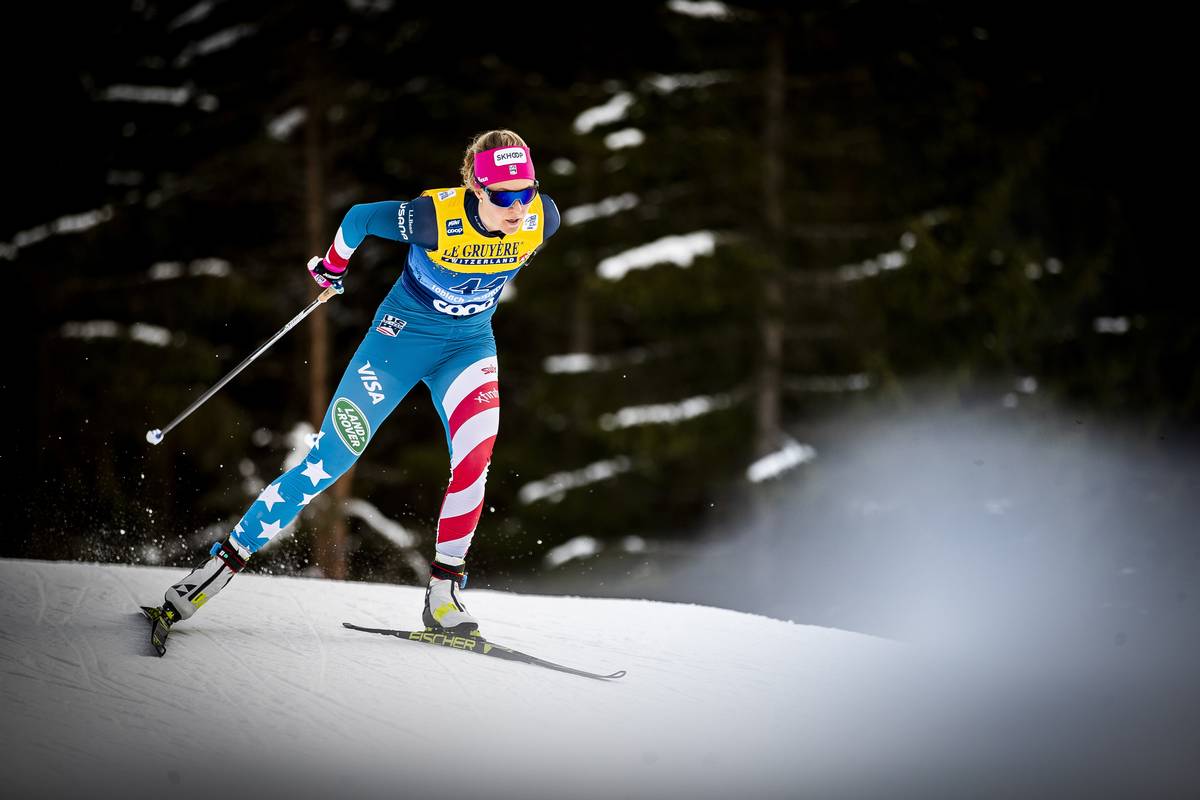
Jessie Diggins skiing to seventh overall during Stage 3 of the TdS in Toblach, Italy. (Photo: NordicFocus)
Jessie Diggins skiing to seventh overall during Stage 3 of the TdS in Toblach, Italy. (Photo: NordicFocus)
Post-race interview with Jessie Diggins
Diggins is ninth overall (+1:10), Maubet Bjornsen 10th (+1:19), and Brennan 13th (+1:46).
Rosie Brennan continues her top-10 drive during Stage 3 of the TdS. (Photo: NordicFocus)
“I am very happy with my race today,” Brennan emailed. “I have some big goals riding on this tour and while I didn’t have my worst races that last two days, they were quite what I dreamed of. Today was much more what I had in mind. I love individual races and knew I had to make the most of the one intervals start race in the tour. I had a strong first lap and faded a bit more than I wanted the second lap but am happy with an improved result. Tomorrow will be a fun day as I get to ski with my favorite training partner, Sadie!”
Sadie Maubet Bjornsen during Stage 3 of the TdS in Toblach, Italy. (Photo: NordicFocus)
“Another exciting day of racing in stage 3,” Maubet Bjornsen emailed several outlets. “I woke up feeling recovered and refreshed, so I was really excited for today. We have raced three skate races in a row now, so our skating muscles are getting pretty tired, but every time things are tough in the tour, I just remind myself that everyone is in the same boat! I was really happy to finish 8th today, and I feel like I am in a great place for the pursuit classic race tomorrow. Rosie, Jessie and I are all starting close enough together that we can make an American train, and take on “the world” together. We are still trying to dig ourselves out of a hole in the “overall standings” from the stage 1 waxing mistake, but every day, we are chipping away little by little… which is the key to this tour. I can’t wait to put some classic skis on my feet tomorrow, and see what I can do!”
Outside the top-10, the U.S. had an astounding day. Sophie Caldwell, currently the fourth-ranked sprinter on the World Cup, raced to 25th (+1:25.9). According to FIS, this is Caldwell’s third time in the top-30 for a World Cup distance event and her first in skate.
Katharine Ogden raced to 34th (+1:42). Julia Kern did not start due to illness.
World Cup Head Coach Matt Whitcomb’s post-race comments on the women’s race
Sophie Caldwell primed for distance racing and in the points during Stage 3 of the TdS. (Photo: NordicFocus)
Racing continues tomorrow for the women with a 10 k classic pursuit. Start positions and time back are based on today’s results, not time back in the overall standings. For example, Johaug will start first, Østberg second (+0.1) — times are rounded — and Diggins seventh (+0:36). This should make for a tighter and more exciting TdS pursuit at a time when overall time gaps can make head-to-head racing less likely.
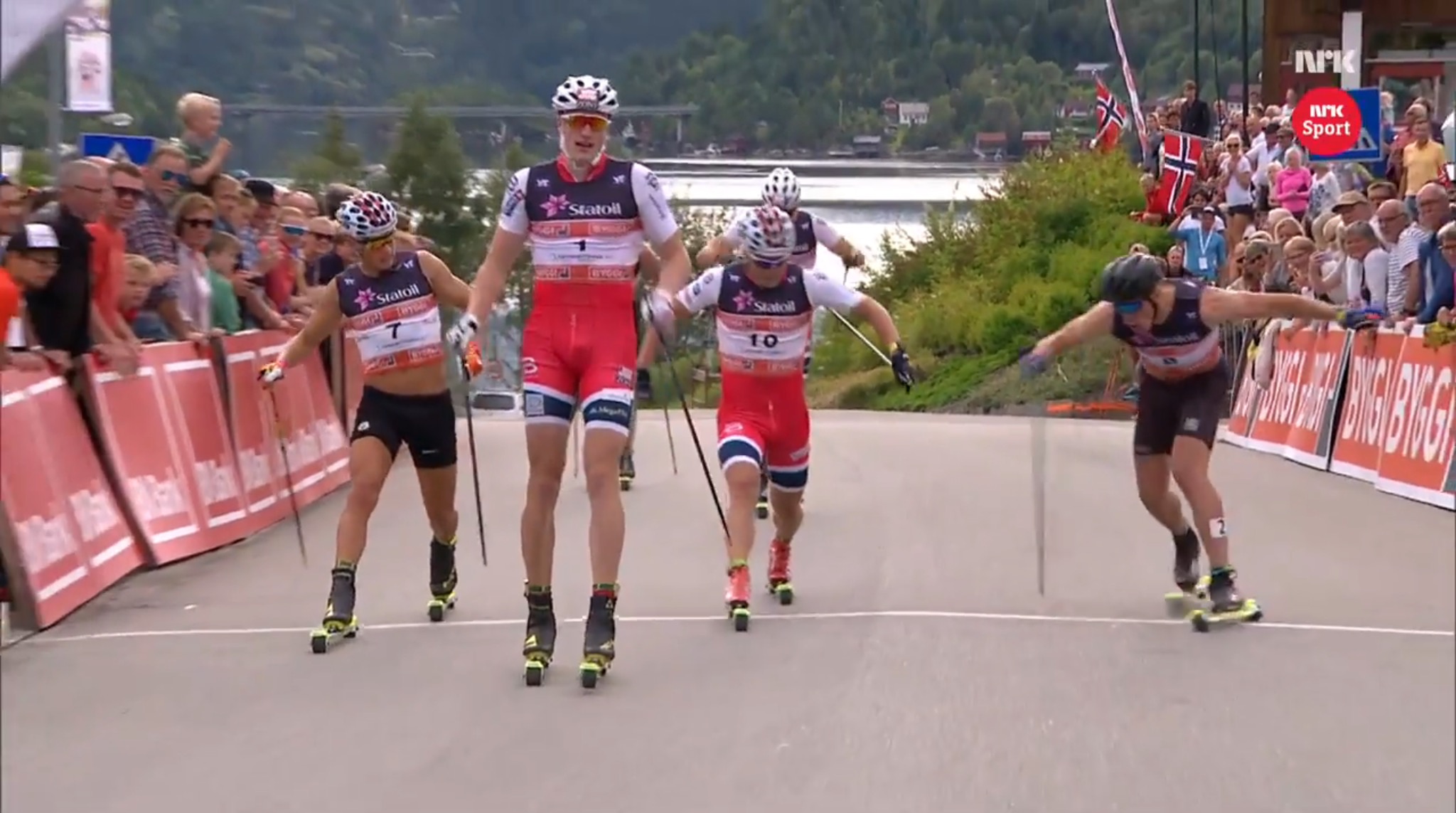
In the men’s classic sprint on Day 1 of the three-day 2017 Toppidrettsveka mini tour, Norway’s Aune Pål Trøan (1) crosses the line ahead of his countrymen Johannes Høsflot Klæbo (7) and Eirik Brandsdal (10) while Sweden’s Calle Halfvarsson (r) placed fourth. Halfvarsson went on to win the tour, ahead of Klaebo in second. (Screenshot: NRK broadcast)
This past weekend was once again the time of the year for the Toppidrettsveka ski festival, a three-day rollerski mini tour held annually since 2005 in the region of Trondheim, Norway. In addition to the individual stages, points for the top-30 finishers were awarded to compile an overall ranking similar to the Tour de Ski.
The elite field of athletes was mostly comprised of Norwegian and other Scandinavian skiers active on the International Ski Federation (FIS) World Cup and European Continental Cup level, as well as a handful of international starters, including two Americans: U.S. Ski Team member Andy Newell, who raced at last month’s Blink Ski Festival in Norway, and Kevin Bolger, who is coming off his senior season at the University of Utah.
Day 1: Aure Sprint
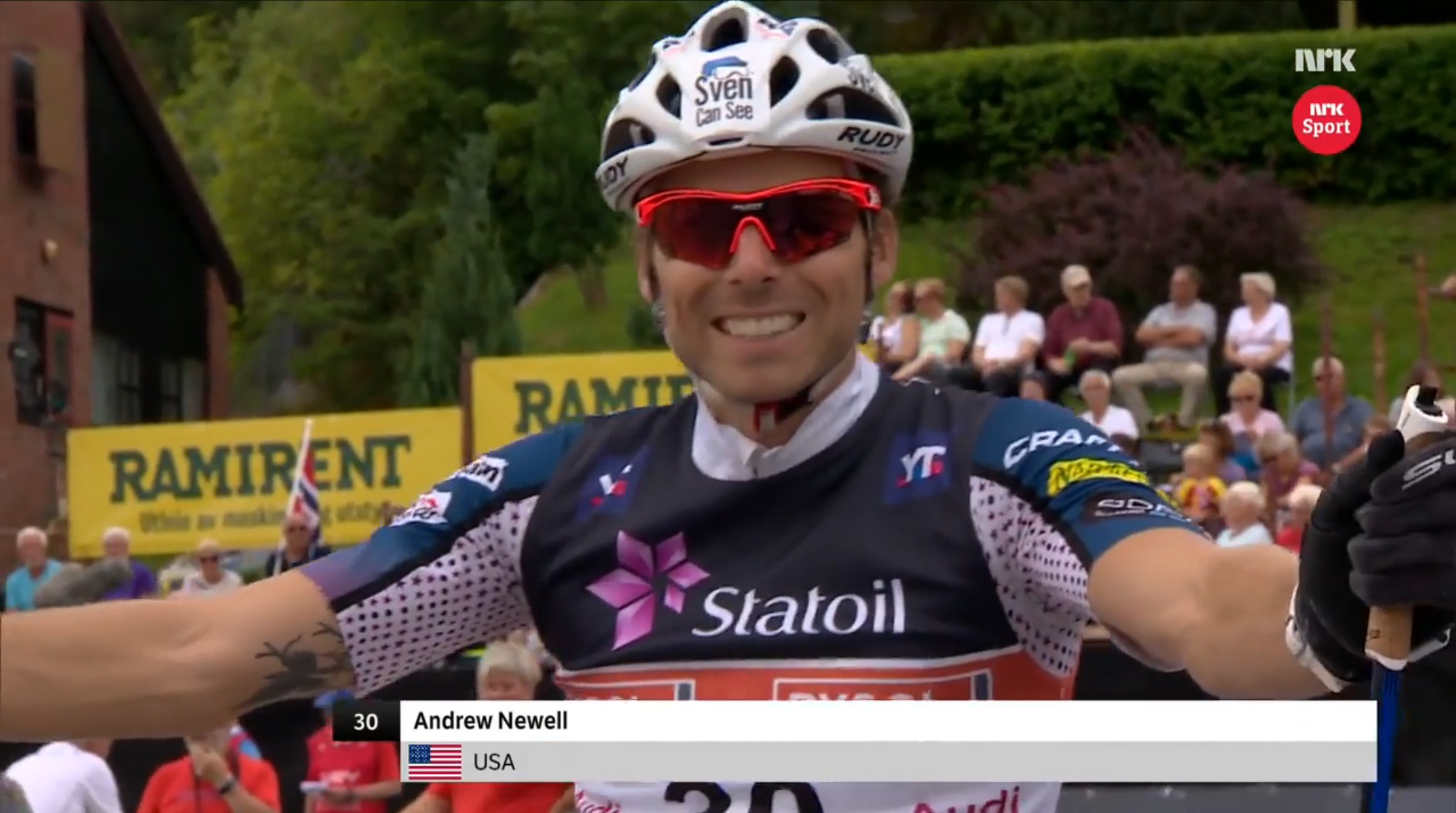
American Andy Newell (U.S. Ski Team) at the start of the men’s sprint in Aure, Norway, on Day 1 of the 2017 Toppidrettsveka rollerski mini tour. (Screenshot: NRK broadcast)
The festival started last Thursday with a classic sprint in the small town of Aure, on a fairly long course with a steep downhill and a roundabout at the bottom, after which the athletes had to ski up the same hill toward the finish.
In the men’s race, Norway’s Aune Pål Trøan took the win in the final with a time of 2:46.46, narrowly edging Norwegian World Cup skiers Johannes Høsflot Klæbo by 0.41 seconds and Eirik Brandsdal by 0.43 seconds. Just another tenth of a second back, Sweden’s Calle Halfvarsson placed fourth (+0.44).
Newell’s run ended in the quarterfinals, where he finished sixth in his heat, just half a second from advancing. His heat was a tight race that featured the eventual winner Trøan, who along with World Cup regular Emil Iversen, advanced as a lucky loser behind Brandsdal and his teammate Aleksander Ek. Bolger did not reach the quarterfinals.
In the women’s final, Sweden’s Linn Sömskar prevailed with a time of 3:03.94, edging out five Norwegians, including Kathrine Rolsted Harsem in second and 2016 Toppidrettsveka title-defender Heidi Weng in third. Earlier in the day, Sömskar also won her quarterfinal and semifinal heats decisively.
Two weeks ago, Sömskar won three races at the 2017 rollerski world championships in Solleftea, Sweden — the 18-kilometer freestyle, 16 k classic, and team sprint with Maja Dahlqvist.
Day 2: Brekka Mass Start and Trondheim Sprint
On Friday, athletes competed in two events: a mass start followed by a sprint later in the evening.
Switzerland’s Dario Cologna topped the men’s 24 k mass start, a point-to-point race from Aure to Brekka, finishing in 59:11.3 after breaking away on the long final climb. Halfvarsson claimed second (+10.8), followed by Finland’s Iivo Niskanen in third (+17.2) ahead of Norway’s Niklas Dyrhaug in fourth (+27.4).
“Great to win here,” Cologna told Norwegian broadcaster NRK in an interview in the finish. “Many good skiers, the best in the world, so it’s a good feeling. Good to see that everything is working well [in preparation] for this important season.”
Bolger finished 51st (+4:48.6) and Newell crossed 15 seconds later in 54th (+5:03.9) in the large field of 124 finishers.
In the women’s mass start over the same 24 k course, the race was even closer and came down to a finishing sprint. Weng took the win in 1:07.30.3, just 3.5 seconds ahead of her teammate Astrid Uhrenholdt Jacobsen, while Sweden’s Anna Haag finished 7.8 seconds back in third. Another Swede, Ebba Anderson placed fourth (+22.0), while the rest of the field crossed the line more than four minutes later. Haag and Anderson are just coming off a training camp in Sweden, where they were joined by U.S. Ski Team members Liz Stephen and Kikkan Randall.
For Stage 3 on the same day, athletes raced a 1 k sprint in the center of Trondheim, Norway’s third-largest city. There, Klæbo won the men’s final after a decisive attack on the finishing stretch in a time of 2:19.56 minutes, ahead of fellow Norwegian Ragnar-Kristoffer Braqvin Andresen in second (+0.23) and Even Northug in third (+2.85), the younger brother of 2016 Toppidrettsveka winner Petter Northug Jr. Halfvarsson finished fourth (+2.94), thereby taking the lead in the intermediate tour standings on Day 2, ahead of Klæbo, Cologna and Trøan.
Both Newell and Bolger missed qualifying for the sprint heats and did not score additional points.
In a true photo finish (left to right) Norway’s Barbro Kvaale won the women’s sprint on Day 2 of the 2017 Toppidrettsveka rollerski mini tour in Trondheim, Norway, ahead of Sweden’s Linn Sömskar in second, Norway’s Heidi Weng in third, Norway’s Kathrine Rolsted Harsem in fourth, and Switzerland’s Laurien Van Der Graaff in fifth. (Screenshot: NRK broadcast)
The women’s sprint final went to Norway’s Barbro Kvåle in a time of 2:46.04, who placed sixth in the final the day before. She edged Sömskar by just 0.08 seconds and Weng was another hundredth of a second back in third (+0.09). Harsem placed fourth (+0.25), and Switzerland’s Laurien Van Der Graaff, who led until the final meters of the race, finished fifth (+0.37). In the overall standings, Weng spent the night in the lead, ahead of Sömskar, Jacobsen and Harsem.
Day 3: Trondheim Pursuit/Mass Start
The mini tour concluded Saturday with classic races in Trondheim. However, with a smaller field of 37 athletes for the last women’s race, the points collected in the prior three events were not converted into time gaps before the final stage. Instead, athletes started together for a 12-kilometer mass start and the overall results and time back from the winner were computed after the race.
In rainy weather (with many of the spectators sporting ponchos), the short-sleeved athletes persistently circled their laps around the city course. The top group got smaller and smaller, and after 7.5 k, only 10 women remained within three seconds of the lead. That group dwindled to six by the finishing stretch, where Haag outlunged Jacobsen by 0.2 seconds for the win and Sömskar crossed another 0.4 seconds back in third (+0.6). Three Norwegians followed, with Harsem in fourth (+1.2), Weng in fifth (+1.5) and Lovise Hemdal in sixth (+2.0). Fifteen seconds later, Kvåle in seventh (+16.7) led the next four finishers across the line.
After computing the overall Toppidrettsveka standings, Weng was deemed the winner for the second-straight year. Sömskar placed second, 34.1 seconds back (she only had one weaker stage in the long mass start where she finished 11th, almost six minutes behind Weng), and Jacobsen was just another 1.6 seconds back in third (+35.7). Harsem finished the tour in fourth (+46.7), and Haag placed fifth (+59.5).
“I was impressed with myself actually,” Weng told NRK in a finish-line interview, according to a translation. “That I managed to keep up so well despite some very stiff arms … I don’t know if I am on a better way than last year, but yes, I feel really quite good.”
On the conditions, which Jacobsen called “dangerous“, Weng was pleased everyone played it safe.
“We took it very easy, and it was good that we all kept it a bit safe, there were some very slippery spots, but it went well,” Weng said.
With more in the men’s field, the men raced a 15 k pursuit, with Halfvarsson starting first, 12 seconds ahead of Klæbo in second, and 50 seconds ahead of Cologna in third. Trøan left the gate 1 minute back and Brandsdal started 2 seconds later.
Despite the heavy rain, which had worsened since the women’s race, Halfvarsson increased his lead on Klæbo. By 5.1 k, the Swede was more than 40 seconds clear of Klæbo, and Cologna came through the checkpoint 1:13 back. Having to ski through puddles of standing water at times, Halfvarsson extended his lead on Klæbo to over a minute by 11.2 k. Another 30 seconds behind Klæbo, Northug led a large chase group of about 20 racers after the pack had caught Cologna.
Halfvarsson held his comfortable lead through the finish, completing the final stage in a time of 34:08.4 for the overall victory. Klæbo had to fight a lot harder to hold onto second place, crossing the line 1:14.7 back and only a few meters ahead of the chase group. Northug outlasted the pack in a finishing sprint for third place (+1:18.5), while Bransdal missed the podium by half a second in fourth (+1:19.0), as did Niskanen in fifth (+1:19.0) and Trøan in sixth (+1:20.0).
“Today, it was pretty easy,” Halfvarsson told NRK, according to a translation. “I had the goal to go out hard, and knew I was going to get it when Johannes had problems to follow.”
“[My] days are over, there is a new kid in town,” 13-time world champion Northug said in English in a finish-line interview with NRK, referencing Klæbo standing next to him.
“He is the one who is absolutely the fastest of all of us,” Halfvarsson agreed in his interview with NRK when asked about the upcoming season. “Petter will be strong if he can find the shape for the winter, but it’s Johannes who I fear the most.”
“He is just saying that,” Klæbo told NRK. “I think there are many Norwegians that are going to go fast this winter.”
The best time of the final stage was posted by Great Britain’s Andrew Musgrave in 33:33.8, while Halfvarsson’s time ranked 25th. Musgrave finished eighth overall (+1:20.4).
For the stage, Newell placed 53rd and Bolger 64th. Overall, Newell finished the tour in 56th (+2:28.7) and Bolger placed 67th (+3:01.2).