Tag: Edvin Anger

  • Schumacher! Two Days, Two Podiums

    Schumacher! Two Days, Two Podiums

    This coverage is made possible through the generous support of Marty and Kathy Hall and A Hall Mark of Excellence Award. To learn more about A Hall Mark of Excellence Award, or to learn how you can support FasterSkier’s coverage, please contact info@fasterskier.com.

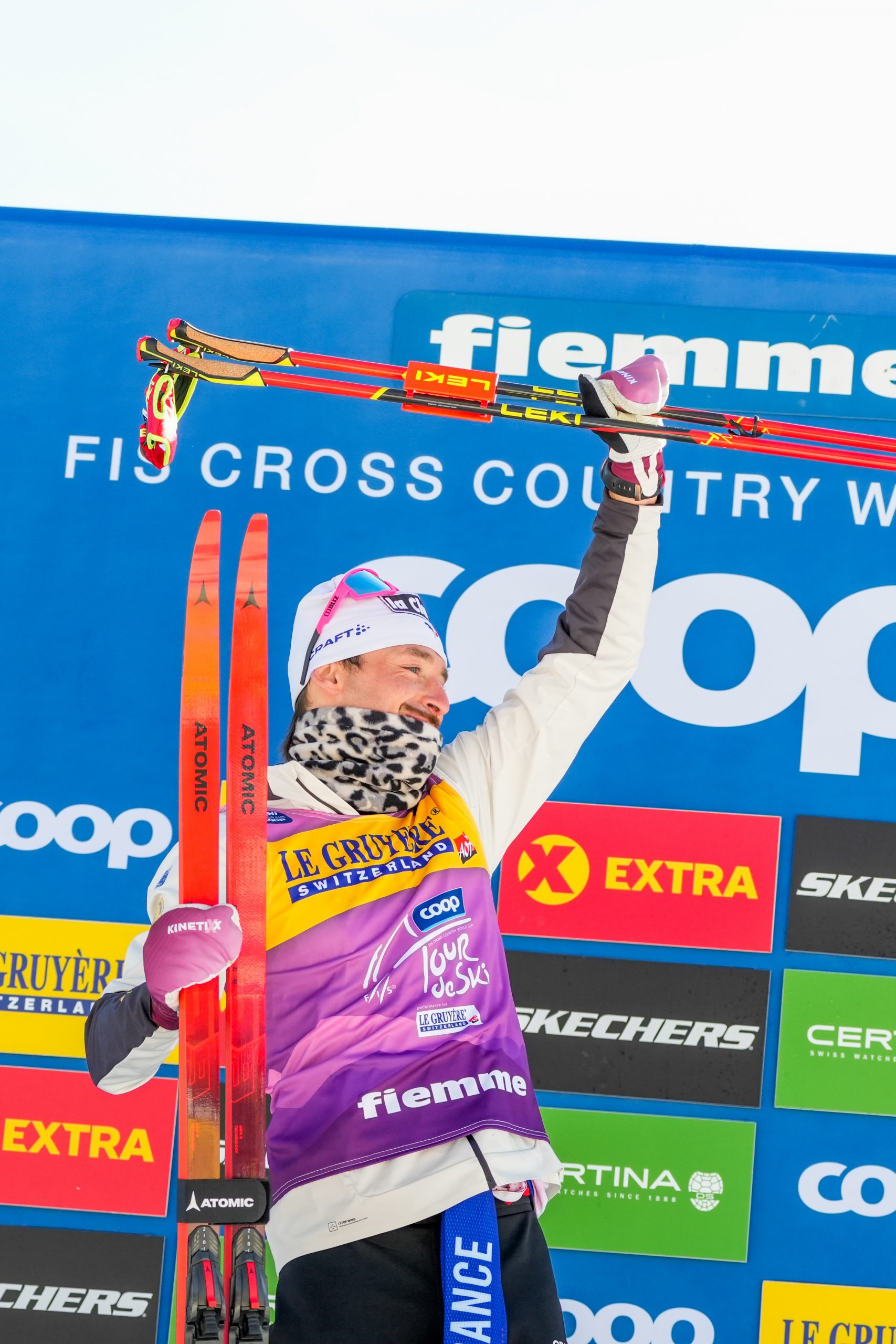
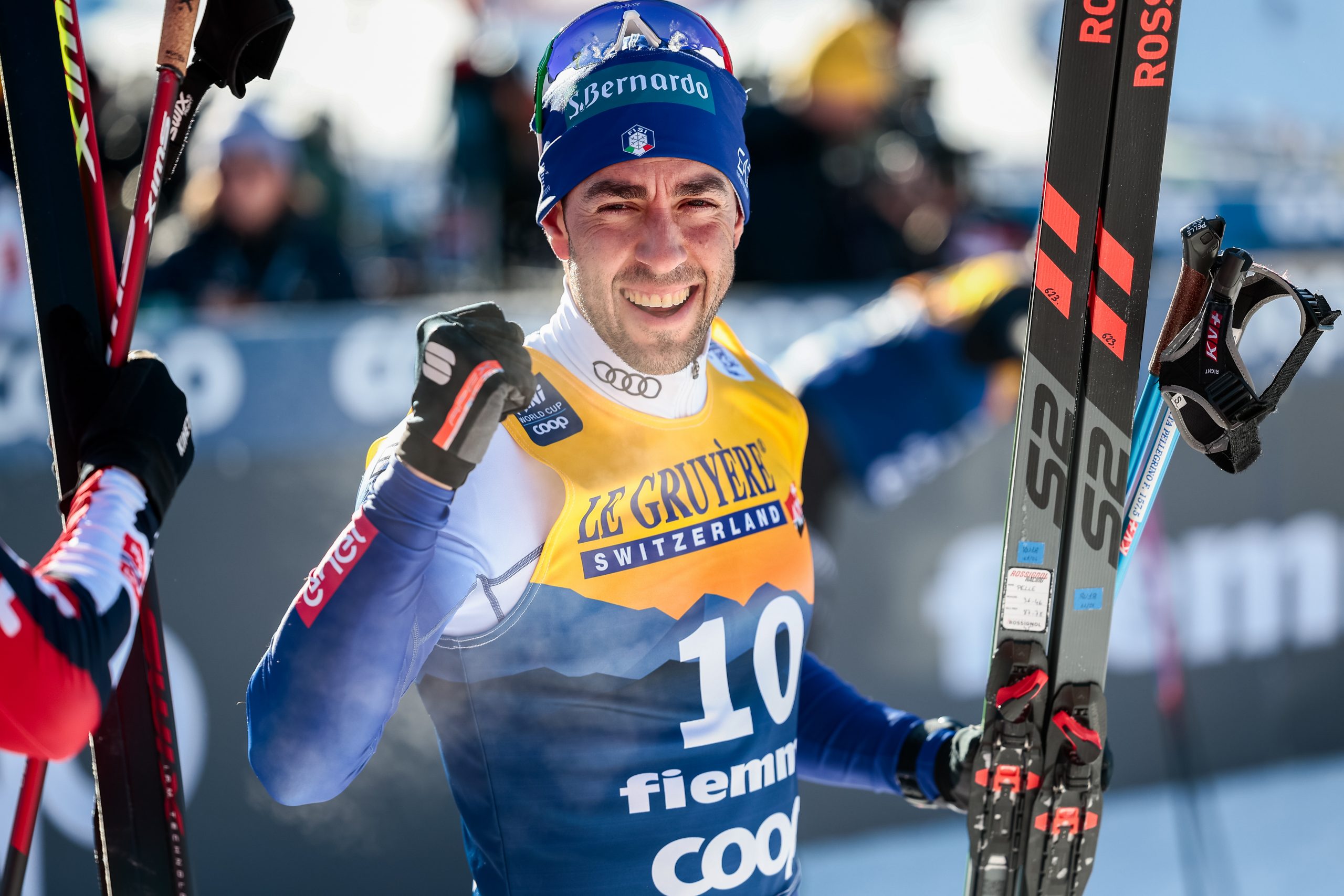
    Gus Schumacher (USA) celebrates his second place finish in the World Cup Classic Sprint in Goms, Switzerland. It was his second World Cup podium finish in as many days. (Photo: Authamayou/NordicFocus)

    Maybe the Americans really are that good . . .

    With the Olympic Games just around the corner, American men (lots of them!) are surging toward the front of the World Cup field. And while the last few World Cup weekends have been events that were only sparsely attended by the sports brightest stars, today’s Classic Sprint in Goms Switzerland was a fully stacked field with most of the primary contenders present. Many of them would be hoping that this event would be a dress rehearsal for the Classic Sprint that will be raced during the Olympics in Val di Fiemme.

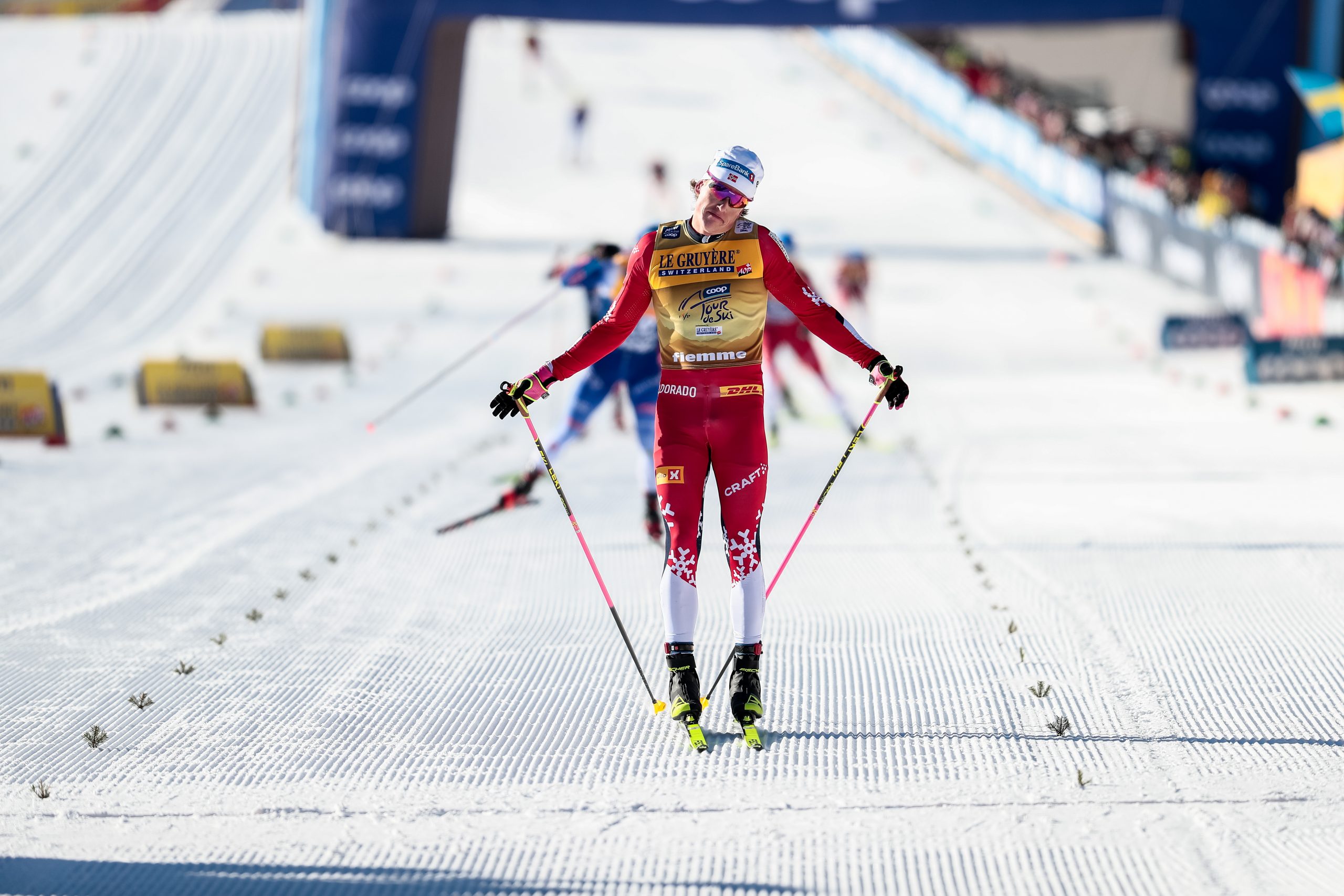
    Over the last few weeks, it’s been kinda cool to see what racing would look like in the absence of Johannes Hoesflot Klaebo . . . but now it’s time to turn from things as they have been, and return to things as they should be. Klaebo is back, and it’s an amazing time to watch ski racing: perhaps the greatest ever to do this sport is currently racing and skiing among us. Who knows? Maybe this will be his final season. If he were to succeed during the Olympic Winter Games of Milano-Cortina in the same way he succeeded at last year’s World Championships in Trondheim (six races, six wins, Nordic skiing immortality), there would virtually be nothing left for him to win. This skier has taken us to a rare place in sport history: Babe Ruth is alive and swinging, Muhammad Ali dances across the ring, and we get to watch history played out on live-streamed broadcasts. Let’s enjoy it—and marvel at it—while we can.

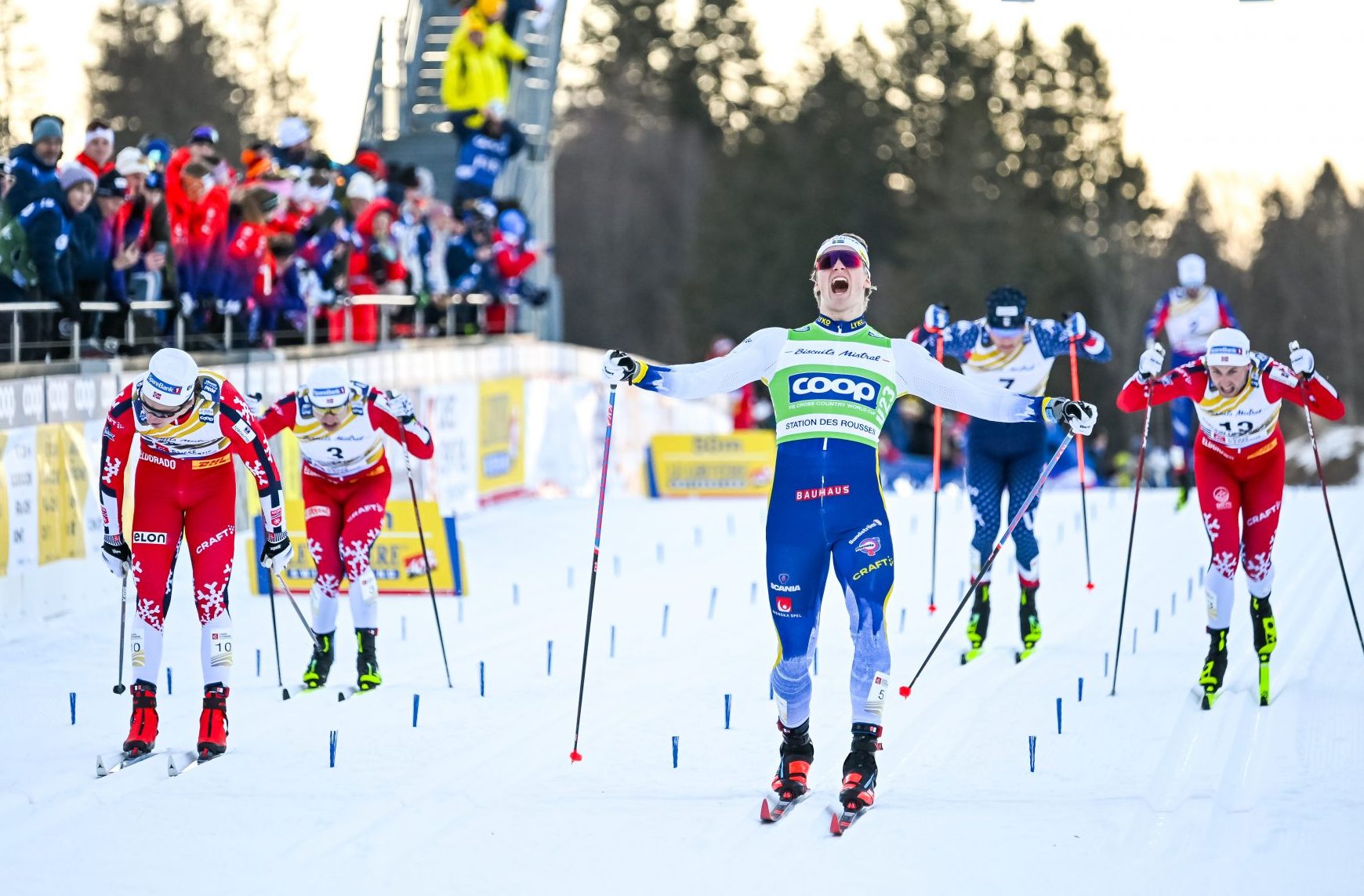
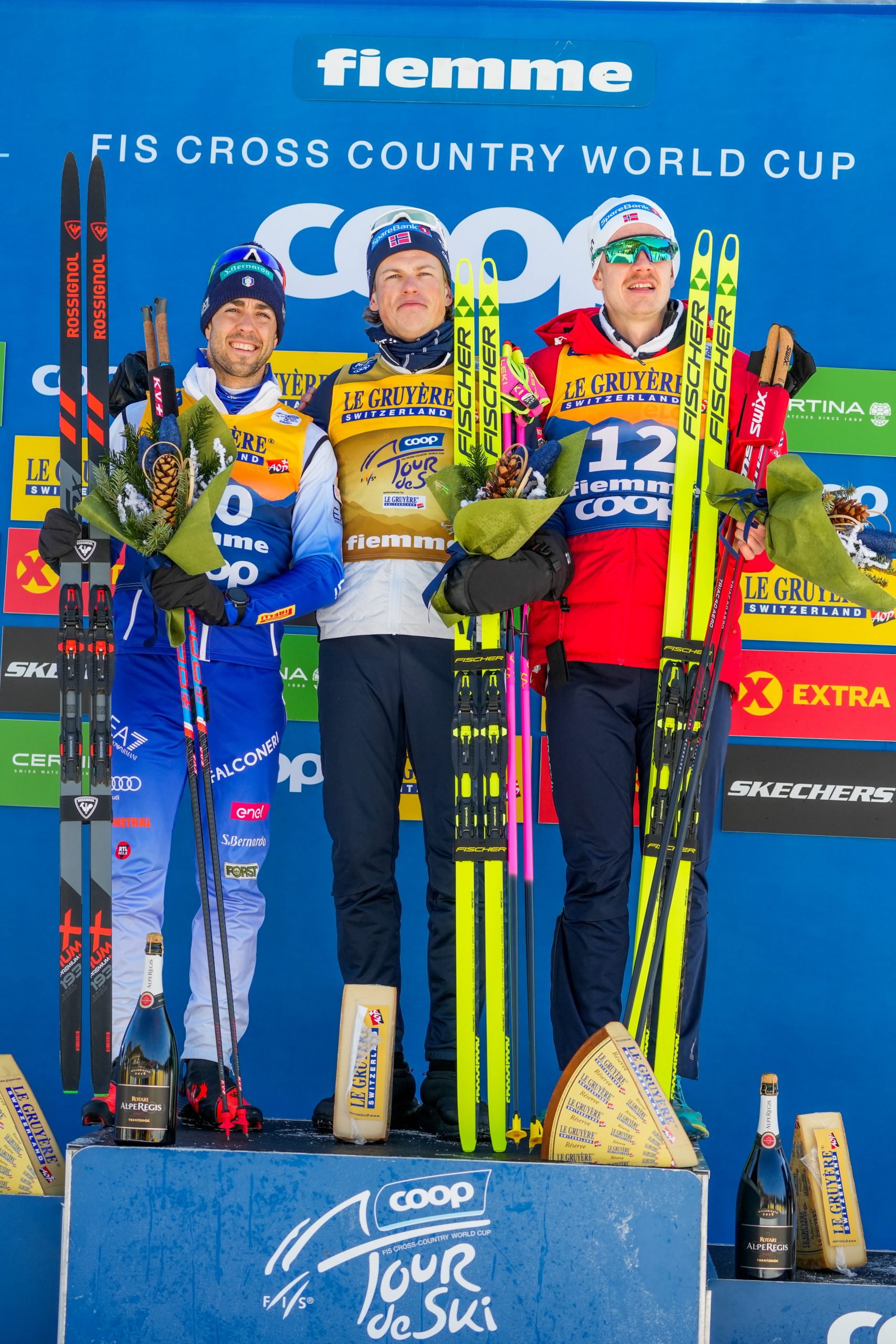
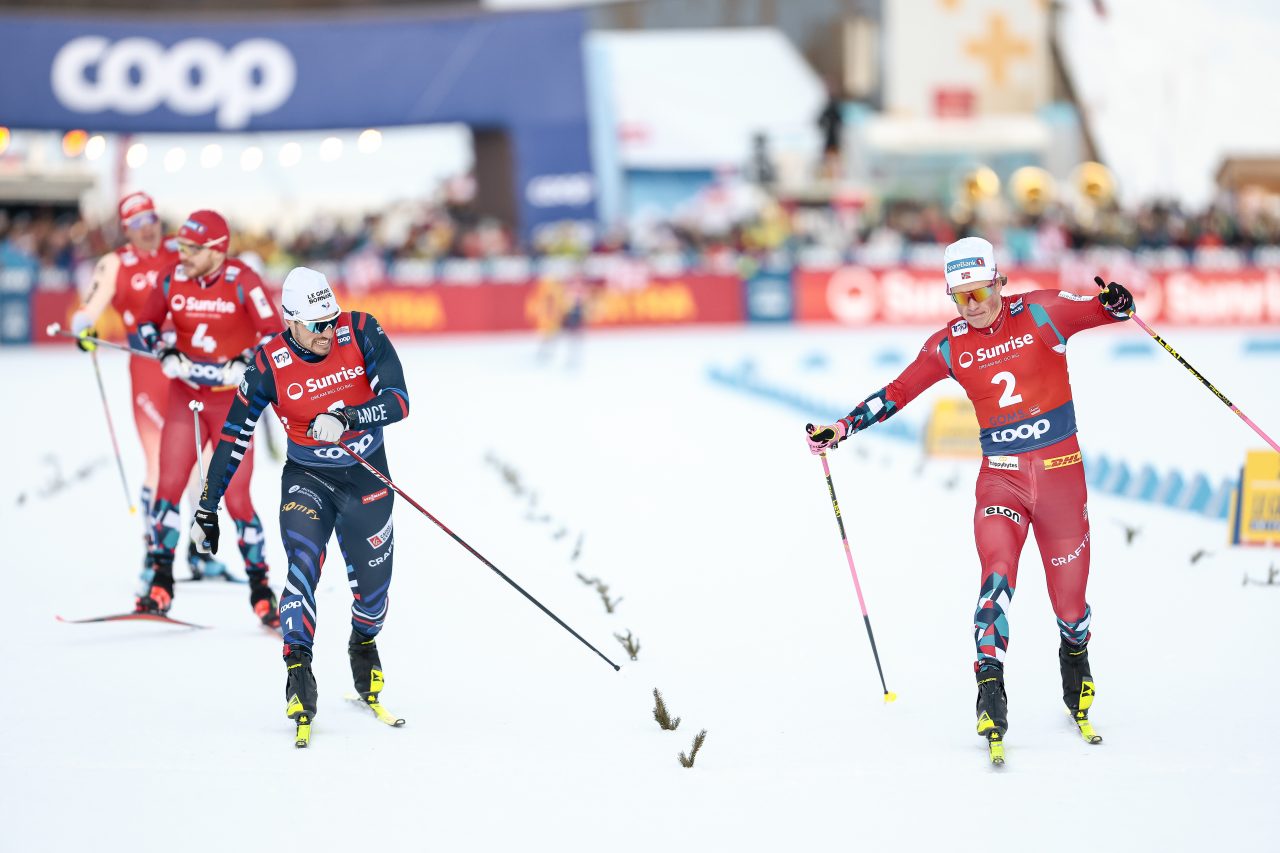
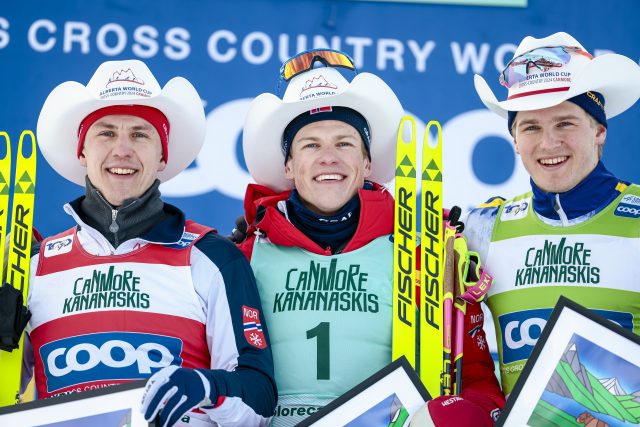
    Gus Schumacher (USA) claimed his second podium in as many days with a brilliant second-place finish behind,Johannes Hoesflot Klaebo (NOR) and ahead of Edvin Anger (SWE). (Photo:  Authamayou/NordicFocus)

    While Klaebo is back on tour—and coasted to yet another World Cup Classic Sprint victory—it felt more like an American coming out party and less like yet another Klaebo coronation. Gus Schumacher led the way with a brilliant and confident second place, ahead of a bull-headed Edvin Anger (SWE) who continues to think that Klaebo can be beaten with brute force and raw power. Klaebo proved Anger wrong yet again . . . but it was Schumacher who stole the show.

    “These courses are really hard, like that hill is about a minute long,” said Schumacher. “And yeah, being an all around athlete—like having some distance ability—it really helps me out there.”

    And Schumacher was not the only American to deliver standout performance in Goms. Five American men qualified in the top 17: Ben Ogden 6th, Zak Ketterson 9th, Schumacher 12th, Schoonmaker 13th, Zach Jayne 17th. Jack Young did not produce the Classic sprinting result he may have hoped for. He finished qualifying 39th, just over a second outside the advancing standard. Kevin Bolger also would’ve found himself disappointed this morning in Goms, completing his qualifying round in 61st.

    “The qualifier was a great opportunity to improve on my disappointing results last weekend,” said Jayne. “I created an ambitious race plan and with the great wax support, I delivered. Given that—and given the tough course—I don’t find the (qualifying) result too surprising, but it is a nice treat.”
    JC Schoonmaker (USA) was one of a host of American men delivering great performances in Goms. In the Classic Sprint, Schoonmaker would qualify 12th, and finish 10th overall. (Photo: Authamayou/NordicFocus)
    Americans Crowd the Heats

    The beginning of the Sprint heats made it look like Klaebo was involved in a different sort of drama . . . after the strong qualifying effort of Individual Neutral Athlete, Savelii Korostelev. With the Olympics approaching—and Korostelev improving his performances each week (especially in Classic events)—Klaebo may have felt it prudent to give the young Russian a better look so that he didn’t find himself surprised in Milano-Cortina. Facing Korostelev in Quarterfinal 1, Klaebo drifted craftily to the rear for a clearer view of the young Russian. There Klaebo stayed through the first uphill, and the second where Lauri Vuorinen lost momentum, blocking Klaebo’s progress and wedging him behind Korostelev. But all it took was one extra push from Klaebo over the top to send him flying down the other side—past Vuorinen, past Korostelev, past Valnes, and across the finish line for the heat win. Valnes held on for second in. front of a fast-closing Korostelev.

    Ogden followed Edvin Anger through the second quarterfinal, holding on for second ahead of a fast-charging Hovard Moseby (NOR) who would also secure a lucky loser spot.

    Zachary Jayne and JC Schoonmaker entered Quarterfinal 3 alongside Even Northug (NOR) and Oskar Opstad Vike (NOR). Jayne went straight to the front, determined to use his evident qualifying speed to insure a fast heat. Jayne’s enthusiasm would be quickly curbed by the thin air of high elevation and the slow snow that resulted from overnight accumulations. Jayne would fade to the rear of the field (ultimately finishing 27th on the day) while Schoonmaker surged forward in pursuit of Theo Schley (FRA). Schoonmaker would hold his advantage, even easing up a bit before the line ahead of Anton Grahn (SWE), Vike, and Northug.

    “The heats were just on another level,” said Jayne. “The heat selection was particularly stressful and something I have never experienced before. I chose heat 3 because, statistically, it has the most lucky losers. My position at the front just happened organically and I paid the price for a fast start. Happy to race the way I did, but unsatisfied with the outcome, more to learn and more to reach for. Great day for the Americans and I am truly honored to be a part of it, no matter how small my contribution.”

    After his all-out chase onto yesterday’s Team Sprint podium, it would be understandable if Schumacher appeared sluggish in Quarterfinal 4. But that’s not the way Schumacher races. He seems to have an ability to recover quickly, and to ride waves of seasonal momentum. He popped to the front at the top of the final climb (ahead of an inexplicable stall from Joni Maki), and surged down the other side where he would hold his advantage across the finish line

    Ketterson found himself at the front of what initially appeared to be a tactical heat. He employed an earlier diagonal stride on the first uphill than the rest of his heat, remaining light and quick. If there’s a smart way to ski at the front of a slow heat, Kettterson was demonstrating it. He scampered up the final hill as the field crowded around him, then veered, regretably, into the tracks on the shorter righthand side, slamming the door (as it turns out, a bit over-zealouslys) on Sweden’s Georg Ersson who was lucky to escape with poles and skis intact. Ersson would overcome Ketterson in the finishing straightaway, advancing to the semifinal. Ketterson would find himself disqualified in what would otherwise have been a personal best Classic Sprint performance.

    “Completely my fault!” said Ketterson. “He was in my blind spot and it was a split second decision that obviously ended up being a big blunder. I should have just stayed in my own track and taken the position behind him on the final downhill.”
    “The classic sprint at the Olympics has been my primary goal for the entire season, said Ketterson. “I hope I have shown enough ability to earn a start, but from this point on it’s not within my control so I will just do my best to focus one day at a time.”
    As they say in NASCAR, rubbing is racing . . . and American men were solidly in the mix in every heat of Goms’ Classic Sprint, including the first semifinal where Erik Valnes NOR) hit the deck as JC Schoonmaker (USA) headed for the hinterlands.  (Photo: Authamayou/NordicFocus)
    Classic Sprint Semifinals

    Three American men—Ogden, Schoonmaker, Schumacher—advanced to the Sprint semifinals. Three guaranteed finishes in the top 12: that’s a sign of a seriously strong team. But while it’s great to qualify for a Sprint semifinal, the names on the roster when you get there can be pretty daunting. Semifinal 1: Klaebo, Anger, Schoonmaker, Valnes, Ogden, Northug. That’s a seriously stacked heat. In that semifinal, Klaebo’s start was far more assertive than his quarterfinal, and it produced the result of luring Anger out into an early lead. On-air commentator, Andrew Kastening, got it totally right: “You’d think as time would go on, that Edvin Anger would learn to let Klaebo lead,” said Kastening. Evidently, Anger is not the quickest learner . . .

    Ogden and Schoonmaker maneuvered through the pack, their kick wax seeming sufficient on the ascent of the first hill, but their glide on the downhill seeming less than stellar. Anger continued to lead over the top of the second hill. On the subsequent downhill, Klaebo glided into a too-small gap on the inside of Anger, who held his line and allowed Klaebo to ease through without issue (well done, Edvin). The move allowed Klaebo into the lead, but it sent ripples through the skiers behind the leading duo. Valnes found his ski tips tangling with Schoonmaker’s tails . . . Valnes ended up flopping spectacularly onto his backside while Schoonmaker was launched through the V-boards and into the soft snow of the infield. Schoonmaker somehow managed to avoid complete disaster, stayed on his feet, and managed to find his way back on course. Ogden wove through the carnage to finish third, where he’d wait to see if he would advance to the final as a lucky loser. Schoonmaker would finish fifth behind Northug. Valnes would limp home in sixth.

    The second semifinal was relatively less star-studded, though still featured Sprint standouts such as Vike, Ersson, Joni Maki (FIN) Simone Mocellini (ITA), Anton Grahn (SWE), and Schumacher. Mocellini would make most of the pace in the heat, cresting the final hill with a slim lead over Schumacher. Schumacher would ride fast skis down the final slope, and step deftly inside of Mocellini as they entered the final double pole sections. Schumacher would hold on to cross the finish line first, and advance to the Sprint Final where he would join Ogden.

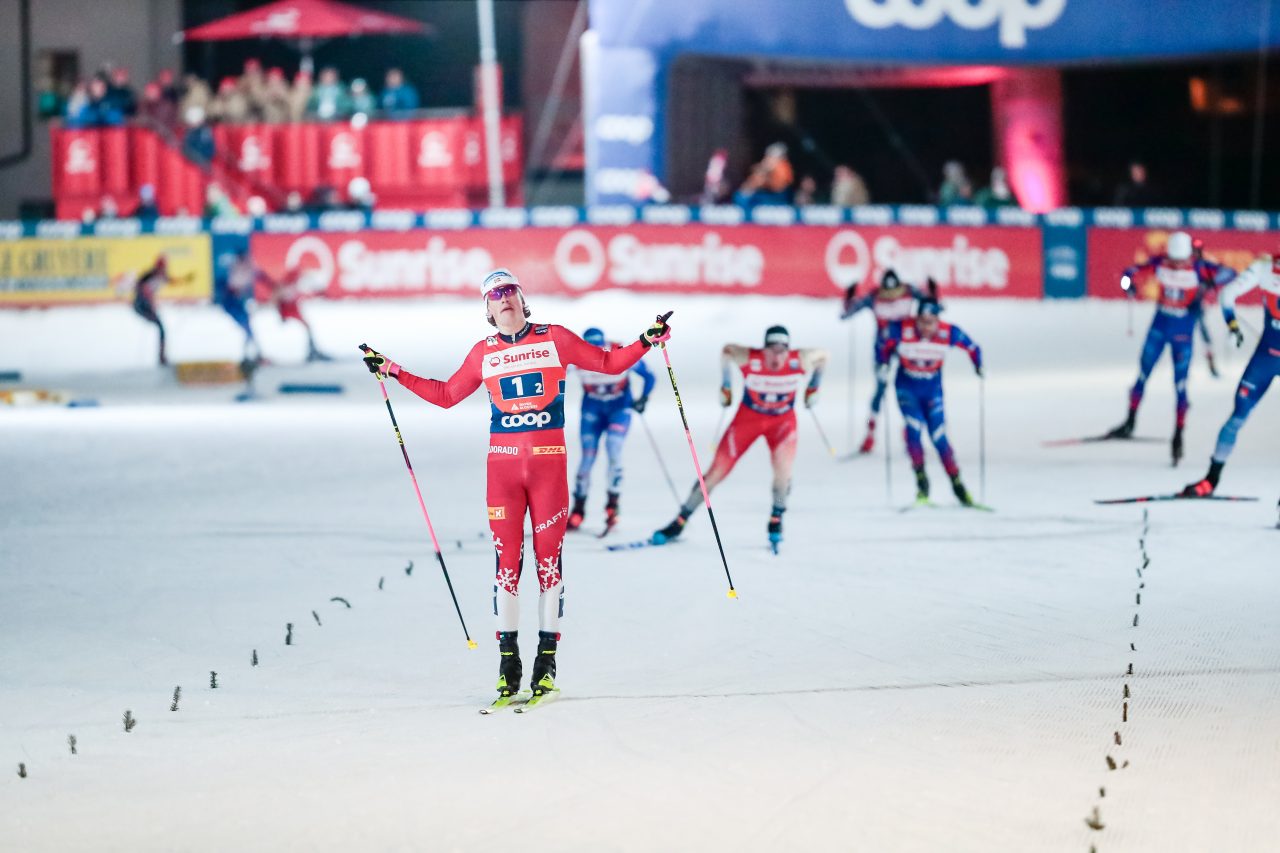
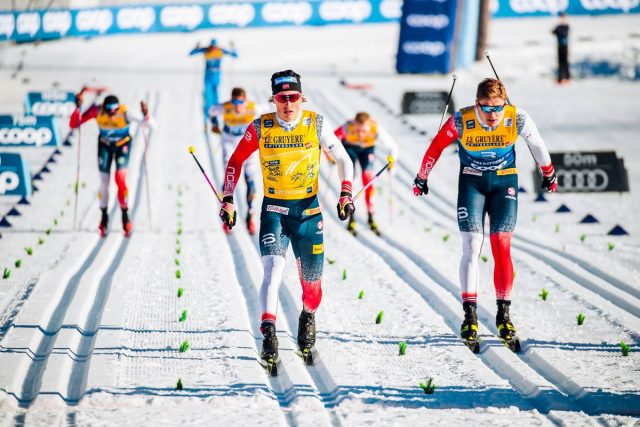
    Johannes Hoesflot Klaebo (NOR) pushed an unwitting Edvin Anger (SWE) into the lead in both the semifinal and final. (Photo: Authamayou/NordicFocus)
    Classic Sprint Final

    Two Americans advanced to the Classic Sprint Final—that’s a seriously legit statistic—where they’d be joined by Anger, Mocellini, Northug, and the omnipresent Klaebo. Ogden had already looked fatigued in the semifinal (after a high-intensity podium finish in yesterday’s Team Sprint, who can blame him?), but Schumacher continued to look fresh and fast.

    “I was definitely pretty tired from the Team Sprint yesterday,” said Ogden. “Gus and I were pretty fired up; hard to fall asleep (so) I was feeling yeseterday, today1 And with the training block I’ve been doing the last few weeks, I think that was on full display in the final. But I’m still stoked with how today went, for sure. The plan was not to be the best version of myself this weekend—maybe like second best version—so I’m feeling pretty good about how that went down!”

    “I think I still capitalized,” continued Ogden. “And got away with a really really solid day. Good stuff . . . awesome for the team, awesome for everybody!”

    Anger never seems to learn. Maybe one day he’ll become as dominant as his ski tactics currently imply he thinks he is . . . but in Goms’ Classic Sprint Final he was just another guy playing right into Klaebo’s hands. Schumacher is a quick study, though; he’s learned where he nees to be, and he slotted in right behind Klaebo who skied the very same race as in the semifinals: let Anger lead across the flats, step into an open lane to keep from getting bunched on the first uphill, while continuing to force Anger to keep his nose in the wind. Poor kid . . . he imagines himself in a rivalry with Klaebo, who seems only to consider Anger as a convenient stepping stone to ever more Sprint victories.

    That’s when Klaebo switched it up—flowing past Anger on a downhill, powering up the final climb, high-tempo diagonal stride from bottom to top, effectively deciding the race with 400 meters still to go. Schumacher rocketed past Anger as the rest of the field locked up behind the stultified Swede. Schumacher showed his tremendous form and fitness, remaining quick and snappy to the end, powering across the line just behind a relaxed and coasting Klaebo. Schumacher—and Team USA’—would earn a second World Cup podium in as many days. It’s bizarre to watch a Sprint Final become a death march, but such was the level of exhaustion that the Goms Sprint course had loaded into the arms and legs of these racers. Anger survived across the finish line in third. Ogden faded to sixth. Even so, two Americans in a Classic Sprint Final . . . there haven’t been many days that Team USA would celebrate more than this one.

    Schumacher summarized his progress,and his prospects: “The way it’s set up, these races actually probably will give me a bit of a boost, fitness wise, which is cool to think about.”

    Klaebo continues to lead in all World Cup categories this season: Sprint, Distance, and Overall. His level of dominance is unprecedented as the field approaches the Olympic Winter Games.

    Men’s Classic Sprint RESULTS

    Men’s Classic Sprint QUALIFYING

    Help Support Our Olympic Coverage!

    FasterSkier will have our own Nat Herz on the ground at the Olympics, which, to be honest, is a very big financial lift for us. If you value the thoughtful work and access FasterSkier provides at championships like this one, please consider becoming a Voluntary Subscriber. Your support directly fuels the work we do to cover the people, places, and moments that make our sport special.

    Join the FasterSkier community!
  • Fire, Ice, and Belief: Two Vermonters Deliver Under the Lights in Davos

    Fire, Ice, and Belief: Two Vermonters Deliver Under the Lights in Davos

    This coverage is made possible through the generous support of Marty and Kathy Hall and A Hall Mark of Excellence Award. To learn more about A Hall Mark of Excellence Award, or to learn how you can support FasterSkier’s coverage, please contact info@fasterskier.com.

    The lights come on early in Davos, not because they are needed, but because Davos wants them on. By mid-afternoon, the valley is already sliding toward dusk, the alpine light thinning and flattening, and the sprint venue leans into the moment the way it always has: music turned up, cowbells ringing with a little extra insistence, flames licking the edges of the course like stage cues. The effect is deliberate. This is not cross-country skiing as a quiet endurance ritual in the woods; this is cross-country skiing as spectacle.
    “Davos deliberately designs this event to feel like a rock concert,” U.S. head coach Matt Whitcomb said afterward. “They race at night, they bring in fire and lighting and music, and because it’s a two-lap course, you see the athletes twice as much. They invest in the experience, and it pays off.”
    Jack Young (USA) on his way to a fast qualification in Davos (SUI). (Photo: Modica/NordicFocus)
    On Saturday night, it paid off in a men’s freestyle sprint that delivered one of the most compelling American performances in years. Jack Young finished fourth, Ben Ogden fifth — the first time two American men had made a World Cup sprint final together in Davos — on a night when the script cracked open early and never fully resealed. Johannes Høsflot Klæbo was gone before the semifinals. A notoriously slick downhill corner became the day’s silent antagonist. And by the time Lucas Chanavat lunged across the line to win by three hundredths of a second, the story had already shifted: the U.S. men were no longer visitors to the sprint final. They were participants, with opinions about how it might have ended differently.
    For Young, the fourth-place finish marked his first World Cup sprint final — a breakthrough that felt less like a surprise than a confirmation. “This result means so, so much,” he said. “It really feels like proof that I can make it to the top in this sport. If I’d told myself three years ago that I’d finish fourth in a World Cup sprint, I would have thought I was insane.”
    Ben Ogden (USA) during qualification in Davos (SUI). (Photo: Modica/NordicFocus)
    A course that punishes impatience
    Davos is not a long sprint, but it is not a forgiving one. Two laps of just under 600 meters pack in a decisive climb, sustained skating tempo, and — this year especially — a downhill corner that demanded respect. The snow was entirely man-made, hard and fast, and as the temperature dropped through the evening, it glazed into ice. Athletes began to talk about the corner not as a feature, but as a test.
    “That bottom corner was particularly dicey this year,” Whitcomb said. “Man-made snow turns to ice quickly, and that corner claimed a lot of people over the last couple of days.”
    Ben Ogden felt it more than once. “That last corner was really the focus,” he said. “I fell there yesterday, JC fell there in practice, and I stumbled twice in the final and ended up against the boards. It was unfortunate, but every year you learn a little more about how the ice forms there.”
    The corner changed the race’s outcome. The first time through, athletes skied it conservatively, prioritizing stability over speed. The second time, with fatigue setting in and the finish looming, choices became riskier — and more consequential.
    Janik Riebli (SUI), Jack Young (USA), and Lars Heggen (NOR), (l-r) during the heats in Davos (SUI). (Photo: Vanzetta/NordicFocus)
    Qualifying hints, early shocks
    The qualifying round suggested a familiar hierarchy, but with enough irregularities to hint that Davos might misbehave. Lucas Chanavat of France was fastest, Ben Ogden second, Klæbo third. Jack Young qualified sixth — an excellent position that put him squarely in control of his bracket.
    “That’s one of the best qualifying results we’ve ever had on the U.S. team,” Whitcomb said. “Qualifying in the top ten gives you options. It lets you race offensively instead of defensively.”
    Klæbo’s day began to unravel in the quarterfinals. Boxed in and forced wide through the downhill, he finished fourth in his heat and failed to advance. His 16-race sprint win streak ended not with drama, but with traffic — a reminder that sprinting, for all its stars, is still governed by physics and positioning.
    Ogden and Young both advanced cleanly. Ogden won his quarterfinal with authority. Young skied his with the composure of someone who knew exactly what he needed to do — no more, no less.
    Ben Ogden (USA) and the US Ski Team had a lot to celebrate in Davos (SUI). (Photo: Modica/NordicFocus)
    Semifinals: the Americans arrive together
    By the semifinals, the noise in Davos had sharpened. Chanavat advanced. Ogden advanced. And then Young did, stepping into his first World Cup sprint final with the kind of quiet efficiency that suggested the moment had not surprised him.
    “To be honest, the first thing that went through my mind standing on the start line was how tired I was,” Young said. “But I reminded myself that anything can happen in a sprint final. I don’t train just for qualifiers and quarters — I train for the full day. It was time to execute.”
    For Ogden, the significance of sharing the moment wasn’t lost. “Racing with Jack today was awesome,” he said. “He has this infectious confidence, especially here in Davos. Last year we were in the semifinals together, and this year we were in the final together. That’s a big step.”
    Whitcomb saw it as more than a statistical milestone. “To put two guys into the men’s final is a dream,” he said. “When athletes finish a race seeing the podium and knowing they can be on it, that’s when things start to get dangerous — in a good way.”
    Jack Young (USA) had every right to be celebrated after his breakout race today in Davos (SUI). (Photo: Modica/NordicFocus)
    The final: margins measured in inches
    The men’s final unfolded at full speed. Chanavat and Federico Pellegrino established themselves early, both reading the race the way veterans do — not forcing it, but shaping it. Oskar Opstad Vike of Norway positioned himself patiently, waiting for the moment when commitment would matter.
    Ogden and Young stayed connected. Coming into the final corner, Ogden had position. Young had momentum.
    “I was really gunning for that podium,” Ogden said. “I felt like I was pretty close. With fewer stumbles and maybe a little better positioning, I think I could have made it happen.”
    The corner had other plans. Ogden’s line took him over the ice and was forced wide, momentarily pinned against the boards. Young exited cleaner, carrying speed into the finishing straight.
    Chanavat and Pellegrino lunged together at the line, Chanavat winning by three hundredths of a second. Vike took third. Young crossed fourth, Ogden fifth — separated from the podium by seconds, but not by belief.
    “I finally feel like I can truly compete at the top,” Young said. “That’s a special feeling.”
    Results — Men’s Sprint Freestyle, Davos
    1. Lucas Chanavat (France)
    2. Federico Pellegrino (Italy)
    3. Oskar Opstad Vike (Norway)
    4. Jack Young (USA)
    5. Ben Ogden (USA)
    6. Edvin Anger (Sweden)
    Notables: Johannes Høsflot Klæbo (Norway), 17th, and JC Schoonmaker (USA), 27th.
    It has been a tough trail back to the top step on the podium for Lucas Chanavat (FRA) so he was extremely excited to be standing on it today in Davos (SUI). (Photo: Vanzetta/NordicFocus)
    What Davos leaves behind
    Davos has always been good at revealing things. It reveals how athletes handle altitude, manage nerves, and respond when a race refuses to go according to plan. On Saturday night, it revealed something else: American depth at the sharp end of a sprint final.
    Young talked about the atmosphere as something that lifts him. “With all the energy, it’s easy to trick yourself into thinking you’re walking into a big arena,” he said. Ogden talked about validation — not just from results, but from proximity. “My target in these races is the podium,” he said. “It feels good to know I’m getting closer.”
    Whitcomb, standing back from it all, saw the longer arc. “We’re in a really good place with these guys,” he said. “There’s a lot more to come.”
    The flames went out eventually. The music faded. Davos returned to being a quiet alpine town under an early winter night. But for the American men — and for two Vermonters who now know exactly what a World Cup sprint final feels like in tandem — something lingered.
    Not noise. Not spectacle.
    Belief.


    Men’s Individual Sprint Final RESULTS


    Love Stories Like This? Help Keep Them Coming.

    Feature stories like this one take time, access, and care to produce. If you value thoughtful storytelling and independent ski journalism, please consider becoming a Voluntary Subscriber. Your support directly fuels the work we do to cover the people, places, and moments that make our sport special.

    Join the FasterSkier community!


    Federico Pellegrino (ITA), Lucas Chanavat (FRA), and Oskar Opstad Vike (NOR), (l-r) on the sprint podium in Davos (SUI). (Photo: Vanzetta/NordicFocus)
  • The Devon Kershaw Show: Buckle Up for a Six-Race Ruka Recap

    The Devon Kershaw Show: Buckle Up for a Six-Race Ruka Recap

    It’s on — the 2026 Olympic season, that is. Devon and Nat break down six season-opening races from northern Finland, including a thriller in Sunday’s men’s race.

    Contact us with fan mail, hate mail and everything in between: devon[at]fasterskier.com and nat[at]fasterskier.com. We’re looking for title and other sponsors for our Olympic coverage; email matthew[at]fasterskier.com with inquiries.

  • A Breakaway, a Broken Pole, and a Biathlete’s Bet: Amundsen Wins a Wild 20 k in Ruka

    A Breakaway, a Broken Pole, and a Biathlete’s Bet: Amundsen Wins a Wild 20 k in Ruka

    This coverage is made possible through the generous support of Marty and Kathy Hall and A Hall Mark of Excellence Award. To learn more about A Hall Mark of Excellence Award, or to learn how you can support FasterSkier’s coverage, please contact info@fasterskier.com.

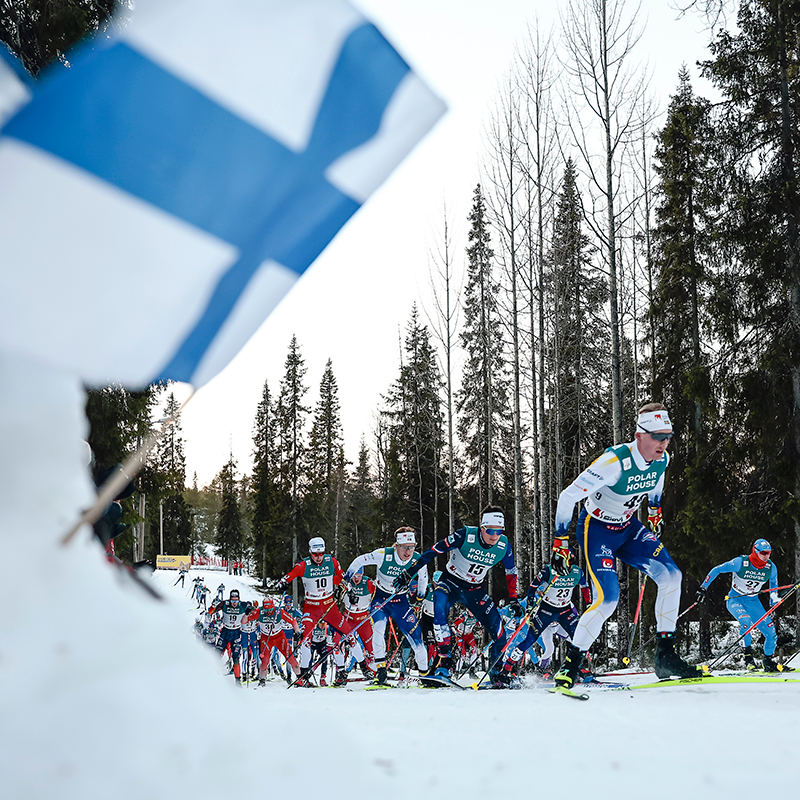
    Sunday morning in Ruka had the look of a place holding its breath. The sun sat low over the trees, the air hovered just on the warm side of freezing, and the men’s World Cup field stepped into the stadium with the faint stiffness of athletes who had already skied two challenging races in two days. A thin glaze shone on the 4-kilometer loop, the kind that makes skis feel nervous and alive at the same time, and even before the starter raised his arm, you sensed the day would run fast.

    The stadium sits at the high point of the course in Ruka, so the men’s 20km mass-start free begins not with the controlled civility of a long climb but with a plunge. Skiers can hit 80 kilometers an hour on the opening descent, the field funneled into two uneasy lanes, and the whole pack—Johannes Høsflot Klæbo included, wearing the yellow bib and chasing the mythical 100th World Cup win—had to thread that speed through a hairpin that felt too tight for comfort even on TV.

    Harald Oestberg Amundsen (NOR) finds his way through the traffic of the Men’s 20 k Freestyle mass start in Ruka (FIN). (Photo: Modica/NordicFocus)

    Ruka is an odd, angular loop: long, steady work on the one side; a shorter, punchier grind up the Impilinna climb; then a sweeping dive back toward the stadium before the last drag to the line. Five laps. One early-season opportunity to reshape the winter. And an Olympic year, which meant that every Norwegian on the line was skiing for more than points—they were skiing for selection.

    Among the Americans, the storylines were as varied as their bibs: Gus Schumacher and Zanden McMullen seeking another elite result after their success in Ruka a year ago, Zak Ketterson racing with newfound confidence after a career-best 14th in Friday’s classic 10 K, and a young supporting cast learning the dynamics of a fast, narrow pack on a tricky course.

    Nothing broke early. The first lap was quick but calm, a kind of rolling truce among athletes who knew how violent the final lap could become. But the race’s character changed—the way good races do—at the unexpected moment.

    Mika Vermeulen (AUT) leads Edvin Anger (SWE) through the stadium. (Photo: Modica/NordicFocus)
    The Gamble at 9.1km

    At the 9.1km sprint banner, Sweden’s Edvin Anger made the first real incision in the race. The 23-year-old surged for bonus points—as expected—but then did something far more interesting: he kept going. Mika Vermeulen of Austria latched on, the two of them taking the descent like they meant it, and for the first time all day, the pack blinked.

    Within a kilometer, the gap was three seconds. Then seven. Then ten. The move was reminiscent of the early break in a bike race. The French and Germans led the chase instead of Norway. Hugo Lapalus briefly tried to bridge and cracked. The Norwegians refused to panic.

    Behind the break, Schumacher and Ketterson were having very different but equally impressive races. Schumacher hovered between fourth and eighth through the middle laps, completely comfortable in traffic. Ketterson floated near the top ten, choosing clean lanes, maintaining position with a calm that looked like something new.

    Further back, Einar Hedegart—the 23-year-old biathlete-turned-cross-country-skier whose win at the Norwegian opener in Beitostølen had already rattled some assumptions inside Norway’s Olympic selection system—drifted quietly toward the front.

    By 13 kilometers, Anger and Vermeulen’s advantage peaked at roughly 13 seconds. It wasn’t supposed to hold. But it looked real. And it was enough to force the race’s next twist.

    Einar Hedegart (NOR), follows Johannes Hoesflot Klaebo (NOR) through the stadium. (Photo: Modica/NordicFocus.)
    The Turn, the Crash, and the Broken Ski

    Gus Schumacher’s day changed off-camera.

    “The race was going super well,” Schumacher said after the finish. “It felt relatively easy; my body was super responsive with great energy. I was able to keep really good position, which is massive in this race.”

    Then came the downhill at roughly 14km, the kind of section where pack dynamics feel like a living organism.

    “I was gliding up on the left side, and Klæbo switched lanes right in front of me, sweeping my tips out. It was too quick and unpredictable for me to do anything,” Schumacher said. “I fell off the side of the trail, my ski ran into the hard snow on the edge, and it broke the tip.”

    He skied another full lap on the damaged ski.

    In the hard, fast conditions, it was just stable enough to keep him in touch—and switching skis would almost certainly have meant losing the group entirely. Remarkably, even with the partial break, Schumacher clawed back toward the front, positioning himself to sprint for a top spot.

    And then the bad luck doubled.

    “In the last kilometers, it got stuck in the deep snow of the test track and broke the tip fully, and that was the end.”

    He finished 39th, but the skiing he showed before the equipment failure will matter more than the result does.

    “I’m super proud of how I was skiing… My body is in a great place, but this weekend’s luck just hasn’t gone my way. Long season ahead.”

    Andrew Musgrave (GBR) and Einar Hedegart (NOR), (l-r) during the final race of the weekend in Ruka (FIN). (Photo: Modica/NordicFocus)
    The Pole Break, the Surge, and the Catch

    At ~16 kilometers, Harald Oestberg Amundsen—already a pre-race favorite—snapped a pole.

    It could have been the story. Instead, it became the turning point.

    Service handed him a new pole instantly. Amundsen slotted back in, glanced up the trail, and began to close the gap. Hedegart came with him. Nyenget followed. The chase, which had felt half-committed earlier, finally had purpose.

    With Anger and Vermeulen still dangling up the trail and the course running out of time, Amundsen moved to the front and began applying real pressure. The gap shrank visibly on the Valkosenvaara climb. By the time the race wound back toward the stadium, the two leaders were in sight, the rope fraying.

    What came next was pure Amundsen.

    He caught the break on the final climb. And then he kept going.

    Gus Schumacher (USA), (NOR), Johannes Hoesflot Klaebo (NOR), Zak Ketterson (USA), Harald Oestberg Amundsen (NOR), and Einar Hedegart (NOR) among others climbing up the final climb of the lap in Ruka, Finland. (Photo: Modica/NordicFocus)
    The Ruka Climb and the Decisive Moment

    With roughly 500 meters left—just before the crest of the Ruka climb—Amundsen stepped out from the group and launched his move. It wasn’t desperate or chaotic; it was clean, timed, and confident. Hedegart tried to respond. Nyenget tried. Anger fought with everything left.

    Nobody matched him.

    Amundsen crested alone, floated through the final meters, and took his 11th career World Cup win with the kind of clarity that defines a season.

    In an on-air broadcast interview after the finish, he explained the day as a study in patience and timing:

    “The conditions were so high-speed that I was quite nervous on the downhills,” he said. “On the first four laps I was pretty far behind and struggling to move up, but I had saved some energy. On the last lap, I felt very strong.

    When they got the gap at the beginning, I was quite far behind, so I just had to wait. But on the last lap, I thought, you can’t just let this go, so I put everything in and caught them on the last uphill… I had good legs today.”

    Behind him, Hedegart—just one year removed from biathlon—finished a remarkable second. Anger earned third after animating the race with the early breakaway. Nyenget was fourth; Vermeulen fifth.

    And Klæbo, in a rare off-day, was 15th.

    Zak Ketterson (USA), and Friedrich Moch (GER), (l-r) lapping through the stadium during the Men’s 20 k Mass Start Freestyle in Ruka (FIN). (Photo: Modica/NordicFocus)
    An American Breakthrough

    Zak Ketterson recorded the best American result of the day—ninth place, the first top-10 of his World Cup career in a mass start—and the performance looked more like the product of design than circumstance.

    Ketterson entered the day already benefiting from Friday’s career-best 14th in the 10 k classic, which earned him a forward bib placement on a course where position matters as much as fitness.

    “I was fortunate to start really far up in the pack because of my performance in the 10 k, and that was huge in such a tight and tactical field,” Ketterson said. “I knew if I moved too far back, it’d be really hard to move back up, so I planned to defend my position as well as I could.”

    He executed the plan with the kind of composure that has eluded him in past mass starts. On a slick, tense course where one mistake could cost half the field, Ketterson held clean lanes, avoided every significant disturbance, and stayed in the top 10–15 as the race stretched into the final lap.

    What’s emerging this season is not just fitness, but a foundation built well before Ruka.

    “This summer and fall, especially, my wife Julie and I went all in on trying to prepare as well as possible for this year,” he said. “I worked harder than I ever have and also have had a really good mindset. That it’s working so well so far is a big testament to all the hard work, and my wife Julie should get a lot of credit for being my number one support staff.”

    The strongest signal of progress came in the final kilometer, when the real attrition began, and Ketterson didn’t fade—he held and even advanced.

    “It meant a lot to be able to have a strong finish because, as I said earlier, I often would finish these types of races and move backwards in the pack,” he said. “I think the fact that I was able to relax so much of the race made it so that I had that energy that was necessary when the pace picked up. I am really proud of how calm I stayed, even though the race was so tight, and the conditions were super sketchy, icy, and fast.”

    For a U.S. men’s program that continues to build depth quietly, Ketterson’s weekend—14th + 9th—marks a meaningful step. It also gives the team, and head coach Matt Whitcomb, a new data point as Olympic-year relay and selection conversations begin.

    Einar Hedegart (NOR) celebrates the victory in Ruka (FIN). (Photo: Modica/NordicFocus)
    What This Race Means

    For Norway: The selection picture grows even more impossibly crowded. Amundsen is in towering early-season form. Hedegart is no longer a curiosity—he’s a factor. Nyenget remains brutally consistent. Klæbo is still the biggest star in the sport, but his chase for World Cup win No. 100 will now continue into Trondheim.

    For the rising generation: Three of the top six—Anger, Hedegart, Desloges—are 23 or younger. The youth wave is no longer a subplot; it’s the plot.

    For the Americans: Ketterson’s top-10 creates new conversations about relays and the Olympics. Schumacher’s form before the crash suggests he’s ready for significant results as soon as his luck stabilizes.

    For the sport: A genuine breakaway, a serious chase, a late-lap catch, a pole break, a ski break, and a new podium—all in one race.

    Ruka is supposed to be the season’s prologue. This one felt like chapter one.


    Men’s 20 k Mass Start Freestyle RESULTS


    Einar Hedegart (NOR), Harald Oestberg Amundsen (NOR), Edvin Anger (SWE), (l-r) share the podium of the Men’s 20 k Freestyle Mass Start in Ruka, Finland. (Photo: Modica/NordicFocus)

    Love Stories Like This? Help Keep Them Coming.

    Feature interviews like this one take time, access, and care to produce. If you value thoughtful storytelling and independent ski journalism, please consider becoming a Voluntary Subscriber. Your support directly fuels the work we do to cover the people, places, and moments that make our sport special.

    Join the FasterSkier community!


  • Enga-dang: Three days of racing mayhem and a special, tree-planting guest

    We’re back to recap a long weekend in glorious Switzerland, with some familiar names topping the podium but still doing it in exciting fashion. Plus, hear from Canada’s Sonjaa Schmidt about her star-is-born moment in the sprint and her, shall we say, unconventional summer training.

    Fan mail to devon@fasterskier.com; hate mail to nat@fasterskier.com. We’ll be back soon.


  • The Boys are Back—Klaebo Schools Anger in Engadin Freestyle Sprint

    This coverage is made possible through the generous support of Marty and Kathy Hall and A Hall Mark of Excellence Award. To learn more about A Hall Mark of Excellence Award, or to learn how you can support FasterSkier’s coverage, please contact info@fasterskier.com.

    Johannes Hoesflot  Klaebo (NOR) is BACK, and with plenty of time to ease up in the finishing straightaway, perhaps a reminder to the young upstart, Edvin Anger (SWE), of just who the boss really is. (Photo: Authamayou/NordicFocus)[/
    You just can’t believe how fast . . . when skiers at the front of a World Cup Sprint field hit the gas, the top end speed they reach is simply astounding—fast enough that skiers at the trailing end of the pack are rocked back on their heels, having neither technique tricks nor fitness solutions to deal with the radical increase in pace. It’s simply bizarre to see those skiers in the back half of the Sprint field—world-class skiers, all—reduced to flailing ski-kids when the pace really ratchets up. That’s what happens at Engadin, Switzerland on a Sprint course that only offers speed. Not much in the way of interesting features or novel course challenges, not much in the way of variety or tactic: Engadin’s Sprint course is a wide-open, wind-swept strip of groomed corduroy that weaves through open, unprotected territory. On a sunny day with temperatures hovering just above freezing, what the Engadin course offers is speed. And nearly every heat winner seemed to rely on at-the-front speed in order to advance.

    Predictably, the only skier doing things a different way was Klaebo . . .

    Johannes Hoesflot Klaebo is back in the mix. After a few weeks off (during which he skipped numerous World Cup starts and the Norwegian National Championships), Klaebo returns to the World Cup tour, hoping to respond to recent claims voiced by Edvin Anger (SWE) that he (Anger) would’ve beaten Klaebo in last week’s Classic Sprint in Les Rousses, France. If Klaebo reads the reports in ski-media, he might’ve arrived in Engadin determined to make Anger eat those words.

    In the end, Anger did show that he possesses tremendous speed, but nothing like the speed that’s available to Klaebo who coasted easily across the line for his 100th individual World Cup win. Anger scuttled home in second place ahead of Klaebo’s off-season training partner, Lucas Chanavat (FRA).

    Leading a world-class pack at the beginning of his quarterfinal heat, Jack Young (USA) would come to learn what World Cup Sprint speed really means. Young would find himself overtaken in the second half of his heat, finishing 25th on the day. (Photo: Authamayou/NordicFocus)

    Among Americans, Ben Ogden qualified 11th, though he would exit after a tangle in the semifinal left him sixth. He would finish the day in 12th. JC Schoonmaker qualified 26th and finished third in his quarterfinal, good for 15th on the day. Jack Young qualified 28th, then learned a lesson in World Cup Sprint speeds as his from-the-front tactic in his quarterfinal was overhauled by faster, more experienced sprinters. Young would end the day in 25th.

    Other Americans included Gus Schumacher in 45th, Kimball Murphy 46th, and Zanden McMullen 62nd. Canadian finishers included Sasha Masson 36th, Pierre Grall-Johnson 61st, Julian Smith 66th.

    In addition to Klaebo, the entry list this weekend in Engadin included a number of other lesser known Norwegian compound-names: Oskar Opstad-Vike, Aleksander Elde Holmboe, and Sindre Bjoernestad Skar. Questions still lingers as to whether those were the young guns who popped a good one at Norwegian Nationals, OR that the Norwegian federation is trying them on for size. With two spots still  up for grabs in the selection of Norwegian Sprint slots for February’s World Championships, the results from Engadin’s Freestyle Sprint would mean everything to Norway’s quickest sprinters.

    Norway’s Haavard Solaas Taugboel—leading Richard Jouve (FRA) and Janik Riebli (SUI)—would advance to the Final in Engadin’s Freestyle Sprint, perhaps earning his place on the Norwegian Sprint team for the World Championships in Trondheim next month. (Photo: Authamayou/NordicFocus)

    Among more familiar names, Haavard Solaas Taugboel was back in the Norwegian Sprint lineup. Having not yet secured his start position in the upcoming Trondheim World Championships, Taugboel had much to lose, much to gain. Likewise, Even Northug was entered. He’d hoped to win an easy one a week ago in Les Rousses (where a World Cup win would have likely punched his ticket to Trondheim), only to have that low-hanging fruit snatched by Edvin Anger (SWE). In Engadin, Northug would flounder again, qualifying 48th and failing to advance to the Quarterfinal.

    Perhaps the names most conspicuous by their absence were of those Norwegian all-’rounders who also excel in Sprint competitions: Paal Golberg, Harald Oestberg Amundsen, Erik Valnes. All three have been known to give Klaebo a run for his money, but their federation seems determined to save those skiers for Distance efforts. The story today seemed likely to be a grudge-fueled contest between Klaebo and Anger.

    Engadin Freestyle Sprint

    A sunny morning in Engadin also dawned very windy, with a steady stream of air pushing across the flat valley and broad frozen lake around Engadin. It seemed to all observers that the wind would become a factor in the tactics and the outcome of today’s events. Altitude would also play a role as Engadin—at an elevation of 1800 meters (nearly 6,000 feet)— is the highest stop on the 2025 World Cup Tour. Sprinting is a long day, and the rest periods get shorter and shorter as the day progresses. Speed isn’t ever enough: sprinters need to get to the final knowing they can deal with anything. The veterans are always the ones who prove most capable in that regard.

    Quarterfinal 1 featured Klaebo, Lucas Chanavat (FRA), and American qualifier, Young. Young drove the early pace while Klaebo dropped quickly off the back. Klaebo’s relaxed start turned into a more familiar strategy as he easily made up three spots on the first uphill, sliding into a third place position with headwind descents just ahead. As they hit the serious headwind, Klaebo maneuvered out from behind Chanavat, and shot past Young into the lead. Klaebo and Chanavat would advance while Young faded to fifth in the heat, finishing the day in  25th.

    Ben Ogden (USA) skied tactically in his quarterfinal to advance behind Edvin Anger (SWE). Ogden would finish 12th on the day. (Photo: ,Authamayou/NordicFocus)

    Quarterfinal 2 was a somewhat more tactical affair, led out by Anger who was closely followed by Ogden. Those two would keep their spots through the finish line, moving on to the semifinal round.

    JC Schoonmaker found himself pinched in early going of Quarterfinal 3, but managed to work his way to the outside in the final turn. He exited the turn in third, gaining speed all the way up the finishing straight, but the man he needed to catch was the legendary Federico Pellegrino. Pellegrino would remain second, advancing to the Semifinals behind heat winner Valerio Grond. Schoonmaker would finish the day in 15th.

    Schoonmaker was introspective when considering how close he was to advancing: “I think making up that gap to Pellegrino is all tactics for me.,” said Schoonmaker. “It comes down to having a better position rounding the corner into the finish which goes all the way back to being more aggressive in the early and middle parts of the race. To me it’s much less about the .3 seconds behind but the position. .3 seconds can feel quite close when you say it like that, but when you put it in terms of actually passing someone and gaining the position to move on, it’s much more difficult especially when it’s a fast and short finish like today. So for me I feel like I really need to work on my positioning and strategy throughout the heat to be ahead of a guy like Pellegrino heading into the finish rather than trying to overtake him.”

    Taugboel’s future would play out in Quarterfinal 4, where he demonstrated his agility in lifting a ski tip over one of the corner-marking v-boards as Janik Riebli (SUI) crowded him to the inside. That little loss of speed may have cost Taugboel: he moved Riebli back toward the middle for the finishing sprint, inadvertantly opening up the inside lane where Richard Jouve (FRA) used his exceptional finishing speed to grab the last automatic qualifying spot. Taugboel’s day—and likely his chances for a spot on Norway’s World Championship team—would have ended with a third place finish, but Taugboel’s finishing time was fast enough to secure a lucky loser spot.

    Sprint Semifinals

    Klaebo opened Semifinal 1 with just enough drive to push Riebli and Anger to the lead. That’s where Klaebo wanted them to be, and they totally fell for it. Ogden and Chanavat (who would typically go to the front, himself) cleverly slotted in right behind Klaebo. Anger moved to protect the inside line causing Klaebo to short-step through a corner (perhaps the closest Klaebo has come to getting tangled in a Sprint heat). Anger would remain the frontrunner through the finish line just ahead of Klaebo. Though if Anger thought this same strategy would bring him victory in the final . . .

    Oskar  Svensson (SWE) drove the pace in Semifinal 2, but would find himself pvertaken by those who took advantage of his draft. He would finish the day ninth. (Photo: Authamayou/NordicFocus)

    Jouve went straight to the front of Semifinal 2 (totally changing his own tactics from the Quarterfinal), but it was Oskar Svensson (SWE) who made the pace through the middle of the heat. Taugboel lurked just behind Jouve, hoping to follow him through to the Final, but the mercurial Jouve would begin to fade mid-lap, and Taugboel was forced into the lead. Around the final turn, Taugboel dragged most of his pursuers through the fading Svensson. Only Pellegrino was able to find an outside line that propelled him to the Semifinal victory ahead of Taugboel (whose advancement to the final might earn him the Trondheim starting spot to which he aspired).

    Valerio  Grond (SUI), Johannes Hoesflot  Klaebo (NOR), Lucas  Chanavat (FRA), Edvin  Anger (SWE), sprint past Engadin’s landmark castle in the Final of the FIS World Cup Freestyle Sprint. Klaebo would overtake Anger for the win. (Photo: Authamayou/NordicFocus)
    Sprint Final

    Klaebo allowed Anger to win their semifinal matchup; perhaps he had been sandbagging in order to make Anger believe that his own speed would be sufficient? The Sprint Final would reveal the truth.

    Chanavat finally acted like Chanavat, storming directly to the front, daring others to follow. Klaebo started only fast enough to claim a space ahead of Pellegrino. There Klaebo could see and control the race. When Chanavat bobbled on the first uphill, Anger found himself in the lead. Klaebo followed in second, shadowed by the every-crafty Pellegrino. All three seemed to have the positions they wanted, though only Klaebo seemed to know how things would turn out.

    Following a wider, faster line into the lead with 200 meters to go, finally, Klaebo let his skis run on a line that pulled him up alongside Anger. If Anger thought he possessed the speed to beat Klaebo, this would be the place to show it. Nope . . .

    Exiting the final turn, Klaebo kicked into a higher gear for only a few deft skate strokes, then shut down his own effort to coast up the finishing straight. With forty meters still to race, he turned around to assess Anger, who’s finishing efforts would avail him not. Klaebo’s gesture appeared less as taunting and more as a demonstration of dominance, an insistence for the sort of respect that perhaps Klaebo feels was lacking in Anger’s comments to the media last week. Or maybe it’s just a Norway/Sweden thing . . .

    Pellegrino was third across the line, but was later relegated to last (sixth) in the Final heat standings for having bumped Valerio Grond (SUI) in the Final. Chanavat would be elevated to third place.
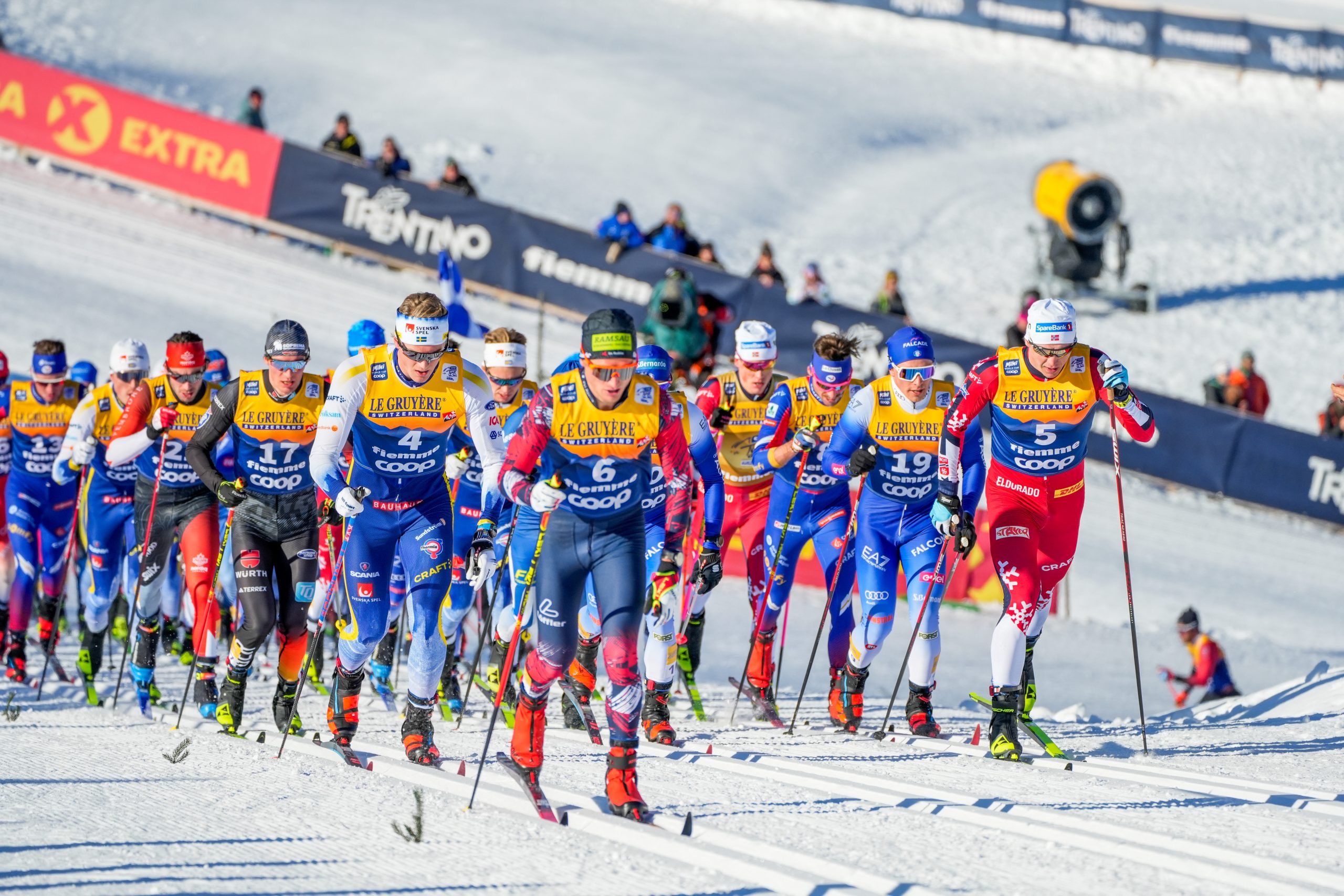
    Regardless, the Engadin Freestyle Sprint demonstrated the continuing dominance of the old contrasting with the glimmering potential of the new, even in such tightly-packed, elbow-rubbing conditions. Training partners, Klaebo and Chanavat shared a post-race moment in the finish area, sharing stories from the race like a typical pair of post-race age-groupers. “Poles everywhere, skis everywhere,” said Klaebo. “But I feel like that’s what happens in these kinds of courses.”

    One thing’s for sure: Klaebo is definitely an authority in what happens in these kinds of races.

    Men’s Freestyle Sprint RESULTS

    Men’s Freestyle Sprint QUALIFYING

  • Swedish Surge Continues in Engadin’s Mixed Relay

    Swedish Surge Continues in Engadin’s Mixed Relay

    This coverage is made possible through the generous support of Marty and Kathy Hall and A Hall Mark of Excellence Award. To learn more about A Hall Mark of Excellence Award, or to learn how you can support FasterSkier’s coverage, please contact info@fasterskier.com.

    Moa  Ilar (SWE) carries Sweden’s flag across the finish line in Sweden I’s dominating win in the World Cup Mixed Relay from Engadin, Switzerland. (Photo: Authamayou/NordicFocus)

    Right now, Sweden is on a roll. Soon, Norway will be back at full-force. The top of the field is definitely getting ready for a World Championship showdown in a few weeks. In the meantime, World Cup organizers continue staging races, hoping that top competitors will be attracted by the allure of World Cup points and prizes.

    This time of year (the middle of the World Cup season) is all about mathematics for the top contenders. How big a gap exists between a racer and their closest rivals? Are those rivals racing this weekend? How many points are available in events and bonus sprints? Who’s sick? Who’s injured? Who’s surging in the standings? Who’s relaxing at home with their feet up?

    Jessie Diggins (USA) is dealing with a persistent injury (plantar fasciitis) that limits her ability, especially in Classic skiing (she actually double poled the entire Sprint qualifier last week in Les Rousses). Diggins could’ve chosen to race one of today’s Freestyle relay legs, but none of her closest rivals in the season-long World Cup overall race were competing today in Engadin. That makes for a perfect opportunity to take a break from the stresses of racing. Time to rest, time to heal, time to get ready for more important races on the horizon.

    Likewise, Johannes Hoesflot Klaebo (NOR) enjoys a comfortable lead in the World Cup Men’s overall standings, and none of his closest rivals are racing the relay in Engadin. Time for him to put his feet up.

    Even in the absence of a number of the sport’s biggest stars, Engadin hosted a highly competitive World Cup Mixed Relay. Sweden I (Jens Burman, Emma Ribom, Edvin Anger, Moa Ilar) surged to the front in the relay’s third leg and never looked back, coasting to victory ahead of Norway I (who came from well behind the field to claim second) and Switzerland I (who came from even farther back) t claim a podium spot in front of an elated Swiss crowd.

    Canada I (Antoine Cyr, Katherine Stewart-Jones, Olivier Leveille, Lilian Gagnon) would contend among the leaders throughout the day, finishing and impressive sixth. Canada II (Remi Drolet, Alison Mackie, Stephen Thomas, Sonjaa Schmidt) would finish 11th. American teams would struggle from the start, ultimately finishing 14th (Zanden McMullen, Julia Kern, Ben Ogden, Sophia Laukli) and 16th (Luke Jager, Kendall Kramer, JC Schoonmaker, Sammy Smith).

    Iivo  Niskanen (FIN) and Paal  Golberg (NOR) animated the early part of the Engadin Mixed Relay, joined at the front by Antoine Cyr (CAN) who continues to earn the respect of the World Cup field. (Photo: Authamayou/NordicFocus)
    Mixed Relay

    FIS Mixed gender relays are staged on a revolving basis—one weekend men go first and third, women second and anchor; the next time the starting slots are reversed. In Engadin, Men would lead off, Women would bring it home.

    Nineteen teams—including two teams each teams from Norway, USA, Sweden, Canada, and Switzerland—comprised the field that would race four 5 kilometer legs (two laps/skier over a 2.5 kilometer course). Engadin is a broad, flat valley surrounded by soaring Alpine peaks. The course wound around the flats, and offered only two significant climbs. The pace was likely to be fast . . .

    “People are going to take it out hot,” predicted Canada’s Remi Drolet. “It’s going to be really hard right from the gun, so, conserve as much energy as possible for the second lap, and try to have my team in a good position.”

    At the start, Norway, Finland, Sweden, and Germany filled the front row. The initial pace was lightining fast, led by Norway I’s Paal Golberg (recently named to the Norwegian squad for the World Championships). The race course quickly faded to two Classic lanes, filled by Golberg and Finland I’s Iivo Niskanen. Canada I’s Cyr and Sweden I’s Jens Burman managed to matched the pace of the lead group, followed by Sweden II and Switzerland II. USA I (Jager) and USA II (McMullen) held positions in the top ten.

    Niskanen and Golberg managed to separate themselves as they entered the exchange zone. The race at the front would continue to be hotly contested. By the time USA II (Kramer) and USA I (Kern) took the hand-off, they were already well behind the pack of contenders.

    Emma  Ribom (SWE), Jasmi  Joensuu (FIN), (l-r) drove the pace in the relay’s second leg, setting up Sweden to take the lead in Leg 3. (Photo: Authamayou/NordicFocus)
    Second Leg

    Still in Classic technique for the second leg, Jasmi Joensu maintained her lead for Finland I, pursued closely by Sweden I (Emma Ribom), Norway I (Nora Saness), Switzerland I (Anja Weber), and Canada I (Katherine Stewart-Jones). Remarkably, Austria (Therese Stadlober) also managed to race up to the lead group. She powered through the group and set out in pursuit of Joensu and Ribom.

    By the end of the second leg, the field had mostly shattered with only the top two racers racing in close company to one another. Everyone else was well spread out behind them. But skiers in pursuit of speed and placings often find a way to group up. This relay would definitely not end up being an every-skier-for-themselves affair.

    Joensu handed off to Remi Lindholm while Ribom handed off to Edvin Anger. Not far behind, Stadlober tagged Benjamin Moser another 15 seconds ahead of Saness tagging Iver Tildheim Andersen, a Freestyle specialist with something to prove (having been recently overlooked for spots on the Norwegian World Championship Team).

    Edvin  Anger (SWE) continued to display the momentum that launched him to a Classic Sprint victory las week in Les Rousses, out-dueling Remi  Lindholm (FIN) to hand Sweden I a lead at the end of Leg 3. (Photo: Authamayou/NordicFocus)
    Third Leg

    Anger quickly caught Lindholm, and the two set about putting additional distance between themselves and Moser. Anger’s pace ultimately began to unravel Lindholm who could not match the momentum surging under Anger’s skis at this juncture in the World Cup sesason. Sweden I forged on alone as Lindholm was swallowed up by an accelerating Andersen.

    At this point, Sweden I appeared to be on its way to the win, while second place would be decided among Norway I, Austria, and Finland I. That’s when Moser came back to life, using the course’s second uphill to quickly put time into Andersen (who had doubtless given a lot just to catch this group). At the final exchange, Anger enjoyed a broad and comfortable lead over Moser, Andersen, and Lindholm.

    Anchor Leg

    Anger tagged off to Moa Ilar while Moser tagged Katharina Brudermann, the youngest skier in the Austrian lineup who might’ve felt especially vulnerable with Norway I’s Kristin Austgulen Fosnaes chasing just a few seconds behind. Fosnaes made good on that threat, quickly catching—and gapping— Brudermann who was quickly absorbed by a charging group battling for the third step on the podium. Norway II (where the heck did they come from?) was led by Anne Kjersti Kalvaa, followed closely by Switzerland I (Nadine Faehndrich), Finland I (Vilma Ryytty), and Canada I (Liliane Gagnon), and Switzerland II (Marina Kaelin).

    Ilar coasted home for the win, a well deserved victory for Sweden I. Faehndrich had looked well positioned to sprint with Fosnaes, but somewhere in the final kilometer Fosnaes managed to separate herself from the Swiss skier. Norway I took second place, while Faehndrich still managed to hold on to third place ahead of Norway II.

    Engadin Mixed Relay RESULTS

    Team Sweden (Moa  Ilar, Edvin  Anger, Emma  Ribom, Jens  Burman) celebrates on the podium in Engadin, Switzerland after their victory in the FIS World Cup Mixed Relay. (Photo: Authamayou/NordicFocus)
  • Edvin Anger Powers to Les Rousses Sprint Win, Schoonmaker Fifth

    Edvin Anger Powers to Les Rousses Sprint Win, Schoonmaker Fifth

    This coverage is made possible through the generous support of Marty and Kathy Hall and A Hall Mark of Excellence Award. To learn more about A Hall Mark of Excellence Award, or to learn how you can support FasterSkier’s coverage, please contact info@fasterskier.com.

    Ansgar Evensen (NOR), Erik Valnes (NOR), Edvin Anger (SWE), JC Schoonmaker (USA), Jules Chappaz (FRA) at the finish line of the Men’s Classic Sprint in Les Rousses. Anger would secure his first World Cup win. (Photo: Authamayou/NordicFocus)

    Straight after his victory in yesterday’s Norwegian National Championships, Even Northug (NOR) hopped on a plane and showed up in Les Rousses, France in time to contest his Sprint qualifier (in which he advanced to the quarterfinals by placing 13th). Being one of the few Norwegian contenders who never intended to race the Norwegian distance events, Northug was free to grab his championship medal, and make a run for the continent to take advantage of what appeared to be a “soft” World Cup Sprint field. Appearances can be deceiving . . .

    Fresh off his own podium finish in yesterday’s 10 k Freestyle interval start, Ben Ogden was riding a wave of momentum that carried him to the top qualifying time, .5 seconds ahead of Lucas Chanavat (FRA), 2.5 seconds ahead of Erik Valnes (NOR). But speedy Sprint qualifying is not always the best indicator of Sprint eventual success. In Les Rousses, it was Sweden’s Edvin Anger who would dash to the victory, ahead of Ansgar Evensen (NOR) and Valnes. JC Schoonmaker would complete a brilliant day with a fifth place finish. Ogden finished fifth in his semifinal heat, only .01 seconds from a lucky loser spot that would have advanced him to the Final. He would end the day in ninth.

    Americans had advanced three skiers into the quarterfinals: Ogden qualifying first, Schoonmaker seventh (he would finish the day in fifth), Zak Ketterson 16th (he would end the day in 21st). Other American finishers included Luke Jager 39th, Murphy Kimball 42nd, and Jack Young 45th.

    Canadians in qualifying included Olivier Leveille 48th, Julian Smith 51st, and Remi Drolet 52nd.

    Newly crowned Norwegian Sprint Champion, Even Northug (13) arrived in Les Rousses hoping to take advantage of a Sprint field that did not include perennial contender, Johannes Hoesflot Klaebo (NOR). Northug’s plans were undone by eventual Sprint winner, Edvin Anger (SWE) who powered away from a diverse field of challengers. (Photo: Authamayou/NordicFocus)
    Quarterfinals

    In the absence of Johannes Hoesflot Klaebo—absolutely the dominant sprinter of the age—the men’s world Cup field can sometimes look like they don’t know what to do. It’s less a factor of Klaebo’s speed—he seems to win whether the race is fast or slow, tactical or flat out. What’s really missing is Klaebo setting the example of the fastest line. He demonstrates a sixth sense for finding the fastest side of the track, quickest lane around any turn, the shortest route to the finish line. In his absence, every Sprint heat seems to be an independent experiment in tactics and speeds. It’s not as though Sprinting is unexciting when Klaebo is absent, but viewers may find themselves not knowing whom to watch.

    Wearing the U23 leader’s bib, Anger controlled Quarterfinal 1 from the front, leading until the final turn when the faster skis of Valnes took control.

    Quarterfinal 2 was a slow, tactical affair in which perennial contender Richard Jouve (FRA) trailed the field, and proved unable to advance. The heat was controlled by Ansgar Evensen (NOR) and Emil Danielssonn (SWE).

    Ogden moved to the front of Quarterfinal 3, controlling the pace and marking any early moves. He double poled powerfully across the finish line ahead of Lauri Vuorinen (FIN) and Northug who would ultimately fail to secure a Lucky Loser spot.

    Schoonmaker lined up in Quarterfinal 4 where he claimed a Lucky Loser spot behind Chanavat and Oskar Opstad Vike (NOR).

    Ketterson drove the pace at the beginning of Quarterfinal 5, only to surrender the lead to others who sensed the opportunity to advance out of a fast heat. The heat finished with Jules Chappaz (FRA) and Ondrej Czerny (CZE) moving to the semifinals. Ketterson finished fifth in the heat, to end the day in 21st.

    Lucas Chanavat (FRA) edges out JC Schoonmaker (USA) and Jules Chappaz (FRA) in the semifinal of the Men’s Classic Sprint in Les Rousses France. Schoonmaker’s semifinal strategy of following the powerful Chanavat would not prove as effective in the later Final. (Photo: Modica/NordicFocus)
    Semifinals

    Ogden FLEW off the front of Semifinal 1, only to be overtaken by the field in the closing meters . He would finish the heat in fifth, a photo-finish struggle with Northug, who would advance along with heat winners, Anger and Danielssen. Once the finish line photos were inspected and the finishing times were calculated, Ogden would miss advancing to the final by only .01 seconds.

    JC Schoonmaker lined up in Semifinal 2, following the reliably powerful Chanavat all the way to the finish line, a photo finish to determine who would advance. Schoonmaker would claim the second place automatic qualifying position ahead of Jules Chappaz (FRA).

    “(It) wasn’t necessarily my strategy in the final to follow Chanavat,” said Schoonmaker. “It was more to race from the front of the field and find little spaces where I could rest my arms for the finish so it ended up working out to follow him.”

    Sprint Final

    A year ago in Les Rousses, Jouve was able to overhaul Klaebo for the unexpected win. Today in Les Rousses, Chanavat would carry the hopes of the French crowd.

    There was plenty to gain in the Men’s Sprint final. Among the finalists—Chanavat, Anger, Evensen, Valnes, Northug, and Schoonmaker—only Valnes and Chanavat had ever stood atop a World Cup podium. For the rest, the Les Rousses Sprint Final represented a unique opportunity. It also made for situations in which the strategies likely to be employed by the finalists were anything but clear.

    At the crack of the starter’s pistol, Anger powered straight to the front with Chanavat struggling a bit to get into high gear. Schoonmaker tripped over his pole on the first uphill rise, stalling his momentum briefly. Valnes broke into a herringbone on the first uphill, revealing that his wax choices were made to enhance glide rather than kick. The end of the race (and the final downhill) would reveal whether or not his choices were good ones.

    “When I tripped on my pole, it wasn’t a huge deal,” Schoonmaker explained. “But definitely one of those things that costs you a bit. I might be mistaken, but I felt like I was about to move up into third or fourth there, and then that trip up sent me right back to sixth. So it would’ve been nice to not make that mistake, but it wasn’t a race ended by any means.”

    Anger continued to push a torrid pace as Chanavat dangled well of the back. It appeared that Distance-racing fitness would rule the Sprint Final as Anger powered down the finishing straightaway for the win, his first any World Cup event.

    “It’s my first Final this year,” said Anger in post-race interviews. “I was thinking, ‘Let’s just go for it.’ I did . . . and I win!”

    Evensen and Valnes battled for second and third, barely ahead of a travel-weary Northug. Schoonmaker finished a half second behind Northug in fifth. Chanavat never recovered the earlier gap, finishing sixth.

    “I felt like I had decent energy in the final to make something happen but just needed to be further up from the start,” Schoonmaker said. “Those guys were definitely strong and Anger took it out hot right from the start, I just needed to be more prepared for that.”

    “I think so for sure, my shape feels good right now,” Schoonmaker concluded. “And making the final adds confidence to that for sure so I feel like I have some good momentum

    Les Rousses Men’s Sprint RESULTS

    Les Rousses Sprint QUALIFYING

    18.01.2025, Les Rousses, France (FRA):
    Ansgar Evensen (NOR), Edvin Anger (SWE), Erik Valnes (NOR), (l-r) – FIS world cup cross-country, individual sprint, Les Rousses (FRA). www.nordicfocus.com. © Authamayou/NordicFocus. Every downloaded picture is fee-liable.
  • Klaebo Controls 20 k Skiathlon

    Klaebo Controls 20 k Skiathlon

    This coverage is made possible through the generous support of Marty and Kathy Hall and A Hall Mark of Excellence Award. To learn more about A Hall Mark of Excellence Award, or to learn how you can support FasterSkier’s coverage, please contact info@fasterskier.com.

    Austria’s Mika Vermeulen (6) pushed the pace throughout the 20 k Skiathlon, moving into second place overall in the 2025 Tour de Ski with only one stage remaining. Sweden’s Edvin Anger (4) would begin the day in second place, but would ultimately drop from contention. (Photo: Vanzetta/NordicFocus)

    The 2024-2025 Tour de Ski has already been a long, challenging adventure, and the end of the tour (tomorrow atop Alpe Cermis) offers a unique and daunting set of challenges. While Stage 6 of the Tour offered a glimpse of what will be the venue for the 2026 Olympic Skiathlon, today’s race in Val di Fiemme bore little direct comparison to the action likely to take place a year from now. Today’s race was complicated by the exhaustion of five prior days of racing, the absence of numerous contenders who dropped out earlier in the event, ongoing competitions in the Sprint and Climber’s jerseys, and the need to conserve energy for tomorrow’s climb. Next year’s Olympic event will be a no-holds-barred free-for-all. Today’s Skiathlon in Stage 6 of the Tour de Ski was a decidedly more measured and conservative affair.

    Johannes Hoesflot Klaebo (NOR) entered the day enjoying a lead of 1:35 over Edvin Anger (SWE), and 2:11 over Erik Valnes (NOR), neither of whom appeared likely to pose a truly menacing threat on tomorrow’s climb of the the Alpe Cermis. In preparing for today’s Skiathlon, it seemed Klaebo’s task would be to monitor his rivals, limit his losses, and conserve energy for Sunday’s final climb (which is known to be one of his least favorite racing tests of each World Cup season).

    Johannes Hoesflot Klaebo (NOR) would control the pace through the closing laps of the Val di Fiemme Skiathlon, coasting across the line comfortably ahead of his rivals. (Photo:  Modica/NordicFocus)

    Today in Val di Fiemme, Klaebo would control the race from the front throughout the final laps, sprinting up the last hill to establish a gap he would carry across the finish line comfortably ahead of Federico Pellegrino (ITA) in second and Jan Thomas Jensen (NOR) in third. Antoine Cyr (CAN) would finish 16th, just ahead of Zanden McMullen in 17th.

    Other North American finishers included Ben Ogden 21st, Olivier Leveille 24th, and Jack Young 53rd.

    20 k Skiathlon

    Jannik Riebli (wearing the U23 jersey) and Britain’s Andrew Musgrave (wearing the climber’s jersey) would join the leaders in the front row at the starting line of the Skiathlon. American Ben Ogden would begin the day in 14th, a disappointing position when compared to his high-water mark of third place a few days ago, but otherwise a bright spot in his career as a distance skier and all-around threat. Canadian, Antoine Cyr, would begin the day in 22nd.

    Snow temperatures of -10.5 degrees celsius made for fair waxing conditions in this early morning start, allowing the 61-man field to remain together through the first of six 3.3 kilometer laps.Mika Vermeulen (AUT) moved to the front at the end of Lap 2, followed by Valnes. They would provide much of the pace-setting in the Classic laps.

    Hugo Lapalus (FRA) took over the Climber’s jersey during the Skiathlon, and appears to have energy to spare for tomorrow’s final ascent of Alpe Cermis. (Photo: Vanzetta/NordicFocus)

    The ski exchange at the halfway point saw few changes to the overall standings, though Hugo Lapalus (FRA) had surged to overtake Musgrave for the lead in the Climber’s jersey. Klaebo and Valnes led the field into the exchange, while Friederich Moch (GER) was the fastest in the equipment swap, exiting the exchange zone just ahead of Vermeulen and Klaebo.

    The Freestyle course was identical to the Classic course, though the positioning of a lane of Classic tracks rendered the skate course rather narrow. Some racers attempted to make progress by passing in the Classic lanes, but for the most part the narrowed lane allowed Klaebo to sit at the front where he controlled the pace through the early part of the Freestyle laps.

    Nineteen racers comprised the final selection, though that group continued to string out behind the pace making of Vermeulen. McMullen and Cyr held on gamely to the tail end of the group as Vermeulen (determined to take time out of Anger who continued to fade) continued to push the pace.

    Federico Pellegrino (ITA) orchestrated a marvelous second place finish with a well-timed sprint up the final hill of the 20 k Skiathlon in Val di Fiemme. (Photo:  Modica/NordicFocus)

    Klaebo, Lapalus, and Moch led the field through the beginning of the final lap as a resurgent Musgrave pressed the pace. In the end, Klaebo would surge up the final hill, followed by Pellegrino and Jensen. Coasting across the finish line well clear of his rivals, Klaebo extended his lead in the overall Tour standings. Valnes now trails by 2:18, followed by Haavard Moseby and Vermeulen tied at 2:29 back, and Lapalus at 2:44. Anger dropped to 10th overall, followed by Musgrave in 11th.

    Men’s 20 k Skiathlon RESULTS

    Federico Pellegrino (ITA), Johannes Hoesflot Klaebo (NOR), and Jan Thomas Jenssen (NOR), (l-r) share the podium after the 20 k Skiathlon in Val di Fiemme (ITA). (Photo:  Vanzetta/NordicFocus)
  • How do you solve a problem like Johannes? The World Cup weighs in on how to dethrone him.

    How do you solve a problem like Johannes? The World Cup weighs in on how to dethrone him.

    Johannes Høsflot Klæbo, in typically dominating fashion, anchored the Norwegians to a victory in the team sprint in a World Cup in Switzerland earlier this month. (Photo: Modica/NordicFocus)

    In cross-country skiing, sprinting is a notoriously inconsistent discipline for a single competitor to dominate. The short distance leaves little time for racers to recover from even small mistakes; sharp corners and tight spaces often produce race-ending crashes.

    Which makes the track record of Norway’s Johannes Høsflot Klæbo almost impossible to comprehend.

    Klæbo, a five-time Olympic gold medalist, has won the last 10 straight sprint races he’s entered on the World Cup — the highest level of international competition. He often crosses the finish line far enough ahead of his rivals — if you can call them rivals — that he has time to unstrap his poles before crossing the finish line.

    Klæbo, 28, has won five out of the six Olympic and World Championships sprints he’s contested, and 52 of his 69 sprint World Cup starts — missing the World Cup sprint podium just once since 2018, according to data from the International Ski Federation.

    So: How do you beat this guy?

    FasterSkier, when the World Cup made its swing through Canada and Minnesota last season, decided to pose that question to an array of the circuit’s athletes and coaches. We’ve put together a kind of brief oral history below, seeking to appropriately describe Klæbo’s supremacy and the best ideas about how to take him down.

    Enjoy.

    What kind of tactics would you use to beat Klæbo in a sprint?

    Håvard Solås Taugbøl, a Norwegian World Cup racer and one of the nation’s (and globe’s) best sprinters: That’s the $1 million question. I have never managed to do it. 

    Swiss sprinter Valerio Grond: Maybe break his poles or something? I don’t know.

    French sprinter Lucas Chanavat: I mean, if I had the answer, I would have won the last one. You just focus on yourself, do the best race you can. It’s about my strengths. I think you have to be really perfect on every move you do. That’s the fun part about competing with him. It’s, like, you have to be perfect. And that’s really motivating.

    Lucas Chanavat of France alllllmost beat Klæbo at a World Cup sprint race in Switzerland last year. But he didn’t. (Photo: Modica/NordicFocus)

    Sweden’s team manager, Anders Bystrom: I think, first of all, you have to mentally know that he’s not unbeatable. Because I think many people think so. He’s shown that he is almost unbeatable, so it’s fair that people think that. But we don’t talk about him like that.

    Jonna Sundling, the Swedish Olympic champion from 2022 in the women’s sprint: I would go hard from the start, and don’t leave any power. Just go, all that I have. I don’t think I could take him in the final meters — he’s too quick for me. The men, maybe they’re scared sometimes — I don’t know, I think they can do more than what they think they can do. Maybe.

    Maja Dahlqvist, a Swedish Olympic sprint medalist: I would try to sprint him down, like waiting til the end. But I guess a lot of people try to do that, and people are not so successful.

    Grond: If he’s in his top shape, he’s almost unbeatable. He’s really, really always in a good spot. But when he’s maybe not in the best spot, you have to take advantage of this and put in an attack.

    Canadian national team coach Robin McKeever: Break his pole? 

    Swedish sprinter Edvin Anger: I think we need to push him really hard, and take our chances. I don’t think I need to go hard early, but I think I need to have a good place. And when I take my chance, I really need to take my chance. And I need to push from the place in the track that I think is best for me. I can’t wait to see what he will do, because I need to do the thing first.

    Norwegian sprinter Erik Valnes: How to beat Johannes in sprint is all about him being in bad shape. [Laughs] I think maybe it’s about the finish — or, to be able to have a good finish after a high-speed final. There are many things that have to be right to beat him. You just need to start the finishing sprint before him, and be ahead. Because as long as you’re behind him, you’re one step behind him in the mind games as well.

    McKeever: I think the only way is by surprising him. And they’re trying.

    What makes Klæbo so good at sprinting?

    Chanavat: He’s strong in every aspect of the sprint race. He has, like, amazing turns, an amazing finishing sprint, he’s insane in stamina. He’s good at everything. He’s the GOAT [Greatest Of All Time]. 

    Grond: He’s so good in every technique and part of the race, and also tactically. He’s simply the best skier in history.

    Dahlqvist: He’s good in everything. He can go hard, he can wait, he can go from the start.

    Norwegian distance specialist Simen Hegstad Krüger: He often likes to control the heat and he gets a lot of respect. And you have — I think there’s a lot of guys that think there’s no chance to beat him so they just give him room and then they give it away to him. He has earned the respect but especially in sprint you can’t give anything away and you have to take your place and take your positions. And I think he’s the best in that but I think sometimes he gets the best positions a little bit too easily.

    Klæbo wins a Tour de Ski stage just ahead of his Norwegian teammate Erik Valnes. (Photo: Modica/NordicFocus)

    Valnes: I’ve been angry with myself sometimes because of bad tactical decisions. Because many times I’ve just, in my unconsciousness — you think, ‘Just follow him, and you’ll get a good result.’ But then you will not get past him.

    Bystrom: If you meet him in a heat, you almost adapt to what he’s doing. Because you have to see, ‘Okay, what’s Johannes going to do now?’ Because you know he has this X-factor in many parts of the course. 

    Does Klæbo have any weaknesses in sprinting?

    Chanavat: You should probably ask him. That would be the best.

    Klæbo: That’s going to be a secret. [chuckles] I don’t think I will tell everyone. I think I’ll keep that for myself and I’ll tell everyone when I’m done racing. That’s my answer.

    Norwegian sprinter Even Northug: Maybe none.

    Valnes: No. That’s the thing with him. He’s not having any weaknesses. You can say, like, maybe double-poling long flats. But he’s quite good there.

    Krüger: Not that I’ve seen so far. Even in distance races, it’s not so many weaknesses to find. 

    French sprinter Jules Chappaz: I think running [uphill], like in Ruka [the Finnish ski resort that hosts the season-opening World Cup races each year]. First it was the ‘Klaebo run,’ but now I think I’m really good at it. Maybe, hopefully next year in Ruka, I can run faster, beat him. [He didn’t.] He is sick a lot of times — maybe that’s sort of his weakness. 

    Klæbo coasts to the win in Ruka this year, beating everyone, including Jules Chappaz. (Photo: Modica/NordicFocus)

    Anger: It’s a hard question. But I think we need to push him and then make him a little stressed — that’s what I think.

    Bystrom: Mayyyyyybe it’s skating without poles — using your legs to be able to, maybe, go past him. But it’s really hard to say. He’s the best. He’s shown that many times. He’s so good in so many areas. It’s hard to say there’s one where you could beat him when there’s 28 areas where you can’t beat him.

    Are there ways athletes can train over the long-term, like over next summer or multiple seasons, to beat Klæbo?

    Chappaz: Just trying to focus on ourselves. This spring, I will compete in the Ski Classics [marathon races] to improve my double poling. To look to the Olympics, 2026, with the Val di Femme finish — I hope it will improve my double poling skills, to [be able to] beat him.

    Dahlqvist: Maybe they need another team like us, like the Swedish women, because you can use your team more. So, maybe a whole team needs to be stronger, to try to beat the Norwegian. They could do team tactics in a way, like everyone knows where they will go. 

    Anger: I’m still young — I’m just 21 years old. And he has a lot of training hours. A lot more than I have. With one or two years more, with good summers, also with a lot of hours, I think it will be better for me. And maybe I will be better in the final — I’m good in the quarters and the semis right now, but maybe I miss a little in the finals. I need to be a little harder and stronger.

    Valnes, Klæbo and Anger pose for a podium photo after Klæbo won a World Cup sprint in Canada last year. (Photo: Modica/NordicFocus)

    Grond: We’ve just got to work hard. It’s also about learning how to ski against the best skier, for me. So, I’m trying, also, to get some experience on how they ski and where I can be better than them.

    Valnes: It’s more about improving the base level, the capacity, the VO2 max. If you have that base, from May until September, then you can build a little bit on that with specific training in October and November and just before the season starts.

    McKeever: The reality is, how do you beat Klaebo? Have him age out a little bit. 

    Northug: Training.

    Norwegian national team coach Eirik Myhr Nossum: You have to train, of course. But there were a lot of people training for the 100-meter dash, as well: Usain Bolt still won. So, if everybody in the world trains the best they can, still one will win — and it’s hard to beat Johannes. It’s possible, but he’s probably the best skier that’s ever been. And now it’s harder than ever, and he still wins.

  • Olympic Medalists and Rookies Rub Shoulders in Canmore

    Olympic Medalists and Rookies Rub Shoulders in Canmore

    American cross-country skiing superstar signs an autograph in Canmore, Alberta, in advance of Friday’s race. (Angus Cockney for FasterSkier)

    CANMORE, ALBERTA — Abbey Zimmer and Natalie Meinert peered over a railing out onto the course at the cross-country ski center here Thursday, where dozens of the world’s best athletes were amidst their pre-race routines.

    The 14-year-olds had driven seven hours to Canmore with their parents from icy Saskatoon, Saskatchewan. They were there to ski on some snowy trails and for a weekend of watching racers that they normally only see on highlight reels.

    “We just saw Klæbo,” said Zimmer, referring to Johannes Høsflot, the five-time Olympic gold-medal winner from Norway.

    “Which was like, ‘Oh my god,’” said Meinert. “And we’re trying to find Jessie Diggins.”

    Abbey Zimmer and Natalie Meinert, two youth skiers from Saskatchewan, watch World Cup athletes work out Thursday in Canmore. (Nathaniel Herz/FasterSkier)

    Diggins, of course, was half of the team that won America’s first ever Olympic gold in cross-country skiing, in 2018.

    And she is one of the stars of what is setting up to be a 10-day celebration of North American cross-country skiing, with fans expected to turn out in droves. Friday will be the first in a series of six races that mark the return of the top-level World Cup circuit to the continent for the first time since 2019 — and for the first time to the U.S. in more than two decades.

    Four races are scheduled in Canmore. Two more sold-out events will take place the following weekend in Minneapolis, Diggins’ hometown, where organizers have already distributed nearly 30,000 tickets and are still getting countless requests for more.

    “I wish I had a bigger urban park,” Claire Wilson, the lead organizer of the Minneapolis events, said in a message Thursday.

    All the top Canadian and U.S. cross-country skiers will be competing in Canmore and Minneapolis. But one highlight of these races will be what’s known as the “nations group” — extra start spots for athletes that are granted to the countries hosting the events. (Canada and the U.S. will get the extra spots in both nations, because it’s rare that the circuit travels to either country.)

    Instead of the half-dozen or so Americans and Canadians that typically compete in World Cups in Europe, as many as 12 men and 12 women from each country will start in each of the races over the next two weeks.

    That means that a 17-year-old high school student from Alaska, Murphy Kimball, will be racing Saturday’s sprint alongside U.S. stars like JC Schoonmaker and Ben Ogden. Three American men — Graham Houtsma, Braden Becker and Reid Goble — and three American women — Mariah Bredal, Emma Albrecht and Margie Freed — will be making their World Cup debuts in Friday’s distance race.

    Murphy Kimball, 17, and his coach, Jan Buron, discuss ski testing during training in Canmore on Thursday. (Nathaniel Herz/FasterSkier)

    In interviews Thursday, the World Cup debutants said they’re aiming to treat the events like any others — though that’s easier said than done when shuttle buses are filled with foreign languages, television cameras are everywhere and the race course is lined with banners advertising Swiss cheese.

    “I’m trying to think of everyone as just normal people, because that’s who they are,” said Renae Anderson, an American racing her first World Cup on Saturday. But, she added: “It’s people I’ve been watching on TV for years.”

    Anderson’s family, and some of their friends, will be in attendance in Canmore, she said, making them among the many spectators at the North American events with direct connections to athletes.

    That support network will be one element of a rare home field advantage for the North Americans. Top athletes from Canada and the U.S. typically spend the full winter in Europe and face jet lag of up to 11 hours upon their arrival; this week, many of them have arrived on short flights from their homes, unlike their European competitors.

    “The flight, it was really good,” said Edvin Anger, a 21-year-old sprinter from Sweden. “But the first three days were horrible for me. I woke up at 3 a.m.”

    Johannes Høsflot Klæbo of Norway handles a ski in Canmore. (Angus Cockney for FasterSkier)

    But home races also come with some complications.

    The U.S. and Canadian service staffs — the crews who help athletes test skis and waxes — might typically work with as many as 10 or 12 athletes during a weekend of racing. Now, they’re trying to coordinate as many as 24 starters for each race.

    Both nations are depending on regional and club coaches who have traveled to Canmore to help test skis and wax. In the case of Canada’s squad, the extra racers and staff, plus the regulars, are spread across different places in Canmore, including some who are in their own homes, said Chris Jeffries, the team’s high performance director.

    That’s forced complicated logistics like a Zoom option for pre-race meetings, complete with breakout rooms.

    “We have really small moments to be able to create that team culture and that team cohesion, which is not typical,” Jeffries said. “At the same time, the athletes, I think, are in a really good place.”

    Canada’s Olivia Bouffard-Nesbitt skis in Canmore this week. (Angus Cockney for FasterSkier)

    Not everything has gone smoothly in Canmore, however.

    Early in Thursday’s training session, an up and coming Italian sprinter, Simone Mocellini, crashed on a notoriously challenging corner, flew over some protective fencing and “fell five meters down out of the track,” said Markus Cramer, his team’s coach.

    Mocellini had just returned to the World Cup last month from a hand injury that kept him out of early season races. He left the venue in an ambulance and, Cramer added, has a “very complicated broken leg.”

    The International Ski Federation was also forced to change the format of Friday’s race — from an individual start, time-trial style 10-kilometer race to a mass start, 15-kilometer race — after a ground crew strike at the German Lufthansa airline stranded World Cup timing equipment.

    Late Tuesday, organizers began discussions with a timing company headquartered in Canmore, Zone4, about working Friday’s race, said Dan Roycroft, a former Olympic ski racer who founded the business.

    The big challenge they faced was making sure that Zone4’s timing equipment would work with the television graphics systems operated by Swiss Timing, the company that typically handles both jobs.

    “They normally take a month to create an interface, and we had to do it in two days,” Roycroft said Thursday, citing “amazing cooperation” with Swiss Timing. “Tomorrow, if everything goes well, then it should look like a normal World Cup.”

    Roycroft said that the stranded timing equipment amounted to 18 pallets — 5,000 pounds of gear. The difference between his company’s system and the one typically used on the World Cup, he added, was underscored as he drove up to Canmore’s race venue with one Swiss Timing’s employees.

    “He goes, ‘I can’t believe you can time a World Cup with stuff that just fits in one car,’” Roycroft said. He added: “It was very lucky that we’re based in Canmore, and obviously, it’s our hometown. We want this event to go as well as possible, to show what Canmore can do.”

  • Two Sprint Victories in a Row for Chanavat, Schumacher fourth

    Two Sprint Victories in a Row for Chanavat, Schumacher fourth

    This coverage is made possible through the generous support of Marty and Kathy Hall and A Hall Mark of Excellence Award. To learn more about A Hall Mark of Excellence Award, or to learn how you can support FasterSkier’s coverage, please contact info@fasterskier.com.

    Gus Schumacher (USA) continued the recent trend of American men advancing to World Cup Sprint Finals. Throughout the heats, he would play a tactical game that saw him finish a career-best fourth. (Photo: Modica/NordicFocus)

    Lucas Chanavat (FRA) did a pretty impressive thing a few days ago in Stage 1 of the 2024 Tour de Ski: he won. Ask anyone who knows World Cup Sprinting, and they’ll tell you that Chanavat was fully equipped to win:  he was supposed to win, he was expected to win. But winning is still not an easy thing to do. For much of the 2023-2024 season, Chanavat has been the second best sprinter in the world. So when the. best sprinter in the world (Norway’s Johannes Hoesflot Klaebo) is absent from a sprint race, then Chanavat should win, right? Wouldn’t it be nice if the whole world were as simple as that? But that’s not the way World Cup Nordic skiing works. Again, Davos’ Tour de Ski Freestyle Sprint appeared to be Chanavat’s to win. but he still had to DO it . . .

    The middle of the Tour de Ski is often a place where distance skiers may excel in the Sprints. Exhausted sprinters develop chinks in their fast-twitch armor as the efforts of two prior days of distance racing tends to clip their wings. Evidently, Chanavat had a plan for that typical sprinter’s dilemma: he endured considerable criticism in the press this week for his performance in Monday’s Pursuit race—he effectively walked the challenging portions of the Pursuit course, and finished (among other skiers) well outside the Tour de Ski stage cut-off time. But Tour organizers seemed reluctant to disqualify their most charismatic sprinter, so Chanavat (and the other slow finishers) were granted a waiver of the cut-off time rule. Chanavat used that reprieve to become the top qualifier in the Davos Sprint competition which he would go on the win the Sprint with relative ease ahead of Edvin Anger (SWE) and Federico Pellegrino (ITA). American, Gus Schumacher would weave skillfully through the final of Sprint final contenders to finish a career-best fourth.

    Zanden McMullen and Kevin Bolger both qualified for the heats, but neither would advance beyond their quarterfinals. Tour de Ski Points Leader, Ben Ogden, dropped out of the tour prior to today’s competition. Coaches reported that Ogden’s roommate, JC Schoonmaker had fallen ill just prior to the Tour de Ski; while the team attempted to keep Ogden healthy, it seems that he has succumbed to the cold that felled his roommate.

    Lucas Chanavat (FRA) raises the traditional Davos’ World Cup winner’s trophy after his victory in the Tour de Ski Stage 4 Freestyle Sprint. In the absence of Johannes Hoesflot Klaebo (NOR), Chanavat is definitely the dominant World Cup sprinter. (Photo: Modica/NordicFocus)
    Men’s Freestyle Sprint

    Chanavat won Quarterfinal 1 with ease, ahead of Benjamin Moser (AUT) and Schumacher who would advance to the semifinal as a lucky loser. Current Tour de Ski leader, Harald Oestberg Amundsen (NOR), tumbled out of the race early in the heat, appearing to have been inadvertently interfered with by Moser whose pole may have poked the tail of Amundsen’s outside ski. Completely accidental, no penalty assessed: that’s just the way things go in sprinting. Even so, Amundsen was certainly displeased as he rose dejectedly and slammed his pole furiously into the snow. He knew what an advantage had been lost. His lead over his countryman, Erik Valnes, sat at just 32 seconds. Valnes would advance to the final, but would be visibly exhausted, finishing a distant sixth. The Overall Tour de Ski standings tightened at the top, but none of the contenders looked especially sharp.

    Zanden McMullen (USA) qualified for the heats for the first time in his young career, but he would face a seriously stacked quarterfinal that included Federico Pellegrino (ITA), Evensen, Lauri Vuorinen (FIN), Renaud Jay (FRA), and Paal Golberg (NOR). Evensen led out the quarterfinal while Pellegrino sat patiently, making his move in the finishing straight to win the heat. McMullen would finish fifth.

    Kevin Bolger (USA) was the day’s 16th fastest qualifier, and he would never have a better chance to advance than through his under-powered quarterfinal heat against Janik Riebli (SUI), Joni Maki (FIN), Martino Carollo (ITA), Emil Danielsson (SWE), and Valnes. Sadly, Bolger never truly contended in the heat, finishing fourth but well behind the lucky loser time.

    Gus Schumacher (USA) celebrates his fourth-place finish with Stifel U.S. Ski Team personnel. (Photo:
    Semifinals

    Semifinal 1 matched Chanavat against Evensen, Valerio Grond (SUI), Lauri Vuorinen (FIN), Moser, and Pellegrino. Chanavat simply powered at the front without ever seeming to over-commit. He eased across the line in first place, while Pellegrino (ever the cagey veteran) passed Grond on the inside of the final turn to take the other automatic qualifying spot.

    The second semifinal gave Schumacher his chance to show what he could do, but Haavard Solaas Taugboel (NOR), Valnes, Anger, Janik Riebli (SUI) stood in his way. Schumacher sat at the back of the field throughout the two laps as Anger and Riebli pushed the pace at the front. Riebli fell on the sweeping right hand turn that inexplicably claimed so many racers in Davos’ night sprint (what’s up with that turn?), allowing Schumacher to move up into a battle for second as the field reached the final uphill. Anger and Taugboel powered across the line (an exhausted Anger nearly taking himself down in the final meters). Schumacher was overtaken by Jenssen in the finishing straightaway, but both Jenssen and Schumacher advanced to the final as lucky losers.

    Visibly exhausted by his efforts thus far in the Tour, Valnes coasted across the line sixth, far behind the winners.

    Lucas Chanavat (FRA) (l) led from the front throughout each of the day’s heats in Davos. Gus Schumacher (USA), (r) wove skillfully through each heat to finish a career-best fourth. (Photo: Modica/NordicFocus)
    Sprint Final

    As he had done all day, Chanavat led out the sprint final. Schumacher lurked in the rear, staying out of trouble and stepping gingerly through the turn that had taken down so many contenders in Davos.

    Chanavat played his tactic to the end, launching an acceleration near the top of the final uphill that none of the others could match. Anger was quickly gapped, but managed to hold off Pellegrino over the top of the hil, and down the other side to the finish line. Chanavat first, Anger second (his first World Cup podium performance), Pellegrino third. Schumacher would work his way skillfully through the field to finish a career-best fourth.

    Chanavat has had quite a week—victory in Stage 1, lethargy and ridicule in Stage 3, another victory in Stage 4—winning the races that the oddsmakers expected him to win. It really doesn’t seem likely that Chanavat’s from-the-front tactic would’ve proven successful had Klaebo been here . . . but Chanavat knew the field that he was faced with. His confidence, fitness, and skill were more than enough to produce the victory in Davos.

    Tour de Ski (Davos) Freestyle Sprint RESULTS

    Zanden Mcmullen (USA) qualified 29th, advancing for the first time into World Cup Sprint heats. He would face a seriously-stacked field in his quarterfinal where his impressive fifth-place finish was a career-best. (Photo: Modica/NordicFocus)