From the FasterSkier archive — posts syndicated from athletes’ and coaches’ own blogs between 2004 and 2012, kept online as published. Current coverage is at fasterskier.com.

Tag: Einar Hedegart

  • Final Piece in Historic Puzzle—Klaebo Claims Distance Globe

    Final Piece in Historic Puzzle—Klaebo Claims Distance Globe

    This coverage is made possible through the generous support of Marty and Kathy Hall and A Hall Mark of Excellence Award. To learn more about A Hall Mark of Excellence Award, or to learn how you can support FasterSkier’s coverage, please contact info@fasterskier.com.

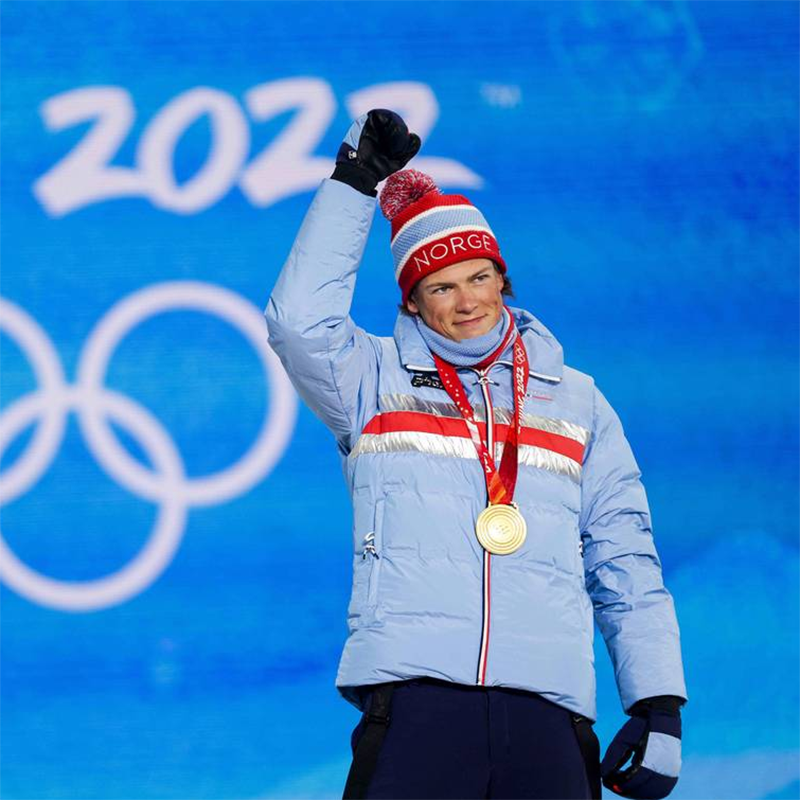
    Johannes Hoesflot Klaebo (NOR) had won it all—except for a Distance Crystal Globe. Today in Lake Placid, he finally added that most elusive piece of hardware to his expansive trophy case. (Photo: Modica/NordicFocus)

    The Kingdom of Norway expects much of its sport heroes. Johannes Hoesflot Klaebo knows this . . . that may be why this naturally gifted sprinter may have long coveted the prize that a skier of his sort is least likely to earn: World Cup Distance Crystal Globe. If he could capture that prize, he could place his name among those of revered strong men of cross-country skiing. But first he’d need to get past another Norwegian strong man: Harald Oestberg Amundsen, himself a past winner of both the Distance and All-Around Crystal Globes, and a skier who trails Klaebo by only 12 points heading into this final Distance race of the 2026 season. A Norwegian skier would go home from Lake Placid with the Distance Crystal Globe tucked safely in the overhead compartment of a chartered jet liner. But which Norwegian?

    Twenty kilometers of mass-start racing through the forests and hills of Mt. Van Hoevenberg would answer the question. But the manner in which that question would be answered would have bearing on ski history, as well. That’s because Klaebo could choose to employ more than one strategy in today’s race. He could park himself behind Amundsen, presumably sprint past him at the end, and claim the Cup regardless of his placing in today’s race. Norwegian fans would love to see a Norwegian claiming the Cup, but they would prefer to see the victory be claimed in a different way. What Norway would love to see is dominance delivered at the hands of the sport’s most dominant skier. The “dominance” strategy is far more risky—it could backfire, it could get counter-attacked, it could conceivably allow Amundsen to overcome a self-exhausted Klaebo. But that’s what Norwegian fans long to see.

    Back in 1983, Norwegian speedskater, Rolf Falk-Larssen won the World All Around Speedskating Championship by virtue of winning three of the championship’s four races. That was the rule back then—anyone who wins three of the four races is automatically crowned champion, regardless of their performance in the fourth race. Falk-Larssen won the 500 m, the 5,000 m, the 1500 m. Technically, all he had to do was finish the 10,000 (the final race of the championship) in order to wear the victor’s wreath and be proclaimed World Champion. He would finish that final race, but the way he raced it was also the reason that, to this day, few Norwegians are willing to even mention Falk-Larssen’s name. When Falk-Larssen had the chance to truly dominate, he chose, instead, to mail it in: he soft-pedaled the 10 k . . . finishing a full 37 seconds (that’s a lot) behind the race winner, Tomas Gustafson of Sweden, whose four-race performance actually accumulated a point-total that exceeded Falk-Larssen’s championship-winning total. Falk-Larssen was crowned champion, but the Norwegian crowd never forgave him.

    Norway expects much of its champions. Witness the racing strategies of Marit Bjoergen, of Therese Johaug, of Bjoern Daehlie, of Thomas Alsgaard. They were dominators, setting a blistering pace from the very start of any race, heedless of the consequences, daring any other racer to challenge them. Consider the tactics of Norwegian athletes in other sports: World and Olympic champions like hurdler Karsten Warholm or middle distance runner Jakob Ingebritsen—both of whom race from the front in daring, victory-or-death style. Norwegian fans love this . . . seeing the champions who throw caution to the wind, who stamp their authority onto every race situation, who prove true dominance.

    Fast-forward to Lake Placid New York, and the final race of the 2026 FIS World Cup cross-country ski season. At Mt. Van Hoevenberg, Klaebo could’ve been interested in only one thing: the World Cup Distance championship. In his long and illustrious career, it’s the one prize that has eluded him. He’s won the Overall Crystal Globe six times. He’s won the Sprint championship too many times to count. In this miraculous 2026, Klaebo has proven time and again that he is the man to beat. And though he is the world’s premier sprinter, he has shown that he can win from the front even when the world’s best Distance skiers are chasing him.

    The stage was set for 20 kilometers of racing on the steep and rainy trails of Mt. Van Hoevenberg.

    With his win in the 20 k Mass Start Freestyle at the World Cup Final in Lake Placid, Johannes Hoesflot Klaebo (NOR) completes the sweep of all sweeps. (Photo: Thibaut/NordicFocus)
    20 k Freestyle Mass Start

    In the old days of racing—especially on the trails around Van Hoevenberg—racers in Distance events would disappear into the trees, emerging from the forest hours later with practically no one having seen what transpired out on the course. Not today . . . the final race of the World Cup season was designed for the fans: five laps of four kilometers/lap. The crowd would get to see plenty of the racers, and that crowd ha already proven its ability to shower the skiers with cheering and support.

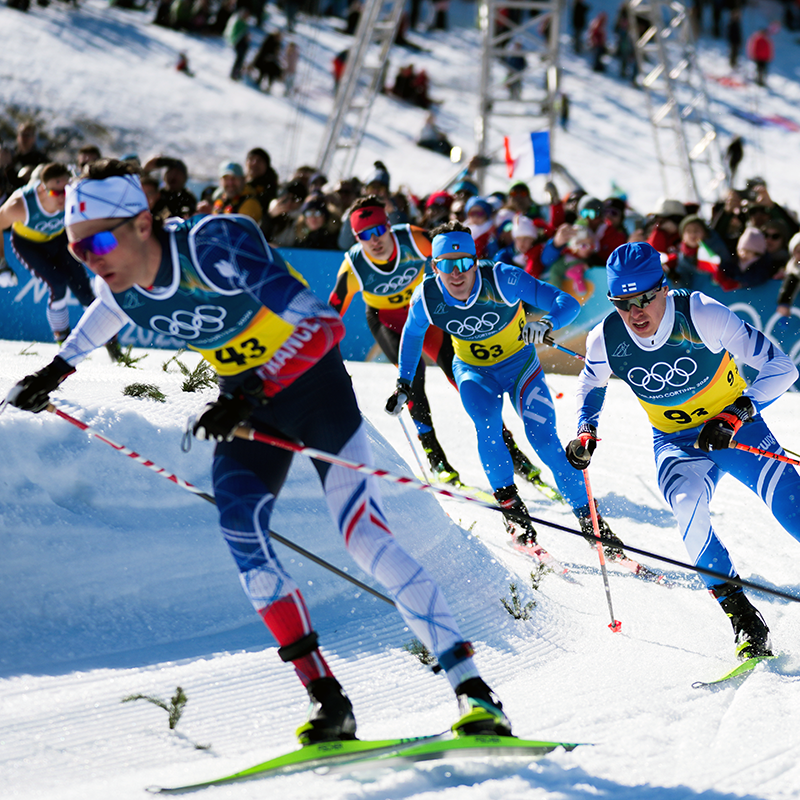
    The start order was determined by World Cup points; six of the top seven starting spots were claimed by Norwegian skiers (their total monopoly only prevented by the presence of the sixth starter, Italy’s Elia Barp). It’s been a long season, and the final 20 k is a long race. The field can be forgiven for taking it easy at the start. But Mika Vermeulen (AUT) is not an especially patient competitor . .  he would go to the front in the second kilometer to give the race some honest pace. Vermeulen’s effort seemed to remind the Norwegians of what they were supposed to do; by the 4 kilometer mark, Amundsen had powered to the front, followed by Klaebo and Pellegrino. A crowd of Norwegians and French race suits followed them. The players were all in position.

    Schumacher hovered around the top ten, continuing to show his skills as a mass-start racer. The field began to break up on the course’s challenging downhills; Schumacher continued to hold his own.

    At eight kilometers, Klaebo moved forward to  take control. That’s because racers were offered World Cup bonus points at 9 k and at 17 k, and Amundsen had admitted in pre-race interviews that he would plan to pursue those points. If he could snatch some of those points, he could close the gap on Klaebo. Huh . . . Klaebo grabbed those 15 bonus points for himself, followed by Amundsen’s 12 point second place consolation prize. Amundsen had hoped to narrow the gap. Instead it widened by three points.

    Soon after the bonus sprint, five Norwegian race suits began inexorably to pull away: Andreas Fjorden Ree, Mattis Stenshagen, Emil Iversen, Klaebo, and Amundsen. Schumacher eased his way forward to seventh position, just three seconds behind the leaders. The pace was fast, but fans could wonder if the skiers were really leaving it all out there. Who could blame them? All season long, Klaebo’s teammates—his closest rivals—had done all they could to drop the guy. Usually, whomever attempted to do so would find themselves dropped and distanced by their own teammates. It looked as though no one was willing to make such a risky play. But in that lull, Einar Hedegart had rejoined the leaders.

    At the 17 kilometer mark, Klaebo again moved forward to seize the bonus points. Klaebo 15 points, Reee 12, Amundsen 10. Barring any unforeseen disasters, Klaebo had the points-lead he needed to claim the Distance Cup. Now the Norwegian fans would eagerly watch how he would race to the finish.

    After the bonus sprint, the course returned to the finishing stretch utilized inhte Sprint course . . . Klaebo knows this part of the course so well. And he used the same tactic that took him to a Sprint victory just two days ago. Resplendent at the front, Klaebo turned on the jets up the final slope, jump-skating away from his rivals. Amundsen followed gamely, but the gap widened just enough to deprive Amundsen of the draft on the subsequent downhill. Klaebo was not to be denied in the final sprint, gliding across the line for his 113th World Cup victory, and the first Distance Crystal Globe of his career.

    Hedegart held on for third, perhaps inspiring the young biathlete to continue competing as a skier in seasons to come. Pellegrino would finish his final race in 13th place, securing his place on the third step of the World Cup Overall podium. Schumacher would race in the main chase group throughout the race, but would fade to 20th at the finish.

    Harald Oestberg Amundsen (NOR) chased Johannes Hoesflot Klaebo (NOR) through an entire season of Distance races. They finally settled the issue over twenty kilometers in Lake Placid. (Photo: Thibaut/NordicFocus)
    Dominance, indeed

    Not every Norwegian ski hero has been a front-runner. Norwegians began to learn of—and begrudgingly to accept—the strategic brand of racing that Pettter Northug employed during his brilliant career: sitting in and sprinting, snatching mass-start Distance races from Distance specialists. Perhaps Northug’s strategy became acceptable because it was so obvious that he was killing himself to hang on to the pace set by the Distance skiers just so he could have a chance to sprint at the end. Norwegian fans admired the effort, the tenacity, the fight. And they wanted a Norwegian skier to win, too. Northug delivered repeatedly, but Northug was an athlete of a different sort—spending off-season weeks gambling lavishly in Las Vegas, and getting into all sorts of trouble in Norway on account of his love of fast cars and strong drink. Northug definitely earned his place in the skiing Pantheon, but even his Norwegian countrymen remain unsure of him.

    The only real way to capture the love of the Norwegian ski fans is to dominate the competition. Klaebo knows this . . . and what he delivered was a season that included a Tour de Ski, a Sprint Globe, a Distance Globe, an Overall Globe, and six Olympic gold medals. Dominance, indeed.

    Referring to his haul of Crystal Globes, Klaebo said, “It’s going to be overweight getting back home, that’s for sure.

    “I always try to focus on a part of the course where I can use a different part of tracks to get an advantage,” Klaebo said. “Today I felt like I was pushing hard up the last uphill, and Harald was right behind me all the way. I managed to get a small gap at the end!

    “I saw it coming!” said Amundsen. “I tried to find his back and stay there. I knew that he would go fast on the last uphill. I just tried to follow.”

    “We had a great team effort,” said Amundsen. “And second place, in the end, was quite good.”

    Now, Team Norway will pack up its trophies and its flowers and its wheels of Gruyere cheese, and head back home to the land of Nordic skiing, and the cheering hordes of Nordic skiing fans.

    “I’m glad the season is over now,” said a smiling Klaebo after the race. “It’s time to rest a little bit.”

    And a well-deserved it will be. We’ve watched a remarkable season scripted by the greatest of all time. We’re unlikely to see such a season again.

    World Cup Final—Men’s 20 k Mass Start RESULTS

    Love Stories Like This? Help Keep Them Coming.

    Feature stories like this one take time, access, and care to produce. If you value thoughtful storytelling and independent ski journalism, please consider becoming a Voluntary Subscriber. Your support directly fuels the work we do to cover the people, places, and moments that make our sport special.

    Join the FasterSkier community!
    Here at the end of all things, another Norwegian podium. Harald Oestberg Amundsen (NOR), Johannes Hoesflot Klaebo (NOR), Einar Hedegart (NOR) celebrate the end of a long season. (Photo: Modica/NordicFocus)


  • Klaebo Is Coming to Lake Placid

    Klaebo Is Coming to Lake Placid

    This coverage is made possible through the generous support of Marty and Kathy Hall and A Hall Mark of Excellence Award. To learn more about A Hall Mark of Excellence Award, or to learn how you can support FasterSkier’s coverage, please contact info@fasterskier.com.

    Johannes Hoesflot Klaebo (NOR) took all six gold medals awarded in men’s cross-country skiing at the Olympics last month. (Photo: Barbieri/NordicFocus)

    Johannes Hoesflot Klaebo made the call late Tuesday night… he’s racing.

    According to the Scandinavian press, Klaebo departed Oslo’s Gardermoen airport at 6:25 Wednesday morning, beginning a roughly 20-hour journey to Lake Placid, where he’ll arrive about a day and a half before Friday’s 10-kilometer classic interval start. The Norwegian Ski Federation confirmed the news in a press release on Wednesday morning.

    “I can see this isn’t going to be an optimal buildup, both with the long travel and not being able to adjust to the time difference,” Klaebo said. “But I want to be part of the World Cup finale in the USA.”

    The decision came after Klaebo did a training session on Tuesday morning in Trondheim and responded well. National team doctor Ove Feragen gave him the green light.

    Ben Ogden (USA) checks on Johannes Hoesflot Klaebo (NOR) after their crash eliminated them from the race in Drammen, Norway. (Photo: Nordnes/NordicFocus)

    “After the fall during the sprint in Drammen, and some quiet days at home, Johannes has gradually resumed training and normal activity,” Feragen said. “He has responded well to this, without any recurring symptoms after the fall. After observation and further examinations, we have concluded that he is fit to compete.”

    Klaebo has been sidelined since March 12, when American Ben Ogden fell across the Norwegian’s skis during Classic Sprint semifinals in Drammen, Norway. The resulting crash sent Klaebo’s head into the hard-packed snow. He was diagnosed with a mild concussion, withdrew from the Holmenkollen 50k, and scrapped a planned media tour in New York City that included sit-downs with CNN, NBC, the New York Times, and the Wall Street Journal.

    Now the question shifts from whether Klaebo will race to how much he’ll race. He’s not committing to the full program.

    Harald Oestberg Amundsen (NOR), Johannes Hoesflot Klaebo (NOR), and Martin Loewstroem Nyenget (NOR), (l-r) share the Skiathlon podium in Falun, Sweden, on March 1st, 2026. (Photo: Thibaut/NordicFocus.)

    “My expectations for performance are not sky-high,” Klaebo said. “I’ll do my best despite a poor buildup and potential jet lag. Whether I race one, two, or three events in Lake Placid, I’ll decide once I get to the USA and get skis on my feet.”

    The stakes are real despite the measured tone. Klaebo has already clinched the overall World Cup — his sixth, tying Bjoern Daehlie — and the sprint globe. But he trails Harald Oestberg Amundsen by three points in the distance standings after missing the Holmenkollen 50k. Two distance events remain: Friday’s 10 k Classic and Sunday’s 20k Freestyle Mass Start. A clean sweep of the overall, sprint, and distance globes would be a first in Klaebo’s career.

    “For cross-country skiing, it’s especially important to have World Cups in the USA,” Klaebo said. “I’ve been looking forward to this finale for a long time.”

    Racing begins Friday at Mt. Van Hoevenberg. Klaebo will be on the start line — jet lag and all.


    Love Stories Like This? Help Keep Them Coming.

    Feature stories like this one take time, access, and care to produce. If you value thoughtful storytelling and independent ski journalism, please consider becoming a Voluntary Subscriber. Your support directly fuels the work we do to cover the people, places, and moments that make our sport special.

    Join the FasterSkier community!


    Ben Ogden (USA) and Johannes Hoesflot Klaebo (NOR), along with Oskar Opstad Vike (NOR), (l-r) on the Olympic sprint podium last month.  It should be made clear that Ogden and Klaebo have a strong respect for one another, to say the least. (Photo: Vanzetta/NordicFocus)
  • Hedegart Emerges From the Fog to Win Holmenkollen 50 k as Klæbo’s Absence Reshuffles the Distance Globe

    Hedegart Emerges From the Fog to Win Holmenkollen 50 k as Klæbo’s Absence Reshuffles the Distance Globe

    This coverage is made possible through the generous support of Marty and Kathy Hall and A Hall Mark of Excellence Award. To learn more about A Hall Mark of Excellence Award, or to learn how you can support FasterSkier’s coverage, please contact info@fasterskier.com.

    The start of the Holmenkollen Men’s 50 k Freestyle in Oslo, Norway. (Photo: Authamayou/NordicFocus)

    For nearly two hours on Saturday, 77 men disappeared into a stubborn curtain of fog that clung to the hillsides above Oslo, their figures swallowed by the mist somewhere between the stadium and the high point at Frognerseteren. When it was over, only one emerged with his arms in the air, and it was the one freestyle specialist who had been topping shorter freestyle distance races most of the season.

    Einar Hedegart, the 24-year-old former biathlete who only committed fully to cross-country skiing in November, surged past Harald Oestberg Amundsen in the final meters to win the Holmenkollen 50 k Freestyle in 1:51:38.2 — his first victory on cross-country skiing’s most storied stage, in just his seventh World Cup start.

    “This is the greatest feeling I’ve ever had,” Hedegart said after the finish. “This is just a nostalgia stadium. [A] legendary race, almost all my heroes have won this race, and especially Petter Northug. This might be the reason why I’ve been so motivated my whole life to be a cross-country skier.”

    Einar Hedegart (NOR) celebrates winning Norway’s most iconic race. www.nordicfocus.com. (Photo: Authamayou/NordicFocus)

    But the result that will echo loudest across the sport happened away from Oslo. Johannes Hoesflot Klaebo, the overall World Cup leader, was home nursing a mild concussion from a hard crash in the Drammen sprint two days earlier. Klaebo, who has already compiled a nearly perfect season, winning the Tour de Ski, all six Olympic races, secured the FIS Overall Crystal Globe, the FIS Sprint Crystal Globe, and only needed to keep racing the remaining distance races to take the clean sweep of the season with the FIS Distance Crystal Globe. BUT his absence from the start line meant zero points scored in the distance standing today. And with Amundsen’s second-place finish today, the distance crystal globe race was blown wide open: Amundsen now leads the distance standings by three points, 939 to 936, with two distance races remaining at the World Cup Finals in Lake Placid.

    Klaebo posted to Instagram yesterday: “Took a fall yesterday and hit my head pretty hard, but luckily everything is all good in the hood. Ended up with a concussion, so I’ll take some days off from both training and the internet just to make sure everything settles properly. Only got one head, so have to take good care of it.”

    He had been scheduled to fly to the United States on Sunday, but will now stay in Norway for a few extra days, hoping to recover in time for Lake Placid.

    Einar Hedegart (NOR) emerges from the fog to take the win. (Photo: Nordnes/NordicFocus)
    A Race Defined by Fog

    The Holmenkollen 50 k — first raced in 1888, a fixture of the World Cup since 1982, and a race that draws an estimated 100,000 fans to the forested hills above Oslo — returned to the calendar Saturday after a one-year absence. For the first time, the men’s and women’s 50 k races were held on the same day, the women starting 45 minutes behind the men in a format designed to create an all-day spectacle. The fog, however, had other ideas. Conditions were so thick that spectators along the course could hear the racers before they could see them.

    The course — six laps of 8.3 km with 334 meters of climbing per lap — was firm and fast after overnight salting despite an air temperature of 5.0°C. The salted, compact surface was ideal for skating, and the winning time of 1:51:38 came in roughly four minutes faster than the last time the Holmenkollen 50 k was contested in freestyle.

    Harald Oestberg Amundsen (NOR) on his way to second place. (Photo: Authamayou/NordicFocus)

    Through the first three laps, the race unfolded as a cautious tactical affair. A large pack of roughly 40 skiers stayed together, with Martin Loewstroem Nyenget, Mattis Stenshagen, and Federico Pellegrino taking turns at the front. The first athlete to make a decisive tactical move was Iver Tildheim Andersen, who changed skis early at the stadium after the third lap while the rest of the pack continued through. The fresh skis gave Andersen a burst, and when the lead group stopped for their own ski exchange one lap later, he suddenly found himself alone at the front with a roughly 15-second advantage.

    “Just stick with the field as long as possible and then hopefully be in position when the group starts swarming,” Hedegart said of his plan. “But today I was really offside, like 70 percent of the race. So I was lucky that no one took a gap.”

    The chase group — reduced to roughly eight athletes, all Norwegian once France’s Victor Lovera fell off the pace — gradually closed on Andersen through the fifth lap, with Hedegart, Simen Hegstad Krueger, Amundsen, Nyenget, Andreas Fjorden Ree, and Kasper Andersson Herland trading pulls at the front. By the time the group reached the final lap, they had swallowed Andersen, and the race became a question of who had saved enough for the final kilometers.

    Simen Hegstad Krueger (NOR) tried his best to get away for the win. (Photo: Authamayou/NordicFocus)
    Krueger’s Late Charge and Hedegart’s Final Kick

    Krueger, who was celebrating his 33rd birthday the day before, was omitted from the Norwegian Olympic team despite multiple Olympic medals in his career and was the winner of the last freestyle Holmenkollen 50 k. He drove the pace through the final lap. He pushed hard over the climbs near the iconic Holmenkollen church, stringing out the group and shedding Andersen off the back. But Krueger couldn’t sustain the pressure all the way to the finish, and as the group of seven came around the final corner and up the short, steep ramp before the descent into the home stretch, the sprint was on.

    Amundsen launched first, throwing everything he had at the final few hundred meters. But Hedegart, who had looked labored at points earlier in the race, found a gear no one could match. He came alongside Amundsen, took the lead in front of the grandstand crowd, and raised his fist in celebration as he skied across the line.

    “I felt, like, better,” Hedegart said of his position in the back of the pack through much of the race. “So I was just laying in the field, and I had to remind myself he did the same,” he added, referring to his idol Northug, whose trademark move was stalking from behind before unleashing a devastating sprint.

    Harald Oestberg Amundsen (NOR), Mattis Stenshagen (NOR), and Martin Loewstroem Nyenget (NOR), (l-r) stayed in the lead pack. (Photo: Authamayou/NordicFocus)

    Hedegart crossed in 1:51:38.2. Amundsen finished four-tenths of a second behind. Nyenget was third at +1.1. Ree took fourth (+1.5), followed by Herland (+2.1), Krueger (+3.0), Moseby (+4.8), and Andersen (+16.8) after his brave solo effort. Norway swept the top eight positions.

    France’s Lovera was the first non-Norwegian in ninth (+48.1), followed by AIN athlete Savelii Korostelev in 10th (+1:24.2).

    Zak Ketterson (USA) led the way for the Americans in the chase pack racing for 11th place; he ultimately finished 18th. (Photo: Authamayou/NordicFocus)
    Ketterson Fights for 11th in His Adopted Home

    Zak Ketterson, who spent the summer and fall living and training in Oslo, found himself in the thick of a battle for 11th place, a fight he learned about from coaches stationed along the fog-shrouded course.

    “I had heard from coaches on the side of the trail that our pack was fighting for 11th, and that was super cool,” Ketterson said. “I actually felt pretty fresh at the end and thought my finishing sprint would be pretty good, but I didn’t time it well and got really boxed in on the last couple turns into the finish.”

    Ketterson ultimately finished 18th (+1:54.2), part of a chase pack that came across the line within seconds of each other. He said everyone in the group knew a sprint was coming on the final lap.

    The fog made the tactical picture nearly impossible to read. “I couldn’t see more than 10 meters in front of me,” Ketterson said. “It definitely made it difficult to assess where I was relative to the leaders in the later laps. It also made some of the corners feel way sketchier because you couldn’t really choose an optimal line with such limited visibility.”

    For Ketterson, the race carried personal significance beyond the result. Having trained on the Holmenkollen course through the Norwegian summer and fall, he knew every climb and descent intimately. “This is definitely one of the most iconic and cool races we get to do,” he said. “It was especially special for me this year since I trained on this course all summer and fall living in Oslo. The highlight was definitely having my wife Julie and her family out there cheering me on.”

    What made the performance all the more impressive was the state of his body coming in. “I honestly feel like I am really running on fumes,” Ketterson said. “To be honest, I was not sure if I would even start this race in the morning. I felt so bad, and honestly, my body has felt super up and down in the last few weeks. I’m really curious to see how my body responds to this race. I was pleasantly surprised by how decent it felt, but I feel like the next week could go either way. Especially with the international travel tomorrow.”

    Brian Bushey (USA) gaining experience on his way to 59th place. (Photo: Authamayou/NordicFocus)
    The Rest of the North Americans

    Hunter Wonders was 45th (+5:46.9), Kevin Bolger was 48th (+6:51.3), and Brian Bushey was 59th (+12:24.9).

    Canada’s Xavier McKeever finished 41st (+5:11.4), while Thomas Stephen was 43rd (+5:18.1).

    Harald Oestberg Amundsen (NOR) takes over the FIS Distance Globe lead with just two distance races remaining. (Photo: Authamayou/NordicFocus)
    Distance Globe: Three Points

    The ramifications of Saturday’s race land squarely on the crystal globe picture. Before the race, Klaebo held a 128-point lead over Amundsen in the distance standings and a 636-point lead in the overall. With Klaebo watching from home, Amundsen’s 131-point haul (including bonus points) vaulted him into the distance lead: Amundsen now sits at 939 points, three ahead of Klaebo’s 936. Nyenget climbed to 914 in third.

    Klaebo’s overall World Cup lead, at 2,071 points to Amundsen’s 1,566, remains secure with a 505-point cushion. But the distance globe — awarded to the season’s best across distance events only — will come down to the final two races: a 10 k Classic Interval Start and a 20 k Freestyle Mass Start in Lake Placid, March 20-22.

    If Klaebo can travel to Lake Placid and race, he’ll have every opportunity to reclaim the lead. If the concussion keeps him out, the distance globe is likely to belong to Amundsen.

    Kasper Andersson Herland (NOR), who finished fifth, celebrates with Einar Hedegart (NOR), (l-r) at the finish of the Holmenkollen. (Photo: Authamayou/NordicFocus)
    A Star Made for This Stage

    Hedegart’s career trajectory is one of the season’s best stories. A junior biathlon world champion who struggled with his shooting, he drifted toward cross-country skiing after a surprising second-place finish at the Holmenkollen World Cup last season. He spent the summer training with a cross-country team while bringing his rifle to every camp, undecided. In November, after winning the popular pre-World Cup cross-country race in Beitostoelen, Norway, by a wide margin and missing eight of 20 shots in a biathlon event, he committed to leaving the rifle at home.

    Since then: an Olympic bronze in the 10 k Freestyle behind Klaebo, a team sprint gold partnered with Klaebo, victories in the Engadin Marathon, and now the Holmenkollen 50 k — a distance he had never raced at the World Cup level. He was asked whether his approach of sitting back resembled Northug’s famous stalking tactics.

    “Yeah, I felt like Petter,” Hedegart said. “So I was just lying in the field, and I had to remind myself he did the same.”

    For a race that dates to 1888, that has been won by the sport’s mythical stars, and that is contested before the King of Norway in a stadium surrounded by 100,000 fans, there is no small amount of weight to what happened Saturday at the Holmenkollen. Hedegart is, by every measure, now a cross-country skier.

    The season concludes with the World Cup Finals in Lake Placid, New York, March 20-22. Three races remain. The distance globe is separated by three points. And the world waits to see whether Klaebo can make it to the start line.


    Holmenkollen Men’s 50 k Freestyle FINAL RESULTS

    FIS Men’s Crystal Globe SPRINT STANDINGS
    FIS Men’s Crystal Globe DISTANCE STANDINGS
    FIS Men’s Crystal Globe OVERALL STANDINGS


    Love Stories Like This? Help Keep Them Coming.

    Feature stories like this one take time, access, and care to produce. If you value thoughtful storytelling and independent ski journalism, please consider becoming a Voluntary Subscriber. Your support directly fuels the work we do to cover the people, places, and moments that make our sport special.

    Join the FasterSkier community!


    Harald Oestberg Amundsen (NOR), Andreas Fjorden Ree (NOR), and Martin Loewstroem Nyenget (NOR), (l-r) share the Holmenkollen 50 k Freestyle in Oslo, Norway. (Photo: Authamayou/NordicFocus)
  • The Devon Kershaw Show: A Tesero team sprint slugfest

    The Devon Kershaw Show: A Tesero team sprint slugfest

    This episode was made possible through the generous support of our voluntary subscribers.  If you value coverage like this, please support FasterSkier with a voluntary subscription.  

    The highs were high and the lows were low in the Olympic team sprint in Italy, with the Ogden-Schumacher men’s team claiming silver and the Diggins-Kern women’s pair finishing out of the medals. Devon and Nat break the whole thing down.

    We’ll be back after Saturday’s men’s 50 k. Reach us at devon[at]fasterskier.com and nat[at]fasterskier.com. We’re really grateful for all the support during the Olympics — thanks for notes and encouragement.

    A reminder: This is a homegrown podcast done by two guys working long hours and late nights. We’re also paying real money to be here in Italy. If you can, support the show and FasterSkier’s ongoing coverage with a voluntary membership. We’re also offering a bonus during the Olympics: a WhatsApp group with notes on Nat’s experiences in Italy, the food he’s eating, interview transcripts and more.

    Send nat[at]northernjournal[dot]com a confirmation of your voluntary membership and the number he should use for WhatsApp and we’ll get you signed up. You can also Venmo him directly at @nat-herz if a membership isn’t for you. We’re suggesting a minimum of $10, but we also won’t turn anyone away who wants to join because of an inability to pay.

    Help Support Our Olympic Coverage!

    FasterSkier will have our own Nat Herz on the ground at the Olympics, which, to be honest, is a very big financial lift for us. If you value the thoughtful work and access FasterSkier provides at championships like this one, please consider becoming a Voluntary Subscriber. Your support directly fuels the work we do to cover the people, places, and moments that make our sport special.

    Join the FasterSkier community!
  • Klaebo’s History, USA’s Glory—Olympic Team Sprint

    Klaebo’s History, USA’s Glory—Olympic Team Sprint

    This article was made possible through the generous support of our voluntary subscribers who have helped put our Nat Herz on the ground at the Olympics. If you value coverage like this, please support FasterSkier with a voluntary subscription.

    Gus Schumacher (USA), Ben Ogden (USA) announce the arrival of a new American cross-country tradition. (Photo:  Vanzetta/NordicFocus.)

    PREDAZZO, ITALY — Johannes Hoesflot Klaebo still had something special to do. American skiers still had something special to prove. But the Team Sprint is never as simple as just lining up and racing. Contending nations need to consider the field, rate the strengths and vulnerabilities of their competition, and make a plan to best take advantage of the circumstances. Then they have to ski it . . .

    Not that they needed to, but the Norwegians must have come up with a different plan. For nearly a year—since the straightforward, matter-of-fact Team Sprint victory of Klaebo and Valnes in last year’s World Championships—I’ve been thinking of the Norwegian Team Sprint strategy in only one way: whoever is paired with Klaebo just needs not to get dropped. Stay out of trouble, avoid tangles, respond to the attacks from other teams but don’t allow yourself to be made vulnerable by launching attacks of your (efforts that could, then, be counter-attacked). When considering strategy, picking Klaebo’s partner in this team event seemed like a straightforward selection to make . . . but more than one Norwegian could fit neatly into that role. It’s a role that’s been performed admirably by Valnes in the past, and by Iversen before him (both of them on this year’s Norwegian Olympic Team roster). It’s a role that could have logically been taken on by Harald Oestberg Amundsen, who is both a very fast sprinter and the reigning World Cup Distance champion. All three of them are fast, All three of them are great endurance skiers as well as fine sprinters. None of them would be likely to get dropped by anyone else in the field, and all have a wealth of experience skiing in the should-to-shoulder, rough-and-tumble style of pack racing that is typical of a Team Sprint event. Pick one of those guys, right?

    Not so fast . . .

    Johannes Hoesflot Klaebo finds himself paired in this Olympic Team Sprint with Einar Hedegart. Hedegart is certainly fast, and it’s rumored that he possesses the highest VO2 Max of any Norwegian athlete (in any sport). That would certainly come in handy if Hedegart’s job was to drop everybody in order to give Klaebo a head start on the anchor leg. But is that even necessary? The Team Sprint finishes on the same hill as the Individual Sprint. Remember that hill? The one that’s made Klaebo famous for his unmatchable 11 mph scamper that’s all over the internet? If you put all the best skiers in the world at the bottom of that hill, and say “go,” Klaebo will win a race to the finish line by a mile. We thought the plan for the Team Sprint would take advantage of that advantage.

    What does teaming with Hedegart get them? Those are questions that someone over in Norway must’ve considered. If Hedegart tries to break away, he makes his team vulnerable to counter-attack . . . and he already showed in the 10 k Freestyle (where he went out way to fast, and bonked like an inexperienced age-grouper) that he may not yet possess a full understanding of pacing. Furthermore, Hedegart possesses nowhere near as much World Cup Sprint experience as Iversen or Valnes or Amundsen. They’re less likely to get stepped on or pushed over or boxed in. With Hedegart—well, he’s fast, but the Norwegians really don’t know what they’re getting.

    On the other hand, Hedegart’s raw speed is what Norway may be seeking. With his bronze medal in the 10 k Freestyle, he showed that he was a fairly even match for the speedy Frenchman, Mathis Desloges (already with three silver medals in these Olympic races). And France is starting Desloges in the first leg of the Team Relay (opposite Hedegart). One way or another, Klaebo’s performance is fairly predictable, so all the significant question marks are swirling around Hedegart.

    Ben Ogden (USA) had one job to do—create the gap. (Photo: Barbieri/NordicFocus)
    The American Dream

    It seems like the American men also have decided to try out an unexpected strategy. It would have been easy to assume that Team USA might hope to get Ben Ogden—the team’s most accomplished sprinter—into the anchor leg so that he could battle his way to the finish line among the other designated sprinters. A sprint finish for the medals, assign your best sprinter. Right? Maybe not. The US team decided that the anchor leg will be skied by Gus Schumacher, himself no slouch as a sprinter, and an occasional visitor to World Cup  Sprint semifinals and finals. But if Schumacher skis the anchor leg, then he’s likely to find himself sprinting against Klaebo and Federico Pellegrino and Jules Chappaz. Schumacher may not match up too well against those three . . . but if Schumacher is given a lead going into the anchor leg, there aren’t many skiers in the world who can chase him down. Perhaps what USA is counting on is Ogden being able to launch an attack in the penultimate leg that disrupts the other contenders, allowing Schumacher to coast home alone. Klaebo may already be well off the front by then, but who knows? Maybe there’s a medal for the Americans in this strategy that might not otherwise have existed.

    “I was incredibly nervous before today’s race,” said Ogden. “But the parts, the moments where I’m nervous are, like, the lead up, you know? I know that once the race starts, I can just get to this headspace where I can be confident and be strong and be smart with my movements in the group. And that’s a really good feeling.”

    Time to line up and race . . .

    Einar Hedegart (NOR) would need to be both fast, and patient in an event that he had never skied before. (Photo: Vanzetta/NordicFocus)
    Men’s Team Sprint

    Unlike the Individual Sprint where the event is raced in heats of six skiers, the Team Sprint is a 15 team melee whose selection of teams is based on the compiled individual qualifying times of each team’s sprinters. Once the final field is decided, they just line ’em up, and say “Go.” With 15 teams charging around the Sprint course, it would seem to be anyone’s race.  Ironically, pre-race ski-pundits would have us believe that the three medals should only be distributed among four teams: Norway, France, Italy, and the USA. But teh efforts, attacks, and foibles of many other teams are likey to have an impact. As other recent relay events have amply demonstrated, there is much that can interrupt all best-laid plans between the prediction and the finish. Soon, either those experts would look like geniuses, or fools.

    Ogden would be compelled to deal with Desloges, Hedegart, and Anger in Leg 1. While the Ogden-strategy may have been to accelerate in his leg—creating a gap that will allow Schumacher to maintain an advantage—Ogden was not likely to pursue the all-out-from-the-gun that Diggins employed in the Women’s Team Sprint. It’s just too athletically expensive to race that way.

    Ogden started front and center of the front row, where he was followed quickly by Austra. The first meters were confusing as Riebli (SUI) needed to scramble to find a replacement pole in just the first few seconds of racing. Ogden and Desloges made the early tempo. The field would begin to stretch out, more out of concern for safety than exhaustion.

    “We did our one thing that we talked about: we were gonna meet on the right hand side of the exchange zone,” said Ogden. “Without fail, every single time we caught we came in on the other side, on the far and had to cross, and had to cross through like 15 people in order to get to our guy on the other side. And it was one of those things where we both honed in on the fact that being on the right hand side of the exchange room was not working. But it was also like, we can’t risk going to the left hand side and having him not see us. So we just had to sort of stick with it. And, you know, made for a couple fast first 20 seconds of the legs to try to catch back up.”

    Johannes Hoesflot Klaebo (NOR) will do what he’s going to do. Teams from all other nations will scramble for silver and bronze. (Photo: Vanzetta/NordicFocus)
    Leg 2—Klaebo’s fast lane

    Klaebo may not have been happy at being forced to weave through the field after the exchange (and Hedegart’s presence in the crowded scrum of the transition must have been nerve-wracking), but this is not Klaebo’s first rodeo. He made his way easily to the front followed by Pellegrino and Edvin Anger (SWE) who decided he wanted to take the lead. Klaebo and Pellegrino were only too happy to let the confident young Swede do the work.

    “I was trying to save energy and not lead,” said Schumacher. “When you start off out of the stadium and third or fourth, and another line comes up behind you, you’re eighth pretty quickly. And then, yeah, coming into the stadium, there was a big slingshot, and I was sort of like—I don’t know—I felt like I was generally on the wrong side of that . . . I kept my head, stayed calm, which I’m really proud of.”

    “It’s nice to be able to trust Ben,” Schumacher continued. “To tag him far back, and he’ll tag me back in a great spot. And he set me up in that last lap perfectly. Then I had a pretty simple job to do, and I’m really glad I was able to do that.”

    Leg 3—Hedegart’s patience

    Hedegart inherited the lead from Klaebo, but he led at a pace that indicated he was not interested in laying down the law. Not yet, anyway. Hedeagart settled in behind Lauri Vuorinen (FIN) while the field spread out behind them. No real breakaway yet, but the group was beginning to feel the strain. There wouldl be less “trouble” for Hedegart to encounter on the course, but he wasn’t out of the woods yet. All of Norway held its breath.

    Gus Schumacher (USA) has often shown the sort of speed and endurance needed in the anchor leg, but his performances in recent Olympic races left some questions. He answered loud and clear. (Photo: Vanzetta/NordicFocus)
    Leg 4—Schumacher’s arrival, Desloges’ disasters

    Hedegart had again come through transition with the lead, follwed by Sweden and France. Anger again wanted the front, perhaps hoping to create some gaps of his own. Desloges spent Leg 4 suffering his second broken pole of he day. France was faltering irretrievably, and the field sensed an opening in the medals. Team USA had sat concealed in the field all race, but Schumacher was begining to move forward, and to make his presence felt. Canada shadowed USA. With the field still hanging together, Team USA may have been ready for Ogden’s Leg 5 surge.

    Leg 5—Ogden’s encore

    Just like they may have planned it, there went Ogden leading Hedegart up the significant hill. Hedegart may have possessed the lead, but the USA was putting its plan into effect, as well. While all the leaders remained in contention, it looked like the pre-race script was remaining consistent.

    Celebration at the finish. Ben Ogden (USA) and Gus Schumacher (USA) team up to make history. (Photo: Barbieri/NordicFocus)
    Anchor Leg—USA!

    Ogden had done his job, as had Hedegart. One lap to go, with Klaebo enjoying a small lead over Schumacher, Anger, and Pellegrino. With only the anchor leg remaining, what USA needed was a skier with flashing speed and bottomless endurance. That’s Gus Schumacher . . .

    “The best way to do that is just go as fast as you can,” said Schumacher. “And I think today I did a good job of just looking forward. Klaebo was gonna ski this fast. If I can stay close to him, I’ll also ski it fast.”

    Schumacher made his way to Klaebo’s tails as Pellegrino dropped Anger. Medals waited on the horizon as Klaebo shifted into top gear on his signature hill. Pellegrino made up ground on Schumacher, but did not close the gap enough to benefit from the draft on the downhill where the field spread out in a test of glide wax and base prep. Gaps held as skiers entered the finishing straightaway where Klaebo wrote Olympic history to become only the second Winter Olympic athlete to win five golds in a single games. Additional history followed in Klaebo’s wake, as Schumacher erupted across the finish line to grab silver for Team USA, his first Olympic medal, and Ogden’s second silver of these Games.

    “Once the race starts, I just race the same way I have since I was five,” said Ogden. “So that’s a really nice feeling. And I think that the test of this championship has like, like, set me up really well to just be confident and leap, (to) control the pace and then go hard and be confident that I could, that I could make some time. So was a good feeling.”

    Pellegrino offered the home-crowd yet another thrill when he crossed the line to deliver his second bronze medal.

    Relief, exhaustion, satisfaction: Federico Pellegrino (ITA) has long carried the weight of Italian expectations. With his second bronze medal of these Olympic Winter Games, Pellegrino is writing the closing chapters of his career con brio e brillantezza. (Photo: Barbieri/NordicFocus)

    The legendary American speedskater, Eric Heiden, won every single event on the speedskating card in the Olympic Winter Games of Lake Placid, 1980. Those unprecedented triumphs—from the explosive 500 meter sprint to the brutal 10,000 meter marathon—made it clear that even among the very best in his sport, Heiden reigned supreme. As performers and performances have specialized across all sports, it appeared unlikely that anyone would ever so dominate a sport again. Well, with his own fifth gold medal, Klaebo has proven to be Heiden’s equal. And with one event still remaining in cross-country events at these Olympics, a modern athlete may yet prove the sort of dominance once known only to the great sportsmen of history.

    American sports fans certainly remember Heiden. But today, in Val di Fiemme, the performance that would make hearts beat and souls rejoice—the medal that would see American sports fans leaping from the couch in the middle of the North American night—belonged to Ben Ogden and Gus Schumacher, rivals throughout their long careers, teammates for a decade, and partners in the race that earned only the third cross-country skiing medal in America’s Winter Olympic history.

    Bill Koch has long borne the mantle of American cross-country skiing.  He is now joined in that task by more American skiing stars including Jesie Diggins, Ben Ogden, and Gus Schumacher. (Photo: Peter Ashley)

    Way back in 1976, American viewers were glued to the TV sets watching races from Innsbruck, hoping to see Bill Koch win his second Olympic medal. Back then, that’s what we thought would happen . . . win one medal, win another. But while Koch performed admirably in the race that followed his historic silver medal, he did not earn a place on the podium again. Today, in Val di Fiemme, Ben Ogden made a little history of his own, becoming the first American man to earn a second Olympic medal. He did so in a display of grit, of determination, of long-standing cameraderie and cooperation with his longtime teammate, the indefatigable Gus Schumacher who, himself, became only the third American man to claim an Olympic medal.

    Soon, we may stop talking about historic finishes for American skiers. As a team, most of the firsts and onlys now lie behind them. What arrives in their place is legitimacy and respect, and a future that may bring expectation and anticipation in place of mere hopes and dreams. American cross-country has arrived, just in time to establish a bright future when some of its bright stars are preparing to depart the stage. Mission accomplished, plan complete.

    Men’s Olympic Team Sprint RESULTS


    Help Support Our Olympic Coverage!

    FasterSkier will have our own Nat Herz on the ground at the Olympics, which, to be honest, is a very big financial lift for us. If you value the thoughtful work and access FasterSkier provides at championships like this one, please consider becoming a Voluntary Subscriber. Your support directly fuels the work we do to cover the people, places, and moments that make our sport special.

    Join the FasterSkier community!


    History in hand: Gus Schumacher (USA) and Ben Ogden (USA) hold American silver. (Photo:  Barbieri/NordicFocus)

    Ogden remained refreshingly loose on the podium: “I was giving (Klaebo) some $#!* for the fact that they had the least cool podium outfits,” Ogden recalled. “And then he said, ‘How many golds do you have?’ I was like, well, that’s a good point, but they still have the least cool podium outfits. There can be no denying that . . .”

  • The Devon Kershaw Show: An Olympic men’s relay wrap and a team sprint preview

    The Devon Kershaw Show: An Olympic men’s relay wrap and a team sprint preview

    This episode was made possible through the generous support of our voluntary subscribers.  If you value coverage like this, please support FasterSkier with a voluntary subscription.  

    We took a couple of days off to do the necessary things, like eat pizza and ski. (And, rest assured, we were working, too — just not on the podcast.) We’re back now to recap the men’s relay and preview Nat’s favorite championship event, the team sprint.

    We’ll be back after that race tomorrow. Reach us at devon[at]fasterskier.com and nat[at]fasterskier.com. We’re really grateful for all the support during the Olympics — thanks for notes and encouragement. And even the anti-eating-on-the-podcast messages.

    A reminder: This is a homegrown podcast done by two guys working long hours and late nights. We’re also paying real money to be here in Italy. If you can, support the show and FasterSkier’s ongoing coverage with a voluntary membership. We’re also offering a bonus during the Olympics: a WhatsApp group with notes on Nat’s experiences in Italy, the food he’s eating, interview transcripts and more.

    Send nat[at]northernjournal[dot]com a confirmation of your voluntary membership and the number he should use for WhatsApp and we’ll get you signed up. You can also Venmo him directly at @nat-herz if a membership isn’t for you. We’re suggesting a minimum of $10, but we also won’t turn anyone away who wants to join because of an inability to pay.

    Help Support Our Olympic Coverage!

    FasterSkier will have our own Nat Herz on the ground at the Olympics, which, to be honest, is a very big financial lift for us. If you value the thoughtful work and access FasterSkier provides at championships like this one, please consider becoming a Voluntary Subscriber. Your support directly fuels the work we do to cover the people, places, and moments that make our sport special.

    Join the FasterSkier community!
  • Einar Hedegart has only been a ‘cross-country skier’ since November. On Friday, he could dethrone the sport’s Olympic king.

    Einar Hedegart has only been a ‘cross-country skier’ since November. On Friday, he could dethrone the sport’s Olympic king.

    This article was made possible through the generous support of our voluntary subscribers who have helped put our Nat Herz on the ground at the Olympics. If you value coverage like this, please support FasterSkier with a voluntary subscription.

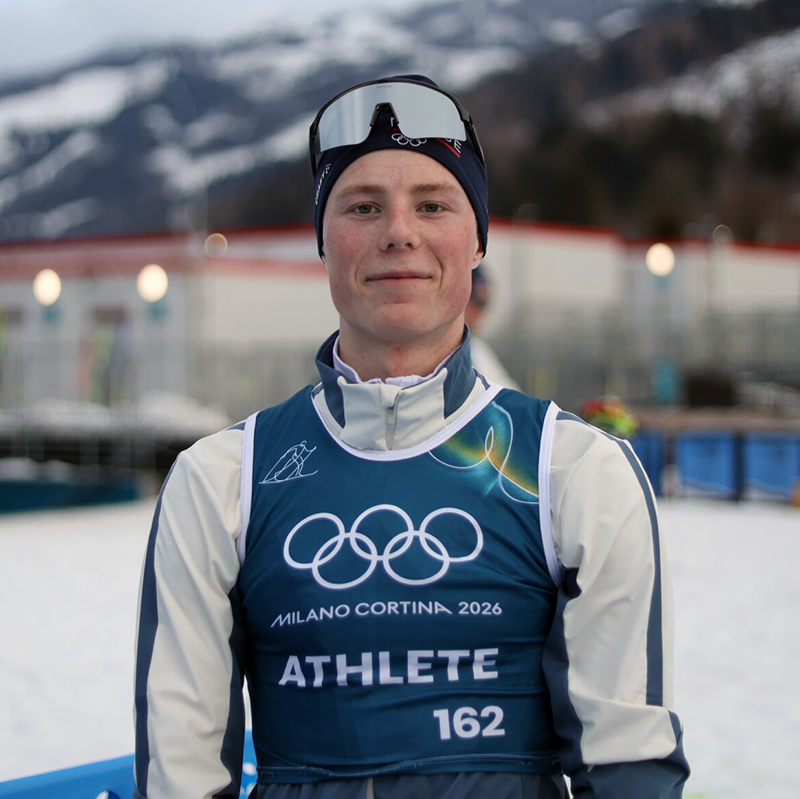
    Einar Hedegart poses for a photo after training at the Olympic cross-country ski venue in the Dolomites in Northern Italy. (Nathaniel Herz/FasterSkier)

    PREDAZZO, ITALY — Johannes Høsflot Klæbo is, almost without question, the greatest cross-country skier who’s ever lived.

    The Norwegian athlete has won gold in eight consecutive championship races spread across two seasons — including the first two events at this year’s Olympics, in Italy. It’s quite possible he could walk away from the Games with gold in all six events.

    His biggest threat comes from a guy who’s been a cross-country skier for less than three months.

    Norwegian Einar Hedegart has beaten Klæbo all three times they’ve raced each other this winter. He’s won five of the six cross-country events he’s entered since the season began in November.


    Johannes Høsflot Klæbo celebrates a gold medal at the Olympics in Italy. (Davide Barbieri/NordicFocus)

    November is when, at least according to Hedegart, he finally accepted the label of cross-country skier. Before that, he’d still been, at least partially, a biathlete — the Olympic discipline that combines cross-country skiing with precision shooting.

    In biathlon, Hedegart was a fast skier, but not always a reliable shooter. Last season, he jumped into a World Cup race against cross-country skiing’s best competitors, and finished a surprising second place.

    That result set off a chain of events that have led him to Italy on Norway’s Olympic cross-country team, with a specific focus on the 10-kilometer freestyle event. That’s where, on Friday, he’s expected to challenge Klæbo for Olympic gold.

    “We’re looking forward to Friday,” Emil Hosøy, the coach of Hedegart’s club team in Norway, said in a phone interview this week. “It will be a hard competition.”

    In a brief interview Tuesday after training with a teammate at the Olympic venue in the Dolomites, Hedegart said he’s prepared for the showdown.

    “Everything has gone according to plan,” he said.

    Biathlon vs. cross-country

    Hedegart’s meteoric rise has enlivened a long-running, colorful debate between cross-country skiers and biathletes over which discipline is superior, and who’s faster. Biathletes have periodically crossed over and notched competitive results, though it doesn’t happen often.

    Swedish cross-country star William Poromaa sparked a furor in Scandinavia two years ago by joking that biathlon, with its stops for target shooting, was for athletes who need a rest between ski sessions.

    Hedegart is the latest test case — showing that on today’s racing circuits, elite biathletes can be, at a minimum, competitive with the best cross-country skiers.

    “I think a lot of cross-country skiers underestimate the level biathlon is at, and the amount of training we are doing,” Hedegart told two cross-country Olympians on their podcast, Skirious Problems. “You guys have to give us some credit, please.”

    Hedegart, 24, is from a little north of Trondheim, a city in central Norway that’s produced some of the world’s best cross-country skiers, including Klæbo.

    As a kid, he watched cross-country skiing on television, because the Norwegian superstar Petter Northug Jr. came from his area. But Hedegart’s focus was biathlon, and he showed promise early — winning medals at the World Junior Championships and, in 2023, reaching the top 30 in the World Cup, the sport’s highest level of competition.

    Einar Hedegart competes in a cross-country World Cup race in Switzerland (Federica Vanzetta/NordicFocus)

    Hedegart would also, from time to time, enter elite cross-country races. Some of those decisions were happenstance — one because he didn’t have a partner for a biathlon relay on the same day, and another that he entered on a whim after a registration deadline.

    But in both of those cases, he won.

    His results earned him an entry into a cross-country World Cup race in Oslo last year, where he placed second — prompting questions from Scandinavian pundits about whether Hedegart was focused on the right sport.

    So, over the summer, Hedegart hedged his bets: He switched from training with biathlon teams to training with a cross-country ski team — albeit one that would allow him to keep shooting his rifle and compete in biathlon.

    “All the way from May to November, I was 50-50,” Hedegart said. “I brought my gun to every camp and shot a lot.”

    At the start of this winter, Hedegart entered two sets of races over two weekends — biathlon and cross-country — to help decide how he would spend the rest of the season.

    In biathlon, he shot poorly. In one race, he missed eight of 20 shots; only one athlete out of 59 competitors missed more.

    The cross-country race, meanwhile, he won by a big margin — besting not just Norway’s top skiers but other top talents from France and Austria. That was the day things changed, Hedegart said.

    “I’m a cross-country skier this winter season,” he said.

    Klæbo, whose championship winning streak is at risk, has taken notice of Hedegart’s rise, which resulted in him being named to Norway’s Olympic cross-country team early in the winter.

    “It’s impressive, what he has done,” Klæbo said. “I’m going to try to give him a good match.”

    The best skater of all time?

    Both Klæbo and Hedegart himself credit Hedegart’s success this season to a unique aspect of his training.

    Cross-country skiing, both on the World Cup circuit and at the Olympics, features events in two techniques — the traditional forward striding and poling known as classical, and the side to side pushing called skating.

    Biathletes compete only in skating, and Hedegart, this past year, has focused his training almost exclusively on that technique. He hasn’t even bothered to contest classical cross-country competitions this winter. 

    Hedegart said on the podcast, in November, that he’d spent less than 12 hours practicing classical style in the previous six months — a tiny fraction of the hundreds of hours he’d spent training in total. Top cross-country skiers, meanwhile, typically divide their training close to evenly between the two techniques.

    Einar Hedegart, center, celebrates winning a World Cup cross-country race in Switzerland. (Federica Modica/Nordic Focus)

    “That is my strength, that I can use more time than anyone else ever has on skating,” said Hedegart in the interview. “I’ve just really done my thing, and that has gotten me this far.”

    Hedegart’s training plan has other unconventional elements, including lots of moderately hard sessions and few extra-hard ones, which allows him to spend more time training overall, said Hosøy, his coach. Hedegart is also a “very clever” athlete who’s shown a keen awareness of his own body that’s unusual for someone his age, Hosøy added.

    But it’s the added emphasis on skating that’s allowed Hedegart to take the technique “to a new level,” said Pål Golberg, a former top Norwegian skier who’s competed against Hedegart and now is working at the Olympics as an expert TV commentator.

    “The training he does is out of this world,” Golberg said. “He can be the best skater the sport has seen — if he wants to do that.”

    A postseason dilemma

    That’s the question Hedegart will have to answer after this season — and it poses a real dilemma. 

    Avoiding the classical technique means he can only compete in half of cross-country’s racing schedule. And because his success, so far, has come mostly in distance events, Hedegart has not yet earned a chance to race individual sprint races for the Norwegian team, whose start slots are hotly contested.

    As a result, Hedegart has started just six cross-country races this winter — far less than athletes competing in both disciplines.

    “If you want to get old in this sport, maybe you have to get to compete more to have the motivation to train as much as he does,” said Hosøy, the coach.

    But training and racing in the classical technique would risk the success Hedegart has found after specializing in skating.

    “I wouldn’t take the chance,” said Golberg. “If he has this skating that’s so good, why would you risk it? He would never win a distance race in classic, I’m pretty sure.”

    There’s also the question of whether Hedegart will ultimately return to biathlon — which, he said, would make it pointless to try to improve his classical technique, since it’s not used on the biathlon circuit.

    Hedegart celebrates a podium finish at a cross-country World Cup race in Finland earlier this year. (Federico Modica/NordicFocus)

    At the start of the season, Hedegart said, he still planned to go back to biathlon next year. Now, he added, he’s pretty sure he’s changed his mind: If he’s offered a spot on Norway’s national cross-country team for next year, he’d take it, at least for one season.

    But in 2029, the biathlon World Championships will be held in Oslo — a chance to compete in a marquee event in Hedegart’s home nation. “That is a big, big dream of mine,” he said. “And I really hope that I can compete there.”

    “That is the back and forth I have to do,” Hedegart added, referring to the balance between the two sports. 

    If Hedegart’s success this season has complicated his career planning, it’s at least provided Scandinavians with a compelling new storyline — particularly in men’s cross-country skiing, where some pundits complain that Norwegian dominance is making the sport boring.

    “Norwegians are pretty tired of watching one Norwegian fighting with another,” said Golberg. “But now, suddenly, you have two sports clashing together.”


    Help Support Our Olympic Coverage!

    FasterSkier has our own Nat Herz on the ground at the Olympics, which is a significant financial lift for us. If you value the thoughtful work and access FasterSkier provides at championships like this one, please consider becoming a Voluntary Subscriber. Your support directly fuels our work to cover the people, places, and moments that make our sport special.

    Join the FasterSkier community!


  • The Cost of Being the Best: Norway Finally Locks In Its Olympic Squad

    The Cost of Being the Best: Norway Finally Locks In Its Olympic Squad

    This article was made possible through the generous support of our voluntary subscribers. If you value coverage like this, please support FasterSkier with a voluntary subscription.

    Norway’s greatest competitive advantage in cross-country skiing has always been depth. In an Olympic selection season, that depth becomes a headache. When the federation gathered to finalize its 2026 team, the conversation was not about who belonged at the Games — those results and calculus had been logged. It was about which version of the team could survive illness, underperformance, and the cruel compression of Olympic schedules. For several skiers who have already proven themselves capable of standing on a World Cup podium — and perhaps even an Olympic one — the answer would be no. Not because they weren’t good enough. But because someone else fit the puzzle a fraction more cleanly.

    Johannes Hoesflot Klaebo (NOR) leads a train of Norwegian men in Lahti (FIN) last March. (Photo: Thibaut/NordicFocus)

    Eight Men, Eight Women — Complete

    The Norwegian cross-country Olympic squad now includes eight men and eight women, a balance that reflects the depth of talent and strategic breadth of Norway’s cross-country program.

    Men:

    Women:

    With these 16 names confirmed, Norway’s roster boasts a mix of seasoned champions and hungry young stars — from Klæbo’s Olympic pedigree to Vike’s breakthrough sprint talent.

    Harald Oestberg Amundsen (NOR), Mattis Stenshagen (NOR), Johannes Hoesflot Klaebo (NOR), Emil Iversen (NOR), Jan Thomas Jenssen (NOR), Erik Valnes (NOR), and Martin Loewstroem Nyenget (NOR), (l-r) come up the final climb during the Skiathlon in Trondheim (NOR) in December. (Photo: Modica/NordicFocus)

    The Final Pieces of a Puzzle: Iversen and Vike

    For weeks, the most hotly debated part of Norway’s Olympic selection revolved around the last two men’s spots.

    Emil Iversen, the veteran 34-year-old World Cup stalwart and World Champion team sprinter, secured one of the final berths — a decision that stirred both emotion and controversy. Iversen missed out on earlier national team standing but made a compelling case this season with solid World Cup performances, including in Tour de Ski events that carried significant weight in the selection criteria.

    On the younger side, Oskar Opstad Vike earned the final spot. The 22-year-old sprinter’s rise — riding strong sprint results, including a World Cup top ten — gave the selectors a promising specialist to bolster Norway’s Olympic squad.

    The decision to include one established distance racer (Iversen) and one sprint threat (Vike) over alternative combinations was no accident. It reflects not only this season’s results but also the complexity of Olympic event programming — multiple distance races, relays, and sprint competitions demand versatility and redundancy.

    Emil Iversen (NOR) during the Skiathlon in Trondheim (NOR) earlier this season. (Photo: Modica/NordicFocus)

    What Was on the Line

    Norway’s selection strategy rested on ranked criteria that put top priority on World Cup results this season, followed by last season’s performances and past championship achievements. This emphasis on objective metrics aims to ensure that the athletes selected are not just popular choices, but the ones statistically most expected to deliver in Val di Fiemme.

    It’s no surprise that Johannes Høsflot Klæbo leads the team — the multiple World Cup overall and sprint title holder is already one of the greatest of all time, and his results this season keep him in clear contention for medals across disciplines.

    Meanwhile, Mattis Stenshagen has been one of the season’s breakout distance performers, boasting both World Cup podiums and a strong Tour de Ski showing that solidified his place on the team.

    Erik Valnes (NOR), Johannes Hoesflot Klaebo (NOR), and Oskar Opstad Vike (NOR), (l-r) share the podium in Falun (SWE) in last season. (Photo: Modica/NordicFocus)

    Notable Near-Misses and Debates

    Not everyone who hoped for an Olympic ticket got one.

    One of the most talked-about stories this season was Lars Heggen, the 20-year-old sprint phenom who has burst onto the scene with impressive results, including a World Cup sprint victory this past weekend. Many voices in ski media argued passionately for his inclusion, citing his explosive form and tactical range. But in the end, selectors opted for experience and proven Olympic relevance — a choice that sparked debate across Norway and beyond.

    Another compelling case was Andreas Fjorden Ree, whose World Cup performances and near-victory finishes led many to forecast him as a certain medal contender. His exclusion — by mere fractions in selectors’ evaluations — was described as “brutal” by some commentators, underscoring just how competitive this national squad truly is.

    Kristine Stavaas Skistad (NOR) leads Maja Dahlqvist (SWE) down the homestretch of the opening stage of the Tour de Ski in Toblach (ITA) in December. (Photo: Modica/NordicFocus)

    Women’s Squad: Balance of Experience and Youth

    While the men’s selection drama took center stage, the women’s squad also reflects a dynamic mix of talent:

    • Veterans like Heidi Weng bring Olympic experience and tactical acumen.
    • Sprinters and all-rounders like Kristine Stavås Skistad and Karoline Simpson-Larsen add valuable firepower.
    • Milla Grosberghaugen Andreassen and Ingrid Bergene Aabrekk represent the up-and-coming generation making their impression through World Cup and Norwegian Championship results.

    Selectors reportedly evaluated performances not just from the World Cup and Tour de Ski, but also through the Norwegian National Championships — especially when managing variables like injury and form.

    Heidi Weng (NOR) during the final climb of the Tour de Ski in Val di Fiemme (ITA) earlier this month. (Photo: Vanzetta/NordicFocus)

    Looking Ahead — Milan-Cortina 2026

    The Winter Olympics kick off on February 6, 2026, and cross-country skiing begins early with the women’s skiathlon on February 7. In Val di Fiemme — a venue steeped in Nordic history — Norway will arrive with one of the deepest teams in the field.

    For a nation where cross-country skiing is practically a national pastime, these selections carry huge anticipation. Every name on this roster is now poised to chase Olympic gold, silver, or bronze — but behind them are stories of near-misses, fierce competition, and strategic choice-making that defined this winter’s most compelling selection drama.

    Let the Games begin.


    Love Stories Like This? Help Keep Them Coming.

    Feature stories like this one take time, access, and care to produce. If you value thoughtful storytelling and independent ski journalism, please consider becoming a Voluntary Subscriber. Your support directly fuels the work we do to cover the people, places, and moments that make our sport special.

    Join the FasterSkier community!


    Astrid Oeyre Slind (NOR) will be a favorite in many events, especially the 50 k Classic at the end of the games. (Photo: Modica/NordicFocus)
  • Agony and Ecstasy—Norway’s Olympic Team Selections

    Agony and Ecstasy—Norway’s Olympic Team Selections

    XXIV. Olympic Winter Games Beijing 2022, cross-country, medals, Beijing (CHN)
    He’ll be there . . . Norway’s Johannes Høsflot Klæbo. (Photo: NordicFocus)

    It’s like a Norwegian Hunger Games, like a Scandinavian Lord of the Flies, like Nordic skiing’s version of Survival of the Fittest. Norway just announced eight members (5 men, 3 women) of its Olympic Team for Milano-Cortina. Those eight are in, while the committee has the opportunity to choose eight more skiers (3 men, 5 women) in weeks to come. Those already chosen can relax a bit, get back to training, stop worrying about what they might need to prove in the Tour de Ski. For all the other would-be Norwegian Olympians, the highest pressure—and the hardest racing—starts now. Prove your worth in the exhausting Tour de Ski, and you might be chosen for the Olympics . . . though you might find yourself too physically exhausted and mentally spent to ski like a hero when Olympic events get going in Val di Fiemme. That’s the dilemma: it’s an old-school, winner-take-all qualification strategy that seems a bit strange to have been instituted by ski-dominant Norway. But Norway is a nation that’s likely to sweep many of the individual Olympic podiums in cross-country skiing—especially in the men’s field—regardless of which Norwegians are nominated to the Olympic Team. The selection committee can pretty much do whatever it wants, and things will still turn out just fine.

    In January, I’ll be attending the US Speedskating Olympic Trials in West Allis, Wisconsin. It’s like a family reunion for me, a bit of a walk down memory lane: I competed in those Trials numerous times (though never achieving the desired result) and coached numerous athletes to success on many other winner-take-all days. The holding of an actual Olympic Trials always seemed like a fair, but brutal, enterprise. Fair in that team selection processes were plain and simple—top four skaters in each distance earn the right to march into the Olympic stadium, to wear USA on their chest, to compete in an Olympic Games. Do well at the Trials, go to the Olympics. Pretty straightforward.

    Years later, Olympic selections have become more subjective—certain athletes must be protected in the process. The stars and potential medalists in Americn speedskating (Jordan Stoltz, Brittany Bowe, Erin Jackson, and members of USA’s world-record Team Pursuit team) will still be competing at the Olympic Trials, but their results will matter less since they’ll already have achieved protected status earned through last season’s performances and/or early season brilliance on the World Cup circuit. There are spots on the team that can still be won at the Trials, but those spots will be claimed by skaters who are less likely to contend for medals in Milano-Cortina. The potential medalists are protected in the process (I’m all for that), and there are opportunities for dreams to come true for others who skate the race of their lives at just the right moment on just the right day (and I love that). It’s an old-fashioned way of doing things . . . one that definitely limits the ultimate Olympic potential of athletes forced to run this qualification gauntlet. That’s why it seems so strange that Norway is utilizing a similar system to select the remaining spots on its Olympic cross-country roster.

    Kristine Stavaas Skistad (NOR) will be a medal favorite in the Olympic Classic Sprint in Val di Fiemme. (Photo:  Modica/NordicFocus)

    Eight athletes have already been named to the Norwegian Olympic Team:

    Men

    Harald Østberg Amundsen, Asker Ski Club
    Einar Hedegart, Inderøy IL
    Johannes Høsflot Klæbo, Byåsen IL
    Martin Løwstrøm Nyenget, Lillehammer Ski Club
    Erik Valnes, Bardufoss and the surrounding area IF

    Women

    Kristine Stavås Skistad, Konnerud IL
    Astrid Øyre Slind, Oppdal IL
    Heidi Weng, IL in BUL

    The winner of the last two Men’s World Cup individual races—Einar Hedegart—is in. The winner of the most recent Women’s World Cup individual race—Karoline Simpson-Larsen—not yet. That’s kind of crazy: she’s the only Norwegian woman with a win this season in a World Cup distance race, though the selection committee suggests she’s not yet proven enough to warrant a place on the Olympic Team. Norwegian Sprinter, Skistad, has stood on top of a World Cup Sprint podium this season, and she’s been given a spot on the team—granted, Skistad has been a dominant sprinter on the international scene for a couple of seasons, especially in Classic Sprints (which is the format in which the Olympic Sprint will be conducted). We understand making Skistad an early announcement for the Olympic Team. What we don’t understand is the early announcement that leaves Larsen off of it. Now Larsen will be forced to fight her way through the exhausting Tour de Ski in order to claim her spot. Unfortunately, she might leave her Olympic potential strewn along the course that climbs up Alpe Cermis.

    Karoline Simpson-Larsen (NOR) won the most recent Women’s World Cup event—Davos’ 10 k Freestyle Interval Start. Somehow, that wasn’t good enough to earn an early selection to Norway;s Olympic Team. (Photo: Modica/NordicFocus)

    How ironic is it that a team with the potential to secure medals from any individual member of their team has decided to protect only the top few, while forcing the remaining medal contenders to swim with sharks and battle to exhaustion through the often-debilitating Tour de Ski (which many fans continue to wish would not be staged during Olympic and World Championship seasons)? Team Norway has the ability to pick five more women, and three more men. The remaining contenders will be expected to race it out in the Tour de Ski. With that in mind, the Tour de Ski entries have been announced. Klaebo, Amundsen, and Valnes are set to compete. Evidently, either they’re each still coveting World Cup Crystal Globes (in addition to Olympic medals), or they just don’t think the Tour de Ski will be all that taxing. It seems like a heady roll of the dice, but they’re big boys: I hope they know what they’re doing. They’ll be joined in this multi-day endurance slugfest by Simen Hegstad Kruger, Mattis Stenshagen, Emil Iversen, Iver Tildheim Anderson, Oskar Opstad Vike, Lars Heggen, and Ansgar Evensen—all hoping to prove that they deserve one of the few remaining spots on Team Norway.

    Einar Hedegart (NOR) winning the World Cup 10 k Interval Start Freestyle in Davos. With two dominant wins in this World Cup season, he’s already been named to the Norwegian Olympic Team. (Photo: Vanzetta/NordicFocus)

    Having already been named to the Olympic Team, Nyenget and Hedegart won’t compete in the Tour de Ski—kicking back in their newly-distributed Olympic uniforms, comfortably watching while every else scrambles for the few remaining prizes. Such is the depth of Norwegian supremacy that a number of legitimate medal contenders weren’t even selected to compete for a spot on the team. The Tour de Ski offers limited entries: Even Northug and Andreas Fjorden Ree didn’t make the cut. They’ll sit at home where their World cup medals hang on the wall, wondering how circumstances transpired in such weird ways that they weren’t even allowed to compete.

    In the Women’s Tour de Ski field, all three Norwegians who were recently named to the Olympic Team are entered (including Skistad, who will likely drop out after the second Sprint day). With regard to selections affecting the women’s team, Norway will choose the remaining five Olympic spots from among Kristine Austgulen Fosnaes, Julie Myhre, Mathilde Myhrvold, Lotta Udnes Weng, Eva Ingebritsen, Ingrid Bergene Aabrekk, and Julie Bjervig Drivenes. Five Women’s Olympic Team spots are still to be named, meaning two of the ten Norwegians entered in the Tour de Ski will see their Olympic dreams end on Alpe Cermis. For other consistent World Cup performers, their Olympic quest is over: Nora Saness, Ane Appelkvist Stenseth, Anne Kjersti Kalvaa, and Tiril Udnes Weng have not even been offered spots in the Tour de Ski, as the committee underestimates their chances of performing at medal-winning levels in Olympic events in Val di Fiemme. They’ll stay home and watch.

    Norway’s selection process is a bit of a throwback. As a long-ago athlete who once chased Olympic dreams on the windswept backstretch of an ice oval in suburban Milwaukee, I kind of love that. But for the many Olympic medal contenders among Norway’s crop of cross-country skiers, it must be terrifying. One way or another, Norway is likely to collect many medals from the Olympic podiums of Milano-Cortina. It remains to be seen which Norwegian heroes will be wearing those medals on the flight home.

  • In Davos, the Second Lap Always Tells the Truth

    In Davos, the Second Lap Always Tells the Truth

    This coverage is made possible through the generous support of Marty and Kathy Hall and A Hall Mark of Excellence Award. To learn more about A Hall Mark of Excellence Award, or to learn how you can support FasterSkier’s coverage, please contact info@fasterskier.com.

    Davos doesn’t reward urgency.

    It tolerates it, sometimes — lets it flirt with the clock through the opening kilometers — but it never forgets. Like a mysterious, wispy cloud, the altitude sits quietly above the stadium, thinning the air just enough that the consequences arrive late, not immediately. The first lap can feel generous. The second is where Davos asks what you’ve really brought with you.

    On Sunday, in the men’s 10-kilometer freestyle interval start at the World Cup in Davos, Switzerland, that truth arrived right on schedule. Athletes who attacked early were gradually called back. Athletes who waited found themselves moving forward without ever appearing to accelerate. And one skier — patient, smooth, and increasingly inevitable — turned the second lap into a private demonstration.

    Einar Hedegart of Norway won in 22:40.7, earning his second straight World Cup victory, this one built not on surprise but on control. Behind him came Harald Østberg Amundsen (NOR) at +11.7 seconds, Mattis Stenshagen (NOR) at +18.8, Johannes Høsflot Klæbo (NOR) fourth (+24.1), and Martin Løwstrøm Nyenget (NOR) fifth (+30.6). Andrew Musgrave (GBR) led the non-Norwegians in sixth (+31.1).

    Five Norwegians in the top five — but only one skied the race the way Davos prefers.

    Mattis Stenshagen (NOR) comes to the 10 k Interval Start Freestyle finish in Davos (SUI). (Photo: Modica/NordicFocus)
    The Temptation of the First Lap

    Interval starts strip racing down to decisions. No drafting. No cover. No negotiation. In Davos, those decisions begin almost immediately because the course invites speed from the start. The opening kilometers flow. The snow was hard and fast after an overnight freeze. Skis hummed. Breathing felt manageable.

    Several athletes took the invitation.

    Early time checks were brisk, and for a moment the race appeared to be tilting toward the skiers willing to press from the gun. Harald Østberg Amundsen, the reigning overall World Cup champion, was among them — assertive, controlled, but unmistakably on the front foot. At the first major checkpoint, Amundsen held a small advantage over Hedegart, exactly the kind of margin that feels reassuring on paper.

    Others followed similar scripts. Strong starters carved seconds in the opening loop, skiing as if Davos were simply another mid-altitude venue rather than one of the circuit’s quiet physiological traps. It all looked reasonable — until the course turned upward again.


    Why Davos Punishes Impatience

    At roughly 1,560 meters above sea level, Davos sits just high enough to distort pacing instincts. Red-lining a climb here doesn’t always feel catastrophic in the moment. The cost arrives later, when recovery never quite comes, and the second lap begins to feel longer than the first.

    That dynamic defined the race.

    Athletes who went hard early found themselves defending, not attacking, once the second lap began. Speed leaked away on the longer climbs. Transitions dulled. The ability to change gears — so critical in freestyle skating — started to fade.

    Hedegart, meanwhile, was doing something else entirely.

    Einar Hedegart (NOR) with Vili Crv (SLO) trailing during the 10 k Interval Start Freestyle in Davos (SUI). (Photo: Vanzetta/NordicFocus)
    Hedegart’s Patience — and the Moment it Mattered

    Hedegart did not lead early.

    That point matters.

    He allowed seconds to slip away in the first lap, skiing smoothly but without urgency, keeping his effort under control on the steepest sections. At altitude, that restraint isn’t passive — it’s strategic. Backing off even a few percent on the climbs can preserve a system that stays responsive later.

    When the race entered the second lap, the difference became apparent.

    Hedegart didn’t surge so much as continue. While others plateaued, he maintained tempo. While early leaders fought to hold speed, he quietly increased his advantage, taking time not through dramatic accelerations but through the absence of slowdown.

    By the 7.4-kilometer mark, the race had clarified. The seconds Hedegart had conceded early were gone — and then some. His advantage over Amundsen had grown decisively. The course was no longer offering second chances.

    The finish confirmed what the splits already suggested: Hedegart’s second lap was the fastest in the field, and it wasn’t close.

    Harald Amundsen (NOR) on his way to second place in Davos (SUI). (Photo: Vanzetta/NordicFocus)
    Amundsen, Stenshagen, and the Norwegian Sorting Hat

    Behind Hedegart, the Norwegian internal race unfolded in layers.

    Amundsen’s early aggression kept him close, but the cost was unavoidable. He remained solid — this was not a collapse — yet the final kilometers belonged to Hedegart. What had been a narrow early lead turned into an 11.7-second deficit at the line.

    Mattis Stenshagen, by contrast, skied one of the day’s most even races. Never flashy, never panicked, he moved steadily forward as others drifted back, finishing third and reinforcing his reputation as one of Norway’s most reliable distance technicians.

    Johannes Høsflot Klæbo offered another useful case study. After a frustrating sprint the day before, Klæbo looked sharper and more composed, staying in contention through the middle of the race. But Davos demands distance-specific economy, not just efficiency, and he lost ground late, finishing fourth — competitive, but never truly threatening Hedegart.

    Martin Løwstrøm Nyenget, wearing the red distance bib, rounded out the Norwegian sweep of the top five, steady as ever but unable to match the winning pace in the final lap.

    Five Norwegians, five slightly different races — and one clear template emerging at the top.

    Andrew Musgrave (GBR) was the fastest non-Norwegian skier in Davos (SUI). (Photo: Vanzetta/NordicFocus)
    The International Picture: Holding On vs. Moving Up

    Outside Norway, the same altitude logic applied.

    Andrew Musgrave (GBR) skied a disciplined race, managing his effort well enough to stay competitive throughout. He was rewarded with sixth place — not by attacking late, but by avoiding the fade that claimed others. In Davos, survival is often the first victory.

    France’s Mathis Desloges and Hugo Lapalus hovered near the top ten, their early speed gradually neutralized by the second lap. Italy’s Federico Pellegrino, so dangerous in sprint formats, found the sustained demands of the 10 km Interval Start less forgiving, finishing outside the top 30.

    The pattern repeated down the results list: strong early checkpoints followed by diminishing returns. Davos was collecting its debts.

    On his way to 30th place, John Steel Hagenbuch (USA) follows teammate Ben Ogden (USA). (Photo: Vanzetta/NordicFocus)
    The American View: Learning in Familiar Air

    For the U.S. team, John Steel Hagenbuch finished 30th, the top American on the day — a result that only hints at how complicated his Davos race really was.

    Hagenbuch has never considered himself particularly sensitive to altitude, a fact that quietly shaped both his expectations and his pacing plan.

    “I’m maybe not the best authority to say how altitude feels, as I usually don’t feel affected by it much,” Hagenbuch said. “I typically start slow and then pick up speed through races, and this pacing strategy is typically rewarded at altitude.”

    That approach aligned neatly with what Davos demanded. And while Hagenbuch is quick to downplay any physiological advantage from growing up and training in Sun Valley, Idaho, he did note a different kind of familiarity.

    “I think being from altitude can help with racing at altitude, but it’s certainly not a decisively significant factor — I was still plenty far behind the sea-level Norwegians today,” he said, with a laugh. “Speaking of familiarity, however, I remarked at how much Davos reminded me of home — the trails and the surrounding mountains strongly resemble Galena.”

    The race itself marked his best feeling of the opening World Cup block — even if the result came under less-than-ideal circumstances.

    “This Davos Skate 10 km was the best I’ve felt so far in Period 1,” Hagenbuch said. “But it unfortunately came only a day after I crashed hard on the infamously icy slalom downhill coming down from Flüelapass and subluxed my right shoulder for about the tenth time.”

    By race morning, the pain hadn’t gone away.

    “Even with a few thousand milligrams of acetaminophen down the hatch, every single pole stroke hurt,” he said. “So while it was nice to finally — barely — be top 30, I can’t help but think that without the injury and the stress associated with it, I could have done better. Alas, that’s life, and that’s skiing. I am not the only one to have had some bad luck in important races.”

    Zooming out, Hagenbuch remains confident in his trajectory, even if the opening block didn’t fully reflect it.

    “I feel confident in what I can achieve this winter — even if I didn’t necessarily show it during Period 1,” he said. “With this being an Olympic year, the competition was even higher than normal. For example, Per-Erik Bjornestad, one of our Norwegian wax techs, said that the Trondheim 10 km skate was the highest level of skiing he had ever witnessed.”

    Looking ahead, Hagenbuch’s plans are clear — and pragmatic.

    “Pretty much regardless of how today’s race went, I was going to go home to Sun Valley for Christmas,” he said. “I don’t think it makes sense for me to do the Tour de Ski, given how my health has been this fall and the start of the winter. I’m excited to go home and to compete at U.S. Nationals in Lake Placid.”

    Einar Hedegart (NOR) celebrates with a fist pump to the camera in Davos (SUI). (Photo: Modica/NordicFocus)
    Why this Race Matters More than it Looks

    It’s easy to treat Davos as an outlier — scenic, elevated, a little unique. The athletes don’t.

    The men’s 10 km Freestyle Interval Start is an Olympic format. It’s a race without shelter, without drafting, and without excuses. Davos amplifies all of that. Pacing errors are magnified. Aerobic limits are exposed. The second lap becomes a referendum.

    Hedegart passed that referendum emphatically.

    This was not a perfect-day fluke. It was not a tactical accident. It was the same pattern, repeated under different conditions, at a different altitude, against the deepest field in the sport. Ski patiently. Protect the climbs. Let others make the race hard early — then make it impossible late.

    Einar Hedegart (NOR) remained on the snow for several minutes after crossing the finish line in Davos (SUI). (Photo: Modica/NordicFocus)
    A Quiet Finish, a Louder Message

    There was no spectacle at the finish line. No disbelief. No chaos. Hedegart crossed, collapsed, and recovered — another man undone by thin air, but this time by his own effort.

    Two races. Two wins. Two second laps that separated him from everyone else.

    Davos didn’t raise its voice. It didn’t have to.

    It simply told the truth — the same one it always tells — and this time, Einar Hedegart listened better than anyone else.


    Men’s 10 k Individual Start Freestyle RESULTS


    Harald Amundsen (NOR), Einar Hedegart (NOR), and Mattis Stenshagen (NOR), (l-r) take the 10 k Freestyle podium in Davos (SUI). (Photo: Modica/NordicFocus)

    Love Stories Like This? Help Keep Them Coming.

    Feature stories like this one take time, access, and care to produce. If you value thoughtful storytelling and independent ski journalism, please consider becoming a Voluntary Subscriber. Your support directly fuels the work we do to cover the people, places, and moments that make our sport special.

    Join the FasterSkier community!


    Andrew Musgrave (GBR) gives the race winner Einar Hedegart (NOR) a sleigh ride after the pair had excellent days in the 10 k Freestyle in Davos (SUI). (Photo: Vanzetta/NordicFocus)


  • Trondheim 10 k—Hedegart Tops Norway’s Olympic Scramble

    Trondheim 10 k—Hedegart Tops Norway’s Olympic Scramble

    This coverage is made possible through the generous support of Marty and Kathy Hall and A Hall Mark of Excellence Award. To learn more about A Hall Mark of Excellence Award, or to learn how you can support FasterSkier’s coverage, please contact info@fasterskier.com.


    Einar Hedegart (NOR) dreamed of being Norway’s next big star in the sport of biathlon. He’ll have to settle for stardom in Nordic skiing, instead. We hope he’s not too disappointed, then, to emerge as a World Cup race winner, and one of Norway’s brightest medal hopes at the upcoming Winter Olympics. (Photo: Modica/NordicFocus)

    He doesn’t even call himself a skier. After two World Cup podium performances in as many weeks—and a victory in today’s 10 k Freestyle Interval Start—Einar Hedegart (NOR) continues to refer to himself as a Biathlete. Well, Hedegart’s time in Norway’s biathlon development program may be coming to an end. We hope he’s happy with the way things are turning out. We hope he’s not too disappointed at failing to achieve his biathlon dreams. Perhaps he can manage to take solace from the success he’s achieving on the FIS World Cup circuit, and the spot that likely awaits him on Norway’s Olympic Team.

    Norwegian Team mainstay skiers may be forgiven for under-performing at this time of year. Amundsen, Simen Hegstad Krueger, Erik Valnes, Martin Loewstroem Nyenget probably already have places earmarked for them on Norway’s Olympic Team. And everyone knows that Klaebo will be starting every event in Milano-Cortina. The rest of the skier’s on Norway’s roster of contenders still need to fight for every fraction of a second and every crucial placing at this time of year, tapering for these early-season World Cup events in an effort to attract the attention of those who will choose skiers to carry the Norwegian flag into events at Milano-Cortina. The sharpened fitness of these brilliant—though lesser known—skiers definitely stirs up the results and adds more storylines to races that otherwise would only be described as Norwegian sweeps.

    Before yesterday, Emil Iverson’s (NOR) last major podium appearance was on the top step of the 2021 World Championship 50 k (which he was awarded after the disqualification of his Norwegian teammate, Klaebo). More than four years later, he had never been back to that glorious level—or even anywhere near it. Subsequently, he’d been unceremoniously dumped by the Norwegian Ski Team, and spent lonely seasons laboring in obscurity in the sport-wilderness trying to claw his way back to international relevance. Many reporters—including this one—wrote him off. After all, how could a guy training alone hope to compete with the Goliath that is the Norwegian Ski Federation (NSF)? Nevertheless, Iverson persisted. Then this autumn, he joined Klaebo for a training camp in Park City, Utah, perhaps signaling that he was ready to be back. Yesterday’s third place finish in the 20 k Skiathlon was confirmation and vindication, both. Today, Iversen would’ve been hoping for another result to assert his claim on an Olympic berth. It’s a big ask . . . nine Norwegians finished in the top ten of yesterday’s World Cup Skiathlon, and half of them probably won’t be named to Norway’s Olympic Team. Even with his place on yesterday’s podium, Iverson may still be one of them. I mean, if your country has nine guys who can pretty much wallop the best from every other country, then does it really mater which of them the team picks? If it truly doesn’t matter, then Iverson’s recent, public, hi-volume criticisms of the NSF (for denying him a start position in last week’s World Cups in Ruka) may yet render him persona non grata.

    Fortunately for Iverson, the other loud and recent criticizer of the NSF has been Klaebo, himself. He, too, spoke publicly about the mistake of leaving Iverson off the roster. If the NSF feels chastised by the criticisms of its brightest star, imagine how much worse it could be if they diss Iverson when the Olympics come around! Maybe what Iverson needs is one more really good race to make his point, to stake his claim, to punch his ticket. Trondheim’s World Cup 10 k Freestyle Interval Start provided just such an opportunity.


    Never imagining that his finishing time would hold up, Einar Hedegart (NOR) spent his time in the finishing area videoing other racers, and catching up with friends and rivals for amateur-interviews like this one with Zak Ketterson (USA). Ketterson continued his recent run of good results with a 23rd place finish. (Photo: Modica/NordicFocus)

    On this final day of racing in ski-crazy Trondheim, Iversen would finish a brilliant fourth, another loud statement in his quest to return into Norway’s good graces. But it was Hedegart who exited the world of biathlon and stepped boldly to the top of the World Cup skiing podium. He was followed onto the podium by his Norwegian teammates, Andreas Fjorden Ree, and Martin Loewstroem Nyenget. In the scramble for Norwegian Olympic spots, even the great Johannes Hoesflot Klaebo was left as an also-ran, finishing the day in seventh.

    In post-race interviews, Hedegart seemed as surprised as everyone else. “I really didn’t feel like this race was gonna be a first place,” Hedegart said of his race effort. “It felt like a mid-race. I was a little bit disappointed when I crossed the finish line; then this turns out to be my best race ever. I can’t believe it!”

    With his first World Cup victory—his second podium performance in as many weeks, and his third World Cup podium in only four World Cup starts—Einar Hedegart may have just added his name to the roster for Norway’s Olympic Team.

    Gus Schumacher (USA) provided a glimpse of his greater potential in Trondheim’s 10 k. He would finish 11th, helping break up the Norwegian dominance at the top of World Cup results. (Photo: Modica/NordicFocus)

    American skiers also staged a bit of a comeback in today’s race. After two weekends of largely uninspired World Cup results, Gus Schumacher put together a solid race to finish 11th on the day. Only 35 seconds behind race winner Hedegart, and ahead of many notable Norwegian starters, Schumacher should be pleased with a result that begins to erase this season’s earlier disappointments. Behind Schumacher, his American teammates also began inching their way up the results. Zak Ketterson continued his solid performances in this young World Cup season: he was 23rd, followed by Zanden McMullen 43rd, John Steel Hagenbuch 44th, Ben Ogden 49th, Luke Jager 61st.

    Schumacher has hit a few road bumps in World Cup races so far this season. In post-race comments to FasterSkier he clarified that today’s performance was probably more indicative of his current form. “Today went smoother,” he offered. “Skis were good, no people crashing into me. I think that (the form I displayed today) is where I’ve been the last week or two; it’s nice to have ar esult that shows that to the outside. ”

    Schumacher also commented on the marked difference between his 10 k second half to yesterday’s Skiathlon and today’s 10 k Freestyle. “I think it’s just my skis were better today,” he said matter-of-factly. “Yesterday, my skate skis were not skiing well up the sugary hills. When I pushed on them, they were digging into the snow pretty bad. There were a few other people on the same-construction skis who had similar issues.”

    Andreas Fjorden Ree (NOR), Einar Hedegart (NOR), and Martin Loewstroem Nyenget (NOR) made up yet another all-Norwegian podium in the World Cup 10 k Freestyle in Trondheim. (Photo:  Modica/NordicFocus)
    10 k Freestyle

    As the host-nation of Trondheim’s World Cup events, Norway is entitled to 12 (!) entrants in each of this weekend’s events. It’s pretty much the Norwegian Olympic Trials, a chance for the nation’s best to race head to head. If you beat all the rest of the Norwegians, then you’re the real deal. The struggle for places on the Norwegian Olympic Team involved numerous skiers who find themselves on the bubble (even though they’re among the best skiers in the world). Hedegart and Iverson are joined in this category by the likes of Iver Tildheim Andersen, Jan Thomas Jenssen, Mattis Stenshagen, and Andreas Fjorden Ree. What’s ironic is that any of these skiers—a number of whom already have delivered World Cup podium performances—could find themselves with Olympic medals around their necks if only the NSF will send them to Italy in February.

    Iversen started 25th; he would set the pace for others to follow, and hope that he could deliver another race that would make him worthy of Olympic consideration. Starting only 90 seconds behind Iversen, Hedegart had earned his second Word Cup podium last week in Ruka’s 20 k Freestyle Mass Start. He would be marking Iversen’s split times, intent on securing his own spot on Norway’s Olympic roster. Hedegart came through the first time check (at two kilometers) already three seconds ahead of Iversen. By the 6.9 kilometer check point, Hedegart led Iversen by a whopping 14 seconds. At the finish line, Hedegart edged Iversen out of the leader’s chair by 11.4 seconds. They would both sit and wait to see what the rest of Team Norway would do.

    In the meantime, a funny thing was happening in Trondheim . . . Klaebo was becoming an afterthought. His result, today, mattered a lot less, though it was kind of expected that his would be one of the names at the top of results. In a way, it was an unreasonable expectation for Klaebo. After yesterday—Klaebo’s second race victory of a long and exhausting three-day World Cup weekend—many fans (myself among them) wished that Klaebo would take a day off. In past seasons, he’s often gotten sick at this time of year. And many of Klaebo’s fans hope that he’ll eschew any chase for the World Cup overall title in this season when his everlasting immortality will be linked more to his Olympic results than anything else. If today was a lesser effort—or an “off” day—who could blame him?


    Like his teammates Einar Hedegart 9NOR) and Emil Iversen (NOR), Andreas Fjorden Ree (NOR) made his Olympic intentions loud and clear. His third place in Trondheim’s 10 k Freestyle places him solidly among Norway’s Olympic contenders. (Photo: Modica/NordicFocus)

    Thinking that his race effort could not possibly be fast enough for the win, Hedegart was forced to spend many agonizing minutes in the leader’s chair watching Ree skiing virtually even with him at every time check. But Ree’s charge to the line fell a mere .4 seconds short. Hedegart would keep his seat in the leaders chair as none of the remaining Norwegian contenders were able to displace him. Put away your rifle, Einar. Your skiing doesn’t need to be interrupted by target practice, anymore.

    And Iversen? He started so long ago that his race had been all but overlooked. His fourth place finish on the day—ahead of Amundsen, ahead of Andersson, ahead of Krueger, ahead of Klaebo—would be the accomplishment of a lifetime for any non-Norwegian skier. With a third place yesterday, and fourth place today, Iversen is definitely making his case to be included in Norway’s Olympic roster. Ironically, it still remains to be seen whether or not Iversen’s big weekend will be enough to impress those officials deciding which Norwegian’s will toe the starting line at the Olympic Winter Games.

    Men’s 10 k Freestyle Interval Start RESULTS

    Love Stories Like This? Help Keep Them Coming.

    Feature stories like this one take time, access, and care to produce. If you value thoughtful storytelling and independent ski journalism, please consider becoming a Voluntary Subscriber. Your support directly fuels the work we do to cover the people, places, and moments that make our sport special.

    Join the FasterSkier community!
  • The Devon Kershaw Show: You Got One Shot, One Opportunity

    The Devon Kershaw Show: You Got One Shot, One Opportunity

    For some, the season opening races in Sweden and Norway, especially, are tuneups. For others, they’re effectively athletes’ ‘one shot’ to qualify for the World Cup races that also operate as qualifiers for Olympic teams.

    Devon and Nat are back with recaps from Beitostolen and Gallivare, plus notes on early season conditions and Devon’s lonely but filling med student dinner in Oslo. Reach us at devon[at]fasterskier.com and nat[at]fasterskier.com. We’re also looking for presenting sponsors for the season and for our on-site coverage of the Olympics — if you’re interested in exploring that, please contact matthew[at]fasterskier.com.

    Love Stories Like This? Help Keep Them Coming.

    Feature interviews like this one take time, access, and care to produce. If you value thoughtful storytelling and independent ski journalism, please consider becoming a Voluntary Subscriber. Your support directly fuels the work we do to cover the people, places, and moments that make our sport special.

    Join the FasterSkier community!


  • Norway’s Depth Rules Holmenkollen 10 k Freestyle

    Norway’s Depth Rules Holmenkollen 10 k Freestyle

    This coverage is made possible through the generous support of Marty and Kathy Hall and A Hall Mark of Excellence Award. To learn more about A Hall Mark of Excellence Award, or to learn how you can support FasterSkier’s coverage, please contact info@fasterskier.com.

    Winner of the 10 k Freestyle, Norway’s Harald Oestberg Amundsen (r) Congratulates his teammate, Einar Hedegart (l) on the young biathlete’s surprising second place finish in Holmenkollen. When it comes to World Cup cross-country skiing, Norway never seems to run out of Norwegians . . . (Photo: Authamayou/NordicFocus)

    Holmenkollen has traditionally been the site of the season’s most significant 50 k race, and many in Norway are fairly grumpy to have it removed from the schedule. For the racers in today’s substitute 10 k Freeestyle, though, many may be quietly grateful to race a shorter distance, even though the strains of racing ten kilometers is potentially even more painful, and nearly as stressful, as the marathon event it replaces.

    Johannes Hoesflot Klaebo (NOR) is entered, though his performance in yesterday’s 20 k Classic suggests that his finest form may lie behind him on the trails and podiums of Trondheim. Even so, Klaebo remains a threat in any technique over any distance. His performance would be worth watching as he enters the final portion of the World Cup season with his eye on defending his lead in the overall standings.

    Klaebo’s Norwegian teammates always arrive eager to snatch podium places; today, the top of the podium may be available as well. Simen Hegstad Krueger, Jan Thomas Jenssen, Andreas Fjorden Ree, Iver Tildheim Andersen, Harald Oestberg Amundsen, Martin Loewstroem Nyenget, Paal Golberg, Jan Thomas Jenssen, Mattis Stenshagen, and Einar Hedegart all appeared eager for headlines of their own, especially in front of this most famous and knowledgable Norwegian crowd.

    And who the heck is Einar Hedegart? Well he’s the guy who almost stole the whole day. Amundsen only narrowly managed to secure the win ahead of his little-known young teammate, with the third step on the podium being filled by the redoubtable Klaebo.

    The American men have appeared a bit flat of late, with the exception of Gus Schumacher who continues to race strongly, delivering a 24th place finish today in Holmenkollen. He was followed by other Americans, including Kevin Bolger 29th, and Ben Ogden 33rd, and JC Schoonmaker 59th. Canadian men continue to ski strongly with Olivier Leveille 21st, Remi Drolet 41st, Thomas Stephen 50th, and Xavier McKeever 63rd.

    Hugo Lapalus (FRA) always races with typical French panache, but his efforts left him just short of the podium again in Holmenkollen. Leading at many of the early checkpoints, he would finish the day in seventh. (Photo: Authamayou/NordicFocus)
    10 k Freestyle

    Hugo Lapalus (FRA) represents the style and determination with which the French team often races; he set a fast pace from the very first kilometers, supplanting Hedegart at the earliest checkpoints. But it was the Norwegian journeymen who delivered the most surprising results, dominating all later race splits until the arrival of eventual winner, Amundsen.

    Klaebo came through the first checkpoint six seconds behind Hedegart, perhaps indicative of healthy and intelligent pacing on the part of the World Champion. Of course, it may also have been an indication that Klaebo’s speed was not coming nearly as easy as he’s come to expect.

    Johannes Hoesflot Klaebo (NOR) was able to claim a podium finish in Holmenkollen behind Amundsen and Hedegart. He’ll hope to protect his lead in the World Cup overall standings as the season concludes next week in Lahti, Finland. (Photo: Authamayou/NordicFocus)

    Klaebo moved into podium contention at 7.4 kilometers, only 5.9 seconds out of the lead. But his tempos and energy did not appear to be as light as in the past, and the fatigue of Trondheim appeared likely to prevent him from challenging today’s leaders. He lost a bit more time in the final climbs of the Holmenkollen lap, but still managed to overtake Iver Tildheim Andersen and Andreas Fjorden Ree (tied for fourth).

    Hedegart never faltered, but Amundsen proved just slightly faster in the closing kilometer.

    “It was very hard,” said Amundsen of his victory. “(Hedegart) set a fast time early on, and I was struggling to keep up with the pace. But I had a really good finish. I’m really happy with my tenth World Cup victory.”

    “He’s very strong,” said Amundsen of his podium mate, Hedegart. “Probably the best biathlon athlete I’ve ever competed against.”

    So that’s who Einar Hedegart is, and that’s where he came from. We’ll need to add another name to the seemingly-endless list of Norwegians who, on any given day, can rise up to challenge even the best in the world.

    Men’s 10 k Freestyle Interval Start RESULTS

    A podium finish in Holmenkollen; perhaps now FIS will update Hedegart’s athlete profile to include a headshot . . . (Photo: FasterSkier)