From the FasterSkier archive — posts syndicated from athletes’ and coaches’ own blogs between 2004 and 2012, kept online as published. Current coverage is at fasterskier.com.
Davos brought another entertaining weekend of racing for American ski fans, with Rosie Brennan in the mix in both competitions, a podium from Jessie Diggins, and breakout performances from Hailey Swirbul, Sophia Laukli, and Novie McCabe.
Devon Kershaw and FasterSkier’s Nat Herz take us through the results with special guest Eirik Brandsdal, the longtime, now-retired Norwegian World Cup sprint racer.
Kershaw is free from quarantine and back at home in Lillehammer. As we all know, the race season has been shut down. That means it’s time to discuss news items of note. Like…the “flexing” of some skiers as they ski an un-godly number of kilometers, Stina Nilsson’s switch from cross-country to biathlon, the Norwegian Ski Federation’s financial crisis, and, the retirement of Norway’s Eirik Brandsdal.
**And, yes folks, you’ll hear some explicit content in this episode**…around the 30:30 mark.
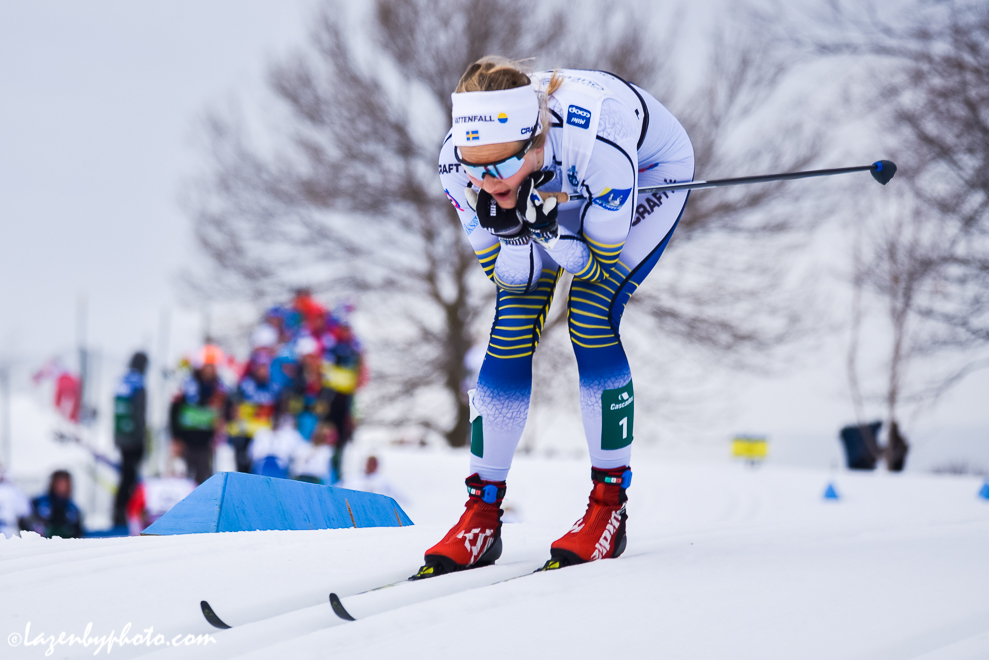
Sweden’s Stina Nilsson tucking during the 10 k mass start classic in Québec City. (Photo: John Lazenby/lazenbyphoto.com)
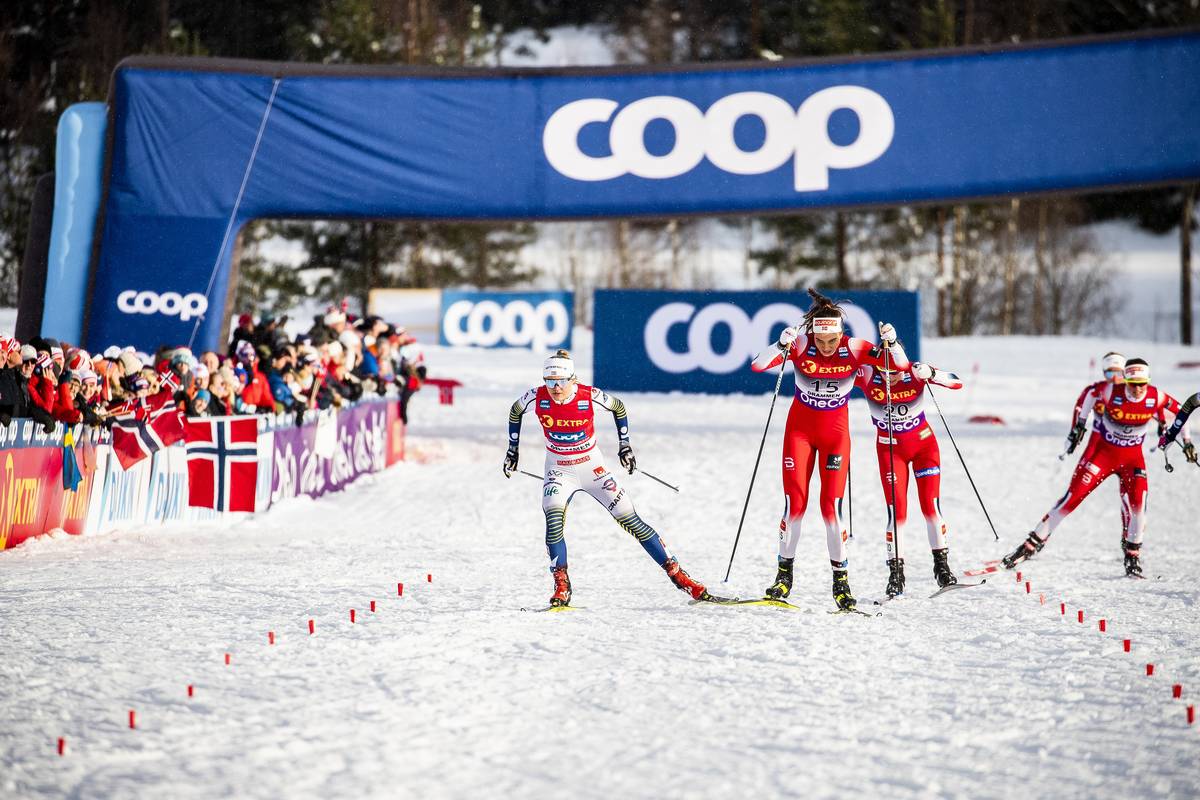
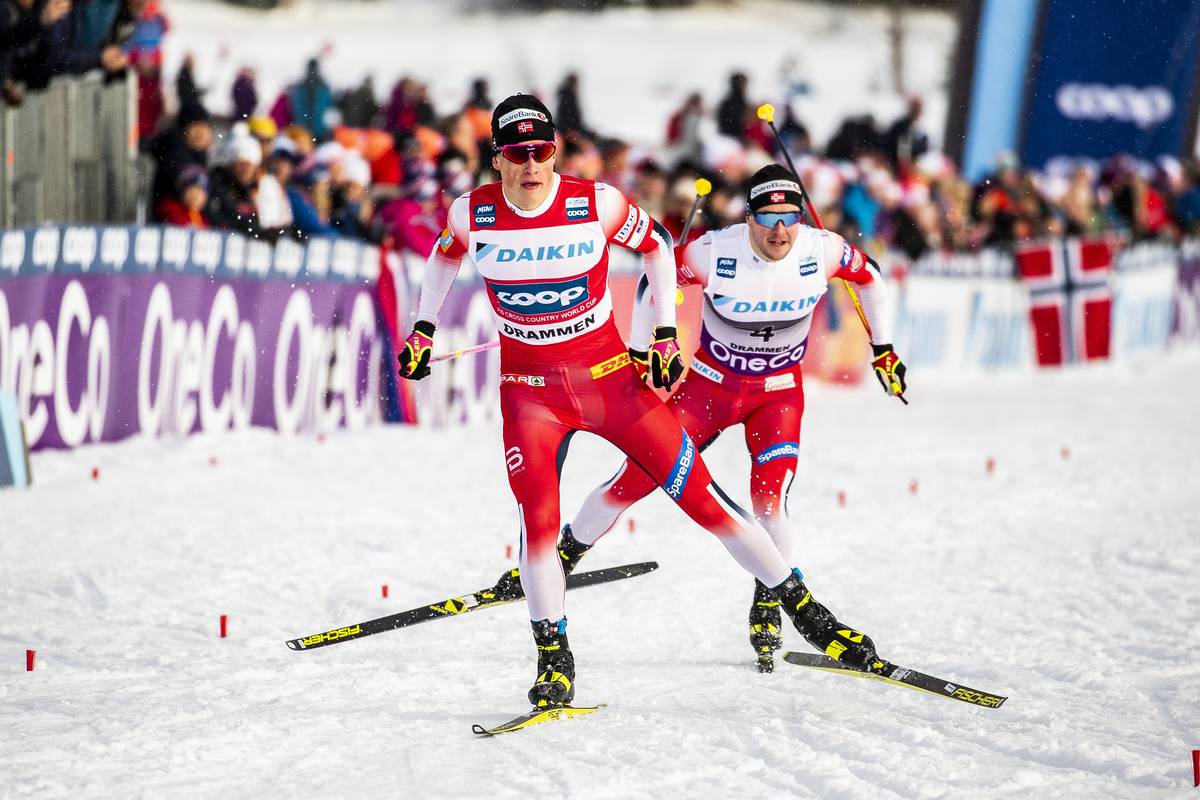
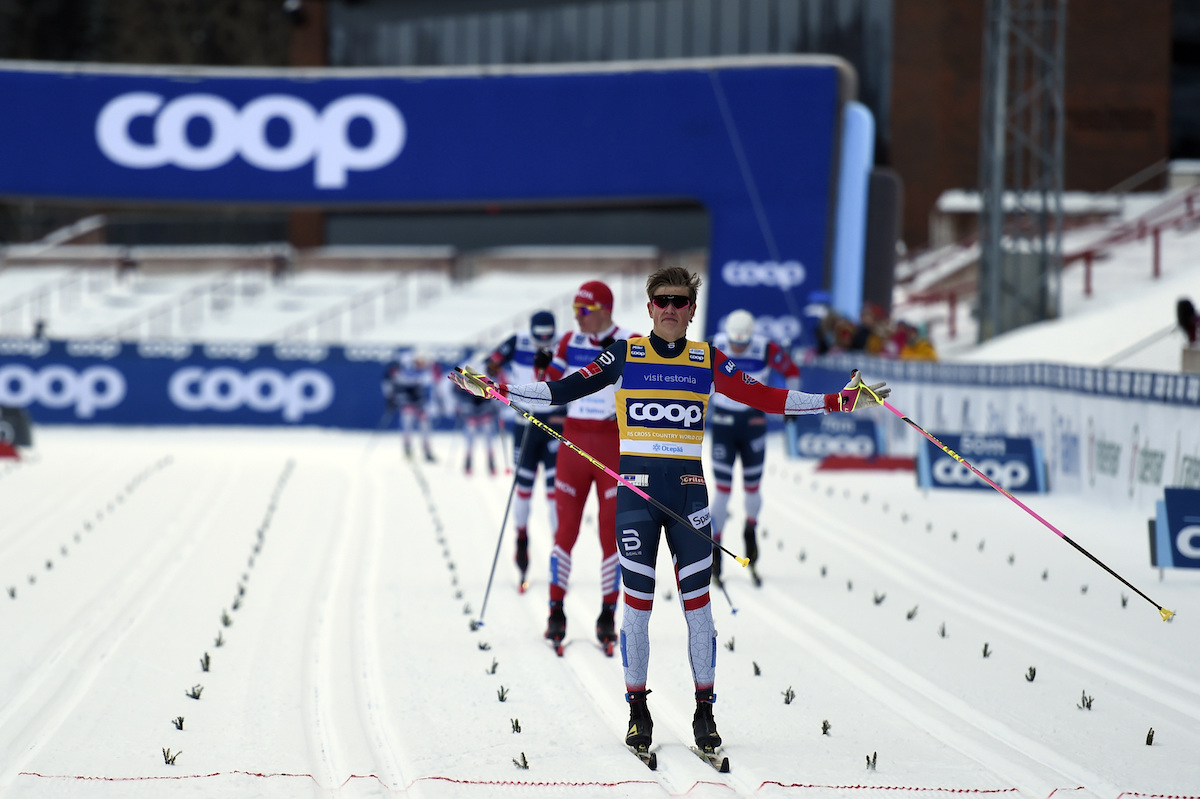
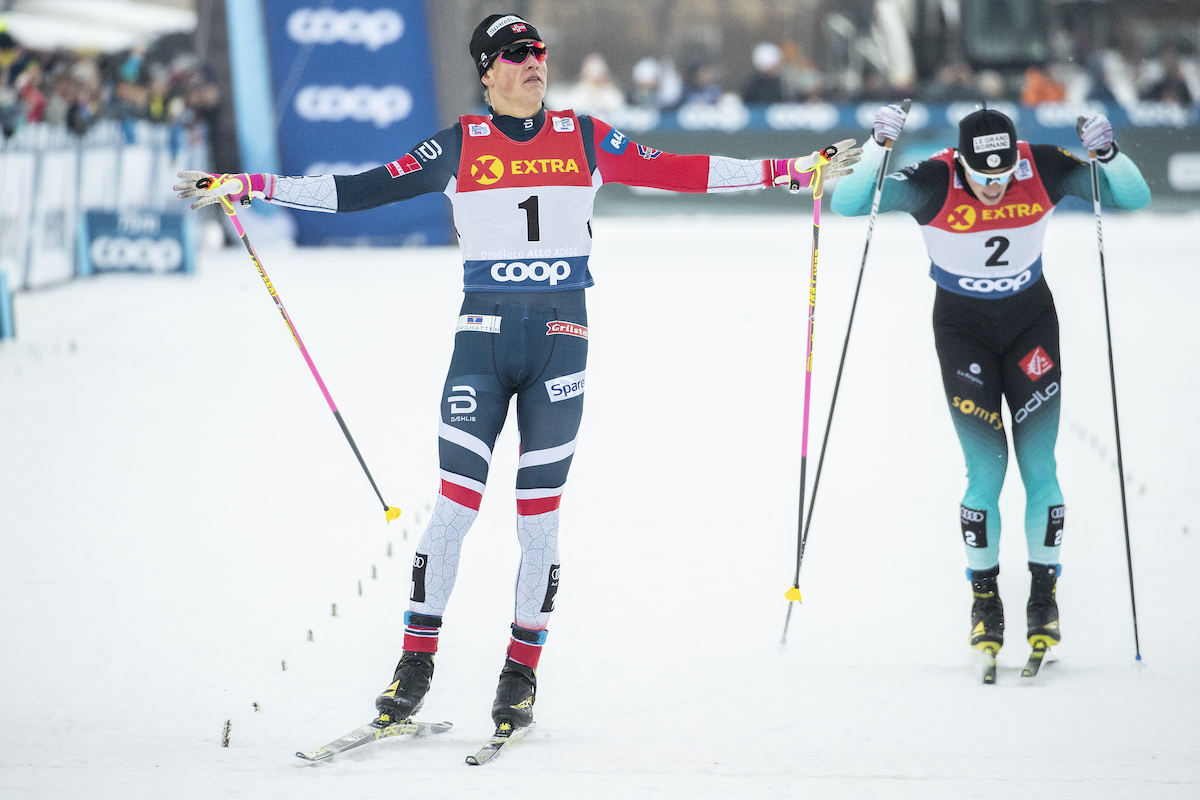
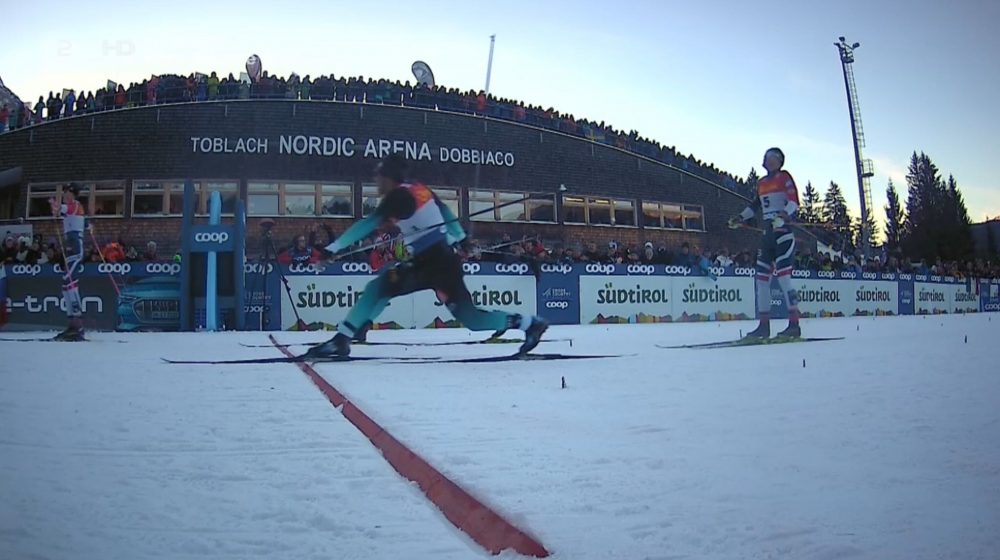
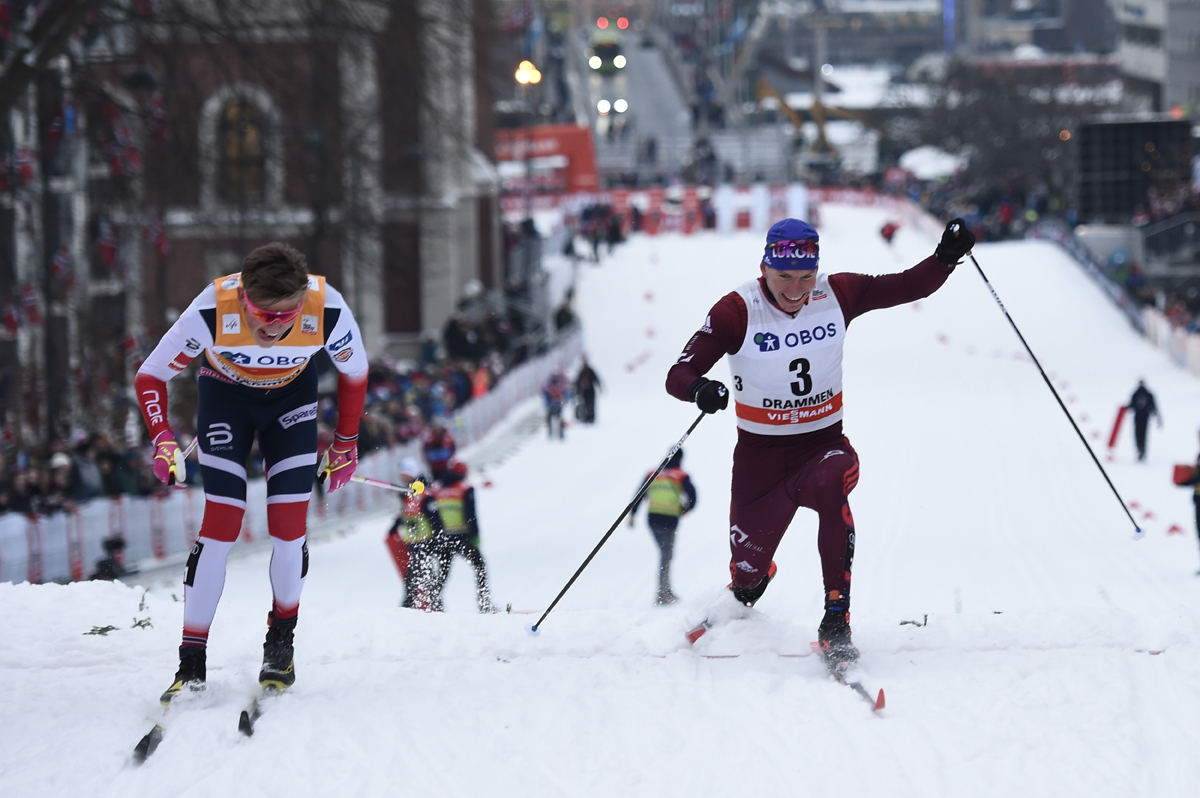
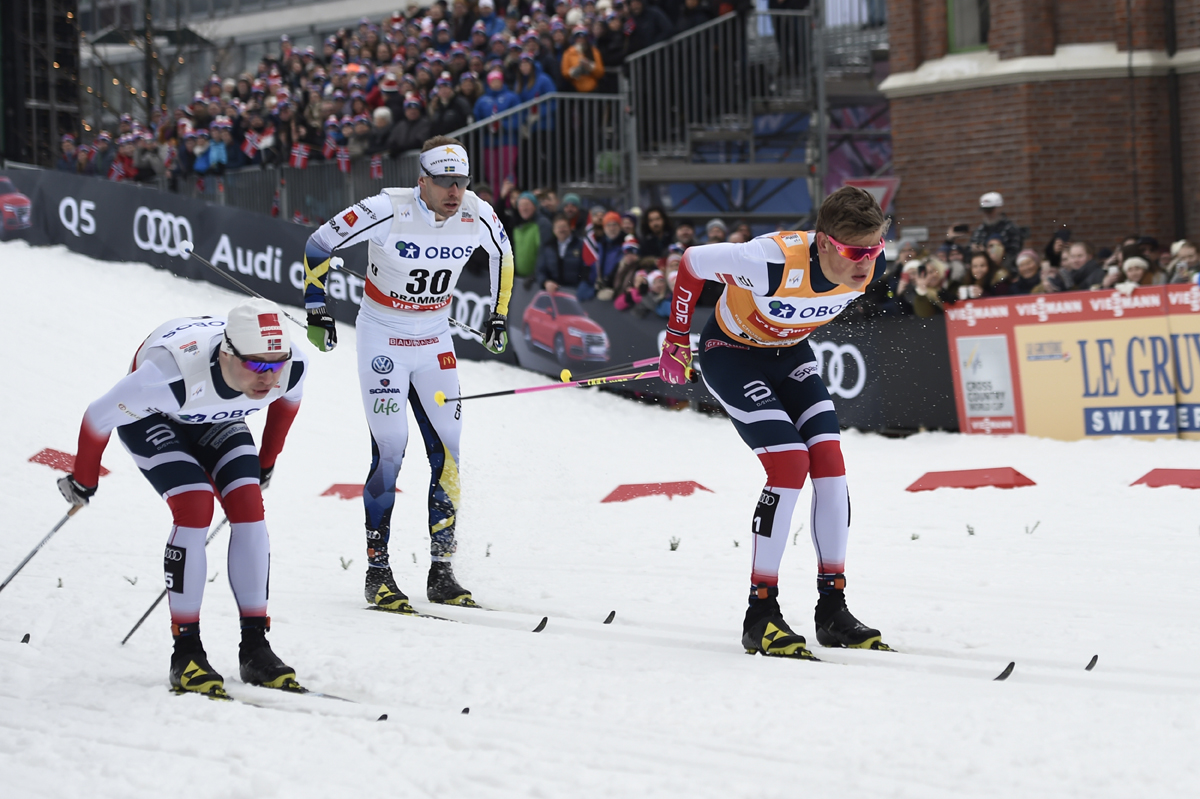
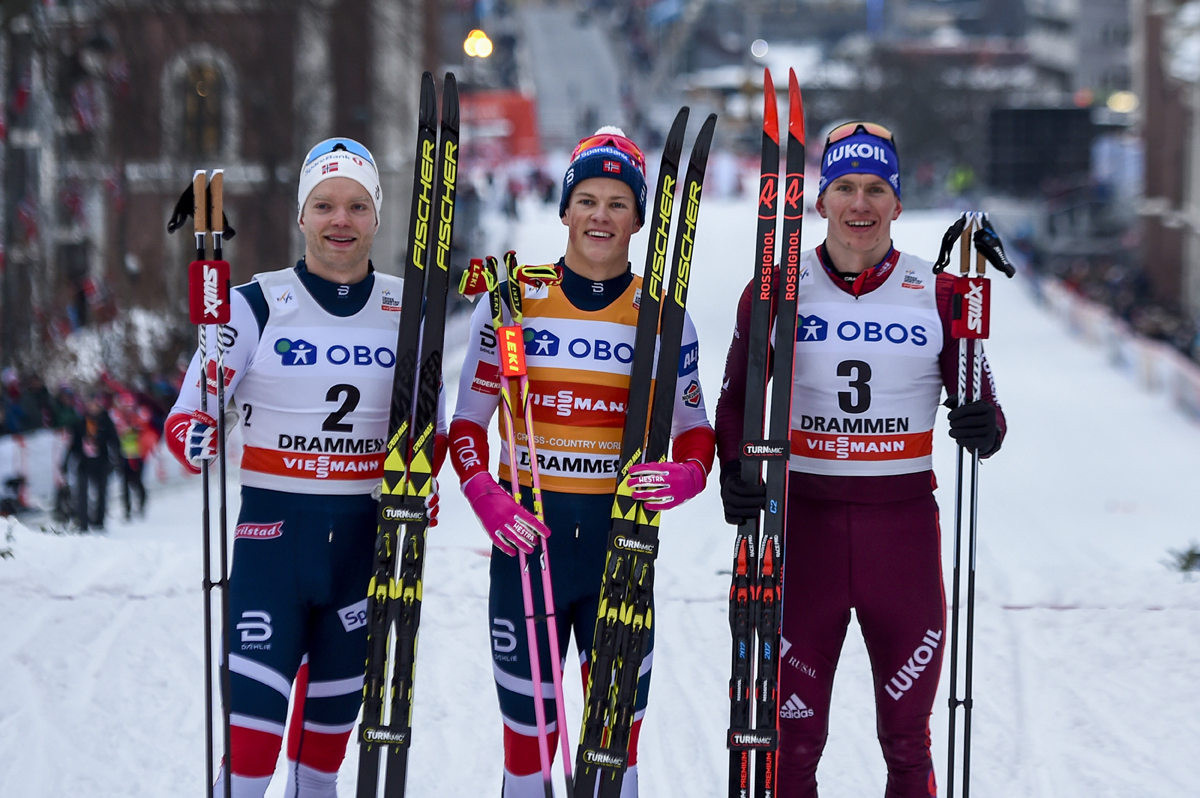
Norway’s Eirik Brandsdal (2) crossing the line first for his first World Cup victory in two years in the men’s 1.2 k classic sprint on Wednesday at the last World Cup classic sprint of the season in Drammen, Norway. He beat out fellow Norwegian Johannes Høsflot Klæbo (l) and Russia’s Sergey Ustiugov (10), respectively, for his first win since the 2015 Drammen classic sprint. (Photo: Fischer/NordicFocus)
Thanks for listening and we hope all of you are doing ok out there.
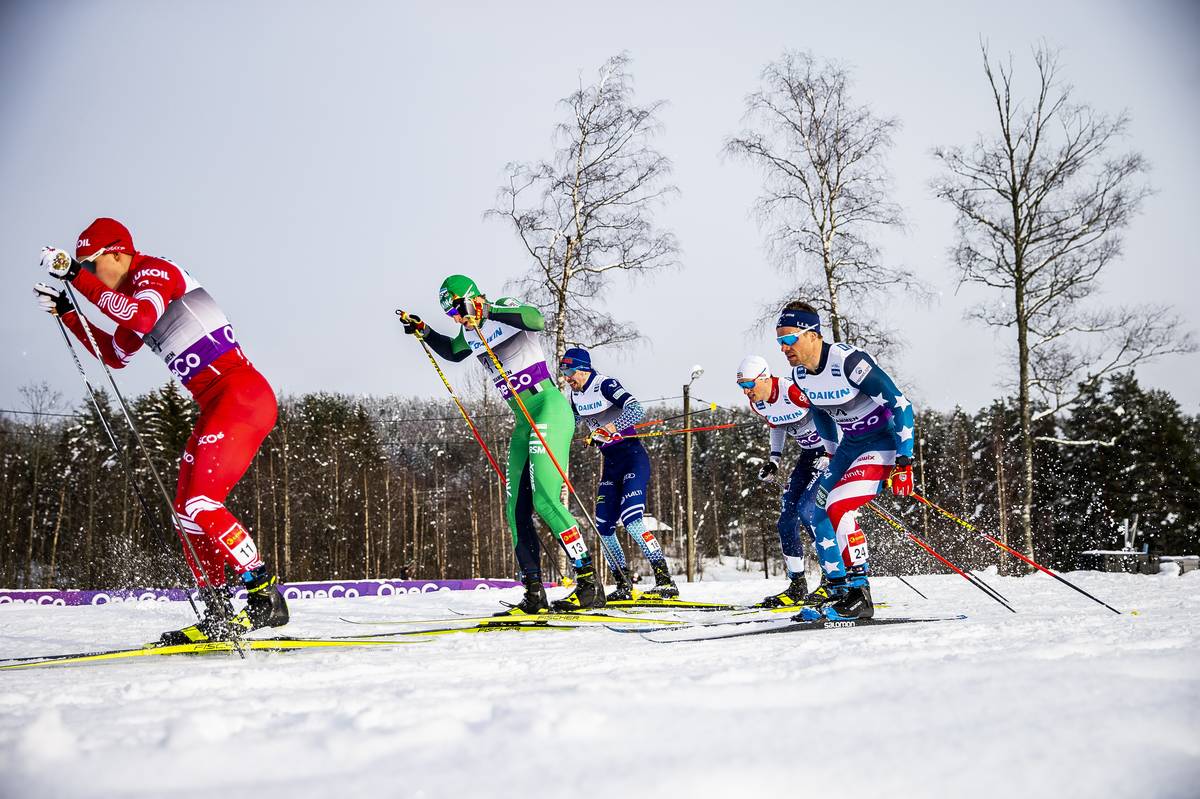
Perhaps unsurprisingly, the Norwegian men showed up on form for today’s freestyle sprints in Konnerud, just outside the city of Drammen. As the venue was used for the Norwegian National championship at the end of January, most of the team has already had a dress rehearsal racing on the windy course.
Johannes Høsflot Klæbo of Norway, where he is found most often: winning down the stretch. (Photo: NordicFocus)
It seems that Johannes Høsflot Klæbo, who sat out the national championships, did not need a dress rehearsal. He won the qualifier by a margin of nearly four seconds, continuing easily through the rounds to win the overall. This is Klæbo’s eighth sprint win of the season, matching last year’s record, and his 14th career World Cup freestyle sprint victory, the most of any male athlete.
Racing in the final with Klæbo were four of his teammates: Håvard Solås Taugbøl, Eirik Brandsdal, Sindre Bjørnestad Skar, and Erik Valnes, each of whom also raced in the national championship final on January 31st (and finished in a very similar order). Interrupting the all-Norwegian field was Alexander Bolshunov of Russia.
In the final, Klæbo hovered in the middle of the pack marking his teammates, with Taugbøl in the lead. When Brandsdal took control on the primary climb of the course, Klæbo swung outside of the group to move into second before tucking into the last downhill. As they passed under the arch and headed into the final straightaway, Klæbo engaged his unmatchable top gear, with Taugbøl and Brandsdal chasing.
After crossing in a photo finish, Taugbøl was deemed second (+0.65) — a World Cup career best individual result — with Brandsdal third (+0.69). Skar took fourth (+0.94), followed by Bolshunov in fifth (+1.92) and Valnes a late arriving sixth (+12.79).
Simi Hamilton (bib 24) during his quarterfinal in Konnerud. (Photo: NordicFocus)
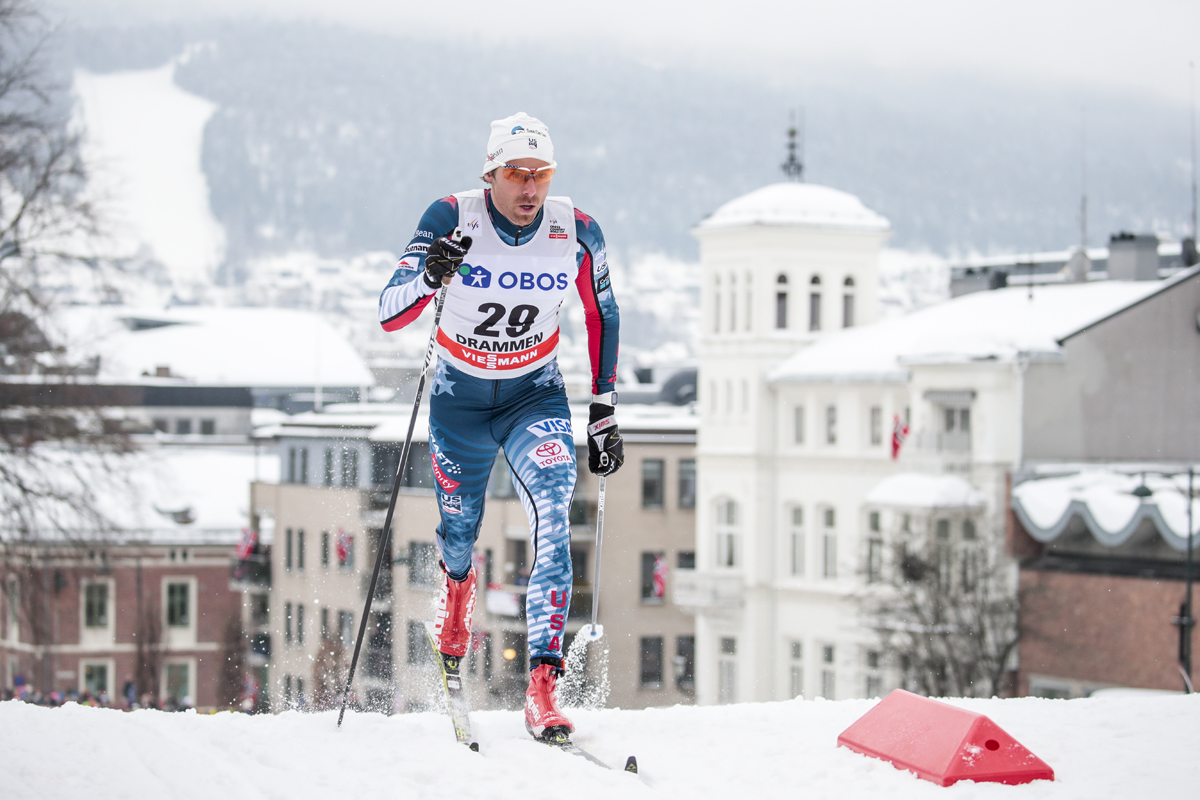
Simi Hamilton was the only American sprinter racing in Konnerud. He qualified in 24th and raced in the fourth heat of the quarterfinals, where he finished fifth, ending his day ranked the same in the overall as in his qualifier.
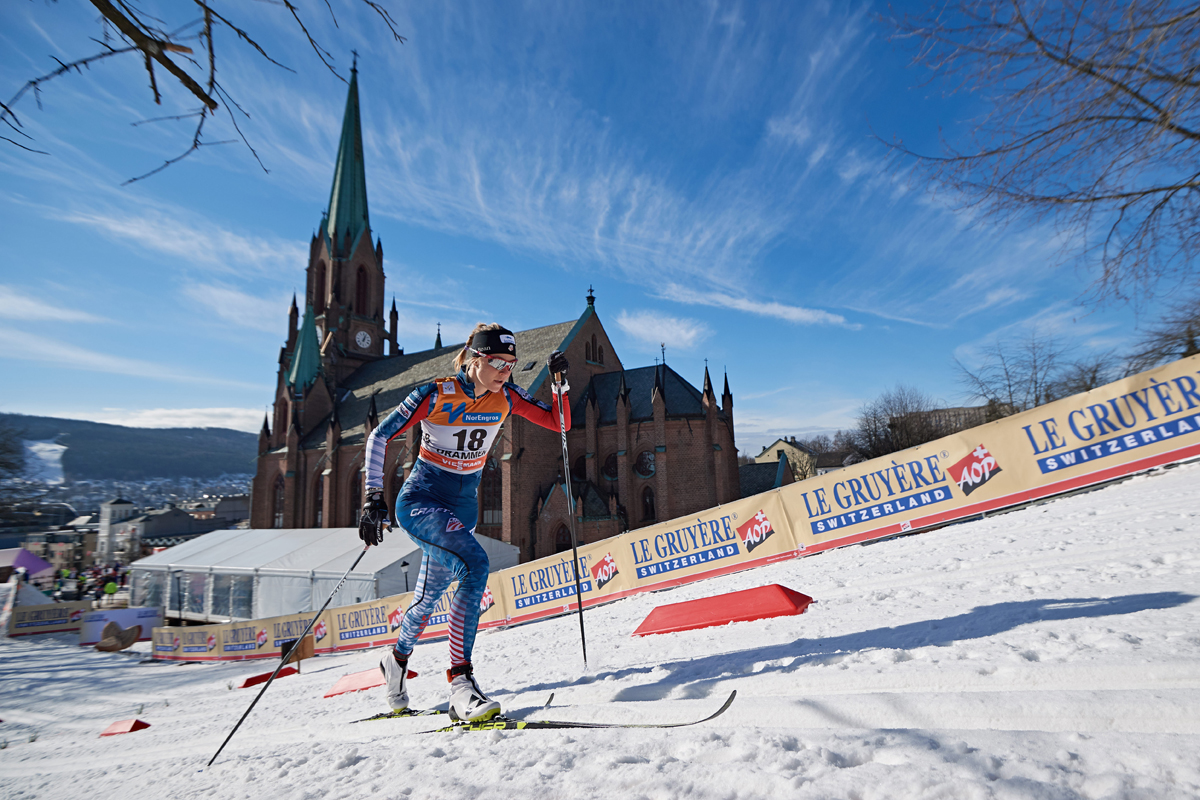
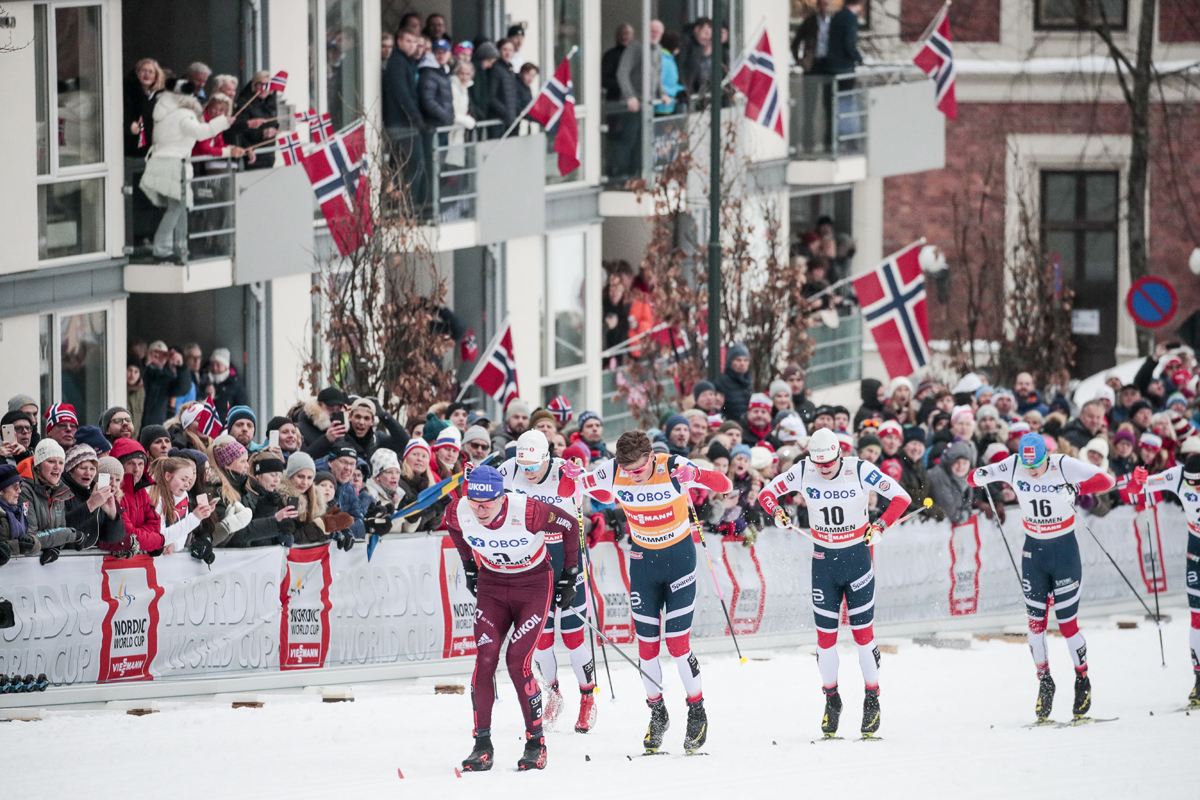
The looping sprint course around the ol’ church in Drammen, Norway will have to wait another year, or at least until sufficient snow: the iconic city sprint was moved to Konnerud due to insuffient snow in Drammen. Winter, please, pretty please, return to places such as Drammen.
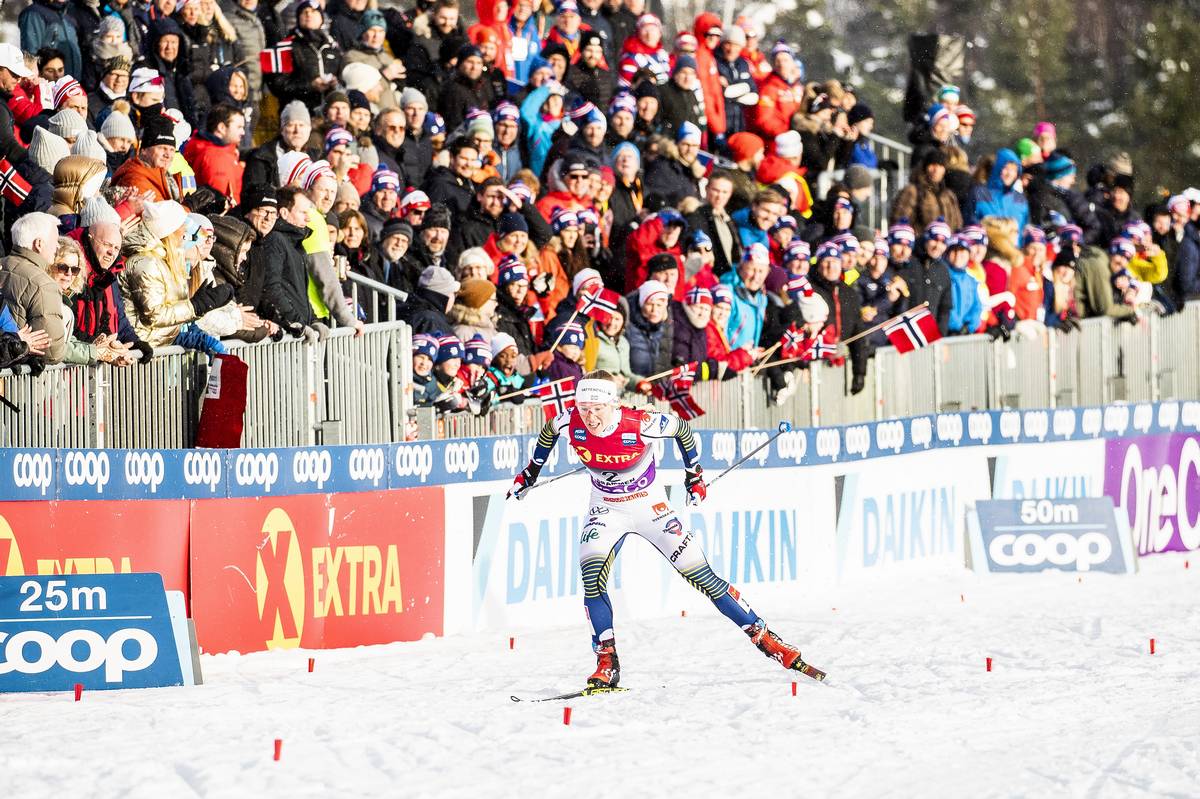
Powering home for the Konnerud win: Jonna Sundling of Sweden. (Photo: NordicFocus)
Although deep in Norway, but not so far from Sweden as the planes fly, Sweden took the win and third place in the World Cup’s relocated 1.2 k skate sprint in Konnerud. Jonna Sundling won the final in 2:38.41 — a toe and perhaps the tail of a ski ahead of Switzerland’s Nadine Faehndrich in second (+0.24). It was a photo finish for second through fourth. Linn Svahn, a U23 skier forgoing those championships, placed third (+0.39). Norway’s U23 Kristine Stavaas Skistad was fourth (+0.97), Sweden’s Maja Dahlqvist placed fifth (+5.70), and Anamarija Lampic of Slovenia sixth (+26.04).
Sundling powered down the final sraight outpacing Faehndrich in the final 100 meters. Sundling advanced to the finals as a lucky loser in the semis.
Sadie Bjornsen (bib 4) during her quarterfinal heat in Konnerud. (Photo: NordicFocus)
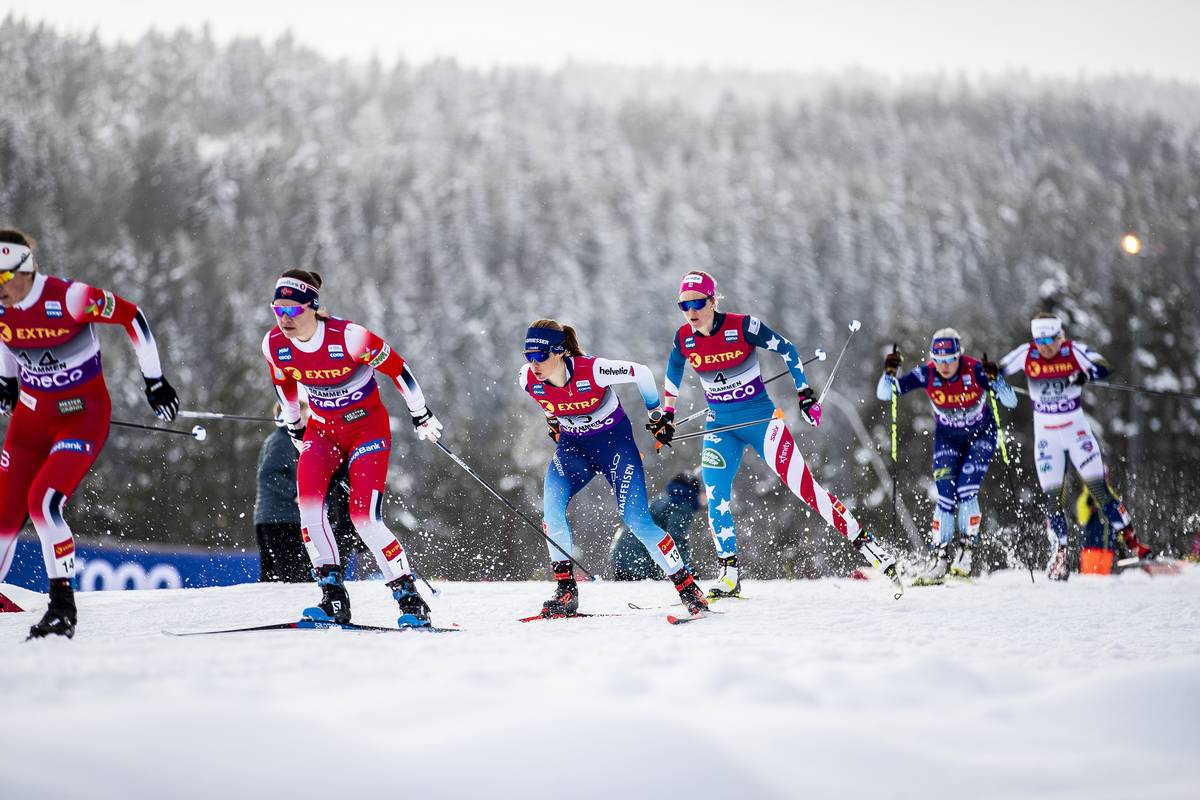
Sadie Bjornsen of the U.S. was the top American in 16th overall. Bjornsen qualified in fourth, 1.2seconds behind the top qualifier, Katja Visnar of Slovenia. Bjornsen placed fourth in the second quarterfinal and did not advance.
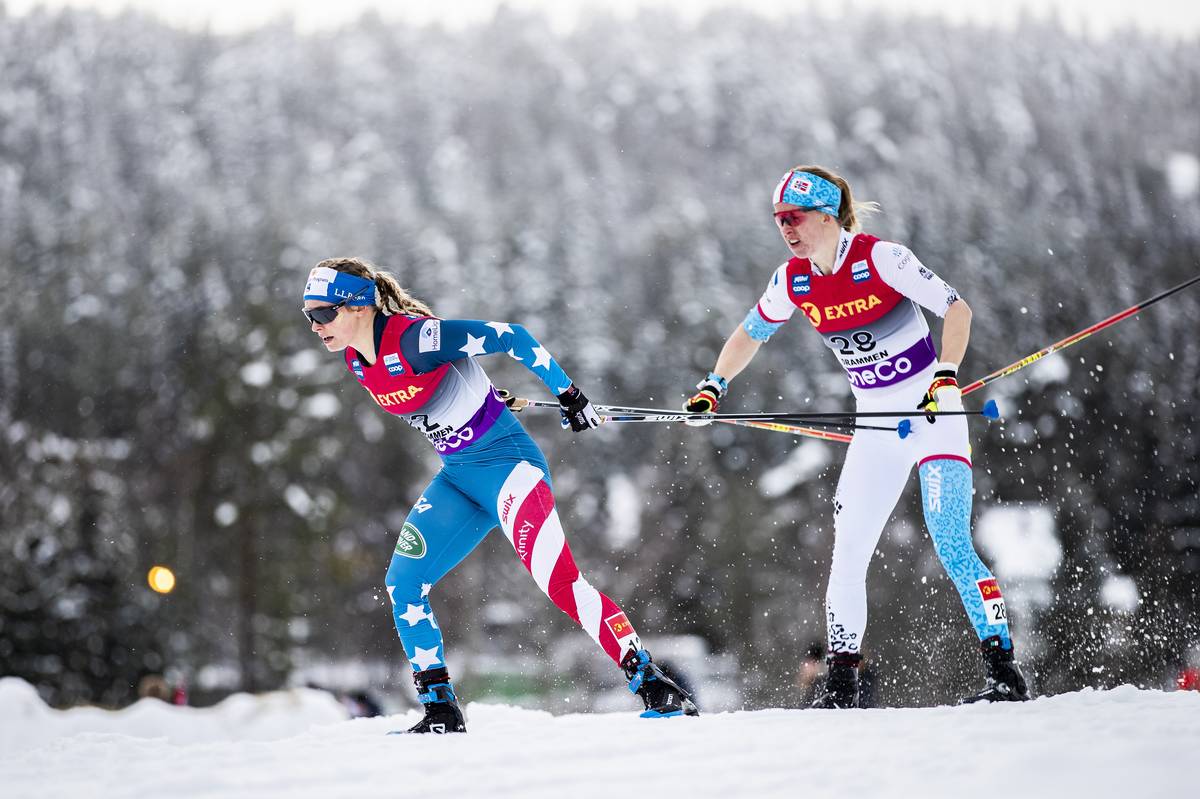
Jessie Diggins was the only other American to qualify.After qualifying in 12th , she placed sixth in the first quarterfinal, to end her day ranked 27th. Also for the U.S., Kaitlynn Miller placed 50th, and Becca Rorabaugh 54th.
Jessie Diggins sprinting in Konnerud. (Photo: NordicFocus)
Of note, Swedish sprinter, Hanna Falk, who suffered a back injust prior to the season, started her first World Cup of the year. She finished in 30th.
Racing continues Saturday with the women’s 30 k classic mass start. The men race a 50 k in Oslo on Sunday.
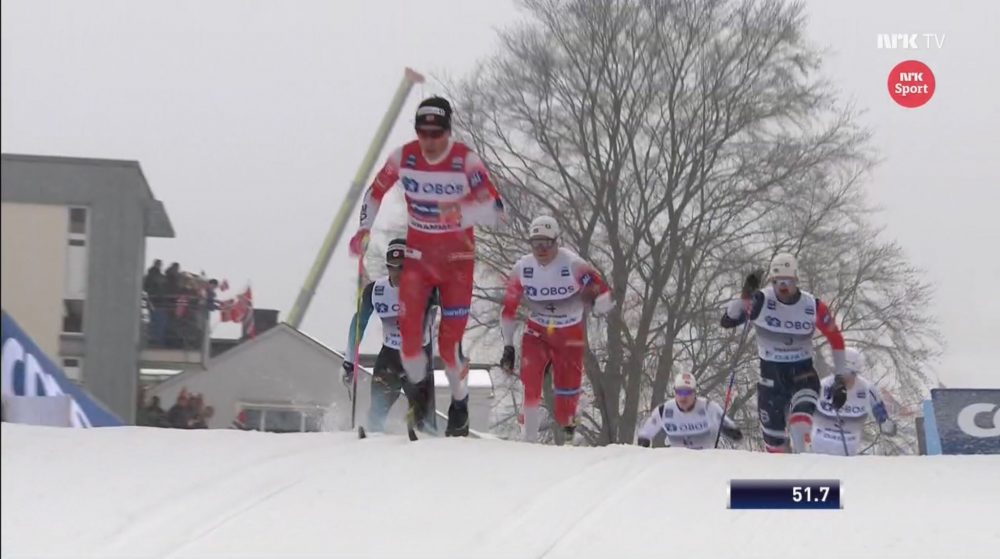
A classic run-stride from Johannes Høsflot Klæbo during the finals of the 2019 Drammen city sprint. (Photo: NRK screenshot)
For the rare athlete the field of play is truly a stage. A place to perform in the moment and seemingly acknowledge the moment as it happens. Johannes Høsflot Klæbo appears to have many of these days. And as he crossed the line in today’s 1.2-kilometer classic sprint in Drammen, Norway, Klæbo may as well have taken a bow. It was again a virtuoso sprint performance.
In 2:37.90 minutes, Klæbo earned another win in Drammen — he took his first career win here last season.
With thirty skiers making the rounds, and each adding their own dimension to the heats, Klæbo brings a presence that often gives the impression it is a solo show. On Tuesday he won the qualifier in 2:25.60 minutes. To put things in perspective, Russia’s Alexander Bolshunov, the second fastest qualifier, clocked a time of 2:29.14.
A quick glance at the live timing brackets shows Klæbo making a clean sweep. Along with the qualifier, he won the first heat, the first semi, and indeed the final.
It’s easy to get swept up in the Klæbo narrative. But out in the finals with the twenty-two-year-old were Norway’s Eirik Brandsdal, Sondre Turvoll Fossli,and Pål Trøan Aune, Richard Jouve of France, and Sweden’s Oskar Svensson.
The other five skiers followed the lead of Klæbo’s dance in the finals. With an uptick in tempo fifty seconds into the race where Klæbo threw in his trademark run-stride, then a few cycles of double pole, and a quick transition into his run-stride he was off into the downhill with the others unable to catch his draft.
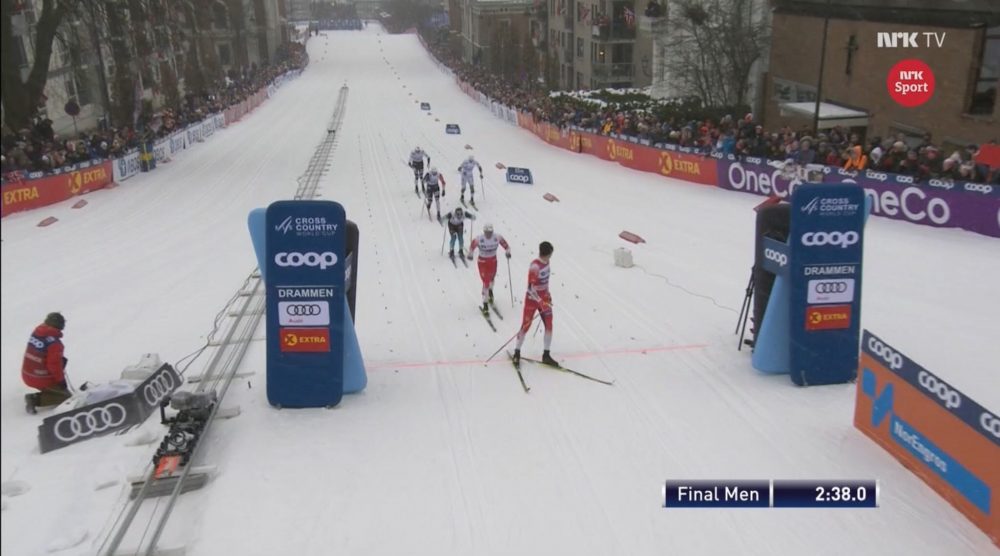
Through the curvy turns, into more downhill, and into the step-around-corner, Klæbo had a breath easy gap on the field heading into the uphill straight. But Klæbo kept the charge on. Able to look back twice at an approaching Brandsdal, Klæbo cruised across the line. Pending any fall on the technical descent, the race for first looked over as soon as he clicked into that untouchable gear way back at the 50 second mark.
Time to check the action behind, Johannes Høsflot Klæbo of Norway winning the 2019 Drammen city sprint. (Photo: NRK screenshot)
Brandsdal placed second (+0.89), Jouve third (+2.17), Fossli fourth (+3.34), Svensson fifth (+3.63), and Aune sixth (+4.01).
Klæbo leads the sprint globe overall competition by 145 points over Italy’s Federico Pellegrino. His lead in the overall World Cup is a mere 31 points over Bolshunov, who placed 13th in Drammen. With a sizable lead over third place skier Sjur Røthe, who tallies 802 points total in the overall standings (Bolshunov sits with 1250 points, Klæbo 1281), we should see a fight through the final weekend in Quebec to determine the World Cup winner.
For the U.S., Simi Hamilton was the only skier to break into the heats. He qualified in 30th, but bumped to 25th overall after placing fifth in the first quarterfinal heat won by Klæbo.
Three other Americans were entered. Logan Hanneman (APU) finished in 48th, Ben Saxton (SMS T2) 50th, and Kevin Bolger (USST) 51st. With a new crew of sprinters in Drammen, with the exception of Hamilton, U.S. Ski Team Head Coach had a plan in mind for future Drammen appearances.
“With the exception of Simi, the men’s group needs to gain more experience on this course,” Grover noted in an email. “This was the first Drammen World Cup Sprint for Ben and the second for Logan and Kevin. All our men need more work on their double-pole to be competitive here double-poling against the best and strongest.”
No Canadians were entered in Tuesday’s race. Racing continues on the World Cup this weekend with a skate sprint on Saturday and an interval start skate 10k/15k on Sunday.
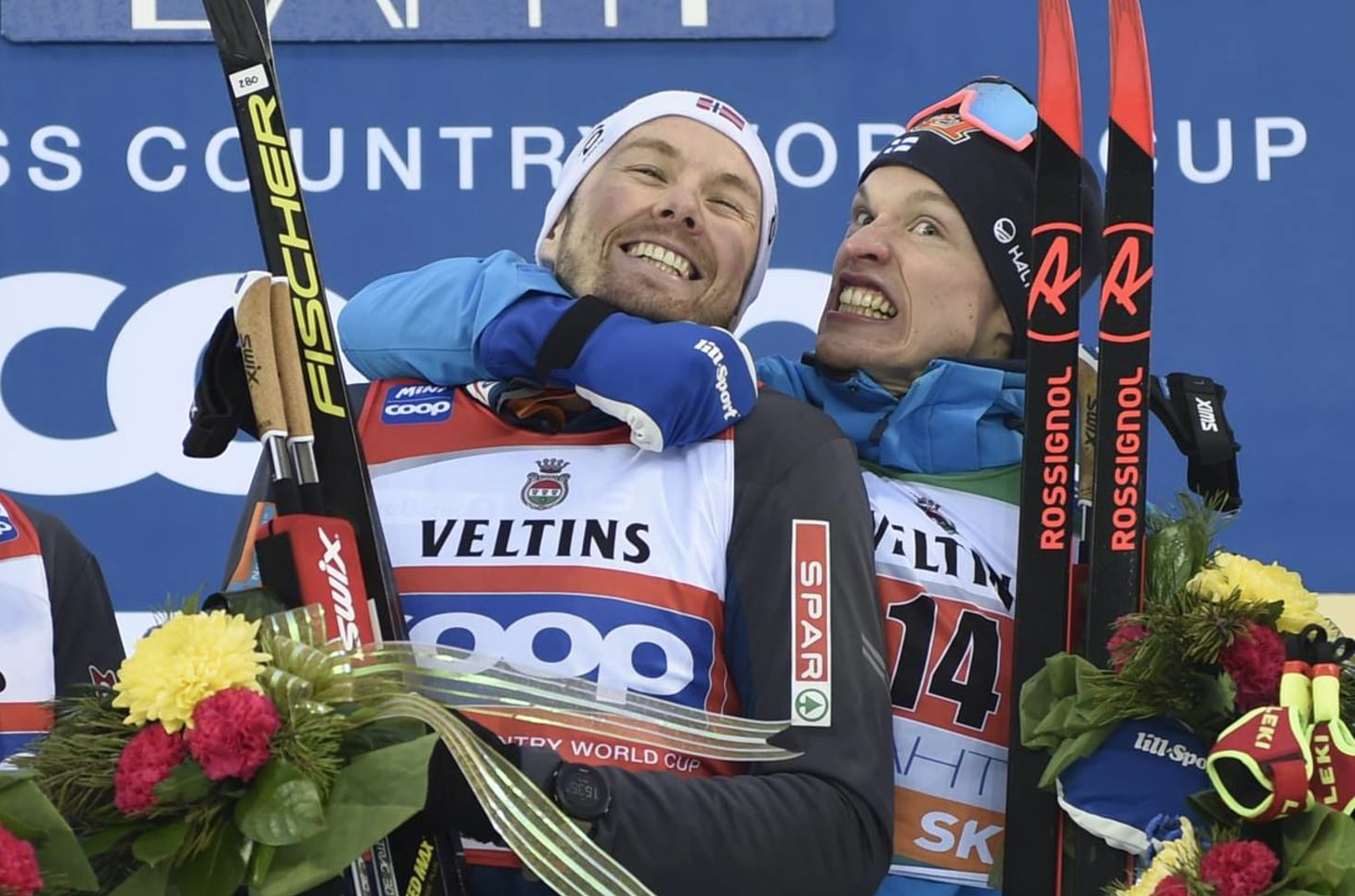
Emil Iversen (NOR) and Iivo Niskanen (FIN) happy with their podium finishes (Photo: fis-ski.com screenshot)
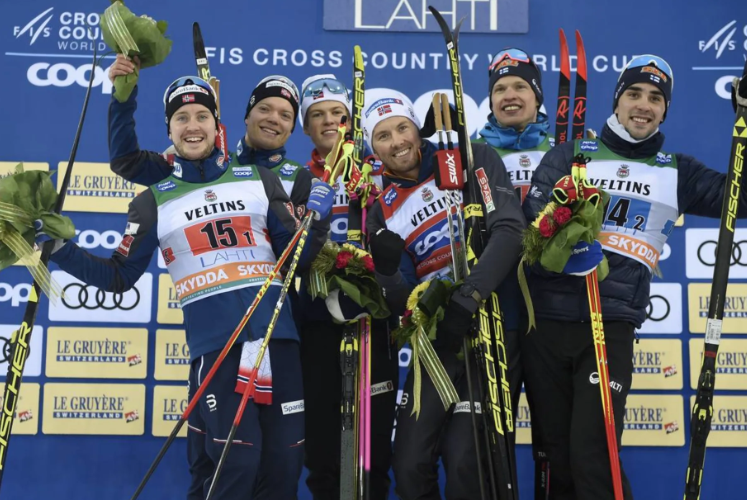
Norway placed first and second in today’s World Cup 6 x 1.6-kilometer classic team sprint in Lahti, Finland. Skiing for Norway I were overall winners Emil Iversen and Johannes Høsflot Klæbo. They won the ten team final in a time of 18:57.19 minutes. In a photo finish for second place, Sindre Bjørnestad Skar and Eirik Brandsdal of Norway II finished 0.65 seconds back to take the second podium step. Iivo Niskanen and Ristomatti Hakola of Finland placed third (+0.71).
On the way to the win, Norway I won their semi-final with of a time of 19:22.32, 0.63 seconds ahead of Germany. Norway II, on the other hand, came in third in their heat to first place Russia I and second spot Finland I.
The finals were marked by several teams vying for the lead. In six lap race, with each athlete skiing three 1.6 k legs, the team sprint favors those with endurance and traditional flat-out World Cup speed. At times, the Swedes, the Italians, and Russians all made plays for the lead. None were able to make any advance stick or discourage Norway I.
Norway II, the second overall team on the day, held a more conservative approach in the final. Coming into the start of the third lap, they were positioned in eighth. They began to surge toward the front during the race’s second half, moving into fourth after 4.8 k. During the final two laps, they maintained their position near the front. At the 17:40 minute point of the race, as Klæbo stamped his aerobic mark on the race with a surge on the final climb, Norway II tried to match the tempo, but sat in fourth.
At the hairpin turn atop the climb, where skiers began their long descent into the stadium, it was two team race for second with Klæbo meters ahead.
Finland I, in second as the skiers descended, skied a tactfully sound and uptempo race. Niskanen was the smart-choice Finnish anchor as he raced the fastest lap time of the race (3:16.04 minutes) during his last lap.
Finland came into the finish with what looked like a lock for second. But Norway II’s Brandsdal put on a sprint finish double pole clinic topped with a perfect out stretched toe and lunge at the line to take the second spot ahead of Finland I.
2019 Lahti, Finland’s World Cup classic team sprint podium. From left to right, Norway II in second, Norway I in first, and Finland I in third. (Photo: fis-ski.com screenshot)
USA I and USA II were in the same semi-final today: Simi Hamilton and Erik Bjornsen filled out USA I while
Kevin Bolger and Logan Hanneman skied for USA II. USA II placed sixth and USA I was right behind, placing seventh in the semi-final. Neither team advanced to the finals. Take a look at the top gambling sites that you may find from India. This platform suggest only safe casino sites which you can gamble at regarding the circumstances with online gambling legislation.
Bolger discussed the snow conditions via email, “Conditions were very wet, and sloppy which made it a Klister day.” Bolger also explained how condition affected skis today, “I felt like I had a really good A and B pair of skis coming into the race which made it easy on my tech Oleg to make sure that for each of my relay legs I had ripping fast skis — and I did, so a huge shout out to him for giving me some of the best skis today!”
On his final lap, Bolger skied the fastest lap time of his cohorts in a mark of 3:09.0 minutes.
“Logan, this was the first team sprint he’s done, and he was impressive today,” Whitcomb told FasterSkier in a call. “He wasn’t quite good enough to advance past the semis, but he was close and he just got over here, so it’s a very good sign for him.”
Hamilton also touched base with FasterSkier after the race, via email.
“I was disappointed with how the race went today,” Hamilton emailed. “Erik skied really, really well and kept us in contention, but I came up short. I haven’t been feeling great all weekend, and the conditions, especially today, were a bit tough for me.”
Hamilton took the month of January to focus on training and hasn’t raced a World Cup since January 1st.
“I’m hoping that this weekend was just me blowing some cobwebs out of the body and the head,” Hamilton added. “I also haven’t raced a classic race since early December (and haven’t raced a classic sprint yet this year if you don’t count Ruka, where I had a fall at the start), so I felt quite rusty. Training has gone really well in the last couple weeks, and from everything I’ve gathered from hard workouts in the last 10 days, I know I’m fit right now. I think it’s just a matter of getting my sprint gear back which I may have lost a bit in the last 6 weeks.”
Whitcomb summed up today’s results with this statement, “While the results were a little bit disappointing today in Lahti, I really believe we have a team that is well prepared for World Championships, we like to go to going into the Championships having knocked a few races out of the park and we had a couple hits this weekend, but not as many as we intended to. So we will be looking to swing hard in Cogne. I feel very confident about our Seefeld championships with this team, its a strong crew.”
The World Cup will be move to Cogne, Italy next weekend before heading to Seefeld, Austria for World Championships.
Johannes Høsflot Klæbo smiles after winning the 1.6-kilometer skate sprint in Lahti, Finland. Federico Pellegrino of Italy (l) took second, followed by Finn Hågen Krogh of Norway (r). (Photo: Screenshot Instagram @fiscrosscountry)
After two weeks away from competition, athletes revved their engines in Lahti, Finland for an individual 1.6-kilometer freestyle sprint, one of the final stops on the way to the World Championships. After a string of what he deemed “bad luck” in the first sprint races of the season in Ruka and Lillehammer, Norway’s Johannes Høsflot Klæbo came into the weekend with momentum from winning the last four individual sprints. Klæbo also arrived in Lahti on the brink of what could be a historic milestone; a win could advance him from possessing the joint-third most victories, tied with his opponent Federico Pellegrino of Italy with 12 each, to the joint-second most, tied with Ola Vigen Hattestad of Norway who retired in 2016.
Both men skied well in the qualifying round, with Klæbo taking the lead with a solid gap, finishing in 2:49.77, followed by his teammate Håvard Solås Taugbøl (+4.15), Joni Maeki of Finland in third (+4.35), Pellegrino in fourth (+4.36), and Finn Hågen Krogh of Norway in fifth (+4.40).
Conditions in Lahti were reportedly fast and a bit wet. Temperatures hovered around freezing with some freezing rain lightly peppering the course throughout the day. This stability in the weather and on the tracks kept the playing field fair as the athletes sprinted through the heats.
Emil Iversen of Norway charges on his way to second place in heat two of the semifinals of the 1.6-kilometer skate sprint in Lahti, Finland. (Photo: Instagram @langrennslandslaget Screenshot)
In the quarterfinals, Klæbo and Pellegrino went one-two in heat one, advancing into the first heat of the semi-finals. This first semi proved to be the faster of the two. The Norwegian again took the win in 2:49.84, with his teammate Eirik Brandsdal close on his tails. Gleb Retivykh and Pellegrino, who finished in third and fourth, respectively, advanced as lucky losers. Less than one second separated the six men in the heat, and all of the men skied faster than those in the second heat.
In the second semi-final heat, Krogh finished first in 2:50.98, followed by his teammate, Emil Iversen, making it a final of four Norwegians, an Italian, and a Russian.
As the men charged out of the gate in the final round, Retivykh led the pack, with the other men jockeying for position behind him. Per usual, Klæbo began to surge on the climbs, using them as his opportunity to move to the front of the pack. The second half of the course featured a steady climb with a steeper punch at the end before sending the athletes down and around a turn into the stadium. On this climb, Klæbo set the pace, trying to slowly pull away from the group. But Pellegrino was not ready to let him go. The Italian crested the hill just behind and as the two men tucked into the downhill, a small gap was created before the next skier back.
Norway’s Johannes Høsflot Klæbo attacks the final climb on his way to victory in the 1.6-kilometer skate sprint in Lahti, Finland. (Photo: Screenshot FIS/ARD Broadcast)
Pellegrino tried to position himself on the inside of the final turn to get in front of his opponent, but he could not quite make his move. Klæbo was still in front heading into the final straight with Pellegrino nipping at his heels. Krough, who closed the gap they had created was also in the hunt, chasing the leaders to the line. The two kept the pressure on Klæbo, giving him no opportunity to risk his position with an early finish line celebration, but they were not able to surpass him.
Klæbo earned his 13th World Cup Victory, stopping the clock at 2:52.06, his ninth win out of the last 13 individual sprint races. Pellegrino took second (+0.30), followed by Krogh in third (+0.61), Brandsdal in fourth (+1.31), Iversen in sixth (+1.75), and Retivykh in sixth (+2.08).
Norway’s Johannes Høsflot Klæbo rounds the final turn ahead of Federico Pellegrino of Italy in the 1.6-kilometer skate sprint in Lahti, Finland. (Photo: Screenshot FIS/ARD Broadcast)
No North American men qualified for the heats, which came as a surprise to both the athletes and the coaches. Logan Hanneman (APU) posted the fastest qualifying time for the U.S. placing 32nd overall after missing the heats by .22 seconds. Simi Hamilton (USST) finished 36th overall, and Erik Bjornsen (USST) 42nd.
Evan Palmer-Charette was the lone Canadian entered; he placed 67th.
“Definitely a bit of a puzzling qualifier for the guys,” said Matt Whitcomb in a call. “An impressive one out of Logan, but we know he can ski into the top-30 too. Erik and Logan and Simi all said they felt great. We are coming out of a training camp [in Vålådalen, Sweden] where it has been cold, and it is possible that we just need a little rest and a little racing and that will get things going.”
Though he was offered starts in both Period 1 and 3, it is Hanneman’s first time racing internationally this season. The APU skier was the top qualifier in the 1.3 k skate at US Nationals, placing second in the final. He also took third in the final in the classic sprint. When Hanneman competed in the sprint in Lahti last March, he placed 49th overall.
“Today was pretty good for me!” Hanneman wrote in an email. “Of course, being only .2 sec out from the heats hurts a little, but it was my career-best finish so that is a positive for sure. Looks like from the splits I was in 15th at 900m, which was nice to see since my goal was to take the first half out faster than I did last year. When I raced this course last year, I learned that it is a little tricky to make time back on these guys on the last hill… this year I learned that I can lose a lot of time to these guys on the last hill. Although today, with the fast conditions, the time spreads were really tight so it wasn’t too much time that I lost.”
As illness kept him from racing in the city sprints in Dresden, it has been over a month since Hamilton last put on a race bib.
“I wish I felt better about my day today,” Hamilton told FasterSkier in a call. “I’m still kind of baffled by how it went. I felt amazing and I felt like I skied the course better than I ever really have before and I’ve had some decent races here before. The conditions were great, our skis were awesome, I just don’t know what happened. The only thing I can think is that sometimes it takes me a little bit of racing and hard training to get that really good sprint gear going again, but I felt incredibly fit, I felt like I paced it really well, I was just really confused when I saw the qualifier results.”
During his time away from the World Cup, Hamilton traveled back to the U.S. to spend some time back in Vermont, where on top of training, he proposed to his girlfriend, Sophie Caldwell. Hamilton returned to Europe two weeks ago to participate in the Vålådalen camp. While the camp went well for him, the aforementioned temperatures prevented Hamilton from putting in those hard training efforts, but there is still time before Seefeld to capitalize on his fitness.
“It was incredibly cold, so we weren’t doing a lot of really hard intervals or hard training, but all the other indicators were really good during that camp,” he said. “Fortunately, this wasn’t the World Champs day, and that’s obviously the race that really counts. So we’ll just kind of tweak training a little bit, and hope for some better feelings for Cogne, and plan on feeling really good for the sprint in Seefeld.”
Despite his disappointment in his own performance, the day had a silver lining for Hamilton, as Caldwell landed on the podium with a second place finish in the women’s 1.4k sprint.
“I’m super psyched that Soph had such a great day – I’m just amazed by that,” he shared. “That she can fly back here to Europe two days ago, then put together a day like she did today… Whatever frustrations I had quickly evaporated with her day. I’m just so happy for her.”
Hamilton has a second chance to find his top gears when racing continues tomorrow during the classic team sprint where he will line up with Bjornsen.
“It’s pretty much my first classic race of the year,” Hamilton laughed. “The only other classic race I’ve done was in Lillehammer, the 15 k in the pursuit on the third day, so it will be interesting to see what happens, but I’m psyched.”
The team sprint will be held on the same course as the individual race today, a change from past years of the Lahti Ski Games.
“They’re not using the old course, which I’m a little bit bummed about,” said Hamilton. “So we’ll have to see how the regular sprint course classic skis, which on the World Cup anyway, no one has classic sprinted on that loop. It should be exciting, it should be fun. Conditions look good for some fast Klister skiing, so hopefully, we don’t get too much snow overnight. But yeah, we’re psyched.”
Norway’s Maiken Caspersen Falla taking the World Cup win in the 1.4 k skate sprint in Lahti, Finland. Sophie Caldwell of the U.S. Ski Team placed second. (Photo: fis-ski.com screenshot)
FIS World Cup Lahti, Finland 1.4 k/ 1.6 k Freestyle Sprint
In the women’s skate sprint qualifier in Lahti, Finland Slovenia’s Eva Urevc laid down the fastest time in 2:40.67 minutes. Swiss skier Nadine Faehndrich was the second fastest qualifier, 4.21 seconds back, with the U.S. Ski Team’s (USST) Sophie Caldwell third (+4.36).
Canada’s Dahria Beatty qualified 25th (+10.21). Also making the heats for the U.S. were Ida Sargent (USST) in 26th (+10.36), and Kelsey Phinney (SMS T2) in 27th (+10.54).
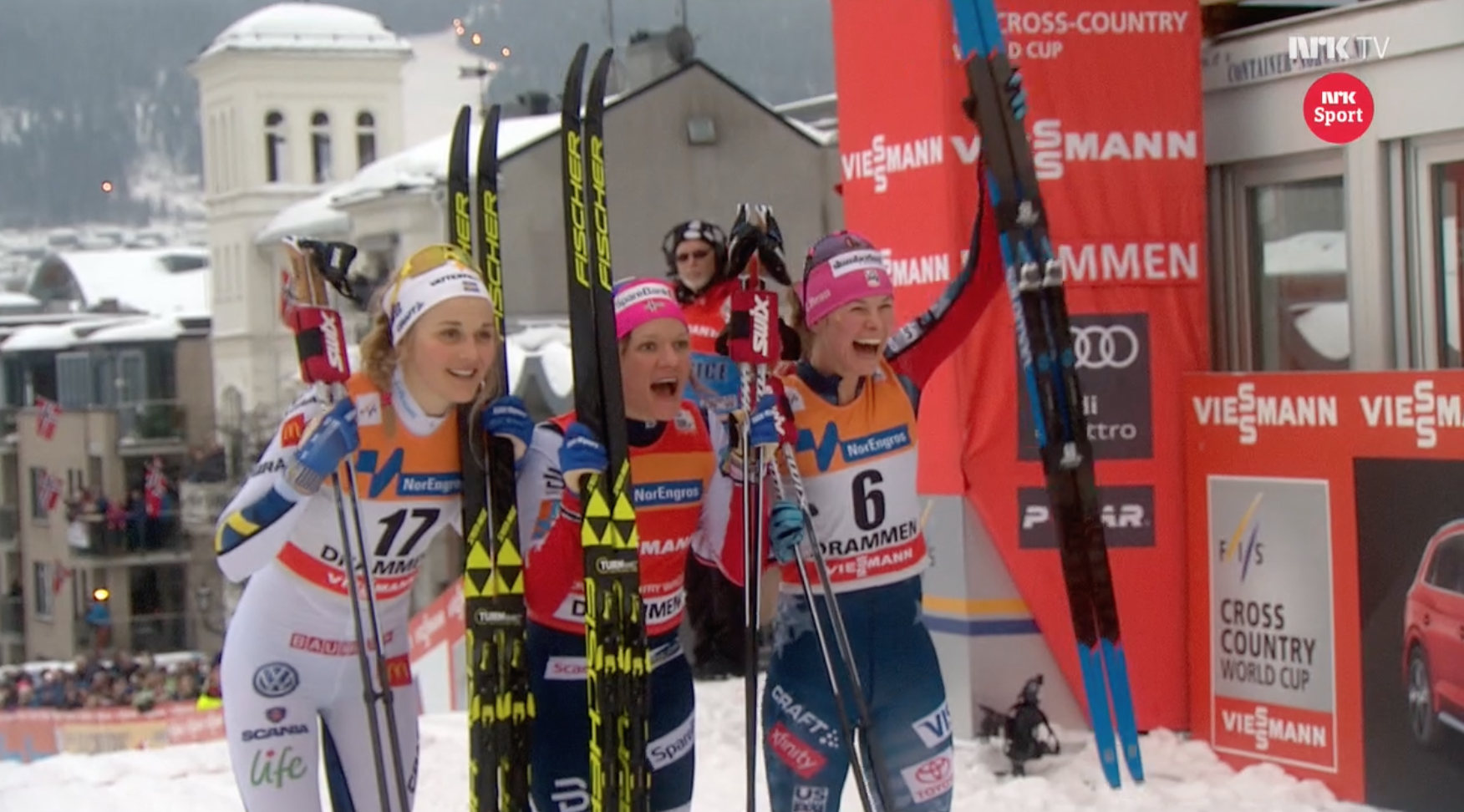
Of the top three qualifiers, only Caldwell advanced to the finals. The final was won by Norway’s Maiken Caspersen Falla in 2:43.64. Falla advanced to the finals as a lucky loser from the first semifinal. That semi was won by Caldwell who ended up placing second (+0.11) in the final. Sweden’s Maja Dahlqvist sprinted to third overall (+0.37).
Germany’s Sandra Ringwald placed fourth (+0.46), Norway’s Mari Eide fifth (+0.75), and Tiril Udnes Weng of Norway sixth (+0.94).
Phinney placed 19th overall, Sargent 30th. Canada’s Beatty was 24th in the final standings.
Also for the U.S., Julia Kern (USST D-Team) coming off of illness ended her day 38th overall. Hannah Halvorsen (USST D-Team) placed 41st.
Johannes Høsflot Klæbo won the men’s 1.6 k skate qualifier in 2:47.01 minutes. He was followed by teammate Haavard Solaas Taugboel in second (+4.15). Qualifying in third was Finland’s Joni Maeki who clocked a time of 2:51.36.
Klæbo won the final in 2:52.06 while Italy’s Federico Pellegrino raced to second (+0.30). Norway’s Finn Hågen Krogh was third (+0.61). Also from Norway, Eirik Brandsdal took fourth (+1.31) and Emil Iversen fifth (+1.75). Gleb Retivykh of Russia was sixth (+2.08).
No North American men qualified for the heats.
Logan Hanneman (APU) for the U.S. placed 32nd overall after missing the heats by .22 seconds. Simi Hamilton (USST) finished 36th overall, and Erik Bjornsen (USST) 42nd.
Evan Palmer-Charette was the lone Canadian entered; he placed 67th.
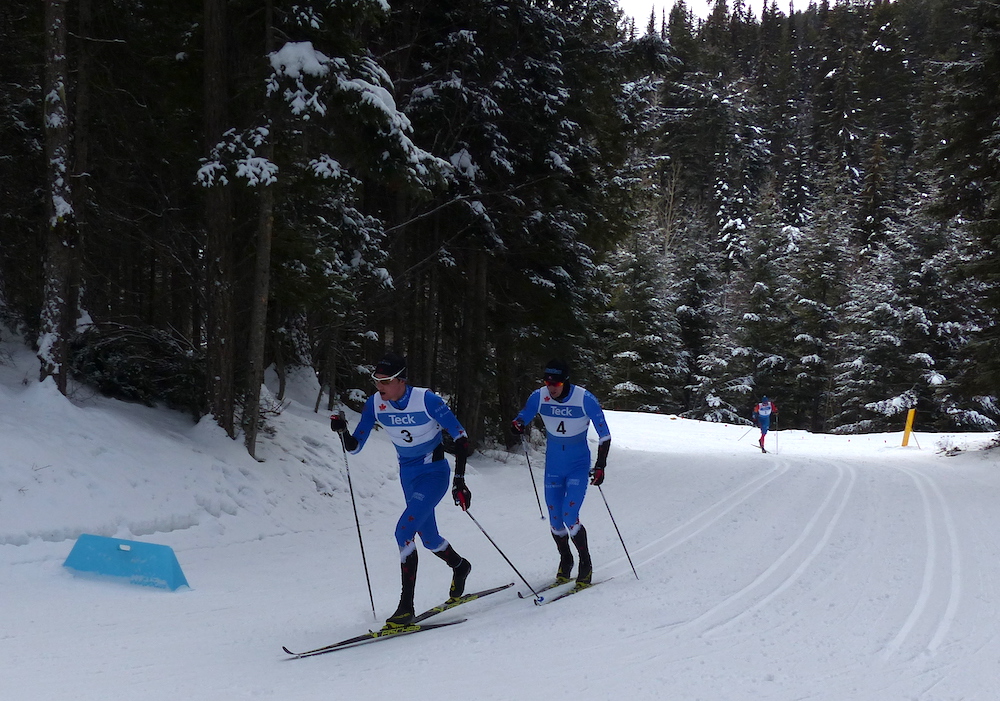
Rémi Drolet leads Julien Locke and Sam Hendry at the start of lap three. (Photo: Peggy Hung)
Canadian Western Championships, Telemark, Classic Mass Start
Day two of Westerns dawned with low clouds and intermittent light snow at -11C for the classic mass starts.
The men raced first, completing three laps of the new (and freshly homologated) 5km loop. Rémi Drolet (Black Jack) won in 42:18.4, getting from Julien Locke (CNST) on the last climb to earn a 4.8 second gap. Sam Hendry (Team R.A.D.) stayed with leaders until late in the second lap, finishing 42.2 seconds back. Rémi Drolet and Hendry are juniors who represented Canada at Junior Worlds in Lahti last month. Crystal Lust
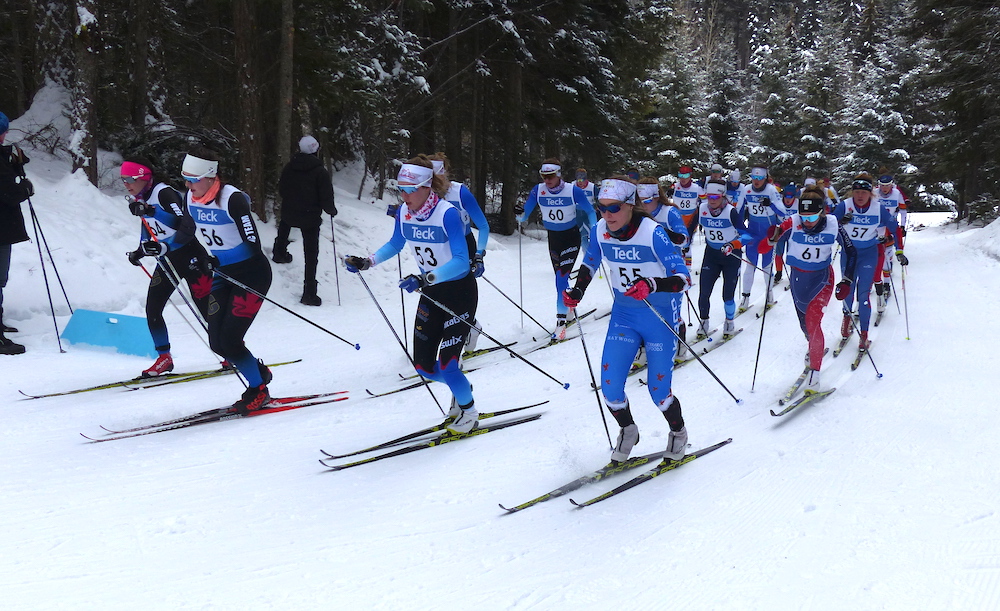
The first small climb of the Westerns 10km classic. Jasmine Drolet (#55) leads Novie McCabe (#61) in the left track. (Photo: Peggy Hung)
The open women skied two laps of the same course, with Novie McCabe (Methow) breaking clear on the first lap to win alone in 32:46.6. Jasmine Drolet (Black Jack) was second at 53.4 seconds followed by teammate Molly Miller at 1:28.1. All three raced at World Juniors in Lahti: Jasmine Drolet is 16 and the other two are 17.
There were 386 finishers on Saturday. Racing continues Sunday with relays.
After winning Saturday’s qualifier in a time of 3:21.99, Klæbo went on to win both his quarter and semi. He eventually crossed the final first in a time of 3:20.05 to complete his sweep of the day’s rounds.
“It’s very cool to win here again,” Klæbo said during an interview with the International Ski Federation (FIS) after the race. “And I have a grandpa who is living here so that’s even better now, so I want to enjoy this.”
With the win, his 18th individual World Cup victory (12th in sprint), Klæbo could be on his way to his most winningest season yet. Last winter he departed the World Cup with 10 wins total. Thanks to a strong Tour de Ski and a few sprint races this year, Klæbo has already accumulated six individual victories in the 2018/2019 season.
The win this Saturday came in good company, as he raced the six man final with four other Norwegians: Pål Golberg, Eirik Brandsdal, Mattis Stenshagen and Erik Valnes. Alexander Bolshunov was the lone non-Norwegian to make the final.
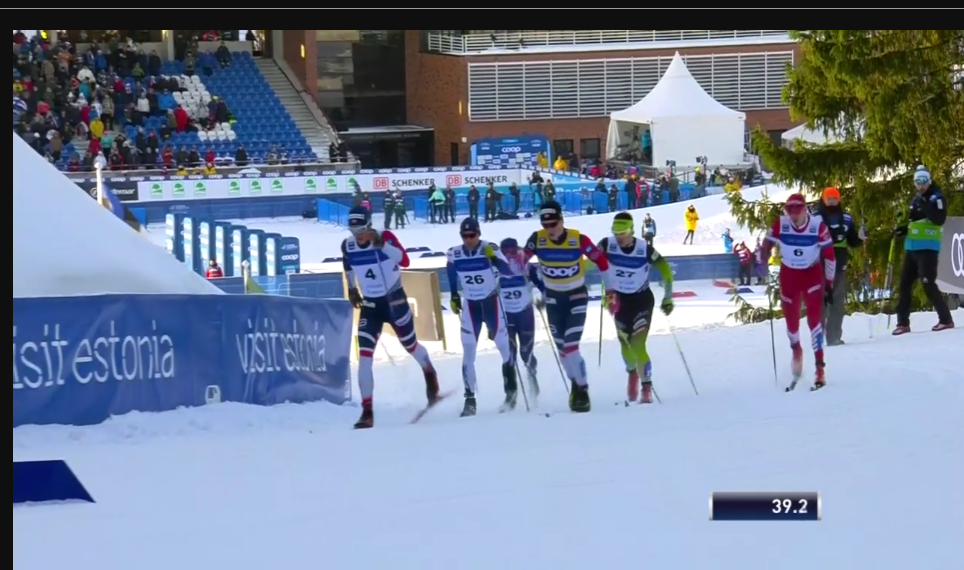
American Andy Newell (bib 26) racing the first quarterfinal of the the men’s 1.6-kilometer classic sprint final on Saturday in Otepää, Estonia. (Photo: NBC Gold screenshot)
Pitted against each other, Bolshunov appeared to be the only one in the final willing to challenge Klæbo. The two went head-to-head in the first major course climb, and by the following series of downhill S-turns, Bolshunov had positioned himself in the front. A brief double-pole section found Bolshunov and Klæbo side-by side once again, with Brandsdal and Stenshagen just behind.
As the six finalists geared up for the second major climb, a steep nearly vertical pitch that forced all racers to herringbone, Klæbo maneuvered to the outside right of Bolshunov. Using a quick, herringbone clip that almost made his skis look like a fish out of water, Klæbo passed Bolshunov by the top of the ascent.
After two double poles at the crest of the hill, Klæbo was tucked and descending back toward the stadium. His skis proved unmatchable by the Russian’s and by the bottom of the hill, he had put close to two meters on Bolshunov. Another meter behind Bolshunov was Golberg.
With no foreseeable challenge to the win, Klæbo double poled breezily to the finishing stretch and crossed first, arms outstretched in his signature celebratory gesture.
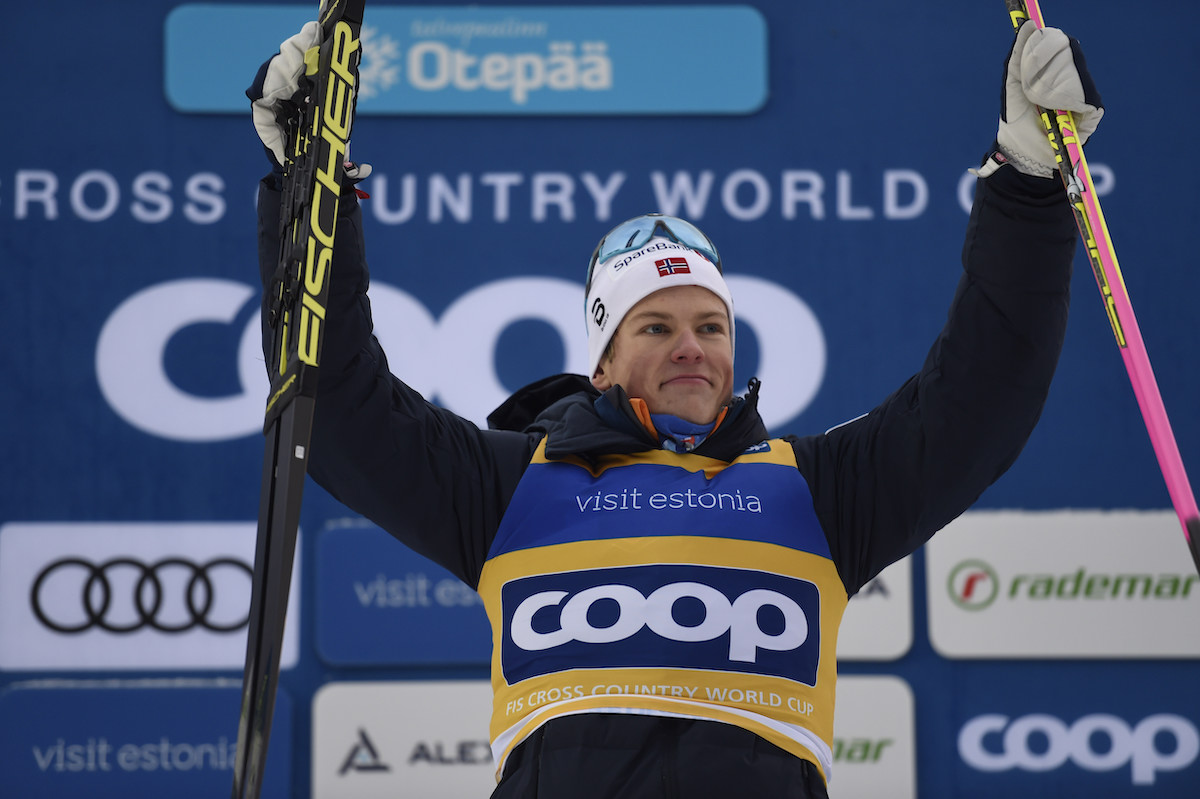
Norway’s Johannes Høsflot Klæbo (yellow bib) crossing first in the men’s 1.6-kilometer classic sprint final on Saturday in Otepää, Estonia. (Photo: Fischer/Nordic Focus)
Bolshunov crossed second (+1.51) for his seventh World Cup podium of the season.
In a lunge to the line, Golberg claimed third (+2.53) over Brandsdal in fourth (+2.57). Stenshagen crossed fifth (+7.69) and Valnes sixth (+11.99).
Rounding out the top ten was Norwegian Sindre Bjørnestad Skar in seventh, Sweden’s Viktor Thorn in eighth, Norway’s Sondre Turvoll Fossli in ninth and Italy’s Federico Pellegrino in tenth.
The U.S. had two men qualify, with Erik Bjornsen qualifying in 23rd (+8.20) and Andy Newell 26th (+8.75). Newell went on to race the first quarterfinal with Klæbo. Avoiding a crash from Russia’s Andrey Sobakarev in the herringbone hill, Newell crossed the quarterfinal in third to end the day in 15th overall.
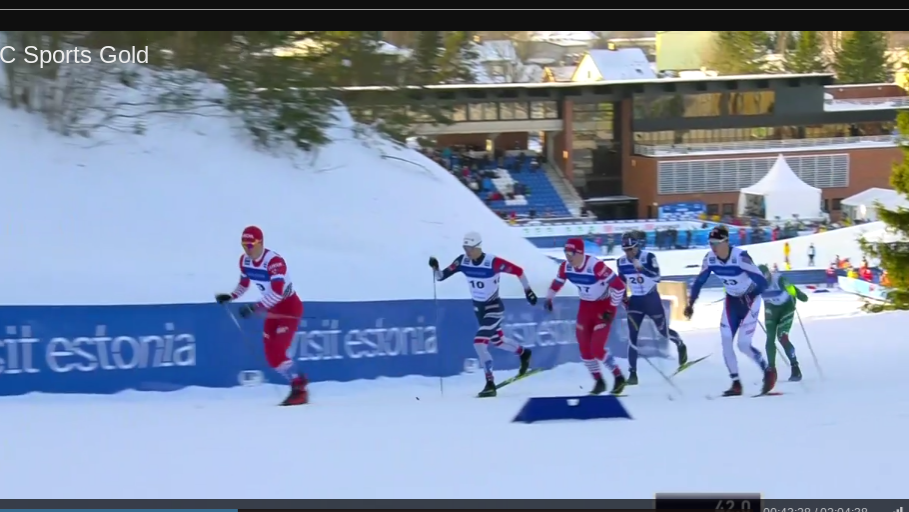
American Erik Bjornsen (bib 23) racing the first quarterfinal of the the men’s 1.6-kilometer classic sprint final on Saturday in Otepää, Estonia. (Photo: NBC Gold screenshot)
Bjornsen, who was slotted into the second quarterfinal, jockeyed for position throughout his heat, taking aggressive lines during the course’s sweeping S-turns to move from fifth to third. He dropped back once again in the herringbone hill and crossed his heat in fifth for 24th overall.
“I was happy to qualify well today,” Bjornsen wrote in an email. “This season hasn’t gone as well as I hoped but I think I can turn things around before world champs. Today was a step in the right direction. Positioning was quite important in the second half of the course. Unfortunately I wasn’t where I needed to be before the steep climb.”
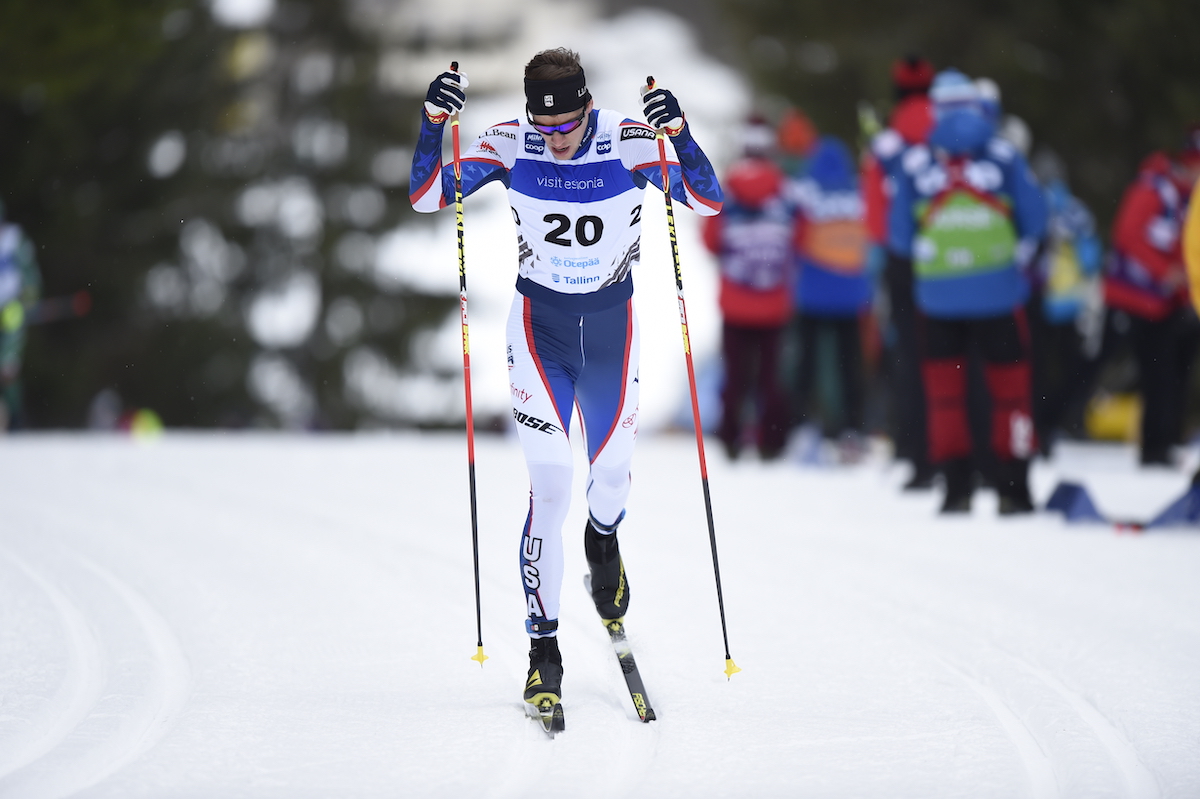
The U.S. Ski Team’s Kevin Bolger during his qualifier on Saturday in in Otepää, Estonia. (Photo: Fischer/Nordic Focus)
Also racing for the U.S., American Kevin Bolger finished in 41st (+13.13) and Ben Saxton in 44th (+14.16). Len Valjas racing for Canada finished in 43rd (+13.61) and Bob Thompson, also for Canada, placed 51st (+15.96).
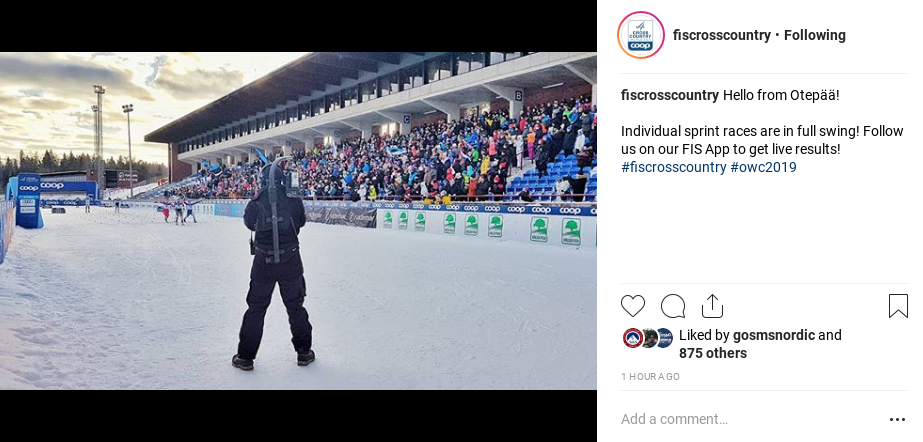
It’s on and it’s over — the World Cup classic sprints in Otepää, Estonia. (Photo: @fiscrosscountry Instagram screenshot)
FIS World Cup Otepää, Estonia 1.3 k / 1.6 Classic Sprint
Starting the day’s performance benchmarks off was Stina Nilsson of Sweden with the fastest qualifier in the women’s 1.3-kilometer classic sprint in Otepää on Saturday. She stopped the clock in 3:07.62 minutes.
The U.S. Ski Team’s (USST) Jessie Diggins was the top-qualifying North American in 18th (+5.37). Sadie Bjornsen (USST) qualified 20th (+5.71), and Ida Sargent 27th (+8.38).
On a course rewarding patience and technical skiing know how, Norway’s Maiken Caspersen Falla won the overall in 3:05:16 minutes. Russia’s Natalia Nepryaeva placed second (+1.40), and Maja Dahlqvist of Sweden third (+5.78). Also from Sweden, Jonna Sundling, who fell at around the 1:30 mark in the final, placed fourth (+8.12), with Slovenia’s Katja Visnar fifth (+23.22).
Nilsson placed second to Falla in the first semi-final, but did not start the final. Nilsson had won the last four World Cup sprints, all in skate, coming into Otepää.
Bjornsen looked strong in the fifth heat, yet stepping around the right hand turn before the final straight she fell taking out several other skiers. Bjornsen was given a yellow card for obstruction. She ended up 22nd overall.
Diggins placed second to Falla in the second heat to advance to the first semi. She was eliminated after finishing in sixth (+3.68). Diggins placed 12th overall.
Sargent finished third in the third heat, to place 15th overall.
U.S. athlete Rosie Brennan (APU) finished 45th (+15.81).
Dahria Beatty (CNST) was the only Canadian entered. She placed 44th overall (+15.79)
Norway’s Johannes Høsflot Klæbo was the fastest qualifier for the men in the 1.6 k classic sprint with a time of 3:21.99 minutes.
The young Norwegian seems on form as he swept his heat, semi, and final on his way to the win. Klæbo won the final in 3:20.05 minutes. Alexander Bolshunov of Russia, the only non-Norwegian in the final, was second (+1.51), and Pål Golberg third (+2.53). Rounding out the final three spots in the final were Eirik Brandsdal in fourth (+2.57), Mattis Stenshagen in fifth (+7.69), and Erik Valnes in sixth (+11.99).
For the U.S., Erik Bjornsen (USST) was the fastest qualifying North American in 23rd (+8.2), Andy Newell (SMS T2) 26th (+8.75).
Bjornsen was knocked out of the rounds after placing fifth in the second heat. He placed 24th overall. Newell ended up third in the first heat, 2.99 seconds in back of Klæbo. Newell, in his second World Cup sprint of the season, placed 15th in the final standings.
Kevin Bolger (USST) finished in 41st (13.13), Ben Saxton (SMS T2) 44th (+14.16), and Ben Lustgarten (CGRP)63rd (+23.04).
For Canada, Lenny Valjas (CNST) was 43rd (+13.61), and Bob Thompson 51st (+15.96).
Day two of the NorAm weekend was interval start classic, with very cold conditions delaying the start and simplifying the ski preparations.
Katherine Stewart-Jones (CNST) topped her Friday 2nd place with a clear win in the 10km, finishing in 28:51.6 with the fastest time on all three laps. Cendrine Browne (CNST) was second at 30.8 behind. Zoë Williams (Nakkertok) was third at 1:53.5, just pulling clear of Frédérique Vézina (CNEPH) by 3.1 seconds with a fast final lap.
In the men’s 15km, Scott Hill (Hardwood) bounced back from a slow start to the season with a well-timed victory to join Stewart-Jones on the World Championships team. Hill was fastest on the last three of four 3.75km laps to win in 36:59.7, 9.0 seconds ahead of a fading Russell Kennedy (Team R.A.D.). Graham Nishikawa (CPNST), here training for his role as Brian McKeever‘s guide, held onto third at 38.0 seconds, just 3.2 seconds ahead of a fast finishing Dominique Moncion-Groulx (Nakkertok).
There are two more automatic selections for World Championship available on Sunday in the mass start skate races (20km for women, 30km for men). With cold temperatures and heavy overnight snow predicted, it should be an exciting end to the weekend.
The teams from France, Norway and Germany claimed the positions at the top of the podium on Saturday in the women’s 4 x 6-kilometer relay in Ruhpolding, Germany, cheered on by over avid 25,000 fans lining the course.
France with Julia Simon, Anaïs Bescond, Justine Braisaz and Anaïs Chevalier stayed in the top group all race mainly due to the best shooting performance of the day, at times with a lead of over half a minute. On the anchor leg, Chevalier defended her narrow lead through three loops and two shooting stages to the finish line in a time of 1:09:27.7 hours, with no penalty and just four spares. According to an IBU press release, it was their first win since 1994 at this venue with a long tradition on the biathlon competition calendar, which has undergone a slight redesign for this season to add stands and make a downhill section less tricky.
Behind the French women, Norway with a team comprised of the reactivated veteran Synnøve Solemdal, Ingrid Landmark Tandrevold, Tiril Eckhoff and anchor Marte Olsbu Røiseland was second, with Røiseland narrowing the gap to Chevalier on the final loop from 21 to seconds but not quite catching up to finish 11.5 seconds back (with no penalty and seven spare rounds). The home team from Germany with Vanessa Hinz, Laura Dahlmeier, Franziska Preuss and Denise Herrmann was third, after the fast Herrmann was unable to catch the leaders when she needed all three spares in the final shooting to clear her targets (+23.4, with no penalty and nine spares).
Over a minute behind the podium finishers, the fourth team crossing the line were the 2018 PyeongChang Olympic relay silver medalists from Sweden around anchor Hanna Öberg (+1:29, with no penalty and nine spares).
For the North American teams it was a race with many ups and downs.
Canada began the race with Sarah Beaudry, who moved the team as high as sixth thanks to a clean shooting performance in her standing shooting stage after she had required two spares in prone. She then lost time to the top teams on the track to exchange in 13th position (+54.5 sec). Emma Lunder then managed to bring the team back up to sixth position but she also needed two spares in prone and followed that up with a clean standing stage, tagging off in seventh place right behind Sweden (individually her leg was the fifth-fastest). Megan Bankes kept up with the teams around her on the course and slightly improved to fifth position less than a minute back, but then missed two targets in her standing stage and could not clean with her spares. She skied a single penalty lap (0+1, 1+3). She tagged anchor Rosanna Crawford in 10th position (+2:14), who then herself added a penalty in her prone stage.
At the site of her podium finish a year ago and coming off a 27th place in the sprint earlier this week, the Canadian team leader then needed two spares in the standing stage and ultimately came to the finish in 12th position (+3:01.6), with two penalties and 13 spare shots for the team.
For US Biathlon, Clare Egan began the race and recorded a clean prone stage to move the team up all the way to third position coming into the standing shooting stage despite a broken pole. She then missed three targets and ran out of spares and skied two penalty laps.
That set the team back quite far, exchanging in 19th position (+1:26.6). Susan Dunklee needed four spares in her shooting stages but avoided another penalty (0+1, 0+3) to exchange in 12th position (+1:47.3).
Rounding out the team after being called back up to the World Cup from the second-tier IBU Cup following solid performances in Duszniki Zdroj, Poland, Joanne Reid only needed one spare in each of her shooting stages (0+1, 0+1) to tag off in 15th position. In her second time anchoring a relay this season, Deedra Irwin – who had recorded her first clean shooting performance in a race in Poland a week ago – then required all her spares to clear her targets in the prone shooting before achieving another clean standing shooting stage. She crossed the line in 16th position, 4:06.0 back, with two penalties and 12 spare shots for the team.
Races in Ruhpolding conclude on Sunday with mass starts for the women and men. US Biathlon’s Sean Doherty is scheduled to be lone North American starter for the elite men’s field (though Canada’s Christian Gow would be the next one up from a reserve list in case of an illness), while Egan and Dunklee are qualified for the women.
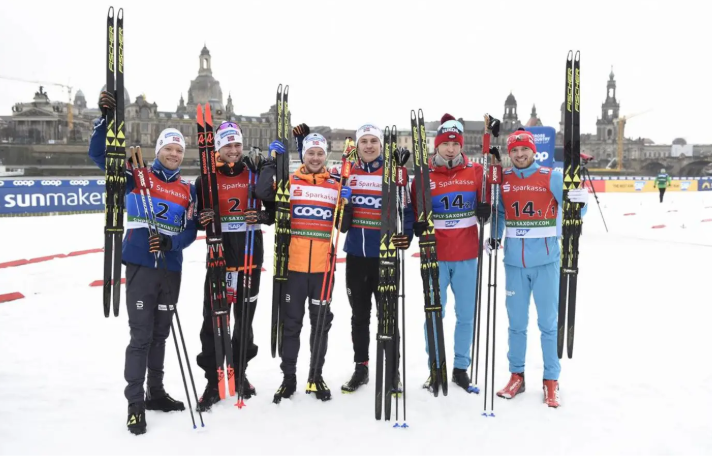
The men’s team sprint podium from the Dresden, Germany World Cup team sprint: From left to right, Norway II in second, Norway I first, and Russia I third. (Photo: fis-ski.com screenshot)
A strip of imported snow along the Elbe river, iconic architectural reminders of old-world Europe’s city-scape in Dresden, Germany, Lycra, speedy skiers, and teams of two: all the ingredients for the men’s 1.6-kilometer freestyle team sprint.
With tight pack skiing a function of the the relatively flat Dresden ski loop, the ten teams in the final attempted to play stay-out-of-trouble-skiing for the six total laps. But with a crowded tag area and tight corners where skiers abruptly bled speed, mix ups and tumbles occasionally picked skiers out of the front scrum.
Coming into the final tag, 8 k into the race, the top-seven teams came through the time check all within 2.63 seconds of one another.
Norway II, Italy I, Russia II, Norway I, France I, Russia I, and Great Britain sped through with the remaining three teams in the finals, Switzerland I, Austria I, and Australia I within closing distance to the leaders.
Intermittently contracting and spreading out, no decisive moves to splinter the group materialized until the last lap.
In the team sprint, it’s not simply the fastest one or two lap skier who prevails — each athlete, during their three respective legs (each leg consisted of three laps), was required to mentally focus and push the boundaries of their aerobic and anaerobic engines for 4.8 k total.
On that last lap, the pull away move was simple enough.
Leading much of the final k was Norway I’s Sindre Bjørnestad Skar, the winner of Saturday’s skate sprint in Dresden. Skar kept out trouble, positioning himself at the front. He then shifted into a sixth or seventh gear no other skier could match.
Up to the point Skar began to channel his reserve of booster-fuel, it appeared it could have been one of several teams across the line first. But approximately 4.6 k into Skar’s pathway to the finish line, his top effort was simply too much. he was on another level of endurance-sprint fitness as he closed out the win.
Skar along with his teammate Erik Valnes won the final in 22:38.72 minutes.
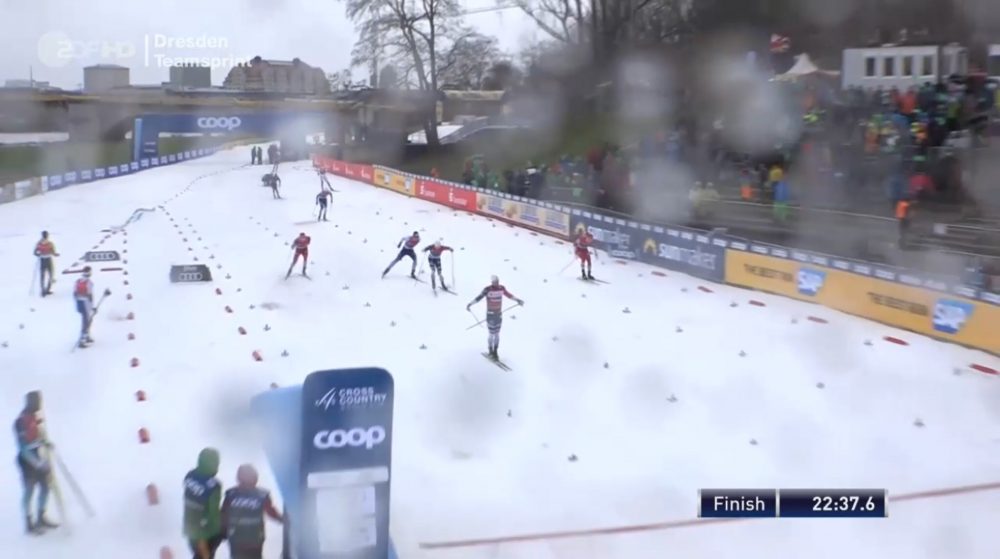
Sindre Bjørnestad Skar in front to finish first for Norway I during the Dresden, Germany World Cup team sprint on Sunday. (Photo: ZDF screenshot)
But behind Skar, a four team whirlwind charged down together on the finish. A photo-finish captured the moment to decide the final standings. In second (+0.75) was Norway II’s Pål Golberg and Eirik Brandsdal, Russia I’s Artem Maltsev and Gleb Retivykh third (+0.80).
Fourth place, 1.01 seconds back, went to Roland Schaad and Jovian Hediger of Switzerland. Russia II’s Andrey Krasnov and Alexander Terentev were fifth (+1.04).
Great Britains’s James Clugnet and Andrew Young placed sixth (+3.17).
Right in the middle of the the finishing lane mix, possibly fighting for podium scraps was Italy’s Federico Pellegrino. He appeared to catch his tip on another skiers ski-tail and took a spill. He and teammate Dietmar Nöckler placed 10th in the 10 team final. The Italian duo won last season’s team sprint in Dresden.
Canada’s Bob Thompson and Len Valjas placed seventh (+2.46) in the first semi-final and did not advance to the final. It was the same fate for the only U.S. team entered in the men’s team sprint. Andy Newell and Erik Bjornsen placed 10th (+3.66) in the second semi, and failed to make the finals.
Canada placed 15th in the final standings, the U.S. 19th.
In bib 15, the U.S. Ski Team’s Erik Bjornsen navigates the crowds during Dresden, Germany’s team sprint on Sunday. (Photo: Garrott Kuzzy)
Racing in bib 4 for the U.S., Julia Kern keeps pace in the women’s team sprint during the Dresden, Germany World Cup on Sunday. (Photo: Garrott Kuzzy).
FIS World Cup Dresden, Germany 6 x 1.6 k Freestyle Team Sprint
The first World Cup team sprint of the season was run amidst drizzle and the Dresden, Germany city-scape as the women raced a total of six 1.6-kilometer laps.
Round and round on the looping course, the pace was a mix of tactically subdued speeds with sustained bursts of energy to break the pack.
After all the speed changes and exchanges with one athlete tagging off to the next, it came down to a 1.11 second difference between first place Sweden I and the three closet teams chasing from behind that ended in a photo finish.
Sweden I’s Stina Nilsson and Maja Dahlqvist won in a time of 24:02.5 minutes. Sweden II’s Ida Ingemarsdotter and Jonna Sundling placed second (+1.11), and Norway I, with Eide Mari and Maiken Caspersen Falla in third (+1.11).
U.S. I, featuring Julia Kern and Sophie Caldwell placed fourth (+1.11) after the photo finish was reviewed.
The U.S. entered a second team, consisting of Ida Sargent and Hannah Halvorsen. That duo contested the first semi-final, the same semi as U.S. I, but did not advance after placing fourth (+5.44). The top-three teams from each semi advance to the final, along with the next four fastest teams which are the combined “lucky losers”. Today, the second semi was the faster of the two. The four lucky loser team advancing to the final all originated from the second semi.
In the men’s 6 x 1.6 k skate team sprint race, Norway I and Norway II took the top two podium spots.
In a lunge at the line, Norway I’s Erik Valnes and Sindre Bjørnestad Skar won the final in 22:38.72 minutes. Pål Golberg and Eirik Brandsdal of Norway II placed second (+0.75) and Russia I’s Artem Maltsev and Gleb Retivykh third (+0.80).
Canada’s Bob Thompson and Len Valjas placed seventh (+2.46) in the first semi-final and did not advance to the final. It was the same fate for the only U.S. team entered in the men’s team sprint. Andy Newell and Erik Bjornsen placed 10th (+3.66) in the second semi, and failed to make the finals.
Canada placed 15th in the final standings, the U.S. 19th.
IBU World Cup Oberhof, Germany 4 x 6 k / 4 x 7.5 k Relay
In the women’s 4 x 6 k relay, Russia placed first in a time of 1:18:46.4 hours. Evgeniya Pavlova, Margarita Vasileva, Larisa Kuklina, and Ekaterina Yurlova-Percht made up the team that used eight spares on their way to the win.
Germany placed second (+33.5) with two penalty loops and 10 spare rounds. Karolin Horchler, Franziska Hildebrand, Franziska Preuss, and Denise Hermann comprised Germany’s second place team that had two penalties while using 10 spares. The Czech Republic’s Lucie Charvatova, Veronika Vitkova, Marketa Davidova, and Eva Puskarcikova placed third (+36.7) with 1 penalty loop and six spares.
The top spot for the podium came down to the final leg, when Yurlova-Percht pulled out the win when Hermann skied two penalty loops. The Russian used three spares but escaped with no penalties to take the lead out of the shooting range on the final ski loop.
Susan Dunklee, Clare Egan, Joanne Reid, and Emily Dreissigacker all represented the U.S. and placed 12th (+5:35.8) while skiing five penalty loops and using 16 spares.
Canada’s Sarah Beaudry, Emma Lunder, Megan Bankes, and Rosanna Crawford finished in 13th (+5:58.8) with four penalty loops and 15 spares.
Russian also claimed the men’s relay, winning in a time of 1:20:54.3 hours. The winning team of Maxim Tsvetkov, Evgeniy Garanichev, Dmitry Malyshko, and Alexander Loginov skied no penalty laps and used six spares on their way to victory.
Antonin Guigonnat, Simon Desthieux, Quentin Fillon Maillet, and Martin Fourcade raced for France. The French team placed second (+1:01.1) while skiing a single penalty lap and using eight spares.
Austria’s Tobias Eberhard, Simon Eder, Dominik Landertinger and Julian Eberhard placed third (+2:18.6) with one penalty lap and using seven spares.
Canada’s Scott Gow, Christian Gow, Jules Burnotte, and Brendan Green and the U.S. team of Leif Nordgren, Sean Doherty, Travis Cooper, and Max Durtschi were eventually lapped. Neither team was given an official finishing time.
Canada was ranked 18th in the final standings, the U.S. 19th.
For both relays today, the snowy weather and tough course conditions made for a strenuous day of shooting and skiing.
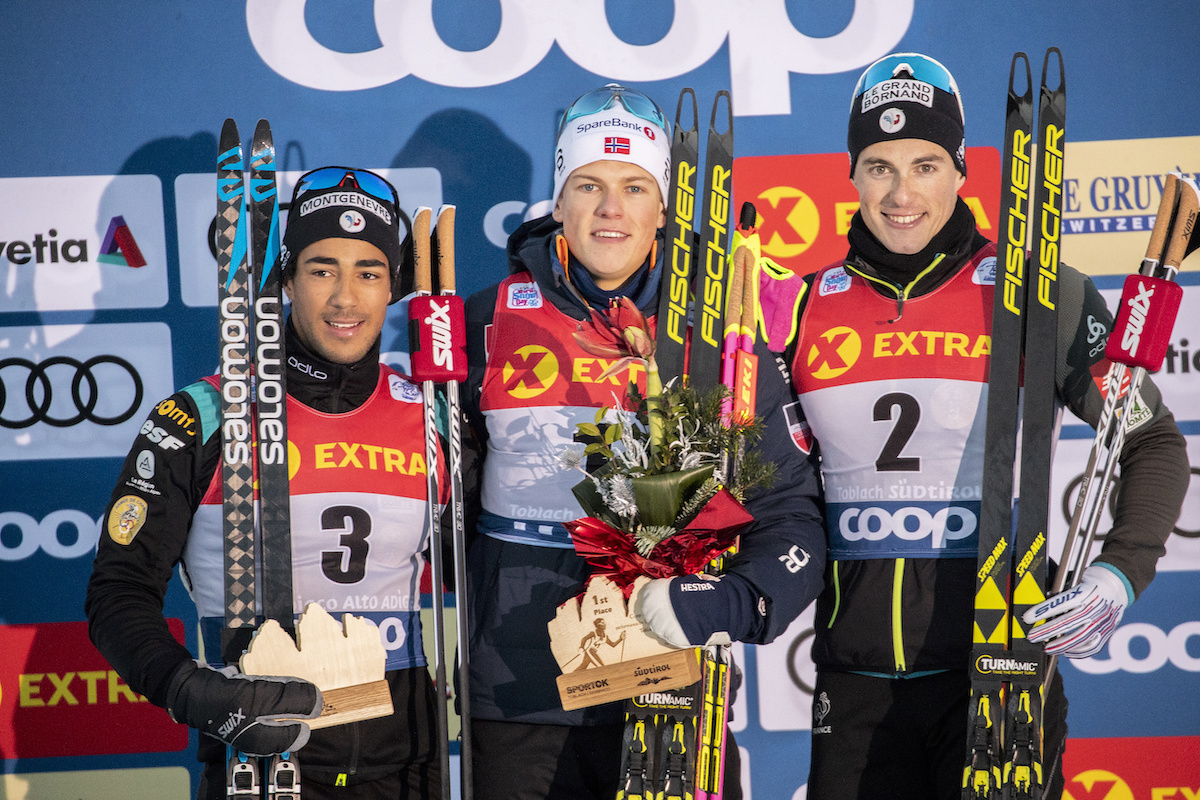
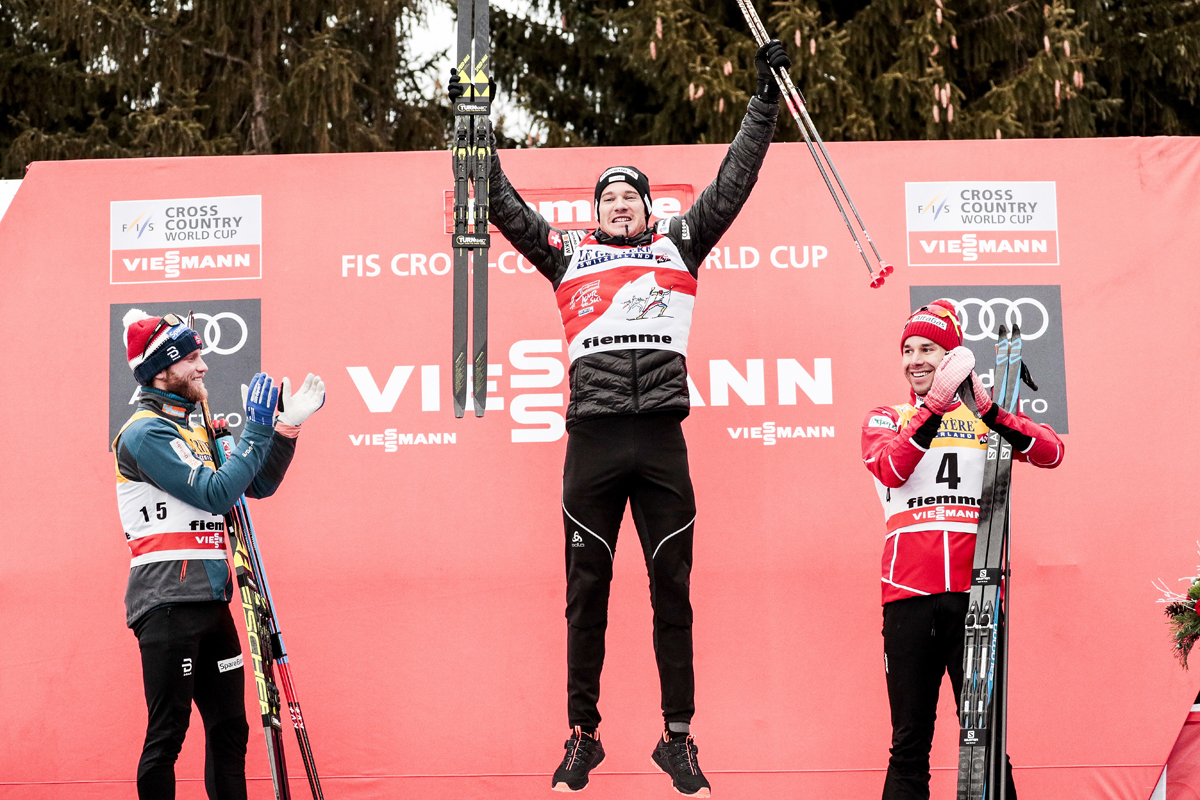
The men’s podium from Toblach, Italy’s first stage of the 2018/2019 Tour de Ski — a 1.3 k skate sprint. Richard Jouve (left) from France placed second, Johannes Hoesflot Klaebo (center) of Norway was first, and Lucas Chanavat of France (right) was third. (Photo: Fischer/Nordic Focus)
*Note: This article has been updated to include comments from U.S. Ski Team B-Tean member, Kevin Bolger
Without the visual of the grey and white U23 marker next to his name on an FIS results sheet, it’s easy to forget Norwegian Johannes Høsflot Klæbo is still under 23 years of age. As the Tour de Ski (TdS) celebrates its 13th edition this year, the twenty-two-year-old Klæbo (he celebrated his 22nd birthday this October) is only in his first TdS. He did not start last season’s 2017/2018 Tour. Nor did he start the 2016/2017 TdS. His debut World Cup race came in the spring of 2016.
Even so, by the opening race of this season’s TdS, a 1.3-kilometer freestyle sprint in Toblach, Italy, Klæbo maintained the composure of a seasoned Tour veteran. A skier used to winning and ready to do it again.
He started by posting the day’s fastest qualification time, placing first in a time of 2:16.86 minutes.
Klæbo then advanced to Quarterfinal 1, exchanging the lead with Russia’s Sergey Ustiugov for the first half of the sprint loop, before taking command and eventually duking it out with France’s Lucas Chanavat and Norwegian Sindre Bjørnestad Skar in the finishing stretch.
Johannes Høsflot Klæbo (bib 1) from Norway winning the men’s final in Toblach, Italy. Klæbo looked in form during the first stage of the 2018/2019 Tour de Ski.(Photo: Fischer/Nordic Focus)
Klæbo eventually won that quarterfinal, crossing first in a time of 2:19.71 minutes, just ahead of Chanavat. Both he and the Frenchman advanced to semi-final 1. Skar squeaked into the second semi as a Lucky Loser thanks to the heat’s fast times.
In the first semi-final, Klæbo once again took the lead from the start. He was shadowed closely by Chanavat and Italy’s Federico Pellegrino until the course’s second climb. There, the Italian made a push to the front, but by the bottom of the following hill, Chanavat had maneuvered his way around Pellegrino to take the lead. As the first semi-final skiers cornered into the finishing stretch, it was a four-skier battle between Chanavat, Pellegrino, Klæbo and Norwegian Eirik Brandsdal.
Chanavat took the semi final win. Crossing behind Chanavat, Klæbo (+0.07) bested Pellegrino (+0.10) by 0.03 hundredths of a second to advance to the final. Pellegrino did not move on.
By the time the men’s final rolled around, the line up included three Norwegians, two Frenchman, and a Russian. Norway’s Emil Iversen and Skar had advanced to the final as the two Lucky Losers from the second semi, which was won by France’s Richard Jouve followed by Russia’s Alexander Bolshunov.
From the start of the gun, it was Klæbo in front in the final. Clinging to his skis were Jouve and Bolshunov as the group headed toward the first climb. Klæbo maintained the leader’s pull just until the top of the climb, where Bolshunov positioned himself in first for the descent. Rolling into the second short climb, Bolshunov and Klæbo went head-to-head. Lurking just behind them was the French duo.
As they headed into the third climb, Chanavat moved to the outside right of the group. Jouve followed. By the time the final field crested the last climb on course, Klæbo was positioned in first, Jouve in second and Chanavat in third.
A final sling around the curve to the finish revealed Klæbo flurrying to hold off the attacks of Chanavat and Jouve. His efforts paid off and the Norwegian finished the sprint, his first TdS race, in first in a time of 2:17.99 minutes. Chanavat crossed 0. 34 seconds behind Klæbo for second.
Crossing a mere 0.05 hundreths of a second behind Chanavat was Jouve in third (+0.39). The podium is Jouve’s sixth in the top three (fifth individual) all of which, like his compatriot, were in the freestyle sprint discipline.
Rounding out the top 10 was Pellegrino in seventh, Brandsdal, in eighth, Sweden’s Oskar Svensson in ninth and Norway’s Finn Hågen Krogh in 10th.
Johannes Høsflot Klæbo of Norway crossing the line in first as France’s Richard Jouve placed second and his teammate, Lucas Chavanat, was third. (Photo: ZDF Screenshot)
Two Americans qualified for the heats, with Simi Hamilton qualifying in eighth (+3.00) and Kevin Bolger of the U.S. qualifying in 13th (+3.98).
Hamilton, who advanced to the second quarterfinal, looked strong for the first two-thirds of the course. However, in the last climb of the sprint loop, while moving from fifth to third, Hamilton fell. The crash cost him advancing to the semis and he crossed his heat in sixth, ending the day’s sprint in 26th.
“I think he unfortunately just took himself out,” U.S. World Cup head coach, Matt Whitcomb said during a phone conversation. “From the side angle, it looked like he just started getting a little bit too far forward. He thought he might have hit something…But it was a bummer because he had a really speedy qualification and was just positioned perfectly to move on and was feeling great.
“It’s one of those instances where you can be disappointed but not discouraged because he’s where you want him to be,” Whitcomb continued. “He’s in a place where he’s good enough to be on the podium, can certainly ski with the best, but unfortunately that didn’t unfold today.”
The U.S. Ski Team’s Kevin Bolger during the first stage of the 2018/2019 Tour de Ski — a 1.3k skate sprint. Bolger placed 21st overall. (Photo: Fischer/Nordic Focus)
Bolger, who advanced to the fifth quarterfinal remained in contact with Swedish skiers Karl-Johan Westberg and Viktor Thorn and Russian Alexander Bolshunov, who lead through the first and second climbs. Bolshunov picked up the pace on the second hill, pulling the rest of the field with him.
“I kind of assumed Bolshunov would want to take command of the heat, and he did from the start, and then he put in that surge just over the top of the second climb, I felt like I was ready but not in the best position to react, and was able to get back in contact with the group over the last climb, but making a move from there was tough,” Bolger wrote in an email to FasterSkier on Saturday. “We had one of the fastest heats of the day, if I was in any other heat I think I would have qualified.”
The Russian crossed the quarterfinal first with Poland’s Maciej Starega holding onto him to cross in second. Bolger eventually crossed in fifth for 21st on the day.
“Really exciting to see Kevin qualify,” Whitcomb said. “Watching his qualification rounds, he must have skied one of the fastest first climbs. His V1s were absolutely lightning fast. We’re really impressed with his trajectory throughout Period 1 getting gradually faster and faster and almost being there in Davos and he’s clearly there now.”
Two weekends ago, Bolger finished the Davos, Switzerland sprint in 31st, just one place outside of qualifying. These were the first heats of the season in which he qualified.
“I was excited, but also relaxed,” Bogler wrote of how he was feeling. “I don’t feel like a newbie in the world cup heats anymore, I’ve had experience. So I wanted to ski aggressive and attack and be in the mix from the start.”
“I will be dropping out of the tour after the 3rd stage, along with Simi, and Sophie,” Bolger continued. “But tomorrow’s 15 k skate will be a hard effort, but a fun fast course I’m looking forward to having a good race, but I’ll be putting a little more focus into the next skate sprint in Val Müstair!”
Canadians Alex Harvey finished in 50th (+7.16), Len Valjas in 55th (+7.46), and Bob Thompson 62nd (+8.10).
“My skis were great today!” Harvey wrote in an email after the sprint. “I was actually feeling quite good in the warm up and in the race. I just think that a 2:16 sprint is a bit too short for me. The conditions made for a quick and fairly easy prologue, I think 2 years ago in was more around 2:45 so to shave 30 sec of a sprint course is pretty impressive.”
“I would have liked to get in the heats and maybe put some time on some of the contenders for the overall but I guess I’ll have to wait for tomorrow to do that!” he added.
Another duo of North Americans started the qualifier, with Erik Bjornsen (USST) and Ben Lustgarten (CGRP) of the U.S. placing 76th (+10.38) and 105th (+15.23), respectively.
The start of the men’s 15 k classic mass start at Stage 6 of the 2018 Tour de Ski on Saturday in Val di Fiemme, Italy, with (front row, left to right) Canada’s Alex Harvey, Russia’s Sergey Ustiugov, Kazakhstan’s Alexey Poltoranin, Norway’s Martin Johnsrud Sundby, and Switzerland’s Dario Cologna. (Photo: Salomon/NordicFocus)
Beginning this Saturday in Toblach, Italy with a freestyle sprint is the 13th edition of the Tour de Ski (TdS). According to the International Ski Federation (FIS), over the course of seven stages the men will race 80.918 kilometers, the women 60.67 k.
The TdS has become both a staple and a spectacle of the annual World Cup calendar. With a jam-packed series of races primacy is placed on both the ability to recover well and wither less as the TdS transpires.
Prognostication can be tricky in a long-form template like the TdS. So much can go astray during seven races not to mention the travel and dicey germ-avoidance.
Last season’s winner on the women’s side, Heidi Weng of Norway, sits 18th overall in the World Cup standings (14th in distance). She has four top-20’s in the four distance events she’s contested with her best result an eighth in Lillehammer’s 10 k skate. Although featuring two sprints in the first three stages, the TdS remains a distance skier’s paradise.
Weng has skied solidly on the World Cup, but she has yet to show the form that made her a TdS overall winner in 2017 and 2018. Norway has won the last five iterations of the TdS: Marit Bjørgen won once in 2014/2015, Therese Johaug twice (2013/2014, 2015/2016), and Weng the last two years.
Austria’s Teresa Stadlober leads Norway’s Heidi Weng (2) and Ingvild Flugstad Østberg, American Jessie Diggins (3) and others around a downhill corner during the women’s 10 k classic mass start at Stage 6 of the 2018 Tour de Ski in Val di Fiemme, Italy. (Photo: Fischer/NordicFocus)
If Norway is to keep the streak alive, Ingvild Flugstad Østberg, last year’s TdS runner up, could be the heir apparent. She currently ranks second in the World Cup overall and 15th on the sprint list.
Johaug, having returned from an 18 month doping ban, has been on a distance race tear. She has won all five World Cup distance events this season. Johaug, however, will not be lining up for the TdS.
Only five different women have earned distance podiums this season — Johaug, Østberg, Sweden’s Charlotte Kalla and Ebba Andersson, and Finland’s Krista Pärmäkoski. Along with Johaug, Kalla and Andersson are skipping the TdS. (Andersson sits third overall on the World Cup, Kalla fifth.) With the TdS missing three of the five top ranked World Cup distance skiers, daily stages and the overall podium are up for grabs.
Last season’s third overall finisher, Jessie Diggins of the U.S. Ski Team (USST), often cites the TdS as a point in the season when her form trends towards podium performances. She sits eighth in the current distance standings and could very well have a stout TdS.
Russia’s Natalia Belorukova and Yulia Nepryaeva look strong as does Sadie Bjornsen (USST), and Austria’s Teresa Stadlober.
With less than predictable distance stage podiums for the women, it may simply come down to a drag race on the Alpe Cermis final climb Jan. 6.
Switzerland’s Dario Cologna (c) celebrates his fourth Tour de Ski overall title. He was joined by Norway’s Martin Johnsrud Sundby (l) and Canada’s Alex Harvey (r) on the podium in second and third, respectively. (Photo: Fischer/NordicFocus)
The men’s scene is also open to interpretation. Last season’s TdS winner, Switzerland’s Dario Cologna, was in fact a surprise victor. Prior to Cologna’s stage two win in last year’s TdS, it had been nearly three years since the four time TdS overall winner had won a World Cup. Cologna sits 21st overall on the World Cup currently. Given last year’s resurgence, anything is possible for the Swiss skier.
Then there’s Martin Johnsrud Sundby form Norway. He finished on the TdS podium the last three years. At thirty-four-years-old, Sundby is ranked first on the distance list, with a second, a third, and a fourth place in distance races this season.
Sundby won the TdS on two occasions – in 2013/2014 and in 2016. His 2015 win was stripped after he tested positive for excessive levels of Salbutamol. He placed second in the past two Tours.
In a field rife with talent, Sundby’s ability to race and rebound and race and rebound will be tested. Sjur Røthe, Emil Iversen, and Didrik Tønseth— all from Norway— look in form. And there’s Norway’s Johannes Høsflot Klæbo. The winner of last season’s overall World Cup has had flashes of his past explosive self. He could be a TdS protagonist.
The men’s field is notably tight. Along with the Norwegians, several Russians could pop a podium, a stage win, and the overall. Russia comes with a loaded team ready to exploit. Alexander Bolshunov leads the overall World Cup – he’ll turn twenty two on Dec. 31st. He’s backed by teammates Evgeniy Belov, Andrey Melnichenko, and Denis Spitsov.
Canada’s Alex Harvey placed third overall last year and he looked stronger as the TdS progressed.
The Stages
Stage 1: Dec. 29, skate sprint in Toblach, Italy.
Stage 2: Dec. 30, 10 k/15 k skate in Toblach, Italy.
Stage 3: Jan. 1, skate sprint in Val Müstair, Switzerland.
Stage 4: Jan. 2, 10 k/15 k classic mass start in Oberstdorf, Germany.
Stage 5: Jan. 3, 10 k/15 k skate pursuit in Oberstdorf, Germany.
Stage 6: Jan. 5th, 10 k/15 k classic mass start in Val di Fiemme, Italy.
Stage 7: Jan 6th, 9 k final climb skate pursuit in Val di Fiemme, Italy.
Teams
United States
Women: Sophie Caldwell, Sadie Bjornsen, Jessie Diggins.
Men: Ben Lustgarten, Simi Hamilton, Erik Bjornsen, Kevin Bolger.
U.S. Ski Team Head Coach Chris Grover noted in a text that Caldwell, Hamilton, and Bolger will likely cease the TdS after the stage three sprint. Additionally, this is a small team for the U.S. at the TdS. Several athletes turned down TdS nominations including Scott Patterson (USST), Andy Newell (SMS T2/Salomon), Kyle Bratrud (SMS T2), Rosie Brennan (APU), Rosie Frankowski (APU), Caitlin Patterson (CGRP), and Julia Kern (SMS T2). These skiers plan on racing U.S. Nationals this January in Craftsbury, Vermont.
Canada
Women: Emily Nishikawa, Dahria Beatty
Men: Alex Harvey, Lenny Valjas, Bob Thompson
Norway
Women: Ingvild Flugstad Østberg, Maiken Caspersen Falla, Astrid Uhrenholdt Jacobsen, Kari Øyre Slind, Kathrine Rolsted Harsem, Heidi Weng, Lotta Udnes Weng, Tiril Udnes Weng Mari Eide, Anna Svendsen
Men: Martin Johnsrud Sundby, Hans Christer Holund, Emil Iversen, Didrik Tønseth, Simen Hegstad, Krüger, Sjur Røthe, Johannes Høsflot Klæbo, Martin Løwstrøm Nyenget, Eirik Brandsdal, Finn Hågen Krogh
Russia
Women: Yulia Belorukova, Lidia Durkina, Anna Zherebyateva, Mariya Istomina, Natalia Nepryaeva, Anna Nechaevskaya, Anastasia Sedova, Elena Soboleva
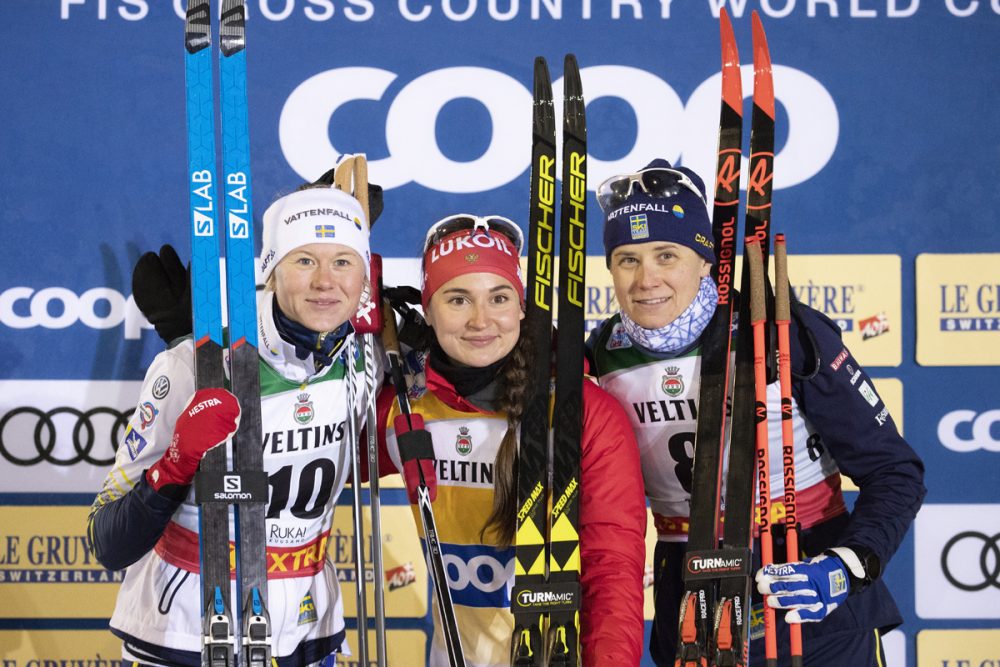
The women’s 1.4-kilometer classic sprint podium (l to r): Sweden’s Maja Dahlqvist, Russia’s Yulia Belorukova and Ida Ingemarsdotter of Sweden. (Photo: Fischer/Nordic Focus)
FIS Cross-Country World Cup in Kussamo, Finland: Classic sprint
On Saturday in Kussamo, Finland the 2018/2019 World Cup season began with a 1.4-kilometer classic sprint.
Twenty-three-year-old Yulia Belorukova from Russia won the final in 2:52.62 minutes. It was Belorukova’s first World Cup win. Second place went to Sweden’s twenty-four-year-old Maja Dahlqvist who crossed the line 1.12 seconds back. Also from Sweden, Ida Ingemarsdotter was third (+1.51), Norway’s Maiken Caspersen Falla fourth (+1.52), Krista Pärmäkoski of Finland fifth (+4.71), and Stina Nilsson of Sweden, sixth (+12.33). Nilsson crashed in the final.
In the women’s qualifier, Russia’s Natalia Nepryaeva set the fastest time in 2:56.50 minutes. Seventy-three skiers started the qualifier.
Three U.S. Ski Team (USST) women advanced to the heats by qualifying in the top-30. Sadie Bjornsen in 5th (+3.01), Sophie Caldwell in 22nd (+6.97), and Ida Sargent 24th (+7.23).
Caldwell and Sargent did not advance out of the heats. Caldwell was third in the first heat, won by second fastest qualifier, Falla. Caldwell finished 0.36 seconds behind Falla and ultimately did not secure a lucky loser spot. Sargent raced in the third heat where she placed sixth (+4.50).
Four U.S. women bowed out in the qualifier, with last season’s second overall skier in the World Cup standings, Jessie Diggins, placing 33rd (+9.05). Rosie Brennan (APU) skied to 38th (+10.74), Kelsey Phinney (SMS-T2) 46th (+13.49), and last season’s overall SuperTour leader, Kaitlynn Miller (CGRP), was 58th (+18.06).
Kaitlynn Miller racing for the U.S. in the women’s 1.4-kilometer classic qualifier on Saturday in Kussamo, Finland. (Photo: Fischer/Nordic Focus)
No Canadian women entered the race.
In the men’s race, last season’s World Cup overall and sprint cup winner, Johannes Høsflot Klæbo, scorched the qualifier in 2:28.95, winning by 3.21 seconds over he next fastest qualifier, teammate Eirik Brandsdal.
Klæbo won his heat and his semifinal. But the semi was tight: Klæbo won by 0.1 seconds over Russia’s Alexander Bolshunov.
In the final, Bolshunov won in 2:29.35 minutes, Klæbo was second (+0.31), Brandsdal third (+1;35). Also of Norway, Emil Iversen placed fourth (+3:04), Russia’s Gleb Retivykh fifth (+3.86), and Norwegian Sondre Turvoll Fossli sixth (+4.85).
The only North American to advance to the heats was Canada’s Alex Harvey, who qualified in 25th (+9.40) and ended the day in eighth. Harvey advance out of the heats by placing second to Russia’s Gleb Retivykh in the fourth quarterfinal. In the second semifinal, Harvey placed fourth (+2.30) and did not advance as a lucky loser.
Also for Canada, Julien Locke (CNST)finished 69th (+15.43), Andy Shields 75th (+18.59), and Russell Kennedy (Team R.A.D.) 76th (+18.61).
For the U.S., Erik Bjornsen (USST) placed 42nd (+11.41), Kevin Bolger (USST) 55th (+13.19), Ben Saxton (SMS-T2) 70th (+15.68), David Norris (APU) 78th (+19.05), and Simi Hamilton (USST) 82nd (+1:11).
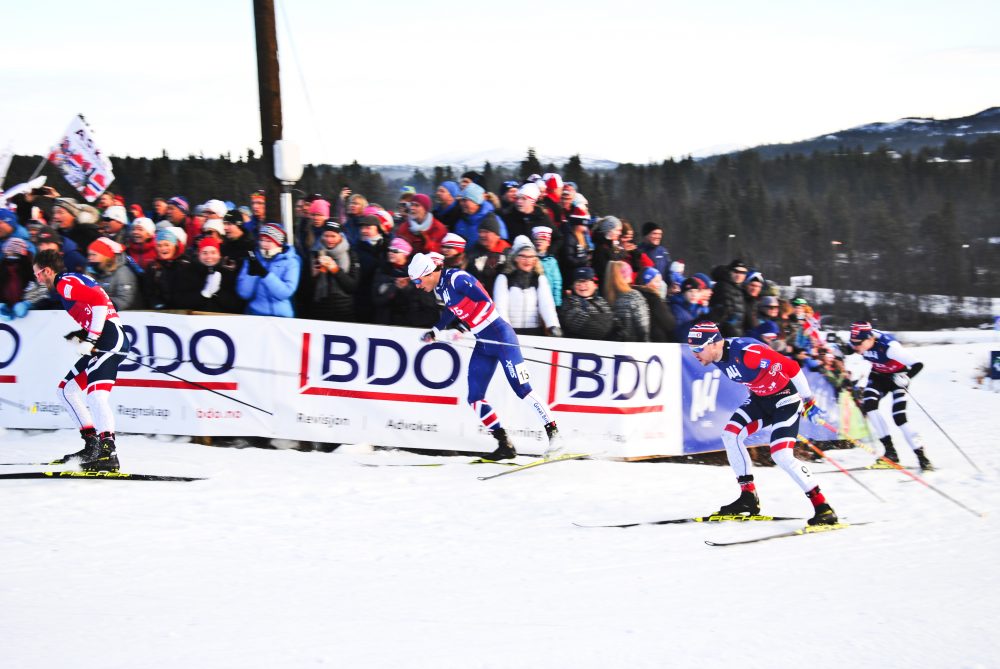
The women’s all-Norwegian podium from the 2018 FIS Skate Sprint in Beitostølen, Norway. Maiken Caspersen Falla (center) won, Kristine Stavås Skistad placed second (left), and Lotta Udnes Weng was third (right). (Photo: Aleks Tangen)
In a place like Norway, where the pool of cross-country athletes appears eternally deep, when you see competitors raise the bar, there’s nothing else to do but jump.
On Saturday in Beitostølen, Norway the known knowns were self-evident: Maiken Caspersen Falla and Johannes Høsflot Klæbo took the freestyle sprint wins during the second day of FIS race competitions.
As both athletes were overall World Cup sprint champions last season, there are no shockers there. (Klæbo has won two consecutive sprint crystal globes, Falla three.) But other skiers rose to the occasion and proved they too can jump nearly as high as Falla and Klæbo.
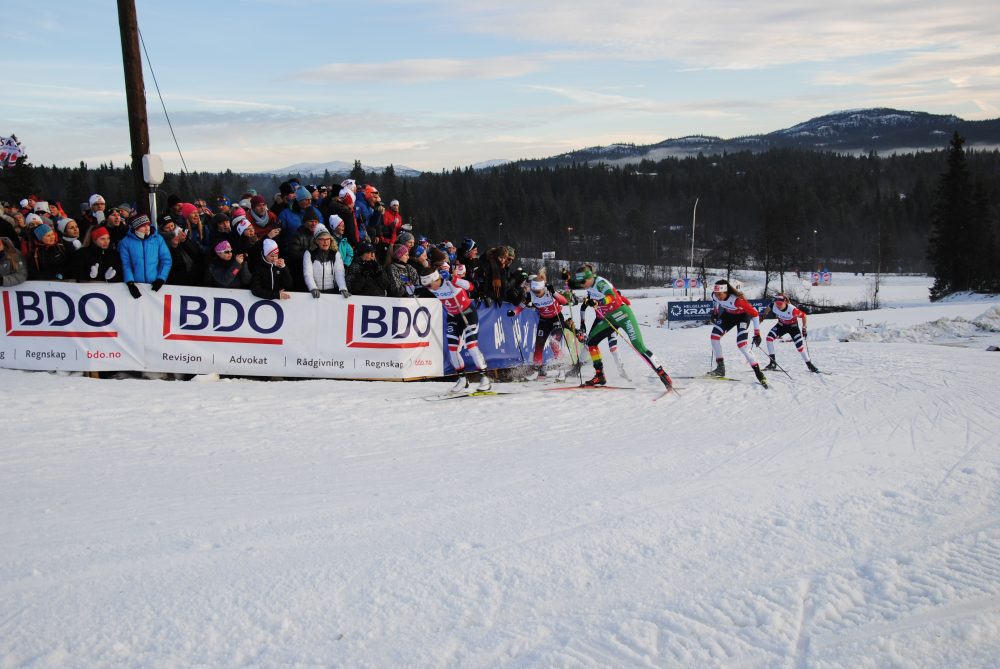
The women’s second semifinal on course in Beitostølen, Norway during the FIS skate sprint. (Photo: Aleks Tangen)
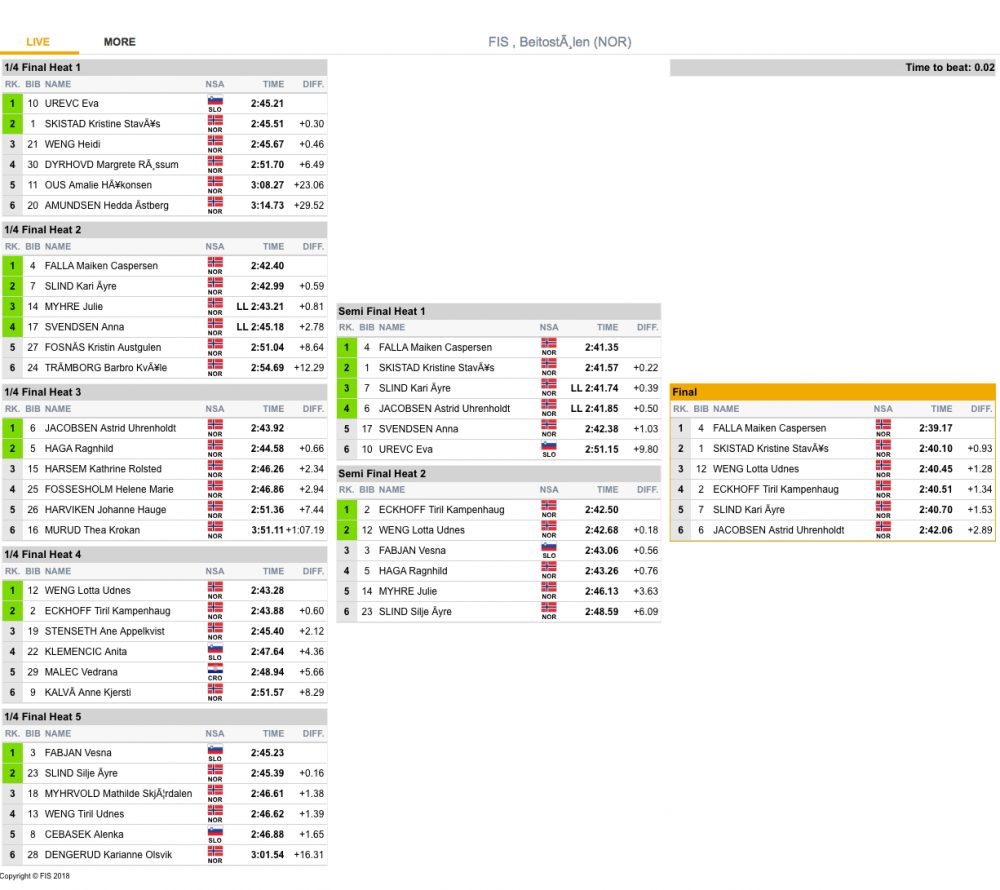
The women raced a 1.3 k skate sprint course with 54 women racing the qualifier. And this is where things got interesting. Nineteen-year-old junior Kristine Stavås Skistad, who has raced a single World Cup, the 2018 Drammen classic sprint in which she placed 51st, won the qualifier in 2:44.68 minutes. What is startling when scrolling through the qualification results is her birth year: 1999. The next closest Norwegian athlete in age finishing in the top-10 of qualification on Saturday was Anne Kjersti Kalvå, born in 1992.
In last season’s World Junior Championships, Skistad placed fifth in the 5 k classic, and second in the skate sprint. So certainly she is an up and comer. But the fact that she held her own in a world-class field of Norway’s best, is a statement.
Falla qualified in fourth (+1.63), and moved through to the finals by winning both her quarterfinal and semifinal.
Skistad, however, maybe played it a bit coyer. She squeaked into the semis by placing second in her heat by .30 seconds to Slovenia’s Eva Urevc. She then placed second to Falla by .22 seconds in the first semifinal. (That semi proved the faster of the two semifinals — both Kari Øyre Slind and Astrid Uhrenholdt Jacobsen advanced as lucky losers from the Falla semi.)
Falla is Falla – a veteran with big experience and the know how to throttle the engine when it matters. She won the final in 2:39.17 minutes, a pace over five seconds faster than Skistad’s winning qualification time.
In the all Norwegian final, Skistad placed second (+0.93), Lotta Udnes Weng was third (+1.28) Tiril Kampenhaug Eckhoff, both a World Champs and Olympic medalist in biathlon, was fourth (+1.34), Slind fifth (+1.53), and Jacobsen sixth (+2.89).
The women’s skate sprint bracket from the second day of racing in Beitostølen, Norway (Photo: FIS Live Timing screenshot) Click the image to enlarge.
More Klæbo and a bit of Iversen
It is time to refresh the syntax and remember Klæbo’s name can be used as a verb. With that in mind, Klæbo Klæboed in the men’s 1.7 k skate sprint. But like Falla on the women’s side, the twenty-two-year-old Klæbo was tested.
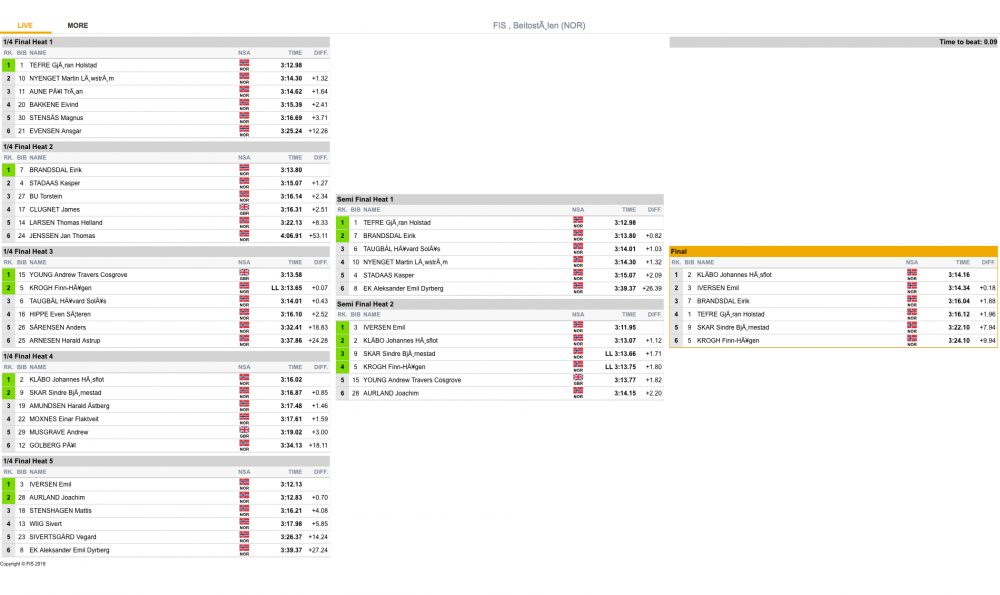
Tefre Gjøran, a year older than Klæbo at 23, was the fastest qualifier, finishing in 3:12.27 minutes. Klæbo was second (+1.12), and Emil Iversen third (+1.62).
In the end, it was Iversen, seeming like an aged vet at 27, who made life spicey for Klæbo.
Klæbo and Iversen advanced to the second semifinal. And it was Iversen who pushed the pace and was the catalyst for speed. Although not a massive margin, a second is still a second — but we are talking sprints here — Iversen won the second semi in 3:11.95, 1.12 seconds faster than second-place skier Klæbo.
“I was not good enough to fight him then,” Klæbo said to Norwegian broadcaster NRK, according to a translation, as he spoke about Iversen’s charge in the semis. “I had to be cynical and save me to the final. But Emil has a lot of effort, you saw how much he had in the finals too.”
It was a final highlighted by a Klæbo-Iversen dual. Klæbo won in 3:14.16 outpacing perhaps a new rival this season in Iversen, by 0.18 seconds.
In the all-Norway final, Eirik Brandsdal placed third (+1.88), Gjøran fourth (+1.96), Sindre Bjørnestad Skar fifth (+7.94), and Finn Hågen Krogh sixth (+9.94).
Andrew Young from Great Britain raced to 10th overall in Beito’s day 2 skate sprint. This is a shot from his semifinal. (Photo: Aleks Tangen)
Great Britain’s Andrew Young was 10th overall, James Clugnet 17th, and Andrew Musgrave 24th. They were the only non-Norwegians in the top-30.
“Top 10 is really good, the level here is really high,” Young told FasterSkier’s reporter in Beitostølen. “I had really good skis, and I was surprised nobody else wanted to take the lead at the start so I just went for it. I tried not to use too much energy. I knew Klæbo would go fast. So I just wanted to make sure I was on his tails when he came past. I was really pleased with my skiing. I wasn’t so defensive, I wasn’t so passive, and not let the others control the race. I tried to control it and be in that spot where I wanted to be.”
Young was passed in the final stretch by Skar and Krogh, who both advanced to the finals as lucky losers in the second semifinal.
Canadians Russell Kennedy placed 51st, Maks Zechel 94th.
“It is very deep, but it makes it fun there are lots of rides and always somewhere to push,” Kennedy emailed on Saturday about his experience racing to 22nd overall in the 15 k classic yesterday. “I was very happy with that. I don’t know if surprised is the right word. Last weekend in Olos, [Finland] I had a really good skate race and a good classic race against some big names. I was excited I ended up so high up the results for sure! It was a tough day with skis and I was lucky to be on fast skis even though they were a little slick on the last laps.”
The men’s skate sprint bracket from the second day of racing at in Beitostølen, Norway (Photo: FIS Live Timing screenshot) Click the image to enlarge.
Racing concludes in Beitostølen tomorrow with a 10 k/ 15 k skate.
Maiken Caspersen Falla of Norway — in the lead during the women’s final — doing what she does best: controlling a sprint and eventually taking the win in Saturday’s 1.3 k freestyle sprint in Beitostølen, Norway. (Photo: Aleks Tangen)
Welcome to The Rundown, your quick primer of need-to-know information about the day’s racing. We’ll be updating this digest as the day goes on with additional results, photos and quotes. The Rundown is NOT a race report; stay tuned for complete race reports later today with interviews from the day’s top racers.
***
FIS cross-country Beitostølen, Norway: 1.3 k freestyle sprints
In Beitostølen on Saturday, the second day of FIS races there sent the women on 1.3-kilometer skate sprint course. Reigning World Cup overall sprint champion from Norway, Maiken Caspersen Falla, won the final in a time of 2:39.17 minutes. Falla was the fourth fastest qualifier.
A lovely day for a sprint in Beitostølen, Norway during Saturday’s freestyle sprint. (Photo: Aleks Tangen)
Norwegians Kristine Stavås Skistad, the day’s fastest qualifier, placed second in the final (+0.93), Lotta Udnes Weng was third (+1.28).
The men’s sprint was held on a 1.7 k course with last season’s World Cup sprint champion Johannes Høsflot Klæbo (NOR) winning the final in 3:14.16 minutes. Friday’s runner-up in the 15 k classic, Emil Iversen (NOR), was second (+0.18). Also from Norway, Eirik Brandsdal placed third (+1.88).
Great Britain’s Andrew Young was 10th overall, James Clugnet 17th, and Andrew Musgrave 24th. They were the only non-Norwegians in the top-30.
Canadians Russell Kennedy placed 51st, Maks Zechel 94th.
Saturday, Bruksvallarna hosted day two of its FIS cross-country races with men’s and women’s distances races. The women began the day with a 10 k classic event.
Friday’s runner-up in the 5 k freestyle, thirty-one-year-old Charlotte Kalla of Sweden, won Saturday’s classic race in 27:54.1 minutes. Frida Karlsson (SWE) placed second (+25.2), Stina Nilsson (SWE) third (+38.2).
The men skied a 15 k classic event. In that race, Sweden’s twenty-nine-year-old Calle Halfvarsson bested the 149 starters with a winning time of 37:14.6 minutes. Sweden took the next two spots on the podium, as Viktor Thorn placed second (+39.1), and Gustav Eriksson third (+1:02.5).
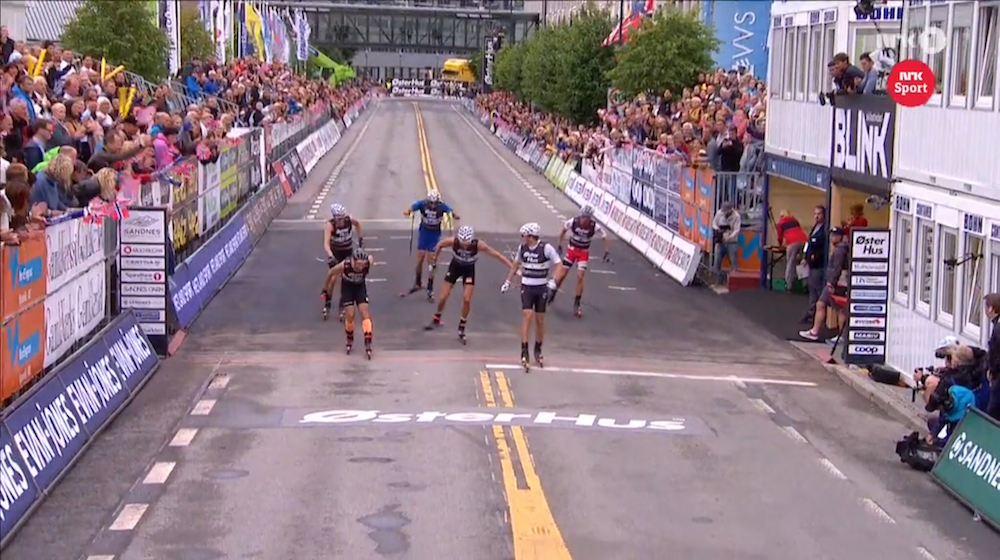
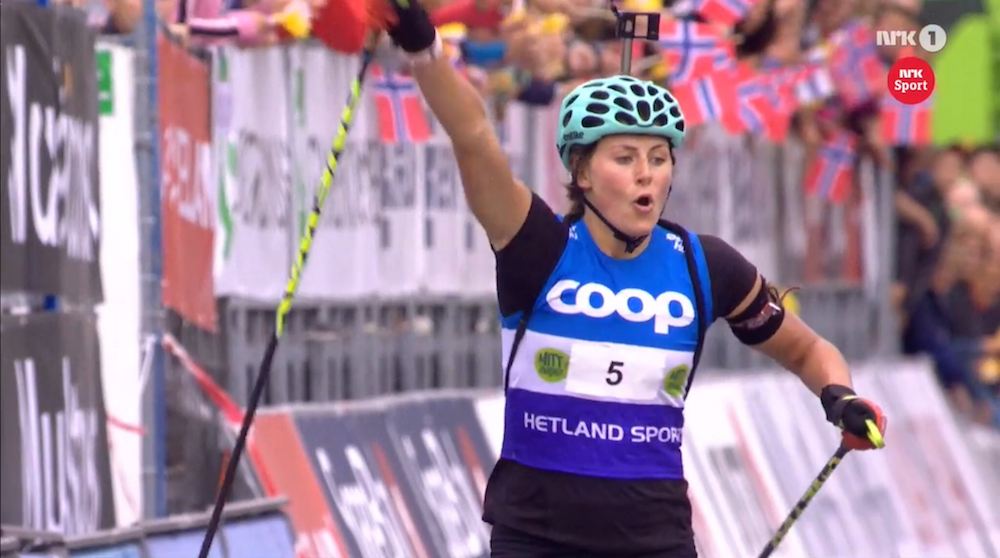
Norway’s Maiken Caspersen Falla (1) winning Saturday’s women’s cross-country sprint final on the last day of the 2018 Blink Ski Festival in Sandnes, Norway. (Photo: Blink Ski Festival/Axelar/Arild Aarnes)
The 2018 Blink Ski Festival continued in full force on Friday and Saturday, with cross-country and biathlon prologues, 10- and 15-kilometer cross-country races and biathlon mass starts all taking place on Friday, followed by sprints on Saturday.
Elite racing began in the afternoon with the men’s prologue (no prologue was held for the women), Norway’s Gjøran Holstad Tefre posted the fastest time of 3:12.21. Finishing 1.89 seconds back was another Norwegian, Aleksander Dyrberg Ek, and Great Britain’s Andrew Young claimed the prologue’s final podium spot, finishing 2.27 seconds off the winning time.
Also in the top 10 were Norway’s Morten Eide Pedersen in fourth (+4.7), Britain’s James Clugnet in fifth (+4.76), France’s Lucas Chanavat in sixth (+5.09), Norway’s Stian Grastveit in seventh (+5.70), France’s Renaud Jay in eighth (+5.75), and Norway’s Sindre Folkvord and Harald Østberg Amundsen in ninth (+6.00) and 10th (+6.03), respectively.
Canada’s Evan Palmer-Charrette finished 34th (+16.68), Scott Hill placed 39th (+19.37) and Bob Thompson was 40th (+19.54) out of 47 finishers.
After the elite men’s prologue, athletes geared up for a men’s and women’s biathlon prologues.
Norway’s Johannes Thingnes Bø took the men’s biathlon prologue win in a time of 10:30.2 after two misses (1+1). One second back, it was a tie for second place between another Norwegian, Lars Aasheim Svaland, who had one penalty (0+1), and France’s Antonin Guigonnat, with one miss as well (1+0).
Slovenia’s Anastasiya Kuzmina, who took one gold and two silver medals at the 2018 Olympics, won Friday’s women’s prologue with clean shooting and a time of 11:34.6. Just 0.6 seconds behind was Norway’s Emilie Ågheim Kalkenberg, who placed second with perfect 10-for-10 shooting as well. France’s Justine Braisaz claimed third, 10.7 seconds out of first, after missing two targets (0+2).
The next event on Friday’s program was the women’s 10 k cross-country mass start, which Norwegian sprint specialist Maiken Caspersen Falla won in 20:39.4. She bested fellow Norwegian Mari Eide by 1.9 seconds, and Sweden’s Charlotte Kalla and Norway’s Kari Øyre Slind followed in third (+3.9) and fourth (+3.9), respectively, with the same time.
Working their way into the top 10 were Russia’s Elena Soboleva in fifth (+4.9), Finland’s Krista Pärmäkoski in sixth (+5.0), Norway’s Ingvild Flugstad Østberg and Ragnhild Haga in seventh (+5.1) and eighth (+5.2), respectively, Austria’s Teresa Stadlober in ninth (+6.6), and Russia’s Natalia Matveeva in 10th (+8.7). Out of 31 women, Nichole Bathe, racing for Great Britain, finished in 23rd (+1:09).
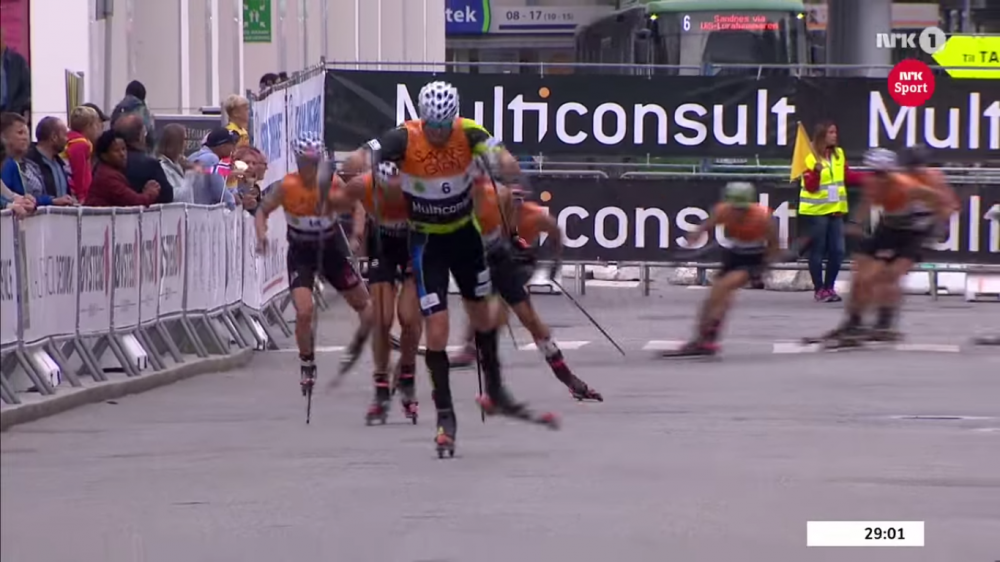
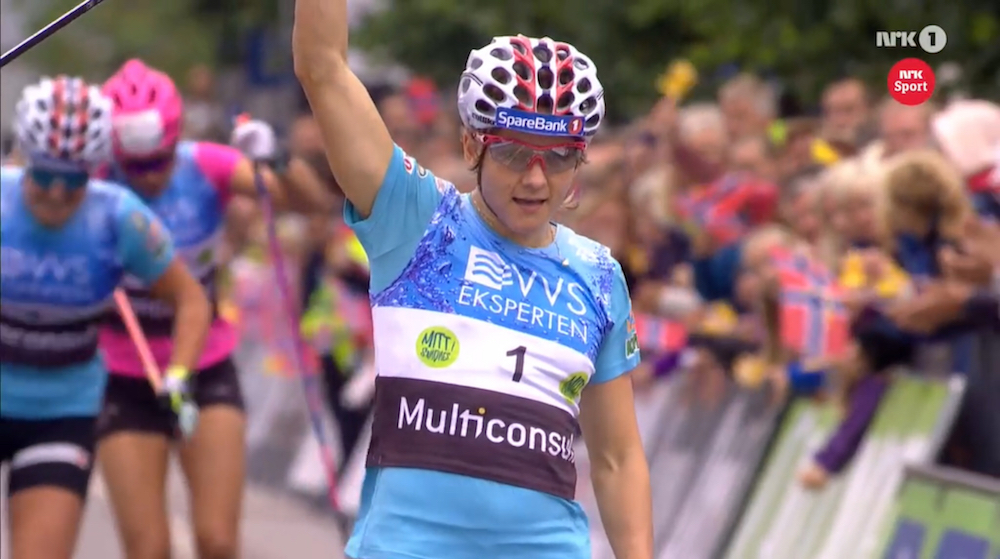
Sweden’s Hanna Öberg (front) racing to first in the women’s biathlon mass start on Friday the 2018 Blink Ski Festival in Sandnes, Norway. (Screenshot: NRK broadcast)
Friday’s program then moved on to the women’s biathlon mass start. Sweden’s Hanna Öberg won the event in a time of 13:19.4 despite three misses (0+1+2+0). Kuzmina finished second, crossing 2.1 seconds behind the Swede after a penalty in each stage (1+1+1+1). Third place went to another Swede, Mona Brorsson, who crossed 5.9 seconds after Öberg and shot four penalties (2+1+1+0).
Norway’s Henrik L’abeé-Lund (r) winning the men’s biathlon mass start on Friday at the 2018 Blink rollerski festival, ahead of his teammate Johannes Thingnes Bø in second in Sandnes, Norway. (Screenshot: NRK broadcast)
Following the women’s biathlon race, the men’s biathlon mass start got underway. Norway’s Henrik L’abeé-Lund emerged as the winner, crossing the line in 17:21.3 after shooting four penalties (1+1+2+0). Exactly three seconds behind him was J.T. Bø in second place with two misses (1+0+1+0). Sealing the all-Norwegian podium was Vetle Sjåstad Christiansen, who missed six targets (1+1+2+2) and finished 12.1 seconds after L’abeé-Lund for third.
Russia’s Sergey Ustiugov leading the pack of the elite men’s 15-kilometer freestyle cross-country mass start on Friday at the 2018 Blink Ski Festival in Sandnes, Norway. (Screenshot: NRK broadcast)
Friday’s final race turned back to cross-country for the elite men’s 15 k freestyle mass start. Russian skier, Sergey Ustiugov, who was banned from competing at the 2018 Winter Olympics, won it in 29:26.0, 2.1 seconds ahead of Norway’s Aleksander Ek, (who had placed second in the prologue to start the day). Italy’s Federico Pellegrino was just another 0.6 seconds back in third (+2.7).
“I was a little nervous today because I won it last year and I wanted to repeat my success here again today,” Ustiugov told NRK through a translator. “It didn’t go easy, but I did manage to do what I wanted to do, and I would like to thank all my team, Markus [Cramer], and the rest of the team. That was great.”
The remaining top ten included Norway’s Vebjørn Turtveit in fourth (+2.9), Sindre Bjørnestad Skar in fifth (+3.9), Øystein Pettersen in sixth (+5.4), and Torstein Bu in seventh (+5.8). France’s Adrien Backscheider and Clement Parisse placed eighth (+5.9) and ninth (+6.2) respectively, followed by Norway’s Eirik Brandsdal in tenth (+6.2).
Racing for Canada, Alex Harvey finished 14th (+7.5).
Norway’s Maiken Caspersen Falla winning the women’s cross-country sprint on Saturday at the Blink Ski Festival in Sandnes, Norway. It was her second-straight victory after topping Friday’s 10 k freestyle mass start as well. (Screenshot: NRK broadcast)
Saturday marked the final day of the Blink rollerski festival and included cross-country and biathlon sprints. In the women’s cross-country final, Norway’s Falla picked up her second-straight win, ahead of Russia’s Matveeva in second (+1.6) and Sweden’s Ida Ingemarsdotter in third (+2.4). Norway’s Eide was just off the podium in fourth (+2.9), Norway’s Barbro Kvåle Trømborg placed fifth (+3.7), and another Norwegian, Linn Ravndal, finished 8 seconds back in sixth.
Falla’s won the final in 3:40.8 after topping her quarterfinal and semifinal as well.
The men’s cross-country racing began with a prologue, which Norway’s Vetle Christiansen won in 1:31.92, just three-hundredths of a second ahead of his fellow countryman, Ek. France’s Baptiste Noel placed third in the prologue, 1.76 seconds out of first.
Russia’s Gleb Retivykh (second from r) winning the men’s cross-country sprint final on Saturday at the Blink Ski Festival in Sandnes, Norway. (Screenshot: NRK broadcast)
In the heats later in the day, Russia’s Gleb Retivykh came out on top of the final, getting there by placing second in both his quarterfinal and semifinal, then winning the last round by 0.2 seconds over Pellegrino in a time of 3:15.5. Pellegrino had won his quarterfinal but advanced as a lucky loser in fourth out of the second semifinal. The 25-year-old Ek capped off his successful series with another podium, placing third in the final, just 0.3 seconds out of first.
In a post-race interview with NRK, Retivykh explained this was his first time at Blink.
“I am very happy,” he said in English. “Today is my first win at Blink, and [it was my] first time here.”
In a close final, Norway’s Gjøran Tefre and Brandsdal followed in fourth (+0.5) and fifth (+0.7), respectively, Italy’s Francesco De Fabiani was just behind in sixth (+0.8).
France’s Justine Braisaz celebrating across the line as she wins the women’s biathlon super sprint on the last day of 2018 Blink Ski Festival on Saturday in Sandnes, Norway. (Screenshot: NRK broadcast)
Biathletes were able to experience head-to-head sprint racing as well (a deviation from the typical biathlon World Cup sprint format, which is individual), in the women’s and men’s biathlon supersprints, which included one prone and one standing shooting stage per heat.
France’s Braisaz won the women’s final in 7:45.3. She had previously won her quarterfinal (which was a longer distance), then placed seventh in the first semifinal (same distance as final). Norway’s Marte Olsbu placed second in the final (+0.4), and Sweden’s Brorsson returned to the podium in third (+0.9).
“It was really close at the end, but I am very happy about the weekend here,” Braisaz told NRK on English after. “Everything is perfect, even though the weather is a little bit — how do you say — moody. But it’s OK. And I am really happy to be in Norway and I will make my stay longer after the festival weekend.”
Norway’s Vetle Sjåstad Christiansen winning the men’s biathlon supersprint on Saturday, the last day of the Blink Ski Festival, in Sandnes, Norway. (Screenshot: NRK broadcast)
In the men’s biathlon super sprint, Norway’s Christiansen dominated the day, winning his quarterfinal and semifinal before beating J.T.Bø by 2.2 seconds in the men’s final with a time of 12:01.8. France’s Guigonnat completed the podium in third, 8.5 seconds behind Christiansen.
While we covered who’s still skiing — casually, recreationally, backcountry, basically anything other than full-on training — last week, the start of May marks the beginning of a new season for year-round skiers. And with the first few days of May have come some training pics via social media. Here’s a roundup of some that caught our eye on Instagram:
Alex Harvey:
Alex Harvey hitting the weights hard: “May 1st ⏩ Back in training!💪”
Megan Tandy:
Another determined Canadian athlete in the gym: biathlete Megan Tandy at her training base in Klingenthal, Germany.
Emily Dreissigacker:
Newly minted US Biathlon High-Performance Team member Emily Dreissigacker skied up Stowe Mountain in Vermont on May 2.
Emma Lunder:
Meanwhile near Canmore, Alberta, Canadian biathlete Emma Lunder broke a pole while crust skiing at Burstall Pass.
Scott Patterson:
Looks like Alaska Pacific University skier and U.S. Ski Team member Scott Patterson is ready to go the distance, specifically 100 miles in May.
Sadie Bjornsen:
Scott Patterson isn’t the only one with a 100-mile goal for this month. His APU and U.S. Ski Team teammate Sadie Bjornsen is right there with him, getting out on snow in Anchorage, Alaska.
Erik Bjornsen:
Speaking of the Bjornsens, Erik (c) got some ski-specific training in yesterday as a substitute coach for the Anchorage Biathlon Club at Kincaid Park in Anchorage.
Johannes Høsflot Klæbo and Eirik Brandsdal:
Norway’s Johannes Høsflot Klæbo (c) and Eirik Brandsdal (l) were still racing (and reaching the podium) last weekend at Bysprinten in Mosjøen, Norway.
Krista Pärmäkoski:
Finland’s Krista Pärmäkoski was all smiles while listening to some tunes during a recent dryland workout. She wrote about the start of the new season and being well-rested and focused on her World Cup goals. “There is work and a lot, but that’s what this is about.”
Dario Cologna:
Swiss superstar Dario Cologna is “back to work,” according to one hashtag in this May 2 post, where he’s seen skiing on the Engstligenalp plateau in the Swiss Alps. “Let‘s start the new season,” he wrote.
Laurien van der Graaff:
Another Swiss skier Laurien van def Graaff (bottom and top right) is back at it in Sjusjøen, Norway.
Charlotte Kalla:
Sweden’s Charlotte Kalla (second from right) hasn’t wasted any time getting back on snow as evidenced by this photo she took with her Piteå Elit Ski Club teammates on Sunday in Finland’s Southern Lapland region.
Therese Johaug:
Looks like Therese Johaug has been logging some cold-water surf sessions on the Lofoten archipelago in northern Norway, as well as some fishing.
Martin Fourcade:
France’s defending IBU World Cup champ Martin Fourcade has been cross-training and logging some long-lost time in the saddle.
Franziska Preuss:
German biathlete Franziska Preuß (or Preuss) documented her “First mountain run of the new year” in Ruhpolding, Germany. And look, she’s higher than the mountains.
Leif Nordgren:
U.S. biathlete Leif Nordgren went road biking with his wife, Caitlin Napoleoni, whom he married in December.
Niklas Dyrhaug, Richard Jouve and Robin Duvillard:
Meanwhile athletes like Norway’s Niklas Dyrhaug (l) and France’s Richard Jouve (c) and Robin Duvillard are on the road to recovery, according to this FIS Cross Country post.
Norway’s Johannes Høsflot Klæbo (l) edging Russia’s Alexander Bolshunov (3) and Norway’s Eirik Brandsdal (not shown) in the first semifinal of the men’s classic sprint at the World Cup in Drammen, Norway. Klæbo went on to win the final, ahead of Brandsdal in second and Bolshunov in third. (Photo: Fischer/Nordic Focus)
In the classic venue that are the Drammen city sprints, it was a singular affair from start to finish during the men’s World Cup 1.2-kilometer classic sprint on Wednesday. In a race format that tapered from a field of 61 skiers to the winner, one only needs to track the skier in the overall World Cup’s leader bib to follow along.
The yellow-bibbed skier, Norway’s Johannes Høsflot Klæbo, didn’t surprise with his sprint win in Drammen as much as place another high performance stamp on his 2017/2018 campaign.
Klæbo won the qualifier in 2:49.32 minutes. Teammate Eirik Brandsdal skied to second in the qualifier, 3.5 seconds behind Klæbo. Russian Alexander Bolshunov skied the third-fastest qualifying time, finishing 4.48 seconds back. This puts some things in perspective, if anybody thought Klæbo would bloat in his post-Olympic gold medal glow — he won three golds in PyeongChang — you’d be wrong.
Klæbo would have have good reason to cash it in. What exactly does the 21 year old need to prove? Coming into Wednesday’s race, Klæbo had already captured the Sprint World Cup Crystal Globe. It’s the Norwegian phenom’s second-consecutive overall sprint title.
Yet Klæbo is also on the verge of sealing up his first Overall World Cup title. After the Drammen sprints, Klæbo leads the overall standings with 1308 points. Behind him, Martin Johnsrud Sundby of Norway (who did not contest Wednesday’s sprint), trails in second place with 980 points total.
Johannes Høsflot Klæbo leads his quarterfinal with fellow Norwegian Fredrik Riseth (l) and Sweden’s Emil Jönsson (30) at the World Cup classic sprint in Drammen, Norway. (Photo: Fischer/NordicFocus)
“It was really important to me to get the 100 points today,” Klæbo told the International Ski Federation (FIS) after the race. “I need as many points as I can get against the other guys for the [overall] Crystal Globe. I will race the Holmenkollen 50 k this weekend and I know it will be tough. Also it’s great to win here in front of all the people. I was second here last season and I’m really happy to now have won Drammen.”
Let’s circle back to what Klæbo needs to prove, beyond padding his overall lead by another 100 points by winning the Drammen sprint. He’s proving at his young age, pending any monumental flameout, that he’s setting the stage for a historic international cross-country ski career.
This season alone, Klæbo has won six of nine individual sprint World Cups. He’s won 10 World Cup races in total. That win total puts Klæbo in rarefied company: in the men’s field, only Petter Northug (with 10 wins) and Sundby (16 wins) have won 10 or more World Cup races in a single season.
Winners want to win. Amidst the five-deep crowd surrounding the sprint course featuring Drammen’s iconic Bragernes Church, with his pink-themed flare, Klæbo proved once again he is a consummate winner.
There was his dominating qualifier. Then there was Klæbo’s quarterfinal, in which he looked less threatening. He won the first quarterfinal by 0.7 seconds in a photo finish with Brandsdal. That heat seemed to be a test run, as if Klæbo were feeling the course out and asking himself how it skied with five other bodies jousting for tracks and inside lines. There was never the hallmark Klæbo burst of speed or any real dominance. Klæbo kept in contact up the long initial uphill, and down through the tight and sinuous S-turns after the course’s highpoint.
If in fact the first quarterfinal was a dress rehearsal, Klæbo must have realized that any real podium threats would be drag racing up the final quarter-kilometer climb that finished nearly smack-dab in front of the church.
The first semifinal featured the day’s top-three qualifiers: Klæbo, Brandsdal and Bolshunov. (Bolshunov advanced by winning the second quarterfinal.) The three skiers finished 1-2-3 with Klæbo taking the win in another photo finish with Brandsdal.
Russia’s Alexander Bolshunov leads five Norwegians in the men’s classic sprint final at the World Cup in Drammen, Norway: (from l to r) Eriik Brandsdal, Johannes Høsflot Klæbo (yellow bib), Sindre Bjørnestad Skar (10), Kasper Stadaas (16), and Emil Iversen. (Photo: Fischer/Nordic Focus)
Tactically, Bolshunov played his hand early. Determined to break Klæbo, the Russian led out hard and took the sharp end of the race in earnest. At the top of the course, Bolshunov had strung the five other skiers out behind him. Moments before the highpoint and entering the technical downhill S-turns, Bolshunov and Klæbo gave a burst of speed and distanced themselves by 10 meters. As Klæbo learned in his heat, even with speedy skis, the downhill is not decisive. It’s more a function of skiing out front, staying on your feet and entering the final straight with enough high-octane gas to turbo the finish.
Up the final climbing stretch, which seems as eternal as some flame burning inside the Bragernes Church, Bolshunov faded slightly, while Klæbo and Brandsdal pulled ahead.
Klæbo’s second takeaway: he already knew the course was won on the final straightaway climb. If he could match Bolshunov on the remainder of the course, Bolshunov could not mirror him in the final meters.
The final played out like Klæbo’s semi. Bolshunov punched it early. Klæbo sat behind the Russian, matching him pole for pole, stride for stride. Up front was as good a place as any for Bolshunov. Besides the Russian, it was an all-Norwegian final. There was Klæbo and Brandsdal, along with Sindre Bjørnestad Skar, Kasper Stadaas and Emil Iversen.
The men’s podium from Drammen’s 2018 classic sprint. Norway’s Johannes Høsflot Klæbo (c) placed first, his teammate Eirik Brandsdal (l) was second, and Russia’s Alexander Bolshunov (r) finished third. (Photo: Fischer/NordicFocus)
Bolshunov again led up and over the top of the course, through the S-turns and through the tucking downhill. Brandsdal trailed by 10 meters, but by the final turn before the uphill to the church’s front door, the threesome had regrouped. Again, as the double poling got down to business, Bolshunov faded, Klæbo pulled away and Brandsdal could only stay a second behind the day’s winner. And of course Klæbo was able to toe the line as he bowed to the frenzied crowd. Nothing to prove except he can win with panache and win in style when the Norwegian cameras turn out in force.
Klæbo won the final in 2:44.69 minutes. Brandsdal followed 1.04 seconds back in second place, Bolshunov finished third (+3.78), Bjørnestad fourth (+6.55), Kaspar fifth (+8.71), and Iversen sixth (+11.45).
Bjornsen Reaches Quarterfinals, 18th Overall
Erik Bjornsen was the lone North American who advanced to the heats, qualifying in 26th and finishing the day in 18th.
“I was feeling good,” Bjornsen told FasterSkier after the race. “It’s a tight course. It was a bit scrappy. … It’s my first time here qualifying for the heats, so I’m learning some things, for sure.”
Bjornsen skied in the fifth quarterfinal with Iversen, Russia’s Alexander Panzhinskiy, Finland’s Ristomatti Hakola, Emil Nyeng of Norway, and France’s Lucas Chavanat.
The American skied near the back of the group but avoided any real mishaps. Although the sport is not roller derby, Drammen’s tight-and-rutted corners offer up a close cross-country skiing cousin.
The U.S. Ski Team’s Erik Bjornsen toeing the line in fourth during Wednesday’s fifth heat in Drammen, Norway. Bjornsen placed 18th on the day. (Screenshot: NRK broadcast)
“I feel like – I kind of missed a few spots,” Bjornsen said. “At the bottom corner I was pushed to the outside. I was almost moving up into second, and looking back maybe I should have gone around him on the other side.”
Up the never-ending final straightaway, Bjornsen poled himself into a position to potentially advance to the semifinals as a lucky loser. However, that didn’t pan out for Bjornsen. Iversen won the heat in 2:51.96 minutes, Panzhinskiy placed second (+0.20), Hakola third (+0.99), with Bjornsen in fourth (+1.18).
Andy Newell racing to 33rd in the men’s classic sprint qualifier at the World Cup in Drammen, Norway. (Photo: Fischer/NordicFocus)
Also for the U.S., Andy Newell missed the quarterfinals after finishing 33rd in qualification, 0.9 seconds out of 30th. Logan Hanneman and Kevin Bolger finished 49th and 50th, respectively, and Reese Hanneman 56th. The U.S. Ski Team’s Simi Hamilton sat out Wednesday’s sprint as he is recovering from an illness.
For Canada, Julien Locke finished 51st in qualifying, Alex Harvey was 54th, and Andy Shields 58th.
Maiken Caspersen Falla of Norway (center) won the classic sprint in Drammen and all but wrapped up the Sprint Cup. Stina Nilsson of Sweden (left) was second and Jessie Diggins of the United States third. (NRK screencap)
FIS Cross Country World Cup (Drammen, Norway): Classic sprints
The cross-country World Cup hit the city on Wednesday, with classic sprints contested in the Oslo suburb of Drammen on snow which had been trucked onto the streets. And the crowd was rewarded with wins by two Norwegian favorites: Maiken Caspersen Falla in the women’s sprint and Johannes Høsflot Klæbo in the men’s race.
In the women’s final, Falla and Natalia Nepryaeva of Russia battled at the lead for much of the race, but Falla pulled away from the field on the last climb to the finish. Stina Nilsson of Sweden and Jessie Diggins of the United States pulled past Nepryaeva in the final few hundred meters to claim spots on the podium; Krista Parmakoski of Finland was fifth and Katja Visnar of Slovenia sixth.
With the win, Falla all but wrapped up the World Cup’s Sprint Cup crystal globe: she is just two points from having it clinched, with one sprint remaining on the calendar. In Falun, Sweden, in ten days, she more or less just has to make the heats to earn her third Sprint Cup in a row.
Also racing for the United States, Sadie Bjornsen and Sophie Caldwell made the quarterfinals, but did not advance past that round. Bjornsen ended the day in 21st and Caldwell in 27th.
Ida Sargent and Rosie Brennan were 47th and 48th in qualifying, followed by Kikkan Randall in 50th and Kaitlynn Miller in 53rd.
For Canada, Emily Nishikawa finished 52nd and Dahria Beatty 55th.
Great Britain’s Nichole Bathe, who raced for the University of Alaska Fairbanks, finished 58th.
In the men’s final, Russia’s Alexander Bolshunov set the pace for most of the heat. Klæbowas on his ski tails, and drew even on the course’s on downhill, where Norwegian teammate Eirik Brandsdal also caught up to them. Skiing back up to the finish, Klæbo ramped up to a furious tempo and was uncatchable. Brandsdal passed Bolshunov to claim second by a healthy margin. Sindre Bjørnestad Skar finished fourth, Kasper Stadaas fifth, and Emil Iversen sixth, all for Norway.
The lone North American to make the heats, Erik Bjornsen, qualified in 26th and finished the day in 18th. Teammate Andy Newell just missed the quarterfinals after finishing 33rd in qualification. Logan Hanneman and Kevin Bolger finished 49th and 50th, and Reese Hanneman 56th.
For Canada, Julien Locke placed 51st in qualifying, Alex Harvey 54th, and Andy Shields 58th.