From the FasterSkier archive — posts syndicated from athletes’ and coaches’ own blogs between 2004 and 2012, kept online as published. Current coverage is at fasterskier.com.

Tag: Eirik Myhr Nossum

  • How do you solve a problem like Johannes? The World Cup weighs in on how to dethrone him.

    How do you solve a problem like Johannes? The World Cup weighs in on how to dethrone him.

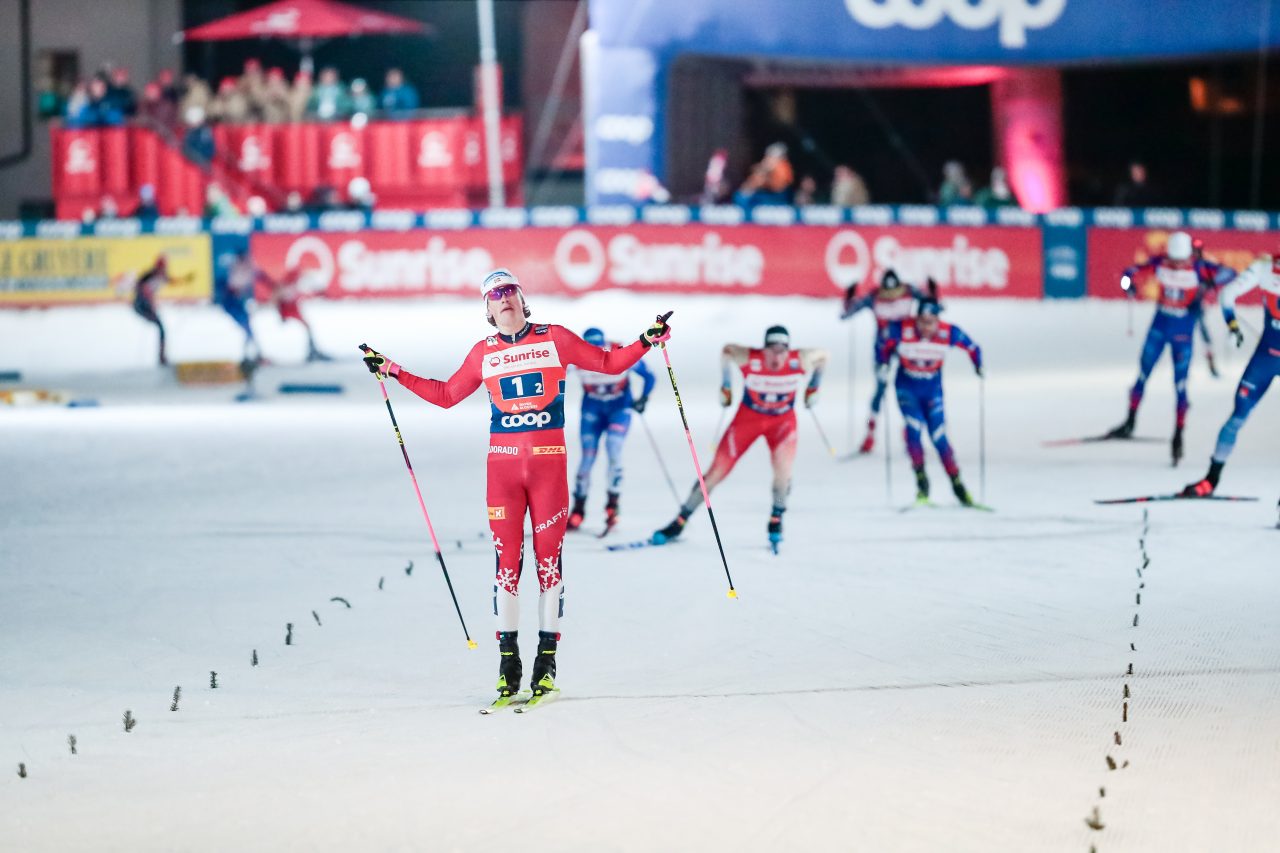
    Johannes Høsflot Klæbo, in typically dominating fashion, anchored the Norwegians to a victory in the team sprint in a World Cup in Switzerland earlier this month. (Photo: Modica/NordicFocus)

    In cross-country skiing, sprinting is a notoriously inconsistent discipline for a single competitor to dominate. The short distance leaves little time for racers to recover from even small mistakes; sharp corners and tight spaces often produce race-ending crashes.

    Which makes the track record of Norway’s Johannes Høsflot Klæbo almost impossible to comprehend.

    Klæbo, a five-time Olympic gold medalist, has won the last 10 straight sprint races he’s entered on the World Cup — the highest level of international competition. He often crosses the finish line far enough ahead of his rivals — if you can call them rivals — that he has time to unstrap his poles before crossing the finish line.

    Klæbo, 28, has won five out of the six Olympic and World Championships sprints he’s contested, and 52 of his 69 sprint World Cup starts — missing the World Cup sprint podium just once since 2018, according to data from the International Ski Federation.

    So: How do you beat this guy?

    FasterSkier, when the World Cup made its swing through Canada and Minnesota last season, decided to pose that question to an array of the circuit’s athletes and coaches. We’ve put together a kind of brief oral history below, seeking to appropriately describe Klæbo’s supremacy and the best ideas about how to take him down.

    Enjoy.

    What kind of tactics would you use to beat Klæbo in a sprint?

    Håvard Solås Taugbøl, a Norwegian World Cup racer and one of the nation’s (and globe’s) best sprinters: That’s the $1 million question. I have never managed to do it. 

    Swiss sprinter Valerio Grond: Maybe break his poles or something? I don’t know.

    French sprinter Lucas Chanavat: I mean, if I had the answer, I would have won the last one. You just focus on yourself, do the best race you can. It’s about my strengths. I think you have to be really perfect on every move you do. That’s the fun part about competing with him. It’s, like, you have to be perfect. And that’s really motivating.
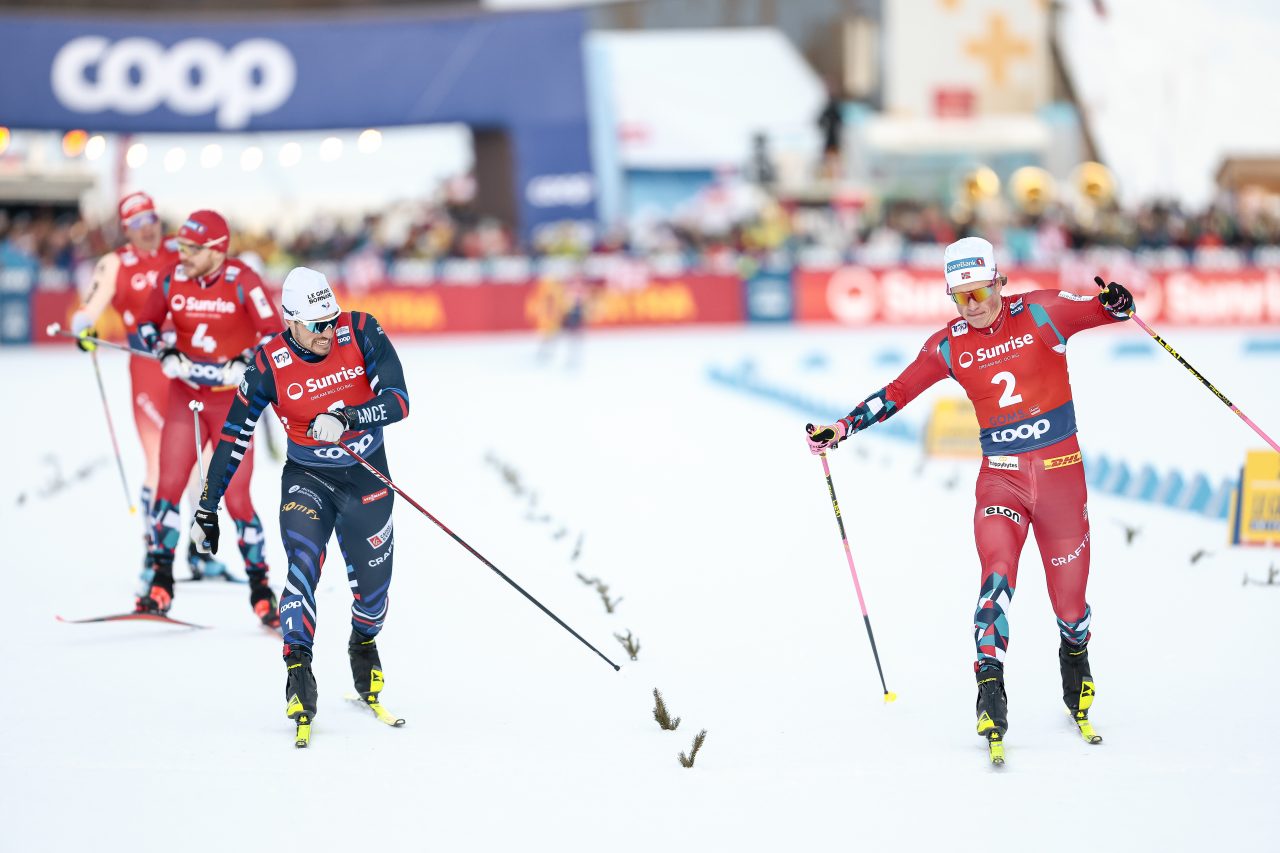
    Lucas Chanavat of France alllllmost beat Klæbo at a World Cup sprint race in Switzerland last year. But he didn’t. (Photo: Modica/NordicFocus)

    Sweden’s team manager, Anders Bystrom: I think, first of all, you have to mentally know that he’s not unbeatable. Because I think many people think so. He’s shown that he is almost unbeatable, so it’s fair that people think that. But we don’t talk about him like that.

    Jonna Sundling, the Swedish Olympic champion from 2022 in the women’s sprint: I would go hard from the start, and don’t leave any power. Just go, all that I have. I don’t think I could take him in the final meters — he’s too quick for me. The men, maybe they’re scared sometimes — I don’t know, I think they can do more than what they think they can do. Maybe.

    Maja Dahlqvist, a Swedish Olympic sprint medalist: I would try to sprint him down, like waiting til the end. But I guess a lot of people try to do that, and people are not so successful.

    Grond: If he’s in his top shape, he’s almost unbeatable. He’s really, really always in a good spot. But when he’s maybe not in the best spot, you have to take advantage of this and put in an attack.

    Canadian national team coach Robin McKeever: Break his pole? 

    Swedish sprinter Edvin Anger: I think we need to push him really hard, and take our chances. I don’t think I need to go hard early, but I think I need to have a good place. And when I take my chance, I really need to take my chance. And I need to push from the place in the track that I think is best for me. I can’t wait to see what he will do, because I need to do the thing first.

    Norwegian sprinter Erik Valnes: How to beat Johannes in sprint is all about him being in bad shape. [Laughs] I think maybe it’s about the finish — or, to be able to have a good finish after a high-speed final. There are many things that have to be right to beat him. You just need to start the finishing sprint before him, and be ahead. Because as long as you’re behind him, you’re one step behind him in the mind games as well.

    McKeever: I think the only way is by surprising him. And they’re trying.

    What makes Klæbo so good at sprinting?

    Chanavat: He’s strong in every aspect of the sprint race. He has, like, amazing turns, an amazing finishing sprint, he’s insane in stamina. He’s good at everything. He’s the GOAT [Greatest Of All Time]. 

    Grond: He’s so good in every technique and part of the race, and also tactically. He’s simply the best skier in history.

    Dahlqvist: He’s good in everything. He can go hard, he can wait, he can go from the start.

    Norwegian distance specialist Simen Hegstad Krüger: He often likes to control the heat and he gets a lot of respect. And you have — I think there’s a lot of guys that think there’s no chance to beat him so they just give him room and then they give it away to him. He has earned the respect but especially in sprint you can’t give anything away and you have to take your place and take your positions. And I think he’s the best in that but I think sometimes he gets the best positions a little bit too easily.
    Klæbo wins a Tour de Ski stage just ahead of his Norwegian teammate Erik Valnes. (Photo: Modica/NordicFocus)

    Valnes: I’ve been angry with myself sometimes because of bad tactical decisions. Because many times I’ve just, in my unconsciousness — you think, ‘Just follow him, and you’ll get a good result.’ But then you will not get past him.

    Bystrom: If you meet him in a heat, you almost adapt to what he’s doing. Because you have to see, ‘Okay, what’s Johannes going to do now?’ Because you know he has this X-factor in many parts of the course. 

    Does Klæbo have any weaknesses in sprinting?

    Chanavat: You should probably ask him. That would be the best.

    Klæbo: That’s going to be a secret. [chuckles] I don’t think I will tell everyone. I think I’ll keep that for myself and I’ll tell everyone when I’m done racing. That’s my answer.

    Norwegian sprinter Even Northug: Maybe none.

    Valnes: No. That’s the thing with him. He’s not having any weaknesses. You can say, like, maybe double-poling long flats. But he’s quite good there.

    Krüger: Not that I’ve seen so far. Even in distance races, it’s not so many weaknesses to find. 

    French sprinter Jules Chappaz: I think running [uphill], like in Ruka [the Finnish ski resort that hosts the season-opening World Cup races each year]. First it was the ‘Klaebo run,’ but now I think I’m really good at it. Maybe, hopefully next year in Ruka, I can run faster, beat him. [He didn’t.] He is sick a lot of times — maybe that’s sort of his weakness. 

    Klæbo coasts to the win in Ruka this year, beating everyone, including Jules Chappaz. (Photo: Modica/NordicFocus)

    Anger: It’s a hard question. But I think we need to push him and then make him a little stressed — that’s what I think.

    Bystrom: Mayyyyyybe it’s skating without poles — using your legs to be able to, maybe, go past him. But it’s really hard to say. He’s the best. He’s shown that many times. He’s so good in so many areas. It’s hard to say there’s one where you could beat him when there’s 28 areas where you can’t beat him.

    Are there ways athletes can train over the long-term, like over next summer or multiple seasons, to beat Klæbo?

    Chappaz: Just trying to focus on ourselves. This spring, I will compete in the Ski Classics [marathon races] to improve my double poling. To look to the Olympics, 2026, with the Val di Femme finish — I hope it will improve my double poling skills, to [be able to] beat him.

    Dahlqvist: Maybe they need another team like us, like the Swedish women, because you can use your team more. So, maybe a whole team needs to be stronger, to try to beat the Norwegian. They could do team tactics in a way, like everyone knows where they will go. 

    Anger: I’m still young — I’m just 21 years old. And he has a lot of training hours. A lot more than I have. With one or two years more, with good summers, also with a lot of hours, I think it will be better for me. And maybe I will be better in the final — I’m good in the quarters and the semis right now, but maybe I miss a little in the finals. I need to be a little harder and stronger.
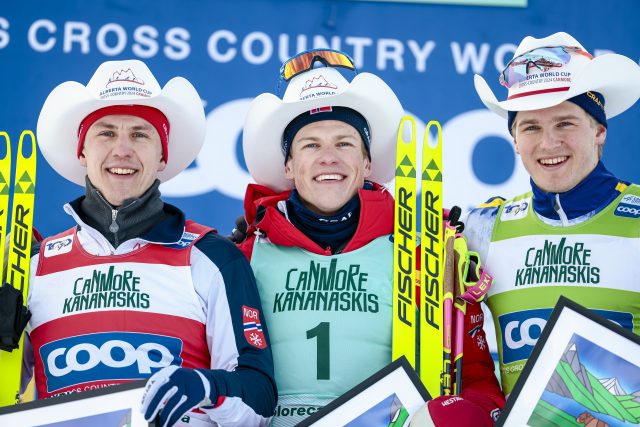
    Valnes, Klæbo and Anger pose for a podium photo after Klæbo won a World Cup sprint in Canada last year. (Photo: Modica/NordicFocus)

    Grond: We’ve just got to work hard. It’s also about learning how to ski against the best skier, for me. So, I’m trying, also, to get some experience on how they ski and where I can be better than them.

    Valnes: It’s more about improving the base level, the capacity, the VO2 max. If you have that base, from May until September, then you can build a little bit on that with specific training in October and November and just before the season starts.

    McKeever: The reality is, how do you beat Klaebo? Have him age out a little bit. 

    Northug: Training.

    Norwegian national team coach Eirik Myhr Nossum: You have to train, of course. But there were a lot of people training for the 100-meter dash, as well: Usain Bolt still won. So, if everybody in the world trains the best they can, still one will win — and it’s hard to beat Johannes. It’s possible, but he’s probably the best skier that’s ever been. And now it’s harder than ever, and he still wins.
  • At the Olympics, women cross-country ski race half as far as men. But that could be changing.

    At the Olympics, women cross-country ski race half as far as men. But that could be changing.

    Female American and Swedish cross-country skiers are pushing to race equal distances as men. But some of the sport’s star women remain unconvinced. 

    ZHIANGJIAKOU, CHINA — At the end of her first-ever competition at the Winter Olympics — a 15-kilometer effort that left her sprawled on the ground gasping for breath — Julia Kern contemplated the idea of racing twice as far.

    “I personally like the shorter distances,” said Kern, a rising American star. But, she added: “I think equal time makes sense to me.”

    Equity, however, remains an elusive target for athletes competing in the Olympic cross-country ski races here.

    In opening competitions, on Saturday and Sunday, the women raced 15 kilometers, while the men raced 30. In relays later in the Games, men will ski legs of 10 kilometers while the women race half as far. And when men ski a 50-kilometer marathon as their last event, women will race 30.

    A group of Americans, including the U.S. team’s biggest star, Jessie Diggins, has launched a campaign to change that.

    “I think it’s really, really cool to see people who are really good at long distance have their shot, and we get very few chances,” Diggins said. “We train just as hard, just as much as the men. As I’m sure you can see when I cross the finish line, we give just as much in every single race. And so I think we should be afforded the same opportunities for a variety of distance.”

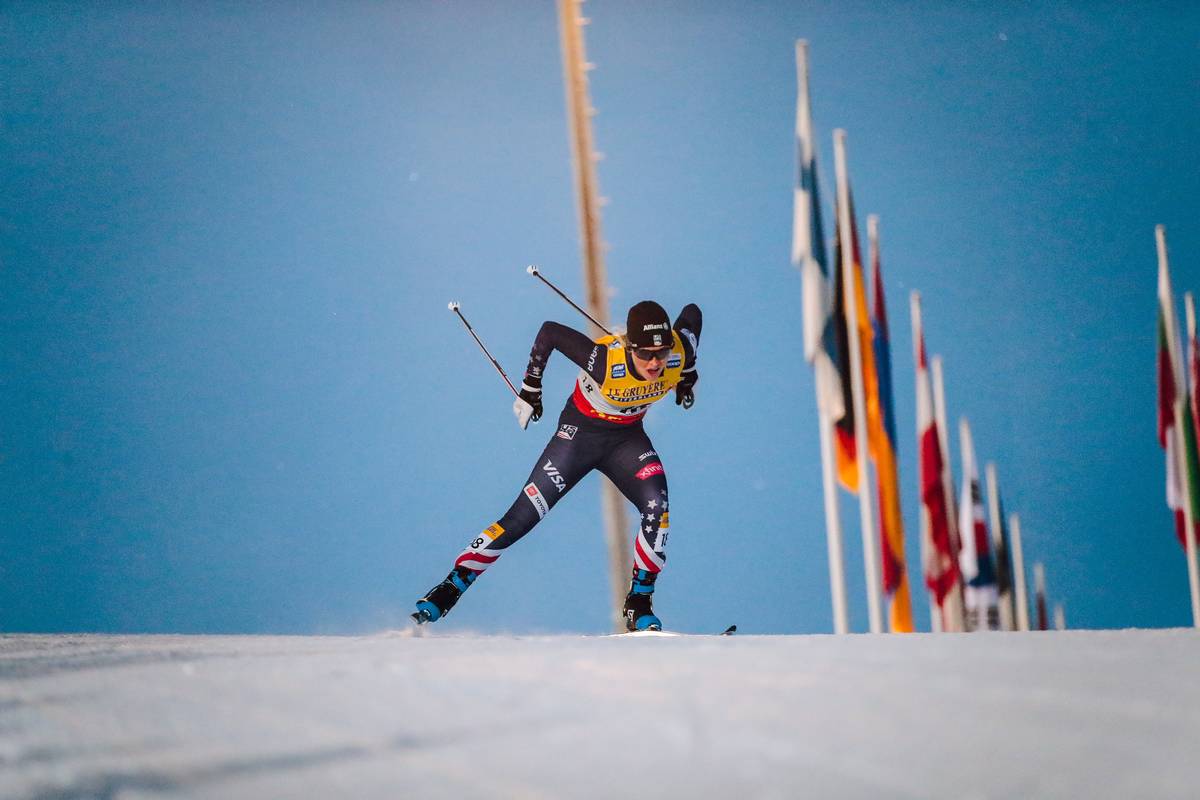
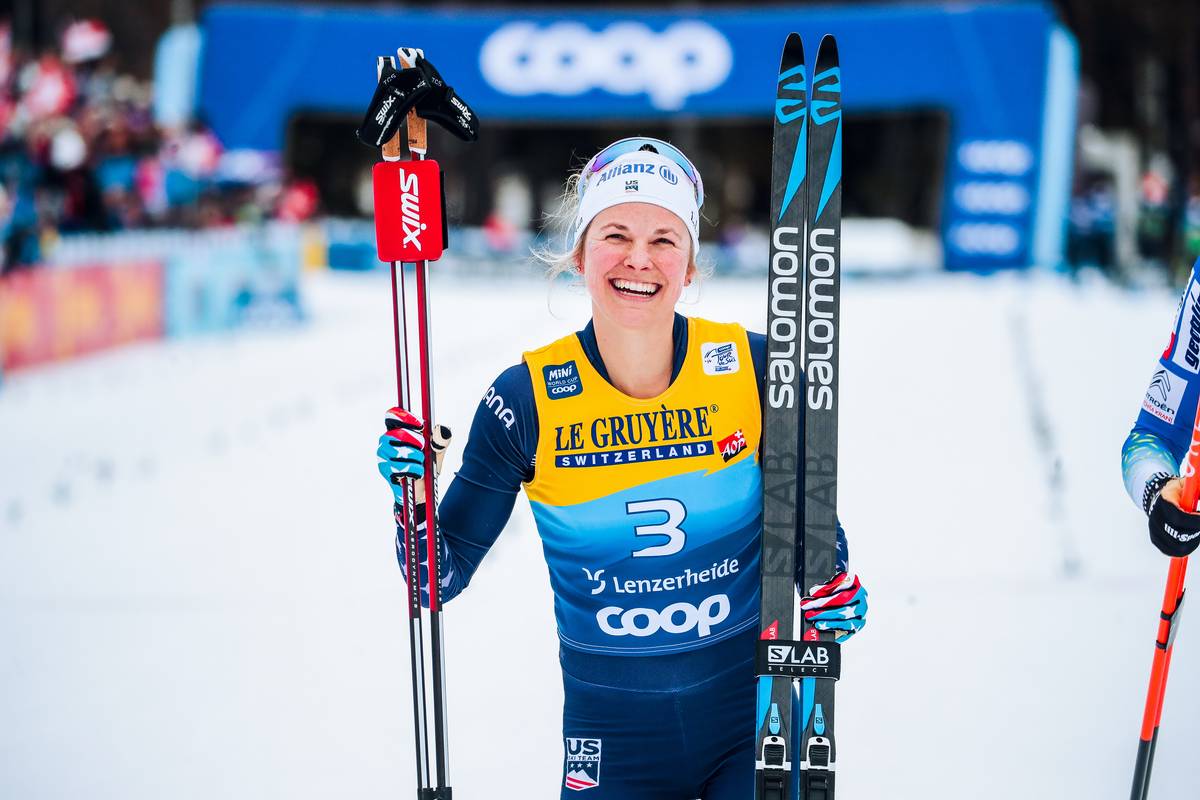
    Jessie Diggins (USA) all smiles after finishing first in the 1.5 k skate sprint in Lenzerheide, SUI. (Photo: NordicFocus)

    The sport’s leaders say discussions about closing that gender gap are happening at the international level. But there’s no time frame or firm commitment yet. 

    And while advocates say they’ve made progress on the U.S. domestic racing circuit, they stress that it’s hard to get traction without change at the top. That’s because athletes and coaches want to make sure that up-and-coming athletes are preparing themselves to race at the sport’s highest levels.

    In the mean time, frustration is lingering.

    “We wonder why women are paid, like, 75% of what men are paid,” said Molly Peters, a collegiate ski coach in Vermont who leads the group called Equal Distance. “I just think if women are going to be empowered and feel like they’re equal, the races should be the same.”

    The world’s fastest women increasingly agree with Peters and Diggins, according to surveys by the International Ski Federation (FIS). But not all of them.

    Theresa Stadlober (AUT) takes bronze in the women’s 15 k skiathlon, the opening event of the 2022 Beijing Olympic Winter Games. (Photo: NordicFocus)

    “I think it’s good like it is,” said Teresa Stadlober, the Austrian who won a bronze medal in Saturday’s Olympic opening event. “Men are stronger. They have other muscles than we girls.”

    Therese Johaug of Norway, the winner of that race, also said the 15-kilometer distance — compared to 30 kilometers for men — “is good for us.” “Maybe we could go 20,” she added. “But 15 is also great for me.”

    Peters acknowledged that the idea of equalizing distances isn’t universally popular among women, which she attributes to some athletes’ comfort with the status quo.

    “You’re going to want to keep doing what you’re most successful at,” she said.

    The differences have been baked into cross-country skiing for decades. And until recently, calls for equity haven’t gotten much traction.

    At the Olympic level, there are discrepancies between men’s and women’s events in several other winter sports. Nordic combined lacks a women’s competition whatsoever. 

    But in the sports where women do compete, cross-country skiing has the most events with substantial differences between women and men.

    Until recently, the FIS surveys showed that the majority of women on the elite-level World Cup circuit “didn’t see the need for change,” said Pierre Mignerey, the federation’s cross-country race director. Last year was the first time a narrow majority favored races at the same distance.

    The FIS has tasked a working group with studying the idea. 

    But the process comes with tricky questions. Should women race longer distances? Or should the federation shorten men’s events? Meet in the middle? Or race slightly different distances that take men and women the same amount of time?

    And what about races where the distances are part of the tradition, like the 50-kilometer and 30-kilometer events for men and women, respectively, held at the Holmenkollen in Oslo?

    Those questions, in turn, intersect with an ongoing FIS debate about which race formats and distances are most appealing to the World Cup’s European-focused TV audience.

    “You’ll occasionally hear, ‘well, it’s hard to find the TV time for the two genders to go 50 k,’’ said Matt Whitcomb, the U.S. team’s head coach. “Well, find it. Or shorten the men. Otherwise it’s a sexist system.”

    Any changes to the race program must be proposed to FIS’s governing council by the 20 nations in the federation’s cross-country committee, Mignerey said in an interview. Which means, he added, that any decisions will likely be driven by the sport’s biggest players.

    “Basically, if the Scandinavians in cross-country are convinced that it’s a good change, there is a big chance,” Mignerey said.

    In Sweden, at least, several stars have weighed in against unequal race distances, with 22-year-old Frida Karlsson last year declaring the difference between the 15- and 30-kilometer skiathlons “almost a little offensive.”

    Frida Karlsson (SWE) races a 10 k freestyle in Davos, SUI in December, 2021. (Photo: NordicFocus)

    “In soccer, ladies and gentlemen have 90 minutes, plus overtime. It is the same in most sports,” Swedish sprint star Linn Svahn told a news outlet in her country. “I see no reason why it should not be the same in cross-country skiing. It is a conservative tradition that we should race shorter than the boys.”

    Norwegian men’s coach Eirik Myhr Nossum, in an interview, said his country is also open to a conversation about distances, and he called gender equality “a very important question.” 

    But, he added: “I’m not sure if having them race the same distances is the right way to say it’s gender equality. Gender quality is to be paid the same, and I think the situation in cross-country skiing is quite good.” (Men and women earn the same amount of prize money on the World Cup circuit.)

    While FIS studies the issue, change is already happening at lower-level races.

    Sweden ran equal distance races at a top-level domestic event last year.

    In the U.S., organizers ran into a problem when they tried to schedule a 7.5-kilometer race for both men and women at a top-level SuperTour event last weekend: FIS rules say that men cannot score distance ranking points for races shorter than 10 kilometers. For women, the minimum is just five kilometers.

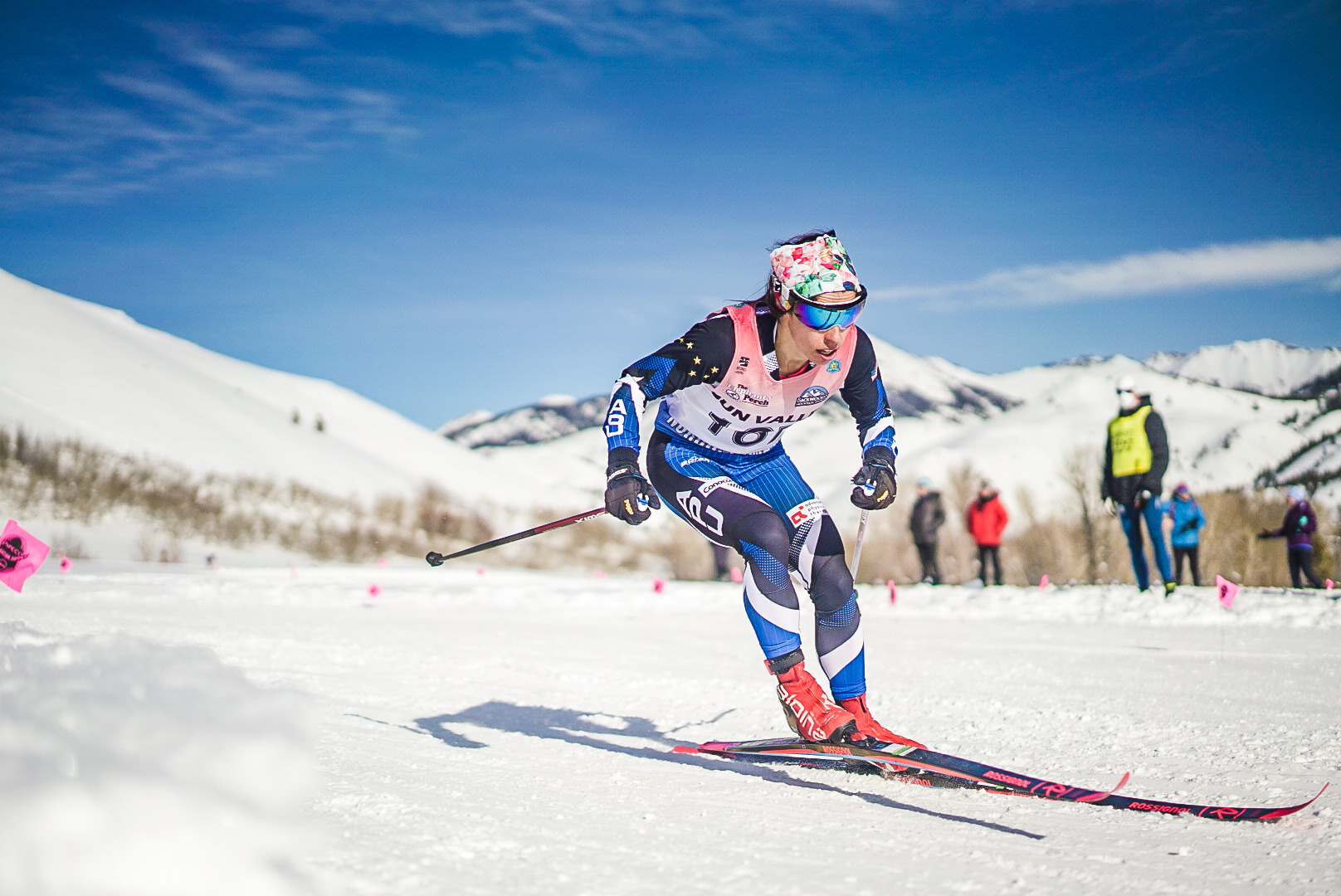
    Rosie Frankowski skis to fourth in the SuperTour 10k mass start classic in Sun Valley. (Photo: Tobias Albrigtsen / @untraceableg)

    But other SuperTour events have been equal. And Peters has made progress in pushing regional races on the NCAA circuit in the same direction — though she’s still waiting for other coaches to agree on a change at the national championships.

    Peters, who coaches the ski team at St. Michael’s College in Vermont, said it was “amazing” to watch the women on her own team race the same 20-kilometer event as the men for the first time ever this year — a step up from the 15 kilometers they used to race.

    “It was so hard,” Peters said. “The women were like, ‘We did it! We raced the same distances and we feel so proud of ourselves. And there was so much talk.”


  • Dahl, Falla Capture FIS Sprint at Beito, Koos 17th

    BEITOSTØLEN, Norway – “It’s really fun to win here. I won the classic sprint here last year, but you have to handle both techniques. This was a good indication that things are working,” said John Kristian Dahl (NOR) to Norwegian television station NRK after the FIS freestyle sprint.

    Dahl qualified 5th, 2.25 seconds behind Anders Gloersen, before advancing to the finals and defeating the likes of Ola Vigen Hattestad and Oystein Pettersen.  Dahl failed to make the Norwegian Olympic team last year despite winning one World cup sprint and finishing in the top-4 two other times.

    He was followed in the final by Eirik Brandsdal in second and Pettersen in third.  Gloersen took fourth on the 1.4km loop.

    Petter Northug had his second sub-par race in a row. He did not qualify for Saturday’s sprint heats, and considers sitting out the classic race tomorrow to prepare for the World Cup opener in Gällivare (SWE) next week.

    “Petter felt a bit cooked today. You could almost see that he gave up coming into the stadium,” Northug’s personal assistant Eirik Myhr Nossum said to the Norwegian newspaper Aftenposten.

    Torin Koos (USA) was the top foreigner in the race.  He qualified in 17th, 6.48 seconds behind Gloersen, but was eliminated in the quarterfinals, maintaining his spot and ending the day in 17th.

    Harald Wurm (AUT), Oliver Wunsch (GER), and Andrew Musgrave (GBR) in 20th, 22nd, and 29th respectively were the only other non-Norwegians in the top-30.

    Thomas Northug, younger brother of the famous Petter, won the family battle, easily outshining his elder sibling.  Thomas qualified 10th and advanced to the semis, ultimately placing 11th.

    In the women’s race, Maiken Caspersen Falla won wire-to-wire.  She posted the fastest qualifying time by 1.9 seconds over Vesna Fabjan.  The two were clearly a step above the field today, with Fabjan placing second in the final as well.  The women’s course was somewhat shorter, measuring 1.1km.

    Kari Gjeitnes (NOR) rounded out the podium.  Marthe Kristoffersen was 4th, just ahead of veterans Celine Brun Lie and Astrid Jacobson.

    The 20-year-old Falla, a sprint specialist, is looking to improve upon a solid 2010 season where she finished 20th in the classic sprint at the Vancouver Olympics and cracked the top-14 four times on the World Cup.

    With only 25 women in the race, all starters advanced to the heats.  The entire field was made up of Norwegians and Slovenians.

    Racing in Beitostolen continues tomorrow with a 10/15km classic.

    FIS Freestyle Sprint Results (PDFs):

    Men’s 1.4km Sprint – Heats

    Women’s 1.1km Sprint – Heats

    Men’s 1.4km Sprint – Qualification

    Women’s 1.1km Sprint – Qualification