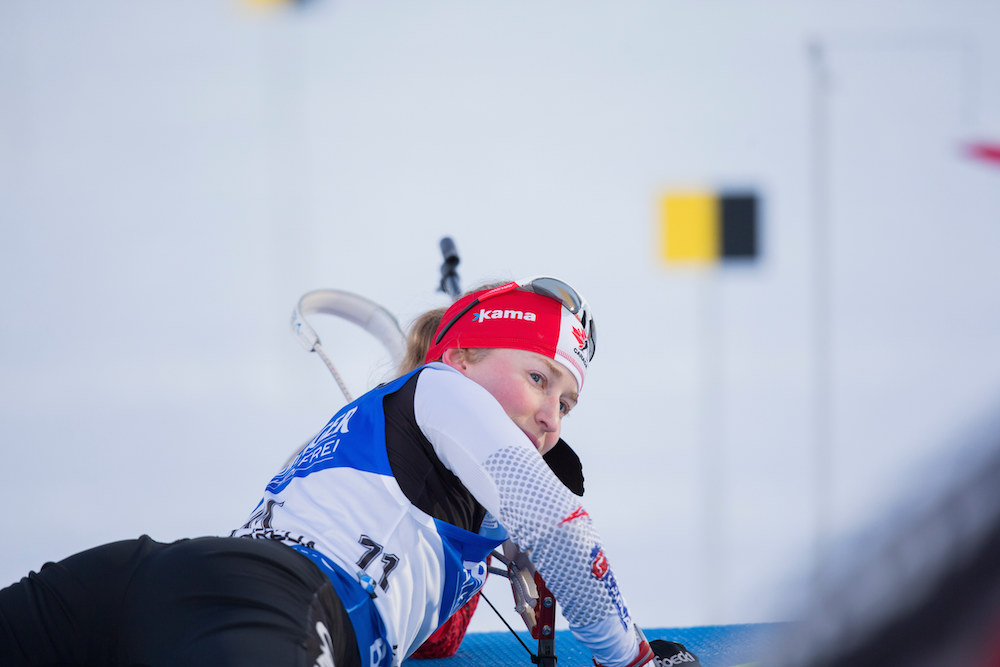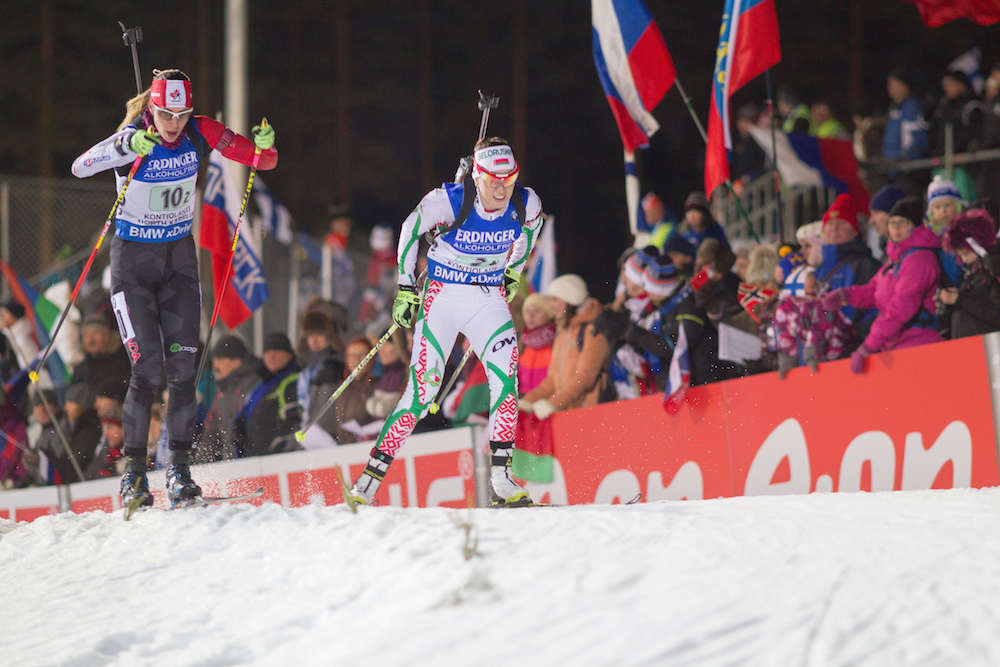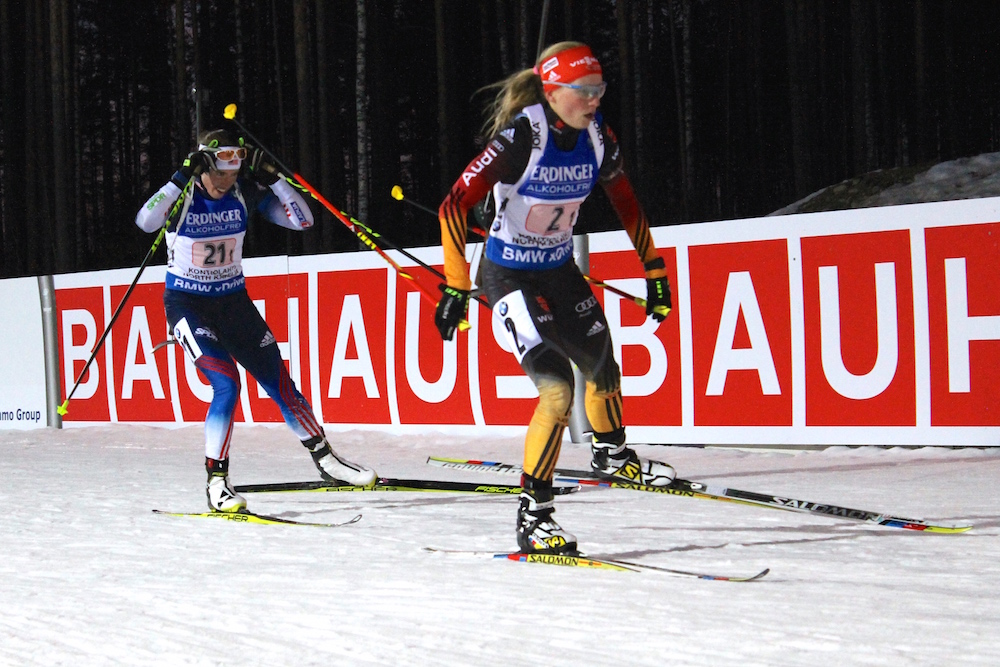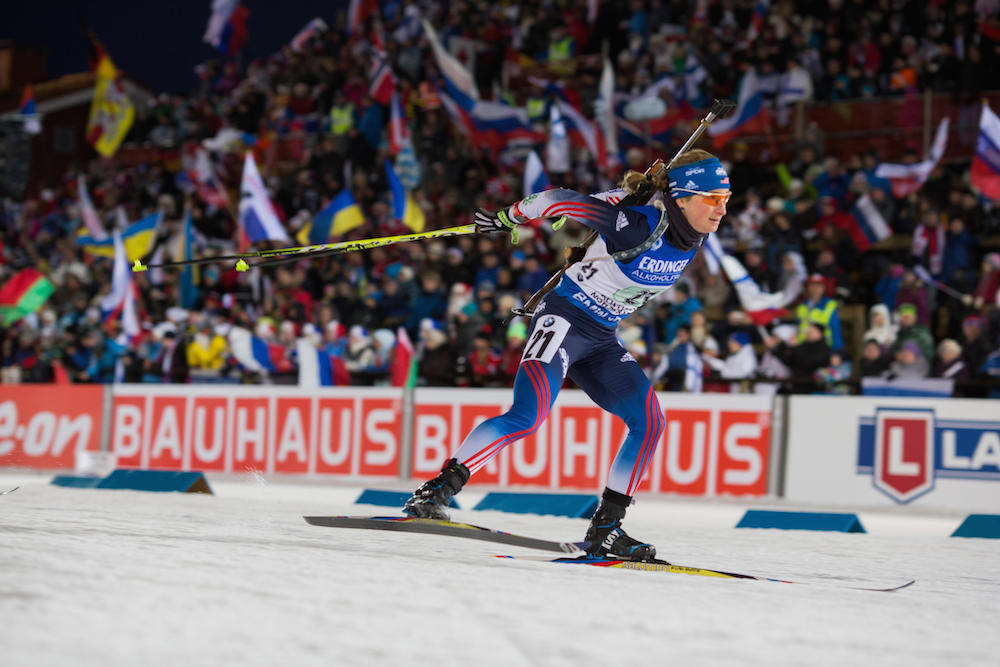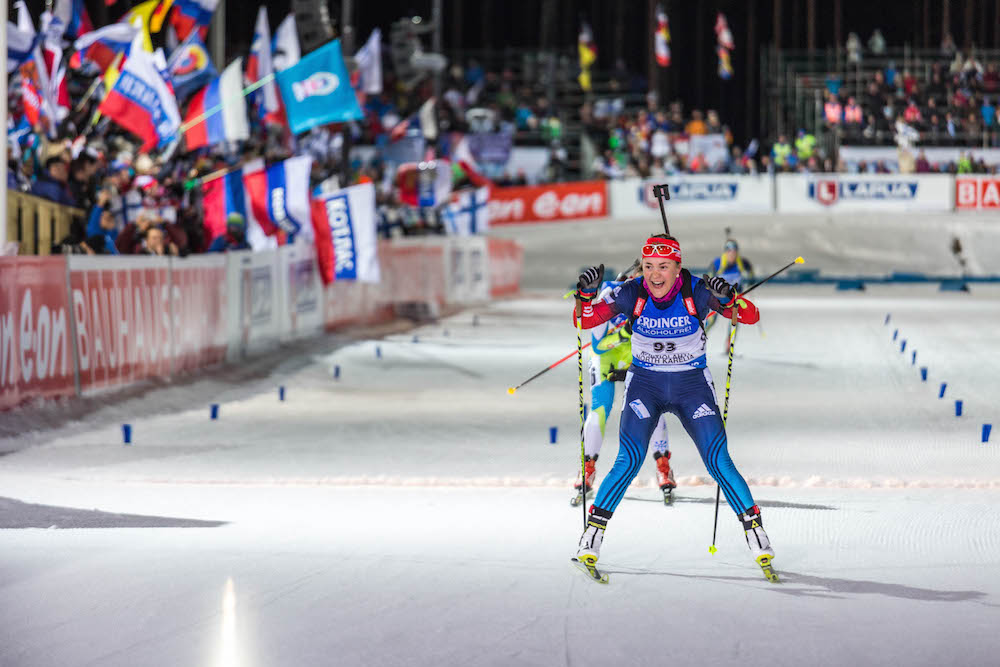
Tag: Ekaterina Yurlova

  • France Dominates Women’s Antholz Relay; Canada 13th; U.S. 17th 

    France Dominates Women’s Antholz Relay; Canada 13th; U.S. 17th 

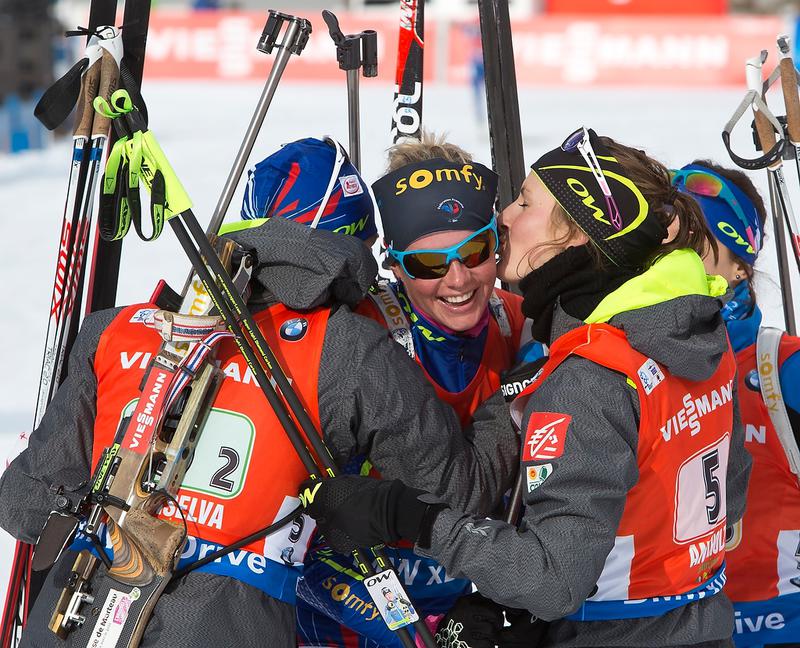
    The French women's 4 x 6 k relay team, including Justine Braisaz, Anaïs Bescond and Anaïs Chevalier, hugs and kisses anchor Marie Dorin Habert at the finish, after Habert secured their IBU World Cup victory by 17 seconds over the Czech Republic on Sunday in Antholz, Italy. (Photo: IBU)
    The French women’s 4 x 6 k relay team, including Justine Braisaz, Anaïs Bescond and Anaïs Chevalier, hugs and kisses anchor Marie Dorin Habert at the finish, after Habert secured their IBU World Cup victory by 17 seconds over the Czech Republic on Sunday in Antholz, Italy. (Photo: IBU/Rene Miko)

    After Ukraine, Germany and Italy occupied the podium in the first two International Biathlon Union (IBU) World Cup women’s relays of the season, on Sunday it was time for three other nations to shine in front of more than 20,000 fans in a packed arena in Antholz, Italy.

    On a beautiful day with blue skies, almost no wind, and surrounded by the spectacular mountain scenery of the South Tyrolean Alps, the French team with Justine Braisaz, Anaïs Bescond, Anaïs Chevalier, and Marie Dorin Habert shot well and skied fast to stay near the top throughout the 4 x 6-kilometer relay. Habert as the anchor received the tag with a 10.6-second buffer to Russia in second, then closed out the race with clean shooting in both stages, eliminating any chance of other teams challenging her.

    After she crossed the finish line in first for France with a time of 1:07.53.5, her teammates hugged her enthusiastically. Overall the French women shot no penalties and required just eight spare rounds.

    “It was a very nice race for the team,” starter Braisaz said during the post-race press conference. “I was a bit [too] excited on my first shoot. But it was a good experience to start the relay. And I am very happy today.”

    “A very happy end to my week,” her teammate Bescond told the media. “Today I felt very good on my skis. I think all of the team made a very good job.”

    “I am very tired, especially this week,” Habert said, reflecting on her season and the race. “It’s a very good thing to finish in the first position.”
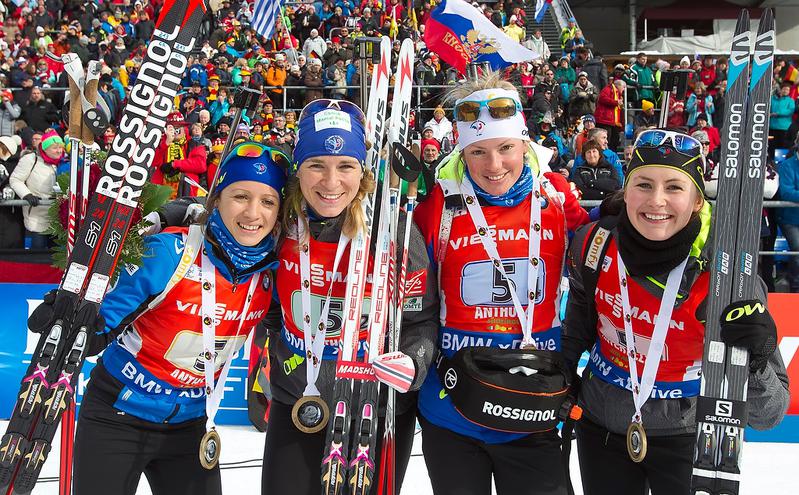
    The French women's relay after winning Sunday's 4 x 6 k IBU World Cup relay in Antholz, Italy. With Justine Braisaz, Anaïs Bescond, Anaïs Chevalier, and anchor Marie Dorin Habert (second from r). (Photo:  IBU/Rene Miko)
    The French women’s relay after winning Sunday’s 4 x 6 k IBU World Cup relay in Antholz, Italy. With Justine Braisaz (l), Anaïs Bescond (second from l), Anaïs Chevalier (r), and anchor Marie Dorin Habert (second from r). (Photo: IBU/Rene Miko)

    “This is the first time we tried our relay for the World Championships [in Oslo], so it’s important to [get] a good position to see that this formation of the relay is functioning,” she later said in another interview with the IBU.

    On the last loop, the Czech Republic, Russia and Italy battled for the positions on the podium, with Veronika Vitková able to create a small gap to secure second place for the Czech team, 17.2 seconds behind France.

    Initially, the outlook didn’t look good for the Czech Republic, after second-leg Lucie Charvátová skied two penalty laps and slipped to 12th at the exchange. Later she could be seen in the finish pen with tears in her eyes, while being consoled by team staff.

    “After my leg I didn’t think [it would be possible to come back], because I was such a bad shooter in each relay I started this year. So I was afraid, afraid all race, all year,” Charvátová, 22, said during the press conference. “I am so under pressure. So I am very happy, because those other girls are the best.”
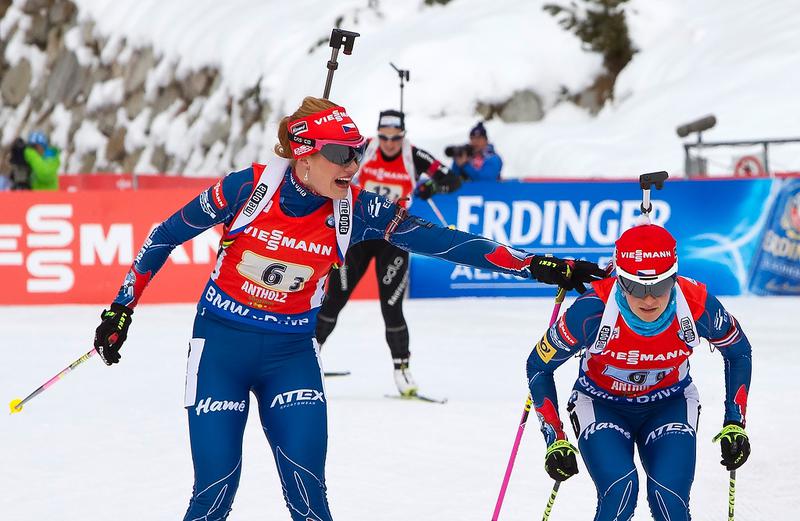
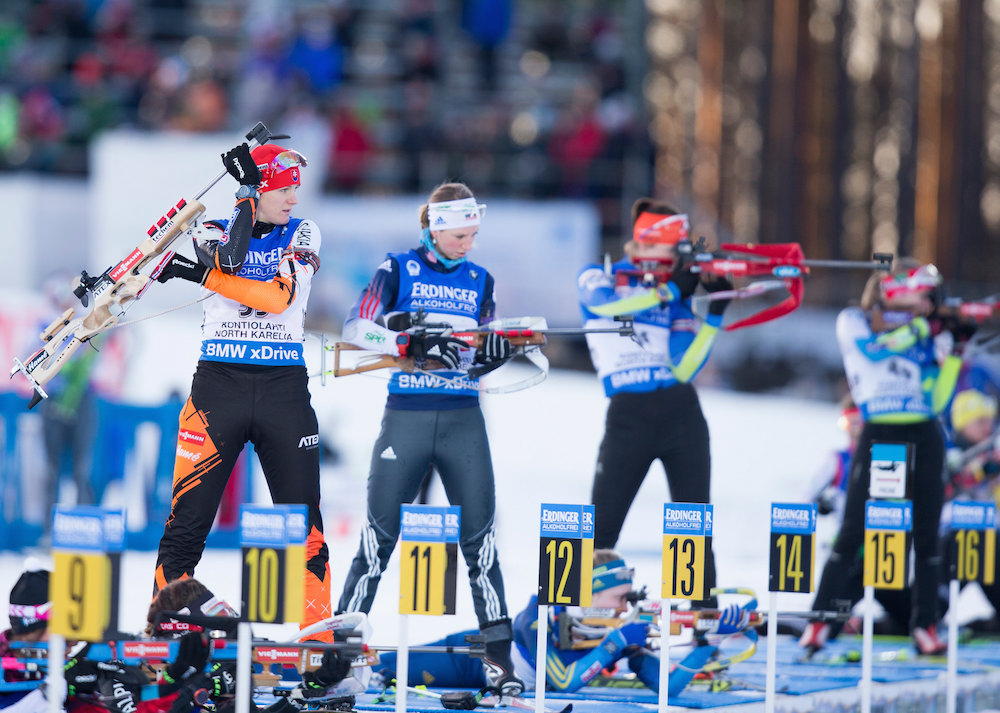
    Gabriela Soukalová (l) tags Czech teammate Veronika Vitková in fourth during the final exchange in the IBU World Cup women's 4 x 6 k relay. The Czech Republic team went on to finish second with just two spares from Vitkova. (Photo: IBU/Rene Miko)
    Gabriela Soukalová (l) tags Czech teammate Veronika Vitková in fourth during the final exchange in the IBU World Cup women’s 4 x 6 k relay. The Czech Republic team went on to finish second with just two spares from Vitkova. (Photo: IBU/Rene Miko)

    Her veteran teammates, World Cup leader Gabriela Soukalová and Vitková turned the race around with solid shooting and fast skiing, recording the best and fourth-best course times on their legs, respectively, to capture second. Overall, the team incurred two penalties and required seven spare rounds. It was the best performance for the Czech relay team this season, after two sixth-place finishes before.

    “It’s very surprising,” starter Eva Puscarciokova said during the press conference. “I am very happy today, because it was very hard after my race in Ruhpolding [Germany] when I went to the penalty loop.”

    Third place on the podium went to the Russian team with Ekaterina Shumilova, Anastasia Zagoruiko (who replaced Daria Virolaynen from the last relay in Ruhpolding), Ekaterina Yurlova, and Olga Podchufarova, finishing 21.2 seconds back, with no penalties and 10 spare rounds.

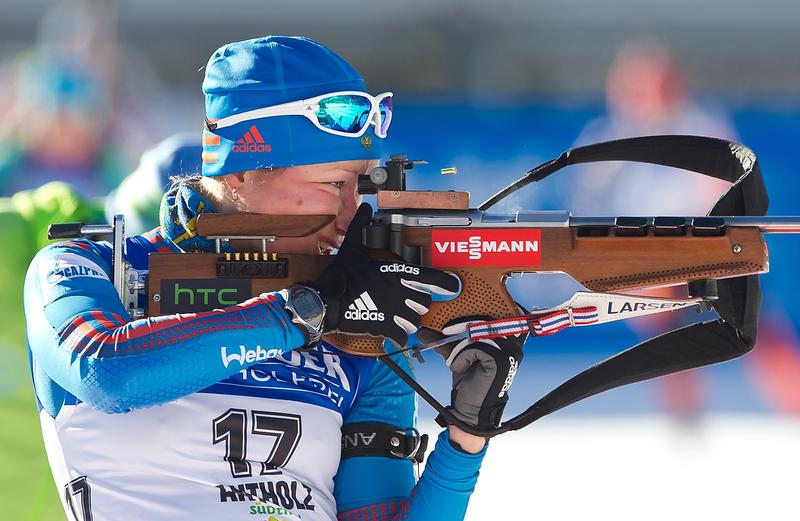
    Yurlova, Saturday’s pursuit winner, lifted her team from sixth to second, skiing fast — with the second-best course time of the third-leg skiers — and only needing two spares.

    “I am really happy about my leg, and especially about my standing [shooting],” Yurlova said at the press conference. “Because I am really, really tired after two competitions before. And now I was really afraid about my standing. It was all shaking, but I am really happy that I could do it clean. Overall I am really satisfied about this World Cup.”

    In the finishing stretch, Italy’s anchor, Dorothea Wierer, and Russia’s Podchufarova (who had beaten Wierer in the sprint last Friday) fought for third, as they had done earlier this season at the end of the relay in Ruhpolding, Germany, where Italy came out ahead. But this time, Podchufarova prevailed, to the huge excitement of her teammates who immediately ran into the finish area and piled onto her. Wierer crossed the line just 0.5 seconds behind (+21.7), after having made up nearly 15 seconds after the final shooting.

    “My only thought was to come into the finish in the third position,” Podchufarova said in the press conference. “I didn’t know at first that [Wierer] was behind me, only when I came into the stadium I saw it on the monitor. Then I tried my best to get the third place for the team.”

    “I wanted to go on the podium, but I was too [many] seconds behind,” Wierer said in a post-race interview with the IBU. “On the finish line I couldn’t anymore, because I was flushed pushing from the first loop, and in the final I had no more energy.

    “It was a really nice [weekend], but I am a little disappointed today,” she added with a laugh. “You want always more and more, that is the problem.”

    Norway, with Kaia Wøien Nicolaisen, Fanny Horn Birkeland, Marte Olsbu and Tiril Eckhoff, had been in third position behind France and Russia coming into the last shooting, but Eckhoff — a fast skier who has struggled with her shooting all season, hitting 68 percent of her standing targets — again had problems and ended up skiing a penalty lap. She finished fifth for Norway, 47.1 seconds back from France, with a team total of one penalty and 10 spares.

    “I had the opportunity and screwed it up. This was real sh*t. This was not the way I wanted to end [my] last World Cup race before the World Championships,” Eckhoff told Norwegian broadcaster NRK after the race, noting she and her coaches were aware of some technical corrections she still plans to implement.

    Ahead of the upcoming World Championships on their home turf in Oslo, the Norwegian women have yet to reach the podium since earning bronze in the relay at the 2014 Olympics.

    Arguably the biggest surprise of the day was Sweden, with Emma Nilsson, Mona Brorsson, Ingela Andersson, and Linn Persson, in sixth place (+50.5) just 3.4 seconds behind Norway, with no penalties and seven spare rounds.

    After the race, the Swedish women claimed they knew they were on a very good trajectory this season.
    “We expected it,” Brorsson said during in a group interview with the IBU.

    “We really thought we had a chance to be top six,” Andersson added.

    They credited their coach, Wolfgang Pichler, for their improved performance, after he helped several Swedish biathletes, such as Magdalena Forsberg, Helena Ekholm and Anna Carin Olofsson (now Zidek) reach Olympic and World Championship medals, before returning last summer after a stint with the Russian biathlon team.

    “I think that’s the big difference this year,” said Brorsson. “He always finds a way to motivate you. On the track, he is incredible. He knows what he is doing.”

    Ukraine, winner of the last relay in Ruhpolding and usually a team with very solid shooting performances, had some difficulties on the range on Sunday and finished ninth (+1:45.5). The team with Iryna Varvynets, Valj Semerenko, Olga Abramova (replacing Juliya Dzhyma) and Olena Pidhrushna stayed near the front for most of the race and Semerenko even exchanged in the lead. But Abramova needed five spares, and anchor Pidhrushna had to ski a penalty lap, setting them farther back (12 spares overall).

    Similarly, Germany had been in second place for both relays this season. On Sunday, with their regular anchor Laura Dahlmeier taking a break after a respiratory infection, the team struggled almost right out of the gate. Starter Karolin Horchler required five spare rounds and only narrowly avoided the penalty lap in her prone stage, leaving in last position at that time. She tagged off already a minute behind the best in 15th, before Miriam Gössner and Vanessa Hinz moved up a bit, but each incurred a penalty to slow down the chase. Anchor Franziska Hildebrand still managed to improve her team two positions on her leg, ultimately finishing 10th (+1:51.8).

    “I don’t know why, but my legs felt like a sewing machine today in standing, that hasn’t happened to me in a long time,” Gössner told German TV broadcaster ARD in an interview while the race was still going on. “I stood there, and already from the first shot my legs were shaking so much that I really didn’t have myself under control anymore. Even though I went slowly on the prior loop. I tried to fight and prevent the penalty lap, but unfortunately I did not succeed.”

    “My race was all right. All in all I am satisfied,” Hildebrand told ARD. “We somehow struggled a bit in Antholz. Next time it hopefully will be better again for us. There are weekends where not everything works out, and this was one of those.”

    Switzerland, with Saturday’s pursuit runner-up Selina Gasparin, started the relay very strong, with Gasparin tagging off in the lead, and her younger sister Aita Gasparin keeping the team in contention in fourth. Then two less-experienced skiers closed for Switzerland, with Irene Cadurisch tagging off in fifth place, before anchor Ladina Meier-Ruge faded a bit and lost two minutes to the front. They finished 12th with nine spares, one place ahead of Canada.

    Canada 13th, U.S. 17th

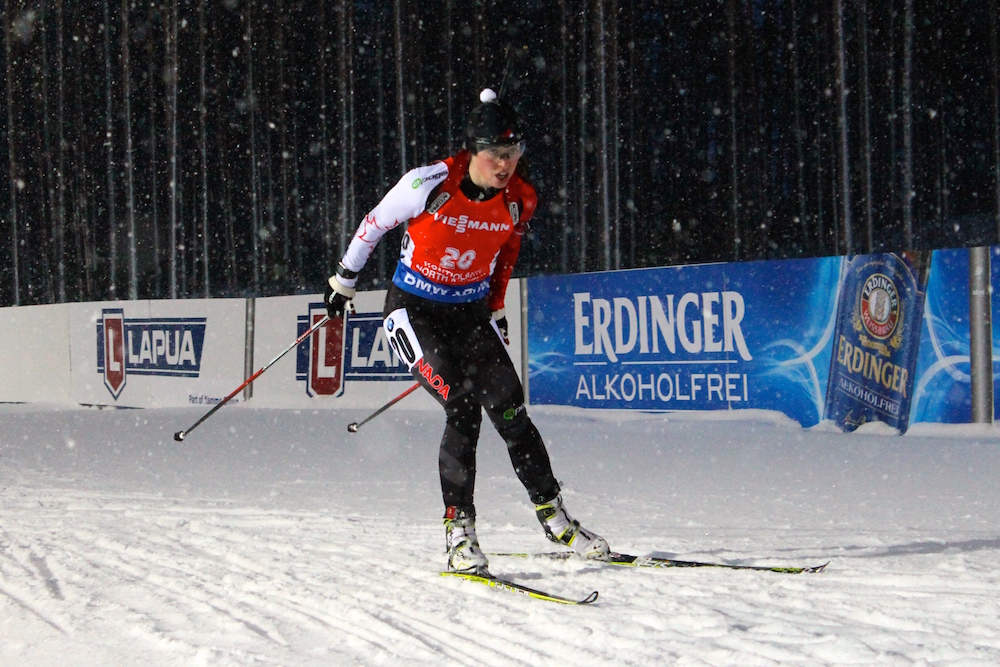
    After achieving her first-career top 20 in Saturday’s pursuit, Canada’s Julia Ransom had said her team was “fired up” for the relay, and that they were eager to reach the top six after feeling they had come close in ninth a week ago in Ruhpolding.

    Unfortunately on Sunday, the performance on the shooting range did not allow that to happen for the Canadian team with Ransom, Rosanna Crawford, Megan Tandy, and Zina Kocher.

    Starting as the scramble leg, Ransom missed two targets in her first prone stage, then required all three spares to clean them, narrowly avoiding the penalty but only leaving the range again in 18th position, already 41 seconds back.

    After skiing a fast second loop (with the third-best course time, seventh-best overall) and a clean standing shooting, she moved the team back up significantly and tagged Crawford in ninth place, 32.2 seconds behind the top.

    Crawford had two solid shooting performances, requiring one spare round in her prone stage and two in standing. Skiing the 11th-fastest second-leg course time, she brought her team close to the top six in seventh place, just 32.5 seconds out of first.

    Tandy skied a very fast first loop (fourth-best), and came through her prone stage with two spare rounds, leaving still in 10th position. After a slower loop, she then struggled in her standing position, and was unable to avoid the penalty lap (0+2, 1+3), losing a minute to the top. She tagged off in 13th place (+1:58.7).

    Kocher as the team’s anchor initially held 13th and had a solid first prone shooting with one spare round, but lost another minute on the next loop. In the final standing, similar to Tandy, she also ran out of spares and had to ski a penalty lap, leaving the range in 14th and more than four minutes behind the leaders. On the final loop she was able to pass Bulgaria’s anchor Daniela Kadeva, finishing 13th for Canada (+4:12.2 minutes) with two penalties and 15 spare rounds.

    In an email, Biathlon Canada’s head coach Matthias Ahrens explained that the team was packing up Sunday afternoon, driving to Munich, Germany, then flying back to Canada early Monday morning. The Canadian athletes could not be reached for immediate comment.

    “Women’s race started excellent with Julia and Rosanna, then unfortunately Megan and Zina could not match that Performance,” Ahrens briefly noted about the women’s result before leaving Antholz.
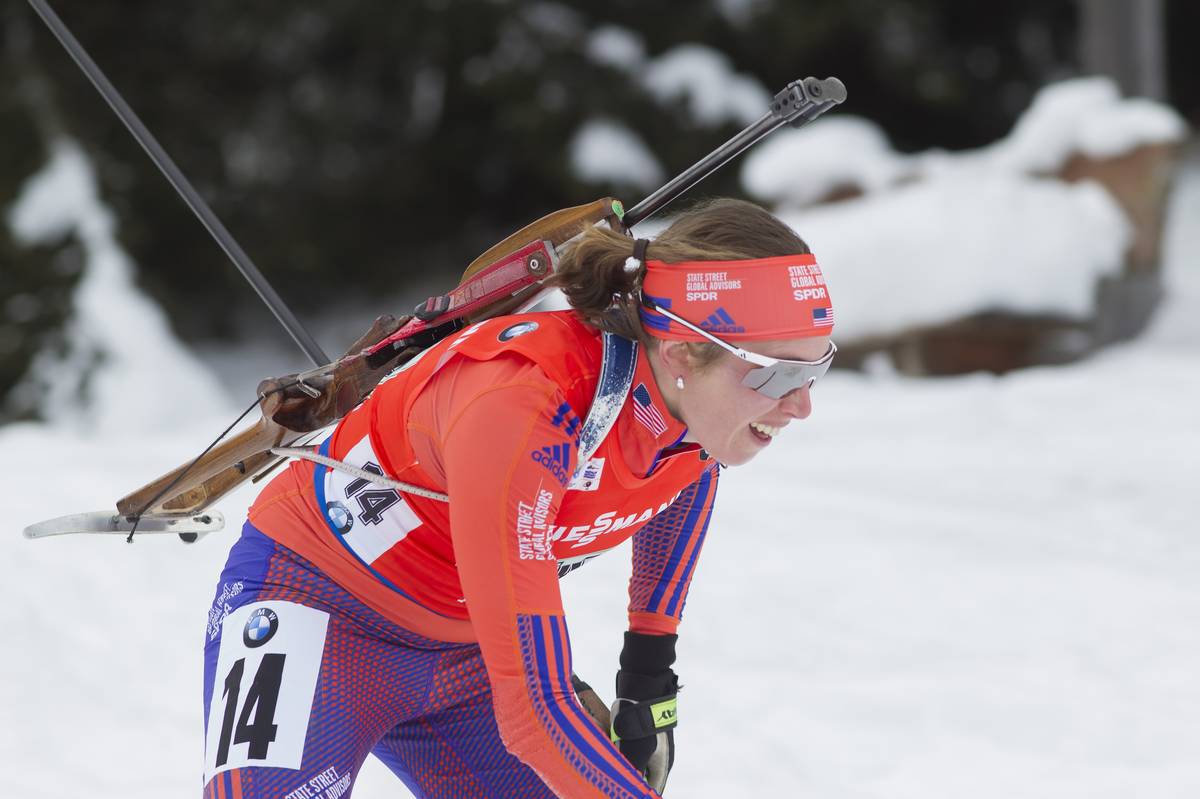
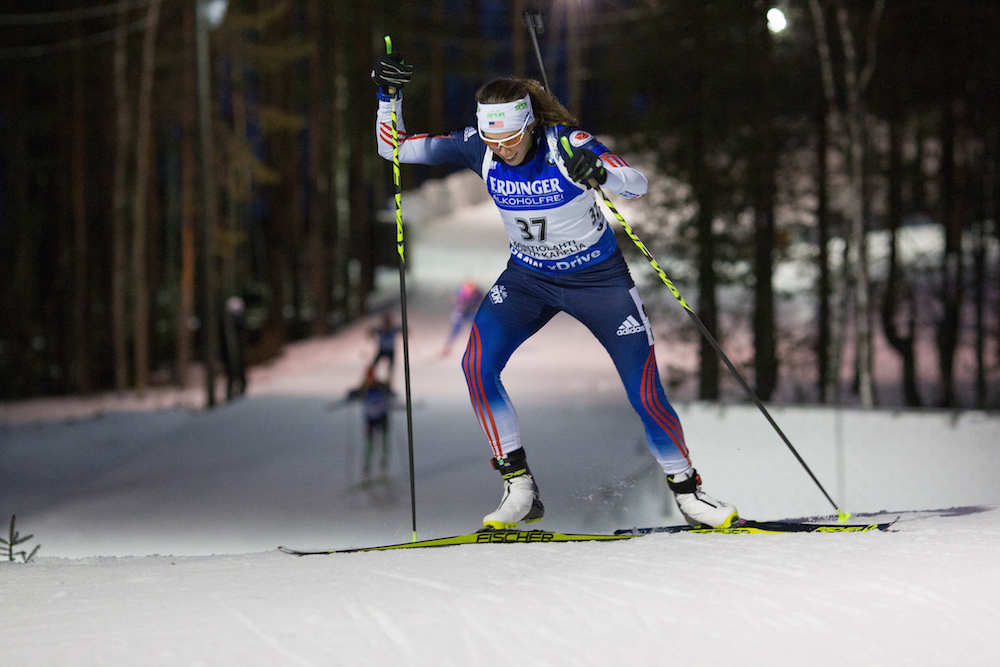
    Susan Dunklee (US Biathlon) used a total of four spares between two stages in the women's 4 x 6 IBU World Cup relay, handing off in 14th. (Photo: USBA/NordicFocus)
    Susan Dunklee (US Biathlon) used a total of four spares between two stages in the women’s 4 x 6 IBU World Cup relay, handing off in 14th. (Photo: USBA/NordicFocus)

    The U.S., with Clare Egan, Susan Dunklee, Annelies Cook, and Joanne Reid, adapted its lineup order a bit again on Sunday compared to the first two relays, with Egan starting and Cook moving to the third leg.

    “Today I got my first mass-start experience at the World Cup level,” Egan wrote in an email. “It reminded me of how much I thrive on head-to-head racing. The decision was made with the intent of giving me that head-to-head experience, both because it will be useful in the future for pursuits and mass starts, and because I think my coaches thought I would like it.”

    She skied at a steady pace in the middle of the field, and required just one spare in each of her shooting stages.

    “The altitude is a challenge here, for the skiing of course but also for recovering before the shooting,” Egan wrote of the biathlon trails situated some 2,000 meters (6,500 feet) above sea level. “The range approach does not provide rest, so I have been making rest for myself by skiing into the range extra easily.”

    “There was a light wind but it was constant, so with the correct sight adjustments the wind was not a factor,” Egan explained. “I had super fast skis and put them to good use passing people on course, but then despite using only one spare round per stage, I still lost places on the range to faster shooters.”

    On the last loop, Egan sped up her pace and skied the sixth-fastest course time of her leg, catching six other teams in front of her to hand off in 12th place (+53.9)

    “The highlight for me was on the last lap when I passed Team Germany,” she wrote.

    After receiving the tag from Egan, Dunklee set out fast with the best course time on her first loop, but then required three spare rounds in her prone shooting. After skiing her second loop at a slightly lower pace, she managed to miss only one target in standing. She slipped two spots to tag off in 14th (+1:10.1), with the third-best course time overall.

    Cook was initially able to hold that position, despite requiring two spares in her prone. Then in standing, she used all three spares and had to ski a penalty lap. That set her back to 18th place, more than three minutes behind the leaders. She tagged off still in that position (+3:36.7).

    In the second World Cup weekend of her career, Reid, 23, skied as the U.S. anchor for the second time. She posted the ninth-best course time on her first loop and managed to shoot clean in prone, but then was lapped by the top teams after another penalty in her standing. That kept Reid from skiing her last loop and ended the race for the U.S. in 17th place with two penalties and 14 spares. Estonia and Romania behind them were lapped as well.

    Next Stop: Canmore/Canada

    The IBU World Cup picks back up again in two weeks in Canmore, Alberta, with sprints on Thursday, Feb. 4 and Friday, Feb. 5, followed by mass starts on Saturday, Feb. 6, and single-mixed relay (1 woman, 1 man) and mixed relay (2 women, 2 men) relays on Sunday, Feb. 7.

    Several strong athletes will not make the trip overseas, notably several members of the Norwegian team, such as Eckhoff and Synnøve Solemdal, citing a focus on instead preparing for the upcoming World Championships.

    Sitting in second in the overall World Cup standings, Habert plans to be there to fight for more points: “Just five days to recover, and then we will fly to Canmore,” she said at the press conference.

    “We are still in discussion with the coaches about the best approach,” Germany’s Hildebrand told ARD. “In order to stand nicely relaxed and regenerated at the start in Oslo.”

    Note: The U.S. men placed sixth in the men’s 4 x 7.5 k relay to match a season best, despite using 13 spares and skiing a penalty lap, with Lowell Bailey, Tim Burke, Leif Nordgren, and Sean Doherty. Canada’s men, with Christian Gow, Nathan Smith, Macx Davies, and Scott Gow, placed 11th with eight spares and no penalties.

    Stay tuned for a complete report on the men’s race.

    Results

  • First Regular-Season Win For Yurlova, While Gasparin Gets Her Post-Baby Podium

    First Regular-Season Win For Yurlova, While Gasparin Gets Her Post-Baby Podium

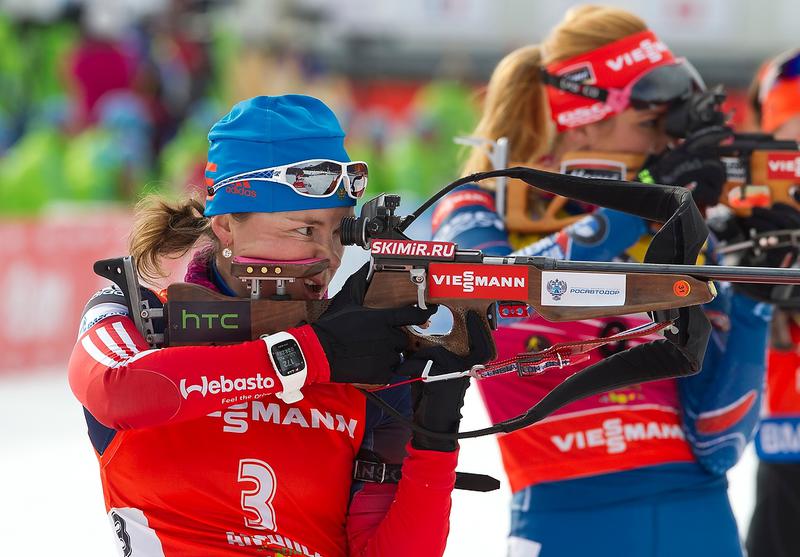
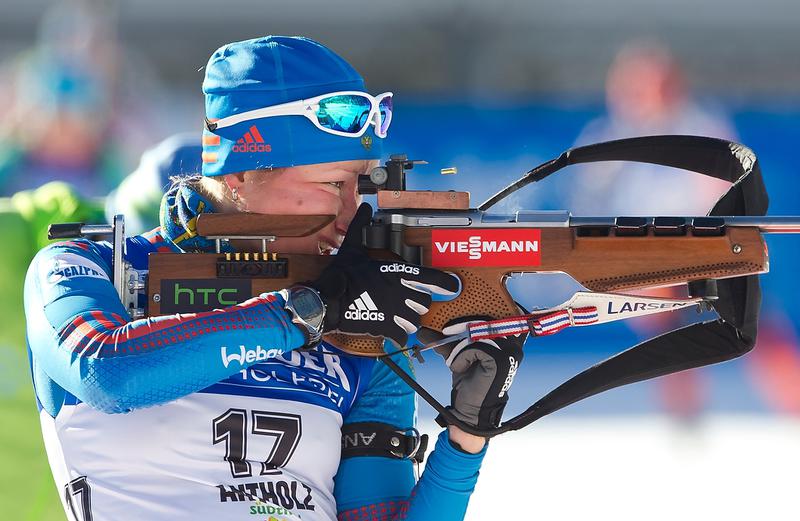
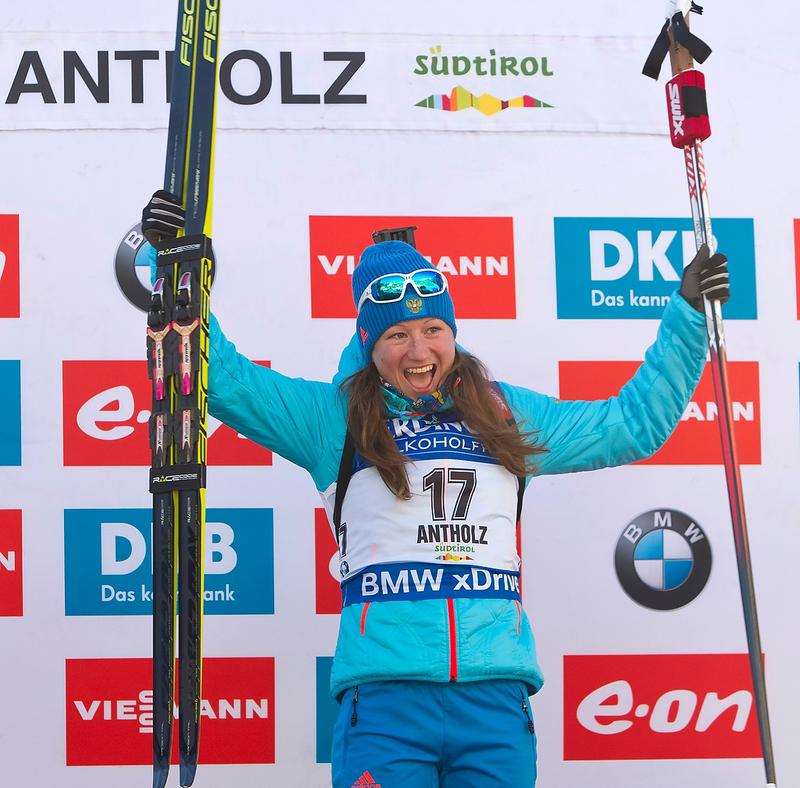
    Katja Yurlova of Russia, a 2015 World Champion, got her first World Cup win on Saturday with clutch shooting in the Antholz 10 k pursuit. (Photo: IBU/Rene Miko)
    Katja Yurlova of Russia, a 2015 World Champion, got her first World Cup win on Saturday with clutch shooting in the Antholz 10 k pursuit. (Photo: IBU/Rene Miko)

    On Thursday, Russia’s Olga Podchufarova picked up her first World Cup win in the 7.5 k sprint in Antholz, Italy.

    On Saturday she led into the final stage of the 10 k pursuit, but fell apart on the range, missing three shots in the final bout.

    There to pick up the pieces was teammate Ekaterina Yurlova, who shot a near-perfect race. She started third after joining Podchufarova on the sprint podium, then missed one shot in the first stage. But after that she hit target after target, picking up places along the way until she left the range the last time in first place.

    “The last shooting was so unbelievable for me,” Yurlova told IBU news. “There was a strong wind, but my amunitions were just flying into the target! When I shot clean, I saw that Doro [Wierer] and Olga [Podchufarova] were in the penalty loop, I told myself that this was my chance…. so I just took all my power and did it.”

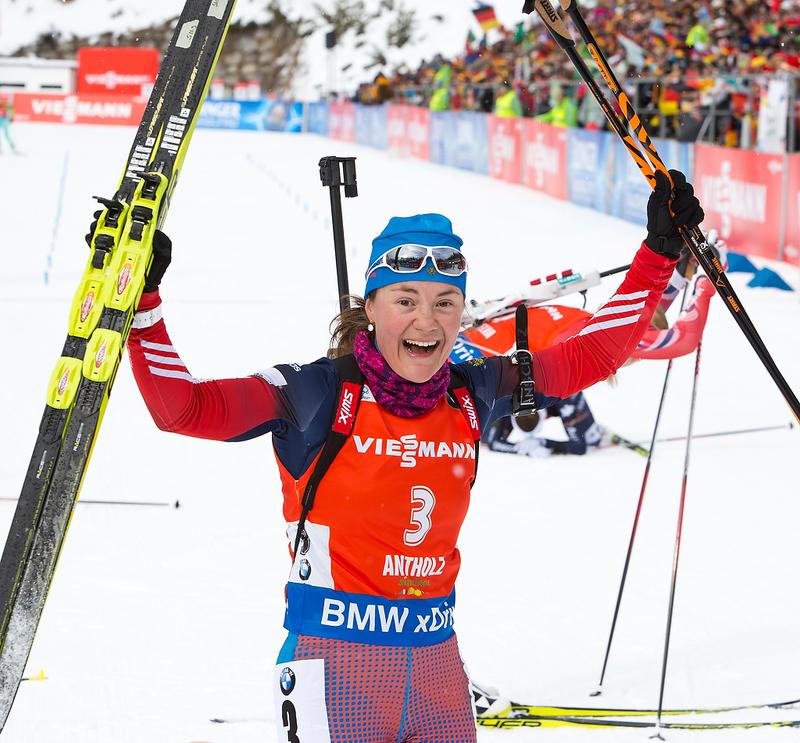
    Yurlova thrilled at the finish. (Photo: IBU/Rene Miko)
    Yurlova thrilled at the finish. (Photo: IBU/Rene Miko)

    There could be more surprising athletes to see atop the podium; Yurlova was the World Champion in the 15 k individual in 2015.

    But this was actually her first regular-season victory, something that had eluded her so far.

    “I didn’t think I would be again on the podium,” Yurlova said in the post-race press conference. “I didn’t prepare for the podium. I was thinking just that I need to do my job good, good skiing, good shooting, that’s enough.”

    Joining her was another woman who didn’t expect to be there – yet whose name didn’t cause surprise, either. Selina Gasparin of Switzerland is a World Cup winner who also won her country’s first Olympic biathlon medal, in Sochi in 2014.

    But while Yurlova was winning World Championships last season, Gasparin was sitting out. She took a year off to have her first child.

    After returning this season she had been yet to hit the podium, and after finishing 16th in the sprint it didn’t seem likely in the pursuit either. Yet Gasparin had only a single penalty, like Yurlova’s coming in the first stage, and skied the second-fastest course time of the day, moving up to second place by passing Wierer in the final few hundred meters.

    “This has been a mega-beautiful race,” Gasparin told Swiss broadcaster SRF. “In the beginning I shot a miss and thought ‘oh no, not again.’ In a pursuit I am usually behind. And I was pretty annoyed by the miss, because I lost contact [to the top]… And then in standing I though to myself ‘no matter how long I stand here, I just have to hit.’ And yeah, I didn’t really know where I was with regards to split times. Thank God I didn’t know during the last shooting that it could be enough for the podium when they shot misses.”

    Selina Gasparin of Switzerland was thrilled to be back on the podium. (Photo: IBU/Rene Miko)
    Selina Gasparin of Switzerland was thrilled to be back on the podium. (Photo: IBU/Rene Miko)

    She finished twelve seconds behind Yurlova and six ahead of Wierer, who had led early in the race before accumulating two penalties in the third stage and one in the fourth.

    “I started good but two mistakes was too much,” Wierer said in the press conference. “In the last standing, I tried to shot fast and zero and it did not work.”

    For Gasparin, shooting well under pressure and edging Wierer at the finish was a particularly meaningful way to get her first post-baby podium.

    “This second place is as valuable as my victories in sprint [in Annecy, France, and Hochfilzen, Austria, during the 2013-14 season],” Gasparin told Swiss media. “In the pursuit you have to get the result in a fight woman versus woman. There it’s important to keep your nerves in check.”

    Tiril Eckhoff of Norway placed fourth (+48.0) and Krystyna Guzik of Poland fifth (+51.9) after starting 20th and 26th, respectively. Skiing fast, they moved up despite three misses by Eckhoff and two by Guzik.

    Susan Dunklee, the lone American in the pursuit, finished 17th, also moving up considerably after earning bib 37 in the sprint. She had the fourth-fastest ski time in the field.

    “The race felt great!” Dunklee wrote in an email. “I had little expectation or pressure going into it. I wasn’t starting very high up and didn’t expect my skiing to bounce back so quickly. It felt so flat in the sprint and I’m not entirely sure why. Today felt more like the Antholz form I remember from the past. Having this strong performance will definitely boost my confidence going into the break.”

    Dunklee missed two shots in the first stage, as well as one in the third. After the first stage she had dropped even lower than her bib number despite initially making up ground on skis.

    “There were some big gusts on the range including one during my first prone that sent my first two shots wide,” she wrote. “The wind also dumped big clumps of snow on course from the trees. Today it was important to keep your sight covers closed between shootings.”

    After cleaning her last stage, Dunklee left the range in 25th. But she wasn’t done yet. She skied the third-fastest closing loop – less than two seconds slower than Gasparin. She used her spot next to 2015 World Cup Total Score winner Kaisa Makarainen of Finland to her advantage.

    “The highlight of the race was my last loop,” Dunklee wrote. “I left the range right behind a giant pack and patiently picked them off one by one following behind Kaisa. Then I remembered Kaisa’s been sick and not at the top of her form, so I passed her too. I really like the way the 2 km flows towards the end with its hard climbing attacks and recovery; it suits my strengths well.”

    The second period of World Cup racing will conclude on Sunday with relays for both men and women.

    Stay tuned for a report on the Canadian results.

    Results

  • Podchufarova Cleans Antholz Sprint for First-Career Win; Two Russians on the Podium

    Podchufarova Cleans Antholz Sprint for First-Career Win; Two Russians on the Podium

    Russian Olga Podchufarova shoots 10 out of 10 in Thursday's 7.5-kilometer sprint in Antholz, Italy. (Photo: IBU/Rene Miko)
    Russian Olga Podchufarova hit 10 out of 10 targets in Thursday’s 7.5-kilometer sprint in Antholz, Italy, to take her first World Cup win. (Photo: IBU/Rene Miko)

    Olga Podchufarova stood atop the International Biathlon Union (IBU) World Cup podium on Thursday in Antholz, Italy, for the first time in her career. The 23-year-old Russian biathlete shot clean in the 7.5-kilometer sprint to claim her first-ever win in 21:01.9, saying that it was something that she has been looking for all season.

    “I understood [this year] that I became stronger, not only physically, but mentally,” she said in an English interview with Eurosport. “And I understood that I was ready for better results than previous year.”

    The 17th starter, she established a pace and finishing time no one else could match. Overall, her course time ranked ninth, and she was one of five women in the top 20 (and two in the top three) to shoot clean. For Podchufarova, it was her second-career IBU World Cup podium; earlier this season she placed third in the mass start in Pokljuka, Slovenia.

    After starting immediately behind her in bib 18, Italy’s Dorothea Wierer took second in front of an enthusiastic crowd, finishing 8 seconds off Podchufarova’s time with one miss in standing. She was happy with her performance, saying that racing in Italy is stressful due to increased press coverage and pressure.

    “Of course it hurts when you make one [penalty] … I was good on skis today…,” Wierer said in a post-race interview, implying that she knew that that one penalty was what kept her from the top spot on the podium. “I was also happy that I missed only one because I was shaking so much in standing. I am happy with this,” she concluded with a laugh.

    The third spot on the podium went to another Russian, Ekaterina Yurlova (+22.1), who started 40th and shot clean to land in the top three. She bumped France’s Anais Bescond, in bib 23, to fourth (+24.7), after Bescond had a single prone penalty. When a Eurosport announcer asked Bescond if she was the “queen of fourth place” after her third fourth-place finish this year, she laughingly agreed, noting that fourth is “better than fifth, or 30th, or 60th.”

    Canada’s Rosanna Crawford was the top North American in 33rd (+1:24.6) after cleaning prone but missing one in standing. American Susan Dunklee was not far behind in 37th (+1:30.1) with one miss in each stage. Neither of the two women were very pleased with their results:

    “Even though I train and live at altitude, I don’t seem to be able to race at it very well!” Crawford wrote in an email, referring to Antholz’ relatively high elevation of 1600 meters (5200 feet). “I’ve always had a hard time with ski speed here and today was no exception. My first two laps were ok, but I lost a lot of time on my final 2.5km loop.”

    Russian Olga Podchufarova celebrates her win in Thursday's 7.5-kilometer sprint in Antholz, Italy. (Photo: IBU/Rene Miko)
    Russian Olga Podchufarova celebrates her win in Thursday’s IBU World Cup 7.5-kilometer sprint in Antholz, Italy. (Photo: IBU/Rene Miko)

    “I love racing here,” Dunklee wrote in an email. “It’s a place where I have often done well.  I usually start to come alive towards the end of the trimester when everyone else is starting to struggle, but today I was the one struggling.  My skiing felt extremely flat and I couldn’t hold my normal pace.”

    “It was a nice sunny Italian day,” Crawford added. “No wind and fair conditions. It’s a hard course here with not a lot of rest, you always have to be working.

    “Shooting has been solid this year and I was confident going into the race,” she continued. “I took a couple extra breaths before my first prone shot but still was able to hit them relatively quickly. Girls really slow down it seems here, because of the altitude, but I practiced the range entry quite a few times in the two days leading into the race and was confident I could keep my normal range rhythm. My standing miss was disappointing, I just hadn’t quite moved onto the target when I pulled the trigger.”

    “Antholz brought out its best today: sunshine, hard packed conditions, and an animated crowd of spectators,” Dunklee concluded. “I’m going to put this one behind me and enjoy the challenge of pack racing in the pursuit.”

    The top-60 finishers in Thursday’s sprint qualify for the pursuit on Saturday. Crawford and Dunklee will be joined in that race by Canadian Julia Ransom, who finished in 46th (+1:47.2) on Thursday, who shot 9-for-10 with one standing penalty.

    Also in Thursday’s sprint, Canadian Zina Kocher finished 66th (+2:29.0) with three penalties (2+1), American Clare Egan was 67th (+2:31.8) after a clean prone but three standing penalties, Canadian Megan Tandy in 72nd (+2:49.1) with three misses as well (1+2). Also for the U.S., Joanne Reid, in her second World Cup weekend, placed 74th (+2:51.1) with three standing misses (0+3) and Annelies Cook in 75th (+2:51.4) shot 70 percent as well (2+1).

    Results | Pursuit start list

  • A Holiday Tradition Unlike Any Other: French Biathletes Win World Team Challenge

    A Holiday Tradition Unlike Any Other: French Biathletes Win World Team Challenge

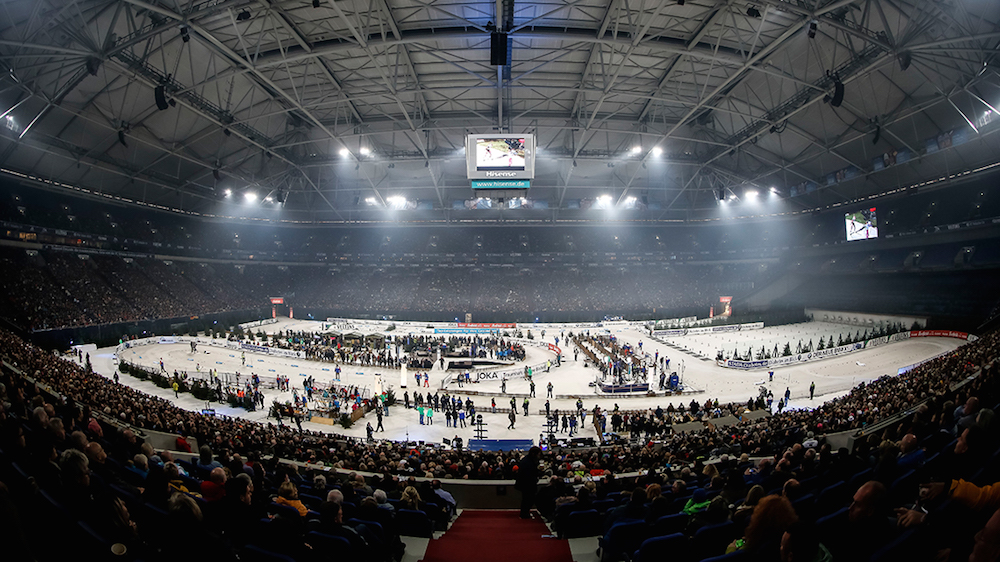
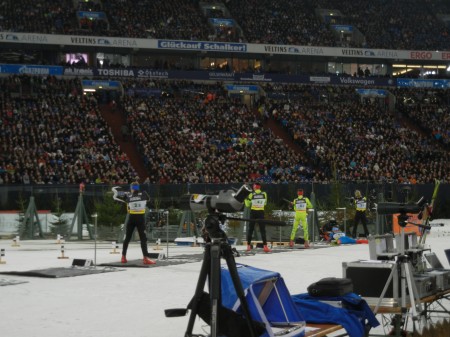
    View of the indoor section of the ski track and the shooting range inside the arena at the Biathlon auf Schalke, or World Team Challenge, in Gelsenkirchen, Germany. (Photo: Biathlon-aufSchalke.de)
    View of the indoor section of the ski track and the shooting range inside the arena at the Biathlon auf Schalke, or World Team Challenge, in Gelsenkirchen, Germany. (Photo: Biathlon-aufSchalke.de)

    Biathletes competing in the international IBU World Cup tour are used to large crowds by now, with races often attended by 5,000 to 10,000 spectators per day. But the annual World Team Challenge, a two-person relay invitational in Gelsenkirchen, Germany, is on something of a different level. Athletes skied on artificial snow through a park around a huge soccer arena, before entering the pitch inside via a tunnel, and then shooting in front of nearly 41,000 raucous fans, with music blaring and the noise level amplified indoors many times.

    Two days ago on Monday, France’s Marie Dorin-Habert and her relay partner Martin Fourcade managed to perform the best among the 10 participating teams in this wild atmosphere, winning the final pursuit in 33:57.6 minutes (for about 12 kilometers of skiing, plus six penalty laps). The Czech Republic’s Gabriela Soukalová and Ondrej Moravec placed second, 12.6 seconds back (with three penalties), and third place went to local fan favorites, Germany’s Vanessa Hinz and Simon Schempp, 22.2 seconds behind with four penalties.

    Fourcade already had two 2014 Olympic gold medals, six World Championships titles, and 46 World Cup wins in every discipline and just about every World Cup location. But he had yet to seize a victory in Gelsenkirchen’s arena and was eager to change that.

    “It’s amazing, this is the only competition I did not win yet,” he explained in an interview with host TV broadcaster WDR after the race. “This morning I talked to Marie that it would be great to finally win it, and together we are a really strong team.”

    The World Team Challenge relay race is held in a special format, with one woman and one man forming a team and exchanging repeatedly, each skiing a 1.3-kilometer loop and having to clean a shooting stage, or ski a short 75-meter penalty lap, before tagging off to their teammate. This mode of competition is fairly similar to biathlon’s new single mixed relay or the team sprint in cross-country.

    Yet the location is vastly different, far away from any mountain range, in a flat region of Germany formerly known for its coal mines. And with the teams entering a darkened soccer stadium to a light show, a PA announcer, and loud music including the theme from “Pirates of the Caribbean,” the scene can be likened to the entrance introductions of NBA players or professional boxers.

    The World Team Challenge, also known as “Biathlon auf Schalke” by the name of German first-league soccer team Schalke 04, which plays its home games in the domed Veltins Arena under a retractable roof and a large JumboTron-style video cube, was created to be a fun race event during the World Cup season’s holiday break.

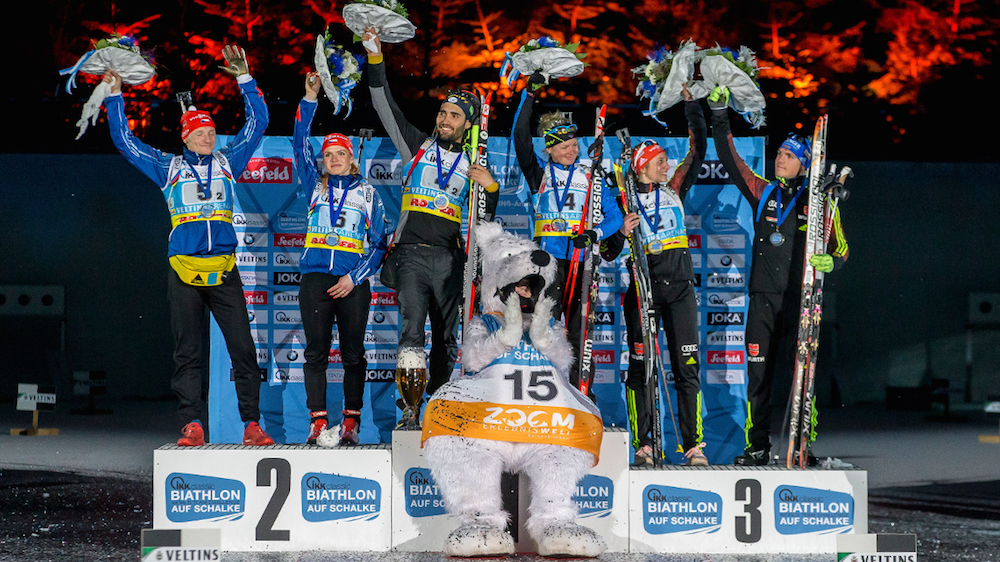
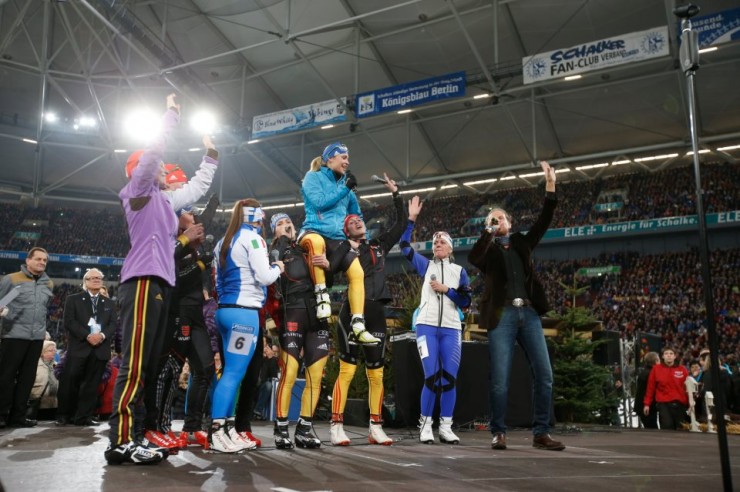
    The 2015 World Team Challenge podium, with France’s Martin Fourcade and Marie Dorin-Habert (c) celebrating their victory, the Czech Republic’s Ondrej Moravec and Gabriela Soukalova in second place (left), and Germany’s Vanessa Hinz and Simon Schempp in third place (right). (Photo: Biathlon-aufSchalke.de)
    The 2015 World Team Challenge podium, with France’s Martin Fourcade and Marie Dorin-Habert (c) celebrating their victory, the Czech Republic’s Ondrej Moravec and Gabriela Soukalova in second place (left), and Germany’s Vanessa Hinz and Simon Schempp in third place (right). (Photo: Biathlon-aufSchalke.de)

    Even more so than a regular World Cup, the race is held in a huge party atmosphere. The outdoor portion of the track meanders through a so-called “winter village” Christmas market with food stands for the fans. An abundance of Christmas trees inside the arena form little forests to delineate the track and shooting range, and entertainment includes a “shootout” to determine the starting order, the “Snowball Fight World Championship” (however undisputed that title may be), multiple live pop music performances, and an indoor fireworks show.

    Now in its 14th season, the World Team Challenge has become a fixed institution circled on the calendar for many biathletes during the holiday break, ever since the German duo Michael Greis and Martina Glagow (now Beck) won the inaugural event in 2002.

    The athletes invited to the race, by and large, take it seriously each year and are impressed by the atmosphere.

    “Oh, it’s huge. It’s amazing to ski in front of such an audience,” Germany’s Hinz told WDR. “It’s something very different, the pressure is a little higher because everything goes by so fast … I was just overwhelmed.”

    For Hinz and Schempp, it was their first podium finish and first time participating. Hinz, a former cross-country skier who switched to biathlon two seasons ago, achieved her first major success as a member of Germany’s gold medal-winning women’s relay team at the 2015 World Championships. For the World Team Challenge, she hadn’t planned to compete until the night before, as she replaced Schempp’s original partner Laura Dahlmeier who was sidelined with an illness.

    “I was completely nervous,” Hinz said, according to news agency SID. “The fans were crazy, a huge compliment to the audience.”

    There are no World Cup points to win in the event, yet the stakes are still high. World Team Challenge organizers guaranteed prize money of at least €10,000 for all starting duos, and this year, the winners got €14,000 per person, as well as a newly introduced challenge cup trophy.

    In the past, sometimes the winners also received a new car, but arguably that prize was harder to split between two people, plus a small crew of coaches and technicians. Overall, €156,000 ($170,000) in total prize money was awarded.

    “The form of this competition, short rounds, fast shootings, I like that, it’s pretty cool, a spectacular show for the viewers,” Germany’s Erik Lesser said in an interview with WDR. Lesser was last year’s runner-up with teammate Franziska Hildebrand.

    “In my opinion, this is an event to show people who normally don’t get to watch us what biathlon is all about, and I think we managed to do that today.”

    New Track ‘On World Cup Level’

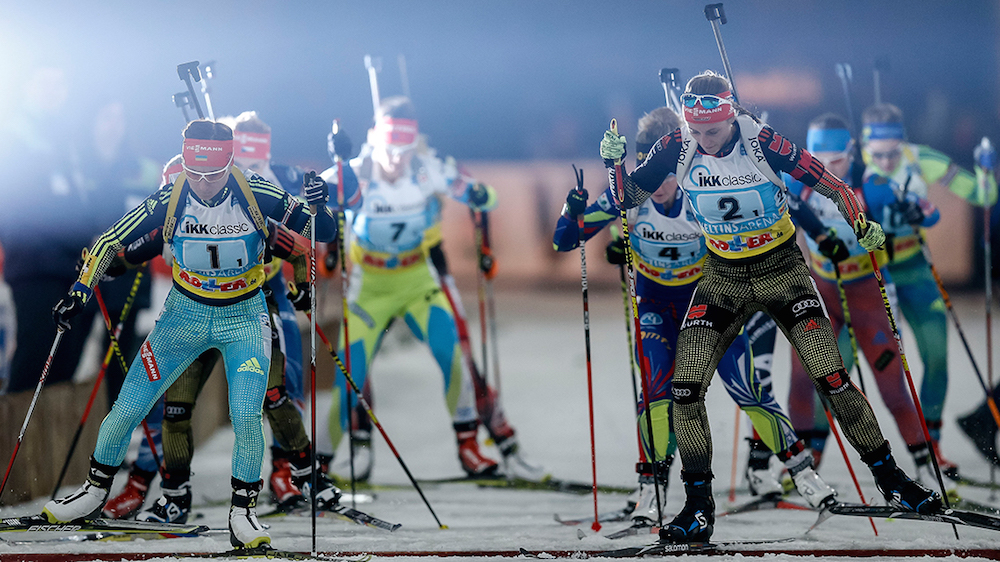
    Ukraine’s Valj Semerenko (bib 1, left) and Germany’s Vanessa Hinz (bib 2, right) lead a group of athletes on the outside section of the ski track during the 2015 World Team Challenge in Gelsenkirchen, Germany.  (Photo: Biathlon-aufSchalke.de)
    Ukraine’s Valj Semerenko (bib 1, left) and Germany’s Vanessa Hinz (bib 2, right) lead a group of athletes on the outside section of the ski track during the 2015 World Team Challenge in Gelsenkirchen, Germany. (Photo: Biathlon-aufSchalke.de)

    For the 2015 edition, the Biathlon auf Schalke organizing committee, led by Herbert Fritzenwenger, an Olympic cross-country skier and biathlete who’s currently a color commentator for biathlon broadcasts on the German TV network ZDF, designed a new track through a park that incorporated multiple more difficult climbs and downhill sections on the part that is built outside the soccer arena.

    In the past it was a rather flat loop, but this year it was supposed to more closely resemble what athletes would see “on the World Cup level,” as the organizers announced in a presentation before the race.

    “It’s not exactly ‘The Wall’ of Ruhpolding or the ‘Birxsteig’ in Oberhof,” Fritzenwenger said, referencing two notoriously difficult climbs at the two World Cup locations in Germany. “But the athletes will feel that it is more difficult than in prior years.”

    Using snow mostly coming from an artificial ski tunnel in a nearby city, every round was now almost 1300 meters long with 30 meters of vertical climb, which added up to about 300 meters for the men and 240 for the women for the whole day.

    After some years where the organizers experimented with rifles using a laser aim, the athletes now use their own rifles with real ammunition on the 10-position range again, with bulletproof glass walls and an empty section behind it to protect the audience.

    The increased difficulty of the course was evident during the races. Despite an indoor shooting range with no dreaded wind influence, most athletes produced more misses and thus had to skate more penalty laps than they normally would in a World Cup, also due to the fact that they were not allowed to use spare rounds.

    The new track was also designed to be wider, offering more possibilities to pass each other and thereby make for more interesting race situations than in prior years.

    “The athletes really enjoy it,” Fritzenwenger said in a pre-race press release.

    Yet during the competition, it quickly became obvious that a sharp right hairpin turn coming out of a new downhill section was rather difficult. Many athletes not only had to use all their cornering skills to pass this section safely, but even had to resort to snowplowing to slow down and not crash into a fence, something especially the men rarely do during World Cup races. Those who didn’t reduce speed enough had to pay for it, with Russia’s Evgeniy Garanichev falling twice in the same spot, potentially costing his team a podium finish. Other athletes also made contact with the snow in this turn, including Germany’s Lesser and Slovenia’s Teja Gregorin.

    “It was quite exhausting,” Hinz said in a post-race interview with WDR. “You can’t relax in the downhill sections because you have to focus so much. In the first rounds it’s still fine, but then it becomes increasingly difficult. It was really hard for me today, because those climbs were also pretty steep.

    “We aren’t machines, everyone is giving their best, but for us, this is a regular competition,” she added. “We are trying to win, that’s why were are giving it all we have.”

    Two ‘Halftimes’: Mass Start and Pursuit

    As in prior years, the field of 10 teams was indeed world class. It was not just comprised of athletes who are all active on the World Cup circuit, but several who are currently in the top 10 in the overall World Cup ranking for both women (1. Soukalová, 2. Dorin-Habert, 3. Hildebrand, 5. Wierer) and men (1. M. Fourcade, 3. Schempp, 8. Garanichev).

    It was a long race day for the athletes, with a shootout (more on that later) followed by the main event split into two “halftimes” as the organizers called it, borrowing a term from soccer. At first, a nine-loop mass start (the women skied four loops; the men five) on the 1.3 k course, followed by a pursuit race of that length the same evening, after just a short intermission break. Thus the women had to ski about 10 k, while the men had to ski 13 k.

    Prone and standing shootings interchanged, and because the loops were comparatively short and intense, shooting accuracy was even more important than in regular World Cup races. It turned into an up-and-down event, and almost all teams remained in contention for the podium for a long time.

    While one athlete was out on the track, crews of wax technicians hurried to clean and prepare the skis of the athlete who was receiving a short pause, very similar to a cross-country team sprint.

    “We are mostly using fluid spray-on wax, that is faster [to apply], and also because temperatures outside are about 8 degrees Celsius,” a technician for the two German teams explained, while simultaneously preparing skis during a brief in-race interview with WDR, before his athletes needed them back in the exchange zone.

    After what the organizers called the “first half,” the mass-start part of the event, Russia with Ekaterina Yurlova and Garanichev was in the lead with a winning time of 33:47.6, ahead of defending champion Ukraine, with Valj Semerenko and Sergei Semenov 12.8 seconds back, and France 14.3 seconds back in third place. Germany’s Hinz and Schempp were 15.2 seconds out of first in fourth.

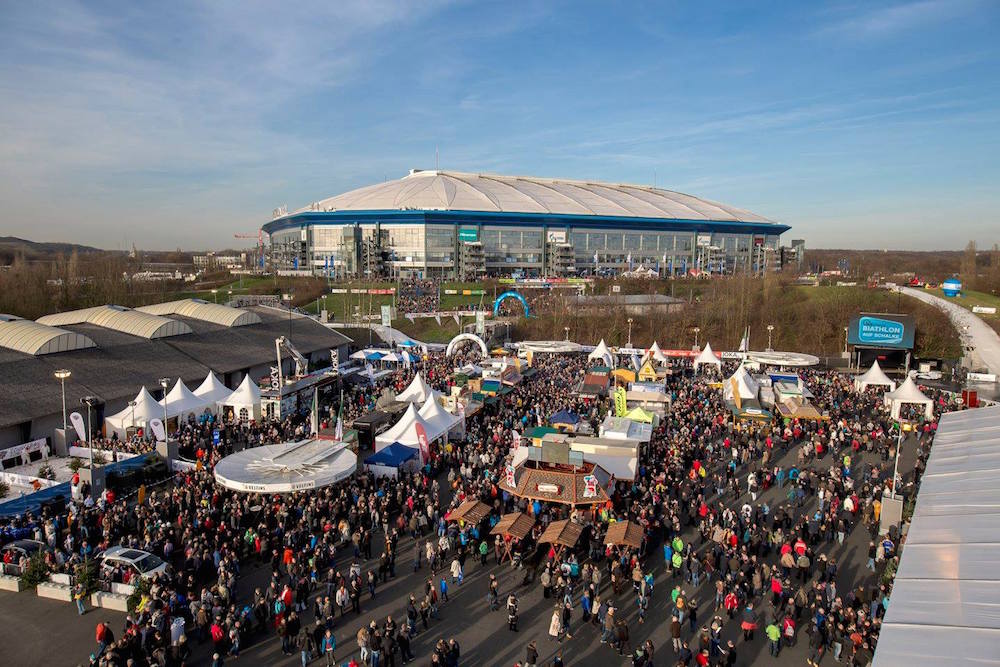
    The "winter village" outside the arena at the 2015 Biathlon auf Schalke, or World Team Challenge, in Gelsenkirchen, Germany. (Photo: Facebook/Biathlon-aufSchalke.de)
    The “winter village” outside the arena at the 2015 Biathlon auf Schalke, or World Team Challenge, in Gelsenkirchen, Germany. (Photo: Facebook/Biathlon-aufSchalke.de)

    But the organizers have come up with a clever way to make things more interesting for the viewers, and give all teams a fair chance and motivation until the end. They did so by reducing the deficit to the winner by halving each team’s time back, and making the maximum deficit 45 seconds. Thus Sweden and Italy, who had finished the mass start only in ninth and 10th, respectively, still had a chance to move up.

    And the podium indeed would be flipped during the “second half” pursuit race.

    The Czech Republic with overall women’s World Cup leader Soukalová and teammate Moravec had only finished in seventh, 53.1 seconds behind, but were able to make up a lot of ground in the pursuit, helped by the start rule and shooting only three more penalty laps.

    With six rounds left in the pursuit, local favorites Schempp and Hinz briefly took the lead when Hinz managed to clean her targets, while Russia’s Yurlova and Ukraine’s Semerenko had to ski into the penalty loop, causing very excited standing ovations from the home crowd.

    “One can only dream to come into the arena in first place, that roar and those masses of people were incredible,” Hinz told WDR.

    “The atmosphere when we were in the lead was gigantic, this is something very unique,” added her partner Schempp.

    However that excited feeling of being the leaders in front of their fans didn’t last very long. After Hinz missed a shot on the next stage, Dorin-Habert caught up with her again.

    As they did repeatedly in the last World Cup weekend in Pokljuka, Slovenia, Schempp and Fourcade skied together for one loop after the exchange, but with three loops to go, Schempp caused another miss in a prone shooting stage while Fourcade cleaned his targets with amazing speed, and was able to create a small gap to Schempp, Moravec, Garanichev, and Ukraine’s Semenov.

    “Of course he took a lot of risk in that last prone shooting, he finished very, very fast, but went out with a zero while I had one miss,” Fourcade’s opponent Schempp remembered in a post-race interview with WDR. “Then there was a gap, but nevertheless we can be very satisfied [with the third place], participating for the first time while they already had experience. And we indeed are!”

    After Dorin-Habert had managed to keep the lead, Fourcade skied another fast round, jumping up the climbs to come into the final shooting in first place. He cleaned all his targets just before Moravec as the closest pursuer had even begun shooting. Fourcade knew he had beaten out his competitors, immediately turning and raising his right fist.

    Moravec managed to clean his shooting stage, too, and defended the second place for the Czech team 12.6 seconds behind France, greeted in the finish by Soukalová.

    It was a special event for Moravec not just because of the excellent result, but also because he is soon expecting the birth of his child sometime during the next week.

    Schempp was able to still secure the third place for his team, cleaning his last standing shooting after coming into the range behind Austria’s Simon Eder, Garanichev and Semenov, and skiing to the finish 22.2 seconds back.

    After coming in fourth place just 7.4 seconds behind the podium, Garanichev was a bit disappointed to have given up the Russian lead from the mass start with too many penalty laps and his two crashes on the track. But it was a hectic race also due to his personal life circumstances. Similar to the Czech Republic’s Moravec, he told reporters that he intended to board a plane back to Russia at 6 a.m. the next morning, hoping to be home in time for the birth of his child expected already for Jan. 1.

    Ahead of the pack, Fourcade was able to ski a relaxed final round, repeatedly slowing down a bit to waive to the fans. Dorin-Habert waited for him behind the finish line to hug him immediately after he had crossed it, with the audience cheering for all remaining teams until they were in the finish, too.

    “Maybe he has three legs, or three lungs, he is so strong,” a smiling Dorin-Habert joked after the race with WDR. “I don’t know how he does it, he is so fast. And if he is not in shape for once, he [still] shoots very well.”

    It was France’s first victory in the event, after the same two athletes had achieved a second place in 2012, and four more podium finishes for other French athletes before.

    (Third place for Vincent Defrasne and Marie-Laure Brunet in 2009, second place for Julien Robert and Florence Bavarel-Robert in 2006, third place for Vincent Defrasne and Sandrine Bailly in 2005, and second place for the pair in 2004.)

    “In 2012 I was in the lead with Marie Dorin here,” Fourcade recalled. “But then I fell on the last lap and hurt my shoulder. We only came in second, so I was very disappointed.”

    This year everything worked out for the French team. “It was a wonderful competition,” Fourcade said. “My family, my friends are here. This is the best way to end 2015.”

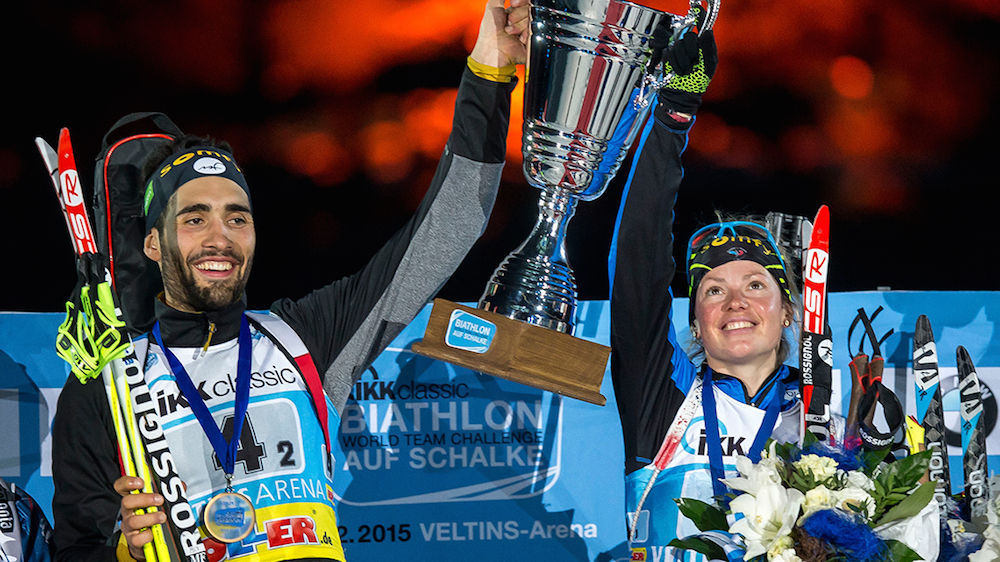
    French teammates Martin Fourcade and Marie Dorin-Habert hoist the new cup challenge trophy after winning the 2015 Biathlon World Team Challenge on Dec. 28.  (Photo: Biathlon-aufSchalke.de)
    French teammates Martin Fourcade and Marie Dorin-Habert hoist the new cup challenge trophy after winning the 2015 Biathlon World Team Challenge on Dec. 28. (Photo: Biathlon-aufSchalke.de)

    Official Race Results: 2015 World Team Challenge

    1. France (Marie Dorin-Habert, Martin Fourcade), 33.57.6
    2. Czech Republic (Gabriela Soukalová, Ondrej Moravec), +12.6
    3. Germany I (Vanessa Hinz, Simon Schemp), +22.2
    4. Russia (Ekaterina Yurlova, Evgeniy Garanichev), +29.6
    5. Ukraine (Valj Semerenko, Sergei Semenov), +31.7
    6. Austria (Lisa Hauser, Simon Eder), +46.8
    7. Germany II (Franziska Hildebrand, Erik Lesser), +1:46.8
    8. Slovenia (Teja Gregorin, Jakov Fak), +1:57.6
    9. Italy (Dorothea Wierer, Lukas Hofer), +2:27.1
    10. Sweden (Emma Nilsson, Tobias Arwidson), +2:55.3

    Notably Absent

    No North American athletes participated in the World Team Challenge this year. In 2008 and 2009 Lanny Barnes and Jay Hakkinen represented the U.S. (placing ninth, then sixth for the best finish to date), in 2010 Tracy Barnes-Coliander and Tim Burke placed 10th, and in 2012 Susan Dunklee again with Burke finished 10th.

    As for Biathlon Canada, no Canadian team has participated in the event to date.

    It was unknown to the author whether North American teams had not been invited, or simply chose the longer rest over the holidays without additional travel and competition stress.

    Norway, which usually has been a mainstay at this event, declined to send a team this year, citing a season preparation focus on the upcoming World Championships at home in Oslo.

    Fun Pre-Race Events (i.e. The Shootout)

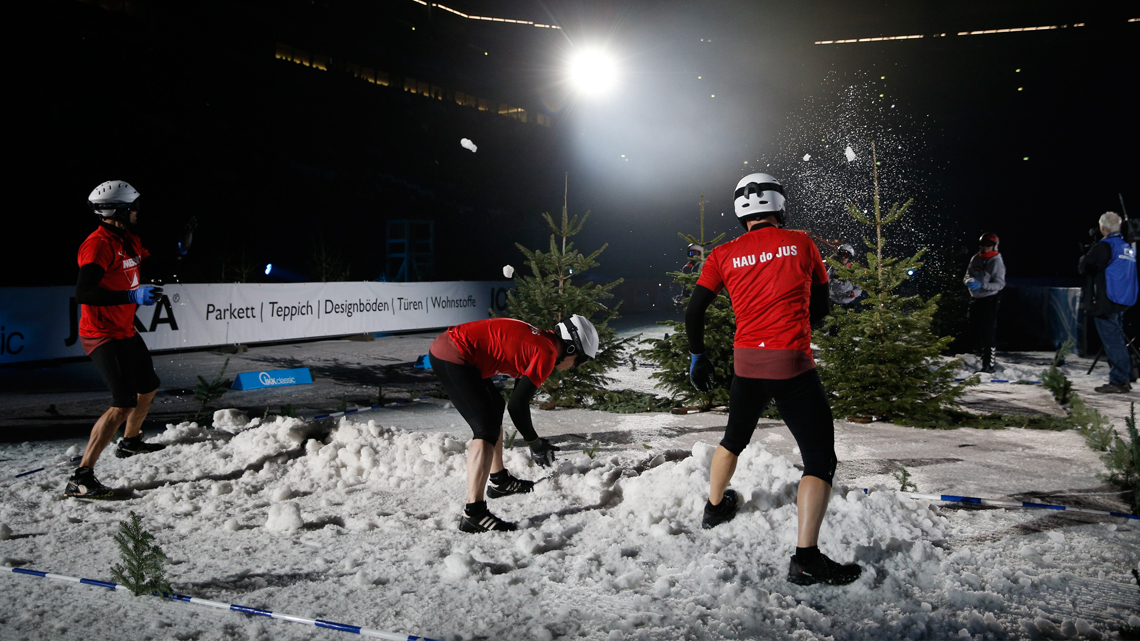
    The 2015 Snowball Fight World Championships took place on Dec. 28 as part of the Biathlon auf Schalke in Gelsenkirchen, Germany. (Photo: Biathlon-aufSchalke.de)
    The 2015 Snowball Fight World Championships took place on Dec. 28 as part of the Biathlon auf Schalke in Gelsenkirchen, Germany. (Photo: Biathlon-aufSchalke.de)

    Before the main event there also was a race among local junior teams called the “German Team Challenge,” with the duo Anna Weidel (age 19, perhaps best-known in the U.S. as a silver medalist in sprint and pursuit at the 2014 IBU Junior World Championships in Presque Isle, Maine) and Dominic Reiter (20) victorious.

    Also before the two main races, Slovenia’s Gregorin won a lighthearted “shootout” event among all participating women and men, coming from behind after several other athletes missed their final shot and lost time having to reload spares manually. In this competition the athletes — while not wearing skis — were asked to hit 20 targets as fast as possible (five prone, five standing, five prone, and five standing), using as many spare rounds as necessary. Gregorin narrowly beat out Lesser, with Austria’s Eder in third, Fourcade in fourth, Ukraine’s Semereko in fifth, and Czech Republic’s Soukalova in sixth place. Gregorin had already won the women’s first round to move into the final of the best three women and three men.

    As for the winners of the mentioned “2015 Snowball Fight World Championships” between 24 three-person teams? That honor went to the defending champions “Hau do Jus” from Wuppertal, Germany, narrowly beating out team “Snow Turtles” with 72 to 70 hits.

    Nobody asked Fourcade and Dorin-Habert if they intend to also aim for this title next year.

    Next World Cups

    The regular IBU Biathlon World Cup season will resume on Jan. 7, with the next two World Cups both held in Ruhpolding, Germany, after the organizing committee in Oberhof, also Germany, had to cancel due to complete lack of snow in the region combined with too warm temperatures to produce artificial one.

    “I’m happy that Ruhpolding has accepted the challenge and is doing everything to successfully host this World Cup,” Germany’s Schempp, who has made the town his home, described the difficult snow situation in an interview with German network ARD over the weekend. “It won’t be easy, but they are going all-out to make it happen. Two days ago I was training there, and right now it doesn’t look great with regards to the track, there is only about 1.2 or 1.3 kilometers. But with everything they do and it [the weather] supposed to become colder, I believe we’ll find really good conditions to race there in early January.

    “Of course the situation is bitter for Oberhof,” he added.

  • Young German Relay Dusts Women’s Field; Canada 10th, U.S. Matches Season-Best 12th at IBU World Champs

    Young German Relay Dusts Women’s Field; Canada 10th, U.S. Matches Season-Best 12th at IBU World Champs

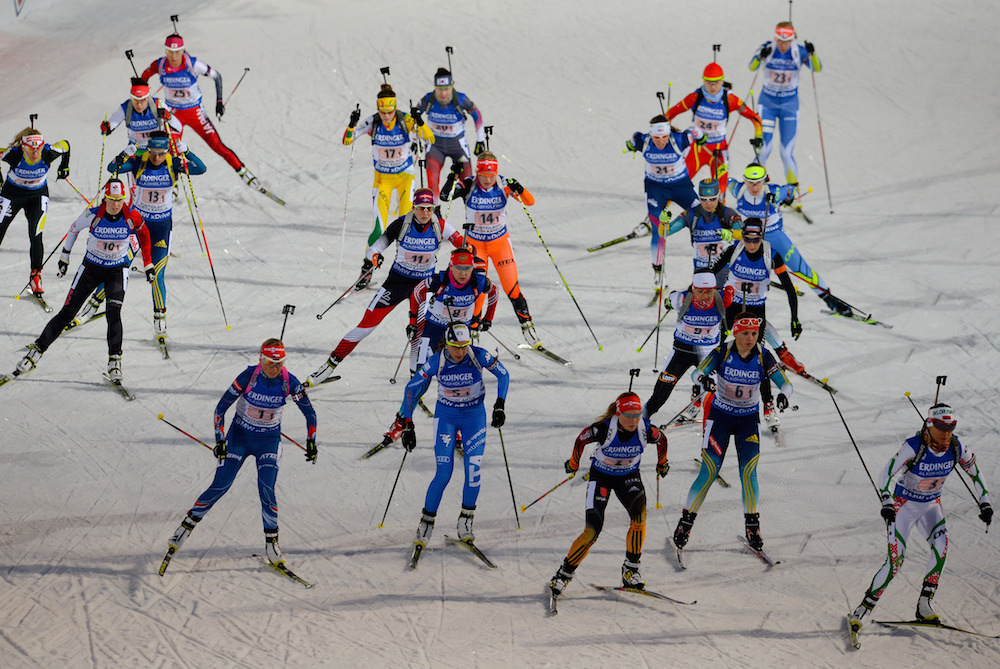
    The start of the women's 4 x 6 k relay at 2015 IBU World Championships on Thursday in Kontiolahti, Finland, with Germany's Franziska Hildebrand out front, Canada's Megan Heinicke toward the left of the pack, and American Susan Dunklee in the back right. (Photo: USBA/NordicFocus)
    The start of the women’s 4 x 6 k relay at 2015 IBU World Championships on Friday in Kontiolahti, Finland, with Germany’s Franziska Hildebrand (4) near the front with Belarusian Nadezhda Skardino (3), Canada’s Megan Heinicke (10) at left, and American Susan Dunklee (21)  near the back right. (Photo: USBA/NordicFocus)

    KONTIOLAHTI, Finland — Not long after finishing the women’s 4 x 6-kilometer relay at 2015 IBU World Championships, Laura Dahlmeier sprinted past reporters to jump into the arms of one of her teammates, her rifle still attached to her back.

    A German sports broadcaster employee quickly ushered the 21-year-old Dahlmeier and her three teammates to the Sportschau platform overlooking the stadium where they had just destroyed the 25-team field.

    In the minutes before, Dahlmeier built on a 30-second lead her teammate Vanessa Hinz established on the third leg to anchor Germany to a 1:00.3-minute win. Hinz had used just one spare in prone to clean both her stages and skied the second-fastest third leg to leap from third into first — and considerably ahead of anyone else.

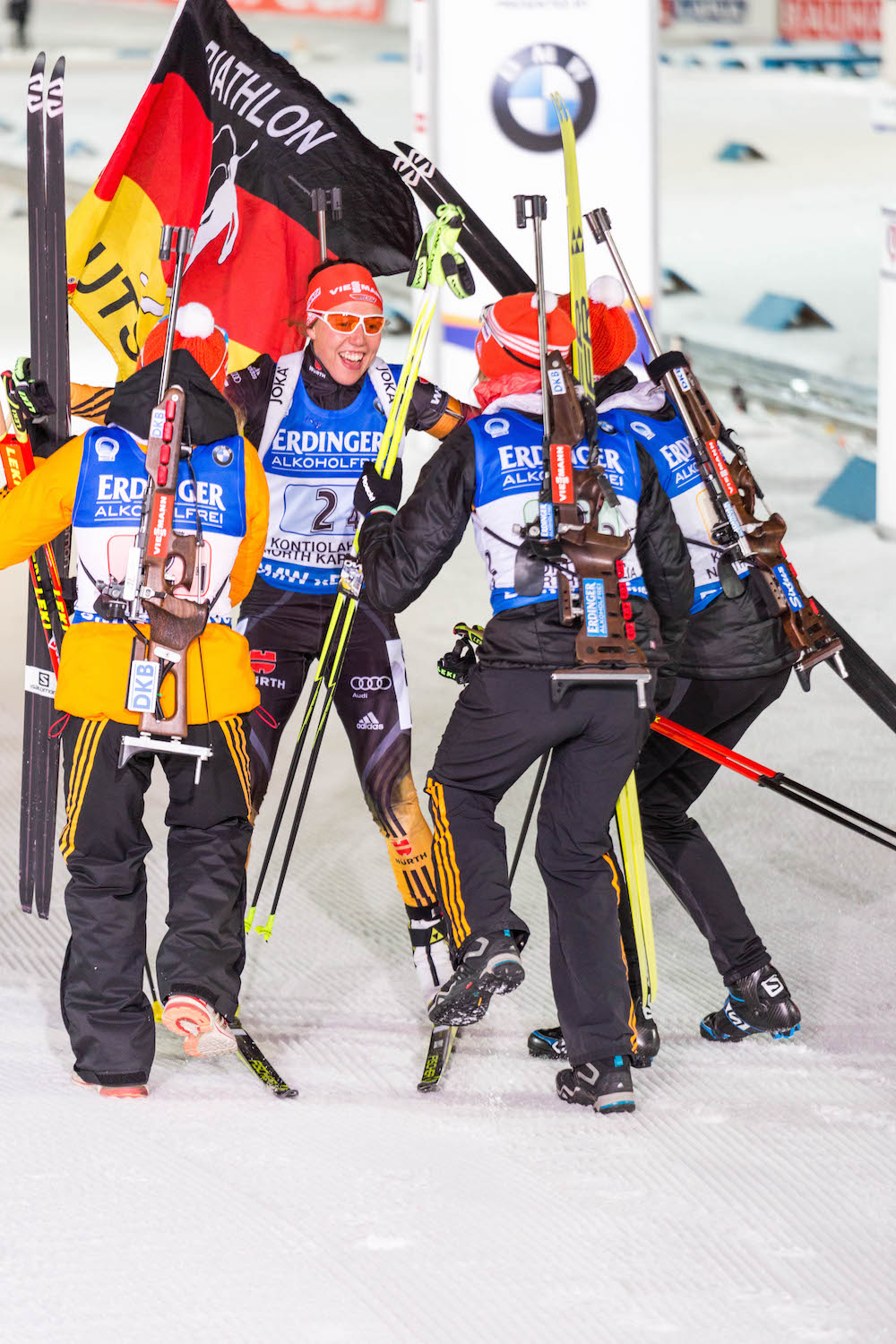
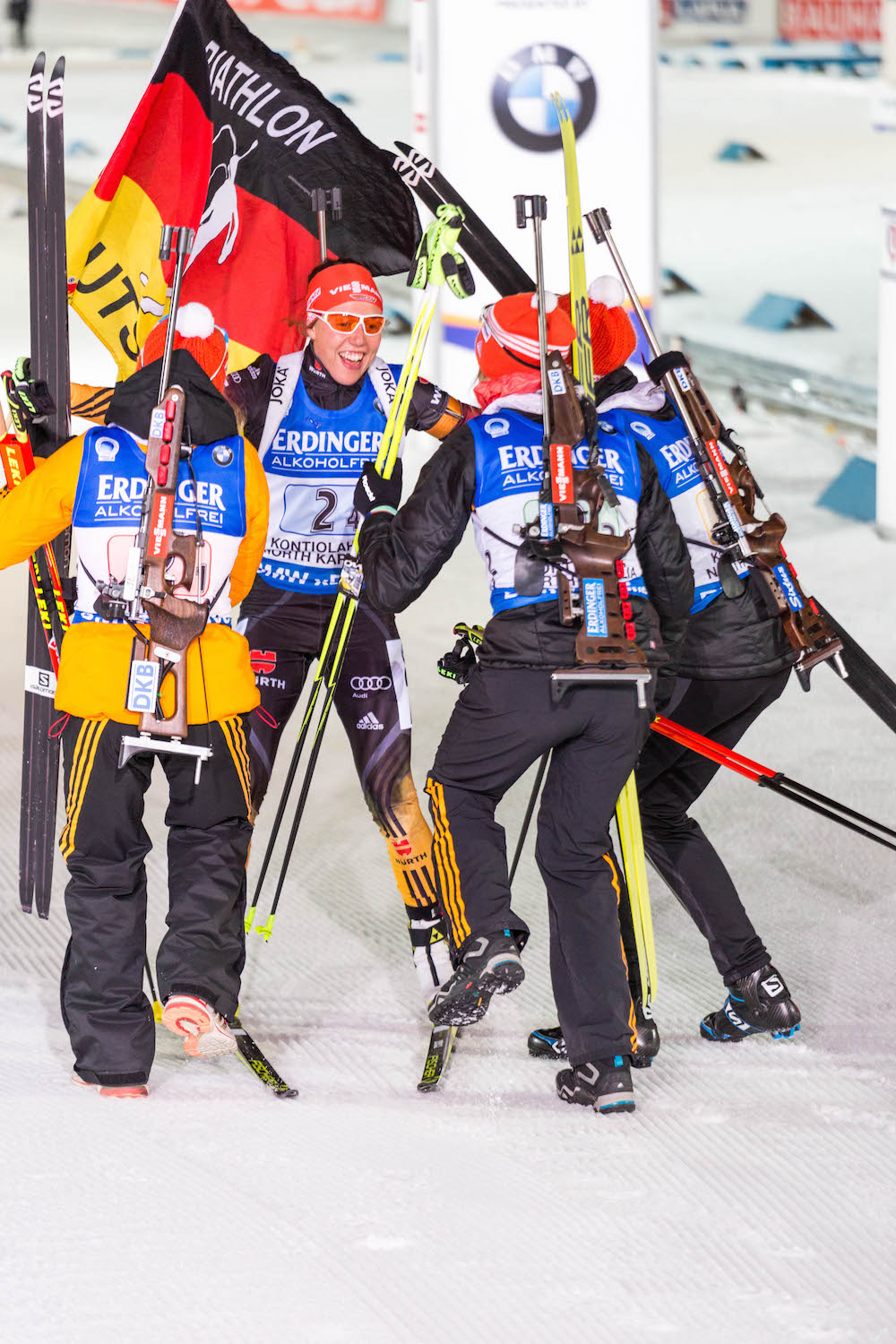
    The German women's relay rushes the finish line to greet anchor Laura Dahlmeier, who secured their win by more than a minute over France in the 4 x 6 k relay at 2015 IBU World Championships in Kontiolahti, Finland. The German team included Franziska Hildebrand, Franziska Preuss and Vanessa Hinz. (Photo: Kontiolahden Urheilijat/Kari Kuninkaanniemi)
    The German women’s relay rushes the finish line to greet anchor Laura Dahlmeier, who secured their win by more than a minute over France in the 4 x 6 k relay at 2015 IBU World Championships in Kontiolahti, Finland. The German team included Franziska Hildebrand, Franziska Preuss and Vanessa Hinz. (Photo: Kontiolahden Urheilijat/Kari Kuninkaanniemi)

    With Franziska Hildebrand and Franziska Preuss skiing first and second, respectively, the Germans combined to secure gold ahead of France in second and Italy another 5.8 seconds back in third.

    “I think it was a dream of all of ours to be world champion and now the dream is true,” Dahlmeier said in a press conference after her team used six total spares and avoided any penalties for the win in 1:11.54.6.

    France, with Anais Bescond, Enora Latuilliere, Justine Braisaz, and Marie Dorin Habert (the latter of which had already won two golds at these world championships), had nine spares and one penalty from Braisaz on the third leg. Habert lifted them from fourth and 1:18.8 behind Germany to silver — her fourth medal in as many races in Kontiolahti, including silver in the mixed relay — using two spares in prone and none to clean standing.

    The Italians, with Lisa Vittozzi, Karin Oberhofer, Nicole Gontier, and Dorothea Wierer, led through the second exchange after Oberhofer elevated them from fourth to first with four total spares and the fastest course time of the second leg. Gontier started out 2.5 seconds ahead of Czech Republic, but slipped to third after using two spares on each of her stages.

    “I’m not so in shape now and I have to thank my teammates, they are so strong,” Gontier said in the press conference.

    She tagged Wierer in third, behind Germany and Russia, respectively. Habert and Wierer both overtook Russia’s anchor Ekaterina Shumilova in the final stage, where Shumilova used two spares, Habert cleaned, and Wierer used one. Wierer left the range in third, 0.6 seconds behind Habert and about 10 seconds ahead of Shumilova in fourth.

    “I was so worried about the Russian girl and I thought, ‘I don’t want fourth position,’ ” Wierer said. “I really give all for the team, but I was really, really nervous.”

    The team that didn’t lack confidence was Germany, with three women under the age of 23 (Hildebrand is the oldest at 27).

    “We are a young team and a strong team and it’s a perfect day for us,” Dahlmeier said after cleaning both her stages to tally her second World Championships medal (following her individual silver in last weekend’s pursuit).

    “We are the best team,” she told Sportschau.

    Russia, with Ekaterina Glazyrina, Daria Virolaynen, 15 k individual gold medalist Ekaterina Yurlova, and Shumilova, finished 10.7 seconds off the podium in fourth. Norway placed sixth, Ukraine was sixth, Belarus took seventh, and the season-long relay favorites, the Czech Republic (which won the mixed relay) finished eighth, 3:11.7 behind the winners.

    The Czechs came through the first exchange in 12th after Eva Puskarcikova’s first leg, 26.4 seconds out of first, and Gabriela Soukalova lifted them to second, 2.5 seconds back. They fell to eighth during Jitka Landova’s third leg, in which she had a standing penalty and six spares. Anchor Veronika Vitkova used three spares and had two penalty laps in prone, then went on to clean standing before finishing eighth.

    Canada 10th, U.S. 12th

    While the Germans drew a significant amount of attention with their win, two North American squads stood together near the finish, cheering their teammates on with each passing lap before waiting to congratulate their anchors as well.

    Rosanna Crawford (Biathlon Canada) racing the second leg in the women's 4 x 6 k relay at 2015 IBU World Championships in Kontiolahti, Finland. Despite a penalty, she brought her team from 14th to 11th, and the Canadians finished 10th. (Photo: Biathlon Canada/NordicFocus)
    Rosanna Crawford (Biathlon Canada) racing the second leg in the women’s 4 x 6 k relay at 2015 IBU World Championships in Kontiolahti, Finland. Despite a penalty, she brought her team from 14th to 11th, and the Canadians finished 10th. (Photo: Biathlon Canada/NordicFocus)

    Canada’s second leg, Rosanna Crawford was one of them, standing near the finish and looking for her teammate Julia Ransom, who had anchored their team to 10th.

    Audrey Vaillancourt had tagged Ransom in 10th, improving one place after Crawford put her in 11th at the second exchange. Ransom, a 22-year-old World Championships rookie, used two spares on each of her stages to help the team meet its personal goal: a top 10.

    She held off Austria’s Katharina Innerhofer by 0.5 seconds to finish 10th, 3:39.5 behind Germany. In total, the Canadians used 10 spares and had one penalty (which came on Crawford’s standing stage).

    “Megan [Heinicke] tagged me off into a great spot, [and I] came in prone … with the group,” Crawford explained.

    She had entered her first stage around 12th after Heinicke tagged her in 14th, 33.8 seconds out of the lead. (The team’s first leg, Heinicke used a single prone spare and cleaned standing.) Crawford cleaned prone, then went on to use three spares in standing while trying avoid the penalty loop, which she ultimately had to ski around once.

    “Standing, I came in and missed my middle shot and loaded my first spare quickly and missed,” Crawford explained. “As I loaded my last spare, I took my rifle down and shook my legs out and missed.”

    Not only did the penalty loop cost her, but the three spares, which she estimated takes her six to 10 seconds to load apiece, set her back as well. Regardless, Crawford skied the sixth-fastest second leg to tag Vaillancourt in 11th, 1:08.6 behind the leader.

    Audrey Vaillancourt (Biathlon Canada) earlier this week at 2015 IBU World Championships in Kontiolahti, Finland. She helped her women's relay team finish 10th on Friday. (Photo: Biathlon Canada/NordicFocus)
    Audrey Vaillancourt (Biathlon Canada) during prone shooting earlier this week at 2015 IBU World Championships in Kontiolahti, Finland. She was the third leg of the Canadian women’s relay that finished 10th on Friday. (Photo: Biathlon Canada/NordicFocus)

    Vaillancourt, 23, went on to use two prone spares and cleaned standing outright to bring the team to 10th, 1:45.3 out of first.

    “I didn’t really know what place I was in at any time, it was just good to always have a pack of people [around me],” Vaillancourt said. “I passed people in the standing so that felt awesome. It’s always such a good feeling, like, ‘Yeah!’ … I was a little tired on the last lap, but I’m happy.”

    Ransom used two spares in prone, rising to ninth, and then two more in standing to drop one spot to 10th.

    “I saw eight and ninth ahead of me on the climbs,” she recalled. “You’re just gunning for those and didn’t look back.”

    In her first World Championships relay, Ransom said she was “terrified” to anchor, “mainly because I saw the start list and saw a lot of medalists hanging out in the fourth [leg] with me.

    “In zero I was pretty nervous, but you quickly fall back into race mode,” she added. “Even though you start with [Belarusian Darya] Domracheva, you put it aside. Once I was on the track and I could feel like I could ski like myself it was fun and I loved it.”

    Rosanna Crawford (Biathlon Canada) trails Nadzeya Pisareva of Belarus during the second leg of the women's 4 x 6 k relay at 2015 IBU World Championships in Kontiolahti, Finland. The Canadians went on to place 10th. (Photo: Biathlon Canada/NordicFocus)
    Rosanna Crawford (Biathlon Canada) trails Nadzeya Pisareva of Belarus during the second leg of the women’s 4 x 6 k relay at 2015 IBU World Championships in Kontiolahti, Finland. The Canadians went on to place 10th. (Photo: Biathlon Canada/NordicFocus)

    Overall, the Canadians were pleased with their performance, with two relative newcomers on the team. While it’s Vaillancourt’s second World Championships, this season was her first full time on the World Cup.

    “[Last night], we talked about that if we all bring our A-game, a top 10 is realistic and a top eight would be the perfect race,” Crawford said.

    “I don’t think that we can say that we had a perfect performance as a team today, so I think that makes it even more awesome that we made our goal,” Heinicke said. “We have been mixing up our relays a ton this year. This is only the second time us four have raced together and we have never had this order. Lots of experiment; it’s been good.”

    Dunklee Fastest First Leg

    The Americans tied their season best in 12th, with Susan Dunklee, Hannah Dreissigacker, Annelies Cook, and Clare Egan. Despite starting in the seventh of nine rows at the start, Dunklee skied the fastest course time of all the first legs to put her team in third, 3.7 seconds behind Poland, which led through the first exchange.

    “I almost prefer starting in one of the back rows,” Dunklee explained in an email after the race. “I love the rush of having to maneuver through the pack and chase people down. It just feels like a really fun game. It helps a lot that my fitness is in peak form right now, and the course suits my strengths with that big wall climb.”

    Susan Dunklee (US Biathlon) follows Germany's Franziska Hildebrand (r) into range for the first shooting in the women's 4 x 6 k relay at 2015 IBU World Championships in Kontiolahti, Finland. Germany went on to win, and the Americans placed 12th to match their season best.
    Susan Dunklee (US Biathlon) follows Germany’s Franziska Hildebrand (r) into range for the first shooting in the women’s 4 x 6 k relay at 2015 IBU World Championships in Kontiolahti, Finland. Germany went on to win, and the Americans placed 12th to match their season best.

    By the 1.3 k checkpoint, Dunklee had skied up to second behind Hildebrand.

    “I don’t know how Susan just careened to the front of the pack like that,” Heinicke observed. “It was pretty impressive. I was in the second half and it was the most aggressive mass start I have ever been in, so much bumping and ski stepping and poles. It was a little bit chaotic and also exciting.”

    Dunklee held her position in second entering the range for the first time, where she used two spares and had some trouble unhooking her sling from her arm. Dunklee left the range in 21st, 26.5 seconds behind Hildebrand, who cleaned without any spares.

    The American spent the next lap skiing up to 12th before cleaning her standing stage to improve to seventh. Poland’s Monika Hojnisz cleaned her second-straight stage without any spares to take the lead, 2.4 seconds ahead of Russia.

    Meanwhile, Dunklee left the range 14 seconds back in seventh. Over the next lap, she skied back up to third, tagging Dreissigacker 3.7 seconds out of the lead.

    “I’m getting used to that; I expect Susan to hand off to me in the top five at least,” Dreissigacker said. “I should be getting better at it, and I still seem to be struggling with get being put in that position. I think I’ve always liked being one of the chasers not one of the chased.”

    Coming into the range for the first time, Dreissigacker was fourth behind Poland, Italy and Russia, respectively. There, she had to use three spares to hit all of her targets.

    “I kind of pulled off two shots accidentally, just way too fast with the trigger,” Dreissigacker explained. “I think I was a little excited, my fingers had gone a little bit number for some reason. … Using the third spare is always really bittersweet. You’re bummed that you had to use three, but you’re always so happy you hit that last one and didn’t do a penalty loop.”

    Hannah Dreissigacker (US Biathlon) skied the second leg for the U.S. in the women's 4 x 6 k relay at 2015 IBU World Championships in Kontiolahti, Finland. After receiving the tag from teammate Susan Dunklee in third, she came through the second exchange in 10th. The Americans finished 12th. (Photo: USBA/NordicFocus)
    Hannah Dreissigacker (US Biathlon) skied the second leg for the U.S. in the women’s 4 x 6 k relay at 2015 IBU World Championships in Kontiolahti, Finland. After receiving the tag from teammate Susan Dunklee in third, she came through the second exchange in 10th. The Americans finished 12th. (Photo: USBA/NordicFocus)

    She left the range in 11th, 37 seconds behind Russia up front. In standing, Dreissigacker used two spares to head out for her final lap in 10th.

    “Hoping that one of these days I can use not quite so many spares,” she said.

    Dreissigacker tagged Cook in 10th, 1:06 out of the lead. Cook used two spares in each stage to hand off to Egan in 11th, 2:05.4 back.

    “That is not like awesome shooting, but I think we all had a little bit of the nightmare of the last relay, where we had six penalty loops, in the back of our head,” Cook said, referring to the last World Cup relay in Oslo, Norway, where the Americans were in 18th before being lapped. “So we were all kind of like, ‘OK! I’m really happy that didn’t happen again!’ I felt really good skiing and it was fun. I felt like I was in the mix, which is exciting.”

    In terms of team goals, she said they didn’t target a specific place.

    “We didn’t do that many relays this year [and] we’ve got some new faces,” Cook said. “I think for us, it is just about getting experience … We have had a pretty steady relay team the last few years so now we are kind of rebuilding that up. Today we just wanted to have fun and to feel  like after the race, we would all be in good moods and happy.”

    In her first World Championships, Egan anchored the U.S. to 12th, 3:44.8 behind Germany and 0.8 seconds out of 11th. The 27-year-old US Biathlon development skier cleaned her first stage to move into eighth after prone, then used three standing spares, which put her back in 13th.

    “I wish I had just used two [spares] because we would have been 10th instead of 12th,” Egan said, estimating it takes her about 20 seconds to load each spare. “That is my only regret. I got really close … I passed one person and I finished within a second [of 11th].

    “This is my first relay that I have not had two penalty laps in standing. So big improvement for me,” she added. “I just tried to ski my own race and remember that I am always trying to gain experience.”

    At the end of the day, Dunklee pointed out that 12th matched their best result of the season.

    “It certainly wasn’t a perfect performance and there were several teams within reach ahead of us. I think it is good to be hungry for a higher place and know the possibility is there, but this was also result we can finish the season feeling proud of,” she wrote.

    Results

  • Yurlova Pulls Off Perfect 15 k Individual for Gold; Dunklee 12th at IBU World Champs

    Yurlova Pulls Off Perfect 15 k Individual for Gold; Dunklee 12th at IBU World Champs

    Russia's Ekaterina Yurlova reacts after sealing her first career victory and podium on the World Cup level at  IBU World Championships on Wednesday in the women's 15 k individual in Kontiolahti, Finland. (Photo: Kontiolahden Urheilijat/Kari Kuninkaanniemi)
    Russia’s Ekaterina Yurlova reacts after sealing her first career victory and podium on the World Cup level at IBU World Championships on Wednesday in the women’s 15 k individual in Kontiolahti, Finland. (Photo: Kontiolahden Urheilijat/Kari Kuninkaanniemi)

    KONTIOLAHTI, Finland — When Ekaterina Yurlova earned two bronze medals at the IBU Open European Championships in Otepää, Estonia, her dad told her: “OK, now your next step is World Championship,” she recalled.

    That was just over a month ago. On Wednesday, the 30-year-old Russian pulled out a surprise win to answer her father’s prophecy: a gold at 2015 IBU World Championships in the 15-kilometer individual. She had started 93rd of 105 women in the race and ended up as the only one with perfect 20-for-20 shooting.

    “I said to him, ‘You’re crazy,’ ” Yurlova explained in a post-race press conference. “But now I think he’s not crazy.”

    Yurlova herself looked stunned at the finish, holding her head and closing her eyes as it all set in at once. She had a great run throughout the evening race in front of 10,800 spectators — rising to third with a clean first shooting and the third-fastest course time on the first lap. After hitting all of her targets on her second stage, the Russian sat in fourth behind Italy’s Karin Oberhofer in first and the Czech Republic’s Gabriela Soukalova and Veronika Vitkova in second and third, respectively.

    Fourteen seconds out of the lead after that first standing, she rose to second with a clean third stage. Soukalova, who started fourth and remained as a top contender from start to finish, cleaned those three initial stages as well, and leaving the range for her second-to-last lap, she was 15 seconds ahead of Yurlova.

    The time gap went out the window when Soukalova came into the range for the last time and missed one for a one-minute penalty. While it took some time for Yurlova to tick off the laps 89 starters later, she ended up cleaning her fourth-straight stage to take the lead, 32.8 seconds ahead of Soukalova.

    Ever since she finished, Soukalova had the time to beat in 41:55.4, holding off Finland’s local favorite Kaisa Mäkäräinen by 1.2 seconds. That time held up until Yurlova crossed the line 23.2 seconds faster in 41:32.2.

    For the third time in her career, Yurlova cleaned an four-stage individual race. It was also her first podium and victory at the World Cup level. Her previous World Cup best was fifth in a mass start two seasons ago in Pokljuka, Slovenia.

    “This is my first race of this World Championship and I wanted to be in podium,” she said. “It was my dream, but I never know that I can win.”

    The women's 15 k individual podium at 2015 IBU World Championships, with Russian winner Ekaterina Yurlova (c), silver medalist Gabriela Soukalova (l) of the Czech Republic, and Finland's bronze medalist Kaisa Mäkäräinen (r). (Photo:  Kontiolahden Urheilijat/Kari Kuninkaanniemi)
    The women’s 15 k individual podium at 2015 IBU World Championships, with Russian winner Ekaterina Yurlova (c), silver medalist Gabriela Soukalova (l) of the Czech Republic, and Finland’s bronze medalist Kaisa Mäkäräinen (r). (Photo: Kontiolahden Urheilijat/Kari Kuninkaanniemi)

    While Soukalova’s longtime lead at the finish didn’t stand, she said at the press conference that she was happy with silver. She and her team won gold earlier at these Championships in the mixed relay.

    “It’s awesome and it was a really difficult season,” Soukalova said. “I didn’t think that I’m able to get a medal from this championship, but that’s nice.”

    She wasn’t crushed when she was bounced from the lead by such a late starter. In fact, she didn’t realize she was in the hunt for gold until her last lap.

    “I thought it’s gonna be really nice to [finish] in top five,” she said.

    While Soukalova posted the fifth-fastest course time and Yurlova’s time ranked 19th (although her range time was notably quick in fifth), Mäkäräinen, who started 36th, was the fastest on course in the the five-lap race.

    Hailing from the nearby city of Joensuu, where most of the World Championships accommodations are located fewer than 20 kilometers south of Kontiolahti, Mäkäräinen earned her first medal of the championships — bronze — 24.4 seconds off the win.

    She cleaned prone but missed one on her first standing and another on her second prone before cleaning her final standing. The two misses put her two minutes back, and while she slipped into 11th after the third stage, she was back up to fifth leaving the range for the last time.

    A fast last lap put her in contention with Soukalova for what looked to be the win at the time (well before Yurlova).

    “In the first standing I had a lot of difficulties,” Mäkäräinen said in the press conference. “My legs were shaking right before I started to shoot. I missed the first target and I thought, ‘This is not going to work now,’ but I fight with every shot and I hit the last four. I was really lucky also there. And in the prone, I don’t really know what happened, maybe I was waiting too long, and the last shooting I don’t remember anything.”

    She did remember hearing how far she was behind Soukalova going into the last lap. It was 27.2 seconds, to be exact.

    “I never thought that I could be so close [at] the finish line,” Mäkäräinen said. “I knew that I did a good jump in a last loop so I wasn’t too sad about that.”

    While she acknowledged she was slightly relieved with the medal (which she took by 0.4 seconds ahead of Italy’s fourth-place finisher Dorothea Wierer), Mäkäräinen added that wasn’t how she preferred to view her bronze.

    “It was a new day today, new race, I did my job pretty OK,” she said. “I’m happy that I had a good day in the World Championships.”

    Darya Domracheva of Belarus missed three on her first standing to slide into the 50’s overall after the second stage. By the third stage, she had recovered to 27th with another clean prone, but she had one more penalty on the last standing to finish 16th, ultimately 2:54.6 behind Yurlova.

    Dunklee 12th for U.S.; Canada’s Heinicke Tallies Third-Straight Top 30

    Susan Dunklee (US Biathlon) racing to 12th in the women's 15 k individual on Wednesday at 2015 IBU World Championships in Kontiolahti, Finland. It was her best individual result of the championships so far. (Photo: USBA/NordicFocus)
    Susan Dunklee (US Biathlon) racing to 12th in the women’s 15 k individual on Wednesday at 2015 IBU World Championships in Kontiolahti, Finland. It was her best individual result of the championships so far. (Photo: USBA/NordicFocus)

    American Susan Dunklee started 30 seconds after Mäkäräinen in bib 37. While she missed two standing to fall back into the 30’s, Dunklee cleaned her next two stages and missed one on the last standing to end up 12th (+2:43.0). She had the sixth-fastest course time (4.5 seconds behind Soukalova, who was fifth fastest on course).

    While Dunklee called the early misses, “not an auspicious way to start,” she explained that they took the pressure off. She thought, “It’s not gonna be a perfect race, but I can just focus on doing my normal thing,” she explained in a post-race interview.

    After her first prone, she caught a glimpse of the board her coaches showed her out on course, which indicted where her shots landed outside the target. For the next prone, she made a couple corrections.

    During one lap, Dunklee skied with Germany’s Laura Dahlmeier (in bib 21) and Ukraine’s Valj Semerenko (in bib 20), which she said helped her push her tempo.

    “There were times when I wanted to back off a bit, but Laura was pulling and gapping me a bit and I was like, ‘I can’t let her get a gap because I’ll lose the draft,’ ” Dunklee explained.

    Dahlmeier went on to place sixth (+40.5) behind Russia’s Daria Virolaynen in fifth (+37.9). Semerenko finished 15th.

    With her best shooting of the week so far and best individual result at these World Championships, Dunklee was pleased to be feeling back on track.

    “My biggest problem the last couple days has been just getting my head back on straight and finding the fun again and the normal race feeling,” she said. Last weekend, she placed 42nd in the sprint and 34th in the following pursuit.

    “The sun came out late afternoon today, and while we were warming up there was a soft, golden light and it made me really relaxed and happy,” Dunklee added. “I felt excited about the start of the race.”

    Regardless of whether Wednesday’s result is enough to qualify Dunklee for the 30-person mass start on Sunday, she said she was happy. “I’m glad to have had a good one,” she said.

    “While we were warming up there was a soft, golden light and it made me really relaxed and happy. I felt excited about the start of the race.” — Susan Dunklee, 12th

    Canada’s Megan Heinicke tallied her third-consecutive top 30 of the week, placing 21st (+3:23.3) for her World Championships career best. She hit 19 straight shots before missing her final target.

    Megan Heinicke racing to 23rd in the 7.5 k sprint at 2015 IBU World Championships on March  7 in Kontiolahti, Finland. On Wednesday in the 15 k individual, Heinicke placed 21st for a career best at World Championships (and at the Olympic level).
    Megan Heinicke (Biathlon Canada) racing to 23rd in the 7.5 k sprint at 2015 IBU World Championships on March 7 in Kontiolahti, Finland. In Wednesday’s 15 k individual, Heinicke placed 21st for a career best at World Championships (and at the Olympic level).

    “I’ve hit 20-for-20 twice already this year so I feel like there was 15 thoughts going through my head, like, slow motion during the last shot,” she reflected. “I’m so, so happy with 19, but I’m pretty sure I missed the last shot because I was thinking, ‘Oh, I’m going to hit 20!’ ”

    During the race, Heinicke wasn’t sure it was going so well. On her first lap, she heard her team’s staff tell her she needed to ski faster.

    “I was like, ‘Oh gosh, this is going to be a disaster,’ and then actually, I kind of felt better lap by lap,” she said less than a week after recovering from a monthlong illness.

    “I was prepared for way worse,” Heinicke said of World Championships overall so far. “I fought hard out there. I really delivered what I was able to. There’s always the ‘if’ thought: if I was in better shape and skiing four-percent faster, but I mean, I’m happy with it.”

    Dunklee’s U.S. teammate, Annelies Cook was on track for a breakthrough performance after cleaning her first three stages. The third starter, she found herself in second after the third shooting behind Soukalova and at the end of the day, her time leaving the range for the second-to-last lap ranked sixth.

    US Biathlon's Annelie Cook (second from l) on the range with Slovakia's Jana Gerekova (l), among others during one of her two standing stages in the 15 k individual on Wednesday at IBU World Championships in Kontiolahti, Finland. (Photo: USBA/NordicFocus)
    US Biathlon’s Annelie Cook (second from l) on the range with Slovakia’s Jana Gerekova (l), among others during one of her two standing stages in the 15 k individual on Wednesday at IBU World Championships in Kontiolahti, Finland. (Photo: USBA/NordicFocus)

    However, in the final standing, Cook missed four shots — the first, second, fourth, and fifth — to fall toward the back of the pack. She ended up 47th (+5:26.8) with four penalties.

    “My heart is a little broken,” Cook said afterward. “I blew it. I just wanted it so bad and I tried too hard. Classic case of wanting it too much. Everything else felt easy and relaxed. I tried to stay relaxed the whole race, not come into the range too gassed, and I think the conditions were really good today so that made it a lot easier …

    “Sometimes biathlon is really mysterious,” she added. “You don’t know what makes one [race] good from the next, but the last stage was just bad. I was too tense and I was just trying to hard.”

    World Cup rookie Clare Egan, also of the U.S., notched her second-best result of her career in 51st (+5:45.7) after back-to-back clean stages for her first prone and first standing. She went on to miss two in the third stage and two more in the final standing.

    Clare Egan (US Biathlon) during one of two shooting stages in the women's 15 k individual at IBU World Championships on Wednesday in Kontiolahti, Finland. She placed 51st for her second-best result of World Championships and her career. (Photo: USBA/NordicFocus)
    Clare Egan (US Biathlon) during one of two shooting stages in the women’s 15 k individual at IBU World Championships on Wednesday in Kontiolahti, Finland. She placed 51st for her second-best result of World Championships and her career. (Photo: USBA/NordicFocus)

    “’I’m still learning, especially with the standing, so any time I can even just miss one in standing is great,” Egan said. “My best World Cup place coming into world champs was 73rd, and I’ve done way better than that so far so I’m really psyched.”

    In placing 40th in the sprint last Saturday, she qualified for last the pursuit, where she placed 52nd. While Wednesday marked another top result for the 27-year-old Egan, she said it was her brother’s presence that made her day.

    “My brother Graham flew in today from New York so he was out there on the course with an American flag,” Egan said. “That was my favorite part of the race.”

    Also for the U.S., Hannah Dreissigacker placed 67th (+6:49.7) with five penalties (2+1+1+1).

    “Ones are OK, twos are bad,” Dreissigacker said of the number of misses per stage. “That’s sort of where my standard is for myself. If I had [missed one each time], I would be, like, not a good day, but not bad. But five, I mean, that’s too many.”

    She described feeling flat during the race and attributed it to possibly hunger.

    “I don’t think I ate enough because it’s such a late-in-the-day race,” she said of the 6:15 p.m. start. “I was getting kind of hungry before the race and I felt like I kind of ran out of energy. I’m not sure I timed that quite right. I should have known better…

    “For some reason, I’m just sort of struggling a little bit here in general,” Dreissigacker added. “Today was tough because I actually felt OK for the most part. The last three stages I missed the last shot every time, which is sort of a classic biathlon mistake. I think I guess I must not have followed through enough.”

    Two Canadians had five penalties as well: Audrey Vaillancourt (2+0+1+2) and Julia Ransom (2+1+1+1). While Vaillancourt placed 79th (+8:05.3), Ransom in her first World Championships was 84th (+8:23.9).

    “It’s just a bad week on the range,” Vaillancourt said. “It’s hard to start with two misses, and you’re like, ‘Nice, now I have three more bouts to go.’ ”

    Typically a strong shooter, she added that sometimes that’s the way biathlon goes.

    “Some weeks you just don’t get that feeling of, it’s easy,” she said.

    And Vaillancourt didn’t think her off week had anything to do with the stakes at World Championships.

    “I’ve been fighting all year to get my place here. It’s not like I’ve been thinking of only World Champs all year,” the 23 year old said. “To me, it doesn’t really make a difference if I do super well on the World Cup or super well at World Champs because it’s not like I’m really close to a top eight.”

    After the pursuit three days earlier, in which she placed 57th, Ransom explained she focused on getting into a “better headspace” for the 15 k.

    “I was so overwhelmed and I was excited, but also really distracted [during the pursuit] so I kind of brought it together and I really wanted to focus on pacing,” she said. “We don’t do a lot of individuals; this is definitely the hardest one I’ve ever done, and I think I found a happy medium with the pacing. Maybe a little too easy, but I’m learning.”

    Like several North Americans, she struggled with her first prone and had two early penalties.

    “The wind had changed on me, which I wasn’t expecting,” Ransom said of her first shooting. “I [made] a big correction for prone … I’ve been struggling with standing the last couple weeks, so I’m glad I kind of brought it back to a half-decent level. It’s a work in progress. These World Champs have been an interesting experience.”

    Perhaps the most disappointed North American of the day was Rosanna Crawford, a medal hopeful, who finished 87th (+9:05.1) with eight penalties (2+2+2+2).

    “It was really bad,” she said.

    Before World Championships, she and her boyfriend Brendan Green, also on the Biathlon Canada national team, discussed the worst that could happen in Kontiolahti, Crawford explained.

    “The worst that could happen is a really bad race,” she continued. “It’s not that bad in the scheme of life, but this is something I’ve dedicated my whole life to and to not achieve my goals is disappointing. I feel like I’m letting down everyone who’s helped me get here, and I know I’m capable of so much more.”

    On Tuesday, Crawford watched a Finnish TV interview with U.S. cross-country skier Kikkan Randall.

    “Kikkan was talking about how disappointed she was with the Olympics, and yeah, you set these big goals, but then you also need to set the goals of being able to leave a championship happy,” Crawford said. “I don’t think I did that. I didn’t set those goals and even if I had, I didn’t achieve them. I didn’t do what I know I’m capable of today, and I really wanted another chance in the mass start and now that’s not gonna happen.”

    The final race of World Championships, the 12.5 k women’s (and 15 k men’s) mass start includes the top-15 ranked competitors on the World Cup circuit with 15 others who do exceptionally well at worlds. The sprint and pursuit carry a hefty weight (with the sprint factoring into the start of the pursuit), and the individual races are the last ones to count toward the mass start.

    Based on a provisional start list, Heinicke and Dunklee have qualified for Sunday’s mass start in 26th and 30th, respectively.

    Results

  • Mäkäräinen Shows U.S. Biathlon Women the Ropes (and Swimming Holes) in Kontiolahti

    Mäkäräinen Shows U.S. Biathlon Women the Ropes (and Swimming Holes) in Kontiolahti

    The U.S. Biathlon women's team, including Hannah Dreissigacker (l), Susan Dunklee (second from r) and Annelies Cook (r), with Russia's Ekaterina Yurlova (second from l) and Finland's Kaisa Mäkäräinen (c) at the 2015 World Championships range in Kontiolahti, Finland. (Photo: Jonne Kähkönen)
    The U.S. Biathlon Women’s A-team, including Hannah Dreissigacker (l), Susan Dunklee (second from r) and Annelies Cook (r), with Russia’s Ekaterina Yurlova (second from l) and Finland’s Kaisa Mäkäräinen (c) at the 2015 World Championships range in Kontiolahti, Finland. (Photo: Jonne Kähkönen/USBA)

    When the U.S. Biathlon women step out onto the trails at Kontiolahti, Finland, next March, there should be some muscle memory that comes into play on the 2015 International Biathlon Union (IBU) World Championships course.

    They’ve been spending the last two weeks there, rollerskiing and testing their technique and fitness the loops, and learning more about the course and Finnish culture with reigning Overall World Cup champion Kaisa Mäkäräinen.

    On July 20, the three 2014 U.S. Olympians and women’s A-team members — Susan Dunklee, Annelies Cook and Hannah Dreissigacker — arrived in Kontiolahti, about 450 kilometers northeast of Helsinki. There, U.S. Women’s Coach Jonne Kähkönen set up several training sessions with Mäkäräinen, his former athlete, who also took the team orienteering, to her favorite local swimming holes, and joined them for a barbecue.

    Susan Dunklee racing her way to seventh place in the World Cup pursuit in Kontiolahti, Finland, on March 16. (Photo: USBA/NordicFocus)
    Susan Dunklee racing to seventh in the IBU World Cup pursuit last March in Kontiolahti, Finland. (Photo: USBA/NordicFocus)

    “It has been helpful to try to keep up with her on skis and have a few head-to-head shooting duels,” Dunklee wrote in an email. “Ekaterina Yurlova from Russia joined us one morning as well.  A few Finnish juniors also joined us for a time trial.  It can be difficult in the race season to really get to know athletes from other countries, but it is a lot easier in the summer when everything is more relaxed.”

    On Wednesday, Dunklee flew to Norway with Mäkäräinen to compete in the Blink rollerski festival from Thursday to Saturday in Sandnes and Lysebotn. She will be the first U.S. female biathlete to race in the world-famous event, and plans to do the uphill climb and biathlon races at Blink.

    “I am most excited about the opportunity to get lots of head-to-head shooting practice against some of the world’s best under the pressure of a race,” she wrote. “That is something that is very difficult to simulate in the training season, so it will be a valuable experience.”

    Before her team’s camp in Finland, Dunklee spent her rest week backpacking between huts in Norway. Despite hiking one day for more than nine hours by herself (after bypassing one hut to get to the next), she described it as relaxing.

    “The week in Norway was good for the soul,” she wrote. “Sometimes your head needs some recovery too.”

    In Kontiolahti, the U.S. women did most of their rollerski-combo workouts at the World Championships range, familiarized themselves with the course’s climbs, and experimented with corners and transitions throughout the loops, Dunklee explained.

    “Of course skis move a lot differently than rollerskis, and even in the winter, we have to be prepared to adapt our skiing style day-to-day based on snow conditions,” she added. “This course has one steep wall that I absolutely love (mostly because I know lots of other athletes hate it) and the terrain suits my strengths: V1 and V2 alternate.”

    “This course has one steep wall that I absolutely love (mostly because I know lots of other athletes hate it)…”  — Susan Dunklee on Kontiolahti’s 2015 IBU World Championships course

    Cook explained that her main goal at the Scandinavian camp (with another stop at the Torsby ski tunnel in Sweden next week) was to focus on quality training without distractions.

    Kaisa Mäkäräinen (FIN) climbs to victory in the Lysebotn hill climb on Thursday. (Photo: blinkfestivalen.no)
    Finland’s Kaisa Mäkäräinen climbing to a victory in the Lysebotn hill climb last season at the Blink Festival in Norway. The 2014 edition of the race took place Thursday, with Makarainen and Americans Susan Dunklee and Lowell Bailey competing. U.S. cross-country skier Liz Stephen won the women’s race. (Photo: blinkfestivalen.no)
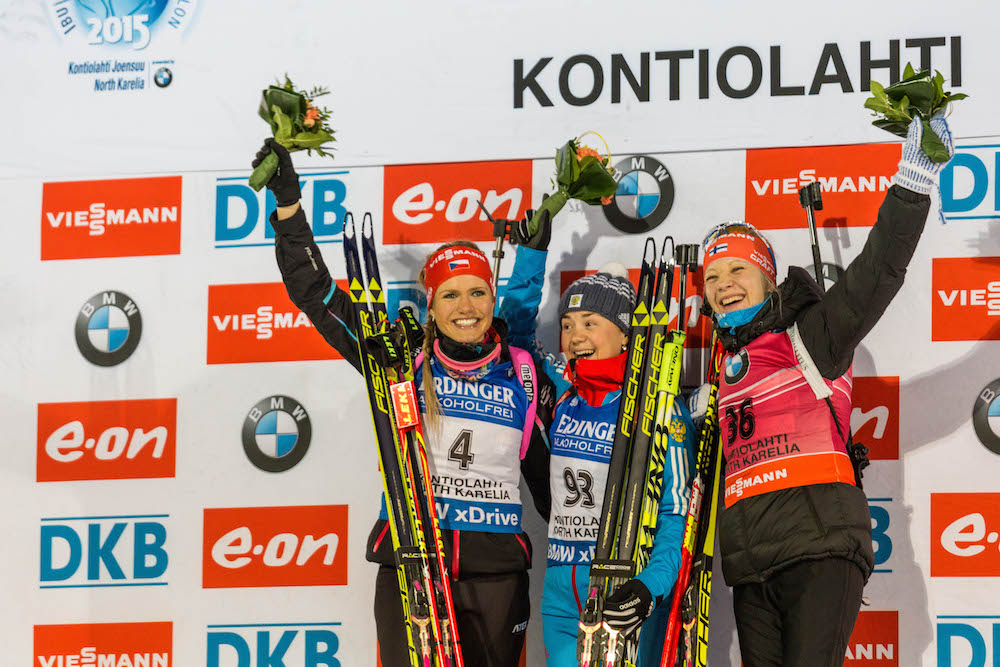
    “I hate missing out on life and sometimes at home that means I get overwhelmed trying to do everything,” she wrote. “Here in Finland, I can just keep it simple. I also want to do that for training — to keep working on confident shooting and skiing, but keeping it really simple and intuitive.”
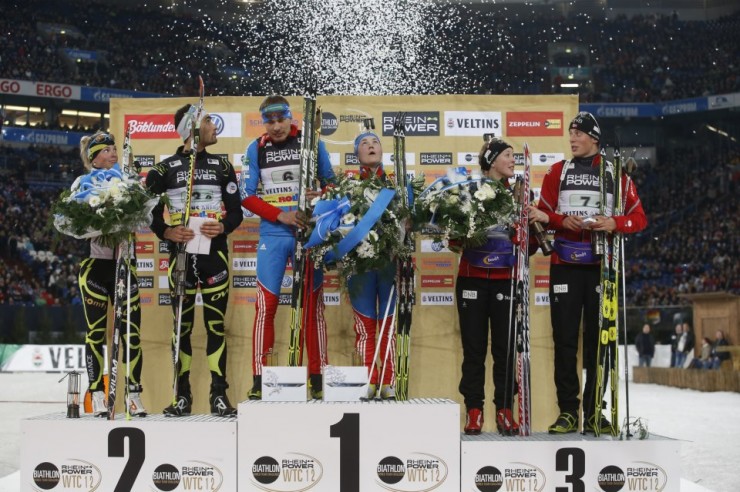
    While in Kontiolahti, the team stayed at cabins at a campground near town, Cook explained. They commuted on trails with a cruiser bike, visiting lakes and picking blueberries along the way. Outside of training, they didn’t have to worry about too much; Kähkönen’s wife cooked them Finnish meals and treats.

    Mäkäräinen also went out of her way to accommodate the Americans.

    “It was great for me to get the chance to ski against her in a normal time trial just to see where she is better than me,” Cook wrote. “We also have a small group so it is great to have one extra person around to mix it up!”

    Dreissigacker explained that it had been fun getting to know Mäkäräinen better.

    “It makes you realize that the World Cup leader is just a normal, hardworking person,” she wrote.

    “It makes you realize that the World Cup leader is just a normal, hardworking person.” — Hannah Dreissigacker on training with Finland’s Kaisa Mäkäräinen

    Finishing up their second week in Kontiolahti, Dreissigacker described the beautiful weather and valuable training they’d experienced. Even a windy day, like Thursday, made for good practice on the range.

    “It’s a unique course with some really steep big hills, but also a lot of flat,” she added. “So it’s good to get more practice skiing here.”

    “The world championship course is just hard,” Cook wrote. “There is a massive uphill wall that is going to be a killer no matter what way you slice it. But it is cool to try some things that will make it faster to ski up so the suffering has a bigger payout!”

    In Torsby, Cook and Dreissigacker will meet up with other U.S. Biathlon teammates (including Dunklee) and shift to snow for technique work and ski testing.

    “It will be fun to have the entire team there — men, women, techs and coaches,” Dreissigacker wrote. “The team atmosphere is always a lot of fun when we’re all together.”

  • In Packed Soccer Stadium in Germany, Biathletes Put on a Show; Burke and Dunklee Tenth At Schalke

    In Packed Soccer Stadium in Germany, Biathletes Put on a Show; Burke and Dunklee Tenth At Schalke

    Anton Shipulin and Ekaterina Yurlova of Russia, center, celebrate after their victory in the pursuit relay at the World Team Challenge on Sunday. They bested Martin Fourcade and Marie Dorin Habert of France (left) and Fanny Welle-Strand Horn and Lars Helge Birkeland of Norway (right). Photo: Biathlon auf Schalke / K. Rabas.

    Who would think of holding a biathlon race inside a soccer stadium with 50,000 fans?

    Who would think of dropping retired German star Magdalena Neuner into the stadium on a trapeze, while the theme from the James Bond film “Skyfall” blared in the background?

    Who would think of asking elite biathletes to do three competitions in a single day?

    The answer to all of these questions is the organizers of the RheinPower World Team Challenge 2012, an event that has been held at the Veltins Arena in Gelsenkirchen, Germany, for the last ten years. Usually the home of the FC Schalke 04 football club, the arena was outfitted with plenty of snow, a bridge, a tunnel, and a shooting range backed by bulletproof glass so more spectators could be crammed in to watch.

    “[I’ve] never seen anything like it,” U.S. biathlete Susan Dunklee told FasterSkier after completing her first World Team Challenge on Saturday. “Very loud, but dark in the stands so it was easy to zone the crowd out. It became one roaring creature rather than thousands of individuals.”

    And the day wasn’t just about biathlon; there was also a celebrity shooting competition (won by Alexandra Popp, the striker of the German football team) and plenty of other entertainment.

    Magdalena Neuner making a dramatic entrance to the arena. Photo: Biathlon auf Schalke / K. Rabas.

    But biathlon was the centerpiece, including a farewell to Neuner, who retired at the end of last season as the second-winningest woman in the history of the sport. After her special entrance, she highlighted a women’s-only race – which was actually won by Dorothea Wierer of Italy by three seconds over Neuner, with each accumulating three penalties. Wierer meant to wait at the finish and let Neuner cross before her, but ended up slipping across the line first anyway.

    There was also a tribute to Michael Greis, another German star who announced his retirement after the first few competitions of this World Cup season. With 11 World Cup wins, he was ninth on the all-time list.

    The main competitions consisted of teams of two athletes, generally from the same country although Carl Johan Bergman of Sweden and Kaisa Makarainen of Finland joined forces again after winning a previous edition of the World Team Challenge.

    First, they competed in a “shoot-out,” to see who could clean four stages in a row, prone-standing-prone-standing, the fastest. Spare rounds are allowed to hit targets that were originally left standing. There was no skiing involved and results haven’t been published online, but Dunklee reported that she and teammate Tim Burke each finished in the middle of the pack.

    “The shootout didn’t really count for anything, it was just something they have for the show and for fun,” Dunklee wrote in an e-mail. “It is very similar to a drill we do in the summer called the ‘American Test.’ We do it a little differently in practice; we don’t use spares and if you miss more than three you are DQ’ed. During the competition, I did get a little shaky and over excited trying to load the spares, which is great practice for relays.”

    The scene during the biathlon shootout, with some of the 50,000 fans filling the stands around the shooting range. Photo courtesy of Susan Dunklee.

    After a little break the teams faced a mass start competition unlike anything they will ever see on the World Cup. Much like a cross country sprint relay, each member of the team skied a loop and shot before tagging off to their teammate. But the men and women each did four laps of the 1200 meter track, which wound outside of the stadium after exiting via a tunnel, as well as penalty loops if they missed shots.

    In the mass start, the women started on the range, as well, so had an extra prone stage. That made a total of 45 targets for each team in the race – hence the higher-than-usual penalty counts that would seem staggering on the World Cup.

    The French team of Marie Dorin Habert and Martin Fourcade won the mass start by 1.6 seconds over Vita Semerenko and Sergey Sednev of Ukraine. Fanny Well-Strand Horn and Lars Helge Birkeland of Norway were third. Dunklee and Burke were ninth out of ten teams. (Field size was limited by the ten-point range that could fit inside the arena.)

    Just an hour and a half later, the teams lined up again, this time for a pursuit based on the results of the mass start. 40 more shots, and a lot more small loops awaited them.

    “I have never done a biathlon race with quite so much lactic acid in my system,” Dunklee wrote. “It was a lot like a xc sprint relay.”

    The French held onto the lead for most of the race, but at the end were passed by Ekaterina Yurlova and Anton Shipulin of Russia, who took the overall crown. The Norwegians were third again, followed by Andrea Henkel and Andi Birnbacher of Germany; the Americans slipped to tenth.

    That was despite near-perfect shooting by Burke, said Dunklee.

    Tim Burke and Susan Dunklee in the Schalke stadium. Photo courtesy of Susan Dunklee.

    “Tim shot awesome (4 misses total between the two races),” she explained. “I struggled with one disaster stage of four misses during each of the races. But I felt good that majority of my stages were 0’s or 1’s despite the head to head pressure, the jetlag, and hearing my name over the loudspeaker.”

    Unlike Burke, who has competed at Schalke before, Dunklee was a newbie to the strange formats, 1200 meter loop, 100-meter long tunnel leading to the outdoor portion of the course, and all the rest.

    While both suffered from jetlag, Dunklee had a particularly tough transition to German time: she had been scheduled to fly out two days before the race, but her flight was canceled due to the winter storm that pummeled the east. As such she arrived at 7 a.m. and left to race at 3 p.m., with just a few hours to relax and adjust in between.

    “As soon as I entered the arena, adrenaline kicked in and woke me up,” Dunklee wrote.

    All in all, the experience was unique, she said, but not completely irrelevant to regular World Cup racing.

    “My goal was to enjoy the experience and treat it was a learning and training opportunity,” she wrote. “The crowds are huge and the head to head pressure on the range defines this event. The more I can expose myself to things like this, the more prepared I will be for the World Cup. Dealing with pressure on the range is something you must learn by doing… My shooting groups crept higher and higher as my system became more stressed and I started overheating. That created another great opportunity to understand myself better as a shooter – my race groups of shots may differ from my zero.”

    Dunklee shared a video touring the Schalke course, which can be seen at the link on YouTube.

    The IBU World Cup resumes in Oberhof, Germany, on Thursday with a women’s relay. A men’s relay follows on Friday and then sprint and pursuit competitions will be held over the weekend.

    Magdalena Neuner was hoisted onto her teammates’ shoulders after placing second in the women’s race behind Dorothea Wierer of Italy (blue tights, number six). Biathlon auf Schalke / K. Rabas.