From the FasterSkier archive — posts syndicated from athletes’ and coaches’ own blogs between 2004 and 2012, kept online as published. Current coverage is at fasterskier.com.
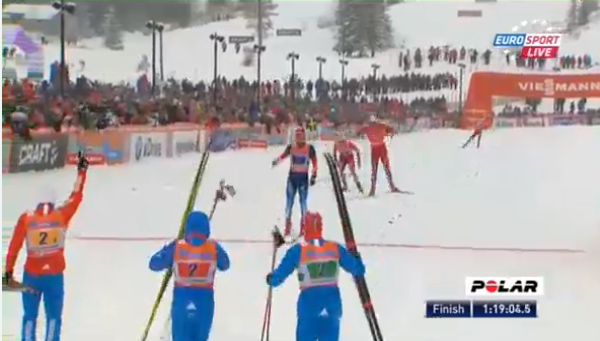
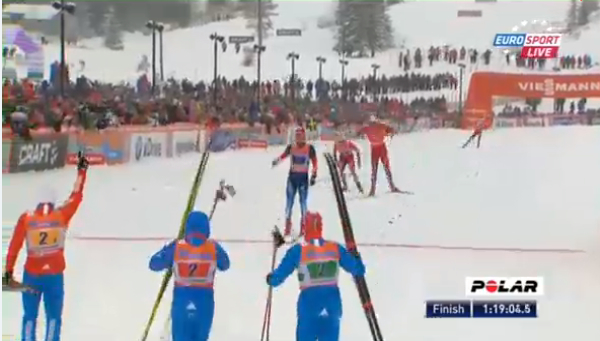
Maxim Vylegzhanin bringing it home for Russia at the Lillehammer World Cup 4 x 7.5 k relay, as his teammates prepare to congratulate him at the finish. Vylegzhanin outlasted Norwegians Finn Haagen Krogh and Petter Northug for the victory for Russia I on Sunday. Krogh took second, and Northug was third.
Under snowy skies and on Norwegian terrain, Maxim Vylegzhanin and the Russian relay team seized victory in the men’s 4 x 7.5-kilometer relay Sunday in Lillehammer, greatly raising their team’s expectations ahead of the Sochi Winter Games.
As the lone relay ahead of the much-anticipated Olympic contest, the event was an important test of the teams’ relative strengths, and an opportunity to try out relay orders. If Lillehammer made anything clear, it’s that the men’s relay is now dominated by a new Norway/Russia rivalry.
The race began at noon with heavily falling snow, the tracks set deep in the powder and the steeper hills rutted and choppy enough to force the athletes into a wide, loping herringbone. Eldar Rønning, skiing for Norway’s second of four teams, took the lead early and set a fast pace aimed at breaking up the pack. In the heavy snow it didn’t take long to break apart the field.
Norway I nearly fell off the back early on when Pål Golberg became tangled with another skier on a descent, knocking him off balance and forcing him to ski on only his left foot for much of the way down the powdery slope. Somehow, though, he managed to stay on his feet. This impressive bit of skiing allowed Golberg, Saturday’s 15 k classic winner, to chase his way back up to the lead group.
Coming through the stadium on the first of two 3.75-k laps, Russia I, led by Dmitriy Japarov, took the lead from Norway II’s Rønning and continued to push the pace. By 4.9 k the lead group was made up of Japarov, Rønning, Daniel Richardsson of Sweden, Jean Marc Gaillard of France, Stanislav Volzhentsev of Russia II, Tim Tscharnke of Germany, and Norway I, III, and IV.
At the end of the first leg, Rønning charged into the stadium to hand off first to Chris Andre Jespersen, who was closely followed by Russia I and II, with Alexander Bessmertynkh and Alexander Utkin respectively. With Jespersen leading, the Norwegian teams would prove their classic skiing chops and their first three teams moved to the top of the field, only Bessmertynkh could hold the collective pace of Jespersen, Tønseth (NOR I), and Simen Haakon Oestensen (NOR III).
At the handoff of the third leg and transition into skating, Tønseth tagged Martin Sundby first for Norway I, Alexander Legkov took over for Russia I just 0.2 seconds back in second, and Jespersen came through in third to send Sjur Røthe off for Norway II.
After hungrily looking at the stadium screen as he watched his teammate Bessmertnkh approaching, Legkov took the lead from Sundby up the first climb, and wasted no time in trying to put the rest of the field under pressure.
Legkov finally began to slow at the end of the first lap, and he relinquished the lead to Sundby as they passed through the stadium. Legkov did not spend long resting behind him, however. As soon as the skiers left the stadium and began to climb up Lillehammer’s long hills, the Russian retook the lead and dialed up the pace once more. This time, only Sundby and Røthe could stay with him; the rest of the field began to lose time to the Russian’s aggressive skiing.
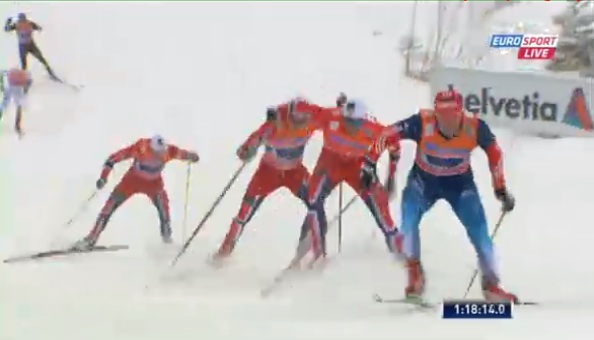
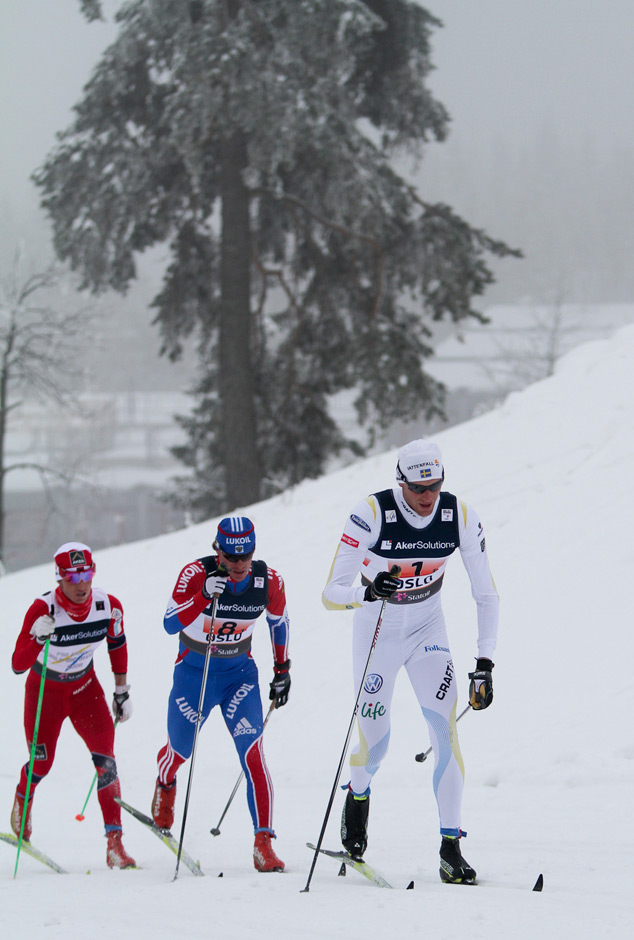
Maxim Vylegzhanin leads Norway’s Petter Northug (NOR I), Finn Haagen Krogh (NOR II) and Tord Asle Gjerdalen (NOR III) in the final leg of Sunday’s Lillehammer World Cup 4 x 7.5 k relay. Vylegzhanin dropped the Norwegians to give Russia the victory.
On the final leg, Finn Haagen Krogh of Norway II, Vylegzhanin of Russia I, and the ever-confident Petter Northug of Norway I left the stadium together. By default, Krogh was left to lead the three. Vylegzhanin skied comfortably behind him in second and Northug stayed carefully behind the Russian. For the first 6 k, Krogh’s lead was never challenged by either skier, and no one seemed to have any trouble keeping up with his steady tempo.
The leader’s lack of swiftness was evident by a steadily encroaching field behind them, led by a hard-charging Tord Asle Gjerdalen of Norway III. Eighteen seconds behind Krogh at the start, Gjerdalen set off immediately on his leg to rejoin them, and in the last lap found himself back in the fold behind Northug. Marcus Hellner also could be seen taking a hard turn for Sweden in a bid to catch up. At 6 k, he was only 8 seconds behind Vylegzhanin, who had now taken over the lead.
The Russian had plans for an early burst of speed and leading 1.5 k from the finish, Vylegzhanin took the leaders down a slope, already charging into the final hill before the long entrance into the stadium. He quickly secured a sizeable gap on the Norwegians who appeared unprepared for Vylegzhanin’s early move. Northug, in particular, looked sluggish as he tried to respond to Vylegzhanin’s break.
With Northug battling to catch up and Krogh hanging with him, Vylegzhanin’s sprint never wavered as he came barreling into the finish. Finally, at the end when Northug saw it was beyond him to win the day, he stood up, allowing Krogh’s lunging foot to take second for Norway II.
Northug, who has been sick this fall, told NRK that today he “had no punch.”
“In Russia we take them,” he added, according to a translation. “Clearly, it is one of the great dreams, to beat Russia at home. Then we rub it in.”
Northug chose to downplay the importance of this race. “It is more important with the Olympic relay,” he said. “It is what the people will remember for years here, not how the Lillehammer relay went.”
Norwegian National Team Coach Trond Nystad was more circumspect in his comments. “Today we lost to a better team,” he told NRK. “With an optimal team settup I think we should cope with Russia in the Olympics.”
To Norwegian newspaper Dagbladet, Nystad conceded that his skiers had made some missteps in their strategy.
“At the end we are a little inexperienced—we let him go on top there, and [were] unable to slide him [Northug] in at the end. We must take [that] with us.”
The Russian team was quite excited with their victory. Legkov in particular looked very pleased, triumphantly pointing his finger up to indicate No. 1.
“It is a great day and great victory for us,” Legkov told FIS. “This season is the most important and I am happy we showed such a great performance in the relay today. Maxim did a great move towards the end. I hope in Sochi we will perform in the same way.”
The race demonstrated the strength of the Russian team, as well as the depth of the Norwegian team, which went second, third, fourth, and eighth on Sunday.
Some Norwegian skiers were more philosophical about the relay.
“The race showed that everything has to work out for the team to win and anything can happen, even with Petter Northug on the team,” Golberg said.
“We had good fun to challenge Norway I!” Røthe added. “The Russian team was very strong and showed that they’ll be tough to beat on the home snow!”
The Canadian and the U.S. men’s teams had a difficult day, finishing 14th and 17th respectively. Canada finished 3:02 behind Russia and the U.S. was 3:48 out of first.
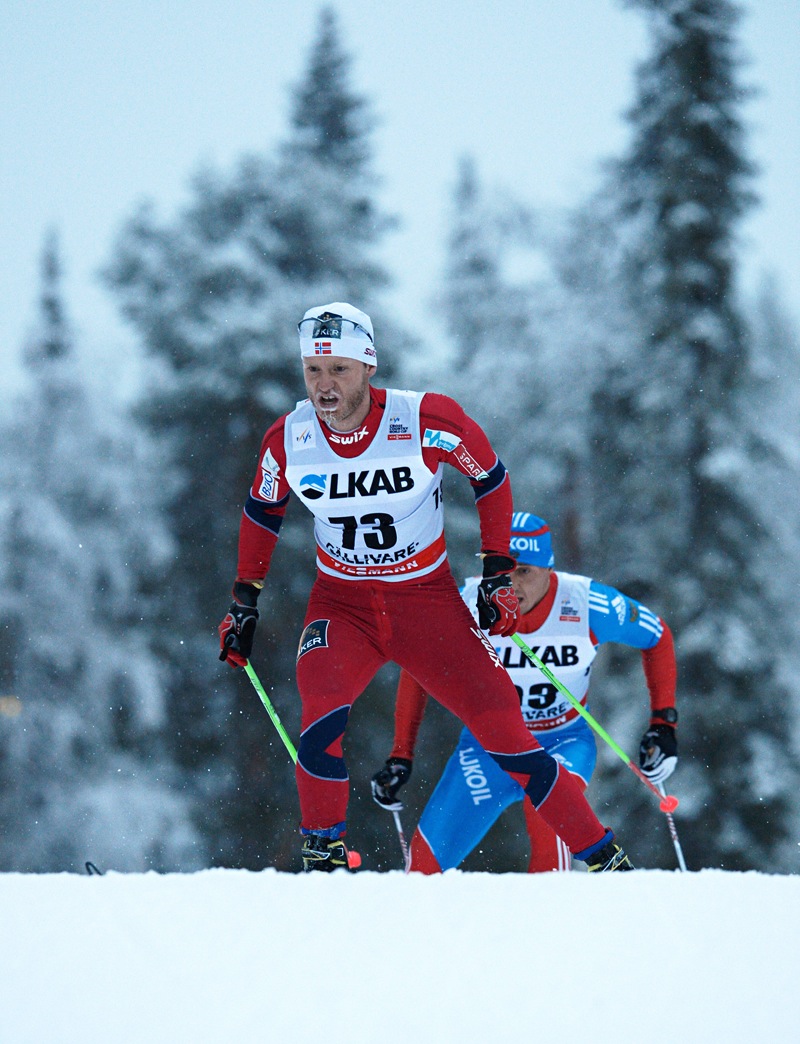
Martin Johnsrud Sundby (NOR) on his way to capturing the men’s 15km skate title in Gaellivare (SWE) in 2012. Photo: Nordic Focus/Fischer.
Martin Johnsrud Sundby (NOR) held off Russians Maxim Vylegzhanin and Alexander Legkov in the homestretch to claim victory in the Ruka Triple mini-tour.
The Norwegian responded to a ferocious attack by Legkov with just two kilometers to go before making his own move on the final climb. Both Legkov and Vylegzhanin kept pace, but Sundby held the all-important pole-position into the hairpin turn at the back of the stadium, setting up well for the final 75 meter sprint to the finish.
An excellent closer, Vylegzhanin came on strong, overtaking his teammate before running out of snow and his chance for the win.
On another frigid day in Finland, racers contested a 15km freestyle pursuit, the first time the final day of this three race set was held in the skate technique since 2011.
With new rules in place that cut stage race sprint bonus seconds in half, the field was tightly packed entering the final race. Another skier hit the course on average every two seconds, and 30th place was just 57 seconds off the lead.
Top seed, Eldar Roenning (NOR), a self-admitted poor skater did not start, leaving Dmitriy Japarov (RUS) in the pole position.
The lead pack quickly formed with sprinters and weaker skaters falling off the back in the first of six 2.5k laps. By the 5k mark, the top contenders had formed up, with Legkov, Sundby, and another Norwegian, Chris Andre Jespersen working at the front.
Legkov could be seen testing his competition, and in a prescient moment, attacked early and hard on the steepest climb of the loop early in the third lap. He immediately backed off, but the 2013 Tour de Ski Champion was clearly serving notice that he would be a force for the remainder of the day.
As the group approached the halfway mark, Frenchmen Maurice Manificat and Jean Marc Gaillard joined up, following Swedish stat Marcus Hellner. The trio had come up from the mid-twenties at the start, knocking roughly 50 seconds off their starting deficit.
Just behind, two more men were battling to gain contact with the leaders. American Noah Hoffman, starting 1:02 down in bib 38 made contact just before the lap, as did Petter Northug (NOR).
Wile the two latched on at similar times, they did so with varying levels of energy. Hoffman looked relaxed and strong as he settled into the pack, while Northug, clearly not in top form barely managed to maintain contact right at the back of the leaders.
Northug, who has struggled with illness this fall, started 13th, 30 seconds down, and right in front of Legkov. He could not ride up with the Russian early, and it appeared unlikely that Northug, winner of this event last year, would be able to defend his title.
While jockeying continued, Sundby and Legkov continued to do most of the work at the front, both continuing to look strong. Hoffman climbed as high as third, but a tactical error entering the fast downhill on the third lap, dropped him to the pack of the pack, and out of position for the final loop.
The pace raised and fell as different skiers probed for weakness. Legkov accelerated several times, only to back off again.
Unsurprisingly, when the race hit the steep climb with just over a kilometer to go, he reprised his attack from the second lap, this time showing no mercy. Sundby and Vylegzhanin responded, and within a few hundred meters, held a lead of 7.5 seconds.
The podium had been decided, it was just a question of the order.
The trio continued to pull away through the gradual terrain before Sundby made his move on the sprint hill up to the stadium. Jumping completely off the snow with each powerful V1 stride, he initially appeared to be moving away.
But Legkov would not be sprung and pulled up, nearly fully abreast of the Norwegian, Vylegzhanin locked in just behind.
Sundby did not get lear, but he earned the front spot into the tight hairpin at the back of the stadium, giving him first step into the homestretch.
He needed that small boost, as Vylegzhanin, one of the few men who has bested a top-from Northug in a final distance sprint, came charing up over the short homestretch.
The Russian got by Legkov, and most likely would have passed Sundby had the finish line arrived.
Sundby told FIS after the race that he worked hard in the summer on his finish sprint, training with his brother to improve his speed. The work clearly paid off and Sundby was clearly thrilled with the start to his season.
“This was beautiful,” he said with a broad grin in the finish area, after exclaiming “It is too cold here…”
Sundby won his first World CUp race here in Kuusamo 5 years ago – a 15k classic. He has experienced significant ups and downs in his career, including struggles with asthma and a cardiac arrhythmia in 2011.
He told Norwegian broadcaster NRK that his is not the biggest talent, but he is “sick-stubborn.”
He continued “when I decide to try to achieve something, it’s blood, sweat and tears to get it.It is my strength, that I do not give up.”
Legkov, despite slipping to third, was also happy with his performance. “My shape has been good, and the result today gave me confidence for the next moths,” he told FIS. He is looking to defend his Tour de Ski title and of course, focus on the Olympics in his home country.
Manificat, who was stuck at the back of the lead group when Legkov broke, did his best to bridge up. He never had a chance, but was clear in fourth holding off the young Sergey Ustiugov (RUS).
Hoffman crossed in 9th, posting the fastest time of the day, 7.5 seconds ahead of Manificat.
Northug completely lost contact with the lead group at the break, and came in just ahead of the first chase group to take 13th.
Results
Of Note:
– Lukas Bauer (CZE), winner of the 10k classic on Saturday, battled in the lead pack, despite being significantly weaker in skating. He ended up 11th.
– Hellner had the 3rd fastest time of the day.
– Johannes Duerr (AUT) was 4th on the day, skiing from 54th to 18th.
– Russia placed four in the top-10 and seven in the top-30.
– Norwegian sprinter Paal Golberg, a surprising 4th in the classic, slipped to 23rd in the final standings.
– Another Norwegian sprinter, Ole Vigen Hattestad, who earned his first ever World Cup distance points in the 10k, placing 20th, did not fare as well in the skate. He slipped from a start position of 9th down to 50th.
Lukas Bauer’s (CZE) masterfully paced race ousted Eldar Roenning (NOR) from the victors chair today in Kuusamo, Finland, allowing the veteran Czech to claim his first victory since 2010. Bauer’s pace in the 10k classic race saw his split times trailing throughout the first 8k to both Roenning and Dmitriy Japarov (RUS), before accelerating in the final kilometers to best Roenning’s time by just 2.4 seconds.
Japarov took third, 5.7 seconds behind Bauer and just over three behind the Norwegian.
Martin Johnsrud Sundby (NOR) was the early leader. Photo: Fischer / Nordic Focus.
Martin Sundby (NOR) was the early leader followed, surprisingly, by the sprinter Pål Golberg (NOR), who ultimately placed an impressive 4th. But once Roenning hit the course, all else would trail until Japarov started. It appeared to be the Norwegian’s day as he looked comfortable on the climbs and gradually opened a gap.
The Russian went out hard and fast, taking 10 seconds off of Roenning’s time at 3.1k. At 6.4k he increased his lead by another second. That was the high water mark for Japarov however, and he began to pay the price for his early breakneck pace.
At the 8k split Japarov’s lead was down to 5 seconds. His energy continued to fade over the last kilometers, and visibly exhausted, he labored up the final climb to the stadium.
Unable to maintain his lead, he finished 3.3 seconds behind Roenning.
“I’m a bit disappointed with today’s result,” the Russian told FIS. “I was hoping for victory. On the other hand…It’s very nice to start the season with a podium. I hope I can do such result again.”
Bauer, his splits steadily trailing throughout the race, did not appear to be a threat for the win. until 2k from the finish he turned up his pace considerably, charging up the final climb and sprinting into the stadium to snatch victory away from fellow classic specialist Roenning.
After the race Bauer told FIS, “I have extreme experience from Kuusamo, it’s been either successful or disaster, nothing in between. It’s nice I could enjoy a great day. Yesterday’s sprint was a disaster for me, 104th place was not good. I did not feel the best today but the snow conditions fit me very well.”
Roenning, speaking to Norwegian broadcaster NRK, said that he is “a little bitter that he [Bauer] hung on me in the first round. He got a good ending, but I’m pleased with second place. I go fast from start to finish.”
Coming through the lap after the first 3.1km loop, Roenning found Bauer headed out of the start. The Czech caught a ride from Roenning, much to his advantage.
Although Bauer seized his advantage in the final 2k, Roenning felt he did well at the end of the course telling FIS “I felt quite good and had a fast 2.0 km before the finish. It was an exciting competition. I have not been in the yellow bib for almost seven years. Tomorrow is skating and I have no hopes to be in top 10.”
Three North Americans finished in the top 30. With Ivan Babikov in 21st, Noah Hoffman in 28th, and Alex Harvey in 30th.
The World Cup Finals men's 15km classical gets started in mass.
All 2012 FIS World Cup Finals coverage is brought to you through the generous support of Fischer Sports USA, proud sponsors of Kikkan Randall, 2012 overall Sprint Cup Champion.
FALUN, Sweden – They say revenge is sweet. If so, Dario Cologna could skip hispost-race recovery drink after taking a good slug of redemption when he best Eldar Roenning (NOR) in the final meters of the World Cup Final 15k classical mass start.
Exactly a week ago, Cologna and Roenning staged an epic battle in the Holmenkollen 50k in Oslo, Norway, with the Norwegian coming out on top in the final sprint.
The race today consisted of three five-kilometer laps that included the monster Mördarbacken, but no other substantial climbs, a sharp contrast to the inescapable ascents in Oslo.
After days of brilliant sun and borderline hot temperatures, the day dawned gray and damp, and while the thermometer was well above freezing, there was a chill in the air.
In true spring skiing fashion, the track was highly variable—water, ice, corn snow, and slush all made appearances at points.
The pace out of the start was relaxed, and did not pick up until Cologna went to the front on the second lap.
Unlike the Friday’s prologue, course did not take the race directly to the lone large climb, instead winding up a gradual ascent from the top of the stadium.
The first of two intermediate bonus sprints awaited at the top of Mördarbacken, and Cologna, feeling good, kept pushing into the climb.
Swiss Head Coach Guri Hetland told FasterSkier that Cologna’s plan for the race was to stay toward the front where he could keep an eye on the Canadians, who he viewed as the biggest threats, and be in position to fight for bonus seconds.
“He felt strong and was racing hard up there,” Hetland said of the second time up Mördarbacken.
Marcus Hellner (SWE) leads up the Mördarbacken with Eldar Roenning right behind.
Roenning had been hovering toward the front the entire race to this point, and was in position when Cologna attacked.
This was the Norwegian’s plan—to stay at the front to respond and “have good control on the rest of the field.”
The icy conditions also played into Roenning’s approach.
“The snow today was quite fast and people were coming from behind all the time,” he said. “So you had to stay at the front to keep your positioning into the big hill.”
Cologna took the first preem and the accompanying 15 seconds with Maxim Vylegzhanin (RUS) and Kershaw just behind.
The attack on the steepest part of the climb completely shattered the field.
By the time the field looped back down and approached Mördarbacken for the “short version” to close out the second lap, a group of four held a lead of 20 meters.
Cologna, Vylegzhanin, Roenning, and Angerer maintain a short lead.
Cologna, Roenning, Tobias Angerer (GER) and Vylegzhanin pushed into the stadium, but the long gradual descent of the backstretch allowed the field to compress.
After the race Cologna said he knew that the lead group would likely be caught given the lengthy descent, but he still wanted to break up the field and maintain position at the front, out of trouble and ready for a final sprint.
“I think it was almost impossible to get away,” Hetland said also pointing to the structure of the course.
Martin Johnsrud Sundy (NOR) bridged up, and Devon Kershaw brought another group up from behind on the climb out of the stadium.
While the race closed up, the acceleration had taken its toll. There was less of a pack, and more a compact string, with the same men toward the front.
Jean Marc Gaillard joined the part at the front, taking a turn leading before yielding to Roenning who kept the pressure on.
The two men, skied side by side up Mördarbacken the final time, with Roenning gaining the edge for the bonus seconds, and only Vylegzhanin, and Gaillard could hang.
A rematch was in the making.
“I wanted to keep the speed all the way over the top and into the downhill,” Roenning explained of his strategy.
He was looking to get away from any chasers before the descent into the stadium, and it appeared he had succeeded.
The four men stayed tight on the descent, but Vylegzhanin was sprung on the bottom part of the short Mördarbacken loop, and Cologna, Roenning and Gaillard dropped into the stadium together.
The backstretch in Falun seems endless, and the three-man race suddenly got more complicated.
By the time the leaders had reached the sweeping turn at the bottom of the stadium and were headed up to the finish, they had lost nearly 30 meters on the chasers.
Niklaus Dyrhaug, who had lost contact at the top of Mördarbacken, along with Kershaw and Valjas drove the chase.
Cologna's double pole outmatches Roenning's stride to the line.
Cologna and Roenning powered up the final rise to the finish, Cologna double poling the ascent and Roenning striding out.
In the slow Oslo snow last week, Roenning use a strong stride in the sprint to move past Cologna who stuck with double pole a bit too long.
Today, however, in faster conditions, the double pole would take it.
“It was nice to take the revenge today,” Cologna said after avenging the defeat in Oslo.
“He repaid me here,” Roenning said. “But I am quite satisfied because for me it is much more important to win in Holmenkollen of course.”
Just behind, Valjas shocked Dyrhaug when he came flying past the Norwegian.
“I thought I should take my first podium,” Dyrhaug said. “But Valjas came by in the last twenty meters.”
Cologna wrapped up the overall World Cup title weeks ago, but has showed no signs of slowing down.
“I am still in good shape so for me it is fun to race,” Cologna said, noting that nothing has changed since he clinched the crystal globe. “As long as the shape is good I try to win the races,” he continued.
“He is so motivated to ski good races,” Hetland added. “This is what he wants to do and is enjoying it. He was focused on ending the season as good as it has been all the way through.”
The Swiss coach says that given the way Cologna is skiing, “any course is good for him.”
While that may be the case, Cologna would like to see some changes to the Falun loops prior to the 2015 World Championships.
He said he liked the track, but that it was perhaps not the most modern.
“They have the Mördarbacken—It is a very hard hill but there is only the Mördarbacken. The other hills are nice for skiing, but not very steep,” Cologna explained.
He would like to see more climbs on the other parts of the course, and most importantly another hill to break up the descent to the finish, a drop that measures nearly a kilometer.
Cologna enters the ultimate stage of the World Cup Finals with a 36-second lead on Valjas and 46 seconds on Kershaw.
“It is a good gap and if everything is going well and my shape is good it should be enough,” Cologna said of his chances of victory.
Roenning, however, has no illusions regarding his skating abilities, though he has more confidence in the spring conditions.
“My skating is not good enough to be in the front and fight about the podium, so maybe top ten is realistic for me,” he said.
His teammate, Dyrhaug, still looking for his first World Cup podium, will start in 6th, 26 seconds behind Kershaw in third.
After placing fourth in Friday’s prologue, Dyrhaug has one simple goal—crack the top-3.
Eldar Roenning (NOR) and Dario Cologna (SUI) sprint down the finish lanes for Holmenkollen glory. Photo: Fischer/Nordic Focus.
As a classic specialist, Eldar Roenning (NOR) can oftentimes be overlooked when contemplating race favorites.
The stocky Norwegian does not race the World Cup regularly, generally only hitting the events that play to his strengths in the traditional style of skiing, but he reached the top of the ski world on Saturday when he took the victory in the famed Holmenkollen 50k, defeating World Cup leader Dario Cologna in a mad sprint to the line.
Martin Johnsrud Sundby (NOR) on his way to third place. Photo: Fischer/Nordic Focus.
Fellow Norwegian Martin Johnsrud Sundby finished third, sure to please the King of Norway in attendance in the royal box along the homestretch.
With temperatures failing to drop below freezing on Friday night, the tracks quickly disintegrated in the warm weather, and significant moisture built on the course.
US Ski Team Head Coach Chris Grover told FasterSkier that the track was already gone in places before the race began and described the event as “a slog.”
Roenning did not seem fazed by the slow track or the warm weather, remaining patient toward the front of the pack, in position to respond to attacks, but not going out of his way to push the pace or fight for bonus seconds.
As is always the case in mass start 50k events, the race was wide open for until the last kilometer.
The Norwegian team engaged in some tactics early on, opting to switch skis at the first opportunity while the rest of the field skied through. At the next pitstop, 10k later the Norwegians passed by while the rest of the field pulled over and then had to work to catch up.
There were five opportunities to switch to new skis in the race, and athletes were allowed to take four.
The strategy served only to apply a bit of pressure, and set the tone for the day—a relatively relaxed pace with periodic pushes from one skier or another creating a bit of stress on the pack before settling.
Devon Kershaw (CAN) finds his pace behind Dario Cologna (SUI) in Oslo. Photo: Fischer/Nordic Focus.
Canadians Devon Kershaw and Alex Harvey, both gunning for the podium described the overall pace as relatively easy throughout, and the main group remained large as it compressed on the long descent from the highpoint.
Earlier in the race both Swede Anders Soedergren and Petter Eliassen (NOR) spent significant time pulling. Both men entered the day on the outside of the top-50—the ranking needed to contest the World Cup Finals.
Soedergren especially is not a sprinter and would be well served by fracturing the pack as early as possible.
The efforts of both men, however, did no more than drop some stragglers. While Eliassen did open a 30-meter gap at one point, there was never any real chance of an individual getting away.
The race revolved more around the bonus sprints, especially early on, with a number of skiers looking for points in an effort to make the top-50 threshold. Sprinter Oystein Pettersen of Norway, Axel Tecihmann (GER), Ivan Babikov (CAN) and Calle Halfvarsson (SWE) all needed a solid bump to get in.
Teichmann took the first preem at 3k followed closely by teammate Tim Tscharnke and Canadian sprinter Lenny Valjas with Halfvarsson in the mix as well—points are awarded to the top-10.
Valjas was in the race, not to actually get points for himself, but to prevent others from doings so in an effort to help Babikov.
Canadian National Team Head Coach Justin Wadsworth told FasterSkier that Valjas was also in need of a hard workout, so the plan worked well, though Babikov struggled and ended up dropping out.
The bubble skiers quickly faded back through the pack and the race settled into a more standard routine, with the sporadic surges stretching out the pack, only to have it all compress on the descents.
The course was the same as the World Championship 50k held just a year ago, with the series of grueling climbs up to Frognersettren and then the long winding decent back down.
The preem sat right up at this high point, and in a nice variation from other such intermediate sprints, it wasn’t right at the steepest point. Skiers approached up a tough pitch but then the course flattened to double pole terrain before one last rise to the line.
The five sprints lacked much drama with no one really willing to fully attack. Kershaw was one of three men to claim points all five times through, winning the final two to earn a total of 44 to go with his 10th place finish.
Only Soedergren did better with 49 points.
“I decided out there to just grab ones that wouldn’t take much out of me,” Kershaw told FasterSkier, adding that it was not his plan to chase the points.
Kershaw described the pace as “pretty mellow,” and said “I think the incredibly slow, slushy snow played into that. Nobody could go for a flier off the front, so we just all skied around together.”
The pace began to increase during the last 10k loop, with the Norwegians moving into position at the front. At one point the hosts held five of the ten positions in a sea of red suits.
Quietly present, as always, was Cologna, who, with the overall World Cup title wrapped up, had no need for bonus seconds.
He had one goal, to win, and stayed patiently in the mix, out of trouble toward the front, leading occasionally, but not pushing.
The pack strung out the final time up to the top, but closed up once again headed to the stadium.
The course looped through and headed out for one last short 3k trip with several smaller climbs before the finish.
Sundby and Roenning drove the pace at the front with Cologna and Maxim Vylegzhanin (RUS) right behind.
It quickly became clear that no one would break away before the final big hill, the gratishagen on the World Championship sprint course.
Roenning led into the hill, and responded when Vylegzhanin attempted to get by. The Norwegian didn’t break and led over the top.
The attack finally fractured the pack, and five men were left to fight for the win—Roenning, Sundby, Vylegzhanin, Cologna and Konstantin Glavatskikh (RUS).
Roenning led down the backstretch and into the final hill in the stadium and Cologna accelerated by a fading Vylegzhanin.
The two charged up the hill, running through the slush outside the tracks. Roenning led over the flat top and down into the homestretch. Cologna waited until the final flat before stepping out to make his move.
He initially started to pull in front gaining a few inches, but Roenning responded, flying up onto his toes with each pole. He crept back, but it appeared that Cologna had the edge.
And then, in a move that could have just as easily resulted in failure, Roenning switched to classic striding with just twenty meters to go. He immediately accelerated past, and by the time Cologna responded with a technique shift of his own, the race was over.
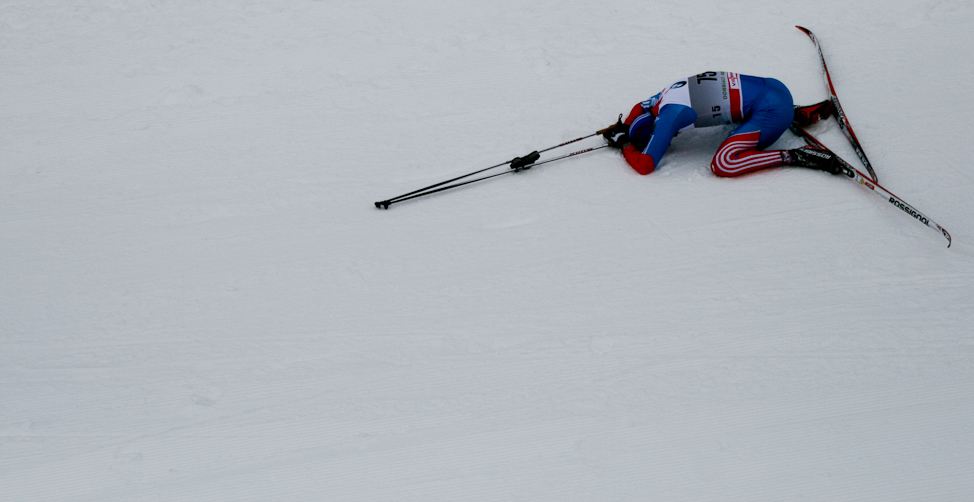
Roenning crossed the line, and immediately flopped straight forward, face-planting in the snow. Cologna glided by, giving his competitor a pat on the back before collapsing in his own pile.
While all eyes were focused on the top-two, Sundby, though no sprinter, overtook Vylegzhanin to claim bronze, a definite upset given the Russian’s strength in closing out longer events.
The Russians may have been kept off the podium, but they still had a strong day, claiming fourth through eighth.
After the race Roenning said he was surprised to win, but was happy to add a 50k victory to his resume.
“I don’t see myself as a sprinter, but as an all-round skier… it is great to be good in all disciplines,” Roenning said.
Cologna, who struggled with bad skis at the World Championships last year was pleased to get a measure of redemption.
“Today, I had good skis, and felt better and better every round,” Cologna said. “To be on the podium at Holmenkollen is something special.”
He said the race was “the longest 50k ever” that he had been part of and that “I think everybody is tired now and should be proud having completed the 50k.”
Eldar Roenning (l) follows Sergey Turych (r) around a corner in the 22km classic. Roenning won the race.
VAL DI FIEMME, Italy – Eldar Roenning (NOR) spent much of the eighth stage of the Tour de Ski working for Petter Northug (NOR), but as the final kilometer rolled around, he submitted his resignation, packed up his skis and poles, and headed out on his own.
Roenning attacked on the final climb of the unforgiving Val di Fiemme 4.5 kilometer loop, opening a 10 meter gap entering the stadium, a lead he never relinquished on his way to his second podium of the 2012 Tour de Ski.
Canadian Alex Harvey claimed his second career distance World Cup podium, and first since 2009, edging out Tour leader Dario Cologna (SUI).
The penultimate stage of the Tour measured just over 22 kilometers—five times around a grueling loop that seemed to defy physics—is it possible to go up for so long, and descend so little?
Canadian Head Coach Justin Wadsworth didn’t mince words, saying “It might be the hardest classic course ever,” pointing to the two big climbs right at the end, and the added challenge of the bonus seconds available each lap at the top of the biggest climb.
Cologna, who described his race as “perfect,” said there were too many steep climbs and hopes that will be adjusted before next year’s World Championships, while distance specialist and two-time Tour de Ski Champion Lukas Bauer (CZE) said “It fits me good [the course], for my endurance, but it is not skiing, it is running.”
Norwegian coach Trond Nystad added, “This is by far the hardest race in the Tour de Ski.”
Alexander Legkov (RUS) following Giorgio Dicenta (ITA) up a large climb as the lead pack, and Legkov's Tour podium chances disappear over the crest.
The course was modified from last year, with the biggest change being the location of the mid-race preems—one per lap. Instead of sitting down in the stadium on the flat, it now stood at the pinnacle.
The result was a pack that strung out quickly, unusual for a men’s World Cup race, and a steady line of elite racers falling off the back.
“They started to push from the first bang until the end,” Finnish veteran Sami Jauhojärvi told FasterSkier.
The first of the overall Tour contenders to falter was Maurice Manificat (FRA) who entered the day in 6th, seconds from the podium. Under halfway through the race he was cooked. Alexander Legkov, (RUS), Giorgio DiCenta (ITA), and Ilia Chernousov (RUS) followed after, at varying points of the race.
Bauer spent much of the race at the front driving the pace. The veteran saw his chances for the podium crumble in the 35k pursuit when a feed station collision left him with a broken pole.
His goal for the day was “to be very active.” He was certainly that, pushing at the front, though never getting away.
Roenning and teammate Niklaus Dyrhaug also had a strong presence in the front pack, but they skied with a greater purpose.
The men were tasked with helping Northug close the gap on Cologna—working to get him set for the bonus sprints.
From the spectator’s point of view, it can be hard to make sense of the constantly shifting positions, but Dyrhaug said the strategy worked well, as evidenced by the 55 seconds Northug earned.
“He was really satisfied with my work, and I am really satisfied I could help him,” Dyrhaug said. “I tried to help him get in a good position in the start of the hill, and he should do the rest of the work himself.”
Dyrhaug striding out.
Roenning was also involved, but while Dyrhaug said “I offered myself totally,” to Northug’s cause, and that “I have never been so tired in my whole life as the last round up there [at the top of the course],” the eventual victor did not need to expend too much energy in for his teammate.
He assisted Northug in gaining position, but never factored into the front of the sprint.
The stocky Norwegian gained confidence during the warmup when a new pair of skis offered excellent grip in addition to good glide. Two laps in, and he knew he had the body was clicking as well.
After 22 kilometers packed with relentless climbing, it was the last relatively small hill into the stadium that made the difference in the race.
Russians Sergey Turychev and Dmitriy Japaov took the lead out of the downhill on the final large climb, up past the iconic Italian village church.
The attack could have been decisive, but Harvey, who was comfortably in fifth behind Cologna was unconcerned.
“They punched it so hard at the bottom of the second to last hill,” Harvey said. “There was zero chance they would be strong….those guys would die.”
He made sure to stay behind Cologna, so as not to get blocked by the doomed Russians, and when Roenning moved, Harvey proved prophetic.
Harvey across the line.
The Canadian then made his one mistake of the race. When Cologna broke into a herringbone, Harvey did not step out and move around.
“I was a bit stronger than Dario at the end, but I just followed him and that is when Roenning went,’ Harvey told FasterSkier.
While he was plenty happy with second—the World Cup points, the prize money, and the advancement in the overall Tour standings, Harvey believes that if he had stayed on Roenning’s tails he could have used the draft to slingshot by for the win.
But that is neither here nor there as Roenning would not be caught on the homestretch. Harvey held off Cologna, and a hard charging Northug, who was unable to make a dent in the now impenetrable lead of Cologna.
While Nystad said the day was very successful for the Norwegians—in addition to Roenning in first and Northug in fourth, Dyrhaug placed 7th—the winner said “I think Petter had a little bit of a tough day today.”
With his overall Tour chances destroyed in a catastrophic first five kilometers of the Cortina to Toblach pursuit, Northug was looking for some measure of redemption today.
He fought hard, several times staging a running attack for bonus seconds, but never looked like his usual confident and controlled self.
As is his wont, he collapsed at the finish, utterly spent, only this time his effort was not even good for the podium.
Northug and Cologna lead the field out of the start.
Even had he been in top form, Northug would have been better off stopping at the course-side church to pray for a miracle given the way Cologna is skiing.
Swiss Head Coach Guri Hetland told FasterSkier, that Cologna was raring to go this morning.
“He really looked forward to ski, and that is always a good sign, when he is eager to go out there,” Hetland said.
Watching Cologna cross the line with another podium, and ahead of Northug to boot, was “a pretty good feeling” for Hetland, and while she was confident that her star skier would perform well, she is not counting the massive crystal trophies until they are well in hand.
“As we have said from the very beginning the Tour de Ski is until they are up there tomorrow [at the top of the Alpe Cermis]. So there is no time to lie back and relax,” Hetland said. “It is about being focused until the very end.”
Eldar Roenning celebrating his win.
Cologna feels his 1:22 lead on Northug in the overall is “a nice advantage.”
He said he enjoyed his day, with the cold snow, hard tracks and boisterous fans.
Eight stages in to the Tour, he said he is tired, and that “before the race you don’t feel so good,” but once the gun goes off “it is going better.”
Roenning fell out of the quest for the overall podium with two bad races in Oberstdorf, and then a disastrous performance in the 35k pursuit.
He bounced back well today, and has run the Tour with extra support from his brother Berhnard, a standout skier for Montana State University in Bozeman, Montana.
Taking a break from his business studies in Ireland, The younger Roenning is chauffeuring his brother so he can stick to his own schedule, as well as helping with ski testing.
On the last climb when Eldar attacked, Bernhard was “freaking out.”
It is a good sign for Roenning to take the individual victory in an event that is a preview of the 50k classic at World Championships on this very course.
That event is the focus of next season for the Norwegian, but long before that, he has to complete the Tour.
A much stronger classic skier, Roenning says his goal in the final climb “will be to reach the top still alive.”
Alexander Legkov (RUS) after winning Stage 5 of the 2012 Tour de Ski.
TOBLACH, Italy – It took 11 races, but Alexander Legkov finally got his first win of the 2012 season in Stage 5 of the Tour de Ski on Tuesday.
With the help of a new coach and the right pair of skis, the Russian powered through finicky conditions to edge Eldar Roenning (NOR) and Dario Cologna (SUI) in the 5 k individual-start classic race.
Petter Northug (NOR) floundered through the slick, soft conditions in Toblach, finishing 12th and losing his lead in the overall Tour standings to Cologna, who now enjoys a 16-second cushion heading into Wednesday’s skate sprint.
“I felt like a tourist doing the Birkie,” Northug told NRK, the Norwegian national broadcaster.
More than six inches of fresh powder fell in Toblach last night, and when the moist new snow mixed in with cold, man-made crystals below the surface, the resulting tracks were a mushy mess that ended up being a headache for waxers—even though the weather had cleared up by Tuesday morning.
Almost all of the top skiers ended up racing on zeroes—classic skis without wax that grip the snow with a synthetic material—but at the start of the day, “everything was in the mix, at certain points,” according to U.S. Ski Team waxer Patrick Moore.
“We had hard wax, klister—everything was out there,” he said.
Roenning said that he excels in conditions like Tuesday’s, but he was also prepared with his equipment: he has four pairs of zero skis with him in Toblach, and tested some 20 sets over the past two years in his hometown of Trondheim, Norway.
Eldar Roenning (2nd).
“That’s the way in these conditions,” he said. “You have to have some good skis, and a good shape.”
The 5 k was the first time that the World Cup men raced the distance on the Tour. But there didn’t seem to be any special strategies: “Five, 10, 15: All is difficult,” Legkov said.
Roenning set the fastest time early, but that was before Legkov came storming home. The Russian gobbled up the last 200 meters of the course with huge double-pole strokes, lunged at the finish, then crashed and spent the next 30 seconds writhing in pain.
His time was 1.7 seconds better than Roenning’s, and though Cologna made a heroic charge down the finishing stretch shortly after, his efforts left him two seconds out of the lead.
Legkov Lunges at the Line
While Legkov was strong at the beginning of the last season, his win on Tuesday was not only his first of this winter, but also his first time on the podium. That, he said afterward, was because of a training plan that had him peaking for the Tour de Ski.
Legkov picked up a new coach this season, the former Swiss World Cup racer Reto Burgermeister, through a connection with his physiotherapist. In an interview after the race, Burgermeister said that he has been working with Legkov on technique, and also on dialing back the intensity of some of his training sessions.
“His thinking is simple,” Burgermeister told FasterSkier through a translator. “He will always train really hard, so you have to stop, not to push him.”
Legkov now sits third in the overall Tour standings, 39 seconds behind Cologna.
Thanks to a five-second bonus for his third-place finish on Tuesday, Cologna took a total of 17 seconds from Northug, his main rival, in the 5 k race.
“It was a really good race for me, and I’m happy to take the overall lead back,” Cologna said.
Northug told the Norwegian media that he never got comfortable on his classic skis, and while he didn’t criticize his country’s staff, Roenning said that he could tell that his teammate’s skis were “a little bit slow and…slippery.”
Northug Atop the First Hill (12th).
If that was the case, it was an unlikely victory for the Swiss team in the wax department, since Cologna said his own skis were good.
While Cologna has two personal ski technicians, the Norwegians have by far the deepest pockets of any team here, with 14 waxers and a massive trailer to house them all.
“Fortunately, waxing is not always just about manpower,” Cologna said. “We have a lot of know-how on the team, and also you sometimes need a little bit of luck.”
Cologna has full faith in his waxers, he added, who constitute a “small, but good team.”
Cologna (3rd).
“You have to trust the service guys,” he said. “You can wax yourself, but I think it’s not a good idea. They know what they are doing, so I trust them 100 percent.”
With the Tour more than halfway over, Cologna currently has the edge. But with four tough stages remaining, as he acknowledged on Tuesday, he’s “won nothing” yet.
Doogiski over at NordicXplained asked how Pentsinen’s 4.3 second win in qualification on Friday stacks up historically. Quite impressively, it turns out.
That’s the second largest qualifying round winning margin for the men’s field in WC, OWG or WSC races. The only larger one was almost 10 years ago, with a 4.7 second victory by Björn Lind in a freestyle sprint in Germany in December of 2001. So we’re reaching back to the very beginning years of sprinting here.
Ola Vigen Hattestad came close to this once last season, winning qualification by 3.86 seconds.
A winning margin greater than 4 seconds in qualifying has happened more often with the women: six times. And it’s basically a who’s who of dominant female skiers over the past decade: Skari, Neumannova, Bjørgen (twice), Kowalczyk and Majdic. Skari’s is particularly absurd. She won qualifying in a WC sprint in Italy way back in the day (December 2001 again) by 8.4 seconds! It was classic, so maybe waxing was an issue, or maybe Skari was just that fast. Interestingly, the woman she beat that day be 8.4 seconds was Petra Majdic.
More generally, the typical winning margin in qualification is just under a second for the men and about 1.5 seconds for the women.
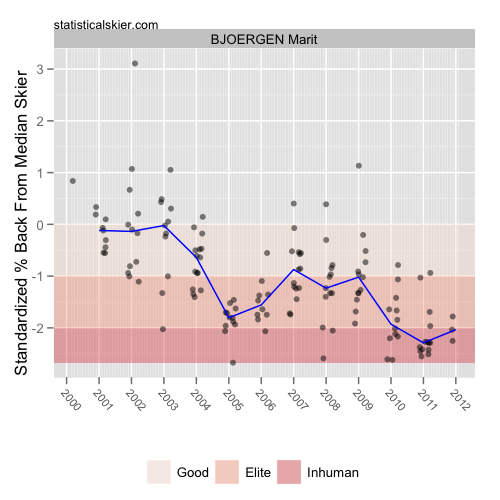
Marit Bjørgen
And how is Bjørgen faring so far this year?
She’s certainly still winning everything in sight, but she’s not really faster than last year. Although, that’s not surprising, since “regression to the mean” would lead us to believe that she’s regress a least a little this season.
Assorted Men
A few of the men who had strong weekends:
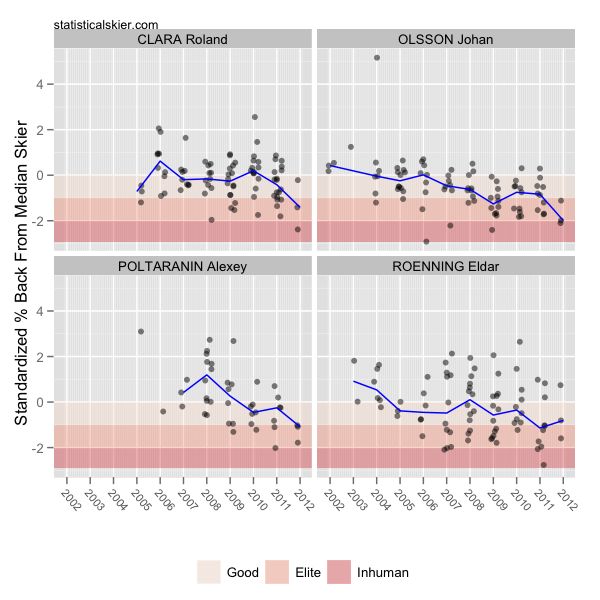
Eldar Rønning ended up doing very well in the overall mini-tour thanks to some very strong classic skiing on the last day. But overall, his skiing hasn’t been out of this world, and might even be a bit of a step back from last season. Remember that overall tour placings are heavily dependent on the specific events. In this case, strong classic skiers had a lot more space to make up ground, and so the overall tour may have favored classic specialists somewhat. If the techniques had been reversed, Rønning may not have fared so well.
On the other hand, Clara, Olsson and Poltaranin have all skied somewhat better so far this season overall. It’s particularly exciting to see from a guy I think a lot of people didn’t have on their radar (Clara), an older skier coming off a few bad-ish seasons (Olsson) and a guy from a “different” country (Poltaranin).
I plan to talk about sprint heat times when I can, but FIS messed up the heat times royally (at least, the times that are available online), so not this week. Maybe next time. I’ll have words about the North Americans on Wednesday…
Petter Northug celebrating a win at the 2011 World Championships in the 30 k pursuit.
Even if he didn’t say it, Petter Northug presented the challenge from the onset. The first starter in the men’s 15 k classic pursuit would give his followers a fighting chance before playing the game of cat and mouse in Kuusamo, Finland.
The Norwegian frontrunner in the three-day Ruka Triple mini-tour wasn’t known for charging out of the gate in those types of races anyway.
As expected, he led the race with the help of one competitor: Dario Cologna (SUI), who started 12 seconds behind him in second. Cologna, the defending Tour de Ski champion, caught up by 2.5 k.
From that point on, the seven-time World Champion and two-time Olympic gold medalist dictated the race. Northug and Cologna switched the lead numerous times, carefully plodding along and keeping their distance from the third man back, which for a while was Alexander Legkov (RUS).
With less than 2 kilometers to go, Northug signified the game was on, as he suddenly pushed the pace on an uphill then slowed down directly in front of Cologna. He was testing his legs and his challenger.
On the final stretch into the stadium, Northug opened it up without much warning — but most knew it was coming. Cologna couldn’t match his double-pole sprint and finished second, 1.8 seconds behind Northug’s winning time of 38:41.5.
“In the end, I no longer had the best kick,” Cologna told Swiss Radio and Television. “I was too tired to attack him.”
After working with Cologna to stay ahead of a hungry and closing pack, Northug said he was surprised with how he felt.
“It is probably the first hard workout in the classic, and I am surprised that my legs were so good,” Northug told NRK. “I was a little skeptical before starting … but it was good that it did so early in the season.”
The win gave him the overall Ruka-Triple crown for the weekend, after Northug was 16th in Friday’s sprint and won Saturday’s 10 k freestyle. It was his first victory at the Kuusamo mini-tour after he was sick and missed the competition last year.
With mini-tour victory counting a World Cup win, Northug used the 200 points awarded to stay in first in the World Cup standing with 355 points. Cologna was second with 278.
The third man to finish in the pursuit, Eldar Roenning (NOR) skied the second-fastest time on Sunday (37:51.5) and climbed his way from starting 18th. The fastest competitor in the race was Alexey Poltoranin (KAZ) in 37:42.8. He placed fourth.
About halfway through the 15 k, Roenning and Poltoranin worked within an eight-man chase group to close the gap on Northug, Cologna and Legkov. While the top two were about 40 seconds ahead, Legkov was a more tangible target about 11 seconds in front of the pack.
Sweden’s Johan Olsson initially charged forward and passed Legkov with about 5 k remaining. Marcus Hellner (SWE) and Roenning strained to catch them, and Poltoranin made his way into the mix. With 3 k to go, the group of five skied together, all vying for third.
Hellner advanced and Legkov dropped off, and in the final stadium shakedown, Roenning emerged as the third-place victor (+20.6).
Poltoranin was fourth (+22.2), Olsson placed fifth (+24.0) and Hellner was sixth (+26.1). Legkov followed in seventh (+35.5), Maurice Manificat of France was eighth (+40.1), Lukas Bauer (CZE) was ninth (+43.3) and Petr Sedov (RUS) was 10th (+47.6).
Earlier in the race, Manificat moved up to fourth, about 37 seconds behind Northug and Cologna. By 7.5 k, he was back with the large chase group.
Canadian Alex Harvey skied the seventh-fastest time in the pursuit (38:21.2) to end up 11th overall (+59.9). His teammate, Devon Kershaw, was the eighth fastest (38:22.5) and placed 20th after starting in 37th.
Northug’s time ranked 21st among 99 skiers. Cologna was the 14th fastest on the clock.
With the Norwegian women taking the top two spots earlier in the day in the 4×5 k, the Norwegian men had the bar for success set high for their four-man relay effort.
Northug getting it done in Sjusjoen (Photo: flyingpointroad.com)
As always, Petter Northug Jr. was anchoring Norway I, supported to Eldar Roenning and Finn Haagan Krogh on classic skis, while Lars Berger, biathlete, brother of Tora Berger, and occasionally cross-country relay selection skied third in the 4×10 k race in Sjusjøen, Norway, on Sunday.
Held on 2.5 k loops of man-made snow, the tracks quickly became extremely icy and hard.
While Norway I had a slight advantage in the form of Northug’s traditional anchor-leg superhuman efforts, it was obvious that the men were not going to have as clear a path to the finish line as their female counterparts.
Ultimately, the result was the same, as Norway I took the gold medal in a tight finish. In a surprise turn of events, Norway III emerged from the finish-line sprint with silver medal, while the Swedes picked up the bronze, narrowly edging out the French.
Russia I and II as well as France pushed the pace on what is usually a fairly sedate opening leg of the relay, forcing the field to work, and whittling away several teams.
As they rounded the corner into the exchange zone, the main pack was down to just six, with another six teams hanging close inside of 15 seconds, including the Americans, kept competitive with a strong leg by Andy Newell.
The lead pack on the second leg (Photo: Liz Stephen)
The major players on the outside were Switzerland, where Toni Livers dropped 46 seconds to the leaders, while Germany I employed Andy Kuehne — who could be seen running up hills on his skis — to finish the leg dead last, over a minute and 30 seconds back of the lead.
Under strong efforts by a variety of teams including Russia I, using Maxim Vylegzhanin, the French who tapped Maurice Manificat, and Finlands’ Sami Jauhojaervi, the main pack was reduced to six teams, including Norway I with Krogh.
Norway III, up until that point in the hunt, was let down by unknown quantity Ronny Fredrik Ansnes who dropped them out of the lead group and almost 30 seconds back of Russia I when the teams switched to the skate leg.
Russia I, France, Finland, Norway I, Sweden and Italy all came into the exchange within five seconds, while Switzerland’s Dario Cologna, the Czech Republic, and American Kris Freeman making up a smaller chase pack, around 30 seconds off the pace.
It took a massive effort for Cologna to draw back into the group – he skied the fastest second leg of the day by 13 seconds, blowing by Canada’s Ivan Babikov who broke a pole and was struggling as a result.
With Sweden’s Daniel Rickardsson tagging off to Johan Olsson, winner of Saturday’s 15 k skate, fireworks appeared in the offing for the third leg, especially with the history between Norway and Sweden in the relay.
But the Swede who was so strong on Saturday didn’t seem to be in the same world-class form. After leading for the first 5 k, Olsson could be seen looking around and motioning for someone else to come to the front.
However, Olsson was mostly ignored, until Lars Berger of chief rival Norway I stepped up at 7 k and turned up the pace. Berger was matched by everyone, especially Roland Clara who was skiing third for Italy. Clara, who picked up a bronze medal on Saturday finishing just shy of Northug for silver, put in an attack in the last 700 meters on a steep uphill, managing only to shake Russia I in the form of Sergey Turychev before the third and final exchange.
Roughly 30 seconds back of the lead pack, USA’s Tad Elliott attacked his small group of Morten Eilifsen (NOR III) and Remo Fischer (SUI), and then was attacked in turn, as Norway III and the Swiss handed off 44 seconds back, and Elliott handed off to Simi Hamilton 53 seconds behind the leaders.
Heading into the fourth leg, it was clear that Northug hadn’t had a sudden urge to change his tactics. Immediately after taking the tag, the firebrand Norwegian pulled up to let the five others go by, slotting himself in the pack second from the back.
The pace then dropped considerably, letting Curdin Perl (SUI) and Sjur Roethe (NOR III) claw back their considerable deficit. It was obvious for a long way out that the race had turned into an 8-way shootout at the finish line for just three medals.
At that point, Northug does what he does best, unleashing his unparalleled finishing kick to get clear of the pack to pick up the gold medal for Norway I.
But the surprise was Roethe, who stormed from 8th and a 44 second deficit to deliver a silver medal for Norway III, and secure the one-two finish for the second relay of the day.
“I’m happy to be on the podium today,” said Roethe in an interview after the race.
“The last leg was a tactical one but at the end I pushed hard and could take the second spot for our team.”
Sweden’s Calle Halfvarsson made a valiant effort to break up the Norwegian party, but the young Swede – who opened his season with a career-best World Cup finish in 4th on Saturday – couldn’t find enough speed to get past the red suits.
“In the last uphill I was behind and lost a bit the connection,” Halfvarsson said in a post-race interview with FIS Ski.
“I had to pass all for the finish sprint and that was not so easy… I am satisfied with my race but for sure I was a bit nervous before and during it.”
Left empty-handed at the finish line were the French, who finished fourth, just ahead of Russia I. Finland finished sixth, barely holding off the hard-charging Norway II, who placed biathlete Emil Hegle Svendsen on the anchor leg. Svendsen came from 12th spot, nearly two minutes back to have a shot, which gives you an idea of just how slowly the lead pack was going on the final leg.
USA anchorman Simi Hamilton dropped just two spots, one to Ilya Chernousov (RUS II) and the other to Svendsen, to end the Americans day in a solid 11th.
Canadian opening-leg specialist Devon Kershaw appeared strong in the early going, until a collision popped his ski off his foot, and put him to the ground.
Kershaw has provided plenty of first-leg fireworks in the past, but his fall and resulting time loss put the Canadians in a deep hole early, while Babikov broke a pole and never managed to find his rhythm. Graham Nishikawa skated the third leg, but by the time he received the tag they Canadians were out of the running, and the Canadians failed to start their fourth skier, sprinter Len Valjas.
Regardless of nation affiliation, Therese Johaug was possibly the highlight of the entire World Cup season. Whether you call her ‘Go-Haug’, the ‘Energizer Bunny’, or ‘that tiny blonde chick who never seems to get tired’, Johaug had a massive bounce-back season, churning out top results over the course of the entire year.
She won two Stage World Cups, including a commanding one-minute lead on the Final Climb up Alpe Cermis during the Tour de Ski, which brought her up to second in the event.
It was the same hill-climbing prowess that catapulted Johaug to victory at World Championships in Oslo, where she pulled away from Marit Bjoergen and Justyna Kowalczyk to become World Champion in the 30 k skate. Most importantly, Johaug’s prowess broke up the Bjoergen-Kowalczyk club, and introduced a new power into womens skiing.
With Bjoergen knocking the stuffing out of every single woman on the circuit this year, and Johaug stepping up to a new level, the Norwegians have an unbeatable 1-2 punch in women’s skiing. Add in the aging but not-quite-done Kristen Stoermer Steira, and one of Astrid Jacobsen, Marthe Kristofferesen, or Vibeke Skofterud, and it’s not hard to understand why the Norwegian women won every single 4-woman relay they entered this year (they didn’t bother going to Rybinsk, Russia).
Speaking of Stoermer Steira, the lanky distance-specialist was on her way to yet another wooden medal (that would be a fourth place finish) at a major event, when Charlotte Kalla stepped on her pole, putting her to the ground.
After being called on the carpet by FasterSkier last year for terrible distance skiing ability, the Norwegian men didn’t really rise to the occasion. (And yes, we know that the Norwegian World Cup team probably doesn’t read FasterSkier season previews.)
Regardless, Northug was once again alone in the top 15 of the Overall World Cup standings, while Ola Vigen Hattestad was 18th, and Eldar Roenning was 19th – again, that’s just not good enough for a country like Norway.
However, there were flashes of brilliance, as Roenning finished in the top 10 every time a 15 k classic popped up on the scheduled, including a silver-medal winning effort at World Championships, just ahead of Martin Johnsrud Sundby. And 21 year old Finn Haagen Krogh had a stellar World Cup Final in Sweden, where he won the second last stage before falling to Northug on the final day of racing.
Everyone knows Northug is fantastic skier, so much so that it barely rates mentioning at this point. His finish-line and mid-race exuberancehas almost overtaken his skiing ability in news-worthiness. But Northug might want to put things in perspective – the all-time World Cup win leader is Bjorn Daehlie at 46 victories, and Northug only has a piddly ten. And if the
Northug stepping across the line in the 4x10km relay in Oslo after coming to a full stop just inches before the finish.
Norwegian biathletes have their way, he won’t be picking up another one this weekend.
What You Need To Know for This Season
The vaunted Norwegian Sprintgutta is without a doubt the most bad-ass ski institution in existence. Between their ridiculous website, their unbelievable strength training videos, and their on-course antics, it impossible not to get excited about the men of ‘Den Roede Arme’ – especially when they pack four of their members into the top 15 in the Sprint Cup standings.
Marit Bjoergen became the all-time leader in World Cup wins last season with an astounding 46, and the superstar had one hell of a season (just look at that FIS results page – it can’t get much better), before sitting out the Tour de Ski, where her main rival, Justyna Kowalczyk took the victory.
But this year, Bjoergen isn’t letting the Tour de Ski slide – the dominant Norwegian who has won just about everything there is to win in cross-country skiing is focusing on the Tour, and if it goes as well as the last two major events she focused on (Vancouver Olympics, 2011 Oslo World Champs), there won’t be any room left in her trophy cabinet.
Former World Junior Champion Marte Elden has opted to take some time away from skiing at just 25 years old. She had an outstanding World Cup season in 2010-2011, finishing 20th in the World Cup Overall, and a shocking ninth in the Tour de Ski. Despite those stellar results, she pulled the plug due to health concerns.
Ola Vigen Hattestad, who has been a force on the sprint circuit the last couple of years, is also doing the Tour de Ski this year. While his distance skiing is nothing to write home about, it should make things harder for the all-around athletes to get sprint points, making things exciting.
In just her fifth season on the World Cup, the 23 year old Johaug finished fourth in the World Cup Overall, second in the Tour de Ski, picked up two World Championship gold medals, and has 11 career World Cup podiums. To say that the future is bright for Norway is an understatement.
Johaug is also a headline generator – FasterSkier could probably write an entire preview just about all the stuff she’s done over the summer, which includes gymnastics, watching her own race with Bjoergen, and climbing a mountain.
Who You Should Watch
With Norway, it’s pretty tough to predict stand-out performances. This is mainly due to the depth of the team, but also because there are so many that it’s tough to define what truly is a ‘breakout season’ for a young Norwegian.
However, FasterSkier doesn’t shy away from making predictions, so this season we’re going to bank on young Sindre Bjornestad Skar as the up and comer to watch.
The Norwegian squad is so deep that this 19 year old junior likely won’t get too many World Cup starts, but he was one of the strongest Norwegian juniors last season. Skar won the 10 k skate at World Junior Championships in Otepaa, Estonia, last winter, as well as finished 10th in the sprint, and 14th in the pursuit.
Petter Northug had earned a substantial lead early in the men’s 50K race when he stopped to take a leak on the side of the course. When asked about the incident, Northug simply shrugged his shoulders and said “when you gotta go, you gotta go.”
“It’s a long ways to go, so you have plenty of time to work your way back up,” Northug explained.
Northug dropped to 35th place, but was able to work himself back up to the front and won the race by a solid margin – almost 40 seconds separated Northug from second place.
“There was a packed field and it snowed quite a bit, so it was an advantage to attack from behind,” Northug said to the Norwegian news agency NTB after the race.
“I came here with the 50K title in mind, and it was really fun to win the 50K at the nationals. I’ve never won the 50K at the Norwegian Nationals before. That was really fun,” said Northug, who also won the King’s Award, the most treasured trophy awarded to Norwegian athletes in any sport.
Morten Eilifsen was third in the 50K, after deciding to give away the silver by waiting for Chris Andre Jespersen and letting him finish ahead. Jespersen had done a large part of the pulling throughout the race.
Bjoergen wins women’s 30K
In the women’s 30K skate, Marit Bjoergen won another Norwegian national title, but just like Northug, Bjoergen has never won the marathon distance at the Norwegian nationals before.
“It was a really hard race, and nothing came for free today. But it was really fun and a great atmosphere all along the course. And I guess I’ve never won the 30K at nationals before,” Bjoergen said to NTB after the race.
Therese Johaug was second, beaten by Bjoergen in a sprint finish.
“It was a hard race, but Marit was stronger than me in the sprint today, so I can’t complain about second place. It’s fun to end the season like this,” Johaug said.
Astrid Uhrenholdt Jacobsen was third.
In the classic team sprint on Friday, Petter Northug won the national championship gold medal along with club teammate John Kristian Dahl. Johan Kjoelstad and Eldar Roenning were second, eight seconds behind Northug and Dahl.
In the women’s team sprint, Celine Brun-Lie (who raced for Norway at the 2011 World Championships in Oslo earlier this winter) won the gold medal with teammate Britt Ingunn Nydal. Martine Ek Hagen and Heidi Weng won the silver just a few small seconds behind.
The marathon distance races on Saturday concluded the second part of the Norwegian Senior Nationals.
Martin Johnsrud Sundby and Eldar Roenning, the first two skiers for Norway’s 4x10km relay team sat in the Photo Press Center, eyes glued to one of the many television screens, watching the race unfold.
The tension was high – no laughing or joking, not even a smile. Tord Asle Gjerdalen was on track for Norway, and he, along with Sweden’s Anders Soedergren, had just been reeled in by the chase pack. The race was now wide open with any of six teams in line for three medal spots.
Twenty-six thousand Norwegian fans in the stadium, and an uncountable mass on the trails shared their nervousness. It may have been too much to hope for a clean break early, but one misstep at this point, and not just the gold, but silver and bronze could slip quickly away.
The race gets under way – heading up to Midstubakken.
Forty minutes later, the seats in front of the TV were empty, Johnsrud Sundby and Roenning now waiting in the finish area for anchor Petter Northug. The fears were for naught as the last ten kilometers of the race played out as though specifically choreographed for a Northug-led Norwegian victory.
In what is considered the most prestigious race at any Championship event, Northug threw down what has become his classic move – waiting until the last climb around the back of the stadium to hit the accelerator.
He attacked over the top, instantly opening a five meter gap on Sweden’s Marcus Hellner, and pulling away as he entered the homestretch, plenty of time to pull out a vintage 2007 Northug move, imitating Alex Harvey’s shushing of the crowd before stopping suddenly just before the line and waiting for Hellner, stepping over and claiming victory with the Swede just meters away.
Tobias Angerer brought home the German team in third, the first medal of the Championships for Deutschland, and something of an upset.
Rickardsson leads Vylegzhanin, and Johnsrud Sundby at 5.5km.
The early part of the race played out exactly as expected. Big Daniel Rickardsson (SWE) set the pace from the get go, pushing hard. Just eight minutes into the race, hairline fractures began to appear in the pack, small cracks that quickly widened to substantial fissures.
Halfway through the first leg, the big three of Sweden, Norway and Russia held a six second gap on the chasers, a margin that more than doubled on the climbs up the Midstubakken. The leaders looked strong and controlled, but the rest of the field had broken – faces twisted in pain, they struggled over the top of the climb.
The gap continued to widen clearing the 30 second mark. The crowd, however, was riveted on the front – Sundby had broken, and Rickardsson and Russian Maxim Vylegzhanin pulled away on the final climbs up above the stadium. First seven seconds, then 12 – by the first exchange Sundby was a full twenty-two seconds back, a mere six seconds ahead of the chasers.
“It was one Swede and one Russian who tried to kill me out there,” Sundby said of the hearty beating handed to him. “It was a tough race and I really had to try to do some damage control.”
Sundby said he felt great during the warm-up, but he lost his legs much earlier than expected. “It was awful for me today,” he said, noting that he had excellent skis and that a relay scramble leg hasn’t gone so badly in several years.
“I felt in control all the time,” Rickardsson said, though he couldn’t say as much for his ability to recall his race. He insisted that it was Roenning skiing for Norway, and claimed he put 20 seconds on the Russians as opposed to the Norwegians.
Roenning heads out on the hunt.
When the second-leg skiers took over, the big question was whether Eldar Roenning would be able to ski Norway back into the thick of things. And the answer was yes: while Johan Olsson of Sweden and Stanislav Volzhentsev skied fast, Roenning skied faster, and was able to catch onto them.
“I saw that he took in a lot of time just in the beginning, and then I held him off for a little while, but then he came and I needed a little bit of rest from my pace,” Olsson said. “So I tried to recover so I had some extra power when he tried to push at the end. It was a little bit tactical, which was a little bit unusual for the second leg.”
For his part, Roenning said that he knew he shouldn’t try to catch the leaders immediately.
“It was twenty seconds or something, and I was telling myself that I am in good shape and I would not take a chance to rush out and take in two kilometers,” he said in a press conference. “I wanted to use the first lap… [after I closed the gap] I didn’t know what would happen.”
Sundby was relieved when his teammate regained the lead, saying that he “could only hope that Eldar would have the best day of his life.”
Roenning thought that Olsson would make a move as the second lap came to a close. But instead, the two skied to the finish together, dropping Volzhentsev along the way. When asked whether he felt he was lucky that Olsson didn’t increase the speed, Roenning laughed.
“I don’t think I was lucky, I think I was better than them,” he said.
The gap is almost closed – Roenning made up the remaining distance over the next 300 meters.
By the time they reached the tag zone, the Russians, who had looked so strong just one leg earlier, were now only a few seconds ahead of the chase pack, which included Germany, Finland, Italy, and Japan.
Anders Soedergren of Sweden and Tord Asle Gjerdalen of Norway were the first skiers to embark on the third leg.
“[Gjerdalen] would not give a millimeter in the lead,” Soedergren said. “I knew I had to do the job by myself from the beginning.”
He didn’t seem pleased with Gjerdalen’s stinginess, but the Norwegian said he should have seen it coming.
“When you have [Petter Northug] on the last leg there is no need to keep up the speed,” Gjerdalen said in a press conference. “It is only to follow the other guys. It is quite an easy tactic.”
Perhaps partly because Gjerdalen refused to push the pace or help Soedergren, the pair was caught by a chase pack that included teams from Finland, Italy, Japan, Germany and, temporarily, Russia.
Alexander Legkov had quickly caught the leading Scandinavians, to nobody’s surprise. Legkov has had a stellar season so far; he has won the World Cup mini-tour in Kuusamo, Finland, and stood on the podium a few more times, including as part of the Russians’ second-place relay teams in Gallivare, Sweden and La Clusaz, France.
Roenning leads Olsson and Volzhentsev in to the stadium 7.5km into the the second leg.
But after chasing hard, he imploded, losing over a minute and a half to the leaders and dealing his team, which had been favored for a medal, a blow from which they could not recover.
The pack back together on the third leg.
With two kilometers to go on the third leg, the least familiar face in the pack made a move. It was Juha Lallukka of Finland, who despite being 31 years old has entered just six Olympic and World Championships races in his career. Since his debut in 2002 he has 23 World Cup starts to his name, and attended only two weekends on the circuit this year.
“He’s a skating specialist who is only doing skating races,” Finnish head coach Magnar Dalen told FasterSkier. “He has had a very good season and his last entry for us was in La Clusaz, where he was in the relay and skied a very very good, very solid leg. I know that he is in shape, and that he can be very good on his best day. So it was not a very big surprise.”
Lallukka handed off to teammate Matti Heikkinen with a three second lead over Italy – Roland Clara having been the only one able to even stay close to the Finn – while favorites Norway and Sweden were more than ten seconds behind.
His move shattered the pack.
“It was really hard the last two kilometers,” said Franz Goering of Germany. “I really just hoped I could give [Tobias Angerer] a chance for the medals.”
Lallukka’s work turned out to be for naught. Heikkinen and Piller Cottrer went out together, but they weren’t away for long. Led by Hellner, the three chasers were quickly back in contact.
Heikkinen leads out at the start of the anchor leg.
None of the nations had any interest in doing any work for the first half of the leg. But with every kilometer the group traveled closer to the finish, the more the scales were tipping in favor of Northug and Hellner, the best sprinters in the field, who were lurking patiently at the back.
“Nobody wanted to go hard on the first kilometers—it was pretty easy,” Hellner said.
Finally, as the men headed out on their second of two five-kilometer loops, Piller Cottrer went to the front.
A 38-year-old veteran, Piller Cottrer is a multiple Olympic medalist, but his speed is no match for Hellner or Northug in the closing kilometers.
“I tried to push hard the whole 10 k, because I was the only one that wanted to stay alone in front, and not waiting [for] the finish line…I did everything I could,” he said. “Everyone was saving energy behind me, especially Angerer—hitting my skis and poles all the time.”
Heikkinen, the winner of the 15 k classic on Tuesday, also had an interest in pushing the relay pace in the closing kilometers, but he said afterwards that his legs weren’t as snappy as they were earlier in the week.
Hellner, Northug and Angerer set about tracking down the medals.
“My plan was to go, but I was not strong enough today,” he said. “The body was not working perfect, and that’s why I was not strong enough in the last one-and-a-half kilometers.”
After swinging back and forth around the stadium, the relay course’s closing kilometers sent the men in front of the crowd one last time, before dropping them down to the base of the Gratishaugen—the same hill where Hellner had launched his race-winning attack in the individual sprint earlier in the championships.
In fact, Hellner’s performance on the climb was so impressive that locals had renamed it the “Hellnerbakken”—Hellner’s hill.
He and Northug had pushed through the stadium and into the descent, and the two came into the climb side-by-side—a perfect time for Hellner to make another move. This time, though, Hellner said he was waiting.
“My tactic was not to go so hard in that hill, and instead wait a little bit longer until the last uphill before the finish,” he said. (Afterwards, Northug said that if Hellner really wanted the hill to keep its new name, “he’s going to have to attack harder than that.”)
Still, he and Northug were going hard—hard enough that only Angerer, the German, could stay with them. The three crested the Gratishaugen together; on the next flat stretch, Angerer put in a token attack, but nothing came of it.
Afterwards, Hellner said that he’d been “a little surprised” that none of the other men had made a move earlier, since “they know that Petter is the dangerous one—and maybe me also.”
But Piller Cottrer had already done his best, Heikkinen was having an off day, and Angerer said that he never had an opening—though he said afterward that he still didn’t think Northug is invincible.
Killer Piller leading the way with 5k to go.
“It’s difficult. But…Marcus beat him last week in the sprint, so it’s possible, and [Canadian Alex] Harvey did the same in Drammen two weeks ago,” Angerer said. “I wanted to go, but I was behind Petter and Marcus and had not a chance, and not a place to attack.”
Northug has lost in plenty of sprints, but the number of times he’s been beaten in a drag race at the end of a distance race can be counted on one hand. So long as he’s still in contact with the leaders in the closing kilometers, there’s no one better.
“When I have my tools and my skis with me, and it’s two kilometers left, I always have a good feeling,” he said.
With 26,000 fans cheering him on in the stadium, there was only one thing left for Northug to do: shift into the gear that makes him “the best man, the best skier in the world,” as Gjerdalen put it.
The acceleration, up the last small climb to a knoll running perpendicular to the homestretch, was textbook Northug: fluid and ferocious with crisp technique, each stride inching him away from the chasers.
Hellner had nothing, Angerer had even less, and by the time Northug took the righthand turn to descend the small hill into the homestretch, he’d opened a lead of 15 meters. It wasn’t enough of a gap to repeat Marit Bjoergen’s flag-waving heroics from Thursday, but it did give him time for a couple of gestures.
Piller Cottrer and Angerer setting the pace. Angerer is either trying to incite Petter with a monkey imitation, or he is adjusting his bib.
First, as he entered the home stretch, he raised a finger to his lips to quiet the crowd. And then, just before crossing the line, he snowplowed to a stop, sliding his skis parallel to the finish as Hellner approached, before finally pushing across, into the arms of his teammates.
Northug’s antics sent a predictable spasm through the journalists assembled at the finish—it seemed like every other finisher was polled on his response to the move. Heikkinen was diplomatic—“every person acts, and takes those results, [their] own way”—Soedergren was unperturbed—“he had a chance to do it in front of the home nation, and why not?”—and while Hellner was initially irritated, calling the move “typical of Petter—a little arrogant,” he said that he had bigger concerns than the gesture.
More aggravating, Hellner said, is “that I lost the battle, and I didn’t make the gold.”
“It doesn’t affect me what he is doing [at] the finish line,” he said. “We congratulated him that he was so good today, and we will go home and train and beat him next year.”
World Champion Matti Heikkinen (FIN) crosses the line.
At the 2009 World Championships in the Czech Republic, Finland’s Matti Heikkinen combined a well-timed peak with a great pair of skis to take bronze in the 15 k classic, on a challenging wax day.
That medal was Heikkinen’s first time on the podium in an international race. Since then, he’d finished in the top three a few times more—twice on the World Cup, and also in a couple of stages of the Tour de Ski.
But coming into the 15 k classic at the 2011 World Championships, Heikkinen still was far from a favorite. Few people expected him to defend his medal from 2009. And even fewer expected him to win the race outright.
But on Tuesday in Oslo, Heikkinen did just that, topping Norwegians Eldar Roenning and Martin Johnsrud Sundby in tough conditions that took out several favorites.
“I started skiing when I was nine years old. I have had lots of bad days, and lots of good days, but this was the perfect day,” he said.
According to Heikkinen, both his body and his skis were flawless on Tuesday, but the same can’t be said for his competition.
Favorite Daniel Rickardsson suffered the dreaded smørebom
After poor kick and glide took the Swedish men out of contention in Sunday’s 30 k pursuit, the team again suffered from a smørebom—Norwegian for “missed wax”—in Tuesday’s race.
Favorite Daniel Rickardsson (SWE), the winner of the World Championships tune-up 15 k in Drammen, was more than three minutes down on Heikkinen in Oslo, battling with Italian sprinters rather than the leaders, on his way to 42nd place.
“I know I am better than this,” Rickardsson said. “I showed it to the world just a week ago.”
Others contenders confounded by the conditions included Switzerland’s Dario Cologna, who called the 15 k a “wax race,” as well as the Czech Republic’s Lukas Bauer, the defending silver medalist.
Both Bauer and Cologna told FasterSkier that they struggled with glide more than kick, and indeed, with temperatures a few degrees below freezing, American technician Randy Gibbs said that it wasn’t too difficult to get good grip in Oslo’s powdery tracks.
Tougher was finding an option that was also fast—especially with the 15-kilometer course tackling two different loops on separate parts of the hillside. Roenning said that he tested seven pairs of skis on Monday.
“You can have klister; you can have only hard wax; and you can have klister on the bottom, and hard wax on the top,” he said in a press conference after the race. “I was testing all the alternatives yesterday, and also today, and I think we made a really good choice—it was really difficult conditions.”
While the Finnish team struggled with their wax earlier in the championships, they’ve fared much better since then, with all four of their athletes cracking the top eight in Monday’s women’s race.
Roenning kicking out of the stadium with 5k to go.
On Tuesday, it was again clear that they’d nailed it. Just as Heikkinen was starting, his teammate Ville Nousiainen was hitting the time check at the 2.2 kilometer mark with a huge lead over the first 50 starters; he ended up with the second-fastest opening split.
While Nousiainen ultimately faded to eighth, it was clear his skis weren’t holding him back. Neither did those of the Norwegians.
Roenning started fast, describing his approach as “offensive.” By the seven-kilometer mark, he had opened an eight-second lead on Heikkinen.
Sundby started just 30 seconds ahead of Roenning, and the eventual silver medalist could see him up ahead on the long, open Holmenkollen climbs. But by the time Roenning hit the 10-kilometer mark, he had slowed, and he and Heikkinen were in a dead heat.
“I was thinking if I could reach Martin, then maybe I would have a chance for the gold,” Roenning said. “When I was passing 10 k, and I was equal with Matti, I was thinking ‘this is going to be hard.’”
By the finish, Roenning had tired, and lost 13 seconds to Heikkinen. He did not feel a slower start would have made a difference, however; he said that there wasn’t much he could have done to make the gap at the finish any closer.
“Thirteen seconds was 13 seconds too much for me,” he said. “I gave all my power, and had nothing more.”
Sundby also got off to a fast start, but it wasn’t because he was in good form. He felt bad during his opening loop, and on the first hill, he said he was thinking, “‘Oh, man—this is going to be a tough race.’”
Sundby getting his drool on.
“I didn’t believe I could reach top-10 today in the first four kilometers. I really had to struggle with myself, and the tracks,” Sundby said.
But the hometown hero—his first race at Holmenkollen was when he was nine years old—was spurred on by the crowd, most importantly in the last few kilometers, when everything was “almost black.”
For Heikkinen, the crux came between seven and ten kilometers – where he made up those eight seconds on Roenning.
“You have to really find your limits, and know how fast you can start, and how fast you can ski after seven kilometers,” Heikkinen said. “Normally, for me, the most difficult period during the race is from seven to 10 k. On a bad day, there will be a big gap to the podium….When you have perfect day, then it is possible to push all the time.”
Crossing the line, Heikkinen was able to briefly raise his arms before collapsing forward onto the snow. He knelt for a minute, then started retching. Course officials rushed to his aid, but it was a few minutes before he could be escorted out of the finish pen—without any real salute or celebration.
“I think it was quite impossible,” Heikkinen said. “When I push myself really hard, it is a little bit [of a] bad feeling when I come to the finish line, and there is a black moment for some minutes.”
The 27-year-old Finn was still in shock at the press conference, telling assembled press that it would take some time for the reality of his accomplishment to set in.
Something of a specialist, all of Heikkinen’s top results, including each of his three previous podiums, have come in the 15 k distance.
Heikkinen showing the golden form.
At the 2010 Olympics, Heikkinen, like the rest of the Finnish team, came in flat, and never found his form. He pinned the challenging week of racing—during which he placed 39th in the 15 k, and did not finish the pursuit—on heavy training and racing leading into the Games.
“If you want to make [a] gold medal, you have to take some risks,” Heikkinen said. “Last year, we were competing and training quite a lot—more than ever. And if you make that kind of training and competing, there is a risk you may be dropping down.”
Heikkinen and his coach made adjustments based on what they learned in 2010 and, as he put it, “it is nice to see that the results will come back.”
Heikkinen’s gold was the first not to go to a Norwegian in the last four events in Oslo—which even the host country’s national team sports director, Vidar Løfshus, recognized wasn’t a bad thing.
“It’s good for the sport that it’s not just the Norwegians who win,” he said.
There’s a strong chance that the Norwegian men could be back on top in Wednesday’s team sprint, though—the country is defending champion, and will be represented by individual sprint medalists Ola Vigen Hattestad and Petter Northug.
But if the Norwegians are favored, they still have to contend with a strong Swedish team, whose waxers will no doubt be looking for a chance to redeem themselves.
Though the team sprint comes less than 24 hours after the 15 k, it still won’t be soon enough for the Swedes, who have now been outwaxed by the Norwegians in both men’s distance races here.
“We struggled a little bit with the conditions here in Holmenkollen. We are working as hard as we can as a team to get the right things for the waxing, and also keep the athletes so they can be positive in their mind, and really believe that they can manage to make good results in the races that are coming,” said Joakim Abrahamsson, the Swedish head coach. “We need to push the team, and work with them so we can hopefully move forward.”
While Abrahamsson would probably describe it in different terms, Sundby said he saw the challenge of waxing as “the charm of cross-country skiing.”
“Always, the waxing is difficult—you have to make the right choices,” he said. “For sure, I think [the others] had the same choices we did, and part of the game is choosing the right skis.”
–Inge Scheve contributed reporting.
Sundby and Roenning share a moment after the race.Lukas Bauer, another pre-race favorite was in the mix for the first 7k, but slow skis doomed him as well.
Eldar Roenning (NOR) on his way to the win in Saturday's 15 k classic in Otepaa, Estonia.
Heading into Saturday’s 15 k classic race, it had been more than four years since Eldar Roenning won a World Cup distance race. But even before he left the starting gate in Otepaa, Estonia, the Norwegian knew that it was going to be a solid day.
“I had a good feeling—I was feeling that I was good enough for the podium,” he said.
Roenning wasn’t just good enough for the podium—he was good enough for the win. On an unyielding course in Otepaa, the classic specialist skied to a convincing 15-second victory over Sweden’s Daniel Rickardsson.
Estonia's Andrus Veerpalu.
Estonian legend Andrus Veerpalu did everything he could to please Otepaa’s rabid crowd with a fast final lap, but in the end, he finished fifth, with seven seconds separating him from the podium. Russia’s Maxim Vyleghzhanin was third, with Sweden’s Marcus Hellner in fourth.
While Veerpalu couldn’t deliver the goods, it certainly wasn’t due to a lack of support from the Estonian fans.
The blue-and-white-clad faithful had turned out for the women’s race in the morning, but not in nearly in as many numbers as for the men’s, which began at two o’clock in the afternoon.
Flying paper flags and plied with beer and samples of Jagermeister, the Estonians were especially boisterous for their countrymen, blowing airhorns and noisemakers for all 14 of them that started the men’s race. They also mustered their enthusiasm for the rest of the international field, lining some of the most distant uphills on the five-kilometer loop—some of which were as far as a 10-minute walk from the stadium.
There didn’t appear to be the 15,000 fans that organizers claimed would show up, but what they lacked in numbers, they made up in volume.
“They cheer pretty much for everybody,” said Norwegian Tord-Asle Gjerdalen, who finished 22nd. “The best is that they cheer you by name. They know your name, and they go for it—they go, ‘Gjerdalen, Gjerdalen!’”
The athletes needed all the help they could get on Otepaa’s five-kilometer loop, which included several big, steady climbs—some of which led into short ramps that seemed near-vertical. You know a course is tough when it forces the World Cup men into a herringbone, which happened in multiple places on Saturday.
Both Martin Johnsrud Sundby (NOR) and his teammate Petter Northug started quickly, setting the first- and second-fastest times,
Petter Northug (NOR) getting a split from Norwegian coach Roar Hjelmeset.
respectively, at the five-kilometer mark. But both saw their hopes swallowed up by Otepaa’s ascents, as Sundby lost 51 seconds and Northug lost 38 in the last 10 kilometers.
“I felt like I had it in my pocket, but I stiffened up,” Northug told NRK, the Norwegian broadcaster. “I paid for it.”
Roenning, though, was ready to step up where his teammates left off, moving up from third at the five-kilometer mark. Aside from Northug, he is the only Norwegian to win a distance race in the last two years, according to NRK.
Roenning is a much stronger classic skier—some three-quarters of his individual World Cup podiums have come in the discipline—but according to Gjerdalen, Roenning likes double-poling, not climbing. Nonetheless, Roenning’s striding skills were apparent, as he was one of few men who didn’t have to go to herringbone on one particularly steep section near Otepaa’s jumping hill.
Roenning may also have been helped by the fact that he was fresh, having skipped the 2011 edition of the Tour de Ski. Rickardsson and Hellner were the only men coming off the Tour to crack the top five; Veerpalu eschewed the eight-stage race,
Russia's Maxim Vylegzhanin.
while Vylegzhanin was forced to miss it when his pre-race hemoglobin levels tested too high.
Vylegzhanin had been “sad and upset” to be held out of the start of the Tour, but on Saturday, he said he was mainly curious to compare himself to the other men, since he hadn’t raced in an international field since competing in La Clusaz, France, in mid-December.
He just managed to eke out the final spot on the podium in Otepaa, topping Hellner by less than a second.
Rickardsson, in second, had been sick in the days following the Tour de Ski, spending the first five days of an altitude camp in Italy in bed. Saturday’s 15 k was his first race back, and he used deliberate pacing to move up from seventh after one lap to second at the finish.
Rickardsson said that the 15 k will likely be his best event at the 2011 World Championships in Oslo, but with a month still to go, the men weren’t taking anything for granted.
Roenning acknowledged that he’s among the contenders, but he also maintained that there were “10 or 15 skiers” who can challenge for the win in Norway.
“Today is a good test,” he said.
Roenning will start Sunday’s classic sprint, and he said in the press conference that it will serve as an important qualifier for the Norwegian team sprint team for Oslo.
With a victory in the same event in Otepaa in 2008, Roenning will certainly be a threat to win. But while the men’s distance field was missing favorites like Swiss World Cup leader Dario Cologna and Russian strongman Alexander Legkov, the start list for Sunday includes Emil Joensson (SWE), the current leader of the sprint standings. Northug will also be in attendance, along with his 20-year-old younger brother Tomas, the reigning world junior sprint champion.
OSLO, NORWAY – The International Ski Federation (FIS) wants to introduce yet another race format on the cross-country World Cup. In February 2012, racers might face a 10K event in Szklarska Poreba (POL) where the first part of the race is a pure uphill climb while the second half of the race is a descent down an alpine run.
“We think this race format can be an exciting addition during a season with no major international events in cross-country,” Vegard Ulvang, chair of the FIS cross-country committee, told the Norwegian newspaper Nettavisen.
The suggestion was first proposed during the FIS fall conference earlier this month. Nettavisen surveyed the sentiment among Norwegian elite racers, and the verdict is crushing.
“What? Are they adding moguls and big-jumps too? This is the biggest B.S. I’ve heard in a long time. There’s a reason we’re cross-country skiers, not alpine racers,” said a clearly-agitated Eldar Roenning. “FIS has got to start listening to the athletes. I really wonder what Vegard Ulvang would have said if these kinds of race formats had been introduced while he was racing,” Roenning continued.
Martin Johnsrud Sundby didn’t know whether to consider the idea a serious suggestion.
“I’m not even sure I’m going to waste my energy commenting on that. Why don’t they add whoop-de-doos and moguls while they’re at it, and maybe finish with a big air jump and style points too,” Johnsrud Sundby told Nettavisen, and continued: “Ski cross has already been invented, could you mention that to Ulvang?”
“That doesn’t sound serious,” Simen Oestensen said. He doesn’t know what to think of the suggestion. “As a part of the World Cup it sounds a little too far out, if you know what I mean. It would be different if it were just a spectator entertainment event at the very end of the season,” he said.
Oestensen said he thought the limit for new formats has been achieved in cross-country skiing.
“It’s a little risky to invent and introduce too many new race formats at once. The veterans who already think there are too few 50 k events will hardly be amused and excited by this,” Oestensen commented.
Oeystein Pettersen was also not ecstatic.
“I suppose it’s good that they are interested in developing the product, but I think we’re good on race formats for a while now. I think the FIS needs to look at the possibilities in marketing the actual events, so that they appeal to a broader range of spectators,” Pettersen said.
“Just look at the city sprint and how popular those are. Spectators get more from these events in terms of live music, concessions and vendor booths. There’s nothing wrong with the current race formats, it’s the marketing and presentation of the events that need help,” he said. “People who want to watch downhill racing buy tickets to alpine events.”
The proposed competition format will be tested at a lower level this coming season. The experiences and evaluations from those test races will determine if the rather bizarre event will end up on the World Cup schedule.
From Nettavisen.no, October 8, 2010. By Anders Skjerdingstad, translation by Inge Scheve
SWEDEN – It was exactly at the Tour de Ski that Charlotte Kalla had her career breakthrough three years ago, when she beat the overall leader Virpi Kuitunen (FIN) on the final climb up the Alpine hill in Alpe Cermis and thereby secured the overall title for the event. Last season, Kalla skipped the tour in preparation for the Olympics, where she won both gold and silver medals.
“Now I want to race the Tour again. I think it’s a really fun competition format,” the Swedish star told Norwegian newspaper Adresseavisen.
Charlotte Kalla (SWE) will be a favorite for the 2011 Tour de Ski. Photo, Inge Scheve
That makes Kalla a favorite for the overall Tour de Ski title this year, especially given that her Norwegian rival, Marit Bjoergen, has opted to skip the tour.
“I admit that I have pondered whether to race the Tour, but I think the overall program toward the World Championships is better than what we had leading up to the Olympics. The World Championships are later in the season than the Olympics were, and we also don’t have to deal with the time difference this year,” Kalla explains.
Kalla admits it was hard not to race the Tour two years ago when she wanted to go in defending her title. Illness forced her to peak later in the season that year. Last year, Kalla planned to sit out the Tour, and opted for a training camp in Ponteresin, Switzerland, instead.
“We only watched a few stages on TV, and I really don’t regret not racing then,” Kalla told Adresseavisen.
No Bjoergen
Marit Bjoergen knows what works for her. She'll skip the 2011 Tour de Ski and follow her success recipe from the 2010 Olympic season. Photo, Inge Scheve
However, there will be no duel between Charlotte Kalla and Marit Bjoergen in the Tour de Ski this winter. Bjoergen is choosing to stick with her peak program from the Olympic season, which does not include the Tour. By sitting out, she will likely be the only Norwegian female to skip the Tour, as long as Kristin Steira (NOR) can get healthy and recover from her reccurring injuries. Even on the men’s side, Norway will field the top racers, although Eldar Roenning and Martin Johnsrud Sundby are still weighing the pros and cons of racing the Tour. The 2011 Tour de Ski event schedule feature host locations Oberhof (GER), Oberstordf (GER), Toblach (ITA) and Val di Fiemme (ITA).
From langd.se, September 9, 2010 By Kjell-Erik Kristiansen, translation by Inge Scheve
Petter Northug (r) racing at the 2010 Olympics in Whistler.
Petter Northug Jr. is excited to welcome World Cup greats onto his home turf in Troendelag on June 25 through 26. The event, the Tour de Troendelag, consists of three races: a roller ski city criterium on June 25 in Trondheim, then a summer ski race on the Kirkebyfjellet mountain on the morning of June 26 and concludes with a roller ski pursuit race in the afternoon.
“I’m excited to welcome Pietro Piller Cottrer (ITA), Anders Soedergren (SWE), Jaak Mae (EST) and other top World Cup racers to my stomping grounds. It will be fun to race against those guys in a slightly different setting,” Northug says to www.langrenn.com.
Northug, the defending champion from last year’s Tour de Troendelag, will arrive at the race venue straight from a national team training camp and is prepared to fight. Northug will face a Piller Cottrer who is eager to make up for the painful loss to Northug at the Holmenkollen 50K this winter, and a Soedergren who is reported to be in killer shape these days. But Northug doesn’t think he’ll be at a disadvantage.
“I’ll do my first workout that Friday with the national team in Sandane, then the Stjoerdal race as my second. I don’t fear racing after a flight,” says Northug.
Former Olympic gold medalist, world champion and Norwegian national team member Frode Estil is among the event organizers. He is working hard to get both Alexander Legkov (RUS) and Axel Teichmann (GER) to compete next week, and is confident at least one of them will show. He regrets to report that Dario Cologna (SUI) won’t be coming, although it looked promising for a while. Among the local favorites are international stars including Eldar Roenning and Johan Kjoelstad, as well as Team Troendelag’s next generation of elite skiers.
“This is one of the few arenas where juniors and the up-and-coming elite skiers can race with the best in the world. And the feedback is that they find it incredibly motivating,” says Estil, explaining that recruitment is one of the main goals of the Tour de Troendelag.
What? Yeah, that’s right, there are lots of great reasons to be a Nordic skier, but one of them is that there are a whole lot of fit, attractive people wearing spandex. Here is a list of some of the hottest European skiers on the World Cup. We may have forgotten a few so feel free to write them into the comment section and we will add them to the list. We did not want the North Americans to dominate so we made an executive decision to eliminate all of them… sorry Andy and Morgan.
Superficial? Certainly, but remember that it is spring time, and you’re supposed to be having fun.
All of our photos of these athletes are from races, so we are using google images to supplement. If you don’t have a poster on your wall, google will provide.
Please vote at the bottom of the page. We will tally the scores and then enter a second round of voting to determine the winners!
One of the summer highlights for the Cross-Country skiers is the so-called Tour de Trøndelag, in Meraker (NOR). The three-day event again attracted many of the leading Cross-Country stars to test their mid-summer shape last weekend.
This summer Tour included two roller ski races (mass start and pursuit) and a cross-country race on snow. Racing on his home turf, the triple world champion from Liberec 2009, Petter Northug (NOR) again demonstrated his invincibility in the men’s race. He prevailed after the third and last leg, a pursuit roller ski race in free technique, in strong fashion. Teammate Eldar Roenning finished 2nd ahead of World Cup overall champion Dario Cologna (SUI). Cologna won the second stage, a 12 km classical Cross-Country race up the Kirkeby Fell above Meraker ahead of the Norwegians who fought it out in a photo finish.
The ladies’ Cross-Country stage was dominated by the Finnish team led by Aino Kaisa Saarinen ahead of Virpi Kuitunen and Pirjo Muranen. However, the ladies’ three-day overall victory went to Maja Benedic of Slovenia.