From the FasterSkier archive — posts syndicated from athletes’ and coaches’ own blogs between 2004 and 2012, kept online as published. Current coverage is at fasterskier.com.
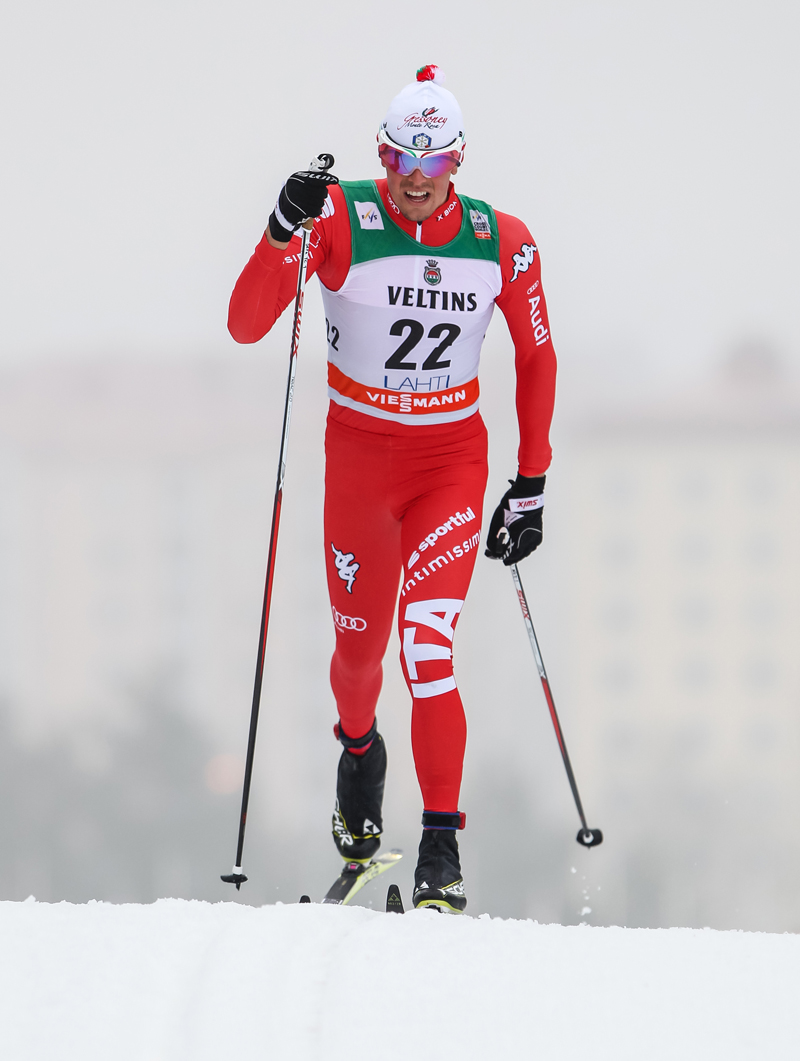
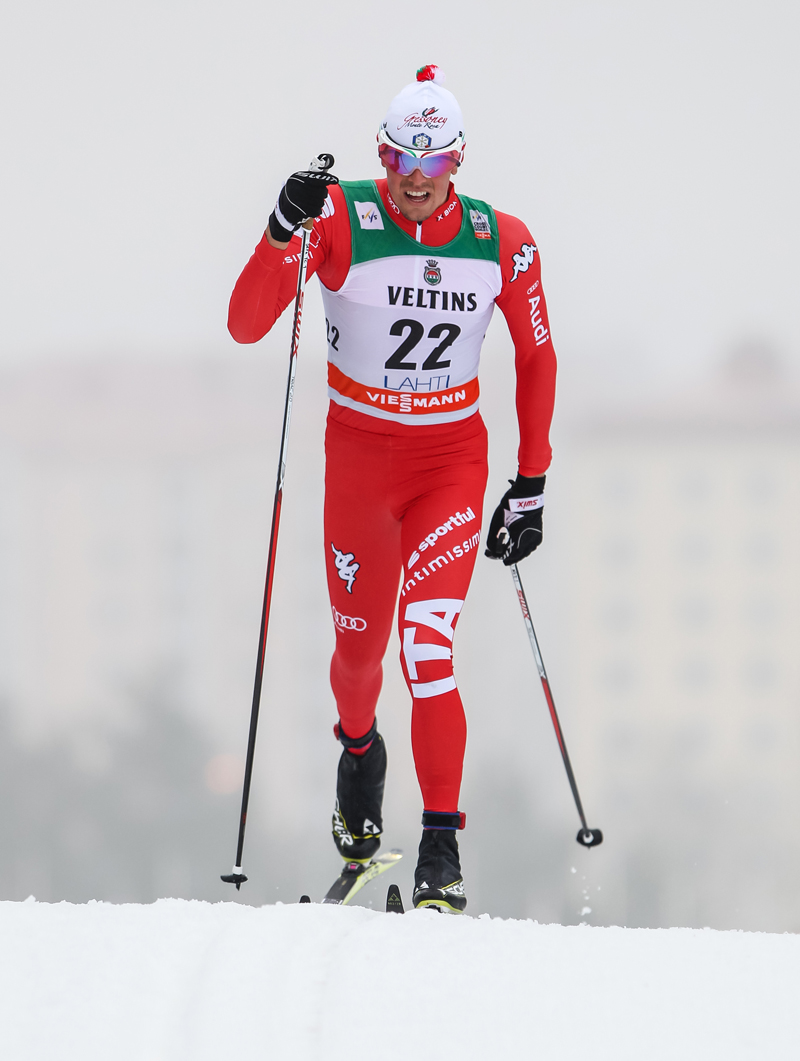
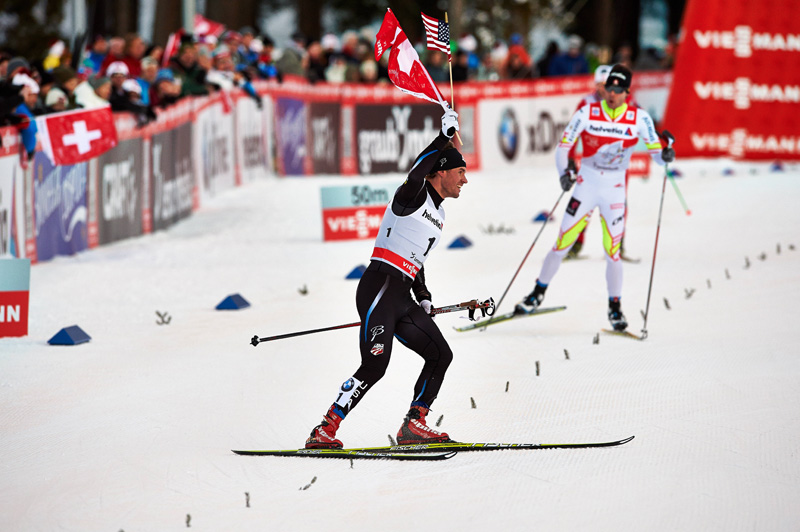
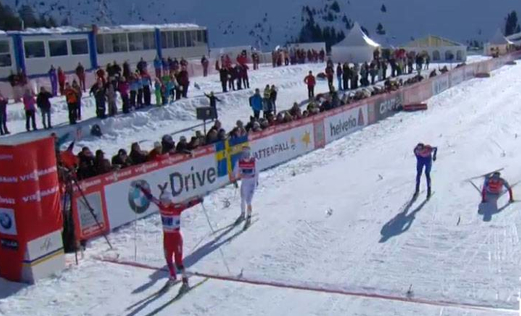
Francesco de Fabiani racing to his first World Cup win (and podium) in the Lahti World Cup 15 k classic on March 8, which was Italy’s first victory in a classic-distance race since 1997. (Photo: Fischer/NordicFocus)
No amount of fog or soggy classic conditions could dampen Francesco de Fabiani’s spirits on Sunday as the 21-year-old broke through an 18-year barrier for Italy with a World Cup classic-distance win in the men’s 15-kilometer individual start in Lahti, Finland.
After starting second in the seeded group in bib 22, de Fabiani took to the course 30 seconds after Norway’s Eldar Rønning and gradually worked his way into the three-lap race.
De Fabiani finally took the lead at 11.2 k, and from that point on, the young Italian — who had never been on the World Cup podium before — became untouchable. Kazakhstan’s Alexey Poltoranin came close, clocking through the checkpoint 3 seconds behind De Fabiani, and Finland’s Sami Jauhojärvi was 4.6 seconds out of the lead in third.
Out of 71 finishers, de Fabiani’s time at 3.4 k ranked 25th. By 6.2 k, he was up to 20th, and by 13.4 k, he remained 7.2 seconds ahead of Jauhojärvi in first.
“I was very motivated to show my best today after a disappointing performance in the 50 k in Falun last week,” de Fabiani told FIS after the race.
Exactly a week ago on March 1, the Italian placed 32nd in the 50 k classic mass start at World Championships in Falun, Sweden. Three of his teammates, Dietmar Nöckler, Giorgio Di Centa and Mattia Pellegrin, finished ahead of him in 12th, 22nd and 23rd, respectively.
But this Sunday was different. De Fabiani set the new time to beat at the finish, besting Norway’s Martin Løwstrøm Nyenget by 6.5 seconds to bump the 22-year-old Norwegian U23 team member out of the leader’s seat.
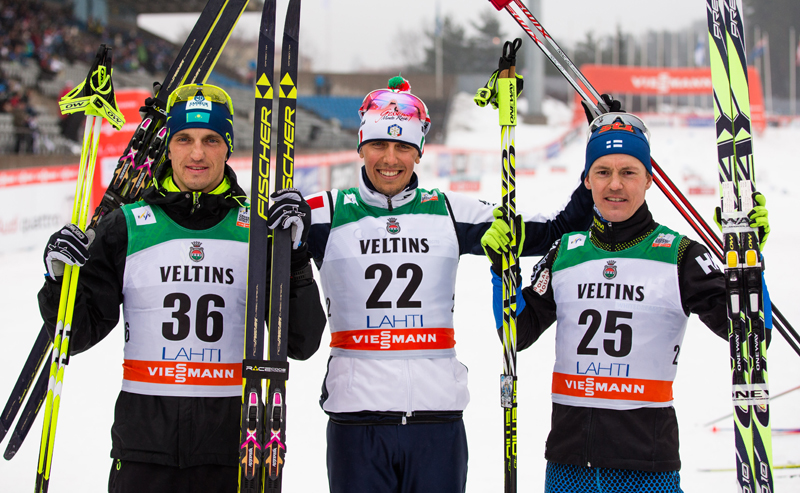
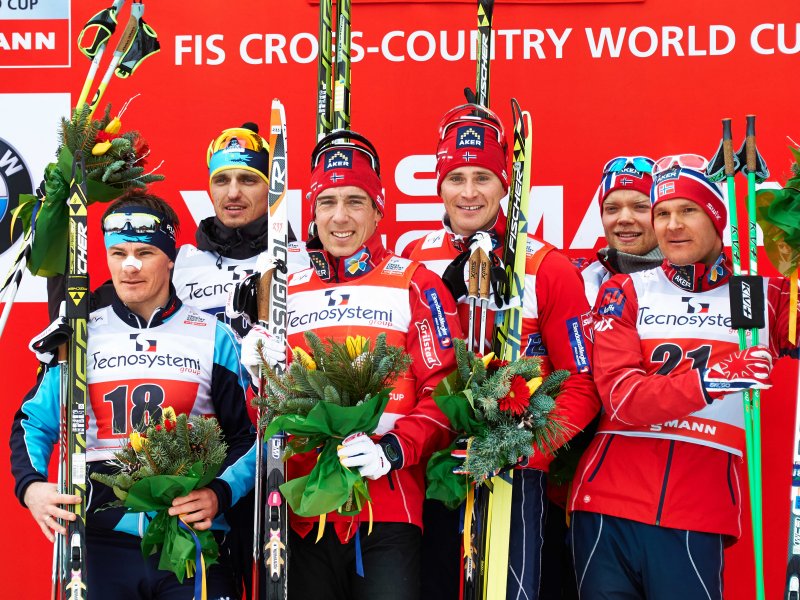
The men’s 15 k classic podium at Sunday’s World Cup in Lahti, Finland, with Italian winner Francesco de Fabiani (c), Kazakhstan’s Alexey Poltoranin in second (l), and Finland’s Sami Jauhojärvi in third. (Photo: Fischer/NordicFocus)
Even with Jauhojärvi in bib 25 hot on his tails, de Fabiani remained on top at the finish as the Finn came through 4.6 seconds back to take second. The 33-year-old Jauhojärvi crossed the line while waving of his hand back and forth, indicating it was a so-so race, then smirked and pointed two fingers at the TV camera to indicate second.
“I’m quite satisfied with the result, but still little bit disappointed I lost the victory by only 4.6 seconds,” Jauhojärvi told FIS. “Only on the big climb in the the second lap I was in trouble and I lost about six seconds. Then I got a ride with [Switzerland’s] Dario Cologna and I tried to follow him.”
An early leader in bib 36, Poltoranin came through the 3.4 k checkpoint with the fastest time, and behind him, Sweden’s Calle Halfvarsson came closest to it, 1.4 seconds back. Poltoranin went on to lead through 8.4 k, where Russia’s Alexander Bessmertnykh was fastest, 0.5 seconds ahead of Rønning. Nyenget was 1.3 seconds back in third at that point, and Poltoranin 1.5 second behind in fourth.
Also at 8.4 k, Nöckler, who started 30 seconds behind his teammate, was ahead of De Fabiani and 2.7 seconds behind the Russian, along with Cologna (+3.9). With 6.6 k to go, De Fabiani was 5.7 seconds out of first, followed by Halfvarsson (+6.8).
About 2 1/2 kilometers later, de Fabiani found he was within three seconds of Nyenget in first, and Rønning and Cologna worked their way up into contention in second and third, less than a second back. Bessmertnykh remained in the mix with Nöckler and Poltarinin, within 2 seconds of the lead.
On the final 5 k lap, de Fabiani made his mark. Cologna and Nöckler came within 2.6 seconds of him at 11.2 k, and Nyenget was another 0.1 seconds back in fourth.
With 1 1/2 k to go, de Fabiani picked up the tempo considerably, and Jauhojärvi came within 7.2 seconds of him at 13.4 k to post the second-fastest split. Poltoranin and Nyenget were 7.7 seconds off the pace tied for third, and Nöckler and Cologna dropped more than 10 seconds behind in fifth and sixth.
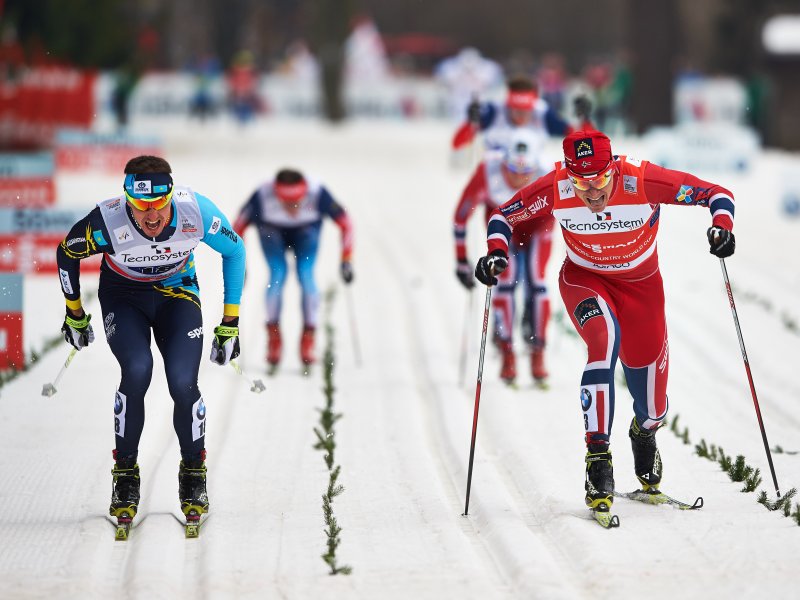
Poltoranin closed hard and came up 3 seconds short of de Fabiani, who ended up clinching the win ahead of him in 34:51.2. Jauhojärvi ended up third at his home World Cup, and Nyenget took fourth, 6.5 seconds back and 1.9 seconds off the podium in his second World Cup race (he previously placed 41st in last year’s 50 k classic at Holmenkollen in Oslo, Norway).
Cologna in fifth (+9.7) boosted his points in the overall World Cup standings to come within one point of Norway’s Petter Northug, who placed seventh on Sunday, 15.3 seconds after de Fabiani. The two remain in third and fourth overall, respectively, despite putting some points into Norwegian World Cup leader Martin Johnsrud Sundby, who finished 10th on Sunday (+21.5).
In the race for the overall Distance World Cup, Cologna remains 83 points ahead of Sundby with one race to go (the 50 k skate in Holmenkollen next Saturday) and 190 points remaining.
“It is great to win a first World Cup,” De Fabiani told FIS. “I was lucky today. I skied with Lukas Bauer [of the Czech Republic] for two laps and he helped me a lot to win the race today.”
Bauer, who started 45th and finished ninth (+20.3), after Rønning in eighth (+16.9), immediately congratulated the Italian at the finish. De Fabiani stood up out of his seat to greet him in the finishing pen.
Beyond de Fabiani’s first career win and podium, the victory was a first for Italian cross-country skiing, which had not won a classic distance race since Silvio Fauner topped a 10 k in January 1997, according to Neveitalia.
Italy had two in the top six, with Nöckler finishing 13 seconds back from his teammate in sixth.
For Poltoranin, it was his 21st career World Cup podium after a medal-less World Championships.
“I am happy to be back on the podium,” he told FIS. I was not satisfied with my performance at the World Championships. Today was a difficult race. I was in the lead in the halfway of the race, but then I could not keep the speed.”
This FasterSkier series will examine the growing challenge to the national team model by privately funded ski teams and independent sponsorship agreements. Will national teams be able to support themselves in the future, or will corporate teams take over cross country skiing? This first article in the series will look at Petter Northug, Jr.’s record deal with Coop and the implications it has for the Norwegian National Team and the sport as a whole.
***
Last May, Petter Northug, Jr., the bombastic figure of nordic skiing, called a press conference and announced that he was leaving the Norwegian National Team. The news hardly came as a surprise to Norwegian ski fans; for weeks prior to the announcement rumors had swirled in the press that the ski star had signed a lucrative deal with Coop, a Norwegian grocery chain.
The deal was indeed a profit windfall for the then 27-year-old Norwegian. Though the financial terms of the agreement haven’t been made public, the three-year deal was widely reported to be worth somewhere between 10 to 20 million Norwegian kroner a year, or $1.6 to 3.3 million dollars.
Predictably, Northug’s decision to leave the Norwegian National Team, or the Norges Skiforbund (NSF) as it is known in Norway, caused a certain amount of backlash at home. Northug’s career has been rife with moments of controversy, but his decision to leave the NSF may well be a watershed moment for skiing, one that comes to redefine the role of national teams in the international ski arena. This spring will likely see what the future holds for skiing, as the NSF debates whether it will allow Northug to continue to ski for Norway, and other ski stars watch and weigh their options.
“I’m going out of the national team and will train independently,” Northug said at his press conference last year. “I want to prepare myself mostly alone. Motivation makes me draw this initiative. If you are not 100-percent motivated, you’re done. I want to control things myself.”
“There are major challenges,” Northug’s father Petter Northug, Sr., better known by his middle name, John, said. “He chooses not a good arrangement for the national team, but said he had to do this to get greater motivation.”
John Northug added that the cause of his son’s flagging motivation was the stagnation of having already spent seven years on the national team.
“This was the new personal challenge he needed,” he continued. “I see that he thrives on it and he thinks it is brilliant to have responsibility for himself. He is in high spirits everyday. It has given him a new dimension to govern himself.”
Inevitably, Northug’s announcement caused a stir. Some accused him of being unpatriotic, even traitorous, a point of view that Northug says he understands. The older generation of Norwegians is more critical of Northug’s perceived lack of patriotism, while younger Norwegians are more sympathetic with his financial desires.
To counter the fallout, Northug brought NSF Cross Country Head Coach Åge Skinstad to sit beside him in front of the press. Looking like an older, somewhat elfin version of Northug with his similarly shaggy hair, Skinstad was there to lend his protégé support, if not his stamp of approval.
Åge Skinstad, Norwegian National Team head coach (Photo: Jarle Vines)
“We have discussed the consequences,” Skinstad said. “And although we have disagreed about the decision, there have been good discussions. … We still have a common goal towards next season with the Olympics, the Tour de Ski, and the World Cup.”
Skinstad stressed that all the funding and support that Northug had enjoyed from the NSF would end immediately. But he added, “When we come to the [World Cup] ski races in Kuusamo [Finland], then Petter will get the same support as the others.”
Northug penned the agreement in the belief that he would still be able to compete for Norway at World Cup competitions, the Olympics, and World Championships through a representation agreement. Since only national teams are allowed to compete at these competitions, temporary representation agreements are often drawn up to allow skiers who are not normally on the national team to temporarily join the team when they qualify for competitions.
It is this representation agreement that continues to put the NSF in a bind. The problem is simple: sponsor exclusivity.
“… [Northug] has signed a major sponsorship agreement with Coop, which is a competitor of NSF’s sponsorship Norgesgruppen/Spar,” Stein Opsal, NSF secretary general, stated on the NSF’s website. “NSF sponsors have industry exclusivity in their agreements. It has therefore been important for the NSF to fulfill our partners’ interests. It is these partners who contribute to the financing of … Norwegian cross country skiing.”
“At the same time,” wrote Opsal, “it has been our clear desire to contribute to Petter getting the best possible athletic program before the Olympics, within the limits we can defend.”
For a star like Northug to be absent from the team for 10 months of the year, while partnering with the NSF’s sponsor’s closest competitor, creates a vexing problem for Opsal and his organization. They were counting on Northug to provide them with Olympic medals in Sochi, and felt that they could scarcely afford to sacrifice that all-important marker of success over exclusivity clauses.
For that reason it was to no party’s advantage to see him left out of the team in a critical Olympic season, but with the 2014 Games behind him his future is in some doubt. Partly it depends on the desires of the Norgesgruppen. If the food conglomerate insist upon total exclusivity, then Opsal will be under serious pressure to exclude Northug entirely. If, on the other hand, Norgesgruppen decides that his temporary inclusion on the national team still elevates its sponsorship profile, or fearing a negative backlash if they force him out, the company may let the issue rest. In any case, Northug correctly gambled that he wouldn’t be pushed out, though that may change.
From his announcement last May, Northug was unable to come to terms with the NSF over a representation agreement until October 13, 2013, an unusually long time for what Opsal called a “general representation agreement.” That agreement also came with “an attachment that governs the relationship between Northug’s sponsorship and NSF sponsorship.”
The Agreement Itself
That attachment seems to have been an awkward compromise at best. As part of his deal with Coop, Northug has become a face of the store, and a poster boy for its healthy living campaign. His visage is on everything from juice, cereal, and bread in the store, and as part of the contractual agreement, all Northug-related products and advertisements that were launched after October 30 had to be removed from stores between January 30 and February 28, 2014, so as not to interfere with Spar’s Olympic exclusivity.
If the products remained in the stores, Northug risked being suspended from the Games, and fearful store managers scrutinized their aisles for Northug items that could have caused trouble. One store manager, Erik Tangstad, said that he didn’t even dare let the advertisements stay in the warehouse, and threw everything away for fear that banned items could be mistakenly be brought into this store during the Olympics.
How long these sorts of arrangements can remain feasible is uncertain.
“It is clear it can be a challenge for the national model,” Opsal told NRK. “It is something we will now evaluate after the season, for our loyalty lies primarily with our partners. So if we feel we have gone above and beyond what we feel is reasonable [with representation agreements], we will tighten it for next season.”
Northug has also put himself at disadvantage in these agreements by having a poor season. Having struggled with sickness in the fall, Northug was lackluster at best on the World Cup and dreadful at the Olympics. Additionally problematic, at least for Northug, was the emergence of Martin Johnsrud Sundby as the Tour de Ski and Overall World Cup winner at the end of the season. Throughout the Northug era Norwegian ski fans have worried that there wasn’t another world-class man on the team. In the one season that Northug was a non-entity, Sundby suddenly emerged as the world’s best all-round skier. With Sundby in good form, Opsal may now feel less pressure to come to an agreement with Northug for the 2014/2015 season.
While Opsal speaks cryptically about tightening agreements, Vegard Ulvang, former Norwegian ski star and head of the FIS Cross Country Committee, is more direct.
Vegard Ulvang
“It’s a very difficult issue,” Ulvang told Aftenposten. “In principle, the Norwegian national model is built on a strong Norwegian National Team, which all contribute to the economy [of the NSF]. If the model is broken … then we need to align ourselves with another system, to lay down the national team and let the [professional teams] take over.”
Ulvang questioned who would provide the infrastructure and support system that national team skiers now enjoy. “If you let [skiers] be free,” said Ulvang, “the system will not work the way it does today. In my mind there is not any other way, either to finance or organize this, than we do today. Then everyone must contribute.”
As a longtime advocate for the national-team structure Ulvang does not think that skiing will go the way of cycling with its professional teams. In a June 25 interview with NRK he ranted, “Our sport is not developed alone in a hotel room in Italy. The development of the national [team] environment and the Petter Northug training culture today is a product created over 50 years where everyone has contributed. To break out of the federation’s national system is a serious violation of the way we are organized.”
“I fear that Petter has started something that more will [choose],” he continued. “I am very concerned that this will be the trend. It is important that Northug and all others that are good give knowledge and expertise back to those who come after them. There’s supposed to be a new Northug one day. Therefore, we must avoid that the best break out of the national system once they have received the best fruits contained therein. There is enough flexibility in the national team, so this is about one thing only: Economy.”
“Petter is not the first star who has had the opportunity to do things differently,” Ulvang fumed. “But in previous cases, we have always found flexible solutions within the system.”
“What people are saying I do not care so much about,” Northug responded. “I follow what I want and what I feel.”
New Money
Jürg Capol, former FIS race director and current marketing chief, supports Northug’s route.
Jürg Capol
“The ability to concentrate on one’s own, with major sponsors at one’s back, is too good to miss,” Capol said. “[It’s] essentially a luxury problem: that there is so much money in the sport.”
The fact that there is so much money now in the sport is an issue that national teams have been slow to respond to. The last decade and half has seen a concerted effort by FIS to turn World Cup skiing into a TV-friendly event. The reinvention of race formats and coverage quality has paid off handsomely. The 2013 Cross Country World Cup season boasted an aggregate audience of 1.86 billion viewers over 1,135 hours of broadcast time. This represented an audience increase of 25 percent from the 2012 season alone, and with it, sponsorship revenue.
It’s not just the World Cup races that are popular to watch on TV. The Vasaloppet captures 73.9 percent of the television audience in Sweden the first Sunday morning in March. It’s such a TV event that former race director Jonas Bauer, looking to expand the Vasaloppet’s market abroad, concocted a new marathon circuit: the Swix Ski Classics.
The Swix Ski Classics was inaugurated in 2011 with the Tour de France as a role model, and the races follow in that tradition. There are now 32 professional ski teams that compete on the circuit, and 200,000 euros in prize money. The series consists of six long-distance classic races: La Diagonela, Marcialonga, König Ludwig Lauf, Vasaloppet, Birkebeinerrennet, and the Årefjällsloppet. These races were broadcasted last year in 50 countries with 20 million live viewers.
Though far from equaling FIS’s TV audience, the Ski Classics is only in its fourth year and growing rapidly. This alternative ski circuit has fueled the creation of private ski teams, particularly in Scandinavia, where sponsorship money is ripe for the picking. It is precisely these ski teams that are now catching the eye of many top cross-country skiers.
A former member of the Norwegian junior and recruit national teams, Chris Andre Jespersen left the national team in favor of Team United Bakeries. Jespersen had a breakout season this winter, finishing second in the Tour de Ski. At the summit of the Alpe Cermis after the race, he was asked whether or not he would join the national team the next season. Shrugging off the question he thanked United Bakeries for the support they’d given him.
“I got an offer last year,” Jespersen said on top of Alpe Cermis. “We get good financial support, all of the camps, private physio — we really have it all. There is no reason why we should not go as fast.”
Norway’s Chris Arne Jespersen racing in shorts at the 2014 Winter Olympics 15 k classic in Sochi, Russia.
He doubted whether he would receive the same kind of treatment in the NSF. Asked about his future on April 2, Jespersen gave a cautious answer, “I’ve decided, but I do not want to say what I’ve decided.”
All of this leads back to the Northug debate, and the amount of money that Northug had left on the table while still on the national team. Public tax statements indicate that Northug’s income in 2012 was 1.6 million kroner ($268,000), the lowest amount that Northug has reported since 2008. As more money is available in the sport, Northug has apparently been making less.
The high water mark for Northug was in 2011, the year the World Championships were held in Oslo when he reported 3.59 million kroner. All told, according to Bergens Tidende, Northug’s net worth in 2012 was 11.9 million kroner ($2.18 million dollars). Compared to these numbers, the 10-20 million kroner ($1.5-3.6 million) Coop is now paying him seems too good a prize for him to have passed by.
For skiers on the national team, the base salary is 200,000 kroner ($33,500), while its top stars earn 450,000 kroner ($75,400). Prize money and additional sponsorship make up the rest of a skiers income. Even so, Therese Johaug reported an income in 2012 of 1.1 million kroner ($184,000) while Marit Bjørgen made only million kroner herself, though her total wealth is estimated at $3.6 million.
All of this comes as the NSF’s sponsorship revenue has exploded. In 2009 the team collected 20 million kroner ($3.3 million) in sponsorship funds. In 2013 that number was 66 million kroner, or $11 million.
To what extent Northug was responsible for the 10-million kroner increase per year is up for debate. Skinstad dismissed the idea saying, “It is impossible to say what Northug has had on the economy [of the team]. I believe that the total interest is not very dependent on individuals.”
Northug’s manager Are Soerum Langås, has a different take. “Peter has contributed an amazing amount in all the years in which he has been part of the national system, including by increasing the FIS market,” Langås said.
In the minds of Camp Northug, Petter has already contributed his share, and has seen his personal income drop while the profits of FIS and the bankroll of the national team have soared.
Bernt Halvard Olderskog, the NSF’s commercial manager questioned the notion that Northug helps attract sponsorship to the NSF in a March 2014 interview with Adressa. Olderskog noted that this year with Northug only temporarily on the team, the NSF received 73 million kroner in sponsorship funds, up 7 million from the previous year, an increase of 10 percent.
“We expect an increase next year,” said Olderskog. “The large income jump we have already taken, but there is additional revenue in license products and equipment sales.”
Olderskog defended the fact the NSF’s ski stars make less than their earning potential while they’re on the team. “It’s a social democracy that prevails in the national team,” he said. “Marit and Therese could have earned more …”
Will Others Follow?
The biggest threat to the National Team’s economic model of course is losing more of its star athletes. Of chief concern are its leading ladies, Marit Bjørgen and Therese Johaug, both hugely popular figures in Norway. The NSF receives sponsorship from ASKO specifically for Bjørgen and Johaug, and if it lost them, the team would likely find itself much less attractive to partners and its overall revenue would decline. The NSF will likely never be able to offer athletes the money and exclusive perks of a well-funded corporate team, instead for the time being they are relying on other methods to keep their athletes on board. What the team can offer is top-notch resources and personnel, not to mention prestige, national pride, and camaraderie.
To prevent the further loss of athletes, Opsal is debating his options. Ulvang is encouraging the total exclusion of Northug from the national team to set a precedent, while Opsal seems to be favoring a more moderate approach.
An April 2, 2014 article in NRK stated that Opsal is actively reviewing the NSF’s representation agreement policy and would come to a conclusion on the matter by the end of May of this year.
“It is wrong to talk about possible outcomes at this stage in the process,” Opsal said. Nevertheless, NRK proceeded to outline the three possible outcomes:
1) The policy will remain the same. Athletes can sign representation agreements even if they have other conflicting sponsorship agreements.
2) Athletes can sign representation agreements only if they have no conflicting sponsorship agreements.
3) Athletes that are offered membership on the national team but opt not to join will be refused the right to sign representation agreements.
Eldar Rønning may leave the the Norwegian National Team after the 2014/2015 season
While it’s unlikely that the NSF would choose Option 3 and essentially force skiers onto the national team, Opsal must choose whether or not to allow sponsorship conflicts to continue. His decision will be shaped by how threatening he finds Northug’s private initiative to be for the future of the national team. With Jespersen likely to remain with United Bakeries, and Eldar Rønning hinting that he may pursue something similar after next season in order to be more “family friendly,” Opsal may heed Ulvang’s warning.
Yet Opsal knows that if he goes with Option 2, it is very unlikely that Northug will leave his partnership with Coop. Therefore, if he changes the terms of the representation agreements, Northug will almost certainly no longer ski for Norway. Whether Norway can remove the sting of the Olympics with a Northug-free relay team at next years World Championships in Falun, Sweden, is also a question that must be on his mind.
The reality is that Northug is fully prepared to no longer ski for Norway. He has already won everything there is to win, and though he surely would like to win more, he and the NSF don’t get along very well, and never really have.
His disagreements with the NSF began at the very beginning of his career: he was contentiously left off the Norwegian team for the 2006 Olympics, and has said he has not yet forgiven then National Team Coach Krister Sørgård for the decision. The bad blood he felt between himself and the national team from this episode has remained with him throughout his career, and with each new conflict he can taste it again — a sense of mistreatment and injustice.
The Northug Complex
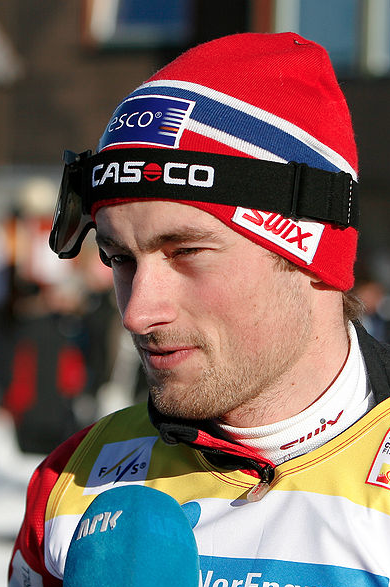
Petter Northug
To understand Northug is to know that for him skiing has always been about proving people wrong. His motivation seems to stem from a sense of himself being set against the world. Many thought he would mellow with age, but so far at 28, that hasn’t quite happened. Even as he became arguably the best skier of his time, he kept up his war of words: belittling Sweden at every opportunity, mocking his rivals, and making boastful comments whenever a microphone was in front of him, much to the delight of reporters.
Media outlets like NRK have covered him extensively, and the following two sections are based largely on their reports.
Perhaps the most telling example of his attitude was Northug’s warmup jacket at the 2013 World Championships in Val di Fiemme, Italy. Emblazoned on the back of the jacket was a picture of Northug’s face holding up a single, shushing finger over his mouth, while an inscription on his sleeve read in English: “Haters gonna hate.” If that wasn’t clear enough, Northug took it upon himself to point out the inscription whenever the cameras rested on him.
Critically, though, for Northug, he wasn’t able to maintain a harmonious relationship within the insular national team. In April of 2008, Northug was reprimanded by his teammates at the end of the season evaluations for “contributing too little in training.” The grievance was that he was too concerned with training at the right intensity to fully participate and push his teammates in the harder workouts. Northug’s occasional lack of effort at training sessions has continued to be a bone of contention on the team.
Northug’s sponsorship battles are also nothing new. In November of 2008, he showed up on the TV show “Grosvold” with his personal sponsor, a decision his teammates criticized him for. His sponsorship conflicts really heated up though the following year, when Northug signed on with Red Bull. The NSF did their best to stop the Red Bull deal going forward, despite the fact that on the NSF’s alpine team, the famous Aksel Lund Svindal was enjoying a rewarding partnership with the very same brand.
The NSF threatened to revoke Northug’s racing license over the issue, and he was accused of sending “unfortunate moral signals” by pursuing the deal. Northug in the end was allowed to keep his Red Bull contract, but for him the experience equaled the injustice he felt following his 2006 Olympic team omission. It was then, in the fall of 2009, when the Red Bull tensions were at their highest that Northug first began to privately consider a career for himself outside of the national team.
More Conflicts
Of course there have been many other flare-ups along the way. He was outraged at not being given a bib in the sprint race at the 2009 World Championships in Liberec, Czech Republic, the race he felt gave him his best chance to win gold. After a poor performance in the 15 k at the 2010 Olympics Northug declared that something had been done to his skis.
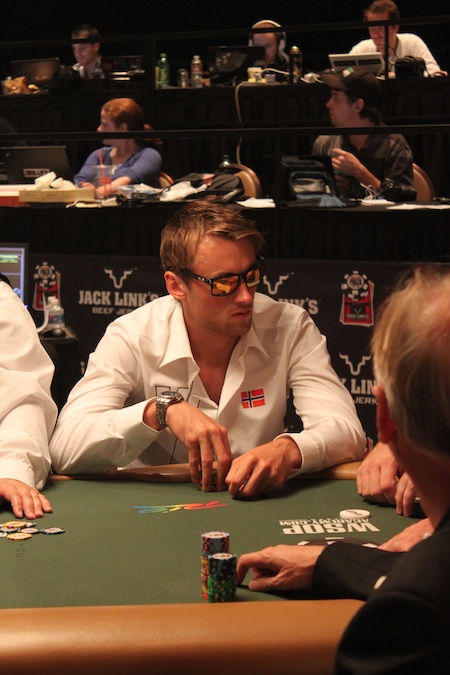
Petter Northug during his first day at the 2010 World Series of Poker
While it was never confirmed whether anything had happened to his skis, tension remained high throughout the Games as his father stepped in, giving Northug the equipment and wax service he needed to be successful in Vancouver.
In April 2010 he was hounded by the Confederation of Norwegian Sports over his poker habit, and that May he failed to show up to a national-team camp citing illness, but was skewered in the press after it was revealed that he had actually gone instead to play a soccer match for Mosvik, a lower-division club he occasionally plays for. That revelation was relatively benign compared to the popularly held belief that he had skipped the camp to get blindingly drunk on the Spanish island of Mallorca.
In December 2010, Ulvang howled that he was “embarrassed to be a Norwegian” after Northug showed up late to an award ceremony after a World Cup race in La Clusaz, France. Last year, Sundby called him a coward, and Northug had to fight to be allowed to ski in the World Cup races in Sochi, preparation he said was vital ahead of an Olympic year. All told, by the end of the 2012/2013 season he simply ran out of patience with the national team and its “haters-gonna-hate” attitude, as his sleeve that year attested.
It’s likely Northug had been developing his strategy for a national-team exit for some time before his announcement last May. To understand how he managed to land such a momentous agreement with Coop, one need not look farther than Northug’s father.
The Ultimate Ski Patriarch
John Northug is nothing if not the ultimate ski patriarch. He is the father of three sons, all skiers: Petter, Thomas, and Even, and he has been instrumental in developing their ski careers. Aside from his eldest son Petter’s obvious success, Thomas, age 23, is a member of the National Team, and Even, 18, is on his way up. When Even took third in a Norwegian rollerski race last summer, Petter exclaimed: “We don’t play around, we don’t play around. F*ck, we’re good.”
For three years John has managed Petter’s career, helping him reach an unprecedented level of success and fame. Yet the relationship between the two was argumentative, often tense in the public sphere and said to be even more turbulent behind closed doors.
Petter Northug at the 2011 Bislett Games. Photo: Chell Hill
“When I started, it was because Peter wanted it. And I was positive. We both agreed that I was the right man for the job,” John told Dagbladet. “In the aftermath, we can say that it was a misjudgment.”
After three years, they decided that John would move on from his managerial role, and he told Dagbladet he was relishing a return to the simple life of living on his farm and working at the Agricultural Office in Inderoy.
“Now I have it good,” John said at the time. “Now I have found serenity. When I was a manager, I walked around with a tension in my body all the time. What would show up today? It was something all the time.”
He didn’t last long at the Agricultural Office. If John Northug thought he was ready to return to the simple life of a municipal worker, and leave his role as chief of the “Northug Circus” as his son’s exploits are referred to, he was kidding himself.
“It is just a little bit that I do some other things too well,” he said about he decision to leave the municipality.
He then joined a sport-management company based in Trondheim, Norway, called Nye Høyer, or “New Heights” in English. As a senior consultant with New Heights, his role was largely to help the company develop its activities relating to major Worldloppet ski events such as the Marcialonga, Dolomitenlauf, and the Engadin.
It was no accident then that Northug arrived at the doorstep of New Heights, the company he actually signed with when he left the national team in 2013. Whether John was hired by New Heights with the expectation that they would manage Petter’s business affairs in the future, or whether that idea was borne later, by last spring it was decided that Northug would partner with New Heights, and that they would, “handle all areas around the Petter Northug brand.” The deal they arrived at with Coop didn’t disappoint the company motto of, “a profitable journey of continuous improvement.”
With New Heights, Northug has the experience of his father backed up with the support and connection of a well-oiled management company. New Heights cited their connection to the legal firm Pretor Advokat and the Trondheim branch of the international auditing house PricewaterhouseCoopers to provide Northug with extra legal, financial and tax assistance.
To what extent New Heights is currently leveraging their connections to assure that their golden boy remains able to compete for Norway in big competitions is unknown. Perhaps his future will lie entirely in the world of marathon races, and if so he may lift those events to even greater prominence. In any case, whatever Opsal decides and despite Ulvang’s cries of alarm, the sport of cross-country skiing is not likely to proceed in the same way for long. FIS has been successful in making skiing popular to watch, and there is money in the sport in a way there never has been before. With Norwegian national-team salaries capped at $73,000 and most other nations paying their athletes significantly less, it’s only a matter of time before more skiers opt for a more remunerative route.
If Opsal opts to change the agreements he may delay the inevitable for some time in Norway, but star athletes from other countries will likely soon hear the siren sound of private teams, exclusive contracts, and real wealth.
***
This series will continue by examining Therese Johaug and her path to a successful career while on the Norwegian National Team.
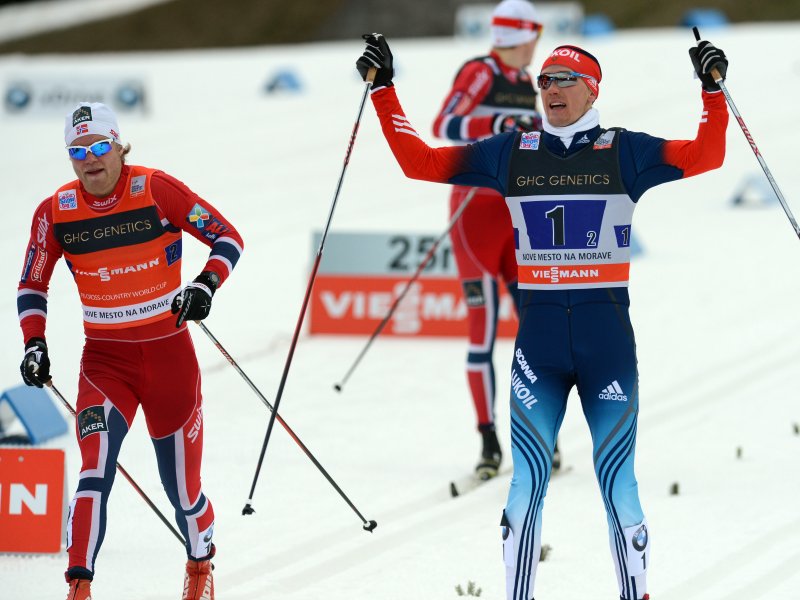
Nikita Kriukov (r) celebrates a 0.22-second victory for Russia I over Norway I’s Eirik Brandsdal in Sunday’s 6 x 1.6 k classic team sprint. Norway II’s Ola Vigen Hattestad placed third, 1.78 seconds back in the final classic sprint before the Olympics. (Photo: Fischer/Nordic Focus)
Twenty-five days before the Olympics open in Sochi, Russia, Nikita Kriukov couldn’t have timed Sunday’s 6 x 1.6-kilometer team-classic sprint victory much better. The 28-year-old Russian’s execution was right up there as well.
Following Norway’s Eirik Brandsdal into the finish, the reigning sprint world champion left no doubt that he’s still in top form, and when it comes to classic sprinting, watch out.
With teammate Maxim Vylegzhanin, Kriukov anchored Russia I to a World Cup win in 22:03.89 in the final classic-sprint tuneup before the Olympics, To do so, he outsprinted not only Brandsdal of Norway I by 0.22 seconds, but outlasted Norway II’s Ola Vigen Hattestad, who took third 1.78 seconds back.
Almost as soon as he crossed the finish, Kriukov graciously bowed to the grandstand at Nové Mesto, Czech Republic. The Norwegians hung their heads, fully realizing what happened and the work they have cut out in the team classic sprint at the upcoming Winter Games.
“I followed the plan and hoped to avoid meeting Kriukov [in the finish],” Brandsdal, 27, told NRK, according to a translation.
Despite teammate Eldar Rønning giving him a 1.1-second head start out of the last exchange, Brandsdal ended up chasing Kriukov to the finish anyway.
“We have to hope for a step up in the Olympics, but we do not know if this is being made,” Rønning told NRK. “There is strong competition.”
But rehearsal is rehearsal and the show is the main attraction, the 31-year-old Rønning reasoned. Either way, the Russians made a point.
The Norwegians led out of the start with Norway II’s Pål Golberg, 23, leading through the first exchange, just 0.4 seconds ahead of Rønning. Sweden II (Marcus Hellner/Emil Jönsson) remained in the mix 0.9 seconds back with Germany I (Sebastian Eisenlauer/Josef Wenzl), and Vylegzhanin was just a second back in fifth. Switzerland I (Ueli Schnider/Gianluca Cologna) tagged sixth, a tenth of a second ahead of the Americans, with Simi Hamilton handing off to Andy Newell 1.4 seconds back from the leaders.
“We got off to a really good start,” Hamilton said on the phone, after the Americans qualified in second in their semifinal then placed fifth behind the Czech Republic (Martin Jaks/Ales Razym) in the final.
All 10 teams remained within 2 1/2 seconds of one another through the first four laps, before the three leaders — Rønning, Vylegzhanin and Golberg — broke away on the second-to-last leg.
Meanwhile, Hamilton put the U.S. in fourth, 4 1/2 seconds back. Newell had posted the fastest leg just before him to bring the team to third at the fourth exchange, tied with Russia.
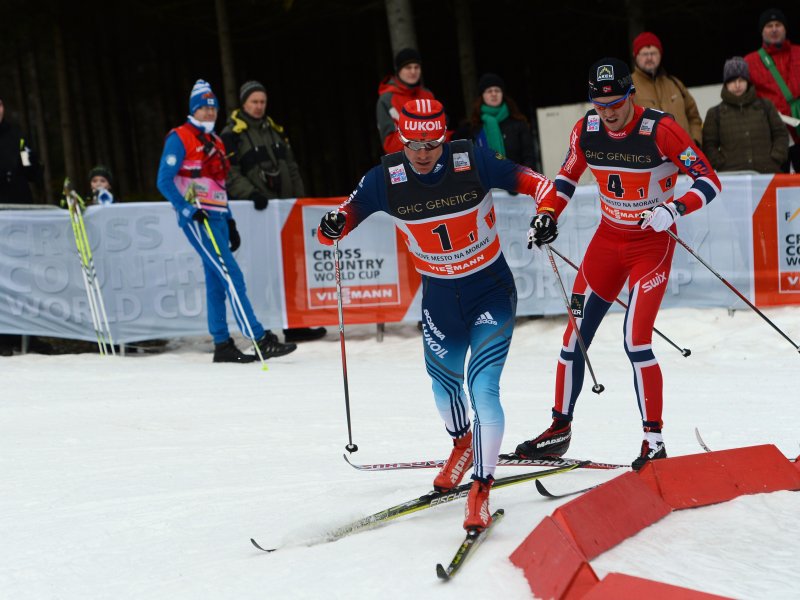
Russia I’s Maxim Vylegzhanin leading Norway II’s Pål Golberg in Sunday’s World Cup 6 x 1.6 k classic team sprint in Nove Mesto, Czech Republic. (Photo: Fischer/Nordic Focus)
“It was pretty tight the entire time with all ten teams and we lost a little bit of time in one of the tags because it was so tight with all ten teams within a couple seconds,” Hamilton explained.
After Newell’s first lap, Hamilton fell from sixth to ninth, 2.4 seconds behind the two Norwegian teams and Russia up front.
“We got a little scrapped up in one of the tags and lost a little time and came back thanks to Andy’s second leg,” Hamilton said. “When he tagged off to me on my last leg I just made it a goal to stay in contact with the top three teams. … I skied as hard as I could and lost a little bit of time but fought hard.”
After Newell received the tag in fourth, he led the chase pack as Russia, Norway I and Norway II continued to contend for the lead.
Norway II’s Hattestad fell off the pace on one of two climbs with what appeared to be less-than-ideal skis on the 36-degree Fahrenheit afternoon. Slipping up while herringboning outside the track, Hattestad initially lost contact with Kriukov and Brandsdal before putting on a last-ditch attempt to catch up.
Brandsdal took advantage of his superior glide on the descent as he drafted and passed Kriukov a few hundred meters before the finish. Heading down into the stadium, Brandsdal led while Kriukov followed closely, and Hattestad, who anchored Norway to a classic team sprint victory three weeks ago in Asiago, Italy, trailed a couple meters behind.
As Newell led the second group, including Czech Republic’s Razym and Germany’s Wenzl, into the stadium, Kriukov unleashed his well-known double pole, stepping around Brandsdal and definitively beating him to the finish.
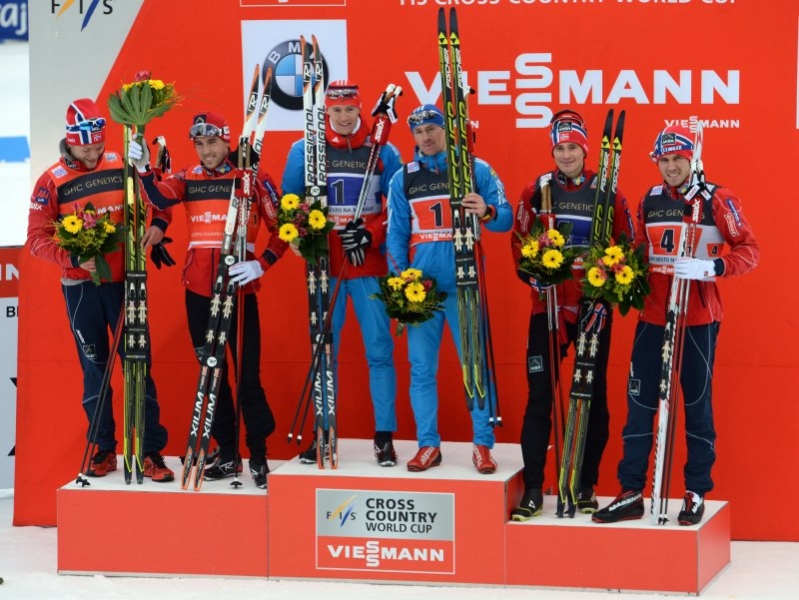
The World Cup men’s classic team sprint podium in Nove Mesto, Czech Republic: (from left to right) runner-up Norway I, Russia I’s winners Nikita Kriukov and Maxim Vylegzhanin, and Norway II in third. (Photo: Fischer/Nordic Focus)
“I felt much better than yesterday,” Kriukov told FIS after narrowly qualifying in 27th in Saturday’s classic sprint and placing 10th overall. “It was my first time skiing with Maxim. It gives us great confidence going to Sochi.”
“A few centimeters were missing on Kriukov,” Brandsdal told FIS. “I do not like losing in the finish. Nikita was very strong. It was cool to have such [a] tight fight.”
Newell successfully dropped Switzerland’s Cologna and bested Wenzel, but failed to match Razym, who used the home-crowd advantage to edge him by 0.54 seconds for fourth.
The Americans placed fifth, 14.28 seconds behind the Russian winners, and held off Germany by seventh-hundredths of a second. Switzerland placed seventh, another 6 1/2 seconds back, France was eighth (+22.08), Italy ninth (+26.47), and Sweden 10th (+50.32).
After Jönsson’s second leg, Sweden dropped from seventh to 10th with Hellner, leading him to rethink whether he’ll sprint at the Olympics after failing to qualify on Saturday.
“It would not be fun to go and feel like this in the Olympics,” he told aftonbladet.se, according to a translation.
“Right now I am pensive on sprint,” Hellner told Radio Sport. “But who knows, maybe it will be better and better. Nothing is certain in any case.”
Jönsson was back in action after sitting out Saturday’s sprint because of a troublesome right knee.
“I could list 3,000 things we could have done differently, but I’ve got three good races, have a knee … and Marcus holding up and moving well, so there is probably some bright spots,” Jönsson said.
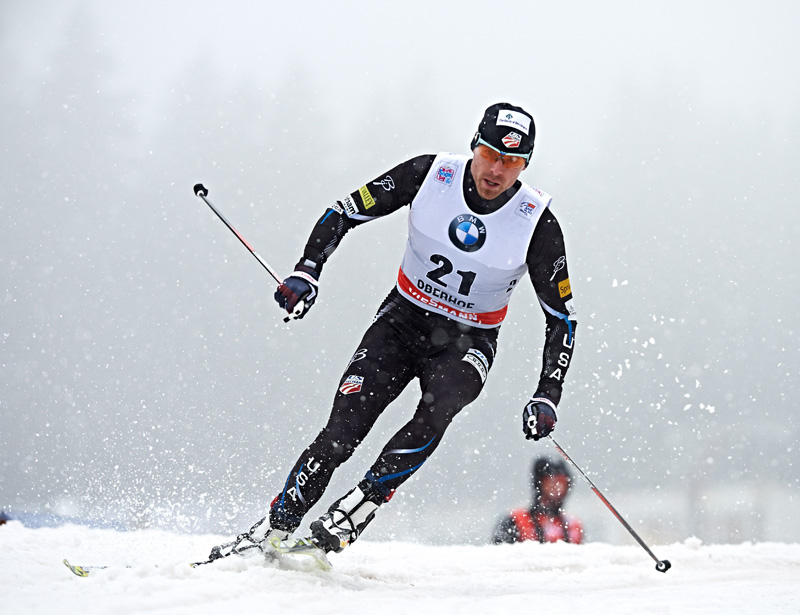
Andy Newell (U.S. Ski Team) racing the individual sprint at the Tour de Ski Dec. 29 in Oberhof, Germany. (Photo: Fischer/Nordic Focus)
Newell said that he and Hamilton, who won the Tour de Ski freestyle sprint in Lenzerheide, Switzerland, on New Year’s Eve, relied on smart yet aggressive skiing and not being afraid to take chances.
“We were right in there for a while,” Newell said on the phone. “Whenever I do a sprint relay it’s just kind of my goal to stay up front and keep us in a good position and save as much energy as I can for the end because that’s when it’s really going to matter.”
At least 20 meters behind the top three on the last lap, he realized the podium was likely out of reach.
“We tagged in fourth for my last lap, but even then we weren’t in medal contention,” Newell said. “In a sprint relay even 20 meters is too much to make up on the best skiers in the world. If we’re going to be in medal contention, we need to be up in the front for the last tag, which is the only thing holding us back for being a contender. It’s looking good leading into Sochi for sure.”
While fifth remains the best U.S. men’s team sprint result in recent memory, another highlight of the day was Hamilton and Newell automatically qualifying in second in their semifinal, 0.82 seconds behind Norway I’s Rønning and Brandsdal.
“We had a really good day with Andy and Simi qualifying outright, being second in their semifinals and were strong all day,” U.S. Ski Team Head Coach Chris Grover said. “I don’t think the guys have been as high as fifth for a few years now so that was really cool.”
Simi Hamilton (U.S. Ski Team) enjoying a victory lap after winning the third stage of the Tour de Ski on Dec. 31 in Lenzerheide, Switzerland. (Photo: Fischer/Nordic Focus)
Racing against 15 other teams in the second semifinal, Grover pointed out that they needed to place in the top two to guarantee themselves a spot in the final. Ultimately, Germany I, Sweden II and Italy I (David Hofer/Federico Pellegrino), ended up advancing with them as lucky losers.
“Andy and Simi’s semifinal was running slightly slower than the first semifinal which is somewhat typical in warmer conditions were the track is actually slowing down,” he said. “They would have been fine if they had been in the top four as it worked out, but you have to play it safe. Beyond that, we just try and get in the finals, and once you’re in the finals the tactic is just to rest when you can and be as strong as you can on the last two and half to three legs when people take off and really start hammering.”
“We were able to save our energy when we needed to and stay on our feet and that’s all you can hope for, just staying out of trouble and staying up with the leaders,” Newell said. “We don’t want to be trying to break off the front. You only have to ski as fast as the people around you.
“That’s what were trying to do in these relays: keep up with the leaders, stay out of trouble, and it always just comes down to last lap or two,” he added. “In Sochi it’s going to be a harder course, but I think were both in good enough shape so that when it comes down to our last laps we need to be up there with the best. I think we can do that for sure.”
“It’s obviously a very different course than what we’re going to find at Sochi, but last year we skied really well at the team sprint day there,” Hamilton said, after he and Newell placed seventh in the World Cup classic team sprint in Sochi last February. “We both like that course there. I think it speaks to our fitness right now. We are both on a really good trajectory in terms of where our fitness is and our speed is. We’re encouraged and we’ll see what happens, but we’re psyched for sure. Today it would have been great to be on the podium but I think we’re encouraged with how everything went.”
The Americans will continue training in Nové Mesto before the next World Cup in Szklarska Poreba, Poland, with an individual skate sprint and 10/15 k classic mass start on Saturday and Sunday.
After that, they’ll head to Europe’s largest high-altitude meadow at Seiser Alm, Italy, for a training block before the last World Cup before the Olympics in Toblach, Italy.
— Lander Karath and Pasha Kahn contributed reporting
Look familiar? Kazahstan’s Alexey Poltoranin (l) placed second for the second-straight day at the Asiago World Cup in Italy, as Ola Vigen Hattestad (r) secured the Norwegian victory in the 6 x 1.65 k classic team sprint. (Photo: Fischer/Nordic Focus)
The way things were shaping up in the men’s 6 x 1.65-kilometer classic team sprint final at the World Cup in Asiago, Italy, it could’ve been anybody’s race.
Yes, Norway’s Eldar Rønning and Ola Vigen Hattestad were generally leading the 10-team pack on Sunday, and yes, the top-four combination was often something like Norway, Russia, Norway, Russia (with each nation having two teams in the final), but you couldn’t count teams like Sweden and Kazakhstan out.
The men’s classic team sprint podium at the Asiago World Cup in Italy on Sunday: Norway I won with Eldar Rønning and Ola Vigen Hattestad (c), Kazakhstan’s Nikolay Chebotko and Alexey Poltoranin (l) placed second, and Norway II was third with Eirik Brandsdal and Øystein Pettersen. (Photo: Fischer/Nordic Focus)
While Sweden’s first starter, Teodor Peterson clocked the fastest leg in each of his rounds, his teammate Simon Persson repeatedly dropped several places after every exchange. Without their original starter in Emil Jönsson, who had to scratch because of a sore back on Sunday morning, Sweden slipped from first to sixth, second to sixth, and finally third to fifth.
They weren’t a threat to Norway’s first team of Rønning and Hattestad, which won the first semifinal over Russia’s Alexander Panzhinskiy and Nikita Kriukov, but the Kazakhs were.
Second in their semifinal after Norway II’s Øystein Pettersen and Eirik Brandsdal, Kazakhstan’s Nikolay Chebotko and Alexey Poltoranin sat patiently around fourth early in the final, then rose to second by the fourth of five exchanges.
Just 0.6 seconds behind Rønning at the start of his last lap, Chebotko held his position until planting his pole between his legs and toppling over. Kazakhstan dropped from second to sixth, and it seemed their hope for a podium was slipping as the rest of the leaders skied into the exchange zone.
Podium? The thought probably never crossed Poltoranin’s mind as he waited for the tag just a couple hundred meters later. He was going for the win. Norway’s Hattestad would have to try to stop him.
After getting the tag in fifth, Poltoranin made up nearly 5 seconds on the leaders, including Hattestad up front, followed by Kriukov, Persson and Brandsdal.
Maxim Vylegzhanin lifted Russia II into the top four, but he and teammate Dmitriy Japarov were later disqualified for a “violation of classical technique rules,” likely skating on the mostly double-pole course. At least half the men’s field raced on skate skis, including most of the top men’s finalists.
Coming out of a sharp corner on a long descent, Kriukov’s pole strap broke, but he quickly got a replacement and resumed his spot amongst the top five with Norway I, Russia II, Norway II, Russia I, and Kazakhstan.
With 800 meters remaining, Poltoranin took a shortcut to second, cutting in on the inside lane around a tight turn. Most everyone had to snowplow on the final corner to avoid crashing in the sugary, melting snow, but Poltoranin remained in position to challenge Hattestad – who was still leading – to the finish.
Hattestad didn’t have to look back. He needed to go hard the last 100 meters to the finish. Committed to a central lane, the Norwegian double poled like mad while Poltoranin jumped into the left lane behind him, which was considered one of the fastest in the homestretch.
It may have been faster as Poltoranin came within centimeters of Hattestad, but the Norwegian held him off, throwing his leg across the line and winning in a photo finish in 24:47.4.
“I did not know we had won until I saw Eldar come running towards me,” Hattestad told VG Nett, according to a translation.
“It’s fun to win with only five centimeters,” said Rønning, who initially put Norway I in third, just 0.7 seconds behind Russia II up front.
After the first tag, Hattestad brought the team to first, where they remained fractions of a second ahead of anyone else for the rest of the race.
Norway II finished third, 2.17 seconds after Kazakhstan in second, but dropped as far back as seventh during the second leg, when Japarov fell on one of the last downhills and took out Pettersen. Brandsdal lifted them back to third with the fastest-course time for that leg, and Pettersen tagged him in fourth for the final lap.
“Good day: back on the podium in WC, argue with a good Russian (became friends again), Christmas holidays and given away flowers to a little girl,” Pettersen tweeted after the race, according to a translation.
“It is the best result of the season and I am very happy for that,” Pettersen told FIS. “Luckily we could get back. Team sprints are never easy.”
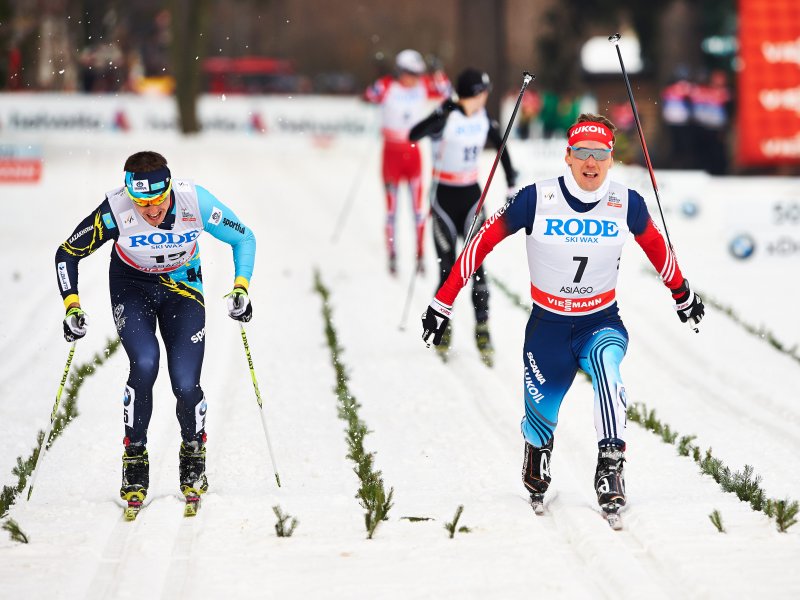
Russia’s Nikita Kriukov (r) edges Alexey Poltaranin (KAZ) for the individual classic sprint victory on Saturday in Asiago, Italy. (Photo: Fischer/Nordic Focus)
They are especially tough one day after an individual classic sprint on the same soupy course in similarly warm (41-degree) temperatures. Poltoranin, who was just short of a victory behind Kriukov on Saturday, said he recovered well with some physio work.
“Ola Vigen Hattestad is a very strong sprinter, but I think if we were not double poling in the finals, I would have had a chance to beat him,” said Poltoranin, who has placed second in his last three World Cup races.
While he sat out the Davos World Cup last weekend, Poltoranin was second to Norway’s Pål Golberg in the 15 k classic on Dec. 7 in Lillehammer, Norway.
Last season at the pre-Olympic World Cup classic sprint in Sochi, the Russians won on their home turf with Japarov and Vylegzhanin. Sweden’s Peterson and Jönsson placed second and Germany was third with Axel Teichmann and Tobias Angerer.
(Teichmann teamed up with Tim Tscharnke for Germany I on Saturday, placing fourth in their semi and narrowly missing the final for 10th overall. Germany II’s Angerer and Alexander Wolz finished 12th of 15 teams in the first semifinal.)
Russia’s No. 2 team of Alexey Petukov and Kriukov notched fourth last winter in Sochi, Norway’s Pettersen and Petter Northug placed fifth, and Kazakhstan’s Chebotko and Poltoranin finished sixth.
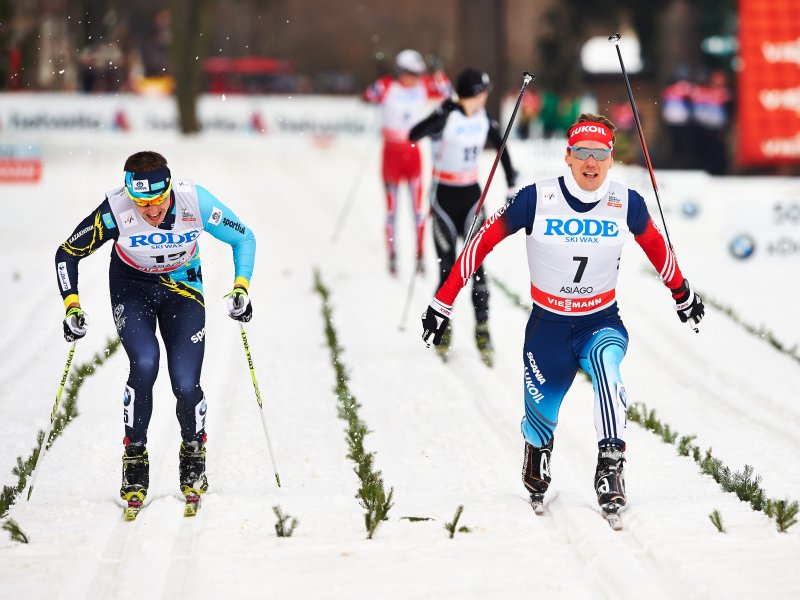
NIkita Kriukov (RUS) edges Alexey Poltaranin (KAZ) for the victory in the classic sprint in Asiago, Italy. Photo: Fischer/Nordic Focus
Showing strong form as World Cup period I winds down, Russian Nikita Kriukov held off Kazakh Alexey Poltaranin at the line to take the win on a soft and slow course in Asiago, Italy.
Kriukov, who won the freestyle sprint at the 2010 Olympics in Vancouver, Canada, qualified in seventh in today’s classic event, and looked strong throughout the day on a twisting course in the Italian Alps.
He overcame a late move by Poltartanin, who briefly took the lead entering the homestretch, and earned his fourth World Cup victory, all in classic sprints.
Switzerland’s Gianlucca Cologna, the younger brother of injured superstar Dario, made his first World Cup podium appearance in his twelfth start at the highest level.
The loop, which took the men well over four minutes, featured several long gradual climbs, but not enough elevation to deter most of the men from double poling on skate skis.
Just one, Federico Pellegrino, racing for the host nation, kicked on classic gear, albeit with little success. He was never in the running in his quarterfinal, unable to make up enough ground on the steeper climbs.
The Asiago course, a thin ribbon of snow, winding through small sections of woods and open terrain on an Italian golf course, featured stunning vistas of the surrounding mountains. The athletes, of course, had no time to admire the view.
Despite the lack of steeper hills, there was plenty of terrain, and a number of technical corners, including a big sweeping left hander that claimed American Andy Newell in the quarters.
The extended gradual climbs, soft snow and relatively long sprint distance made for a challenging race.
Skiers took different approaches, with some attempting to break off the front early and hold a gap, while others were more content to follow. There was no consistent pattern, with a mix of heats breaking apart and others closely contested.
Kriukov advanced out of his quarter, finishing second to Norwegian classic specialist Eldar Rønning, and ahead of teammate Alexey Petukhov.
Petukhov led early in the heat, and even opened a gap. But Rønning closed up on the most aggressive climb, and took over the lead.
The few hundred meters leading to the homestretch were critical. Consisting of several quick twists on flat terrain, this section proved a game changer in many heats. Positioning and choice of line could alter the race in moments, unusual for such a mellow grade.
Rønning took advantage, and cemented his potion in front, with Kriukov clear behind.
The third quarter was more closely contested, coming down to a photo finish, with third just out of the running. Eventual runner-up Poltaranin was edged by another Russian, Alexander Panzhinskiy, and a strong Ales Razym of the Czech Republic was the unlucky loser.
Cologna demonstrated exceptional double poling power, and a excellent strategy in winning the fourth quarter. The 23-year-old bided his time through the first half of the course before attacking up and over the top of one of the bigger climbs.
The course swung right as the crest approached, and Cologna powered by on the inside, moving from the back up into second behind Emil Jönsson of Sweden.
The defending Sprint Cup champion, Jønnson has been off to a slow start, struggling last week in Davos, Switzerland. He was back in form today, however, posting the second fastest qualifying time. He led the heat early, pushing hard, but still rounding into race shape, was unable to hold his lead.
After the long sweeping downhill, Cologna moved again on the steepest hill, moving by the Swede, and quickly opening a significant lead. As the pitch increased, Cologna pulled away further, leaving Jönsson at the front of the chasers.
Despite a gap of more than 15 meters, the race was not over. On the flatter sections, Jønsson came back, and when he caught Cologna in the homestretch, the Swiss skier let up, unthreatened by anyone else, and choosing to conserve energy for the later rounds.
Kriukov matched up with Poltaranin, Rønning and top qualifier, Norwegian Ole Vigen Hattestad in the first semifinal.
Hattestad set the pace early, but had little chance of pulling away. The group stayed closely packed through the first climbs and descents, before Rønning moved into the lead up the final big hill. Kriukov was right there, however, and Poltaranin and Hattestad would not be shaken.
Kriukov won pole position heading into the final twists, and held first step into the homestretch. Poltaranin, barely ahead of Rønning, made a nifty move, switching tracks cleanly, to cut off the Norwegian, and ensure a spot in the finals.
Cologna and Jönsson matched up once again in the second semi, with the Swiss reprising his quarterfinal attack. He dropped the hammer in the same place, earning the top position, a spot he would cement on the bigger hill.
After the race Cologna told FIS News that he wanted to ski from the front.
Jönsson led Panzhinskiy and yet another Russian, Anton Gafarov back up as the race wound down. The four men finished in a line, with little drama at the end, the times reflecting a fictionally closer finish.
One lucky loser came from each semi, giving Rønning and Panzhinskiy a spot in the finals.
Despite his always powerful double pole, Jönsson appeared to be missing his top gear, but never even had a chance to prove otherwise in the finals. On the tricky downhill corner, he crashed after appearing to be through safely. As he poled out of the turn, taking a skate stride, he went down hard, taking out a trailing Panzhinskiy, and leaving a four-way fight for the podium.
Cologna had tried his now-signature move yet again, but could not find the space to get into the lead before the big climb. This time it was Kriukov in command, and when Rønning tripped just before the homestretch, only the order of the top-3 was left to be determined.
Kriukov looked to be in control, but Poltaranin executed the twists into the homestretch perfectly, and slipped by into the lead. But the Russian would not be denied, accelerating in the final 50 meters to take the win.
“I liked the course but the snow conditions were not that good for me,” Poltaranin told FIS News. “In the finals I chose to double pole. We worked a lot during the summer on the upper body. Unfortunately I was not as strong as Nikita [Kriukov].”
For his part, Kriukov was ecstatic about his win. He already has both Olympic and World Championship gold medals, but had not yet earned a the top spot in a non-stage World Cup race. Per FIS rules, stage race wins do not technically count as World Cup victories, so by that measure Kriukov’s performance was another milestone for the Russian veteran.
Cologna faded at the end, and had to be satisfied with third, still an impressive benchmark as he joins the elite sprinters.
With World Cup period I ending on Sunday with a team sprint, rankings are set. Kriukov currently leads the Sprint Cup with 159 points, 35 ahead of Poltaranin.
Martti Jylhae of Finland is a close third, three points back of Poltaranin. He was twentieth in today’s race.
Of Note:
– Yunichi Onda (JPN) broke a pole on the first climb of his quarterfinal, ending any hope of a spot in the semis.
– All eight Norwegians in the race qualified for the heats, with three advancing to the semifinals.
– John Kristian Dahl (NOR) awl relegated to last in his quarterfinal for skating.
– Several written reprimands were given out for not skiing on the marked course.
– The top Italian was Dietmar Noeckler in 19th.
– Maciej Starega of Poland advanced to his first World Cup sprint semifinal. Starega placed ninth. The 23-year-old is a sprint specialist at this point in his career.
– Tomas Northug (NOR), younger brother of Petter, finished tenth, looking strong, though he obviously lost the battle of famous younger brothers to Cologna.
– Robin Bryntesson (SWE), who like Kris Freeman (USA) has Type I diabetes, place twenty-fourth.
– Canadian Alex Harvey and Czech Ondrej Horyna were disqualified in qualification, giving Pellegrino a spot in the heats.
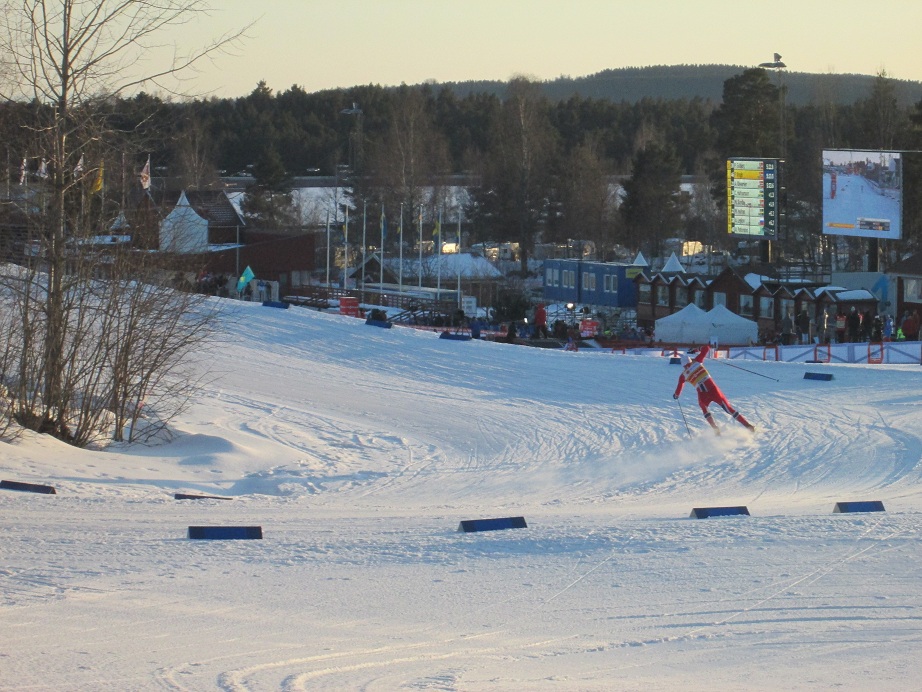
Petter Northug (NOR) making a turn at the bottom of the Mordarbakken in Falun, Sweden, on Friday during the World Cup Finals prologue. Photo: Noah Hoffman.
In the evolution of cross-country skiing at the world-class level, there has been an undeniable push from the International Ski Federation at every stage to make the sport more spectator- and television-friendly. The World Cup depends on sponsorship to survive, and potential sponsors deal in the currency of TV viewership. Over the years, individual start races have given way to mass starts because they are easier for television audiences to follow. A ski exchange penalty was added to the Holmenkollen 30/50 k this year expressly for its potential entertainment value.
As a part of this trend, athletes have also observed that the trails they compete on have become increasingly difficult, both in terms of climbing and descending.
“At each venue, it just seems like they want to outdo each other with the biggest uphill and the steepest, scariest downhill,” says U.S. Ski Team member Holly Brooks.
They have observed, and become increasingly disgruntled by the trend.
“That’s not what cross-country is about,” Brooks continued. “This is not skier cross, this is cross-country. We’re not out there wanting to be shoulder to shoulder doing tight slalom turns down hill on skis that weigh however much our skis weigh. That’s not the point. We’re endurance athletes that like to go fast. Yeah, we can take some down hills, but let’s not make them stupidly challenging.”
Growing unhappiness with the direction they saw the sport heading was partly what led the majority of World Cup athletes to protest the World Cup Finals courses in Falun, Sweden, on Thursday. After arriving at the venue for the last three stages of the mini tour and previewing the course the day before the first race, many were alarmed at how dangerous new features of the downhill were, which had been included in preparation for the 2015 World Championships that will be held in Falun. Several big names in the sport, Norway’s Petter and Thomas Northug included, crashed on the major downhill off the Mordarbakken in pre-race testing. Several Swedish athletes reportedly went to the hospital after crashing at Swedish Nationals on the same course earlier in the season.
“What they had been proposing was just, like — someone would have gotten hurt,” said U.S. athlete Jessie Diggins. “The odds that there wouldn’t have been any crashes were just none. Originally there were like five turns and it was super narrow through the woods and there was almost no padding on the trees. People even crashed last year [when] the course was much safer.”
Furthermore, some thought the course was unfair in an individual start on top of being too hazardous.
“Personally, I’m always one that is for fast down hills and sketchy down hills, but I think the difference between that and what’s going on on this course is: these corners weren’t built well,” said American Andy Newell, who has been racing on the World Cup for ten years. “They need the criticism like they’re getting so the can, for one, bank the corners and make them wider, make them better. The way it is now, for sure it’s dangerous — people could go flying off the course and crash in front of you and cause a major accident — but it’s definitely not even fair in a race like [the prologue] when the S-turns are so different for the first skier as opposed to the 100th skier to go down. The course changes so much when people are scrubbing their skis like that on the down hills.”
Canada’s Alex Harvey put it pretty bluntly: “There’s no need for this in XC skiing,” he wrote in an email to FasterSkier.
The athletes met twice on Thursday to discuss the course, and the majority reached the conclusion that they were prepared not to race unless it was changed to make it safer. They sent a signed petition to the race jury on Thursday afternoon through athlete representative Kikkan Randall.
The jury’s initial response was to change the course for the mass starts but not the individual-start prologue. As someone who has been an athlete representative for four years and has come to understand the needs of the many stakeholders involved in the production of World Cup races, Randall could see the reasons for their resistance to change the course at the last minute.
“Camera cables had already been laid, there wasn’t really an easy way to route around the downhill…if you wanted to go up the Mordarbakken,” she said. “It wasn’t easy to just switch to a different course because there wasn’t really a good other option and with all the other cameras it was really pretty close. We’re making these decisions twelve hours before the race. So it would have been nice if we had a little bit more time to actually sit down with the jury more in advance and talk through the discussion, so it wasn’t so much us versus them. Because there were a lot of things going on and it’s easy to say, ‘Well why aren’t you guys doing something?’ But they’re not able to react that quickly.”
When the athletes received word that the jury would not to make last-minute changes to the prologue course, they collectively refused to budge. They went to bed on Thursday night after giving FIS, the jury and the organizers an ultimatum: no change, no race.
“After we got the official decision we met again as athletes and talked through different scenarios, and the majority decided they were still concerned enough; that unless the course was changed for [the prologue] more than half the field was prepared not to race,” Randall said. “We submitted a proposal to the jury asking them to reconsider their decision and change the course…and if they didn’t make the changes a lot of athletes wouldn’t start.”
Late Thursday night the jury agreed to meet the athletes’ demands. Organizers cut off the top of the Mordarbakken to reduce speed going into the descent and skipped a few of the downhill turns. Relieved, the athletes met for a final time on Friday morning a few hours before the prologue was set to start and accepted the changes. The race went on, and nobody crashed in any serious ways over the course of three competitions on Friday, Saturday and Sunday.
“I’m glad we could come to a compromise, because in the meeting last night nobody wanted to sit out three races, but we felt we had to send a strong enough message to really effect the change,” Randall said after completing the prologue on Friday afternoon.
Not everyone was sure the desired effect of the protest was actually achieved, however.
“We still came into that last sketchy corner with the same speed,” said Canada’s Lenny Valjas. “It was a weird change. It just made it really short… I guess they only changed it because all the athletes put up such a big stink about it, but the way they changed it, it kept it pretty dangerous still and it turned out to be fine. It was kind of a weird last few days here, what they were doing.”
The last-minute adjustments the organizers could make, as Randall indicated, were limited by time constraints. But beyond the scope of the specific adjustments made to the course throughout the weekend, it was the whole petition process between the athletes and the jury that was notable, for a few important reasons.
In the athletes’ view, it demonstrated that they could successfully get their governing body to listen to their demands and act on their behalf. To do it, they united quickly and close to unanimously around the idea that they were prepared not to race in order to be heard — no small feat, given the disruption it would have caused to the overall World Cup standings in the men’s field if the last three races of World Cup Finals simply hadn’t happened.
“I’ve never seen the athletes come together this much, this quickly,” Randall said.
(Her second two-year term ends this season, and she hopes the votes athletes cast at World Championships back in February will keep her in the position for another term.)
“I know there’s been an issue with alpine in the past and they tried to come together, but they weren’t preparing to not start the next day,” she continued. “So again, I hope in the future we don’t have to get to that point, but it was pretty amazing to see so many athletes come together with a similar concern and be willing to band together and not start.”
Most significantly of all, with the threat of boycott athletes drew a clear line in the sand between what kind of course they are willing race on and what kind they will not. They hope their success in Falun will set some kind of precedent for the future and place some control over the sport’s continued evolution back into their own hands.
“Some athletes were really concerned with their safety, and with a pretty good reason, and they stood up for what they believed in,” summarized U.S. athlete Torin Koos. “Kikkan, Emil Jonsson and Elder Ronning were the most instrumental and outspoken on finding out what the will of the athletes was, and presenting this to FIS… I think FIS deserves some real credit acting on behalf of the athletes.”
Athletes’ primary concern throughout the process was the safety and fairness of course, but they are not oblivious to the concerns of the organizers.
“It’s such a tricky battle, pleasing TV viewers and of course the money that comes with, and pleasing the athletes,” said U.S. athlete Rosie Brennan, who was in Falun at the end of her first stint on the European World Cup. “But it is important for FIS to realize that without the athlete support, the sport isn’t going to attract the attention and money it would otherwise. I am glad to see the athletes have some leverage over what they are doing.”
Holding onto that leverage was one of the athletes’ primary reasons for putting up such a big stink in Falun: they thought they had to draw a line somewhere to demarcate the upper limit of what they consider a reasonable course, and the danger they saw in Falun was what finally pushed to draw it.
“That’s the plan; that’s why we were so adamant about not racing today,” Newell said on Friday after the prologue. “Realistically it would have been OK to race on it today, probably, but we didn’t want to give them that leeway to use that on athletes in the future. Like, ‘Yeah, you guys raced on it that one time, so it’ll be OK now,’ type of thing. I think it was a victory for sure that we showed them that we could come together and make a decision that we didn’t want to race that course so now I think they’re kind of forced to change it, especially for the next two years.”
Before World Championships take place in Falun in 2015 and before World Cup Finals return there in 2014, athletes want to see more changes to the course. The compromise reached this weekend was a quick, temporary fix in their view. It addressed some of the immediate safety concerns, but to the detriment of other aspects of the course — for instance, the changes effectively flattened the profile by turning athletes back down the Mordarbakken partway up.
“The changes made were a good compromise, but still not enough for what we, as athletes, would like to see,” said Liz Stephen (USA). “The lower corner that we skied [in the prologue] will not make for a very good mass start, and taking out more than half of the Mordarbakken isn’t a good solution for World Champs, I don’t think… This was a good compromise for today’s race and this weekend’s races, I think the OC is going to have to come up with a real solution for next year and World Championships in 2015. Fortunately, they have plenty of time.”
Petter Northug (NOR) began and ended his World Cup Finals campaign in Stockholm and Falun, Sweden, with victory, and his win in the 15 k pursuit on Sunday secured his claim on the overall World Cup crystal globe. Photo: Fischer/Nordic Focus.
He won the mini tour. He won the BMX trophy drive. He won the overall World Cup.
“We’re going to let loose and do something fun tonight, but whatever that is, I still don’t know,” Petter Northug (NOR) said after finishing the 15 k freestyle pursuit on Sunday.
You can hardly blame him. Northug completed an astonishing reversal in the season standings, finding late winter form and motivation to take his second overall World Cup title, his first since the 2010.
With this victory at World Cup Finals, Northug becomes only the second Norwegian to take more than one overall title. He’s still shaded by Bjørn Dæhlie’s six triumphs, but Northug is in rare company.
Leading into Sunday’s 15 k freestyle pursuit the question on everyone’s lips asked what Northug’s tactics would be. Would he try to keep the chasing pack away, or would he be caught and have to sprint for the finish?
A yawning gap separated Northug from his closest competitor in the Falun mini tour on the start line; Maxim Vylegzhanin (RUS) started 30.5 seconds after Northug.
Northug wasn’t concerned about Vylegzhanin.
In prerace interviews he indicated to FIS that “I don’t care much about Maxim Vylegzhanin. I have to keep Legkov and Cologna behind.”
Realistically, neither had a chance to overthrow Northug. Cologna started 1:20 behind the Norwegian. Indeed, Northug had gone as far to say that he would cancel his holiday if he lost it.
“I’ll go on a camping trip in Falun,” Northug said to Aftenbladet after being asked what he’d do if he lost. “I don’t think that’s very pleasant.”
Legkov, the closest to Northug in the overall, started 1:47 back. Barring a spectacular implosion, the title was Northug’s for the taking.
Judging by Northug’s start, it appeared his tactic would be to slot in behind Vylegzhanin and pace himself to the finish. Northug came out of the starting gate sluggishly, without his characteristic spark.
At the first 1.4 k checkpoint the clock revealed another story. Northug passed the mark in 3:47.7, with Vylegzhanin coming through 32 seconds later. The Norwegian had started in earnest.
Further back, Martin Johsrud Sundby (NOR) had already latched onto Eldar Rønning, whom had started third, 40 seconds behind Northug.
Rønning, the classic specialist, was already leaking time. After the first 3.6 k loop, the race began to take shape. Rønning faded, and Vylegzhanin formed an elite group of chasers containing Sundby and Finn Hagen Krogh (NOR), whom had already eaten up a significant margin after starting 54.4 seconds behind Northug.
The chase was on, but the spirit of the chasers might have dampened after one lap through the stadium when they found themselves 39.8 seconds down to a determined Northug.
As the chase group approached the uphill spectators were treated to some theatrics by Vylegzhanin when he took a drink from a coach and face planted after he poled between his legs. Perhaps World Cup racers are more human than we suppose. That misfortune effectively ended Vylegzhanin’s fight for a mini-tour podium. Seeing the Russian lying on the track behind them, Sundby and Krogh ratcheted up the pace and left the Russian for dead.
Northug passed the 5 k mark in 12:38.5, coaxing his 83 kilograms up the long uphill. Half a minute later Sundby and Krogh roared past in hot pursuit of their teammate, taking 8 seconds out of Northug’s lead in the steep pitch.
Northug’s overall rivals hadn’t made the necessary inroads to pose a real threat, with Cologna and Legkov passing the 5 k mark over 90 seconds down.
It appeared the real drama would be if Northug could hold off his teammates. Sundby and Krogh were clearly hunting Northug, and if they didn’t have the same race suit on you’d have hardly thought they were Norwegian. Northug wasn’t getting any favors. Yet for all of Sundby’s and Krogh’s advances on the uphill, their downhill track craft muted their climbing prowess.
Northug conceded seconds on the climbs but stabilized the losses on the downhill, taking advantage of the untidy snowplowing of his teammates.
As they came into the stadium for the second time, a huge group had formed 1:36.7 behind Northug, led by Legkov. Even if the overall appeared out of his reach, the fight for second place between he and Cologna was on.
As Northug crested the big hill again, Sundby and Krogh had sight of their teammate, only 24.9 seconds back at the 8.6 k mark.
Vylegzhanin passed through in damage control after his fall, 1:10 behind Northug, while the pack led by Legkov and Ilia Chernousov (RUS) came through 1:26.9 seconds down.
In the chasing pack Krogh took charge and tried to close those final meters to Northug, but the tall Norwegian was doing just enough to keep the chasers at bay. At the 12.2 k mark Northug had 14.9 seconds to play with in the final 3.7 kilometers of the season.
Out of the stadium Northug grimaced up the last hills and swooped into the stadium, while Sundby and Krogh attacked each other behind.
A few quick glances over his shoulder, and Northug knew he had done it. He cruised into the stadium and took his time towards the finish while Krogh and Sundby lit up the afterburners to fight for second place.
In the end Northug stuck his toe across the line only 0.7 seconds ahead of Krogh, who got the better of Sundby in the end. Northug finished in a time of 35:48.3.
In the end Northug’s margin of victory in the overall flattered to deceive, with a 180-point margin over Legkov by virtue of the 200 points awarded the Falun mini tour victor.
Northug afterward was unexpectedly emotional.
“It’s really fun to do it,” Northug told the NRK.. “It’s not simple to win the World Cup; many of my competitors prioritize the overall over world championships, and that is huge.”
With Ja Vi Elsker, the Norwegian national anthem, playing over the loudspeakers as he raised the second crystal globe of his career, tears welled in his eyes. The jubilant champion felt relief after the pressure of the last two weeks.
“It feels a little like I’ve stolen the overall title,” he said. “It has been a fantastic season. I won an individual world championships gold, additionally in an individual start, and the world cup overall. I’m very satisfied.”
Even the head of the Norwegian ski federation Vidar Løfshus expressed his admiration.
“We came here to win the crystal globe, and we did it,” he told the NRK. “Both the support crew and the athletes have done a great job.”
Northug leaves Falun with a hefty payday and a new BMW. But you won’t see him driving it, as he’s donated the vehicle to charity.
It was Northug’s day, but he wasn’t the only one with something to celebrate.
Like Rønning the day before, Krogh delivered one of his best results of the season to take second place in the mini tour. He also posted the fastest time on the day in 34:54.6.
“On a good day I can deliver a good result,” Krogh said to the NRK. “In the future I will deliver more consistent results than this year. I am prepared to train a lot to be even better next year.”
Sundby was third and Legkov fourth in a time of 35:05.5 and 35:14.7 respectively.
In the final analysis Legkov fell just short of his first overall World Cup title, but he can take consolation in claiming the distance world cup, winning the Tour de Ski, and improving upon two successive seasons where he finished the season fifth in the overall rankings. If his career arc continues on the same trajectory, he’ll be a contender for the overall next year.
Northug topped the prize money list for the season, earning himself a substantial payday of 212,500 CHF. Legkov and Cologna were second and third, padding their bank accounts with 165,625 CHF and 136,250 CHF respectively.
Norway took the Nations Cup competition with a 14,208 points. Russia accrued 9,130 points for second place, and Sweden third with 6,352 points.
Eldar Rønning (r) edges Russian Maxim Vylegzhanin (c) and fellow Norwegian Martin Johnsrud Sundby (l) in Saturday’s 15 k classic mass start at 2013 World Cup Finals in Falun, Sweden. (Photo: Fischer/Nordic Focus; facebook.com/FIS Cross Country)
The typical plot line never materialized.
Norway’s Petter Northug was supposed to spend the first several laps on Falun’s controversial track back in 25th and then surge to the front for the victory in the final 100 meters at World Cup Finals in Sweden.
Instead, Northug’s teammate Eldar Rønning salvaged a tough season with a surprise 15-kilometer classic mass start victory, posting a time of 43:26 minutes on the 2015 World Championships course.
Rønning, a classic specialist, made use of his late-season form, narrowly outsprinting Russia’s Maxim Vylegzhanin in the finishing straight with Norwegian Martin Johnsrud Sundby just behind in third.
Saturday’s competition had three separate stories at work. First was the fight for the overall World Cup between Northug, Russia’s Alexander Legkov, and Switzerland’s Dario Cologna. Second was the standing in the Falun mini tour, made more dramatic by the bonus seconds offered at the 5.6 k and 12.2 k marks. Third was the contest for the race honors itself.
Northug began the mass start with two victories in a row and appeared to be in indomitable late-season form.
Legkov and Cologna are off their best, but even after Northug’s two successive victories, Legkov and Cologna only trailed the Norwegian by 56 and 69 points, respectively.
It was up to Legkov and Cologna to deliver a strong result and stop Northug’s momentum.
Northug was up to his usual antics in the first few laps of Falun’s unforgiving course, lazing to the back of the field while others took up the pace.
It opened the door for someone like Legkov to up the pace. However, Legkov appeared to be missing a gear, as Northug observed.
“It looked like Legkov had spent a night out on the town,” Northug told told NRK. “He looked tired.”
Cologna initially looked dangerous.
He gamely came to the fore at the first intermediate sprint for bonus seconds at 5.6 k, narrowly denied the full 15 seconds by Sundby. Cologna stayed at the front, and appeared to have recovered after a recent period of illness.
But Cologna’s pace wasn’t enough to break the field. With Northug and Legkov jostling at the back in their own private battle, others were left to shape the race. Initially Finland’s Matti Heikkinen took up the donkey work at the front, but his moment was short-lived and he quickly disappeared back into the pack.
The decisive pace change came from the unlikely figure of Emil Jonssen, the overall World Cup sprint champion.
Many would bet on Jonssen dying quickly, but as the kilometers ticked by, it appeared the sprinter had could go the distance as well.
At the 8-kilometer mark he made a move, with Northug lagging at the back of the field. By Northug’s account, this was the pivotal move of the race, and unlooked as it was initiated by the Swede.
“The Swede brought up the speed and that’s what dropped Legkov and Cologna,” Northug told NRK. “I hadn’t expected help, so I must thank them for that.”
Northug, ever an antagonist, was asked by a Swedish journalist whether he would repay the Swedish the favor.
“No,” he deadpanned.
In any event, Jonssen’s attack injected speed into the race. His aggression was more than a hubristic charge for a moments glory, and he took 10 bonus seconds at the 12.2 k mark, beaten again by a hungry Sundby. Jonsson looked like he was in contention for a breakthrough distance result.
Northug had finally moved toward the front and crossed the intermediate sprint line in sixth place, seven seconds behind the winner.
Legkov held on to the frantic pace at the front, crossing the 12.2 k mark in 10th place. Cologna was starting to break, dropping down to 12th, 12.2 seconds off the pace.
After the final intermediate sprint, Jonssen faded. Sweden’s Daniel Richardsson, Sundby, Vylegzhanin, and Rønning all revved their formidable distance motors and charged, Northug clinging to the group. Legkov and Cologna were dropped.
As the leaders began the final 3.3 k loop, the race was on, led by the giant, searching stride of Richardsson.
Coming into the last hill, Sundby found another gear and led Rønning and Vylegzhanin into the infamous downhill, as Richardsson and Northug lost a few meters. Sundby was tearing the field apart.
“I had a F***ing good day,” confirmed Sundby to adressa.no.
Lurking just behind was the unheralded Rønning.
As the frontrunners crested the big uphill and plunged down the final chicane Northug passed an ailing Richardsson and appeared to be within striking distance of Rønning, Sundby, and Vylegzhanin.
As the camera angle panned to an aerial view of the race, however, it became evident that Northug left himself too much to do.
“I was busy trying to stay focused on what happened behind rather than chase victory,” Northugsaid.
Meanwhile, Rønning kept his feet on Falun’s tricky downhill, jumped into his slipstream, and slingshotted past the Russian in an impressive display of double poling. Sundby coasted in for third place, his double poling power failing him in the end.
“I killed myself to get out that little extra, and I had good skis,” Rønning said. “In addition I’ve been working hard on my finish.”
The victory came as a relief for Rønning.
Petter Northug after an exhausting fourth-place finish in Saturday’s 15 k classic mass start at 2013 World Cup Finals in Falun, Sweden. (Photo: Fischer/Nordic Focus; facebook.com/FIS Cross Country)
“It was great fun to win today. I have been struggling this season a bit and the victory here today means a lot for me,” Rønning said. “Now I can go into my Easter holiday with a good conscience.”
Sundby concurred. “It’s great that Rønning took the win,” he said. “It’s been a tough season for him.”
Northug never contested the victory, but his fourth-place finish was enough to solidify his lead in the mini tour and the overall title race.
Contenders for the overall World Cup title, Cologna and Legkov didn’t deliver the result needed to unsettle Northug. Cologna finished 12th, and Legkov was 15th, respectively 17.9 and 25.6 seconds behind Rønning.
Northug will go into the final day of the mini tour, a 15 k freestyle pursuit race, with a 30.5-second head start on Vylegzhanin. Rønning will start 40.2 seconds behind Northug in third. Northug had a 1:47 lead on Legkov as his closest title-rival.
In the overall World Cup, Northug leads Legkov by 80 points, and Cologna by 87. For Legkov to win the overall title he would have to win Sunday, and Northug would have to finish lower than third.
It would take a spectacular meltdown on the Norwegian’s part to relinquish his advantage.
So does Northug think he’s secured his second overall World Cup title?
“Normally I’d think it was over,” Northug said. “But it’s about being focused and trying to a have another good race in the morning. I’m going to focus on resting until then.”
Sweden’s Johan Olsson celebrates his victory in Sunday’s 50 k classic mass start at the 2013 World Championships in Val di Fiemme, Italy. It was his first individual gold and Sweden’s first following six silvers at this year’s championships.
FasterSkier’s coverage of the 2013 FIS Nordic World Ski Championships in Val di Fiemme, Italy, is brought to you by the generous support of Fischer Sports.
VAL DI FIEMME, Italy – Had it been anyone else, the veterans in Sunday’s 50-kilometer classic mass start would have thought Johan Olsson was crazy. But the 32-year-old Swede had been racing long enough to know better than to blow a race that long less than a quarter of the way in. Or did he?
Three-time overall World Cup and Tour de Ski winner Dario Cologna couldn’t be too sure. Unlike those who broke away earlier in the mass start – like Swiss teammate Curdin Perl, who did so in the first kilometer (and later in the first of six laps, a group of five led by Sweden’s Anders Södergren) – Cologna decided Olsson’s breakaway around 11 k was worth worrying about.
Leading up the first hill in Sunday’s World Championships 50 k mass start (from left to right), Kazakhstan’s Alexey Poltoranin, Switzerland’s Dario Cologna, Norway’s two-time defending champ Petter Northug, and Sweden’s Johan Olsson. Olsson went on to ski alone in the lead for nearly 30 kilometers and win his first individual gold by 12.9 seconds over Cologna.
Six seconds back, Cologna caught the 2010 Olympic relay champion around 12.5 k, and the two skied together for the next 8 ½ kilometers. Meanwhile, Russia’s Maxim Vylegzhanin and Alexander Legkov worked to close the gap from behind, coming within 11 seconds of the leaders at the 20.5 k checkpoint.
Moments later, Cologna crashed on the infamous descent athletes call the “elevator shaft.” He was trailing Olsson, caught off balance and fell alone. Initially stunned, Cologna picked himself off the ground before being swallowed by the chase group.
Led by Legkov and Vylegzhanin, the pack was giving Olsson some leeway early in the race. Few thought he could hold it, but they were going to respect him nonetheless and conserve for their own purposes of getting through a hot and sunny afternoon, with temperatures soaring above 12 degrees Celsius (53 Fahrenheit). Meanwhile, the Swede willed himself up front, pushing harder to extend the gap.
Halfway through the race, Olsson had 28 seconds between him and Kazakhstan’s Alexey Poltoranin. There were another 25 men just behind Poltoranin, but Olsson didn’t care. He kept his mind blank, he said, and focused on his own race.
Sweden’s Johan Olsson (r) leads Dario Cologna of Switzerland early in Sunday’s 50 k classic mass start at the 2013 World Championships in Val di Fiemme, Italy. Cologna crashed on a downhill around 21 k, and Olsson skied away for the win.
At one point, Olsson did think about the 50 k at the 2010 Olympics, where he took third, one second behind Norwegian winner Petter Northug and Germany’s silver medalist Axel Teichmann. But that was completely different. Olsson was having the race of his life on Sunday, skiing alone in the front, and if he could hold it, he’d be thrilled.
It wasn’t until 500 meters before the finish that Olsson truly believed he could win it.
Olsson had challengers, notably Lukas Bauer of the Czech Republic, who came within 27 seconds of the Swede with 15 k remaining. Olsson’s teammate Daniel Richardsson opted not to change skis before the last lap and came within 12 seconds of him, but Olsson was confident his own skis were better. If not, he’d use whatever energy he had left to help his teammate win. Sweden needed a gold badly in these World Championships, and Olsson was determined to secure it in some form.
As it turned out, neither Bauer nor Richardsson posed a threat, as their separate efforts drained them both. Legkov consistently led the chase group, which remained around 20-strong for much of the race, and came within 25 seconds of Olsson with less than five kilometers remaining.
Still, it wasn’t enough. Olsson refused to relent throughout the entire last lap, pushing all the way into the finish.
Entering the stadium alone, the Swede didn’t let off. Just a hundred meters or so before the finish, he put his hands to his lips and kissed the sky, then took a few strides across the line. After 50 k, he didn’t have the energy nor the demeanor to showboat, and he simply stood soaking up the moment.
“I was so happy when I finished; I saw no reason to lay on the ground,” Olsson said at a post-race press conference. “Maybe I can catch a cold or something.”
Cologna, who took the lead at the start of the last lap then conserved within the pack, positioned himself in second for the last two kilometers. Cruising down the second-to-last downhill, he extended his gap on Legkov, Rønning and Poltoranin, respectively.
The four chased him up the hill, and the group challenged one another for the podium. Far enough ahead, Cologna claimed silver without much trouble, 12.9 seconds behind Olsson, who won in 2:10.41.4. Poltoranin outsprinted Legkov by 2.7 seconds for third (+16.8).
For Olsson, it was his first individual victory at World Championships, and his third medal of the week after taking second in both the 15 k freestyle and 4 x 10 k relay. Both times, he had been a runner-up to Norwegian favorite Petter Northug, who had won the 50 k at the last two World Championships. Olsson predicted Northug could be unbeatable again, which was part of the reason he seized the chance to pull away early.
Sweden’s Johan Olsson holding his own way off the front in the World Championships 50 k classic mass start Sunday in Val di Fiemme, Italy.
Swedish men’s coach Arild Monsen told NRK he instructed his guys to go hard early and raise the average speed of the race.
“The plan was to avoid that Northug would have the opportunity to win,” Monsen said. “It has happened too many times.”
At the same time, Northug was never really a threat, skiing within the group for most of the race and finishing 21st, two minutes behind Olsson.
“It was going hard from the start,” Northug told NRK. “I had hoped it would go quiet, at least the first three kilometers. I lacked that little extra today, and [then] it became heavy.”
Even Olsson didn’t expect to take off like he did.
“I felt pretty good so I just thought that, ‘OK this might be a really bad move, but I’m going to try to be offensive today and make something of this race,’ ” he said.
Skiing alone for nearly 30 k, he said the most stressful part about it was when his lead stopped growing. Less than a minute wasn’t enough, he thought.
“I thought that this gap is too small, and at least I’m gonna try to make them work to catch me in the last lap,” Olsson said. “It was just like, ‘I don’t want any other medal than the gold so I don’t care.’ I just went for it and that felt really good because I felt like I almost had nothing to lose.”
When he finally secured gold, he said it meant everything.
“I think the 50 k is the finest thing you can win in the World Championships,” Olsson said. “I think still my performance today means more than the gold medal, what I did out there, that I could go solo and just finish first.”
Like most everyone who witnessed it, Norway’s coaches were impressed. Team director Vidar Løfshus told NRK that he’s never witnessed anything like it: a man going it alone for most of 50 k on a flat-out hot day.
Sweden’s Johan Olsson soaks up his first individual gold at World Championships on Sunday after the 50 k classic mass start in Val di Fiemme, Italy.
“I think it almost is the greatest 50-kilometer achievement what we’ve seen today,” Løfshus said, according to a translation. “When you go [30 k] in front of this slush, as it says something about that man there.”
Watching Olsson, Løfshus was confident the group would catch him on the last lap. So was Norway’s service chief, Knut Nystad.
“I was pretty sure that Olsson should be obtained,” Nystad said. “It was awesome that he did.”
Cologna said that once he started skiing with the pack, he knew Olsson would be tough to catch unless he started to fade.
“I know that he can ski very fast for a long time,” Cologna said. “I thought, ‘If he’s not very tired in the end, it would be hard to get him.’ … It wasn’t possible to win the gold medal, but he deserved to win today. It was a very strong race by Johan.”
Olsson dedicated the race to his wife and former teammate, Anna Olsson (formerly Dahlberg), a 2006 Olympics team sprint champion.
“Getting the win is something you dream about,” he said. “This gold medal is for my family, my wife, who takes care of our child while I’m here. She makes it possible for me to still be an elite skier.
“This is our first individual gold medal and I don’t think she’s going to make a comeback,” he said with a laugh.
For Sweden, it was the first gold after six silvers in this year’s World Championships.
Norway failed to make the podium for the first time in an individual event all week, with Rønning leading the team in fifth (+20.2). Tord Asle Gjerdalen was sixth, Petter Eliassen 14th, Sjur Røthe 17th and Northug 21st. Germany’s Hannes Dotzler skied a solid race from start to finish, placing seventh (+32.7). Vylegzhanin was eighth, Jens Filbrich of Germany ninth and Richardsson 10th. Bauer ended up 16th, one minute out of first.
Petter Northug (l) checks back before celebrating Norway’s victory in the 4×10 k relay at 2013 World Championships on Friday in Val di Fiemme, Italy. Calle Halfvarsson (second from l) anchored Sweden to silver, Russia’s Sergey Ustiugov (second from r) was third, 0.2 seconds ahead of Italy’s David Hofer.
FasterSkier’s coverage of the 2013 FIS Nordic World Ski Championships in Val di Fiemme, Italy, is brought to you by the generous support of Fischer Sports.
VAL DI FIEMME, Italy – After so much buildup, so many strategic moves throughout the men’s 4 x 10-kilometer relay at the 2013 Nordic World Ski Championships on Friday, everything almost literally came to a grinding halt in the fourth and final leg.
The worker bees hard done their jobs for the first 30 kilometers of the race, making the last 10 into something like a Sunday stroll on a 10-degree Celsius (50-degree Fahrenheit) afternoon.
As expected, Petter Northug was among those controlling the pace early in the anchor leg. Norway’s relay closer for the last four World Championships, he wasn’t about to use his reserves too early. The frontrunners of the six-man group, Italian David Hofer and Russia’s Sergey Ustiugov weren’t keen on going hard, either.
Just to show how slow they were going, Northug started single sticking, basically walking up the second climb.
“It went slower than when you take your mother on Easter,” he later told NRK, according to a translation. “There were a lot of tactics, and I get what I want.”
As the pack approached the high point of the 3.3 k course, all six men stood up. Hofer did so first to let German Axel Teichmann and Ustiugov pass by, and Switzerland’s Remo Fischer, Sweden’s Calle Halfvarsson and Northug casually tucked behind him. Several thousand spectators watching the antics on the stadium big screens booed with dissatisfaction. Come on guys, this is a race.
Petter Northug prematurely shrugs off Norway’s seventh-straight men’s relay title at World Championships on Friday in Val di Fiemme, Italy. He beat Sweden’s Calle Halfvarsson (second from l), Russia’s Sergey Ustiugov (third) and David Hofer of Italy in fourth for his second gold of the week. (Photo: Fiemme2013)
But in a World Championship relay, that’s how it often goes.
“You need to race a little bit tactical, come from behind, save power for the last round because then you know it will be attacks,” Northug explained.
He quietly hovered near the back within a second or two of the lead until he decided it was time to go. Everyone knew some kind of surge would come, they just didn’t know when.
While the front guys played mind games, American Tad Elliott made up 59 seconds after starting in ninth. He caught the group on the second lap and led Northug up the second climb.
By the next hill, however, Elliott’s effort caught up with him and the 25-year-old Colorado native started to slip behind. Meanwhile, Finland’s Matti Heikkinen continued to make up ground on the leaders after starting nearly a minute and a half back in 11th. Heikkinen reached the group on the third lap and surged to the front early, but failed to hold on halfway through. He fell to the back of the group in seventh while Northug took the lead. Hofer and Ustiugov skied behind him, followed by Halfvarsson, Fischer and Teichmann.
With about 1 ½ k remaining, Northug led the downhill into a relatively boring part of the course. Before then, nothing really happened on the straightaway before the second-last descent. Northug caught his competitors off guard and attacked on the flat, where Halfvarsson in second responded quickest.
In his first World Championships, the 23-year-old Swedish anchor knew this was his moment and managed to get ahead of Northug on the fast downhill, taking the inside corner on the sharp bottom curve.
While Halfvarsson and Northug battled back up to the top, Ustiugov and Hofer put their heads down trying to hang on. The Swede led the final downhill, looking back to see how close Northug was. Really close.
The two sped over the last bump before the stadium and began the much-anticipated sprint showdown. Northug free skated alongside Halfvarsson to take the lead and just before finish, he let everyone know who the winner was. With Halfvarsson a few meters behind, Northug put his hands out and shrugged. No big deal.
Now a nine-time world champion, Northug claimed the seventh-consecutive world champs relay victory for Norway, in which he and Tord Asle Gjerdalen, Eldar Rønning and Sjur Røthe combined for a winning time of 1:41.37.2.
Sweden (Daniel Richardsson, Johan Olsson, Marcus Hellner and Halfvarsson) came up 1.2 seconds short for its sixth silver medal of the week. Russia (Evgeniy Belov, Maxim Vylegzhanin, Alexander Legkov and Ustiugov) edged Italy (Dietmar Nöckler, Giorgio Di Centa, Roland Clara and Hofer) by 0.2 seconds for third, 2.4 seconds behind Norway.
Eldar Rønning hoists teammate Petter Northug after the Norwegian anchor sealed the team’s seventh straight World Championships relay victory on Friday in Val di Fiemme, Italy. Tord Asle Gjerdalen (l) and Sjur Røthe (r) join the party.
“Two hundred and fifty meters before the line I knew it was gold,” Northug told reporters. “So that feels amazing.”
“It’s awful fun to win the relay, and a dream to fight against Sweden at the end,” he told NRK. “I know what that rests on my shoulders. It is almost a scandal to be number two.”
His teammates set him up according to plan. Their scramble leg, Gjerdalen again filled in for Martin Johnsrud Sundby, who’s been out sick since Wednesday’s 15 k (Gjerdalen started in his place and earned bronze). Easily recognized as Norway’s Aviator-wearing guy, Gjerdalen wore his trademark sunglasses while putting the team in second at the first exchange, just 0.3 seconds behind Germany’s Hannes Dotzler.
(The Germans ended up seventh behind Finland in fifth and Switzerland after Teichmann crashed twice on the last lap. “Throughout my career, I’ve never had so much bad luck,” the 33-year-old Teichmann told Südkurier.)
On the second classic leg, Rønning kept the Norwegians close and tagged to Røthe in fifth, 3.4 seconds behind Switzerland’s Dario Cologna, who skied a commanding second leg. Italy, Russia and Germany were also in the mix, along with Sweden’s Olsson, who tagged to Hellner four seconds back in sixth.
“It was tough,” Olsson told reporters. “In my case, maybe the glide wasn’t 100 percent today compared to some of the other competitors on my leg. It’s tough on the mind, too, when you don’t have the maximum skis under your feet.”
After taking his second-straight silver to Northug, who won Wednesday’s 15 k individual skate, Olsson told NRK: “He loses maybe one in a hundred sprints. It’s amazing how he does it again and again. No matter how the race is, he always wins.”
Norway’s Torde Asle Gjerdalen (r) puts the team in contention early on the first of four 10-kilometer legs in Friday’s relay at 2013 World Championships in Val di Fiemme, Italy. Norway won by 1.2 seconds over Sweden.
On the third leg, Legkov lifted Russia to first by the last exchange, 0.6 seconds ahead of Hellner. Røthe came through after the Swede in third, 2 seconds behind Legkov.
“The idea was that Petter should never have been in the lead on the last stage,” Hellner told NRK.
While he didn’t lead from the start, he was close enough to capture it.
“I did everything I could, but I had nothing to answer. I had no strength left,” Halfvarsson told NRK.
“I tried to get a few meters up in the last uphill, but he is too strong,” he explained to reporters. “I had no chance. I’m happy with the silver because this is my first medal, but when it’s so close to gold, it’s not so fun.”
Northug suggested Sweden should’ve chosen someone else and said his team was surprised to see Halfvarsson listed as its anchor.
“But we say thank you,” Northug told SVT. “All glory to him, he beat several strong sprinters, but he still has a ways to go.”
For Røthe, who also started his first World Championships relay, the gold was everything he’d hoped for.
“It’s great to be world champion,” he told NRK. “It was a fun duel with Sweden.”
“A big job for the whole team, but the last guys, they’re just walking, slow, slow, slow and doing a massive sprint,” Gjerdalen told reporters. “That’s entertainment, that’s excitement and a lot of adrenaline. The whole stadium was just quiet. It’s cool!”
At the finish, the King of Sweden, Carl XVI Gustaf, congratulated Northug.
“Nice that you stopped by,” Northug reportedly said.
“We did not talk so much,” he explained to NRK. “He said it was a close fight, and seemed very pleased that Sweden had taken the silver.”
Sjur Røthe (l) anchors Norway’s victory, 0.5 seconds ahead of Sweden’s Marcus Hellner, in the La Clusaz World Cup 4 x 7.5 k relay on Sunday in France. Martin Jaks of the Czech Republic (second from r) took third and Russia’s Ilia Chernousov crashed just before the finish for fourth.
Soaring into the stadium toward the finish, the men’s 4 x 7.5-kilometer relay quickly shaped up into a Norway/Sweden showdown. Surprise, surprise.
The Czech Republic and Russia’s A-team had been consistently in the mix, yet as they sprinted down the final straightaway less than a second behind, it was clear Sunday’s World Cup relay was coming down to the two powerhouses. The only thing missing was Petter Northug.
Sjur Røthe filled in, anchoring Norway to a half-second victory over Sweden, but not without what some considered a “cheeky” move meters before the finish. Racing head to head with Sweden’s Marcus Hellner, Røthe surged ahead and moved to the right in front of Hellner, pushing him toward the boards. Hellner stood up, slowing and settling for second, 0.3 seconds ahead of Martin Jaks of the Czech Republic. Russia’s Ilia Chernousov stumbled on his own on the other side of the track, crashing and ending up fourth (+9.3).
It was a series of events that left some scratching their heads and others – like the Swedes – infuriated. Sweden’s coaches protested Røthe’s late move, but in the end, the jury upheld Norway’s victory.
Røthe, they reasoned, had been ahead of Hellner when he decided to switch lanes. The Swedes saw it differently, but accepted the decision.
“It was a riot that I did not think was quite fair,” Swedish assistant coachRobin Johansson told SportExpressen.se, according to a translation. “But we realized that it was a borderline case.”
Swedish men’s coach Arild Monsen later told Langde.se: “It was a bit on the edge but Røthe was ahead and had the right to choose tracks.”
The way NRK saw it: “Røthe selected [the] corridor very late, and cut that way in front Hellner and prevented Swede to accelerate towards the finish line.”
Regardless, the Norwegians ended up on top after staying in contention from the start. Their team of Eldar Rønning, Didrik Tønseth, Martin Johnsrud Sundby and Røthe crossed the line first in 1:17:22.5. Sweden (Daniel Richardsson, Johan Olsson, Calle Halversson and Hellner) was second and the Czechs (Jiri Magal, Lukas Bauer, Ales Razym and Martin Jaks) notched their first team podium since 2008.
Early in the first leg, Kazakhstan’s Sergey Cherepanov set the pace on the sunny and balmy day, with temperatures rising into the 40s by the early afternoon. However, the course remained shaded before the start so conditions changed drastically when the sun shifted overhead.
As Cherepanov tagged off in first, Russia’s Evgeniy Belov held his own in second (+1.7) and Rønning handed off in third (+2.2). On the second leg, Kazakhstan’s Alexandr Malyshev dropped back and Russia took the lead with Maxim Vylegzhanin. The Czechs moved to second with Bauer, who later tagged off in first, and Sweden’s Olsson came through the exchange in third (+16.3).
Meanwhile, the man subbing for Northug, Tønseth remained in contention 19.3 seconds back in fourth as he tagged off to Sundby for the third leg. After Sweden’s Halvarsson led early, Russia’s Alexander Legkov took control of the third leg while Halvarsson and Sundby tucked closely behind.
The front group became a definitive four with Razym (CZE) bringing up the back. Behind them, Switzerland trailed by more than 20 seconds in fifth, leading a chase pack of Germany, Russia II and Finland. Finland’s Matti Heikkinen received a yellow card for skating during the second leg, and the Finns did not finish with anchor Sami Jauhojärvi out due to illness, according to a FIS press release. (Jauhojärvi has not raced in more than a month after his father died suddenly in late December.)
First out of the last exchange, Røthe made a point to stay in front, leading Russia’s Chernousov, then Hellner, and finally Jaks, who brought the Czechs back into contention from 23 seconds back at the tagoff. The lead four remained within two seconds of one another with about a kilometer to go, and in the final meters, Røthe outdid the others for the win.
It was Norway’s second victory in as many World Cup relays this season after their crew of Rønning, Sundby, Røthe and Northug won the opener in Gallivare, Sweden. There, the Norwegians beat the Swedes (Emil Jönsson, Olsson, Richardsson and Hellner) by 6.4 seconds.
“When I spoke with Sjur before the race he said that he needed to be within 20 seconds of the leaders and that he could win for us,” Sundby said at a post-race press conference. “He showed us today that he was telling the truth. It was a great win for the team.”
“I know I have a good sprint, but I was a little afraid [of] Hellner,” Røthe told NRK. “Thankfully it went well in the end.”
The victory was a special one for Norway, which proved it can beat Hellner with two different anchors. “I suppose I did an OK job a substitute,” Røthe said with a smile.
“In the relay you just never know what can happen,” Bauer said at the press conference. “Our team raced very tough today and Martin was able to bring us back to the leaders. This is a great result for the Czech Republic. We are very happy.”
Petter Northug will more than likely sit out the second World Cup weekend, but the start lists could feature few Norwegians at all. According to Norwegian national team directer Aage Skinstad, if the temperatures drop below minus 18 Celcius, the Norwegians will not be competing. Frigid temperatures are quite likely on the courses in Rukantturi, north of Kuusamo. Some predict as low as 25 C to 29 C below, at which point there would be no races at all.
The “Tour de Opening” begins with a sprint on Friday, continues with a distance race on Saturday, and concludes with a pursuit on Sunday. The predicted cold can cause problems for the skiers, and Northug is no fan of cold temperatures.
”We won’t take any chances. Petter has to get entirely well before we let him race, and that can take some time,” said John Northug, Petter’s father and manager, to langd.se.
The Norwegian team headed to Kuusamo also includes Kristin Stormer Steira, who raced the World Cup opener in Gällivare (SWE). She has been fighting stubborn foot injuries all through the summer and dryland season, and is still not 100 percent recovered. She reports feeling the injury more when classic skiing than in skating. As for the men’s team, both of the Norwegian wild cards from Gällivare, Sjur Rohte and Chris Jespersen, will be given another chance to prove themselves in Kuusamo.
Norway’s team in Kuusamo:
Women – Kari Vikhagen Gjeitnes, Celine Brun-Lie, Ingvild Flugstad Ostberg, Maiken Caspersen Falla, Therese Johaug, Marthe Kristoffersen, Marit Bjorgen, Vibeke Skofterud and Astrid U. Jacobsen.
Men – Ola Vigen Hattestad, Johan Kjolstad, Oystein Pettersen, John Kristian Dahl, Martin Johnsrud Sundby, Simen Ostensen, Eldar Ronning, Kristian Tettli Rennemo, Chris Jespersen, Sjur Rothe and Petter Northug jr (grandfathered spot as reigning the World Cup champion).
From www.Langd.se, November 22, 2010. By Kjell-Erik Kristiansen, translation by Inge Scheve