This article was made possible through the generous support of our voluntary subscribers who have helped put our Nat Herz on the ground at the Olympics. If you value coverage like this, please support FasterSkier with a voluntary subscription.
Tim Baucom mountain biking with his parents on the Bangtail Divide Trail in Bozeman, Montana. (Photo: Courtesy Photo)
After a historic day like yesterday, there are so many possible stories, some big, some smaller, but all important. It is easy to get lost in the moment, the history, and the meaning, but we also cannot forget about how it happened. Not just on the race course, but bigger than that, how did the team make it happen, specifically the service team?
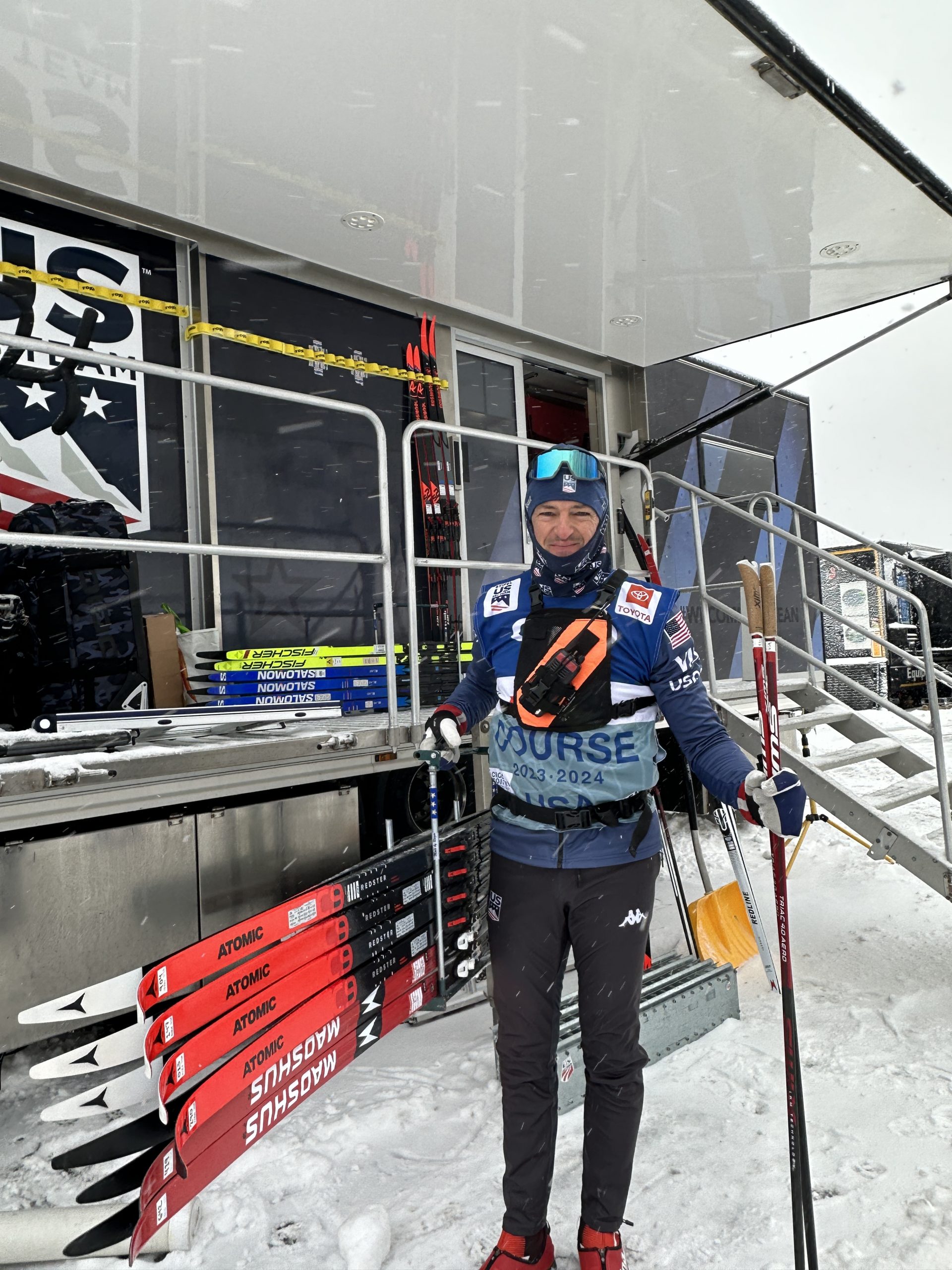
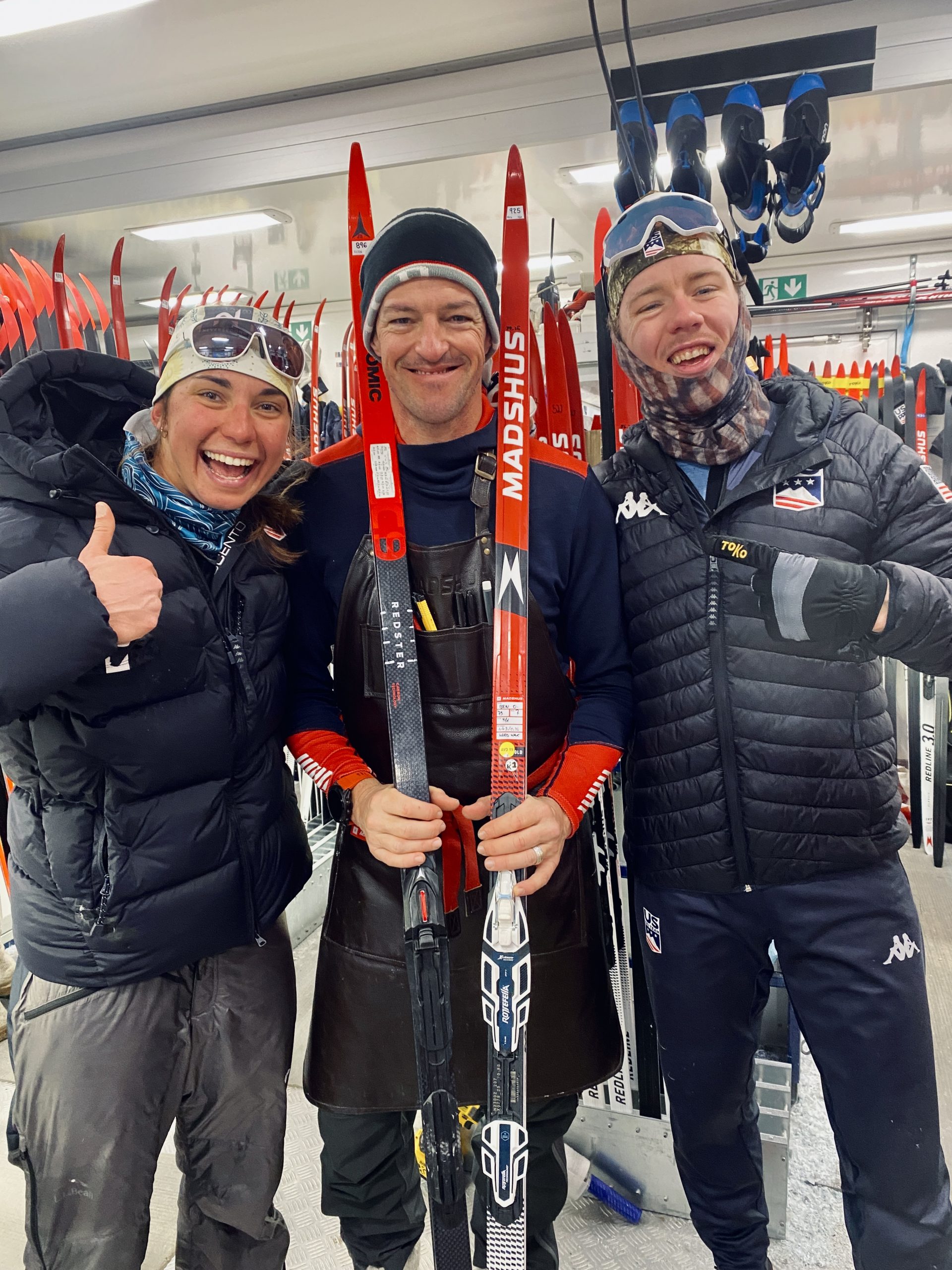
A lot of credit should be given to Eli Brown, who is the tech for both Ben Ogden and Julia Kern. Clearly, Brown, a self-proclaimed golf caddy for his athletes, provided some special magic, as did Oleg Ragilo, who leads the kick team, and Chris Hecker, who leads the glide team, but what makes the US Cross-Country Ski Team service team special is that they know they work best when all of their pistons are firing in sync.
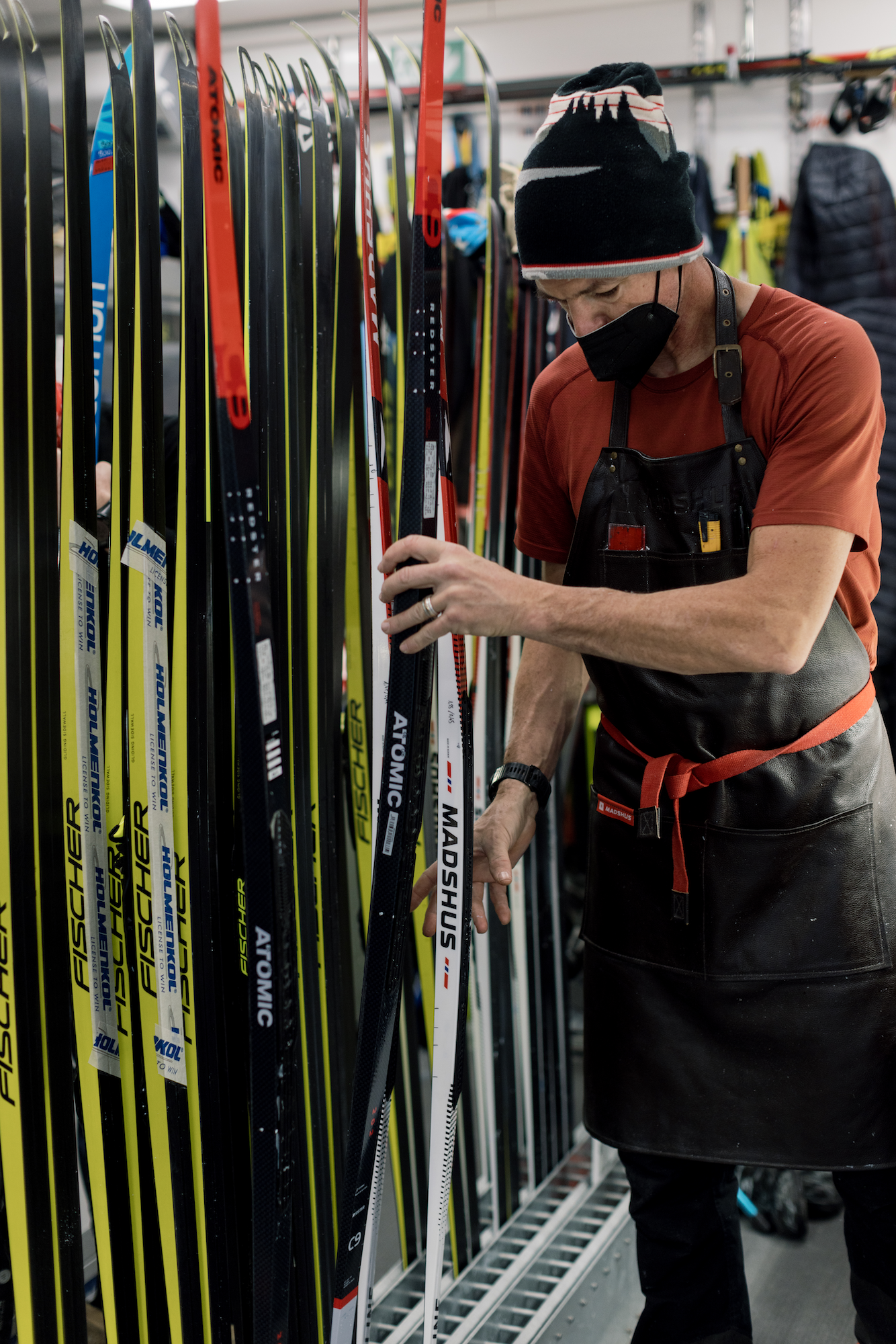
One of those pistons is their head of hand structure, Tim Baucom. His route to the wax truck bench was less predictable than you might expect.
Baucom’s first ski race. (Photo: Courtesy Photo)
Just a Kid Who Loved Sports
Like many who stay in coaching and the industry, Baucom loved all sports growing up.
“Sports were definitely my biggest focus when I was young. As soon as I started playing Little League baseball, soccer, and stuff, it was definitely all I thought about, in school too. Gym class and recess.”
For a long time, Baucom played all the sports he could, but he was definitely into soccer, which was probably his favorite, and he played through high school.
Middle School State Championships with his coaches Kate and Chris Northcott. (Photo: Courtesy Photo)
Baucom grew up in Walpole, a small town in southwest New Hampshire, but cross-country skiing wasn’t on his radar as a child. Though he tried it in fifth grade and continued through high school, he did not approach it with the passion one might expect from a story about someone at his current level.
“I didn’t really have much of a community for it where I grew up. It’s funny because New England’s so small.”
Little did Baucom know he was just across the Connecticut River from the epicenter of American Nordic skiing.
“I was 15 or 20 minutes away from Putney… but the communities in New England are so removed from one another. My dad even worked in Putney, and I didn’t really know those kids or race against any of them, or know the coaches.”
While he loved soccer and other ball sports, skiing seemed to fit best.
“Once I started skiing, I realized it was probably my best sport, at least the one I was more naturally adapted to.”
But that didn’t mean he was fully committed to training like the top juniors in the region.
High School State Championships with teammates Brenden Short, Morgan Brown, and Tyler Westover. (Photo: Courtesy Photo)
“The first time I roller skied was my freshman year at UNH… There were three or four of us who had grown up in the New Hampshire high school skiing world and played other sports and never thought about roller skiing.”
And while that might sound surprising to some people, it is not something Baucom regrets at all.
“In most ways, I’m super thankful that I had a very diverse sports background… competent at ball sports, and alpine skiing—I alpine skied a ton—and telemark skied and ice climbed, and rock climbed. I’m definitely thankful for that.”
Racing for UNH in Houghton, Michigan. (Photo: Courtesy Photo)
Moving West and Almost Choosing a Different Path
After high school, Baucom chose to stay in-state and attend the University of New Hampshire, where he majored in anthropology and had minors in history and music. Skiing became a big part of his life through connections and friendships, but he admits he probably wasn’t fast enough to make the team now.
After graduation, he spent the summer helping build houses up in North Conway, but as fall approached, he left Durham, North Conway, and southwest New Hampshire behind.
“I moved out to Bozeman the year after graduating… planning on being a ski bum for a little bit and then probably going back to grad school. I was very interested in public health, and medical anthropology really interested me.”
But Baucom needed to find a way to support his ski bum lifestyle:
“I started coaching that winter for Bridger Ski Foundation because it was an easy job. I could go ice climb or ski all day, and then at 4:00 show up at Lindley Park and ski around with some kids for a little bit and get paid a little money.”
He figured that, between the money he had saved that summer and what he was making as a coach, he would be able to make his lifestyle work financially, but he didn’t expect to enjoy coaching so much.
“I started dryland training… working with younger kids who were just starting to roller ski and just starting to learn how to bound and ski walk. We played soccer and speedball, mostly, which [was] awesome.”
Working in Quebec with fellow UNH alumni Nick Brown and Andrew Morehouse. (Photo: Courtesy Photo)
First Real Exposure to Waxing
At BSF, Baucom found mentors to guide him in waxing.
“We had a few coaches and techs who were quite experienced… Floyd Rieshus… he was probably in his 70s when I was working with him, and he was so dialed.”
But it wasn’t just the technical side of waxing that was appealing; there is something about the physical labor of being a cross-country ski coach that draws in a certain type of person.
“We’d show up in West Yellowstone, and he’d have his big sled that he’d hauled his elk out of the woods with—still covered in blood—and we’d throw all the waxing tables and gear into that, and the generator, and he would slowly trudge from town all the way out to the stadium.”
In addition to Rice, Bjorn Bakken was heavily involved in BSF, and Baucom was willing to take on whatever they suggested.
Baucom must have been doing something right because when the opportunity presented itself, the head coaches threw him into the deep end of the pool to see if he could swim.
“[U.S. Nationals] was in Rumford, and [my boss] called me, ‘one of the people couldn’t make it,’ and they were like, ‘We really need extra help.’ So I went there and really got thrown into it.”
When he arrived in Maine, conditions were, to say the least, challenging, but the rest of the BSF service team didn’t question his ability. They put him in charge of kick, even though Baucom felt as if he had imposter syndrome.
“I think I was honestly in charge of kick—which was a joke at the time—because I had no experience making skis for that quality of athlete and that high level of race.”
Baucom knew the stakes were high and that he had better figure out what to do quickly, but then the weather of New England did what New England weather does in January and tossed a wintery mix classic race day at everyone.
It was situations like that that Baucom loved, having to get creative when there was no other option.
Baucom and Jason Cork on top of Stratton Mt. (Photo: Courtesy Photo)
How He Made it to the World Cup
As a parent, you try to teach your child to advocate for themselves, and clearly, Baucom was taught that lesson well.
“For a few years, politely persistent. I emailed [Chris] Grover a few times, being like, ‘Hey, I’m interested in this job.’ I emailed [Jason] Cork [on the tech side] and was like, ‘Any advice if I want to be a tech on the World Cup?’”
The message back was simple: keep doing what you are doing, it is really the only way. What Baucom may not have realized about the impression he was leaving wasn’t just that he was skilled when things got unpredictable, but that he brought the right ‘vibe’ with him to the wax trailer.
“I think if you have the right personality, and enough people see that, I think that helps. That is huge for a team like this. We’re living together for four or five months… one of the most important aspects is to be able to work together.”
Eventually, that persistence with the right vibe got Baucom to Europe to start lending a hand.
Simi Hamilton and Baucom in Quebec. (Photo: Courtesy Photo)
Baucom’s Role: Manual Structure
For people who don’t know what manual structure is: basically, the base of any ski has structure in it, small etch marks that help move water through the base or over snow crystals, depending on the temperature and the sharpness of the crystal.
When World Cup skis come from the factory or, more directly, from the brand reps at World Cup races, they are ground, which creates a more permanent structure cut by a machine. What Baucom and the rest of the team are trying to determine on race day is whether adding a different pattern over that grind with a hand tool improves speed compared to the structure already on the ski from the brand.
“The idea is to find something that’s durable, lasts the duration of the race, doesn’t pick up excessive dirt, works well with the grind that’s under it, and works well with the base material.”
The US Cross-Country Ski Team has five different ski brands represented, and “they all have factory grinds that are great, and we use them. So we need to find something that works well for everyone.”
In the days leading up to a race, the team will run a structure test or two and another on race morning before both the men’s and women’s races, “depending on conditions, it could be eight pairs, it could be four,” said Baucom.
“We’re trying to narrow a giant box of different hand structures down to eight on the morning of, and then from there down to one—or maybe two options—that could work with different grinds.”
Hailey Swirbul and Baucom on a ski in China one of their first days on the ground OWG 2022. (Photo: Courtesy Photo)
Trial, Error, and Evolution
Not everything Baucom and the team do works, so they have to catalog the results and move on with that knowledge for the next time similar conditions arise.
“There are certain structures we stay away from that we’ve had bad luck with… and there are certain grinds from different ski companies that we pretty much won’t ever put manual structure on.”
That’s the tricky part: not all athletes ski the same way, are looking for the same feel from a ski, or ski on the same brand of skis.
“The most important thing is for each individual tech to have an idea of what works with their athlete’s skis.”
Baucom and his partner Brooke Segerberg in Davos, Switzerland. (Photo: Courtesy Photo)
A Historic Day
Elite skiers train nearly a thousand hours a year, year after year, which is the required ante chip to line up at a race, especially an Olympic one. For Baucom and the rest of the US Ski Team service staff, the skis raced on World Cup weekends and at these Olympics did not come together the way you might prepare them for a Saturday morning ski. It, too, took thousands and thousands of hours of work over decades of involvement for the entire service team to put world-class skis in the athletes’ hands so they could realize their dreams.
Another historic day might materialize at these games, and one thing we know for certain is that the service staff is working hard to make it happen.
Help Support Our Olympic Coverage!
FasterSkier has our own Nat Herz on the ground at the Olympics, which is a significant financial lift for us. If you value the thoughtful work and access FasterSkier provides at championships like this one, please consider becoming a Voluntary Subscriber. Your support directly fuels our work to cover the people, places, and moments that make our sport special.
Julia Kern’s writing for FasterSkier is made possible through the generous support of our friends at The Memory Clinic, Bennington, Vermont. Since, 1987, clinicians at The Memory Clinic have been providing diagnosis and treatment of memory loss. If someone you care about is showing signs of memory loss please reach out to The Memory Clinic.
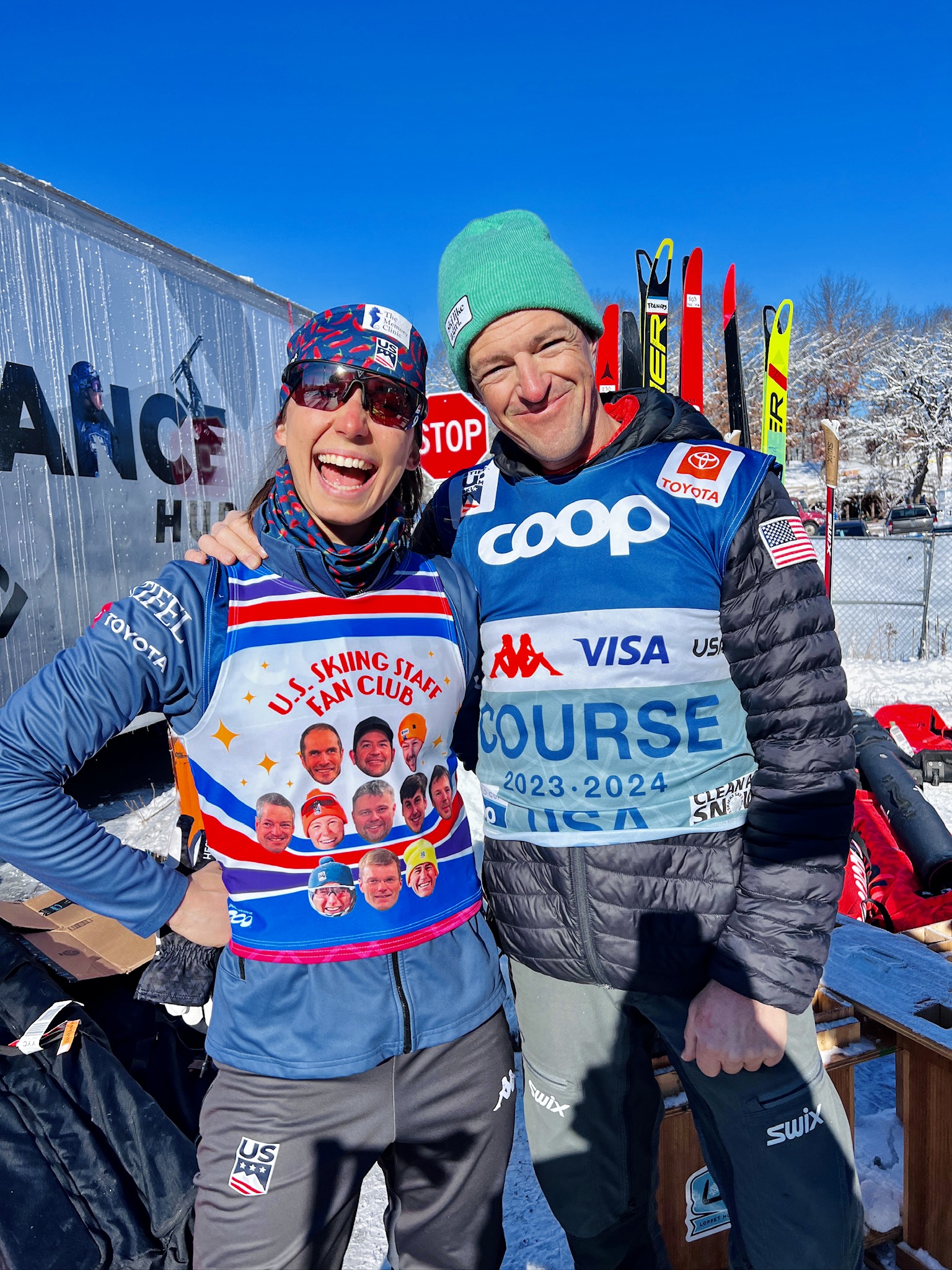
A little Minneapolis surprise—the U.S. Skiing Staff Fan Club bib!
How many pairs of skis do World Cup athletes have in their fleet? You may surprised by the answers, ranging from 20 to 60 pairs of skis. Imagine picking the race ski on a given World Cup race where every 0.5% matters. My introduction to ski testing started at the end of high school when I was about 16. I went from picking between my “warm” ski or my “cold” ski to deciding between eight to ten pairs. Picking my race ski has become complex—in fact, a science. Thankfully, I have a very curious and passionate wax tech named Eli Brown who manages my skis and wax for me, and often even more. Eli is the skiing equivalent of a PGA Caddy, supporting me not just in the equipment aspect of skiing but also in the technical and mental aspects. He spends far more time with me in the hours before the race than anyone else. Over the past five years, we have built our system and a trusted collaboration on the World Cup. The foundation for a successful ski fleet begins with a base ski fleet in partnership with Atomic, continuing to evolve by frequent testing of skis with Eli and Atomic throughout the season, narrowing down the options the day before each race and on race morning.
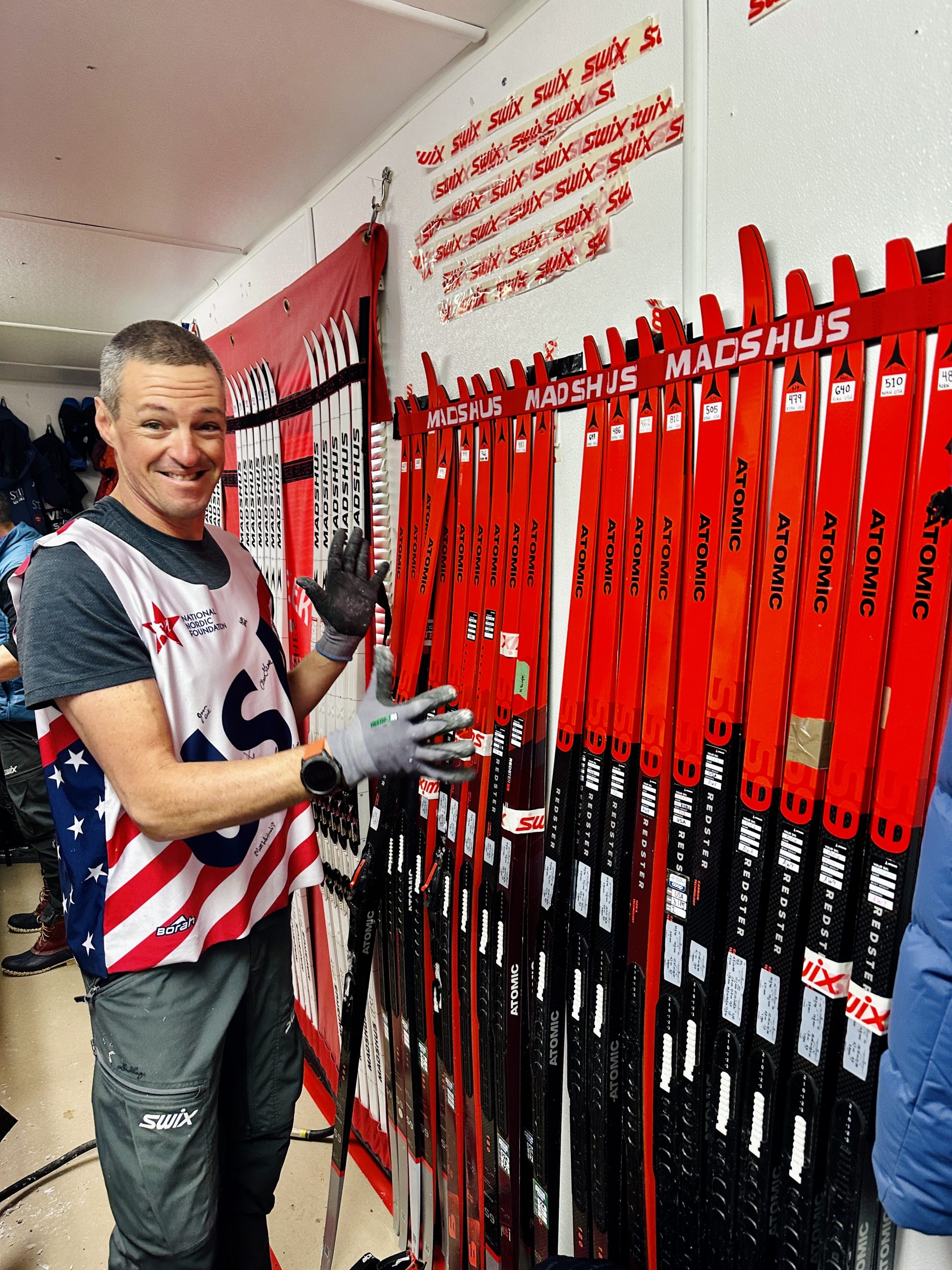
Eli showing me the race ski options for our home World Cup in Minneapolis.
Building A Ski Fleet
We rely heavily on support from the ski companies. It has been incredible to work with Atomic! I switched to Atomic two years ago, which meant building an entirely new fleet of skis. At first, Eli and I thought there would be a tough learning curve in the first year. In some ways, there was, but a ski fleet is an evolving and dynamic work in progress. In my first year on Atomic skis, I had some of the best skis I have ever had; in my second year with Atomic, we built a complete fleet.
Ski companies travel the entire World Cup circuit with us, so every weekend the skis that have not been winning tests are returned to Atomic, and the new winning skis that Atomic has tested are delivered to us—a trading system. Together, we are an extension of R&D for Atomic–we test new prototypes and give feedback on what is working. The prototypes often become the new retail ski model 1-3 years later. Atomic has been experimenting with different shapes of skis in skate (more width in the tips and tails); it has been exciting to be a part of the R&D process, taking part in the ongoing innovation in cross-country skiing.
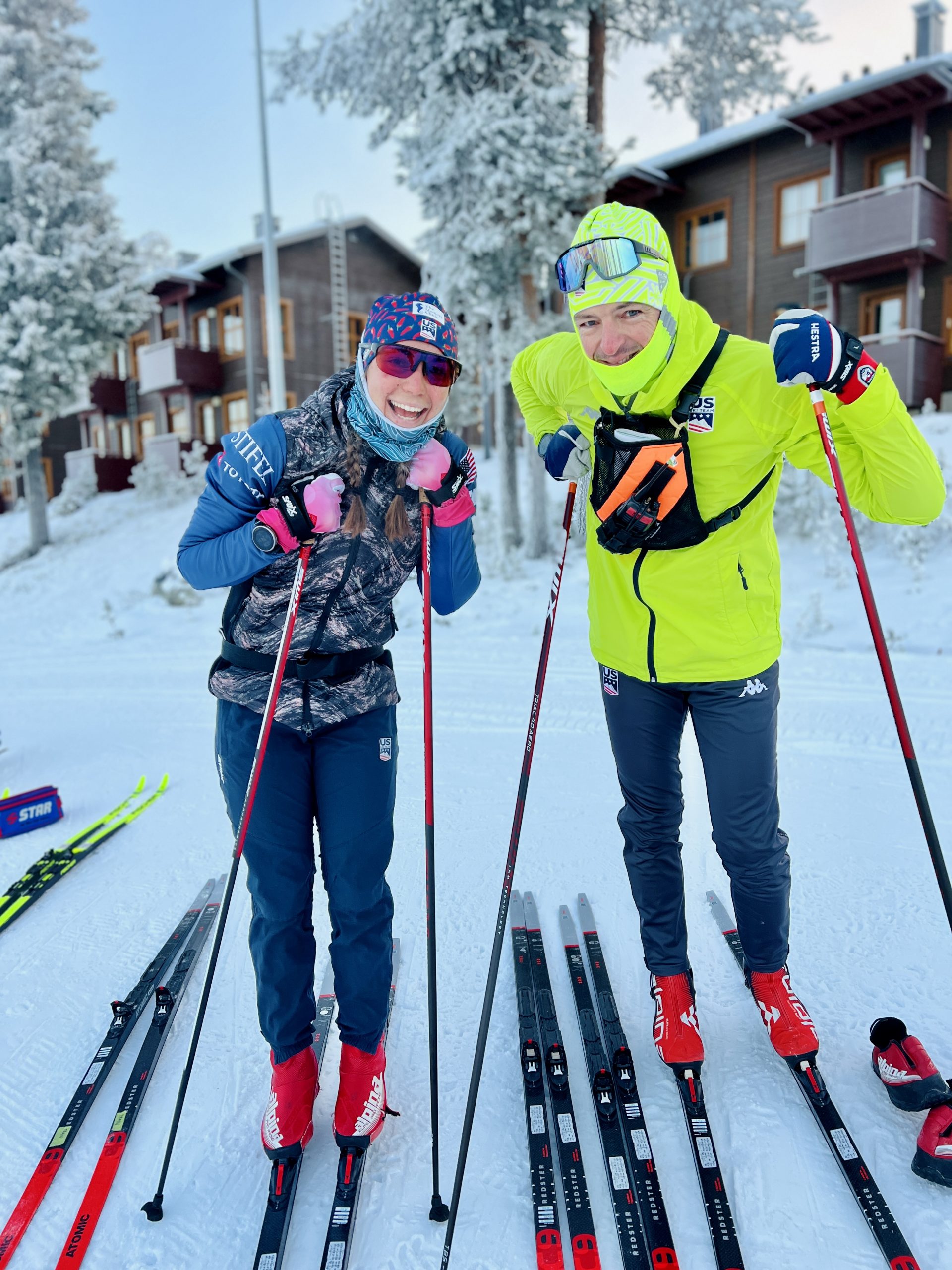
Ski testing time! Eli tries to wear a neon hat so I can always find him for testing.
Day Before Race
Pre-race is often busy and a bit chaotic. Eli and I will have only 20 minutes to test before I join the team for our pre-race intensity. If the conditions are similar to race day, Eli will often glide out 2-8 pairs of skis with another tech to narrow down the options for me. Then Eli and I will go out and ski, testing by feel on four pairs of skis, swapping them back and forth, and comparing what we think about them.
Atomic does their separate ski testing and will deliver a new pair to Eli if they find another fast pair, and Eli adds them to the race day options. The skis get cleaned and prepped for testing on race day.
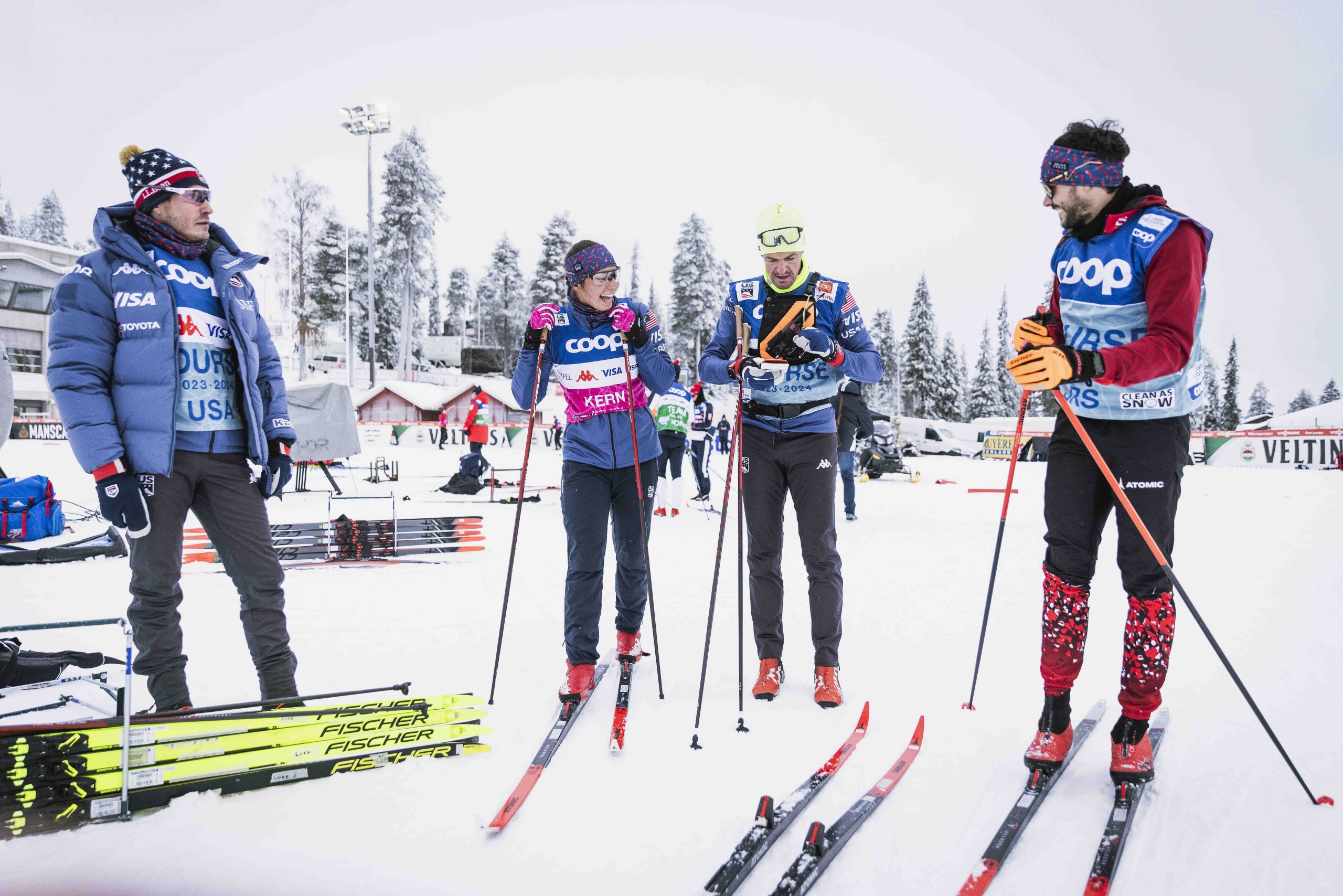
Jan from Atomic meets Eli and me for a ski test. This is especially helpful when we have to narrow down the options the day before the race. (PC: Nordic Focus)
Night Before Race
Eli usually will finish skis with a liquid glide wax and apply a binder to sit overnight. Atomic will check in and offer advice on what skis, grinds, and bases they think will work.
Race Morning
Once the techs arrive at the wax truck, Eli will check the weather and the race course to see what the snow is like. Some prepared skis might get removed from race options if they don’t match the conditions. Eli will potentially swap a pair of skis with Atomic and prepare it to match the other potential race skis.
Two Hours Before Start
Eli glides out 4-6 pairs with another tech, coach, or Atomic rep to narrow down the options before I arrive for testing.
I meet Eli at Yolanda or at the testing depot. Eli is ready with a full rack of options for both Ben and me to test on race morning.
Ninety Minutes Before Start
I meet Eli for ski testing (sometimes Atomic or coach Kristen also joins us). We test 2-3 pairs by feel, adjust the kick and glide out pairs if the kick is close, and pick a winner. Due to the fluoro testing check-in time limitation, there is a large time gap between testing and race time, often causing a rapid change in conditions given all the traffic on the course. Eli will take the second- or third-best ski and make it my warm-up ski, touching them up to be waxed similar or close to the race pair. My warm-up ski acts as a test ski so I can give feedback that can be used to dial in the race ski closer to the start if the conditions change.
It is also worth mentioning that most World Cup techs wax for two athletes, sometimes three. Eli usually works with Ben Ogden and me, which means he has a very tight schedule. Especially on sprint days when Ben and I are racing at a similar time, we have to be timely and efficient so we finish our test in time for Ben and Eli to also test.
Team RED—Eli, Ben, and me!
One Hour Before Start
Usually, an hour before the start is when we pick race skis. Eli usually leaves around 30 minutes to prep the skis. Prepping skis includes running to the truck (distances can be quite far), doing the glide wax procedure that the U.S. wax team came up with, adding hand structure, and adjusting the kick wax. Then Eli or another tech runs them to the stadium for flouro testing . . . can’t be late for this!
Eli prepares the race ski in the truck.
Half Hour Before Start
Race skis are required to be checked in for flouro testing 30 minutes prior to the start. After a few minutes, the skis complete the fluoro test procedure and are placed in a closed area where the techs are allowed to adjust only kick wax. No glide waxing is allowed in this area since the skis have already been tested for flouro. One last check-in with Eli to see how the warm-up skis are working before making any final adjustment to the kick wax. Then the skis are placed in the final rack to go to the start.
Testing with both Kristen and Eli. What a treat!
0:00 Race Start
Skis are picked, waxed, flouro tested, and touched up. I grab my skis from the rack and head straight to the start. It’s go time!
As you can see, there are many moving parts to choosing the race ski of the day! It is a dynamic relationship between Eli, Atomic, our USA wax team, and myself. The 2023/24 season has been our first year with the added layer of fluoro testing, extending the timeline even longer on race day and adding another step. However, FIS has done an excellent job of making the process as smooth as possible. I have completed 133 World Cup starts now, with Eli as my tech at almost every race, so we have had a lot of practice dialing in our process. Nonetheless, every race and every training day is a learning opportunity for both of us. Learning never stops; that is why ski selection and waxing is a fascinating science!
Eli Brown, a member of the U.S. Ski Team’s waxing and ski service staff, joins us this week to talk about his job and the new enforcement of the rules banning fluorocarbons on the World Cup circuit. We recap another strong weekend for American athletes, along with all the hijinks that happened in Trondheim, Norway at the test event for next season’s World Championships.
The World Cup takes a break next weekend before the Tour de Ski, but we may try to squeeze in a mailbag episode. Send us questions if you’ve got ’em. Reach us at nat@fasterskier.com and devon@fasterskier.com.
Fat biking and skiing coexist, with Eli Brown skiing alongside his son Leland on the Vasa trail in Traverse City, Mich. (All photos: Jake Ellis)
If you are craving a challenging ski workout that will train your agility, boost your strength, and add variety to your skiing, you should look no further than your local fat-bike, singletrack ride.
Have you ever tried to keep up with the fat bikes? On their trail?
“Hardest workout out there!” said Eli Brown, a longtime U.S. Ski Team volunteer wax tech from Michigan, who is doing the majority of his skiing this season on singletrack.
Bikes and skis have different advantages in different conditions, but most often you’ll be desperately chasing your pedaling friends. This activity will burn off that second helping you had at Christmas dinner, and/or open up a caloric deficit for your New Year’s Eve indulgences.
Another bonus is that the different features of a fat-bike trail will increase your skiing dexterity. There will be berms, bumps and ruts that you won’t encounter on the typical ski trail. After a few singletrack skis, you’ll be a lot more likely to stay upright the next time you’re surprised by less-than-perfect trail conditions that would have taken you down before.
This is a fun activity that can help you make a breakthrough with your smiling technique; it’s a lot of fun.
The Workout: Join your local fat-bike singletrack ride, and try to keep up!
Warmup: 15-20 minutes. Get ready to go out hard!
Be careful to not smile TOO hard too early, save some for the finish 🙂
Cool down: Have a beer with your cycling buddies and recount the joyful tales of skiing singletrack with a group of fat bikers.
If you don’t have a local winter singletrack trail, or want to work up to it, you can get a lot of the same benefits from any off-piste (ungroomed) skiing. No-wax classic rock skis and poles with big baskets are a good start, and more advanced adrenaline junkies can try faster ski setups.
Winter singletrack groomed by a small snowmobile on the Vasa trail in Traverse City, Mich.
Cycling and skiing, side by side, with Eli Brown and his son Leland on the Vasa trail in Traverse City, Mich.
The chase is on!
He brought skis to a bike ride. (Pictured: Eli Brown)
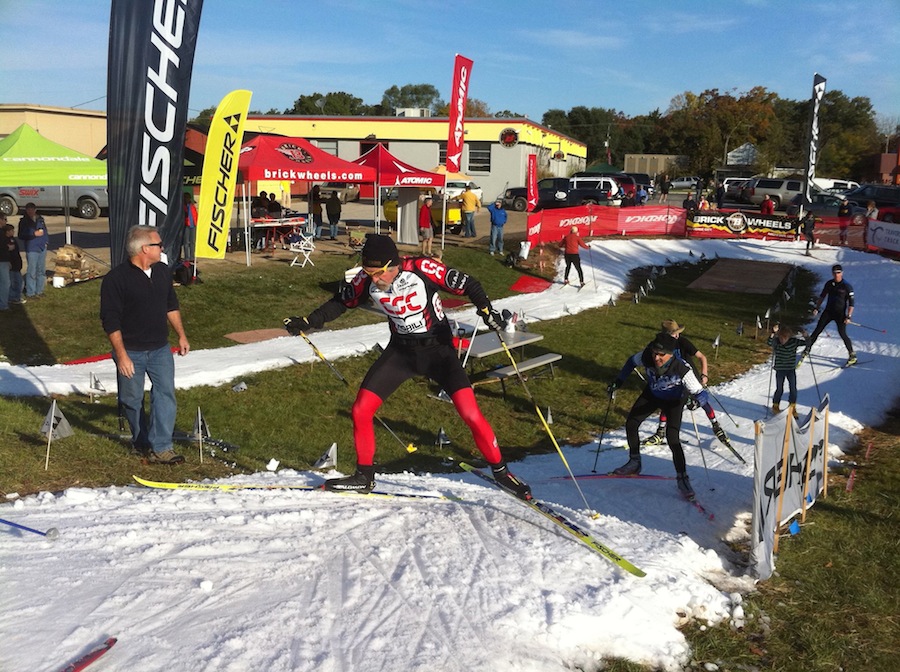
Participants ski the course at the 2011 Traverse City Nordic Ski Fest in Michigan. (Photo: Eli Brown)
With snow falling across parts of the western states, many are breaking out their skis and taking advantage of some great preseason skiing. While we are happy for our lucky friends, what are those of us who are not blessed with early season snow to do?
Eli Brown and the Vasa Ski Club just might have the answer. On Saturday, the Vasa Ski Club, with support from Brick Wheels and Keen Technical Solutions, will be hosting the 4th Annual Nordic Ski Fest in Traverse City, Mich. The event, which serves as the first Michigan Cup race of the season, will take place on a 350-foot (0.1-kilometer) manmade ski loop and will consist of skate skiing, time trials in the form of a preliminary, and head-to-head racing based on the results from the time trial. Skiers in the head-to-head will then travel in opposite directions on the course attempting to make it to the starting point before their competitor.
How does a small ski club of roughly 300 members pull off an early season race that attracted 50 racers from around the state of Michigan and roughly 300 to 400 spectators last year? It takes a week of around-the-clock work (8 a.m. to midnight) from roughly 30 volunteers, and a final key ingredient: ice-rink shavings.
Eli Brown, former race organizer and University of Utah head coach, brought the idea to use the shavings left over from ice rinks with him from Utah. He has implemented a successful Ski Fest on this premise for the past four years, and has formed a steady relationship with the local ice rink and its Zamboni drivers.
“We have a great connection with them,” Brown said on the phone. “I just can’t believe that no one else is doing this.”
Not only do the ice-rink shavings provide an opportunity for locals to get on skis early, they also allow the community to do it at no cost.
“I know you could spend some money and you could go somewhere glamorous like the glacier in Alaska, but we have a ski community and everyone is eager to ski, so we decided to do it,” he said.
Hosting an event like this has its challenges. Volunteers have been working around the clock shoveling ice into a refrigerated semi truck, transporting it, and then spreading it out on the course. Despite the incredible amount of work that has been put into the race, it can still be overwhelming at times.
“I’m getting as many volunteers as possible, and I could use twice that amount,” says Brown.
In the past, weather has also presented difficulties in the past, with Mother Nature defying race organizers with warm temperatures and rain. However, recent cold nights and an anticipated dusting of snow look to make Saturday’s event run smoother than usual. Even with the cooler temperatures, the course is expected to be completely gone a few days after the race.
The Ski Fest provides an excellent opportunity for the ski community to get excited about the upcoming season. Low-cost innovations like the use of ice-rink shavings present an option for nordic ski communities to extend their seasons, especially in years when there is little snow.
“This is something that we don’t need to do just once a year. There’s no reason we can’t do this all the time,” Brown said. “There’s white stuff out there, you just have to be a little creative; make it small and fun, and share it with people.”
In addition to the on-snow ski events, there will be a reggae band, homemade chili, beer, a ski swap, and for the first time, an on-snow fat-tire bike race. Ski events, located at Brick Wheels in Traverse City, will begin at 10 a.m. and continue till 2:30 p.m. The bike race will be from 4 to 5 p.m. Registration is on-site and costs $10.
Traverse City Nordic Ski Fest volunteers shovel ice shavings into wheel barrows before loading into the refrigerated semi truck. (Photo: Eli Brown)
In the past, Traverse City Nordic Ski Fest race organizers loaded ice shavings onto trailers. This year, Keen Technical Solutions donated a refrigerated semi truck to transport the ice. (Photo: Eli Brown)
Volunteers shovel snow from the trailer onto the course at the Traverse City Nordic Ski Fest. (Photo: Eli Brown)
The first load of snow is dumped on the course in preparation for Saturday’s Traverse City Nordic Ski Fest. (Photo: Eli Brown)
Race organizer Eli Brown directs volunteers while shoveling snow at the Traverse City Nordic Ski Fest. (Photo: Eli Brown)
Touching up the last year’s Traverse City Nordic Ski Fest course between races. (Photo: Eli Brown)
Participants pack down the course between events at the 2011 Traverse City Nordic Ski Fest. (Photo: Eli Brown)
Participants ski the course at the 2011 Traverse City Nordic Ski Fest in Michigan. (Photo: Eli Brown)
The view from the top of the course at the 2012 Traverse City Nordic Ski Fest. (Photo: Eli Brown)
Randy Gibbs waxed Liz Stephen’s winning skis at U.S. Distance Nationals last week. The top coat she was on was from a new company called Mantra Wax, which Gibbs is starting with fellow USST wax technician Oleg Ragilo. Courtesy photo.
When Randy Gibbs looks at the high-end ski wax on his bench, he finds himself uninspired by the plain vials of powders laid out before him. As a U.S. Ski Team service technician for the past seven years, few know better than he does how important wax is to any successful ski race. But when it comes to the brands of fluorocarbons available to most consumers, Gibbs sees a hole in the market for a product that’s cool, something skiers and coaches would be proud to own.
“Right now everything is so lame out there. They’re all boring and there’s nothing creative,” Gibbs says. “Not that those products aren’t great; we use every brand, for sure. Everyone has the best wax at certain times for certain things.”
But Gibbs thinks there’s room for another player at the service room table, and he’s hoping his new company, called Mantra Wax, will be it. Using raw materials that have been developed and tested over the past year and a half by a Russian manufacturer, Mantra aims create a line of top coats that will bring something to the wax market that it hasn’t seen before.
Mantra’s origins are certainly unique. This past winter, Gibbs and fellow U.S. team serviceman Oleg Ragilo obtained exclusive rights to package and sell the wax, and by October they plan to be delivering the high-end liquids and powders directly to coaches and technicians all over the U.S. and Europe, as Ragilo lives in Estonia and will head Mantra’s presence there. And because they plan to integrate small-batch, limited-release products into the wax line, Mantra aims to make its products cool and somewhat exclusive.
The Mantra Wax label.
“It’s going to be more like a whisky bottle or small-batch bourbon where…it’s a cool thing to have in your wax cabin,” Gibbs said. “You put it on your table and the other guy is like, ‘Oh, man. We’re screwed.’”
Gibbs and Ragilo have started with branding to establish that image. Mantra’s name was inspired by a David Grohl song with the same title, and their wax label could just as easily be an album cover.
Creative branding aside, Gibbs knows the most important thing in a wax is performance. So how does Mantra stack up next to products from major companies like Swix, Holmenkol or Toko?
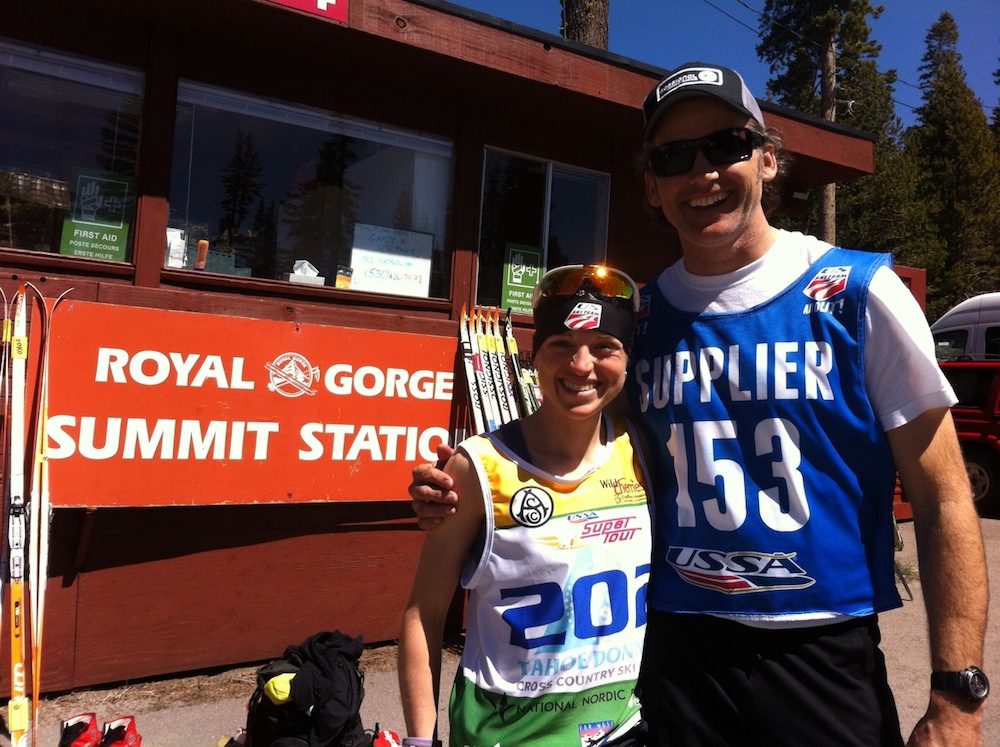
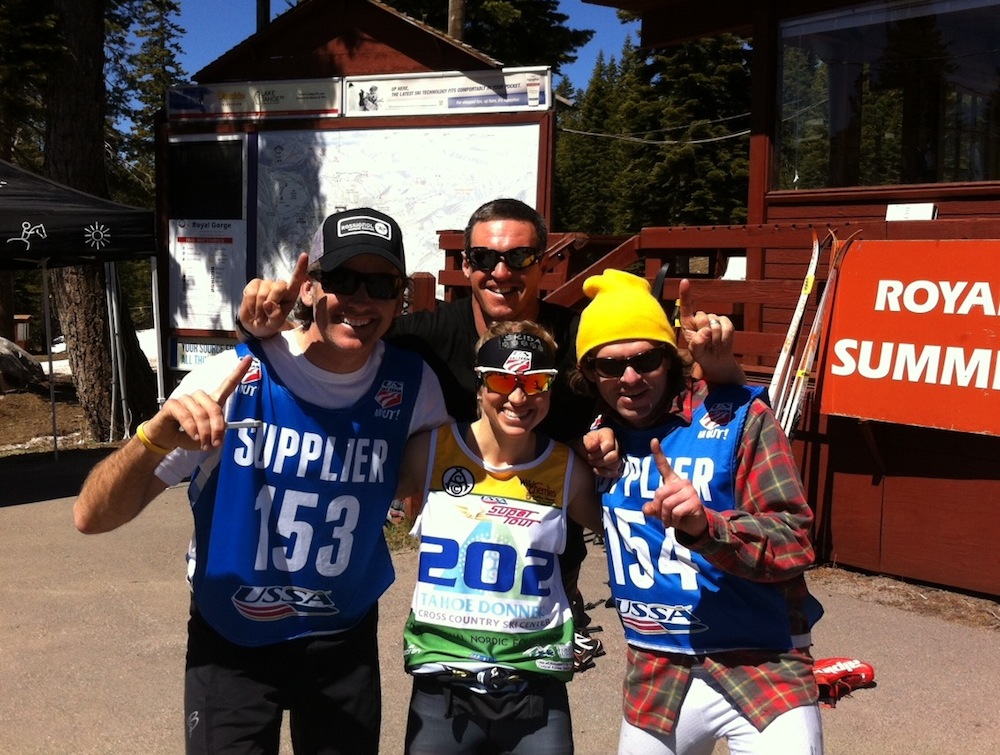
Apparently, pretty favorably. At SuperTour finals, Mantra Wax had the opportunity to answer that question when the Craftsbury Green Racing Project hired Gibbs and two other technicians to help work on the team’s skis. The job became Gibbs’ chance to test Mantra’s new waxes on race day and generate some attention in the process, if the wax was successful. CGRP’s hired service crew included Eli Brown and Gibbs’ fellow U.S. serviceman Corey Wubbels to help him, and in addition to waxing CGRP’s skis all week the team also adopted Liz Stephen’s fleet.
The results turned out as well as Gibbs could have hoped. Stephen won SuperTour Finals and the 30 k classic championship, CGRP’s Ida Sargent and Pat O’Brien both podiumed in the classic sprint in miserably wet waxing conditions, and they were joined in the A-Final by Tim Reynolds and U.S. biathlete Susan Dunklee. CGRP head coach Pepa Miloucheva, able to leave the wax room and watch her skiers race for the first time in three years of coaching them, called her athletes’ results in the sprint “one of the best days” for her team all year. Skiers from other teams noted the speed of Craftsbury’s skis all week.
Mantra Wax founders Oleg Ragilo and Randy Gibbs at 2013 World Championships in Val di Fiemme, Italy. Courtesy photo.
What were they skiing on? Mantra Wax. The new powders won or were near the top of pre-race tests throughout the series and Craftsbury and Stephen raced on Mantra powders and liquids in each race at SuperTour Finals and distance nationals.
“They were awesome,” Stephen said of her skis in the 30 k.
Gibbs didn’t know what to expect from the results, but was pleased with the successful outcome of Mantra’s U.S. debut. He brought a small amount of powders with him to California to sell throughout the race series, and by the end of the week he was sold out. Gibbs said coaches returned to him to say that Mantra won a lot of their tests.
What’s so special about Mantra Wax?
“Nothing, really, other than it works really well in a lot of conditions,” Gibbs says. “It’s not a risky powder. Some of these powders, if it snows you might as well put paraffin on your skis and go out on training wax, because they get so slow. And this stuff seems to be great in new snow, old snow, manmade snow, wet snow, clean snow, fine-grained, course like out here — so it just works well. I’m not saying it’s going to win the test every time, but it’s going to be near the top more consistently, from what we’ve seen so far.”
Mantra Wax is so new it’s not yet widely available, but by the fall Gibbs hopes to have an introductory line up and running from the website and from select retail outlets. In Truckee, he sold 30-gram vials of powder for $100 each to help get the brand off the ground, but Gibbs thinks they will eventually retail for closer to $150.
Mantra Wax turned some heads in Truckee, and to increase the company’s visibility throughout the country it will put sales reps at major U.S. events next season. Gibbs also has his eyes on a few elite athletes to represent the brand, and at SuperTour Finals he and Stephen made plans to make Mantra Wax Stephen’s casual-wear sponsor next year.
“So far we’ve used their wax every day this championships,” Stephen said. “I want to support Randy and Oleg and what those guys are doing, and at the very least I want to wear what they have going on.”
Gibbs and Ragilo will continue to work on skis for the USST in the winter, by which point they hope to have two to three powders and four to five liquids as part of the Mantra Wax line, with plans to add klisters, paraffins and kick wax down the road in small-batch, special-edition releases. Gibbs foresees keeping the company relatively small, but for now things are still in the planning stages. He’d been thinking about starting a wax company for years, and now that the pieces are coming together he’s taking things slow.
“We’re not going make a million dollars or anything, but if we can make a great wax that’s better than everything else and have fun doing it, that’s what our goal is,” he said. “We don’t know what it’s going to evolve into. The Mantra is coming in hot.”
Gibbs, Eli Brown and Corey Wubbles with U.S. 30 k champion Liz Stephen. Courtesy photo.
Our recent series on biathletes facing the question of when and whether to go to college (parts one, two, and three) produced more interview material than we could fit into the three-part sequence, but we wanted to share a few more of the ideas with you anyway. What do biathletes do if they miss a target in a relay? They use a spare round. This week, we’re presenting you with short briefs on a few lingering topics.
Annelies Cook competing in a World Cup relay in Hochfilzen, Austria. Photo: nordicfocus.com / USBA.
When Annelies Cook decided to attend the University of Utah in the fall of 2006, it was because she needed a change. After pursuing biathlon full-time at the Maine Winter Sports Center to round out her junior career, Cook had been unsure what to do next, so she had returned to her home in upstate New York and jumped back into ski racing, battling against current U.S. Ski Team members Liz Stephen and Ida Sargent in NENSA’s Eastern Cup series.
It was fun. She wanted to ski more. So she went to Utah.
But what she found had another added bonus – she got to ski, do high-level training with her teammates (some of whom were, like her, older and, unlike her, from Europe), and get a degree, but she also got paid.
“I was very fortunate because I had a scholarship,” Cook told FasterSkier last fall. “Eli [Brown] did his best to spread out his scholarship money between as many of his athletes as possible, so I don’t think anyone had a full scholarship, but a lot of us had 70%, which basically meant free tuition plus $300 per month for living expenses.”
Not every biathlete who has gone to college has seen such a financial lure: Laura Spector, Carolyn Bramante, and now Ethan Dreissigacker and Carly Wynn attend Dartmouth College, which does not offer athletic scholarships. Neither does Bowdoin College, the alma mater of Walt Shepard. Several top juniors, including Kelly Kjorlien, Casey Smith, and Sam Dougherty, are currently at Montana State University, but the men do not ski for the college and as such don’t see even the possibility of a scholarship.
Not being on a scholarship, of course, has its benefits as well, like an increased ability to focus on biathlon if an athlete so chooses. Dartmouth coach Cami Thompson pointed out that she didn’t pressure the biathletes on her team to focus on college racing: “[other schools] do give you scholarships and they expect you to produce for them, but we’re not bound by that because we don’t give you anything!”
But both Cook and Lowell Bailey, who went to the University of Vermont, decided to leave biathlon for the majority of their college careers and focus on skiing, reasoning that if they did return to biathlon, added ski speed would be a benefit. With endurance training as their main goal, scholarships sweetened the deal.
Bailey at 2012 World Championships. Photo: USBA/NordicFocus.
“For some people, maybe money isn’t a big deal,” Bailey said in an interview. “But for a lot of people, for me I know, it was really hard for a little while to make ends meet, and I was really struggling on the financial side. Had I had the same level of support that I have now, would I have made the same decision? Probably, so I’m not saying that it was the only factor for me deciding to go to UVM or not, but it was a big factor.”
Both Brown and Al Serrano, Bailey’s coach at UVM, knew that athletes like Bailey were facing tough choices about whether they could continue in nordic sports with so little financial support, and tried to use their clout in offering scholarships to U.S. juniors.
“We had a very unique team,” Bailey said. “I might remember this wrong, but we had the only team of all Americans for UVM, because previous to that it had always been European recruits, and after that, too. So [Serrano] had recruited some of the best nordic skiers from the junior ranks in the country. We had a really talented team and we motivated each other, and I think we trained at a really high level.”
Brown didn’t go quite that far – some of Cook’s teammates were European. But even though he did recruit foreign skiers to bolster his team’s speed, Brown spent a lot of time thinking about whether it was the right thing to do.
“Just because [skiers] have a lot of training under their belt, they could turn out a lot of different ways,” Brown said. “Just because they have a different color passport doesn’t mean that it was a good recruiting choice. Some of those people are coming over because they didn’t make it in the big show, and maybe that’s even the norm for the European recruits. But [on the other hand] maybe they still love it enough and enjoy this new feeling of being on a team that they can really contribute.”
Cook, for her part, said that she benefitted from having older, more experienced teammates to chase and learn from. But in a perfect world those older, more experienced skiers would be Americans – racers who perhaps took a few years off after high school, but who could use the financial help offered by state universities.
“My hope is to make this puzzle piece fit, of NCAA skiing in the U.S. development pipeline, and to have more scholarship dollars end up going to American kids,” Brown said. “The only way that’s going to happen, to raise the level so that we don’t need the Europeans as much, is if they are more mature.”
Even now, top biathletes and skiers can take advantage of the scholarships offered to not only gain the financial freedom to spend their time training, but also to get onto a team where they don’t have to worry about logistics. That, said Cook, was also important.
“I was totally set up at Utah,” Cook explained. “I didn’t have to worry about anything – everything was organized. It was laid out for you. We had coaches, we had vans, we had transportation every weekend and when we went somewhere we had a stipend for food. And 75% of the team had some kind of support. That’s something that I don’t think very many people would want to turn down, because it’s hard to pay for an education and if you can get one without paying, that’s pretty amazing.”
Bailey agreed.
“A university can offer a kid a scholarship, and at the end of four years a degree that you can then use once your athletic career is over,” he said. “I think those are two huge benefits that a university ski team can offer, that quite honestly are not [otherwise] available. Even though I’ve put my heart and soul into the sport of biathlon, it’s not like they’re handing me a degree at the end of the day. It really was the opportunity of a lifetime – I never would have guessed that I would have been able to go to college for free, and to have that experience and that caliber of an education.”
Our recent series on biathletes facing the question of when and whether to go to college (parts one, two, and three) produced more interview material than we could fit into the three-part sequence, but we wanted to share a few more of the ideas with you anyway. What do biathletes do if they miss a target in a relay? They use a spare round. This week, we’re presenting you with short briefs on a few lingering topics.
Lowell Bailey competing in Ruhpolding earlier this year. Bailey spent several years training full-time before attending the University of Vermont. Photo: NordicFocus/USBA.
In the first part of our series, we focused on several elite junior biathletes who, bucking the conventions of the early- and mid-2000’s, decided to go to college before returning – often extremely successfully – to biathlon. Without a single exception, the five athletes said that today’s juniors should not rule college out as a means of facilitating a long-term career in biathlon.
But in general, the biathletes had another message, too. It was that one reason they were able to succeed as college athletes and then return to biathlon, and maintain a serious focus on training despite the challenges faced by student-athletes, was that before going to college they had taken a year or several off to train full-time. That period, which often involved race tours in Europe, gave them the tools to make their plans work.
Juniors, they seemed to suggest, can have it both ways: they can complete their junior careers by going into biathlon after high school, thus increasing their chances of having top results at the international level, but still end up with a degree, potentially funded by scholarship money, and a fresh sense of motivation to compete into their 30’s.
Why is the postgraduate option so alluring? In their own words, biathletes and coaches explain it.
Walt Shepard, five-time U.S. national champion who attended Bowdoin College: “I really got a lot out of my time between high school and college, both from a training perspective and from a life perspective, just getting to do so much traveling and the opportunity to train full-time for something, that was really meaningful. To go back to school five years later, I had a lot more life experience and perspective, and I think I got a ton more out of my academic experience. So I think the whole thing worked out pretty well for me.”
Annelies Cook, two-time World Championships competitor and University of Utah alumna: “I was just a little bit more mature than some of the young guys coming in, so I would train a little bit more than what they did on the team. I had four years of training experience under my wing, I didn’t go to school as an 18-year-old who might have been more prone to wanting to party. That worked really well in communicating with Eli [Brown] and Wendy [Wagner].”
Eli Brown, Cook’s coach at Utah: “I think it’s really important that [taking postgraduate years to ski] becomes more of the norm. The thing that’s most important for the nation’s development is the trend that we have seen recently of more 20-year-olds, or 25-year-olds or even 30-year-olds on the SuperTour results sheet. The next change I’d like to see is more postgraduate options, and we should have more junior college teams out there. Not only keeping college on the radar, but moving it back a year or two would make it better.”
Carolyn Bramante, 2006 Olympian and Dartmouth College graduate: “I think the main thing that has worked for me and Sara [Studebaker] and Laura [Spector] is that we all learned how to shoot in high school – it’s a lot easier to come back to it, especially something like shooting. So if people want to go to college I support it, of course, and if you can do as much training and really a lot of coaching and shooting [before college], that’s really important.”
Per Nilsson, head coach of the U.S. national team: “The early senior years when you are building up your fitness are probably the best to miss for a biathlete, to take advantage of that and get a degree in school. When you are younger you work on a lot of basics in technique, so to miss the practical biathlon coaching here is not an good idea.”
Lowell Bailey, 2006 and 2010 Olympian, and University of Vermont alumnus: “To come from the idea of being a national team athlete to the idea of being a university student is something that I don’t think is given a lot of thought. But there are definitely a lot of examples of people who have successfully gone or are in higher learning.”
Al Serrano, Bailey’s coach at the University of Vermont: “[Bailey’s] experience and intelligence added to the development of our training plans. We were able to work on overall plans that revolved around specific workouts. He did not need me or anyone else to tell him what to do every day – he understood the process.”
American biathlete Casey Smith at 2011 World Youth and Junior Championships in Nove Mesto, Czech Republic. Smith, one of the top U.S. juniors, is a student at Montana State University. Photo: Judy Geer.
Note: This is the last piece in a three-part series following several groups of biathletes as they negotiate the college question. Part one featured five top juniors who took a detour through college before returning to the international stage, whilepart two looked at USBA’s 2007-2010 Development Team.
In November, 2011, Casey Smith was named Junior Biathlete of the Year for 2011 by the United States Biathlon Association (USBA). In a European country, that might mean a pat on the back from a coach at practice, perhaps an honorary celebration thrown by an athlete’s club, or maybe an added bargaining chip in sponsorship negotiations.
Smith, though, barely even has a club. The Winthrop, Washington, native, who turned 20 in February, was in the midst of his sophomore year at the Montana State University (MSU), where he jumps in time trials with the college’s ski team and otherwise trains primarily by himself. There is no coach, and “practice” doesn’t seem like the right word for a solo rollerski.
“[The award] helped me do some more fundraising, I guess, because it adds something else to your resume,” Smith told FasterSkier in an interview this spring.
That fundraising, along with lots of planning and motivation, helped Smith get to Europe three times during the 2011-2012 season. Once there, Smith is finally part of a team – Team USA.
“There’s lots of support from USBA and the coaches,” he said.
First, Smith raced in the junior division of Open European Championships in Brezno, Slovakia, where his best finish was 15th in the individual. A few weeks later he competed as a junior for the first time at World Youth and Junior Championships (he had twice represented the U.S. as a youth), notching a top finish of 31st. At the end of the season, Smith made one more trip for Swedish National Championships and to do an exchange at the National Sports Academy in Ostersund.
“The kids there were surprised that [some of us] don’t really have teams that we train with regularly,” Smith said after talking with the Swedes. “They definitely have a lot more opportunities. They had three biathlon coaches, so for one thing they have coaches to work with at the range every day.”
Not only does Smith not have a coach to work with in Bozeman, but he estimates that only about half of the targets at Bohart Ranch’s range are actually functional (a local masters group, headed by Madshus rep Peter Hale, is helping fix it up). In 2012 he did, however, have more company than before: World Junior teammates Sam Dougherty and Kelly Kjorlien enrolled at MSU and trained through their freshman year The three traveled together to this year’s Championships in Kontiolahti, Finland.
“I like it here in the West, and I think I’m doing okay with what I’m working with,” Smith said. “I have a couple of coaches that I work with here in Washington, for my training plan and my skiing technique, so that helps a lot.”
Smith plans to continue training at MSU for another season, his last as a junior. Once a senior, he hopes to make the national team outright, although he admits it might take a few years. Still, he thinks he can do it.
But even if Smith’s training is working, it’s certainly not the ideal situation – and the lack of options available to even juniors identified as the very best highlight a struggles both USBA and the athletes themselves face in trying to develop internationally-successful seniors.
Kids These Days
While not going to college may once have been the norm for American juniors, times have changed. USBA no longer supports a development team, meaning that the transition to senior status can be tough. And the junior national team is no longer well-funded, either.
“There’s a few camps that I can go to,” Smith said of what he earned by being named to the junior national team. “But you don’t have to be on the junior national team to do that. That’s about it, really. There’s not a whole lot of benefits, I don’t think, other than that you’re named to the team.”
He is not, for example, has provided with either funding or coaching. The team has a Midwestern Regional Coach, Vladimir Cervenka, who is based out of Grand Rapids, Minnesota. It also has an Eastern Regional Coach in Olympic gold medlaist Algis Shalna, who lives in Burlington, Vermont. There is no Western Regional Coach to provide support for Smith either at home in Washington or at school in Bozeman, or for anyone in the Rockies or Alaska.
Cook, who spent several years at the University of Utah. Photo: NordicFocus/USBA.
And there’s no suggestion that juniors to move to a central location to train together, as has sometimes been the case in the past. For instance, current senior national team member Annelies Cook remembers making her own decision about college. She said she had a lot of options.
“I went through this process of, am I going to go to college?” she told FasterSkier last fall. “Do I do a postgrad at some place like the Green Mountain Valley School? I decided that it would be pretty cool to go be with the junior biathlon team in Duluth. They had started a new thing where they split the men and the women up, so there was a group of us [girls] who ended up moving out to Duluth to train.”
These days, there’s no residential program in Duluth, and there’s also not a biathlon coach at Green Mountain Valley School. The only real program accepting postgraduate biathletes is the Maine Winter Sports Center.
As a result, a large number of top juniors from the past few years’ World Youth and Junior Championships teams have chosen the college route: Ethan Dreissigacker, Hilary McNamee, and Carly Wynn are at Dartmouth College, Addie Byrne is at Harvard, Meagan Toussaint skied for the University of Maine Presque Isle, and Brynden Manbeck for Saint Scholastica, to name a few, in addition to the crew in Bozeman.
“I never really considered deferring from college to focus on biathlon, frankly because I didn’t think there was enough competition in the U.S. to make it worth focusing just on biathlon,” said Dreissigacker, who has competed in several more World Junior Championships as a college student. “I was mostly just planning on skiing in college. The great thing about biathlon is that it is skiing – you just get to shoot also! So it never made sense to me that one might be required to ‘not focus on skiing’ in order to focus on biathlon.”
Dreissigacker did take a winter term off of Dartmouth, but it wasn’t to race in the U.S. – he spent a large chunk of that season traveling in Europe, competing against superior athletes and gaining experience. With Smith’s three trips across the Atlantic this past season, the Montana-based junior has a similar goal.
“If you want good competition for biathlon, there’s not really any in the U.S.,” Smith said. “There’s two or three other good kids that you’ll go race against at a NorAm, but they’re the same ones every time, and you can pretty much know where you’re going to place. But you go over to Europe and there’s fifty kids, and five seconds can be a couple of places, rather than a minute at some of the races over here. I’ve tried to get over to Europe and do as many races as I can.”
Why Not Skip Class?
But not all of Dreissigacker and Smith’s compatriots see college as the best springboard for their flight to Europe. Despite the lack of resources, a number of athletes have found a way to dedicate themselves to biathlon.
They are following in the steps of recent Olympians Jay Hakkinen, Jeremy Teela, and Tim Burke, who between them have several World Cup podiums, dozens of top-tens, and Burke’s stint in the yellow leader’s bib in December 2009. Tracy and Lanny Barnes followed similar paths, with Lanny placing 23rd at the 2010 Vancouver Games for the best Olympic result ever by an American woman.
“I’m of the mindset that if you want to be a world-class biathlete or skier, it pays to put school on the side for at least a little while,” 23-year-old national team member Leif Nordgren told FasterSkier in the fall.
He’s one of a group of young biathletes who went full bore through their junior years and into the senior ranks. That includes Wynn Roberts, who made the 2010 Olympics at age 21; Roberts has since lost national team status and is now supported through the National Guard. It also includes 24-year-old Russell Currier, who has raced for the Maine Winter Sports Center throughout his career. In 2012, Currier had two sixth-place finishes on the World Cup, and has since joined Nordgren on USBA’s “A” team.
It was a surprising path for Nordgren, who didn’t make the first World Youth and Junior Championships squad until his senior year of high school. He had been touring colleges and planning to ski race, but after the trip to Martell, Italy, he decided to focus on biathlon full-time for a year and see what happened.
Nordgren (L) with Lars Berger of Norway at 2011 World Championships. Photo: NordicFocus/USBA.
“At first my parents were shocked that I’d even consider skipping school,” he said. “I started training with the junior national team all summer, thinking I was just going for a year. That winter I won a bronze medal at Junior World Championships in Ruhpolding, Germany, and I figured that I could actually be good at biathlon if I continued.”
Nordgren received a few World Cup starts in each of the next two seasons, and then had his first full season on the circuit in 2011. He doesn’t think that he could have made it to the sport’s top level so fast, scored World Cup points that season, or had his three top-30 finishes at World Championships if he had gone to college.
“I guarantee that both skiing and school would have suffered,” he said. “Now, I can put all my energy into being a world class biathlete. The ages from 17 to 25 are some of the most important ones for physiological development.”
Fellow Minnesotan Raleigh Goessling hasn’t made it to the World Cup yet, but he agreed with Nordgren that delaying college had made a difference in his career.
“I realized that I was very motivated to train for biathlon and not motivated to attend class,” he said of his senior year in high school. “If I went directly to school, I would have compromised my academic performance and college experience. I know this isn’t the case for everyone, but I’m very happy with my decision. During my two postgraduate years at the Maine Winter Sports Center I learned a lot about what it means to be an athlete, how to function independently, and how to conduct myself professionally.”
A College Coach’s Dream
Each of the more than a dozen biathletes contacted by FasterSkier for this series – some of whom don’t have degrees, others who went straight to college, and still others who postponed school for several years but now have diplomas – said, like Goessling, that they knew they had made the right choice.
They suggested that it was an individual choice, and that different athletes need different environments to succeed. With only a minority of top juniors taking postgraduate years to focus on biathlon (Goessling was joined by Ben Greenwald and Andrea Mayo), more and more biathletes seem to be comfortable with the challenges of combining education and athletics – parly because the vast majority of teams available to older junior skiers and biathletes are associated with colleges.
“Now with the lack of support at the national level, it might become more of an important question,” former University of Utah coach Eli Brown said in an interview. “There’s a huge resource in college skiing. It’s always a drive of mine to stick that almost, but not quite, perfect puzzle piece into the development pipeline.”
Ethan Dreissigacker racing at 2012 World Youth and Junior Championships. Photo: Judy Geer.
College coaches have in many cases welcomed biathletes with open arms; Brown, who coached Annelies Cook during her college years, was speaking about nordic sports in general, not only nordic skiing. Part of Brown’s enthusiasm came from a certain amount of selfishness. He wanted to recruit the fastest team that he could, and adding a high-level biathlete to his roster helped with that goal.
“I knew Annelies, I’d seen her ski,” he said. “I’d been around biathlon [at the] Maine Winter Sports Center and I knew her attitude and work ethic would rub off on the group. She’s literally – well not literally, I guess, because of NCAA rules, but unofficially – a professional athlete, and brought that lifestyle to the whole group, which I think raises the level a little bit.”
Former University of Vermont coach Al Serrano said the same thing of Lowell Bailey, who earned two NCAA podiums during his time as a college skier: “He is a huge asset to any team and a coach’s dream.” And Dartmouth coach Cami Thompson, who worked with Olympians Carolyn Bramante and Laura Spector, had the same sentiment, despite the fact that the pair focused on biathlon during the winters; Bramante raced one full season of carnivals, while Spector did just half a season (in her first race, she was third).
“The pros are that when you have a high-level athlete, anytime they’re training with your team it’s a good thing, whether it’s how they ski technically or that they’re pushing your team in workouts, or just that they’re thinking outside of what we’re normally doing,” Thompson said. “It gets people thinking about what else is out there in skiing.
“And from the con side I’m not even really sure there’s really that much of a con.”
Embracing the Challenge
But as longtime observers of cyclical changes in development funding, coaches have a different perspective on how their programs can help athletes into their 20’s, and see that college can be a benefit for the athletes, not just for the teams. Serrano, for example, discussed how Bailey had been able to forget about the long-term pressures associated with the Olympic cycle and focus on smaller, incremental goals and having fun with his sport.
“Mix it up for a little while,” Brown agreed. “As we all know it’s a game of attrition. If you can still be doing it when you’re 30, you’re probably going to be doing all right. There’s a value to having balance in your life, being part of a team, training hard, and using [a college team] as a stepping stone.”
And just as elite biathletes can be assets to a college team, there is plenty the shooters can learn from their skiing teammates as well; the exchange goes both ways, and both Cook and 2006 Olympian Carolyn Bramante said that they had gone to school with the deliberate intention of gaining ski speed.
“I didn’t think that I was a fast skier,” Cook said looking back at her 2006 decision to go to Utah. “I felt like shooting was my strength, and I thought, well maybe if I just ski for a while, I will become a better skier, and then I can come back and be a better biathlete all around.”
It worked, and she suggested that biathletes should have no qualms about picking a fast college ski team and trying to learn as much as they could.
Kelly Kjorlien, now at MSU, representing the U.S. last season. Photo: Judy Geer.
“I know there’s the whole European/American college debate, but the way that it affected me was really positive,” she said. “I had experienced athletes to train with and they were good, and fast, and I had someone to chase and really good people around me to watch and learn from. So I’ve benefitted a lot from that.”
Coaches and athletes alike admit that the college route can be tough. For instance, only a few universities have access to a range, and in many places shooting practice requires a long drive.
“The biggest challenge is getting in combo workouts, with shooting and skiing,” Dreissigacker said. “There’s a place to shoot and a place to ski, but there’s no place in the Hanover area to do both together. There is a great biathlon venue in Jericho, Vermont that’s about 80 minutes away, so I can train there occasionally on weekends.”
In Bozeman, the trio of racers has to drive 16 miles to the range, which Dougherty said adds a lot to the time commitment of a normal college skier. Both athletes said that UVM would probably be the best location to be a biathlete – and regional coach Algis Shalna does work with a number of college-aged athletes there – but it’s difficult to sync with the varsity team, which is small and focused on winning races.
“Their ski team doesn’t seem to have the flexibility that we have at Dartmouth,” Dreissigacker said. “I think that maintaining a flexible connection with skiing is key for developing biathletes in the U.S., because in order to compete with the Europeans in biathlon you have to have to be one of the faster skiers in the U.S. as well. Luckily I get great support from [Dartmouth coach] Ruff Patterson and Algis Shalna, and both are flexible enough to let me work with the other.”
With so few biathlon races on the calendar, travel to competition can be even more arduous, especially during an academic term. Biathletes even describe the question of whether a campus is gun-friendly or has easily available off-campus housing as considerations. And, of course, there’s the lack of institutional support for biathlon.
But the benefits, such as scholarship money, may equal or outweigh those costs – if an athlete is prepared to work hard and plan carefully.
“You can definitely be competitive [as an American], you just have to be self-motivated,” Smith said of his current situation. “There are more people [in European programs], especially in the youth category, so the athlete doesn’t have to have as much self-discipline to go out and train on their own every day… they just have to show up.”
That discipline, he said, can be an advantage.
“I think in the long run, if you can keep going and keep up your motivation, it will make you a better athlete in the end.”
After years as a careful observer of the sport, Brown agreed.
“We operate in sports where there’s not much depth at all, especially compared to Europe,” he said. “In the U.S., [biathlon] results are separated by minutes. I think it was a really smart move by Lowell and Annelies to get in a place where they can really be pushed.”
Is Montana The New Biathlon Mecca?
Recently, it seems that another option is emerging for biathletes who are leaving high school: already at three, the Bozeman biathlon scene appears to expect more growth. Althogh elite nordic athletes have flocked to Bozeman for years, it’s still a surprising place for a biathlon boom. Bohart’s ten-point range is only open two days a week at this point, and the always-available two-point range is squirreled away in the “back forty,” according to Smith.
But a number of biathletes already had connections to the area, and others are making some. Corinne Malcolm, who spent two years at MSU before beginning biathlon and making it onto the national team, is reportedly considering a returning to Bozeman in some capacity. 2010 Olympian Laura Spector is taking organic chemistry there this summer. And the group has a fledgling website, Biathlon Elite, which lists Kyle Rutar of Casper, Wyoming, and Erik Rupert of Duluth, Minnesota, as team members.
It’s a bid to market themselves and snag some more resources – perhaps club funding from the university, to start with – and if they succeed, it will be an significant development in the short history of collegiate biathlon.
Sam Dougherty shooting in the youth men's individual race at 2011 World Junior Championships. Photo: Judy Geer.
But even if it doesn’t, the athletes know that they are lucky to have training partners, something that most of their predecessors who went to college lacked. Even at Dartmouth, Dreissigacker is currently the only one pursuing biathlon seriously, despite the presence of McNamee and Wynn.
“We don’t have a local shooting coach per se, but we try and stay in close contact with our hometown and national coaches for advice,” Dougherty said of the Montana group. “Both Casey and Kelly have been on the national and international biathlon circuit much longer than I have, and it’s great to be able to learn from them and apply their knowledge and experience to my biathlon training.”
Smith appreciates the company: “It is way better than the [first] year, because there’s people to go shooting with, and it’s easier to motivate yourself when you have others,” he said.
Both Smith and Dougherty touted the involvement of Hale, the Madshus representative, who spent five years on the U.S. biathlon team when he was himself a competitor. Hale’s main role in the scene is to organize a masters group in Bozeman, but he has also helped galvanize support for range improvements.
“Mr. Hale has been really great to us, and wants us to get the most out of biathlon while we’re here,” Dougherty said. “We feel like there are a lot of people here in our corner, which makes everything much more pleasant and feasible.”
What Does the Future Hold?
Several of the country’s most promising biathletes – Sean Doherty, Anna Kubek, and Tara Geraghty-Moats – are actually still youths, meaning that they don’t have to make the college decision quite yet. But when they do, will they have any more options than today’s juniors?
Maybe, or maybe not. Given current conditions in the biathlon world, today’s youth competitors may find themselves at UVM, Dartmouth, the growing MSU training group, or somewhere that offers scholarship money. The other options are limited to the Maine Winter Sports Center and going it alone.
“I feel like the junior programs are a little bit weak around the country right now, and that’s a major problem,” said Cook. “How do you develop young biathletes and how do you keep them interested, and how do you give them a coach and a place to live? I definitely think that’s a reason for biathletes to turn to college.”
Geraghty-Moats, who focused on nordic combined as a younger athlete and has been homeschooled for most of her career, isn’t on a standard path, but she thinks that college may factor in at some point.
Geraghty-Moats on the range at Swedish Nationals. Photo courtesy of Per Nilsson.
“At the moment I’m working on getting my Associate’s Degree at Community College of Vermont,” she said. “It’s possible I’ll transfer those credits and do my last two years of college years at UVM. “But for next winter I plan on keeping biathlon as my main focus. I’ve gone from never having shot a rifle to being 18th at World Juniors in not quite two years. I’m big on short term goals and taking things one step at a time – I’ll figure out how I can gracefully transition from being a junior a to a senior in a few years.”
For young biathletes who choose the college route, there may be another powerful ally in their corner: USBA President and CEO Max Cobb, a Dartmouth graduate himself who said that being a student-athlete was a formative experience. While acknowledging that his organization isn’t doing the best job with development – with their small budget, the team has chosen to focus on high performance – he said he hoped to make college an easier option for biathletes who want a degree.
“Being able to pursue sport and college together is fantastic,” Cobb told FasterSkier. “I think that’s a great opportunity for every young, talented athlete that’s coming along, and the important thing is to try to find that balance, to have your eyes wide open as to how your commitment to college academics does or does not affect your Olympic aspirations… The question for us is, how do we make the next Lowell Baileys better in terms of the kinds of training they can keep up with while they’re studying? It’s a long-term push for us. It’s not something we’re going to solve in the next six months.”
And in the end, doing so would give his athletes more long-term career options. Today’s juniors mostly say that they are committed to getting an education – “if I took time off from college, it would be too hard for me to return and finish my degree, which is very important to me,” Dougherty said – which USBA understands. Cobb pointed out that the average medalist at the 2006 Olympics was 32 years old, and most people don’t want to start college after they retire in their mid-30’s.
“That a college education is widely known to be a really important part of one’s preparation for life, whether you’re a full-time athlete on a track to make the Olympic team or not,” he said.
USBA’s commitment to that talking point will likely be tested in the next two years. Spector, who after competing in the Vancouver Olympics went on to have a breakthrough season in 2011 and collect her first World Cup top-20, has said that she “plans to not ever in the future be just solely an athlete.” Though still a member of the national team, she will not attend any camps this summer, and has not decided the extent of her involvement the rest of the year; the women’s coach, Jonne Kahkonen, has expressed frustration with the inability to work with Spector when she is outside the national team system.
But in the end, say some, if athletes are talented and motivated, all roads just might lead to Rome.
“The big question you have to go back to is to compare Lowell and Tim [Burke], in terms of development and making that choice or not making that choice, and then compare Andy Newell and Torin Koos,” said Brown. “They’re almost the same athlete in the end, totally different path. It’s hard to really quantify if those decisions were negative or positive in terms of just results.”
Kevin Sweeney was at the helm the last time that the University of Utah won an NCAA skiing championship, in 2003. So it’s only logical that the Utes would turn to Sweeney to help them win their next one.
Sweeney’s appointment as Utah’s new director of skiing was announced yesterday by Associate Athletic Director Mary Bowman. Sweeney makes his return to the University after five years as the nordic race director for Swix Sport USA.
“There’s a part of coaching that’s in my blood,” Sweeney said, adding that leaving Swix was “one of the hardest decisions I’ve been faced with.”
In an interview, Sweeney said that the stimulating nature of coaching, combined with location of the Utah job and the resources available to the ski program, helped persuade him to pursue the position. His wife recently completed nursing school, and she will soon begin working at the University’s hospital.
“You put it all together, and it’s a very nice package,” he said.
Sweeney replaces Eli Brown, who left Utah in August because of changes in the direction of the program and a desire to spend more time with his family.
At the time, Brown told FasterSkier that with Utah’s admission into the Pacific-10 conference, the atmosphere at the University was “getting more and more serious.” While Brown said he focused on development during his tenure and added skiers to his squad, he said that the Utah was “going to move away from my strategy of having a big team, and get elite again.”
Sweeney acknowledged that Utah Athletic Director Chris Hill expects the ski team to contend for an NCAA title, which will likely entail some changes to the program—though he wouldn’t say exactly what they might be.
“There’s no question I’m going to come in with my own philosophy and style of coaching,” Sweeney said. “We may have to make some adjustments…just like every other business or enterprise, etc., we have budgets to work with.”
Sweeney said that he was already comfortable working with Alpine Head Coach Jaka Korencan, who has been working at the University since Sweeney’s first stint at the school. It was not clear whether Head Nordic Coach Abi Holt would remain with the program, and she could not be reached for comment. But both Bowman and Sweeney said that they hoped Holt would stay on.
“Abi Holt’s done a fantastic job,” Sweeney said. “It’s my intention for that to continue.”
Sweeney’s departure from Swix has not yet been finalized, but he said that the transition should take approximately two weeks.
University of Utah Director of Skiing Eli Brown has resigned, leaving his job at the helm of one of the country’s most storied programs.
In an interview, Brown cited a desire to spend more time with his family combined with changes to the direction of the Utah program as the reasons for his decision. When the University finds a replacement, Brown will be heading to join his wife and two children on the family farm in Traverse City, Michigan—where he hopes to stay involved in the sport at a grassroots level.
“This is my extended family, the ski community,” Brown said. “I definitely want to keep that part of my life going.”
Eli Brown at the 2010 U.S. National Championships in Anchorage, Alaska
Brown, who coaches Utah’s cross-country team, replaced Kevin Sweeney as the director of skiing at Utah in 2005 after spending time as an elite skier, a coach, and the race director for Fischer Sports USA.
During his five seasons at the university, Brown said that he tried to expand Utah’s program to include as many athletes as possible.
He coached Snorri Einarsson to an individual national title in 2007, but the team—which won six titles in the eighties, and three in the nineties—has not been NCAA champion since 2003.
With Utah joining the Pacific-10 Conference in 2011, Brown said that “it’s getting more and more serious around there.”
“We’re going to move away from my strategy of having a big team, and get elite again,” he said.
In addition to the changes at Utah, Brown said that he has struggled to manage the twin demands of his professional and personal lives. His wife and children spend summers on the family farm, returning just as the ski season picks up in November.
“It’s hard being a ski coach and a dad in the winter,” he said.
The most difficult aspect of the decision, Brown said, was leaving his athletes. But he added that he will remain with the program for as long as is necessary, making the transition “smooth as they allow me—whether that’s a couple of weeks, or a couple of months.”
Brown acknowledged that it will be a tough time of year for Utah to find a new coach, given that most have already signed contracts for the upcoming winter. But the prestige and resources that come with the program should have no trouble attracting suitable candidates.
“I bet there’ll be some big names throwing their hats in,” Brown said.
Once in Michigan, in addition to working at local ski and bike shop Brick Wheels, Brown said that he hopes to help improve the skiing infrastructure in the Great Lakes region, which has consistently placed at the bottom of the standings at Junior Nationals. Brown said he would like to coach at the Junior National or high school level, and added that he would also work closely with the Central Cross-Country Ski Association (CXC)—which oversees the sport in the area, but has yet to develop the same degree of programming that it has in the Midwest.
“I just want to help use their structure, and build stuff up over there,” Brown said. “[The Great Lakes] have everything they need: snow, terrain, race schedule. I’m excited about that.”
The eternal question of cross-country ski training: how much to train? This is a debate that will never find resolution, for the simple reason that there is no one answer. A recent FasterSkier interview with Matt Gelso stimulated renewed discussion on a topic that has become most heated when the role of collegiate skiing is added to the mix.
We asked three coaches from different arenas of elite ski racing to weigh in on the question. Marty Hall (former U.S. Ski Team and Bowdoin College coach), Pete Vordenberg (former U.S. Ski Team Head Coach, current U.S. Ski Team coach), and Eli Brown (University of Utah head coach) shared their opinions on how elite ski racers should look at hours. None of these coaches have seen what the others wrote, so this is no debate or argument – merely three different perspectives.
Marty Hall
Training Hour Charts
First off, let me say that the template for these charts are from the Cross Country Canada’s (CCC) coach’s education program. The original chart is singular in it’s presentation with the prescribed hours being more towards the feminine side of the curve. I have designed and adjusted the hours for a separate men’s and women’s set of charts over the past 20 to 30 years. I think I remember asking Toni Scheier, CCC’s Coaching Coordinator, way back then for use of the template, but not the numbers.
I would encourage you to read the following article and comments (http://fasterskier.com/2010/06/after-ncaa-championship-gelso-to-join-sun-valley/) to give you background, so you may better understand where this is all coming from. One of the keys for any young skier using these charts would be to do it with you club or program coach, so you can decide how you are going to jump into these numbers with potentially some good discussions. Remember, the success to any yearly program is the constant monitoring as the season progresses as to how you are handling your training load, and making adjustments accordingly.
If there is any number that sticks out in my mind over the years, it is the 500 hour year, as it comes down to doing 1.5 hours of training a day. If you are serious about your training preparation, you would expect to be out for at least 1.5 hours in any training session, so that would be a great starting point. And if you are a serious skier in your preparation, you definitely have a training log that you and your coach can refer to for what your training hours looked like this past year, and which may give you your starting point for the new year.
Adjusting your hours is a yearly process you’ll do every spring, hopefully with a coach you’ve been working with, and operating from that well-kept training log.
As you see, there are high limits for the hours when you reach your mid to late twenties, and you will hear stories of people cutting their hours after a few years of these high hours. That would be part of the evaluation process, with discussions between you and your coach. I know Kochie [Bill Koch] did it late in his career–his own decision, and most likely done to prolong his career.
It bothers me that these kinds of numbers are not available anywhere for the xc ski racing community to refer to. We have a great majority of the young ski racing population that are so far behind in international hours right from the get-go, it is almost impossible to catch up.
You can argue all you want to about this, but it is standard operating procedure in Europe–just look at the examples I referenced in the above-mentioned article I asked you to read. One other point is that we all have certain levels of talent (genetics), but you have to be in the same ball park with your preparation if you are going to ever be competitive. We have the programs, we have the skiers, we have the coaches, we have the technicians–we have won medals in both countries, so we can be successful and we know how to get there. Now we need more skiers with the right training base of hours to bring more depth to our programs.
I hope this helps you and your coach get you on track to realizing your potential.
Eli Brown
Training Hours and College Skiing
Training has always been about quality more so than quantity, but total volume of hours is indeed an important piece in the development process. The question is commonly asked; Can a developing athlete with World Cup – Olympic aspirations train enough in a college setting to continue their development towards international success? Yes…
For me, the question isn’t whether or not college fits into development, because it has to! The collective resources that make up college skiing in this country are TOO HUGE NOT TO! From coaching, scholarships, medical, team atmosphere, education-life balance, and support, college skiing is a huge resource. We have to use our college system for athlete development. No, that doesn’t mean everyone needs to ski in college, but for those who make do that choice, coaches and programs need to support their long term development goals. College programs need to embrace the challenge of communication and collaboration set by the U.S. Ski Team. And the greater ski community as a whole needs to embrace the resources at hand and make college skiing a strong option for our best developing athletes.
You could say, “but Eli, you haven’t sent a skier onto World Cup, and not many others have either, so how can you support this?” That’s true, but the basic framework is there. And the resources are tremendous. For the record, there have been and will be former college skiers on the World Cup and at the Olympics: Garrott Kuzzy, Torin Koos, and Simi Hamilton all made the most recent U.S. Olympic Team after skiing in college. Additionally, there are former college skiers racing at World Cup or close to that level in Europe: Sara Svendsen, Kjetil Dammen, and Snorri Einarsson are a few examples.
The most important thing for a developing athlete to decide is their lifestyle–they could stay out of school and on their own (probably tough), out of school and in a club (solid plan), no school plus job (can be tough depending on situation), in school and working (tough, but necessary for some), school and strong commitment to training (very possible path to success).
So back to training hours. How many is good? Well, a typical year hour progression from junior to senior to World Cup is familiar to us all. No matter what the numbers are, the young athlete to senior athlete development step is a big one. Skiers need to set up their lifestyles to put in a lot of training. Here at Utah, we have a majority of athletes on a 600 hour a year plan. The highest I have had is 750 hours–and that athlete was successful. Training hours can be very individual, but they probably need to be at or above 600 hours during early senior years.
In college, there are tons of opportunities and tons of options. It’s a matter of taking advantage of school and a ski team, simplifying the rest of your life, and putting it all on the line. At Utah, we try to set up seven to 10 workouts together, as a group, every week. We work with academic departments to get the most flexible schedules possible for training, and some athletes maximize training time by taking the NCAA minimum of 12 credits a semester. Most importantly, we work to set up a culture of success on the team, support outside racing and training, and work with athletes year-round, within NCAA rules, to maximize the support they receive, to help them reach their long-term goals. The most important thing that coaches and support networks can provide our early senior athletes is the opportunity to love the sport enough to continue through and after college. Dream and develop, and set a course of action.
Pete Vordenberg
The internet is interesting. You can find a lot of stuff, ideas, thoughts, opinions. But you don’t necessarily know how good the information is, or take the right steps in learning to apply the info, even if it is good.
To tell a short story – I trained a bit with Torgny Mogren in the fall of 1994. He said he never trained more than 600 hours his whole career, and generally less. That may be so, but the time I trained with him was damn hard training! The point is that it is dangerous to just look at hours.
The good thing about looking at them is that if you (an athlete) are way off, you probably need to adjust what you are doing, especially if your results are not in line with your goals. But it is much better to focus on what needs to make up the hours of training – which is why I like the more specific documents, and why I like even more that coaches go through the education system, and as always, why it is better to communicate directly with each other and with us than to hunt the web.
Elite Development pipeline: Shows the steps all along the way. To see mention of hours see Page 2, stage 5 and 6.
Athlete Competencies: This is a document I really like, that gets into very specific ideas for all age groups. These specifics are certainly more important than the hours, as it shows what the hours need to be made up of. To see suggested hours see page 13.
Swedish development model: This is another good document, but so far it is just in Swedish.
For their hour recommendations they start on page 4 and 5 and even break down the type of training. Page 4 outlines traditional training; page 5 is sprint training. Alder is age, Tjejer is girls, Killar is boys, etc. They even show where someone’s V02 needs to be–Dam means women, Herr means men, and then it shows the V02 by age. Nice touch.
Their training recommendations in this document, hour-wise, are a bit different from ours. But I think anyone can see the progression of hours, and in general (within, say, 100 hours at most), they do show the sort of work that needs to get done. This sort of information has been out there forever.
I have old documents from Norway and Sweden since I was a kid searching for this information myself. I have training from Vegard [Ulvang] and [Thomas] Aalsgard and [Bjorn] Daehlie among others. It is not all the same. People look differently at certain types of training, how to lay it out, etc. But interestingly, the specific workout types and the very general theme has been very, very similar since I started paying attention: train hard, rest well.
This link also has some great info. Check out the training plan and the training log, and also, the compartment syndrome paper is timely and quite good. I would also look at the articles from Sverre Caldwell and Erik Flora, from the 2009 coaches’ education conference, as really good info.
If you go here, you can see the very simple presentation of development pipeline (phases of development). I typed up all this information for the National Cross Country Ski Education Foundation, so let me know if it isn’t clear.
Since I won’t be involved in a blog-ish conversation or internet drama please email me at pvordenberg@ussa.org with questions or ideas. Thank you all.

 Tim Baucom mountain biking with his parents on the Bangtail Divide Trail in Bozeman, Montana. (Photo: Courtesy Photo)
 Baucom’s first ski race. (Photo: Courtesy Photo)
 Middle School State Championships with his coaches Kate and Chris Northcott. (Photo: Courtesy Photo)
 High School State Championships with teammates Brenden Short, Morgan Brown, and Tyler Westover. (Photo: Courtesy Photo)
 Racing for UNH in Houghton, Michigan. (Photo: Courtesy Photo)
 Working in Quebec with fellow UNH alumni Nick Brown and Andrew Morehouse. (Photo: Courtesy Photo)
 Baucom and Jason Cork on top of Stratton Mt. (Photo: Courtesy Photo)
 Simi Hamilton and Baucom in Quebec. (Photo: Courtesy Photo)
 Hailey Swirbul and Baucom on a ski in China one of their first days on the ground OWG 2022. (Photo: Courtesy Photo)
 Baucom and his partner Brooke Segerberg in Davos, Switzerland. (Photo: Courtesy Photo)