Tag: Elisa Brocard

  • Saying Goodbye to Some Big Names in Cross-Country: an International Retirement Roundup

    Saying Goodbye to Some Big Names in Cross-Country: an International Retirement Roundup

    Each year at the conclusion of the race season, there are always a few athletes who hang up their skis and step away from professional racing. The end of the four year Olympic cycle inevitably means a higher concentration of such announcements. Whether it was a fourth or a first appearance at the Games, or a near miss, the Olympics are always a target and their completion provides a good moment to move on. While the retirement announcements will likely continue into the spring, here is a roundup and recognition of the international athletes who have shared the news that they will be ending their ski careers. 
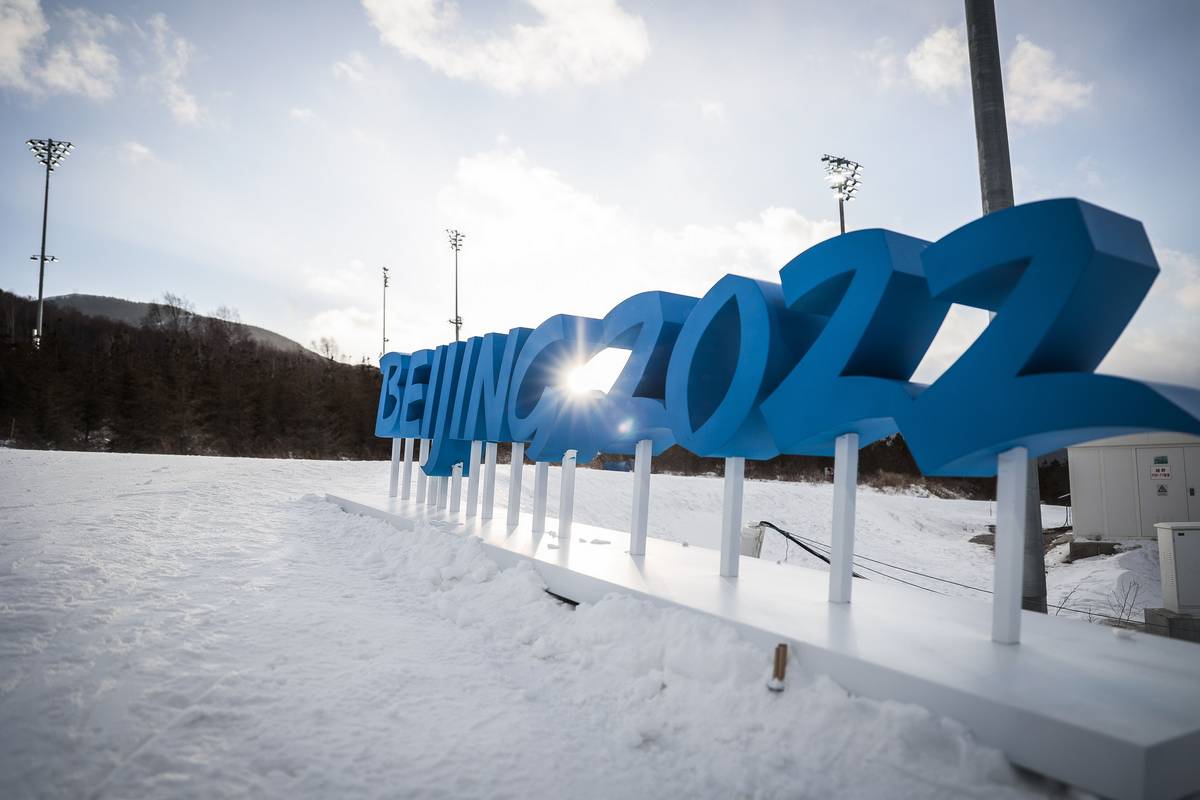
    A scene from the cross country venue in Zhangjiakou, China, host to the 2022 Olympic Winter Games. (Photo: NordicFocus)

    Four athletes from the Swiss team have announced that they will be moving on, chief among them – the king of the 15 k, Dario Cologna. At the age of 36, Cologna released his decision before the 2021/22 season even began, saying, “the decision came within the last months and after the Olympics, it will be the perfect timing for me. I have achieved everything I ever dreamed of in the sport.”
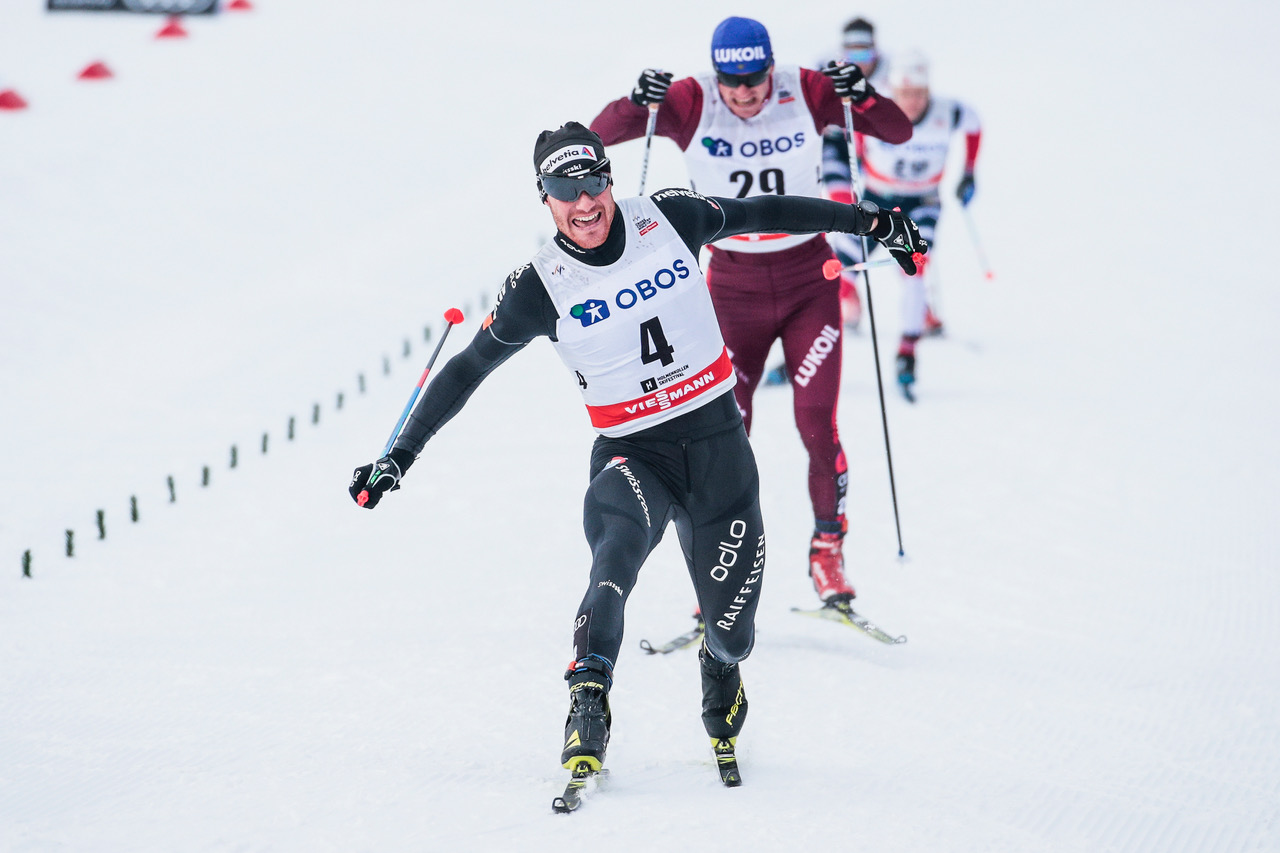
    Switzerland’s Dario Cologna lunges to the line at the 2018 Holmenkollen 50-kilometer freestyle race in Olslo, Norway. (Photo: NordicFocus)

    Cologna had his World Cup debut in 2006 and his first Olympic start came in 2010 in the 15 k skate event, where he finished first. This victory crowned him as the first Swiss cross-country skier to earn an Olympic gold medal. He went on to win three additional golds, in the 2014 Sochi Games he won both the skiathlon and the the 15 k classic, and in 2018 in PyeongChang added a gold in the 15 k skate. All told, Colgona had eighteen Olympic starts at four different games.

    In between Olympic years, he was equally successful. He won the Overall World Cup globe four times, first in the  2007/08 season, again in 2010/11 and 2011/12 and a few years later in 2014/15. In the 2007/08 season he also earned his first Tour de Ski victory, in spite of the fact that he never took a stage win that year. He won the grueling event three more times, in 2010/11, 2011/12 and again in 2017/18. 
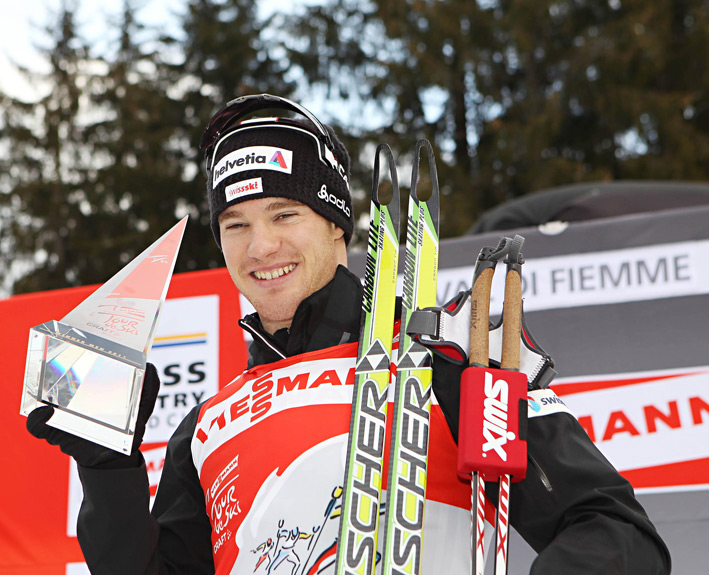
    Dario Cologna (SUI) with his trophy after winning the Tour de Ski in 2011 (Photo: Fiemme2013)

    After his final outing in the legendary Holmenkollen 50 k, Cologna wrote on Instagram, “I look back on a beautiful and successful career. 15 years ago I never dared to dream that one day I would be a four-time Olympic champion, World Champion, multiple Tour de Ski- and overall World Cup winner. In addition, I was privileged to travel to places I would never have seen and met great people, who became good friends.” 
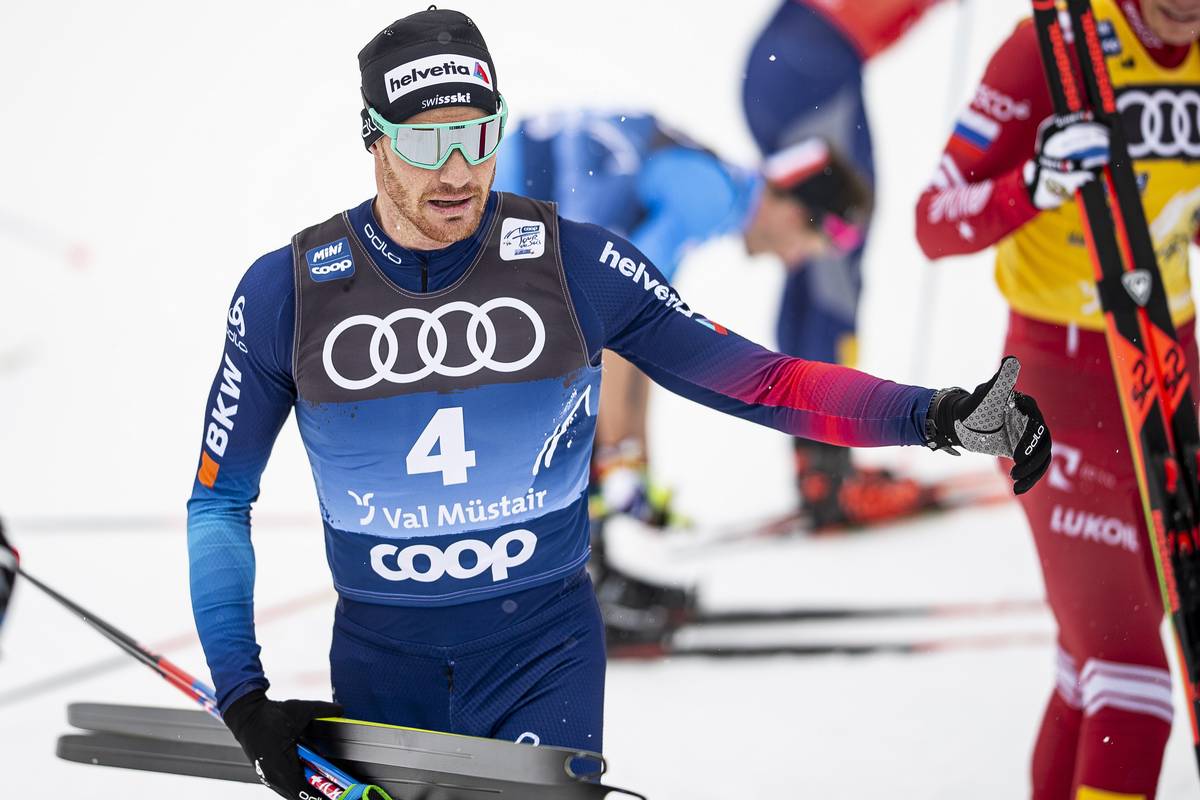
    Dario Cologna (SUI) after a 6th place finish in Val Mustair during the 2021 Tour de Ski. Photo: Nordic Focus

    Cologna’s teammate, Jovian Hediger, also announced his retirement prior to the start of this season. Hediger was known as a sprint specialist and has 107 World Cup starts to his name, having made his debut in 2009. His first and only podium appearance came in 2021 during the team sprint event in Ulricehamn, Sweden, where he and Roman Furger finished second. Hediger represented Switzerland at three Olympic games, beginning with Sochi in 2014 and ending most recently in Beijing (2022). 
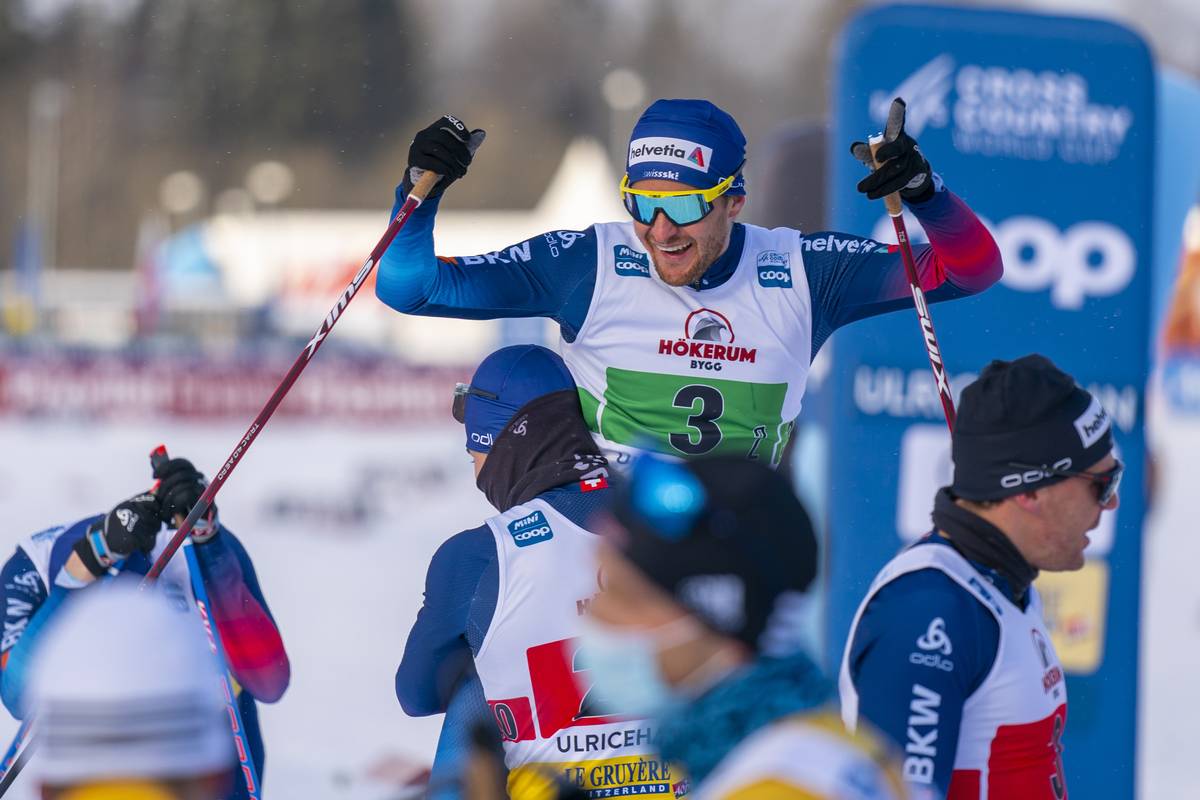
    Jovian Hediger (SUI) gets a boost from some happy teammates at the finish line in Ulricehamn Sweden. (Photo: Nordic Focus)

    Ueli Schnider of Switzerland is also stepping away from elite competition. Schnider has 62 World Cup starts and made two Olympic appearances, both in 2018 in PyeongChang where he finished 37th in the classic sprint and 41st in the 50 k classic mass start. 

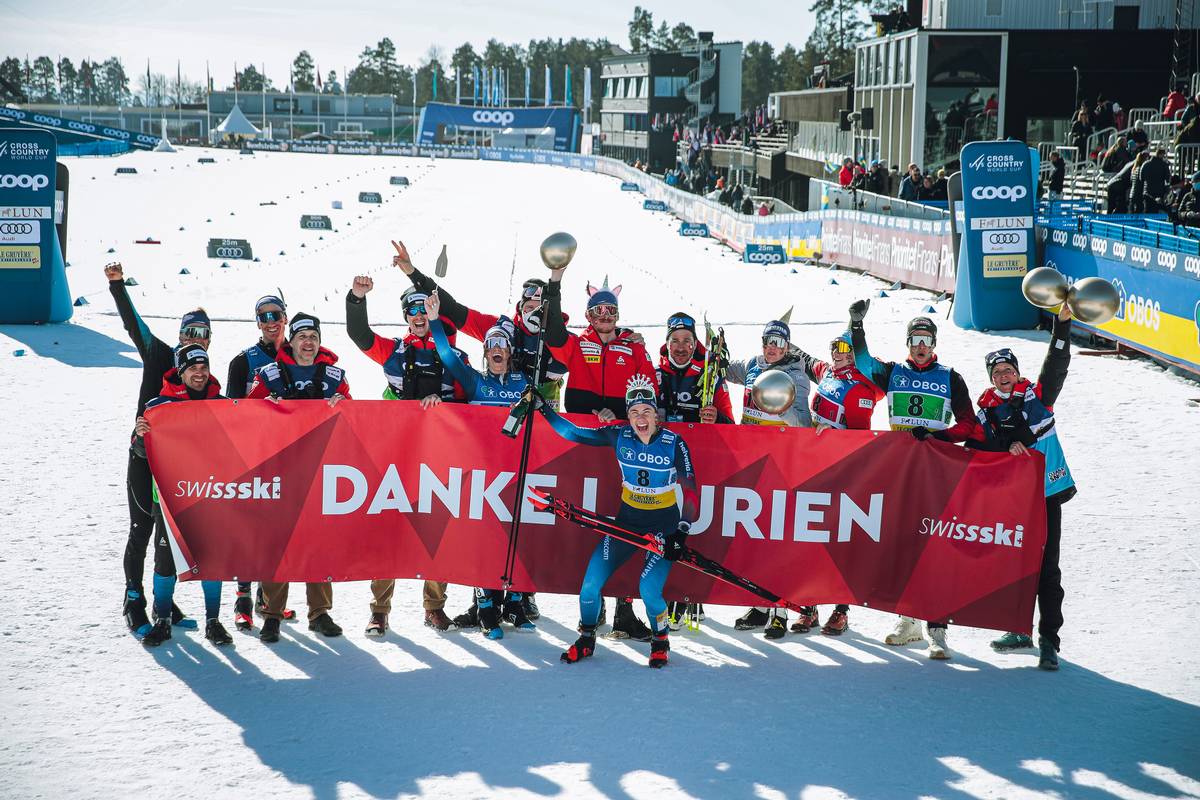
    On the women’s side, Laurien Van Der Graaff of Switzerland is moving on. Van Der Graaff has long been a staple in women’s sprinting, beginning in 2011 with her first World Cup podium in Duesseldorf, Germany. In doing so, Van Der Graaff became the second Swiss female athlete ever to reach the podium and over the years she continued to pave the way for young Swiss female athletes. Her first victory came in 2017 in a skate sprint Tour de Ski stage race on home ground in Lenzerheide, Switzerland. 

    The women’s sprint podium in Rybinsk Russia, 2015 (from l-r): Natalia Matveeva (RUS) second, Jennie Öberg (SWE) first, and Laurien Van Der Graaff (SUI) third.

    Van Der Graaff partnered up many times with Nadine Fähndrich in team sprint events, resulting in four World Cup podium finishes. At the World Championships in Oberstdorf, Germany (2021), Van Der Graaff and Fähndrich teammed up again, earning a silver medal when they finished just hundreths of a second behind team Sweden. 

    Van Der Graaff shared with FIS, “for some time I was convinced that I would not continue skiing until Beijing 2022, but I made it and I am very proud of what I have achieved. However, now my time has come and I am excited for everything that is coming my way in this new chapter.”
    The Swiss program celebrates the retirement of Laurien Van Der Graaff at the finish of the 4 x 5 k mixed relay in Falun. (Photo: NordicFocus)

    While some athletes knew from the outset of the season that this would be their last, others only recently came to the decision. Such was the case for Swedish star, Charlotte Kalla, who just announced her intentions within the last month. The 34-year said, “the curiosity about life outside of elite sports weighs heavier than what a continued investment would entail.”

    Kalla burst onto the World Cup scene at the age of eighteen. She earned her first victory in the next season, taking a stage win in Nove Mesto (2007) in the 10 k skate pursuit. In her first individual World Championships appearances, coming in Sapporo, Japan in 2007, Kalla finished 7th and 5th. To give you a sense of her consistency from then on, of the 34 World Championship events Kalla completed spanning 2007-2021, she finished in the top ten in 30 of those appearances with the exceptions being three 11th place finishes and one 18th. 

    Charlotte Kalla of Sweden on her way to Olympic gold in Vancouver 2010 (Photo: FS archives)

    Kalla represented Sweden at four different Olympic Games, Vancouver 2010, Sochi 2014, PyeongChang 2018, and Beijing 2022. She came away from these events with five individual podiums, including two gold medals and three team medals including her jaw-dropping relay performance in the relay in 2014 when she made up a 25 second deficit to bring the Swedish women their first Olympic relay gold since 1960. 

    Since then, the Swedish women’s team has come to dominate the World Cup circuit and Kalla has taken on a mentorship role within the team. “It’s an inspiring team to be a part of and many girls who have the right mindset to do their very best every day,” said Kalla in 2020. On March 22, 2022, Kalla announced on Instagram that the Swedish national competitions would be her last as an elite athlete. She wrote, “here I took my first [steps] as a seven-year old and it feels nice to end my career here.” 
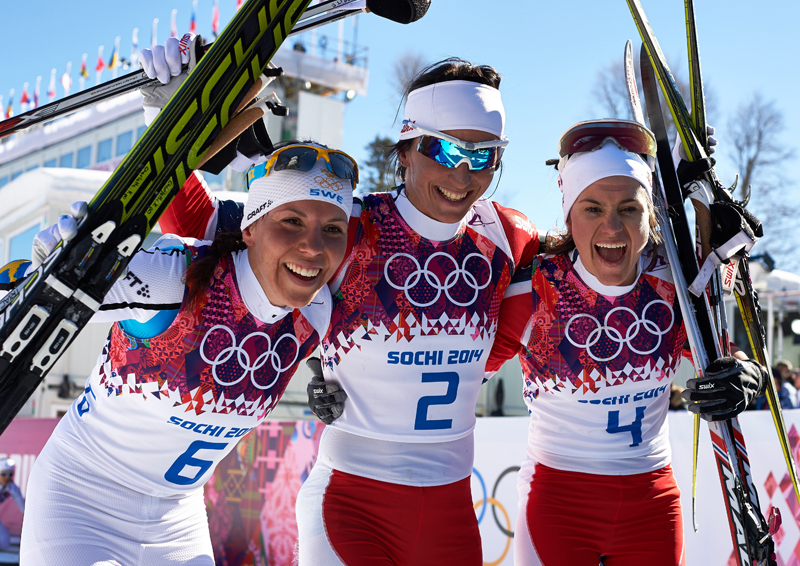
    Charlotte Kalla (SWE), Marit Bjoergen (NOR) and Heidi Weng (NOR) claim the podium in the women’s Olympic skiathlon, Sochi 2014.  (Photo: Fischer / Nordic Focus.)

    Elisa Brocard of Italy is ending her ski-racing career at the age of 37. Brocard had her first World Cup start in 2006 and went on to contest 162 World Cup events. She represented Italy in three Olympic Games, beginning in Vancouver 2010, through PyeongChang in 2018. Her best season came in 2018 when she finished in the top-30 distance World Cup rankings and 38th overall. 

    Nadine Herrmann of Germany is leaving elite competition as well. She is the younger sister of Denise Herrmann who raced the cross-country World Cup circuit until she transitioned to biathlon in 2017 where she went on to win gold in the individual event at the 2022 Beijing Olympics. Nadine Herrmann finished in the top-thirty in her maiden World Cup appearance in 2018 in the Dresden city sprints. She went on to earn a number of top-thirty finishes, including a personal best individual finish of 18th in Dresden in 2020. At the age of 26, Herrmann has decided to move on, she wrote “My active sporting career is coming to an end. The last 14 years of performance sports have shaped me into the person who today can say in the best of my conscience, I gave it my all.” 

    Adrien Backsheider of France has also announced his retirement. Backsheider began racing on the World Cup circuit in 2013. He earned six World Championships starts and helped propel team France to a bronze medal in the men’s 4 x 10 relay in Falun in 2015 and again in Seefeld in 2019. Backsheider also has four Olympic starts, as he represented France in Sochi 2014, PyeongChang 2018, and Beijing 2022. He was a member of the bronze medal relay team in PyeongChang when the French again earned a podium spot in the 4 x 10 relay. Backsheider’s personal best individual World Cup finish came in Östersund, Sweden in 2020 when he finished 7th in the 15 k skate stage race during the Tour de Scandinavia. 

    The men’s 4 x 10 k relay at 2015 World Championships in Falun, Sweden, Norway with gold, Sweden with silver, and France with bronze . (Photo: Fischer/NordicFocus)

    Cendrine Browne of Canada is saying goodbye to professional ski racing as well, having concluded her career with a national title in the 45 k skate in Whistler, Canada. Browne made her World Cup debut in 2012 and went on to start 76 World Cup races. She made the Canadian Olympic team in 2018 and 2022 and also posted thirteen World Championships starts. Browne finished 16th in the 30 k skate mass start in Beijing, a personal best individual finish for her. In a statement to Nordiq Canada after the 45 k race, Browne said, “thank you to everyone in the ski community who has believed in me and cheered for me over the last ten years.” 
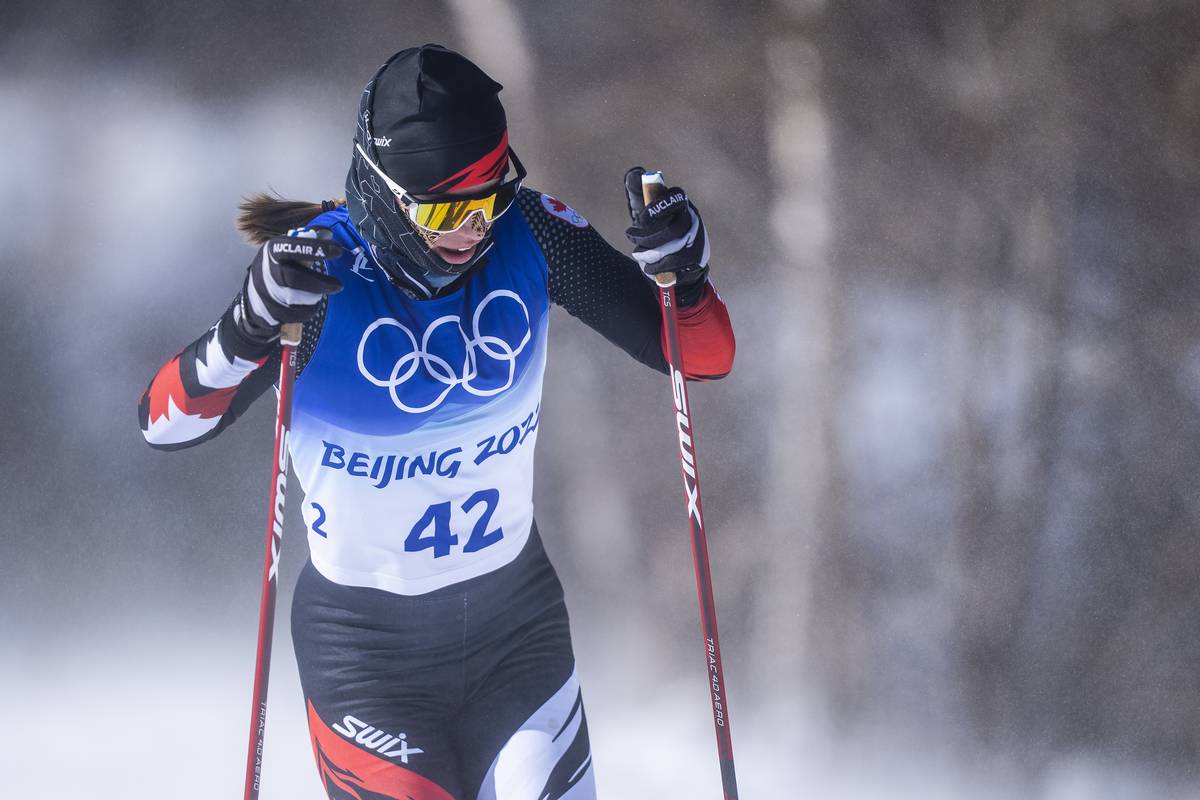
    Cendrine Browne reached a new personal best with her 16th place finish in the 30 k skate mass start in Beijing 2022 (Photo: NordicFocus)

    The notable retirement of the extremely successful, Therese Johaug of Norway has not been missed but will be receiving its own feature from FasterSkier in the coming weeks. Additionally, US Ski Team members Katharine Ogden, Hannah Halvorsen, and Caitlin Patterson have all shared news of their retirement, in addition to top SuperTour athletes Ian Torchia and Adam Martin. (Read Torchia’s retirement story here.)

    Stay tuned for more in-depth reporting on those athletes from FasterSkier.

  • 2018/2019 Tour de Ski Preview (Updated)

    2018/2019 Tour de Ski Preview (Updated)

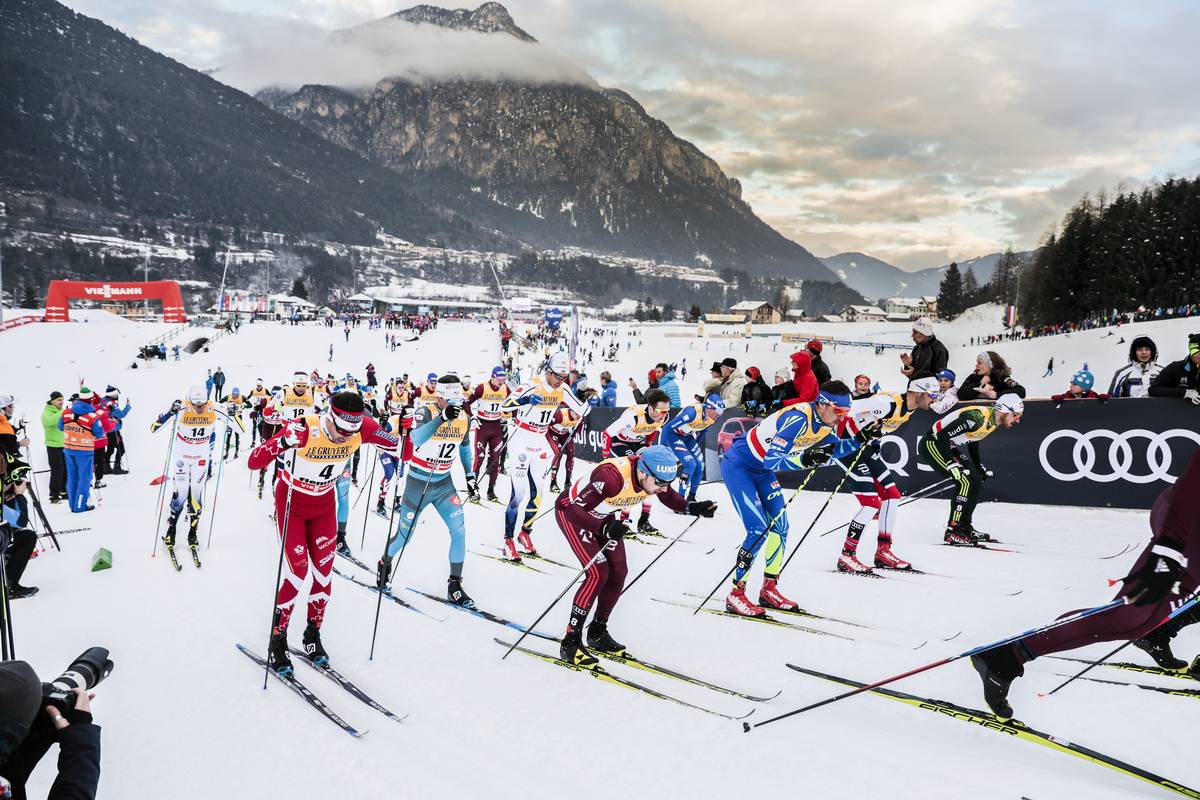
    The start of the men’s 15 k classic mass start at Stage 6 of the 2018 Tour de Ski on Saturday in Val di Fiemme, Italy, with (front row, left to right) Canada’s Alex Harvey, Russia’s Sergey Ustiugov, Kazakhstan’s Alexey Poltoranin, Norway’s Martin Johnsrud Sundby, and Switzerland’s Dario Cologna. (Photo: Salomon/NordicFocus)

    Beginning this Saturday in Toblach, Italy with a freestyle sprint is the 13th edition of the Tour de Ski (TdS). According to the International Ski Federation (FIS), over the course of seven stages the men will race 80.918 kilometers, the women 60.67 k. 

    The TdS has become both a staple and a spectacle of the annual World Cup calendar. With a jam-packed series of races primacy is placed on both the ability to recover well and wither less as the TdS transpires.

    Prognostication can be tricky in a long-form template like the TdS. So much can go astray during seven races not to mention the travel and dicey germ-avoidance. 

    Last season’s winner on the women’s side, Heidi Weng of Norway, sits 18th overall in the World Cup standings (14th in distance). She has four top-20’s in the four distance events she’s contested with her best result an eighth in Lillehammer’s 10 k skate. Although featuring two sprints in the first three stages, the TdS remains a distance skier’s paradise.

    Weng has skied solidly on the World Cup, but she has yet to show the form that made her a TdS overall winner in 2017 and 2018. Norway has won the last five iterations of the TdS: Marit Bjørgen won once in 2014/2015, Therese Johaug twice (2013/2014, 2015/2016), and Weng the last two years.

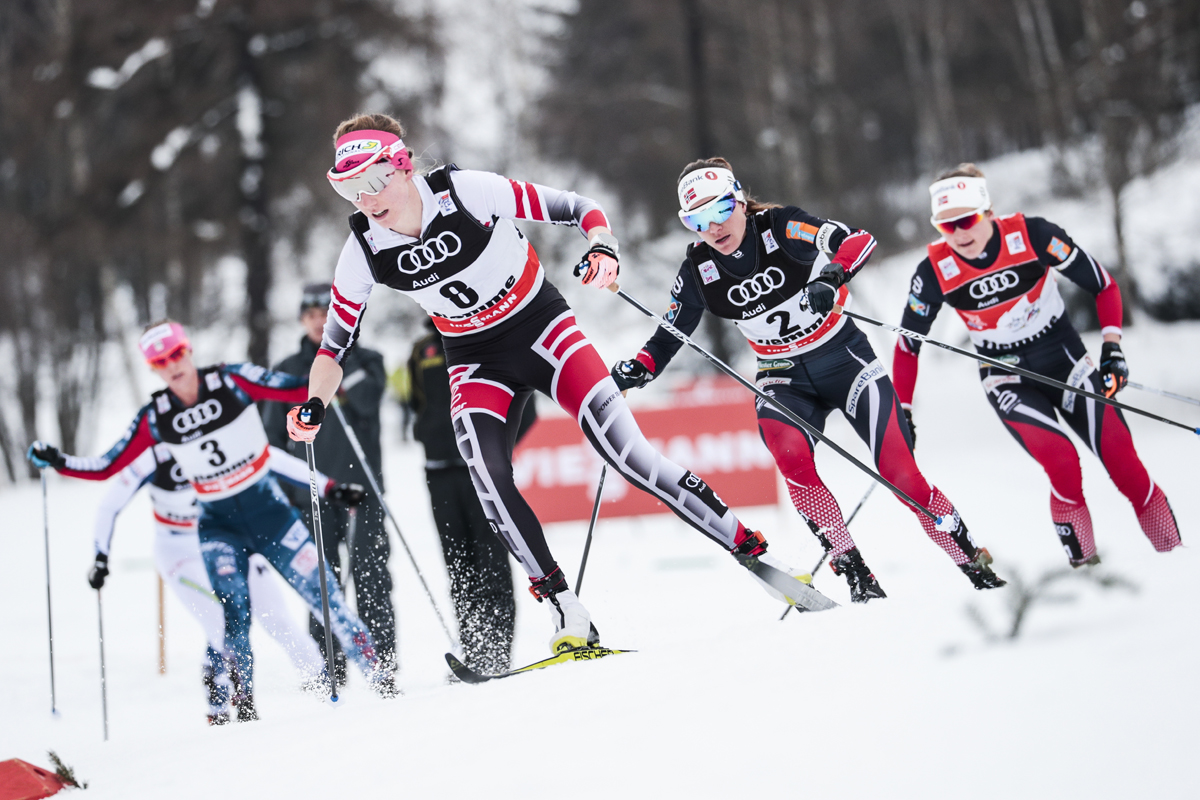
    Austria’s Teresa Stadlober leads Norway’s Heidi Weng (2) and Ingvild Flugstad Østberg, American Jessie Diggins (3) and others around a downhill corner during the women’s 10 k classic mass start at Stage 6 of the 2018 Tour de Ski in Val di Fiemme, Italy. (Photo: Fischer/NordicFocus)


    If Norway is to keep the streak alive, Ingvild Flugstad Østberg, last year’s TdS runner up, could be the heir apparent. She currently ranks second in the World Cup overall and 15th on the sprint list.

    Johaug, having returned from an 18 month doping ban, has been on a distance race tear. She has won all five World Cup distance events this season. Johaug, however, will not be lining up for the TdS.

    Only five different women have earned distance podiums this season — Johaug, Østberg, Sweden’s Charlotte Kalla and Ebba Andersson, and Finland’s Krista Pärmäkoski. Along with Johaug, Kalla and Andersson are skipping the TdS. (Andersson sits third overall on the World Cup, Kalla fifth.) With the TdS missing three of the five top ranked World Cup distance skiers, daily stages and the overall podium are up for grabs.   

    Last season’s third overall finisher, Jessie Diggins of the U.S. Ski Team (USST), often cites the TdS as a point in the season when her form trends towards podium performances. She sits eighth in the current distance standings and could very well have a stout TdS. 

    Russia’s Natalia Belorukova and Yulia Nepryaeva look strong as does Sadie Bjornsen (USST), and Austria’s Teresa Stadlober.

    With less than predictable distance stage podiums for the women, it may simply come down to a drag race on the Alpe Cermis final climb Jan. 6.

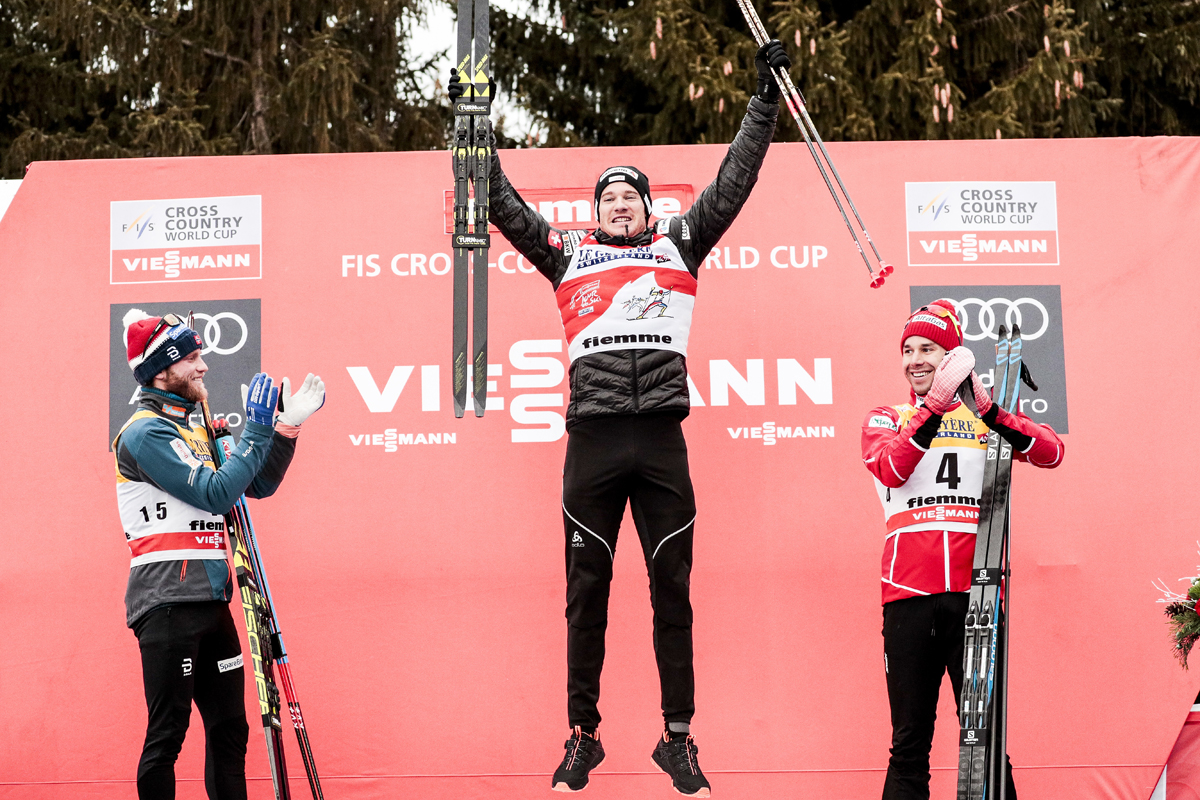
    Switzerland’s Dario Cologna (c) celebrates his fourth Tour de Ski overall title. He was joined by Norway’s Martin Johnsrud Sundby (l) and Canada’s Alex Harvey (r) on the podium in second and third, respectively. (Photo: Fischer/NordicFocus)


    The men’s scene is also open to interpretation. Last season’s TdS winner, Switzerland’s Dario Cologna, was in fact a surprise victor. Prior to Cologna’s stage two win in last year’s TdS, it had been nearly three years since the four time TdS overall winner had won a World Cup. Cologna sits 21st overall on the World Cup currently. Given last year’s resurgence, anything is possible for the Swiss skier.

    Then there’s Martin Johnsrud Sundby form Norway. He finished on the TdS podium the last three years. At thirty-four-years-old, Sundby is ranked first on the distance list, with a second, a third, and a fourth place in distance races this season.

    Sundby won the TdS on two occasions – in 2013/2014 and in 2016. His 2015 win was stripped after he tested positive for excessive levels of Salbutamol. He placed second in the past two Tours.

    In a field rife with talent, Sundby’s ability to race and rebound and race and rebound will be tested. Sjur Røthe, Emil Iversen, and Didrik Tønseth— all from Norway— look in form. And there’s Norway’s Johannes Høsflot Klæbo. The winner of last season’s overall World Cup has had flashes of his past explosive self. He could be a TdS protagonist.

    The men’s field is notably tight. Along with the Norwegians, several Russians could pop a podium, a stage win, and the overall. Russia comes with a loaded team ready to exploit. Alexander Bolshunov leads the overall World Cup – he’ll turn twenty two on Dec. 31st. He’s backed by teammates Evgeniy Belov, Andrey Melnichenko, and Denis Spitsov. 

    Canada’s Alex Harvey placed third overall last year and he looked stronger as the TdS progressed.

    The Stages

    Stage 1:  Dec. 29, skate sprint in Toblach, Italy.

    Stage 2: Dec. 30, 10 k/15 k skate in Toblach, Italy.

    Stage 3: Jan. 1, skate sprint in Val Müstair, Switzerland.

    Stage 4: Jan. 2, 10 k/15 k classic mass start in Oberstdorf, Germany.

    Stage 5: Jan. 3, 10 k/15 k skate pursuit in Oberstdorf, Germany.

    Stage 6: Jan. 5th, 10 k/15 k classic mass start in Val di Fiemme, Italy.

    Stage 7: Jan 6th, 9 k final climb skate pursuit in Val di Fiemme, Italy.

    Teams

    United States

    Women: Sophie Caldwell, Sadie Bjornsen, Jessie Diggins.

    Men: Ben Lustgarten, Simi Hamilton, Erik Bjornsen, Kevin Bolger.

    U.S. Ski Team Head Coach Chris Grover noted in a text that Caldwell, Hamilton, and Bolger will likely cease the TdS after the stage three sprint. Additionally, this is a small team for the U.S. at the TdS. Several athletes turned down TdS nominations including Scott Patterson (USST), Andy Newell (SMS T2/Salomon), Kyle Bratrud (SMS T2), Rosie Brennan (APU), Rosie Frankowski (APU), Caitlin Patterson (CGRP), and Julia Kern (SMS T2). These skiers plan on racing U.S. Nationals this January in Craftsbury, Vermont.

    Canada

    Women: Emily Nishikawa, Dahria Beatty

    Men: Alex Harvey, Lenny Valjas, Bob Thompson

    Norway

    Women: Ingvild Flugstad Østberg, Maiken Caspersen Falla, Astrid Uhrenholdt Jacobsen, Kari Øyre Slind, Kathrine Rolsted Harsem, Heidi Weng, Lotta Udnes Weng, Tiril Udnes Weng Mari Eide, Anna Svendsen

    Men: Martin Johnsrud Sundby, Hans Christer Holund, Emil Iversen, Didrik Tønseth, Simen Hegstad, Krüger, Sjur Røthe, Johannes Høsflot Klæbo, Martin Løwstrøm Nyenget, Eirik Brandsdal, Finn Hågen Krogh

    Russia

    Women: Yulia Belorukova, Lidia Durkina, Anna Zherebyateva, Mariya Istomina, Natalia Nepryaeva, Anna Nechaevskaya, Anastasia Sedova, Elena Soboleva

    Men: Evgeniy Belov, Alexander Bolshunov, Maxim Vylegzhanin, Andrey Larkov, Andrey Melnichenko,  Gleb Retivykh, Andrey Sobakarev, Denis Spitsov, Sergey Ustiugov

    Sweden

    Women: Mia Eriksson, Ida Ingemarsdotter, Moa Molander Kristiansen, Stina Nilsson, Maria Nordström, Linn Sömskar, Lisa Vinsa

    Men: Calle Halfvarsson, Simon Lageson, Teodor Peterson, Daniel Rickardsson, Oskar Svensson, Viktor Thorn, Karl Johan Westberg

    Finland

    Women: Mari Eder, Anne Kyllönen, Laura Mononen, Krista Pärmäkoski, Susanna Saapunki

    Men: Ristomatti Hakola, Matti Heikkinen, Lauri Vuorinen

    Italy

    Women: Elisa Brocard, Anna Comarella, Ilaria Debertolis, Caterina Ganz, Greta Laurent, Sara Pellegrini, Lucia Scardoni

    Men: Francesco de Fabiani, Stefano Gardener, Enrico Nizzo, Dietmar Noeckler, Federico Pellegrino, Maicol Rastelli, Giandomenico Salvadori

    Switzerland

    Women: Nathalie von Siebenthal, Laurien van der Graaff, Nadine Fähndrich

    Men: Dario Cologna, and Jovian Hediger, Jonas Baumann, Livio Bieler, Roman Furger, Käser Erwanm, Beda Klee, Toni Livers, Jason Rüesch, Schaad Roman

    Austria

    Women: Therese Stadlober

    Germany

    Women: Julia Belger, Victoria Carl, Pia Fink, Laura Gimmler, Katharina Hennig, Sandra Ringwald, Elisabeth Schicho, Anne Winkler

    Men: Thomas Bing, Lucas Bögl, Janosch Brugger, Jonas Dobler, Sebastian Eisenlauer, Andreas Katz, Valentin Mättig, Florian Notz, Max Olex, Thomas Wick

    France

    Women: Anouk Faivre Picon, Delphine Claudel, Laura Chamiot-Maitral

    Men: Maurice Manificat, Lucas Chanavat, Adrien Backscheider, Jean-Marc Gaillard, Baptiste Gros, Renaud Jay, Richard Jouve, Jules Lapierre, Clement Parisse

    FasterSkier will update team start lists as we gather more information.

    antibiotics

  • World Cup Preview: #9 Italy

    World Cup Preview: #9 Italy

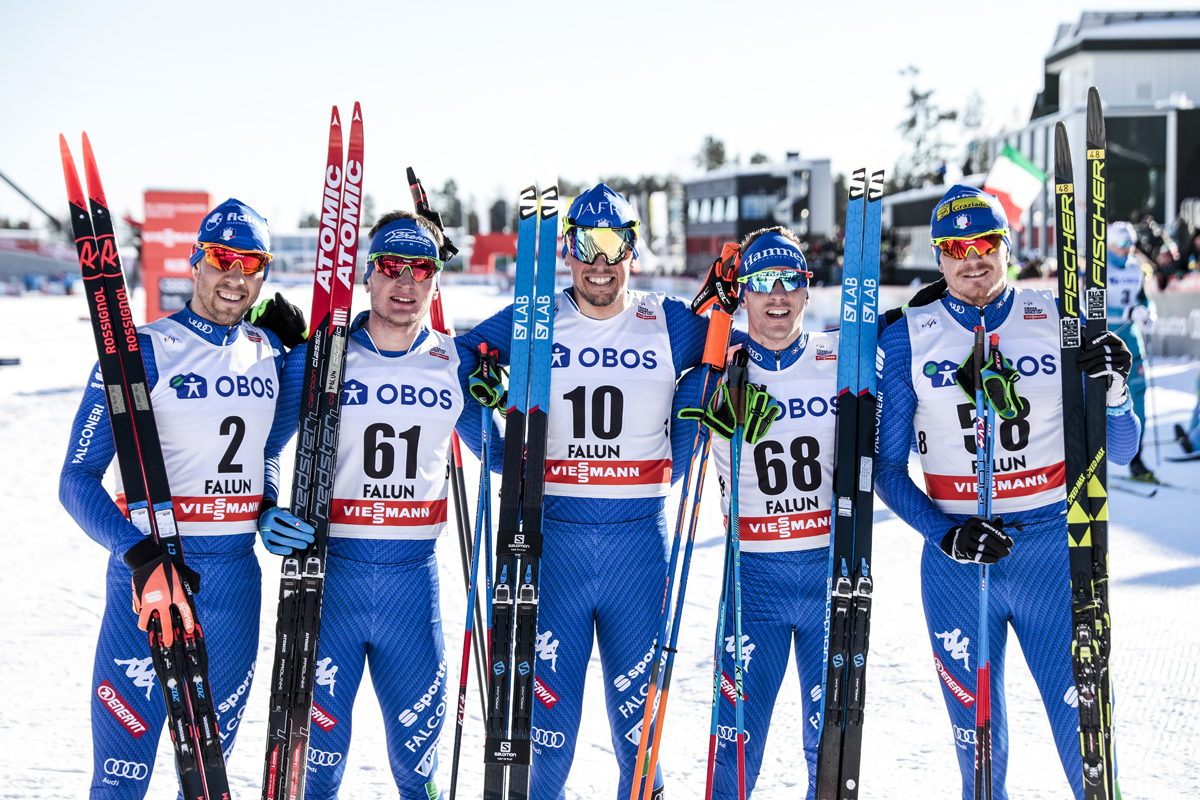
    The Italian men’s team after Saturday’s 15 k classic mass start at 2018 World Cup Finals in Falun, Sweden, with (from left to right) Federico Pellegrino, Giandomenico Salvadori, Francesco De Fabiani, Maicol Rastelli, and Dietmar Nöckler. (Photo: Fischer/NordicFocus)

    Welcome to FasterSkier’s World Cup Preview, where we check in with the top-10 teams from last year’s FIS Cross Country World Cup tour before the season starts with the Ruka weekend in Kuusamo, Finland, on Nov. 24 with a classic sprint.

    ***


    Italy

    Overall in Nations Cup Last Year: Ninth

    Women’s Ranking 2017/2018: 10th

    Men’s Ranking 2017/2018: Sixth

    Italians to Watch:

    One name to rule them all in Italy: Twenty-eight-year-old Federico Pellegrino. Synonymous with fast and furious when it comes to freestyle sprints. Last season Pellegrino won World Cup sprints in Dresden and Lahti, both were skate. He stood second on World Cup skate sprint podiums on three other occasions in 2017/2018. One of those seconds was in Seefeld, Austria – site of the 2019 Nordic Ski World Championships. And yes, it’s a skate sprint this season in Seefeld.

    For the naysayers out there, claiming Pellegrino is a one-trick-pony, the skate specialist claimed a 2018 Olympic silver medal in the classic sprint. 

    The 2016 winner of the overall FIS Sprint Crystal Globe, Pellegrino has been out-hustled by Norway’s Johannes Høsflot Klæbo for the sprint cup since. With nine of the 12 World Cup sprints this season designated skate technique, it may be time for the Italian flyer to claim sprint cup number two.

    Dietmar Nöckler returns as a possible Pellegrino partner in the team sprint. The duo placed first in Dresden’s skate team sprint in January. The big-stage team sprint in Seefeld is classic technique.

    buy zyrtec online

    Francesco DeFabiana provided the Italian men some 15-kilometer punch in 2017/2018. DeFabiana placed third twice on the World Cup last year: in the Oberstdorf’s 15 k skate and Falun’s 15 k classic — both were mass starts.

    Thirty-four-year-old Elisa Brocard stepped up for the Italian women. She was a steady top-30 skier, including several top-20 results. Brocard was Tour de Ski ready, placing 17th overall. By season’s end, she ranked 29th in the distance cup – her highest position since beginning her World Cup career in 2008.

    On the sprint side for Italy’s women, Greta Laurent placed consistently in the top-30. Her best result, a ninth place, came in Seefeld’s skate sprint. Laurent finished 2018 ranked the 36th sprinter on the World Cup.

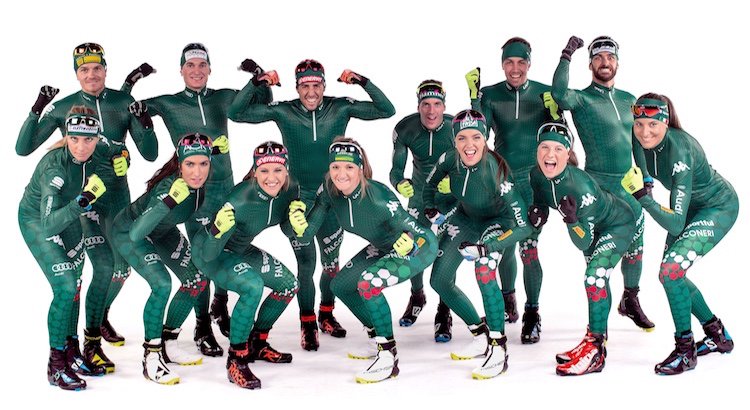
    On a lighter Note: the Italians raced in sporty royal blue suits last season. It didn’t take long for a rebrand. Kermit the Frog may have spoiled it for Italy when he bellowed, “It’s not easy being green”. Despite that lyrical foreboding from the iconic amphibian, you will not miss Italy this season on the race tracks. Think green.

    Italy’s National Cross Country Ski Team in…Green race suits for the 2018-2019 season. (Photo: FISI.org)


  • Newell Gives Distance Double Poling a Shot, Second in Dolomitenlauf Classic

    Newell Gives Distance Double Poling a Shot, Second in Dolomitenlauf Classic

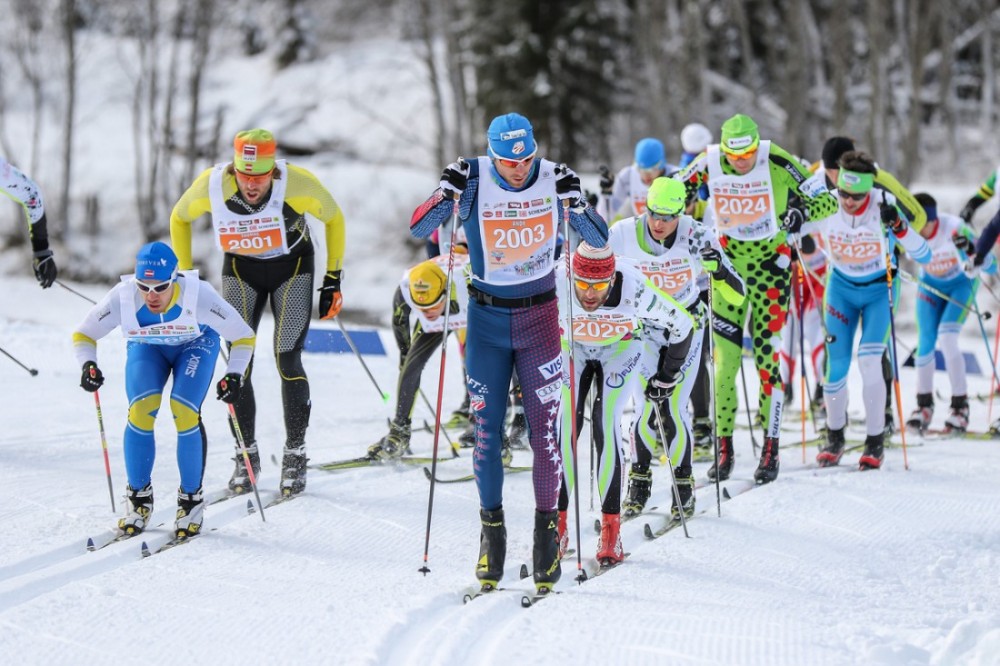
    American Andy Newell in bib No. 2003 in the lead pack during the Dolomitenlauf 42 k classic race  FIS Marathon Cup on Saturday in Lienz, Austria.  (Photo: Fischer/NordicFocus)
    American Andy Newell in bib No. 2003 in the lead pack during the Dolomitenlauf 42 k classic race at the FIS Marathon Cup on Saturday in Lienz, Austria. (Photo: Fischer/NordicFocus)

    Two and half months makes for along time on the road, especially when it only marks the halfway point. For U.S. Ski Team members like Andy Newell, who has been competing and traveling in Europe for the past 10 weeks, sometimes it’s important to spend time racing outside of the World Cup.

    “There are so many great races in Europe you can do if you get out of the World Cup bubble a little bit,” Newell said Saturday on the phone.

    The 32-year-old American, best known for his classic sprinting, opted out of this weekend’s World Cup races in Nove Mesto, Czech Republic, and instead competed in Austria, starting with the Dolomiten city sprint in Lienz on Friday night and Saturday’s Dolomitenlauf 42-kilometer classic marathon in Obertilliach.

    “That’s one of my goals this year and in the future – to get away from some of the World Cup weekends that maybe aren’t my strength, like [Saturday’s] 15 k skate on the World Cup, that’s definitely not a great event for me. I’m much better at a double-pole race,” Newell explained.

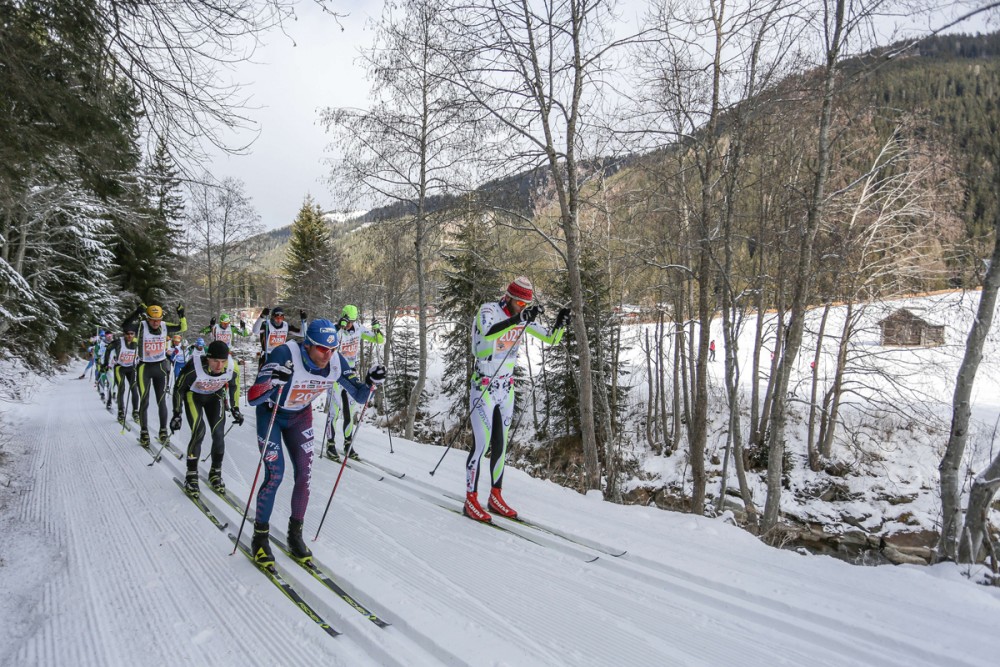
    American Andy Newell (l) and Austria's Stefan Sutter in front during the Dolomitenlauf 42 k classic race on Saturday in Lienz, Austria. (Photo: Fischer/NordicFocus)
    American Andy Newell (l) and Austria’s Stefan Sutter in front during the Dolomitenlauf 42 k classic race on Saturday in Lienz, Austria. (Photo: Fischer/NordicFocus)

    Testing the waters in his first international double-pole marathon, Newell finished second overall in the 42 k classic, just 5.7 seconds out of first and 0.3 seconds ahead of third. The overall win went to Stanislav Rezac of the Czech Republic in a time of 1:42.19, while Italy’s Mauro Brigadoi rounded out the top three.

    “The top-10 guys were on no wax,” Newell said. “I knew it would be a good race for me, but more importantly good preparation for the next month of racing.

    “I have some big classic sprints [in] Drammen and Stockholm,” he added. “To get in a long distance double-pole race can actually be good double-pole training for some of those sprints.”

    U.S. Ski Team Head Coach Chris Grover wrote in an email that having Newell get two starts (the sprint and marathon) in Lienz, rather than a possible one in Nove Mesto, made more sense for Newell’s long-term training plan.

    “It would have been good to have Andy here for a possible classic relay leg, but the Dolomitenlauf weekend offered him two confirmed starts (including a sprint) so it was a better fit,” Grover wrote.

    Using the 42 k event as ‘race practice’, Newell entered Saturday’s competition open to anything.

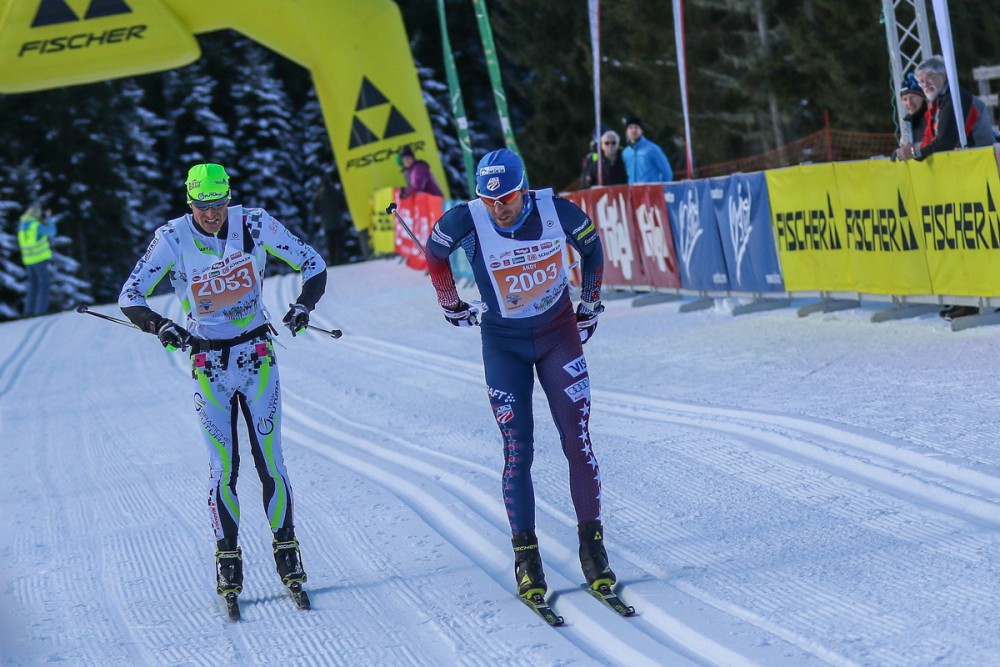
    American Andy Newell (l) outsprints Italy's Mauro Brigadoi, for second place in the Dolomitenlauf, 42 k classic race on Saturday in Lienz, Austria. (Photo: Fischer/NordicFocus)
    American Andy Newell (l) outsprints Italy’s Mauro Brigadoi for second place in the Dolomitenlauf 42 k classic race on Saturday in Lienz, Austria. (Photo: Fischer/NordicFocus)

    “I tried to go in with big confidence and an open mind, knowing that if I had a good day I could have a shot at winning the race or maybe even being on the podium,” Newell said. “I ended up doing a fair amount of leading actually and it came down to a group of 15 of us. Then it was a group of 10. By the last lap, it was maybe a group of five of us.” 

    With five skiers in the running for the top-three podium spots, Newell made a move with 4 k to go.

    “I put my head down and put in a surge but I wasn’t able to get rid of the two guys that were behind me,” he said.

    The top five men — Rezac, Newell, Brigadoi, and two Austrian skiers Martin Sutter and Stefan Sutter –made their way to the final kilometer, where the marathon turned into a marathon sprint.

    “The Czech guy that won is a really strong double poler and great marathon skier. He had put his move down with maybe a half k to go and we were kind of strung out, a few meters in between all of us,” Newell said. “He had maybe ten meters before we even got to the stadium and it was a really drawn out sprint finish.”

    While Newell captured second, three-tenths of a second ahead of the Italian, Brigadoi ousted the two Austrians for third.

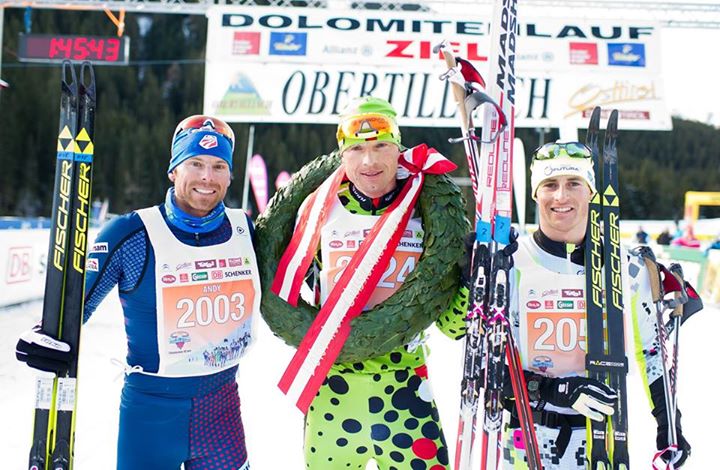
    Left to right: Second place finisher Andy Newell (USA), along with race winner Stanislav Rezac (CZE), and third place Mauro Brigadoi (ITA) after the Dolomitenlauf 42 k classic FIS Marathon Cup on Saturday in Lienz, Austria. (Photo: EXPA/Gruber/Worldloppet Facebook)
    Left to right: Second-place finisher Andy Newell (USA), along with race winner Stanislav Rezac (CZE), and third place Mauro Brigadoi (ITA) after the Dolomitenlauf 42 k classic FIS Marathon Cup on Saturday in Lienz, Austria. (Photo: EXPA/Gruber/Worldloppet Facebook)

    While the sprint finish was perhaps more familiar territory for Newell, the American believes the race left him with a unique racing experience.

    “I haven’t done too many of these types of marathons. On a race like [Saturday] you’re lapping people, so you have to weave in and out of slower folks … then there’s a helicopter and a snowmobile with a video camera like three feet away from you the entire time, which takes getting used to,” he said. “It was pretty fun and different.”

    With a second-place podium finish and competitive spirit, who knows, the U.S. sprint specialist may make the transition to full-time marathoner yet.

    “In the future I would like to make it to some more of the [Visma Ski] Classic races and the really big European marathons,” Newell said. “There’s some great competition and some good points and prize money. That was the goal for coming here, get a fun city sprint in Lienz, but to also race the 42 k classic.”

    “Next time I want one of those wreath things!” Newell posted on Instagram after Saturday’s race. “Great experience and hard 42 k of double poling today. Happy with 2nd place in the Dolomitenlauf.”

    Results

    ***

    Though the Dolomitenlauf is a part of the Worldloppet Marathon series, the 42 k classic event is not the designated Worldloppet race. Instead, many of the big-name marathoners suited up for Sunday’s 42 k freestyle competition held in Osttirol’s Drau Valley, Austria.

    Racers began the 42 k event — changed on Jan. 5 from 60 k to 42 k — in Lienz and followed a course through various towns and villages located in the valley. Competitors finished back in the city of Lienz.

    On the men’s side this year, all three podium spots were commandeered by the French.

    French skier Bastien Poirrier won the men’s skate race in 1:32.42.3. Not far behind, French teammates Ivan Boiteux Perillat and Loic Guigonnet duked it out for second.

    Boiteux Perillat ultimately beat Guigonnet to the line, a mere 0.2 seconds behind Poirrier. Guigonnet crossed the line in third, 0.5 seconds out of first.

    For the women, France once again came out on top. French skier Aurelie Dabudyk raced to first in 1:41.32.3. French teammate Elisa Brocard finished 1:14.1 seconds back in second. Italy’s Antonella Confortola broke the French podium streak, crossing the line in third, 1:16.3 seconds behind Dabudyk.

    Results: Men | Women