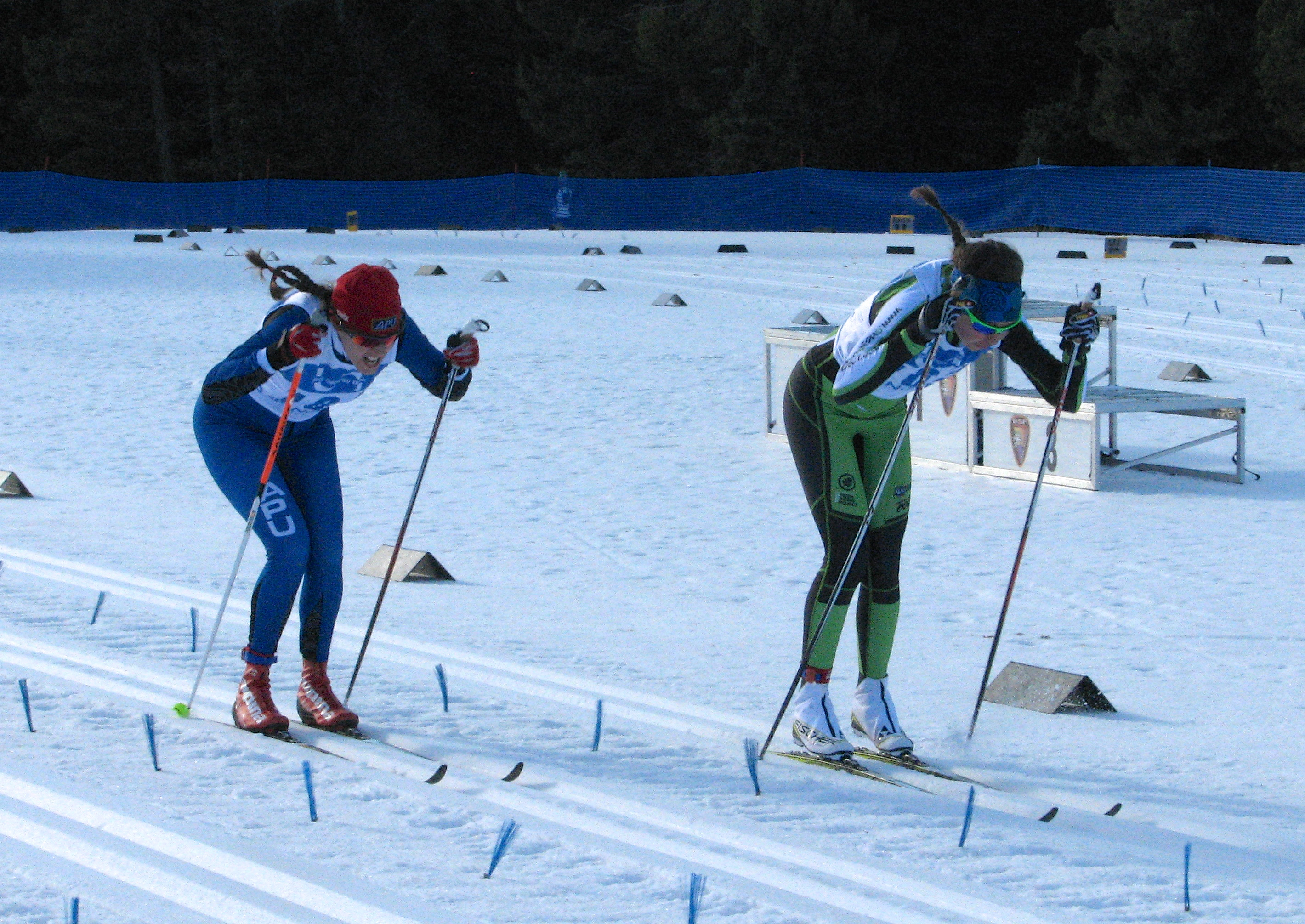
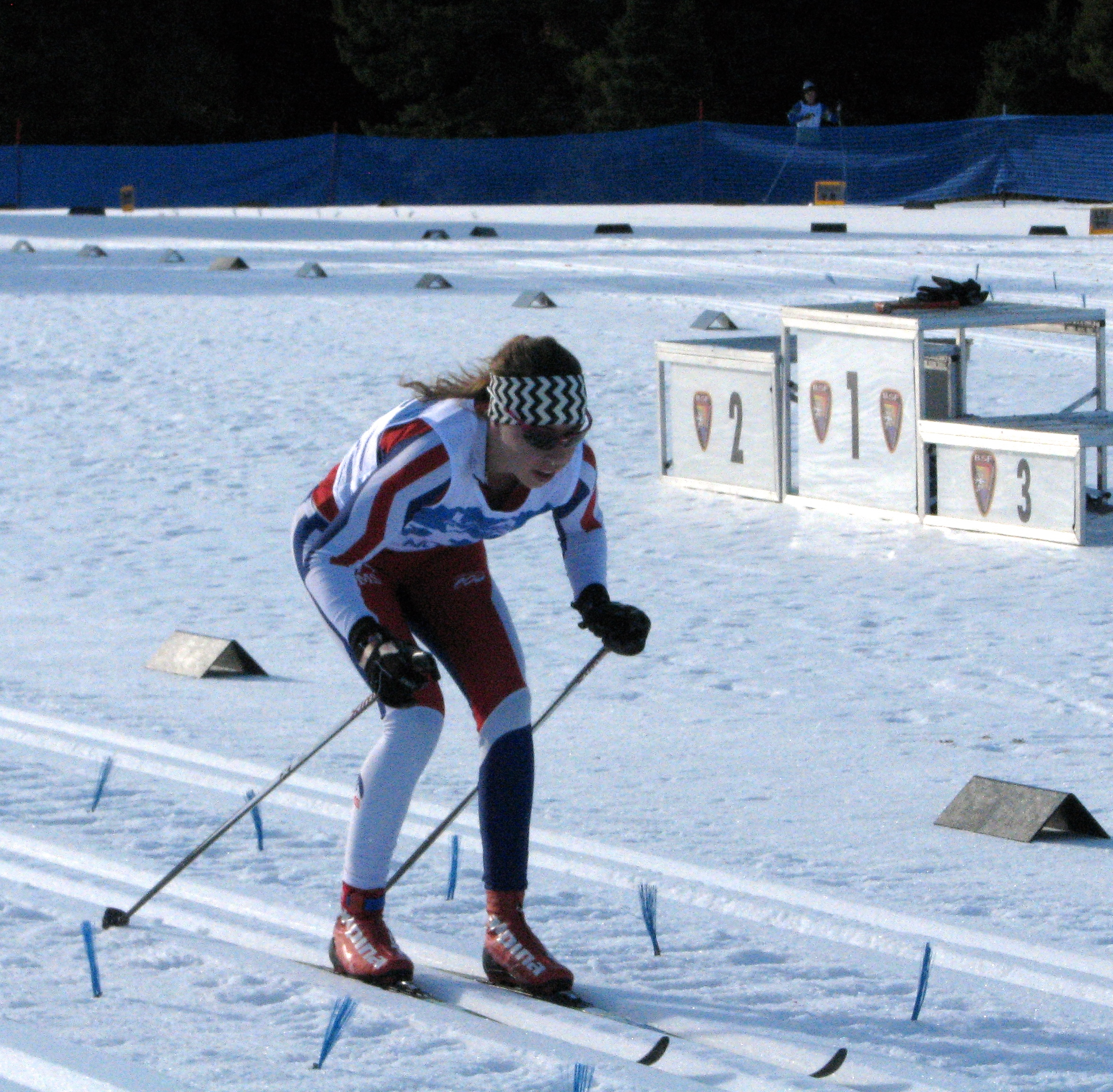
From the FasterSkier archive — posts syndicated from athletes’ and coaches’ own blogs between 2004 and 2012, kept online as published. Current coverage is at fasterskier.com.
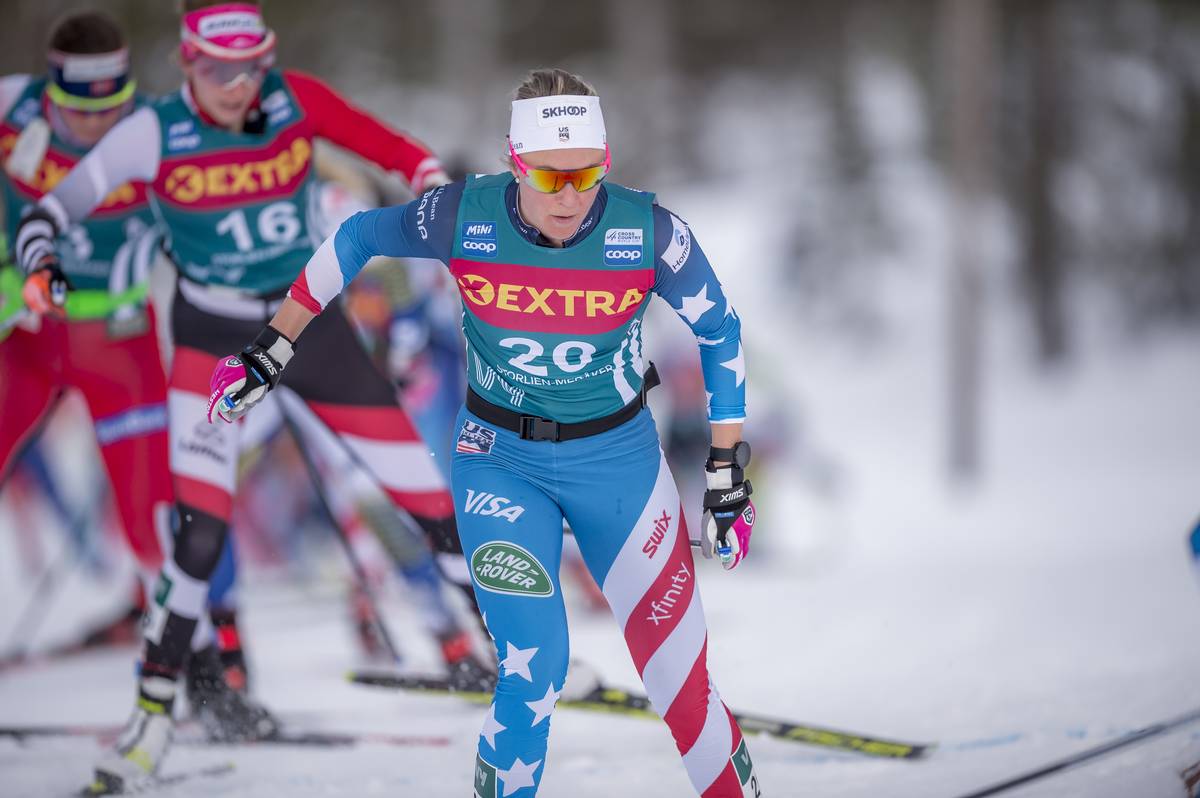
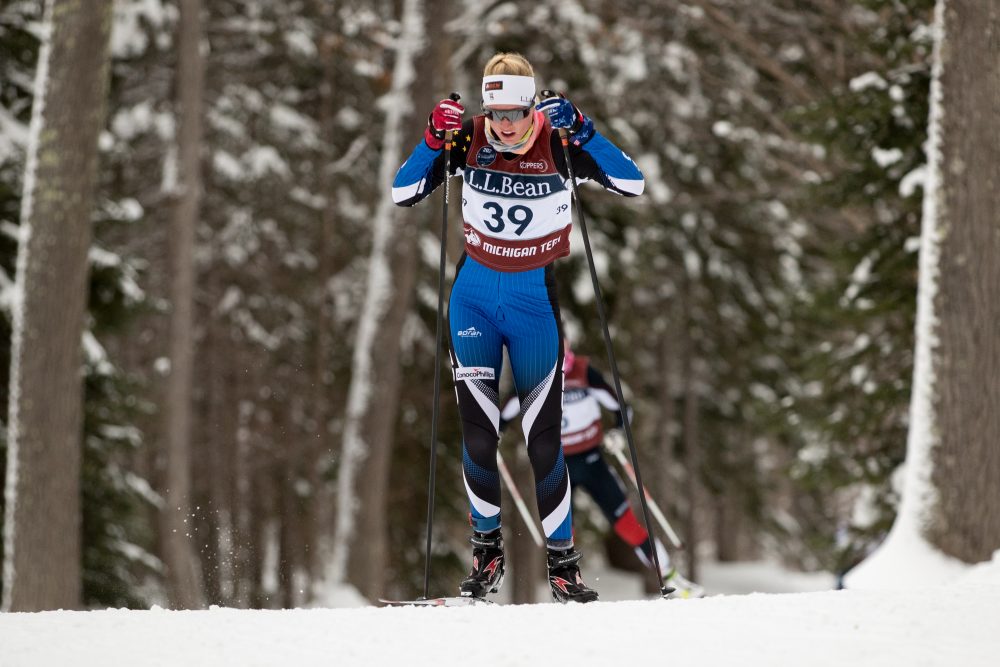
Hailey Swirbul of the USST D-Team races in Québec City, Québec, in March 2019. (Photo: John Lazenby/lazenbyphoto.com)
You may have heard that the World Cup is returning not only to North America, but also to American soil, within the next few weeks. The world’s best skiers will be contesting sprint races in Québec City on March 14 and 15; a sprint in Minneapolis on March 17; and distance races plus a mixed relay in Canmore on March 20-22.
For all six races, including the five across the border, the U.S. has an expanded nation’s group start quota (thanks, Canada, for letting us count as Canadian for a week), meaning that a remarkable thirty skiers total will toe the line in that distinctive candy-cane uniform. Here is a brief overview of the fifteen women with start rights in the three sprints (some of the sprinters will not be racing in Canmore, where some distance-oriented athletes will have starts instead).
In alphabetical order, with pictures where available (an asterisk by a name denotes an athlete making her first World Cup start in Québec City):
Sadie Maubet Bjornsen: Stage 4, Ski Tour 2020. (Photo: NordicFocus)
Sadie Maubet Bjornsen
Team and club: U.S. Ski Team (USST) A Team; Alaska Pacific University, or APU
Currently lives in: Alaska
Selected career highlights: Bronze medal, team sprint, 2017 World Championships; 7 individual and 5 team World Cup podiums; only American woman to ever wear the yellow overall World Cup leader’s bib; multiple national titles
Instagram page: @sbjornsen
Age: 30
Sophie Caldwell on course in Östersund, Sweden. (Photo: NordicFocus)
Sophie Caldwell
Team and club: USST A Team; Stratton Mountain School, or SMS
Currently lives in: Vermont
Selected career highlights: 3rd, Sprint Cup, 2017/2018 World Cup season; 9 individual and 4 team World Cup podiums
Instagram page: @sophiecaldwell
Age: 29
Hannah Cole racing at 2020 U.S. Nationals in Houghton, Michigan. (Photo: Karen Brown)
Hannah Cole*
Club: Crosscut Mountain Sports Center
Currently lives in: Montana
Selected career highlights: 9th, 2020 American Birkebeiner; 4th and 8th, SuperTour sprints in 2019/2020 season
Instagram page: @hanncole
Age: 24
Jessie Diggins skates to 8th in the first stage of the FIS Ski Tour 2020. (Photo: NordicFocus)
Jessie Diggins
Team and club: USST A Team; SMS
Currently lives in: Vermont
Selected career highlights: Gold medal, team sprint, 2018 Olympics; gold medal, team sprint, 2013 World Championships; three additional World Championships medals; 2nd overall and 3rd in distance standings, 2017/2018 World Cup; 26 individual and 7 team World Cup podiums; multiple national titles
Instagram page: @jessiediggins
Age: 28
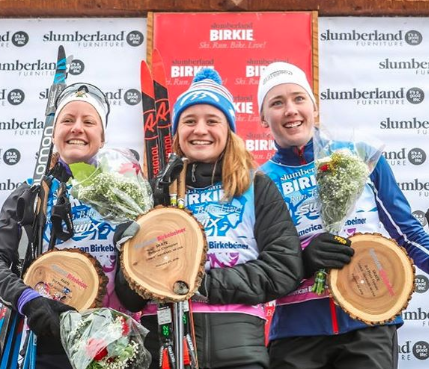
The women’s podium of the 2019 American Birkebeiner. Alayna Sonnesyn took first ahead of Anja Gruber and Katie Feldman. (Photo: Screenshot Instagram @asonnesyn)
Katie Feldman*
Club: SVSEF Gold Team
Currently lives in: Idaho
Selected career highlights: 3rd, 2019 American Birkebeiner; 5th and 6th in SuperTour races in 2019/2020 season; 7th in SuperTour sprint in 2018/2019 season
Selected career highlights: 3rd, 2020 American Birkebeiner; dozens of SuperTour podiums; three top-five finishes at U.S. Nationals over the past ten years
Instagram page: @eflowers89
Age: 30
https://www.instagram.com/p/Bgi2XuQBqKj/
Felicia Gesior*
Club: Crosscut Mountain Sports Center
Currently lives in: Montana
Selected career highlights: 10th, 2020 American Birkebeiner; 5th and 10th, 2019/2020 SuperTour races; four top-10 finishes, 2018/2019 SuperTour
Selected career highlights: Bronze medal, 10 km skate, 2015 World Championships; five-time champion, American Birkebeiner; multiple national championships
Instagram page: @caitlincgregg
Age: 39
Elizabeth Guiney races at the PyeongChang World Cup in 2017. (photo: Nordic Focus)
Elizabeth Guiney
Club: Craftsbury Green Racing Project, or Craftsbury
Currently lives in: Vermont
Selected career highlights: 8th, 2020 American Birkebeiner; six top-10 results, 2019/2020 SuperTour; 3rd, 2015 Nationals
Instagram page: @lizzie_guin
Age: 29
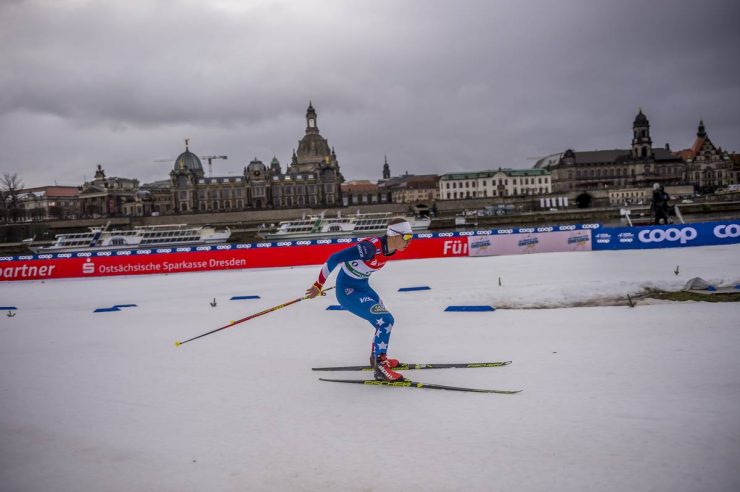
Julia Kern skis to 15th in the qualifier in Dresden in January 2020. (Photo: NordicFocus)
Julia Kern
Club: USST B Team; SMS
Currently lives in: Vermont
Selected career highlights: bronze medal, skate sprint, 2020 U23 World Championships; 3rd, Planīca skate sprint, 2019/2020 World Cup season; multiple other World Cup top-30 finishes; bronze medal, relay, 2017 World Juniors
Instagram page: @juliakernski
Age: 22
Kaitlynn Miller (front) during the women’s classic sprint at the 2020 Senior Nationals. (Photo: Reese Brown)
Kaitlynn Miller
Club: Craftsbury
Currently lives in: Vermont
Selected career highlights: Five national championship podiums, including 2016 classic sprint national championship; 17 SuperTour podiums; 34th in World Cup 10km skate race in 2018/2019 season
Instagram page: @kaitlynnbmiller
Age: 28
Becca Rorabaugh on course during the 10-kilometer individual start classic in Lahti, Finland, last month. (Photo: NordicFocus)
Becca Rorabaugh
Club: APU
Currently lives in: Alaska
Selected career highlights: Five national championship podiums, including 2014 10km classic national championship; 14 SuperTour podiums; 24th in sprint in 2012/2013 World Cup season, 39th in World Cup 10km classic last month
Instagram page: @beccarorabaugh
Age: 30
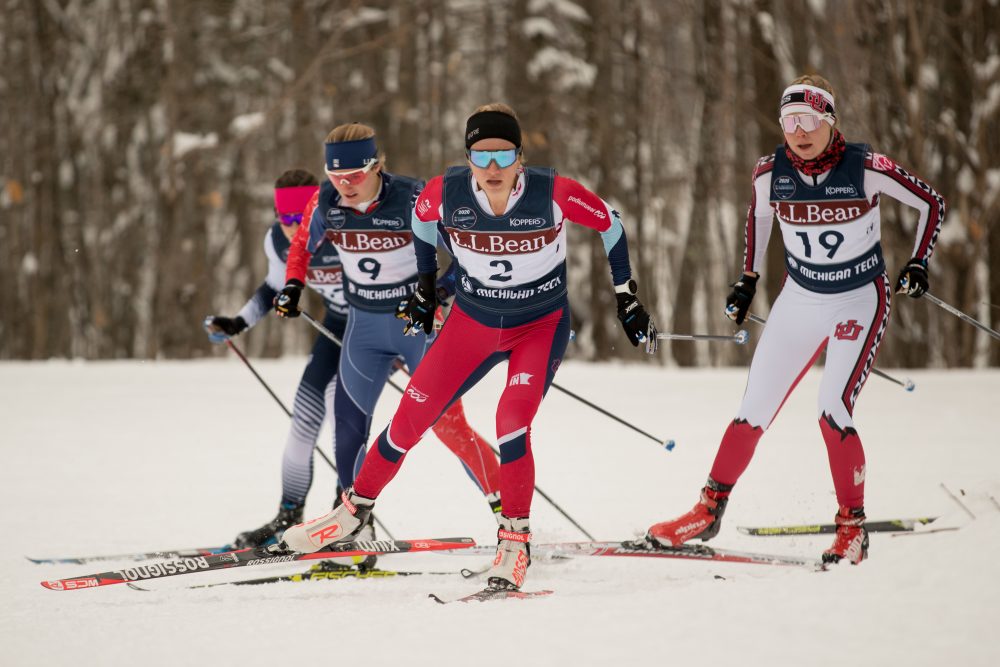
Alayna Sonnesyn (bib 2) races in the skate sprint heats at 2020 U.S. Nationals. (Photo: Reese Brown)
Alayna Sonnesyn
Club: SMS
Currently lives in: Vermont
Selected career highlights: winner, 2019 American Birkebeiner; three podiums at 2020 national championships; three SuperTour podiums; finisher, Ski Tour 2020
Instagram page: @asonnesyn
Age: 23
Hailey Swirbul (APU) during the women’s 10 k skate at 2020 U.S. Nationals. (Photo: Reese Brown)
Hailey Swirbul
Club: USST B Team; APU
Currently lives in: Alaska
Selected career highlights: silver medal, 5km classic, 2018 World Juniors; bronze medal, 10km skiathlon, 2018 World Juniors; 21st, Davos skate sprint, 2019/2020 World Cup season; three other World Cup top-30 finishes this season; bronze medal, relay, 2017 World Juniors
Instagram page: @hai.swirl
Age: 21
Callie Young, of Newport, Vt., racing to second overall in the women’s race at the 2017 App Gap Challenge in Fayston, Vt. (Photo: Laurel Minde)
Callie Young*
Club: Dartmouth
Currently lives in: Vermont
Selected career highlights: Fourth, FIS Junior Invitational “Rising Stars” Race, Québec City, March 2019; first, 2020 Bates Carnival; 54th, sprint qualification, 2020 World Juniors
Instagram page: @calliey0ung
Age: 19
* The athlete is making her World Cup debut in Québec City.
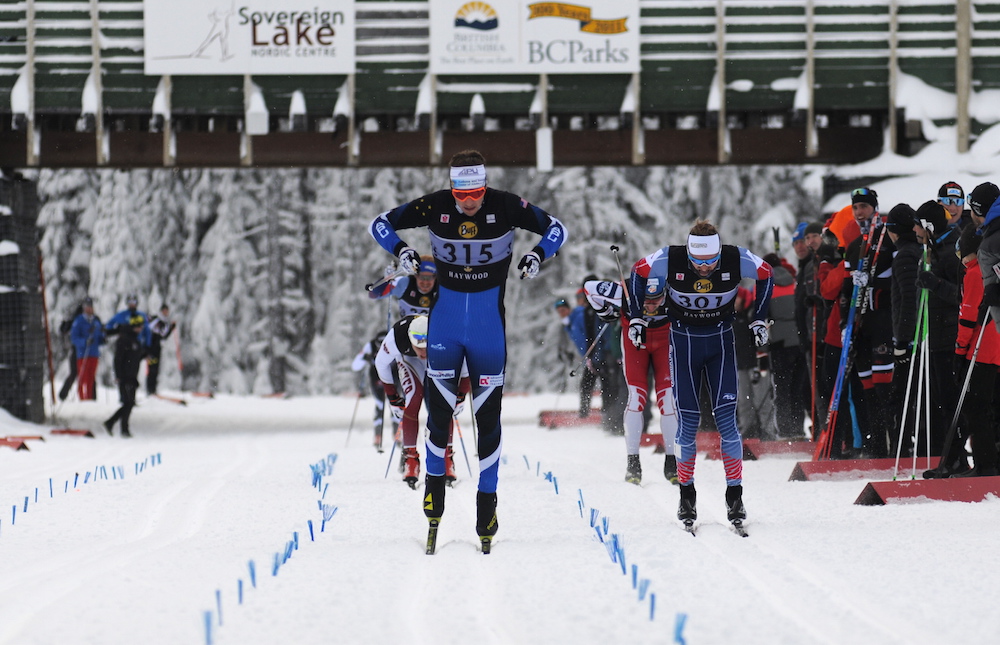
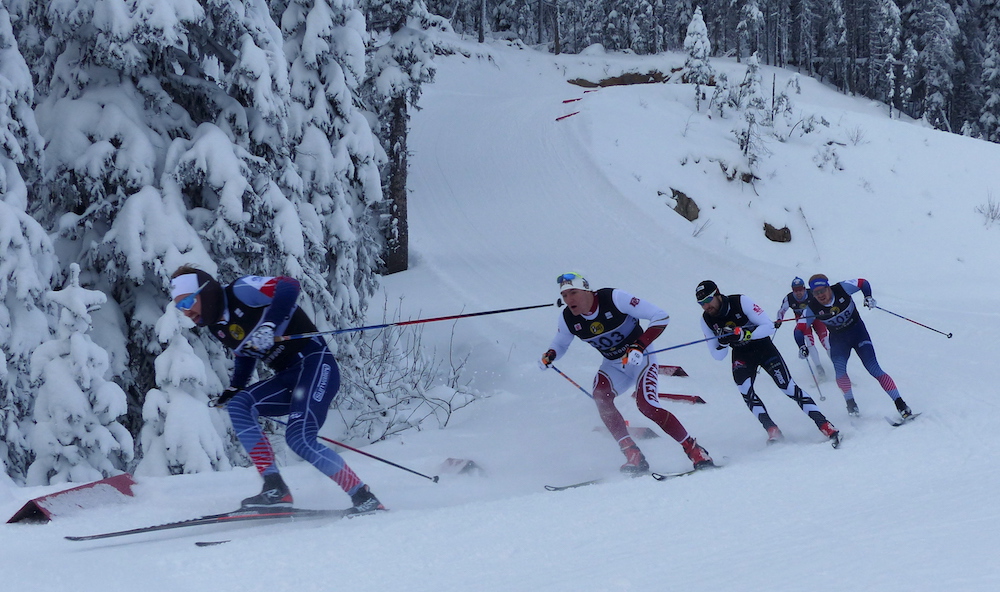
APU’s Reese Hanneman (315) leading down the finishing stretch of the Sovereign Lake NorAm/SuperTour men’s classic sprint final on Dec. 10, with Sun Valley’s Cole Morgan (r), the University of Denver’s Moritz Madlener (behind Hanneman), Stratton’s Ben Saxton (behind Morgan), and Sun Valley’s Matt Gelso (behind Madlener) chasing. (Photo: Doug Stephen)
VERNON, B.C. — It might’ve been the first Canadian NorAm of the season, but the Americans made it all about themselves in what also doubled as their second stop on the U.S. SuperTour circuit this past weekend at the Sovereign Lake Nordic Centre.
U.S. skiers kept Canada off the podium in the classic sprints and freestyle intervals starts on Saturday, Dec. 10, and Sunday, Dec. 11, with Olivia Bouffard-Nesbitt, of the Alberta World Cup Academy (AWCA) and Canadian U25 Team, coming closest in fourth on Day 1.
On Saturday, Bouffard-Nesbitt started off the very first NorAm race, a 1.2 k classic sprint, with a qualifying win. She went on to advance in second in her quarterfinal and third in her semifinal, before finishing fourth in the A-final, 1.49 seconds out of first.
American Julia Kern of the Vermont-based Stratton Mountain School (SMS) Elite Team (formerly the T2 Team) won the women’s final in 3:17.04, after qualifying fifth and placing second in both her quarterfinal and semifinal. Kern led two Craftsbury Green Racing Project (CGRP) teammates, Liz Guiney and Kaitlynn Miller, in second (+0.67) and third (+0.91) on the podium, respectively.
Olivia Bouffard-Nesbitt (AWCA) leads the Americans through the bridge turn in the women’s classic sprint A-final on Saturday, Dec. 10, at the Sovereign Lake NorAm/SuperTour. Stratton’s Julia Kern (second from r) made a tactical choice more than a minute earlier, which gave her the inside position on Craftsbury’s Kaitlynn Miller (l) and the advantage she needed to win. (Photo: Peggy Hung)
Bouffard-Nesbitt led the six finalists into the finishing straight after opening up a wide gap at the top of the second climb.
“Yeah, those Americans,” Bouffard-Nesbitt told FasterSkier after the race. “I was in first until we hit the final finishing straight, and then I just got out-double poled by three of the girls.”
Kern, a U.S. Ski Team Development Team member and Dartmouth student, credited tactical choices for her victory.
“In the quarterfinal, I made the mistake of not taking the outside, which turned into the inside turn on the second downhill,” Kern said.
The second downhill on Sovereign’s sprint course has a gentle right turn leading into a high-speed left, followed by the long climb and then two sharp left turns to the finish. Keeping control of the inside for the last three turns gave Kern the ideal position to take the second skied-in finish lane to cross the line first.
Guiney followed Kern to second, leaving Miller with the fresh snow in lane three.
“I was in third the first half of the course, just stayed in the mix,” Miller said of the final. “I really like the striding hill at the end.”
Despite being slowed in the final straight, Miller loved the conditions.
“This course is really nice, the conditions are awesome,” she said. “I love all the fresh snow. We had really great skis today, so that always helps.”
While Bouffard-Nesbitt was disappointed that there wasn’t a Canadian on the podium, she was happy with her day.
“I haven’t really sprinted this year,” she said, referring to a stress fracture in her foot that put her on crutches for several months this summer. “The intensity I’ve done since I’ve been back on my feet has been almost exclusively controlled Zone 3.”
The fourth American in the top five, Jennie Bender of the Bridger Ski Foundation (BSF) qualified third and finished fifth overall (+3.8). The SuperTour leader after West Yellowstone’s first two races of the season, she was disappointed with fifth.
“It was a tough field out there,” Bender said. “It’s a really short course, lots of turns, three different 180-degree turns. I kind of got swallowed up on the last downhill and lost a little gusto.”
Asked if she was tempted to double-pole the course, Bender laughed and said, “I was! I might of been interested to do it during the qualifier, but I was third, and yeah, I’ll keep the striding.”
A third Craftsbury skier in the A-final, Heather Mooney qualified ninth and went on to finish sixth in the final (+19.84).
“It’s a really fun course, fun with lots of transitions,” Mooney said. “Off the start of the final, I was really excited that we had three from our team. I just didn’t quite have it at the beginning, caught back up a little bit, but I was definitely on and off the back of the pack. Came in last, but it was a good day.”
All six of the women’s B-finalists were American, with Becca Rorabaugh of Alaska Pacific University (APU)ultimately placing seventh, Erika Flowers (SMS Elite) eighth, Mary O’Connell (CGRP) ninth, Jessica Yeaton (APU) 10th, Mary Rose of the Sun Valley Ski Education Foundation (SVSEF) 11th, and Anne Hart (SMS Elite) 12th.
“I definitely wasn’t skiing as fast as I would like to be,” MacIsaac-Jones said, “but I am definitely just happy to be racing and on snow.”
She was eliminated after placing fifth in her quarterfinal and skipped the 10 k freestyle on Sunday for a distance training session instead.
***
The men’s final on the first downhill at the Sovereign Lake NorAm/SuperTour on Dec. 10 near Vernon, B.C. Sun Valley’s Cole Morgan leads Denver’s Moritz Madlener, CNEPH’s Antoine Briand, Sun Valley’s Matt Gelso, and Stratton’s Ben Saxton Saxton in pursuit of APU’s Reese Hanneman (not shown). (Photo: Peggy Hung)
The men’s classic sprint shared the same 1.2 k course and the same American domination of the podium after a semifinal crash took three Canadians out of contention.
Reese Hanneman (APU) double poled to the win in 2:38.08 after qualifying 15th. Cole Morgan (SVSEF) and Ben Saxton (SMS Elite) rounded out the podium in second (+0.87) and third (+1.92), respectively.
“I had a really bad qualifier, for me. I chose a classic ski,” Hanneman said of his qualification round. “But I think [grip wax] was much slower, as the heats showed.”
He described the A-final as fast from the start.
“I had a decent start; I was in second behind Cole up until the top of the first climb. I made a pass, double poled by him, and I was kind of leading into the big climb,” Hanneman recalled.
“Then he and I were side by side, one and two, with a little gap. Then up the steep pitch, he took the lead and I tucked in behind him and just followed him over the bridge. I was able to close down the gap and then pass him and then turn on the jets coming in the final double-pole section.”
Morgan, who won the qualifier and was one of the four others on skate skis in the final, was also pleased with his tactics.
“I did the same tactic as I did in every heat, try to be in second place coming into the big downhill before the last hill,” Morgan said. “[I] was able to lead over the top, but didn’t have the same finish as Reese did.”
Saxton double poled all four laps, as did Hanneman, Morgan and many of the top men.
“I think that was the faster call, but it was definitely a physical task those last heats there,” Saxton said.
Another double poler in the final, the University of Denver’s Moritz Madlener ended up fourth (+1.92) after qualifying third.
“Considering how much we trained the last couple of weeks, it was a great result,” he said.
For Madlener, who is originally from Germany, this marked his first visit to Canada.
“This is German territory. The last time there was a World Cup here, the first five were Germans,” he said, probably not realizing that it was 11 years to the day since that 30 k pursuit event.
The lone finalist on grip wax, Matt Gelso (SVSEF) finished fifth (+3.88) after winning his crash-marred semifinal. Antoine Briand of the Pierre-Harvey National Training Centre (CNEPH) was the lone Canadian in the A-final, with a lucky loser time that was faster than Gelso’s winning time from the other semifinal.
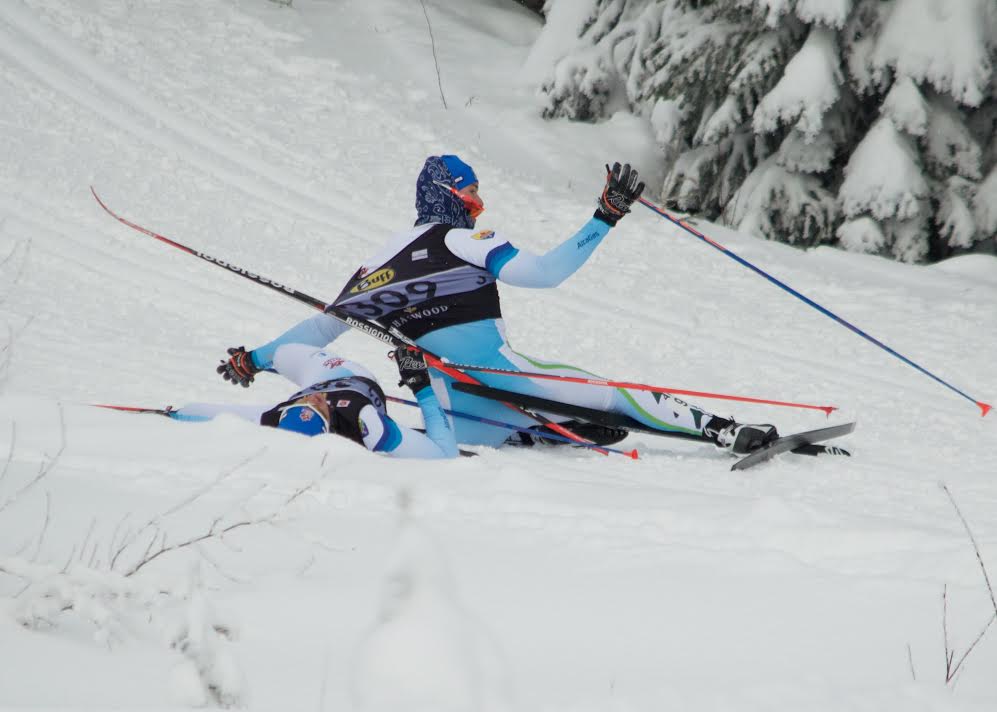
Angus Foster (309) untangles himself after a semifinal crash at the Sovereign Lake NorAm/SuperTour on Dec. 10, as his NTDC Thunder Bay teammate Evan Palmer-Charrette tries to get his breath back. The ski through the bib belongs to Simon Lapointe. (Photo: Shelley Woodman)
For a few Canadian athletes, the crash in the second semifinal was the defining moment of the day. Only 50 metres into the race, Gelso used his inside position in the tight pack to pull in front of Angus Foster, of the Thunder Bay National Team Development Center (NTDC), but Gelso skied over Foster’s ski, triggering a chain reaction.
“[Gelso] got through, but I went down, had two other Canadians go down with me,” Foster said after. “Probably the hardest crash we’ve ever had.”
Foster fell sideways in front of NTDC teammate Evan Palmer-Charrette.
“I just got unlucky, [Foster] fell right in front of me, and I just pitchforked over him, got the wind knocked out of me pretty bad,” Palmer-Charrette said. “Unfortunate, but that’s racing.”
CNEPH’s Simon Lapointe was the third skier in the tangle. Lapointe got up quickly, but a broken binding required him to wait for a coach to run over with a spare ski.
Palmer-Charrette was slow to get up, leaving Foster pinned in place. Foster finished the heat with three holes in the back of his race bib and likely a few ski-shaped bruises underneath.
Lapointe, one of the top Canadians sprinters, was the most frustrated with the semifinal crash. He left the finish area with a quick French-language “nothing to say” before going on to win the B-final by 1.06 seconds over Palmer-Charrette in 2:43.31.
None of the three Canadians protested to the jury member at the finish. Asked directly about whether there was cause for a protest, Foster said “That wasn’t a clean move, but that happens. People make mistakes. Still frustrating, but….”
Gelso was surprised to find only one skier with him at the top of the second climb. “We both went for a track at the same time, and I don’t know what happened,” Gelso said later, “but I’ve been on both ends of that.”
Everyone interviewed spoke favorably of the combined NorAm/SuperTour weekend.
“It’s really nice to get some deeper fields, to get the Americans and Canadians racing together,” Foster said. “It wasn’t so fun to watch the podium here.”
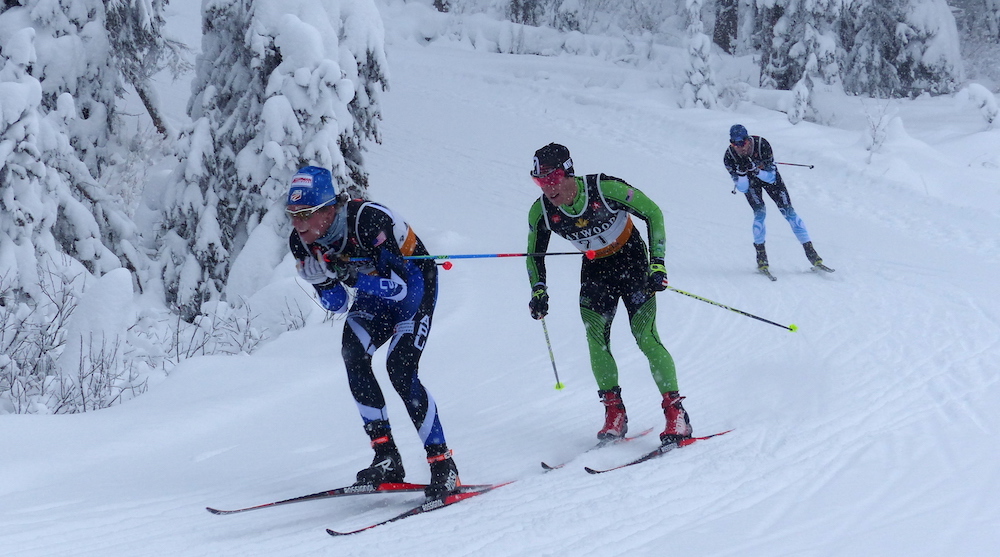
APU’s Scott Patterson leading Canadian junior Ty Godfrey (Team R.A.D.) during the men’s 15 k freestyle interval start on Sunday, Dec. 11, at the Sovereign Lake NorAm/SuperTour. (Photo: Peggy Hung)
Day 2 at Sovereign proved to be more populated with Americans sweeping the top five and nearly the top 10 in the men’s and women’s distance freestyle interval starts.
In the men’s 15 k, Scott Patterson (APU) topped the field by 13.2 seconds with a winning time of 40:00.2. Gelso reached the podium in second — his third this season in four SuperTour races — and Tad Elliott (Ski Club Vail) placed third (+26.6).
The U.S. swept the top eight with Brian Gregg (Team Gregg) in fourth (+54.8), Paddy Caldwell (SMS Elite/Dartmouth/USST) in fifth (+1:20.5), Ben Lustgarten (CGRP) in sixth (+1:27.4), Madlener in seventh (+1:31.3), and Kyle Bratrud (CXC Team) in eighth (+1:33.5).
Russell Kennedy of the Canmore-based Team R.A.D. was the top Canadian* in ninth (+1:38.8), and John Hegman (SVSEF) finished 10th (+1:44.2).
(*While Kennedy lives and trains in Canada, he is originally from Truckee, Calif.)
Out of 112 finishers in the men’s race, nearly 50 were American, and two were Australian national team members.
“Gelso’s definitely in good shape so it was good to hear splits out there that I was leading,” Patterson said. He started in bib 94 behind Gelso in bib 80.
“Fifteen k skate’s kind of been my game, one race I can always fall back to and know I can ski pretty fast,” Patterson added.
Asked about the event doubling as a SuperTour, he said it added competition.
“I would have loved to see the Canadians in West [Yellowstone], but it’s a weird course, makes sense to skip it,” he said of the SuperTour’s usual first stop on the circuit (one of the few places in the U.S. with reliable early season snow) at the Rendezvous Ski Trails in West Yellowstone, Mont. The SuperTour opener was originally scheduled for Bozeman, Mont., which would have been a NorAm as well, but moved because of low snow.
“It’s always fun to have a bunch of people that you don’t know all that well,” Patterson added. “This is my first time in Silver Star and it’s been great. Real winter, and we’ve been lacking that in Anchorage [Alaska].”
After spending a good chunk of last season in Europe on the World Cup, Patterson noted that even those venues tend to rely on manmade snow.
“It’s nice to have dumping snow out here,” he said.
“I think the third lap, things started to slow down,” Patterson added about the race itself. “I was getting ice through my glasses and eyes. It made things feel a little more closed in, feel like it’s snowing harder. I think it slowed down a little bit, but maybe that’s just getting tired, too.”
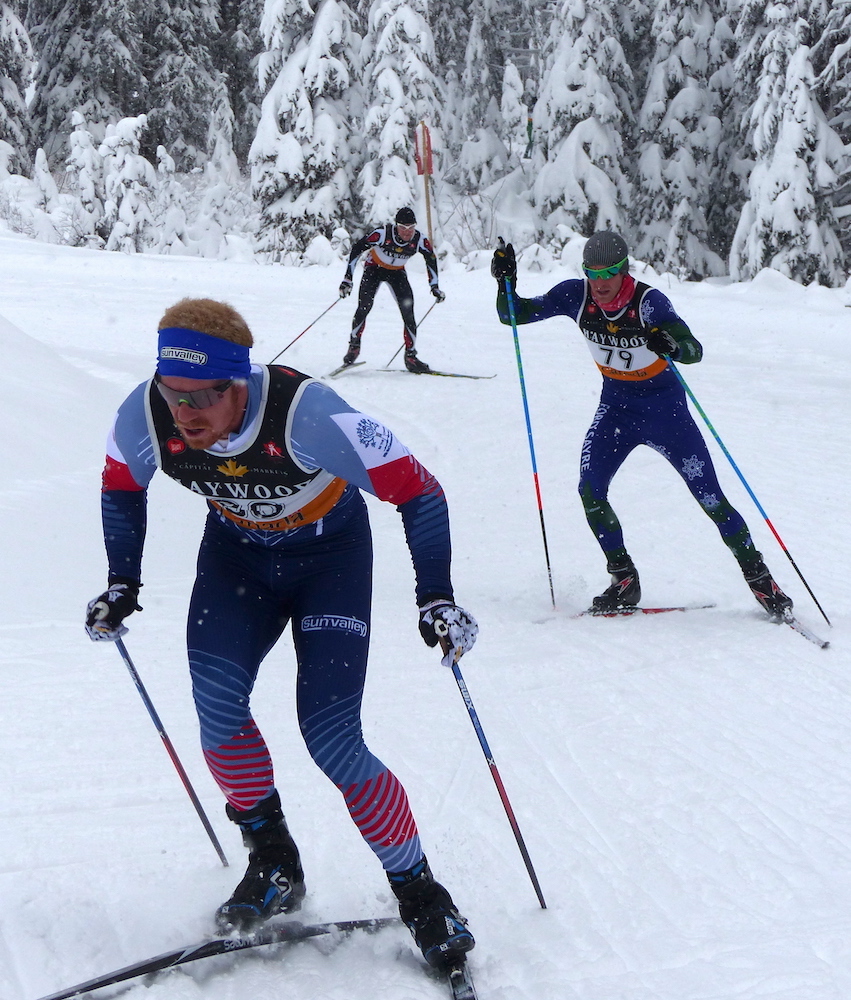
Sun Valley’s Matt Gelso (front) charging a false flat on his first lap of the men’s three-lap 15 k freestyle on Dec. 11 at the Sovereign Lake NorAm/SuperTour, followed by Welly Ramsey (Ford Sayre). (Photo: Peggy Hung)
Gelso recalled a slower last lap as well, but was pleased with his effort.
“It’s a great course, and it was fun,” he said.
Gelso was strongly in favor of combining the two North American circuits whenever possible, recalling a conversation he had with some U.S. and Canadian national-team members at 2015 World Championships.
“Devon Kershaw and a bunch of the Canadians and Americans were staying in the same hotel, and we were talking about how cool … instead of having one Canadian, one American that goes to the World Cup on the Continental Cup, why [doesn’t the International Ski Federation] give North America three spots for Canada and the US, and all of our races are together?” he said. “Sometimes it will be three Americans, sometimes it will be three Canadians, sometimes it will be two and one, whoever’s racing fast. The more we are racing together, I think the better we’re going to fare internationally.”
“I mean, we’re friends with these guys, we know who they are,” Elliott said of racing with Canadians. “Michael Somppi, Kevin Sandau, they’ve been visited us at U.S. nationals last year. Silver Star’s gorgeous, great skiing, great course, well-run races, so it’s always a pleasure to visit here.”
Elliott, a former U.S. Ski Team distance skier, described feeling surprised with his effort on Sunday after what he called a “great sprint” in West Yellowstone (in which he placed 14th) followed by a head cold, which forced him to skip the West Yellowstone distance race.
“I rested all week indoors, and I felt incredible today,” he said.
Kennedy in ninth called his race a solid start, but had hoped to finished a “little higher up.”
“The U.S. guys are skiing super-strong right now, you could just see it out there,” Kennedy said. “I thought I was skiing pretty well, and then got some splits off of Gelso, and OK, they’re moving. I am hoping when we have [World Championships] trials in Park City, we’ll be a little bit more up there, but we’ll see. It’s good to have that competition, too. You can’t rest anywhere, you have to push everywhere, so that’s good.”
Asked about the NorAm/SuperTour combo, he was also positive.
“It’s good for us to have the extra competition and it’s good to race new faces,” Kennedy said. “Especially in sprints, you get used to the same tactics from the same people. When you have someone new, it’s nice to have to adjust your tactics and be prepared for what they’re going to do when you don’t know them as well. In distance, it’s really cool to have new guys to chase. I can kind of know the Canadians, what’s happening with them, but I was chasing down David [Norris] today, and he kind of surprised me how strong he was on the last lap, it was good to have that extra push, for sure.”
The second-fastest Canadian man of the day, Alexis Dumas (CNEPH) placed 15th (+2:13.1).
“I feel really fast on the one-skate, and the uphill was good, too,” Dumas said after. “I improved a lot my offset this summer, so it was good for this course.”
In terms of season goals, he’s looking to qualify for U23 World Championships, where he’d like to achieve a top 20.
***
Chelsea Holmes leads Erika Flowers at the 5 k mark of the women’s 10 k freestyle interval start on Sunday, Dec. 11, at the Sovereign Lake NorAm/SuperTour. (Photo: Marie-Éve Bilodeau-Corriveau)
In the women’s 10 k, Chelsea Holmes (APU) took the win in 30:42.9, topping the time of the race’s previous leader, Katharine Ogden (SMS Elite) by 13.4 seconds. Stratton had two on the podium with Flowers in third, 36.4 seconds back from Holmes.
“The course was really hard, but my techs and coaches gave us really good skis,” Holmes said after. “Today, I had the most amazing team, all the boys finished and they were cheering so hard.”
Holmes started 30 seconds after Flowers and 1 minute behind her APU teammate Rosie Frankowski.
“Chelsea started right behind me, and her and Frankie [Frankowski] and I all skied together for most of it, which made it a lot more fun cruising through the snow,” Flowers recalled. “We had a good little crew going, so it was hard, but hard with friends.”
Frankowski finished with Holmes and 59.9 seconds off her winning time in sixth place, behind Gregg in fourth (+40.8) and Rose in fifth (+51.7). APU had three in the top seven with Rorabaugh in seventh (+1:09.8). Craftsbury’s Guiney placed eighth (+1:17.9), Deedra Irwin (SVSEF) was ninth (+1:18.4), and Kern, Saturday’s sprint winner, 10th (+1:24.8).
For the second day in a row, Bouffard-Nesbitt was the top Canadian woman, placing 13th (+1:51.8). Of the top 20, the U.S. swept all but three places: 13th, 18th with NTDC’s Annika Richardson, and 20th with Sovereign Lake’s own Hannah Mehain. (Both Richardson and Mehain belong to Canada’s Junior National Team.)
“I’ve never had an easy race at Silver Star,” Bouffard-Nesbitt said after Sunday’s 10 k. “It was really hard as usual. To be honest, all morning, I feel pretty wrecked from yesterday’s race. Whole body, that sprint really took a toll on me. I was kind of just trying to play the hand I was dealt the best I could, make the most of it. I think I’m happy with it.”
Asked how she felt about being the top Canadian for the second-straight day, albeit outside the top 10, she replied, “Let’s say, bittersweet. Obviously, we want to have Canadians represented at the top of these fields, among the Americans, but of course I’m happy to be top Canadian.”
Regardless, she was glad to have the competition.
“We not coming here to have easy wins; we’re coming here to be challenged,” Bouffard-Nesbitt said. “I’m very happy to have them here, and I’m very happy when they can show us what fast racing looks like.”
Sixty-two women finished the distance race, and about half were American. Most of the NorAm field is headed to Rossland, B.C., for next weekend’s NorAm, which is not a SuperTour and will not count toward the U.S. Ski & Snowboard Association’s (USSA) national ranking list.
USST’s Sadie Bjornsen racing to 29th in the World Cup 10 k freestyle individual start in Davos, Switzerland, Dec. 20, 2014. (Photo: Fischer/Nordic Focus)
Liz Stephen entered Saturday’s 10-kilometer freestyle in Davos, Switzerland, with a goal of placing in the top 10. While she missed her target by 4.9 seconds and earned a 12th place on the day, the result was a promising step for the 27-year-old as she continues to improve with every race.
The Vermont native led a small American contingent in the 10/15 k competitions. Only four other U.S. racers – Jessie Diggins, Sadie Bjornsen, Caitlin Gregg, and Erik Bjornson – participated Saturday, as many athletes were either resting for Sunday’s sprint or stateside for the holidays.
Stephen finished 1:00.8 back from women’s 10 k winner Marit Bjorgen of Norway, who continued to demonstrate her strength with a time of 24:57.7. Stephen started the 10 k with a strong effort, clocking the 11th fastest time at the 2 k mark. While she slipped to 17th at the 5 k mark, she was able to pick off five places to finish 12th .
Starting with bib seven, Stephen crossed the line as an early leader. She remained in the leader’s chair until eventual fifth place finisher Claudia Nystad of Germany unseated her.
Stephen’s goal to reach the top-10 was a challenge even before she began her race due to the nature of the terrain. The Davos 5k course featured many gradual hills and rolling flats that favor strong V2 skiers. In contrast, Stephen often excels on hilly courses that require V1.
Stephen’s strong finish impressed USST Head Coach Chris Grover.
“It’s not necessarily a course that plays to her strength. It’s more of a V2, downhill and tuck-skate course. For her to be 12th and five seconds from the top-10 on a course that doesn’t have that much V1 and [for her] to be able to pull away from other people was great,” he said in a phone interview.
To combat the lack of sharp inclines, Stephen said she worked to conserve energy so that she could give it her all on the important flat and downhill sections of the course.
“You can lose time on the way back down and on the flats. That’s where I need the energy to ski technically well to carry my ski. I was trying to work every opportunity I could for a couple seconds here and there,” she said in phone interview.
Liz Stephen (U.S. Ski Team) was the top American in Saturday’s 10 k freestyle after she placed 12th. She was 4.9 seconds out of the top-10. She’s picture here in the first stage of the Tour de Ski in Oberhof, Germany. (Photo: Marcel Hilger)
She also aimed to ski the downhills with aggression. The task was easier said than done, however, as the conditions in Davos were slick and incredibly fast. A combination of warm temperatures and cold nights made the trails resemble an ice rink, leading Stephen to feel like “a deer on ice.”
“There’s never really a downhill you’re resting on and any downhill that you’re going on is pretty technical. It was extremely fast today, and the stadium looked like rock solid ice,” she said of the conditions.
Despite placing two spots outside her goal, Stephen said she was pleased with her result and season trajectory. She also noted that Saturday’s race did not demonstrate her abilities – a good sign for upcoming races.
“Each weekend is a little bit of a step forward for me and that’s a fun way to go about it,” she said. “I didn’t race as well as I possibly could have to get a top ten, so I’m happy with the way it ended up.”
Stephen was in a similar position in 2013 and delivered strong results afterwards. She raced the same 10 k course in a 2013 Davos World Cup and finished roughly a minute back from Therese Johaug in 15th. Two weeks later, she placed fifth in the World Championship 5 k.
Two other U.S. skiers placed in the top-30, with Diggins (+1:30.2) and Sadie Bjornsen (+1:35.5) finishing in 27th and 29th.
Diggins said that although the course favored her strengths, the icy conditions led to a less-than-ideal result for the Minnesota native. Diggins also suffered two hard falls earlier in the week, making her more cautious on the unstable course.
“I tried my best and was focused the whole time, pushing for those seconds. I think that top gear just wasn’t there today, so it was an ok race, but not a great one.” she said in a phone interview. “I paced it better than in past years, but I definitely wasted some energy on the icy rock hard stadium area, bobbling around trying to ski smoothly and not fall.”
Bjornsen was pleased with her result, explaining that she considers a top-30 finish in a freestyle race a good day.
She, like Diggins, also fell in on the course in the lead up to the weekend’s races, but had a different approach to the consequences.
“I had a couple bad falls a few days ago so I’ve just been stiff and mentally out of it. I often find that it is better for me because I have less time to focus and get nervous,” she explained in a phone interview.
Bjornsen entered Saturday’s competition hoping to ski with an improved strategy on last week’s 10 k classic. The 25-year-old said she was able to find the elements she had been missing in the previous weekend of racing .
“I went into today without a huge goal, I just wanted to stay positive the whole time and really work on the top part of the course because I missed that last weekend. I feel like I was really able to push today, hold it together mentally, and pick off a few places at the end,” she said.
Caitlin Gregg was the final U.S. woman in the 10 k, finishing 54th in a field of 55 women. Prior to Saturday, she suffered an illness that has been circulating within the USST since November.
“Caitlin has been wrestling with the same cold that has been going through the team the past few weeks. She didn’t feel the cold was affecting her today but she just didn’t have the gear to perform this week. I’m sure being sick mid-week didn’t help with that,” Grover said of Gregg.
The lone U.S. male to start in the 15 k freestyle was Erik Bjornsen.
Bjornsen finished the race in 56th position and 2:00.4 behind Anders Gløersen of Norway who won with a time of 34:27.9.
Despite feeling “off” while preparing for the 15 k, Bjornsen started the race with the hope of a good performance. However, he, like many of his teammates, found the course conditions inhibiting his skiing.
“Usually a race track will have a couple technical corners but rarely do I feel scared in a race. Today there was a downhill on the track that was probably the sketchiest I have ever seen in a race. The corner got worse and worse every lap,” he said.
In addition to the unfavorable conditions, Bjornsen said he was too relaxed and conservative throughout the entirety of the race.
“Times were tight and every minute you spent unfocused or relaxed was going to cost you even more then normal. I think this hard block of racing and training is starting to catch up with me,” he said.
Once Bjornsen finishes tomorrow’s sprint, he will have completed his first full period of World Cup racing. He explained that starting in every race during the period was a season-goal of his, and that the experience he gained in the last four weeks of racing will benefit him as he progresses through his season and career.
Several USST athletes choose to rest for Sunday’s 1.4 k freestyle sprint, accounting for the small numbers of American skiers on the race course Saturday. Those skiers include Simi Hamilton, Kikkan Randall, Sophie Caldwell, and Ida Sargent who will return to competition Sunday. Also missing from the distance start lists were Andy Newell and Reese Hanneman who both recently traveled back to the U.S.
Newell will return to Europe for the Tour de Ski, while Hanneman will rest in Alaska after a difficult three weekends of racing on the World Cup. He will then compete in U.S. nationals in Houghton, Mich., starting Jan. 4.
Heading into Sunday’s freestyle sprint, Grover said the entire team was confident that it could improve on last week’s results in the same event.
“We are optimistic that we can have a better day than last week… We will have a bigger group, but we still won’t be back to where we are when we are at full strength… but we will be headed in the right direction,” he said.
Race organizers delayed the start of the women’s SuperTour 10 k classic mass start by an hour Sunday at Bohart Ranch near Bozeman, Mont., in order to let the course thaw.
BOZEMAN, Mont. — Rosie Brennan of Alaska Pacific University (APU) overcame what she called her “least favorite conditions” to notch her third-straight SuperTour victory on Sunday in the women’s 10-kilometer classic mass start at Bohart Ranch.
Saturday’s 45-degree temperatures left the course fast and icy upon freezing overnight, making the numerous corners even trickier. Race officials delayed Sunday’s race by an hour to allow for the 40-degree weather to help thaw the course.
But the conditions did not stop Brennan, 26, and teammate Chelsea Holmes from immediately breaking away from the rest of the pack. They maintained a safe distance throughout the two laps, and Holmes completed the first 5 k lap with a 1-second lead over Brennan.
Caitlin Patterson (Craftsbury Green Racing Project) holds a slim lead over Becca Rorabaugh (APU) for fourth place during a sprint to the finish of the Bozeman SuperTour women’s 15 k classic mass start.
However, Brennan would take over on the second lap, cruising into the stadium with the lead and finishing in 31:07. Holmes’s final charge came up 5.2 seconds short.
Katharine Ogden, 17, of the Stratton Mountain School (SMS) – who was second at last weekend’s 10 k freestyle in West Yellowstone – finished in third, 1:20 behind the APU skiers. Caitlin Patterson (Craftsbury Green Racing Project) was in fourth (+1:30.8), narrowly beating APU’s Becca Rorabaugh by 0.3 seconds in a sprint finish. Sloan Storey of the University of Utah was sixth (+1:59.4).
Holmes said she lost her small lead on the second lap due to Brennan’s strong double poling up the long climbs.
“She just crushes me in double pole. Which is good – I see her go by and I go as hard as I can to keep up with her, and maybe one day I will be able to,” Holmes said. “If not, I’ll work in the meantime on making up time on the uphills.”
Brennan described the conditions as her “worst nightmare,” but said that it was time for her to “conquer some fears” and ski confidently down the icy, technical hills.
“It gives you confidence for skiing in weaker conditions,” she said.
Katharine Ogden (SMS) cruises to a third-place finish in the Bozeman SuperTour women’s 15 k classic mass sprint.
Ogden, who maintained third place while trying to catch the two leaders and was 33 seconds behind Holmes after the first lap, said she was “really psyched” about her result.
She explained that while the course was slippery, “that added to the fun of it. It was an extra challenge.” She recalled agility training on rollerskis last summer, saying it probably helped her in navigating such a technical course.
Meanwhile, she said her wax techs’ work gave her “kick that lasted the whole race.”
“Our skis were really fast,” she said. “So despite the tricky conditions, they made it work.”
Rorabaugh’s fifth-place finish was an improvement over Saturday’s sprint, where she was relegated to last (sixth overall) by a jury decision after double poling too aggressively (i.e. skating) outside of the tracks.
Sunday’s race got off to a rocky start for Rorabaugh, as the basket popped off her pole right out of the gate, and she could not get a new pole until “about half a kilometer” into the race. This left her “kind of behind,” she said, though she made up time on downhills and the double-pole sections.
“I wasn’t super confident in my kick, so I double poled a lot of gradual uphills and really, really tried to make it up on the downhills,” she said.
After a holiday break, the next stop on the SuperTour is U.S. nationals from Jan. 4-10 in Houghton, Mich.
Women’s 15 k class mass start top ten | full results
1. Rosie Brennan (APU) 31:07
2. Chelsea Holmes (APU) +5.2
3. Katharine Ogden (SMS) +1:20.0
4. Caitlin Patterson (Craftsbury Green Racing Project) +1:30.8