From the FasterSkier archive — posts syndicated from athletes’ and coaches’ own blogs between 2004 and 2012, kept online as published. Current coverage is at fasterskier.com.

Tag: Emil Hegle Svendsen

  • Bye Bye Biathlon: Many Retirements After 2018 Olympic Season

    Bye Bye Biathlon: Many Retirements After 2018 Olympic Season

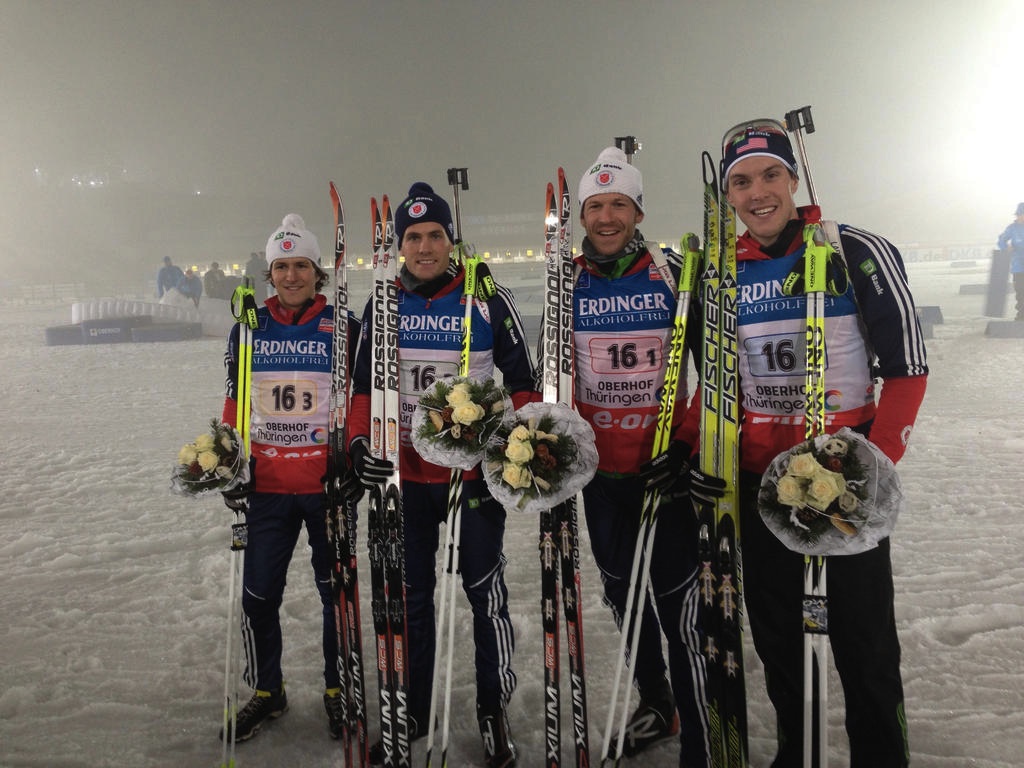
    Russell Currier, Tim Burke, Lowell Bailey, and Leif Nordgren after a fifth-place relay finish in the IBU World Cup relay in Oberhof, Germany, in 2013. Currier, Burke, and Bailey are all retiring. (Photo: USBA.)

    With the 2018 Olympics come and gone, many of biathlon’s athletes are calling it quits. Here’s a roundup of who you won’t see on the World Cup next season – and who’s still on the fence about their future.

    USA

    2017 Word Champion Lowell Bailey has long planned to retire after the 2018 season, and now that time has come. His first World Junior Championships was in 1999 and he got his first World Cup start in 2002. He raced 2003 World Championships before taking a break to go to the University of Vermont, before returning and competing in the 2006, 2010, 2014, and 2018 Olympics. His eighth-place finish in the 20 k individual at the 2014 Games are the best ever by an American biathlete. Bailey is the Executive Director of the Crosscut Mountain Sports Center in Bozeman.
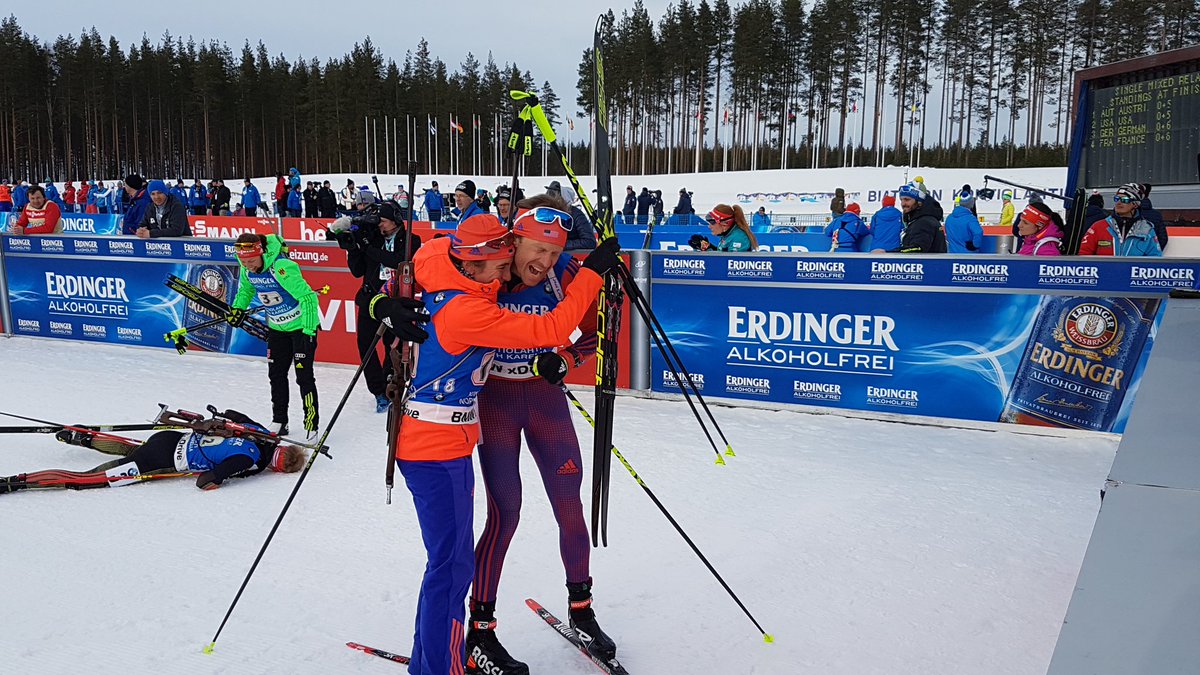
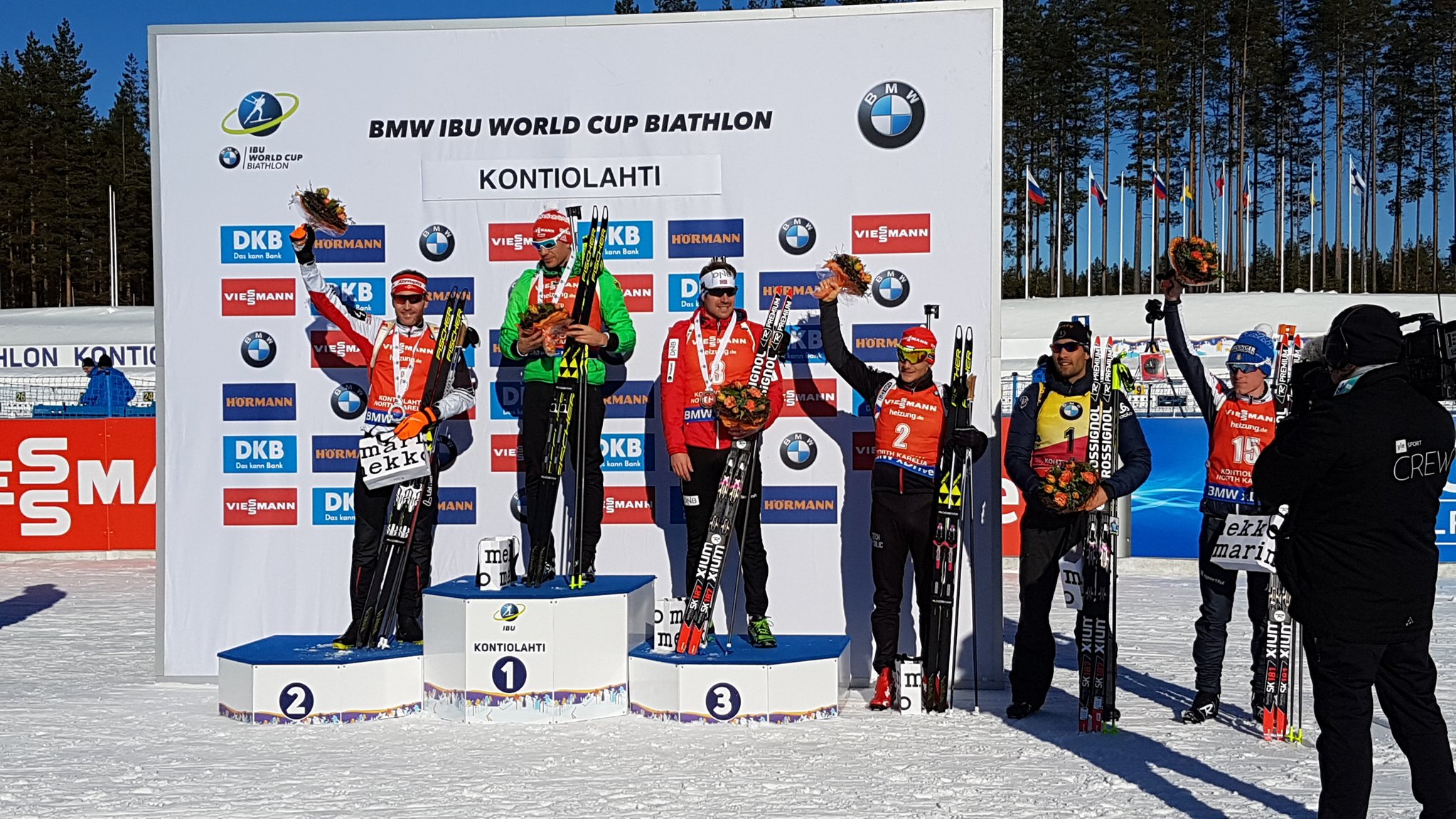
    Susan Dunklee and Lowell Bailey celebrate after finishing second in the World Cup single mixed relay in Kontiolahti, Finland, in 2017. Austria won the competition. Bailey is retiring and Dunklee is undecided as to whether she will continue racing. (Photo: IBU/Twitter)

    “I told myself this morning that I just wanted to go out on a high note,” he told FasterSkier in Oslo after leading off a U.S. relay team that finished seventh, in his last World Cup race. “I wanted to go out with a good result. And, I’m really happy to have shot clean in standing, clean from the clip in my last stage as a World Cup biathlete. That feels good. I’ll always remember that — that I went out with a clean stage.”

    Longtime teammate and 2013 World Championships silver medalist Tim Burke will also retire. Burke has six World Cup podiums to his name including that silver medal, and led the World Cup partway through the 2009-2010 season. Burke started racing internationally at 2000 Junior World Championships, and made his first senior World Championships in 2004. Like Bailey, he is a four-time Olympian.

    “It’s weird, I don’t honestly I don’t know if it’s truly hit me,” he said after the Oslo relay. “It might take weeks… I think it’s going to take a long time for all to settle in and for me to really reflect back on my career. Yeah, it’s a lot of emotion.” Burke says that his post-biathlon plans are not yet certain.
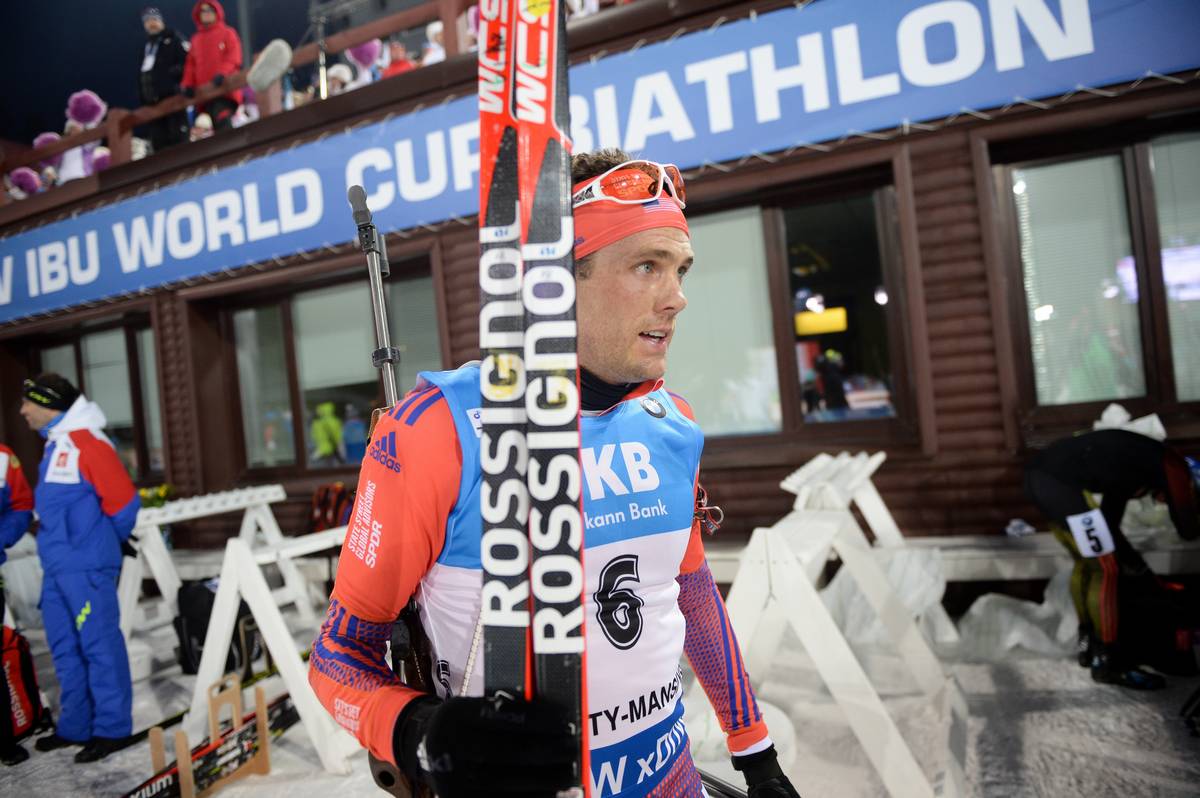
    Tim Burke after placing sixth in a World Cup pursuit in Khanty-Mansiysk, Russia, in 2016. (Photo: USBA/NordicFocus)

    Also retiring is Russell Currier, an off-and-on member of the national team and the Maine Winter Sports Center (now the Outdoor Sports Institute). Currier had two sixth-place World Cup results in 2012, and is a four-time World Championships team member. Since his World Cup debut in 2009, he has contributed to many U.S. relay efforts. He also competed at the 2014 Olympics, with a top finish of 49th, and was a member of the 2018 Olympic team though he did get any starts in PyeongChang.

    “USBA nationals will be officially be the last race of my biathlon career,” Currier wrote in an email to FasterSkier this week.

    The women’s team likely won’t see three retirements, and will thus have some more stability than the men’s crew, but there is more uncertainty regarding the women’s roster. Clare Egan wrote in an email this week that she was “Undecided!” about whether to continue racing. And in Oslo, after finishing third in the pursuit which was her last World Cup of the season, Susan Dunklee said the wasn’t sure if she would keep competing. “Ask me again in a month,” she said.

    Canada

    Julia Ransom retired in Oslo, as the 25-year-old is planning a career in dentistry and has many years of school ahead of her. “It’s just a good time for my partner and I to kind of move on,” she said after crossing the line in her final World Cup, the pursuit, hand in hand with teammate Rosanna Crawford.. “And it does feel right. It feels right.”
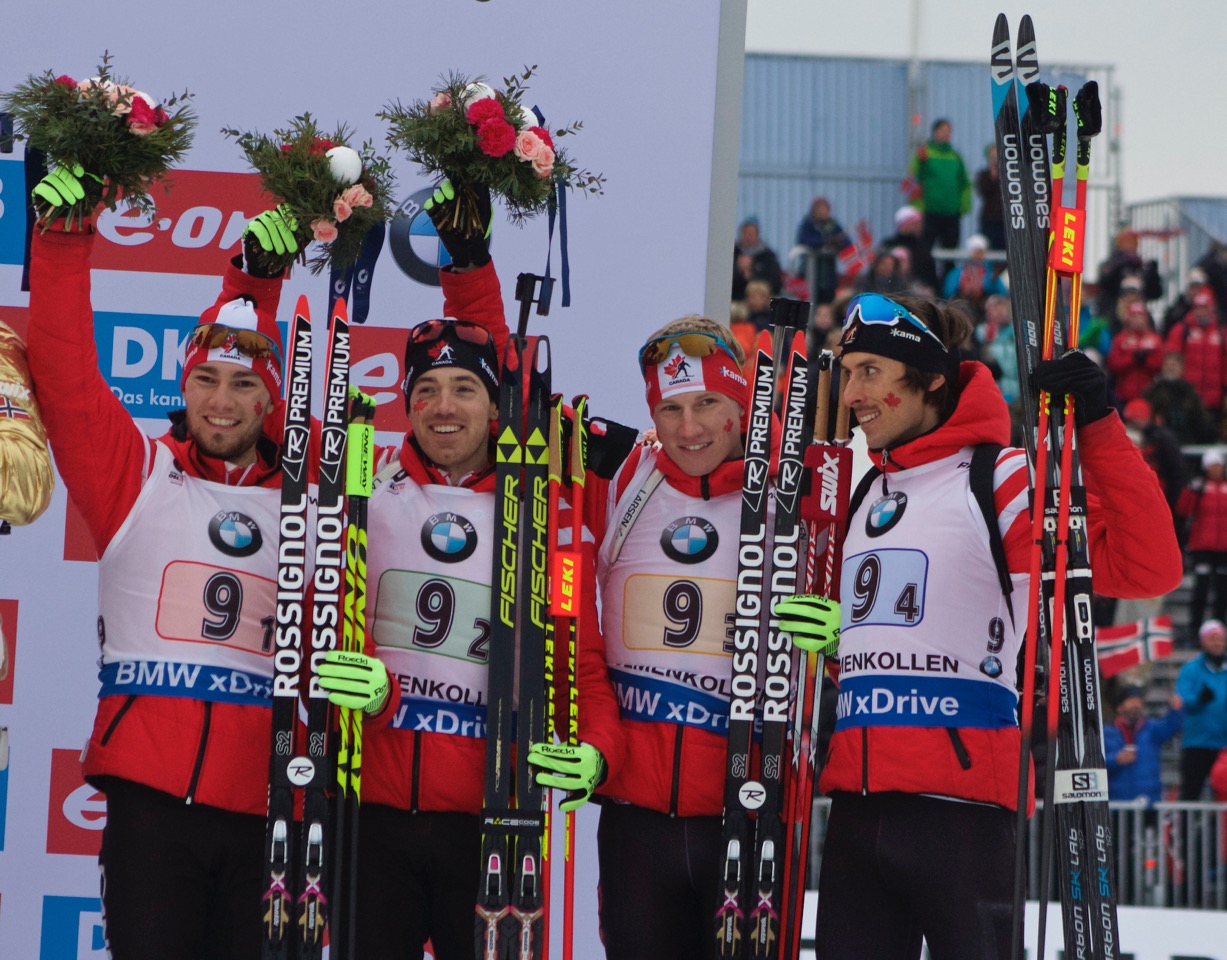
    The Canadian men’s team (l-r) Christian Gow, Nathan Smith, Scott Gow, and Brendan Green celebrate bronze in the men’s 4 x 7.5 k relay at 2016 World Championships in Oslo, Norway. Both Green and Smith are undecided on their future plans. (Photo: JoJo Baldus)

    Ransom scored two top-ten finishes at 2014 World Juniors, and made her first senior World Championships team in 2015. This season she had two top-ten World Cup finishes, and went to the Olympics in PyeongChang, where she finished 28th in the pursuit.

    She is the only one from the Canadian team who is definitely retiring, but quite a few of her teammates are on the fence and there could be huge turnover on the team depending on what they decide. That includes Rosanna Crawford and Brendan Green, even though Crawford finally bagged her first World Cup podium this season.

    “We’re not 100% sure yet,” Green said after the relay in Oslo. “Both Rosanna and I will sit on it a little bit over the spring. We will reevaluate a little bit and see what other opportunities arise. I think we both still love to race and train, and if we continue down that path I know we will still be motivated. But as of right now I’m not sure.”

    2015 World Championships silver medalist Nathan Smith – who was also, along with Green, Christian Gow, and Scott Gow, part of a bronze-medal relay at 2016 World Championships – is also unsure. He missed most of the 2016-2017 season with health issues and though he returned to the World Cup and the Olympics this year, did not perform up to his own expectations. 
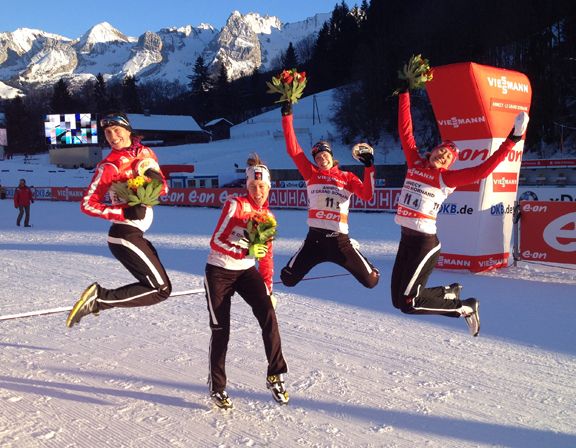
    Rosanna Crawford, Megan Imrie, Megan Tandy, and Zina Kocher celebrate a fourth-place World Cup relay finish in Annecy, France, in 2014. Crawford and Tandy may not keep racing after this season; Imrie retired in 2014 and Kocher in 2016. (Photo: Matthias Ahrens)

    “I’m kind of waiting to see what happens with Biathlon Canada,” Smith wrote in an email this week. “I think some very difficult years are coming for the organization, unfortunately. That will play a big part in my, and I’m sure many other athletes’, decisions. Of course, I’m also not looking to have a continuation of the health problems over the last two seasons, which made competing at the highest level really difficult. So I will be keeping a close eye on how my body is reacting to training. If it’s still not coming around that would certainly not encourage me to continue either.”

    2010, 2014, and 2018 Olympian Megan Tandy also struggled with health issues this winter, and is likewise not sure what her future holds.

    “Originally it was my intention to retire after this season, however it was literally my worst season ever!” she wrote in an email. “I was sick more in the past 6 months than in the past two years. Anyways,  I have taken some time since the Olympics to followup about my health and to consider options for next season. I want to race a final season – one where I feel good and can put up a good fight (not necessarily results dependant, I just want to leave this sector of my life feeling like I gave it all I got), but a lot of things will need to fall into place for that to be realistic: sponsor support, coaching opportunities during the training season, and my health of course.”

    Poland
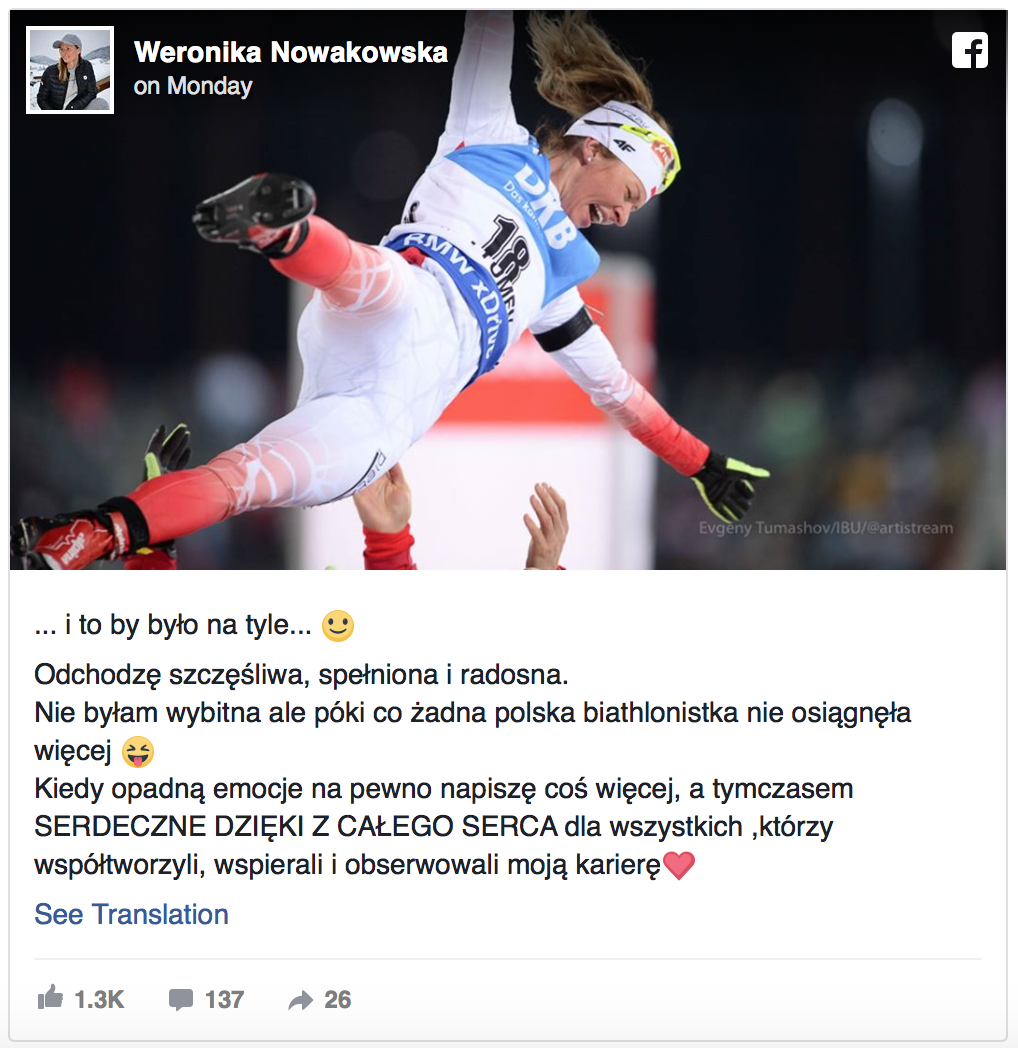
    Weronika Nowakowska is calling it a career. The 31-year-old picked up two World Cup podiums in the 2015 season before taking a break from competition to give birth to twins. She made a successful return this season and represented Poland in PyeongChang, with a top finish of 21st in the individual. She also had sixth- and fourth-place finishes on the World Cup this year and contributed to four different top-eight relay efforts, including one at the Olympics.

    “I leave happy, fulfilled and cheerful,” she wrote on her Facebook page, according to a translation. “I was not outstanding, but so far no Polish biathlete has done better”

    France

    Back in Oslo, French star Marie Dorin Habert ended her career. Dorin Habert – then simply Marie Dorin – competed in her first senior World Championships in PyeongChang in 2009, where she had a top individual finish of 18th and was part of the bronze-medal relay team. Fast forward and she had racked up a sprint bronze at the 2010 Olympics, seven World Cup wins, ten more World Championships relay medals, and four individual gold, one silver, and one bronze medal at World Championships, four of which were from the 2016 edition where she did not finish a single race without a medal.
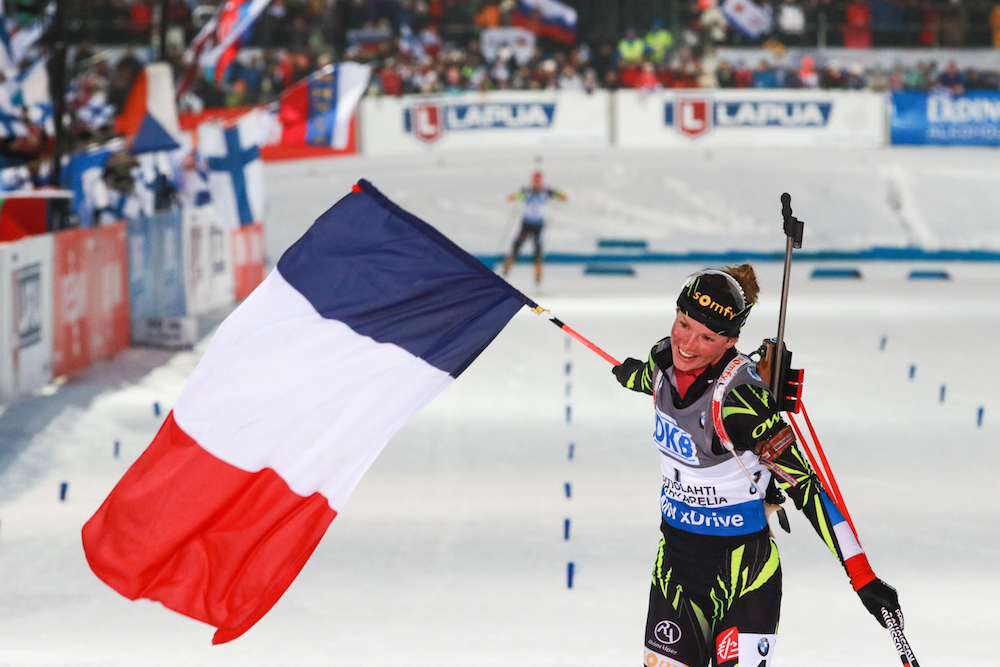
    France’s Marie Dorin Habert celebrates her second win in as many races at 2015 IBU World Championships, after taking gold in the 10 k pursuit in Kontiolahti, Finland. (Photo: Kontiolahden Urheilijat/Jarno Artika)

    She found herself back in PyeongChang for the 2018 Olympics, where, despite a frustrating season until then, she was fourth in the sprint, bronze in the women’s relay, and gold in the mixed relay.

    “It’s so nice to end this way, to share it with all of the team, and the beautiful sun, and all the French people,” Dorin Habert said after winning the women’s relay in Oslo along with her teammates. “It’s a wonderful day for me. I would like to thank a lot, well, everyone, for being there in the biathlon family. I’m really happy to have this career, and I’m really happy for everything.”

    Jean Guillaume Beatrix he told is also retiring. Beatrix was a World Junior Champion in 2009, before going on to be a five-time World Championships team member and a 2014 Olympic bronze medalist in the pursuit. He was part of three silver- and one bronze-medal winning men’s relay teams at World Championships. But this season, he did not perform well enough to make a very competitive French team for the 2018 Olympics. His retirement was “a decision precipitated by my results”, L’Equipe, according to a translation.

    Czech
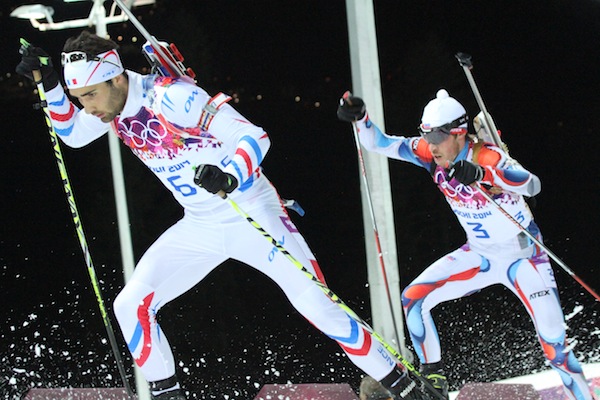
    France’s Martin Fourcade leading Jaroslav Soukup of the Czech Republic during the men’s Olympic 12.5 k pursuit at the 2014 Olympics.

    Jaroslav Soukup, the bronze medalist in the sprint at 2012 World Championships, where he was also part of the silver-medal mixed relay team, is retiring. Later in 2012, he suffered a horrendous accident while biking, including open fractures in his arm and neck and back injuries. By 2014, he made it back and won the same medals at the Olympics that he had at World Championships two years before: bronze in the sprint and silver in the mixed relay. Soukup qualified for the 2018 Olympics but only competed in the relay, which finished seventh. He had one World Cup top-30 this season.

    Norway

    Hilde Fenne, a staple of the Norwegian women’s team, retired after the last race of the season in Tyumen, Russia. Fenne never found breakout success as an individual; she had three top-15 finishes in her career. But she was an integral part of the women’s team and contributed to numerous World Cup relay podiums, as well as the gold-medal winning women’s relay at 2013 World Championships in Nove Mesto, Czech Republic.
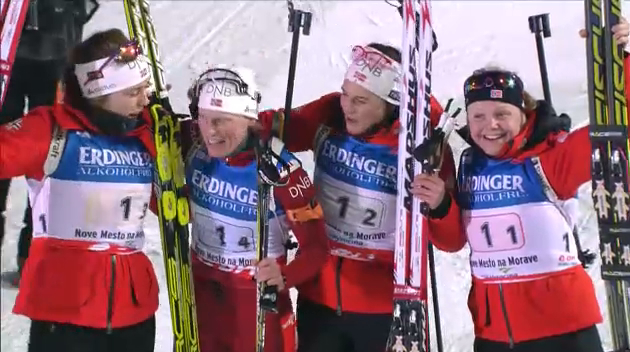
    The Norwegian women’s relay celebrates its second-ever World Championships title after winning the 4 x 6 k event in Nove Mesto, Czech Republic. From left to right: Synnøve Solemdal, Tora Berger, Ann Kristin Flatland and Hilde Fenne.

    In that final race, her teammates wrote her name on their cheeks. “She has been a very important piece for me,” teammate Synnøve Solemdal told NRK, almost in tears. “We have stayed in a lot of hotel rooms together. I’m going to miss her very much.”

    On the men’s side, there is uncertainty as to whether some veterans will stick with racing or not. One is Ole Einar Bjørndalen, who was left off Norway’s Olympic team, who for the first time since 1992 this season. And yet, the 44-year-old has not stated that he will retire, and some who know him are speculating that he may try to stick it out one more year and go out with better results than he saw this season.

    Also with no stated plans is Emil Hegle Svendsen. Bjørndalen is the winningest athlete in World Cup history; Svendsen is number four. He won the World Cup overall title in 2010, and is a four-time Olympian. He won gold in the individual in 2010 and in the mass start in 2014, after which he suffered a total collapse anchoring the Norwegian men’s relay. In the past seasons he has been off and on, and he has only won two races since then. But this season he showed flashes of brilliance, and he was third in the mass start at the 2018 Olympics as well as anchoring the silver medal men’s relay and mixed relays.
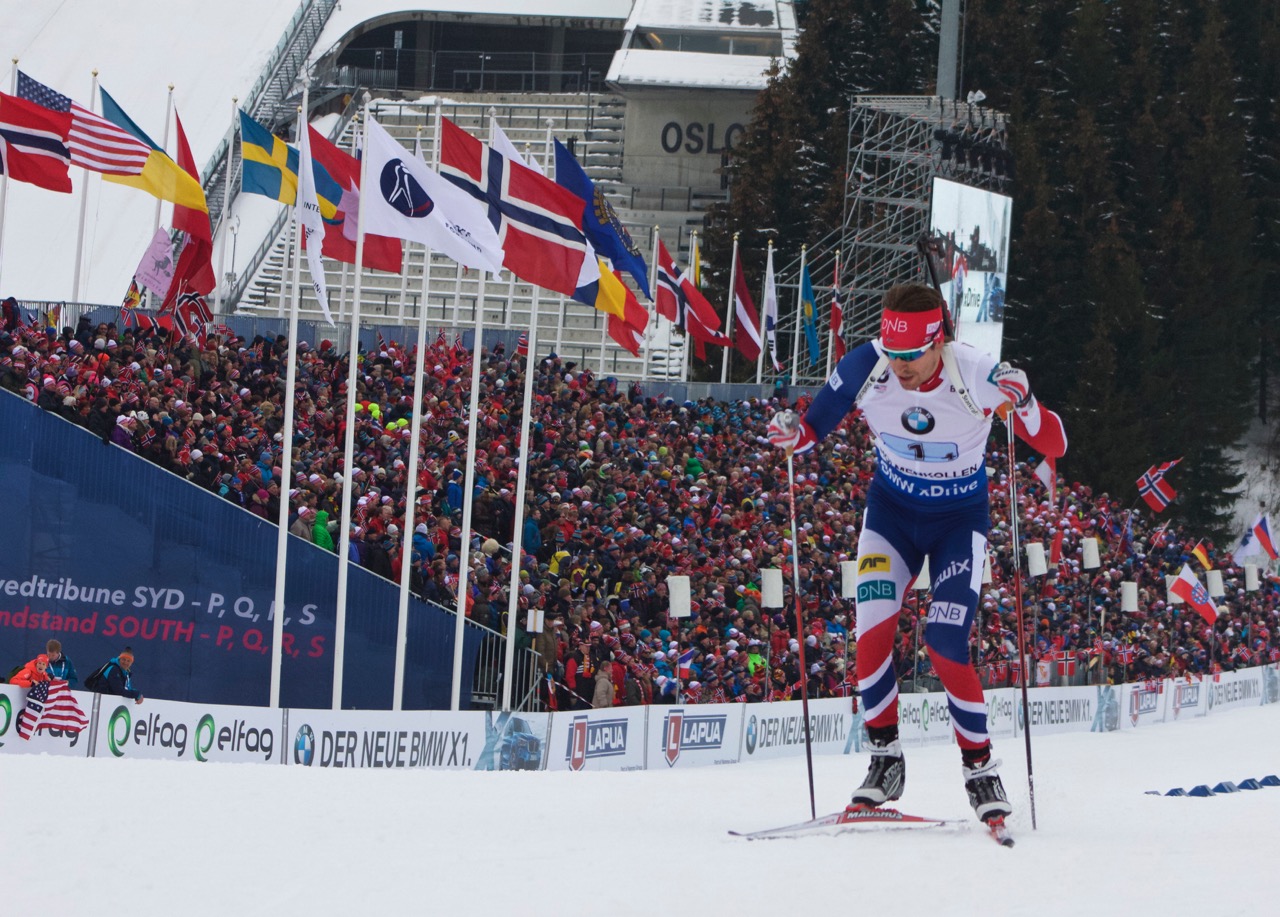
    Emil Hegle Svendsen of Norway leaves the stadium in the 2016 Holmenkollen World Cup as thousands of his countrymen cheer him on. Svendsen has not officially announced his plans for next season. (Photo: JoJo Baldus)

    “What Emil has done is absolutely fantastic,” teammate Tarjei Bø – who won the overall World Cup the year after Svendsen – told NRK two weeks ago. “He has won everything, and in addition done it several times, and he has come back again and again after being down. He has had a fantastic career and I hope he continues.”

    Finland

    She just won the overall World Cup crystal globe, but Kaisa Makarainen is not sure whether she will continue racing. In several previous years she had already discussed potentially retiring, but now she is reportedly waiting to think it over more as well as to discuss with the new team staff. U.S. Biathlon Women’s Coach Jonne Kahkonen, himself a Finn, was just announced as the new Head Coach for Finland.

    Germany

    Florian Graf, an athlete who finished as high as fourth on the World Cup in 2013 but has more recently been racing on the IBU Cup, is calling it quits at age 29.

    Several other top athletes are suspected to be considering retiring, but there hasn’t been much on the record discussion by them. Stay tuned.

  • Swedish Biathlon Caps Best Olympics with Relay Gold; U.S. Men 6th to Tie 1972 Mark

    Fredrik Lindström crosses the line first to secure a gold medal for his Swedish teammates in the men’s 4 x 7.5 k relay on Friday to close out biathlon competitions at the 2018 Olympics in PyeongChang, South Korea. (Photo: FlyingPointRoad)

    FasterSkier would like to thank Fischer Sport USA, Madshus USA, Concept2, Boulder Nordic Sport, and Swix Sport US for their generous support, which made this coverage possible.

    Remember when it was a big deal when Sweden won a Biathlon World Cup? The team in bright yellow has made it a habit at the 2018 Winter Olympics, winning their first Olympic relay gold and fourth medal over the last two weeks on Friday — the last biathlon race of the PyeongChang Games.

    “It’s dreams coming true at that moment,” Fredrick Lindström, the Swedish men’s 4 x 7.5-kilometer relay anchor said in a post-race press conference on Friday. “It’s my third Olympics and to be on top with these guys feels great. I don’t know what to say.”

    Lindström had taken gold in perhaps the most ideal way for an athlete in his position, by heading out on the last 2.5 k loop in first place, almost 41 seconds ahead of anyone else. While he had missed his first shot in the final standing stage of the race, Lindström cleared it with the use of one spare bullet. Meanwhile, his closest challenger for the win — Norway’s Emil Hegle Svendsen, who had followed him into the range and lined up alongside him to shoot — missed his first two targets and went on to miss more, ending up with a penalty lap after using all three spares.

    That was the end of gold for Norway and for Svendsen, who was all too familiar with the penalty lane in the closing moments of an Olympic relay. Four years ago in the men’s relay in Sochi, Russia, Svendsen as Norway’s anchor had been in the medal hunt until the final shooting. There, he used all of his spares and still left a target standing, which sent him to the penalty lap. After leading by as much as 20 seconds in the middle of that race, Norway finished fourth.

    But as they say, that’s biathlon. And on Friday, it was Sweden’s day and Lindström skiing on his own for a 2.5 k victory loop around the course. But he didn’t slow down. As the 28 year old skated up the final climb, he was greeted by several members of his team bowing up and down in a unison to celebrate the history that was about to be made. Lindström descended down into the stadium, not looking back and still pushing toward the line, before skiing to the sidelines a few meters before the finish to grab a small Swedish flag.

    Fredrik Lindström crosses the line first to secure a gold medal for his Swedish teammates in the men’s 4 x 7.5 k relay on Friday to close out biathlon competitions at the 2018 Olympics in PyeongChang, South Korea. (Photo: FlyingPointRoad)

    It wasn’t like the oversized French flag Martin Fourcade had been seen waving earlier in the Games, in the pursuit and again in the mixed relay. It was understated, like Sweden’s biathlon team before these Olympics, but he waved it proudly as he crossed the line to a sea of swarming teammates.

    Sweden (with Peppe Femling, Jesper Nelin, Sebastian Samuelsson, and Lindström) finished first with a cumulative time of 1:15.16.5 hours and a total of seven spares and zero penalties. Skiing alone and finishing 55.5 seconds behind them,  Svendsen crossed the line in second for Norway (with teammates Lars Helge Birkeland, Tarjei Bø, and Johannes Thingnes Bø), after tallying 12 spares and one penalty.

    In stark contrast to Lindström’s wide-eyed smile as he finished, Svendsen, 32, who had previously earned bronze in the mass start and silver with Norway’s mixed relay in PyeongChang, hung his head. His teammates met him at the finish and tried to improve his mood, but he was down.

    “It was a good battle. We wished each other luck before the start and it was a good fight,” Lindström said of contending with Svendsen for two out of three loops.

    Norway’s third-leg skier Johannes Thingnes Bø (1) racing his team into fourth to first in the men’s 4 x 10 k relay at the 2018 Olympics in PyeongChang, South Korea. (Photo: FlyingPointRoad)

    Johannes Bø had tagged Svendsen in first at the last exchange, 0.4 seconds ahead of Sweden, with Samuelsson handing off to Lindström. In the prone stage that followed, both Lindström and Svendsen cleaned without a miss. They left the range together, more than a minute clear of Germany’s Simon Schempp in third (who had missed three but avoided a penalty three spares). Germany had been 13.7 seconds back at the last exchange.

    “Emil had to go first the first loop, I went first the second loop, and on the shooting we were equal until that standing,” Lindström reflected. “I don’t know, I was the lucky man today. I feel proud that I managed that situation and to bring the gold to Sweden.”

    Even without gold, Svendsen is the third-most medaled biathlete in Olympic history, according to the International Biathlon Union (IBU). A four-time Olympian, he has eight medals, four of which are gold.

    “I think that’s awesome,” Svendsen said when asked about his medal tally at the press conference. “It feels very good and yeah, what can I say? Thank you.”

    Finishing more than a minute after Norway and exactly 2:07.1 minutes behind Sweden, Germany (with Erik Lesser, Benedikt Doll, Arnd Peiffer, and Schempp) placed third after Schempp incurred a penalty in the final standing stage. While he was still far enough ahead of Austria’s Dominik Landertinger to hang onto bronze, that penalty put Schempp nearly a minute behind Svendsen at the start of his last loop.

    While he waved to the crowd as he finished, Schempp later said he wasn’t happy with his performance. The German team accrued 10 spares and three penalties (two of which came in Doll’s second leg).

    “I just was disappointed in my race,” Schempp told German broadcaster ARD of his finish-line body language, according to a translation. “But at the end of the day we won the medal. That is the most important thing, that’s what matters, but of course, I can’t be satisfied with my shooting bouts. It was so incredibly gusty … I waited crazily long with my spare shots today because I thought the gusts would be over soon and then I could shoot. But unfortunately that was not the case, so I was on the range forever, losing a lot of time and then still didn’t hit every target. It was like a vicious cycle.”

    Lesser and Canada’s Christian Gow Up Front 

    Sweden had positioned itself for a medal from the gun, with first-leg skier Femling tagging Nelin in fifth, 27.3 seconds back, at the first exchange. Germany’s Lesser had put his team in first on that leg with near-perfect shooting — cleaning prone and using one spare in standing (0+0, 0+1). Lesser tagged Doll 18 seconds ahead of Slovakia in second, which had put itself in contention with a flawless first leg from Matej Kazár. (Slovakia dropped to 15th on the second leg and was lapped on the third leg.)

    Canada’s first-leg skier Christian Gow (12) leading the field, including France’s Simon Desthieux and Germany’s Erik Lesser (far l), to the top of a climb in the men’s 4 x 7.5 k relay at the 2018 Olympics in PyeongChang, South Korea. (Photo: FlyingPointRoad)

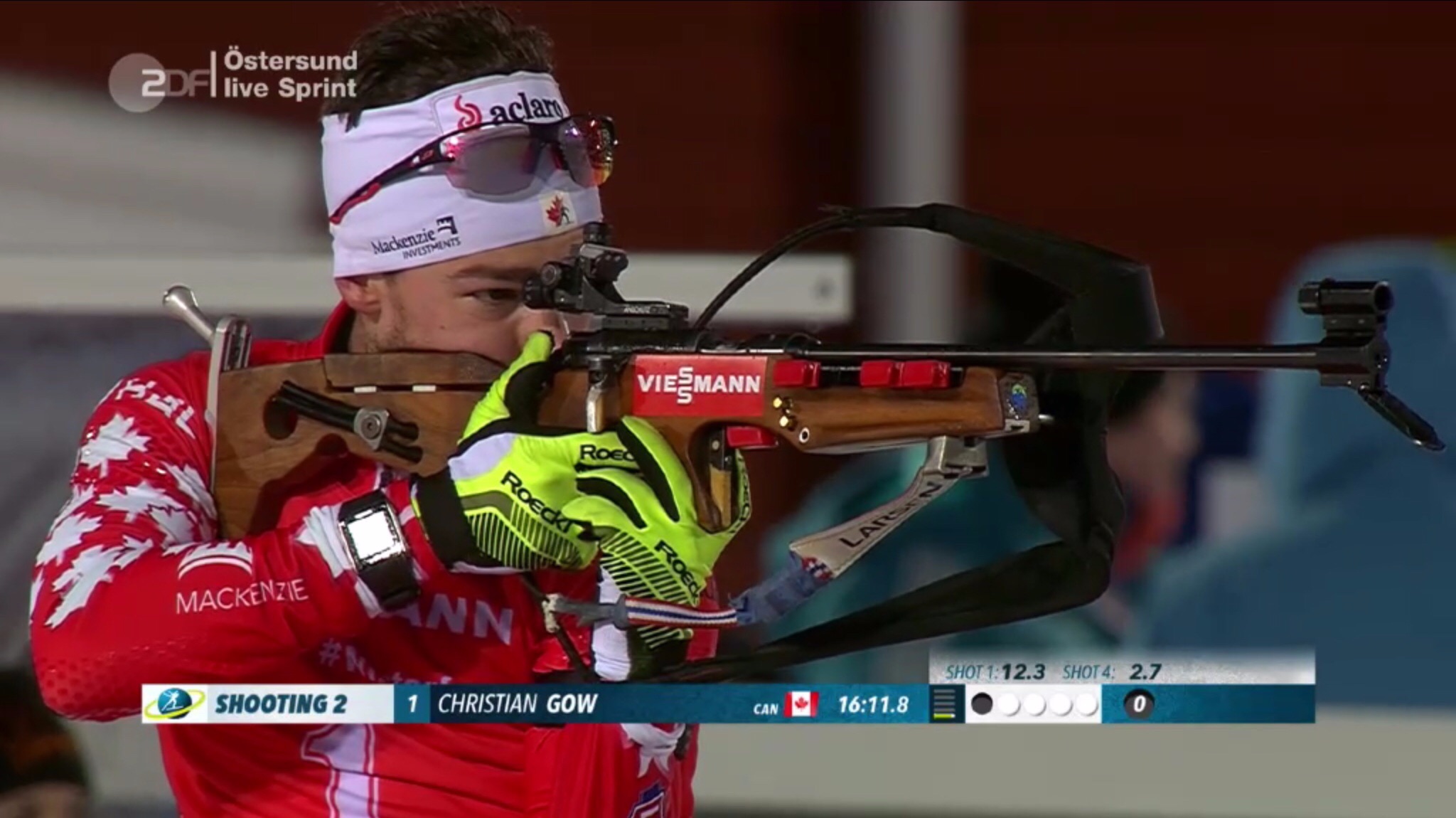
    Canada attracted some serious TV time when Christian Gow took the lead on the first climb out of the stadium. He went on to hit five targets in a row in prone and left the range in second, 1.2 seconds behind Lesser in first. One loop later, Gow had slipped to eighth and about 20 seconds back when he needed three spares to clean. He ended up tagging his brother and teammate Scott Gow in ninth, about 48 seconds out of first.

    “It wasn’t planned, for sure,” Gow, 24, told FasterSkier after about his decision to lead on the first loop. “Right at the top of the first climb, everyone was kind of moving over to the right, staying in kind of two lines, and there’s quite a bit of space there, so I took the opportunity to move up just because I’ve done so many relays where you’re stuck in the middle of the pack. …  I saw an opportunity to get to the front — I didn’t think it would be the front — but that’s what ended up happening, and I just did my pace and no one wanted to pass me.

    “I’m really happy to have cleaned the prone for sure because it’s great if you can lead it, but if you can’t knock down the targets it doesn’t mean too much,” he continued. “In the standing I’m trying to be a bit easier on myself, just because it’s a new situation to be way up in the front like that and having a great day. I wish I would have held it together a bit better than I did. I think I let the nerves get to me a little bit more than I should of, but a lesson learned and I’m happy with the first two-thirds [of my race].”

    Sweden’s Steady Rise

    Nelin raced Sweden into second place, 16 seconds behind the Czech Republic in first by the second exchange. He cleaned prone with one spare and avoided a penalty with three spares in standing while Germany’s Doll, who had been skiing alone in first before the standing shooting, dropped to fifth and almost 38 seconds back with two costly penalties.

    The Czech Republic’s Michal Šlesingr cleaned standing without a miss to take the lead with one loop to go in the second leg, 6.8 seconds ahead of Austria’s Simon Eder in second. Nelin followed another 8 seconds back in third, and tagged just 0.2 seconds ahead of Austria in the exchange.

    The third leg saw Johannes Bø, who had been tagged 31 seconds back in fourth, put Norway in first with a clean prone and a single spare in standing. Samuelsson, who had previously taken silver in the 12.5 k pursuit and placed fourth in the 20 k individual race at these Olympics, put Sweden in a position to win gold, using just one spare to clean prone and shooting without a miss in standing. He latched onto Bø, leading the Norwegian on their final loop and handing off to Lindström just 0.4 seconds behind Norway.

    The Swedish men’s gold-medal relay team, with Peppe Femling, Jesper Nelin, Sebastian Samuelsson, and Fredrik Lindström, after winning the last biathlon race of the 2018 Olympics in PyeongChang, South Korea. (Photo: FlyingPointRoad)

    Earlier this season, Sweden won the men’s relay at the IBU World Cup in Oberhof, Germany. The order was the same, except Martin Ponsiluoma skied the first leg, rather than Femling. While the win was a big deal for Sweden, it was against a slightly watered-down field, with some of the top biathletes opting to skip the Oberhof World Cup at the start of the new year.

    Friday’s victory marked Sweden’s first Olympic relay gold in biathlon after it earned bronze in 1976 in Innsbruck, Austria, and again in 1992 in Albertville, France.

    “It means a lot. It’s the first medal for men’s relay team in biathlon for Swede,” Samuelsson said. “Of course we are really satisfied. We did four good races everyone today and we’re super happy.”

    U.S. Ties Olympic-Best 6th

    While Austria finished Friday’s relay in fourth (+2:52.5), and France placed fifth (+3:26.6), the U.S. men tied its country’s best Olympic relay result in sixth (+3:50.2) with Lowell Bailey, Sean Doherty, Tim Burke, and Leif Nordgren. They had been 10th after Bailey’s first leg, in which he used two spares in each stage, and improved to sixth, then fifth on Doherty’s and Burke’s legs.

    Doherty used just one spare in prone and cleaned standing without a miss, leaving the range in sixth and 42 seconds back with one loop to go. He then tagged Burke in sixth, about 54 seconds out of first, and Burke held that position with a flawless prone stage followed by three spares in standing. He picked off one place on his last loop to tag Nordgren in fifth, 1:38.8 minutes back.

    The second-leg skier in the U.S. men’s relay, Sean Doherty racing his team into sixth on Friday at the 2018 Olympics in PyeongChang, South Korea. They went on to finish sixth to tie the best U.S. Olympic relay result. (Photo: FlyingPointRoad)

    “I’m real happy about that,” Doherty, 22 and in his second Olympics, said of his shooting. “I feel like I struggled with the prone earlier on [at these Olympics] and I got that kind of dialed in today, which was nice. Standing was good. I had a little break in the wind and I took full advantage. I shot pretty fast, pretty aggressive, but I hit all five from the clip and that’s what really moved things up.

    “We had a few days after the individual [race] to go back to the drawing board, come back to some of the fundamentals of shooting,” Doherty explained. “It’s nice to kind of reinforce that I’m capable of hitting targets and fixing things. When you’re not shooting well, you don’t have to keep not shooting well, if that makes sense.”
    Nordgren incurred the team’s only two penalties on his prone stage, but because of the strung-out field, he hung onto sixth, losing time to those ahead of him. He used three more spares in standing but stayed out of the penalty lap, finishing about about 24 seconds behind France in fifth.

    “Honestly it is a little disappointing,” Nordgren said after. “I know we were gunning a lot more as a team. I had some mistakes there in prone, too. That hurt a lot since we were right there in contention with some top teams in the world…

    “I will say we had amazing skis today so I pushed really hard on the first loop and I think I got a couple seconds on [Austria’s] Landertinger,” Nordgren added. “And then just in prone … I was just getting thrown around by the wind. It is has given me trouble the whole couple weeks here I obviously never quite figured it out.”
    In addition to tying the best U.S. relay result at an Olympics (of sixth place in the men’s relay at the 1972 Olympics in Sapporo, Japan), sixth was a big improvement for this team, which placed 16th at the 2014 Sochi Olympics. It was also the best Olympic relay result for Bailey and Burke, after they placed eighth in the 2014 mixed relay and ninth in the 2006 Olympic men’s relay.

    Tim Burke (l) on the range during a difficult standing shooting with France’s Martin Fourcade. While Burke cleaned with three spares, Fourcade had to ski a penalty lap in the men’s 4 x 7.5 k relay at the 2018 Olympics in PyeongChang, South Korea. (Photo: FlyingPointRoad)

    Asked whether this was his last Olympic race, Burke said it was.

    “Today was a good for me so yeah, I would say yes,” the 36-year-old four-time Olympian said. “Biathlon is a crazy sport; it is so up and down from one race to the next. The emotional rollercoaster is amazing. I am done though.

    “It has been my life for so long. It is what I know. It is what I love,” he added. “But it is time for the young guns to step up and take my place.”

    Bailey told reporters while the race was still going on that he was glad to finish his Olympic career with a race that didn’t include any penalty laps.

    “On a day like today, you saw that France was in the loop, now Germany, so the top nations are in there,” he said. “I cannot tell you how challenging this range is. It is so much different than most of the other ranges we shoot on.

    “Every Olympics has been different,” Bailey, also 36 and a four-time Olympian as well as 2017 world champion, reflected of his career. “In Sochi I had my career best with eighth place in the individual, and I will always have that. I will always know what I am capable of. That said, I know what I am capable of and I didn’t reach the bar that I set for myself. But all four Olympics have been honestly an incredible honor to put on Team USA uniform and go out there and compete for my country.

    “I know that it’s time to make the next step, to make the next transition,” he continued. “I’m really excited for our future, my family’s future. And I’m really excited for the future of US Biathlon.”

    Canada 11th

    Canada’s Scott Gow leading American Sean Doherty on the second leg of the men’s 4 x 7.5 k relay at the 2018 Olympics in PyeongChang, South Korea. (Photo: FlyingPointRoad)

    Canada finished the race in 11th (+5:40.3). Scott Gow had brought them up to seventh with perfect shooting on both his stages (0+0, 0+0) and tagged Macx Davies about a minute out of first.

    “My race pan today was to really emphasize the wind flags, and if it changes direction don’t be afraid to correct for it,” Scott Gow said. “In standing when I came in, it was quite windy, so I just waited a extra couple of seconds and then started to shoot when I felt like it was calm. It is hard to remember that sometimes because you are in the race mode and you just want to get it over with so you can try and just get back on course, so I was happy with that execution.”

    Davies, in his first Olympic race, needed three spares to clean prone and slipped to 10th, then had a penalty in standing to leave the range in 12th with one loop to go. He tagged Canada’s anchor Brendan Green in 13th, 4:29 behind. Green went on to use one spare in each of his shooting stages (0+1, 0+1) to bring the team up to 11th at the finish.

    Macx Davies skiing the third leg for Canada’s 4 x 7.5 k men’s relay at the 2018 Olympics in PyeongChang, South Korea. (Photo: FlyingPointRoad)

    “It wasn’t a great race for me, but I fought through it and pushed myself so that’s all I can ever really do,” the 25-year-old Davies said. “Coming into this race I was kind of just excited to get an Olympic start. We didn’t know if I was in or not until yesterday morning. Then kind of sitting around today, slowing realizing that it was happening tonight and getting a little bit more nervous and a little bit more excited as it went on. That was exciting.

    “Being part of the team, being part of Team Canada, it’s such a great feeling, great atmosphere,” Davies added. “Everyday you see someone do something amazing and that just inspires you to keep pushing yourself and do everything in your power to succeed.”

    As for Green, he said it’s safe to say these were his last Olympics.

    “I’ve been to three Games now and they’ve all been very unique and special in their own way,” the 31-year-old Green said. “I think Korea did a great job hosting. Volunteers are spectacular and so friendly. It’s too bad the weather didn’t cooperate a little bit more, but we did our best We all fought hard and I think we’ll be going away motivated and looking forward to more.”

    What’s Next?

    While the IBU World Cup season resumes March 8-11 in Kontiolahti, Finland, then makes its next stop in Oslo, Norway, March 15-18, both the Canadian and U.S. teams have stated they will boycott the season-ending World Cup in Tyumen, Russia, March 22-25.

    “The latest decision by the IBU was to send the World Cup tour to Tyumen, Russia for our World Cup final,” Bailey said on Friday. “Team USA is boycotting. The Czech team is boycotting. Canada is boycotting. We are trying to rally more support. I know that as an [IBU] athletes’ rep, we had almost every country had athletes that wrote letters to the IBU saying that we do not want to go to Tyumen. We don’t think it’s the right thing for clean sport, and still, the executive board with Anders Besseberg at the helm decided that it was in their best interest to go to Tyumen. So it’s time for a change. IBU leadership needs to change. Besseberg needs to step down. He’s lost the trust of the athletes.”

    “We won’t go to Russia,” Green said. “Instead we’ll go back to Canada for nationals. … I think until Russia is compliant we’ll probably continue to take a hard stance until things change.”

    Results

  • Friday Olympic Rundown: Sweden Bests Norway in Men’s Biathlon Relay, U.S. Record-Setting 6th

    Fredrik Lindström of Sweden crosses the line after securing a gold medal for his Swedish teammates in the men’s relay to close out biathlon competitions at the 2018 Olympics in PyeongChang, South Korea. (Photo: FlyingPointRoad)

    FasterSkier would like to thank Fischer Sport USA, Madshus USA, Concept2, Boulder Nordic Sport, and Swix Sport US for their generous support, which made this coverage possible.

    ***

    2018 Olympics (PyeongChang, South Korea): Biathlon Men’s 4 x 7.5 k relay

    Full report

    Germany were the favorites coming into this men’s relay and Erik Lesser started them off with a near-perfect relay leg to sit in first place, but shooting collapses by Benedikt Doll and Simon Schempp left the team with bronze medals at the finish.

    On a windy, gusty day, the relay instead came down to a race between Norway and Sweden. Coming into the last shooting stage Fredrik Lindström of Sweden and Emil Hegle Svendsen of Norway were stride for stride. Each missed their first shot in standing, but Lindström pulled himself together and hit the next four shots, then hit the final target using a spare round. Svendsen, on the other hand, kept missing and ended up skiing a penalty loop – just as he had when anchoring the Norwegian team in the Olympics in Sochi four years ago.

    A strong leg from Tim Burke, who cleaned prone and then survived on spare rounds while chaser Martin Fourcade of France headed to the penalty loop, helped the U.S. secure a best-ever sixth-place finish in the Olympic men’s relay. (Photo: FlyingPointRoad)

    Then, that left Norway off the podium. This time, Norway still earned silver, as behind him Schempp had his own shooting woes.

    An exciting relay with multiple lead changes in the end turned into something of a blowout, with Lindström able to celebrate on his final loop before joining overjoyed teammates Peppe Femling, Jesper Nelin, and Sebastian Samuelsson at the finish. It was the first Olympic relay gold medal in the history of Swedish biathlon, and the team did it with phenomenal shooting – just seven spare rounds despite difficult conditions. They were the only team to avoid the penalty loop, which most teams visited more than once.

    The Norwegian squad of Lars Helge Birkeland, Tarjei Bø, Johannes Thingnes Bø, and Svendsen finished 55.5 seconds back. The Germans with Lesser, Doll, Arnd Peiffer, and Schempp crossed the line +2:07.1, and the Austrian squad of Tobias Eberhard, Simon Eder, Julian Eberhard, and Dominik Landertinger were the first ones out of the medals, +2:52.5.

    The American team of Lowell Bailey, Sean Doherty, Tim Burke, and Leif Nordgren finished sixth, +3:50.2, tying the best-ever men’s relay finish by an American team at the Olympics. They had 14 spare rounds and two penalty loops.

    The Canadian squad of Christian Gow, Scott Gow, Macx Davies, and Brendan Green finished 11th, +5:40.3, with 11 spare rounds and a penalty loop.

    Results

  • France Golden in Biathlon Mixed Relay; Canada 12th, U.S. 15th

    Martin Fourcade waves the tricolore down the finishing straight as France claims gold in the biathlon mixed relay on Tuesday at the 2018 Olympics in PyeongChang, South Korea. (Photo: FlyingPointRoad)

    FasterSkier would like to thank Fischer Sport USA, Madshus USA, Concept2, Boulder Nordic Sport, and Swix Sport US for their generous support, which made this coverage possible.

    PYEONGCHANG, South Korea — In its four-card-deep deck, the French biathlon team had an ace. Anchoring France’s 2 x 6 + 2 x 7.5-kilometer mixed relay was Martin Fourcade. The 29 year old had already taken two individual gold medals at these Winter Games. The final leg of Tuesday’s race presented the opportunity for another.

    Coming through the last exchange, it was Germany’s Erik Lesser tagging off to Arnd Peiffer. Without Fourcade chasing them, Germany’s chances of a medal would have seemed certain.

    Peiffer, who learned around 1 p.m. that afternoon that he would start the relay in place of Simon Schempp, who reportedly was feeling under the weather, was first into the range after one loop for his round of prone shooting. There, Peiffer missed two shots, but using two spares, hit the remaining two targets and stayed out of the penalty lap.

    Then came Fourcade. The Frenchman shot clean. Skiing into the range with France was Norway’s Emil Hegle Svendsen and Italy’s Dominik Windisch. Svendsen and Windisch both used one spare each to clean and steer clear of the penalty lap as well.

    Out on course, Peiffer had a 6.1-second buffer between himself and Fourcade. Windisch was the third racer to depart the range, 16.3 seconds out of first, and just 0.1 seconds behind him was Svendssen.

    The 6.1 seconds separating the two frontrunners was soon down to zero. Fourcade attacked on the first uphill, passing the German and was the first into the range for the standing shooting — exactly the type of stage Fourcade craves. 

    Five days ago, Fourcade was in a similar situation. During the men’s 20 k individual race, he skied into the range for the final round of shooting with a comfortable lead. The almost-always clutch Frenchman missed the last two targets, losing the gold and finishing fifth on the day.

    Martin Fourcade cleaning his final five targets of the day to secure gold for France in the mixed relay at the 2018 Olympics in PyeongChang, South Korea. (Photo: FlyingPointRoad)

    During Tuesday’s mixed relay, Fourcade was on his A-game. Five pings heard throughout the stadium and five targets down. With his remaining 2.5 k to go, another medal for France and Fourcade was certain. Not long after, it became clear that medal would be gold.

    Back in the range, Peiffer struggled, using three spares and having to ski a penalty loop. Meanwhile, Svendsen used one spare to clean and Windisch two. Svendsen slid into second place, 34.3 seconds behind an already long-gone Fourcade.  

    Windisch left about 15 seconds after the Svendsen. After emerging from the penalty lap, Peiffer skied up behind Windisch. In a moment of déjà vu, Fourcade carrying France’s fluttering flag crossed the finish line first in a time of 1:08:34.3 for the gold medal. Svendsen held his own with the third-fastest anchor lap to secure silver for Norway, 20.9 seconds behind Fourcade.

    For Fourcade, it was his fifth gold medal in two Olympics and his first in a team event. France last won the mixed relay at the world-championships level at 2016 World Championships in Oslo, Norway.

    Asked what it was like capturing his fifth Olympic gold, Fourcade responded at the press conference, “Tonight it’s not about numbers, it’s not about personal, it’s a team adventure that began in 2009 in the world champs in [PyeongChang] Korea, and tonight it’s a really big emotion for the team and all the crew because we are individual athletes and the emotion of an individual Olympic gold medal is amazing, but when you can share it with your teammates it’s something really much more incredible.”

    “I think for the Norwegian team, we have a big priority on this relay,” Svendsen said at the press conference. “We really like it a lot, great to race both women and men together. You can see the best biathlon nations … so great event, it was very exciting.”

    Italy’s Dominik Windisch (r) celebrates bronze for his team in the mixed relay, which he took by 0.3 seconds over Germany’s Arnd Peiffer (l) at the 2018 Olympics in PyeongChang, South Korea. (Photo: IBU/Biathlonworld)

    The battle for third and fourth came down to a contentious last 100 meters.

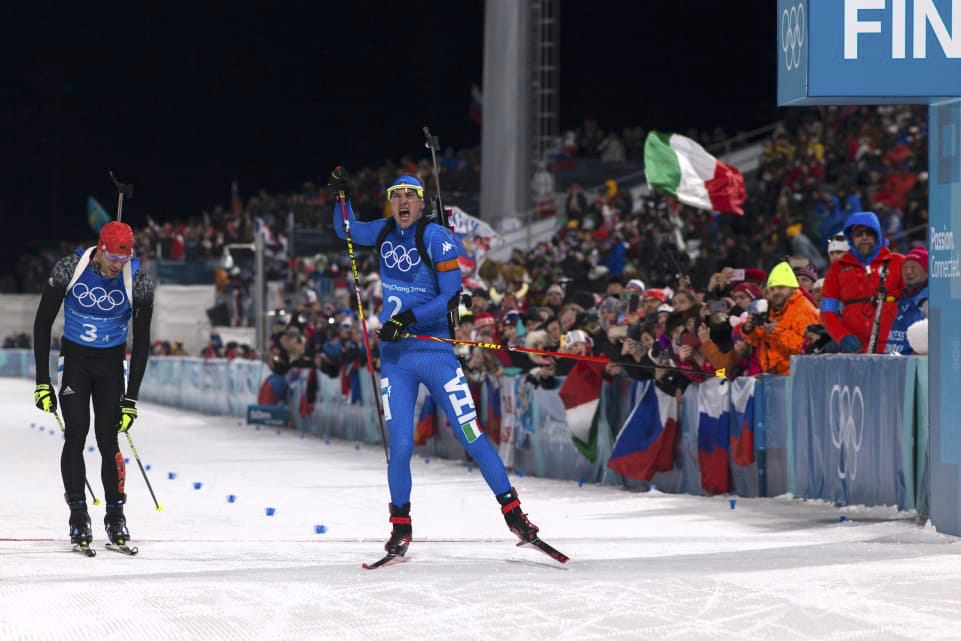
    As they rounded into the finishing straight, Peiffer was skiing in the left lane and Windisch in the right. In one final push to the line, Windisch crossed over into the Peiffer’s lane and took third place and bronze medal by 0.3 seconds ahead of him, 26.9 seconds after Fourcade.

    Peiffer crossed in fourth place (+27.2) and Germany subsequently filed a protest that Windisch obstructed Peiffer. Ultimately, the protest was denied and the results stood.

    Speaking to German broadcaster ARD after the race, Peiffer initially said Windisch’s move was within the rules. However, after viewing the replay, he changed his mind.

    “I believe he [Windisch] would have beaten me if he’d just remained straight ahead in his corridor and not skied such a curve,” Peiffer later told ARD, according to a translation. “That’s what I also told him. I told him I congratulate him because I believe he was better today. I just did a poor job today, that’s how it even came to this situation…

    Germany’s mixed relay anchor Arnd Peiffer during his last shooting stage on Tuesday, where he incurred a penalty and slipped out of gold-medal contention and ultimately finished fourth in the event at the 2018 Olympics in PyeongChang, South Korea. (Photo: FlyingPointRoad)

    “I took another look at it now, and to me it’s a rule violation,” Peiffer added. “But from experience I know that the jury never makes any decision or generally denies appeals. Just because they don’t have the courage, I believe. I am sorry for the other three, because they did a great job. I don’t believe I would have deserved a medal today, but it’s always sad if rules get broken.”

    During a post-race press conference, the issue of Italy’s move was raised again. One reporter directed a question at Windisch, asking about his thoughts on the filed complaint.

    “It happened realy really fast because it come down from the downhill and I was convinced to do the right thing because I was in front of Peiffer,” Windisch said.“The jury had a long, long meeting to take this decision and they decided for us. I am really happy about this, so I think they had their reasons and I am happy for Italy.”

    The same reporter posed the question to Fourcade, stating that the move seemed like one the Frenchman has done in the past.

    “As Dominik Windisch told you it happened really fast in a situation we are not fully able to decide really quickly because we already have 7.5 kilometers in the legs,” Fourcade said. “When you are looking a the picture you can see it’s probably not the best decision Dominik took, but in the end it changes nothing because Dominik is stronger than Arnd in the sprint and he didn’t change anything with the final results. I think and I’m sure if it happened again he would choose another line.”

    Italy’s Strong Start

    Italy’s Lisa Vittozzi (2), alongside Germany’s Vanessa Heinz, leads the first leg of the 2 x 6 + 2 x 7.5 k mixed relay on Tuesday at the 2018 Olympics in PyeongChang, South Korea. She went on to hand off in first, and Italy ultimately earned bronze in the event. (Photo: FlyingPointRoad)

    In the first leg of the race, Italy’s Lisa Vittozzi and Germany’s Vanessa Heinz tagged off in first and second, respectively, with Germany 2.2 seconds back at the exchange after both skiers shot clean without any spares. Vittozzi hanged off to Dorothea Wierer, while Heinz tagged Germany’s strongest leg Laura Dahlmeier, who took gold in the sprint and pursuit to start the Games and placed third in the 15 k individual.

    Dahlmeier shot clean in the first prone and used one spare to clean standing, tagging Lesser in first, 29.9 seconds ahead of Italy, at the second exchange. 

    Norway’s Johannes Thingnes Bø racing the third leg of the mixed relay at the 2018 Olympics in PyeongChang, South Korea. After being tagged in 10th, he skied up to fourth at the last exchange, and Norway ultimately finished second. (Photo: FlyingPointRoad)

    Norway’s ascent to second place involved a strong third leg from Johannes Thingnes Bø. Using just a single spare to clean his two stages (0+0, 0+1), Bø overcame two less-than-stellar legs from teammates Marte Olsbu (0+2, 0+1) and Tiril Eckhoff, who had a penalty (0+2, 1+3). When Eckhoff tagged Bø, he was in 10th, 1:24.4 minutes behind Germany in first. With the fastest third-leg course time, Bø handed off to Svendsen in fourth place, 33.1 seconds behind the Germans and half a second behind Italy.

    Canada 12th, U.S. 15th

    Canada finished the relay in 12th (+2:36.7) after skiing three places up from their bib number.

    Rosanna Crawford skiing the first leg of Canada’s mixed relay at the 2018 Olympics in PyeongChang, South Korea. She tagged off in 11th and Canada went on to finish 12th. (Photo:FlyingPointRoad)

    Rosanna Crawford skied the opening leg, using two spares, one each in prone and standing, to avoid the penalty lap.

    “I tried to be super focused in prone,” she told FasterSkier after. “I went on to have one miss, that was just a bad trigger pull on my part. Skiing wasn’t great, but I just tried my best to stick with the women around me and give Julia the best chance I could.”

    Crawford tagged teammate Julia Ransom in 11th, 34.7 seconds out of first. Ransom shot without a miss in prone and used two spares to clean standing. She maintained 11th while tagging Brendan Green 1:44.7 minutes behind the leaders.

    After what Ransom considered a less-than-ideal personal start to the Olympics, she was pleased with how she felt racing on Tuesday.

    “Today I felt like I could actually push a little harder and have fun racing,” she said.

    Canada’s Brendan Green racing the third leg of the mixed relay at the 2018 Olympics in PyeongChang, South Korea. (Photo: FlyingPointRoad)

    Green used three spares in total (0+1, 0+2) but remained clear of the penalty lap. He came through the last exchange in 14th, 2:27.9 out of first.

    “I thought the wind would make it a little bit challenging today,” Green said after finishing his leg, with Canada’s fourth-leg skier, Christian Gow, still on course. “It was up a bit from the other days, [but] thankfully it was fairly consistent. This won’t be the result we are hoping for but it’s a good primer for the men’s and women’s relays later this week and so looking forward to that.”

    In his first mixed relay and first time anchoring a championship relay, Christian Gow headed out on the final leg to pick off some places.

    Canada’s Christian Gow racing to 26th in the men’s 20 k individual for his best non-relay result at his first Olympics in PyeongChang, South Korea. (Photo: FlyingPointRoad)

    “I knew there would be a bit more pressure depending on the position that we were in when I got tagged because all the teams were putting their strongest guys last,” Gow said after. “It’s some pretty big names when you’re looking at the list. You’re like, ‘OK, there are some of my idols,’ so there’s a bit more pressure there, but I have been feeling pretty good.”

    The 24-year-old Gow shot clean and then used two spares in standing, racing the ninth-fastest last leg to put Canada in 12th at the finish (+2:36.7).

    “I think Nathan [Smith] one time told me you can’t idolize your competition, which is very true,” Gow said of his teammate and fellow Olympian. “I think I get a little better at that every year, believing in myself a little more and not looking at the big names I’m racing as untouchable or anything like that. I am especially happy with how I have been doing that this year. You try to handle it just like any other race and it doesn’t matter who the guy is next to you, it’s what you do in the race to beat them.”

    Julia Ransom racing the second leg for Canada in the mixed relay at the 2018 Olympics. She kept the team in 11th and they went on to place 12th. (Photo: FlyingPointRoad)

    Four years ago at the Olympics in Sochi, Russia, the Canadian mixed relay finished 11th. As the race was still going on Tuesday, Crawford said a top eight would be a good result and top six would be “the dream result.”

    Despite their goals, Ransom, a first-time Olympian, said they hadn’t felt any added pressure coming into the mixed relay.

    “… Everybody on the team knows that we’re all trying our best and are gonna bring our best to the day,” Ransom, 25, said of the team’s effort on any given relay day. “It’s an unsaid sort of encouragement, I guess.”

    For the U.S., Susan Dunklee skied a strong first leg, putting the team in fifth at the first exchange, 23.8 seconds out of first. She used two spares to clean prone and hit every target in standing (0+2, 0+0).

    Susan Dunklee (center, in all blue) leading out for the U.S team in the first leg of mixed relay at the 2018 Olympics in PyeongChang, South Korea. She handed off in fifth and the team ultimately finished 15th. (Photo: FlyingPointRoad)

    “I definitely felt better today than I did in the individual,” Dunklee said, referring to the 15 k race where she placed 19th. “I was closing on the lead group for the first kilometer or so and then by the top of the big hill, I kind of ran out of steam a little bit and was just trying to get into the finish.”

    After being tagged in fifth, right behind the Czech Republic* in fourth, Joanne Reid hung in contention in sixth after cleaning prone without any spares. But in standing, she missed all five targets and used all three spares, ultimately having to ski three penalty laps. She went on to tag Tim Burke in 18th, 3:10 minutes back.

    “It went poorly,” Ransom said after. “… The best I could do was just try and stick on and hand over with something they could work with, and that didn’t really work out for me today.”

    “I guess the strategy was once I got tagged try to make some time, try to get in contact with at least one other team so that Lowell could have someone to chase,” Burke said.

    Tim Burke racing the third leg of the U.S. mixed relay at the 2018 Olympics in PyeongChang, South Korea. After being tagged in 18th, he moved the team into 16th and they ultimately finished 15th. (Photo: FlyignPointRoad)

    Burke in fact caught two other teams, shooting without a miss in prone and using three spares to clean standing (0+0, 0+3), and tagging teammate Lowell Bailey in 16th (+3:24.4).

    The U.S. anchor leg, Bailey used one spare in prone and none in standing (0+1, 0+0). He skied the seventh-fastest anchor leg and finished the race in 15th (+3:31.1) out of 20 teams.

    “We actually had decent performances, it was really just one bad stage,” Bailey said. “Joanne had a good race otherwise and Susan had a great start, Tim had a solid race, I feel good about my race, so unfortunately, it’s eight stages not seven, but I think everyone gave everything they had and that’s the way biathlon goes. Some days go your way and some days don’t.”

    Olympic biathlon racing continues Thursday with the women’s 4 x 6 k relay.

    *Note: After her race, Dunklee told reporters about her collision with the Czech Republic’s Veronika Vítková as the two first-leg skiers came through the exchange with several others. The crash broke Vítková’s rifle right after she tagged off in fourth, just ahead of Dunklee.

    “I feel really bad,” Dunklee said. “I tangled with [Vítková] in the tag-off zone and she tripped and broke her rifle and that just puts a real damper on everything. So that’s sad. … It doesn’t affect her race today, but it certainly affects her races going forward. Stocks are highly customized pieces of equipment and you can spend months tinkering with them to get them to fit you just right, so it’s not easy to fix them when they break.”

    The Czech team went on to finish eighth (+1:39.3).

    Results

  • Tuesday Olympic Rundown: France Wins Biathlon Mixed Relay; Germany Sweeps NoCo Event, B. Fletcher 17th Again

    Germany en route to a clean sweep of the podium in the men’s nordic-combined individual large hill/10 k on Tuesday at the 2018 Olympics in PyeongChang, South Korea, with Johannes Rydzek (5) leading Fabian Rießle (6) and Eric Frenzel (4). They went on to place first, second and third, respectively. (Photo: FlyingPointRoad)

    FasterSkier would like to thank Fischer Sport USA, Madshus USA, Concept2, Boulder Nordic Sport, and Swix Sport US for their generous support, which made this coverage possible.

    ***

    2018 Olympics (PyeongChang, South Korea): Biathlon Mixed Relay

    Full report

    A few shooting errors by pursuit bronze medalist Anais Bescond were not enough to derail France, as the team of Marie Dorin Habert, Bescond, Simon Desthieux, and Martin Fourcade took gold in the mixed relay. Skiing the first leg, Dorin Habert shot clean and tagged off just seven seconds behind the leading team from Italy. Bescond then used four spare rounds over the course of her relay leg, dropping the team to fourth (+48.9) at the halfway point. But both Desthieux and Fourcade shot 10/10, capitalized on the errors of others, and ended up with a clear 20.9 second margin for gold at the finish.

    Susan Dunklee put the U.S. in fifth after the first leg of the mixed relay. (Photo: FlyingPointRoad)

    Norway came back from a rough start to earn silver despite a whopping eleven spare rounds and a penalty loop. Marte Olsbu had three spare rounds to tag off in ninth, 32.8 seconds back, and then Tiril Eckhoff used two spare rounds in prone and then took a penalty loop in standing. But Johannes Thingnes Bø used just one spare round and skied the team from tenth to fourth, in contact with the medal pack, on his relay leg, and then Emil Hegle Svendsen used one spare round in each shooting stage to climb into a clear second; he skied alone on the final loop before crossing the line for silver.

    There was controversy about bronze, however. Germany had led much of the race thanks to a solid leg by Vanessa Hinz to start and then a brilliant leg by Laura Dahlmeier; Erik Lesser also excelled, and at the third exchange the team had used just two spare rounds and had a 32.6-second lead on the field. But sprint gold medalist Arnd Peiffer couldn’t keep it together and first used a spare round in prone, then took a painful penalty loop in standing.

    He exited the loop just as Italy’s Dominik Windisch went past. Lisa Vitozzi had put Italy in the lead after one leg thanks to perfect shooting, and despite three spare rounds Dorothea Wierer had tagged off in second at the halfway point. Lukas Hofer had maintained that position and Windisch was really only in fourth because of three of his own spare rounds.

    Windisch and Peiffer battled all the way around the final 2.5 k, with Windisch leading the final downhill; the pair were nearly even coming into the stadium, but Windisch sprinted for the finishing lanes and in doing so angled from one far side of the trail to the farthest finishing lane, just barely getting there ahead of Peiffer and debatably choosing a lane before the lane markings began. Peiffer, who had skied a straight course all the way from the downhill into the finish, was forced to then switch lanes and couldn’t regain the momentum to keep up with the Italian, who crossed the line in third place.

    The Germans protested, but the race jury ultimately decided to keep the Italians in third place, awarding them bronze, and the Germans finished fourth.

    “The jury has decide to keep the bronze medal for Italy; Peiffer did not have to alter his speed, therefore no reason to disqualify Windisch,” the IBU stated in a tweet. (The response to that tweet has nearly unanimously condemned it as the wrong decision.)

    The IBU 2016 Competition Rules give only a vague definition of obstruction, stating, “It is strictly forbidden to impede other competitors in any way at any time during the competition.”

    The Canadian team of Rosanna Crawford, Julia Ransom, Brendan Green, and Christian Gow finished 12th, +2:36.7, with nine spare rounds.

    The U.S. team of Susan Dunklee, Joanne Reid, Tim Burke, and Lowell Bailey finished 15th, +3:31.1, with three penalty loops and nine spare rounds.

    Results

    ***

    2018 Olympics (PyeongChang, South Korea): Nordic Combined Large Hill/10 k

    Full report

    Germany pulled off a podium sweep in the second nordic combined combined competition of the Olympics, with Johannes Rydzek, Fabian Riessle, and Eric Frenzel earning gold, silver (+0.4 seconds), and bronze (+0.8 seconds), respectively. They had been ranked fifth, sixth, and fourth after the jumping round on the big hill, but edged Norway’s Jarl Magnus Riiber off the podium. Riiber had the second-best jump of the day and ended up just 2.8 seconds out of a gold medal. Japan’s Akito Watabe topped the jumping scores and finished fifth, +12.5 seconds.

    For the U.S., Bryan Fletcher led the way again and just like in the normal hill competition, finished 17th. This time he was ranked 23rd after the jump and made up six places to cross the line +1:42.9. Ben Berend, Ben Loomis, and Jasper Good finished 39th (+4:28.2), 40th (+4:38.8), and 43rd (+5:50.2).

    Results

  • Fourcade Beats Schempp by a Toe in PyeongChang Mass Start

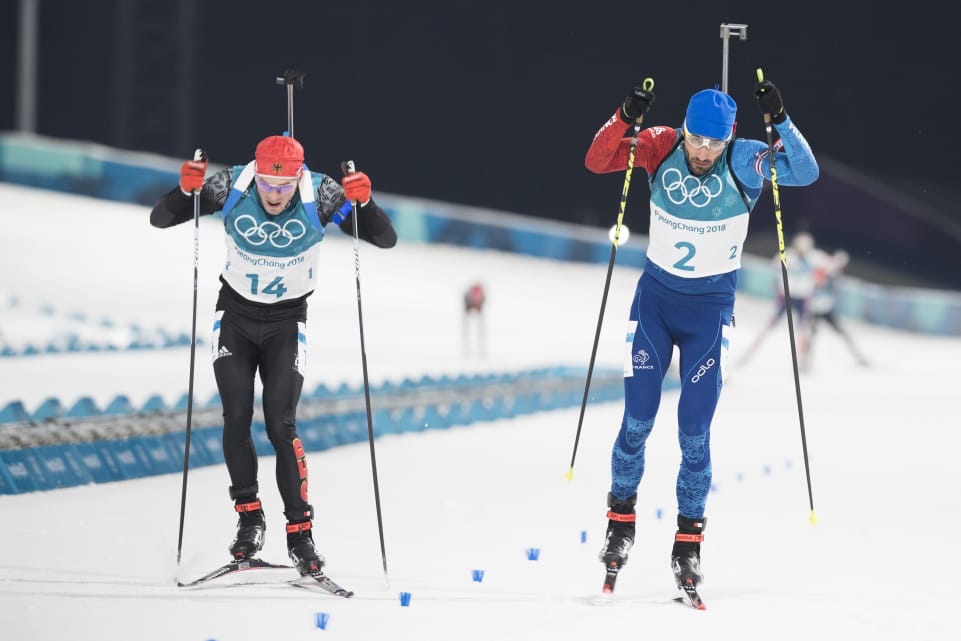
    France’s Martin Fourcade (right) and Germany’s Simon Schempp (left) lunging for first at the finish of the men’s 15-kilometer mass start at the 2018 Olympics in PyeongChang, South Korea. In a photo finish, Fourcade was deemed the winner with Schempp claiming the silver medal. (Photo: FlyingPointRoad)

    FasterSkier would like to thank Fischer Sport USA, Madshus USA, Concept2, Boulder Nordic Sport, and Swix Sport US for their generous support, which made this coverage possible.

    ***

    After both athletes had lunged over the finish line and fallen down, France’s Martin Fourcade initially thought he just lost an exciting finish sprint against Germany’s Simon Schempp in the men’s 15-kilometer mass on Sunday night at the Olympic Winter Games in PyeongChang, South Korea.

    He slammed his pole into the snow and shook his head in anguish. Not again.

    Almost exactly the same had already happened to Fourcade four years ago at the 2014 Olympics in Sochi, Russia, as he narrowly lost a sprint finish for the gold medal in the mass start to Norway’s Emil Hegle Svendsen.

    “I was sure that Simon did it,” Fourcade said of Schempp at Sunday’s post-race press conference. “It was just because four years ago in Sochi, Emil did me a lot of pain, and tonight I was sure that history was repeating again.”

    “I didn’t know who was in front of the other, and Martin as well,” Schempp recalled at the press conference. “So we were both waiting.”

    During the race Fourcade had incurred two penalty laps (1+0+0+1) while Schempp had missed just one target (0+0+0+1). However, Fourcade made up for that by skiing the fastest course time of the day.

    France’s Martin Fourcade (r) and Germany’s Simon Schempp (l) pushing to the finish of the men’s 15-kilometer mass start at the 2018 Olympic Winter Games in PyeongChang, South Korea. After a photo-finish lunge, Fourcade was deemed the winner while Schempp claimed silver. (Photo: IBU/Biathlonworld)

    But while they both had finished with the same time of 35:47.3 minutes, the photo-finish image evaluated by the race jury for about a minute would prove they were not exactly even: Fourcade had moved the tip of his boot just about half a foot before his opponent over the line.

    Now it was Schempp who looked a bit frustrated, tilting up his head and letting out a sigh after he saw the official result on the big video wall. But that feeling did not last for long, with pride about the strong performance he had just shown after a difficult season and the happiness about his first Olympic medal in an individual-start race in his third Olympics taking over.

    “For me, it was not too hard; I was happy to get one of these three medals,” Schempp said.

    “Of course I am enormously happy,” he had previously told German broadcaster ZDF immediately after the race, according to a translation. “I had to wait a long time for this, and now until the last individual-start race. I think it was incredibly suspenseful for all viewers.”

    Behind them the above-mentioned 2014 Olympic gold medalist Svendsen placed third to claim the bronze medal this time, 11.2 seconds out of first, with two penalties. He was on the winning side of a final sprint with Schempp’s teammate Erik Lesser, who placed fourth (+11.6), with two penalties. Germany’s third man in the top five, Benedikt Doll finished another few seconds back in fifth (+18.8), with one penalty, only slowing in the last 100 meters after he realized third and fourth place were out of reach.

    Fourcade Starts on Wrong Foot

    Initially the race had not started out well for Fourcade, with little indication that he could end the day with his historic fourth Olympic gold medal.

    On the first loop, he led the mass start field of only 30 athletes, comprised of the medal winners from the previous sprint, pursuit and individual races in PyeongChang, as well as the other top 15 in the current World Cup Total Score standings and filled up with the next-best performers of the last week not among those two groups.

    It was truly an elite field, including all seven different biathletes who had become International Biathlon Union (IBU) world champion in the mass start discipline in the last seven iterations.

    The whole pack stayed close together within a few seconds, with Germany’s Lesser bringing up the back, not investing any energy with fruitless maneuvers to gain a few positions.

    In the first prone shooting stage, 14 athletes remained clean while Fourcade missed a target, forcing him to ski a penalty lap. Then as he returned to the course, he stumbled briefly when his ski caught a V-board and he fell on his behind. He left the range in 19th position and 25 seconds behind South Korea’s Timofey Lapshin, who was leading into the next loop to the delight of local fans in the stands.

    But Fourcade quickly narrowed the gap on the next loop, and after a clean second prone shooting had moved up to eighth place, less than ten seconds behind Germany’s Doll, who had led the field for large parts of the prior loop and now also kept that position after the shooting stage.

    In that second prone, one of the presumed favorites and 15 k individual winner Johannes Thingnes Bø of Norway ruined his race with three penalties, falling back to 27th and almost 1:15 out of first. He eventually finished 16th (+1:20.0) after cleaning the remaining standing stages (0+3+0+0).

    Obviously having very fast skis, all four German athletes in the race stayed at or near the top throughout the next loop.

    “The way they were able to aggressively put their mark on this race, all four of them, from the first to the last loop … we surely didn’t expect that considering this level of competition,” German men’s head coach Mark Kirchner later told ZDF.

    (From left to right) Germany’s Simon Schempp, his teammate Erik Lesser (19) and France’s Martin Fourcade lead the field on the third loop of the men’s 15 k mass start at the 2018 Olympic Games in PyeongChang, South Korea. Fourcade went on to win the race, while Schempp finished second and Lesser fifth. (Photo: FlyingPointRoad)

    After again shooting clean in the first standing while Doll incurred a penalty, Fourcade took the lead going out on the course, with Schempp and Lesser followed within two seconds of him.

    On the third loop, Fourcade, Schempp and Lesser pushed hard for a high tempo and swapped leads several times. The gap to a group led by Czech Republic’s Ondrej Moravec and Austria’s Simon Eder ballooned after Eder had been less than 7 seconds behind leaving the range. At a split time following the longest climb, the group clocked in 24 seconds behind, and that time back grew to 30 seconds on that loop.

    Just before the range, Lesser and Schempp briefly looked at each other, then Lesser increased the frequency pushing hard for a few meters to move into first, knowing that would give him the first-lane position on the shooting range. From years of racing against each other, the German athletes were aware Fourcade often prefers to have that position in a final shooting as a demonstration of confidence, so it might have been a little psychological trick to irritate him.

    But Lesser’s race tactic did not exactly work out, as all three failed to clean their targets in the final shooting. Fourcade and Schempp both had to ski one penalty lap, while Lesser missed two shots and came back on the course in fifth, just behind teammate Doll and Norway’s Svendsen, who had both managed to hit all targets to move back into podium contention.

    About 20 seconds ahead, Fourcade kept the speed fairly high leading in front of Schempp throughout the loop, but did not attempt one of his signature ferocious attacks up a climb for which he is feared by his opponents.

    “I thought about a few scenarios how this could play out,” Schempp told ZDF, according to a translation. “I knew either he attacks on the first very steep and long climb, but there he only pushed the tempo and I could stay with him. And then he rather decelerated and I knew I had not other choice but stay behind him in his draft to save some energy for the finish stretch, because my current shape is not good enough to try and get away from him. … So then I knew it would end in a finish sprint. I tried to push hard into the downhill maybe taking the momentum with me, but unfortunately that was not enough.”

    “I tried to be faster than Simon in the first part of the loop, but he was still in my skis,” Fourcade said of the last loop. “So then I knew it will be a tight finish. I gave everything I had, but I know that Simon is a really good sprinter and that is not my main quality.”

    On the final downhill, Fourcade led the duo into the arena with Schempp drafting behind him. Fourcade briefly stumbled in the final right turn but retained his balance, not losing much speed. Entering the finishing straight, Schempp initially motioned toward a lane to the left of Fourcade, but when Fourcade veered that way as well before picking the center Schempp switched over to the right lane and poled all-out.

    France’s Martin Fourcade lunging for his second gold of the 2018 Olympics, and fourth Olympic gold of his career, in PyeongChang, South Korea, winning the men’s 15 k mass start on Sunday. (Photo: FlyingPointRoad)

    “I chose my corridor late because earlier this season in Hochfilzen [in the pursuit’s finishing race for third place] I did it a bit early, and then he went right into the one I wanted to go in as well,” Schempp told ZDF. “I still had that in the back of my mind.”

    “Our last sprint in Hochfilzen together was not a fair one,” Fourcade recalled of the same race, unprompted in his interview with ZDF. “And I thought during the final loop, ‘Beat him, but just do it in a fair way,’ because Simon is one of the best opponents I fight with. So thanks Simon for this fight, and it makes my gold more valuable.”

    “Choosing the finish stretch corridor, that’s the prerogative of the athlete who has pushed the tempo on the final loop,” Schempp explained in an interview with ZDF later in the evening. “So I could ski behind him, save a bit of energy, and in turn he gets that advantage. Poetic justice.”

    With the finish line approaching, Schempp managed to pole closer and finally next to the French athlete. “I felt that Simon was taking me meter after meter,” Fourcade recalled at the press conference.

    Both athletes lunged far as they approached the line, and with slightly higher velocity Schempp seemed to move past Fourcade as they slid and fell, causing Fourcade’s frustrated initial reaction as he looked over and saw the German coming to a stop slightly ahead of him.

    “After the finish line I thought I was in his back,” Fourcade told ZDF.

    But as the photo finish revealed, right on the line Fourcade had still been in front by about half the length of his foot this time and was the lucky winner.

    Any signs of initial frustration from Schempp were quickly replaced as he celebrated with his teammates and staff who rushed to congratulate him, and later was hoisted up on their shoulders.

    “The finish line came maybe five meters too early for me,” Schempp told ZDF. “But still, I am also totally happy and satisfied about silver. It was a suspenseful competition, and I am so glad it worked out. … I have had a few photo finishes in my career when I was in first, and now it’s the other way around. Martin was incredibly strong on the course today, and he had one more penalty than me, so he also fought enormously for gold, and I did my best.”

    Behind them, Lesser had tried to attack up the last big climb to break away from Norway’s Svendsen and his teammate Doll, but Svendsen managed to stay on his ski tails and in the finish sprint claimed the bronze medal by 0.4 seconds. It was his fourth individual medal in four Olympics (plus one gold medal in the men’s relay in 2010).

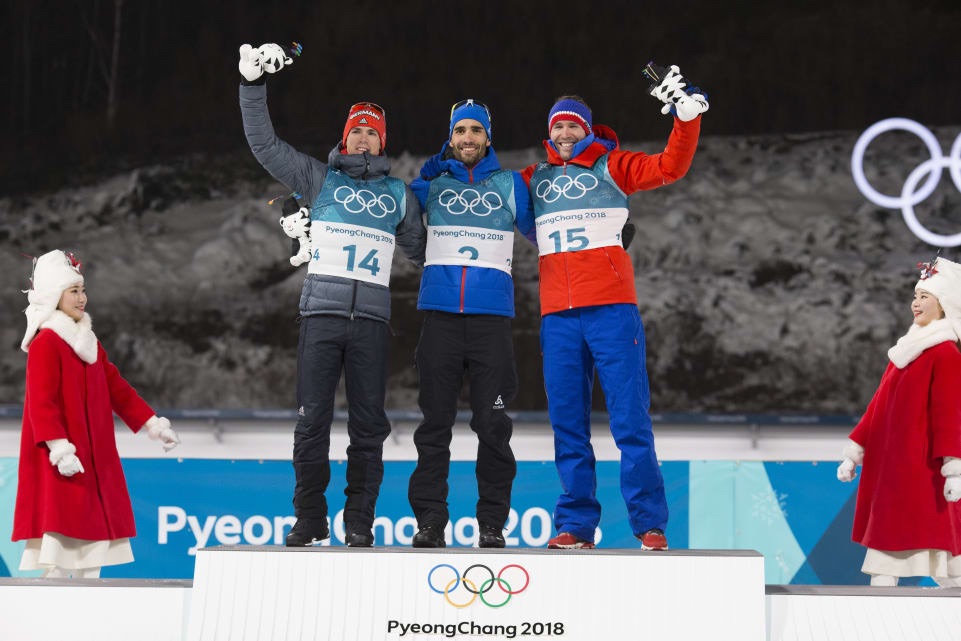
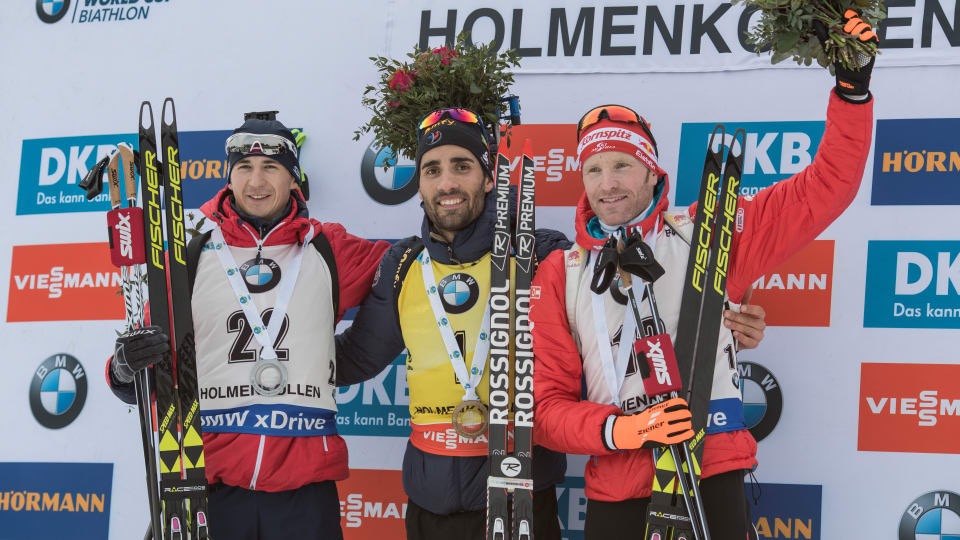
    France’s Martin Fourcade (c) in first, Germany’s Simon Schempp (l) in second, and Norway’s Emil Hegle Svendsen (r) in third, during the flower ceremony of the men’s 15 k mass start at the 2018 Olympics in PyeongChang, South Korea. (Photo: IBU/Biathlonworld)

    Four years ago at the Sochi Olympics, Svendsen had won the gold medal just ahead of Fourcade, as Fourcade recalled at the press conference.

    “It means very much, it’s been really bad Olympic Games for me,” Svendsen said in the press conference when asked about his bronze medal. “So I didn’t really believe in a medal at all. When I came into a position to get a medal I really fought hard. And to be on the podium with these guys, it’s a very good feeling.”

    When the experienced podium finishers were asked about their “secret” for a finish sprint, Svendsen added: “For me, I was thinking a lot about Marit Bjørgen from yesterday, what she did on the last few hundred meters [when] she didn’t allow the Swedish girl to catch her. That helped me a lot today, maybe that was the key to beating Lesser and Doll.”

    Disappointed, Lesser initially did not talk to German media following the race. Only several hours later, he posted an image of him hugging Schempp after the race and superimposed with the words “in the end the only thing left for me is to congratulate” to his Facebook fan page, adding a paragraph that according to a loose translation reads:

    “Wow!!! That was tight, annoying, hammer, humbling, pleasant, unbelievable, mega, crass, semi, phenomenal… no one has a leg up on our team. Everyone on our team is now individual-race World Champion and in possession of an individual-race Olympic medal. No other team can show that off.”

    On his Instagram account he wrote in English “Once again #wtf !!! It’s amazing to be part of this great team” to a photo of the team’s coaches and staff hoisting up Schempp.

    “Another really strong shooting performance, just one miss, that is great,” Doll told ZDF right after the race. “For two loops I skied at the top of the field, so that gives me some self-confidence … On the final lap, that kind of head-to-head duel isn’t really my strength, unfortunately I couldn’t win that today. It was difficult, even though we had the better ski today. We could have made a little more out of that, me and Erik, but that’s just the way it is.”

    Making History Instead of History Repeating Itself

    For Fourcade it was the fourth Olympic title of his career. In the mass start he had already won silver in both the 2010 Vancouver and 2015 Sochi Olympics. He now also has a gold medal in each non-relay discipline (sprint, pursuit, 15 k individual, and mass start).

    “Today I am so satisfied because I was second eight years ago in Vancouver in the mass start, I was second four years ago, and today I finally win this competition,” Fourcade said at the press conference. “So I am really proud.”

    As an added bonus, Fourcade is now tied with two French fencers for having won the most gold medals at either a Summer or Winter Olympic Games in the history of his country with six total.

    “That’s something really incredible. I grew up watching biathlon on TV and sport at the Olympics, so being the best French Olympian ever is something I am really proud of,” Fourcade said at the press conference. “But then you need to compare, because if I was Norwegian I would not be the best Olympian ever.”

    “After effort and suspense Martin Fourcade makes us tremble and dream a second time by winning a new gold medal for France. A legend of the Olympic Winter Games and biathlon,” French President Emmanuel Macron wrote on his official Twitter account, according to a translation, alongside with an image of the photo finish.

    Deep Respect for Each Other

    Fourcade’s opponent Schempp had not been in optimal health going into these championships after dealing with persistent back problems that forced him to miss several races on the 2017/2018 World Cup competition calendar. So in the end he was happy that despite losing out on gold so narrowly, he had been able to reach his first Olympic medal in a non-relay race. Last year, Schempp had won gold in the mass start at the 2017 World Championships, back then also his first title excluding relays.

    France’s Martin Fourcade (2) leading Germany’s Arnd Peiffer (1) and Norway’s Johannes Thingnes Bø (3) early in the men’s 15 k mass start at the 2018 Olympics in PyeongChang, South Korea. They went on to place first and second, respectively. (Photo: FlyingPointRoad)

    “I wasn’t really afraid [of the back injury returning], I was just hoping it would hold up,” Schempp told ZDF in a studio interview later Sunday evening. “It was very tedious and often also frustrating in January, because I did a lot to get it under control and a lot of people helped me with that. … But then 10 days before we flew over here, I just thought, ‘Woah, I don’t know if it will work out like this, if that will be enough.’ But then shortly before [the races] it got enormously better, there was a big leap, but I still didn’t know how it would be in the stress of a competition. … Until now it was pretty good and I hope it stays that way.”

    In his interviews right after the race, Fourcade had been very congratulatory of how hard his opponents had made it for him and how highly the won medal ranks for him.

    “I must apologize to the German fans because I know how much I disappointed them tonight,” Fourcade told ZDF. “But Simon is one of my best opponents. When I was on the podium with Simon and Emil I told them that I could not have a [better] podium for me tonight. It was the best podium I could hope for. You know, Simon is an incredible champion, and I am so proud I beat him in the sprint.”

    “We are on very good terms, and two years ago I have visited him at home,” Schempp later said of Fourcade to ZDF. “In general we get along very well. Maybe not so great on the tracks, but later in the finish, respectively before competitions. Of course he also has this crazy killer instinct and can assess race situations very well.”

    The close race also brought up memories of past events with an end like this.

    At the 2003 World Championships in Khanty-Mansiysk, Russia, two gold medals had been awarded in the women’s pursuit race to France’s Sandrine Bailly and Germany’s Martina Glagow after the photo finish had been deemed too close to call.

    But with the help of more modern technology there was a visible difference this time, and the German team readily accepted that when questioned if they thought it was fair that after a 15 k race you lose an Olympic gold medal merely by inches.

    “I think there are plenty of other sports were decisions are this close,” coach Kirchner told ZDF. “If you think about alpine skiing where races also get decided by hundredth of a second, or in others like bobsledding even by a thousandth, that’s the way it is. The athletes know they are fighting for every second, and in the end there has to be a winner. When the clock is running you know that it’s fair, there is no subjective judging.”

    No North Americans qualified for the top-30 men’s mass start field at these Olympics.

    The biathlon competitions in PyeongChang continue with the mixed relay on Tuesday at 8:15 p.m. local time. (6:15 a.m. EST).

    Results

  • Sunday Olympic Rundown: Klæbo Anchors Another Norwegian Gold; Fourcade Edges Schempp in Mass Start

    Johannes Høsflot Klæbo anchoring the Norwegian men’s 4 x 10 relay to gold on Sunday at the 2018 Olympics in PyeongChang, South Korea, while Denis Spitsov (background) celebrates silver for the Olympic Athletes for Russia. (Photo: FlyingPointRoad)

    FasterSkier would like to thank Fischer Sport USA, Madshus USA, Concept2, Boulder Nordic Sport, and Swix Sport US for their generous support, which made this coverage possible.

    2018 Olympics (PyeongChang, South Korea): Men’s 4 x 10 k relay

    International report

    North American report

    For a while in the men’s 4 x 10-kilometer relay on Sunday, it looked like the Russians might run away with the win. But that was just two classic legs and 20 k into the race, with a lot more racing to come.

    While Kazakhstan’s Alexey Poltoranin had handed off in first at the first exchange, just ahead of Andrey Larkov of the Olympic Athletes from Russia, Italy, France and Norway skied together behind them, with Norway’s Didrik Tønseth trailing off the back, 18 seconds behind.

    On the next classic leg, Russia’s Alexander Bolshunov put a hurt on the field. Within the first 3.3 k lap, he was 25 seconds ahead of Kazakhstan’s Yevgeniy Velichko in second, who was followed closely by Italy, Norway and France in third through fifth. Sweden’s Daniel Rickardsson had fallen farther behind to more than a minute back in sixth place, after his teammate Jens Burman lost contact with the lead group on the first leg.

    By the second exchange, Russia was 24.5 seconds clear of second place, while Italy’s Francesco de Fabiani tagged Giandomenico Salvadori in second, France’s Maurice Manificat tagged Clement Parisse in third (+28.0), and Norway’s Martin Johnsrud Sundby tagged Simen Hegstad Krüger in fourth (+32.1). Kazakhstan’s Velichko had fallen off the pace and was another 19 seconds back in fifth.

    Over the next 10 k, the first skate leg, Krüger and Parisse reeled in Russia’s Alexey Chervotkin, catching him before the end of their second lap. One lap later, Krüger came through the final exchange in first, tagging Johannes Høsflot Klæbo 0.4 seconds ahead of France in second. Chervotkin tagged Russia’s anchor Denis Spitsov in third, 16.2 seconds back, while Finland’s Matti Heikkinen passed Italy’s Salvadori on the last climb to put Finland in fourth (+58.6).

    Team France celebrates its bronze-medal finish in the men’s 4 x 10 k relay at the 2018 Olympics on Sunday in PyeongChang, South Korea. (Photo: FIS Cross Country/Twitter)

    Early in the final leg, France’s Adrien Backscheider took the lead ahead of Klæbo. The two held Spitsov off until the end of the second lap, where Spitsov came through the stadium first to start the final loop. Spitsov and Klæbo soon upped the pace, dropping Backscheider, and shortly after the 8.27 k checkpoint, Klæbo truly put the jets on to accelerate away from Spitsov. He dropped the Russian on a climb just before the final uphill, where it was clear that the gold was Norway’s.

    As he sped down into the stadium, Klæbo relaxed his arms, skied to the sideline and took a flag from the stands. He looked back for a moment and then crossed the finish line first in 1:33:04.9 hours, while Spitsov followed 9.4 seconds later for silver for Russia. Backscheider held on for bronze (+36.9) as his team exuberantly celebrated with him at the finish.

    Finland placed fourth (+1:40.5), Sweden fifth (+2:05.6), Germany sixth (+2:08.2), Italy seventh (+2:35.2), and Kazakhstan eighth (+3:31.4). Canada was ninth (+3:41.0) for its second-best Olympic relay result (with Len Valjas, Graeme Killick, Russell Kennedy, and Knute Johnsgaard), and the U.S. finished 14th (+9:24.2), out of 14 teams, with Andy Newell, Reese Hanneman, Scott Patterson, and Noah Hoffman.

    Results (will be posted here)

    ***

    France’s Martin Fourcade lunging for his second gold of the 2018 Olympics in PyeongChang, South Korea, winning the men’s 15 k mass start on Sunday. (Photo: FlyingPointRoad)

    Biathlon: Men’s 15 k mass start

    Full report

    Martin Fourcade is the champion once again. Six days after he won the 12.5-kilometer pursuit for his first gold in PyeongChang, the 29-year-old Frenchman did it again in the men’s 15 k mass start on Sunday, winning in a photo finish at the line.

    He took charge on the first loop, leading the field into the range for the first prone shooting. There, Fourcade shot a penalty and slipped to 19th, but it wasn’t over.

    Clean shooting on the second prone brought him up to eighth, 9.4 seconds out of first. Germany’s Benedikt Doll took that lead at that point after his second stage without a miss. Meanwhile Norway’s Johannes Thingnes Bø shot three misses on that second stage and dropped out of contention.

    One loop later, Fourcade moved into first with a clean standing. He left the range about 1 second ahead of Germany’s Simon Schempp and 2 seconds ahead of Germany’s Erik Lesser, after both made it through the first three stages without a miss. Doll missed one to slip to seventh, almost 30 seconds behind.

    After Fourcade and Schempp exchanged leads over the next loop, Lesser moved into first just before the final shooing, Going head to head, Fourcade and Schempp both missed one while Lesser missed two. Fourcade and Schempp still left the range in first and second, respectively, separated by 0.4 seconds, while Lesser slipped to fifth, 22.5 seconds back.

    Doll left the range in third (+19.2) after cleaning and Norway’s Emil Hegle Svendsen moved into fourth (+21.9) with a clean standing stage as well.

    In the end, Fourcade outlunged Schempp for the win in 35:47.3 minutes, with Schempp finishing less than a tenth of a second behind for silver, and Svendsen beat out Lesser in the finishing stretch by 0.4 seconds to claim bronze, 11.2 seconds behind, while Lesser settled for fourth (+11.6). Doll followed them in fifth (+18.8), Austria’s Julian Eberhard placed sixth (+30.7) with three penalties, Norway’s Erlend Bjøntegaard seventh (+32.1) with two misses, Norway’s Tarjei Bø eighth (+34.6) with three penalties, Sweden’s Jesper Nelin ninth (+34.6) with two misses, and Slovenia’s Jakov Fak 10th (+36.1), just ahead of the Czech Republic’s Ondřej Moravec in 11th (+36.3), with one miss each.

    Results

  • The Drama’s Behind Them: Dahlmeier and Bø Cruise to Antholz Pursuit Wins

    The Drama’s Behind Them: Dahlmeier and Bø Cruise to Antholz Pursuit Wins

    Laura Dahlmeier of Germany, Tiril Eckhoff of Norway, and Darya Domracheva of Belarus on the shooting range in the 10 k pursuit in Antholz, Italy, today. Dahlmeier went on to win the day. (Photo: IBU/Biathlonworld.com)

    Norwegian biathletes started in the lead of both of today’s World Cup pursuits in Antholz, Italy, today, and one stayed there: Johannes Thingnes Bø cruised to a one-minute win over French rival Martin Fourcade, shooting a perfect 20/20 and flying on the trails. In the women’s race, his teammate Tiril Eckhoff had a few too many missed shots, and as she faded to fourth Germany’s Laura Dahlmeier surged to eventually claim a 17.3-second win over Dorothea Wierer of Italy.

    Dahlmeier Finding Form as Olympics Near

    Dahlmeier started second today behind Eckhoff, and shot 19/20 to take the win. Her only missed target was the last shot of her very first shooting bout; from then on she was perfect, and looked calm as she knocked down target after target, even in the last shooting bout as she went head to head with Eckhoff and Belarus’s Darya Domracheva.

    “Pursuits are a real thriller,” Dahlmeier told German broadcaster ARD after the race, according to a translation. “The one who keeps her thoughts in check the best usually wins. I tried to shoot clean but had a miss right in the first stage. Then I tried to close the gap again, and in the third and fourth shootings it was incredibly suspenseful again. It was absolutely important to stay centered within yourself. And I am really really happy it worked out like this today.”

    Behind her, the race for second place was intense. With Eckhoff missing two shots in the final shooting bout, she was out of contention. Domracheva had missed one shot and headed to the penalty loop; as she came out, Wierer – who had cleaned that last bout – joined her.

    The two battled on the trails, with Domracheva initially leading but unable to drop Wierer, then Wierer passing her on the last big, open climb, but unable to drop Domracheva. In several stretches of the course, the two women were side by side, each skiing their hardest but unable to get any sort of gap.

    Dorothea Wierer crosses the finish line in second place with just one pole, as Darya Domracheva – who stepped on her other pole – eases up and settles for third. (Photo: IBU/Biathlonworld.com)

    Then rounding the final corner to the finish line, Domracheva – following Wierer closely – stepped on her competitor’s pole, pulling it off completely. In an act of sportsmanship, Domracheva hung back as Wierer skied with one pole down the finishing stretch to claim second place.

    “I was before Darya, and it can happen – of course it was really [close] between us, and she took my pole, but it is like this when you are fighting,” Wierer said in a press conference, before adding that her competitor’s response to the incident was nice. “Thank you Darya!”

    “Of course, it would be absolutely unfair from me if I would fight against an athlete with one pole,” Domracheva said in the press conference. “I was the reason that she lost it. So. Even so, I couldn’t be sure that I could be hear to this finish line. But anyway, it was not such a nice situation for us both, but I could not play it another way.”

    Both women are on an upward trajectory, with Wierer picking up her third podium in the last five races, and Domracheva taking her third podium of the season. In the last ten races, the triple Olympic gold medalist has only been out of the top eight twice.

    “I’m really happy today,” Wierer said. “Of course a lot of people expect a podium at home. It’s even more difficult – there are lots of things to do, interviews and appointments and everything. So it’s really stressful for me. But I felt really relaxed today, I felt comfortable on the skis and I think with two mistakes, it was okay, for today.”

    Eckhoff crossed the line +1:09.9. Finland’s Kaisa Makarainen finished fifth, +1:18.4, after moving up from 26th place in the sprint thanks to just two missed shots. That means that she holds on to the overall World Cup leader’s bib.

    Sixth place went to Kazakhstan’s Galina Vishnevskaya, one of just three women to shoot 20-for-20. Her result was accompanied by the news that the Kazakh team is still being investigated for doping materials found in Austria last year. The police carried out a search warrant of their team lodging and van in Antholz today, according to an International Biathlon Union press release.

    For the U.S., the top finish came from Clare Egan, who moved from 56th up to 37th despite three missed shots; she had the 22nd-fastest ski time of the day.

    “I’m really happy with my skiing right now,” Egan wrote in an email. “I’m finally getting into race shape, just in time for the Games. Today I had the 8th fastest last lap, which is a personal best for me. I also believe I had the fastest skis out there. I was psyched to stay with Justine Braisaz all the way from the last shooting to the finish and I think if we hadn’t had to go around a few other people I could have gotten a better finishing Lane for the sprint.”

    Emily Dreissigacker, competing in her first-ever World Cup pursuit, finished 56th (+6:27.2) with four missed shots.

    “My strategy was really to just relax and try not to get too caught up in the excitement,” Dreissigacker wrote in an email. “I think I did a good job of that until my last shooting. That last standing I was definitely very tired going into it and it just felt very rushed and hectic, not relaxed at all. I think this was a good final weekend of racing before the Olympics. I definitely struggled with the altitude a little but overall I think it was good progress. I am looking forward to getting in a good training block in Ruhpolding before we head to Korea.”

    Susan Dunklee sat out the pursuit with a cold. No Canadian women qualified for the event.

    Bø Decimates Field in Men’s Pursuit, But Fourcade Still Leads World Cup

    Bø started with a lead of 12.8 seconds over Fourcade, and it only got bigger. The pair have been battling all season and between them have taken every win so far but one – that went to Bø’s brother, Tarjei.

    But today Fourcade didn’t look like a match for the Norwegian, who not only hit all his targets but also skied faster than the Frenchman, and gained a few seconds on the shooting range, too.

    With Fourcade missing just one shot, by the finish the margin between the two men had grown to a whopping 1:00.5.

    Johannes Thingnes Bø of Norway picked up his eighth win of the season. (Photo: IBU/Biathlonworld.com)

    “Until the last shooting, anything is possible,” Fourcade said in a press conference. “But since the first shoot, I knew that I had to expect Johannes [to make mistakes] to be back in the competition. Today he was perfect. There’s nothing more to add…. I’m satisfied with what I did today. It’s not my best shape, but… I’m satisfied that I did a beautiful biathlon competition and a beautiful second place.”

    Anton Shipulin of Russia moved from fourth into third place after the second shooting, and never relinquished this spot as his only penalty of the day had come in the first stage. He finished +1:18.4. Arnd Peiffer of Germany, who has started in third and missed one shot in the second stage, finished fourth, +1:47.5.

    Fifth place went to Emil Hegle Svendsen of Norway, who cleaned all his targets to move up from 32nd.

    Three men started for the U.S., with Tim Burke and Lowell Bailey both collecting just one penalty. That moved Burke from 43rd up to 21st in the pursuit, finishing +3:03.4.

    “I feel like I may have been a bit too conservative on the range in some of my previous four-stage races this season,” Burke wrote in an email. “I went out there today with the goal of being more aggressive and getting my total range time back down to a more competitive time.  Today was just one of those days when it clicked and I was able to carry through with the plan. I was in quite the group on the last lap but unfortunately was at the end of the group for the entire loop. I did not have the legs today to get around. Tomorrow I will have another chance in the mass start!”

    Bailey moved from 41st to 35th (+3:54.8).

    “Shooting was decent today, but I didn’t feel any better on the skis, unfortunately,” Bailey said in a U.S. Biathlon Association press release. “For now, I’ll take a rest day and get back to it on Monday with the preparation for the Olympics. I trust my training was good this season. Now, it’s just a matter of doing some quality training sessions over the next two weeks and focusing on the Olympics.”

    Despite three misses, Leif Nordgren climbed from 50th to 44th (+4:40.8).

    No Canadian men had qualified for the pursuit.

    Results: men / women

  • Friday Rundown: Ruhpolding Men’s Relay

    Friday Rundown: Ruhpolding Men’s Relay

    The Norwegian men’s relay after winning the 4 x 7.5 k on Friday at the IBU World Cup in Ruhpolding, Germany, with Lars Helge Birkeland (l), Tarjei Bø (far r), Emil Hegle Svendsen (second from r), and Johannes Thingnes Bø (second from l). It was their second win of the season (after winning with Ole Einar Bjørndalen, Henrik L’Abée-Lund, and Erlend Bjøntegaard, and Birkeland in the first men’s relay of the 2017/2018 season in Hochfilzen, Austria. (Photo: IBU/Biathlonworld)

    IBU World Cup (Ruhpolding, Germany): Men’s 4 x 7.5 k relay

    Less than a week after Sweden won the men’s 4 x 7.5-kilometer relay in Oberhof, Germany, with an up-and-coming group, Norway posted its second win (in three relays) this season, with an all-star lineup on Friday in Ruhpolding, Germany.

    Lars Helge Birkeland, Tarjei Bø, Emil Hegle Svendsen, and Johannes Thingnes Bø took the lead during Johannes Bø’s anchor leg and ultimately the win in 1:13:11.1 hours, 24.9 seconds ahead of France in second and 53.4 seconds ahead of Russia in third.

    On a bluebird day with no wind in the range, according to an International Biathlon Union (IBU) press release, the Norwegians avoided the penalty lap and used seven spares to clean. First-leg skier Birkeland put them in second with near-perfect shooting (0+0, 0+1), just 0.4 seconds behind Germany’s Erik Lesser, who cleaned without any spares, in first. (Birkeland was also on the Norwegian team that won the first relay of the season in Hochfilzen, Austria.)

    Norway remained in second during Tarjei Bø’s second leg, in which he had to use three spares to clean prone (0+3, 0+0). He tagged Svendsen in second, 0.6 seconds behind Italy, which had risen to first thanks to Lukas Hofer’s fast skiing and solid shooting (0+0, 0+2).

    Svendsen slipped slightly to third place by the final exchange despite only needing one spare to clean (0+0, 0+1), but was still just a second out of first at the tag. France had moved into first place with a predictably strong third leg from Martin Fourcade (0+0, 0+0), in which he brought the team from seventh to first place, just ahead of Italy’s Dominik Windisch and Norway’s Svendsen.

    Johannes Bø skied the third-fastest anchor leg and cleaned prone and used two spares in standing (0+0, 0+2) to overtake France’s Antonin Guigonnat and Italy’s Thierry Chenal, who slipped to second and seventh, respectively, by the finish.

    Guigonnat shot well, requiring just one spare (0+1, 0+0), but finished nearly 25 seconds after Bø for second place. Russia reached the podium with Anton Shipulin picking off two places, after being tagged in fifth.

    In all, France had zero penalties and six spares, with Simon Desthieux, Quentin Fillon Maillet, Fourcade, and Guigonnat, and Russia used a total of just four spares and had no penalties with Alexey Volkov, Maxim Tsvetkov, Anton Babikov, and Shipulin.

    Germany finished fourth (+1:26.5) with zero penalties and 10 spares, with Lesser, Benedikt Doll, Arnd Peiffer and Simon Schempp. After Doll dropped to fifth on the second leg, they skied in fourth on the last two legs.

    Austria took fifth (+1:39.8) with zero penalties and six spares, with David Komatz, Simon Eder, Daniel Mesotitsch, and Dominik Landertinger. Sweden followed in sixth (+1:50.6) with zero penalties, six spares and three of the same men who won last Sunday’s relay (Sebastian Samuelsson, Martin Ponsiluoma and Fredrik Lindström) with new member Torstein Stenersen. Italy finished seventh (+1:58.5) with one penalty and 11 spares.

    Of 26 teams in the relay, Canada placed 14th (+3:22.3) with one penalty and 10 spares, and the U.S. finished 24th (+16:21.6) with eight penalties (four of which stemmed from cross-firing) and 13 spares.

    Notably, the U.S. had been fourth and just 3 seconds out of first after Lowell Bailey’s first leg, which he cleaned without any spares (0+0, 0+0). Leif Nordgren then dropped to 22nd with a penalty in each of his shooting stages (1+3, 1+3) and the 25th-ranked second-leg time. Tim Burke as the team’s third leg had to ski two penalty laps as well (0+2, 2+3), and anchor Sean Doherty was penalized for cross-firing in his last standing stage (0+1, 4+1), according to a US Biathlon press release, and the team was hit with four additional penalties.

    “We have a solid team and I know we didn’t show our true potential today,” Bailey said, according to the release. “But the most important relay is still to come. We’ll just have to wait until then.”

    “I was happy to put together a good race on the track and in the range,” he said. “The first lap was a bit of a roller derby with no easy way to get to the front. I was fortunate to clean without extra rounds because this allowed me to leapfrog up to the lead pack exiting the range. I tried to keep an even pace for loop two and I thought I would be able to hang in second or third, but no one wanted to pass so I had to lead for most of the loop.

    “I had struggled in standing in the previous race so I wanted to get back to taking good shots in standing,” he added. “Although I didn’t shoot as quickly as some of the other guys, I felt good about the stage and the fact that I didn’t have to use extras. It was a fight to catch the lead group on the last loop, but fortunately I had some help from [Italy’s Thomas] Bormolini (of Italy) and we worked together to get back in contact with the lead group.”

    Canada finished 14th with Christian Gow, Scott Gow, Macx Davies, and Brendan Green. On the opening leg, Christian Gow put them in 11th with clean prone shooting and just one spare needed to clean standing (0+0, 0+1), but they slipped one spot to 12th with a penalty on Scott Gow’s second leg (0+0, 1+3). Davies then dropped two more places to 14th despite avoiding the penalty lap (0+3, 0+1), and Green held that position to the finish (0+1, 0+1).

    The women’s 4 x 6 k relay will be held Saturday in Ruhpolding, with Canada starting Emma Lunder, Julia Ransom, Sarah Beaudry, and Rosanna Crawford. For the U.S., it will be Susan Dunklee, Clare Egan, Emily Dreissigacker, and Joanne Reid. Watch it live on the Olympic Channel at 8:30 a.m. EST.

    Results

  • Fourcade Stares Down Norwegian Rivals in Oberhof Pursuit; Burke 14th, C. Gow Ties Career-Best 21st

    Fourcade Stares Down Norwegian Rivals in Oberhof Pursuit; Burke 14th, C. Gow Ties Career-Best 21st

    France’s Martin Fourcade celebrates his victory in the men’s 12.5-kilometer pursuit at the 2018 IBU World Cup in Oberhof, Germany. (Photo: IBU/Biathlonworld.com)

    After cleaning the fourth and final shooting stage in the men’s 12.5-kilometer pursuit on Saturday at the 2018 International Biathlon Union (IBU) World Cup in Oberhof, Germany, Martin Fourcade of France hoisted the biathlon rifle onto his back, spun around and fully faced the way he’d come, glancing for a moment at his three closest competitors behind him: Norwegians Johannes Thingnes Bø and his older brother Tarjei Bø, and Emil Hegle Svendsen, before heading out on the final loop while his closest challengers were all still shooting on the range.

    Was it a new gesture to assert his dominance in the sport instead of celebrating with a fist pump or raised arm when he crossed the finish line, or was he genuinely curious how they were doing?

    “I will answer diplomatically. Yesterday I heard from the Norwegian press that Emil [Hegle Svendsen] said I feared the Norwegian team,” Fourcade said when asked about ‘the stare’ in a post-race press conference. “I have a lot of respect for them. I know how good they are because they show me every weekend. They can beat me in every competition, but I don’t fear them like they don’t fear me! It was my answer to them.”

    Fourcade then looked over to Tarjei Bø sitting next to him on the podium who laughed and replied: “Really good answer!”

    In the race, Johannes Bø cleaned his targets to follow his French rival onto the last loop, 16.3 seconds back, followed by his brother Tarjei another ten seconds later, while the third Norwegian Svendsen, who had shot head-to-head in a duel against Fourcade in the first stages, incurred his only miss of the day and had to ski 150 extra meters in the penalty lap, thus slipping from second to fourth.

    Johannes Bø skied faster on the final loop than Fourcade, getting closer and closer, and the French biathlete surely would have kicked himself for his unorthodox maneuver on the range if he had squandered his lead and lost by inches in a finishing sprint. But that didn’t happen, and Fourcade could celebrate across the line in a time of 30:49.5 minutes, with just one penalty.

    Johannes Bø crossed the line 6.3 seconds after him with three penalties, while his clean-shooting brother Tarjei finished third, 30.9 seconds back.

    Svendsen, the runner-up in Friday’s sprint, had to settle for fourth place (+1:04.7) with one penalty in the pursuit, while Ukraine’s Dmytro Pidruchnyi was fifth (+1:16.2) also with one penalty.

    “I missed in the first prone together with Martin, then the rest of the race I fell a little bit behind in each shooting … so I was never really in the fight for the win,” Johannes Bø said in the press conference. “But in the end I got the second place. If Martin had stood [on the range] two seconds longer maybe I would have caught him!”

    Asked if it added extra pressure on the range having to shoot directly against his brother, he added with a laugh: “Yeah, it’s like a cat-and-mouse game. We have done it for as long as … some 20 years. So there is not much difference. I won, like at home.”

    “I was one penalty loop behind the guys after the sprint, so I knew they had to make a [mistake] for me to have a chance,” Tarjei Bø said. “I was always some seconds behind, I was never fighting for the win but fighting for the podium. … The level was really high, we were four guys together, and to be honest it’s really fun to have these fights when you know you have to deliver your best to have a chance to win.”

    Asked about the friendly rivalry with his brother, he added: “The only problem is whenever Johannes has been on the podium he has beaten me every time. It’s not so fun, so I need to improve! Today were were together at the last shooting, and he showed me he was better. So … do you have any tip for me? You all have seen biathlon for ten years, you don’t have anything?!”

    Best Pursuit of the Season for Burke

    Tim Burke (US Biathlon) racing to 14th in the men’s 12.5 k pursuit on Saturday at the IBU World Cup in Oberhof, Germany. (Photo: US Biathlon/NordicFocus)

    US Biathlon’s Tim Burke had started the pursuit race in fourth and 20 seconds behind Fourcade after his season-best performance in Friday’s sprint, and initially remained in the top of the field in the pursuit after cleaning his first prone stage.

    He then skied the next loop with eventual third-place finisher Tarjei Bø, who skied the overall 10th-fastest course time of the day while Burke was 22nd overall. Burke then incurred two penalty laps in his second prone stage

    “Going with Bø on the second loop was definitely fast but I felt in control,” Burke wrote in an email to FasterSkier. “I don’t think this had anything to do with the two prone misses in the second stage. I just simply missed, which happens in biathlon sometimes.”

    Burke had fallen back a bit to the eighth position as he returned to the course, then after the third loop, cleaned his first standing shooting stage, but was passed by two competitors. He missed one more in his final standing stage and set back out on the course in 14th position.

    On the final lap and in an extended sprint for positions on the slightly inclined, very long and straight finish stretch in Oberhof, he skied with Russia’s Anton Shipulin (who ended up 12th, +1:43.1, with one penalty) and the Czech Republic’s Ondrej Moravec (13th, +1:43.6, three penalties) who had left the range two seconds behind him, while Burke managed to overtake Sweden’s Frederik Lindström (+1:45.8; no penalties), one of only three athletes to shoot clean in all stages.

    Burke thus ended his day still in 14th, 1:43.7 behind Fourcade, with three penalties (0+2+0+1). It was his best result in a pursuit this season.

    “I was able to push reasonably well on the last loop today, which was a first for me this season,” he wrote. “I will take this as a good sign for the upcoming races.”

    No other athlete for US Biathlon qualified for the pursuit in the top 60 of Friday’s sprint, with Sean Doherty finishing 84th position in the sprint the day before.

    Career-Best for Christian Gow

    For Biathlon Canada, Christian Gow moved up from a 36th starting position after the sprint to finish 21st, 2:19.2 back, with only one penalty incurred in his last stage (0+0+0+1).

    With this performance he tied his career-best individual result from a pursuit in Östersund, Sweden, during this season’s opening weekend.

    “I am really happy with my result today,” Gow wrote in an email to FasterSkier. “This is one of the best ski races I have ever had, and the shooting was really solid as well. I wish I could have made one more spot, but it was a great race anyways.”

    Gow wasn’t too bothered by the rainy conditions the biathletes encountered all week in Oberhof, including on Saturday.

    “The course held up quite well considering the weather we have been having here, the hills were firm which made for a much more pleasant race,” he wrote in an email. “The shooting range was the calmest I have ever seen in Oberhof, so it was very manageable today.”

    Gow skied the 28th-ranked course time of the day, including a second loop where he was the 11th-fastest athlete.

    “I skied with [Norway’s] Lars Birkeland and [Sweden’s] Sebastian Samuelsson at different points in the race […] which was really helpful for keeping the ski pace high,” he explained.

    On the range, the 24-year-old Calgary native remained clean through three stages moving up as high as 17th, until he came to the final shooting stage.

    “I felt really calm for all of my range entries today, including the last one up until I hit the shooting mat,” Gow wrote. “At that point I realized that I was having a really good race and that another clean shooting would really solidify a strong result. I tried to put that aside and focus on being aggressive in the shooting in order to not allow time to think and make mistakes. Unfortunately, I was a bit too aggressive on my second shot which resulted in a miss, but I refocused really nicely from there and hit the rest.”

    He came out of the penalty lap in 21st position, and kept that place into the finish by overtaking Russian-born athlete Timofei Lapshin, who races for South Korea, while being passed by Russia’s Alexander Loginov on the final lap.

    Also starting in the pursuit for Biathlon Canada, his brother Scott Gow finished 50th (+4:45.0), after starting in 32nd then incurring six penalties on the range (2+1+1+2), and Brendan Green ended the race in 54th, 5:26.1 minutes back, improving by three spots while shooting three penalties (0+2+0+1).

    Relay Races

    The IBU World Cup weekend in Oberhof will conclude with the second relay races of the season on Sunday. The Canadians are slated to start the men’s relay with the two Gow brothers, Green, and Carsen Campbell, while the Canadian women’s team will include Sarah Beaudry, Julia Ransom, Megan Tandy and Emma Lunder.

    US Biathlon won’t be able to enter a women’s or men’s relay, after the team only had Susan Dunklee and Clare Egan as well as Burke and Doherty as the athletes already qualified for the upcoming Winter Olympic Games in PyeongChang, South Korea, representing it in Oberhof. Reigning world champion Lowell Bailey, who is also prequalified for the Olympics, skipped the races in Oberhof for a longer rest and training period at home, just like he did a season ago.

    The other potential candidates for PyeongChang are competing this weekend in two sprints at an IBU Cup in Brezno-Osrblie, Slovakia, which together with next week’s races in Arber, Germany, serve as the Olympic trials to round on the team.

    “We will indeed miss the relay tomorrow but plan to race the relay in Ruhpolding [next Friday],” Burke wrote regarding the men’s team. “I don’t see this as a problem. In fact, it will be nice to have an extra day break with a tough 20k coming up on Wednesday.”

    Results

    Men’s relay start list | Women’s relay start list

  • Friday Rundown: Oberhof, Mont Sainte-Anne Trials, and U.S. Nationals

    Friday Rundown: Oberhof, Mont Sainte-Anne Trials, and U.S. Nationals

    The Hanneman brothers after Friday’s skate sprint at 2018 U.S. Cross Country Championships in Anchorage, where they live and train with Alaska Pacific University. Reese Hanneman (l) won the men’s final and younger brother Logan (r) won the men’s qualifying round.

    U.S. Cross Country Championships (Anchorage, Alaska): Freestyle sprints

    Men’s report

    Women’s report

    Caitlin Patterson racked up her second-straight national title at this year’s 2018 U.S. Cross Country Championships and Reese Hanneman topped the men’s freestyle sprint final on Friday at Kincaid Park in Anchorage, Alaska.

    In the first of two sprints at 2018 U.S. nationals, Patterson, the Craftsbury Green Racing Project (CGRP) skier who won the women’s 10-kilometer freestyle on Wednesday, posted a 3.56-second win in the women’s 1.5 k freestyle sprint final on Friday.

    After qualifying 12th, 5.76 seconds back from Anne Hart of the Stratton Mountain School (SMS) Elite Team, who won the qualifier in 3:22.10, Patterson won both her quarterfinal and semifinal, both times ahead of University of Denver (DU) junior Jasmi Joensuu in second.

    The two advanced to the final, where Patterson reached the finish line first once more in 3:20.93, about 3 1/2 seconds ahead of Joensuu in second and 4.19 seconds ahead of Petra Hyncicova, a senior at the University of Colorado Boulder, in third. Craftsbury had two in the final with Kaitlynn Miller placing fourth (+4.35). U20 skier Hannah Halvorsen of Alaska Pacific University (APU) and the U.S. Ski Team (USST) finished fifth (+7.66), and Kelsey Phinney of the Sun Valley Ski Education Foundation (SVSEF) placed sixth (+9.78).

    Hart won her quarterfinal then placed third in the first semifinal, behind Miller, who won that heat, and Hyncicova in second, to miss advancing to the final. Hart had won the qualifier by 1.78 seconds over Joensuu in second.

    In the men’s 1.6 k skate sprint, Logan Hanneman (APU) won the qualifier in 3:07.4. Kevin Bolger (SVSEF) qualified in second (+0.48), and older brother Reese Hanneman (APU) was third (+1.13).

    In the quarterfinals, Reese won his heat by 0.19 seconds ahead of his teammate Tyler Kornfield, and Logan finished second, 0.42 seconds behind U18 skier Gus Schumacher (Alaska Winter Stars), as the winner of the first quarterfinal. Bolger won the fourth quarterfinal.

    Reese raced to another win in the second semifinal, 0.17 seconds ahead of Bolger in second. APU’s Eric Packer won the first semi, 1.66 seconds clear of Zak Ketterson of Northern Michigan University (NMU) in second. Logan finished fifth in that semifinal, 4.48 seconds out of first, trailing Dakota Blackhorse-von Jess (Bend Endurance Academy) in third and Schumacher in fourth.

    In the final, which included three APU athletes out of six total, Reese nipped Bolger by just eight-hundredths of a second for the win in 3:11.33. APU had two on the podium with Kornfield in third (+0.88). Ketterson finished fourth (+1.92), Packer was fifth (+2.34), and DU sophomore Eivind Romberg Kvaale was sixth (+14.08).

    U.S. nationals racing continues Sunday with the 20/30 k classic mass starts.

    Complete results

    ***

    NorAm Trials (Mont Sainte-Anne, Quebec): Classic sprints

    The men’s classic sprint podium at 2018 Canadian NorAm Trials on Friday at Mont Sainte-Anne, Quebec, with Julien Locke (second from r) in first, Russell Kennedy (r) in second, Bob Thompson (c) in third, Evan Palmer-Charrette (second from l) in fourth, and Dominique Moncion-Groulx (l) in fifth. (Photo: Canmore Nordic Ski Club/Instagram)

    Canada’s NorAm Olympic trials opened Friday at Mont Sainte-Anne in Beaupré, Quebec, with Dahria Beatty (Canadian World Cup Team/Alberta World Cup Academy) winning the women’s 1.35-kilometer classic sprint and Julien Locke (Canadian U25 Team/Black Jack) topping the men’s 1.35 k classic sprint final. While Beatty has already secured her spot at the 2018 Olympics in PyeongChang, South Korea, Locke has not — but the win didn’t ensure he’ll be selected to the team. In a tiebreaker, it looks like he is second on the men’s sprint list at trials to Russell Kennedy, of Canmore Nordic/Team R.A.D.

    Based on its published nomination procedures for the 2018 Olympic Games, Cross Country Canada (CCC) will consider both qualifying and final results in its “sprint selection ranking process”. In the men’s qualifying round on Friday, Kennedy qualified first (in 3:02.81 minutes) and Locke followed in second (3.06 seconds back). Kennedy later placed second to Locke in the men’s final. Effectively, that meant they were tied, should CCC select another male sprinter to its Olympic team. But the tiebreaker is the qualifying round, which Kennedy won.

    To reach the final, Kennedy placed second in his quarterfinal, behind Ricardo Izquierdo-Bernier of the Pierre-Harvey National Training Centre (CNEPH), and Locke was second in his quarterfinal as well, behind Andy Shields of Lappe Nordic. All four automatically advanced to the semifinals, where Kennedy posted a 1.12-second win over Bob Thompson, of the National Team Development Centre (NTDC) Thunder Bay, and Locke edged Jess Cockney (of the Canadian World Cup Team, who prequalified for PyeongChang) by 0.34 seconds.

    In the final, Locke notched a 1.17-second win over Kennedy, crossing the line first in 3:04.16. Thompson took third (+2.49), Evan Palmer-Charrette (NTDC Thunder Bay) was fourth (+5.74), Dominique Moncion-Groulx (AWCA) was fifth (+7.2) and Cockney sixth (+55.97). Len Valjas, who is recovering from a shoulder injury and is prequalified for PyeongChang, won the men’s B-final for seventh overall.

    In the women’s race, Beatty qualified first in 3:41.55, then won both her quarterfinal and semifinal before topping the final as well in 3:45.02, 0.64 seconds ahead of Maya MacIsaac-Jones (U25 Team/Rocky Mountain Racers) in second. Katherine Stewart-Jones (U25 Team/NTDC Thunder Bay) finished third (+1.2) in the final, Cendrine Browne (U25 Team/CNEPH) was fourth (+4.58), Annika Hicks (AWCA) fifth  (+10.21), and Andrea Dupont (RMR) sixth (+12.18).

    Browne posted the second-fastest qualifying time, 3.13 seconds back from Beatty. Olivia Bouffard-Nesbitt (RMR) qualified third (+8.08), but was disqualified in her quarterfinal. MacIsaac-Jones qualified fourth (+8.49), putting her total points for the day — based on CCC’s selection ranking — at 6. Browne scored 6 points as well (for qualifying second then finishing fourth overall), but with the better qualifier, Browne is expected to be deemed the winner of that Olympic sprint spot. Laura Leclair (CNEPH) qualified fifth (+10.57), and Stewart-Jones ranked fifth (+13.8) in the qualifying round.

    NTDC Thunder Bay’s Katherine Stewart-Jones (l) and CNEPH’s Cendrine Browne, both the Canadian U25 Team, after the NorAm Trials classic sprint at Mont Sainte-Anne, Quebec. (Photo: Mario Walker/NorAm MSA 2018 Facebook)

    Browne won her quarterfinal by 1.5 seconds over Hicks, and the two met again in the semifinal, which Browne also won, this time by 2.81 seconds over Hicks. MacIsaac-Jones posted a 0.25-second quarterfinal win over Dupont, then finished second in her semifinal, 0.22 seconds behind Beatty.

    Fresh off racing Period 1 of the World Cup, Browne, 24, is best known as a distance skier, but she’s been on the NorAm sprint podium before. She last won a sprint qualifier and finished second overall at two years ago at the Canmore NorAm in December 2015.

    Kennedy, 26, as last year’s overall NorAm winner also spent the last two months racing World Cup Period 1. He is an American-born dual citizen who has lived in Canada since 2010. He’s also expected to attend the PyeongChang Paralympics as a backup guide for Brian McKeever.

    In an email, CCC High Performance Director Thomas Holland confirmed Browne and Kennedy were the sprint-selection winners next in line for Olympic quota spots.

    On the NorAm Hayward Mont Sainte-Anne Facebook page, the following announcement was posted on Saturday:

    “Cendrine has officially been named the winner of the Olympic sprint selection event.

    The only catch is that Cross Country Canada’s official selection cannot be announced until FIS (the international ski federation) announces its final quota re-allocation at the end of January.

    The most recent version of the FIS quotas, dated yesterday morning (Friday) allocates only eight quotas for Canada. IN THEORY, that quota could be lowered further still, in which case certain named athletes could be left out.

    Which is why Cendrine will have to wait until late January to shout her news from the rooftops!

    Her victory in the sprint selection is doubly important as it puts her in the Number 3 spot on the women’s team, behind Dahria Beatty and Emily Nishikawa, according to Amendment #2 of Cross Country Canada’s Olympic selection criteria.

    If the FIS quota were to be lowered to 7, for example, it would be the women’s distance winner who would lose out.”

    The NorAm trials for Olympics as well as Junior and U23 World Championships resume Monday with skiathlons, followed by skate sprints on Tuesday. Sunday’s 10/15 k classic individual starts were postponed to Wednesday.

    Results: Qualifying round | Heats

    ***

    IBU World Cup (Oberhof, Germany): Men’s 10 k sprint

    Full report

    Tim Burke shooting clean in standing for his second-straight stage en route to a fourth-place finish in the men’s 10 k sprint on Friday at the IBU World Cup in Oberhof, Germany. (Screenshot: ARD broadcast)

    In his first race of the new year, Tim Burke raced to fourth — his best result in four years — in the men’s 10-kilometer sprint at the International Biathlon Union (IBU) World Cup in Oberhof, Germany.

    The 35-year-old American started 22nd out of 103 and shot clean to cross the finish line in third, 20.1 seconds behind France’s Martin Fourcade, who also shot clean and finished in 25:03.3 minutes — a time that would hold up against the entire field as the fastest and give the Frenchman his second win of the season.

    Fourcade had bumped early race leader Norway’s Johannes Thingnes Bø to second, after Bø missed two targets on his initial prone stage then cleaned standing (2+0), but skied the fastest overall course time to reach the podium. Burke’s time was 9.9 short of Bø’s.

    Ultimately, Norway’s Emil Hegle Svendsen as the 58th starter bumped Bø to third and Burke off the podium, finishing second, 8.1 seconds behind Fourcade, also with clean shooting.

    Canada was led by Scott Gow in 32nd (+1:48.7), who had a single standing penalty (0+1), and his brother Christian Gow finished 36th (+1:50.3) with one standing miss as well (0+1). Brendan Green was 57th (+2:30.4) with three penalties (1+2), and in his first European World Cup race, Carsen Campbell finished finished 94th (+4:05.3) with two misses (2+0).

    The U.S. started two men on Friday, with Sean Doherty finishing 84th (+3:24.4) with four penalties (3+1).

    The Oberhof IBU World Cup continues Saturday with the men’s and women’s pursuits.

    Results

  • Fourcade Leaves Östersund with a ‘W’; Bailey 17th; Christian Gow Gets Career-Best 21st

    Fourcade Leaves Östersund with a ‘W’; Bailey 17th; Christian Gow Gets Career-Best 21st

    France’s Martin Fourcade celebrating his first IBU World Cup win of the 2017/2018 season in the men’s 12.5 k pursuit on Sunday in Östersund, Sweden. (Photo: IBU/biathlonworld)

    If you were to ask France’s Martin Fourcade what’s wrong with a second and third place, and even two fourth place finishes in the first four races of the International Biathlon Union (IBU) World Cup season, he’d likely politely tell you nothing — it just wasn’t up to his usual standards.

    “Despite my two podiums here, I felt that if I had not won here, it would have been my worst season opener since, for seven years in a row, I won here,” the 29-year-old defending World Cup champion told the IBU after Sunday’s pursuit in Östersund, Sweden. “Now I can be very calm and relaxed for the next competitions.”

    He got down to business out of the start of the men’s 12.5-kilometer pursuit, starting second, just 1 second behind Norway’s Tarjei Bø, who won the sprint to start the pursuit first. Early in the first of five 2.5 k loops, Fourcade set the pace with Bø and Germany’s Erik Lesser in bib 3 slotting in behind him. Fourcade entered the range first to take Lane 1 for the first prone stage, where he and Bø both missed a shot to slip to fifth and sixth, respectively, after each skiing a penalty lap. Meanwhile, Lesser missed four to drop out of the top 30 and nearly a minute and 20 seconds out of first.

    While Fourcade left the range 10 seconds behind Norway’s Emil Hegle Svendsen, who had moved into first with clean shooting, he was back into first 2.5 k later. On the second prone, Fourcade and Bø both cleaned to leave the range just 3.8 seconds apart in first and second, respectively. Svendsen missed one to slip 18 seconds back to third.

    On Loop 3, Fourcade switched into high gear. Bø kept pace, but by the time they lined up together for the first standing stage, Fourcade had the edge. The Frenchmen once again cleaned while Bø missed three to fall to 18th and nearly a minute and a half out of contention by the time he finished his penalty laps.

    Game over. Fourcade spent the next two loops and final shooting going through the motions to secure his victory, cleaning the last standing stage with the 25th-fastest shooting time, then slowly turning to look up at the crowd. He appeared relaxed with his two closest challengers, his French teammate Quentin Fillon Maillet and Slovenia’s Jakov Fak, who started 2 seconds apart in 12th and 10th, respectively, and shot identically (1+0+0+1), skiing together more than a minute back in second and third.

    Fourcade’s final loop time ranked 51st out of 58 yet he still finished first, 40.8 seconds clear of Fak, who dropped Maillet on the final climbs before the stadium. Fourcade claimed his first win of the season in 30:12.2, Fak placed second for his first podium since 2015, and Fillon Maillet took third (+42.1).

    “I must say that I was very surprised because after the third shooting it was more a fight against myself,” Fourcade said. “I am very satisfied about the biathlon I showed.”

    “I think Quentin and I worked well together, half the loop each pushing to keep on the podium,” Fak told the IBU. “Both can be very satisfied about finishing on the podium and leaving Sweden with this result.”

    On a day with variable wind conditions and soft, slow snow, no one in the men’s race shot clean. Six hit 19 of 20 targets, including Fourcade and his brother Simon Fourcade (ninth place) and Norway’s Lars Helge Birkeland (sixth place) in the top 10.

    Christian Gow (Biathlon Canada) racing to his previous career best of 23rd in the men’s 12.5 k pursuit at 2017 IBU World Championships in Hochfilzen, Austria. On Sunday, he placed 21st in the Östersund World Cup pursuit. (Photo: Glen Crawford)

    Biathlon Canada’s Christian Gow also finished with a single penalty (0+0+1+0) in 21st for his best World Cup result. Gow had started the pursuit 26th and 58 seconds back, and picked off five places to finish 2:04.6 behind Fourcade.

    “[Saturday] was my best sprint placing ever, so I knew I was in a good position for the pursuit,” Gow wrote in an email to FasterSkier. “I knew a top 20 was possible, and maybe more if my skiing was on form. Unfortunately, I had some shin issues skiing today so I wasn’t able to ski as well as I would have liked. But I did my job on the range and am happy with how the race turned out.”

    The shin pain he referred to wasn’t anything serious, “just bothered me today for some reason,” he elaborated. “I’m not too concerned though, I’m sure they’ll be fine in a couple days.”

    His shooting time ranked 22nd overall compared to his overall course time in 49th.

    “The shooting conditions were challenging today, but I knew that I could still shoot well if I stayed focused in the range,” Gow wrote. “I shot confidently today and I think that helped a lot.”

    He consistently left the range within striking distance of the top 20: first in 22nd, then in 21st, then 26th, and finally 20th.

    “The course was pretty soft today. That added an extra challenge skiing,” he continued. “I made up all of my time in the range today, but am quite happy with my last loop. I am proud of how hard I was able to push myself on that lap to keep my placing.”

    Leaving Östersund, where he and his older brother Scott Gow and another teammate Julia Ransom all achieved career bests to start their season, Gow said the team mood was positive.

    “Almost everyone had at least one result that they can be proud of and we really performed well as a team which boosts everyone’s confidence I think,” he wrote.

    Four Canadians qualified for the men’s pursuit, with Nathan Smith finishing 42nd (+3:19.2) after starting 24th and missing three shots (1+0+0+2). Scott Gow placed 50th (+4:10.9) after starting 16th and incurring six penalties (1+2+1+2), and Brendan Green followed in 51st (+4:18.6) with five penalties (0+2+2+1).

    Bailey Gets First Top 20 of Season

    Lowell Bailey (US Biathlon) racing to 17th in the IBU World Cup men’s 12.5 k pursuit on Sunday in Östersund, Sweden. (Photo: USBA/NordicFocus)

    Lowell Bailey led two Americans in the pursuit, starting 22nd and 50 seconds back and rising to 17th (+1:40.2) with two penalties (0+1+0+1). After cleaning the first prone stage, where several of the top competitors incurred penalties, Bailey moved up to 12th and 39 seconds out of first.

    One loop later, he found himself nearly a minute back in 19th after a penalty on his second prone. Bailey worked his way back to 11th after cleaning his third stage, but slipped to 15th with a miss in the final standing stage.

    “The range was tricky today. The wind was very shifty and constantly changing,” Bailey explained in an email. “I only tried to focus on the fundamental parts of my shooting (e.g. trigger squeeze, breathing, etc.) and make sure that I was taking good shots.  My groups did move around from one prone to the next, but fortunately, most of the shots stayed in the hit zone.

    “I’m happy with the shooting today,” he continued. “I tried to execute the type of shooting that I’ve worked on all summer.  Although I was happy with the shooting result in the Sprint, I know that I could have shot faster.  It’s a delicate balance; when to go for speed and when to hold back for accuracy.”

    His shooting time in the pursuit ranked third overall, while his course time was 42nd.

    “I definitely don’t feel in my best shape yet,” he wrote. “We deliberately approached the season conservatively, with the mindset that the Olympics are months away and I want to be in my best shape when I hit the tracks in Pyeongchang.”

    Leaving Östersund, where he finished 22nd in the sprint and 67th in the 20 k individual, Bailey wrote that he was satisfied with his first week of racing considering that he came down with a cold a week earlier.

    “All things considered, I feel very fortunate to have come away with some WC points in a field which seems to be one of the strongest international biathlon fields yet,” he wrote.

    Also for US Biathlon, Tim Burke finishing 48th (+3:52.7) after starting 52nd and missing four shots (2+0+1+1).

    With the conclusion of the first IBU World Cup in Östersund, the circuit moves to Hochfilzen, Austria, where racing kicks off again Friday, Dec. 8, with men’s and women’s sprints.

    Results

  • Tarjei Bø Wins First IBU World Cup Since 2013; Scott Gow Tallies Career-Best 16th

    Tarjei Bø Wins First IBU World Cup Since 2013; Scott Gow Tallies Career-Best 16th

    Norway’s Tarjei Bø celebrates his victory in the men’s 10 k sprint at the 2017/2018 IBU World Cup in Östersund, Sweden, his first win in four years. (Photo: IBU/Biathlonworld)

    Biathlon Canada’s World Cup Team at the International Biathlon Union (IBU) World Cup in Östersund, Sweden, had a number of things to be happy about on Saturday afternoon as the first men’s 10-kilometer sprint race of the new season wrapped up.

    Christian Gow was already smiling at the cameras as he stood in the starting-gate booth. Beginning the sprint as the very first starter in a large field of 108 athletes from 30 nations, Gow soon would have every reason to smile, as all alone on the range he shot clean in both his prone and standing stages under the watchful eyes of the spectators and his coach Matthias Ahrens, who watched through the lens of his spyglass. Gow kept himself ahead of the field and was the first athlete across the line after avoiding being passed.

    “I enjoyed starting with bib 1 more than I expected,” Gow wrote in an email to FasterSkier. “I found that there are some extra elements that you don’t really consider when you start in the middle of the pack. The biggest differences are not having any information on splits for the first loop and that shooting on the range with no other athletes is kind of eerie. It is normally such a busy place, so to have it all to yourself and the entire crowd focused solely on you can add extra pressure. I am really happy with how I managed that today.”

    Biathlon Canada’s Christian Gow shooting clean in the standing stage of the men’s 10 k sprint at the 2017/2018 IBU World Cup in Östersund, Sweden, on his way to a career-best sprint result. (Screenshot: ZDF)

    He had to wait for a long time for the other starters to finish the race so he could know where his time stood. In the end, it was good enough for 26th place, 58.1 seconds back from the winner, Norway’s Tarjei Bø, in a very tight race at the top.

    “I knew that the entire field was still to come, but that I had done my job so all I needed to do at that point was wait,” Gow wrote. “I am quite happy with my placing. With my time back from the leader being under one minute, I was hoping for a top 20, but am very satisfied anyways. Finishing in the top 30 is awesome, I have been on the cusp a half-dozen times, but only within it once before.”

    Last season, in the World Championships pursuit in Hochfilzen, Austria, Gow finished 23rd.

    Starting a few minutes behind him in bib 24, his older brother Scott also cleaned both stages and skied a little faster, initially crossing the line in fifth..

    “It was almost frustrating having to wait so long to finally see the full results,” Scott Gow wrote in an email. “I knew I had a good day, but I also felt like a lot of skiers were finishing in front me as the race wore on.”

    In the end, a few more athletes finished with better times, and he got pushed back to 16th. Even so, 16th was a personal-best World Cup result for Gow, improving on a 17th place in an individual race in Antholz, Italy, and an 18th place in a sprint in Nove Mesto, Czech Republic, both during the 2016/2017 season.

    “Any finish in the top 30 and especially top 20 is very good for us,” Gow said of his team. “Today’s results helps increase my Olympic qualification which is a nice boost in confidence as the race season gets underway.”

    With a top 16, Gow jumped a rank in Biathlon Canada’s Olympic criteria standards; he’s now halfway to Priority 2 (along with teammate Julia Ransom, who placed ninth earlier this week). Both need another top 16 to fulfill that second priority.

    “It had rained a bit this afternoon and during our zero,” Scott Gow explained of Saturday’s conditions. “The rain made the track very fast and hard-packed, and the downhills were particularly tricky. The course also held up really well from start to finish so definitely fair conditions in that respect.”

    Aside from the eventual winner, another athlete helped by that was teammate Nathan Smith. Starting very late in bib 103, he also managed to hit all 10 targets ultimately finished 24th (+54.3) between the Gow brothers.

    While not close to his career-best results in the top five, most of which he achieved in 2014/2015, it was another step up for Smith, who placed 37th in the 20 k individual race on Thursday and missed most of the last season to illness.

    “I expect to feel better this weekend in the sprint but will have to be realistic considering the cold and being ‘rusty’ after not racing last year, other than a few races,” he had predicted in an email after the individual on Thursday.

    The fourth Canadian, Brendan Green finished 55th with two penalties (1+1), still also qualifying for the pursuit of the best 60 starters on Sunday.

    Bailey Leads Five Americans in 22nd

    US Biathlon’s Lowell Bailey also shot clean on Saturday, finishing 22nd and 49.8 seconds back from the winner, and six seconds ahead of Canada’s Smith.

    ”I’m happy with the race, especially after coming off of a cold this past week,” Bailey wrote in an email. “Our performance goals are to steadily progress with the season. I think this is a good step in the right direction.”

    Last season, Bailey had achieved his career best in a sprint with a second place in the World Cup test event for the Olympic courses in PyeongChang, South Korea. Those races will be his main focus this season.

    “The conditions on the track were MUCH faster than the Individual, which proved one of the slowest conditions I’ve encountered in my career!” Bailey explained. “The range was a bit tricky, with shifting winds, and I had at least one prone shot that was on the edge of the target.”

    The other starters for US Biathlon struggled a bit more on the range today. Tim Burke placed 52nd, 1:42.3 back with three penalties (3+0), joining Bailey in the pursuit on Sunday.

    “As seems to be the case in this race each year, the field is incredibly tight for tomorrow’s pursuit. It will be an exciting race,” Bailey stated in a US Biathlon press release.

    Leif Nordgren finished 66th with two penalties (1+1), Sean Doherty was 82nd with three penalties (2+1), and Paul Schommer was 94th with four penalties (1+3).

    While the three Canadians and Bailey shot clean, the men at the top of the field incurred at least one penalty and thus had to rely on their ski speed in this race.

    Another Day, Another Bø Brother

    Norway’s Tarjei Bø lunges across the finish line in the men’s 10 k sprint at the 2017/2018 IBU World Cup in Östersund, Sweden, to claim the victory just 0.7 seconds ahead of France’s Martin Fourcade. (Photo: IBU/Biathlonworld.com)

    On Thursday in the men’s 20 k individual race, France’s Martin Fourcade was beaten by Norway’s Johannes Thingnes Bø, gapped by over two minutes in a dominating performance. On Saturday afternoon, Johannes missed too many targets to challenge Fourcade again, ultimately finishing 11th (+34.4 with three penalties).

    But starting towards the back of the field in bib 94 when Fourcade had already ended his race, Bø’s older brother Tarjei snatched another victory away from Fourcade, who had already looked like the winner of the day after making up a deficit to two other athletes with one of his trademark furious final laps.

    This time he was beaten by mere inches.

    Still 7 seconds ahead of Fourcade when Bø left the range, after he also had to ski once through the penalty loop, Bø’s lead dwindled on the final lap. At the next split time, only a 3.1-second advantage remained, with 400 meters to go it was even down to 0.9 seconds heading into a downhill corkscrew into the arena.

    “You can never trust those guys giving you the times,” Bø later joked about his coaches frantically yelling splits during the press conference. “Because they want to push you, so even if they say it’s one second you can also be behind.”

    Pushing all out on the finish stretch, Bø lunged and crashed across the line in a time of 22:40.6 minutes, which was 0.7 seconds ahead of Fourcade’s time, causing the spectators in the ski arena of Östersund to erupt in a big roar.

    “I was totally blacked out, to be honest,” Bø said at the press conference. “I had this incredible fight with Martin. Already when I warmed up I saw his last 500 meters, so I knew I had to just keep on pushing. It was such a relief after I woke up from the dead there, to see that I was number one… It’s always a mental game when you fight against such great athletes as Martin.”

    It was Tarjei Bø’s first World Cup victory since the 2013 season, a sprint win at home in Oslo, Norway.

    “It was a really tough time,” the 29-year-old Bø recounted the last few seasons of his career. “In 2016 I felt I sort of came back into the top. … I was going somewhere again. But then last season was a new punch in the face … I missed so much training. This season I tried not to push so hard in the summer to keep this flow in the training and not get stopped by all these sickness problems again. This win is definitely a relief after so many years with struggles.”

    “It was quite a good biathlon competition until Tarjei came to the finish,” Fourcade said with a laugh at the press conference. “Of course I am a bit disappointed because I hoped for the victory for a long time … But that’s biathlon, and I am happy for him to be back on the top of the podium … I think I lost many times with less than one second, so I am used to that, but I am used to the opposite as well, so I will not cry.”

    “Finally, I can say that I am equal with [my brother] Johannes again,” Bø added. “Fighting with Martin, who also has a brother [Simon Fourcade]… And when the younger brother becomes better than you, it’s so nice to beat them every once in a while.”

    Germany’s Erik Lesser finished third, just 3.7 seconds back, after he also incurred one penalty lap in his standing stage, in his case with his last shot of the race. Lesser skied the 10th-ranked course time of the day, but was especially buoyed by his blazing-fast speed on the shooting range.

    Lesser triggered the first shot in prone after only about eight seconds, almost twice as fast as some athletes use to take their position, and completed the stage roughly ten seconds faster than the two other podium finishers. His range time overall ranked as the best and shooting time as the second-best of the day, just 0.6 seconds behind Italy’s Dominik Windisch (however, Windisch also missed four targets to finish 62nd).

    “Not 100% satisfied, I didn’t do my job on the final shot,” Lesser told German broadcaster ZDF while the race was still going on. “Though I’d rather miss the final than the first shot… But on the course it was top. In prone everything worked out, and I think the shooting time was again where I’d like it to be.”

    “I am very happy that I won my first podium in a sprint competition, I never was on a podium [in that] before so right now I am very happy about this,” he later added at the press conference.

    Norway’s Emil Hegle Svendsen had to settle for fourth place (+13.3), but could be seen walking out of the mixed zone smiling as Bø approached the finish to push him off the podium, and Lesser’s teammate Simon Schempp placed fifth (+15.0), both of which each had one standing penalty.

    Switzerland’s Mario Dolder with a career-best sixth place (+16.0) and Sweden’s Fredrik Lindström in seventh position (+16.7) shot clean, but could not match the course times of the podium finishers on Saturday. Out of the entire field, nine athletes shot clean. Four of them were North Americans.

    The race week in Östersund concludes on Sunday with pursuits for both the women and men.

    “The level is incredible, I think 30 athletes within one minute,” Fourcade said in the press conference. “I don’t know if I have already seen that in a pursuit, so tomorrow will be a great fight.”

    Results | Pursuit start list

  • Norway’s Mixed Relay Wins Again in Östersund; Canada 15th, U.S. 21st

    Norway’s Mixed Relay Wins Again in Östersund; Canada 15th, U.S. 21st

    (Left to right) Norwy’s Emil Hegle Svendsen, Johannes Thingnes Bø, Tiril Eckhoff and Ingrid Landmark Tandrevold show off their medals after winning the mixed relay on the opening day of the 2017/2018 IBU World Cup season in Östersund, Sweden. (Photo: IBU/biathlonworld)

    Even the most renowned athletes and national teams in the mixed relay on Sunday afternoon admitted they had not yet found their perfect groove in Östersund, Sweden, on the opening day of the 2017/2018 International Biathlon Union (IBU) World Cup season.

    Nevertheless it still made for an exciting race, with four teams vying for the podium on the last lap. And in the finishing stretch, anchored by veteran Emil Hegle Svendsen, the same country prevailed as in the last two seasons in the same race and at the same place: Norway.

    In a time of 1:11:31.7 hours, Svendsen held off a final push from Italy’s Lukas Hofer by 5.3 seconds. Norway required 13 spare rounds on the shooting range while Italy needed just six; however Hofer incurred a penalty lap in his prone stage, momentarily falling back 30 seconds and to fourth place before returning to the top three.

    Germany, anchored by Arnd Peiffer, placed third, 6.4 seconds back with 10 spare rounds and no penalties, with Peiffer managing to overtake Slovakia’s Matej Kazar on the final lap. Slovakia narrowly finished off the podium after a strong team performance with its best World Cup result in a mixed relay in five seasons. The team finished 7.7 seconds out of first, with nine spares and no penalties.

    “It was a really tough fight with Lukas just behind,” Svendsen recounted of the final lap during the post-race press conference. He had used all of his spares to clean his standing stage.

    “I was happy to walk away with the win. I looked back, it’s impossible not to I think, but I felt quite strong…,” he continued. “I was unsure if I should just let him come to me and then we can finish in a sprint, but I looked behind and I had about a five-second gap so I just said to myself to just go and see what happens … Always a good feeling to start the season with a victory, good for the team, good for the spirit.”

    “The last lap, when I went out from the stadium, I saw Emil in front of me and tried to close the gap as fast as possible,” Hofer said at the press conference. “But it was a bit too much because he also pushed so strong, and normally he is one of the best on the last loop. I was happy to finish like this… It was a really good start into the season.”

    In the mixed relay format, with a 2 x 6 + 2 x 7.5-kilometer course length, two women followed by two men hand off to one another on the track, and each can use up to three spare rounds per shooting stage to avoid a penalty lap.

    This time of the year, the sun sets early in Östersund in central Sweden. In a race under floodlights with mostly calm wind conditions, Norway, with Ingrid Landmark Tandrevold, Tiril Eckhoff, Johannes Thingnes Bø and Svendsen, combined for the best performance once again.

    “I was really nervous, but I think everyone was, especially on the first loop,” Tandrevold said at the press conference, after she got the nod to start, replacing sick teammate Marte Olsbu. “The standing shooting was really hard, but I think the rest of my race was good. I was happy to be in front on the last downhill, because last year I fell [there] so I was a bit scared.”

    “I was a bit rusty, I need some more races, then hopefully it will be a really good season,” added her teammate Eckhoff.

    “Full speed from the start, that was the only plan I had,” Bø explained the tactics on his leg, where he required two spares in the prone shooting and all three in standing. “Of course I didn’t plan to use five extra [shots]. All in all I am satisfied, but there are still some things I need to improve on. A little bit faster skiing, a little bit better shooting.”

    That prompted laughter from his teammates and his competitors on the podium.

    Italy’s Dorothea Wierer tags Dominik Windisch at the halfway point of the mixed relay in Östersund, Sweden. The team went on to finish second on the day to open the 2017/2018 IBU World Cup season. (Photo: IBU/biathlonworld)

    Italy, with Lisa Vittozzi, Dorothea Wierer, Dominik Windisch and Hofer, narrowly missed out on its first victory in the mixed relay, tying its second place from two seasons ago in Canmore, Alberta.

    “I was sure that Lukas would catch Emil!” Wierer said in the press conference with a laugh. “I think we can be satisfied. Of course we are not in perfect shape yet right now. I for sure didn’t have the best autumn, I was sick three times in two months. So it wasn’t perfect, but with some more races I can get in shape.”

    The defending mixed relay world champion Germany, with Franziska Preuss, Maren Hammerschmidt, Benedikt Doll and Peiffer, was also happy with its outcome. Last season’s 2017 World Championships star Laura Dahlmeier will likely miss the whole opening weekend following an illness.

    “It’s always a good feeling to start the season with a podium,” Hammerschmidt said at the press conference. “First race, I am always very nervous.”

    “It was OK. In prone I could have hit my shot if I had taken a little more time,” Peiffer told German broadcaster ARD in an interview after the race, according to a translation. “It was a hard last lap, they really pushed the tempo right out of the shooting range and then I immediately had a small gap. I am glad that I was able to make up one more position and secure the podium … You are always nervous before a relay, with a big audience, and you have to race against all the good guys again who you didn’t see all year, so everyone is a bit excited.”

    Slovakia, with Paulina Fialkova, Anastasiya Kuzmina, Tomas Hasilla and Kazar, had to settle for fourth place, but still the team was all smiles in an interview with the IBU.

    “I am really surprised, but it was great,” Fialkova said. “It was close to the podium, but we hope maybe next time.”

    “A good start to the season, and we will do it again and again,” Kuzmina added.
    “I was really happy for the shooting and also running, a good result for the team today, good motivation,” their teammate Hasilla agreed.

    “Very happy from this competition,” Kazar said. “Very hard last lap, going from [second] place after the final shooting to fourth place in the finish. There were really good men [racing against me].”

    The home team from Sweden, with Hanna Öberg, Anna Magnusson, Jesper Nelin and Fredrik Lindström, was fifth on the day (+34.5, with one penalty and five spares), delighting the fans in Östersund after Öberg tagged off in first place after the first leg.

    Another surprise of the day was Finland, with Mari Laukkanen, Kaisa Mäkäräinen, Tero Seppälä and Tuomas Gronman, leading the race at the halfway point behind a strong performance from Mäkäräinen, who moved up from eighth to first place with the best first-leg course time.

    “It was a hard race, especially with Kaisa Mäkäräinen, she was really fast today,” Eckhoff said during the press conference.

    The two Finnish men could not quite hold on to that position, but still finished in eighth place, 1:32.4 back with one penalty and eight spares.

    It was Finland’s best World Cup mixed relay performance since placing seventh during the 2011/2012 season and sixth at 2009 World Championships in PyeongChang, South Korea, host of the upcoming Olympics.

    Also with Mäkäräinen and Laukkanen, Finland actually won the gold medal in the mixed relay at the 2016 summer biathlon world championships, a rollerski biathlon event typically skipped by a number of the world’s best athletes. Similarly three of Slovakia’s starters on Sunday had placed second in that event last summer, gaining some positive experiences for the upcoming season.

    Canadians Satisfied with First Race, Despite ‘Race Jitters’

    For Biathlon Canada, Emma Lunder, Julia Ransom, Scott Gow and Brendan Green formed the relay team on Sunday.

    “Today was the second mixed relay I’ve ever done on the World Cup circuit, and I felt pretty calm going into the race,” the 26-year-old Lunder wrote in an email to FasterSkier. “My plan was to sit back on the first lap as I know it can get really frantic, and I didn’t want to get tangled up with anyone.”

    She cleaned her prone stage, coming back on the course in 12th place just 13 seconds out of first.

    “I’ve never raced in Östersund before and I’ve always heard that it’s notorious for tricky winds, but the flags were almost totally still during both my zero [target practice] and the race,” Lunder wrote. “I was really proud of my prone as I’ve been working hard to improve my accuracy and speed this summer.”

    In the standing stage, she had to use all three spares to avoid skiing a penalty lap, but improved positions nonetheless as other teams struggled as well.

    “I had a bit of a problem when I came into standing with my contact lens moving around leaving my eye blurry,” she explained. “I think I paid a little bit too much attention to that, and wasn’t as focused on the standing shooting as I would’ve liked.”

    On the last loop, she was passed by three teams fighting for positions in a pack, but didn’t lose any more time to the top.

    “We had amazing skis after a great performance from our wax team, so I was able to take advantage of that on the downhills and zip past people,” Lunder wrote. “It was pretty exciting for me to be skiing with a pack where I could actually see the leader of the race, and I felt strong for the most part. Overall I was happy with my race today.”

    Lunder exchanged to Ransom in 13th position, still only 24.2 seconds out of first.

    “I was very excited for Emma Lunder’s race,” Ransom wrote. “She handled the start leg calmly and confidently, tagging me off in a great position.”

    Like Lunder, Ransom also shot clean in her prone stage, then needed two spares to also clear her standing targets.

    “The shooting range was really calm, especially in comparison to past years I’ve raced here,” Ransom wrote. “I was happy that I kept my shooting somewhat together. That was a big improvement from last year’s mixed relay in Östersund.”

    But on the course she had some trouble holding up with the pace set by the race leaders, losing more than 40 seconds to them on both her second and third loops.

    “Today was a tough day for me. My legs were lead on the course, but I half expected that to be the case [on] day three after travel,” she wrote.

    Ransom tagged Gow in 15th place, 1:46.2 back.

    “It was nice to be back racing again,” Gow wrote in an email. “This was probably the most calm I have been for a season opener.”

    The older brother of Christian Gow, who raced the single mixed relay with Rosanna Crawford earlier in the day, required all three spares in his prone stage and another two in standing.

    “I was mostly happy with my race except for my shooting. The conditions can be very tricky here, but my problem was with my head, not the wind,” Scott Gow wrote. “I was so wrapped up in the race and trying to make as much time as possible that I think I was too excited going in to each shooting. I will try to be more relaxed for the upcoming races.”

    He he tagged Green in 16th place, after losing more than another minute to the leaders (+3:03.9).

    “Östersund can often provide some very tricky racing conditions, but today was actually almost perfect in terms of wind,” Green, Canada’s anchor, wrote in an email. “In my experience, it’s rare to see a day like this.”

    He only needed one spare each in his prone and standing stages, and with the 15th-ranked course time improved again by one position to finish 15th, 3:28 minutes behind Norway, without any team penalties and a total of 12 spares.

    “I always find the season opener quite tough,” Green explained. “Digging deep to find that extra gear always hurts at the beginning of the season, but hopefully it will get easier and start to feel better from here on out.”

    The Canadians agreed that all in all, the race was a good building block to start off the new season.

    “From chatting with the team I think we all had some good parts of our races, and a few things we’ll work on between now and the individual races,” Lunder concluded. “It was a good start today, and we can definitely build and improve from here!”

    “After a few more days of adjustment I think our team is positioned for some great results this coming season,” Ransom wrote.

    “I think I held us back a little bit with my shooting, but otherwise we did a decent job,” Gow wrote. “We got the race jitters out and now I think we will be ready to give it our all next week.”

    “I think each of us were able to take away some positive aspects from todays race, but as a whole we are for sure expecting to improve upon today,” Green concluded. “It was good to get the first world cup race out of way, and we are looking forward to more racing this coming week.”

    U.S. Still ‘Blowing Out The Cobwebs’

    US Biathlon’s Paul Schommer racing the third leg of the mixed relay on the opening day of the 2017/2018 IBU World Cup season in Östersund, Sweden. (Photo: USBA/NordicFocus)

    US Biathlon’s original race lineup included 2017 World Championships gold medalist Lowell Bailey and silver medalist Susan Dunklee, Clare Egan, and former Junior World Champion Sean Doherty.

    But on race day, teammate Paul Schommer had to take Bailey’s spot after he “woke up with congestion,” according to a US Biathlon press release.

    “We had planned on racing Lowell for the third leg, he didn’t feel 100% today so Paul was subbed in,” Doherty explained in an email to Fasterskier. “Just no risk in pushing it with the hardest individual race of the year on Thursday.”

    Dunklee started the team out well, taking the lead on the course to come into the first shooting stage and leaving in eighth position, just under 10 seconds back after needing one spare. She moved up with a pack out on course, but in the standing stage required all three spares after initially missing one target.

    “I felt strong and relaxed skiing during the first two loops and I think my technique is already a notch above last year,” Dunklee wrote in an email. “The third loop was a bit painful as my legs flooded with lactic acid and I wasn’t quite able to reel in the pack ahead. I struggled in standing with the spare rounds despite favorable conditions but shooting can often improve with my better race fitness.”

    Coming back on the course in 11th position and 26.1 seconds back, she still managed to cut the distance to the leaders in half on her final lap and tagged off in ninth place.

    Egan got off to a strong start, both on the course and in her prone stage, where she cleaned without any spares and started her second loop in 11th. But with athletes like Mäkäräinen and Kuzmina setting a high pace up front, she explained she was struggling.

    “This was my first race of the year and it was a rude awakening,” Egan wrote in an email to FasterSkier. “From the very beginning the pace seemed crazy and I was just trying to hold on. I am reminded now that the level is super high and I just need to go harder and faster all the time. I’ll get better as I race more but today was a bit of a shock.”

    In the standing stage, she quickly ran out of spares and had to ski two penalty laps, which put her back to 20th (+2:27) when she returned to the course for her final loop.

    “Conditions were perfect for me on the range today,” Egan wrote. “Last year in this race I did the exact same thing. I think the shock to the body makes it almost impossible to keep my mind where it needs to be for shooting. My prone is automatic — I am at the level of ‘unconscious competence’ — where I can do it right without thinking about it. But in standing I’m at the ‘conscious competence’ level. I really have to use my brain to execute all the steps.

    “Today, I shot all 5 rounds from the clip plus 1 spare before suddenly having a moment of clarity and saying (out loud actually), ‘where have I even been aiming??’ …may or may not have included an expletive,” Egan continued. “Then, using my brain, I was able to easily hit my last two shots.”

    She tagged Schommer in 21st, 2:51.5 minutes back.

    Schommer lost more time on the course, but with a good shooting performance — needing just one spare in each of his stages and a range time ranked in the middle of the field — he avoided getting lapped and held the team in 21st, 4:29.5 seconds back.

    It was only his second World Cup appearance in a mixed relay, following an eighth place last season in Kontiolahti, Finland.

    From there, Doherty anchored the team to 21st place, also requiring just one spare round in each of his shooting stages.

    “The conditions were uncharacteristically calm,” Doherty wrote in an email. “But I would not expect the conditions to stay calm for all the races so I forecast some challenging shooting on the [next] weekend.”

    “It felt great to be back on the world stage,” he added. “It is a fantastic atmosphere. I enjoy competing on the world cup and I am always looking forward to the start of the season. The level of competition is just as high as I remember it last year and I am excited to see where I stack up after a great summer of training.”

    “The good news was that I was never nervous, which is something I’ve struggled with in the past, and I shot fast today,” Egan reflected. “My shooting has been excellent in training since we got on snow, so I just need to transition into race mode. Today was what you might call ‘blowing out the cobwebs’!!!”

    “The first race of the season is typically a tune up race for us and not one where we necessarily try to optimize our performance,” team veteran Dunklee concluded. “There are more nerves, there’s jet lag, and it often takes a few real races before the body starts to feel fully sharp again. We didn’t end up very high on the results list tonight, but I have no doubt that our best is yet to come.”

    “I was impressed watching Emily [Dreissigacker] lead the first loop of the single mixed relay – she looked very comfortable in front of the pack,” Dunklee also commented on the performance of her teammates in Sunday’s single mixed relay. “Most rookies are terrified of trying something like that. You’ll see more of her in the future for sure.”

    Racing will continue on Wednesday with the women’s 15 k individual, and the men compete on Thursday in the 20 k individual.

    Next season, Östersund will host the 2019 IBU World Championships. Norway surely wouldn’t mind making it four wins in a row in Östersund in the mixed relay there.

    Results

  • Ustiugov, Bjørgen Rule Mass Start; Newell 18th After Breaking Pole

    Ustiugov, Bjørgen Rule Mass Start; Newell 18th After Breaking Pole

    Russia’s Sergey Ustiugov (1) winning the men’s 15 k freestyle rollerski mass start on Friday at the 2017 Blink Ski Festival. Norway’s Sindre Bjørnestad Skar (r) finished 2.2 seconds back in second. (Photo: Axelar/Rolf Gunnar Strand)

    In the men’s 15-kilometer freestyle rollerski mass start on the third day of the 2017 Blink Ski Festival in the coastal town of Sandnes in the southwest of Norway, U.S. Ski Team (USST) member Andy Newell constantly held a position in the first group, staying within a few seconds of the leaders. With two laps to go, he was in sixth place, less than two seconds back.

    “I felt good about the race,” Newell reflected in an email to FasterSkier. “I was able to ski up in the top 10 or so throughout the race.”

    U.S. Ski Team member Andy Newell (bib 14) finishing behind South Korea’s Magnus Kim in the men’s 15 k mass start on Friday at the 2017 Blink Skivestivalen in Sandnes, Norway. (Photo: NRK screenshot)

    But as the field heard the bell ringing that signaled the final lap, Newell suddenly skied out of the lead group and rolled to the right side of the city course waving his arm.

    “Just before the start of the last lap I tried to maneuver around a skier to try to get up into the top maybe 5 or 6 skiers and broke my pole on that guy,” Newell explained. “I only had to ski maybe 100 meters with one pole and got a spare but that was enough to lose a lot of places. I can’t feel too bad, there were a lot of broken poles out there, it was still really fun and exciting and a cool atmosphere.”

    After Russia’s reigning Tour de Ski winner Sergey Ustiugov prevailed in a group sprint to finish first in a time of 30 minutes, 29.5 seconds, Newell finished the race in 18th place, 24.1 seconds later. Second place went to Norway’s Sindre Bjørnestad Skar (+2.2), while Sweden’s Teodor Peterson claimed third (+2.9).

    Norway’s Marit Bjørgen winning Friday’s 10 k freestyle mass start at the 2017 Blink Ski Festival, just 0.6 seconds ahead of Sweden’s Charlotte Kalla (r) in second. (Photo: Axelar/Ørjan Dalseth)

    In the women’s 10 k freestyle mass start race, Norway’s Marit Bjørgen took her first win of the series in 21:25.8, narrowly outsprinting Sweden’s Charlotte Kalla by 0.6 seconds (a day after Kalla won the famous Lysebotn Opp uphill race by a comfortable 40-second margin). The duo gapped the field about 15 minutes into Friday’s race, after Kalla had caught up to Bjørgen and then took her turn up front. Winning the finishing sprint out of a larger chase group, third place went to Bjørgen’s teammate and defending Sprint World Cup champion Maiken Caspersen Falla, 8.3 seconds out of first.

    A day after finishing the Lysebotn hill climb in sixth place, USST distance skier Liz Stephen crossed the line on Friday in 25th (+1:29.2) on the flat city course with 1 k loops that suited sprinters, despite two short climbs over fairly steep ramps.

    While the 2016 edition of the festival was marred by some dramatic crashes on those ramps, this time the course remained manageable in cloudy-but-dry conditions, with the field of elite Norwegian and international athletes cheered on by several hundred enthusiastic spectators in the finish area.

    Biathlon

    Also on Friday, the Blink spectators could watch a number of biathlon competitions, both for various junior age groups and the senior fields.

    In a pre-race event dubbed “shooting duels” with the athletes still not on skis, the local fan-favorites prevailed. Norway’s Thekla Brun-Lie won the women’s competition, moving through a series of rounds and cleaning the final in 20 seconds, while her teammate Johannes Thingnes Bø was successful in the men’s shootout, cleaning all targets of the standing shooting stage in a blazing-fast 15.7 seconds for the best time of the day. In a “superfinal”, Bø beat Brun-Lie head-to-head, despite requiring spares and about twice as much time as in the men’s final.

    Norway’s Thekla Brun-Lie (l) and Johannes Thingnes Bø competing head to head in the final round of a shooting competition at the 2017 Blink Skifestivalen in Sandnes, Norway. Both went on to win their respective mass start races later on Friday. (Photo: NRK screenshot)

    Both skiers made use of their excellent shooting accuracy and speed to win their respective races that followed (no exact distance was given). In the second half of the women’s biathlon mass start, Brun-Lie managed to overtake the Russia’s Ekaterina Yurlova-Percht with two clean standing stages, claiming victory in a time of 13:51.5 with one penalty. The penalty loops required rollerskiing on a traffic roundabout next to the range.

    Brun-Lie, 25, is the younger sister of Celine Brun-Lie (a former Norwegian cross-country team member) and a 2011 junior world champion.

    France’s veteran skier Marie Dorin-Habert finished second (+8.5 with four penalties), while Brun-Lie’s teammate Marte Olsbu also passed Yurlova on the final lap to place third (+14.3 with three penalties) and Yurlova finished fourth (+18.2 with two penalties).

    In the men’s biathlon mass start, Sweden’s Tobias Arwidson held the lead after the first two prone shootings, before Bø and teammate Emil Hegle Svendsen overtook him with two clean standing shootings. While both also hit every target in the final standing stage, Bø managed to do it faster once again, crossing the line first in a time of 17:57.8 with three penalties. Svendsen placed second (+12.3) despite cleaning all four stages, and Lars Helge Birkeland completed the Norwegian podium sweep in third (+21.2 with three penalties).

    Unlike in prior years, no North American biathletes have made the trip to Sandnes, Norway, for Blink. The event concludes on Saturday with sprint races for both the cross-country skiers and biathletes.

    Friday’s results:

    Cross-country mass starts: Women | Men

    Biathlon:

  • Fourcade Wins Despite Ammo Flub; ‘Squirrel Drama’ in Women’s Mass Start in Oslo

    Fourcade Wins Despite Ammo Flub; ‘Squirrel Drama’ in Women’s Mass Start in Oslo

    France’s Martin Fourcade (c) in first, Latvia’s Andrejs Rastorgujevs (l) in second and Austria’s Simon Eder (r) in third on the podium following the men’s 15 k mass start at the season-finale 2017 IBU World Cup in Oslo, Norway. (Photo: IBU)

    Between breaking historic biathlon records and waiting for the imminent birth of his second child, France’s IBU World Cup dominator Martin Fourcade forgot one crucial detail of Biathlon 101 before Sunday’s final race of the season in the men’s 15-kilometer mass start: loading his ammunition clips.

    Fourcade only realized he had started with four empty clips when he crouched down on the shooting mat for the first prone shooting, then signaled for help. His coach standing at the range reacted the fastest and threw him a full clip. Fourcade inserted it into his rifle and went on to hit all five shots, leaving the range in 18th  position and 21 seconds behind the leaders, almost the time it takes to ski a penalty lap.

    But what he and his coach had done strictly was not allowed: Fourcade would have had to wait and receive the spare clip from a race official, because the range is a “no-coaching zone”. While the race went on, Fourcade’s name was marked with an asterisk on the timing screens, and the race jury and technical delegate started discussing if Fourcade maybe should be disqualified or hit with a time penalty.

    Fourcade later said he was aware the violation was under review, but decided to keep racing like normal. Before the second shooting he had compensated the gap passing the whole field to take the lead again, and received additional spare magazines this time from an official kneeling next to the first-lane shooting mat.

    Seemingly undeterred by the problems, Fourcade went on to clean not only the second stage, but also the two standing stages to create a lead of almost 25 seconds, already celebrating as he left the famous Holmenkollen arena for the final loop. He was the only athlete in the field to shoot clean in all four stages, crossing the line in a time of 37:32.2 minutes under the huge applause of thousands of fans in the stands who had just witnessed a demonstration of his abilities. But would his victory stand?

    “I am simply an idiot, because I forgot to reload my magazines before the start,” Fourcade explained during a press conference later. “Today I had a really good day in spite of this huge mistake. I succeeded getting back the time I lost, and then shot clean. I am really happy and proud of my competition. It was probably one of the best days in my career, but it was a competition full of stupidness.”

    Behind him, Austria’s Simon Eder and Latvia’s Andrejs Rastorgujevs – usually known as a fast skier but shaky shooter – manged to also clean the final standing stage and went out on the last loop together. Rastorgujevs was faster there, overtaking and then distancing Eder to achieve the first World Cup podium of his career with two penalties in the race (0+1+1+0), 17.4 seconds behind Fourcade. Eder finished third (+32.4) with one penalty (0+0+1+0) to claim his third individual podium of the season (plus two in single mixed relays and two in men’s relays).

    In his long career, Rastorgujevs, 28, had been on the podium at IBU European Championships, winning gold in 2014 and at Summer Biathlon World Championships on rollerskis, but never in a World Cup where he only had four fourth-place finishes to his name.

    “The first podium in I think more than five years for me, after a lot of fourth, fifth, sixth, seventh, eigth, ninth, tenth places,” Rastorgujevs said during the press conference. “I am really happy, and I want to say a big thanks to my team and my service guys, who have worked very hard for this second place … I think today is a special day, and it’s also a big party for my team … Now I think this is opening the door for more podiums. We will see what happens next season.”

    “Yesterday I joked about a podium [in an interview], I don’t know why I did that, but I am really happy I got this podium today,” Eder explained. “The third race in a row is always a problem for my body, I already know this. I prefer to have a rest day, so I knew it was gonna be hard today. I am happy I got the third place. I saw Andrejs behind me which made me happy, and tried to keep up with him as long as possible hoping for the third or maybe second place but he was too strong for me.”

    Lowell Bailey (US Biathlon) shooting during a standing stage in the men’s 15 k mass start, the last race of the 2016/2017 IBU World Cup season, on Sunday in Oslo, Norway. He went on to finish 15th. (Photo: USBA/NordicFocus)

    Halfway through the race, US Biathlon’s Lowell Bailey had been in the lead after two clean prone shooting performances, taking the first lane in the standing shooting. But he missed two targets in that stage and had to ski a penalty lap, and then missed another one in the final shooting.

    “I think this was one of my best races of the season in terms of ski speed. I felt composed and focused in prone, and was happy with two cleans,” Bailey wrote in an email to FasterSkier. “In the first standing, I didn’t necessarily plan on shooting on point 1, but [Russia’s Anton] Shipulin did not want to lead in and I thought, if anything, it would be a bit of an advantage to be on point 1 if the wind came up. Those two misses set me back a fair amount, but I’m happy I stayed in the race mentally, only had one miss in the last standing, and was able to ski my way back into a top-fifteen.”

    Bailey finished the race in 15th place with three penalties (0+0+2+1), 1:10.4 behind Fourcade. But had Fourcade actually won, or would he be disqualified or relegated back?

    After the race, the competition jury could be seen on the TV broadcast deliberating the case for several minutes, and ultimately they decided to not take any actions against Fourcade.

    “I knew after the first shooting I was under disqualification [review], because the way I got back my full magazine is not the way exactly to do it,” Fourcade said. “It was a possibility to be disqualified, so I wanted to show to everyone, to all the other athletes, to the audience, to the jury also, that it was my day. And if they decided to not give me the victory, I knew in my heart that I had it.”

    “I think the jury was right,” Bailey wrote in his email. “I’ve been there. I know what it’s like to make a simple, costly mistake, and I think he definitely didn’t gain any advantage by NOT loading his clips.”

    Aside from Rastorgujevs and Norway’s fourth-place finisher Emil Hegle Svendsen (+42.2 with two penalties), the athlete who would have stood to benefit the most from a punishment for Fourcade was Germany’s Simon Schempp, who had been in the lead in the mass-start score World Cup standings before the race. But just coming back from a lengthy illness after last month’s World Championships where he won the men’s mass start, Schempp only finished with a 20th place (+1:28.5 with three penalties) in the same discipline on Sunday, and thereby still lost that title to Fourcade.

    “The hope was there, but with my current form it is very tough,” Schempp told ARD after the race. “I gave it everything I had. I am disappointed, but something like that can’t be fixed when you come here basically without any training. I lost a lot of points in the standings the last weeks, and I can still feel the illness in my bones. I can’t help it, it happens.”

    But Schempp also did not want to get the award back “off the course” by a disqualification.

    “I wanted to thank and to give all my respect to the team of Germany and to Simon Schempp, who decided to not ask for a protest,” Fourcade said in the press conference, unprompted. “That’s a big gesture. I really take my hat off to Simon Schempp. I must say how impressed I am by their class, they deserve much more than a crystal globe today.”

    Bailey finished the season in eighth in the World Cup Total Score standings, a career best all the more impressive considering he skipped an entire week of races in Oberhof, Germany, for a longer rest and training break after Christmas. That paid off, with a gold medal in the men’s 20 k individual at World Championships in Hochfilzen, Austria, a second place in the sprint at the World Cup in PyeongChang, South Korea, and another second place in Kontiolahti, Finland, in the single mixed relay together with his teammate Susan Dunklee.

    “This is, by far, the best season of my life,” Bailey wrote reflecting on his season. “At 35 years old, I can say that I’ve waited a long time for this season. I have so many people to thank, first among them, my wife Erika for believing in me through it all, and being by side every step of the way. It’s been so great to have her and my daughter on the tour for the majority of the season.”

    Eckhoff Wins Final Mass Start at Home Despite ‘Squirrel Drama’

    Norway’s Tiril Eckhoff crossing the finish line with the Norwegian flag to celebrate her victory in the women’s 12.5 k mass start at the 2017 IBU World Cup on Sunday in Oslo, Norway. (Photo: IBU)

    “I hope I didn’t kill it,” was the first comment by Tiril Eckhoff after Sunday’s race to broadcaster NRK.

    What the Norwegian was referring to was the only small thing that disturbed her victory in the women’s 12.5-kilometer mass start at her home venue in Oslo: a streaking squirrel crossed the course in a ditch before the longest climb seven kilometers into the race, right in front of a six-person lead group that included Eckhoff, France’s Justine Braisaz and American Susan Dunklee.

    The little animal seemingly was confused which way it should try to escape, then jumped up when Braisaz tried to break, with Eckhoff almost running over it as well.

    “That squirrel was my favorite part of the race,” Dunklee wrote in an email to FasterSkier. “It ran in front of me then I saw it collide with Justine. I couldn’t help but laugh!”

    “Braisaz drove over the squirrel, so I just had to take my ski up and hope it goes well,” Eckhoff told NRK. “It’s good to see some wildlife in the forests of Norway.”

    After the race she could have a good laugh about the incident, which her home country’s TV broadcaster dubbed “Eckhoff vs. ekhorn” and “ekhorndrama” by the Norwegian word for squirrel.

    Reportedly the squirrel got away alive. And luckily it had not been Eckhoff vs. moose, another common dweller of the Norwegian forests.

    Shooting 19-for-20 after she earlier in the season had never hit more than 16 shots in a four-stage race (0+0+1+0), Eckhoff took the lead after the final shooting ahead of Czech Republic’s Gabriela Koukalová, and pushed hard throughout the last loop to create a gap that allowed her to grab a Norwegian flag before the last ski bridge in the Holmenkollen arena, waving to the fans as she skied down the homestretch before crossing the line in a time of 34:23.1.

    “I was very fed up with [always] going to the penalty loop,” Eckhoff said at the press conference. “So I just said to myself, ‘Now I’m gonna take those targets down,’ and I managed that, so now I’m really happy … because that has been my main issue.”

    Eckhoff had won gold medals in the sprint and the women’s relay at last year’s World Championships at home in Oslo, where she grew up and still lives. But partly due to illnesses she struggled with this season, she didn’t return to form until after this year’s Hochfilzen World Championships. She went on to notch a second place in the sprint in PyeongChang, South Korea, and then a sprint win in Kontiolahti, Finland.

    Behind Eckhoff, Koukalová finished Sunday’s race in second place (+22.6) with one penalty (0+1+0+0), thereby securing the World Cup title in the mass start discipline ahead of Germany’s Laura Dahlmeier, who finished ninth after shooting three misses (+54.2), not able to defend the small lead she held before the final but winning the overall World Cup Total Score title for the first time.

    After the race, Sweden’s Hanna Öberg also received the IBU award for the “Rookie of the Year”.

    “I was not under pressure today,” Koukalová said with a big smile at the press conference. “I had no expectations. I tried to imagine that I’m already somewhere else, at the athletes’ party this evening for example … It’s one of the best seasons of my life.”

    “I am totally exhausted, and happy that there is no more race tomorrow,“ her rival Dahlmeier told German broadcaster ARD after the race. “The miss at the end ruined a better result today, and on the course it was also really tough for me. I have reached my limit now … I hope some energy comes back to celebrate the season tonight.”

    Before the final shooting Dahlmeier’s teammate Franziska Hildebrand had been in the lead by almost 20 seconds thanks to three clean shooting performances, with her first individual podium of the season within her grasp. But she missed her very last shot, causing her coach to let out an audible swear, and she had to ski a penalty lap, which allowed the clean-shooting Eckhoff and Koukalová to pass her.

    Coming back on the loop still in third place, Hildebrand was chased down by Finland’s Kaisa Mäkäräinen and Czech Republic’s Veronika Vitkova, who passed her shortly before the finish skiing down into the Holmenkollen arena. Mäkäräinen claimed the third place on the podium (+34.5) with two penalties (0+0+1+1), while Vitkova finished fourth (+36.1) and Hildebrand fifth (+39.0). Mäkäräinen’s teammate Mari Laukkanen, the winner of the preceding sprint and pursuit races in Oslo, finished sixth (+40.0) to round out the most successful weekend of her biathlon career.

    “It has been some hard time the last two weeks,” Mäkäräinen said in the press conference, referring to the passing of Finnish shooting coach Asko Nuutinen. “I’m sure that has somehow affected my results in a negative way, and now yesterday and today I managed to get the power and do some better races. So I am happy with the result today. I just tried to focus on what I do, not thinking about the result that much.”

    “It’s been a very special week with what happened to the Finnish girls, and I am very impressed with Kaisa and Mari,” Eckhoff said at the press conference.

    Halfway through the women’s mass start, Dunklee had been in the lead after shooting clean in both of her prone stages, then held on with the top group on the course, mostly letting Eckhoff dictate the tempo.

    But after also struggling on the range in Saturday’s pursuit race with ten penalties, Dunklee, who recently exhibited remarkably consistent shooting performances, started to miss and incurred three penalties in the first standing stage and another two in the last one (0+0+3+2).

    “I am not entirely sure what has been off in standing this weekend,” Dunklee wrote in her email. “It’s frustrating. Maybe the biathlon gods thought it was time for a dose of humility. My ski form is the best it has been all year.“

    In the end she came to the finish in 20th place, 1:43.8 behind the winner Eckhoff.

    Still, Dunklee managed to retain the 10th position in the World Cup Total Score standings, another career best to end a season that included a silver medal in the mass start at the World Championships and another podium at the World Cup in Kontiolahti in the single mixed relay with Bailey.

    “This is the sort of history making team that every athlete dreams of being part of during their lifetime,” Dunklee reflected on the season. “We have staff who have worked for decades believing this level is possible. Now the door has been opened. I don’t think they will have to wait decades for the next relay medals or World Championships podiums.”

    Results: Men | Women

    Final World Cup Total Score standings: Men | Women

  • Saturday Rundown: Holmenkollen, Kontiolahti, Jackson, and Lake Placid (Updated x4)

    Saturday Rundown: Holmenkollen, Kontiolahti, Jackson, and Lake Placid (Updated x4)

    The University of Utah ski team celebrating its first NCAA title since 2003 on Saturday at 2017 NCAA Skiing Championships in Jackson, N.H. (Photo: Jason Clay/Colorado)

    NCAA Skiing Championships (Jackson, N.H.): 15/20 k freestyle mass starts

    On the final day of the National Collegiate Athletic Association (NCAA) Skiing Championships in northern New Hampshire, the University of Utah pulled out a 16.5-point victory over the University of Colorado-Boulder (and finished 17.5 points ahead of the University of Denver) in the team standings, and the two previous NCAA champions from Thursday’s 5/10 k classic races, Martin Bergström and Petra Hyncicova, achieved their second-straight titles in as many nordic races this week.

    On a frigid Saturday morning in Jackson, N.H., with temperatures just below zero Fahrenheit for the start of the men’s 20 k freestyle mass start, Bergström, a Utah freshman from Sweden, outlasted the University of Colorado’s (CU) Mads Ek Strøm, a Norwegian senior and two-time 2016 NCAA champion, by 0.5 seconds to win his second-straight race in 46:02.8 minutes. Moritz Madlener, a German senior at Denver University (DU), placed third (+0.6). Just behind him CU’s Petter Reistad, of Norway, finished fourth (+1.2), and Dartmouth College’s Fabian Stocek, of the Czech Republic, placed fifth (+1.9).

    While temperatures warmed up to about 1 degree for the women’s 15 k freestyle mass start and the wind picked up to about 15-20 miles per hour, the women raced three laps around the Jackson Ski Touring Center’s race loop and navigated even faster downhills that caused a few crashes.

    Hyncicova used her love for downhills and skate races to capture her second consecutive NCAA title, breaking away with University of Vermont (UVM) junior Alayna Sonnesyn on the second lap. The Czech Republic native and CU junior attacked on the A-climb at the top of the course and won by 21.1 seconds in 39:21.6. Sonnesyn, of Minnesota, bested her third place from Thursday’s 5 k with a second-place finish on Saturday. CU’s Christina Rolandsen, of Norway, finished third (+38.9), ahead of Idaho native Anika Miller of Montana State University (MSU) in fourth (+44.0).

    Utah took fifth and sixth with Merete Myrseth (+1:01.5) and Guro Jordheim (+1:16.1), and had two other men in the top 10 (Martin Mikkelsen in 8th and Kevin Bolger in 10th) to achieve the alpine-nordic team title.

    In the women’s race, the Utes were the only team with all three women in the top 14, with Natalia Müller in 14th (+1:32.1).

    “The turning point of today is when Guro broke a pole, and she was back in the 20’s, and she and Natalia were skiing together,” Utah Director of Skiing Kevin Sweeney said, according to a team press release. “We told them that they had to go and they busted out and made a big move. The men’s results were tremendous, but whether or not we were going to win was based on those guys making the move. It was exceptional athleticism and gutsy performances.”

    The NCAA team title was the 11th for Utah and its first since 2003.

    “I am stunned with the win today,” Sweeney added. “In all my years of coaching, it was one of the most challenging four days of competition. I say that because the weather was incredibly cold and windy, and challenging from both a waxing perspective, as well as visibility and conditions. I know all the teams had to deal with it, but it really beat us up. It took a lot of perseverance and gutsy performances for us to win. We struggled a little bit in the slalom, but they were going for it and came up short.

    “We’ve been crunching numbers and have been able to beat Denver and Colorado by about 30 points on a really good showing during the RMISA season, but didn’t know if we could do it in the championships,” he continued. “Bergström was skiing at a whole new level this week, and Mikkelsen had stepped it up, and I knew Kevin Bolger could get top 10. I was also confident in the women, who have been skiing awesome, so I felt good there. It’s awesome to be able to take this new trophy back to our new ski building.”

    As for those earning All-American status on Saturday with a top-10 finish, Utah had five (Bergström 1st, Myrseth 5th, Jordheim 6th, Mikkelsen 8th, Bolger 10th), Colorado had four (Hyncincova 1st, Strøm 2nd, Rolandsen 3rd, Reistad 4th), Denver had two (Madlener, Dag Frode Trollebø 7th), MSU had two (Miller 4th, Johanna Talihärm 7th), Dartmouth had two (Stocek 5th, Luke Brown 9th), UVM had one (Sonnesyn 2nd), Northern Michigan University (NMU) had one (Adam Martin 5th), the University of Alaska-Fairbanks (UAF) had one (Sarissa Lammers 8th), UNH had one (Lizzie Gill 9th), and Bowdoin had one (Hannah Miller 10th).

    Stay tuned for a more in-depth report with quotes and photos from Saturday’s skate mass starts.

    Results: Men | Women | Team

    ***

    USSA Cross Country Junior Championships (Lake Placid, N.Y.): Freestyle team relays

    The 2017 U.S. Junior Nationals Alaska Cup winners, New England, at the awards ceremony on Saturday in Lake Placid, N.Y. (Photo: XCJuniorNationals2017/Facebook)

    [UPDATED] For the final day of 2017 U.S. Junior Nationals in Lake Placid, N.Y., regional divisions formed three-racer teams for the U16, U18 and U20 freestyle relays.

    Intermountain swept the U16 team events with Lane Myshrall, Skylar Patten and Johnny Hagenbuch winning the U16 boys’ relay by 3.6 seconds over the Midwest’s James Schneider, Alexander Nameth and Peter Moore in 23:00.4 minutes. Another 1.1 seconds back, Alaska reached the podium in third (+4.7) with Eli Hermann, Zander McMullen and George Cvancara.

    Intermountain’s U16 girls’ team of Sarah Morgan, Annabel Hagen and Sydney Palmer-Leger posted a 53.7-second victory over New England’s Charlotte Ogden, Anna Lehmann and Abigail Streinz, winning in 26:21.4. The Pacific Northwest finished 18.1 seconds later in third place (+1:29.9) with Fiona Max, Gretta Scholz and Annie McColgan.

    Alaska won the U18 boys’ relay with Luke Jager, Canyon Tobin and Gus Schumacher finishing in 21:42.9, 7.5 seconds ahead of New England’s Elliot Ketchel, Adam Glueck and Ben Ogden in second. The Midwest’s Anders Sonnesyn, Patrick Acton and Luc Golin rounded out the podium in third (+22.2).

    Rocky Mountain topped the U18 girls’ relay with Katja Freeburn, Ezra Smith and Maddie Donovan crossing first in 25:47.3. Just 5.8 seconds back, Intermountain’s Brooke Dunnagan, Anna Gibson and Sofia Schomento placed second, and the Midwest secured third (+16.7) with Margaret McCollor, Luci Anderson and Anja Maijala.

    The U20 men’s relay title went to New England, with Kam Husain, Koby Gordon and Daniel Streinz pulling out a 1.3-second win over Alaska’s Tracen Knopp, Logan Mowrey and Hunter Wonders in 21:53.1. Intermountain followed in third (+8.8) with Eli Jensen, Peter Wolter and Nathan Wells.

    The Midwest came up big in the U20 women’s relay, with Abby Jarzin, Hannah Rudd and Margie Freed finishing 10.1 seconds ahead of New England’s Alexandra Lawson, Mary Kretchmer and Mackenzie Rizio in 25:41.4. Another 1.1 seconds back, Intermountain’s Leah Lange, Maddie Morgan and Marin Coletta placed third (+11.2).

    New England won the Alaska Cup with 325 points, the same point total as Intermountain in second. Alaska placed third in the overall team competition with 295 points, just five points ahead of the Midwest in fourth.

    Results: U16 boys | U16 girls | U18 boys | U18 girls | U20 men | U20 women | Alaska Cup

    ***

    FIS Cross-Country World Cup (Oslo, Norway): Holmenkollen 50 k classic mass start

    (Race report)

    Left to right: Finland’s Iivo Niskanen, Norway’s Martin Johnsrud Sundby and Russia’s Alexander Bessmertnykh after placing second, first and third, respectively, in the Holmenkollen World Cup men’s 50 k classic mass start on Saturday in Oslo, Norway. (Photo: FIS Cross-Country/Twitter)

    In a historic Holmenkollen, Norway’s Martin Johnsrud Sundby took his second 50 k win in a row, claiming this year’s title in a time of 2:02:59.7 (he won last year’s Holmenkollen in a time of 2:08:41.9). Sundby is now the only male skier to win two consecutive World Cup Holmenkollen 50 k competitions. 

    Crossing behind Sundby in second was Finland’s Iivo Niskanen, 9.9 seconds back from the race winner’s time. In a three-way photo finish, Russian Alexander Bessmertnykh bested Norwegians Niklas Dryhaug, and Sjur Røthe in the lunge to the line, with Bessmertnykh taking third (+1:15.2), Røthe fourth (+1:15.2) and Dryhaug fifth (+1:15.2).

    Canada’s Alex Harvey was just two tenths of a second behind the three-way lunge, finishing in sixth (+1:15.4). Norway’s Christer Hans Holund crossed 2.2 seconds later in seventh (+1:17.2). Three more Russians rounded out the top ten, with Sergey Ustiugov finishing in eighth (+2:35.0), Andrey Larkov two tenths of a second behind in ninth (+2:35.2) and Sergey Turyshev in tenth (+2:42.2).

    The top U.S. skier for the day was Scott Patterson (Alaska Pacific University), earning World Cup points in 28th (+7:18.8). Canada’s Devon Kershaw crossed 33rd (+2:11:59.1) and American David Norris (Alaska Pacific University) finished 35th (+9:56.4).

    Two more Americans competed in Saturday’s Holmenkollen, with Noah Hoffman finishing in 38th (+11:02.6) and Ben Lustgarten 46th (+18:44.7). Canadian Russell Kennedy was the final North American to finish in 47th (+20:16.3).

    Results

    ***

    IBU World Cup Biathlon (Kontiolahti, Finland): Men’s & women’s pursuits

    (Race report)

    The IBU World Cup men's podium after the 12.5 k pursuit in Kontiolahti, Finland, where Arnd Peiffer of Germany outsprinted Simon Eder of Austria for the win. (Photo: IBU/Twitter)
    The IBU World Cup men’s podium after the 12.5 k pursuit in Kontiolahti, Finland, where Arnd Peiffer of Germany outsprinted Simon Eder of Austria for the win. (Photo: IBU/Twitter)

    After one day knocked down to the second spot of the podium, it was back to the usual winning ways for Germany’s Laura Dahlmeier in the 10 k pursuit. Dahlmeier caught Norway’s Tiril Eckhoff, who won Friday’s sprint, early in the race after Eckhoff had one penalty in the first prone and second-starter Dahlmeier cleaned. While Eckhoff picked up five more penalties as the race went on, finishing 15th (+1:12.0), Dahlmeier had just one – and cleaned when it counted, on the final shoot with France’s Marie Dorin Habert and the Czech Republic’s Gabriela Koukalova right there with her. Dorin Habert missed one shot and held on to second place (+16.5) despite the penalty loop, while Italy’s Lisa Vittozi picked up her first individual podium in third (+19.9).

    The win secured the overall World Cup title for Dahlmeier, her first. “That makes me really speechless,” she told Germany’s ARD broadcaster. “This is an amazing moment.”

    Susan Dunklee collected four penalties and dropped from fifth place to 14th (+1:02.8) for the United States. Teammates Clare Egan and Joanne Reid finished 45th (+3:24.7) and 52nd (+4:07.0), respectively.

    For Canada, Julia Ransom finished 53rd with three penalties (+4:14.0) and Emma Lunder 58th with four missed shots (+6:20.7).

    Results

    Earlier in the day, Martin Fourcade had started the men’s race in bib one and set out to win the men’s 12.5 k pursuit, but was undone by four errors on the shooting range. No matter: the French biathlete still picked up the World Cup crystal globe for the pursuit discipline after finishing fifth (+25.5 seconds) and now he’s skipping tomorrow’s mixed relays to go be with his wife, who is about to have their second child.

    Capitalizing on Fourcade’s errors were a group of chasers, among whom Arnd Peiffer of Germany managed to shoot 20-for-20. The race came down to a sprint finish between him and Simon Eder  of Austria; Peiffer took a 0.3-second win for his eighth career victory. Emil Hegle Svendsen of Norway finished third, +2.3 seconds, and Andrej Moravec of the Czech Republic fourth, +9.8.

    Besides Peiffer, the only other man in the field to shoot clean was Sean Doherty of the United States. That allowed Doherty to jump from 44th at the start to a season-best 18th (+1:19.5) at the finish, the top result for the American team. Lowell Bailey finished 27th (+1:57.2) and Leif Nordgren 43rd (+3:24.4) with three and four penalties, respectively.

    Christian Gow led Canada with just one penalty and a 37th-place finish (+2:36.0), a big improvement from his 50th-place starting position. Brendan Green placed 50th with three penalties (+4:47.3).

    Results

  • Fourcade Secures World Cup Sprint Title; Bailey 16th in Kontiolahti

     France’s World Cup sprint and total score winner Martin Fourcade (c) on the podium of the men’s 10 k sprint at the 2017 IBU World Cup in Kontiolahti, Finland, with the Czech Republic’s Ondrej Moravec (l) in second and Norway’s Emil Hegle Svendsen (r) in third. (Photo: IBU)

    These days at the International Biathlon Union (IBU) World Cup in Kontiolahti, Finland, biathlon star Martin Fourcade of France is not as worried about his opponents on the course as he is about the imminent birth of his second child.

    “That’s the first thing I did when I came to the finish, I checked my phone to see if my wife called,” he told German broadcaster ZDF after the race.

    There was no message yet, so he declared that he also intends to race on Saturday before traveling back home. “Then I don’t know about my schedule, I have to wait what my wife decides,” he added with a laugh.

    In Friday’s 10-kilometer sprint, Fourcade once again posted the best course time as he so frequently has this season, and thus was able to make up the seconds he lost after a miss in his standing shooting. At the end of the day, he was the only man in the top five without hitting all 10 targets.

    After that penalty, Fourcade had to fight hard for the victory on the last loop. He crossed the finish line in 22:17.0 minutes, just 0.6 seconds ahead of Czech Republic’s Ondřej Moravec, who had taken the lead just a few minutes earlier. Three-hundred meters before the finish at the last timing point, Fourcade had been two seconds behind.

    “Just after the shooting, I saw the screen [in the arena] and thought, ‘OK, five seconds back with one more penalty loop, it’s something I can do,” Fourcade explained at the post-race press conference. “Then at the first split time, I was still five seconds back and thought to myself that it’s over and I will never catch him. But at the last split time my coach said to me, ‘Only two seconds,’ so I started to believe again. I think I was really lucky to start on his back. It was a real advantage today to know about the situation.”

    “I think it’s a track that suits me well,” Fourcade told ZDF. “I’ve known this place for a long time, it’s where I got my first victory in the World Cup. I love it because it’s really hard, you never stop pushing. Of course I am really satisfied, because the three guys behind me were not in PyeongChang [South Korea, at last week’s World Cup]. So I didn’t choose the best situation to win here because the travel was really hard, but I [managed] to win in PyeongChang and today so I am really proud.”

    With his victory Fourcade also secured the “small crystal globe” awarded to the sprint World Cup discipline winner, after he had already locked up his sixth overall World Cup title in PyeongChang. With this 13th victory of the season, he also surpassed the all-time record for most victories within one season after he previously tied Norway’s Ole Einar Bjørndalen mark a week ago.

    “I want to thank him for being such an amazing inspiration,” Fourcade said during the press conference, and added regarding his sprint title: “It’s not just business. I can remember when I won my first globe in 2010 in Oslo. I always try to remember the feeling I had. And I really respect this award, and am proud and satisfied I won it.”

    Norway’s Emil Hegle Svendsen claimed the third place on the podium (+9.4), pushing his teammate Johannes Thingnes Bø to fourth. Both Moravec and Svendsen had opted against the long trip to South Korea.

    “Battling with Martin is always hard,” Moravec said in the press conference. “When I saw him in the last hill it was really close with 2.2 seconds. And then I knew, ‘This is not good,’ because the last 500 meters of my race were nothing special, I was really tired on the last part of the track.”

    At last month’s IBU World Championships in Hochfilzen, Austria, US Biathlon’s Lowell Bailey denied Moravec his first win of the season in the individual race by 3.3 seconds.

    “It is what it is, 0.6 seconds, but today I am still really satisfied for the second place,” Moravec said. “Last time [in Hochfilzen] I was 50-50 maybe, but today it’s different.”

    “I think it was a big advantage for me,” he added when asked about not traveling to PyeongChang. “Because I did a great preparation at home and took a rest … I think my result today is a good answer to this question.“

    “Of course I thought about going to Korea,” Svendsen explained. “But I think if I would have gone there I would have done medium races during the last three World Cups. Now I got at least one podium, and I think it is better to have some good races than a lot of medium races. I think it was better for me to stay at home after a really bad World Championships.”

    “Five podiums this year is much more than I expected,” he said when asked to reflect on his season. “Because the preparation this year was not so good. I am really happy with this after all the troubles I had last summer… But I hope I can now have six good months of training and come back stronger than ever.”

    One of the earliest starters in bib 3, Bø hit all of his targets and was the race leader until Svendsen finished 2.7 seconds faster. As the race progressed, Fourcade and Moravec also finished ahead of him, pushing Bø to fourth (+12.1)

    “It was quite a good race,” Bø told the IBU in an interview. “I don’t know where I could do better. So even if I’m fourth place I know I did my best today. It was high level on the shooting range today, and for myself I am quite happy with 10 hits in a fast speed. … I felt strong on the tracks, and just wish I were a little bit stronger to make the podium.”

    Also shooting clean, Germany’s Arnd Peiffer finished fifth (+22.3).

    “This is a demanding course with three long and steep climbs,” Peiffer told ZDF. “I am glad I got through with clean shooting on the range today. In PyeongChang, I was struggling in my standing stages … and that was pretty annoying. On the course it was a solid performance. I am still feeling the effects of the travel, but that won’t be any different for the others … So I am happy about this fifth place.”

    Just behind Peiffer, Austria’s Simon Eder placed sixth (+23.0) with one penalty (0+1), and Latvia’s Andrejs Rastorgujevs missed the first World Cup podium of his career after he missed his last target to finish seventh (+25.1) with one penalty (0+1).

    Kontiolahti is hosting the eighth World Cup stage of the season in place of Tyumen, Russia, which withdrew as a host in the wake of the McLaren report. Though almost 2,000 miles away from Tyumen, thanks to the new location near the northern Russian-Finnish border, a number of Russian fans still made the trip to Finland. Judging by flags, outfits and cheers, it seemed like they were about even with the local fans with the feel of a home World Cup.

    Bailey Clean But Slower on Course

    US Biathlon’s Lowell Bailey skiing into the finish of the men’s 10-kilometer sprint at the 2017 IBU World Cup in Kontiolahti, Finland. He placed 16th. (Photo: USBA/NordicFocus)

    Another skier who managed to shoot 10-for-10 on Friday was Bailey, continuing his extremely accurate shooting form of the last few weeks. But this time, the American didn’t quite have the punch that propelled him to his historic gold medal at last month’s World Championships and another second place in PyeongChang last week. After eight straight races of placing in the top 10, Bailey finished 16th on Friday, 1:01.1 behind Fourcade.

    But Bailey didn’t blame the travel from South Korea to Finland for his slower ski time than usual, after posting the 43rd-ranked course time of the day.

    “It was actually a little bit longer than 24 hours,” Bailey wrote in an email to FasterSkier. “I’m not sure I can use that as an excuse; several athletes did just fine after that travel (Martin Fourcade was flying again!).

    “I didn’t feel completely comfortable on my skis today,” Bailey added, regarding the race conditions. “It was an icy, unstable track and I struggled to keep a flat gliding ski … The conditions were the best we’ve had all week; not too much wind on the range and the tracks were hard and didn’t seem to break down at all.”

    Coming out of the final standing stage in 12th place and 32.6 seconds out of first, he lost almost another 30 seconds on the final loop.

    “I definitely didn’t have the strongest last loop,” Bailey wrote. “I just didn’t have a whole lot in the tank for the three big climbs. Some days are better than others and today I wasn’t at my best on the course. But, things can change quickly and I’m hoping to feel better for tomorrow’s pursuit.”

    Three Americans, Two Canadians in the Pursuit

    US Biathlon’s Sean Doherty (71) and Biathlon Canada’s Brendan Green (21) on the range during the second shooting stage of the men’s 10 k sprint at the IBU World Cup in Kontiolahti, Finland. (Photo: USBA/NordicFocus)

    In addition to Bailey, two other Americans qualified for Saturday’s pursuit in the top 60, with Leif Nordgren in 43rd (+1:36.8) with two penalties (1+1) and Sean Doherty finishing one position behind in 44th (+1:38.5) with one standing miss (0+1).

    Paul Schommer, who is replacing Tim Burke in these final World Cups, finished 84th (+3:02.5) with three misses (2+1).

    Two Canadians shot clean and also qualified for the pursuit: Brendan Green in 45th (+1:41.4) and Christian Gow in 50th (+1:55.0). Scott Gow missed the top 60 in 67th (+2:21.9) with two penalties (1+1).

    Results | Pursuit start list

  • Friday Rundown: Kontiolahti & Lake Placid (Updated)

    Friday Rundown: Kontiolahti & Lake Placid (Updated)

    The women’s 7.5 k sprint podium on Friday at the IBU World Cup in Kontiolahti, Finland, with Norway’s Tiril Eckhoff (c) in first, Germany’s Laura Dahlmeier (l) in second, and Belarus’s Darya Domracheva (r) in third. (Photo: IBU)

    IBU World Cup (Kontiolahti, Finland): Men’s & women’s sprints

    [UPDATED] Fifth place is becoming a habit for US Biathlon’s Susan Dunklee, who shot 9/10 on Friday (1+0) and finished 34.9 seconds out of first for her third fifth-place result in the last three individual races.

    Twice at last week’s International Biathlon Union (IBU) World Cup in PyeongChang, South Korea, Dunklee placed fifth: first in the sprint and again in the pursuit. She ended her racing there with the U.S. women’s relay, which placed 14th.

    Back at it again on Friday in the women’s 7.5-kilometer sprint in Kontiolahti, Finland, Dunklee placed fifth behind Norwegian winner Tiril Eckhoff, who shot clean (0+0) and finished in 19:18.4 minutes.

    Germany’s Laura Dahlmeier started in bib 27, immediately after Eckhoff (bib 26) and ended up 18.3 seconds shot of the Norwegian’s time for second place (+18.3) with one standing penalty (0+1). Darya Domracheva of Belarus started 32nd and shot clean to notch third (+20.4) for her second podium of the season (including a silver medal in the IBU World Championships pursuit).

    The last starter in bib 94, Russia’s Daria Virolaynen shot clean and claimed fourth (+34.8), bumping Dunklee, the 33rd starter who initially finished fourth, by one-tenth of a second to fifth.

    All three of the U.S. women that raced on Friday finished in the top 60 to qualify for Saturday’s pursuit, with Joanne Reid taking 55th (+1:59.7) with clean shooting, and Clare Egan 59th (+2:07.4) with three standing penalties (0+3).

    Two Canadians qualified as well, with Emma Lunder in 56th (+2:02.8) with one miss (1+0) and Julia Ransom making the cut in 60th (+2:08.0) with one penalty (1+0) as well.

    In her first World Cup start, Canada’s 19-year-old Megan Bankes — coming off a gold medal at IBU Junior World Championships in Slovenia — placed 78th (+2:56.9) with three penalties (2+1).

    ***

    The men’s 10 k sprint podium at Friday’s World Cup in Kontiolahti, Finland, with France’s Martin Fourcade (c) in first, the Czech Republic’s Ondřej Moravec (l) in second and Norway’s Emil Hegle Svendsen (r) in third. (Photo: IBU)

    Lucky No. 13. That’s how many World Cup wins France’s Martin Fourcade has accumulated this season, including his victory in the men’s 10 k sprint in Kontiolahti.

    Thirteen wins puts him ahead of Norway’s Ole Einar Bjørndalen for the most wins in a single season, and Fourcade topped Friday’s race by just 0.6 seconds over the Czech Republic’s Ondřej Moravec in second place. (Bjørndalen finished about 30 seconds back in eighth.)

    Fourcade started 38th, after Moravec in bib 24, and had to ski a penalty lap after missing one in his standing shooting, but was able to top Moravec’s time by fractions of a second in 22:17.0 minutes.

    Moravec shot clean to reach the podium in second, along with Norway’s Emil Hegle Svendsen, who hit all 10 targets as well to place third (+9.4).

    One of the earliest starters in bib 3, Norway’s Johannes Thingnes Bø hit all of his targets and was the race leader until Svendsen finished 2.7 seconds faster than him. Bø ultimately ended up fourth, and Germany’s Arnd Peiffer, the fourth man in the top five to clean, placed fifth (+22.3).

    After eight straight races of placing in the top 10, Lowell Bailey finished 16th on Friday, 1:01.1 behind Fourcade despite clean shooting.

    Three Americans qualified for Saturday’s pursuit, with Leif Nordgren in 43rd (+1:36.8) with two penalties (1+1) and Sean Doherty 44th (+1:38.5) with one standing miss (0+1).

    Paul Schommer finished 84th (+3:02.5) with three misses (2+1).

    Two Canadians shot clean and qualified for the pursuit: Brendan Green in 45th (+1:41.4) and Christian Gow in 50th (+1:55.0). Scott Gow missed the top 60 in 67th (+2:21.9) with two penalties (1+1).

    Results: Women | Men

    ***

    USSA Cross Country Junior Championships (Lake Placid, N.Y.): 5/10/15 k classic individual starts

    The U20 men’s 15 k classic podium on Friday at 2017 U.S. Junior Nationals in Lake Placid, N.Y., with Hunter Wonders (c) of Alaska Pacific University (APUNSC) in first, Peter Wolter (l) of the Sun Valley Ski Education Foundation (SVSEF) in second, and Canada’s Étienne Hébert (r), of Montériski in third. (Photo: India Harvey)

    [UPDATED] On the third day of racing at U.S. Junior Nationals at the Olympic Jumping Complex in Lake Placid, N.Y., Julia Kern, representing New England and the Stratton Mountain School (SMS), completed her sweep of the U20 women’s races, winning Friday’s 10-kilometer classic individual start by 1 minute and 30.5 seconds in 32:32.3 minutes. (Kern had previously won the U20 women’s 5 k freestyle and classic sprint at Junior Nationals this week.)

    Intermountain’s Leah Lange (University of Utah) joined her on the podium on Friday in second place, and the Midwest’s Hannah Rudd (Loppet Nordic Racing) tallied third place (+1:38.6).

    The U20 women’s 10 k classic podium at 2017 U.S. Junior Nationals in Lake Placid, N.Y., with Julia Kern (c) of SMS in first, Leah Lange (l) University of Utah in second, and Hannah Rudd (r) of Loppet Nordic Racing in third. (Photo: India Harvey)

    In the U20 men’s 15 k, Alaska’s Hunter Wonders, of Alaska Pacific University (APUNSC), finished 37 seconds ahead of anyone else in 45:15.7. Intermountain’s Peter Wolter, of the Sun Valley Ski Education Foundation (SVSEF) took second (+37.1), and Canada’s Étienne Hébert (Montériski) placed third for the second time in three races, 49.1 seconds behind Wonders. Daniel Streinz (New England/Mountain Endurance) was the third American in fourth overall (+1:00.7).

    Coming of two-second place performances this week, Intermountain’s Sydney Palmer-Leger, of the Park City Nordic Ski Club (PCNSC) raced to first in the U16 girls’ 5 k in 16:42.1, 16.3 seconds ahead of Alaska’s Kendall Kramer (Nordic Ski Club of Fairbanks-FXC) in second. Novie McCabe (Pacific Northwest/Methow Valley Nordic Ski Educational Foundation), reached the podium in third (+21.9).

    The U16 girls’ 5 k classic podium on Friday at U.S. Junior Nationals in Lake Placid, N.Y., with Sydney Palmer-Leger (c) of PCNSC in first, Kendall Kramer (l) of NSCF-FXC in second, and Novie McCabe (r) of the Methow Valley Nordic Ski Educational Foundation in third. (Photo: India Harvey)

    A runner-up earlier in the week in the freestyle individual start, Intermountain’s Johnny Hagenbuch (SVSEF) took the win in the snowiest race of the day — the U16 boys’ 5 k — finishing just 2.5 seconds ahead of Alaska’s runner-up George Cvancara (Alaska Nordic Racing) in 15:06.8 in the closest race of the day. Intermountain had two on the podium with Skylar Patten (PCNSC) in third (+3.8).

    The U16 boys’ 5 k classic podium on Friday at U.S. Junior Nationals in Lake Placid, N.Y., with Johnny Hagenbuch (c) of SVSEF in first, George Cvancara (l) of ANR in second, and Skylar Patten (r) of PCNSC in third. (Photo: India Harvey)

    In the U18 boys’ 10 k, New England’s Ben Ogden (SMS) pulled out an 11.7-second victory to deny Alaska’s Gus Schumacher (Alaska Winter Stars) of his third-straight win of the week. Ogden finished first in 29:36.5, Schumacher took second for his third-consecutive podium, and Alaska’s Luke Jager (APUNSC) placed third (+29.2) for his second podium in three races.

    In the U18 girls’ 10 k classic, Intermountain’s Anna Gibson (Jackson Hole Ski Club) took the win for her second-straight podium in 33:59.7, 6.9 seconds ahead of Rocky Mountain’s Ezra Smith (Summit Nordic Ski Club), who notched her second podium of the week as well, in second. Mara McCollor (Midwest/Wayzata Nordic Team) also scored a podium in third (+11.2).

    Results: U20 women | U20 men | U16 girls | U16 boys | U18 boys | U18 girls

  • Germany Ekes Out Win in Antholz Relay Photo Finish; U.S. Men Sixth

    Germany Ekes Out Win in Antholz Relay Photo Finish; U.S. Men Sixth

    The photo finish for first in the IBU World Cup men's 4 x 7.5 k relay on Saturday in Antholz, Italy, with Germany's Simon Schempp (r) edging Norway's Emil Hegle Svendsen (l) by 0.1 seconds. (Photo: IBU/Christian Manzoni)
    The photo finish for first in the IBU World Cup men’s 4 x 7.5 k relay on Saturday in Antholz, Italy, with Germany’s Simon Schempp (r) edging Norway’s Emil Hegle Svendsen (l) by 0.1 seconds. (Photo: IBU/Christian Manzoni)

    For Germany and Norway, it was a two-way battle for first following the final exchange of the men’s 4 x 7.5-kilometer relay on Saturday at the International Biathlon Union (IBU) World Cup in Antholz, Italy.

    There, thanks to third-leg Johannes Thingnes Bø, Norway had taken the lead by 17.7 seconds over Germany and built a 38-second gap to Russia in third. Ukraine was another nine seconds back in fourth, skiing just ahead of France and the U.S. in fifth and sixth through the exchange, respectively.

    So for the U.S. in Saturday’s relay, the last one before 2017 IBU World Championships in Hochfilzen, Austria, next month, it was a fight for a team-best result — which would have been fourth.

    Regardless, top six had been a goal for the U.S. men, according to US Biathlon Men’s Coach Jonas Johansson, based on their individual performances the day before (with five men in the top 40).

    Before we get to where they finished, let’s remember where the U.S. men’s relay started: in bib 24 of 25, at the back of the pack.

    Lowell Bailey raced them into sixth at the first exchange and 8.6 seconds out of the lead, with Russia’s Maxim Tsvetkov reaching the exchange first. Bailey had skied the fifth-fastest course time on that leg and shot quickly to clean with one spare in each of his two shooting stages.

    Eighth after the first prone stage, he moved into sixth after his standing shooting. One loop later, he tagged his teammate Leif Nordgren in sixth.

    Leif Nordgren (US Biathlon) skiing the second leg of the men's 4 x 7.5 k relay on Saturday at the IBU World Cup in Antholz, Italy. (Photo: USBA/NordicFocus)
    Leif Nordgren (US Biathlon) skiing the second leg of the men’s 4 x 7.5 k relay on Saturday at the IBU World Cup in Antholz, Italy. (Photo: USBA/NordicFocus)

    Nordgren proceeded to jet into third after his prone stage, despite using two spares to clean.

    “It was a big bummer to miss two in prone, but the rest of the group also missed so I was able to leave towards the front,” Nordgren explained in a US Biathlon press release.

    He used one more spare to clean his standing stage and remained in third heading into his final loop. There, Nordgren’s lack of racing this season caught up to him (this was his fifth World Cup race of the season), and he tagged off in ninth, 27.6 seconds behind Russia’s Evgeniy Garanichev in fifth.

    “In the last loop I was holding on for dear life,” Nordgren told US Biathlon. “Those other guys have a lot more racing under their belts this year. I have four [races], so that made for a hard loop.”

    While Nordgren and teammate Tim Burke had a shaky tag, which Burke described as a “bit of a collision,” Burke was able to emerge from it unscathed. He went on to ski the fourth-fastest third leg to bring the U.S. to sixth.

    “I felt solid on course today,” Burke wrote in an email, after posting the third-fastest course time for that leg.

    He used three spares to clean prone — any more misses and he would’ve had to ski a penalty loop — and started his second loop in ninth. The next time in the range, Burke cleaned standing without any spares and set out on his last loop in seventh.

    “I pushed hard all the way to the shooting point before prone, which, in hindsight, was probably a bit too aggressive,” he reflected. “For standing my goal today was stay aggressive and I was happy with how that worked out.”

    Burke started his last loop with France’s Simon Desthieux. “We were able to really push on the last loop and pull the others back,” Burke explained. “I wanted to hand off to Sean with the group that would fight for third place.”

    Burke tagged his teammate Sean Doherty in sixth, 11.6 seconds out of third and just 4.3 seconds behind fourth. Meanwhile, Norway had taken the lead after Bø’s standing stage with clean shooting (and after using just one spare to clean prone) while Russia dropped to third with a total of four spares from Dmitry Malyshko.

    Germany’s third-leg skier Arnd Peiffer took the lead after a miss-free prone stage, and using one spare in standing, left the range just 6 seconds after Bø to bring Germany into second at the final tag, 17.7 seconds from first.

    Over the last three loops and two shooting stages, Norway’s anchor Emil Hegle Svendsen and Germany’s final skier Simon Schempp drew closer, with both cleaning prone without a miss. At the start of the second loop, Schempp was within 12.7 seconds of Svendsen. Back in the range for the last time, Svendsen missed his second and fifth shots, requiring two spares, and Schempp needed one spare to clean, and the two set out on the final loop together, with Svendsen leading by 0.3 seconds.

    The two went head to head all the way to the finish, where Schempp ultimately outlunged Svendsen in a photo finish by one-tenth of a second. He secured the win for Germany in 1:13:57.2 hours, and the team — with Erik Lesser, Benedikt Doll, Peiffer and Schemmp — used a total of seven spares to avoid the penalty loop.

    “I gave it everything I had in the end, and wanted to attack a little earlier but [Svendsen] attacked incredibly up the bridge,” Schempp recalled in a post-race interview with ZDF. “I had a feeling that we crossed the line pretty much together. Then I had to wait what the computer would show as a result.”

    “He was a little stronger,” Svendsen told NRK after. “I have no other explanation than that. I had to make sure I did not ski into him … so I lost a little momentum there.”

    At the last World Cup relay in Ruhpolding, Germany, Norway won with Ole Einar Bjørndalen, Vetle Sjåstad Christiansen, Henrik L’Abee-Lund, and Svendsen. Russia finished second, Germany was third, and the U.S. was 12th.

    “I think we presented ourselves with top ski speed today, and on the shooting range it clearly went better than in Ruhpolding, especially for me,” Lesser said, referring to his penalty and the team’s total of nine spares in the Ruhpolding relay (compared to Russia, which had two, and Norway with five spares in Ruhpolding).

    “We still have those seven spares, I can remember the last time we became World Champions we only had two spares, so we definitely can get down there, but it was a cool final rehearsal,” Lesser said.

    Norway took second with Lars Helge Birkeland, L’Abée-Lund (who brought the team from fourth to second at the second exchange), Bø, and Svendsen, after using nine spares.

    Russia ended up third (+33.6), with Tsvetkov, Garanichev, Malyshko, and Babikov, with a team total of nine spares as well, and Ukraine pulled off fourth (+46.7) with just five total spares, with Artem Pryma, Sergey Semenov, Vladimir Semakov, and Dmytro Pidruchnyi.

    Ukraine embarked on the last leg in fourth, 1:04 minutes out of first and just ahead of France in fifth and the U.S. in sixth.

    On their first loop together, Doherty moved into fourth, trailing Russia’s Babikov in third by about eight seconds. With France’s Quentin Fillon Maillet, Doherty bridged the gap to Babikov, passing the Russian but remaining in fourth as the Frenchman skied into third.

    In their prone stage, Doherty used one spare and Fillon Maillet cleaned to leave the range just ahead of him in fifth, while Doherty followed in sixth. Five teams continued to fight for the podium, with Ukraine’s Pidruchnyi leading them in third.

    Pidruchnyi didn’t miss a shot in either stage to hold that position until his final loop, where Babikov passed him to claim the third spot on the podium, 12.9 seconds ahead of him.

    Sean Doherty (US Biathlon) crossing the finish line in sixth for the U.S. men's 4 x 7.5 k relay on Saturday at the IBU World Cup in Antholz, Italy. (Photo: USBA/NordicFocus)
    Sean Doherty (US Biathlon) crossing the finish line in sixth for the U.S. men’s 4 x 7.5 k relay on Saturday at the IBU World Cup in Antholz, Italy. (Photo: USBA/NordicFocus)

    In the final standing stage, Doherty and Austria’s Dominik Landertinger both used one spare and left the range in fifth and sixth, respectively. France dropped out of contention when Fillon Maillet had to ski a penalty lap.

    “It was really exciting,” Doherty said of the last shooting in an interview with IBU TV. “The pace was really high. Came in and just tried really hard to focus on my own work, knowing there were some guys close in front and behind me. Luckily only one spare, and I was able to get out of there with staying out of the [penalty] loop.”

    While Doherty left the range about three seconds ahead of Landertinger, the Austrian passed him during the first kilometer of their final loop. Landertinger extended his gap to Doherty to 12 seconds with less than half a kilometer remaining and anchored Austria to fifth (+49.2), 2.5 seconds out of fourth. Doherty finished sixth for the U.S. (+1:04.9), 15.7 seconds out of fifth.

    Behind him, France’s Fillon Maillet finished seventh (+1:34.7). In all, Austria used eight spares and the U.S. had 10, but both avoided the penalty lap. France accumulated 14 spares and one penalty.

    “Today’s sixth place was a very strong effort for the team,” Doherty told US Biathlon. “I am very happy to be skiing up in the mix and looking at the podium. There is still room to improve for World Championships, but it seems we are headed in the right direction.”

    “Today we showed that we are competitive with the best in the world,” Bailey said in the same press release. “With 10 extra rounds, this is far from our best, but it is a big step in the right direction and exactly where we want to be heading into world champs.”

    For the U.S., sixth was one place back from its team-best fifth, which it achieved with the same four men last year at the World Cup in Presque Isle, Maine.

    “We are very satisfied with the result today,” Burke said. “With the exception of Lowell, it has been a bit of slow start for the rest of us with a mix of injuries and illnesses. This was definitely important for our confidence heading into World Champs.”

    For every man on the team except Bailey, Saturday marked the last World Cup race before World Championships, which start Feb. 9.

    Burke planned to stay in Antholz for the next two weeks to prepare.

    “I feel like I am still not near my best, but at least I have been consistently in the mix the past two weeks,” Burke wrote. “Hopefully with a good training block over the next two weeks, I can still come to a higher level for World Championships.”

    Bailey competed in Sunday’s 15 k mass start and finished 16th, 1:33.4 behind Norway’s Bø, who cleaned the four-stage race to win in 37:04.3. Bailey had two penalties in his last two stages (0+0+1+1), and in his first World Cup mass start, Canada’s Scott Gow finished 30th (+4:09.9) with four penalties (1+0+2+1).

    The Canadian men’s relay finished 16th on Saturday (+4:13.8), with Christian Gow, Scott Gow, Macx Davies, and Brendan Green combining for two penalties and 11 spares. Both penalties came on Davies’s third leg. While the team was in 15th after Scott Gow’s second leg, they dropped to 18th on the third leg, but Green recovered two places to finish 16th.

    Results: Men’s relay | Sunday’s mass start