From the FasterSkier archive — posts syndicated from athletes’ and coaches’ own blogs between 2004 and 2012, kept online as published. Current coverage is at fasterskier.com.
We’ll keep it short and sweet: Here’s a recap of the men’s 50 k. It was a fun race to watch and left us with a lot to discuss.
We’ll be back after Sunday’s race. Reach us at devon[at]fasterskier.com and nat[at]fasterskier.com. We’re really grateful for all the support during the Olympics — thanks for notes and encouragement.
A reminder: This is a homegrown podcast done by two guys working long hours and late nights. We’re also paying real money to be here in Italy. If you can, support the show and FasterSkier’s ongoing coverage with a voluntary membership. We’re also offering a bonus during the Olympics: a WhatsApp group with notes on Nat’s experiences in Italy, the food he’s eating, interview transcripts and more.
Send nat[at]northernjournal[dot]com a confirmation of your voluntary membership and the number he should use for WhatsApp and we’ll get you signed up. You can also Venmo him directly at @nat-herz if a membership isn’t for you. We’re suggesting a minimum of $10, but we also won’t turn anyone away who wants to join because of an inability to pay.
Help Support Our Olympic Coverage!
FasterSkier will have our own Nat Herz on the ground at the Olympics, which, to be honest, is a very big financial lift for us. If you value the thoughtful work and access FasterSkier provides at championships like this one, please consider becoming a Voluntary Subscriber. Your support directly fuels the work we do to cover the people, places, and moments that make our sport special.
This article was made possible through the generous support of our voluntary subscribers who have helped put our Nat Herz on the ground at the Olympics. If you value coverage like this, please support FasterSkier with a voluntary subscription.
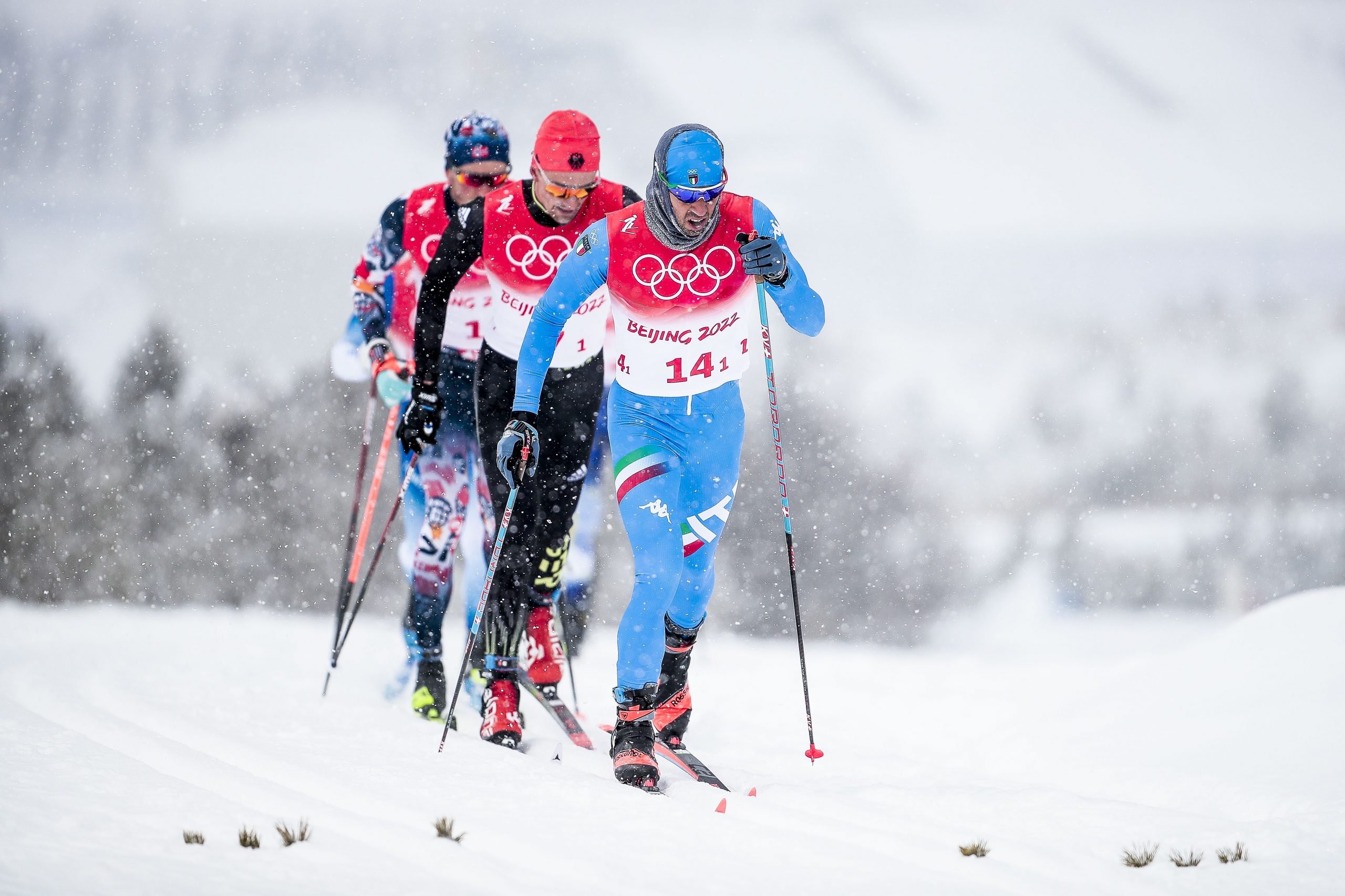
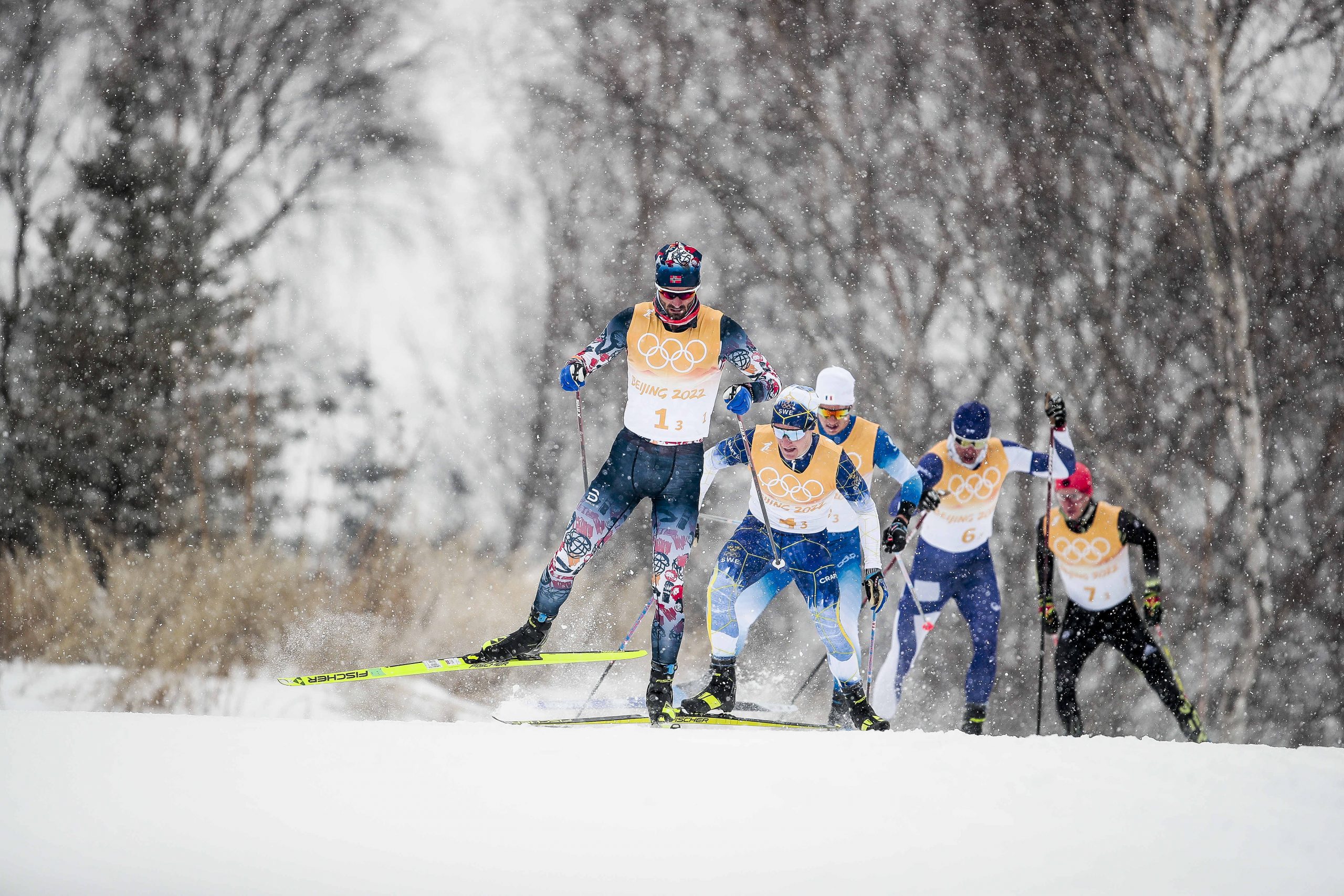
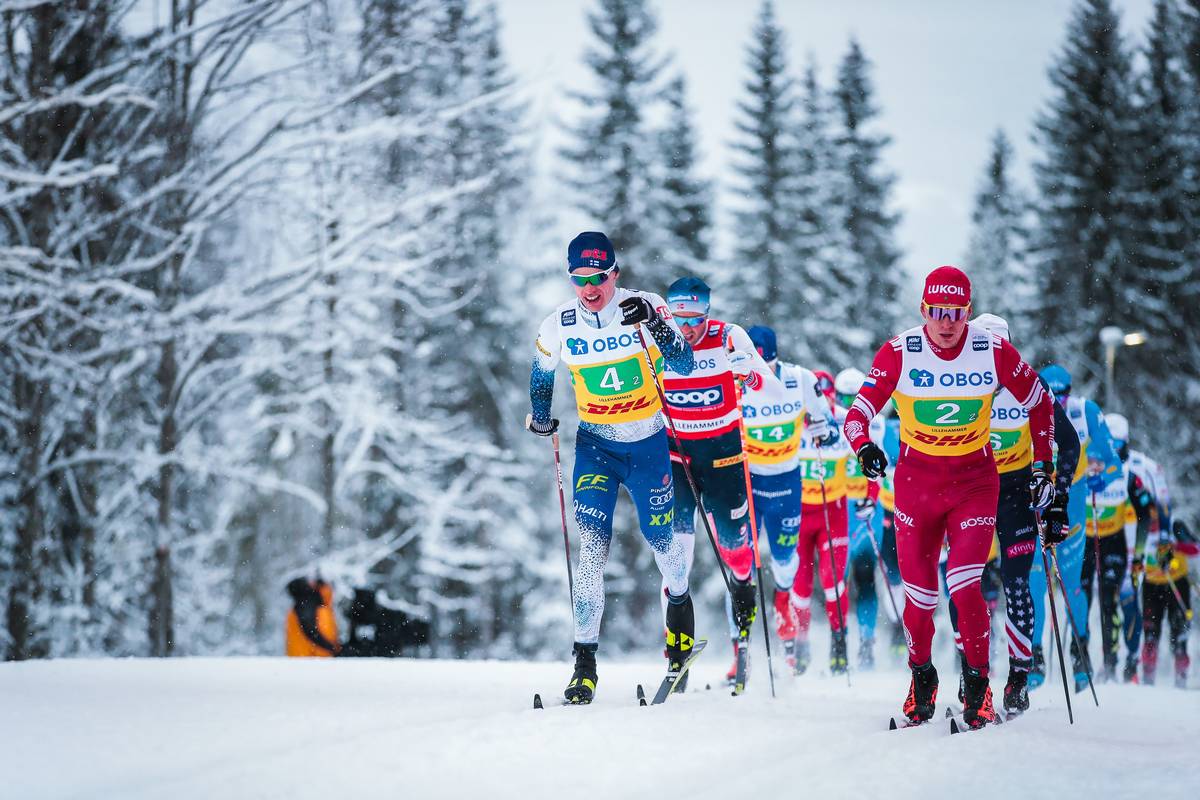
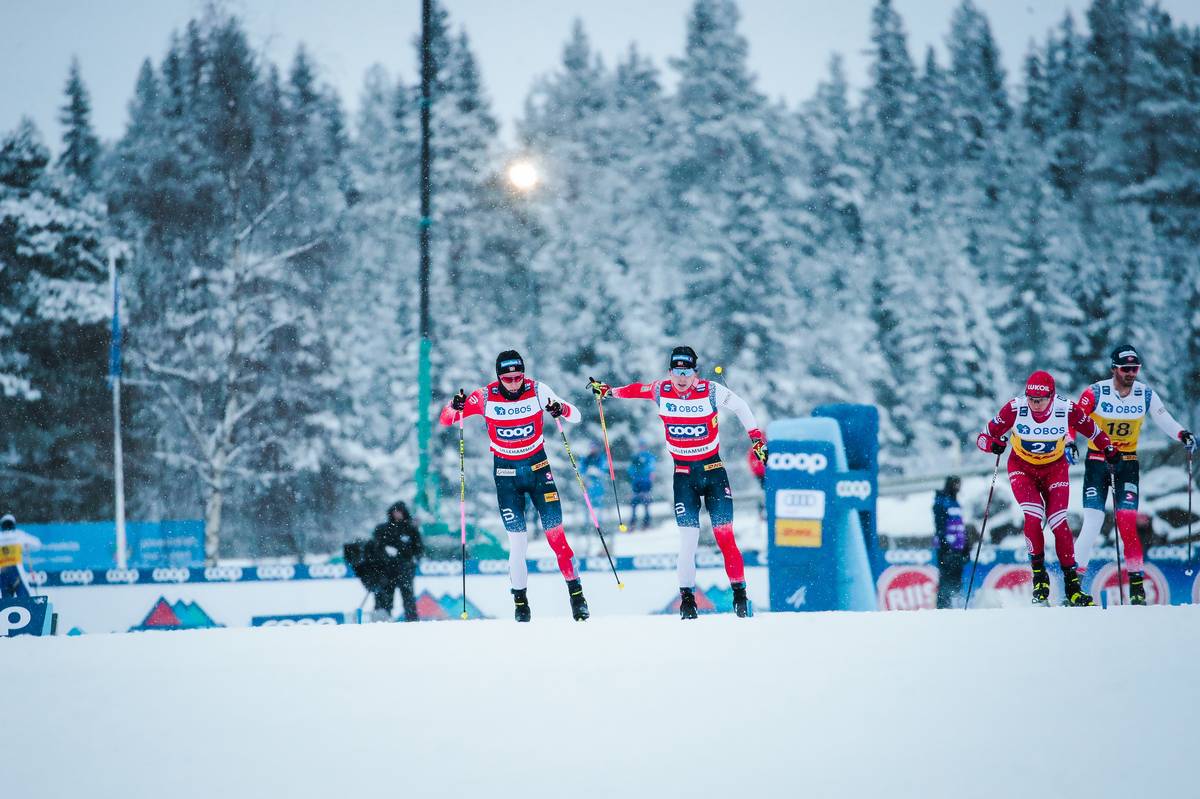
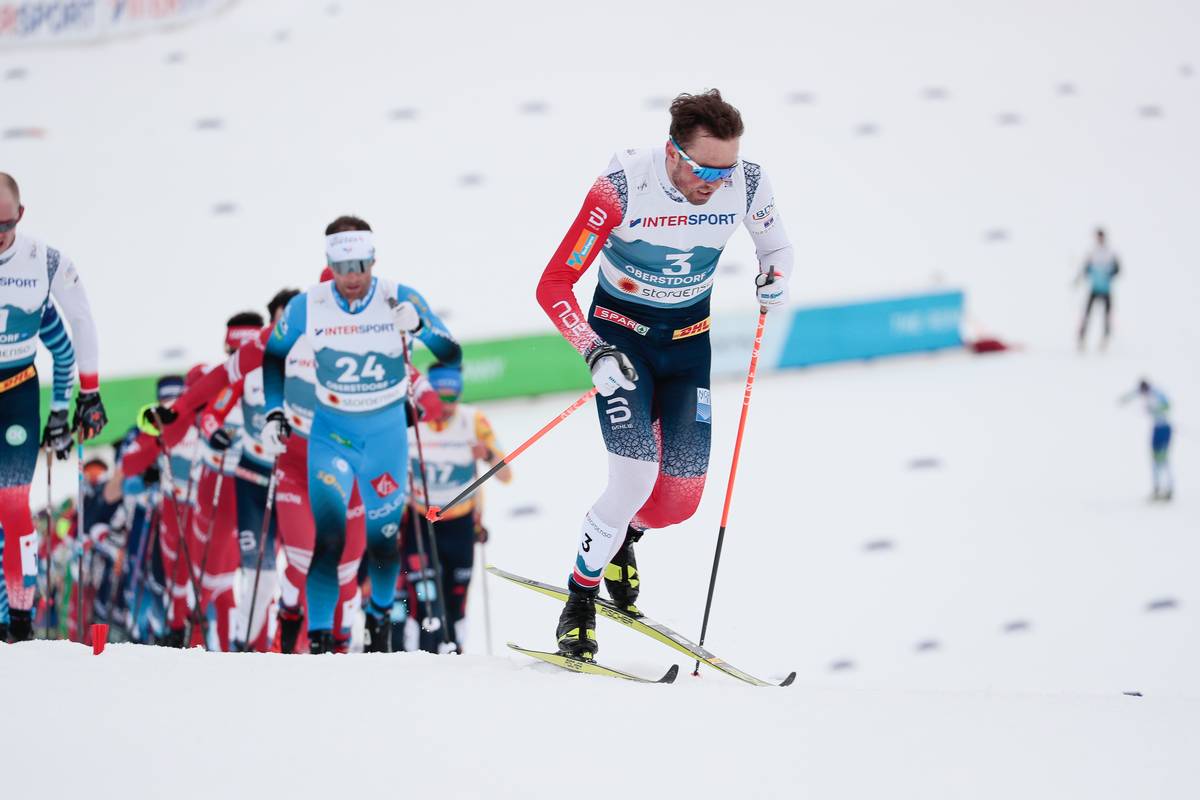
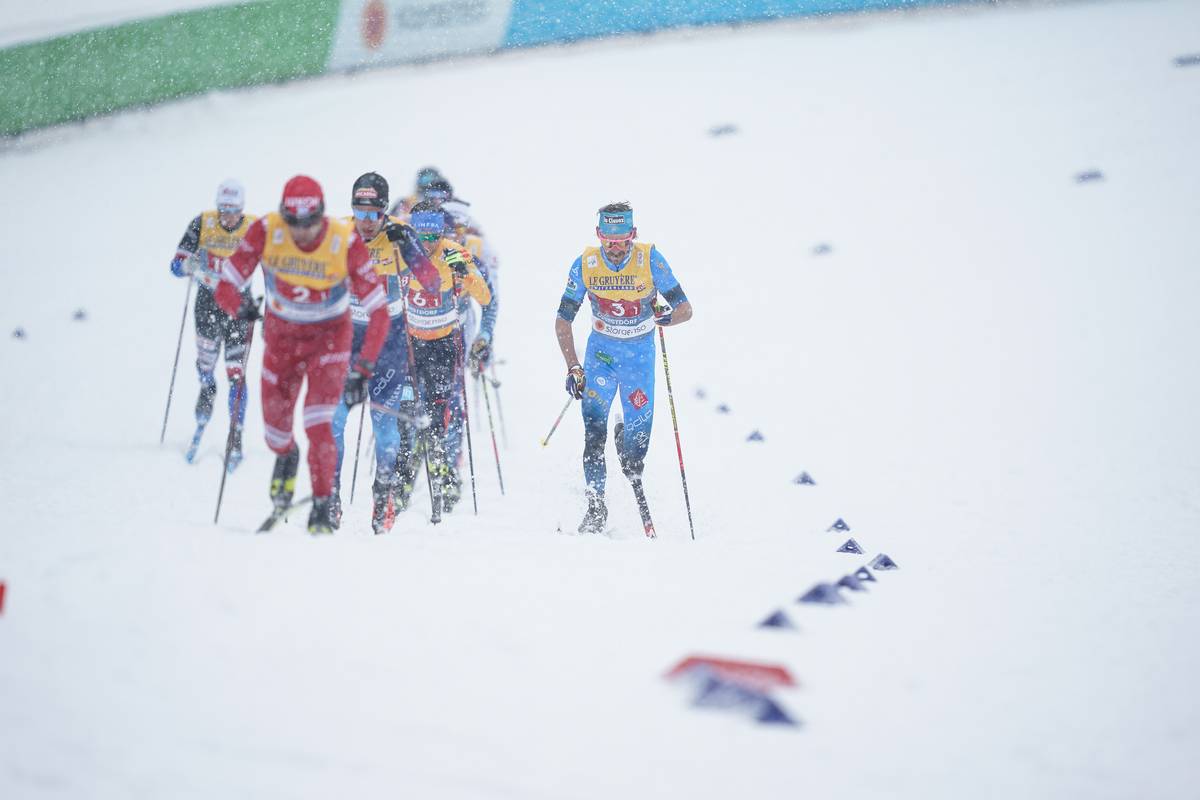
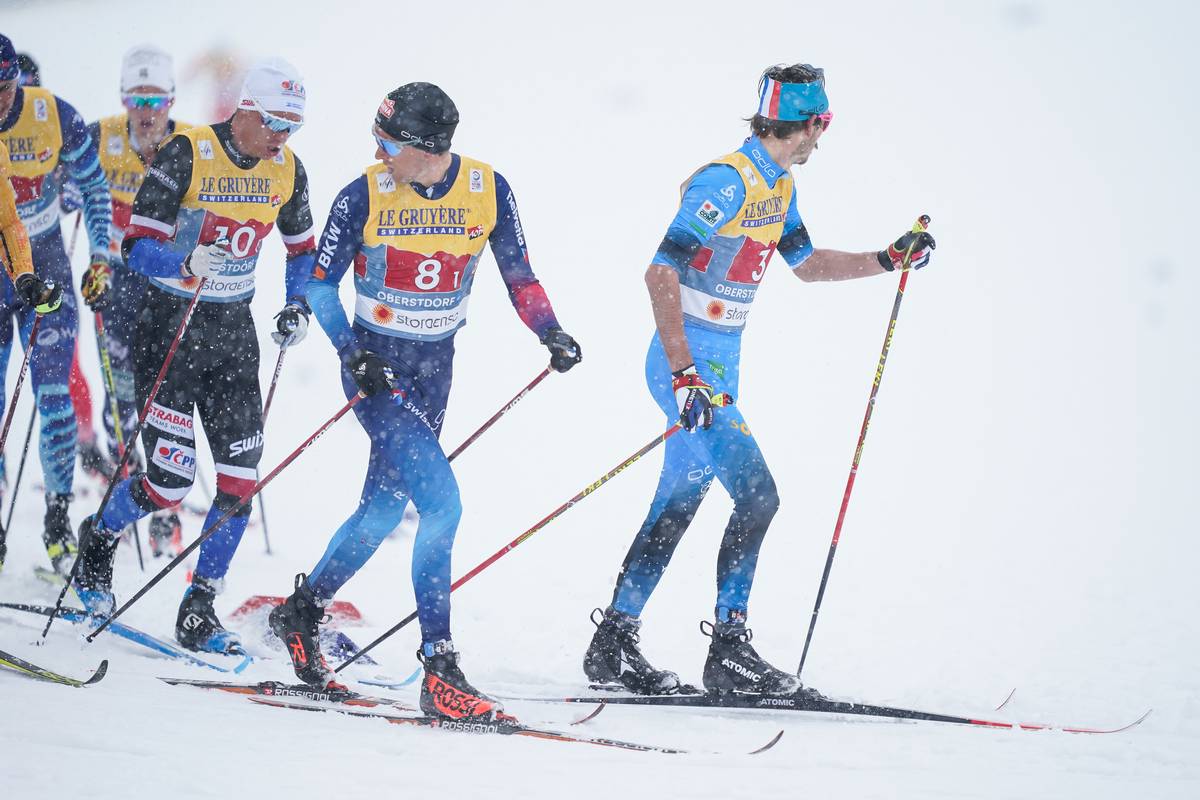
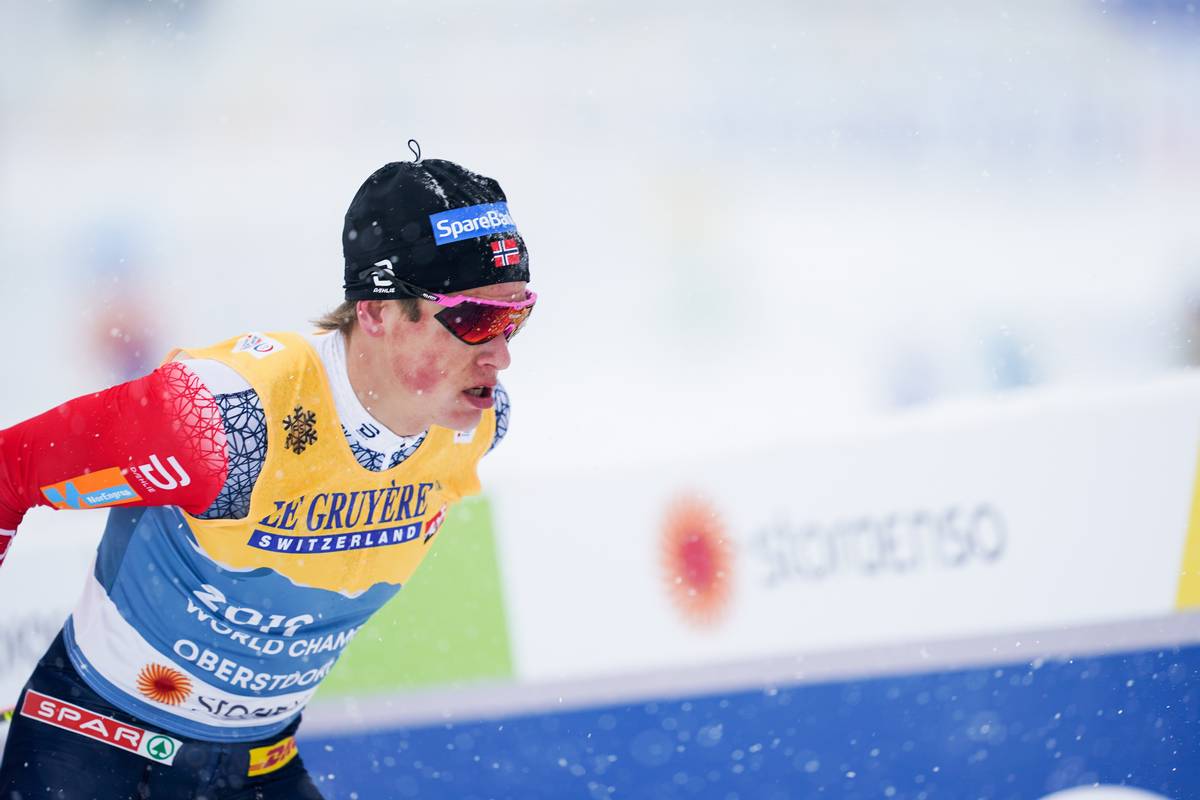
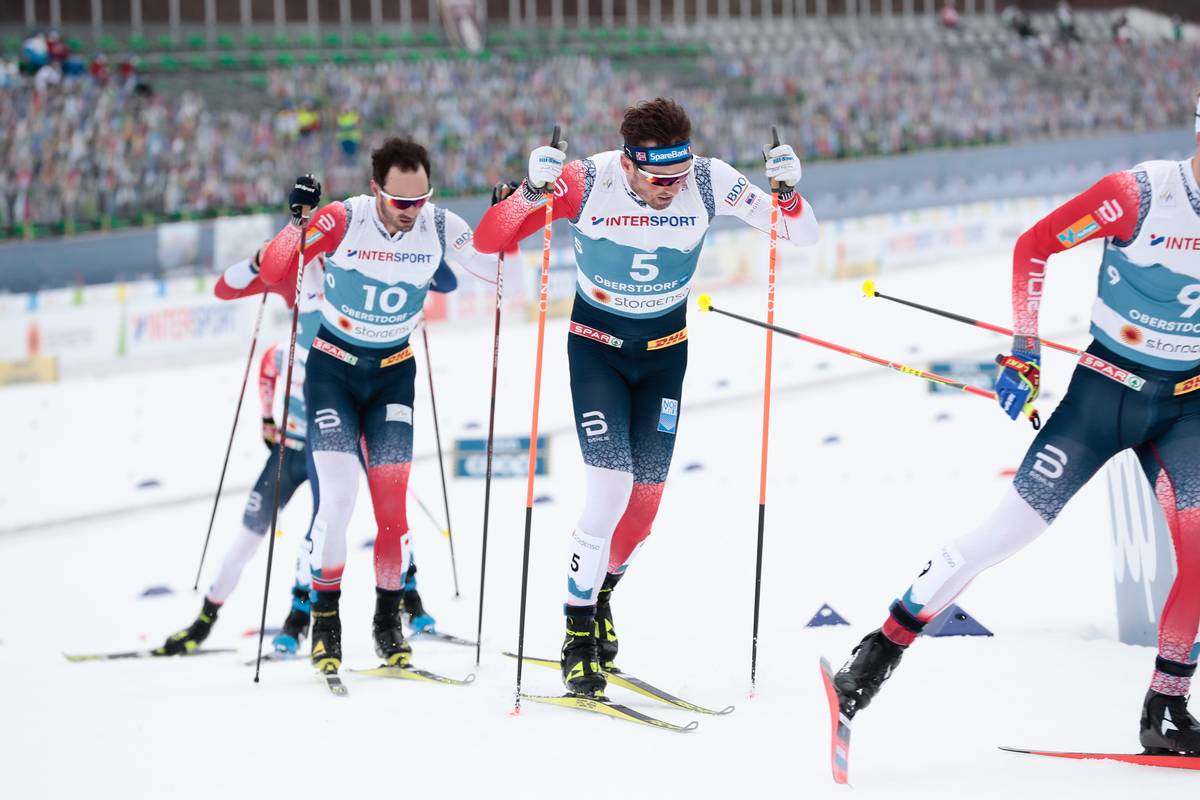
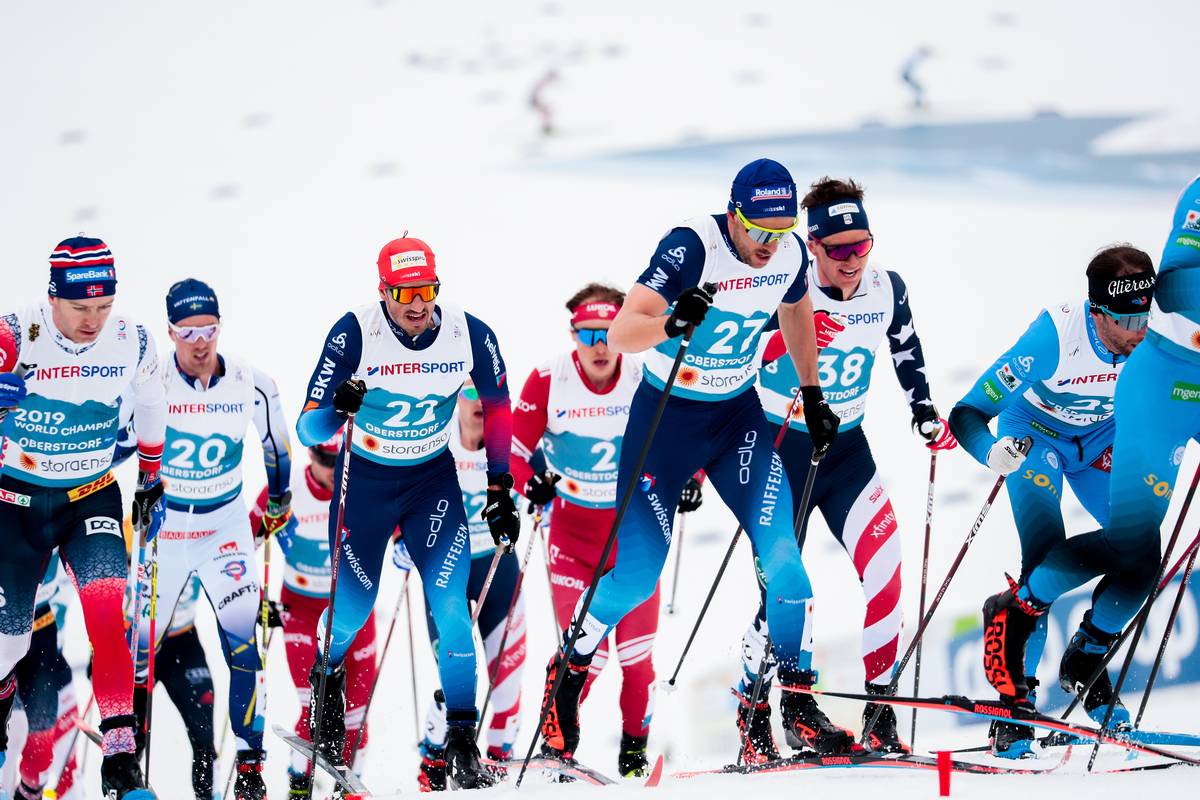
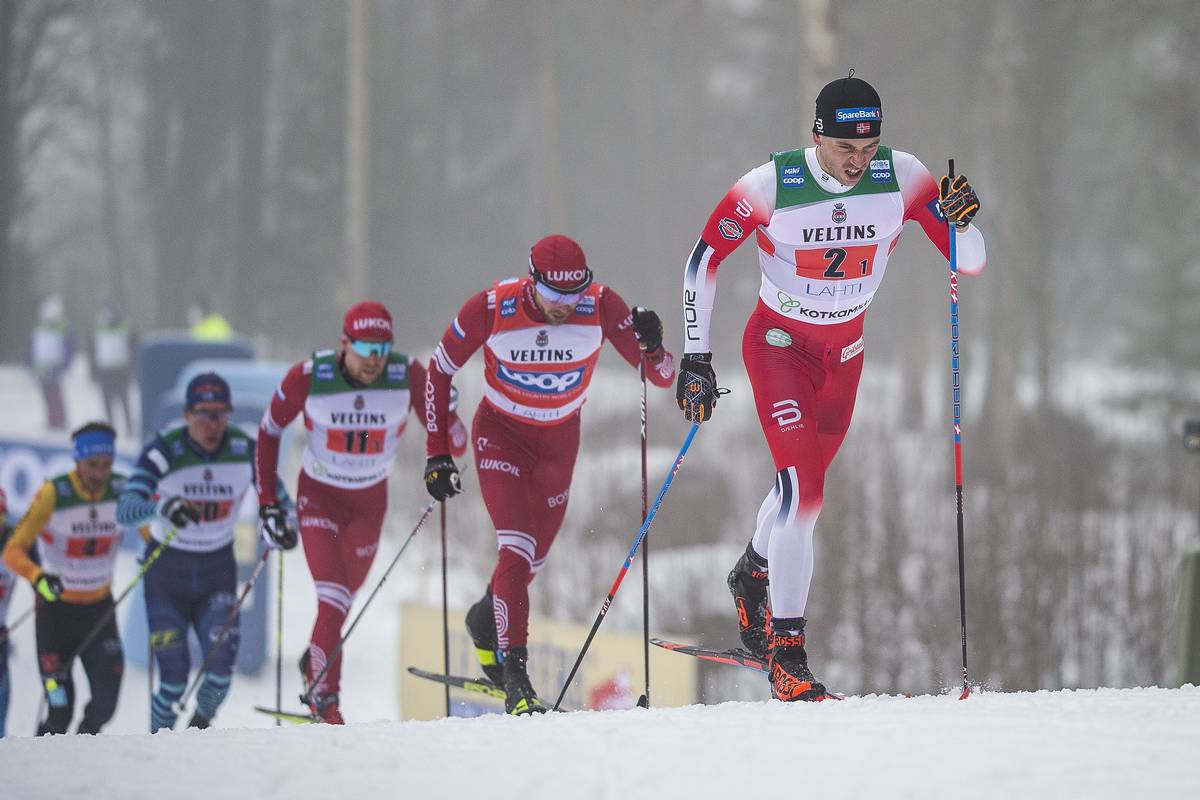
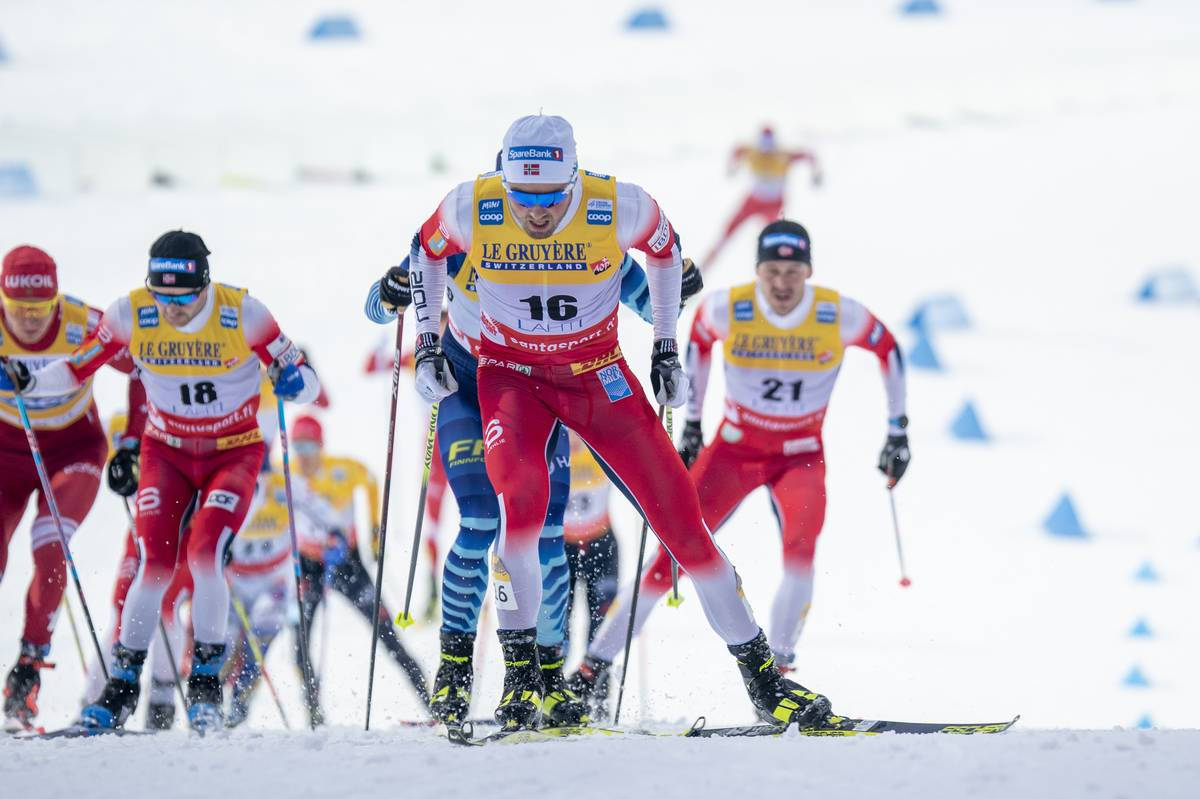
Martin Loewstroem Nyenget (NOR #3) and Emil Iversen (NOR #4) lead during the opening kilometers of the Men’s Olympic 50 k in Tesero, Italy. (Photo: Barbieri/NordicFocus)
TESERO, ITALY — Sprint races can be dazzling, relay legs can be heroic, but the 50 k, especially classic, is where cross-country skiing gets carved into stone. The 50 k Classic turns strength, technique, and endurance into history, myth, and lore.
On Saturday afternoon in Val di Fiemme, Johannes Hoesflot Klaebo skied into that mythology.
By winning the Olympic 50 k Classic, Klaebo completed a sweep of six gold medals at these Games — six events, six victories — something no Winter Olympian had ever done before. The sprint prodigy who has built his reputation on ferocity over 1.5 kilometers now owns the sport’s most traditional crown.
“I don’t think I even could have dreamed about this,” Klaebo said afterward.
“In Norway, they say you must win a 50 k to become a man.” Klaebo said, smiling in the post-race press conference, “I think I am that now.”
Johannes Hoesflot Klaebo (NOR) both the Olympic 50 k gold and a clean sweap of these games. (Photo: Vanzetta/NordicFocus)
Feeling the significance
The 50 k Classic is the most prestigious event in the sport with a long and storied history, and over 100 years of these championships, no one had ever put their skis on to start this race, trying to win an unprecedented 6th gold medal in one Olympic Games. But Klaebo had proven last year he could, winning six races at the World Championships on his home trails in Trondheim, Norway.
The historic attempt was larger than cross-country skiing, too. American long-track speed skater Eric Heiden won five gold medals at the 1980 Winter Olympics in Lake Placid, New York. Klaebo was attempting to do something no athlete had ever done before at the Winter Olympics.
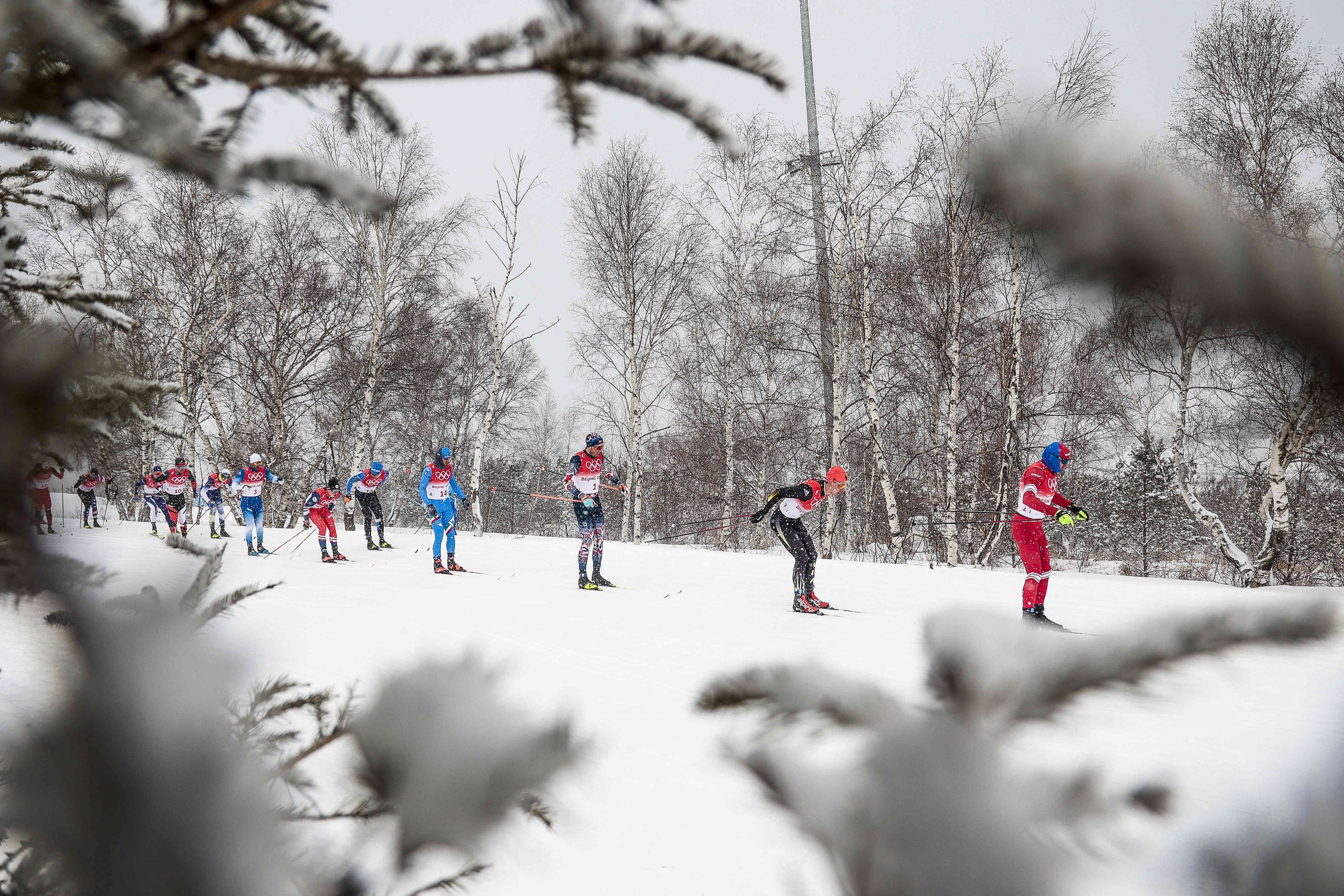
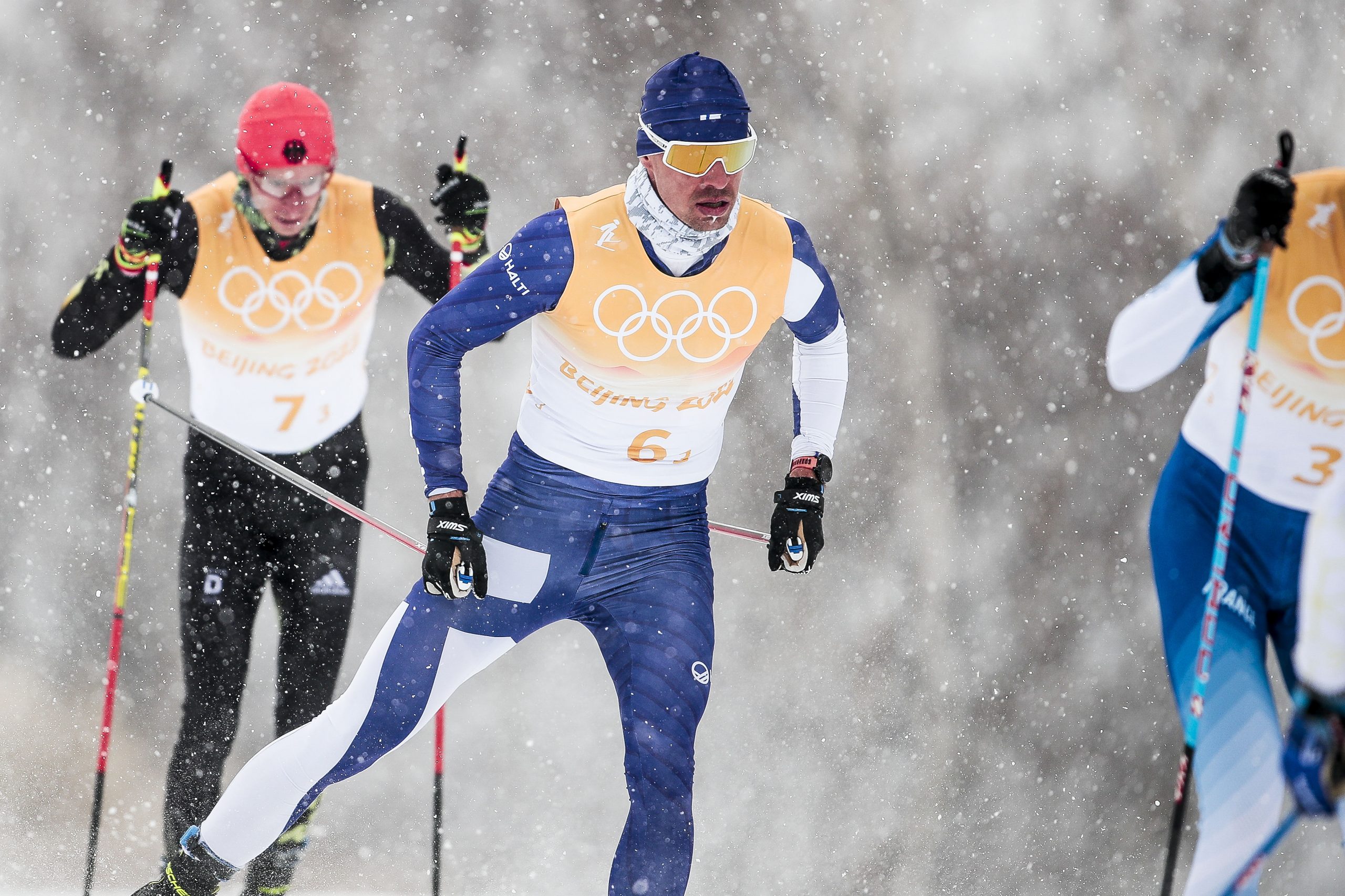
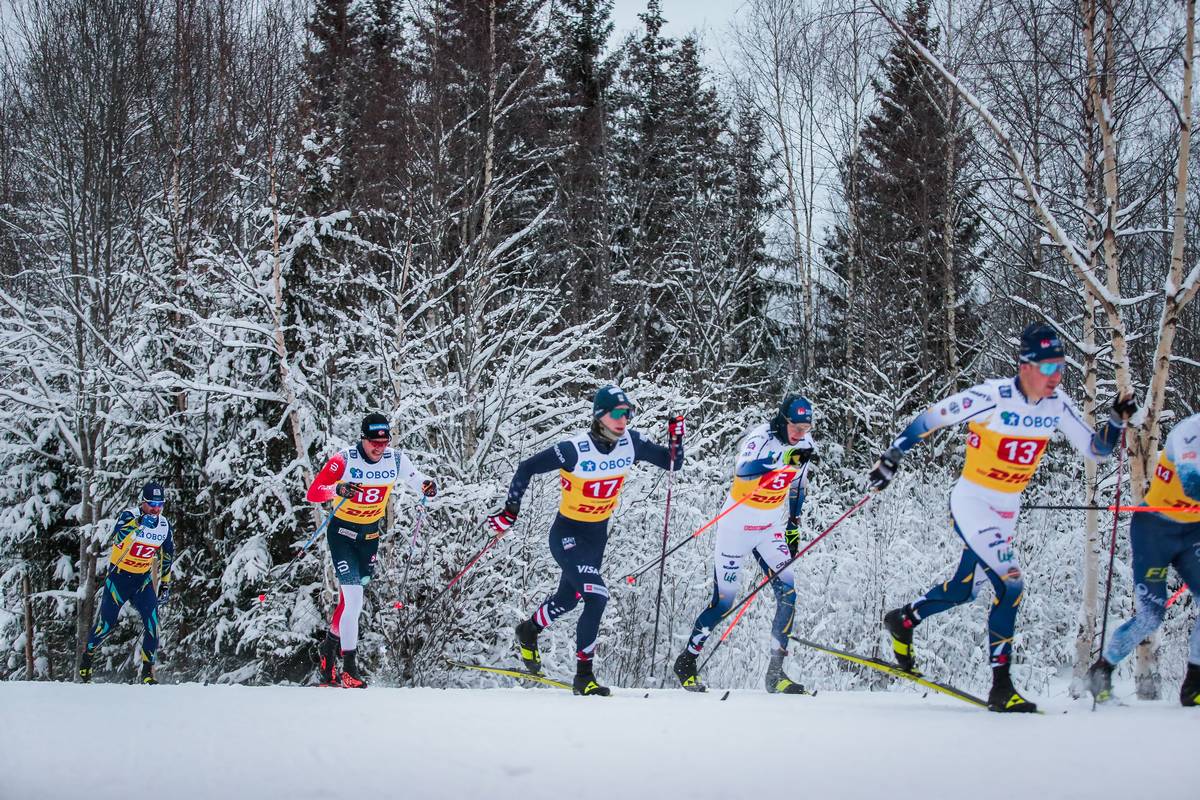
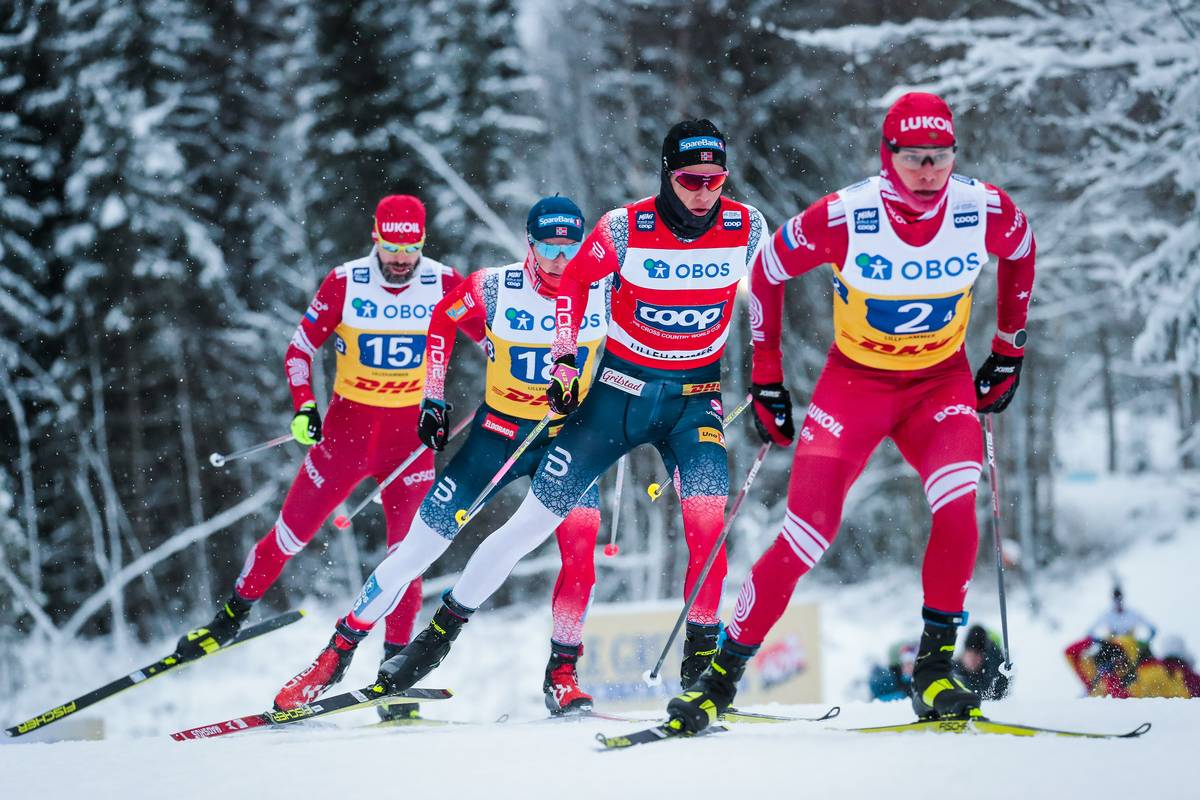
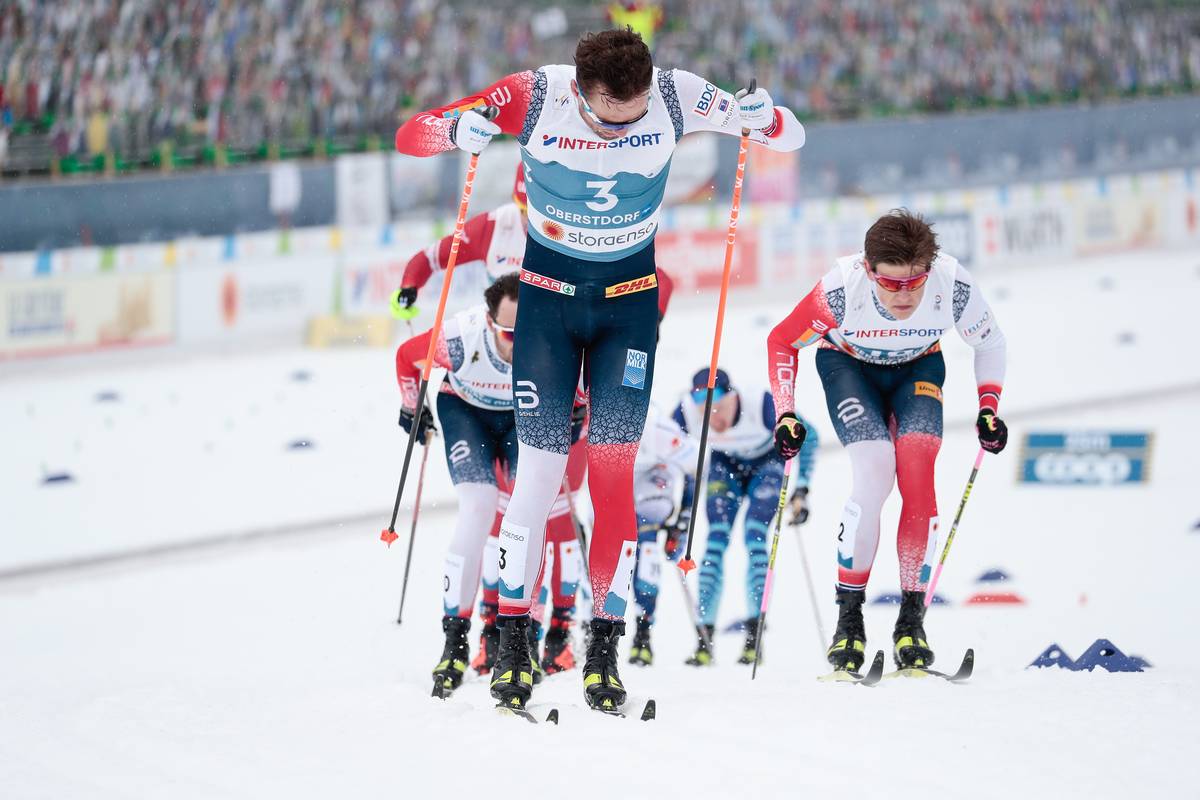
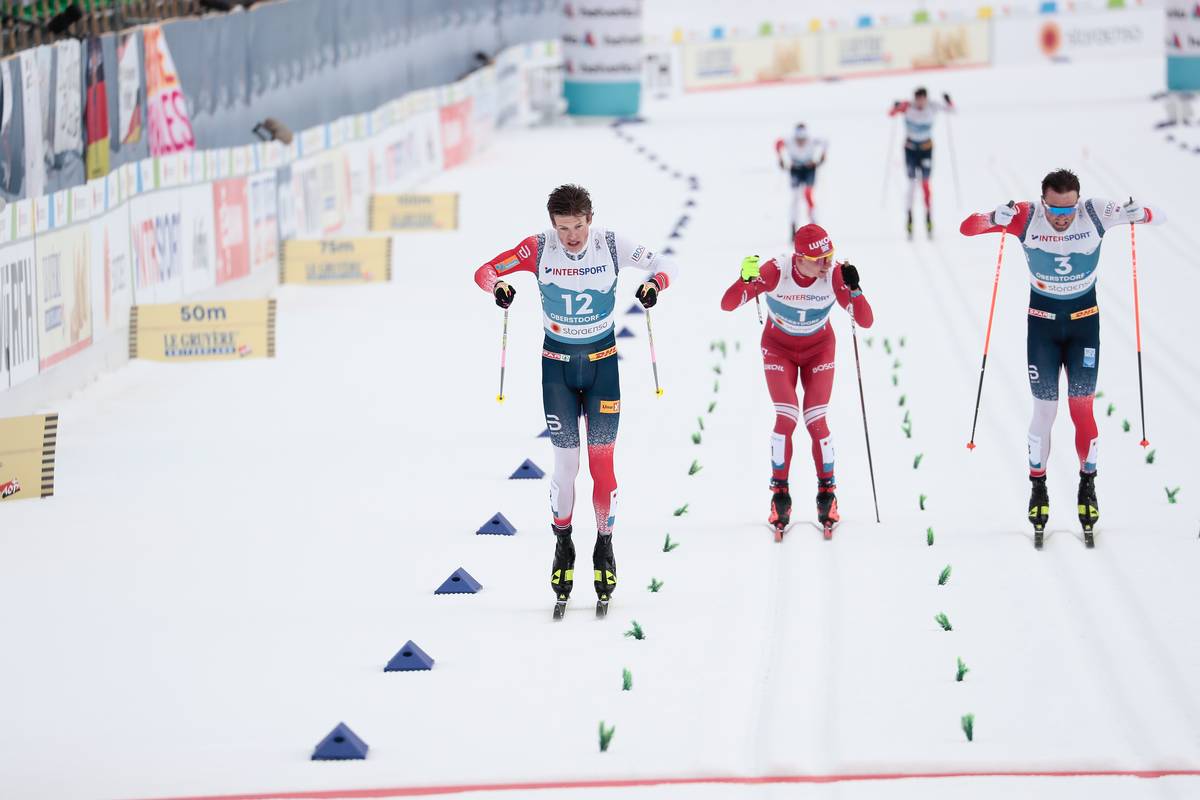
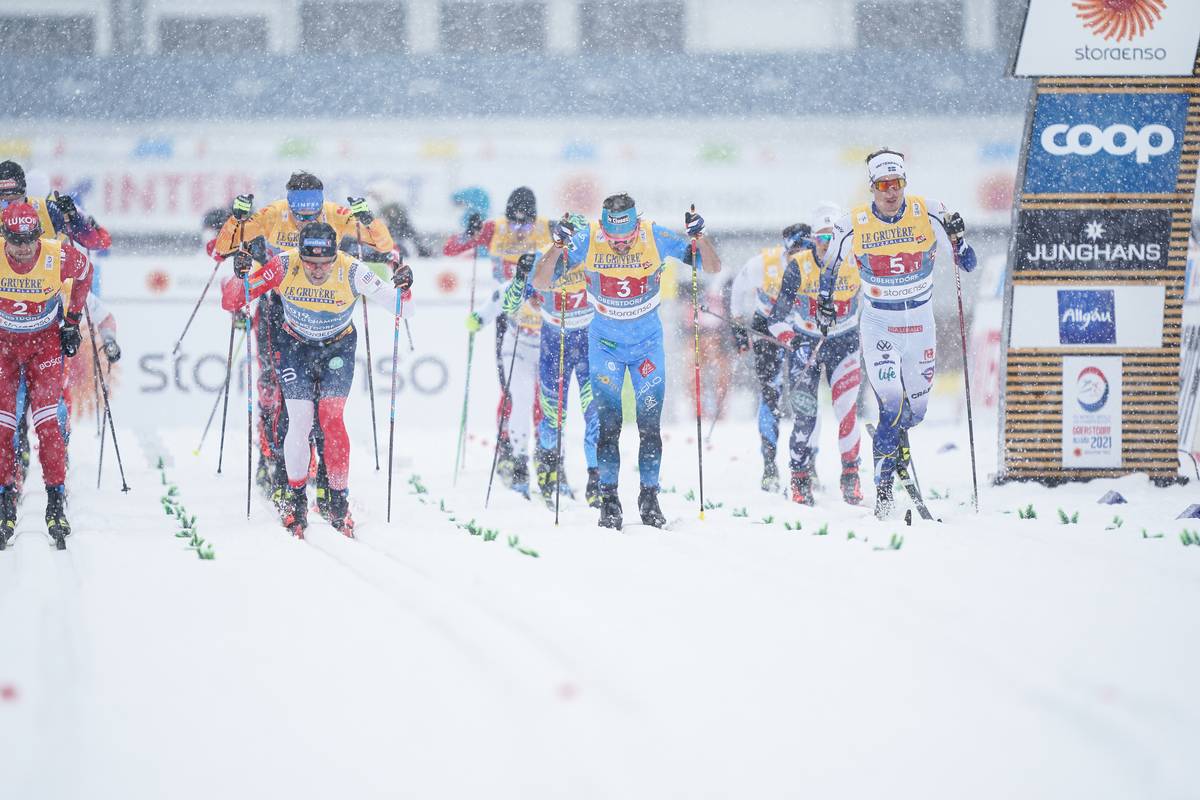
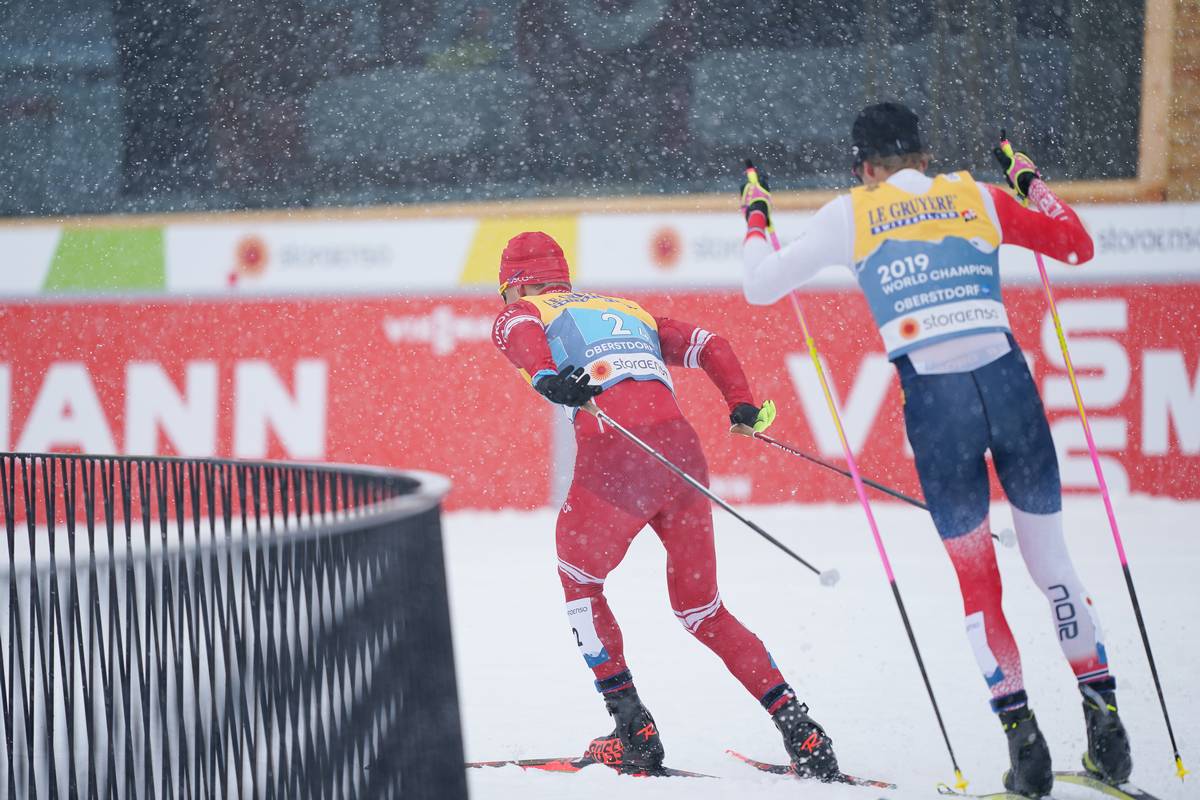
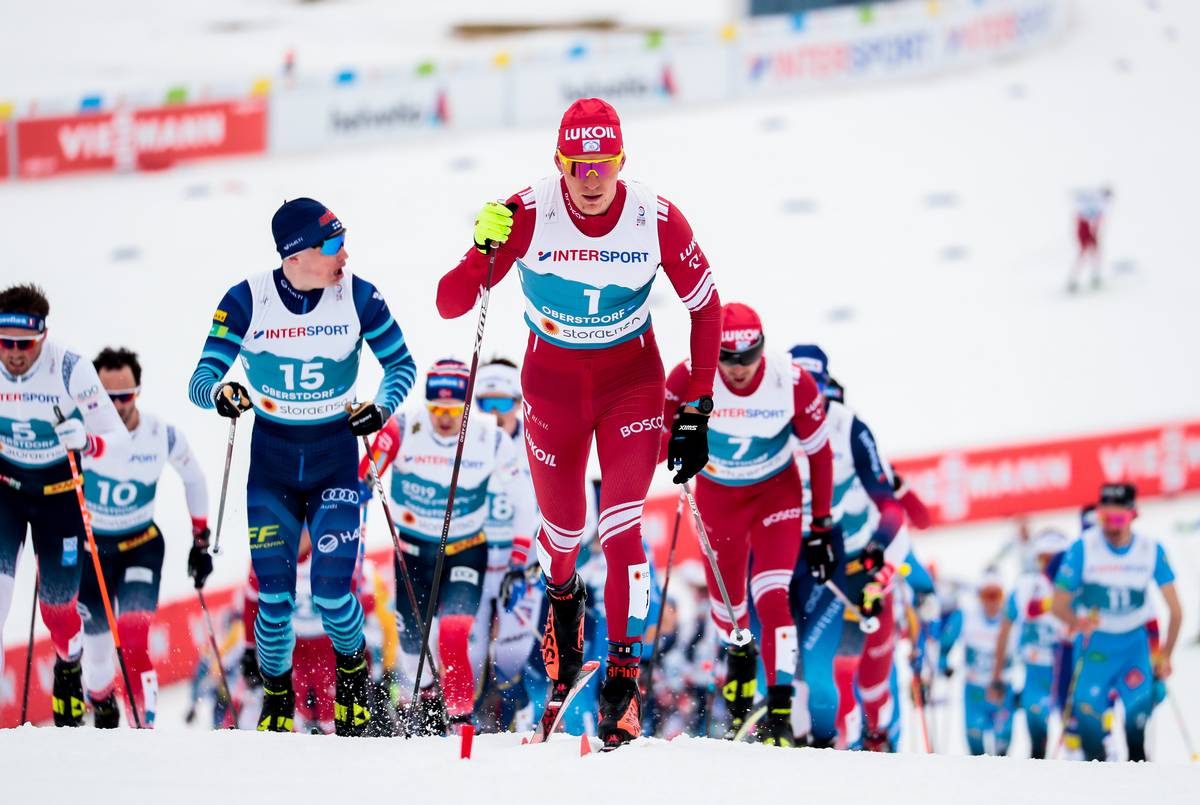
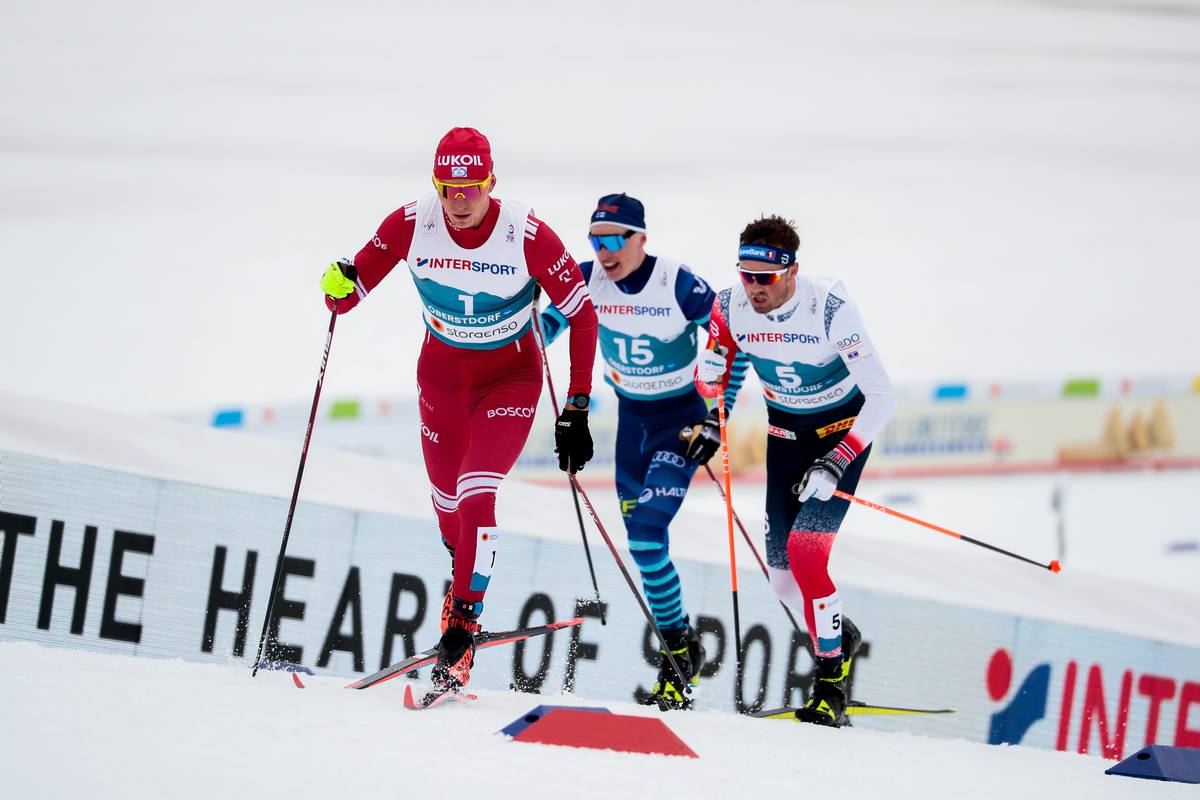
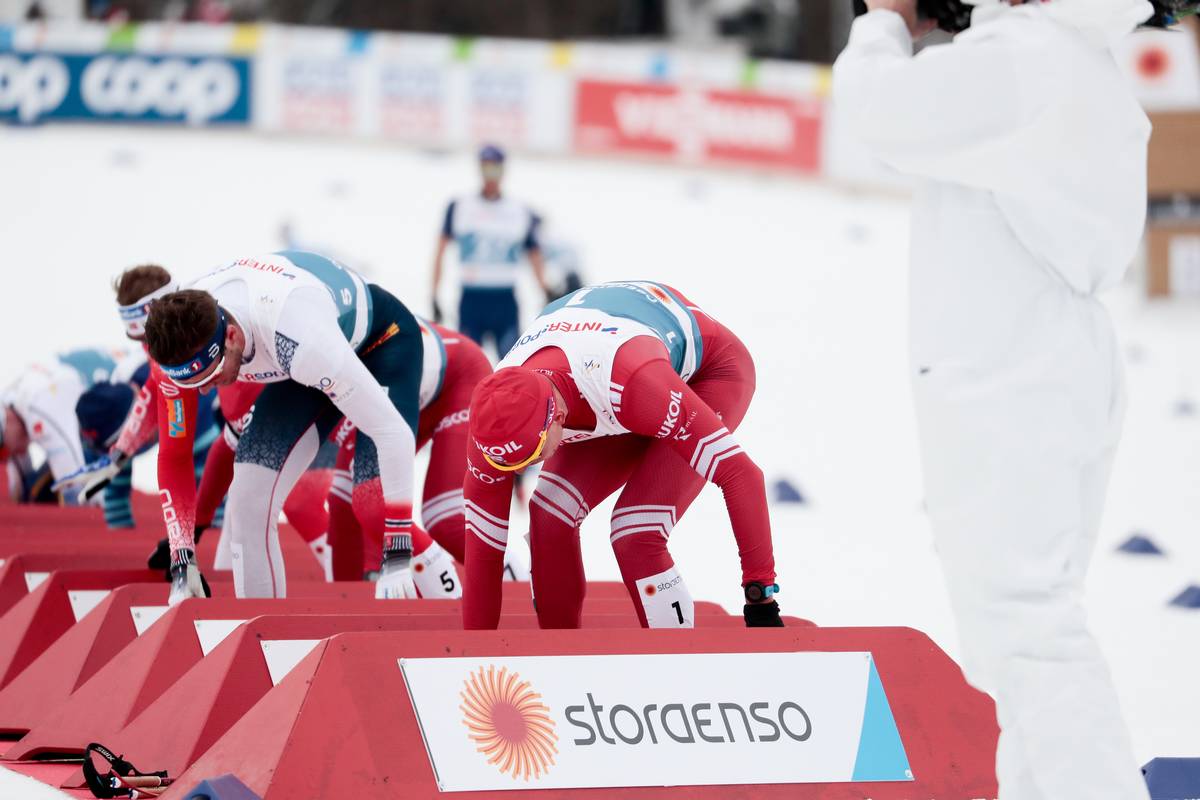
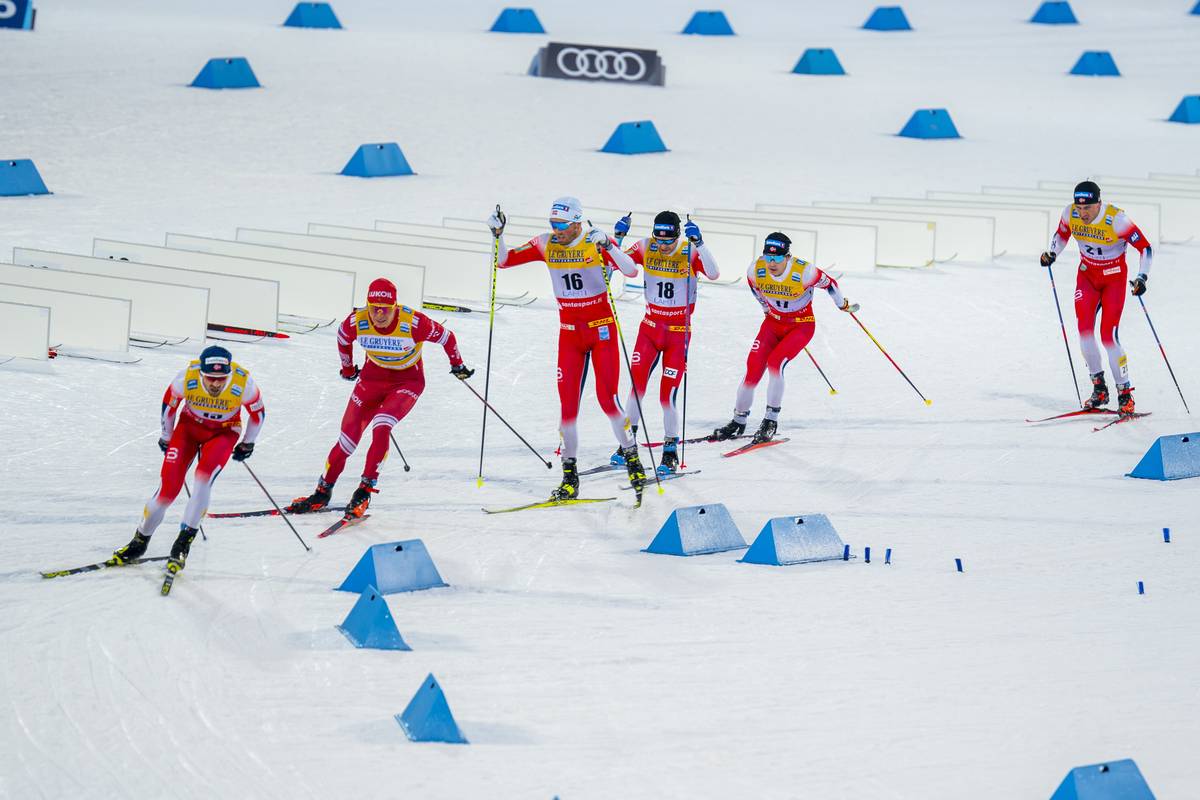
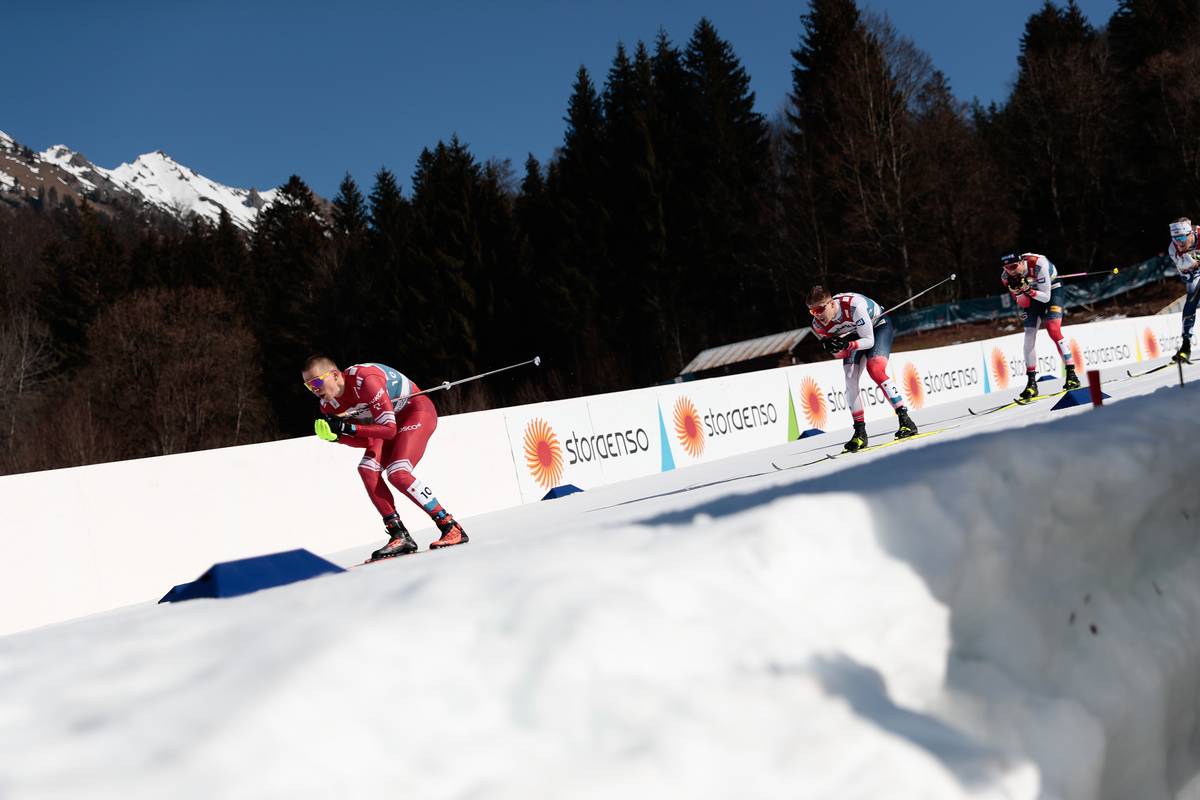
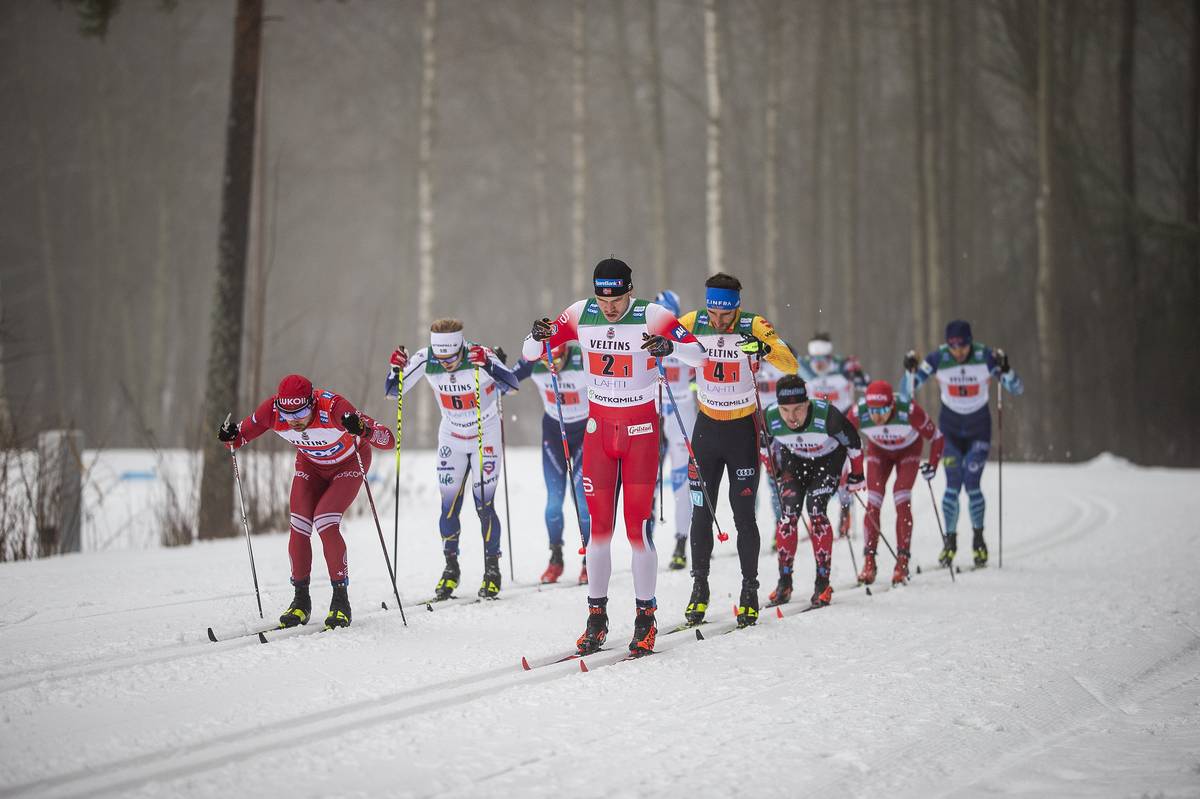
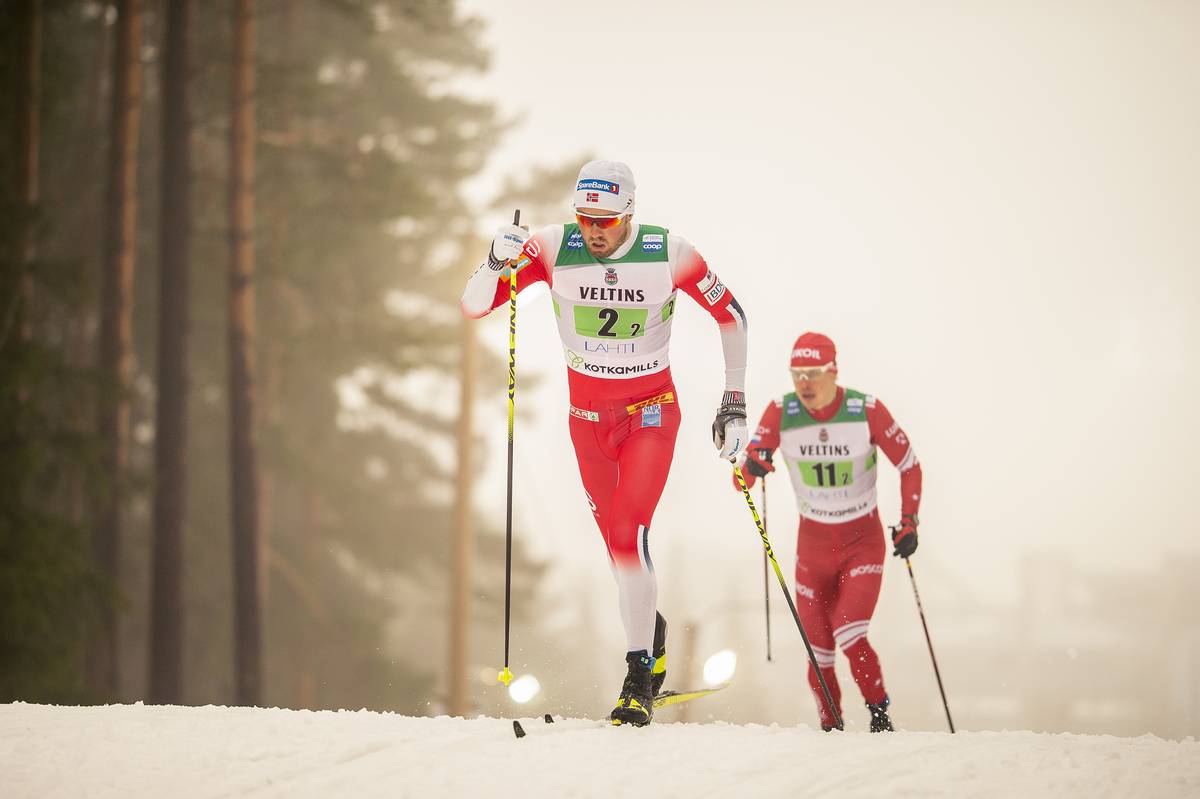
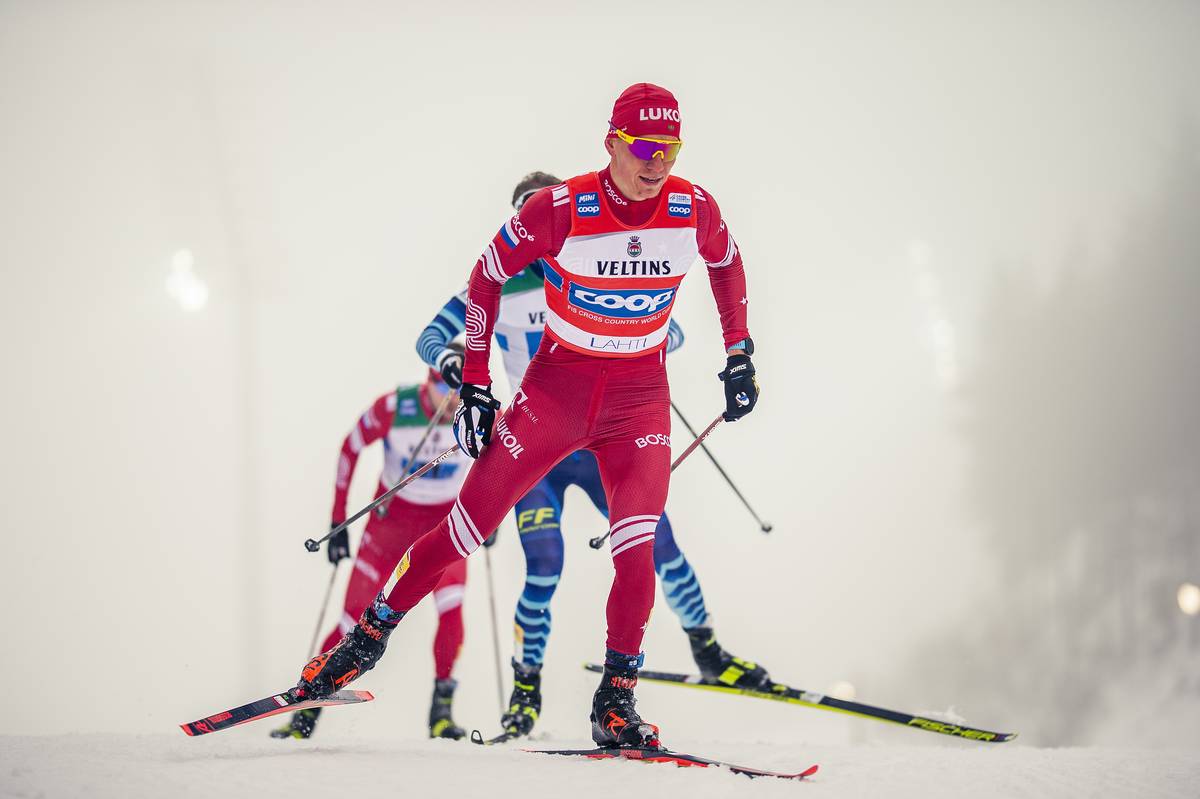
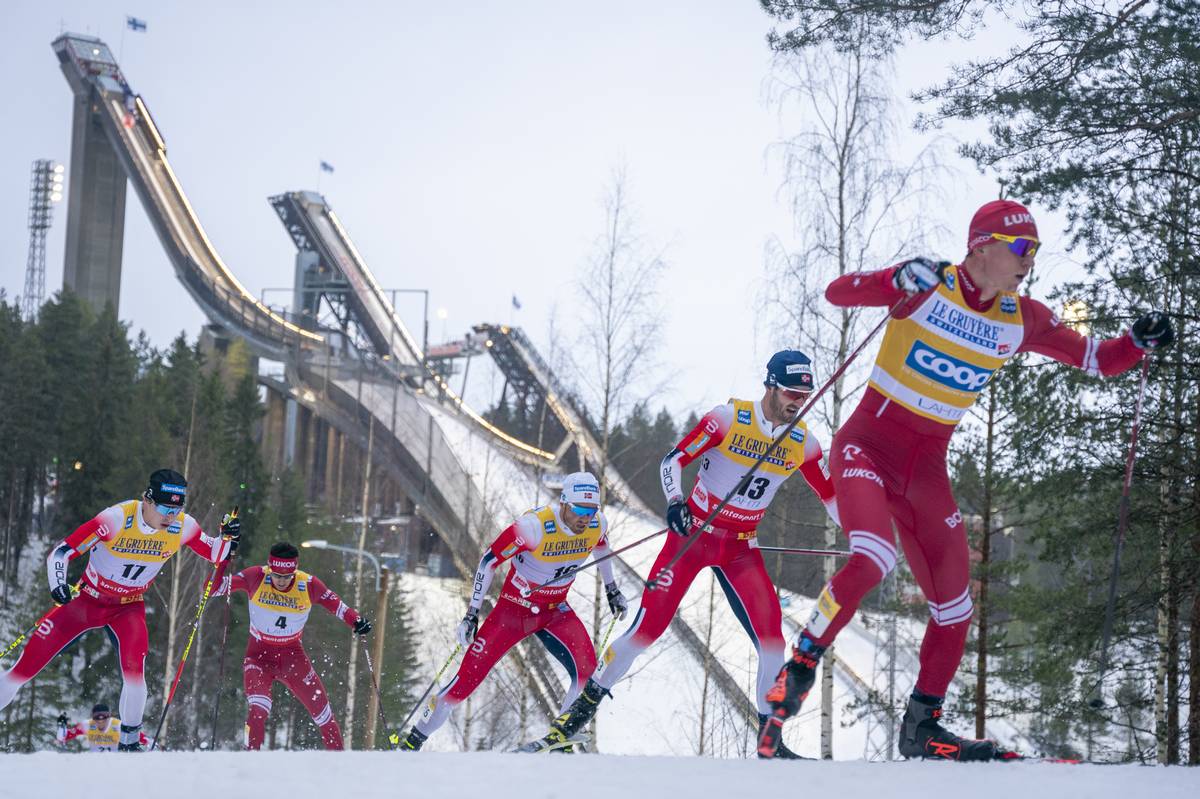
Savelii Korostelev (AIN #12), Iivo Niskanen (FIN #7), Martin Loewstroem Nyenget (NOR #3), Johannes Hoesflot Klaebo (NOR #1), Harald Oestberg Amundsen (NOR #2), Emil Iversen (NOR #4), (l-r) during the early stages of the 50 k. (Photo: Vanzetta/NordicFocus)
The potential spoilers
Going into the race, the heavy favorites were without a doubt the Norwegians with Klaebo, his training partner Emil Iversen, Harald Oestberg Amundsen, and Martin Loewstroem Nyenget. However, others had to be considered as potential spoilers for the historic moment, among them, athletes on the French team, including Mathis Desloges, Hugo Lapalus, Victor Lovera, Finland’s Iivo Niskanen, American Gus Schumacher, and the Independent Neutral Athlete (AIN) Savelii Korostelev. Though it was a long shot, these other nations’ athletes could, potentially, battle for the win or at least a podium spot.
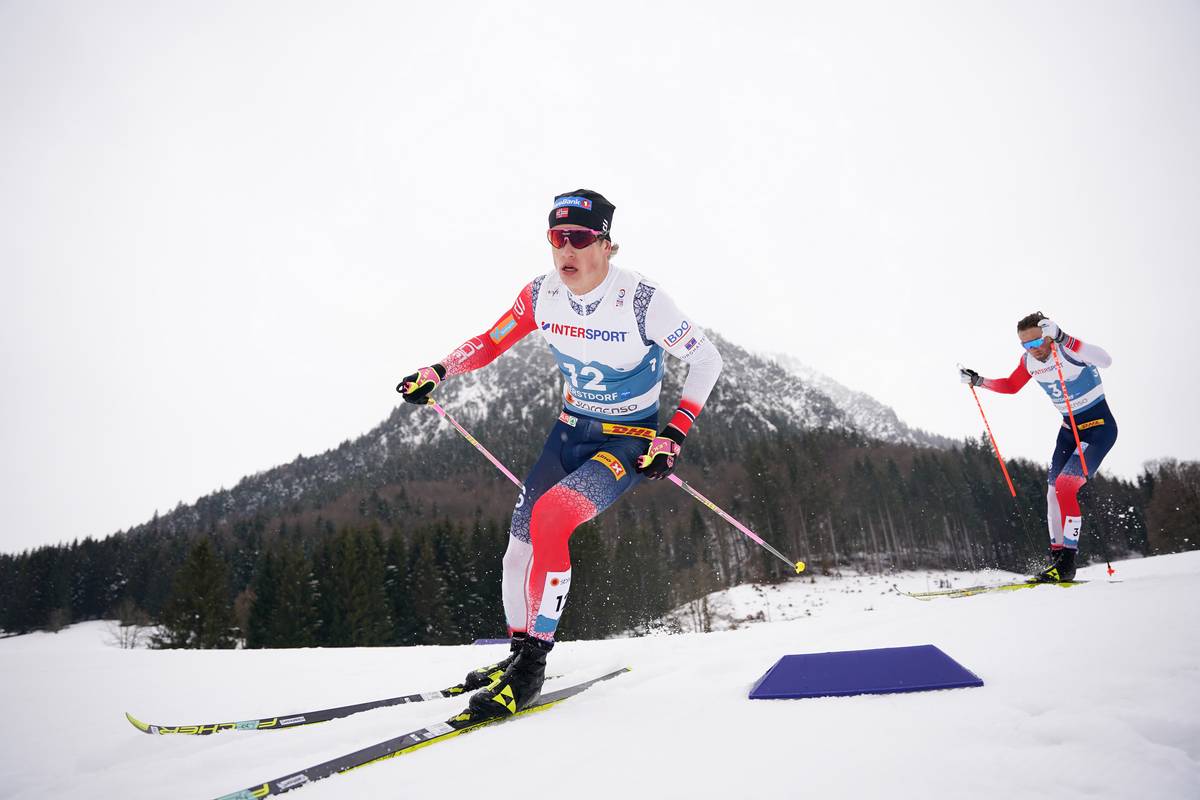
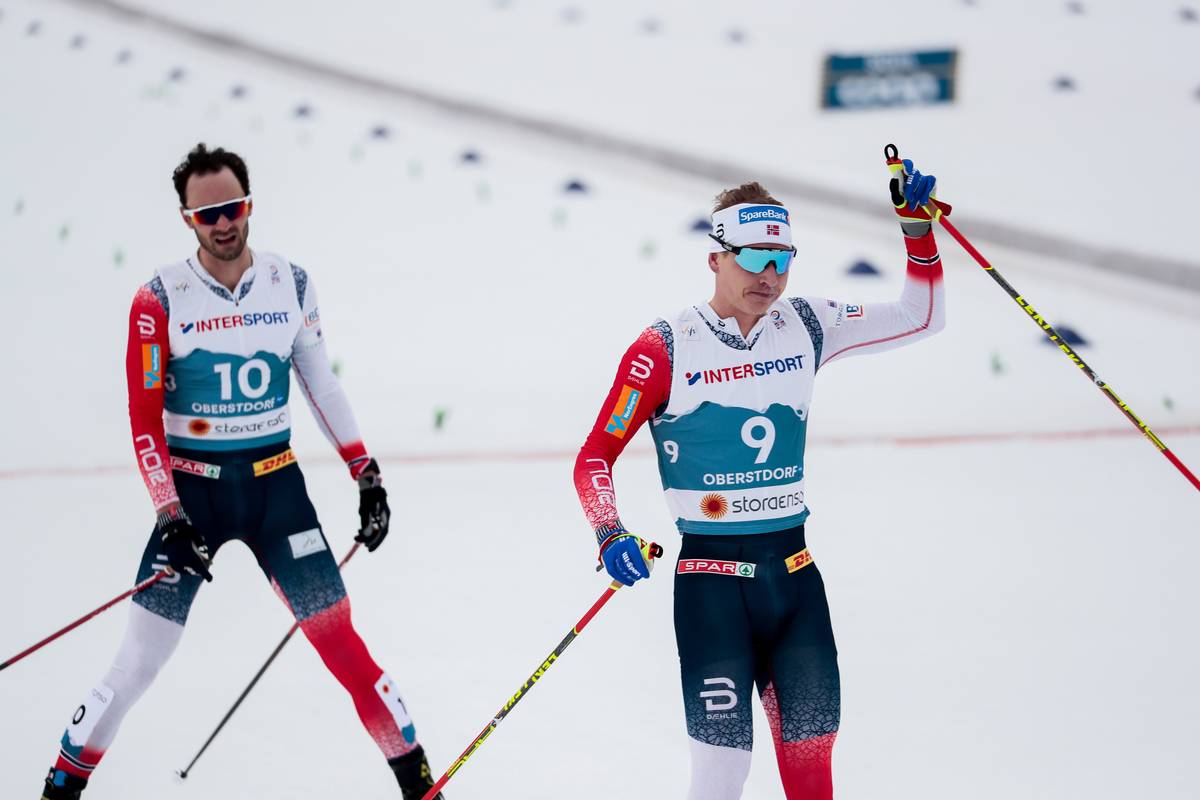
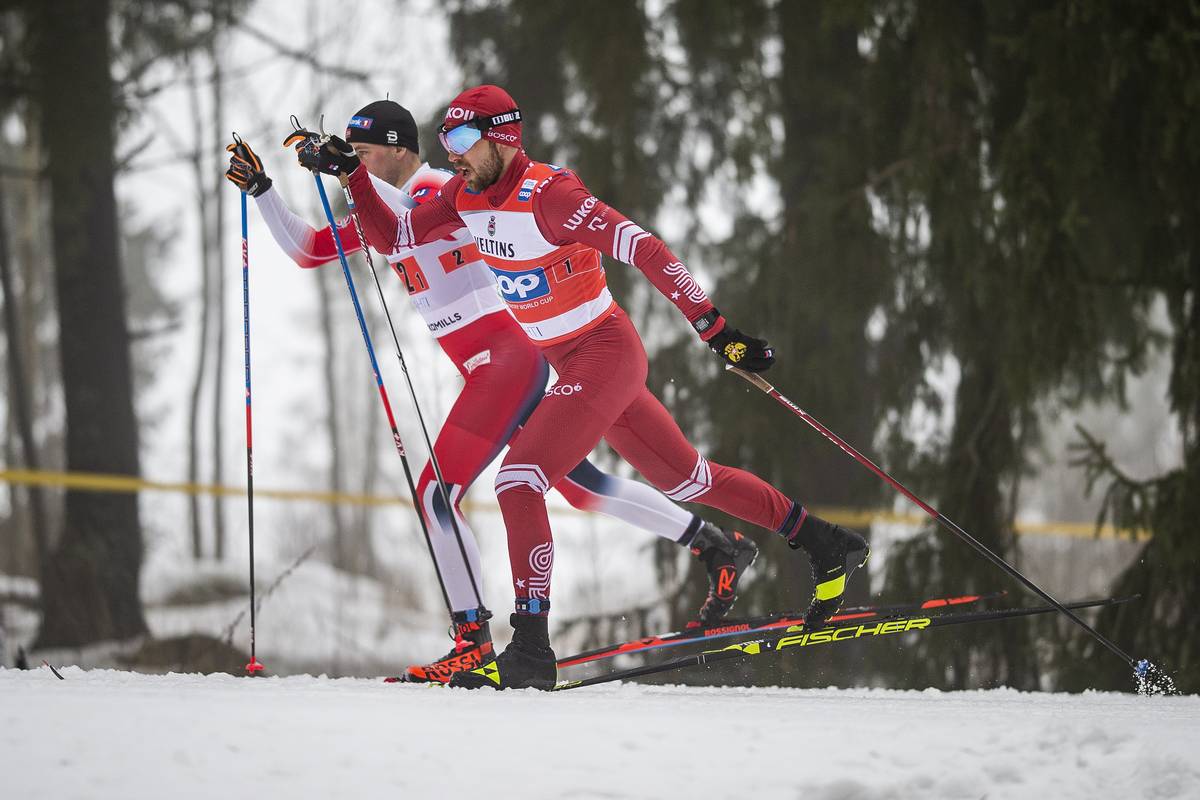
Johannes Hoesflot Klaebo (NOR), Emil Iversen (NOR), and Martin Loewstroem Nyenget (NOR), (l-r) turned the 50 k into a three-man race. (Photo: Vanzetta/NordicFocus)
The Shape of the Race
The Olympic course in Tesero is not subtle. Seven laps with relentless climbing. Among them, the featured hill, the Zorzi Climb, waits like a toll booth each time the skiers re-enter the stadium.
Heading into the race, there were 65 men on the start list, but Italy’s Federico Pellegrino, Finland’s Ristomatti Hakola, and America’s Ben Ogden all scratched.
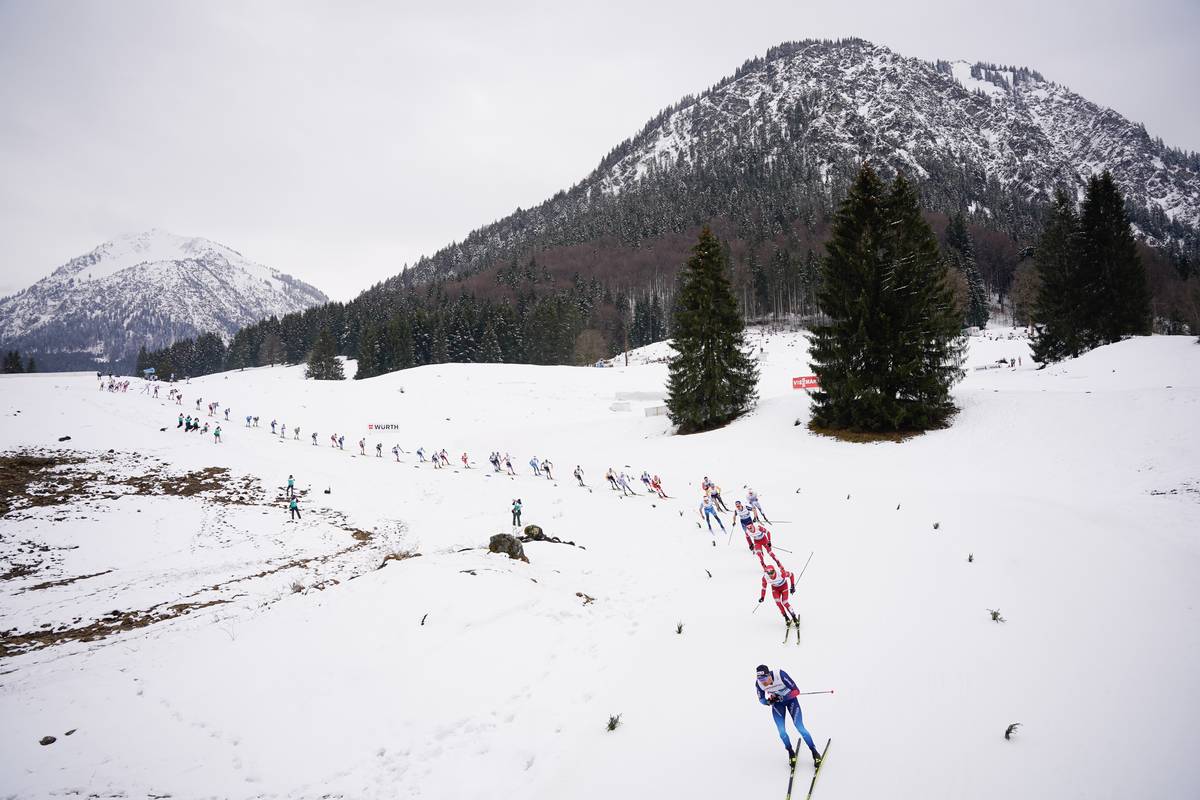
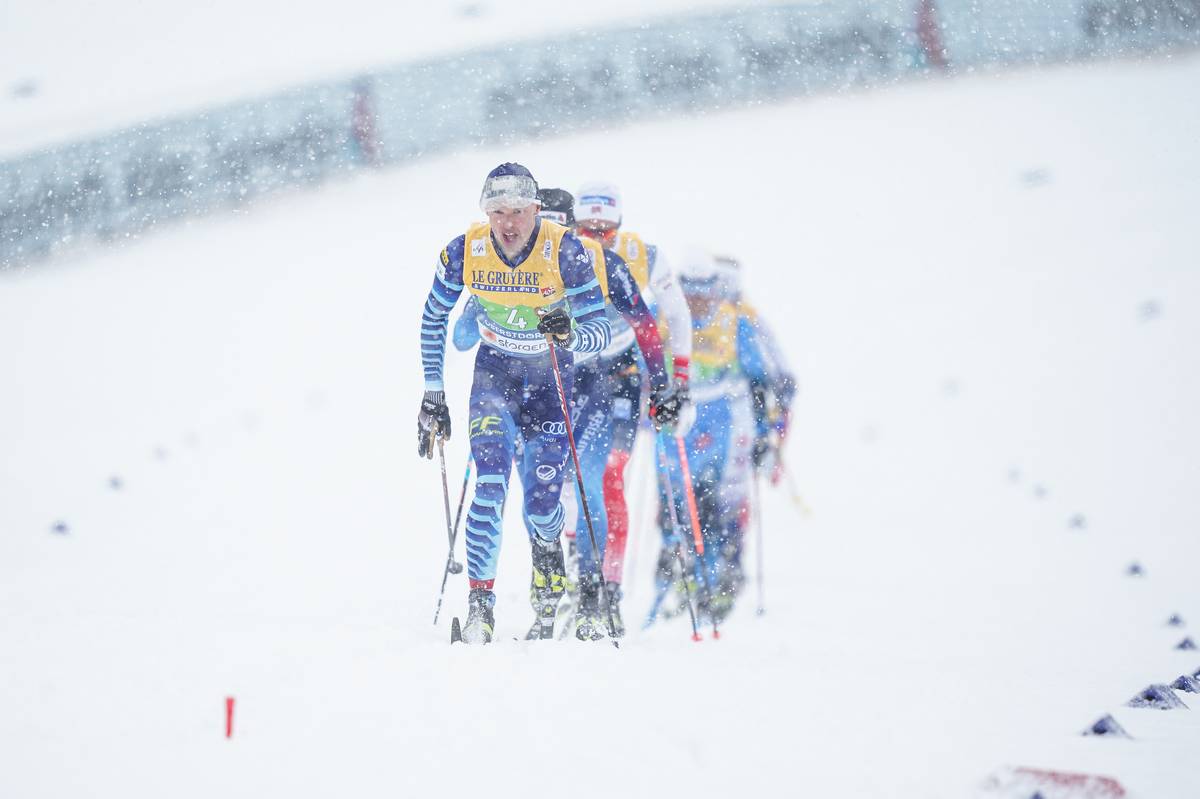
Once the race started, the first lap went by without much drama, though the field began to stretch. As they entered the stadium after one loop, over 30 skiers were within 20 seconds of the lead. By the end of lap two, that front pack had reduced to 20 skiers within 23 seconds of the lead, and on lap three, things really began to take shape.
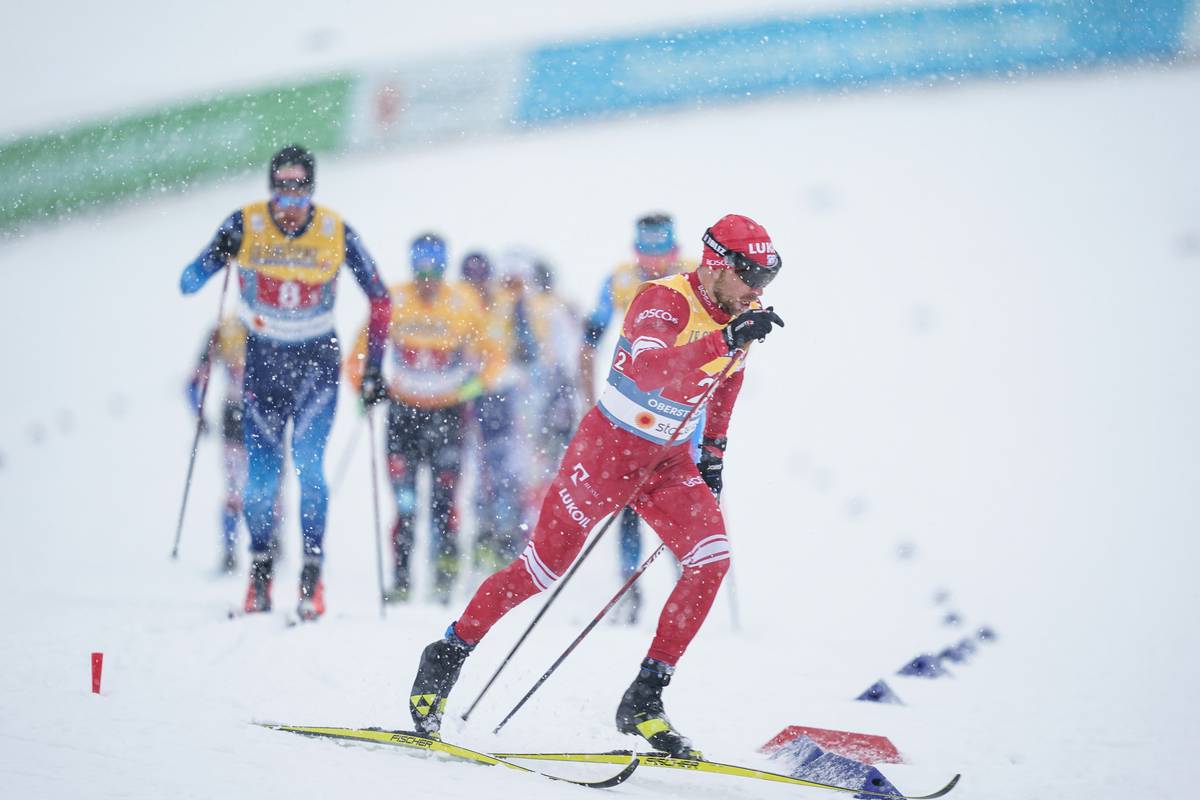
Early on in lap three, two favorites, Niskanen (FIN) and Amundsen (NOR), who had been at the front of the race, pulled out. The French favorites and American Schumacher also began to lose contact with the front-runners. Only Korostelev was able to maintain contact until even he could no longer keep up with the three top Norwegians.
Martin Loewstroem Nyenget (NOR) did much of the work at the front. (Photo: Vanzetta/NordicFocus)
By the middle of the race, there were three
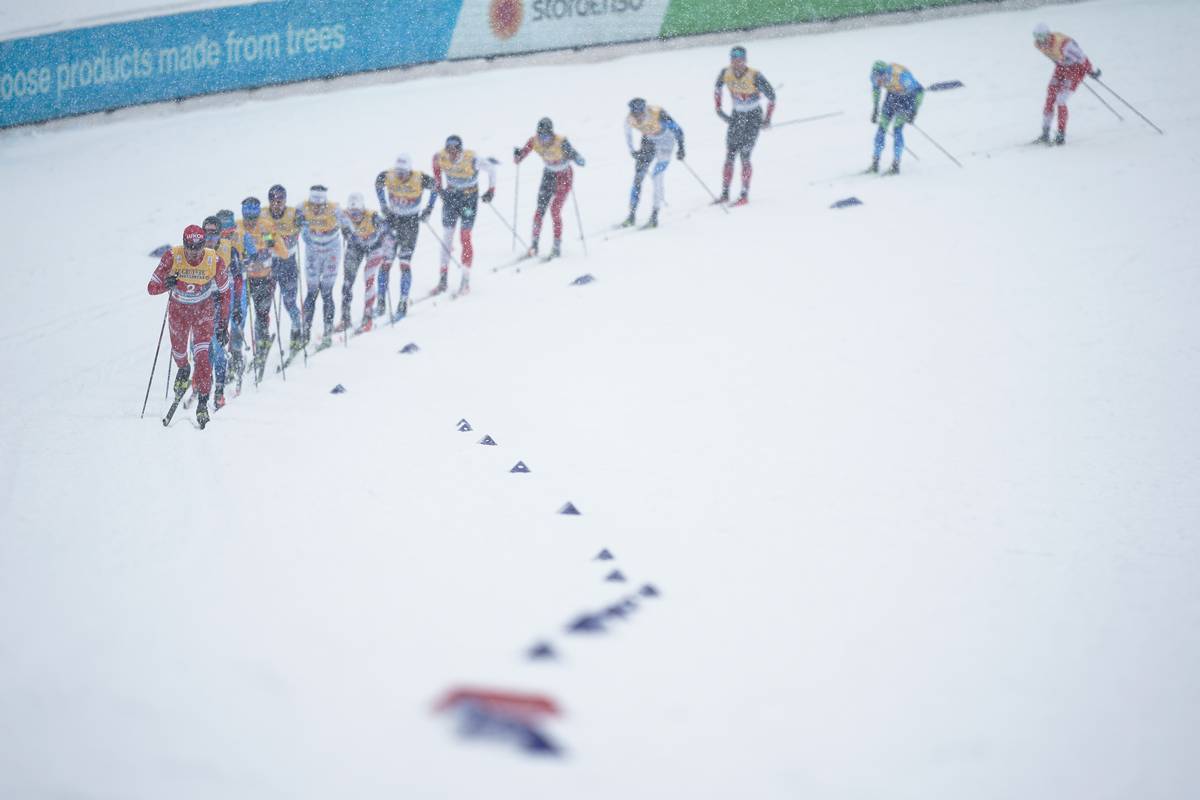
By lap four, it was unmistakable: Nyenget, Iversen, and Klaebo were alone, three red suits moving in steady formation.
From the stadium, the mood was less frantic than historic, almost strangely calm.
“The sun shone down… as if God had ordained the great Klaebo, winning his six in a row… I mean, it really was a beautiful day,” said FasterSkier’s Nat Herz, who was on the ground in Tesero. “I think people were just pretty relaxed watching this three-man Norwegian time trial as it went around the course… These guys have the best technique, the best materials, the best skis, the best fitness, and they did exactly what they set out to do.”
The crowd was not roaring every lap. It was watching. Waiting.
“Nyenget and Klaebo definitely gave everyone a good show, and it was tense to see. Was Klaebo going to be able to do this incredible accomplishment?”
There was little theatrics in their separation from the field — no dramatic surge, no visible cracking. Just a grinding tempo that only they could sustain.
Even the question of ski exchanges became a collective calculation. While much of the field ducked into the pit lane for fresh skis after lap four, the Norwegians skied past the ski exchange zone each lap.
A Norwegian train. (Photo: Barbieri/NordicFocus)
“Martin made the choice of not changing skis,” Klaebo said. “Emil and I just followed because we didn’t want to gamble.”
In long races, fortune often hides in such decisions. The snow was changing; the sun had warmed the surface. Fresh skis could have been salvation or ruined a chance at gold.
“I think it was the right decision,” Klaebo said in the press conference afterwards about the three Norwegians not switching skis.
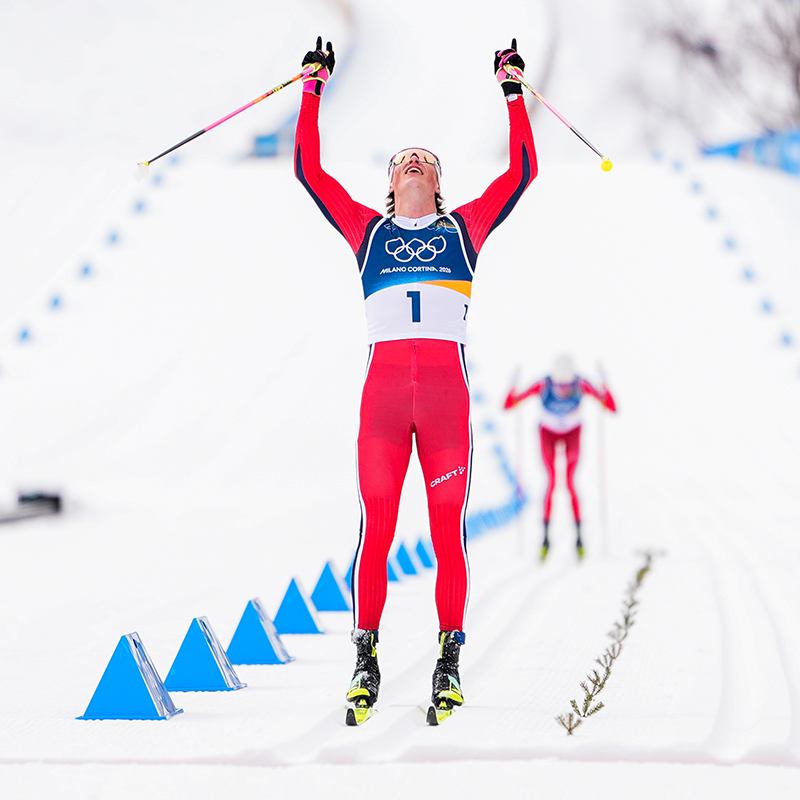
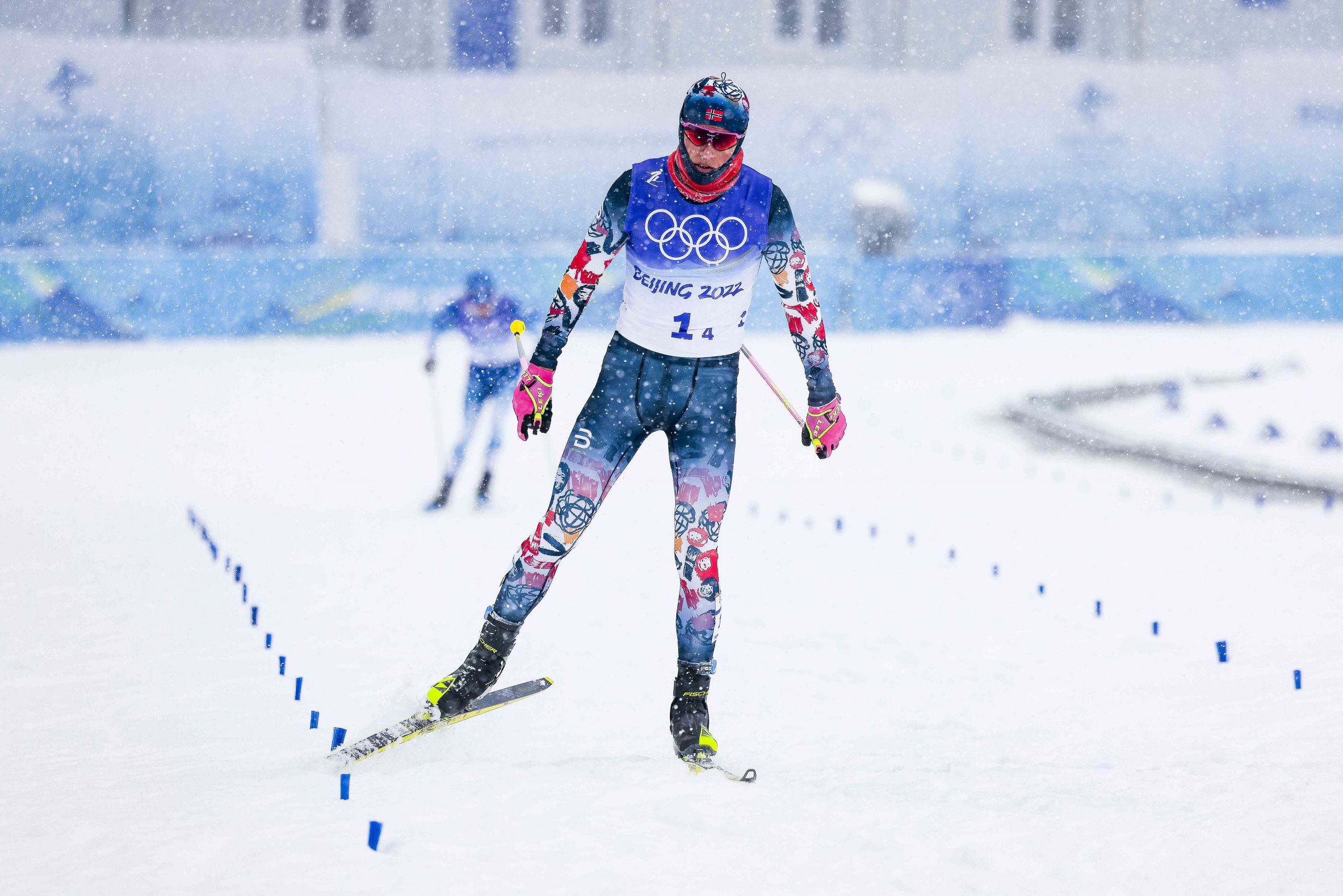
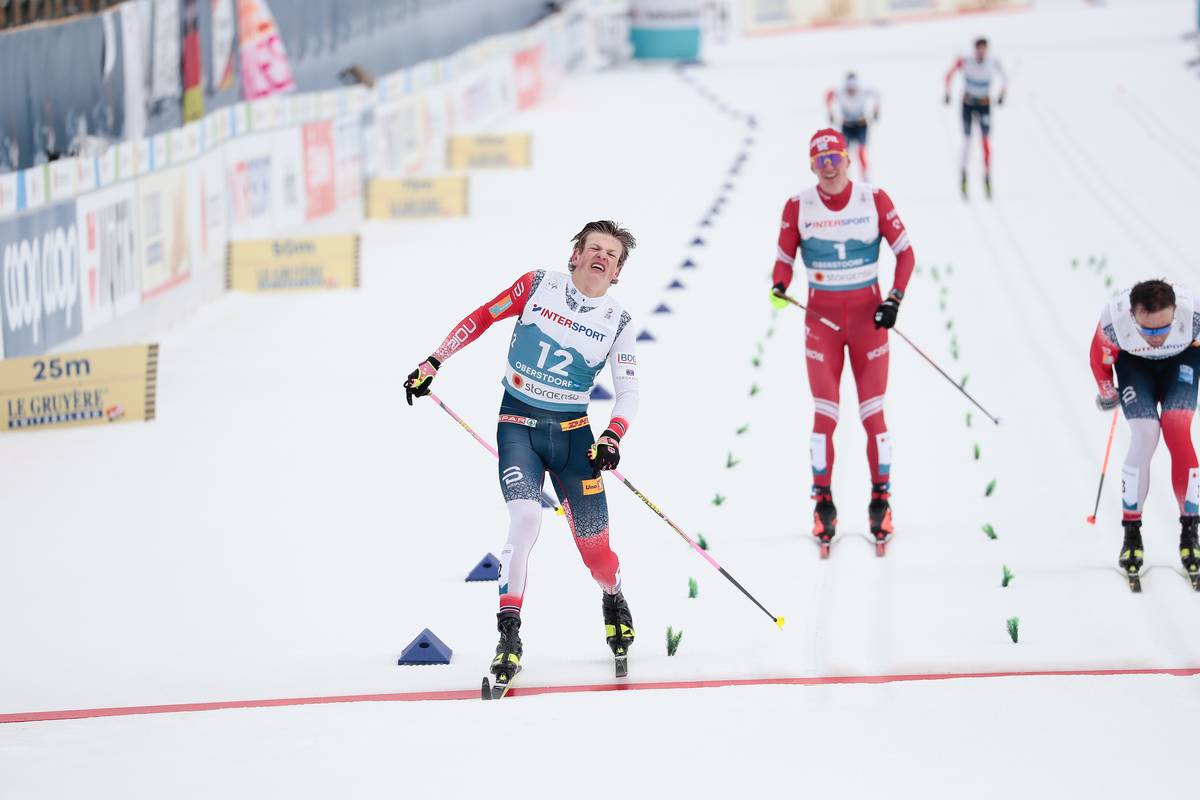
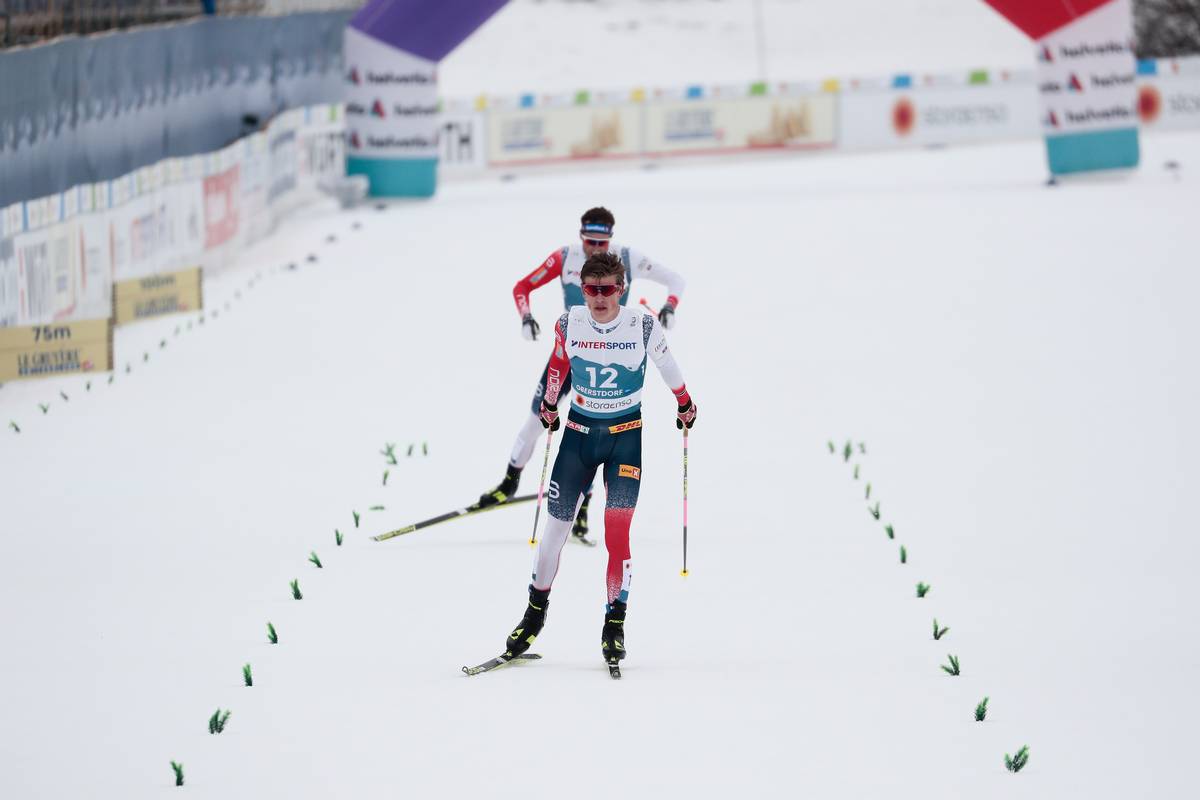
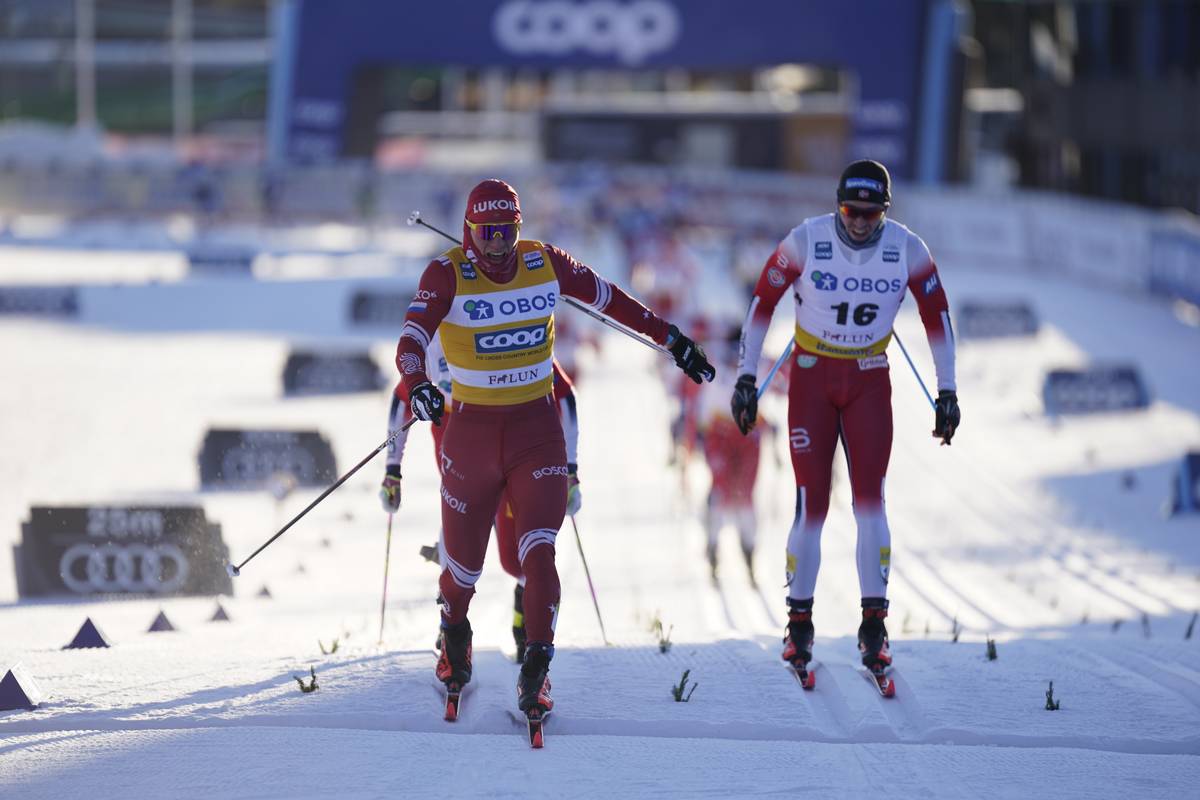
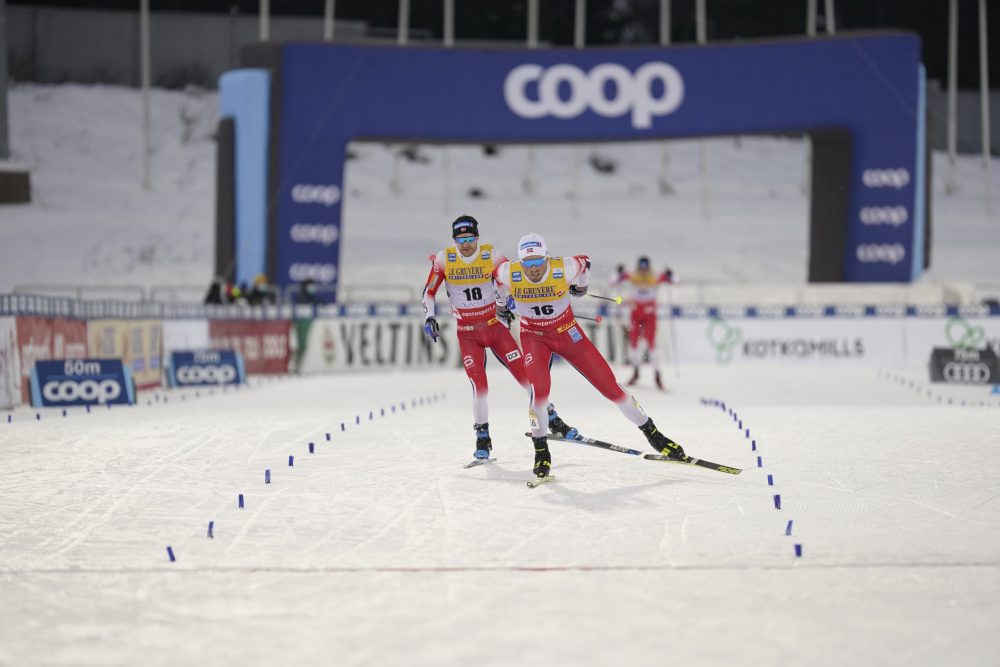
Johannes Hoesflot Klaebo (NOR) makes history as he crosses the line of the Men’s 50 k Classic. (Photo: Barbieri/NordicFocus)
Saving Something for the Hill
Through lap six, Nyenget did much of the visible work. Klaebo shadowed him, conserving every drop of energy he could.
“I wish I was able to help them a little bit,” he said. “But when they asked me if I could go in front, I said no, because I was too tired.”
It was not false modesty, Klaebo’s Olympic schedule had been more than the other two and fifty kilometers taxes even those who make winning look inevitable.
“My plan today was just try to save as much energy as possible,” he said. “I needed to play on my strength… the last few hundred meters.”
On the final lap, Klaebo came to the front, as if to take measure of the other two Norwegians, but in doing so, he created a gap on Iversen. Was the race for gold now just down to two? The answer was yes, as the rubber band had clearly been snapped for Iversen, who began to drift backwards from the leading pair.
The decisive moment arrived where many had expected it would: on the Zorzi Climb. On the preceding descent, Klaebo rose from his tuck, adjusted his pole straps, and as they exited the sweeping left-hand turn at the base of the final climb, Klaebo pulled alongside Nyenget before beginning to accelerate. Not explosively — this was the closing act of a two-hour effort — but with the control of someone who knew exactly how much he had left.
Nyenget followed for a few strides. Then he did not.
Behind them, Iversen skied alone to bronze, sealing a Norwegian sweep.
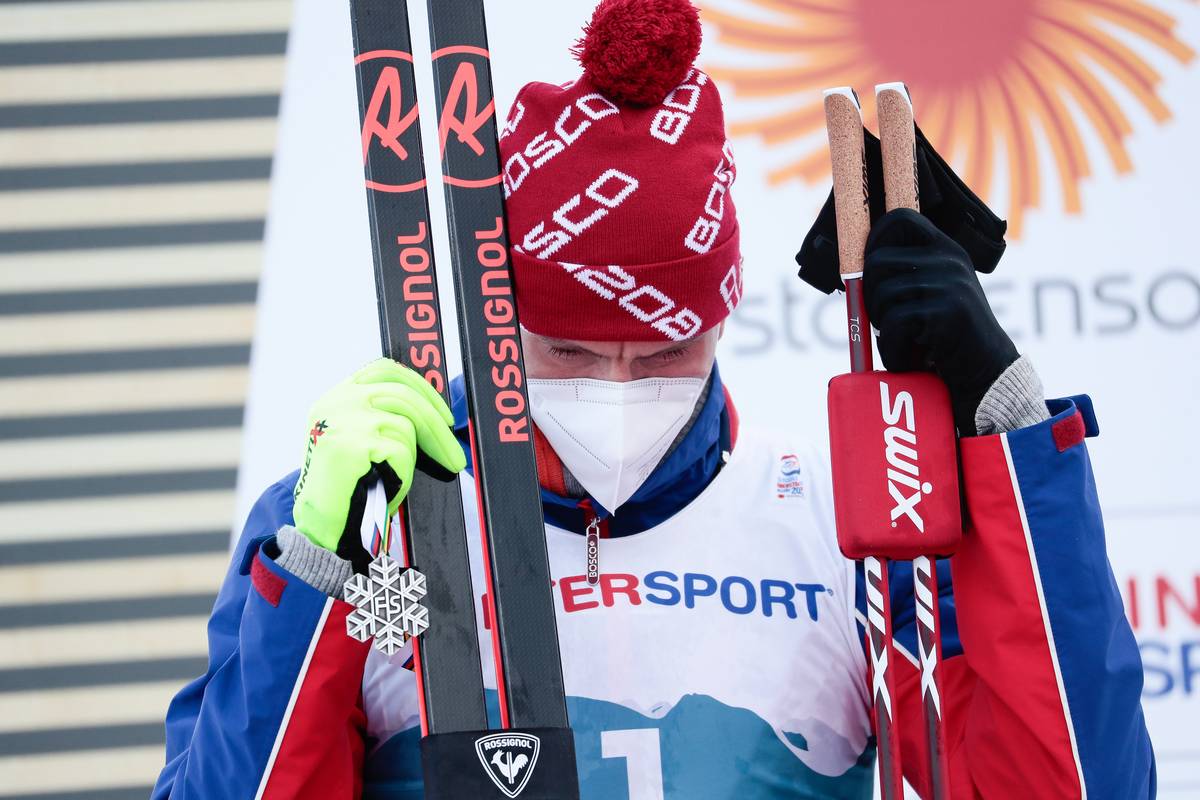
A moment of reflection at the finish for Johannes Hoesflot Klaebo (NOR). (Photo: Barbieri/NordicFocus)
A Private Moment
At the finish, Klaebo crossed the line and sat down alone on the snow. There was no theatrical collapse, only a quiet reckoning.
“For me, it’s the best feeling, the last 200 meters before I cross the finish line knowing that I’m going to win,” he said.
This Olympics, he suggested, had been built on deliberate choices, in training, in team structure, in how he and his father organized his life around the sport.
“He has probably sacrificed as much as I have done,” Klaebo said of his father.
Sacrifice is not his preferred word. He calls them choices. But the effect is unmistakable: a skier who once seemed specialized has become complete.
Emil Iversen (NOR) enjoys his bronze medal and the sunshine after a lot of hard work to get back to the front of the sport and this moment. (Photo: Vanzetta/NordicFocus)
Racing in His Time
For the rest of the field, competing in the Klaebo era carries a strange duality, almost a frustration braided with admiration.
“Of course, a bit,” Nyenget said when asked whether it is annoying to race alongside him.
“But it’s more motivating as well. [Klaebo] is pushing us to be better every day.”
Iversen echoed the sentiment.
“I think it’s just fun to compete with the best skier ever,” he said.
Across these two weeks, Klaebo has made dominance look procedural, yet his rivals know the margins are real, the preparation exhaustive. He bristles at the idea that this is inevitable.
“I like myself way better when I’m winning than when I’m losing,” he said.
Gus Schumacher (USA) gave everything he had to this sixth race at these Winter Olympic Games. (Photo: Vanzetta/NordicFocus)
The American Effort
For the United States, the 50 k carried a different emotional weight.
Gus Schumacher, who had spent the early races in these Games chasing form and momentum before winning silver in the Team Sprint with Ben Ogden, finished 13th. He described the psychological toll of racing in every event.
“There’s been a pretty heavy mental load the last two weeks,” Schumacher said. “If I’ve got a flame, it was ripping a couple days ago… halfway through the race, it felt like a little candle.”
He has raced all six events, too, though with different outcomes.
“I really don’t understand how you can ski 50 k so well and also sprint so fast,” Schumacher said of Klaebo. “I don’t really feel like there’s another athlete in the world that can compare to that scope of athleticism.”
Hunter Wonders (USA) also pushed his body to its limits in the race. (Photo: Vanzetta/NordicFocus)
Hunter Wonders placed 35th and spoke candidly about the physical reckoning.
“I’m alive barely,” Wonders said. “I didn’t think I was gonna finish there for a little while.”
Cramps seized him in waves — hips, hamstrings, forearms — and yet he finished.
“I completed a race that four years ago I was really chomping at the bit to be able to compete in,” he said.
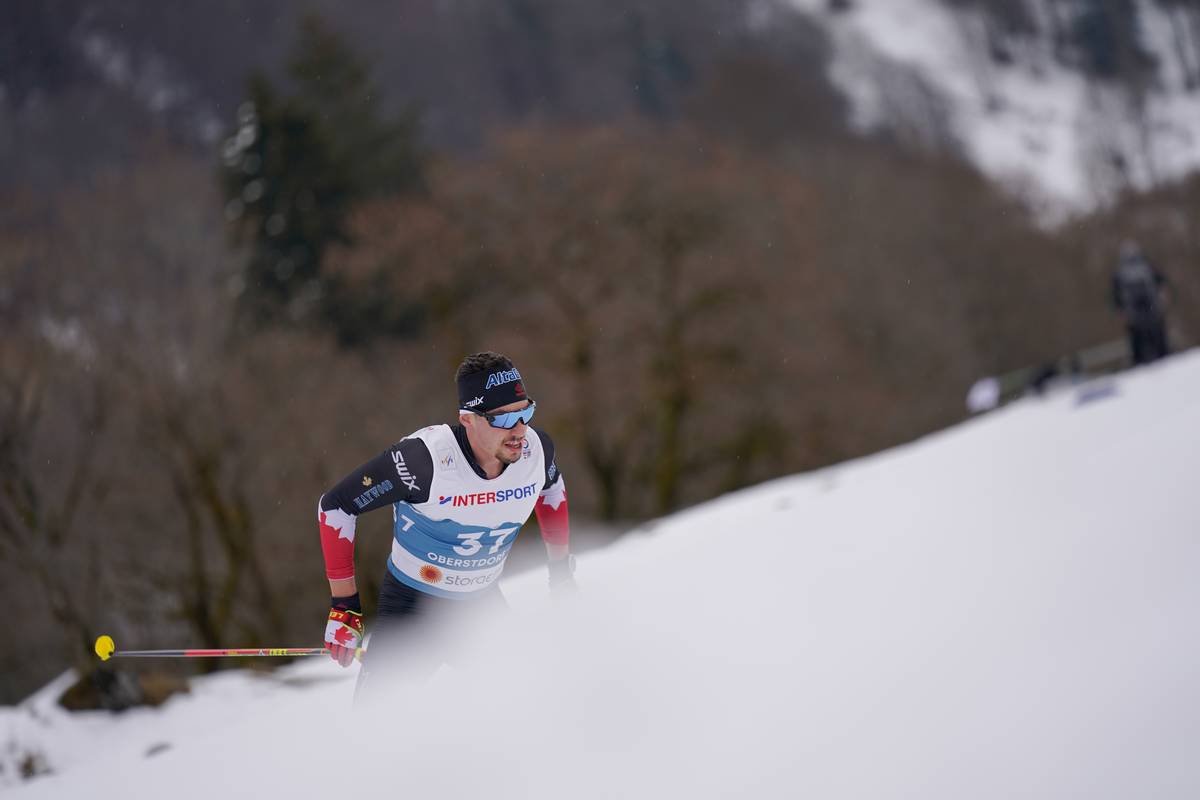
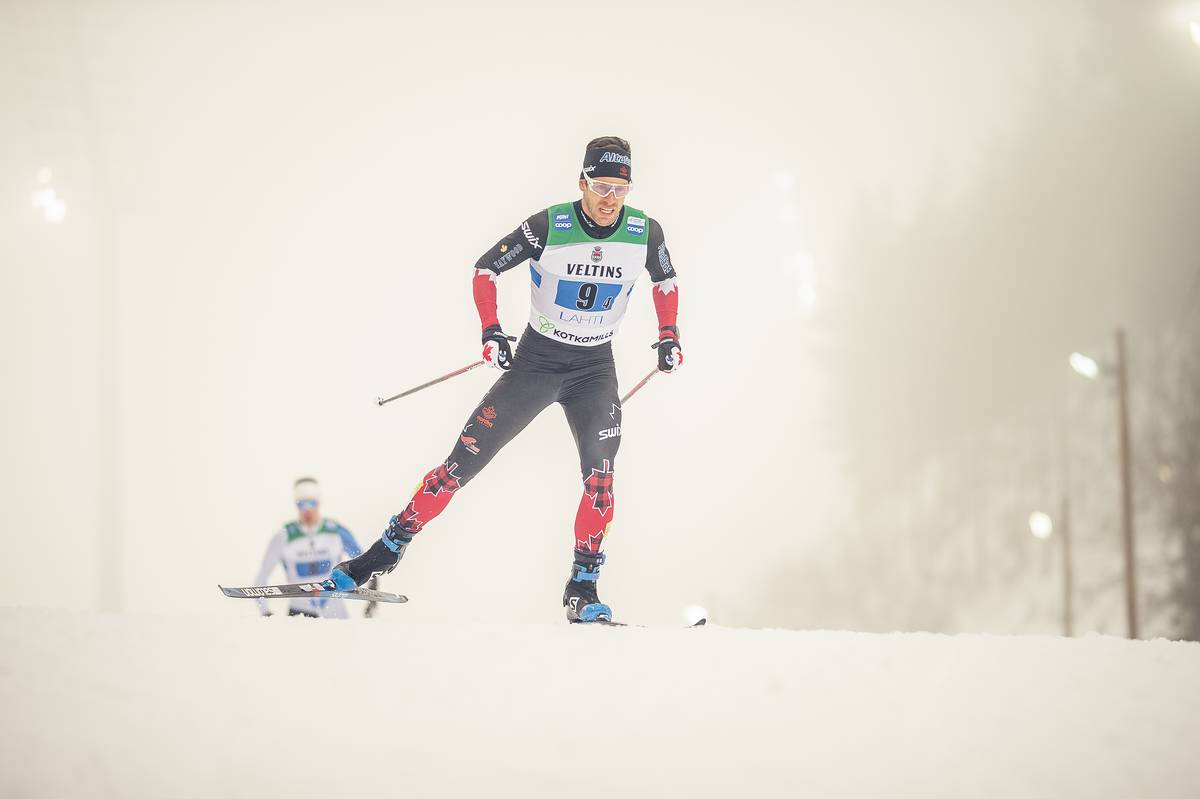
Antoine Cyr (CAN) “gave everything” to the final men’s race in the Olympics. (Photo: Barbieri/NordicFocus)
The Canadian Outcome
Canada placed two men inside the top 20.
Antoine Cyr finished 11th, just outside the top 10 he had targeted.
“I gave it everything,” Cyr said. “It’s such a hard course.”
He pointed to the Zorzi Climb and the long drag back to the high point of the course after coming through the stadium, efforts that stretch toward six minutes, rare in modern championship layouts.
“It’s really tough,” he said.
Thomas Stephen finished 17th, steady and controlled in conditions that demanded patience. While he did not step into the medal conversation, his result underscored the depth Canada has built in distance racing and marks what is possible in future years.
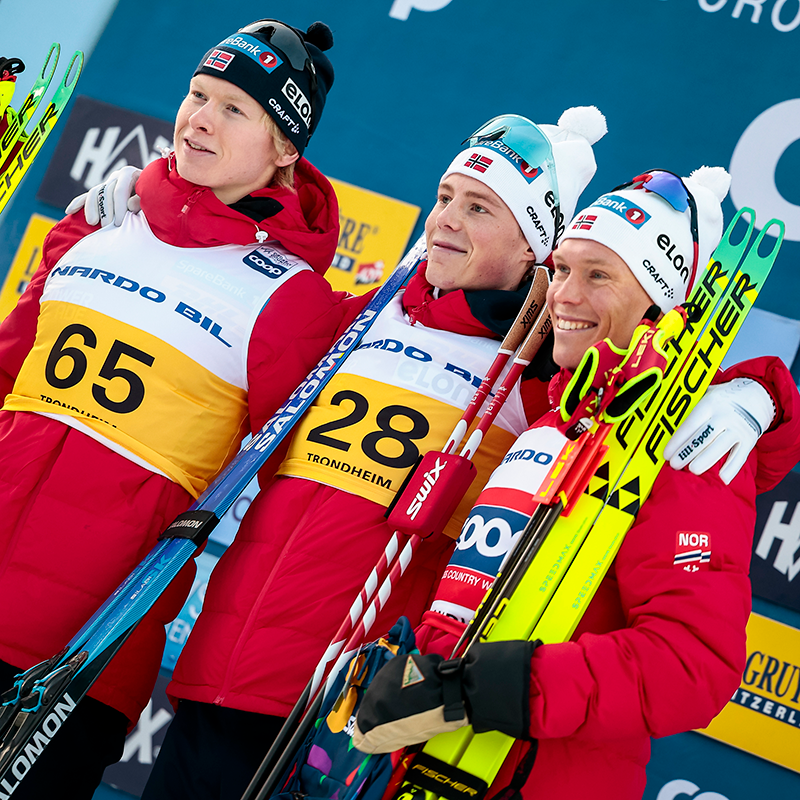
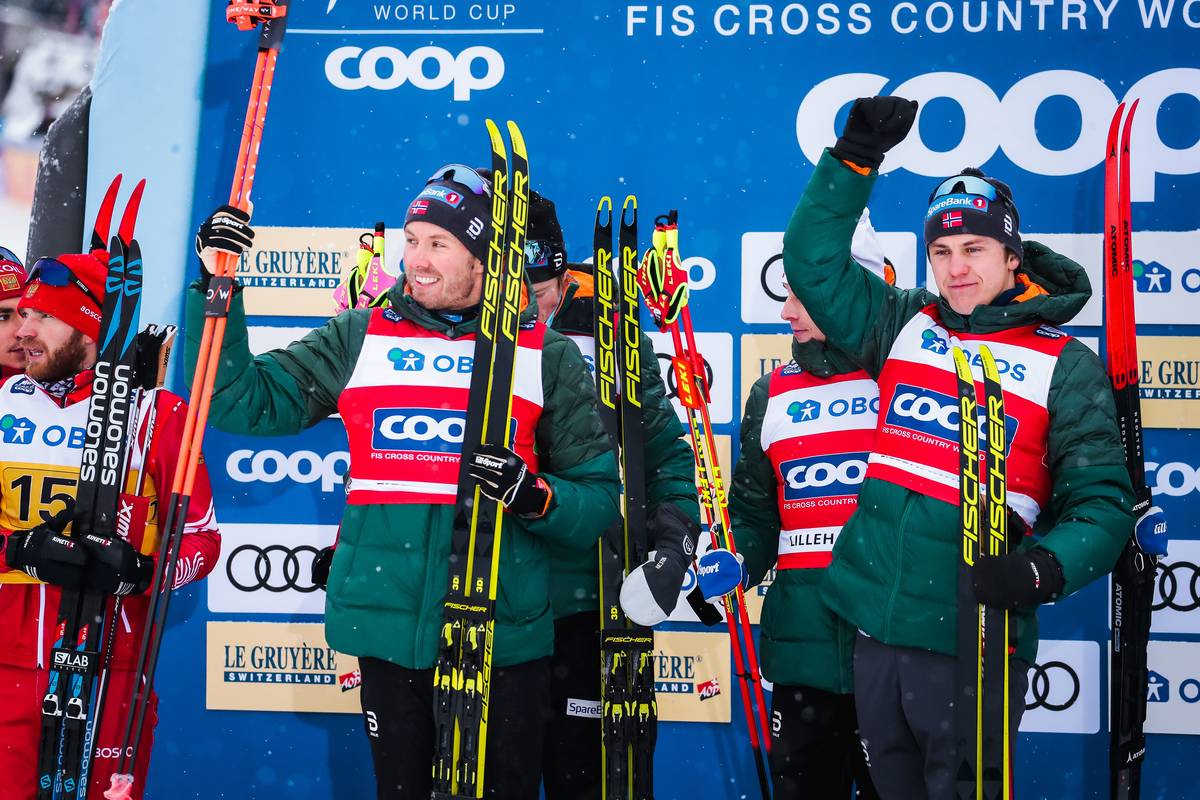
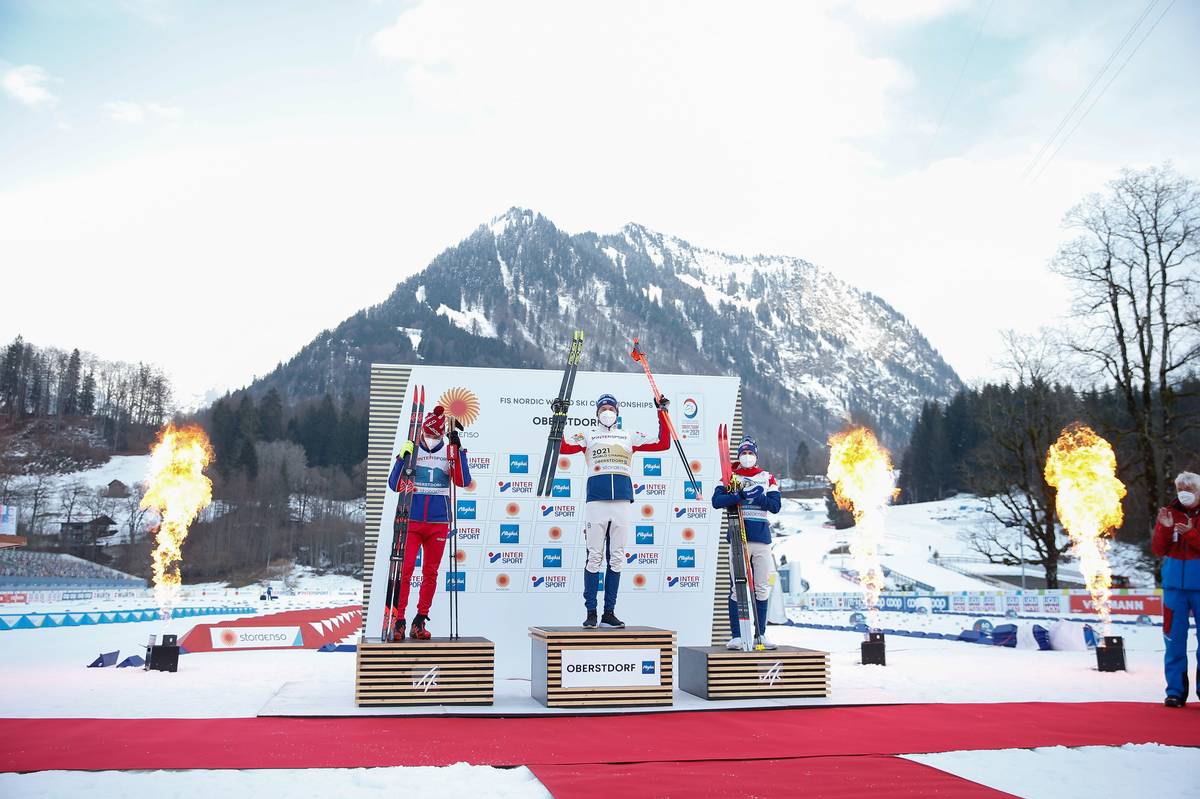
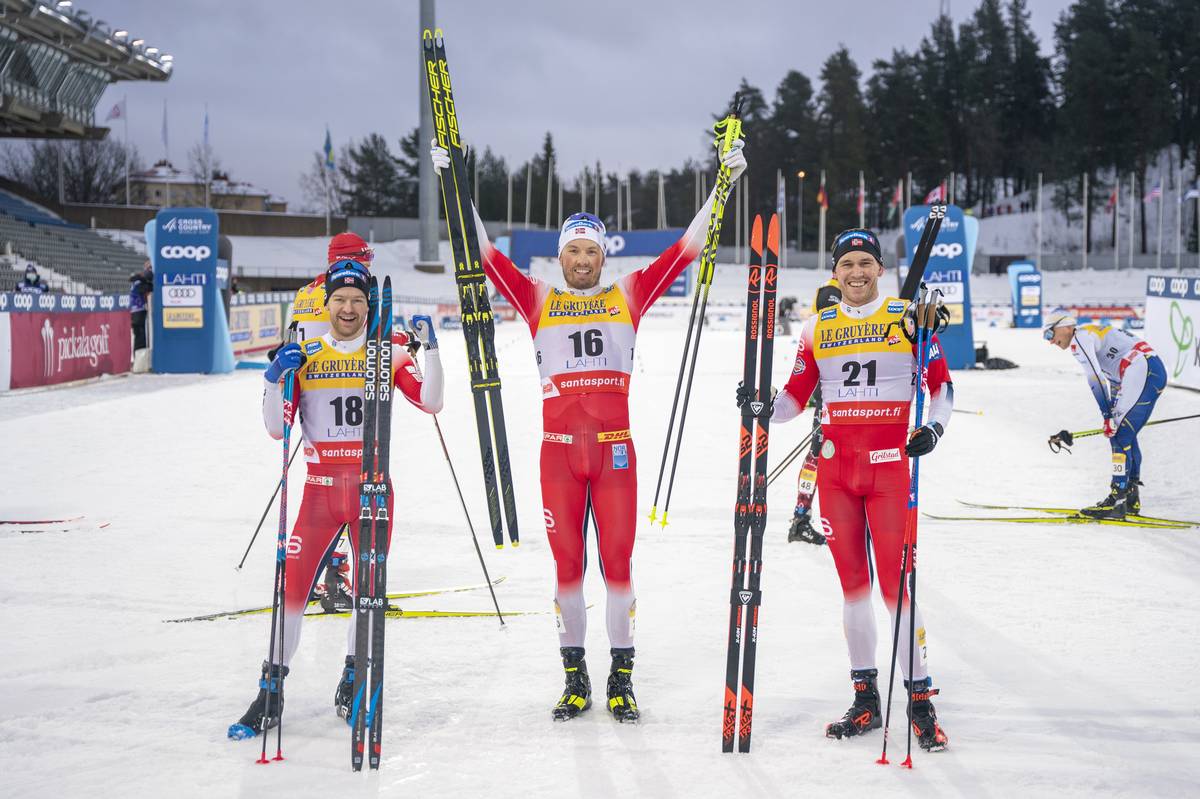
Martin Loewstroem Nyenget (NOR), Johannes Hoesflot Klaebo (NOR), and Emil Iversen (NOR) (l-r) share the Milano-Cortina Olympic Winter Games 50 k Classic podium in Tesero, Italy. (Photo: Barbieri/NordicFocus)
What Remains
Klaebo plans to rest for a few weeks before racing again in Lake Placid.
“That’s the plan,” he said.
There will be time later to measure what six-for-six means, how it reshapes record books, and how it reframes conversations about the greatest Winter Olympians. For now, it exists as a bright fact in the thin mountain air.
The 50 k endures because it asks the oldest question in endurance sport: what is left?
On Saturday, Johannes Hoesflot Klaebo had something left. Enough to attack on the final climb once more. Enough to once again finish alone down the final meters. Enough to make something mythical and historic feel ordinary and predictable.
FasterSkier will have our own Nat Herz on the ground at the Olympics, which, to be honest, is a very big financial lift for us. If you value the thoughtful work and access FasterSkier provides at championships like this one, please consider becoming a Voluntary Subscriber. Your support directly fuels the work we do to cover the people, places, and moments that make our sport special.
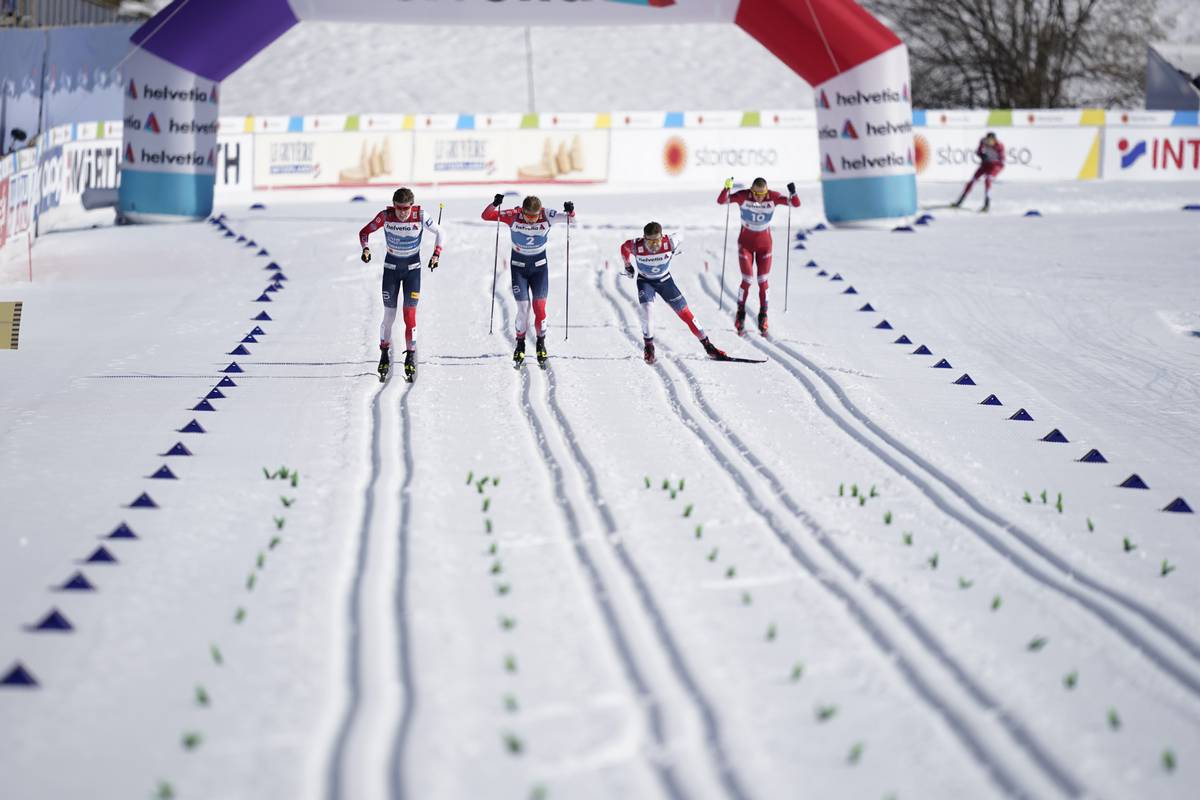
Emil Iversen (NOR), Johannes Hoesflot Klaebo (NOR), and Martin Loewstroem Nyenget (NOR) come through the stadium to the delight of the crowd. (Photo: Vanzetta/NordicFocus)
This coverage is made possible through the generous support of Marty and Kathy Hall and A Hall Mark of Excellence Award. To learn more about A Hall Mark of Excellence Award, or to learn how you can support FasterSkier’s coverage, please contact info@fasterskier.com.
In the absence of any other aggressive pacemakers, Johannes Hoesflot Klaebo (NOR) was left to set the pace in Goms’ 20 k Classic Mass start. (Photo: Authamayou/NordicFocus)
Klaebo wins . . . we saw that coming.
Let’s face it: cross-country ski racing can be kinda boring. Races are long (even the short ones), speeds are really not that high, even the fastest accelerations occur in slow motion when compared to many other sports. There’s a bit of a draft that can protect opportunistic sprinters, but not really all that much. And even the most hotly contested World Cup races are typically dominated by a synchronized clot of red Norwegian suits striding up the trail in near-perfect unison, beautiful to witness, but kind of dull in its predictability. Watching cross-country ski racing isn’t for every sports fan, especially when predicting the winners is becoming such an un-challenging task.
But I’m not bored: I’m fascinated. And I find myself even more fascinated with each passing week. Here’s what fascinates me: how can a skier just continue getting stronger and stronger? Wouldn’t that be awesome for all the rest of us to experience? Knowing that we could just keep getting better and better? Coaches, counselors, motivational speakers all tell us that it’s possible: keep working harder and you’ll just keep getting stronger. But the performances of athletes at all levels show us that this rosy prediction just isn’t true. There’s a limit, a breaking point, a glass ceiling. Plenty of athletes work hard, and all the skiers in these World Cup races are fully committed and supremely talented. Yet even the very best athletes plateau, even the strongest racers stumble. And the margins at the tippy-top of athletic performance become amazingly thin, showing that almost any world-class contender can win on any given day. Ironically, FIS World Cup rankings from second place through last place are regularly re-shuffled: Gus Schumacher was second yesterday, today he’s 22nd. But the guy in first place is often the same guy. Johannes Hoesflot Klaebo wins more than half of the World Cup races he enters—that’s just crazy. Klaebo won again today, and he did it in an offhanded fashion that makes it appear he has only himself to compete against. I’m fascinated . . .
Johannes Hoesflot Klaebo (NOR) waits for the second and third place finishers at the end of the 20 k Classic Mass Start in Goms, Switzerland. (Photo: Authamayou/NordicFocus)
Goms, Switzerland offered these final World Cup events prior to the arrival of these same athletes at Olympic venues in two weeks. Spectators are fully aware that the race we watch this week may not be the same as the race conducted a few weeks from now. Dominance in January can translate into further dominance in February, but there are plenty of miles to cover between now and then. Germ-filled airline flights and nights of fitful sleep, breakfasts and lunches and dinners to orchestrate, supplements and strategies to employ, training to undertake, reset and recovery to seek. And somewhere deep inside an athlete’s body, the systems are churning . . . getting ready for a day when speed and endurance are needed, when courage and fortitude may lead to victory and glory, or to humiliation and defeat. Goms offered as accurate an approximation of those Olympic races as it’s practical to stage: Olympic races staged in Val di Fiemme will include a Team Sprint (like Friday’s Team Sprint), and a Classic Sprint (like yesterday’s Classic Sprint). But today’s 20 k Classic Mass Start may not offer a precise predictor of the Olympic 50 k Classic Mass Start. Fifty kilometers is really really far . . . and plenty can happen in those 50 kilometers. The 20 k is more straightforward, and offers less space for multiple attacks to occur. It’s possible that a 20 k field will wait for a single significant move. That’s the way things played out in Goms, today.
John Steel Hagenbuch (USA), Zak Ketterson (USA) moved steadily through the field during the FIS World Cup 20 k Mass Start in Goms, Switzerland. (Photo: Authamayou/NordicFocus)
North American men performed well in today’s 20 k, especially considering the stress and accumulated fatigue of such a long and arduous World Cup weekend: Zak Ketterson was 18th, Xavier McKeever 19th, Schumacher 22nd, Antoine Cyr 34th, Hunter Wonders 36th, Zanden McMullen 38th, Remi Drolet 40th, Max Hollman 41st, Thomas Stephen 45th, Zach Jayne 52nd, John Steel Hagenbuch 55th, Luke Jager 59th. Many of those skiers began today’s race with start positions waaaay back in the field, spending 20 kilometers dodging pole tips and ski tips on their journey forward. Theirs was a decidedly different race from the calm, controlled, unmolested effort afforded the leaders. But everyone who’s ever started at the front got there by battling their way from the rear. The North Americans are battling . . .
“There is a lot of scrambling in a field like that, especially when you are starting in a further-back bib,” said Ketterson. “The key is to just stay relaxed during the first two laps, because all those little moves have to be repaid with interest later in the race. It’s just about being smart with your energy.”
“(Today’s race) was part of the progression,” said Schumacher. “This is sort of my overload; now I’ll recover, absorb it, and hopefully be fitter going forward. Travel day tomorrow headed to Livigno, and incorporating recovery by just chilling out, basically enjoying the Alps. Bunch of snow just fell kind of all over, which is cool.”
Norwegian race suits dominated the front of the 20 k Mass Start, with a brief appearance by a lone skier in blue, France’s Mathis DeLoge. The Olympic 50 k in Val di Fiemme may prove different. (Photo: Authamayou/NordicFocus)
While it may not always be evident on the surface, there’s drama in every meter of a Mass Start race—emergencies averted, difficulties overcome, disasters dodged, over-crowding endured, loneliness faced. Racers usually want to avoid as much drama as possible, and the racers least likely to encounter difficulty are those who start in the front row. Four Norwegians made up the front row—Klaebo, Amundsen, Mattis Stenshagen, and Andreas Fjorden Ree. They’d lead the field out onto the first of four loops, monitoring the early pace set by pre-race favorite, Klaebo.
Lap 1 appeared to be a freebie. It’s understood that the pace would get high, but for every kilometer that Klaebo controls the pace at the front, it will be all that much more difficult to dislodge him later in the race. Klaebo is a fast skier, but his strategy is typically not one that attempts to shed other skiers. He’ll control the pace at the front, waiting for someone else to take control. If no one does, then Klaebo will likely win the sprint at the end. If another skier does attempt to assert themselves, then Klaebo will ride their tails and likely win the sprint at the end. Anyone who wants to beat Klaebo needs to drop Klaebo, and they need to do so well before the finishing straightaway approaches.
The other skiers likely to test Klaebo’s long-form endurance—including Klaebo’s own Norwegian teammates—were decidedly passive in Goms. And Iivo Niskanen—the skier most likely to test the strength of the field two weeks from now Val di Fiemme—was absent from the Goms start list. Through five kilometers, the leaders continued to be relaxed. Klaebo, Harald Oestberg Amundsen, Andreas Fjorden Ree, Emil Iversen (NOR), Mathis Deloge (FRA) and Savelii Korostelev (AIN) who had started far back in bib 33. Schumacher came through the five kilometer mark in 12th place, only two seconds behind the leaders.
Off the front, and receding into the distance: Johannes Hoesflot Klaebo (NOR), Emil Iversen (NOR), Harald Oestberg Amundsen (NOR) made Goms’ 20 k Classic Mass Start into a three-man race. (Photo: Authamayou/NordicFocus)
Through 7.5 kilometers, Norway continued to enjoy the presence of eight skiers in the top 12, a level of numeric-dominance that Norway will not enjoy when the 50 k is run in Val di Fiemme (where Team Norway will be limited to four starters). The Norwegians were accompanied only by the persistent French, Korostelev, and Estonia’s surprising star, Alvar Elev. A small spit occurred in the field at 9.2 kilometers where bonus points were offered and Klaebo led a mini-break ahead of Iversen and Amundsen. What had looked like a pedestrian pace was revealed to have been a pace at which the vast majority of the skiers had been just barely holding on. Klaebo tapped the accelerator, and the field strung out helplessly behind him. Norway took the points for the first eight positions, but only Iversen and Amundsen were able to hold their positions at the front with Klaebo.
Korostelev led the chase of the three leading Norwegians, and the rest of Team Norway appeared perfectly willing to let him do so. Valnes latched on to Korostelev’s tails,and the other remaining Norwegians lined up behind Valnes. If this were a bike race, viewers could assume that team tactics were being employed—Norwegians lining up to defend Klaebo’s lead, and forcing other nations to chase. But today made it look like the field simply stretched out in a ranking of available strength and endurance. Anyone who could’ve gone faster would certainly have gone faster.
Though not exactly in dramatic fashion, the race continued to unfold at the front. Classic skiing creates a unique drafting dilemma: in order to be as close as possible to the skier in front, the following skiers are compelled to match the striding and/or double-poling tempo of the leader. It makes cross-country skiing uniquely picturesque, but it removes any advantage that a skier might seek by choosing a different tempo. Remember Therese Johaug? Her supernaturally-high tempo always appeared awkward and uncomfortable whenever she skied in the company of other racers. Fortunately for Johaug, she spent very little time in the company of other racers during her racing career. Today in Goms, the three dominant Norwegians set a steady pace ina predictable tempo. Iversen and Klaebo are in-season and off-season training patners: it makes sense that they’d adopt a similar tempo. Amundsen was the outlier of the three, but he followed their tempo in lockstep. Here’s the thing—if no skier seeks to take an individual advantage, then we can safely assume the at the advantage goes to Klaebo.
Korostelev continued to lead the chase group, but trailed by an ever-widening margin. With one lap remaining, the gap had stretched to nearly 40 seconds. With four kilometers to go, Klaebo was seen tightening his pole straps. Another bike race analogy: when a rider reaches down to tighten the straps on their shoes, they’re preparing for the sprint. For Klaebo to have done so—so quietly and so matter-of-factly—must have caused the hearts of his rivals to sink. He’s not hanging on, he’s preparing to pounce.
Klaebo would’ve been likely to outsprint both Iversen and Amundsen at the finish line . . . and while that may be the plan he intends to follow in Val Di Fiemme in a couple of weeks, it’s not the only winning strategy he possesses. Today in Goms, Klaebo showed that he can win in the most understated—though thrilling—way. He simply skied away. One little uphill (one of those from yesterday’s Sprint course) and he trotted lightly up it, exposing the truth that Iversen and Amundsen may have been close to their performance limits all along. Amundsen chose an inside line on the hill, but stalled on the steeper slope he ascended. Iversen sought better kick on an outside line beyond the groomed tracks, but continued to slip just a bit. And Klaebo just cruised off the front in a nonchalant manner that went all but unnoticed. None of the course-lining spectators even cheered. The decisive moment of a World Cup Mass Start Distance race, and almost no one even saw it happening. Well, Iversen and Amundsen might’ve noticed . . . both came nearly to an exhausted standstill at the top of the hill. Klaebo would get away to a gap of 40 seconds, ultimately coasting easily across the finish line followed by Iversen and Amundsen. Klaebo has shown in the past that he is a master of preparing for major championships. He appears ready, again.
There have been plenty of easy-looking wins in Klaebo’s illustrious career, but few of those 107 individual wins ever looked easier than this. And, for additional perspective, this “easy” win came in a 20 kilometer Classic Mass Start race ahead of the world’s finest Distance skiers. Team France found itself overmatched—no pesky Frenchmen tweaking the race pace today. Team Norway found that it really has only one contender for gold—the rest of them can fight it out for silver and bronze. Korostelev found that the dominance he’d enjoyed in the last few seasons behind Russia’s curtain did not translate into similar dominance on the World Cup (but who knows what he’ll look like in the Olympics). And Iivo Niskanen—watching the race on TV from his sofa in Finland—would’ve seen that Klaebo is ready for any surge that the courageous Finn may choose to throw down in Val di Fiemme. It won’t be the same race as today in Goms, but Klaebo’s performance today makes it difficult to image how different the final outcome may be. Good luck, Iivo. Good luck Savelii. Team Norway is strong, and their man, Klaebo, is off the charts.
There was one exciting moment: watching the eight-man chase group sprint to the line, where Stenshagen outsprinted Korostelev for seventh place. Korostelev tested himself against Team Norway, and found himself overmatched. Team Norway had faced another Russian challenger, and had stuffed him into the back seat. There’s a bitter rivalry there, one likely to be played out again when the Olympics get underway at the Nordic venues of Val di Fiemme in February. There won’t be quite so many Norwegians for Korostelev to deal with, but he might find that at least a few of those Norwegians—likely Amundsen, Iversen, and Klaebo—will be up the track, dividing the medals amongst themselves in the final kilometers.
FasterSkier will have our own Nat Herz on the ground at the Olympics, which, to be honest, is a very big financial lift for us. If you value the thoughtful work and access FasterSkier provides at championships like this one, please consider becoming a Voluntary Subscriber. Your support directly fuels the work we do to cover the people, places, and moments that make our sport special.
So many red suits . . . Emil Iversen (NOR), Johannes Hoesflot Klaebo (NOR), Harald Oestberg Amundsen (NOR) continue Norwegian dominance in World Cup Distance racing in Goms, Switzerland. (Photo: Authamayou/NordicFocus)
Norway’s greatest competitive advantage in cross-country skiing has always been depth. In an Olympic selection season, that depth becomes a headache. When the federation gathered to finalize its 2026 team, the conversation was not about who belonged at the Games — those results and calculus had been logged. It was about which version of the team could survive illness, underperformance, and the cruel compression of Olympic schedules. For several skiers who have already proven themselves capable of standing on a World Cup podium — and perhaps even an Olympic one — the answer would be no. Not because they weren’t good enough. But because someone else fit the puzzle a fraction more cleanly.
Johannes Hoesflot Klaebo (NOR) leads a train of Norwegian men in Lahti (FIN) last March. (Photo: Thibaut/NordicFocus)
Eight Men, Eight Women — Complete
The Norwegian cross-country Olympic squad now includes eight men and eight women, a balance that reflects the depth of talent and strategic breadth of Norway’s cross-country program.
With these 16 names confirmed, Norway’s roster boasts a mix of seasoned champions and hungry young stars — from Klæbo’s Olympic pedigree to Vike’s breakthrough sprint talent.
Harald Oestberg Amundsen (NOR), Mattis Stenshagen (NOR), Johannes Hoesflot Klaebo (NOR), Emil Iversen (NOR), Jan Thomas Jenssen (NOR), Erik Valnes (NOR), and Martin Loewstroem Nyenget (NOR), (l-r) come up the final climb during the Skiathlon in Trondheim (NOR) in December. (Photo: Modica/NordicFocus)
The Final Pieces of a Puzzle: Iversen and Vike
For weeks, the most hotly debated part of Norway’s Olympic selection revolved around the last two men’s spots.
Emil Iversen, the veteran 34-year-old World Cup stalwart and World Champion team sprinter, secured one of the final berths — a decision that stirred both emotion and controversy. Iversen missed out on earlier national team standing but made a compelling case this season with solid World Cup performances, including in Tour de Ski events that carried significant weight in the selection criteria.
On the younger side, Oskar Opstad Vike earned the final spot. The 22-year-old sprinter’s rise — riding strong sprint results, including a World Cup top ten — gave the selectors a promising specialist to bolster Norway’s Olympic squad.
The decision to include one established distance racer (Iversen) and one sprint threat (Vike) over alternative combinations was no accident. It reflects not only this season’s results but also the complexity of Olympic event programming — multiple distance races, relays, and sprint competitions demand versatility and redundancy.
Emil Iversen (NOR) during the Skiathlon in Trondheim (NOR) earlier this season. (Photo: Modica/NordicFocus)
What Was on the Line
Norway’s selection strategy rested on ranked criteria that put top priority on World Cup results this season, followed by last season’s performances and past championship achievements. This emphasis on objective metrics aims to ensure that the athletes selected are not just popular choices, but the ones statistically most expected to deliver in Val di Fiemme.
It’s no surprise that Johannes Høsflot Klæbo leads the team — the multiple World Cup overall and sprint title holder is already one of the greatest of all time, and his results this season keep him in clear contention for medals across disciplines.
Meanwhile, Mattis Stenshagen has been one of the season’s breakout distance performers, boasting both World Cup podiums and a strong Tour de Ski showing that solidified his place on the team.
Erik Valnes (NOR), Johannes Hoesflot Klaebo (NOR), and Oskar Opstad Vike (NOR), (l-r) share the podium in Falun (SWE) in last season. (Photo: Modica/NordicFocus)
Notable Near-Misses and Debates
Not everyone who hoped for an Olympic ticket got one.
One of the most talked-about stories this season was Lars Heggen, the 20-year-old sprint phenom who has burst onto the scene with impressive results, including a World Cup sprint victory this past weekend. Many voices in ski media argued passionately for his inclusion, citing his explosive form and tactical range. But in the end, selectors opted for experience and proven Olympic relevance — a choice that sparked debate across Norway and beyond.
Another compelling case was Andreas Fjorden Ree, whose World Cup performances and near-victory finishes led many to forecast him as a certain medal contender. His exclusion — by mere fractions in selectors’ evaluations — was described as “brutal” by some commentators, underscoring just how competitive this national squad truly is.
Kristine Stavaas Skistad (NOR) leads Maja Dahlqvist (SWE) down the homestretch of the opening stage of the Tour de Ski in Toblach (ITA) in December. (Photo: Modica/NordicFocus)
Women’s Squad: Balance of Experience and Youth
While the men’s selection drama took center stage, the women’s squad also reflects a dynamic mix of talent:
Veterans like Heidi Weng bring Olympic experience and tactical acumen.
Sprinters and all-rounders like Kristine Stavås Skistad and Karoline Simpson-Larsen add valuable firepower.
Milla Grosberghaugen Andreassen and Ingrid Bergene Aabrekk represent the up-and-coming generation making their impression through World Cup and Norwegian Championship results.
Selectors reportedly evaluated performances not just from the World Cup and Tour de Ski, but also through the Norwegian National Championships — especially when managing variables like injury and form.
Heidi Weng (NOR) during the final climb of the Tour de Ski in Val di Fiemme (ITA) earlier this month. (Photo: Vanzetta/NordicFocus)
Looking Ahead — Milan-Cortina 2026
The Winter Olympics kick off on February 6, 2026, and cross-country skiing begins early with the women’s skiathlon on February 7. In Val di Fiemme — a venue steeped in Nordic history — Norway will arrive with one of the deepest teams in the field.
For a nation where cross-country skiing is practically a national pastime, these selections carry huge anticipation. Every name on this roster is now poised to chase Olympic gold, silver, or bronze — but behind them are stories of near-misses, fierce competition, and strategic choice-making that defined this winter’s most compelling selection drama.
Let the Games begin.
Love Stories Like This? Help Keep Them Coming.
Feature stories like this one take time, access, and care to produce. If you value thoughtful storytelling and independent ski journalism, please consider becoming a Voluntary Subscriber. Your support directly fuels the work we do to cover the people, places, and moments that make our sport special.
This coverage is made possible through the generous support of Marty and Kathy Hall and A Hall Mark of Excellence Award. To learn more about A Hall Mark of Excellence Award, or to learn how you can support FasterSkier’s coverage, please contact info@fasterskier.com.
Johannes Hoesflot Klaebo (NOR) claimed a record-setting fifth overall Tour de Ski victory. (Photo: Vanzetta/NordicFocus)
In its original configuration (and for many seasons that followed), the final stage of the Tour de Ski was a Pursuit race—perhaps the only Pursuit race that actually made sense in the context of the World Cup tour. The leader went off with the advantage they’d earned during the course of the Tour; everyone else chased. The first skier to the top of Ape Cermis was the winner of the Tour de Ski. In the past few years, though, organizers began thinking that the final day’s racing would be more exciting if it adopted a mass start format. So, today’s final stage was one in which all remaining competitors departed the starting line together. The contenders would battle it out on the slopes of the Alpe Cermis, hoping to manage the gaps to their competitors and to maintain the positions each had earned during the week of grueling racing in Toblach and Val di Fiemme. The stage was set for the climb up the Alpe Cermis.
Ultimately, the stage was one by Mattis Stenshagen (NOR) just ahead of Jules LaPierre (FRA). A resurgent and rejuvenated Emil Iversen (NOR) claimed the third spot on the day’s podium, followed by Savelii Korostelev (AIN) who is beginning to establish himself as a contender in World Cup events as skiers begin setting their sights on the Olympic Winter Games beginning next month in Milano-Cortina. North American skiers were led to the summit by Antoine Cyr (CAN) in 13th place. Gus Schumacher (USA) would climb bravely, fading to 16th on the stage but still managing to preserve his seventh place overall finish (best ever for an American man in the Tour de Ski). Ben Ogden (USA) would maintain his position in the field, coming across the line 22nd and followed by Zak Ketterson was 35th, Graham Ritchie (CAN) 40th, Remi Drolet (CAN) 45th.
Gus Schumacher’s (USA) goal in the 2026 Tour de Ski had been a top ten overall finish. He accomplished that with room to spare, and added a stage victory in the 5 k Mass Start for good measure. (Photo: Vanzetta/NordicFocus)
“My goal was to get top ten, coming in,” recalled Schumacher. “It’s nice to have a solid tour, with some really bright spots like the 5 k . . . In mass starts, I’m feeling really comfortable skiing with (the leaders) in the Pursuit, the 5 k Mass Start, and today. It’s nice to be comfortable with the leaders.”
“Today I was more energetic than I expected,” said Ogden. “But I don’t really race this often enough to have an idea of how long it is, or how much it’s gonna hurt.”
But it was the overall Tour de Ski lead of Johannes Hoesflot Klaebo that everyone was interested in—and the lead that all the other racers were hoping to reduce, or even overcome. Unsurprisingly, Klaebo’s 90 second cushion over his nearest rivals proved more than sufficient to preserve his overall victory in the 2026 Tour de Ski—his record-setting fifth overall victory in this annual event.
Stage 6—Alpe Cermis
Klaebo must be so tired of this stage . . . he’s skied this finish to the Tour de Ski many times before, each time knowing that he has a chance to win if only he can get to the top fast enough. Klaebo has made this climb before—and has claimed the Tour victory four other times—but it’s never been his strength. One year ago, he finished this stage 17th . . . fast enough for the win, but well behind a number of skiers who were also in today’s field. Today, in Val di Fiemme, Klaebo led at the start, offering a moderate pace while hoping to conserve energy for the climb. Inexplicably, his pace in the early kilometers was matched by Edvin Anger (SWE), a skier who excels only at sprinting, and whose body type—the guy is huge—really didn’t suggest that he’d be a contender on the steep slopes of the Alpe Cermis. Across the flats of the valley below Val di Fiemme they raced, knowing that the real challenge wouldn’t start until they reached the slopes of the Alpe Cermis.
All the starters must have approached the day with trepidation—climbing the Alpe Cermis is a daunting challenge—but perhaps nerves were even more on edge among the Norwegian team members, many of whom knew that today’s result might be the difference between qualifying for the Norwegian Olympic Team, or being left at home when the Games begin in Milano-Cortina next month.
Simen Hegstad Krueger (NOR) has won this stage three times in the past, but his recent performances did not suggest that he’d be a factor today. How crazy is it that a skier of Krueger’s pedigree finds himself on the bubble when it comes to selection for his nation’s Olympic team? Krueger is one of a number of Norwegians who knew their performance in Tour de Ski was perhaps the only way to get the attention of the Committee selecting the Norwegian Olympic Team. And in these 10 kilometers, his chances would fade dramatically. A three-time former winner of this stage up Alpe Cermis, Krueger would fade to 25th on the day—22nd in the overall standings—probably ending his Olympic quest. Just one spot ahead of Krueger, Andreas Fjorden Ree also may have seen his Olympic plans fading today on Alpe Cermis. Qualifying for a Norwegian Olympic Team may be the starkest test in all of cross-country skiing, and the Alpe Cermis is a definitively cruel proving ground, one that leaves former champions prostrate and gasping.
Harald Oestberg Amundsen (NOR) preserved his status on Team Norway with a fifth place finish on Alpe Cermis, but Lars Heggen (NOR)—who stood in second place at he beginning of the day—may find himself harshly criticized in Norway after dropping to 29th on the Alpe, and sixth overall. Ironically, what would be career-best finishes for nearly any other World Cup competitor could become the disastrous moment in Heggen’s career.
Mattis Stenshagen (NOR) dominated the final climb up Alpe Cermis, winning the Tour’s final stage, and vaulting himself into second place overall. (Photo: Modica/NordicFocus)
The Climb
The rate of attrition is high at the Tour de ski: only 69 of the original 122 starters remained to toe the starting line of the final stage. Klaebo began the day leading the Tour de Ski standings—1:23 ahead of Heggen, 1:29 over Stenhagen, and1:37 over former Tour winner, Amundsen who began the day in fourth position. Italy’s Federico Pellegrino still harbored ambitions of a final Toud podium; he sat in fifth, 1:40 back, and trailing two skiers (Stenshagen and Heggen) who had never before climbed the Alpe. Potential exstedfor plenty of positions to be shuffled, but not before the grueling climb of the Alpe Cermis was concluded.
Schumacher started in seventh position, moving past Anger into sixth as soon as the climbing began in earnest.When the course reached its steepest point (a 26+ percent grade), the stage was led by Stenshagen who was followed closely by LaPierre and Korostelev. Thereafter, the gap was growing ahead of Klaebo and the rest of the chasers.
“The first pitch is pretty shocking,” remembered Schumacher. “You climb for six minutes before it, then it’s like ‘Oh $#%, that’s an Alpine hill! . . . You’re not gliding at all, and there’s still eight minutes of climbing after that.”
Half way up the climb, much of Klaebo’s lead had evaporated. By the time racers reached the second steep section, Klaebo’s lead was barely 41 seconds. Lapierre was attempting to get away alone, effectively drawing even more effort out of Stenshagen. It would be a steep and punishing uphill drag race to the finish line.
Elan and panache—France’s Jules Lapierre (FRA) celebrates his second place stage finish at the top of Alpe Cermis. (Photo: Modica/NordicFocus)
Lapierre was hoping to script a second victory in the Alpe Cermis stage, but at the summit it was Stenshagen who stormed to the front, punching the air as he crossed the line for the stage win. He had a sizable stage-lead over Klaebo as the time-keeping vigil began—watching the clock to see if Klaebo would arrive soon enough to avoid overall defeat.
The finish line at the top of the Alpe Cermis might as well have been the selector for the Norwegian Olympic Team, as Iverson celebrated his third-place finish just ahead of Amundsen in fifth (with Korostelev between them in fourth). Klaebo crossed the line 12th, 58.0 seconds behind Stenshagen, but more than enough to preserve his advantage in the overall standings. For a record-setting fifth time, Klaebo would claim the overall victory in the Tour de Ski. And while Klaebo has not yet begun discussing the possibility of retiring at season’s end, this last climb up Alpe Cermis may have him thinking about it. After all these times racing from top to bottom, he probably never wants to do this again . . .
One step off the overall podium, Iversen appeared likely to join the Tour’s podium-finishers on the Norwegian team in Milano-Cortina, though it’s been suggested in the media that Stenshagen and Iversen—even after their tremendous performances in Val di Fiemme—may still be expected to prove their worth by finishing ahead of their domestic rivals at the upcoming Norwegian National Championships. How many times does a skier need to prove their point before they’re considered good enough to qualify to represent Norway in the Olympic Games? Lars Hegen may also find the answer to this question, as he started the day second overall but faded to sixth overall on the slopes of Alpe Cermis.
And the North Americans? Schumacher finally makes it to the finish of the Tour de Ski, claiming a hard-fought and richly-deserved seventh place.
“In the last few tries (Schumacher) has been in good standing midway through the Tour . . . but has come down with illness,”said on-air commentator, Kikkan Randall. “For him to come through with a solid top-ten performance—seventh overall—has got to be a one of the best-ever US Men’s finishes. He’s an athlete that looks to be on a trend to continue to build through this season. If he can use this Tour de Ski as a springboard, it can be great preparation fo the Olympics.”
Feature stories like this one take time, access, and care to produce. If you value thoughtful storytelling and independent ski journalism, please consider becoming a Voluntary Subscriber. Your support directly fuels the work we do to cover the people, places, and moments that make our sport special.
Jules Lapierre (FRA), Mattis Stenshagen (NOR), Emil Iversen (NOR) on the podium atop the Alpe Cermis, the concluding stage of the 2026 Tour de Ski.(Photo: Vanzetta/NordicFocus)
This coverage is made possible through the generous support of Marty and Kathy Hall and A Hall Mark of Excellence Award. To learn more about A Hall Mark of Excellence Award, or to learn how you can support FasterSkier’s coverage, please contact info@fasterskier.com.
Mattis Stenshagen (NOR) took stage two of the Tour de Ski in Toblach (ITA). (Photo: Vanzetta/NordicFocus)
By the time the final seeded skier pushed through the finishing straight in Toblach, the race had already revealed what interval starts always do best: not who looks fastest, but who stays fastest when no one is there to help.
On a clear, cold Monday morning in northern Italy, the men’s Tour de Ski distance competition began in earnest with a 10-kilometer classic interval start — a race that rewards patience, punishes impatience, and exposes any weakness in pacing, technique, or timing. For some, it was a statement. For others, a warning. For nearly everyone, it was a reminder that the Tour de Ski is less a series of races than a slow accumulation of consequences.
At the front of the field, Mattis Stenshagen (NOR) delivered the cleanest distance race of his World Cup career, leading from the opening checkpoint to the finish and winning Stage 2 in 22:11.0. Behind him, familiar names followed — Johannes Høsflot Klæbo and Emil Iversen — but the day belonged to the skier who never wavered, never overreached, and never gave back time once he took it.
Mattis Stenshagen (NOR) led wire to wire in the 10 K Interval Start Classic. (Photo: Vanzetta/NordicFocus)
A Classic Race, Skied Classically
From the opening 2.1-kilometer split, Stenshagen established a rhythm that no one else matched. His early advantage was not explosive, but it was decisive: a smooth, efficient tempo that translated into the fastest time at every checkpoint — 2.1 km, 3.0 km, 5.0 km, 6.7 km, 8.0 km — and ultimately at the finish.
Behind him, the race for the podium unfolded with more complexity.
Klæbo, starting later with the gold Tour de Ski leader’s bib, skied conservatively through the opening kilometers, conceding small amounts of time before gradually tightening the gap. His second-half splits were among the fastest in the field, but by then Stenshagen’s advantage was already established. Klæbo finished 8.9 seconds back, a strong result that preserved his overall lead without demanding unnecessary risk.
Iversen followed a similar arc — controlled early, assertive late — but never quite bridged the gap to Klæbo, finishing third at +10.1. Behind the podium, the field compressed quickly, with Iivo Niskanen, Edvin Anger, Erik Valnes, and Harald Østberg Amundsen all skiing within seconds of one another through the middle splits before settling into their final placings.
It was the kind of race that rewards experience — and punishes even small mistakes.
Johannes Hoesflot Klaebo (NOR) kept close to the lead on the day and preserved his Tour de Ski lead. (Photo: Modica/NordicFocus)
Norwegian Depth, Olympic Stakes
If the Tour de Ski is often described as a test of endurance, for the Norwegian men it is also something else entirely: an extended job interview.
With the Olympic Games returning to Italy in February, every race carries an added layer of pressure. The margins between selection and omission are thin, and performances like Stenshagen’s matter not just for podiums, but for perception. Beating Klæbo, Iversen, Valnes, and Amundsen head-to-head in a classic interval start sends a message — especially when it is done decisively.
Emil Iversen (NOR) continued making his case for one of the valuable Norwegian Olympic team spots. (Photo: Vanzetta/NordicFocus)
The depth of the Norwegian field was evident throughout the top ten, but Stage 2 clarified one thing early in the Tour: no spot is guaranteed beyond Klæbo, and even he is racing with calculation rather than abandon.
Gus Schumacher (USA) led the American men in the 10 K Classic Interval Start in Toblach (ITA). (Photo: Vanzetta/NordicFocus)
Schumacher Leads the Americans on a Complicated Day
For the U.S. men, the day unfolded with a mix of promise and frustration — a pattern that became clear as the split times accumulated.
Gus Schumacher emerged as the top American finisher, placing 17th, just under 50 seconds back. His race was defined by steadiness rather than volatility, with consistent splits that kept him in contact with the top 20 throughout the day. In a Tour de Ski that rewards durability as much as peak form, Schumacher’s result positioned him solidly in both the stage results and the overall standings.
Still, Schumacher felt there was more on the table.
“The pacing wasn’t amazing,” he said. “It was close to the race I expected, but it could have been a bit better with a little more energy over the last two or three kilometers.”
Part of that equation came down to ski feel — specifically, kick wax that required more effort than anticipated.
“I think my kick was slightly slipperier than I expected based on how it felt in testing,” Schumacher said. “Having to work for the kick more than I planned on the second lap tilted the scales of my pacing a bit. Overall, it was a solid day, but some small changes could have made a big difference.”
Rather than holding back, Schumacher said he plans to continue racing the Tour aggressively, while being deliberate about recovery away from the course.
“This year’s Tour doesn’t feel too hard, so managing load isn’t really on my mind during the races,” he said. “Outside of racing, I’m trying to give myself a lot of quiet time, but I don’t feel any reason to hold back in my efforts.”
His goals for the Tour strike a careful balance between ambition and pragmatism.
“I want to end up top 10, but most of all I want to finish,” Schumacher said. “A lot of my focus is on doing everything i can to avoid getting sick.”
Zak Ketterson (USA) was sharp early during the 10 K Classic in Toblach (ITA). (Photo: Vanzetta/NordicFocus)
Zak Ketterson’s Race Changes in an Instant
Through more than seven kilometers, Zak Ketterson was skiing the way he had during the first part of the season.
His early splits placed him firmly in contention for a top-15 finish, and as he crested the final significant climb with just one uphill remaining, the trajectory of his race appeared set. Then, in an instant, it wasn’t.
“This race was going really well for me up until I crashed on a really high-speed downhill at about 7.3 kilometers,” Ketterson said. “I was fighting for a top-15 finish and had just one uphill left to go.”
The fall itself was only the beginning.
Zak Ketterson (USA) continued his form from November and December through most of the race before a crash changed his day. (Photo: Vanzetta/NordicFocus)
“After I got up, my muscles got insanely stiff, and I felt really dizzy and disoriented,” he said. “I honestly thought about DNF’ing at that point and was just in survival mode to the finish.”
The split data tells the story clearly: a sharp loss of time between the 7.1- and 8.0-kilometer checkpoints, followed by a fight simply to reach the line. Ketterson finished well outside his early-race position, but his performance before the crash suggested a level of classic skiing that bodes well for the remainder of the Tour and beyond.
“I’m feeling okay now — I don’t think I injured anything, but I’ll see how things feel over the rest of the day,” he said. “My shape feels good, so hopefully I’m back in the fight on Stage 3.”
Ben Ogden (USA) looked strong early in Toblach (ITA). (Photo: Modica/NordicFocus)
Ogden’s Setback Comes Early
For Ben Ogden, the defining moment came much earlier in the race.
Based on the split times, Ogden’s momentum shifted between the 3- and 5-kilometer checkpoints, where a promising early pace gave way to a sudden loss of time. The cause was broken equipment — and a prolonged scramble to find a usable replacement.
“I broke a pole right around three kilometers — maybe a little before,” Ogden said. “After that, I was kind of swapping poles until I finally got one that was the right side and the right length, which was a bummer.”
What followed was an unusually long stretch of improvisation in the middle of a World Cup race.
“I was swapping poles for probably two and a half kilometers,” he said. “I think I swapped four times — from an Italian coach, to a Swiss coach, to an American coach, and then finally to one of my own spare poles that was the right height and side.”
Ogden eventually crossed the line in 46th, a result that understated how well he felt he was skiing before the incident — and how difficult it was to mentally reset afterward.
Ben Ogden (USA) crosses the line in Toblach (ITA) with a trail of random poles scattered throughout the course behind him. (Photo: Vanzetta/NordicFocus)
“It was hard to get back into it mentally,” he said. “But I felt like I skied pretty well over the last couple of kilometers, so I was happy with that. I definitely wish I could have put together the race I felt capable of.”
From a Tour de Ski perspective, the lost time was costly. But Ogden emphasized that his broader season goals remain intact.
“My biggest goals this year aren’t in the Tour,” he said. “I still feel like I can take steps toward my big goals this year and feel good about that. These tours can change really quick. I’ve been in the top five in the Tour, and then after one race, I’ve been 40th, so maybe the same will happen in the opposite, but, yeah. Definitely just keep my eye on my main goals this year and trying to stay positive and keep fighting.”
Antoine Cyr (CAN) during his second World Cup race this season. (Photo: Modica/NordicFocus)
A Canadian Return to the World Cup
Stage 2 also marked a quiet but meaningful milestone for the Canadian men, who arrived in Toblach for their first World Cup races of the season after holding Olympic trials in Canada before Christmas.
Antoine Cyr led the Canadian contingent with a solid performance just outside the top 20, while teammates followed in behind. For a group using the Tour de Ski as both a competitive platform and a form-building block toward February, the results offered a baseline — not definitive answers, but a starting point.
Johannes Hoesflot Klaebo (NOR), Mattis Stenshagen (NOR), Emil Iversen (NOR), (l-r) take the podium of the 10 K Classic in Toblach (ITA). (Photo: Vanzetta/NordicFocus)
The Long View of the Tour
The Tour de Ski rarely reveals its winner on the first distance day. Instead, it reveals tendencies: who overreaches, who fades late, who absorbs pressure, and who survives adversity without letting it define the week.
In Toblach, Stenshagen showed he could control a race from the front. Klæbo showed he could defend without exposing himself. Others — Ketterson among them — showed flashes of form that mattered more than a single line in the results.
By the time the Tour leaves Toblach for Val di Fiemme, the standings will shift again. Fatigue will accumulate. Risks will sharpen. And the races will begin to resemble not just World Cups, but rehearsals.
In Italy, on familiar snow, the men are already practicing for something larger.
Feature stories like this one take time, access, and care to produce. If you value thoughtful storytelling and independent ski journalism, please consider becoming a Voluntary Subscriber. Your support directly fuels the work we do to cover the people, places, and moments that make our sport special.
On most race weekends, I take my job seriously — up at 3:00 am EST, fresh coffee made, woodstove loaded, notebook out, logged on to coverage early to make sure I don’t have a technical issue. Then once the race starts, I begin looking for subtle, important moments to describe in greater detail in the race report. But there are also weekends, like this past one, when I toss my journalism hat onto the mantle above the woodstove to warm for another day, ‘grab a bucket of popcorn’, and watch, specifically, the Norwegian men’s Olympic selection saga unfold like the most incredible reality show in sport.
This year, the selection of Norway’s eight-man Olympic cross-country ski team might be the third most fascinating storyline in the Nordic world — trailing only Jessie Diggins’ farewell tour and the Russians’ return to the start gate. And yet, the drama out of Oslo might be the strangest: imagine being one of the ten fastest skiers alive… and still needing binoculars to see an Olympic start line.
This is what it means to be a Norwegian man in an Olympic year. It is both a birthright and a statistical tragedy.
Erik Valnes (NOR) and Johannes Hoesflot Klaebo (NOR), (l-r) crest the final climb before descending into the stadium during the World Cup Classic Sprint in Trondheim (NOR). (Photo: Modica/NordicFocus)
A Nation That Could Sweep Top 10 — and Still Leave Podium Skiers at Home
Let’s get one thing out of the way: on any given Sunday — sprint, classic, skate, distance, mass start, you name it — Norway could theoretically fill the entire top ten of a World Cup with home-grown talent. Twelve deep. Some years, nearly fifteen. The country is, bluntly, absurd.
And yet:
Only eight can go to Milano–Cortina.
Only four can start each race.
Only two can sprint in the team sprint.
Only four can race the relay.
You can be the fifth-best classic distance skier in the world, wearing red and blue, and never get to test yourself in the Olympic 50 k Classic, the sport’s defining event.
You can be a podium threat.
You can be a badge-wearing World Cup, World Championship, or Olympic winner. And still hear the most devastating phrase in the language of elite skiing: “Reserve.”
Johannes Hoesflot Klaebo leads training partner Emil Iversen durning the Skiathlon in Trondheim (NOR). (Photo: Modica/NordicFocus)
The Ten-Man Hunger Games
After Ruka and Trondheim, the men fighting for eight tickets look something like this:
Johannes Hoesflot Klaebo — simply the best male skier ever and is a favorite for gold in any race he enters.
Martin Loewstroem Nyengetis a force in any distance race, with first, third, fourth, and seventh-place finishes in the races he has entered this season, and is indispensable in the relay.
Andreas Fjorden Ree— second in the 10 k Freestyle and eighth in the Skiathlon this weekend.
Einar Hedegart — the young biathlete turned cross-country racer, who doesn’t even have a FIS bio pic, has broken onto the scene this season with a second in Ruka and a win in Trondheim in the two skate distance races he has entered.
Oskar Opstad Vike — He was second in the Classic Sprint in Trondheim, an Olympic event.
Erik Valnes — Olympic gold potential in the individual sprint, team sprint, and/or relay.
Lars Heggen — while he was only fourth in the Classic Sprint in Trondheim, that is an Olympic event.
Emil Iversen — the comeback story, the steady relay hand, who climbed onto the podium last weekend for the first time in five years.
Didrik Toenseth — has only started one World Cup, the 10 k Classic in Ruka, thus far, but was in 8th place, and it is an Olympic event. Toenseth is still one of the world’s best in distance races, yet still at risk of not making the team.
That is ten world-class athletes, without even mentioning skiers like Simen Hegstad Krueger, who is knocking at the door and who has won bronze in all the championship 50 k races for years.
Norway only gets to name eight Olympians.
Grab more popcorn.
Norway’s Andreas Fjorden Ree (NOR), Einar Hedegart (NOR), Martin Loewstroem Nyenget (NOR), (l-r) share the podium after the 10km freestyle Trondheim (NOR) last weekend. (Photo: Modica/NordicFocus)
Who Gets the Golden Tickets? Norway’s Math Problem
If the federation’s stated goal is to:
Sweep the podiums (plural),
Win the relay,
Win the team sprint
And possibly have Klaebo win everything except the marble flooring in the athletes’ dining hall, then the selection is not just about speed. It’s about risk management, event coverage, and event specialization.
Here’s how the roles break down:
The Locks (2):
Klaebo
Amundsen
Barring a meteor strike, these two are sharper in December than most nations’ peak athletes in February.
The Near-Locks (2):
Nyenget — championship DNA, distance weapon.
Valnes — if classic sprint is a medal event (it is) and you want a dependable classic leg in the relay, Valnes is on the plane.
Didrik Toenseth took third at the 2022 Holmenkollen 50 k Classic. (Photo: NordicFocus)
The Crucial Middle (six guys for four spots):
This is where heartbreak lives.
Heggen — might already be one of the five best sprinters on earth.
Ree — versatility is gold in Olympic selection, and he might be Norway’s best “plug into anything” skier outside of Klæbo and Amundsen.
Hedegart — never flashy, but quietly always where he needs to be.
Iversen — history matters. Championships matter. Norwegians never entirely write him off.
Toenseth — elite distance skier who would start for literally any other nation.
Pick four.
Explain it to the other two.
Good luck.
Harald Oestberg Amundsen (NOR) wins the 20 k Mass Start Freestyle during the World Cup opening weekend in Ruka (FIN). (Photo: Modica/NordicFocus)
Then There’s the Start-Quota Madness
Let’s say you do make the team.
Let’s say you ski the best season of your life.
Let’s say you’re in the shape of a medalist.
Too bad — your teammates might be in even better shape.
Norway could very realistically bring to Italy:
Eight skiers capable of a medal in the Skiathlon
Eight skiers capable of a medal in the Classic Sprint
Eight skiers capable of a medal in the 10 km Freestyle
Eight skiers capable of a medal in the 4 x 7.5 k Relay
Eight skiers capable of a medal in the Freestyle Team Sprint
Eight skiers capable of a medal in the 50 k Classic
But they can only start four.
Which means a realist must acknowledge something deliciously absurd:
Norway will leave potential Olympic medalists off the Olympic start list. Not just off the team — off the start list.
That is a uniquely Norwegian form of pain.
Oskar Opstad Vike (NOR) on his way to second place during the Classic Sprint last weekend in Trondheim (NOR). (Photo: Modica/NordicFocus)
The Fan in Me Wants A Front Row Seat
I admit it: I want this selection battle to go deep into January.
I want someone to pop one in Davos and get hot in Toblach.
I want the young skiers to keep storming the podiums and scrambling what we think we know.
I want Iversen — or Vike, or Hedegart, or Ree — to force selectors into sleepless January nights.
Because for once, the stakes in Norway aren’t abstract. The Olympics aren’t a coronation; they’re a compression chamber.
There are eight tickets for ten men who could anchor most nations’ relays.
There are four start spots for races where all Norwegian Olympians can podium.
There is no path through this selection period that does not end in heartbreak.
And yes, as a journalist, I will cover every step of it analytically, carefully, and responsibly.
But as a fan?
I’m sitting on the couch, popcorn in hand, and watching the drama unfold. If competitive suffering is the essence of cross-country ski racing, Norway’s selection battle might be the purest expression the sport has.
Bring on Davos.
Bring on Toblach.
Bring on the Tour.
Let the Hunger Games continue.
Love Stories Like This? Help Keep Them Coming.
Feature interviews like this one take time, access, and care to produce. If you value thoughtful storytelling and independent ski journalism, please consider becoming a Voluntary Subscriber. Your support directly fuels the work we do to cover the people, places, and moments that make our sport special.
This coverage is made possible through the generous support of Marty and Kathy Hall and A Hall Mark of Excellence Award. To learn more about A Hall Mark of Excellence Award, or to learn how you can support FasterSkier’s coverage, please contact info@fasterskier.com.
Einar Hedegart (NOR) dreamed of being Norway’s next big star in the sport of biathlon. He’ll have to settle for stardom in Nordic skiing, instead. We hope he’s not too disappointed, then, to emerge as a World Cup race winner, and one of Norway’s brightest medal hopes at the upcoming Winter Olympics. (Photo: Modica/NordicFocus)
He doesn’t even call himself a skier. After two World Cup podium performances in as many weeks—and a victory in today’s 10 k Freestyle Interval Start—Einar Hedegart (NOR) continues to refer to himself as a Biathlete. Well, Hedegart’s time in Norway’s biathlon development program may be coming to an end. We hope he’s happy with the way things are turning out. We hope he’s not too disappointed at failing to achieve his biathlon dreams. Perhaps he can manage to take solace from the success he’s achieving on the FIS World Cup circuit, and the spot that likely awaits him on Norway’s Olympic Team.
Norwegian Team mainstay skiers may be forgiven for under-performing at this time of year. Amundsen, Simen Hegstad Krueger, Erik Valnes, Martin Loewstroem Nyenget probably already have places earmarked for them on Norway’s Olympic Team. And everyone knows that Klaebo will be starting every event in Milano-Cortina. The rest of the skier’s on Norway’s roster of contenders still need to fight for every fraction of a second and every crucial placing at this time of year, tapering for these early-season World Cup events in an effort to attract the attention of those who will choose skiers to carry the Norwegian flag into events at Milano-Cortina. The sharpened fitness of these brilliant—though lesser known—skiers definitely stirs up the results and adds more storylines to races that otherwise would only be described as Norwegian sweeps.
Before yesterday, Emil Iverson’s (NOR) last major podium appearance was on the top step of the 2021 World Championship 50 k (which he was awarded after the disqualification of his Norwegian teammate, Klaebo). More than four years later, he had never been back to that glorious level—or even anywhere near it. Subsequently, he’d been unceremoniously dumped by the Norwegian Ski Team, and spent lonely seasons laboring in obscurity in the sport-wilderness trying to claw his way back to international relevance. Many reporters—including this one—wrote him off. After all, how could a guy training alone hope to compete with the Goliath that is the Norwegian Ski Federation (NSF)? Nevertheless, Iverson persisted. Then this autumn, he joined Klaebo for a training camp in Park City, Utah, perhaps signaling that he was ready to be back. Yesterday’s third place finish in the 20 k Skiathlon was confirmation and vindication, both. Today, Iversen would’ve been hoping for another result to assert his claim on an Olympic berth. It’s a big ask . . . nine Norwegians finished in the top ten of yesterday’s World Cup Skiathlon, and half of them probably won’t be named to Norway’s Olympic Team. Even with his place on yesterday’s podium, Iverson may still be one of them. I mean, if your country has nine guys who can pretty much wallop the best from every other country, then does it really mater which of them the team picks? If it truly doesn’t matter, then Iverson’s recent, public, hi-volume criticisms of the NSF (for denying him a start position in last week’s World Cups in Ruka) may yet render him persona non grata.
Fortunately for Iverson, the other loud and recent criticizer of the NSF has been Klaebo, himself. He, too, spoke publicly about the mistake of leaving Iverson off the roster. If the NSF feels chastised by the criticisms of its brightest star, imagine how much worse it could be if they diss Iverson when the Olympics come around! Maybe what Iverson needs is one more really good race to make his point, to stake his claim, to punch his ticket. Trondheim’s World Cup 10 k Freestyle Interval Start provided just such an opportunity.
Never imagining that his finishing time would hold up, Einar Hedegart (NOR) spent his time in the finishing area videoing other racers, and catching up with friends and rivals for amateur-interviews like this one with Zak Ketterson (USA). Ketterson continued his recent run of good results with a 23rd place finish. (Photo: Modica/NordicFocus)
On this final day of racing in ski-crazy Trondheim, Iversen would finish a brilliant fourth, another loud statement in his quest to return into Norway’s good graces. But it was Hedegart who exited the world of biathlon and stepped boldly to the top of the World Cup skiing podium. He was followed onto the podium by his Norwegian teammates, Andreas Fjorden Ree, and Martin Loewstroem Nyenget. In the scramble for Norwegian Olympic spots, even the great Johannes Hoesflot Klaebo was left as an also-ran, finishing the day in seventh.
In post-race interviews, Hedegart seemed as surprised as everyone else. “I really didn’t feel like this race was gonna be a first place,” Hedegart said of his race effort. “It felt like a mid-race. I was a little bit disappointed when I crossed the finish line; then this turns out to be my best race ever. I can’t believe it!”
With his first World Cup victory—his second podium performance in as many weeks, and his third World Cup podium in only four World Cup starts—Einar Hedegart may have just added his name to the roster for Norway’s Olympic Team.
Gus Schumacher (USA) provided a glimpse of his greater potential in Trondheim’s 10 k. He would finish 11th, helping break up the Norwegian dominance at the top of World Cup results. (Photo: Modica/NordicFocus)
American skiers also staged a bit of a comeback in today’s race. After two weekends of largely uninspired World Cup results, Gus Schumacher put together a solid race to finish 11th on the day. Only 35 seconds behind race winner Hedegart, and ahead of many notable Norwegian starters, Schumacher should be pleased with a result that begins to erase this season’s earlier disappointments. Behind Schumacher, his American teammates also began inching their way up the results. Zak Ketterson continued his solid performances in this young World Cup season: he was 23rd, followed by Zanden McMullen 43rd, John Steel Hagenbuch 44th, Ben Ogden 49th, Luke Jager 61st.
Schumacher has hit a few road bumps in World Cup races so far this season. In post-race comments to FasterSkier he clarified that today’s performance was probably more indicative of his current form. “Today went smoother,” he offered. “Skis were good, no people crashing into me. I think that (the form I displayed today) is where I’ve been the last week or two; it’s nice to have ar esult that shows that to the outside. ”
Schumacher also commented on the marked difference between his 10 k second half to yesterday’s Skiathlon and today’s 10 k Freestyle. “I think it’s just my skis were better today,” he said matter-of-factly. “Yesterday, my skate skis were not skiing well up the sugary hills. When I pushed on them, they were digging into the snow pretty bad. There were a few other people on the same-construction skis who had similar issues.”
Andreas Fjorden Ree (NOR), Einar Hedegart (NOR), and Martin Loewstroem Nyenget (NOR) made up yet another all-Norwegian podium in the World Cup 10 k Freestyle in Trondheim. (Photo: Modica/NordicFocus)
10 k Freestyle
As the host-nation of Trondheim’s World Cup events, Norway is entitled to 12 (!) entrants in each of this weekend’s events. It’s pretty much the Norwegian Olympic Trials, a chance for the nation’s best to race head to head. If you beat all the rest of the Norwegians, then you’re the real deal. The struggle for places on the Norwegian Olympic Team involved numerous skiers who find themselves on the bubble (even though they’re among the best skiers in the world). Hedegart and Iverson are joined in this category by the likes of Iver Tildheim Andersen, Jan Thomas Jenssen, Mattis Stenshagen, and Andreas Fjorden Ree. What’s ironic is that any of these skiers—a number of whom already have delivered World Cup podium performances—could find themselves with Olympic medals around their necks if only the NSF will send them to Italy in February.
Iversen started 25th; he would set the pace for others to follow, and hope that he could deliver another race that would make him worthy of Olympic consideration. Starting only 90 seconds behind Iversen, Hedegart had earned his second Word Cup podium last week in Ruka’s 20 k Freestyle Mass Start. He would be marking Iversen’s split times, intent on securing his own spot on Norway’s Olympic roster. Hedegart came through the first time check (at two kilometers) already three seconds ahead of Iversen. By the 6.9 kilometer check point, Hedegart led Iversen by a whopping 14 seconds. At the finish line, Hedegart edged Iversen out of the leader’s chair by 11.4 seconds. They would both sit and wait to see what the rest of Team Norway would do.
In the meantime, a funny thing was happening in Trondheim . . . Klaebo was becoming an afterthought. His result, today, mattered a lot less, though it was kind of expected that his would be one of the names at the top of results. In a way, it was an unreasonable expectation for Klaebo. After yesterday—Klaebo’s second race victory of a long and exhausting three-day World Cup weekend—many fans (myself among them) wished that Klaebo would take a day off. In past seasons, he’s often gotten sick at this time of year. And many of Klaebo’s fans hope that he’ll eschew any chase for the World Cup overall title in this season when his everlasting immortality will be linked more to his Olympic results than anything else. If today was a lesser effort—or an “off” day—who could blame him?
Like his teammates Einar Hedegart 9NOR) and Emil Iversen (NOR), Andreas Fjorden Ree (NOR) made his Olympic intentions loud and clear. His third place in Trondheim’s 10 k Freestyle places him solidly among Norway’s Olympic contenders. (Photo: Modica/NordicFocus)
Thinking that his race effort could not possibly be fast enough for the win, Hedegart was forced to spend many agonizing minutes in the leader’s chair watching Ree skiing virtually even with him at every time check. But Ree’s charge to the line fell a mere .4 seconds short. Hedegart would keep his seat in the leaders chair as none of the remaining Norwegian contenders were able to displace him. Put away your rifle, Einar. Your skiing doesn’t need to be interrupted by target practice, anymore.
And Iversen? He started so long ago that his race had been all but overlooked. His fourth place finish on the day—ahead of Amundsen, ahead of Andersson, ahead of Krueger, ahead of Klaebo—would be the accomplishment of a lifetime for any non-Norwegian skier. With a third place yesterday, and fourth place today, Iversen is definitely making his case to be included in Norway’s Olympic roster. Ironically, it still remains to be seen whether or not Iversen’s big weekend will be enough to impress those officials deciding which Norwegian’s will toe the starting line at the Olympic Winter Games.
Feature stories like this one take time, access, and care to produce. If you value thoughtful storytelling and independent ski journalism, please consider becoming a Voluntary Subscriber. Your support directly fuels the work we do to cover the people, places, and moments that make our sport special.
This coverage is made possible through the generous support of Marty and Kathy Hall and A Hall Mark of Excellence Award. To learn more about A Hall Mark of Excellence Award, or to learn how you can support FasterSkier’s coverage, please contact info@fasterskier.com.
The men’s 20-kilometer Skiathlon at Granåsen never felt like an ordinary World Cup. From the moment the athletes stepped into the start pen, there was a tension in the air that didn’t match an early-December race. The stadium filled slowly; the fog sat low; the snow clung wetly to the klister underfoot. Yet the energy was unmistakable. It felt charged, anticipatory, almost uneasy.
You could see it most clearly in the uniforms. Twelve Norwegians stood in the field of 91, and every one of them carried something heavier than usual race nerves. This wasn’t just about points. It wasn’t just about winning. It wasn’t even about bragging rights.
Today, for Norway, was about the Olympics.
Earlier that morning, Austria’s Mika Vermeulen summed it up bluntly when asked what he expected:
“The Norwegians need to go fast to qualify for the Olympics.”
It was the truth that everyone else was dancing around.
On paper, this was a World Cup Skiathlon. On snow, it became something else entirely: an unofficial Olympic sorting ceremony, shaped by weeks of controversy, public criticism, and a federation under scrutiny.
The start of the Men’s 20 k Skiathlon Trondheim (NOR). (Photo: Modica/NordicFocus)
A Race Run Under a Shadow
The tension surrounding this race didn’t begin in Trondheim. It started with a roster decision — or, in the eyes of many Norwegians, an omission. Emil Iversen, the veteran racer with a World Championship gold and a decade of elite podiums behind him, was left off the opening World Cup weekend in Ruka.
The decision rippled across Norwegian media.
The loudest voice belonged to Johannes Høsflot Klæbo.
In a widely circulated VG article, Klæbo called the decision “dårlig håndverk” — poor workmanship — and argued that if the goal was to send the fastest athletes, Iversen had earned his seat on the plane.
“If you are good enough, you should get to go,” he told VG.
Former national-team director Espen Bjervig fired back in Stavanger Aftenblad, criticizing both Klæbo and Iversen for speaking publicly about selection practices, arguing that it “creates noise and negativity.”
Suddenly, what is typically a quiet, internal Norwegian debate had spilled into full public view. Selection wasn’t just a technical matter — it was a national storyline.
And this Skiathlon, the only one before the Olympics, sat squarely in the center of that storm.
Iivo Niskanen made his way to the front during the classic leg, but ultimately faded to 25th place on the day. (Photo: Modica/NordicFocus)
The Classic Leg: A Tense, Measured Beginning
When the field set off into the opening 10 k of classic skiing, the pace was high but controlled. Nobody wanted to take on the risk of an early break. The lead shifted lightly — Finland’s Iivo Niskanen testing, Norway’s Martin Loewstroem Nyenget responding — but the main pack stayed dense, the elastic never stretching too far.
What stood out was not who led, but how closely the Norwegians watched one another. Every surge drew an immediate answer. Every gap in the pack was filled. There was a vigilance to their movements: unspoken, but unmistakable.
Behind them, American Gus Schumacher skied with patience, always hovering near the front third, avoiding trouble. Ben Ogden played the elastic back-and-forth of the pack, feeling the surging, slowing, and reshuffling that characterizes Skiathlon racing.
Nothing broke the race open. But everything pointed toward what was coming.
Emil Iversen (#37, white hat), Zanden McMullen (#26 USA), Andrew Musgrave (GBR), Gus Schumacher (#18 USA) and Ben Ogden (#24 USA) navigate the pack during the classic leg. (Photo: Modica/NordicFocus)
The Transition: When the Real Race Began
At the stadium, skis were neatly arranged in assigned pens; in the grandstand, the crowd pressed forward on their seats, and the atmosphere shifted. The transition from classic to skate is always an inflection point in a Skiathlon. But today’s felt like the release of a held breath.
As athletes stepped out of classic skis and into skate gear, the pace vaulted. The race’s character changed instantly — no longer steady, but sharp. No longer patient, but aggressive.
Within seconds of leaving the exchange zone, the field stretched into a long, thin line—athletes who had looked comfortable in the first half suddenly fought to hold contact. The front swallowed the course in powerful V2 tempo, and what had been a race of restraint transformed into a race of revelation.
From this point on, the Skiathlon resembled more of a Norwegian internal selection trial than a World Cup.
With Johannes Hoesflot Klaebo (NOR) and Emil Iversen (NOR) at the front, Federico Pellegrino (ITA), Elia Barp (ITA), (l-r) and the rest of the lead pack try to match pace during the initial kilometers of the skate leg. (Photo: Modica/NordicFocus)
The Skate Leg: Norway Sorts Itself Out
With 10 kilometers to go, the lead group had thinned to about twenty athletes. By the next climb, it was closer to fifteen. And among those fifteen were eleven Norwegians — each racing not only the field but each other.
Every shift in tempo felt deliberate.
Every climb tested hierarchy.
Every acceleration seemed to ask a quiet question:
If this is for a trip to Milan–Cortina, who survives?
Nyenget pushed the climbs with authority. Harald Østberg Amundsen pressed from the front like a man intent on staking a claim. Mattis Stenshagen floated with the leaders, unfazed by the fire around him. And somewhere in that pack, Emil Iversen — overlooked just one week earlier — had battled from the 37th starting position and was skiing with a visible urgency, a visible hunger.
The pace was unrelenting. When Andrew Musgrave surged near 15 km, the field snapped back immediately. No one would be allowed to disrupt the internal Norwegian calculus.
This was not a race that welcomed outsiders.
Behind them, Schumacher held position just beyond the front group, skiing an intelligent and confident race on a day that didn’t cater to anyone not wearing red. Ogden fought through the volatility of the middle pack as the front repeatedly drove the pace into the threshold.
Ben Ogden (USA) finding his skate legs in his first freestyle race of the season during the 20 k Skiathlon in Trondheim (NOR). (Photo: Modica/NordicFocus)
American Reactions: Schumacher and Ogden Describe the Chaos
Schumacher, who had circled this Skiathlon as a key Olympic-learning opportunity, said the day unfolded exactly as he expected:
“I’m still kind of building into the season… but I’ve got some good skiathlon experience, and they don’t feel so crazy now. Treat it like a race, try to do my best, and definitely learn some stuff.”
He found those lessons quickly — particularly in the transition to skate:
“The pace was definitely hot… right out of the start of the skate, they went hard. A lot of those fitness guys are trying to put some distance to the faster people. It’s tough on this course. I felt ready for it, but struggled a little bit with the skis. They were digging too much in the hills.”
And he could feel the intensity radiating from the Norwegians:
“It absolutely was their Olympic trial. There’s definitely some intensity from their side. A lot of those guys are really nervous — and to be honest, they don’t seem to be having that much fun right now. It’s a tough fight for those four spots.”
Ogden, who finished 35th, echoed the shock of the pace — especially coming off a demanding classic leg:
“The pace today was probably the hardest thing for me. The classic was just so fast… and I haven’t skated a lot this year. It came after the world’s hardest 10k classic.”
He battled through the skate leg, trying to recalibrate on the fly:
“I don’t think I skated very well. I didn’t push into the downhills very well, and I was just tired. You can go hard in the classic and still be competitive in the skate, but you have to be a little more tactical.”
And, like Schumacher, he found himself needing to rewrite his goals mid-race:
“Reevaluating your plan on the fly is always the hardest part. Once your plan falls apart, it’s easy to lose a little bit of grit mentally. Today, the goal just became to hang onto the back and try to beat a couple of them.”
Maybe it isn’t in focus, but what is clear is Harald Oestberg Amundsen (NOR), Mattis Stenshagen (NOR), Johannes Hoesflot Klaebo (NOR), Emil Iversen (NOR), Jan Thomas Jenssen (NOR), Erik Valnes (NOR), Martin Loewstroem Nyenget (NOR), (l-r) all charging up the final climb of the 20 k Skiathlon in Tronheim, Norway. (Photo: Modica/NordicFocus)
The Final Kilometers: A Reckoning on the Last Climb
With three kilometers left, the stadium roar began to build. The final climb hovered ahead — long, grinding, decisive. The pack tightened—the Norwegian national and club team suits clustered near the front. And then the sorting began in earnest.
Amundsen drove up the hill with power.
Klæbo hovered, always exactly where he needed to be.
And Iversen — the man left off the Ruka start list — refused to yield a single meter, emerging along the outside edge of the trail toward the front of the pack.
The race crested the final hill, swept through the big left turn, and spilled into the descent where Skiathlon medals — and today, Olympic dreams — are so often decided.
Klæbo did what only Klæbo does: timed the moment flawlessly, slid into open snow, and glided away with the control and confidence that has defined his career. Behind him, Amundsen locked up second.
But all eyes were on third.
There, straining every muscle, skiing with unmistakable desperation and defiance, was Emil Iversen.
He crossed the line in third place — a podium on the only Skiathlon before the Olympics.
For him, it was not just a race result.
It was a reclamation.
Johannes Hoesflot Klaebo (NOR) leads a Norwegian train down the home stretch. (Photo: Thibaut/NordicFocus)
A Sweep That Spoke Volumes
Norway swept the top eight.
The best non-Norwegian — the always-impressive Mika Vermeulen — finished ninth.
The top nine were separated by five seconds.
The top fifteen by fifteen seconds.
It was depth displayed as dominance, and dominance displayed as a message.
For Klæbo, the picture is clear.
For Amundsen, clearer still.
For Stenshagen, it was a breakthrough.
And for Iversen, it was a revival that carried the weight of the last two weeks on its shoulders.
For the American men, Schumacher’s 21st showed consistency and smart racing in a field that spent much of the day executing internal warfare—Ogden’s 35th offered lessons in reading a volatile race and surviving wave after wave of pace changes.
Harald Oestberg Amundsen (NOR), Johannes Hoesflot Klaebo (NOR), Emil Iversen (NOR), (l-r) take the Skiathlon podium in Trondheim (NOR). (Photo: Thibaut/NordicFocus)
What This Means for the Olympic Picture
Klæbo, with a smirk on his face, didn’t hesitate after the race:
“I think I made the team now for sure.”
He wasn’t wrong.
Amundsen likely solidified his place as well.
Stenshagen made himself hard to ignore.
And Iversen forced the federation to confront the conversation it had hoped to avoid.
Performance is supposed to matter.
And Iversen delivered the clearest performance of anyone not named Klæbo.
In the eyes of fans, teammates, and media, he didn’t just earn consideration — he demanded it.
Emil Iversen may be the happiest person in Trondheim (NOR) today. (Photo: Thibaut/NordicFocus)
A World Cup in Name Only
As the sun faded over Granåsen and crews raked the sugary snow from the corners, it became apparent that what we had just witnessed was something far larger than a World Cup.
This race was a referendum on form.
A public test of internal politics.
A stage where the world’s strongest skiing nation sorted itself out in real time.
The stadium announcer called it the men’s 20 k Skiathlon.
But everyone who watched, coached, raced, or cheered knew better.
This was the reckoning.
This was the day Norway began choosing its Olympic distance team.
Feature stories like this one take time, access, and care to produce. If you value thoughtful storytelling and independent ski journalism, please consider becoming a Voluntary Subscriber. Your support directly fuels the work we do to cover the people, places, and moments that make our sport special.
Emil Iversen (NOR) was so happy to be back on the World Cup podium, but clearly his smiles were about something even bigger. (Photo: Thibaut/NordicFocus)
The men’s 4 x 10 k relay itself lacked for drama, but fortunately there’s plenty going on in the Norwegian team for us to talk about. Devon and Nat are back to break down Russia’s convincing win in the relay, the most disappointing silver ever for Norway and a gold-like bronze for France.
Emil Iversen (NOR), Paal Golberg (NOR), Hans Christer Holund (NOR), Johannes Hoesflot Klaebo (NOR), (l-r) were the only team not celebrating their medal after the 4 x 10 k relay (Photo: NordicFocus)
Early stages, Emil Iversen (NOR), Alexey Chervotkin (ROC), Richard Jouve (FRA), and Oskar Svensson (SWE) (l-r) lead the men’s 4 x 10 k relay. (Photo: NordicFocus)
This World Cup coverage is made possible through the generous support of Marty and Kathy Hall and the A Hall Mark of Excellence Award. To learn more about A Hall Mark of Excellence Award or to learn how you can support FasterSkier’s coverage please contact info@fasterskier.com.
After a thrilling women’s relay event on Saturday, it was the men’s turn to compete, each athlete skiing the laps of 3.3-kilometers for a total of 4 x 10 k. In a surprising turn of events, more snow than has fallen in a decade came down in Zhangjiakou over the last 24 hours, altering the otherwise stable man-made conditions the men have raced to this point. Conditions being what they were, heavy snowfall and 11°F on challenging courses, this made for an especially long race.
The ROC proved to best handle the conditions, winning gold in 1:54:50.7. Norway skied to silver (+1:07.2), with France taking bronze (+1:16.4), while the American men skied to ninth (+8:05.6), with the Canadians in 11th (+9:10.4).
Scott Patterson skis the second leg of the men’s 4 x 10 k relay through unprecedented conditions. (Photo: NordicFocus)
Men’s skiing for the past few years has been dominated by two nations, Norway and Russia (or as they are known at these Games, the Russian Olympic Committee (ROC)). When it comes to the men’s 4 x 10 k relay however, Norway has historically been in a class of its own.
Results summary for men’s 4 x 10 k relay at World Championships since 1999.
Since Team Norway’s all-around poor showing at Sochi in 2014, which included the men’s team finishing 4th, they have not lost a championship relay. Indeed, looking at relay results from World Championships, you have to dig all the way back to 1999 to find Norway not winning gold, when Norway finished second to Austria in Ramsau. Their performances at the Olympics have been less dominant but most relevant for today’s race, they won gold in PyeongChang in 2018 with the same man, Johannes Høsflot Klæbo, in the anchor leg.
As such, despite the Norwegian men’s struggles thus far at these games, it seemed likely that fans would be seeing another battle between Norway and the ROC for top spot. Fifteen nations were represented on the start line and as the first leg was underway Sunday morning, the race appeared to be playing out remarkably similarly to the World Championships in Oberstdorf last year.
A brief recap for those who don’t remember, in heavy snowfall, ROC athlete Alexey Chervotkin made an early move and ended his leg with nearly a minute lead on the rest of the field which was later eaten up and the win went to Norway. Today it was a different story.
Alexey Chervotkin (ROC) making a decisive early break (Photo: NordicFocus)
Chervotkin was once again in the scramble position for the ROC and he put the hammer down right from the start gun. At 4.3 k he had a gap of +12.6 seconds to the rest of the field and that was the closest anyone got to the ROC for the rest of the race. Although it took three more athletes and another hour and forty-one minutes of skiing to seal the deal.
All smiles for Sergey Ustiugov, Denis Spitsov, Alexander Bolshunov, Alexey Chervotkin, (l-r) after taking Olympic gold for the ROC for the first time in over forty years. (Photo: NordicFocus)
Making his first appearance at these games after some controversy regarding a start in the 15 k classic, Emil Iversen took the first leg for Norway. For the majority of his leg, Iversen did the work to pull at the front of the chase group, which was composed of teams Italy, Germany, Sweden and France. No doubt inspired by the German women’s relay performance, Janosch Brugger skied a strong leg for Germany, ultimately pulling away with Italy’s Federico Pelligrino in the final kilometers of their leg.
Federico Pellegrino (ITA) leads Janosch Brugger (GER) and Emil Iversen (NOR) (Photo: NordicFocus)
With Iversen fading fast on the final lap up the A-climb, Brugger and Pelligrino gapped the Norwegian by 10 seconds, coming into the first exchange +23.5 and +24.1, respectively, behind Chervotkin of the ROC. Next came Iversen, who tagged his teammate, Pål Golberg, with a gap of +34.4 to the ROC.
Despite the hard work put in by Chervotkin, the conditions were such that it took him 30:14.7 to ski 10 k, which is much slower than we might normally expect. Chervotkin had taken 5th place in the 15 k classic on Friday in 38:51.7 with stable conditions; five additional kilometers in roughly 8.5 minutes longer.
Gliding on his own through falling snow, Alexander Bolshunov (ROC)(Photo: NordicFocus)
With the first leg complete, it was skiathlon winner Alexander Bolshunov who took over for the Russian Olympic Committee. Grinding out front on his own, Bolshunov continued to put time into the rest of the field, widening his lead to +37.8 through 13.3 k, up to +44.5 at 16.6 k and +59.5 at the completion of his three laps.
Behind him, Golberg worked quickly to close the gap to Italy and Germany, legs which were being skied by Francesco de Fabianiand Friedrich Moch. Over the course of his second lap, Golberg began to pull away, creating a ten second gap to the chasers. However, as the skiers completed the third, and their final, 3.3 k lap, things were shaking up.
Pål Golberg (NOR) who would later fade and be caught by William Poromaa of Sweden (Photo: NordicFocus)
Iivo Niskanen, having been tagged in 11th position and +1:47.5 behind, was executing another outstanding classic performance, gaining time on everyone in the field. With the Finn closing quickly, what had been two chase groups merged to one.
Moch for Germany, William Poromaa for Sweden, Hugo Lapalus for France and Niskanen for Finland were all battling for bronze medal position as de Fabiani of Italy faded off the back. Up the final A-climb that had been the undoing of Iversen one leg earlier, Golberg too began to slow.
Hugo Lapalus (FRA) and William Poromaa (SWE) both skiing well (Photo: NordicFocus)
This show of weakness was all Poromaa needed to up the pace, and by the time they entered the stadium for the second exchange, the Swede had caught the Norwegian.
Golberg tagged Hans Christer Holund, +59.5 behind Bolshunov who had given way to Denis Spitsov. Poromaa handed over to Jens Burman, +59.7 behind the ROC. Behind them, Niskanen had moved his team from 11th to 4th and gained 36 seconds on the ROC as he tagged Perttu Hyvarinen. Lapalus of France handed off to Clement Parisse, +1:09.7 back.
Showing his classic strength, Iivo Niskanen (FIN) works to close a big deficit (Photo: NordicFocus)
Having switched to freestyle technique, the third leg was underway and suddenly there was a pack of five nations vying for silver and bronze position, the ROC nearly a minute ahead and all but secured the gold.
Despite the deep snow, Spitsov (ROC) seemed to have no trouble maintaining his advantage as Holund (NOR) took up the mantle of the chase. Through 23.3 k, Holund led the train, still trailing +51.4 behind the ROC.
Perttu Hyvarinen (FIN) fading fast (Photo: NordicFocus)
After Niskanen’s effort, the Finnish team was dropping quickly with Hyvarinen at the helm and was soon out of contention. Florian Notz, skiing for Germany, was also beginning to fade, seeming to drift off the back on each uphill and regain time on the downhill. Eventually, as the chase group entered the stadium for the final lap of their leg, Notz lost contact, bringing the group down to three nations, Norway, Sweden and France.
Hans Christer Holund (NOR) leads a train of chasers (Photo: NordicFocus)
Spitsov still clear off the front, Holund continued to lead the chase. With each section of downhill it became clear that the skis of Parisse (FRA) were not gliding like those of Burman (SWE) and Holund (NOR). In spite of this, and perhaps thanks to the trailside encouragement of his teammates, Parisse dug deep to stay in contact with the Swede and the Norwegian.
Denis Spitsov (RUS) holds a tuck, skiing through deep snow on his own (Photo: NordicFocus)
With 1:27:09.3 on the clock, Spitsov tagged off to Sergey Ustigov, still well clear of the rest of the field. Gaining a few meters on the Frenchman, Holund and Burman tagged their anchor legs with virtually no time between them, +44.9 and +45.4 behind the ROC. A few seconds later, Parisse gave way to the veteran Maurice Manificat, +49.2.
Clement Parisse (FRA) who hung tough in the third leg to help secure bronze for France (Photo: NordicFocus)
This lengthy battle now in its final stages, Manificat worked to close the gap to Sweden and Norway, making the chase pack a group of three once again.
The skis still looked to be a challenge for France as Norway’s anchor, Klæbo, pulled away from the other two by thirteen seconds on the descent towards the stadium, in a move that appeared to be largely unintentional. Not letting up, Manificat took on the task of closing on Klæbo once again, pulling Sweden’s Johan Häggström with him. The second time up the last A-climb of the 3.3 k loop, Manificat busted away from the Swede, catching Klæbo, who appeared to be out for an easy distance ski.
Maurice Manificat (FRA) in the closing moments of his relay leg (Photo: NordicFocus)
Through the stadium for the final time with 36.6 k complete, Ustigov and the ROC was +1:04.3 clear of France and Norway.
To put it bluntly, the last 3.3 k were hard to watch. Knowing he had no chance of beating the Norwegian in a sprint finish, Manificat continued to push to his limit, his ski speed not doing him any favors. Klæbo was all too happy to sit in behind, drafting easily as Manificat tried his best to shake him. In the end, Klæbo did not even have to reach into his bag of tricks, he simply out-glided the Frenchman, who could do nothing about it.
No big moves from Johannes Høsflot Klæbo (NOR) as he brings home the silver medal for Norway (Photo: NordicFocus)
Many meters ahead, Ustigov cruised into the stadium, grabbed an ROC flag and waved it triumphantly as he crossed the finish line before any challengers had even entered the stadium. Finishing in a time of 1:54:50.7 the men secured the second relay gold medal of the Games, after the ROC women brought home gold in the 4 x 5 k yesterday.
Chervotkin, who gave the ROC such a strong start, said of winning gold, “we were aiming for this. We tried to achieve it, and for several years we haven’t been able to. Today everything aligned. Everything was super. The weather seemed to be hard and there was snow but it was in our favor so everything was great.”
Alone with a flag, Sergey Ustiugov (ROC) heads for gold (Photo: NordicFocus)
Despite the consistent strength of the Russian team, they have not won a 4 x 10 k relay in over forty years. The last time they topped the podium in this event it was under yet another name, as the Soviet Union, at Lake Placid in 1980. Of course in recent years, they have consistently been runner-up, earning silver in 2021 Obserstdorf, 2019 Seefeld, 2018 PyeongChang and 2017 Falun.
Ustigov crosses the finish line unchallenged as his teammates wait to congratulate him (Photo: NordicFocus)
Today the positions were reversed as Klæbo skied slowly across the line for silver, having simply glided away from Manificat in the closing stages. He was met by rather somber congratulations from his teammates, particularly in comparison to the French who celebrated their bronze as if it were gold.
Elation for the French at having secured another Olympic bronze in the men’s relay (Photo: NordicFocus)
After the race, Klæbo said, “when you’re doing a relay, you’re doing it as a team and that is the beautiful part of it, so it’s always fun to race the relay and do it together. We all need to be satisfied with today’s result, and I guess we’re going to celebrate it in the evening and then some of us need to start preparing for the next race. But still we’re going to enjoy this evening.”
His teammate Pål Golberg spoke about the challenging conditions, saying, “The course was tough before and with the snow and wind today, it was even tougher. So I mean, with altitude and everything it’s challenging but we did our best today. The four Russian guys were better so just take the hat off to them and try to be satisfied with the silver.”
Emil Iversen (NOR), Pål Golberg (NOR), Hans Christer Holund (NOR), Johannes Høsflot Klæbo (NOR), (l-r) were the only team not celebrating their medal (Photo: NordicFocus)
If Norway has held a monopoly on gold in the men’s relay, then the same can be said about the French and bronze. This is the third consecutive Olympics that France has earned bronze in the men’s 4 x 10 relay and Maurice Manificat has played a part in all of them. Similarly, in the last four World Championships, France has collected bronze in three of them.
When asked about winning another medal at the Games, Manificat replied, “four Olympics for me and some medals in the relay since Sochi, so for sure it’s an amazing feeling.”
Regarding the challenge of trying to drop Klæbo he said, “I tried, in the big uphill and I give my best, I give all I had. Medal in relay is the best medal. Because you share it together. We thought all the year about the relay, it’s our soul.”
Teammates congratulate Maurice Manificat (FRA) on a gutsy final leg to bring France the bronze medal (Photo: NordicFocus)Clement Parisse (FRA) and Richard Jouve (FRA) share a moment at the finish. (Photo: NordicFocus)
With three teams lapped out of the race and the spread between the ROC and 12th place finishers, the Czech Republic at +10:07.1, the day was evidently a tough one.
Improving on an 11th place finish in PyeongChang, the American men skied to 9th place today, +8:05.6 behind.
Luke Jager skis the scramble leg for the Americans during the Olympic 4 x 10 k relay. (Photo: NordicFocus)
Luke Jager took the scramble leg for Team USA, putting the team in 13th, +2:39 behind at the conclusion of his leg.
“I felt kind of like I’d become sort of aware of some of the subtleties of how scramble legging in skiing works in the last years, but it was sort of like, all that went out the window,” Jager told FasterSkier from the mixed zone. “For a lot of reasons: the course is really hard, the altitude was really hard, and 10 k versus five or 7.5, was a really big difference. At the end of the day, I just wasn’t fit enough to be where I want to be and there was no hiding to be had. So, I feel like I learned a lot from it, but I just feel like I need to go home and train a lot more.”
While Jager chalked it up as a disappointment, he contrasted the statement it with: “that’s obviously multifaceted. There’s pros to it all, and I’m really thankful to be here.”
Up next was Scott Patterson, who started the Games with an impressive 11th place finish in the skiathlon. Patterson bumped the team up into 11th place, though the time gap continued to widen at +4:23.2.
“I think as we’ve seen in every race this week, those courses are pretty unforgiving,” Patterson explained. “I felt like I had to go out and ski my own race and not really think too much about what everyone else was doing, just go move into the race and try to ski well. It was a little bit interesting place where Luke tagged me off, but I think I picked off some people and put us in a good spot, so I’m happy with that.”
Gus Schumacher races the third leg of the men’s 4 x 10 k relay. (Photo: NordicFocus)
Patterson tagged Gus Schumacher who maintained their position in 11th place and finished his leg +6:04 behind. In the anchor position, Kevin Bolger moved past both the Japanese and Czech team to put the team in 9th place.
“I’m proud of us for coming together the team,” said Schumacher after the race. “We’ve all had some tough races here… It hasn’t been easy for us. I think it’s a little bit hard especially to have the girls’ success – there’s some pressure there.”
While the team was seemingly unanimous that this pressure was self-imposed and that it had been a relief to feel they had “nothing to lose and everything to gain,” the Americans also affirmed that they brought hopeful energy to the day, looking to take a step forward as a team, regardless of what that looked like on paper.
Over the last four Olympic cycles, the Americans have been 11th place in the last two Games, along with 12th in 2006 and 13th in 2010. It might not be a medal, but it was, in fact, a step forward for the program.
“I think we all really put it out there and yeah, good energy,” Schumacher concluded.
Kevin Bolger (USA) skiing the anchor leg for Team USA (Photo: NordicFocus)
The Canadian team was led out by Graham Ritchie who ended his leg in 14th, +2:42 behind. Antoine Cyr took the second classic leg and moved up one position to 13th, +4:23.2.
In the transition to skate, Olivier Léveillé skied Canada’s third leg, again moving the team up one position to 12th, +6:44.6. Rémi Drolet anchored to bring the team home in 11th position, +9:10.4.
Antoine Cyr (CAN) skiing the second leg for Canada (Photo: NordicFocus)American men’s 4 x 10 k relay team: Kevin Bolger, Scott Patterson, Luke Jager, and Gus Schumacher (l-r) (Photo: NordicFocus)
“The relay is really a game of staying in contact,” Matt Whitcomb told FasterSkier in the mixed zone. “When you lose contact, it becomes a different race. Time expands immeasurably. So I’m very proud of the way that these guys tackled the project that they’re handled today. There’s also – and I say it with a Canadian over my shoulder – this is one of our favorite rivalries: our northern friends. And it really is a friendly and very fun rivalry, where we’re always giving each other splits back and forth, and I’m proud of both teams today. And I’m also excited for our guys to come out just a little bit on top.”
The next Olympic cross country ski event will be the men’s and women’s team sprint, happening on Wednesday, February 16th.
It was Norway I, Russia II, and Norway II for the podium during the men’s 4 x 7.5k relay in Lillehammer. (Photo: NordicFocus)
This World Cup coverage is made possible through the generous support of Marty and Kathy Hall and the A Hall Mark of Excellence Award. To learn more about A Hall Mark of Excellence Award or to learn how you can support FasterSkier’s coverage please contact info@fasterskier.com.
Most-often the champions of the event, the Norwegian men’s program has been waiting for another crack at the 4 x 7.5-kilometer relay on home turf for the last two years. In 2019, Russia not only won the 4 x 7.5-kilometer relay in Lillehammer but the Russia II team took second as well. The World Cup in Lillehammer that was scheduled for 2020 was first postponed, then cancelled, to manage the nation’s COVID-19 cases. With the opportunity to take back their title at home in 2021, Norway was ready to throw down on the modified tracks in Lillehammer today.
Luke Jager leads the American men’s team during the 4 x 7.5k relay in Lillehammer. (Photo: NordicFocus)
Hoping to be in the mix was the young American team made up of Luke Jager, Ben Ogden, Gus Schumacher, and Zanden McMullen. Each currently 21-years-old, Jager, Ogden, and Schumacher were part of the World Junior Championship back-to-back gold medal teams.
From the Canadian World Junior team who earned a silver medal during that relay in Oberwiesenthal, Germany, Olivier Leveille has moved onto the World Cup and raced today as a member of the Nordiq Canada relay team. Leveille would race as the third leg, following teammates Russell Kennedy and Antoine Cyr, who skied the classic legs. Graham Ritchie would ski the anchor leg for Canada.
A second U.S. team was also entered. This team included Hunter Wonders, David Norris, Kevin Bolger, and JC Schoonmaker, racing in that order.
Hunter Wonders skis the first leg for the United States II team. (Photo: NordicFocus)
From the first leg, it was no surprise to see both teams from Russian and Norway leading the pack, separated by only 1.2 seconds. Team France (+9.7) was sitting in fourth place while Jager (19:40.9) was able to keep the U.S. within striking distance in sixth at the first exchange (+10.2).
The United States II team sat in ninth (+25.8), with the Canadians close behind in 13th (+28.1).
Iivo Niskanen (FIN) and Alexander Bolshunov (RUS) lead the train during the second leg of the men’s 4.75k relay. (Photo: NordicFocus)
During the second classic leg, the lead group compressed. Iivo Niskanen (FIN) closed a 17-second gap for Finland to take the lead at the second exchange. Niskanen won the 15k classic distance opener last weekend in Ruka.
Russia I (+0.4), Norway I (+11.9), Russia II (+12.4), and Norway II (+14.2) rounded out the top 5 as teams made the second tag to begin the final two skate legs of the race.
U.S. I was sitting in 12th place (+27.9) after a strong leg from Ogden, with Cyr passing off for Canada just ahead in 8th place (+22.5) .
Ben Ogden skis on the tails of leader Alexander Bolshunov during the second classic leg of the men’s relay in Lillehammer. (Photo: NordicFocus)Olivier Leveille (Bib 9) races the third leg of the men’s relay in Lillehammer. (Photo: NordicFocus(
As teams entered the stadium after their first 7.5k skate leg, the Norwegians and Russians were back on top, separated by only 1.3 seconds. Skiing the 6th fastest time for his leg, Schumacher was able to move up 5 spots to leave the U.S. I team in 7th (+29.0) (18:11.9). This effort brought the Americans back into the mix at the front of the lead chase group. Canada dropped down to 11th place (+33.5) after the third leg.
As teams made the final exchange, Johannes Høsflot Klæbo (NOR I), Sergey Ustiugov (RUS II), Harald Østberg Amundsen (NOR II) and Ivan Yakimushkin (RUS I) took off in a group.
The final exchange. Simen Hegstad Krüger tags Johannes Høsflot Klæbo for the final leg of the men’s 4 x 7.5k relay in Lillehammer. (Photo: NordicFocus)Still tight at the front: two Russian teams and two Norwegian teams push the final leg of the men’s relay in Lillehammer. (Photo: NordicFocus)
The two Norwegian and Russian teams stayed together as a pack over their last two laps, conserving their energy for a final sprint. This lead pack of four continuously grew their gap from the chase pack, building suspense for moves that might determine the podium.
With 1.5k to go, the lead pack began to accelerate. Moves were made by each team, but all moves were quickly answered. It remained anyone’s game.
Once the lead pack hit the stadium, Klæbo looked to take control, initiating his top gears in hopes of creating separation from the pack. Bringing it down to the wire, Ustiugov followed this attack as the group turned the corner for the last 100m.
Down the home stretch, Johannes Høsflot Klæbo turns on the sprint gears to bring the Norway I team home. (Photo: NordicFocus)
In the head to head sprint into the finish, Klæbo showed an edge over Ustiugov, gaining ground and throwing his ski at the line for the win. Sealing the deal on a Norwegian victory, Klæbo stopped the clock at 1:14:58.7 to reclaim the relay at home.
Still in the hunt, Ustiugov brought Russia II home in second (+0.2), with Norway II just behind in third (+1.2). Also edged out at the line, the Russia I team finished fourth (+1.4).
Johannes Høsflot Klæbo brings home a win for Norway in the men’s relay in Lillehammer. (Photo: NordicFocus)Keeping the final leg tight, Sergey Ustiugov anchored Russia II team who took second in the men’s relay in Lillehammer. (Photo: NordicFocus)
Looking excited and proud, Klæbo shared his thoughts on the day with FIS after the finish.
“It was a really tough one,” Klæbo said. “It was a nice fight and it was for sure really fun to cross the finish line first and to win as a team.”
Emil Iversen, who had raced the second leg, praised Klæbo for his sprinting ability, adding the value his prowess added to the relay team.
“We know we have the best man in the finish. It was a pretty exciting sprint today. It’s nice to have him in the last leg of the relay – he is the best sprinter in the world.”
Winners of the relay in Lillehammer, the Norway I team included Erik Valnes, Emil Iversen, Simen Hegstad Krüger, and Johannes Høsflot Klæbo. (Photo: NordicFocus)Take a bow. Zanden McMullen crosses the finish after racing the anchor leg of the men’s relay in Lillehammer. (Photo: NordicFocus)
Closing for the Americans, McMullen skied a strong anchor leg for the U.S. I, finishing 9th overall (+1:02.5). McMullen raced a steady leg to hold the American position near the front of the first chase group, hovering in sixth or seventh position throughout the leg. In the final push, McMullen was overtaken by athletes from the German and first Swedish team.
After the race, Matt Whitcomb provided insight into selection for each of the American teams, along with insights into their performances, conditions in Lillehammer, and the overall team dynamic after the second consecutive three-day race weekend.
At the finish, Canada was just behind the U.S. I team in 10th (+1:15.5), while the United States II team crossed the line further back in 15th (+3:20.9).
Russell Kennedy (Bib 9) skis the anchor leg for Nordiq Canada during the men’s 4 x 7.5k relay in Lillehammer. (Photo: NordicFocus)
After a fantastic weekend of racing in Lillehammer, teams are headed to Davos, SUI for a weekend of freestyle racing. The program includes a freestyle sprint on Saturday, followed by a 15k distance race on Sunday.
We have a quick update to the information we published last week regarding cross country broadcast schedules from Tom Horrocks, Communications Manager for the Davis U.S. Cross Country Ski Team. After finalizing schedules, NBC will have all World Cup events available for streaming through their PeacockTV platform.
As mentioned in the first post, there is also a new streaming platform, Ski and Snowboard Live, which is owned by the production company InFront. This platform will have all World Cup events available, except those taking place in Austria and Switzerland. These broadcasts will have English commentary, whereas NBC typically will not have commentary.
The 2021 West Yellowstone Ski Festrival has been cancelled due to lack of snow. (Photo: Instagram @yellowstoneskifestival)
West Yellowstone Ski Festival Cancelled:
It has been a dry start to the winter across much of the West. Ski, Run, Bike Montana announced yesterday that the annual West Yellowstone Thanksgiving ski festival on the Rendezvous Ski Trails has been cancelled due to lack of snow. This cancellation includes the FIS races scheduled on the 27th. Typically, elite athletes use this race as a tune-up before the SuperTour begins the first weekend of December, this year in Duluth, MN.
To those who have already registered for clinics, passes, or events, expect an email from organizers. Additional updates can be found on Facebook and Instagram.
Spending Thanksgiving in West Yellowstone has also become an annual tradition for many club skiers and cross country ski enthusiasts looking to kick off their season with a week of sliding on well-groomed snow. Let’s hope this, the first cancellation in 32 years of the event, is an anomaly.
Kevin Bolger took second in the freestyle sprint in Gällivare, Sweden. (Photo: www.fis-ski.com)
FIS Races in Sweden and Norway:
Piggybacking on Devon Kershaw’s discussion of opening FIS races in Scandinavia and Finland, we’ll take a look at results from two primary events this weekend, first in Gällivare, Sweden and second in Beitostølen, Norway.
Perhaps the most important result to highlight took place in the men’s freestyle sprint on November 19th. After placing 14th in the qualifier, Kevin Bolger raced his way onto the podium for a second place finish behind Johan Haggström (SWE). Marcus Grate (SWE) took third. Bolger also raced the 15k classic on the 20th where he finished 37th (+2:23).
Kevin Bolger took second in the freestyle sprint in Gällivare, Sweden. (Photo: Instagram @kevinbolger)
Bolger spent much of his summer training in Sweden alongside his partner, top Swedish athlete Maja Dahlqvist. Bolger will join the U.S. Ski Team for the opening World Cup races this weekend in Ruka, Finland.
(Find full results from the races in Gällivarehere.)
Moving on to Beitostølen where most of the Norwegian National Team showed up to throw down, vying for World Cup starts and foreshadowing their readiness to contend. Though other top international racers were in the field, Norway swept all four podiums.
For the women — no surprises here — Therese Johaug won both the 10k classic and skate distance races by a significant margin. Teammate Heidi Weng took the second spot on the podium both days, finishing 43 seconds back in the classic and 35 seconds back in the skate. Silje Theodorsen was third in classic (+1:18.9) and Ragnhild Haga was third in skate (+45.1).
Also posting strong results for USA, Sophia Laukli of the U.S. Cross Country D-Team placed 7th in the 10k skate (+1:24.0). Laukli caught a ride on Weng’s tails, which she credits for her strong result. We just noticed how well she was able to match the Norwegian. Laukli also placed 15th in the 10k classic (+2:28.3).
Sophia Laukli raced to 7th place in the 10k skate in Beitostølen. (Photo: Instagram @sophialaukli)
On the men’s side, racing was a bit tighter. In the 15k classic, Hans Christer Holund took the win ahead of Emil Iversen (+17.3) and Håvard Moseby (+24.5). In the 15k freestyle stage, Harald Østberg Amundsen, who took third (despite a late crash) in the event at his first senior World Championships last year, edged out Sjur Røthe who finished 2.4 seconds back. Emil Iversen, on back-to-back podiums, was third (+13.4).
Harald Østberg Amundsen skis his way onto the podium in his first senior World Championships. (Photo: NordicFocus)
(Find full results from the races in Beitostølenhere.)
The World Cup kicks off on Friday November 26th with a men’s and women’s classic sprint.
In a rare action, FIS and the newly formed Nette Polizei have retroactively disqualified both Alexander Bolshunov (middle) and Emil Iversen (right) from the championship 50 k results. (Photo: NordicFocus)
“Swooping around the left-hander into the straight, it was Bolshunov in the lead and going wide up against the edge of the right-hand V-boards. (Reminiscent of Lahti where Finland’s Joni Mäki of Finland and Bolshnov nearly tied up near the 4 x 7.5 k relay finish? Maybe. Tune into the post-race podcast.)
“No matter how you look at it, pro-Russia, pro-Norway, pro-fun racing, Bolshnov went wide to close the door on Klæbo, and the Norwegian sprinter nearly lost his balance dodging V-boards, ski tips, and Bolshunov’s physical presence. During the brush-up, with no crowd noise, you can hear Bolshunov’s pole crack with the bottom half falling to the ground after he stuck it between his legs.
“As Klæbo and Bolshunov re-centered, both now with barely enough room to push the pedals down, the drag race ensued with, as one might guess, Klæbo winning and Bolshunov, with one effective pole, losing ground. It looked like this: Klæbo as the 2021 championship sprint champ and 50 k classic champion in 2:10:52.2. Iversen, for his part, closed in down the straight and passed Bolshunov for second place (+0.7), with the Russian crossing third (+1.4) while slamming his now-dysfunctional pole to the snow.
“STOP THE PRESS.
“In the meantime, still, twenty minutes after the race, the race jury discussed the final moments of the race. In the jury room, on a live feed, were Russia’s Markus Cramer, a longtime head coach, a Norwegian official, and Klæbo arguing his case. Later on, within the post-race compound, Bolshunov, alone and masked, awaited the decisions, as did Klæbo and Iversen.
“Thirty minutes later and Klæbo was called back towards the jury room. Rule ICR 343.10 – Disqualified – Obstruction, came into play as Klæbo was disqualified.”
Absolutely no stoke and not happy. (Photo: NordicFocus)
***
“The Nette Polizei does recognize that the situation was confusing for Iversen … And for pretty much everybody else,” the FIS said. “But that is no excuse for not knowing your place – which in this case probably should not have been first.”
The rest is Rule ICR 343.10 history. Or so we thought. The Norwegian Ski Federation filed an appeal, which Klæbo asked to be rescinded a day later.
This morning, however, FIS announced a rewrite of sorts. Some things still stand. Klæbo remains DQd. The big news is that FIS has disqualified both Bolshunov and Iversen as the post-race video analysis and podium ceremony have shed more light on the incident.
After a special FIS committee was formed in late March, appropriately called the “Nette Polizei” or “Nice Police”, Bolshunov was also DQd. The reason wasn’t exactly a matter of fact according to a FIS statement.
“Alexander Bolshunov is disqualified from the results,” the FIS statement read. “We are going out of our way to hypothesize the intent of his broken pole swing moments after he crossed the line in Oberstdorf. Although no skier was in close vicinity to Bolshunov’s broken-pole swing, had there been, we believe Bolshunov would have intended to harm that skier. (Or at least visualized it at the moment.) Further, Bolshunov’s rant in Lahti and Oberstdorf, and his post-race sulking, are simply bad looks for the FIS product. We do not do bad optics. And this is a clear case of bad optics.”
“After consulting with my sports psych, I now understand my bad-boy behavior is no way to act – but being a bad boy can sometimes be good, no?” Bolshhunov said to FIS through a translator. “In Lahti, well, let’s just say I acted like a rogue FSB agent. And at World Champs, although that win was stolen from me, I should not have swung my broken pole in angst as I crossed the line in what I thought was third place but turned out to be second place. Third place initially, can you believe that? Anyway, I want to play nice. But I also want to, how do I say it nice AF, destroy Klæbo maybe come next season.”
In another move, call it a Nette Polizei power-grab, an unprecedented decision was also made by the group to retroactively DQ Iversen. The reason for Iversen’s DQ was more circumspect and involved the podium ceremony.
“Iversen is also disqualified for behavior unbecoming of a true champion,” read a FIS statement. “The 50 k is the crown jewel event in men’s cross-country skiing, and as such, the winner of the event should do so with brevity, not by others who finished ahead of them being subsequently disqualified.”
The evidence is clear said FIS, Iversen is in fact beaming on the podium. (Photo: NordicFocus)
Several Nette Polizei members told FasterSkier on background that Iversen stood with glee on the top step of the podium as if he were the winner.
“The Nette Polizei does recognize that the situation was confusing for Iversen … And for pretty much everybody else,” the FIS said. “But that is no excuse for not knowing your place – which in this case probably should not have been first.”
FIS indicated through a spokesperson that a new set of podium winners would be determined. That flower and podium ceremony will be celebrated at a later date.
Through a handler’s Instagram account, Klæbo is quoted as saying he is “tranquilo” moving into the off-season with several new creative projects coming on-line including a signature ski-glove line in what is thought to be an already saturated market.
Saturday’s new snow did not linger long, and spring conditions returned to Oberstdorf for the men’s 50 k classic. (Photo: NordicFocus)
This World Championship coverage is made possible through the generous support of Marty and Kathy Hall and their A Hall Mark of Excellence Award. To learn more about A Hall Mark of Excellence Award or to learn how you can support FasterSkier’s coverage please contact info@fasterskier.com.
It was under overcast skies that the men made their final preparations before the start of Sunday’s mass start 50 k classic, the final event of the 2021 World Championships in Oberstdorf, Germany. They would be skiing eight laps of a 6.25 k loop in temperatures of 40 degrees. With the crack of the starting gun, 57 athletes were underway, with hours of racing ahead of them.
As the championships began to wind down, the sharp end of the race began to wind it up. In the early kilometers the accordion effect from so many bodies jostling with pacing and positions causes a few mishaps, like a fall on the same hill where Heidi Weng, Ebba Andersson, and Frida Karlsson slid yesterday. The first-lap tumble took out Norway’s Simen Hegstad Krüger, Lauri Lepisto of Finland, and Jason Rüesch of Switzerland.
Watch the poles and skis – close quarter racing during the 50 k classic. (Photo: NordicFocus)
The long snake that was the men’s field early in the 50 k classic. (Photo: NordicFocus)
But such small insertions of mayhem are common in what was close-quarter racing. Through 16.5 k, maybe a small grimace from classic crusher Iivo Niskanen upfront revealed a smidge of hurt. Otherwise, 41 skiers came through within 13.2 seconds. The point: this race had yet to blow apart. To keep the accounting tidy, by then Krüger, Lepisto, and Rüesch were all comfortably back in the morass of skiers.
At 20.5 k, Russia’s Alexander Bolshunov, wearing bib 1 and puple-mirrored shades, moved towards the front. As the winner of the last World Cup 50 k, the Holmenkollen 50 k classic last March, this was an apt position for a skier seeking his second career individual championship win. He won the 30k skiathlon in Oberstdorf.
Alexander Bolshunov (RSF) navigates the final corners heading into the stadium. (Photo: NordicFocus)
An hour in, Norway’s Hans Christer Holund and Iivo Niskanen shared calm words through the checkpoint – perhaps a nod to when and where the race would become a more earnest affair.
Through the stadium for another hill-climbing lap at 25 k proved to be the point of no return as Bolshunov and Niskanen moved towards the front and some more than mild duress began to break apart the field. The names already mentioned, along with Dario Cologna (SUI), Emil Iversen (NOR), and Johannes Høsflot Klæbo (NOR), skied near the front.
Johannes Høsflot Klæbo (NOR) looks to his right, receiving info from a coach mid-race. (Photo: NordicFocus)
Keeping the accounting straight, the main pack still included 30 skiers, separated by 8.4 seconds at 27.9 k.
By 31 k, counting the skiers up front became markedly easier. Twelve skiers raced through within 10.5 seconds, a distinct pack forming: from Bolshunov in the lead to Ireland’s Thomas Westgård Maloney in 12th. A few kilometers later, skiers latched on to the front pack from behind, including American Scott Patterson and Brit Andrew Musgrave in 15th and 16th. All five of Norway’s skiers were bunched together as were three of Russia’s.
Andrew Musgrave (GBR) finds a tuck. Musgrave finished 8th. (Photo: NordicFocus)Iivo Niskanen (FIN) charging down the corners on the descent towards the stadium. (Photo: NordicFocus)
One Finn, Niskanen, pulled the trigger around 35 k. The skier is known to have gone out on solo missions. In 2018, at the Olympics, he rolled away alone late in the race to win gold, with Bolshunov through 18.7 seconds later in second. In close contact on Sunday were Jens Burman and Klæbo, with Musgrave, Goldberg, Iversen, and Scott Patterson within 18.9 seconds. For all practical purposes, this race had busted apart into different pieces scattered across the course.
At 1:48, roughly 40 k into this affair, Iversen snuck a few looks behind here and there and sensed the final chapter was being written. Bolshunov was dangling off the lead group of six skiers that included Iversen, Holund, Klæbo, Burman, Bolshunov, and Niskanen.
Emil Iversen (NOR) took on much of the work in the later stages of the race and came away with a gold medal. (Photo: NordicFocus)
And as if on cue, as the racing became increasingly spicier upfront around the two-hour mark, storm clouds shrouded Oberstdorf’s peaks, and light precipitation began to fall. Working from behind, and connecting to that front group with their own spiciness were Musgrave and Krüger, who closed down a 41-second gap at 43.8 k (1:54:25.4) to connect with the leaders.
Atop the final go-around up the Burgstall climb, notorious at these championships for breaking apart the skate races, four Norwegians (Holund, Iversen, Krüger, and Klæbo) and Bolshunov remained. Coursing through the upper plateau before the descent towards the stadium, Bolshunov upped the tempo, perhaps mindful of his tactical mistakes late in the men’s 4 x 10 k relay when Klæbo out-ran him on the final hill before the finish straight.
Emil Iversen (NOR), and Johannes Høsflot Klæbo (NOR) (l-r), animating the 50 k. (Photo: NordicFocus)Johannes Høsflot Klæbo and Emil Iversen round a corner. (Photo: NordicFocus)
That final hill was again a showdown – yet, Bolshunov led the run with Klæbo on his tails. Iversen scurried slightly behind and was positioned solidly for third.
All hyperbole aside, Klæbo is the game’s best finisher… maybe ever. Klæbo’s dream finish almost wasn’t.
Swooping around the left-hander into the straight, it was Bolshunov in the lead and going wide up against the edge of the right-hand V-boards. (Reminiscent of Lahti where Finland’s Joni Mäki of Finland and Bolshnov nearly tied up near the 4 x 7.5 k relay finish? Maybe. Tune into the post-race podcast.)
No matter how you look at it, pro-Russia, pro-Norway, pro-fun racing, Bolshnov went wide to close the door on Klæbo, and the Norwegian sprinter nearly lost his balance dodging V-boards, ski tips, and Bolshunov’s physical presence. During the brush-up, with no crowd noise, you can hear Bolshunov’s pole crack with the bottom half falling to the ground after he stuck it between his legs.
As Klæbo and Bolshunov re-centered, both now with barely enough room to push the pedals down, the drag race ensued with, as one might guess, Klæbo winning and Bolshunov, with one effective pole, losing ground. It looked like this: Klæbo as the 2021 championship sprint champ and 50 k classic champion in 2:10:52.2. Iversen, for his part, closed in down the straight and passed Bolshunov for second place (+0.7), with the Russian crossing third (+1.4) while slamming his now-dysfunctional pole to the snow.
The closing stages of Sunday’s 50 k classic mass start. Klæbo (NOR), Bolshunov (RSF) and Iversen (NOR) (left to right). (Photo: NordicFocus)Johannes Høsflot Klæbo lunges for the line. (Photo: NordicFocus)Disgruntled and disappointed, Alexander Bolshunov (RSF), after 50 k of effort. (Photo: NordicFocus)
STOP THE PRESS.
In the meantime, still, twenty minutes after the race, the race jury discussed the final moments of the race. In the jury room, on a live feed, were Russia’s Markus Cramer, a longtime head coach, a Norwegian official, and Klæbo arguing his case. Later on, within the post-race compound, Bolshunov, alone and masked, awaited the decisions, as did Klæbo and Iversen.
Thirty minutes later and Klæbo was called back towards the jury room. Rule ICR 343.10 – Disqualified – Obstruction, came into play as Klæbo was disqualified.
The disappointed look of Klæbo after being informed of his DQ. (Photo: NordicFocus)
Followed by the press – a dejected Klæbo. (Photo: NordicFocus)
The official podium became Iversen for the win in 2:10:52.9, Bolshunov second (+0.7), and Krüger third (+ 8.2). Norwegian broadcaster NRK is reporting that the Norwegian Ski Federation may file an appeal of the race jury’s decision to disqualify Klæbo; it has 48 hours in which to do so.
A fitting podium shot for a hotly debated final 100 meters. The men’s 50 k podium: Alexander Bolshunov (RSF) second, Emil Iversen (NOR) first, and Simen Hegstad Krüger (NOR) third. (Photo: NordicFocus)Eyes downward for Bolshunov during a moment on the podium. (Photo: NordicFocus)
For the Americans, two skiers paced into the top-20. Scott Patterson skied a steady and headstrong race to place 10th (+1:24.7). Patterson skied to 11th in the 2018 Olympic 50 k classic. With dogged skiing and persistently moving up, Patterson’s effort completes a solid championships that saw him place 14th in the skiathlon.
“It was good, it was an interesting race, a lot of the early laps felt pretty chill, a lot of maneuvering around, people skiing on each other and then kind of lap four people accelerated,” Patterson told the U.S. Ski Team (USST) after the race. “Lap five, I went in and changed skis and that really all of a sudden strung us out. I mean I put in a pretty strong surge after that to try and get back on the leaders and paid for it in the end but I’m pretty happy. I wish I could have gotten a few more but I was hurting that last lap, up the big hill. It was a good race, I’m pretty psyched with it.”
Scott Patterson racing to 10th overall for the U.S. (Photo: NordicFocus)Scott Patterson (USA) closing the race. (Photo: NordicFocus)
Asked about his thoughts on the week, the Anchorage skier was already looking ahead for more. “I mean overall I was really shooting for a top ten, I was one place off today but I mean I’m fit, I’m feeling pretty good,” Patterson said before the official results were announced and he was bumped up to 10th overall. “ I think I can pull out top-tens and if you’re in the top-ten it’s not that much to get a little further up so I’m looking forward to a few more races for this season and then see what we can do for next year and build into the Olympics.”
David Norris was the next U.S finisher in 16th. Norris, who grew up in Fairbanks but is now based in Anchorage, returned to the racing fold to notch his lifetime best championship result. He placed 17th in last week’s skiathlon, and 20th in the mass start skate at the 2019 Seefeld World Championships.
“It felt good, I’m just a little disappointed that when we transitioned, I lost the lead pack and the slow transition and my skis were sticky for maybe 3 k or so,” said Norris to the USST. “But once they skied in, my second pair was actually quite good. I think I definitely picked off some spots in the last 10 k but that gap was already formed so it’s a little disappointing to know I could have been fighting for a top-ten and instead I got stuck with a top-20 battle.”
David Norris skied to 16th overall in the men’s 50 k classic. (Photo: NordicFocus)
Late last year, Norris recovered from Covid-19 and a modified training and race schedule to ultimately be named to the U.S. championships team.
“Earlier in the year I didn’t think I’d race this winter so I’m grateful to be here and happy that I’m in good shape and yeah I really can’t complain, I just have big goals,” added Norris. “I’ll be hard on myself a little bit but overall I’m stoked.”
Gus Schumacher, in his first senior championship and first ever 50 k at any level, ended his day in 29th. “There were definitely some times when I started to flood a little bit and I was like, ‘oh boy there’s five more laps’,” said Schumacher to the USST. “I had some good guidance in that it’s such a long race you have some ebbs and flows and I finished feeling solid, I mean completed it. I mean I’m glad I made it, fun first 50 k.”
Gus Schumacher of the U.S., pacing to 29th overall. (Photo: NordicFocus)
In a race in which the twenty-year-old, also from Anchorage, lost a pole basket at 8 k, he came away from Oberstdorf all the wiser. “This year has been a really big learning year,” said Schumacher to the USST. “A lot of it is patience, a lot of it is just kind of seeing how everyone does it and you know I would have loved to do better this week. But you know, this morning I was happy, I released a little pressure from myself and I came into the day just ready to absorb it and focus on the future and how to be in the top in a year. I mean a lot can happen and I feel good about myself and where I’m at.”
Russell Kennedy (CAN) and Hunter Wonders (USA), also from Anchorage, charging through the early laps of Sunday’s 50 k. (Photo: NordicFocus)
The trio of Canadian skiers also left a mark within or near the top-30. Antoine Cyr (22) was 27th, Russell Kennedy 28th, and Rémi Drolet (20) 31st. Phillippe Boucher began the race but did not finish. Forty-eight skiers finished the race.
Antoine Cyr was the top Canadian in 27th. (Photo: NordicFocus)
Rémi Drolet and Russell Kennedy for Canada. (Photo: NordicFocus)
We’ll have more race coverage later on today from The Devon Kershaw Show Podcast with 2017 World Championships 50 k champion Alex Harvey.
A train, led by Alexey Chervotkin (RSF), winding through the snow. (Photo: NordicFocus)
This World Championship coverage is made possible through the generous support of Marty and Kathy Hall and their A Hall Mark of Excellence Award. To learn more about A Hall Mark of Excellence Award or to learn how you can support FasterSkier’s coverage please contact info@fasterskier.com.
After the tropical conditions of the past week, the men were greeted with heavy snowfall for Friday’s championship 4 x 10 k relay competition in Oberstdorf. Temperatures hovered around freezing and the snow fell thick and fast as the scramblers lined up at the start. Eighteen nations were represented at the start line with thirteen completing the whole race.
The start to a snowy 4 x 10 k relay at the 2021 World Championships. (Photo: NordicFocus)
On paper Norway was the team to beat out on the track. Of the last 15 men’s relay titles at a World Championship, Norway has won all but one. The last time Norway failed to win the men’s relay was in 1999 when team Austria finished 0.2 seconds ahead of Norway. And in the end on Friday after striding and skating through fresh snow for 40 k, it was once again team Norway that crossed the line in first, but what a race it was to get them there.
Johannes Hoesflot Klaebo (NOR), Hans Christer Holund (NOR), Emil Iversen (NOR), Paal Golberg (NOR), (l-r) 2021 Relay World Champions. (Photo: NordicFocus)
The team most likely to challenge Norway was Russia, or the Russian Ski Federation as they are represented at these championships. The bar was set from the beginning. Despite conditions not favoring an early breakaway, Alexey Chervotkin (RSF) made a move just 1.4 k off the start, putting distance between himself and the pack.
Hugo Lapalus (FRA), out of the tracks, while Alexey Chervotkin drives the bus. on the scramble leg. (Photo: NordicFocus)Making a move that stuck on the first keg: Russia’s Alexey Chervotkin pushed over the top. (Photo: NordicFocus)
At 4.7 k, Chervotkin had stretched his lead to +14.1 seconds and the group seemed largely unprepared to mount an organized counterattack. Perhaps expecting the Russian to fade or simply unable to respond, Norway’s Pål Goldberg remained tucked in the rear of the pack. At 6.6 k the margin was +33.6 to Russia. Save for Chervotkin’s effort out front, the pace remained World Cup-pedestrian. At one point, the skiers nearly halting completely at the crest of the sprint hill, playing chicken for who would descend first. Through 8 k the gap to Russia was nearly one minute.
No man’s land, atop the climb, Michal Novak (CZE), Beda Klee (SUI), Hugo Lapalus (FRA), (l-r) bring the pace to a walk as no team wants to chase Russia down. (Photo: NoricFocus)
Entering the first exchange the chase pack had split in two, with France leading and Norway off the back in 10th position. In a post-race interview Golberg said of his race, “it was a bit of a tough start. I chose a different choice [of ski] from the seventeen other skiers so that was really stupid but fortunately I have three skiers on my team that are better than everyone else here today so I’m really happy for them.” One of those skiers was Emil Iversen who took over for Norway on the second leg. His work linked Norway up with the rest of the chase pack, now being led by Iivo Niskanen of Finland. Ivan Yakimushkin had taken control for RSF, but already, with the hot pace set by Niskanen, the gap was down to +30.4 seconds to Norway.
Ivan Yakimushkin, Russia’s second leg skier, sensing the group led by Iivo Niskanen closing in on the second leg. (Photo: NordicFocus)
At 13.3 k Niskanen, Iversen, and Dario Cologna of Switzerland were closing in on Yakimushkin. After 40 minutes on the clock they had overtaken the Russian. The pack now comprised six nations (France and Sweden also in contention), with team Canada drifting around eight seconds behind. Again on lap two through the stadium the pace slowed to a halt before the descent, unrelenting snow adding an extra challenge to the lead.
At the base of the Burgstall climb on his final lap, Iversen (NOR) made his move, directly shadowed by Niskanen (FIN). To the soundtrack of much excited shouting from the coaches, the pair closed in on the exchange zone, with Russia now off the back.
Iivo Niskanen of Finland doing the work to reel in Russia on the second leg of the 4 x 10 relay. (Photo: NordicFocus)
Wednesday’s 15 k skate champion, Hans Christer Holund, contended the first skate leg for Norway. His lead over Russia being +23.6 seconds at the tag zone. Followed by Perttu Hyvarinen, Finland’s third leg, Holund broke trail out front through deep snow as behind him, Artem Maltsev for RSF turned on the burners, starting to forge the gap. At 23.3 k there was just six seconds between them and the Finn was fading fast. At 24.7 k Holund was alone out front, +12.1 ahead of RSF and Finland now in third. As the athletes battled through their last loop, the wheels seemed to come off for Maltsev (RSF) and Clement Parisse of France and Jens Burman of Sweden moved to the fore.
Norwegian work horse on the third leg: Hans Christer Holund. (Photo: NordicFocus)
Into the final exchange Holund handed team anchor Johannes Høsflot Klæbo a +25.5 second lead over France and Sweden (virtually neck and neck), and a +35 second lead to Russia, for whom Alexander Bolshunov would be taking anchor.
Johannes Hoesflot Klæbo (NOR) biding his time for the final show-down. (Photo: NordicFocus)
With Klæbo (NOR) out on his own in deep snow, Bolshunov was on the hunt. The ten second lead over Russia held by Sweden and France was immediately absorbed and once again there was a pack of five teams in contention behind Norway. At 31.4 k Bolshunov had only gained 0.5 seconds on Klæbo but that was soon to change. By 33.3 k he had broken away from the chase pack and was +15.8 behind. Each of the two athletes played to their respective strengths, Klæbo cruising easily while he waited for his ride to catch up and Bolshunov grinding away with metronomic consistency.
Locked in for battle, Norway versus Russia to conclude the Men’s 4×10 k championship relay. (Photo: NordicFocus)
By 34.7 k the duel was on – the world’s best playing hot and cold as they ticked away the kilometers toward the finish line. With Norway absent for much of the Wold Cup season, these two rivals have not had many head-to-head opportunities this year up until this moment. For his part, Bolshunov never moved to pull away from Klæbo who boasts a peerless finishing kick. Once atop the course’s final major run up the Burgstall climb, when Bolshunov had gained no ground, this chess march was all but done.
Klaebo (NOR) not giving an inch to Bolshunov (RSF). (Photo: NordicFocus)
Entering the corner into the final sprint hill before the finish there was virtually no gap between the two skiers, though in reality the game had tipped in Norway’s favor. While Bolshunov may dominate the distance races, Klæbo remains king of the sprint and once he made his up-skate move, there was nothing the Russian could do. The decisive moment came half way up the hill as Klæbo catapulted himself away with an unmatched turn of pace, setting up for an easy cruise down the finish straight, sealing the deal on gold for Norway once again in a time of 1:52:39. Twelve seconds later, Bolshunov crossed the line, meaning silver for RSF.
The deal has been sealed, Johannes Hoesflot Klæbo (NOR) celebrates victory as a defeated Bolshunov (RSF) gives up before the line. (Photo: NordicFocus)
Rewind a bit and the fight for bronze was unfolding on the Burgstall climb as Jules Lapierre of France made a break, gaining ten seconds of advantage over Sweden, Finland and Switzerland.
Jules Lapierre (FRA) gets a boost after bringing home bronze for France. (Photo: NordicFocus)
Though that advantage shrunk on the descent, it remained enough to give France third place, finishing + 1:12.6 behind Norway and four seconds ahead of Sweden in fourth.
No shortage of enthusiasm from team France after their third place finish. (Photo: NordicFocus)
For team USA, David Norris raced the scramble, handing over to Scott Patterson in 11th position at the first exchange.
Scott Patterson for the U.S. settles into a pacing groove on the second leg of the 4 x 10 k relay. (Photo: NordicFocus)
Patterson remained steady through his laps and tagged Simi Hamilton, still in 11th. Over the course of his 10 k, Hamilton gained one position and tagged Gus Schumacher in 10th place.
“It was awesome,” Hamilton said of the racing and wild Oberstdorf weather. “It was, I mean a pretty crazy, bizarre, different weird day with the conditions. You know like, you never really know what to expect when you wake up and its basically 32 and dumping all day. It’s going to make for a pretty different race but I’m super proud of our team.
“I think we put together just four really good consistent legs. Our skis were awesome, my boards were running really really well. The climb was tough for me, as kind of a “sprinter” when you mix in a four-minute climb its always tough for me but thankfully I was able to kind of rely on some good glide to recover from the top down to the stadium each time so that was great. But yeah, these boys are… it was maybe the most fun relay I’ve ever skied on, on the World Cup or World Championship just because, I don’t know we had a really good energy going today. We all came out and fought hard and I think this is the type of energy that you know eventually will land us on the podium. I won’t be on that team, but it’s cool to be a part of it. I’m stoked, it was a great way to end the championships for me and it was a fun day.”
Simi Hamilton, leg three skier for the U.S. (Photo: NordicFocus)
Schumacher and Friedrich Moch of Germany battled it out, the advantage ultimately going to Germany who finished in 7th, Schumacher crossing the line 8th for the United States.
Graham Ritchie (CAN) keeping Canada’s team in contact during the scramble leg. (Photo: NordicFocus)
Team Canada, who posted a strong start by Graham Ritchie, ended the day in 10th place. Skiing leg two for Canada was Antoine Cyr, followed by Russell Kennedy with youngster Remi Drolet holding the anchor position.
In a snow globe, Russell Kennedy of Canada during leg three of the 4 x 10 k relay. (Photo: NordicFocus)
This year’s World Championships conclude for the men on Sunday with a 50 k classic mass start event.
The field of all skiathlon athletes leaves the stadium in Oberstdorf, Germany. (Photo: NordicFocus)
This World Championship coverage is made possible through the generous support of Marty and Kathy Hall and their A Hall Mark of Excellence Award. To learn more about A Hall Mark of Excellence Award or to learn how you can support FasterSkier’s coverage please contact info@fasterskier.com.
With swaths of bare ground peeking through the melting snow, skis rattling through tracks and swooshing across the lanes, and short-sleeved race tops, World Championship racing continued in a warm Oberstdorf, Germany for the men’s 15k/15k skiathlon. Swirling through the stadium after each 3.75 kilometer lap, four in classic then another four in skate.
For some historical context, Norway’s Sjur Røthe won the event in 2019 during the World Championships in Seefeld, Austria by a margin of just 0.1 seconds over Russia’s Alexander Bolshunov, with Martin Johnsrud Sundby crossing the line just 0.6 seconds later. Because of this victory, Norway was able to enter five men in today’s skiathlon, compared to four representing other countries.
Two years prior at the World Championships in Lahti, Finland, Russia’s Sergey Ustiugov took the win ahead of Norwegian’s Sundby, who had fallen 500 meters from the finish, and Finn Hågen Krogh. The message – the 30 k championship skiathlon comes down to the wire.
With Bolshunov clearly on form this season and a pack of hungry Norwegians in pursuit, today’s mass start event looked again to be a Russia versus Norway dog fight.
Alexander Bolshuov leads the men’s field during the classic leg of the World Championship 15k/15k skiathlon in Oberstdorf, Germany. (Photo: NordicFocus)
As a large lead group of men slowly whittled down in the classic leg, Bolshunov held a steady position at or near the front alongside Finland’s Iivo Niskanen, who was 4th in 2019, and a slew of strong Norwegian racers that included Røthe, Hans Christer Holund, Emil Iversen, Johannes Høsflot Klæbo, and 2018 skiathlon Olympic champion, Simen Hegstad Krüger. These men entered and left the exchange together, with a steady stream of chasers not far behind.
Alexander Bolshunov (RUS) leads Iivo Niskanen (FIN) and Emil Iversen (NOR) during the classic leg of the World Championship 15k/15k skiathlon in Oberstdorf, Germany. (Photo: NordicFocus)
A train of Norwegians near the front of the pack during the 15k/15k skiathlon in Oberstdorf, Germany. (Photo: NordicFocus)
Bolshunov and company swapping skis. (Photo: NordicFocus)
In the chase pack at the exchange and sitting in 11th place at the 16 k checkpoint was Scott Patterson. The American started in bib 38, well inside the inner workings of the accordion of racers that stretched and compressed over the first few laps. Nonetheless, Patterson steadily worked his way up through the field, looking to build on his 18th place finish in the event at the 2018 Olympics and 30th place finish the subsequent year in Lahti. With 11 k to go, Patterson was tucked in with Russia’s Ivan Yakimushkin and Alexey Chervotkin, roughly 21 seconds behind the leaders and reeling in Niskanen and Jens Burman of Sweden.
Scott Patterson (bib 38) skis his way up through the men’s field during the World Championship 15k/15k skiathlon in Oberstdorf, Germany. (Photo: NordicFocus)
Back at the front, it was still Bolshunov versus five Norwegians with Great Brittain’s Andrew Musgrave interjecting the pattern, though fitting within the red-blue-white color scheme.
With 6 k to go the pack whittled further. It was Røthe, Bolshunov, Holund, then Krüger, with Iversen and Klæbo chasing with pained faces a few seconds behind. Musgrave had fallen off the pace, and the chasers led by Patterson in 8th position were over 1:20 back.
The eventual winner, Bolshunov, setting the tempo on the skate leg. (Photo: NordicFocus)
Johannes Høsflot Klæbo (NOR) marks Andrew Musgrave (GBR) in the final laps of the World Championship 15k/15k skiathlon in Oberstdorf, Germany. (Photo: NordicFocus)
There was no question that Bolshunov looked strong and confident at the front; the spring in his V2 and full-body power in his V1 were enviable after 26 k’s of racing. But he had bobbled on a descent the previous lap as the men stepped as if on hot coals around a corner, a reminder that anything could happen in the final lap. The Norwegians were matching his every move, albeit from a few meters behind.
With 2 k remaining, Holund took to the front, pulling Bolshunov who finally showed signs of fatigue, with Krüger on his tails. Hop-skating up a rolling climb and building his small gap, Holund continued to hammer, but the threesome rejoined on the downhill.
Attacking the final roller with a seemingly superhuman tempo, stepping around a hairpin, and dropping into a tuck, Bolshunov took back the lead and tore away at the front. He created enough of a gap over Holund and Krüger that he could look over his shoulder, raise his arms, and take in the victory as he crossed the finish line in a time of 1:11:33.9.
Alexander Bolshunov raises his arms in celebration as he crosses the line for the win in the World Championship 15k/15k skiathlon in Oberstdorf, Germany. (Photo: NordicFocus)Alexander Bolshunov for the win with Simen Hegstad Krüger and Hans Christer Holund behind. (Photo: NordicFocus)Simen Hegstad Krüger (bib 9) and Hans Christer Holund of Norway finish second and third, respectively, in the World Championship 15k/15k skiathlon in Oberstdorf, Germany. (Photo: NordicFocus)
Krüger took the silver medal (+1.1) with Holund just behind for bronze (+1.7).
Alexander Bolshunov roars in celebration of victory at the World Championship 15k/15k skiathlon in Oberstdorf, Germany. (Photo: NordicFocus)
Today marks Bolshunov’s first individual World Championship gold medal. He holds two individual silver metals, one in the aforementioned skiathlon and another in the 50 k freestyle in 2019. He also helped the Russian team to second place in the 4×10 k relay and team sprint.
“I felt fine in the first half, then on the last uphill, I was repeating ‘I have to win today. I have to win today,’” Bolshunov told FIS through a translator in a post-race interview. “On the final descent, I could understand that this is the day that I finally achieved this task.”
Silver and bronze: Simen Hegstad Krüger (L) and Hans Christer Holund (R) of Norway finish second and third, respectively, in the World Championship 15k/15k skiathlon in Oberstdorf, Germany. (Photo: NordicFocus)The men’s podium of the World Championship 15k/15k skiathlon in Oberstdorf, Germany. Alexander Bolshunov (RUS) took the win ahead of Simen Hegstad Krüger (NOR) and Hans Christer Holund (NOR). (Photo: NordicFocus)
After a gap, Klæbo was next across the line in 4th (+21.5) followed by Iversen in 5th (+22.1) and Røthe 6th (+47.3).
Johannes Høsflot Klæbo and Emil Iversen ski to 4th and 5th in the World Championship 15k/15k skiathlon in Oberstdorf, Germany. (Photo: NordicFocus)
For the Americans, the excitement continued as Scott Patterson made his way with the chase pack toward the finish. He sat in 9th with 2k to go, but his group was nine men deep. As they made their way into the stadium and sprinted toward the line, Patterson was unable to hold this position, ending his day in a nearly indistinguishable photo finish with Niskanen. It was decided Niskanen edged him out for 13th, leaving Patterson 14th (+2:03.3), less than three seconds behind Yakimushkin who led this chase group.
“It was great, we had awesome skis today, classic felt pretty good,” Patterson said after the race. “The last lap the front guys definitely turned it up a bit and started spreading things out. But, kind in the transition I was able to put a pretty good switchover and get on some more guys… It is the first race of World Champs, I have not raced in a month. I felt good, so looking forward to some more racing. I think without a pack, I think 15 k skate next, I think it could be even better, I felt strong out there. Really excited for this week coming up.”
Scott Patterson skis to 14th in the World Championship 15k/15k skiathlon in Oberstdorf, Germany. (Photo: NordicFocus)
Commenting on the course conditions, Patterson continued, “It was definitely different than yesterday out there on the course; it was skiing really well. It was pretty consistent all the way around, the corners weren’t nearly as deep as we have had the last couple days. Honestly, this cloudy weather and a little rain over night made it really nice skiing. Consistent fair racing for everyone, I think. And we had awesome skis…the best thing.”
Behind this group but steadily holding his ground inside the top-20, David Norris finished 17th (+2:19.8). This is Norris’s best individual finish on the world stage since he took 16th in a 15 k freestyle in Falun, Sweden in March, 2019. Leading the American men, he took 20th in the 2019 World Championships in the 50k freestyle, finishing 24th in the 50k classic a week later at the Holmenkollen in Oslo, Norway.
David Norris cracks the top-20 with a 17th place finish in the World Championship 15k/15k skiathlon in Oberstdorf, Germany. (Photo: NordicFocus)
“It was good,” Norris put his race simply. “The classic was pretty mellow until it wasn’t with about 3 k to go before the exchange. That was the first time I really flooded and started to suffer. But then, I got through the exchange and then worked up in the skate with groups of seemed like groups of three and four. We kind of worked our way up until we caught a good chase pack.
“By the first 3 k of the skate I was really kind of still suffering the final effort in the classic,” Norris continued. “Then all of a sudden, my legs got under me and I felt pretty free — it is the best I have felt all season skating. And that was awesome.”
David Norris bumps fists with Imanol Rojo of Spain after the World Championship 15k/15k skiathlon in Oberstdorf, Germany. (Photo: NordicFocus)
At the 20k mark, Norris was roughly 30 seconds back on Patterson’s group, but made up 10 seconds over the last two laps.
“I worked my up until I was in the group with Scott and then it was kind of funny, because I mean, I was a little bit suffering on the climbs and dangling, and Scott was at the front kind of pushing, but I felt really good in the rolling terrain and flats, so I’d usually make up any ground I lost and I held kind of strong in that position, but I wasn’t really in it for the fight at the front of that group.”
Hunter Wonders skis to 31st in the World Championship 15k/15k skiathlon in Oberstdorf, Germany. (Photo: NordicFocus)
Fellow Alaskan Hunter Wonders was the next American, just outside the top-30 in 31st (+4:25.7). 21-year-old Ben Ogden rounded out the American starters in 45th (+6:27.4).
Antoine Cyr races to 27th in the World Championship 15k/15k skiathlon in Oberstdorf, Germany. (Photo: NordicFocus)
Racing for Canada, Antoine Cyr skied his way into the top-30 finishing 27th (+4:01.9). A minute back, Remi Droulet took 39th (+5:02.4), with Phillipe Boucher finishing 51st (+7:46.1).
Canada’s Remi Droulet skis to 39th in the World Championship 15k/15k skiathlon in Oberstdorf, Germany. (Photo: NordicFocus)
58 men finished the race with an additional 11 starters ending their day early after being lapped by the leaders. Racing continues on Sunday with the team sprint.
Bolshunov racing in Falun, Sweden. (Photo: NordicFocus)
This is the third part of a three-part series on Russia’s Alexander Bolshunov. You can find part one and part two here.
This season, the Alexander Bolshunov vs. Johannes Høsflot Klæbo show has been largely sidelined due to Norway pulling from cross-country World Cups due to the coronavirus. When the Norwegians returned to the World Cup in Lahti, the wait proved a pressure cooker of tension.
Bolshunov’s coach Yuri Borodavko suggested that he did not fall of his own accord and that it was curious because it happened in “the grey zone” without TV crews.
Holund, for his part, wasangry, “Bolshunov drove into me in one turn there…I just asked ‘why’. What’s the point? That was not where the race was decided.”
Another Norwegian, Emil Iversen, expressedcriticism of Bolshunov’s bullishness in races and suggested it was getting him into regular trouble on the ski courses. “He does not see people and just walks straight through [them].”
Russia’s Alexander Bolshunov racing in tight quarters with Norway’s elite during the 2021 Lahti skiathlon. (Photo: NordicFocus)
The relay in Lahti the following day was set to be a pre-World Championship showdown between Russia and Norway. The race instead turned out to be a contest for silver—as Norway dominated—with Bolshunov and Finland’s Joni Mäki coming down to a sprint. Mäki moved towards Bolshunov’s lane causing the Russian to scrub speed. Bolshunov’s subsequent body check of Mäki at the finish line became the headline. While audiences in North America and Europe found his behavior shocking, Bolshunov’s physicality was supported in some quarters of Russia. (Bolushunov and his team were officially disqualified.)
Perhaps the strongest words of support came fromBolshunov Sr. who said, “If you don’t answer them, they will humiliate Russia.” He elaborated, saying, “It was all about emotions, I understand him perfectly, it’s okay. For me, these are scoundrels—like he did not see and shifted. He just brazenly removed Sasha from the track and drove him into billboards. The video shows that Sasha did not touch him first. I’m on the side of my son, maybe I would have acted even harder.”
Alexander Bolshunov of Russia tackling Joni Mäki of Finland. (Photo: NordicFocus)
“I always stand for pure struggle, and when such bestiality occurs, I understand that it is, to put it mildly, ugly…You just need to approach in Russian and give it [to them] in the face. Unfortunately, this cannot be done.”
Retired biathleteAnfisa Reztsova said she, “would also hit with a stick! I would give him a stick on the back so that he would not cross my track.”
Elena Välbebacked Bolshunov but chided him for his actions. “The fact that after the finish line he drove into the crowd where the Finn was – it is clear he did it on purpose. Yes, this is unsportsmanlike behavior, but I’m on Alexander’s side. The Finn acted like a pig, I can’t say otherwise. Of course, there will be no sanctions from our side.”
Others called for a calming down of the violent rhetoric directed at Mäki. Russian biathlon and cross country commentatorDmitry Guberniev said, “the words of both the entourage, and the veterans, and anyone else…look monstrous. This is the absolute path to a dead end. This is set for Russian skis and set for Bolshunov.”
While Russian ski fans were supportive of Bolshunov, their sportingjournalists were not, calling his action adisgrace.
While some skiers, such as Iversen, took to social media to condemn Bolshunov, Klæbo was more clear-eyed andremarked that he “recognized myself in him.”
Joni Mäki of Finland during the 4 x 7.5 k relay in Lahti, Finland. (Photo: NordicFocus)
Mäki, who celebrated his 26th birthday that day by winning a silver medal for Finland was greeted to a barrage ofhostile posts on his social media from Russian ski fans with comments such as, “lucky that this is not biathlon and the athletes do not have rifles.”
A hallmark of recent years has been the vocal presence of Russian ski fans and supporters taking to social media to vent their frustration and at times disturbing ideas of retribution over sporting disagreements. Natalia Nepryaeva has tried to call off her legion of supporters who continuously harass Johaug. “…it is sometimes unpleasant when Russian fans start writing that she is such and such – a doping player, she won again. It’s low. Why do you write like that?”asked Nepryaeva. “We are then treated badly because of such sofa critics.” Nepryaeva herself never communicates with her fans online, saying that if she did, it would be “a complete mess.”
To top off a bizarre day for the sport, two Finnish citizens reported Bolshunov’s actions through the Häme Police Departments’ online crime reporting system. An open case against him wasconfirmed by Criminal Commissioner Martti Hirvonen. When the news broke it was misconstrued in a variety of ways, with confusion over whether Bolshunov had been detained in Finland, and sensational headlines that he faced a nearly three-year prison sentence for assault. Mäki himselfdid not wish the case to continue, and Hirvonen expected the matter to be resolved soon.
Bolshunov offered an apology, and an unconvincing explanation that his binding broke, causing him to accidentally hurtle into the Finn. Mäki for his part accepted the apology and seemed eager to move on from the issue.
Bolshunov remarked on the post-relay episode in a briefinterview on the subject with Norwegian broadcaster NRK. It was unusual for the Russian skier to speak only to the Norwegian channel, and not Russian or, especially in this case, Finnish TV. It may have been a subtle indication by Bolshunov that in skiing, all roads lead to Norway. Avoiding further punishment required damage control in the Norwegian market, particularly now that Bolshunov was theface of Swix’s new fluoro-free wax. Bolshunov has often been preoccupied with NRK, and his sour comments and theatrics have usually been meant for one audience in particular: Norwegians.
After tumbling earlier in the race, Russia’s Alexander Bolshunov clawed back for another World Cup win this season in Falun. (Photo: NordicFocus)
Another vein opened up in the post-Lahti landscape as well. Bolshunov’s father commented that his son had always wanted to be abiathlete, and hinted he was considering switching sports. This inspired a frenzied slew of speculation and headlines that made Borodavko chuckle about theprank being taken too seriously. A more shrewd reading would see it as a subtle reminder to FIS that they need Bolshunov more than he needs them.
Biathlon captures a much higher share of the Russian television market than cross country, despite its less successful team, and would undoubtedly be a profitable move for Bolshunov provided he shoots as well as his father claims.
Surprisingly, prior to the 2019/20 season, cross-country skiing was only available in Russia via subscriptions. That changed last winter when15 races were shown on public TV. This year,Match TV!, the state-sponsored sport channel, will show all the World Cup races. One suspects the Bolshunov bump has something to do with this.
Without him, the FIS World Cup would lose its marquee event that is likely to last for many more years: Bolshunov vs Klæbo. The comments about switching to biathlon were likely a shot across the bow of FIS as it faced pressure from some quarters to take a stronger stand against Bolshunov’s behavior in Lahti.
On February 11th, authorities in Finland announced the case against Bolshunov would not be prosecuted. Without Mäki willing to ask for punishment or compensation there was no cause to proceed. The police had found the incident rose to the level of “mild assault.” Thereport stated that Mäki’s injuries were minor and that in the context of a competitive sporting event, Bolshunov had acted impulsively. The case is closed.
The aftereffects, however, remain to be seen. Bolshunov’s sponsors have stuck with him for now. He knows he will be closely watched at the World Championships, where any such behavior would, in the words of Markus Cramer, “be a disaster.”
The incident has once again highlighted the gulf of understanding between Russian and Western athletes over the rules of the game. One gets the sense there are two ski races happening at once, with different senses of fair play. Even the stakes of the game are perceived differently. The idea that Mäki’s questionable move was a humiliation for Bolshunov and Russia only makes sense when you consider their aggrievement over the past few years.
Bolshunov was untouchable at this season’s Tour de Ski. (Photo: NordicFocus)
Grievances
The misunderstanding between the Russian and Norwegian camps stretches back years, but in recent times it has centered on a few issues in particular.
One is the World Cup calendar itself. Elena Välbe has railed at the ability of Norwegians, with an outsize presence on the FIS council, to shape the events of the World Cup in ways that suit their skiers, namely more sprints and mass start races, favoring Klæbo over Bolshunov. Conversely, Välbe herself has conceded that these events are favored largely because they’re a more popular product for television.
The inconsistent enforcement of rules by race juries is seen as grossly biased against their skiers, with warnings and disqualifications against Russian skiers while others, particularly Norwegians, avoid penalties. When asked about whether the judges are always on the side of the Norwegians,Legkov said, “There is some truth to this…the Russian always remains guilty. If the Norwegians have a violation, it is played up in such a way that you really start to think that you were wrong, and not them.”
Then there is Norway’s immoderate use of asthma medicine. It goes to the core of the contention the Russian skiers feel of a double standard permeating their sport.
Välbe has called the therapeutic use exemptions “legalized doping”,saying,“perhaps the whole problem is in the cold Scandinavian air, otherwise how can one explain that 70% of Norwegian champions have asthma?”
Russians wondered aloud why they were “banned” from the Olympics in PyeongChang while the Norwegian ski team brought atreasure trove of more than 6,000 doses ofasthma medicine to South Korea, along with questionable nebulizers and atomizers to speed up the process. It was an amount far in excess of other teams and amounted to hundreds of doses per athlete.
New research suggests overconsumption of salbutamol can aid performance by as much as 5%, not far off from the 6 – 9% that EPO is often considered to offer elite athletes.
In the eyes of Russian ski fans, this approach amounted to little more than the Norwegians own systematic doping scheme, made all the more infuriating by the ease at which their athletes received therapeutic use exemptions (a method that Välbe does not endorse for her athletes) and the righteous indignation of declaring that these practices are necessary to protect their athletes’ health, an idea that has not been consistently supported by research.
Russians even began to suspect the credibility of Norway’s publicized training methods. Where the Norwegian team projects an air of being an open book, the Russians saw misdirection. “When they spread new rumors, many thoughts arise,” said Legkov. “Recently it has appeared from them that training indoors with a temperature of 40 degrees [104 F] is the same as training in the mountains. And you subconsciously think: ‘Maybe this is really so?’ But you also think: ‘Or maybe they threw it out on purpose so that others begin to train in this closed room with a temperature of 40 degrees?’”
They felt belittled by the decision to remove their flag and anthem from the Olympics, apointless measure for assuring clean sport that has been portrayed in Russia as the cost of a tit for tat political game with the West. The decision to ban Sergei Ustiugov from the 2018 Olympics shortly before they began, and again just before the 2019 World Championship withoutexplanation was seen as an injustice. Välbe has described the rulings against them as symptoms of a larger conflict. “In war, all means are good, and sport is also war,” Välbe said. “Well, cross-country skiing is part of sport.”
Since the McLaren report was released, Russians have been suspected of doping rightly or wrongly at every turn and indeed, more revelations continue to be forthcoming. However, Norway, despite having two of its stars in Sundby and Johaug sanctioned, banned, and in Sundby’s case, stripped of titles for doping offenses, sees no presumption of guilt for its athletes. Despite the team’s acknowledged program of aggressive asthma medication use, in many circles, Norway maintains its sterling reputation as the gold standard in the sport.
Finally, the Russians perceive the Norwegian team tactics on behalf of their leader as a violation of the sport’s essence: open competition. Bolshunov clearly believes he is targeted, and occasionally taken out, by Norwegian skiers. Joni Mäki’s closing off Bolshunov in Lahti went too far for Bolshunov, at least on that day.
Charging for the podium in the 2021 World Championship classic sprint. Johannes Høsflot Klæbo (NOR), Erik Valnes (NOR), Haavard Solaas Taugboel (NOR), Alexander Bolshunov (RSF), (l-r). (Photo: NordicFocus).
Road to Oberstdorf
Russian coach Alexander Grushin cautions that Bolshunov’s error in judgment in Lahti will cause himfurther problems with his competitors. “100% that the rivals, knowing Bolshunov’s psychological vulnerability, will deliberately provoke him.”
Some in the Norwegian camp have already sensed this opportunity. Eirik Nossum, the Norwegian coach, has continued to prod,saying, “Now we are wolves, whose breath Bolshunov will feel over the next month.”
The braggadocio from the Norwegian camp heading into the World Championships has proven too shrill for some ears. Simon Fourcade, the French biathlete, has said he willcheer for Bolshunov at the World Champs because he finds Norway’s repetitive boasting to be distasteful.
Thehype for the World Championships is magnified all the more by the bad blood, the bragging, and the limited opportunities for Bolshunov to test his competitors this season. Rarely has a Championship felt this important.
Bolshunov for his part seems ready to deal with what may come at the World Championships. “The difference between the ski track and ordinary life is that there are no friends on the track,” Bolshunov has said. “There is a battle on the track – with yourself and with others, there you tear and sword.”
Although he had already secured the overall World Cup title in Falun, there was no celebration from Bolshunov. “There was no particular joy,”reported Borodavko. “…it is already a fait accompli, all the attention and spirit is on the preparation for the World Championship.”
Bolshunov racing the classic sprint, where he placed fourth, at the 2021 World Championships. (Photo: NordicFocus)
It is the prospect of a World Championship gold medal that tantalizes, and the opportunity to beat his rivals Klæbo, Iversen, really any Norwegian—even Ustiugov. Everyone else is, after all, a rival.
“The biggest thrill is when you cross the finish line first,” says Bolshunov. “Then you understand that everything that was done before was not done in vain.”
He is circumspect about the journey. “There are many buzzes in this story. To give more than a hundred kilometers per day – a thrill. Then to lie down exhausted in the sauna – also a thrill. Then to jump into the lake – such a thrill that you can’t tell. You just have to be able to find it.”
There is a bit of zealotry about Bolshunov. His need to suffer daily in training, the disciplined, monastic life that he leads. The unshakeable desire to train more, to win more, and to dominate his opponents. “Everyone is a patient who has been doing the same thing for 25 years with burning eyes,” he says. “But it’s such a pleasant illness, and it’s not offensive. Each person is sick in their own way.”
On a solo flyer: Russia’s Alexander Bolshunov, Stage 5 of the Tour de Ski.
Early in the first leg of the men’s 4 x 7.5 k relay in Lahti, Finland. (Photo: NordicFocus)
This World Cup coverage is made possible through the generous support of Marty and Kathy Hall and their A Hall Mark of Excellence Award. To learn more about A Hall Mark of Excellence Award or to learn how you can support FasterSkier’s coverage please contact info@fasterskier.com.
The fog seemed to have thickened since the completion of the women’s race earlier in the day, at times obscuring the skiers with only their silhouettes visible. Eleven teams contested this men’s 4×7.5 k relay with nine nations represented, though with the disqualification of Alexander Bolshunov (more on that in a bit), anchor for Russia I, only 10 teams officially finished.
Historically, World Cup men’s relays have been a duel between Russia and Norway. Out of the fifteen relay races in the past 10 years (not including world championships or Olympics), Russia has won four of those times, the remaining victories all Norway. After a men’s podium sweep in the skiathlon on Saturday, it seemed fair to bet on Norway for today’s race. Indeed, when the race concluded Sunday in Lahti, Finland it was Norway once again on top. As skiathlon winner Emil Iverson so aptly put it yesterday, the Norwegians are “back with a boom.”
The race began, and ended with drama, particularly for team Russia I. Immediately out of the start gate, Alexey Chervotkin, who scrambled for Russia I broke a pole but recovered to quickly rejoin the field. Pål Golberg of Norway led the charge off the front, pushing the pace to string out the pack. By the end of the third lap, Golberg had created a gap to the rest of the field, followed only by Ilia Semikov of Russia II and a little way back, Chervotkin of Russia I. “It was good that it was snow and not rain coming down,” said Golberg after the race, “so it was possible to go hard at the front.”
Pål Golberg (NOR), Alexey Chervotkin (RUS), Ilia Semikov (RUS), Marko Kilp (EST), (l-r) during the men’s 4 x 7.5 k relay. (Photo: NordicFocus)Alexey Chervotkin (RUS), Pål Golberg (NOR), (l-r) scramble for their respective teams. (Photo: NordicFocus)
At the first exchange, Golberg tagged teammate Iversen with a +0.8 lead to Ivan Yakimushkin, who took over for Russia II, and +10.7 to Evgeniy Belov of Russia I.
These standings held steady for much of leg two. Russia II entered the tag zone +0.5 ahead of Norway for the third leg handoff. Andrey Melnichenko took over for Russia II with Sjur Røthe hot on his tails. Denis Spitsov of Russia I was tagged +11.9 back while Iivo Niskanen took over for Finland, not far behind. Over the next few minutes, Niskanen surged, catching Spitsov at the outset of their third lap.
Emil Iversen (NOR), Ivan Yakimushkin (RUS), (l-r), the second leg of the 4 x 7.5 k relay. (Photo: NordicFocus)Emil Iversen (NOR), Ivan Yakimushkin (RUS), (l-r), the second leg of the 4 x 7.5k relay in Lahti. (Photo: NordicFocus)
Further up the trail, Røthe made a decisive move, gapping Melnichenko (Russia II) by +6.95 at 20 k. At the conclusion of the third leg, Røthe had stretched this lead to +38.3 ahead of Niskanen.
“I felt really good today,” said Røthe to FIS after the race, “and we had really really good skis today. It was just for me to start hard and go even harder in the end.”
With the benefit of Røthe’s effort, Norway’s anchor, Simen Hegstad Krüger, cruised along with a healthy lead.
Simen Hegstad Krüger of Norway closing in for the win. (Photo: NordicFocus)
The race for second was where the podium racing became spicey. Niskanen skied a furious third leg, bringing his team into contact with Russia I and II — moving his team into second at the final tag off. Taking over at that third exchange (final leg) for Russia I was Tour de Ski winner, Alexander Bolshunov. Sergey Ustiugov made his season debut as an anchor for Russia II after missing Period I due to COVID-19 complications. For Finland I, Joni Mæki skied anchor after the tag from Niskanen.
Mæki, Bolshunov, and Ustiugov formed a group for the fourth relay leg as Krüger continued to stretch Norway’s lead out front.
Joni Mæki (FIN), Alexander Bolshunov (RUS), and Sergey Ustiugov (RUS), (l-r) during the final leg of the men’s 4 x 7.5 k relay in Lahti, Finland. (Photo: NordicFocus)Russia’s Alexander Bolshunov leading Jon Maki (FIN) and Sergey Ustiugov (RUS). (Photo: NordicFocus)
Exiting the stadium for the final lap Bolshunov picked up the tempo and succeeded in dropping Ustiugov, while Mæki stuck with this year’s Tour de Ski winner.
Out on his own, Krüger cruised into the finish straights and crossed the finish line in a time of 1:07:56.8. “I took the Lahti corner nice and steady,” said Krüger, a reference to his teammate Iversen’s notorious crash there during the 2017 World Championships, “all the guys gave me such a nice starting point at the end there. Really good day for team Norway and we are back in the World Cup.”
The ugly cross-country skis news of the day starts here – with Mæki and Bolshunov playing cat and mouse over the final kilometer. Mæki led Bolshnov into the final corner of the stadium, a sweeping left-hander. Trying to execute a slingshot move, Bolshunov took the corner wide, attempting to slot into the outside finish lane. Mæki, who was slightly ahead, shifted towards this lane too. Bolshunov continued full gas, Mæki, it appeared, made a subtle tactical move to quell the Russian’s closing speed. Pinched out of his lane, and much to his evident frustration as he swung a pole at Mæki, Bolshunov began his unraveling. Mæki crossed the finish line in second, only to be bowled over seconds later as an angry Bolshunov slid into him, knocking the Finn to the ground. This unsportsmanlike behavior resulted in the disqualification of Russia I, thus bumping Russia II into third place. According to FIS, this was Finland’s first men’s relay World Cup podium.
Bolshunov about to throttle Mæki. (Photo: NordicFocus)Bolshunov was eventually penalized and his team was disqualified. Mæki in bib 5 being tackled by a belligerent Bolshunov. (Photo: NordicFocus)
On Twitter after the race, U.S. Head Coach Matt Whitcomb was terse in his assessment of Bolshunov’s actions. “To be clear to any kids and coaches watching: This tackle by Bolshunov is not okay. If a U.S. athlete did this, they’d be sent home and removed from the team. A disqualification would just be the beginning of their problems.”
To be clear to any kids and coaches watching: This tackle by Bolshunov is not okay. If a U.S. athlete did this, they’d be sent home and removed from the team. A disqualification would just be the beginning of their problems. @FISCrossCountrypic.twitter.com/3FgfqqB5yC
Not exactly good visibility in Lahti, Finland as Scott Patterson laps through the stadium in Lahti. (Photo: NordicFocus)
The US team, composed of David Norris, Gus Schumacher, Scott Patterson, and Hunter Wonders, placed seventh (+4:04.3). The backstory for the men’s U.S. roster reveals the race was an opportunity for some to gain World Cup level relay experience. Schumacher and Wonders, both U23 skiers, were relay rookies at this level. This is Wonders’ first career World Cup weekend. He placed 46th in Saturday’s skiathlon. Norris, as many observers of the sport are aware, was diagnosed with Covid this past fall. The Lahti series is his initial foray into international racing post-diagnosis.
Russell Kennedy racing the anchor leg for Canada. Kennedy scored his first career distance points yesterday in the skiathlon. (Photo: NordicFocus)
The Canadian team composed of Graham Ritchie, Antoine, Cyr, Philippe Boucher, and Russell Kennedy was lapped and is listed as ninth in the results. Like the U.S. team, Canada featured two U23 athletes in Ritchie (22) and Cyr (22). Prior to this weekend, Canada had not sent athletes to the World Cup this season. Pictured above, Kennedy scored his first career World Cup distance points in Saturday’s skiathlon.
Emil Iversen sets the pace at the front of the pack on his way to victory in the 15l/15k skiathlon in Lahti, Finland. (Photo: NordicFocus)
Working off the premise that history repeats itself, there were only so many ways this grueling 30 k skiathlon in Lathi, Finland could end. The plot, this weekend, thickened with the return of Norway to the field and all eyes on Russia’s Alexander Bolshunov post-two week break from a historic and runaway win at the Tour de Ski. Would Bolshunov hold the snap and power for 30 k with a horde of Norwegian men hungry to prove themselves after a World Cup hiatus? Would Norway crush – fresh from high-level domestic racing but muscles absent the load of eight stages at the Tour?
On the surface, Norway benefitted from their absence while Russia, still the bear of the men’s field, looked more withered (but still formidable) after a long hibernation than anything else.
After 15 k of classic, Finland’s Iivo Niskanen led the top group of 30, who were separated by roughly twenty seconds.
Not so much lurking behind the Finn as just biding their time was Norway’s powerhouse men’s squad, which had many cards to play. Near the front for Norway were 2018 Olympic skiathlon champion Simen Hegstad Krüger, Hans Christer Holund, Sjur Røthe, Emil Iversen, and Pål Golberg. The only Russians in the top-10 at that point were Bolshunov and Evgeniy Belov.
Emil Iversen, tailed by Russia’s Alexander Bolshunov, leads a train of red on the way to a Norwegian podium sweep in the 30k skiathlon in Lahti, Finland. (Photo: NordicFocus)
Absent the load of eight Tour stages, and perhaps eager to demonstrate their supremacy, Norway ruled the skate portion of the race. At 20 k, Iversen, Holund, Røthe were driving upfront in a pack of nine skiers — five Norwegians, two Russians, a lone Swede in Jens Burman, and the Finn, Niskanen.
The lead pack ebbed and flowed during the next 5 k. What you need to know is this: six skiers popped off to animate the closing kilometers on this storied drizzle-slicked Lahti course. As we mentioned before, this was Norway’s race.
At roughly 1:06:30 into the race, Krüger drove led followed by Røthe, Holund, Bolshunov, and Iversen — all within a few meters of one another with Golberg a second off the pace but holding on.
Lahti possesses many locations where the topography makes for spicy racing. There’s Lahti corner, a sweeping downhill into the stadium which has, in the past, taken out many would-be heroes. But before that descent, there’s a curvy section leading into a notorious kicker — a place to make a move in the closing moments of the race.
Leading into the punchy ascent, Bolshunov and Holund slid into the netting and crashed. The others streamed into the climb with no momentum lost. Iversen sent it, and with a hippity hop-skate passed Røthe, Golberg and Krüger. Bolshunov, after righting himself, faded slightly off the back while Holund straggled up with a broken pole.
With a ski jump backdrop, Russia’s Alexander Bolshunov leads the charge during the 30k skiathlon in Lahti, Finland. (Photo: NordicFocus)
Norway’s Emil Iversen edges out teammate Sjur Røthe for the 30-kilometer skiathlon victory in Lahti, Finland. (Photo: NordicFocus)
An all-Norway podium for the 15k/15k skiathlon in Lahti, Finland. Emil Iversen took the win ahead of Sjur Røthe in second and Pål Golberg third. (Photo: NordicFocus)
Adding to his string of top-20 finishes in the Tour de Ski, Gus Schumacher was the top finisher for the US in 18th (+1:31.1), finishing a pack led by Great Britain’s Andrew Musgrave in 15th (+1:29.8).
Stringing together top-20 results, Gus Schumacher finishes 18th in the 30k skiathlon in Lahti, Finland. (Photo: NordicFocus)
“It was definitely pretty nice to be in the classic and feel like I was relaxed and knowing that they weren’t necessarily pinning it, but there were still people falling off the back so I knew there was some gusto to that pace,” said Schumacher of his pacing in the classic portion with a full field of Norwegian skiers in the mix.
Schumacher was 8.1 seconds off the lead, in a mass of skiers stringing out as he skied through the 15 k mark and beginning the skate. “I was lucky to start in bib 12 so I did not have to fight through the pack. My goal was to hold that position and did not experience a ton of accordion running into the back of people after downhills and I did pretty well with that and then it started to split up more, so it was pretty easy, relatively easy to stay relaxed in that pack.”
Stacking up strong results in the event, Scott Patterson finishes 21st in the 15k/15k skiathlon in Lahti, Finland. (Photo: NordicFocus)
“I feel like I have really kind of struggled with classic this year, I haven’t really found a groove, I think that was kind of the case today,” Patterson said in a post-race call. “it felt really chaotic, and a lot of work there racing the classic 15 k.” Patterson came through 15 k, the race mid-point in 29th, 18.8 seconds off the lead.
“I was feeling good and relaxed on the skate,” he added. “I am satisfied [with the result], I always want more, always want another breakthrough to make the next step or like get into the top-10 or something like that. But I am pretty happy with today. I think there are a lot more good opportunities to try and build some momentum here.”
Patterson, at times, moved into the top-20 during the skate, coming through in 16th at 20 k.
“The travel to Finland went well and I’ve adjusted to the time change okay – a few hours around 2 am where I roll around. Post-Covid the hard efforts have been a challenge, but every hard workout is making it better. This was my second race of the season and I’m pleased with the improvement even from my first race in Anchorage two weeks ago.”
David Norris on course for a strong showing in the 15k/15k skiathlon in Lahti, Finland. (Photo: NordicFocus)
“The toughest part of today’s race was just getting into the mix and responding to the early pace changes. At this point I just need to race as much as possible- I expect that I’ll have a good response to these hard efforts over the next two weeks.
“I’d say today was a success. Ten weeks or so my goal was to get back to race form by the end of the year. Today proved to me that I am not far from that and that my base from summer is still with me. I’m honestly relieved that I had glimpses of my usual shape during today’s race. Today was a great step towards reaching my season goals, which are in Oberstdorf.”
Adam Martin was the next from the American squad in 45th (+5:27.9), finishing alongside Hunter Wonders in 46th (+5:27.9). Today was Wonders’ first appearance on the World Cup. Ian Torchia was lapped by the leaders on his eighth lap, forcing him to withdraw from the event at the 20-kilometer mark.
Racing for Canada, Russell Kennedy was the top finisher in 29th (+2:40.8). Teammate Antoine Cyr finished 37th (+3:50.1), Phillipe Boucher 47th (+5:34.2), and Remi Drolet 49th (+6:30.1).
In his first World Cup race of the season, Canada’s Remi Drolet skis to 49th in the 30k skiathlon in Lahti, Finland. (Photo: NordicFocus)