Tag: Emil Joensson

  • Six Races, Five Winners, and a Team Named for Falun after Swedish National Championships

    Six Races, Five Winners, and a Team Named for Falun after Swedish National Championships

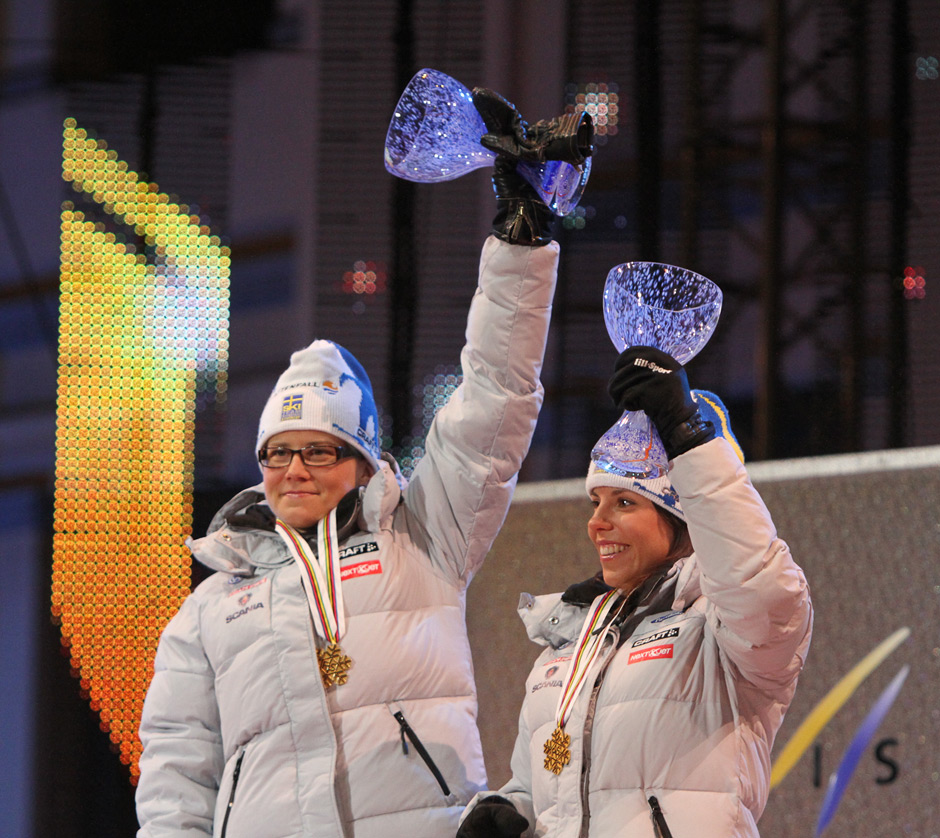
    Charlotte Kalla (R) and Ida Ingmarsdotter won the team sprint at 2011 World Championships, but finished second to Americans Kikkan Randall and Jessie Diggins in 2013. Sweden hopes to reclaim that crown on home turf in Falun in February.
    Charlotte Kalla (R) and Ida Ingmarsdotter won the team sprint at 2011 World Championships, but finished second to Americans Kikkan Randall and Jessie Diggins in 2013. Sweden hopes to reclaim that crown on home turf in Falun in February.

    After concluding its national championships this weekend, Sweden has picked its team for World Championships. The country is hosting this year, with the event set to take place in Falun in mid-February.

    The team features past World Champions Charlotte Kalla, Ida Ingemarsdotter, Johan Olsson, and Marcus Hellner, as well as World Cup Sprint Cup champions Emil Jönsson and Teodor Peterson. There are also newcomers, like Jennie Öberg, who won her first World Cup competition in January, and Stina Nilsson, who has broken onto the scene in the past two seasons.

    Here’s the team named, and then a summary of the national championships results and what they might mean for Worlds.

    Women
    Charlotte Kalla, PiteÄ Elit
    Emma WikĂ©n, Åsarna IK
    Anna Haag, IFK Mora SK
    Ida Ingemarsdotter, Åsarna IK
    Sofia Bleckur, IFK Mora SK
    Stina Nilsson, IFK Mora SK
    Hanna Falk, Ulricehamns IF
    Magdalena Pajala, PiteÄ Elit
    Jennie Öberg, PiteĂ„ Elit
    Reserve:
    Maria Rydqvist, Älvdalens IF

    Men
    Calle Halfvarsson, Falun-BorlÀnge SK
    Johan Olsson, Åsarna IK
    Lars Nelson, Åsarna IK
    Daniel Richardsson, Hudiksvalls IF
    Marcus Hellner, Gellivare Skidallians
    Martin Johansson, IFK Mora SK
    Emil Jönsson, IFK Mora SK
    Teodor Peterson, IFK UmeÄ
    Johan Edin, IFK Mora SK
    Reserve:
    Anders Södergren, Hudiksvalls IF
    Carl Quicklund, Östersunds SK

    Swedish National Championships Rundown

    Skiathlons, January 28
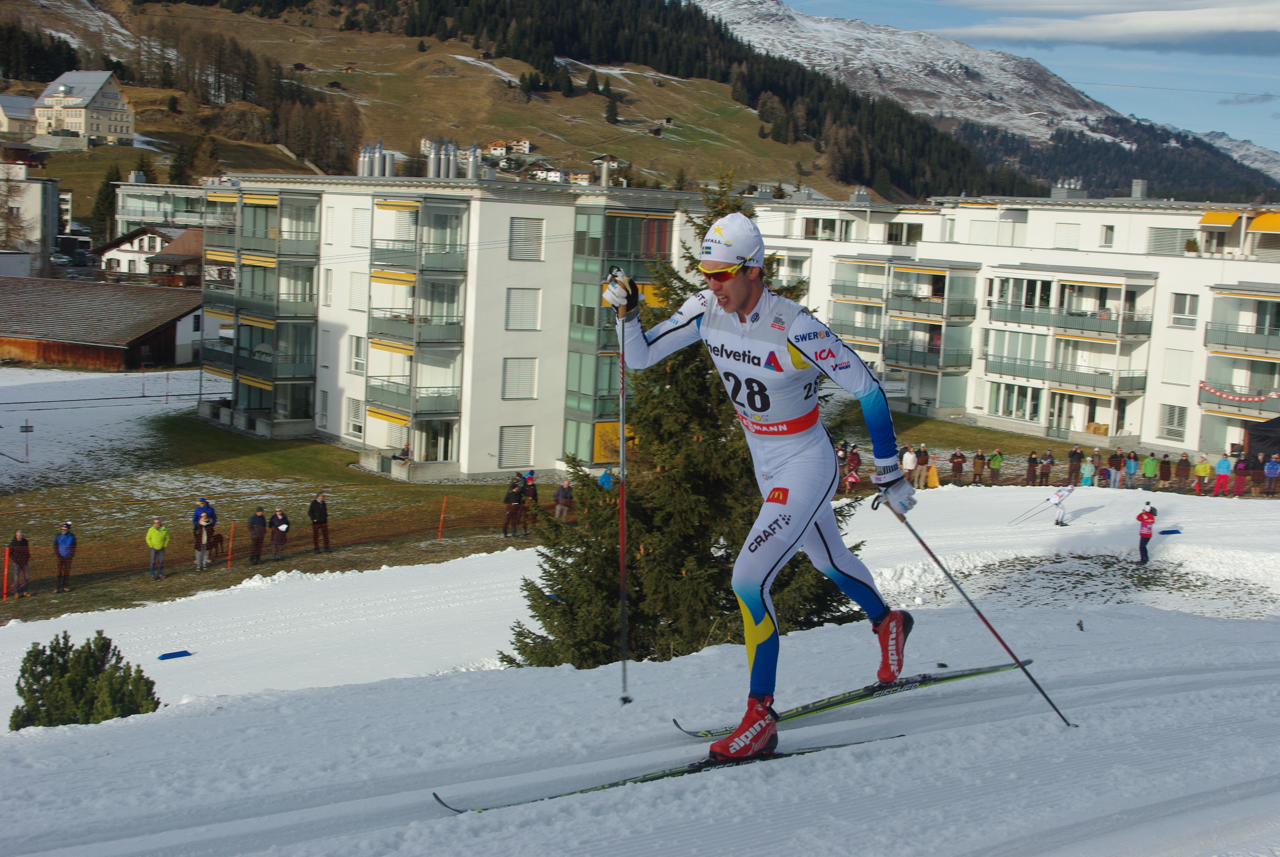
    Marcus Hellner - here finishing 29th in the World Cup 15 k classic in Davos, Switzerland, in December - has struggled this season. But he eked out a win at National Championships in the skiathlon.
    Marcus Hellner – here finishing 29th in the World Cup 15 k classic in Davos, Switzerland, in December – has struggled this season. But he eked out a win at National Championships in the skiathlon.

    Charlotte Kalla owned the women’s 15 k skiathlon, racing to a 59-second win over Stina Nilsson. Emma Wiken placed third and Anna Haag fourth. Colorado University alumna Maria GrĂ€fnings placed eighth, 1:48 off the podium.

    In the men’s 30 k skiathlon, Marcus Hellner gave a hint that he’s back on form, beating Lars Nelson and Johan Olsson in a sprint finish. Calle Halfvarsson, who has been the top Swede in World Cup racing all season, placed ninth – two and a half minutes back. Both he and Anders Södergren had crashes which took them out of contention, while Johan Olsson had binding issues and had to get a new ski partway through the race.

    Although he would have preferred to beat these rivals in a sprint finish to prove that his shape is really back, Hellner said that the victory was a good sign.

    “I tried to grill the others on the long hill, but I was not so strong that I could ski away,” he said, according to Langd.se. “The rest of the trails ere a little too easy to be able to do something. But the race gave me good news. Now I think I will become more alert and energetic moving forward to the World Championships.”

    Men’s Results / Women’s Results

    Relays, January 29 – were not used in World Championships decisions.

    10/15 k freestyle, January 31
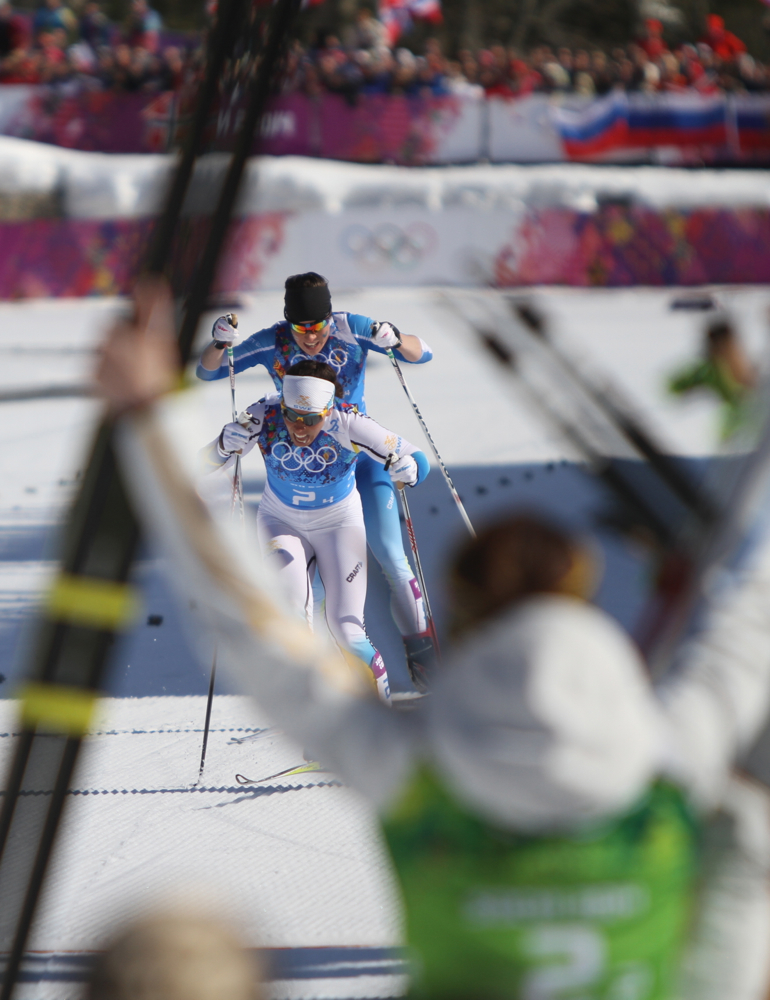
    Charlotte Kalla was a hero of the 2014 Olympics, and dominated her own national championships this week. Will she be able to give the home team gold in Falun?
    Charlotte Kalla was a hero of the 2014 Olympics, and dominated her own national championships this week. Will she be able to give the home team gold in Falun?

    Kalla repeated, and even bested, her previous win by demolishing the woen’s field in the 10 k skate. She beat runner-up Haag by a minute and 19 seconds; Wiken was seven more seconds behind. GrĂ€fnings was sixth but still over a minute off the podium.

    Kalla said that the race was “very easy”, according to Dagbladet, and that she felt great all week. She feels well-prepared for World Championships. She’s off to Seiser Alm to put in an altitude training block.

    “I feel and know that the largest job is done,” she said. “The biggest part of the training is made, but it comes to keeping a continued focus on the workouts that still have to be done. There will not be any huge changes in technical terms, but still a bit small parts that can sit even better when the real shape come around
 But above all it has been a desire to stand on the starting line at the World Championships once it arrives, and we try to enjoy the journey to get there as well.”

    In the 15 k, Halfvarsson bounced back to his previous form while Hellner faltered – showing that if anything, he’s simply inconsistent this season. Halfvarsson posted a 37.9-second victory over Daniel Richardsson, with Anders Soedergren third.

    Men’s Results / Women’s Results

    Classic sprints, 1 February
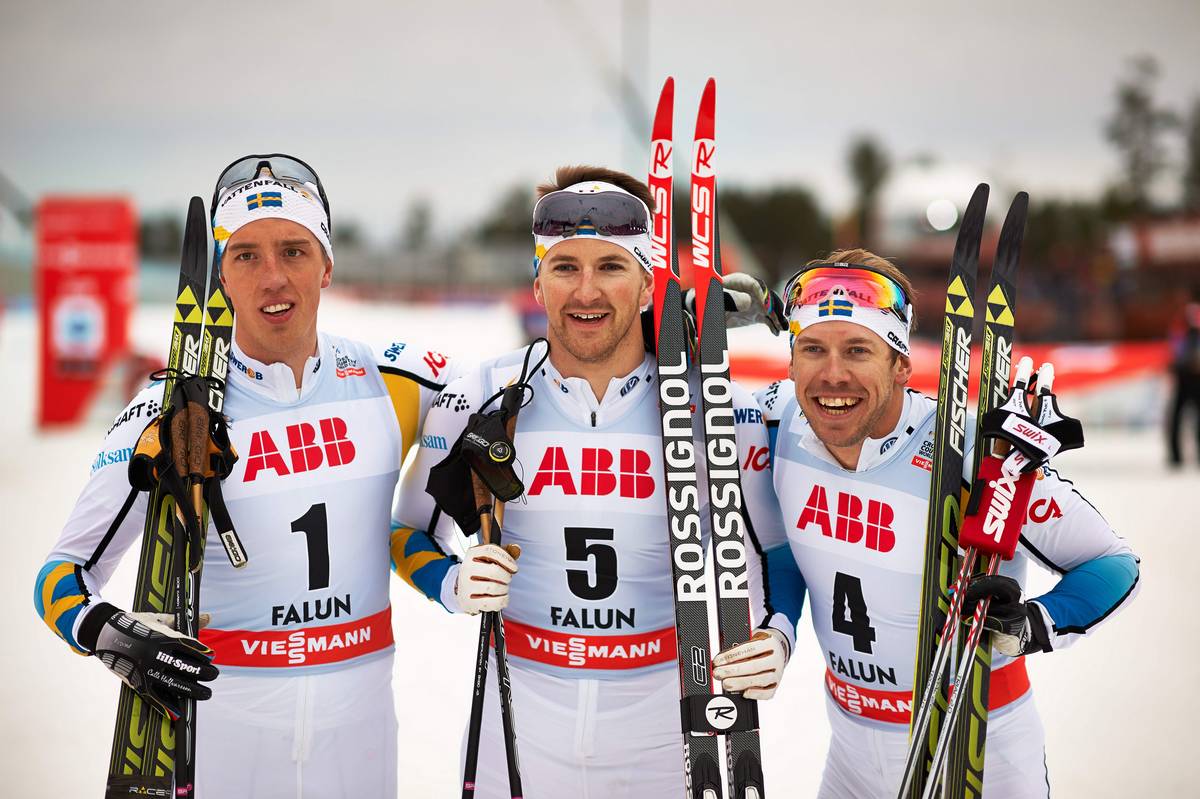
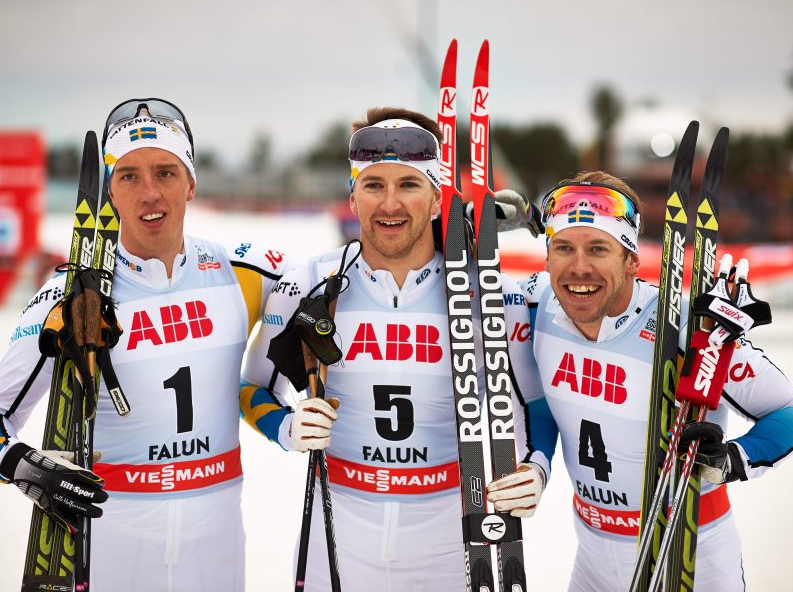
    Sweden's three best hopes in sprinting and mid-distance (l-r): Calle Halfvarsson, Tobias Peterson, and Emil Joensson. (Photo: Fischer/NordicFocus.com)
    Sweden’s three best hopes in sprinting and mid-distance (l-r): Calle Halfvarsson, Tobias Peterson, and Emil Joensson. (Photo: Fischer/NordicFocus.com)

    In the women’s sprint Hanna Falk won qualifying and then marched straight through to the final, which she also won. Magdalena Pajala placed second and Maria Nordström third. Sprint favorites Nilsson, Kalla, and Ida Ingemarsdotter did not compete. Linda Danvind-Malm of the University of Vermont placed tenth.

    Finally, in the culminating event of the championships, Emil Jönsson proved that he’s not going anywhere when he captured the men’s sprint title. Teodor Peterson was the runner-up and Jesper Modin placed third. Neither Jönsson nor Peterson have been totally on form this season, but they say that things are coming around.

    “It was fantastic, how I am at the final stretch and still feel pretty fresh,” Jönsson told Expressen. “It was also important to get to the final, I’ve barely been in the finals this year.”

    Johan Edin missed the final of the sprint, but was still selected for the team ahead of several other racers who had better results at the National Championships. He explained to Expressen that his skis iced at some point during the heats, and that he was sure his shot at Falun was gone.

    “It has been an emotional roller coaster,” he said. “The feeling when you think everything is going wrong. I had packed bag and was about to go home. They were lucky that Richard had time to catch me before I did it.”

    Men’s Results / Women’s Results

  • Swedes Sweep Podium, Harvey Fourth in Falun Sprint

    Swedes Sweep Podium, Harvey Fourth in Falun Sprint

    The men's podium at the Falun sprints. Halfvarsson, Peterson, Jönsson (l-r)  Photo: Fischer/Nordic Focus
    The men’s podium at the Falun sprints. Halfvarsson, Peterson, Jönsson (l-r) Photo: Fischer/Nordic Focus

    The Swedes swept the podium in Friday’s classic sprint race in Falun, Sweden. The final day of World Cup sprinting didn’t disappoint the local fans who had come to see their team win on home snow.

    The sprints began with a quarterfinal featuring Andy Newell of the United States and Alex Harvey of Canada. Swedish sprinter Calle Halfvarsson led the heat out of the gates and up the hill, with Newell and Harvey right behind him.

    Heading into the stadium, Harvey pulled into the lead to go head to head with Newell in the final stretch. Lingering just behind was Halfvarsson who powerfully double poled his way into the finish ahead of Harvey and Newell who couldn’t match him in the end. Harvey edged Newell for second, but the American’s time was fast enough to win a lucky loser berth in the semifinals.

    Newell was also cited for skating in the finishing stretch while contesting the race against Harvey. “It was hard to decide where the fastest snow would be,” said Newell. “I’d hop into the track, then hop out, trying to find the best snow. I think a lot of guys were doing that. In the finishing stretch I was trying to find the best snow and put in what they judged was too many skate steps, so I received a yellow card for that. It’s not a huge deal though because I’m typically really good about not skating in classic races, and that’s just my first yellow card. They keep track of it and if you get a second one you can be disqualified.”

    The second quarterfinal saw Norway’s Eirik Brandsdal, Sweden’s Emil Jönsson, and Germany’s Tim Tscharnke qualify.

    The third quarterfinal was led out of the gates by Sweden’s Teodor Peterson, followed by Norway’s Ola Vigen Hattestad. Heading into the base of the long first climb, Hattestad tried to switch tracks, cutting off Russian skier Maxim Vylegzhanin and causing him to break a pole. Hattestad went on to lead the rest of the heat and win it, only to be relegated to last place as a result of his actions early on. It was a moment of careless skiing from the Olympic champion, and it opened the door for his teammate Brandsdal to make a bid to recapture the Crystal Globe.

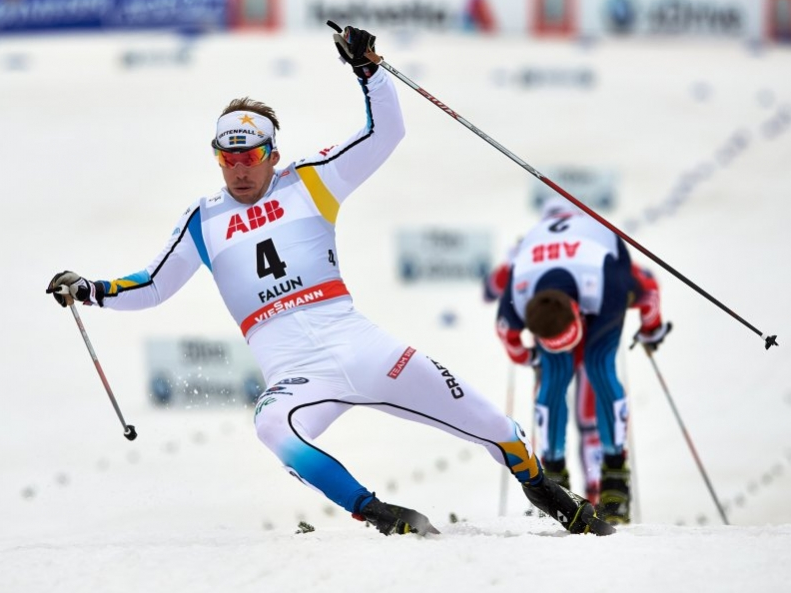
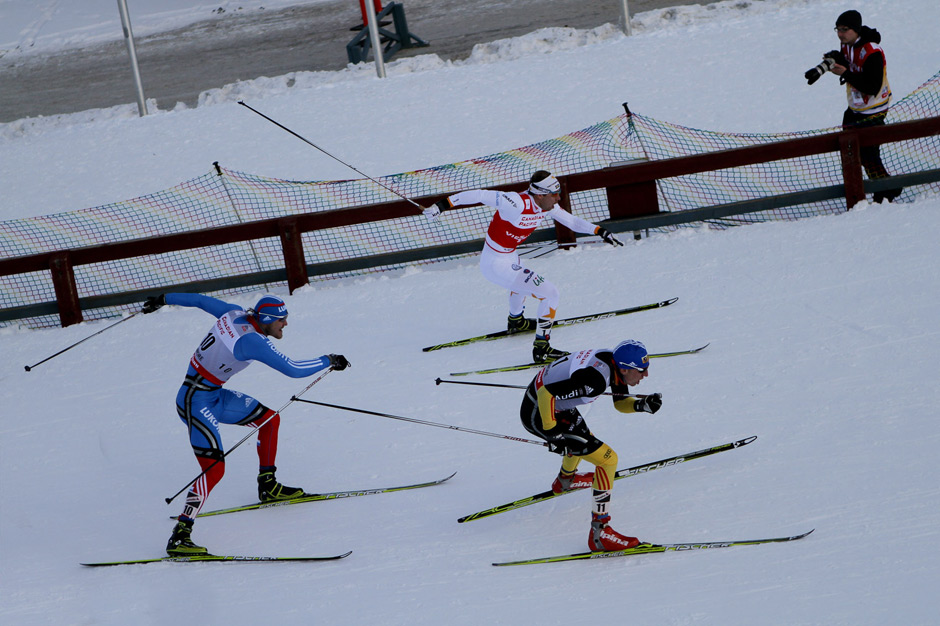
    Emil Jönsson lunges at the finish.  Photo: Fischer/Nordic  Focus
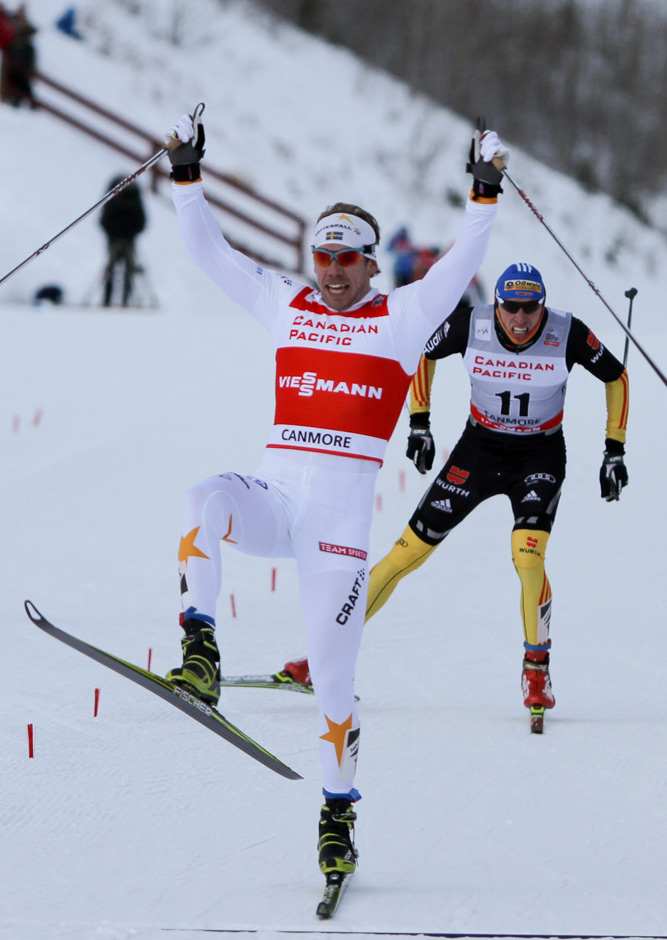
    Emil Jönsson lunges at the finish. Photo: Fischer/Nordic Focus

    Hattestad said after his race, “It’s crap if the jury will decide who wins the Sprint Cup. It may be that I have done something wrong, but I did not experience it that way.”

    The fourth and fifth quarterfinals saw Russians Nikita Kriukov and Sergey Ustiugov qualify as well as PÄl Golberg of Norway and Federico Pellegrino of Italy.

    Jönsson led the first semifinal heat up the hill with Tscharnke following and Harvey looking for a way in on the outside. Heading into the second hill Harvey and Tscharnke tangled skis for a moment, but both stayed on their feet.

    Coming down the hill and into the stadium it was Brandsdal in the lead, but it was Halfvarsson who had the fastest skis and he glided past the Norwegian. Harvey then made a move to take over the lead, and carried that into the last straightaway, but he couldn’t match Jönsson and Halfvarsson in the end, and took third. Both he and Brandsdal were fast enough though to win lucky loser positions in the final heat.

    “The semifinal was good,” said Harvey. “I was just outgunned before the line by Halfvarsson and Jönsson, but it was also hotly contested, with Brandsdal in there fighting for the sprint cup. That heat was fast because I got the lucky loser, and Brandsdal got lucky loser.”

    The second semifinal was initially led by Peterson and Ustiugov, with Newell and Golberg skiing on the outside tracks. Pellegrino fell heading into the second hill, and shortly after Golberg slipped and fell over as well, leaving the front four to contest the race. Peterson was the strongest and won the heat, with Ustiugov second and Kriukov third in a very close photo finish, and Newell finished fourth.

    The final heat saw Jönsson, Halfvarsson, Peterson, Ustiugov, Harvey, and Brandsdal line up against each other. The three swedes had the crowd and home snow advantage while Harvey was eyeing every World Cup point and Brandsdal the sprinters title.

    Jönsson took the lead up the first climb and tore his way up it at a frenetic pace. Jönsson gained a lead, but the group compacted again after the downhill. Brandsdal took over lead heading into the stadium, but the three Swedes caught him and skied ahead with Harvey, Ustiugov, and Brandsdal chasing.

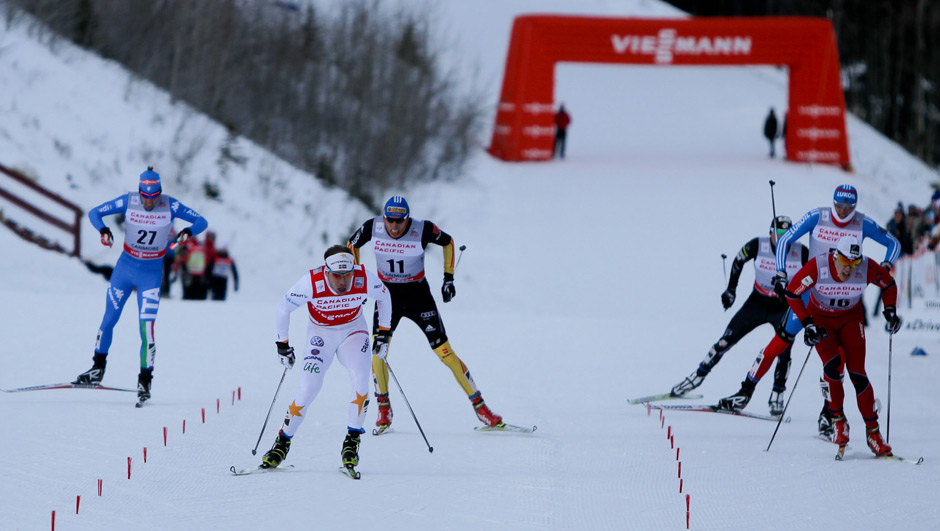
    Peterson led in to the finish with Jönsson right behind him. With a hundred meters left in the race Jönsson moved from behind his teammate and the two skied neck and neck to the finish, lunging for a photo finish. Halfvarsson finished just behind and Harvey who took fourth, .04 seconds ahead of Ustiugov. Brandsdal finished sixth, a result that wasn’t good enough to win back the Crystal Globe from Hattestad

    “In the final Jönsson went so fast up the first climb,” said Harvey. “For me my plan was not to go balls to the wall on that climb because I wanted to be strong at the end. So I knew to try and stay relaxed and that it was coming back in the downhill. But after that I was still in sixth and couldn’t pass on the second hill. And then it just came down to the finish, but I had a good punch in the end. I came from sixth to fourth, which is good for the mini-tour standings, getting some bonus seconds, so I was pretty satisfied with the race.”

    In the end, Peterson was ruled the winner in a race that was almost impossibly close. Jönsson received the exact same time as Peterson, they were within a hundreth of a second of each other, a nearly imperceptable margin.

    The ever good natured and humorous Jönsson joked with Expressen after the race,  It would be great by Teodor [Peterson] if he could stand up and say that we share it here. Then he would be a great sportsman,” said a laughing Jönsson. “He has larger feet! No, but I think I had more speed and was coming on. But they’ve looked carefully at the pictures.”

    Harvey strides out en route to a fifth place finish in the 10 k classic. Photo: Fischer / Nordic Focus.
    Alex Harvey  Photo: Fischer / Nordic Focus.

    Jönsson has had a spell of bad luck in this seasons sprint races, with numerous crashes and broken poles. He told FIS, “I fell in a few last World Cup competitions so the plan was to stay out of trouble and ski to the finish.”

    Peterson told Expressen after the race, “Sure, it was damn smooth. I find it hard to get into first in a race, you know you that you are tired and so have no idea of where the others are. I felt that I might lose now, but I got a hell of a lucky break.”

    Halfvarsson was content to round out the Swedish contingent. “I am happy for third place,” he told FIS. “It is always special to share the podium with teammates. My skis were perfect and I enjoyed racing a lot today.”

    Harvey is now in fifth place in the World Cup overall standings, just 14 points shy of Halfvarsson in fourth. When asked how close he will be watching Halfvarsson in the next two races, Harvey responded, ”pretty closely. In the standings in the mini-tour he’s the big threat. There’s no way that Teodor [Peterson], Emil [Jönsson] and Ustiugov are going to last for 30 k. He’s the guy everyone’s going to try to make time on.”

    “Alex has been in good shape all year,” said Justin Wadsworth, the Head Coach of the Canadian National Team. “I think every race now after the Olympics is a chance for him to show that he’s been in good shape. I think he still feels the pain a little bit from the Olympics and wants to finish on a high note, and he’s doing a good job, he’s fifth in the overall World Cup and has a chance for fourth, so we’ll see how it shakes out.”

    “We’d really like to see him go for that fourth spot, to finish out the season in fourth would really be a high point for us. That’s a very high placing in the world Cup and something he should be proud of as an athlete.”


    Results

  • After Disappointment in Vancouver, Hattestad Wins Crash-Marred Sprint in Sochi

    After Disappointment in Vancouver, Hattestad Wins Crash-Marred Sprint in Sochi

    Norway's Ola Vigen Hattestad celebrates winning Olympic gold in the sprint in Sochi.
    Norway’s Ola Vigen Hattestad celebrates winning Olympic gold in the sprint in Sochi.

    FasterSkier’s coverage is made possible through the generous support of Rudy Project.

    SOCHI, Russia — At the start line of Tuesday’s Olympic sprint final, Norwegian Ola Vigen Hattestad thought back four years, to when he was standing on another start line, at the Vancouver games in 2010.

    In that race—the last Olympic sprint final—he was caught flat-footed when a pair of Russian skiers slammed on the gas right from the gun and skied away to gold and silver, as two of their chasers crashed out and Hattestad ended up fourth.

    In this Olympics, Hattestad resolved that the race would go differently.

    “I was really thinking about it now, standing on the start line in the final,” Hattestad said. “I wanted to control this race. I don’t want to be behind.”

    He did, getting himself to the front of the pack in time to avoid a messy pileup on a nasty downhill corner that took out half of the men’s field, evoking memories of Vancouver.

    Hattestad climbs during the qualification round.
    Hattestad climbs during the qualification round.

    The crash left Hattestad to duel with just one other man, Sweden’s Teodor Peterson—a duel that ended with the Norwegian finishing with enough of a lead that he could raise both arms in celebration before crossing the line.

    “It’s a great feeling to succeed in the Olympics,” Hattestad said. “It’s been a career gold for me, to take a medal.”

    Twenty seconds behind Hattestad and Peterson, another Swede, Emil Joensson, tore to the finish, arriving just in time to earn a bronze that could end up being the most improbable medal awarded in this entire games.

    Joenssen had been suffering from a back strain this week and had given up on a podium finish almost as soon as the gun went off.

    He was trailing the pack by a huge margin when he came into the final downhill corner, where he swept past the three skiers who had crashed: one of his own teammates, plus a Russian and another Norwegian.

    “I didn’t know how many they were, that were lying there,” Joensson said afterwards. “But I came to the big curve there, and up the last hill, and I heard a guy was in back of me, and I heard the Swedish coaches screaming that I’m going for a medal. And I was just giving everything I had.”

    The end result was the hardware that has eluded Joensson, who is perennially one the world’s best sprinters, for years.

    “Right now, I don’t know if I’m going to be happy, or if I’m going to be (sad),” he said. “It was really winning a lottery.”

    A lottery does seem like the best metaphor for Tuesday’s sprint races, which saw multiple crashes take out some of the contenders on the men’s side—while on the women’s side, heavyweight Marit Bjoergen fell in a preliminary heat, and favorite Kikkan Randall was inexplicably outskied and failed to even qualify for the semifinals.

    Sprinting is always unpredictable, but the white-knuckle corner on the men’s course added an extra level of chaos on Tuesday.

    Warm temperatures at the Laura Cross-Country Ski Center on Monday night left the race organizers coping with sloppy conditions on Tuesday.

    They spread salt on uphill sections of the course to make them more firm, but the downhill righthander leading into the last climb remained a sloppy, treacherous mess. (The organizers didn’t salt those areas because they didn’t want athletes to fall onto a harder surface, according to Pierre Mignerey, the cross-country race director for the International Ski Federation.)

    Several spectacular crashes ensued before the final—one involving Switzerland’s Dario Cologna, and another in which a Russian athlete broke a ski. A Chinese skier had to be taken out of the venue on a stretcher.

    In the finals, Hattestad had stuck to his plan and was leading a pack of five—minus Joensson—through the corner.

    Both Hattestad and Peterson, who was close behind, skied it cleanly. But the next athlete to enter the turn, Norway’s Anders Gloeersen, slipped and fell, and the skier behind him, Sweden’s Marcus Hellner, fell too.

    They both slid to the outside of the corner, directly into the path of Russia’s Sergey Ustiugov, who got taken out at the knees.

    Joensson was the last man standing, as Hattestad and Peterson skied off to gold and silver.

    Joensson’s performance was still Olympic in one sense—he was so exhausted and in so much pain from his strained back at the finish that he had to be helped away.

    At a press conference afterward, Hattestad said he felt bad “for those who ended their day” on the corner. But he noted that the organizers had scraped excess snow from the turn, and added: “I don’t know if they can do anything more.”

    “I guess, it is sprint racing,” he said.

    In a phone interview, Mignerey, the race director, referred to the corner in the same way.

    “It’s one part of the game,” he said. “Cross-country skiing is also to be able to be fast in downhills—even in hard downhills, curves.”

    But, he added, “the men’s final today—it’s too much, for sure,” and he said he wanted to see some changes to the corner before the team sprint later in the games.

    “Joensson almost gave up after the first uphill, (and) at the end he has a medal,” Mignerey said. “Not, sportwise, the best thing we can have.”

  • Overall Title ‘In the Bag’ for Northug; RĂžnning Wins Mass Start in Falun

    Overall Title ‘In the Bag’ for Northug; RĂžnning Wins Mass Start in Falun

    Eldar RĂžnning (r) edges Russian Maxim Vylegzhanin (c) and fellow Norwegian Martin Johnsrud Sundby (l) in Saturday's 15 k classic mass start at 2013 World Cup Finals in Falun, Sweden. (Photo: Fischer/Nordic Focus; facebook.com/FIS Cross Country)
    Eldar RĂžnning (r) edges Russian Maxim Vylegzhanin (c) and fellow Norwegian Martin Johnsrud Sundby (l) in Saturday’s 15 k classic mass start at 2013 World Cup Finals in Falun, Sweden. (Photo: Fischer/Nordic Focus; facebook.com/FIS Cross Country)

    The typical plot line never materialized.

    Norway’s Petter Northug was supposed to spend the first several laps on Falun’s controversial track back in 25th and then surge to the front for the victory in the final 100 meters at World Cup Finals in Sweden.

    Instead, Northug’s teammate Eldar RĂžnning salvaged a tough season with a surprise 15-kilometer classic mass start victory, posting a time of 43:26 minutes on the 2015 World Championships course.

    RĂžnning, a classic specialist, made use of his late-season form, narrowly outsprinting Russia’s Maxim Vylegzhanin in the finishing straight with Norwegian Martin Johnsrud Sundby just behind in third.

    Saturday’s competition had three separate stories at work. First was the fight for the overall World Cup between Northug, Russia’s Alexander Legkov, and Switzerland’s Dario Cologna.  Second was the standing in the Falun mini tour, made more dramatic by the bonus seconds offered at the 5.6 k and 12.2 k marks.  Third was the contest for the race honors itself.

    Northug began the mass start with two victories in a row and appeared to be in indomitable late-season form.

    Legkov and Cologna are off their best, but even after Northug’s two successive victories, Legkov and Cologna only trailed the Norwegian by 56 and 69 points, respectively.

    It was up to Legkov and Cologna to deliver a strong result and stop Northug’s momentum.

    Northug was up to his usual antics in the first few laps of Falun’s unforgiving course, lazing to the back of the field while others took up the pace.

    It opened the door for someone like Legkov to up the pace. However, Legkov appeared to be missing a gear, as Northug observed.

    “It looked like Legkov had spent a night out on the town,” Northug told told NRK. “He looked tired.”

    Cologna initially looked dangerous.

    He gamely came to the fore at the first intermediate sprint for bonus seconds at 5.6 k, narrowly denied the full 15 seconds by Sundby. Cologna stayed at the front, and appeared to have recovered after a recent period of illness.

    But Cologna’s pace wasn’t enough to break the field. With Northug and Legkov jostling at the back in their own private battle, others were left to shape the race. Initially Finland’s Matti Heikkinen took up the donkey work at the front, but his moment was short-lived and he quickly disappeared back into the pack.

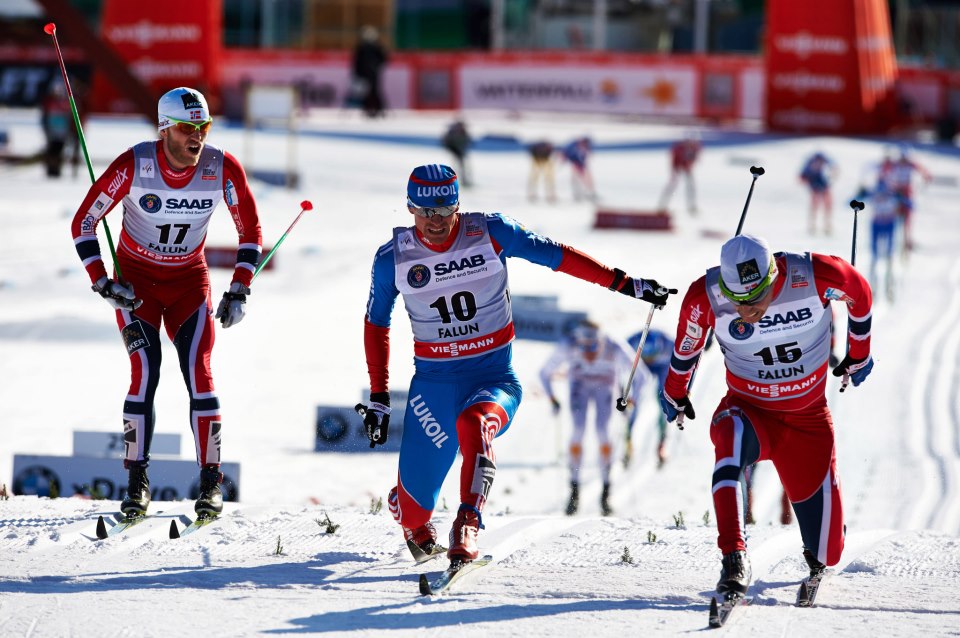
    The decisive pace change came from the unlikely figure of Emil Jonssen, the overall World Cup sprint champion.

    Many would bet on Jonssen dying quickly, but as the kilometers ticked by, it appeared the sprinter had could go the distance as well.

    At the 8-kilometer mark he made a move, with Northug lagging at the back of the field. By Northug’s account, this was the pivotal move of the race, and unlooked as it was initiated by the Swede.

    “The Swede brought up the speed and that’s what dropped Legkov and Cologna,” Northug told NRK. “I hadn’t expected help, so I must thank them for that.”

    Northug, ever an antagonist, was asked by a Swedish journalist whether he would repay the Swedish the favor.

    “No,” he deadpanned.

    In any event, Jonssen’s attack injected speed into the race. His aggression was more than a hubristic charge for a moments glory, and he took 10 bonus seconds at the 12.2 k mark, beaten again by a hungry Sundby. Jonsson looked like he was in contention for a breakthrough distance result.

    Northug had finally moved toward the front and crossed the intermediate sprint line in sixth place, seven seconds behind the winner.

    Legkov held on to the frantic pace at the front, crossing the 12.2 k mark in 10th place. Cologna was starting to break, dropping down to 12th, 12.2 seconds off the pace.

    After the final intermediate sprint, Jonssen faded. Sweden’s Daniel Richardsson, Sundby, Vylegzhanin, and RĂžnning all revved their formidable distance motors and charged, Northug clinging to the group. Legkov and Cologna were dropped.

    As the leaders began the final 3.3 k loop, the race was on, led by the giant, searching stride of Richardsson.

    Coming into the last hill, Sundby found another gear and led RÞnning and Vylegzhanin into the infamous downhill, as Richardsson and Northug lost a few meters. Sundby was tearing the field apart.

    “I had a F***ing good day,” confirmed Sundby to adressa.no.

    Lurking just behind was the unheralded RĂžnning.

    As the frontrunners crested the big uphill and plunged down the final chicane Northug passed an ailing Richardsson and appeared to be within striking distance of RĂžnning, Sundby, and Vylegzhanin.

     As the camera angle panned to an aerial view of the race, however, it became evident that Northug left himself too much to do.

    “I was busy trying to stay focused on what happened behind rather than chase victory,” Northug said.

    Meanwhile, RĂžnning kept his feet on Falun’s tricky downhill, jumped into his slipstream, and slingshotted past the Russian in an impressive display of double poling. Sundby coasted in for third place, his double poling power failing him in the end.

    “I killed myself to get out that little extra, and I had good skis,” RĂžnning said. “In addition I’ve been working hard on my finish.”

    The victory came as a relief for RĂžnning.

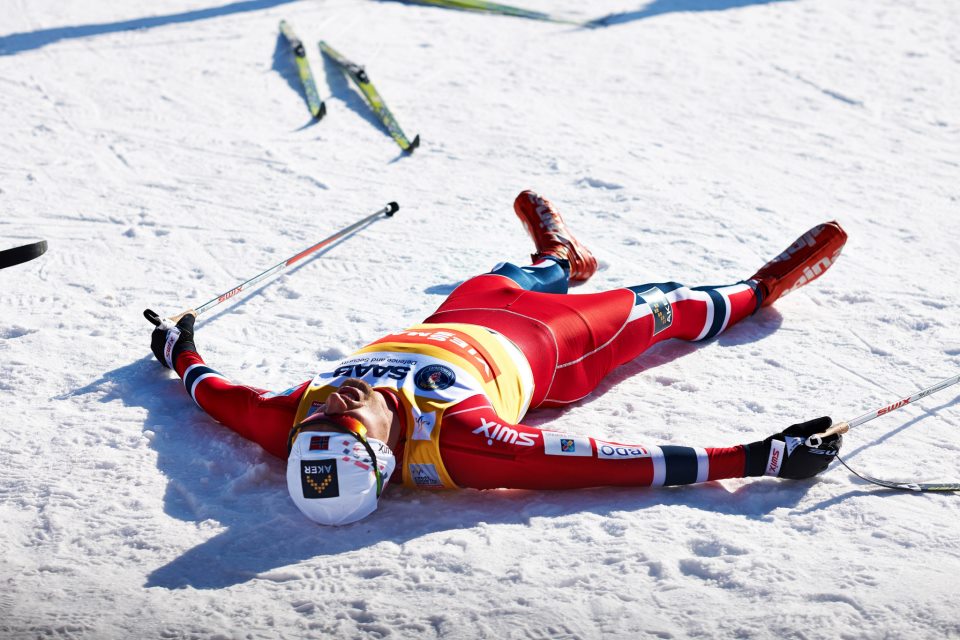
    Petter Northug after an exhausting fourth-place finish in Saturday's 15 k classic mass start at 2013 World Cup Finals in Falun, Sweden. (Photo: Fischer/Nordic Focus; facebook.com/FIS Cross Country)
    Petter Northug after an exhausting fourth-place finish in Saturday’s 15 k classic mass start at 2013 World Cup Finals in Falun, Sweden. (Photo: Fischer/Nordic Focus; facebook.com/FIS Cross Country)

    “It was great fun to win today. I have been struggling this season a bit and the victory here today means a lot for me,” RĂžnning said. “Now I can go into my Easter holiday with a good conscience.”

    Sundby concurred. “It’s great that RĂžnning took the win,” he said. “It’s been a tough season for him.”

    Northug never contested the victory, but his fourth-place finish was enough to solidify his lead in the mini tour and the overall title race.

    Contenders for the overall World Cup title, Cologna and Legkov didn’t deliver the result needed to unsettle Northug. Cologna finished 12th, and Legkov was 15th, respectively 17.9 and 25.6 seconds behind RĂžnning.

    Northug will go into the final day of the mini tour, a 15 k freestyle pursuit race, with a 30.5-second head start on Vylegzhanin. RÞnning will start 40.2 seconds behind Northug in third. Northug had a 1:47 lead on Legkov as his closest title-rival.

    In the overall World Cup, Northug leads Legkov by 80 points, and Cologna by 87. For Legkov to win the overall title he would have to win Sunday, and Northug would have to finish lower than third.

    It would take a spectacular meltdown on the Norwegian’s part to relinquish his advantage.

    So does Northug think he’s secured his second overall World Cup title?

    “Normally I’d think it was over,” Northug said. “But it’s about being focused and trying to a have another good race in the morning.  I’m going to focus on resting until then.”

    Sundby isn’t so equivocal.

    “He has it in the bag.”

    Results

    Minitour Standing

    Overall World Cup Standing


  • Poltoranin Claims First Classic Sprint Victory in Davos

    Poltoranin Claims First Classic Sprint Victory in Davos

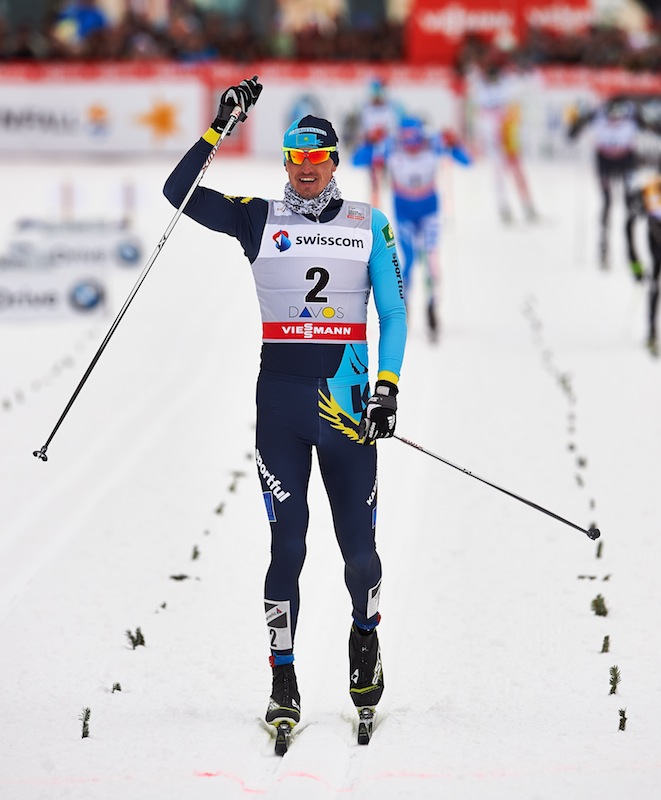
    Alexey Poltoranin (KAZ) won the classic sprint with room to spare in Davos, Switzerland, on Saturday. Photo: Fischer/Nordic Focus.
    Alexey Poltoranin (KAZ) won the classic sprint with room to spare in Davos, Switzerland, on Saturday. Photo: Fischer/Nordic Focus.

    Alexey Poltoranin (KAZ) put forth an impressive show of strength to take the men’s 1.5 k classic sprint on Saturday in Davos, Switzerland. Hometown hero and World Cup overall leader Dario Cologna (SUI) took second; Federico Pellegrino (ITA) secured the final podium position.

    This weekend is a final examination before the world championships begin in Val di Fiemme, Italy, and athletes were keen to test their form leading into the big event.

    The course that awaited them was designed by Tor Arne Hetland (NOR), former World Cup skier and sprint coach for the Swiss cross country ski team. The sprint went twice around a loop that featured one long climb punctuated by a steep incline that forced skiers into a herringbone right before descending a twisting S-turn descent into the ski stadium.

    Poltoranin announced his form early with the second-fastest qualifying time of 3:22.22, just 0.89 seconds behind qualification winner Federico Pellegrino (ITA).

    In the first quarterfinal Poltoranin’s fitness was again evident. He positioned himself alongside fellow front runner Valerio Laccardi (SUI) and strode away in the first switchback, distancing himself from the field.

    The track narrows toward the steep herringbone section and the entire field, with the exception of Laccardi and Poltoranin, became tangled and came to a standstill. Poltoranin and Laccardi carried on unscathed, their qualification seemingly assured.

    Poltoranin may have easily kept his distance, but Len Valjas (CAN), recovered from last place to outpace Laccardi  in the final stretch, utilizing strong double poling technique and good track craft to close down the 20-meter gap that opened up in the initial entanglement.

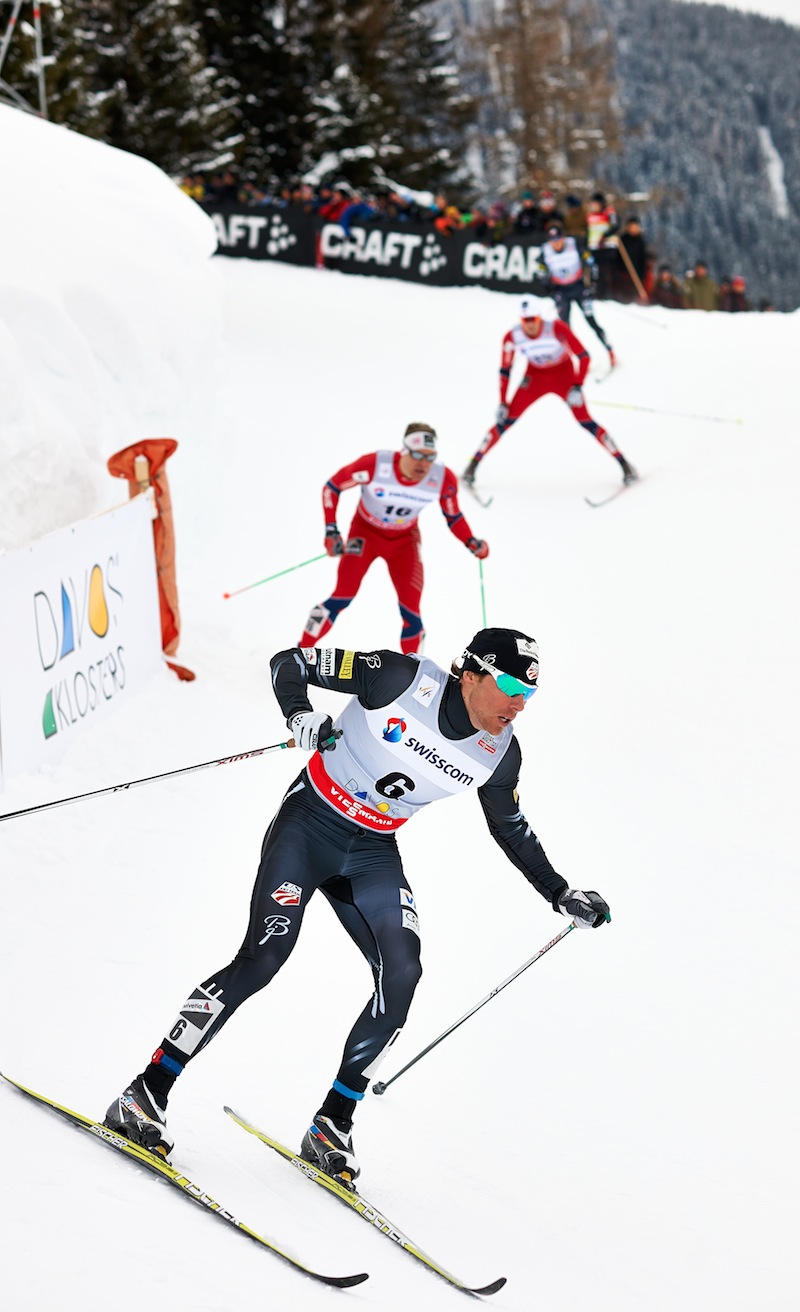
    Andy Newell (USA) cornering in the semifinals. Photo: Fischer/Nordic Focus.
    Andy Newell (USA) cornering in the quarterfinals. Photo: Fischer/Nordic Focus.

    In the semifinal Poltoranin was superior, if not canny. The heat began with a strong surge from Igor Usachev (RUS), whom employed this tactic in the quarterfinals and snuck through to the semifinale as a lucky loser. This strategy backfired and in the second lap he faded from first to last place. Poltoranin took over, and it was left to Andy Newell (USA) to close him down.

    Poltoranin and Newell led into the stadium, but danger lurked in the form of Valjas, whom had timed his attack well, closing down Newell in the final few meters. His surge nearly carried him clear of Newell, who had pulled up and glanced over the wrong shoulder to check on Valjas progress.  Newell still reached the line in second place, which left Valjas to hope to qualify as a lucy loser. Fortunately for Valjas, the heat finished in 3:26.5 and was fast enough to secure passage to the final.

    The final beckoned, and now endurance overtook pure speed as a factor in the final examination.

    The gun went off and Poltoranin shot to the front, shadowed closely by Cologna. As they entered the switchback on the first hill the likes of Newell and Pellegrino cut a hard line around the corner and tried to close down the yawning meters between them and Poltoranin. Already the field was splintered; Valjas seemed to be paying for his earlier efforts in the rounds.

    Through the first switchback Poltoranin was already away, and the margin back to the chasers continued to grow.  Cologna led the chasers through the stadium and into the climb, trailed closely by Pellegrino and a closing Newell.

    Newell regained contact before the final steep pitch before the switchback, but ceded a few meters in the herringbone section and remained just out of touch with the podium.

    In the final run in Poltoranin coasted in comfortably with a time of 3:25.7, while Cologna narrowly out-sprinted Pellegrino for a second place finish to please the home crowd. Newell trailed in a few seconds later for a promising fourth placed finish, while Chebotko and Valjas finished 5th and 6th respectively.

    This was Poltoranin’s first sprint victory on the World Cup. He’s hopeful he can reproduce this form in five days time in Val di Fiemme at the world championships sprint.

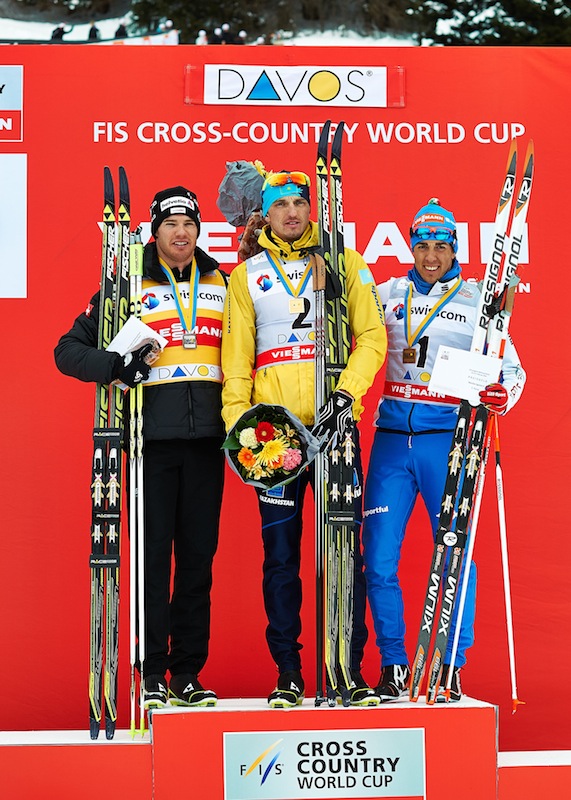
    The Davos sprint podium: 1. Alexey Poltoranin (KAZ), 2. Dario Cologna (SUI), 3. Federico Pellegrino (ITA). Photo: Fischer/Nordic Focus.
    The Davos sprint podium: 1. Alexey Poltoranin (KAZ), 2. Dario Cologna (SUI), 3. Federico Pellegrino (ITA). Photo: Fischer/Nordic Focus.

    “I am very happy for the victory,” Poltoranin told a FIS correspondent. “I spent 12 days in Davos to train in the high altitude. I feel I am in a very good shape and I hope I can fight for a gold medal in Val di Fiemme.”

    Cologna was similarly optimistic after a second-place showing, noting however that next week at world championships is where the results really count.

    “It is nice to be on the podium before the home crowd,” he said.  “It will be more important to perform well next week. I feel my shape is very good. I think I will take part in five competitions at the world championships.”

    Third place finisher Pellegrino was just happy to prove himself on the senior level. “I am very happy for the third place,” he said. “I am happy I have become competitive also in the classic sprint and not only on U23 level. I knew my classic was good enough, I had worked on it a lot during the summer. I hope I perform well in Val di Fiemme.”

    With Newell’s place finish today he moves into second overall in the sprint World Cup standings, leap frogging Teodor Peterson (SWE) and Nikita Kriukov (RUS). Newell is 134 points behind Emil Joensson, whom faltered on Saturday in the semifinal.

    Cologna solidified his lead at the top of the overall World Cup Standings with the 80 points he collected today. He now has 1,093 points, 119 points clear of distance specialist Alexander Legkov (RUS). Cologna also moved up to fifth position in the overall World Cup sprint standings with 200 total points.

    Results

    Sprint World Cup Standings

    Overall World Cup Standings


  • Jönsson Strikes Again, Powers to Sprint Victory

    Jönsson Strikes Again, Powers to Sprint Victory

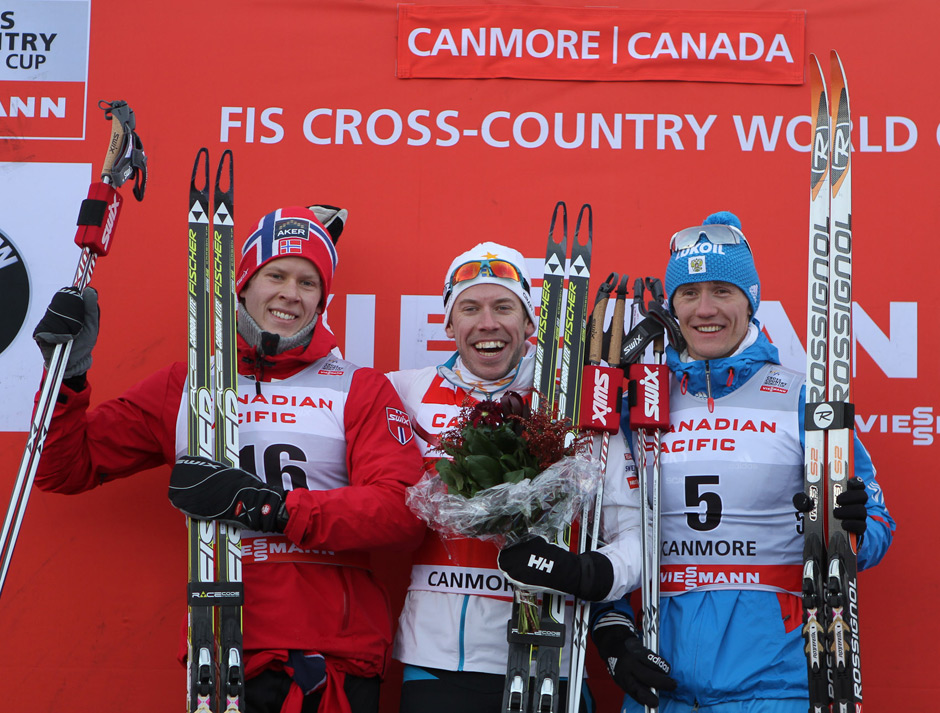
    Men’s Sprint Podium (l-r) – Anders Glöersen (NOR), Emil Jönsson (SWE), Nikita Kriukov (RUS)

    Coverage of the Alberta World Cup made possible through the generous support of Travel Alberta and Tourism Canmore.

    CANMORE, Alberta — Domination is a strong word, and one that is often overused when describing athletic performances, there is no better choice when Emil Jönsson (SWE) and Canmore, Alberta are concerned.

    With his victory today in the World Cup freestyle sprint, Jönsson has now won three of four sprint starts at the Canmore Nordic Center.  Add the fact that he also posted the fastest qualification time in each of those races and it is an understatement when he says, “I really like this place.”

    On a new Canmore sprint course that featured a series of tough climbs, followed by a long descent to the finish, Jönsson used patience and a devastating kick to ski clear in each of his heats.

    All World Cup races end the same way in Canmore — down a long, fast descent into a slight grade up to the finish. Generally head-to-head competitions will be settled here, and in the men’s sprint race, the first two-thirds of the race was virtually irrelevant.

    “In this course, it is definitely not over until the finish line,” said Anders Glöersen (NOR), who finished second to Jönsson. “If you are ten meters behind on the top, you can still be first in the finish.”

    Both men employed a similar strategy of hanging back up the hills, working to slot into a favorable drafting position before hammering the homestretch — though they came by it for different reasons.

    Jönsson told FasterSkier that he initially planned on attacking over the top of the final steep hill. The course then flattens for 100 meters before the descent, making it the perfect spot for a get-away.

    Jönsson and Tim Tscharnke (GER) headed out in the semifinals. Jönsson would drop back before the downhill.

    But after watching the women’s quarterfinals he realized that being behind on the downhill was key.

    He aimed to be in second or third on the descent, and succeeded each time. As the grade flattened, he would step out and engage the afterburners, moving without apparent effort into the lead.

    The Swede had no more information than anyone else, yet others tried to ski from the front, with generally poor results. There were certainly exceptions, including Jesse Cockney (CAN), who led his quarterfinal wire to wire, but in a Groundhog Day moment, the same scene replayed over and over throughout the day — early leaders swallowed up in the homestretch, left to straggle across the line, perhaps ashamed at their audacity to think they could somehow be different.

    Glöersen said that over the past several years he has pushed the pace in sprint races, trying to tire out the opposition. This strategy has yielded him seven World Cup podium appearances entering today’s race, but when he felt poorly early in the day, he made an adjustment.

    Glöersen in qualifying. He posted the 16th fastest time.

    Like Jönsson he remained content to sit in the pack., conserving energy for the sprint to the line.

    The plan worked to perfection. He also won each of his first two heats, before running into Jönsson’s closing speed.

    “I never sprinted as good in the last 100 meters as I did today,” Glöersen said. “I am very satisfied with that.”

    Tim Tscharnke (GER) led out of the start in the final, pushing the pace, but it was the Water Boy, Federico Pellegrino (ITA), who poured it on over the top. Like those who came before him, however, he was doomed at the front.

    The entire heat came by, led by Jönsson, leaving the Italian in 6th. Nikita Kriukov (RUS) followed Glöersen to the line, edging Tscharnke for third.

    “No one,” Kriukov said in broken English, “have a chance to win before the last downhill.”

    While the likes of Pellegrino made the heroic, if foolish, attempt to break away, there was constant competition for the prime spots back in the pack.

    “It is pretty tough to get that spot,” Jönsson said. “It is a little different from what we are used to. Then everyone wants to be in first. Now everyone wants to be second or third.”

    Proper positioning entering the descent did not ensure success. With as many as six skiers heading down the finish straight together, and just four lanes, real estate was scarce.

    Jönsson (top) headed into the finish stretch in the semis.

    Jönsson used his superior speed to find open space while Glöersen seemed to find a hole each time.

    He attributed this success to luck, and maybe some skill. Either way, when he got some space, he “went flat out,” and with power to burn from his conservative approach early on, none other than Jönsson could best him.

    Times clocked in at just over two-and-a-half minutes, short for a men’s sprint race, but both Jönsson and Glöersen were clear that this did not make for an easy race.

    The Norwegian commented that the snow, especially on the climbs, was not fast and Jönsson pointed to the altitude as another complicating factor.

    Jönsson headed for victory.

    “You can feel it in the legs that you are not used to this,” Jönsson said. “If you go a little bit too hard up, then you are smoked. You have to listen to your body all the time and listen to your legs
to have some power left.”

    When asked if he if he likes the fast Canmore finish, Jönsson hesitated before laughing and saying “I must say yes
today I can’t complain.”

    He elaborated, adding that in the past he prefers a homestretch that is “a little tougher.” He pointed to Quebec and the steeper run to the line without a descent as an aid, a finish where “you need to struggle a little bit more.”

    Results

    Of Note:

    – The Swiss, who raced a NorAm sprint on this course two weeks ago, qualified five men, but none advanced out of the quarterfinals. They were generally agressive on the climbs, with little success.

    – Harald Wurm (AUT) placed 8th after crashing in Quebec and finishing the race on one ski. Wurm was joined in the semis by teammate Bernhard Tritscher, who placed 12th.

    – Russian Alexey Petukhov failed to advance out of the quarterfinals and placed 22nd.

    – 2012 Sprint Cup Champion Teodor Peterson (SWE) was 48th.

    – Six different nations were represented in the final.


    Kriukov in qualifying. He was 5th.
    Glöersen winning his semifinal. Andy Newell is to the left and Jesse Cockney (CAN) to the right.
    Out of the start in the final.
    Mikhail Devjatiarov leads the second quarterfinal up the big climb.

    Emil Jönsson (SWE) celebrates his sprint victory in Canmore.


  • Brandsdal Mixes and Matches Techniques for Royal Victory, Valjas Back on Podium

    Brandsdal Mixes and Matches Techniques for Royal Victory, Valjas Back on Podium

    All 2012 FIS World Cup Finals coverage is brought to you through the generous support of Fischer Sports USA, proud sponsors of Kikkan Randall, 2012 overall Sprint Cup Champion.

    In front of a passionate Swedish crowd the final heat charges up the finish lanes.

    STOCKHOLM, Sweden – Racing in the final sprint of the year, Eirik Brandsdal (NOR) held his own type of skiathlon, splitting his four times around the Royal Palace evenly between double pole and striding.

    There are no medals awarded for such versatility, but Brandsdal left with all the hardware he needed, winning the classic sprint in front of the King of Sweden ahead of 2012 Sprint Cup Champion Teodor Peterson (SWE).

    Lenny Valjas (CAN) used a technique switch of his own to move all the way from 30th following the qualifier to third, claiming his second podium in eight days.

    In victory Eirik Brandsdal (NOR) slides across a finish line darken by the shadows of the Royal Palace.

    Brandsdal, who accepted his medal from His Majesty King Carl the 16th Gustav, could be considered royalty in his own right—King of the City Sprint.

    Brandsdal won three of five such competitions this season, with victories in Milan, Drammen and now Stockholm.

    “It was a great day today,” Brandsdal told FasterSkier after the race. “I was feeling very strong.”

    The Norwegian started the day double poling on skate gear, as did the majority of his teammates. He qualified a solid 7th and advanced out of the quarters, still double poling, when he placed second to the home-favorite Emil Joensson.

    Joensson, famous for his high-tempo striding, chose the opposite tack, classic skiing from the get-go. He even forwent double pole on the last flat stretch to the finish in qualification, driving his kick all the way to the line.

    In a fine illustration of the validity of both approaches, the two men easily outdistanced the rest of their quarterfinal, advancing to a rematch in the semis.

    This is when Brandsdal made the switch, swapping his skate skis for classic with klister.

    “I was tired in the arms,” Brandsdal said, adding that he could have continued double poling.

    “I felt more confident doing it with the grip wax,” he explained. “I think that is my strength in classic races—fast uphill striding.”

    Again, the contrast of styles was on display in the semifinals. This time around Ola Vigen Hattestad (NOR) took the top spot—double poling— ahead of Brandsdal.

    Both Lucky Losers came from this first semi, one of which was Valjas, who barely made the heats on skate gear, holding off Tim Tscharnke (GER) by a mere .03 seconds for the final spot.

    Immediately after finishing qualification, Valjas was already planning the switch—if he advanced.

    On classic skis in the quarterfinal he used his formidable stride to charge up the field on the final climb to place second to Hattestad.

    After spending most of that heat toward the back, he opted to attack from the gun in the semi, leading up the first hill and into the descent.

    This move was no accident. Valjas said he wanted to get out at the front to avoid any potential trouble on the two tough corners on the course—a 90 degree left off the start flat into the climb, and then a sweeping, banked 180 at the bottom of the descent.

    While Hattestad and Brandsdal took over the lead, Valjas stayed close, and again used his kick to good effect at the end, staying well within the time needed for the Lucky Losers.

    Sweden's Teodor Peterson, seen here double poling to the third fastest qualification time, pleased the home fans by taking second on the day.

    Meanwhile, Peterson was plowing his own path through the heats, winning his quarter and semi, and setting up the battle in the final.

    With Charlotte Kalla (SWE) placing just off the podium in 4th in the women’s final, and Joensson knocked out in the semis, Peterson was the last hope for the host-nation.

    The strapping Swede locked up the overall Sprint Cup last week and was the only man to score World Cup points in every sprint this season.

    While it can be hard to bet against the likes of Hattestad and Brandsdal, on home snow the nod had to go to Peterson.

    But pre-race predictions are meaningless once the start wands trip.

    Peterson led out, skiing like the champion that he is. Headed into the first steep hill it was Peterson flanked by Valjas on the inside and Brandsdal on the outside.

    The Canadian was employing the strategy that worked in the semis—get clear early to avoid trouble, and then wait for the last hill.

    He was not able to execute as smoothly and swung around the hairpin in 4th, but with no issues. He tucked in behind the group riding the draft.

    Still tightly packed the men swung onto the backstretch along the water, Hattestad with better glide on his skate skis moving up on the outside.

    Around the final turn into the steep hill, Peterson held the lead with Hattestad just half a ski length back, still on the outside.

    Brandsdal, seeing a hole, slipped through on the inside of the corner, pulling Alexei Poltaranin (KAZ) and Valjas behind.

    Valjas, knowing he needed clear snow to makes his move came out of the turn a bit wider gaining an open track.

    “That is a good feeling,” Valjas said of seeing the open line ahead. “I knew I had the speed to pass maybe one or two people.”

    Coming into the hill, Brandsdal was not convinced he had the win, however.

    Despite his confidence in his climbing, the last ascent did not go in the semis.

    “I had some troubles with the feeling in the steepest part,” Brandsdal said, adding that the result was a lack of kick.

    He attributed this to being “too stressed and then wanting to go too fast.”

    He said he “couldn’t stay on the snow and really push hard.”

    Redemption was quick however, and Brandsdal, showing why he has won more sprint races than any other man this season, dropped the hammer and never looked back.

    Peterson stayed close, easily holding on for second as the fight escalated for third.

    As the hill progressed, the long stride of Valjas methodically closed the gap on Hattestad, ultimately leading the tall Canadian past, and well clear before the final run to the line.

    Canadian National Team Head Coach Justin Wadsworth wasn’t worried about Valjas’ chances despite the sprinter sitting in 5th with just several hundred meters to go.

    He knew Valjas had been feeling good on the last stretch, but found himself holding his breath when Valjas “fell a little back on his heels and lost a little momentum” on the corner into the climb.

    Lenny Valjas (CAN) celebrates his third place finish as he crosses the line of the Royal Palace Sprints.

    But Valjas came out just fine and gave the Canadians their tenth podium for the season—a milestone that means the team will travel to Hawaii for two weeks after the season.

    “That was the deal, 10 podiums and we get to go to Hawaii,” Wadsworth said.

    In both the semi and the final, Valjas said he was able to catch a little rest on the gradual descent.

    “In the semi I had a little bit of a gap where I was able to rest and in the final I just drafted everyone,” Valjas said. “So the backstretch gave me a little rest and I could have a little better punch there at the end.”

    While he wasn’t taking anything for granted, Wadsworth wasn’t surprised to see Valjas eat up Hattestad and spit him out, saying “With his stride, when he starts striding like that, he can cover so much ground.”

    Despite losing out on the podium, Hattestad did not regret being the only skier to double pole every heat.

    Norway's Ola Vigen Hattestad found double poling on skate skis to be the fastest during qualification, seen here, but that might not have been the correct call for the final.

    After he won the semifinal, Hattestad said he knew he would continue on skate skis in the final.

    He said that after qualifying he considered switching, but opted against it once he saw who he was up against.

    His quarterfinal included Devon Kershaw (CAN), Valjas, Mathias Strandvall (FIN), Fabio Pasini (ITA) and Josef Wenzl (GER).

    “I knew those guys were strong in the last uphill, so I knew my chance was in the double pole,” Hattestad explained.

    He did not believe he could compete in classic striding on the final hill, so hoped to get an edge by going with his strength.

    In the final he was in good position and said he wasn’t too tired.

    “But my last turn was really bad and on the skating skis you need to keep your speed in the corner,” Hattestad said.

    At the end of the day none of the top-4 expressed any regret over their technique choices, and Valjas took some pleasure in coming back from 30th in qualification.

    “I’m super excited to be back in the final and on the podium again,” Valjas said. “I think I found a better technique [after qualification]. Double poling was not for me today.”

    While Valjas will continue with the World Cup Finals mini-tour, his international sprint season is over.

    Going out with a bang, Valjas placed second in the Drammen city-sprint a week ago, and ends the year with three top-five results.

    Wadsworth described Valjas’ success as “a little surprising,” but added that Valjas was able to handle similar training volumes to Kershaw and Alex Harvey at training camps, a sign of top fitness.

    “He is skiing really well and is having fun,” Wadsworth said. “It couldn’t happen to a nicer guy.”

    After a day off on Thursday the World Cup Finals continue in Falun, Sweden with a 3.3k freestyle prologue.

    The men's podium: (l to r) Teodor Peterson (SWE), Eirik Brandsdal (NOR) and Lenny Valjas (CAN).

    Complete Results

    Matt Voisin contributed reporting.

  • Sizz-What and Boos for Bjoergen

    While I have literally no idea how to actually pronounce this weekends’ World Cup venue, there is no doubt in my mind that Poland will put on a show.There are also loads of questions swirling about performances, at least in my mind.Here are a few of the potential headlines:- Can Kikkan Randall bounce back from illness and a weekend off of racing to win another skate sprint? Which is a must if she

  • Petukhov Edges Swedes For Sprint Gold in Davos

    Petukhov Edges Swedes For Sprint Gold in Davos

    Alexey Petukhov (RUS) on his way to his first World Cup victory of the season. Photo: Fischer/Nordic Focus.

    Davos, Switzerland — The Russians are coming.

    On a beautiful blue-sky day in Davos, Switzerland, Russian sprint-specialist Alexey Petukhov picked up his first win of the season in the 1.5 k sprint freestyle World Cup.

    Petukhov skied clear of the competition, leaving Swedes Teodor Petersen and Emil Joensson scrambling for second and third, respectively.

    While Petter Northug (NOR) crushed the field by nearly a minute in the 30 k on Saturday and was considered by many to be the favorite in Sunday’s sprint, early in the day, it appeared an upset was in the making. After qualifying 20th, Nothug was placed in the first quarter-final, and barely managed to drag himself back into contention. He fired up his trade-mark finish stretch acceleration to nab second place in a close lunge with Denis Volotka (KAZ).

    The second quarter-final featured none other than Alexey Petukhov, the Russian who was dominant in Dusseldorf, as well as Canadian Len Valjas, who qualified in 14th, and strong early-season sprinter Teodor Petersen (SWE). On the very first lap the Russian made it clear that he didn’t want to be messed with, and attacked hard.

    Emil Joensson (SWE). Photo: Fischer/Nordic Focus.

    On the second lap, the congested 180-degree corner claimed its first victims of the day, as Valjas and Anders Gloeersen (NOR) collided, with both going down in a heap at a crucial point in the race. That opened the door for Petersen, who leapt into second place, advancing behind Petukhov, who cruised to a comfortable 1.8 second margin over the Swede.

    Emil Joensson made his much-anticipated debut in the third quarter-final of the day, and last years’ Sprint Cup winner appeared tentative in his first action, as the first lap was a slow pace.

    But then the tight turn swallowed another skier, as Finn Hagen Krogh (NOR) got tangled up with Italian Loris Frasnelli just as Joensson attacked the uphill. Only Nikolay Morilov of Russia was able to keep it close, finishing second and qualifying through to the semis.

    While every heat in Davos was jammed with fast men, the fourth quarter-final featured possibly the fastest six skiers, at least on paper.

    Home-town hero Dario Cologna (SUI) was joined by gigantic Swede Jesper Modin, David Hofer (ITA), and Canadian World Champion Alex Harvey.

    As would be expected given the calibre of the skiers, the heat was tight throughout. On the second lap, Cologna attacked on the uphill, but Harvey countered with a strong push over the top, gliding past the Swiss favorite on the downhill, while Hofer ate up the meters to leaders quickly. Harvey rounded the corner and headed for home well clear of the action, while Cologna withstood Hofer’s late challenge to secure second, to the delight of the crowd.

    Devon Kershaw on his way to 4th in Davos. Photo: Fischer/Nordic Focus.

    Meanwhile, in the final quarter of the day, North Americans faced off. Andy Newell (USA) had a blistering-fast 3rd-place qualifier, while Devon Kershaw (CAN) was at the other end of the spectrum, barely squeaking into the heats in 28th position. Paal Golberg (NOR), who notched a bronze medal in Dusseldorf last weekend, and young Italian Federico Pellegrino rounded out the group.

    After a terrifyingly slow start (if you’re a Canadian fan) Kershaw worked his way up the field behind Newell and Golberg, who were trading leads on the first lap.

    Golberg stretched out the field as they headed for lap two, and Pellegrino stayed with him, and the two stayed away from the others, finishing 1-2. Newell and Kershaw duked it out to the bitter end of the finishing straight in an epic battle that culminated with the Canadian winning the lunge to finish third ahead of Newell’s fourth.

    The distinction ended up being huge — Kershaw was awarded a lucky loser spot for his efforts, while Newell ended his day in 16th.

    The Canadian received some much needed-rest, as the first semi-final was packed with Russians Nikolay Morilov, Alexey Petukhov, and surprising Gleb Retyvkh, as well as Petersen and Northug.

    Petter Northug coming out of a corner. Photo: Fischer/Nordic Focus.

    In the initial stages, Petukhov again made it clear that he was leaving nothing to chance, getting to the front and controlling the pace before attacking with a big move heading into the second lap. Northug was languishing in sixth place at the back of the pack, but started to move up as the group attacked and then crested the hill. Running down to the finish, Northug charged again, eating up ground with his powerful hop-skate. However, after dispatching Volotka and Petersen, the Norwegian ran out of real estate, finishing third in a very close lunge with Morilov — but with a  good enough time to pick up one of the lucky loser spots.

    The second semi-final could easily have counted as a final on any given day on the World Cup. With Cologna, Harvey, Kershaw, Joensson, Golberg, and Pellegrino, and just two (potentially four) spots in the final on the line, it was clear that someone was going to go home disappointed.

    And in the first corner, the decision was made — Pellegrino and Harvey got tangled up rounding the bend, and while neither went down, it was enough to hold them back.

    While one Canadian struggled, the other shone. Kershaw hammered over the crest of the hill and glided to the front of the pack, and then put the hammer down as they headed into the second lap. Joensson responded, holding tight to Kershaw as they attacked the hill, and squeezed by the Team Sprint World Champion on his way to winning the heat. Kershaw finished second, placing him in the final for the first time this season, while Cologna finished 3rd — not good enough to put him through to the final.

    As the men lined up for the final, you could sense the disappointment in the stadium — with Cologna’s elimination in the semis, and Northug’s advancement via lucky loser, Norwegian fans sensed something spectacular was in the offing.

    And they were right, as Petukhov and  Morilov headed straight to the front following the gun, while Kershaw and his trademark slow start trundled out in sixth.

    Petukhov, triumphant. Photo: Fischer/Nordic Focus.

    By the end of the first lap, Petukhov was in the lead, and across the long straight the Russian hammered out a big gap, leaving two dozen meters back to his pursuers, Sweden’s Joensson and Petersen. But the bearded Russian faded as he headed to the home stretch, and it briefly appeared that the chasers might have a shot, but he held the lead to collect the gold.

    Behind him, Petersen and Joensson were caught in a tight battle for silver, in which Petersen emerged victorious, while Joensson had to settle for third. Kershaw finished fourth — his best placing on the World Cup this season — besting Northug, who tried desperately to close on the finishing straight.

    In his first race back on the World Cup after a serious leg injury, Joensson said he was worried about how the injury would affect his performance.

    “After my injury I was extremely nervous,” said Joensson in the post-race press conference. “I was very lucky to even be a little close today — I was extremely unsure of how I would respond.”

    Joensson said that for the last three months he had mostly trained with his girlfriend Anna Haag, a fellow World Cup skier on the Swedish team.

    “I have been beating her in training no problem,” he joked.

    For Petersen’s part, the young Swede was happy with his day, but surprised by the ferocity of Petukhov’s attack.

    “I didn’t expect the hard push he made,” Petersen said after the race. “I did what I could, but not strong enough.”

    Petersen also said he felt the course was tough, especially considering it was at altitude, and that he tried to ski as controlled as he could.

    “It was a great victory here,” said Petukhov after his decisive win. “I was glad that Petter was also in the final and that we could have a competition against each other.”

    Full results.

    Petersen, Petukhov and Joensson on the podium. Photo: Fischer/Nordic Focus.
  • Rain or Shine, DĂŒsseldorf Promises Sprint Excitement

    Rain or Shine, DĂŒsseldorf Promises Sprint Excitement

    One of the two straightaways that make up the course in DĂŒsseldorf, Germany, waiting for snow to be put down.

    Warm temperatures have plagued the World Cup all season long, but the city sprint in DĂŒsseldorf, Germany, has always been a lock on the calendar.

    On Friday, 13° C temperatures and rain pelted down on the German city, which overlooks the Rhine River. This weekend’s races mark the 10th year in which DĂŒsseldorf has hosted the city sprints on man-made snow, but the production of the course seemed to have met its match in the adverse weather conditions.

    FasterSkier staff observed that the only uphill on the course — nicknamed ‘Mount DĂŒsseldorf’ — was bare on Friday. The course looked better suited to a rollerski race than the World Cup sprint planned for Saturday. In fact, conditions in DĂŒsseldorf were so warm that many World Cup skiers were actually out rollerskiing as pre-race preparation, including Norway’s Oeystein Pettersen.

    "Mt. Dusseldorf" built, but waiting to be covered in snow.

    Due to the unseasonably warm weather in Europe, one would think that a big concern of the weekend would be the quality of the course. However, organizers were extremely confident in their preparation on Friday, as were several coaches. During the weekend-opening press conference on Friday, August Pollen, head of the DĂŒsseldorf organizing committee, was so confident in the venue’s snow that he said there was no contingency plan.

    To create the one-of-a-kind sprint course along the Rhine River, 3000 cubic meters of snow are trucked from the nearby ski hall Jever Skihalle Neuss. Three piston bully snow machines then spread out and create the 830-meter loop. The course is expected to be ready bright and early Saturday morning.

    For the individual sprint on Saturday, the women will complete just one 830-meter loop, while the men will do two loops of the course to make a rock-solid and fast 1700-meter sprint.

    Grooming equipment waiting for the go-ahead to start course prepartion.

    No athletes have yet had a chance to ski on the loop – it will be rolled out Friday night, and be ready to ski Saturday morning. In an extremely tight schedule, the wax techs have roughly half an hour to test skis before the course is open for the women to pre-ski.

    While this practice is unusual for most race sites, DĂŒsseldorf always has the same pre-race trail preparation. Despite the late course set-up, U.S. Ski Team (USST) Head Coach Chris Grover was enthusiastic about the course in an interview with FasterSkier on Friday.

    “They lay it out during the night,” he said.

    “It’s just amazing – you arrive in the morning and there is a full course.”

    He also expressed confidence in the organizers being able to pull it off.

    “It’s usually just like this – they’re used to it being quite warm,” Grover said, calling the organization of the event “totally pro.”

    In the pre-race press conference on Friday, German head-lining sprinters Josef Wenzl, winner of the DĂŒesseldorf sprint in 2007, and Hanna Kolb were on hand to address questions.

    Wenzl, one of ten German male sprinters tapped to start Saturday, explained that he was aiming for a top 15 result on the day, has been training hard in Norway in preparation for the weekend.

    Jochen Behle, Head Coach of the German National Ski Team, was also cautiously optimistic about Wenzl, saying that the German sprint-specialist was in great shape.

    The two most recognizable German names missing from the squad were heavyweights Tobias Angerer and Axel Teichmann. Neither are strong sprinters, and Behle explained that they are training in Italy along with other distance skiers.

    On the mens’ side, early reports had reigning Sprint Cup champion Emil Joensson back in action after opting out of the first two World Cup weekends in order to rest an injured thigh. However, Joensson, who was victorious in DĂŒsseldorf in 2010, has opted to wait another weekend before returning to the circuit.

    While Joensson is out, the Swedes have still sent a talented group, including regular 6th place finisher Jesper Modin, and Teodor Petersen, winner of the classic sprint last weekend.

    As is expected, the Norwegian Sprintgutta is out in force. While Petter Northug Jr. (NOR) is passing on the weekend, eight athletes including Oeystein Pettersen, Ola Vigen Hattestad and Northug’s younger brother Tomas have been selected.

    The North Americans may not have the same kind of numbers as some of the Scandinavian and European countries, but both teams are fielding talented sprinters.

    For the U.S., Andy Newell, Simi Hamilton, and Skyler Davis will all be starting.

    In particular, Grover is looking to Newell to have a good day, as the skate sprint specialist has qualified and finished well in DĂŒsseldorf before — in his last three trips to the German venue, he has never finished lower than 15th, and is a regular top-five qualifier.

    Grover acknowledged that the early season had been tough going for the American men.

    “It’s kind of been hit or miss,” he said.

    “They haven’t quite hit their stride, but I’m expecting them to hit it in the next few weeks.”

    Canadian Len Valjas in sprint action last season.

    As for the Canadians, they are sending three men to the start line – Len Valjas, Devon Kershaw and Drew Goldsack will have a shot on Saturday.

    The Canadians are riding a hot skier into the city sprint, as Len Valjas is fresh off his career-best 5th-place finish in the first stage of the Kuusamo mini-tour last weekend, a classic sprint.

    While Valjas has yet to contest a skate sprint this season at any level, Canadian National Ski Team (CNST) Coach Eric de Nys said that the lanky sprinter had looked “awesome” in a recent skate sprint workout in Davos, Switzerland.

    As for Devon Kershaw, who has started out his season slowly, the World Champion picked up a few solid results in Kuusamo, which de Nys characterized as “confidence races.”

    “I wouldn’t want to go into the corners with him right now,” said de Nys.

    The surprise non-starter was Alex Harvey — according to de Nys, Harvey came down with illness and will not be racing.

    “It’s just a minor sore throat,” said de Nys. “Nothing major.”

    While several top women have opted out of the sprint-only weekend, including Marit Bjoergen (NOR) and Justyna Kowalczyk (POL), the field still contains some very talented sprinters.

    At the top of that list is American Kikkan Randall. The former sprint-specialist turned all-around threat currently sits 6th in the World Cup Overall rankings, and she hasn’t even had a shot at her best event —the skate sprint.

    Kikkan Randall (USA) in qualifying in Drammen 2010, which she went on to win.

    Randall has a track record of skiing well in DĂŒsseldorf – last year she finished second to now-retired Italian Arianna Follis.

    “Her chances are good,” said Grover. “She’s proven she can do it on this course.”

    Grover called Saturday a “huge opportunity” for Randall, but also pointed out that the randomness of DĂŒsseldorf cannot be overlooked. Two years ago, Randall hooked a ski tip and went down, ending her day early.

    Randall is without a doubt the headliner, but her teammates Holly Brooks, Sadie Bjornsen and Ida Sargent should not be ignored.

    All three are talented skate sprinters, and Grover said he was excited to see where the younger women of the team could end up this weekend, after starting off so well.

    “It’s an extremely fast sprint qualifier,” said Grover, “if you go out really hard from the gun, anything can happen.”

    For the Canadians, all four women overseas have been given starts spots. Chandra Crawford, Dasha Gaiazova, Perianne Jones, and Alysson Marshall will all be on the start line Saturday morning.

    De Nys was also positive about the Canadian women, citing Crawford and Gaiazova’s previous success in DĂŒsseldorf in particular as a good sign.

    The course is slightly shorter than usual, and at just 750 meters de Nys said it played to the teams strengths.

    “Roller-derby style racing suits Chandra,” he said.

    As for Jones, who struggled to find her form in the Kuusamo opener (she finished 44th in the classic sprint), de Nys was clear that he felt she could race just as well as Crawford or Gaiazova.

    “Last weekend she just over-thought things,” he said.

    “She was thinking about it, instead of just doing it – she’s in great shape, and she’s shown all year she can be as fast as Gaiazova and Crawford.”

    As for the youngest Canadian starting, convergence team member Alysson Marshall, de Nys said she was in good shape, and that “all the women have a chance at making it in.”

  • Team 2: Sweden

    Sweden

    2009-2010 Nations Cup Ranking: 3rd (6793 pts)

    2010-2011 Nations Cup Ranking: 2nd (7660 pts)

    Men: 3rd (4067 pts)

    Women: 2nd (3593 pts)

    2011/2012 World Cup Team

    Men

    Anders Soedergren

    Johan Olsson

    Jens Eriksson

    Emil Joensson

    Teodor Petersen

    Robin Bryntesson

    Calle Halfvarsson

    Marcus Hellner

    Daniel Richardsson

    Women

    Ida Ingemarsdotter

    Maria Rydqvist

    Hanna Falk

    Hanna Brodin

    Sara Lindborg

    Magdalena Pajala

    Jennie Oeberg

    Charlotte Kalla

    Anna Haag


    Marcus Hellner leading the men's pack, World Championships Oslo 2011

    What You May Have Missed Last Season

    The Swedes continued to churn out some of the best sprinters on the circuit, headlined by two massive performances at World Championships.

    While most of the Swedish sprint buzz usually surrounds Emil Joensson, it was Markus Hellner’s lung-busting, thigh-tearing, man-on-a-mission dethronement of Petter Northug on the Norwegian superstars home turf in Oslo which was unforgettable.

    Not to be out-done, Charlotte Kalla laid a beat-down of her own, dominating the final leg of the Team Sprint at World Championships in Oslo. Best known for her outstanding skate abilities, Kalla cranked out some massive double-pole power to leave Finland and Norway eating Swedish dust.

    It goes without saying that Emil Joensson is the greatest pure sprinter on the circuit at the moment. His detractors will claim that his lack of Olympic or World Championship titles point to his inability to perform on the big stage, but FasterSkier is willing to cut him a little slack.

    Mostly because the Swede has won back-to-back Sprint Cup titles, as well as winning ten World Cups (Stage or otherwise) in that span, some of which in incredibly dramatic (or heart-breaking if you’re Canadian) fashion.

    While their sprinters are great, FasterSkier would be remiss if we failed to mention the distance skiing ability the Swedes displayed.

    Daniel Rickardsson led the men’s squad, finishing third in the World Cup Overall, skyrocketing up from his previous-best of 17th. The late-blooming Rickardsson (he is 29 years old) is something of a middle-distance classic-skiing specialist, picking up three World Cup medals in either 10 or 15 k classic races.

    Meanwhile, Anna Haag continued her quiet ascent of the standings, finishing 11th in the Overall standings in just her fourth season on the circuit.

    What You Need To Know for This Season

    Emil Joensson, sprint master and one speedy bugger, has suffered a costly thigh injury, taking him out of training for “weeks” – it’s unclear as to how extensively the injury will affect his race season, but the reigning Sprint Cup Champion might start out a tad slower than normal.

    Luckily for him, he’s still dating Anna Haag, and the two Swedes hosted Kikkan Randall and Liz Stephen this summer for some top-notch training and fun. And if FIS ever introduces the power-couple Team Sprint, Haag isn’t surewhether she and Joensson could take Canadians Devon Kershaw and Chandra Crawford.

    Charlotte Kalla anchoring the Swedish women's relay team at 2011 World Championships.

    Jesper Modin went to seven sprint finals this year, but failed to produce a single World Cup medal – instead, he finished last five times. If he can stretch out his endurance to include that final heat, he could become almost as unstoppable as Joensson. He is also the most imposing man on the circuit, standing at 6’7, and just over 200 lbs. He also enjoys racing Volkswagen Beetles – seriously, that’s not a joke.

    With everyone and their grandmother focusing on the Tour de Ski this seaon, Kalla will have a hard time finding the shape which saw her win the second running of the event in 2007-2008. But she’s been training hard, and has turned in some good results in the off-season, including dominating an orienteering race, winning the FIS Rollerski World Championships this summer, as well as winning the first FIS tune-up race of the season in Bruksvallarna last weekend.

    Sweden also had two notable retirements, as former sprint standout Mats Larsson stepped away, as did Lina Andersson on the women’s side. Both retirements were slightly surprising – Andersson is just 30 years old, and still has an incredible amount of talent, but health problems have limited her success since winning a gold medal at the 2006 Olympics in Torino. Larsson, a 2006 Olympic bronze-medal winner, and 32 years old hasn’t seen a massive drop in his abilities, but just felt it was time to call it a career.

    Who You Should Watch

    Jennie Oeberg is the next big thing. The 22 year old sprinter saw limited World Cup action last year, and qualified for three sprints, including a top 10 finish in Liberec, Czech Republic. Her focus was on Under-23 World Championships, where she managed to finish third in the sprint, ahead of team mate Hanna Brodin.

    Most importantly, Sweden has a track record of producing talented young sprinters (see: both Hanna’s, Falk and Brodin) and Oeberg will be the given the chance to break out in 2011-2012.

  • Joensson Clinches Sprint Cup Title With Win; Newell and Harvey Out in Rough-And-Tumble Quarters

    Emil Joensson (SWE) racing in a World Cup in Norway in February.

    Short courses, long courses, steep hills, flats, dicey corners: you name it, and Emil Joensson will ski it.

    In Lahti, Finland on Sunday, the Swede raced to his fifth World Cup sprint victory in seven starts this season, with Eirik Brandsdal (NOR) in second and his teammate Paal Golberg in third.

    Joensson’s win secured his second straight title in the World Cup sprint standings—which at this point is a merely a restatement of the obvious fact that the Swede is the fastest man on the planet.

    “I appreciate winning the [overall],” he said afterwards. “It means I was strong the whole season.”

    Only two North American men cracked the heats in Andy Newell and Alex Harvey, but neither managed to successfully emerge from a notorious corner that took out several men. Newell got tangled up with a Finnish skier in his quarterfinal and was relegated, ending up 29th, while Harvey crashed in his quarter and finished 25th.

    Joensson also set the pace in the morning qualifying, finishing nearly a second ahead of Golberg, a 20-year-old Norwegian who had never stood on a World Cup podium prior to Sunday.  He’s not an unknown quantity, though: Golberg owns a gold medal from last year’s World Junior Championships in Germany.

    While things really started getting messy in the quarterfinals, there were a number of North Americans who didn’t even get a chance to contest the heats.

    Canadians Devon Kershaw, Len Valjas, and Graham Nishikawa, along with American Kris Freeman, all failed to crack the quarterfinals. Kershaw was the closest, in 49th, but even he wasn’t all that close, nearly three-and-a-half seconds behind the 30th qualifier.

    A report from Norwegian broadcaster NRK made it sound like the weather was tricky for waxing—they said that Norwegian Oystein Pettersen used zero skis, while in the women’s race, Poland’s Justyna Kowalczyk had to fight ice that was building up on her klister. But at least in Kershaw’s case, the problems didn’t sound like they were related to equipment.

    Canada's Alex Harvey in Norway last month.

    “Lahti, you are one tough motha’,” he tweeted after the race. “Not the weekend I was looking for.”

    His teammate Harvey qualified 13th, and looked primed to continue his recent strong sprint campaign. In the last three weeks, he’s taken a second place in an individual World Cup, along with a World Championships gold medal in the team sprint with Kershaw.

    According to a press release from Cross Country Canada, Harvey was among the leaders of his quarterfinal heat when he entered the Lahti Corner—a sharp, downhill righthander that brings the men back into the stadium.

    There, Harvey had to watch the race slip away from him when he got mixed up with Estonia’s Kein Einaste and Sweden’s Calle Halfvarsson and crashed, losing contact with the leaders—including Golberg, who just managed to sneak to the outside of Einaste.

    “What kind of course was that?” Harvey tweeted afterwards.

    Newell fared a little better than Harvey did—he still managed to negotiate the Lahti Corner on his two skis. But in doing so, he took out Finland’s Matias Strandvall, who had tried to block Newell while the American was in the process of passing.

    Newell still ended up getting third in the heat, and would have advanced as a lucky loser on the basis of his time for the quarterfinal. But the race jury didn’t like what they saw in the corner, and opted to relegate Newell down to last in his heat.

    “There’s no doubt we had contact,” he said in a U.S. Ski Team press release. “Once, he hit me on the back, and going into the turn, which was tricky, he put his poles out to block, and I just grabbed onto his poles to try and go under them. I haven’t seen the tape, but I’m pretty sure I obstructed him. You can never grab someone’s poles like I did. After the race we spoke to each other and we both apologized—those things happen in the heat of racing.”

    Joensson, the Swede managed to avoid the crashes that stymied others—no small accomplishment, based on how treacherous the Lahti Corner became by the end of the day. Even with no one around him, reigning Olympic sprint champion Nikita Kriukov (RUS) still couldn’t even stay on his feet in the finals, and after stumbling, he ended up doing a posterior-over-teakettle that left him far off the leaders.

    For his part, Joensson stayed at the front of the heat, then easily pulled away from Brandsdal on the homestretch, according to a report from the Swedish newspaper Aftenposten.

    Joensson’s win on Sunday was surely gratifying, but he said that he’s more excited about the next—and final—World Cup sprint, which comes on Wednesday in Stockholm.

    “My absolutely favorite race is just ahead,” Joensson told Aftenposten, “and there, I want to show a great performance.”

  • Emil Joensson (SWE) Returns From the Woods

    Emil Joensson (SWE) Returns From the Woods

    Emil Joensson (SWE)

    Sweden’s Emil Joensson didn’t feel like hanging out to watch after his job was done Thursday evening. He went to work in the skate sprint, earned a bronze medal, politely attended the awards ceremony downtown and then sneaked out the back door and drove home to Sweden.

    “The days go by faster at home. I needed to do something else and be able to return refreshed and refocused. It was really nice to get away, and I needed that,” Joensson said Tuesday.

    Joensson returned with a spark.

    “Oooooh, yes, I am so ready to rumble again! Team sprints are really fun to race. I’ve done a few but in a championship they are that much more intense, there are more racers who are really focused on the medals. That will turn up the pace and it will be an incredibly challenging race that requires both speed and endurance,” Joensson said, visibly excited to get on the snow. “We’re racing for the medals,” he said.

    While the Swedish national team directors waited as long as they possibly could to name Joensson’s sprint partner, Joensson didn’t worry. He knew it would be either Daniel Rickardsson or Jesper Modin, both guys he trusts – although for different qualities. So tactically, there are still plans to be made.

    “It doesn’t really matter who I race with. They are both strong skiers, and I don’t worry about that, but they have different qualities and who races affects what order we go,” Joensson explained, noting that if he gets to choose, he’d rather race against Petter Northug than Ola Vigen Hattestad.

    “But mostly I just think about myself and the tasks I have to focus on for the day,” Joensson said,

    Intensive training camp

    During the days in the cabin in Sweden, Joensson didn’t waste his time staring at the walls. He did one or two workouts per day, including some hard interval sessions, some strength workouts and some plyometrics, as well as easy distance.

    “I’ve done some hard intervals, some strength just to stay in the routine, and some plyometrics to create tension in my muscles and feel ready and stoked,” Joensson said, noting that he definitely didn’t have time to be bored.

    “I’ve had a few different people come by and hang out. I had a friend come for the tough intervals so I had someone to match, as well as Bengt (Stattin),” Joensson said, adding that he also had some time to just sit in a snow bank and enjoy the sun on his face.

    Being a self-announced control freak, Joensson’s trip to the cabin was hardly an impulse idea.

    “It was my choice entirely. I planned it and have known about it for three months. I needed that break to pass the time. Time goes so incredibly slow when you’re just pacing up and down the halls of the hotel waiting for the race day to arrive,” Joensson said to FasterSkier.

    He explained that by breaking up the stay, it felt more like his normal routine during the World Cup season, where he goes to a race, then packs up and goes home and then goes to a race a few days later.

    “That fits better with my natural pace of life,” Joensson said, mentioning that by leaving, he also reduced his risk of catching a bug. Joensson was sick during the 2010 Olympics in Vancouver and is determined to not let that happen again if there is anything he can do to prevent it.

    Mental training

    During his break from the World Championships, Joensson spent considerable time going over different scenarios with his coach Bengt Stattin. The two work closely on mental training, and preparing for tactical and strategic aspects of the sport.

    “I spend a lot of time with Bengt. He’s a major reason why I’ve made it to where I am now. We go over different scenarios, analyze things that happen and talk about mental aspects of racing. Like how I can teach myself how to get into attack-mode in a race situation. We work on being prepared for mental scenarios as well,” Joensson explained.

  • Dark-Horse Hellner Grabs Men’s Sprint Gold

    Dark-Horse Hellner Grabs Men’s Sprint Gold

    Marcus Hellner (SWE) celebrates as he crosses the finish line as world champion.

    Marcus Hellner (SWE) left the Vancouver Olympics with the same number of gold medals as Petter Northug (NOR), but entering the 2011 World Championships all the hype has been focused on the Norwegian star.

    Admittedly, it was Northug who captured the bronze in the sprint event at those Games, and has more than his share of World Cup sprint victories. Hellner, on the other hand, despite his many successes, has yet to top the podium in cross-country skiing’s shortest event.

    Overcome with emotion, Hellner celebrates with his teammate Emil Joensson.

    All that changed today when Hellner blew away the competition on a relentless course at the Holmenkollen ski stadium in Oslo, Norway.

    “He was the world’s best sprinter today,” said Northug of his rival, who edged out another Swede, Emil Joensson, for the silver.

    Much has been made of the Holmenkollen sprint course, with its two large climbs, and nearly complete lack of rest after the descent out of the stadium. With qualifying times clocking in at over three minutes, this was no speed track.

    Joensson, the pre-race favorite, described the loop as simply “a hard track,” adding “this is a course where you can go hard for a longer time
you don’t need as high acceleration speed.”

    If anyone would know it is Joensson. The only man to win multiple World Cup sprints this year, he is known for just that type of acceleration. “Marcus showed how it should be done today,” Joensson said.

    In each heat, Hellner exited the stadium toward the back of the six-man field, before exploding on the long steep climb at the far end of the course. While narrow sections of the trail resulted in numerous crashes and stumbles ver the course of the day, there always seemed to be plenty of space for the Swede to work. In his quarterfinal Hellner jumped from last to first in a matter of seconds, and never looked back.

    His semifinal was not much different. He attacked in the same spot, blew by American Andy Newell, and Canadian Alex Harvey to move in to second behind Joensson, before taking the lead on the last hill.

    At this point, the competition had to know what to expect from Hellner, but in the final there was nothing anyone could do about it.

    “I just went for it,” Hellner said. “I took the chance and I am very happy that I could hold it.”

    Once again, on the back climb, Hellner dropped the hammer on Northug, Joensson, and defending World Champion Ola Vigen Hattestad (NOR). The chasers fought valiantly, but when Hellner did not fade on the final climb, the race for gold was over.

    Disappointed with their finish, Petter Northug (NOR, bib 10) and Ola Vigen Hattestad (NOR, bib 7) walk off-course after finishing second and fourth respectively.

    “I wanted to follow him,” Northug said, “but he was so strong today.” Northug was hoping that Hattestad would maintain contact, and the two Norwegians would be in position for the final run, but Hellner held the gap.

    “I saw that I had to concentrate on Emil and Ola for the medals,” Northug said.

    Attacking on the first hill was a move that did not come without potential consequence. Several skiers tried to emulate Hellner’s tactics in earlier heats, only to blow up on the last climb and plummet back through the pack.

    Hellner was confident, however, saying “I can do a very strong uphill and still be in pretty good shape in the last part of the tracks. It was a tactic and it was my weapon today and I had to use it.”

    While Northug, Joensson and Hattestad battled to the line, Hellner had time to take a look over his shoulder and celebrate his first World Championship medal with a dancing stride and yell of joy.

    Hellner had hoped to make it to the final and, he explained, “if I am in the final, anything can happen, and maybe I could get a medal
if I had a good race, but I never thought that the gold was a possibility for me.”

    Northug was not expecting such strength from Hellner. “I am surprised that he is so strong that he can just go away from Ola Vigen [Hattestad]. Then you know he is really good.”

    His teammate Joensson was welcomed at the finish by girlfriend Anna Haag, an Olympic medalist in her own right, who jumped into his arms. The defending Sprint Cup Champion who didn’t even make the final in Vancouver, was ecstatic with his bronze, showing no disappointment in not finishing higher.

    “It is so good,” he said of his first medal.

    Northug, always the professional at the post-race press conference, described himself as an underdog, and was nothing but complimentary of Hellner. But he was clearly disappointed at the finish, looking more like a man eliminated in the quarterfinals than a silver medalist.

    He shook hands with every other skier, taking an extra moment with Hellner, but never cracked a smile. An hour later he said he was pleased with this start to the Championships, remembering his poor result in the first event – the 15km freestyle – in Vancouver.

    “Now it is a little bit better so to start with a medal for me in the sprints,” Northug said. “It is good for me to be in good shape from the start.”

    Northug will have a number of other shots for gold over the next week, and may race every event. When asked, he said he “always wants to compete,” but that “I don’t decide.”

    Hattestad, who ended up a few meters back from Joensson in fourth, at most has one more opportunity – in the team sprint if he is selected to race for the deep Norwegian team.

    Jesper Modin (SWE) finished fifth after qualifying in the top-spot. The towering Swede broke a string of four finals appearances placing sixth. He pointed to his teammate’s endurance as the reason for the Swedish victory.

    “He is not so fast a sprinter, but he can keep the speed up for a long time,” Modin said of Hellner.

    Hellner might disagree with that statement to some extent. He has worked hard on his finishing speed, and while he admits that a Northug or Joensson is still faster over the last 100 meters, saying “I have taken some steps in the finish and it feels good.”

    With three in the top five, the Swedes equaled a performance that they had only ever accomplished once before at World Championships, in 2003 in Val di Fiemme.

    No one bothered to tell Petter Kummel (EST) that the men’s final was a Scandinavian-only affair, though. The Estonian sprint-specialist crashed the party, but ended up on the edge of the dance floor, taking the final spot in the heat and finishing a still-impressive sixth on the day behind the mass of Swedes and Norwegians.

    Of Note:

    –       Only one Russian advanced out of the quarterfinals – Nikolay Morilov, who was eliminated in the semifinals and placed eighth.

    –       Joensson jokingly said at the press-conference “I told Marcus to take it cool and do everything in the last 100 meters, but Marcus doesn’t listen to me.”

    –       Martin Jaeger (SUI) qualified a surprising third and ended up 11th.

    –       French biathlete Alexis Boeuf did not make the cut, finishing 35th.

    –       The beloved Oystein Pettersen (NOR) had a terrible day, skiing to 41st.

    –       120 men started the race including Macedonian twins Toni and Toso Stanoeski. Toni took family bragging rights, finishing 115th to Toso’s 117th.

    –       The Koons brothers, Ben and Nils, racing for New Zealand, did not start.

    Andrew Musgrave (GBR) qualified in 26th and ended the day in 28th, likely the first British skier to crack the heats at World Championships.

  • Emil Joensson (SWE) – a Favorite for the Sprint

    Emil Joensson (SWE) – a Favorite for the Sprint

    The Swedish men’s team to the sprint consists of Emil Joensson, who is the World Cup sprint leader and winner of the last World Cup in Drammen, Marcus Hellner, Jesper Modin (the sprint winner at the Swedish nationals) and Teodor Peterson. Peterson replaces Mats Larsson, who woke up Wednesday morning with a cold and was shipped off to Sweden stat.

    Emil Joensson (SWE). Photo: Inge Scheve

    While Joensson still has to win a medal at a major championship, he feels up to the task before the World Championship sprint in Oslo.

    “This is a very peculiar course. There is a long hill in there and then some flats, really tight turns and a short, fast finish. It’s going to be really hard to conserve any energy for the final sprint. You have to be in position a lot earlier, bit sometimes that’s hard and it’s really exhausting,” Joensson said at the press conference Wednesday morning.

    “I just want to have a good race. The challenge is to beat the others. The course is narrow and tight, so you’ve got to be on the ball when things happen,” Joensson concluded, pointing out that the field is wide open and that there are a lot of strong candidates for the final.

  • Swede Fears Germs Airport More than Driving

    Sweden’s sprint star Emil Joensson, 25, feared catching germs on the plane or in the airport.

    While the rest of the Swedish ski team boarded the plane in Stockholm to fly to Oslo on Friday, Joensson got in the car and drove 300 miles. Why? He didn’t want to risk the germs.

    “I want to avoid crowds and take some precautions between now and the Worlds. That’s why I’d rather drive to Drammen and Oslo,” Joensson said to Norwegian news agency NTB.

    Got hurt

    Joensson injured his leg in a crash during the Swedish national championships recently, but he said that is under control now. During the Swedish sprint team camp in VĂ„lĂ„dalen prior to the final World Cup this weekend, Joensson has trained as normal. “I’m fully recovered now, and I really didn’t miss anything,” Joensson said.

    Bottom of Form

    Sprint is the first event at the Worlds

    Individual sprints are the first medal events at the World Championships in Oslo, and will take place on Thursday, February 24. The World Cup in Drammen Sunday was the final tune-up, and apparently things are on track for Joensson, who won the skate sprint in Drammen. Prior to the Drammen world Cup sprint, Joensson has won three WC sprints: Dusseldorf (GER) on December 5, Davos (SUI) on December 13, and Oberstdorf (GER) during Tour de Ski on January 2.

    From NRK.no, February 16, 2011. Translation by Inge Scheve

  • Shut Out From the Worlds Course – Built His Own

    “We designed and cut a sprint course in VĂ„lĂ„dalen. It resembles the Holmenkollen sprint course quite well, so now I know how to race the course,” Swedish sprint specialist Emil Joensson (SWE) said to the Swedish newspaper SportExpressen.se.

    Both the Swedish wax tech team and the Swedish racers were denied access when they wanted to test the courses in Holmenkollen over Christmas and New Year.

    “Now at least the wax techs have gained access. They’ve gone through the course and given us some updates about the conditions,” Joensson said.

    Last year, the pre-Worlds were held in Holmenkollen, but the sprint courses have been modified since then. One of the changes is the addition of some sharp turns on the part of the course that leads into the final stretch before the finish. With the help of the wax tech reports, Joensson has been able to construct a replica of the course in VÄlÄdalen, south of Aare in Sweden.

    Prepare for the course

    “Of course, it would have been better to be on site and train on the race course, but this course is very similar. Now we know what sections we need to focus on for time and where the critical battles will be fought. So that’s why we made this course, to prepare for the course both physically and mentally,” explained Joensson, who now has completed the most brutal parts of his peaking plan.

    During the Swedish national championships two weeks ago, Joensson fell and hit his knee, which was swollen and sore for a while after. “I took a hit there, so it was four or five days before I could train normally again. But the last week I’ve been able to train as planned, so I feel good about everything now,” Joensson said.

    Had to adjust

    The injury from the crash at the Swedish nationals forced Joensson to make some adjustments to his training program, but he doesn’t think the changes have impacted his chances at the Worlds next week. “I had planned to do skate intervals, but I had to do double-pole intervals instead. There were things like that I had to adjust, but I don’t think that will make any difference,” Joensson said.

    From Expressen.se, February 16, 2011. Translation by Inge Scheve

  • 2011 Worlds Hopeful Joensson With Lofty Bet: Alpine Racing on XC Skis

    A regular downhill race can be dangerous enough. But what would it be to race a downhill course on cross-country skis? That’s exactly what Hans Olsson (SWE) and Emil Joensson (SWE) will do later this season.

    “It’s time to see who’s the best skier in Sweden,” Olsson told the Swedish newspaper Aftonbladet.

    Olsson is one of the top alpine skiers in Sweden, while Emil Joensson is one of the country’s best cross-country athletes.

    Now they want to see who is the best skier in Sweden. And they have designed a crazy bet, naming the winner of a combination of their two sports. In conjunction with the competition “Skutskjutet” in Aare, Sweden on April 30, the two skiers will race a downhill course on cross-country skis, and then race a cross-country sprint course on downhill skis.

    Olsson believes in victory

    It sounds dangerous and downright crazy, but Olsson is excited. And certain he’ll win.

    “I’m going to slay him,” Olsson said with a grin.

    It’s worth noting that Joensson crashed and hurt himself last time he skied downhill. That was last Saturday in the sprint race at the Swedish national championships.

    From Aftonbladet.se, February 7, 2011. Translation by Inge Scheve.

  • In a Double Pole Derby, Brandsdal Takes Estonian Classic Sprint

    In a Double Pole Derby, Brandsdal Takes Estonian Classic Sprint

    Norway's Eirik Brandsdal after winning Sunday's classic sprint in Otepaa, Estonia.

    Just seven months after knee surgery, Norway’s Eirik Brandsdal had no business gunning for the podium in a classic sprint in late January. But knees were all but unnecessary in Sunday’s race in Estonia, which saw every single one of the six men in the finals forgoing kick wax on a tame course.

    Brandsdal (L) following his teammate Petter Northug.

    Brandsdal rode his skate gear to third place in qualifying, two seconds behind his teammate Ola Vigen Hattestad, then just pipped Hattestad in the finals to take his first-ever World Cup win. Russia’s Nikita Kriukov was third.

    All three overtook Sweden’s Emil Joensson, the Sprint Cup leader, in a marathon double pole drag race to the finish.

    “I tried, in the end
to give everything from the last corner,” he said in an interview. “But like you saw, I was tired.”

    The Norwegians took the initial gamble of using their skate skis in the qualifier; Brandsdal, Hattestad, Simen Oestensen, and Eldar Roenning all made the heats with their double pole power alone, along with Switzerland’s Christoph Eigenmann.

    The move was not unprecedented—the Norwegians did the same thing in a World Cup in Canmore in 2008, and swept the top five spots. Since then, though, the International Ski Federation (FIS) has beefed up its courses, largely curtailing the practice.

    “We also got a little bit defensive in this thinking,” Ulf Morten Aune, the Norwegian sprint coach, told FasterSkier. “I told the guys yesterday, ‘Hey—if this had been four or five years ago, we would for sure have been double poling. They agreed, so we tested it yesterday.’”

    FIS Cross-Country Race Director Jurg Capol told FasterSkier that he was unconcerned with the development, especially given the difficulty of finding suitably challenging terrain in Otepaa. He added that he didn’t mind classic sprints devolving into double pole derbies “once in a while.”

    In the prologue, it was clear that double poling was quicker, with Brandsdal and Hattestad taking two of the top three spots. But sticking with skate skis through the rounds—or switching to them—can be a tough call as fatigue starts to set in.

    Brandsdal stuck to his guns, though, and a number of others swapped out kick wax for bare bases, including Sweden’s Jesper Modin and Norway’s Petter Northug.

    Roenning, on the other hand, reverted to striding, and regretted it.

    “I
should have stayed on the skating skis,” he said.

    Many of the early heats were back-and-forth battles between those who were double-poling and those who were striding. Skate skis were slower on the few short climbs—especially on the larger one heading up to the course’s high point—but none were steep

    Sweden's Emil Joensson, who finished fourth.

    enough to offset a major advantage on the ensuing descent and lengthy finishing straight.

    “The end is too easy
It would have been great to have another hill,” said Joensson.

    Striding is Joensson’s strength, he said, and as a result, he stuck to his classic gear through the quarters and semis.

    But the writing was on the wall, as seven of 12 men in the semifinals used skate skis. By the finals, Joensson and the other five men were all relying on solely on upper body strength.

    “It’s a decision [based on] what the other guys are doing. You do what you are good at,” he said. “I tried to avoid it as long as I could, but in the end, we saw that is was
the fastest way to go.”

    Hattestad and Modin both led early in the heat, but on the tight, fast course, it all came down to the final stretch.

    Joensson pulled a nifty maneuver to move into the lead around the last corner, but after battling illness for the last week, he said he just didn’t have enough left to hold off the impending onslaught of red suits. After a back-and-forth double-pole battle, Brandsdal bested Hattestad in a photo finish, with Kriukov just getting the better of Joensson.

    “It was a fantastic race for me, perfect,” Brandsdal told FIS afterwards.

    An unassuming, baby-faced 24-year-old, Brandsdal’s victory celebration was a sharp contrast to the display by Petra Majdic, who punctuated her win in the women’s race with jubilant screams, dancing, and celebratory poses. Even though he collected a winner’s purse of $15,000, Brandsdal appeared to have a tough time mustering the enthusiasm to mug for photographers at the finish.

    “It will probably sink in a bit,” he told NRK, the Norwegian broadcaster. “It came as a surprise.”

    Aune, too, said he was “amazed” to see Brandsdal winning after his knee surgery in the summer.

    “It’s not an advantage to go like he did most of the summer,” he said.

    Brandsdal told NRK that he rehabbed from his injury by aqua-jogging and kayaking, which was “not always as fun”—especially when his teammates were out rollerskiing.

    Norway's Ola Vigen Hattestad in his quarterfinal.

    “But the other guys had faith in me the whole way,” he said.

    The depth of the Norwegian men’s sprint team is such that according to Aune, Brandsdal’s victory does not even guarantee him a start in the individual sprint at the 2011 World Championships in Oslo.

    To be fair, that event is in skating—unlike on Sunday, without tracks—and, as Aune pointed out, a number of Norway’s top sprinters were missing in Otepaa, including Oeystein Pettersen, John Kristian Dahl, and Johan Kjoelstad.

    As for North Americans, four Canadians contested the men’s race. Len Valjas, whose family has Estonian ties, led the contingent with a tantalizing 31st-place finish—two-hundreths of a second from qualifying for the heats. His teammates Jesse Cockney, Michael Somppi, and Graeme Killick were 61st, 66th, and 69th.

    The classic sprint was the last of the weekend’s World Cup competitions in Otepaa, with a two-day hiatus from racing before the 2011 World Junior and U-23 Championships begin here. During that time, the avid Estonian fans will get to savor a strong day from their men, six of whom qualified for the finals. Kein Einaste was the only one to crack the semifinals, however, where he was undone by a broken pole.

    Link to full results.

    The men's final, all double-poling up the main climb on the sprint course.
  • Kershaw Second Again, Joensson Wins Tour Classic Sprint

    Devon Kershaw (CAN) thought he had his first World Cup victory. His powerful move over the top of the last climb paid off, and he came screaming down into the stadium with a gap on none other than defending Sprint Cup champion Emil Joensson (SWE) and former overall World Cup champion Dario Cologna (SUI).

    But Joensson, perhaps the best pure sprinter in the world, can never be counted out. The Swede came charging back, and with just meters to go the two men were neck and neck flashing across the line so closely matched that only the finish camera could reveal the victor.

    Joensson, still on the ground after falling across the line, saw the news on the video board, and began his celebration on his back. Kershaw graciously gave the Swede a hug, settling for a still-spectacular second – making it twice in two days he has stood on the middle step of the podium.

    “I was so sure I had won my first World Cup,” Kershaw told FasterSkier in an interview. “I can’t believe I lost…oh man it was close!”

    The day started well for the Canadian veteran as he qualified in 7th.

    “In qualification I felt super smooth and really good,” Kershaw said, noting that he usually does not feel good in the prelim, even when he places well.

    Despite having what he described as “one of the best races of my life,” on Saturday in the 15km classic, Kershaw didn’t have great expectations in the first sprint of the 2011 Tour de Ski, a classic event in Oberstdorf.

    “I wasn’t that confident. I had a great day yesterday, and I have been feeling confident with how I have been skiing technically, but with the sprint I just wasn’t totally sure
you never know. Things change so quickly in this game.”

    He matched up with American Andy Newell, the 4th qualifier, in the first quarterfinal. While there are no free passes in World Cup racing, the two North Americans did avoid the other big guns in the first round.

    Newell led out of the start and set the pace up the first hill, looking relaxed with his long, smooth stride.

    Kershaw sat at the back, a place he would occupy at the beginning of each of his heats with such consistency it appeared to be a strategy. Not so.

    “I’m just such a vicious starter. I’m so bad,” Kershaw said. “I’m just horrendous, especially in sprint starts.”

    But on the second climb, he moved up on the outside, gaining position, and setting up a run for the finish.

    With Newell still holding a lead of several meters into the descent, the chasers ran four abreast through the final descent. Kershaw, clearly riding fast skis, shot out into the homestretch at the head of the group, leapfrogging up from fifth place, and rode up next to Newell for the final push.

    Kershaw skied off the front to take the top spot, while Newell almost gave away a ten-meter lead on Russian Dmitriy Japarov, advancing in the second spot after winning the lunge to the line.

    “He is really skiing heads-up, Canadian Head Coach Justin Wadsworth said of Kershaw. “In the past
he has tried to ski off the front, but he is really getting the picture now that you have to pick your times carefully and when you go, you go hard.”

    With a relatively fast sprint course clocking in at just over two-and-a-half minutes, every heat was hotly contested, making for exciting racing and great spectating.

    Harvey Takes Down Northug

    Alex Harvey (CAN), joined Kershaw and Newell in the semis with an impressive performance of his own.

    The 22-year-old phenom bested the great Petter Northug in a double-pole to the finish. Harvey entered the last 100 meters behind Northug, and actually overtook the Norwegian in a furious double pole battle culminating with a photo finish lunge to the line.

    Northug closes like none other, and it is hard to remember the last time he lost a head-to-head battle of this sort. But lose he did, and with no lucky loser lover, he was done for the day, and Harvey set up for a meeting with Kersahw and Newell in the first semifinal.

    Swedes Pack the Semis

    The North Americans lined up with three Swedes – Joensson, Marcus Hellner, and Jesper Modin. Helnner never qualifies quickly but is surprisingly dangerous in the heats, and Modin is strong in classic.

    The trio from this side of the Atlantic got off to an inauspicious start highlighted by Newell crashing out of the gate. Impressively he was able to regain contact, closing the 20-meter gap by the bottom of the first climb.

    “I have no idea what happened,” said Newell of the crash. “I just got up and tried to chase the group down.”

    But the white suits of the Swedes formed a wall at the front, with the two Canadians and the American bringing up the rear.

    Hellner set a blistering pace over the top and Harvey slipped by Modin to move into third, before pulling even with Joensson on the descent.

    Kershaw in fifth halfway up the second climb turned on the jets, and slipped into third on the inside entering the descent.

    “Luckily I had the body to day to make some moves,” said Kershaw of his slow starts. “There is a lot of room out there to maneuver, so I knew if I felt good, I cold make up some ground on the climbs. The strategy was n definitely not to hang out in sixth.”

    With the exception of the sprung Modin, it was still anyone’s race entering the final sprint. Hellner, who led from the start didn’t have the speed, and Joensson took over, closely followed by Kershaw, with Harvey just feet behind.

    Newell never had a chance to fight for a spot in the finals as he crashed hard entering the homestretch. His day was over and he would have to be content with 12th.

    “Somebody snagged my ski with their pole, and I did a quick face plant,” Newell said. “I was feeling good coming into the last 100 meters,” adding that he didn’t think the effort to catch up after the first fall had any impact.

    Harvey missed out on the lucky loser as the second semifinal, led by Dario Cologna was several seconds faster, and the scene was set with Joensson, Kershaw, Cologna, Simen Oestensen (NOR), Alexei Petukhov (RUS) and Alexander Legkov (RUS) lining up in the final.

    Legkov got the call after teammate Nikolay Morilov was relegated to last in the second semi.

    The Grand Finale

    Oestensen led off the line, moving to the front as he did in the earlier heats, Cologna hot on his heels. Kershaw, once again slow off the line, brought up the rear.

    The Canadian moved earlier this time, following a hard-charging Joensson up the first climb on the inside. Joensson took over the lead, and Kersahw easily skied past the Russians.

    Over the top Kershaw slipped by Cologna and Oestensen and entered the descent in second. He hit the second climb in perfect position on the inside. He skied past Joensson, and as the course bent to the left, he opened a gap.  All of a sudden he had 10 meters into the descent and the final sprint was set.

    “I couldn’t even hear him,” Kershaw said of Joensson. “I thought it was mine, but he snuck up beside me. I stayed with him and we both hurled our legs at the line. I have big feet too – size 12. Usually that has helped me out with some lunges, but not today.”

    Wadsworth said the move over the top was not an accident, but not something that would always work.

    “Normally on that course you have to be careful doing that because it is such a long downhill afterward [to the finish] and people can slingshot by.”

    Wadsworth and the rest of the Canadian staff kept a close eye on the other skiers to see how they were gliding, and noted that not many could crest the last rise before the stadium without poling.

    “I really felt confident that if a move was made over the top it could potentially stick,” Wadsworth said.

    Kershaw maintained his second place in the overall, just 3.7 seconds down on Cologna who took third in the sprint.

    Wadsworth was not surprised by Kershaw’s performance in the Tour thus far. “During some of his classic intervals this summer I guaranteed he was skiing as fast as anyone in the world.”

    Kershaw was a bit flat for the prologue, in part due to a hard training block before Christmas. Wadsworth termed the recovery as a bit “dicey,” but the hard effort in the opener cleared things out and set up the consecutive podium finishes.

    Racing continues on Monday with a 20km pursuit, and event that Kershaw says marks the “real” start of the Tour.

    With bonus seconds available at six different points in the race, a single skier in attack mode – say a rested Lukas Bauer (CZE) – could take over a minute out of the leaders.

    Kershaw won’t be battling for those extra seconds unless he happens to be in the right place at the right time.

    “I don’t know how those guys do it,” he said of the distance racers who can accelerate to full sprint, and then recover to maintain the already fast pace of the pack.

    Harvey, after placing seventh in the sprint, is an impressive fourth overall, 36.9 seconds down.

    “Alex and Devon can do it all,” said Wadsworth. “They can classic sprint, they can skate sprint, they can ski distance
There aren’t that many guys on the circuit who can achieve those results in all disciplines so a race like a Tour makes that stand out.”

    Men’s Tour de Ski Classic Sprint – Complete Results

    Men’s Tour de Ski Overall Standings