From the FasterSkier archive — posts syndicated from athletes’ and coaches’ own blogs between 2004 and 2012, kept online as published. Current coverage is at fasterskier.com.

Tag: Emil Jonsson

  • Bjørgen Says She’s Done: The Latest on XC Retirements

    Bjørgen Says She’s Done: The Latest on XC Retirements

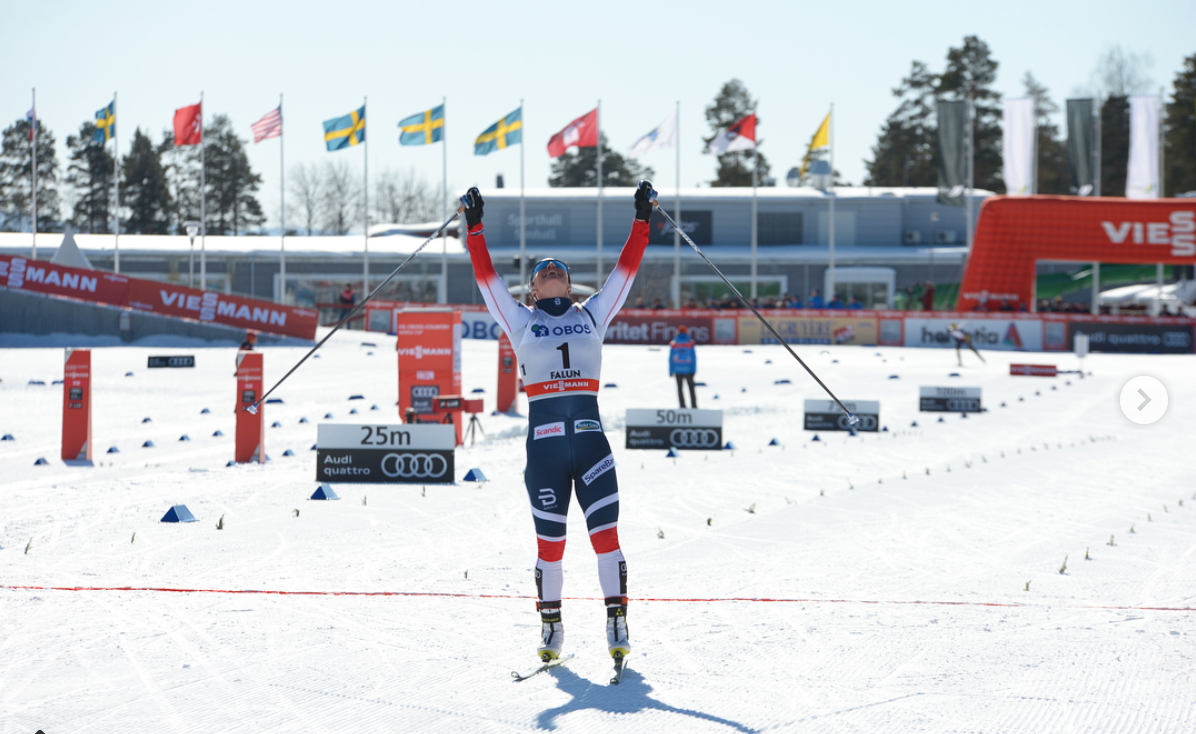
    Norway’s Marit Bjørgen celebrates her overall win in the last race of 2018 World Cup Finals, the 10 k freestyle pursuit,  on March 18 in Falun, Sweden. Bjørgen officially announced her retirement from skiing last Friday, April 6. (Photo: Svenska Skidspelen/Instagram)

    You’ve probably heard the news by now: Marit Bjørgen, the Norwegian queen of cross-country skiing, has decided to retire. The 38 year old made the announcement a week ago after winning the first race of Norwegian nationals, the 5-kilometer classic, on April 6.

    “In reality it has been a long process,” she told NRK that day, according to a translation. “I had almost decided before the competitive season started. I feel that I lack the motivation and desire required to be right there in the top. I also have a little boy at at home, who is beginning to understand more and more, that I’d like to spend time with. That time I can never have again. It’s also a little frightening. This is been half of my life. This is emotional.”

    The most decorated Winter Olympian of all time across all sports with 15 medals, five of which came at the 2018 Olympics in PyeongChang (two golds, a silver, and two bronze), Bjørgen closed her season on Saturday, April 7 with a second-place finish behind teammate Ragnhild Haga in the national 30 k freestyle in Alta, Norway.

    In all, Bjørgen accumulated 114 individual World Cup wins, 184 World Cup podiums, 18 World Championship gold medals (and 26 total at world champs), and eight Olympic golds in five Olympics, according to an International Ski Federation (FIS) press release.

    “I’m proud of what I’ve achieved in my career, but I’ve also been privileged to have been able to win top-level sports,” Bjørgen said in Norwegian team press release. “I am very much thankful to amazing team friends, teammates, coaches, medical team, service team, managers and the whole support crew that have been around me. You have a great deal of credit for my results.”
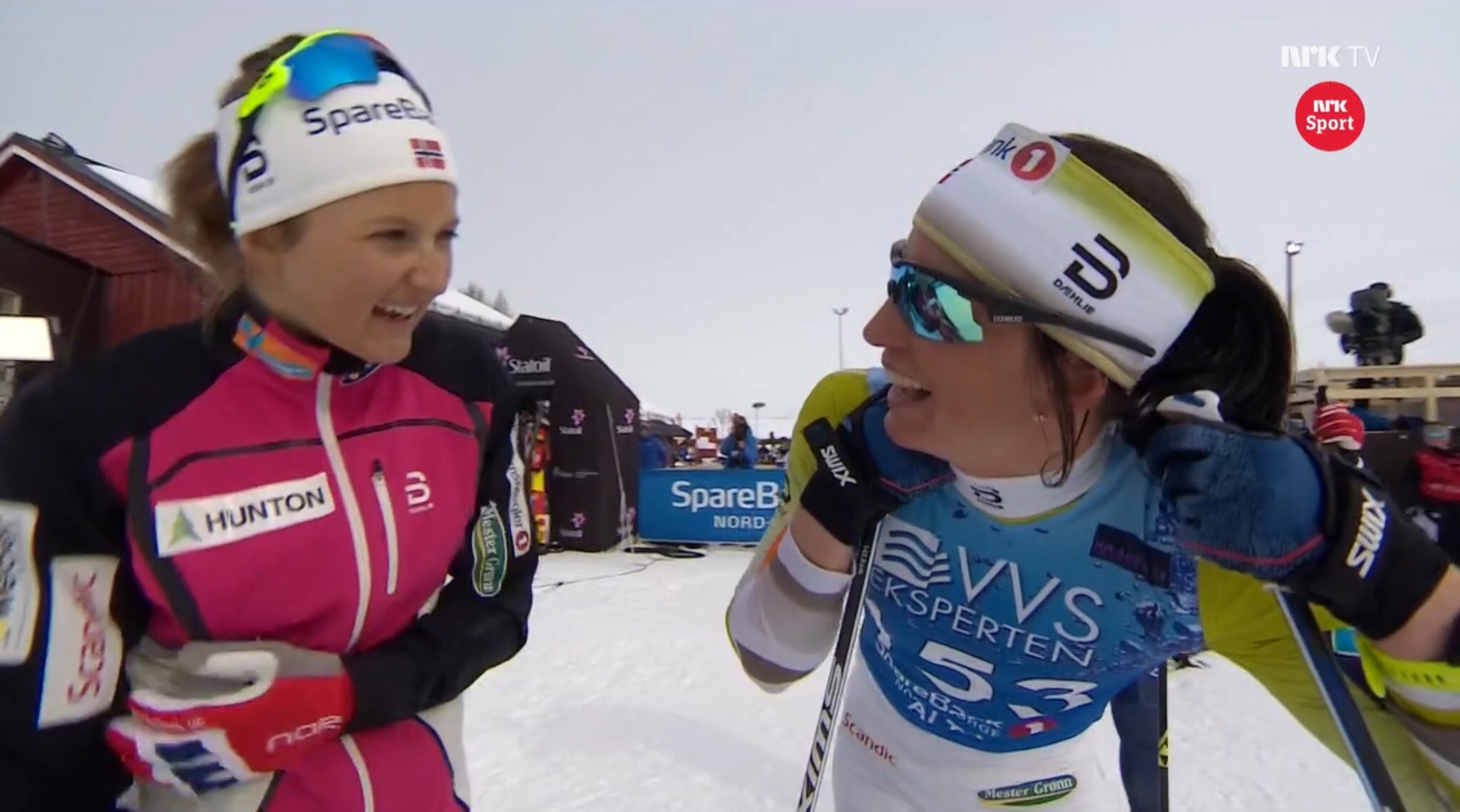
    Teammates Marit Bjørgen (r) and Ingvild Flugstad Østberg after placing first and second, respectively, in the women’s 5 k classic at Norwegian nationals in Alta on April 6. (Screenshot: NRK broadcast)

    Norway’s head coach Vidar Løfshus described Bjørgen as a “team captain” who was “always there for the girls,” according to an interview with NRK.

    He added that she was also a valuable coaching consult.

    “For me, she’s been a good sparring partner; when tough things happening internally, I often call Marit,” Løfshus said, according to a translation. “Now there will be one less coach in my team. There are a lot of good coaches in the association, but … [none that have] won so many medals. She knows more about cross country skiing then I do, Sju, Ole and Roar combined, almost.

    “We can’t let a woman like that disappeared through the back door,” he said of his desire to keep Bjørgen involved with the team. “But now we’re gonna let her exhale and enjoy her time with [her son] Marius and [partner] Fred Børre. She has not had enough time for that. And after that I know she will contribute again.”

    Bjørgen shared emotional moments with her teammates at nationals.

    “She has been a role model to me for many many years,” Ingvild Flugstad Østberg told NRK.

    “One day has to be the last,” Heidi Weng said. “We’ve had a lot of fun with Marit. She’s a legend. She has been the security blanket and the mother in the team.  It’s frustrating not to have mommy at the starting line, someone to joke around with and calm your nerves. Someone who is supportive.”

    Who else is on our list of notable cross-country retirements so far? (For our biathlon list, which should also include the additions of Norway’s Ole Einar Bjørndalen and Emil Hegle Svendsen, click here.)
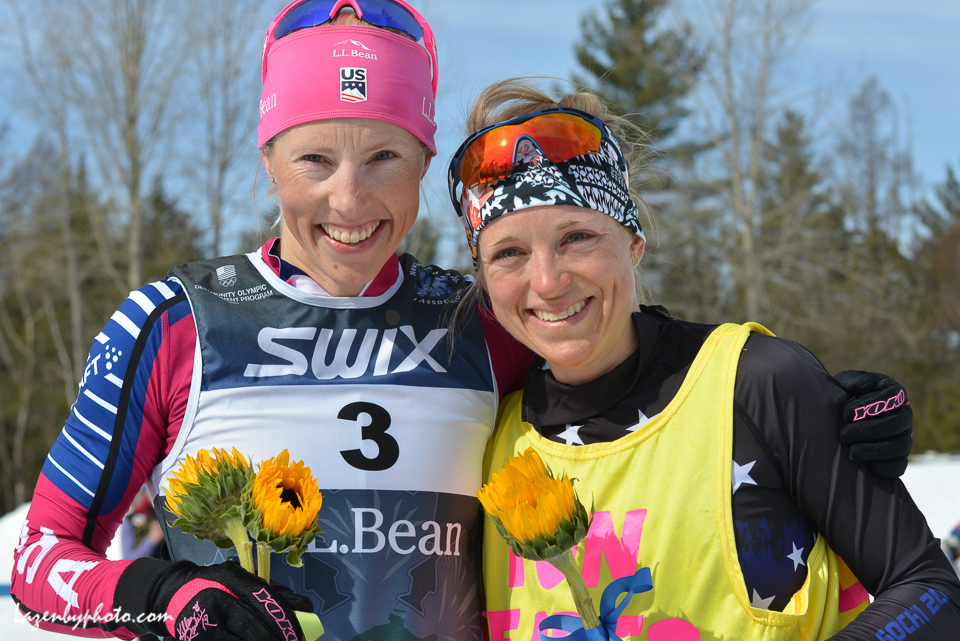
    Kikkan Randall (l) and Liz Stephen after the last race of their professional careers, the 30 k classic mass start at 2018 U.S. Distance Nationals in Craftsbury, Vt. (Photo: John Lazenby/Lazenbyphoto.com)

    From the U.S., we have U.S. Ski Team members Kikkan Randall and Liz Stephen, who said ‘so long’ to international racing, while another team veteran Andy Newell told FasterSkier that he plans to continue racing, but apart from the national team and likely outside of the World Cup circuit.

    Former national-team members Noah Hoffman and Kris Freeman have also announced their retirements from professional skiing. On the domestic side, Annie Hart has stated this was the last season of her ski career as she plans to begin law school.

    There has been talk of a few of Canada’s World Cup Team members retiring, but the only one FasterSkier has confirmed so far is Graeme Killick.

    Zina Kocher, a 2006, 2010 and 2014 Olympic biathlete who came out of retirement to make a bid for the 2018 Olympics in cross-country skiing, has stated that it’s really over this time after her comeback season.

    “As I reflect on the last 16 years that I trained full-time and competed at an international level I’m flooded with a lot of memories,” Kocher, 35, wrote in a blog post last week. “If someone had told me when I started biathlon in ’98 that I would be a ‘lifer’ (aka someone who does the sport & can’t give it up till they’re an old veteran in their 30’s), I would have laughed and said ‘yea right’. But here I am, finally saying goodbye!”

    Michael Somppi, of the Alberta World Cup Academy, is also retiring after 16 years of competitive skiing. Somppi, 29, a former member of Canada’s senior development team, won three national titles and World Cup start rights as Canada’s NorAm overall leader at the end of the 2014/2015 season.

    “I didn’t accomplish everything I wanted to in my ski career, but I am really proud of all that I did accomplish,” Somppi wrote in a blog post on Sunday. “I feel I got all I could out of myself given the circumstances I faced and the system I worked in.  Thinking back to when I started out ski racing in high school, I am amazed how far I’ve come.  ‘Started at the bottom, now we here!’  I picked up racing late and was never the most talented.  I worked hard with extreme motivation and focus to become one of the top skiers in Canada.”

    Heidi Widmer, a Swiss-Canadian skier, is also calling it a career, as is Switzerland’s Gianluca Cologna, the 27-year-old younger brother of Dario Cologna.

    “One of the highlights of my career was certainly the team sprint with my brother Dario at the Olympic Winter Games in Sochi,” Gianluca wrote in a Facebook post announcing his retirement, according to a translation. “We reached the 5th place and could take home an [Olympic] diploma. It was not only a highlight because of the 5th rank, but also because our parents were there to witness it live. I never dreamed of anything like that when I was a little boy.”
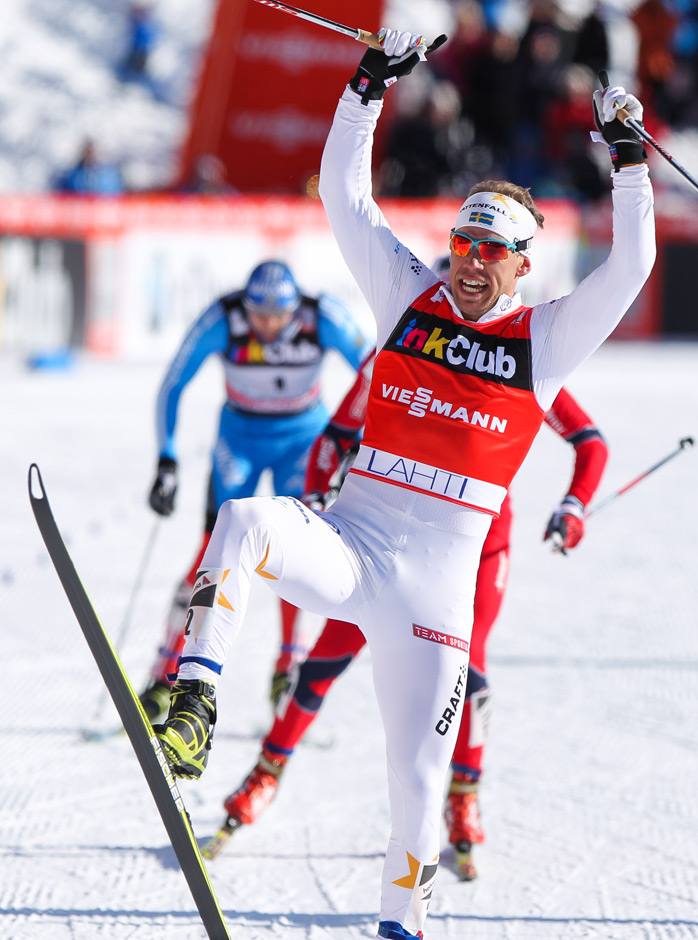
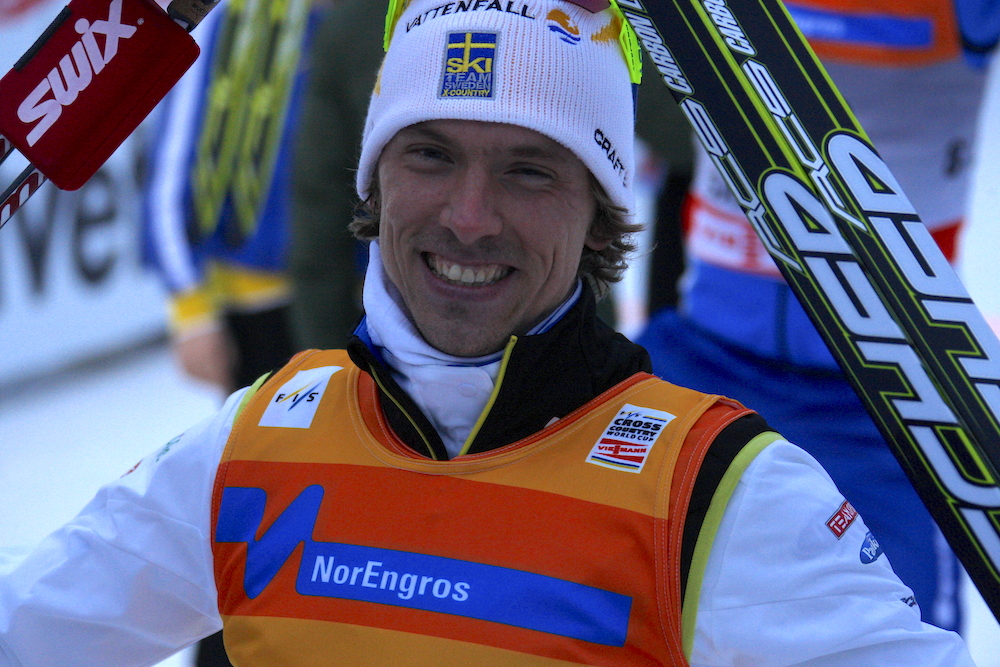
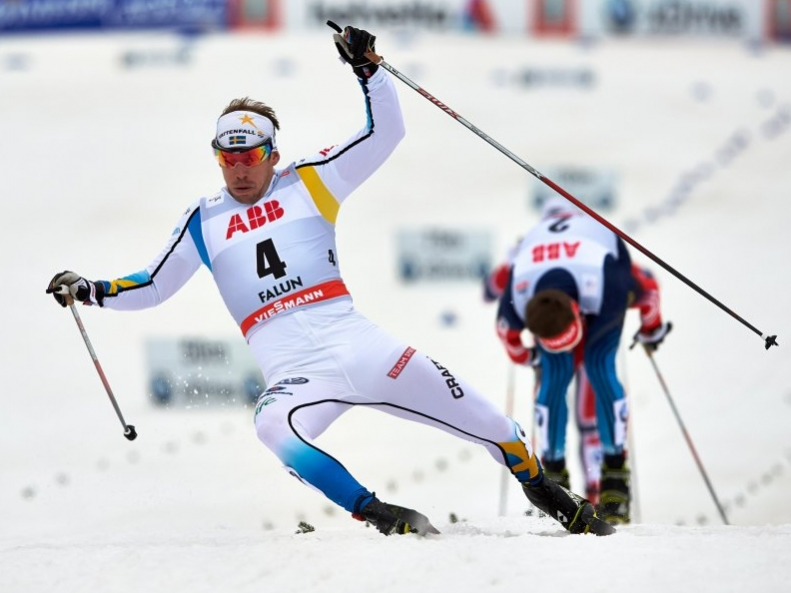
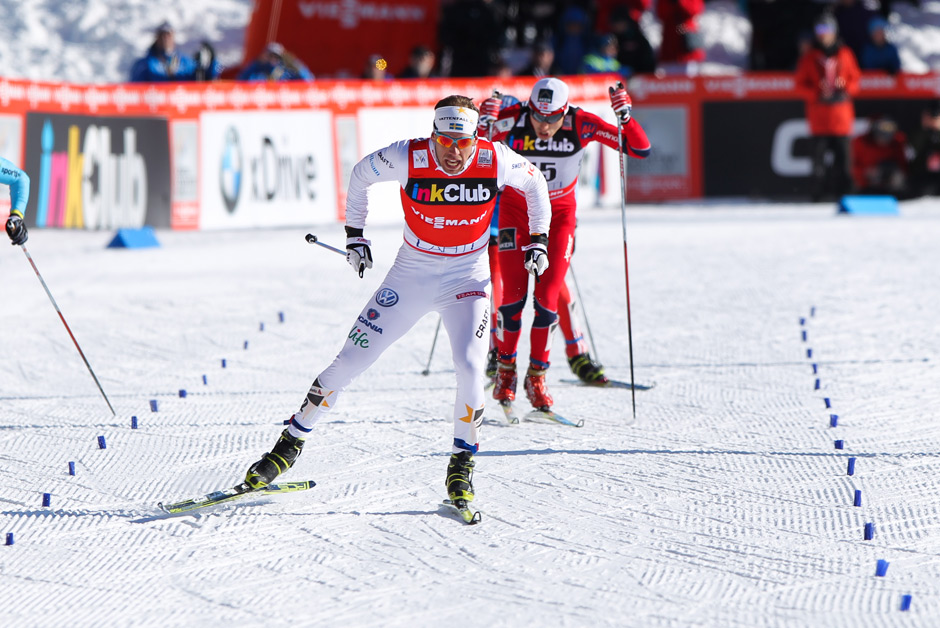
    Sweden’s Emil Jönsson celebrates a 2013 World Cup victory in Lahti, Finland. (Photo: Fischer/NordicFocus)

    The Swedish team is seeing the exit of Anna Haag, Emil Jönsson and Martin Johansson. Haag, 31, won gold with the Swedish women’s relay at the 2014 Olympics in Sochi, Russia, and has four medals from the last three Olympics. Jönsson, 32, Haag’s longtime partner and an internationally renowned sprinter, earned two Olympic bronze medals in 2014.

    From Finland, four-time World Championships gold medalist Aino-Kaisa Saarinen is stepping away from competitive skiing at age 39.

    “I have done this 20 years, what I really wanted, and I have raced my goals and even more,” Saarinen told FasterSkier after the last race of World Cup Finals in Falun, Sweden. “This skiing family is the thing what I’m going to miss the most, and of course, I love the competitions. I don’t know any other job where you can feel so high and so low, so, maybe those are the feelings right now, what I’m going to really miss the most.”

    Poland’s 35-year-old Justyna Kowalczyk, a two-time Olympic champion and two-time World Champion, has announced her retirement as well.

    Then there’s Aurore Jean, 32, who became the second French woman to reach the cross-country World Cup podium with a second-place skate-sprint finish in 2013.

    And last but not least (for now), we have heard news of Russia’s Alexander Legkov — the controversial 2014 Olympic champion who was not allowed to compete at this year’s Games because of Russia’s systematic doping in Sochi — officially retiring.

    “You have all been with me in the course of many years of my professional career and I truly love you all,” the 35-year-old Legkov said at a sports tournament in Khanty-Mansiysk, Russia, on April 6, according to the Russian News Agency. “… I will see all of you later, not at international tournaments, but perhaps at domestic tournaments or marathon. I am announcing the end of my international sports career.”

    At the Sochi Games, Legkov won the 50 k freestyle mass start and took bronze with his teammates his the men’s 4 x 10 k relay. He ended his ski-racing career on March 3 in Rybinsk, Russia, where he placed fourth in the 50 k freestyle Demino Skimarathon.

    Stay tuned for more retirement announcements as they are made public.

  • Bolshunov Nabs First-Career World Cup Win, Controls Falun Mini Tour

    Bolshunov Nabs First-Career World Cup Win, Controls Falun Mini Tour

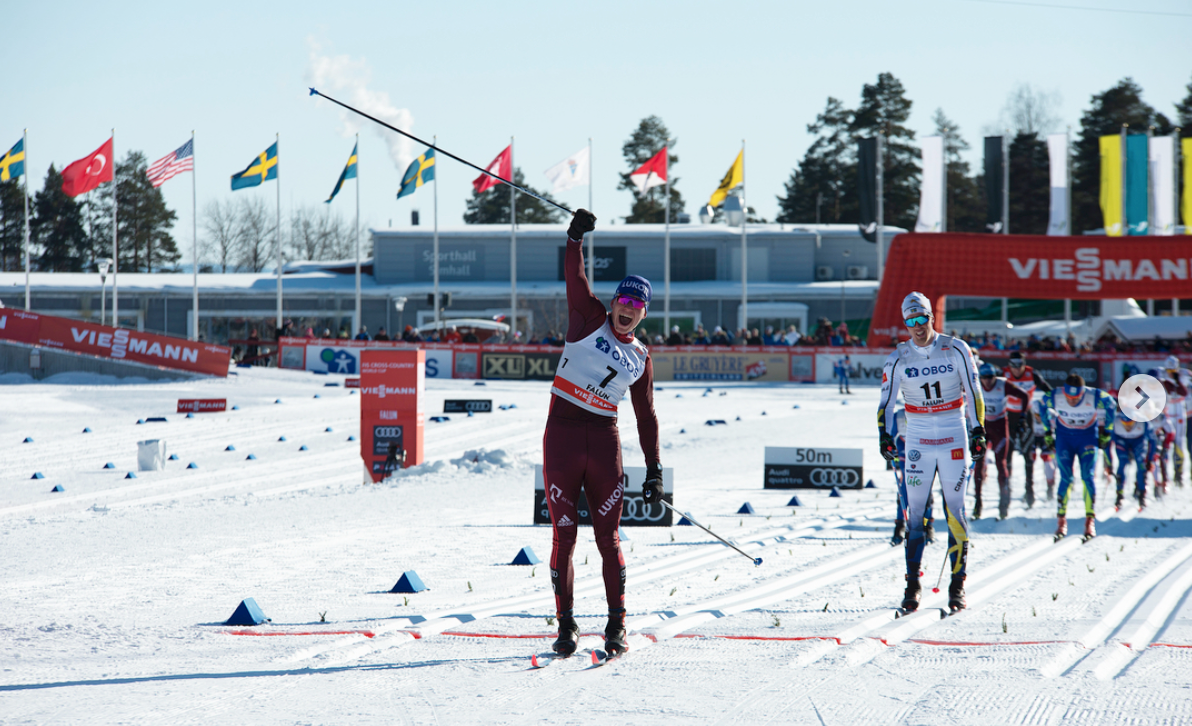
    Russian Alexander Bolshunov celebrates as he wins his first-career World Cup, a 15 k classic mass start, just ahead of Sweden’s Calle Halfvarsson (11) at 2018 World Cup Finals in Falun, Sweden. (Photo: Svenska Skidspelen/Instagram)

    Saturday was the second day of World Cup Finals mini tour, held in Falun, Sweden, which conclude the 2017/2018 season. Friday’s first stage began with a skate sprint, while Saturday featured a 15-kilometer classic mass start for the men.

    As the season is no longer young, the fitness for some athletes frayed, a mass start could offer the opportunity for some to hide in the pack and others to exploit. On a sunny and cold Saturday in Falun, the leading distance skiers on the World Cup were unable to separate. The terrain was World-Cup hilly, yet the pace was never decisive enough to shatter the field.

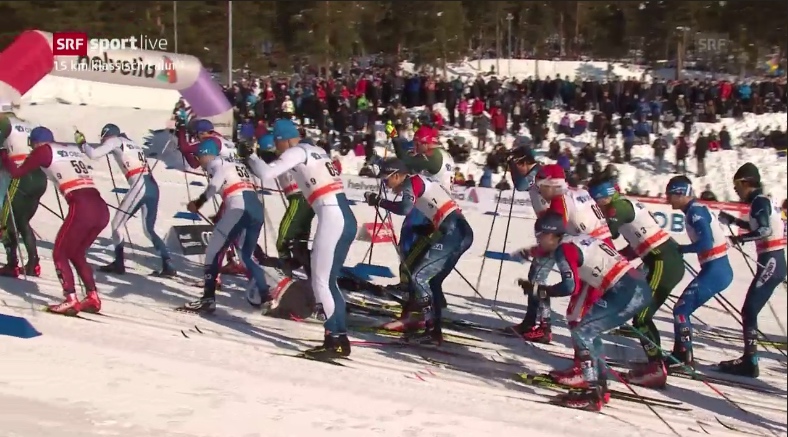
    That field was 91-skiers full. 182 poles. 182 skis. Churning from the start, only those skiers in the front rows of the start pyramid could pole and stride away unscathed. As is the nature of 91 skiers fighting for classic-track scarcity — the lanes taper down in number — pile-ups are the norm. So while some skiers like U.S. Ski Team members Erik Bjornsen and Scott Patterson lost time in a starting-scrum spill, others were looking for brighter opportunities up front.

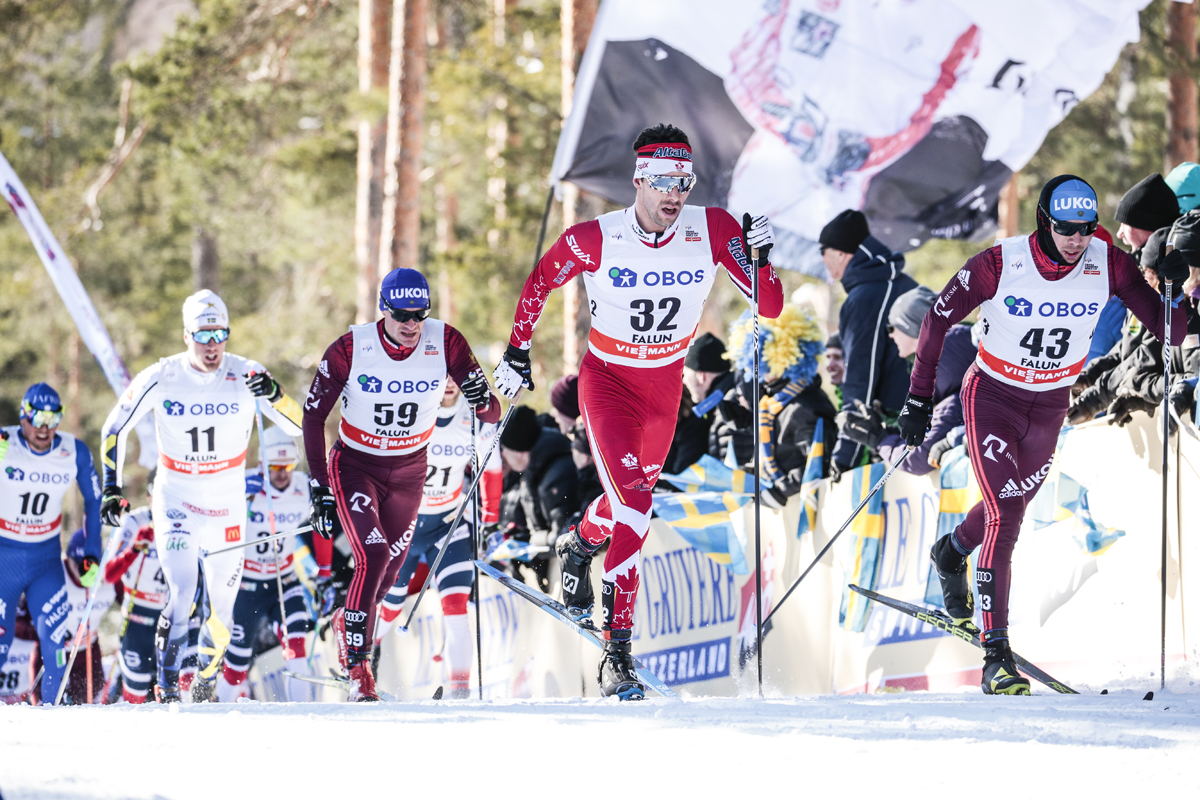
    Russia’s Alexey Chervotkin (43) and Canada’s Alex Harvey (32) lead another Russian Maxim Vylegzhanin 59), Sweden’s Calle Halfvarsson (11) and Italy’s Francesco De Fabiani (10) up a climb during the men’s 15 k classic mass start at World Cup Finals in Falun, Sweden. (Photo: Fischer/NordicFocus)

    From the start the pace was hot. There was Finland’s Iivo Niskanen, Sweden’s Emil Jönsson, Norway’s Johannes Høsflot Klæbo, Martin Johnsrud Sundby, Niklas Dyrhaug, Canada’s Alex Harvey, Kazakhstan’s Alexey Poltoranin, Russians Alexey Chervotkin and Alexander Bolshunov, and Swedes Calle Halfvarsson and Marcus Hellner, all in either a strung-out or condensed formation 3.75 k into the race. Skiers were slowly slipping off the back. But even with the surging up front, the tactics playing out appeared to place a premium on safety in numbers.

    Bolshunov surged at 4.5 k to snag the highest-value time bonus. Otherwise, for much of the race, identifying specific skiers was a task in itself. Coming down the hills a third through the race, the top-50 skiers were a sinuous and continuous line separated by 17.7 seconds. At the bottom of climbs, the compressive part of the accordion effect was in play. Skiers in front could push, those behind became a more dense cluster of lycra-clad athletes.

    Despite the prevalent pulsing of pace, skiers like Chervotkin and Harvey had their moments of pluckiness. Each paced a long line of skiers through the 9.3 k mark. But clear at this point was that the pattern of this race would be defined by the collective mass of skiers that began the mass start. Yes, time gaps would balloon a bit by the finish, but at 12 k (the second time bonus), a gap of 1.7 seconds separated first through 35th place.

    The move that mattered in this race came from the birthday boy, Halfvarsson. According to FasterSkier’s reporter on the ground, the Swedish crowd serenaded Halfvarsson, 29, with a happy birthday rendition prior to the start. Maybe it was birthday stoke, maybe it was an acknowledgment that with age comes fewer opportunities to seize the win, but with one kilometer to go, Halfvarsson ran like Klæbo. Up and over the hill, the Swede forged a small gap on the 30-plus chasers.

    Again on the last short incline before the speedy descent into the stadium, Halfvarsson performed a masterful high-step run. Only Bolshunov at this point could suck up near the Swede’s tails. For a moment, rounding into the final straight, it looked like Halfvarsson’s icing on his birthday cake would be a Falun stage win.

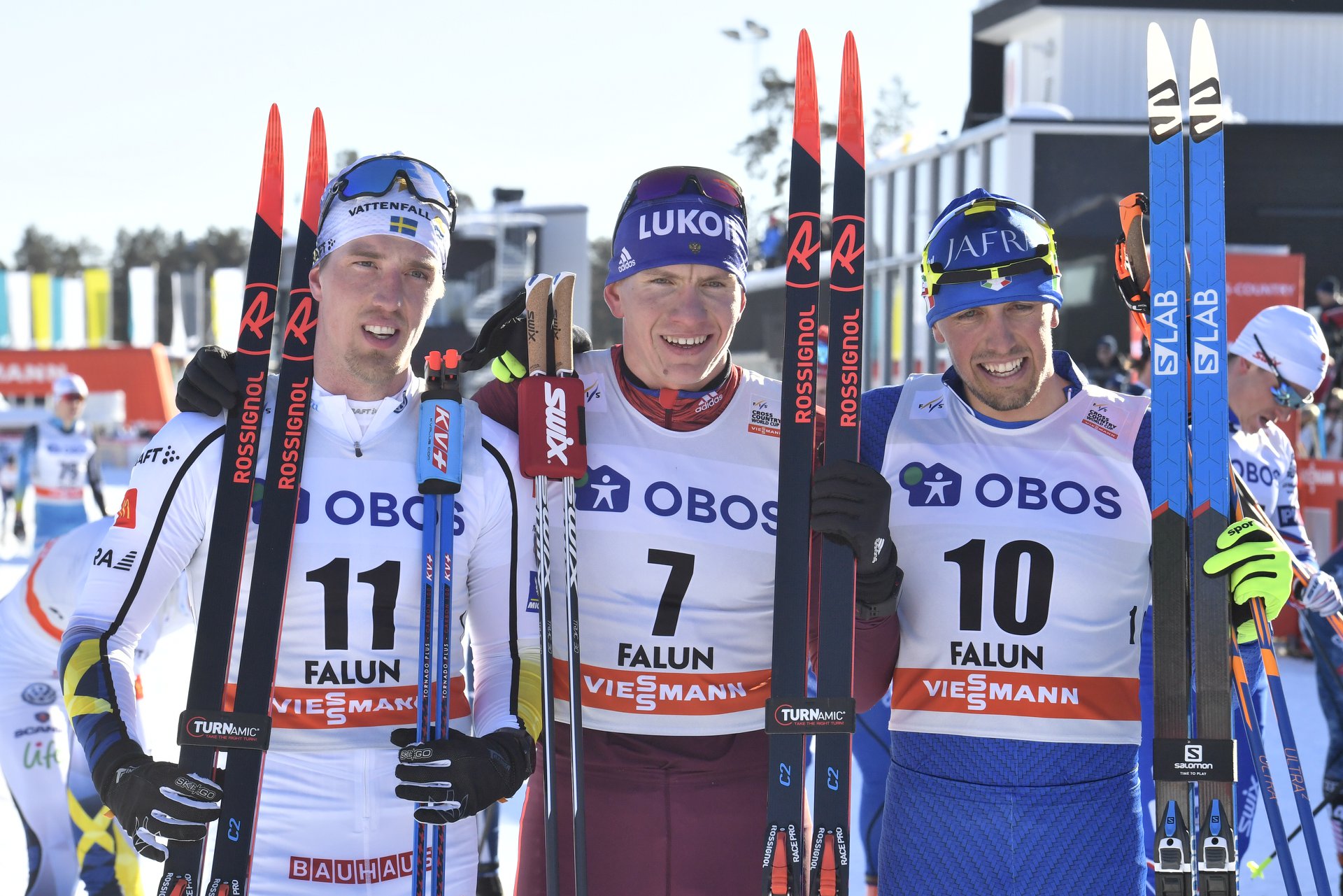
    The men’s 15 k classic mass start podium at 2018 World Cup Finals in Falun, Sweden, with Russia’s Alexander Bolshunov (c) in first, Sweden’s Calle Halfvarsson (l) in second, and Italy’s Francesco De Fabiani (r) in third. (Photo: FIS World Cup Svenska Skidspelen/Facebook)

    Halfvarsson came into the straight out of the tracks. As he zeroed in to begin the double-poling finish, the birthday boy stumbled slightly slotting into the nearest lane. Bolshunov flew by with a supreme double pole and took the win in 36:59.8. Halfvarsson placed second (+1.3), Italy’s Francesco De Fabiani third (+3.1), Poltoranin fourth (+3.7) and Chervotkin fifth (+5.2).

    For the 21-year-old Bolshunov, it was his first-career World Cup win. Prior to Saturday’s win, Bolshunov had stood on the podium six times in his first full season on the World Cup. (Bolshunov’s only World Cup start last season was in Drammen, Norway, in March 2017.) Along with Klæbo, also 21, Bolshunov has risen into one of the sport’s top athletes. He claimed three silvers and a bronze medal in PyeongChang. His two individual Olympic medals were a second in the 50 k classic mass start and third in the classic sprint.

    “I have had many second and third place finishes this season so I am very happy to finally have a win,” Bolshunov told the International Ski Federation (FIS) after the race. “This feels good. I will do what I can tomorrow for another good result but for now, I will enjoy this win.”

    Sunday’s final men’s race of the season and last race of the three-stage mini-tour, will be a 15 k freestyle pursuit. Bolshunov leads the mini-tour standings in first with a total elapsed time of 38:37 minutes. Klæbo, who finished 22nd (+13.6) on Saturday, sits in second (+38.0), while Halfvarsson is third (+39.2).

    The Swede took away the positives from the day’s near-win in front of the home crowd.

    “I tried today to get a win but it was too much,” Halfvarson told FIS. “Off the final corner, I was really tired. I am still happy with second place. I have been on a podium a few times this season and always third. So at least second place is an improvement even if I didn’t manage the win.”

    Canada’s Alex Harvey was the best placed North American in 20th place (+10.7). He’ll begin Sunday’s pursuit in 18th (+1:16.1).

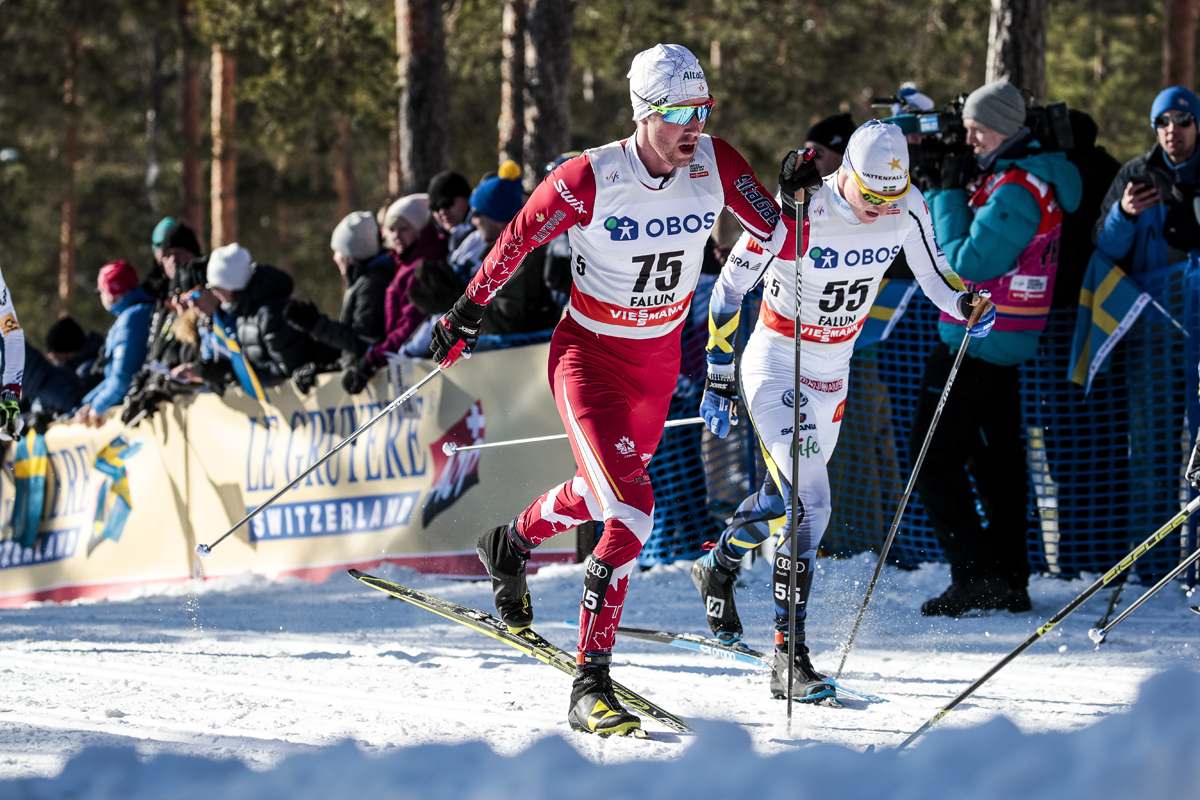
    Canada’s Graeme Killick (75) skiing with Sweden’s Jens Burman during the men’s 15 k classic mass start at World Cup Finals in Falun, Sweden. Killick went on to finish 41st. (Photo: Fischer/NordicFocus)

    Teammate Devon Kershaw finished 26th (+14.6) for his fourth-straight race in the top 30 (including his 26th-place finish in the Olympic 50 k classic). Graeme Killick placed 41st (+1:13) and Julien Locke was 81st (+3:29) for Canada.

    “I felt quite good today,” Kershaw said after the race. “I was a little disappointed with the last kilometer because I was kind of out of position a little bit after Mördarbakken and couldn’t quite get up through traffic, but it’s really close. And a little disappointed to be 26th again; it seems like that’s kind of where I’ve lived all year, but it was a good race for me.”

    Kershaw, a 35-year-old staple of the Canadian team, has been seeking a return to top form.

    “Just races like today where I feel good and can execute decently well,” Kershaw explained.
    “To be honest this year I am super motivated after the championship. I’ve [been] having major, major asthma issues at the Olympics and that really really affected me and it took a long time to get a little better, but I felt like by the time I got to Lahti I was feeling quite a bit better. So that really helps, I mean, I can breathe again and I’m feeling good.”

    Kershaw is expected to mull over the prospects of continuing his ski career in the coming weeks.

    “We’re not sure, I’ll talk to the wife next week [Norwegian former elite skier Kristin Størmer Steira],” Kershaw said of his future plans. “You know there’s a lot of issues right now in Canada so I’ll have to think about it. A lot of guys are saying that they’re gonna call it a day. And I’m not getting any younger, but I still feel quite good, and I mean a race like today shows that I can still compete with the best in the world so that’s motivating, but we’ll definitely have to take some weeks to think about it.”

    Nowhere to go: U.S. skiers Erik Bjornsen (bib 57) and Scott Patterson (bib 67) stuck in a pile-up after the start of the men’s 15 k mass start classic at World Cup Finals in Falun, Sweden. (Screenshot: SRF Sport broadcast)

    For the U.S., Erik Bjornsen finished 52nd (+1:47.1), Simi Hamilton 62nd (+2:06.4), Kevin Bolger 69th (+2:27.1), David Norris 70th (+2:31.2), Scott Patterson 71st (+2:40.6), Paddy Caldwell 75th (+2:52.7), and Andy Newell 86th (+4:47).

    Patterson’s race did not go as planned.

    “I was in a big pile-up right at the start,” Patterson told FasterSkier after. “I was the second-to-last one out of the stadium and then the first time up Mördarbakken, my ski fell off. So I skied halfway down, got my ski back on, just turned back around and then just like stupidly chasing the rest of the race. …

    “I felt OK,” Patterson added. “[Without] those two stupid things it would have been a good race. But I was so far off and then it was really hard to get back to the pack and then it was like, ‘Well, I can’t get to the pack. I am here with those guys.’ ”

    Lately, Patterson, 26, has been a highlight for the U.S. distance skiing prospects. The first-year U.S. Ski Team member notched three individual top-20 results at last month’s Olympics, including 11th in the 50 k classic. Last weekend in Oslo, Norway, Patterson proved that was no fluke, as he placed 16th in a traditionally deep field at the Holmenkollen 50 k skate.

    World Cup Finals conclude with 10/15 k freestyle pursuits on Sunday.

    Results | Falun mini-tour standings| Men’s pursuit start list

    — Gabby Naranja, Harald Zimmer and Alex Kochon contributed

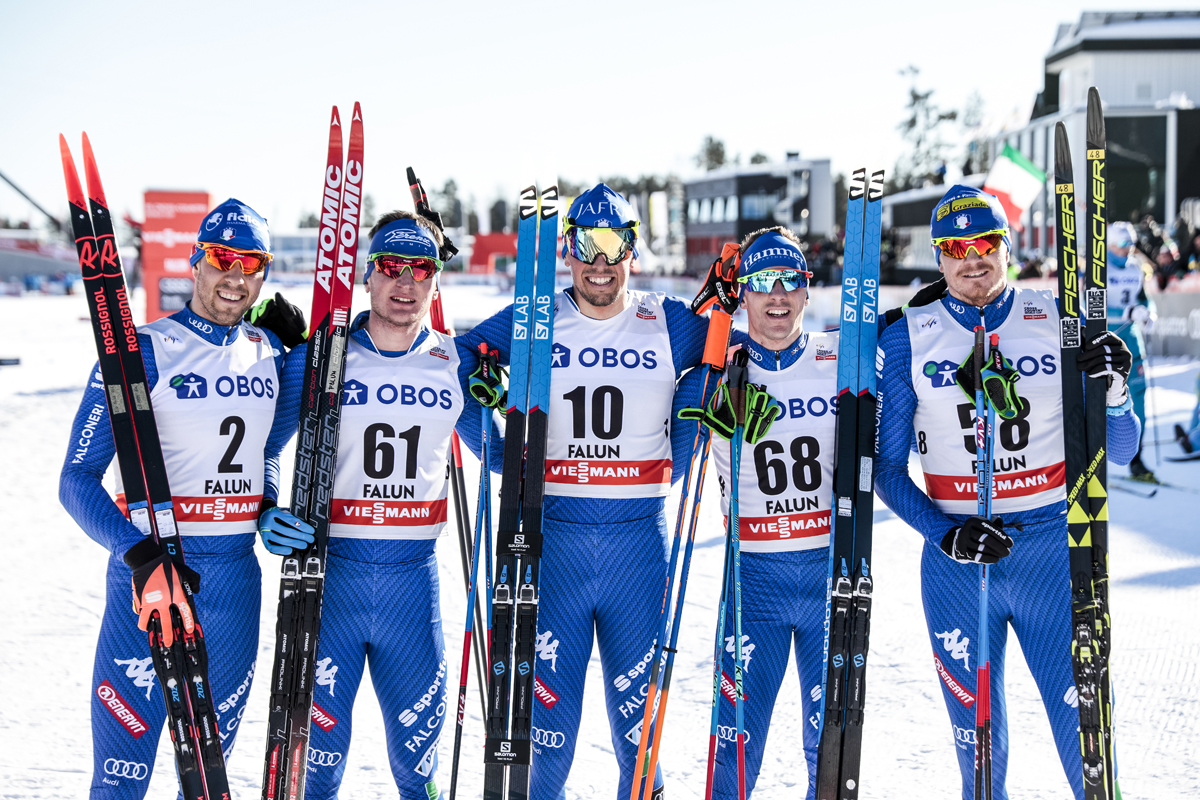
    The Italian men’s team after Saturday’s 15 k classic mass start at 2018 World Cup Finals in Falun, Sweden, with (from left to right) Federico Pellegrino, Giandomenico Salvadori, Francesco De Fabiani, Maicol Rastelli, and Dietmar Nöckler. (Photo: Fischer/NordicFocus)
  • Pellegrino Anchors Italy to Another Dresden Win; Late Crash Takes Out U.S. Men

    Pellegrino Anchors Italy to Another Dresden Win; Late Crash Takes Out U.S. Men

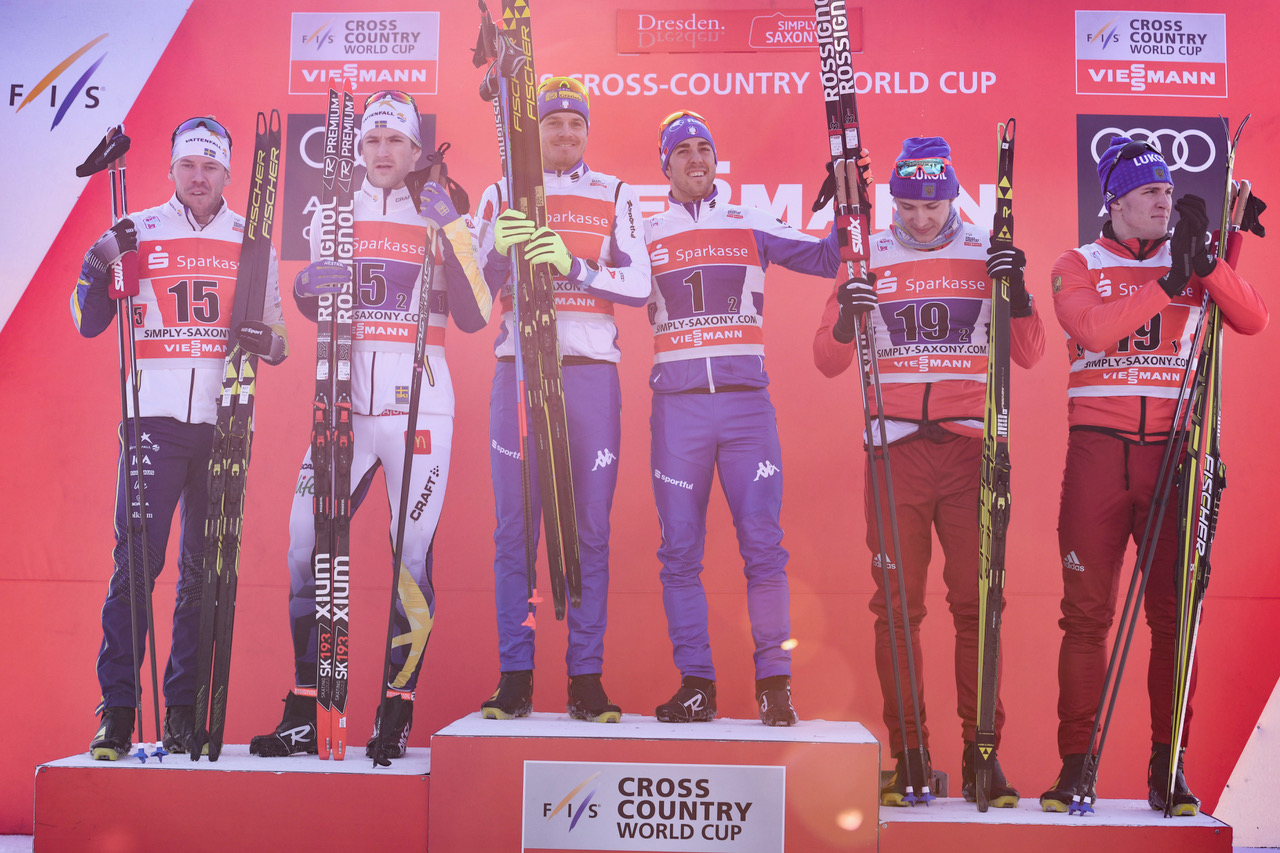
    The men’s 6 x 1.2 k freestyle team sprint podium at Sunday’s World Cup in Dresden, Germany, with Italy’s Dietmar Nöckler and Federico Pellegrino in first (c), Sweden’s Emil Jönsson and Teodor Peterson in second (l) and Russia’s Andrey Krasnov and Gleb Retivykh in third (r). (Photo: Fischer/NordicFocus)

    (Note: This article has been updated to include comments from Canada’s Bob Thompson.)

    Federico Pellegrino’s winning move in the men’s 6 x 1.2-kilometer freestyle team sprint on Sunday wasn’t exactly the same as yesterday when the Italian attacked on the final climb of the individual skate sprint.

    “Yesterday on the right side and today I tried on the left side and it was OK,” Pellegrino said in a post-race interview with the International Ski Federation (FIS).

    By “OK,” Pellegrino meant perfect.

    “Today everything was perfect, even the sun was super,” he said after winning his second race in as many days with team-sprint partner Dietmar Nöckler. “We can continue like this to the Olympics then catch the gold.”

    A number of teams were looking to do exactly as the Italians did on Sunday on a tightly woven city sprint course in the heart of Dresden, Germany. This race marked the last team sprint before the Olympics, which starts in less than a month in PyeongChang, South Korea. The Olympic team sprint, set for Feb. 21, is also freestyle. Sunday was the first team sprint so far of the 2017/2018 season.

    Pellegrino locked it up after Nöckler came through the last exchange in fifth, 2.6 seconds behind Sweden’s Emil Jönsson in first. On the final lap, Pellegrino chased Sweden’s Teodor Peterson and Switzerland’s Roman Schaad, before Pellegrino made his move past Schaad in first heading into the final rise before the stadium. The attack was just slightly before the one he executed to win Saturday’s skate sprint over Norway’s Johannes Høsflot Klæbo.

    “I had to use it,” he said of the move.

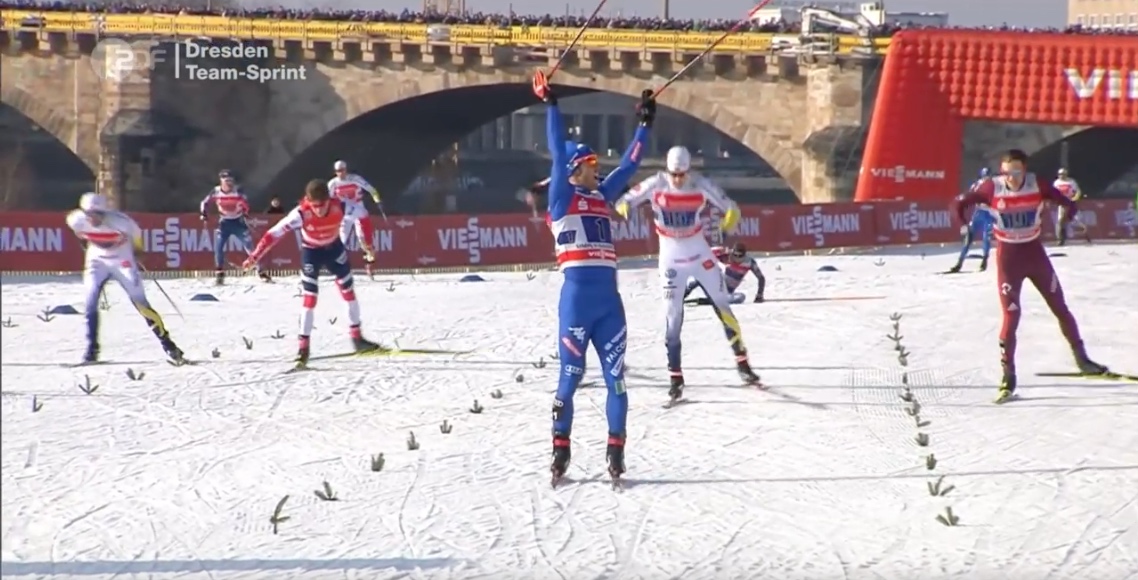
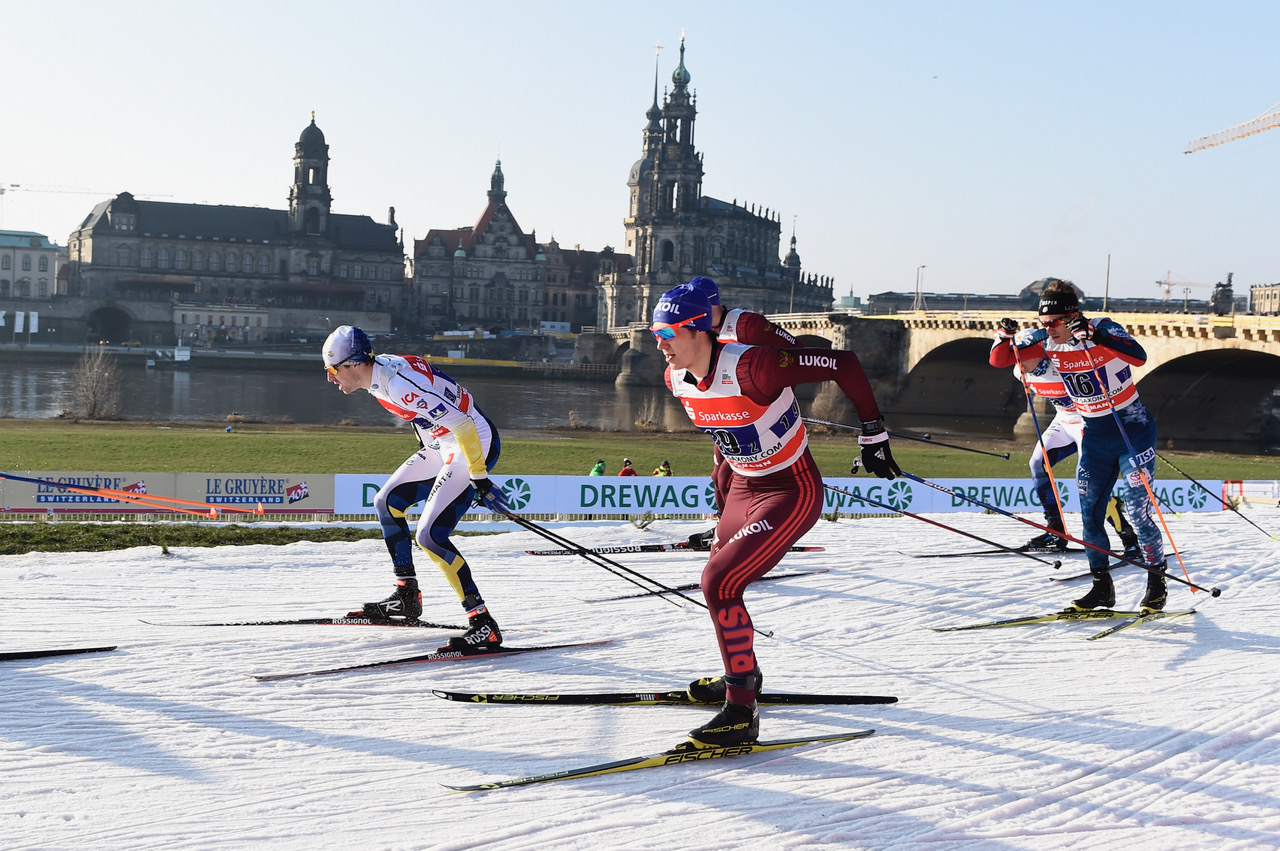
    Federico Pellegrino (front) celebrates across the line as he anchors Italy to a freestyle team sprint victory for his second-straight win at the World Cup in Dresden, Germany. Behind him, Sweden I’s Teodor Peterson (second from r) and Russia’s Gleb Retivykh (r) battled for second, and Sweden II’s Karl-Johan Westberg (l) and Norway’s Johannes Høsflot Klæbo (second for r) jockey for third. American Simi Hamilton (on the ground) is seen trying to recover from a crash. (Screenshot: ZDF broadcast)

    First over the top, Pellegrino pushed farther ahead of Peterson in second while Schaad, Russia’s Gleb Retivykh, Sweden II’s Karl-Johan Westberg, Klæbo, and American Simi Hamilton chased in third. Hamilton went down when he collided with Klæbo just before the finish line, but was able to get up and finish eighth, 14.28 seconds behind Italy in first.

    Pellegrino sealed the deal in 12:18.31, and Peterson crossed 1.07 seconds back for Sweden I in second place. Russia’s first team, with Andrey Krasnov and Retivykh, placed third (+1.23), just ahead of Switzerland I (Jovian Hediger and Schaad) in fourth (+1.45), Norway I (Kasper Stadaas and Klæbo) in fifth (+1.93), and Sweden II (Johan Häggström and Westberg) in sixth (+1.94). Italy II (Stefan Zelger and Giacomo Gabrielli) placed seventh (+7.31) ahead of the U.S. (Erik Bjornsen and Hamilton) in eighth.

    “When I arrived at the finish line, I could go slow and had some time to look to the people and say thank you for a great day,” Pellegrino told German TV broadcaster ZDF. “I had really good fun here in Germany!”

    “He showed all the world that today he is the strongest athlete on the track,” Nöckler said while standing next to his teammate Pellegrino in a televised interview with FIS. “And today we were both on the podium so we’re really happy.”

    Bjornsen, Hamilton in the Mix 

    The U.S. men were in contention to the finish, with Bjornsen putting them in third on the second-to-last leg. Norway’s Stadaas had been given a 1.3-second lead at the fourth exchange by his teammate Klæbo (who had previously made his way back into first after Stadaas tagged him in fifth). While Stadaas widened the gap for the first half of his last loop, Bjornsen led the chase, skiing several seconds behind him in second place.

    In an in-person interview with FasterSkier, Bjornsen recalled being tentative in the semifinals, where he and Hamilton finished fourth but advanced as lucky losers with a fast-enough time.

    “Going into the final, I was feeling good and I wanted to use my aerobic capacity,” Bjornsen said. “As soon as Simi handed off to me, I was kind of in the back end of that group and Norway had a good lead and I was like, I’m just gonna go for it.”

    Hamilton had tagged him in eighth, 2.5 seconds behind Norway in first. About halfway through the next 1.2 k loop, Bjornsen had bridged the gap to Stadaas, but brought a large pack of racers with him.

    “I went to the outside and was able to pass my group of like six or so, and I bridged up to Norway and tried to hit that corner pretty hard, then it kind of hit me,” Bjornsen said. “I was tired, that group had caught up to me and unfortunately I had pulled — some people jumped on the back of me, so then they kind of went by me, but I was able to hand off in third so I was happy with that. We were in the mix today.”

    Sweden’s Jönsson took the lead over the last rise before the stadium, and Switzerland’s Hediger slotted into second, coming through the exchange 0.9 seconds after Jönsson. Bjornsen tagged third, 2 seconds back.

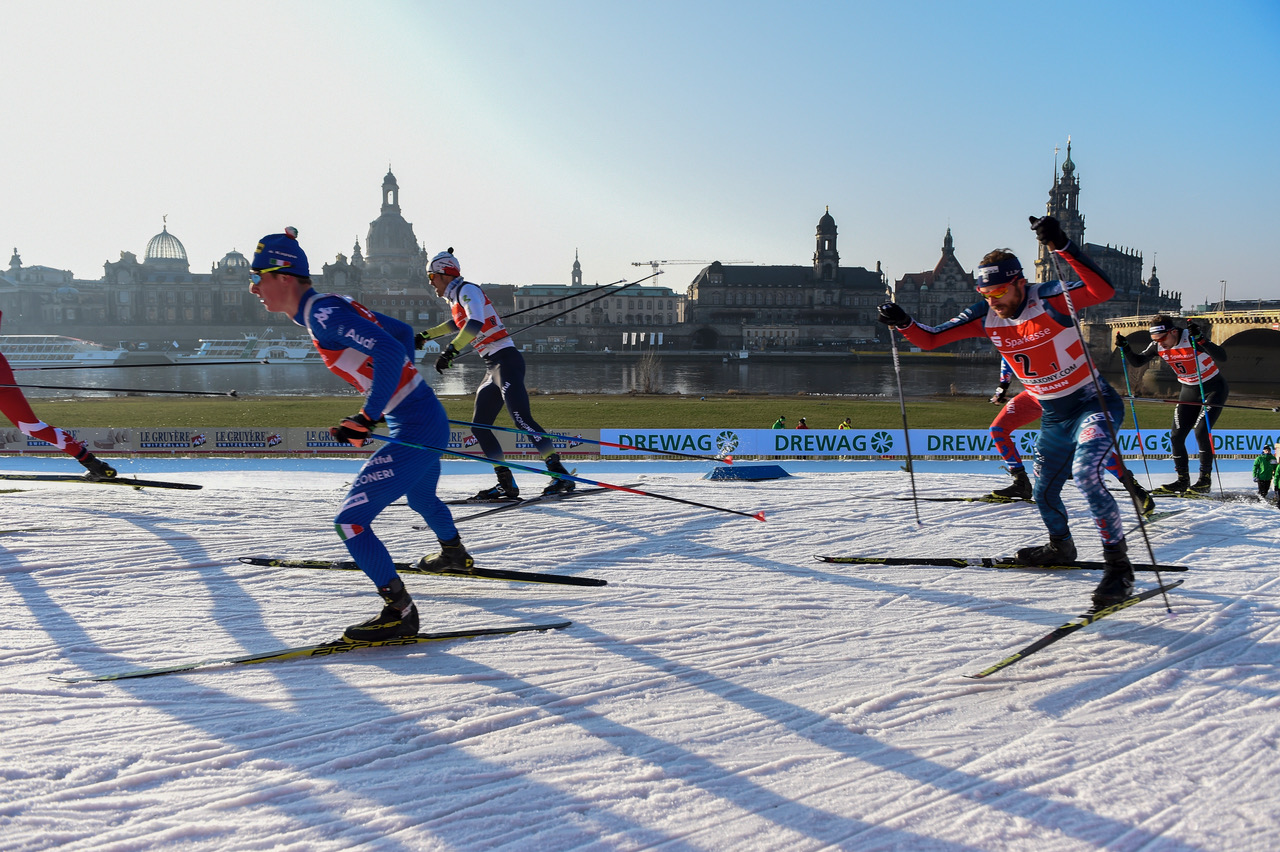
    American Simi Hamilton (r) chasing Russia’s Gleb Retivykh (19) and one of two Swedish teams the second semifinal of the men’s 6 x 1.2 k freestyle team sprint at the World Cup in Dresden, Germany. (Photo: Fischer/NordicFocus)

    From there, Hamilton kept himself in contention in the top five, hanging just behind Pellegrino and Peterson as the large group approached the finish. In the middle with several races on either side of him, Hamilton went down, hard, but stood back up again and finished eighth.

    “My crash wasn’t too terrible, but I did break Klæbo’s pole with my face and got a bunch of carbon fiber splinters in my upper lip. So once I got that cleaned up I was okay,” Hamilton wrote in an email. “Whacked my head a bit too, but I’ll be fine.”

    (Article continues below)

    https://www.instagram.com/p/Bd74ijTngPq/?taken-by=simihamilton

    He explained that he and Bjornsen had made a game plan to “ski towards the front, stay out of crashes, and figure out how the semifinal was going to play out while racing,” he wrote. “I thought we both skied the semi well, although I think I could have been a bit more aggressive on my last lap and done more skiing that would have assured us a spot into the final. But it turned out okay.”

    In the final, “Erik did an awesome job keeping us at the front and I just focused on doing the same for him,” Hamilton wrote. “He turned in a hell of a last leg, tagging me in 3rd for my last lap.”

    Bjornsen was pleased with his last lap, but would have like to have been first through the final exchange.

    “I wish I had a little higher speed that I could push past people quicker, but I find when I’m up against the best, my talent or whatever is to kind of press hard for a while,” Bjornsen said. “… So I just tried to send it hard for 45 seconds and it seemed to work out. I wish I could’ve handed off in first, but I’m happy to be in the mix there.”

    On the final lap, Hamilton recalled “a decent sized gap up to first and second, I think mostly because those were the only two teams that had perfect tags on that last exchange,” he wrote.

    Unsure whether to ski all out on his last of three 1.2 k efforts, while simultaneously pulling along competitors like Pellegrino and Klæbo, Hamilton focused on skiing fast, but not to his max.

    “On the far end, Pellegrino went by me and by that point we were really close to making contact with the top two,” he wrote. “I thought we were totally in the hunt for a podium until somehow I lost a second on the plateau [after the last hill] with about 15 seconds of racing left. “I don’t know how I lost it, if it was just entirely my fault or if something happened like I got punched from my line, but I am pretty bummed about it because that was where I felt like I let the podium slip through our hands,” Hamilton continued. “Coming in to the finish lanes, I got tripped up with Klæbo and my skis got clipped as were skiing for the same lane. It wasn’t intentional and he’s a very clean racer, but it was definitely a bummer to not be able to sprint it out for 3rd, 4th, or 5th with those other guys.”

    As for Norway, Klæbo told Germany’s ZDF he was out of the race at the start of that last lap: “After the last exchange it was too difficult, the gap was too large to the guys in front,” he said.

    Overall, Hamilton concluded that it was a great and interesting weekend of racing at a new venue in Dresden.

    “I think they could make some big improvements to the course with making it more technical, flowy, and wider, but I hope they continue to hold sprints here in the future,” he wrote.

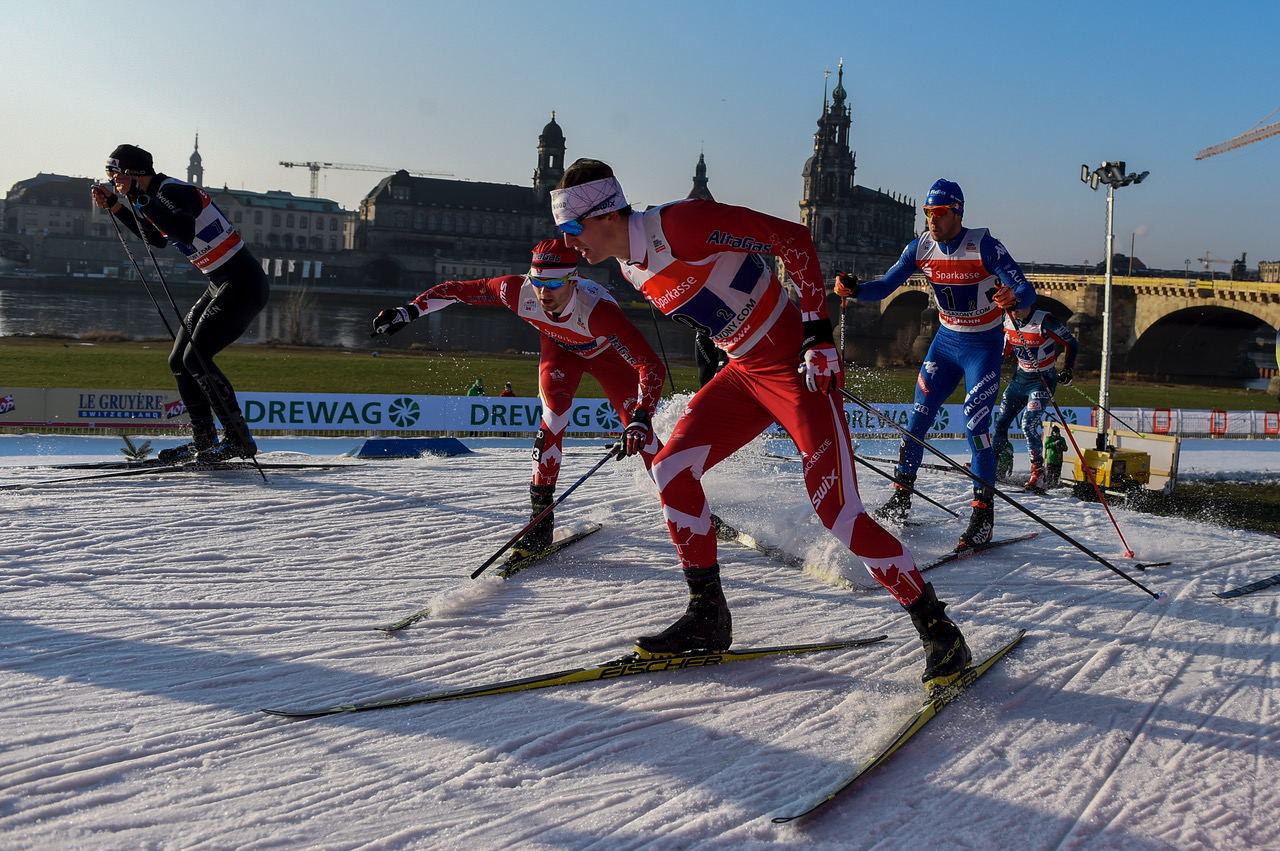
    Canada had two teams in the first semifinal of the men’s 6 x 1.2 k freestyle team sprint at the World Cup in Dresden, Germany, with Canada I’s Julien Locke (near) skiing just ahead of Canada II’s Dominique Moncion-Groulx, who caught an edge just ahead of Italy’s Federico Pellegrino (second from r) and American Ben Lustgarten (behind Pellegrino), over the top of a climb. (Photo: Fischer/NordicFocus)

    While the Bjornsen and Hamilton as the U.S. Ski Team’s first team on Sunday were the lone North Americans to reach the men’s final, Canada came close with Bob Thompson and Julien Locke.

    “The main points of our plan was make sure we stayed in the lead group and to take any easy opportunities to make up positions whenever we saw them,” Thompson, of the National Team Development Centre (NTDC) Thunder Bay, wrote in an email. “I started first as we were confident I could hang on to the pace and then after Julien’s excellent performance yesterday we felt he would have good speed to finish.”

    In Saturday’s individual sprint, Locke placed 15th for a career best.

    The two ultimately finished seventh in the first team-sprint semifinal, just one place behind Great Britain’s James Clugnet and Andrew Young. The Brits advanced to the final as lucky losers in sixth, 1.85 seconds behind Norway’s Stadaas and Klæbo in first, becoming the first team from Great Britain to reach the final in a World Cup team sprint. (In the final, they finished behind the U.S. in ninth, 14.68 seconds out of first.)

    After Thompson tagged Locke (Canadian National U25 Team/Black Jack Ski Club) in eighth in the last exchange of their semifinal, Locke picked off one place to finish seventh, 0.39 seconds behind Great Britain’s Young.

    “The third leg just started going from the exchange and I was able to hang on to the back and then dodge around the French teams who both crashed,” Thompson explained. “So I was able to tag off to Julien solidly in the mix of the lead pack. Julien had a pole break on the small hill with just 200m to go and had to free skate in, so the .15 seconds from making the final hurts a bit.

    “I’m happy with how we raced,” he continued. “We both stayed controlled and I think we had the pace well enough. I believe I skied it as well as I could have and being right up with those guys feels great.”

    The Americans’ second team of Andy Newell and Ben Lustgarten crossed the line 0.57 seconds later for eighth place (+2.81) in that semifinal. Newell had put them in second place at the last exchange, just 0.11 seconds out of first.

    “I felt good on my last leg and was able to make some moves and tag Ben in the lead going into the final lap,” Newell wrote in an email. “He skied really well to stay close to the leaders. If we were even less than a second faster I think we would have moved on as [lucky losers] instead of Sweden 2 and USA 1 from the next semi. So we were a bit unlucky there but it was a fun race.”

    American Andy Newell (2) chasing Italy II’s Stefan Zelger (in blue) during the first semifinal of the men’s 6 x 1.2 k freestyle team sprint at the World Cup in Dresden, Germany. (Photo: Fischer/NordicFocus)

    Previously, Newell had tagged Lustgarten in fourth at the first exchange, then Newell found himself back in 10th and almost 2 seconds back after his second leg.

    “Ben and I tried to ski up toward the front half of the pack but had a small crash on our second tag,” Newell explained.

    “The [second] handoff wasn’t clean but I got Newell just in time,” Lustgarten, of the Craftsbury Green Racing Project, recalled in an in-person interview with FasterSkier. “But there is so much happening and I obviously don’t have that much experience in this event, so it was just like a learning experience and trying to ski well. … On my last lap, Klæbo and Pellegrino went by and I am not really at that level yet so I didn’t really expect anything. I just tried to go as hard as I could.

    “I haven’t done a team sprint in eight years maybe, so it was a whole new kind of experience,” Lustgarten explained. “And obviously all these guys are so fast and strong that it was just an insane event.”

    Canada’s second team of Antoine Briand (Pierre-Harvey National Training Centre) and Dominique Moncion-Groulx (Alberta World Cup Academy) finished 13th in the first semifinal, 26.20 seconds out of first. Notably, Moncion-Groulx skied the fastest second leg of the race to bring them from 12th after the first exchange to sixth.

    The World Cup has two more weekends of racing before the Olympics, with all-classic races next weekend in Planica, Slovenia (classic sprint and 10/15 k classic individual starts), followed by freestyle races in Seefeld, Austria, on Jan. 27-28 (skate sprints and 10/15 k freestyle mass starts).

    Bjornsen said he was unsure whether he’d race next weekend in Planica, potentially opting for a training block before the Olympics instead.

    “I still have to talk to [U.S .SKi Team Head Coach Chris] Grover about which races I’m going to start at the Olympics and so if it looks like I’ll have a full schedule at the Olympics then I’ll try to do a training block,” Bjornsen said.

    Hamilton wrote that he was planning on racing the classic sprint in Planica, and was headed to Ramsau, Austria, with his teammates for a couple days of training first.

    According to Thompson, the four Canadians that raced in Dresden were also on their way to Ramsau, Austria, where they’ll train until Tuesday and then continue on to Planica.

    Results: Semifinals | Final

  • Sunday Rundown: U.S. 3rd in Dresden Team Sprint; Crawford 4th in Mass Start

    Sunday Rundown: U.S. 3rd in Dresden Team Sprint; Crawford 4th in Mass Start

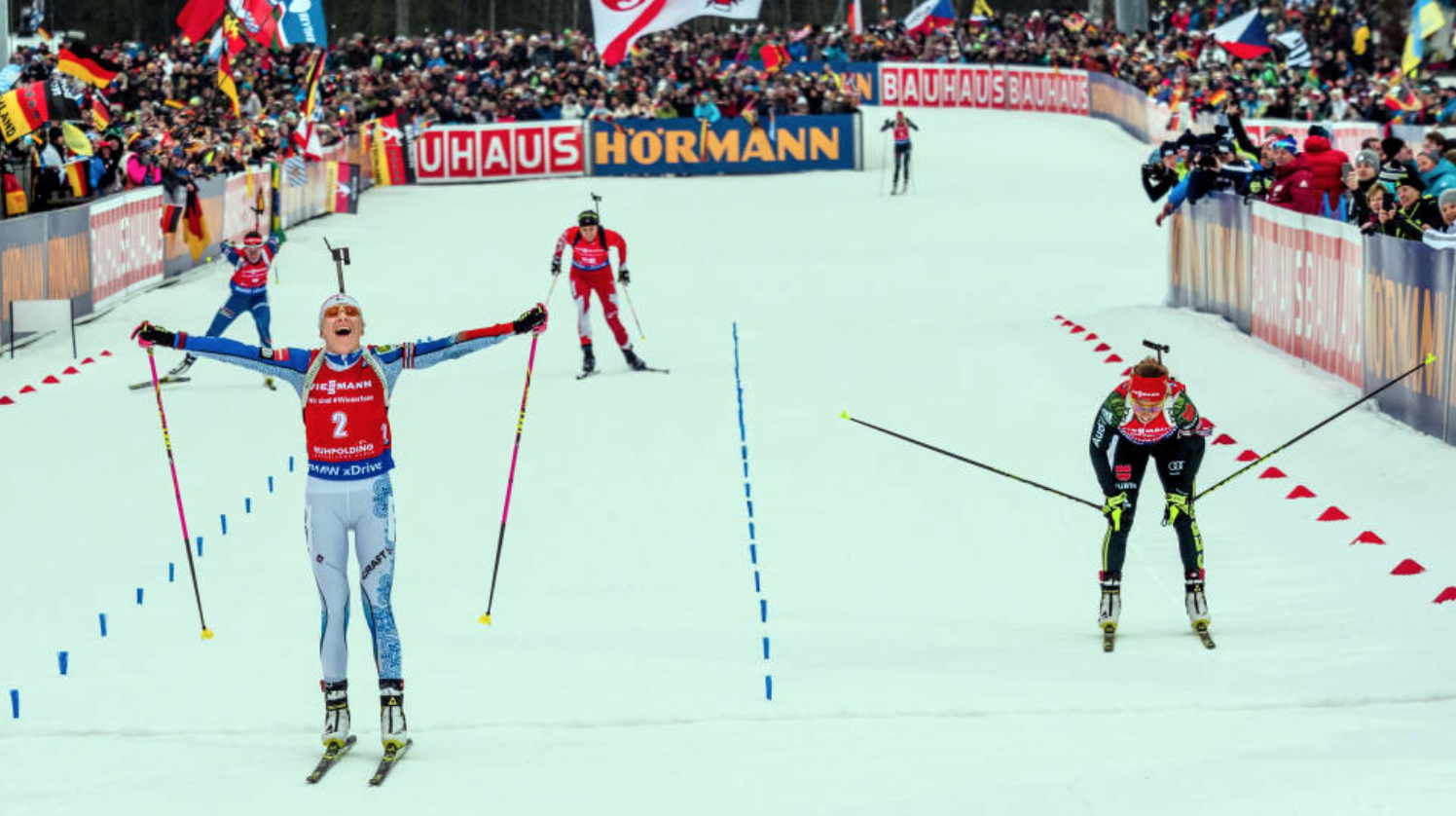
    Kaisa Makarainen of Finland celebrates winning the women’s 12.5 k mass start in Ruhpolding, Germany, as Laura Dahlmeier (Germany) is second, Veronica Vitkova (Czech Republic) third, and Rosanna Crawford (Canada) fourth. (Photo: IBU/Biathlonworld)

    IBU Biathlon World Cup (Ruhpolding, Germany): 12.5/15 k mass starts

    Kaisa Makarainen of Finland took her first win of the season and will start next weekend with the overall World Cup leader’s bib after she outsprinted Germany’s Laura Dahlmeier by 0.8 seconds to claim the win in the 12.5 k mass start. In a tight race for third, Veronica Vitkova of the Czech Republic edged out Rosanna Crawford of Canada for the final spot on the podium; the pair crossed the line 4.6 and 5.2 seconds behind Makarainen. The podium finishers all had two penalties apiece while Crawford shot clean, repeating the 20-for-20 effort that netted her third place and her first-ever podium in the 15 k individual earlier this week. Germany’s Denise Herrmann was sixth, +16.7 seconds, despite four missed targets.

    In the men’s 15 k mass start, Norway’s Johannes Thingnes Bø took a win over France’s Martin Fourcade as the pair continue their running battle this season. Bø had one penalty to Fourcade’s two, although that penalty came in the last shooting stage to make things interesting – Fourcade, whose penalties had come in the prior shooting stage, closed to within 4.5 seconds by the finish, but was unable to beat the Norwegian. Antonin Guigonnat, one of the newest members of the French World Cup team, shot 20-for-20 to claim third place and his second podium of the season. In an exciting race, the top nine men all finished within 15 seconds of one another. The sole U.S. entry, Tim Burke, was in the top 15 for much of the race before missing two shots in the final standing shooting stage and finishing 21st, +1:30.2

    Results: women | men

    ***

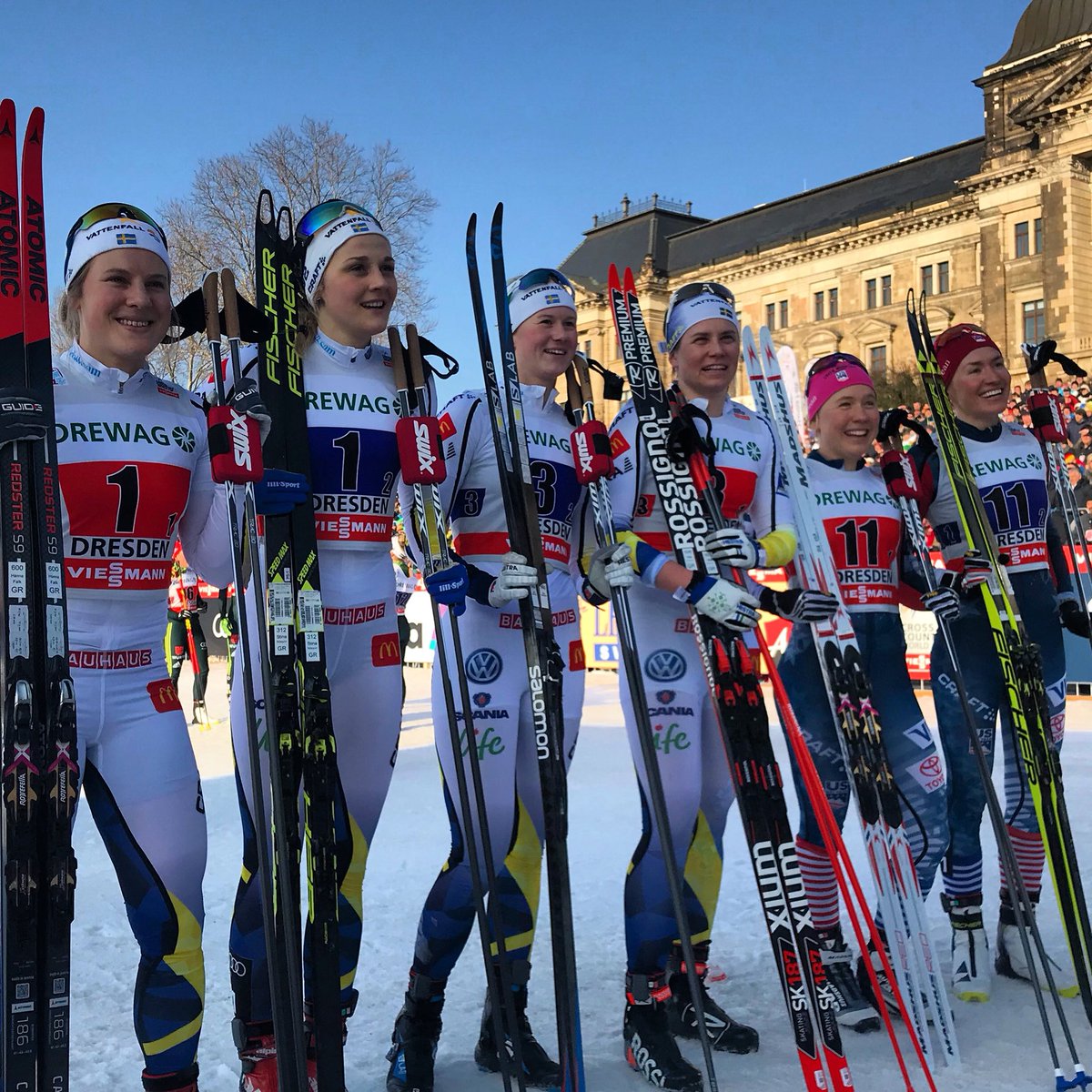
    The women’s 6 x 1.2 k freestyle team sprint podium at Sunday’s World Cup in Dresden, Germany, with Sweden II’s Maja Dahlqvist and Ida Ingemarsdotter in first (c), Sweden I’s Hanna Falk and Stina Nilsson in second (l), and USA I’s Ida Sargent and Sophie Caldwell in third (r). (Photo: FIS Cross Country/Twitter)

    FIS Cross Country World Cup (Dresden, Germany): 6 x 1.2 k freestyle team sprint

    Women’s report

    Men’s report

    For the second-straight day in Dresden, Sophie Caldwell notched third place and was nearly second with U.S. teammate Ida Sargent on Sunday in the World Cup women’s 1.2-kilometer freestyle team sprint.

    The race ended in a three-way fight for first, which Sweden II’s anchor Maja Dahlqvist took by 0.16 seconds over Sweden I’s Stina Nilsson. While the two lunged for the line, Caldwell came on strong to give them a run as well, finishing just 0.23 seconds back in third (after being in a photo finish for second).

    Earlier in the day, Sargent and Caldwell had won the second semifinal to advance to the 10-team final. The U.S. Ski Team’s second team, Caitlin Patterson and Kikkan Randall, finished second in that heat, just 0.11 seconds back and advanced as well.

    Sweden I won the first semifinal with Hanna Falk (Saturday’s individual skate-sprint winner) and Nilsson. Sweden II finished 0.17 back in second with Ida Ingemarsdotter and Dahlqvist.

    In the final, Sweden II’s Ida Ingemarsdotter led through her first two legs before tagging Dahlqvist in third with one lap to go. Meanwhile, Sargent tagged Caldwell in fourth, 0.9 seconds back. On the final lap, with Switzerland, the two Swedish teams, and USA I’s Caldwell skiing together up front, they dropped Switzerland’s Laurien van der Graaff before the finish and went all out for first.

    Dahlqvist took it for Sweden II in 13:33.4, Sweden I placed second and USA I third. The same duo of Caldwell and Sargent placed third in the pre-Olympic freestyle team sprint last year in PyeongChang, South Korea. There, Sargent also placed third in a classic sprint for her first World Cup podium. Sunday marked Caldwell’s fourth individual World Cup podium (sixth including team events).

    USA II was up to sixth after Randall’s first leg, just 0.5 seconds out of first, and remained 1.8 seconds behind the leaders with two laps to go. On the second-to-last leg, Patterson tagged Randall in ninth, and Randall anchored them to eighth (+7.95).

    Germany I finished fourth (+2.11) with Hanna Kolb and Sandra Ringwald, Slovenia was fifth (+4.46) with Alenka Cebasek and Vesna Fabjan, Germany II was sixth (+4.62) with Katharina Hennig and Elisabeth Schicho, and Switzerland seventh (+5.09) with Nadine Fähndrich and van der Graaff.

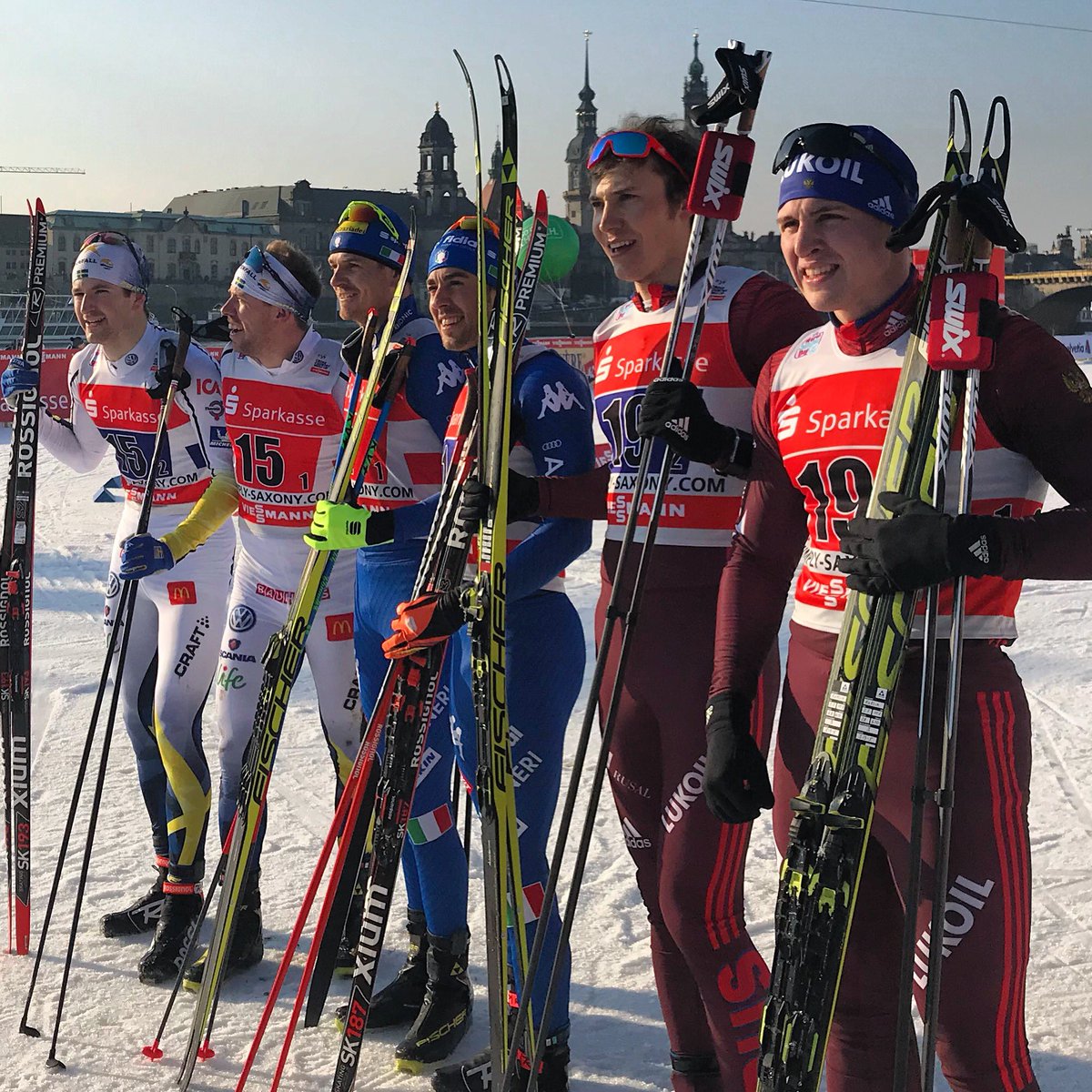
    The men’s 6 x 1.2 k freestyle team sprint podium at Sunday’s World Cup in Dresden, Germany, with Italy’s Dietmar Nöckler and Federico Pellegrino in first (c), Sweden’s Emil Jönsson and Teodor Peterson in second (l) and Russia’s Andrey Krasnov and Gleb Retivykh in third (r). (Photo: FIS Cross Country/Twitter)

    In the men’s race, Norway’s Johannes Høsflot Klæbo teamed up with Kasper Stadaas, and the two won their semifinal by 0.26 seconds over Italy’s Dietmar Nöckler and Saturday’s winner Federico Pellegrino. The U.S. men’s first team of Erik Bjornsen and Simi Hamilton advanced to the final as the last lucky loser in the second semifinal, where they placed fourth, 0.85 seconds behind Russia I’s Andrey Krasnov and Gleb Retivykh in first. Sweden I (Emil Jönsson and Teodor Peterson) and Sweden II (Johan Häggström and Karl-Johan Westberg) also advanced in second and third in that heat.

    In the final, which included Great Britain for the first time in team-sprint history (after James Clugnet and Andrew Young clinched the last lucky loser spot in the first semifinal in sixth place), Stadaas set a fast pace on the opening 1.2 k loop. He tagged Klæbo in first, 0.3 seconds ahead of Sweden I, while the U.S. hung in contention 0.9 seconds back in fifth.

    Norway continued to lead until Stadaas’s second lap, where Russia’s Krasnov came through the third exchange first, 0.1 ahead of Switzerland’s Jovian Hediger in second. Stadaas tagged Klæbo in fourth, 0.5 seconds back, and Klæbo predictably recovered the lead on the next lap.

    After he gave Stadaas a 1.3-second lead at the fourth exchange, Stadaas initially ran with it and extended it significantly. But he ran out of steam on the second half of his last loop and dropped to 10th (last place), 3.7 seconds out of first by the final exchange.

    There, Jönsson tagged Peterson in first, 0.9 seconds ahead of Hediger in second. Bjornsen had brought the U.S. to third, 2 seconds back, after leading the chase group in second as they reeled in Stadaas.

    On the final lap, Pellegrino came on strong in the last few hundred meters, just as he had done in Saturday’s individual sprint, to take the win for Italy in 12:18.3. Peterson anchored Sweden I to second place, 1 second back, and Russia’s Retivykh took third (+1.2), just ahead of Switzerland’s Roman Schaad in fourth (+1.4).

    Hamilton suffered a nasty crash in the middle of the group just before the finish and crossed the line in eighth (+14.2).

    Klæbo finished fifth for Norway (+1.9), with Sweden II in sixth (+1.9). Italy II (Stefan Zelger and Giacomo Gabrielli) followed in seventh (+7.3), Great Britain placed ninth (+14.6), and Switzerland II (Erwan Käser and Roman Furger) 10th (+20.9).

    This is the last team sprint before a freestyle team sprint is contested at the 2018 PyeongChang Olympics.

    Results: 

    Women’s semifinals | Women’s final

    Men’s semifinals | Men’s final

  • The Grandkids Will Love This: Pellegrino Beats Klæbo in Dresden; Hamilton 10th, Locke 15th

    The Grandkids Will Love This: Pellegrino Beats Klæbo in Dresden; Hamilton 10th, Locke 15th

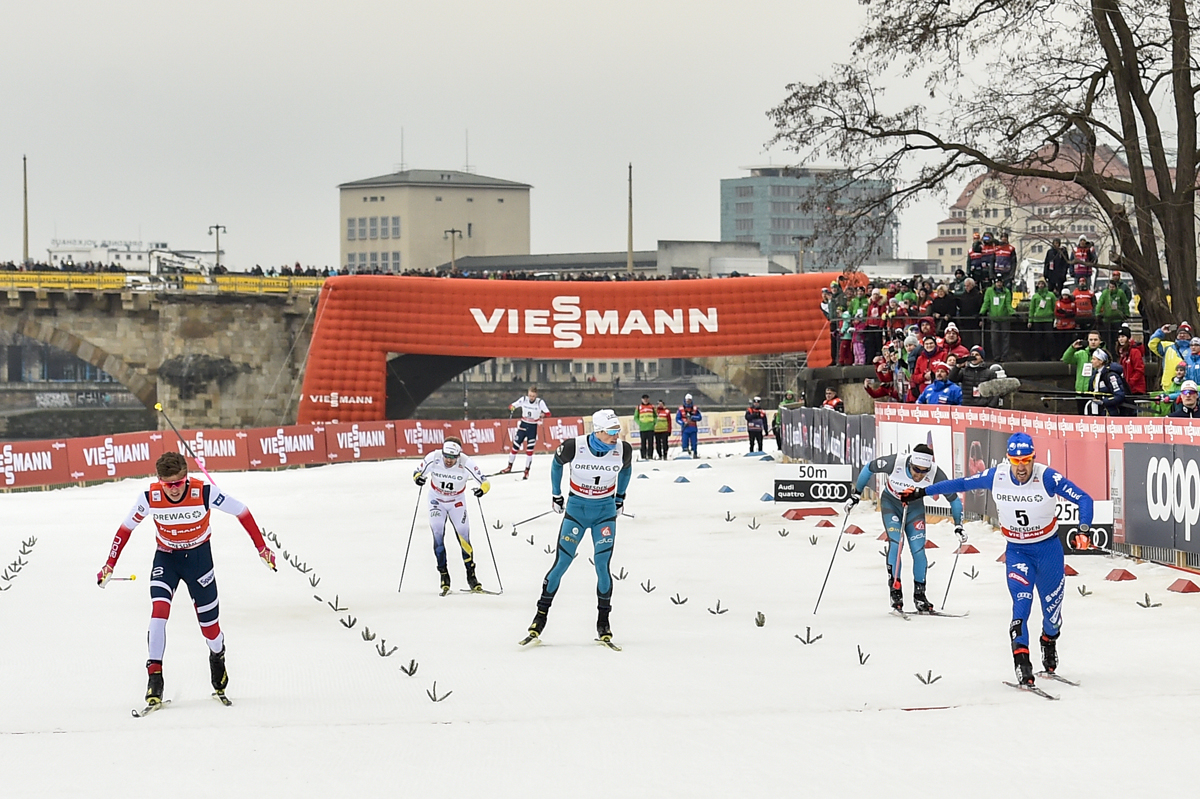
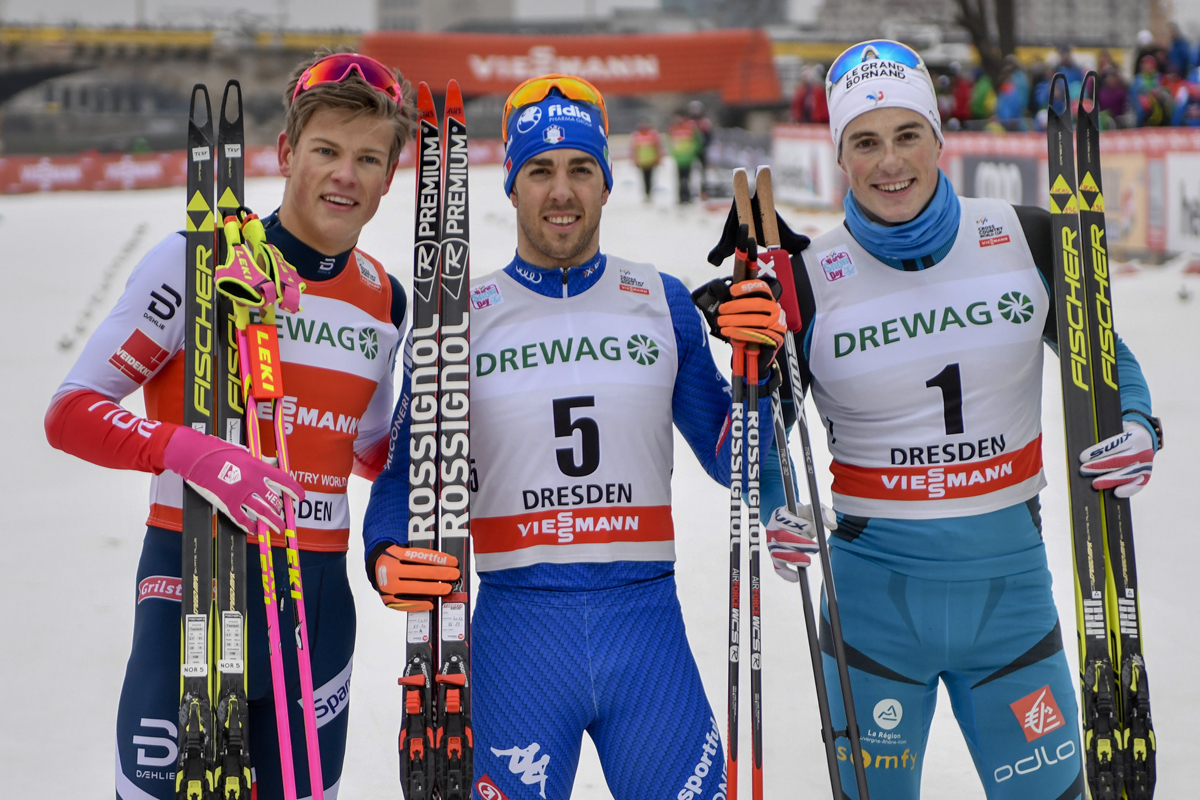
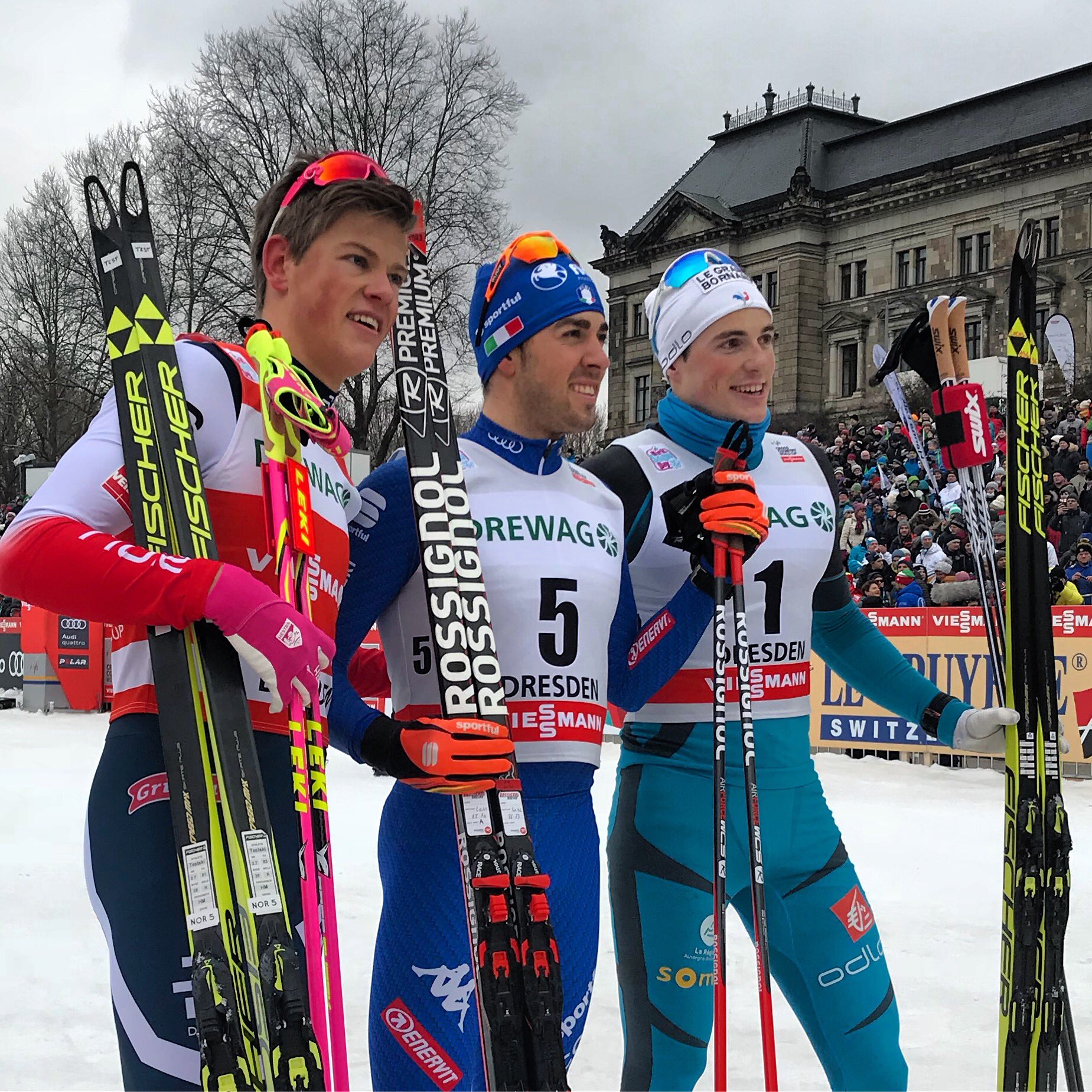
    Italy’s Federico Pellegrino (5) getting a ski tip ahead of Norway’s Johannes Høsflot Klæbo (l) for the men’s freestyle sprint final win on Saturday at the World Cup in Dresden, Germany. France’s Lucas Chanavat (1) placed third for the second-straight World Cup sprint, another Frenchman Richard Jouve (second from r) placed fourth, Sweden’s Emil Jönsson (second from l) was fifth, and Norway’s Even Northug (behind) took sixth after breaking a pole out of the start. (Photo: Fischer/Nordic Focus)

    How do you beat Norway’s Johannes Høsflot Klæbo at his competition-crushing game? Take him by surprise with minimal time to recover. Italy’s Federico Pellegrino did just that on the last uphill rise of the 1.2-kilometer sprint course on Saturday in Dresden, Germany.

    Dresden, a historic city in eastern Germany, debuted its brand-new course along the Elbe River on manmade snow amid damp conditions and temperatures above freezing throughout the day. Pellegrino had done what he needed to advance through the rounds, clocking the first-fastest time in the qualifier, 2.9 seconds behind France’s Lucas Chanavat in first, then placing second in his quarterfinal and third in the first semifinal. Klæbo won that semi by 0.16 seconds over Chanavat in second and 0.3 seconds ahead of Pellegrino in third. With a fast-enough time, Pellegrino moved on to the final, where he met the 21-year-old Klæbo again.

    “I knew that at the beginning of the race, I’m becoming a little bit old so the younger Klæbo and Chanavat were faster than me,” Pellegrino, 27, said of the final in a post-race interview with the International Ski Federation (FIS). “So I just had to wait, but I wanted to attack in the longer race to the finish line.”

    The race from his point of attack might have seemed like an eternity, but in actuality, it was about 500 meters before the finish. Klæbo and Chanavat had burst out of the start at lightning speed, skiing “shoulder to shoulder,” as Chanavat later said in a press conference, and slightly gapping the four skiers behind them — one of which was Pellegrino.

    While Klæbo pushed the pace up front, Pellegrino kept the two leaders close, skiing just a couple strides back. France’s second man in the final, Richard Jouve slotted into fourth behind him and Sweden’s Emil Jönsson — in his first final in a year — followed in fifth. Behind them, Norway’s Even Northug (Petter Northug’s 22-year-old brother) worked to fasten a new pole after breaking his on the starting gate. That took him out of the race from the gun.

    Chanavat attempted to get ahead of Klæbo on a tight righthand corner, but Klæbo held the inside line and his position. Coming out of that corner, Pellegrino latched on to Chanavat and brought the rest of the group with him. Shadowing the two leaders’ every move, Pellegrino accelerated just before the final rise, taking just three V2 pushes to get to the top.

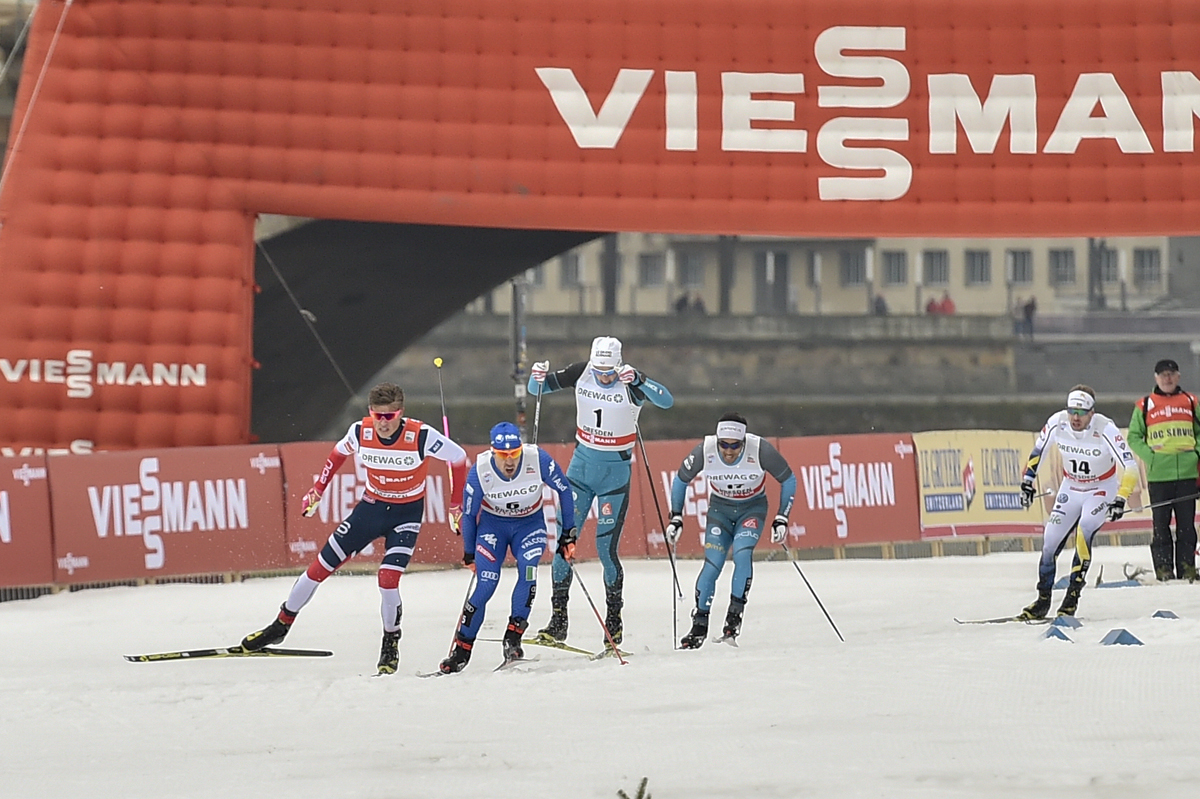
    Norway’s Johannes Høsflot Klæbo (l) and Italy’s Federico Pellegrino (second from l) jockey for position just before the finish of the men’s freestyle sprint final at the World Cup in Dresden, Germany, while France’s Lucas Chanavat (1) and Richard Jouve chase, followed by Sweden’s Emil Jönsson (14). (Photo: Fischer/NordicFocus)

    Even with Klæbo, the Italian took another push to move ahead and left Klæbo chasing. With about 75 meters to go, they began their all-out showdown to the finish, side by side, with Pellegrino staying just ahead to cross the line first in 1:52.77 minutes. Klæbo was just 0.18 seconds back in second and Chanavat 0.98 seconds behind in third.

    “When I will have grandchildren this will be the story I am going to tell them, that I beat Johannes,” Pellegrino said, according to a FIS press release.

    It was his first World Cup victory in nearly a year since winning a freestyle sprint in Falun, Sweden, late last January, and his 10th career individual World Cup win.

    “Klæbo is a really good guy because if he wanted to he could stop me,” Pellegrino told FIS. “… He tried to stay stay quiet to let me go … he’s really good to continue to win.”

    In the four sprints Klæbo’s contested this season, Saturday marked his first loss (he did not compete in the Tour de Ski, opting for a training block instead and racing at Norwegian nationals in Vang, Norway, where he won the classic sprint).

    “It was a tough one,” Klæbo said of Saturday’s final. “Me and Chanavat was trying to go pretty hard from the start of the final, and I think both of us went a little bit too hard. … I’m satisfied with second place here but I have to do something else to beat him next time.”

    Two seasons ago, Pellegrino was the overall Sprint World Cup champion. Last season, it was Klæbo as both the U23 and Sprint World Cup Champion.

    The men’s freestyle sprint podium on Saturday at the World Cup in Dresden, Germany, with Italy’s Federico Pellegrino (c) in first, Norway’s Johannes Høsflot Klæbo (l) in second, and France’s Lucas Chanavat (r) in third. (Photo: Fischer/NordicFocus)

    “I always try to do my best; if the best means the victory it’s great,” Pellegrino said, according to FIS. “It was a really good show. I prefer courses with more hills. Yesterday I changed the way I was thinking about the race.”

    “He was clever,” Klæbo said in an interview with NRK. “He skied like this in the semi and quarterfinal. Our strategies differed slightly.”

    While Pellegrino kept himself in contention in the heats by skiing from behind, Klæbo did as he usually does, by leading with a pace few, if anyone else, could match. Klæbo qualified second, 0.15 seconds off Chanavat’s top qualifying time of 1:50.42, then won his quarterfinal by a clear-cut margin of 0.6 seconds over Switzerland’s Roman Schaad. Chanavat won his quarterfinal by 0.12 seconds over Pellegrino, then hung with Klæbo once again in the semifinal.

    At the last World Cup sprint in Lenzerheide, Switzerland, the first stage of the Tour de Ski, Chanavat placed third in the skate sprint.

    “I did my best and I competed to try to get the victory today, but I was a lot focused on Johannes,” Chanavat, 23, said at the press conference. “So I was surprised when Pellegrino came pretty strong on the side in the race.”

    He added that the gap between him and Klæbo is getting closer. “So I’ll try to keep it shorter,” Chanavat said.

    Jouve finished 0.25 seconds off the podium in fourth, 0.98 seconds behind Pellegrino, Jönsson finished fifth (+2.36), and Northug sixth (+12.04).

    Hamilton 10th, Locke 15th

    American Simi Hamilton made it to the semifinals and finished the day in 10th overall after placing fifth in the second semi, 0.38 seconds behind Jönsson in first. That heat ended in a three-way photo finish for first, which Jönsson took ahead of Northug (+0.01) and Jouve (+0.04). Those three men advanced to the final, but Hamilton and Norway’s fourth-place finisher in that semifinal, Pål Trøan Aune (+0.23) did not.

    American Simi Hamilton (front) leads Germany’s Sebastian Eisenlauer during their quarterfinal of the men’s 1.2 k freestyle sprint at the World Cup in Dresden, Germany. (Photo: Fischer/NordicFocus)

    Before that, Hamilton had qualified in 15th and finished second to Norway’s Fredrik Riseth in his quarterfinal.

    “It was a really cool venue, great course,” Hamilton told FasterSkier in person after the race. “But it was really tight the whole way around so it was hard. My starts aren’t that good right now and so my quarter, I was basically trying to start as fast as I could and I still was second or third out of the blocks, so I wasn’t feeling super confident after that.”

    Going into the semifinals, he decided not to worry about his start and concentrate on moving up later in the course.

    “What ended up happening around that corner, I just couldn’t get around anyone,” Hamilton recalled. “Every time you get an opportunity to make a move, it gets shut down almost immediately, so that was really frustrating, but I was happy with how my body is feeling right now, and it’s fun to get into the heats.

    “I am always way more comfortable skiing towards the back of the pack and then making a definite move somewhere on the course, so unfortunately for me like this course doesn’t favor doing that too well,” he continued. “You can’t afford to ski at the back and then pass four five people, not enough room or time.”

    He added that he enjoyed how different the Dresden course was in comparison to other, much hillier World Cup terrain.

    “I think the only super-short flat course we race like this was in Milan [Italy] years ago, so its fun just doing something different,” he said. “The crowd is awesome here.”

    U.S. Ski Team Head Coach Chris Grover observed that Hamilton was at a disadvantage trying to move up from behind on Dresden’s course.

    “He made it work in the quarterfinal,” Grover told FasterSkier. “He’s so good when he gets that opening to go. I think we saw in the semifinal that he would be starting to go and then get blocked. And again after the corner, started to go, and got blocked. And under the bridge, started to go, and then got blocked. It’s nobody’s fault, nobody obstructed him or anything like that, it’s just not a course with many passing options. The guys are so well-matched, in a semifinal or final it becomes that much harder. So he’s a little bit frustrated, but I think he’s in good shape.”

    Andy Newell (U.S. Ski Team) racing to 18th in the men’s freestyle sprint qualifier at the World Cup in Dresden, Germany. He went on to finish sixth in his quarterfinal for 27th overall. (Photo: Fischer/NordicFocus)

    Two Americans qualified for the heats in the top 30, with Andy Newell finishing 18th in that preliminary round, but Grover noted the U.S. team’s qualifiers overall were “uncharacteristically poor”.

    “To have Erik Bjornsen just miss the qualification, to have Kikkan [Randall] just miss the qualification, to have the four athletes who did go in not have the best qualifications, something was a little bit missing,” he said.

    (Bjornsen placed 32nd and Randall 34th in their respective men’s and women’s qualifiers. Bjornsen was 0.23 seconds out of 30th.)

    Newell’s run ended in the quarterfinal, after he initially took the lead, ahead of Canada’s Julien Locke, but slipped to sixth on the second half of the course.

    “Andy didn’t have the best start, but he got himself to first and he was able to take the best line,” Grover reflected.

    He wasn’t sure why Newell then dropped to the back of the group, and Newell wrote in an email that he wasn’t sure what happened, either.

    “Felt like I was able to accelerate to the front well but then managed to get swarmed before the last little bump and then it was extremely tough to pass before the finish,” Newell wrote. “I should know better than to let myself get stuck in the middle… on narrow tracks like this if you get stuck in the middle with guys on either side you can’t get a full push and thats how you get swarmed, bad tactics on my part.”

    “Tomorrow should be fun, fast, and wild,” he added of Sunday’s freestyle team sprint. “Hopefully I’ll be able to be more aggressive tomorrow 🙂 Looking forward to it.”

    Julien Locke (Canadian U25 Team/Black Jack) racing to 16th in the men’s freestyle sprint qualifier at the World Cup in Dresden, Germany. He went on to place third in his quarterfinal for 15th overall, his best World Cup result. (Photo: Cross Country Canada/NordicFocus)

    He finished his quarterfinal in sixth, 1.54 seconds behind Northug in first, for 27th overall. Meanwhile Locke hung with Northug and Jouve up front and finished third, 0.62 seconds out of first and just 0.18 seconds out of second.

    While second place in that heat would have put him in the semifinals, 15th overall was still a career best for Locke, of the Canadian U25 Team and Black Jack Ski Club. Last March at World Cup Finals in Quebec, he placed 20th in the freestyle sprint. And just over a week ago at the NorAm Olympic trials in Mont Sainte-Anne (MSA), Quebec, Locke, 24, won the classic sprint final, but missed out on a potential Olympic spot by one place after qualifying second (the tiebreaker) behind Russell Kennedy (Team R.A.D.).

    The individual top 30 was the second of Locke’s career. Fresh off of competing in Canada, he arrived in Dresden a day and a half ago.

    “… A little bit of a tight schedule, but body feels great, and super-fun course out there with all these spectators,” Locke told FasterSkier after. “And yeah, short, very short. It was close to 1.1 [kilometers] and definitely the shortest sprint race I have ever done.”

    “I was prepared to hit it hard here and I was hoping for sure to get into the heats and then get into the rounds,” he added. “I don’t like getting knocked out, but I am content with how today went.”

    Bob Thompson (NTDC Thunder Bay) racing to 50th in the men’s freestyle sprint qualifier at the World Cup in Dresden, Germany. (Photo: Fischer/NordicFocus)

    Three other Canadian men met the Cross Country Canada (CCC) selection criteria for Dresden, where Bob Thompson (NTDC Thunder Bay) finished 50th in the qualifier (+8.67), Dominique Moncion-Groulx (Alberta World Cup Academy) 59th (+9.99) and Antoine Briand (Pierre-Harvey National Training Centre) 60th (+10.12).

    (Note: CCC High Performance Director Thomas Holland explained in an email that Briand was added as the fourth man, based on the U23 selection list, after Kennedy had to relinquish his starts in Dresden due to illness.)

    For the U.S., Period 2 SuperTour leader Ben Lustgarten (Craftsbury Green Racing Project) finished 49th (+8.64) out of 67 men.

    “I thought I skied well — usually this stuff is my weakness,” Lustgarten said after. “It’s like icy and slushy so usually when it’s like that skate skiing, I get off balance, but I was like trying really hard to stay focused and ski big. I only got bogged down a little bit on the big hill, but … I was only nine seconds out of first, so I think that is really good. I am really happy with that.”

    The U.S. and Canada each have two teams entered for Sunday’s freestyle team sprint on the same course in Dresden, with Bjornsen and Hamilton (United States I), Newell and Lustgarten (U.S. II), Thompson and Locke (Canada I), and Briand and Moncoin-Groulx (Canada II).

    “It’s going to be wild out there,” Lustgarten said. “[The Dresden organizers] pulled it off; they had to shorten the course a little bit because they didn’t have enough snow … but it was good. It’s the shortest sprint I have ever done in my life by far.”

    Results: Men’s qualifier | Men’s heats

  • Saturday Rundown: Dresden, Ruhpolding, Kaiser Maximilian Lauf

    Saturday Rundown: Dresden, Ruhpolding, Kaiser Maximilian Lauf

    The women’s freestyle sprint podium on Saturday at the World Cup in Dresden, Germany, with Sweden’s Hanna Falk (c) and Maja Dahlqvist (l) in first and second, and American Sophie Caldwell (r) in third. (Photo: FIS Cross Country/Twitter)

    FIS Cross Country World Cup (Dresden, Germany): Freestyle sprints

    Women’s report

    Men’s report

    For her second-straight World Cup sprint, Sophie Caldwell of the U.S. Ski Team reached the podium in the women’s 1.2-kilometer freestyle sprint on Saturday in Dresden, Germany.

    Caldwell placed third in the final behind Sweden’s Hanna Falk, who won it in 2:11.02 minutes, and Maja Dahlqvist, also of Sweden, who placed second (+0.23). Caldwell and Dahlqvist both lunged in a photo finish for second, which Dahlqvist took by 0.07 seconds.

    Also in the final, which included four Swedes, Switzerland’s Laurien van der Graaff finished fourth (+0.58), and Sweden’s Anna Dyvik followed in fifth (+0.68) and Stina Nilsson sixth (+7.56) after tripping.

    Falk started the day by winning the women’s qualifier in 2:06.34, by just 0.02 seconds over Nilsson in second. Caldwell qualified 11th (+2.02). and another American Ida Sargent made it into the heats in 14th (+2.44). Kikkan Randall missed the top 30 by 0.6 seconds in 34th (+6.57), Julia Kern placed 38th (+7.78), and Caitlin Patterson, of the Craftsbury Green Racing Project (CGRP), was 40th (+8.56) out of 49 women in the qualifying round.

    Sargent finished fourth in her quarterfinal, 043 seconds behind Sweden’s Ida Ingemarsdotter in first, to finish the day in 17th overall.

    For Caldwell, who went on to advance in second in her quarterfinal and third in her semifinal, the podium came after she finished second in the last World Cup skate sprint (the first stage of the Tour de Ski) on Dec. 31 in Lenzerheide, Switzerland.

    Her boyfriend and fellow U.S. Ski Team member Simi Hamilton came close to reaching the men’s 1.2 k sprint final on Saturday after qualifying in 15th then placing second in his quarterfinal and fifth in the second semifinal, 0.38 seconds behind Sweden’s Emil Jönsson in first.

    France’s Lucas Chanavat won the qualifier in 1:50.42, 0.15 seconds ahead of Norway’s Johannes Høsflot Klæbo in second. Hamilton was 4.32 seconds back in the qualifier, and his U.S. teammate Andy Newell also qualified in 18th (+4.91). Erik Bjornsen missed qualifying by 0.23 seconds in 32nd (+6.15) and Ben Lustgarten (CGRP) finished 49th (+8.64) out of 67 men.

    The women’s freestyle sprint podium on Saturday at the World Cup in Dresden, Germany, with Italy’s Federico Pellegrino (c) in first, Norway’s Johannes Høsflot Klæbo (l) in second, and France’s Lucas Chanavat (r) in third. (Photo: FIS Cross Country/Twitter)

    While Hamilton’s day ended in the semifinals, putting him 10th overall (and Newell finished sixth in his quarterfinal to place 27th overall), Italy’s Federico Pellegrino timed his attack perfectly in the final, challenging Klæbo for the win down the finishing stretch. The Italian took it by 0.18 seconds in 1:52.77, Klæbo placed second and Chanavat third (+0.98).

    France and Norway had two men in the final, with France’s Richard Jouve placing fourth (+1.23), Sweden’s Jönsson taking fifth (+2.36) for his best individual World Cup result since December 2016. Norway’s Even Northug finished sixth (+12.04) after breaking his pole out of the start.

    Canada’s Julien Locke of the National U25 Team and Black Jack Ski Club had a career-best day, finishing 15th overall. He qualified 16th (+4.61) then placed third in his quarterfinal, crossing the line just 1 second behind Norway’s Fredrik Riseth, who won that heat. Hamilton was second in that quarterfinal, 0.67 seconds back.

    Also for Canada, Bob Thompson (NTDC Thunder Bay) finished 50th in the qualifier (+8.67), Dominique Moncion-Groulx (Alberta World Cup Academy) was 59th (+9.99) and Antoine Briand (Pierre-Harvey National Training Centre) 60th (+10.12).

    Results:

    Women’s qualifier | Women’s heats

    Men’s qualifier | Men’s heats

    ***

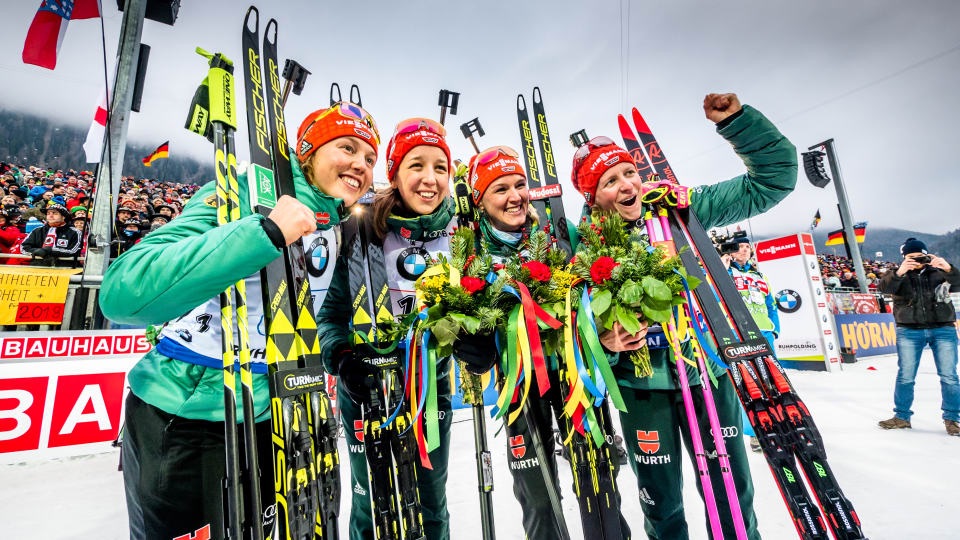
    Germany’s Laura Dahlmeier, Franziska Preuss, Denise Herrmann and Franziska Hildebrand (left to right) celebrating their win in the women’s 4×6-kilometer relay at the 2018 IBU World Cup in Ruhpolding, Germany. (Photo: IBU/Biathlonworld)

    IBU World Cup (Ruhpolding, Germany): Women’s relay

    The teams from Germany and Italy dueled for the top position all race in Saturday’s 4 x 6-kilometer women’s relay at the IBU World Cup in Ruhpolding, Germany. Cheered on by some 20,000 home-crowd fans, Germany’s anchor Laura Dahlmeier stayed on the ski tails of Italy’s Federica Sanfilippo after the last shooting stage, then passed her before the last major climb and held a narrow lead around the rest of the course to cross the finish line first in a time of 1:08:47.0 hours, with Italy 2.9 seconds behind. German had a team total of zero penalties and nine spares.

    “It’s incredibly fun to win in front of this audience here today,” Dahlmeier told German broadcaster ZDF in an interview right after the race, according to a translation. “I think this will boost our whole team morale. We showed today that we are a team to be reckoned with in relays. It was just a nice race.”

    Germany with Franziska Preuss, Denise Herrmann, Franziska Hildebrand, and Dahlmeier was never more than 30 seconds behind the pace, even though Hildebrand temporarily fell back from leading the field to tagging off to Dahlmeier in fourth position.

    “My race held all kinds of surprises today,” Hildebrand told ZDF with a laugh. “It started with a fall on an icy patch 100 meters after it began… Then I dropped my pole, also had to exchange the replacement one, and then three spares [in prone] to avoid the penalty. Today everything conspired in my race.”

    Italy with Lisa Vittozzi, Dorothea Wierer (coming off a victory in the individual race on Thursday), Nicole Gontier and Sanfilippo had the best shooting performance of the day, with no penalty and just three spares.

    “That last loop with Laura was really tough,” Sanfilippo said in the press conference. “I gave my best, I tried all for my team. I knew that I can be strong on the last loop. I tried to attack, but Laura was a little bit stronger. But I am also really happy that we finished in second place, I think that was really important for our team.”

    Sweden with Linn Persson, Mona Brorsson, Anna Magnusson and anchor Jenny Öberg was third, 17.2 seconds back, with no penalty and five spares. Brorsson and Öberg managed to move the team up to the podium positions, for the second one in a row following a third place from Oberhof, Germany, a week ago. Before that, the Swedish women’s team had been on a six-year hiatus from those lofty positions.

    “It’s cool to be on the podium again,” Persson said in the press conference.

    “This is like our second home and there were a lot of Swedes here, so we had big support during the race on the tracks,” Brorsson added.” That was an advantage for us.”

    Just a few seconds off the podium, Norway with Synnøve Solemdal, Tiril Eckhoff, Ingrid Landmark Tandrevold and Marte Olsbu was fourth (+23.1, with no penalty and nine spares), with Olsbu outsprinting Poland’s anchor Weronika Nowakowska on the finish stretch (+24.5, with no penalty and five spares). For both teams it was their best relay result of the season so far.

    Switzerland with the three sisters Elisa, Selina and Aita Gasparin reinforced by Lena Häcki surprisingly led the race at the third exchange after Selina had moved them in front, but her youngest sister Aita could not hold that position, falling back with a penalty lap in the last standing stage to finish eighth (+1:37.1, with one penalty and 11 spares).

    Biathlon Canada’s team of Emma Lunder, Julia Ransom, Sarah Beaudry, and Rosanna Crawford started the race with a setback after Lunder incurred a penalty in her prone stage, leaving the range in 23rd position at the end of the field and already almost a minute behind the leader. She managed to limit the gap with a clean standing stage to exchange still in 23rd position and 1:47 back.

    Taking over Ransom then remained clean in both stages to move the team up to 17th, tagging off 2:14 behind. Beaudry only required one spare in her prone stage (0+1, 0+0) to improve to the 12th position even making up 3 seconds to the leaders.

    Then Crawford, fresh off her first career podium in the individual race on Thursday, managed to also shoot clean in both stages and overtook the teams from Slovakia and Ukraine while further decreasing the gap to finish the race in 10th position, 1:56.7 back, with one penalty and just four spares.

    “Things were a bit softer and slushy today compared to the individual, but nothing too bad,” Crawford commented on the conditions in an email to FasterSkier. “There was quite a bit of wind on the range, which I think was tricking people, the wind flags weren’t showing much but I had to make 6 left correction during zero [target practice].”

    “Today was a solid showing from our team,” she added regarding their result. “Everyone cleaned standing, I think we can be really happy of this race, and take some real confidence going into the Olympic relay.”

    Previously this season Canada had finished the relay in Oberhof, also Germany, in 14th position, and the first one in Hochfilzen, Austria, in ninth.

    For US Biathlon with Susan Dunklee, Clare Egan, Emily Dreissigacker, and Joanne Reid, it was the first women’s relay of the year after missing out on the first two races of the season in this discipline.

    Thus starting at the very end of the field, veteran Dunklee moved up through the pack and got through the prone stage with one spare. But then she had to fight against a penalty lap in her standing stage requiring all three spare rounds, leaving the range in 12th position. With the fastest course time on the opening leg, she managed to slightly decrease the gap to 21.6 seconds and made up three positions to exchange in ninth place.

    Egan missed the first two shots in her prone stage, but hit the targets with her spares leaving the range over a minute back. She followed that up by cleaning her standing stage and left the range 1:29.5 back, then only lost five more seconds on the last loop to exchange in 14th.

    Dreissigacker also needed just one spare in her prone shooting, but then incurred two penalties in her standing stage, doubling the gap and falling back to 19th position at the exchange and 3:51 back.

    Anchor Reid needed three spares on her leg (0+2, 0+1) and managed to still overtake the teams from China and Finland to finish 17th, 4:57.7 behind Germany, with two penalties and 13 spares overall.

    “Finally we had a full team and raced a relay!” Dunklee wrote on Instagram. “Competing on a foreign continent has its challenges.”

    Results

    ***

    Ski Classics (Seefeld, Austria): 60 k Kaiser Maximilian Lauf

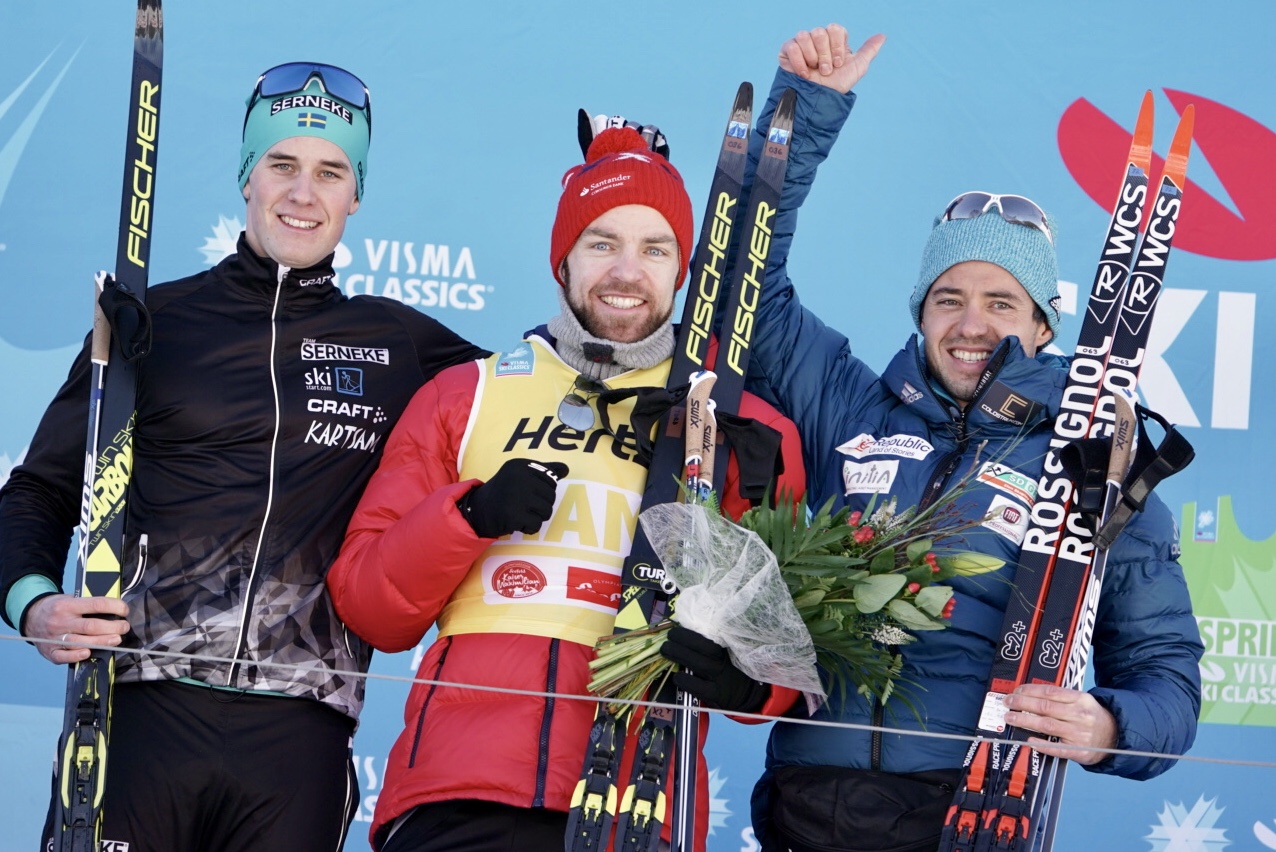
    The men’s podium at the Kaiser Maximilian Lauf 60 k Ski Classics marathon in Seefeld, Austria, with Norway’s Tord Asle Gjerdalen (c) in first, Sweden’s Andreas Holmberg (l) second, and Russia’s Ilya Chernousov (r) third. (Photo: Visma Ski Classics)

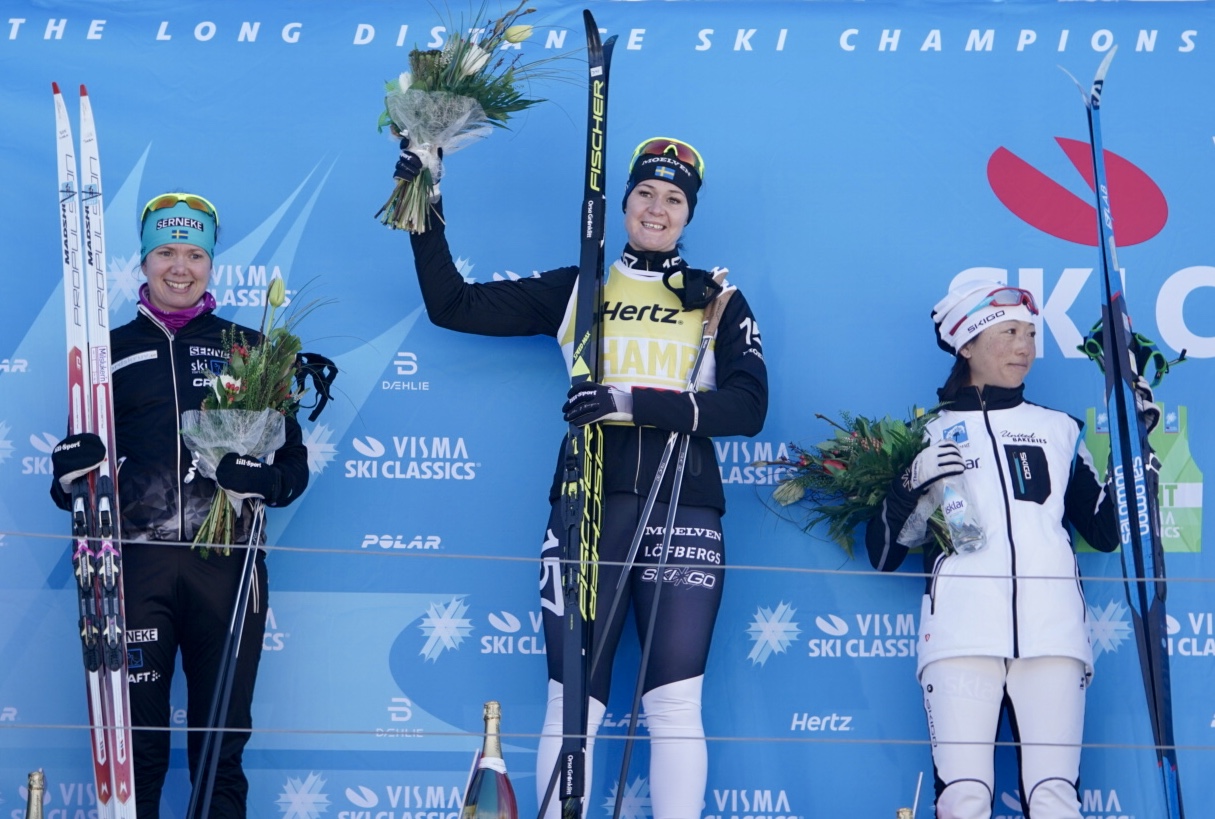
    At the third Ski Classics event of the 2017/2018 season, the 60-kilometer Kaiser Maximilian Lauf on Saturday in Seefeld, Sweden’s Britta Johansson Norgren (Lager 157 Ski Team) and Norway’s Tord Asle Gjerdalen (Team Santander) took the women’s and men’s victories, respectively.

    Johansson Norgren and Japan’s Masako Ishida (Team Koteng) broke away shortly after the start. The two went back and forth for a while until Johannson Norgren gapped Ishida in the Leutasch valley. While Ishida was caught by a chase pack with Sara Lindborg (Team Serneke), Kari Vikhagen Gjeitnes (Santander) and Lina Korsgren (Åre Ski Team), she reined Johansson Norgren back in on the long climbs after the valley. Ultimately, Johansson Norgren took the win in 2:49:16.0 hours, while Lindborg claimed second, 37.5 seconds back. Ishida finished third (+58.9), Gjeitnes placed fourth (+1:40.7) after injuring her ankle about 2 k before the finish, and Korsgren fifth (+2:05.1).

    The women’s podium at the Kaiser Maximilian Lauf 60 k Ski Classics marathon in Seefeld, Austria, with Sweden’s Britta Johansson Norgren (c) in first, Sweden’s Sara Lindborg (l) second, and Japan’s Masako Ishida (r) third. (Photo: Visma Ski Classics)

    “It was my plan to go full speed from the beginning,” Johansson Norgren said, according to a Ski Classics press release. “I knew Ishida will go fast in the climbs, but I felt strong from the beginning. It was really hard skiing alone in the valley, and when Ishida caught me up, I wasn’t sure if I could win the race. But the last part of the course was perfect for me and I had no problems securing the victory today.”

    The Leutasch valley was the turning point of the men’s race as well, where Vinjar Skogsholm (Team Parkettpartner) and Andreas Holmberg (Team Serneke) broke away from the pack and had built a 90-second gap on the chase group as they left the valley. There on the first climb out of the valley, Holmberg pushed the pace and dropped Skogsholm, while Gjerdalen and Ilya Chernousov (Bauer Ski Team) worked to catch Holmberg up front. They caught him 3 k before the finish and Gjerdalen was first across the finish line in 2:27:49 hours, 14.8 seconds ahead of Holmberg in second.

    Chernousov finished third (+32.0), Ermil Vokuev (Russian Marathon Team) was fourth (+1:07.6), and Anton Karlsson (Lager 157) fifth (+1:08.2).

    “I didn’t like the fact that we gave too much leeway for Holmberg and Skogsholm,” Gjerdalen said, according to the press release. “I’m happy that Ilya helped me in our attempt to catch up with Holmberg, but I wasn’t really sure if we were going to make it. You never know how the other person is feeling in the front, what kind of skis he has and what goes on in his mind. But I managed to win today and it feels great to be back on the top.”

    In the overall “Champion” standings, Nordgren leads with 450 points, 110 ahead of Lindborg in second. Gjerdalen is first in the men’s champion standings with 330 points, 50 points ahead of Morten Eide Pedersen in second.

    The Ski Classics tour moves to Zuoz, Switzerland, next weekend for the 65 k La Diagonela.

    Results

  • World Cup Windup: Sweden

    World Cup Windup: Sweden

    Sweden’s Stina Nilsson celebrates the 10th World Cup victory in two seasons in the women’s 1.3 k freestyle sprint in Otepää, Estonia, in January. (Photo: Fischer/NordicFocus)

    Welcome to World Cup Windup, where we check in with the top-10 teams from last year’s FIS Cross Country World Cup tour before the season starts with the Ruka Triple in Kuusamo, Finland, on Nov. 24.

    SWEDEN

    Overall in Nations Cup Last Year: Second

    Women’s Ranking 2016-2017: Second

    Men’s Ranking 2016-2017: Third

    Who’s Back:

    Stina Nilsson, second in the Sprint Cup and fourth in the World Cup overall; Hanna Falk, third in the Sprint Cup; Marcus Hellner, who finished sixth in the World Cup overall; Charlotte Kalla, ninth overall; Calle Halfvarsson, who won two World Cups; and Jens Burman and Jonna Sundling, the runner-up and fourth-ranked skiers in the for the World Cup U23 standings. Plus, 2014 Olympic team sprint bronze (soon-to-be-silver) medalists Emil Jönsson and Teodor Peterson, and Ida Ingemarsdotter, who teamed up with Nilsson for silver in the same event in 2014.

    Who’s Missing:

    Sweden’s Marcus Hellner – who had something of a comeback last season – leads Germany’s Florian Notz during the third leg of the men’s 4 x 10 k relay at 2017 World Championships in Lahti, Finland. Sweden ultimately placed third and Germany sixth. (Photo: John Lazenby)

    Sweden’s wily and bold distance specialist, Johan Olsson. Olsson announced his retirement in April at age 37 after winning back-to-back World Championships 50 k titles in 2013 and 2015, and contributing to Swedish relay gold at the 2010 and 2014 Olympics. “I have spent 15 years trying to realize my sporting dreams,” he explained at the time. “Now I will be able to realize completely different dreams, and I will be able to be a much more present dad.”

    Pre-Season Results:

    The Swedish team had a sprint race in late October in Idre, on a course made to resemble the profile of the 2018 Olympic sprint course in PyeongChang, South Korea. Some athletes were away at an altitude training camp, but Hanna Falk dominated the women’s sprint over Maja Dahlqvist and Linn Sömskar. Calle Halfvarsson won the qualifier but fell in the final; instead, Teodor Peterson edged Oskar Andersson in a tight finish.

    Other than that, most of the top athletes have not raced yet. National team member Emma Wiken won a season-opening race in Bruksvallarna, Sweden, this past weekend. “It felt good! I chose to compete here today because I usually feel that it takes a couple races for me to get started,” she told Swedish media.

    Recent Drama: 

    Calle Halvarsson racing last December, before he got sick and took a long break from the World Cup. (Photo: Fischer/NordicFocus.com)

    Back at that early sprint race in Idre, Emil Jönsson sat out because of back pain.

    Despite flashes of undeniable brilliance, Calle Halfvarsson’s career has been plagued by gaps in the race results because he has often been sick mid-season. This year he had an operation to fix his sinuses and hopes that it will allow him to race at the top of the field all season. “I hope I’ve found the solution,” he said. “I feel a difference. I have kept myself healthy.”

    Stina Nilsson, the most successful Swede last season, talked about how she has dealt with the fame that has gathered around her in the last three years since her breakthrough on the World Cup. “The attention itself is not a driving force for me, and sometimes it can be tough to handle,” she said on the Swedish podcast Ur spår. “It’s a thing I have a bad conscience about: I don’t have the patience I want to, when people come up and want to talk cross-country skiing with me. As I breathe and live in my ski bubble for so many hours a day, I want to make some breathing holes — I have to be just human Stina, where I can focus only on myself.”

    Sweden’s Charlotte Kalla racing to the win in the Lysebotn Opp, a 7.5-kilometer uphill climb, at the 2017 Blink Ski Festival on Thrusday in Lysbotn, Norway. (Photo: Axelar/Arild Aarnes)

    Nilsson and Charlotte Kalla were both among the top ten most talked-about athletes in Swedish media last year. No male cross-country skiers were on the list, which hit gender equality (five men and five women) for the first time.

    Kalla, meanwhile, has decided to skip the Swedish national team’s pre-Olympic training camp in Sapporo, Japan, and prepare instead in Seiser Alm, Italy, at altitude. Who else will be there? Marit Bjørgen, who is in turn skipping the Norwegian team’s pre-Olympic camp. Kalla noted that the two have discussed that they will both be training in the same place and that they will undoubtedly run into each other on the trails. “I really hope we can help each other,” Kalla said.

    Best Social Media Presence:

    To get caught up from last season requires a video clip. Charlotte Kalla has a reputation for being pretty no-nonsense, but she made a parody music video of Adele’s hit song “Hello” (in this case, “Kalla”) with Robin Bryntesson for the Norwegian comedy-ski commentary series “Helt Ramm.”

    But on to how to stay current on the Swedish team. As has been the case for quite some time, Sweden’s first couple of skiing Anna Haag (Instagram / Twitter) and Emil Jonssön (Instagram / Twitter) have among the best-curated social media presences out there. Haag in particular posts regularly and provides shots of her daily life, Swedish culture, herself with her husband, and the rest of the Swedish team.

    Stina Nilsson also has a beautiful, artistic Instagram page.

    And Marcus Hellner (Instagram) and Teodor Peterson (Instagram) both provide consistent looks inside their training, but also of their lives with their young children.

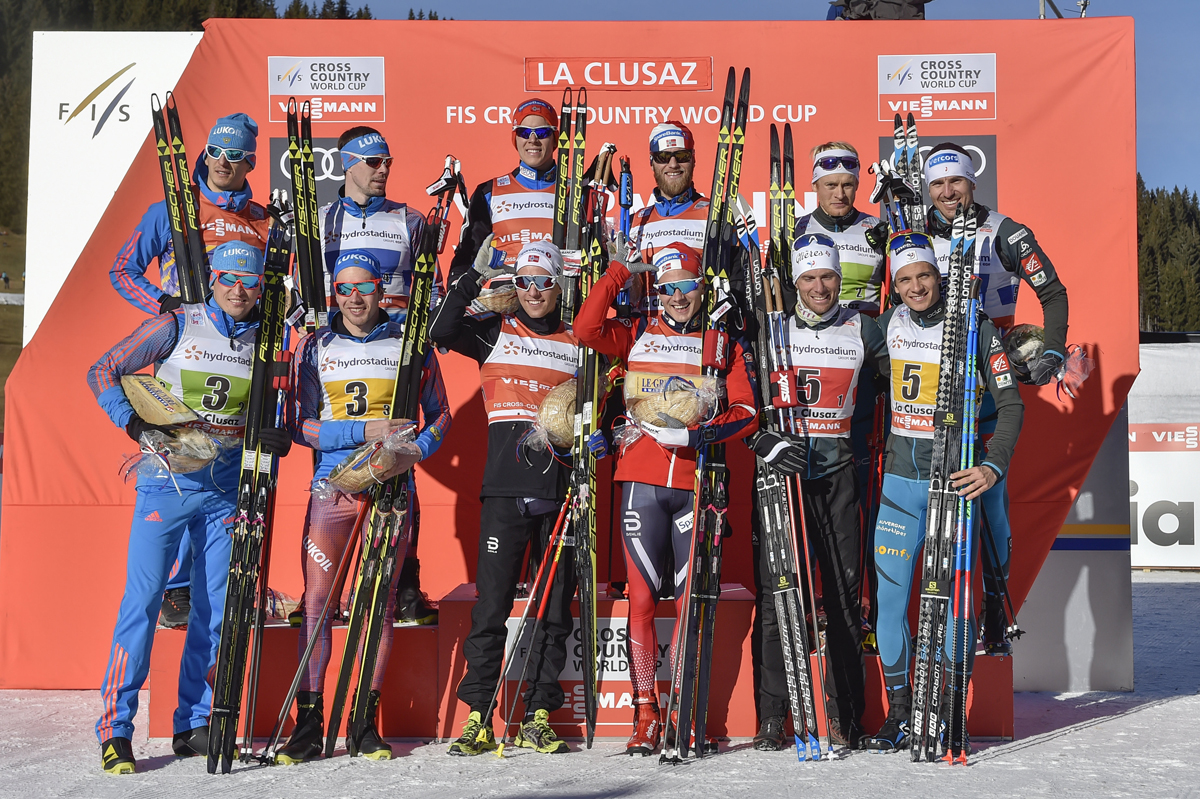
  • After 8 Years, France Finds Relay Podium Again; Norway Wins La Clusaz Men’s Relay

    After 8 Years, France Finds Relay Podium Again; Norway Wins La Clusaz Men’s Relay

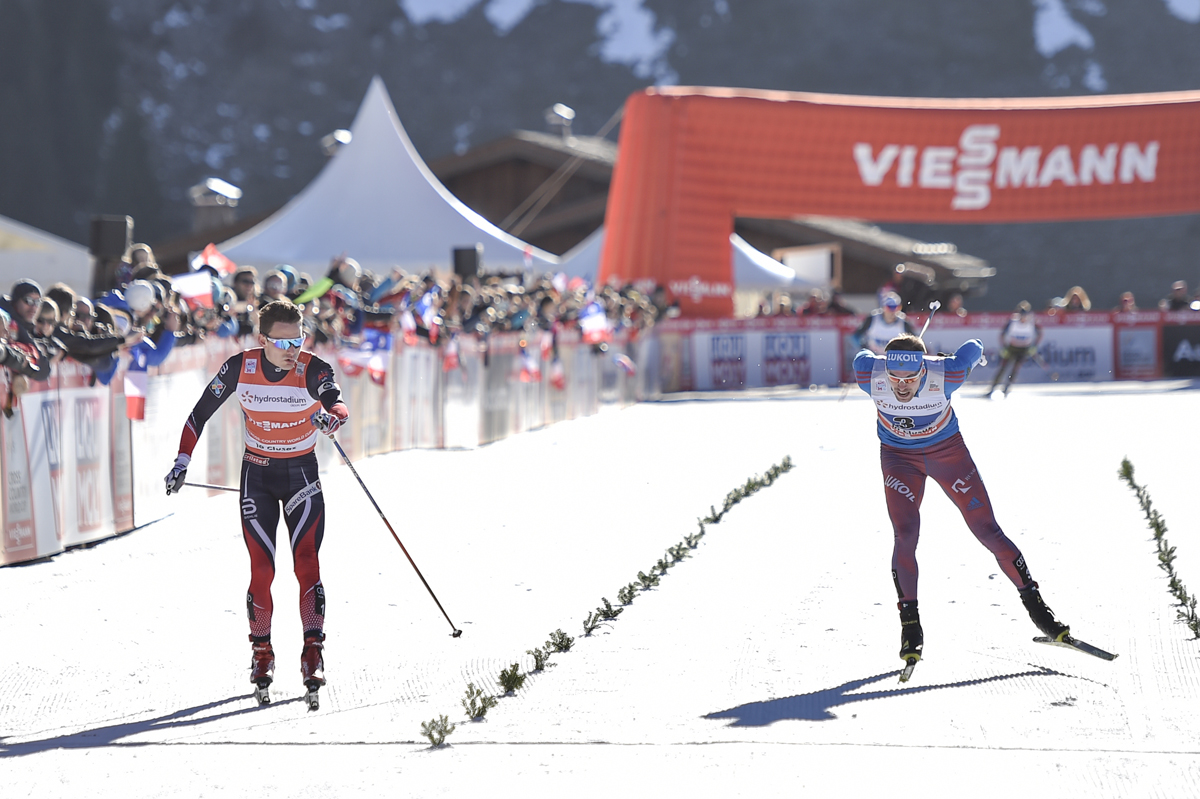
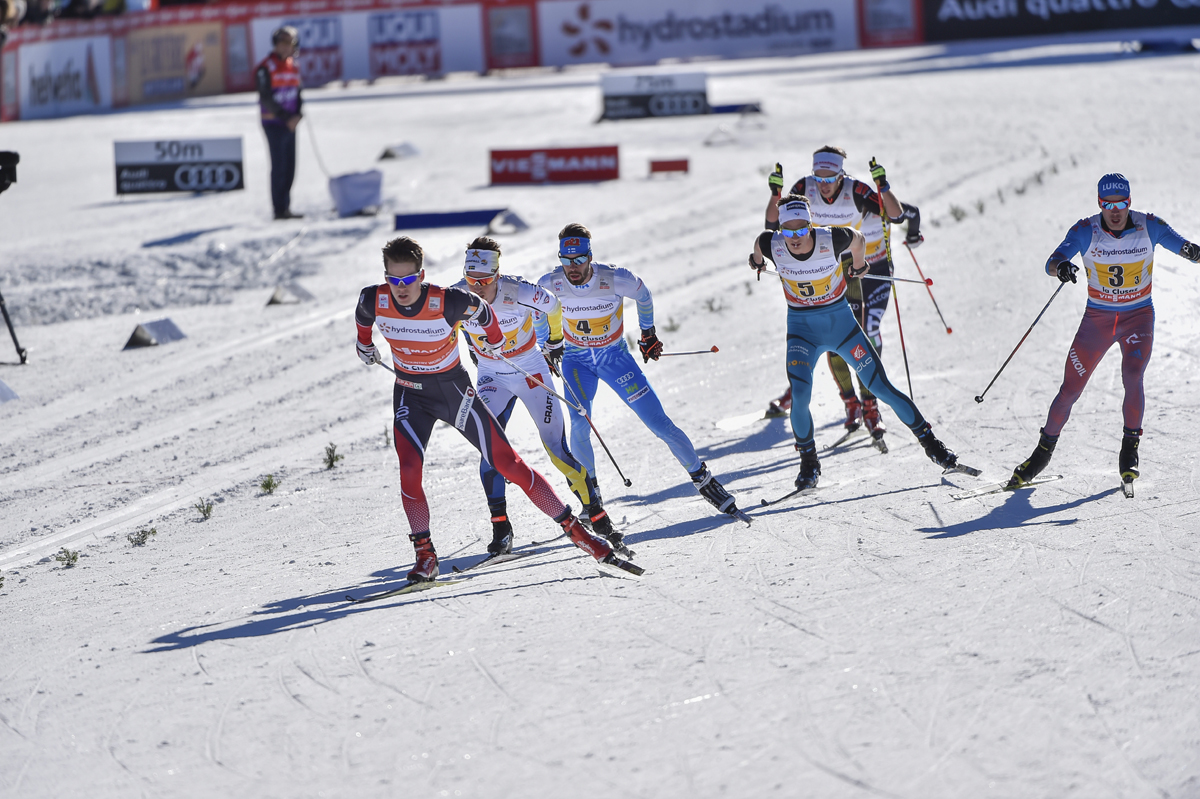
    Finn Hågen Krogh (l) crossing the line ahead of Russia's Sergey Ustiugov to give Norway the win in the men's 4 x 8 k relay, the first of the World Cup season, in La Clusaz, France. (Photo: Fischer/NordicFocus)
    Finn Hågen Krogh (l) crossing the line ahead of Russia’s Sergey Ustiugov to give Norway the win in the men’s 4 x 8 k relay, the first of the World Cup season, in La Clusaz, France. (Photo: Fischer/NordicFocus)

    Eight years ago, France’s Maurice Manificat and Jean-Marc Gaillard waved to the French cheers of their country’s fans as they climbed onto the men’s World Cup relay podium in La Clusaz, France. The two — along with their former national-team teammates, Vincent Vittoz and Emmanuel Jonnier — had secured the final podium spot by less than a minute, just barely missing out on second place.

    Little did they know as they climbed down that it would be close to a decade later before they would reach a relay podium again during the regular World Cup season.

    On Sunday, for the first time since December 2008, both Manificat and Gaillard — joined this time by their teammates and current French national-team members, Alexis Jeannerod and Clement Parisse — reclaimed their podium spot in the men’s 4 x 8-kilometer relay, once again against the backdrop of La Clusaz.

    “It was a great day for our team,” Manificat said, according to an International Ski Federation (FIS) press release. “Everybody did an awesome job on their legs. I knew Finn [Hågen Krogh] and Sergey [Ustiugov] would be the biggest opponents today on the last leg. My plan was to ski with them and eventually go away. Finn and Sergey were stronger but it is great to finish on the podium.”

    (Article continues below)

    Starting in Row 2 behind Russia’s Evgeniy Belov, Gaillard skied the first classic leg for France, holding tightly to a third place for much of the first part of his race, behind Belov and Norway’s Didrik Tønseth.

    By the 3.5 k mark, Pål Golberg of Norway’s second team and Sweden’s Emil Jönsson had overtaken the lead and Gaillard was getting pushed back to fourth then fifth and eventually seventh.

    Yet the Frenchman’s skis proved faster than most in the field and by 6 k he had regained his position in third. Belov had also found his way back to the front. As the group rounded for their final lap Goldberg charged the group to the exchange zone, putting Norway’s second team on the attack.

    Gaillard ultimately tagged off in sixth to Jeannerod for the second classic leg. Norway’s first team came through in seventh, handing off to Martin Johnsrud Sundby. Russia I tagged off in second to Alexander Legkov.

    It didn’t take long, however, for Sundby to put Norway’s first team back in the lead. By the 2 k mark it was his red bib that led the chase pack, with the Norwegian double poling on skate skis. Within the next 2 k, however, Italy’s Francesco de Fabiani, Legkov and Sweden’s Jens Burman had swallowed up Sundby, while Jeannerod now sat in seventh.

    With 2.5 k to go of the second leg, de Fabiani quickened the pace and Sundby struggled to keep up while double poling the course climbs.

    The second exchange came down to a battle between Italy and Norway’s second team, with Norway’s Niklas Dyrhaug outsprinting de Fabiani to be the first through. Russia’s first team exchanged in third, while France I was now positioned in fifth. Sundby was the last of the chase pack to come through in ninth, tagging off to Anders Gløersen for the first freestyle leg.

    “It’s necessary to take a proper stance for the classical diagonal technique,” Sundby said told VG. “I did that today by getting a real beating.”

    As the first freestyle leg began to unfold, it was Sweden’s Martin Johansson who led the charge, not far behind was Russia’s Alexey Chervotkin and France’s Parisse. Also working his way back into the mix — despite the 20 meters Sundby had lost on the lead group — was Gløersen of Norway’s first team.

    In fact, by the 3 k mark, Gløersen had propelled himself to the front and taken command of the lead.

    Norway's Ander Gløersen leading the third leg of the men's 4 x 8 k relay on Sunday at the World Cup in La Clusaz, France. (Photo: Fischer/NordicFocus)
    Norway’s Ander Gløersen leading the third leg of the men’s 4 x 8 k relay on Sunday at the World Cup in La Clusaz, France. (Photo: Fischer/NordicFocus)

    “Anders did a great job on his leg and put us back in contention,” Finn Hågen Krogh, the anchor for Norway’s first team, said according to a FIS press release.

    With the lead returning to Norway, France, Russia, and Sweden were back in the hunt. The 4 k mark found a front group of seven nation’s relay teams — Norway I, France I, Germany, Sweden, Russia I, Finland, and Italy.

    Rounding the corner for the final exchange, it was Norway I, followed by Sweden, and Russia. Parisse, who tagged off to Manificat, came through in fifth.

    The anchor for Russia’s first team, Sergey Ustiugov, wasted no time moving to the front of the group to set the pace. The six other frontrunners followed closely behind, with Krogh and Germany’s Lucas Bøgl positioned in second and third respectively.

    Then came the waiting game. The group slowed, Ustiugov and Krogh casting a few glances over their shoulders to see who would make the first move. Ultimately it was Ustiugov first. The Russian began to push the pace around the 3 k mark, initiating a scramble. Yet within another kilometer, Ustiugov slowed giving the lead back over to Krogh.

    “In my leg I wanted to save some energy and gave everything in the last corner and in the finish stretch,” Krogh said, according to a FIS press release.

    The front group had now split in two, with Germany, Norway I, France I, and Russia I breaking away. Sweden, Finland and Italy had fallen behind.

    As they approached the final course climb, the real sprint began with Krogh and Ustiugov going head-to-head straight to the last 100 meters. In a lunge to the line, Krogh bested Ustiugov by two tenths of a second for the overall win in a time of 1:11:25.7. Crossing 7.7 seconds later was Manificat, securing France on the podium in third.

    “I gave everything I had in the finish,” Ustiugov said, according to a FIS press release. “The speed increased in the last two laps. It is always disappointing to lose, but Finn was very strong on the home stretch. But it is still a very good result to be second and to share the podium with my teammates.”

    Neither Canada nor the U.S. fielded a men’s relay due to illness. Racing will resume Dec. 31 in Val Mustair, Switzerland, for Stage 1 of the 2016/2017 Tour de Ski.

    Results

    — Aleks Tangen contributed reporting

    The men's relay podium at the La Clusaz World Cup on Sunday, with Norway in first (c), Russia in second (l) and France with its first World Cup podium in eighth years in third (r). (Photo: Fischer/Nordic Focus)
    The men’s relay podium at the La Clusaz World Cup on Sunday, with Norway in first (c), Russia in second (l) and France with its first World Cup podium in eighth years in third (r). (Photo: Fischer/Nordic Focus)
  • Friday Rundown: Lillehammer Classic Sprint

    Friday Rundown: Lillehammer Classic Sprint

    Sweden's Calle Halfvarsson racing to his first World Cup win in three years, ahead of Norway's Emil Iversen in Friday's 1.6 k classic sprint in Lillehammer, Norway. (Photo: Nordic Lillehammer/Twitter)
    Sweden’s Calle Halfvarsson racing to his first World Cup win in three years, ahead of Norway’s Emil Iversen in Friday’s 1.6 k classic sprint in Lillehammer, Norway. (Photo: Nordic Lillehammer/Twitter)

    Welcome to The Rundown, your quick primer of need-to-know information about the day’s racing. We’ll be updating this digest as the day goes on with additional results, photos and quotes. The Rundown is NOT a race report; stay tuned for complete race reports later today with interviews from the day’s top racers.

    ***

    FIS Cross-Country World Cup in Lillehammer: Classic sprint

    Women’s report | Men’s report

    For the second time in her career, Sadie Bjornsen of the U.S. Ski Team (USST) won a World Cup sprint qualifier on Friday, Day 1 of the first mini tour of the season in Lillehammer, Norway.

    After turning 27 last week and finishing 17th in both races at the Ruka World Cup in Finland, Bjornsen put down the fastest qualifying time in the women’s 1.3-kilometer classic sprint, by 0.29 seconds over Norway’s Maiken Caspersen Falla, who qualified in second.

    Four U.S. women made the heats, with Jessie Diggins qualifying ninth (+1.75), Sophie Caldwell in 10th (+2.01), and Ida Sargent in 26th (+6.17).

    In the men’s 1.6 k classic sprint, Calle Halfvarsson of Sweden topped the qualifier, clocking in 0.14 seconds faster than Norway’s Johannes Klæbo in second. Last weekend’s sprint winner, Pål Golberg qualified third (+2.07), and two Canadians, Len Valjas and Alex Harvey qualified for the heats in 19th (+10.24) and 23rd (+10.92), respectively. American Erik Bjornsen (USST) nabbed the final qualifying spot in 30th (+12.61).

    In the heats, the women’s third-fastest qualifier (who was third in the first two races of the season), Heidi Weng of Norway won her quarterfinal and semifinal and finally, the final, by 0.48 seconds over her teammate, Falla. (It was Falla’s second runner-up finish in as many classic sprints this season.)

    Sweden’s Hanna Falk placed third, 1.06 seconds after Weng, and Norway’s Ingvild Flugstad Østberg finished fourth (+2.99). The fourth Norwegian in the women’s final, Anna Svendsen placed fifth (+6.27), and an early leader in the race, Yulia Belorukova of Russia faded to sixth (+16.75).

    Meanwhile, Diggins led the U.S. women in 14th overall after all four did not advance to the semifinals. Diggins finished third in her quarterfinal, just 0.22 seconds behind Belorukova and 0.14 behind runner-up Kathrine Rolsted Harsem of Norway, respectively.

    Bjornsen finished in, you guessed it, 17th for the third-straight race after placing fourth in that same quarterfinal, 0.82 seconds behind Belorukova.

    Caldwell was 21st on the day after placing fifth in her quarterfinal, 3 seconds behind Falla, who won that heat. Sargent finished 28th overall after placing sixth in the first quarterfinal, 8.24 seconds behind Finnish winner Krista Parmakoski.

    In the men’s heats, Halfvarsson took it all the way to the final, winning his first World Cup race in three years (since a skate sprint win in Oberhof, Germany, in December 2013). There, he beat out Norway’s Emil Iversen by 0.12 seconds at the line, and Sweden had two on the podium with Teodor Peterson in third (+0.54). Finland’s Iivo Niskanen placed fourth (+4.01), Sweden’s Emil Jönsson finished 42 seconds back in fifth, and Golberg crossed the line nearly 2 minutes after Halfvarsson in sixth.

    Harvey notched his first top 10 of the season in 10th overall, after placing fifth in his semifinal. (Notably, the same semifinal where Halfvarsson received a yellow card for obstruction, but was allowed to start the final. Norway’s Finn Hågen Krogh and Sondre Turvoll Fossli were relegated to 29th and 30th, respectively, for technique infractions in the heats.)

    Then there was Valjas, who led his quarterfinal until late, where Norway’s Martin Johnsrud Sundby initially picked up the pace and Petter Northug came from behind to win the heat. Just 0.05 seconds back, Niskanen took second and Valjas just missed out on advancing to the semifinal in third (+0.19). Overall, Valjas placed 13th for his best World Cup result since the Canmore classic sprint last year at the Ski Tour Canada (STC), where he placed 11th.

    Bjornsen finished 24th (his best World Cup result since finishing 20th in the Quebec skate sprint at the STC) after placing fifth in his quarterfinal, 3.69 seconds behind Klaebo, who won that heat.

    Also for the U.S., Rosie Brennan narrowly missed the heats in 34th, last season’s U.S. SuperTour leader Caitlin Patterson (Craftsbury GRP) placed 68th, and USST distance skier Liz Stephen was 70th in her first World Cup of the season.

    In the men’s race, Canada’s Devon Kershaw missed qualifying in 42nd, Knute Johnsgaard was 51st, Bob Thompson 52nd, Graeme Killick 71st, and Andy Shields 90th.

    U.S. sprinters Andy Newell and Simi Hamilton finished 47th and 48th, respectively. Last season’s SuperTour leader Eric Packer (APU) placed 76th, and Noah Hoffman (USST) 89th.

    Canada had three women in the distance race, with Emily Nishikawa finishing 62nd, Dahria Beatty 66th, and Cendrine Browne 67th

    Final results: Men | Women

  • Bright Lights for Pellegrino, Sprints to Victory in Tour de Ski Stage 1

    Bright Lights for Pellegrino, Sprints to Victory in Tour de Ski Stage 1

    With his third-consecutive World Cup win, Federico Pellegrino (c) became Italy's most successful sprinter of all time on Friday. He won the 1.5 k freestyle sprint, the first stage of the 2016 Tour de Ski, ahead of Russian runner-up Sergey Ustiugov (l) and Norway's Finn Hågen Krogh (r) in Lenzerheide, Switzerland. (Photo: Fischer/NordicFocus)
    With his third-consecutive World Cup win, Federico Pellegrino (c) became Italy’s most successful sprinter of all time on Friday. He won the 1.5 k freestyle sprint, the first stage of the 2016 Tour de Ski, ahead of Russian runner-up Sergey Ustiugov (l) and Norway’s Finn Hågen Krogh (r) in Lenzerheide, Switzerland. (Photo: Fischer/NordicFocus)

    It’s a new year, yet some things remain the same. Jan. 1 marked the opening stage of the 2016 Tour de Ski, a 1.5-kilometer freestyle sprint in Lenzerheide, Switzerland. It also marked the third World Cup sprint victory in a row for Italy’s Federico Pellegrino.

    The 25-year-old Pellegrino dominated the day. He qualified first with a time of 2:45.92. Across the official results sheet, a pattern of 1’s next to Pellegrino’s name tells the story; the only aberration on his way to the win, a second place in his semifinal by a margin of 0.11 seconds.

    Under a nighttime sky illuminated by what looked like modernist street lamps, Pellegrino won the final in 2:43.14. He out sprinted Russian Sergey Ustiugov who placed second (+0.40). Norway’s Finn Hågen Krogh skied to third (+1.25).  

    Not considered a sprint specialist, but certainly considered the favorite for this year’s 10th edition of the Tour de Ski, Norwegian Martin Johnsrud Sundby placed fourth (+10.09). In fifth was Sweden’s Emil Jönsson (+12.270, followed by Swiss veteran and three-time Tour de Ski champion, Dario Cologna in sixth (+59.01).

    Swiss fans were out in force in Lenzerheide, cheering raucously for their own team. Laurien Van Der Graaf had the best Swiss finish in the women's race, placing eleventh. (Photo: JoJo Baldus)
    Swiss fans were out in force in Lenzerheide, Switzerland, cheering raucously for their homegrown athletes, especially three-time Tour de Ski champion Dario Cologna, who made the final and placed sixth after falling. (Photo: JoJo Baldus)

    Cologna is a good place to start this sprint final’s tale. It was a partisan crowd. And when Cologna’s name was announced as he stepped forward in his lane, the crowd became electric — it was a sea of waving red and white Swiss flags.

    From the gun, Ustiugov led out with a scrum of V2ing skiers trailing close behind. After a series of short roll-overs, Cologna slotted into second and eventually dropped into third.

    Just over a minute into the race, when it was clear Ustiugov was making a powerful move on the flats, Cologna became tangled with himself, and fell. That left only five skiers, with a clear separation of Ustiugov, Krogh and Pellegrino developing with Sundby dangling off the back.

    Then, just over two minutes in, it was a three-person race with Pellegrino taking the lead, accelerating around a turn with what appeared to be the slickest skis in the field. He crossed the line with a cursory foot outstretched, as if the results were in question.

    The second men's quarterfinal, with Italy's Federico Pellegrino (1) and Norway's Petter Northug (4) leading, followed by American Andy Newell (17), Russia's Andrey Larkov (c) and Sweden's Oskar Svensson (r) at the Tour de Ski freestyle sprint in Lenzerheide, Switzerland. (Photo: Fischer/NordicFocus)
    The second men’s quarterfinal, with Italy’s Federico Pellegrino (1) and Norway’s Petter Northug (4) leading, followed by American Andy Newell (17), Russia’s Andrey Larkov (c) and Sweden’s Oskar Svensson (r) at the Tour de Ski freestyle sprint in Lenzerheide, Switzerland. (Photo: Fischer/NordicFocus)

    The only blip in Pellegrino’s day — second place in his semifinal — proved a valuable learning opportunity. In the post-race press conference, he admitted his tactics would need to change after his semifinal.

    “I learned how to play in the final, so I didn’t make the same mistake,” he said. “I knew that if I arrived in the final 100 meters in the front of the race, I should win. It’s what I made, and so I happy for having do it.”

    As a sprint aficionado, and now the winningest Italian World Cup sprinter, with six wins total, (Italian Cristian Zorzi won five World Cup sprints), Pellegrino is still undecided about finishing out the Tour.

    “Tomorrow, we have a 30 k. I just have to pay attention to not make a big bonk, and save some energies for [the classic sprint in] Oberstdorf, but I want to be good,” he said. “Maybe in the last five kilometers, I will push as hard as I can, but before, I have to be patient, and quiet and wait. Then we are 10 k in skate, I want to have good sensations in this distance. Then in Oberstdorf, we will have a classic race.  We have, I think, two very hard uphills, and in classic, this is my bread.  I want to be good there, too.”

    Italy's Federico Pellegrino racing to first in the freestyle sprint qualifier at the first stage of the 2016 Tour de Ski in Lenzerheide, Switzerland. He went on to win the final for his third consecutive World Cup sprint victory.
    Italy’s Federico Pellegrino racing to first in the freestyle sprint qualifier at the first stage of the 2016 Tour de Ski in Lenzerheide, Switzerland. He went on to win the final for his third consecutive World Cup sprint victory.

    He’s now shooting for an unprecedented four-consecutive World Cup freestyle sprint victories. With another World Cup win, he’ll become Italy’s winning-most World Cup skier.

    “I don’t know if I will finish the Tour de Ski, because then we have [the World Cup weekend in] Planica [Slovenia], and I want to make history and win the fourth sprint skate in a row. I am undecided on my goals,” he said.

    Ustiugov avenged his lack of prime results this season with his first podium of the year. Through a translator at the press conference, he showed respect for Pellegrino.

    “I tried everything in the final, but Frederico was actually faster than me in the end. Next time, I will try again,” Ustiugov said.

    Krogh in third seemed content after the race, nodding to the first- and second-place finishers as simply better on this day.

    “The two guys who are one-two today are faster than me, nothing to do about that, so I am very happy with third place,” Krogh said.

    As for the Swiss favorite, Cologna, even he surpassed his sprinting expectations — his goal was to make the semis. “Of course I would have liked to get on the podium, but I’m more than satisfied,” Cologna told Swiss TV broadcaster SRF 2. “The semifinal was the goal in order to get a few bonus seconds. Now I could show a good race in the final, prove that I’m in shape. That was a good start to the Tour.”

    As a potent threat to Sundby’s overall Tour aspirations, Cologna has set himself up well for Saturday’s 30 k classic mass start, but he has no illusions about overturning the Distance World Cup hierarchy, which Sundby reigns.

    “I think it will be a very hard race. The loop has a lot of vertical meters, eight times,” Cologna said. “Sundby will create a lot of pressure early on, and I don’t think it will end with a mass sprint. So you have to save strength whenever possible on the loop, always run a smart race, and hopefully stay in contact with the top until the final.”

    The overall Tour standings reveal a tight grouping after the first stage — Pellegrino in first, Ustiugov in second (+6.6), and Krogh in third (+11.6).

    But heading into the first distance race, some notable names fared well after a day of freestyle sprints. Sundby is placed fourth, 15.3 seconds out of first, followed by Jönsson, (+20.5), while just over a second back lurks Cologna, with Norway’s Petter Northug Jr., in seventh, 23.1 seconds out. (Note: Saturday’s race is a mass start, but overall time back is cumulative throughout the Tour.)

    Andrew Young of Great Britain qualified second in the first stage of the 2016 Tour de Ski on Friday in Lenzerheide, Switzerland. He went on to place 30th overall after colliding with an inflatable archway in his quarterfinal.
    Andrew Young of Great Britain qualified second in the first stage of the 2016 Tour de Ski on Friday in Lenzerheide, Switzerland. He went on to place 30th overall after colliding with an inflatable archway in his quarterfinal.

    For the British, a potential storyline piggy backing on Andrew Young’s third-place sprint podium in Toblach, was derailed in the fifth quarterfinal. Young began race day with a qualifier to be proud of: he qualified second overall, two seconds behind the day’s winner, Pellegrino.

    Skiing close to the front, and with no sign of fatigue, approximately 38 seconds into the fifth quarterfinal and moments after skiing under an inflated Audi archway, Young fell to ground — he had been skiing inches from the barrier when he tumbled.

    After the race, Young and his coach/father, Roy Young, reviewed the heat’s video with the race jury. Afterwards, the jury ruled in Young’s favor that a course obstacle did impede the skier.

    In an email, Roy Young said the TV review showed “a rope dangling from Audi arch caught his arm. This spun him under the advert at side of track where he got stuck.  Effectively out of the race bye time he was freed & with bruised arm he decided to stop & tell officials what had happened. For stopping I think they have ranked him 30th rather than last in his quarter. (About to check the rules, but it all seems unfair. ) But we go on and get ready for tomorrow  – better go and win then. :)”

    The Tour de Ski continues Saturday with 15/30 k classic mass starts.

    Sprint results | Tour overall standings | Tour sprint standings

  • Practice Makes Perfect: Newell Relies on Tried-and-Tested Ruka Tactics for 4th

    Practice Makes Perfect: Newell Relies on Tried-and-Tested Ruka Tactics for 4th

    Andy Newell during Friday's 1.4 k classic-sprint qualifier in Kuusamo, Finland, in which he advanced in 12th. Newell went on to make the final and placed fourth for his best World Cup result since 2013. (Photo: Fischer/NordicFocus)
    Andy Newell during Friday’s 1.4 k classic-sprint qualifier in Kuusamo, Finland, in which he advanced in 12th. Newell went on to make the final and placed fourth for his best World Cup result since 2013. (Photo: Fischer/NordicFocus)

    The first time Andy Newell raced in Kuusamo, Finland, was 2006. He was 22, just shy of his 23rd birthday, and he placed 12th in the classic sprint there. What’s more impressive is that he qualified in second in that race.

    A year later, he placed fourth in the same 1.2 k classic sprint.

    Fast-forward eight years from his 2007 classic sprint there to Friday, when Newell, a longtime U.S. Ski Team member, placed fourth yet again in a slightly longer and even tougher 1.4 k classic sprint in Kuusamo.

    The first race of the Ruka Triple, Friday’s classic sprint was the official start to the 2015/2016 World Cup season, and it marked Newell’s best World Cup result since February 2013 when he was fourth in a classic sprint in Davos, Switzerland.

    “It was a long, hard day to get to the finals,” Newell said in a post-race phone interview. “I wanted to fight more for the podium, but to start off the season with a fourth is perfect because it keeps me wanting more.”

    Three days shy of his 32nd birthday, Newell has a long history with the Ruka course. He’s raced there almost 20 times, and in recent years, he’s seen how the course — with a brutally steep and long final climb back up to the stadium — can chew up the best of the field.

    He had a few tips for his U.S. Ski Team (USST) teammates on Thursday, which was Thanksgiving in the U.S. and the night before the season-opening sprint.

    “He’s the guy, as coaches, we ask for advice,” said USST Women’s Coach Matt Whitcomb, who is leading the team in Finland. “In a team meeting last night, we were talking about strategy. … Newell always has a point or two that we as coaches don’t see that he remembers from the multiple finals he’d been in here in Kuusamo.”

    Newell remembered emphasizing the importance of positioning for the final climb.

    “It all comes down to the final hill and making sure you’re in a position to kind of charge up that,” he said. If you get stuck in traffic, like he ran into during his quarterfinal, he said it’s all over.

    Fortunately for Newell, a slight misstep on that climb in his quarterfinal didn’t cost him. He had reached the heats by qualifying in 12th, 6.44 seconds behind qualifier winner Pål Golberg of Norway. Golberg was fastest around the one-lap course in 2:32.62 and another Norwegian, Sondre Turvoll Fossli was 0.43 seconds behind him in second. Fossli went on to win the final at the end of the day for his first World Cup victory.

    Of the North American men, Newell and Canada’s Lenny Valjas advanced to the heats. Valjas was 8.32 seconds back in 22nd and went on to place fifth in his quarterfinal (behind Norway’s Petter Northug, Sweden’s Teodor Peterson, France’s Baptise Gros, and Germany’s Sebastien Eisenlauer, respectively) for 25th overall.

    In his quarterfinal, Newell found himself fourth at the top of the climb and entered the finishing lanes in that position, then charged late to challenge Russia’s Alexey Petukhov for third. In a photo finish for third, Petukhov took it by 0.03 seconds, finishing 1.31 seconds behind the winner of their heat, Finland’s Matias Strandvall. Norway’s Eirik Brandsdal finished 0.21 seconds back in second.

    And while fourth in most quarterfinals didn’t come close to cutting it, Newell ended up advancing to the semifinals with Petukhov — both lucky losers based on time. Their quarterfinal, the first of five, had been the fastest of the day. Newell knew that it would probably be one of the fastest; that’s why he picked it.

    This year on the World Cup, qualifying athletes pick which quarterfinal they want to be in, based on the order in which they qualified. Newell chose the first quarterfinal to maximize his recovery time between heats.

    “I chose that first heat was because that was going to be my best pass to the final,” he explained. “It tends to be stack up to be a competitive heat, but it tends to be a good heat for lucky losers. I knew that going into it, which is why we were pushing so hard to the finish.”

    That late push showed him his training had already paid off: “For the first time in a few years I’m actually passing people in the finishing stretch,” Newell said. “That feels good to me. I have a lot of power in my double pole. I was psyched to come across the finish line strong, and when I do that I know I have a pretty good chance at a lucky loser time.”

    Lucky loser is always a relief because it means that the day isn’t over for the two chosen athletes per round (quarterfinals and semifinals), but for Newell to advance that way twice on Friday? He wasn’t exactly surprised.

    “I could tell it was fast just by the feeling of the pace,” he said of his first semifinal, which was five seconds faster than the second semi.

    While Newell moved up into third at the top of an early climb after attacking around an outside corner, Sweden’s Emil Jönsson passed him on the long uphill and Newell was in fourth coming into the finish. With another last-ditch push toward the finish, he contested Jönsson for third, and in a photo finish, Newell came out 0.03 seconds ahead. Both ended up advancing as lucky losers to the final.

    To get there, Newell had done something Whitcomb found particularly impressive: when his skis failed to grip on the long, icy climb, Newell jumped out of the tracks and ran up the right side of the trail — right through the coaches’ zone.

    “The brilliant thing that I saw from Andy today was that he was boxed in a little bit, slipped twice, hopped out the tracks, and just burned up the side of the trail,” Whitcomb said. “That quick decision-making at the bottom of the hill is what allowed him to have a fast time. He didn’t waste any time getting bogged down behind another skier.”

    Newell said that Northug ran up that hill out of the tracks on the right side “all day long.” And Northug ultimately placed third, just over a second ahead of Newell in the final.

    “It’s like being in the Tour de France. They just kind of get out of your way and you just run right through them,” Newell said of skiing through the coaches’ zone, which he found to be firmer ground than between the tracks where poles chew up the snow. “That’s a tactic skiers have used here in the past.”

    The right guy to chase

    The all-Norwegian men's podium at the Ruka Triple classic sprint, with winner Sondre Turvoll Fossli (c), Eirik Brandsdal (l) in second and Petter Northug in third. (Photo: Fischer/NordicFocus)
    The all-Norwegian men’s podium at the Ruka Triple classic sprint, with winner Sondre Turvoll Fossli (c), Eirik Brandsdal (l) in second and Petter Northug in third. (Photo: Fischer/NordicFocus)

    Opting for a little more kick beneath his skis after the semi, Newell didn’t have to run through the coaches during the final. Instead, he hung between third and fourth for most of the race then followed Fossli up the last hill.

    “My strategy for the final was to either have my own lane going up the big climb or make sure I chose a lane behind somebody that was ready to run,” Newell said. “I didn’t want to get stuck behind anybody because I think going up the hill is one of my strengths.”

    Fossli ended up being a great choice. A 22-year-old Norwegian sprinter who was selected to this race earlier this week (in place of Ola Vigen Hattestad who welcomed the birth of his first child with Slovenia’s Katja Visnar), Fossli charged up the last hill like he had something to prove and won the final by 1.03 seconds over Brandsdal.

    A year ago, Brandsdal won the Kuusamo classic sprint, ahead of Northug in second and Fossli in third. That day was a big moment for Fossli, and this was even better.

    “I’m here to stay in the top three now,” Fossli told NRK after Friday’s win, according to a translation. “You always have to go out to win, but you must have confidence and I have it now.”

    After qualifying in second, Fossli advanced out of the quarterfinals in second behind Jönsson, and went on to win his semifinal by 1.17 seconds over Brandsdal. Newell placed third, 2.31 seconds back in that heat, and Jönsson was fourth.

    “He has always been good,” Northug said of Fossli to NRK, according to a translation. “But he shows he has had progressed and is even stronger. He might have evolved and become even tougher.”

    Northug was disappointed not to finish better than third in order to have more of a cushion over his teammate Martin Johnsrud Sundby in their quest for the overall Ruka-tour win. After qualifying in third, Sundby was third in his quarterfinal for 14th overall (after Golberg in 13th).

    “It’s a little emotional,” Fossli said of his win. “There are many who are behind this win: family, friends and my girlfriend. Many who have been involved in this career.”

    As Fossli successfully broke away from the pack up the final hill, Newell found he had room to roam.

    “He left me with a pretty open lane to charge up the hill behind him,” Newell said. “If anything, I just lost a few steps going over the top, maybe that’s possibly what took me out of the podium placing.”

    Coming around the final corner in fourth, Newell decided to tuck in behind Northug to mitigate the headwind in the finishing lanes. He had hoped the two of them could rein in Fossli and Brandsdal, but they were “way too fast in the finishing stretch for Northug and I,” he recalled.

    While Northug finished 1.65 seconds behind Fossli, Newell was 1.11 seconds off the podium in fourth. Peterson took fifth, about a second after Newell, and Jönsson — who jumped out to an early lead after an aggressive start — finished sixth, 22 seconds after Fossli.

    Commenting on Norway’s podium sweep, Peterson said it wasn’t a surprise.

    “I had hoped that I could do a little more, but in the end of the hill, I did not really,” he told Aftonbladet. “I thought it seemed impossible to keep up. … Norway will be hard to beat this weekend, then we will certainly [in the future].”

    “I think Kuusamo is one of the toughest sprints of the season so I know if I can have a shot at the podium here, I can have a shot at the podium any race this year,” Newell said. “I’ve worked really hard and had a lot of focus [this offseason] so now I’m just stoked to enjoy it and have a lot of fun this season. Hopefully having fun means getting on the podium a bunch.”

    Last season, Newell’s best individual World Cup result was eighth in a skate sprint in Lahti, Finland. The season before that, he made the final in the skate sprint in Szklarska Poreba, Poland, and finished sixth.

    As for how this sets him up for the rest of the Ruka mini tour, with 10 k freestyle on Saturday and 15 k classic pursuit on Sunday, Newell said Saturday — the first of two distance races this weekend — will be about “damage control.”

    “Individual skate is always a hard event for me. Hopefully I stay in a reasonable position to fight for a good race on Sunday,” he said.

    Results: Qualifying | Final

  • Fossli Wins First World Cup; Newell Fourth in Ruka Classic Sprint

    Fossli Wins First World Cup; Newell Fourth in Ruka Classic Sprint

    Norway's Sondre Turvoll Fossli, 22, crosses the line first for his first World Cup victory in the first World Cup of the 2015/2016 season in Kuusamo, Finland. His teammates Eirik Brandsdal (second from r) and Petter Northug (third from r) placed second and third, and American Andy Newell (l) was fourth in the first of the three-day Ruka mini tour.
    Norway’s Sondre Turvoll Fossli, 22, crosses the line first for his first World Cup victory in the first World Cup of the 2015/2016 season in Kuusamo, Finland. His teammates Eirik Brandsdal (second from r) and Petter Northug (third from r) placed second and third, and American Andy Newell (second from l) was fourth in the first of the three-day Ruka mini tour.

    A quick glance of the men’s final results in Friday’s classic sprint — the season-opening World Cup in Kuusamo, Finland — reveal the same old story: a Norwegian podium sweep.

    But look closer. At age 22, Sondre Turvoll Fossli won his first World Cup and American Andy Newell placed fourth for his best World Cup result since he finished fourth in a classic sprint three seasons ago in Davos, Switzerland.

    While Fossli took charge and won the 1.4-kilometer sprint final in 2:33.07, ahead of fellow Norwegian World Cup sprinter Eirik Brandsdal in second (+1.03) and all-around skier Petter Northug in third (+1.65), Newell was 1.11 seconds off the podium in fourth.

    The all-Norwegian men's Ruka classic sprint podium on Friday in Kuusamo, Finland, with winner Sondre Turvoll Fossli (c), runner-up Eirik Brandsdal (l) and Petter Northug in third.
    The all-Norwegian men’s Ruka classic sprint podium on Friday in Kuusamo, Finland, with winner Sondre Turvoll Fossli (c), runner-up Eirik Brandsdal (l) and Petter Northug in third.

    The 31-year-old U.S. Ski Team sprinter reached the final by the slimmest of margins as a lucky loser two times over. In a photo finish for third in his quarterfinal, Newell ended up 0.03 seconds behind Russia’s Alexey Petukhov. Yet both advanced to the semifinals based on time.

    Then, in the first semifinal, against Fossli, Brandsdal, Sweden’s Emil Jönsson, Russia’s Nikita Kriukov, and Finland’s Matias Strandvall, Newell nipped Jönsson for third — another photo finish separated by 0.03 seconds. Both Newell and Jönsson advanced to the final as lucky losers behind Fossli and Brandsdal, who placed first and second in that heat.

    In the final, Fossli pushed the pace early and initially led with Sweden’s Teodor Peterson. By the final hill — an infamously tough climb back up to the Ruka stadium —  Fossli was in a league of his own, ahead of the field and charging for the win.

    At the bottom of the climb, Newell followed Fossli in second with Brandsdal and Northug closing on him from behind. They passed him along the long ascent to the top, and Newell hung on for fourth, finishing about a second ahead of Peterson in fifth. Jönsson placed sixth, 22 seconds behind the winner.

    “I think Kuusamo is one of the toughest sprints of the season,” Newell told FasterSkier in a phone interview after the race. “So I know if I can have a shot at the podium here I can have a shot at the podium any race this year, and I’m excited about that.”

    After the finish, Fossli, who learned Monday that he would race the opening sprint in place of Ola Vigen Hattestad, gleamed over his first World Cup victory. Hattestad and his girlfriend, Slovenian skier Katja Višnar, welcomed the birth of their first child earlier this week, according to FIS.

    “It was great, third last year and first place now,” Fossli told FIS after his stage win on Friday. At this same venue last year, he placed third in the Ruka classic sprint, behind Brandsdal and Northug, respectively. “I’m really happy and I hope I will stay there.”

    Stay tuned for complete report, along with a recap of the U.S. women’s finishes, led by Ida Sargent in seventh.

    Results: Men | Women

  • Nilsson Ousts Kalla for Bruksvallarna Sprint Win; Taugbøl Tops Swedes in Men’s Race

    Nilsson Ousts Kalla for Bruksvallarna Sprint Win; Taugbøl Tops Swedes in Men’s Race

    Stina Nilsson celebrates at 2013 Junior World Championships in Liberec, Czech Republic. The Swede won gold in both the individual freestyle sprint and team relay in Liberec. (Photo: Liberec2013)
    Stina Nilsson celebrates at 2013 Junior World Championships in Liberec, Czech Republic. The Swede won gold in both the individual freestyle sprint and team relay in Liberec. (Photo: Liberec2013)

    Stina Nilsson sent a pretty clear message Sunday: Charlotte Kalla isn’t the only Swede to watch out for this season. The three-time silver medalist at 2015 World Championships (in the classic sprint, freestyle team sprint and team relay), Nilsson, 22, prevented Kalla’s weekend sweep of the International Ski Federation (FIS) races in Bruksvallarna, Sweden, winning Sunday’s freestyle sprint ahead of Kalla in second.

    “It was a good race and my tactics worked. I’m really pleased,” Nilsson told Sydsvenskan.se, according to a translation. “The best thing was that I had to make four good races and get used to the high speed.”

    Nilsson, who placed second to Kalla in the 10 k freestyle on Saturday, was pleased about the progress she made this offseason.

    “I have become more durable and can withstand longer distances,” she explained.

    Sweden's Charlotte Kalla racing to gold in the 10 k freestyle individual start at 2015 World Championships in Falun, Sweden. (Photo: Fischer/NordicFocus)
    Sweden’s Charlotte Kalla racing to gold in the 10 k freestyle individual start at 2015 World Championships in Falun, Sweden. This past weekend, she won the first two FIS races of the season in Bruksvallarna, Sweden, and placed second in Sunday’s skate sprint. (Photo: Fischer/NordicFocus)

    While nobody likes to lose, Kalla, a 28-year-old 2015 world champion in the 10 k skate, was gracious after the race. She reached the final as a lucky loser after finishing fourth in her semifinal. Ida Ingemarsdotter fell short in the semis and did not advance.

    The favorite to win, Falk moved to the front of the final around a long outside corner, but found herself fourth coming toward the finish. Nilsson entered the stadium first to win easily, while Kalla held off Falk by one-hundredth of a second, according to VG.

    “I have competed three consecutive days in Bruksvallarna and to [finish with] a sprint race was important,” Kalla told Sydsvenskan. “I am super happy with second place in the final with so many talented skiers … [but] the races here did not have the same [level of competition] as the World Cup. Then, the heat will be on from the quarterfinals.”

    Forty three women raced in Bruksvallarna on Sunday, hailing from five different countries (Sweden, Slovenia, Norway, Latvia, and Great Britain).

    After qualifying in second, 0.93 seconds behind Sweden’s qualifier winner Linn Sömskar, Falk reached the podium. Behind her in the all-Swedish final, Jonna Sundling placed fourth, Maja Dahlqvist was fifth and Sömskar finished sixth.

    In the men’s race, 22-year-old Norwegian Havard Solås Taugbøl upset the Swedes on their home turf, beating Karl-Johan Westberg, of Sweden’s Boraas ski club, by millimeters.

    According to VG, coming into the homestretch, it appeared Westberg had won it ahead of Swedish national-team member Teodor Peterson. But Taugbøl knew differently: “It was me! It was me!” he shouted across the finish. And it was: he edged Westberg by nine-hundredths of a second. Peterson was third, 0.23 seconds back.

    “It’s nice to get a win so early in the season,” Taugbøl told VG. “I’m not used to beating people like [Sweden’s Emil] Jönsson and Peterson and stuff.”

    The qualifying winner, Simon Persson of Sweden placed fourth (+0.47), Jönsson finished fifth (+1.12), and 20-year-old Even Northug of Norway placed sixth (+7.06). Northug lost contact with the leaders early and entered the stadium after them, yet sixth was a big jump from his 15 k freestyle finish on Saturday, when he was 76th.

    “I thought he was the best in classical, but he is also good in skating,” Taugbøl said of Even, Petter Northug’s youngest brother.

    Northug’s other younger brother, Tomas Northug, 25, led his semifinal into the stadium, but soon found himself in third behind Jönsson and Persson. He ended up fifth and did not advance to the final, while Taugbøl narrowly made it through as a lucky loser in third in that heat.

    Nearly 100 men competed in the sprint from seven different nations (including Slovakia, Italy, Australia, and Iceland).

    Results:

    Women’s final | Qualifying

    Men’s final | Qualifying

  • Outspoken Northug Hits Several Nerves After Bruks 10 k Classic Win

    Outspoken Northug Hits Several Nerves After Bruks 10 k Classic Win

    Petter Northug Jr., in Falun, Sweden. (Photo: FIS/NordicFocus)
    Petter Northug Jr. at 2015 World Championships in Falun, Sweden. (Photo: FIS/NordicFocus)

    Petter Northug Jr. took it upon himself to stir up some drama in Sweden on Friday when he won the Bruksvallarna 10-kilometer classic race, in, you guessed it, Sweden.

    The 29-year-old Norwegian won the 10 k International Ski Federation (FIS) race by 36.1 seconds over Sweden’s Jimmie Johnsson, of the AXA Sports Club. Northug did so without any trouble as none of the men in the 180-plus field came close to him throughout the individual start. By 3 k, he was nearly 6 seconds up on the next-fastest man, Johnsson. Throughout the race, he continued to widen the gap to competitors like Simon Andersson of Sweden and Chris Andre Jespersen, Northug’s teammate on the Norwegian World Cup team.

    If it wasn’t enough of a jab that he wore a race suit that distinctly displayed Sweden’s colors and flag, Northug told Norwegian press the win meant nothing to him. If he’d raced similarly in Beitostølen, Norway, last week (which had a slightly longer 15 k classic), he wouldn’t have finished in the top 10, he told NRK. He won Friday’s 10 k in 23:43.3.

    Martin Johnsrud Sundby (148) leads fellow Norwegian national-team member Petter Northug during the 15 k freestyle FIS race in Beitostølen, Norway. Sundby went on to win by 47 seconds and Northug was a minute back in fourth. (Photo: Eirik Lund Røer/SKIsport)
    Petter Northug (r) chases Norwegian teammate Martin Johnsrud Sundby during last weekend’s 15 k freestyle FIS race in Beitostølen, Norway. Sundby went on to win by 47 seconds and Northug was a minute back in fourth. (Photo: Eirik Lund Røer/SKIsport)

    But he didn’t race the Beitostølen 15 k classic, and this marked his first win in two race weekends this season (he was second to Norwegian teammate Eirik Brandsdal in the Beitostølen classic sprint last weekend). There, he raced in a red-and-white suit with the name of his main sponsor, Coop, on his leg.

    In Bruksvallarna, he wore another suit with the Coop logo — one custom-made by Bjørn Dæhlie — with Sweden’s white, blue and yellow.

    “Some look at this with hatred, but I don’t judge anyone,” Northug told NRK, according to a translation. “People are allowed to think what they want.”

    Despite feeling lack he lacked “a little punch” early in the race, Northug closed hard in the final the kilometers on Friday. At the finish, where he knocked Johnsson — the sixth starter — out of the leader’s spot (Northug started 158th), Northug made a point not to celebrate.

    “It’s just training here; it means nothing that I won the race,” he told VG.

    “It would be as if I was celebrating beating my brother in a running race, and he was three and I was 14,” he said, according to a rough translation.

    The fact of the matter is Johnsson, 30, is actually older than Northug, and so is 31-year-old Martin Johansson of IFK Mora, who placed third 38.1 seconds back and 2 seconds out of second.

    Two-tenths of a second from the podium was Norway’s 22-year-old Mikael Gunnulfsen (Oern IF) in fourth, and Jespersen, 32, placed fifth (+ 38.6). In second at one point, Andersson ended up sixth (+39.9).

    In all-too-personal news, Northug’s coach, Stig Rune Kveen, told Aftonbladet that Northug is actually half-Swedish. His parents, John and May, apparently conceived him at the Bruksvallarna mountain race in April 1985. Therefore, thereto…

    Swedish sprinter Emil Jönsson, who placed 15th (+1:03.4), was all for Northug becoming a full-blown Swedish citizen.

    “He is most welcome. We can offer food and shelter,” he told Expressen. “We may need him.”

    Racing continues in Bruksvallarna with the 10/15 k freestyle on Saturday and freestyle sprints on Sunday.

    Results

  • Drama in Bruksvallarna: Olsson Capitalizes on Announcer Error; Jönsson and Haag Swap Chips

    Drama in Bruksvallarna: Olsson Capitalizes on Announcer Error; Jönsson and Haag Swap Chips

    Sweden's Johan Olsson three years ago at the 2011 World Cup opener in Sjusjøen, Norway. (Photo: Inge Scheve)
    Sweden’s Johan Olsson three years ago at the 2011 World Cup opener in Sjusjøen, Norway. (Photo: Inge Scheve)

    The first race of the season is a good one to get the kinks out. You don’t have to tell that to a few top contenders in Friday’s International Ski Federation (FIS) races in Bruksvallarna, Sweden.

    Not only did Johan Olsson snatch the victory by less than half a second in a season-opening 10-kilometer classic race, but husband-wife duo Emil Jönsson and Anna Haag swapped timing chips and caused a lot of commotion in the timing shack.

    Calle Halfvarsson dominated the men’s 10-kilometer classic race, but lost out on first by four-tenths of a second. The stadium announcer, Kjell-Erik Eriksson, took the blame.

    “As a speaker, I generally have a good handle on everybody’s times,” Eriksson wrote on his website, Sweski.com.

    Swede's Calle Halfvarsson (front) edges Italy's Federico Pellegrino for the win in the individual skate sprint at the 2013/2014 Tour de Ski in Oberhof, Germany. (Photo: Felgenhauer/NordicFocus)
    Swede’s Calle Halfvarsson (front) edges Italy’s Federico Pellegrino for the win in the individual skate sprint at the 2013/2014 Tour de Ski in Oberhof, Germany. In a 2014/2015 opening FIS Race on Friday in Bruksvallarna, Halfvarsson missed out on first by 0.4 seconds. (Photo: Felgenhauer/NordicFocus)

    “I was sure Calle was going to win when he came into the stadium. At the last turn, he was clearly in the lead. Johan Olsson was 11 seconds behind, and at one point he was 18 seconds behind. That’s why I called out Calle as the winner as early as the start of the final straight stretch,” he explained.

    “Calle wanted to give the spectators a little extra, he slowed down and just rolled across the finish, but that cost him the victory. Johan Olsson raced the last straight stretch as if it was an individual sprint race, and he won by less than half a second. … I take the blame for that, if it helps people sleep better tonight.”

    Halfvarsson, 25, assumed full responsibility, telling Aftonbladet that it was “ridiculous” of himself. “It’s my fault,” he said, according to a translation.

    “I was leading by 20 seconds and thought I could [lollygag] towards the finish. I thought I’d be cool and it was a bit cocky to slide into the finish,” he said.

    Olsson, 34, said he felt a little sorry for Halfvarsson.

    “I was in the stadium when I heard that Kjell-Erik said Calle stopped [skiing],” he told SportExpressen. “So I realized that I could pick on him with a hefty spurt.”

    He added that he was a bit surprised with his result.

    “It feels really nice,” he said, according to a translation. “You can ask my teammates — they know I have not been in shape. It’s almost as if I was starting to wonder if I did something wrong. But when the bib number goes on … it felt a lot better.”

    Friday’s winner in Beitostølen, Martin Johnsrud Sundby had this to say in response to Olsson’s supposed poor form: “Has Johan Olsson ever claimed to be feel fit and prepared ahead of a race? WTF,” Sundby he told SportExpressen. “The day he does, the rest of us might as well not even bother to start.”

    Sweden swept the top 18 with Lars Nelsson finishing third, 22.5 seconds behind Olsson and 22.1 behind Halfvarsson. Daniel Richardsson was another 5.6 seconds back in fourth and Jesper Modin took fifth, 7.9 seconds later.

    “Has Johan Olsson ever claimed to be feel fit and prepared ahead of a race? WTF. The day he does, the rest of us might as well not even bother to start.” — Norway’s Martin Johnsrud Sundby, reacting to Olsson’s statement after his Bruksvallarna win, after Sundby won Friday’s FIS opener in Beitostølen, Norway

    ***

    Emil Jonsson and Anna Haag trying the Americans' strength plan in the summer of 2011. (Photo: Kikkan Randall/Liz Stephen)
    Emil Jonsson and Anna Haag trying the Americans’ strength plan in the summer of 2011. (Photo: Kikkan Randall/Liz Stephen)

    Apparently Jönsson and Haag are so connected that they even share timing chips, causing a major mixup for the timing crew.

    Jönsson had marked the chips with each their names, but he inadvertently switched the chips so that they had the wrong name. Haag discovered the mistake after finishing and was mostly just happy not to get DQed. However, she got no splits skiing with Jönsson chip, Eriksson noted. Jönsson was not listed as starting or finishing — but the results did not indicate a disqualification, either.

    Haag ended up third in the women’s 5 k classic, 50.4 seconds behind Swedish national teammate Charlotte Kalla — the winner in 16:04.4 — and 13.4 seconds back from 20-year-old runner-up Sophia Henriksson.

    Kalla, who strained a back muscle a few weeks ago, said she wasn’t sure how she’d fare heading into Friday’s race.

    She was pleased with her result.

    “It feels great to start off the season in this way,” Kalla told Aftonbladet.

    Sofia Henriksson sheds tears at the finish of last year's Tjejvasan, an annual all-female event in Sweden, which she won. (Photo: Hälsningar Adam)
    Sofia Henriksson sheds tears at the finish of last year’s Tjejvasan, an annual all-female event in Sweden, after skiing in the lead pack but missing a top finish because of a pileup. (Photo: Adam Alexander Johansson)

    “Today I felt like I got the answer I hoped for,” she added, according to a rough translation. “I thought it went well in skiing. I had good skis and took hold. I knew that there were some parts where you can earn on kick-double poling so I tried to find the pressure there too. It’s one of my strengths.”

    A first-year senior with Piteå Elit, Henriksson found herself surprised with her performance.

    “I knew that I can go well in a classic race, but not quite this good,” she told Skidzonen.

    “I didn’t have much courage, but I bet it all and it went really well,” she added. “It is important to get the confidence directly and of course fun with this kind of start.”

    A 17-year-old junior, Sweden’s Ebba Andersson also surprised in 10th.

    Sweden filled the top five with Emma Wiken in fourth, 51.1 behind Kalla, and Sara Lindborg in fifth (+53.4). Switzerland’s Seraina Boner was sixth.

    ***

  • Swedes Sweep Podium, Harvey Fourth in Falun Sprint

    Swedes Sweep Podium, Harvey Fourth in Falun Sprint

    The men's podium at the Falun sprints. Halfvarsson, Peterson, Jönsson (l-r)  Photo: Fischer/Nordic Focus
    The men’s podium at the Falun sprints. Halfvarsson, Peterson, Jönsson (l-r) Photo: Fischer/Nordic Focus

    The Swedes swept the podium in Friday’s classic sprint race in Falun, Sweden. The final day of World Cup sprinting didn’t disappoint the local fans who had come to see their team win on home snow.

    The sprints began with a quarterfinal featuring Andy Newell of the United States and Alex Harvey of Canada. Swedish sprinter Calle Halfvarsson led the heat out of the gates and up the hill, with Newell and Harvey right behind him.

    Heading into the stadium, Harvey pulled into the lead to go head to head with Newell in the final stretch. Lingering just behind was Halfvarsson who powerfully double poled his way into the finish ahead of Harvey and Newell who couldn’t match him in the end. Harvey edged Newell for second, but the American’s time was fast enough to win a lucky loser berth in the semifinals.

    Newell was also cited for skating in the finishing stretch while contesting the race against Harvey. “It was hard to decide where the fastest snow would be,” said Newell. “I’d hop into the track, then hop out, trying to find the best snow. I think a lot of guys were doing that. In the finishing stretch I was trying to find the best snow and put in what they judged was too many skate steps, so I received a yellow card for that. It’s not a huge deal though because I’m typically really good about not skating in classic races, and that’s just my first yellow card. They keep track of it and if you get a second one you can be disqualified.”

    The second quarterfinal saw Norway’s Eirik Brandsdal, Sweden’s Emil Jönsson, and Germany’s Tim Tscharnke qualify.

    The third quarterfinal was led out of the gates by Sweden’s Teodor Peterson, followed by Norway’s Ola Vigen Hattestad. Heading into the base of the long first climb, Hattestad tried to switch tracks, cutting off Russian skier Maxim Vylegzhanin and causing him to break a pole. Hattestad went on to lead the rest of the heat and win it, only to be relegated to last place as a result of his actions early on. It was a moment of careless skiing from the Olympic champion, and it opened the door for his teammate Brandsdal to make a bid to recapture the Crystal Globe.

    Emil Jönsson lunges at the finish.  Photo: Fischer/Nordic  Focus
    Emil Jönsson lunges at the finish. Photo: Fischer/Nordic Focus

    Hattestad said after his race, “It’s crap if the jury will decide who wins the Sprint Cup. It may be that I have done something wrong, but I did not experience it that way.”

    The fourth and fifth quarterfinals saw Russians Nikita Kriukov and Sergey Ustiugov qualify as well as Pål Golberg of Norway and Federico Pellegrino of Italy.

    Jönsson led the first semifinal heat up the hill with Tscharnke following and Harvey looking for a way in on the outside. Heading into the second hill Harvey and Tscharnke tangled skis for a moment, but both stayed on their feet.

    Coming down the hill and into the stadium it was Brandsdal in the lead, but it was Halfvarsson who had the fastest skis and he glided past the Norwegian. Harvey then made a move to take over the lead, and carried that into the last straightaway, but he couldn’t match Jönsson and Halfvarsson in the end, and took third. Both he and Brandsdal were fast enough though to win lucky loser positions in the final heat.

    “The semifinal was good,” said Harvey. “I was just outgunned before the line by Halfvarsson and Jönsson, but it was also hotly contested, with Brandsdal in there fighting for the sprint cup. That heat was fast because I got the lucky loser, and Brandsdal got lucky loser.”

    The second semifinal was initially led by Peterson and Ustiugov, with Newell and Golberg skiing on the outside tracks. Pellegrino fell heading into the second hill, and shortly after Golberg slipped and fell over as well, leaving the front four to contest the race. Peterson was the strongest and won the heat, with Ustiugov second and Kriukov third in a very close photo finish, and Newell finished fourth.

    The final heat saw Jönsson, Halfvarsson, Peterson, Ustiugov, Harvey, and Brandsdal line up against each other. The three swedes had the crowd and home snow advantage while Harvey was eyeing every World Cup point and Brandsdal the sprinters title.

    Jönsson took the lead up the first climb and tore his way up it at a frenetic pace. Jönsson gained a lead, but the group compacted again after the downhill. Brandsdal took over lead heading into the stadium, but the three Swedes caught him and skied ahead with Harvey, Ustiugov, and Brandsdal chasing.

    Peterson led in to the finish with Jönsson right behind him. With a hundred meters left in the race Jönsson moved from behind his teammate and the two skied neck and neck to the finish, lunging for a photo finish. Halfvarsson finished just behind and Harvey who took fourth, .04 seconds ahead of Ustiugov. Brandsdal finished sixth, a result that wasn’t good enough to win back the Crystal Globe from Hattestad

    “In the final Jönsson went so fast up the first climb,” said Harvey. “For me my plan was not to go balls to the wall on that climb because I wanted to be strong at the end. So I knew to try and stay relaxed and that it was coming back in the downhill. But after that I was still in sixth and couldn’t pass on the second hill. And then it just came down to the finish, but I had a good punch in the end. I came from sixth to fourth, which is good for the mini-tour standings, getting some bonus seconds, so I was pretty satisfied with the race.”

    In the end, Peterson was ruled the winner in a race that was almost impossibly close. Jönsson received the exact same time as Peterson, they were within a hundreth of a second of each other, a nearly imperceptable margin.

    The ever good natured and humorous Jönsson joked with Expressen after the race,  It would be great by Teodor [Peterson] if he could stand up and say that we share it here. Then he would be a great sportsman,” said a laughing Jönsson. “He has larger feet! No, but I think I had more speed and was coming on. But they’ve looked carefully at the pictures.”

    Harvey strides out en route to a fifth place finish in the 10 k classic. Photo: Fischer / Nordic Focus.
    Alex Harvey  Photo: Fischer / Nordic Focus.

    Jönsson has had a spell of bad luck in this seasons sprint races, with numerous crashes and broken poles. He told FIS, “I fell in a few last World Cup competitions so the plan was to stay out of trouble and ski to the finish.”

    Peterson told Expressen after the race, “Sure, it was damn smooth. I find it hard to get into first in a race, you know you that you are tired and so have no idea of where the others are. I felt that I might lose now, but I got a hell of a lucky break.”

    Halfvarsson was content to round out the Swedish contingent. “I am happy for third place,” he told FIS. “It is always special to share the podium with teammates. My skis were perfect and I enjoyed racing a lot today.”

    Harvey is now in fifth place in the World Cup overall standings, just 14 points shy of Halfvarsson in fourth. When asked how close he will be watching Halfvarsson in the next two races, Harvey responded, ”pretty closely. In the standings in the mini-tour he’s the big threat. There’s no way that Teodor [Peterson], Emil [Jönsson] and Ustiugov are going to last for 30 k. He’s the guy everyone’s going to try to make time on.”

    “Alex has been in good shape all year,” said Justin Wadsworth, the Head Coach of the Canadian National Team. “I think every race now after the Olympics is a chance for him to show that he’s been in good shape. I think he still feels the pain a little bit from the Olympics and wants to finish on a high note, and he’s doing a good job, he’s fifth in the overall World Cup and has a chance for fourth, so we’ll see how it shakes out.”

    “We’d really like to see him go for that fourth spot, to finish out the season in fourth would really be a high point for us. That’s a very high placing in the world Cup and something he should be proud of as an athlete.”


    Results

  • Golberg Wins First Sprint Race, Hattestad Falls, Harvey 7th in Lahti World Cup

    Golberg Wins First Sprint Race, Hattestad Falls, Harvey 7th in Lahti World Cup

    FIS world cup cross-country, individual sprint, Lahti (FIN)
    Lahti World Cup men’s podium: (L-R) runner-up Alexey Petukhov (RUS), winner Pål Golberg (NOR), and third-place finisher Eirik Brandsdal (NOR) (Photo: Fischer/Nordic Focus)

    The World Cup returned to Lahti, Finland, on Saturday with a fast 1.55-kilometer sprint course through soft, artificial snow. With little climbing and a course that took just over two and half minutes for the men to complete, it favored the true sprinters, and those that could stay on their skis.

    In the first quarterfinal heat, Teodor Peterson of Sweden led the race from start to finish, wearing bib No. 1 as the fastest qualifier of the day, and never appeared to be under pressure. Behind him, and challenging for the second qualifying position, was Sergey Ustiugov of Russia who started intentionally slow but then quickly caught up. In the end, it was Germany’s Josef Wenzl who took second, with Estonia’s Peeter Kümmel in third.

    The second quarterfinal heat was led by the tall Swedish skier Johan Edin, who stumbled briefly as he skied over a rise, allowing Alexey Petukhov of Russia and Alex Harvey of Canada to move past him and finish in that order.

    The third quarterfinal heat saw Norway’s Sondre Turvoll Fossli push the pace for much of the race, no doubt trying to put distance between himself and sprint stars Ola Vigen Hattestad of Norway and Emil Jönsson of Sweden. Nevertheless, both Hattestad and Jönsson were faster than Fossli, who finished in third but was quick enough to earn a lucky loser place in the semifinals, along with Ristomatti Hakola of Finland.

    Finland’s Martti Jylhä lead most of the fourth quarterfinal race, until the final few hundred meters when Norway’s Haavard Solaas Taugboel, the second fastest qualifier, took the lead and outsprinted the finish duo of Jylhä and Matias Strandvall, who finished in second. Germany’s Sebastian Eisenlauer fell coming into the stadium nearly taking out Simi Hamilton of the U.S., who stumbled but didn’t fall to finish fourth in his heat.

    Emil Jönsson. Photo: Fischer/NordicFocus
    Emil Jönsson. Photo: Fischer/NordicFocus

    The fifth and final quarterfinal promised to be a battle between Andy Newell of the U.S., Nikita Kriukov of Russia, and a four-man Norwegian contingent of Pål Golberg, Eirik Brandsdal, Finn Hågen Krogh, and Sindre Bjørnestad Skar.

    Trouble began, though, as soon as the gun went off. Kriukov, who was skiing to the left of Newell, took an early skating stride after leaving the double pole lane and his right ski went under Newell’s foot.

    With Kriukov’s right ski caught, the Russian was yanked back, spinning him clockwise and bringing his left ski directly into the path of Newell who was still on his feet. Newell lept high to avoid Kriukov’s sweeping ski, an impressively agile move that would have worked had his right ski not fallen off. Forced to turn around and reattach his ski, Newell was way out of contention as was Kriukov who tried, but was unable to recover from his early fall. The rest of the heat was a purely Norwegian contest with Brandsdal leading and taking first and Golberg in second.

    The first semifinal heat was led from the gun by Peterson, until just before the sharp left corner into the stadium where Petukhov cleverly cut into the lead. Behind the Russian were Peterson, Jönsson, and Harvey. Jönsson tried to move past Harvey on the inside lane and appeared to ski into the Canadian, sending Harvey wildly off balance and breaking Jönsson’s pole. Harvey regained himself, though not enough to advance to the finals. Petukhov won the heat and hurried off to prepare for the final, with Peterson finishing in second.

    It was a disappointing day for Jönsson, who has won the World Cup sprint race held in Lahti for the past three years. Jönsson was also looking for the opportunity to make history at his best venue by setting a new record for the most freestyle sprint victories. Currently he is tied with Tor Arne Hetland’s old record of seven wins, but with no remaining freestyle sprints on the World Cup calendar, Jönsson must wait until next season to try and break the record. Jönsson acknowledged his string of bad luck lately with a translated Twitter post that read, “Last three World Cup races, I have fallen / broken rod, in the Olympics, I stood up. Maybe will try to continue with that tactic #wisely #GrattisPål”

    FIS world cup cross-country, individual sprint, Lahti (FIN)
    Golberg, Petukhov, and Peterson at the finish. Photo: Laiho/NordicFocus

    The second semifinal heat was an all-Nordic affair, with four Norwegians and two Finns. Hattestad took early control of the heat, with Brandsdal and Golberg skiing alongside of him. Despite the Norwegians control of the race from the starting gun, the heat moved quite fast, with Hattestad and Brandsdal pushing the pace and finishing first and second, respectively. Behind them, Finland’s Strandvall closed his race with a strong burst of skiing after looking trapped behind the Norwegians for much of the race. Golberg finished fourth, but, like Strandvall, was fast enough for a lucky loser position.

    The final heat was led out of the gates by Peterson, who jump skated up the first slushy hill, and cornered tightly, controlling the race and keeping the pace high. Behind him at first was Strandvall, who was quickly passed by Hattestad who skied patiently behind Peterson, waiting for his opportunity.

    As the course gradually descended into the stadium through slushy snow, first Strandvall went down in the back of the pack, then an instant later, Hattestad fell skiing in second place. Both men appeared to fall simultaneously, and without cause or relation to each other. Brandsdal had to move out of the way of a falling Hattestad which put him slightly behind the now leading three of Peterson, Golberg, and Petukhov.

    In the final few hundred meters, Golberg stormed past a tiring Peterson who’s early efforts seemed to catch up with him. Petukhov tried to challenge Golberg but didn’t quite have enough power to match the 23-year-old Norwegian, and finished in second. Brandsdal, too, had a late burst of energy left and he managed to just get ahead of a steadily fading Peterson to take third, with the Swede in fourth.

    Strandvall applauded the Finnish fans in the stadium before shaking his head as he crossed the line in fifth. The good natured Hattestad smiled as he finished in fifth, looking a little amused and sheepish about his fall, and congratulated Golberg and Brandsdal on their results.

    Norway's Pål Golberg smiles while sitting in the leader's chair on Saturday, after watching Russian Alexander Legkov finish 22.2 seconds off his winning time in the 15 k classic individual start at the Lillehammer World Cup.
    Norway’s Pål Golberg in a race earlier this season.

    Golberg, for his part, appeared somewhat surprised at his victory and perhaps a little confused about how he should acknowledge it, as he skied a cool down lap in front of the stadium, stealing furtive glances at the crowd while the second place finisher Petukhov waved heroically to the crowd.

    Golberg won with a time of 2:32.29, Petukhov was 0.55 seconds behind, and Brandsdal was 1.3 seconds slower than Golberg.

    It was Golberg’s second career World Cup victory after winning Lillehammer’s 15 k classic race in December. Golberg told NRK after the race Saturday, “The way the victory came on today was probably a bit lucky, but such is skate sprinting, and today it was my turn.”

    Golberg told FIS, “It’s been a while since I won in Lillehammer. I was sick afterwards and out for almost a month. The Games did now work out well so I am happy to be back on the top of the podium today. It was a crazy final with two falls. I was bit lucky I could avoid a crash, but luck belongs to sport. For tomorrow I do not know what to expect from myself as I have not raced 15 km free a while.”

    Petukhov looked pleased with second place, and told FIS after the race, “Last two season have been quite difficult for me. Of course I am a bit disappointed I could not win but I am happy for the second place. The organizers did a great job with the course. It was quite soft but so it was also in other venues. I have to congratulate to Pål and Eirik. They are great athletes.”

    Brandsdal took the sprint leader’s bib today from Wenzl, who trails by a mere four points. Hattestad sits in third in the World Cup sprint standings, thirty points behind. With just two sprint races left in the World Cup, both in classic technique, it will be a close contest to see who hoists the crystal globe in Falun, Sweden, in two weeks time.

    Results

  • An Exhausted Harvey Barely Misses Lahti Final; Hamilton Races Through Chest Cold for 20th

    An Exhausted Harvey Barely Misses Lahti Final; Hamilton Races Through Chest Cold for 20th

    Canadian Alex Harvey races to a 14t place finish in the men's 1.5 k freestyle qualifier in Lahti, Finland. Harvey would later finish seventh overall after a small collision in his semifinal. (Photo: Fischer/Nordic Focus)
    Canadian Alex Harvey races to a 14th in the men’s 1.5 k freestyle qualifier in Lahti, Finland. Harvey would later finish seventh overall after a small collision in his semifinal. (Photo: Fischer/Nordic Focus)

    It was a long and tiring journey to Lahti, Finland for Alex Harvey. After suffering cramps in the Olympic 50 k, excessive travel, a lack of training gear, and general exhaustion, the Quebec native bounced back for a top ten finish in Saturday’s World Cup 1.5 k freestyle sprint, placing seventh.

    “I was a bit tired,” said the 25-year-old in a phone interview after his finish. “My quads were just sore from cramping in the 50 k and rough travel days and running a bunch. It’s just a bad combo. I was pretty confident with my shape, but I didn’t really know [what would happen]. I’m happy to be back in the top ten.”

    After wrapping up Olympic racing in Russia less than a week ago, Harvey and the rest of the Canadian squad embarked on their journey to Finland, which ended up being “super long.” Their bags were checked all the way through to Helsinki, and when they were forced to spend the night in Frankfurt they were left without their essential gear. Arriving in Lahti late on Wednesday, they only had time to go for a quick run.

    “I’ve done a lot of running since the 50 k and my legs are pretty sore from running that much,” said Harvey.

    But the Canadian didn’t let the exhaustion damper his desire to succeed. Heading into Saturday’s race, Harvey said he was “hungry” for a top finish.

    Harvey, who finished 14th in the qualification round skied smoothly through the quarterfinals, finishing second behind Russia’s Alexei Petukhov for an automatic advancement to the semifinals.

    In the semifinals he looked just as strong headed into the finish as part of a three-way battle for second with Swedish teammates Teodor Peterson and Emil Jönsson. That was when misfortune got the best of the Canadian.

    Peterson, who was skiing behind Jönsson, stepped on his teammates pole. With a broken pole and the prospects of advancing slim-to-none, Jönsson did what any teammate would have done: moved out of the way for Peterson. Unfortunately for Harvey, this meant that Swede headed in his direction, almost causing a hard collision.

    “I thought for sure I was going to crash,” said Harvey. “I went out of balance and that’s how I missed the way to the final. I was coming with a lot of speed into that final corner, but even after that stumble I was able to reaccelerate and hold of [Josef] Wenzl who was coming up.” Finishing third in his heat, his time wasn’t fast enough to earn him a position as a lucky-loser in the final.

    No one will know whether or not Harvey would have advanced without the hindrance, but Harvey had no ill feelings toward the Swede who prevented him from finding out.

    “I think for Jönsson it was the right thing to do. He was out of the race with a broken pole and his teammate was right behind him. You can’t stay there and let your teammate get blocked so you’ve got to go out, but I’m the one who got skied on,” said Harvey.

    Overall, Harvey was “super happy” to see that he could perform well even while fighting fatigue, adding with a laugh that “when you are on the top ten in the World Cup you get paid, and anytime you get paid to do cross country ski racing it can’t be a bad day.”

    Andy Newell of the U.S. Ski Team skied to a 23rd place in Saturday's qualification round of the 1.5 k freestyle sprint in Lahti, Finland. After loosing both a ski and a pole in his quarterfinal, the 25-year-old finished 25th. (Photo: Fisher/NordicFocus)
    Andy Newell of the U.S. Ski Team skied to a 23rd place in Saturday’s qualification round of the 1.5 k freestyle sprint in Lahti, Finland. After loosing both a ski and a pole in his quarterfinal, the 29-year-old finished 28th. (Photo: Fisher/NordicFocus)

    Two other North Americans qualified for the finals with the U.S. Ski Team duo of Andy Newell and Simi Hamilton finishing 23rd and 29th.

    Hamilton, who was dealing with a chest cold, wasn’t sure he would enter today’s race but woke up Saturday morning deciding to give the sprint a shot.

    “Maybe not the smartest call, but I’m feeling somewhat okay now and just looking forward to getting totally healthy before Drammen,” wrote Hamilton after ending his day in 20th position. “I knew after my qualifier that I had very few matches to burn for the quarter, so I just tried to stay relaxed and conserve energy, especially after I got tangled with another racer right out of the start lanes. I fought hard knowing that places for points count right now as World Cup Finals gets closer.”

    Newell, who is also recovering from illness, had some trouble in his quarterfinal after attempting to avoid a collision with Russian Nikita Kriukov at the start he bumped into a Norwegian. Loosing both a pole and a ski in the process, Newell was taken out of contention from the very beginning. With the setback, Newell finished 28th overall.

    “It’s really frustrating when stuff like that happens especially toward the end of the season when we’re fighting for world cup points. So I had to ski back to get my missing ski and finish off the heat,” Newell wrote in an email.

    Newell, who suffered from a debilitating sickness in the men’s relay “bounced back a couple days ago,” according the U.S. Ski Team women’s coach Matt Whitcomb. Even with the status of his health improving, it’s been a hard few week for the American sprinting veteran.

    “It’s been a little bit of a tough go for a guy that’s ready to rip,” said Whitcomb.

    World Cup action in Lahti continues Sunday with a 15 k freestyle for the men.

    Men’s 1.5 k freestyle sprint results

  • After Germans Crash, Young and Old Combine to Claim Gold for Finland in Team Sprint

    After Germans Crash, Young and Old Combine to Claim Gold for Finland in Team Sprint

    Finland's Sami Jauhojärvi crosses the line ahead of Russia's Nikita Kriukov to win a gold medal in Wednesday's team sprint at the Olympics.
    Finland’s Sami Jauhojärvi crosses the line ahead of Russia’s Nikita Kriukov to win a gold medal in Wednesday’s team sprint at the Olympics.

    FasterSkier’s coverage is made possible through the generous support of Swix.

    KRASNAYA POLYANA, Russia – The cross-country team sprint had been whittled down to men from three countries: Germany, Finland, and Russia.

    As they skied around the final downhill corner, into the stadium, the only question left seemed to be who would get bronze, who would get silver, and who would get gold.

    That is, until Sami Jauhojärvi, the Swedish anchor, drifted to his right, at the same time that Tim Tschanke, the German anchor, drifted to his left.

    Their skis crossed, and Tscharnke spun around and crashed, leaving him down on the snow as Jauhojärvi and Nikita Kriukov, from the Russian team, went on to collect the gold and silver medals.

    By the time Tscharnke got up, it was too late: Teodor Peterson had passed him, snatching the second lucky bronze of Sweden’s cross-country campaign at these Olympics.

    The Germans trailed in in 7th place, nearly 45 seconds behind.

    The result set off a wild celebration by Jauhojärvi and his teammate Iivo Niskanen at the finish, with Jauhojärvi raising his arms and screaming as he crossed the line.

    But it also set off some grumbling by the Russians—Kriukov said he was also held up by the crash, and otherwise could have challenged for gold—and a formal protest from Germany, which the race jury rejected.

    The Germans still had 48 hours to file an appeal, and it was unclear whether they had done so late Wednesday.

    Jauhojärvi looks back at Kriukov at the finish.
    Jauhojärvi looks back at Kriukov at the finish.

    Bjoern Weisheit, the German team manager, said any objection would be only to get “justice,” rather than to elevate Tscharnke and his partner Hannes Dotzler to the medals, since the two finished in seventh place.

    As the drama with the protest unfolded, Jauhojärvi and Niskanen were left to celebrate their gold.

    The two form an interesting pair. Jauhojärvi is a compact 5’9” with dark hair, and at 32 he’s a veteran cross-country skier who is likely racing in the last Olympics of his career.

    Niskanen is 22, blond, a lanky 6’2”, and was skiing in his first-ever games. He had a breakout result in the 15-kilometer individual race last week, in which he placed fourth, less than a second away from a bronze medal.

    “We are, with Iivo, in a different position,” Jauhojärvi said afterwards. “He is just in the beginning of his career.”

    The race stayed together until the fifth of sixth laps. (In the team sprint, each athlete took three trips around a 1.8-kilometer loop.)

    On the fifth lap, Dotzler helped push the pace and broke apart the group, which up to that point had included eight different teams.

    He tagged off to Tscharnke in the lead, with Finland and Russia not far behind, thanks to powerful legs from Niskanen and Maxim Vylegzhanin. Those three teams ended up breaking away from the rest of the pack, and headed up the last hill together.

    The course at the Laura Cross-Country Ski Center was an especially tough one.

    Team sprints are known for their unique demands on athletes’ speed and endurance, but at an interminable four minutes long, with two long climbs, the loop here brought a special kind of pain. The U.S. head coach, Chris Grover, described the course’s effects on Wednesday as “taking the best skiers and reducing their legs to jelly.”

    “This is just about the most difficult track that I have ever been to,” Kriukov said.

    The Finns, the Russians, and the Germans all had selected at least one skier for their teams Wednesday whose athletic background was more suited towards distance races than sprints.

    For the Germans, that was Dotzler, who has never even made it past the preliminary round in a World Cup sprint, while Vylegzhanin and both Finnish men have strong track records in distance races.

    Somewhat surprisingly, the leaders dropped the Norwegian team, which consisted of Petter Northug, a multiple Olympic medalist from 2010, and Ola Vigen Hattestad, who won the individual sprint here last week.

    Hattestad was the one who lost contact, in the second-to-last leg, and told Norway’s national broadcaster, NRK, that “when they made the move, I had nothing to respond with.”

    This time, Norway’s failure appeared to be all physical, following the country’s high-profile struggle with slow skis earlier this week.

    Team manager Vidar Lofshus said that Hattestad reported no problems with his skis Wednesday.

    “We should definitely have been on the podium in this one,” Lofshus said. “I am a little bit disappointed.”

    For the Finns, and for Jauhojärvi especially, the medal drew out some deep emotions.

    His last year-and-a-half had been difficult, with the unexpected death of his father last winter, followed by struggles with illness.

    After an unrestrained, gleeful celebration as he crossed the line, then a flag-waving victory lap with Niskanen, Jauhojärvi lost his composure in the finish pen, breaking into tears as he slumped over a wall.

    The medal was the first from the Olympics in Jauhojärvi’s long career.

    “It means everything for him, I think,” said Reijo Jylhä, Jauhojärvi’s coach. “I’m crying.”

    Niskanen simply said the medal was “unbelievable.”

    “It has always been my dream since I grew up, and my dreams have come true,” he said.

    For the Russians, the medal was the second in cross-country skiing at these Olympics, which should help ease the pressure on their athletes in the two remaining competitions—the 30- and 50-kilometer distance races next weekend.

    Vylegzhanin and Kriukov both sounded pleased with the silver, but also a little irritated to miss out on a duel with Finland for the gold, after being slowed in the mishap with the Germans.

    “Had we not had the crash that we did, we would have had a good fighting chance for a gold medal,” Kriukov said. “I worked my 90 percent. If not for the crash, I probably would have worked out all of my 100 percent.”

    Sweden, meanwhile, ended up with its second gifted medal of the games, after a big pileup in the men’s individual sprint last week allowed Emil Jönsson to collect an improbable bronze.

    Jönsson skied the first leg of Wednesday’s event, and said he and Peterson, his teammate, would have been satisfied with fourth place, knowing that they’d given a full effort.

    Neither Swede expressed an opinion about who was at fault in Germany’s crash, but Jönsson noted that it came in a type of race that’s notoriously chaotic.

    “I feel really sorry for them, but it’s also a sprint, and you have to stand up all the way to the finish line,” he said. “We are a little bit in shock, and a little bit happy to be number three.”

    —Chelsea Little and Alex Matthews contributed reporting.

    Results

  • Gløersen Grabs First Sprint Win Since 2010; Jylhä Ecstatic in Davos

    Gløersen Grabs First Sprint Win Since 2010; Jylhä Ecstatic in Davos

    Norway's Anders Gløersen leading his quarterfinal in the World Cup men's 1.5 k freestyle sprint in Davos, Switzerland. Gløersen didn't win either his quarterfinal or semifinal, but took the victory when it counted in the final by half a second on Sunday.
    Norway’s Anders Gløersen (l) leads his quarterfinal in the World Cup men’s 1.5 k freestyle sprint in Davos, Switzerland. Gløersen didn’t win either his quarterfinal or semifinal — Finland’s Martti Jylhä (second from l) did — but the Norwegian took the victory when it counted in the final by half a second over Jylhä on Sunday.

    If you missed the 2 ½-minute men’s freestyle sprint final on Sunday in Davos, Switzerland, but caught a glimpse of the top three at the finish – you wouldn’t have a clue what happened.

    There was Finland’s 26-year-old Martti Jylhä exuberantly throwing his arms up and running around with unabridged excitement. Then you had Sergey Ustiugov, a 21-year-old Russian coming off multiple U23 World Championships titles, who captured his first World Cup podium on Sunday.

    Anders Gløersen, 27, was perhaps the most contained of the group – probably because he’s Norwegian – but even he was pretty psyched. He had just sealed his first World Cup victory since 2010, winning the 1.5-kilometer sprint by 0.58 seconds over Jylhä and a second ahead of Ustiugov in third.

    Like Ustiugov, “Poika” Jylhä had never achieved a World Cup podium before, but he was off to a good start with the fastest qualifying time by 0.84 seconds. Jylhä clocked 2:32.19 on the two-lap course – relatively flat with gradual rolling hills and one significant climb that required some V1 action.

    “Davos was not my favorite place before,” Jylhä said in a post-race interview. “It was the worst place for me to ski, but now I think I have to change the way how I feel about Davos.”

    Russia’s Alexey Petukhov qualified in second, Sweden’s Simon Persson was third fastest exactly a second behind Jylhä. Italy’s Federico Pellegrino qualified in fourth and Ustiugov advanced with the fifth-fastest time of 2:33.98.

    As usual, the heats ended up being a few seconds slower than the top qualifying time, with Jylhä winning his quarterfinal in 2:35.54, just ahead of Gløersen in second. The Finn edged Gløersen again in the semifinal, this time by 0.14 seconds in 2:34.32.

    Norway’s Anders Gløersen celebrates his win as he crosses the finish line (Photo: Fischer/Nordic Focus)
    Norway’s Anders Gløersen celebrates his win as he crosses the finish line (Photo: Fischer/Nordic Focus)

    Once the final rolled around, Gløersen had a pretty good read on Jylhä. The guy was gutsy, racing ahead and trying to break away on the main hill – which worked in his first two heats.

    Early on in the final, which started with a casual pace, Pellegrino tried to jump to the front, but couldn’t quite make it. Petukhov then tried his luck without a whole much, and finally it was Jylhä’s turn.

    Looking like someone who’s skied in World Cup sprint finals a time or two before, Jylhä took charge. Gløersen sat back, waiting for the anticipated downfall of the less-experienced Finn.

    Then again, Gløersen hadn’t won a skate sprint since 2010 in Oslo, Norway. He made the podium twice last season in the Canadian World Cup freestyle individual and team sprints in Canmore and Quebec, respectively, but that was a year ago. He was just as hungry for a win, which could secure his Olympic bid.

    Gløersen gave Jylhä a taste of his own tactic when he attacked up the same climb before the long descent toward the stadium. Jylhä held on and tried to draft him, while the two Russians – Petukhov and Ustiugov – hovered around third and fourth.

    As the group rounded the final corner into the finishing stretch, Gløersen turned up the jets and started to gap the field, ultimately finishing by a clear margin in 2:38.74. Jylhä was next across the line, then Ustiugov, who ended up edging Petukhov for third by 0.31 seconds.

    Petukhov finished fourth, Finn Hågen Krogh placed fifth (+2.14) and Pellegrino ran out of gas to place sixth (+11.81).

    “The finals went very well,” Gløersen told NRK on the anniversary of his first World Cup win, which he notched in six years ago in Rybinsk, Russia. “I was really tired when I started, but I thought the others were more tired. … I was lucky to go in the first heat in the quarter and semifinals.”

    “It was a long time since I won … too long,” he added. “So this was a real good feeling. It was time to step up again.”

    With the same amount of rest as Gløersen, Jylhä struggled to find his position in the final, but when he saw an opening, he said he went for it.

    “Anders worked very hard; I could not overtake him, but second place is like a victory,” Jylhä said.

    A smiling Ustiugov told reporters: “It feels great to be on the podium. … The course fit me very well in Davos. I tried to keep the pace high and stay in front. I gave everything I had in the home stretch.”

    Earlier in the day, Persson mimicked Jylhä’s strategy in the second semifinal and led from the start. Norway’s Krogh and Eirik Brandsdal chased the 22-year-old Swede, along with Russia’s Nikita Kriukov. About halfway through the race, Petukhov leapt to the front and held his position around the final corner, where Brandsdal and Persson collided and fell out of contention.

    The men's podium. Martti Jylhä, Anders Gloeersen, and Sergey Ustiugov. (Photo: Fischer/Nordic Focus)
    The men’s podium. Martti Jylhae, Anders Gløersen, and Sergey Ustiugov. (Photo: Fischer/Nordic Focus)

    Kriukov, who finished second to teammate Petukhov in the semifinal, was blamed for the penalty and disqualified as a result (keeping him from the final). But Norwegian news agencies sided with Brandsdal and blamed Persson, who stumbled earlier in the semifinal on one of the two climbs.

    “I don’t know what he did,” Brandsdal told NRK, according to a translation. “I feel he should have kept outer [lane] instead of cutting in.”

    Second-to-last in the heat, Brandsdal ended up eighth and Persson finished ninth overall.

    “This … happens,” Brandsdal said. “But I’ve had a good day, so I’ll take it with me.”

    In his first World Cup back since a long bout with illness, Sweden’s Emil Jönsson placed 22nd after finishing fifth in his quarterfinal (which Petukhov won). Jönsson told reporters he lost a lot of training and was unable to find his top gear on Sunday. Not too upset with the result, he said his goal was to come to Davos and see where he stood.

    “Out in the quarter is not the best there is …” Jönsson tweeted. “[Next] time!”

    — Chelsea Little contributed reporting

    Results