From the FasterSkier archive — posts syndicated from athletes’ and coaches’ own blogs between 2004 and 2012, kept online as published. Current coverage is at fasterskier.com.

Tag: Emma Lodge

  • Davies Leads Canada in Biathlon World Cup Debut

    Davies Leads Canada in Biathlon World Cup Debut

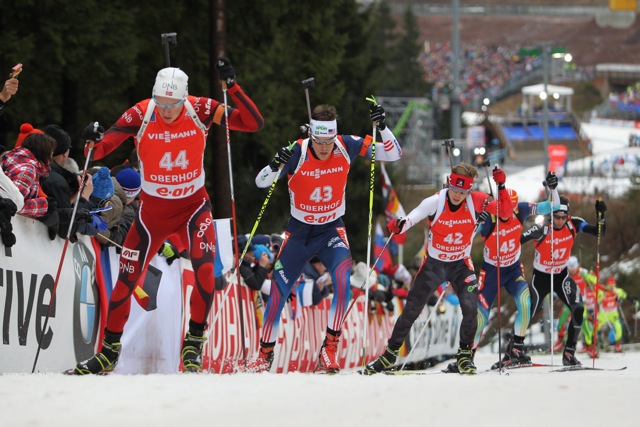
    Macx Davies (bib 42) in the thick of things in Saturday's World Cup pursuit, behind Leif Nordgren (USA). Photo: USBA/NordicFocus.
    Macx Davies (bib 42) in the thick of things in Saturday’s World Cup pursuit, behind Leif Nordgren (USA). Photo: USBA/NordicFocus.

    Of all the places to make your World Cup biathlon debut, Oberhof, Germany, isn’t one of the easier ones. It’s known for it’s bad conditions: fog, wind, rain, and no snow. And being in Germany, the heartland of biathlon, the fans are many, and they are loud.

    It’s a particularly big adjustment if you’re from North America, where there are basically no fans for this sport at all.

    “On the finishing loop I kept thinking there was someone behind me because the cheering was pretty loud, but it was cheering for me, and I was not expecting that,” Canada’s Macx Davies told FasterSkier about Friday’s World Cup sprint in Oberhof, his very first start at the sport’s highest level. It was quite a debut, as he missed two shots and placed 42nd, earning a spot in the next day’s pursuit.

    With the newly-nominated Olympic team sitting out this weekend of racing so that they can gain some extra training time at home, Biathlon Canada had a unique opportunity with this weekend’s competitions: they gave the starts to their current second-tier squad, earning a few IBU Cup veterans a consolation glimpse of the big stage and, more importantly, introducing some rookies to the circuit for the first time.
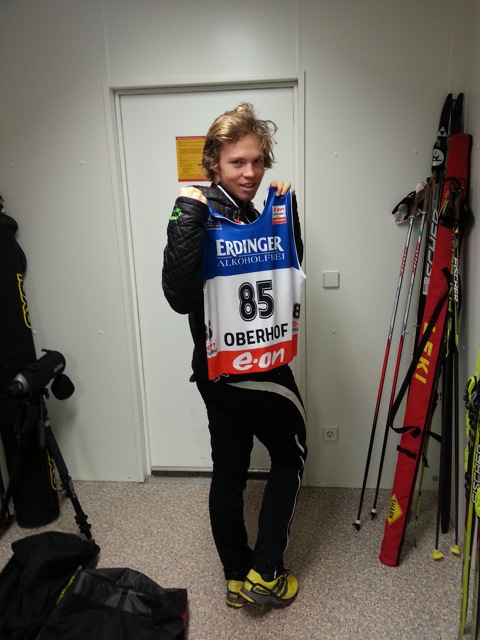
    Davies showing off his first World Cup bib. Photo: Roddy Ward.
    Davies showing off his first World Cup bib. Photo: Roddy Ward.

    “The purpose of the tour was to create experience at the World Cup level, in particular those athletes we are grooming for 2018 and beyond,” development coach Roddy Ward wrote in an e-mail. “We believe it is important for our athletes to know where they are against the athletes at the ‘next level’, when they are ready. This helps them develop and improve, maybe even as important as training itself.”

    Hence, Davies – who just turned 21 and placed eighth in the individual race at World Juniors last season – was out there connecting with the German fan base.

    The group wasn’t entirely without leadership: Marc-André Bèdard is a 2010 Olympian with a wealth of World Cup experience, and his girlfriend Claude Godbout has a much more extensive IBU Cup resumé of IBU Cup racing than her younger teammates, along with World Cup starts from Maine back in 2011.

    “It was great to have Marco here with the team,” Ward said of Bédard. “Marco has raced here before and has had many WC starts. He provided a lot of good insight and mentorship to the young athletes.”

    Rookie Breakthrough

    Bédard, however, didn’t get the chance to show his best stuff. He crashed in the sprint and was out of the pursuit, a tough blow after top-10 IBU Cup performances earlier this season.

    “I crashed hard, breaking, my ski, pole, ripping my suit and my face… and my ego… I was seeking redemption here but it crashed my face instead,” he wrote in an e-mail. “I’m not sure about [whether it was a] concussion, but I’ve had them in the past and this time I did not lose memory, so that’s a good sign.”
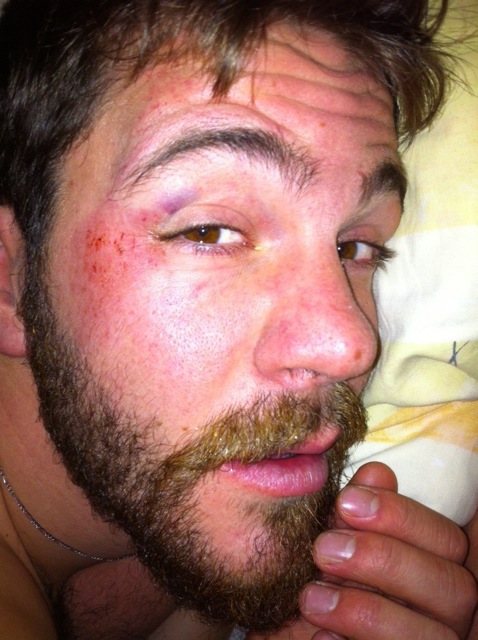
    Bedard showing off his bruises...
    Bedard showing off his bruises…

    So, with Bédard out of the picture, it was up to Davies to represent the Canadian men (Matt Neumann was also on the squad, but did not start Friday’s race). He quickly found himself in the thick of things.

    “I started the sprint in front of [German star] Andreas Birnbacher, so there was a lot of noise coming into my first shooting because he was 15 or 20 seconds behind me,” Davies said. “So there was that, and then a very loud cheer when he shot clean and left the range, for sure. Besides that, I just caught glimpses of him throughout the race. It was nice to know that I was skiing somewhat on par with him.”

    Davies had a good feeling about his ski speed, based on Olympic trials before the squad left the country. Although he hadn’t shot well in those races, his skiing kept him in the mix and compared well with the men who had just come off the World Cup, like Brendan Green.

    Ward called Davies’s skiing “particularly impressive”, and the result was thanks in large part to an aggressive last lap, with the 33rd-fastest time over the final 3.3 kilometers out of anyone in the field.

    In Saturday’s pursuit, however, Davies had a good start but couldn’t turn in anything quite as fast. It was also a very different type of racing.

    “It was less than ideal to miss a couple on the first bout, for sure,” Davies said of missing two shots right off the bat. “That makes it hard to come back. It was challenging, just trying to stay with everyone on the skis and knowing that where I could make the most improvement on placing was on the range – it definitely put a bit more pressure on the first shooting.”

    Davies ended up with four penalties total and a 54th-place finish.

    “Macx delivered a solid first World Cup pursuit,” Ward wrote. “It really is a very different race environment than anyone is used to who are not World Cup regulars.”

    Getting the Picture
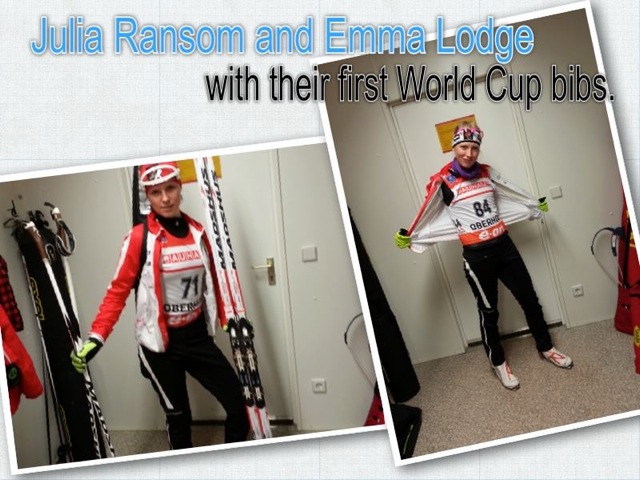
    Lodge and Ransom with their bibs. Photo: Roddy Ward / Eat Sleep Train.
    Lodge and Ransom with their bibs. Photo: Roddy Ward / Eat Sleep Train.

    In the women’s races, Godbout showed her experience and led the women with 52nd place in the sprint, going on to place 55th in the pursuit. Audrey Vaillancourt, a member of the 2013 World Championships team, placed a heartbreaking 61st in the sprint, missing the pursuit by one spot.

    Emma Lodge and Julia Ransom had their first World Cup starts in the sprint, and were unable to turn in Davies’s kind of success.

    “The race wasn’t really what I had hoped for – I was excited and ready to go but struggled with shooting,” Ransom wrote in an e-mail. A World Juniors silver medalist in 2012, she missed two shots in prone and three in standing for 50% shooting overall and 82nd place.

    “While it certainly wasn’t the race that I wanted to have, it was an excellent learning experience and I am looking forward to my next start,” agreed Lodge, who missed four shots total and placed 83rd just behind Ransom.

    But even if these rookies didn’t stun with their results, they accomplished the other goals that Ward set out: seeing what level they need to be at when they hit the World Cup for real, and learning how to deal with the trappings of the big stage.

    “Racing my first world cup in Oberhof was an amazing and inspiring experience that I won’t soon forget!” Lodge wrote in an e-mail. “Although the crowds were loud, especially when the Germans were around, I tried to use that energy to my advantage instead of being intimidated but I’ll admit to being a little starstruck at times… I kind of feel like I’ve been preparing for this start since I started biathlon when I was a little kid.”

    Ransom echoed her sentiments.
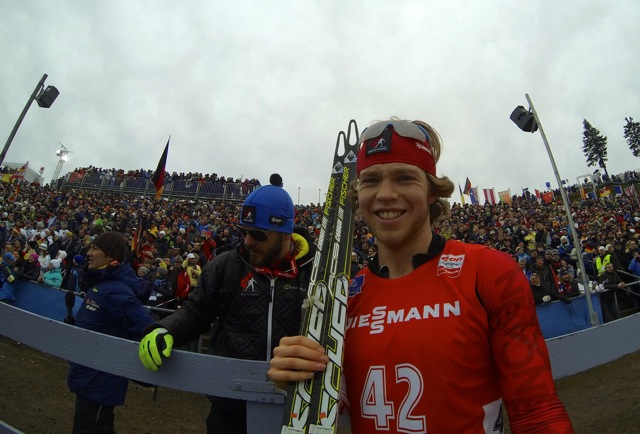
    Davies at the pursuit. Photo: Marco Bedard.
    Davies at the pursuit. Photo: Marco Bedard.

    “It was such an amazing experience!” she gushed. “This race was truly a step up in professionalism and excitement.To race along side the world’s best was very humbling. What struck me the most were the fans. I knew Oberhof was popular venue, but I had never before heard 30, 000 people cheer all at once before! And if you happened to come in with a German athlete, the crowd would become louder with each shot, or make a disappointed sigh for each miss. A good test of focus.”

    The athletes had clearly thought about how to deal with all of the sensory overload, and how to keep it from interfering with their races.

    “I guess that going into it, it came into my mind that, well, this is the World Cup,” Davies said. “It was making me nervous and excited, and a lot of emotions. But getting down to it I was thinking of it as just a race to do, and not who I’m racing and where I am.”

    For Ransom, it wasn’t that tough to block out individual cheers. It was more the wall of noise that was new.

    “I thought the crowd would be a distraction for me but it was so loud that it turned into white noise,” she wrote.

    After a Taste, Back to Work

    Next weekend in Ruhpolding, the regular World Cup squad will hit the trails again and this squad will have to make do with IBU Cup starts. It will be a letdown in some ways, but a relief in others.

    “I think it will seem very, very, very quiet,” Davies laughed. “I still can’t get over how loud the fans were here. But I think it will be good because it’s not too much of a step down in competition, but enough that it makes it more exciting to be fighting for top 20 or top 10 rather than just making the pursuit.”

    Ward, who had actually never coached at a World Cup before, believes that this weekend’s races gave his athletes a little more motivation to deliver results at the second-tier race series.

    “It was a lot of fun and a great experience,” Ward wrote. “I don’t think I could ask for a better introduction than Oberhof. All the fans and noise is really something to see and hard to describe…. I’m quite certain everyone will be working hard to get back to the World Cup sooner rather than later!”

    international race reports: sprints / pursuits

    results: men’s & women’s sprints / men’s & women’s pursuits
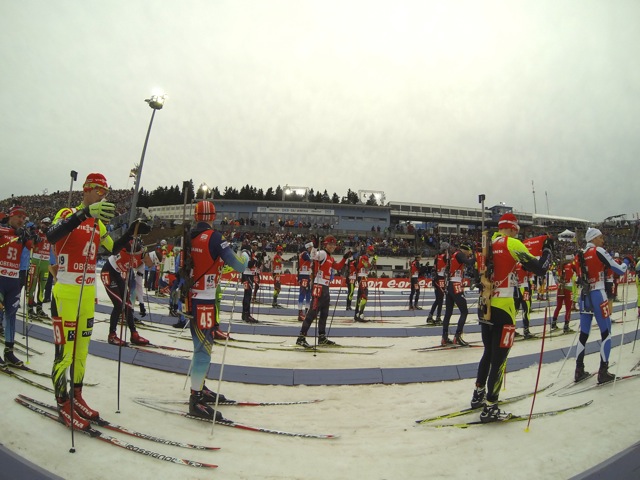
    Davies (center) at the start of the pursuit. Photo: Marco Bedard.
    Davies (center) at the start of the pursuit. Photo: Marco Bedard.
  • Led By Ransom’s 15th, Five Canadian Women Improve in Youth and Junior Pursuits

    Led By Ransom’s 15th, Five Canadian Women Improve in Youth and Junior Pursuits

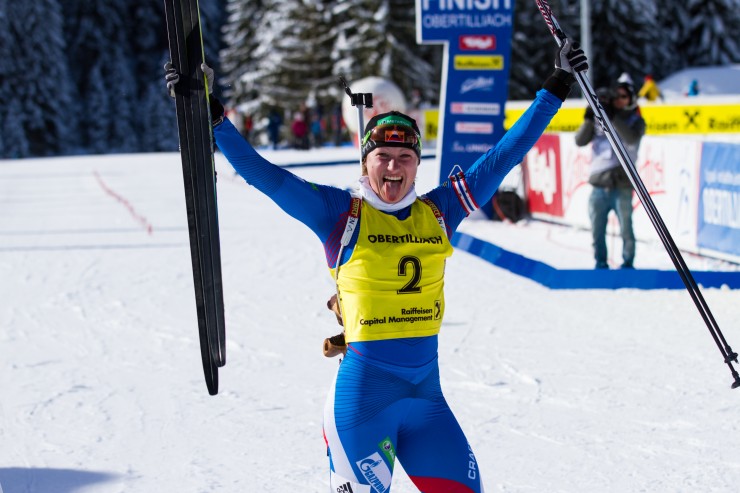
    Olga Podchufarova (RUS) after winning the junior women's pursuit. Photo: Mario Danzl/Obertilliach 2013.
    Olga Podchufarova (RUS) after winning the junior women’s pursuit. Photo: Mario Danzl/Obertilliach 2013.

    With Sean Doherty stealing the show in the youth pursuit, there was plenty for North America to be excited about in the third day of racing at World Youth and Junior Championships for biathlon in Obertilliach, Austria.

    “It was great day for all of us here and biathlon fans,” Doherty’s coach Algis Shalna wrote in an e-mail to FasterSkier.

    But with the gold medal heading to the United States, it was perhaps easy to forget that the youth men were actually the fourth group to race on Sunday, and there were many other strong North American performances before that. Canadians Stuart Harden, Julia Ransom, and Christian Gow each scored their second top-20 finish of the Championships, while American Casey Smith had a phenomenal pursuit, jumping up about 20 places based on strong shooting.

    * The first race of the day was the youth women’s 7.5 k pursuit, where Uliana Kaisheva of Russia thoroughly crushed the field, expanding her lead from the sprint into a 1:15 victory over Galina Vishnevskaya of Kazakhstan despite four penalties.

    This race generated the least buzz for the U.S. and Canada. Both teams had big hopes in this division, with U.S. biathlete Anna Kubek and Canadian Sarah Beaudry coming off strong seasons last year that included trips to the Youth Olympic Games.

    After placing 34th and 36th in the sprint, the pair broke into the top 30 in the pursuit, with Kubek moving up to 25th with just two penalties in the 20-shot race. Beaudry improved to 28th with one more penalty.

    “Sarah Beaudry is still young, but she has been to this last year and she also went to the Youth Olympics last year,” Canadian team leader and Biathlon Alberta Training Centre Head Coach Richard Boruta told FasterSkier. “She is still fighting with jet-lag and not feeling best on skis. The expectation is that she will possibly improve her ranks as the week will move on.”

    * Next up were the junior women. While no Americans qualified for the 60-woman, 10 k pursuit, Canada was impressive in placing all four of its team members in the race. Furthermore, all four improved.

    They were led by Julia Ransom, who started in 16th position after the sprint. With a penalty early and then two clean stages, she moved into the top ten before slipping back to 15th after two missed shots in the final standing stage.

    Ransom was ultimately 3:09 behind the winner, Olga Podchufarova of Russia, who swept summer biathlon World Championships this past season and won by 17 seconds after sprint winner Laura Dahlmeier of Germany collapsed in the final stage, missing two shots to Podhufarova’s one. It was still a good day for Germany, though: Franziska Preuss earned bronze and Vanessa Hinz was fourth.

    After earning silver in the youth pursuit last year, Ransom was up against some tougher competition this time around.

    “The competition in Junior seems to be a little more competitive than Youth,” she wrote in an e-mail. “There are a lot of fantastic athletes looking to make it to IBU/World Cup and you can tell they are hungry! I was happy with my race both yesterday and today. I thought my shooting was solid in the sprint and may have lost a little focus in my pursuit (missed 2 on last bout). The sprint was a good wake up for my legs as I felt a lot better skiing today.”

    Boruta, who coaches Ransom year-round in Canmore, said that her races so far were solid performances.

    “Performance wise, I think Julia and Christian [Gow] as first-year juniors are right on target, they didn’t have any extraordinary races, but they did perform at the current level of their abilities and this is were they are in the world right now,” he wrote in an e-mail.

    Emma Lodge and Rose-Marie Côté started 41st and 43rd, and improved a few places to 36th and 38th. But they couldn’t actually work as a team as they moved up on the trails.

    “Rose and I both started in the wave start 4:00 min behind the leader, but didn’t spend much time together as I only hit 3 on the first prone when she cleaned so I spent much of the race playing catchup,” Lodge explained in an e-mail. “It wasn’t until the last lap when I left the penalty loop just ahead of her that I saw her again, so that was helpful having her chasing me down to the finish line!”

    Lodge had five penalties after that frustrating first stage, while Côté limited herself to three. She had climbed up to 33rd before taking two penalties in the final stage; both were over seven minutes behind Podchufarova, having lost an additional three minutes in the pursuit.

    “Today’s race felt better than yesterday, with more spark in my skiing,” Lodge wrote. “I guess I needed a really hard effort to get my legs going! My prone was a bit off today which is frustrating as usually I can count on it, but I am happy with my 8 standing hits. We have two days off before the Individual on Wednesday and I’m feeling really prepared for the next races as I had a great training season and both my skiing and shooting improved. I’m excited for the next races, it’s awesome racing here under the sun and with so many competitive athletes around.”

    Erin Yungblut, the only one of Canada’s junior women to come to Obertilliach as a first-timer on the international scene, improved from 59th to 52nd with four penalties.

    Results: youth women / junior women

    continued with men’s reporting here.


  • Elena Ankudinova, the Russian Nobody Expected, Picks Up First World Juniors Win in Kontiolahti Sprint

    Elena Ankudinova, the Russian Nobody Expected, Picks Up First World Juniors Win in Kontiolahti Sprint

    Canada's Emma Lodge and U.S. biathlete Kimberly Del Frate on course in Kontiolahti. Photo: Judy Geer.

    Despite the presence of several former champions in the field, a new gold medalist rose to the top at biathlon’s World Youth and Junior Championships in Kontiolahti, Finland on Saturday: Elena Ankudinova.

    The diminutive Russian was perfect on the range and collected an eight-second victory in the junior women’s 7.5 k sprint. She bested, among others, Tuesday’s individual champion, Chardine Sloof of the Netherlands; last year’s youth individual champion, Thekla Brun-Lie of Norway; and teammates Elena Badanina, who won both the youth sprint and pursuit in 2010, and Olga Galich, that year’s youth individual champion, who also tied for the youth sprint title in 2009.

    It may not have had quite the story of Sloof’s first-ever Dutch victory earlier this week, but Ankudinova’s dominance was definitely a surprise. This is her first trip to the Championships, and after finishing 17th in the individual race she hadn’t even been selected for Russia’s relay team on Thursday.

    Ankudinova told the IBU that her win was a relief to the whole team. The Russian women had previously received only one medal in these Championships, a third-place finish by Badanina in the individual, and both their youth and women’s teams placed fourth in the relays.

    The team tripled their medal count on Saturday, with Margarita Phillipova taking home bronze 16 seconds behind Ankudinova. The teammates were separated by Anais Chevalier of France, who told the IBU after the race that she has gold in her sights on Sunday’s pursuit.

    And looking back? Perhaps the Russians wish they’d put Ankodinova on the relay team, after all.

    Vaillancourt 16th for Canada

    Keely MacCulloch en route to 40th place. Photo: Judy Geer.

    For the second time this week, Audrey Vaillancourt led the Canadian contingent with a result in the mid-teens. After finishing 15th in the individual race, the Quebec City native almost repeated her performance in the sprint, placing one spot down the ladder in 16th. Vaillancourt had a single penalty and finished a minute and a half behind Ankudinova.

    “I indeed had a very good race today,” Vaillancourt wrote in an e-mail. “My plan was to have a strong start and try to keep that pace all the way through the race, so I had a very fast first lap. Unfortunately in my last lap I couldn’t push the pace any faster, so I just made my way to the finish line with the very little energy I had left! It was worth going as fast as possible from the beginning though; every second counts in a sprint.”

    Vaillancourt’s penalty came in her prone stage, but she said the error did not affect her confidence, and that she was pleased with only a single penalty.

    Emma Lunder and Keely MacCulloch placed 39th and 40th, just over three minutes out of the win. Canadian coach Richard Boruta said that “the current ski speed is not quite where it needs to be for this level of competition.”

    But the result was actually a strong showing for MacCulloch, for whom this is the first international race trip.

    “It has been such an exciting experience,” MacCulloch told FasterSkier. “Honestly I didn’t have a clear goal set up for World Juniors because I was just thrilled that I even made the team. Finishing in 40th place today was exhilarating especially since I wasn’t able to race the relay, not to mention I moved up ten places from the individual.”

    After the individual race, where she placed 50th, MacCulloch did have a tiny bit of experience to draw on, and used it to stay focused. Like Vaillancourt, she ran out of gas on the last loop.

    “I left the penalty loop ahead of several of my competitors and tried to ski as fast as I could for the last lap… I think most of those I’d left in the range caught up to me on the downhill,” MacCulloch said. “The course has one long, steep hill that competitors must go down and then back up. Going up that hill the final lap as fast as I could was extremely tiring, and I do wish I could have pushed myself a bit harder.

    “However it was still a terrific experience and I’m so glad it went as well as it did.”

    Emma Lodge will join the team in the pursuit after placing 56th.

    Tough Day for U.S. Women

    Kimberly Del Frate racing down the finishing stretch. Photo: Judy Geer.

    The Americans were dismayed that, Kelly Kjorlien, who had placed 39th in the individual race, encountered major equipment problems and had to drop out of the sprint.

    “Our top athlete Kelly Kjorlien’s rifle started malfunctioning for prone shooting, and then stopped firing during standing,” said U.S. coach Algis Shalna. “Kelly had to stop the race. The biggest disappointment for Kelly and us was that she is not in the pursuit now, and competition is over for our top junior woman.”

    The other U.S. entrants were Alaskan twins Kimberly and Amanda Del Frate, who missed four and five shots to place 55th and 60th.

    “We do not consider it a big success to just to make pursuit, but for them being their first time at Worlds, it’s a respectable performance,” Shalna said.

    Kimberly Del Frate told FasterSkier that her experience so far had been “eye-opening.”

    “I guess for today’s race you could say I’m not unhappy with my shooting because it could have been worse, but it also could have been better,” she said. “I try to take each race as it comes and not stress the small things too much. Biathlon being what it is, you can’t really focus too much on what has happened or what you want to happen. You just have to trust your training, be confident, and focus only on what you can control. That’s really all you can do.”

    Full results

    Vaillancourt leading Amanda Del Frate. Photo: Judy Geer.
  • Norway Sweeps World Junior Biathlon Relays; Canada’s Junior Men Are Best Shots in Field, Race to Sixth Place

    Norway Sweeps World Junior Biathlon Relays; Canada’s Junior Men Are Best Shots in Field, Race to Sixth Place

    Marion Rønning Huber crosses the finish line for Norway's 16-second victory in the junior women's relay carrying her nation's flag. Photo: Judy Geer.

    In the opening junior men’s race of biathlon’s World Youth and Junior Championships in Kontiolahti, Finland, Canada’s Kurtis Wenzel used near-perfect shooting to demolish the field and collect his second world championship title. His teammates, however, were less successful, shooting 80%, 60%, and 40%.

    “After the individual race I was a little bit down,” said Maxc Davies, who had missed 12 shots and placed 72nd.

    How things change. In Thursday’s junior 4 x 7.5 k relay, the team came together on the range and turned in the best performance in the field, using a total of four spare rounds in 80 shots and completely avoiding the penalty loop. Wenzel missed two of those four shots, while Davies and Jasper Mackenzie missed one apiece and Aaron Gilmor stayed perfect.

    Wenzel starting out the anchor leg of the relay. Photo: Judy Geer.

    The Canadians’ sharpshooting, matched with solid performances on skis, netted them sixth place in the relay and put them three and a half minutes behind the winning Norwegian team. Surprisingly, the victory was something of a landmark for Norway; despite their several overall World Cup champions in the last several years, they hadn’t won a junior men’s relay since 1977.

    The sixth-place finish was not quite as historic for Canada, although coach Richard Boruta still believed it was significant, saying “It seems that this was one of the best relay performances in a long time in this category for Canada.”

    The finish was the best for a Canadian men’s squad since Wenzel, Gillmor and Scott Gow teamed up for second place in the youth division in Canmore in 2009. The last time a junior relay team did as well was when Marc-Andre Bedard, Yannick Letailleur, Maxime Leboeuf, and Brendan Green placed third in 2007.

    “It was a very good race for the junior men,” Boruta wrote in an e-mail. “They all did their very best and there wasn’t much more that they could have done.”

    The Canadian team gives the thumbs-up at the podium ceremony. Photo: Richard Boruta.

    The hero of the day was Davies, who told FasterSkier that his scramble leg was “one of the best races I have put together on the international stage.”

    After cleaning his first stage effortlessly and then using a single spare round in standing, Davies was sitting in fourth place. A charge on the final 2.5 k loop moved him up to third, just 33 seconds behind the Russians, who were leading at the time (and ultimately finished third).

    “I was very excited to be starting the relay,” Davies said. “I’ve always loved mass starts, working through the chaotic first few kilometers and getting to shoot with all the other athletes. I was a bit nervous for the standing shooting, but to only use one spare is still a good result and I could not stop smiling after tagging Jasper Mckenzie in third position.

    “At that point I knew I had done the most that I could have, and now it was up to my teammates.”

    They didn’t let him down. First-time World Juniors competitor Mackenzie dropped the team to eighth, but was skiing in a group of other racers.

    “Jasper tried his best and it was probably one of his best races in his life,” Boruta said. He has never had before the opportunity to compete in such a strong field, and he was handling it well.”

    Ethan Dreissigacker, scramble leg for the 14th-place U.S. team. Photo: Judy Geer.

    Perfect shooting from Gillmor moved the Canadians up to sixth, a position that Wenzel was able to maintain as the anchor leg.

    Gillmor said that Davies’ success as the leadoff skier gave him an added boost.

    “I felt confident seeing how Macx had improved his position, and that also told me that the skis were running very well,” he wrote in an e-mail. “As for the podium (and even tagging off in the podium) I try to stay focused on what I can do, however it is nice knowing that if everything goes well we can fight for a podium.”

    Davies and Gillmor both said that they had spent time working with coach Martin Tremblay to improve their shooting after the individual races; Gillmor worked not only on his accuracy but also on his shooting speed, which he said had held him back in the opening race.

    For Davies, a good relay result was the perfect cure for a case of the blues after Tuesday’s frustrations.

    “I managed to regain confidence in my shooting at training on Wednesday,” he explained. With a few wise words from my coaches and some time spent pondering myself, I got around the poor first performance to bring my best out for the team event. luckily all our team managed to put together good performances to land us in sixth.”

    * * *

    Kelly Kjorlien kicking things off for the U.S. women. Photo: Judy Geer.

    The Canadian junior women didn’t have as much success on the range, using 11 spare rounds and skiing three penalty loops en route to 14th place in their 3 x 6 k relay. The finished 6:47 behind the winning Norwegian team.

    “Today was a frustrating race for our team,” anchor leg Emma Lunder wrote in an e-mail.

    But despite the poor shooting, she said that the team actually skied well, and that the performance gave made them optimistic for the upcoming sprint and pursuit races.

    “During my leg of the race I was really able to relax and let my skis glide, and at the same time found myself able to push a lot harder than during the individual,” Lunder explained. “Our wax techs did an extremely great job with the skis, and all three of us were flying on course. The relay was definitely disappointing for our team, because we knew that if we had all had regular races we could have a good result, but it was beneficial for us to do another race on this course to work out the kinks, and I think it will allow us to make some small adjustments that will help us in the races to come.”

    The U.S. men and women finished 14th and 18th.

    Results: junior men’s relay / junior women’s relay

    Canada's Emma Lodge (number eight) fighting it out in the mass start. Photo: Judy Geer.