From the FasterSkier archive — posts syndicated from athletes’ and coaches’ own blogs between 2004 and 2012, kept online as published. Current coverage is at fasterskier.com.
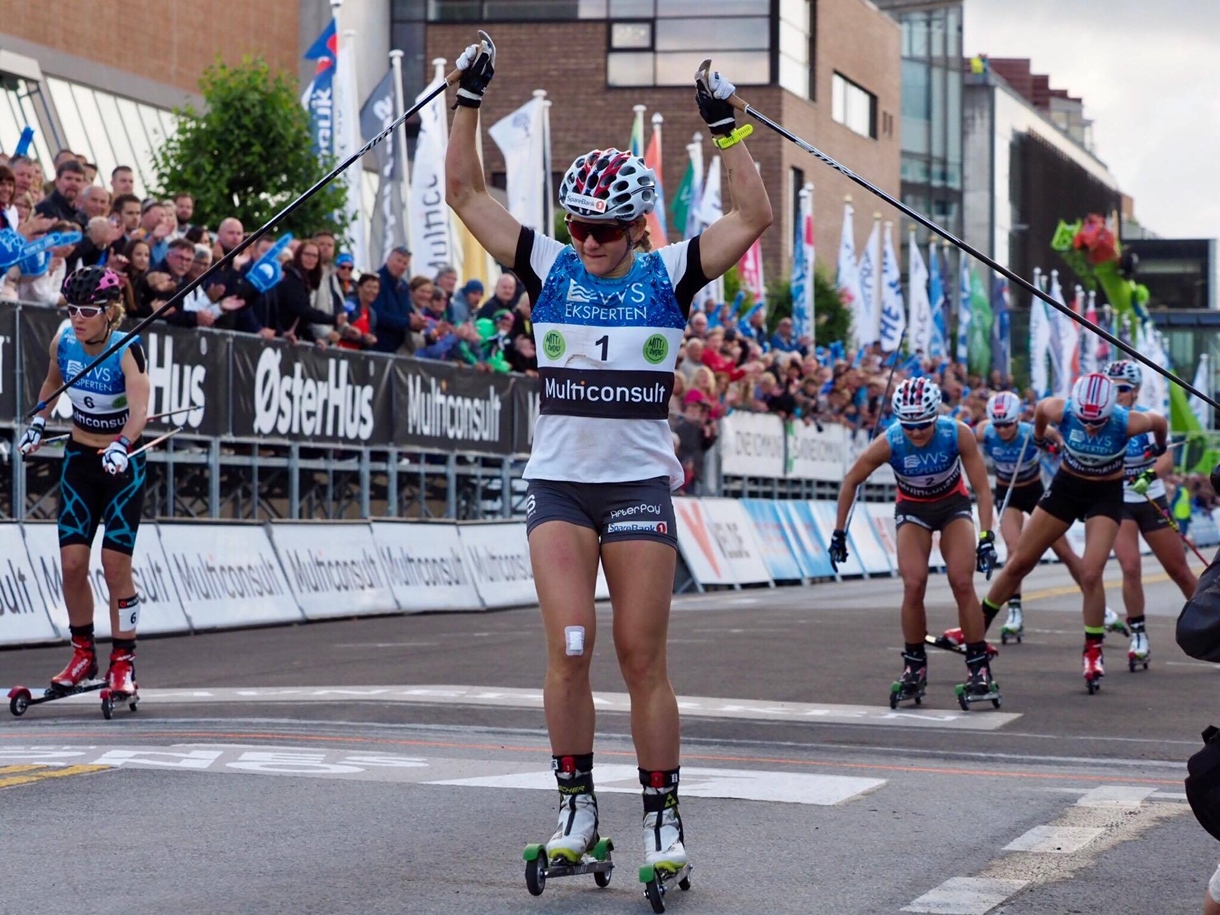
Norway’s Maiken Caspersen Falla celebrates across the line after edging out Russia’s Natalia Matveeva and her Norwegian teammate Ingvild Flugstad Østberg in the women’s cross-country sprint on Saturday at the 2017 Blink Skifestivalen in Sandnes, Norway. (Photo: Axelar/Ørjan Dalseth)
The fans in the well-filled stands of the 1-kilometer rollerski city course in Sandnes, Norway, had many reasons to cheer loudly on Saturday, as their local heroes claimed victories in all four sprint events that concluded the 2017 Blink Skifestivalen (Ski Festival).
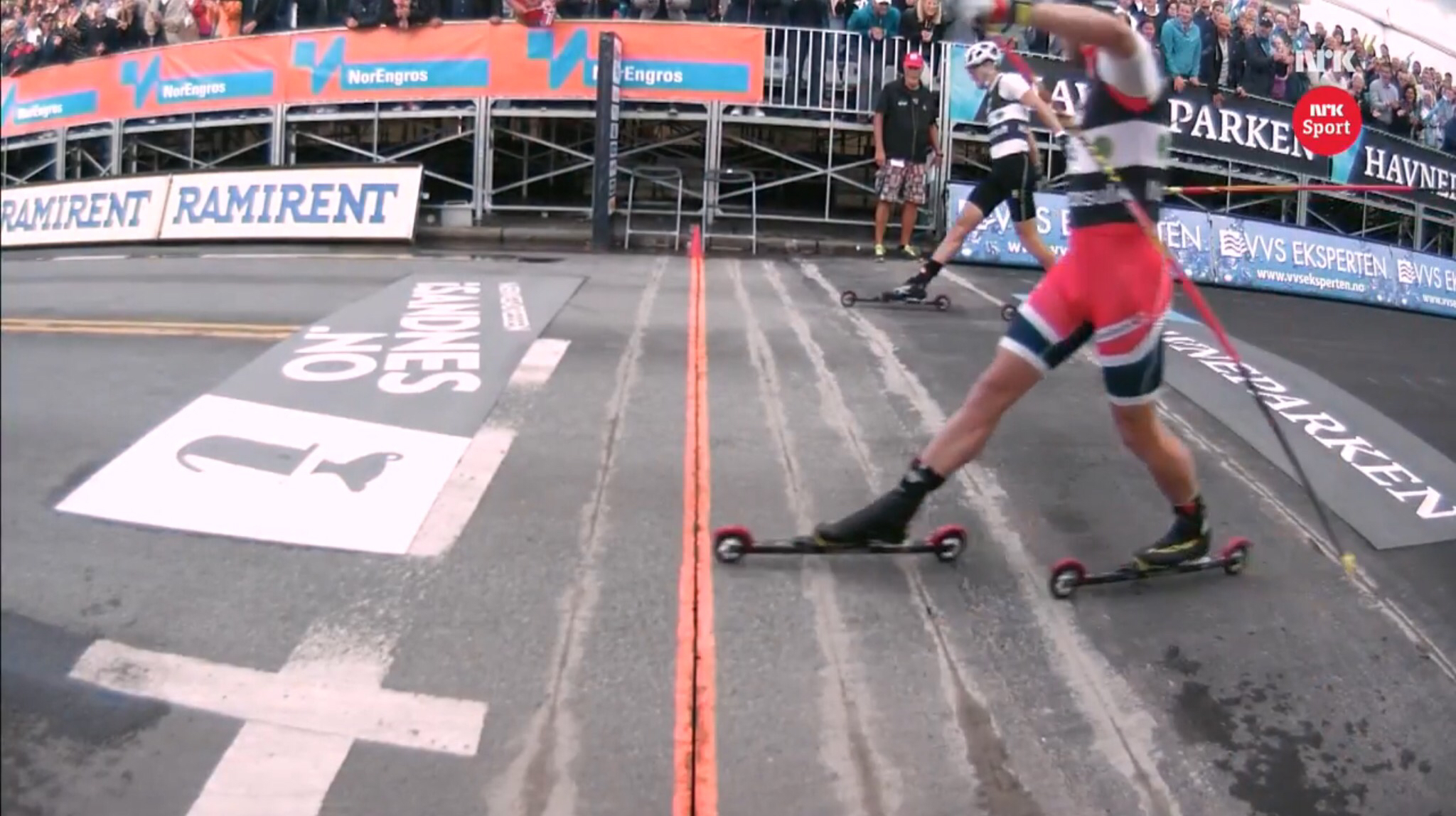
In the final race of the day, the men’s cross-country sprint was decided by the length of a rollerski, with Norway’s Sindre Bjørnestad Skar crossing first, just 0.1 seconds ahead of Sweden’s Teodor Peterson. Skar took the win with a time of 3:27.6 minutes after two laps around the flat course, which featured two short climbs over a ramp and a bridge. The third place on the podium went to Kasper Stadaas, also of Norway, 1.9 seconds out of first.
Norway’s Sindre Bjørnestad Skar (front) lunges across the line ahead of Sweden’s Teodor Peterson in the men’s cross-country sprint at the 2017 Blink Skivestivalen on Saturday in Sandnes, Norway. (Photo: NRK screenshot)
Second in Friday’s mass start, Skar advanced through the rounds on Saturday with narrow victories in his quarterfinal and semifinal as well. Last season, Skar won a World Cup at the freestyle sprint in Toblach, Italy, and achieved two other podiums. He raced to third in the sprint qualification at the World Championships in Lahti, Finland, and went on to finish 13th.
Andy Newell of the U.S. Ski Team (USST) was the lone North American starter of the day, and his run ended in the quarterfinal heats when he crossed the line in third, 1.1 seconds behind Norwegians Sondre Turvoll Fossli and 0.3 seconds behind Sivert Knotten. In an Instagram post, he mentioned breaking three poles in three races he competed in at this year’s Blink. He finished 16th in the 60 k classic and 18th in the 15 k freestyle mass start.
In the women’s cross-country sprint, a number of the last season’s top sprinters contended for the podium. Reigning Sprint World Cup champion Maiken Caspersen Falla emerged with the victory in the final with a time of 3:49.6 after keeping her challengers at bay in the long finishing straight. Russia’s Natalia Matveeva placed second (+0.8) and another Norwegian Ingvild Flugstad Østberg took third (+1.1).
Earlier in the day, Falla won her semifinal, after she advancing from her quarterfinal with a wildcard. Originally Falla had finished the heat more than 30 seconds back, following a spill from which she emerged with a slightly bloody right knee.
“Suddenly the asphalt was there,” Falla told Norwegian broadcaster NRK, according to a translation. “I am very happy that I was able to protect the face and head… I was really scared. I’m terrified.”
She explained that it had been a long time since her last crash on rollerskis, and that she likely had placed a pole on her own shoe. No other athlete was involved in the incident, and her semifinal heat started with seven athletes.
On Friday, Falla placed third in the women’s 10 k mass start after outlasting the group of skiers she was with in the finishing straight.
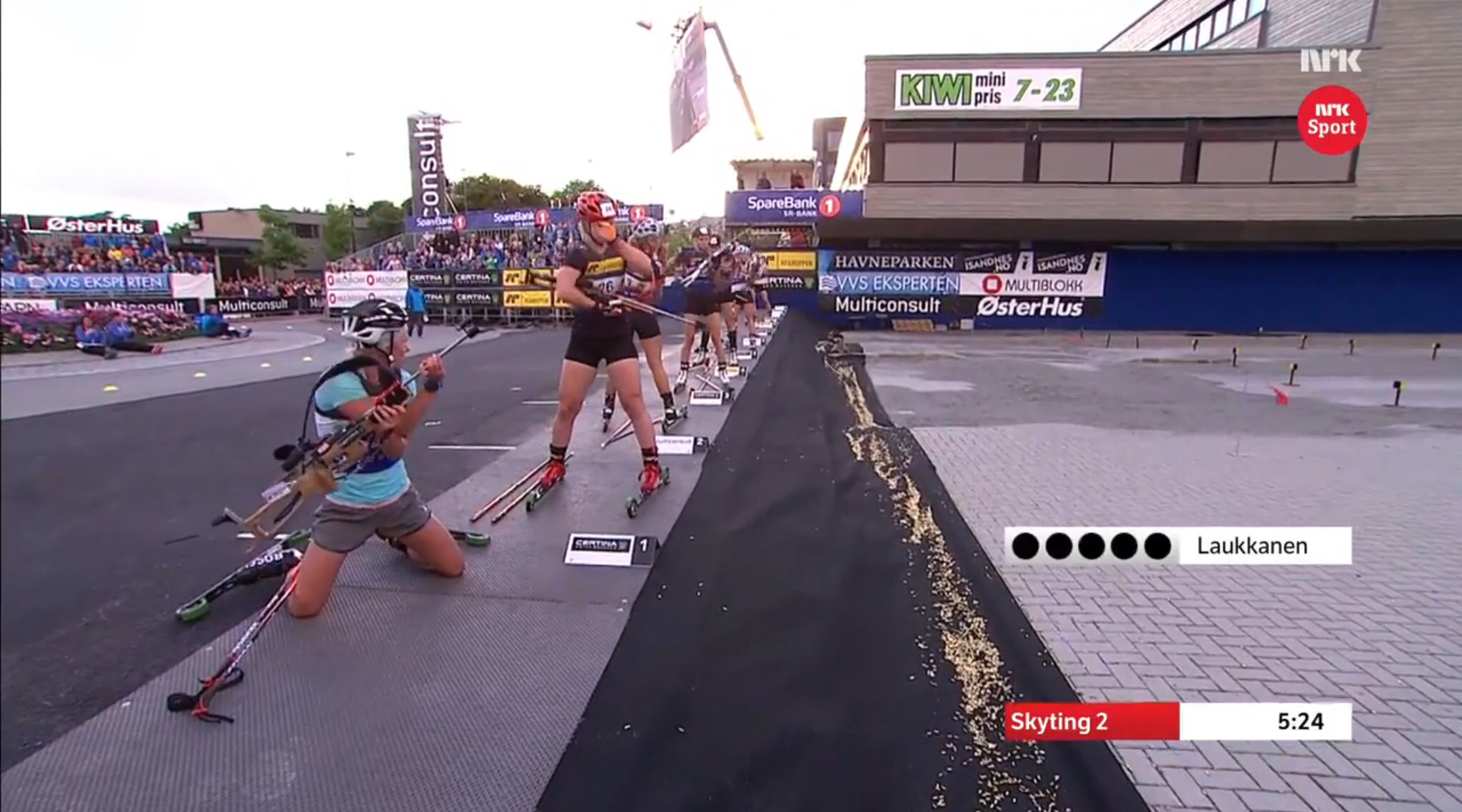
In the women’s biathlon sprint, French veteran Marie Dorin-Habert made a minor rookie mistake while leading when she knelt down on the shooting mat for another prone shooting, before realizing that all her competitors had correctly taken a standing-position stance. Maybe she had assumed that — like the men in Saturday’s sprint format — they also would have to shoot four times.
France’s Marie Dorin-Habert (l) erroneously kneels down to take the prone position in the second shooting stage of the women’s biathlon sprint at the 2017 Blink Skifestivalen on Saturday in Sandnes, Norway. In the lead until that point, she went on to finish third. (Photo: NRK screenshot)
She quickly stood back up, but after incurring a penalty she was overtaken by Sweden’s Hanna Öberg and Norway’s Marte Olsbu. On the final lap Olsbu managed to pass the Swede to claim the victory in a time of 7:57.3 minutes with two penalties, while Öberg finished second (+2.8, with two penalties) and Dorin-Habert third (+5.0, with one penalty) ahead of Sweden’s Emma Nilsson (+9.4, with two penalties).
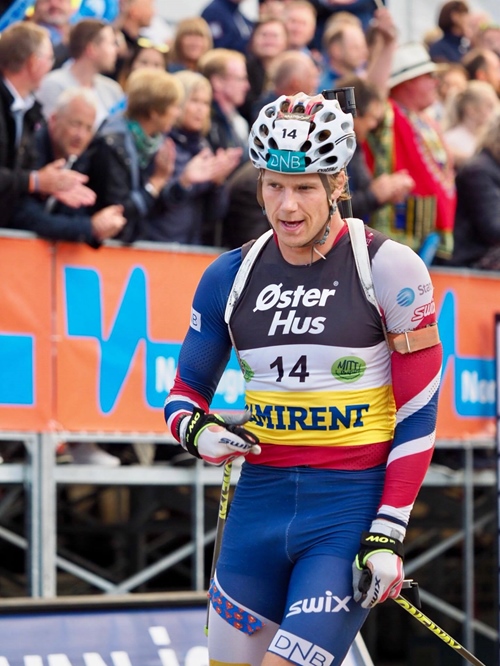
Vetle Sjåstad Christiansen after winning the men’s biathlon sprint on the last day of the 2017 Blink Skifestivalen on Saturday in Sandnes, Norway. (Photo: Axelar/Ørjan Dalseth)
In the men’s biathlon sprint, racers skied four loops and shot in four stages. Coming into the final shooting stage, Norway’s Lars Helge Birkeland and Vetle Sjåstad Christiansen, along with France’s Simon Fourcade, had created a small gap to the rest of the field. While Birkeland and Christiansen hit all their targets, Fourcade had to ski one short penalty lap through a traffic roundabout. Turning sharp left into the finishing stretch, Christiansen overtook Birkeland and pushed hard until the line in a time of 12:09.6 with two penalties, while Birkeland finished 4.6 seconds back in seconds place (with one penalty). Fourcade held onto third place (+16.2, with three penalties) ahead of a chase group.
The excited fans also sang a little birthday tune for Norway’s Tarjei Bø — who turned 29 on Saturday — as he came into the finish in seventh place (+42.2) smiling and waving to the crowd.
No North American biathletes raced at this year’s Blink.
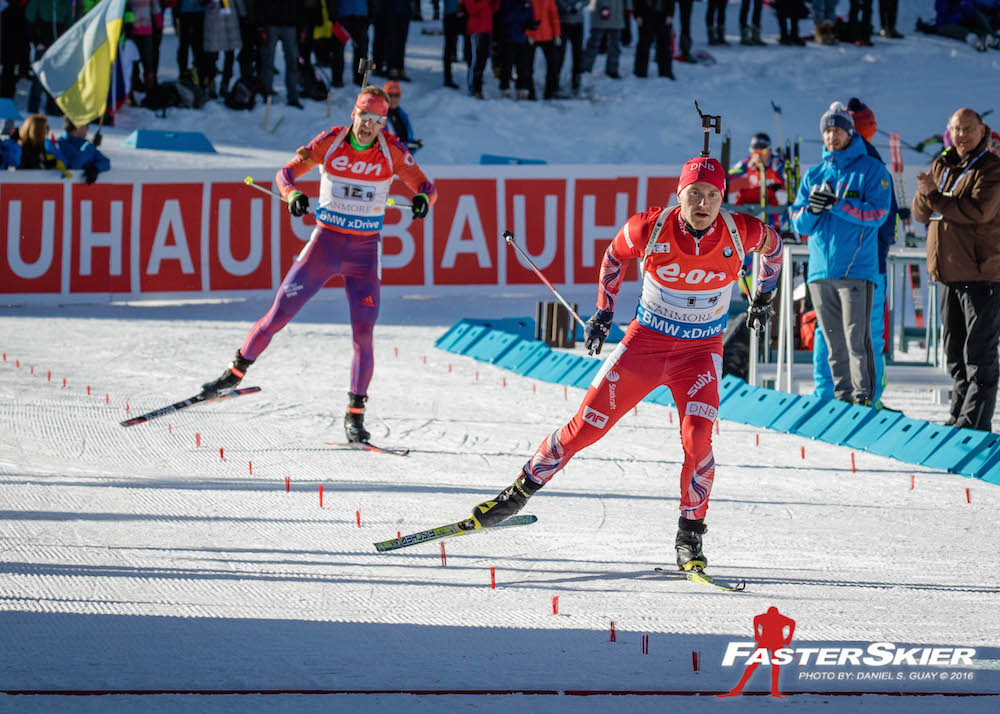
Norway’s Håvard Bogetveit leads American Lowell Bailey into the finish in a race for third in Sunday’s mixed relay at the IBU World Cup in Canmore, Alberta. The U.S. placed fourth for a team best in the event’s 11-year history. (Photo: Daniel S. Guay)
Considering anything better than sixth would have been a first-ever for either the U.S. or Canada in the IBU World Cup four-person (2 x 6 + 2 x 7.5-kilometer) mixed relay, that put Lowell Bailey in a bit of a position heading into the final loop of the last relay leg on Sunday.
Here he was, in fifth with 2.5 k to go, and just three seconds ahead of France’s Quentin Fillon Maillet in sixth and 4.6 seconds behind Canada’s Brendan Green in fourth. In front of both the Canadian and American teams, Norway set out on the final loop in Canmore, Alberta, 16 seconds ahead.
What or whom do you focus on? Should Bailey go for fourth? Should Green try to catch the Norwegian and the final spot on the podium? Or is it best to hold your own and not risk too much?
According to Bailey, a lot was going through his head after emerging from the final standing with clean shooting, thanks to two spares, shortly behind Green, who cleaned both stages without any spare rounds.
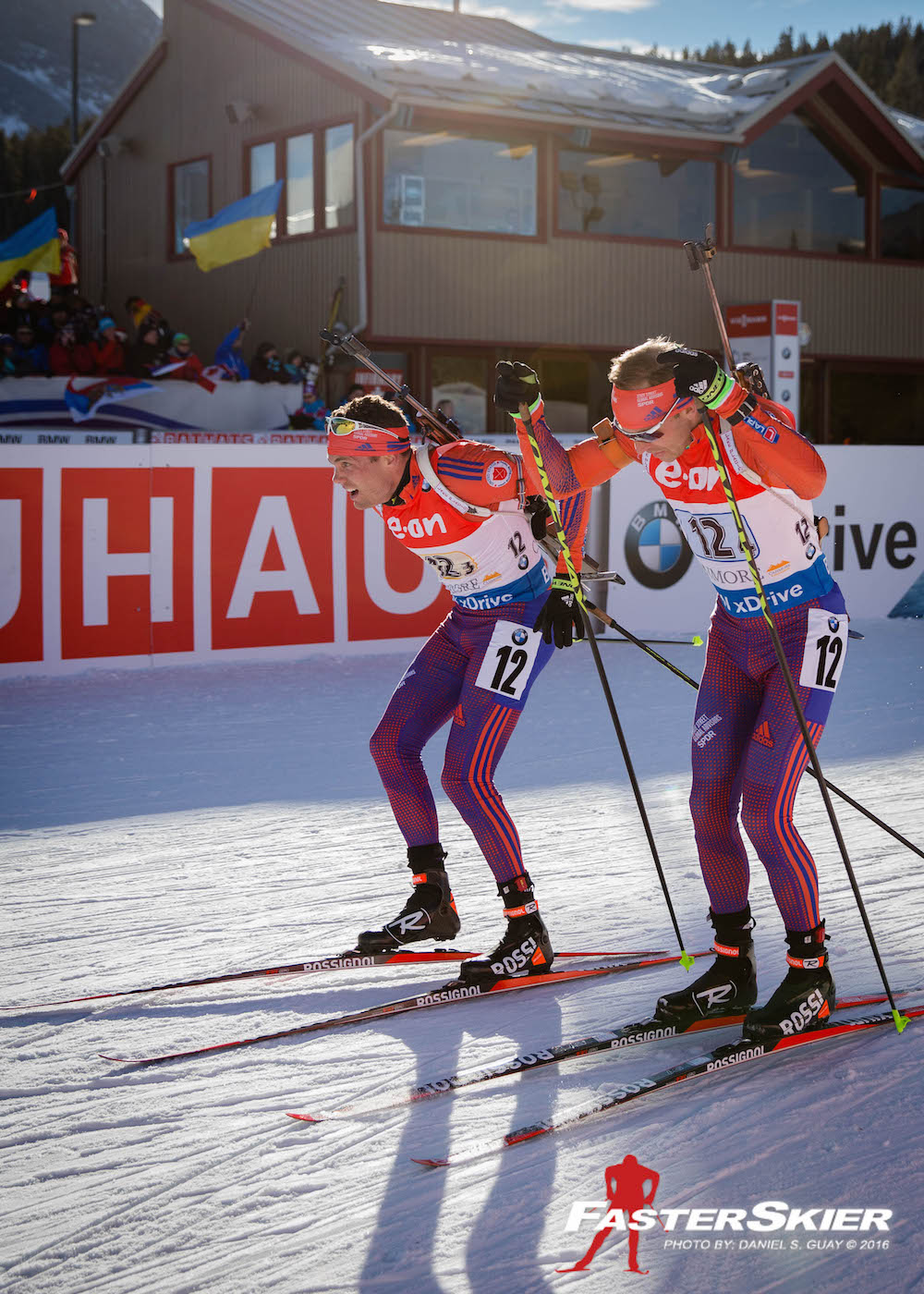
Tim Burke (l) after tagging U.S. teammate Lowell Bailey in fourth, about 36 seconds behind Norway in third, during the last exchange of the mixed relay at the IBU World Cup in Canmore, Alberta. (Photo: Daniel S. Guay)
“To be honest, I know [Fillon Maillet] and I know how good of a skier he is, he’s top 10 in the overall [World Cup],” Bailey said in a phone interview after the race. “So the thoughts going through my head on the last lap was, ‘OK, I’ve got to stay focused here,’ … My goal was to ski the first half of the loop well enough that France wasn’t going to get into my draft.”
The second half of the course was uphill and into the wind, and tactically, a skier able to catch a draft off someone in front of them on that part could be fresher for the last 700 meters to the finish.
In his effort to drop Fillon Maillet and make sure he wasn’t on the losing end of that strategy, Bailey inadvertently caught Green on the second-to-last major climb before the finish.
“It just so happened that I felt pretty good so I just went for it,” Bailey recalled.
After passing Green in fourth, he looked up and saw Norway’s Håvard Bogetveit, a 23-year-old Norwegian B-team member, in third.
“I didn’t see Norway until about halfway up that climb,” Bailey said. “I’m not sure if the Norwegian, if he was tired or what, but it didn’t become clear that there was a chance at third until that last uphill. Our team and ski technicians and coaches and staff were cheering me on and hoping that I could catch that gap.”
Meanwhile, Green, who had been tagged in seventh and climbed into fourth with perfect shooting, started to come undone.
“I really tried to race more aggressive. I had to. After the sprint on Thursday and knowing that my form wasn’t where it needed to be, I knew I couldn’t afford to hold back at all this race,” Green wrote in an email, referring to Canmore’s opening sprint last Thursday, where he placed 40th with one miss. “As for the shooting today I think I was just feeling confident. Canmore is often a very difficult range to shoot on, but I felt that [Saturday] I was really able to get a grasp of the wind while training, and was able to bring that confidence and shooting form into today.
“When I left [the range] in 4th I knew I was going to have my work cut out, especially given the pace of my second loop with France,” Green recalled. “That said, I gave it my all. I started to blow up and just couldn’t maintain the pace, but I think with a bit better form I could have hung on.”
Racing up and over the final climbs and into the finish, Bailey pushed to catch Bogetveit. He came within 1.7 seconds at the finish, but Norway secured the final spot on the podium, 1:23.8 minutes behind the German winners, and the U.S. claimed the so-called wooden medal in fourth. Regardless, it was the best showing for a U.S. mixed relay since its inception, officially at 2005 World Championships.
US Biathlon’s previous best mixed relay was sixth place four years ago at the World Cup in Kontiolahti, Finland, with Jay Hakkinen, Sara Studebaker, Annelies Cook, and Tim Burke. This time around, Susan Dunklee, Hannah Dreissigacker, Burke, and Bailey teamed up for fourth, 1:25.5 behind Germany. (Earlier in the day, Annelies Cook and Leif Nordgren raced the single mixed relay, placing 16th.)
“It didn’t become clear that there was a chance at third until that last uphill. Our team and ski technicians and coaches and staff were cheering me on and hoping that I could catch that gap.” — Lowell Bailey, who anchored the U.S. mixed relay to a team-best fourth on Sunday
“It’s easy to say, ‘Oh man, if I had known, I would’ve skied two seconds faster,’ but I really don’t think I could’ve,” Bailey said of finishing less than two seconds out of third. “I put everything I could have into that last lap. It’s bittersweet, but it’s also our best result ever in the mixed relay. … Fourth is where we ended up, and I think we have to be satisfied with that and keep that momentum going forward.”
Behind him, Green anchored Canada to sixth, 3.6 seconds behind Fillon Maillet, who notched fifth for France (+1:30.7). The result tied the Canadians’ best in a mixed relay after placing sixth in 2011 in Hochfilzen, Austria. Like the U.S., that team only included one of the same athletes from Sunday’s relay — Green — who had teamed up with Megan Imrie, Zina Kocher and JP Le Guellec in 2011. (Julia Ransom and Nathan Smith raced Sunday’s single mixed relay, placing 12th.)
“We’ll get to the podium eventually — it will just be a matter of small consistent steps, nothing drastic,” Green wrote. “The team was awesome today. Everyone did a really great job and set the race up well for the next person. I couldn’t have asked for more from them today.”
Germany in It to Win It
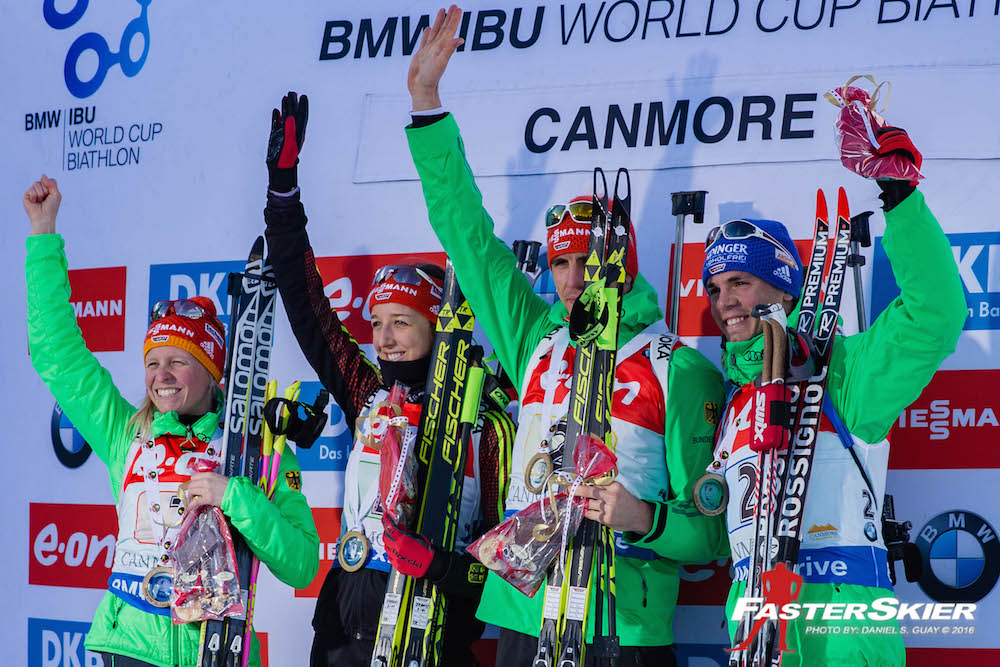
Germany topped the podium with a 1:12.9-minute win in the mixed relay on Sunday at the IBU World Cup in Canmore, Alberta, with (from left to right) Franziska Hildebrand, Franziska Preuss, Arnd Pfeiffer, and Simon Schempp. (Photo: Daniel S. Guay)
In the race for first, Germany established itself as a frontrunner early when Franziska Hildebrand tagged Franziska Preuss in third, just 1.4 seconds out of the lead. Switzerland’s Selina Gasparin had moved to the front of the first leg after cleaning her standing stage and leaving the range five seconds ahead of Italy’s Dorothea Wierer in second.
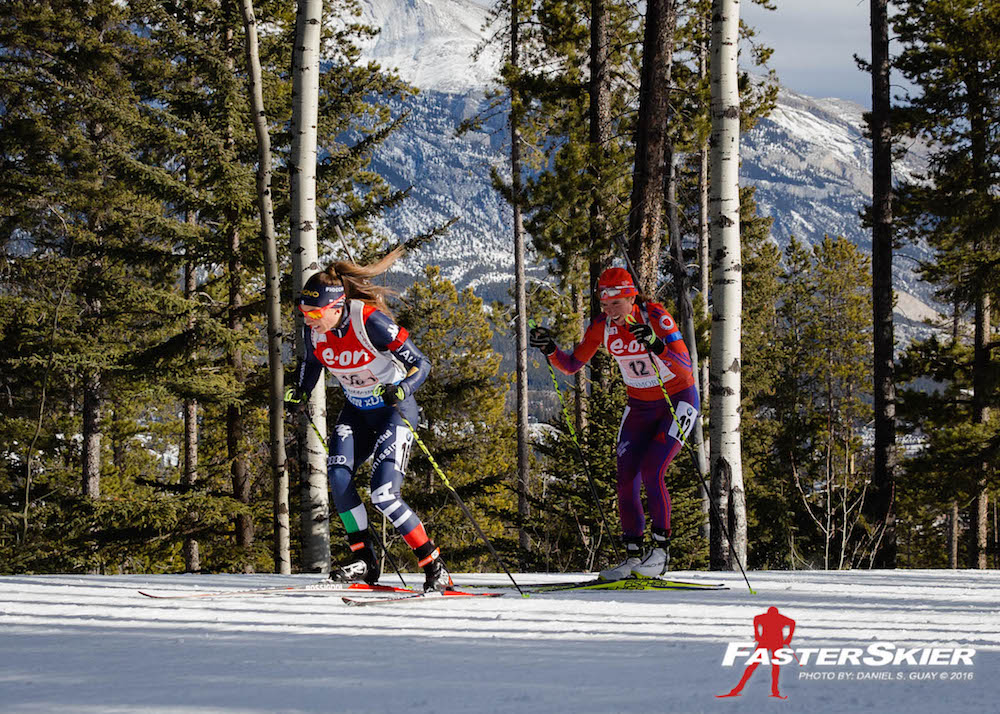
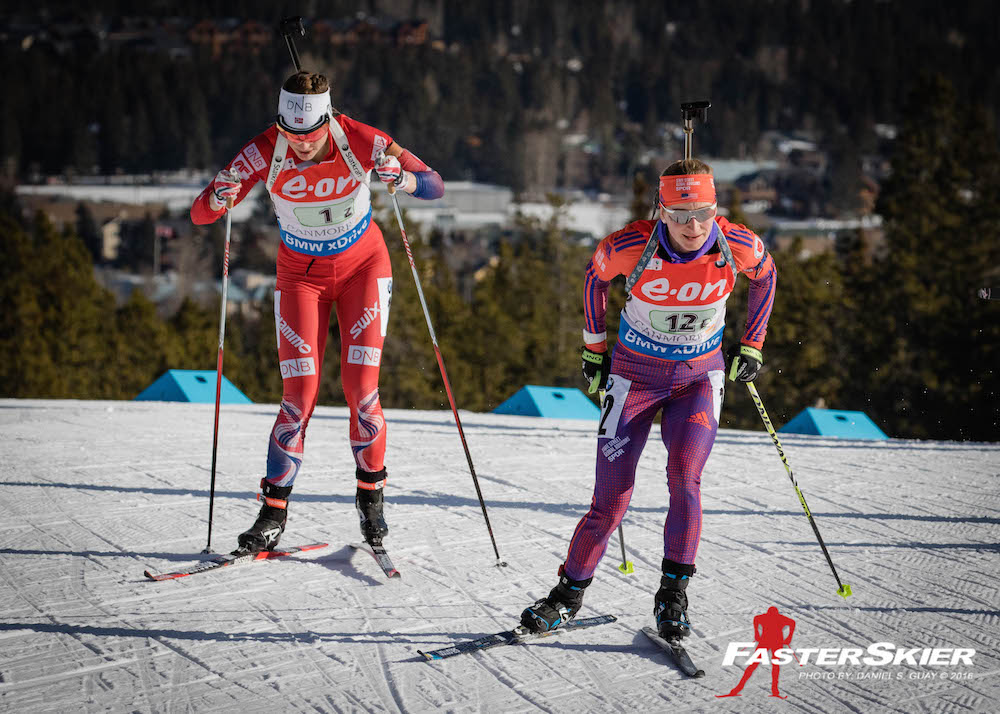
Wierer had previously been the first out of prone, 3.4 seconds ahead of Dunklee in second. Both women cleaned prone without needing any of three possible spares. Dunklee left the range two seconds ahead of Kazakhstan’s Alina Raikova in third, and almost immediately, the American caught Wierer. The two remained together off the front of the pack for the next loop, skiing 4.2 seconds ahead of Gasparin in third while Raikova dropped 13 seconds back to sixth before the second shooting.
There, Wierer needed two spares to clean and Dunklee used all three, but both avoided the penalty loop to leave the range in second and sixth, respectively. Wierer followed Gasparin into the final loop before the exchange, 5.1 seconds back, while Germany’s Hildebrand cleaned with no spares to move into third, 7 seconds out of first.
“I didn’t expect anything special today,” Dunklee wrote in an email, a day after placing 30th in the mass start with 10 penalties. “To be honest, I’ve been struggling this week to find my normal race hunger and my physical shape has felt flat.
Italy’s Dorothea Wierer (l) leads Susan Dunklee of the U.S. in first and second on the second loop of their first leg of the IBU World Cup mixed relay in Canmore, Alberta. Italy went on to place second and the U.S. notched a best-ever fourth. (Photo: Daniel S. Guay)
“[On Saturday] I dirtied a stage,” she said of missing every target — the opposite of “cleaning.” “Probably my first time doing so on the World Cup. Today I felt like a completely different animal. It was a good reminder that things can turn around suddenly.”
After leaving the range in sixth, 22.5 seconds behind Gasparin in first, Dunklee made up one place on the next loop to tag Dreissigacker in fifth, 16 seconds back, at the first exchange.
Meanwhile, Crawford used one spare on each stage to climb from ninth after the first shooting to fourth after the second stage. She left the range just ahead of Dunklee, 21.1 seconds out of first with one loop to go, and came through the exchange just 0.3 seconds behind Dunklee to tag Beaudry in sixth.
Also on that loop, Sweden’s Emma Nilsson slipped from fifth to eighth, and Norway’s Marte Olsbu improved from seventh to fourth.
“Susan passed me like I standing still, it was very impressive, but then she slowed down again and I tried to hang onto Norway once they passed me,” Crawford explained in an email. “It was a tough fight on that last loop, my legs and lungs were screaming, but I knew that in about 3min I could collapse in the snow.”
On the first shooting of the second leg, Preuss cleaned prone quickly to move into first, 5 seconds ahead of Switzerland’s Aita Gasparin, who also cleaned without any spares.
Dreissigacker leapt into third for the U.S. with flawless prone shooting as well, 17 seconds behind Preuss. She needed one spare to clean standing but remained in contention in fourth, just 0.2 seconds behind Sweden’s Mona Brorsson in third and 31.6 seconds behind Preuss up front with one loop to go.
“I’m happy with my whole race,” Dreissigacker wrote in an email. “One spare in standing is good for me. And I got some good rides, skiing behind [Norway’s Synnøve] Solemdal and then battling with Mona Brorsson on the last loop. Skiing with people really helps me ski more efficiently.”
Hannah Dreissigacker (r) skied the second leg for the U.S. mixed relay on Sunday and brought the team to fourth by the second exchange. Norway’s Synnøve Solemdal (l) tagged in second, 23 seconds behind Germany (not shown) in first. (Photo: Daniel S. Guay)
She held her position to the exchange, tagging Burke in fourth, 1.5 seconds out of third and 36 seconds from the lead.
“I think that confidence was the biggest key to my shooting today. I just told myself, ‘I can do this. Just do what I always do. It doesn’t have to be perfect, just normal,’ ” Dreissigacker explained.
After starting her season on the World Cup, Dreissigacker, a 29-year-old U.S. A-team member, was put on the IBU Cup squad in January. At the last IBU Cup in Arber, Germany, she placed 10th in the sprint and 16th in the pursuit to earn World Cup starts in Canmore. In the Canmore on Friday, she finished 28th in the sprint for one of her top-six career results.
“You have to really respect the trajectory that Hannah’s taken over the season,” Bailey, 34, said. “I’ve been there, I know what it’s like to start off a season with high expectations and fall short early on and have to refocus. A lot of athletes give up, but the fact that she stuck it out and really believed in her ability is a testament to her as an athlete and an individual.
“I think this week she showed that she can be there, and especially today — Susan had a great leg and handed off to Hannah in a fairly high-pressure scenario,” he continued. “… It was great to see Hannah handle that pressure. She had an awesome, awesome performance and kept us in contention for the medals.”
Last spring, Dreissigacker made up her mind that she would retire after this season. She explained that decision “has nothing to do with how this season has gone or will go. It’s a decision about my life and what I want to do with it and what will make me most happy. For this season I’ve been trying to not think about that decision and just ‘be here now’ and enjoy it,” she added.
In terms of pressure, she had a new way of handling that.
“I made a promise with myself a few weeks ago that I would be done with feeling pressure in a negative way about racing,” she wrote. “I definitely got nervous today, but I decided to call it ‘excitement’ and not think about pressure.”
“It’s a decision about my life and what I want to do with it and what will make me most happy. For this season I’ve been trying to not think about that decision and just ‘be here now’ and enjoy it.” — Hannah Dreissigacker, on her decision to retire after this season
Sarah Beaudry used just one spare to clean two stages during the second leg of the IBU World Cup mixed relay in Canmore, Alberta, to come through the second exchange in sixth. Canada ultimately placed sixth to tie the team’s best result in the mixed relay. (Photo: Daniel S. Guay)
Canada’s Beaudry, also getting the call up from the IBU Cup for the Canmore World Cup, kept her team in sixth with a perfect prone and just one spare in standing. In her second shooting stage, she moved into fifth, 10 seconds behind Dreissigacker in fourth, but slipped one spot back to sixth when Italy’s Karin Oberhofer passed her on their last loop.
At the second exchange, she tagged Davies 1:07.3 behind Germany, while the Germans skied 23 seconds ahead of Norway in second place.
“On the range overall I wanted to be confident and relaxed,” Beaudry wrote in an email. “I shoot on this range all the time know the winds and wanted to use that as an advantage. The last lap I tried to give it everything I had to be able to give Macx every extra second I could. I was very happy with my performance and as a team we were definitely stoked with where we ended up tying Biathlon Canada’s previous personal best.”
Two days earlier, the 21-year-old British Columbia native posted her World Cup personal best in 38th.
“It has definitely been super exciting posting my best results at home in Canmore, for my family to be able to watch and all the Canadian Biathlon community,” Beaudry wrote. “I feel like I managed to take full advantage of my start spot in the sprint with the windy conditions being worse at the beginning. However this being my second World Cup weekend of the season and my other weekend [in Ruhpolding, Germany] being a last minute decision and three days of driving before the race I was able to be way more prepared for this event.”
The third-leg skiers for the U.S. and Canada, Burke and Davies, put their teams in fourth and seventh, respectively, by the final exchange.
Burke came within six seconds of third place after a clean prone without any spares, but had some trouble in standing, using all three spares and appearing to have problems loading at least one of them. He ended up with a penalty — the first and only penalty for the U.S. — and left the range in fifth, 1:36.6 behind Germany’s Arnd Peiffer, who shot flawlessly in both stages to take a 56-second lead over Norway.
Canada’s third leg of the mixed relay, Macx Davies used one spare to clean his standing stage and left the range in seventh before handing off to anchor Brendan Green (not shown) in the IBU World Cup mixed relay in Canmore, Alberta. Canada placed sixth to tie a team best. (Photo: Daniel S. Guay)
Thirty seconds behind Sweden’s Tobias Arwidson with one loop to go, Burke caught the Swede and moved back into fourth by the exchange — 36 seconds behind Norway in third.
As for Davies, he used two spares in prone and one to clean standing, leaving the range in seventh after both stages.
“After getting tagged in sixth I was hard pressed to stay with [Switzerland’s] Benjamin Weger and lost a bit of time on the first loop, so I was a little worried that I was skiing slowly, but when it came to the shooting range, that’s where I know you can make lots of time,” Davies wrote in an email. “So I was very focused going into prone on a fast clean bout. … My performance today was good [on] skis and in the range, nothing exceptional but I had a good day out there and very happy that I could stay in 7th on the final lap.”
Germany’s anchor, Simon Schempp mostly had to go through the motions to ensure the win after receiving the tag in first, 1:02.9 ahead of Italy in second and 1:03.6 clear of Norway in third. (Bailey was 1:40 back at the tag in fourth.)
Schempp used one spare in both stages and ended up sealing the win in 1:05:38.8, by 1:12.9 over Italy’s Dominik Windisch in second place and 1:23.8 ahead of Norway’s Bogetveit in third.
“I still started out fairly hard, make my own race, work clean on the shooting range, and after the standing shooting I noticed that it would be sufficient,” Schempp said in a post-race interview with Germany’s ZDF. “But before that you are never sure, anything can happen, so you can’t relax.”
He felt comfortable enough to high-five some of his teammates on the final loop.
“I saw a few [national-team] green jackets out of the corner of my eye on the edge of the course. And on the prior loops I already heard a few familiar voices,” he recalled. “So when you have the time and the whole team is celebrating with you, that’s something you can enjoy very much.”
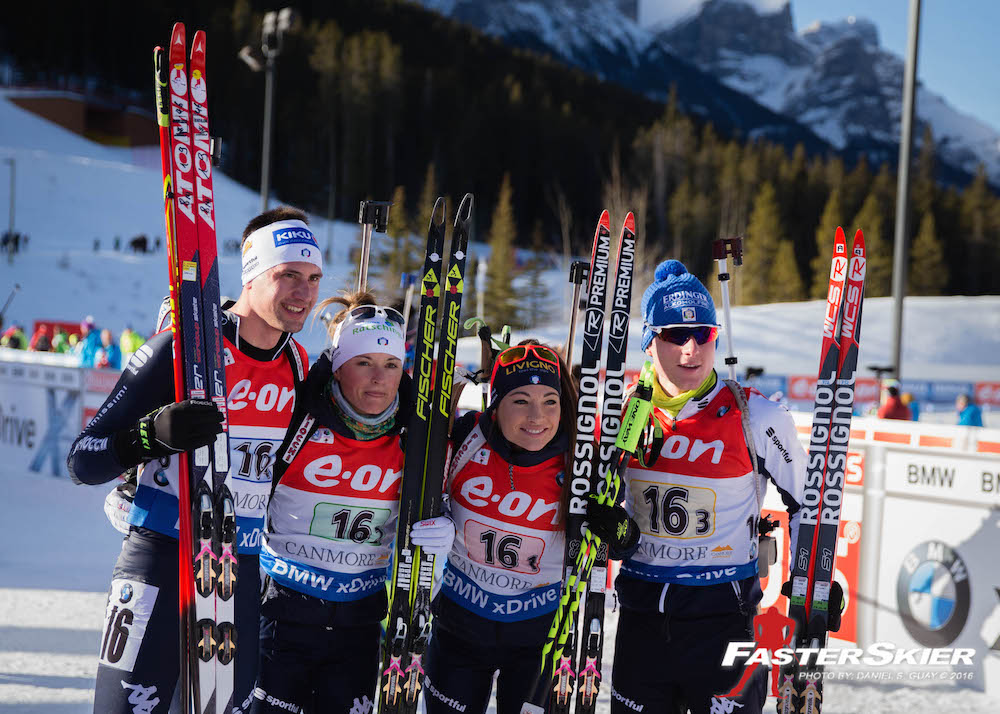
Italy placed second in the mixed relay at the IBU World Cup in Canmore, Alberta, with Dorothea Wierer (second from r), Karin Oberhofer (second from l), Lukas Hofer (r), and Dominik Windisch. (Photo: Daniel S. Guay)
For the Italians (Wierer, Oberhofer, Lukas Hofer, and Windisch), another podium in Canmore was beginning to create expectations. In Canmore, Wierer finished third in the women’s sprint on Friday, then won the mass start on Saturday and Windisch won the men’s mass start that same day.
“Everyone at home expects bigger things every week,” Italy’s third leg, Hofer told the IBU afterward. The team finished with one penalty (from Oberhofer’s prone stage) and required 10 spares.
And Norway’s B-team (with its top athletes opting to skip the Canmore weekend and come to Presque Isle instead) wasn’t surprised with a podium: “We always try to be on the podium, but you never know,” Olsbu told the IBU. Olsbu, Solemdal, Alexander Os, and Bogetveit combined for third with seven spares and no penalties.
For Bailey, fourth (with a team total of one penalty and nine spares) was one step closer to the medals — a goal US Biathlon has been focused on for the last several years, specifically in the mixed relay, he said.
“Sochi was the first Olympics where we had it as a medal event now it’s a legit medal event,” he explained. “We realized that we had strong women at the top and strong men at the top and when you combine those, we start to be able to compete with the powerhouses.”
While fourth was “bittersweet,” he added that it was promising.
“It was by no means a perfect race for any of us. I guess that’s a good thing… that means you can do better,” he said. “We can feel satisfied, but we also have the momentum and the knowledge that … if we put together an excellent performance, we can be on the podium.”
“I’ve dreamed of being in the top 6 in a world cup relay for years and to be 2 seconds out of third is absolutely incredible!” Dunklee wrote. “Today was a great team effort. Hannah had a very rough start to the season with injury and it’s been truly inspiring to watch her turn it around. Lowell skied a heroic last loop leaving his pack behind and almost catching Norway, who didn’t seem within reach when he left the range.”
Canada’s Brendan Green acknowledges the crowd at the IBU World Cup mixed relay in Canmore, Alberta, after anchoring his team to sixth, tying a team best. “It was really fun and definitely special,” he said of the experience racing at home. (Photo: Daniel S. Guay)
Canada, with no penalties and six spares, was happy, too.
“We had a different team out there today with Brendan and I the veterans and Macx and Sarah the young guns in their first mixed relay!” Crawford pointed out. “We are showing more depth in our team that we can put together 4 athletes and come out with a pretty good mixed relay! We’ve been knocking on the door of the podium for mixed relay for a while and I am sure it will happen some day!
“It was so special having so many fans in the crowd, friends and family, that everywhere on course people were cheering for you, during warmup, the race and cool down!” she added. “Even though it was a disappointing sprint, it was super cool to have everyone cheering for me, and that they didn’t care how I did, they were just pumped to watch me race!”
On Monday, the U.S. team flew on a direct charter to Presque Isle, where the World Cup will pick back up again on Thursday through Sunday. The U.S. team will race on home soil while the Canadians still aiming to qualify for World Championships (Emma Lunder, Zina Kocher, Audrey Vaillancourt, and Erin Yungblut) will race in Maine, along with Smith, who ranks 19th in the overall World Cup standings.
Those prequalified for World Championships, including Crawford, Beaudry, Green, Davies, Ransom, Scott Gow, and Christian Gow, will train in Canmore until Feb. 22.