From the FasterSkier archive — posts syndicated from athletes’ and coaches’ own blogs between 2004 and 2012, kept online as published. Current coverage is at fasterskier.com.
This coverage is made possible through the generous support of Marty and Kathy Hall and A Hall Mark of Excellence Award. To learn more about A Hall Mark of Excellence Award, or to learn how you can support FasterSkier’s coverage, please contact info@fasterskier.com.
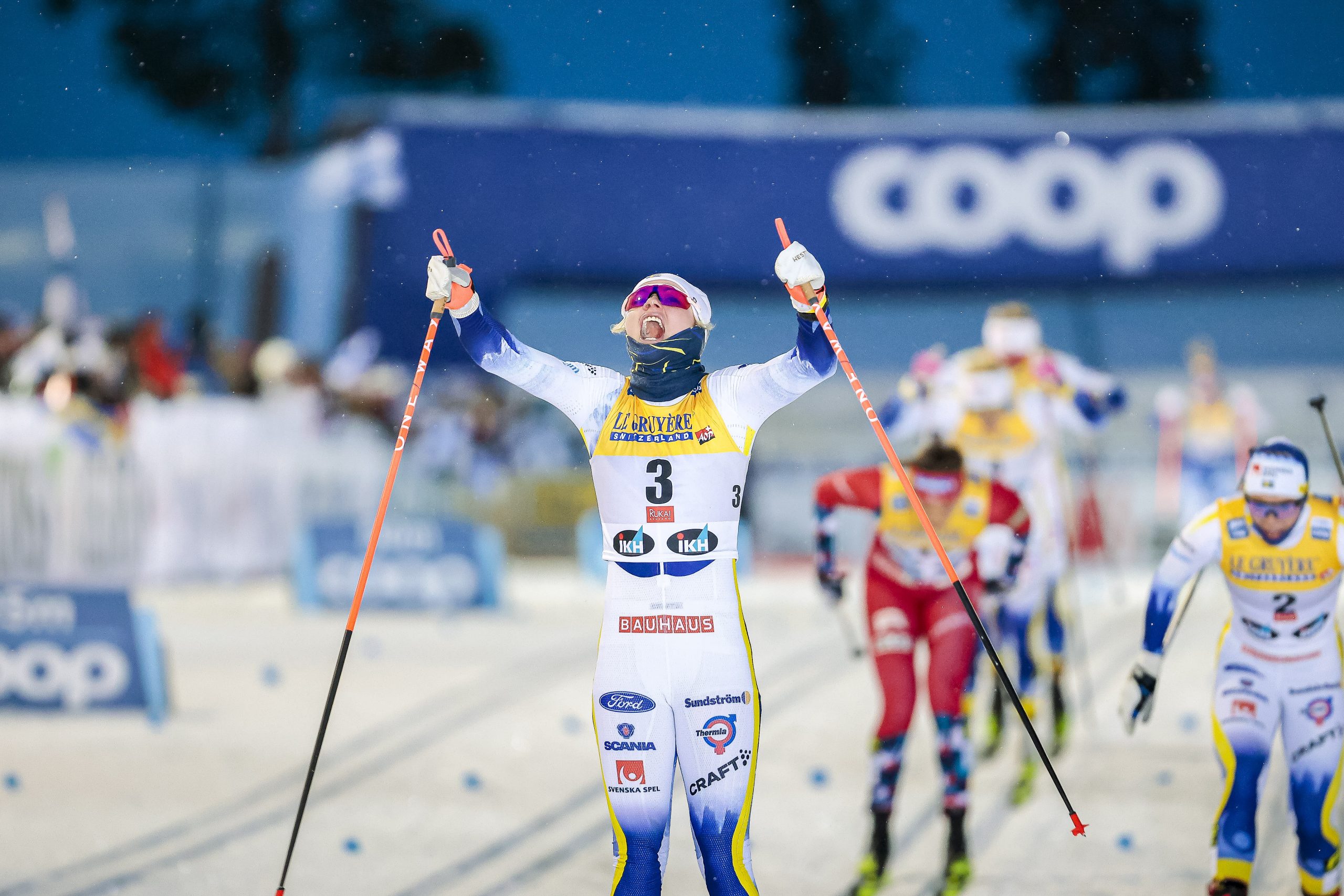
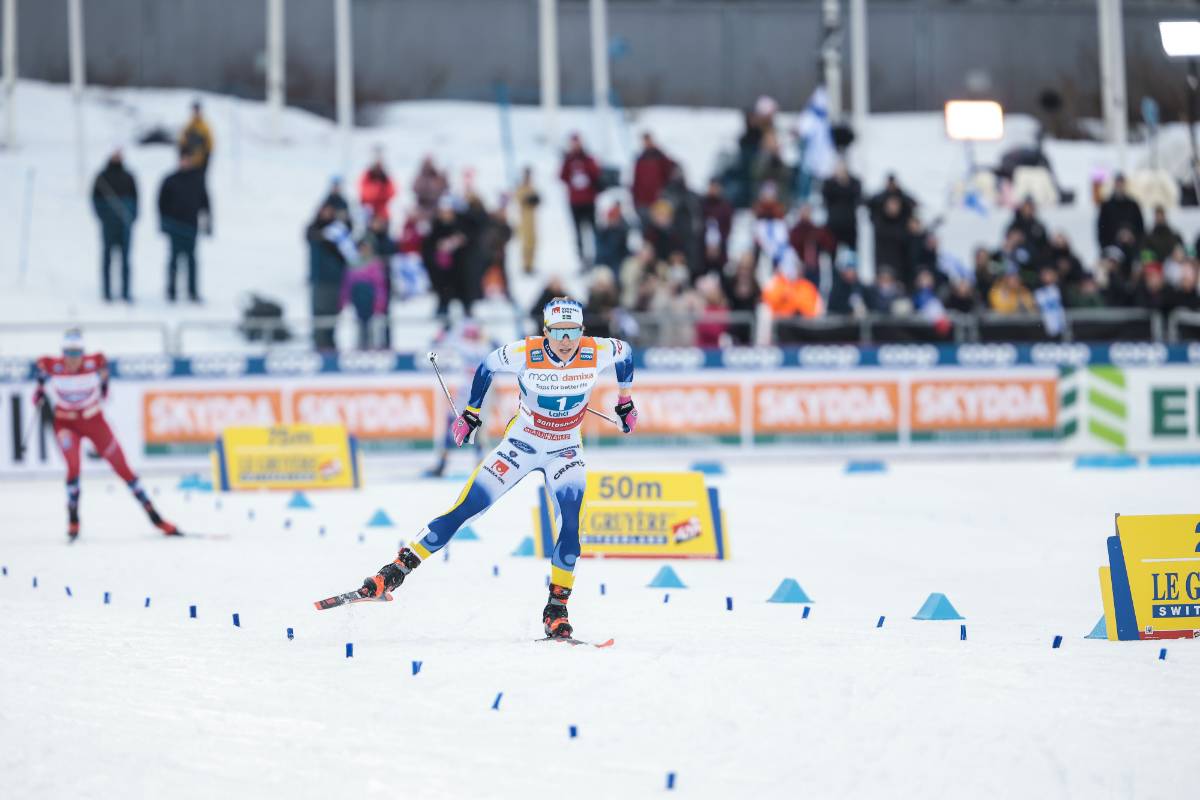
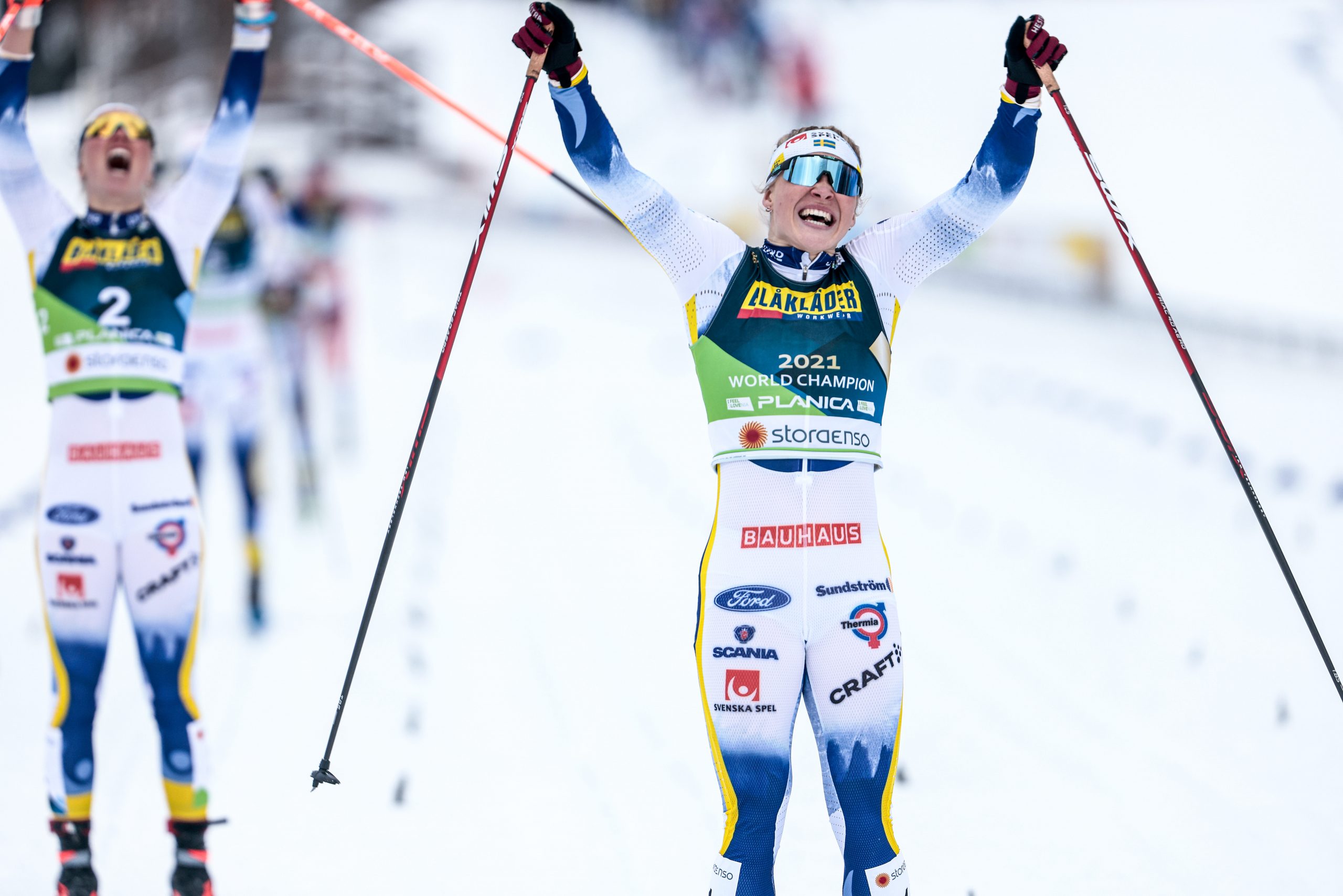
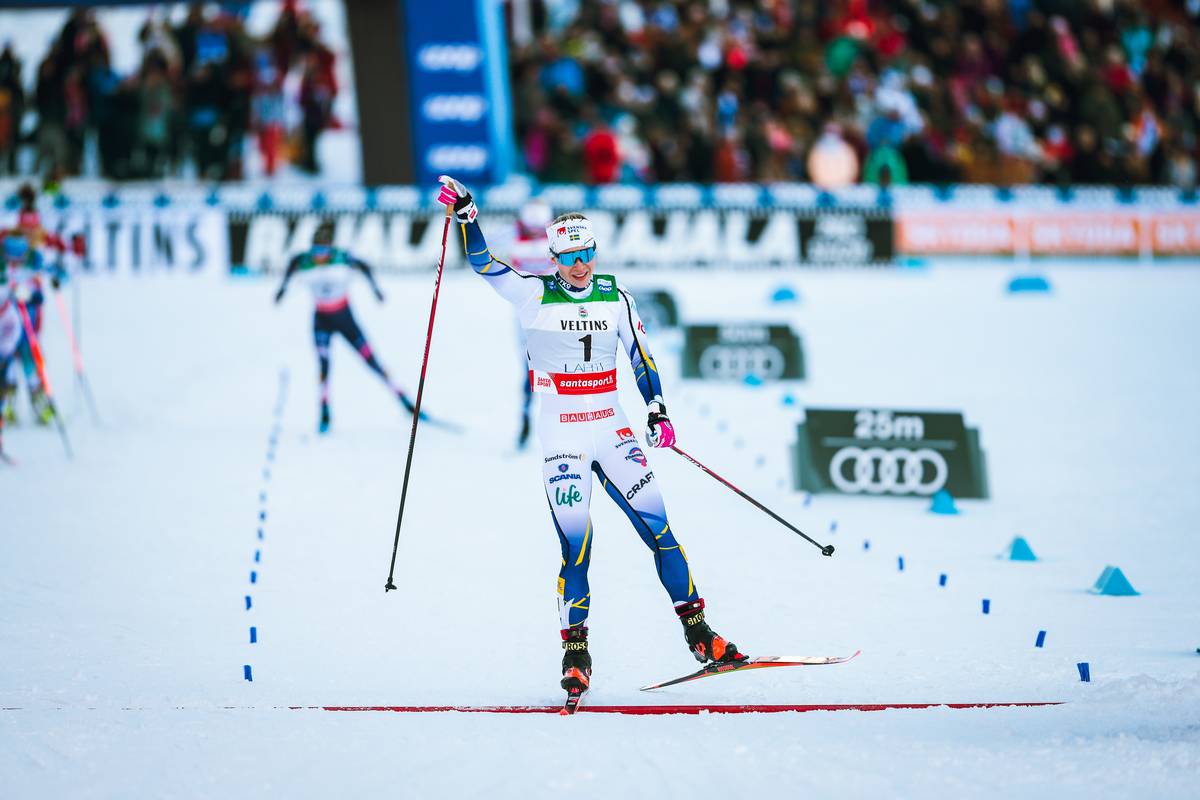
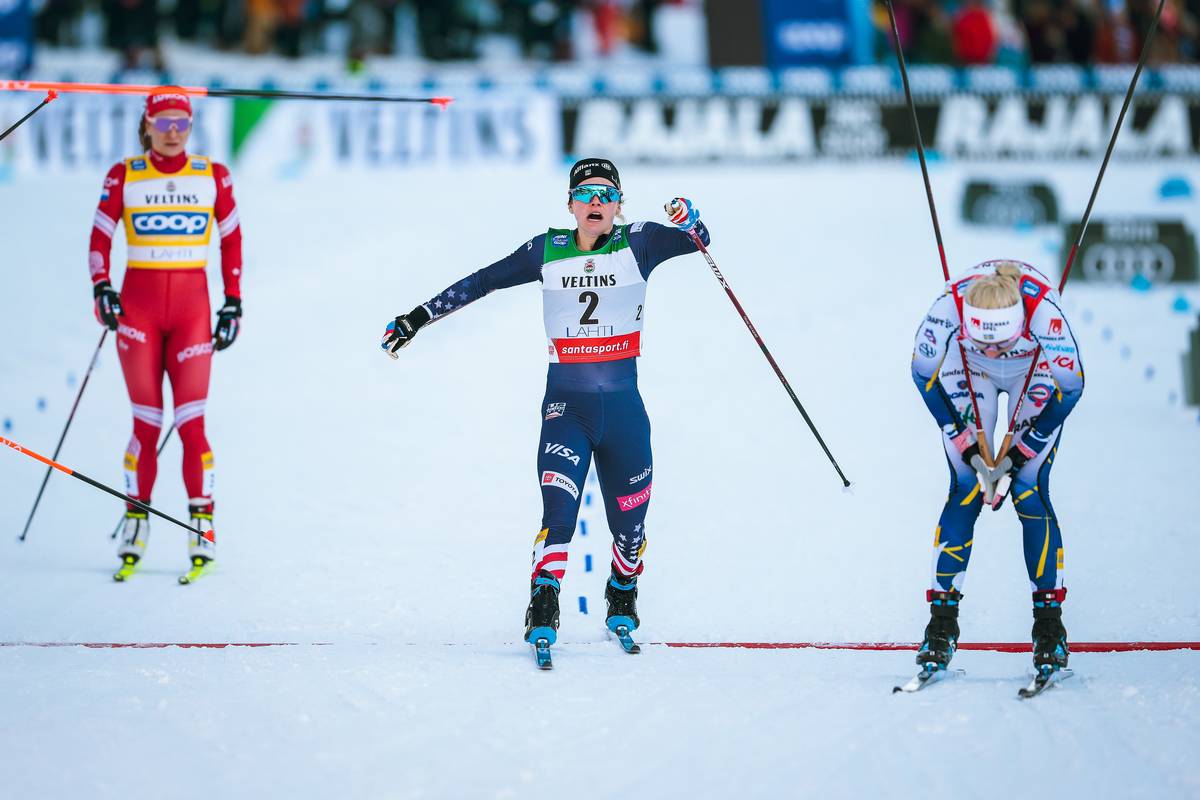
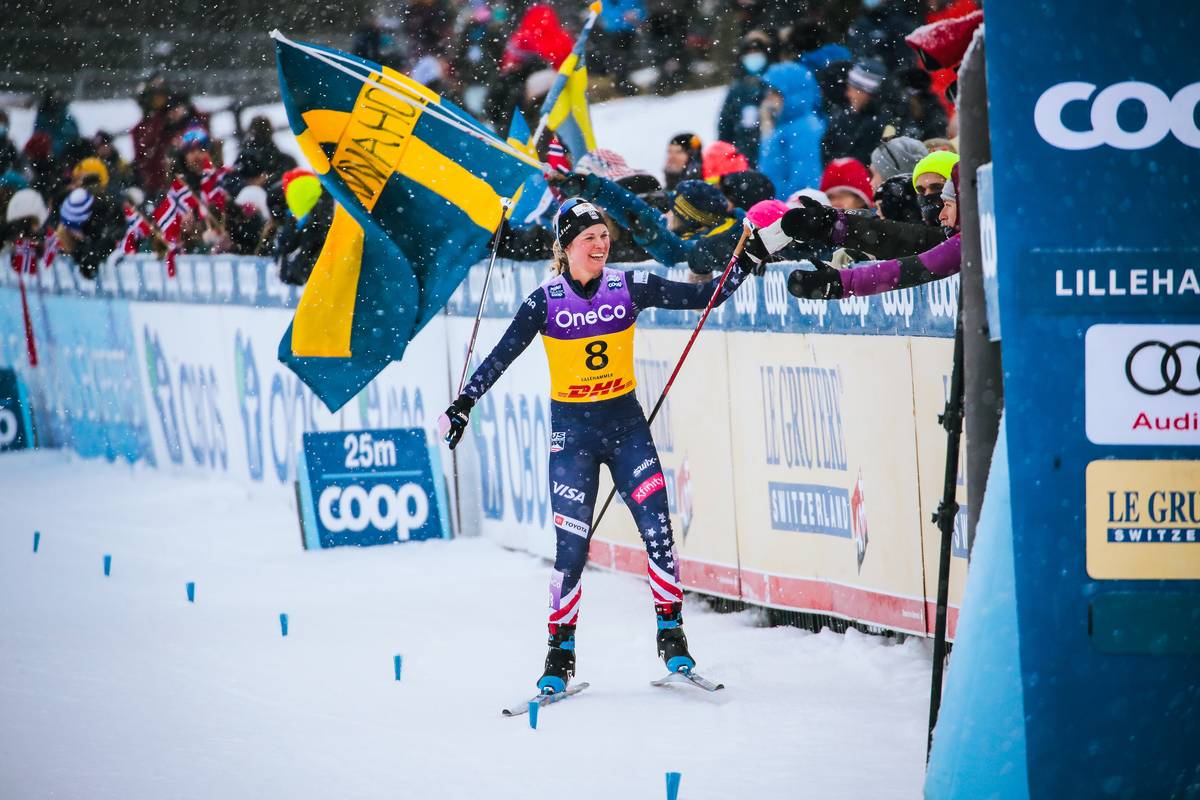
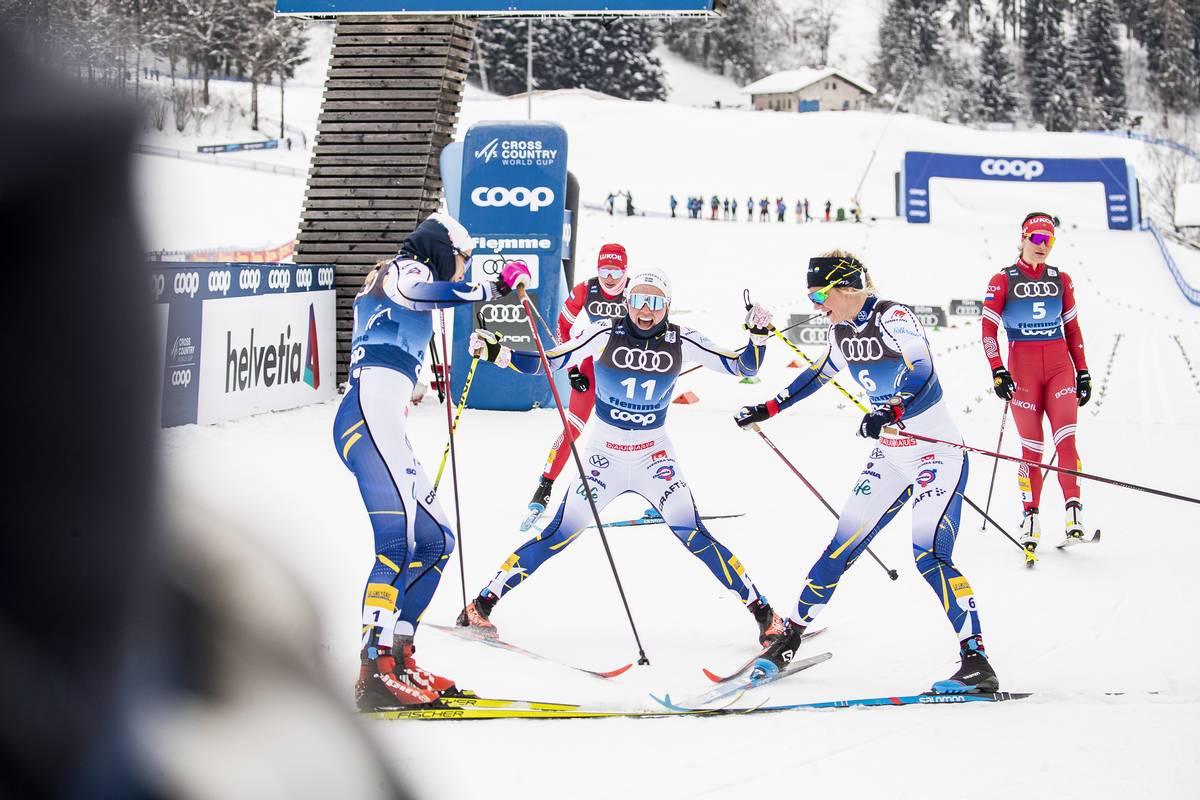
Moa Ilar (SWE) carries Sweden’s flag across the finish line in Sweden I’s dominating win in the World Cup Mixed Relay from Engadin, Switzerland. (Photo: Authamayou/NordicFocus)
Right now, Sweden is on a roll. Soon, Norway will be back at full-force. The top of the field is definitely getting ready for a World Championship showdown in a few weeks. In the meantime, World Cup organizers continue staging races, hoping that top competitors will be attracted by the allure of World Cup points and prizes.
This time of year (the middle of the World Cup season) is all about mathematics for the top contenders. How big a gap exists between a racer and their closest rivals? Are those rivals racing this weekend? How many points are available in events and bonus sprints? Who’s sick? Who’s injured? Who’s surging in the standings? Who’s relaxing at home with their feet up?
Jessie Diggins (USA) is dealing with a persistent injury (plantar fasciitis) that limits her ability, especially in Classic skiing (she actually double poled the entire Sprint qualifier last week in Les Rousses). Diggins could’ve chosen to race one of today’s Freestyle relay legs, but none of her closest rivals in the season-long World Cup overall race were competing today in Engadin. That makes for a perfect opportunity to take a break from the stresses of racing. Time to rest, time to heal, time to get ready for more important races on the horizon.
Likewise, Johannes Hoesflot Klaebo (NOR) enjoys a comfortable lead in the World Cup Men’s overall standings, and none of his closest rivals are racing the relay in Engadin. Time for him to put his feet up.
Even in the absence of a number of the sport’s biggest stars, Engadin hosted a highly competitive World Cup Mixed Relay. Sweden I (Jens Burman, Emma Ribom, Edvin Anger, Moa Ilar) surged to the front in the relay’s third leg and never looked back, coasting to victory ahead of Norway I (who came from well behind the field to claim second) and Switzerland I (who came from even farther back) t claim a podium spot in front of an elated Swiss crowd.
Canada I (Antoine Cyr, Katherine Stewart-Jones, Olivier Leveille, Lilian Gagnon) would contend among the leaders throughout the day, finishing and impressive sixth. Canada II (Remi Drolet, Alison Mackie, Stephen Thomas, Sonjaa Schmidt) would finish 11th. American teams would struggle from the start, ultimately finishing 14th (Zanden McMullen, Julia Kern, Ben Ogden, Sophia Laukli) and 16th (Luke Jager, Kendall Kramer, JC Schoonmaker, Sammy Smith).
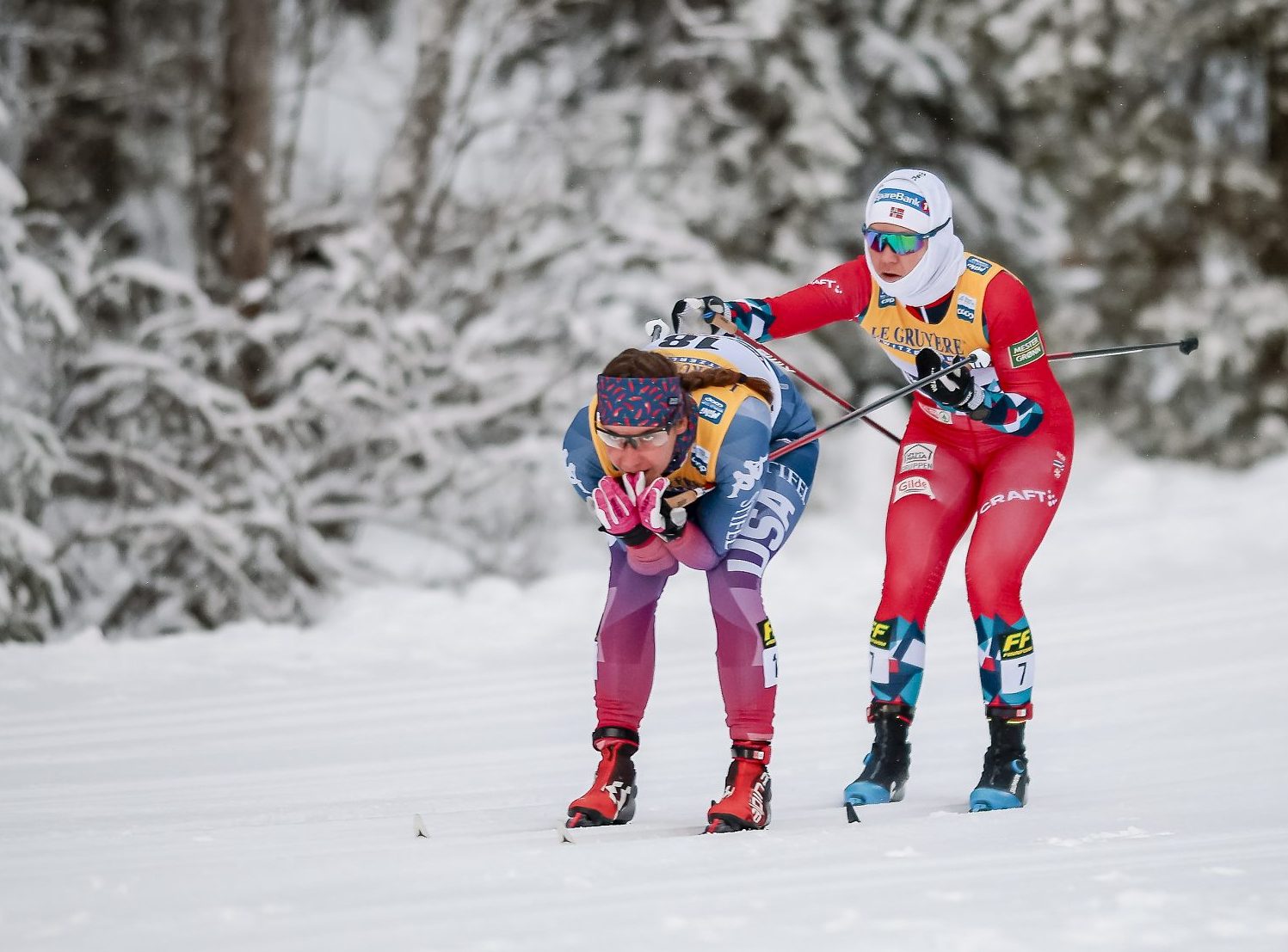
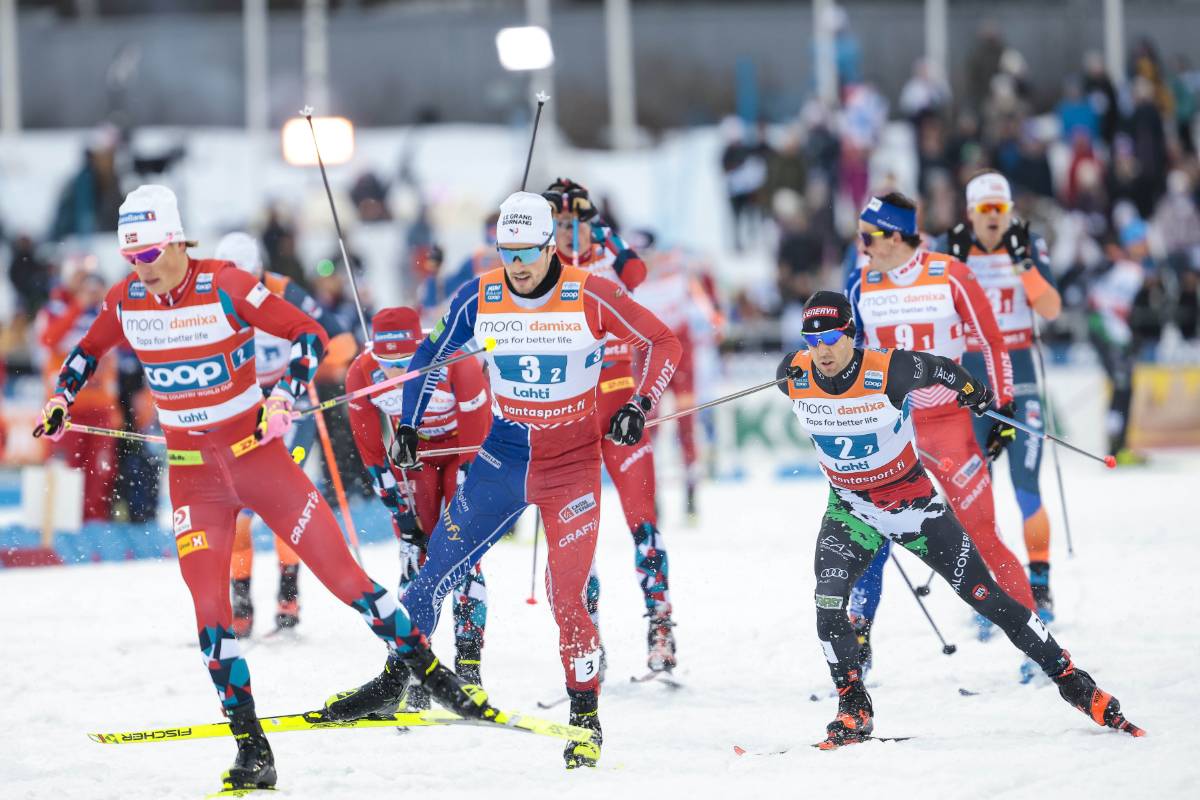
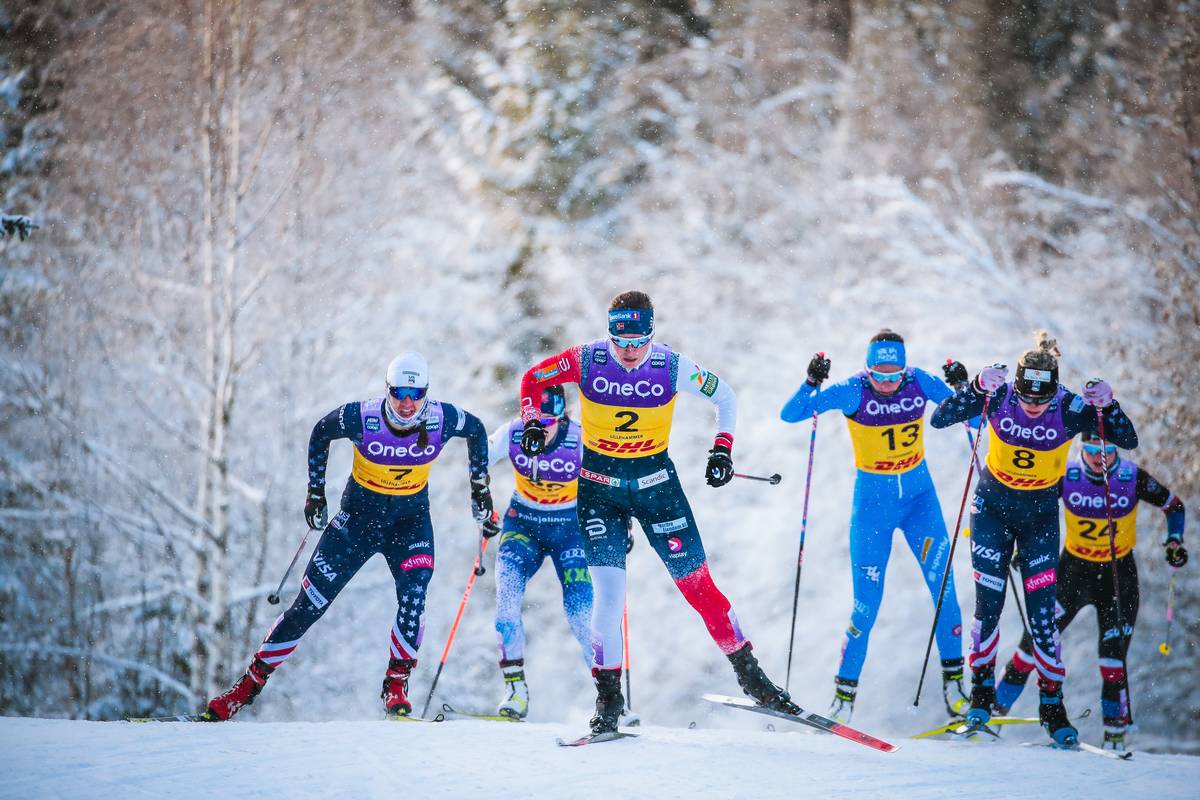
Iivo Niskanen (FIN) and Paal Golberg (NOR) animated the early part of the Engadin Mixed Relay, joined at the front by Antoine Cyr (CAN) who continues to earn the respect of the World Cup field. (Photo: Authamayou/NordicFocus)
Mixed Relay
FIS Mixed gender relays are staged on a revolving basis—one weekend men go first and third, women second and anchor; the next time the starting slots are reversed. In Engadin, Men would lead off, Women would bring it home.
Nineteen teams—including two teams each teams from Norway, USA, Sweden, Canada, and Switzerland—comprised the field that would race four 5 kilometer legs (two laps/skier over a 2.5 kilometer course). Engadin is a broad, flat valley surrounded by soaring Alpine peaks. The course wound around the flats, and offered only two significant climbs. The pace was likely to be fast . . .
“People are going to take it out hot,” predicted Canada’s Remi Drolet. “It’s going to be really hard right from the gun, so, conserve as much energy as possible for the second lap, and try to have my team in a good position.”
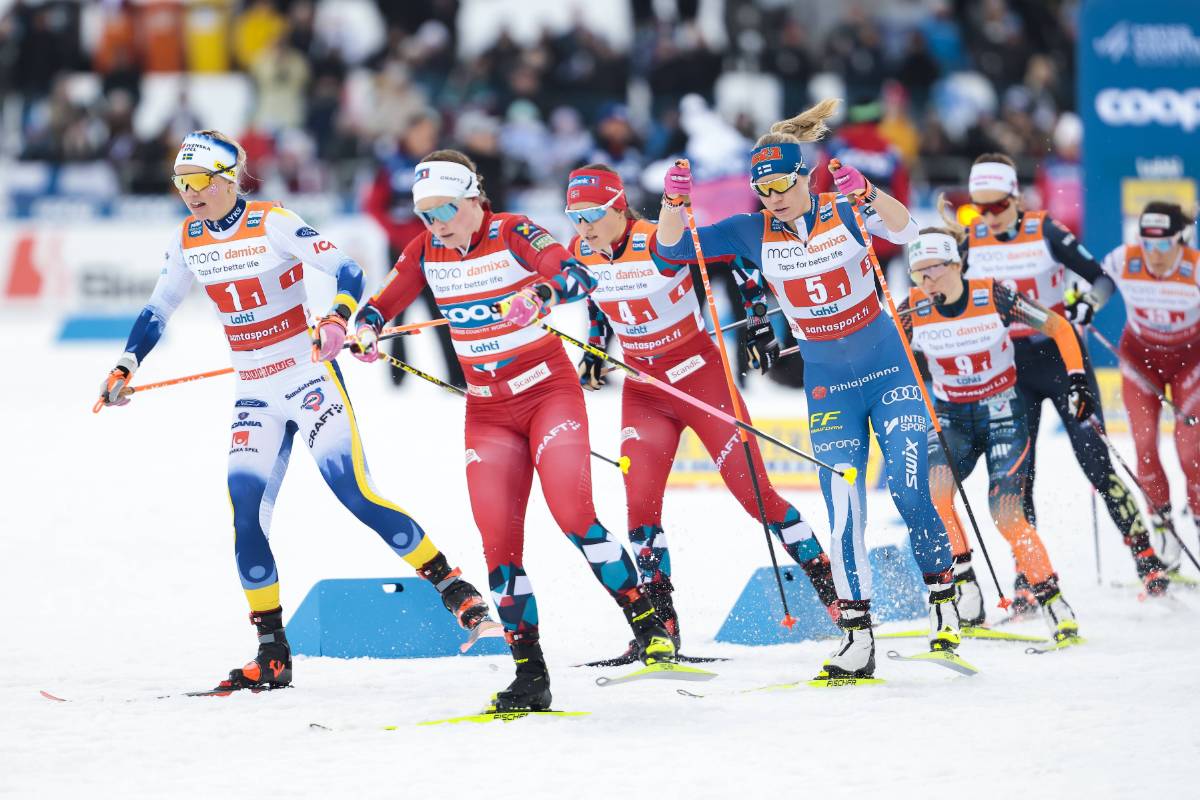
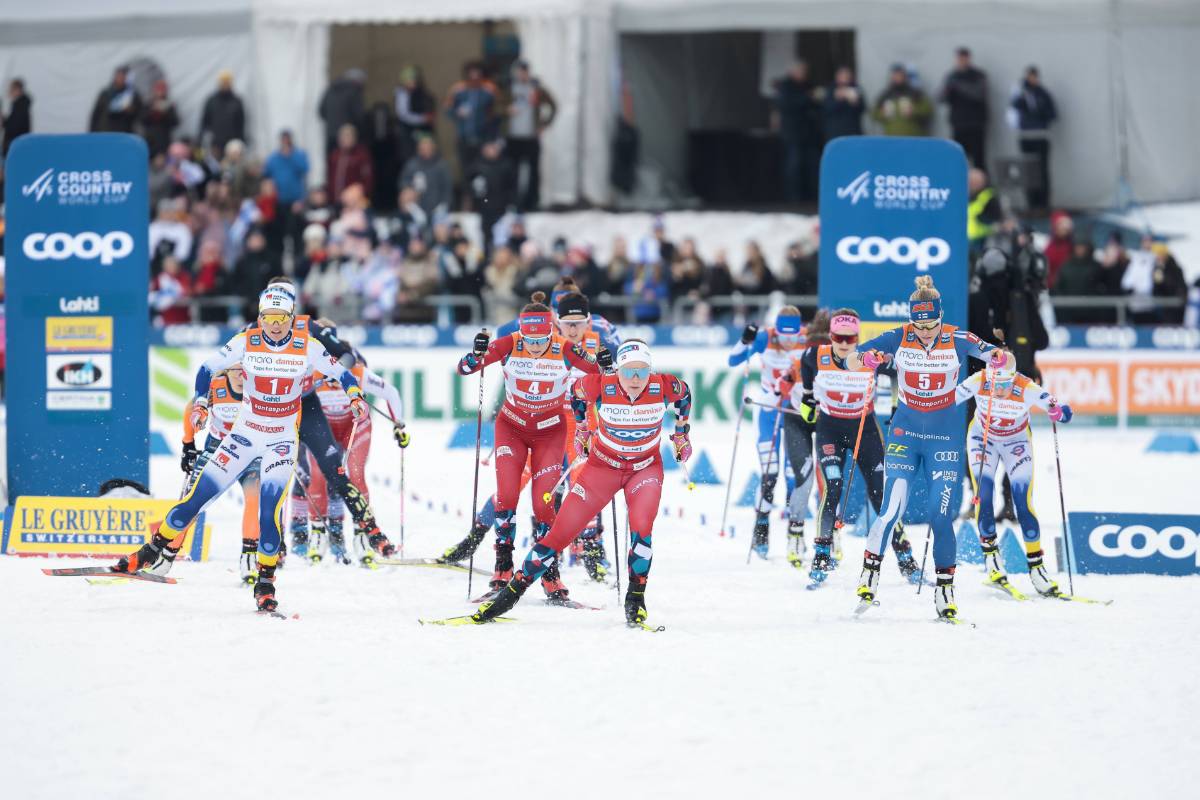
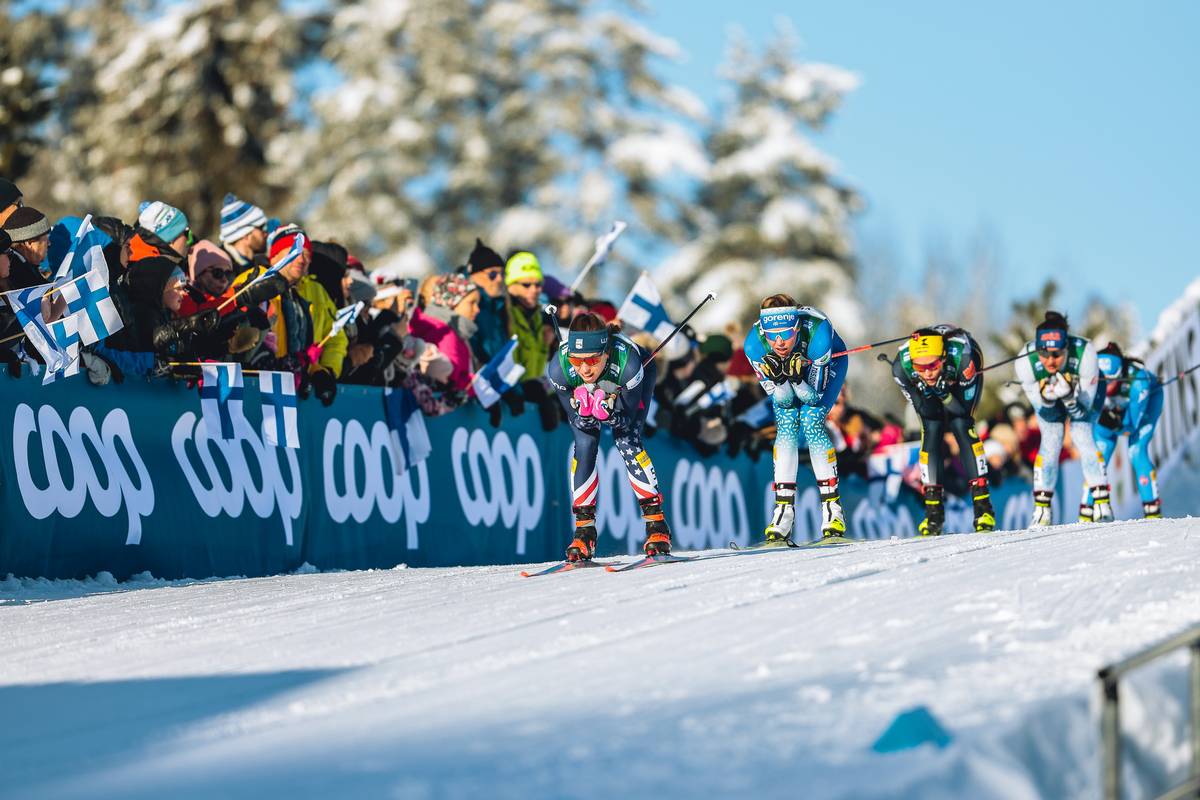
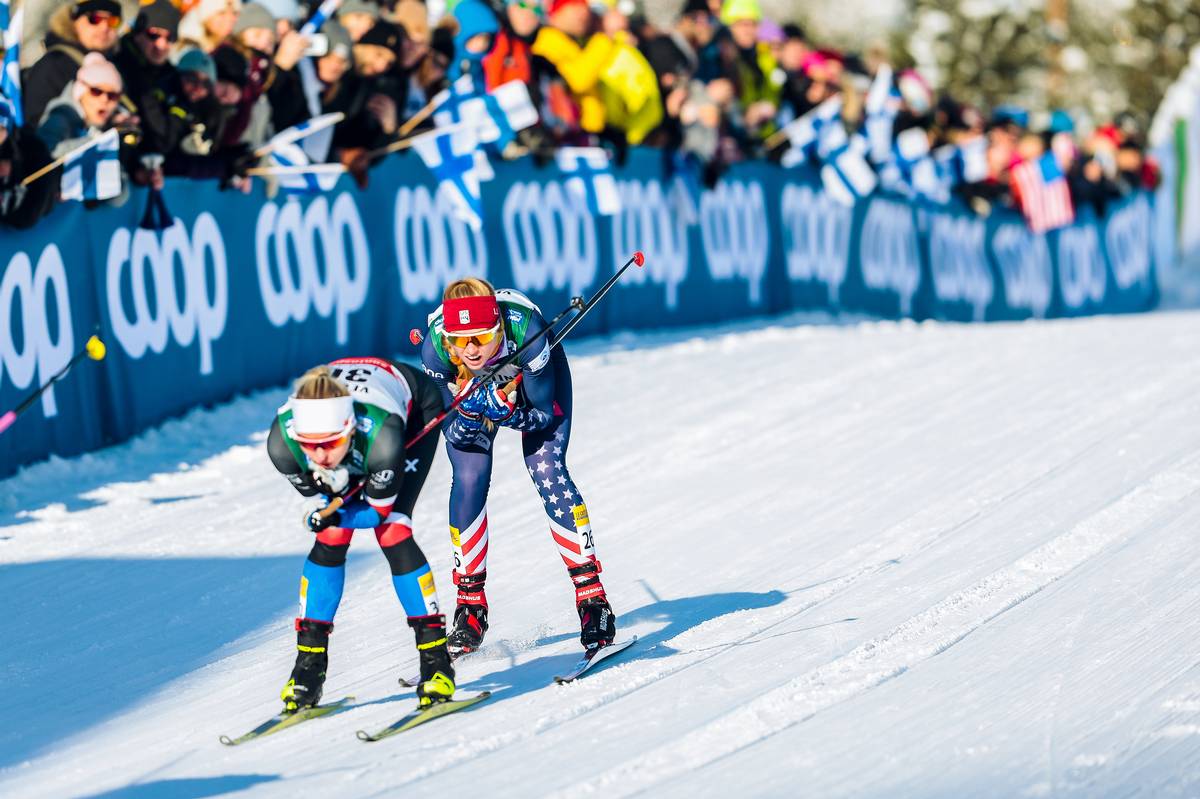
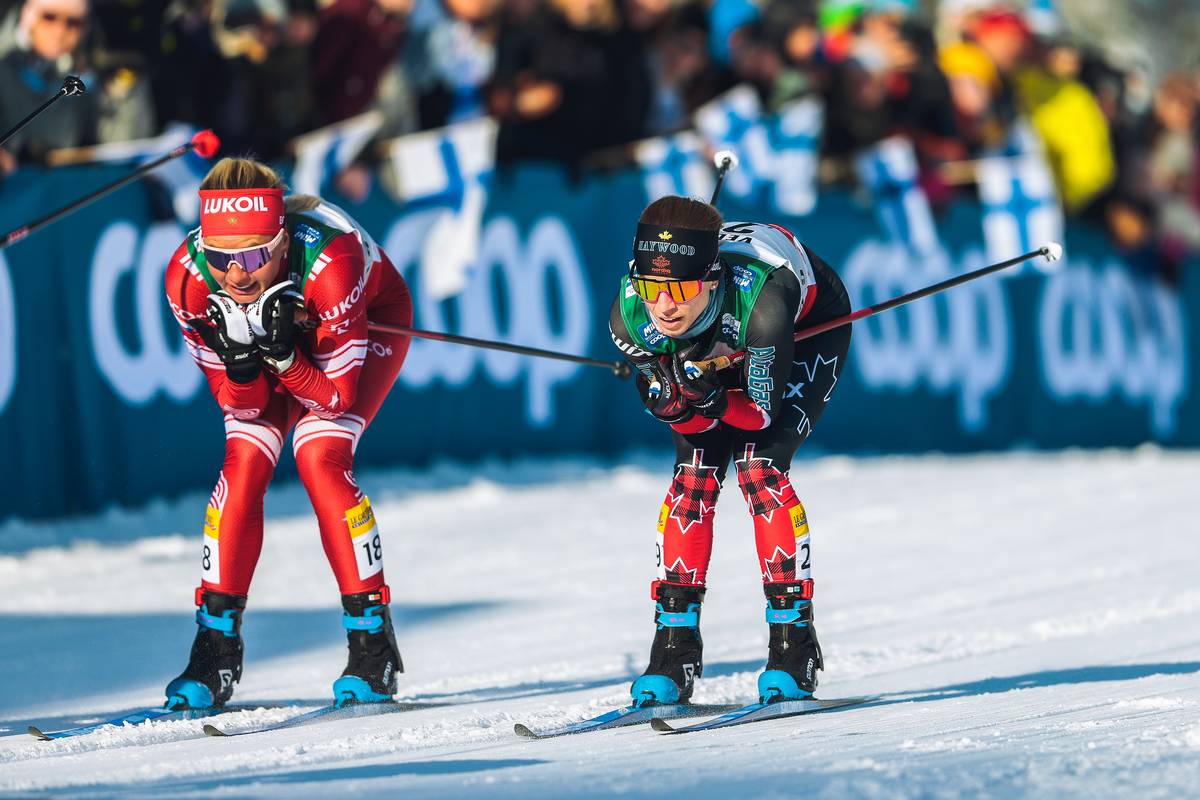
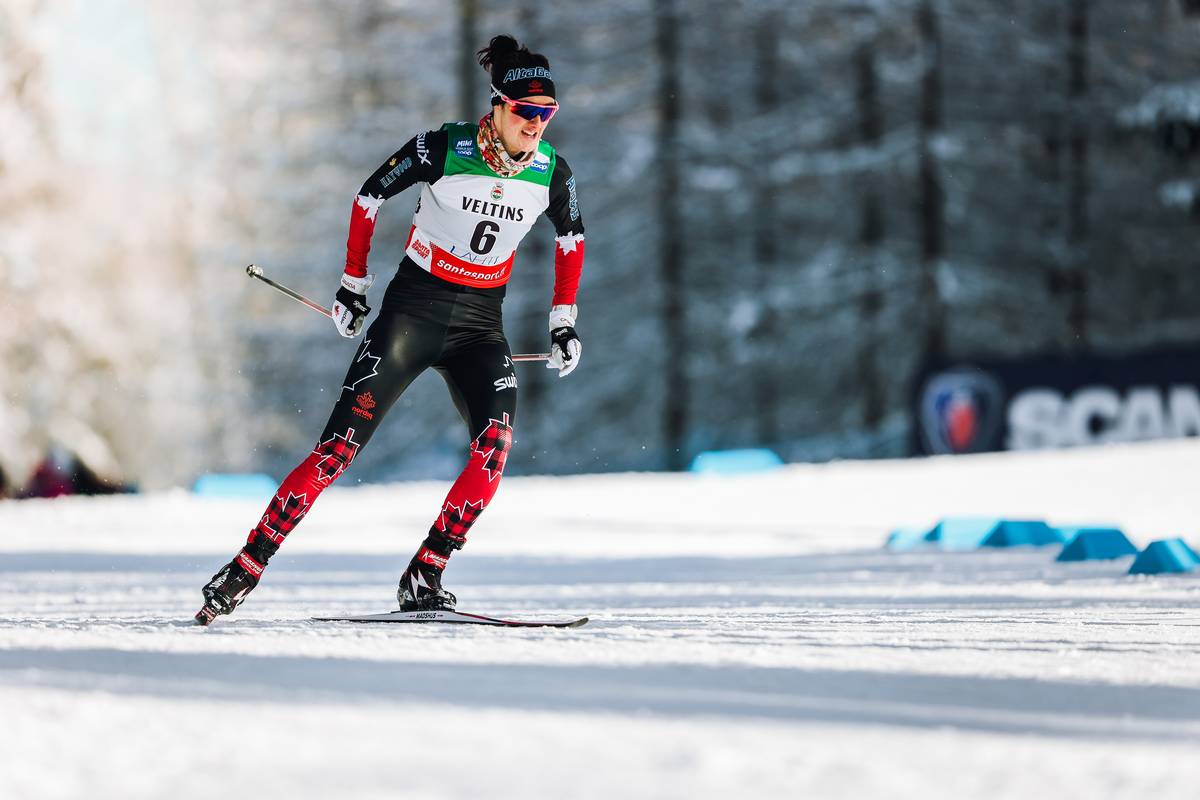
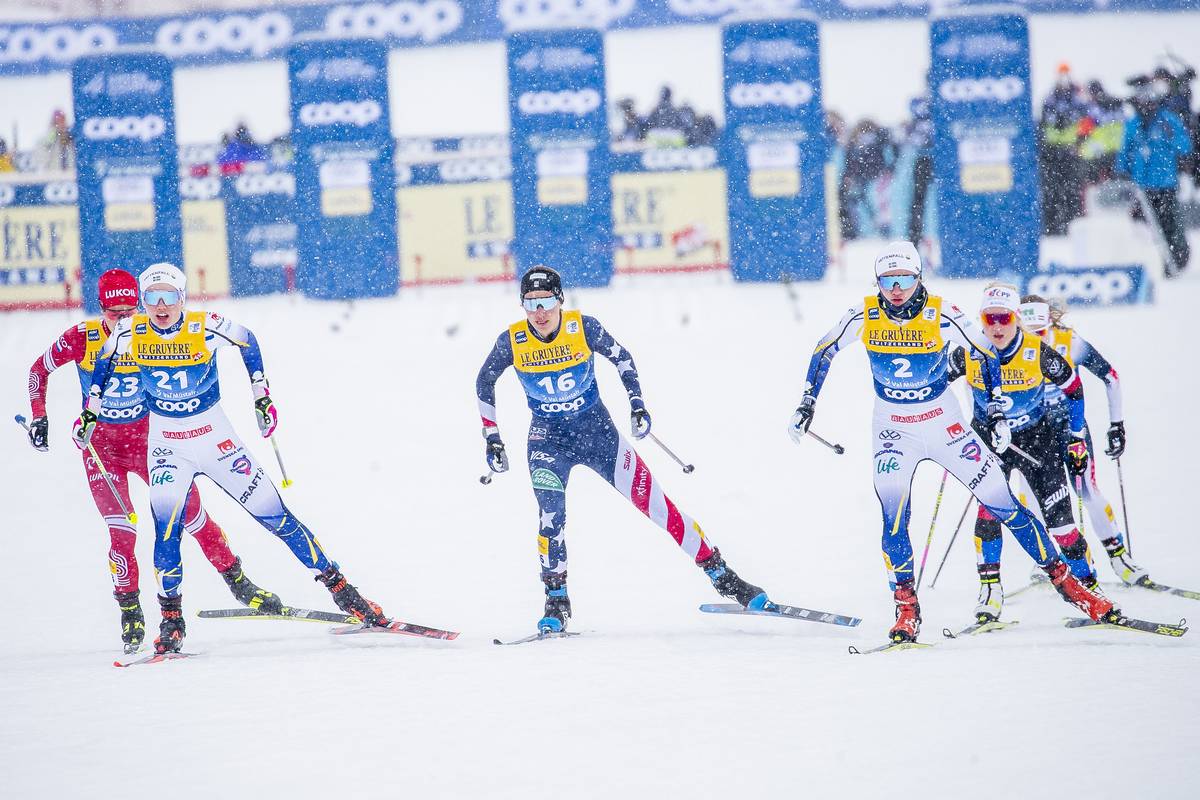
At the start, Norway, Finland, Sweden, and Germany filled the front row. The initial pace was lightining fast, led by Norway I’s Paal Golberg (recently named to the Norwegian squad for the World Championships). The race course quickly faded to two Classic lanes, filled by Golberg and Finland I’s Iivo Niskanen. Canada I’s Cyr and Sweden I’s Jens Burman managed to matched the pace of the lead group, followed by Sweden II and Switzerland II. USA I (Jager) and USA II (McMullen) held positions in the top ten.
Niskanen and Golberg managed to separate themselves as they entered the exchange zone. The race at the front would continue to be hotly contested. By the time USA II (Kramer) and USA I (Kern) took the hand-off, they were already well behind the pack of contenders.
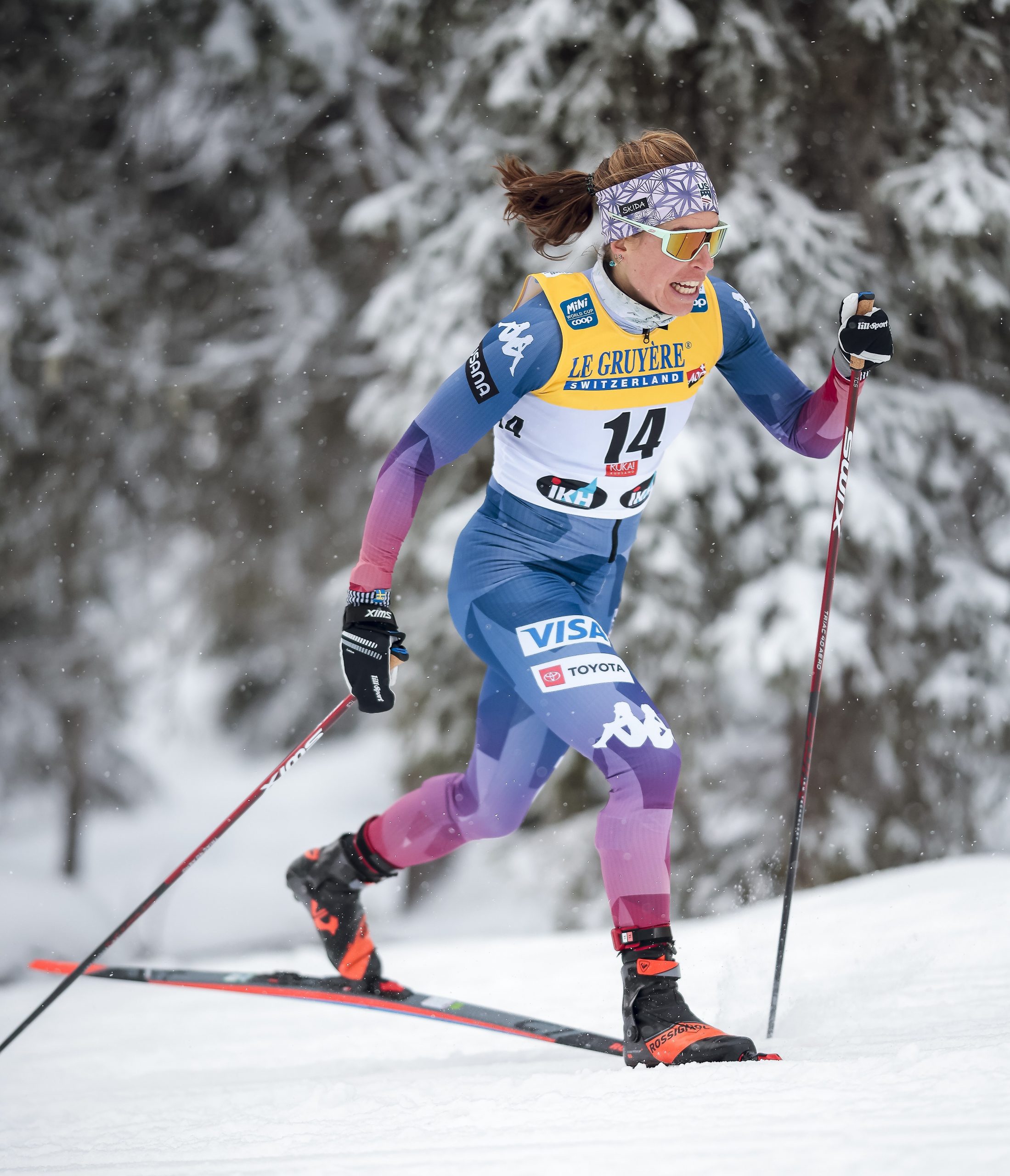
Emma Ribom (SWE), Jasmi Joensuu (FIN), (l-r) drove the pace in the relay’s second leg, setting up Sweden to take the lead in Leg 3. (Photo: Authamayou/NordicFocus)
Second Leg
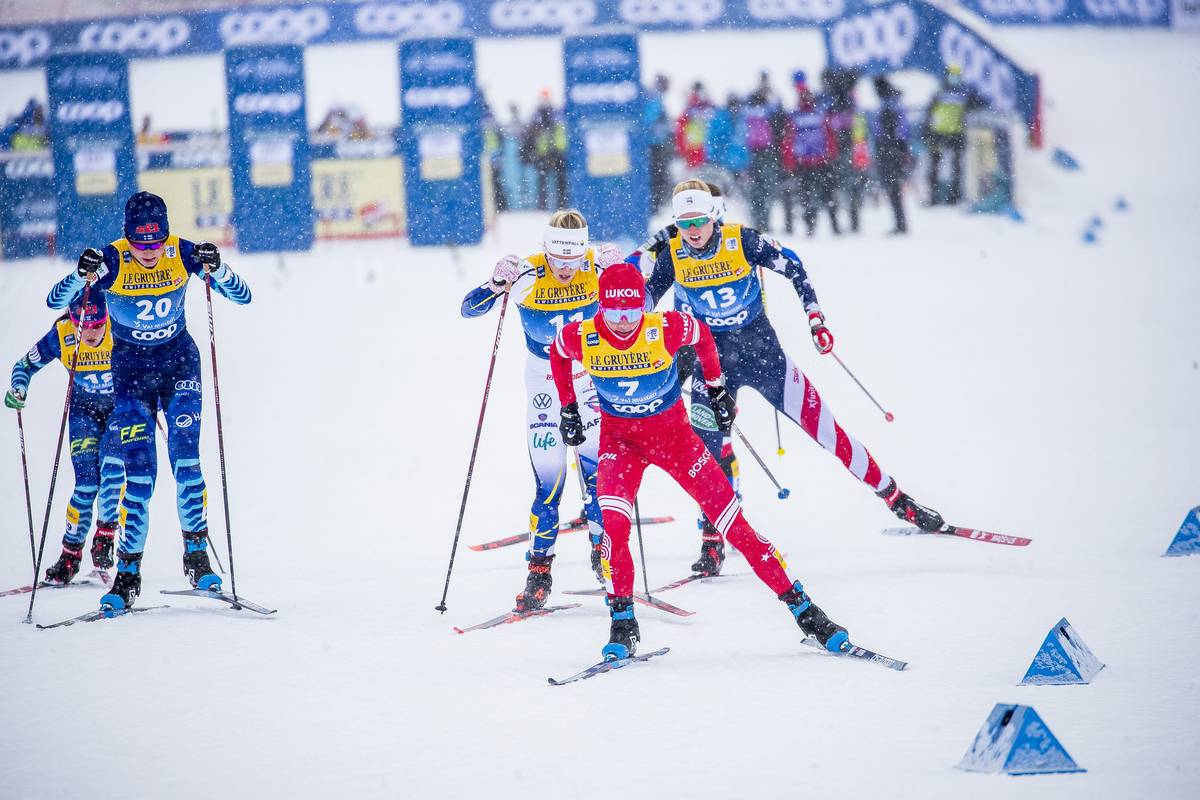
Still in Classic technique for the second leg, Jasmi Joensu maintained her lead for Finland I, pursued closely by Sweden I (Emma Ribom), Norway I (Nora Saness), Switzerland I (Anja Weber), and Canada I (Katherine Stewart-Jones). Remarkably, Austria (Therese Stadlober) also managed to race up to the lead group. She powered through the group and set out in pursuit of Joensu and Ribom.
By the end of the second leg, the field had mostly shattered with only the top two racers racing in close company to one another. Everyone else was well spread out behind them. But skiers in pursuit of speed and placings often find a way to group up. This relay would definitely not end up being an every-skier-for-themselves affair.
Joensu handed off to Remi Lindholm while Ribom handed off to Edvin Anger. Not far behind, Stadlober tagged Benjamin Moser another 15 seconds ahead of Saness tagging Iver Tildheim Andersen, a Freestyle specialist with something to prove (having been recently overlooked for spots on the Norwegian World Championship Team).
Edvin Anger (SWE) continued to display the momentum that launched him to a Classic Sprint victory las week in Les Rousses, out-dueling Remi Lindholm (FIN) to hand Sweden I a lead at the end of Leg 3. (Photo: Authamayou/NordicFocus)
Third Leg
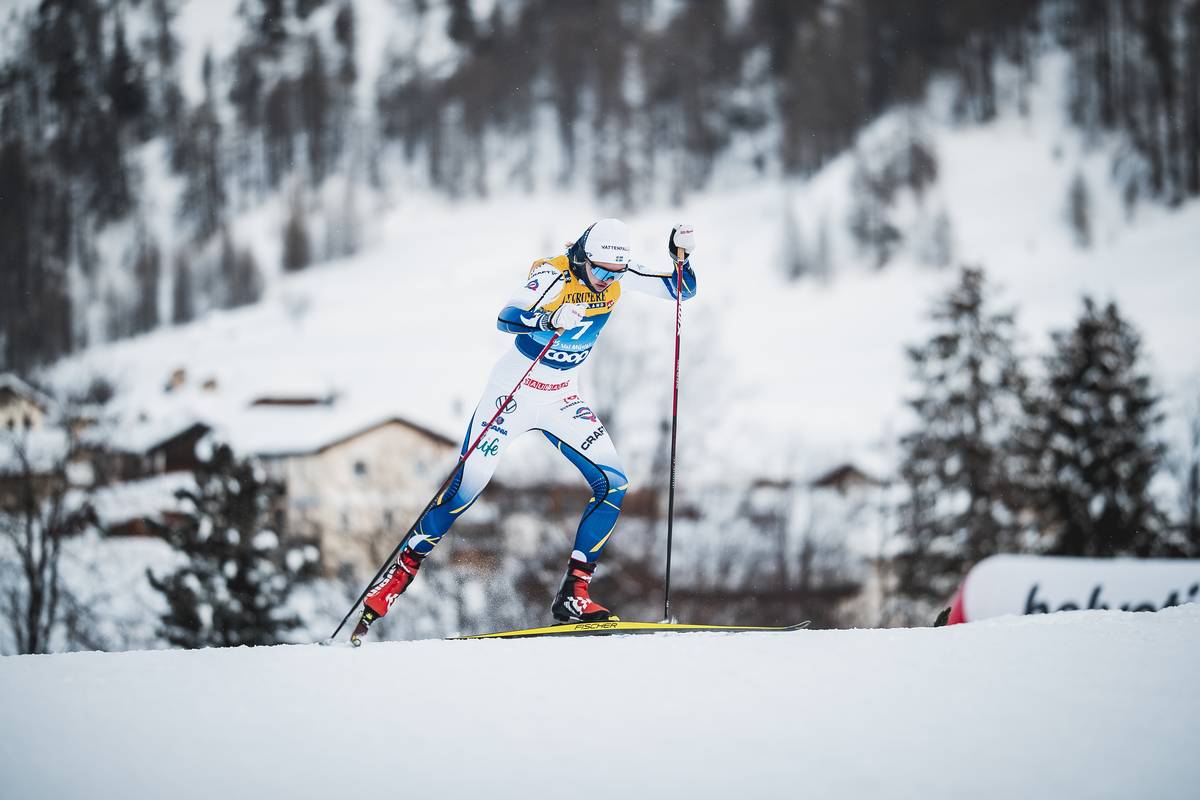
Anger quickly caught Lindholm, and the two set about putting additional distance between themselves and Moser. Anger’s pace ultimately began to unravel Lindholm who could not match the momentum surging under Anger’s skis at this juncture in the World Cup sesason. Sweden I forged on alone as Lindholm was swallowed up by an accelerating Andersen.
At this point, Sweden I appeared to be on its way to the win, while second place would be decided among Norway I, Austria, and Finland I. That’s when Moser came back to life, using the course’s second uphill to quickly put time into Andersen (who had doubtless given a lot just to catch this group). At the final exchange, Anger enjoyed a broad and comfortable lead over Moser, Andersen, and Lindholm.
Anchor Leg
Anger tagged off to Moa Ilar while Moser tagged Katharina Brudermann, the youngest skier in the Austrian lineup who might’ve felt especially vulnerable with Norway I’s Kristin Austgulen Fosnaes chasing just a few seconds behind. Fosnaes made good on that threat, quickly catching—and gapping— Brudermann who was quickly absorbed by a charging group battling for the third step on the podium. Norway II (where the heck did they come from?) was led by Anne Kjersti Kalvaa, followed closely by Switzerland I (Nadine Faehndrich), Finland I (Vilma Ryytty), and Canada I (Liliane Gagnon), and Switzerland II (Marina Kaelin).
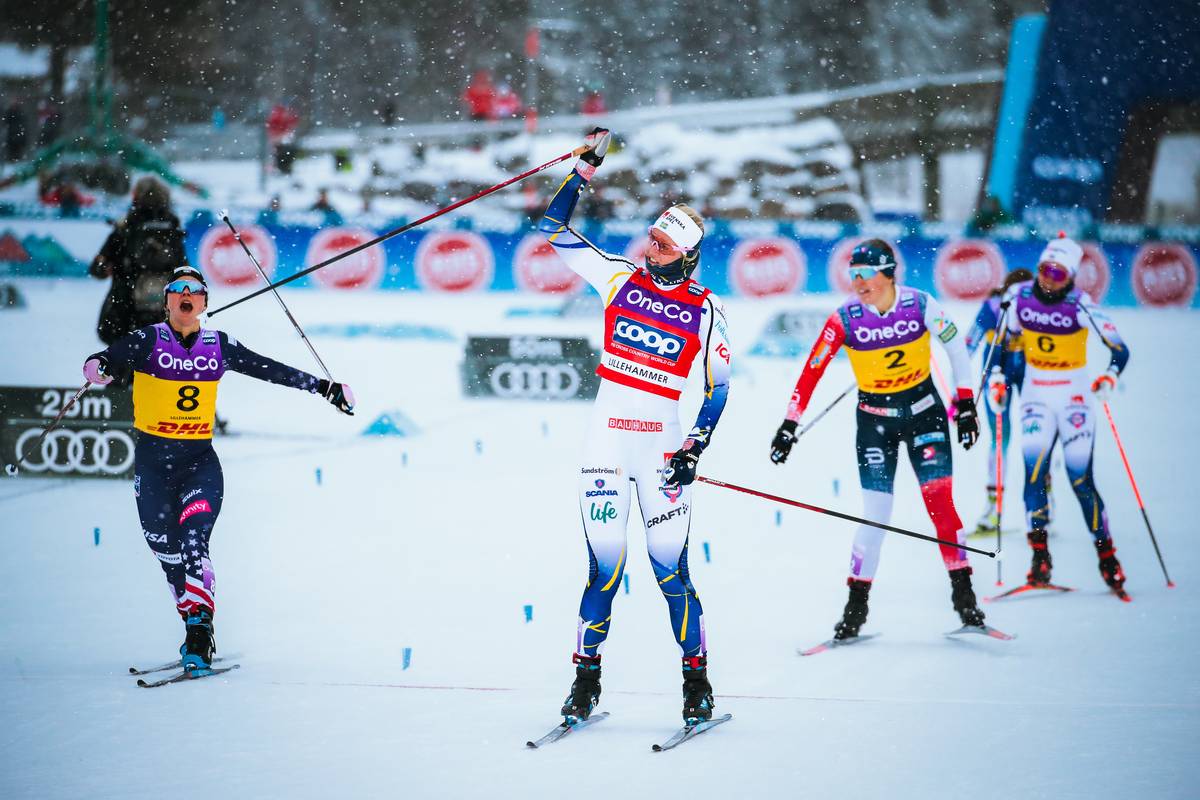
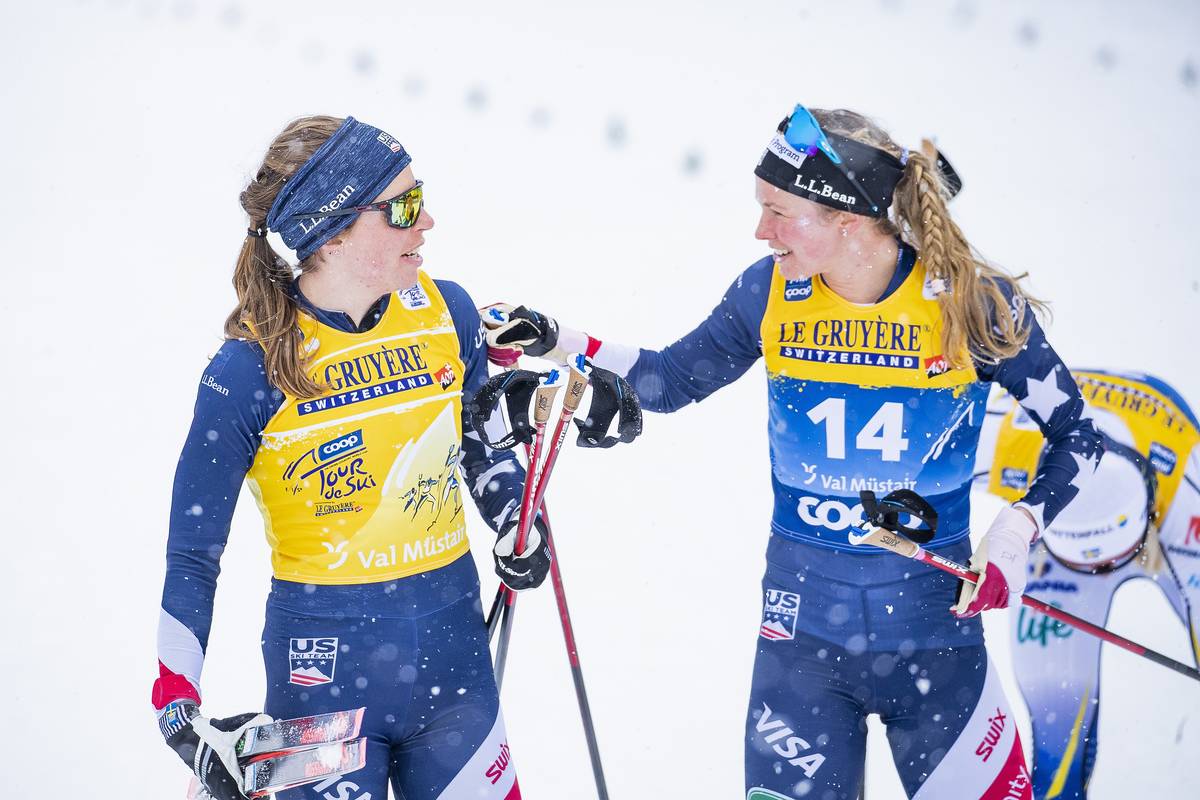
Ilar coasted home for the win, a well deserved victory for Sweden I. Faehndrich had looked well positioned to sprint with Fosnaes, but somewhere in the final kilometer Fosnaes managed to separate herself from the Swiss skier. Norway I took second place, while Faehndrich still managed to hold on to third place ahead of Norway II.
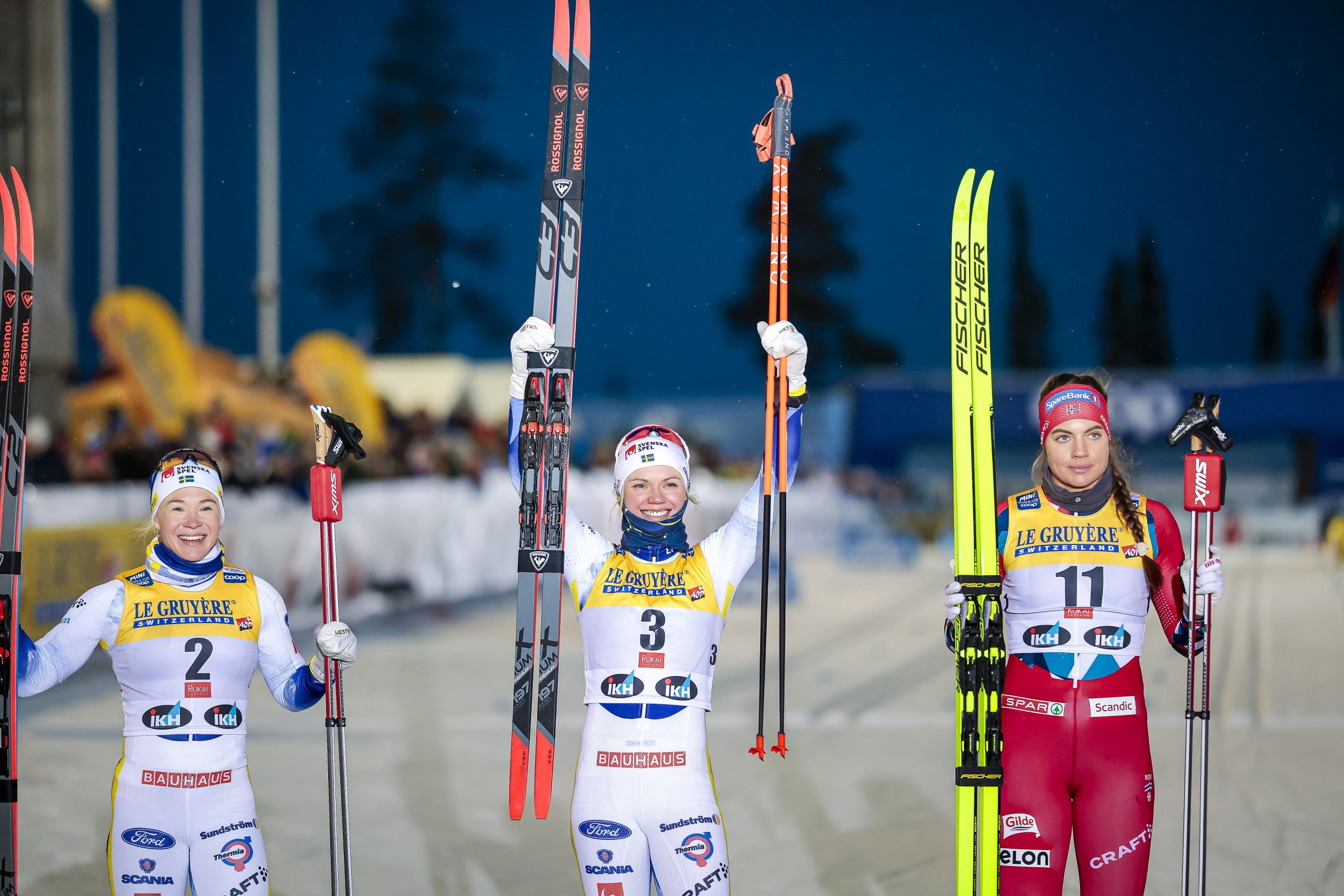
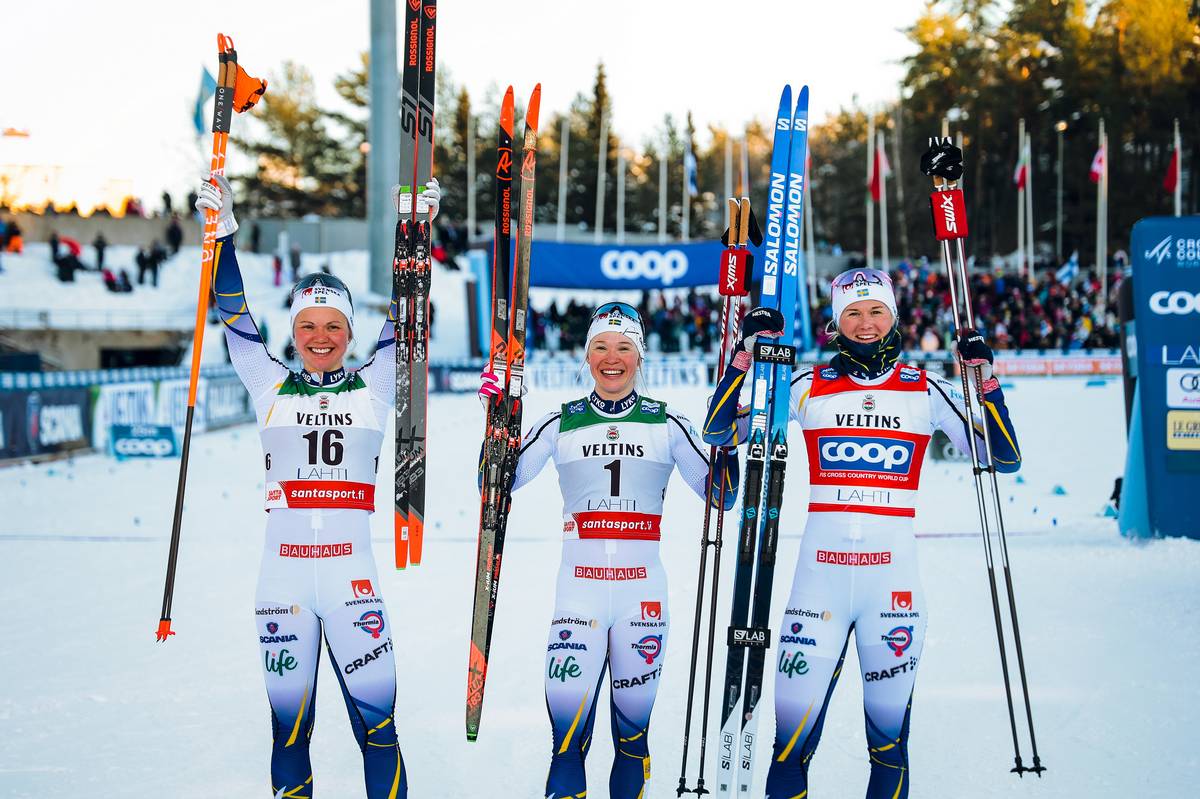
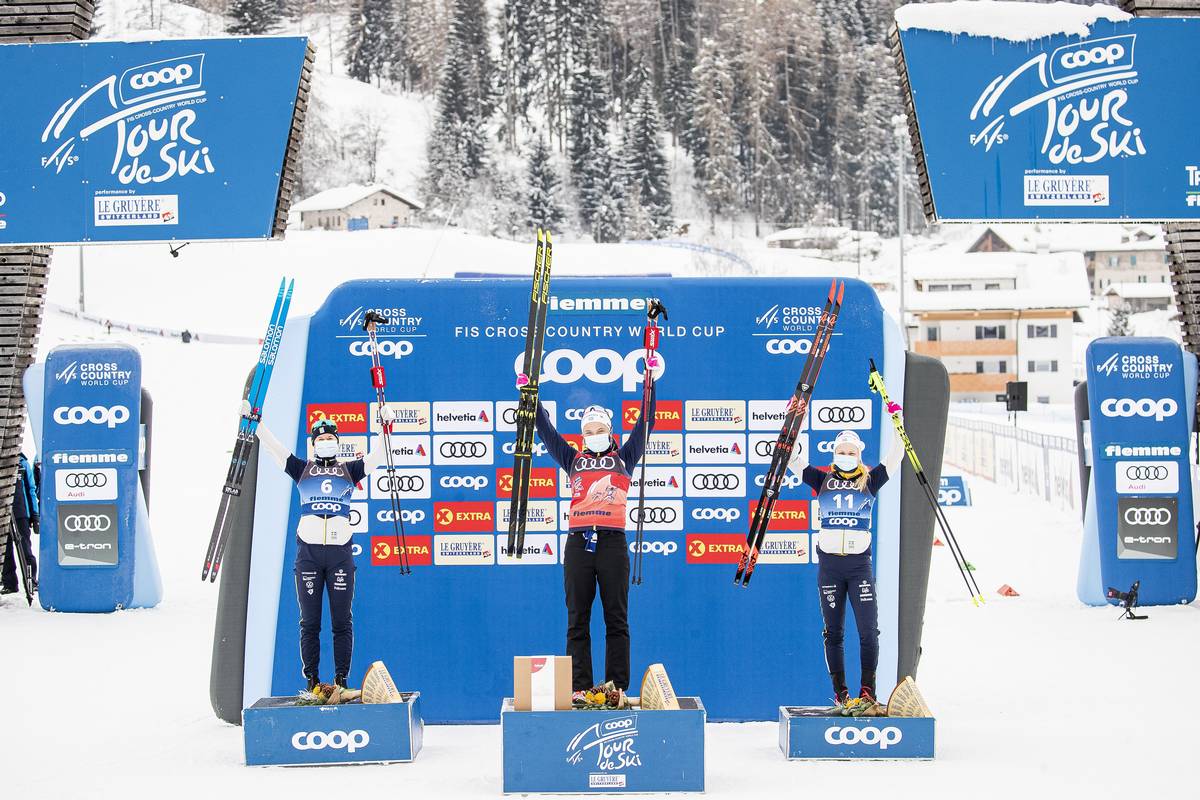
Team Sweden (Moa Ilar, Edvin Anger, Emma Ribom, Jens Burman) celebrates on the podium in Engadin, Switzerland after their victory in the FIS World Cup Mixed Relay. (Photo: Authamayou/NordicFocus)
We’re back, in less than 24 hours since hour last pod. Devon is burning the midnight oil in Norway to bring you this new episode recapping the excellent sprint races in Canmore today. Stay tuned for another episode after tomorrow’s race and a bonus episode where Nat will interview Sweden’s William Poromaa.
Email us at devon@fasterskier.com and nat@fasterskier.com with questions, comments and race predictions. We’ll be back.
We’re in deep to the Tour de Ski now, after a couple of legitimately rad days of racing in Davos, Switzerland. Mikael Gunnulfsen of Norway joins us to talk about the stunning performance of Henrik Doennestad, and of course we catch you up on the latest successes of Americans Jessie Diggins and Rosie Brennan and, oh yeah, Gus Schumacher.
Get at us at nat@fasterskier.com and devon@fasterskier.com. We’ll be back once the athletes hit the top of the Alpe Cermis.
Eli Brown, a member of the U.S. Ski Team’s waxing and ski service staff, joins us this week to talk about his job and the new enforcement of the rules banning fluorocarbons on the World Cup circuit. We recap another strong weekend for American athletes, along with all the hijinks that happened in Trondheim, Norway at the test event for next season’s World Championships.
The World Cup takes a break next weekend before the Tour de Ski, but we may try to squeeze in a mailbag episode. Send us questions if you’ve got ’em. Reach us at nat@fasterskier.com and devon@fasterskier.com.
This coverage is made possible through the generous support of Marty and Kathy Hall and A Hall Mark of Excellence Award. To learn more about A Hall Mark of Excellence Award, or to learn how you can support FasterSkier’s coverage, please contact info@fasterskier.com.
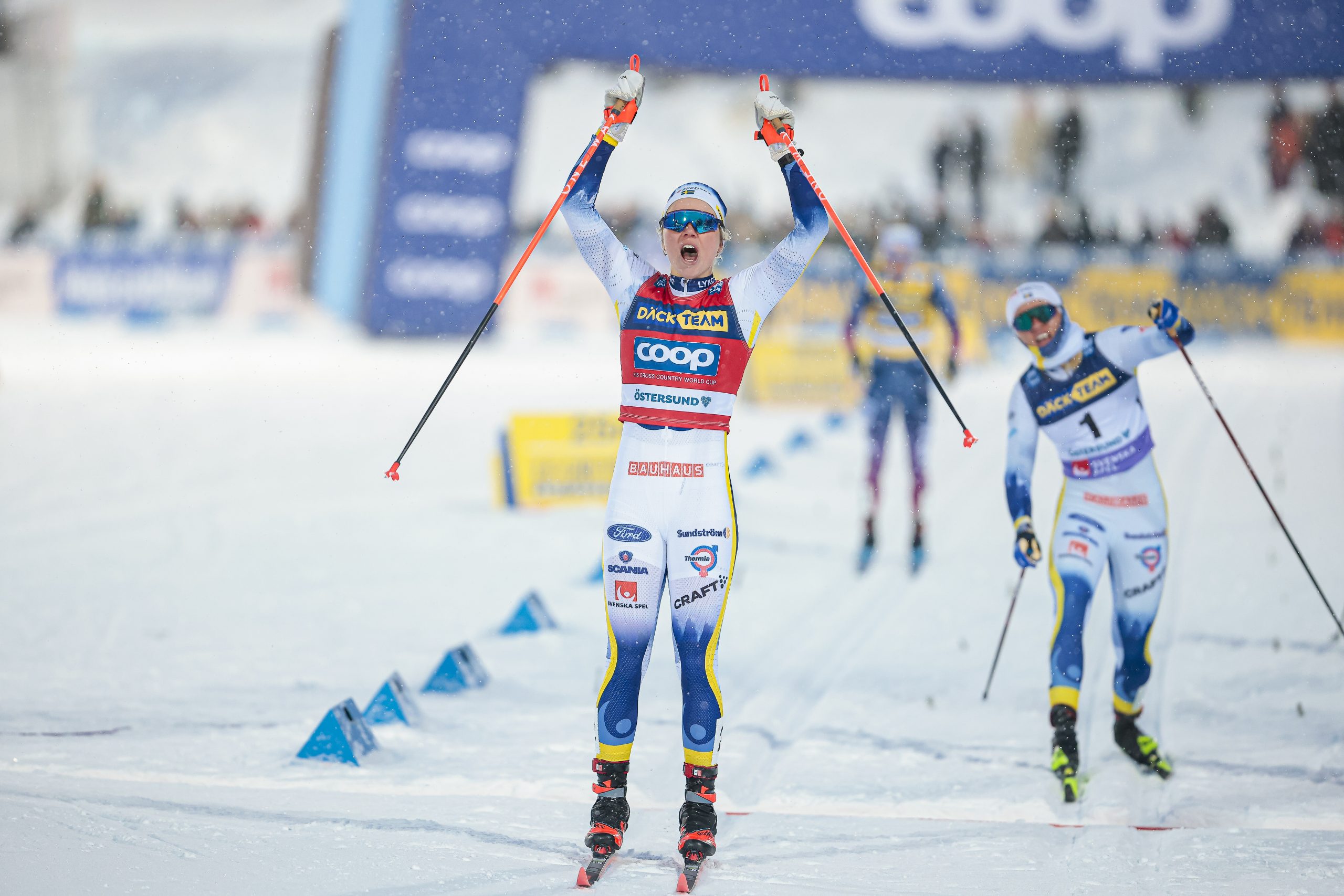
Emma Ribom (SWE) dominated the FIS World Cup Sprint in Oestersund, her second consecutive Classic Sprint victory of the season. (Photo: Modica/NordicFocus)
While much of North America continues to wait for skiable snow, Europe and Scandinavia are enjoying prime, early-winter conditions. Oestersund, Sweden had excellent conditions on its World Cup sprint track, though freshly falling snow seemed likely to affect glide in the tracks throughout the day’s racing. Sweden and the USA continue to dominate recent results, and the sprint in Oestersund proved no exception. Emma Ribom (SW) has won both Classic sprints this World Cup season, while Linn Svahn (SWE)—former World Cup Sprint Crystal Globe winner (2020)—seems to be returning to form as she topped all qualifiers on the day.
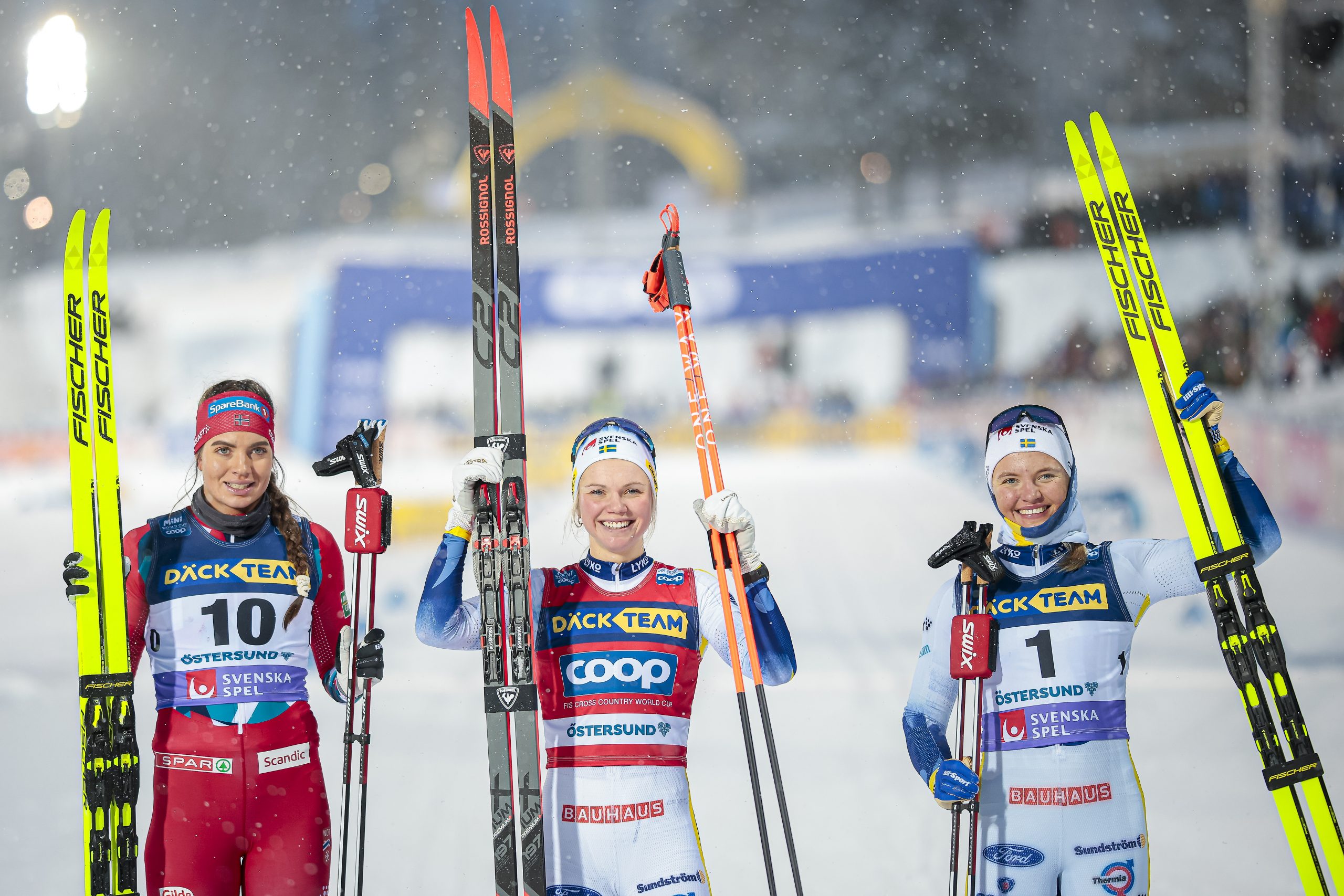
Ultimately, Sweden’s Ribom continued her early-season sprint dominance as she skied away from the field to take the win. In second, Kristine Stavaas Skistad (NOR) sprinted past a resurgent Svahn who returned to the podium in third after two seasons struggling with injury.
Starting the day second in the World Cup overall standings, American Rosie Brennan raced to fourth, ahead of World Cup overall leader, Jessie Diggins (USA), in fifth. Julia Kern qualified 15th, but did not advance beyond the quarterfinals. She would finish the day 17th. Other Americans included Alayna Sonnesyn 43rd, and Lauren Jortberg 47th.
“I’m generally pretty excited about my race today,” Brennan said. “I’m pretty sure that was my best ever Classic Sprint.”
Canadian finishers included Katherine Stewart-Jones 34th, and Amelia Wells 46th,
Women’s Classic Sprint
Oestersund’s sprint course is a bit longer than most, and freshly fallen snow filling the tracks would slow things down (especially in the early rounds), making this sprint something of an endurance event. The final downhill is often an area where drafting can influence who crosses the line first, but the new snow seemed likely to minimize that effect.
“This was kind of a distance sprint,” Diggins explained. “It was 3:30, 3:40 for the women. [That’s] a longer sprint which, personally, I like! I think it’s safe to say that [Rosie and I] were pleased with having more time to play around with out there.”
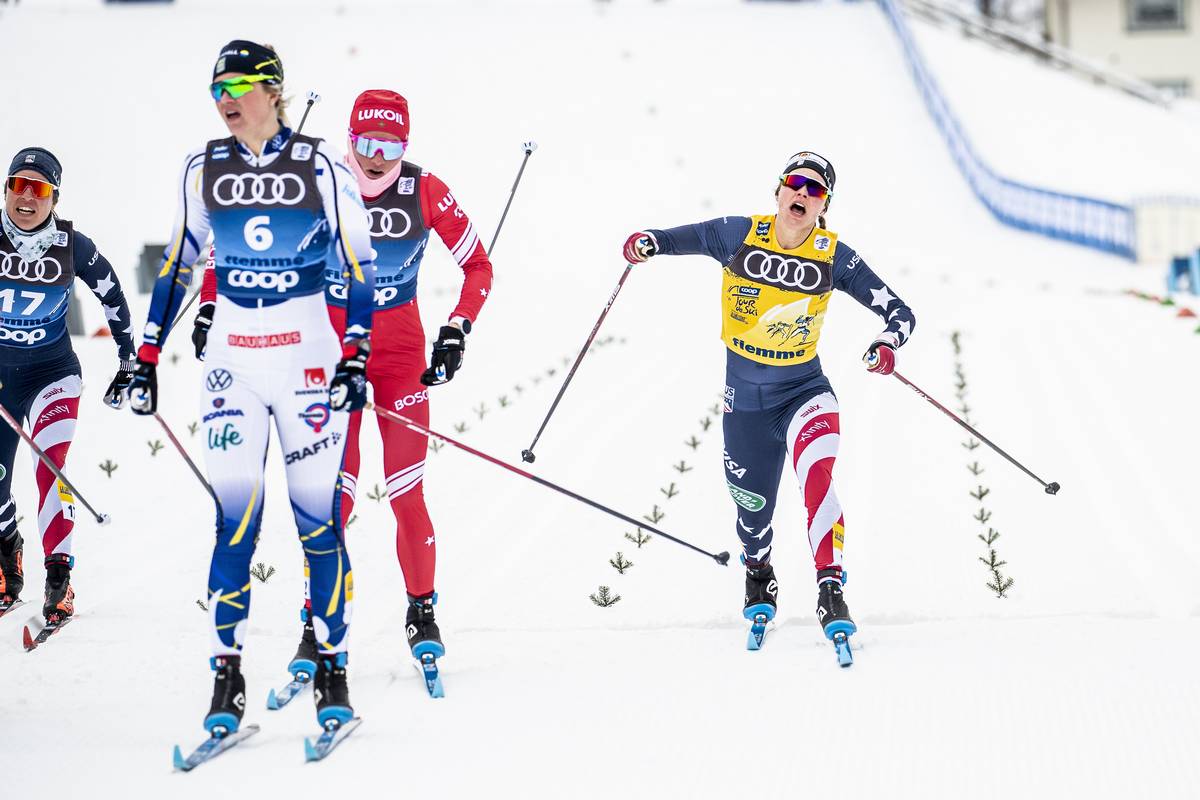
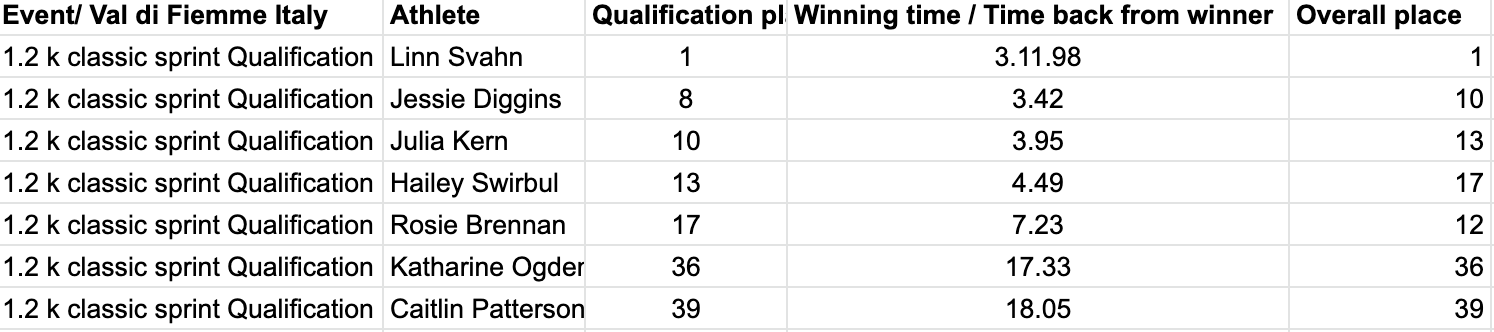
Svahn (SWE) qualified first, returning to the form that saw her win multiple World Cup sprints in years past. Jessie Diggins qualified 3rd , three seconds behind top qualifier, Svahn. Rosie Brennan qualified 6th , only a fraction behind Diggins. Kern qualified 15th, 8.9 seconds behind the leader. Then the snow began to fall, filling tracks and slowing skis. It was a beautiful winter setting for a beautiful winer sport, but competitors may have preferred something a little less scenic and a little more speedy. Wax technicians scrambled to concoct the best combination of kick and glide, while working under the time constraints of the new FIS rules that force teams to deliver skis for fluoro testing far earlier than in the past (and with no opportunity to alter ski bases—or trade out skis—after inspection concludes). It’s a technological and weather-predicting gamble that saw mixed results—some notable slipping, some extraordinary gliding—among the early heats.
In Quarterfinal 1, Ribom (the World Cup Sprint leader) drove the pace to finish just ahead of Skistad. Swedish teammates, Svahn and Frida Karlsson, advanced out of Quarterfinal 2.
Quarterfinal 3 saw Brennan start slowly, but she popped to the front as soon as the course turned uphill. She powered up the slope, hoping her skis would prove fast enough on the subsequent downhill. By the halfway mark, Brennan had pulled clear of the field with only Moa Lundgren (SWE) for company. Brennan cruised to the heat win, only easing up in the final few meters. She was followed across the line by Lundgren.
“It was snowing during the race, and filling in the tracks a little bit . . . My strength is in climbing; the climbing was at the beginning—and it was a little turny coming back to the stadium—so I thought I would just do my best to stay in the front.”
Kern seemed clogged near the back of Quarterfinal 4, while the distance skiers—Lotta Udnes Weng (NOR), Kertu Niskanen (FIN) and Ebba Anderson (SWE)—used their long-fitness to push the pace. Kern’s good skis allowed her to move forward in the final meters, but only enough to finish fourth where her time as not fast enough to earn a lucky loser spot.
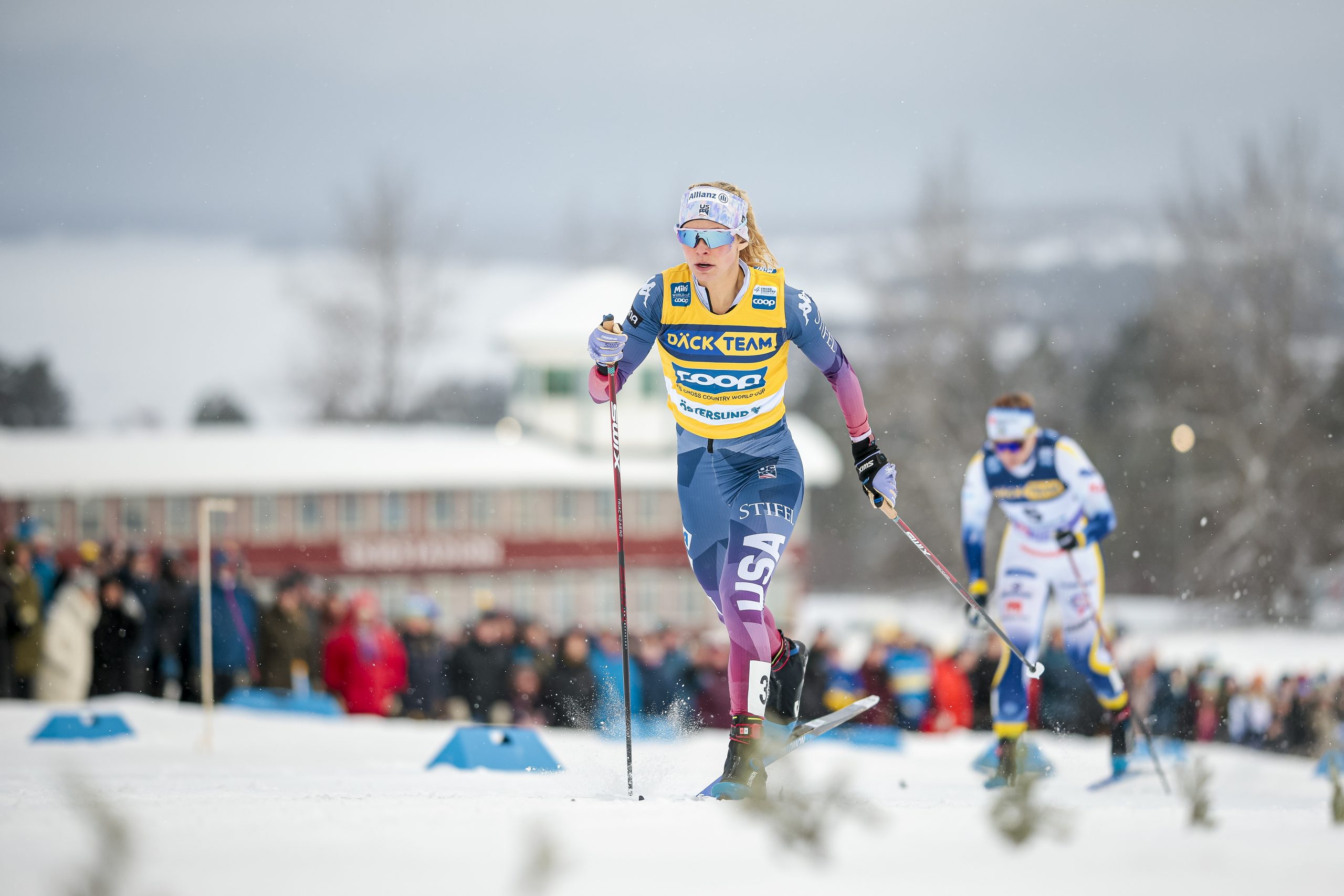
Racing in the World Cup leader’s yellow bib, Jessie Diggins (USA) used her endurance and climbing ability to set the pace in early heats, but could not maintain that tactic in the final. (Photo: Modica/NordicFocus)
Quarterfinal 5 saw Diggins power to a heat victory in the fastest time of the day. The Swedes seemed to have gone light on kick wax: forced to herringbone on the uphills, but hoping to have better glide in the snowy downhill tracks. Diggins apparently realized that strategy; she countered by driving the pace on the uphills, distancing the field early in the course and continuing across the finish line unchallenged. Behind her, Dahlqvist executed a mad-dash double-pole to the finish to pip Finland’s Tiia Olkkonen for second.
Semifinals
The Oestersund snow had stopped falling by the beginning of the semifinals, and the tracks had begun to be skied-in: higher speeds on the downhills, more opportunity for drafting on the downhill leading into the finish. Semifinal 1 was stacked: Svahn, Ribom, Brennan, Karlsson, Skistad appeared poised to follow a fast pace; then no one wanted to take the lead. Brennan pressed the pace on the first uphill, and then the action began. The three Swedes followed Brennan while Skistad dangled unexpectedly off the back. Showing the strength she’s demonstrated in allWorld Cup stops thus far this season, Ribom pulled away for the win, while the fast skis of Skistad allowed he to double pole through top qualifier, Svahn, to grab an automatic entry into the final. Svahn finished third well ahead of Brennan in fourth, and Karlsson in fifth. Svahn and Brennan would would ultimately advance as luck losers.
Semifinal 2 saw Diggins lining up against Dahlqvist, Lotta Udnes Weng (NOR), Moa Lundgren (SWE), and Niskanen. Dahlqvist dropped off the back on the very first uphill (though she did not seem to be suffering from inadequate kick) while Diggins moved to the front with Lundgren. The gap continued to increase as the field entered the two significant downhills. Diggins’s style is not to let up—even when she has a comfortable lead—and she double-poled powerfully across the line for the semifinal win. Dahlqvist sprinted forward from waaaay back to finish a close third (behind Lundgren), though her finishing time was not fast enough to claim a lucky loser spot in the final.
Sprint Final
The snow had begun falling again as three Swedes—Ribom, Svahn, Lundgren—lined up in the final in front of the hometown Oestersund crowd. With them at the line were the two Americans—Brennan and Diggins—and the lone Norwegian, Skistad. Skistad and the Swedes made the pace right from the gun with the Americans trailing, though the pace leveled off quickly allowing Diggins to ease forward on the first uphill. Svahn and Ribom seemed to be slipping a bit on the climb, while Diggins skis appeared solid. Brennan was pinched on a tight corner and was forced to work to regain contact.
“For me, the strategy was just to get to the final by going hard,” Diggins said. “Making sure that it spaced out and didn’t become a race of rushing or people trying to out-corner other people . . . that’s not one of my strengths. So I just decided to go for it and give myself a little space . . . It was a bold strategy, but I was happy with how it panned out . . . I just kind of ran out of gas in the final!”
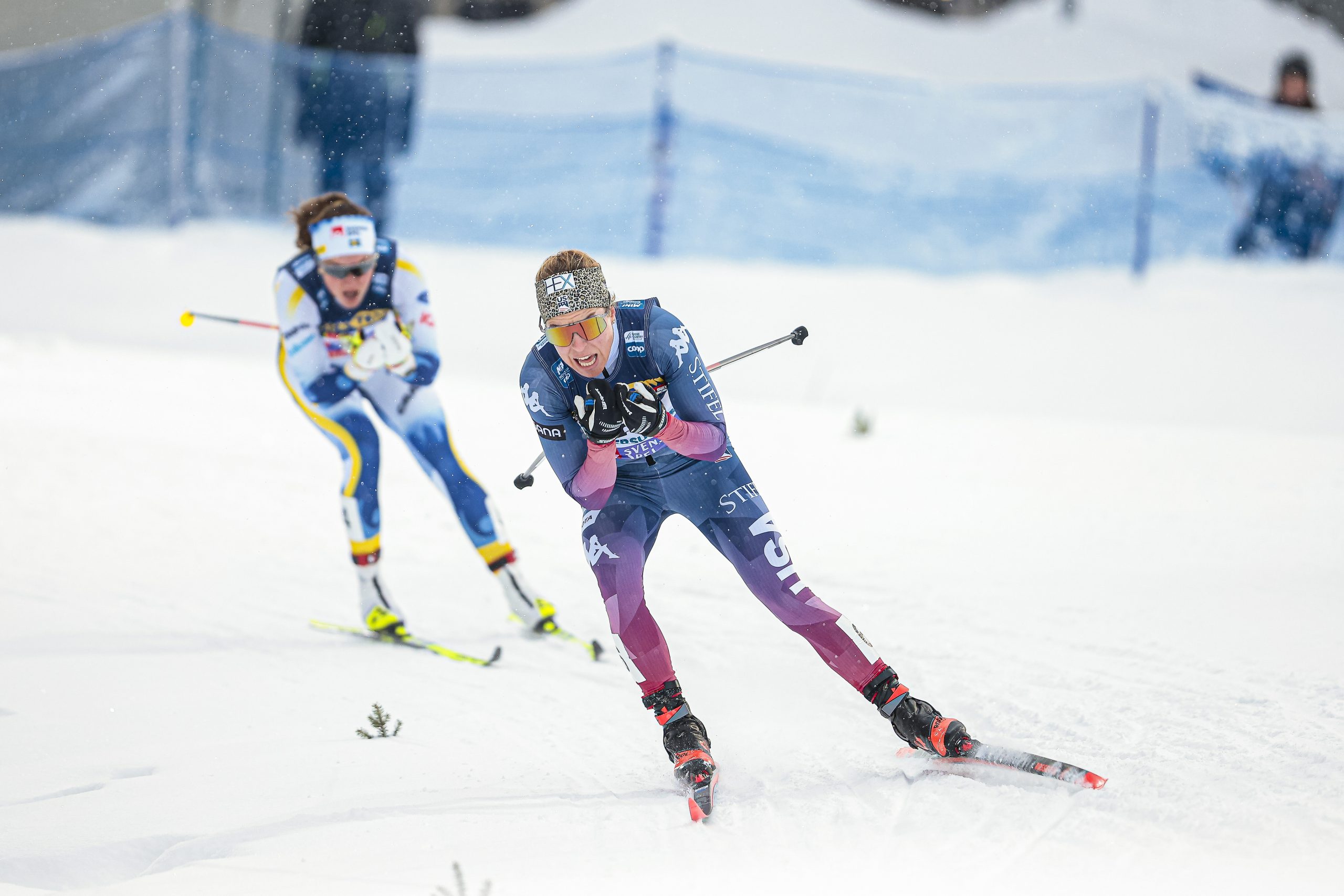
Rosie Brennan (USA) skied confidently at the front for much of the day’s sprint heats in Oestersund. In the final, she may have been inadvertently interfered with by a Swedish coach as she attempted to set up for a notoriously tight turn just before the finish. (Photo: Modica/NordicFocus)
Once over the climb, the speed of the Swedes’ skis became apparent. While Ribom and Svahn opened a gap, the Americans were forced to work hard to remain in contention. Entering the final righthand turn, Brennan may have been inadvertently interfered with by a Swedish coach; she calmly brushed him aside, managing to push herself forward.
“I was really bummed to be impeded by the Swedish coach,” Brennan said. “That’s really not the first time that’s happened to me; It’s the first time that it was on camera,” She chuckled. “So it’s nice that other people saw it! It’s impossible to know what impact that had on my race; I was obviously gaining momentum and had picked that line because I felt like I could pass some people. I feel like coaches are the people who should know the best about how a race works: in a sprint, all people are fighting for all positions, and all lanes are likely going to be used. [Coaches] should be looking out for more than just your own nation. When I left, the jury was discussing and figuring out what to do. I have no idea what the result of that was, but I’m sure that I’ll find out at some point.”
Ahead of the fray, Ribom showed her class as she glided to the win. All Brennan’s hard work and clever maneuvering was undone by the superfast skis of Skistad who glided through Brennan and powered toward the finish where she caught Svahn for second. Sweden first and third, Norway second, USA fourth and fifth.
Diggins maintains her lead in the World Cup overall race, just one point ahead of Ribom. Brennan remains in the top three as the World Cup returns to Oestersund on Sunday for an Individual Start 10 k Freestyle.
“I am feeling good, and I’m excited to have some sprint in me. That makes me really happy and optimistic . . . things are good right now!”
Kristine Stavaas Skistad (NOR), Emma Ribom (SWE), Linn Svahn (SWE), (l-r) – FIS World Cup Individual Sprint in Oestersund , Sweden. (photo: Modica/NordicFocus)
Damn. What a weekend for the U.S. Ski Team, with three podiums in three days of racing at the World Cup opener in Finland.
Erik Bråten, a Norwegian who coaches the Swiss ski team, joins Devon and Nat to recap and share his experiences across a range of international ski cultures. Send us questions, feedback and anti-vax screeds to: devon@fasterskier.com and nat@fasterskier.com — we’ve already got some questions stacking up for a mailbag episode in a few weeks. We’ll be back in a few days after the next World Cup weekend in Sweden.
This coverage is made possible through the generous support of Marty and Kathy Hall and A Hall Mark of Excellence Award. Learn more about A Hall Mark of Excellence Award—or about supporting FasterSkier coverage—by contacting info@fasterskier.com.
Emma Ribom (SWE) led the strong Swedish contingent in repeating her Ruka World Cup sprint win of a year ago. (Photo: NordicFocus)
Today, in the near perpetual darkness of Finland’s early winter, the classic sprint competition announced the dawn of the new World Cup season. The new season brings with it a new rule—perhaps the most significant rule change since skating was allowed—the much awaited fluoro ban, and the associated anxiety over testing protocols. Also affecting race outcomes is the continuing Russia ban.
But the more things change, the more they stay the same in women’s sprinting. Emma Ribom (SWE) repeated last year’s victory taking the classic sprint title in Ruka for the second year in a row. Sweden also continued its domination of women’s sprinting placing four skiers into the finals with Jonna Sundling taking second. Norway only placed one skier into the finals, Kristine Skistad, but it was enough to find the podium as Skistad took third. Skistad picked up where she left off from last season having had a tremendous late season showing having won the last four sprint events last year.
The American contingent had a good day placing three skiers into the heats. Rosie Brennan, qualified 8th, Julia Kern qualified,18th, and Jessie Diggins qualified 12th. Other Americans who did not qualify were Novie McCabe finishing 43rd, and Lauren Jortberg finishing 45th. Canadians Katherine Stewart-Jones finished 40th, and Amelia Wells finished 46th.
Julia Kern (USA) looked great in her quarter final, but was unable to advance out of her semifinal. (Photo: NordicFocus)
All three American qualifiers performed well in their heats and moved into the semis; for a while, it looked like there might be a strong American presence in the finals. But then the Swedish freight train asserted its dominance.
Kern and Brennan were together in the first semifinal, but couldn’t push through to the top. Kern finished fourth and Brennan finished fifth. Kern nearly advanced to the finals as her time tied her for a lucky loser spot to the hundredth of a second, but due to a complex tie-breaking formula she was unable to advance. Kern finished eighth overall and Brennan ninth.
Rosie Brennan (USA) also looked strong, finishing second in her quarterfinal heat. But, like the rest of the Americans, she could not advance out of the semifinals. (Photo: NordicFocus)
Diggins looked great in her quarterfinal, crushing the field in her heat and setting expectations high by putting up the fastest quarterfinal time of the day. She looked strong at the start of her semifinal—leading at the half-way point—but couldn’t sustain the pace and failed to advance out of the semifinal. She would finish seventh overall.
It was a good day for team USA with the team’s coach, Matt Whitcomb, describing the team’s performance as “better than expected. This exceeded our average Ruka day.” Whitcomb pointed out that on the first day of racing the American team might be at a bit of a disadvantage. “I don’t like to make excuses,” he said. “But the Scandinavians have been racing already for a while longer than we have.”
The day clearly belonged to Team Sweden despite the shocking debut of last year’s crystal globe sprint winner, Maja Dahlqvist (SWE), who failed to qualify for the heats. When all was said and done, Sweden showed it’s still the team to beat in women’s sprinting, and the Americans continued to be knocking on the podium door.
The biggest non-story of the day was day one of racing with the fluoro ban. No one was sanctioned for a fluoro infraction and the cold snow rendered the lack of fluoros a non-issue. This outcome was due to the hard work of all teams’ wax technicians. “Today we were really seeking to nail the process with everyone getting their first starts under their belts,” Whitcomb said. “Our stress meters were slightly higher than normal.” Whitcomb was able to provide insight into the new fluoro protocols. “We’re nervous about this [new fluoro rules], but FIS has really done their homework.”
“Yesterday, our whole team showed up at 3:00 p.m.” Whitcomb continued. “And we did a dry run of the entire process.” Whitcomb also shared that some of the major ski powers have their own fluoro testing machines, which cost about $30,000 a piece, which the U.S. does not have the resources for. He mentioned that the Austrians were generous enough to loan the American’s their machine for two days to test all of their skis.
Whitcomb described the race day testing protocol: “Skis are tested before and after racing with different tolerances for before and after a race to allow for post race contamination,” he said. “For sprints, skis are tested before qualifications. Skis are then tested after qualification and we can take them back to the truck to re-wax for the heats. For the heats, they’re tested again before the quarterfinals, and after the finals. For a classic race, an athlete can bring two pairs of skis to the start, have them both tested, and then choose which pair to race on. Clean tested skis are held in a green zone which FIS and volunteers control. If a tested ski exits the green zone or the race course, they are out for the day. On classic race days, techs are allowed to modify kick wax, under FIS supervision, while skis are in the green zone.”
It’s a lot to process, but teams and racers seem to have adjusted well. It’s been a lot of work. Whitcomb said they spent three weeks just cleaning the wax truck, including scrubbing down light bulbs. It certainly isn’t the end of the fluoro story, though. Whitcomb pointed out that skis with deeper structure which have been used for warm conditions can be cleaned, but that fluoros can rise out later and a ski can fail the test. If a ski tests positive, the racer is disqualified for the day. “As I understand it, if any of the skiers’ sets of skis test positive, that skier is not permitted to start.”
It’s a brave new world for waxing, but for day one, it went off without any glitches.
Jonna Sundling (SWE), Emma Ribom (SWE), Kristine Stavaas Skistad (NOR), (l-r) take the podium in the season opener in Ruka, Finland. (Photo: NordicFocus)
This World Cup coverage is made possible through the generous support of Marty and Kathy Hall and A Hall Mark of Excellence Award. To learn more about A Hall Mark of Excellence Award, or to learn how you can support FasterSkier’s coverage, please contact info@fasterskier.com.
World Cup Finals began under overcast Finnish skies Friday, as the circuit looks to settle the questions of a long season over the next three days. Who was—and who wasn’t—racing in Friday’s non-World Cup point scoring event provided evidence that the Crystal Globes remain at the forefront of concerns this weekend.
The women’s Team Sprint as it began on Friday. Notable absences from top Crystal Globe contenders shaped the field Friday as World Cup Finals began in Lahti. (Photo: NordicFocus)
With the Women’s Overall, Distance, and Sprint World Cup classifications all still undecided going into this weekend, Friday’s Team Sprint was absent any women standing within the top five of any of the World Cup classifications. The most notable absences drew attention straight to the top of the World Cup standings: Jessie Diggins (USA) sits second in both the Overall and Distance classifications, with 110 points separating her from Overall leader Tiril Udnes Weng (NOR), and just 22 points between her and Distance leader Kertuu Niskanen (FIN) ahead of Sunday’s 20 k classic. The gap is also 22 points in the Sprint classification between leader Nadine Faehndrich (SUI) and second place Maja Dahlqvist (SWE). The cascade of absences beyond the top two further revealed the closeness of the Women’s field. With points standings tight and the stakes for gaining an additional place or keeping one high, skiers like Rosie Brennan (USA), four points ahead of Heidi Weng (NOR) for fourth Overall, were absent. Julia Kern (USA) joined that list too, looking to hold onto a top five in the Sprint classification that she holds onto by just eight points over Laura Gimmler (GER).
The Men’s Team Sprint field, meanwhile, was much more complete. Johannes Hoesflot Klaebo (NOR) holds an insurmountable 421 point lead over second place Paal Golberg (NOR) in the Overall. The same is true in the Sprint, where Klaebo holds a 254 point gap over Lucas Chavanat (FRA). The only Men’s Classification still technically unsettled is the Distance, where Paal Golberg’s 112 point lead on Klaebo would technically be passable if Klaebo were to win Sunday, win intermediate bonuses, and not have Golberg score any points (which appears unlikely). Further down the Men’s field, the majority of points gaps are larger, which played into Federico Pellegrino (ITA), Lucas Chanavat (FRA), Edvin Anger (SWE), and Richard Jouve (FRA) all being present in the field today. There were other who sat out this team event: notably, Ben Ogden (USA) who is pursuing the best American Men’s World Cup Overall finish since Bill Koch in the 1980s, sitting less than 20 points behind Calle Halfvarsson in seventh Overall.
Women’s Team Sprint
For all the absences from the Women’s field Friday, the defending World Champions in the Team Sprint—the Sweden I team of Emma Ribom and Jonna Sundling—still made it to the start line. Sweden I made it a good race, and a creative one too. “We wanted to have fun, to make it a more tactical race,” Sundling said to FIS media after the race was over.
Jonna Sundling made a clean finishing move to bring Sweden I—reigning World Champions—the win in Lahti, Finland. (Photo: NordicFocus)
As to how that plan played out, Ribom and Sundling took turns dutifully marking the Norway I team of Julie Myhre and Anne Kjersti Kalvaa at the front of the race. When they reached the final climb on the Lahti course, Sundling simply hop-skated away to victory. It was a crisper, cleaner, version of the tactic that she had used in Planica to win the Team Sprint World Championship, and of the one she made in Drammen to win Falun’s 4 x 5 k Mixed Relay for Sweden last weekend.
Behind Sundling’s move, late-race heroics were making for a thrilling finish. The lead pack through most of the race had included the Sweden I team alongside Norway I and the Finland I team of Jasmi Joensuu and Jasmin Kahara. A move from Joensuu in her last leg had created a clean break for the trio of teams; through most of the last lap, Kahara looked like she would hold the separation between her and the chase group. When Sundling went, Anne Kjersti Kalvaa (NOR) was able to stick with her just long enough to win Norway I second place. Behind her, though, two German teams had started to chase down Kahara. As the Finn entered the stadium, Coletta Rydzek for Germany I and Sofie Krehl for Germany II were skiing in tandem, and skiing their way back up to the Finn. The race for third went to the line. Three lunges produced a result that saw Rydzek come across the finish in third place, while Finland I took fourth in a photo finish over fifth place Germany II.
Men’s Team Sprint
The Norwegian World Championship Team may have lacked Paal Golberg on Friday, but Erik Valnes would prove to serve as a worthy replacement to pair with Johannes Hoesflot Klaebo for Norway I. With the Italian World Championship runner-up team of Francesco De Fabiani and Federico Pellegrino also present, the Men’s race held promise for a close front-of-pack race, mixed with a field hungry to challenge the prevailing order among Team Sprint powers.
The men’s field remained tight until Johannes Hoesflot Klaebo moved to bring Norway I the win with Italy I in tow. (Photo: NordicFocus)
That dynamic was on display through each of the early laps, as Federico Pellegrino and Johannes Hoesflot Klaebo danced around each other in the early part of the course, and a whole pack of teams filed in to try and keep with the two. In the final lap, Pellegrino looked for an opportunity to entice Klaebo into a long-burning attack; it’s no secret that leaving a sprint finish meant facing Klaebo’s finishing kick that none were likely to match. Klaebo, though, responded as he has throughout the season to this tactic, ticking his pace up just enough to keep the pack close, and then forcing the pack back to stasis. Four challenging teams made it to the last climb: Sweden I with Edvin Anger, Norway II with Sindre Bjoernestad Skar, France II with Richard Jouve, and Germany with Jan Stoelben. Then, Klaebo went, and Pellegrino followed. The pair had a gap into the stadium, and the prevailing order of the Team Sprint had held. Klaebo crossed the line to win for Norway I, Pellegrino crossed to take runner-up for Italy I, and Skar won a two-way sprint over Anger to take Norway II to third.
Americans, Mix, Match, and Push Team Event
Two American teams qualified for the Team Sprint finals. The USA I team for the Women featured the World Cup relay debut of Sammy Smith, who has qualified for heats in successive sprints in Drammen and Falun. Smith paired with Hailey Swirbul, who has become a relay mainstay for the US. “[I love] the energy of team events,” Swirbul said after last week’s Falun relay. “It really emphasizes how ski racing involves much more than only an individual to make a great day happen.”
Sammy Smith and Hailey Swirbul pushed all the way through Friday’s Team Sprint, landing the young USA I lineup in 11th place. (Photo: NordicFocus)
Smith and Swirbul traded off skiing well within the relay pack early in Friday’s race. As the pack strung out through lap three, Smith slipped to 15th place as she handed to Swirbul for lap four. By the end, the pair had made a resurgent push to finish 11th place on the day, delivering an auspicious effort for the young Americans in a team event.
“I really enjoyed getting to race with Sammy, and be in a more low pressure team event situation,” said Hailey Swirbul post-race. “It was a really cool way to build experience for Sammy and myself, and she skied really well today.”
The pairing of Zak Ketterson and JC Schoonmaker held in the tight men’s race through their first couple of exchanges, before pace increases at the front led to a falling off. The pair pushed on to take 13th place on the day.
“Zak and I were pretty excited to just be able to ski with the pack and make decisions on the fly,” said Schoonmaker in post-race comments. “That’s some of the most fun you can have in ski racing. I definitely wish I could have hung in the main pack longer than I did because Zak was skiing super well, but we did what we could.”
Schoonmaker added that this year’s team events have come with added joy for the men’s team. “It’s been really cool to get to race with some different guys this winter,” he said. “We have a strong men’s team right now so being partnered with any of those guys is an honor.”
Sprint Classification Settled Tomorrow
World Cup Finals continues tomorrow in Lahti, as a classic sprint is set to decide the winner of the Nadine Faehndrich-Maja Dahlqvist Sprint Crystal Globe race in the Women’s field. On the Men’s side, a final act is being planned for the dominant Sprint campaign of Johannes Hoesflot Klaebo.
Meanwhile, Jessie Diggins (USA) will begin her final, two-day push to reel back the Overall Crystal Globe, looking to best Tiril Udnes Weng NOR) with her finish tomorrow and net valuable World Cup points.
This World Cup coverage is made possible through the generous support of Marty and Kathy Hall and A Hall Mark of Excellence Award. To learn more about A Hall Mark of Excellence Award, or to learn how you can support FasterSkier’s coverage, please contact info@fasterskier.com.
Today the Classic Sprints marked the beginning of the first full day of competition at the FIS World Championships in Planica, Slovenia. In the women’s field, there was not a prohibitive individual favorite coming into the race. So evenly matched is the women’s field that the last nine Classic World Cup Sprint races have produced nine different winners! While no individual has dominated women’s Sprinting, the Swedish team has amassed a stock of Sprint superstars who have been on a dominant run lately. For the last 3 individual Sprint races coming into the World Championships, the Swedish women have occupied 7 of 9 podium positions. Norway and USA have been the most consistent challengers to the Swedish domination. The U.S. fielded its own quartet of Rosie Brennan, Jessie Diggins, Julia Kern, and Hailey Swirbul to take on the world.
At the end of the day, the Swedish Sprinting stars rose to the top sweeping the podium with Jonna Sundling taking first, Emma Ribom second, and Maja Dahlqvist third.
Jonna Sundling (SWE) celebrates after winning the women’s Classic Individual Sprint in Planica, Slovenia. (Photo: NordicFocus)
For the Americans, Rosie Brennan was seventh—her best Classic Sprint performance ever—followed by Julia Kern in eighth, and Jessie Diggins 21st. Hailey Swirbul finished 33rd just a bit more than half a second away from qualifying. The American women are working without the availability of Novie McCabe and Alayna Sonneyson who, though nominated to the World Championship team, for health and training reasons chose not to attend the World Championships.
No Canadian women made the heats. Dahria Beatty finished 35th only 1.1 seconds from qualifying. Katherine Weaver was 36th, Olivia Bouffard-Nesbitt 38th, and Liliane Gagnon 47th.
The Women’s Individual Classic Sprint
It was a warm day in Planica with temperatures staying above freezing overnight. This prompted officials to unexpectedly salt the course, and wax technicians to put klister on racers skis. U.S. Coach Chris Grover confirmed with FasterSkier that the conditions were a mix of firm and slush which posed challenging conditions for the racers. This resulted in many non-contact falls throughout the day. Grover added, “The course has technical corners with winding sections where the snow is banking and channels are carved, and those are opportunities…to fall.” The tenuous conditions limited access to the course for warmups, and according to U.S. coach Chris Grover, “Staff never skied on the course.” Coach Matt Whitcomb said that, “This condition begs for salting and frankly we are in support of firmer conditions if at all possible, it was not an unwelcome surprise.”
Rosie Brennan (USA), on her way to a personal best Classic Sprint finish, ending up seventh. (Photo: NordicFocus)
The first American in the heats was Rosie Brennan in heat number two. Brennan’s heat was stacked with headline talent with Ribom (SWE) and Nadine Faehndrich (SWI) lining up with her. After cresting the first big hill, Brennan’s heat quickly boiled down to a pack of three skiers, with Ribom and Faehndrich out front. Brennan was able to keep on the leader’s tails and maintained contact throughout the race. Coming into the end of the heat, Brennan was still in touch with the leaders—finishing third—and would have to wait and hope for a lucky loser position.
Julia Kern (USA) joined teammate Rosie Brennan (USA) in the top ten in the Individual Classic Sprint in Planica, Slovenia. (Photo: NordicFocus)
Julia Kern went off in the fourth heat and would face Linn Svahn (SWE) who has recently returned to the World Cup having recovered from a shoulder injury and has been sprinting extremely well. Kern pushed to the front early and positioned herself extremely well forcing Svahn wide on the course. Kern was able to set the pace up the first steep hill and looked extremely strong. But by the top of the second hill Svahn had worked herself through to the front of the field and established a large gap over Kern. Kern was able to maintain her second place positioned and moved on to the semis finishing second.
Jessie Diggins (USA) qualified for the heats in the women’s Individual Classic, but was unable to advance out of the quarterfinals. (Photo: NordicFocus)
In her heat, Diggins settled into the middle of the field at the start and put in a burst going up the first steep hill to put herself near the front. But she faded quickly after that, finishing fifth. Her day ended there. But, Diggins disappointment was Brennan’s benefit; Brennan moved on as a lucky loser and would face her teammate, Kern, in the semis. The star-studded Swedes placed five skiers in the semifinals.
Sprint Semifinals
The first semi read like a who’s who in the sprint skiing with Jonna Sundling, Emma Ribom, and Maja Dahlqvist representing Sweden. Kristine Skistad (NOR) Nadine Faehndrich (SWI) and Treza Bernanova (CZE) rounded out the field. The depth of this heat led to a very tactical race with Skistad setting the pace for most of the race. Skistad ground away throughout most of the course until toward the finish when Ribom pushed through Skistad and just beat her at the finish line.
In the second semifinal Kern and Brennan would face the formidable combination of the Swedish duo of Svahn, Johanna Hagstroem as well as Laura Gimmler (GER) and Tiril Udnes Weng (NOR). From the start Brennan and Kern drifted toward the back of the field. Then quickly, Brenan asserted herself up the first big hill shooting into the lead and stepping up the tempo for the rest of the field. After the second hill, Brennan had cracked the field and was with Svahn and Weng. At the finish, Brennan skied hard and finished third, but her time did not qualify for a lucky loser position. Kern was unable to meet the pace throughout most of the race and finished fourth.
After the race, Brennan expressed her satisfaction with the outcome.“it was my best classic sprint ever,” she said. And my best World Championship finish ever. I love klister skiing!”
Rosie Brennan (USA) had her best Classic Sprint day ever just in time for the World Championships in Planica, Slovenia. (Photo: NordicFocus)
Kern said that she “felt pretty good and had hoped for a little bit more, but it’s sprint racing and you never really know what’s going to happen.”
After the race, both Brennan and Kern described the course to FasterSkier as sloppy klister skiing.
Sprint Finals
The final came down to the field which had been anticipated: four Swedes and two Norwegians. Ribom, Svahn, Sundling, and Dahlqvist would take on Weng and Skistad. At the start, Skistad bolted into the lead, determined to break the four Swedes trailing her. Weng then put on a burst of speed to join the leaders, and it looked for a moment like Norway could crack the Swedish wall. But about one-third of the way through the race Sundling edged up to the front and was then neck and neck with Skistad; eventually pushing past her. Then the Norwegian dam couldn’t hold back the Swedish pressure and finally burst with the Swedish wave surging to the front with all four Swedes forming a solid wall in front of the Norwegians and quickly gapping Norway. Just past the halfway point, it was all Sweden with the only question left being which Swede would win. It came down to Sundling and Ribom fighting it out at the finish with Sundling holding off Ribom, and Dahlqvist coming in third.
After the racing was over U.S. coach Matt Whitcomb described the Swedish women’s performance as, “next level.”
After many twists and turns, the women’s sprint day ended up much as it had been predicted with team Sweden totally dominating, and the rest of the world left trying to figure out how to match the matchless Swedish women.
World Championship Women’s Individual Classic Sprint RESULTS
Sweden Sweeps the World Championship podium with Emma Ribom (SWE), Jonna Sundling (SWE), Maja Dahlqvist (SWE), (l-r) taking the top three spots in the Women’s Classic Sprint. (Photo: NordicFocus)
This World Cup coverage is made possible through the generous support of Marty and Kathy Hall and A Hall Mark of Excellence Award. To learn more about A Hall Mark of Excellence Award or to learn how you can support FasterSkier’s coverage please contact info@fasterskier.com.
Julia Kern (USA) Having a big day in Lillehammer. (Photo: NordicFocus)
Today is day two for the World Cup stop in the Nordic skiing playground of Lillehammer, Norway. But it was all work and no play, today, as skiers faced the challenge of the 1.6-kilometer freestyle sprint course. It was another grey, overcast day in Lillehammer as skiers lined up for the races. Fifty-five women fought for the Sprint qualifiers, hoping to land a place in the heats. The top 30 qualifiers would earn the right to compete through to the quarterfinals—a bit of a misnomer, as there are actually five races in the quarterfinal round.
Going into the qualifiers, the United States was represented by Julia Kern of Massachusetts, Minnesota native Jessie Diggins, Vermont resident Alayna Sonnesyn, and Colorado native Lauren Jortberg. As reported yesterday, Jortberg is a coach’s discretionary pick, racing in her second World Cup weekend.
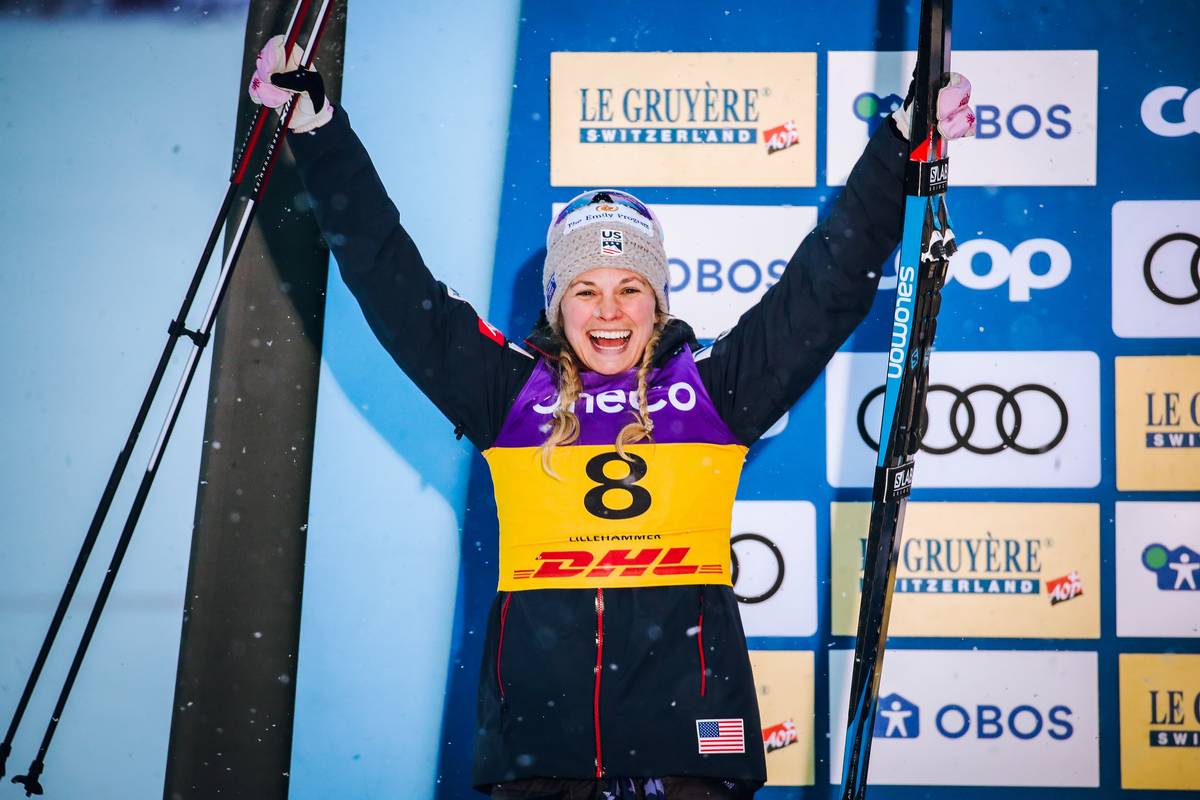
At the end of the day, Jessie Diggins (USA) was tantalizingly close to securing her second podium in as many days. She qualified 5th leading into the quarter finals, and made her way to the finals, but fell just short of the podium, finishing fourth overall. Julia Kern (USA) finished 20th in qualifying and made it into the semi-finals, just missing qualifying for the final heat.
The race was won by Emma Ribom (SWE), who is showing sprint prowess this year, having topped the podium last week as well. Maja Dahlqvist (SWE) was second, followed by Tiril Weng (NOR).
Emma Ribom celebrates her second sprint victory in as many weeks. (Photo: NordicFocus)
Lillehammer Women’s Freestyle Sprints
Diggins landed in the first heat and kept the pace brisk. A late turn of pace brought her to the front, and she finished in a photo-finish for second, which she took by .02 seconds.
Kern competed in the fifth quarterfinal, conserving her energy in the first half of the race, moving up to the lead in the last half of the race. She pushed very hard toward the end, separating herself going in the final turn. She ended up comfortably winning her heat.
“I found my gear and skied it tactically exactly how I wanted to and had really good energy to push in the second half of the course, which was my plan,” Kern said. “I walked away feeling super energized and confident going into the semi-final.”
Diggins at the finish in Lillehammer (Photo: NordicFocus)
In the semi-finals Diggins raced in the first heat, and Kern in the second.
In her heat, Diggins’ skis appeared exceptionally fast as she glided past many of her rivals. She bided her time, remaining toward the back for the first half. She then exhibited the cagey race tactics for which she is now known, deftly working her way through traffic. She ended up finishing third to advance to the finals in a lucky loser slot.
Kern used a strategy similar to what she had shown in the quarters, keeping back for the first half of the race; however, the racers bunched up at the half-way point and there was still a lot of traffic for Kern to make her way through. As the pack neared the finish, Lotta Weng (NOR) crashed, slightly disturbing Kern’s pace. Kern desperately pushed through to the finish, but finished fourth, failing to advance. Kern confirmed with FasterSkier that this affected her race:
“I saw it coming, I had a feeling there might be a tangle and was able to react pretty quickly and get around her,” she said. “That little blip and hiccup, that maybe cost me moving up. But, that’s sprint racing. I’m really happy with today, with how my skis felt and how my body felt. Looking forward to more racing tomorrow.”
“It was a super exciting day to have four in the top ten (including the men), Kern said. “We had ripping fast skis.”
Diggins a happy finisher at the Lillehammer sprints. (Photo: NordicFocus)
U.S. Head Coach Matt Whitcomb shared with Fasterskier that, “Julia executed perfectly the general recommendation to get a reasonable start, and if you find yourself boxed out, take the opportunity to relax, and when you find a window go through it fast.”
“The strategy going into the races was based on footage watched earlier in the week,” Whitcomb added. “We do this to minimize the amount of talk race day, or the meeting before the race, to avoid putting too much stress on the racers. By the time we showed up, everyone pretty much had their own plan. Watching the athletes warm up, they knew what they were intending to execute, that’s a pretty special thing to watch.”
Whitcomb continued his explanation, adding that, “We felt that we had great skis today, which is nice because you can guarantee that Norway’s going to have great skis and that’s half of the competition for us.”
In the finals, Diggins was joined by Ribom, Dahlqvist, Tiril Udnes Weng (NOR), Johanna Hagstroem (SWE), and Victoria Carl (GER). Diggins started fast and still looked to have very fast skis. She shot into third place right off the start. After about a minute, the skiers were tightly bunched. Diggins managed to pass skiers on the outside of the track and move herself into the lead. As other skiers accelerated on the long hill leading into the stadium, Diggins gradually drifted to fourth, but she was still in the thick of things. Ultimately, she couldn’t match the pace of the top three as they separated from her going into the finishing stretch. Diggins ended up fourth—1.1 seconds off the podium—but it was definitely another of her signature sparkling days for the American star.
Whitcomb told Fasterskier that yesterday’s first-place effort had taken its toll on Diggins. “By the end of the race, Jessie felt like her arms had kind of run out of power,” Whitcomb said. “At this point in the season, she could have podiumed yesterday or today, but to have both, was going to be a tall ask. We’re so thrilled with yesterday’s race that getting fourth today feels like a podium.”
This World Cup coverage is made possible through the generous support of Marty and Kathy Hall and the A Hall Mark of Excellence Award. To learn more about A Hall Mark of Excellence Award or to learn how you can support FasterSkier’s coverage please contact info@fasterskier.com.
Snapping back after a week away from racing, the World Cup resumed in wintery Lahti, Finland with a 1.6 kilometer freestyle sprint. The American women made their presence immediately known, landing three of five athletes in the top-five in qualification, with four in the top-30.
Rosie Brennan skis to fifth in qualification in Lahti. (Photo: NordicFocus)
On the heels of a bronze medal in the event, Jessie Diggins was second in qualification, +6.71 behind the time of 3:17.37 posted by Sweden’s Olympic champion Jonna Sundling. Julia Kern was next for the U.S. in fourth (+7.59) behind Russia’s Natalia Nepryaeva, with Rosie Brennan just behind in fifth (+8.61). Hailey Swirbul also raced into the heats, skiing to 26th in qualification (+16.56).
Jessie Diggins posts the second fastest time in qualification during the freestyle sprint in Lahti, FIN. (Photo: NordicFocus)
Leading the Canada team Cendrine Browne raced to 29th in qualification (+17.37), advancing to the heats.
Racing in heat five, Diggins moved to the front of the pack inside the first minute of racing, with Kern on her tails heading up the first climb, with Julia sliding back to third in the following descent. Nevertheless, the Americans maintained control of the heat heading up the climb and around the course’s hairpin turn, where cheers could be heard from the sidelines, urging “Alright, Jessie! Alright, Julia! Hard over the top! Hard over the top! Come on, push, push, push!”
Rounding the final bend to the finish, the Americans were side by side at the front, with Sweden’s Anna Divyk looking for an opportunity to sneak through from their draft. Kern was on the inside of the bend, stepping powerfully to maintain her momentum as the threesome headed into the final 100 meter sprint. Still right alongside her teammate, Kern led the boot throw to win the heat, with Diggins +0.1 back, and the Swede on their tails to cross the line +0.39 seconds back in third. As the fifth heat proved to be the fastest of the quarterfinal, Czech athlete Katerina Janatova also advanced as a lucky loser after finishing in fourth, just over a second behind Divyk.
Julia Kern and Jessie Diggins take to the course during the quarterfinals of Lahti’s freestyle sprint. (Photo: NordicFocus)
In the first semifinal, it was Sundling and Dahlqvist at the front, with teammate Emma Ribom and Nepryaeva jockeying for the third and fourth positions through the first half. The Swedes rounded the hairpin in first through third, but Nepryaeva, Nadine Fähndrich (SUI), and Janatova remained close on their heels. Coming into the finish lanes, it was Sundling in front, with Ribom nipping Dahlqvist at the line by 0.11 seconds. Nepryaeva crossed fourth, 0.6 back from Dahlqvist, leaving the two awaiting the outcome of the next semi to determine their fate heading into the final round.
The Americans raced in the second semi, along with an additional two Swedes, Divyk and Johanna Hagström, plus Slovenia’s Anamarija Lampic and a German, Coletta Rydzek.
Julia Kern tucks into Jessie Diggins draft during the freestyle sprint heats in Lahti, FIN. (Photo: NordicFocus)
Heading up the climb to the hairpin, it was Diggins at the front, with Hagström on her tails and Lampic maintaining contact. The group had thinned, leaving the remaining three women trailing behind on the descent with a gap between each.
In the adrenaline-filled final meters, it looked like Hagström would hold the advantage to the line, but a high tempo Diggins and accelerating Lampic were closing fast. Throwing their boots three abreast, the women crossed the line dead-even for a three-way photo finish.
A slow motion replay of the slide showed that it was Lampic who crossed first, with Diggins .03 seconds behind, and Hagström in third, separated by an additional 0.01 second. With Lampic’s time clocked roughly 0.7 seconds slower than Nepryaeva’s in the first semi, only the top two women advanced, leaving Hagström just off the mark.
Kern crossed fourth in the heat (+1.94) to end her day in eighth overall.
“Today was a lot of fun,” Kern said in a U.S. Ski & Snowboard press release. “The conditions were great, the stadium and course were filled with lively spectators and I was really excited to get back to racing the World Cup! I felt like I had a lot of great energy today, skied well, and enjoyed the awesome atmosphere while racing side-by-side with Jessie in the heats! I was stoked to put down maybe my best World Cup qualifier and see that my body is ready to fire after the Olympics.
“I have only raced two races in the last two months,” Kern continued, “so I have been excited for Period 4 World Cups with lots of racing opportunities. I am someone who loves to race. I had a blast skiing with Jessie in the heats today, we train together all year long, working hard and pushing each other, and also rooming together, so it is fun to ski well together and take charge of the heats. ”
Julia Kern races to eighth place in Lahti’s freestyle sprint. (Photo: NordicFocus)
Sundling looked to leave nothing to chance in the final, gapping the field before the halfway point, with Lampic and Ribom leading the chase group a few seconds back.
Descending from the hairpin, the Swedes were in first through third, with Sundling still well off the front. Diggins had moved up onto Dahlqvist’s tails in fourth, which she held heading around the final bend into the stadium and into the lanes.
Jonna Sundling (SWE) cruises through the final to win the 1.6 kilometer freestyle sprint in Lahti. (Photo: NordicFocus)
While Sundling cruised cross the line for the win in 3:12.86, it was Ribom and Dalqvist fighting for the second and third spots to determine the order of a Swedish podium sweep. It was Ribom in second at the line (+3.28), fending off Dahlqvist in third (+3.67), interrupting her streak of World Cup wins this season.
Diggins held her ground close behind the Swedes in fourth (+3.93), with Lampic closing fast for fifth (+4.01). Nepryaeva closed out the women’s final in the sixth spot (+4.69).
Jessie Diggins throws her boot for fourth in the final round of Lahti’s freestyle sprint. (Photo: NordicFocus)
Following the race, Diggins said she was happy to be feeling like herself again following the brief post-Olympic break. It was just six days ago that Diggins fought through food poisoning induced fatigue, cramping, and delirium to earn a silver medal in the 30 k skate.
“I was incredibly tired after the Olympics,” Diggins said in a post-race audio clip, embedded below. “That 30 k took more out of me than maybe any race in my entire life. So I was just feeling lucky to be out there and racing and able to feel like my body is back.”
In addition to providing insights into how things shook our for her, Diggins commented on the experience of watching newer members of the team earn their first World Cup starts, specifically Lauren Jortberg, Bill Harmeyer, and Logan Diekmann.
“Happy to be part of that rite of passage. That was really, really fun.”
Sweden’s Jonna Sundling hugs Emma Ribom (right) after finishing one-two in the freestyle sprint in Lahti, FIN. (Photo: NordicFocus)
“I feel amazing right now,” Sundling said of her win in a post-race interview with FIS at the finish. “I think I’m in a good place in my career and it feels really good to ski right now. Today, I just tried to trust my skiing and it went really [well], so I’m happy.”
When asked about the Swedish podium sweep, Sundling broke into a wide grin. “I’m so happy, and for Emma, it is her first, so it’s really good.”
A Swedish podium sweep in Lahti, with Jonna Sundling taking the top spot ahead of Emma Ribom and Maja Dahlqvist. (Photo: NordicFocus)Rosie Brennan races in the fourth quarterfinal heat in Lahti, FIN. (Photo: NordicFocus)
After sharing the lead with Slovenia’s Lampic through the second half of the fourth quarterfinal, Brennan rounded the final bend into the finish in second position, moving to Lampic’s right with 50 meters to go. While Lampic maintained a lead by several meters, Germany’s Rydzek crept up alongside Brennan, throwing her boot at the line to edge out the American by 0.04 seconds. As the third heat saw times roughly four seconds faster than the fourth, Brennan was unable to advance as a lucky loser and ended her day in 13th.
Crossing in sixth in heat one of the quarterfinal, which saw Sundling and Nepryaeva go one-two, Swirbul finished 28th today. Swirbul maintained contact with the lead pack through the hairpin turn, where Sundling and Nepryaeva accelerated off the front to thin the pack.
Hailey Swirbul races in the first quarterfinal heat in Lahti. (Photo: NordicFocus)Cendrine Browne (CAN) races in the second heat of the quarterfinals in Lahti, FIN. (Photo: NordicFocus)
Canada’s Browne also ended her day in the quarters after racing in heat two. Browne was +2.19 behind Sweden’s Maja Dahlqvist who comfortably won the heat, with the Canadian in sixth to end her day in
Also racing for the U.S., BSF Pro Team’s Lauren Jortberg raced was pulled up from the SuperTour for her first World Cup appearance. Jortberg is ranked 11th overall in the SuperTour standings and is third on the sprint list behind APU’s Rosie Frankowski and Becca Rorabaugh, both of whom opted to race the American Birkie this weekend.
Lauren Jortberg (BSF Pro) makes her first World Cup appearance in the 1.6 k freestyle sprint qualifier in Lahti, FIN. (Photo: NordicFocus)Olivia Bouffard-Nesbitt (CAN) races the 1.6 k freestyle sprint qualifier in Lahti, FIN. (Photo: NordicFocus)
Outside the top-30 for Canada, Olivia Bouffard-Nesbitt was 33rd today, less than a second away from the heats, with her teammate Dahria Beatty just 0.25 seconds behind her in 34th. Laura Leclair was the final Canadian racer in the women’s field, finishing 54th in qualification (+25.41).
Women’s racing continues tomorrow in Lahti with a 10 k individual start classic.
This World Cup coverage is made possible through the generous support of Marty and Kathy Hall and the A Hall Mark of Excellence Award. To learn more about A Hall Mark of Excellence Award or to learn how you can support FasterSkier’s coverage please contact info@fasterskier.com.
The History:
A survey of the last five Olympic cycles shows a clear trend in American women’s sprint results: upward. In the 2002 Games in Salt Lake City, no Americans qualified in the freestyle sprint. Tessa Benoit was the top qualifier in 38th, with an up-and-coming Kikkan Randall next for Team USA in 44th. Randall was then 20 years old.
In the freestyle sprint four years later in Torino, Randall was the only American to qualify for the heats. She was 10th in qualification, then moved to 9th in the final standings. Switching to classic for the 2010 Games in Vancouver, Randall again qualified in 10th to be the only American in the heats, this time racing her way up to eighth.
And then there was Sochi.
The 2014 Games in Sochi were a turning point for the American squad, with all four women qualifying inside the Top-30 in the freestyle sprint. This time, a new name topped the list for qualification: Sophie Caldwell in 9th. Not to be overlooked, USA also had Jessie Diggins 12th, Kikkan Randall 18th, and Ida Sargent 25th.
Racing in her first Olympiad, Caldwell (now Hamilton) entered uncharted territory as she won her quarterfinal to advance into the semis, which she finished in a thrilling boot slide to be 0.1 seconds behind heat winner Ingvild Flugstad Østberg of Norway. Though she crashed in the final, she again moved the needle upward for the Americans by finishing sixth in the final heat.
The remaining American women also finished inside the Top-20, though none made it beyond the quarterfinals. Diggins was 13th, Randall 18th, and Sargent 19th.
The American women’s sprint team prepares for the individual freestyle sprint. (Photo: NordicFocus)
Carrying momentum from these Games through the next Olympic quad, the Americans had three women in the Top-30 for the classic sprint in PyeongChang in 2018, with Sargent just outside in 33rd.
This time it was Diggins in 7th – the top Olympic qualification result of any American woman – with Sadie Bjornsen 9th, and Caldwell 12th.
Despite it being her weaker technique, Diggins raced with confidence, landing in second in both her quarter and semi to advance automatically into the final. Losing touch with the leaders, Diggins repeated Caldwell’s historic result to finish 6th overall.
Perhaps a less apparent victory, Caldwell also raced into the semis, finishing 8th overall after taking third in her semi and missing a lucky loser spot in the final by just 0.18 seconds. Bjornsen was eliminated in her quarter after taking third in her quarter, on the wrong side of the lucky loser mark, but just barely, to end her day in 14th.
Fast forward four years and get excited.
Rosie Brennan (USA) on her way to the 2nd fastest time during qualification. (Photo: NordicFocus)
Sweden’s Jonna Sundling smashed the qualification round of the 1.5-kilometer freestyle sprint, setting the mark at 3:09.03. The next name on the list? Rosie Brennan in second (+5.80), ahead of Nadine Fähndrich (SUI) in third (+6.62), Yulia Stupak (ROC) fourth (+7.98), and… Diggins in fifth (+8.69).
Have you been reading closely? Both Brennan and Diggins both exceeded the previous best result in qualification from any American woman in history.
Also posting a strong qualifier, Julia Kern was 14th in qualification (+11.66), rebounding from Saturday’s skiathlon which left her wanting more. The final American starter, Hannah Halvorsen, finished 43rd (+20.10) in qualification – outside the Top-30, but still above Randall’s result from her first Olympic Games 20 years ago.
Jessie Diggins (USA) skis the 5th fastest time during qualification. (Photo: NordicFocus)
You may be wondering about the spread of times; the top-10 were nearly 11 seconds apart. After a quick descent out of the stadium, the course in Zhangjiakou features a 30-meter climb – nearly 100 vertical feet – followed by a sweeping downhill that leads back toward the stadium. From there, athletes face a 14-meter climb back into the stadium, finishing with a gradual rise to the line. Combined with cold dry snow, these factors can contribute to an above-average spread amongst the top qualifiers.
Here we go: the heats.
Brennan lined up alongside Sweden’s Sundling in the first quarterfinal heat. With nerves running high, a false start brought the six women back into the gate after the first starting beep. On the second go, the women pushed through the wands cleanly, but on one of her first doublepole pushes, Brennan caught the edge of her boot, dropping down to her knees and losing any momentum she had picked up as the field rocketed away from her.
Not willing to let the day end there, Brennan collected herself and focused on the task at hand, regaining contact with the group at the bottom of the climb and grinding her way into second position, looking strong as she crested the top of the hill just behind Sundling and rounded the curve to head into the descent.
After stumbling out of the start, Rosie Brennan (USA) charges back to the front of her quarterfinal heat. (Photo: NordicFocus)
Given the effort required for such a comeback, would there be enough left in the tank for the B-climb or had the matches been burned early? With Sundling holding steady in the lead Brennan was challenged by Slovenian sprint champion Anamarija Lampic as the women pushed up the final climb, but found another gear for a commanding second-place finish, +2.4 behind Sundling, but +0.7 ahead of Lampic, who would advance as a lucky loser.
The second heat featured medal favorite Maja Dahlqvist of Sweden, who qualified in sixth. Norway’s Tiril Udnes Weng set the pace, leading up the A-climb with Dahlqvist alongside, and Russia’s Natalia Nepryaeva on their tails. Powering out of the B-Climb, Dahlqvist held the advantage at the front, while Nepryaeva and Weng slid over the line in a photo finish for second and third. A closer look showed Weng’s boot accelerate as she reached forward, just in time to nip Nepryaeva at the line by 0.03 seconds for the automatic advancement to the semifinal. The second heat was six seconds slower than the first, leaving Nepryaeva out of the running for a lucky loser spot.
A fast third heat saw Nadine Fähndrich of Switzerland and Maiken Caspersen Falla advance automatically, pulling Germany’s Victoria Carl over the line as the second lucky loser.
Dancing and smiling in the start gate, Diggins got out with a clean start, positioned near the front and looking powerful as the women headed into the downhill curve out of the stadium. Around this curve, she was pushed to the outside as she skied defensively to dodge potential snags with the other skiers’ equipment, leaving the curve near the back of the pack.
Jessie Diggins (USA) leads Emma Ribom (SWE) in the early rounds. (Photo: NordicFocus)
Then, Diggins put on a show up the climb. Steadily moving up along the outside, she was perfectly balanced in a crisp V2 while other were in V1, catching the Swedish leader Emma Ribom. Leading over the top, Diggins kept the pace high to take the sting out of other sprinters. Carrying momentum out of the descent and again holding a strong V2 up the B-Climb, Diggins carried her lead through the finish to win by over 2 seconds, with Ribom next. There was no doubt that Diggins was looking good heading into the semi.
In the final quarter, Julia Kern pushed the pace in the first half, positioning herself in the lead as the pack headed out of the climb. She held her position through the downhill and around the hard right turn, carrying momentum into the hill. Perhaps paying for her efforts early on, Kern was dropped on the final climb as Veronika Stepanova (ROC) and Sofie Krehl (GER) broke away before heading into the stadium. Kern kept herself in the fight, staying in contact with Alina Meier (SUI) through the false flat to the finish, but ended up fourth in the heat, +3.5 back from the leader and behind the mark needed for a lucky loser spot in the semis. A gusty and tactical performance in her first Olympic sprint appearance.
Julia Kern (USA) led her quarterfinal early during the individual freestyle sprint. (Photo: NordicFocus)
To regroup: we now have two Americans in the semi, matching the previous best result from 2018.
Lining up in the first heat of the semis, Brennan got out of the start smoothly, tucking into the back of the back to safely descend out of the stadium and carry momentum out of the left-hand bend and into the A-climb.
Following the effective, albeit unforeseen, strategy from her first round, Brennan pushed her way up the A-Climb, moving from sixth place into the lead. The American kept the effort high as she pulled Sundling, Dahlqvist, Fähndrich. Brennan charged the downhill, stepping powerfully around the right hand bend to head into the B-climb at high speed. In the second climb, the two Swedes, Sundling and Dahlqvist, worked their way around Brennan, with Fähndrich also accelerating. No relief until the finish, Brennan did not let up in the undulating terrain that follows the B-climb, rounding the final curve in fourth place just behind Dahlqvist.
After setting a fast pace for the heat, Rosie Brennan finishes fourth in her semifinal to advance as a lucky loser. (Photo: NordicFocus)
Sundling stretched out the spread of the top-four in the final stretch to take the win in 3:11.94, with Fähndrich second, Dahlqvist third, and Brennan fourth, +1.35 behind Sundling. Brennan’s efforts to keep the pace hot contributed to a lightning fast heat, with Sundling’s time nearly four seconds faster than the top finish in the quarterfinal. This left Brennan in good standing for a lucky loser spot in the final, but she would need to hold her breath to see what the second heat would decide.
The second semi was quick out of the gate, with Sweden’s Ribom leading up the start of the A-climb. Diggins was comfortably tucked into the pack, beginning to set her race plan into action as she V2ed steadily up the side of the track, holding her form longer than the others as she moved into the lead. Nearing the high point, Diggins switched to a rapid tempo V1 with Norway’s Falla matching pace to head out of the climb in first and second.
Diggins sat in a low tuck at the front, stepping around the sweeping left-hander and heading into the B-Climb with Ribom and Falla trying to match pace and challenge at the front. Ribom moved ahead near the top of the climb to lead into the final curve. Diggins sat on the Swede’s tails, with Stepanova alongside. A bobble zapped some of Diggins’ momentum and could have been devastating, but the American kept her composure and stayed upright, staying in contact with Ribom as they headed into the finish lanes.
With Ribom in the lead, Diggins powered toward the finish line to secure a second place auto-qualifier spot for the final. She crossed the line +0.4 behind Ribom’s mark of 3:15.22, with Falla and Stepanova crossing in third and fourth a few meters back.
As the second heat times were roughly four seconds slower than the first, Brennan could let out a sigh of relief. The second lucky loser spot was now hers.
And now, we watch history unfold. Two American women in the final, as Brennan and Diggins set a new mark for the stars and stripes.
The final lineup saw Sundling, Dahlqvist, and Ribom racing for Sweden, alongside Diggins and Brennan, with Fähndrich representing Switzerland in red.
Emma Ribom (SWE), Nadine Faehndrich (SUI), Rosie Brennan (USA) and Maja Dahlqvist (SWE), (l-r) get up to speed at the beginning of the women’s individual sprint final. (Photo: NordicFocus)
Taking charge from the start, Sundling skied with authority, smoothly leading her teammates Dahlqvist and Ribom up the A-climb to put Sweden in first through third heading out of the climb. Diggins was fourth as they crested the high point, with Fähndrich on her tails and Brennan just behind.
Utilizing the speed of her skis and her strength in the downhill, Diggins moved up alongside the Swedes in the descent, looking for position heading into the final climb. Maintaining her command of the race, Sundling rocketed off the front to gap the remaining five women who all remained in contention for a medal leaving the climb.
Ribom quickly fell off the pack, leaving Dahlqvist leading a tight group of four over the undulating terrain that led to the final bend before the stadium. Diggins and Brennan looked to be boxed out as they headed around the final curve in third and fourth, respectively, but the Americans were patient versus panicked, which could put them at risk of a fall.
Coming out of the curve, Diggins accelerated around Fähndrich to challenge Dahlqvist for the silver medal. Brennan followed her teammate to surge past the fading Swiss athlete, setting the stage for a three-way sprint for two podium positions.
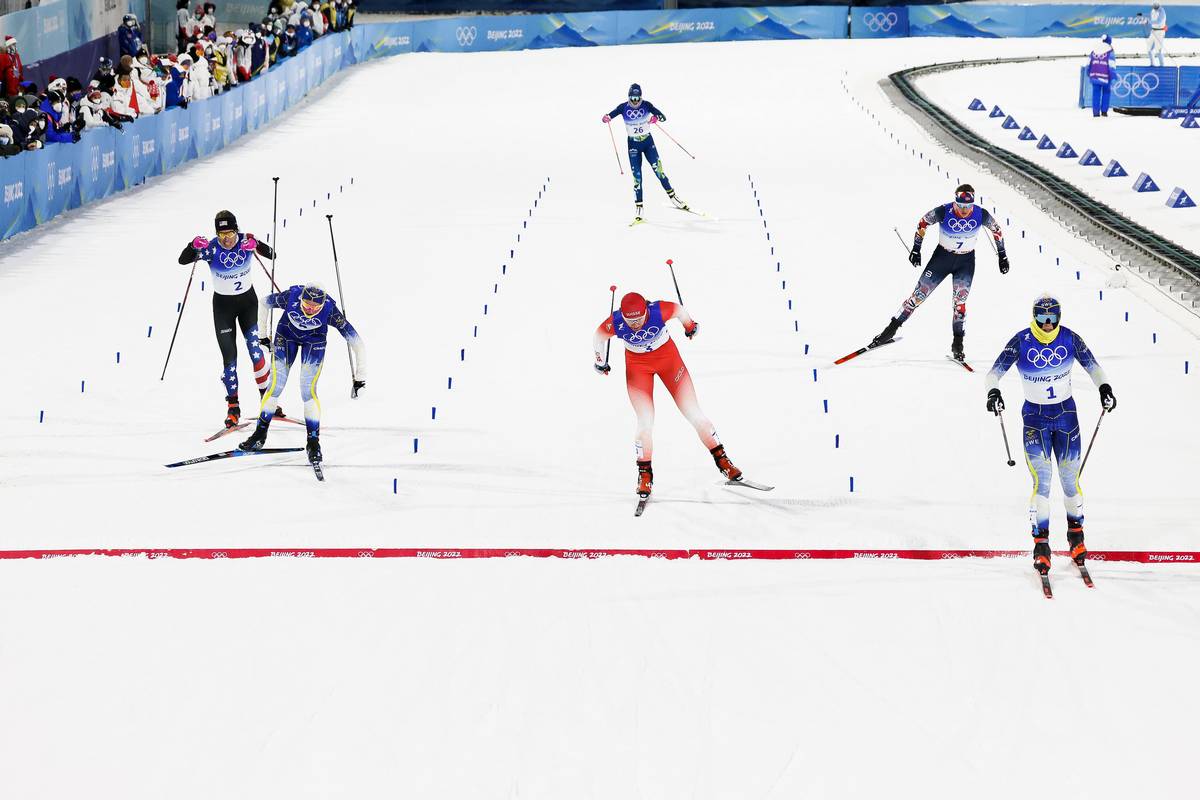
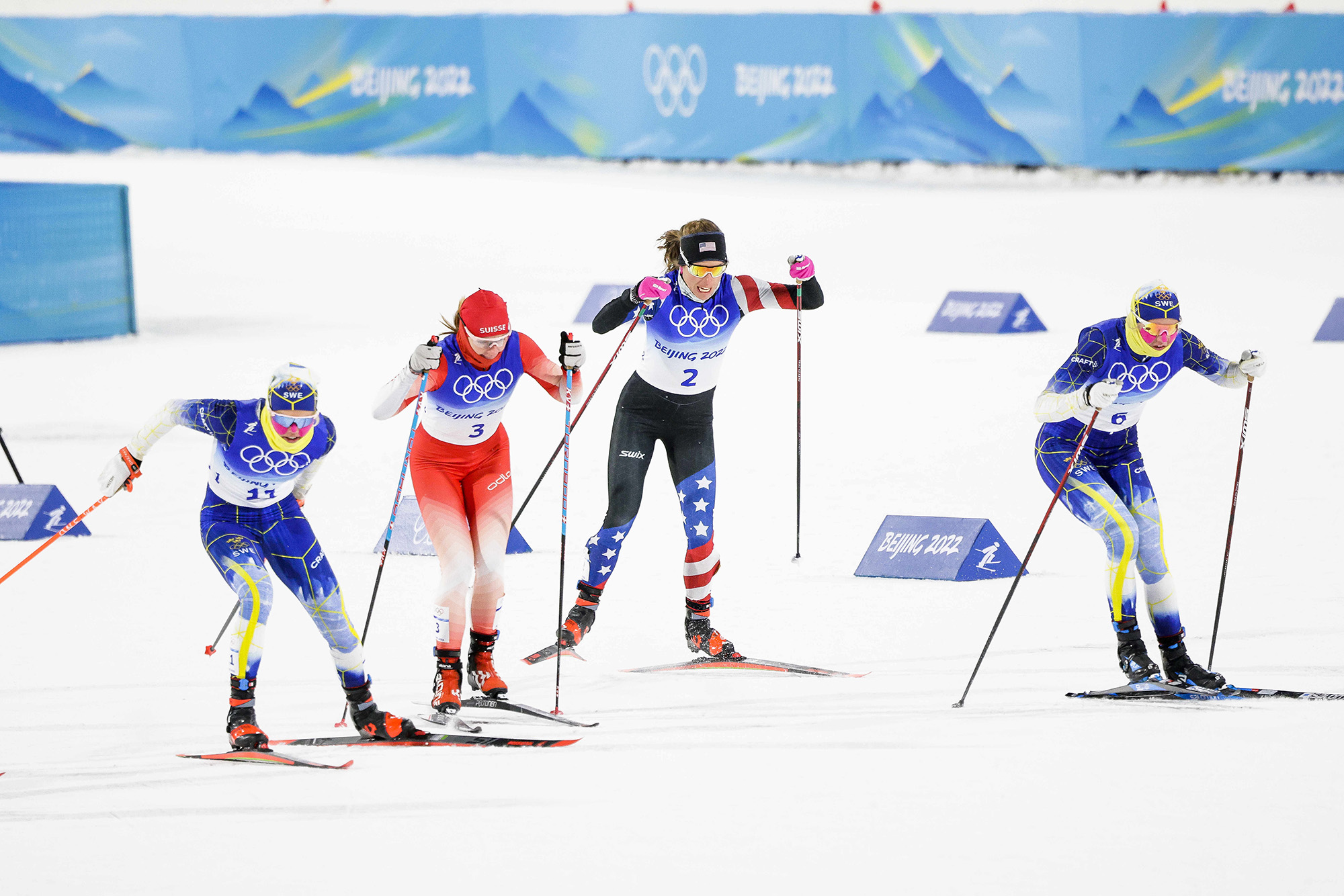
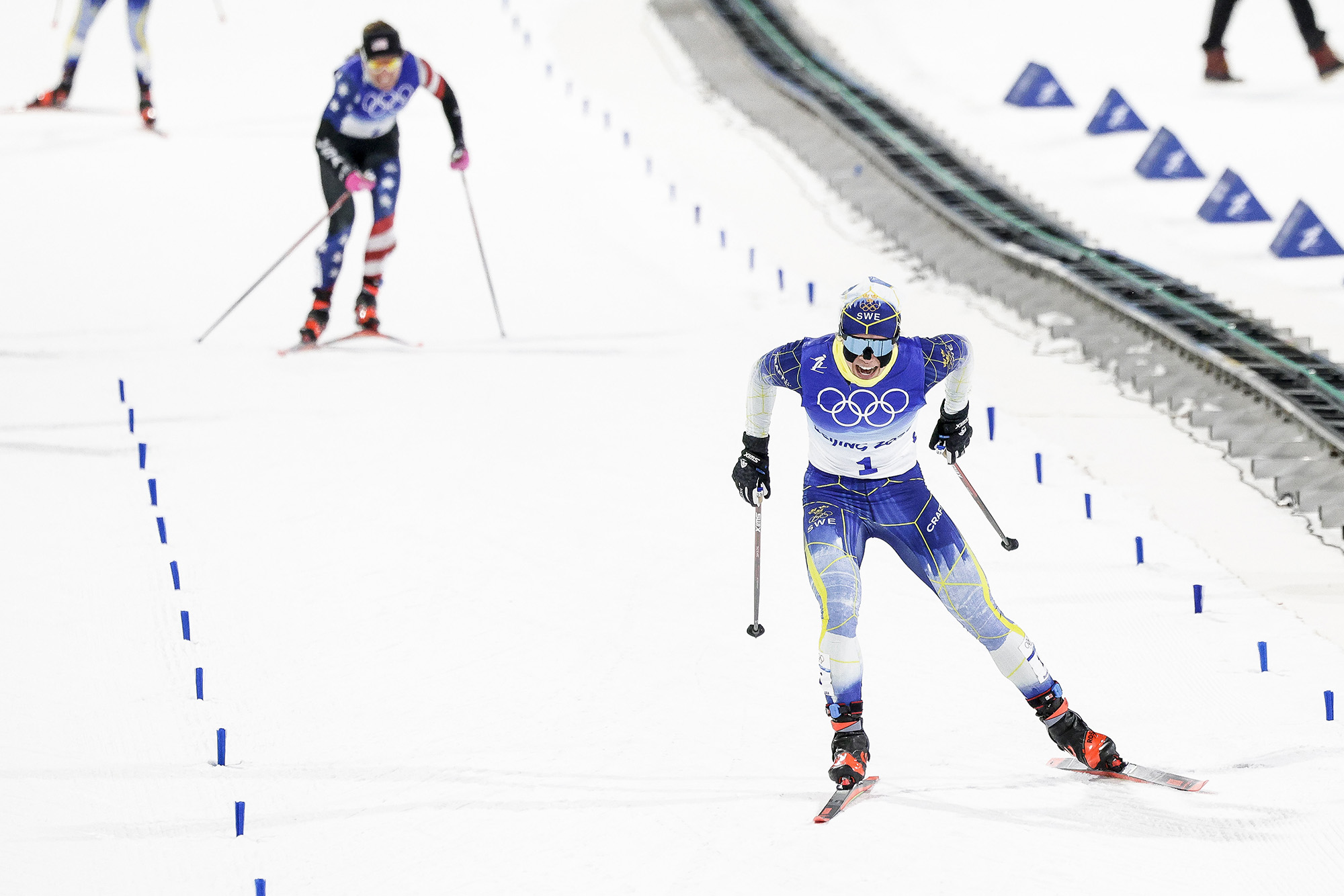
Sundling had gold on lock, nearly three seconds ahead as she crossed the finish line in 3:09.68.
Jonna Sundling (SWE) with a commanding victory in the individual freestyle sprint comes to the finish with Rosie Brennan (USA) in the background on her way to fourth. (Photo: NordicFocus)
In her wake, Dahlqvist and Diggins were taking it to the line, with the Swede carrying a slight advantage in the final meters. Still, with Brennan close behind and both Fähndrich and Ribom off the back, the Americans were almost guaranteed their first individual medal in history.
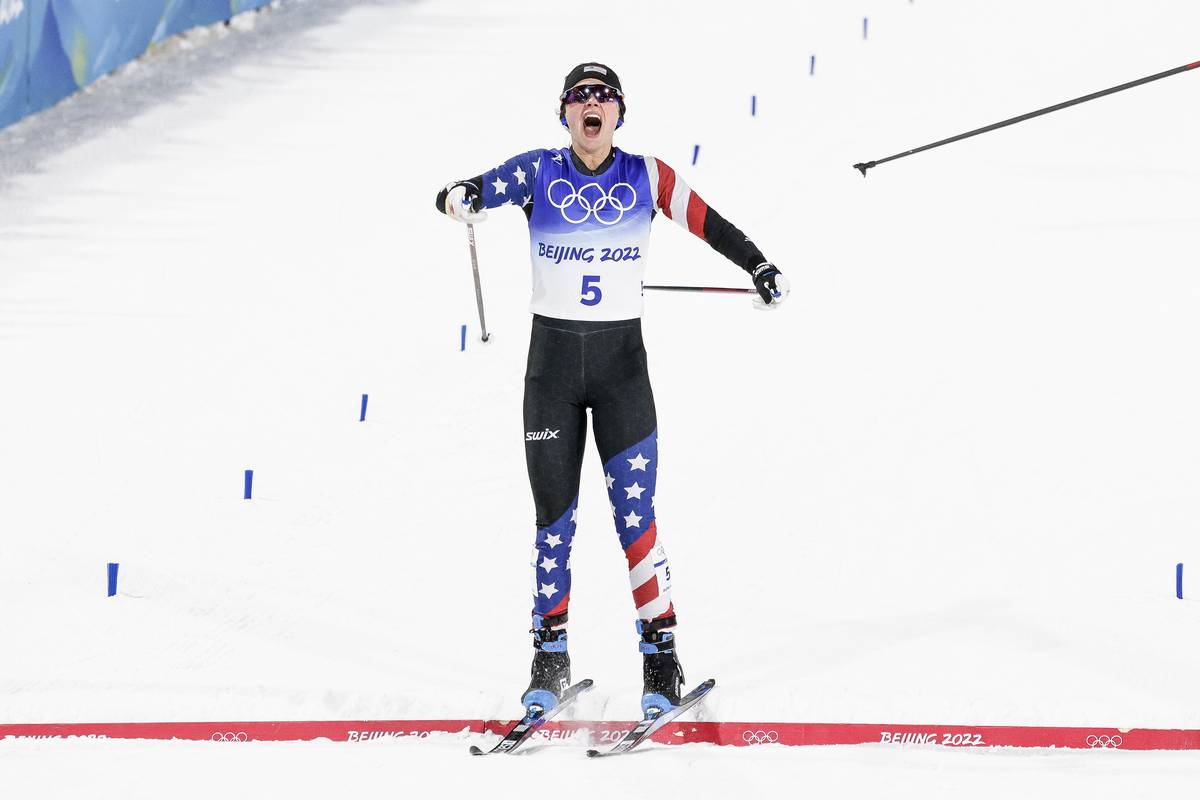
Skiing their fastest splits of the day, Dahlqvist held her ground to the silver medal (+2.88), with Diggins on her right, less than a ski length back for bronze (+3.16).
Jessie Diggins crosses the line in third to earn the first individual Olympic medal in women’s cross country ski history. (Photo: NordicFocus)
Just over a second back, Brennan crossed fourth (+4.49), for the second best individual finish in American women’s history. The Americans maintained a gap to Fähndrich in fifth (+7.21) and Ribom sixth (+11.11).
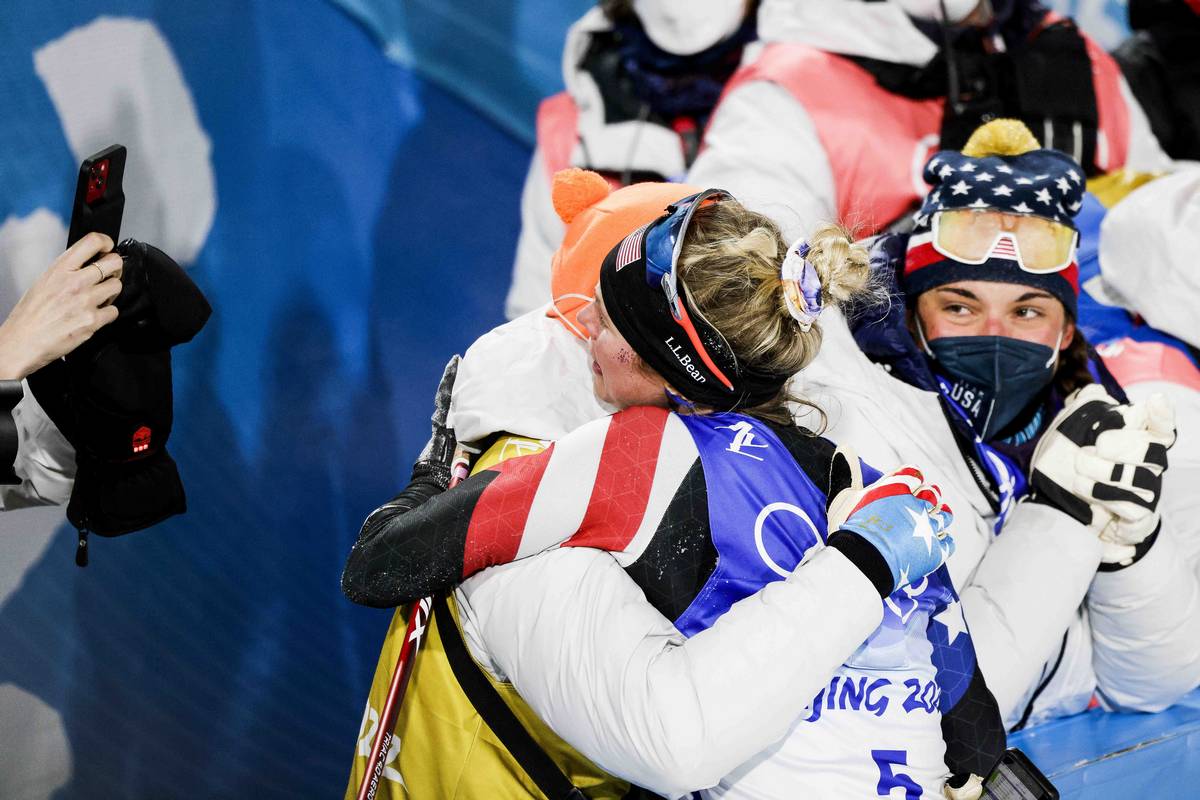
Diggins collapsed to the ground, overcome by the emotion of what she had accomplished. Perhaps a testament to her team-centric approach, she was heard saying, “Good job, Rosie!” between gasps, as she got back to her feet to immediately hug the coaches, support staff, and teammates that lined the edge of the course.
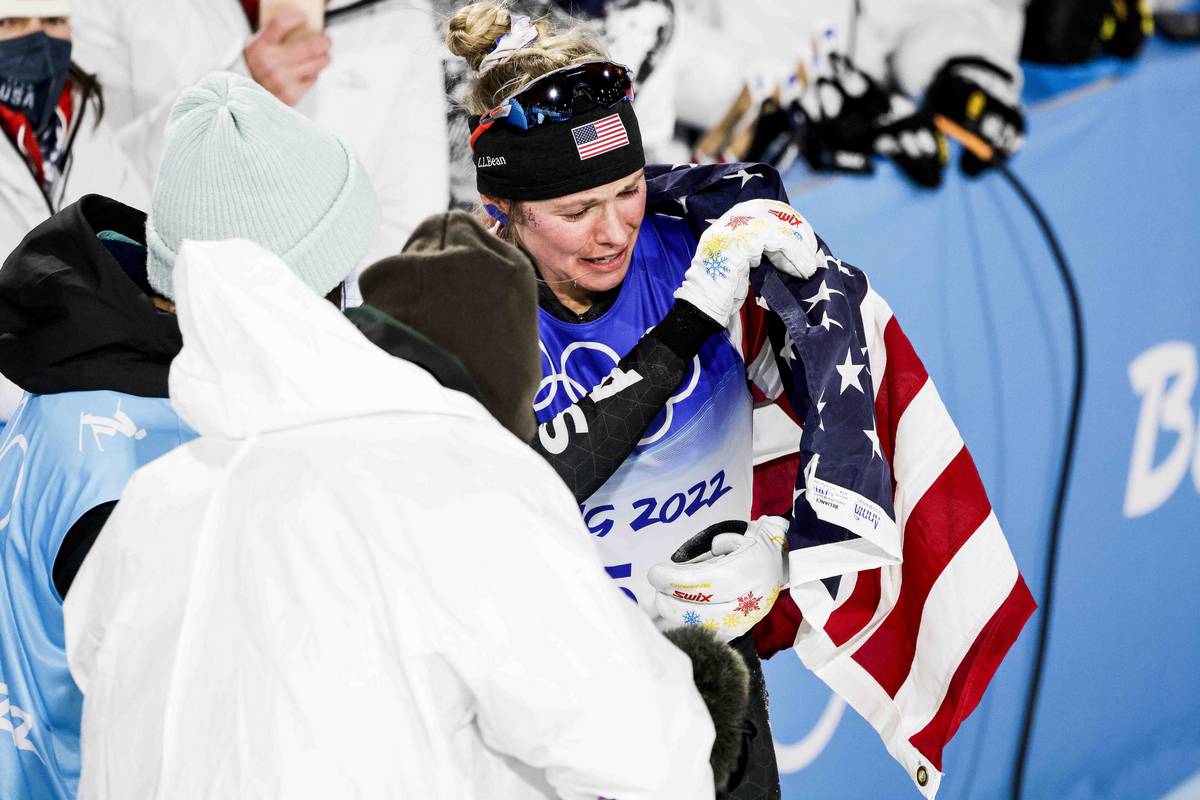
Jessie Diggins hugs her coaches and teammates after finishing third in the individual freestyle sprint in Zhangjiakou. (Photo: NordicFocus)An emotional Jessie Diggins wraps the American flag around her shoulders after taking bronze in the freestyle sprint. (Photo: NordicFocus)
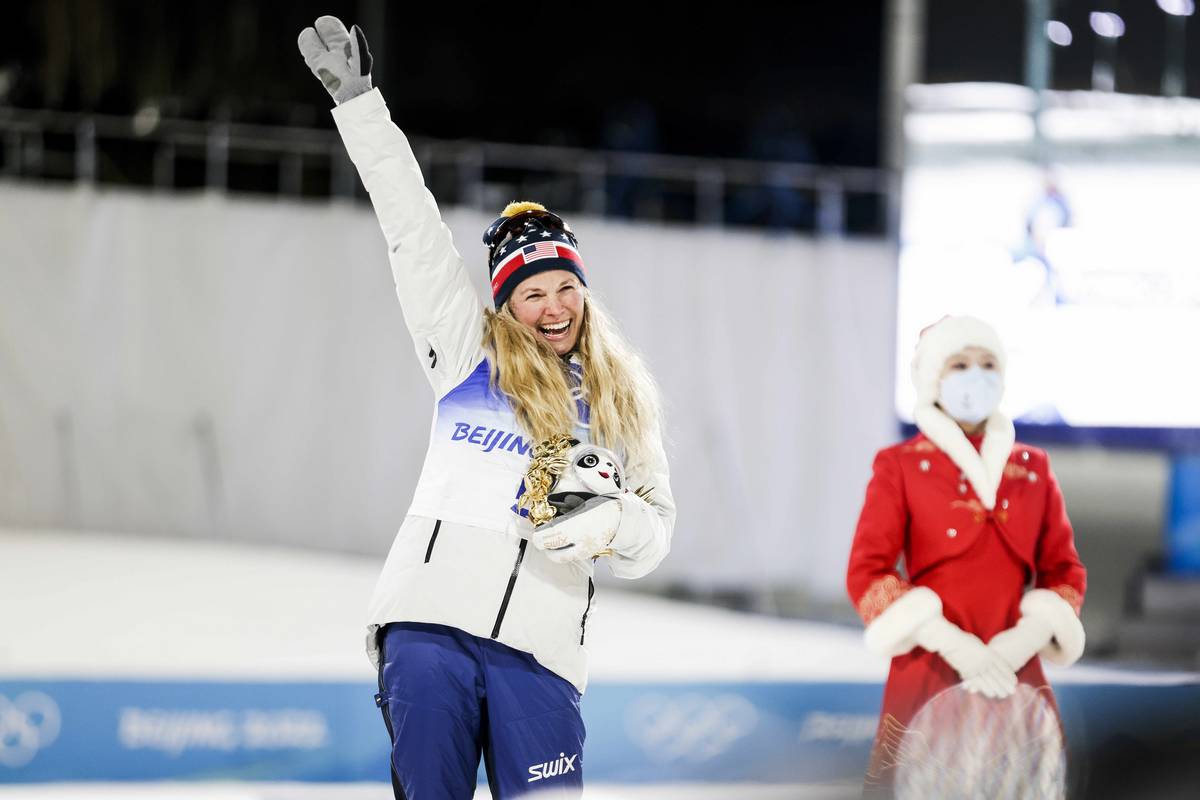
Tearfully wrapping an American flag around her shoulders, Diggins was aglow as she savored the moment before heading back to the finish to stand alongside Sundling and Dalhqvist for the podium shot.
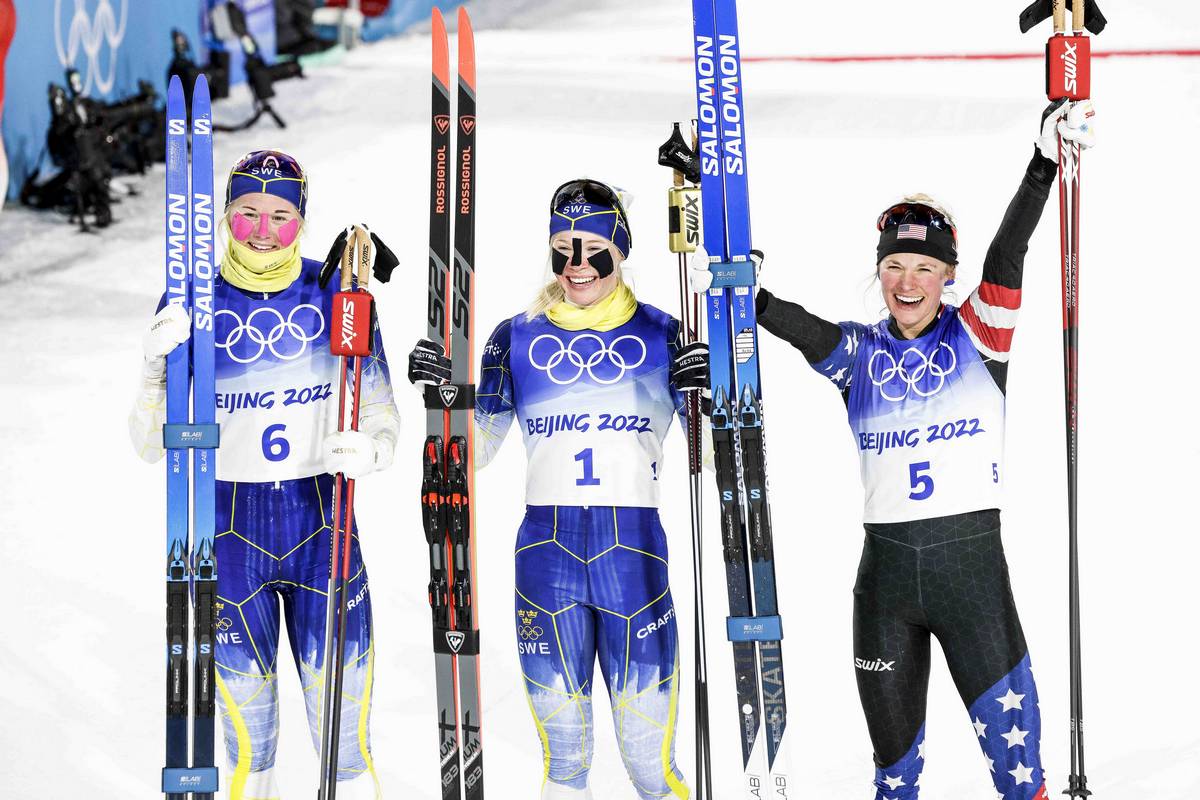
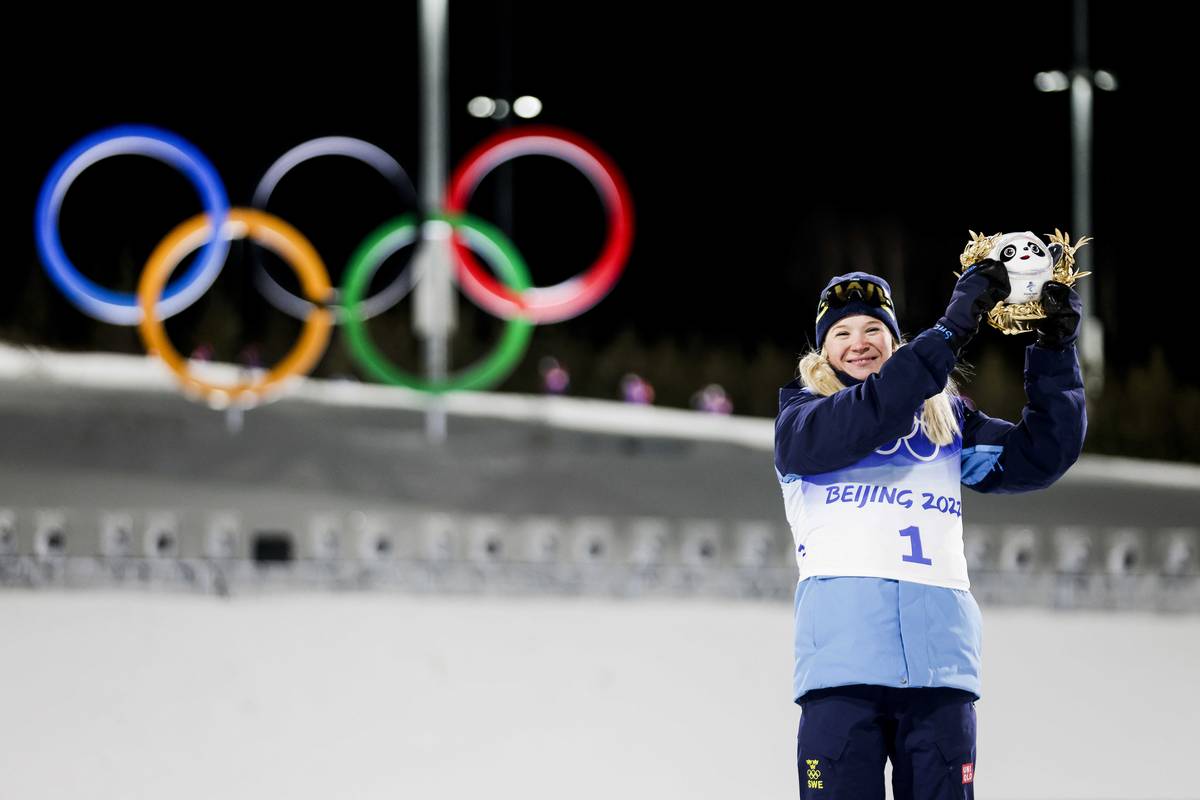
Jonna Sundling (SWE) takes gold in the freestyle sprint, ahead of Maja Dahlqvist (SWE) and Jessie Diggins (USA). (Photo: NordicFocus)
Though she was the one whose name would be highlighted in history books, Diggins focus on the importance of those around her remained at the forefront as she celebrated the many victories of the American team in today’s event.
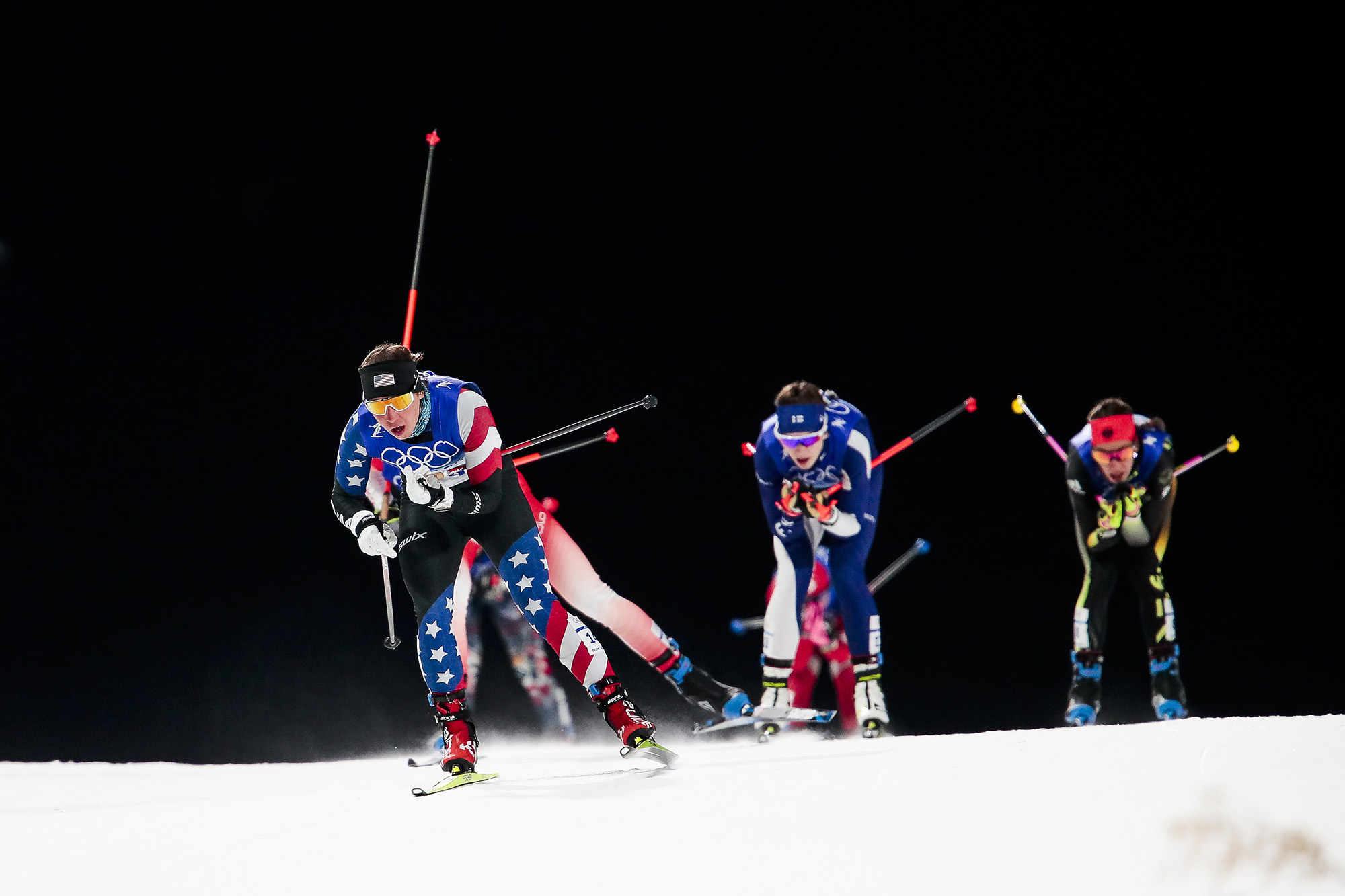
“It was so cool to be there with Rosie,” Diggins said in the mixed zone. “She’s skiing so amazingly well… and I’m just so grateful. That’s the overwhelming emotion, because it takes so much from such a huge team to make this happen. And we had obviously amazing skis, but also amazing teammates for years and years and years, helping me train, pushing me, supporting me – amazing coaches, amazing volunteer staff. You can’t even imagine how much it took from so many people, and so I’m just so thankful because I feel like this medal belongs to about 1000 different people. And I hope they really feel that and know that.”
Jessie Diggins takes Olympic bronze in the freestyle team sprint. (Photo: NordicFocus)
Of her approach to the course, Diggins gave a simple response, acknowledging that she has a way of blacking out while having great races, “which is really annoying,” she laughed, “because I’d love to be able to remember exactly what I did.”
“I was just so focused on trying to push as hard as I could,” Diggins explained. “Just trying to ski as well as I could and stay balanced. The snow felt a little greasy, so especially in the finishing lane, just trying to put as much power as I could into every single push. And honestly, that’s all I can remember.”
Jessie Diggins (USA) on her way to the USA’s first ever individual women’s medal in the Olympics. (Photo: NordicFocus)
Perhaps the FasterSkier audience needs no reminder that Diggins came into the 2022 Games as a gold medalist, having won the freestyle team sprint with Kikkan Randall in 2018, a day that brought many Americans, including this writer, to tears. Diggins was asked to reflect on the last four years, and the progress she’s made in her career.
“The last four years, I’ve really found my voice,” Diggins said confidently. “I’ve really found a lot of my purpose, and I feel like I’ve grown a lot. But also, I’m exactly the same person in pretty much every other way. I think one of the big things has been dealing with is the pressure and expectations, because there’s been a lot of it, and it hasn’t been easy. So for me, I think it was such a victory just to make it to the final and know that I’m skiing well. I came into this as prepared as I could be, which one of my biggest goals was to come in prepared. The second goal, cross the finish line with nothing left. And the third goal was to just have fun, and keep focusing on the process, because that’s what gets me where I am today. Like win, lose, or draw, it’s just focusing on the process and, and executing those process goals to the very best of my ability, because then I’m always proud of how I finished. I’m just proud of this effort today as I was at the skiathlon, even though they were different outcomes.”
Jessie Diggins was all smiles as she passed through the mixed zone following her bronze medal performance in the women’s individual sprint. (Photo: Nat Herz/FasterSkier-ADN)
Fourth place at the Olympics – fourth in the world on its most prestigious stage – is both a truly incredible feat and perhaps the most challenging final rank to wrap one’s head around. The “wooden medal”, just shy of the Olympic hardware skiers dream about from their youth.
“Fourth place was hard,” Brennan said honestly in the mixed zone. “You feel really happy and also frustrated at the same time. I have a lot of mixed emotions about it. But I did everything I could today, and maybe not everything went perfectly my way. But I have to be happy with that at the end of the day.”
Jessie Diggins (USA) and Rosie Brennan find their position in the early moments of the women’s final. (Photo: NordicFocus)
Asked what she would have said if four years ago, someone told her she would be in this position, Brennan laughed, “I probably wouldn’t have believed it so much.”
She talked through a rough start to the day, sharing that she has always struggled with start gates and had spent the last six weeks practicing to ensure a clean start.
“So, there I was on the ground, I was like, ‘So much for all that practice.’ But I knew my strength was in the climb, so I just had to pull it back [together] and focus on the all the time I had left and see what I could do to try and make it up.”
On her approach through the heats, Brennan played to her strengths, recognizing she could take the lead, work the hills, and not let her heats unfold as a casual first 1200 meters with a tactical final sprint that might leave her in the dust.
“My strength lies more in the endurance aspect of it,” she explained. “I tried to just keep the pace high so that I could count on being a lucky loser – by having a fast heat time. So that was my strategy in the semifinal, and it worked. Once I got to the final, I tried to then be a little more smart about my racing. I tried to be patient and wait until the last climb. I was a little far back, so I kind of got the door closed on me to make it through. So I had to kind of adjust and go for a strong finish sprint, which isn’t always my strength. But I did all I could do.”
With Ben Ogden racing into the semis in the men’s race, it was an historic day for the American program as a whole. Speaking to this landmark day, Brennan concluded with an inspiring message for those who dream of following in their footsteps.
“I think it shows the growing depth in our country. And I hope it shows a lot of people just to have some patience and keep training, keep going for it. You never know where you’ll end up.”
Jonna Sundling (SWE) takes gold in her first Olympic appearance in the women’s freestyle sprint. (Photo: NordicFocus)
Taking a closer look at the winner, Sundling is the 2018 World Champion in the freestyle sprint. Returning from injury, she has built her way into the season. Though Dahlqvist has shined as the undefeated World Cup star for Sweden, Sundling has crept up alongside, taking second to Dahlqvist in the individual sprint in Dresden, and working together to win the team sprint. Sitting out the Tour de Ski, Sundling beat Dahlqvist in their next matchup in a Scandinavian Cup race in Falun, Sweden.
This is Sundling’s first Olympic appearance, though she and Dahlqvist will be a likely pairing in the classic team sprint next Wednesday.
Once the final rounds were complete, Kern’s final placement was determined to be 18th. This marks a significant step forward from her first appearance in the skiathlon, where she finished 53rd.
Julia Kern (USA), who finished in 18th place overall, pushes to the finish during her quarterfinal round. (Photo: NordicFocus)
“It was really tough out there, but a lot of fun to have a challenging course and give it my all,” Kern told FasterSkier in the mixed zone.
Dahria Beatty 28th in qualification (+14.51) to be the only Canadian woman to make the heats. Beatty raced in the first semifinal, where she finished fifth in the heat to finish 25th on the day.
Just 0.7 seconds off the top-30 mark, Cendrine Browne was 35th in qualification (+15.82) with Olivia Bouffard-Nesbitt close behind in 40th (+16.89). Laura Leclair rounded out the Canadian team in 58th (+26.28).
Dahria Beatty (CAN) races in the quarterfinals on her way to 25th place overall. (Photo: NordicFocus)
An Australian dual citizen who is a long-time APU team member, Jessica Yeaton was 52nd (+23.82) in the qualifying round.
This World Cup coverage is made possible through the generous support of Marty and Kathy Hall and the A Hall Mark of Excellence Award. To learn more about A Hall Mark of Excellence Award or to learn how you can support FasterSkier’s coverage please contact info@fasterskier.com.
By: Ben Theyerl
For ski fans whose parents were smart enough to record the 1994 Winter Olympics on VHS tapes, Lillehammer will forever be a World Cup venue carrying the shadow of thousands of fans waving Norwegian flags as Bjørn Dæhlie did his signature “spin move“ on the way to Olympic glory.
Fast-forward to 2021, where the course has been reworked and modernized, the lycra is decidedly less exciting, and the multitude of Norwegian flags flying were interjected by a whole lot of Swedish and American ones.
Today, in the Birkiebeiner stadium – that quintessential home of Norwegian skiing – chances of victory blowing in from Sweden were very high. Going in, they had won the last 5 straight World Cup freestyle sprints, and 14 of the last 20 overall. The Americans too, looked to continue their history of success in the freestyle sprint. Of the 16 wins that the Americans have had in sprint events, 15 of them have come in freestyle, with two of those previous winners, Jessie Diggins and Rosie Brennan, in the field on Friday morning.
In qualifying there were hints that as the field narrowed, it would be Sweden, Norway, and the United States whose skiers would fill the semifinal and final slots. Maja Dahlqvist continued her strong start to the season, winning the qualifier in a time of 3:11.59. She was joined by Tiril Udnes Weng (+1.38) and Nadine Faehndrich (+2.84) in the top 3 spots.
The U.S. team placed three inside the Top 10, with Julia Kern the top qualifier in seventh (+4.90), followed by Jessie Diggins in eighth (+5.08), and Rosie Brennan in tenth (+5.49). Hannah Halvorsen rounded out the qualifiers for the heats in 21st (+8.18).
Hannah Halvorsen (USA) sprints to 21st place in sprint qualifying in Lillehammer. (Photo: NordicFocus)
Three strong national contingents then went to the quarterfinals. Norway with seven skiers, Sweden with five, and the United States with four. There they would face each other on a new 1.6k Sprint course that left little to be deciphered about what would be the deciding feature on the day. On this course, there was an A-climb, and after doing it once, they would loop back around and do it again.
The Americans took a different approach to heat selection this week than they did in Ruka, where they raced late in the quarterfinal heats. Kern and Diggins lined up in the first heat together, joined by Tiril Udnes Weng. Kern led out the pack and raced consistently throughout, leading the first time up the climb with her teammate Diggins in tow.
A scene from the first heat of the quarterfinals, which included Julia Kern (Bib 7) and Jessie Diggins (Bib 8). (Photo: NordicFocus)
For Diggins, the quarterfinal established the pattern that she would look to repeat throughout the day on the tough course. At the foot of the climb in the second loop, Diggins moved through to the outside of the pack and then powered to the front. By the time she was in the stadium, only Weng was left behind her, and that’s how they finished. Kern, meanwhile, sprinted to 3rd place, and after all the quarterfinals were settled, was just a tenth of a second out of a lucky loser slot for the semi-finals (which went to the Finnish skier Jasmi Joensuu). Kern ended her day in 13th overall.
The other lucky loser slot was filled by Rosie Brennan in the second quarter-final. Brennan’s tactical approach to the course mirrored Diggins. In the second heat, Brennan matched up against Maiken Caspersen Falla and Nadine Faehndrich, and would finish just off the two to take third place in the heat, and first in the lucky loser slots.
In the semifinal, Diggins found herself alongside three Norwegians, matching up against T.U. Weng, L.U. Weng, and Caspersen Falla. The heat saw the best execution of her tactical approach to the course all day, as she followed the first move up the climb from Jasmi Joensuu, then shot around the outside to carry speed into the downhill, before moving in a perfect swoop off the apex of the turn to the outside that allowed her to power up the final climb joined by T.U. Weng and Falla. At the finish, Diggins crossed in first again, with T.U. Weng right behind.
The two would be joined by four skiers from the other semi-final. The Swedish pair of Dahlqvist and Ribom executed their tactical approach to the course to a tee, leading out the first part of the course and establishing a sprint that would be devoid of any posturing, then staying with any moves that occurred on the second-time through the climb – which came in this heat from Brennan – before finishing strong in the stadium sprint. Dahlqvist finished first, Ribom second, and Brennan came out the lucky loser for the second time on the day, advancing to the finals.
Rosie Brennan (USA) rounds the corner in front of Anamarija Lampic (SLO) during the final in Lillehammer. (Photo: NordicFocus)
The final field represented the Swedish and American fronts, who fully established themselves as the dominant force in Lillehammer. Two Swedes, two Americans, and just one Norwegian. Plus, Anamarija Lampic of Slovenia too.
The two leading countries’ different approaches to the course were most stark the first time up the climb, where Diggins and Brennan took the outside, and Ribom led the rest of the field on the inside track. At the top of that first ascent, the Americans took the animating action, Diggins shooting around the outside to lead the descent.
Brennan followed, reflecting her initiative to create an ideal position for the final climb: “I made a move early in the final to try to see what I had and unfortunately, was passed on the downhill into the last uphill” she said in an email to multiple news outlets.
With Brennan back in the pack as they took to the second climb, what had been alluded to throughout the day gained clairvoyance – Dahlqvist and Diggins were the strongest in the field. As they crossed the finish line, what was clear became a result. Dahlqvist won her second sprint of the young World Cup season, as Diggins earned her first podium finish of the year. T.U. Weng rounded out the podium in 3rd, with Ribom finishing 4th and Brennan in 5th on the day.
Maja Dahlqvist (SWE) wins 3rd straight sprint, followed by Jessie Diggins (USA) and Tiril Udnes Weng (NOR). (Photo: NordicFocus)
If Ruka was an exciting first burst of energy for the World Cup season, then Lillehammer today was an indication that long-term trends do hold. Last year’s World Cup champion Jessie Diggins has her first podium of the season. Maja Dahlqvist is now on a three-win sprint streak going back to last season, and the most ascendant sprinter on the women’s circuit. And in the freestyle sprint, it’s the Swedish and American women who continue to rise to the top, with Norway, on their home turf, putting up an ever-valiant defense of their dominance on the world stage.
Oh, and Americans can start dreaming of Jessie Diggins doing her best Bjørn Dæhlie impression in Beijing come February, as her second-place finish today means one-half of the Gold Medal highlight from the last Winter Olympics in 2018 is officially qualified. Diggins is the second American to qualify for this season’s Olympic team, joining Brennan (top-8 in both today’s sprint and last weekend’s 10 k classic) as objective qualifiers.
Here’s Jessie’s post-race comments to FasterSkier:
Jessie Diggins on her first podium of the season after finishing 2nd in Lillehammer. (Photo: NordicFocus)
Stepping back into the quarterfinals, Hannah Halvorsen skied strong in the fourth heat of the quarterfinals, which included Dahlqvist and Lampic. Losing contact toward the finish, Halvorsen finished sixth in her heat, which put her in 28th place in the final standings.
“I felt good today on the course,” Halvorsen wrote in a post-race email. “It was fun to have things come together. It was awesome to see our team put so many people in the top 30 this early in the season! I can’t wait to see what the season will bring for the US with so much potential in the mix!”
Elsewhere in the results, North American women had a strong showing. Hailey Swirbul (USA) finished 42nd (+12.50), with Cendrine Browne (Canada) in 52nd (+14.63), Dahria Beatty (Canada) in 53rd (+14.73), and Katherine Stewart-Jones (Canada) in 55th (+15.34). Novie McCabe (USA) finished 56th (+15.34), Maya MacIsaac-Jones (Canada) finished 60th (+19.21), Katharine Ogden (USA) finished 61st (+19.89), and Sydney Palmer-Leger (USA) finished 62nd (+19.89).
In a post-race interview, U.S. Ski Team Head Coach Matt Whitcomb answered a variety of questions on the men’s and women’s races in Lillehammer, including comments on the new course and the approach to heat selection this weekend relative to Ruka. He also shared his perspectives on the rounds, and an explanation of why qualification is a skill that athletes must learn, in reference to comments made by Sadie Maubet Bjornsen and Devon Kershaw on the post-Ruka episode of The Devon Kershaw Show. Have a listen.
Enthusiastic fans fill the stands for the Martin Fourcade Nordic Festival.
Nordic festival are two words most North American ski fans can only dream about. Skinny skiers here are unlikely to experience the reality of such an event for themselves unless they make a trip across the Atlantic. For residents of France, the opportunity to participate in the second edition of the Martin Fourcade Nordic Festival presented itself this weekend and there were many eager attendees. This lucky expat was among the masses.
Martin Fourcade (FRA) IBU world championships biathlon (Photo: NordicFocus)
For those unfamiliar with the name, Fourcade retired from biathlon competition in March 2020 after a very successful career, including five Olympic gold medals and thirteen World Championships titles. He is the most successful French Olympian of all time and is celebrated as a beloved hero in his home country. Anywhere he went this weekend, he was accompanied by cheers and a train of fans hoping for autographs, handshakes, or photos.
The festival stretched over three days, beginning Friday, September 3rd and wrapping up on Sunday the 5th. Located in Annecy, in the Haut-Savoie department of France, the stadium sat facing the electric blue water of Lac d’Annecy, rimmed by limestone bluffs.
It’s difficult to imagine a better setting for drawing crowds than the park Le Pâquier, which is right downtown and runs along the popular bike path that circumnavigates the lake. Indeed, the place was bustling with spectators all weekend long, both paying customers and those stopping by, drawn along the fence by all the commotion.
Tickets cost €33 (about $40), and were sold out before the event began. As evidence, several posts were made in the days leading up to the festival on the French nordic Craiglist-esque site, searching for available tickets.
In addition to tickets, to enter the venue one needed to present their pass sanitaire, essentially a health passport in the form of a QR code which proves either you’ve been vaccinated, had a negative COVID test in the last 72hrs or, recovered from COVID in the last 11 days to 6 months. Furthermore, masks were required, even though the event was taking place outdoors where typically masks are not required in France.
Kicking off the weekend with the presentation of the athletes on Friday evening.
The festivities kicked off in earnest Friday night, beginning with a presentation of the athletes on stage. While 30 international athletes had been recruited to the event, not all were able to make the journey. Many French national team members were present, both biathletes and cross-country racers, including: Richard Jouve, Renaud Jay, Delphine Claudel, Julia Simon, Anais Chevalier-Bouchet, Antonin Guigonnat, and Quentin Fillon-Maillet.
As for the international contingent, some notable names in attendance were: Tiril Eckoff (NOR), Johannes Dale (NOR), Sturla Laegrid (NOR), Oskar Svensson (SWE), Jovian Hediger (SUI), Nadine Faendrich (SUI), Laurien van der Graaff (SUI), and Emma Ribom (SWE).
Following the presentation of athletes, a concert featuring Gaëtan Roussel, a well-known French musician drew quite a crowd and provided the festival with quite a lively start, setting the tune for the rest of the weekend.
Gaëtan Roussel in concert, Friday evening.
Saturday started with the exposition village opening, a circle of vendor tents featuring nearly 60 brands, food and drink options, and shops. Attractions included, virtual biathlon, ski-erg competitions, and athlete appearances.
Lines at both the Fischer and Salomon tents stretched for quite a distance as athletes patiently sat for hours, signing autographs and taking photos with fans. Not only were famous nordic athletes present, but recent competitors in the Ultra Trail du Mont-Blanc mountain running series, such as Camille Bruyas who took second place in the storied 170 km full tour around Mont-Blanc, and Thiabuat Beronian who finished 3rd in the 100 km “CCC”. These events both end in Chamonix.
The exposition area, filled with vendors (pictured here Friday evening).
Gradually, the crowd began to shift focus towards the stadium, as athletes started warming up for the afternoon show races. Over 3,000 attendees filed into the stands, giving Martin Fourcade a cheer that lasted for minutes as he gave an introduction.
Explaining his motivation for organizing this event, Fourcade said, “When I think of a Nordic festival, I want an event that grows the sport, that shares the sport, and that promotes the sport.” He thanked the crowds for their support and provided a schedule for the afternoon events, starting with women’s biathlon.
Eight elite biathlete women toed the start line, headed by Eckoff of Norway. They completed four laps of the flat course, with two prone and two standing rounds of shooting. Eckoff lead to start, followed by Chevalier-Bouchet (FRA) who cleaned the standing shoot quickly and gained the lead for the penultimate lap, to the joy of the crowd.
She maintained her lead and entered the final shooting round with a bit of a lead to Eckoff (NOR), cleaning again in rapid time. Franziska Preuss of Germany was second out of the range, followed by Eckoff.
Out on the course, which at times was flanked directly by the lake where boaters had pulled close to cheer, Eckoff passed Preuss (GER) to find second place. Chevalier-Bouchet (FRA) finished first, Eckoff second (+14) and Preuss third (+29.2).
The spectators were thrilled to begin the competitions with a French victory and showed their appreciation in the form of overwhelming applause.
“Yeah it’s amazing,” said Chevalier-Bouchet after her victory, “Thanks everyone. I can’t hear anything because of the noise!”
Anais Chevalier-Bouchet (FRA) pumps up the crowd as she heads towards the finish line.
Tiril Eckoff similarly enjoyed the support of the crowd and said, “It was very fun to be in such a good atmosphere again. It’s the first time in two and a half years to be in front of crowds so it’s really fun.”
Tiril Eckoff (NOR) finished second.
Up next was the men’s biathlon. Guigonnat (FRA) was the first to clean and left the first round of shooting in the lead, while Fillon-Maillet (FRA), a fan favorite, struggled and exited well behind the pack. Through the second time, Doll of Germany was first to clean with Fak (SLO) right behind. Into the standing round, Laegrid (NOR) was the first to clean, Fak in second but with a penalty and Khalili (RUS) in third.
Sturla Laegried (NOR) leads the pack along the lakeside. (Photo: NordicFocus)
For the final time, Laegrid entered without anyone else in sight, shot 5/6 and left the range still in the lead. Khalili (RUS) was next out with Fak in third, followed closely by Fillon-Maillet who had made up ground and had a fast final round of shooting.
Laegrid skied the last lap with a healthy gap and high-fived fans as he headed for the finish with a big lead, ending in 25:02.4. The Russian, Khalili held on for second place and Doll (GER) took third having passed Fillon-Maillet (FRA) and Fak (SLO).
“I’m a very lucky man today so thank you Annecy!” said Laegrid after the race, “It was really fun and it was so nice to say hi to all my fans. Merci beaucoup!”
Sturla Laegrid (NOR) holds a bottle of victory champagne after his win.
With the biathlon races concluded, the crowd lost some it’s density before the cross-country rounds, biathlon being more popular. Nevertheless, there were still plenty of spectators who stuck around as the women lined up for their event. Not a true sprint event, the cross-country skiers completed six laps in succession with the final skier across the lap line being eliminated each round.
The pack stayed tight for the first five laps, gradually losing skiers off the back. With a tight course, passing was quite difficult so the leaders did not change much. French skier Flora Dolci had the lead into the final lap, with the top seven athletes all within 1.4 seconds.
Faendrich (SUI) dropped off as they passed along the lake, and then there were six. Ribom (SWE) made a pass to the front, shadowed by Van der Graaff (SUI). Rounding the final corner Van der Graaff launched an attack but Ribom held her off, keeping the advantage heading into the finish.
Emma Ribom (SWE) guns for the finish line, followed by Laurien van der Graaff (SUI).
Behind them, Dolci (FRA) outsprinted Claudel (FRA) to take third place, +4.5 back. “I felt really strong out there so it was a fun race,” said Ribom, “My plan was to have a good position the whole race so I tried to stay in the front and keep on pushing to the finish line.”
Post race interview with Emma Ribom:
Van der Graaff, who speaks a bit of French, said, “I am very happy with the competition but not to do an interview in French! I tried really hard to get a second win here, but Emma was really strong.”
The final race of the day was the men’s cross-country. With such tight pack racing there was sure to be some broken equipment out there and sure enough, nearly every lap saw someone with a broken pole. Hugo Lapalus (FRA) was the first to be eliminated, Hediger (SUI) broke a pole near the end of the second lap and was next to stop.
Svensson (SWE) dropped off the pace during the third lap and was stopped, followed by Valentine Chauvin (FRA) on the next lap. Jouve (FRA), a race favorite, broke a pole in lap three but managed to hang with the group, only to be eliminated with two laps to go. Heading into the final lap, Adrien Backscheider (FRA) had the lead, with Marcus Grate (SWE) the last to be eliminated.
As they neared the finish, Jay (FRA) and Pål Aune (NOR) were duking it out, ultimately the win going to Jay. Arnaud Chautemps of France finished third.
“I’m really happy,” said Jay, “I wasn’t able to be here two years ago so this is really nice.”
Renaud Jay (FRA) and Pål Aune (NOR) speed towards the finish (Photo: NordicFocus)
After the professionals raced on Saturday, it was the public’s turn to compete on Sunday. The “Biathlon Running” was open to all, involving teams of 4-6 in a relay style event. First up to compete were the kids, racing a 1km course with obstacles and shooting in between laps, followed by the adult teams.
Kids navigate the “toile de l’araignée” (spider web) in Sunday’s obstacle course.
There were three categories to sign up under (Mixed, female, and male) and the price was €200/team. The competitors were enthusiastic and lots of smiles were seen out on course, a fun way to wrap up a fun weekend.
Scenic backdrop of Sunday’s biathlon running event.
Triple Swedish podium: Maja Dahlqvist (SWE) second, Linn Svahn (SWE) first, and Emma Ribom (SWE) third, (l-r) (Photo: NordicFocus)
This World Cup coverage is made possible through the generous support of Marty and Kathy Hall and their A Hall Mark of Excellence Award. To learn more about A Hall Mark of Excellence Award or to learn how you can support FasterSkier’s coverage please contact info@fasterskier.com.
It was a cloudy day in Val di Fiemme, Italy for Stage 7 of the Tour de Ski. Today marked the final event before the looming Alpe Cermis hillclimb, with the athletes completing a classic sprint where the inside line on a corner could mean the difference between advancing or not and precious seconds for the overall tour.
Linn Svahn (SWE) on a tear through qualifying and beyond. (Photo: NordicFocus)
Linn Svahn of Sweden won the qualifier in a time of 3:11.98. For the U.S. women, four of the six remaining tour participants qualified for the heats with Jessie Diggins 8th, Julia Kern 10th, Hailey Swirbul 13th, and Rosie Brennan 17th. Katharine Ogden and Caitlin Patterson placed 36th and 39th, respectively. Kern and Swirbul were both knocked out in their quarterfinals. Diggins and Brennan were seeded in the second semi-final where they finished 5th and 6th, respectively.
Julia Kern (USA) double poles through qualifying to place 10th. (Photo: Nordic Focus)
After today’s sprint Brennan wrote, “It was a very tight turn around from yesterday’s race and today’s race, so after an extremely tough day yesterday, I wasn’t sure how my body would fare today. In the quarterfinal, I finally found a little bit of snap and was very happy to move on to the semifinal. Jessie and I were in a very fast semifinal heat which certainly gives you the best chance of a lucky loser, but I just didn’t have the power I need to get those few extra places. This was the first time I have made it to the semis in a classic sprint so I’m happy to have crossed that barrier.”
Rosie Brennan (USA) gets some vertical down the finish straight in her quarterfinal. (Photo: NordicFocus)
Advancing to the final was Linn Svahn, Maja Dahlqvist and Emma Ribom of Sweden, Natalia Neprayaeva and Tatiana Sorina of Russia, and Krista Pärmäkoski of Finland. Svahn, who won both her quarter and semi-final heats in addition to the qualifier, looked to be the favorite. As the racers came into the final corner above the descent to the stadium all six were still in podium contention. Neprayaeva led with Svahn tucked in behind her, ready to slingshot into the final straightaway. Echoing her tactic from the earlier rounds, Svahn did exactly that, pulling away to take her second sprint victory in this year’s Tour de Ski. Behind her, Dahlqvist placed second and Ribom third to make a triple Swedish podium.
Three happy Swedes following a podium sweep. (Photo: NordicFocus)
This is a maiden podium finish for Ribom. Her previous personal best came in Ruka at the start of the 2020/21 season where she finished 6th in the classic sprint.
Emma Ribom’s (SWE) first individual World Cup podium finish. (Photo: NordicFocus)
“It was so so fun,” said Svahn after the race, “I said to Maja [Dahlqvist] before the final, ‘OK let’s do a triple again’. And it’s all so amazing to be inside with the Swedish girls, we are such a strong team. I am so glad to be a part of this, it’s so so fun.”
The Swedish women are renowned for their sprinting, in fact, they opened the season in Ruka with a triple podium where Svahn once again took gold followed by Dahlqvist and Jonna Sundling placed third.
Many raised hands, Linn Svahn (SWE) takes gold ahead of teammates Maja Dahlqvist and Emma Ribom. (Photo: NordicFocus)
For Svahn (age 21), this victory makes her the youngest woman to win multiple sprint stages in the Tour de Ski. In addition to winning the opening sprint in Val Müstair, she took gold in the 10 k classic mass start the following day. Today marks her fourth win of the season and seventh win in total.
Braids flying for Jessie Diggins (USA) as Maja Dahlqvist (SWE), Rosie Brennan (USA) and Yulia Stupak (RUS) (r-l) close out in the semi-final. (Photo: Nordic Focus)
After her elimination in the semi-final, Diggins finished in 10th place for the day. “That was a good day today,” she wrote, “Once again, so incredibly proud of our staff for all their hard work and for the amazing skis they keep giving us! I did exactly what I needed to out there today in terms of the overall tour. I would have loved to make the finals since my body was feeling great, but that’s just a little extra energy in the bank for tomorrow! Focused on one moment at a time, and ready to absolutely destroy myself on that hill climb tomorrow. The only thing I know for sure is that I’ll be crossing that finish line with absolutely nothing left! I’m proud of this team and what we’ve accomplished together, and excited to go charging one last time.”
Diggins and Brennan lunge for the line in semi-final number two. (Photo: Nordic Focus)
Overall Tour Standings:
Leading into the final day of racing, Diggins holds the lead, +54 seconds ahead of Russia’s Yulia Stupak in second. Frida Karlsson of Sweden, who was in third place in the tour standings, withdrew from the tour before today’s race. Karlsson sustained an injury from strength training earlier in the week and cited this as a reason for her withdrawal. With the absence of Karlsson, Parmakoski (FIN) moves into third place in the overall rankings (+1:51). Just seven seconds behind her is Neprayaeva (RUS) who finished second in last year’s edition of the Tour de Ski.
Also for the U.S., Brennan remains in 7th place, starting +2:19 after Diggins. Looking towards tomorrow Brennan said, “I am still in the fight for a strong overall and am looking forward to duking it out on the hill tomorrow.”
Swirbul will start in 18th (+5:46), Ogden in 22nd (+7:28), Patterson in 34th (+10:53) and Kern 38th (+13:16).
The Tour concludes tomorrow with the final hillclimb up the Alpe Cermis.
Sweden’s Linn Svahn winning the first stage of the 2021 TdS in Val Müstair, Switzerland. (Photo: NordicFocus)
This World Cup coverage is made possible through the generous support of Marty and Kathy Hall and their A Hall Mark of Excellence Award. To learn more about A Hall Mark of Excellence Award or to learn how you can support FasterSkier’s coverage please contact info@fasterskier.com.
Out with 2020, in with 2021. Here in the world of multicolored lycra and skinny skis, we are kicking off the new year with the opening of the Tour de Ski on the sprint track of Val Müstair, Switzerland. As snow fell lightly but steadily, the usually remarkable mountain backdrop was veiled, narrowing our focus to the athletes as they embark on the grueling eight stages over ten days that is the TdS.
The two-lap 1.4-kilometer sprint course in the alpen valley featured two punchy climbs per lap leading down into fast and tight S-turns. Small rollers after these turns kept the skiers on their toes as they charged around the course.
Though the Norwegian athletes remain absent from the World Cup and TdS, the Swedish women are back in full force. They made their sprint prowess known in the qualifier, with 26-year-old Maja Dahlqvist setting the fastest time by nearly three seconds in 3:30.86. Seven members of their squad qualified for the heats, with an additional three in the top 10: Linn Svahn in 2nd, Moa Lundgren 4th, and Frida Karlsson in 8th. Though Karlsson is normally known for her distance racing (in particular besting Norway’s dominant Theresa Johaug at last year’s Holmenkollen 30 k), her possession of the green U23 Overall World Cup leader bib evidenced that she was not to be dismissed as a contender for the stage.
Wearing the yellow Overall World Cup leader bib, Rosie Brennan was the top American qualifier in 5th (+4.38), followed by Hailey Swirbul in 13th (+8.65), Jessie Diggins in 14th (+8.96), Sophie Caldwell Hamilton in 16th (+9.77), and Julia Kern in 25th (+12.61).
Brennan raced in a stacked first heat of the quarterfinals, racing against two of the top Swedes, Dahlqvist and Lundgren, in addition to Russia’s Natalia Nepyaeva, teammate Kern, and Switzerland’s Laurien van der Graaff. Brennan stayed near the front and in position to advance from the get-go, but couldn’t break from the lead group of four. She finished in a three-way photo finish with Nepyraeva and Lundgren, taking third but snagging a lucky loser spot allowing the threesome to all advance into the semis.
Jessie Diggins finding her form in Val Müstair, Switzerland where she placed second overall in the TdS stage 1 sprint. (Photo: NordicFocus)
Also advancing from the quarters from the fifth heat, Diggins held a position near the front throughout her heat, showing with her lightning-fast tempo that she intended to advance. She pushed Karlsson and Italy’s Greta Laurent break from the remainder of the group. In the second lap, Diggins had the fastest V1 cadence on the climbs and stayed smooth in the descents, priming herself for good positioning in the final sprint to win the quarter.
Ending their day after the quarters, Caldwell Hamilton marked Swedes Svahn and Emma Ribom. In her usual calm, cool, collected manner, she skied smoothly through the S-turn and tucked in comfortably on Ribom’s tails. Despite great position coming into the final lanes, Caldwell Hamilton could not quite overtake Ribom and finished centimeters behind for third in the heat. Swirbul stayed close to the leaders but was unable to fight for the top two and ultimately ended the heat in third also. Neither heat was fast enough to obtain a lucky loser spot.
Sophie Caldwell (bib 16) qualified in 16th and placed 16th overall in Friday’s skate sprint. (Photo: NordicFocus)Hailey Swirbul, here in bib 13 during stage 1 of the 2021 Tour de Ski, placed 15th overall. (Photo: NordicFocus)
On to the semifinals. Racing on home soil in the tight first heat, Nadine Fähndrich (SUI) edged out her opponents for the win in a three-way photo finish with Slovenia’s Anamarija Lampic and Sweden’s Dahlqvist. Considering Lampic and Fähndrich both finished in the top four of the last two freestyle sprints in Davos and Dresden, this result serves as a testament to the depth of the sprint field in those venues despite the lack of Swedes, Finns, and Norwegians.
Brennan and Diggins took off in the second heat, marking Swedes Svahn and Karlsson who held the front in the first lap. In the second lap, Brennan upped the tempo on the climbs, while Diggins pushed over the top and worked the downhill, free skating out of the rollers and putting herself into position to charge down the lanes ahead of Karlsson to hold onto the second position and a secure advance to the final.
Frida Karlsson (SWE), Jessie Diggins (USA), Greta Laurent (ITA), (l-r) during stage 1 of the 2021 TdS. (Photo: NordicFocus)
Fighting for millimeters, Karlsson and Brennan were just behind in third and fourth. Both squeaked through as lucky losers, but only just as Brennan’s time was a mere 0.1 seconds faster than the next fastest time.
The pace stayed hot and the pack stayed tight in the first lap of the final. Diggins and Brennan stayed in the mix near the middle of the pack and in contention for the podium.
As the racers rounded the bend into the second lap, Svahn began firing on all cylinders, taking off at the front with Lampic and Fähndrich marking her from a couple ski lengths back. Just when the top-3 positions seemed locked up, Lampic and Fähndrich brushed skis in the downhill S-turn causing Fähndrich to crash, losing sight of the podium. Svahn continued to hammer, flying down the final stretch to take the win with Lampic nearly a second behind her.
Seizing the opportunity, Diggins nimbly dodged around the downed Fähndrich, hopping over her pole and hitting the gas to drop a chasing Karlsson and snag third.
Linn Svahn during qualification in Val Müstair, Switzerland. (Photo: NordicFocus)
“I didn’t know how I’d feel in high altitude,” Svahn told FIS after the race. (Val Müstair sits above 4000 ft.) “I tried to take the first lap to get into my own zone and technique, then I tried to push all I had in the last uphill since the other girls were going really strong beside me.”
FIS also asked about Svahn’s goals for the tour ahead.
“I try to focus on each race, and now I’ll just focus on getting my legs working again after these tracks,” Svahn said with a tired laugh.
After a lengthy review, during which Diggins demonstrated the importance of staying on top of nutrition during the arduous tour by refueling with a bowl of pasta on the sidelines, Lampic was deemed to have interfered and was disqualified. This moved Diggins into the second position on the podium, with Karlsson stepping into third.
“Today was a fun way to start 2021,” wrote Diggins in a post-race email to FasterSkier. “But I think it’s important for me to say that I’m equally as proud of my all-out effort and our team today as I am when I’m not on the podium! It was just another day of giving it my absolute best effort, but the patience and trust in the training plan that Cork and I set down together has been paying off and my race form is coming into sharper focus now.”
Jessie Diggins finishing second overall on Friday’s stage 1 sprint. (Photo: NordicFocus)
So far this season, Diggins had a near miss at the podium with a 4th place at the individual sprint in Dresden and was unable to advance from the quarterfinals in Davos after getting boxed out on a curve just before the final straightaway. Today marks her first podium of the season in sprint or distance.
“The final was exciting, for sure,” she wrote. “I fell behind a bit on the steep climb, and was working my way down the downhill sections with as much speed as I could when I saw Nadine go down and slide around the corner in front of me. I didn’t want to hit her (or break her equipment, or my own) so I jumped over her pole while rounding the corner! In sprinting you can get lucky or be the recipient of incredibly bad luck, and today the luck definitely came my way (and I’m grateful for it).
“It was so exciting to have Team USA be 1/3 of the women’s final,” concluded Diggins. “And for myself, it was exciting to be out there having fun, not putting pressure on myself but still skiing with confidence and enjoying the banked turns and rollers all at the same time.”
Rosie Brennan (l) and Jessie Diggins in Val Müstair, Switzerland after the first stage of the TdS. (Photo: NordicFocus)
“It was a surreal day to be starting the Tour de Ski with the yellow bib,” Brennan wrote in a post-race email to multiple news outlets. “My one goal was to fight with what I had and I felt I did that well so I am proud of my effort out there today. I still have to remind myself just how far my sprinting has come and not change my expectations so quickly. This was only my second final ever and I am just so excited by the gains I’ve made.
“This might be the hardest sprint course I have ever raced,” Brennan continued. “It’s long, at altitude, and had some slow snow out there today. With that in mind, I tried to keep things under control, but also use my strengths. I had a near miss in the quarterfinal and was really happy about my quick acceleration in the finish after getting stopped up. I worked hard in the semi to keep the pace high to ensure our heat would have lucky losers which I then benefited from. However, I was pretty beat by the time we got to the final. I tried to open up on the second lap, but there wasn’t much there. I stayed out of trouble and for that was rewarded another two places. That’s a sprint race for you…That was a tough start to the Tour so the focus will now be on recovery to get ready for tomorrow and all the races to come. It’s also very cool to note that we had our 4th different girl on the podium in just 4 weeks of racing. Our team is really working hard to get through this tough season together and support one another as we navigate the world.”
Outside the top 30, Katharine Ogden finished 49th in the qualifier (+20.07), followed by Caitlin Patterson in 57th (+22.25).
Ebba Andersson of Sweden in bib 1 and placing first at the U23 World’s 15 k skate. (Photo: Doug Stephen)
U23 Women’s 15 k Mass Start
Sweden-Sweden-Sweden: Ebba Andersson, Moa Lundgren, and Emma Ribom went 1-2-3 for the all Sweden podium. If one thing is certain from our race coverage this season, we know Sweden is ready for World Cup podiums now. The U23 sweep in Oberwiesenthal, Germany at these U23 World Championships likely means more to come. Andersson crossed the finish line alone in 35:44.4. Lundgren came across 37.1 seconds back, Ribom 45.2 seconds behind.
In bib 5 Emma Ribom, and bib 4, Moa Lundgren, both of Sweden, during the 15 k mass start. (Photo: Doug Stephen)
For Andersson, a World Cup regular, this was her second win of these Championships – she won the 15 k classic on Tuesday. One third through the race, at 5 k, Adersson had stamped her authority on the masses, and has pulled away solo with a 11 second gap. That expanded to 17.5 seconds at 7.5 k, with the eventual doubling of that time-spread by the finish.
Skiing for the U.S., Haliey Swirbul (APU) was the top team finisher in 15th overall (+2:16.0)., Julia Kern (SMST2) placed 27th (+3:34.2), Sarah Goble (MTU) 39th (+4:52.2), and Alexandria Lawson (Middlebury) 46th (+6:38.6).
In bib 2, Hailey Swirbul of the U.S., and Johanne Hauge Harviken (bib 25) of Norway: U23 15 mass start skate. (Photo: Doug Stephen)
Canada’s Laura Leclair (Chelsea Nordiq) skied to 22nd (+2:49.9), Hannah Mehain (Sovereign Lake) 38th (+4:51.8), Annika Richardson (Lappe Nordic) 43rd (+5:15.3), and Laurence Dumais (Fondeurs Laurentides) 50th (+7:28.3).
The U23 men’s 30 k mass start skate became six skier affair by the mid-point at 15 k. With 5 k remaining, the three skiers constituting the eventual podium had separated for good. Norway’s Harald Østberg Amundsen won in 1:12:42. Russia’s Sergey Ardashev placed second (+7.4), and Håvard Moseby of Norway third (+40.5).
Norway’s Harald Østberg Amundsen winning the U23 World’s 30 k mass start skate. (Photo: Doug Stephen)
Amundsen and Ardashev flip-flopped their results from Tuesday’s 15 k classic in which the Russian bested the Norwegian by over a minute.
Canada’s Philippe Boucher (Commission de ski Nordique) was the top North American in 12th (+3:15.2). Antoine Cyr (Skinouk) placed 18th (+4:46.8), and Sam Hendry (Canmore Nordic) did not start.
Philippe Boucher of Canada skiing to 12th overall in the U23 men’s 30 k mass start skate. (Photo: Doug Stephen)
Zane Fields (Ford Sayre), for the U.S., placed 22nd (+5:28.2), Hunter Wonders (APU) 24th (+5:41.2), Finn O’Connell (UVM) 44th (+9:53.8), and Zak Ketterson (APU) did not start.
For the U.S., Zane Fields (bib 39), and Hunter Wonders: U23 World’s 30 k mass start skate. (Photo: Doug Stephen)
Sweden’s Ebba Andersson, off the World Cup and at U23 Worlds; wining the U23 10 k classic. (Photo: Doug Stephen)
Doubling up in this U23 World’s 10 kilometer and 15 k interval start classic rundown.
U23 Women’s 10 k Classic
Yes, Sweden’s Ebba Andersson remains a U23 despite her clutch fourth overall in the SkiTour 2020. The force that is Andersson took her talents to Oberwiesenthal, Germany where she tapped out the 10 k classic win in 28:28.7 minutes.
This was a race, beyond the likes of Andersson, where some shifting occurred after the race’s midpoint at 5 k. Emma Ribom of Sweden clocked in first at that time-check in 12:24.4. Andersson was second (+3.1), with the eventual silver medalist, Marte Maehlum Johansen of Norway back in seventh place at 29.4 seconds back.
The last 5 k saw Andersson’s pacing pay off with the win. Johansen moved up in the standings to finish second overall (+24.8), while Ribom bumped back into third (+30.2).
Julia Kern racing to fourth in the U23 World’s 10 k classic. (Photo: Doug Stephen)
For the U.S., Julia Kern (SMST2) continued her run for the U.S., after placing third on Sunday’s skate sprint, to place fourth overall (+38.0). Her World Cup teammate Hailey Swirbul (APU) skied to seventh (+1:03.8). Also for the U.S., Amanda Kautzer (MTU) was 41st (+3:55.8), and Alexandra Lawson (Middlebury) 43rd (+4:06.4).
Annika Richardson (Lappe Nordic Ski Club) was the top Canadian in 37th (+3:38.6), Hannah Mehain (Sovereign Lake) was 40th (+3:53.9), and Laurence Dumais (Fondeurs Laurentides) 51st (+5:19.3).
Russia’s Sergey Ardashev won the men’s 15 k classic by just over a minute in 36:26.5. Norway’s Harald Østberg Amundsen placed second at 1:02.0, and France’s Hugo Lapalus third at 1:35.6.
Hunter Wonders (APU) of the U.S., was the top North American in eighth place (+2:03.1). For the twenty-one-year-old Wonders, this was his top career individual Junior or U23 World’s result. Logan Diekmann (U of Utah), also for the U.S., placed 38th (+3:54.0), Zak Ketterson (NMU) 48th (+4:36.7), and Finn O’Connell (UVM) 51st (+4:50.4).
Canada’s Graham Ritchie skiing to 13th overall in the U23 15 k classic. (Photo: Doug Stephen)
Canada placed three skiers in the top-30. Graham Ritchie (Big Thunder Nordic) led that charge with a 13th place (+2:28.8). Sam Hendry (Canmore Nordic) was 18th (+2:49.2), Antoine Cyr (Skinouk) 30th (+3:23.8), and Philippe Boucher (Commission de ski nordique) 52nd (+5:03.9).
Sam Hendry skiing to 18th in the U23 15 k classic. (Photo: NordicFocus)
Racing continues on Thursday for the U23s with a 15 k/30 k mass start skate.
American Julia Kern (second from r) chasing Russia’s Polina Nekrasova (r) in the first semifinal of the women’s classic sprint on Monday at 2017 Junior World Championships at Soldier Hollow in Midway, Utah. While the Russian won the semifinal (and ultimately the final), Kern finished fifth after a crash for ninth overall. (Photo: FlyingPointRoad.com)
Germany, Germany, Germany. That was the way the women’s 1.3-kilometer classic sprint started on Monday at the first day of Junior World Championships at Soldier Hollow in Midway, Utah, with Antonia Fräbel putting down the fastest qualifying time in 3:40.83, a full 6.15 and 8.03 seconds faster than her German teammates Coletta Rydzek and Julia Richter, who qualified in second and third, respectively.
The 10th woman to qualify (out of 30), Russia’s Polina Nekrasova, was nearly 13 seconds slower than Fräbel around Soldier Hollow’s new sprint course at the 2002 Olympic venue.
But the qualifier is the qualifier; the heats are what ultimately matter.
There, in the quarterfinals, the 18-year-old Nekrasova won the first quarterfinal in 3:38.13, a time that bested Fräbel’s qualifier by more than two seconds, while American Julia Kern crossed the line 0.19 seconds later in second. Fräbel was in that quarterfinal, too, and finished third (+0.91).
Kern, in her third Junior World Championships, explained that her strategy for that heat had been to stick to Fräbel like glue.
“I knew I didn’t want to lead on the downhills since the draft set up really well today and I knew I would be strong coming into the finish,” the 19-year-old Kern, a member of U.S. Ski Team development team (D-team) and Stratton Mountain School (SMS) Elite Team, wrote in an email.
Fortunately for her, the plan worked. Kern followed Fräbel up the first two climbs before Fräbel and Nekrasova gapped her slightly on the final uphill.
“I pushed really hard off the top and my skis were rockets (thanks to our awesome techs!) so I skied right up to them by the turn,” Kern wrote. “I held my ground and took the inside on the 180 turn, pushing the German to the outside and then all three of us double poled hard into the finish head to head.”
The fourth-place finisher in that heat, Italy’s Veronika Broll, finished nearly 14 seconds later. The top three advanced to the semifinals, which Nekrasova and Fräbel both went on to win. A crash caused Kern to finish fifth in the first semifinal, 28.05 seconds behind Nekrasova in first.
American Julia Kern (Stratton Mountain School Elite Team/U.S. Ski Team D-team) during her semifinal of the women’s classic sprint on Monday at 2017 Junior World Championships at Soldier Hollow in Midway, Utah. (Photo: FlyingPointRoad.com)
“I didn’t have a great start in the semi final but that didn’t worry me,” Kern reflected. “I knew my skis were fast and that the second part of the course played to my strength.”
She followed the pack up the first hill, pushing hard over the top and put herself in a position to start passing people on the final climb.
“There was definitely some pushing and shoving by other girls as we crested the top,” Kern wrote.
The California native (who grew up outside Boston) began the final descent toward the stadium in fourth, “right where I wanted to be to hang in the draft,” she wrote.
Coming out of it, the three women ahead of Kern lined up in the second lane while Norway’s Marte Maehlum Johanson moved to the third lane.
“My skis were feeling awesome and I was gliding into the other girls quickly so I made a move to the fourth track to set up wide for the 180 turn,” Kern wrote. “Unfortunately, as [Johanson] switched to the 3rd lane, she placed both skis in one track and started to fall. I hopped into the fourth lane but as she fell, I think her pole flung out into my track and my ski went over it, stopping the ski and sending my momentum forward and onto one ski. I almost saved it with a funky one-leg balance drill but my momentum was flying so fast forward that I went for the straight penguin dive for 10 feet across the snow.
“I quickly hopped back on my feet in hopes that I could make a miracle come back but I soon realized I was at a complete stop at the highest speed part of the downhill and the pack was already rounding the corner,” Kern continued. “I still wanted to get top 10 (my goal for the day), so I quickly started to ski until I rounded the corner and realized the Norwegian was still lying on the ground. I decided then to ski it in easy and soak up the amazing atmosphere of my family and friends cheering me on, on home soil with the sun shining and beautiful hard track classic skiing.”
While Kern didn’t advance to the final, she ended up ninth on the day for her first individual top 10 at Junior Worlds.
“It is pretty bittersweet,” Kern wrote of her result. “It is easy to get caught up on the ‘what if’s’, especially since I was exactly positioned how I wanted to in the last downhill and I was in the mix to fight for the A-final spot I have always dreamed of. However, today I skied exactly how I wanted to and I didn’t leave anything out there and that is all that matters; an unlucky crash out of my control is just part of sprint racing and I don’t think that should put a damper on what is still my best ever sprint result at World Juniors!”
Russia’s Polina Nekrasova looks back after decisively gapping two Germans for the win in the women’s classic sprint on Monday at 2017 Junior World Championships at Soldier Hollow in Midway, Utah. Germany’s Antonia Fräbel placed second (+3.56) and Coletta Rydzek was third (+4.58). (Photo: FlyingPointRoad.com)
Meanwhile, Nekrasova and Fräbel met in the final, along with Rydzek, Finland’s Anita Korva, Norway’s Mathilde Myhrvold, and Sweden’s Emma Ribom. There, Nekrasova outlasted the two Germans for the win in 3:34.6, crossing the line 3.56 seconds clear of Fräbel in second and 4.58 seconds ahead of Rydzek, the younger sister of German nordic-combined standout Johannes Rydzek, in third.
“I trained and prepared for this only this; all year I prepared for this start,” said Nekrasova, a two-time Junior Worlds competitor, in a post-race interview with the U.S. Ski Team media. “So that is why I’m here.”
The Russian had been on the podium before, taking bronze in the junior women’s relay at 2016 Junior Worlds in Rasnov, Romania. But this was her first individual podium (after placing 18th in last year’s freestyle sprint) and first gold medal.
Fräbel in second was ecstatic about silver.
The women’s classic sprint podium on Day 1 of Junior World Championships at Soldier Hollow, with Russia’s Polina Nekrasova (c) in first, Germany’s Antonia Fräbel (l) in second and Germany’s Coletta Rydzek (r) in third. (Photo: FlyingPointRoad.com)
“I haven’t got any words, I’m unbelievably happy and so happy that my friend Coletta is with me on the podium,” she told the U.S. Ski Team media. “I can’t say any more, my feeling is so strong.”
Asked specifically about the course, Fräbel said it was “so hard.”
“The height is 1800 meters, so hard for us Germans,” she said of Soldier Hollow’s elevation, nearly 5,900 meters above sea level.
For someone like Hannah Halvorsen, who hails from Truckee, Calif, and trains with the Sugar Bowl Academy 7,000 feet above sea level on Donner Summit, the air in SoHo was thicker than at home. Halvorsen, also a U.S. Ski Team D-team member, raced to 13th in Monday’s qualifier, 13.32 seconds behind Fräbel, and went on to win her quarterfinal.
“Being that we got to ski this course at senior nationals a couple weeks ago I felt confident I could ski it well and was hoping for a top five in the prelim,” wrote the 18-year-old Halvorsen, who finished 11th in the senior freestyle sprint at U.S. nationals earlier this month.
While she competed at 2016 Youth Olympic Games, this marked her first Junior Worlds.
“My strategy [for the quarterfinal] was to ski smart and come into the final downhill in second. Our skis were running really fast so this pulled me into first for the final straightaway,” she explained.
In the fifth quarterfinal, Halvorsen led two Russians across the finish, with Olga Kucheruk in second (+0.75) and Mariya Istomina in third (+1.25). The third-fastest qualifier, Germany’s Richter finished 2.21 seconds back in fourth and did not advance to the semifinals.
American Hannah Halvorsen (Sugar Bowl Academy/U.S. Ski Team D-team) racing to 13th in the women’s classic sprint qualifier on Monday at 2017 Junior World Championships at Soldier Hollow in Midway, Utah. She finished sixth in her semifinal for 11th overall. (Photo: FlyingPointRoad.com)
With the win, Halvorsen guaranteed herself a spot in that next round and she raced in the second semifinal with Fräbel, Rydzek, Ribom, and Myhrvold, and Kucheruk, the first four of which would continue on to the final (Kucheruk in fifth did not). Halvorsen finished sixth in that heat, 8.14 seconds behind Fräbel, for 11th overall.
“I felt confident that I skied tactically well in the quarter and that if I did the same and still felt strong I could move on from the semi. Unfortunately the pace was just too fast for me,” Halvorsen wrote. “I am really happy with my first world junior race. I have been looking forward to this race for a long time and I dreamed of a podium. However I skied my best and I wasn’t fast enough today.”
Three U.S. women reached the heats, with Lauren Jortberg (Dartmouth College) qualifying in 27th (+20.12) then finishing fourth in the second quarterfinal, 4.4 seconds behind Norway’s Kristine Stavås Skistad in first. That put Jortberg 20th on the day at her first Junior Worlds. The fourth U.S. woman racing on Monday, Taeler McCrerey (University of Denver) finished 40th, also in her Junior Worlds debut.
Canada entered four women as well, with Claire Grall-Johnson (Nakkertok) leading them in 39th, followed by Natalie Hynes (Whitehorse) in 42nd, Annika Richardson (NTDC Thunder Bay) in 44th, and Lisle Compton (NTDC Thunder Bay) in 45th.
Paddy Caldwell (Dartmouth/SMS/USST) racing to 21st in the men’s 15 k freestyle at U23 World Championships in Rasnov, Romania. (Photo: Logan Hanneman)
(Note: This article has been updated to include comments from Jasper Good, a U.S. Nordic Combined skier, and Annika Taylor, a California native who races for Great Britain.)
Twelfth, 13th, 15th. Those were the top results three Americans posted in Thursday’s competitions — between nordic combined and cross-country — at U23/Junior World Championships in Rasnov, Romania.
Jasper Good (U.S. Nordic Combined) racing to 11th in the normal hill/10 k individual competition at 2016 Junior World Championships in Rasnov, Romania. (Courtesy photo)
Jasper Good, a 19-year-old nordic-combined skier from Steamboat Springs, Colo., raced to 12th in the normal hill/5-kilometer Gundersen, finishing 1:13.3 behind winner Thomas Portyk of the Czech Republic, after starting 1:20 back. Portyk improved from second in the jump to win by 5.1 seconds in 11:01.5 minutes. Germany’s Terence Weber placed second and Estonia’s Kristjan Ilves, the jump leader, finished third (+5.4).
Good jumped to 14th then raced the seventh-fastest 5 k to climb to 12th. On Tuesday at junior worlds, he recorded his career best in his fourth World Championships: 11th in the normal hill/10 k.
“I wanted to put myself in the fight for a top 10 finish and I did that both days so to some degree I am happy with that,” Good wrote in an email on Sunday after the competitions. “Although I really wanted to break the top 10 I am happy as I was able to put two consistent competitions together. Both days were what I would call an accurate portrayal of my average level. I am happy that my average had me finishing in the top 15 on both days but a little disappointed I wasn’t able to have a slightly above average day to get me into the top 10.”
“With all of the challenges we were faced with this week between lack of snow, wind on the jump hill, and an excessive amount of schedule changes I am happy I was still able to move past it and perform when it mattered,” he continued.
Americans (from left to right) Ben Loomis, Stephen Schumann, coach Martin Bayer, Jared Shumate, and Jasper Good after an individual competition at 2016 Nordic Combined Junior World Championships. Not pictured: Koby Vargas. (Photo: Jasper Good)
In the normal hill/4 x 5 k team event on Friday, Good and fellow Americans Jared Shumate, Stephen Schumann and Ben Loomis placed sixth, about 5 1/2 minutes behind the Austrian winners. According to Good, that was his team-best result at junior worlds.
“I think the fact that our team event rank has been improving every year I have been on the team is a huge testament to the potential coming up in US Nordic Combined!” Good wrote.
He planned to finish the season with two more weekends of Continental Cup competitions.
In Thursday’s individual nordic-combined competition, three Americans followed Good with Koby Vargas in 32nd, Schumann in 38th and Shumate in 44th.
Friday also marked the last day of individual cross-country racing as well, Katharine Ogden of the Stratton Mountain School (SMS) and U.S. Ski Team (USST) finished 13th in the junior women’s 10 k freestyle individual start, two days after placing 13th in the 5 k classic. On Thursday, Ogden finished 1:11.4 behind Ebba Andersson of Sweden, the winner in 23:29.8.
Andersson won the 10 k skate (originally scheduled as a skiathlon, but changed before the championships because of low snow) by 29 seconds, ahead of Germany’s Katharina Hennig in second and 32.2 seconds ahead of Norway’s Tiril Udnes Weng in third. The fifth starter, Andersson consistently clocked the fastest splits in the four-lap race. Ogden started sixth and posted times that ranked within the top 15 for most of the race.
“The conditions were fast and icy with a little corn snow built up in some places,” Ogden explained in an email.
The course had frozen overnight, giving it a much different feel than the slow slush athletes had previously raced in this week.
“I struggle a little in faster conditions like that which is why I was focusing on really skiing bigger and getting more power as opposed to my usual fast tempo skiing,” the 18-year-old Vermont native continued. “I had high expectations going into this race and I was initially a little disappointed with how it went result wise. However, I am really psyched that I fought it out and raced as hard as I could in conditions that did not favor my strengths.”
“Katharine Ogden had an awesome day and was consistent in her race today as well as in the results,” USST Development Coach and trip leader Bryan Fishtold USSA. “She did a great job holding on to her place throughout the race.”
Also making the top 30 in the junior women’s race, Vivian Hett of Northern Michigan University (NMU) placed 30th (+2:06.3) for her career best in two world championships.
“My goal coming into the competition was to better my results from last year,” Hett, 19, wrote in an email. “I felt like last year didn’t do a great showing of the skier I would like to be and I feel as if I have improved that this year.”
In Rasnov, she achieved her first top 30 after placing 36th in the classic sprint at 2015 junior worlds in Almaty, Kazakhstan.
“My main focus today was to pace the race correctly,” Hett explained. “Being from sea level, I like to consider Romania at altitude even though it’s not very high up. We’re at about 3500ft at the race venue and I knew that if I went out too hard, I could possibly burn up. With that being said, it was my goal to ski the first lap smoothly and go from there.”
At the race’s halfway point, her split time ranked 23rd. By 7.5 k, Hett’s time was 25th fastest and she ended up 30th.
“The second half of the race was tough but I kept getting splits that I was in the mid 20s and that kept me firing,” she wrote. “I’m very happy with my results. It’s the best I’ve done at Junior Worlds and it makes all the summer and fall training worth it!”
Also representing the U.S. in the junior women’s race, two other NMU skiers Nicole Schneider and Sarah Bezdicek placed 40th and 46th, respectively.
Canada’s Hannah Mehain finished 54th, Natalie Hynes was 56th and Sadie White 59th.
In the 4 x 2.5 k freestyle relay on Friday, the U.S. junior women raced to eighth, 1:07.3 behind the Swedish winners, and Canada, with two athletes out sick, was unable to field a full team and did not finish.
Julia Kern (SMS/USST) started first for the U.S., putting the team in 12th at the first exchange, 15.3 seconds behind Russia in first.
“Julia had an awesome leg until she tangled with an Italian girl and fell,” Ogden explained in an email on Friday. “She gained back a bit of time but still tagged off in 12th place.”
Ogden raced the fifth-fastest second leg to improve to seventh, 16.4 seconds behind Sweden in first by the second exchange.
“I made up most of the places that I got by utilizing a quick V1 up some of the steeper pitches,” Ogden wrote.
Hett lost one position on the third leg and tagged off in eighth, 45 seconds behind Sweden, and Bezdicek kept the team in eighth through the finish, crossing the line 30 seconds after Italy in seventh.
“Our team was happy with our result,” Ogden explained. “It would have been awesome to have seen what would have happened if Julia hadn’t fallen but then again that’s totally just a part of the game and it happens.”
Sweden won the final race of the championships, with Emma Ribom, Elina Rönnlund, Andersson, and Jenny Solin, in 22:30.7. Norway was just 0.6 seconds away from gold in second place, and Russia finished third, 10.2 seconds behind.
Mehain skied the first leg for Canada, tagging Hynes in ninth, 10.6 seconds behind the leaders. Hynes then came through the second exchange in 12th before the team had to pull out of the race without two more athletes.
In the junior men’s 15 k freestyle on Thursday, Ian Torchia, another NMU Wildcat, raced to 15th for his best result of the week. In two Junior World Championships, it was his second-best individual result after placing 11th in the 20 k skiathlon last year in Almaty.
Ian Torchia (10) racing the first leg of the junior men’s 4 x 5 k relay at Junior World Championships on Friday in Rasnov, Romania. (Photo: Logan Hanneman)
“Coming into the week I had high goals and after the disappointment of 43rd in the [10 k] classic race I threw that race in the toilet and refocused for the skate,” Torchia wrote in an email.
“My strategy was to try and start out hard but I was missing a little pop today so I was lucky to get a ride off the eventual 6th place Russian Ivan Krillov,” he added. “I stayed on him thanks to my fast boards waxed by Justin Beckwith and the hard working tech crew. After he peeled off for his finish I gave it all I had in the last lap and held onto 15th.”
Torchia finished 1:24.2 behind the winner, Ivan Yakimushkin of Russia, who completed the six-lap race in 31:19.1. Yakimushkin won by 12.2 seconds over Norway’s Mattis Stenshagen in second place, and Russia’s Denis Spitsov was 29.2 seconds back in third.
“I was happy with my performance today as the icy fast power course with short steep climbs did not play to my strengths,” Torchia wrote. “I was originally disappointed with all the changes from a skiathlon to a 20k mass start to a 15k individual start but as a team we all adjusted and dealt with the ‘interesting’ conditions for all the races this week.”
According to Fish, “Ian Torchia did an excellent job in pacing his race and moving up,” he told USSA. “He kept charging hard throughout the race and eventually was able to move all the way up to 15th place, in a very competitive field.”
Joey Foster led Canada in 33rd, 2:22.5 behind the winner, for his best result in his debut junior worlds. Also for Canada, Philippe Boucher placed 39th, Ryan Jackson was 57th and Antoine Blais 61st.
Racing for the U.S., Cully Brown placed 41st, Zak Ketterson was 60th and Leo Hipp 74th.
Norway trounced the junior men’s 4 x 5 k relay on Friday by 47.7 seconds, winning in 43:07.5 with Stenshagen, Vebjørn Hegdal, Jan Thomas Jenssen, and Johannes Høsflot Klæbo.
Russia took silver and France earned bronze, 1:18.2 behind Norway.
Ian Torchia (c) in bib 10 racing the opening “scramble” leg for the U.S. junior men in Friday’s 4 x 5 k relay at Junior World Championships in Rasnov, Russia. The U.S. placed 11th. (Photo: Logan Hanneman)
The U.S. placed 11th (+3:21.5) with Torchia, Brown, Henry Harmeyer, and Ketterson. Canada finished 15th (+4:29.1) with Boucher, Foster, Blais, and Jackson.
“Scrambling for the relay tomorrow on such a narrow course is going to be hectic,” Torchia predicted on Thursday, adding he was “looking forward to mixing it up with the best.”
He tagged the U.S. in ninth after skiing the first leg, 12 seconds behind Norway in first. Brown held that position but slipped 57.4 seconds behind the leaders (Russia) by the second exchange. Harmeyer lost two places by the final exchange, tagging in 11th and 2:21.8 out of first, and Ketterson remained in 11th through the finish.
Canada opened with Boucher racing to 17th by the first exchange (+1:04.6), then Foster held that position and tagged Blais 2:04.5 out of first. Blais raced the 11th-fastest third leg to bring his team to 15th by the final exchange (+3:10.7) and Jackson kept them in 15th, about 30 seconds away from either 14th or 16th.
In the U23 men’s 15 k freestyle, Paddy Caldwell led the U.S. in 21st and Adam Martin placed 29th for the second-consecutive top 30’s for both Americans.
Caldwell, of the Dartmouth and Stratton ski teams, as well as the USST D-team, finished 1:34.2 behind the winner for his best result of the week.
Norway’s Simen Hegstad Krueger won it in 31:13.3, while France took second and third with Clement Parisse (+13.3) and Alexandre Pouye (+32.8), respectively.
“Today’s race was my main focus for the week,” Caldwell, 22, wrote in an email. “I had awesome skis out there — big thanks to all the wax techs for getting amazing skis. I did not feel as good as I had hoped out there today, my legs felt heavy and I couldn’t keep the distance pace that I usually aim for. With that the wheels started to come off the last few laps and I fell back quite a bit. I wanted to be up in that top five/ top ten spot but didn’t have it today.”
Paddy Caldwell (Dartmouth/SMS/USST) racing to 21st in the men’s 15 k freestyle at U23 World Championships in Rasnov, Romania. (Photo: Logan Hanneman)
After posting the sixth-fastest split at 2.5 k, Caldwell’s time stood up as the 12th fastest at 7.5 k, and by 12.5 k, he was down to 20th.
“He went out strong in the beginning and lost a little bit of time in the end, but he still showed a lot of promise in a very deep U23 field,” Fish told USSA.
Caldwell’s career best at a U23 or junior world championship was 10th in the 20 k skiathlon two years ago in Val di Fiemme, Italy. That was at junior worlds; last year at U23’s in Almaty, he placed 15th in the 15 k freestyle and 20th in the 30 k skiathlon.
Looking ahead to the rest of the season, Caldwell wrote that he’s “Not entirely sure what the rest of the season holds! But I am looking forward to spring series and whatever races I have between now and then!”
On Friday, Matt Liebsch announced that he had earned the final men’s spot for the U.S. at the Ski Tour Canada (STC) — the season-ending World Cups from March 1-12. U.S. Ski Team Head Coach Chris Grover previously explained in an email that either Liebsch or an outstanding performer at U23’s would earn that final spot.
American Adam Martin (second from left in bib 18) of Northern Michigan University racing to 29th in the men’s 15 k freestyle at U23 World Championships in Rasnov, Romania. (Photo: Logan Hanneman)
For Martin, who declined the U.S. team’s offer to compete at STC (instead choosing to focus on NCAA Championships in two weeks), he left U23 World Championships “quite satisfied,” as he considered classic skiing to be his strength.
“I started more aggressively than Tuesday,” Martin wrote on Thursday. “Fortunately, an Italian who was on his first lap caught me on my second lap, and I skied with him until the finish. This helped me dig deeper I think.”
He finished 2:01.6 behind the winner and one-tenth of a second out of 28th.
“Leaving the championships I’m optimistic,” Martin, 21, wrote. “I would really like to qualify again next year and race [at U23 World Championships] in Soldier Hollow.”
In his first world championships, Canada’s Jack Carlyle cracked the top 40 in 32nd (+2:10.4). Also for Canada, Alexis Dumas placed 38th, Scott James Hill was 42nd and Angus Foster finished 72nd.
Akeo Maifeld-Carucci of the Bridger Ski Foundation placed 39th for the U.S. and Kyle Bratrud (CXC) was 43rd.
American Heather Mooney racing to 42nd in the women’s 10 k freestyle at the U23 World Championships on Thursday in Rasnov, Romania. (Photo: FIS)
In the U23 women’s 10 k freestyle, Germany’s Victoria Carl claimed gold by in 23:14.1, 18.9 seconds ahead of Slovenia’s silver medalist Lea Einfalt and 27.1 seconds ahead of Russia’s Anastasia Sedova in third.
A California native and dual citizen of Great Britain, Annika Taylor (Sugar Bowl Academy Elite Team) achieved her first top 30 in two U23 World Championships, placing 30th, 2:06.8 behind the winner.
Taylor, 22, has spent most of the season racing World Cups for Great Britain. She led the British team in Rasnov, with Sarah Hale finishing 40th in Thursday’s 10 k skate. Earlier in the week, Taylor finished 34th in the 10 k classic and 36th in the freestyle sprint.
“I was really looking for a top-20 result at these championships, so I was left wanting more at the end of the week,” Taylor wrote in an email. “At the [World Cup] races in Falun, my body felt really good, most likely indicating a bit of a peak in performance, which then left me tired in the training week leading up to Romania. Although I didn’t achieve my results-based goal for the championships, I still had a few personal ‘wins’ of the week, including racing my 24th race of the 15-16 ski season, marking 4.5 months on the ski-traveling road, and seeing friends from the EISA carnival circuit!
“After 4 years at UNH focusing only on distance racing, this year has been a ‘relearning how to sprint’ year, and I’m excited to get to race a few sprints at the Tour of Canada!” she continued. “I’m also planning on racing Supertour Finals in Craftsbury (as long as my body keeps going after racing 8 races at the T of C).”
Canada’s Frédérique Vézina finished 35th (+2:35.6) for her best result of the week. Americans Felicia Gesior and Kelsey Phinney placed 38th and 39th, respectively, and Heather Mooney was 42nd and Kristen Bourne 44th for the U.S.
Canada occupied 45th through 47th, with Kendra Murray, Alannah Maclean and Sophie Carrier-Laforte, respectively.
“Overall, Romania was a positive and unique experience,” Taylor wrote. “I had so many laughs with my British teammates, shared plenty of hugs with Heather and Kelsey, played with stray dogs, visited Dracula’s castle, and even got a slight face-tan!”
On Saturday, most of the athletes planned to leave Romania. Ogden is headed to Ottawa, Canada, to compete in the eight-stage STC.
“Romania was an awesome experience and I think that I will definitely remember the stunning views of the Transylvanian alps,” Ogden reflected. “And I’ll probably remember all the crazy schedule changes and the heroic effort of the organizing committee to pull off this even with barely any snow.”
Simen Krueger won the men’s 15 k freestyle at 2016 U23 World Championships in Rasnov, Romania. (Photo: FIS)
Canada’s Antoine Blais (41) and Philippe Boucher (30) racing in a group with Norway’s Thomas Jan Jenssen (19), Italy’s Mikael Abram (8) and France’s Jules Lapierre during the men’s 15 k freestyle at Junior World Championships in Rasnov, Romania. (Photo: FIS)
Canada’s Jack Carlyle racing to 32nd in the men’s 15 k freestyle at U23 World Championships in Rasnov, Romania. (Photo: FIS)
Romania’s Florini Pripici leads Canada’s Angus Foster during the men’s 15 k freestyle at U23 World Championships in Rasnov, Romania. Foster placed 72nd. (Photo: FIS)
American Paddy Caldwell leads Switzerland’s Jason Rueesch during the men’s 15 k freestyle at U23 World Championships in Rasnov, Romania. Caldwell finished 21st. (Photo: FIS)
Bird’s eye view of the race course with Adam Martin, of the U.S., in bib 18. He placed 29th in the men’s 15 k freestyle at U23 World Championships in Rasnov, Romania. (Photo: FIS)
Kyle Bratrud (USA) racing to 43rd in the men’s 15 k at U23 World Championships in Rasnov, Romania. (Photo: FIS)
Kyle Bratrud of the U.S. leads a French athlete during the men’s 15 k freestyle at U23 World Championships in Rasnov, Romania. (Photo: FIS)
Italy’s Sebastiano Pellegrin leads American Kyle Bratrud into the finish of the men’s 15 k freestyle at U23 World Championships in Rasnov, Romania. (Photo: FIS)


 This coverage is made possible through the generous support of Marty and Kathy Hall and A Hall Mark of Excellence Award. To learn more about A Hall Mark of Excellence Award, or to learn how you can support FasterSkier’s coverage, please contact info@fasterskier.com.