From the FasterSkier archive — posts syndicated from athletes’ and coaches’ own blogs between 2004 and 2012, kept online as published. Current coverage is at fasterskier.com.
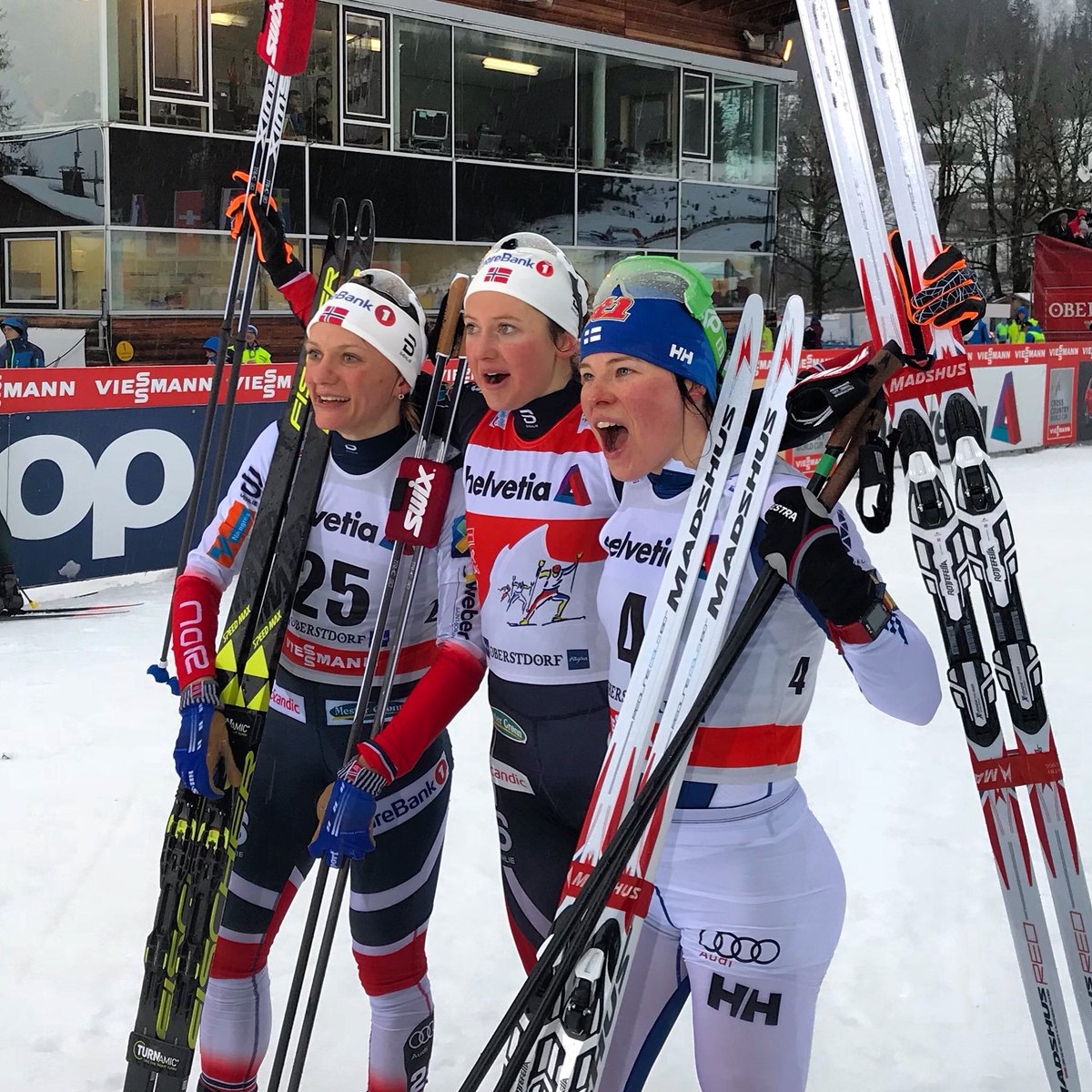
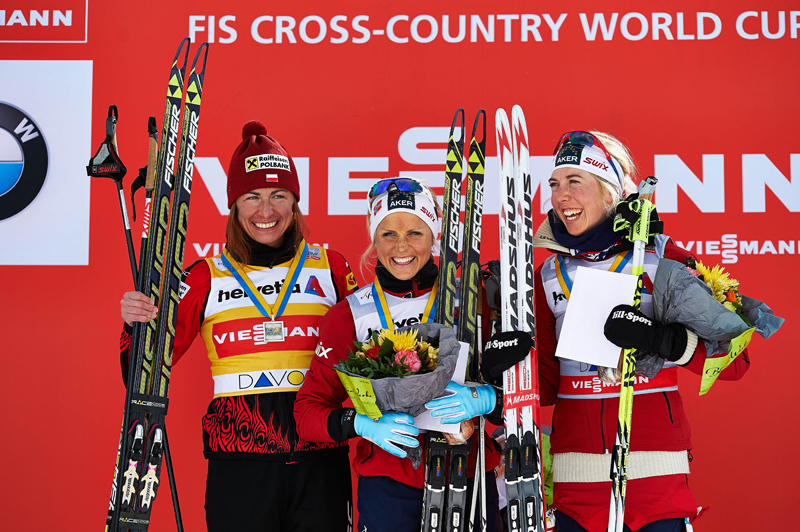
The Tour de Ski Stage 5 women’s 10 k freestyle mass start podium on Thursday in Oberstdorf, Germany, with Norway’s Ingvild Flugstad Østberg (c) in first and Maiken Caspersen Falla (l) in second, and Finland’s Krista Pärmäkoski (r) in third. (Photo: FIS Cross Country/Twitter)
Tour de Ski Stage 5 (Oberstdorf, Germany): 10/15 k freestyle mass starts
In one of the more unconventional stages of the Tour de Ski — a rainy, seven-lap, 14.7-kilometer men’s freestyle mass start, and a five-lap, 10.5 k women’s mass start (both of which were adapted to a shorter course after damage from Wednesday’s storm) — two Norwegians outlasted a tightly packed group of competitors to the finish, with Emil Iversen winning the men’s race and Ingvild Flugstad Østberg capturing her third-straight win in the women’s race on Thursday in Oberstdorf, Germany.
Iversen posted his first win of the season after hanging in the pack throughout the relatively flat race, with a maximum climb of 16 meters and total climb of 50 meters.
In the finishing stretch, he outsprinted fellow Norwegian Sindre Bjørnestad Skar by 0.4 seconds for the win in 29:49.8 minutes. Italy’s Francesco De Fabiani reached the podium in third, just 0.9 seconds out of first. Switzerland’s Dario Cologna kept his overall Tour lead in fourth place (+3.7) and Canada’s Alex Harvey came out on top of a photo finish for fifth with Great Britain’s Andrew Musgrave taking sixth and Norway’s Finn Hågen Krogh seventh, all 4 seconds after Iversen.
Norway’s Martin Johnsrud Sundby placed eighth (+4.2), Germany’s Thomas Bing ninth (+4.9) and France’s Maurice Manificat 10th (+5.2).
Twenty-five skiers finished within 10 seconds of first, and 57 in the 67-man field ended up within 50 seconds of first.
Overall, Cologna continues to lead the Tour standings with two stages to go: a 15 k classic mass start on Saturday and 9 k freestyle hill climb on Sunday, both in Val di Fiemme, Italy. He is 53 seconds ahead of Russia’s Sergey Ustiugov, who placed 28th on Thursday, and 1:07.6 ahead of Sundby in third. Harvey remains in fourth, now 1:23.1 behind and 3.5 seconds ahead of Russia’s Alexander Bolshunov (+1:26.7), who finished 40th on Thursday after falling several times.
Erik Bjornsen led the U.S. men in 32nd (+11.7), Paddy Caldwell placed 39th (+15.5), and Andy Newell was 53rd (+43.2). Simi Hamilton did not start. Overall, Bjornsen is 20th in the Tour (+3:10.7), Caldwell 60th (+6:58.2) and Newell 65th (+9:37.1) out of 67, although this is expected to be Newell’s last stage of the Tour.
In the women’s race earlier in the day, Østberg secured a 1.9-second victory over her teammate, Maiken Caspersen Falla, a Norwegian sprint specialist. Østberg crossed the line first in 23:16.5 and Finland’s Krista Pärmäkoski joined the two Norwegians on the podium in third, 3.2 seconds out of first.
Switzerland’s Nathalie von Siebenthal finished 4.1 seconds back in fourth for her best World Cup result, Sweden’s Maria Nordström was fifth (+4.4) to tie her career best, Germany’s Nicole Fessel sixth (+5.5), Austria’s Teresa Stadlober seventh (+5.8), Norway’s Anne Kjersti Kalvå eighth (+6.5) for her first World Cup top 10, Russia’s Anastasia Sedova ninth (+6.7), and Sweden’s Emma Wiken 10th (+7.1). Norway’s Heidi Weng was another 0.1 seconds back in 11th (+7.2), and for the first time this season, no U.S. Ski Team members finished in the top 20.
Jessie Diggins placed 24th (+16.8), Sadie Bjornsen 26th (+20.8), Liz Stephen 28th (+24.5), and Rosie Brennan 36th (+52.7).
“Today was definitely a very different course than most due to the storm and trees falling down over the usual course!” Diggins wrote in an email to FasterSkier. “It was icy and flat, which meant that the pack stayed really tight together as there were no big climbs to break it up.
“Fortunately, I got into great position to sprint for the bonus seconds [on Lap 3],” she continued. “Unfortunately, 200 meters from the finish I hit ice and crashed hard into the boards, spinning around and losing quite a bit of time and places. But that happens sometimes in racing and I shook it off already!”
Østberg now leads the Tour standings by 57 seconds over Weng while Diggins is nearly 2 minutes back in third (+1:56.7). Pärmäkoski follows in fourth (+2:09.1), Finland’s Kerttu Niskanen is up to fifth (+2:34), Fessel is sixth (+2:39.8), while Bjornsen slipped two places to seventh (+2:47.0). Stephen is 27th overall (+5:12.2) and Brennan 33rd (+5:50.6) out of 43 women.
Ida Sargent and Sophie Caldwell did not start on Thursday and withdrew from the Tour to focus on the regular-season World Cup sprints next weekend in Dresden, Germany, which are also the focus for their U.S. teammates Kikkan Randall, Hamilton and Newell.
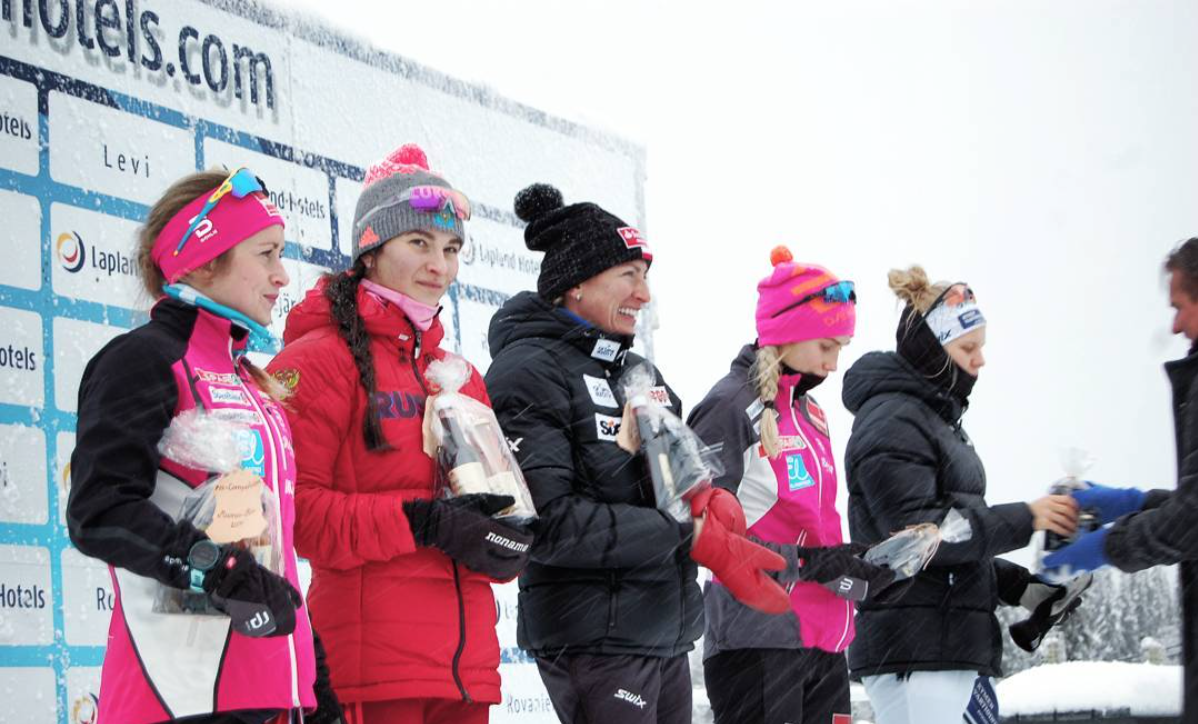
(l-r) Anna Svendsen of Norway, Natalia Nepryaeva of Russia, Justyna Kowalczyk of Poland, Lovise Heimdal of Norway, and Leena Nurmi of Finland receive prizes after rate women’s classic sprint in Muonio, Finland, on Friday. (Photo: Ski Muonio/Instagram)
FIS races are already being contested in Finland and Sweden this weekend, with most top Scandinavian racers sitting out but a few national-team members and others picking up their first victories of the season.
The competitions in Muonio, Finland, drew the most diverse field, including racers from Norway, Russia, Japan, China, Canada, Estonia, and Slovakia, among other countries. In the men’s classic sprint on Friday, the home team got a win from Ristomatti Hakola; he and Russia’s Alexander Bolshunov went 1-2 in both the qualifier and the final. Russia’s Andrey Parfenov rounded out the podium. In the women’s sprint, Anna Svendsen took the win over Russia’s Natalia Nepryaeva, with Justyna Kowalczyk of Poland finishing third.
On Saturday, racers moved up in distance. In the 10 k classic, Bolshunov – a U23 World Champion last season – bested Russian teammate Alexey Chervotkin by 20.6 seconds, with Andrey Sobakarev making it a sweep another 21.6 seconds back. Brian McKeever and Graham Nishikawa of Canada finished 56th (+2:10.6) and 63rd (+2:18.5), respectively.
Also in the men’s race was Maxim Vylegzhanin. The International Olympic Committee (IOC) decided on Thursday to strip the Russian skier of three silver medals from the 2014 Olympics for doping violations and ban him from all future Olympic Games. However, the International Ski Federation (FIS) has not yet taken any action since he and five other skiers were banned from the IOC, meaning that all six athletes are currently free to take part in non-Olympic ski competitions. In a press release, FIS stated that “the next steps will be the review by the FIS Doping Panel of the six verdicts upon the receipt of the reasoned decisions” but did not provide a time frame for these decisions.
In the women’s 5 k classic, Finland’s Krista Parmakoski posted an 18.4-second win over Nepryaeva, with Kowalczyk third again, +24.2.
Bruksvallarna, Sweden, hosted races on Saturday as well, with a primarily Swedish and Norwegian field but some other racers as well. Norway’s Chris Andre Jespersen topped the 15 k skate, posting a 31.4-second win over Simon Lageson of Sweden. Norwegian Tore Leren was third, +53.1. Canada’s Jack Carlyle finished 38th, +2:29.5. Petter Northug and his brother Even were in Bruksvallarna this week but decided at the last minute not to race, with Northug making his debut in Beitøstolen, Norway, next weekend instead.
In the women’s 10 k skate, Swedish national team member Emma Wiken bested Lina Korsgren – a long-distance specialist who finished eighth in the Visma Ski Classics standings last season – by 9.8 seconds. Berit Mogstad of Norway finished third, +15.3 seconds.
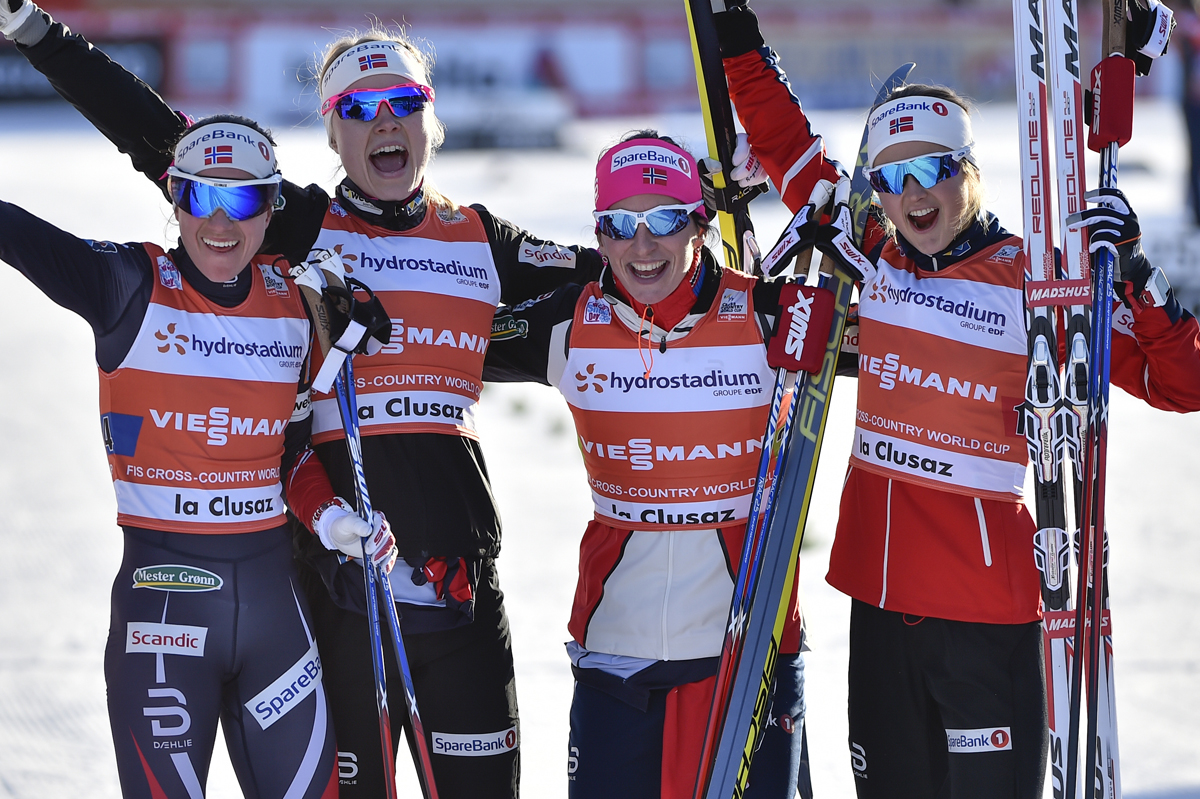
Norway won the women’s World Cup 4 x 4 k relay on Sunday in La Clusaz, France, with (from right to left) Ingvild Flugstad Østberg, Marit Bjoergen, Ragnhild Haga, and Heidi Weng. (Photo: Fischer/Nordic Focus)
Sunday’s 4 x 4-kilometer relay in La Clusaz, France, was a 39:23.3 minute macro-statement by the Norwegian women’s team of Ingvild Flugstad Østberg, Marit Bjørgen, Ragnhild Haga, and Heidi Weng.
That statement was dominance. Norway won the relay in time-trial-like fashion: each Norwegian leg a solo affair. Finland’s team of Aino-Kaisa Saarinen, Anne Kyllönen, Riita-Liisa Roponen, and Laura Mononen placed second (+50.2). Sweden’s team of Emma Wiken, Stina Nilsson, Maria Rydqvist, and Anna Dyvik was third (+1:08.9).
As with lopsided races, the 10,000 foot view on the first classic leg showed Østberg stretching a fatigued rubber band back to the pack. At 2 k, 11.5 seconds was Østberg’s initial gap.
Then snap. The band broke. At 4 k when Østberg handed off to Bjørgen, it was a 28-second cushion on Russia, 33.3 to Switzerland, 34.9 to Finland.
Why belabor the point in words when the numbers tell the micro-story which lead to the dominance?
Østberg fastest leg at 10:04.
Bjørgen fastest leg at 10:11.8.
Haga seventh-fastest leg at 9:43.2.
Weng fastest leg at 9:27.9.
Some problems are good to have. That’s the case with Norway and Haga. Here’s the context. Although she skied the seventh-fastest leg split, it was a tight leg and she kept Norway’s lead comfortable.
For example, the U.S. Ski Team’s Liz Stephen skied the 10th-fastest third leg, only 13.4 seconds off the fastest time skied by Sweden’s Rydqvist. Compare that to the fourth leg, the 10th fastest time was skied by Kazakhstan’s Irina Bykova — she was 57.2 seconds off Weng’s pace.
There’s the number crunching and analysis, but it can be rendered down to this: Weng had plenty of time to high-five the crowd before crossing the line.
“It wasn’t that scary when the girls performed so well,” Weng told Norwegian broadcaster NRK after the race about her anchor role. “I didn’t have to sprint at the end. The last time I had a final leg I was too afraid to do anything. Now I was high-fiving the spectators and had some fun.”
Østberg told NRK in the same article that she was experiencing pre-race butterflies. “I was extremely nervous before the start, but it went well,” Østberg said. “I didn’t want to disappoint the other. You’re competing for a team in a relay and not yourself. I didn’t want to let the others down … I had to go fast today so Marit could go home to her son Marius. She’s missed him all week.”
Relay Socks and Rebounding from Illness
Here’s the straight talk. The two powerhouses of the deep U.S. women’s team, Jessie Diggins and Sadie Bjornsen, were scratched from the roster due to illness. But the relay socks made a feisty appearance.
The U.S. lineup that finished seventh overall (+2:26.0) consisted of Sophie Caldwell, Rosie Brennan, Liz Stephen, and Kikkan Randall.
“You know clearly we were not at full strength today and it showed I think,” U.S. head coach Chris Grover told FasterSkier on the phone. “My guess is that Sophie might be fighting a little bit of something, we have seen that before where an athlete maybe is on the edge of getting sick and goes out and skis fine for a while and then kind of blows up and it turns out maybe they are coming down with something.”
Caldwell is primarily known as a sprinter on the World Cup. Sunday’s relay legs were 4 k, a relative no-women’s land when it comes to sprint or distance race length. One kilometer into the race and Caldwell was third (+1.0). By the first tag to a resurgent Brennan, Caldwell had lost over a minute to Norway.
“I haven’t really seen any times yet, there is no internet up here today, so it seemed like a pretty solid leg out of Rosie,” Grover posited.
In fact, Brennan skied the fourth-fastest split of any second-leg skier (+38.2) — Bjørgen set the benchmark.
“The legs were incredibly short, especially for people like Liz and I who like a little longer,” Brennan said of the 4 k distance, as opposed to 5 k, on the phone. “I think it was a solid effort and especially considering the illness that has destroyed our team the last week.”
Brennan began the season out of the points and took last weekend’s races in Davos off.
“I definitely had a less-than-stellar start to the season, I don’t really know why,” Brennan said. “I guess in my past it hasn’t been uncommon for me to start a little slow, but I was trying, I was actually focusing on doing the opposite just knowing it is so important to come over here and have some good races and build some confidence right away, that obviously that didn’t work out quite as planned.”
Brennan will remain in France for the holiday break and begin resting and preparing for the Tour de Ski beginning on Dec. 31. She’ll begin the Tour with a boost of confidence. “It was great to turn that around yesterday and I am feeling much better to hear that I had the fourth-fastest leg, or time on my leg, it is really encouraging especially for such short race,” Brennan said. “I wasn’t quite sure about my speed just yet, that is definitely a step in the right direction for me.”
Like Brennan, Stephen came into the day heartened by a solid effort and result on Saturday. But 4 k is a k short of 5 k.
“Even a 5 k is like a sprint for me. Rosie and I were actually talking about that in our cooldown,” Stephen said after the race. “When I go out, it’s like a sprint, because when I’m done with a sprint, I’m like ‘it’s already over?’ and it’s kind of like that in a relay. Don’t blow up, but it’s pretty hard for me to completely blow up in such a short race. I attacked from the beginning knowing that this is a nine-minute race today, and I do intervals longer than that often times.”
Grover reiterated that point. “It was a 4 k course for the relay and you know Liz just needed more real estate out there. It was almost like, some of our athletes, it takes them one or two k to get into the race and you are already half way through the race at that point.”
Stephen kept the margin to Norway just under two minutes and showed improving form before her favorite stretch of racing in the Tour. “I’m always looking forward to [the Tour]. But also I feel like this last weekend that I’ve been able to feel like I want to. Physiologically I feel like racing has really helped get me into the shape I want to be in. I have some work to do over the break, but I feel like I’m in a good place to do what I’m normally able to do at the Tour.”
Team and relay vet Kikkan Randall skied the anchor leg. Her’s was the seventh-fastest anchor leg (+27.1).
“I got the tag from Liz a ways back from Germany ahead and a gap to Italy behind,” Randall wrote in an email to several media outlets. “I focused on holding a good rhythm on the first lap but Italy was able to almost close the gap. I was getting ready for a good battle on the last two climbs but I guess the Italian anchor crashed behind me. So I skied the rest of my lap alone.”
Randall secured seventh place for the U.S. (+2:26).
Grover didn’t spend any time lamenting what could have been. “I really expect by the time we do our next relay in Sweden that we are going to be very competitive for the podium,” he said. “Norway, of course, on paper was far gone, but in terms for the hunt, the usual hunt for Seed 3, we will be back there.”
Last season’s U.S. women’s 4 x 5 k relay team after placing third in the first relay of the 2015/2016 season in Lillehammer, Norway: (from l to r) Sadie Bjornsen, Rosie Brennan, Jessie Diggins, and Liz Stephen. They matched a team best in third in December 2015, and went on to place second in January 2016 (with Sophie Caldwell in place of Brennan) in Nove Mesto, Czech Republic. (Photo: USSA Nordic/Twitter)
Expectations are what they are for the U.S. women’s relay team: high.
Grover explained that the relay is a target event for a podium at both 2017 World Championships and the 2018 Olympics. “We also have a women’s team right now that is the strongest women’s team we’ve had in the history of U.S. skiing. So the time to win is now, and we’ve got the athletes to do it,” Grover added.
In mainstream professional sports, cybermetrics is understandbly the rage. Essentially it’s data-based decision making when it comes to sports. Coaches like Grover and U.S. women’s coach Matt Whitcomb play their version of ski-cybermetrics when picking a relay team.
“It’s a matter of putting together on a certain day the right athletes, with the right fitness in the right technique, in the right legs, and also taking into account the course profiles in terms of strengths of the athletes, and what are the attributes of the course,” Grover said of picking the most viable relay squad. “Is the course long for 5 k, it it short for 5 k? Is it flat for classic? Is it hilly for classic? Is it technical or is it more of just a grinding course?”
The U.S. team’s strategy is to have at least three skiers in each discipline, skate or classic, to choose from on relay day.
“If we can do that, then we can put the women who are the fittest at the time and for whom the technical elements of the course suit their strength the most, and we can put together a super competitive team, so that is kind of the puzzle that we are always putting together with relays,” Grover said.
The next opportunities to contest the relay will be the 4 x 5 k in Ulricehamn, Sweden, on Jan. 22, and March 2 at World Championships in Lahti, Finland.
Canada’s team of Emily Nishikawa, Cendrine Browne, Dahria Beatty, and Sophie Carrier-Laforte finished 12th (+4:07.9). But the biggest victory of the day for the team was fielding a women’s relay.
“We were so happy to have a women’s relay team today,” Nishikawa wrote in an email. “I didn’t feel great today, but my teammates all skied really well and I’m very proud of them. It makes having a tough day so much better when you can be pumped to see amazing races from the rest of your team! The atmosphere in La Clusaz is just amazing! So many fans out cheering and the organizers did an incredible job of getting the course ready. It was a lot of fun racing here.”
Beatty was also excited about Canada fielding a legitimate women’s World Cup relay team.
“It is wonderful for us to be able to start a relay,” Beatty wrote in an email. “Having a group of women on the world cup this first period has been really great for all of us. Today’s race was a great building point for our team and I am really proud to be able to races with this group and grow together.”
The Canadian appears to be coming into good form; Beatty skied the second-fastest third leg (+2.8).
“I was really happy with how my leg went,” Beatty added. “I was able to build off my good feeling from yesterday and ski a really strong race. I was just focusing on trying to catch as many people as possible. When I found out that I had skied the 2nd fastest leg time I was a bit shocked and really excited. It feels great to have a great feeling race correlate to a strong result.”
Therese Johaug (NOR) clinched her first individual World Cup win on Sunday in the 10 k freestyle.
In the final tune-up race before the 2013 World Championships, Therese Johaug (NOR) notched her fourth World Cup victory on Sunday in the women’s individual start 10 k freestyle in Davos, Switzerland.
The result confirmed her fitness in the final days before Val di Fiemme and served as an important morale boost for the Norwegian women’s team after the absence of their leading light, Marit Bjørgen (NOR), who elected to sit out today’s race.
“She was plain and simply tired after the race yesterday,” said Gro Eide, a press contact for the Norwegian national team.
“The decision for Bjørgen not to go was made 30 minutes before the start,” said Egil Kristiansen, a Norwegian trainer. “During the warm up she felt tired and said that she was in doubt whether she should go. If you’re in doubt, you should not go. That’s how we made the tough decision.”
In the absence of Bjørgen it was left to others to take up the challenge against World Cup Overall leader Justyna Kowalczyk (POL). Johaug responded.
She stormed to the first check point at 1.6 kilometers, besting teammate Kristin Størmer Steira by 8.7 seconds with Kowalczyk lurking just 0.2 seconds behind.
Therese Johaug (NOR) crosses the finish with the win in the ladies’ 10k freestyle in Davos, Switzerland. Photo: Fischer/Nordic Focus.
For Johaug, her strategy was straightforward — start hard and hold it.
“I opened really hard and managed to keep that tempo through the entire race,” Johaug told NRK.no.
The diminutive Norwegian superstar essentially maintained the eight second margin she earned in the initial 1.6 kilometes. She finished the course in 26:16.7, 8.9 seconds ahead of Kowalczyk.
Pacing in Davos was a tricky proposition. Situated at 5,120 feet above sea level, the altitude of the venue accentuates the difficulties of a deceptive course. Though it lacks the monster climbs that are a hallmark of a World Cup course profile, it is relentless and technically demanding. There’s always a danger of going out too hard and never recovering.
Johaug wasn’t certain whether her aggressive start would backfire, saying, “I started hard and I was not sure if I did not ski too fast.”
Oddly enough, the tiny Norwegian superstar credits her performance in part to her technical abilities.
“I gained some time in the downhill sections,” she said.
In the final analysis Johaug’s pacing strategy and preparations in Seiser Alm were enough not just for the win, but for praise from Kowalczyk, who is not usually one to shower compliments on her rivals.
“She (Johaug) was fantastic,” Kowalczyk said to NRK.no. “Therese and Marit will be my two biggest challengers at World Championships.”
Kowalcyzk’s second-place finish underscores her impressive recovery after a dismal showing two weeks ago in Sochi, Russia. After claiming a comfortable victory yesterday against Bjørgen, Justyna notched another impressive result in her weakest discipline — skating.
“Before today’s competition I did not know if I would start in the 10 k free in Val di Fiemme, but after today I seem to not have other option,” Kowalcyzk told FIS. “I have skied one of my best competitions in free technique in my life.”
Clearly, her world championship form has arrived.
Justyna Kowalczyk (POL) working for second in Davos. Photo: Fischer/Nordic Focus.
Apart from the return of Kowalczyk’s imposing form, Steira’s impressive run was another notable outcome of the 10 k. The omission of Bjørgen left a gaping hole to be filled at the top and Steira rose to the challenge.
Altitude pacing was central to Steira’s race, she said.
“At such a high altitude it is easy to go out too hard so I wanted to start carefully and then speed up and keep the pace,” she told FIS.
Steira couldn’t match her teammate’s vicious acceleration in the first 1.6km. She was 8.7 seconds behind Johaug at the first intermediate split but maintained a strong tempo and only conceded 4.5 seconds to Kowalczyk over the duration of 10 k.
Taken together with her win two weeks ago in Sochi, Russia, Steira’s recent run of form gives her confidence for a podium position at world championships.
“I am in good shape and I hope for a medal in Val di Fiemme,” she concludes. “It was a good confirmation, because I was nervous and excited before the start of today’s race after my prior training at altitude.”
Given Steira’s performance, team Norway was the winner of the day, proving they can deliver top results with Bjørgen.
“That was two solid runs by Johaug and Steira,” Egil Kristiansen reiterated. “It shows that we can win even if the assumed strongest of us [Bjørgen] doesn’t show.”
Tucked in just 4.4 seconds behind Steira in 4th position was Emma Wiken of Sweden, whom bested her high profile teammate Charlotte Kalla by 1.6 seconds.
Wiken, 23, is an relative newcomer to the World Cup circuit; today’s performance marks a personal best for her and a boon to team Sweden and they head to Val di Fiemme.
With the conclusion to Sunday’s races in Davos the stage is set, and the final dress rehearsal before world championships is over.
Justyna Kowalczyk (POL), Therese Johaug (NOR) and Kristin Stoermer Steira (NOR) top the women’s podium after the 10k freestyle. Photo: Fischer/Nordic Focus.
Liz Stephen (l) with Justyna Kowalczyk (POL) and Russia’s Yulia Tchekaleva (r) on the podium on Sunday in Muonio, Finland. Kowalczyk won the FIS 10 k skate race by 4.46 seconds over Stephen. (Holly Brooks courtesy photo)
After months of training and anticipation, the nordic sports opened their seasons around the world this weekend with races around the world. Established veterans had several dominating performances, but there were new faces on the podiums as well, signaling that when World Cup racing starts next weekend, things could be pretty interesting.
In Bruksvallarna, Sweden, the Swedish, Canadian, and Slovenian national teams butted heads in a three-day race series. One of the biggest surprises was Swedish 23-year-old Emma Wiken taking a 2.4-second win over Charlotte Kalla on the first day of racing. But otherwise, Sweden’s top stars prevailed, with Daniel Richardsson, Johan Olsson, Teodor Peterson, and Ida Ingemarsdotter taking wins and Kalla returning to completely decimate the women’s field in the 10 k skate. Canada had strong performances as well, with Alex Harvey placing fourth in the 10 k classic, Ivan Babikov third in the 15 k skate, and Chandra Crawford second in the skate sprint. Katja Visnar of Slovenia also stepped on the podium in the sprint.
To the northeast in Muonio, Finland, even more national teams tried out their racing legs. Finland was joined by Russia, the United States, the Czech Republic, Poland, Kazakhstan, Japan, and Germany in a three-race series. Justyna Kowalczyk of Poland swept the women’s competitions, and was at her most dominant in a 29-second win in Saturday’s 5 k classic. For the men, Alexey Poltoranin of Kazakhstan took two victories before Matti Heikkinen of Finland bested the field in the 15 k skate. The U.S. had several top performances, headlined by Liz Stephen‘s second-place finish in the 10 k skate, just 4.6 seconds down on Kowalczyk; Holly Brooks and Jessie Diggins also made the top ten. But Kris Freeman also placed fourth in the men’s classic race, and Andy Newell and Ida Sargent both made the sprint finals.
Meanwhile, Beitostolen, Norway, was hosting the opening races for both skiers and biathletes. The women’s races were characterized by familiar Norwegian faces on top of the podium: Maiken Caspersen Falla in the sprint, Therese Johaug in the two distance races, and Tora Berger dominating the biathlon competitions. Perhaps the biggest surprise was Marit Bjørgen‘s two losses to Johaug, including a 50-second blowout in the classic race. Petter Northug won on Friday before falling in the sprint final, leaving Anders Glørsen to take the win, while Chris Andre Jespersen skied to a huge victory on Sunday. World Champion Martin Fourcade of France won Saturday’s biathlon sprint, before sitting out Sunday’s mass start and leaving the victory to Erlen Bjøntegaard.
Finally, the U.S. race season began in Fairbanks with the Tour de Ski Fairbanks, a three-day series culminating in pursuit races on Sunday. Designed to be a meet for University of Alaska Anchorage and University of Alaska Fairbanks skiers, the weekend consisted of prologues on Friday, classic mass starts on Saturday, which included sprint preems, and then skate pursuits on Sunday. Logan Hanneman and Raphaela Sieber, both from UAF, picked up the overall titles, although Viktor Braenmaark and Marine Dusser (UAA) had the fastest ski times on Sunday and Rebecca Konieczny (UAF) won the women’s prologue.
Canadian Alex Harvey racing to a 10th-place finish in last year’s 15 k skate race on Nov. 12 in Bruksvallarna, Sweden. On Friday, Harvey was fourth in the 2012 Bruksvallarna FIS opener. (Photo: Erik Wickström)
In and around Scandinavia on Friday morning, several nordic races kicked off the season. While the International Ski Federation (FIS) events in Bruksvallarna, Sweden, were among some of the shortest, few likely complained about a 5- and 10-kilometer classic race at this point in the year.
It’s November. The World Cup races start in a week. Let’s just get the kinks out.
Several skiers across Europe tweeted about their legs feeling a little syrupy, which essentially translates to mean slow. The winners of Friday’s races in Bruksvallarna, Sweden’s Daniel Richardsson and Emma Wikén, were pleased with how their bodies responded for the tune up – the first of three races on the western edge of Sweden (near Norway) this weekend.
Richardsson topped more than 140 competitors in the men’s 10 k, winning in 22:15.3. Seeing how most of the field was Swedish, he led his nation’s sweep of the top three, with Marcus Hellner finishing 5.2 seconds behind in second and Lars Nelson placing third (+6.3).
Canadian Alex Harvey ended Sweden’s run by beating out Calle Halfvarsson for fourth and was the only non-Swede in the top 17. Harvey finished 8.7 seconds back, about 8 seconds ahead of Halfvarsson, who started fast and remained strong through 7.5 k.
In an email, Harvey wrote that he felt good about the race despite losing some time over the first two or three kilometers. He wasn’t entirely confident in his choice of skis and had better pair he could’ve used, but the Canadians always race on new skis in Bruksvallarna, he added. It’s just tradition.
“I didn’t have much expectations, just wanted to get the race feeling back and ski well technically in classic,” Harvey wrote. “I’ve been doing quite a bit of training lately so I knew I wasn’t gonna be 100% but I’m happy to be that close to the lead.”
Snow conditions were fast and “the tracks were bomber,” he wrote. “It was actually fairly easy for the ‘not so good’ classic skiers to kick their skis. The first half of the loop was pretty much all climbing, then a long downhill and some short ups and downs toward the end of the lap.”
Canadian head coach Justin Wadsworth said on the phone that he was happy with the team’s performances, which included Chandra Crawford placing eighth and Perianne Jones finishing 14th out of 77 in the women’s 5 k. The only other Canadian man who raced, Kevin Sandau was 34th.
“It always takes me a hard race or two before the body gets comfortable racing,” Sandau wrote in an email. “I was happy with today’s race, hard effort and looking especially forward to tomorrow’s 15km (a bit longer which I like).”
“It’s always good when you’ve only been here a week and can have some solid distance results,” Wadsworth said, “and a good sign that everyone’s base level fitness is there.”
He said the field wasn’t quite as competitive as it was there last year, when the Norwegians and other international skiers came to Bruksvallarna to get on snow (for one race; the others were canceled). So the middle of the pack was a bit weaker, but the top men and women remained as strong as ever, he added.
“It’s the first real race of the year, you have to know that it’s big in that sense,” he said. “Everyone’s trained for it all summer and now you want to see where you are. For sure, there’s more nervousness probably than there is the rest of the season because of all the unknowns. Everyone trained hard this last week, too.”
For Richardsson, 30, the win was a positive outcome after a rollerski accident derailed some of his training. According to Langd.se, he fell rollerskiing this summer and ran as an alternative. Leading up to Friday’s race, he had mostly eased back into skate skiing.
“This was the first substantial speed [test] in classic for a long time,” Richardsson said in the translated interview. “Glad it went so well, but it was hard.” Hellner and Nelson challenged him to the finish.
***
In the women’s race, the 23-year-old Wikén, who recently made Sweden’s A-team, edged teammate and Bruksvallarna’s defending champ Charlotte Kalla by 2.4 seconds in 12:33.1. Another national-team member, Ida Ingemarsdotter was third (+9.3), and Sweden filled up the top seven. Crawford was eighth (+33.7) and Jones 14th (+37.5).
Somewhat surprised after beating Kalla for the first time, Wikén told op.se she felt great.
“I do not think I have gone as fast as the 5 km classic before,” she said in the translated interview. “That’s really the biggest race I had hoped for before the weekend.”
Teammates and coaches noted Wikén’s progress in training, but Friday’s race confirmed it. “I’ve seen her work so it is no surprise,” Ingemarsdotter said.
Kalla said Wikén must have come on strong at the finish, yet was pleased with her own performance considering she’s still training hard.
Another notable top finisher, Sofia Bleckur struggled with a rheumatic disease, which primarily affects the body’s joints and bones, this summer and fall. She pulled off fourth ahead of Anna Haag and Stina Nilsson, who were two tenths of a second apart in fifth and sixth. Sara Lindborg was seventh, 5.9 seconds ahead of Crawford.
Before the start, Crawford wasn’t sure what to expect. She came down with a cold nearly two weeks ago just before flying to Sweden. As she started to feel better, she ramped up the training, which didn’t feel great.
“I felt pretty rough going into it,” she said on the phone. “I had a lot of process goals for today, not results-based, that I wanted to accomplish. I wanted to cross finish line and say to myself and coaches, ‘I did all these things really well,’ all the technical goals and effort goals. That’s what I focused on because I’ve been feeling pretty stiff.”
At the same time, her skis felt great and it was good to get racing again, she said. “It’s been a long hard training season,” she said.
While she probably wouldn’t do Saturday’s 10 k skate, she was looking forward to Sunday’s skate sprint. Most of the Canadians planned to do one or two of the three races, she said.
“Ida [Ingemarsdotter] is the one to watch for Sunday so [I’m] looking to bomb around with her,” she said. “Having done that Swedish camp with the Americans, it’s good to be back in Sweden.”
Jones was the only other Canadian woman to race Friday, and was pleased with placing 14th. Wadsworth said she had been coping with some fatigue leading up to it.
“I just wanted to put out a solid effort and ski well,” Jones wrote in an email. “I haven’t done much for the last few weeks so I was really happy with how it went. It was a really fun feeling to put that bib on and race again, the body felt good, our skis were amazing, it was nice to get things rolling today!”
In future races, she’s going to try to start faster and attack the downhills more.
“I wanted to start hard because most of the uphills were in the first half of the race,” she wrote. “I guess I didn’t quite start as hard as I thought!”
Alysson Marshall was supposed to start for Canada, but stayed back in Östersund, Sweden, to recover from a cold. Wadsworth said Devon Kershaw and Ivan Babikov would race Saturday’s 15 k skate, and Dasha Gaiazova, Crawford, Jones and Harvey would race Sunday’s sprint.
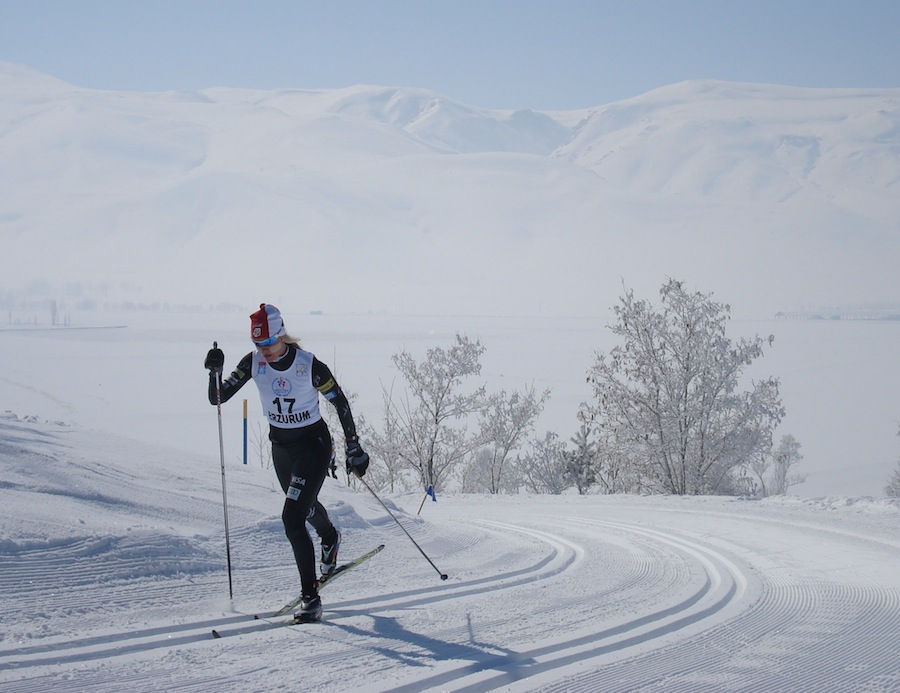
Martine Ek Hagen (NOR) on her way to a gold medal in the 15 k skiathlon at U23 World Championships on Saturday. Photo: Logan Hanneman.
ERZURUM, Turkey — Before Saturday’s 15 k skiathlon began, gold had eluded Norway at the Junior/U23 World Championships. The team repeatedly stressed that the week that the learning experience was more valuable than the hardware, but athletes and team staff alike nonetheless seemed hungry for the wins they are used to.
Martine Ek Hagen (NOR) finally delivered in the skiathlon, skiing a strong skate leg in the second half to win by 13.9 seconds over Italy’s Debora Agreiter. Emma Wiken (SWE) took third (+34.5).
The podium was fairly spread out, but before the gun went off, anything had seemed possible. Russia had dominated the 10 k classic on Thursday, but Jessie Diggins (USA) was finally putting on a bib after recovering from illness earlier this week. Hagen was the top seed, and after a good chunk of time at altitude, had promised after the classic race not to finish the skiathlon with Russians in front of her.
When the race got underway, Diggins, wearing bib number three, was one of the first to come into view over the first hill out of the stadium. Shortly thereafter, she took the lead of the entire race where she stayed until the ski change at the 7.5 k mark.
“That first half of the race felt really good—I was relaxed and strong, and feeling powerful,” said Diggins.
Diggins controlled the pace for the entire classic leg. When she saw U.S. coaches waving a pole for teammate Sadie Bjornsen (USA), Diggins slowed it down to give Bjornsen time.
“When you’re in front you can make sure no one takes off, or you can make it go faster,” said Diggins.
The women's skiathlon on the first hill out of the stadium. Photo: Logan Hanneman.
Separated from the pack, she could also take squirrely downhills exactly how she wanted, so Diggins took off before a slick descent that ended in a 180-degree-turn so that she wouldn’t be stuck snowplowing behind the rest of the field. In doing so, she opened up a gap that no one responded to.
“Jessie kind of pushed over the top and the other girls would not go with her,” said Bjornsen. “I was like, ‘What are you doing?’” Part of me wanted to break on the classic, but there was no way I could hold it in skate, but I kind of wanted to just have fun with it.”
Diggins wasn’t sure exactly why no one followed her break.
“I think people knew I wasn’t going to gap the field, they probably figured I was just being safe on the corner,” said Diggins. “Last year here I fell, and someone fell on top of me, so I didn’t want that happening here.”
At no point in the classic leg did Diggins feel like she’d crossed the line and gone too hard, but after the switch to skate skis at the halfway mark, she began having trouble.
“The second half I just had no energy source left,” said Diggins. “It went from good to just falling apart right after the transition. Something felt super wrong.”
“I made the mistake of trying to stay with [the leaders]—it was hard to purposely drop back—but I should have and I ended up really dying. So, needless to say, that second half was probably one of my worst.”
Hagen took the lead in the second half, as skate is her stronger discipline, and she and Agreiter had soon put distance on the rest of the field.
“I thought Jessie Diggins, especially, would follow, but when she gave us a gap, I didn’t want her to catch up with us again,” said Hagen. “I thought Agreiter was very strong, so I was never sure [of the win], but I was hoping it would stay that way.”
Hagen (NOR) wins, with no one in sight.
Stay it did, as Hagen skied to a comfortable victory. Agreiter’s medal was Italy’s first at U23s since 2007, and she appeared delightedly surprised to have finished so well.
“After the classical part I was surprised I was still in the leading group,” said Agreiter. “After the exchange I was following Martine… In the second [lap] Hagen skied away, but I am very happy for silver.”
Agreiter is hopeful that her medal will gather momentum for others to follow her in Italy.
“There is a very young group of skiers in Italy,” she said. “I hope one day we will have the same results as Arianna Follis or Marianna Longa.”
Diggins, the early leader, finished 15th (+1:39.1).
Would she have held onto the lead if she had been completely healthy?
Diggins, utterly depleted.
“You still never know,” said Diggins. “Obviously I’m disappointed with the circumstances; preparation was far from ideal, but that aside, it was still a good experience being here.”
Saturday’s skiathlon was perhaps the first race all season where Diggins didn’t have the race of her life, and beforehand she felt the weight of expectation to keep producing top results.
“It’s easy to have good races and just raise the bar,” said Diggins. “After getting a couple of top-10s on the World Cup, it’s like, ‘Oh, you did really well, you’re going to do really well again.’ But nope, that’s not fair—I can’t expect myself to just do that all the time. I’m a pretty consistent racer, but I’m going to have my ups and downs.”
Her takeaway from the experience is to not let what she imagines to be the expectations of others dictate the way she looks at a race in the future.
“I didn’t expect to feel awesome, so I have to just not worry about feeling like people are watching me and waiting for me to pop off another race,” said Diggins. “Because that’s not a good feeling—then you’re not even racing for yourself.”
She emphasized that, despite her disappointment, the U.S. still placed three in the top 20. Bjornsen finished behind her in 16th (+1:56.6) and Becca Rorabaugh (USA) was 19th (+2:14.4).
Emily Nishikawa (CAN) striding early in the skiathlon.
The rest of the North Americans struggled on the tough altitude course. Emily Nishikawa (CAN) was 27th (+3:34.4), Annika Hicks (CAN) was 33rd (+5:03.2), and Marlies Kromm (CAN) was 36th (+7:07.1). Heidi Widmer was lapped and pulled.
Mariya Guschina (RUS) on her way to a dominating win in the women's 10 k at U23 World Championships.
ERZURUM, Turkey — In her first race at these U23 World Championships, Mariya Guschina (RUS) had no trouble sticking with the standard set by her Russian teammates this week, claiming the gold medal by 26.7 seconds over Polina Medvedeva (RUS).
Second through fifth place were tightly packed—Martine Ek Hagen (NOR) took third, only 1.3 seconds out of silver, Emma Wiken (SWE) was 0.4 behind Hagen in fourth, and APU’s Sadie Bjornsen (USA) crossed the line 3.5 behind Wiken for fifth.
With yet another victory by a wide margin in Erzurum, what’s the Russians’ secret?
“There is a great team spirit in our squad,” said Guschina. “Everybody is working very hard. Coaches, service as well as athletes are all trying their best. That is why Russian skiers have collected so many medals here.”
Medvedeva, who had expected to be battling Buschina for the win, had a similar take on the Russian dominance in Erzurum: “It feels great to be on the podium with her. We share our big day together.”
Martine Ek Hagen (NOR).
Hagen’s bronze medal was briefly in question, as she took the wrong lane in the stadium as she came through for her second lap. Britt Ingunn Nydal (NOR), who was skiing in front of her, went into the finish lanes when she should have stayed in the lap lane. Hagen followed her before realizing the mistake and skiing back to the correct track.
“Suddenly I hear our team doctor screaming,” said Hagen. Nydal realized her error after Hagen, and lost a few more seconds.
The jury decided that Hagen’s mistake hadn’t given her an advantage, and she was allowed to keep her bronze medal along with a written warning.
Norway’s team doctor, Kjell Vegard Mykland, thought the stadium hadn’t been fairly set up.
“You have to choose the right lane a little bit too early on the straight [after coming around the corner],” Mykland said.
Hagen agreed that the required lane change was in a difficult position after coming down a long descent into the stadium.
“I don’t know, I was so focused it was probably me, but when you’re racing downhill, you come fast, and it’s not the best to change course. It was a little bit difficult.”
After losing time with the mistake, Hagen said she became dispirited. She ended up 0.3 seconds out of the silver medal.
“I think maybe I lost a little bit of motivation… It was an ok race, but I’m looking forward to Saturday now even more,” said Hagen.
Sadie Bjornsen (APU/USST) on her way to fifth in the 10 k classic.
On her sixth trip to World Juniors/U23s, Bjornsen posted a career best fifth place in the 10 k classic. It was a close race for rest of the podium, and Bjornsen was well aware of it as she powered through the second and final 5 k lap.
“I knew it was going to be close,” she said. “[Bryan] Fish told me at the top of the second hill that five seconds was five places—I was just trying to go for it with every bit that I had.”
Bjornsen skied a tactically smart race, and was able to stick to the plan she’d laid out for the race.
“The first time around she was in 10th, and six seconds would get her five positions,” said Fish. “That kind of information, when it’s that tight, can really help to motivate an athlete.”
Bjornsen (USA). Photo: Terje Alstad.
Bjornsen said skiing a bit slower in the beginning was part of the plan.
“That didn’t worry me; I planned to do the first lap conservatively. Then…on the second lap I planned on hammering the hill,” said Bjornsen.
“It was one of those splits that was one off the checklist: ‘OK, this is where I want to be.’”
Emily Nishikawa (CAN) was the second North American on Thursday in 17th (+1:47.8). She had hoped for a top-20, but was happy with a solid effort.
“It’s hard to put a number on it, because you never know who’s going to be here,” Nishikawa said of her goals going into the 10 k.
“I was happy with it…I pushed hard and did as well as I could have.”
Becca Rorabaugh (USA) was 29th, Marlies Kromm (CAN) was 35th, Annika Hicks (CAN) 37th, and Heidi Widmer (CAN) was 28th.
Hanna Kolb (GER), victorious in the U23 women's sprint on Tuesday in Erzurum.
ERZURUM, Turkey — After scoring points on the World Cup, a victory at U23 World Championships is still a big deal. Just ask Hanna Kolb (GER)—despite having placed 17th this weekend in Szklarska Poreba, Poland sprint, she still thought of her inaugural U23 title as an significant accomplishment.
“It is one of the greatest achievements for me,” she said to FIS marketing coordinator Michal Lamplot.
Hanna Kolb (GER) in qualifying.
“Even though I have won already some World Cup points…this individual title is really special for me. It was a perfect day for me.”
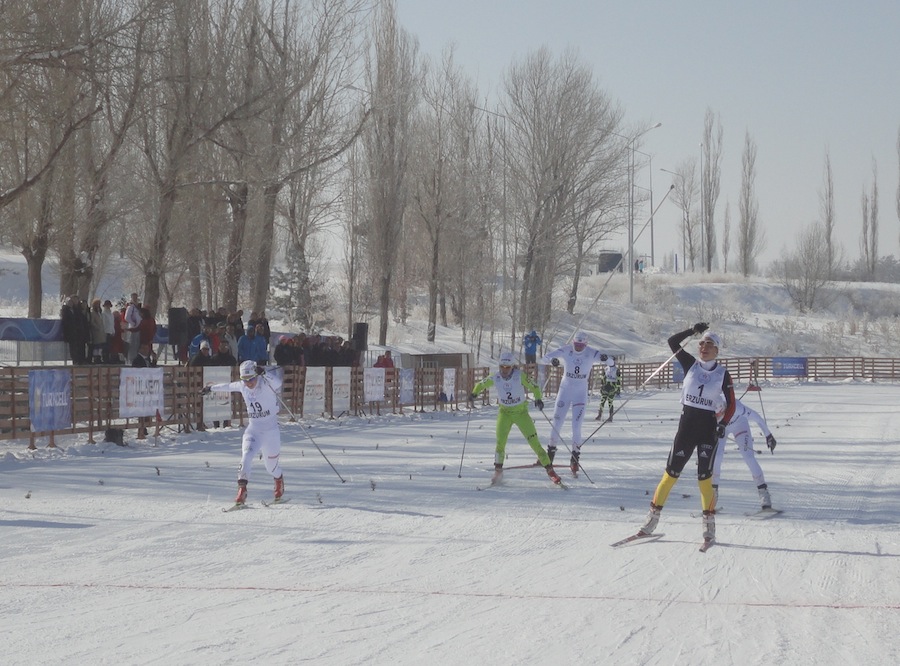
Indeed—Kolb was seeded first going into the qualifier, which she won by one second. In the final, she entered the stadium with Swedes Emma Wiken and Jennie Oeberg hot on her tail, but she held them off in the straightaway for the win. Wiken was the runner-up and Oeberg was third.
Tuesday marked the second day in a row the Swedish women put up an impressive performance. After second and third, Linn Soemskar (SWE) finished fifth.
“I did not expect to be on the podium today” said Wiken. “I have not been that successful in sprints lately.”
Oeberg was similarly modest. “This season has not been the best for me so the bronze medal feels like a victory.”
With three teammates in the final, Oeberg said the last heat was fun to ski.
The weather at Kandilli was once again sunny and frigid. The temperature eventually rose above the -20 C threshold, but two hours before the start, the it was -25 C: cold enough to freeze the diesel for the wax rooms’ generator and force volunteers to start a fire underneath it to thaw it out.
The women's A-final, exhausted in the finish pen.
Bjornsen Leads North American Effort in Fourteenth
Three North American women made it to the heats on Tuesday: Sadie Bjornsen, who qualified in 11th, Heidi Widmer (CAN), who was 16th in the prologue, and Becca Rorabaugh, who scraped into the rounds by less than a second in 29th.
“It was great to get some athletes in the rounds today; we didn’t do that yesterday,” said U.S. trip leader and USST development coach Bryan Fish.
Bjornsen (11) and Kolb (1) leading up the main hill in the first quarterfinal.
“Sadie skied well, she just got bumped out at the end there, but she skied well and said she’s feeling well, so that’s great,” said Fish.
Despite feeling stronger than she has all year in her quarterfinal, Bjornsen said she made a few tactical errors that cost her the semis. Hers was the first quarter of the day, and after skiing wide and in front up the main hill just out of the stadium, she let Kolb, the eventual winner, take control, and Kolb slowed and allowed the rest of the pack to catch up.
“I took the outside, which was super corduroyed and didn’t ski that well, so I lost my speed there, which was kind of a bummer. It was one of those tactical errors—it happens,” said Bjornsen.
She finished third in her heat, and might have advanced as a lucky loser had a subsequent heat not been faster.
Though disappointed, Bjornsen was mainly encouraged by the fact that she felt better than she has all year.
“I have felt like I’ve had pwer yet this year, so at the end of the day I’m happy, because now I’m really excited for the classic race,” she said, referring to the 10 k individual classic on Thursday.
“It was a little bit of a bummer; I’d have liked to ski more heats today, but then again these were my first heats this year, so at least I got to ski one.”
Heidi Widmer (CAN) fighting to catch back up after losing her ski in the stadium.
Canada’s Heidi Widmer started the day strong with a 16th-place qualifier, but had an unlucky quarterfinal—her ski came off before she left the stadium, though she was still able to come back for fifth in her heat and 27th overall.
There was quite a bit of jostling on Tuesday, and Widmer got on the unlucky end of it. Coming out of the stadium, both Widmer and Germany’s Sandra Ringwald tried to cut across to the inside around the corner to the first climb, and Ringwald’s skis crossed over hers.
“She was being aggressive,” said Widmer. “I tried to stand my ground and she went down.”
“I was stoked because I thought I had avoided the crash and thought I was really lucky, but then I went to stride on my left ski and it was not there,” she continued.
After scrambling to get it back on, she fought to catch back up to the pack, but to no avail. She shortened the gap, but the effort cost her, and she had nothing left for the finish.
“It was a really big bummer, because I felt really good today, and felt for sure I could have moved on,” said Widmer. “It’s hard to accept that, but I love sprint racing so I guess I have to love all aspects of it…. I’ve had upsetting days before, so that makes it easier to keep in perspective.”
Rorabaugh (USA) in the quarterfinals.
Rorabaugh was the next North American qualifier for the heats; she finished sixth in her quarterfinal and 30th overall.
“During the quarter I felt OK, but made a few tactical errors,” sad Rorabaugh. “I took the outside over the top of the hill, which is silly, and the girl I was skiing behind let a gap form.”
This is Rorabaugh’s third and final U23 Championships, and she’s trying not to take a last-chance approach to the week.
“It would be easy to put a lot of pressure on your last year, but I’m trying to be cognizant of that, because I don’t think it helps anything,” she said.
Rounding things up for the North Americans, Emily Nishikawa (CAN) finished 33rd and Marlis Kromm 36th (CAN).
Jessie Diggins (USA) sat out the sprint after coming down with flu-like symptoms during her flight from Poland to Turkey. Diggins and Fish said they were unsure if she would race the 10 k classic on Thursday or the skiathlon on Saturday.