From the FasterSkier archive — posts syndicated from athletes’ and coaches’ own blogs between 2004 and 2012, kept online as published. Current coverage is at fasterskier.com.
Amidst the whirlwind of February racing, news happens beyond the ski tracks. Here are some notable news threads.
It was announced yesterday that the famed Engadin Ski Marathon, to be held on March 8, has been canceled due to concerns related to the coronavirus (also referred to as COVID-19). “The spread of the coronavirus in Europe – with two cases in our vicinity – has left the authorities with no choice but to ban big events like our running events for the next ten days in Southern Bundes,” race organizers posted on FaceBook.
Yesterday, four coronavirus cases had been confirmed in Switzerland. According to the Engadin website, the health ministry in this region of Switzerland had called for the cancellation of all public events. Many skiers have been impacted as the race attracts more than 14,000 participants. It is the second time the Engadin had been canceled in its 51-year history.
Anti-Doping Research:
An interesting research paper on doping in athletics, what we will call track and field, was published on February 25. The article is titled, Prevalence Estimate of Blood Doping in Elite Track and Field Athletes During Two Major International Events, was published in “Frontiers in Physiology: Red Blood Cell Physiology.”
Researchers analyzed blood samples from men and women at the 2011 and 2013 World Athletics Championships. Over three thousand samples were evaluated with 209 countries represented.
Perhaps the most startling finding was the prevalence of blood doping in endurance athletes. According to Table 3 in the article, 15 percent of males (endurance) blood doped at the 2011 World Championships, and 22 percent of females (endurance). According to the findings, a prevalence of 18 percent of all athletes (endurance) blood doped at the 2011 WC, compared to 15 percent in 2013.
Researchers defined “endurance” as the following: “endurance” comprised all athletes competing in running or walking events with distances equal or longer than 800 m while “non-endurance” included all athletes competing in jumps, sprints, throws, and combined events, as well as distances shorter than 800 m.
For transparency, the authors disclosed the research had in part been funded by WADA’s Science Department.
Doping Roundup:
Water is water: frozen or otherwise. Chinese Olympic swimmer and megastar, Sun Yang, was handed an eight-year ban from competition on Friday by the Court for Arbitration for Sport (CAS).
Yang’s case involves an ongoing saga in which Yang’s mother evidently instructed his security guard to destroy blood samples that had been collected at his home in 2018 by antidoping officials. Yang refused to provide a urine sample at the time of the incident.
Yang is the Olympic champion in the 400 and 1500 meter freestyles at the 2012 Games and the 200 freestyle champ at the 2016 Olympics.
Yang has the option to appeal the ruling to the Swiss federal court. The story is relevant considering the length of Yang’s penalty, which WADA claims is proportionate to the anti-doping violation.
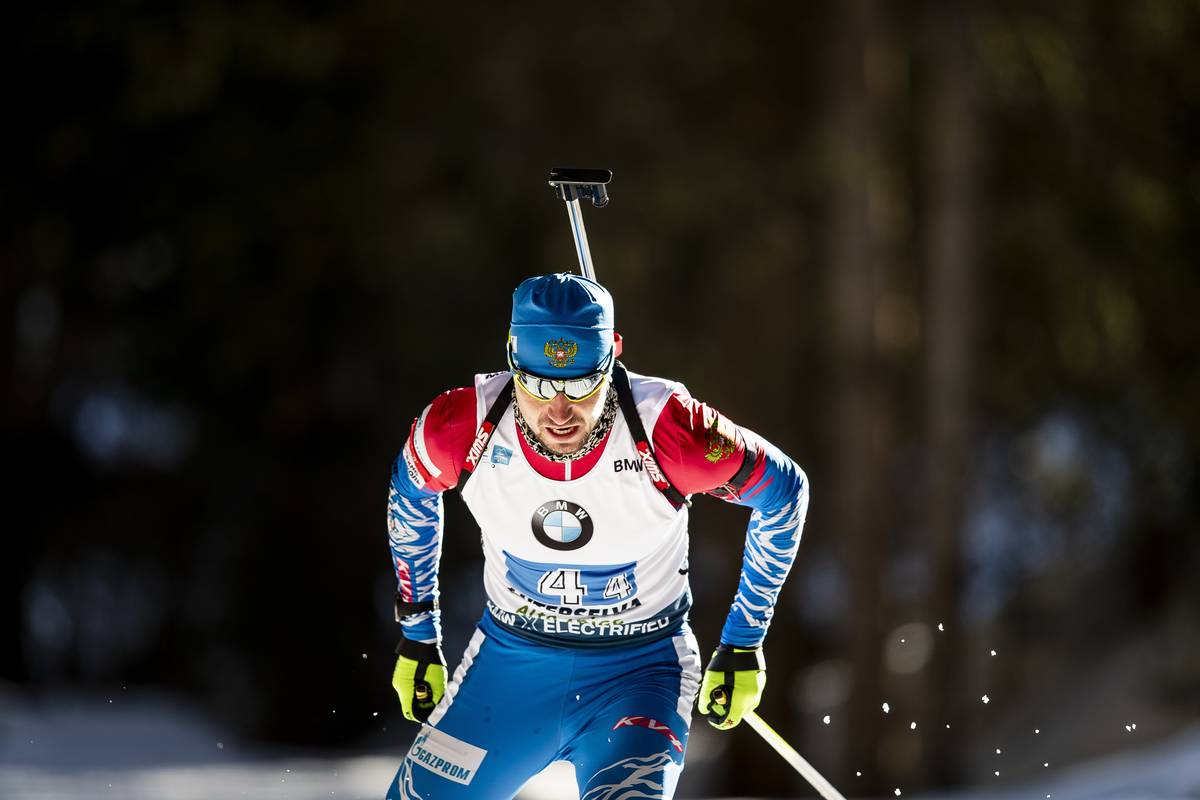
Alexander Loginov during the men’s relay at the 2020 IBU World Championships. (Photo: NordicFocus)
The new news is this: on February 22, Italian police raided Loginov’s hotel room. Police confiscated his laptop and mobile phone. Additionally, it has been reported that Loginov’s coach, Alexander Kasperovich, had his laptop and phone taken as evidence. According to news reports, Kasperovich is suspected of using another person’s accreditation for the World Championships.
Loginov claims the raid was prompted by the IBU and carried out by Italian authorities. The IBU claimed it was not given advance notice of the raid. Several Russian news outlets are reporting that Loginov and Kasperovich intend to sue the IBU.
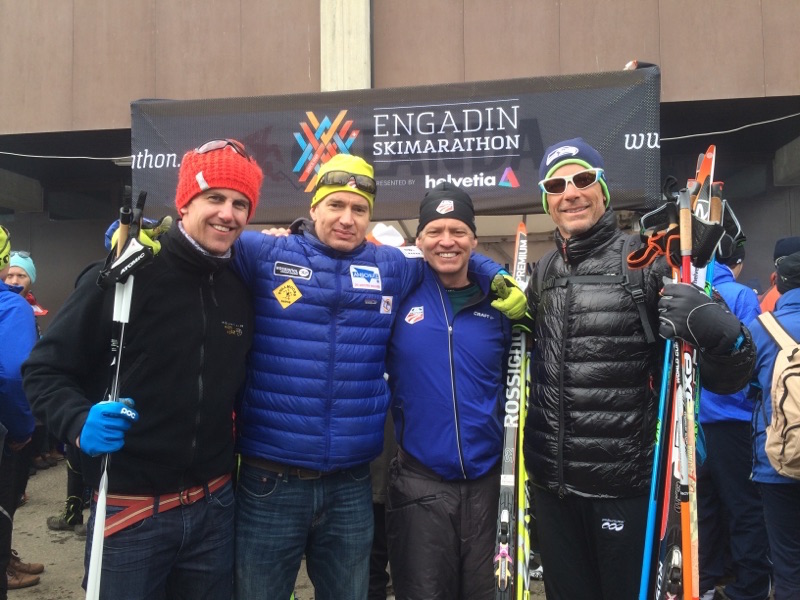
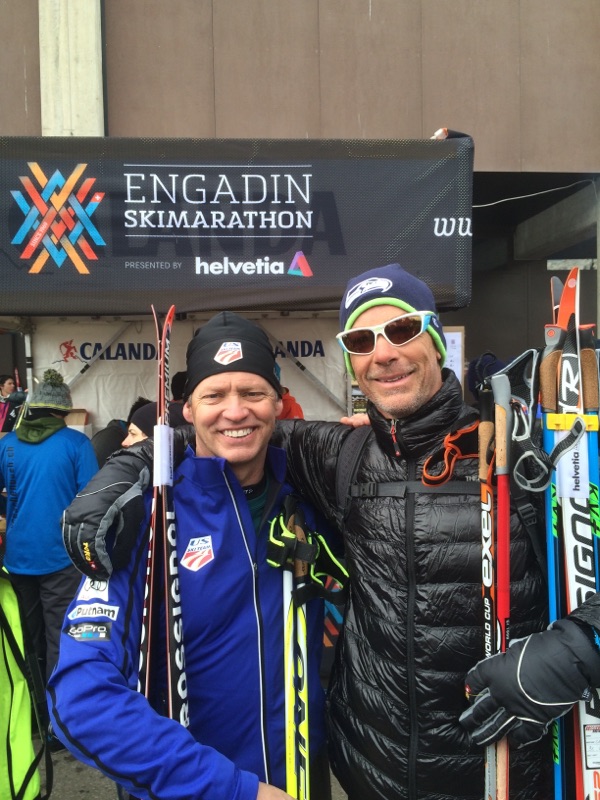
From left to right: pro triathlete Garen Riedel, Jon “Fast Big Dog” Schafer, Tiger Shaw, and Tony Weiderkehr at the 2016 Engadin Ski Marathon in Switzerland. (All photos: FBD)
Nordic ski racing is alive and well in the United States. From top to bottom, more Americans are appearing on international podiums than ever before and one needs to look no further than events like the Boulder Mountain Tour, the West Yellowstone Ski Festival and many others to see that even at a domestic and/or grassroots level, U.S. ski racing continues to increase its scope, reach and success.
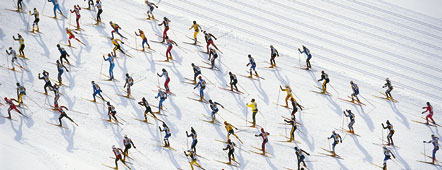
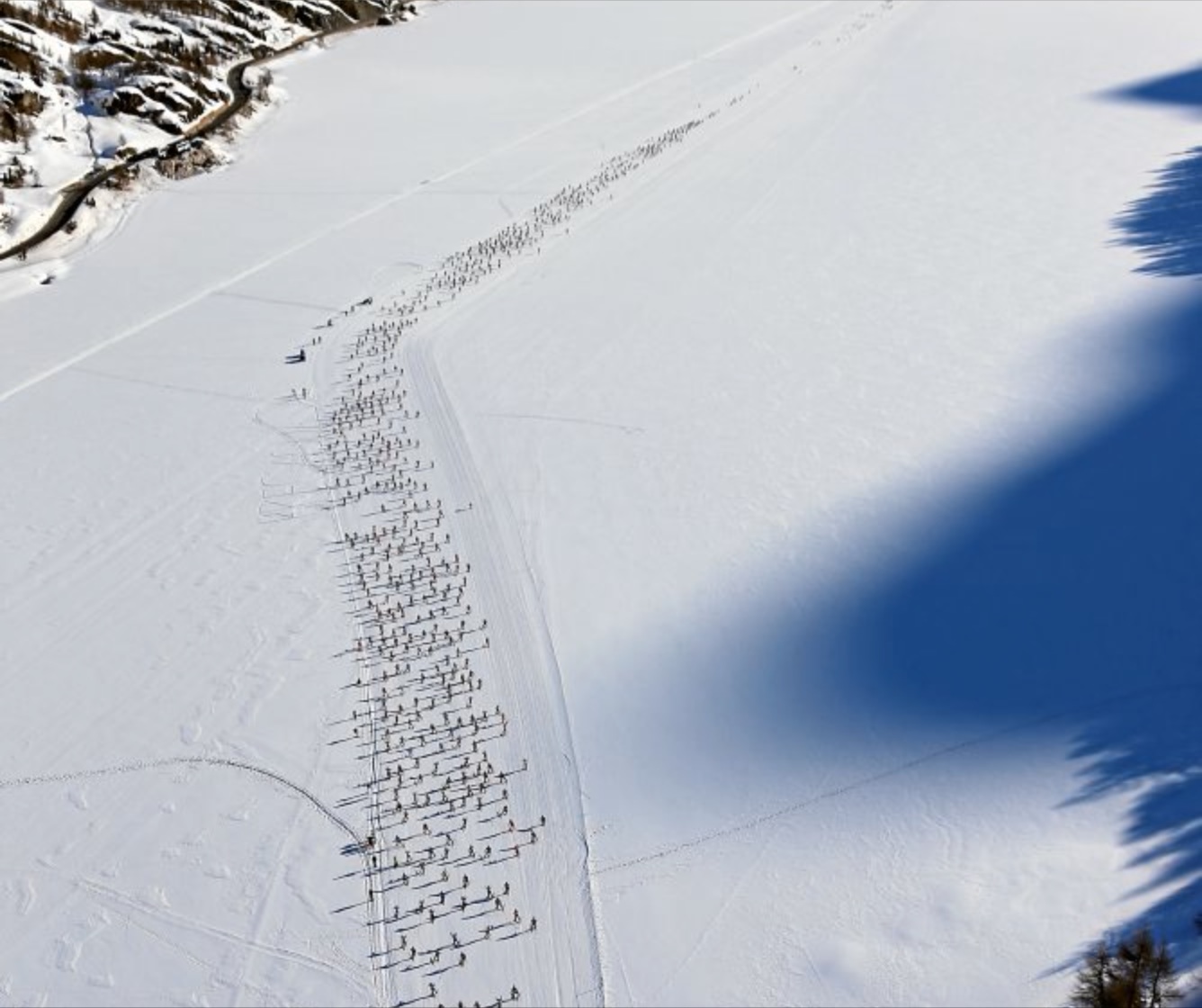
Perhaps nowhere is this more evident than ironically, a race outside the U.S., the 42-kilometer Engadin Ski Marathon (ESM). The ESM, held each year through St. Mortiz, Switzerland, is not only the world’s biggest skate ski race, it is also an event like no other. The race in itself it quite a spectacle, but the history, the culture, and the atmosphere make it a truly special event.
Tiger Shaw (l) and Tony Weiderkehr at the 2016 Engadin.
This year’s 48th edition was particularly unique as not only one of the top U.S. skiers competed, but some of the U.S. ski community’s biggest supporters, funders and leaders attended as well. This might not seem unusual, but these leaders were present not just as supporters, but also as racers. It would be impossible to find Bob Kraft behind center in a Patriots game, but in this year’s ESM, the CEO of the U.S. Ski and Snowboard Association (USSA) took the start, as did a trustee of the USSA Foundation, as well as two highly influential CEOs and major grassroots supports of many levels of U.S. nordic skiing.
Driving to the start on race day in our under-sized van, we had some of the most prominent and influential members of the U.S. ski community. This was a group with widely varying speeds and widely varying responsibilities inside and outside of skiing, but in that moment, we were all focused on one and only one thing for the next few hours: to have the best race possible. While the details of this goal may have varied from person to person and our starting positions ranged from the first row of the elite wave to the last row of the Volksläufer (citizens’ wave), on that particular Sunday, this very diverse group was united in singularity of purpose. Experiencing the race with this very special group made the 2016 Engadin Ski Marathon truly an exceptional experience.
“The Engadin Ski Marathon is an amazing event,” said Tiger Shaw, USSA president and CEO. “I had no idea what it was going to be like, so I was a little nervous, in particular as I was just about to take the start with 13,000 of my closest friends, but it was awesome. The whole scene is almost impossible to describe: you are nestled into perhaps one of the most scenic valleys you could find anywhere, there are skiers as far as you can see, helicopters flying around everywhere and the most spectators that I’ve ever seen at any ski race anywhere in the world.”
“The whole scene is almost impossible to describe: you are nestled into perhaps one of the most scenic valleys you could find anywhere, there are skiers as far as you can see, helicopters flying around everywhere and the most spectators that I’ve ever seen at any ski race anywhere in the world.” — USSA President and CEO Tiger Shaw on the Engadin
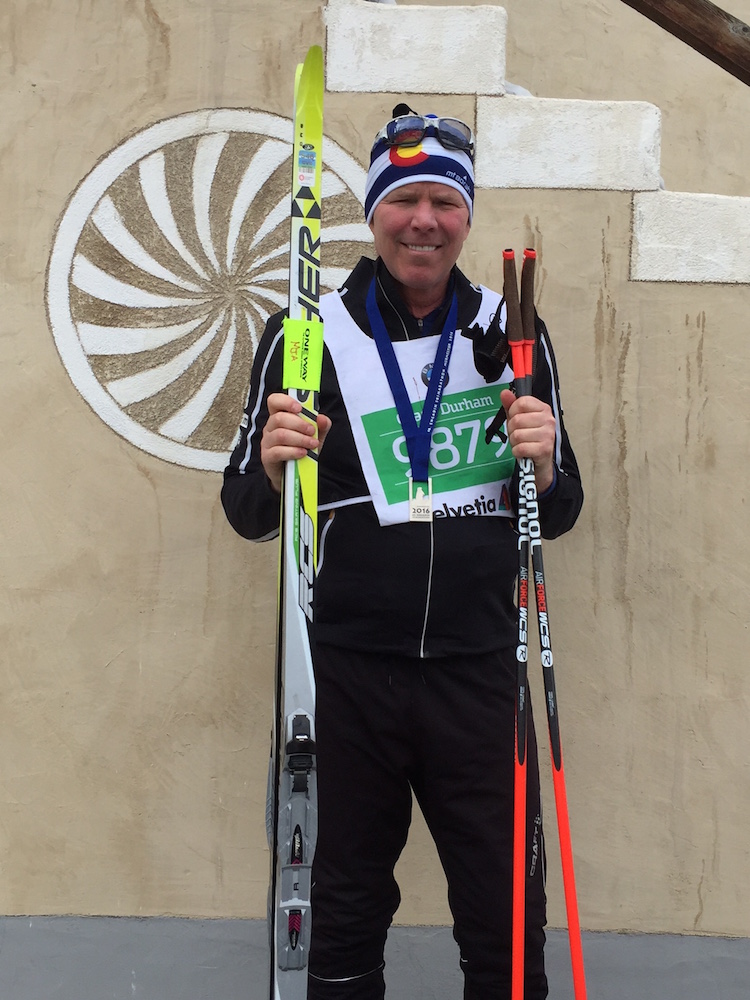
Grady Durham after the 2016 Engadin Ski Marathon
Grady Durham, founder and CEO of Monticello Associates, a prominent asset management firm based in Denver and founding sponsor and principal supporter of Ski Club Vail’s former Team HomeGrown (which previously provided support to skiers like Sylvan Ellefson, Tad Elliott and Noah Hoffman), seconded these observations, “It is a wonderful adventure, but it is very intense. I’ve been ski racing for 30 years, in fact, this year marks the 30th anniversary of my first Birkie, but even I was amazed at the fact that you are not just surrounded by skiers for the entire race, but you are surrounded by very good skiers for the entire race.
“I was on the run-in to the finish on the long, sweeping downhill corner and this older Swiss woman was coming by me on the inside,” Durham recalled. “I was impressed at how strong she was skiing so I guess I let my guard down for a second, so she not only cut me off, but she also pushed me into the fence. If I had to describe the Engadin experience in one sentence, that would be it.”
Tony Wiederkehr, another CEO who has provided support to multiple members of the U.S. ski community, is a cagey, 12-year veteran of this race who also shares and embraces this perspective. “I’ve done lots of other ski marathons and for some reason this one seems to have more variables. You have to be good at navigating through trouble. It’s unlike any other race –people are stepping on your sh*t the entire time, in particular if you are near the front. Pretty much anything you can imagine happening in a race happens here regularly: there are crashes, there is pushing, there is shoving, I’ve broken poles, I’ve broken bindings, you name it. This year I had a crash before I even crossed the start line. It’s one of those races where just staying upright is an accomplishment. Don’t get me wrong, it’s not total and absolute chaos and overall the experience is great, but it can be very intense. That’s probably why I keep coming back.”
“It’s one of those races where just staying upright is an accomplishment. … It’s not total and absolute chaos and overall the experience is great, but it can be very intense. That’s probably why I keep coming back.” — Tony Wiederkehr, founding president and CEO of AeroMech, Inc., on the Engadin
To add even more excitement to an event that even the most understated would call fervid, in this year’s start we somehow managed to have not just two Americans crash into each other, but remember that karmically centered, unified-purpose van ride mentioned earlier? Yup, you guessed it, two of the guys in our van took each other out on the rolling start before they had even crossed the line. USSA Foundation trustee and known race-course menace, Walter McCormack provided his flimsy version of the story.
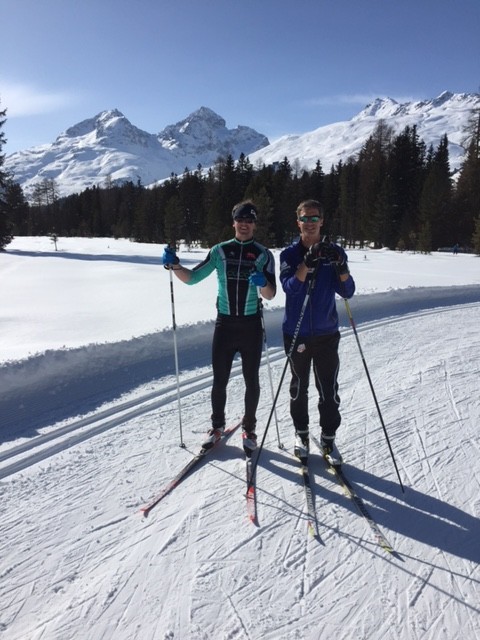
Garen Riedel (l) and Walter McCormack, both of New York City, during a training ski in Switzerland.
“Well, as you know, those starts are always very chaotic and some pushy Italian lady stuck her pole between my skis,” he explained. “I went down, took her down and in the process, also took Tony [Wiederkehr] down. Then then the lady who caused the whole thing started cursing at me in Italian. But I swear it wasn’t my fault.” Sure it wasn’t, Walter, sure it wasn’t.
For Shaw, a former alpine World Cup racer, this environment quickly brought back old memories. “The first time I had people stepping on my skis,” he recalled. “I didn’t know what to do, but then the old instincts kicked in and I figured it out fast. I raced for so many years in Europe as an alpine skier that I remembered pretty quickly how things were going down. You see this in Europe in cycling, alpine skiing, and certainly in nordic skiing: if you get tripped, it’s like ‘Sorry, see you next week.’ That’s just how it rolls over there. You need to know that and to hold your own. It’s clearly more intense — you can feel it. It’s not a bad thing, but it sure felt familiar. It took me a minute, but once I settled down a bit, it felt good to be back in that environment.”
Even U.S. Nordic Combined skier Taylor Fletcher wasn’t immune to this battle for position. “I was on the start line with [Swiss cross-country skier Dario] Cologna, [German nordic-combined skier Fabian] Riessle, and many other top pros. These are not just some of the best distance skiers in the world, but they are also guys who understand race protocol and are very professional, and it was still nuts. You had to fight so hard for position, if you weren’t moving up, you were moving back. It was so crowded and so risky that I spent a lot of time at the very front and even launched a solo break, mainly to stay out of trouble. I’ve never seen anything like it.”
U.S. Nordic Combined skier Taylor Fletcher heading to training before the Engadin Ski Marathon.
Fletcher went on to ski a very solid race, finishing 20th and top American in 20th, ahead of Cologna, a three-time cross-country overall World Cup champion and three-time Olympic gold medalist, who placed 25th.
Let’s be clear: yes, the ESM can be hard. Bad luck can scythe you down at any moment.The racing is certainly intense. But overall it is an amazing experience. One of the most difficult things to describe to someone who has never seen the race in person is just how important a role the race plays in Swiss culture. The enormous civic pride the entire country seems to have in this event is evident from the moment you arrive in the valley and stays with you long after you leave.
“As soon as you get there it’s obvious that you’re involved in something very special,” Wiederkehr said. “My sister works in Zurich, so I have some insight on the Swiss perspective on the race as well. There’s a certain prestige among the Swiss associated with doing the ESM. It’s a very big deal.”
Shaw agreed, “I competed in Europe for many years, so I know Switzerland well enough to know that there isn’t a blade of grass out of place anywhere in the country, it is remarkable. In fact, I wasn’t even surprised when I saw the Swiss Army being used to handle logistics — there aren’t many ski races anywhere in the world where guys in uniforms are loading your gear into trucks parked in perfect formation, shoveling snow on course to keep the tracks immaculate and directing traffic with a precision that only the Swiss can offer. Seeing the army involved at this level pretty much says it all.”
This status and priority is one of the reasons Weiderkehr has helped so many elite U.S. skiers to do the race. “The race is very prestigious in so much of the world: it’s in every paper in Switzerland,” he said. “It’s on TV, it’s everywhere. It’s the biggest skate race out there, so U.S. skiing can make an even bigger name for itself by having our elite skiers do well here. Nothing says that U.S. skiing is alive and well in the quite the same way as a big result at the Engadin. I have believed this for a long time.”
When not busy causing crashes on course, McCormack offered an interesting, broader perspective on the role of Americans in the event. “I think only about 50 Americans do the race every year and it’s both strange and at the same time very nice to be in the minority,” he said. “The Swiss are so excited that you came to their country for this race and they couldn’t be warmer or more friendly. Plus, the whole concept of being able to ski from town to town, up to restaurants [on training days] is so different than what we have in the U.S., it makes the whole experience very unique and very special. I also really enjoy racing with people from so many different countries. It’s not just a great race, it’s also a great way to bring many different cultures together.”
“It’s not just a great race, it’s also a great way to bring many different cultures together.” — Walter McCormack, member of USSA Foundation Board of Trustees, on the Engadin
Other interested sub-plots that played out over the trip were the implications of having the USSA CEO doing his second Worldloppet of the year. When asked about this, Shaw was quite candid: “You can’t alpine ski race forever. This you can do. It’s safe and easy on your joints. I can’t run anymore, but I can ski. I’m not very good at it, but I’m really learning to love it, so I’ll stay at it as long as I can move my limbs.”
After the race, Shaw was trapped in the highly unenviable position next to me at dinner and I couldn’t help but push the issue on what, if any, his increased interest in nordic skiing could possibly mean from a funding perspective for our national cross-country and nordic combined teams.
“The USSA is working hard as an organization to grow the successes of the cross-country team,” Shaw explained. “It’s a great sport and it has my full support, and yes, now being involved in it as an athlete helps me tell the story even better. So do I think my doing these races will have a positive impact? Yes, I hope so. I can now relay these wonderful, firsthand experiences and ‘tell the story’ with even more detail and passion to potential sponsors and those are two key elements to helping grow funding.”
“You can’t alpine ski race forever. This you can do. … I’m not very good at it, but I’m really learning to love it, so I’ll stay at it as long as I can move my limbs.” — Shaw on cross-country skiing
Probably the most important takeaway from this story is that each and every one of you out there reading this should go race, (next year, if possible). “Don’t let money get in the way,” Weiderkehr emphatically stated. “Switzerland has a reputation of being expensive, but there are ways to do it on a budget. For example, you can rent an apartment instead of getting a hotel. Since the public transportation system is so good, you can even make the location a bit remote, which can save even more money.”
Entry fees run around 140 Euro ($158 dollars) apiece.
“Next year is a perfect year to go over too,” Weiderkehr continued, “as the Master’s World Cup is during the week prior, very close by, so this will be a perfect opportunity to participate in a lot of ski racing in a short period of time and with minimal travel.
“My last piece of advice,“ he added, “is to not make the trip too short. Stay for as long as you possibly can. Every time I’ve come over just for the race, I’ve regretted it. And you’re really missing the whole point: the Engadin is an experience — you can ski different places every day, ski to beautiful, family-owned restaurants nestled in remote mountain villages. Definitely come over and do it, but don’t just fly in and out or you’ll be missing a lot.”
Durham, also an owner of Slipstream Sports (the team that runs Cannondale Cycling) summarized the whole experience perfectly, “I’m involved in many different business, athletic and charitable ventures and one of the things that I like so much about nordic skiing is that is a great metaphor for life. Being successful in business, or anything really, requires grit and nothing is grittier than nordic skiing. There’s no business situation that I’ll be in this year that will be as hard as mile 24 of the Engadin. Quite simply, if you are a nordic skier, you have to do it.”
Shaw concluded, “If you can pull it off, by all means do it. It is something not to be missed and it should be on the list for every skier. It’s up there with a hut trip, the Haute route and things of that nature. Definitely train and prepare, as the race is no joke, but it’s worth it. I’ll be back for sure.”
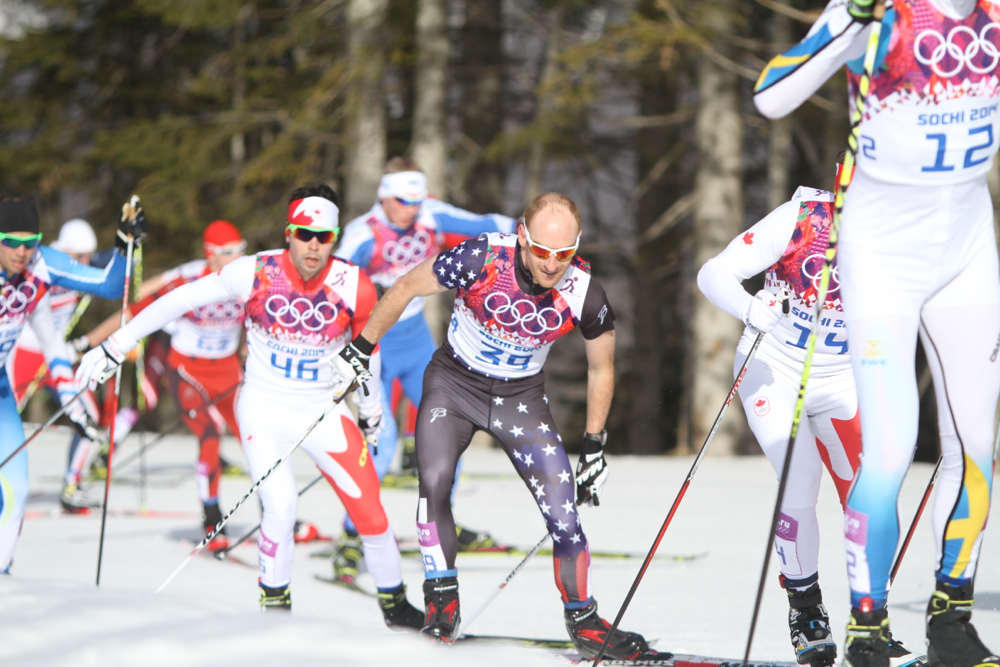
Brian Gregg (bib 39) racing to 51st in the 50 k at the 2014 Olympics in Sochi, Russia. In Oslo, Norway, on Saturday, he finished 35th in the 50 k skate, the only World Cup start of his season.
Brian Gregg had a few reasons to feel confident going into Saturday’s 50 k skate mass start in Oslo, Norway. It would be his only World Cup start of the season, but that wasn’t scaring him at all.
Fact one: just a week earlier, Gregg had finished 24th in the 42 k Engadin Ski Marathon in Switzerland, just 26 seconds out of the win after avoiding a crash in the last few hundred meters.
Fact two: many of the men he had skied with there for 42 kilometers were also on the start list in Oslo, including Ilia Chernousov of Russia, Robin Duvillard and Jean Marc Gaillard of France, and Roman Furger and Toni Livers of Switzerland.
Fact three, and maybe the most important fact: his training partner and wife, who also writes his training plan, is Caitlin Gregg – and she recently won a bronze medal at World Championships in Falun, Sweden.
Gregg got off to a slow start in the 50 k, ranking just 53rd after 11.3 kilometers. But using a steady pace, he climbed through the field and finished 35th, the top American and 6:47.7 behind the winning time set by Sjur Røthe of Norway.
The U.S. Ski Team’s Noah Hoffman finished 44th, 8:55 back, and Erik Bjornsen dropped out of the race.
“I’m feeling pretty tired from a long season,” Bjornsen wrote in an email. “I went into today thinking I could be competitive but as soon as the gun went off it was obvious my body was fighting my mind. I tried a couple times to throw in some speeds throughout the race to try to get the legs to wake up but they were straight dead. I still have some races left in the season so there was no reason to bury myself quite yet. I apologize to the racers back home for wasting a U.S. team spot.”
FasterSkier caught up with Gregg for a chat from Oslo about the day’s race.
FasterSkier: So how did things go for you today?
Brian Gregg: I think it went really well. That’s a pretty good result for me. I was a little bit short of my goal, which was a top 30. I was actually exactly one minute out of the top 30. But I felt really good as far as my pacing and being able to be pretty strong in that last 10 kilometers. I was able to move up and pick some people off. I’m really happy with my skis and my feeds – to have everything come together at the Holmenkollen is pretty awesome.
I’ve done the race before – I did it in 2010 and I finished 39th. But today I felt stronger. It was also pretty exciting because Caitlin writes my training plan, and she has been racing really well. I haven’t had as many races, so it was fun to be able to get a start, and I feel like I performed pretty well.
FS: This is your only World Cup of the season, right?
BG: Yes, first and only. But if I had to pick one World Cup to do all season, this would be the one that I wanted. My focus for the second half of the season after Nationals has been the 50 k at SuperTour finals. So it was a little bit of a surprise to get the start at the Holmenkollen, but I felt like my training prepared me well for it.
FS: So how did you get the start? Was it because you were already in Europe?
BG: I was planning on coming up here anyway to support Caitlin. To get to do both races is even better. I can share how things felt out there with her.
I was trying to get this start earlier, but [the U.S. Ski Team] said that they’d have to wait and see how the Engadin goes. After the Engadin and finishing in the lead pack there, I’m not exactly sure [what they looked at] but I was really happy to get the start.
FS: Holmenkollen probably couldn’t be more different than the Engadin – big hills after a lot of fast flat! How did that affect your preparation and attitude?
BG: This is a really good course for me because it’s a lot of climbing and I think it requires a pretty high level of fitness. I feel like my fitness is really good. I have been working on my turnover a lot, doing intervals throughout the summer and even this year, in the last week certainly for the Engadin. But I feel like I’ve always excelled in uphill V1 or slight V2. So that was great, to be able to race a course like this. I always look forward to the hardest courses.
FS: You were at World Championships watching, and training but not racing. How did that break in the schedule affect you?
BG: When Caitlin got named to the World Championship team, our focus basically was on that 10 k. That was the main goal, but I was doing my training as well, and she wrote that out for me to ski well at the 50 k at SuperTour Finals.
We know that, okay, it’s not going to be the most ideal for myself, being a supporter at World Champs. But it’s also one week, and rather than freaking out about losing one week– it was right after the Birkie, so it was probably good to take a little bit of time.
Although to be honest I gained a lot of appreciation about the service side of things. I was literally just helping Caitlin test skis, I wasn’t doing any of the waxing, and I skied two and half hours the day before the 10 k. Those three days were almost harder than racing the 50 k today! I definitely gained an appreciation for how hard those guys work.
FS: What about the mental component – watching some good racing up close must have been inspiring?
BG: I think it was pretty inspiring for everyone. To see Caitlin and Jessie and everyone do so well, it’s really encouraging.
And particularly for Caitlin, coming from essentially the domestic circuit, it’s that idea that you can come over one week before your race in Europe, and have a really really good, strong race. Rosie Brennan did the same thing when she came over. The more that happens, it opens the eyes like, all right, we can do this. It’s a little bit different flying from Switzerland to Norway for a World Cup, you’re flying over the ocean, but the more often that Americans have that success, it will become easier and easier to share how that success has come about.
That was pretty inspiring to me. But also, when your coach is third at World Championships, that gives you a lot of confidence in your training plan. So that was pretty helpful as well.
Stephanie Howe (left), Taylor Leach and Sarah Max (right) at the 2011 Engadin. (Photo courtesy of Howe)
The XC Oregon skiers posted solid results at the Engadin Ski Marathon in Switzerland last weekend and are ready to take on the Norwegian Birkebeiner on Saturday.
Now fully adjusted to the time change, the XC Oregon racers are excited to race from Rena to Lillehammer, 54 kilometers in challenging, exposed, open tundra terrain with a 3.5-kilo backpack. The venerable event that has been a staple on the calendar for almost 75 years.
Brayton Osgood, 29, is coming off a solid performance at the Engadin last weekend where he was the top American and finished 24th overall, is excited about the Birkie and hopes to build on that experience on Saturday.
“For the Birkie I have pretty much the same goals as I had going into the Engadin. I want to ski with the lead group until the race gets serious, and then put out a good effort from there to the finish,” Osgood said to FasterSkier, noting that at the Engadin, the only thing missing was enough juice for the last couple of kilometers.
“So, if I can finish things off a little better than I did at ESM, I’ll be very pleased, but mostly I want to make it to the finish and have some good memories when it’s all said and done. I won’t say I want to have a good time out there, because that’s a pretty tough standard to live up to during a race,” Osgood added.
(Article continues below the photo)
16,000 racers annually enter the Norwegian Birkebeiner. (Photo: Inge Scheve)
Something a skier has to do
While Osgood has tried his hand at the Birkie before, his XC Oregon teammates Taylor Leach, Stephanie Howe and Sarah Max are new to the legendary race.
“As a skier, the Norwegian Birkie is one of the races you have to do in your lifetime,” Howe said.
With her previous marathon results, including winning the women’s freestyle Gatineau Loppet in February, Howe has landed herself a spot in the FIS elite wave. That certainly adds some performance pressure, but Howe still wants to enjoy the experience.
“I hope to have fun! I am starting in the elite FIS wave, so I’m a bit nervous. It should be fun though, I love climbing, and I hear there should be plenty of that. The biggest challenge for us will be to select the correct skis and wax,” Howe explained.
Less pressure
Leach and Max said being new to the event adds some uncertainties, but also cuts down on the expectations and self-inflicted performance pressure.
“I have never done the Norwegian Birke before, but I have wanted to do this race for a long time. so I am really excited, a little bit nervous because it seems like a challenging course. As I have dedicated most of my winter to coaching, I do not have many expectations. My goals are to ski technically well, have a smart race and enjoy the experience,” Leach said to FasterSkier.
The same is true for Max.
“I’ve never done the Birkie. I don’t have much in the way of expectations, which is the beauty of doing a race that is completely unfamiliar,” Max said.
Additionally, the Norwegian Birkebeiner will represent some extra challenges for Max, who is fairly new to classic skiing. Given that the course covers 54 kilometers of varying, exposed and challenging terrain, Max is hoping for good kick from Rena to Lillehammer.
“This is only my fourth or fifth classic race ever. My hopes are to have good kick throughout the race,” Max said.
(Article continues below the photo)
Being new to classic skiing and new to the Norwegian Birkebeiner, Max (XC Oregon) is hoping for wax conditions a little less tricky and frantic than these. From the start at Rena in 2007. (Photo: Inge Scheve)
A legendary race
Since the inaugural Birkebeiner race in 1932, the Norwegian Birkie has only been cancelled seven times, most of them due to World War II (no race in 1941, 1942, 1943, 1944, and 1945).
But in 2007, when the XC Oregon trio Brayton Osgood, Marshall Greene and Zach Violett, attempted to cross the mountains, the Birkie was cancelled due to blizzard conditions, high winds and literally no visibility in the open. The racers in the first couple of waves, which were allowed to start, were called down from the mountain and brought back to the start at Rena.
XC Oregon's Birkie crew in 2007: Zack Violett (left), Brayton Osgood, and Marshall Greene (front). They were turned around early. (Photo: Inge Scheve)
That first wave in 2007 included the XC Oregon skiers, who said they encountered head winds so strong that it was hard for even large skiers to make headway into the wind, let alone stay on the tracks that quickly disappeared from windblown snow on the tundra.
In 1948, the owners of the event could not agree on whether to develop the Birkie into an elite competitive race or focus on participation and recreational skiers. The race was not held, but the owners worked out their issues and now the Birkie is a mass-participation event, maybe the largest and best-known ski race in the World.
The lure of the marathons
For Leach, 25, the European marathons represent crowds and atmospheres unmatched anywhere in North America.
“The big European marathons are a different experience to racing the US, there are so many people. Even our biggest race, the American Birke, is not even close to the size of many of these races. Although when it comes down to it, racing is racing, regardless of where you are,” Leach said, explaining that as a junior coach with the Mount Bachelor Sports Education Foundation in Bend, she doesn’t have the opportunity to do many races for herself in the meat of the season.
“The Engadin and the Norwegian Birke were the only races that I was planning on doing this year, I did get to race at Crescent Lake a few months ago and I may be able to race the Great Nordeen but these European races were really the focal point of my winter,” Leach explained.
For Max, 36, now a veteran of the European marathon circuit, the European marathons have become the main focus of the season. But equally the overall experience is easily just as important as the race aspect.
“I’ve done about half a dozen European marathons now, and while I consider them my main focus, the races are really just a good excuse to travel around, meet interesting people and eat euro breakfasts,” Max said to FasterSkier.
Stephanie Howe won the 2011 Gatineu Loppet (Photo courtesy of XC Oregon)
For Howe, 27, the European marathon races are the reward after a long domestic season, and the European racing experience is icing on the cake.
“They are kind of a bonus at the end of the season. I didn’t have a lot of expectations since I haven’t raced in Europe before. I’m also still new to the marathon distance, but I am learning. In terms of overall season, these races were something I was looking forward to all year,” Howe said.
Return on Investment
In Downing’s opinion, ski marathons are a great return on investment for athletes who can’t do a lot of travel to follow the USSA SuperTour or Canadian Nor-Am series, but want to race a stacked field. For many of the XC Oregon racers, the marathons serve as motivation, variety and a season goal.
“For any athlete that isn’t interested in the SuperTour-format races and prefer longer events with guaranteed field strength, the American Ski Marathon Series domestically and World Loppet internationally are the way to go. Particularly for female athletes, or any athletes with limited travel time, the value of the marathon circuits is super hard to beat,” Downing said.
For XC Oregon as team, marathons are one more way get exposure and experience.
“What we (as a team) are getting out of the World Loppet starts is keeping athletes motivated and excited plus many great to good results over the years,” Downing said to FasterSkier.
Downing lists off that just this season, XC Oregon has placed four female athletes in the top ten at World Loppets: Evelyn Dong third place at the American Birkie, Kristina Strandberg’s Engadin Ski Marathon eighth, Sarah Max’s fourth at the Gatineau Loppet freestyle and Stephanie Howe’s first place in the Gatineau Loppet classic.