From the FasterSkier archive — posts syndicated from athletes’ and coaches’ own blogs between 2004 and 2012, kept online as published. Current coverage is at fasterskier.com.

Tag: EPO

  • WADA’s 2016 Anti-Doping Testing Figures Through the Lens of Nordic Sport

    “Play True” is the World Anti-Doping Agency’s (WADA) outward appeal to athletes, coaches, doctors, a myriad of handlers and advisers, and, ironically, anti-doping labs to keep sport clean.

    On one hand, “Play True” could be interpreted as a baseline demand, something educators might instill in elementary students. But it also reads like a plea; for fans of the sport and most importantly participant athletes themselves, there’s a lot to lose when athletes “Play False”.

    The sharpened teeth behind words like “Play True” are the tests administered to detect doping and potential bans for positive tests, although WADA’s anti-doping arsenal also includes a confidential digital hotline for individuals to file claims of suspected doping. 

    On Oct. 25, WADA released its annual testing numbers in a massive document titled “2016 Anti-Doping Testing Figures.” The report itemizes every sample tested by the 34 WADA-accredited labs in 2016 and uploaded into WADA’s Anti-Doping Administration and Management System (ADAMS). The information includes all in- and out-of-competition tests on both athlete urine and blood, and results for Athlete Biological Passport (ABP) blood analysis. 

    The 2016 report does not include data or discussion of Anti-Doping Rule Violations (ADRVs). A discussion of 2016 ADRVs is expected sometime in 2018. The report does include the number of Adverse Analytical Findings (AAF) and Atypical Findings (ATF).

    Here’s the simple appetizer before the full course: an AAF occurs when a sample contains a prohibited substance. An ATF, according to WADA, indicates that “while there may not be an adverse analytical finding, there may be some suspicion according to the results and that further analysis or investigation should be conducted.” After an ATF is investigated, it could lead to a negative result (the suspicion was not warranted), an AAF (something was found), or it may be canceled.

    WADA stresses that in reading and interpreting 2016 Anti-Doping testing Figures report, “one single result does not necessarily correspond to one athlete. Results may correspond to multiple findings regarding the same athlete or measurements performed on the same athlete; such as, in the case of longitudinal studies of testosterone.”

    Also, the number of AAFs in the 2016 testing report will not correlate directly to the number of ADRVs in 2016. Among other reasons, that is because some AAFs end up being explained by the athlete having a Therapeutic Use Exemption (TUE).

    The Report’s Findings
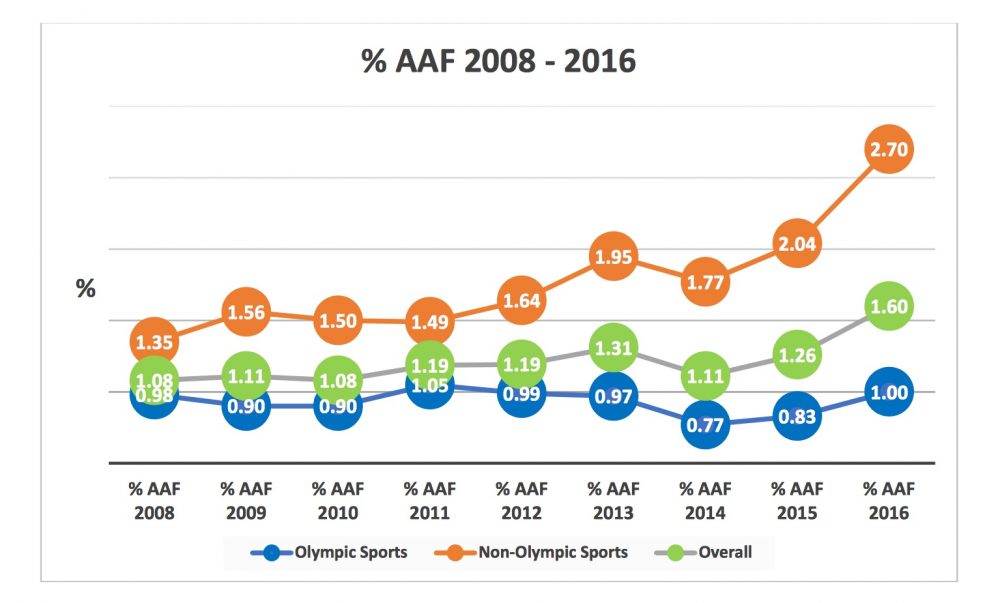
    % AAF 2008-2016 from the 2016 from WADA’s 2016 Anti-Doping Testing Figures report. (Photo: Screenshot from 2016 Anti-Doping Testing Figures report, 
    Samples Analyzed and Reported by Accredited Laboratories in ADAMS)

    It’s worth mentioning again the length and comprehensiveness of this report.  FasterSkier created a Google spreadsheet to better understand testing results in three sports we cover: biathlon, cross-country skiing and nordic combined. This process simply allowed FasterSkier to compare testing analysis in these sports more efficiently, and you can see the spreadsheet yourself at the link above.

    WADA articulated what it felt were the report’s highlights. The anti-doping watchdog advertised what it called a “noteworthy” development: that the total number of AAFs increased from 1.2 percent in 2015 to 1.6 percent in 2016. WADA also qualifies the total increase in positive tests as “partly related” to AAFs attributed to Meldonium — that drug was placed on the prohibited list in January 2016 without much consideration of how long it might stay in athletes’ bodies, or whether athletes had enough advance warning to stop taking the drug.

    At the same time, WADA noted that the total number of samples tested decreased from 303,369 to 300,565 from 2015 to 2016. WADA claimed that despite the downturn in the total number of tests, the administration and efficacy of its tests contributed to the higher AAFs total in 2016 compared to 2015.  

    Totals

    Starting with biathlon, there were 1688 total samples tested: 671 were in-competition urine samples, 39 in-competition blood samples, 859 out-of-competition urine samples, and 119 out-of-competition blood samples. Of those 1688 samples, 16, or 0.9 percent of the total, were considered AAFs (seven in-competition AAFs and nine out-of-competition AAFs, all from urine samples).

    Terms and Abbreviations

    (as referenced in FS spreadsheet)

    IC: In‐Competition

    OOC: Out‐of‐Competition

    Sample: Any biological material collected for the purposes of Doping Control* Adverse Analytical Finding

    AAF: Adverse Analytical Finding

    ARF: Atypical Finding

    GC/C/IRMS: Gas Chromatograph/Carbon/Isotope Ratio Mass Spectrometry (e.g.”IRMS”)

    ESA: Erythropoiesis Stimulating Agent**

    hGH Isoforms: Human Growth Hormone Isoform Differential Immunoassay

    hGH Biomarkers: Human Growth Hormone Biomarkers

    GHRF (GHS/GHRP): Growth Hormone Releasing Factors (Growth Hormone Secretagogues/GH‐Releasing Peptides)

    GHRF (GHRH): Growth Hormone Releasing Factors (Growth Hormone Releasing Hormone)

    GnRH: Gonadotrophin Releasing Hormones

    HBT: Homologous Blood Transfusion

    HBOC: Haemaglobin Based Oxygen Carrier

    IGF-I: Insulin‐like Growth Factor‐I (and its analogs) Athlete Biological Passport

    ABP: Athlete Biological Passport

    IOC: International Olympic Committee

    AIOWF: Association of International Olympic Winter Sports Federations

    ASOIF: Association of Summer Olympic International Sports Federations

    ADAMS: Anti‐Doping Administration and Management System

    TUE: Therapeutic Use Exemption

    FasterSkier spreadsheet of testing data specific to nordic sport from 2016 Anti-Doping Testing Figures report

    Cross-country skiing accounted for 2135 total samples tested. 623 were in-competition urine tests, while 19 were in-competition blood tests. 1163 were out-of-competition urine tests, 330 out-of-competition blood tests. The sport had a single in-competition AAF and eight out-of-competition AAFs — again, all derived from urine samples. Out of all the cross-country samples tested, 0.4 percent were AAFs.

    Nordic combined had 393 total tests. Eighty-eight of those were in-competition urine tests, six were in-competition blood tests. According to the WADA report, out-of-competition urine tests accounted for the majority of samples taken; 245 urine samples were analyzed and 54 out-of-competition blood tests were recorded. Nordic combined had two confirmed AAFs — both from in-competition urine tests. Of all the nordic-combined tests, 0.5 percent were AAFs.   

    How exactly should we read these tea leaves? It has been well-documented in the mainstream media, as well as in documentaries like Icarus, that historically, the anti-doping system can be gamed. Methods other than drug testing have shown that between 15 and 40 percent of elite athletes have intentionally doped at some point. With the low rate of AAFs in the three sports highlighted by FasterSkier, biathlon, cross-country and nordic combined, a few basic conclusions can be made.

    With the low rate of AAFs in the three sports highlighted by FasterSkier, biathlon, cross-country and nordic combined, a few basic conclusions can be made: the possibility of doping and skiing undetected remains, but if the “Play Fair” mantra works, the majority of athletes are training and racing clean.

    Tests for Blood Doping

    Of importance to policing endurance sports like biathlon, cross-country and nordic combined is increased implementation of WADA’s Technical Document for Sport Specific Analysis (TDSSA). The TDSSA demands that certain sports conduct a mandatory minimum of tests to screen for specific drugs.

    For both biathlon and cross-country, the TDSSA calls for enhanced testing for Erythropoiesis Stimulating Agents (ESAs) — think EPO. There’s also a required testing minimum for Growth Hormone (GH) and Growth Hormone Releasing Factors (GHRFs). As of January 2017, the current TDSSA calls for 60 percent of all samples in biathlon and cross-country to be tested for ESAs and 10 percent for GH and GHRF’s respectively.

    Partly because of this, the 2016 WADA Anti-Doping Testing Figures report also includes data about specific tests conducted on urine and blood samples – like the ESA or GH tests. 

    ESAs stimulate red blood cell production in the body. Several ESAs are available, the one most closely followed in endurance sport being recombinant erythropoietin (EPO). Both anecdotally and in research, EPO has been shown to boost endurance, power thresholds and recovery. When it comes to those willing to cheat in endurance sport, ESAs are a go-to. They appear to work.

    As a result, WADA has emphasized the testing of both urine and blood for ESAs in sports where an ESA would benefit. It follows that the majority of total samples tested in biathlon and cross-country are comprised of ESA tests. (ESA testing in nordic combined did not constitute a majority of the specific tests administered.)

    ESA testing accounted for nearly 63 percent of all the tests in biathlon. In biathlon, 469 in-competition urine tests and 592 out-of-competition urine tests for ESAs were administered with no AAFs. The number of in- and out-of-competition blood tests for ESAs were far less. There were 29 in-competition ESA blood tests and 17 out-of-competition blood tests. Again, not a single sample flagged an AAF.

    For cross-country, 1107 samples were tested for ESAs — comprising almost 52 percent of the total 2135 cross-country samples tested in 2016. Like biathlon, nearly all of these samples were from urine samples. 316 tests were from in-competition urine tests and 735 from out-of-competition urine tests. Eight in-competition blood tests and four out-of-competition blood tests were screened for ESAs in cross-country. No AAFs for ESAs were documented in cross-country.

    Like biathlon and cross-country, nordic combined was void of any AAFs in their ESA testing pool. Thirty-two in-competition urine and 106 out of competition urine ESA tests occurred in nordic combined. No in-competition blood tests and one out of competition blood test for ESAs were administered. ESA testing made up 35 percent of the total test in nordic combined.

    Prohibited Substances Used in Nordic Sport

    Reflecting back on the total number of AAFs reported in biathlon, cross-country and nordic combined (16, 9 and 2, respectively), WADA did, however, provide information on the drug class of those AAFs.

    In biathlon, 14 of those AAFs were flagged in the Hormone and Metabolic Modulators drug class, whereas two were in the Diuretics and Other Masking Agents drug class. That’s maybe not surprising as meldonium is a metabolic modulator, and there was a burst of findings of meldonium in early 2016, with Ukrainian biathlete Olga Abramova as just one example. Several of the athletes were ultimately cleared without sanctions. 

    For cross-country, there was one AAF in the Anabolic Agents drug class, two in the Beta-2 Agonist drug class (which includes asthma medications), five in the Hormone and Metabolic Modulators drug class, one in the Stimulants drug class, and one in the Glucocortico-steroids drug class were noted.

    In nordic combined, the two AAFs were both in the Stimulants drug class.

    Athlete Biological Passport (ABP)
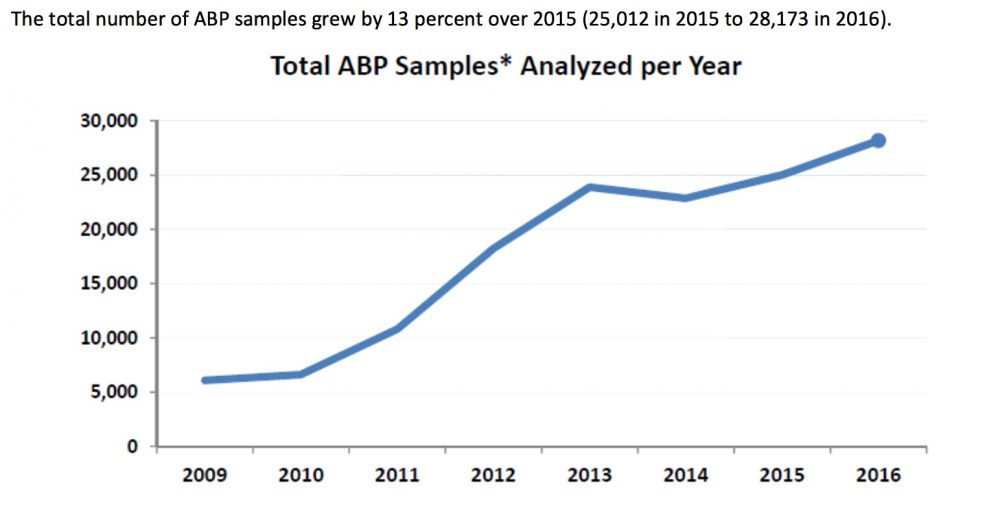
    Total ABP Samples Analyzed per Year 2008-2016. (Photo: Image capture from WADA 2016 Anti-Doping Testing Figures report)

    In recent years, ABPs have been established throughout the sporting world. Rather than a method to catch an athlete at a particular competition or out of competition training block, ABPs are more longitudinal in nature. WADA is upfront about the intended function of ABPs. The fundamental principle of the Athlete Biological Passport (ABP) is to generate a baseline of data for specific biological markers in an athlete. For example, each athlete’s testosterone and hematocrit levels are tracked over time. When an ABP test is taken, the purpose is to determine if any of the biological markers sampled are elevated or inconsistent – a big red flag – compared to that baseline. 

    WADA also clarifies that anti-doping organizations can pursue an ADRV simply based on an atypical ABP. No adverse analytical finding is needed to pursue a doping violation when an ABP is suspect.

    In biathlon, 960 total ABP samples were analyzed: eight in-competition and 952 out-of-competition. The testing authority responsible for testing 645 of those out-of-competition samples was the International Biathlon Union (IBU).

    Cross-country accounted for 883 total ABP samples; 88 in-competition and 795 out-of-competition.

    Nordic combined amassed 224 total ABP samples; 21 in-competition and 203 out-of-competition.

    Conclusions and Opinions 

    Stating the obvious, the anti-doping crusade evolves. The 2016 testing report’s substance lies in its depth and breadth. Although no athlete names are publicly associated with specific ATFs and AAFs in the report, a better understanding of how WADA and the global “Signatories to the [WADA] Code,” are advancing clean sport can be gleaned.

    Broadly speaking, the report’s findings indicate that the testing of athletes’ blood may be a misuse of resources.

    An article at the Sports Integrity Initiative titled “WADA 2016 Test Figures P1: Blood tests are not catching dopers” reveals a key pattern in the report. The article’s author, journalist Andy Brown, calls attention to the following: when considering all summer and winter Olympic sports together, 3,200 in-competition blood tests were run, but only 17 AAFs resulted. Out-of-competition testing was far more routine, with 12,443 blood tests run. Under that massive testing net, only 11 AAFs were returned.

    Disaggregating the AAF return on blood tests in the winter Olympic Sports may raise more questions than it answers. The 197 total in-competition blood tests performed in the winter Olympic disciplines amassed no AAFs. There were no AAFs for the 1,104 out-of-competition blood tests on the winter side, either. Blood testing is more costly, and data indicates it may not have its desired effect as a doping deterrent.


  • Taschlers, Ferrari Sentenced in High-Profile Biathlon Doping Case

    Taschlers, Ferrari Sentenced in High-Profile Biathlon Doping Case

    Gottlieb Taschler. (Photo: IBU)

    In the penultimate chapter of a doping story which began nearly two and a half years ago, Italian biathlon relay World Champion Gottlieb Taschler and his son Daniel, an IBU Cup-level competitor, were convicted by an Italian court. Doping is a criminal offense in Italy and Daniel Taschler was convicted of using illegal methods, while his father was convicted of assisting and concealing the activities.

    News first broke in late 2014 that the younger Taschler had been using the blood-boosting drug recombinant erythropoietin (EPO). He allegedly did so with the help of infamous “Doctor EPO” Michele Ferrari, a collaboration which was arranged by his father — who was then the Vice President for Sport of the International Biathlon Union (IBU), as well as the president of the Antholz-Anterselva World Cup Organizing Committee.

    “Police used phone taps to listen in on conversations between Dr. Ferrari and Taschler,” CyclingNews.com reports. “Prosecutors believe they included instructions on how to take EPO and details of secret telephone numbers where Dr. Ferrari could be contacted. Taschler had pushed his son to work with Dr. Ferrari as a way to boost his athletic career.”

    The elder Taschler stepped down from his IBU role after public pressure in December 2014, and the younger Taschler has not competed since then either.

    “I have been shocked by the recent media reports alleging that I have been involved in doping and, even worse, that I have helped to organize performance enhancing substances for my son Daniel. This is simply not true,” Gottlieb Taschler wrote in an IBU press release at the time.

    In 2016, the Italian Olympic Committee (CONI) arbitration panel found that Daniel Taschler had doped between 2010 and 2011. Both Taschlers received bans from participating in sport through June 2018.

    A concurrent criminal case has also now been decided. Gottlieb Taschler was fined 4,000 Euros and Daniel 3,600, and they were sentenced to one year and to nine months of imprisonment, respectively, although the jail time was suspended. In both cases, the fines imposed by the judge were even heavier than those requested by state prosecutors.

    The senior Taschler will have an uphill battle if he wants to regain his biathlon jobs, as the court also banned him for life from taking on any roles with CONI or with the Italian Winter Sports Federation, FISI. The IBU will have to decide on his fate separately.

    The court also found Ferrari in violation, and fined him 4,500 Euros with 18 months of imprisonment, during which time he is not allowed to work as a doctor. Like the Taschlers, Ferrari saw his prison sentence suspended. He was also, however, ordered to pay a 15,000 Euro fine to the World Anti-Doping Agency.

    Ferrari has been implicated in many doping scandals, most visibly in cycling; he worked with disgraced American cyclist Lance Armstrong, among others. He is serving a lifetime ban against working with the Italian cycling federation. This is the first time he has been convicted of a crime since doping became a criminal offense in Italy in 2000.

    The Taschlers have said that they plan to appeal the decision.

  • Starykh and Loginov Return to International Competition

    Starykh and Loginov Return to International Competition

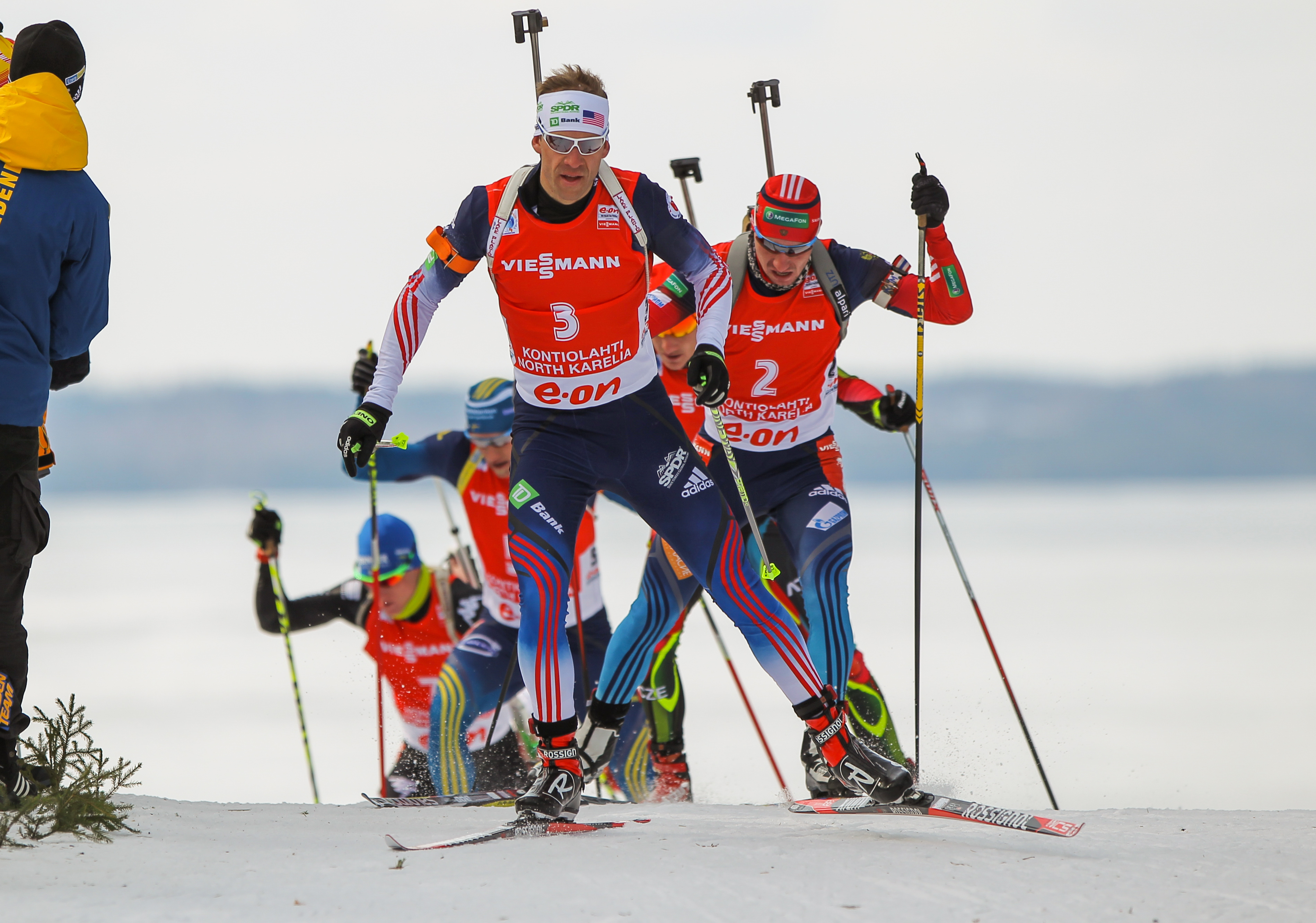
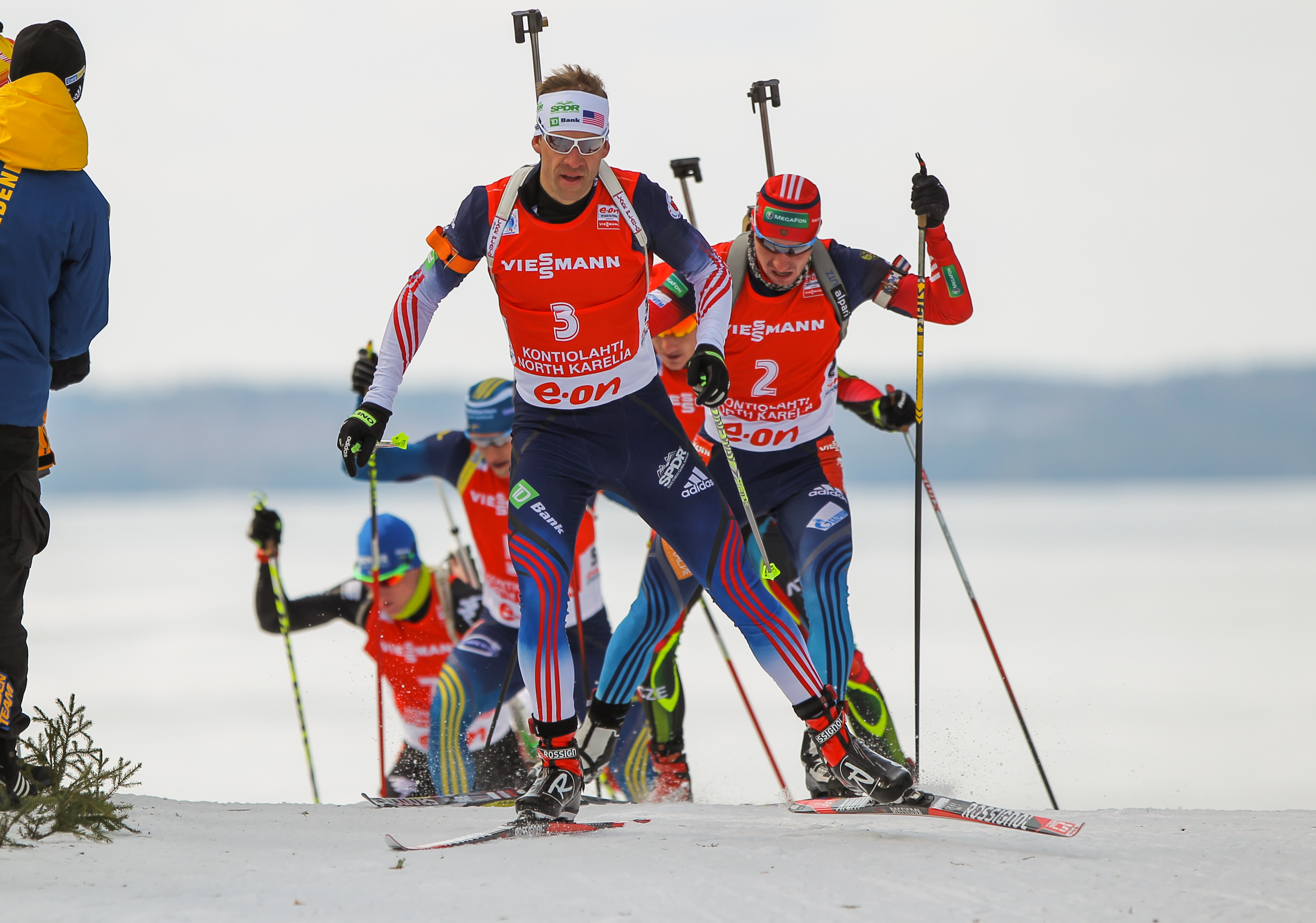
    Lowell Bailey (USA) leads Alexander Loginov in a World Cup competition in Kontiolahti, Finland, in 2013. Loginov was later suspended for doping, bumping Bailey’s results and prize money up higher from the weekend of racing. (Photo: NordicFocus.com/USBA)

    The Russian rosters for January competition will include two names not seen in a while: Irina Starykh and Alexander Loginov. Both are returning to international competition after serving suspensions for using the blood-doping drug erythropoietin (EPO).

    Irina Starykh Makes a Fast Return

    Starykh has been named to the IBU Cup team. The next stage of competitions are in Martell, Italy, starting on January 5, 2017.

    Starykh was initially suspended in January, 2014, in the run-up to the 2014 Olympics. At the time, she was the top Russian woman on the World Cup and had just notched an individual podium. She was also a key member of the Russian relay team. Starykh failed an out-of-competition test in December 2013 month along with teammate Ekaterina Iourieva.

    2013-2014 had been a breakout season for her so far. When asked how she had improved so much by a Russian news service, Sports.ru, she replied in December 2013, “When I found out that I was [named to train] in [Vladimir] Korolkevich’s group- I decided to fully trust the coach… he was building my training and I believed that I would approach the winter season in good condition.”

    Korolkevich coached several other athletes who have been implicated in doping. That includes Iourieva – who has now been caught three different times and is banned until 2021 – and Olga Vilukhina, expected to be one of the two athletes under investigation by the International Olympic Committee for doping violations in Sochi.

    Starykh initially received a two-year ban. When the International Biathlon Union (IBU) re-tested some old samples a few months later, however, they found additional evidence of EPO use. The IBU extended her ban to three years.

    Starykh returned to national-level competitions in December, finishing fifth and sixth in Russian Cup races. A Russian sports website noted, however, that these results did not actually qualify her for the IBU Cup team according to objective criteria.

    Loginov Immediately Back to Top Results

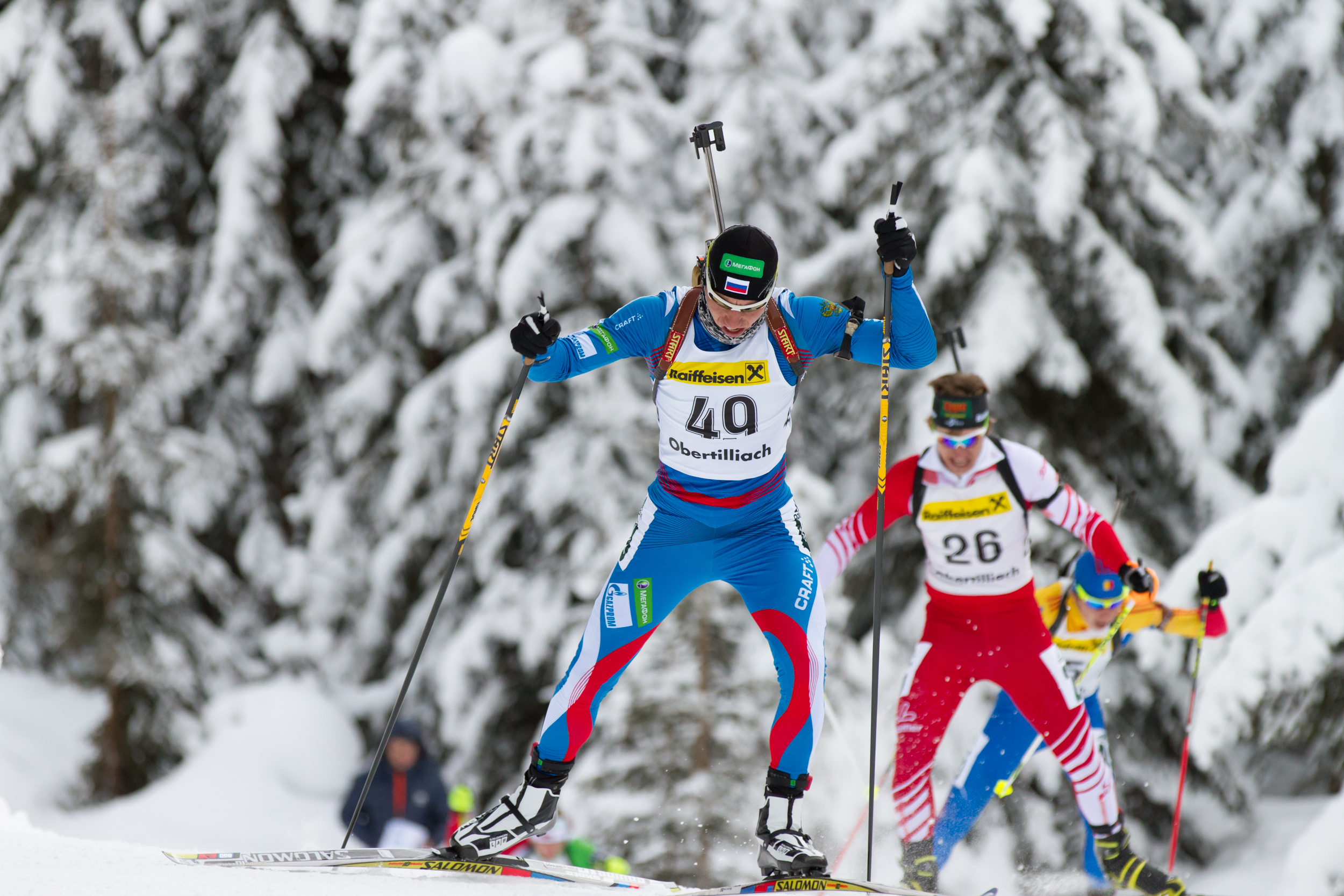
    Loginov competed in the IBU Cup competitions in Obertilliach, Austria, in December, finishing fourth in the 20 k individual. That’s the same venue where he won the individual race at World Junior Championships in 2013.

    Loginov was caught in the same re-testing scheme that earned Starykh her extra year of suspension. His sample from November, 2013, tested positive for EPO when a new method was used several months later. The suspension was announced in November, 2014, and was for two years, plus retroactive disqualification of results between November 2013 and 2014.

    Loginov said at his anti-doping hearing that the drug had been included in a medication he took to treat prostatitis. But the IBU’s hearing panel rejected this claim on multiple grounds.

    The press release from the Russian Biathlon Union announcing the men’s team for international competition in January did not specify whether he would compete on the World Cup or the IBU Cup.

  • The Curious Case of Legkov and the 33 Other Skiers in the McLaren Report (Updated)

    The Curious Case of Legkov and the 33 Other Skiers in the McLaren Report (Updated)

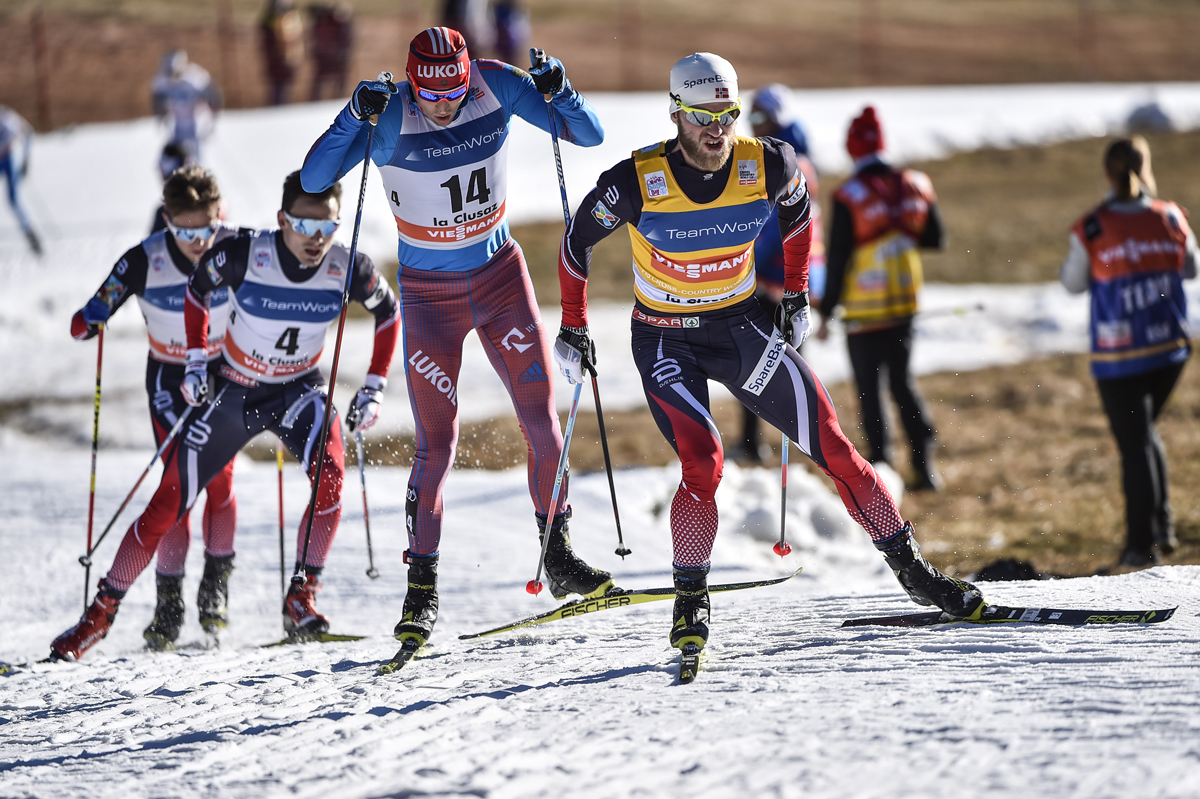
    Alexander Legkov (bib 14) chasing Norway's Martin Johnsrud Sundby in the 15 k mass start skate in La Clusaz, France, on Saturday. (photo: Fischer/Nordic Focus)
    Alexander Legkov (bib 14) chasing Norway’s Martin Johnsrud Sundby in the 15 k mass start skate in La Clusaz, France, on Saturday. (photo: Fischer/Nordic Focus)

    Note: this article has been updated to include more accurate information about Alexander Legkov’s participation at 2014 Russian Championships.

    At least 34 skiers are referred to in the World Anti-Doping Agency’s McLaren report, including one by name: Alexander Legkov, the 2014 Olympic champion in the 50 kilometer skate.

    Throughout the report’s evidentiary documents, names of athletes were scrubbed and replaced with alpha-numeric codes. But in one set of emails leaked by Grigory Rodchenkov, Legkov’s name is not redacted.

    “They rescued the stupid goat Legkov,” Rodchenkov wrote.

    The comment was part of a thread of emails referring to a positive test for budesonide, a corticosteroid, by an athlete referred to as ID number A0467. The sample was taken on March 28, 2014, in Tyumen at Russian Championships. Staff emailed back and forth about the case, asking at one point why the athlete did not have a therapeutic use exemption (TUE) for the drug.

    “Rescued” indicates that the test was given a “save” order: despite being a positive test, it was reported as negative. This is confirmed in another document, which lists the sample (number 2870442) as being positive for budesonide, but being reported to WADA’s results management database, ADAMS, as being negative.

    Results of Russian Championships in Tyumen that year show that Legkov did not compete in individual races, but skied the third leg of the winning relay team (the other skiers on the Khanty-Mansiysk team were Sergey Turyshev, Evgeny Dementiev, and Sergey Ustiugov; Dementiev served a two-year ban for using recombinant erythropoietin, and returned to competition in 2011).

    The skier has maintained his innocence ever since Rodchenkov apparently mentioned his name in an investigation by the New York Times.

    It is possible that Legkov was in Tyumen anyway but was not racing, and that anti-doping officials tracked him down there and requested an out-of-competition sample. Although the championships were taking place in Tyumen at that time, the 28th was not actually a competition day.

    Another possibility is that the place or date of sample collection are incorrect in the emails. While the sample is listed in another spreadsheet, that version does not provide the date of sample collection.

    A last possibility is that Legkov’s name was inserted into the report incorrectly, perhaps by someone with a bone to pick.

    Either possibility would seem like an anomaly in an investigation full of strange occurrences.

    Yet other documents suggest that the athlete was indeed Legkov. In another spreadsheet, athlete A0467 is referred to as winning “gold 50 km mass start”.

    And yet another spreadsheet shows that the athlete had urine samples collected on February 13, 21, and 23 February in Sochi, and blood samples on February 6 and 23 in Sochi. Another urine sample was collected at an unknown date. No substances are listed for these samples, but all four of the urine samples are present in a long spreadsheet listing tests which were handled incorrectly by anti-doping authorities.

    February 23, the day both a urine and blood sample were collected, was the day Legkov won the Olympic 50 k.

    The documents show that 13 other skiers were “protected” athletes in Sochi. And besides A0467, nine other skiers – not all Olympians – are described as having positive tests at some point in the last several years.

    Here is what we know about them.

    About the Documents

    EDP1162, EDP1149, and EDP1154: Professor McLaren describes EDP1162 in his report: “Alexey Velikodniy created a daily competition schedule that identified protected athletes. The schedule was continuously updated during the Games and included all those on the Sochi Duchess List and athletes added during the Games, such as the female hockey team.” EDP1149 includes English translation of the original EDP1162.

    Professor McLaren (c) addressing the media after the his second report on systematic, state-sponsored doping in Russian summer and winter sports. (Photo: WADA/Twitter)
    Professor McLaren (c) addressing the media after the his second report on systematic, state-sponsored doping in Russian summer and winter sports. (Photo: WADA/Twitter)

    This – and EDP1154, which summarizes the information in a tabular format and adds a column for “medals – still seem to have been planning documents. For instance, biathlete Irina Staryk is still listed as competing in the relay, even though she had long been off the Olympic team after a positive test for EPO was reported in January. Likewise, Legkov is listed in this document as competing in the 10 k classic, while neither actually did. Several other commentators have tried to link names to ID numbers based on race registration in this document, but that seems unfair.

    EDP1156: A list of sample numbers and collection during or immediately before the 2014 Olympics in Sochi, from protected national team athletes. Some data about the urine tests, like pH and specific gravity, are included, indicating that this was not merely a planning document but that the tests took place.

    EDP1141: Results of a study done at King’s College London assessing whether the sodium concentration and specific gravity of some doping control samples were abnormal. (They were: in some cases, though none in biathlon, sodium concentrations were consistent with having added a teaspoon of salt to a one-cup urine sample.)

    EDP0902: The report of a forensic examiner who looked at urine sample bottles from the Sochi Olympics to determine whether they had been tampered with, consistent with descriptions of a scheme to open the bottles and replace “dirty” urine samples with pre-collected “clean” urine.

    EDP1155: Translations of emails involving Grigory Rodchenkov, the former head of the Moscow anti-doping laboratory who became a whistleblower and took his story to the New York Times.

    EDP1166: A list of test numbers, mostly associated with athlete ID numbers, identified by the investigation. “The IP has identified more than 1231 samples where the Moscow Laboratory communicated the presence of a prohibited substance in a Russian athlete’s sample to the [Ministry of Sport] and later reported that sample as negative in ADAMS or did not report the sample at all.” This document lists those 1231 samples.

    There are columns for which substances were positive in the sample (this column is often blank) and how the report was filed in the ADAMS database. Many samples were filed as “negative”, but this column is also often left blank. This may mean that the sample was never reported in ADAMS at all – as McLaren says was fairly common – or simply that there was no information about it.

    In general, the investigation’s translations from Russian into English are not always smooth. This is particularly apparent in reference to competitions: the name or level of a series is hard to interpret. It’s possible that the anti-doping staff themselves were not familiar with the different race circuits because they were not necessarily biathlon experts, and worked more generally in all sports.

    A further note: some documents are scanned and thus not searchable by text. Thus some names and numbers may be referenced in places where we have not yet found them.

    Other Athletes With Positive Tests

    Of the nine other positive tests belonging to skiers, one belonged to an athlete never assigned an ID number. This means that it could be redundant – this skier could in fact be one of the numbered athletes – or it could be an entirely new athlete.

    A0086, male cross-country skier

    Evidence of being a protected athlete? Yes. This athlete appears in planning documents for Sochi. In these documents, it is clear that the athlete is male.

    Evidence of positive tests? In EDP1141, the chemical analysis by staff at King’s College London showed that sample 2889705 was particularly concentrated, and possibly not an authentic post-competition urine sample. Documents related to Sochi show that the sample had been collected on February 12, 2014 – not a competition day at the Olympics.

    How was the test handled? It’s not clear. In EDP1166, the field for how the test was reported to ADAMS is left blank. This could mean that it was never reported at all.

    Other tests? For this athlete, urine tests were collected at the Olympics on February 6 and 15, 2014, and blood tests on February 6 and 11. Three other urine tests are reported in EDP1166, with no substances listed, and the tests do not seem to have been entered into ADAMS.

    A0281, female cross-country skier

    Evidence of being a protected athlete? No.

    Evidence of positive tests? One of this athlete’s urine samples (3689022) is listed in EDP1166 as testing positive for the blood-doping drug recombinant erythropoietin. The emails show that the test was collected at a training camp in Moscow, and are listed with a “quarantine” order: to prevent the athlete from leaving Russia where they could be drug tested by other authorities. The emails note that “the name is not known.”

    How was the test handled? According to EDP1166, the test was reported to ADAMS as negative.

    Other tests? None listed.

    A0291, female cross-country skier

    Evidence of being a protected athlete? Yes. This athlete appears in planning documents for Sochi. In these documents, it is clear that the athlete is female.

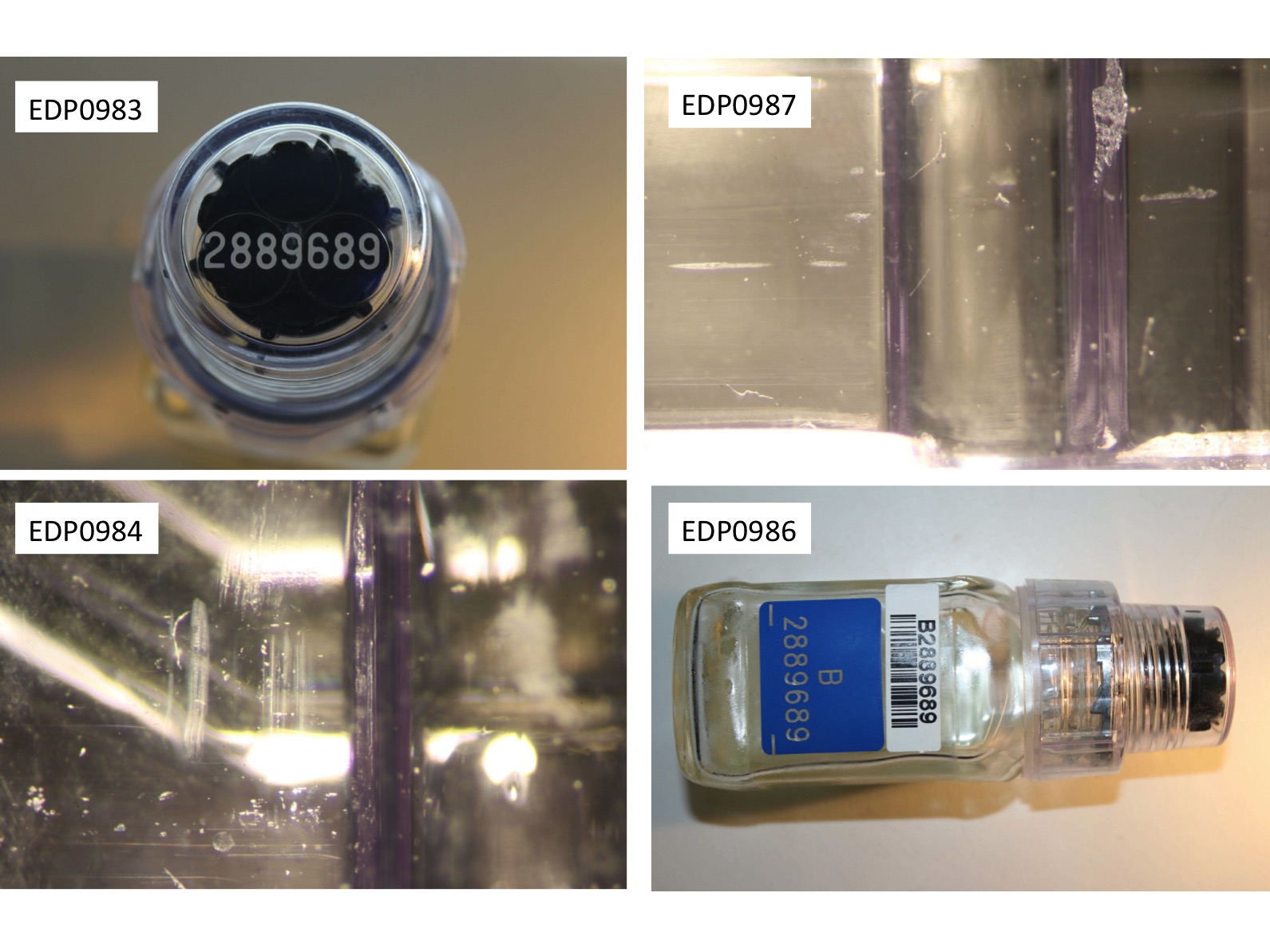
    Photos of the sample bottle from the McLaren report's evidence packet.
    Photos of the sample bottle from the McLaren report’s evidence packet.

    Evidence of positive tests? There are multiple lines of evidence showing that this athlete’s urine sample (2889689) was tampered with. The sample was collected on February 17, 2014, not a competition day for cross-country skiers at the Olympics. A forensic report showed that the sample had marks consistent with opening the bottle. In addition, the sample inside had such high sodium levels that chemists concluded that salt must have been added to the sample – the sodium values were physiologically impossible. This is consistent with reports of a scheme to swap dirty urine samples for clean ones, because Rodchenkov had described adding water and salt to samples as he and staff switched the urine between bottles.

    How was the test handled? It’s not clear. In EDP1166, the field for how the test was reported to ADAMS is left blank. This could mean that it was never reported at all.

    Other tests? This athlete also had a blood test collected in Sochi on February 5 and a urine test on February 6. Another urine test was collected at an unreported date. For all of these samples there were no substances listed, and the tests do not seem to have been entered into ADAMS.

    A0572, male nordic combined athlete

    Evidence of being a protected athlete? No.

    Evidence of positive tests? Multiple documents show a sample (2867397) collected on 02.01.2014 which tested positive for trimetazidine, an anabolic agent. The emails note that the athlete was leaving a few days later for France. World Cups were held in Chaux Neuve, France, on January 11 and 12. Only two Russian competed there: Ernest Yahin, who finished last in the large hill 10 k, and Denis Isaykin, who teamed up with him for 17th place in the team sprint relay.

    How was the test handled? EDP1166 shows that this sample was reported as negative to the ADAMS database.

    Other tests? None listed.

    A0942, male cross-country skier

    Evidence of being a protected athlete? No.

    Evidence of positive tests? In EDP0901, referred to as a list of “dirty” samples, this athlete is listed as being handled by FIS, the International Ski Federation. In another document, EDP0650, the sample is listed as being collected on December 1, 2013, and as being positive for acetazolamide, an anabolic agent.

    How was the test handled? It’s not clear. The test is not listed in EDP1166. In EDP0650, there is a note in the “commentary” column: “It is not possible.”

    Other tests? None listed.

    A0958, male cross-country skier

    Evidence of being a protected athlete? Yes. This athlete is listed in several Sochi planning documents. Documents EDP1166 and EDP1156 show that this athlete had samples from taken during the Olympics on February 1, 9, 15, 16, 19 and 23. Of these dates, February 9, 16, 19 and 23 align with the competition dates of the 30 k skiathlon, relay, team sprint, and 50k, respectively. That could, but does not necessarily, mean that the athlete competed in each of those events: analysis of the cases of four biathletes whose names were not scrubbed from an evidentiary document showed that at Sochi, those athletes did not have samples collected every day that they competed, and did have samples collected on some days they did not compete. Thus sample collection and competition were somewhat disconnected.

    Maxim Vylegzhanin competing in the 10 k classic in Falun, Sweden, in 2016. (Photo: Fischer/NordicFocus)
    Maxim Vylegzhanin competing in the 10 k classic in Falun, Sweden, in 2016. (Photo: Fischer/NordicFocus)

    Evidence of positive tests? One of the athlete’s samples samples (2866326) tested positive for trimetazidine, an anabolic agent, according to both emails and EDP1166. The positive test occurred on January 5, 2014 at a training camp in Sochi. Most of the Russian distance skiers were at the Tour de Ski at that time; of the four who competed in the 50 k in the Olympics, only Maxim Vylegzhanin did not participate in the Tour de Ski. In EDP1155, beneath the statements about A0958’s positive test, it says “January 11-12 KM, Czech Republic”. Vylegzhanin, after sitting out of the Tour de Ski, did compete in Nove Mesto, winning the team sprint on January 12th.

    How was the test handled? In the emails, this sample is given a “save” order. The athlete was likely high-profile because the email (which can be seen in Russian here) also says, “PERSONALLY warn as soon as possible.” And in EDP1166, it is listed as being reported to ADAMS as a negative test result.

    Other tests? None listed, other than those from Sochi described above.

    Unnumbered cross-country skier, female

    Evidence of being a protected athlete? No.

    Evidence of positive tests? The emails refer to a sample (2944730) collected on 11.19.2014 in Vertex Tei, which had a testosterone to epitestosterone ratio of 6.6. A high ratio can indicate that an athlete was using exogenous testosterone, and a finding of a ratio above 4.0 triggers further investigation.

    How was the test handled? In the email, the description of the sample follows the word “quarantine.” This means that the athlete was likely kept in Russia until they could pass a drug test. The email can be seen (in Russian) here. However, the sample is not mentioned in EDP1166.

    Other tests? None listed, but because the athlete does not have an alpha-numeric code number assigned it’s impossible to tell.

    A0094, female skier (discipline not listed)

    Evidence of being a protected athlete? No.

    Evidence of positive tests? A sample (2868048) collected on 09.12.2013 at a junior training camp in Syktyvkar had a testosterone to epitestosterone ratio of 5. In an email (which can be seen in Russian here) it is noted that this is “for women bad”. In the translated emails that’s followed by the comment: “he’s an idiot.” It’s not clear if the pronoun was translated incorrectly and the staff is referring to the athlete, or perhaps to a male coach or doctor.

    How was the test handled? EDP1166 shows that this sample was reported to ADAMS as negative.

    Other tests? None listed.

    A0918, male cross-country skier

    Evidence of being a protected athlete? No.

    Evidence of positive tests? A sample (2808826) is listed in EDP1166 as being positive for phthalates, which are plasticizers. They are prohibited because they are thought to indicate the use of blood transfusions, with the plasticizers being used to soften the plastic in blood bags and then diffusing into the blood.

    How was the test handled? EDP1166 shows that this sample was reported to ADAMS as negative.

    Other tests? None listed.

    Other Protected Athletes

    There are five athletes who are listed in the Sochi planning documents, indicating that they were “protected” athletes, but for whom no anti-doping samples or tests are described in any documents. They are: A1302, A1303, A1281, A1282, and A1285.

    There are six more cross-country skiers for whom tests are actually described.

    A0081, male cross-country skier

    Samples Described from Sochi: Urine samples were collected on February 6, 12, and 15, 2014, and two different blood samples were collected on February 5. All three urine samples appear in EDP1166, but no substances were listed and the test does not seem to have been entered into ADAMS.

    Other Samples? None listed.

    A0132, female cross-country skier

    Samples Described from Sochi: A urine sample was collected on February 17, 2014, and blood samples on February 5 and 6, 2014. The urine sample appears in EDP1166, but no substance was listed and the test does not seem to have been entered into ADAMS.

    Other Samples? None listed.

    A0431, cross-country skier

    Samples Described from Sochi: Urine samples were collected on February 5, 16, and 19, 2014, and a blood sample on February 6, 2014. All three urine samples appear in EDP1166, but no substances were listed and the test does not seem to have been entered into ADAMS.

    Other Samples? Another urine sample (2943988) was collected on an unreported date. Again, although the sample appears in EDP116 no substance was listed and the test does not seem to have been entered into ADAMS.

    A0654, cross-country skier

    Samples Described from Sochi: Urine samples were collected on February 1 and 12, 2014, and a blood sample on February 5, 2014. Although the urine samples appear in EDP116, no substances are listed and the tests do not seem to have been entered into ADAMS.

    Other Samples? Two more urine samples (2943988 and 2947314) were collected on unreported dates. Again, although the samples appear in EDP116, no substances are listed and the tests do not seem to have been entered into ADAMS.

    A0772, cross-country skier

    Samples Described from Sochi: Urine samples were collected on February 7 and 12, 2014, and a blood sample on February 5, 2014. Although the urine samples appear in EDP116, no substances are listed and the tests do not seem to have been entered into ADAMS.

    Other Samples? None listed.

    A0999, female cross-country skier

    Samples Described from Sochi: A blood sample was taken on February 5, 2014. It does not appear in any other documents.

    Other Samples? A sample (2761241) collected at an unknown date is shown in EDP1166 to have been reported as negative to the ADAMS database. But there is no substance listed for this sample in EDP1166. Because this document was assembled to be a list of samples which were reported to the Ministry of Sport as being positive, it’s not clear what to conclude from this combination of facts.

    Other Athletes Mentioned in the Documents

    For the rest of the athletes, positive tests are not explicitly described in any of the documents. Here is what we know about them.

    ID Number Discipline Samples reported as negative Samples with no information about reporting
    A0525 Cross-country skiing   857620 (blood test)
    A0030 Skiing   857698 (blood test)
    A0138 Skiing   857624 (blood test)
    A0025 Skiing   857408 (blood test)
    A0309 Skiing   857566 (blood test)
    A0334 Skiing   857426 (blood test)
    A0543 Skiing   857770 (blood test)
    A0677 Skiing   2892136, 2891757, 2889127 (urine tests)
    A0703 Skiing   857361 (blood test)
    A0734, born in 1992 Skiing 2910515 (urine test), collected August 2014 in Novogorsk
    A0929 Skiing 850816 (blood test)
    A0952 Skiing 857593 (blood test)
    A0968 Skiing 850809 (blood test)
  • Shaw on Latest McLaren Report: ‘Shocked’ But Adamant to See Justice Served

    Shaw on Latest McLaren Report: ‘Shocked’ But Adamant to See Justice Served

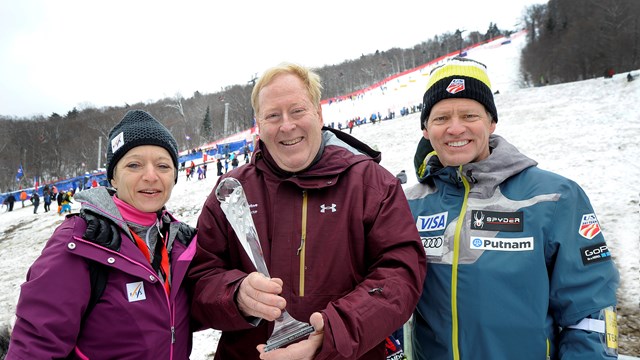
    More lighthearted times: USSA CEO Tiger Shaw (r) with FIS Secretary General Sarah Lewis (l) and FIS Journalist of the Year Peter Graves (c) at the Killington Alpine World Cup nearly two weeks ago in Killington, Vt. (Photo: FIS)
    More lighthearted times: USSA CEO Tiger Shaw (r) with FIS Secretary General Sarah Lewis (l) and FIS Journalist of the Year Peter Graves (c) at the Killington Alpine World Cup nearly two weeks ago in Killington, Vt. (Photo: FIS)

    While reporting regarding systematic doping by Russian teams has been building up for several years, the second part of the World Anti-Doping Agency’s McLaren report still took some by surprise in terms of the pure scope of the allegations.

    Tiger Shaw, CEO of the United States Ski and Snowboard Association (USSA), was one of them.

    “I am shocked by the level: the number of individuals colluding is shocking,” he said in an interview on Friday. “How anybody could have ever thought that something like this could be secret forever is incredible.”

    Shaw said that in some USSA disciplines, there are no Russian athletes competing at a high level, so he expected past competition results to remain more or less unchanged.

    For others, however, the implications were bigger. Cross-country skiing clearly falls into that category.

    “Obviously it’s going to have an impact in terms of the athletes, where the results will be changed and their medals taken away and they will be banned,” Shaw said. “I presume that the federations will have to make all these decisions.”

    The sport “skiing” appears 75 times in the Schedule of Samples and ADAMS Reports document that is part of the McLaren Report’s evidence package. McLaren and the World Anti-Doping Agency (WADA) have anonymized the athlete names, so lines of data cannot be linked to any individual athlete.

    While the discipline is sometimes further delineated, for example as “skiing | cross country” (or “cross country skiing” – there is no consistent rule for terminology) it is difficult to tell how many data points correspond to which disciplines. Some entries are also labeled as “Skiing – IPC Cross Country”, but many just say “skiing”, leaving uncertainty as to whether they are from able-bodied or para-nordic competitors, regardless of the discipline.

    Many of these 75 data points do not have information about what substances were detected in the samples, if any. But some clearly do: one for the blood-doping drug erythropoietin (EPO); another for a high ratio of exogenous testosterone; yet another for budesonide, a corticosteroid used in inhalers; and another for trimetazidine, a heart drug which, like meldonium, is a metabolic modulator which combats angina.

    Another athlete tested positive for “phthalates”, plasticizers which are sometimes used in IV bags and are often assumed to indicate blood transfusions. They are also, however, present in other kinds of packaging.

    In all of these cases the results were reported to WADA’s anti-doping test management system, ADAMS, as negative tests: no prohibited substances found. Translated emails used in the investigation also refer to some of these cases, showing that they were discussed between personnel who were supposed to be enforcing anti-doping rules.

    The information has been forwarded from WADA to the 32 international sports federations (IFs) where athletes were implicated in the report, and has also been forwarded to the International Olympic Committee (IOC). It is up to those organizations to sift through the information and determine penalties and suspensions, or decide to do further investigation.

    Shaw believed that the International Ski Federation (FIS) was taking the report seriously.

    “I think they are going to take pretty swift action,” he said. “There are a large number of athletes that have to be dealt with. There’s no question that they will take swift and efficient action… our place is as a stakeholder and a component of international governance. Our role at the FIS level is that [USSA Board Chair] Dexter Paine is one of the vice presidents. So it’s a pivotal day and there’s a lot of work to be done.”

    Some work was short-term, he said: determining sanctions for athletes implicated in the report.

    But other work was long-term, in terms of dismantling the system which led to such systematic cheating in Russia.

    Meanwhile, an increasing number of competitions were implicated in the coverup, some of which occurred after the 2014 Olympics, which was the catalyst and main focus of the report.

    That has led U.S. and Canadian athletes in luge and skeleton to discuss a boycott of competitions held in Russia this year. Shaw said he understood their position. FIS has World Cup events in almost every discipline scheduled for Russia this season, and in mid-October FIS President Gian Franco Kasper said that Russia could be stripped of its right to hold those competitions depending on the outcome of the McLaren report.

    “I don’t think anybody feels safe about being there, being in a country that had this high level of collusion,” Shaw said. “Each sport and each country is going to have to deal with it in their own way. For that, we work closely with the [United States Olympic Committee] and our athletes.”

    Far from regretting if U.S. athletes spoke out on the doping issue, Shaw seemed to be relieved that more and more, they are doing so.

    “The bottom line is that we absolutely stand behind, and believe in, clean sports and clean athletes,” Shaw said. “So we will stand behind any effort and make any effort in the long term to make sure that happens. And that means, to a degree, working through the system we have now, and working to help change it for the better, which a lot of people are trying to do, including, it sounds like, an increasing number of athletes. Thank goodness they are speaking up because it’s all about them in the first place, isn’t it?”

    “The bottom line is that we absolutely stand behind, and believe in, clean sports and clean athletes. … Thank goodness they are speaking up because it’s all about them in the first place, isn’t it?” — Tiger Shaw, USSA President and CEO

    Meanwhile, many Russian athletes likely implicated in the report are on the start lists for international competitions this weekend.

    Shaw said that his message to U.S. Ski Team athletes was that they should continue to focus on excelling, and doing so clean.

    “They put their heads down and they go out and race,” he said. “Due process must be followed…. Justice is going to be served, but any individual athlete, they have to take the longer view on how they can help change the system.”

    Some were already doing just that.

    “I’m going to take tomorrow to focus on the races and try to do a better job of processing and understand the Mclaren report after the race on Sunday,” cross-country skier Sophie Caldwell wrote in an email on Friday afternoon.

  • Dear WADA: The Nordic World Needs Answers

    Dear WADA: The Nordic World Needs Answers

    The following editorial was originally posted on “From The Editors” blog in November. We have decided to re-post it after recent allegations of doping at the 2014 Olympic Games in Sochi. What has changed in the six months since the WADA (World Anti-Doping Agency) Independent Commission report was released? Some questions have been answered, but primarily by journalists. Some WADA and IOC statements following the commission’s report, for instance that there was no way that there could have been irregularities in the Sochi anti-doping laboratory, now seem comical. It is time for WADA to step up and finish the investigation.

    From our November posting, we have updated only the introduction and references to times and dates.

    After the publication of the WADA Independent Commission’s first report in November, a few things moved fast: suspension of a Moscow laboratory’s accreditation, resignation of key officials, consideration of sanctions by the International Association of Athletics Federations (IAAF).

    But other things are moving more slowly. And for those of us whose sports are implicated but not investigated in the report, it feels like no progress has been made at all.

    The mandate of the Independent Commission, stated on page 3 of their report, was first to establish whether “There have been any breaches of processes or rules (Code and International Standards) by any signatory to the Code. This includes RUSADA and IAAF, but not exclusively as there may be other National Anti-Doping Organizations (NADOs) or International Federations (IFs) also requiring such inquiry.”

    In other parts of the mandate, the phrases “any organization” are used repeatedly.

    While this was just the first part of the Independent Commission’s report – part two, about other track and field federations was published in January – the Commission does not seem to have taken up the full breadth of its mandate.

    There are suggestions and even quotes from whistleblowers stating that key individuals in the investigation had worked with multiple sports. The Commission did not follow up on this.

    This is despite the fact that in other state-sponsored doping systems from decades past, cheating ranged across a wide range of sports. What matters at the Olympics is the medal count, and you can’t win it in just track and field. And so, without more answers, other athletes compete with the seeds of doubt and fear sown into their psyches. If there’s one thing that can crush both the joy of sport, and a good result, it’s fear.

    It’s also not to discount the work which the Commission has done, which was clearly a lot. The Commission can be forgiven for feeling a bit weary – and if they are anything like us, depressed from their findings – and wanting to pass the torch.

    But if that’s the case, who will take the mandate from them and run with it?

    In our nordic sports, we have a sad history of doping by multiple teams through the years. We believe that our international federations are making good-faith and sophisticated efforts to catch dopers. But if the same behavior present in Russian athletics is also present in our sports, then it is hard for those efforts to completely succeed.

    We need to know more about what is going on in Russia, and this information needs to be shared with other international federations.

    There may be athletes in other sports who should not be allowed to compete, but who currently are.

    There may be results that currently stand, but should be stricken from the record.

    Here is a summary and accounting of issues identified in the report which should be followed up on:

    1. Doctors working in multiple sports

    One of the key figures in the report, as well as in the ARD documentaries which preceded it, is Dr. Sergey Portugalov. Portugalov provided banned substances to many athletes – apparently not just limited to runners.

    Screen Shot 2015-11-13 at 8.30.40 AM

    SwimVortex.com also reported that on the website of the Russian Federal Research Centre of Physical Culture and Sports, it listed that Portugalov was a member of the FIS Medical Committee. We couldn’t find that information on the difficult-to-navigate website.

    On the FIS Medical Committee’s roster, the spot for Russia is empty, with the words “prov. Suspended”.

    FIS Anti-Doping administrator Sarah Fussek explained in an email to FasterSkier:

    “Grigory Rodchenkov is currently being investigated based on the WADA IC report allegations, and during this time he is provisionally suspended from this function as a member of the FIS Medical Committee, as provided for by the FIS Anti-Doping Rules. He is asked to respond to the allegations until the end of November. Similarly, the Russian Ski Association has been asked to comment to the WADA IC report on the involvement and the possible affect on the FIS governed sports until end of November.”

    The idea that the main supplier of banned performance-enhancing drugs to track and field athletes was also supplying them to many other athletes needs to be addressed.

    Can it be established what other athletes had contact with Portugalov? These athletes, and their relationships to the doctor, should be examined.

    2. The Sochi testing

    Among the concrete allegations in the report are that representatives of the Russian State Security service, FSB, infiltrated the Sochi anti-doping laboratory posing as engineers.

    FSB was also interested in the Moscow laboratory, and here is what they did there, according to the report:

    “One laboratory staff member provided information to IC investigators about the suspected bugging or wiretapping of telephones, while another staff member reported that office spaces within the Moscow laboratory were monitored (bugged) by the FSB in order to be informed of the laboratory’s activities. This could not be independently verified by the IC, but the reported statements demonstrate the perceptions of laboratory officials, who believe they are under constant state surveillance. This perception is also fuelled by the FSB’s regular visits to the laboratory and the questioning of its staff members. For example, the IC learned that staff members were routinely questioned by FSB upon their return from global laboratory and WADA seminars. Following the airing of the ARD documentary, select laboratory staff members were directed by the FSB not to cooperate with the WADA investigation.”

    In response, the International Olympic Committee (IOC) put out this statement:

    “The IOC studied the functioning of the WADA accredited laboratory in Sochi during the Olympic Winter Games 2014 following the doubts expressed during the Independent Commission’s press conference. In this context the IOC relies on the then report of the WADA independent observer group which makes no mention of any such irregularity. Nor was any such irregularity reported by the international experts involved, nor found by the IOC itself. Therefore, the IOC has no reason to question the credibility of the results of the anti-doping tests carried out at the Olympic Winter Games 2014.”

    This is disappointing, to say the least.

    The thing about intelligence service operatives is that they hide; they pose as something other than they are; they deceive. It’s possible that the FSB in Sochi were quite convincing in this respect.

    Saying that the Independent Observers did not notice anything amiss does not cut it, now that we know that there was government spying and presence in the lab and along with everything else we know about how interested the government was in manipulating sports competitions.

    We hope that WADA will pressure the IOC to reverse this position and re-test the samples. If nothing additional comes up, then fantastic. But on the chance that positive results could have been suppressed, then clean athletes deserve to know the truth – and receive their medals.

    3. Mishandled and misplaced samples

    The report details a number of places where doping control samples were mishandled or misplaced. For instance, more than 1,400 of them were intentionally destroyed by staff in a Moscow laboratory to prevent re-testing.

    Another 67 samples were moved by WADA to a Lausanne laboratory for re-testing, but then were destroyed by staff there. The Independent Commission never found a good explanation.

    RUSADA was also falling down on the job of entering doping control test information (doping control forms, or DCFs) into ADAMS, the global database, which would make it available to other organizations.

    From the report:

    “RUSADA claimed that all DCFs were entered and up to date for the years 2014 and 2015. RUSADA pledged to enter all remaining 2012 and 2013 missing DCFs by October 31, 2015… The findings did not support RUSADA. In 2014, there were 804 non-filed DCFs and 679 in 2015.”

    The report states that this was at least in part due to administration problems creating a backlog of forms. They could not conclude whether malicious intent was also involved.

    But regardless, it is troubling. Between destroyed samples, changed test results, and un-entered doping control test information, how many of these tests belonged to skiers and biathletes?

    That question may be un-answerable. But one can try.

    4. Lack of serious testing by RUSADA

    And all of that is from when tests are collected. They aren’t, always.

    The report alleges not only that positive tests collected by the Russian anti-doping union could be made to go away by making a phone call and paying a bribe. It also describes how advance notification was given before doping control officers (DCOs) arrived and forms were sometimes falsified.

    “Stepanov reported to the IC the following Code non-compliant behaviours among DCOs: there is a practice of taking money by DCOs at the time of testing; not following the standard for testing in particular observing the urine flow if a urine sample is taken; and failing to have adequately trained chaperones or any chaperones at all when on a mission. They would also not follow up on missions where the whereabouts location was far from where they were living but would await the re- filing of whereabouts within the region where they were presumably carried out by the athlete on knowing the sample to be taken would not trigger an AAF.”

    The DCOs are employed by RUSADA, thus are not sport-specific. If they did not follow the code while testing track and field athletes there is no reason to think that they followed the code while testing athletes in other sports.

    Take this comment from the ARD documentary that spurred the WADA investigation:

    Screen Shot 2015-11-13 at 10.16.12 AM

    Given that the report finds that track and field coaches, officials, and staff were aware of these problems, it should also be asked whether coaches and staff from other sports knew about and promoted this Code-noncompliant behavior.

    5. The role of coaches

    The report identified that within track and field, coaches pressured athletes to dope.

    “Many of the more egregious offenders appear to be coaches who, themselves, were once athletes and who work in connection with medical personnel,” the Commission wrote.

    This bears a resemblence to patterns we have seen in nordic sport. For instance, a non-Russian coach, Wolfgang Pichler, was brought in to coach the Russian women’s biathlon team for the first time several years ago. But some athletes preferred to train with a different coach, Vladimir Korolkevich, who had been a famed coach in the Soviet system.

    Just before the 2014 Olympics, two of Korolkevich’s athletes, Ekaterina Iourieva and Irina Starykh, were caught using EPO. Yet Korolkevich was promoted over Pichler to lead the Olympic team. Rather than punishing personnel associated with doping athletes, the biathlon union rewarded them.

    Neither Pichler nor Korolkevich are currently working with the Russian team. But who is? Is the organization which rewarded and promoted Korolkevich still in place? And what about cross-country skiing?

    Our Request: Finish the Work You Started

    From these allegations, it is clear that not only track and field, but many other sports are affected by doping in Russia (and beyond).

    While is is useful to dismantle the system of doping in track and field, other sports should not be hung out to dry and left to continue operating under these conditions.

    How should athletes feel knowing that some of their competitors may have received banned substances from the same doctors who doped track and field athletes?

    How should they feel knowing that their Russian competitors may have been tested far less than those from other countries, or that their doping samples may have been destroyed to avoid a positive test?

    How should they feel wondering if they actually should move several places up the results sheet in all of their races in the last year? Two years? Five years? Decades?

    It is not sufficient to examine track and field and then walk away.

    Our sports need answers, too.

  • Four-Year Ban For Wurm, Who Admits Doping; Used Cobalt to Boost Performance

    Four-Year Ban For Wurm, Who Admits Doping; Used Cobalt to Boost Performance

    Austrian skier Harald Wurm was a crowd favorite at the December, 2012, World Cups in Canada, where he finished a sprint heat despite breaking a binding off his ski.
    Austrian skier Harald Wurm was a crowd favorite at the December, 2012, World Cups in Canada, where he finished a sprint heat despite breaking a binding off his ski.

    Austrian skier Harald Wurm has finally received his sentence from Austrian anti-doping officials, after being under investigation since September and receiving a provisional suspension before the 2015-2016 race season began.

    At the end of his hearing this week, Wurm was suspended from competition for four years. According to the Austrian newspaper Salzburger Nachrichten, Wurm confessed to doping.

    “I have used banned substances for myself,” he said.

    Wurm is a former Under-23 World Champion and competed in two Olympics. Now 31 years old, he also admitted that this would be the end of his career.

    Other careers are also in the balance. With Wurm’s teammate and reported best friend Johannes Dürr testing positive for EPO at the 2014 Olympics, Austrian coaches struggled to maintain their credibility over doping issues. Gerald Heigl, the head coach of the cross-country ski team, temporarily stepped down when the Wurm investigation started, but was then reinstated.

    Worm’s four-year suspension was for two violations: first for using cobalt, a substance which is banned when taken as an infusion or injection of over 50 ml over a six-hour period; second, for blood manipulation.

    Cobalt boosts blood’s oxygen-carrying capacity by stimulating erythropoietin gene expression through a pathway called the hypoxia induction factor (HIF), according to the World Anti-Doping Agency, which is funding a project to further examine the method’s effects on performance. Cobalt was specifically added to the WADA Prohibited List as of January 2015, while other substances with similar effects, like xenon and Argon, were added in September 2014.

    Cobalt can be injected or taken orally. A 2005 article in the British Journal of Sports Medicine noted that oral doses of 30 mg/kg of body weight could increase the production of red blood cells. Overuse of cobalt can lead to kidney and heart problems, as well as changes in thyroid function. It has a half-life of less than an hour in the body.

    “It has been known that cobalt increases erythropoiesis in experimental animals,” Dr. Wolfgang Jelkmann of the University of Lübeck, Germany, and Dr. Carsten Lundby of the University of Zürich, Switzerland, wrote in a 2011 paper in Blood Journal. “Cobalt is a very potent inducer of Epo transcription. Indeed, the international Epo unit (IU) was originally defined as the dose eliciting the same erythropoiesis stimulating response in rats as 5 μmol of cobaltous chloride.”

    The initial police investigation in September had found a hemoglobin meter, used to monitor blood parameters. The distribution of performance-enhancing substances is illegal in Austria. Wurm settled the criminal charges by paying a fine of 2,000 Euros, the Associated Press reported.

  • IBU Hands Down Doping Bans for Three Russians in Re-Testing Cases

    IBU Hands Down Doping Bans for Three Russians in Re-Testing Cases

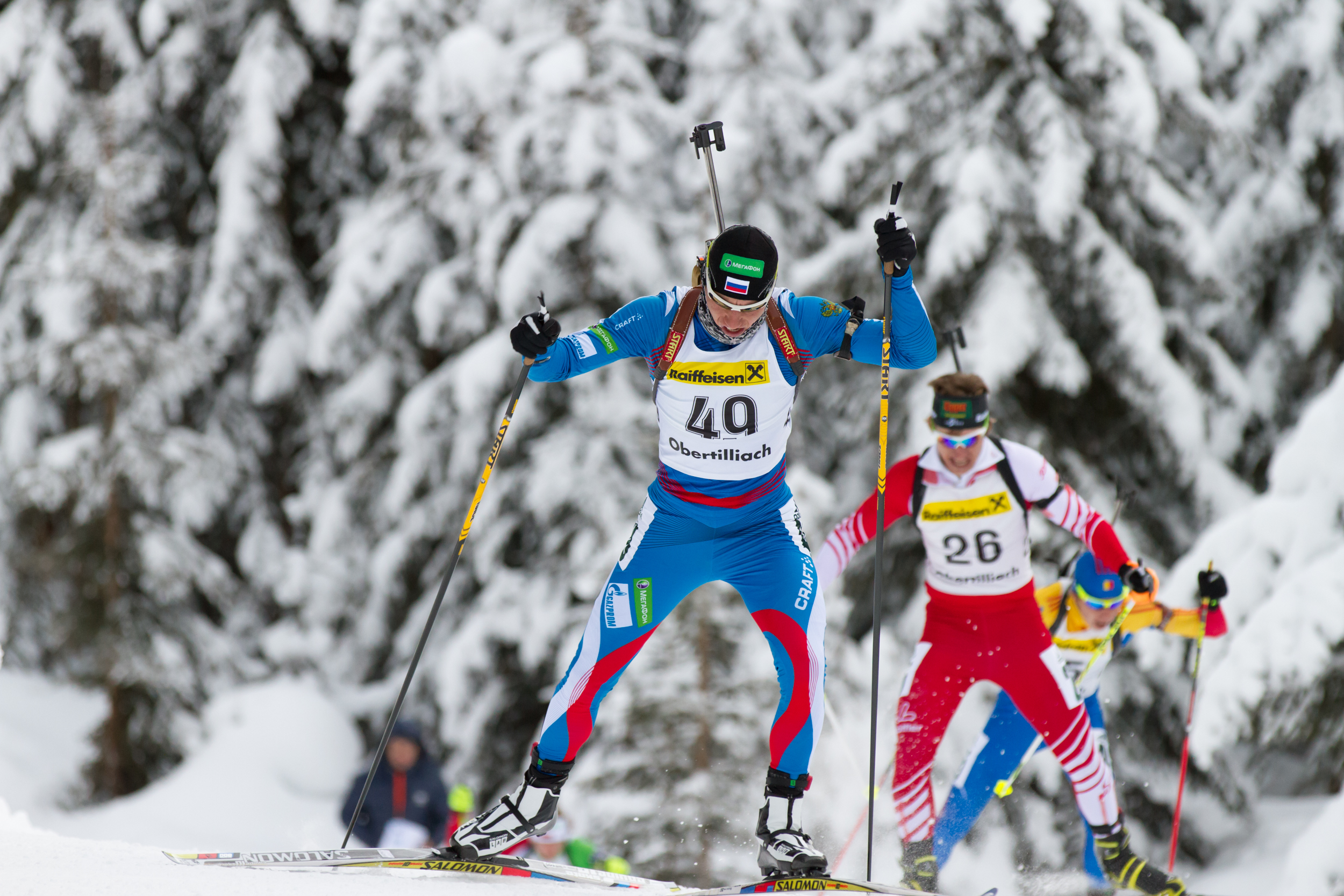
    Irina Starykh racing in Hochfilzen, Austria, last December, is one of three Russian biathletes caught using EPO since December 2013.
    Irina Starykh, here racing in Hochfilzen, Austria, is one of three Russian biathletes caught using EPO since December 2013.

    The Anti-Doping Hearing Panel for the International Biathlon Union (IBU) has finally handed down their decisions in the cases of three Russian athletes who were caught using EPO, a blood-doping drug. In each case, the samples were from late in 2013 and seemed abnormal at the time, but were not detectable as violations.

    One year later, a new testing method became available, and the IBU re-tested the samples. Using the more sophisticated method, positive tests were found. The three athletes are Irina Starykh, Ekaterina Iourieva, and Alexander Loginov. Another athlete, Sergiu Sednev of Ukraine, also had a positive re-test, but did not fight the ruling and his case was concluded in April.

    “The Russian Biathlon Union is not going to challenge [this decision],” Alexander Kravtsov, President of the Russian Biathlon Union, said in a press release. “The Russian Biathlon Union is working closely with RUSADA and WADA in the fight against the use of illicit drugs, and intends to continue to actively fight against doping in biathlon at all levels.”

    At issue in the cases, besides the usual claims that EPO entered the athlete’s system by accident or as part of a remedy for some previously undisclosed illness, the hearing panel had to consider that the sample collection and the test were performed more than a year apart. That brought into question when to begin the bans: should it be from the time the sample was taken, or when the re-test was found positive?

    Each of the three cases also had some of their own special considerations, for example if positive samples collected ten days apart constituted a single offense (one injection of EPO detected in both tests) or multiple offenses.

    Alexandr Loginov, en route to winning the 2013 World Junior Championship sprint. (Photo: Mario Danzl/Obertilliach 2013.)
    Alexander Loginov, en route to winning the 2013 World Junior Championship sprint. (Photo: Mario Danzl/Obertilliach 2013.)

    Loginov: Alexander Loginov, a former double gold medalist at World Junior Championships who also had three individual World Cup podiums to his name, generated the most buzz when the re-testing results came out. That was because he had never previously faced a doping infraction, unlike Starykh and Iourieva.

    Loginov did not initially take advantage of the opportunity to submit a statement to the hearing panel, but the IBU gave him and extension and a second chance, for “fairness to the athlete”. At this point, Loginov responded that he had avoided commenting on the case because he was ashamed “to publicly disclose my intimate and personal problem, but 2 years ago, I was diagnosed with acute prostatitis,” a bacterial infection of the prostate gland.

    Loginov claimed in the written statement that he wanted to be healthy for the Olympics. So on the recommendation of a friend he took a supplement which could supposedly help with the problem. He says that it contained “biologically active substances” and that, oops, EPO must have been one of them.

    The hearing panel was unimpressed: they noted that Loginov did not bother to submit documentation showing that he actually had prostatitis, and also that EPO must be injected so the claim that it was in pill form in this supplement did not make sense.

    Lowell Bailey (USA) leading Alexander Loginov of Russia in last season's World Cup pursuit in Kontiolahti, Finland. In the sprint, Loginov had placed second and Bailey third; a previous sample of Loginov's has tested positive for EPO. (Photo: USBA/NordicFocus.)
    Lowell Bailey (USA) leading Alexander Loginov of Russia in last season’s World Cup pursuit in Kontiolahti, Finland. In the sprint, Loginov had placed second and Bailey third; a previous sample of Loginov’s has tested positive for EPO. (Photo: USBA/NordicFocus.)

    Another interesting facet of the case is that the IBU counseled the panel to be lenient with the ban.

    This took the form of urging the panel to consider carefully when to start the ban. Banning Loginov from competition starting on November 26, 2013, when the sample was first collected, would mean that he would almost have completed his two-year ban at this point.

    The IBU advised against this, noting that usually even in cases of delay at least half the ban must be served out-of-competition. Loginov competed through the end of the 2014 season, finishing with a World Cup podium in Oslo, and was set to represent Russia in the first World Cups of 2014-2015 when his test result was released just before the competitions began.

    However, starting a ban from November 2014, when the re-test was performed, would lead to a year of disqualified results plus two years out of competition. The IBU questioned whether this was fair to the athlete, to essentially serve a three-year ban instead of a two-year ban, and questioned whether some middle ground could be found.

    Legally, there is one avenue for changing the date of the beginning of a ban to something other than the date of the test. It is a safeguard in case the federation itself intentionally drags out proceedings to try to further harm the athlete. The key condition here is that the extended length of time between the sample collection and testing is “not attributable to the athlete”. The IBU believed that this criteria had been fulfilled.

    The panel disagreed, saying that in fact, the delay was entirely attributable to Loginov, who had implemented his doping in such a way that intentionally made it impossible to detect with currently available methods. Such behavior should not be rewarded, they wrote. In cases where the re-test happened even further after the date of sample collection, starting the ban from sample collection could even result in no actual time away from competition for an athlete, thus incentivizing this behavior.

    As for starting the ban somewhere in between the two dates, as the IBU seemed to be requesting, the panel noted that this would have to be arbitrary on a case-by-case basis considering that the intervening time is likely to be different in each case. This would be both unfair, difficult to determine, and legally inadvisable, they concluded.

    In the end, Loginov was banned for two years from the date of his re-test, and his results from the time between sample collection and testing were disqualified. The entire text of the decision, including these interesting deliberations, is available here.

    The decision has ramifications for several athletes, among them Lowell Bailey of the United States, who finished one spot behind Loginov on the podium in Kontiolahti in 2014. Bailey should see the results amended and, hopefully, an increase in prize money.

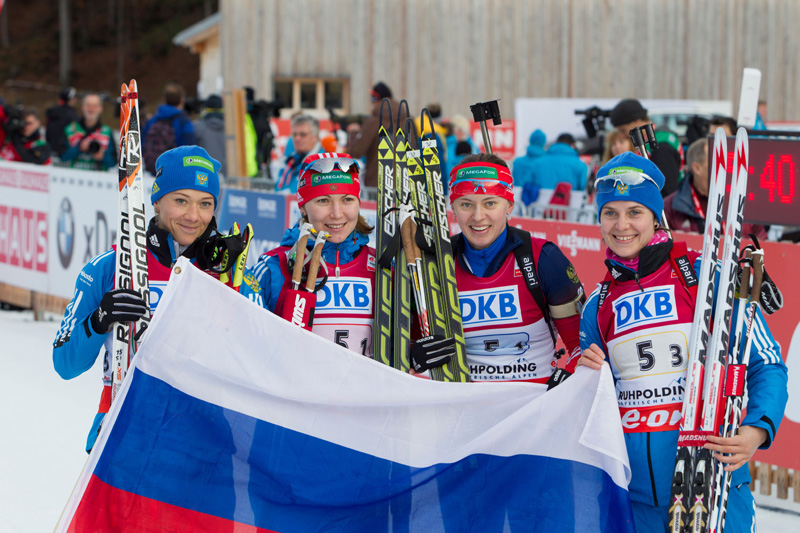
    Irina Starykh (far right) celebrates with the Russian team after their IBU World Cup biathlon relay victory in Ruhpolding, Germany, in January. The result is among those which will be voided with Starykh's doping ban, from a sample collected in December. (Photo: Fischer / Nordic Focus.)
    Irina Starykh (far right) celebrates with the Russian team after their IBU World Cup biathlon relay victory in Ruhpolding, Germany, in January. The result is among those which will be voided with Starykh’s doping ban, from a sample collected in December. (Photo: Fischer / Nordic Focus.)

    Starykh: Irina Starykh had World Cup podiums in December 2013, and was looking set to lead the Russian team at the Sochi Olympics. Then, a sample collected in late December tested positive for EPO.

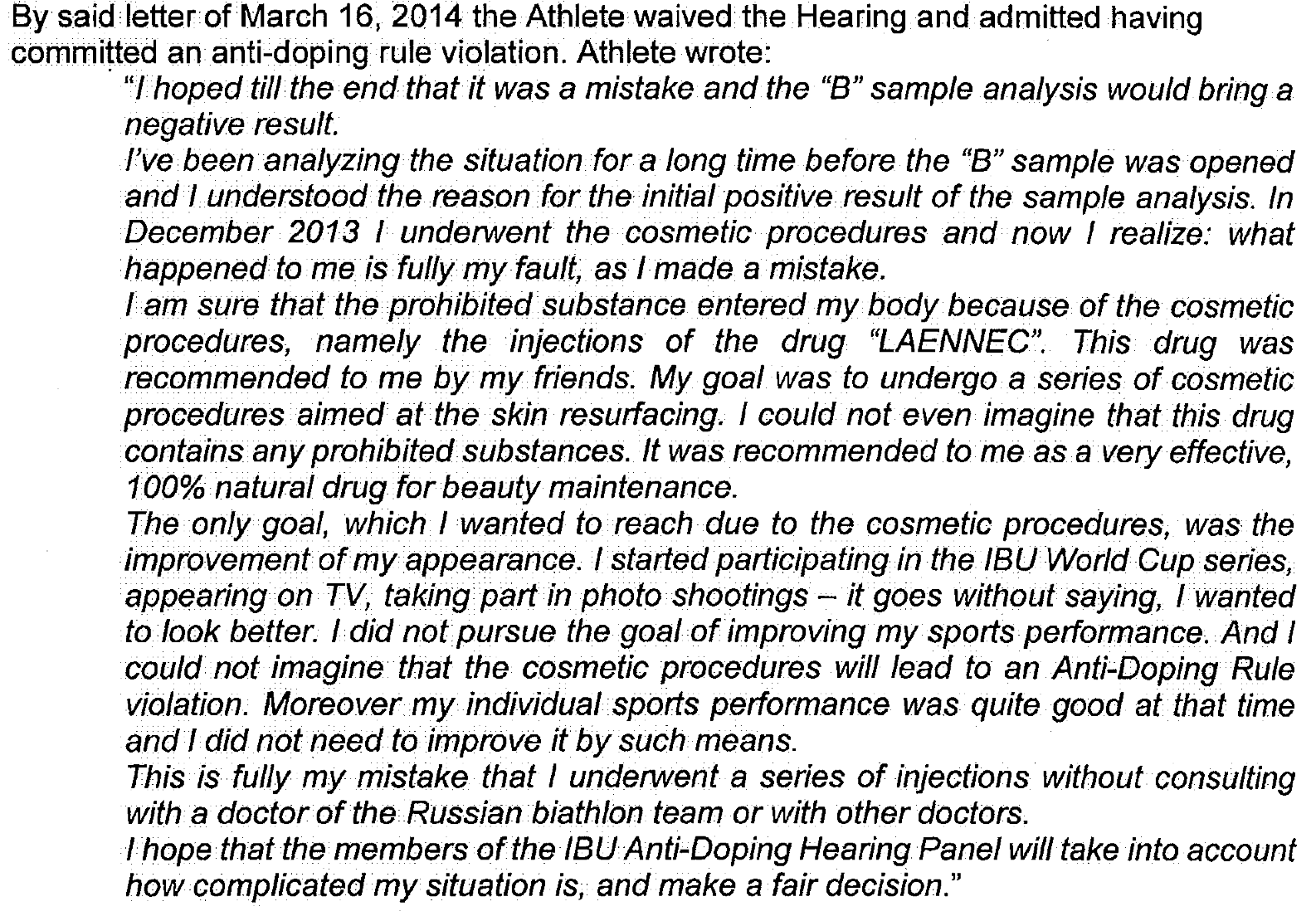
    At the time she claimed that the EPO must have come from some cosmetic injections she took because she was self-conscious about her appearance. There was no evidence of this being the case: neither that she had actually taken injections, nor that EPO was present in the drug, LAENNEC. Starykh received a two-year ban.

    The sample which re-tested positive was taken about ten days later, on January 2, 2014.

    Before the second anti-doping hearing panel, Starykh did not claim innocence. At issue, instead, was whether the tests should be considered as separate or as one violation, since they occurred only days apart. Starykh argued that both tests could be the result of a single injection (she wrote an injection of the cosmetic enhancer, but the panel could consider it an injection of EPO), and thus that no additional ban should be implemented.

    The IBU disagreed, arguing that not only should an additional ban be put in place, but it should be a longer one because the tests indicated multiple infractions.

    The hearing panel concluded that because the tests were so close together in time, they must consider their process as if they were adjudicating both together. But they did decide that the two samples indicated that Starykh had used EPO multiple times – this is especially true since doping athletes now frequently use very small doses to try to avoid detection, but administer these doses repeatedly. The half-life of EPO is short, on the time scale of hours to days, so it seems impossible that the second test would still be indicating a single injection detected by the first test.

    Thus, the panel decided to ban Starykh for one additional year, after her first two-year term is served. She will be eligible to compete again at the end of December, 2016.

    Iourieva: Ekaterina Iourieva, a former World Champion, had already had two anti-doping infractions. She served a two-year ban beginning in 2009 after testing positive for EPO then. In the run-up to the 2014 Olympics she had returned to competition, although not very successfully. In December 2013 and January 2014 samples were collected in out-of-competition tests and were found to have EPO in them. The anti-doping hearing panel convened at the time banned Iourieva for eight years, noting that it was her second EPO violation in the space of eight years.

    The re-tested samples were from November 2013, just a month before the samples that would earn her the eight-year ban. In the re-testing case, Iourieva did not respond to requests by the panel to present her side of the story. The panel even wrote the Russian Biathlon Union to offer her more time to respond, at which point the RBU wrote that “There will be no feedback from Iourieva as she decided to finish her professional sports career.”

    The hearing panel concluded by disqualifying all of Iourieva’s results beginning in November 2013, and serving her a four-year ban – beginning in December 2021, when her eight-year ban ends.

  • Sednev Case Concludes with Two-Year Ban, 22 Months of DQed Results

    Sednev Case Concludes with Two-Year Ban, 22 Months of DQed Results

    Sergui Sednev (UKR), Evgeniy Garanichev (RUS), Tim Burke (USA), and Erik Lesser (GER) on the range in a relay race in Oberhof, Germany, in 2013. (Photo: USBA/NordicFocus.com)
    Ukraine’s Sergui Sednev (l), Russia’s Evgeniy Garanichev (second from l), Tim Burke (second from r) of the U.S., and Germany’s Erik Lesser on the range in a 2013 relay race in Oberhof, Germany. A sample of Sednev’s collected two weeks after this competition was re-tested in December and found to contain the blood-doping drug EPO. (Photo: USBA/NordicFocus.com)

    The International Biathlon Union (IUB) enacted bold anti-doping plan last autumn: they took stored blood and urine samples from previous seasons which had been deemed suspicious, and re-tested them using newly available methods to try to catch dopers who had flown under the radar and under detection limits.

    That effort yielded two positive results for erythropoietin (EPO), an illicit blood-doping drug. They belonged to Alexander Loginov of Russia and Sergui Sednev of Ukraine. The results from Sednev’s hearing panel have now been released, and the Ukrainian veteran has been banned for two years. He retired four days after the testing result — before it was announced to the public — but if he wished to return to competition he would be allowed to do so in December 2016.

    The details of the testing in the case are unremarkable, as using the new method there was little doubt that the sample – which had been considered “suspicious” the first time around – contained EPO. Sednev, a Junior World Championships, European Championships and World Championships medalist, did not seem to have mounted much of a defense. He sent a note to the IBU reading,

    “Therefore, I can’t explain this incident since, as I have already indicated, I have never taken prohibited substances and nobody ever has prescribed them to me. So, I am unable to provide with the necessary objective documentary evidence to the contrary … I do hope for a fair decision from the Anti-Doping Hearing Panel.”

    Since Sednev couldn’t provide compelling evidence that the test was incorrect, the chain of custody of the sample had been broken, or any other reason for a possible mistest, the IBU’s Anti-Doping Hearing Panel, chaired by Christoph Venner, a Munich law professor panel decided that it was appropriate to give him a standard two-year ban.

    In addition, all of his results since January 22, 2013, when the sample was initially collected, were disqualified. That included placing 39th in the sprint at 2013 World Championships; placing 33rd in the sprint and 40th in the pursuit at a World Cup in Oberhof, Germany, in 2014; and finishing 44th in the sprint and 54th in the pursuit at the 2014 Olympic Games, among other results.

    One man who might be particularly devastated by that last one? Russell Currier, a U.S. athlete who placed 61st in the Olympic sprint and missed a place in the pursuit competition by 2.6 seconds. Unless Ukraine replaced Sednev with another top-60 competitor, the doper’s presence in the race might have been what kept Currier from getting another Olympic race start under his belt.

    “Sounds like the sport is one step closer to being clean,” Currier wrote in an email. “At the end of the day the more doping athletes we can uncover and penalize for the better. It’s hard not too look at past results and wonder what if, but it’s also doesn’t help much either. I just hope that WADA is doing everything in their power to bring the sport up to 100% clean.”

    Most of Sednev’s best results, including one World Cup win and three other individual podiums, came from well before the 2013 sample was collected.

    Legal Thinking

    But even after disqualifying all of Sednev’s results, there was still the question of the suspension. The sample in question was collected in January 2013, but was re-analyzed in December of 2014. So should the two year ban start from 2013? Or 2014?

    The panel referred to “cumulative effects” of a retroactive disqualification plus a suspension from the date of the re-test. In addition to the two-year ban beginning on January 15, 2014, when Sednev’s provisional suspension was announced by the IBU, the disqualification of his results would increase the time of the punishment in these cases.

    “Retroactive disqualification of the competitive results obtained during the time between sample collection and the suspension imposed after the re-analysis may amount to some years, in the case of the Athlete to more than 22 months,” the panel noted.

    The question the panel seemed to mull was, is this OK? In effect, it means that the punishment for athletes who initially get away with doping but are later caught, turns out to be different than for those who are caught immediately. There’s no clear philosophy in the anti-doping rules about these cases, which likely weren’t imagined when the rules were written. And while punishment is supposed to be just that, punishment, it is also supposed to be equal among offenders.

    The panel noted that one “obvious option” would be to have the two-year suspension start from the date of sample collection. But in that case, Sednev would have served 22 months of the 24 month suspension by the time he as even caught, and would never have had to actually sit out of competition except during his provisional suspension.

    “In such situation, in re-test cases, the athletes, in reality, were free to compete all over the time of the disqualification and only run the risk to lose their results and to be declared ineligible for a period of time which already elapsed in full or partly,” the panel wrote.

    Furthermore, they believed that athletes should be aware of this.

    “The fact that this ADRV [Anti-Doping Rules Violation] was not detected as an immediate result of the sample collection in January 2013 reveals that the athlete committed the ADRV in such meticulous manner that it remained undetected in the analysis of January 2013. After the failure of that first analysis the Athlete bona fide could not have the belief that he was legally free to compete. On the contrary, he must have been conscious that, due to the possibility of a re-test, the ADRV could be detected at a later stage.”

    They concluded that to start the suspension from 2013 would be unfair to clean athletes, and not be much of a deterrent to other dopers.

    Thus, Sednev has been suspended for two years, starting with his provisional suspension on December 15, 2014. Sednev has 21 days to appeal the decision, should he wish to.

    There is no word yet on the results of the Loginov case, perhaps because Russian athletes in the past have attempted to fight suspensions, while Sednev’s case was straightforward. However, the Sednev case provides a blueprint for the retroactive disqualifications and two-year suspension that are to be expected for Loginov.

  • Sednev’s Doping Suspension Leaves Uneasiness in the Biathlon Community

    Sednev’s Doping Suspension Leaves Uneasiness in the Biathlon Community

    Sergui Sednev (UKR).
    Sergui Sednev of Ukraine competing at 2013 World Championships in Nove Mesto, Czech Republic. A sample collected on January 22, 2013 – before the Championships – has been re-analyzed and tested positive for a prohibited substance. All of Sednev’s results after that sample was collected may end up being scrubbed from the record books.

    Ukrainian biathlete Sergui Sednev has been issued a provisional suspension after a sample collected January 22, 2013, was re-tested using a new analytical method and detected EPO. Sednev has declined to have his “B” sample opened.

    Sednev is a two-time Olympian (2010 and 2014) who finished 10th in the pursuit in the 2010 Olympics in Vancouver, but scored just nine individual World Cup points last season.

    The positive test comes as part of an effort to re-test suspicious samples from previous seasons using a newly-available analytical method. It already snared Russia’s Alexander Loginov at the beginning of the season; he was suspended in November for a sample that had been collected almost exactly a year earlier.

    IBU President Anders Besserberg told Norway’s NRK broadcaster that at this point, all of the stored samples have been retested. That does not necessarily mean more bans will not be announced; there was a one-month lag between the analytical result for Sednev’s doping offense, and the announcement of his suspension. Many in the biathlon community are speculating that more suspensions may be on the way.

    After all, Besseberg had told Norwegian media that doping suspensions from multiple countries were on their way. Technically, this promise has been fulfilled: Russian and Ukrainian athletes have now been issued provisional suspensions. But the buildup in the media after that interview left many fans wondering whether bigger names would be involved, and waiting for bombshell revelations.

    The positive test unfortunately does nothing to clarify whether Sednev was doping throughout his career, or only at the end of it – as appeared to be the case for Finnish skier Tero Similä, a former World Cup skier who at age 34 had slid back to the middle of the Continental Cup results pages. Similä was caught using EPO at Finnish National Championships in 2014, where he had a stunning third-place result in the 10 k classic, likely in an attempt to make the Olympic team.

    When 30-year-old Sednev started the 20 k individual at the first World Cup weekend in Östersund, Sweden, this season, it marked the start of his 11th year on the World Cup. He finished 83rd with the 90th-fastest course time. Instead it was his teammate Sergey Semenov who stood on the podium, finishing second behind Emil Hegle Svendsen of Norway.

    Sednev did not compete again on the World Cup, nor did he appear at second-tier IBU Cup races. His Ukraine teammates continued to earn podiums in World Cup and IBU Cup racing.

    But earlier in his career, Sednev had seen considerable success. In January 2010 he won a 20 k individual World Cup competition in Antholz, Italy, and had a dozen top-tens including three other podiums. His best more recent result was back in Antholz, where he finished eighth in the 12.5 k pursuit in January 2013.

    Sednev was also part of three World Cup podium relay teams, as well as the bronze-medal men’s relay from 2011 World Championships in Khanty-Mansiysk, Russia.

    At that same World Championships, the women’s team won silver in the relay. That medal was taken away when Oksana Khvostenko tested positive for the banned stimulant ephedrine, which she said that she accidentally ingested through cough medicine.

    Sednev’s provisional suspension was dated December 15th of 2014; he announced his retirement on December 19th, although nobody made the connection at the time because a name had not been released with the suspension and Sednev was hardly a force to be noticed on the circuit.

    Should his provisional ban be made permanent after his hearing with the IBU Anti-Doping Hearing Panel, all results from after the sample was collected in January 2013 would be scrubbed from the record. That includes two World Cup relays, a tenth- and an eleventh-place effort, and participation in the ninth-place mixed relay and the 14th-place men’s relay at 2013 World Championships.

    The Biathlon Federation of Ukraine, in their announcement of Sednev’s positive test, implied that he had decided to retire independently, and that was the reason that he did not request to have his “B” sample opened (which would have cost 2,500 Euros): “But as Sednev had finished his career [sic] after the poor results over the past seasons, he decided not to conduct the further analysis,” the federation noted.

    Along with Sednev’s test, four other positive samples were noted in the IBU press release. None of the names were new to followers of the sport: Russia’s Alexander Loginov was issued a provisional suspension at the end of November, the first of the re-testing results to be released, and at the same time it was made known that Russian teammates Irina Starykh and Ekaterina Iourieva had also had old samples show positive tests. Those two were already serving doping bans for EPO, which had been announced in January before the 2014 Olympics; the new results proved that they had certainly doped on more than one occasion.

    That troubles IBU President Anders Besseberg, who told Norway’s VG news service that the federation might pursue action against the Russian federation.

    “Personally I will be very surprised if the Executive Board of the IBU does not want to impose a penalty on Russia’s biathlon federation, given that all three are convicted,” he said, according to a translation. “We have the opportunity to give penance and simultaneously claim to cover legal costs…”

    Reportedly, bylaws allow a federation to be fined as much as roughly $250,000 if more than one athlete has a positive test within a 12-month period.

    Besseberg linked the four cases through the old Soviet Union.

    “This is special because we have three athletes from one nation,” he told VG. “And one cannot hide the fact that 80 to 90 percent of positive doping tests in biathlon are from nations that previously belonged to the Soviet Union. There has been a culture there for so long and such culture one cannot reverse overnight.”

    The positive tests are not surprising to German journalist Hajo Seppelt, whose documentaries aired this fall on ZDF and revealed widespread systematic doping and cover-ups in Russian sport, as well as in track and field more generally. He has repeatedly called on the World Anti-Doping Agency and the International Olympic Committee to thoroughly investigate his findings. In a recent interview with Germany’s ARD news service, he noted that IOC President Thomas Bach was in Oberhof this weekend at the biathlon World Cup – but neither Bach nor the IBU took this opportunity to jointly speak about biathlon’s doping problem.

    “The question is now out there, whether the IBU is transparent and publicly declares the magnitude to which they can retrospectively analyze which substances,” he said. “Or if you pass statutes of limitations- then, the impression arises that one is not interested in negative publicity, and therefore prefers not too look too hard. The IOC is in this respect a sad example: it takes a billion dollars through television rights, so it would have enough money to retrospectively examine a large number of frozen doping samples again. Why it doesn’t it try to subject all samples to a major retest?”

    In this respect, the IBU does appear to be far ahead of its peer federations. Besseberg explained to VG that the federation had held onto samples which, using its blood passport program, seemed suspicious. Then, when new methods were available, they re-tested all the samples.

    “I am pleased that we have such a good system, that we manage to weed out those who should not be included in the competitions, and that we protect the clean athletes,” he said.

  • Breaking: WADA To Launch Major Investigation of Russian Doping Allegations

    Breaking: WADA To Launch Major Investigation of Russian Doping Allegations

    After a sensational German documentary aired last week alleging widespread state-sponsored doping in Russia, as well as elaborate and financially shady cover-ups, the World Anti-Doping Agency (WADA) released careful statements expressing their dismay for the situation. It initially seemed like the allegations would be investigated only by Russia’s internal anti-doping agency, RUSADA, and by the International Association of Athletics Associations (most of the athletes named in the documentary were track and field stars).

    After intense pressure, WADA announced today that they will launch their own full and independent investigation, which will proceed regardless of the pace or scope of IAAF or RUSADA work.

    “WADA is the independent anti-doping agency tasked with the mandate of ensuring that the clean athlete is supported in every sport and in every country,” WADA President Sir Craig Reedie said in a press release. “The allegations that have been raised in the German television programs require close scrutiny to determine what actions are required to be taken by WADA and others, to confirm the evidence, seek further evidence, and pursue any anti-doping rule violations or breaches of the International Standards that have allegedly taken place. WADA must ensure that all athletes who have cheated, either at national or international level, are dealt with in an appropriate fashion under the World Anti-Doping Code.”

    An English-language transcript of the documentary has been released, which reveals that the systematic doping occurred in far more sports than track and field: cross-country skiing and biathlon were specifically named. A second documentary, so far not translated to English, has implicated additional athletes from other countries. This comes at the same time as a massive cache of documents pertaining to the case of infamous Italian doping doctor Michele Ferrari is being released, including wire taps between Ferrari and David Taschler, a biathlete who is the son of the International Biathlon Union’s Vice President for Sport, Gottlieb Taschler.

    North American biathletes and staff have also weighed in on the doping allegations. Kikkan Randall, the U.S. cross-country skier who serves as the athlete representative to the International Ski Federation (FIS), did not respond to a request for comment.

    The Allegations

    The documentary, made by Hajo Seppelt, aired last week on German channel ARD, but an English-language transcript was only recently made available by WDR. You can read it here.

    While we covered some of the most glaring and commonly-discussed messages from the documentary when it came out, the transcript offers more details that are particularly interesting to nordic sports. It also provides a clear picture of the professionality Seppelt brought to his work. The German did not appear to cut corners; he displays videos and plays cell phone recordings in the documentary (which you can watch here) to prove his points. When a source secretly filmed her coach handing her a packet of anabolic steroids, Seppelt had the pills tested at the Cologne, Germany, anti-doping lab and confirmed that they were, in fact, Oxandrolone.

    He also sent an employee to investigate just how easy it is to obtain recombinant erythropoetin (EPO, a common blood-doping drug) in Russia. Here’s an excerpt from the transcript:

    Screen Shot 2014-12-10 at 9.06.32 PM

    3,925 rubles is about $40 dollars.

    While all of Seppelt’s sources come from the world of track and field, they know that doping is more widespread than simply their own sport. Vitaliy Stepanov, who formerly worked in an anti-doping laboratory in Russia and was dismayed and disillusioned by what he saw there, listed these as the sports that are protected, in that they are not tested or positive tests are covered up: “Swimming, Cycling, Biathlon, Athletics, Weight Lifting, Nordic Skiing.”

    Besides a much-discussed story in which marathon champion Lyliya Shobukhova, who paid her own federation bribe money in order to suppress a positive test and compete in the 2012 Olympics. Seppelt details the manner in which the financial transaction — worth $600,000 at one point — was carried out using a shell company based at a random address in Singapore.

    The question that viewers might be left with is, why haven’t we heard anything about all of this earlier, if it’s so extensive? The documentary gets to that, too. Here’s another excerpt:

    Screen Shot 2014-12-10 at 9.16.44 PMThe two foremost informants for Seppelt’s documentary left Russia before it aired, and plan never to return. They hope to make a new life for themselves and their child in safety.

    The Reaction

    After days of tense speculation and inside discussion, there is a sense of relief that WADA itself will be tackling the allegations, instead of leaving it to another organization.

    “I am really glad to see that WADA is undertaking a full investigation into all the very serious allegations made in the ARD documentary on systematic doping and corruption within the anti-doping effort,” U.S. Biathlon Association President & CEO Max Cobb told FasterSkier. “Biathlon is mentioned in the documentary and less than a month ago IBU suspended another top level athlete for doping. This may be a watershed moment for clean-sport.  WADA is wise to launch a full and independent investigation.

    He’s referring to Alexander Loginov, who was busted for using EPO in November when the IBU used a new method to test stored samples from the previous season. At the time, news outlets including this site heralded the development as a smart move. While the new method has not been revealed, it could possibly be the use of “transcriptomics” to test for a signature of changing gene expression in response to EPO, rather than to EPO itself. In development for years, such a test has been hailed as “perfect” because there is no way to hide this biological signature once you have doped.

    Among the allegations in the documentary, however, is that Russian athletes are advised to take urine samples when they are not doping, freeze them, and use them to cover their tracks if they are tested and know they will fail. Seppelt also reports that samples are checked before athletes ever leave the country, so that athletes who might test positive at major events never have the chance.

    All of this reveals a more sophisticate state-level doping system than had been imagined, and means that even the perfect test might not be able to catch Russian dopers.

    When asked about the documentary, U.S. biathlete Lowell Bailey, one of four athlete representatives to the IBU, said that he needed more information before reaching any conclusions. (FasterSkier reached him this weekend at the World Cup in Östersund, Sweden, before the English transcript was released.)

    “The most I can say is that I don’t know any of the sources that were cited,” Bailey said. “I don’t know any of the people who were interviewed or how they went about doing it. So I really can’t comment on anything that the documentary involves… Honestly, what we’re focusing on from day to day is what training sessions are like and how we can improve. A lot of this stuff is going on outside of the World Cup. These allegations, I guess you could say, are yet to be confirmed by any reputable source like WADA or the IOC.”

    That may be true, Seppelt has been a prescient commentator before. He broke the story of doping in Kenyan distance running back in 2012. Two years later, three-time Boston Marathon winner Rita Jeptoo failed a test for EPO, unleashing a firestorm in the athletics world.

    While Bailey couldn’t comment on the documentary, he did weigh on an the suspension dealt to Loginov. In Kontiolahti, Finland, last season, Bailey finished third in a World Cup sprint. Loginov was second.

    “For sure, it made me angry that I have worked my whole life to climb up onto that podium, and the guy who is standing there next to me was cheating the whole time,” he said.

    Canada’s Nathan Smith place eighth in the same race.

    “One of my best races last year, he [Loginov] was on the podium so I guess he robbed me of his spot, right?” Smith asked retorically, reached on Sunday in Östersund. “I would’ve been seventh instead of eighth. But, I don’t know, I mean, you can’t ignore the facts, Russia has so many cases that they still have problems.”

    Bailey says that he fully expects to have his result from the race amended to second place. He will also rise in the rankings of last season’s World Cup total score.

    But he didn’t get to enjoy second place in the moment.

    Still, Smith says, the sport seems to be cleaner than when he first showed up on the World Cup circuit.

    “I remember [Maxim] Tchoudov was just blowing everyone out of the water,” Smith said. “I think he was a minute faster than the next guy and in the relay it was like I was standing still. Obviously I’m a lot stronger now, but I think back then, we wouldn’t have even been able to compete with that. He never got caught for anything, but it was definitely questionable, and now I think the Russians in general are a lot more human.”

    With Loginov’s test, both Smith and Bailey feel there is evidence that they system is working.

    “You can see that in the results,” Smith said. “They don’t have tons of good guys in the top 10, they’ve got like one guy. I think it’s realistic that for the most part their team is probably clean, but I’m not really sure. Definitely with the more stringent testing, you can tell countries like U.S. and Canada, we’re definitely more competitive now. I’d say we have a chance, so it definitely helps our countries, that’s for sure.”

    For Bailey, it’s just not worth wasting a lot of time, anger and energy worrying about Russian doping. He has to trust in the system, he explained, and focus on what he can do to be the best – not whether more former competitors might retroactively get disqualified.

    “I really focus on what we can control, for ourselves,” Bailey said. “I’m lucky that in the United States we have basically the best team that you can ask for, and every resource that you would need in order to do the best training … I talk with a lot of the athletes on a daily basis, so I can kind of get a feel for what people are thinking. I think at this point, the athletes place a lot of trust in the antidoping agencies and the testing protocol that the IBU has put in place and WADA has put in place, and the various national-testing pools. You have to place your faith in those organizations, and really hope and believe that they are doing their utmost to stay ahead of the dopers. And the rest is just, the day to day preparation for training and racing on the World Cup.”

  • German Documentary Alleges Widespread Doping, Cover-Ups in Russia

    German Documentary Alleges Widespread Doping, Cover-Ups in Russia

    Irina Starykh racing in Hochfilzen, Austria, last December, is one of three Russian biathletes caught using EPO in the last 12 months. While this has led to the conclusion that Russian biathlon has a systematic doping problem, a new documentary alleges that the problem is much worse and much more widespread.
    Irina Starykh racing in Hochfilzen, Austria, last December, is one of three Russian biathletes caught using EPO in the last 12 months. While this has led to the conclusion that Russian biathlon has a systematic doping problem, a new documentary alleges that the problem is much worse and much more widespread.

    When Russian biathlete Alexander Loginov was provisionally suspended last week after a year-old sample tested positive for the blood-doping drug recombinant erythropoietin (EPO) using a new method, many weren’t surprised.

    The question was, why does this keep happening to Russia? One interesting commentary by Evgeniy Slyusarenko of the Russian sports website Championat explained that in Western Europe and North America, the responsibility for performance lies on the athlete, who must make decisions for themselves and accept the consequences. On the other hand, in Russia, athletes are expected to follow orders – in fact, everyone is expected to follow the orders from their higher-ups. And it is not the bosses who get fired when there are doping scandals. The bosses only get fired when there are no Olympic medals.

    A new documentary aired on German broadcaster ARD last night alleges that though the roots of the Russian doping problem are just as Slyusarenko described, it goes much deeper. Noted journalist and documentarian Hajo Seppelt found evidence of not only state-sponsored doping, but routine cover-up procedures in place to avoid scandals involving high-profile athletes. Unknown and up-and-coming athletes were not so lucky, and were discarded by the system after a positive test.

    You can find the hour-long documentary here, if you have VPN or a location-unblocker, and if you understand German.

    Seppelt was compelled to investigate Russian doping after the 2014 Olympics, in part after it was revealed that Russian cross-country skiers were using xenon gas as a performance-enhancing measure.

    “I wanted to report to a much greater degree on doping in Russia,” Seppelt told ARD in an interview. “Research in March. I could not expect at the time that the story would evolve like this. We must assume that in Russia a state-supported doping system exists with a big cover-up machine that pulls the strings in the background.”

    Many of the central messages in the documentary come via a pair of whistleblowers who contacted Seppelt: 800-meter runner Yuliya (Rusanova) Stepanova, and her husband Vitaliy Stepanov, who used to work for the Russian anti-doping agency RUSADA.

    The pair claim that not only would officials cover up positive tests by star athletes, for instance by “making a mistake” in the labwork to justify throwing out the results, but that athletes were also told to keep “clean” urine samples in their freezers to use for doping tests.

    The documentary also shows a video clip recorded on a cell phone, in which London 2012 800 meter gold medalist Mariya Savinova admits to using oxandrolone, a prohibited anabolic steroid.

    Several other athletes went on the record about not only doping and the availability of illicit performance-enhancing drugs, but also shady financial practices used by Russian federations, sometimes through shell companies.

    Some of the allegations have also been reported on by other journalists. For instance, it was French newspaper L’Equipe which initially wrote that Russian marathon champion Liliya Shobukhova had paid her own federation a bribe to avoid a doping ban. After paying, she raced in the 2012 Olympic marathon – but when she failed to finish, the federation banned her after all.

    Multiple Russian sports and anti-doping officials have categorically denied the claims.

    “You should be very careful about putting too much faith into these athletes’ claims,” the head of Moscow’s doping control lab, Grigory Rodchenkov, said according to The Guardian. “These people are experiencing the biggest catastrophe of their lives.”

    Seppelt disagrees.

    “I did not think that there was still any system, in 2014, which has so many parallels to what was formerly done in East Germany,” he said in his ARD interview. “All this is topped by the capitalist characteristics of a commercialized elite sport system that is the status quo in Russia.”

    And as for why no Russian athletes tested positive in Sochi? That’s no accident, he concludes.

    “The facade has little to do with the reality of the thing,” he said. “In our film, you will see that both the Russian Anti-Doping Agency, the Doping Control Laboratory in Moscow, and sporting organizations operate what is obviously a system for the protection of national interests and the cover-up of doping to a significant extent… in my view it’s just window dressing.”

  • Russian Biathlete Loginov’s Sample from November 2013 Is Positive for EPO

    Russian Biathlete Loginov’s Sample from November 2013 Is Positive for EPO

    Lowell Bailey (USA) leading Alexander Loginov of Russia in last season's World Cup pursuit in Kontiolahti, Finland. In the sprint, Loginov had placed second and Bailey third; a previous sample of Loginov's has tested positive for EPO. Photo: USBA/NordicFocus.
    Lowell Bailey (USA) leading Alexander Loginov of Russia in last season’s World Cup pursuit in Kontiolahti, Finland. In the sprint, Loginov had placed second and Bailey third; a previous sample of Loginov’s has tested positive for EPO. Photo: USBA/NordicFocus.

    The International Biathlon Union (IBU) has begun re-testing antidoping samples stored from last season using a new technique to detect recombinant erythropoetin (EPO), a blood-doping drug.

    Three samples have reportedly come back positive using the new test. Two belong to athletes who were already suspended (assumed to be Ekaterina Iourieva and Irina Starykh of Russia) while the third is a new positive. Reports allege that it belongs to Alexander Loginov, another Russian.

    Loginov is a double World Junior Champion from 2013. He debuted on the World Cup at the end of the 2012-2013 season, hitting the podium in his first weekend of racing.

    Since the sample was collected in November 2013 (almost exactly a year ago: Loginov was in Östersund training in advance of the 2013-2014 World Cup opener), the Russian continued on the World Cup. He competed at the 2014 Olympics in Sochi Russia, where he finished 30th in the 20 k individual. He was not part of Russia’s gold-medal men’s relay team.

    A few weeks later, however, he placed second in the World Cup sprint in Kontiolahti, Finland. He also placed second in the season-ending pursuit in Oslo, Norway. In Kontiolahti, U.S. biathlete Lowell Bailey was 0.9 seconds behind Loginov and placed third for the first podium of his career.

    Loginov can be stripped of all his results since the date of the sample collection if his “B” sample also comes back positive for EPO.

    Alexandr Loginov, en route to winning the 2013 World Junior Championship sprint. Photo: Mario Danzl/Obertilliach 2013.
    Alexandr Loginov, en route to winning the 2013 World Junior Championship sprint. Photo: Mario Danzl/Obertilliach 2013.

    According to IBU Secretary General Nicole Resch in a public statement, the new technique only came into use in autumn 2014. She emphasized that storing and re-testing samples is something that the federation is allowed to do according to anti-doping rules.

    Some fans in Russia, however, suggest that the IBU might have known about the test for a longer period of time and deliberately timed the announcement to make the biggest impact before the beginning of the World Cup. Nevertheless, discussion and rumors of a new and better EPO test have been swirling around the sports world since at least the winter.

    The IBU has not explained what their new method is, but among the rumors have been discussion of using a transcriptomics approach: instead of looking for analytic evidence of the drug, researchers have had success searching instead for a “molecular signature.” In short, this means looking at the expression of RNA’s which are the result of increased transcription of the hundreds of genes affected by EPO. Dr. Yannis Pitsiladis at the University of Brighton has described finding a reliable, repeatable signature when subjects use large doses of EPO. His work has been featured in the New York Times and already published in the British Medical Journal. Work is ongoing to determine whether the signature is detectable when athletes use a “microdosing” approach of repeated, smaller amounts of the drug.

    Meanwhile, scientists working on the MAIIA system, which is currently used to detect EPO, on Monday published research on their new advanced rapid-screening process in the peer-reviewed journal Drug Testing and Analysis. The new strategy would significantly reduce the time needed to process antidoping samples. They report obtaining reliable results using the faster method on both urine and plasma samples, and using the same detection curves as were developed for previous, slower analytical methods.

    The IBU explained their strategy in a press release:

    “Before the start of the 2014/ 2015 biathlon season, the IBU pro-actively decided to re-analyze some samples that showed atypical results in the previous season and were therefore stored for potential future analysis. The reason for this is a new testing method for WADA laboratories that has become available in the fall of 2014 to prove the presence of recombinant EPO. With this new tool, the IBU is optimistic to have an even more powerful tool to keep the sport absolutely clean.”

    Loginov was set to compete in the first set of World Cup competitions in Östersund, Sweden, this weekend and next weekend, but is now facing a provisional suspension. The Russian federation has announced that they will not move another athlete up into his slot this weekend.

    “At the request of the athlete [we] have asked for the full package of IBU documents to ascertain all the data analysis in order to continue to avoid such moments,” the Russian Biathlon Union wrote on their website, according to a translation.

  • Starykh Banned for Two Years; Claims EPO Was in Cosmetic Injections of Human Placenta

    Starykh Banned for Two Years; Claims EPO Was in Cosmetic Injections of Human Placenta

    Irina Starykh (far right) celebrates with the Russian team after their IBU World Cup biathlon relay victory in Ruhpolding, Germany, in January. The result is among those which will be voided with Starykh's doping ban, from a sample collected in December. Photo: Fischer / Nordic Focus.
    Irina Starykh (far right) celebrates with the Russian team after their IBU World Cup biathlon relay victory in Ruhpolding, Germany, in January. The result is among those which will be voided with Starykh’s doping ban, from a sample collected in December. Photo: Fischer / Nordic Focus.

    On Wednesday, the International Biathlon Union (IBU) announced that it was banning Russian biathlete Irina Starykh for two years for use of recombinant erythropoietin (EPO), a blood-boosting drug commonly used in doping in endurance sports.

    Many in the biathlon world have been awaiting the verdict for months: the positive “A” samples of Starykh, teammate Ekaterina Iourieva, and Lithuanian Karolis Zlatkauskas were announced on January 28 after Starykh’s sample was collected on December 23 in Pokljuka, Slovenia, in an out-of-competition test.

    Today, the IBU announced that Iourieva will be banned for eight years. It is her second doping offense for EPO. A world champion in 2008, Iourieva announced her retirement earlier this year, after the samples were initially analyzed.

    Zlatkauskas admitted to doping in February and said he would not fight a ban.

    The IBU Anti-Doping Hearing Panel, chaired by Edward Williams, a 1964 graduate of Dartmouth College who was a national champion in cross country skiing, NCAA All-American before competing in the 1968 Olympics in biathlon. He is now an attorney in sports law and arbitration in New York City.

    The panel also included Dr. Walter Frey of Switzerland and Juha Viertola of Finland. The group met on March 21 to hear the case. Their decision was dated July 14; it’s unclear why the decision took so long as no new evidence appeared to be entered following the March hearing.

    The hearing panel’s detailed decision (available here) shows that Starykh did not fight the ban. She initially requested that the opening of the “B” sample be delayed from early February until after the finish of the Sochi Olympics on February 26. Russia’s top-ranked female biathlete, Starykh had stood on the World Cup podium earlier in the season and had been expected to compete in Sochi. After the “A” sample was analyzed she faced a provisional suspension from competition, yet still delayed the opening of her “B” sample.

    The Russian Biathlon Union was initially extremely defensive surrounding the Starykh case.

    The “B” sample was opened on March 3, and Starykh was present along with three of her own representatives. On March 6, the sample analysis was finished and it was also positive for recombinant EPO.

    Starykh waived her right to a provisional hearing in a letter stating that “[I] acknowledge the Anti-Doping Rule violation and the consequences of this violation in the form of disqualification.”

    In the letter, Starykh claimed that the EPO must have entered her body from an injectable skin treatment called Laennec which she began using on the recommendation from friends for skin resurfacing in order to improve her appearance. With her growing success as a biathlete, Starykh explained, she began being interviewed on television and wanted to look better.

    Screen Shot 2014-07-18 at 11.29.39 AM

    The active ingredient in Laennec is a “water-soluble substance of a product of enzymatic human placenta”. The drug is manufactured by Japan Bio Products Co., Ltd. The product website lists hepatocyte growth factor as one example of an extracted growth factor; this factor helps recovery from liver damage. The main function of the drug is “improvement of hepatic function in chronic hepatic disease.”

    Other distributors have marketed the drug as a skin smoother and whitener.

    EPO is a naturally produced hormone. There is evidence that maternal EPO is expressed strongly in trophoblast cells, which initially form the outside of the blastocyst surrounding a human embryo and which then are incorporated into the placenta.

    Thus it is not impossible that if Starykh injected Laennec some EPO from the placenta would also enter her system.

    However, the lab test specifically found recombinant erythropoietin, which differs in structure from EPO produced by the human body. The recombinant, or manufactured, form contains the same protein but has different polysaccharides attached, resulting in a different electrical charge at the molecule level. This difference in charge is used to separate recombinant and natural EPO in the laboratory test.

    Thus, unless Laennec also contains recombinant EPO, not only any extra maternal EPO expressed in the placenta, it is not possible that the substance entered Starykh’s body from her cosmetic injections.

    Earlier in the winter Alexander Tikhonov, a four-time Olympic champion and one of the best biathletes ever produced by the Soviet Union, alleged that two doctor brothers named Dimitriev were responsible for doping both Starykh and Iourieva. The two were present in Hochfilzen, Austria, for World Cups in December.

    The panel minutes write that they did not find any “exceptional” circumstances and so handed down the standard prescribed 2-year ban for Starykh, starting from the date the sample was collected. All of her results accrued between December 23 and the “A” sample analysis have been voided as well.

    The Rossiiskaya Gazeta newspaper reports that Starykh will not fight the decision.

    There do not appear to have been any additional fines or sanctions for the Russian Biathlon Union.

  • Is Similä a ‘Black Sheep’? Positive EPO Test Stirs Old Fears for Finland

    Is Similä a ‘Black Sheep’? Positive EPO Test Stirs Old Fears for Finland

    Finnish cross country skier Tero Similä at Lahti Ski Games 2010. In March 2014, Similä tested positive for EPO. (Photo: Wikimedia Commons)
    Finnish cross country skier Tero Similä at Lahti Ski Games 2010. In March 2014, Similä tested positive for EPO. (Photo: Wikimedia Commons)

    The Finnish Ski Association confirmed yesterday that cross country skier Tero Similä tested positive for the blood-doping drug recombinant erythropoietin (EPO), based on a test administered in March. Both the “A” and “B” samples have now tested positive, and it is up to the Finnish Antidoping Agency to recommend a sanction, which the Finnish Ski Association will administer.

    Similä’s manager, Tuomo Haikola, described the result as a “big blow to us” when reached by Finland’s Kaleva news service.

    Similä himself released a statement to the press:

    “I have been tested on a regular basis since 1999 and during that time I have given dozens of blood and urine samples. In March 2014 the FINADA doping sample proved to be positive. I do not have a test result for any comments. I want to make it clear that this issue has nothing to do cross-country Association and the Ski Federation… After this release, I will not comment on the matter any more in public.”

    Similä will also face an additional fine, because last fall he signed an agreement with the rest of the cross country athletes which included a prohibition against doping. The penalty for violating this agreement is reportedly in the six-figure range (in Euros).

    Similä is a career athlete who made his first World Cup appearance in 2001, in fact because of doping. After placing ninth at World Junior Championships the prior season, Similä was competing on the Continental Cup. When six Finnish skiers were disqualified for blood doping at 2001 World Championships, new athletes were called up for the post-Championships World Cups. Similä got his first start at the end of the season in Falun, placing 74th.

    Although the six disqualifications at those Championships loom large over Finnish skiing – and sport in general – it is doubtful that Similä had much contact with the athletes or system at that time, as he was still an up-and-coming athlete and not on the “A” team along with them.

    He has raced fairly consistently on the World Cup ever since, and was a member of the 2006 Olympic team. Despite over a decade of racing, he never broke the top 30 on the World Cup and his most notable finishes were in relays, for instance at the 2006 Olympics where Finland placed 10th. This year, he failed to break into the top 50 in three weekends of World Cup competition and spent more time on the Continental Cup.

    One of his best results of 2014 came when it counted, at Finnish National Championships. Similä, 34, placed third behind Matti Heikkinen and Ville Nousiainen in the 10 k classic. He bested Iivo Niskanen, who went on to turn in a heroic fourth-place performance in the 15 k classic at the Olympics, by eight seconds, and Sami Jauhojärvi, who went on to win gold in the Olympic team sprint, by another eight.

    While Finland has tried to put the legacy of blood doping behind them, it has proven difficult. Similä’s case is not the first to revive these old tensions: in 2011, Juha Lallukka tested positive for human growth hormone (HGH). Lalluka denied having used the substance, and the Finnish arbitration board for sport overturned his ban, saying that the detection limits for HGH were unreliably set.

    Lallukka was back competing this winter; his only competition in the FIS database was the same 10 k classic at Finnish National Championships, where he placed seventh.

    Although both cases brought forth old prejudices about the ability of the Finns to stay clean, it does not seem clear whether or not they represent any kind of systematic doping. For instance, Similä was not part of the national team, training instead with a team based in Rovaniemi, northern Finland.

    Magnar Dalen, the outgoing Finnish head coach (who is originally Norwegian) hypothesized that Similä used performance-enhancing drugs to try to earn his way onto the Olympic roster.

    “I am reasonably confident that this is a black sheep, and not part of a system,” Dalen told Norway’s NRK broadcaster, according to a translation. “It’s some skier who does not belong at the Olympics, and that’s always part of these seasons. Unfortunately it always tends to be this desperate attempt near the end of a career… It is always boring, but we must distinguish between individual cases and the scandals in 2001 which were organized by the national leadership.”

    What is unclear, however, is how long into the past Similä’s EPO use may reach, or if he used the drug at any other point during his career. Among other issues, the test was administered in March, so if Similä was using EPO in order to make the Olympic team his use of the drug must have extended back at least several months.

    “Catching the EPO in March for the first time feels not so believable,” former Swedish star Mathias Fredriksson told the Expressen newspaper. “He should have [been caught] earlier in that case. And then the question is whether he has been tested earlier in the year. Has he been tested many times and not been caught? Then you wonder how reliable the tests are? Is it so that you can take EPO without getting caught?”

    Finnish administrators were visibly frustrated with the case, which they perceive as setting them back from the significant progress they have made since the 2001 disaster.

    “It’s a very tedious job, because recently Finnish cross-country skiing has been very positive,” Mika Kulmala, Executive Director of the Finnish Ski Association, told the Helsingen Sanomat.

    But Fredriksson, for one, wasn’t willing to give them a pass based on recent good behavior.

    “Apart from this case, I know that something ​​about the organization in Finland,” he told Expressen. “There are back some leaders who were around during the last scandal, when it was organized doping. [I] think it’s wrong that you did not delete those characters completely… It is remarkable that you do not take it more seriously, you do not shut the door completely for them. It is sad.”

    Similä has previously been coached by Reijo Jylhä, although not recently. Jylhä was recently hired to replace Dalen as the national team coach.

    “Most of all, it’s sad,” Jylhä told Hufvudstadsbladet, a Helsinki newspaper. “He has had a long and great career and performed equally well, though he never quite reached the top. It is sad that his career should end this way.”

    Jylhä, who led the Finnish team after the 2001 scandal until 2006, said that he and fellow incoming team coach Eero Hietanen learned of the positive test the same day that the Finnish Ski Association finalized their contracts. They discussed the matter and decided that it did not affect their decision about taking the jobs, but that it emphasized the need for greater supervision throughout the Finnish system.

    “The Ski Association and the athletes’ union must get athletes to undertake stronger [controls],” he said. “There cannot be athletes who are outside the target groups who we don’t keep track of. We must be able to trust anyone involved in national activities.”

  • Starykh, Iourieva ‘B’ Samples Positive for EPO

    Starykh, Iourieva ‘B’ Samples Positive for EPO

    Irina Starykh competing in the World Cup pursuit in Hochfilzen, Austria, in December. That weekend, the Russian finished third and fifth in individual racing.
    Irina Starykh competing in the World Cup pursuit in Hochfilzen, Austria, in December. That weekend, the Russian finished third and fifth in individual racing.

    Over a month after provisional suspensions were issued, the International Biathlon Union (IBU) has released more details on two of the three athletes involved in a doping investigation which began in January. For the first time, the IBU officially acknowledged that two of the athletes in question were Russians Ekaterina Iourieva and Irina Starykh. The names had been released by Russian news site Championnat, but the IBU had refused to confirm any details.

    In a press release posted to their website this weekend, the IBU also announced the the banned substance in question was, as had been widely speculated, the blood-doping drug recombinant erythropoetin (EPO). Both athletes’ “B” samples have now been tested and have also showed positive for EPO.

    A third athlete who was caught at a similar time, Karolis Zlatkauskas, admitted to doping and waived his right to have the “B” sample analyzed. Separately in the nordic world, Austrian cross-country skier Johannes Dürr was also caught using EPO during the Olympics, bringing the total number of blood-doping cases this season to four.

    The IBU wrote that Iourieva and Starykh were caught by out-of-competition testing in Pokljuka, Slovenia, on December 23rd, and that Iourieva also tested positive in the same place on January 1st. The urine samples were collected by the Slovenian anti-doping body on the direction of the IBU.

    The “B” samples were analyzed by the Seibersdorf laboratory in Austria whose head, Dr. Günter Gmeiner, was recently invited to join the World Anti-Doping Agency’s Prohibited List Expert Group.

    The provisional suspensions were handed out on January 28th. Starykh was the most successful woman on the Russian team this season, and was set to compete in the Olympics. She initially said that she was leaving the Russian team in order to see to the opening of her “B” sample and clear up the investigation, Iourieva’s “B” sample was not tested until February 27th and Starykh’s until March 3rd.

    The coach of both women, Vladimir Korolkevich, is originally Russian but obtained Slovenian citizenship in the 1990’s and coached athletes there before returning to Russia. For the past year, he only directly coached half of the Russian women’s team, as the other group (which includes Olga Zaitseva, who placed third in the World Cup mass start in Pokljuka this weekend) is headed by Wolfgang Pichler. The Korolkevich training group had already had one training camp in Pokljuka already this year, a summer session in June.

    At the Olympics, Korolkevich – who retained his position despite the doping cases and was even promoted within the Russian federation at the expense of Pichler – told Eurosport that if Starykh had been able to compete, “we would have had different results.”

    The IBU’s anti-doping hearing panel has scheduled meetings with both Iourieva and Starykh at their headquarters in Salzburg, Austria, in the next few weeks. Up for debate are the lengths of suspensions to be handed out; it is unclear whether the athletes intend to fight the decisions. “The final decision will be published as soon as it is available,” the IBU noted in their press release.

    For further information about Starykh, Iourieva, Korolkevich, and the scandal, please refer to our previous reporting:

    Biathlon’s Aggressive Testing Led to Starykh Suspension — But Is It Enough?

    Starykh Confirmed as Target of Doping Investigation, Resigns from Team; Blame Placed on ‘Doping Doctors’

    With News of Positive Doping Test, Russian Biathlon Union Turns Defensive; North American Athletes React

    More Reactions as Starykh Doping Scandal Grows Clearer

  • Q&A on FIS Anti-Doping Policy: Testing Pools, Half-Lives, and Passports

    Less than a week ago, Johannes Dürr of Austria was kicked out of the Olympics for doping. He later admitted that he had been taking recombinant erythropoietin (EPO), a blood-doping drug, since June, and had passed 14 anti-doping tests before finally being caught in Austria during a mid-Olympic training camp.

    The explanation has raised a lot of questions about how an athlete could get away with doping for so long. We read the International Ski Federation (FIS) Anti-Doping Rules (which you can download as a PDF here) to see what the federation had been doing, or at least said that they would be doing, in the months when Dürr was getting away with cheating.

    Q: Was Dürr just not getting tested? Is that how he got away with doping for so long?

    A: No, Dürr said that he had been tested 14 times in the leadup to the Olympic Games.

    Q: So did he know when the tests were coming?

    A: In some cases, yes. For instance, if you hit the podium, you’re going to get tested. FIS rules state that after each top-level competition, the top four athletes are drug tested as well as one additional athlete. This is referred to as in-competition testing. Dürr was thus tested at the Tour de Ski, where he finished third overall.

    There is also out-of-competition testing by FIS. This season’s FIS Registered Testing Pool consisted of 334 athletes across the six FIS disciplines. The pool consists of athletes in the top 30 of the World Cup rankings – Dürr was not in it at the beginning of the season, but then skied his way into it. Athletes must provide a 60-minute period of time each day where they will be in a specific place and can be tested, and list it in their “whereabouts” information. They can also be tested at any other time and three missed tests means an automatic positive.

    On the cross country athletes in the Registered Testing Pool, FIS conducted 139 urine tests, 103 EPO tests, 5 blood tests, and 135 biological passport tests (more on those later) from May to November of 2013.

    Dürr was also almost certainly in his country’s national testing pool, which may have been where some of the 14 tests came from.

    Finally, during the Olympics, the International Olympic Committee oversaw testing. Although it is all deemed in-competition testing, the IOC may test any athlete registered at the Olympics at any time during the period of the Games, and in any place – not just in Sochi. The IOC employs both random and targeted testing.

    Q: If he was tested 14 times, why did none of those tests detect EPO?

    A: The half-life of EPO is quite short – five hours for the natural hormone, and varying lengths of time for the recombinant forms. This means that the drug itself flushes out of the body fairly quickly, especially if an athlete is drinking a lot of fluids. Basically, if the testers don’t shot up on the right day, they probably won’t detect EPO use.

    As described in the (excellent) cycling exposés Wheelmen and The Secret Race, dopers assumed, usually correctly, that if they took their EPO at night and got tested in the morning, they would be safe. Doping testers allow the athletes a night of sleep, so they don’t show up in the middle of the night – although Canadian biathlete Megan Imrie did describe being in anti-doping at the Olympics at 11:30 p.m. one night.

    Dürr said in an interview that the people who sold him the EPO also gave him a doping schedule, which might have helped avoid the tests.

    Q: That is terrible!

    A: That’s not a question! Yes, you’re right. There is a new test out there, called a “dipstick test”, which will be able to detect much smaller amounts of EPO which stay in the body for a longer time. As far as we know, it has been described in medical journals but not yet implemented, although anti-doping bodies sometimes keep their new tests under wraps so that doping athletes don’t know what’s coming.

    There have been hints at innovation in the pipeline, including a new implementation of the test for human growth hormone that should be in use by the end of the winter.

    Q: So if you can’t detect the drug – why not have this biological passport thing? What is it, anyway?

    A: FIS does actually have a biological passport program. As described in the FIS anti-doping rules, longitudinal monitoring (that means long-term) is conducted on the following markers in an athlete’s blood, which are affected by blood doping among other factors:

    HCT: Hematocrit

    HGB: Haemoglobin

    FIS Procedural Rules and Guidelines page 63 Edition 2013

    RBC: Red blood cells count

    RET%: The percentage of reticulocyte

    RET#: Reticulocytes count

    MCV: Mean corpuscular volume

    MCH: Mean corpuscular haemoglobin

    MCHC: Mean corpuscular haemoglobin concentration

    The numbers are analyzed based on an athlete’s own past physiology, and any abnormal developments are flagged. Once an expert reviews the data, the athlete can even be prohibited from starting a competition. However, there has yet to be a FIS doping case based on the biological passport alone. Athletes have been barred from starting due to high hemoglobin levels, but a ban has never been pursued. FIS states that the passport data can be use to further target testing of suspicious athletes.

    There is also the possibility of “full field” biological passport testing at major international events.

  • Dürr Had Used EPO Since June, Passed 14 Anti-Doping Tests; IOC Decision Still Pending

    Dürr Had Used EPO Since June, Passed 14 Anti-Doping Tests; IOC Decision Still Pending

    Johannes Duerr (second from right) during the Tour de Ski's 35 k pursuit from Cortina to Toblach, Italy, in December. Duerr has since been kicked out of the Olympics for doping.
    One of these men is a doper: Johannes Dürr (second from right) during the Tour de Ski’s 35 k pursuit from Cortina to Toblach, Italy, in December. The Austrian has since been kicked out of the Olympics for using EPO. Photo: Fischer/NordicFocus.

    On Sunday morning, a new start list was released for the Olympic men’s 50 k. It was exactly the same as the list that had been published the night before, with one glaring exception: a name had been removed and a line added at the bottom of the document.

    “removed DUERR Johannes (AUT) from Start List as implementation of IOC decision from 22 FEB 2014,” the officials had written in small font.

    The Austrian Olympic Committee issued a press release stating that Dürr (names are Anglicized by results systems) had tested positive for the blood-doping drug recombinant erythropoietin (EPO) and had been banned from the Olympics, effective immediately.

    In the press release, the head of Austria’s Olympic team, Karl Stoss, expressed shock.

    On his way out of Sochi, Dürr was caught by the press in the airport, and apologized while telling the Associated Press that it was the “worst thing I’ve done in my life.”

    In the last few days, more details have emerged about the case, although the International Olympic Committee is still yet to release its report.

    As initially reported, Dürr had flown back to Austria after the Olympic 30 k skiathlon, where he placed eighth, to train for the 50 k, which wouldn’t happen for almost two weeks. It was there in Obertilliach that the test was administered on February 16.

    The news was delivered to the Austrian Olympic Committee on February 21, at which point Dürr had returned to Sochi. According to the Tiroler Tagezeitung newspaper, Dürr  was called into a meeting. He faced the sports director of the Austrian Ski Federation, Hans Pum; the head doctor of the Austrian Olympic Committee, Wolfgang Schobersgerger; and an official from the cross-country division, Markus Gandler.

    “At first he did not confess,” Gandler told the newspaper. “For a quarter of an hour he denied it.”

    Gandler later lamented to the Austrian Kurier newspaper that he had believed completely that Dürr was clean; with tears in his eyes, he said, “I would have adopted him.”

    But Dürr eventually admitted using EPO, which allowed Stoss to say in his press release the next morning that the athlete had done so and would be dealt with accordingly.

    Dürr’s website once contained a section about clean sport, decrying the scandal at the 2006 Torino Olympics which enveloped Austrian endurance sports. His entire website has now been deleted.

    Since returning home, Dürr has made more statements in interviews and the press. After admitting to the Austrian Olympic Committee that he had used EPO mid-Olympics, the skier went one step farther to Der Spiegel, a German weekly. He said he began using EPO in June 2013. Since then, Dürr has had his best results ever, finishing the Tour de Ski in third place and having the fastest pursuit times in both the 9 k and 35 k pursuits.

    He told Der Spiegel that he had passed 14 doping tests so far that season, even when he took a double dose. He explained that he began taking half doses around the Olympics because he knew testing would be ramped up.

    “I’m stupid, but not that stupid,” he said.

    Dürr, who has a wife and a young child, said that even though he knew it was wrong, he felt that he could not make a living ski racing except if he took extraordinary measures.

    “I had a good season behind me, but I also knew that with my current income, I could never bring a good life to my family,” he told Der Spiegel. “I have always known that it is the wrong thing… [now] I have no plan. Economically I am facing ruin.”

    Dürr, who is 26 years old, re-stated in another interview that his family situation was what drove him to try EPO.

    “I was overwhelmed with my life at that time,” he told the Frankfurter Allgemeine newspaper. “My little boy was just screaming and not sleeping at all.”

    Still, doping did not make him feel better. He told the paper that every time he took the drug, he felt “like a junkie.” He has repeatedly said that he is glad the saga is over, and that he deeply regrets all the people who he has disappointed.

    “That was the worst,” he said on a “Sports Week” television program. “Leaving the public hoodwinked was difficult, but to lie to your wife, parents, brothers and sisters, that was the worst.”

    It’s still unclear exactly how Dürr administered his program. He told the Austrian Olympic Committee that his coaches and teammates were not involved, which came as a relief after the systematic doping scandal of 2006.

    “The athlete himself confessed that he is the only one who did that and he takes all the responsibility on himself,” Stoss had said on the first day of the scandal.

    But others are questioning if it is really possible that team officials had no idea that Dürr was doping. He has said told the far-right Austrian newspaper Krone that he “knew the wrong people.” But are the “wrong people” Austrian?

    Dürr later claimed to the Kurier newspaper that he had obtained both the drugs and the doping schedule from someone in a former Yugoslavian republic.

    The news is having a huge effect on Austrian sports. Peter Schröcksnadel, president of the Austrian Ski Federation, is considering whether to cut cross country skiing out of the federation and make it stand on its own, since the athletes are sullying the name of Austrian snow sports, according to the Neue Zürcher Zeitung.

    Dürr is at risk of having violated not only the athlete code of conduct, but also more substantial laws, such as the ones prohibiting sports fraud. The Federal Criminal Police will reportedly investigate the case once the sports federations have finished.

  • Biathlon’s Aggressive Testing Led to Starykh Suspension — But Is It Enough?

    Biathlon’s Aggressive Testing Led to Starykh Suspension — But Is It Enough?

    Irina Starykh (far right) celebrates with the Russian team after their IBU World Cup biathlon relay victory in Ruhpolding, Germany, in January. Photo: Fischer / Nordic Focus.
    Irina Starykh (far right) celebrates with the Russian team after their IBU World Cup biathlon relay victory in Ruhpolding, Germany, in January. Photo: Fischer / Nordic Focus.

    FasterSkier’s coverage is made possible through the generous support of Swix.

    SOCHI, Russia – In the leadup to the Olympics, three biathletes produced biological “A” samples which tested positive for a banned substance.

    While only one of the three, Irina Starykh of Russia, was set to compete at the Games – she now will not, as the International Biathlon Union (IBU) handed her a provisional suspension – the tests themselves as well as the ensuing revelations about the Russian team have raised uncomfortable questions about just how clean endurance sports are right now.

    Cross-country skiing and biathlon had perhaps been lulled into a false sense of security. There had been no publicized doping bans since 2011, when Estonian cross-country skier Andrus Veerpalu tested positive for human growth hormone (HGH) and Ukrainian biathlete Oksana Khvostenko tested positive for ephedrine.

    Athlete after athlete said publicly that they believed the sport was clean, or close to it.

    “Our system is working and I trust in that system,” U.S. biathlete Susan Dunklee said after placing 14th in the sprint race at the Olympics. “I trust that they are doing the best that they can.”

    There has been no further official communication from the IBU regarding Starykh, whose “B” sample has allegedly been opened; it is unclear whether testing has been completed yet. One of the other athletes under investigation, Karolis Zlatkauskas of Lithuania, has admitted that he used recombinant erythropoietin (EPO), a common blood-doping drug, and waived his right to have his “B” sample analyzed.

    But among the questions that have been raised: are biathletes really doping more than their cross-country counterparts, none of whom tested positive for banned substances in the leadup to the Games?

    “Biathlon is a unique sport,” said IBU Vice President of Medical Issues Dr. Jim Carrabre. “It’s hard to tell, because it’s not just skiing speed, but we look at things like needle marks. We get information from others that is given to us. We use all of this as background information to decide who should be doing what, and when.”

    The World Anti-Doping Agency (WADA) has not released its 2013 data, but in 2012, there were 1,377 in-competition and 1,132 out-of competition tests in the sport. And a whole lot has changed since 2012.

    “We’ve almost doubled our anti-doping budget in the last year leading up to the Olympics, because of the concern of what would happen,” Carrabre said.

    Some athletes have reported being tested a dozen times between Christmas and the Olympics, including in at least one case on back-to-back days. That may be because national federations, as well as the IBU, are both testing athletes.

    “It depends on how often a national federation tests them, and which national federation tests them,” Carrabre said. “Not just the number of tests, number doesn’t mean quality. It also depends on performance.”

    As is true in any sport, that doesn’t mean that every athlete in biathlon is clean. There are always drugs for which no test has yet been developed, and teams with large budgets and sophisticated programs can figure out ways to administer drugs at small enough doses that they will not be detected. If the test can’t detect a drug, then having more tests can never solve the doping problem.

    But Carrabre believes that the IBU is doing a good job – at the very least, no worse of a job than other endurance sports, like cross-country skiing. He points to the recent positive tests from Starykh, fellow Russian Ekaterina Iourieva, and Zlatkauskas as evidence that the testing efforts have not been for naught.

    Passport to Positive

    A key centerpiece of the IBU testing program is the blood passport program. These programs, which are supported and encouraged by WADA and used in several sports, measure parameters of an athlete’s blood which may be affected by the use of prohibited substances.

    Typically, the parameters include things like red blood cell count, hemoglobin, hematocrit, and reticulocytes (immature red blood cells). Training and other aspects of daily life affect these measures, but in predictable ways. The passport approach allows anti-doping scientists to set thresholds based on an athlete’s own physiology, rather than cutoff values based on population-level data.

    “We know the profile,” Carrabre said. “A blood profile is like a wave, and it falls in a very characteristic pattern. If there are ripples in that wave, then we know something is up. We don’t necessarily know what, but we’ll start investigating. Either the ripples go away or we catch somebody.”

    It takes a number of blood samples from an athlete to begin to understand their body biology, so the IBU tries to test early and often. One part of that is that for the last ten years, they have begun testing athletes at World Junior Championships so that they have good baseline data for subsequent years of testing.

    The other aspect is to make the process frequent, quick, and minimally invasive.

    “We have a really simple screening program,” Carrabre explained. “We only take a little bit of blood. Before each race we’ll take 10 or 20 athletes or something, it takes a minute to do the test. Although it doesn’t qualify as a passport test, we use a blood passport machine so we know our numbers are really accurate. We use that to qualify who we should be testing more and targeting more.”

    As a result, the federation has a pretty good idea of who might be doping. Then, it’s just a matter of catching them.

    “We didn’t tell anybody what we were doing,” Carrabre said. “We like to play coy, like the cat wagging its tail when the mouse runs in front. It goes by once or twice, and then the third time it gets bitten.”

    Bad History, Positive Future?

    Biathlon has been rocked by doping scandals in the past. Notably, in 2009, three Russian athletes – Albina Akhatova, Dmitry Yaroshenko, and Iourieva, who is now a repeat offender – tested positive for EPO. Finland’s Kaisa Varis, formerly a cross-country skier who had served a doping ban in that sport, had tested positive for EPO one year earlier. All were high-profile, winning athletes.

    That was about the same time that cross-country skiing was also embroiled in doping scandals, with Natalia Matveeva, Yulia Tchepalova, and Nina Rysina of Russia all testing positive for EPO in 2009 and Kornelia Kubinska of Poland and Alina Sidko of Russia in 2010. That year, there was also a bizarre scandal where Niklola Pankratov, another Russian skier, was caught with blood transfusion equipment while crossing a border.

    One challenge of pursuing EPO violations is that the drug, which is a synthetic version of naturally-occurring hormone which promotes red-blood cell production, comes in many forms. These forms have subtle structural differences, for example in the carbohydrate side chains of the protein complexes. Although some methods can differentiate forms of recombinant and natural EPO, they are not currently usable in “field” tests such as in anti-doping efforts.

    That means that it’s often not possible to tell what specific form of EPO is being used. Current methods focus on distinguishing recombinant from natural EPO within an athlete’s body. Another problem is that injected EPO clears from the body very quickly.

    “Our last experience was a bad one,” Carrabre said of late-2000’s biathlon. “It took us three years to find the drug. It was a new drug, and it was biathlon that figured this out.”

    Modern methods, however, are beginning to be able to detect very small amounts of rhEPO. Research published in 2013 and 2014 suggests that “microdosing,” the practice of using very small doses that were previously undetectable, will carry a much larger risk in the future.

    The bad history in endurance sports is why the IBU is pushing the passport program so aggressively. They believe that it enables them to target the most likely dopers – those who would have gotten away with it in previous years.

    “Even if their blood is negative, if their passport shows a difference, and change or a ripple, from what we’ve seen before, we say, why is that so?” Carrabre explained. “What is going on that would cause that?”

    Case Study: Kaisa Varis

    When Carrabre says that he can tell if someone is doping, he’s often right. One example is Varis, who was on the Finnish cross-country team which was caught in a major scandal at 2001 World Championships for using the blood plasma expander hydroxyethyl starch. Varis herself was not banned then, but she picked up a two-year suspension in 2003 for EPO.

    When she returned from the ban, she became a biathlete.

    “I sat down with her and tried to talk to her about the culture here,” said Carrabre, who had worked with the IBU since 1998 but took over as chair of the Medical Committee in 2002. “She kind of looked at me funny. The expressions tell you a lot. You develop an intuition as a doctor dealing with patients, and it’s kind of the same with athletes. You can kind of tell if somebody’s telling the truth or not. She said, oh, I’m not involved with that anymore.”

    Carrabre was unconvinced. Varis started her first biathlon World Cup race in 2007, placing 70th. The next season she finished seventh in one of the first races in the fall, then earned her first win in January.

    Carrabre tested her, in part because of the results and in part because her blood profile “didn’t look so good.” The “A” sample was positive for EPO.

    “She must have thought we were stupid,” Carrabre said.

    There were just two weeks until World Championships, but at the time WADA had no provisional ban, the kind that is currently applied to Starykh until her “B” sample is tested. As such, Varis could keep competing until the “B” sample came back positive. She also had a right to be present, and/or have her own expert present, when the “B” sample was opened. That expert, she told Carrabre, would be busy for a little while. Conveniently, that made analysis before World Championships impossible.

    “Finally I said, too bad,” Carrabre explained. “The longer you wait your risking degrading that sample. That has happened before. I didn’t want to take that chance. Can you imagine the disaster? Someone who has a positive test races World Championships, medals, and then you pull all that away? What an embarrassment to the sport, but also what a loss to all the athletes who should have been on the podium. That would just be a tragedy.”

    The “B” sample came back positive, but Varis appealed to the Court of Arbitration for Sport, since the IBU tested her sample without her expert present. She won the case – rules are rules – but WADA has since instituted the provisional suspension rule for cases just like these.

    “We got mud on our face, we lost the battle, but we won the war,” Carrabre said. “Sometimes you have to do that in the fight against doping.”

    Fine Line

    The message that Carrabre hopes to send to athletes is that if they dope, they will get caught and their medals will get stripped.

    “If I do see somebody, I can tell you, they will know that we’re looking at them,” Carrabre said. “We will either catch them or they will go away.”

    Another example: the statute of limitations on doping offenses is eight years, and Carrabre said that he plans to open up the entire vault of old samples as soon as new anti-doping tests come out, and retroactively void results for athletes who fail.

    In terms of the present, it’s all well and good to be actively searching for cheating athletes – Arne Ljungqvist, the head of the IOC Medical Committee and a WADA board member, is called “the doping hunter” – but there’s a fine line between finding dopers, and inconveniencing innocent athletes.

    With the aggressive testing regimen, some would argue that the IBU might be crossing that line. But as Canadian biathlete Megan Imrie recently told FasterSkier, it’s fine to be tested at 11:30 p.m. at the Olympics as long as the system is working.

    Carrabre says that the IBU pushes as far as it is allowed by WADA rules, and no further.

    “When you disqualify an athlete, you have to be really fair to that athlete,” he said. “I would rather have an athlete race being doped, then have them not start and be clean. I know what goes into their training, and you really have to understand. You have to be patient. If you think there’s something going on, it’s our responsibility to catch them. You can’t presume they are guilty before they are tested. That just is not fair.”

    Because of this, for instance, he frowns on no-start rules like that employed by FIS, which revoked racing priveleges if skiers’ hemoglobin tests higher than 16.5 g/dl for women or 18.5 g/dl for men. That might end up penalizing athletes who have not doped, but simply spent time at altitude – or might just have unique physiology. Using the passport concept, Carrabre believes, is better because it does not rely on an absolute cutoff which ignores these factors.

    “I think we do a good job,” Carrabre said. “Do we catch everybody? I don’t know … It is hard and probably unfair to comment on FIS as I am not part of their antidoping group. However we do things differently in IBU. I have to say that I find it unusual that biathlon would be the only federation to find positives in the year before the Olympics. I just think that that’s strange.”

    He hopes that the aggressive testing will catch the athletes that need to be caught, without disqualifying those that have done nothing wrong. And the Starykh case is an illustration of why he says the system is working.

    Starykh was a top junior racer who then did not see much international competition for a few years. Of course, that’s understandable – Russia is a big country with an incredibly deep biathlon field. Making the cut for IBU Cup and World Cup rosters is tough.

    Starykh resurfaced last season and won the sprint at Open European Championships. This season, she made her first World Cup podium, and was a favorite to medal at the Olympics. Maybe not a gold medal, but a medal.

    “Someone could possibly be good, disappear, show up at the Olympic Games, and medal,” Carrabre said. “That would be a catastrophe.”

    In the case of Starykh, catastrophe averted.

  • This Month in Journals: Controversy at the Intersection of Doping and Research

    This Month in Journals: Controversy at the Intersection of Doping and Research

    Welcome back to This Month in Journals, where we read the latest exercise and sports science and pull out some research that might be of interest to skiers.

    Despite being a fairly general journal – other papers this month featured, for example, bone metabolism in lambs grazing in idyllic Alpine pastures – the Journal of Applied Physiology has found itself at the center of a fight over the intersection of doping and research. Rather than hide, the journal decided to tackle the issue head-on.

    The criticism focused around two distinct issues. First, the journal had published back in 2005 a paper by Dr. Edward Coyle of the University of Texas assessing the physical maturation of Lance Armstrong from age 21 to age 28. With Armstrong’s recent admission of doping, the paper came under question, as did Coyle; did he know that Armstrong was doping? Should he have been suspicious? Would the journal retract the paper?

    Coyle responded in an editorial by saying that, first of all, he had no idea that Armstrong was doping. The original paper’s main conclusion was that the Tour de France champion became leaner and more efficient on the bike over the course of those seven years. Coyle wrote that there was no way to know whether doping affected these conclusions – first because it is not clear what Armstrong used, when, but second because there is no research relating erythropoietin to mechanical efficiency.

    Coyle believes that his original conclusions remain valid. He wrote:

    “Since publication of the 2005 paper, there have been several reports of champion athletes displaying improved efficiency of movement. The world record holder in the women’s marathon, Paula Radcliffe, displayed a remarkable 15% improvement in running economy between 1992 and 2003.”

    (As the blog Retraction Watch, which documents scientific error and fraud in published research, pointed out, it wasn’t the first time the paper was in the news. Coyle had been accused of making errors in his calculations, although the main antagonist was actually a paid consultant for a company in a dispute with Armstrong. Coyle responded in a 2008 interview with the New York Times that “people are drawing their opinions [about the paper] essentially on whether or not they believe Lance cheated… I don’t know what the truth is about that, but I don’t really care.”)

    What is a researcher’s obligation with regard to the doping status of his test subjects? This could certainly be a recurring issue for anyone working with elite cyclists – or sprinters, NFL or MLB players, or myriad other athletes.

    Journal editor Dr. Peter Wagner of the University of California, San Diego, clearly considered this an unfortunate development, but didn’t think that Coyle had done anything wrong despite the fact that Armstrong may have been doping during the course of the research.

    “Should Coyle’s paper therefore be retracted or withdrawn?” he asked in his own editorial. “We do not think so; the data are the data, free of author-related ethical concerns. His editorial seems to be the best solution, especially because there can be no definitive answer.”

    Perhaps the reason that Coyle needed to respond was that his study focused on only one athlete. Although he never explicitly named Armstrong in either the original paper or the editorial, his description made it 100% clear who he was working with, so now it is equally clear that the subject of the paper was doping. In papers with larger groups of subjects, it’s impossible for reviewers or readers to connect a later admission of doping to an anonymous participant.

    The second battle waged in the pages of the Journal of Applied Physiology looks at the opposite side of the coin: what are the ethics of asking study participants to participate in methods that are banned by WADA?

    Last summer, Drs. Christoph Siebenmann and Carsten Lundby of the University of Zurich, along with collaborators, published two papers questioning the efficacy of the “Live High, Train Low” (LHTL) training strategy, one of which was in the Journal of Applied Physiology. At the time, we interviewed U.S. Ski Team doctor Jim Stray-Gundersen, who originally proposed the method, about what was going on.

    But this month, the papers came under fire for a different reason, one that had nothing to do with their conclusions. Dr. Yorck Schumacher, a German currently working out of the Aspetar Orthopedic and Sports Medicine Hospital and Qatar, pointed out that in the course of the studies, Siebenmann and Lundby had removed blood and then replaced it.

    “Given the sensitivity of the topic, it is surprising that the studies used competitive athletes who likely were license holders of their respective federations and thus bound to Word Anti-Doping Agency (WADA) antidoping regulations,” Schumacher and five co-authors wrote in their letter to the editor. “Under these regulations, both blood removal and reinfusion and using plasma volume expanders are forbidden. Therefore, the athletes who volunteered to participate are in conflict with antidoping rules.”

    It may be the case of a turf war or sour grapes: Schumacher has also researched LHTL.

    The journal have Siebenmann and Lundby the chance to respond, and the authors pointed out that they had mad test subjects aware of their potential violation of WADA rules and also cleared the study with the national antidoping authorities in France and Switzerland, where the research was performed. They believed they had behaved ethically.

    The point of the blood draws and then retransfutions was to examine adaptation to hypoxia. At the end of the 4-week block of either LHTL or placebo lifestyle, the researchers had tested performance on a stationary bike. Then, just after the first test, they had either removed blood and/or injected a starch solution to return the study participants’ blood volume and dilution to its pre-study status, and tested them again. The goal was to see whether any adaptation was merely a product of increased volume, or something more specific in the blood.

    Furthermore, they pointed out, the blood was drawn and re-transfused all in the course of a single day.

    “The second maximal test was initiated 2 h after the end of the first bout of exercise,” the authors wrote in the original British Journal of Sports Medicine paper. “After completion of the second exercise test, the subjects were either reinfused with their own blood, or infused with saline, again by using a blinded design.”

    Removing blood and retransfusing it is a violation of WADA rules, which both the researchers and the athletes were aware of. But the result was not performance-enhancing, Lundby and Siebenmann wrote.

    “Less than 30 min after completion of the second exercise test, any red blood cells removed before the second VO2max test were retransfused,” they explained in their letter of reply. “Thus it should be clear that the study participants experienced absolutely no athletic gain by participating in this specific part of our study.”

    Furthermore, they pointed out, this was an unusual case of the pot calling the kettle black. Schumacher, a blood-doping expert, and several other authors on the letter to the editor have performed their own research which confronts the same ethical issues – perhaps even more strongly. One study, for instance, gave a “doped” group of athletes recombinant erythropoietin three times a week for eight weeks. Another gave a group of cyclists autologous blood transfusions for 42 weeks, simulating a competitive season. (While morally debatable, these studies were certainly valuable in adding to both our understanding of physiology and to anti-doping efforts.)

    Not content to simply let it rest that their own journal had probably not made any grave ethical violations, the editors also reached out to WADA and published the anti-doping organization’s response to both this specific case and the use of banned methods in research more generally.

    WADA Director General David Howman made it clear in his reply that as far as WADA was concerned, the athletes in the LHTL study had broken the rules. The fact that they were described as national- or international-level competitors meant that the WADA guidelines did apply to them, that they could be tested, and that their behavior was sanctionable.

    In WADA’s own research, Howman said, scientists work only with “occasional or recreational athletes to circumvent the risk of exposing elite athletes to prohibited drugs or methods” and also allow a long “wash-out period” to minimize effects of these methods. Other scientists, he implied, should do the same.

    He has a point, obviously. But at the same time, recreational athletes and highly-trained elite competitors don’t necessarily react in the same way to an illicit substance or method. To develop tests or simply determine whether something is performance-enhancing, it may every once in a while be greatly beneficial to use subjects who are physiologically similar to those who face WADA’s randomized or in-competition testing.

    If researchers want to do this, how can they? Lundby and Siebenmann point out in their letter that in some countries, national federations ban the use of altitude rooms, which are essential to a whole field of exercise science. Navigating the maze of local and international rules is not easy. They had followed local guidelines and, they felt, the spirit of the WADA rules, if not the letters of the law.

    The journal’s editor, Wagner, hoped that by publishing WADA’s position on this type of research, it would be more clear to researchers what their ethical obligations were, and that they need to inform test participants that they may run afoul of WADA.

    “Although the Journal considers that banned substances/procedures research in elite athletes is as legitimate a scientific area as any other, investigators will need to be very careful before exposing their elite athlete subjects to risks of sanction by their governing bodies,” he wrote. “What are our editorial responsibilities then in circumstances like this? They are: to provide a forum for open discussion; to ensure there are no ethical transgressions in any articles published; and to inform our readers of the issues, including the positions of relevant authorities (here, WADA), to help prevent future, similar situations.”

    This Month in Journals is our occasional series surveying the world of sports science and trying to extract tidbits of research that might be of interest to the skiing public. Previous editions can be found here: April, March, February, January, December, October, and September.