Austria dominated the podium as Nordic Combined World Cup action continued in Germany. Felix Gottwald took first place clocking in 24:38.4, Mario Stecher was 15.6 seconds behind in second place, and Bernhard Gruber in third, 16.2 seconds behind Gottwald. Jason Lamy-Chappuis (FRA) who was first after the jumping, ended in 11th place overall.
Gottwald made a strong move on the last major climb of the course to open up a gap on his teammates and Jan Schmid (NOR).
Bryan Fletcher jumped well and started the cross-country in ninth place and 55 seconds behind Lamy-Chappuis, ready to battle the world for the podium. But the course wanted it differently, and rather than plucking racers off along the way, Fletcher damaged a pole early and played catch up from the 1K mark. He dropped to 31, almost two minutes behind the winner.
“Today was a bit bittersweet. I had a good jump and was very happy with my starting position. However I quickly ran into problems on the cross country,” Bryan Fletcher said to FasterSkier in an email.
“About 1 kilometer into the race I broke the basket on my pole. It was in the worst spot for it to happen. I had to ski almost another kilometer without a pole before I could get one. So that fried me quick. Afterwards I had to spend two laps recovering and relaxing before I could start working my way back up again,” Fletcher explained. However, Fletcher is moving on.
“Oh well, bad luck happens and my focus is now on Seefeld,” Fletcher said, taking away the highlight of the day: a good jump.
“I have a lot of confidence in my skiing so I am sure that with a good jump, I can be in there again. Today was just a very frustrating day, but it happens to everyone.
Rain and warm weather also added their share of challenges for the racers, especially on the cross-country course.
“The conditions were soft and warm, quite a change from out previous races. The course is pretty muddy but the organizers have done a good job keeping the course and the jump hill in good shape for the competitions with all the rain that has happened,” Fletcher said.
Tomorrow the US Nordic Combined team is entering the World Cup team competition, before moving on to the next World Cup events in Seefeld (AUT) January 14 to 16.
“For the team comps tomorrow I just want to have some fun and see what we as a team can accomplish. I will also be looking at how I can compare individually as well. It will be a good chance to work on some fine-tuning in competition before Seefeld,” Fletcher concluded.
The other Americans were Taylor Fletcher in 56th (3:18 behind), Brett Denney in 58th (3:45.4 behind) and Eric Camerota in 60th (3:58.8 behind). Complete results.
It’s time to get back to business for the US Nordic Combined team. After a few weeks of training in Park City, the crew is aiming for new World Cup competitions this weekend in Schonach (GER).
“Training over Christmas was good and relaxing, which is always nice. Anyways, it feels good to be back on the road, and I’m excited to get back to racing. I obviously want to pick up right where I left off,” Bryan Fletcher said in an email to FasterSkier.
The US crew pretty much hit the ground running, as usual, after touchdown in Europe. A Tuesday arrival called for Wednesday intensity and Thursday recovery before the preliminary rounds start on Friday.
“We hammered out some intervals on Wednesday. Today is a rest day. People are feeling good and ready to go, but the course is a tough one,” Fletcher said, adding that the weather could turn things even more interesting by race day, unless it gets colder again.
“Conditions were good here until now, however they are supposed to get warm here over the next couple days. Today it might rain,” Fletcher said.
Wet is never good for skiers, and make things particularly challenging for jumping as well as suctiony on the cross-country course. But regardless, Fletcher is excited to get on with business.
“I am feeling ready. I am trusting that the work has been done and that I can restart right where I left off in the last comps,” Fletcher said.
For the World Cups in Schonach, the US Nordic Combined team is fielding four racers: Eric Camerota, Brett Denny, Taylor Fletcher and Bryan Fletcher, led by USST Coach Chris Gilbertson. Saturday features a standard individual race, while Sunday’s event is a team competition.
Head coach Dave Jarrett will join the group after the weekend with the rest of the US athletes. Based on the competitions this weekend, Jarrett will divide the group into two, where one crew will proceed to the next World Cup events in Seefeld (AUT) while the other group will defend the Stars & Stripes at the COC races in Klingenthal (GER).
At 34, Todd Lodwick may be the old man of the U.S. nordic combined squad. But he hasn’t lost a step.
In his first World Cup event of the season, in Ramsau, Austria on Saturday, he started off with a bang by finishing fourth, just a tenth of a second off the podium.
“I’m happy to be up there where I was,” Lodwick said in a press release after the race.
Lodwick, who started 16 seconds behind the leaders after the jumps, moved quickly on the course, and in the end maintained the fourth-place position he held at the start of the cross-country. However, he was only narrowly shut out of the podium, with mere seconds separating the top finishers overall.
“It was a typical comp, where a lot of different factors play into the results. My objective today was to go out and ski my own race and see what the speed was on the World Cup,” said Lodwick.
Local favorite Mario Stecher (AUT), who was sixth after the jumping, made up 29 seconds on the course and won narrowly over Germany’s Bjoern Kircheisen. Lodwick was part of a pack that was going back and forth for the lead throughout the race, and he was in a good position coming into the final kilometer. Lodwick nearly beat Johannes Rydzek (GER), but was short by 0.1 seconds at the finish line.
Jason Lamy-Chappuis (FRA) was fifth, a full second behind Lodwick.
“It was bad tactics on my part to head into the finish stretch in fourth, but I’m still happy with my result,” Lodwick said.
Fletcher content in 23rd
Bryan Fletcher, who was 32nd after the jumping and started 1:29 behind, skied as fast as any on the tough course and finished in 27:06.9 to a strong 23rdplace overall. Fletcher’s goal for the season is to establish himself solidly in the top 30, and so far he is delivering to his promise. Conditions taken into account, Bryan Fletcher is satisfied with the race and his results.
“I am happy with my result. I felt I had a much better race than the last two weekends. Today was a bit windy, just like predicted. I didn’t have as good of a comp jump as my trial jump. However just like I thought, it was a tight race, and even with a little bit worse jump I was only a minute and 29 seconds out of the lead. I was right in the pack of skiers, and knew I could move up into the points from where I was,” Bryan Fletcher told FasterSkier.
“Tomorrow I will go out with the same mentality and try to repeat my performance today, with hopefully a little better jumping,” Fletcher said.
Decent all around
US Nordic Combined Coach Dave Jarrett is also satisfied with the crew and its performances.
“Todd and Bryan did their jobs on the hill, although Bryan has been better in training than his comp jump today. But both guys skied well, and we are happy with the race,” Jarrett told FasterSkier.
Changing winds, starting gates and jury decisions made for a challenging day for both coaches and athletes, and Jarrett added that the younger racers also delivered solid performances.
“Taylor [Fletcher] and Nick [Hendrickson] both had better races [Saturday], but were at the wrong part of the start list and became victims of the wind gods and the jury. Nick’s trial jumps was good and he knows he can do it on the World Cip. We will keep working and are looking forward to tomorrow,” Jarrett said.
Taylor Fletcher moved up to 42nd place after jumping in 59th, and Hendrickson also moved up handily, from 60th to 47th, and Eric Camerota was 59th overall. Complete results here.
Park City, UTAH – “It was definitely a hard day on the jumping hill with tail winds and soft conditions,” Taylor Fletcher said, admitting that this was not his best jump ever.
But once on the course, Fletcher was in control.
“I’ve skied well on this course before and I knew I could do it again,” Fletcher said, explaining that going balls to the wall was not an option. He had to ski smart. “It was almost 50 degrees so we were skiing in about a foot of slush, It was very important to go out at a very moderate tempo and not too hard, If you were to go too hard you would certainly blow up in the second lap out of five laps,” Fletcher said.
“I didn’t pull too hard to start with, just followed them. Then I started picking off people, and by the third lap I was in fifth place. I followed the Norwegian guy who was in second place pretty well, but when we came up to the finish I just couldn’t outsprint him, and I had to settle for third place,” Fletcher said.
Geoffrey Lafarge of France won, clocking in at 26:52.9, with Joergen Graabak (NOR) in second place (27:23.9) and Taylor Fletcher in third (27:30.4).
Looking back, Fletcher thinks he could have placed higher had he made his move earlier. “Maybe I could have stayed ahead of the French skier and dropped the Norwegian,” he theorized.
Regardless, Fletcher is satisfied with the day and considers it mission accomplished.
“It was a big confidence booster. This helped secure another World Cup spot for us, and that was the goal of the competition today,” Fletcher said. By shutting the top Austrian and German racers out of the podium, Fletcher secured an extra spot for the next two rounds of the World Cup.
While Taylor Fletcher landed a podium finish, US Nordic Combined Head Coach Dave Jarrett said there were plenty of highlights for the US team Sunday. He is particularly happy to see Brett Camerota both jump and ski well.
“Brett Camerota won the jumping and had a good race until the last lap when the pack containing the eventual podium winners caught him. Fortunately, Taylor Fletcher was in that pack,” Jarrett said, noting that Camerota managed to stay in the top ten overall.
Additionally, Jarrett was happy to see the developing skiers deliver solid races.
“Brett Denney had a good race and moved up to 23rd, while Nick Hendrickson was a bit tired today and didn’t have it for the race,” Jarrett said, adding that Hendrickson did a good race Saturday when he was 15th.
“The young guys had a great period. Cliff Field scored points in three out four completions. Erik Lynch scored his first points in Steamboat and Michael Ward scored his first points today,” Jarrett said.
Fletcher and the rest of the US team left for Austria on December 13. They will arrive on the 14th, then do an easy day on at the venue, hammer out some intervals on Wednesday, take Thursday off to prepare for the official training Friday, and then let it rip for the races starting Saturday. The group defending the Stars and Stripes for the World Cup in Ramsau, Austria, consists of Todd Lodwick, Eric Camerota, Nick Hendrickson, Bryan Fletcher and Taylor Fletcher.
Park City, Utah – Dave Jarrett, US Ski Team Nordic Combined Head Coach, is content with Demong’s result and glad to see him returning from his early-season jumping funk. Despite a less than stellar jump this morning, Demong has delivered some promising jumps since returning from Europe last weekend. And he is generally reliable on the cross-country.
“We definitely had difficult racing conditions today. Bill was leading going into the stadium, but it was so soft he didn’t have a chance to sprint,” Jarrett said.
Demong, who was 18th after the jumping, had quite a job to do on the cross-country course. After a less than stellar day on the hill, Demong started 1:40 behind Sebastian Reuschel (GER), who had the best jump and proceeded to win the competition.
“Bill came back from pretty far behind and caught the leaders on the first lap. He tried to make a move on the top of the last hill, but he just couldn’t drop anyone. They all came in together, but when they lined up to sprint it was just too soft,” Jarrett said.
“I was definitely in it to win today,” Bill Demong said. But he is not disappointed with fifth place. “I got what I wanted out of this, and it was a good hard race,” he said, noting that the conditions on the hill in the morning were difficult. At first, there was not much wind at all, while those jumping later had more wind.
“I started out behind, but I put my head down and caught everyone. I wanted to not be following anyone, so when we got to the sprint, the others were definitely going to be a bit fresher,” Demong explained.
Decent and difficult
“It was a pretty good day,” Jarrett said of the US team after Saturday’s event.
Friday’s trial round was marred by rain, and conditions didn’t set up over night, so both the hill and the cross-country course featured soft, saturated conditions.
Eric Camerota also had a good race, and landed himself a ninth place, as the only other American in the top 10.
The COC continues tomorrow in Park City/Soldier Holllow. Taylor Fletcher and Brett Camerota, who didn’t compete Saturday, will be in that event, while Demong takes the day off. Jarrett hopes that Brett Camerota can get back in business on the jumping hill. For Taylor Fletcher, the Sunday race is merely an opportunity to stay sharp and get a race in on a weekend off before he heads back to the World Cup in Ramsau (AUT) next weekend.
OBERTSDORF, Germany (Aug. 8) – A pair of brothers represented the U.S. Nordic Combined Team on Sunday in the final Grand Prix staged in Obertsdorf. Brett Camerota (Park City, UT) slid inside the top-10 for the first time, finishing first for the U.S., while Germany’s Johannes Rydzek won the competition.
The nordic combined competition was tight, with the top nine men separated by 20 seconds as they pushed across the finish line in the cross country portion. Rydzek, who finished second Saturday, picked up his first Grand Prix win of the 2010-11 season with a time of 25:47.90, almost 12 seconds ahead of second place finisher Francois Braud of France.
The fight for second place was fierce with places second through seventh finishing within a second of each other. Braud crossed the line first in 25:59.80, one-tenth ahead of third place’s Janne Rynnaenen of Finland, who shared the same time as Germany’s Eric Frenzel in fourth.
“It was another solid day. Both Eric and Brett [Camerota] (Park City, UT) jumped very well and were ninth and 10th after jumping,” said U.S. Nordic Combined Head Coach Dave Jarrett. “Brett skiied a solid race and was looking good the whole time. It was his first ever top-10, which is awesome.”
Brett Camerota finished in ninth, clocking in at 26:07.40. Brett Camerota was the top U.S. competitor, ending the race less than 20 seconds behind Rydzek and around seven seconds out of third.
Bryan Fletcher (Steamboat Springs, CO) scored another set of points finishing within the top-30 in 23rd. Taylor Fletcher (Steamboat Springs, CO), who had the fourth fastest cross country time, and Eric Camerota finished respectively in 31st and 48th.
“We are psyched and moving forward,” said Jarrett.
The summer Grand Prix series will continue Friday and Saturday, Aug. 13-14 in Oberwiesenthal, Germany.
OFFICIAL RESULTS
FIS Grand Prix
Obertsfdorf, Germany – August, 8, 2010
Nordic Combined
1. Johannes Rydzek, Germany, 25:47.90
2. Francois Braud, France, 25:59.80
3. Janne Rynnaenen, Finland, 25:59.90
4. Eric Frenzel, Germany, 25:59.90
5. Tomaz Druml, Austria, 26:00.30
–
9. Brett Camerota, Park City, UT, 26:07.40
23. Bryan Fletcher, Steamboat Springs, CO, 27.11.50
31. Taylor Fletcher, Steamboat Springs, CO, 27:41.40
48. Eric Camerota, Park City, UT, 29:38.20
Lindsey Van used a new wax produced by Willy Graves and Eric Camerota en route to two national championships last weekend. Photo: WSJUSA
At 23 years old and without a college degree, Willy Graves does not seem like the kind of guy who could compete with scientists at wax companies like Swix or Toko. But armed with a blender in the confines of his garage, Graves has invented a product that just might eat into those companies’ market shares—at least a little bit.
Along with his former teammate Eric Camerota, Graves, a recently-retired U.S. nordic combined B-teamer, has concocted a secret homemade formula for summer ski jumping wax. And it works. Better than anything else out there. At last weekend’s U.S. ski jumping and nordic combined championships, Lindsey Van, Peter Frenette, and Camerota’s brother Brett all used it en route to national titles, Graves said.
“I like it a lot,” said Van, a world champion in women’s ski jumping in 2009. “I don’t want to tell anybody about it, because I don’t want anybody else to have it.”
Ski jumpers and nordic combined athletes jump in the summer not just to train, but also in competitions in the U.S. and Europe. Instead of sliding on snow, athletes glide down a porcelain in-run and land on plastic shingles.
To protect their bases and obtain decent glide, athletes leave a thin layer of hard wax on their skis while jumping. But according to Graves, until he and Camerota began tinkering in their garage, only one other small company made a summer-specific product, in a similarly small-scale operation. Most athletes, Van included, used stock winter varieties like Swix’s CH4.
“We knew there had to be something better,” Graves said.
He and Camerota embarked on their project this spring. Lacking formal knowledge in chemistry, they went straight to the Web in search of the right ingredients. They knew they needed something that would allow the wax to bond to ski bases while remaining hard and flexible.
It took more than one try to get the formula right, but after a number of “complete disasters,” they had a recipe. Graves wouldn’t reveal the components, saying only that it was a basic hydrocarbon wax mixed with a few key additives for durability and lubrication. But he was happy to talk to about the advantages it offers over winter products.
First, it doesn’t chip like CH4 or other cold-weather waxes, making each coat more resilient. Graves said that the lifespan of his wax was nearly twice as long as other varieties.
It also makes for a smoother acceleration as athletes push off the bar atop the in-run, allowing them to get into an aggressive position more quickly.
“I felt quite a bit of difference,” Van said. “I was able to sit a little lower—better balance—without being on my toes or my heels.”
Despite Van’s hopes to keep the wax a secret, word seems to be getting out. Graves sent the product to Europe with the U.S. Nordic Combined Team for their Summer Grand Prix competitions, and he just filled a big order for the Canadians. In the past week, he’s heard from athletes as far away as France and Austria.
The operation, dubbed the Alien Wax Project–still runs out of the garage, and it’s still small-scale. There’s no website (although a Facebook page may be in the works), and Graves said that the total investment in equipment and materials has been roughly $1,000. Given the small size of the summer jumping community and the low price they’ve set for their wax, Graves and Camerota have limited ambitions for the product—although they are contemplating an expansion into winter waxes for alpine skiing and snowboarding.
“The major goal is not really to make money—we just want to make the best product out there,” Graves said. “It’s just kind of a fun little project.”
PARK CITY, UT – The 2011 backcountry.com U.S. Ski Jumping Championships wrapped up Sunday morning with the large hill competition. Both Peter Frenette (Saranac Lake, NY) and Lindsey Van (Park City, UT) won their second U.S. Championships title of the weekend. This marks Van’s 15th U.S. Championship title and Frenette’s second.
The men’s competition was eventful, with Frenette crashing on the landing of his first jump of 139 meters. Frenette combined a second jump of 133 meters to top nordic combined athlete Brett Camerota (Park City, UT). Anders Johnson (Park City, UT) rounded out the podium, grabbing his second third place finish of the weekend.
“My first jump was a really good, but it was from too high of gate. I went really far and landed too flat, so I wasn’t able to stand,” said Frenette. “It’s just nice to have good results early in the season and to go to Europe with momentum.”
Van stomped the furthest jump for the women, with her second jump of 124.5 meters. Van’s second jump pushed her onto the top step of the podium ahead of Jessica Jerome (Park City, UT), the leader after the first jump. Sarah Hendrickson (Park City, UT), who turned 16 today, finished the day in third.
“Everyone has been so competitive and that’s good for our team and our sport,” said Van. “We’re pushing each other every jump and everyone is improving. It keeps it interesting for everyone.”
The large hill competition results will be used to seed the cross country portion of the 2011 backcountry.com U.S. Nordic Combined Championships. After the jumps, brothers Brett Camerota and Eric Camerota (Park City, UT) take the top two starts heading into the cross country race. Todd Lodwick (Steamboat Springs, CO) is in fifth place, followed by Bryan Fletcher (Steamboat Springs, CO) in sixth and Billy Demong (Vermontville, NY) in eighth. Also competing from the U.S. Ski Team are Taylor Fletcher (Steamboat Springs, CO), Nick Hendrickson (Park City, UT) and Brett Denney (Steamboat Springs, CO). The second half of the event will be held at Soldier Hollow, beginning at 6 p.m.
OFFICIAL RESULTS
2011 backcountry.com U.S. Ski Jumping Championships
Park City, UT
Large Hill
Men
1. Peter Frenette, Saranac Lake, NY, 260.60
2. Brett Camerota, Park City, UT, 256.90
3. Anders Johnson, Park City, UT, 239.80
4. Eric Camerota, Park City, UT, 230.20
5. Todd Lodwick, Steamboat Springs, CO, 224.90
–
6. Bryan Fletcher, Steamboat Springs, CO, 203.40
8. Billy Demong, Vermontville, NY, 197.40
9. Mike Glasder, Cary, IL, 190.20
11. Nicholas Fairall, Andover, NH, 177.90
16. Nick Hendrickon, Park City, UT, 147.30
18. Taylor Fletcher, Steamboat Springs, CO, 146.60
Johnny Spillane (l) and Billy Demong (center) celebrate their medals in the individual normal hill event at the 2010 Olympic Games. U.S. National Team Head Coach Dave Jarrett hopes to see more scenes like this one at the 2011 World Championships in Oslo.
With their dominating performances at the 2010 Olympics, Billy Demong, Johnny Spillane, and Todd Lodwick have welded their names to the sport of nordic combined like Bill Koch did to cross-country skiing. But if Head Coach Dave Jarrett has his way over the next few years, they won’t be the only ones people remember.
After taking three silvers and a gold from the Games, the team’s main focus for 2011 is winning more medals—they want three at the World Championships in Oslo. But there’s a long-term goal as well: grooming the next generation to take over when the Big Three retire. That means more travel, more racing, and more experience for the team’s developing athletes.
“It’s kind of a double-edged sword for a coach to have the depth at the top,” Jarrett said.
“Bill and Todd and Johnny are very good ambassadors for our sport, and they do tremendous help with development for the younger guys,” he said. But, he added, “it makes it a bigger challenge for somebody to reach the top of the team.”
Like last year, Demong, Spillane, and Lodwick are the only athletes named to the nordic combined A-Team for 2010-2011, and those three will get the World Cup starts they need to be in shape for Oslo. But the six-member B-Team—brothers Eric and Brett Camerota, Bryan and Taylor Fletcher, Brett Denney, and Nick Hendrickson—will attend a healthy share of competitions themselves.
Despite the medals in Vancouver, Jarrett said that the program’s budget stayed flat for the upcoming year. But the team did get extra funding for several new initiatives from the U.S. Ski and Snowboard Association—essentially internal grants for things like camps and trips—and Jarrett said that money will mean that the team can provide enough support both for its top-level athletes, and those still developing.
“Everyone’s going to say they can use more, but we are able, right now, to do just about everything that we need to do,” Jarrett said. “We got almost all the big initiatives we asked for, and that enabled us to do basically everything…at the level that we can get service to the best guys, and also prepare Taylor and Nick and those guys as best we can, too.”
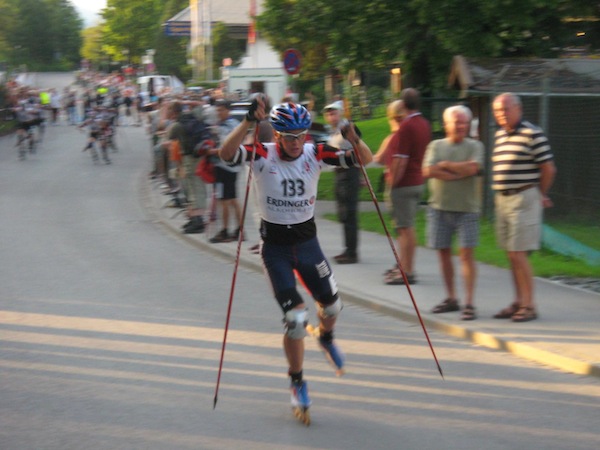
Billy Demong racing in a Grand Prix race in Europe in 2008. While Demong is racing on inline skates, this year's competitions will be held on rollerskis.
The team’s season will start with the Grand Prix competitions in Europe—essentially a summer version of the World Cup. Instead of racing on snow, athletes jump off plastic ramps and rollerski around city streets.
In the past, the Grand Prix races have used inline skates instead of rollerskis, which put the Americans at a disadvantage. (According to Jarrett, the skates are an Austrian and German thing.) As a result, the team’s commitment to the summer races has been inconsistent—they’ve shown up with a mix of elite and developing athletes, or sometimes not at all.
“It’s not worth it to spend a month training on rollerblades just for four or five races,” Jarrett said.
But this year, the circuit switched to rollerskis, and accordingly, the U.S. will field a full squad. Unlike in prior summers, the trip will consist solely of B-Team skiers, to get them more experience in Europe and to “start closing the gap,” Jarrett said.
According to Fletcher, it’s not just the racing that’s important at the summer events.
“I think it’s just the atmosphere of being over there, being in the competition circuit, seeing what other teams are doing and seeing how they’re racing,” he said. “It’s something that can definitely help me.”
The Big Three will sit out the summer competitions, but as the winter season gets underway, they will ease back onto the World Cup circuit. But the U.S. only has slots for four athletes at each competition, which means that the B-Team will get fewer starts.
Lodwick, though, will be focusing his efforts on World Championships in late February, and he will do most of his racing domestically until then—leaving the door open a little bit wider for the B-Team. Just like the summer races, the winter World Cup starts are crucial for the team’s younger athletes, Jarrett says—they need those experiences to ensure that the sport doesn’t fall off the radar when the Big Three retire.
“In order to keep our program moving forward…we need to have other guys being successful, too,” he said.
“Todd’s World Cup start will be pretty much open for most of the year,” Jarrett said. “So there’s a bit more impetus and more opportunity for the Nick Hendricksons, the Fletchers, the Camerota brothers to step up and score points.”
Race organizers pay the travel expenses for the top-50 ranked athletes in the world, and Jarrett said that he wants to see five of his team members in that group by the start of World Championships. That means that two athletes from the B-Team will have to up their game, placing in the top 30 consistently, or even the top 20.
“In the Camerota brothers, we know those guys are perfectly capable, both on the jumping hill and skiing, to be in there,” Jarrett said. “Our expectation is for those guys to really step up and become full-fledged World Cup skiers.”
As for the Big Three, Jarrett acknowledged that it might be tough to get them to buckle down again on the day-in, day-out training and racing after the cathartic experience of the Games. But he said the team has adopted a mantra to keep them focused: “The Olympics are over.”
“We have new goals now,” Jarrett said.
Demong has committed to racing through Sochi in 2014, and his training over the next four years will be geared towards achieving strong results there. But he has also made clear his commitment to working with his younger teammates–helping them step up to the next level.
“Ultimately, his goal is to have to fight to even make the team—that we’ve brought the next generation of guys up to the level where they’re beating Bill out of the spot,” Jarrett said.
Lodwick and Spillane have the same attitude toward the developing athletes, Jarrett said, but those two also see the sport as a profession.
There’s money on the line every time they pull on a bib, since FIS pays the top 20 finishers at each World Cup—roughly $5,000 for a win, down to $500 for twentieth. That, Jarrett said, should help keep Lodwick and Spillane sharp.
“There’s money to be made out there, but it’s only getting made by doing well, and they know that,” Jarrett said. “They want to continue the lifestyle and continue the momentum they’ve started, and they want to keep it rolling.”
As long as Lodwick, Spillane, and Demong continue to race, it will be tough for the B-Team to break onto the scene. But Fletcher said he thinks that’s a good thing.
“You definitely need the top guys on the World Cup as much as possible, to get the press, the results, and stuff like that,” he said. “Then, it gives the guys below them something to push for.”
USSA has released nominations for the 2011 US Nordic Combined Team. Led by Olympic medalists Billy Demong, Johnny Spillane, and Todd Lodwick, the team would consist of nine members.
Athletes must accept the responsibilities of a USST athlete. The final team will be named later this spring.
Demong became the first US skier to win a gold medal in any of the nordic sports this year in Vancouver. Spillane won three silver medals, and Lodwick captured one silver.
The trio, along with Brett Camerota, won the silver in the team event.
Demong, Spillane, and Lodwick are the only athletes nominated to the A Team.
Brett Camerota leads the B Team, along with fellow Olympian Taylor Fletcher. The two are joined by their siblings – Eric Camerota and Bryan Fletcher respectively. Additionally, Brett Denny and Nick Hendrickson were both nominated to the B Team.
The B Team athletes look to carry on the success of the Demong, Spillane, and Lodwick, all who are likely moving toward the last years of their careers.