From the FasterSkier archive — posts syndicated from athletes’ and coaches’ own blogs between 2004 and 2012, kept online as published. Current coverage is at fasterskier.com.
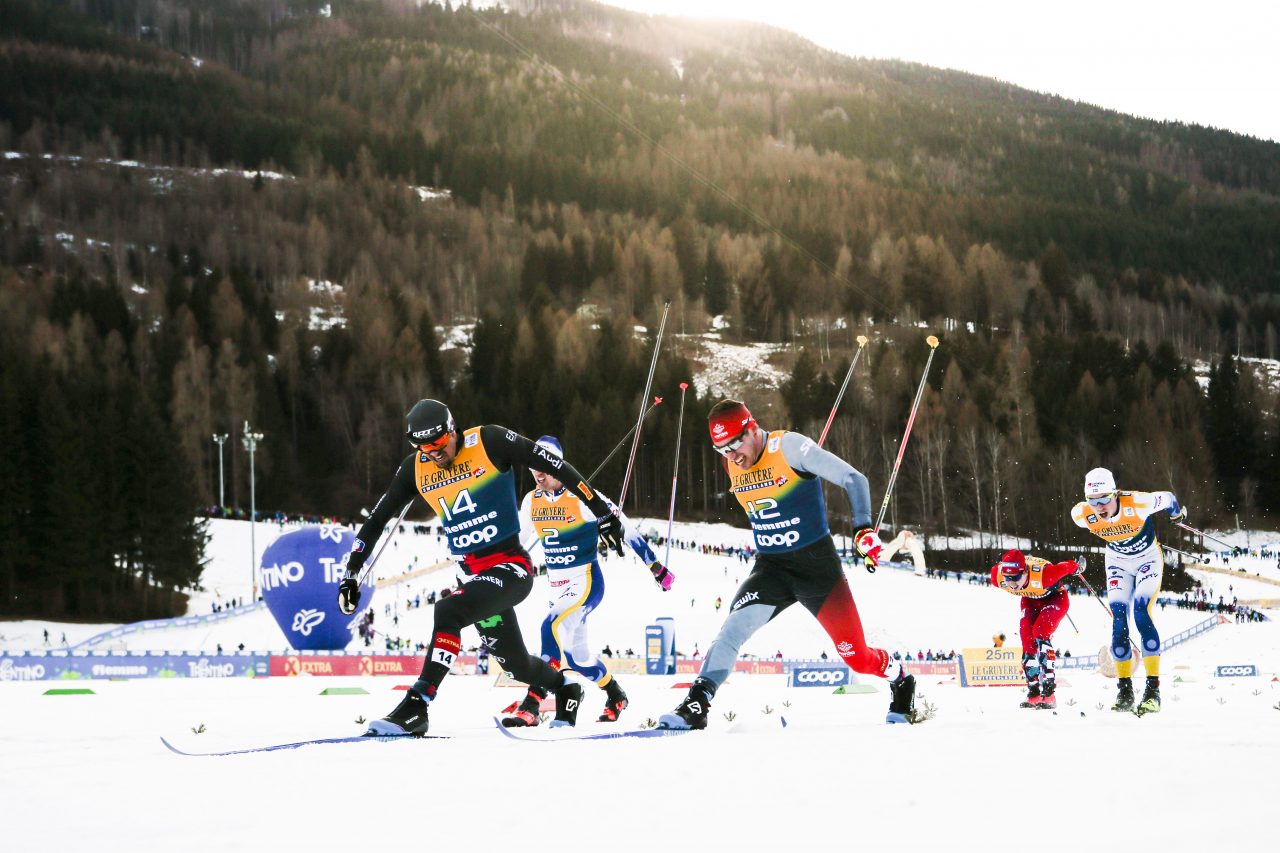
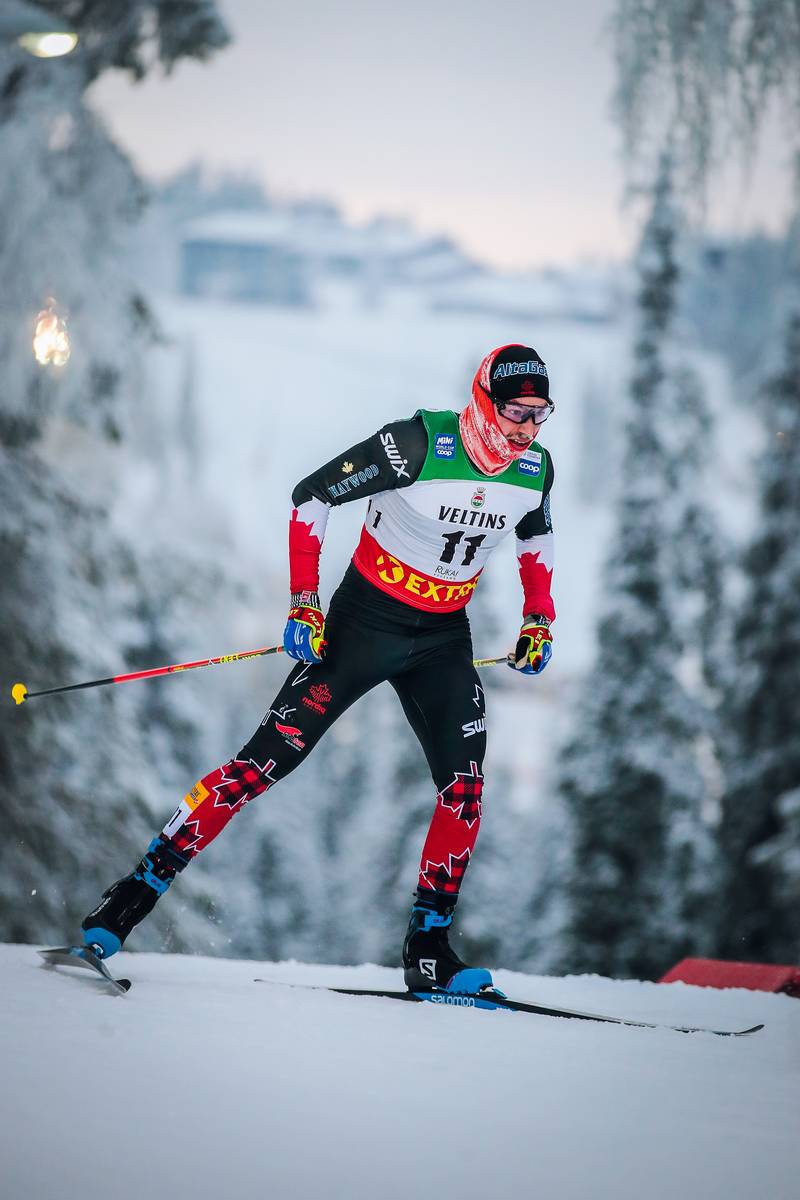
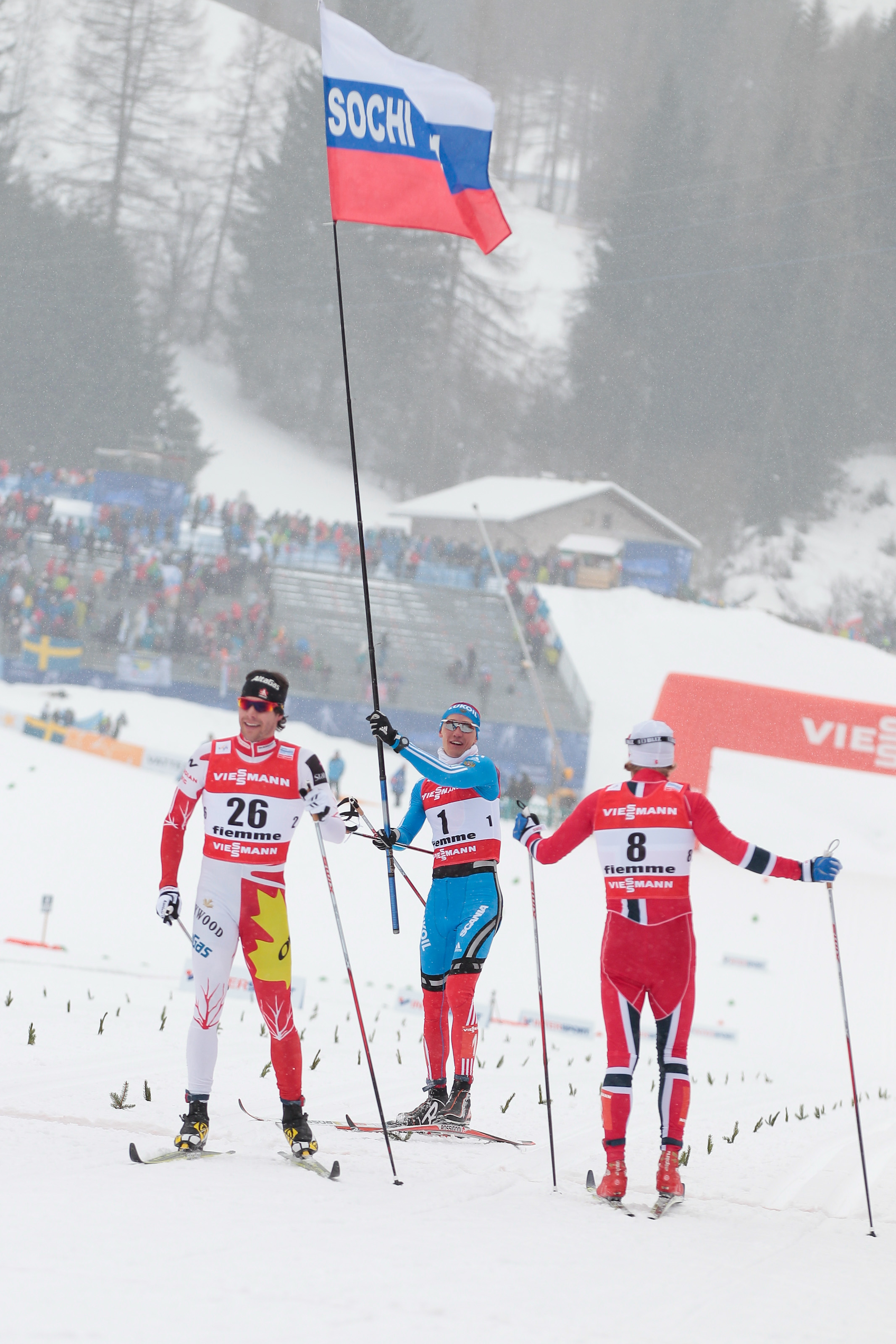
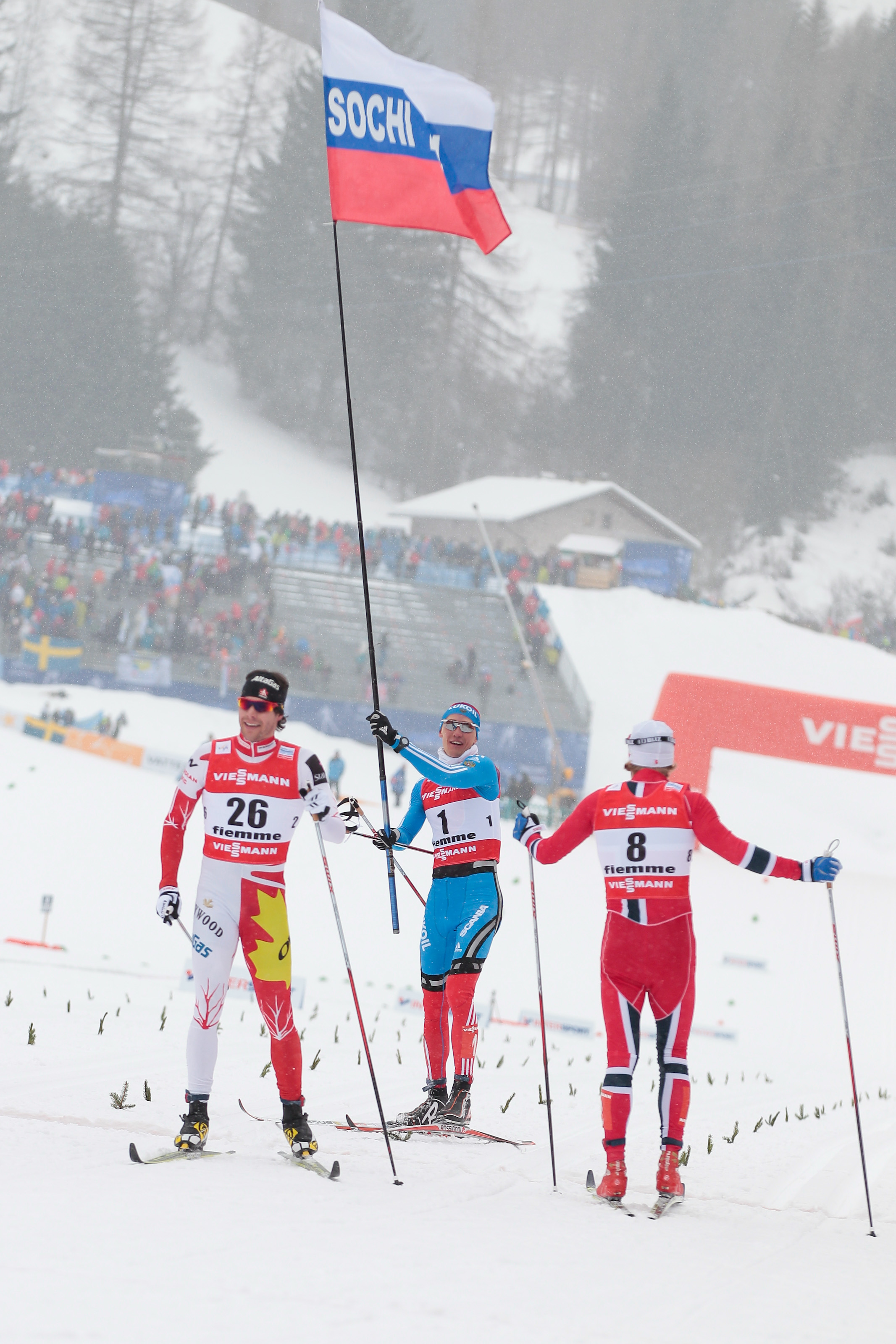
Francesco de Fabiano (14) edges Tony Cyr (12) in stage 6’s 15km classic at Val di Femme. (Photo: Modica/NordicFocus)
Canada is in the rebuilding part of the success rollercoaster, with many changes to the High Performance team and the development programs.
Since May 1st, Chris Jeffries has joined Nordiq Canada (NC) full time as the High Performance Director, Robin McKeever has transitioned from the extremely successful Para program to become the Olympic Stream Head Coach. NextGen coach Eric de Nys and Dev coach Matt Smider are in their first full year in those roles and have shifted modes from planning to delivering.
This season, Canada returned to the Tour de Ski with three top ten finishes and is hosting the World Junior/U23 Championships.
The Tour de Ski was an obvious highlight, with all of the nine athletes and six of eight support staff experiencing the Tour for the first time.
“Yves Bilodeau has obviously has done a few Tour de Ski’s and Simon Boisvert was on the trip with us as a wax tech,” McKeever told FasterSkier, “but yeah, everybody else was pretty much rookies there, I think just the tech, so we were following the tech’s lead to learn from them as much as anything.” For non-Canadians, Bilodeau represented Canada at two Olympics before becoming a wax tech and VW bus driver for the Beckie Scott generation.
Asked to pick just one highlight, McKeever chose one result and one process goal: “My personal highlight from the Tour has to be Tony’s fourth place and coming ever so close,” he said, referencing Antoine Cyr losing a photo finish for a podium spot in Val di Femme the day after finishing 6th in the sprint. “That’s I think beyond some of our expectations through this year, but at the same time, it is belief in the system and belief for the younger up and coming athletes and others around him that it is possible. We need to get that back in the system. We’ve lost it since you know that Beckie, Chandra [Crawford], Sarah [Renner] years of Olympic medals, and with Alex Harvey’s retirement, things were kind of frayed. So it’s time to rebuild that and get positive focus forward and making sure that we’re looking at growth mindset and looking for positive solutions, rather than always complaining about the issues.”
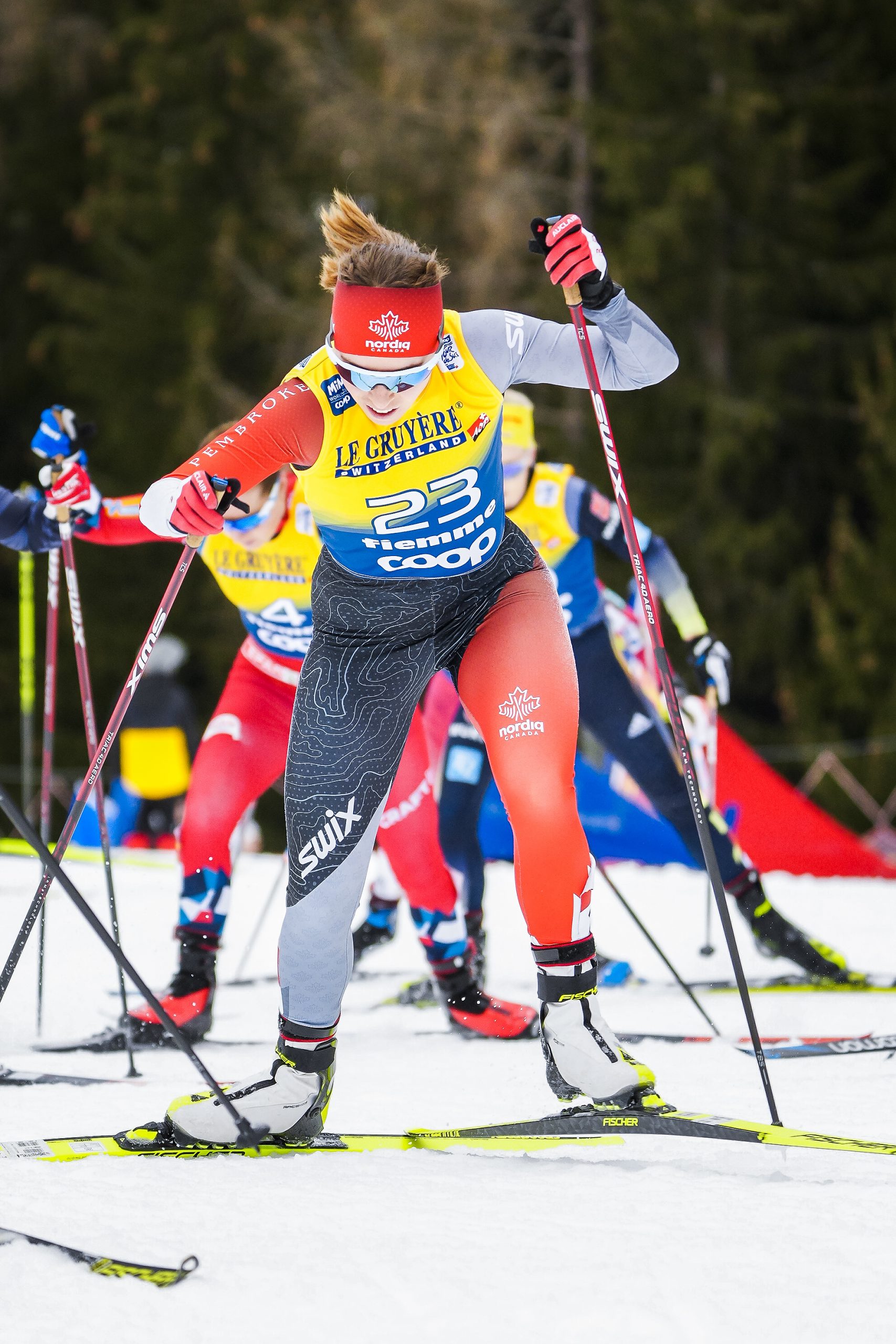
Katherine Stewart-Jones (CAN) racing up the Alpe di Cermis in the final stage of the 2023 Tour de Ski. (Photo: Barbieri/NordicFocus)
Katherine Stewart-Jones, who has this season scored her first top 10 plus six top 20’s, and joined the red group as the 15th ranked distance skier, is another obvious highlight for Canada.
Canada will select athletes for U20/U23 Championships in Whistler and World Championships in Planica at the Trials event at Caledonia Nordic this week, with many younger skiers expecting to qualify. There is also a good field of older skiers planning to hand out some learning experiences on their way to Planica, which should result in exciting racing. Live timing and full results will be here.
For Planica, three athletes were pre-selected: Katherine Stewart-Jones and Tony Cyr met the standard of two top 20s on the World Cup this season, and Graham Ritchie earned a discretion pick with a 17th, a 21st, and two top 20 sprint qualifiers. Everyone else is at Caledonia.
When FasterSkier was interviewing NC staff this season during race weekends, the phrases “that’s Julie” and “Julie does” got used a lot. Julie Beaulieu is in her second year at NC as Development Director. What does that role entail? It appears that it is mostly enabling the more visible staff members to succeed. The most visible of those is McKeever.
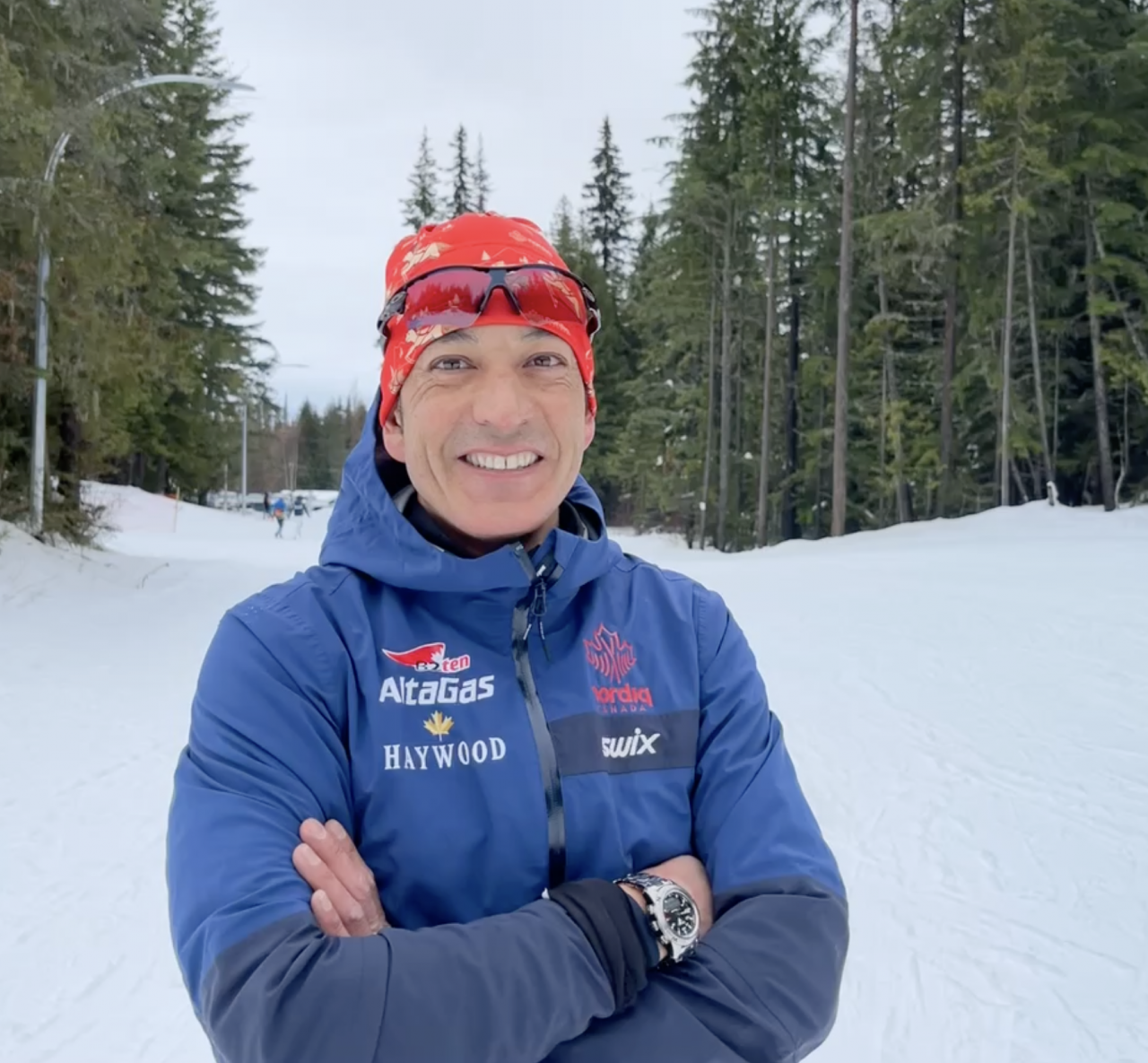
Robin McKeever stopped in at the Reino Keski Salmi Loppet on the way to Prince George for Trials, providing wax support to his family and answering questions for FasterSkier. (Photo: FasterSkier)
If asked about McKeever, most ski fans will remember his time guiding his younger brother to Para glory, or his leadership that brought Canada to the elite of the Para-nordic world. This has eclipsed his own history of podiums, multiple national titles, and Olympic experience since he joined the Junior National team in 1990. McKeever has been part of the National team system every year since then: the good, the bad, and the Nagano ugly.
From the outside view, McKeever never produces inspirational speeches that would make Hollywood proud. If he shouts, it is encouragement to a racer on course, and he is most often seen having a quiet one-on-one conversation. Every conversation loops back to “moving forward” and what can be learned to be better in the future.
So what makes McKeever a leader? He is surrounded by inspired people. Athletes produce year over year improvement. Retired athletes look back with a smile at their team memories. And there are a lot of “team” moments, among both the athletes and the staff.
Para athletes often talked about lessons learned from teammates and the support they felt. Asked how to bring the Para success to the rest of the team, McKeever focussed on culture.
“Para … it’s it’s a small community overall. Tiny,” he said. “So it’s a lot easier to create that team environment and attitude around our culture.”
“So the funny thing is, we think Nordic or cross country skiing is such a big community overall but compared to the world, it’s actually a fairly small community. I still remember a lot of people [on the World Cup circuit] from when I raced back in the late 90s, early 2000s. So this is a small community overall.”
And the next step is change.
“So changing the culture within Canada is about being open to others’ ideas. And we have gone to a decentralized program where athletes are training within their home environments. And then we’re camp-based. So we create our team environment in camps and on the World Cup in the winter. Bit more similar, probably, to what the US system is right now under Matt Whitcomb.”
While McKeever listens to others, he has a solid core of philosophy.
“And that culture is about being a positive influence on the program, always forward. No, we’re not always going to have successful days,” he explained. “But to come in and improve on the tough days and look at the positives, but also look at where we can improve every single day. And I think that just that philosophy and the culture that is behind that creates a safe environment where athletes are free to express themselves as they will. And they’re not scared to speak openly. And so when they do that, we can create a space where they can be happy to operate in, so that creates the smiles. Cohesion as a group and a team becomes the number one key focus that I try to look at.“
With the decentralized structure, athletes work primarily with their club/personal coaches with support from the national system. This adds continuity as skiers enter and exit the World Cup and the National Team; it also helps knowledge trickle down into the clubs.
This fits in with an overall goal of integrating the National Team system more tightly with the clubs.
Next up in the Canadian series is the NextGen and Development changes, along with an explanation of why the USST’s Bryan Fish and Greta Anderson were using the same phrases as Jeffries and de Nys at the combined Nordiq Cup/SuperTour at Sovereign Lake in December.
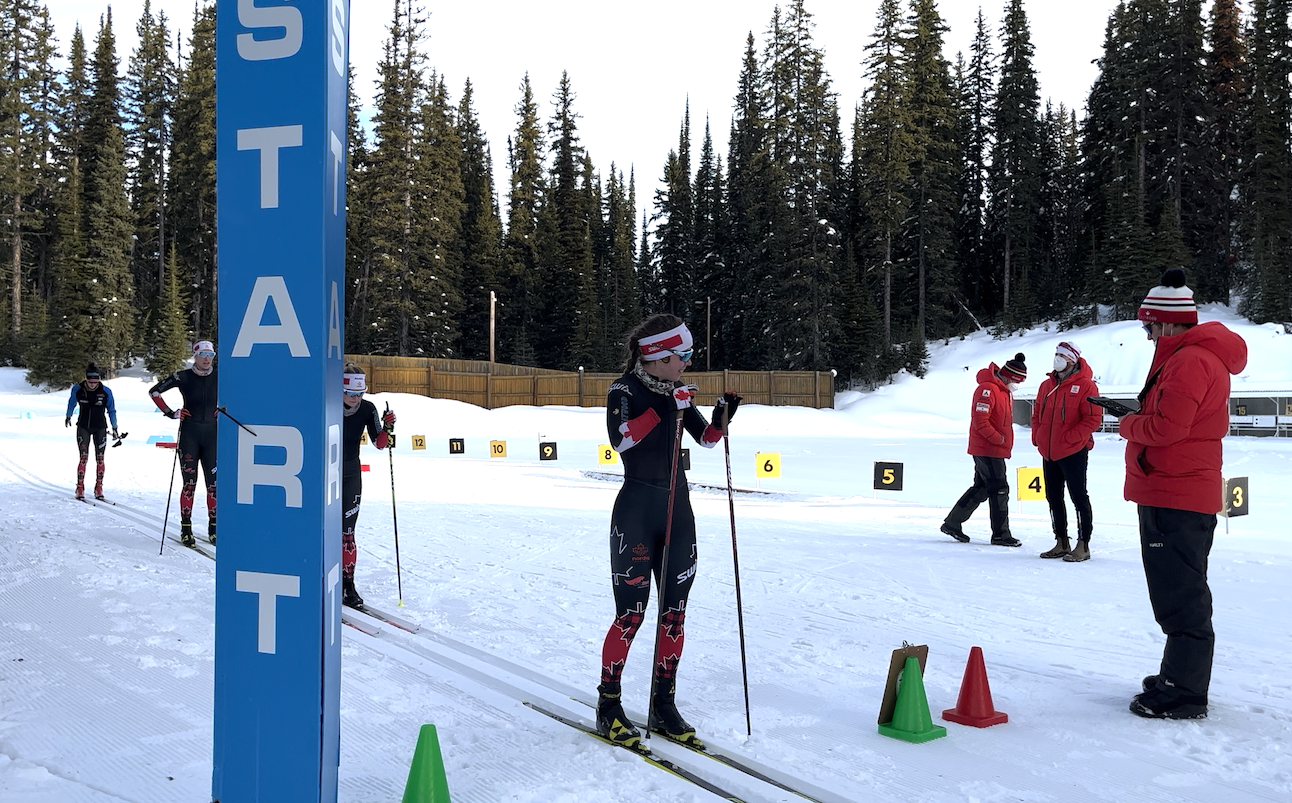
Katherine Stewart-Jones ready to start a skiathlon at the Olympic Prep Camp.
The Canadian Prep Camp in Sovereign Lake and SilverStar, BC prior to the 2022 Beijing Olympics sounds like a nordic skier’s heaven.
A two-week ski vacation with 100 kilometres of perfectly groomed snow. A private room above a great coffee shop (pain au chocolate!) and next door to some great beer. January weather just below freezing with enough falling snow to make every day a hardwax day. Two weeks of what locals call superhero snow. A whole lot of sunshine.
The reality was a little different: COVID stress, travel uncertainty, and outside pressure combined to make this very much a work trip, not a vacation.
The camp, which ran from January 12th to 25th, included nine athletes, the high-performance manager plus two coaches, two wax techs, a massage therapist, and a cook.
The athletes included the majority of the 2022 Olympic Team: Katherine Stewart-Jones, Laura Leclair, Dahria Beatty, Tony Cyr, Olivier Léveillé, and Graham Ritchie. Alternates Olivia Bouffard-Nesbitt and Rémi Drolet would officially join the team after the quota reallocation during the second week. Second alternate Russell Kennedy will not add to his Olympic CV and will instead go to his third Paralympics as a guide, supporting the well-decorated visually impaired athlete, Brian McKeever. The only Olympic team member not in attendance was Cendrine Browne, who chose to train in Canmore, while second alternate Jasmine Drolet returned to school at Dartmouth and earned her first collegiate wins.
World Cup coach Erik Bråten, Next Gen coach Eric de Nys, Team Lead and high performance manager Joel Jaques, techs Simon Boisvert and Félix-Antoine Vezina, massage therapist Stephen Waterreus, and Zoe the cook made up the support crew. Everyone except de Nys and Zoe are going to Beijing.
When this writer asked for last names, the response was always, “Zoe? You know Zoe.” In the end, it was revealed that Zoe is Zoë Roy, who retired from racing in 2014 as a founding member of Team Ninja. Yup, we all know Zoë.
All interviews were done on snow, from a distance, with FasterSkier wearing an N95 mask.
On Snow Training
The on-snow part of the camp was reported to have gone very well. The coaches were able to find times and trails that allowed training races that closely matched the Olympic course for profile and elevation while keeping distance from the local skiers.
The Zhangjiakou 5km course elevation range is 1639m to 1696m. The Sovereign Lake upper World Cup 5km is 1651m to 1708m, with the stadium at 1660m.
The Friday sprint course worked fairly well, despite a layout that would give any technical delegate apoplexy. As Bråten explains above, the coaches chose to do four qualifiers instead of heats to manage risk.
The Sunday skiathlon course ended up being 13km for the women and 17km for the men, with some flat sections removed from the 5km loop to better mimic the Olympic courses.
Bråten was often seen working with athletes one-on-one.
As the days counted down to departure, skiers were working on filling their bags with seconds gained: a tweak in one skate (V2) poling, free skating further on a fast flat section, experimenting with pacing on courses that simulate Zhangjiakou.
The mood of the camp seemed slightly tense, at least to a journalist who was careful not to pierce the bubble. The change on Tuesday morning, 12 hours after everyone passed the final COVID test, was dramatic, with smiles everywhere.
“It’s been fantastic conditions and just a really nice camp all around, it’s always nice when you get some sunshine,” Kennedy told FasterSkier. “So yeah, especially after a [World Cup] Period One in Finland in the dark.”
First time Olympian Rémi Drolet is all smiles after passing the final pre-travel testing.
COVID Management
COVID protocols at the camp were strict, races were more relaxed.
A positive test would be the end of one person’s Olympic dreams and a logistical nightmare for the support team. Any close contact of the infected person would not be able to travel. Any replacement person, athlete or not, would need to follow the same testing protocol. If that replacement wasn’t ready for the scheduled flight, the complexity of travel planning might be insurmountable.
In order to travel to the Olympics, the athletes, coaches, and techs would all have to pass two PCR tests less than 24 hours apart in the final 96 hours before boarding. Once at the Calgary airport, there would be another PCR test, with a fourth upon arrival in China.
Nordiq Canada chose a more restrictive plan than some other countries. Each person (athlete, coach, tech, cook, massage therapist) had their own room and didn’t enter other rooms. Meals were delivered. Grocery shopping was done by local resident, de Nys, scheduled for 7am to avoid crowds. No one entered coffee shops, bars, or restaurants. Each morning, everyone would do a rapid antigen test in their room. Athletes skied from their accommodation at SilverStar to the homologated trails at Sovereign Lake to avoid close contacts in vehicles. Only de Nys and Zoë the cook had contacts outside the bubble, and neither is going to Beijing.
The goal behind this aggressive protocol was twofold. First, to prevent exposures. Second, if one person tested positive, there would be no close contacts forced into isolation or removed from the Olympics. The two wax techs (Simon Boisvert and Félix-Antoine Vezina) inevitably had a shared bubble as they shared a private waxing room.
Was this the right answer? We got three answers to that.
Drolet found the camp harder than usual: “We were still able to ski together a little bit, but it was definitely a little bit lonely at times.”
Kennedy, entering with a mentally tough prospect of only making the team if disaster struck a friend, found the positive. “The guys have been playing, like hanging out online together… And we’ve been skiing together. So it’s separate, but at the same time, not too lonely.”
“Ask me on Monday afternoon when we get all the results back,” Jaques told FasterSkier on Sunday morning. “We’ve taken the right precautions so we’ll just see. But I think it’s looking good.”
A number of athletes mentioned feeling comfort in knowing they were doing everything possible to protect their Olympic dreams.
The system has worked. Everyone tested negative and the entire team is now on snow in Zhangjiakou.
NextGen coach Eric de Nys and NDC TBay’s Timo Puiras review results from an informal 15km time trial on November 28th. This ‘race’ was the first to feature athletes from multiple regions in twenty months, featuring athletes from CNEPH, TBay, AWCA, and more.
Last season, Canada held no races, posted no domestic results, and, in general, vanished into the pandemic fog.
Travel restrictions meant that many Canadian skiers didn’t see any skiers from other regions.
Which skiers made progress and which regressed over the last 20 months? We finally have hints after the first races last weekend. What is new? Lots. What happens next? Keep reading.
Athlete Progress
Following the opening FIS races, part of the Western Canada Cup series, which happened December 4th and 5th at Sovereign Lake in Vernon, BC, Nordiq Canada and its followers finally had results that could be used to assess athlete progress.
Many athletes from Québec, Ontario, Manitoba, Alberta, and BC spent time at Sovereign Lake in November, getting a combination of elevation and snow. Most were confident in their preparation based on summer training with teammates, including the few athletes who race the World Cups last season or were in Europe in November. However, the coaches were still likely to shrug when asked who was fast this year.
FasterSkier’s research suggests that Sam Hendry was the Canadian with the most races last year. A student athlete at University of Utah, he was able to travel and compete on both the SuperTour and NCAA circuits. The small group of athletes who raced World Cups and U23/U20 Championships in February and March had no warmup races before racing at the top level and ended the season with less race days than Hendry.
FasterSkier will be sharing more in-depth athletes profiles in the coming weeks.
Calendar Changes
Canada has dropped the NorAm name, a leftover from the depths of history when the US and Canadian series merged into one North American series. Since the SuperTour split off some years back, the reversion to the Canada Cup name (as in a Continental Cup race held in Canada) is appropriate, even overdue. A name change, however, is simply symbolic. Real change requires action, and action usually results in anger from the people who were demanding change.
As originally planned for last season, the series is now divided into Western and Eastern, which is expected to reduce travel costs and make it easier for skiers to stay in the sport until they are ready to earn a permanent place on the World Cup team. The obvious downside is that the top skiers won’t meet until national team and Olympic trials in Canmore. FasterSkier has been talking to skiers about pros and cons and will follow this shift closely.
Building a season schedule in Canada doesn’t get much easier with the east/west division. The country spans 5.5 time zones and the geographically larger west division has a much smaller population. Every possible calendar and scenario includes lots of travel.
Olympic trials need to be held at elevation as Beijing is at 1,800m, and the west has the only three homologated courses above 1,200m (Canmore, Rossland, Sovereign Lake). Ideally, there would have been early trials on snow for the World Cup period 1 starts, but that would also have to be in the west because the east doesn’t have appropriate courses available in October/November. With 2022 Nationals scheduled for Whistler, the obvious solution would be to have all major events in the west. This would (reasonably) be seen as unfair to eastern athletes. The ‘least bad’ answer was not to have trials in October.
The divided schedule has Sovereign Lake December 4th-5th followed by Rossland, also in BC, on the 11th-12th. In the east, Nakkertok, just north of Ottawa, will host races on the 11th-12th, followed by Mont Sainte Anne, further east in Quebec, on December 18th-19th. Everyone comes together for the first time at the trials in Canmore January 6th-11th. These competitions will be used for athlete selection for the Beijing Olympics, U23/U20 World Championships, and World Cup period 4, which means pressure to perform for everyone.
Nordiq Canada Changes
NC has made a tonne of staff changes since last season. There is now a NextGen coach to bring skiers up to the top level, and a Development Coach to deliver skiers to the NextGen coach. Chris Jeffries, longtime leader of the Alberta World Cup Academy, has been named High Performance Director. Julie Beaulieu is working on the development side. Nathaniel Mah has retired from Nordic Combined competition and is Marketing Engagement Coordinator. Ilona Gyapay has had a role shift, described by one deeply-connected race official as ‘the new Dave Dyer’. (Dyer spent many years with Nordiq Canada, before ending his career as Events Director.)
Erik Bråten was originally hired in the fall of 2018 as a NextGen coach with a secondary focus on developing the base of the pyramid before having his role changed almost immediately to the “Everything Coach”. After two and a half seasons, he left NC in April, 2021. He later rejoined as a World Cup coach for the 21/22 season.
Eric de Nys was selected as NextGen coach in June. He started work in August, joining in at the Penticton national team camp organized by Dave Wood, which had been moved to Vancouver Island to escape wildfire smoke.
De Nys organized the traditional Canadian elevation camp in Mammoth, California. For BC athletes this was out of the smoke and into less smoke, as California was also burning. This camp is important for Canada because it allows a range of elevations that aren’t practical in BC or Alberta and don’t exist in the rest of Canada.
“BC has good elevation, but in an Olympic year, good enough won’t be good enough.” — Wood, July 2021.
Matt Smider was hired as Development Coach in time for Canmore’s Frozen Thunder team camp in October, once again led by de Nys. Smider is known for sparking the growth of small town Revelstoke Nordic into the big leagues; these skills will be useful to fill the development pipeline.
De Nys lead a mix of NextGen and World Cup athletes to Muonio and Gällivare to race continental cups, with promising results against the top skiers from Finland, Russia, Italy, and Sweden. At this point, the casual observer might think that the NextGen coach role was blurring to fill the gap created by the absence of a national team head coach.
Future
With back to back Top-15 finishes, Nordiq Canada’s Antoine Cyr is 12th in the 15k freestyle pursuit in Ruka. (Photo: NordicFocus)
Racing season is here and most eyes will be focussed on the next race. Some Canadians began their seasons in Europe. Rémi Drolet and Russell Kennedy knocked out good results in Finland and Sweden. McKeever easily won all three junior races in Gällivare against a stacked Swedish field. In the first World Cup weekend in Ruka, Antoine (Toni) Cyr led the way with an 11th in the classic 15km and 12th in the free pursuit. First year senior Olivier Léveille moved up to 17th in the pursuit while Russell Kennedy, Katherine Stewart-Jones and Cendrine Browne all earned World Cup points.
Jeffries will join full-time in April, the delay allowing him to make sure his current Alberta World Cup Academy athletes don’t have their Beijing preparations interrupted. He was clear that adding a head coach is a priority for next season.
This writer had two full seasons without seeing any of the athletes race in person, which leaves me feeling blind. The last FIS points race I watched in person was the 2019 WC finals in Québec City. It is hard to go into a new season without a good guess of which athletes to watch, but that challenge is shared by the athletes themselves.
Canadian racers missed two years of nationals and an entire season. For an athlete having a breakthrough year, nationals is where they get to show that improvement. Nationals is also the one chance for domestic racers to test themselves directly against the WC team.
“For an 18 year old to miss a year and really two years when 2020 Nationals were cancelled, is a huge amount of time,” de Nys said. “For a first year U20 aged athlete, they will have missed racing a Nationals and an entire calendar year as a U20 with another Nationals completely. In essence, they will go from a Junior to a Senior with no race experience to help them navigate that landscape.”
With some Canadian skiers doing well in Europe and others waiting to test their progress, it is fair to ask how Nordiq Canada will help them succeed. It is common to hear people in the sport use phrases like ‘those people in Canmore’ or refer to Nordiq Canada as an opaque office that is not connected to the clubs and provinces.
“A lot of our resources and core operations still get based out of Canmore. So an athlete that lives in Quebec on the National Ski Team still probably feels as though they’re not as engaged in the National Ski Team as an athlete skiing in Canmore, [and] we need to change that,” Jeffries told FasterSkier. “But it’s already changing.”
Jeffries went on to point out that CEO Stéphane Barrette, HP Manager Joel Jaques, de Nys, Smider, and Jeffries himself do not live in Canmore.
“One of our number one objectives for the first two years of this next quad is to make inroads on breaking down that perception of those barriers.”
Watch this space for more detail on NC direction as FasterSkier was able to catch up with Barrette, Jeffries, de Nys, and Smider on the snow at Western Canada Cup #1.
Eric de Nys (left) keeping the masters motivated at the end of a ski-striding intensity workout.
VERNON, British Columbia — There are a lot of master blasters who are training hard all year. There are a lot less that progress from one season to the next. This strength program is designed to help one group of masters ski faster as they age.
The club’s regular masters program has 160 participants and is as much social as it is about learning to ski better. Its HP program is focussed on progressing to better results and has a limit of 20 skiers. At the first on-snow session early last November, de Nys set the group goal of showing significant gains at the 2019 World Masters, 15 months in the future.
The masters program is very different than the youth programs. The primary difference is that the kids show up for the scheduled sessions and don’t need videos to learn what they missed. The next big difference is that the school system trains kids to pay attention for an hour at a time. For masters, the videos never exceed four minutes in length.
For Mesocycle 1, there are two strength workouts each week.
Each workout starts with a 15- to 20-minute run/bike/treadmill/row in Zone 1.
Next there is a warmup series of simple mobility drills, including high forward and backward skips, side shuffles, and hip mobility.
The meat of the workout is the Day 1 and Day 2 exercises, followed by a Zone 1 cool down.
The order and number of reps are laid out in this spreadsheet, but as de Nys explains in the intro video, one size does not fit all. Very few of the HP group are able to do this program unmodified. Check out these videos on progressions.
Rosanna Crawford with coach Roddy Ward after placing fifth in the IBU World Cup 10 k pursuit in Hochfilzen, Austria, in 2014. Biathlon Canada promoted Ward to high performance director, but he will also remain the women’s national team coach for this season. (Photo: Chris Lindsay)
Women’s National Team Coach Roddy Ward was picked to become the new high performance director going into the 2018 Olympics in PyeongChang, South Korea, and to helm the team afterwards.
“I’m excited to take an active leadership role with the entire development pipeline, while continuing to be involved and provide leadership with the national team,” Ward wrote in an email. “I believe we have potential to improve our entire system of athlete development from grassroots to World Cup medalists, and I want to be an architect of that system. We have a lot of people who are very interested to be involved, to help make the best situation for our athletes and become a top five nation in biathlon. I would like to help facilitate that growth.”
Ward had been planning to leave his role as a national team coach after PyeongChang in order to spend more time with his family; he and his wife, Melanie, welcomed their first child last August.
Instead, he will stay with the team but slot into a role that doesn’t require as much travel.
“I have a family at home now and wanted to find work that keeps me home more,” Ward explained. “However, I still really wanted to be involved. I have a lot of passion left for this! As a coaching team, we had been trying to figure out what that could look like, to have me involved still. The new role as [high performance director] is perfect for me that way.”
In the meantime, he will stick with the women’s team as a coach; Head Coach Matthias Ahrens works with the men. Ward answered questions from Kelowna, British Columbia, where six women were doing a training camp.
“It doesn’t make sense to change up personal coaches for the women’s team this close to the Olympics,” he explained.
Biathlon Canada’s funding from Own the Podium was cut substantially this year, giving them less to spend on the national team. But Biathlon Canada General Manager Andy Holmwood said that the funding cut was not a reason to ask Ward to do two jobs this season.
“He was our top candidate,” Holmwood said in an interview on Monday. “But at the same time, we don’t want to, and he doesn’t want to, remove himself from the coaching role this close to the Olympics… we have essentially tried to take the admin load off of that role, and try to make it a real leadership role with regard to high performance. Previously there was a lot of logistics work tied in with the high performance director position. But we will be spreading that around otherwise this coming year.”
“Every staff member has stepped up and taken on extra duties,” Ward agreed via email. “We will also expect a bit more planning work from coaches leading junior tours. First and foremost, my main focus is on the women’s team as their coach and to help Matthias with the men. Most important is to get results with the national team on the World Cup and/or Olympics so we have future funding. I will need to prioritize, delegate, and use my time efficiently.”
The funding cut came due to poor results last season from the team’s veterans. Rosanna Crawford and Brendan Green both have multiple top-10 World Cup finishes to their name – and Green finished ninth in the mass start at the 2014 Olympics – but in 2016-2017 Crawford had a top finish of 19th on the World Cup and Green of 28th.
For Smith, the health issues have passed and Ward reported that he was back to training a full load. Crawford and Green, he concluded, were overtrained. The winter taught the team some painful lessons that they are learning from and he is confident that the athletes will be back to their prior form this year.
“One thing as a team we have doubled down on is monitoring,” Ward wrote. “We have added extra heart rate variability and treadmill monitoring to the program to keep better track of athlete health and training readiness.”
While the veterans struggled last season, a nuslewmber of younger athletes made solid progress. Julia Ransom turned in a top-20 at World Championships, Scott Gow hit the top-20 on the World Cup, and Emma Lunder and Christian Gow both notched top-30 results.
Looking towards PyeongChang, Ward has high expectations for his team.
“We have a strong and very motivated team of men and women this year and our ultimate goal is to bring home a medal,” he wrote. “The most important things we are focused on are, one, to individualize each athletes training – they are all unique and therefore each athlete has a unique path to the top – and two, we will also closely monitor training so they show up at the Olympics healthy and in great shape.”
What would a medal mean? Ward explained that in 2010, at a home Olympics no less, Canada only qualified one man for individual biathlon competition. That was Jean Philippe Le Guellec, and he turned in a best-ever performance for a Canadian man.
Four years later, in Sochi, Le Guellec had two top-tens (one of which bested his own record result from Vancouver), Green had one, and Smith had two top-20’s.
“Since then we have had two World Championships podiums, a sprint silver by Nathan in 2015 and men’s relay bronze in 2016,” Ward added.
He clearly believes that his team can continue on its upward trajectory, undisturbed by a blip of a 2017 season.
And after PyeongChang, whatever the results may be, he’s committed to overseeing the country’s biathlon development pipeline as well as its elite athletes.
“I have seen many examples of how to run a national team and development pipelines,” he wrote of his experience coaching on the World Cup. “However, I strongly believe we need to create our own ‘Canadian’ way, given our unique situations, strengths, weaknesses etc. On the development side, I hope we can help to build programs that are fluid, adaptable but strong in certain program fundamentals. How exactly this gets executed in different areas of the country, under different coaches, can be unique to each situation but everywhere we need to have that intense drive to create high performance athletes all over the country.”
Biathlon Canada is a small organization with a small budget. Even when Own The Podium was funding the team more generously, that created serious constraints which are not faced by larger European teams.
“The biggest challenge is inconsistent funding,” Ward wrote. “It’s hard to maintain programs, let alone start new ones (like development programming), when you don’t know your funding year to year. However, this is our current reality in Canada so we have to get the job done regardless.”
On the other hand, it creates a nimble organization and staff.
“I think we are doing a good job given our limited resources (small staff, money etc),” Ward wrote. “We probably produce the ‘cheapest’ medals on the World Cup. We have a great staff that puts a lot of trust in each other and we will need that more than ever this year. We also have some good biathlon activity all around the country and definitely some talented athletes.”
“I very much hope we can retain our staff and athletes after this Olympics to continue to build on our current programming,” he concluded.
Former Biathlon Canada High Performance Director Eric de Nys making the team announcements in Valcartier, Quebec. (Photo: Dan Guay)
For the past 13 years, Eric de Nys has been ingrained in the sport of cross-country skiing and its offshoots, including biathlon. He spent 10 years as a coach on Cross Country Canada’s national team, leading the women’s World Cup team in his final two years there.
Based in the same town and out of the same training facilities in Canmore, Alberta, de Nys parted ways with the national team after the 2014 Olympics and founded a bridge development program, the WinSport Junior Cross-Country Ski Team, to prepare junior skiers for senior-level racing.
A year and a half later, in October 2015, de Nys accepted a new job as high-performance director for Biathlon Canada, replacing Chris Lindsay (who currently works as a high-performance advisor for Own the Podium).
De Nys spent two winters with Biathlon Canada, but less than week after the conclusion of the 2016/2017 competition season, that tenure ended. The move from Biathlon Canada to discharge de Nys came less than a year before the 2018 Olympics, but after a season in which the Canadian biathlon team fell short of reaching the podium in a World Cup or World Championships race.
While several younger biathletes had major breakthroughs, including Megan Bankes and Leo Grandbois at Youth/Junior World Championships, and national-team members like Scott Gow, Christian Gow, Emma Lunder, and Julia Ransom recorded career-bests on the IBU World Cup circuit, several veteran members appeared to take a step back. Nathan Smith was out most of the season with a virus, and Rosanna Crawford and Brendan Green struggled to return to their competitive form.
Biathlon Canada General Manager Andy Holmwood told the Rocky Mountain Outlook that the decision was not performance related. He explained that Biathlon Canada expected to have the position filled by May 1. A job posting on its website indicated that applications would be accepted through May 7.
In an email to FasterSkier, Holmwood wrote that the new high-performance director will take over a program with plans leading up to and through the PyeongChang Winter Games. He explained that he hoped to fill the position as soon as is “feasible.”
Other than to “confirm we’ve recently parted ways with Eric de Nys and wish him the best of success in future endeavours, Biathlon Canada has no comment on the situation,” Holmwood wrote.
De Nys declined to comment specifically on the matter as well, telling FasterSkier on the phone that, as far as he knew, the decision was not performance related. He added that he had enjoyed working with both CCC and Biathlon Canada and was remaining positive as he looked ahead.
“One door closes and multiple open,” de Nys said of his plans moving forward. “I just hope the best for the athletes.”
After spending more than a decade of his career in skiing, he suspected he will remain involved in the sport in the future — even as a volunteer — although this year may signal a break.
“I’m not sure at what level yet, but I will be helping out at the club level or something like that,” de Nys said. “Maybe volunteering, but I do think I will step away from sport for at least year, maybe forever. I don’t know.”
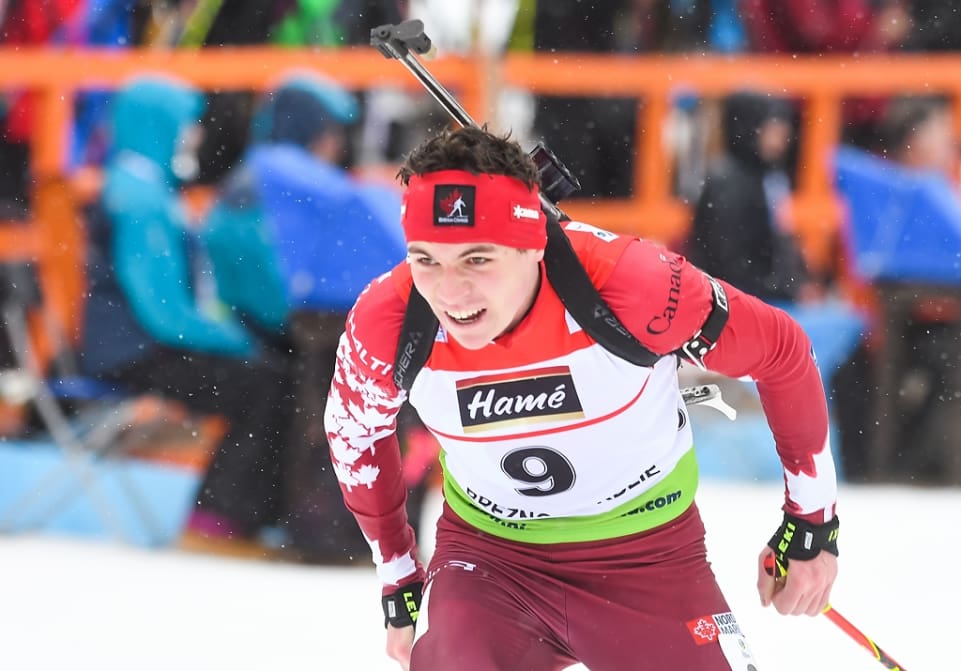
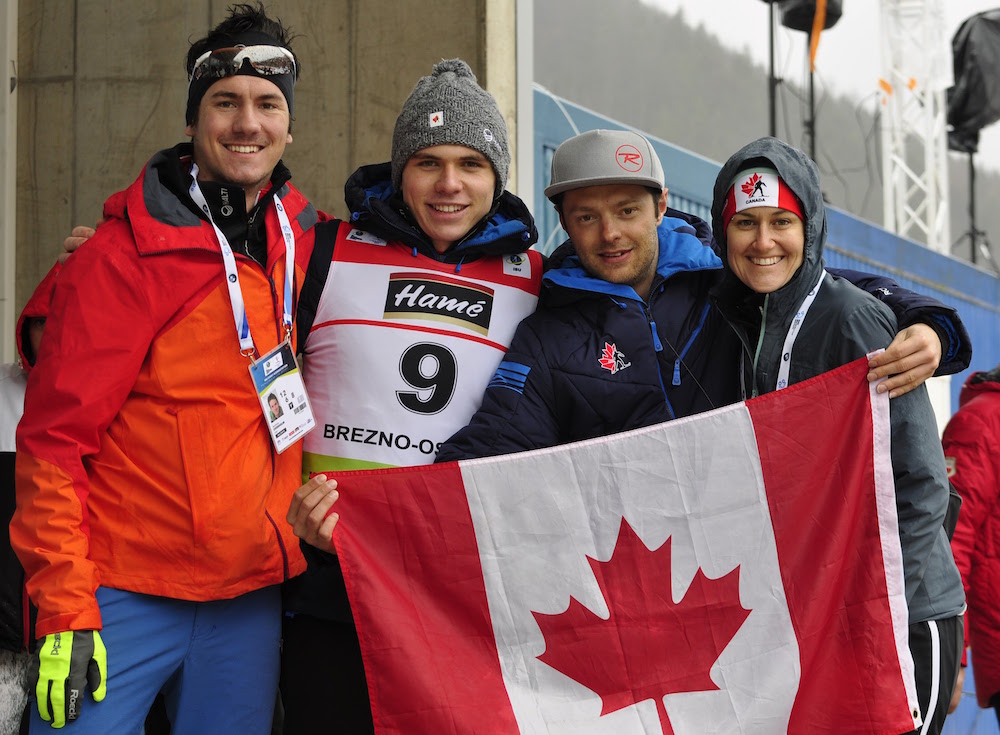
Canada’s Leo Grandbois (Biathlon Estrie) racing to gold in his first IBU Youth World Championships race on Wednesday, the 12.5 k individual, in Brezno-Osrblie, Slovakia. He hit all of his targets for the first time in a race to win by nearly a minute and 15 seconds. In doing so, he became the third Canadian biathlete to win gold at Youth World Championships. (Photo: IBU)
It was raining hard on Wednesday at the biathlon stadium in Brezno-Osrblie, Slovakia. Like, cats and dogs, “des grenouilles” (frogs, in French), or “junge Hunde” (puppies, in German).
But that didn’t stop Leo Grandbois, a German-born Canadian biathlete racing at his first International Biathlon Union (IBU) Youth World Championships, from having the race of his life.
Grandbois, 17, who was born in Munich and lived there for a year before moving to Lennoxville, Quebec, was one of four youth men named to Biathlon Canada’s Youth/Junior World Championships team. Wednesday marked his first 12.5-kilometer individual race in the youth division, and he explained after that his success derived from his focus — and his skis.
“The range had a bit of wind and the tracks were really wet, but I had really good skis,” Grandbois wrote in an email after.
The ninth starter out of more than 100 in the youth men’s race, Grandbois was the only one to knock down all 20 of his targets. He had never cleaned a race before, and he did it in a four-stage race. Without any one-minute penalties added to his total time (there are no penalty loops in individual races, just time penalties for each miss), he clocked the fastest time at the finish in 32:56.6 minutes. That time stood while nearly 90 others finished after him, with nobody coming within a minute of his time.
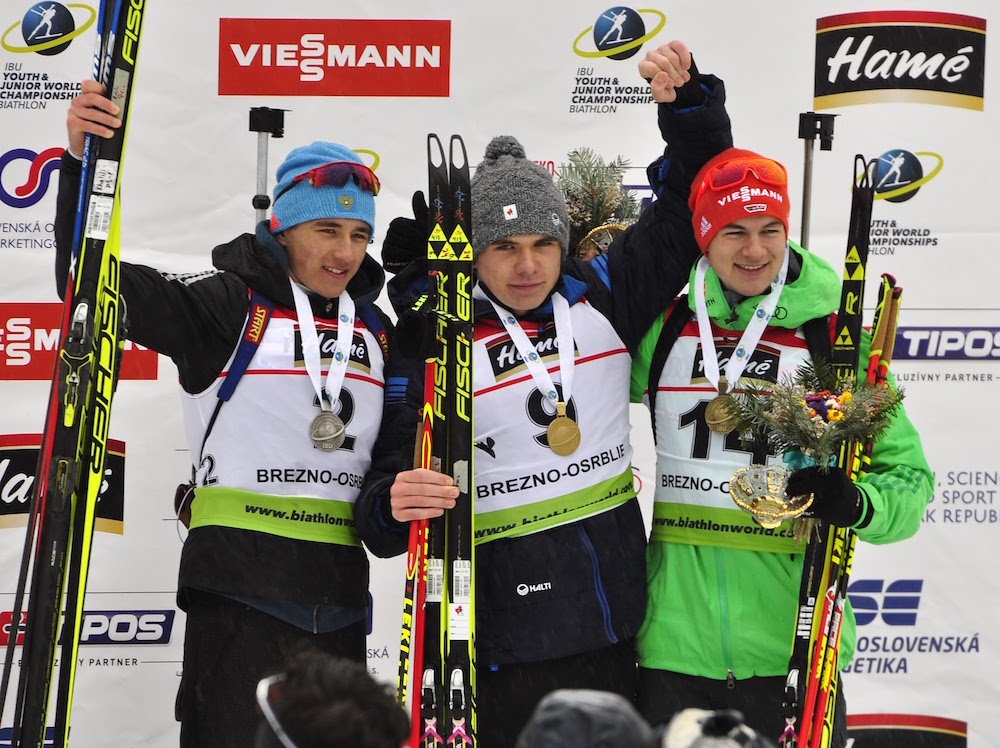
The youth men’s 12.5 k individual podium after the first race of 2017 IBU Youth/Junior World Championships in Osrblie, Slovakia, with Canada’s Léo Grandbois in first (c), Russia’s Said Karimulla Khalili (l) in second, and Germany’s Danilo Riethmüller (r) in third. (Photo: Airat Aitniakov)
Russia’s Said Karimulla Khalili started in bib 2 and enjoyed a brief moment as race leader, before Grandbois bested his time by 1:14.9 minutes. Khalili took the silver medal despite three penalties (1+0+1+1), and Germany’s Danilo Riethmüller captured bronze (+1:21.5) with three penalties as well (2+1+0+0). Besides Grandbois, who shot 100 percent, only one racer shot 95 percent: Italy’s Cedric Christille in fourth place (+1:44.5; 1+0+0+0).
“I always go for the win when I race,” Grandbois wrote. “But I was aiming a top 10.”
With the victory, Grandbois became the third Canadian to win a gold medal at Biathlon Youth World Championships, according to a Biathlon Canada press release. Kurtis Wenzel, of Calgary, is a two-time world champion: first in the 2009 youth sprint and later in the 2012 junior individual. Jean-Philippe “JP” Le Guellec, who previously coached Grandbois, started the trend by winning the 2004 Youth Worlds sprint.
“Before I came here I looked at JP’s results on the internet, and read in the newspaper about his win in 2004,” Grandbois told Biathlon Canada. “It has always been my goal to be like him so to follow that path and do what he did is an amazing feeling.
“The nicest message I received today was from JP,” he continued. “He told me how proud he was of me and to keep working hard. I have been smiling since I received that message.”
And it wasn’t just the shooting that went exceptionally well for Grandbois on Wednesday; he posted the third-fastest ski time. In an email to FasterSkier, he explained that the hilly course in Osrblie suits him. “My kind of course,” he wrote.
“Everything was perfect for me today, I was focused on the range and tried to do like at training,” he explained. “I had some great legs, too!”
He told Biathlon Canada that he had worked on improving his shooting over the last three weeks.
“When I went to bed last night and woke up today, I just had a good feeling I could do something great today,” he said. “I had complete focus and concentration on the range. The hard work over the last few weeks in training really worked today.”
Leo Grandbois (9) with his support crew, including wax techs Andrew Chisholm (l) and Andrzej Lesnik (second from r) and Canada’s head coach Jacqueline Akerman (r), after Grandbois won gold in the 12.5 k individual on the first race of his first IBU Youth World Championships in Osrblie, Slovakia. (Photo: Airat Aitniakov)
In a post-race interview with Junior IBU Cup media, he thanked his supporters: “I want to thank first my coaches at home, my parents who always supported me and all the team who did a great job for the race, the skis, thank you.”
When FasterSkier asked what this gold medal means to him, he explained it came down to all the passion and training he had put in.
“I am probably the most happy man on earth today!” he wrote.
Last year at Youth Olympic Games (YOG) in Lillehammer, Norway, Grandbois finished 22nd in the sprint, 25th in the pursuit and 16th in the mixed relay, a team event. At his first Youth World Championships, he said the field was bigger in comparison.
According to Biathlon Canada High Performance Director Eric de Nys, Grandbois has been on the national team’s radar for a few years. Biathlon Canada started a Shooting Stars program this season and Grandbois was one of 16 athletes invited to “train, test and develop” with the national team.
“Trajectory wise it identifies both a good skier and fantastic shooter under pressure,” de Nys observed of Grandbois’s performance on Wednesday. “This was Leo’s first time shooting clean and to do it a Worlds…..awesome. Extremely happy for Leo and his support in QC.”
Cervenka, Levins Land Top 20
Leading the U.S. men on Wednesday was Vasek Cervenka, who has spent the better part of the last two seasons training in Nove Mesto, Czech Republic. The Boulder, Colo., native (who lives in Grand Rapids, Minn.) raced to 16th (+4:19.5) with five penalties (0+2+2+1).
In his second Youth Worlds, his goals coming into the opening individual race had been to hit all of his targets and ski technically well. Placement-wise, he wanted a top 10.
“The conditions were good in the morning, but a light rain started one and a half hours before the race and has continued the rest of the day,” Cervenka explained. “This made the course tricker over time as it was slowing down the skiing quite a bit. The rain also interfered with the shooting on the range.
“I am a little disappointed today in my shooting knowing I can do better, also knowing a clean shooting would have brought me up to 2nd place,” he continued. “I felt good skiing but bonked on my last two loops.”
After he cleaned the first prone stage, Cervenka’s time ranked third. One loop later, with two misses in the first standing stage, his split ranked 10th, which dropped to 23rd after the third stage. He recovered to 18th by the start of his last loop, and ultimately finished 16th for his best non-relay result at his second Youth Worlds. Last year at YOG, Cervenka had a previous best result of 20th in the pursuit.
“As happy as I am with my improvements from last year to post this top 20, it still stings for me to miss a few shots too many, knowing where I could have placed if they went down,” he wrote.
Also for the U.S., Jacob Pearson finished 49th (+7:45.3) with four misses (0+2+0+2), Alex Kilby was 75th (+9:51.1) with five penalties (1+0+1+3), and Camren Nielsen 91st (+14:36.9) with 11 misses (3+4+2+2).
Canada’s Adam Runnalls finished 41st (+7:04.8) with eight penalties (1+2+4+1) and Thomas Hulsman was 57th (+8:19.0) with five misses (2+0+2+1). Robert Kreitz did not finish.
Also on Wednesday, the youth women opened the championships with the 10 k individual, where American Chloe Levins raced 14th with three penalties (1+1+1+0). France’s Lou Jeanmonnot-Laurent shot 19-for-20 (0+1+0+0) to win the race in 34:00.9, and Levins finished 3:05.6 minutes off her winning time. None of the 90 women who finished the race shot clean.
For Levins, a Middlebury student-athlete who plays collegiate golf in the fall and the spring, 14th was her best non-relay result at her third Youth Worlds.
“Everything is possible, especially in an individual race,” she wrote in an email after. “The range is windy here in Osrblie, so good shooting is rewarded. … There’s no funny business on the track in Osrblie. It’s straight up, straight down, and flat into the range. The course demands power and strength, which I think is an advantage for me.
“Today, it was important not to let the weather get in your way,” she added. “Sometimes it’s difficult to feel excited and fresh when it’s pouring rain, as it was today; those who shut it out of their mind are usually better off. Despite the conditions, our wax technicians prepared very good skis that moved really quickly through the saturated snow.”
“It is difficult to judge from one race, but the level of competition at this year’s Youth World Championships compared to last year’s Youth Olympic Games seems very similar,” she observed. “There are many familiar faces, and today there were even some repeating champions. I’m comfortable with the level of competition.”
Moving forward to three more races in Osrblie (the sprint, pursuit and relay), Levins explained she took a lot of positives from Wednesday.
“It’s not my best biathlon competition ever, but it’s certainly not my worst,” she wrote. “It’s a short way from the bottom to the top in this game, so I’m happy to have stayed above ground today. The result is fine, but I’m more happy to be able to say I did good work today.”
Asked what she’s studying at Middlebury, Levins explained that she’s started pursuing neuroscience and economics “with a little bit of German for fun. My German professor loves that I have the opportunity to converse with native German speakers on a daily basis,” she wrote.
(When Grandbois was asked if he speaks German, he replied, “Yes … but not perfect.”)
Sharing the podium with Jeanmonnot-Laurent was Russia’s Kristina Egorova in second (+52.4) with one standing miss as well (0+1+0+0). Sweden’s Elvira Karin Öberg notched bronze (+1:16.1) with two penalties (0+0+1+1).
Also for the U.S., Grace Gilliland finished 46th (+6:28.9) with four penalties (1+1+1+1), Amanda Kautzer was 53rd (+7:14.3) with eight misses (2+1+4+1), and Helen Wilson was 62nd (+9:00.5) with six penalties (1+2+2+1).
Canada’s Shilo Luca Rousseau finished 54th (+7:29.9) with five misses (2+0+1+2), Frédérique Pérusse was 77th (+11:54.6) with nine penalties (1+4+1+3), and Elise Sauve 78th (+12:07.1) with seven misses (2+2+2+1).
IBU Youth/Junior World Championships continue Thursday with the opening junior competitions: the women’s 12.5 k and men’s 15 k individual.
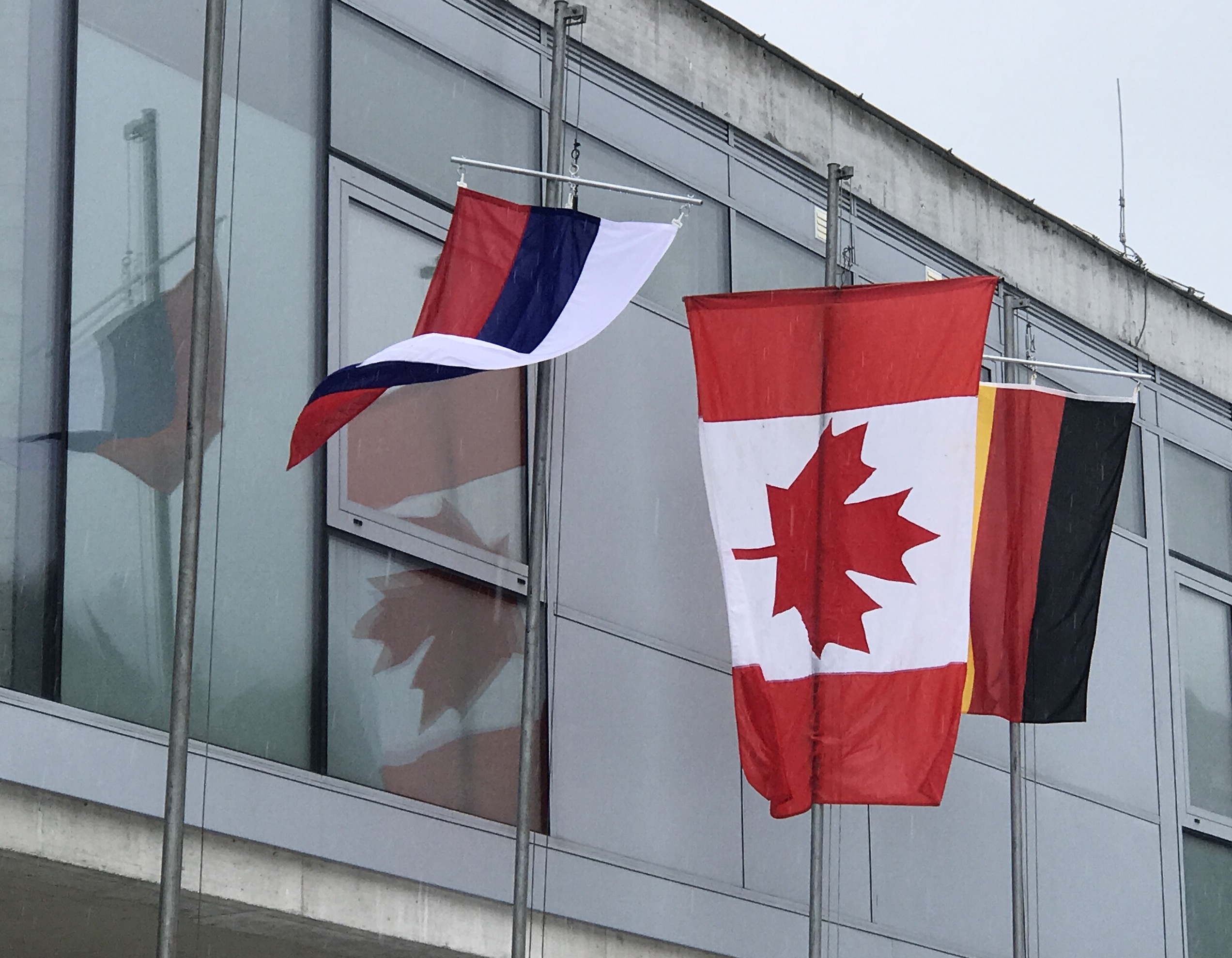
The Canadian flag flying high above the biathlon stadium in Osrblie, Slovakia, after Leo Grandbois won the youth men’s 12.5 k individual, the first race of 2017 IBU Youth/Junior World Championships. Russia took second and Germany third. (Photo: Terri Dickson)
In response to evidence of widespread doping in Russia, the Czech Biathlon Union became the first to discuss a boycott. The Czechs will not attend a World Cup stage to be held in Tyumen, Russia, in March; they have been joined by the British Biathlon Union. Several other countries say they hope that the International Biathlon Union will move the event.
But the Russian Biathlon Union put out a defiant press release denying any involvement in doping.
“It was about time that some federation came and said out loud what we are talking about behind the scenes,” Czech Biathlon Union President Jiří Hamza said in an interview with the news agency iDNES, according to a translation.
The International Biathlon Union (IBU) is being pushed to move the competitions. The dozens of doping biathletes are only part of the equation. Perhaps a bigger issue is that extensive sample manipulation and collusion occurred on Russian soil. That makes some athletes and federations reluctant to compete in Russia.
“I don’t think anybody feels safe about being there, in a country that had this high level of collusion,” U.S. Ski and Snowboard Association President and CEO Tiger Shaw told FasterSkier the day the report came out.
A few months ago, the IBU also controversially voted to award 2021 World Championships to Tyumen. The International Olympic Committee (IOC) had directed that no new competitions should be scheduled in Russia; the IBU interpreted the directive to say that the existing Tyumen bid could remain up for election.
2016 Youth and Junior World Championships, slated for Ostrov, Russia, are also part of the discussion.
If the competitions are not moved, Czech athletes will not attend them, Hamza said.
Also signing on to the boycott is the British Biathlon Union (BBU).
“The Board of the BBU made a unanimous decision over the weekend to boycott World Cup 8 in Tyumen,” BBU Secretary General Mark Goodson wrote in an email to FasterSkier.
Momentum may be building for other federations to sign on as well. A widespread boycott could push the IBU Executive Board to move the event. A similar boycott led to 2016 World Championships for bobsleigh and skeleton being stripped from Sochi, Russia.
The IBU Executive Board is meeting to discuss the McLaren report this week.
“Early this morning Tuesday, we received an Email of thanks from [Czech biathlon] and in mid-morning the Czech Republic issued an ‘Open Letter’ to the IBU and all Federations expressing even more displeasure than we had, and boycotting all events in Russia until WADA and the IOC gave their Anti-Doping Systems a clean bill of health,” Goodson wrote. “The latest news is mid-afternoon with a very supportive (of Czech) Open Letter from Norway demanding that named, proven Russian biathletes be banned with immediate effect, and that the IBU withdraw all competitions from Russia until a clean bill of health. Failure of IBU to do this will result in Norway considering a boycott of all international competitions in Russia.”
North American federations are considering their options.
“We have been discussing the issue and will make a decision Friday after the IBU makes its ruling,” Biathlon Canada High Performance Director Eric De Nys told FasterSkier. “We are of course hoping that the IBU makes the right call and pulls the World Cup from Tyumen.”
The United States is leaving the decision up to individual athletes.
“We have told our athletes that participation is up to them and that there will be no pressure for them one way or the other,” U.S. Biathlon Association President and CEO Max Cobb told FasterSkier in a text message.
Some prominent athletes have been speaking individually about the prospect of a boycott.
“It’s not like it’s only one or two [athletes],” Martin Fourcade said in an interview with Norwegian broadcaster NRK. “It’s 31, added to the 12 we had the last few years in biathlon. And I hope if my federation don’t have big enough balls to take [on] the problem, the athletes do it on their own… If nothing is done in January, I will ask my colleagues in the international teams – I mean Norway, I mean Germany, Czech Republic, all of the nations – to don’t compete.”
“Due to the current atmosphere in the media landscape on the matter of 31 Russian biathletes, suspected of using prohibited substances, RBU considers it necessary to issue the following statement.
In the course of several years, RBU has consistently pursued a policy of zero tolerance for doping. This is confirmed both by strict compliance of all Team Russia biathletes with the requirements of WADA and their due availability for control by WADA and other accredited organizations along with active collaboration of RBU with these organizations in the field of promotion of clean sport. Clear evidence of mentioned above – the official statistics of WADA concerning the number of doping tests taken in biathlon in 2014.
Starting spring’14, after the election of the new top management of the Russian biathlon Union, this cooperation has become even more intense.
Within the idea of zero tolerance for doping RBU held more than 10 seminars for athletes and coaches inviting representatives of national and international anti-doping organizations. All persons who had ever been involved or had been under suspicion of any connection with the use of prohibited substances were banned for life. In the course of internal tests at national competitions all the athletes who didn’t comply with strict requirements of RBU were caught and severely punished.
Another proof of zero tolerance for doping is the fact of cooperation of RBU with the foreign experts, such as Ricco Gross and Wolfgang Pichler, who would never agree to jeopardize their reputation.
We do not know the names of the athletes from the list that will be discussed by our respected colleagues from IBU on Thursday, December 22nd. However, we are ready to provide comprehensive information about any RBU athlete ever to participate in the biathlon Events. We admit that the majority of persons from this list are those who have already been accused of violation of doping rules by the RUSADA and RBU internal doping control and are currently disqualified or finished their career.”
Pichler is a German who came to prominence coaching the Swedish biathlon team and Magdalena Forsberg in particular. An outspoken opponent of doping, Pichler was hired to coach the Russian women’s team from 2012-2014. He has now returned to the Swedish team.
Within the Russian national team there were two training squads, with Pichler heading one of them. He said as early as the Sochi Olympics that he suspected there was doping within the other training group, headed by Vladimir Korolkevich. He had even tried to leave his post early due to concerns about doping.
But Pichler has maintained that his own athletes were clean. The report sheds doubt on that assertion. At least two of Pichler’s athletes – Olga Zaitseva and Yana Romanova – were on the “protected list” in Sochi. One of Romanova’s urine samples also showed signs of being tampered with by anti-doping officials. And more of his athletes may be among the 31 who were referred to only by alpha-numeric code identifiers in the report.
“I know relatively little about what happened there,” he said in an interview with German broadcaster ZDF in early December. “I have only been a coach there for one year. It is being discussed, that much is clear. It does put pressure on the athletes, that they are being pointed at. I believe it’s not only a Russian problem, it is a worldwide problem which has to be tackled… I am experiencing a lot of support, also by [the Russian Biathlon Union], because they also want clean and fair sport. So at that moment it is sad when you are being pointed at again. They are following my line, if someone cheats he’ll be kicked out.”
Left to right: Biathlon Canada’s two preselected athletes Rosanna Crawford and Julia Ransom, followed by Megan Tandy and US Biathlon’s Susan Dunklee at the start of the women’s 7.5 k sprint on Wednesday, Nov. 9, at Biathlon Canada’s team selection trials at Frozen Thunder in Canmore, Alberta. (Photo: Matthias Ahrens)
Friday, Saturday, Sunday, Monday, Tuesday: five days. For five days after Biathlon Canada’s team selection time trials in Canmore, Alberta, a few athletes still found themselves waiting to hear whether to not they made the International Biathlon Union (IBU) World Cup racing team for the first trimester of the 2016/2017 season. By late Tuesday afternoon, however, the wait was up.
A men’s and women’s team roster was posted to Biathlon Canada’s homepage revealing that for the second season in a row, Nathan Smith, Brendan Green, Scott Gow, Christian Gow, and Macx Davies were nominated to the men’s squad. All five had been preselected and would now officially take the five available spots on the men’s national team.
With five senior national-team women competing for four World Cup spots, selection for the women’s team would require a little more maneuvering. Both Rosanna Crawford and Julia Ransom had been preselected for the World Cup team, while Sarah Beadry, Emma Lunder, and Megan Tandy had been preselected for the IBU circuit, meaning one woman would not make the World Cup team.
Decisions on who would be nominated, according to Biathlon Canada’s High Performance Director Eric de Nys, depended on performance results from the team time trials, which took place last Wednesday, Nov. 9, and Thursday, Nov. 10.
Sarah Beaudry (Biathlon Canada) anchoring the Canadian women’s relay to eighth place in Oslo, Norway, last winter. (Photo: Biathlon Canada/NordicFocus)
“The criteria was such that, we looked at the two trial races on the 9th and the 10th to see if we could could create a ranking list based on those performances; that’s essentially how those ladies were chosen,” de Nys said on this past Wednesday, Nov. 16. “So after the ranking came out, it went Rosanna [Crawford], Julia [Ransom] then Megan Tandy in third. Then actually fourth and fifth were two juniors [Nadia Moser and Megan Bankes], and Sarah [Beaudry] was sixth. But the fourth and fifth juniors, they’re not World-Cup eligible, we have to send them to the IBU Cups so that they can become World Cup eligible. And that’s how Sarah came to be the fourth lady.”
Though her first day of racing at the time trial was not what she had hoped for, the 22-year-old Beaudry indicated excitement about the prospect of more racing at the World Cup level.
“The first race wasn’t what I was hoping for but I managed to pull together a better race on day two,” Beaudry, a Biathlon Canada B-squad member, wrote in an email. “I definitely went into trials very nervous which affected my shooting and I am hoping that I got that out of my system before the World Cup starts. I am really excited to head to Europe and improve on my performances from trials.”
Megan Tandy (Biathlon Canada ‘Eh!’ Team) racing in the women’s relay at the 2015 IBU World Cup in Hochfilzen, Austria, last December. (Photo: Fischer/NordicFocus)
Tandy, an “Eh!” Team member, arrived in Germany shortly after the announcement. She explained that for her, being nominated to the national team was no guarantee.
“There was certainly no guarantee of selection for me,” Tandy wrote in an email. “We had 2 pre-qualified women and I needed to prove myself in order to be nominated for one of the remaining 2 World Cup spots. From my own perspective, yes, I expected to be selected. My season goal is to set new personal bests which for me, means placing regularly in the top 25 or better on the World Cup circuit. No easy feat, but if that is what I am aiming for, I had to go into the trials races expecting my best effort to be enough for a World Cup spot.”
De Nys further explained that only the two sprint races on Nov. 9 and 10 were used to select the women’s squad for Trimester 1, though using summer training and other time trials could have been used at the national-team program’s discretion.
“… We did have the authority, I guess, to look at training and other things like that,” de Nys said of the selection process. “… It just came down to the trials and Sarah [Beaudry] happened to go a little quicker on that day than Emma [Lunder], who is the next in line after Sarah.”
Beaudry’s B-squad teammate, Lunder, did not make the World Cup team, but was nominated to race the IBU circuit for Biathlon Canada. With greater World Cup point performances from those named to the Trimester 1 team, however, another spot could be added to Biathlon Canada’s squad, opening up the opportunity for athletes like Lunder make the women’s team again.
“There’s a big push from Biathlon Canada and from the women’s program themselves to increase their quota in that being the number of women we can start in the World Cup,” de Nys said. “As a team, if we can improve our general overall performance, because in the World Cup you score nation’s cup points from your first three women, so if our women are better positioned, we score more points. So at the end of last year we were 11th. If we were 10th, we could have five starts quota.”
Biathlon Canada’s women’s relay team after placing 11th at a December 2014 World Cup: (from left to right) Rosanna Crawford, Audrey Vaillancourt, Sarah Beaudry, and Megan Heinicke (now Tandy). Vaillancourt retired this past spring after being nominated to Biathlon Canada’s B-squad. (Photo: Rosanna Crawford)
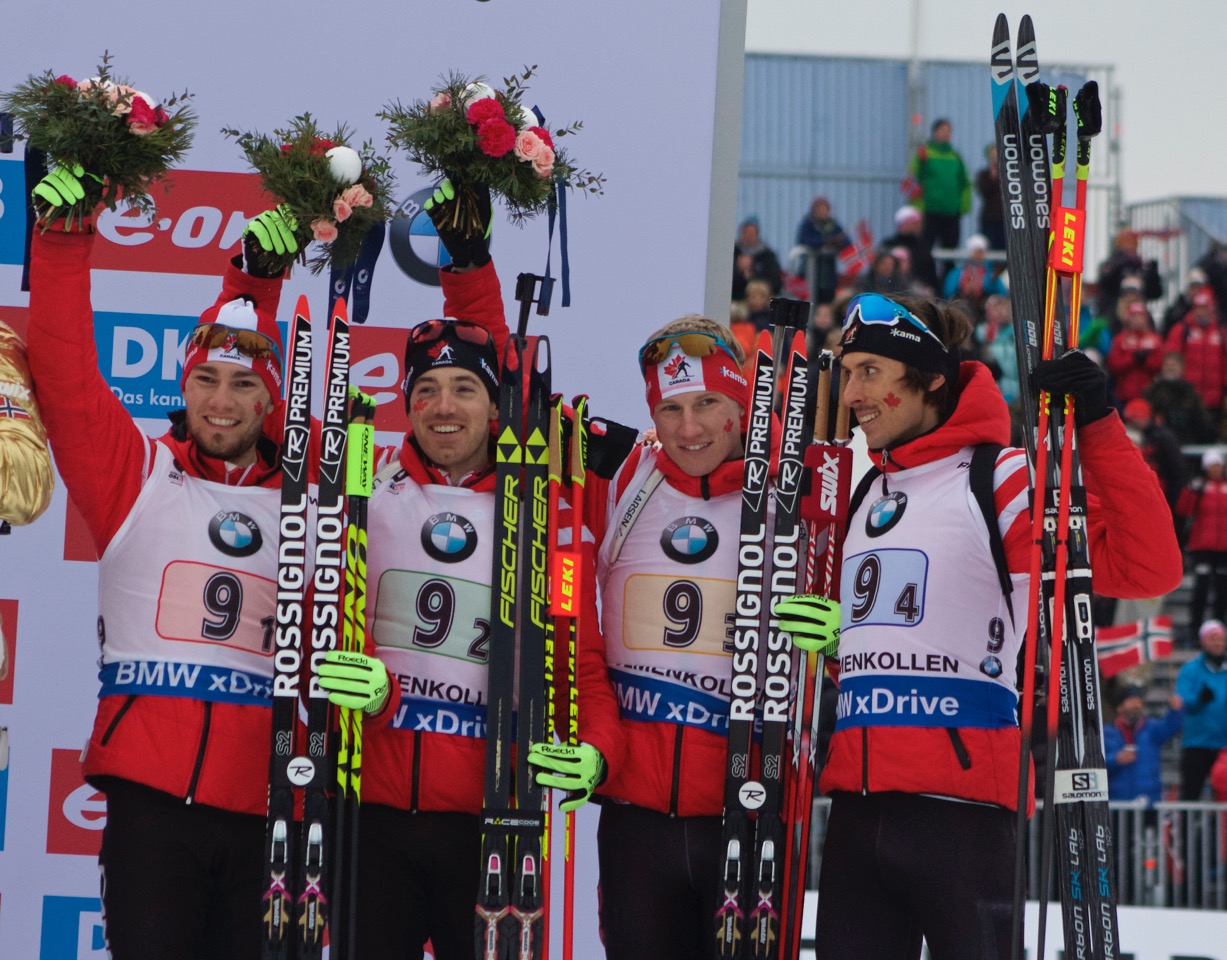
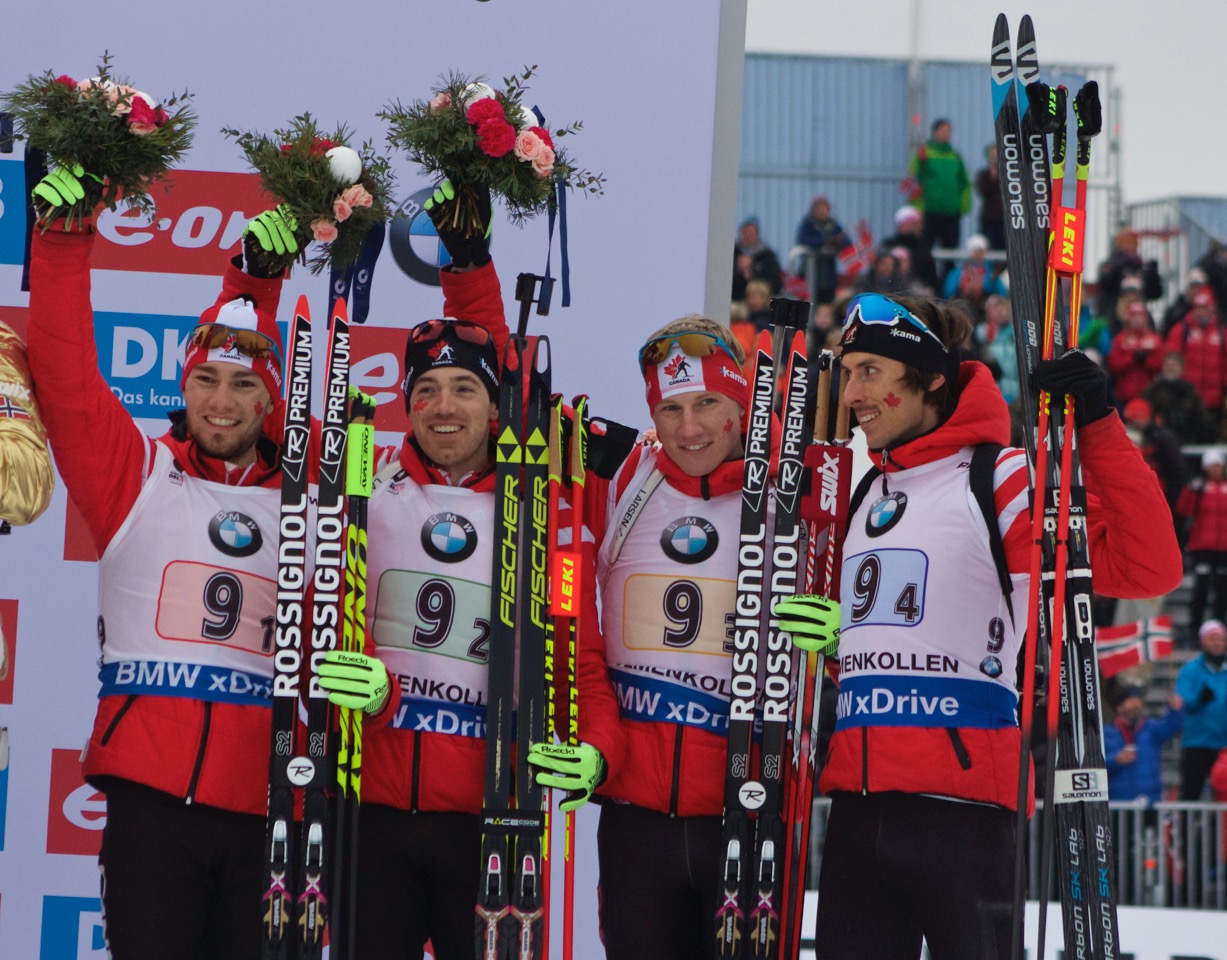
The Canadian men’s team (l-r) Christian Gow, Nathan Smith, Scott Gow, and Brendan Green celebrate bronze in the men’s 4 x 7.5 k relay at 2016 World Championships in Oslo, Norway. (Photo: JoJo Baldus)
Biathlon Canada has named their national team for the upcoming season. There’s few surprises on the ‘A’ squad – or the ‘Eh!’ squad, as the team is calling it.
“That was my idea- After all we are Canadian, eh!” High Performance Director Eric de Nys wrote in an email to FasterSkier.
The ‘A’ team is filled with six athletes who achieved top-20’s at the World Cup or World Championships level in 2016: Rosanna Crawford, Julia Ransom, Nathan Smith, Brendan Green, Scott Gow, and Macx Davies.
Also named is Christian Gow, who was an integral part in the Canadian men’s 4 x 7.5 k relay bronze medal at World Championships.
And so is Megan Tandy, a two-time Olympian and team veteran who did not meet the objective criteria, in part because she broke her arm partway through the World Cup season and missed out on the end of the race schedule, including World Championships.
The 27-year-old had been apprehensive about her chances of being re-named to the team, and guessed that if she was not her career might come to an end.
That was not going to happen, though.
“This was an easy decision for us,” de Nys wrote. “We feel she can contribute in individual and team performances for the next two years. It’s unfortunate she broke her arm and missed the second half of the season.”
While that rounds out the ‘A’ team, a three-woman ‘B’ squad was named: Emma Lunder, Audrey Vaillancourt, and Sarah Beaudry – who had represented Canada at World Championships.
There’s also the newly-created ‘Zed’ team, consisting solely of Prince Edward Island’s Carsen Campbell, who in his first year of senior racing got a start at the Preque Isle World Cup, where he placed 78th in the sprint.
“The ZED team is actually a counter to the US Team’s ‘X Team’,” de Nys wrote. “The alphabet in Canada, we say ZED not ZEE. Trying to make things a little more fun. Carsen will join the [national team] on a couple of camps, be provided some testing/evaluation time, have some help evaluating his ski fleet and a few other small benefits. Carsen was our second best male shooter internationally behind Christian Gow. We want to give him some opportunity to close the gap on his skiing speeds so he will have time to train with the faster men. We feel this will be beneficial for him and where he is currently at.”
A large group of junior and young senior athletes from around Canada were also named to the ‘2022 squad’, which is a development group to ensure national team success after the next Olympic cycle.
“Theoretically, post 2018, we may have a turnover of athletes as some retire and move on to other ventures,” de Nys explained. “Some of the younger athletes in this squad MAY surprise and surpass the older athletes within this grouping. In six years, a lot can happen and we feel that the athletes in this squad have demonstrated performance to be indicative of being on track. Albeit, consistency of performance tends to be varied for younger athletes, but the fact that they were able to demonstrate a result on demand is a key factor in their skill set.”
While the benefits of being named to the A and B teams are fairly clear, the 2022 squad is still a work in progress.
“The support level this group will receive has yet to be determined until we finalize our budget/s,” de Nys wrote.
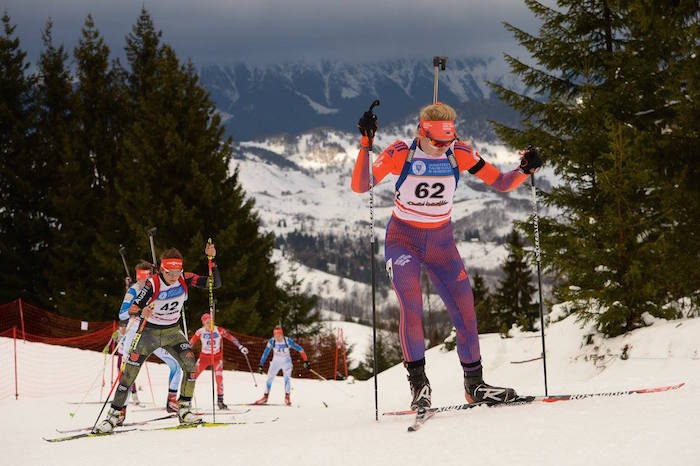
American Amanda Kautzer (62) leads eventual winner Marina Sauter of Germany (42) during the youth women’s 10 k individual at 2016 IBU Youth World Championships on Wednesday in Cheile Gradistei, Romania. Kautzer was the top American woman in 59th. (Photo: US Biathlon/NordicFocus/ Facebook)
Note: This article has been updated to include comments from Canada’s Teo Sanchez and Adam Runnalls.
Three Canadians in the top 20? Not a bad first day, considering it took them 38 hours to get to Cheile Gradistei, Romania, no thanks to a flight cancellation.
All that behind them, two Canadian junior males and a female recorded the best races of their careers on the opening day of IBU Youth World Championships on Wednesday.
“The first day of competition is always an exciting one as everyone has been raring to go,” Biathlon Canada High Performance Eric de Nys wrote in an email. “I know our travel to Romania was very long and difficult … So, to see that athletes end up where they did is very encouraging.”
The women raced first in heavy fog, which initially postponed the youth women’s 10-kilometer individual race by 1 1/2 hours. Once they got off the start line, with 91 women heading out at 20-second intervals, 18-year-old Marina Sauter of Germany emerged as the winner in her international debut.
Two weeks ago, Sauter told her hometown paper she was surprised to have made the team. She missed all of last season after having surgery on her foot and ankle joint.
“After the surgery it was difficult,” Sauter said. “I could not jog or train on the track. Usually I just biked or rollerskied alone. I was still in pain after long distances. That’s why I was surprised myself by the performance level that was already possible this winter.”
At her first world championships, she was hoping to validate her results from the German trials.
“I just want to have good competitions,” she said at the time.
On Wednesday, she won the 10 k individual by 2 seconds over France’s Myrtille Begue. Sauter had two penalties — each adding a minute to her time — but no one in the women’s field shot clean. She won in 35:14.2, Begue had two penalties as well en route to second, and Marketa Davidova (Czech Republic) had three misses and reached the podium in third (+12.7).
Among the North Americans, Megan Bankes, 18, of Foothills Nordic, notched her first top 20 in her third IBU Youth World Championships in 19th (+3:21) despite seven misses (1+4+1+1).
“Megan Bankes had a fantastic result in 19th considering she missed 7, this shows she is skiing fast,” de Nys wrote.
In the men’s 15 k that followed, Canada’s 18-year-old Teo Sanchez (Chelsea Nordiq) placed 13th in his first international race. He had two misses, both in the first prone stage, then three clean stages to end up with just two total penalties and was 4:03.6 behind the winner.
“After the first stage my coach gave me a correction for the wind, two clicks left on my sights and I cleaned the rest of my shooting,” Sanchez wrote in an email. “My goals for these championships were simply to keep a clear head through it all and just race like I normally do. I didn’t want any drama for my first international race, and I avoided that quite nicely. For me, just being excited and having fun is how I keep my performance where it needs to be.
“So far this has been one of the most amazing experiences of my life,” he added. “Cheile Gradistei is beautiful and the race trails are really fun, though quite technical.”
Another Canadian, 17-year-old Adam Runnalls (Calgary Biathlon Racers) placed 17th (+4:50.4) with four misses (1+2+0+1) in his first world championships.
“I had really no idea what to expect and where my skills would land me,” Runnalls wrote in an email. “During the first race I tried to focus on the metal aspect of shooting, something I have been recently struggling with and it worked out.
“I was happy with all aspects of my race, skiing was nearly perfect and shooting was where it needed to be to stay competitive,” he continued. “I would say that all aspects of my plan came together and a top 20 was the result.”
“Teo and Adam had good all around races shooting well and skiing within the top 20,” de Nys wrote. “Zachari [Bolduc] also shot well and his skiing started slow but he was getting quicker with each bout of skiing.”
Bolduc, 17, of Biathlon La Poursuite, placed 31st (+5:44.7) with three clean stages and two penalties in his second stage (0+2+0+0).
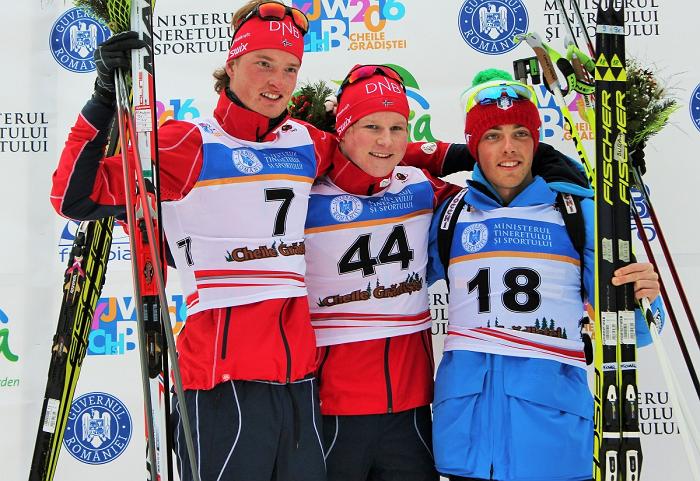
The youth men’s 15 k individual podium at 2016 IBU Youth World Championships in Cheile Gradistei, Romania, with Norwegian winner Harald Øygard (c), Aleksander Fjeld Andersen (l) of Norway in second, and Italy’s Michael Durand (r) in third. (Photo: Norges Skiskytter Forbund)
Also in his first international race, Norway’s Harald Øygard won the youth men’s individual in 37:00.3 with a single penalty in the second stage. The Norwegians took the top two spots on the podium with Aleksander Fjeld Andersen in second place (+40.8) with one miss, and Italy’s Michael Durand was the only man out of 95 finishers to shoot clean and ended up third (+1:10).
“This was great fun and something I did not expect!” Øygard said in a Norwegian team press release, according to a translation. “I debuted internationally today, and just went out to do my duties and have fun. But then worked out everything on the firing line and the track, and besides, I had fantastic skis.”
Following two teammates in the top 20 and one just outside the top 30, Canada’s fourth man, Lucas Boudreau placed 66th with a clean first stage and three total penalties (0+1+1+1).
Leading the U.S., Cody Johnson finished 43rd (+7:17.3) with three misses as well (0+2+0+1). The U.S. men took 67th through 69th with Vaclav Cervenka in 67th with nine misses (1+3+3+2), Peter Carroll in 68th with seven misses (2+3+1+1), and Brendan Cyr in 69th with seven misses (2+0+2+3).
In the women’s race, Canada’s Emily Dickson placed 36th (+5:04.7) with four penalties (1+1+1+1), Nadia Moser finished 47th with eight misses (1+1+3+3), and India McIsaac was 74th with 12 misses (2+2+4+4).
For the U.S., Amanda Kautzer placed 59th with six penalties (0+2+1+3), Claire Waichler was 67th with 10 misses (3+3+2+2), Chloe Levins 72nd with eight misses (1+2+1+4), and Ariana Woods 79th with 12 misses (3+2+3+4).
Emily Dickson raced to 36th in the youth women’s 10 k individual at IBU Youth World Championships in Cheile Gradistei, Romania. (Photo: IBU YJWCH Cheile Gradistei 2016/Facebook)
Emily Dickson raced to 36th in the youth women’s 10 k individual at IBU Youth World Championships in Cheile Gradistei, Romania. (Photo: IBU YJWCH Cheile Gradistei 2016/Facebook)
Nadia Moser on her way to 47th in the youth women’s 10 k at 2016 IBU Youth World Championships in Cheile Gradistei, Romania. (Photo: IBU YJWCH Cheile Gradistei 2016/Facebook)
Vaclav Cervenka placed 67th in the youth men’s 15 k individual at IBU Youth World Championships in Cheile Gradistei, Romania. (Photo: US Biathlon/NordicFocus/ Facebook)
Peter Carroll on his way to 68th in the youth men’s 15 k individual at 2016 IBU Youth World Championships in Cheile Gradistei, Romania. (Photo: US Biathlon/NordicFocus/ Facebook)
Ariana Woods placed 79th in the youth women’s 10 k individual at IBU Youth World Championships in Cheile Gradistei, Romania. (Photo: US Biathlon/NordicFocus/ Facebook)
Simon Schempp of Germany celebrates his second-straight win at the men’s 12.5 k pursuit in Pokljuka, Slovenia. (Photo: IBU/Kvetoslav Frgal)
Perfection in a pursuit. That’s what’ll get you ahead and keep you there, as Germany’s Simon Schempp demonstrated on Saturday at the International Biathlon Union (IBU) World Cup in Pokljuka, Slovenia.
Two days after winning the men’s 10-kilometer sprint, Schempp started the 12.5 k pursuit with a 15-second head start on Norway’s Ole Einar Bjørndalen in second. Twenty-five and 26 seconds back in third through fifth, respectively, Russia’s Evgeniy Garanichev and Alexey Slepov and France’s Martin Fourcade set out after Schempp.
After placing third in the sprint, Garanichev fell out of contention for another podium with a miss in the first prone stage. He went on to clean the next two stages, but missed another on the final standing to end up sixth overall.
Slepov fared worse, with two penalties in each of the first two prone stages, then one in each standing for a total of six penalty laps. He placed 25th at the end of the day, while Schempp controlled the race from start to finish, winning with perfect 20-for-20 shooting in a time of 30:46.5.
France’s Martin Fourcade finishing second in the IBU World Cup pursuit on Saturday in Pokljuka, Slovenia, while Russia’s Anton Shipulin enters the finishing straight for third. (Photo: IBU/Kvetoslav Frgal)
Only Fourcade, the fifth starter, came close, rivaling Schempp with clean shooting through the first three stages. The Frenchman missed one on the last standing, which put him 18.4 seconds back leaving the range after a costly penalty loop. He finished 16.6 seconds after Schempp in second, and Russia’s Anton Shipulin rose from sixth to third with the fastest course time.
Shipulin finished 23.4 seconds after Schempp with two penalties (0+1+1+0), besting Norway’s Tarjei Bø, who was 1.8 seconds off the podium in fourth. Bø posted the second-fastest course time to pick off five places after starting ninth.
Only three out of 59 finishers cleaned the four-stage race: Schempp, France’s Simon Fourcade (who placed 10th), and Sweden’s Fredrik Lindström (14th).
“Maybe the last 200 meters were easy. Everything else was extremely hard,” Schempp said in an post-race interview with ZDF. “I didn’t quite have my best day out on the course today, and except for one loop with Martin, I always had to ski in front alone. That was quite energy-sapping.”
Fourcade was the fastest out of the start early on, racing from fifth up to third behind Schempp and Bjørndalen as they entered the range for the first time. There, all three men cleaned and Bjørndalen left the range nine seconds after Schempp in second while Fourcade was another 10 seconds back in third.
Second prone was more of the same, with the three leaders cleaning, yet Schempp maintained his distance with a 10-second cushion to Fourcade and Bjørndalen skiing together in second and third.
On the third loop, Fourcade, 27, dropped the 41-year-old Norwegian and entered the range right behind Schempp, where the top two cleaned all five targets once again. They set out on the penultimate loop together, where Fourcade made clear that he did not want to take the lead. Despite shooting faster, he waited for Schempp to go ahead of him.
Germany’s Simon Schempp and his smoking gun. Schempp shot 100 percent on Saturday to win the men’s pursuit at the IBU World Cup in Pokljuka, Slovenia. (Photo: IBU/Kvetoslav Frgal)
“That was the same as last week, he just didn’t want to go in front,” Schempp said of Fourcade. “He had shot faster, then he stepped to the side and wanted to let me pass. I just yelled ‘Together!’ to him, and then he nodded and we changed back and forth. At first there was a bit of a disagreement, but then that calmed down…”
“I don’t really understand why he does that sometimes,” Schempp added. “We were in front, but the others are pressuring from behind, and if you work together, you should be faster and can create a small gap. My opinion is that you should work together, except for the last loop of course, but before that, yeah, I just have a slightly different opinion than him.”
“We collaborated a lot …,” Fourcade said in a post-race press conference. “It was a good solution. We were making sure we had positions one and two.”
In the final standing stage, Fourcade shot quickly, but missed the fourth shot, while Schempp cleaned.
“In the last shooting, I thought his second shot had missed. At least it sounded that way,” Schempp recalled.
“Before the race, I thought that I would try to do all I can to be first,” Fourcade said in the press conference. “Simon was a little calmer at the last shooting. He had his own rhythm.”
Fourcade came out of the penalty lap with an 18.4-second deficit, which proved insurmountable. He skied what appeared to be comfortable pace to the finish for second, 6.8 seconds ahead of Shipulin. After the race, Fourcade and Schempp hugged each other. It was Schempp’s eighth World Cup victory, his third win this season, and the third time he won both a sprint and the following pursuit in the same venue.
While Shipulin secured third on the final loop, he overcame a couple penalties. One miss in the second stage dropped him to eighth, and he left the range after another penalty in the third stage in sixth. When Bø missed one in the final shooting, Shipulin seized the opportunity and cleaned when it counted, leaving the range in fourth, three seconds behind Bø and passing him on the final loop to avoid a sprint to the finish.
“After the second penalty loop, I thought it was possible,” Shipulin said in a press conference. “I was hoping to shoot clean and thought I had a chance to get on the podium.”
According to the IBU website, with one race to go — Sunday’s mass start — Shipulin is eager to see his newborn son.
“I want to go home and see my son, but I try to stay motivated and focused on the upcoming competitions,” he said.
Burke Cracks Top 10
American Tim Burke (14) during one of his last two standing stages, while shooting alongside a German, Slovenian, and Russian. (Photo: IBU/Kvetoslav Frgal)
After starting 14th and 55 seconds behind Schempp, American Tim Burke improved to ninth with a single penalty (0+0+1+0), finishing 1:21.9 behind the German winner.
“[I’m] really happy with today; I had a really simple game plan with my shooting to try to stick to my few key words,” Burke said in a post-race phone interview. “I felt really comfortable out there.”
He skied alone for most of the race, which he found both odd and challenging. Burke started 9 seconds behind the 13th starter, Simon Desthieux of France, and four seconds ahead of US Biathlon teammate Lowell Bailey.
After cleaning the first prone stage, Burke had made his way up to 11th and 50.7 seconds behind Schempp, while Bailey had slipped one spot to 16th, 1:02 back. Both Americans cleaned the first shooting, but Bailey went on to miss one in each stage thereafter (0+1+1+1) and ended the day in 29th (+2:46).
“Not a bad day for me, but without near perfection, it’s hard to compete with this field,” Bailey said in a US Biathlon press release. “There was great overall shooting in the men’s field today so I lost a few places with penalties in each of the last three stages.”
Meanwhile, Burke cleaned the second prone and missed one on the third shooting to hover in the top 10 throughout the race. After hitting all his targets on the final standing, he left the range in ninth. Simon Fourcade trailed him by almost seven seconds in 10th at the beginning of the last loop, while Norway’s Emil Hegle Svendsen was almost 18 seconds ahead in eighth.
Tim Burke (US Biathlon) racing to ninth in the men’s 12.5 k pursuit on Saturday at the IBU World Cup in Pokljuka, Slovenia. (Photo: USBA/NordicFocus)
That left Burke in no-man’s land once more. On the first loop, he had worked hard to catch the group that was fighting for top-10 results, and while he bridged the gap 500 meters before the range, he exited the range just far enough behind those skiers that he remained alone, one loop after another.
“It was a little bit tougher for sure,” he said of the solo race. “I was hoping I’d be able to tuck in on the second loop and catch a little bit of a break.”
Burke worked especially hard the first couple loops to catch those ahead of him and said he felt the effects of that effort later in the race. Still, he held on and most importantly held it together for the last shooting.
“So much can change on the last shooting…,” Burke said. “I was hoping that people would finally start making mistakes there on the end. The last shooting, I shot on point 11 and shot zero and moved up one place. I was really happy to move back into the top 10; it’s the best race I’ve had in a while.”
At the same time, he reflected on how tight the race was. Given the race he had, with 19-for-20 shooting and the 19th-fastest course time, Burke would have guessed he would have finished in the top six. Not the case when the fastest guys don’t have to ski many penalty laps.
“It’s a fairly easy approach to the range here of so a lot of people shoot well here,” he noted.
Burke will be one of three North Americans starting Sunday’s 15 k mass start, with Canada’s Nathan Smith in bib 12, Bailey in 19th and Burke in 26th out of 30. Three seasons ago, Burke placed third in the Pokljuka mass start.
“I think it’ll be a great opportunity for me,” Burke said. “Typically I do well at the end of these trimesters … these three weeks of racing.
“At this point, fatigue definitely plays a big role for everyone, both mentally and physically,” he added. “A lot of people want to get home at this time. … For me, it’s one more race. I need to focus for 40 minutes out there and I think I can handle that.”
On Monday, the day after the Pokljuka World Cup ends and the IBU World Cup goes on holiday break, he’ll fly home to Lake Placid, N.Y.
While Bailey was the second man for the U.S. in 29th, Brendan Green was the top Canadian in 30th (+2:53.3). After starting 46th and cleaning the first three stages, Green missed two on the last standing and fought for a top 30 on the final loop.
For the first time in history, five Canadian men started the pursuit. Smith finished 35th (after starting 24th) with three penalties (1+0+2+0). Scott Gow started 35th and finished 45th with four misses (1+1+2+0), and Macx Davies slipped from 34th to 57th with six penalties (3+2+2+1). Despite skiing in the top-30 for a portion of the race, Christian Gow, in bib 37, did not finish.
“On my fourth lap I developed a debilitating cramp and had to stop the race,” Gow wrote in an email about his DNF. “I really wanted to finish, especially since I was having a good race, but I simply couldn’t. It is disappointing for me, but sometimes these things are out of your own control.”
“It was a tough day for our team,” Biathlon Canada’s High-Performance Director Eric de Nys said in a press release. “The coaches are thinking there may be a bit of a flu bug going around. Nathan and Rosanna [Crawford] both felt off today. Christian completely cramped up and Megan [Tandy] blacked out on the course. It was an off day, but they will review the day with the athletes and bounce back from this.”
American Leif Nordgren made up a few spots in 49th (after starting 52nd) despite four penalties (0+1+2+1).
Eric de Nys coaching Olympic silver medalist Sara Renner at Silver Star, British Columbia, in 2009. De Nys hopes to see more medals in his new role with Biathlon Canada.
After 18 months coaching the junior cross-country ski team at the WinSport Winter Sports Institute, Eric de Nys is moving back to the Bill Warren Training Center in Canmore.
The former National Ski Team coach has taken a position with Biathlon Canada as the High Performance Director, replacing Chris Lindsay who left to take a job with Own The Podium this summer.
“I had started working with some [junior] biathletes last year and coaching them,” de Nys said in an interview on Tuesday. “So when I saw this ad come out… I thought it would provide me an opportunity to try a different role and give me a new challenge. That’s what I was looking for.”
De Nys explained that when he left Cross Country Canada he had been looking for a job which was based in Alberta for a bigger chunk of the year.
“The main thing was that I have two kids,” he said. “I went from spending 135 days on the road to between 50 and 60. That was really nice after 10 years of traveling extensively with the team to be around home and be more of a dad. And to be involved with activities and volunteering lots at different sporting events like hockey and biathlon and skiing and gymnastics.”
He leaves WinSport in the hands of the Canmore Nordic Ski Club for this season. Alain Parent will be taking over athletes’ training plans.
“WinSport has been really supportive and it has been a great 18 months with them,” de Ny said. “They have been really supportive of me moving on into this role, and also supportive of where the program will go. Last year WinSport and Canmore Nordic went in together on all the racing trips. All the athletes at WinSport are very accustomed to how they do things on the road, and waxing and ski selection and all of that. So it’s an easy transition.”
In January or February there may be a job posting for a head coach for the 2016-2017 season, he said.
He estimates that his new position will involve about the same amount of travel as the WinSport coaching job. The High Performance Director works with national team coaches and athletes, but also interacts with development programs domestically and communicates with funding bodies and media.
“A lot of it is being the go-between for our federation and Sport Canada, the Canadian Olympic Committee, and Own the Podium,” he said of the work so far. “Those are our three main funding partners.”
While biathlon adds a shooting component to cross-country skiing, the sport de Nys has worked in up to this point in his career, he doesn’t see that as a problem. The coaching is up to head coach Matthias Ahrens and national team coach Roddy Ward; de Nys’s job is more strategic.
“It’s high performance sport,” he said. “There’s a lot of similarities whether you are doing it in swimming or curling or biathlon. Being around the nordic community for 10 years at a high level I definitely became quite privy to what it’s going to take to be at the top, and how to get there. From that side of things that’s probably why I’ve been hired.”
Since he worked at the Bill Warren Training Center when he was a cross-country national team coach, De Nys says that he already knows most of the athletes and staff, which makes the transition easy.
“It’s a natural fit,” he said.
Up on the docket this year for the biathlon community are not only the regularly scheduled World Cup and IBU Cup circuits, and youth, junior, and senior World Championships, but also some extra excitement. Canmore will host World Cup competitions in the first week of February. There’s also the Youth Olympic Games on the schedule; the once-every-four-years event will take place in Lillehammer, Norway.
“All of the coordinating for the Youth Olympic Games is like an Olympic Games but on a smaller scale,” de Nys said. “For the Canadian Olympic Committee that’s one of their babies. So I’ve been talking with those people.’
He won’t be on the ground in Norway, but is coordinating the organization’s effort and sees it as a good testing ground.
“It’s a great development tool both for athletes and coaches and technicians,” de Nys said. “It’s a pretty serious role, but not necessarily a dealbreaker in terms of if we don’t have results there. But it’s a big job for those coaches and athletes. For a lot of those athletes they will have done a provincial Games or a Canada Winter Games, so it’s the next step for them.”
Besides the season-specific targets, Biathlon Canada is planning for years down the road.
“I’m working with the national team coaches and athletes for strategic planning into the next Olympic Games: what are we going to do? How are we going to do that?” de Nys said. “Around that is building criteria for how to make the national team and get carded, which is how we fund amateur athletics. And all the trip selections, those are all in my wheelhouse.”
Parallel is working on the programs to identify athletes who aren’t likely to be selected for trips until a few years from now.
“Where are we at right now? Where do we want to be in four years or eight years?” de Nys said. “Looking at the pipeline, as you would call it in the U.S.”
Perianne Jones (Canadian National Development B-Team) races to 32nd for her best World Championships distance result at 2015 World Championships in Falun, Sweden. (Photo: Fischer/NordicFocus)
For the last 12 years, Perianne Jones was more or less on autopilot, leading the life of a professional nordic racer in Canmore, Alberta, and giving little thought to what would come after skiing.
The 30-year-old Canadian national-team member and Nakkertok Nordic prodigy had moved west from her hometown of Almonte, Ontario, immediately after high school. She immersed herself in full-time training and racing, and by 2009, made the Canadian World Cup Team.
Two Olympics and five seasons later, Jones was inching toward retirement. Health issues stunted the start of her 2013/2014 season; she discovered in the fall of 2013 that she had hemochromatosis, a genetic condition that causes too much iron in the body. She spent the next few months working to manage her iron levels and returned to the World Cup circuit in late December 2013.
Canadian biathletes and fellow cross-country skiers cheer on their own Perianne Jones on the first leg of the 4 x 5 k relay at the Sochi Olympics. the team finished 14th, one place better than their finish at the 2010 Vancouver Games.
Two months later, she competed at her second Olympics in Sochi, Russia, placing 23rd in the freestyle sprint for her personal Olympic best. In the classic team sprint, she and teammate Dasha Gaiazova placed 11th after notching third in the same event at the 2013 Sochi World Cup a year earlier.
Jones ended her season with a second-place finish in the freestyle sprint at 2014 Canadian Nationals in Corner Brook, Newfoundland, and was subsequently named to the national development B-team last May.
Also last spring, her coach, Eric de Nys, left the national team to head up a new training program in Canmore: the WinSport Junior Cross Country Ski Team. Jones lost the bulk of the funding she had received as a World Cup Team member, yet decided to continue on for another season.
“I, for sure, wanted to do another year after Sochi, and do things right,” she said on the phone from Canmore in early April. “… [Not making the World Cup Team] was a bummer, but at the same time, I know I didn’t make the criteria. I had one top-ten two seasons ago and you needed two top-twelves. I was put on the development team, so it meant that this past season cost me way more than it ever has…”
“I, for sure, wanted to do another year after Sochi, and do things right.” — Perianne Jones
As a development athlete, she said the costs amounted to $40,000 to $50,000, and that included government assistance as a carded athlete.
“Even if you’re carded, you still have to pay for a place to live,” Jones said. “And living in Canmore is not cheap.”
Carded athletes essentially receive an allowance each month, she explained. The government cuts qualifying individuals checks that could be used for anything — even a flat-screen TV — but the amount is generally considered a living allowance.
“As a development skier, you have to cover housing and your team fee, which is around $10,000 and your winter expenses on the road, and then your flights to and from and around Canada,” Jones said. “It adds up.”
Without stressing too much over finances, she focused on the 2014/2015 season and logged some of her career-best distance results, placing 32nd in the 10 k freestyle and 37th in the skiathlon at 2015 World Championships in Falun, Sweden.
Canada’s Perianne Jones racing to fifth in the 1.4 k classic sprint at 2015 World Championships in Falun, Sweden. She placed 24th overall. (Photo: flyingpointroad.com)
Also in Falun, she finished 24th in the classic sprint and was 21st for a season best in the preceding World Cup classic sprint in Östersund, Sweden.
“This past year I was healthy the whole season, which was quite an accomplishment for me,” she said. “It wasn’t my best season in terms of results, but health-wise it was really good. … I was pleased with both my sprints in Östersund and at world champs. It always can be better for sure, but I don’t have any regrets.”
In Falun, she announced she would leave the international-racing scene at the end of the season. She capped off her career at 2015 Canadian Nationals in Thunder Bay, Ontario, winning the classic sprint, placing second in both the 5 k freestyle and 10 k classic individual races, and fifth in the 30 k freestyle mass start.
In Thunder Bay, Nakkertok hosted a retirement dinner in her honor, complete with a video and several athletes and her brother Kieran Jones — Nakkertok’s head coach — speaking about the impact she had on their ski careers.
“That was the only time I cried all week,” Jones said. “The ski club has been a huge part of my life and maybe I didn’t realize how I had been a part of them so much in the last ten years because I haven’t been around that much. I would totally love to go back to Ottawa and be a part of that some more.”
She clarified that her involvement with Nakkertok would most likely be as a volunteer.
“I have an interest in being involved, not necessarily in coaching at a high level, but when I was growing up with Nakkertok the ski club was entirely volunteer run,” she said. “I will be involved with a ski club wherever I end up. I will miss certain parts of skiing, but to have Joel still a part of the team will be an easier way to make that transition.”
On Friday, Jones and her husband, Joel Jaques, a national-team wax technician, hopped aboard their 32-year-old Dodge getaway van and began a road trip to Ottawa. She guessed they might be gone for at least a month, with Jaques heading back to Canmore for a week in the middle of their trip for a training camp. How far they’d go depended on how the van ran. They bought it in February, about the time Jones knew her career was winding down.
“We were just kind of joking about vans; there was one in Canmore and we offered the guy quite a bit less than he was asking and he said sure, and we’re like, OK, I guess we’re doing this,” she said.
If they have time and the van makes it to Newfoundland, a friend offered to keep the van and buy their plane tickets back to Canmore. There, Jaques will go back to work with the national team and Jones will decide on her next move: she’s considering studying healthcare in Calgary or Ottawa.
Meanwhile, she also planned to start working in Canmore to cover the cost of last season. While she essentially made up her mind to race one last season a year ago, the bill she received at the end of it ultimately solidified her retirement.
“At the beginning of [last] season, I thought if I work and keep skiing, I would need to make the World Cup Team and need other women on the World Cup Team around me to keep going,” she reflected. “As the season kept going, I was realizing that even if all those things came into place, I wasn’t motivated to keep training for another year.”
Perianne Jones racing to 29th in the Canmore World Cup in February 2010. (Photo: Win Goodbody)
After graduating high school, Jones started a fall term the University of Calgary, but found the commute back and forth from Canmore difficult. She took an online course at Athabasca University, but realized that didn’t work for her, either. Instead, she spent the next 12 years focusing on skiing.
“I’m happy with the decisions I made and I’m sure my ski career was the best quality,” she said. “Hindsight’s twenty-twenty; there’s always things that could’ve gone better, but at the same time I was able to commit 100 percent to skiing. Although I’m not educated right now, I’m really looking forward to going to school and I can put 100 percent of my energy into school.”
Jones and Jaques were also looking forward to having the freedom to visit friends this spring.
“I’m looking forward to waking up and being able to what I want to do for exercise,” Jones said.
“I will not be out on my rollerskis,” she added with a laugh. “So far it doesn’t feel a whole lot different. I feel pretty good about my decision, and I’m confident it was the right one. So many people say that it’s really hard [to retire] and some people say it’s awesome, but I think it depends on the person. I have enough plans to keep me busy; I don’t think I’ll be bored.”
Looking back, she credited her two national-team coaches, de Nys and Justin Wadsworth, for the longevity of her career. She worked with de Nys, a development coach before he became the women’s national-team coach, for most of her senior years.
“Eric really got to know me as an athlete and I got to know him as a coach, and I really trusted him and we were able to work well together,” Jones said. “And Justin, he’s been with the team since [2010] and he wasn’t my personal coach until this past year, but the transition was pretty seamless … I don’t feel like I lost Eric as a coach this year, but I feel like I gained Justin. Whenever we had a question about something, either of us could easily call Eric or visit him in his office.”
In her career, Jones notched three top-15’s at both Junior World Championships and U23 World Championships, finishing eighth at 2008 U23’s in Malles Venosta, Italy.
Canadians Perianne Jones (l) and Dasha Gaiazova celebrate their first bronze together in the Sochi World Cup classic team sprint. (Photo: Chandra Crawford)
“I had some really good World Junior experiences, some good results and some really fun times with the team,” she explained. “For sure, the two medals that I won with Chandra and Dasha respectively in Milano and Sochi were highlights.”
In 2012, Jones and Chandra Crawford teamed up for third in the World Cup freestyle team sprint in Milano, Italy.
Jones also recalled making the 2010 Olympics in Vancouver, British Columbia, as a major high point. She qualified in 2009 when she and Sara Renner placed sixth in the World Championships classic team sprint in Liberec, Czech Republic.
“That was the first time we got to go to the medal ceremony … and it was with Sara, who was a pretty big mentor,” she said. “I was actually never really on the team with Beckie [Scott] or Milaine [Thériault], but I traveled quite a bit with Sara. … Having them come before me and have the results that they did and just being the people that they are, they made it pretty appealing to chase after ski-related goals … Everything was so positive that I never I had any doubt that A.) I would enjoy it and B.) it would be possible.”
The last of Canada’s three veteran females to retire — following the departures of Crawford and Gaiazova from the national team last year — Jones was excited to see what the next generation of women could accomplish.
“I spent the majority of the season on the road with Emily [Nishikawa] and that was just awesome,” she said. “I’m glad I was there for that and able to witness her best season ever, and I think it’s a sign for really great things to come. There are younger women coming up, too, and they have Emily to look up to so there’s no doubt in my mind that they will do great things.”
Regardless of where she attends school, Jones envisioned that she and Jaques would end up living somewhere in western Canada.
“We don’t really want to leave Canmore,” she said.
Several members of the 2014 Canadian Olympic cross-country ski team get the perfect photo opp at the Olympic rings in Krasnaya Polyana, Russia. (From left to right): Perianne Jones, Amanda Ammar, Heidi Widmer, Brittany Webster, and Emily Nishikawa. (Photo: Emily Nishikawa)
Canadian Women’s World Cup Coach Eric de Nys with former athlete Sara Renner in spring 2009 at Sovereign Lake in Vernon, British Columbia.
Editor’s Note: This article is the first in a series about expected changes within the structure of the Canadian National Cross-Country Team, starting with the departure of women’s coach Eric de Nys. While official decisions will likely be announced later this month, here’s a sense of what’s to come in Canada. This article has been updated to include notes and quotes from WinSport’s press release.
CANMORE, Alberta — Eric de Nys, the current coach of the Canadian World Cup women’s team, is leaving the Canadian National Team coaching staff to start a new training program in Canmore for juniors looking to bridge the fitness gap to the senior level. The WinSport Junior Cross Country Ski Team, a year-round program for older juniors, was officially announced in a WinSport press release on Monday.
De Nys has been a member of the National Team coaching staff for the last 10 years and the coach of the women’s World Cup team for the last two years. This past year, however, he worked directly with just one athlete, Perianne Jones, as Chandra Crawford and Dasha Gaiazova, the two other members of the World Cup team, decided to pursue alternative training options.
Gaiazova trained alternately with the B2Ten organization and the Pierre Harvey National Training Centre, while Crawford temporarily left the National team in the spring of last year to train independently with Team Ninja.
Canada’s Chandra Crawford in her final international race of the season, and her career, where she was 44th in the 1.3 k freestyle sprint at the 2014 Olympics in Sochi, Russia.
Since the end of this season, the Canadian National Team has had to look hard at its structure and organization. According to the published selection criteria for this coming year, none of the Canadian women meet the objective standards to qualify for the World Cup team. A team for next year has not yet been named, and official decisions and announcements aren’t expected until later this month.
“You could look at our criteria and our website and put together guesses based on that, because that’s what we’re going to use, more or less,” Canadian Head Coach Justin Wadsworth said in a phone interview. “But I can’t tell you anything because we’re still in the process and none of that stuff has been decided officially.”
Crawford recently announced her retirement, making next season’s team officially one man (or more specifically, woman) down. Gaiazova and Jones did not make the World-Cup team requirements of at least two top-12 results or one top 6 last season.
Own The Podium, a sports organization that financially supports Canadian athletes who produce top-level results, has cut back on funding across all winter sports, according to Wadsworth.
According to de Nys, this combination reduced funding and an expected smaller team meant that the current coaching staff — with Wadsworth as head coach, de Nys as women’s coach, and Louis Bouchard as assistant men’s coach — would be a bit excessive for next year.
“With the World Cup team being what it will be next year, it just can’t justify having that many coaches there,” de Nys said. “We had to do some restructuring and part of that was eliminating a job.”
Wadsworth said the decision was based on “a combination of budget restraints and also travel, coaching and travel obligations and family.”
Cross Country Canada (CCC) High Performance Director Thomas Holland could not be reached for comment.
Looking forward, De Nys said the situation allowed him to move in a new direction, one that he hopes will help raise the level of skiing in Canada.
“There’s been a noted gap in Canada,” he said. “For top level [junior] athletes to make a training centre is a really big step … Some of the training centres have taken junior athletes and often they’re overshadowed because most of the athletes are seniors. So they’re junior athletes trying to adapt to a senior plan, and it doesn’t work very well.”
De Nys is working with WinSport, a Canadian winter-sports nonprofit that funds world-class facilities and services, to set up a junior academy in Canmore. The idea is for skiers graduating high school to spend a maximum of two or three years in the program, with the end goal of moving on to an athlete-funded program at one of the four National Training Centres, the National Senior Development Team, or the World Cup team.
“It’s a short window, and it’ll be a fairly intense program,” de Nys said. “But [the idea is] you have two years to do something, and then that’s it — you move on.”
De Nys said he’s been developing this program for the past few months, although the program has been in the works over the last year. “I actually had no say in planning the program up until the point that I got wind of it and thought about perhaps applying, which would have been a couple months ago,” he said.
“We know there’s a need for this program,” he added. “I hope that I have some education [to offer to] coaches and athletes across the country. But when I’m gone 145 days a year it’s pretty hard to do that, and now I hope, if I can cut that down to 70 days on the road, that’s 70 other days that I’m around Canmore or other clubs that come to Canmore or to the glacier. I can speak to them, help them out, whatever. I mean it’s going to be a really valuable asset, and I look forward to being around the home.”
Perianne Jones earlier last season at the Tour de Ski in Oberhof, Germany. (Photo: Fischer/Nordic Focus)
The program will start as soon as next month, and the application process for interested juniors should open within a week, pending finalization of details.
“Eric has played a critical role in developing many of Canada’s top skiers,” CCC Executive Director Davin MacIntosh said in the press release. “He is a proven performer, and his leadership of the WinSport Junior team will ensure that there is alignment and collaboration with national team programming — this represents a significant advantage for the future success of our program. Eric will bring a wealth of experience to the athletes at WinSport’s Junior Ski Team.”
According to the release, the program is “fully aligned” with Cross Country Canada’s Long Term Athlete Development Program.
“This new initiative is a very exciting project, we look forward to building this program and working with Eric as our head coach,” said Mike Norton, WinSport’s sport manager in Canmore.
De Nys explained he hopes to continue working with Perianne Jones in some capacity next year, although the intricacies of this are still being hammered out. Jones, who is currently building a schoolhouse in Nicaragua with several other Canadian skiers, was unsure of her plan for next year.
“We will continue to work together,” De Nys said. “That’s what she would like, and I’ll be happy to help her out.”
While meetings are still underway regarding the National team structure for next year, decisions are set to be released within two weeks.
As for Wadsworth’s role, he said CCC hasn’t made anything official, but “the plan is that I’m going to stay on with the team and have maybe a slightly changed role,” he said. “[I’ll] still be the head coach of the World Cup and the national team, potentially work in some other areas as well.”
Dasha Gaiazova racing at 2013 World Championships. In Davos yesterday, she was the top Canadian finisher in the 1.5 k sprint, placing 42nd.
DAVOS, Switzerland – After Dasha Gaiazova finished the 1.5 kilometer freestyle World Cup sprint qualifier on Sunday, she hovered at the finish line. In bib 29, she ranked 24th when she crossed the line. But a few minutes later, more racers had finished their qualifying laps and Gaiazova was bumped out of the top 30. Without making the quarterfinals scheduled for a few hours later, her day was over.
And so it went for the Canadian national team. One by one, they learned that they just weren’t fast enough on this particular day.
“None of us are in,” said Devon Kershaw, one of the last team members to go through qualifying. “It’s inexcusable. If you’re not top 30, it doesn’t matter if you’re last or you’re 31st … I’m really disappointed none of the other guys got in.”
Gaiazova ended up 42nd and Chandra Crawford 43rd on the women’s side, while Alex Harvey led the men in 45th place. Lenny Valjas placed 61st, Kershaw 69th, and Jesse Cockney 82nd.
“I didn’t feel that bad, but I skied like a bag of shit,” Kershaw said. “It didn’t feel good, but it didn’t feel as bad as it was.”
For some members of the team, like himself and Gaiazova, it was unclear exactly what had gone wrong. (“You just go as fast as you can,” Gaiazova shrugged of pacing in the qualifier.)
But for others, it was not necessarily a surprise – for instane, Chandra Crawford and Lenny Valjas, who are coming back from tough off-seasons and want to know first and foremost how they stack up.
Valjas had knee surgery this summer to address some nagging problems that had prevented him from doing any real leg strength for several years. He lost weeks and weeks of training when recovery didn’t go as well as planned, but now he has at least made it back on the circuit.
“The knee is getting a little better,” he said. “It’s still a problem, but right now it’s the shape more than that. Taking 18 weeks or whatever off. I can’t do anything out here. I’m trying my hardest and not going fast. I’m missing – the effort is there, I’m just missing a little bit of speed.”
He hopes that next weekend’s sprint in Asiago, Italy, will go better – it’s classic, which he favors. In the opening sprint of the season in Kuusamo, Finland, he was 39th. Again, not in the heats, but at least closer than he was in Davos.
“So far, I don’t notice that I’m making progress, but I’m sure that I am,” he said. “I’m finally able to do some intensity. These races have to help the shape.”
Despite technically being Olympic qualified, Crawford is also on the comeback trail. She ended her season early and then controversially left the national team this off-season. (Since then, Canadian coaches said they needed to see her race before they’d commit to taking her to the Olympics.) Things got more complicated when she discovered a thyroid problem and low iron levels.
She started the season in Scandinavia, competing in FIS skate sprints. The Davos World Cup is her first race back on the circuit.
“Goals for today, just to see where I’m at in the world,” she explained. “I’ve done three warmup races, I’ve got my health under control, it’s solid, I feel happy and great. So I wanted to see where I would rank. I’m making gains every weekend using benchmarks like Hanna Falk and Dasha. I was keen to see if I could improve my time behind again, and make gains every week.”
Finishing 0.14 seconds behind Gaiazova, she has caught up – even if her fellow Canadian wasn’t psyched with her own race.
“It’s 60 days now until the Sochi race, so I’m spending each of those days getting closer to Sochi,” Crawford said. “And today is a great day to get closer to my Sochi goal of being fit and fast and ready, no matter how it goes. It can go bad like this, or it can go really well, it’s still a useful day.”
As was clear to everyone on the Canadian team, though, improving so that they have their best Olympics ever might not be a straightforward process. They know they have their work cut out for them.
“We were bad today,” coach Eric de Nys said in a tersely-worded Cross Country Canada press release. “There is no excuses and no two ways about it, but it was not for lack of trying and the team skiing their butts off.”
In Crawford’s case, the pain it will take to get that gain is quite literal.
“I feel like I just did 300 burpees and tuck jumps in a row,” she lamented at the finish line. “I’m in so much pain.”
Alex Harvey (l) and the Canadian World Cup Team are hoping for more moments like this, when Harvey captured bronze in the 1.5 k classic sprint at 2013 World Championships in Val di Fiemme, Italy. Russia’s Nikita Kriukov (c) won, and Norway’s Petter Northug (r) was second. (Photo: Fiemme2013)
The Canadian World Cup Team plans to approach this season with a bit of a reserved fire, and who could blame them? This time last year, Devon Kershaw was sucking it up after tearing a ligament in his foot while running down stairs in Bruksvallarna, Sweden – a week before the World Cup started in Gällivare.
His teammate, Lenny Valjas sat out the team’s first FIS races in Bruksvallarna to give his broken pinky finger more time to heal. He broke it two days before flying to Sweden while tossing a football at home in Toronto. The recovery was expected to take up to six weeks; Valjas was racing in just over two.
Yet still the team pressed on, posting a solid opener in Bruks, where Chandra Crawford notched second in the freestyle sprint and eighth in the 5-kilometer classic, Ivan Babikov tallied third and Alex Harvey took fourth in the 10 k classic. Harvey placed eighth in the skate sprint, and Kershaw finished 10th in the 15 k skate.
The next weekend wasn’t so hot. Babikov was the lone Canadian World Cup skier (out of seven) to break through the top 30 individually. He placed 14th in the 15 k skate, and the next-best result from Harvey was 36th in the same race.
“I think having all that stuff happen last year – I am glad it is not happening right now,” Canadian World Cup Team Head Coach Justin Wadsworth said on the phone two weeks ago.
The Canadian World Cup Men’s Team, including Harvey (r), Babikov (c) and Valjas during a rollerski at Donner Pass near Truckee, Calif., this fall. (Photo: Mark Nadell/MacBeth Graphics)
Valjas was rebounding from knee surgery in July, but able to keep up with his teammates in most of the workouts at their fall dryland camp in Truckee, Calif., Wadsworth said.
“We downplayed a lot of it [last year],” he added. “I think everyone forgets … they didn’t know how bad Devon’s ankle really was, and Lenny’s broken hand – he went through all the early season skiing with one pole and skiing in a cast after that. All those things, I think really added into the mojo, the overall lack of results last year.”
The team’s showing in Kuusamo, Finland, on the second World Cup weekend was better, with Perianne Jones pulling out 12th in the classic sprint and Gaiazova finishing one spot back in 13th.
But the small group was generally down a notch, playing catchup after a summer of training too aggressively and feeling slightly sluggish (even battered) coming into the 2012/2013 race season. Less than a month after arriving in Europe, the team jetted back to Canada for their home World Cups in Quebec and Canmore last December.
Expectations for the seven were high, with the entire team racing and a zealous crowd at both venues to back them up. Quebec’s pride and joy, Harvey produced the best Canadian individual result in Quebec City of 21st in the skate sprint, and was fifth in the freestyle team sprint with Kershaw. A week later, Harvey and Kershaw didn’t make the top 50 in the Canmore World Cup skate sprint and skipped the skiathlon there as a result.
The season was not lost, with Harvey coming back from a shoulder injury sustained in Sochi, Russia, to win bronze at World Championships in the classic sprint in Val di Fiemme, Italy. Babikov racked up another Canadian-male record there, placing fourth in the 15 k freestyle. Valjas finished the season stronger than ever, ranking eighth in the overall Sprint World Cup, and Babikov finished 20th overall – his best on the World Cup in eight seasons.
“We had a lot of stuff that happened last year,” Wadsworth said of the injuries and sicknesses that plagued his team throughout the season, including Kershaw’s stomach bug from mid-January to mid-February and Valjas’ strep throat throughout World Championships.
“When walking down icy stairs, I think they have a little tighter grip on the railing now,” Wadsworth added. “And just being a little more clear-headed so we don’t make any mistakes that might lead to an injury. At the same time, you can’t just be so cautious and tense all the time. I really like where we are right now. Everyone seems pretty loose and pretty focused on what they need to do, and that’s the main thing.”
The Game Plan
On Nov. 17, most of men’s team flew to Davos, Switzerland, to train for a couple weeks before the first World Cup races in Kuusamo this Friday through Sunday. In search of snow, the Quebec-based Harvey arrived Nov. 11 with his coach and the team’s assistant, Louis Bouchard, and enjoyed a week of good skiing in Davos with about four kilometers of natural snow until a thaw. The area expected more snow when the rest of the crew – Kershaw, Babikov, Valjas and last year’s NorAm leader Jess Cockney – arrived.
Chandra Crawford (r) skis alongside Sophie Caldwell of the U.S. Ski Team at Frozen Thunder in Canmore, Alberta, in October.
According to Wadsworth, Gaiazova planned to meet them in Kuusamo for her first races of the season, and Jones would fly over later, likely in mid-December. Crawford would open with three weekends of FIS races in Sweden (first in Bruksvallarna last weekend, Idre this weekend, and Östersund Dec. 7-8).
Crawford, who turned 30 on Nov. 19, declined a spot on the national team in April after choosing to end her World Cup season early last February.
“After a solid burn out and overload I’m re-charged and keen to make the most of the days until Sochi,” Crawford wrote in an email in May. “I have to manage my energy and do things in ways that work for me so while it’s financially sketchy it is the best option.”
She planned to work with personal coach Peter Larsson and joined Team Ninja, a band of four female nordic skiers in Canmore, Alberta. Technically prequalified for the Sochi Olympics (after notching sixth in the Canmore skate sprint last December), the 2006 Olympic gold medalist has to meet certain standards to prove she’s at World Cup and Olympic level again.
In three FIS skate sprints, Crawford must make “the basic criteria of top 12,” according to Wadsworth. She was 19th last Sunday in Bruksvallarna.
“If she does that, we’ll bring her on the World Cup, starting in Davos [Dec. 14-15],” he said.
In an email, Jones explained she won’t start the World Cup until probably Asiago, Italy, Dec. 21-22 after recent tests revealed she has hemochromatosis, a genetic condition that causes too much iron in the body. She was feeling fatigued as a result and spent the fall trying to figure out what was wrong.
“We are just taking some time to figure out how to manage it (blood letting is how to do that) but I can’t just dump a lot of blood, cause in this business blood volume is important also!” Jones, 28, wrote. “So my departure to Europe might be a little bit delayed, but I’m confident things are getting back on track.”
Team Ninja (from l to r): Zoe Roy, Alana Thomas, Chandra Crawford, and Amanda Ammar
The reigning women’s NorAm leader, Amanda Ammar declined her Period I World Cup starts in an effort to recover from injuries in her back and foot. Her back has been bothering her for years, but a new kind of pain in her foot – caused by Morton’s neuroma (a nerve injury between the toes) – put her in the pool this summer. In an email, she explained her flat feet and tight ski boots were likely the culprits.
“Surgery is the solution to get rid of it, but I obviously can’t do that now,” the Team Ninja leader and former national-team skier wrote. “So we opted for a cortisone shot in the area. It seemed to help, and I’ve been able to train with no foot pain for at least a month and a half! ! We’re hoping that I won’t need any more cortisone shots this season, but I’m prepared to get another one if need be.”
She’s been maintaining both injuries since September, receiving prolotherapy in her back and seeing about six doctors about her foot. Unable to run, Ammar can ski and has the added bonus of being on snow in Canmore.
“I opted to not go to the early world cups because A.) Injury. I wanted to be close to my doctors and physio. I sometimes feel like I’m riding a very fine line,” she wrote. “Plus, going to Europe makes it an early season, and I just wasn’t feeling prepared after all my injuries [and] B) … My main focus is Olympic trials this year, and I want to do everything I can to be prepared and confident when I hit that start line.”
For Ammar, that means racing the NorAm openers in British Columbia (first at Sovereign Lake Dec. 7-8, and then in Rossland Dec. 14-15). Trials will take place in Canmore Jan. 8-12, and the Olympic qualifying period will end Jan. 18. Skiers can make the Olympic team by meeting various criteria, but the most surefire way to get in is top 12 in a World Cup distance race or top six in a sprint. Three World Cup top 30’s is another method.
Based on last season’s results, all seven World Cup members technically prequalified for the Sochi Games, but “they still have to show this year that they are going to be relatively competitive at the World Cup level,” Wadsworth explained.
In terms of discretion: “That’s pretty loose,” he said. “As long as they’re not, like, 60th in every single race on the World Cup and just bombing out, then we’ll take them. We expect that won’t be a consideration.”
Canada will field a team of 11, which will be decided internally, he said.
“[It] can be any combination – it can be six men, five women. It can be seven men, four women. It can be six women, five guys. We’ll just see how everybody’s racing and where our strengths and weakness are,” he added. “We want to take a competitive team.”
Wadsworth and the rest of the Cross Country Canada (CCC) staff decided on 11 to make the most of their athlete-to-staff ratio at the Olympics. Like the 2013 World Championships, Canada will have three coaches (Wadsworth, women’s coach Eric de Nys and Bouchard), seven waxers, a couple massage therapists and a doctor and physiologist in Sochi.
One of the first issues from last season that the team addressed was to improve race-day protocol to minimize waxing fiascos. Athletes are expected to arrive earlier for their races to work with their techs, Wadsworth explained. Having a brand-new wax truck to hang out inside “and be a little more tied to the waxing team” should also help, he said.
“We’ve also changed some of the roles of the waxers to get them out on the tracks more and closer to the track,” Wadsworth said. “Instead of being back in the wax room and making decisions from the wax room, there has been some small tweaks there that hopefully will pay off.”
An Olympic Year
After a rockstar season two years ago – in which Kershaw was the overall World Cup runner-up to Switzerland’s Dario Cologna – and a 2011 World Championships classic team sprint gold (won by Kershaw and Harvey), the Canadians are looking to break new ground at the 2014 Winter Games in Sochi.
The team has a published goal of two medals at the Olympics and eight World Cup podiums, but Wadsworth said the emphasis is definitely on the former. At the very least, he expects at least five World Cup podiums; in non-Olympic years, that goal is closer to 15.
Canada’s Beckie Scott (r) and Sara Rennner celebrate their silver medal in the team sprint at the 2006 Olympics in Turin, Italy.
As for Olympic medals, Canada has not won seen any since 2006, when Crawford won the skate sprint in Turin, Italy, and Beckie Scott (Wadsworth’s wife) and Sara Renner teamed up to win silver. Scott was the nation’s first nordic skier to win gold at the 2002 Olympics in the 10 k skiathlon.
This time around, the men’s team is especially hungry.
“No Canadian man has ever stepped on the podium and that sucks,” Kershaw said on the phone last month while training in Davos. “Were better than that and the time is now.”
In late October, Kershaw joined the Norwegian men’s team at a camp in Val Senales, Italy, and spent the rest of November in Norway with his girlfriend, Kristin Størmer Steira, before the start of the season on Nov. 29.
In what could be Kershaw’s last Olympics (although he’s not entirely sure, and he plans to race through 2015), the 30 year old said his main goal is to bring an Olympic cross-country medal home. “I don’t care where it comes from,” he said.
Overall, Canada is hoping for a golden season with a team of mostly veterans (with the exception of Harvey and Valjas, both 25).
“We anticipate that perhaps Dasha, Peri and Chandra will [retire] after this year so we have to start grooming the younger crowd as well,” de Nys said on the phone in May. “There’s a fairly large gap from the World Cup level to the younger levels. … We have to make sure we keep building up …”
Dealt a seasoned squad – with everyone but Valjas racing at the 2010 Vancouver Olympics – Wadsworth wouldn’t have it any other way.
“Everyone on our World Cup team has medaled on the World Cup,” he said. “That’s huge. That feels good to know that everyone is pretty solid and can produce a result on the right day. … We were three inches away from getting two medals at the World Championships last year, which was our goal there.”
Kershaw and Harvey placed fourth in the freestyle sprint in Val di Fiemme, missing third by three-hundredths of a second.
“We feel realistic about two medals at the Games, should be pretty much doable,” Wadsworth added. “I’m really satisfied where everyone is right now.”
Playing to Harvey and Kershaw’s favor, the Olympic team sprint is a classic race.
In an email, Harvey wrote that he was healthy: “no illness, no injury. Knocking on wood!” As for goals, he’s ultimately eyeing the Olympics.
“Getting up to speed as the season progresses is the plan but it’s always motivating to race fast, no matter what the time of the year it is,” Harvey wrote. “So being in the fight for top spots early on would be nice too!”
That said, Wadsworth isn’t stressing early results; he’d like to see his athletes ease into the season. Last year, he felt their eagerness to race got the best of them and recovery lacked as a result. This season, they’ve been careful to manage that.
“It is a good place to be coming from when you don’t have too much confidence coming into a season like this,” he said. “Everybody’s careful along the way and just trying to do the best they can, and not just thinking we can do everything we want and still roll over everybody on the weekends. I think this is a cautiously optimistic team and we are going to start the season nice and controlled and relaxed, no panic, and know that the big prize is in February.”
The Canadian Ski Team’s “Tour” bus. (Photo: Alex Harvey)
In preparation, the whole team plans to race at least part of the Tour de Ski.
“Some athletes and maybe teams are wanting to stay away from the Tour this year, but I look at it as the opposite,” Wadsworth said. “Only seven days of racing in that period, it is actually the perfect tuneup for us leading into the Olympics. The guys will be there and the women will be there for the first two stages. It’ll be nice to have everybody there racing.”
Another incentive to participate in the multi-stage event is work on recovering between races, and the Canadians have a Greyhound-size bus to help them with that. “We do the recovery aspect of it so well during the Tour,” Wadsworth said.
Regarding Olympic pressure, Wadsworth said the stakes are higher because the development of Canadian skiing depends on their success.
“I don’t feel like there is pressure; I know the reality of the situation,” he said. “A lot of people have invested in our team, from Own The Podium to all of our sponsors, and we have performed at a high level and kept a lot of our partners and people happy and showed that the ski community in Canada that there’s a great program and we can develop athletes.
“I think that’s really good, for younger skiers coming up, to see that” he added. “It started with Beckie and Sara, that generation, and we are kind of continuing that. But if the results aren’t there, expected with the program and the talent we have, then there will be some questions to answer and a lot of them will have dollar signs attached to them.”
In the end, “a lot of the future of our program hinges on the balance of these Games,” he said. “If we come out of it with really disappointing results, I think we are going to see a big shift in our overall programming. We are really going to have to go back to the drawing board and make sure we are developing the development team now, and there will be a lot of resources lost at the high end.
“If we do get our medals and our top results that we want there, it is going to be a big boost for the program … [and] at the same time get more resources for our developing athletes.”
The season starts Friday in Kuusamo with the World Cup 1.4 k classic sprint.
The approximately 2-kilometer manmade loop at Frozen Thunder officially opened Oct. 19 in Canmore, Alberta. (Photo: Pavlina Sudrich)
It wasn’t that long ago that the Canadian World Cup Team was on snow, but in the last month since its Aug. 11-29 camp in New Zealand, the national team has been hitting the dryland pretty hard.
About a week ago, its six skiers were finishing up camp in Truckee, Calif., and nearby Nevada City. One of two women on the team, Perianne Jones explained in an email that they had a great camp for the first few weeks of October. “We did lots of climbing, that’s for sure,” she wrote. “Flat roads were hard to come by.”
Jones and Dasha Gaiazova left a few days earlier than the guys – Gaiazova for a sponsor appearance and benefit in Colorado, and Jones to get on snow at home in Canmore, Alberta. Proudly termed Frozen Thunder, Canmore’s approximately 2-kilometer loop made from snow stockpiled since last winter, opened in earnest on Oct. 19.
Canadian National Team Head Coach Justin Wadsworth works on offset with development skier Jenn Jackson at Frozen Thunder in Canmore, Alberta. (Photo: Pavlina Sudrich)
Two days later, Monday marked the start of a weeklong Cross Country Canada women’s camp with Jones and the national junior and senior development teams.
“We are back on snow!” Jones exclaimed. “[Monday] was our first ski together, kind of a ‘get back into it’ workout.”
When getting back onto real skis and snow (as opposed to rollerskis and pavement), whether it’s your first time in a several weeks or months (or years!), it’s important not to go too headstrong into it.
Jones said her first workout on Frozen Thunder wasn’t anything too crazy, just skating around casually and working on technique between two stations. National-team coaches manned each – with head coach Justin Wadsworth focused on offset (V1), and women’s coach Eric de Nys watching their glide and positioning on the one-skate (V2).
“It was mostly about balance, and getting used to the feeling of being back on snow,” Jones explained. “For the girls from the East it was also an adaptation to the altitude.”
So if you’re about to go skiing for the first time – even if it’s not quite 1,500 meters (nearly 5,000 feet) above sea level – consider a technique workout like the following. You might not have national-team coaches to critique you, but you’ll probably notice areas that need some work.
The workout: Get Back Into It (snow skiing)
Warmup: 30 minutes easy Zone 1
Stations workout: Rotate through two stations on a loop (even 2 kilometers will do) for an hour and a half. If skating, consider offset and one-skate stations that hone in on the following:
Offset (V1): Knee drive and weight over the ski
One-skate (V2): Glide and getting the hands high
At the stations, bump up the intensity to Zone 2 or so, “just to make sure the movements [are] good,” Jones explained.
Cool-down: 15 minutes easy Zone 1
As for her first workout back on snow, Jones wrote it didn’t feel too foreign.
“We are lucky to have stayed in touch with the snow through the summer,” she wrote. “It’s always nice on the joints to get off the pavement at this time of year though!”
On Thursday night, Jones will host a Skiers 4 Schoolbox fundraiser at the Bill Warren Training Centre to support her trip to Nicaragua, where she and several other skiers hope to build a school in April.
“Education is a basic human right that many kids don’t have access to,” the fundraiser’s Facebook page states. “We want to do what we can to help!”
Among those joining Jones and her husband Joel Jaques are Phil Widmer, Emily Nishikawa, Zoe Roy, Olivia Bouffard Nesbitt, Mark Arendz, and Ruth Tamas from Jones’ hometown in Almonte, Ontario.
“We are still looking for a few more bodies to help us build our school!,” Jones wrote.
The Snow Farm in New Zealand. The Canadian National Ski Team and U.S. men will return there this August for a two week on-snow training camp.
As U.S. and Canadian national team members continue to log hours this June on snow, asphalt and trails, they have several more training camps on tap for the remainder of the season to look forward to. The first World Cup in Kuusamo, Finland, isn’t until the end of November, but when you start to break down the North American training schedules by camp and month, the offseason suddenly looks much shorter.
The two nations have a history of holding joint camps in the offseason; last month in Bend, Ore., the teams often skied together on rollerskis and on snow at Mt. Bachelor. The teams separated after Bend; the U.S. Ski Team migrated to Park City, Utah, for an altitude camp and series of treadmill tests. Liz Stephen traveled to Norway and Sweden to train with national team members there, and the Canadians split for their respective homes, which for Perianne Jones, Ivan Babikov and Devon Kershaw meant Canmore, Alberta.
For their next training blocks, the U.S. Ski Team and Canadian National Ski Team diverge. The Canadian men and women will be back in Bend in late June for a two-week dryland camp, while the Americans have a month-long block of home-based training to follow Park City.
“By design, we have a really open summer,” said USST head coach Chris Grover. “The idea was to really allow each athlete to build some momentum in their home club environment and home training environment, and to really make some progress with their day-to-day training over the summer. So everyone’s got quality at-home time in the summer, some on-snow opportunity.”
When the training season transitions to fall, U.S. athletes will be together more often than not. “[It is] a little more of an intensive camp schedule once we get into the fall, as the volume drops and we’re typically doing more intensity,” Grover said.
In between now and October, the U.S. men and women each have a separate two-week training camp on the schedule. The women will once again be in Alaska starting in mid-July for a half dryland, half on-snow camp in Anchorage and on Eagle Glacier. In 2012, the women’s Alaska camp included Finnish guest athlete Aino-Kaisa Saarinen, and Grover indicated another guest invitation was currently being finalized.
The U.S. men have a longer break built into their camp schedule, but will travel all the way to the New Zealand’s Snow Farm to return to snow for group training in mid-August. After trying something new with a men’s camp in Ramsau, Austria, and Oberhof, Germany, last year, Grover is returning his team to familiar ground before the Olympics. He says they found the quality of skiing on Dachstein glacier to be inconsistent and the Oberhof ski hall wasn’t suited for long sessions.
“Dachstein in the morning is good, but in the afternoon it’s typically not very good, depending on the weather,” Grover said. “In the ski hall there’s only so much skiing you really want to do on a daily basis inside there.
At the Snow Farm, he says, the snow is more consistent and offers higher quality skiing for longer training sessions. With the Canadian men scheduled to be there at the same time, the location also offers more opportunity for group workouts.
New Zealand also provides the potential for some early head-to-head competition. The New Zealand Winter Games take place there in August and include three FIS races at the Snow Farm. The U.S. will miss the first two races, a 15 k mass start classic and a 10 k individual freestyle, while they fly down, but Grover thinks there is a possibility the U.S. men will jump into the freestyle sprint on August 15 for their second day on snow. Whether they compete or not, he expects the camp to be a quality one.
“New Zealand has been a go-to for us since 2002 and we’ve really come away from it so many times going, ‘That was a really great camp,’ ” Grover said. “We took a look around and tried something different last year, but I think because it’s an Olympic year, we know we can get a ton of great skiing down there and we know we can come away from the camp having had a fantastic camp. It made sense to go back down.”
When fall intensity ramps up the USST will return once again to Lake Placid, N.Y., followed by a return to Park City for another altitude block and a final pre-season camp in Canmore on the stockpiled snow of Frozen Thunder.
“We had a great camp up there last year and I think one of the reasons the team hit the ground running so well in the fall World Cup was because we had that extra eight days of on snow time that we haven’t had in previous years for some of the athletes,” Grover said of Canmore.
After New Zealand, the CNST’s October camp takes them to a new venue: Truckee, Calif., instead of Park City. Women’s coach Eric de Nys explained in an email that they wanted a new location for their October camp.
“We wanted a fresh place to do the training this year and we feel we can achieve our objectives for this camp better in Truckee,” he wrote.
Perianne Jones tests a pair of F1 Sprint Skate rollerskis, a Fast-and-Female release from CCC supplier Peter Rozmovits at Canada Winter Sports, in late May in Canmore, Alberta. “Not even the rain could dampen my spirits with these boards on my feet!” Jones wrote on her blog. “Is there such a thing as too much pink?… probably.” (Photo: periannejones.blogspot.com)
Perianne Jones has no problem jumping into workouts with the guys. And keeping up with teammates like Lenny Valjas, Ivan Babikov and Devon Kershaw? Piece of cake.
If you caught a glimpse of the Canadian World Cup Team during its recent on-snow camp in Bend, Ore., chances are you saw Jones kicking it with men from the national team.
“The boys are great,” she said Sunday on the phone from Canmore, Alberta. “I have a small fleet of rollerskis now so I can just pick and chose the right speed and hop in behind them.”
With Chandra Crawford training independently this summer and Dasha Gaiazova working with Louis Bouchard in Quebec and B2ten in Montreal, that leaves Jones, 28, as the lone remaining female in Canmore. From May 19-29, she was the only women’s World Cup Team member in Bend as well.
Lucky for her, the U.S. Ski Team was there, too. Jones said she consciously coordinated two or three workouts with the American women, but mostly met up with them by default. When she wasn’t skiing with them or other Canadian women, Jones was on a fast pair of rollerskis behind Valjas, Kershaw and Babikov, or training with her coach, Eric de Nys, or her husband, Joel Jaques, a national-team wax technician.
“I don’t think I’ve done a single workout by myself yet this year,” Jones said. “I am not lonely.”
***
FasterSkier: How was Bend?
Perianne Jones: It was an awesome camp. There was a little bit less snow than there was in the past, but skiing was still perfect every day. Good spring skiing, just what we needed.
FS: How did you recharge in April before the start of the season?
PJ: Joel and I went to Hawaii and chilled out for a while … around 16 days. It was awesome. … We ran into Ida [Sargent]. She was there with her sister. At the end of the season, everyone was talking about what they were going to do in the spring and she said she was going to Kauai and we were going, too. We knew that our trips would overlap a couple days, but it just so happened that we were out on a hiking trail and we ran into her, so that’s funny.
We stopped in San Francisco for a night because Joel really wanted to visit Alcatraz. Then we came back to Canmore and were here for a couple weeks before we went to Bend, which was nice because we hadn’t really spent that much time in Canmore since, I don’t know when, before the ski season.
FS: How are you feeling now after your first training camp?
Perianne Jones of the Canadian World Cup Team leads a group of skiers at Mt. Bachelor in Bend, Ore., during a training camp May 19-29. (Photo: Dan Simoneau)
PJ: I came out of the Bend camp as healthy and the least tired than I have in the past. Sometimes it’s a big shocker to get things going with skiing and that many hours in Bend. Last year, I came out of that camp and got sick so this year I feel pretty good and I’m able to still train here in Canmore and do normal stuff. I’m feeling good about things.
FS: Did you do anything differently in Bend, besides train with the guys more often?
PJ: I think the camp structure was pretty much identical to what we did last year. I did a little bit less super-hard intervals and my intervals were a little more controlled, Zone-3 kind of thing. I took a good rest and then kind of gradually built into things before Bend so I had some training under my belt before I got there. It wasn’t too much of a shock. It was still a shock (laughs).
FS: How are you feeling about your training situation this year, especially without Chandra?
PJ: Chandra’s done what’s best for her and I totally support that. The most important thing to me and to her is that she races fast in the winter so whatever way she gets there that’s the most ideal for everyone.
Dasha’s going to do most of the training camps with us so we’ll be in New Zealand together and her and I will be in our fall camp together, so that’s a good six weeks of training right there that we’ll do together. She’ll be in Canmore a little bit and I will probably go out to Montreal for a little bit in the fall, and I’ll combine that with a trip to Ottawa. Dasha and I are going to be working together better than ever which is pretty exciting, and Louis [Bouchard] is totally onboard with that. Louis and Eric have been planning things and making sure there are opportunities for her and I because I think that was something that we all missed last year, more opportunities to get together until we were on snow.
We are three of the best women in the country so the most effective way for us to train is together sometimes. In terms of training partners around here, there’s no shortage of people to train with in Canmore and I’m sure Chandra and I will meet up and do some intensity workouts at some point.
Eric and Joel are awesome training partners and they’re committed to doing intensity workouts with me. I’m well taken care of. I’m not worried at all. I have really awesome people supporting me and committed to coming out and training with me.
FS: What’s changed with your overall training approach this year?
PJ: Getting back into things was pretty relaxed, but the actual training, now that it’s going, I will do a little bit different. I’m going to focus more on some Zone-3 type threshold workouts for the first few months. Last year we kind of dove right in and did some hard stuff. I’m just gonna build into more than I have in the past. Other than that, I mean, pretty similar. Last year, we did a few intensity blocks. I’m still gonna do more intensity, not [more] than last year, but more than years previous. It may not be all in blocks; it might be every few days, not every day for a week.
FS: Why change it?
PJ: I definitely had some fatigue going in [to the season last year]. There were a number of things that weren’t ideal. In Park City, I got a weird kind of skin infection. We thought it was something on my skin, but it actually took a lot out of me; my body was fighting an infection. I should’ve backed off a little bit then and I didn’t so I went into the season a little more tired than I should have and kind of paid for it all the way through. All in all, it turned out OK all things considered.
FS: Last season was your best yet, but you’ve said you were disappointed with World Championships. How does that motivate you moving forward?
Perianne Jones (l) and Dasha Gaiazova celebrate their first bronze together in the Sochi World Cup classic team sprint last season. (Photo: Chandra Crawford)
PJ: It was a good year but there was more potential than I kind of showed and things could’ve been better. That’s kind of the way it goes with skiing. No one’s ever satisfied; we always want more. But I’m definitely doing things differently and we’ve looked at what I’ve done and changing things to optimize it and make sure we don’t make the same mistakes twice.
There are always just so many variables so we have to look at everything, like what happened in the fall, the infection and the training we did. We just poured over everything and not make any drastic changes, but the little ones that we think will help.
FS: How excited are you for the Sochi Olympics, especially the team sprint after taking bronze there with Dasha in the pre-Olympic World Cup?
PJ: It’s definitely something we think about given what happened last year. We all know there are three women and any two of us could be on that team, but it’s a goal for us as a whole, all of us are definitely thinking about it and we’ll support whoever ends up on the start line that day.
FS: What’s your plan after this season?
PJ: I haven’t quite decided. It’ll probably be my last Olympics. I don’t know if it’ll be my last year skiing. I’m not sure I’ll make it to 2018, that’s a long ways away (laughs).
FS: What’s next?
PJ: I’m heading back down to Bend around the 25th of June for a few weeks. The boys are doing a camp there so I’ll go down with them, and then in August we’re going to New Zealand for a few weeks. Our fall camp right now is up in the air, it will happen somewhere we just haven’t really nailed down the spot. It might be Hawaii; it might be somewhere else because the boys need to do some altitude stuff. Wherever it [is], Dasha and I will be there.