Tag: Eric Flora

  • Zanden McMullen’s Closing Argument

    Zanden McMullen’s Closing Argument

    This article was made possible through the generous support of our voluntary subscribers. If you value coverage like this, please support FasterSkier with a voluntary subscription.

    Zanden Mcmullen (USA) during the World Cup 10 k Freestyle in Trondheim (NOR) in December. (Photo: Modica/NordicFocus)

    There is a particular kind of quiet that settles in before a decisive weekend—not the calm that follows certainty, but the stillness that comes when outcomes are no longer yours to predict. Zanden McMullen arrived in Oberhof, Germany, this week carrying that quiet with him. Period Three of the World Cup season is underway. These races are the final ones that will be considered for U.S. Olympic Team selection. The committee will meet after Sunday’s races. Until then, there is nothing to do but race.

    “I’m pretty much taking it one week at a time right now and keeping my hopes up,” McMullen said earlier this week via text. “The races should be really fun this weekend, and my focus is on those right now.”

    It is the kind of message that sounds simple until you sit with it. One week at a time. Focus on the races. Fun. Behind those words is a career that has moved forward incrementally, without shortcuts, and a season that has already required recalibration. McMullen’s path to this weekend—both geographically and personally—has been anything but linear.

    Growing Up Where Winter Is Normal

    McMullen was born and raised in Anchorage, Alaska, a place where winter does not arrive as a novelty or an interruption. It simply is. He grew up outdoors, moving easily between sports—hockey, soccer, lacrosse—before skiing gradually took precedence.

    “I grew up doing a bunch of sports,” he said. “Skiing wasn’t really a main focus until maybe, like, first year of high school, when I was like, all right, this is going to be my main sport.”

    Cross-country skiing entered his life less as an ambition than as a community. His mother took him out. He joined a club. He found friends. He was good enough that there was never much reason to stop.

    “I just kind of found my group,” McMullen said. “And then as I progressed and just kept getting better and better, there was never really a reason for me to leave.”

    Anchorage has produced lots of elite skiers, but McMullen has never been particularly interested in mythology. When asked why Alaska continues to turn out athletes capable of racing at the highest level, his answer is understated.

    “We have access to great outdoor activities,” he said. “And I feel like that’s probably a pretty big foundation to our success. The community is great and has always been supportive of ski racing.”

    It is not a romantic explanation. It is a practical one. Snow matters. Time outside matters. People matter.

    Zanden McMullen (APU/Team Alaska), center, won the men’s U18 10K classic mass start race Friday at
    the 2019 U.S. Ski & Snowboard Cross Country Junior National Championships at Kincaid Park. Johnny
    Hagenbuch (Sun Valley SEF/Intermountain), left, was second, followed by Griffin Wright (Craftsbury
    Nordic Ski Club/New England), right. (Photo: Michael Dinneen)

    The First Crack in the Horizon

    For much of his early skiing life, McMullen’s world remained bounded by Alaska. The high school circuit was competitive enough that it was difficult to tell where he stood nationally. That changed almost accidentally.

    “A pretty pivotal point in my ski career was the Anchorage U.S. Nationals,” he said. “I wasn’t planning on going. I was still pretty young, but because it was in Anchorage, it was like, sure, of course I’ll do those races.”

    In the mass start 10-kilometer race, McMullen had what he still describes as a standout performance. The result earned him a spot on a U18 international trip.

    “That was one moment where I was like, holy crap, I can’t believe I made that,” he said.

    The next year, he qualified for World Juniors. Then another benchmark. Then another.

    “Every year was like I hit that next benchmark,” McMullen said. “And I was like, okay, wow, this is really happening.”

    What is striking in retrospect is how little certainty accompanied those steps. McMullen did not grow up believing he would race World Cups. He arrived there gradually, often surprised by his own progress.

    “I never really believed that I was going to be able to do that,” he said. “All the way up until, like, pretty much two years ago when I was like, damn, I’m really ripping the World Cup circuit.”
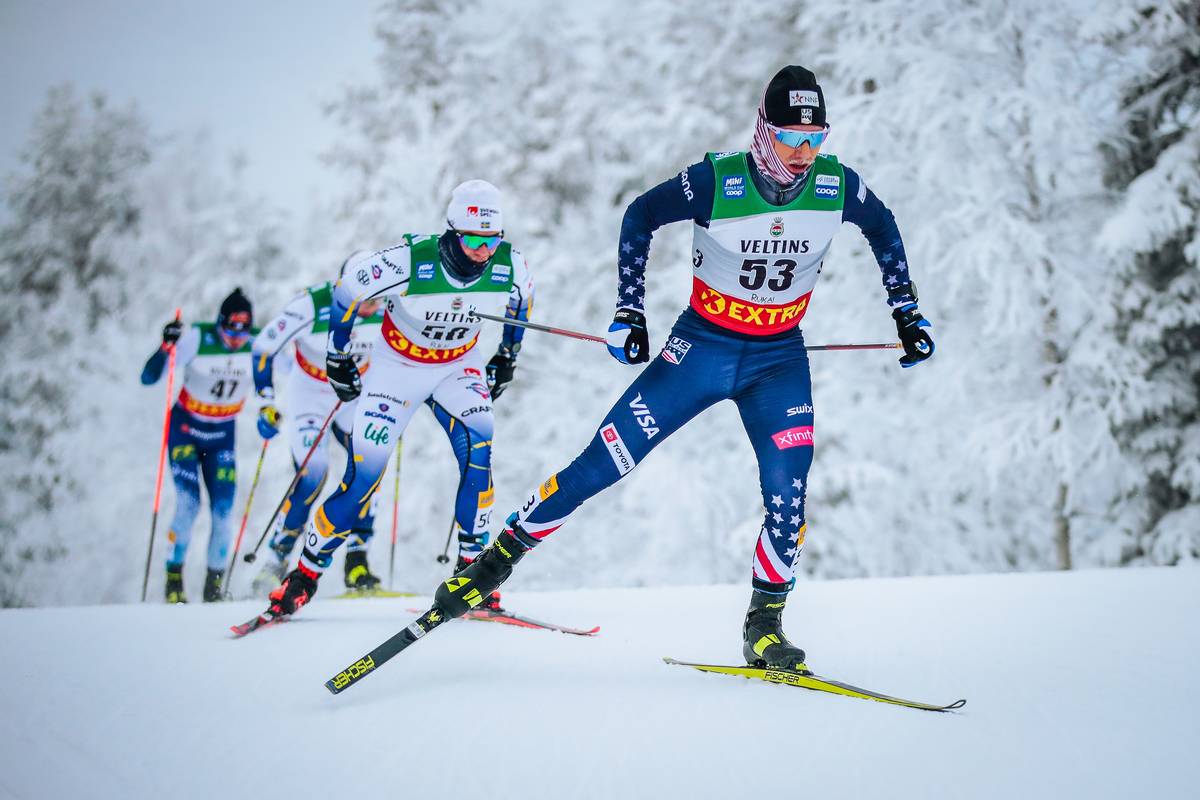
    Zanden McMullen races a skate pursuit in Ruka, Finland in November, 2021. (Photo: NordicFocus)

    Learning the Long Way

    McMullen’s development has mirrored that of a broader cohort of American men who have risen together, without a single breakout prodigy defining the group. The men’s team has become competitive not through sudden transformation, but through accumulation.

    “There’s definitely a core group of us that have been doing this for a long time and have just been hitting that next level every year together,” McMullen said. “Honestly, I’d say we just have a great attitude towards it, and I think that’s really contagious.”

    Central to McMullen’s progression has been his relationship with coach Eric Flora, who began working with him after high school. The partnership is not flashy. It is deliberate, methodical, and built on constant communication.

    “We all have individual phone calls with him about once a week,” McMullen said. “He’ll be driving to practice every morning, and he’ll just rip through all of us.”

    Training plans are personalized but similar. Adjustments are fluid. There is room to adapt when conditions—or bodies—require it.

    “Training is super fluid,” McMullen said. “There’s no reason to be super methodical about it.”

    If there is a defining value that underpins the approach, it is consistency. McMullen returns to the concept repeatedly, almost reflexively.

    “I don’t enjoy when I’m hot and cold,” he said. “I know I’m in a good place when I’m just consistent.”

    Racing Through Fog

    Consistency, however, is not something that can be summoned on demand. When the World Cup season opened in December, McMullen entered Period One with a clear process goal: race distance events, avoid panic, see where he stood.

    “It’s so challenging going into Ruka every year,” he said. “You just have really no idea what kind of shape you’re in.”

    He described the feeling as “looking through fog.” The metaphor fits. Fitness tests and workouts provide clues, but racing offers the only real clarity.

    “Those could both result in amazing races,” he said. “Or they could be pretty crappy races. I have no idea.”

    December did not unfold the way McMullen had hoped. Results were not disastrous, but they were not convincing enough to quiet questions—his own included. Olympic qualification, with its layers of objective criteria and discretionary judgment, hovered in the background, offering no reassurance.

    “Nothing’s for sure until the last race is over,” he said.

    As Period One ended, McMullen faced a decision that athletes rarely frame publicly: whether to stay in Europe and press on, or to step away and reset.

    Davos to Regroup

    McMullen stayed in Davos to train and regroup during the holidays before flying back to the United States for Nationals.

    The decision was not dramatic. It did not come with declarations or explanations. It was simply what made sense.

    Settling in to training through the holidays stripped things back to essentials. Favorite trails. Simple routines. Fewer variables.

    For McMullen, training has never been a place to escape. It is where things become clear.

    The reset did not guarantee anything. But it restored something harder to quantify: alignment between effort and intention.

    By the time McMullen boarded a flight for Lake Placid in January, he carried less expectation and more readiness.

    Zanden McMullen charges for the win in the Men’s 20 k Freestyle Mass Start last week at the US National Cross-Country Ski Championships in Lake Placid, New York. (Photo: Nancie Battaglia)

    Lake Placid: Evidence

    The U.S. Senior National Cross-Country Ski Championships arrived with their own weight. Nationals are never just Nationals in an Olympic year. Results echo beyond the finish line.

    On Thursday, McMullen won the 20-kilometer Freestyle Mass Start. The race unfolded honestly, favoring patience and pacing. McMullen looked comfortable in control.

    The next day, he returned to win the Classic Sprint.

    Two wins, two very different demands, back to back.

    The performances were not loud. They were authoritative.

    For an athlete who measures progress in consistency, the week in Lake Placid did not feel like redemption. It felt like confirmation.

    Zanden McMullen with his second win in two days in the Classic Sprint last week at the US National Cross-Country Ski Championships in Lake Placid, New York. (Photo: Nancie Battaglia)

    Oberhof

    From Lake Placid, McMullen traveled to Germany for the final races that will be considered in the Olympic team selection. Oberhof will decide whether his season will continue toward Milan or pivot elsewhere.

    “I’ll know by the end of the weekend if I have made the Olympic team,” he said via text. “If I don’t, I’ll head back with a little bit of Birkie fever.”

    The phrasing is characteristically restrained. There is no bargaining, no projection beyond what he can control.

    “I’m in Oberhof now for P3 World Cup, and will stay with the team through Goms,” he said. “I’m pretty much taking it one week at a time right now.”

    That outlook has been hard-earned. McMullen understands that racing well is not the same as demanding belief. His approach is simpler.

    “Let the racing speak,” he said in November. “There’s no reason to freak out about it.”

    The Space Before the Answer

    By Sunday evening, the committee will meet. Names will be discussed. Arguments will be weighed. Decisions will be made.

    McMullen will not be in the room.

    What he will have is a body of work that stretches back much further than this weekend: a childhood shaped by Alaska winters, a career built on incremental belief, a season that required adjustment rather than insistence, and a January that reaffirmed who he is as a racer.

    Whether or not the Olympic team includes his name, McMullen has reached a threshold that is difficult to cross. He is no longer auditioning for relevance. He is racing for a place.

    “I just want to be consistent,” he said. “I feel like when you are consistent, and you find yourself in a position where you might have a standout result, then it’s just that much higher.”

    In Oberhof, consistency will not announce itself. It rarely does. It will show up quietly, in decisions made at speed, on terrain that rewards honesty.

    For now, that is enough.


    Love stories like this? Help keep them coming.

    Feature stories like this one take time, access, and care to produce. If you value thoughtful storytelling and independent ski journalism, please consider becoming a Voluntary Subscriber. Your support directly fuels the work we do to cover the people, places, and moments that make our sport special.

    Join the FasterSkier community!


  • Sudden Slip and the Rise Thereafter: Packer on Adversity and Success

    Sudden Slip and the Rise Thereafter: Packer on Adversity and Success

    Eric Packer after winning his first national title in the classic sprint at 2016 U.S. Cross Country Championships in Houghton, Mich. (Photo: Christopher Schmidt)
    Eric Packer after winning his first national title in the classic sprint at 2016 U.S. Cross Country Championships in Houghton, Mich. (Photo: Christopher Schmidt)

    Below is an interview with the 2016 U.S. national champion in the classic sprint, Eric Packer, a 25-year-old Alaska Pacific University skier and Dartmouth grad. This interview originally appeared on SlowTwitch.com and has been adapted for FasterSkier. SlowTwitch is a comprehensive resource for a wide variety of endurance sports, in particular triathlon, and has recently launched a new feature designed to introduce triathletes to nordic skiing. Last month, FasterSkier shared a SlowTwitch-original interview with another national champion, Tad Elliott

    According to Packer’s recent Facebook post, he officially qualified to race World Cup Period 4 (the eight-stage Ski Tour Canada from March 1-12) for the U.S.

    ***

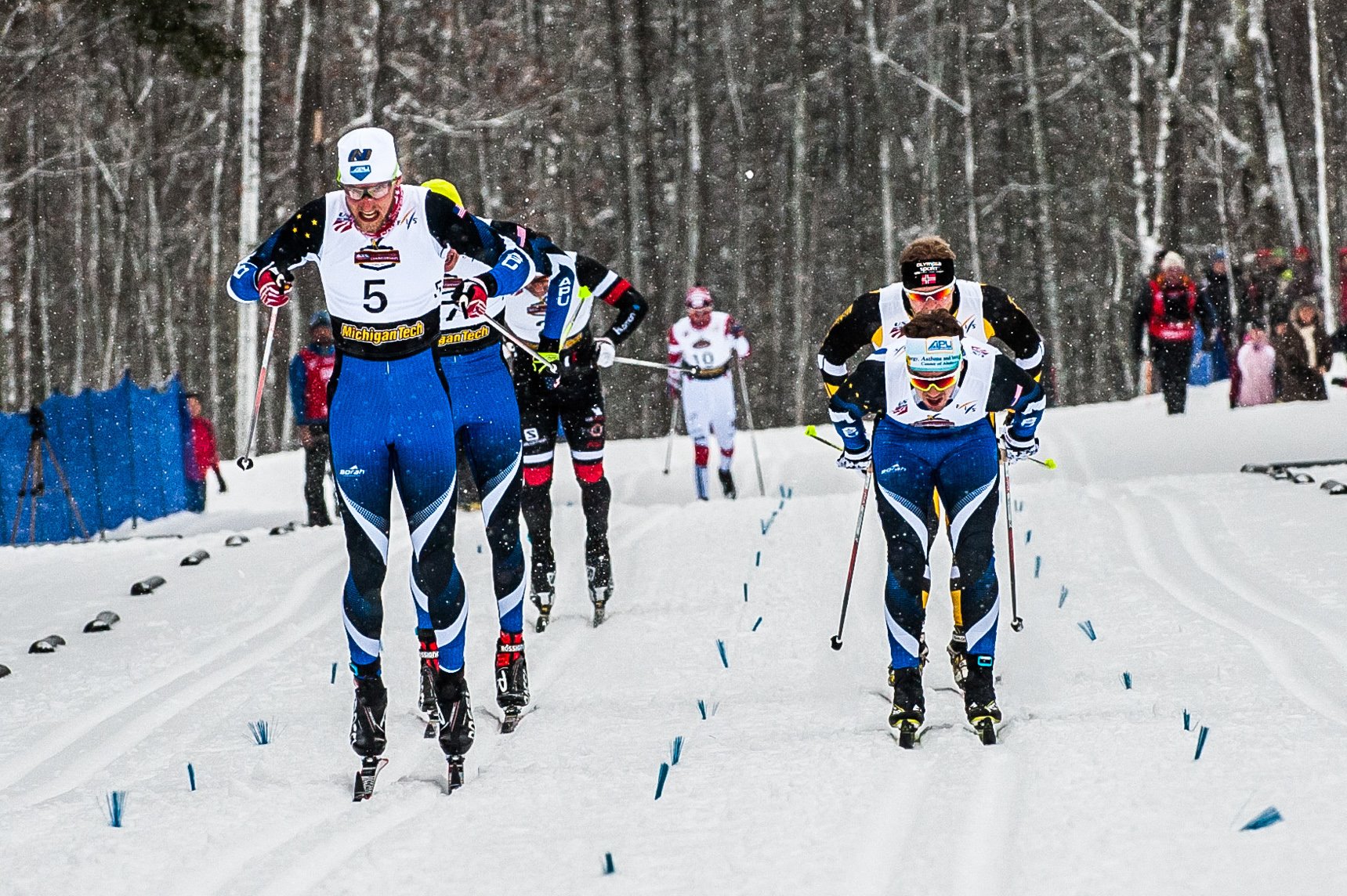
    Eric Packer (5) on his way to beating APU teammate Reese Hanneman (r) and the rest of the men's final in the classic sprint at 2016 U.S. Cross Country Championships for his first national title. (Photo: Christopher Schmidt)
    Eric Packer (5) on his way to beating APU teammate Reese Hanneman (r) and the rest of the men’s final in the classic sprint at 2016 U.S. Cross Country Championships for his first national title. (Photo: Christopher Schmidt)

    Fast Big Dog: Congratulations on winning your first US National Championship in nordic skiing in Houghton, Mich., on Jan. 9 in the classic sprint. … Sprint racing is very tactical, so walk us through how you qualified, made it through the rounds and went on to win the title.

    Eric Packer: You are 100 percent correct. Sprint races are very strategic … and this race had the added dynamic of being in the classic technique. Ski equipment technology has evolved and athletes are getting stronger and stronger, so there is an emerging trend in classic races to double pole the entire course — no striding at all. This can be a very risky strategy and its success depends on several factors. Skis can run faster without kick wax, but having to double pole all of the uphills is very taxing and comes at a high energy cost. There is also the added variable of the different approaches required in qualifying versus the heats, as qualifying is all about a high, constant speed. There is virtually no drafting since you start in intervals, so you’re not worried about pulling someone along for most of the race only to have them blow by you at the end.

    In the end, I decided I should double pole the qualifier (I actually used my skate skis, not classic skis with no kick wax), but then I switched to classic skis with kick wax for the elimination rounds. Thankfully, our ski techs at APU are some of the best in the business and they did an outstanding job giving us all very, very fast skis for the elimination rounds, so I felt like I had the best of both worlds – I could stride the uphills, yet I still had fast skis for the rest of the course. This was definitely the right call.

    As for the races themselves, I did a good job following the strategy I outlined above: I used only the energy necessary to move on from each round and I advanced to the final having kept my efforts in check. Probably most importantly, I stayed strong mentally. Sprint racing can be very taxing psychologically, as it is a lot of races in a short period of time and you’re always thinking about how much time you have left to warm up, to cool down, when to eat, not to mention all of the other dynamics about the races themselves that we’ve already covered. Keeping that all together can be tough, so I think I was able to come out on top because I was a in good place both physically and mentally the whole day.

    FBD: The last time we sat down, you had just been discharged from the hospital after what could have literally been a career-ending or even a life-ending injury. You fell off a 60-foot cliff while mountain running in Alaska. Is there any truth to the rumor that you ran off the cliff just to avoid skiing with me on Eagle Glacier?

    EP: No, I’ll take skiing with you over falling off a cliff any day.

    FBD: Thank you, I appreciate that. I’m not sure how many other people would make that same choice. … Describe what happened in this horrific accident and the impact that it had on your training.

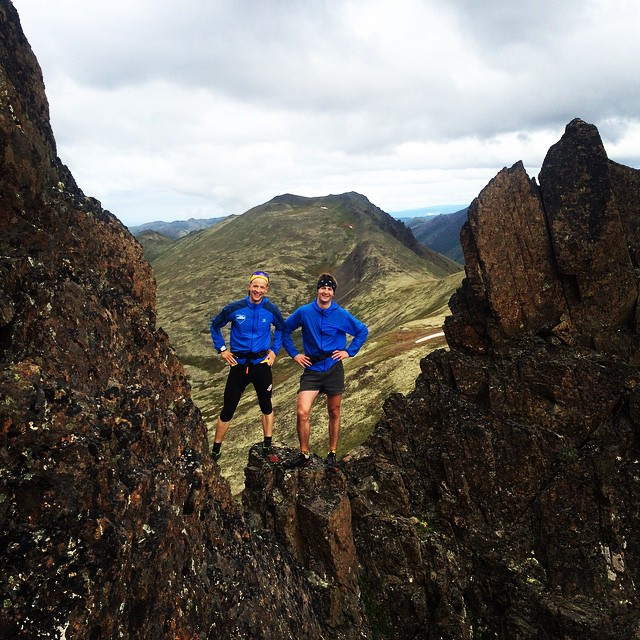
    Eric Packer (l) with PK Kovacs "literally two minutes" before Packer fell  more than 60 feet down a cliff. "When you see the photo, it is a very vivid illustration of just how unforgiving that terrain is in the Chugach Mountain Range," Packer explained. (Photo: EricPacker.com)
    Eric Packer (l) with PK Kovacs “literally two minutes” before Packer fell more than 60 feet down a cliff. “When you see the photo, it is a very vivid illustration of just how unforgiving that terrain is in the Chugach Mountain Range,” Packer explained. (Photo: EricPacker.com)

    EP: I was doing a mountain run with my teammates, I had a slight slip at just the wrong spot, then all of a sudden I was in free-fall. I dropped straight down 15 feet, then tumbled head over heels another 60 feet or so through this jagged boulder field. It was terrifying.

    In terms of my actual injuries, I was incredibly fortunate for as bad as the fall was, I somehow managed to not break any bones, which still amazes me to this day. Don’t get me wrong though, it was still bad. I had bruises over my entire body and I felt like I had been hit by a bus. I think the hardest part was the mental side though, as the whole thing was so sudden and so unexpected. In a split second, I went from being a top level athlete to barely being able to get out of bed. The whole thing really scared me. It wasn’t necessarily what actually happened, as much as what could have happened. The doctors told me that at the speed I was traveling if I had hit my head, I easily could have been killed. What’s crazy is my teammate Scott Patterson took a photo of my teammate PK Kovacs and I literally two minutes before the fall happened, When you see the photo, it is a very vivid illustration of just how unforgiving that terrain is in the Chugach Mountain Range where we were running.

    I was so banged up that I stayed home for a week with no training. Once I got the clearance from my doctor and PT to resume light activity, all I could do were easy walks. Even once I got to return to somewhat normal training, the first few workouts back were very hard on me, both mentally and physically. It hadn’t really been all that long since I was healthy, so it was still fresh in my mind how I should feel training, but I was just so far from away that, it was very hard to deal with. Not only was it very frightening how close I came to getting killed, but it was such a striking example how quickly you can lose everything.

    I read the excellent interview you did with Tad Elliott about his struggles with illness and my situation is interesting because on one hand it is very similar but on the other hand, it is very different. In reality, mine was really more of a close call and the biggest impact was the mental side. Tad’s situation was long and drawn-out, but mine was very sudden and completely unexpected. So while I was very sore and completely out of commission for a few weeks, Tad’s situation played out over the course of several months or even years. What we most certainly have in common, though, is the changed perspective that these events brought on. I can’t speak for Tad, but I know in the end this accident actually ended up helping me.

    FBD: One of the foci of this column is the role of adversity in success, as this is something that cross boundaries in all aspects of life. I don’t think there is any top level athlete that hasn’t had to come back from some type of setback, so describe how you were not only able to overcome this, but also how it actually helped lead you to national championship.

    EP: Great question. I’ve thought about this a lot, as it is quite counter-intuitive that something like falling out a cliff could make you faster, but that’s exactly what happened. I got super lucky in that there was no lasting damage from my accident, but on the flip side I came very close to life-altering injury or worse. The whole time I wasn’t able to train there was certainly some anxiety about missing workouts, but overall I felt lucky — lucky that I survived and lucky that I still had the opportunity to ski race. Once I could get back to normal training, instead of feeling like I had to go out training, I now felt incredibly fortunate just to be able to go outside to do anything. Training became a privilege not a chore and I ended up having the best late summer/fall training of my career. In the end, that crazy accident helped me develop that little bit of extra motivation that I needed to take me to the next level.

    I’m glad you brought this up too, as this phenomena is more common that you might think. My Alaska Pacific University teammate Scott Patterson was on that ill-fated run with me and he too had a similar experience last year. He was impaled by a ski in a freak accident and developed a pulmonary embolism. His injury was far more serious than mine also could have died. Scott also won a national championship this year in Houghton, with his win coming in the 15 k classic race. One of Kikkan’s [Randall] best seasons was preceded by her spending most of the summer in a walking boot due to a serious foot injury, yet that proved to be a breakthrough year for her too. What I went through is actually very insignificant compared to what each of them went through, but I think the common thread is that dealing with adversity helps you reach success.

    “Training became a privilege not a chore and I ended up having the best late summer/fall training of my career.” — Eric Packer, 2016 classic sprint U.S. national champion

    FBD: Crash or no crash, what would you say was the most significant contributing factor to your win?

    EP: That’s easy. My team. I’m super lucky to be on the Alaska Pacific University ski team. I know I wouldn’t be where I am today if it wasn’t for this team. It is an amazing program. The coach, Eric Flora, was USOC coach of the year and that’s across all sports, not just skiing. If you trust your coach like all of us here at APU do, you don’t have to worry about your training. Our PT, Zuzana Rodgers, is also amazing. Thanks to her, I was able to get back from my accident much sooner than I thought was possible. The entire leadership group up here is so good that there is not too much more you could ask for as an athlete.

    The training group is also unsurpassed. We all grew up together and began butting heads over 10 years ago in the local junior races. About two years ago we started getting everyone back together and the impact has been enormous. There is a commitment to group success that you don’t find a lot of other places. Choosing a path like triathlon or nordic skiing can be a lonely lifestyle, but when you have such a supportive team environment, it becomes a very fun journey.

    Since we’ve know each other for so long, we’ve all had lots of ups and downs together and everyone really respects each other. We’ve all beaten each other in races, so everyone is well aware of that fine line between success and disappointment and how quickly the tables can turn on anyone. As a result, as a team we are not focused on the individuals, but rather on trying to move the whole group forward in a way that we haven’t yet seen in men’s skiing in the US.

    FBD: In a way it is ironic that your accident happened running, as one of the central themes of this column is how good nordic skiing is for triathlon training and vice versa. Tell us a little bit about how you train for skiing in the offseason and how you think Nordic skiing can help triathletes

    EP: One of my big goals this past offseason was to improve my running, as running is a very effective way to build your fitness base. As a result, running is very good for skiing and I believe that it carries over very well to both skate and classic technique. Going the other way, I think skate skiing is perfect winter training for cyclists as it has a lot of static loading of the muscles, while classic is best to improve your running. Triathletes should also keep in mind that both skate and classic are weight bearing but non-impact, so both are a perfect way to increase your training volume without a greatly increased chance of injury. And skiing is fun. I read your first article in this series and I couldn’t agree with your conclusions more – skiing is safe (very few cliffs on the tracks), warm, fun and overall excellent preparation for triathlon.

    FBD: Let me ask you the same question I asked Tad Elliott, as it is such a relevant one to so many athletes that have dealt with illness or injury: what advice do you have for those in the process of working through this right now?

    Eric Packer (l) and Mads Strøm (r) fight for second place on the last hill of their final lap of the men's 15 k classic at the December SuperTour in Sun Valley, Idaho. Strøm finished second and Packer placed third.
    Eric Packer (l) and Mads Strøm (r) fight for second place on the last hill of their final lap of the men’s 15 k classic mass start at the December SuperTour in Sun Valley, Idaho. Strøm finished second and Packer placed third.

    EP: The biggest piece of advice I can offer is to get qualified, objective advice right away. Being injured is incredibly frustrating and this makes it very hard to look at yourself analytically. A good coach, doctor or PT is both knowledgeable and objective. Injured athletes are usually neither of those things.

    Every athlete should build a relationship with a coach, physical therapist and a doctor who really care about them and most importantly, understand them as both a person and as an athlete. When you’re injured, recovery is all about managing both the short-term and the long-term, so you need people who have perspective on both. I was intrigued when I read that Tad’s doctors and coaches started him back by sending him on short walks, as that is exactly what my team did for me. Would they give this same advice to a sedentary person? Maybe not, as that person might be content to just rest, but doing nothing would drive me crazy. Instructing an athlete to just sit still all day is probably some of the worst advice possible, so having people who understand this and are smart enough to prescribe an activity as safe and low-risk as walking is key.

    What’s interesting, too, is the advice from the medical team can go both ways too: sure, they will often say, “take it easy, rest, recover, etc.,” but I’ve also had the opposite experience in which the issue I was dealing with I thought was serious, but the PT told me I could and should muscle through it. If I had been on my own, I would have lost valuable training time from an injury that wasn’t nearly as serious as I thought it was. Sometimes it is okay to train though pain, the key is knowing when this is a good idea and when it’s bad one, and you need to help to do this.

    FBD: As a newly crowned national champion, what advice do you have everyone out there on their own journey, whether it is skiing, triathlon or any other endurance activity?

    EP: The cool thing about endurance sport is that you get to choose your own destiny. It is really about the work that you do and how smart you are about recovery. When I first got started racing at a high level, this was hard for me to grasp. If I had a bad race, I’d blame my genetics, my skis and things I couldn’t control. But as soon I realized that I just wasn’t working as hard as others, that changed everything. It’s really about the work you put in. Once you understand and accept that you control your success, anything is possible.

    FBD: You’ve had quite an eventful year. What is the most significant thing you learned?

    EP: Take everything that comes at you, deal with it and no matter what, do not let the little things get to you. Everyone has to deal with adversity, what matters is how you respond.

    Two days before my win in Houghton, I raced in the 30k that Tad won. I needed to get something like 10th place or better to qualify for a starting spot on the World Cup. This was a big goal for me and not only did I not do it, I wasn’t even close. To make matters worse, I got gapped off of the lead group at about 7 k in, so I just dangled in no-man’s-land for about 20k or so, knowing that I was missing this major goal. Earlier in my career, this would have stuck with me for a while and certainly ruined the rest of my races at nationals, but as a result of my accident, some great coaching from Flora and me figuring some stuff out on my own, I’ve learned to let things like this go quickly. So once that race was over, I only focused on what I could control: rest, recovery, good food, etc. I simply let the bad race go, moved on and prepared for the next race, and ended up winning for my first national championship.

  • Swix’s Simple Secrets to Success Starts in West Yellowstone

    Swix’s Simple Secrets to Success Starts in West Yellowstone

    Holly Brooks, West Yellowstone SuperTour. Photo: Swix.

    Chris Hall, director of US Racing Services for Swix states, “Waxing for the West Yellowstone USSA SuperTour events was straightforward but not West Yellowstone normal. As we do for each race we tested a matrix of CH, LF, and HF base gliders based on temp and humidity. Once we had chosen the base wax we re-waxed and zeroed the test skis with the chosen base and tested if Cera-F over-layers increased the speed.  A final test determined structure. For the first two races we could not conduct speed trap tests or run outs because the snow was too deep and tracks inconsistent so we conducted double blind feel tests on matched and zeros test skis. For the final event we were able to conduct run out and blind feel tests for glide as well as testing kick wax on Saturday’s Classic race.”

    Testing each day proved, what coaches using just the Swix wax charts suggested, that CH4 or LF4 should be the base wax for most. FC78 SuperCera was the call as a final layer on 2 out of the 3 days. This was surprising to some as we were in “cold and dry West Yellowstone where Cera-F does not run well”. But this visit to West did not produce clear bluebird skies, but rather low hanging high-humidity clouds. A hand pressed .3mm broken-V structure improved most cold skis glide, further enforcing the argument that moisture management was important even though we were in West. Detailed Glide and Kick recommendations can be seen at swixracing.us

    What were the Secrets to Success in West? – Keeping it simple by looking at Snow Crystal Structure, Temp and Humidity and not trying to win the race in the wax room with some a complex mixture of waxes.

    APU’s Eric Flora states “Since its inception over a decade ago we have developed and implemented a stringent wax testing and wax application procedure that allows us to deliver consistently fast skis. The key is to keep it simple. At APU we focus on one line of wax. This process produces very good to great skis each race day and provides the athletes the confidence they need to produce the quality results they have trained for. Using the complete Swix line allows us to understand exactly where temperature and humidity fit into the complete Swix waxing matrix and gives me the confidence that I will deliver top skis to my athletes.”  APU has 4 women in top 6 and 5 men in the top 10 of USSA SuperTour with a waxing process that relies on simplicity of the comprehensive Swix waxing matrix.

    USSA SuperTour Points Standings after first 4 races

    Women:

    1 Holly Brooks APU Nordic Ski Center

    2 Kristina Strandberg XC Oregon

    3 Kate Fitzgerald APU Nordic Ski Center

    4 Sadie Bjornsen APU Nordic Ski Center

    5 Eliska Hajkova Univ of Colorado Ski Team

    6 Morgan Smyth APU Nordic Ski Center

    7 Maria Graefnings Univ of Utah Ski Team

    8  Chelsea Holmes Sugar Bowl Academy

    9  Maria Stuber CXC Team

    10Jessie Diggins CXC Team

    Men:

    1 Lars Flora APU Nordic Ski Center

    2 Drew Goldsack AWCA Canadian Nat’l Team

    3 Garrott Kuzzy CXC Team

    4 Michael Sinnott Sun Valley Ski Foundation

    5 Brian Gregg CXC Team

    6 Leif Zimmerman Bridger Ski Foundation

    7 Bart Dengel APU Nordic Ski Center

    8 Mark Iverson APU Nordic Ski Center

    9 Brenton Knight APU Nordic Ski Center

    10 James Southam APU Nordic Ski Center

    Swix’s complete wax matrix takes the guesswork out of waxing by creating a specific wax for each snow condition.  If you know the air temp, relative humidity you can select Swix’s perfect wax no mixing, magic recipes, stressing or slow skis required.  Swix, your Winning Margin. Get your Winning Margin wax rec at SwixRacing.us and SwixNordic on Facebook.

    APU Wax Box. Photo: Swix.