From the FasterSkier archive — posts syndicated from athletes’ and coaches’ own blogs between 2004 and 2012, kept online as published. Current coverage is at fasterskier.com.
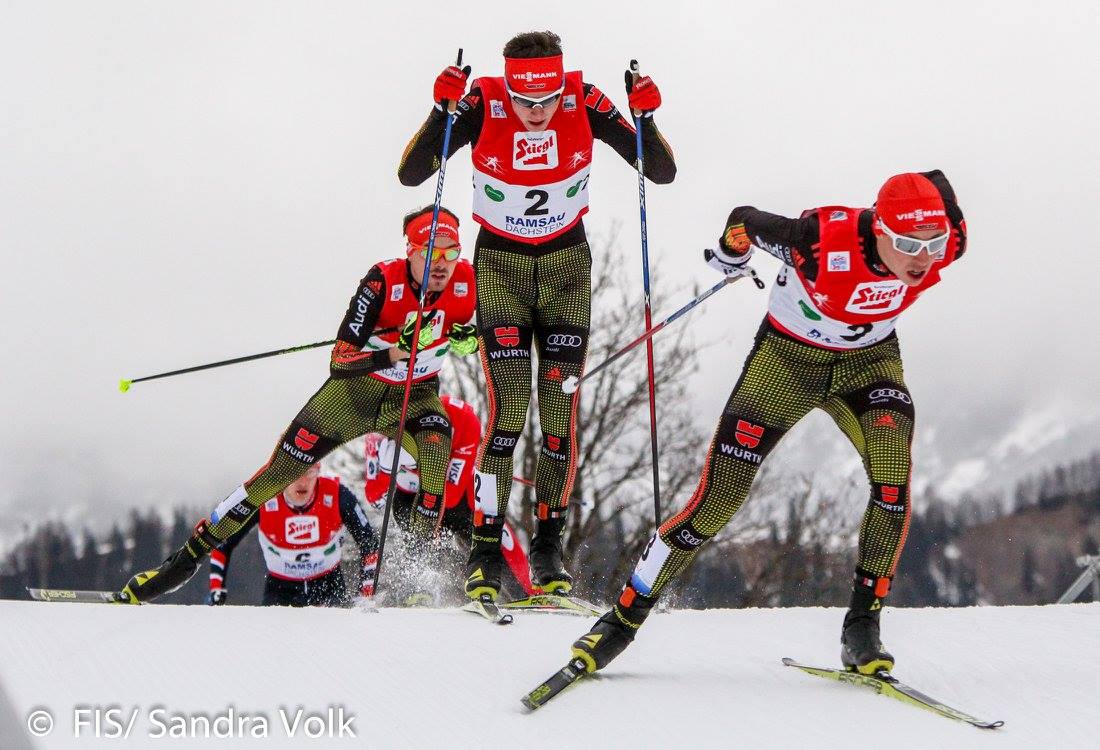
Johannes Rydzek (5) leading his two German teammates, Fabian Rießle (6) and Eric Frenzel, as well as Norway’s Jarl Magnus Riiber toward the finish of the nordic-combined large hill/10 k competition on Tuesday at the 2018 Olympics in PyeongChang, South Korea. They finished in that order, with Germany sweeping the medals. (Photo: FlyingPointRoad)
It was a total team effort on Tuesday for Germany in the second nordic-combined individual event of the 2018 Olympics in PyeongChang, South Korea, with Fabian Rießle, Johannes Rydzek and Eric Frenzel, with the help of Austria’s Wilhelm Denifl, chasing down Japan’s Akito Watabe and Norway’s Jarl Magnus Riiber about 6 kilometers into the 10 k race.
Earlier on Tuesday, Watabe had put himself in first with the best-ranked jump on PyeongChang’s 142-meter large hill. He started the 10 k Gundersen in first, just 1 second ahead of Riiber, who had jumped to second, just 0.3 points behind Watabe.
(Riiber had actually jumped farther with a distance of 139 meters, compared to Watabe’s 134-meter jump, and scored identical marks from the judges but lost points for wind compensation.)
Germany en route to a complete sweep of the podium in the men’s nordic-combined individual large hill/10 k on Tuesday at the 2018 Olympics in PyeongChang, South Korea, with Johannes Rydzek (5) leading Fabian Rießle (6) and Eric Frenzel (4). They went on to place first, second and third, respectively. (Photo: FlyingPointRoad)
Behind them, Denifl started the 10 k race 16 seconds out of first, Frenzel surged out of the start 24 seconds back, Rydzek 31 seconds behind, and Rießle 34 seconds back.
While Watabe led Riiber off the front for the first two laps of the four-lap race, the three Germans caught Denifl before lapping through the stadium for the first time at 2.5 k. From there, 16 seconds behind the leaders, the four-man group worked to reel in first and second place and did so by 6 k.
The lead pack then became six as Riiber and Watabe continued to position themselves up front at the 7.5 k mark.
On the final lap at the 8.58 k marker, Watabe charged to the front in his move to reclaim first. After taking the lead on an uphill, it wasn’t long after until he found himself skiing with three others alongside him: Riiber, Rydzek and Frenzel.
Then, Watabe slipped behind Riiber and the group closed in around him. Watabe clipped a ski, apparently with Rießle, who didn’t stumble, but Watabe did and dropped to the back of the pack. For Watabe, that was the end. For Germany, it was the beginning.
Frenzel led the charge up the final climb with Rydzek and Rießle behind him while Riiber tried to keep pace. Riiber slotted into fourth over the top and the foursome flew down into the stadium, with Rydzek coming out of the draft in first and leading Rießle, Frenzel and Riiber to the finish, respectively.
They finished in that order, with Rydzek taking gold in 23:52.5 minutes, 0.4 seconds ahead of Rießle in second place and 0.8 seconds ahead of Frenzel in third. Riiber crossed 2.8 seconds back in fourth, and Watabe ended up fifth (+12.5).
Germany had four in the top seven with Vinzenz Geiger in seventh (+50.1), behind Finland’s Eero Hirvonen in sixth (+22.1).
“I looked up to the video wall and saw the first three: all Germans,” Geiger recalled in a post-race interview with German broadcaster ARD. “That made me really happy, and of course I can also be happy about my seventh place.”
Bryan Fletcher en route to 17th in Tuesday’s large hill/10 k competition, tying his best result at the 2018 Olympics in PyeongChang, South Korea. (Photo: FlyingPointRoad)
American Bryan Fletcher repeated his result from the normal-hill competition as well, placing 17th on Tuesday, 1:42.9 minutes behind Rydzek in first. Fletcher had started the 10 k 2:04 minutes back in 23rd based on his jump. His teammate Ben Berend started 8 seconds behind him in 24th. Ultimately, Fletcher raced up to 17th with the 10th-fastest course time while Berend slipped to 39th (+4:28.2).
“The second I was in the air I knew I had a good one,” Berend told FasterSkier after the jumping portion of Tuesday’s competition. “Because when you do it right, you’re just flying, and I was really high and I was pulling away towards the bottom of the hill and so I knew, but I couldn’t feel any wind or anything. I was just so psyched, trying to enjoy every second of it.
In his first Olympic race, American Ben Berend on his way to 39th in the large hill/10 k competition at the 2018 Olympics in PyeongChang, South Korea. He started the day by jumping to 24th, which he said was his best competition jump of the season. (Photo: FlyingPointRoad)
“I haven’t had that many good jumps this season so I’ve just been searching for that,” Berend explained. “It’s funny, it’s so easy when you are doing it right and it’s so hard when you’re lost, and so I finally felt like, that might have been my best jump of the season, honestly, so what are the odds of doing that at the Olympics? That’s pretty cool.”
Tuesday was the 22 year old’s first Olympic competition after he sat out the first individual event because his jumping had been going poorly in training, he said. (Each team can only start four athletes per event. Taylor Fletcher sat out Tuesdsay’s competition.)
“I definitely was a little nervous for tonight, even though there is no pressure on me,” Berend said. “… Our coach [three-time U.S. Olympic biathlete Jeremy Teela] texted us, he’s actually our cross-county coach, he’s back at home, and he just said, ‘You guys have nothing to lose. Don’t be scared to fail.’ So that’s kind of our mindset here, and it was good; it kind of works for me.”
American Bryan Fletcher (23) skiing with Norway’s Jørgen Graabak (19) during the cross-country race of Tuesday’s individual large hill/10 k competition at the 2018 Olympics in PyeongChang, South Korea. Fletcher went on to finish 17th while Graabak placed 10th. (Photo: FlyingPointRoad)
After the race, Bryan Fletcher, who had skied up to 13th by 7.5 k, recalled pulling a chase group for most of the four laps. He ended up 17th, 3.2 seconds shy of 16th place, behind Japan’s Go Yamamoto.
“I went all in and just tried to make up as much ground as possible,” Fletcher told FasterSkier after. “I was hopeful and optimistic that I’d have the legs at the end. I knew that they were going to come around me with a pretty hard attack, and both of the guys that were with me have great finishing sprints, so I tried to pace myself a little bit, but I also knew that 17th or 10th or whatever you could get up to, it doesn’t really matter unless you’re on the podium so I was really going all in. … Unfortunately it didn’t work out, but I’m happy with how I skied and happy with the performance I had on the course today.”
American Ben Loomis racing to 40th in the large hill/10 k competition at the 2018 Olympics in PyeongChang, South Korea. (Photo: FlyingPointRoad)
Just behind Berend, his teammate Ben Loomis finished 40th (+4:38.8), up from 43rd in the jump, and Jasper Good followed in 43rd (+5:50.2), up from 46th.
“It was kind of tough jumping … [and] hard to start the race at the back, but overall it was a good race by me and I felt pretty good out there,” Loomis said after. “Regardless of how I have and how I continue to do here, there’s a lot to take away and I’m learning a lot about how to better refine my preparations and just stay relaxed out there and just really put my best foot forward.”
Nordic combined at the 2018 Games will conclude with the 4 x 5 k team event on Thursday.
Germany en route to a clean sweep of the podium in the men’s nordic-combined individual large hill/10 k on Tuesday at the 2018 Olympics in PyeongChang, South Korea, with Johannes Rydzek (5) leading Fabian Rießle (6) and Eric Frenzel (4). They went on to place first, second and third, respectively. (Photo: FlyingPointRoad)
A few shooting errors by pursuit bronze medalist Anais Bescond were not enough to derail France, as the team of Marie Dorin Habert, Bescond, Simon Desthieux, and Martin Fourcade took gold in the mixed relay. Skiing the first leg, Dorin Habert shot clean and tagged off just seven seconds behind the leading team from Italy. Bescond then used four spare rounds over the course of her relay leg, dropping the team to fourth (+48.9) at the halfway point. But both Desthieux and Fourcade shot 10/10, capitalized on the errors of others, and ended up with a clear 20.9 second margin for gold at the finish.
Susan Dunklee put the U.S. in fifth after the first leg of the mixed relay. (Photo: FlyingPointRoad)
Norway came back from a rough start to earn silver despite a whopping eleven spare rounds and a penalty loop. Marte Olsbu had three spare rounds to tag off in ninth, 32.8 seconds back, and then Tiril Eckhoff used two spare rounds in prone and then took a penalty loop in standing. But Johannes Thingnes Bø used just one spare round and skied the team from tenth to fourth, in contact with the medal pack, on his relay leg, and then Emil Hegle Svendsen used one spare round in each shooting stage to climb into a clear second; he skied alone on the final loop before crossing the line for silver.
There was controversy about bronze, however. Germany had led much of the race thanks to a solid leg by Vanessa Hinz to start and then a brilliant leg by Laura Dahlmeier; Erik Lesser also excelled, and at the third exchange the team had used just two spare rounds and had a 32.6-second lead on the field. But sprint gold medalist Arnd Peiffer couldn’t keep it together and first used a spare round in prone, then took a painful penalty loop in standing.
He exited the loop just as Italy’s Dominik Windisch went past. Lisa Vitozzi had put Italy in the lead after one leg thanks to perfect shooting, and despite three spare rounds Dorothea Wierer had tagged off in second at the halfway point. Lukas Hofer had maintained that position and Windisch was really only in fourth because of three of his own spare rounds.
Windisch and Peiffer battled all the way around the final 2.5 k, with Windisch leading the final downhill; the pair were nearly even coming into the stadium, but Windisch sprinted for the finishing lanes and in doing so angled from one far side of the trail to the farthest finishing lane, just barely getting there ahead of Peiffer and debatably choosing a lane before the lane markings began. Peiffer, who had skied a straight course all the way from the downhill into the finish, was forced to then switch lanes and couldn’t regain the momentum to keep up with the Italian, who crossed the line in third place.
The Germans protested, but the race jury ultimately decided to keep the Italians in third place, awarding them bronze, and the Germans finished fourth.
“The jury has decide to keep the bronze medal for Italy; Peiffer did not have to alter his speed, therefore no reason to disqualify Windisch,” the IBU stated in a tweet. (The response to that tweet has nearly unanimously condemned it as the wrong decision.)
The IBU 2016 Competition Rules give only a vague definition of obstruction, stating, “It is strictly forbidden to impede other competitors in any way at any time during the competition.”
The Canadian team of Rosanna Crawford, Julia Ransom, Brendan Green, and Christian Gow finished 12th, +2:36.7, with nine spare rounds.
The U.S. team of Susan Dunklee, Joanne Reid, Tim Burke, and Lowell Bailey finished 15th, +3:31.1, with three penalty loops and nine spare rounds.
Germany pulled off a podium sweep in the second nordic combined combined competition of the Olympics, with Johannes Rydzek, Fabian Riessle, and Eric Frenzel earning gold, silver (+0.4 seconds), and bronze (+0.8 seconds), respectively. They had been ranked fifth, sixth, and fourth after the jumping round on the big hill, but edged Norway’s Jarl Magnus Riiber off the podium. Riiber had the second-best jump of the day and ended up just 2.8 seconds out of a gold medal. Japan’s Akito Watabe topped the jumping scores and finished fifth, +12.5 seconds.
For the U.S., Bryan Fletcher led the way again and just like in the normal hill competition, finished 17th. This time he was ranked 23rd after the jump and made up six places to cross the line +1:42.9. Ben Berend, Ben Loomis, and Jasper Good finished 39th (+4:28.2), 40th (+4:38.8), and 43rd (+5:50.2).
Germany’s Eric Frenzel celebrates defending his Olympic gold in the normal hill/10 k Gundersen on Wednesday, the first nordic-combined competition of the 2018 Olympics in PyeongChang, South Korea. Japan’s Akito Watabe (l) placed second, 4.8 seconds back. (Photo: FlyingPointRoad)
PYEONGCHANG, South Korea — Wednesday at the Alpensia nordic sport complex, the first of the scheduled three nordic-combined events of the 2018 Olympics got underway. Despite the women’s 15-kilometer individual biathlon event being postponed to Thursday due to high winds, the nordic-combined jumping portion went off earlier in the day as planned.
The men’s individual normal hill/10-kilometer Gundersen competition saw Austria’s Franz-Josef Rehrl scored the highest number of points off the jump with a jump of 112 meters and 130.6 points. Norway’s Jarl Magnus Riiber jumped to second, flying 111 meters and scoring 126.9 points, and Japan’s Akito Watabe posted the third-best jump of 105.5 meters, which scored 123.7 points.
Four U.S. nordic combined skiers entered the competition. After the jump, Bryan Fletcher was the top American in 18th place. Ben Loomis was the next best placed American in 37th, while Taylor Fletcher ranked 39th and Jasper Good 47th.
The pursuit-race format saw Rehrl leave first on the demanding four-lap, 10 k course. Riiber followed in second, starting 15 seconds back, Watabe began with a 28-second deficit.
Germany’s Eric Frenzel (5) leads Austria’s Lukas Klapfer during the individual normal hill/10 k competition on Wednesday at the 2018 Olympics in PyeongChang, South Korea. Frenzel went on to win while Klapfer placed third. (Photo: FlyingPointRoad)
Several skiers ready to chase down the leaders began with reasonable time penalties to overcome. Germany’s Eric Frenzel started 36 second back in fifth, Austria’s Lukas Klapfer was Frenzel’s initial rabbit, starting four seconds before the German in fourth place.
Both Fletcher brothers are renowned for their cross-country skiing. Often ranked in the top three for overall time on the 10 k course, a deficit of over a minute is not an insurmountable gap for the brothers from Steamboat Springs, Colorado. Yet on Wednesday, Bryan began 2:06 minutes back while Taylor looked ahead at a massive 3:37-minute vacuum to Rehrl in first. Loomis began the ski four seconds ahead of Taylor, while Good started in the wave, 4 minutes back.
For the first 2.5 k lap of the race, the 24-year-old Rehrl skied alone until a climb about 5 minutes in, where Riiber caught him. The chase group, with Watabe, Klapfer, and Frenzel, wasn’t much farther behind. At the 2.5 k mark, that group was just 12 seconds behind the two leaders as they lapped through the stadium.
Meanwhile, Bryan pushed out of the start in immediate pursuit of Finland’s Ilkka Herola and Germany’s Fabian Rießle 2 and 3 seconds ahead of him, respectively. At 2.5 k, Bryan was up to 16th, skiing in a pack with Herola, Fabian Rießle, Germany’s Vinzenz Geiger, and Japan’s Hideaki Nagai and Go Yamamoto, about 1:33 minutes back from the leaders.
Halfway through the race at 5 k, Frenzel, Riiber, Watabe, Klapfer, and Rehrl pushed on as a unit, forming the nucleus from which gold, silver and bronze would eventually come. There, Bryan continued to ski in 16th with a slightly more strung-out chase pack, 1:18 behind Frenzel in first.
Frenzel, Watabe and Klapfer swapped leads over the next 2.5 k, while Rehrl dropped to seventh, 25 seconds behind Germany’s Johannes Rydzek and Finland’s Eero Hirvonen, who had 21 seconds between them and the leaders at 7.5 k.
Bryan spent most of that next lap skiing alone in 17th, about 10 seconds out of 16th. By the end of the third lap, he was almost a minute clear of France’s Jason Lamy-Chappuis in 18th.
While Bryan held his ground in 17th for the final 2.5 k, the four-man lead group battled for three medals. Frenzel moved into first with 1 k to go and on the last climb, a long grinder before a descent into the stadium, Frenzel launched his attack. Only Watabe in second could immediately respond, but about halfway up the climb, even he lost sight of Frenzel over the top.
Japan’s Akito Watabe (3) leading Germany’s Eric Frenzel and Austria’s Lukas Klapfer during the 10 k ski race portion of the normal hill/10 k at the 2018 Olympics in PyeongChang, South Korea. Frenzel went on to win, Watabe placed second and Klapfer third. (Photo: FlyingPointRoad)
Frenzel steamrolled into the stadium to cross the finish line first in 24:15.4 minutes, defending his title from the normal hill/10 k four years ago at the Olympics in Sochi, Russia. While Frenzel, 29, is a perennial threat, it was only his second victory of the season, after he won a normal hill/10 k World Cup event in December in Ramsau, Austria. Meanwhile, Watabe came into the Games having won four of the last five individual World Cup competitions. But an Olympic gold still eludes the Japanese skier.
“It was a moment that was hard to stomach for me,” Frenzel recalled of the last few hundred meters of the race in an interview with German broadcaster ZDF. “In that moment I couldn’t yet quite believe that I could come back on the finish stretch in first place, and just tried to enjoy the moment. It was a lot of work up to this place for it to work out today. I waited for this for a long time again. And so I am overjoyed it worked out again.”
Watabe crossed the line 4.8 seconds later for silver, his second medal in as many Olympics after he placed second in the normall hill/10 k behind Frenzel in Sochi. Klapfer held off Riiber for third, 18.1 seconds behind Frenzel, for Klapfer’s second Olympic bronze after taking third with his Austrian teammates in the 4 x 5 k team event in Sochi.
Riiber placed fourth (+22.5), Rydzek was just behind in fifth (+27.9), Hirvonen finished sixth (+51.6), and Rießle and Herkola moved all the way up to seventh (+1:05.3) and eighth (+1:05.5), respectively, finishing with Geiger in ninth (+1:05.5).
With four Germans in the top 10, Frenzel predicted more success for his team at these Olympics.
“I hope there will be more golden moments like this here,” he told ZDF. “I think all of us are in good shape at the moment, especially Fabian [Rießle] who definitively was out of luck on the jump today. He surely can perform at a similar level as I did. So because of that we will keep attacking here over the next few days, especially on the large hill, and then we will see what is in it for us.”
American Bryan Fletcher racing to 17th in the normal hill/10 k Gundersen start on Wednesday at the 2018 Olympics in PyeongChang, South Korea. It was his first individual top 20 at his second Olympics. (Photo: FlyingPointRoad)
Bryan nearly caught Estonia’s Kristjan Ilves in 16th at the line, finishing 0.3 seconds behind him in 17th (+2:12.2) for his best individual result in his second Olympics. The 31 year old’s previous Olympic best was 22nd in the large hill/10 k in Sochi.
In a post-race interview with FasterSkier and other reporters in PyeongChang, Bryan said that he was disappointed with the result and felt that, with faster skis, he could’ve been in the mix. He noticed his skis weren’t up to par with Germany and FInland immediately out of the start, where he said he was sprinting to catch Rießle and Herkola.
“A two-second gap, I should be able to just yo-yo right onto them, and I couldn’t even get there,” he said. “That to me was a surefire sign that something was up. Either my physical performance wasn’t there or the skis weren’t there. It very well could’ve been a combination of both.”
He explained that nordic-combined athletes don’t warm up on race skis. “They were good, but just not quite there,” Bryan said of his skis.
On the day, his course time ranked 22nd, about 20 places slower than usual.
“I dug deep, I’m happy with how I managed that today and limited losses,” he explained. “Positive takeaways from the jump hill I think were really good. I know that I can be in the fight there and also know that with some better skis I can be in fight in the cross-country, so refocus and looking forward to next week.”
American Bryan Fletcher after jumping to 18th on the 109-meter normal hill at the 2018 Olympics in PyeongChang, South Korea. He went on to finish 17th in the 10 k later in the day. (Photo: FlyingPointRoad)
After his jump, he had hoped for a top 10.
“In fact, I think it was completely doable,” Bryan said. “It was only about a minute to eighth so it was a little bit disappointing going in and not being able to close that gap. It’s a big event, it’s one day and certainly anything can happen. And unfortunately today the cards didn’t stack in our favor.”
As a father and the oldest member of the USA’s young Olympic team, Bryan said he had been giving his teammates some pointers.
“I think they’ve been calling me ‘Dad’ all week because they love the advice, so falling into a parent role again,” he said. “It’s been fun and certainly they give me as much energy as I give them.”
Behind him, his younger brother Taylor, 27, finished 35th (+3:27.8) with the 15th-fastest course time, Loomis placed 41st (+4:29.4), and Good 45th (+5:48.4).
American Taylor Fletcher racing to 35th in the normal hill/10 k, after jumping to 39th, at the 2018 Olympics in PyeongChang, South Korea. (Photo: FlyingPointRoad)
Asked about his day, Taylor described it as “Not awesome. I mean it was realistic,” he explained. “Average day on the jump, average day on the cross-country. I know what I did and what I need to do, and I think that’s the harsh reality, for sure, but it was a mix between thinking the skis weren’t so great, me definitely going a little too hard at the beginning and maybe me [trying to figure] out whether it was me or whether it was skis, and honestly I think it was more me.”
Italy’s Alessandro Pittin started the race 4 seconds ahead of him in 38th. Pittin went on to ski the fastest 10 k time of 23:48.9 to end up 19th at the finish.
“Alessandro Pittin is the fastest skier, he’s taken that away from me for sure,” Taylor said. “I think I put a little too much energy on that first lap trying to stay with him and then I actually went passed him and led in the wind going up this hill coming back toward the stadium, and I think that just put me on edge a little bit too much and too early.”
Taylor described the conditions as variable, alternating from glazed and fast to “mush” and “dead” feeling.
“It’s hard to describe where I’ve skied that before, but it has no character, no feeling to it, and it’s really hard to glide on it,” he said of the snow in PyeongChang. “I was struggling on the gradual hill coming back into the stadium and I felt like I couldn’t get up onto my toe for that final kick of V2 so I was very static and heavy on the legs and that’s not where I want to be at all. It’s not fluid for me, and it’s just difficult.”
As for his jumping, he was pleased with his improvement since earlier this season.
“It’s a million times better than it was in December,” he said. “… It’s still got a ways to go, but I’ve shown in these last couple weeks that slightly better jumps are leaps and bounds better for me.”
As the 10th jumper to descend down PyeongChang’s 109-meter hill on Wednesday, Taylor explained that the first three American jumpers got “a little unlucky” with the crosswind on the jump. Good was the first jumper of the day in bib 1, Loomis started ninth, Taylor 10th, and Bryan 26th out of 48 starters.
(Article continues below)
American Ben Loomis jumping to 37th on the 109-meter normal hill at the 2018 Olympics in PyeongChang, South Korea. (Photo: FlyingPointRoad)
“I still had good conditions compared to Jasper, but compared to a lot of the other guys, I was still slightly behind them,” Taylor said. “But for me, I’ve just got to jump a little bit early and a little bit more forward with the speed and it’ll be there.”
Good told reporters that the top of the PyeongChang jump “literally feels like a hurricane. The wind is just howling and the first time we got up there training earlier this week, I was like, there is no chance we’re jumping right now,” he recalled. “But the wind barriers they have set up do an awesome job because when you actually get to the jump the wind is fine so it’s more of a mental battle.”
In his first Olympic competition, the 21-year-old Good’s jump of 76 meters put him last place going into the 10 k. But he started with four other skiers in a wave start, 4 minutes behind the leader.
“It’s a little bit easier to get motivation starting in the back in this event just because it’s so big, you’re on the world stage, and this is the kind of race where everyone has, like, inspired skis regardless of where they’re skiing,” Good said. “It just feels like there’s more to it and there’s more within you, but it’s just awesome to be out competing and achieve a personal dream of mine.”
American Ben Loomis en route to 41st in the normal hill/10 k Gundersen at the 2018 Olympics in PyeongChang, South Korea. (Photo: FlyingPointRoad)
Loomis said that while PyeongChang is probably the windiest place he’s ever jumped, it made for a challenging and exciting competition. He said his jump on Wednesday, at 86.5 meters, was better than most of his training jumps there.
“Most of the training rounds were even a lot windier than today, so we kind of got well-prepared for that, and luckily it was pretty good for the comp today,” Loomis explained. “The winds were about as even as they’ve been here so far.”
At 19 years old, Loomis is coming off a bronze-medal performance and fourth-place finish in two individual races at Junior World Championships in Kandersteg, Switzerland, just two weeks ago.
“It’s my first Olympics and I’m one of the younger guys so I’m looking to take it all in and learn from this and gain as much experience as I can for the next Olympics in four or even eight years out of today,” he said.
The next nordic-combined competition at the Games is set for Tuesday, Feb. 20 with the individual large hill/10 k.
The nordic-combined normal hill/10 k podium at the 2018 Olympics, with Germany’s Eric Frenzel (c) in first, Japan’s Akito Watabe (r) in second, and Austria’s Lukas Klapfer (l) in third. (Photo: FlyingPointRoad)
American Bryan Fletcher racing to 17th in the men’s 10 k Gundersen start today, the second half of the nordic-combined normal hill/10 k competition, on Wednesday at the 2018 Olympics in PyeongChang, South Korea. It was his first individual top 20 at his second Olympics. (Photo: FlyingPointRoad)
After the jumping round of the nordic-combined individual normal hill/10-kilometer Gundersen-start competition on Wednesday, Austria’s Franz-Josef Rehrl topped the standings thanks to a jump of 112 meters, just a meter farther than second place Jarl Magnus Riiber of Norway.
The top American was Bryan Fletcher, who sat in 18th place after a jump of 97.5 meters good for 99 points. He started the 10 k cross-country skiing portion of the competition 2:06 behind Rehrl, 1:51 behind Riiber – who has won two World Cups this season – and 1:30 behind defending Olympic champ Frenzel.
Fletcher initially made up some time on the leaders, but as the pace of the race was constantly changing in the end he wound up just one spot ahead of where he started, in 17th. Defending Olympic champ Eric Frenzel of Germany made it to the front after starting in bib five and sprinted to a 4.8 second victory over Japan’s Akito Watabe. Austria’s Lukas Klapfer earned bronze (+18.1) just ahead of Riiber (+22.5). Fletcher’s time was 2:12.2 behind Frenzel at the finish.
Ben Loomis and Taylor Fletcher jumped to 37th and 39th positions, respectively, and started the cross-country competition 3:24 and 3:37 out of the lead. Taylor Fletcher moved up four spots to finish 35th (+3:27.8) while Loomis lost a few places to finish 41st (+4:29.4). The final American starter, Jasper Good, was last (47th) after the jumping round but made up two spots on the trails to finish 45th (+5:48.4)
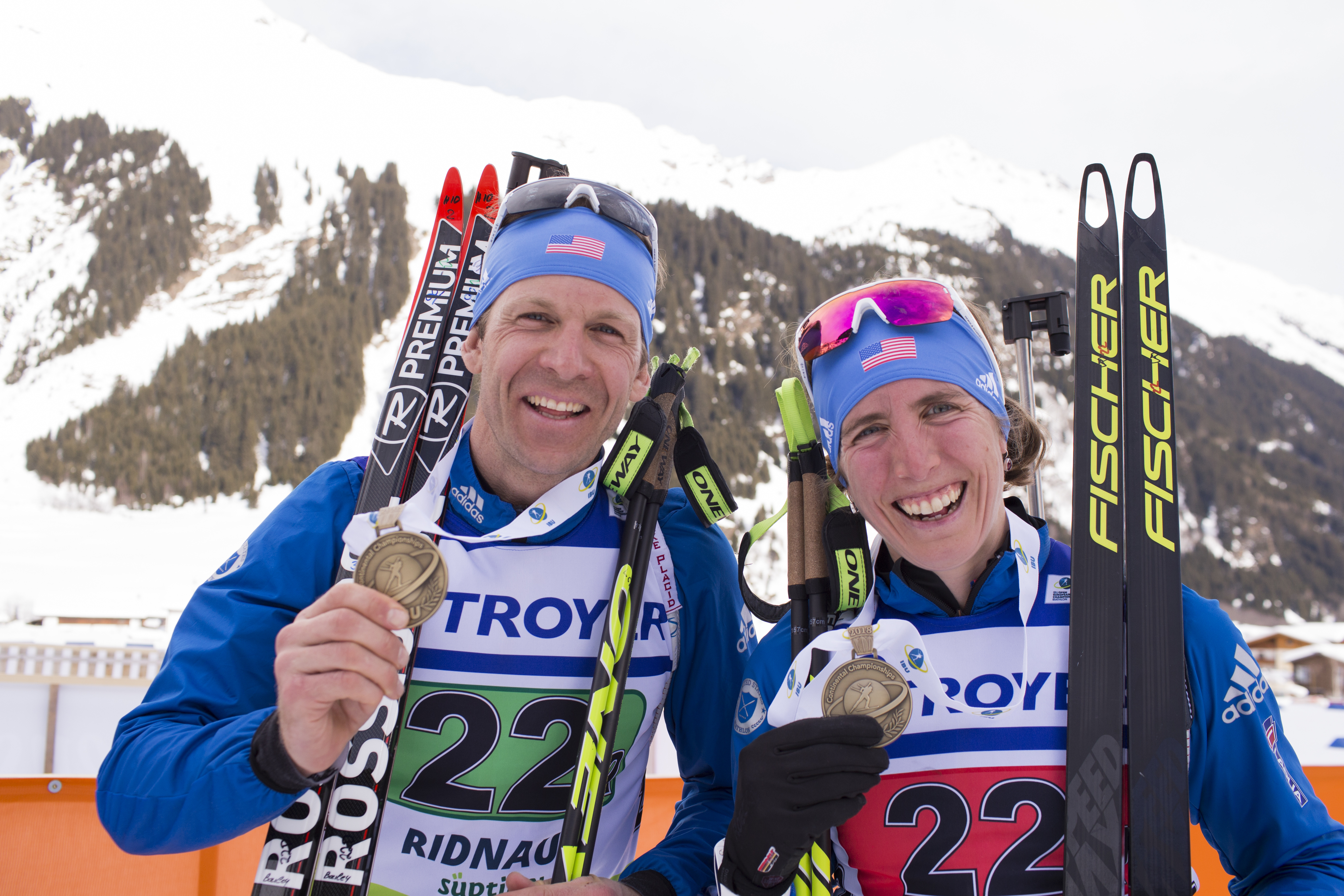
US Biathlon’s Lowell Bailey (l) and Susan Dunklee after teaming up for bronze in the single mixed relay at 2018 IBU Open European Championships on Sunday in Ridnaun, Italy. (Photo: Manzoni/NordicFocus)
IBU Open European Championships (Ridnaun-Val Ridanna, Italy): Single mixed & mixed relays
Susan Dunklee and Lowell Bailey teamed up for the final day of the 2018 International Biathlon Union (IBU) Open European Championships in Ridnaun, Italy, and raced to a bronze medal in the single mixed relay.
The American duo, both of which earned individual medals at last year’s IBU World Championships, finished just 9.1 seconds out of first, which went to Norway’s Thelka Brun-Lie and Vetle Sjåstad Christiansen. The Norwegians won in 35:39.6 with zero penalties and six spares. They took the lead after Brun-Lie’s second leg, where she cleaned both stages without spares.
France placed second, 8.6 seconds back, with Julia Simon and Emilien Jacquelin, who combined for no penalties and 11 spares. They led the first half of the race, but slipped to second behind Norway on Simon’s second leg.
Dunklee put the Americans off in second on her first leg, which she cleaned with a spare in each stage, then they slipped one place to third on Bailey’s first leg, where he cleaned as well and used three spares. In all, they used 10 spares and avoided the penalty loop, and finished half a second out of second place.
“Over Christmas, we trained a little bit with the French athletes, including Jacquelin,” Bailey said, according to a US Biathlon press release. “So I know that he has quite a fast finish, and I thought I am kind of an old man here, I should maybe try to go harder on the first part of the lap. But he stayed with me all the time and had me in the end.”
“It was a good opportunity to tune up the race shape, build some confidence and find that sharp feeling heading into the Olympics,” Dunklee told US Biathlon. “The single mixed relay is one of my favorite race formats and today was a blast!”
Canada’s Sarah Beaudry and Carsen Campbell placed eighth of 24 teams in the single mixed relay, finishing 1:03.6 out of first with just eight spares and zero penalties. In 11th after the first leg, they moved into eighth on Campbell’s first leg, which he cleaned with one spare. Beaudry then cleaned her second leg without any spares, and Campbell anchored them to eighth.
The U.S. entered a team in the mixed relay that followed, with Chloe Levins, Deedra Irwin, Paul Schommer, and Alex Howe placing 17th (+5:55.5) of 19 teams with no penalties and 12 spares.
Ukraine won the mixed relay to conclude the championships, with Yuliia Zhuravok, Iryna Varvynets, Artem Pryma, and Dmytro Pidruchnyi combining for zero penalties and six spares and finishing in 1:11:40.1.
Russia placed second (+11.7) with Victoria Slivko, Anastasia Zagoruiko, Evgeniy Garanichev, and Alexander Loginov combining for zero penalties and nine spares.
Norway followed in third (+33.2) with Emilie Ågheim Kalkenberg, Kaia Wøien Nicolaisen, Håvard Gutuboe Bogetveit, and Fredrik Gjesbakk combing for no penalties and just four spares.
U.S. SuperTour (Craftsbury, Vermont): 5/10 k freestyle
Two Alaska Pacific University (APU) athletes topped the podium on Sunday at the SuperTour in Craftsbury, Vermont, with David Norris winning the men’s 10-kilometer freestyle individual start in 21:54.9 and Becca Rorabaugh topping the women’s 5 k freestyle in 12:06.4.
Norris won the men’s race by 6 seconds over Canada’s Andy Shields (Lappe Nordic) and Kevin Bolger of the Sun Valley Ski Education Foundation (SVSEF) placed third (+15.8). Kris Freeman (Caldwell Sport) was the third American in fourth overall (+23.7), and three Canadians took fifth through seventh with Michael Somppi (Lappe Nordic) in fifth (+27.9), Evan Palmer-Charrette (NTDC Thunder Bay) in sixth (+37.5) and Scott Hill (Barrie Cross Country) in seventh (+37.6), ahead of Brian Gregg (Team Gregg/LNR/CXC) in eighth (+39.4), Tad Elliott (Ski Club Vail) in ninth (+44.3) and Jack Hegman in 10th (+50.4).
Rorabaugh won the women’s race by just 2.2 seconds over her APU teammate Rosie Frankowski in second, and Erika Flowers of the Stratton Mountain School (SMS) T2 Team placed third (+4.6). Two Craftsbury Green Racing Project (CGRP) skiers finished fourth and fifth, with Kaitlynn Miller in fourth (+12.1) and Liz Guiney in fifth (+22.5), Kelsey Phinney (SVSEF) was sixth (+25.8), and Canadians Olivia Bouffard-Nesbitt (Rocky Mountain Racers) seventh (+26.4) and Frederique Vezina (Pierre-Harvey National Training Centre) eighth (+36.0). Corey Stock, of the Bridger Ski Foundation (BSF) placed ninth (+39.9), and Felicia Geisor (CXC Team) was 10th (+44.4).
On Saturday, the Craftsbury Outdoor Center hosted its 37th annual Craftsbury Marathon, with Nils Koons winning the 48 k men’s race in 2:28:51.0 hours and Hannah Dreissigacker winning the 48 k women’s race in 3:01.48.7.
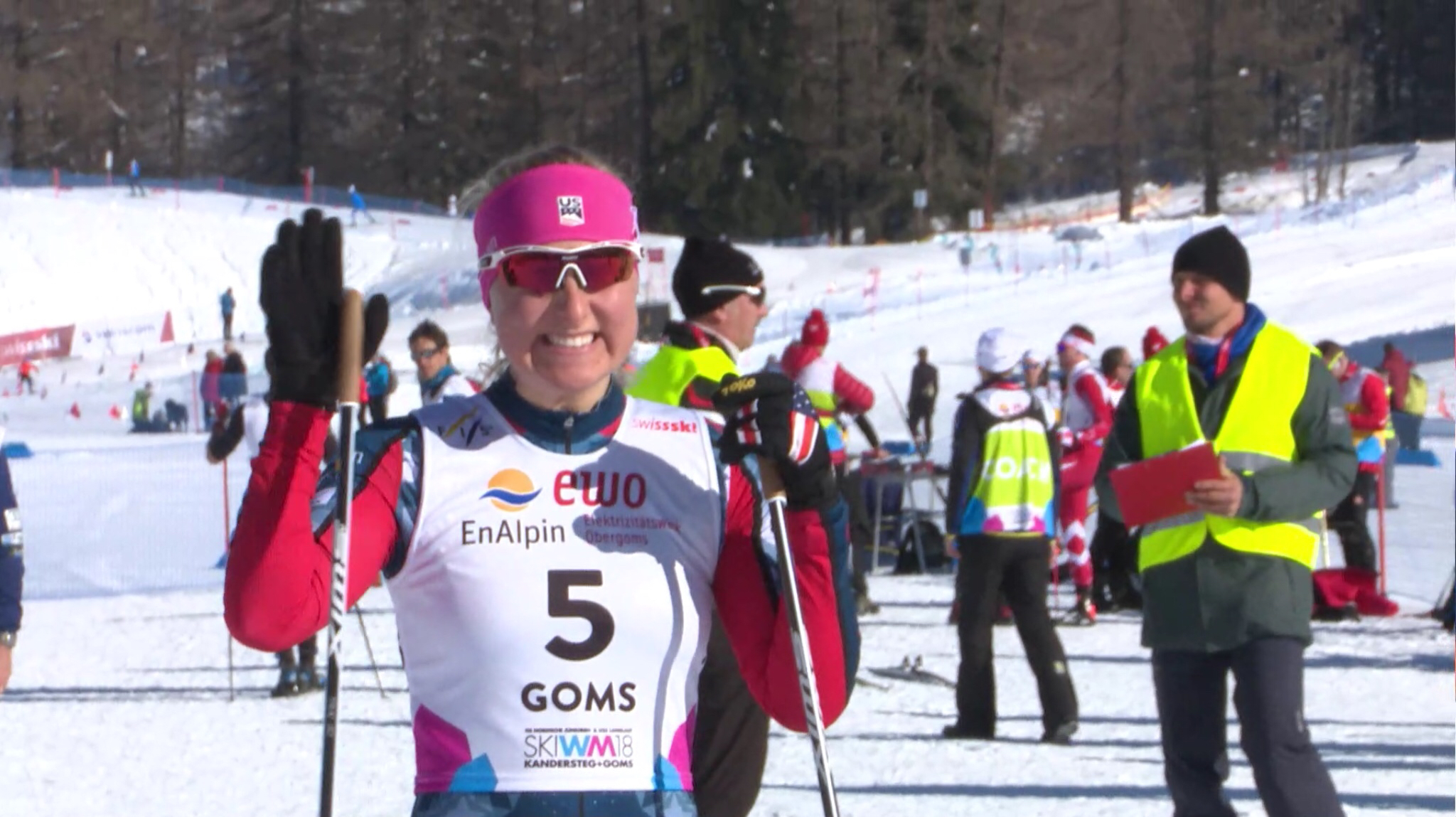
Hannah Halvorsen of the U.S. Ski Team and APU on the start line in Ulrichen, Switzerland, after finishing fifth in the sprint qualifier. (FIS screencap)
FIS Cross Country World Junior Championships (Ulrichen, Switzerland): Freestyle sprints
World Junior Championships kicked off today with freestyle sprints in Ulrichen, Switzerland. Moa Lundgren of Sweden claimed with women’s title by 1.89 seconds over Kristine Stavås Skistad of Norway in the final, with Sweden’s Frida Karlsson finishing third (+1.89).
Hannah Halvorsen of the United States qualified in fifth place before skiing to second in her quarterfinal heat. Halvorsen hovered around third or fourth place through much of her semifinal and was unable to snipe any spots in the finishing straight, ending up fourth in the heat and eighth on the day.
Fellow Americans Margaret Gellert and Sofia Shomento also made the quarterfinals, finishing 18th and 23rd, and Canada’s Hannah Mehain wound up 29th on the day.
The new men’s junior world champion is Tom Mancini of France, who nipped Norway’s Jørgen Lippert by just 0.10 seconds to take the win. Valerie Grond gave the Swiss crowd a thrill by making it all the way to the final and taking home bronze, despite qualifying in just 21st position. The Swiss junior narrowly edged France’s Vincent Buiatti for the final step on the podium.
Canada’s Graham Ritchie finished second in his quarterfinal after qualifying in 28th position, earning an automatic spot in the semifinals. There he finished sixth (+9.30 behind Mancini), winding up 12th on the day. Teammate Antoine Cyr also made the quarterfinals where he had an impressive crash, slinging off the trail and into the infield, finishing 30th on the day. For the U.S., Gus Schumacher was the lone qualifier for the heats. He finished fourth in his quarterfinal and was just 0.22 seconds away from a “lucky loser” spot in the semifinals. Schumacher finished 19th on the day.
In the junior women’s race, Hannah Rudd of the United States finished 35th in qualification, +18.15. For Canada, Annika Richardson finished 52nd (+24.09), Catherine Reed-Metayer 56th (+28.25), and Alexandra Racine 69th (+37.27).
In the junior men’s sprint, Canada’s Reed Godfrey finished a tough 31st, just 0.21 seconds out of making the quarterfinals. Etienne Hebert rounded out the Canadian finishers in 36th place (+11.81) in the qualifier. Canyon Tobin was 41st in qualification for the U.S. (+13.46), followed by Karl Schulz in 54th (+16.90) and Luke Jager in 60th (+18.15).
FIS Nordic Combined World Cup (Seefeld, Austria): Individual normal hill/15 k
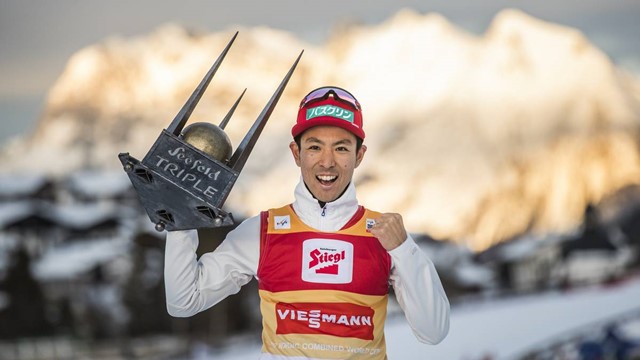
Japan’s Akito Watabe after winning the 2018 Seefeld Triple Nordic Combined World Cup. He is the only athlete besides Germany’s Eric Frenzel to win the event. (Photo: FIS Nordic Combined)
On the final day of the Seefeld Triple, Japan’s Akito Watabe completed his sweep of the three-day weekend and Norway’s Jarl Magnus Riiber reached the podium for the third-straight day, placing second. Germany’s Fabian Rießle placed third for his second podium in the last two days.
Watabe jumped to first on the normal hill and started the 15 k Gundersen 48 seconds ahead of Riiber in second. He went on to win the race by 1:14.9 minutes in 34:58.6, becoming the only man besides Germany’s Eric Frenzel to win the Seefeld Triple in its five-year history.
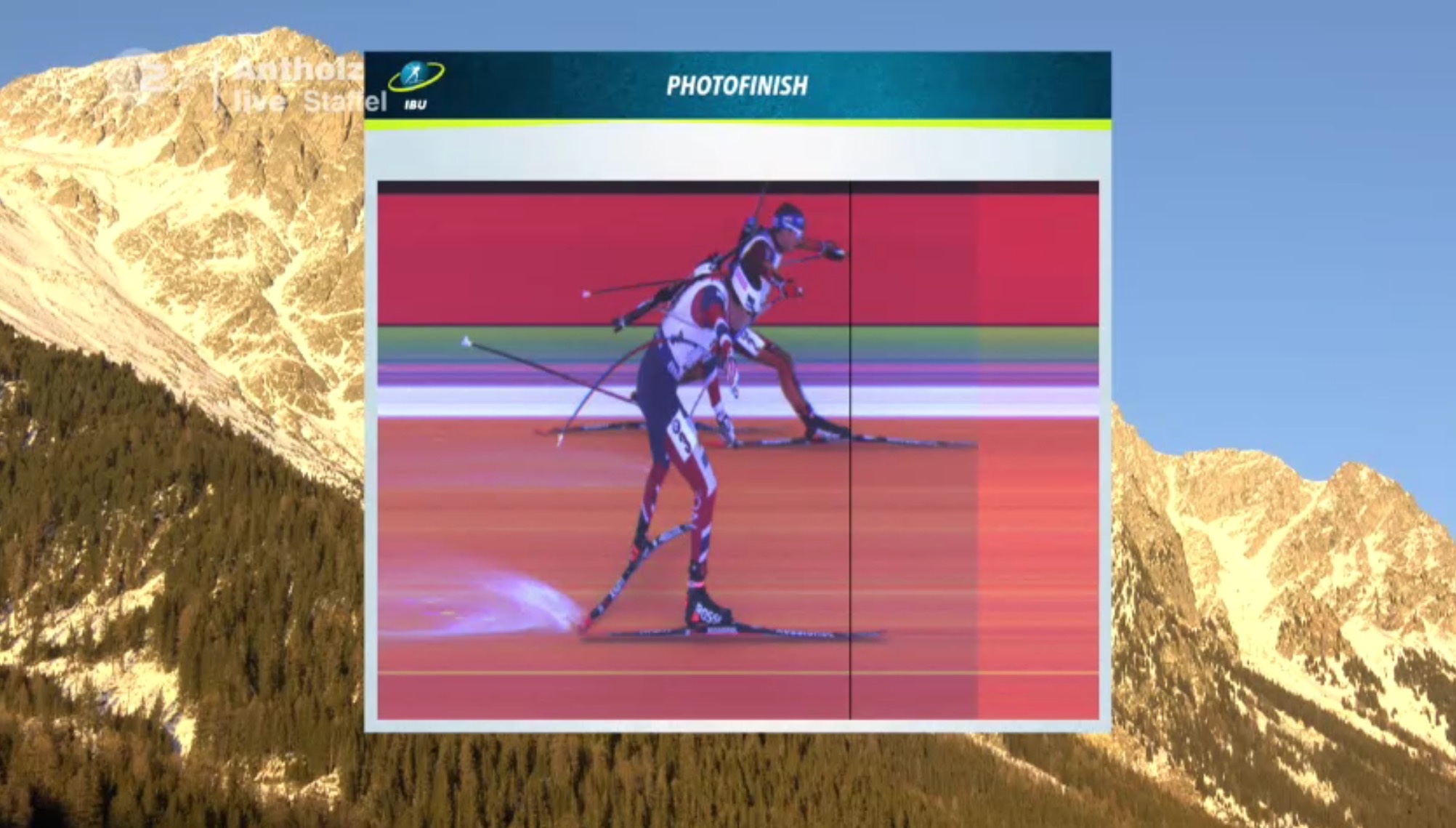
After jumping to fifth, Rießle won a photo finish for third (+1:57.9), edging Germany’s Vinzenz Geiger by less than a tenth of a second. Geiger moved up from ninth in the jump to fourth overall (+1:57.9).
Norway’s Jørgen Graabak followed in fifth (+2:02.4),Frenzel placed sixth (+2:07.4), Norway’s Jan Schmid was seventh (+2:09.8), Finland’s Eero Hirvonen eighth (+2:13.5), Norway’s Espen Andersen ninth (+2:28.0), and Austria’s Mario Seidl 10th (+2:42.1) out of 28 finishers.
No Americans contested the final day of the Triple, the last World Cup before the 2018 Winter Olympics in PyeongChang, South Korea.
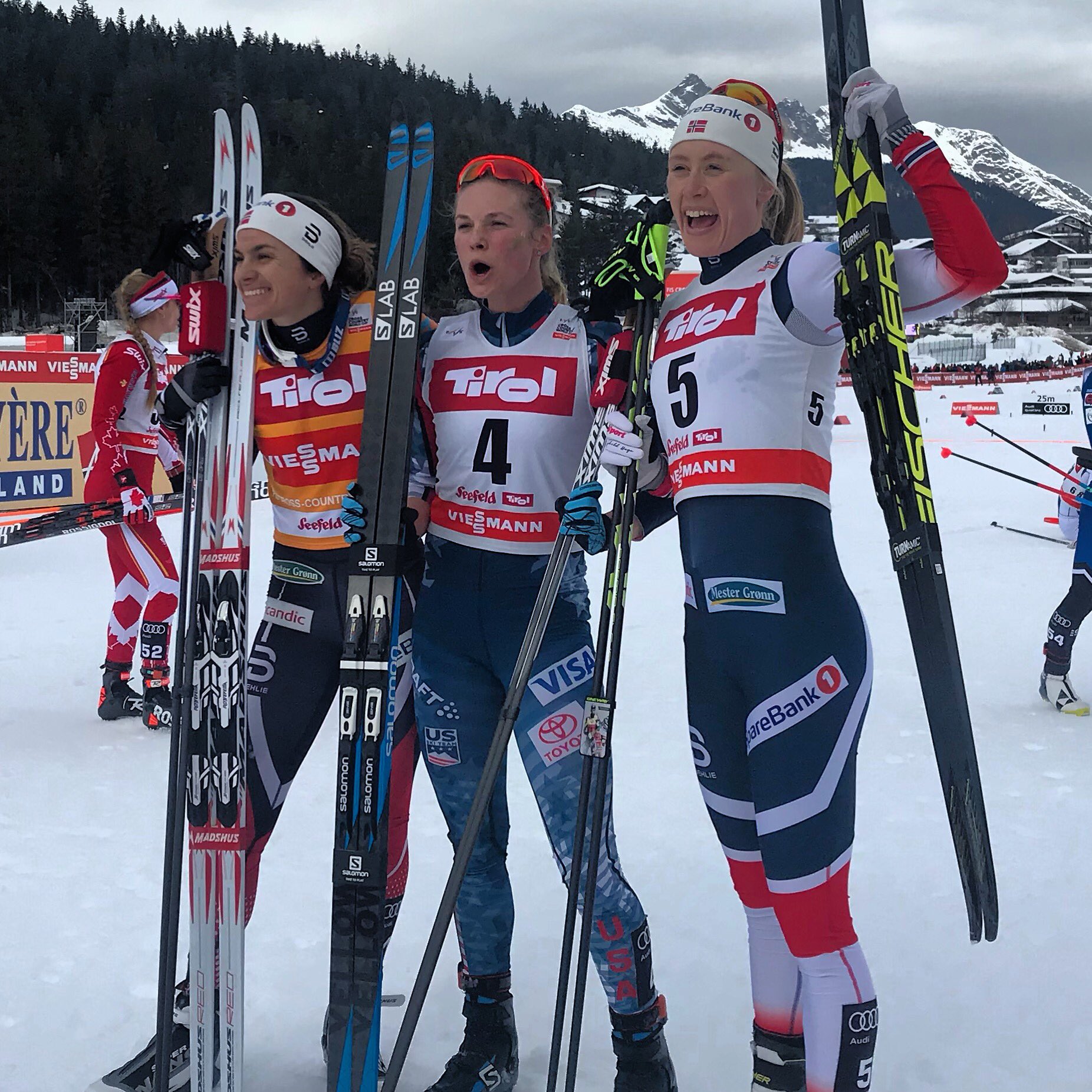
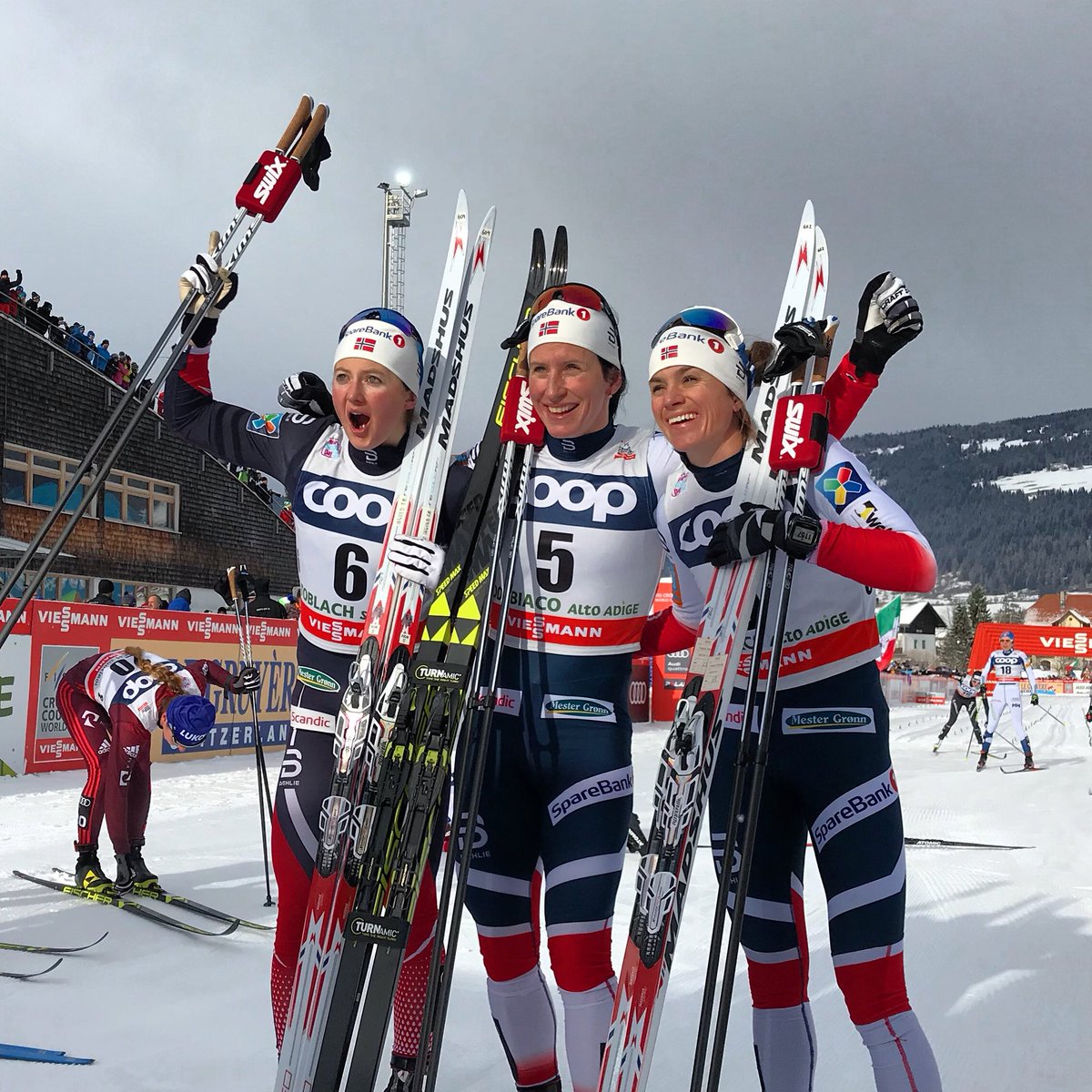
Jessie Diggins of the U.S. Ski Team (center) celebrates after winning the 10 k mass start freestyle in Seefeld, Austria, over Heidi Weng (left) and Ragnhild Haga of Norway. (Photo: FIS Cross Country/Twitter)
FIS Cross Country World Cup (Seefeld, Austria): 10/15 k mass start freestyle
In the final World Cup race before the 2018 Olympics, Jessie Diggins achieved the ultimate goal to give herself the utmost confidence heading into PyeongChang — winning the women’s 10-kilometer freestyle mass start at the World Cup in Seefeld, Austria, on Sunday.
The win was her first of the season and fourth individual victory of her career. Diggins, a 26-year-old U.S. Ski Team member, pulled it off by attacking on a long climb and leaving Norway’s Heidi Weng, Ragnhild Haga and Ingvild Flugstad Østberg chasing. While Diggins was several seconds ahead over the top and all alone on the long descent that followed, Weng and Haga worked to close the gap — and nearly did in the finishing stretch. But Diggins held them off, winning by 0.7 seconds over Weng in second place and 1 second ahead of Haga in third, and threw her fists down in celebration as she crossed the line first in 23:08.5 minutes.
“I just put my head down and it wasn’t pretty, but I just hammered,” Diggins told the International Ski Federation (FIS) in a televised post-race interview.
She was the only non-Norwegian in the top five, with Østberg in fourth (+8.7) and Marit Bjørgen in fifth (+16.7). Austria’s Teresa Stadlober placed sixth (+16.9), Norway’s Kari Øyre Slind was seventh (+19.1), and American Sadie Bjornsen placed eighth (+20.5), ahead of Switzerland’s Nathalie von Siebenthal in ninth (+30.3).
The U.S. had three in the top 15 with Kikkan Randall (U.S. Ski Team) in 14th (+48.5), and two more women in the top 30, with Caitlin Patterson (Craftsbury Green Racing Project) in 23rd (+1:00.7) and Liz Stephen (USST) in 29th (+1:18.2). Rosie Brennan (USST) finished 53rd (+2:26.9).
Emily Nishikawa led the Canadians in 35th (+1:36.5), followed closely by teammate Cendrine Browne in 37th (+1:36.6). Dahria Beatty finished 45th (+1:58.9).
Dario Cologna of Switzerland (center) won the men’s 15 k skate mass start in Seefeld, Austria, over Alex Harvey of Canada (left) and Martin Johnsrud Sundby of Norway (right). (Photo: FIS Cross Country/Twitter)
The Olympics are nearing and so Switzerland’s Olympic legend Dario Cologna is ramping up: after winning the Tour de Ski, he took another win in the 15 k mass start skate in Seefeld, Austria, on Sunday.
With much of the field staying relatively close together until the finish, Cologna nabbed the win by 1.4 seconds over Canada’s Alex Harvey, who took his second podium of the season in addition to also finishing third in the overall Tour de Ski.
Norway’s Martin Johnsrud Sundby was third (+2.9), then teammate Didrik Tønseth in fourth (+5.9) and France’s Maurice Manificat in sixth (+7.5).
The U.S. Ski Team’s Erik Bjornsen had a breakthrough day finishing ninth (+9.3), followed by Simi Hamilton in 12th (+12.4). Behind them, Scott Patterson placed 27th (+23.4), then Patrick Caldwell 49th (+1:26.2), Ben Lustgarten 55th (+1:42.7), and Tyler Kornfield 77th (+3:00.0).
Canada’s Devon Kershaw and Graeme Killick finished 30th (+26.5) and 31st (+27.4), respectively. Len Valjas placed 58th (+1:53.1), Knute Johnsgaard 82nd (+3:23.1), Bob Thompson 87th (+4:27.5), and Julien Locke 92nd (+4:56.9).
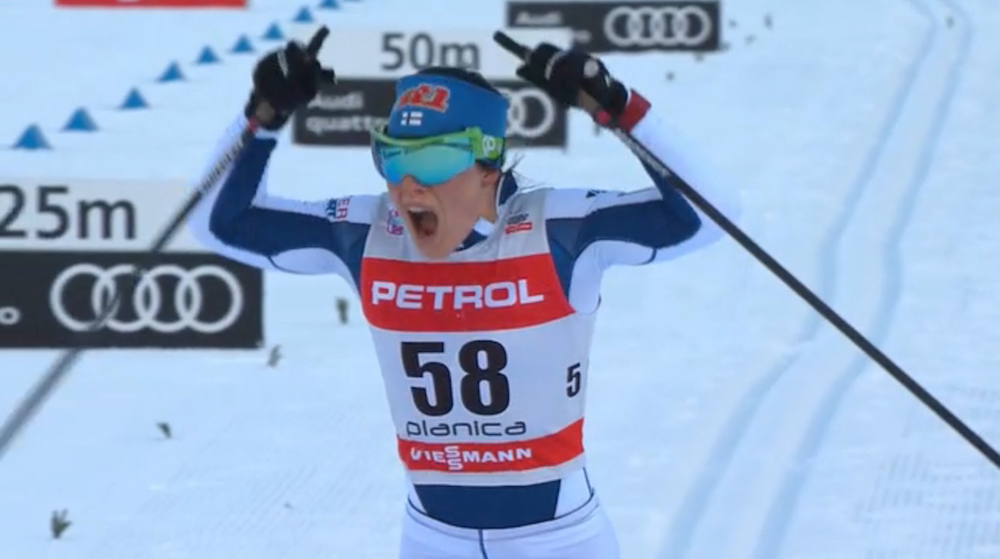
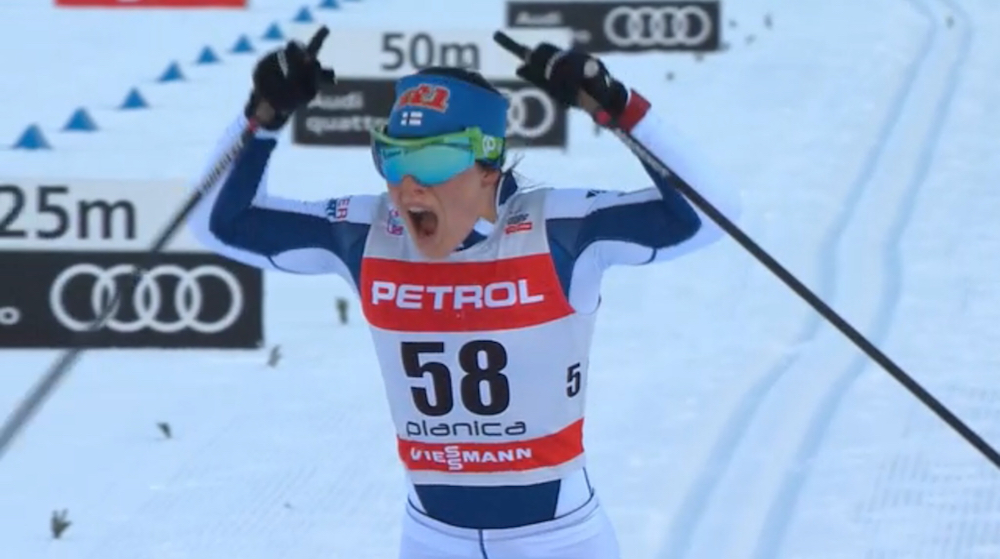
Finland’s Krista Pärmäkoski after winning her first non-stage World Cup on Sunday in the women’s 10 k classic in Planica, Slovenia. She bested Sweden’s Charlotte Kalla’s time by 3.6 seconds. (Screenshot: ARD broadcast)
FIS Cross Country World Cup (Planica, Slovenia): 10/15 k classic
Just when it looked like one of those Charlotte-Kalla days, Finland’s Krista Pärmäkoski swooped in and topped the Swede’s time by 3.6 seconds in the women’s 10-kilometer classic individual start on Sunday for her first-career outright World Cup win.
Outright meaning non-stage; Pärmäkoski has two World Cup wins to her name for setting the fastest time of day in 2016 pursuit races.
But Sunday’s 10 k in Slovenia saw her rising to the challenge and besting Charlotte Kalla’s time of 27:12.3, which was at least 39 seconds faster than the first 57 starters. Kalla had started 32nd and beat the previous top time set by Swedish U23 skier Ebba Andersson (bib 28) by 48.6 seconds.
Austria’s Teresa Stadlober started later in bib 56 and clocked the second-fastest time to Kalla, 39 seconds back.
But it was Pärmäkoski in bib 58 who beat them all. Even Norway’s Heidi Weng, who started 60th, couldn’t come close, as she finished 33.5 seconds off Pärmäkoski’s winning time for third place. That put Stadlober in fourth and Andersson in fifth at the end of the day.
Finland’s Kerttu Niskanen placed sixth (+49.4), Norway’s Kari Øyre Slind took seventh (+49.5), Poland’s Justyna Kowalczyk (who’s more of a marathon skier these days) placed eighth (+1:02.1), Norway’s Kathrine Rolsted Harsem (who placed second in Saturday’s classic sprint) finished ninth (+1:03.2), and American Jessie Diggins was 10th (+1:05.4).
Another American, Caitlin Patterson, of the Craftsbury Green Racing Project (CGRP), broke through with her second-best individual World Cup result in 20th (+1:45.2). (Last year, she finished seventh in the pre-Olympic PyeongChang World Cup 15 k skiathlon in a notably small field.)
Kikkan Randall (U.S. Ski Team) followed in 23rd (+1:50.4), and her teammates Sophie Caldwell placed 31st (+2:17.2), Liz Stephen 35th (+2:34.9), and Ida Sargent 37th (+2:37.5).
For the second-straight weekend, no Canadian women competed.
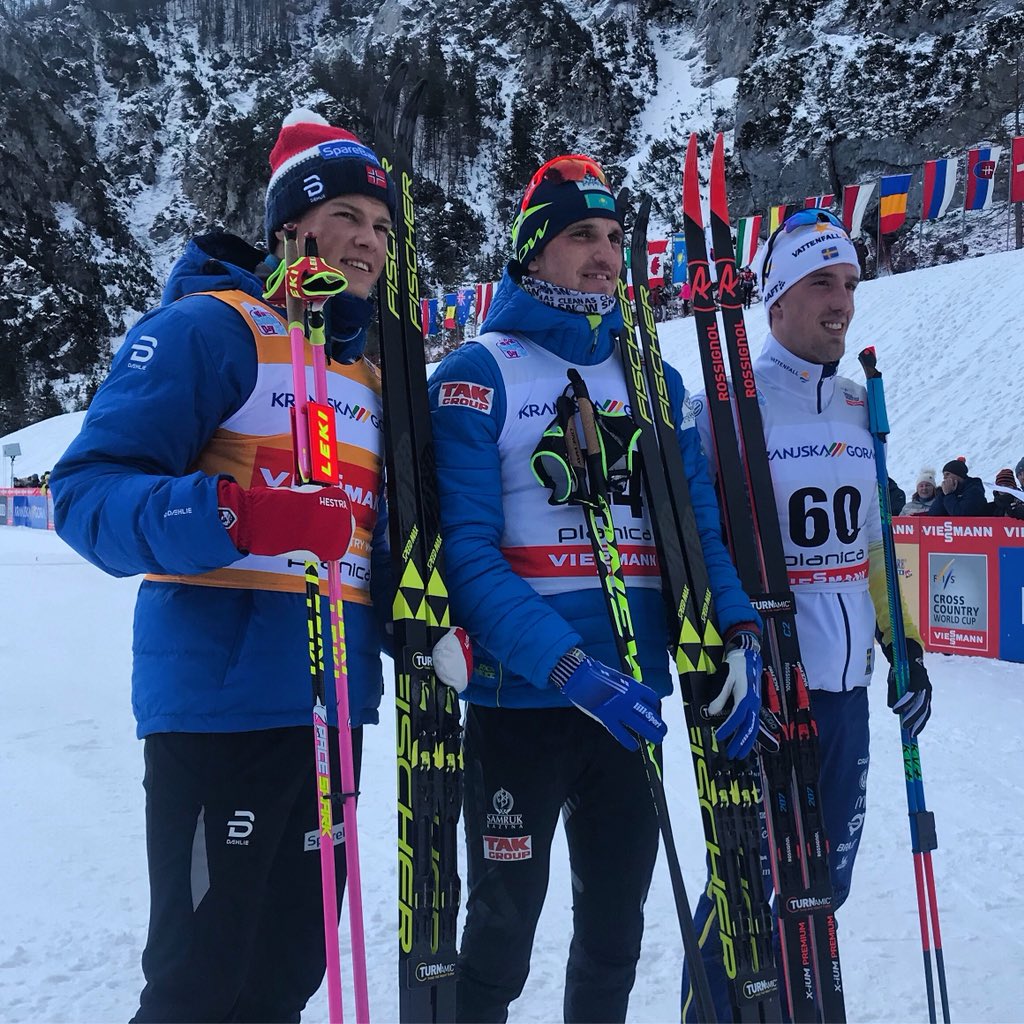
The World Cup men’s 15 k classic podium on Sunday in Planica, Slovenia, with Kazakhstan’s Alexey Poltoranin (c) in first, Norway’s Johannes Høsflot Klæbo (l) in second, and Sweden’s Calle Halfvarsson (r) in third. (Photo: FIS Cross Country/Twitter)
In the men’s 15 k classic, Kazakhstan’s Alexey Poltoranin tallied his second win of the season and first in a race against Norway’s Johannes Høsflot Klæbo on Sunday, winning by 13.2 seconds over Klæbo in 36:54.7.
Poltoranin, 30, started 44th and a minute behind the 21-year-old Klæbo. When Klæbo finished, he bumped Russia’s Ivan Kirillov, also 21, out of the leader’s chair by 43.3 seconds. Then Poltoranin finished 13.2 seconds faster, but Klæbo held onto second when Sweden’s 60th starter, Calle Halfvarsson, finished third (+42.8). It was Halfvarsson’s second podium of the season after placing third in the classic sprint at the November World Cup opener in Kuusamo, Finland. In Saturday’s classic sprint in Slovenia, Halfvarsson qualified second but crashed out of the quarterfinals to finish the day in 30th overall.
Norway’s Emil Iversen started 66th and ended up fourth (+54.7) and Kirillov scored his first World Cup top 10 in fifth (+56.5). Russia had four in the top 10 with Stanislav Volzhentsev in sixth (+57.8), Andrey Larkov in eighth (+1:02.2) and Andrey Sobakarev in ninth (+1:03.4). Norway’s Mattis Stenshagen finished seventh (+1:00.8) and Finland’s Iivo Niskanen took 10th (+1:10.1).
Scott Patterson (U.S. Ski Team) was the top North American in 43rd (+2:56.2), Ben Lustgarten (Craftsbury Green Racing Project) finished 46th (+3:04.9) and Tyler Kornfield (Alaska Pacific University) was 57th (+4:03.7). Andy Newell did not finish.
Canada’s Devon Kershaw returned to the circuit and placed 44th (+2:57.1), Bob Thompson (NTDC Thunder Bay) was 64th (+5:05.0), and Dominique Moncion-Groulx (Alberta World Cup Academy) was 70th (+6:11.7).
Russia’s Stefaniya Nadymova outsprinting Japan’s Ayane Miyazaki at the finish for the win at the inaugural women’s Nordic Combined Continental Cup competition on Saturday in Rena, Norway. (Photo: FIS/Romina Eggert)
FIS Nordic Combined Continental Cup (Rena, Norway): First-ever women’s competitions
Fourteen women, including American Gabriella Armstrong, made history this weekend by competing in the first women’s Nordic Combined Continental Cup in Rena, Norway (after the scheduled opener in Jan. 6-7 in Otepää, Estonia, was canceled), with back-to-back days of individual large hill/5-kilometer Gundersen start races.
On Saturday, Russia’s Stefaniya Nadymova took the win in 16:26.9, just 0.6 seconds ahead of Japan’s Ayane Miyazki in second. Germany’s Jenny Nowak joined them on the podium in third, 16.6 seconds out of first. Armstrong finished 12th (+6:24).
Nadymova, 23, had kicked off the event by jumping to first in the provisional round, which was used for the jumping results, and began the 5 k with a 10-second head start on Nowak in second place. Miyazaki jumped to third and started 14 seconds back. Armstrong jumped to 14th and started 4:08 out of first.
On Sunday, 15-year-old Miyazaki took the win in 16:23.2, swapping places with Nadymova, who finished second, 11.7 seconds back. Nowak, also 15, repeated in third, but finished over a minute and 21 seconds back out of first.
Miyazaki had jumped to first place earlier in the day and started the 5 k with a 20-second cushion to Nadymova in second. Nowak jumped to third and started 1:08 minutes back.
Armstrong, 19, of the New York Ski Education Foundation, jumped to 11th and finished 11th, 4:26.1 after Miyazaki.
Several U.S. Nordic Combined men also competed in Rena, with Taylor Fletcher placing fourth in Saturday’s individual large hill/10 k, 2.7 seconds behind Austria’s Thomas Joebstl in first. Fletcher had skied up from 25th and 2:17 back after the jump with the second-fastest course time.
Also for the U.S., Adam Loomis placed 33rd (+2:30.7) after jumping to 45th with the 12th-fastest course time. Grant Andrews finished 41st (+3:28.7), and Jared Schumate 43rd (+4:10.1).
Fletcher reached the podium in Sunday’s individual large hill/10 k in third behind two Austrians. After jumping to 19th, he skied the fourth-fastest course time to finish third, 3.7 seconds behind Dominik Terzer in first and 2.7 seconds behind Martin Fritz in second.
Loomis improved to 29th (+1:40.9), up from 35th in the jump, and Andrews finished 37th (+2:36.4) and Shumate 40th (+2:57.9).
The men’s large hill/4 x 5 k team event podium on Sunday at the Nordic Combined World Cup in Chaux-Neuve, France, with Norway (c) in first, Germany (l) in second, and Finland (r) in third. (Photo: FIS/NordicFocus)
FIS Nordic Combined World Cup (Chaux-Neuve, France): Saturday & Sunday
Four American men competed at the Nordic Combined World Cup this weekend in Chaux-Neuve, France, with three of them racing in Saturday’s individual large hill/10 k Gundersen and all four racing Sunday’s large hill/4 x 5 k team event.
Norway’s Jan Schmid was the big winner this weekend, racking up an individual win on Saturday and a team victory on Sunday. He won Saturday’s competition after jumping to fourth and starting 27 seconds behind jump leader Akito Watabe of Japan. Schmid worked his way up to first in the 10 k with the third-fastest course time, crossing the line 1.4 seconds ahead of Watabe in 23:32.7.
Watabe finished second and Finland’s Ilkka Herola placed third (+21.5), just ahead of Austria’s Lukas Klapfer in fourth (+21.8).
Ben Loomis led USA Nordic in 37th (+2:49), after jumping to 37th, Stephen Schumann finished 45th (+5:17.0) and Ben Berend 46th (+5:22.2).
On Sunday, Schmid teamed up with Espen Andersen, Jarl Magnus Riiber and Jørgen Graabak to win the 4 x 5 k team event in 47:22.5 by 13.1 seconds. Germany followed in second, with Eric Frenzel, Fabian Rießle, Johannes Rydzek, and Vinzenz Geiger, and Finland placed third (+20.5) with Leevi Mutru, Arttu Maekiaho, Herola, and Eero Hirvonen.
Norway had led after the jump and started the relay 1:03 minutes ahead of Finland in second. France jumped to third and ended up fourth (+47.4), after being passed by Germany, which had started the relay in fourth.
Japan placed fifth (+2:50.9), Italy sixth (+3:59.9), Austria seventh (+4:06.8), Poland eighth (+5:22.1), Estonia ninth (+5:52.1), Russia 10th (+6:41.2), and the U.S. (with Schumann, Loomis, Berend, and Jasper Good) 11th (+6:52.4).
Western Canadian Championships (Red Deer, Alberta): Relays
Nine men’s teams and six women’s squads contested the open relays on the last day of the NorAm Western Canadian Championships on Sunday in Red Deer, with Ontario’s Team “O” (Scott Hill, Michael Somppi and Andy Shields) winning the men’s 3 x 5 k and Alberta 1 (Annika Hicks, Emma Camicioli and Zina Kocher) winning the women’s 3 x 5 k.
For Shields and Hicks, it was their second win of the weekend after they won their respective classic mass starts on Saturday.
Team “O” posted a 19.9-second win over B.C. Storm (Remi Drolet, Tallon Noble and Greg Kilroy), finishing first in 36:22.6. Alberta 5.1 (Sebastien Boehmler-Dandurand, Sam Hendry and Russell Kennedy) placed third (+52.3).
In the women’s relay, Alberta 1 beat out B.C. Fast, Furious & Freakin’ Awesome (Katie Weaver, Michaela McLean and Kaia Andal) by 2 minutes and 37.8 seconds, winning in 43:17.2. Alberta had two teams on the podium with the Kit Kats (Ember Large, Molly Jane Strum, and Sara McLean) in third (+4:25.8).
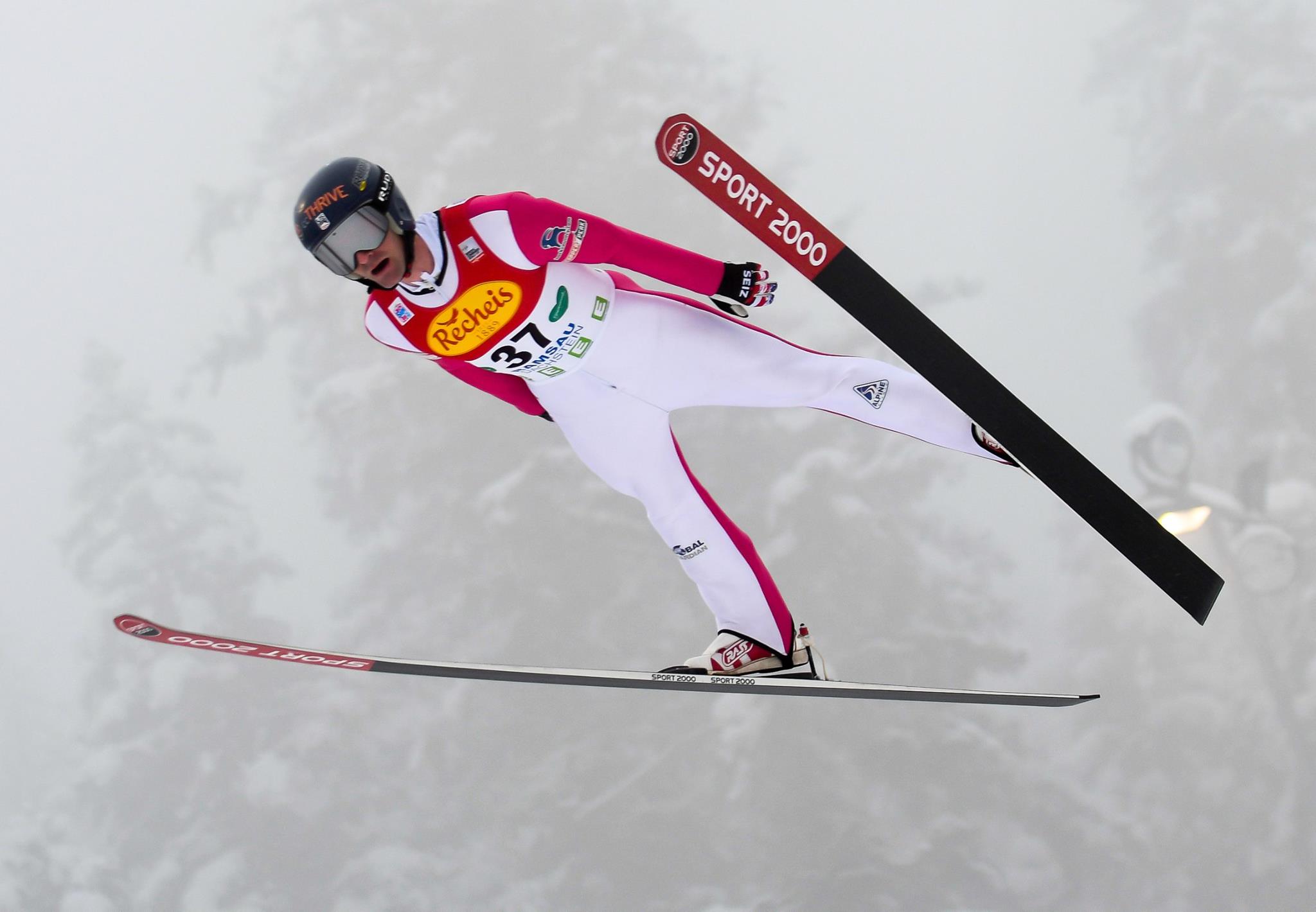
Bryan Fletcher (USA Nordic) jumping at the Nordic Combined World Cup last Sunday, Dec. 17, in Ramsau, Austria. After jumping to 45th in the provisional round on Friday (Sunday’s competition round was cancelled midway through), he skied the third-fastest time in Sunday’s 10 k to finish 14th overall. (Photo: Romina Eggert/USA Nordic Facebook)
On Dec. 30, the nordic-combined community will gather in Park City for the U.S. Olympic Team Trials, a one-and-done event which will dole out an Olympic berth for the race winner. As they have for much of their professional-sport careers, brothers Bryan and Tyler Fletcher are eying the same prize.
Bryan Fletcher was ranked 34th on the World Cup last season. His best individual results during the 2016/2017 World Cup calendar were an 11th and 18th place.
This past weekend in Ramsau, Austria, Bryan, the older of the Fletcher brothers, came through with a seventh place on Saturday, Dec. 16, for his best individual result in nearly two years.
“The opportunity was there,” Bryan, 31, said on the phone from Utah this week. He explained that the jumping hill in Ramsau is smaller than the hill used for the opening weekend in Ruka, Finland.
“Ramsau is one of those hills where everybody tends to jump a little bit closer. That was the first thing that was really helpful there,” he said. “The second thing was definitely that I jumped on a little bit higher level than the previous weekends. … I was able to put together a little bit better jumps and on a more consistent basis. As a result I was able to put myself in the fight in the race.”
Bryan jumped to 28th, yet scored 110.5 points, while the best jumper, Taihei Kato of Japan, scored 125.9 points — not a massive gap when considering the Fletchers’ skiing speed. That 15.4-point differential put Bryan 1:02 minutes behind Kato at the start of the 10 k Gundersen. When in position after a solid jump, both of the Fletchers can close out a top 20 or a top 10 in the ski.
But moving through a field of World Cup skiers — Bryan moved up 21 spots in Saturday’s race — is part-art and part-sufferfest.
Bryan Fletcher (USA Nordic) notched seventh in the Nordic Combined World Cup this weekend in Ramsau, Austria, for his best result since January 2016. (Photo: USA Nordic/Facebook)
“More these days, the old-school laws of track don’t really apply for us,” Bryan said about passing skiers during the ski portion. “Especially in nordic combined where every place is so crucial and those points are so valuable people don’t want to move over. They know if they move over for you that opens a hole for potentially five to 10 skiers that are in that train to get by.”
Ramsau’s course remains a link to the past with skinny trails placing a premium on high-risk, high-reward aggressive skiing. Moving to the front when a gap opens or sitting in and sucking a draft can make or break a result.
“That opportunity pays itself off in the end, that is exactly what happened to me,” Bryan said of his high-octane skiing and thread-the-needle gap finding. “There were several times coming over the top of a hill where I really could have taken the opportunity to tuck into the group and get some rest, but I knew I was going to be log-jammed later down on the course. I would take the risk and get to the front of the group and that would get me a clean opportunity to get up the next hill or through the choke point unscathed. There were definitely times where I was going up the hill and it was two skiers wide and I was stuck and sitting behind everybody and you just have to wait for a hole to open up and just be patient and take that rest as it comes. Of course, when it opens you just have to go and don’t look back and move on up.”
Germany’s Eric Frenzel started the 10 k race in third and took the win in 24:17.8, while Bryan finished 32.6 seconds back in seventh after skiing the second-fastest time of the day.
On Sunday, another German, Fabian Rießle, stood on top of the podium after jumping to ninth and rising to first in the 10 k, finishing in 26:12.5. The weather conditions were unsettled for Sunday’s jump competition, yet both Fletcher brothers posted solid results on the hill before the competition round was halted and ultimately cancelled. As a result, competition results did not count, and jumps from Friday’s provisional round were used instead to determine time back for the ski.
Bryan began the ski 1:30 minute back with the 45th-ranked provisional jump, while Taylor bagan the ski 2:53 minutes back after jumping to 58th, just ahead of teammate Adam Loomis in 59th.
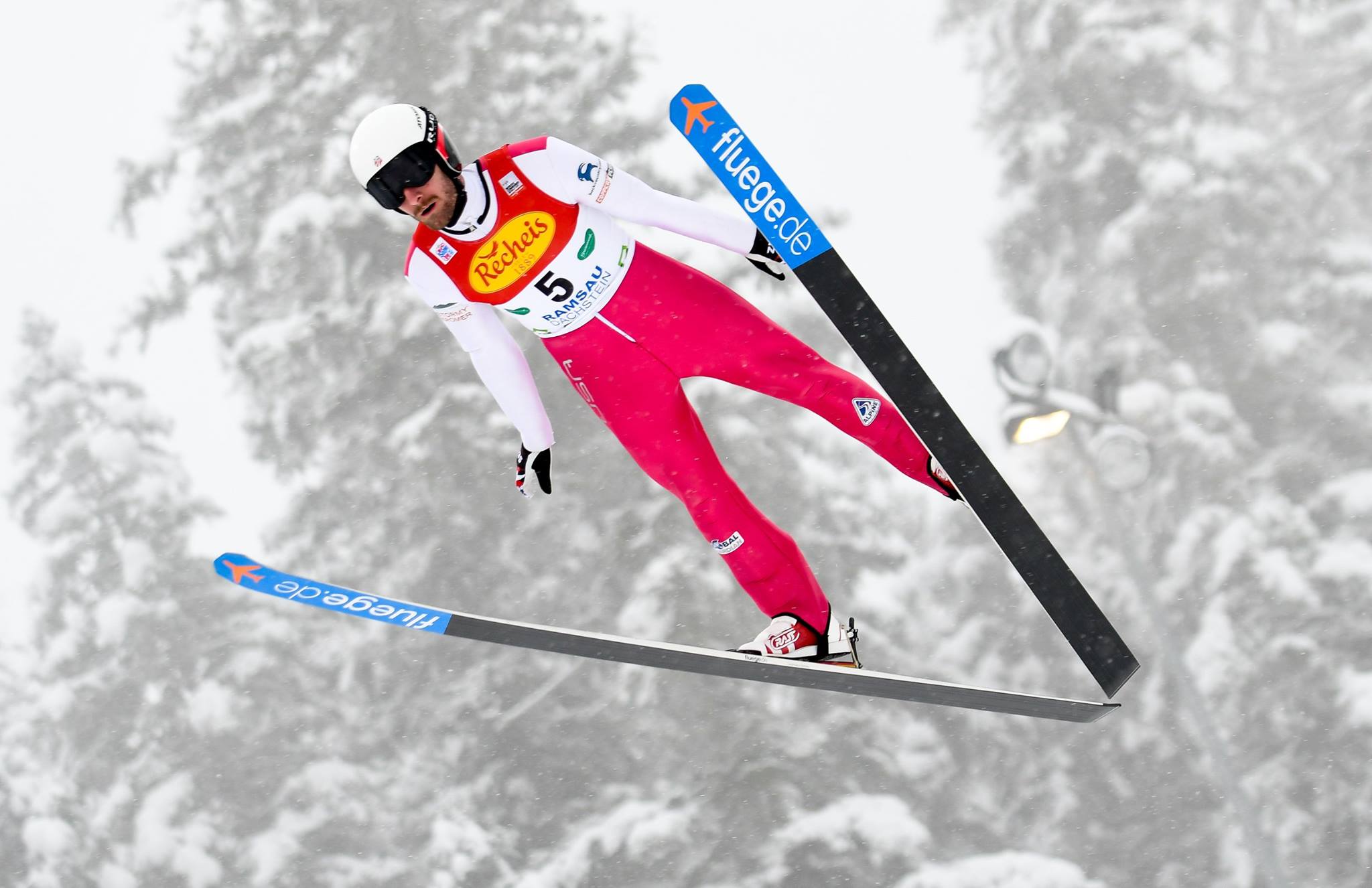
Taylor Fletcher (USA Nordic) jumping at the Dec. 17 World Cup in Ramsau, Austria. After ranking 58th in the provisional jump on Friday, he picked off 24 places to finish 34th in the 10 k on Sunday. (Photo: Romina Eggert/USA Nordic Facebook)
Fast skiing by the Fletchers was once again on display on Sunday. Bryan raced up to 14th (+43.7) with the third-fastest time of the day while Taylor improved a whopping 24 positions to finish 34th (+2:01.6) with the second-fastest time of the day. Loomis moved up seven places to place 52nd (+4:38.6) out of 55 finishers.
“Those major ski efforts begin in May, with the intensity over the summer — that all gets you to a place where you are able to sustain efforts like that,” Taylor Fletcher said on the phone. “I love pushing myself. Every year when we do a VO2max I am excited about it. Because I want to go until I absolutely cannot go. It is the same with racing. Our races should be slightly faster than our threshold-plus intervals that we do. We have done a good job with that. And this past weekend it was snowing and I love racing when it is dumping snow. You have to be a strong skier for sure.”
When the jumping round was cancelled on Sunday, Taylor had to refocus as the jump that wouldn’t count for his ski seeding would have positioned him for a top-20 strike. Instead, his preliminary jump from Friday put him at the back of the field.
“My position drastically changed over the course of the 30 minutes that they decided to cancel the competition round,” Taylor Fletcher explained. “I wanted to try to get points no matter what. I went as hard as I possibly could for the entire race. There was not a spot where I could really settle and say I could have made up 20 seconds there and finished in the points. It’s hard to go through the field like that. When you are racing from 58th to try to get into the top 30, you are passing 28 guys, and Ramsau is a very narrow course … maybe if I could get around them quicker, then maybe they would have blown up earlier and fallen back even more. It takes a little bit of strategy and a lot of nerve and a lot of commitment to be able to push through and catch those guys and pass them and drop them.”
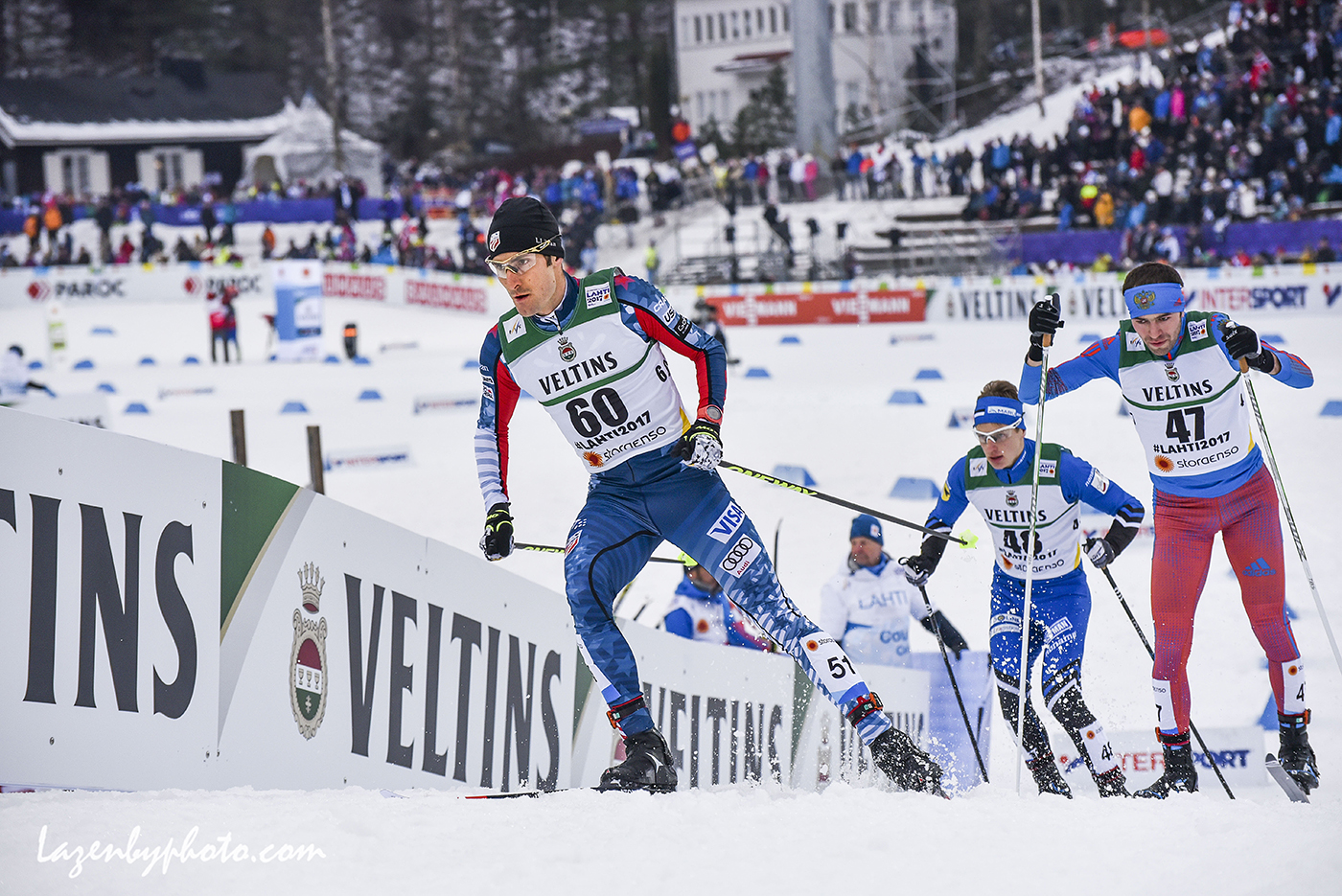
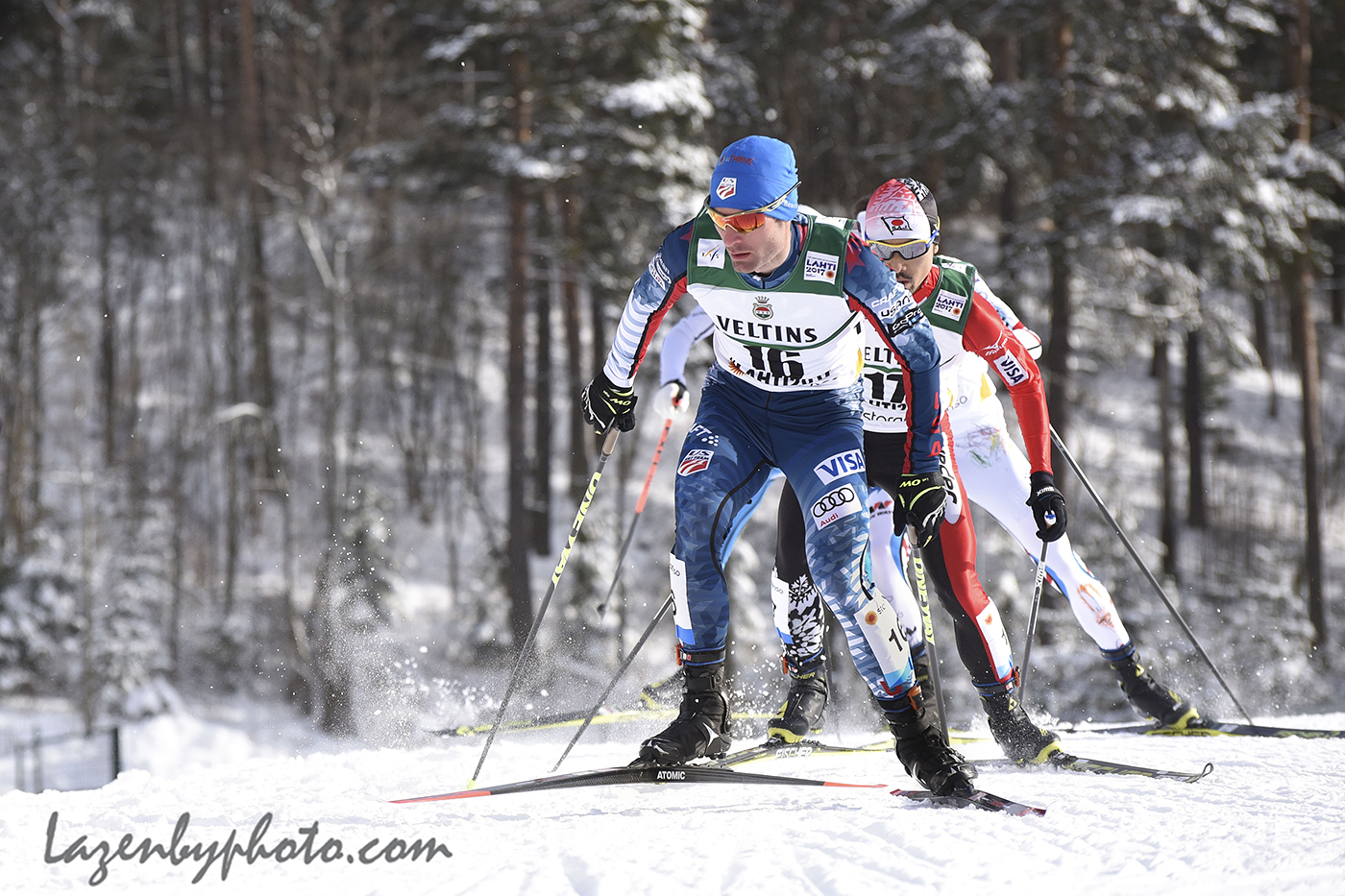
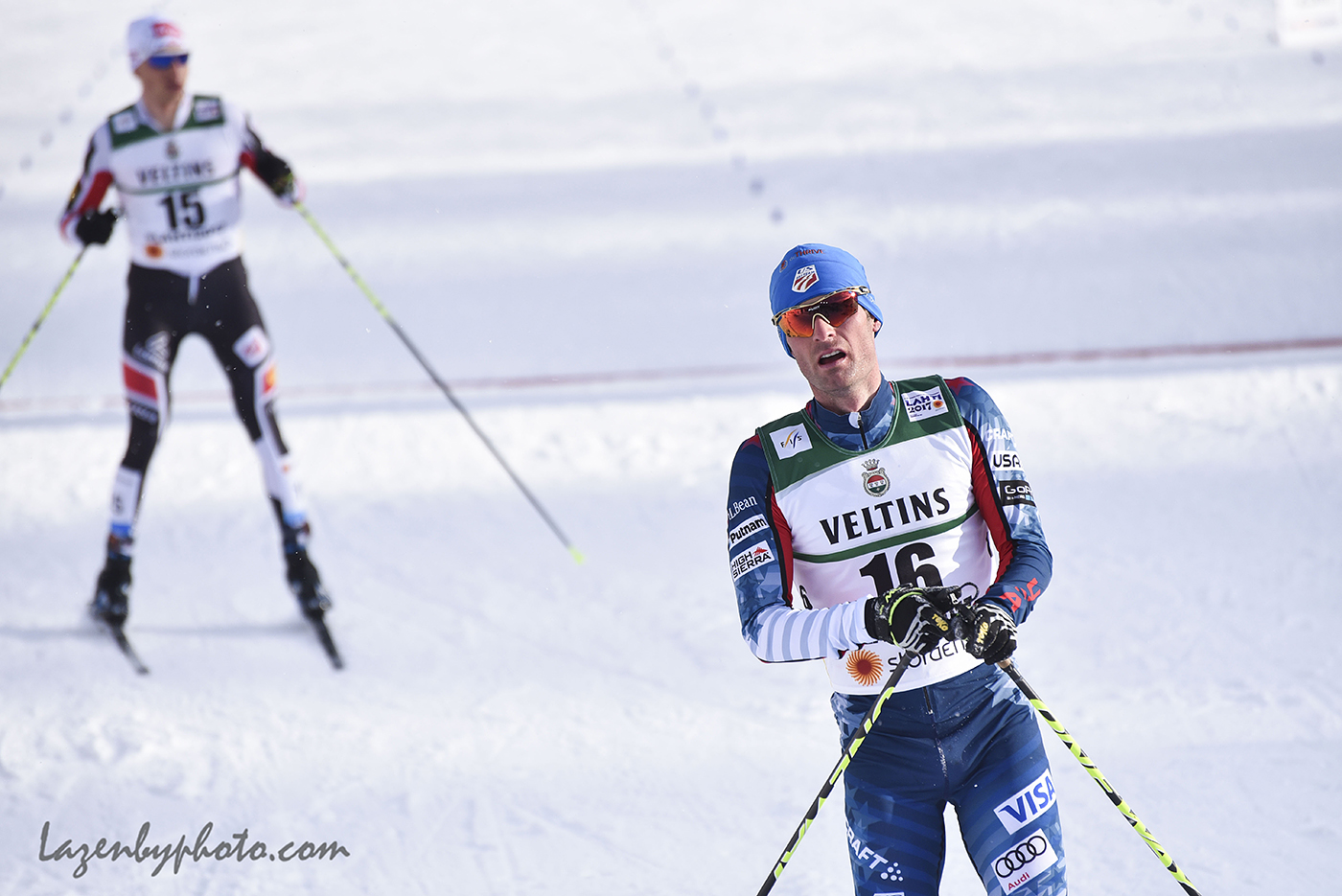
American Taylor Fletcher (60) racing to 36th last March after starting 51st in the individual large hill/10 k Gundersen race at 2017 World Championships in Lahti, Finland. (Photo: John Lazenby/Lazenbyphoto.com)
Let’s put this out there as it’s no mystery to any fan of the sport or any World Cup nordic-combined athlete: having a Fletcher chasing from behind can be a gamble if you don’t gun it. As the Olympic trials approach both Bryan and Taylor know their ski shape is good.
However, when asked to summarize his World Cup Period 1, Taylor was straight to the point.
“Pretty bad to be honest,” Taylor said. “Looking back after the summer and all the work, I was confident I could get off to a decent start in points and fight for points. I wasn’t worried about qualifications or anything but I was definitely bummed when I found myself struggling pretty badly with the jumping. But that being said, it was only one aspect. I mean everything else was good. Cross-country is obviously solid. My strength and power and speed in terms of the jumping is there, it’s just more mental — the mental approach I was taking to the jumping. I was trying to be almost be too perfect and trying to really get these good jumps in and really focus so much on certain aspects of the jump, I was forgetting about the whole bigger picture in a sense.”
In the short term, Taylor is focused on winning the lone competition at Olympic trials on Dec. 30 and improving his results in the new year.
“My goal right now is to win on the 30th, win the Olympic trials here and that way I can completely forget about a qualification spot and I can go out there and focus on my training and focus on the individual competitions,” Taylor said. “And then move forward and focus on the next step as we get towards the Olympics. Honestly, I think I am all right. … And hopefully the team can also step up and we can guarantee that we have four spots on the Olympic team so we can have a team event, hope for sure that we have four so we can represent the U.S. at the Olympics.”
Bryan, along with the entire who’s who in U.S. NoCo, will be honing for the shoe-in Olympic spot on the 30th. According to USA Nordic’s selection document, after the lone spot is secured at the trials, any remaining spots can be nominated using discretion with the potential for Olympic success as the guiding principle. In total, the U.S. is allotted a maximum of four spots for the PyeongChang Games. If discretion does not fill the quota, then the first step on the selection hierarchy are top-10 results from the World Cup between Nov. 15, 2017 and Jan. 22, 2018.
Currently, only Bryan meets that standard thanks to his seventh place in Ramsau.
“I think I have made the objective criteria to go, but nothing is set in stone until the qualification ends or Olympic trials are won,” Bryan said. “That will be the first guaranteed spot on the team; Olympic trials. There are a lot of eyeballs on that. A lot of guys on the team are going to be vying for that spot.”
Bryan Fletcher (USA Nordic) jumping to 45th in the Nordic Combined World Cup on Sunday in Ramsau, Austria. In the 10 k that followed, he skied the third-fastest time to finish 14th overall. (Photo: Romina Eggert/USA Nordic Facebook)
NorAm mini tour (Rossland, B.C.): 10/15 k freestyle pursuits
Team Gregg ended the Rossland NorAm mini tour with another double win, with American Caitlin Gregg and her husband Brian Gregg winning the 10- and 15-kilometer freestyle pursuits, respectively, at the Black Jack Ski Club trails.
The women’s 10 k freestyle pursuit podium at the NorAm in Rossland, B.C., with American Caitlin Gregg (c) in first, and Canadians Zina Kocher (l) and Andrea Dupont (r), in second and third, respectively. (Photo: Cross Country Canada)
Caitlin capped the long weekend with her third-straight win, a 48.28-second victory over former Canadian biathlete Zina Kocher (Foothills Nordic). Caitlin started first and was first across the finish in 29:02.86, while Kocher started ninth and rose to second place for her second-consecutive podium (after placing third in Saturday’s skate sprint). Andrea Dupont (Rocky Mountain Racers) started fourth and finished third (+1:58.35) for her second-straight podium as well (she was second in the skate sprint behind Gregg).
Lisle Compton of the National Team Development Centre (NTDC) Thunder Bay and Canadian National Junior Team finished fourth overall (+2:07.03), Frederique Vezina of the Pierre-Harvey National Training Centre (CNEPH) was fifth (+2:16.10), and Annika Hicks of the Alberta World Cup Academy (AWCA) sixth (+2:16.51). Laura Leclair (CNEPH) placed seventh, Kaia Andal (Caledonia Nordic) was the top junior in eighth overall, Jaqueline Mourao (Brazil Ski Team) ninth, and Sophie Carrier-Laforte (Skinouk) 10th.
Brian, who won the Rossland men’s 10 k classic on Friday, also started Sunday’s 15 k freestyle pursuit first and finished in that position in 38:43.93. Andy Shields (Lappe Nordic) raced to second overall, 7.65 seconds back, after starting fourth, and Jack Carlyle (AWCA) reached the podium in third (+8.75) after starting 10th.
Evan Palmer-Charrette (NTDC Thunder Bay) ended the weekend in fourth (+17.68), Philippe Boucher (CNEPH) was fifth (+19.02), Brian McKeever (Canadian Para-Nordic Ski Team) sixth (+22.16), Michael Somppi (AWCA) seventh (+34.62), Alexis Dumas (CNEPH) eighth (+52.78), Bob Thompson (NTDC Thunder Bay) ninth (+54.76), and Julien Locke (Black Jack/Canadian U25 Team) 10th (+1:04.46).
FIS Nordic Combined World Cup (Ramsau, Austria): Saturday & Sunday individual competitions
Bryan Fletcher (USA Nordic) notched seventh in the Nordic Combined World Cup this weekend in Ramsau, Austria, for his best result since January 2016. (Photo: USA Nordic/Facebook)
After a bye week, the Nordic Combined World Cup resumed in Ramsau am Dachstein, Austria, with back-to-back individual normal hill/10-kilometer Gundersen starts on Saturday and Sunday.
On Saturday, American Bryan Fletcher posted his best individual result in nearly two years in seventh place, 32.6 seconds behind German winner Eric Frenzel.
Saturday’s individual competition on Ramsau’s 98-meter hill started out with Japan’s Taihei Kato going farthest in the jump portion, the Czech Republic’s Tomas Portyk jumping to second, and Frenzel jumping to third. Fletcher tied Japan’s Yoshito Watabe for 28th and the two started the 10 k race 1:02 minutes back accordingly.
While Frenzel picked off two places to finish first in 24:05.8 minutes, Fletcher moved up 21 spots to seventh place with the second-fastest course time of 23:48.4.
Germany had two on the podium with Fabian Rießle just 0.7 seconds back in second place, and Norway’s Jan Schmid finished third, 8.1 seconds behind Frenzel.
On Sunday, Rießle climbed to the top step on the podium, winning the weekend’s second normal hill/10 k in 26:12.5.
Norway’s Jørgen Graabak led after the jump portion, yet ultimately finished sixth, 9.8 seconds behind Rießle.
Rießle jumped to ninth and started 18 seconds out of first, then took the win on the four-lap course by just 0.3 seconds over Italy’s Alessandro Pittin. The Italian notched second place after starting 36th based on his jump and racing the fastest 10 k time in 25:00.8.
Finland’s Eero Hirvonen finished third (+1.5) after starting 10th, and Schmid was another 2 seconds back in fourth (+3.5) after jumping to seventh. Frenzel did not start.
Three Americans qualified for Sunday’s competition. Fletcher jumped to 45th and started 1:30 back, yet rose to 14th (+43.7) with the third-fastest course time. His younger brother Taylor Fletcher skied the second-fastest course time to finish 34th (+2:01.6), up 24 places after jumping to 58th. Adam Loomis finished 52nd (+4:38.6) after jumping to 59th.
The U.S. Nordic Combined team is headed back to the states to prepare for U.S. Olympic trials later this month, according to the USA Nordic Facebook page.
FIS Cross Country World Cup (Toblach, Italy): 10/15 k classic pursuits
Norway’s Johannes Høsflot Klæbo after winning the men’s 15 k classic pursuit for his seventh World Cup win of the season on Sunday in Toblach, Italy. With win No. 7, he has the most wins before the new year in FIS Cross Country World Cup history. (Photo: FIS Cross Country/Twitter)
If you thought Johannes Høsflot Klæbo was out, think again. After placing 10th in the men’s 15-kilometer freestyle on Saturday in Toblach, the 21-year-old Norwegian raced to his seventh victory of the season in the men’s 15 k pursuit on Sunday.
In doing so, Klæbo broke the record for the most World Cup wins before the New Year: he’s tallied seven in the last eight races he’s contested.
On Sunday, he started 10th, 36 seconds behind his Norwegian teammate Simen Hegstad Krüger, who won the 15 k freestyle and started first. Klæbo had worked his way up to third by 11.4 k, and at the finish, he edged Russia’s Sergey Ustiugov by 1.9 seconds for the win in 33:31.1 minutes.
Ustiugov, who started fifth, claimed second, and Kazakhstan’s Alexey Poltoranin rose from 14th to third place (+4.5), ahead of Russia’s Alexander Bessmertnykh in fourth (+9.7), Finland’s Matti Heikkinen in fifth (+9.8), France’s Maurice Manificat in sixth (+10.7), Norway’s Hans Christer Holund in seventh (+11.1), Switzerland’s Dario Cologna in eighth (+11.8), Canada’s Alex Harvey in ninth (+16.3), and Krüger in 10th (+24.0). Norway’s defending Overall and Distance World Cup champion, Martin Johnsrud Sundby placed 11th (+34.4) after starting 20th based on his result on Saturday.
Erik Bjornsen once again led the U.S. men, racing from 29th at the start to 26th (+1:43.1). Scott Patterson improved from 42nd to 39th (+2:37.2), Paddy Caldwell moved up from 52nd to 44th (+2:57.7), and Noah Hoffman slipped to 49th (+3:01.7) after starting 40th.
Canada’s Devon Kershaw moved up five places to 33rd (+2:02.8), Graeme Killick finished 50th (+3:42.0), Russell Kennedy 66th (+5:05.8), and Knute Johnsgaard moved up six places to finish 76th (+6:20.8).
The all-Norwegian women’s 10 k classic pursuit podium on Sunday at the World Cup in Toblach, Italy, with Marit Bjørgen (c) in first, Ingvild Flugstad Østberg (l) in second and Heidi Weng (r) in third. (Photo: FIS Cross Country/Twitter)
In the women’s 10 k classic pursuit earlier in the day in Toblach, Norway’s Marit Bjørgen overcame a 22-second starting deficit to take the win by just 0.3 seconds over her teammates Ingvild Flugstad Østberg in second. It was an all-Norwegian podium with Heidi Weng in third (+0.8).
Bjørgen started fifth, 22 seconds behind Swedish race leader Charlotte Kalla, based on their results in Saturday’s 10 k freestyle individual start. By the 6.4 k checkpoint, Bjørgen led a pack of four other Norwegians and Kalla — all within 1.4 seconds of first. At 8.5 k, Bjørgen led Østberg in second and Weng in third, while another Norwegian Astrid Uhrenholdt Jacobsen skied another eight seconds back with teammate Ragnhild Haga in fourth and fifth, respectively. By that point, Kalla was skiing alone, another 11.7 seconds in sixth, while American Jessie Diggins led a group 25 seconds behind Kalla in sixth.
Ultimately, Bjørgen finished first in 25:19.3 and formed an all-Norwegian podium with Østberg and Weng, Jacobsen placed fourth, 21.5 seconds out of first and 20.7 seconds behind Weng in third.
Haga was fifth (+31.8), Kalla sixth (+41.9), Diggins seventh (+53.7), Russia’s Natalia Nepryaeva eighth (+54.2), American Sadie Bjornsen ninth (+55.2), and Austria’s Teresa Stadlober 10th (+55.6) in a photo finish with Finland’s Kerttu Niskanen, who placed 11th (+55.6).
For the U.S. Ski Team, Diggins and Bjornsen retained their starting positions of seventh and ninth, respectively, while Rosie Brennan started 19th and finished 25th (+2:14.6). Chelsea Holmes (Alaska Pacific University) finished 39th (+3:03.8) and Liz Stephen (USST) finished 48th (+4:05.2).
France’s Justine Braisaz won her first International Biathlon Union (IBU) World Cup race of the season on Sunday at home in Annecy, France, topping the women’s 12.5 k mass start by 11.2 seconds in 37:19.4.
While Braisaz shot 19-for-20 (0+0+1+0), Iryna Kryuko of Belarus cleaned the four-stage race for second place, her first World Cup podium. Germany’s Laura Dahlmeier, who won Saturday’s 10 k pursuit, placed third (+19.9) with two penalties (0+1+0+1).
Two North Americans qualified for the selective mass start, with Susan Dunklee (US Biathlon) racing to 20th (+1:16.3) with three misses (1+0+1+1), and Emma Lunder (Biathlon Canada) placing 28th (+2:21.4) with a single penalty (1+0+0+0).
In the men’s 15 k mass start that followed, France’s Martin Fourcade finally got the win he was looking for, shooting clean and beating his main rival Johannes Thingnes Bø of Norway by 3.9 seconds. Fourcade crossed the finish line first in 36:30.3, Bø settled for second after skiing two early penalty loops (2+0+0+0) and Germany’s Erik Lesser tallied his second podium in Annecy (after placing third in the sprint) in third place again (+6.2) with clean shooting.
Two Americans and a Canadian qualified for the mass start, with US Biathlon’s Lowell Bailey leading them in 23rd (+2:22.4) with three penalties, Sean Doherty following in 24th (+2:52.5) with four misses, and Biathlon Canada’s Scott Gow finishing 26th (+4:05.4) with five penalties.
OPA Cup (St. Ulrich, Austria): 10/15 k freestyle pursuits
On the final day of Alpen Cup (a.k.a. OPA Cup) racing in St. Ulrich, Ida Sargent of the U.S. Ski Team (USST) scored her third-straight top five with a fifth place in the women’s 10 k freestyle mass start. She previously placed third in the skate sprint and 5 k classic on Friday and Saturday.
Germany’s Julia Belger won the women’s mass start on Sunday in 28:33.6, while Saturday’s 5 k winner, Elena Soboleva of Russia placed second (+0.7). Russia had two on the podium with Mariya Istomina in third (+6.4). Germany’s Elisabeth Schicho finished fourth (+15.8), just ahead of Sargent in fifth (+15.9).
Germany’s Antonia Fräbel placed sixth (+17.1), followed by American Sophie Caldwell in seventh (+17.9). The USST had three in the top 10 with Julia Kern in 10th (+41.9), out of 60 finishers.
In the men’s 15 k freestyle mass start, Beda Klee of Switzerland took the win in 37:14.6, 2.4 seconds ahead of Germany’s Thomas Bing in second. Six-time Olympian Sergey Dolidovich of Belarus reached the podium in third (+4.5).
The U.S. had two men in the race, with Simi Hamilton finishing 14th, 16 seconds out of first, and Andy Newell finishing 71st (+2:25.2) out of 118.
U.S. Nordic Combined’s Bryan Fletcher (40) on his way to 15th place in Tschagguns, Austria, during the International Ski Federation’s (FIS) Summer Grand Prix 2017. (Photo: FIS Nordic Combined)
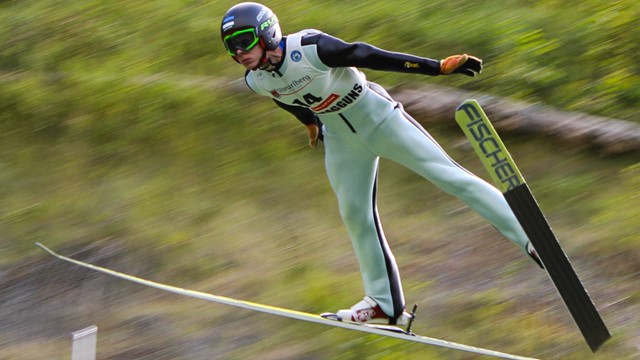
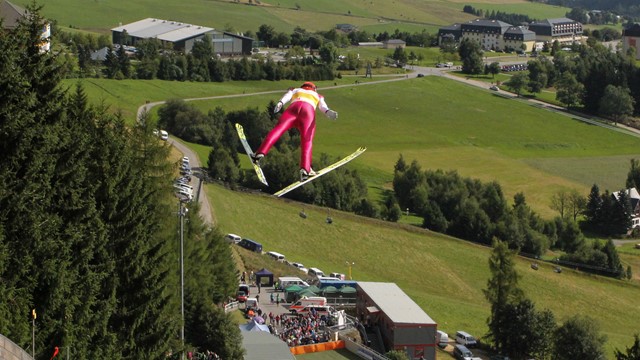
Summer flying in at the FIS Nordic Combined Summer Grand Prix 2017 in Tschagguns, Austria. (Photo: FIS Nordic Combined)
On Aug. 23, Tschagguns, Austria, hosted an individual normal hill/10-kilometer Gundersen start. Germany’s Fabian Rießle, after jumping to eighth place, won the event in 23:09.9 minutes. Austria’s Mario Seidl started first based on his jump but finished the 10 k just 0.3 seconds behind Rießle in second. Finland’s Ilkka Herola jumped to seventh and moved up four spots to round out the podium in third (+0.8).
The U.S. entered four skiers. Bryan Fletcher jumped to 40th and proceeded to ski the sixth-fastest time of day, enough to move himself up to 15th overall (+17.9). It was his best individual result of the series after placing 20th in Oberwiesenthal.
“Feels good to be racing again!” Fletcher wrote on Instagram after the race. “Lots of work to do before winter! But 15th place is closer than last week.”
Ben Berend finished the day in Tschagguns in 34th (+59.1), Taylor Fletcher 41st (+1:12.8), and Jasper Good in 58th (+3:02.7).
The Grand Prix took a day off and moved to Oberstdorf, Germany, for two days of jumping and skiing from Aug. 25-26. Day 1 featured an individual large hill/10 k Gundersen, where Germany’s Eric Frenzel, who barely missed the podium in Tschagguns in fourth place, took the win. Frenzel had previously jumped to first and later held off his contenders (with the sixth-fastest ski time) to cross the line in first in 25:27, more than 30 seconds clear of anyone else. German teammate Johannes Rydzek followed in second place (+34.5) just ahead of Austria’s Seidl in third (+36.0).
Taylor Fletcher was the top American in 25th (+2:33.5). He jumped to 44th place, but skied the fourth-fastest time of the day to move up the results list during the ski race. Bryan Fletcher jumped to 40th, skied the 12th-fastest ski time, and ended the day in 28th (+2:49.7). Berend finished 40th overall (+4:13.6), and Good 45th (+4:48.5).
During the second day of summer competition in Oberstdorf, Seidl took first place for his third podium of the week. He won the individual large hill/10 k Gundersen in 26:26.3. Seidl is proving a solid jumper — gaining enough time after to the jump to make up for his less-than top-10 ski speed. On this day, Seidl jumped to first place but skied the 26th-fastest ski time. Germany’s Rießle was second overall (+22.5), and Frenzel third (+22.7).
U.S. Nordic Combined Team skier Adam Loomis was the only American that raced the 10 k. He placed 28th overall (+2:51.8) after starting the race in 42nd and posting the 14th-fastest ski time. Taylor Fletcher and Berend were disqualified in the jump portion, and Bryan Fletcher jumped to 38th but did not start the 10 k.
On Instagram, Taylor Fletcher explained that he was the current red-bib leader for fastest overall skier.
“Part one of grand prix is done and dusted. It was a good test of where I am and where I could be with more consistent jumps,” he wrote. “The final day was good until my disqualification which was in my opinion was crap. I got disqualified for a guideline to a rule which almost every skier would be if they were tested. For the future we will fix the issue and continue fighting.”
Taylor Fletcher’s disqualification occurred on Aug. 18 in Oberweisenthal, Germany during a provisional competition round (PCR). Beyond the top-tier competition, the Summer Grand Prix offers the opportunity for athletes to test equipment and experience how new rules are enforced. One of the key rules has to do with suit permeability.
“I got DQ’d in the first PCR because my suit didn’t pass enough air,” Fetcher wrote in an email. “I wasn’t trying to cheat, but actually it was very warm and I was sweating pretty bad so a thin layer of moisture was on my suits which caused it to blow less air. The next day I passed it without doing anything to my suit.”
The perameters for suit fit have strict tolerances. Fletcher explained that the suits are allowed to be +3cm everywhere possible, but not over the set limit. Fletcher’s detailed account of why he was disqualified signifies the importance of attending the Summer Grand Prix series.
“I was disqualified because my shoulder/armpit was too big,” Fletcher explained. “We have never been tested there and I don’t think really anyone has. As long as the suit feels like it fits in the armpit, we feel that it is good. After the jump on the last day, I was selected for equipment control, I was sure I was good as I made some alterations to my suit the previous night to fix the places that were big (inside thigh). When I got to control I passed my crotch measurement and thought that was it. Then he started to measure my shoulder and armpit and I was shocked because I had never been tested there. He had me hold this triangle apperatus between my arm and hip then measured around that spot. He disqualified me for that spot being too big (20cm to big). There isn’t much I can do after he says you are out, I could file a protest, but that is just silly as these are summer comps and don’t count towards anything. My coaches went and talked with the equipment controller and he told them what is up and how to fix it, but continued to say that it is more of a guideline rather than a rule. We were angry, I was angry as I hate not racing but rather than wasting energy, I just packed my bags and got the hell out of dodge.”
A skier flying during the FIS Nordic Combined Summer Grand Prix 2017 in Oberwiesenthal, Germany. (Photo: FIS)
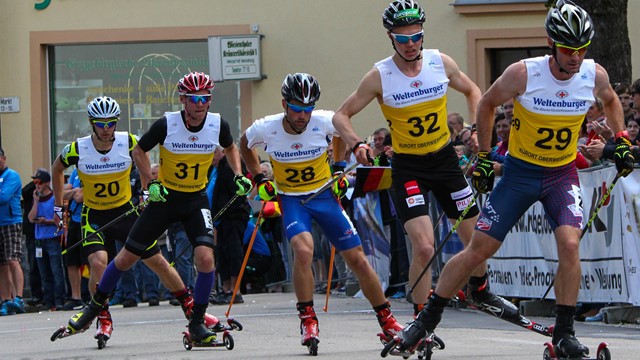
Green grass, plastic jumping surfaces, big jumps, sunshine, rollerskis and no snow means one thing. It’s August in Europe and it’s time for the International Ski Federation (FIS) Nordic Combined Summer Grand Prix 2017.
Last weekend Aug. 19-20, Oberwiesenthal, Germany hosted a two-day Grand Prix event.
Day 1 featured a two-person team event with the requisite jump and 2 x 7.5-kilometer cross-country race to determine the winners.
Czech Republic’s first team (Czech Republic I), comprised of Tomas Portyk and Dvorak Miroslav, won the team competition in 28:52.9 after starting fourth, 11 seconds behind first. Germany I’s Fabian Rießle and Eric Frenzel raced to second (+0.3), and Germany II’s Jakob Lange and Vinzenz Geiger placed third (+11.2).
The U.S. had two teams entered. Bryan Fletcher and Taylor Fletcher (U.S. II) placed 12th (+2:37.0) while Jasper Good and Ben Berend (U.S. I) finished 14th (+3:03.5).
Day 2 of racing was an individual normal hill/10 k Gundersen start.
Austria’s Mario Seidl claimed the win in 25:18.5 after jumping to first and starting the 10 k four seconds ahead of Japan’s Akito Watabe in second. Germany’s Frenzel raced from ninth to second (+10.5), after starting 46 seconds after Seidle. Rießle finished third (+12.3), up from fifth in the jump, while Watabe narrowly missed the podium in fourth (+14.2).
Bryan Fletcher (29) during this weekend’s Summer Grand Prix in Oberwiesenthal, Germany. He finished in 20th in Sunday’s individual normal hill/10 k event. (Photo: FIS)
Four U.S. skiers competed on Sunday, and Taylor Fletcher led them at the end of the day in 11th (+1:17.6) after jumping to 33rd and starting 2:01 minutes behind Watabe. Bryan Fletcher finished 20th, Berend 33rd, and Good 34th.
In an Instagram post, Taylor Fletcher described his first individual race of the series.
“First individual race in the books. I had a decent jump in a hard competition,” he wrote. “I started 33rd and ended up finishing 11th. I had a lot more to give but I thought I had another lap (I wish we did) before the coach said this was the last lap. Now @USAnordic is on the way to the next leg ready for another crack at it!!”
The Summer Grand Prix continues Aug. 23 with another normal hill/10 k in Tschagguns, Austria, and concludes in Oberstdorf, Germany, with back-to-back large hill/10 k competitions Aug 25-26.
Bryan Fletcher (U.S. Nordic Combined) jumping to 31st on the large hill at 2017 Nordic Combined World Championships in Lahti, Finland. He later finished the day in 31st in the 10 k Gundersen to lead his team. (Photo: John Lazenby/Lazenbyphoto.com)
At the season-ending Nordic Combined World Cup weekend in Schonach, Germany, American Bryan Fletcher tallied his second-best result of the season: 11th in the individual large hill/10-kilometer Gundersen start on Saturday, March 18. He did so by posting one of his best jumps of the year, which interestingly tied his jumping result at his season-best World Cup in December in Lillehammer, Norway.
In Lillehammer, Fletcher jumped to 22nd with a 129-meter leap, also on the large hill, and went on to place ninth in the 10 k. On Saturday in Schonach, the 30-year-old U.S. Nordic Combined veteran jumped to 22nd with a distance of 98 meters, and skied the eighth-fastest 10 k to move up to 11th.
American Bryan Fletcher leading Japan’s Yoshito Watabe early in the men’s 10 k Gundersen start in the first nordic-combined competition of 2017 Nordic World Championships in Lahti, Finland. Fletcher went on to place 14th and Yoshito Watabe 44th. (Photo: John Lazenby/Lazenbyphoto.com)
“Jumping was starting to come around at the end of the season a bit more,” Fletcher wrote in an email on Tuesday. “It was still inconsistent but I have learned a lot about myself as a competitor this season especially in regards to my technical skills and abilities. Towards the end of the year I was able to start applying some of the things I have learned about myself to my jumping and the results were slowly starting to improve.
“Obviously the level is very high in the sport right now and so even small mistakes mean you are out of contention,” he added. “So it’s very hard to confidently make changes during the season with so much at stake. But given my rather up and down season I decided this was the season I had to start to shake up my routine to either find a new, better, or more consistent level or to simply confirm that the way I am doing things is still the be path to be on. Schonach on Saturday was only a small change but obviously had a big impact on my results.”
Fletcher started the 10 k race 53 seconds behind Japan’s Yoshito Watabe, who led after jumping. Fletcher explained the race was seven laps on a difficult 1.5 k course, which would typically play to his strengths, but he’s been struggling with his shape since World Championships three weeks ago.
“The legs and body were not responding the way I would have liked. So I was pretty unsure going into the race of how I would hold up,” he wrote. “I went out slow and tried to work into the race a bit saving energy for the last laps which almost paid off big. I was able to make contact with the lead group and be there for the winning move, but I was unable to go with the sprint. I felt like I skied a smart race and my overall performance but I would have been much happier if I could have hung on for a top 10 result.”
Germany’s Eric Frenzel, who started seventh based on his jump and started 15 seconds behind Watabe, raced to first with the 10th-fastest time. He finished in 28:14 minutes, 3.4 seconds ahead of Austria’s Wilhelm Denifl in second and 7.1 seconds ahead of his German teammate Johannes Rydzek in third. Denifl had started second, 9 seconds back, and held his position, while Rydzek improved from ninth in the jump. Watabe slipped to 17th (+1:02.5).
Fletcher, who finished 32.8 seconds out of first and 4.5 seconds out of 10th, led two Americans on Saturday, with 17-year-old Stephen Schumann placing 42nd.
The Nordic Combined World Cup podium on March 19, the last World Cup of the season, in Schonach, Germany, with Germany’s Eric Frenzel (c) in first, France’s Francois Braud (l) in second, and Japan’s Akito Watabe (r) in third. (Photo: FIS Nordic Combined/Twitter)
On Sunday in Schonach, none of the Americans completed the Day 2 large hill/10 k competition. Ben Berend jumped to 36th, but did not start the race.
Meanwhile, Frenzel completed his weekend sweep and claimed his fifth-straight Overall World Cup title with a 7.7-second win over France’s Francois Braud. Japan’s Akito Watabe rounded out the podium in third, 11.2 seconds behind Frenzel.
Overall, Frenzel ended the season with 1,734 points, Rydzek placed second in the overall standings with 1,609, and Akito Watabe completed the podium in third with 1,086.
The leader after Sunday’s jump, Germany’s Tobias Simon, did not finish the 10 k. Frenzel started the race in eighth, 57 seconds out of first, and posted the 11th-fastest ski time for his third-straight win after topping the large hill/10 k last Wednesday, March 15, at the World Cup in Trondheim, Norway. There, Fletcher led three Americans in 35th. His brother Taylor Fletcher placed 39th and Berend finished 48th.
At the previous World Cup on March 11 in Oslo, Norway, Frenzel placed second, just 0.4 seconds behind Akito Watabe in another large hill/10 k. Bryan Fletcher finished 43rd and Schumann 49th.
“This season was one of the hardest I have had,” Fletcher wrote. “I came into the season ready to go and in really good shape for both XC and jumping. I think my mistake was I was too eager to get the season underway. I had trouble maintaining that fitness and body composition and ultimately had to reset over the holidays and rebuild in order to prepare for World Championships.”
American Bryan Fletcher (16) after finishing 14th in the normal hill/10 k Gundersen start, the first nordic-combined competition of 2017 Nordic World Championships in Lahti, Finland. He had been in the hunt for a medal but crashed on the final corner coming into the stadium. Behind him, Austria’s David Pommer finished 16th. (Photo: John Lazenby/Lazenbyphoto.com)
At World Championships, Fletcher led his team in 14th in the opening individual competition: the large hill/10 k. He had been in podium contention until crashing on the last corner, about 200 hundred meters before the finish. That day, he jumped to 16th. Looking back on his season, Fletcher considered that event a season highlight.
“I wanted to be a contender in that event and I was,” he wrote. “I have replayed that race a few times in my head and I think a few different moves in the final lap and I could have been fully in the fight for the medal. Also Lillehammer was a strong race, also I was happy with my performance in Schonach on Saturday after two disappointing comps the week before.”
After being sick for a couple weeks in January and feeling like he peaked a week too early for World Championships, Fletcher, who has been competing at the World Cup level since 2009, is already thinking about next season.
“No rest for the wicked haha,” he wrote. “I have already started my training plan for next season with specific areas in both XC and Jumping that I want to improve upon. Specifically I need to improve my finish sprints and in jumping I need to improve my in run balance and position.”
“I am really motivated for next year and my body is feeling good,” he continued. “The past two seasons I planned to tone things down a bit in my training, so that I could build up a bit stronger for Pyeongchang. In the past I have always had a performance build for the 3 years prior to the olympics but have come into the Olympic season a bit flat. My goal was to disrupt that cycle to increase performance next season.”
While Fletcher was his team’s most consistent member this season, he explained that jumping overall has been a bit of a struggle amongst his teammates.
“Our team found a really high level at the end of the summer, however, a 5 week break without jumping due to weather before the season disrupted our progress,” he wrote. “Also our guys changed a lot this summer technically. It takes time to build a high level of jumping and I expect us to continue our progress on what we learned this season to improve those adaptations. I have no doubt we will be on a higher level next year.”
For now, Fletcher, a new dad, is enjoying some downtime with his wife and 7-month-old daughter Ellery.
“It does feel amazing to be home with the family!” he wrote. “… [Ellery] had been sleeping on my chest for about the last 30 minutes and to be honest it was awesome to forget about everything else and just enjoy the moment.”
The men’s 10 k sprint podium at Friday’s IBU World Cup in PyeongChang, South Korea, with Austria’s Julian Eberhard (c) in first, American Lowell Bailey (l) in second, and France’s Martin Fourcade (r) in third. (Photo: IBU)
IBU World Cup (PyeongChang, South Korea): Men’s 10 k sprint
US Biathlon’s Lowell Bailey kept his clean-shooting streak alive with another one of his personal best results on Friday, racing to second in the men’s 10-kilometer sprint at the International Biathlon Union (IBU) World Cup in PyeongChang, South Korea.
Bailey started 81st and hit all 10 targets in the two-stage race to cross the finish line in first, 4.7 seconds ahead of France’s Martin Fourcade, who locked up the 2016/2017 overall World Cup title with an eventual third-place finish on Friday.
An even later starter in bib 90, Austria’s Julian Eberhard rocketed to his third-career World Cup victory (and second win this season), cleaning both stages and topping Bailey’s time by 40.7 seconds. That bumped Bailey to second place and Fourcade to third, for Bailey’s second World Cup podium this season (including his win in the 20 k individual at IBU World Championships).
In the last five non-relay races, including four at World Championships, Bailey has not placed outside the top six. And in all of those races, he’s only had one miss.
Bailey is up to ninth in the World Cup Total Score standings. Fourcade ran away with the season-long title in first, now that he’s 360 points ahead of Russia’s Anton Shipulin in second.
While Eberhard and Bailey shot clean on Friday, Fourcade missed two — one on each stage (1+1) — but made up for it with the fastest course time. Eberhard had the second-fastest course time and fastest shooting time of the 102-man field.
Austria nearly had two on the podium with Dominik Landertinger finishing fourth (+48.1), 2.7 seconds out of third, with clean shooting.
Three Canadians finished in the top 60 to qualify for Saturday’s pursuit, with Scott Gow in 27th (+1:40.3) with two penalties (1+1), Brendan Green following in 28th (+1:42.1) with one miss (0+1) for his first individual top 30 of the season, and Christian Gow in 56th (+2.33.6) with two prone penalties (2+0). Nathan Smith finished 88th (+3:32.5) with two standing misses (0+2) in his first World Cup race since early December, and Macx Davies finished 98th (+4:20.2) with four penalties (3+1).
For the U.S., Leif Nordgren placed 37th (+2:03.7) with two misses (1+1) to qualify for the pursuit, along with Bailey. Sean Doherty was 80th (+3:13.3) with two penalties (1+1) and Paul Schommer 101st (+4:38.1) with five misses (3+2).
FIS Nordic World Championships (Lahti, Finland): Nordic Combined 2 x 7.5 k team sprint
The nordic combined 2 x 7.5 k team sprint podium on Friday at 2017 Nordic World Championships in Lahti, Finland, with Germany’s Johannes Rydzek and Eric Frenzel in first (c), Norway’s Magnus Moan and Magnus Krog in second (l) and Japan’s Yoshito and Akito Watabe in third (r). (Photo: FIS Nordic Combined/Twitter)
[UPDATED] Johannes Rydzek and Team Germany completed the World Championships sweep on Friday, with Rydzek teaming up with Eric Frenzel to win the final nordic-combined competition of 2017 Nordic World Championships in Lahti, Finland: the 2 x 7.5-kilometer team sprint.
Rydzek won all four NoCo competitions over the past week, including two individual events and two team events.
On Friday, he and Frenzel, the defending World Cup champion, jumped to second and started the 2 x 7.5 k cross-country race 16 seconds behind France’s Maxime Laheurte and François Braud, who jumped to first. The Frenchmen both posted jumps of 125 meters for a total of 264.2 points. Frenzel and Rydzek, meanwhile, scored 256.1 points after jumps of 125.5 and 122 meters.
The Germans pulled off a 1-second win over Norway, finishing in 28:45.8 minutes, while Norway’s Magnus Moan and Magnus Krog claimed silver after starting the ski race in fourth, 24 seconds behind France. Together, the Norwegians posted the fastest course time, and Moan skied the fastest 7.5 k (13:53).
“It’s still unbelievable,” Rydzek told German broadcaster ARD. “The race today was so suspenseful again, down to the last curve with the lapped athlete [Russia]. I knew that I am very fast on the homestretch, and had explicitly looked at that section before the race. Eric did a great job today, and despite all circumstances pointing against us we managed to do it again today. Just cool to be back on the top of the podium with Eric.”
Just a couple hundred meters before the finish, Rydzek used the moment when they approached the lapped Russian athlete to slingshot between him and Krog and gained a decisive edge.
“I was scared of that situation with the lapped athlete, because that was really close,” Frenzel told ARD. “I thought, ‘What is he doing out there?’ But in the end you can rely on Johannes to solve that like a world champion, that was top.
“We knew ahead of time that Lahti suits us well, that we can be good here if the conditions work out,” he added. “So we are very happy to be able to go home with so many medals.”
Japan took the final spot on the podium after brothers Yoshito and Akito Watabe jumped to third, started 18 seconds after France, and held their position to finish for third place, 10.2 seconds after Germany.
Austria’s Wilhelm Denifl and Bernhard Gruber missed bronze by half a second in fourth (+10.7) after starting in fifth, and France ended up fifth (+11.5).
Nearly a minute later, Italy placed sixth (+1:10.6) and Finland seventh (+1:10.7). The Czech Republic followed in eighth (+1:26.4), and the U.S. was ninth (+1:48.1) with Bryan and Taylor Fletcher after starting 12th and 2:08 out of first. The Fletcher brothers recorded the second-fastest course time out of 14 teams.
“Taylor did a good job stepping up in competition and it gave me motivation to step up as well,” Bryan said, according to a U.S. Ski Team press release. “Unfortunately I wanted it a little too much and didn’t have the jump I am capable of.
“The races went well but we were just too far back,” he continued. “We had the second fastest time as a team overall, which is solid and continually shows our strength on that side of the sport.”
FIS Nordic World Championships (Lahti, Finland): Men’s 4 x 10 k relay
The men’s 4 x 10 k relay podium at 2017 Nordic World Championships, with Norway (c) in first, Russia (l) in second, and Sweden (r) in third. (Photo: FIS Cross-Country/Twitter)
The men’s 4 x 10-kilometer relay as the last team event of 2017 Nordic World Championships came down to a two-way battle for gold between none other than Norway and Russia on Friday in Lahti, Finland,
The two teams skied in either first or second throughout the four-leg race, with Russia’s Andrey Larkov tagging Alexander Bessmertnykh 2.9 seconds ahead of Norway’s first leg Didrik Tønseth, then Bessmertnykh coming through the second exchange just half a second ahead of Norway’s Niklas Dyrhaug.
Behind them, Finland skied alone in third place at the race’s halfway point, but was ultimately swallowed by the chase pack on the third leg.
On that third leg, Norway’s Martin Johnsrud Sundby worked hard to drop Russia’s Alexey Chervotkin, and eventually did so, coming through the final exchange 17.7 seconds ahead. That gave Norway’s anchor Finn Hågen Krogh just enough of a gap on Russia’s Sergey Ustiugov, and he was able to hold off Ustiugov by 4.6 seconds at the finish to give Norway the gold in 1:37:20.1 hours.
Russia claimed silver and Sweden outlasted Switzerland for bronze after Calle Halfvarsson attacked in the final kilometer to drop Finland’s Matti Heikkinen and Germany’s Lucas Bögl. Halfvarsson finished 2:31.8 minutes out of first, and just 0.2 seconds ahead of Switzerland’s Curdin Perl for third place for Sweden (which included teammates Daniel Rickardsson, Johan Olsson and Marcus Hellner).
Switzerland was fourth (+2:32) with Jason Rueesch, Jonas Baumann, Dario Cologna and Perl, Finland fifth (+2:42.4) with Sami Jauhojärvi, Niskanen, Lari Lehtonen, and Heikkinen, and Germany sixth (+2:42.8) with Thomas Bing, Jonas Dobler, Florian Notz, and Bögl.
France finished seventh (+3:52), Italy eighth (+5:29.8), Kazakhstan ninth (+5:30.6), and the U.S. 10th (+5:31.3). The U.S. team (Kyle Bratrud, Erik Bjornsen, Tad Elliott, Simi Hamilton) skied in 11th for most of the race before Hamilton moved them up to 10th with the sixth-fastest anchor leg.
Canada (Graeme Killick, Devon Kershaw, Alex Harvey, Len Valjas) ended up 12th after being lapped on the last leg. In 14th at the first exchange, Kershaw moved them up to 13th, then Harvey put them in 12th with one leg to go.
Heidi Weng and Maiken Caspersen Fall of Norway (center) bested Yulia Belorukova and Natalia Matveeva of Russia (left) for gold in the women’s team sprint at 2017 World Championships, with Sadie Bjornsen and Jessie Diggins of the U.S. (right) outsprinting Sweden for bronze. (Photo: FIS Cross Country/Twitter)
FIS Nordic World Championships (Lahti, Finland): Classic team sprints
Defending champions Norway repeated gold in the women’s team sprint, with Heidi Weng and Maiken Caspersen Falla crossing the finish line first in Lahti, Finland. On the second-to-last loop, it looked like Russia could have something to say about that. Yulia Belorukova put in a furious sprint up the course’s biggest climb, and then beat Weng to the exchange. But her teammate Natalia Matveeva could not match the pace when Falla put on her own sprint on the last uphill. Russia finished second for silver, +5.56.
The competition for bronze was closer, with Germany, Finland, Sweden, and the United States going out of the stadium for the last loop together in chase of the Norwegian and Russian leaders. The last climb was defining in the race for bronze, with Jessie Diggins of the United States staying closest to Sweden’s Stina Nilsson. Diggins caught Nilsson on the downhill and was able to stay just ahead of the Swede to the finish, claiming bronze (+18.38) along with teammate Sadie Bjornsen. It was a return to the team sprint podium for Diggins: after winning the team sprint at 2013 World Championships with Kikkan Randall, she teamed up with Sophie Caldwell in 2015 but the pair finished eighth.
Nilsson and Ida Ingemarsdotter settled for fourth (+18.57), and the Finnish team of Aino-Kaisa Saarinen and Kerttu Niskanen finished fifth (+23.02).
The Canadian team of Cendrine Browne and Dahria Beatty was seventh in their semifinal and landed 13th overall.
In the men’s team sprint, Norway set a high pace from the beginning, with phenom Johannes Høsflot Klæbo attacking on the steep uphill every time he skied. On his second and third loops, he tagged off to Emil Iversen with gaps of just over five seconds to the rest of the field. But Iversen had a hard time holding the lead, in part because of Russia’s Sergey Ustiugov, who had won the 30 k skiathlon the day before and put in a huge effort to catch Iversen on the fourth loop of the team sprint.
On the final loop, Finland’s Iivo Niskanen bridged the gap up to Iversen, mostly on the steep uphill and then also with ski speed on the downhill. But the time the pair entered the stadium, Niskanen had caught the Norwegian and was moving with higher speed. He decided to switch tracks to overtake Iversen, but Iversen decided to switch tracks just a second later, without checking one last time to make sure the track was clear. He fell, taking out Niskanen with him.
That allowed Ustiugov and Italy’s Federico Pellegrino to go sailing by to claim gold and silver (+2.14) with their teammates Nikita Kriukov and Dietmar Noeckler. It was the second gold for Russia in the event in three World Championships; Kriukov and Alexey Petukhov won in 2013, and also took silver in 2015.
Niskanen got up and claimed bronze (+8.64 with Sami Jauhojärvi), swearing as he crossed the finish line; with a broken pole, Iversen limped across the line in fourth (+18.42). He was called to a jury meeting but ultimately no teams were disqualified because of the crash.
Erik Bjornsen of the United States won a sprint finish for fifth (+23.58) with teammate Simi Hamilton), besting Lenny Valjas (+27.02 with teammate Alex Harvey) of Canada.
FIS Nordic World Championships (Lahti, Finland): Nordic combined 4 x 5 k team event
Germany (Björn Kircheisen, Eric Frenzel, Fabian Rießle, and Johannes Rydzek) took gold in the nordic combined 4 x 5 k team event on Sunday at Nordic World Championships in Lahti, Finland, while Norway placed second and Austria third. (Photo: FIS Nordic Combined/Twitter)
[UPDATED] After sweeping the first individual nordic-combined competition of 2017 Nordic World Championships on Friday, Germany achieved gold as a team, with Björn Kircheisen, Eric Frenzel, Fabian Rießle, and Johannes Rydzek winning the 4 x 5-kilometer team event in 47:57.3.
The Germans combined for the best jumping score of 11 teams and started the relay in first, 44 seconds ahead of Japan in second. Norway started 1:07 minutes back in fifth but rose to second place (+41.7), with Magnus Moan, Mikko Kokslein, Magnus Krog, and Jørgen Graabak. Moan raced them into third at the first exchange, then Kokslein secured second, which they held onto for the remaining two legs.
“It was our goal to ski a controlled race,” Germany’s Frenzel told ZDF. “Not really look at how the gap was developing, but just make our own race. And put up a little more pressure towards the end of each leg. That worked well, that was a wickedly cool team performance today. And I am just happy that we could put a little golden crown on the whole event today.”
“I think today you could see again that we all worked together and enjoyed the competition,” Rydzek added. “We were all happy about each other’s performance, and just rewarded ourselves for hard hard work.”
Austria started fourth, 1:05 behind Norway, and clinched bronze (+1:03.7) with Bernhard Gruber, Mario Seidl, Philipp Orter, and Paul Gerstgraser. Gruber initially raced them into second at the first exchange, but they relinquished one spot and hung on for third, ahead of Japan in fourth (+1:06).
Japan (Hideaki Nagai, Takehiro Watanabe, Yoshito Watabe, and Akito Watabe) jumped to second, but found themselves in fourth at every exchange.
Finland took fifth, Italy sixth, France seventh, and the U.S. eighth (+3:27.2) with Bryan Fletcher, Taylor Fletcher, Ben Berend, and Ben Loomis. The Americans started the race in seventh and were in sixth after the first two exchanges, but slipped to eighth on the third leg.
IBU Youth/Junior World Championships (Osrblie, Slovakia): Youth & junior pursuits
Four seems to be Chloe Levins’s lucky number. After a career breakthrough of fourth place in the pursuit at last year’s Youth Olympic Games (YOG) in Lillehammer, Norway, the 18-year-old Vermonter raced to fourth in the youth women’s 7.5-kilometer pursuit on Sunday at the International Biathlon Union (IBU) Youth/Junior World Championships in Osrblie, Slovakia.
Italy’s Irene Lardschneider winning the youth women’s 7.5 k pursuit on Sunday for her second-straight gold at 2017 IBU Youth World Championships in Osrblie, Slovakia. (Photo: IBU)
Levins started the race in 11th and worked her way up to fourth with clean shooting in three stages. She missed two in the first prone but rebounded and held off Ukraine’s Khrystyna Dmytrenko by seven seconds for fourth place. Levins finished 1:55.5 minutes behind the winner, Italy’s Irene Lardschneider, who started the race first and held on for her second-straight gold medal despite four penalties (0+0+2+2), finishing in 26:57.1. France’s Lou Jeanmonnot-Laurent rose from fourth to second place with 19-for-20 shooting (0+0+1+0), and Italy’s Samuela Comola took bronze (+1:08.5) for the second-straight race with two misses (1+0+1+0).
Three U.S. women qualified for the pursuit, with Amanda Kautzer finishing 42nd (+6:16.2) after starting 59th and shooting 80 percent (1+0+2+1), and Grace Gilliland finishing 55th (+8:32.1) with six penalties (2+3+1+0).
Canada’s Shilo Rousseau followed in 54th (+9:02.1) with eight misses (3+1+2+2).
In the junior women’s 10 k pursuit, Canada’s Megan Bankes raced to 16th for the best finish for a North American in that race. The gold medalist in last week’s 12.5 k individual, Bankes finished 13th in Saturday’s sprint and thus started in that position, 1:25 out of first. She ended up 16th with four penalties (0+1+2+1) and finished 2:15.8 behind the winner, Russia’s Valeriia Vasnetcova, who started 24th and worked her way all the way up to first with clean shooting.
Vasnetcova was the only one to clean the four-stage pursuit on Sunday, and in doing so, she achieved her first gold of the championships and second of her career at Youth/Junior Worlds after her team won last year’s youth relay in Romania.
Coming off a sprint win, Italy’s Michela Carrara started first and took second at the finish, 10 seconds behind Vasnetcova with three misses (1+1+1+0). Norway’s Ingrid Tandrevold scored her second-straight medal as well, after starting second and finishing third (+10.8), with two penalties (0+0+1+1).
Canada’s Nadia Moser had her best result of the championships in 30th (+3:43.5), moving up one place after starting 31st, with three penalties (0+1+0+2). Emily Dickson finished 47th for the second-straight day (+6:29.9) with four penalties (1+0+1+2).
Siena Ellingson was the lone American to start after placing 18th in Saturday’s sprint. She finished 41st (+5:24.7) with seven misses (1+2+1+3).
In the junior men’s 12.5 k pursuit, Canada’s Pearce Hanna rocketed to 23rd after starting 47th, shooting 17-for-20 after cleaning the first two stages (0+0+1+2) for his first top 30 of the championships. Hanna finished 3:12 behind the winner, Russia’s Igor Malinovskii who picked up his second-straight gold.
Malinovskii started first and finished in 32:39.8, 13 seconds ahead of second place, with four penalties (0+1+2+1). Norway’s Sindre Pettersen took the silver medal after starting in eighth and posting the fastest course time to overcome five misses (2+1+1+1). Belarus’s Anton Smolski moved up from fourth at the start to reach the podium in third (+27.4) with five misses as well (0+0+3+2).
All four Canadian junior men qualified for the pursuit. Trevor Kiers led them in 39th (+5:13.3), after starting 48th, for his best result of the championships. Jules Burnotte placed 43rd (+5:35.3), up from 55th, for his best result as well, and Zachari Bolduc finished 57th (+8:18.3). Kiers missed five targets (2+0+1+2), Burnotte had seven misses (3+1+1+2), and Bolduc missed eight (2+3+2+1).
For the U.S., Cody Johnson finished 55th (+7:19.5) with nine penalties (2+1+2+4) and Travis Cooper 59th (+8:46.2) with eight misses (5+0+1+2).
In the youth men’s 10 k pursuit, the first race of the day on Sunday, two Canadians finished in the top 30, with Leo Grandbois in 22nd and Adam Runnalls in 27th.
For Grandbois, it was his first time outside the top 15 of the championships after he had won the youth men’s 12.5 k individual last Wednesday and finished 14th in Friday’s 7.5 k sprint. He had to ski six penalty loops on Sunday (0+2+2+2), dropping outside the top 20 after the third shooting. Grandbois finished 3:21.8 behind the winner, France’s Emilien Claude, who won the sprint as well to start the pursuit first.
Claude, who had four penalties (1+1+0+2) and finished in 29:22.4, held off Italy’s hard-charging Cedric Christille by 16 seconds after Christille shot just two penalties (0+0+1+1) to move up from fourth to second for his first medal in his first Youth World Championships. Germany’s Danilo Riethmüller rose from sixth to third place (+30.7) despite four misses (1+0+1+2). For the German, it was his second bronze of these championships after placing third in the 12.5 k individual.
Canada’s Runnalls moved up from 32nd at the start to 27th at the finish (+3:47.5) for his first top 30 of the championships. He had five penalties (1+3+1+0), but cleaned the last stage to move into the top 30.
Vasek Cervenka was the lone American to qualify in the youth men’s pursuit, and he moved up from 49th at the start to 30th (+3:52) with five penalties (1+1+1+2).
Germany’s Johannes Rydzek celebrates his win in the first nordic-combined competition of 2017 Nordic World Championships on Friday in Lahti, Finland. He won the individual normal hill/10 k by 14.9 seconds over his teammate Eric Frenzel. (Photo: John Lazenby/Lazenbyphoto.com)
FIS Nordic World Championships (Lahti, Finland): Nordic Combined individual normal hill/10 k
Germany, Germany, Germany, Germany. That’s how the results read after the first nordic combined competition of the 2017 Nordic World Championships on Friday in Lahti, Finland, with Germany not only sweeping the podium but the top four of the men’s individual normal hill/10-kilometer Gundersen start.
Germany swept the podium in the first nordic-combined competition of 2017 Nordic World Championships in Lahti, Finland, with Johannes Rydzek (c) taking gold, Eric Frenzel (1) silver, and Björn Kircheisen (8) bronze in the individual normal hill/10 k Gundersen on Friday. (Photo: John Lazenby/Lazenbyphoto.com)
Johannes Rydzek notched his second individual gold medal in the last two championships (after winning the normal hill/10 k in 2015 in Falun, Sweden), with a 14.9-second victory over his teammate and four-time defending overall World Cup champion Eric Frenzel. Björn Kircheisen completed the all-German podium in third (+30.0), holding off teammate Fabian Rießle by 2.2 seconds for bronze.
The 25-year-old Rydzek, who’s already won eight individual World Cup competitions this season, jumped to second on Friday and started the 10 k race 14 seconds behind Frenzel, the leader after the jump.
Rydzek overtook Frenzel for the win and 33-year-old Kircheisen moved up from eighth after the jump to third at the finish. Rießle held off Japan’s Akito Watabe by 0.1 seconds in a photo finish for fourth.
“Incredible. An incredibly beautiful day,” Rydzek told German broadcaster ZDF after. “Thanks to everyone who supported me so much throughout the last years so that this became possible now. Thanks also to my teammates, who I think all did a cool job today. All three guys and the whole surrounding team. And as for the race, I felt strong, I knew the slow-and-difficult course suits me well. And that I was able to conduct the race from in front … incredible. Just craziness.”
“I noticed that Johannes was just strong on the course today,” Frenzel, 28, told ZDF. “Actually we already noticed that at the World Cup in January here, that he is really moving well here. I, for my part, gave everything I had, and can only congratulate him for the strong competition he made today. He won deservedly. And I am also satisfied with my race.”
American Bryan Fletcher leading Japan’s Yoshito Watabe early in the men’s 10 k Gundersen start in the first nordic-combined competition of 2017 Nordic World Championships in Lahti, Finland. Fletcher went on to place 14th and Yoshito Watabe 44th. (Photo: John Lazenby/Lazenbyphoto.com)
Bryan Fletcher led the Americans in 14th (+47.4) after crashing out of contention in the final 200 meters of the race. He had been in contention for a medal, skiing in a pack with Kircheisen, Rießle and Watabe, among others, all fighting for bronze. Fletcher fell on the final corner to ultimately miss the podium by 17.4 seconds. He jumped to 16th and started the ski race 56 seconds out of first.
“I knew it was going to be a hard cross-country race because it was so tight and pack racing is always so difficult,” Fletcher said, according to a U.S. Ski Team press release. “You’re not only fighting for position, but anything can happen. That’s exactly what happened to me today. I did really well in the pack and when I thought I had it locked up, I let my guard down and slipped out on a corner.”
His younger brother Taylor Fletcher posted the third-fastest cross-country time to race from 47th after the jump to 21st at the finish (+1:38.4). Adam Loomis placed 33rd (+2:23.6) after jumping to 39th, and Ben Berend finished 41st (+3:10.8) after posting the 22nd-best jump out of 55.
Canada’s Nathaniel Mah, of the Altius Nordic Ski Club in Calgary, jumped to 41st but did not finish the 10 k race.
The next nordic-combined event at Lahti Worlds, the 4 x 5 k team event, will be contested Sunday.
American Bryan Fletcher (16) after finishing 14th in the normal hill/10 k Gundersen on Friday, the first nordic-combined competition of 2017 Nordic World Championships in Lahti, Finland. He had been in the hunt for a medal but crashed on the final corner coming into the stadium. Behind him, Austria’s David Pommer finished 16th. (Photo: John Lazenby/Lazenbyphoto.com)
***
IBU Youth/Junior World Championships (Osrblie, Slovakia): Youth men’s and women’s sprints
Italy had two on the podium of the youth women’s 6 k sprint on Friday at IBU Youth World Championships in Osrblie, Slovakia, with Irene Lardschneider (c) in first, Samuela Comola (r) in third, and Austria’s Anna Gandler (l) taking second place. (Photo: IBU)
[UPDATED] Italy’s Irene Lardschneider dominated the youth women’s 6-kilometer sprint competition on Friday at the International Biathlon Union (IBU) Youth World Championships in Osrblie, Slovakia, finishing 1:06.5 minutes faster than anyone else in 19:48.3 with 9-for-10 shooting. Lardschneider started 17th and led from start to finish despite one miss in her standing stage (0+1). She posted the fastest course time of 92 finishers for gold — her first medal in her first Youth World Championships. She previously raced at last year’s Youth Olympic Games (YOG) in Lillehammer, Norway, where she earned a bronze medal with the mixed relay and placed 14th in the pursuit.
Also in the 2016 YOG pursuit, American Chloe Levins placed fourth for her best international finish. Racing at her third Youth Worlds on Friday, Levins finished 11th in the sprint to lead the North Americans. Like Lardschneider, Levins cleaned prone and missed one in standing (0+1) to finish 1:39.7 back from the win. For Levins, it was her second top 15 in as many races at these championships, after placing 14th in the youth women’s 10 k individual on Wednesday.
Sharing the podium with Lardschneider, Austria’s Anna Gandler placed second (+1:06.5) with one penalty (0+1), and Italy had two on the podium with Samuela Comola in third (+1:18.1). Comola was one of two women to clean the two-stage race; the other being Finland’s Maija Keränen in 13th (+1:40.9).
Shilo Rousseau led Canada in 45th (+4:08.0) with three penalties (0+3). Frédérique Pérusse finished 73rd (+5:48.2) with four misses (1+3), Anna Sellers was 82nd (+6:47.2) with six penalties (4+2), and Elise Sauve was 86th (+7:41.7) with six misses (3+3) as well.
For the U.S., Grace Gilliland placed 55th (+4:35.2) with four misses (1+3), Amanda Kautzer was 59th (+4:42.7) with six penalties (3+3) and Helen Wilson 67th (+5:10.0) with four misses (2+2).
The youth men’s 7.5 k sprint at 2017 IBU Youth World Championships in Osrblie, Slovakia, with France’s Emilien Claude (c) in first, Ukraine’s Serhiy Telen (l) in second, and Norway’s Sivert Guttorm Bakken (r) in third. (Photo: IBU)
In the youth men’s 7.5 k sprint, France’s Emilien Claude put down the fastest course time to over two penalties for the win, besting Ukraine’s Serhiy Telen who started ahead of him, by 25.2 seconds.
Claude missed one shot in each stage (1+1) and finished in 20:18.3, bumping Telen to second where he would remain after shooting one penalty (0+1). Norway’s Sivert Guttorm Bakken reached the podium in third (+44.6) despite two misses (1+1) and for the second-straight race, Italy’s Cedric Christille narrowly missed a medal in fourth (+52.0) after two standing penalties (0+2).
Coming off a gold medal in the youth men’s 12.5 k individual, Canada’s Leo Grandbois finished 14th (+1:52.9) on Friday to lead the North Americans. He had to ski three penalty loops (1+2) and posted the 10th-fastest course time of 99 finishers.
Also for Canada, Adam Runnalls placed 32nd (+2:46.8) despite five misses (3+2), Robert Kreitz was 84th (+5:37.2) with five penalties (1+4) as well, and Thomas Hulsman 87th (+5:58.6) with six misses (3+3).
For the U.S., Vasek Cervenka finished 49th (+3:37.1) with six penalties (4+2), Alex Kilby was 69th (+4:47.4) with three misses (1+2), Jacob Pearson 76th (+5:07.1) with five penalties (2+3), and Camren Nielsen 82nd (+5:18.8) with five misses as well (3+2).
Youth/Junior World Championships continue Saturday with the junior men’s and women’s sprints.
Ben Lustgarten (Craftsbury Green Racing Project) with his $750-dollar check for winning the men’s SuperTour classic sprint on Saturday near Truckee, Calif. Stratton’s Ben Saxton (l) placed second and APU’s Reese Hanneman (r) was third.
Lustgarten, of the Craftsbury Green Racing Project, raced to a 1.58-second victory in the men’s A-final at the Auburn Ski Club in Soda Springs, Calif., finishing in 3:03.4. Ben Saxton, of the Stratton Mountain School (SMS) Elite Team, placed second, and Reese Hanneman, of Alaska Pacific University (APU), was third (+2.77).
Hannenman’s younger brother Logan also reached the final and placed fourth (+4.5), Dakota Blackhorse-von Jess (Bend Endurance Academy) was fifth (+5.86), and the third APU skier in the final, Tyler Kornfield sixth (+18.69).
Blackhorse-von Jess started the day off as the fastest qualifier in 2:58.8. Saxton qualified second, 4.1 seconds back, Logan Hanneman qualified third (+4.2), and Lustgarten fourth (+6.5). Blackhorse-von Jess went on to win his quarterfinal and place second in his semifinal, while Lustgarten and Saxton both won their quarterfinals and semifinals.
Jennie Bender (3) of the Bridger Ski Foundation leading Stratton’s Julia Kern (2) and Sun Valley’s Deedra Irwin (5) during the second women’s classic sprint semifinal at Saturday’s SuperTour near Truckee, Calif. Bender went on to win the semifinal, as well as the final.
In the women’s A-final, Jennie Bender of the Bridger Ski Foundation, coming off a classic sprint win at nationals, scored another victory in 3:29.07. She edged Craftsbury’s Kaitlynn Miller by just seven-hundredths of a second, and Stratton’s Julia Kern placed third (+3.42). Racing at home, Hannah Halvorsen (Sugar Bowl Academy) finished fourth (+3.88). Craftsbury had three in the women’s final with Caitlin Patterson in fifth (+3.93) and Heather Mooney in sixth (+27.35).
Miller proved to be the woman to beat throughout the day, winning the qualifier in 3:30.9, along with her quarterfinal and semifinal. Kern qualified second (+3.2) and Bender third (+4.6). Bender went on to win her quarterfinal and semifinal as well before facing off with Miller in the final.
NorAm Western Canadian Championships (Whistler, B.C.): 10/15 k classic
It was interval-starts day at Western Canadian Championships at Whistler Olympic Park and national-team veteran Emily Nishikawa completed the four laps of the women’s 10 k classic in 30:35.5 to win ahead of teammate Dahria Beatty, 16.5 seconds behind. Maya MacIsaac-Jones completed the national team and Alberta World Cup Academy (AWCA) sweep in third (+1:36.5).
Sovereign Lake’s Hannah Mehain, of the national junior team, was the top junior for the second-straight day in eighth overall (+3:22.1).
In the men’s 15 k, Lappe Nordic’s Andy Shields won the six-lap race in 40:34.2, showing some of the form that won him the NorAm overall last season. National-team member Jess Cockney collected his second-straight podium, finishing second, 4.3 seconds behind Shields. Evan Palmer-Charrette (NTDC Thunder Bay) completed the podium in third (+55.1).
FIS Cross-Country World Cup (Ulricehamn, Sweden): 10/15 k freestyle
The men’s 15 k freestyle podium at Saturday’s World Cup in Ulricehamn, Sweden, with Canadian winner Alex Harvey (c), Norwegian runner-up Martin Johnsrud Sundby (l), and Sweden’s Marcus Hellner (r) in third. (Photo: FIS Cross Country/Twitter)
First individual win of the season (second straight, after winning last weekend’s team sprint), fifth individual victory of his career. That’s the latest news on Canada’s Alex Harvey, who won the World Cup men’s 15-kilometer freestyle individual start on Sunday in Ulricehamn, Sweden, for his first victory in a 15 k skate race and fourth individual podium of 2016/2017.
To say Harvey is on a roll is an understatement. On Saturday, he beat Norway’s Martin Johnsrud Sundby by 6 seconds after starting a minute behind the Norwegian defending World Cup champion. Harvey’s fastest time across the line in 32:46.2 held up through 76 finishers, with Sweden’s Marcus Hellner coming somewhat within range after starting a minute behind him. Hellner ended up 14.3 seconds back from Harvey at the finish for third place, behind Sundby.
Switzerland’s Dario Cologna missed the podium by 0.5 seconds in fourth (+14.7), and Norway’s 24-year-old Daniel Stock broke through in fifth (+16.2) for his first World Cup top 20.
Great Britain’s Andrew Musgrave placed sixth (+18.7), Sweden’s Daniel Rickardsson was seventh (+25.0), Norway’s Finn Hågen Krogh eighth (+32.2), Russia’s Petr Sedov ninth (+33.9), and Japan’s Keishin Yoshida 10th (+34.2).
American Erik Bjornsen landed in the points as he tied Norway’s Simen Andreas Sveen for 28th (+1:09.2), leading fellow U.S. Ski Team members Noah Hoffman, who placed 41st (+1:28.8), and Simi Hamilton in 53rd (+1:56.2). Also for the U.S., Matt Gelso, the Period 1 SuperTour leader from the Sun Valley Ski Education Foundation (SVSEF) Gold Team, finished 68th (+3:00.3).
Harvey’s Canadian World Cup teammates Len Valjas finished 35th (+1:17.7) and Devon Kershaw 38th (+1:22.2). Knute Johnsgaard (Canadian U25 Team) did not start.
The women’s 10 k freestyle podium on Saturday in Ulricehamn, Sweden, with Norwegian winner Marit Bjørgen (c), Finland’s Krista Parmakoski (l) in second and Sweden’s Charlotte Kalla (r) in third. (Photo: FIS Cross Country/Twitter)
In her first World Cup race in over a month and at a brand-new World Cup venue, Norway’s 36-year-old Marit Bjørgen returned to her winning ways, topping the women’s 10 k freestyle on Saturday in Ulricehamn.
Bjørgen started 40th out of 61 finishers and took the lead from Finland’s Krista Parmakoski at the finish with a time of 23:46.3 minutes. Parmakoski, who started a minute ahead of her in bib 38, ended up second, 10.7 seconds back. Sweden’s Charlotte Kalla reached the podium for the second time this season in third (+24.9).
“It is always great to win,” Bjørgen said, according to an International Ski Federation (FIS) press release. “I stayed at home for five weeks and was training. It is great to come back with a victory. I know that the training I had done was good. It was an amazing atmosphere today by the course. There were people cheering everywhere.”
Norway swept fourth through sixth with Astrid Uhrenholdt Jacobsen in fourth (+25.7), Ragnhild Haga in fifth (+32.3) and Heidi Weng in sixth (+34.0).
American Jessie Diggins raced to seventh (+34.9), ahead of Sweden’s Hanna Falk, who recorded her best distance result in eighth (+36.4). Norway’s Ingvild Flugstad Østberg finished ninth (+44.8), and Germany’s Sandra Ringwald was 10th (+56.6).
“I didn’t have the snappy good feelings I was hoping to have in my body today, but it was a solid race,” Diggins wrote in a post-race email to FasterSkier. “It’s always hard when you know that on your best days you are capable of more, but at the same time we had great skis, and it was really fun for me to be able to ski with my teammates today!”
The U.S. had three in the top 20 and four in the top 30 with Sadie Bjornsen in 12th (+1:00.5), Liz Stephen in 16th (+1:07.3) and Rosie Brennan in 24th (+1:30.7).
Cendrine Browne as Canada’s lone woman in the race achieved 35th (+1:52.0) for her career best in an individual race. Also for the U.S., Kikkan Randall placed 40th (+1:59.6) and Liz Guiney of the Craftsbury Green Racing Project 52nd (+2:33.2).
The photo finish of the men’s 4 x 7.5 k relay on Saturday at the IBU World Cup in Antholz, Italy, with Germany’s Simon Schempp outlunging Norway’s Emil Hegle Svendsen. (Photo: ZDF broadcast screenshot)
For the U.S. men, top six was a target for the 4 x 7.5 k relay on Sunday in Antholz, Italy, according to US Biathlon Men’s Coach Jonas Johansson.
Mission accomplished. In the final team event before 2017 World Championships, Lowell Bailey, Leif Nordgren, Tim Burke, and Sean Doherty combined for sixth, finishing 1:04.9 minutes behind the German winners. The Americans used a total of 10 spares but avoided the penalty loop, as did the Germans who used seven spares to clean the eight-stage race and won it in 1:13.57.2.
Germany’s Simon Schempp narrowly outlasted Norway’s Emil Hegle Svendsen in the finishing stretch to secure the victory for Germany (with teammates Erik Lesser, Benedikt Doll and Arnd Peiffer) by one-tenth of a second. Norway finished second with nine spares and no penalties (with Lars Helge Birkeland, Henrik L’Abee-Lund, Johannes Thingnes Bø, and Svendsen), and Russia secured third (+33.6) with nine spares and zero penalties as well (with Maxim Tsvetkov, Evgeniy Garanichev, Dmitry Malyshko, and Anton Babikov).
Ukraine used a total of just five spares and had zero penalties for fourth (+46.7), and Austria took fifth (+49.2) with eight spares and no penalties, after Austria’s Dominik Landertinger skied away from Doherty on the final loop and finished 6.9 seconds ahead of him for fifth place.
For the U.S. men, sixth was close to their team-best fifth with the same lineup in last year’s World Cup relay in Presque Isle, Maine. The same group also took sixth in Ruhpolding, Germany, last year as well.
With all four making US Biathlon’s World Championships team, announced Saturday, they will likely be aiming for a best championships result early next month in Hochfilzen, Austria.
Canada (Christian Gow, Scott Gow, Macx Davies, and Brendan Green) finished 16th (+4:13.8) on Saturday with two penalties and 11 spares. Scott Gow skied them up to 15th by the second exchange but they dropped to 18th after Davies had two penalties on the third leg. With Green anchoring and using just one spare, they recouped two places before the finish.
In the women’s race, Germany’s Nadine Horchler achieved a lifetime dream with her first World Cup win, after starting in bib 30 and earning her start as a reserve athlete. Germany took first and second with Laura Dahlmeier in second, and the Czech Republic’s Gabriela Koukalova placed third. Susan Dunklee of the U.S. was the lone North American starter and finished 24th after leading at the start of the second loop.
FIS Nordic Combined World Cup (Chaux-Neuve, France): Individual large hill/10 k
Saturday’s Nordic Combined World Cup podium in Chaux-Neuve, France, with German winner Johannes Rydzek (c), German runner-up Fabian Rießle (l) and Japan’s Akito Watabe (r) in third. (Photo: FIS Nordic Combined/Twitter)
The first part of Saturday’s Nordic Combined World Cup individual large hill/10 k competition was a shining moment for U.S. Nordic Combined skier Ben Berend, who jumped to second for a total of 127.5 points, trailing only Norway’s Jarl Magnus Riiber with 139 points in Chaux-Neuve, France.
Berend flew farther than Germany’s Eric Frenzel, who jumped to third on the Chaux-Neuve large hill.
Later in the day, they started the 10 k Gundersen in that order, with Riiber heading out first, followed by Berend 46 seconds later, then Frenzel 53 seconds back in third.
Germany’s Johannes Rydzek started 1:15 minutes back in 12th and skied the fastest 10 k to take the victory at the finish (in 23:01.7). He held off his German teammate Fabian Rießle by 2.8 seconds for the win, after Rießle started sixth and 1:01 back. Japan’s Akito Watabe reached the podium in third (+5.7) after jumping to seventh and starting the race 1 second behind Rießle.
Frenzel ended up fourth (+8.3), and the fourth German in the top five, Björn Kircheisen improved to fifth (+22.6) after starting 11th.
Riiber dropped to 15th (+54.0), and Berend fell outside the top 30 to end up 32nd (+2:26.0) with the 39th-ranked course time.
Berend finished 12.2 seconds ahead of his U.S. teammate Taylor Fletcher, who placed 34th (+2:38.2) after the jump put him in 48th.
Bryan Fletcher was 49th after the jump but did not start the 10 k.
The Nordic Combined World Cup continues Sunday in Chaux-Neuve with another large hill/10 k.
Ski Classics #5: La Diagonela (Zuoz, Switzerland): 50 k classic
[UPDATED] Under “blue skies, no wind and perfect track conditions” in the Swiss Engadin Valley on Saturday, according to a Ski Classics press release, Russia’s Ilya Chernousov and the Czech Republic’s Kateřina Smutná won the men’s and women’s La Diagonela, respectively, in Zuoz, Switzerland.
Chernousov, of Team Pioneer Investments, and Tord Asle Gjerdalen (Team Santander) led a large pack of men into the final major climb on the 50 k course. There, Gjerdalen attacked and Chernousov matched him, accelerating away from his competitors up the last steep pitch to the finish, according to the press release. He finished in 2:03:39.6 hours, holding off Gjerdalen by 1.5 seconds, while Øystein Pettersen (Team BN Bank) finished third (+3.0).
In the women’s race, Smutná (Team Santander) pushed to break up the field around the halfway point, where the men caught the women. Britta Johansson Norgren (Lager 157 Ski Team) hung with Smutná, but lost contact over the last 5 k. After finishing second in the last two Ski Classics races, Smutná took the win by 1:03.2 minutes in 2:20:49.2. Nordgren finished second, ahead of Sara Lindborg (Team Serneke) in third, who finished more than three minutes later (+4:17.4).
The men’s classic sprint podium at 2017 U.S. nationals at Soldier Hollow on Sunday: with winner Kevin Bolger (c) of the University of Utah, runner-up Moritz Madlener (l) of the University of Denver, and Jess Cockney (r) of the Canadian World Cup B-team in third.
U.S. Cross Country Championships (Soldier Hollow): Classic sprints
Jennie Bender of Bridger Ski Foundation and Kevin Bolger of the University of Utah won national titles in the classic sprints at 2017 U.S. Cross Country Championships at Soldier Hollow earlier Sunday afternoon. They each took narrow – but, for sprinting, relatively uncontested – victories, as each was in the lead coming into the stadium and led through the final 180-degree turn into the finishing straight.
The women’s classic sprint podium at 2017 U.S. nationals on Sunday at Soldier Hollow: with winner Jennie Bender (c) of the Bridger Ski Foundation, runner-up Becca Rorabaugh (l) of Alaska Pacific University, and Kaitlynn Miller (r) of the Craftsbury Green Racing Project in third.
In the women’s race, Bender took the victory over Becca Rorabaugh of Alaska Pacific University, who just edged out Kaitlynn Miller of the Craftsbury Green Racing Project for second. Miller had won the qualifier earlier in the day.
Dahria Beatty of Canada’s Alberta World Cup Academy in fourth, Anne Hart of Stratton Mountain School Elite Team in fifth, and Krista Niiranen, originally from Finland and now a sophomore at the University of New Mexico, in sixth made up the rest of the A-final. There was no B-final contested for either gender.
In the men’s race, Bolger’s victory marked his best performance in a national championship by a substantial margin: His previous best before today was 23rd, in the 15 k classic at SoHo in 2014. (His 37th in the sprint that same year marked his previous best finish in a national championship sprint.)
Bolger was followed to the line by Moritz Madlener, of the University of Denver, and Jesse Cockney, of the Canadian World Cup B-team. Cockney had qualified fourth that morning.
The rest of the A–Final was Canadian Bob Thompson, of National Team Development Centre (NTDC) Thunder Bay, in fourth, Petter Reistad of the University of Colorado in fifth, and Fredrik Schwencke of Northern Michigan University in sixth.
Madlener is German. Cockney and Thompson are Canadian. Reistad and Schwencke are Norwegian. The USSA selection criteria for World Championships in Lahti provide that, “For the purposes of the 2017 Championship Selection List, athletes that are not US citizens will not be included in the scoring, and US athletes will move up the results/scoring list as foreign athletes are eliminated.” American racers eliminated in the semifinals included, in no particular order, Ben Lustgarten of Craftsbury Green Racing Project, Cully Brown of the University of Vermont, John Hegman and Cole Morgan of Sun Valley Ski Education Foundation (SVSEF) Gold Team, and Ben Saxton of Stratton Mountain School.
Earlier Sunday, Kaitlynn Miller won the women’s classic sprint qualifier. Starting sixth out of the 200+ woman field, Miller laid down an unbeatable time of 3:24.5 in difficult waxing conditions. She is the defending classic sprint champion from last year’s national championships.
Krista Niiranen, originally from Finland and now a sophomore at the University of New Mexico, was next fastest and tallied a time just 0.2 seconds behind Miller’s. Emily Nishikawa of the Canadian National Ski Team was third, Dahria Beatty of Canada’s Alberta World Cup Academy fourth, and Cendrine Browne from the Centre National d’Entrainement Pierre Harvey in Quebec clocked the fifth-fastest time.
The 30th skier making the cut for quarterfinals — Frederique Vezina, also of the Centre National d’Entrainement Pierre Harvey — was 16.53 seconds behind Miller.
Ben Saxton of the Stratton Mountain School Elite Team won the men’s sprint qualifier, notching the fastest time by 1.27 seconds over Etienne Hebert of Monteriski.
Canadians took the three of the top four spots in the qualifier, with Reed Godfrey of Canmore Nordic clocking the third-fastest time and Canada’s Jesse Cockney finishing fourth.
9.17 seconds separated the top 30 men who moved on to the quarterfinals. That included racers from at least six countries: the U.S. and Canada, but also collegiate skiers from Finland, Germany, France, and Norway. It also included one Under-18 competitor: Ben Ogden from the Stratton Mountain School.
It was a World Championships preview weekend on the Nordic Combined World Cup circuit, with two large hill/10 k individual competitions held in Lahti, Finland.
On Saturday, Germany’s Eric Frenzel took the win in 29:13.7, holding off Finland’s Eero Hirvonen by 4.1 seconds across the line. After posting the second-best jump, Frenzel started the 10 k in second, ahead of Hirvonen in third, but still full 1:06-minutes behind Norway’s Jarl Magnus Riiber, who dominated the jump with 135.2 points. Hirvonen started 1:29 back in third.
Riiber went on to place sixth at the finish with the 38th-ranked course time (out of 43 finishers). Germany had two on the podium with Johannes Rydzek in third (+26.4).
American Bryan Fletcher finished 15th (+1:29.8) after jumping to 22nd and starting the ski race 3:06 minutes back. He skied the sixth-fastest 10 k to end up 1:29.8 behind Frenzel at the finish.
Ben Loomis was the second American competing on Saturday. He finished the day in 40th (+5:18.5) after jumping to 35th.
On Sunday, Germany swept the podium with Fabian Rießle leading the charge, Frenzel in second and Rydzek in third. Rießle jumped to fifth and captured the win in 25:44.2, ahead of Frenzel (+4.2) and Rydzek (+11.6). Frenzel led after the jump and started the 10 k just 6 seconds ahead of Italy’s Samuel Costa, who ended up sixth at the finish (+40.6).
Rießle started 16 seconds after Frenzel and posted the third-fastest course time en route to the win.
Bryan Fletcher raced to 16th (+1:30.7) on Sunday, after jumping to 28th. Loomis did not start.
The NoCo World Cup moves to Val di Fiemme, Italy, for competitions next Friday through Sunday. Lahti World Championships will hold nordic-combined competitions Feb. 24-March 3.
Two North Americans started the International Biathlon Union (IBU) World Cup women’s 12.5 k mass start on Sunday, with one of them finding out at the last minute that they were in for the 30-woman race.
American Susan Dunklee knew she had qualified well ahead of time after ranking 17th in the overall World Cup. She raced to ninth on Sunday, finishing 1:43.5 behind from the winner, Gabriela Koukalová of the Czech Republic, who cleaned the four-stage race to finish first in 37:20.5.
Germany’s Laura Dahlmeier made her first appearance of the week in the final race of the World Cup stop in Oberhof, Germany, placing second in the mass start, 31.5 seconds behind Koukalová, with one standing miss (0+0+1+0). The Czech Republic had two on the podium with Eva Puskarčíková in third (+45.4), with clean shooting.
Dunklee was in contention with the leaders until the last two standing stages, where she missed one target then two more (0+0+1+2) for a total of three penalty laps. Ninth place helped elevate Dunklee to 15th in the overall World Cup standings.
Canada’s Rosanna Crawford jumped into the race being listed as a reserve athlete on standby. Wearing bib 30, she finished 25th (+3:08.6) with two clean stages and two penalties (0+1+1+0).
France’s Martin Fourcade (bib 1) and Germany’s Simon Schempp (bib 3) shooting in the third stage of the men’s 15-kilometer mass start at the 2017 IBU World Cup in Oberhof, Germany. (Photo: IBU)
On Sunday in the men’s 15 k mass start, Germany’s Simon Schempp celebrated his first victory of the season, and it was a special one in front of thousands of cheering fans at home in Oberhof. On the final lap, he desperately tried to hang onto the ski tails of France’s biathlon star Martin Fourcade, who pushed hard on the first climb out of the shooting range unsuccessfully trying to create a gap.
“He started attacking immediately up the Birxsteig [climb],” Schempp told German TV broadcaster ZDF. “And I thought either you blow up or you can stick with him, and I could. Because I was in the draft, I saved a few percent, that probably was the decisive point in the end.“
Schempp kept right behind Fourcade, then started an attack on the last climb himself and outsprinted his rival on the finishing stretch, celebrating across the line with a time of 38:30.9 minutes, with just one penalty (0+0+1+0).
To the joy of the German fans, Schempp’s teammate Erik Lesser managed to overtake France’s Jean Guillaume Beatrix on the final loop closing up to the two athletes in front on the last meters, and outlunged Fourcade in a photo finish sprint (both +0.4 seconds).
“They pushed up the Birxsteig so incredibly hard,” Lesser told ZDF. “I thought I could only fight for position five. Then I saw that Beatrix wasn’t skiing very clean anymore either. So I just tried a full attack… I never would have believed that a second place would come out of that.“
“My father-in-law is probably watching the Tour de Ski today and saying, ‘Finally the guy makes a lunge,’ ” Lesser joked about the finish sprint. “I never would have believed that Fourcade still lets himself get beaten by the little Lesser. Finally all the strength training paid off.“
Fourcade had incurred two penalties in the third shooting stage, having to make up a 44 second gap to the top. In the final shooting he stayed clean, but already had to invest a lot of energy on the prior loop so he could not create a significant lead on the last one.
“I skied as fast as I could, but Simon was just faster and Erik as well,” Fourcade said during the press conference. “I tried my best in the beginning of the lap because we were too [many] people… I gave all I had. I must say I didn’t see Erik until he passed me in the sprint… It was a great competition, a great fight.”
Coming into the last shooting stage Lesser had been leading the race with Norway’s Ole Einar Bjørndalen, but both missed a target and had to a penalty lap while Schempp and Fourcade stayed clean.
Fourcade’s teammate Beatrix finished fourth with one penalty (+13.2), Bjørndalen was fifth (+19.5) also with one penalty.
No North American men competed in the mass start, with US Biathlon’s Lowell Bailey ,who would have been qualified via the overall World Cup standings skipping the race week in Oberhof for a training block. Bailey is currently ranked 19th overall.
American Jessie Diggins chasing Norway’s Ingvild Flugstad Østberg on the final climb of the 2017 Tour de Ski up the Alpe Cermis in Val di Fiemme, Italy. Østberg finished the Tour in fourth and Diggins fifth, tying a best-ever mark for the U.S., set in 2015 by Liz Stephen. (Photo: ZDF screenshot)
FIS Cross-Country Tour de Ski Stage 7 (Val di Fiemme/Alpe Cermis, Italy): 9 k freestyle
Heidi Weng of Norway proved that she was the threat everyone was fearing – despite a few races in the Tour de Ski with bad skis or low energy, Weng had a dominating performance up the Alpe Cermis and took her first ever Tour de Ski title.
At 6.2 k of the 9 k course, Weng passed Stina Nilsson of Sweden, who had started the day in the leader’s bib with a 19.2-second advantage. Weng just stepped on the gas from there, turning in the fastest climb time of the field and winning by 1:37.0.
Further up the hill, Nilsson was also passed by Krista Parmakoski of Finland, who gapped the Swede and earned second place.
And Nilsson had to hold off one more attack, from Norway’s Ingvild Flugstad Østberg near the top of the climb. Østberg had started in fourth place and got close to Nilsson, before the Swede found her second (or third, or fourth) wind and sprinted it in to the finish to secure third place and her first Tour de Ski overall podium.
Weng has three previous Tour de Ski podiums, but never a win. Parmakoski’s previous best overall finish was fourth, in 2014.
Jessie Diggins of the U.S. Ski Team started behind Østberg and almost made contact at one point, before the Norwegian slipped from her grasp. Diggins finished the Tour de Ski fifth (+3:09.0) — where she had started the day — to tie for the best-ever Tour finish with Liz Stephen, who was fifth in 2015.
Today, Stephen clocked the second-fastest time up the climb, behind Weng, and finished 14th (+6:45.6).
Rosie Brennan, the third and final U.S. woman to finish the Tour de Ski this year, landed 28th, +12:59.9. Her time was the 23rd-fastest up the Alpe Cermis.
The overall podium at the end of the 2017 Tour de Ski, with winner Sergey Ustiugov (c) of Russia, Norway’s Martin Johnsrud Sundby (l) in second, and Switzerland’s Dario Cologna (r) in third after finishing in that order in the 9 k freestyle hill-climb pursuit, Stage 7 of the Tour de Ski in Val di Fiemme, Italy. (Photo: FIS Cross Country/Twitter)
In the men’s 9 k freestyle hill climb that followed, 24-year-old Sergey Ustiugov of Russia raced to his first Tour de Ski victory, heading out of the gate with a 1:12-minute head start over Norway’s Martin Johnsrud Sundby and finishing 1:02.9 ahead for the win in 30:27.7.
Sundby put time into Ustiugov over parts of the course, particularly in the first kilometer along a flatter section leading up to the climb and then again between 6 and 8 k on Alpe Cermis itself.
Sundby skied alone throughout the pursuit race, with Switzerland’s Dario Cologna starting 52 seconds behind him. Cologna had a 29-second head start on Finland’s Matti Heikkinen, who entered the race in fourth, and 30 seconds ahead of France’s Maurice Manificat in fifth, but Manificat caught and even passed Cologna with about 0.5 k remaining. Cologna proceeded to pass Manificat back while Heikkinen skied about nine seconds back in fifth.
Canada’s Alex Harvey had started sixth and helped lead Manificat and Heikkinen in chasing down Cologna early in pursuit, but he faded to seventh, behind Sweden’s Marcus Hellner (who started seventh, 12 seconds after Harvey) by 8.5 k. There, Hellner trailed Heikkinen by 14.6 seconds, and Harvey was another 27.9 seconds back in seventh (and nearly a 54 seconds ahead of the man skiing in eighth at the time, Norway’s Simen Hegstad Krüger).
Half a kilometer later, it was all over with Cologna securing third overall in the Tour, 1:19.1 behind Ustiugov and 16.2 seconds behind Sundby.
With the fastest 9 k time of the day, Manificat moved up one place for fourth overall, finishing 1:26.9 after Ustiugov with a time of 29:20 minutes. Heikkinen was the second fastest on course, 6.1 seconds slower than Manificat, for fifth overall in the Tour (+1:31.3). Hellner took sixth at the finish (+2:05.8), ahead of Harvey in seventh (+2:39.7). For Harvey, it was his best overall finish in four competed Tour de Skis (last year, he finished 14th. His best result was 12th in 2012).
Norway swept the next five places with with Krüger in eighth (+3:27.2), Hans Christer Holund in ninth (+3:50.4), Niklas Dyrhaug in 10th (+4:24.9), Sjur Røthe in 11th (+4:56.4), and Didrik Tønseth in 12th (+5:07.7).
Canada had two in the final climb with Devon Kershaw finishing 25th (+9:32.2) after starting 23rd. Graeme Killick did not start after being positioned in 37th overall in the Tour.
Kershaw finished 8.1 seconds ahead of Noah Hoffman, the lone American racing to the top of Alpe Cermis. Hoffman moved up from 30th at the start to finish 26th (+9:40.3) overall, and in doing so, he posted the 15th-fastest time of the day, 1:05.3 back from Manificat.
Harvey’s time ranked 14th (+1:04.9). Norway’s Holund had the third-fastest time after starting 11th and ending up ninth, Hellner was fourth fastest, and Cologna fifth fastest.
Tour de Ski final results (with isolated climb times): Women | Men
Eric Frenzel (r) leads German teammates Vinzenz Geiger (c) and Fabian Rießle (l) toward a sweep of the podium in the Nordic Combined World Cup individual normal hill/10 k on Sunday in Ramsau, Austria. (Photo: FIS Nordic Combined/Facebook)
Welcome to The Rundown, your quick primer of need-to-know information about the day’s racing. We’ll be updating this digest as the day goes on with additional results, photos and quotes. The Rundown is NOT a race report; stay tuned for complete race reports later today with interviews from the day’s top racers.
***
FIS Nordic Combined Continental Cup in Klingenthal
[UPDATE] Ben Loomis tallied two top 10’s and his U.S. Nordic Combined teammate Ben Berend notched eighth place this past weekend at the Continental Cup in Klingenthal, Germany.
Loomis ended the three-day series on Sunday by placing fifth in the large hill/10 k for his second-best result at the Continental Cup level (he finished fourth last year in the normal hill/10 k competition in Park City, Utah). Loomis put himself in position by jumping to sixth then racing to fifth, 49.9 seconds behind Japan’s winner Go Yamamoto, who finished in 24:06.4.
Florian Dagn of Austria placed second (+6.0) after jumping to first. Yamamoto jumped to second and headed out on the course seven seconds behind him.
Norway’s Sindre Ure Soetvik placed third (+28.8), after starting the 10 k in third. Germany’s David Welde finished fourth (+36.0), moving up after jumping to eighth.
Also on Sunday, Berend placed 15th (+2:25.3) and Jasper Good was 35th (+3:07).
Berend started the long weekend out with an eighth-place finish in the large hill/5 k on Friday. He jumped to fourth and finished the ski race in eighth, 1:09.2 minutes behind Germany’s Maximilian Pfordte, who won in 10:58.9.
Pfordte posted the best jump to start the 5 k first, then held his lead for a 16.4-second victory over Yamamoto in second. Dagn placed third (+18.3) after jumping to second, and Yamamoto’s jump ranked third.
Also for the U.S., Good finished 21st (+2:05.8) for his best result of the weekend, Loomis was 28th (+2:50.5) and Stephen Schumann 29th (+2:52.1).
On Saturday, it was Loomis who tallied another eighth place for the U.S. in the large hill/10 k. He jumped to 10th then improved to eighth, finishing 58 seconds behind German winner Tobias Simon. While Simon dominated the jump as well as the race, winning by 10.1 seconds, Yamamoto repeated in second place and Austria’s Thomas Joebstl reached the podium in third (+38.3).
Berend finished 25th (+1:45.9) and Good 45th (+3:24.9) on Day 2.
The Nordic Combined World Cup resumed this weekend in Ramsau, Austria, with Germany not only topping but sweeping the podium in both individual normal hill/10 k competitions.
On Saturday, Team Germany swept the top four, with Johannes Rydzek notching his third individual win of the season, ahead of teammates Fabian Rießle (+1.5) and Eric Frenzel (+8.7). Vinzenz Geiger completed the sweep in fourth (+15.0), a career best for the 19 year old after placing seventh earlier this month in Lillehammer, Norway.
Frenzel led after the jump on the 98-meter hill, which put him 2 seconds ahead of the second-best jumper, Austria’s Mario Seidl, in the 10 k Gundersen start. (Seidl went on to place seventh.)
Rydzek posted the third-best jump and started 10 seconds back, while Rießle started another 10 seconds later in seventh. Rydzek went on to ski the fifth-fastest course time and Rießle was third fastest en route to first and second at the finish.
Americans Taylor Fletcher and Bryan Fletcher finished 27th (+1:17.6) and 29th (+1:18.4), respectively, and Adam Loomis was 47th (+3:16.2).
Taylor started 41st, 1:18 back, and Bryan started five seconds later in 43rd. Bryan posted the seventh-fastest course time and ended with a photo finish with Finland’s Arttu Maekiaho, which Maekiaho took by 0.1 seconds for 28th. Loomis started 50th.
Day 2 in Ramsau went to Frenzel, who won the normal hill/10 k in 22:49.4. Rießle repeated in second (+0.8) and Geiger improved on his career best for his first podium in third (+23.4). Seidl again jumped to first and this time ended up fourth (+24.3).
Frenzel started third and raced to first, Rießle moved up from fourth in the jump to second, and Geiger made the most of his second-best jump.
Taylor Fletcher skied the third-fastest course time to move up from 46th after the jump to 22nd at the finish (+1:20.2). Bryan Fletcher finished 32nd (+1:33.5), losing one place after starting 31st.
The Nordic Combined World Cup goes on holiday break until resuming Jan. 7-8 in Lahti, Finland.
The NorAm mini tour in Rossland, British Columbia, wrapped up with a classic pursuit race on Sunday.
In the women’s 10 k classic, APU’s Chelsea Holmes continued her strong form, winning the mini tour with an aggregate time of 1:08:04.4. Holmes finished the 10 k in 35:35.4 minutes, 6.2 seconds behind fastest woman of the day, Katherine Stewart-Jones (NTDC Thunder Bay).
SMS Elite’s Erika Flowers continued her podium-filled visit to Canada with the third-fastest ski of the day, 48.1 seconds behind Stewart-Jones, to take second overall, 2:23.9 behind Holmes. AWCA’s Olivia Bouffard-Nesbitt was the fifth fastest in the 10 k to hold on to third overall (+3:25.2), while Stewart-Jones was just 0.5 seconds back in fourth overall.
NTDC Thunder Bay’s Evan Palmer-Charrette used a fourth-fastest ski in the 15 k to keep the overall title, with an aggregate time of 1:28:54.0. Alexis Dumas (CNEPH) skied 1:14.7 faster than Palmer-Charrette to climb from sixth at the start to second overall (+52.2). AWCA’s Jack Carlyle had the second-fastest time of the day, 29.9 seconds behind Dumas, to climb into third overall (+1:10.1).
National Para-Nordic guide Erik Carleton had the third-fastest 15 k time, 1:01.3 back, but it wasn’t enough to catch Team R.A.D.’s Russell Kennedy, who placedfourth overall (+1:20.8).
Full results (with tabs for the overall and time of the day)
***
FIS Cross-Country World Cup in La Clusaz: Men’s and women’s relays
Team Norway I emerged victorious in Sunday’s men’s 4 x 8 k mixed relay event in La Clusaz, France, with Didrik Tønseth leading the winning group’s first classic leg.
After crossing in seventh, Tønseth handed off to Martin Johnsrud Sundby for a second classic leg. Sundby dropped a spot, finishing his classic leg in eighth. Sundby tagged off to Anders Gløersen for the first freestyle leg.
Gløersen rocketed the team to first, and held the position straight through his 7.5 k. The final leg for Norway’s winning team went to Finn Hågen Krogh. The Norwegian men’s team completed the relay event in a total time of 1:11:25.7
Second place overall, two-tenths of a second behind, was team Russia, led by Evgeniy Belov for the first classic leg. Belov handed off to Alexander Legkov for the second classic leg, with Legkov putting down the third fastest time by the time he returned to the exchange zone.
The third and first freestyle leg for Russia went to Alexey Chervotkin, who maintained the team’s third place position. Anchoring the team was Sergey Ustiugov, who managed to maneuver the team from third place to second during his final freestyle leg.
The men’s 4 x 8 k relay podium on Sunday in La Clusaz, France, with Russia in second (left four) Norway first (center four) and France third overall. (Photo: FIS Cross-Country/twitter)
Rounding out the men’s mixed relay podium on Sunday was France I (+7.7).
Jean-Marc Gaillard led team France’s first classic leg, racing in a sixth position into the exchange zone. Gaillard handed off to Alexis Jeannerod, who moved up to fifth place by the end of his classic leg.
Skiing the third and first freestyle leg was Clement Parisse who held onto fifth place and tagged off to Maurice Manificat for the final freestyle leg. Manificat managed to move around Sweden’s Axel Ekstrløm and Germany’s Lucas Bøgl for third place overall.
Neither Canada or the U.S. entered a men’s relay team due to illness.
In the women’s 4 x 4 k relay event, it was another Norwegian team who stood atop the podium.
Ingvild Flugstad Østberg led the women’s first classic leg, skiing in first place until her hand-off to Marit Bjørgen. Bjørgen maintained the first place position during her classic leg, tagging off to Ragnhild Haga.
Haga completed the first freestyle leg for Norway, handing off to Heidi Weng, who anchored the team’s last freestyle leg. The Norwegian women finished in a total time of 39:23.3.
In second was team Finland, 50.2 seconds behind Norway’s winning time. Aino-Kaisa Saarinen started the first classic leg for Finland, passing off to Anne Kyllønen.
The women’s 4 x 4 k mixed relay podium on Sunday in La Clusaz, France. Norway (c) took the win ahead of team Finland in second (l) and Sweden in third. (Photo: FIC Cross-Country/Twitter)
Taking on the first freestyle leg for Finland was Riitta-Liisa Roponen, who tagged off to Laura Mononen for the final freestyle leg.
Rounding out the relay podium in third overall was team Sweden (+1:08.9). Emma Wiken raced the first classic leg, who tagged off to Stina Nilsson for the second classic leg. Maria Rydqvist raced the first freestyle leg and handed off to Anna Dyvik, who anchored the team to third.
Only one U.S. women’s relay team was entered on Sunday, with both Jessie Diggins and Sadie Bjornsen out due to illness. Sophie Caldwell led the U.S.’s first classic leg, followed by Rosie Brennan. Liz Stephen followed Brennan, taking on the first freestyle leg. Anchoring the team was Kikkan Randall in the final freestyle leg. The Americans finished in seventh overall (+2:26.0).
Canada also entered a women’s team in Sunday’s relay. Emily Nishikawa led the first classic leg, and handed off to Cendrine Browne for the second classic leg. Dahria Beatty raced the first freestyle leg and tagged off to Sophie Carrier-Laforte, who anchored the team to 12th overall (+4:07.9).
IBU World Cup in Nove Mesto: Men’s and women’s mass starts
Gabriela Koukalová of the Czech Republic looks to her home crowd as she wins the women’s 12.5 k mass start on Sunday at the IBU World Cup in Nove Mesto, Czech Republic. She fended off Germany’s Laura Dahlmeier (r), who took second. (Photo: IBU)
Despite skiing in 14th at one point in the men’s 15 k mass start on Sunday, France’s Martin Fourcade came back to win the International Biathlon Union (IBU) World Cup in Nove Mesto, Czech Republic.
That makes him seven for eight in individual races so far this season.
Fourcade started with bib 1 as the overall World Cup leader and finished first in 36:18.9 minutes, despite a penalty on his second prone that put him in 14th and 22 seconds back heading out on his third loop.
He rebounded with a clean third shooting to move into third, 2.5 seconds behind Ukraine’s Dmytro Pidruchnyi in first and 1.3 seconds behind Russia’s Anton Babikov in second.
By the final shooting stage, Fourcade was back in first with clean shooting (0+1+0+0), 28 seconds clear of Babikov in second. Babikov had his first penalty of the day on the final stage (0+0+0+1) to drop out of contention.
Germany’s Simon Schempp (1+1+0+0) came out on top of an eight-way battle for second place on the final loop. Schempp took it, 8.3 seconds after Fourcade and 1.1 seconds ahead of Babikov in third (+9.4).
The Czech Republic’s Ondrej Moravec was 0.3 seconds off the podium in fourth (+9.7), Pidruchnyi placed fifth (+10.2), Russia’s Matvey Eliseev finished sixth (+11.0), Norway’s Ole Einar Bjørndalen was back in the top 10 in seventh (+11.3), France’s Quentin Fillon Maillet notched his second-straight top 10 in eighth (+13.7), and Norway’s Johannes Thingnes Bø finished at the back of that pack in ninth (+19.8).
American Lowell Bailey missed the top 20 by 10 seconds in 21st (+1:17.1). He had three penalties, two of which came on the last stage (0+1+0+2) to drop him from ninth to 20th at the start of the final loop.
Bailey retained his spot in ninth in the overall World Cup standings, while Fourcade continues to lead, 158 points ahead of Shipulin in second.
In the women’s 12.5 k mass start, Gabriela Koukalová delivered to her home fans in Nove Mesto, Czech Republic, racing to her second win of the season in 34:42.1.
“I was so nervous before the race so it was amazing,” Koukalová said, according to an IBU press release. “I have so many emotions; it’s even more emotional than at the Olympics. I would like to say thanks to all the spectators and I hope I was able to make a nice Christmas present to all of them.”
The defending World Cup champion beat the current World Cup leader, Germany’s Laura Dahlmeier, by 3.1 seconds after shooting a single penalty and cleaning the last two stages (0+1+0+0) to move into first. Dahlmeier missed two on the first stage to drop 23rd, but cleaned her last three stages (2+0+0+0) to capture second at the finish. She passed three athletes on the last lap, including Italy’s Dorothea Wierer, who ended up third (+9.7) with one miss (1+0+0+0).
“I don’t really know what happened with those two misses,” she told German broadcaster ARD. “But in terms of skiing I had a great day on the course, and I had skis that were the bomb. It’s just a lot of fun when you can make the podium reaching the second place despite a large deficit in the beginning. I am overjoyed.”
Germany’s Vanessa Hinz rebounded from Friday’s sprint (where she placed 73rd) to end up fourth (+15.5) with a single penalty (0+0+1+0). None of the 29 finishers hit every target, and American Susan Dunklee did not start.
Dahlmeier leads the overall World Cup standings by 98 points over Finland’s Kaisa Mäkäräinen, and Koukalova is third, just seven points behind Mäkäräinen. Dunklee is 11th.
The IBU World Cup now goes on holiday break until resuming Jan. 5 in Oberhof, Germany.
The third IBU Cup was held on Dec. 16-17 in Obertilliach, Austria. In the men’s 20 k individual on Friday, the top three finishers were France’s Antonin Guigonnat, with a winning time of 49:58.6, Russia’s Yury Shopin in second (+32.2), and Germany’s Florian Graf in third (+35.6). Each of the top three had one miss, and Canada’s Matthew Hudec was the top North American in 34th (+4:11.3) with two penalties (0+2+0+0). Also for Canada, Carsen Campbell finished 38th with three penalties (1+2+0+0), Matthew Neumann was 53rd with three penalties (0+2+0+1) out of 118 finishers.
In the women’s 15 k individual on Friday, Germany’s Karolin Horchler took the win with clean shooting (0+0+0+0) in 44:54.7. France’s Coline Varcin was 1.1 seconds back in second with one penalty (1+0+0+0), and third went to Russia’s Daria Virolaynen (+30.2), who had one miss as well (0+1+0+0). Canada’s Nadia Moser was the top North American in 35th (+5:10.8) with two penalties (0+1+1+0). Also for Canada, Erin Yungblut placed 66th with five penalties (0+3+0+2).
In the men’s 10 k sprint on Saturday, two Norwegians took first and second with Henrik L’Abee-Lund winning in 23:29.9, and Vetle Sjastad Christiansen 13.9 seconds back in second. Third was claimed by Germany’s Phillipp Nawrath (+29.5) and all of the top three shot clean. Neumann led Canada in 47th (+2:20) with one miss (1+0). Campbell missed two (1+1) and finished 59th (+2:47.4), and Hudec was 64th (+2:58.9) with two penalties as well (1+1). Canada’s Pearce Hanna finished 87th, with two misses (2+0), out of 125 finishers.
In the women’s 7.5 k sprint, Russia swept the podium with Virolaynen winning in 20:31.5, followed closely by Uliana Kaisheva (+3.7), and then Anna Nikulina (+23.1). Virolaynen missed one (0+1), Kaisheva cleaned (0+0) and Nikulina had a standing miss as well (0+1). The top North American was Canada’s Megan Bankes in 30th (+2:08.1), with one prone penalty (1+0). Also for Canada, Sarah Beaudry finished 34th (+2:18.1), with two standing misses (0+2), Yungblut was 45th (+2:40.6) with clean shooting (0+0), and Moser finished 49th (+2:45.5) with two misses (1+1), out of 85 women.
Matt Gelso (SVSEF) topping the SuperTour podium for the second-straight day in West Yellowstone, Mont. Joining him on Sunday’s 15 k classic podium: CGRP’s Ben Lustgarten (l) in second and APU’s Scott Patterson (r) in third.
Welcome to The Rundown, your quick primer of need-to-know information about the day’s racing. We’ll be updating this digest as the day goes on with additional results, photos and quotes. The Rundown is NOT a race report; stay tuned for complete race reports later today with interviews from the day’s top racers.
(Note: This Rundown has been updated to include comments from U.S. Nordic Combined’s Bryan Fletcher, who placed ninth on Sunday at the World Cup in Lillehammer, Norway.)
***
U.S. SuperTour opener in West Yellowstone: 10/15 k classic
Matt Gelso made the case that he can win any discipline and format when it comes to cross-country skiing, topping the SuperTour podium for the second-straight day of the circuit’s opening weekend in West Yellowstone, Mont. Gelso, of the Sun Valley Ski Education Foundation (SVSEF) Gold Team, won the men’s 15-kilometer classic individual start in 42:57. He finished 32.2 seconds ahead of Ben Lustgarten of the Craftsbury Green Racing Project (CGRP) in second, and Scott Patterson, of Alaska Pacific University (APU), clocked in 1:16.8 back in third.
In the women’s 10 k classic, Liz Guiney (CGRP) tallied the distance victory in 33:52.8. Katharine Ogden, of the Stratton Mountain School (SMS) and U.S. Ski Team D-team, finished 7.7 seconds back in second place, while Craftsbury put two on the podium with Kaitlynn Miller in third (+28.4).
Nordic Combined World Cup in Lillehammer: Two individual comps and a relay
German winner Eric Frenzel (c) with teammate Björn Kircheisen (l) in second and Norway’s Jørgen Graabak (r) in third on Day 3 of the Nordic Combined World Cup in Lillehammer, Norway. (Photo: FIS Nordic Combined/Twitter)
[UPDATE) Twenty-second in the jump. Ninth at the finish. That’s a bit more like it for U.S. Nordic Combined’s Bryan Fletcher. The American jumped to 22nd on Sunday on the large hill in Lillehammer, Norway, then raced to ninth in the 10 k Gundersen start cross-country race. He finished 1:22 minutes behind race winner Eric Frenzel, who notched his second-straight individual victory and third win (including Friday’s team event) of the Nordic Combined World Cup’s long weekend in 25:13.6.
“Going into the race on Sunday I was confident that with a good race I could move up quite well,” Fletcher wrote in an email. “So I just set out to ski my own race and right from the start I was moving up. Top 10 was the goal and I was happy to accomplish that.”
Germany went 1-2 with Björn Kircheisen in second (+10.8) and Jørgen Graabak of Norway finished third (+23.4) on Day 3 in Lillehammer. Fletcher’s younger brother Taylor Fletcher placed 26th (+2:21.1), moving way up from 48th in the jump (with the fastest overall course time). Also for the U.S., Ben Berend placed 49th (+4:30), and Ben Loomis was 52nd (+5:16).
On Friday, the German teammates started off the three-day series with a victory in the first 4 x 5 k team event of the season. They teamed up with Kircheisen and Fabian Riessle for first, beating Norway by 31.5 seconds with a winning time of 49:34.9.
Norway’s squad, with Mikko Kokslien, Espen Andersen, Håvard Klemetsen, and Graabak, finished second without anyone else in sight. Austria took third (+1:23.7) with David Pommer, Mario Seidl, Wilhelm Denifl, and Phillipp Orter.
Finland placed fourth, Japan was fifth, France sixth, the Czech Republic seventh, Italy eighth, and the U.S. ninth (+4:19.1), ahead of Russia in 10th.
The order for the U.S. team was Bryan Fletcher, Berend, Loomis, and Taylor Fletcher. They rose as high as sixth during Bryan’s first leg, but dropped to eighth and finally ninth.
On Saturday, in the individual normal hill/10 k competition, Frenzel overtook Rydzek for the win in 24:35. Rydzek started the day by winning the jump, and Frenzel ranked fourth heading into the 10 k Gundersen start. Frenzel overcame a 24-second deficit at the start to pass Rydzek and beat him by 15 seconds at the finish. Germany ended up sweeping the podium with Riessle in third (+25.8), after Riessle improved from 11th at the start with the second-fastest course time.
Also on Saturday, Taylor Fletcher led the Americans in 26th (+1:51.2) after jumping to 44th and starting 2:02 minutes back from Rydzek. Fletcher skied the ninth-fastest course time.
Bryan improved from 43rd at the start to 32nd (+2:32.9), Loomis ended up 43rd (+5:02.6) and Berend 44th (+5:33.4).
“Going into this weekend I was feeling good and had some solid jumps in training so I knew that I was capable of a decent performance,” Bryan wrote on Sunday. “However, I struggle to put all the pieces together through the weekend. The team event was a good performance on my part and it was fun to ski with our young guys too. In Saturday’s event, I was close but had a rather unusual race in which I just couldn’t get going and fell off the pace quickly. Sunday however it all came together with a decent jump and race to finish 9th. This is more indicative of my true level at the moment so I was happy to finally fall into form.
“This is definitely a result that I was hoping for in this period,” he continued. “I would like to finish in the top 10 consistently this year and it was a bit of a shaky start but I am starting to find the rhythm now. I hope to continue this momentum in Ramsau.”
Lowell Bailey came oh-so-close to fourth place on Sunday. Just two fewer misses and he could’ve been in the hunt, but that’s how biathlon goes.
US Biathlon’s top man so far this season, Bailey started 13th in the IBU World Cup 12.5 k pursuit on Sunday in Östersund, Sweden, and by the first prone stage, he was up to seventh with clean shooting. Two-and-a-half kilometers later, he was back in the range and shooting without a miss again. Bailey headed out on his third loop in fourth, and more or less held that position through the third shooting — cleaning yet again in standing.
Russia went 1-2 in the men’s 15 k pursuit on Sunday at the IBU World Cup in Ostersund, Sweden, with Anton Babikov (l) winning his first World Cup and Maxim Tsvetkov (r) placing second. (Photo: IBU)
But two misses on the final standing dropped him to ninth, and on the final loop, Bailey slipped six spots to 15th at the finish. With two penalties (0+0+0+2), Bailey finished 1:21.8 behind the winner, Russia’s Anton Babikov, who hit 19-of-20 targets en route to his first World Cup victory and podium. Russia took second place as well with Maxim Tsvetkov shooting clean (0+0+0+0) and finishing 10.5 seconds behind his teammate, and France’s Martin Fourcade pushed through four penalties (2+0+0+2) to place third (+15.2).
Fourcade started the day in first, after winning Saturday’s sprint, and lost the lead on the final stage, with two misses sending him to the penalty lap. On that last shooting, Babikov (the seventh starter) took control, and Tsvetkov (who started 11th) moved up from skiing in third for most of the race to second place.
Also for the U.S., Tim Burke placed 35th (+2:39.2) after starting 29th, with four penalties (0+1+2+1).
Canada’s Scott Gow finished 47th (+3:34.8) with three misses (0+0+2+1), Brendan Green was 50th (+3:45.5) wit five misses (1+3+0+1), and Macx Davies 51st (+3:54.6) with four penalties (0+0+2+2).
Gabriela Koukalová of the Czech Republic with her first-place prize after winning Sunday’s 10 k pursuit at the IBU World Cup in Ostersund, Sweden. (Photo: IBU)
In the women’s race, Gabriela Koukalová (formerly Soukalova, you’ll get used to it, we promise), took her third-place finish in Saturday’s sprint and catapulted herself into first on Sunday in the 10 k pursuit. Koukalova shot 19-for-20, missing just one on the first standing (0+0+1+0) to cross the finish line first, 8.4 seconds ahead of Germany’s Laura Dahlmeier.
While Koukalova, of the Czech Republic, took the win in 31:43.3, Dahlmeier placed second (after starting fourth) with two penalties (0+1+1+0). Italy’s Dorothea Wierer improved from 19th to third (+21.4) at the finish, with perfect shooting (0+0+0+0).
Switzerland’s Lena Häcki also cleaned for fourth (+36.3), after starting 12th.
The first out of the gate (the winner of Saturday’s sprint), France’s Marie Dorin Habert dropped to seventh, more than a minute and 15 seconds back, with six penalties (2+1+2+1).
American Susan Dunklee moved up to 22nd (+2:55.7) after starting 27th, despite five penalties (2+2+0+1).
Also for US Biathlon, Clare Egan improved to 30th (+3:35.4), up from 44th, with three misses (0+0+1+2).
Joanne Reid (US Biathlon) finished 47th (+4:59.6) with four misses (1+1+1+1), and Canada’s Julia Ransom finished 58th (+6:36.8) with eight misses (2+0+4+2).
Martin Johnsrud Sundby is the man to beat once again after winning the men’s 15-kilometer classic pursuit on Sunday in Lillehammer, Norway. The Norwegian started seventh and overcame a 50-second deficit to Sweden’s Calle Halfvarsson, the leader going into the final day of the mini tour. Halfvarsson dropped to fifth, while Sundby rose to first and brought another Norwegian Johannes Høsflot Klæbo to the top with him. Klæbo started sixth, 3 seconds ahead of Sundby, and placed second, 2.3 seconds behind him. Finland’s Matti Heikkinen took the final spot on the podium in third (+2.7), by 0.9 seconds over Norway’s Emil Iversen in fourth. Halfvarsson was 6.3 seconds back in fifth, his Swedish teammate Marcus Hellner sixth (+6.8), Norway’s Pål Golberg and Finn Hågen Krogh seventh (+9.9) and eighth (+15.0), respectively, and Canada’s Alex Harvey ninth (+16.2), ahead of Finland’s Iivo Niskanen in 10th (+52.0)
Canada had two in the points with Devon Kershaw rising from 43rd to 27th (+2:08.5). Len Valjas placed 48th (+3.44), Graeme Killick was 53rd (+3:53.9), Knute Johnsgaard 72nd (+6:20.3), Bob Thompson 81st (+8:16.3), Andy Shields 83rd (+9:57.3).
For the U.S., Noah Hoffman rose to 36th (+2:39.5) after starting 48th, Erik Bjornsen finished 57th (+4:33.3), and Eric Packer finished out his first overseas mini tour in 68th (+5:45.1).
Heidi Weng (c) held onto her lead to win the Lillehammer mini-tour by 16.1 seconds over Norwegian teammate Ingvild Flugstad Østberg (l). Finland’s Krista Parmakoski was third after losing a shot at second thanks to a crash. (Photo: FIS Cross Country/Twitter)
Heidi Weng of Norway started the 10 k pursuit in first place, and that’s where she finished it, 16.1 seconds ahead of teammate Ingvild Flugstad Østberg. Finland’s Krista Parmakoski rounded out the podium in third, after skiing up from a fifth place starting position and passing Østberg near the end of the race but then crashing on a downhill and losing valuable seconds. Nevertheless her effort gave Parmakoski the fastest ski time of the day.
Jessie Diggins, who started the race in third position after winning yesterday’s 5 k skate, made an early bid to ski with Østberg but ultimately lost ground, ending eighth, +1:39.4.
Instead it was Marit Bjørgen who took fourth, +57.5. Stina Nilsson of Sweden was one of the biggest movers of the day, skiing from 27th at the start all the way up to fifth, +1:26.1.
Following Diggins, Sadie Bjornsen finished 11th, +1:51.2. The American had started in a pack of skiers and stayed there for most of the race. Liz Stephen was 38th (+3:31.8), and Rosie Brennan and Caitlin Patterson 41st (+3:50.2) and 42nd (+3:56.8). Ida Sargent rounded out the U.S. results in 57th (+5:39.7).
Emily Nishikawa led the Canadians in 46th (+4:08.5), with Cendrine Browne and Dahria Beatty 52nd (+4:41.5) and 59th (+6:08.2).
Two members of the Norwegian mixed relay, Johannes Bø and Marte Olsbu, celebrate their win in the first IBU World Cup race of the 2016/2017 season on Sunday in Östersund, Sweden. (Photo: ZDF screen shot)
Welcome to The Rundown, your quick primer of need-to-know information about the day’s racing. We’ll be updating this digest as the day goes on with additional results, photos and quotes. The Rundown is NOT a race report; stay tuned for complete race reports later today with interviews from the day’s top racers.
***
IBU Cup in Beitostølen: 7.5/10 k sprints
[UPDATE] With the second set of men’s and women’s sprints canceled Saturday and moved to Sunday in Beitostølen, Norway, the first IBU Cup relays of the season were bumped off the schedule, and no North Americans competed on Sunday. (American Russell Currier placed 44th in the IBU Cup sprint on Friday.)
In the women’s 7.5 k sprint, Marketa Davidova of the Czech Republic pulled out a 3.6-second win over Germany’s Nadine Horchler, and Germany had two on the podium with former cross-country skier Denise Herrmann in third (+29.9). Davidova hit 9 out of 10 targets (1+0) en route to the victory in 24:18.3. Horchler missed just one target as well (0+1) and Herrmann (who won the IBU Cup women’s sprint two days earlier) had three penalties (1+2) but skied fast enough for the podium.
In the men’s 10 k sprint, Russia’s Matvey Eliseev edged his teammate Dmitry Malyshko by just 3.2 seconds for the win in 26:16.8. More than a minute later, Norway’s Henrik L’Abee-Lund placed third (+1:15.9) with four penalties (1+3). Both Eliseev and Malyshko had one miss apiece, with Eliseev missing one in prone (1+0) and Malyshko missing one standing (0+1).
The next IBU Cup is set for Dec. 6-11 in Ridnaun, Italy.
The first race if the International Biathlon Union (IBU) World Cup season went to Norway, which won Sunday’s co-ed mixed relay (2 x 6 k + 2 x 7.5 k) by nearly 34 seconds over Germany in Östersund, Sweden.
The Norwegian team of Marte Olsbu, Fanny Horn Birkeland, Ole Einar Bjørndalen, and Johannes Thingnes Bø used a total of six spare rounds to get to the finish line first in 1:10.57.1.
Germany, with Franziska Hildebrand, Laura Dahlmeier, Benedikt Doll, and Arnd Peiffer, used the same amount of total spares for second place (+33.7), and both teams avoided the penalty loop.
Italy took third (+44.2), with Lisa Vittozzi, Dorothea Wierer, Lukas Hofer, and Dominik Windisch using a combined 12 spares and having one penalty loop during Hofer’s standing stage.
The Italians narrowly held off Russia (Olga Podchufarova, Tatiana Akimova, Maxim Tsvetkov, Anton Shipulin) by 0.3 seconds for the final spot the podium.
France placed fifth (+1:13.3), Sweden was sixth (+1:20.9), the Czech Republic seventh (+1:20.9), and the U.S. eighth (+2:38.5).
Susan Dunklee started first for the Americans using three spares to clean (0+1, 0+2), then tagging off to Clare Egan, who didn’t need any spares for prone, but had to use all three and skied two penalty loops in standing. Lowell Bailey used just two spares (0+1, 0+1), and Tim Burke locked up eighth for the team with a flawless prone and three spares in standing (0+0, 0+3). In all the team used 13 spares and had two penalty loops.
Of 24 teams in the race, Canada (Julia Ransom, Megan Tandy, Scott Gow, and Brendan Green) was among the four that were lapped. In seven out of eight stages, the team combined for 11 spares and two penalties.
FIS Nordic Combined World Cup in Ruka: Individual Large Hill/10 k
Germany’s 24-year-old Johannes Rydzek celebrating his first of two wins on Saturday at the Ruka Nordic Combined World Cup in Kuusamo, Finland. He now has eighth career individual World Cup victories. (Photo: FIS/NordicFocus)
Germany’s Johannes Rydzek can do the Usain-Bolt-victory stance all the way to the next Nordic Combined World Cup after winning the first two competitions of the 2016/2017 season, with another individual large hill/10 k win on Sunday in Kuusamo, Finland.
Rydzek posted the fifth-best jump after Norway’s Jarl Magnus Riiber, Watabe, Denifl, and Austria’s Mario Seidl, respectively. Rydzek started the 10 k Gundersen 1:04 minutes after Riiber and posted the seventh-fastest course time to capture first. Riiber slipped to 10th (+1:07.5) at the finish, with the 37th-ranked course time of 42 in the cross-country race.
Of note, Frenzel improved from 27th in the jump to 17th (+1:32.4) at the finish with the second-fastest course time.
Bryan Fletcher was one of two Americans in the race, finishing 31st (+3:40.7). His jump ranked 40th, but he skied the fourth-fastest course time to pick off nine places. Taylor Fletcher placed 40th (+6:24.4), improving slightly from 43rd in the jump.
The Nordic Combined World Cup now moves to Lillehammer, Norway, for a team and two individual competitions Dec. 2-4.
Visma Ski Classics Prologue in Pontresina: 8 k Classic
Petter Eliassen of Team Leaseplan Go (left) and Katerina Smutna of Team Santander (right) celebrate after winning the Visma Ski Classics 8 k prologue in Pontresina, Switzerland. (Photo: Visma Ski Classics)
The Visma Ski Classics series started off in Pontresina, Switzerland, with 8-kilometer time trials for both men and women.
In the women’s race, an individual interval start seeded last to first, Kristin Antonsen of Team Synnfjell set an early best mark. But as the previous season’s top women hit the course times began to come down, and the race ended as a battle between Britta Johansson Norgren of Team Lager 157 and Katerina Smutna of Team Santander. Smutna ended up with the win by just 0.66 seconds over Johansson Norgren, with Sara Lindborg of Team Serneke third (+20.66).
The men’s race was a team interval start, with the teams separated by five minutes and with skiers at 15 second intervals within that span. Last year’s Visma Ski Classics Champion, Petter Eliassen of Team Leaseplan Go, came out on top with a time of 19:42.66. Bastien Poirrier of Team Gel Interim Rossignol was second (+8.53), leading five members of his new France-based team into the top ten and turning heads along the way. Morten Eide Pedersen of Team BN Bank was third (+15.80).
Twenty-four-year-old Finnish A-teamer Iivo Niskanen notched his second-career World Cup victory the men’s 15-kilometer classic on Sunday, Day 2 of the Ruka World Cup in Kuusamo, Finland.
The men’s podium in Sunday’s 15 k classic at the Ruka World Cup in Kuusamo, Finland: with Finnish winner Iivo Niskanen (c) and Norway’s Emil Iversen (l) in second and Martin Johnsrud Sundby (r) in third. (Photo: NBC Sports screen shot)
Niskanen started 21st of more than 90 in the men’s field and finished in 35:27.6, which stood as the fastest time all day. After the finish, he paced between the leader’s chair and the finishing pen, even jogging around the stadium and course. But every time he looked the Finnish crowd, he was all smiles.
Niskanen held off three Norwegians in the top four, with Emil Iversen 10.2 seconds behind him in second, Martin Johnsrud Sundby 11.2 seconds back in third, and Didrik Tønseth missing the podium by about six seconds and tying Sweden’s Johan Olsson for fourth (+17.0). Norway’s Finn Hågen Krogh placed sixth (+18.3), Sweden’s Calle Halfvarsson was seventh (+21.2), Russia’s Alexander Bessmertnykh was eighth (+24.3), Finland’s Matti Heikkinen ninth (+32.0), and Great Britain’s Andrew Musgrave 10th (+33.8).
Canada’s Alex Harvey was close behind in 11th (+35), and was the lone North American man in the points on Sunday. His teammate Devon Kershaw missed the top 30 by 4.5 seconds in 33rd (+1:23.4).
Erik Bjornsen led the U.S. men in 41st (+1:37.2). Canada’s Graeme Killick was 53rd (+2:12.9), American Noah Hoffman was 64th (+2:42.6). For Canada, Len Valjas was 76th (+3:19.8), Jess Cockney 78th (+3:26), Knute Johnsgaard 85th (+3:53.4), and Andy Shields 91st (+4:26.1), and for the U.S., Eric Packer 87th (+4:01) and Andy Newell 88th (+4:17.4) out of 96.
In the women’s 10 k classic earlier in the day, Marit Bjørgen of Norway picked up her first win of the season, a 4.6-second win over Finland’s Krista Parmakoski.
Marit Bjørgen of Norway (center) collected her first World Cup win of the season in the 10 k classic in Ruka, Finland, ahead of Finland’s Krista Parmakoski (left) and Norway’s Heidi Weng (right). (Photo: FIS Cross Country/Twitter)
It is the 103rd World Cup win for the 36-year-old Bjørgen, who took last season off to have a baby. Norway followed up Bjørgen’s win with third and fourth place finishes by Heidi Weng (+12.7) and Ingvild Flugstad Ørtberg (+36.8).
Parmakoski also led a good day for the Finnish team, with Laura Mononen coming in seventh (+50.0). She was just behind sixth-place Nicole Fessel of Germany (+42.4).
Jessie Diggins led the U.S. women’s team with a 13th-place finish (+1:09.0), one of her best distance classic races ever outside of Tour and mini-tour stages. Sadie Bjornsen followed in 17th (+1.14.9), and 2016 SuperTour champion Caitlin Patterson of the Craftsbury Green Racing Project scored points in 28th (+1:45.4). The U.S. Ski Team rounded out its results with Rosie Brennan 39th (+2:22.2), Kikkan Randall 43rd (+2:29.7), Ida Sargent 44th (+2:30.4), and Sophie Caldwell 61st (+3:13.4)
Cendrine Browne and Emily Nishikawa slotted into 58th and 59th for Canada, +3:04.8 and +3:07.1, respectively. Dahria Beatty finished 74th (+3:54.4).
The Ruka stadium from above in Kuusamo, Finland. (Photo: Toko)
Welcome to The Rundown, your quick primer of need-to-know information about the day’s racing. We’ll be updating this digest as the day goes on with additional results, photos and quotes. The Rundown is NOT a race report; stay tuned for complete race reports later today with interviews from the day’s top racers.
***
West Yellowstone FIS Races: 5/10 k classic
Scott Patterson (APU) double poling to the win in the men’s 10 k classic FIS race on Saturday in West Yellowstone, Mont. (Photo: Ian Harvey/Toko)
Scott Patterson of Alaska Pacific University (APU) continued his winning streak on Saturday, topping the 10-kilometer classic FIS race at the Rendezvous Ski Trails in West Yellowstone, Mont. (In the two FIS races he’s competed in — the other being a 7.5 k freestyle last weekend in Fairbanks, Alaska — Patterson is undefeated.) He won Saturday’s classic race in 22:12.2 minutes, more than 20 seconds ahead of runner-up Matt Gelso, of the Sun Valley Ski Education Foundation (SVSEF), who placed second (+20.8). Ben Lustgarten, of the Craftsbury Green Racing Project (CGRP), improved on his fifth-place finish in Friday’s 10 k freestyle, reaching the podium in third (+23.4).
David Norris (APU) placed fourth (+30.0), Kevin Bolger (University of Utah) was fifth (+33.1), and Ben Saxton, of the Stratton Mountain School (SMS) T2 Team,was sixth (+38.9). Petter Reistad, of the University of Colorado-Boulder (CU), finished seventh (+45.7), Daniel Streinz (Mountain Endurance Sports) took eighth (+49.9), Friday’s winner Paddy Caldwell, of SMS, Dartmouth College and the U.S. Ski Team (USST), was ninth (+56.0), and Martin Mikkelsen (Utah) placed 10th (+1:00.8) out of 70 male finishers.
In the women’s 5 k classic, Craftsbury’s Liz Guiney took the win in 13:06, edging Utah freshman Merete Myrseth by just 0.3 seconds. Friday’s 5 k freestyle winner, Katharine Ogden (SMS/USST) reached the podium again in third (+11.1), Jesse Knori (CU) was fourth (+13.5), and Erika Flowers (SMST2) fifth (+18.2) on her 27th birthday.
Kaitlynn Miller (CGRP) took sixth (+21.8), Christina Rolandsen (CU) was seventh (+21.9), Petra Hyncicova (CU) eighth (+24.1), Guro Jordheim (Utah) ninth (+28.9), and Jennie Bender, of the Bridger Ski Foundation, 10th (+31.2), out of 74 female finishers.
While this weekend’s FIS races are over, West Yellowstone will host again next weekend, as Bozeman SuperTour organizers announced Friday afternoon that it was moving its races to West, its southern neighbor, because of a lack of snow. Next weekend’s SuperTour races will be the first of the season, featuring the originally planned freestyle sprints on Saturday, Dec. 3, and 10/15 classic races on Sunday, Dec. 4.
Katharine Ogden (SMS/USST) racing to third in the women’s 5 k classic FIS race on Sunday in West Yellowstone, Mont. (Photo: Ian Harvey/Toko)
Erika Flowers (SMST2) racing to fifth in the women’s 5 k classic FIS race on Saturday in West Yellowstone, Mont. (Photo: Ian Harvey/Toko)
Kaitlynn Miller (CGRP) racing to sixth in the women’s 5 k classic FIS race on Saturday in West Yellowstone, Mont. (Photo: Ian Harvey/Toko)
Deedra Irwin (SVSEF) racing to 11th in the women’s 5 k classic FIS race on Saturday in West Yellowstone, Mont. (Photo: Ian Harvey/Toko)
Anne Hart (SMST2) racing to 12th in the women’s 5 k classic FIS race on Saturday in West Yellowstone, Mont. (Photo: Ian Harvey/Toko)
Jessica Yeaton (APU) racing to 15th in the women’s 5 k classic FIS race on Saturday in West Yellowstone, Mont. (Photo: Ian Harvey/Toko)
Scott Patterson (APu) racing to first in the men’s 10 k classic FIS race on Saturday in West Yellowstone, Mont. (Photo: Ian Harvey/Toko)
Matt Gelso (SVSEF) racing to second in the men’s 10 k classic FIS race on Saturday in West Yellowstone, Mont. (Photo: Ian Harvey/Toko)
Matt Gelso (SVSEF) racing to second in the men’s 10 k classic FIS race on Saturday in West Yellowstone, Mont. (Photo: Ian Harvey/Toko)
Ben Lustgarten (CGRP) racing to third in the men’s 10 k classic FIS race on Saturday in West Yellowstone, Mont. (Photo: Ian Harvey/Toko)
Ben Lustgarten (CGRP) racing to third in the men’s 10 k classic FIS race on Saturday in West Yellowstone, Mont. (Photo: Ian Harvey/Toko)
David Norris (APU) leading Nick Power (157), of the Bridger Ski Foundation, during the men’s 10 k classic FIS race on Saturday in West Yellowstone, Mont. Norris placed fourth and Power was 19th. (Photo: Ian Harvey/Toko)
David Norris (APU) racing to fourth in the men’s 10 k classic FIS race on Saturday in West Yellowstone, Mont. (Photo: Ian Harvey/Toko)
Ben Saxton (SMST2) racing to sixth in the men’s 10 k classic FIS race on Saturday in West Yellowstone, Mont. (Photo: Ian Harvey/Toko)
Ben Saxton (SMST2) racing to sixth in the men’s 10 k classic FIS race on Saturday in West Yellowstone, Mont. (Photo: Ian Harvey/Toko)
Cole Morgan (SVSEF) racing to 12th in the men’s 10 k classic FIS race in late November in West Yellowstone, Mont. (Photo: Ian Harvey/Toko)
Welly Ramsey (Farmington Ski Club) racing to 23rd in the men’s 10 k classic FIS race on Saturday in West Yellowstone, Mont. (Photo: Ian Harvey/Toko)
Welly Ramsey (Farmington Ski Club) racing to 23rd in the men’s 10 k classic FIS race on Saturday in West Yellowstone, Mont. (Photo: Ian Harvey/Toko)
***
FIS Cross-Country World Cup in Ruka: Classic sprint:
Sweden’s Stina Nilsson (top and bottom center) won her first World Cup classic sprint on Saturday in the first race of the 2016/2017 World Cup season. Norway’s Maiken Caspersen Falla (bottom right) placed second and Heidi Weng (bottom left) was third. (Photo: FIS Cross Country Twitter)
Sweden’s Stina Nilsson and Norway’s Pål Golberg emerged as the big winners on Saturday in the first race of the 2016/2017 FIS Cross-Country World Cup season, winning the women’s and men’s 1.4-kilometer classic sprint finals, respectively, in Kuusamo, Finland.
After qualifying second, Nilsson won both her quarterfinal and semifinal before dethroning Norway’s Maiken Caspersen Falla in the final. Falla had not lost a World Cup classic sprint since February 2015 (two seasons ago in Östersund, Sweden). Falla won her quarterfinal and placed third in her semifinal, advancing to the final as a lucky loser with Finland’s Krista Parmakoski. There, Nilsson held off Falla by 0.17 seconds and won the final in 3:21.61. Heidi Weng was the second Norwegian on the podium in third (+0.69), finishing ahead of two Russians, Natalia Matveeva (4th, +3.18) and Yulia Belorukova (6th, +8.94) and Parmakoski (5th, +5.12).
“This is also my first victory in classic so I’m very, very happy,” Nilsson told FIS in an on-air, post-race interview.
Norway’s Pål Golberg (r) crossing the finish line a few ski lengths ahead of his competition in the men’s classic sprint final on Saturday at the World Cup opener in Kuusamo, Finland. Sweden’s Calle Halfvarsson placed second, and Norway’s Johannes Klæbo edged Sweden’s Teodor Peterson (l) for the final podium spot in third. (Photo: NRK screenshot)
In the men’s final, Golberg surged past his competitors on Ruka’s infamous final climb and held off Sweden’s Calle Halfvarsson by 0.75 seconds for the win. Golberg found out on Wednesday of this week that he had been tapped for the sprint, after fellow Norwegian Petter Northug opted out of this weekend.
“I knew my shape was good, but the skiers from the national team are good skiers so that’s why I wasn’t supposed to be here but Petter got sick so that’s why I’m here,” Golberg told FIS in a post-race interview. “In the quarterfinals, I had a pretty bad climb [on the final hill]. I lost a few spots so I decided to stay more in the back in the semifinals and that worked out.”
The men’s classic sprint podium in the first World Cup race of the season on Saturday in Kuusamo, Finland: Norway’s Pål Golberg (c) placed first, Sweden’s Calle Halfvarsson (l) was second, and Norway’s 20-year-old Johannes Klaebo (r) was third. (Photo: FIS Cross Country Twitter)
After placing fourth in his quarterfinal, Golberg advanced as a lucky loser. In the semifinals, he placed second to ensure his spot in the final. He won the final in 2:54.12, Halfvarsson was second (+0.75) and Norway’s 20-year-old JohannesKlæbo captured his first World Cup podium in his second-ever World Cup in third (+0.87). Sweden’s Teodor Peterson narrowly missed the podium in fourth (+1.06), Russia’s Alexander Panzhinskiy was fifth (+8.22), and Norway’s Finn Hågen Krogh finished more than a minute later in sixth (+1:12.58).
In her comeback season after having a baby last December, Norway’s Marit Bjørgen placed 10th after finishing fifth in her semifinal (she qualified in 10th and was second in her quarterfinal). Another top Norwegian, Ingvild Flugstad Østberg placed seventh on the day after placing third in the Bjørgen’s semifinal.
The top American, Sadie Bjornsen posted the seventh-fastest qualifying time then finished the day in 17th overall. She placed fourth in her quarterfinal. Also for the U.S. Ski Team, Sophie Caldwell placed 20th (after qualifying in 30th then placing fourth in her quarterfinal), Ida Sargent was 23rd (qualified 23rd and was fifth in her quarterfinal), and Jessie Diggins 26th (13th in the qualifier, sixth in her quarterfinal).
The lone North American man in the heats, Alex Harvey of Canada placed 25th overall after qualifying in 28th then placing fifth in his quarterfinal. The two men directly ahead of him in his quarterfinal, Russia’s Anton Gafarov and Golberg, placed third and fourth respectively, and advanced to the semifinals as lucky losers.
In the morning’s sprint qualifier, Parmakoski andKlæbo posted the top times.
Parmakoski notched a 1.14-second qualifying win, ahead of three Swedish sprinters.Nilssonand Ida Ingemarsdotter finished second and third, +1.14 and +2.40 respectively. Their teammate Hanna Falk qualified in fourth (+3.70) ahead of Justyna Kowalczyk of Poland (+3.93).Østbergwas the top Norwegian, qualifying in sixth (+4.05).
Sadie Bjornsenled the U.S. team by qualifying in seventh (+4.41). Three teammates joined her in the quarterfinals:Diggins(13th, +6.27),Sargent(23rd, +10.28), andCaldwell(30th, +11.84).
A fifth U.S. Ski Team (USST) member, Rosie Brennan missed the heats in 44th (+15.28), and in her return to the World Cup after a year of maternity leave, Kikkan Randall (USST) finished 52nd, tied with Craftsbury’s Caitlin Patterson (+19.75). For Canada, U25 Team skiers Dahria Beatty raced to 50th (+18.80), followed by Cendrine Browne in 62nd (+26.05).
Klæbo eked out a narrower victory in the qualifier, edging Russia’sPanzhinskyby just 0.81 seconds. Marko Kilp of Estonia qualified third, +2.01, followed by two Finns: Ari Luusua (+2.18) and Anssi Pentsinen (+2.22).Petersonof Sweden rounded out the top six (+2.31).
The lone North American qualifier wasHarveyin 28th (+6.94). His Canadian teammates were left out of the heats: Len Valjas 54th (+11.28), Devon Kershaw 63rd (+12.28), Knute Johnsgaard 69th (+13.46), Bob Thompson 80th (+17.64), Jesse Cockney 83rd (+19.52), and Andy Shields 91st (+25.07).
Simi Hamilton did not start for the U.S., and according to U.S. coach Matt Whitcomb, he is fighting a small cold. Andy Newell led the team in 40th (+7.74), shortly followed by Erik Bjornsen in 42nd (+7.81). SuperTour leader Eric Packer of Alaska Pacific University finished 78th (+17.30).
The World Cup continues Sunday with the 10/15 k classic individual starts in Ruka.
FIS Nordic Combined World Cup in Ruka: Individual Large Hill/10 k
In the first Nordic Combined World Cup competition of the season, also in Kuusamo, Akito Watabe of Japan won the jumping round with a total of 145 points. Johannes Rydzek of Germany jumped into second. After jumping Bryan Fletcher was sitting in 32nd place for the U.S. and Ben Berend in 38th. The Americans started the cross-country race 3:54 and 4:08 behind Watabe.
In the 10 k Gundersen start, Fletcher improved to 23rd and Berend did not start. Fletcher finished 4:06.5 behind the winner of the day, Rydzek, who won in 27:31.7. Germany took the top two spots on the podium with Eric Frenzel in second (+34.1). Frenzel skied the fastest course time in 26:52.8, moving up six spots after ranking eighth in the jump.
Norway’s Jørgen Graabak placed third (+45.6) and Watabe ultimately finished seventh (+1:23.5). The World Cup continues Sunday in Kuusamo with another large hill/10 k individual competition.