Tag: Eric Pepper

  • We Want deFunk(it): A High-Performance Laundry Detergent Review

    We Want deFunk(it): A High-Performance Laundry Detergent Review

    Putting deFUNKit, a high-performance laundry detergent, to the test.
    Putting deFUNKit, a high-performance laundry detergent, to the test.

    Funkadelic

    In my classic whap stick review, I chided readers for not knowing the “Keeping it 100” reference and noted that if you didn’t know it that you were officially out of touch because you were too old. Now I’m turning the tables on y’all with my latest wild assertion that if you don’t know the “We Want The Funk” reference, well, you’re out of touch because you are too young. George Clinton and Parliament are one of the most influential bands of all time, so if you aren’t already intimately familiar with this legendary group and song, well, you need to “get woke”. There, now that I have suitably confused everyone, let’s get rolling.

    I often rotate in experts for certain reviews, as I believe it is particularly important to not only have diversity of voice, but also to use people with extensive experience and expertise in any given area. This means that test teams can vary in size from project to project, but there is almost always one constant — the core group of my trusty colleagues at the Steamboat Springs Winter Sports Club (SSWSC). I am incredibly fortunate to be a part of this amazing organization for all sorts of reasons and we are a very close-knit group. It’s a good thing, too, as this latest undertaking took took our relationships to the next level. How? Well, we just spent a week smelling each other every night before dinner.

    Long and Lonely Road
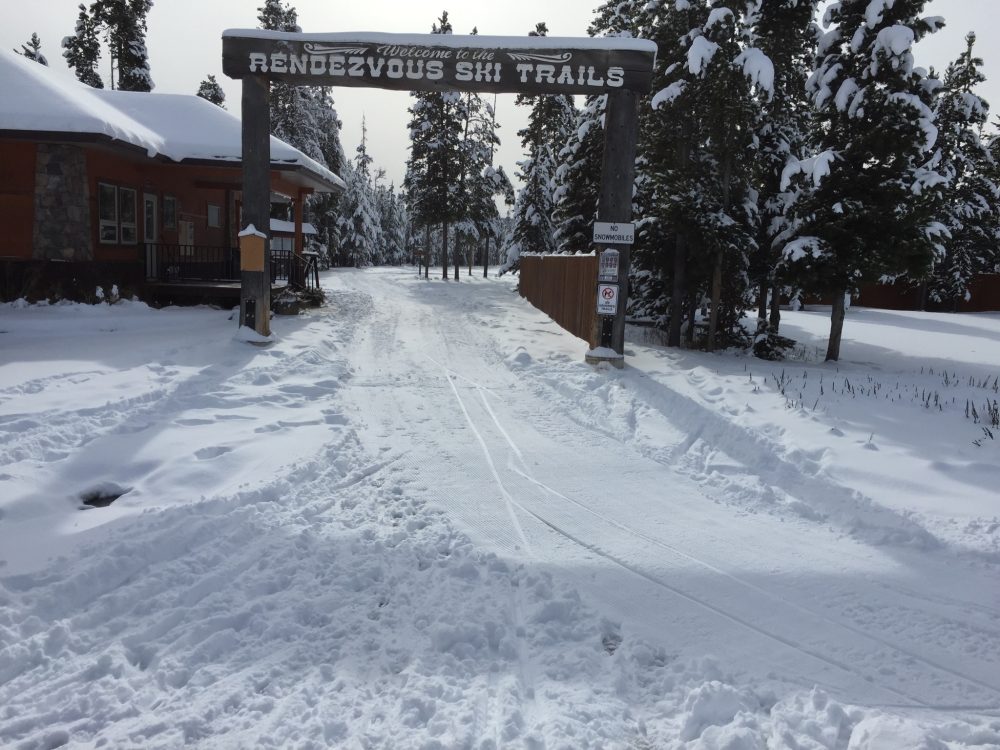
    The trailhead at Rendezvous Ski Trails, as seen in late November of this year in West Yellowstone, Mont. (Photo: FBD)
    The trailhead at Rendezvous Ski Trails, as seen in late November of this year in West Yellowstone, Mont. (All photos: FBD)

    Like many Nordic teams, SSWSCXC just returned from our annual early season training trip to the West Yellowstone Ski Festival.

    At these training camps all of the coaches ski together (naturally) and dine together, but without a doubt this was the first time that we sat at meals and discussed not only how often we were all changing our socks and underwear, but also how these pieces smelled. I’ve heard that conduct of this nature is nothing new for Vail coaches Dan Weiland and Eric Pepper, but this is just one of many reasons why those two are usually found dining alone.

    #TBT shot to a young Dan Weiland sitting alone at his junior high lunch table, completely devoid of friends, as fellow reclusive loner Eric Pepper looks on from a distance. It was here in these moments of desperate loneliness that the personality traits necessary to be a nordic coach were forged.
    #TBT shot to a young Dan Weiland sitting alone at his junior high lunch table, completely devoid of friends, as fellow reclusive loner Eric Pepper looks on from a distance. It was here in these moments of desperate loneliness that the personality traits necessary to be a nordic coach were forged.

    As you all know by now, the FBD has a reputation for looking real nice for the ladies. In our journey together to right the wrongs in the world of ski gear, we’ve tackled thick puffies, thin puffies, base layers, skate rollerskis and classic rollerskis, and we’re doing it people, we’re making a difference. It used to be that I’d see Josh Smullin in outfits like this every day, but now the frequency is down to every second or third day.
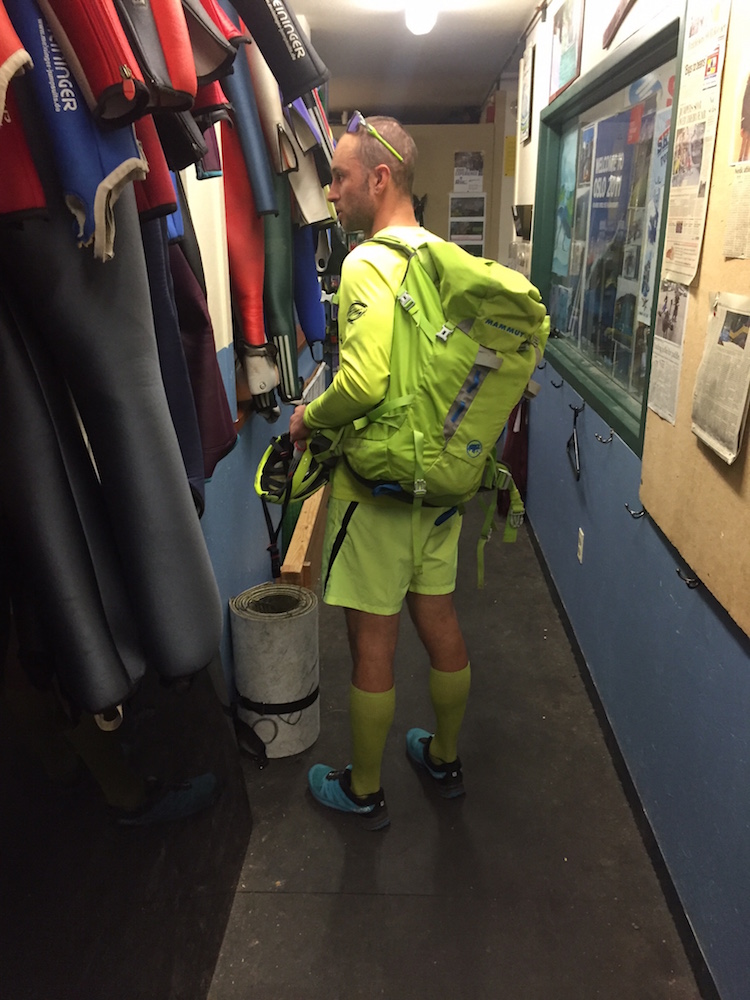
    90's neon, knee-high compression socks? Check. Matchy-Matchy 90's neon shirt, short, backpack combo? Check. 90's neon man-purse fanny pack? Check. Prepare to deploy Outfit Of The Day.
    ’90s neon, knee-high compression socks? Check. Matchy-matchy ’90s neon shirt, short, backpack combo? Check. ’90s neon man-purse fanny pack? Check. Prepare to deploy, Outfit Of The Day.

    Baby steps. Baby steps.

    So the fashion bar has been raised. Good. Very good. But looking good is only part of the picture. What if your outfit is “lit” but you smell like sh*t? I can tell you right now that this is a deal-breaker. I don’t care how fast you ski, how good you look and how savage your latest outfit is, if your base layers smell like Dave “Slow Ski” Cieslowski’s hockey equipment after spending a month in his trunk in July, you’re going to be relegated to the Weiland/Pepper lunch table in no time.

    But fear not stinky nordie, all is not lost.

    By now you’re probably thinking, “What the hell is this lunatic talking about? This is the craziest gear review I have ever read.”

    I (along with my readers, editors, friends, neighbors, and local law enforcement) often find myself asking that very question, so let’s dive right in. Since thanks to all of you loyal readers, I have rapidly risen to the most influential and trusted gear reviewer in the galaxy, I am therefore frequently contacted by companies from all walks of life with every crazy product you can possible imagine. Some are cool, some are dumb, but occasionally something bubbles up that really catches my eye. This was one of them: a laundry detergent that supposedly allows you to wear base layers for multiple workouts without washing. Since no one is lazier than me, I was immediately intrigued.

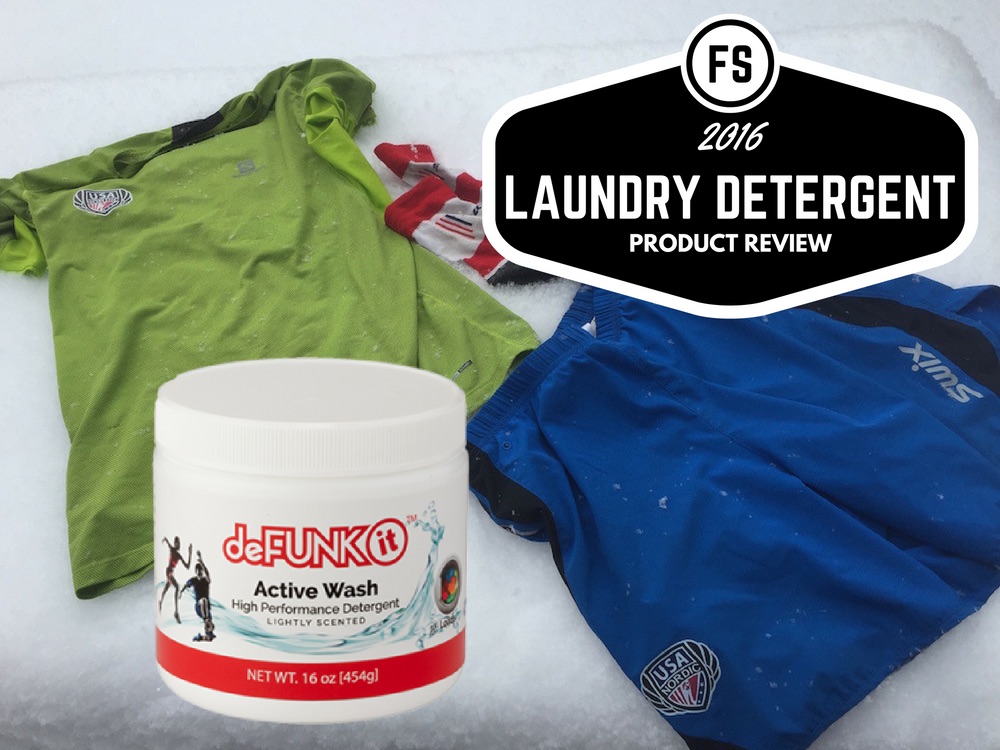
    The product in question is called, deFUNKit and here’s how it works. You simply do a normal load of laundry with their special detergent, then do repeat the same load with two different sets of their reagents (concurrently), and voila, your B.O. is now officially banished. Or so the story goes.

    Test Protocol

    To test this product, three brave men and one very brave woman descended on West Yellowstone, Mont., with only the shirts on their backs, almost literally. We brought a combination of wool and synthetic socks, undies and base layers to see if this mystery potion could stand up to real-life, real-world, real-stink testing. The plan was to ski in the same clothes for as long as possible and ride the party train until someone in the group “threw the flag.” Due to 1960s HVAC technology in our rooms, some of us wore one outfit for a.m. workouts and another in the p.m. to allow for drying, while others just went for it (more on that later).

    Ahh, the hotel room heater, circa 1960.
    Ahh, the hotel room heater, circa 1960.

    Specifics

    Here is the precise breakdown of who wore what:

    Tester 1, “Mr. Fabulous”:

    • Base layers: SmartWool, Swix synthetic
    • Socks: SmartWool, Swix synthetic
    • Fundies: SmartWool wind briefs, Swix synthetic wind briefs

    Tester 2, “Mr. Reliable”:

    • Base layers: SmartWool
    • Midlayer: SmartWool, Patagonia synthetic
    • Socks: SmartWool wind briefs, Craft synthetic wind briefs
    • Fundies: SmartWool wind briefs, Craft synthetic wind briefs

    Tester 3, “Captain Deodorant Conspiracy”:

    • Base layers: Bjorn Daehlie synthetic top, Craft synthetic top, SmartWool bottom
    • Socks: SmartWool and Point 6
    • Fundies: SmartWool wind briefs

    Tester 4, “The AK Brawler”:

    • Base layers: Swix synthetic top, Craft synthetic bottoms
    • Socks: SmartWool
    • Fundies: Victoria’s Secret (Yes, really. And no, people, this is not Josh Smullin, even though he is from Alaska)

    Hours of usage

    This is where it got real. There was a fair amount of variance in the final data mainly because one tester got super fired up and went “raw dog,” wearing the exact same outfit for the entire camp. This put their testing hours up to the extremely impressive level of 18 hours, split fairly evenly over 12 workouts. This is TRAINING HOURS, too, for much like my podcast colleagues Dean Nigglesson and Kristor Svonn, we only start our watches when we’re actually skiing (except for Smullin, who started his at breakfast — or “Bekfast, as he calls it — but that’s another story).

    When you add up time at the wax table, the walk to and from the tracks and the occasional, “rushing to get lunch so I don’t have time to change clothes after my ski” hours, this brave soul logged over 35 hours in the same socks, undies and base layers, all without a single trip to the very nasty looking hotel washing machines.

    The rest of us stuck to the protocol a bit more vigorously (or perhaps more cowardly) and racked up a range of 8-14 ski hours in each the a.m. outfit and the p.m. outfit, with another 60-75 percent of additional wear time, bringing total “on body” time for each outfit to 12-25 hours, again, split fairly evenly over seven sessions in the a.m. and another seven in the p.m.
    The conditions skiing ranged from -10 to 7 degrees Celsius (14-45 Fahrenheit), with the majority of the workouts being Level 1 cruisers, but a few of us raced and had a couple of interval sessions thrown in for good measure, so there was ample opportunity to build up the funk. All in all, it was probably a very representative sample of typical skier usage and wear patterns.

    Results

    So does this stuff work? In a word, yes, amazingly well. One of the coaches’ wives is pregnant and with an already very acute sense of smell, the impending bambino has enhanced her olfactory system to the point of “super smeller” status, and bless her soul, she very bravely volunteered to sniff test us each night. Yup, I told you we are a very tightly-knit group.

    Remarkably, even by the end of the camp, no one scored lower than a ‘7’ on the stink index (with 10 being ‘fresh as a daisy’ and 1 being ‘Weiland/Pepper lunch table’). This is pretty incredible given the high number of training hours. Even the “one outfit cowboy” came through with flying colors, which is nothing short of remarkable.

    To be clear, we all came into this with a very health dose of skepticism. Mr. Reliable noted in his log, “I was very unsure about this whole plan at the start of this test, so much so that I brought several sets of back-up clothes in case this failed spectacularly.”

    The AK Brawler agreed, “I really didn’t think this product was going to work, so I brought lots of spare clothes. Amazingly, I did not need any of them. I couldn’t believe it.”

    Captain Deodorant Conspiracy noted, “I am very surprised. This product works way better than expected.” And then the kicker, “I went the whole week doing every workout in the same outfit and I think I can keep going. In fact, I think I AM going to keep this rolling, just to see how far I can take it.” Wow.
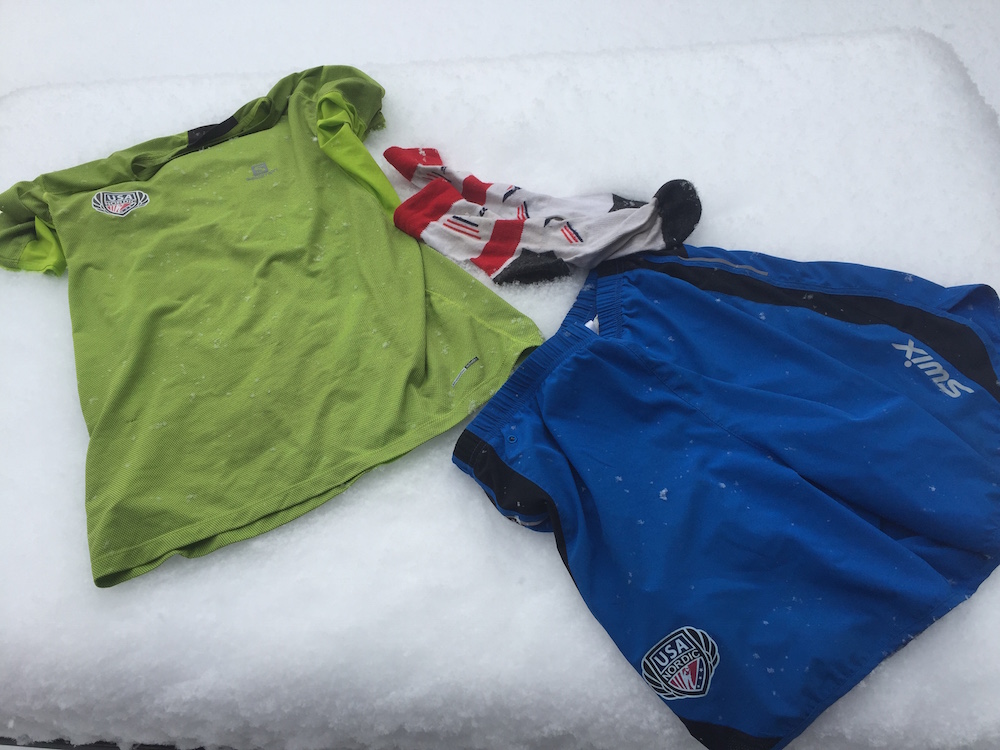
    My beloved Salomon summer training "Please don't hit me" roller ski top and trusty Swix socks/shorts. (Photo: FBD)
    My beloved Salomon summer training “Please don’t hit me” rollerski top and trusty Swix socks/shorts.

    Since no one is a bigger numbers nerd than yours truly, I couldn’t help but attempt to make the data set as statistically significant as possible, so prior to the camp in West, I logged 31 hours of rollerskiing, running and strength (divided over 12 workouts) in one outfit. The temperature in this workouts ranged from 11 to 26° C (52-79 Fahrenheit) and was often quite sunny. I managed to talk a few reluctant coaches into giving me the sniff test (though not the cowardly Captain Deodorant Conspiracy, whose fear of germs eclipses that of even my own) and they were also amazed to discover that the outfit (at right) was still quite pleasant.

    So with multiple fabrics, multiple testers, multiple brands, multiple sexes, widely divergent approaches to personal grooming and government conspiracies, not to mention highly variant body chemistries, in every piece of clothing on every single reviewer, we found a significant decrease in smell. Every single investigator felt as though they could ski in socks and “unmentionables” for a minimum of four workouts and base layers for a minimum of eight. That’s a lot. And that was the low end. On the upper end, estimates vary here as well, but “intimates” made it upwards of 10 days and base layers maxed out the test. I think that pretty much says it all.

    The After-Life

    But what about life after skiing? Is there life after skiing? I realize I am getting a little philosophical here, but not to worry, I’m not speaking in terms of the after-life, I’m speaking in terms of the after-workout. In other words, do you need to wash your everyday fundies, well, every day?

    “Back in the day,” I would prepare myself for a night on the town with a shower, shave and a nice, new, crisp pair of “knickers”, knowing very well that the chances of a member of the opposite sex actually seeing them were quite small. We were a good team though, as my BVDs had my back and dutifully played along with this ruse every Friday and Saturday night. I also did my part and got the troops ready for battle through proper and efficient rotation in the meticulous FBD laundry regimen. I figured it was the least I could do. Business is all about mitigating risk and optimizing your chances for success…

    However, those days are now long gone, as every game is now a home game, but my focus on proper hygiene persists nonetheless. So the question at hand is can this miracle solvent work its wonder on not just athletic garments, but also daily wear?

    To execute this phase of testing, I must confess that there’s a certain psychological barrier that must first be crossed, for, to put it bluntly, getting up every day and putting on 10-day-old drawers just feels weird. Or at least it did in the beginning. But being the good scientist that I am, I decided to break it down methodically.
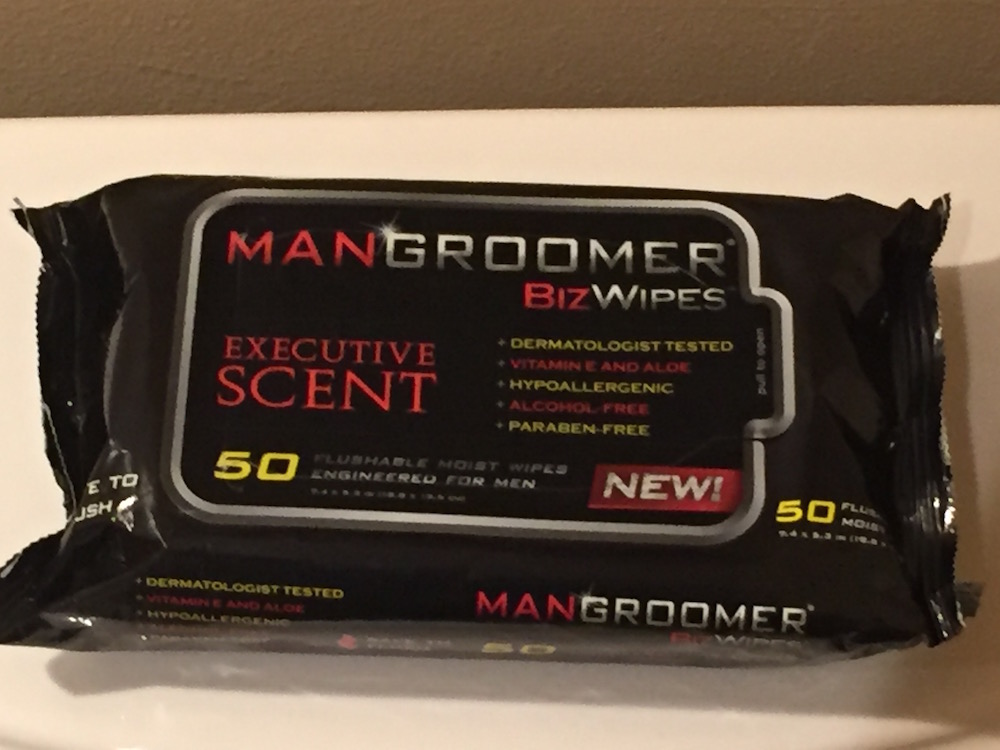
    Having a clean undercarriage goes a long way, regardless of your underwear status. (Photo: FBD)
    Having a clean undercarriage goes a long way, regardless of your underwear status.

    Firstly, is there anything magical about wearing your man-panties for 24 hours? Why not 26 hours? Or 17.2? The answer here is fairly obvious in that it is logical and convenient to synchronize a “wear cycle” with your daily cycle. Certainly there are many options and variations here, but a common regimen for many working professions is to wake up, shower, put on clean underwear, then go to work. So would you change your tighty whities halfway through the day or just before dinner (you aren’t really still wearing these guys, are you? If so, you need to seek professional help immediately)? You could, but it really doesn’t make any sense, baring any “accidents” or unforeseen circumstances.

    The point here is that under normal operations, underwear rotation schedules are not analogous to tire or oil changes in that there is not a mechanical or chemical breakdown taking place that requires attention after a set period of time. If it took the Earth 18 or 28 hours for one revolution, you’d probably wear your skivvies for 18 or 28 hours, respectively, and think nothing of it.

    Having said this, clearly there is some type of ceiling (“The Cotton Ceiling?”). Remember, the core of my hypothesis is that users install new undergarments after a shower, when presumably the whole undercarriage is all cleaned up, so there are in fact some chemical reactions that need to be taken into consideration. Leave cheese in your car on a hot day and you’ll be treated to an olfactory assault when you return to your vehicle, so by not coordinating and synchronizing the daily shower/undy swap, are we just begging for some crotch-pot cooking?

    The answer to this seems to be no. Without getting too graphic here, objects begin to smell when bacteria collects, colonizes and grows. Showers help prevent this on you and DeFUNKit helps prevent this in your clothing. So yes, there is a Santa Claus, and yes, all of your lazy, single dudes out there, you can in fact “safely” extend the wear cycle of your Jockeys. During a research project at the University of Michigan’s Biological Field Station, one of my colleagues was completely bought in to his “Four Wears Per Pair™” (FWPP) theory (forward, backward, inside out forward, inside out backward). While somewhat ingenious, I can tell you for a fact that all of our female colleagues found both this theory and process to be repulsive and let’s just say he had lots of quality time alone in his cabin. The point here being that this new laundry formulation will allow for extended wear cycles without suffering the shame, stigmas and practical difficulties associated with the FWPP lifestyle choice.
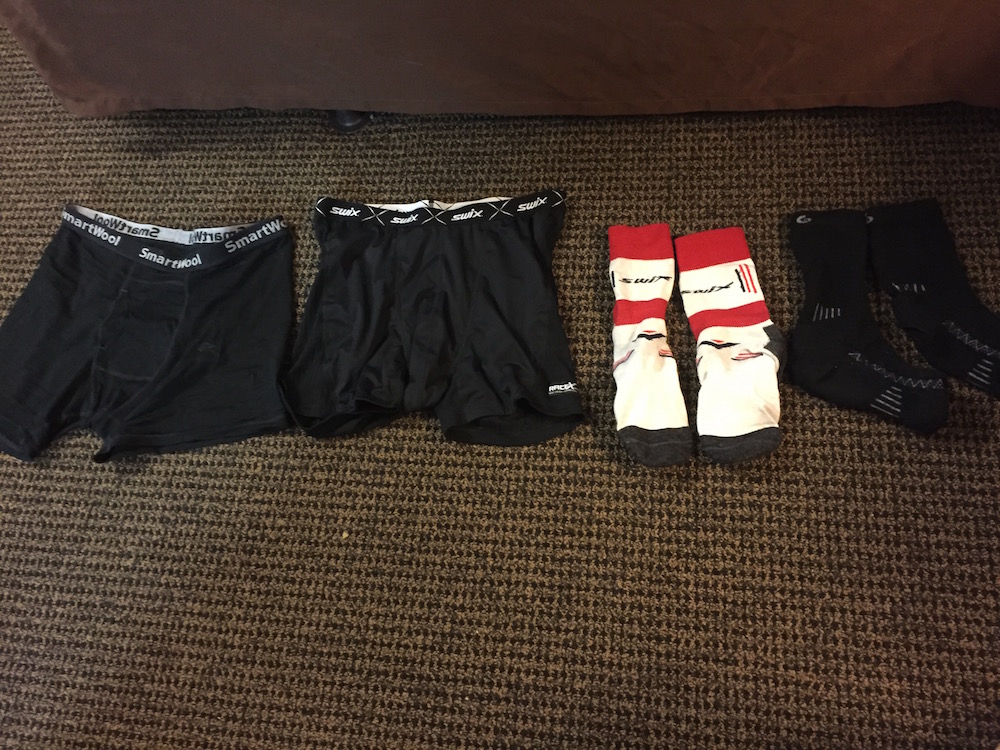
    Test fleet ready for action.
    Test fleet ready for action.

    How do I know this? Because I tested it. I had a “control” pair of Underoos that were in the rotation that were not treated with deFunkit, and an identical pair (SmartWool boxer briefs) that was treated. To ease the psychological torment of coming out of the shower clean and putting on the same pair of underwear that I had been wearing for 10 days, I alternated between the two configurations until someone said “Uncle.”

    (If you’re thinking, did this nut really wear the same pair of underwear for 10 days? Yup, I did. Ten fricking days.) The non-treated pair made it four days before they were pulled from the rotation, but the treated pair was still going strong on Day 10. The only reason this test ended was I was leaving for West and I made the executive decision to start that trip w/ “a clean slate,” so everything went into the washer.

    Now might be a good time to note that while I was the only person twisted (and thorough) enough to specifically “A:B” my test fleet (think of the most awful ski testing scenario that you could possibly imagine), our entire test team had a decent baseline on smell accumulation on all of their garments. Everyone in this group has literally dozens of years of skiing experience and overall a very good sense of how many days of use each given piece can withstand before things get ugly. So while my test was the only direct comparison between treated and non-treated, everyone on the team had a very good idea of the non-wash lifespan of their non-treated garments and all found significant deltas between treated and non-treated articles.

    Applications

    Some of the applications of this product are quite obvious: training camps, hut trips, camping/backpacking and the like, immediately spring to mind. In the past, essentially your only options on these adventures were to grin and bear it, or if you were lucky enough to be someplace with running water, you could annoy your roommates with “sock soup.”
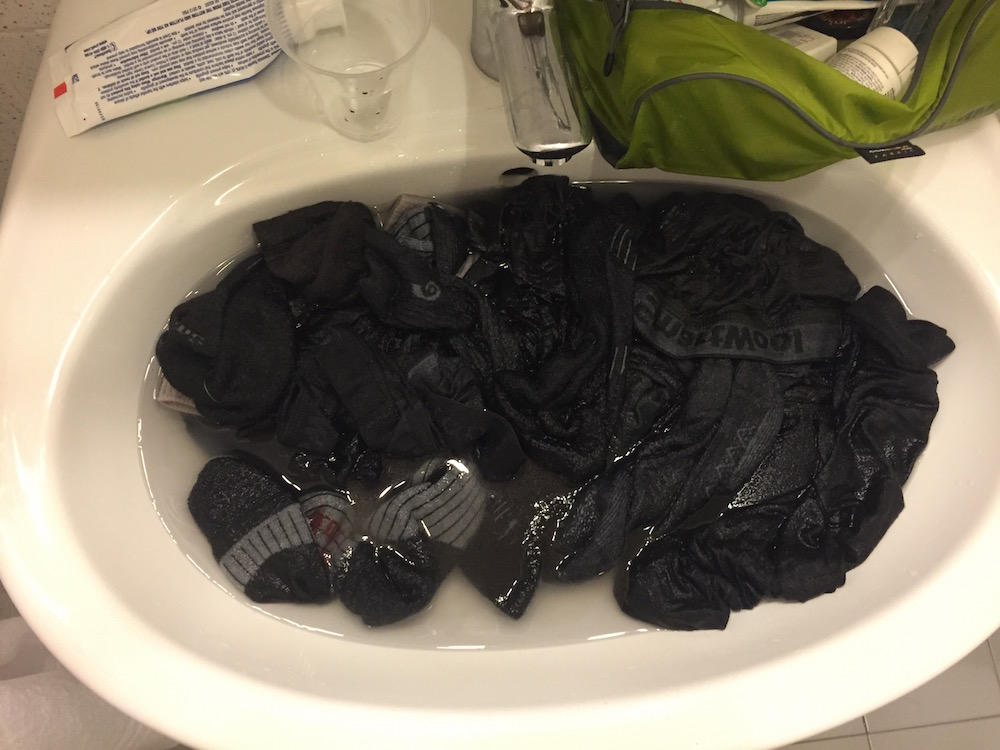
    Sock soup.
    Sock soup.

    Not having to subject oneself to the indignity and inconvenience of sink laundry makes this product basically a no brainer for all of these scenarios, as this stuff will absolutely help you come out the other side smell much, much more pleasant.

    Now, having said this, the elephant in the room is you. Both of our test environments (West and Steamboat) had showers. Some of the test team showered after every workout, some only once per day. Some of us wore deodorant, some did not, but regardless, we were all starting every workout fairly to completely clean. If you’re someplace where regular showers aren’t an option or you’re one of those repulsive, stinky hippies that refuses to shower, you’ve got bigger problems than can be solved with DeFunkIt — you are a disgusting, filthy, despicable human who needs to learn basic grooming and self-respect. Yes, DeFunk will most certainly help if you can’t/won’t shower, but if you’ve got a really bad case of stank, well, there’s only so much we can do here people. This is NOT a deodorant, cologne (God help us) or anything weird like that, it’s a treating process that helps to repel odor. If you absolutely reek though, well, guess what, you’re on a one-way trip to the aforementioned lunch table w/ Dan and Pep. I just wanted to get that out there.

    Disclaimer: If you’re someplace where regular showers aren’t an option or you’re one of those repulsive, stinky hippies that refuses to shower, you’ve got bigger problems than can be solved with deFunkit.

    Going Green
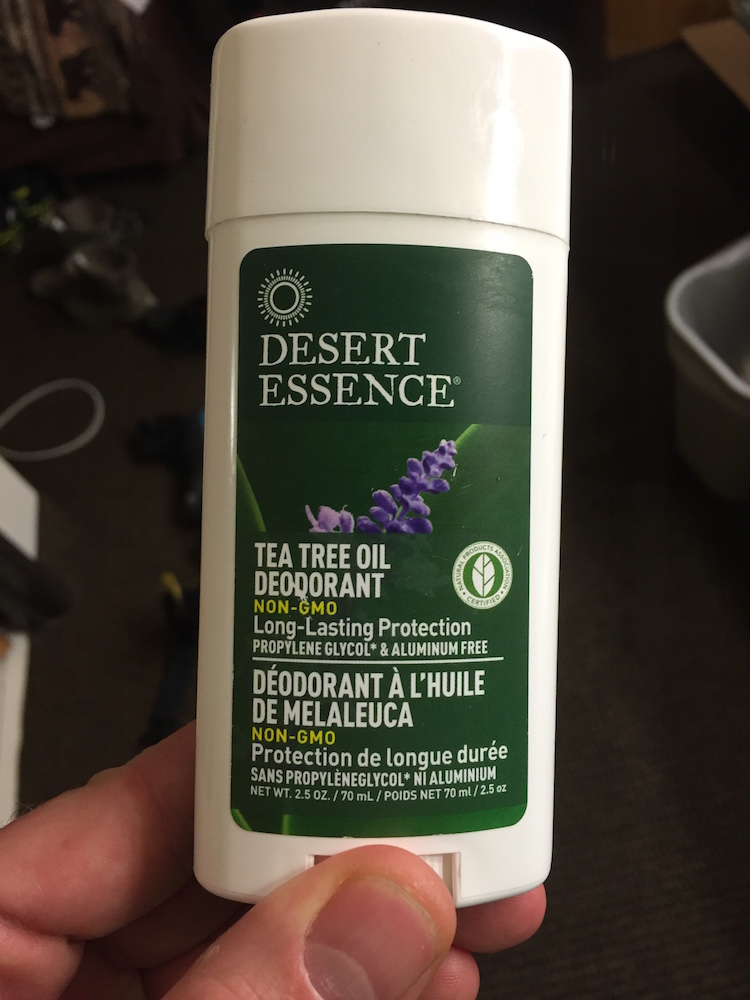
    This is the deodorant you use when you think we didn't land a man on the moon. (Photo: FBD)
    This is the deodorant you use when you think we didn’t land a man on the moon.

    Another important dimension that came up in our summary and review meeting is the potential ecological impact of this product. The manufacturer reports that the preparation will last for up to 20 washes. This means that once you have treated your clothing, you can not only wear everything many more times between washes, but you can “refresh” this effect by simply doing a load of laundry with regular detergent. Undoubtedly there will be some type of degradation curve in effectiveness, but even so, if articles are only making it five or so wears near the end of the treatment cycle before requiring washing, you are still way ahead in the game.

    One more interesting angle here is the stress that laundry machines places on clothes and how significantly trips through these machines reduces the lifespan of clothing — a very interesting observation that should be factored in this equation — if one treatment of DeFunkIt results in a four- to 10-fold decrease in wash frequency, not only are you saving water and electricity (dryers, in particular, are noted energy hogs), but you will also be greatly extending the life of your garments.

    Conclusions

    You know those car commercials which offer ridiculous, seemingly unobtainable mileage estimates for their vehicle? They often conclude with their get-out-of-jail-free statement of, “Your actual mileage may vary.” Well, same deal here. We did our best to expose a wide variety of different brands, different fabrics and different people to a fairly grueling week of testing. Overall, everyone was incredibly impressed with the findings and in some cases, people were ready to keep the test going. Will you have the same results? Probably, but who knows. I’d be amazed if it didn’t work at all for you and it could actually work better. Or perhaps worse. But I’d be shocked if it didn’t work at all.

    We have not yet had the opportunity to test how this treatment process will hold up after regular washings. Does this treatment really last 20 “normal” washes? Who knows. We simply cannot answer that question at this time. We have no reason to believe that it won’t, but at the same time we always approach claims from ANY company with a fair amount of caution. The fact that everything that they’ve told us thus far has proven to be true certainly makes us optimistic, but again, our mileage may vary. As may yours.

    In conclusion, is this product worthwhile? Absolutely. For $20 and one extra trip through the washer, you can wear all of your ski crap for several additional workouts without grossing out all of the dudes/babes at the coffee shop. If you’re lazy (like me), you can throw a few pairs of “civilian clothes” into the machine at the same time and not only free up more of your valuable time for important things like playing Noah Hoffman’s Fantasy XC league, but hell, who knows, you could perhaps even ski more. And you’re saving water, saving energy and extending the life of your clothes. To me, that’s well worth 20 bucks.

    Smell ya later,
    FBD

  • Elliott on Injury, Illness and the Long Road Back

    Elliott on Injury, Illness and the Long Road Back

    Tad Elliott blows a kiss to spectators as he crosses the line first in the 2016 U.S. Cross Country Championships men's 30 k freestyle mass start on Jan. 7 in Houghton, Mich., for his fourth national title. (Photo: Christopher Schmidt)
    Tad Elliott pretending to blow out the candles, in honor of his mother’s birthday, as he crosses the line first in the 2016 U.S. Cross Country Championships men’s 30 k freestyle mass start on Jan. 7 in Houghton, Mich., for his fourth national title. (Photo: Christopher Schmidt)

    Below is an interview with the 2016 U.S. national champion in the 30-kilometer freestyle mass start, Tad Elliott, a 27-year-old Ski and Snowboard Club Vail skier and former U.S. Ski Team member. This interview originally appeared on SlowTwitch.com and has been adapted for FasterSkier. SlowTwitch is a comprehensive resource for a wide variety of endurance sports, in particular triathlon, and has recently launched a new feature designed to introduce triathletes to nordic skiing.

    In the featured series, Olympic Gold Medalist Billy Demong explains the synergistic relationship between Nordic skiing, cycling and running, Kikkan Randall shows how to dress optimally for skiing, and Andy Newell, Brian Gregg, Matt Liebsch, Eric Packer and Mary Rose all offer an assortment of training and technical tips for skiers of all levels. Please visit SlowTwitch.com and check out all of these resources.

    ***

    Fast Big Dog: Congratulations on winning another U.S. National Championship in the 30 k skate race. How many skiing titles is this for you?

    Tad Elliott: This is my fourth national championship in nordic skiing. My first one was in 2010 in Fort Kent, Maine, when I won the 50 k skate race. I repeated again in 2011 in Rumford, Maine, in the 30 k skate race, then again in 2012 in Rumford, Maine, in the 15 k skate race. [Ed. note: the U.S . Cross Country Championships vary the format between skate and classic each year — there is a distance race every year, but the 50 k men’s races are now held at a separate U.S. Distance Nationals at the end of the season.]

    FBD: How many National Championships have you won in mountain biking?

    TE: I won the U23 national title two times in mountain biking, so I’ve been lucky enough to have the privilege of wearing the Stars and Stripes in a few different sports. It’s a tremendous honor and something I appreciate every time I put on the kit.

    Tad Elliott (second from front) trails Kris Freeman during the 30 k freestyle mass start at 2016 U.S. nationals on Jan. 7 in Houghton, Mich. Elliott went on to win by nearly 10 seconds. (Photo: Christopher Schmidt)
    Tad Elliott (second from front) trails Kris Freeman during the 30 k freestyle mass start at 2016 U.S. nationals on Jan. 7 in Houghton, Mich. Elliott went on to win by nearly 10 seconds. (Photo: Christopher Schmidt)

    FBD: Tell me about this most recent win – how did it go down?

    TE: The distance race in Houghton [Michigan] this year was a 30 k mass start. Race officials place skiers on the start grid based on FIS points, and since I’ve been sick for so long and basically out of racing, I didn’t have many points so I had to start 40th in the grid, which was bad. Mass starts in skiing are no different than those in bike races, they can be chaotic and more importantly, it is easy to miss a critical move if you are too far back, so I knew that if I was going to be at all competitive I was going to have to move up to the front quickly. This is where bike racing skills come in handy, too, as any bike racer worth his salt knows how to move up in traffic. This is easier said than done, though, and anyone who has done this knows that it burns a lot of energy, is stressful and can be dangerous so the whole time I was thinking, “move up, but be smart — don’t take any stupid risks.”

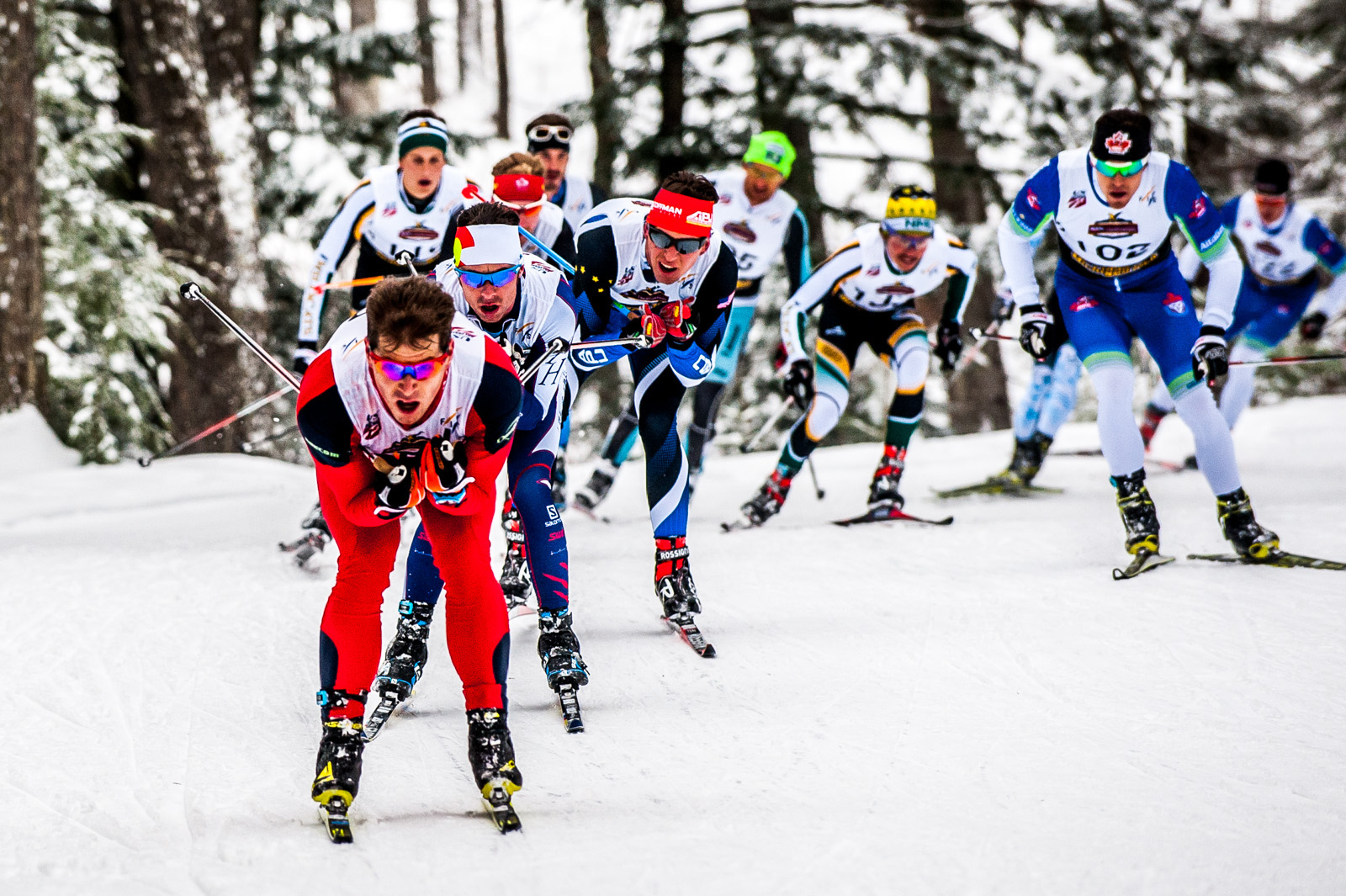
    At 7 k down, two skiers attacked and got a bit of a gap, but Matt Liebsch and Brian Gregg went to the front and brought them back. Matt and Brian set a furious pace, so their efforts shattered the field and when they reeled the leaders back in at about 9 k in, we were down to a lead group of 11 guys. This group then stayed together until 3 k to go, when I attacked. I knew it was a “make or break” situation, so I gave it all I had and I was able stay away to the line.

    FBD: What was going through your mind in that last 3 k?

    TE: In the months leading up to the race, I could only dream of the podium. Hell, I didn’t know if I was going to be healthy enough to even start, but as you know, once the gun goes off, it really is anyone’s race. I had great skis, I felt good from the beginning and once things really got turned up, I realized I could actually win it.

    Many people don’t realize just how tactical ski racing can be — it is very similar to bike racing — you have to gamble, take risks and make moves. Sometime these moves work and sometimes they don’t. You also need to be careful to not burn too many matches and when you do make a move, make it count, so once I got away, I knew I had made the right move at the right time, so I just told myself to stay relaxed, keep going and give it everything I had in the tank. And it worked.

    “In the months leading up to the race, I could only dream of the podium. Hell, I didn’t know if I was going to be healthy enough to even start.” — Tad Elliott, 2016 U.S. nationals 30 k skate champion skate and longtime Ski & Snowboard Club Vail skier

    FBD: We’ve talked in the past about how nordic ski training is good for cycling and vice versa; can you shed some more light on this concept given this big win?

    TE: Having a strong cycling background for a race like this is key. Thanks to racing my bike a lot and at a very high level, I have quite a bit more experience in mass start races that many other skiers and this is a huge advantage. I’ve been in these types of racing situations a lot, so to have experience on when to go, when not to go, how to move up, when to move up, etc., was a tremendous asset. It’s not just the training that crosses over from skiing into cycling, it is also the tactics, techniques and mindset.

    Tad Elliott (Ski & Snowboard Club Vail) racing to his fourth national title, and first one since 2012, in the 30 k freestyle mass start on Jan. 7 in Houghton, Mich. (Photo: Christopher Schmidt)
    Tad Elliott (Ski & Snowboard Club Vail) racing to his fourth national title, and first one since 2012, in the 30 k freestyle mass start on Jan. 7 in Houghton, Mich. (Photo: Christopher Schmidt)

    FBD: This is a huge win for any skier and the fact that you have several of these titles (and in different sports) is even more impressive, but I think probably the greatest part of this story is your remarkable comeback from illness. Can you walk us through everything you’ve been through in the past few years?

    TE: It all started in 2014 when I was trying to make the Olympic team. I was training incredibly hard and caught Epstein-Barr virus. Unfortunately, it wasn’t diagnosed correctly right away, so even though I tried to do the right thing and get sound medical advice early in the process, the doctors missed the diagnosis initially and I was given the green light to return to training. This, combined with the high training load and the massive goal of making the Olympics all compounded themselves and I just dug myself deeper and deeper into a hole. Finally everything came crashing down and I got so sick that I couldn’t even leave the house. That was rock bottom.

    That next winter, 2015, my doctors had finally figured out the problem and I did my best to ease back into training, but I was still so immunocompromised that even the slightest cold could trigger serious health events. I ended up going to the ER six different times with all sorts of maladies stemming from my weakened immune system: strep, mono, infections, you name it. It was so incredibly frustrating, as I felt like I was doing everything right: I was being smart and I was being careful, but even the smallest thing would not just set me back, but knock me off my ass so hard that I had to go to the doctor or even the ER. I then took even more time off, but I just couldn’t shake the illness. It was terrible.

    FBD: When did you start to feel better?

    TE: This past fall was when things finally started to turn around and I began to get healthy. After so many false starts and setbacks, I was incredibly careful getting back to training, so much so it was almost absurd. I would take a walk for 15 minutes and then take few days to recover. Then I’d walk for 30 minutes. That’s how much fitness I had lost. I gradually worked my way back into a more regular training program, but I had to be very patient and very smart. I did terribly in my first few races [relative to results earlier in my career], but I knew I was on my way back, which felt great. Just to be back out training again felt amazing.

    “I would take a walk for 15 minutes and then take few days to recover. Then I’d walk for 30 minutes. That’s how much fitness I had lost.” — Elliott, 27, on how he resumed training

    FBD: What was the most significant factor in your recovery?

    TE: I think it was my stint at FBDR HQ for my most recent training camp that really made the difference [laughing].

    In all seriousness, there were two huge factors in my recovery; patience and friendship. One of the things that I’ve learned in this process is how to more effectively manage stress. Stress effects your life in so many ways, so I’ve been carefully monitoring both my training load and my stress load. What is probably the most key though is HOW I’ve done this: patience. If I had tried to go charging back into training, there’s no way in hell I would have won in Houghton. No way. I won that race because I was patient and smart.

    The second factor that I mentioned above was equally important: the friendship of those around me. Being a professional athlete is very difficult at times and it can be a cut-throat, competitive business. I am incredibly fortunate, though, in that I have a core group of friends and sponsors who stuck by me when the going got tough. I didn’t get ANY results for a few years, yet Ski Club of Vail, Oakley, Salomon, Swix, and Caldwell Sport were there for me every step of the way. Every person in every one of these organizations treated me with the same level of support, respect and friendship that they did when I was winning, so to have all of that remain in place during that incredibly tough period in my life means the world to me. I don’t know if I will ever be able to repay all of these people, but I know I never could have done this without each and every one of them. I am so thankful that I was given the opportunity to work with such an amazing group of people.

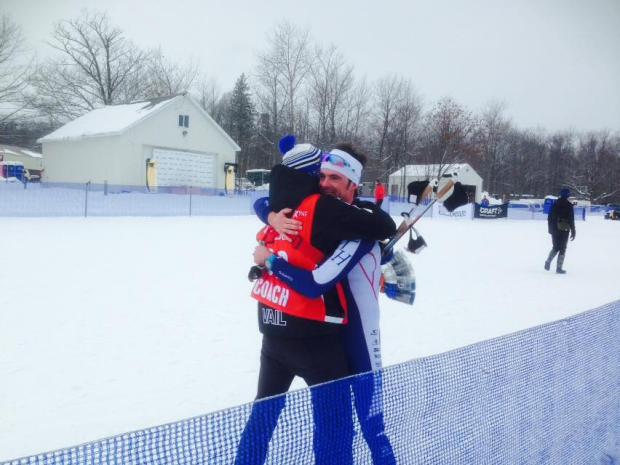
    Tad Elliott hugs his twin brother Evan after winning the 30 k freestyle mass start at 2016 U.S. Cross Country Championships in Houghton, Mich., for his fourth national title. (Courtesy photo)
    Tad Elliott hugs his twin brother Evan after winning the 30 k freestyle mass start at 2016 U.S. Cross Country Championships in Houghton, Mich., for his fourth national title. (Courtesy photo)

    FBD: At the elite level in any sport, the margins between winning and middle of the pack are often razor thin, so knowing going in to the race that you still might not be at 100 percent, how did you prepare for such big event?

    TE: Well, you are exactly right — the margins are very thin and the only reason I came out on top in Houghton is I had a lot of help. To be perfectly honest, I’m still not as fit as some of the other top skiers and the only reason I was able to win was my support team. My twin brother Evan waxed my skis for me and he is one of the best techs in the business. One of my coaches, Eric Pepper, was with me the entire time, also helping pick skis, waxing, setting up meals, lodging, and all of the other stuff that can prove to be a big distraction. Evan and Pep made everything so easy for me in Houghton that all I had to do was focus on skiing. In the end, I think that made the difference. I never could have won without those guys.

    “I don’t know if I will ever be able to repay all of these people, but I know I never could have done this without each and every one of them.”

    FBD: It sounds as though you have learned a lot in this process. What are some of the tell-tale signs of this type of illness/over-training that you recommend athletes look out for in their own training?

    TE: The single, most important thing any athlete can do is have a good coach. I am incredibly fortunate to work with some of the best in business and I never could have done this without them. You need someone to help you monitor your training and recovery; it’s too hard to do it yourself as you are just too close and your objectivity goes right out the window. Things that you’d never advise a teammate to do in a million years can make all the sense in the world to you when you’re extremely focused on a goal, so you need the objective voice of a coach to help keep you on the right path.

    Next is don’t be afraid to rest. And if you feel sick, rest even more. I completely restructured my training program to build in more rest: I now train for three days, take one easy day, train for three days, then take one day entirely off. This builds fitness, strength and most importantly has a built-in a circuit breaker with the mandatory rest days. It is much harder to over-train with this protocol. I follow this plan no matter what: even if I don’t think i need the rest, I now always take it.

    The last thing that I did that made a huge difference is I started using the FirstBeat monitoring system. It works on heart rate variability and is a very sophisticated system to help monitor training load and recovery. I highly recommend it.

    FBD: What was the hardest part of being sick for so long, the physical side or the mental side?

    TE: Not being able to do the things that I love was the worst part. I really like biking and skiing and not being able to do these activities was very, very hard. I love being active: not just racing, but just being out there training is incredibly enjoyable for me, so not being able to do anything outside was very difficult.

    FBD: What kept you going through all of this?

    TE: The belief that others had in me is what really did it. Having people you trust and respect believe in you gives you so much confidence, it’s really what keep me from losing my mind. I said it earlier — I am incredibly fortunate to have an amazing support structure. I have so many great friends, family and sponsors that never gave up on me that even at the lowest points I never lost hope.

    I also have a lot of pride. Knowing you should have made an Olympic team that you didn’t is a powerful motivator: there was just no way I was going to go out like that.

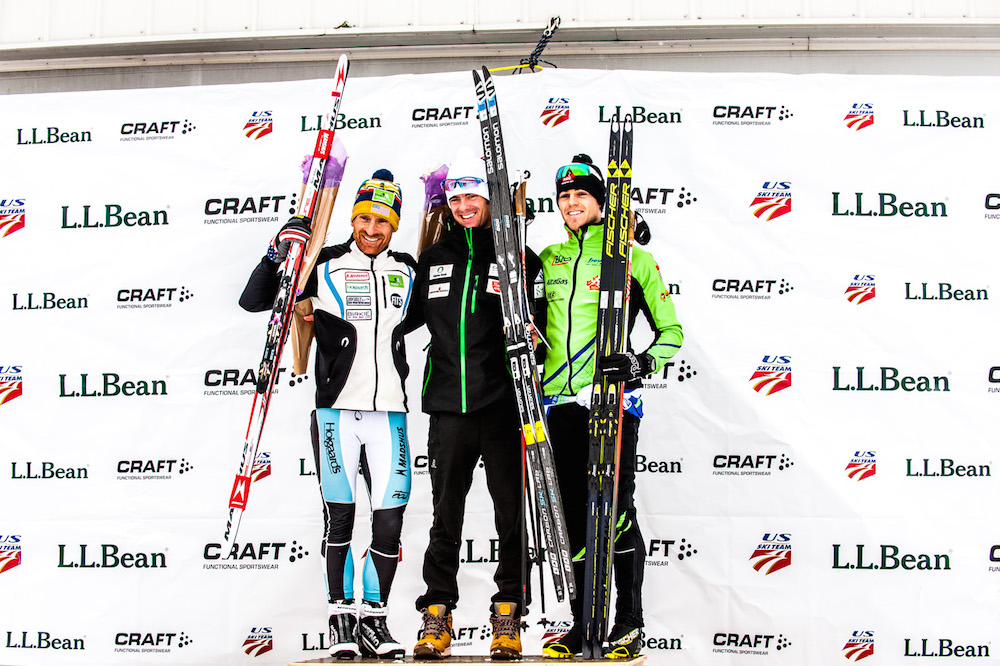
    Tad Elliott on top of the podium (and sharing the space with second and third place) at the 2016 U.S. nationals 30 k freestyle mass start on Jan. 7 in Houghton, Mich. Brian Gregg of Team Gregg (l) placed second and Northern Michigan University's Adam Martin (r) finished third. (Photo: Christopher Schmidt)
    Tad Elliott on top of the podium (and sharing it with second and third place) at the 2016 U.S. nationals 30 k freestyle mass start on Jan. 7 in Houghton, Mich. Brian Gregg of Team Gregg (l) placed second and Northern Michigan University’s Adam Martin (r) finished third. (Photo: Christopher Schmidt)

    FBD: Did you ever question if you were ever going to make it back to the top?

    TE: All of the time. Literally every day I would wonder if I could ever make it back. Fortunately my friends and family had more belief in me than I did, which is saying a lot, as I am quite cocky. My return is much more a testament to them than it is to me.

    FBD: When did you know that you were back?

    TE: At the finish line in Houghton. Well, I had in inkling with 3 k to go, and I had some great workouts at a training camp earlier in the year in New Hampshire and then again at FBDR camp, so I knew that things were coming back together, but if you honestly want to know when I was sure, then the answer is the finish line.

    FBD: You and Matt Liebsch are the only two Americans to win the American Birkebeiner in the past 7 years, so the obvious question after this big win is will you be racing the Birkie this year and if so, how do you like your chances?

    TE: It’s hard to say at this point if I’m going to do the Birkie. It’s a great race and I’d love to go back if I think I can be competitive, but as I noted earlier, I’m trying very hard to be smart about this recovery. While I feel like I’m finally getting back to form, I know I am not yet 100 percent and I’m still very concerned about coming back too fast. Like triathlon, skiing is a very demanding sport, so right now I’m just thinking about what I can do to stay healthy. I’m not looking too far down the line at this point; I’m just taking it day by day. If I’m healthy and rested enough to do the Birkie this year, great, if not, there’s always next year.

    FBD: What advice do you have for those in the process of working through their own recovery right now?

    TE: I think every situation is different and I can only tell you what worked for me, but my advice is to be patient. Every athlete is driven; that’s what gets us out there every day. The danger in this, though, is that it is easy for you to become your own worst enemy. Athletes are usually so eager to return to training and we think we have to be training to get results, but the truth is you are always going to be faster and be a hell of a lot happier if you wait to resume training until you are back to 100 percent. And even then, go back slowly. There’s always going to be another race and another year — trust me.

    Another very important point that often gets lost in training is the concept of balance. There’s a lot of life to be lived outside of sport. It’s great to be focused on your racing goals, but never forget that this is supposed to be fun. Never lose sight of the friends, family and others that are helping you along the way and always remember that just because someone isn’t out there on the start line that doesn’t mean that they don’t matter as a person. There’s a lot more to life than racing and sometimes it takes something like this to make you understand that.

  • Elliott’s Still Got It, Wins Fourth National Title in 30 k Freestyle

    Elliott’s Still Got It, Wins Fourth National Title in 30 k Freestyle

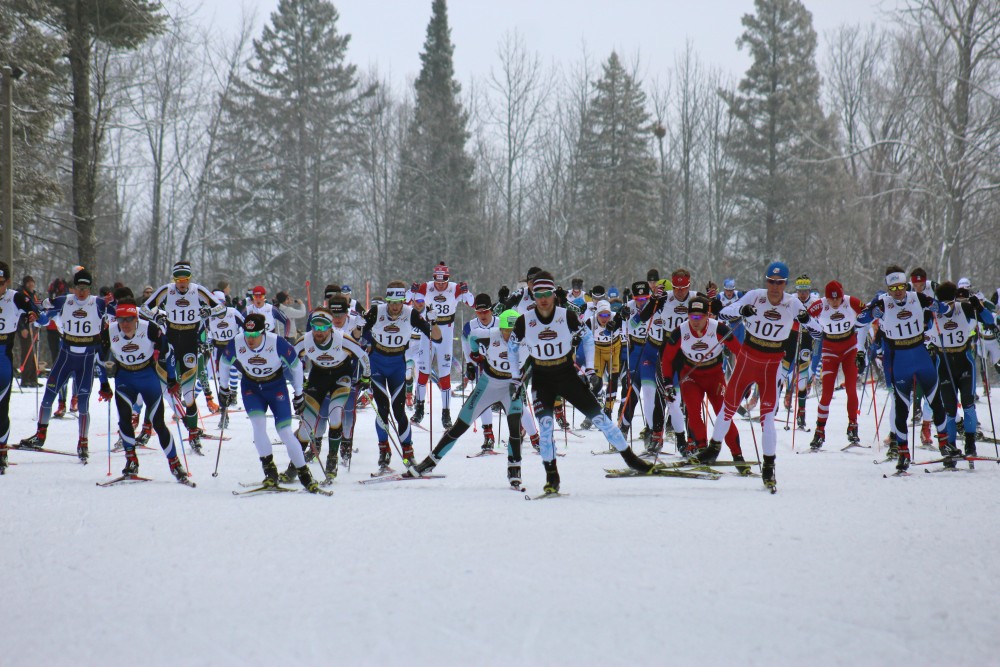
    The men start the 30 k freestyle mass start at U.S. Nationals in Houghton, Mich.
    The men start the 30 k freestyle mass start at U.S. Nationals in Houghton, Mich.

    Note: This article has been updated to reflect that Tad Elliott has won four national distance races, including the 50 k skate in 2010 in Fort Kent, Maine.

    HOUGHTON, Mich. — Although Tad Elliott’s name may have been missing from the top of U.S. results recently, at the 2016 U.S. Cross Country Ski Championships on Thursday, the former U.S. Ski Team member showed he’s still got it.

    Elliott, 27, a longtime racer with Ski and Snowboard Club Vail (SSCV), made a move in the last three kilometers that went unanswered in the men’s 30 k freestyle mass start, and he entered the stadium with a comfortable berth over Brian Gregg (Team Gregg), winning by 9.6 seconds in 1:20:31.6.

    Gregg held off a strong finish by Michael Somppi of Canada’s National Development Centre-Thunder Bay to secure second place, 3.7 seconds ahead of Somppi in fourth.

    Over the last two years, Elliott has battled illness, forcing him to take nine months off from training, and endured multiple hospital stays due to complications of Epstein-Barr. Since then, Elliott struggled to attain the same level of results he had grown accustomed to prior — as one of the most promising distance skiers on U.S. Ski Team from 2011 to 2013. However, his upward trajectory began last season when he finished 14th at the American Birkebeiner ski marathon and 11th in the 50 k freestyle mass start at U.S. Distance Nationals in Sun Valley.

    Tad Elliott cruises to his fourth-career national title in the 30 k freestyle mass start at U.S. Nationals in Houghton, Mich.
    Tad Elliott cruises to his fourth-career national title in the 30 k freestyle mass start at U.S. Nationals in Houghton, Mich.

    He competed in both SuperTour weekends this year, finishing 25th in the 15 k skate in West Yellowstone, Mont., and 15th in the 15 k classic in Sun Valley, Idaho, allowing him to enter this weekend flying somewhat under the radar.

    “Before this week I knew I was in my best form for a long time, but could only dream of a podium,” Elliott said after Thursday’s win — his fourth national title following victories in 2010, 2011 and 2012 at nationals in Maine: first in the 50 k skate in Fort Kent, then in the 30 k skate and 15 k skate in Rumford.

    This year’s 30 k skate mass start consisted of three laps around the 10 k course on the Michigan Tech Trails. About an inch of new snow had fallen overnight and racers awoke to a foggy and warm morning. Temperatures hovered around 30 degrees at race time when 91 men lined up for the event.

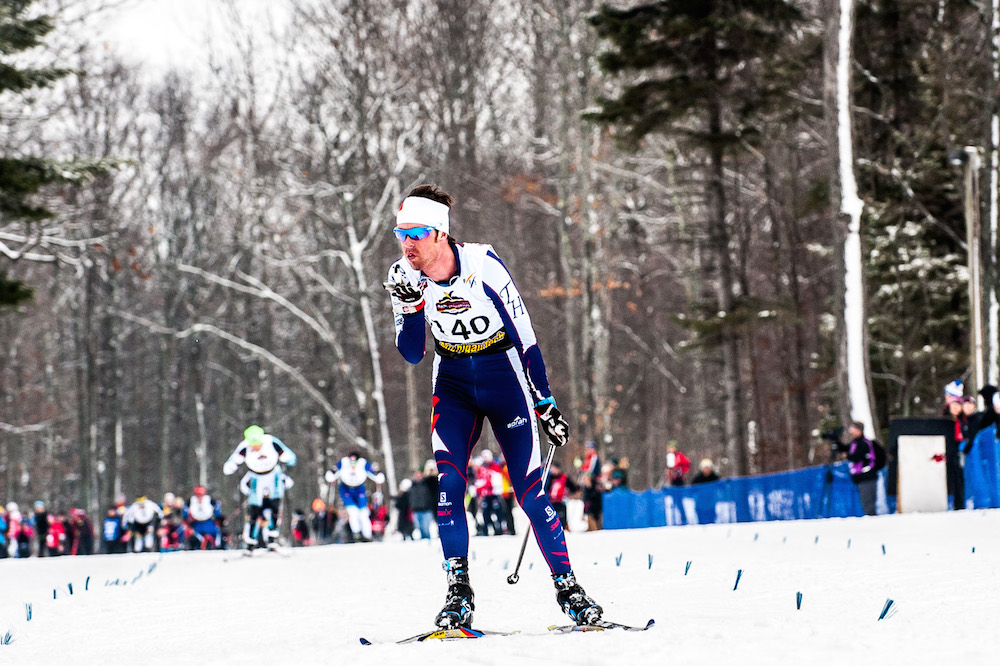
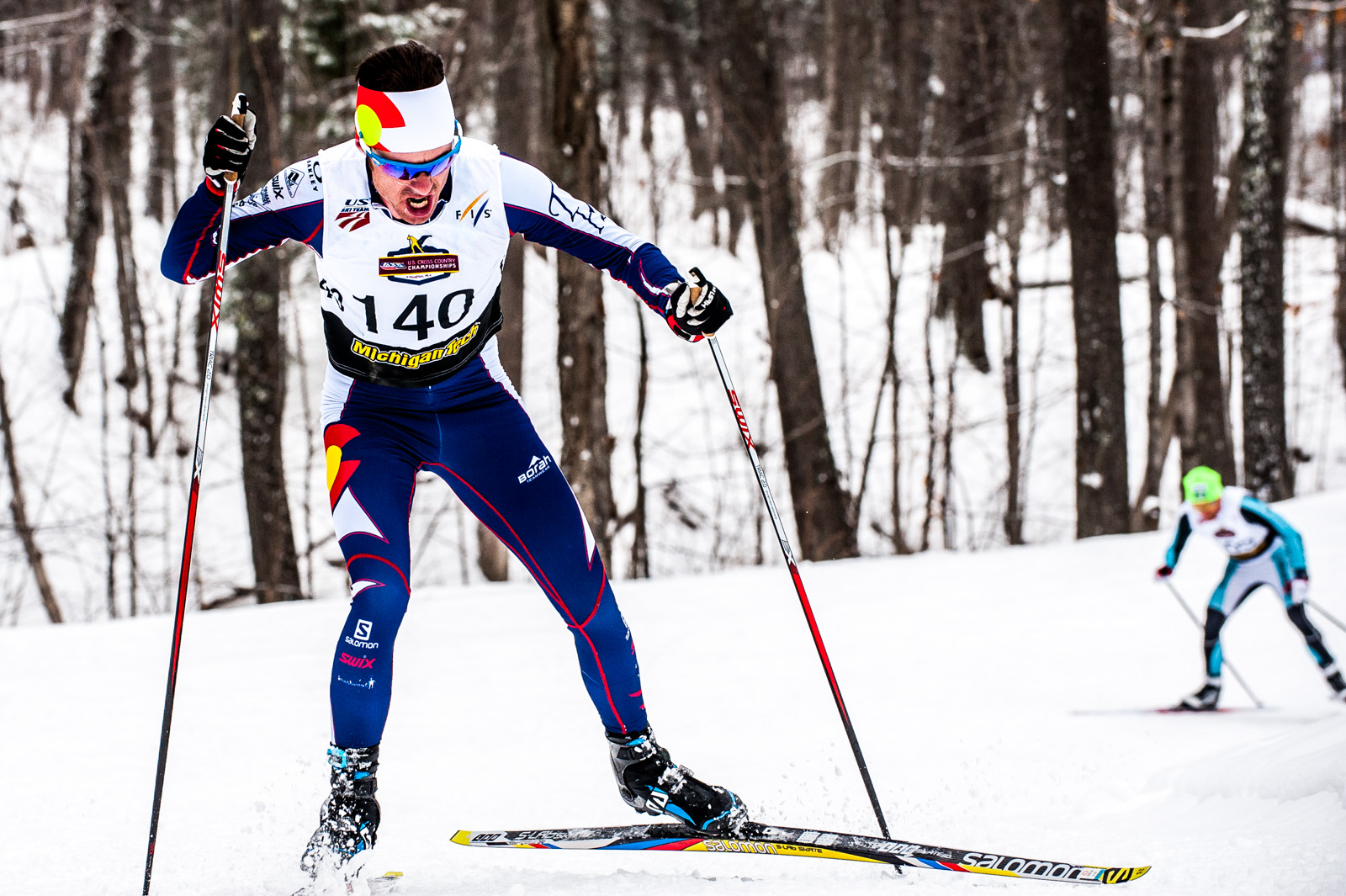
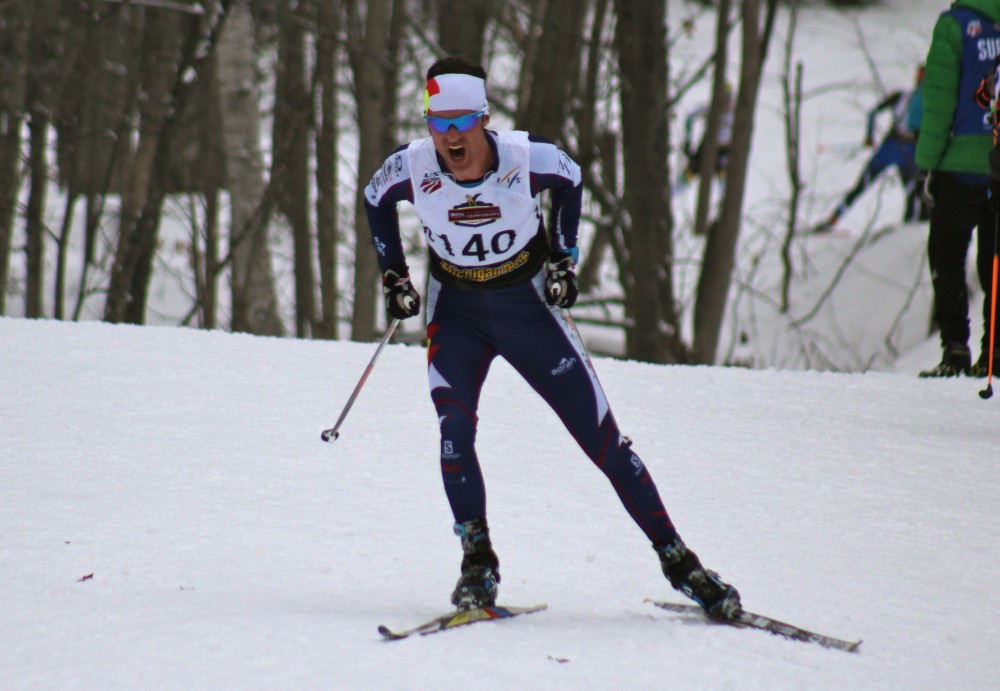
    Since start positions are based on recent International Ski Federation (FIS) points, Elliott started in bib 140 and had to fight through the field to reach the front on the first lap. Elliott and the rest of the podium contenders stayed out of trouble out of the start, avoiding broken poles and navigating the high-speed hairpin turn two kilometer into the race.

    Canadian Kevin Sandau (Alberta World Cup Academy) made the first decisive move at the end of the first lap just before 10 k. Scott Patterson of Alaska Pacific University (APU) answered Sandau’s attack, and the two gapped the field by 50 to 60 meters.

    Meanwhile, Gregg was concerned with the strength of Patterson and Sandau together up the trail.

    “I was nervous we wouldn’t be able to bring those guys back so I put pretty big surge in to bring them back,” Gregg said. “Unfortunately I brought six to eight skiers along with me. I was hoping it would be a bit smaller than that.”

    Sandau’s move ended up establishing the the lead group. “Everyone was hurting and that was for sure the hardest part of the race for me and I think a lot of people today,” Somppi explained. “Once we regrouped and got into our 10-, 11-person pack then it was a lot easier and more chill. I just hung out in the group and waited for the finish.”

    The resulting group of 11 consisted of Elliott, Gregg, Somppi, Sandau, Adam Martin and Jake Brown of Northern Michigan University (NMU), Patterson, Matt Liebsch (Gear West), Kyle Bratrud (CXC) and Kris Freeman (Freebird) .

    NMU had the strongest team presence in the lead pack in Martin, who had placed third in the 15 k classic earlier this week, and Jake Brown.

    “It was awesome to ski with Jake, who I’ve been training with all fall,” Martin said. “Jake led the pace for a good part of the second lap and it was pretty sweet to ski behind him. It just felt like an L3 workout at practice this fall.”

    Patterson was another consistent presence at the front of the lead pack.

    “I led a lot of the race, but my skis weren’t quite in the game today,” Patterson said. “I think I was one of the strongest in the field, but a little off on skis and that makes it a bit harder.”

    The lead group stayed intact until Elliott made his statement.

    “It was pretty steady until about three ‘k’ to the finish when Tad Elliott made a strong move and Brian kinda latched onto him,” Patterson described.

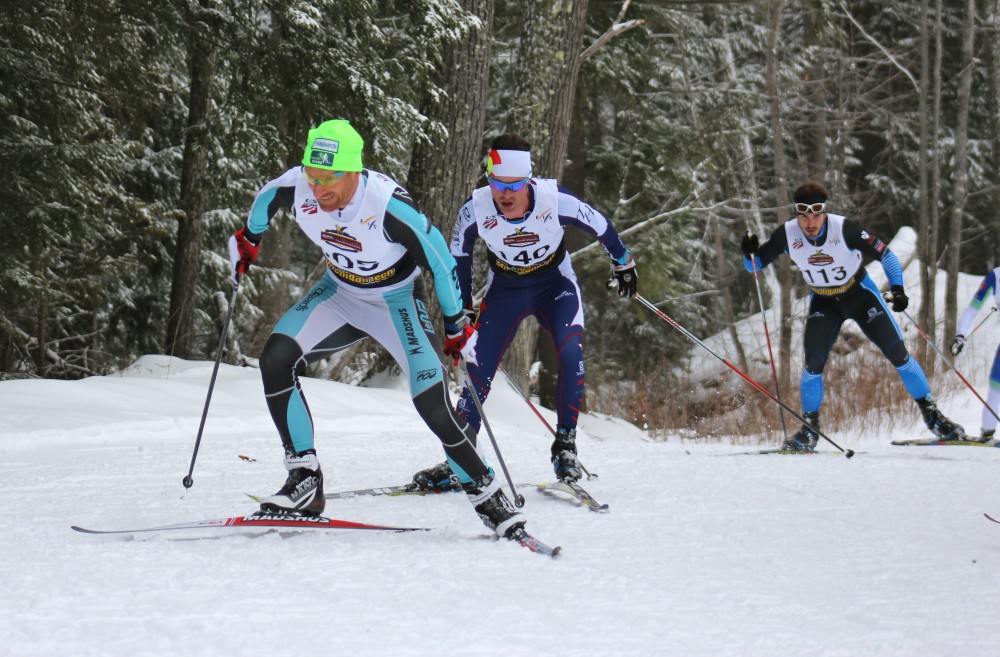
    Gregg (Team Gregg) leads Elliot (SSVC) during the 30 k freestyle mass start at U.S. Nationals in Houghton, Mich. Elliott went on to win the race and Gregg took second.
    Gregg (Team Gregg) leads Elliot (SSVC) during the 30 k freestyle mass start at U.S. Nationals in Houghton, Mich. Elliott went on to win the race and Gregg took second.

    Elliott’s move wasn’t completely premeditated, but it proved crucial.

    “It was not planned before the race or during,” the eventual winner said. “I knew I had to drop Gregg for a chance to win. He is the best closer out there. My plan was to wait until 400 meters, but the opportunity was there and I felt amazing.”

    With Gregg unable to match him, Elliott celebrated across the line.

    “Tad was looking really strong. We’ve been teammates and friends for a long time so it is great to see him back on top,” said Gregg, who was Elliott’s former teammate on Central Cross Country (CXC).

    After the race Elliott was thankful more than anything.

    “I’m pretty thankful for my support team. It’s been a while since I’ve been at the front of a race and went through kind of a lot the past two years so I was really excited,” he said.

    “My twin brother waxed my skis they were probably the best in the field,” Elliott added. “[I’ve had] Vail support me for a long time as well as Caldwell Sport who was helped me come back from my illness. This is a really big one for me and it feels like a huge team win.”

    Somppi was happy for a podium while feeling less than optimal.

    “I came here hoping to win but I’m feeling a bit worn out,” he said. “I raced Period 1 of the World Cup and I sick from coming back from Europe. It was a short ten days at home with some sickness and then come down here so it’s been tough racing.”

    Adam Martin (l) leads Patterson (r) and NMU teammate Brown during Thursday's 30 k freestyle mass start at U.S. Nationals in Houghton, Mich.
    Adam Martin (l) leads Patterson (r) and NMU teammate Brown during Thursday’s 30 k freestyle mass start at U.S. Nationals in Houghton, Mich.

    Since Somppi is Canadian, Martin made the American podium in third and was ecstatic about his race.

    “In the past I’ve been much stronger in classic races so to get fourth today that was a huge surprise and I’m really satisfied with that,” Martin said.

    Gregg was happy for Elliott’s success as well as his own performance.

    “Today was really fun, felt like my skis were one of the best in the field,” he said. “I was trying to stay in the front group and conserve energy.”

    As for the rest of the season, Gregg is looking to regain the overall SuperTour lead as he returns to the domestic circuit. Patterson will leave the domestic circuit this month as he earned World Cup starts as the Period 1 SuperTour leader.

    Last season’s overall NorAm champion, Somppi will return to the Canadian circuit and race the next NorAm in his hometown of Thunder Bay, Ontario, a qualifying race for the Canadian World Cups in March.

    As for Elliott: “We haven’t really talked about it yet,” his coach, Eric Pepper, said. “We had to see how this went first, but he will primarily focus the Birkie.

    “Tad’s dealt with a lot the past couple years and to come back and win a race, and win it like that, it was just awesome,” Pepper continued.

    Results

  • The 12: Ski & Snowboard Club Vail/Team HomeGrown

    The 12: Ski & Snowboard Club Vail/Team HomeGrown

    Sylvan Ellefson (l) and his Ski & Snowboard Club Vail/Team HomeGrown teammates enjoying some on-snow time in Bend, Ore., this spring. (Photo: Eric Pepper)
    Sylvan Ellefson (l) and his Ski & Snowboard Club Vail/Team HomeGrown teammates enjoying some on-snow time this spring in Bend, Ore. (Photo: Eric Pepper)

    Note: This is the second preview in our series on U.S. elite teams, which we’ve dubbed the “The 12.” We asked coaches to tell us what’s new and whom to look out for in the coming season and will publish additional previews in the coming weeks in no particular order.

    Team: Ski & Snowboard Club Vail (SSCV)/Team HomeGrown

    Coaches: Eric Pepper (head coach), Dan Weiland (nordic program director), Lenka Palanova, Kevin Hoechtl, Allison Ebbets

    Senior roster: Noah Hoffman (U.S. Ski Team), Tad Elliott, Sylvan Ellefson, Ryan Scott

    Who’s new: none.

    Who’s missing: none.

    Coach’s comment: “We are excited to be able to support these four athletes,” head coach Eric Pepper said. “With the added excitement of an Olympic year, training has been great and we are looking forward to the race season.”

    Four Colorado-born skiers have Olympic aspirations with the Winter Games in Sochi, Russia, just over seven months away. Hoffman, Elliott, Ellefson, and Scott will receive full support of the SSCV in Vail, Colo., and wear the colors of HomeGrown, signifying the club’s in-state requirement.

    “What it comes down to for us is we want to make sure we can give top-level support to our athletes,” Pepper said about his selective elite team roster. Promising candidates have expressed interest in joining the team, but did not meet the “HomeGrown” standard, he explained.

    Top results last season:

    All four skiers made World Cup starts in 2012/2013. Hoffman and Elliott gained the most international experience as members of the U.S. Ski Team (USST). Ellefson’s World Cup eligibility, which carried over from being the U.S. Ski and Snowboard Association (USSA) SuperTour points leader in 2011/2012, expired after the December World Cup in Canmore, Alberta.

    Colorado native Noah Hoffman of the U.S. Ski Team and SSCV/Team HomeGrown at the 2013 World Championships in Val di Fiemme, Italy.
    Colorado native Noah Hoffman of the U.S. Ski Team and SSCV/Team HomeGrown at the 2013 World Championships in Val di Fiemme, Italy

    Scott, 23, filled one of the additional U.S. quota spots at the Canada World Cup after finding success at the SuperTour season opener in West Yellowstone, Mont., where he notched his first domestic win. He placed 51st in the Canmore sprint and 60th in the individual sprint Quebec City. A sprint specialist, Scott is currently training in Norway with a group of friends.

    “That’s something he’s done a couple of times and he really feels like he’s derived a lot of benefit from it,” Pepper said.

    The top-ranked distance skier in the U.S., Hoffman, 23, is coming off a strong season in which he placed 15th in the 15-kilometer freestyle individual start at World Championships in Val di Fiemme, Italy, and qualified for World Cup Finals. He underwent shoulder surgery this spring and has gradually added intensity and volume to his training program.

    “He’s as focused as ever and looking forward to the upcoming year,” Pepper said.

    Tad Elliott (SSCV/Team HomeGrown) racing for the U.S. Ski Team at 2013 World Championships in Val di Fiemme, Italy.
    Tad Elliott (SSCV/Team HomeGrown) racing for the U.S. Ski Team at 2013 World Championships in Val di Fiemme, Italy.

    Elliott, who turns 25 today, is no longer on the USST, but the former mountain-bike racer maintains a full commitment to skiing.

    “Nothing in his mind has changed one bit,” Pepper said. “Everything he’s got is going into [skiing] this year.”

    Elliott anchored the Americans’ 4 x 10 k relay team to 10th place at World Championships and scored World Cup points when he was 28th in the skiathlon in Canmore. He and Ellefson have already put in several offseason hours on snow in Bend, Ore. Ellefson, 26, joined the USST training camp there in May and led a two-week SSCV junior camp with Elliott.

    Hindered by an ankle injury at the tail end of 2011/2012, Ellefson battled illness last fall. His season-best World Cup finish was 57th in Quebec City, after cracking the top 50 the year before when he was 43rd in Rybinsk, Russia. In a recent interview with FasterSkier, Ellefson said he’ll attempt to climb to the top of the SuperTour points list again.

    While they won’t start the season in the USST uniform, Elliott, Ellefson and Scott are among those with a legitimate shot at grabbing one of the few coveted spots on the U.S. Olympic roster. The qualifying period ends January 12, and at that time, additional team members who did not meet the objective criteria may be named based on International Ski Federation (FIS) rankings.

    “It does definitely put a lot of emphasis on those early season races,” Pepper said. “We’re going to be approaching those at a higher level than we probably have previously.”

  • Elite Team Preview: Ski and Snowboard Club Vail Team HomeGrown

    Elite Team Preview: Ski and Snowboard Club Vail Team HomeGrown

    Sylvan Ellefson, Noah Hoffman and Tad Elliott taking the early lead in the 50 k at Distance Nationals this spring. All three SSCV Team HomeGrown skiers are back on the squad this year.

    This is one of several previews in a quick-and-dirty series on U.S. elite teams. We asked coaches to send their 2012/2013 rosters and tell us what’s new for the coming season. We will be publishing additional reports over the next few weeks. Teams are presented in no particular order.

    Team: Ski & Snowboard Club Vail (SSCV) Team HomeGrown (Vail, Colo.)

    Coaches: Dan Weiland (nordic program director), Eric Pepper (head coach)

    Roster: Sylvan Ellefson, Tad Elliott (U.S. Ski Team), Noah Hoffman (U.S. Ski Team), Ryan Scott, Christian Shanley, Max Scrimgeour

    Who’s new: Ryan Scott (Montana State University grad), Christian Shanley (post-graduate, Vail Ski & Snowboard Academy grad), Max Scrimgeour (post-graduate, Steamboat Springs Winter Sports Club alum)

    Who’s missing: Mike Vigers (was a PG last year, now an incoming freshman at CU Boulder)

    Top results last season: There are many ways to measure progress on a team: on the domestic and international stage, based on individual and team-wide performance, and from the number of athletes who notice these results and want to be part of what you’re doing. The fact that SSCV’s elite squad made gains in practically every category at some point in the 2011-2012 season speaks to the size of the leap it made. Between personal bests on the World Cup for all three returning skiers and dominant U.S. results it’s safe to say that in the three years since its founding, SSCV Team HomeGrown has unmistakably arrived.

    Team Homegrown and USST members Tad Elliott (l) and Noah Hoffman (r) leading the men’s 30 k at U.S. Nationals. Photo: Flying Point Road.

    Elliott and Hoffman were new additions to the team last year and spent most of the winter in Europe as part of the USST B-team. As a national team rookie Elliott scored his first career World Cup points with a 27th in the Davos 30 k freestyle. Hoffman broke into the top 30 with a 26th in the Otepää 15 k classic and produced the best American result at World U23 Championships with a silver medal in the 15 k.

    Ellefson’s mere presence on the World Cup was a personal best for the Vail native; he earned his first career start rights late in the season by leading the SuperTour at the end of January. Apart from an unlucky crash in the Falun prologue at World Cup Finals, Ellefson made steady progress throughout his European tour, which head coach Eric Pepper says has been a big motivator throughout this summer. On the heels of his World Cup debut, Ellefson also managed to reclaim the yellow leader’s bib to secure a ticket back in November.

    “For a lot of people going to Europe, it’s tough: they go over and get their ass kicked and it’s really hard. And he went over there and he got better,” Pepper said. “He’s just more focused, more determined. He’s learned so much being over there about that next level, he’s just ready to go again. It’s crazy; you watch people who go over there and maybe struggle, but not him though. That’s what its about: going over there and getting better, and I think for him that’s exactly what he did.”

    The trio made similar strides domestically. With a full international schedule, Nationals and Spring Series were the only two events SSCV Team HomeGrown raced as a complete squad in the U.S., but this didn’t seem to matter when it came time to suit up. Elliott, Ellefson and Hoffman looked as though they’d spent all season racing together and went 1-3-4 in the 15 k freestyle in Rumford, Maine. A few months later in Craftsbury, Vermont, Elliott took second and Ellefson fourth in the 50 k at Distance Nationals. Somewhere in between, Elliott also won a little thing called the American Birkebeiner.

    Ryan Scott, left, skiing the heats at U.S. Nationals. Photo: Flying Point Road.

    The team has added three new names to its roster this year, Scott, Shanley and Scrimgeour. Pepper and nordic director Dan Weiland are keeping the squad relatively small for the moment in order to maintain a high level of financial support to its athletes, particularly its USST B-team members.

    The newcombers all join the squad as native Coloradoans. Scott is from Boulder and graduated from MSU this spring. Shanley moves up from the SSCV junior competition team to take a PG year with the senior squad (he deferred enrollment at Denver University). Scrimgeour was a Steamboat Springs Winter Sports Club athlete as a junior, and will also be a PG-er next year.

    All three skiers posted competitive results last winter. Scott has already begun to seriously establish himself as a senior-level sprinter; he was fourth at U.S. Nationals in the classic sprint and posted the top American freestyle sprint result at U23s with a 25th. Shanley was a J1 last season and finished seventh in the classic sprint qualifier at the Aspen SuperTour and eleventh in the 10 k a few hours later. He and Scrimgeour teamed up in March (along with SSCV junior Cal Deline) for a gold medal-winning Rocky Mountain relay at Junior Nationals.

    The team may also soon be adding a girl to its roster this season; Weiland said he is currently in the negotiation phase with a recent college graduate.

    Coach’s comment: In 2009 SSCV Team HomeGrown was founded, as the name suggests, to develop Colorado skiers. Next season could be its biggest yet, and with an all-Colorado 2012-2013 roster the team hasn’t wavered from that original intention.

    “The whole idea behind our team is Colorado-based athletes growing up and coming back after college to race for a Colorado team,” Weiland said. “That’s our selling point, and that’s what we’ll stick with.”

    Training-wise, new and returning members of the squad are all working this summer in order to do one thing: get faster. There’s a lot on the line for everyone this season, with World Championships in Val di Fiemme, Italy as the big target. From the work his athletes have put in so far, Pepper sees plenty of reason to look forward to the winter:

    “[Ellefson] had the opportunity to spend a week with the USST guys in Bend, and went back with our junior kids for another ten days, and he looks great. He’s in good shape; doing everything he needs to do… He’s just a totally different animal now. He’s gotten a lot faster, stronger, fitter; that was a huge jump for him last year. He was fourth in the 50 k and we considered that a disappointment. The year before he was ecstatic to be top 10, top 20 at U.S. Nationals.”

    Elliott and Hoffman will be in Vail a few times throughout the fall, but primarily they’ll be based out of Park City, Utah.

    “Tad’s doing some mountain biking too, and Noah’s trying really hard to basically get on snow every month this summer,” Pepper said. “May he was in Bend, Sognefjell in June, then Austria, and then he’s looking at a trip to New Zealand. Lots of on-snow time for him, that’s definitely one of his targets. Tad’s been hittin’ the weight room a lot harder too, taking bicep measurements.

    “[For Scott], I think it’s great to have an opportunity to make the transition to being a full-time athlete with full-time training, and not having to worry about the rigors of college. It’s an opportunity to really focus on racing, with a little more emphasis on sprinting in particular, and see how far he can take it.”

    Update July 13, 2012: This article originally stated Max Scrimgeour had yet to confirm his status with the team. Since publication Scrimgeour has officially joined SSCV Team HomeGrown.

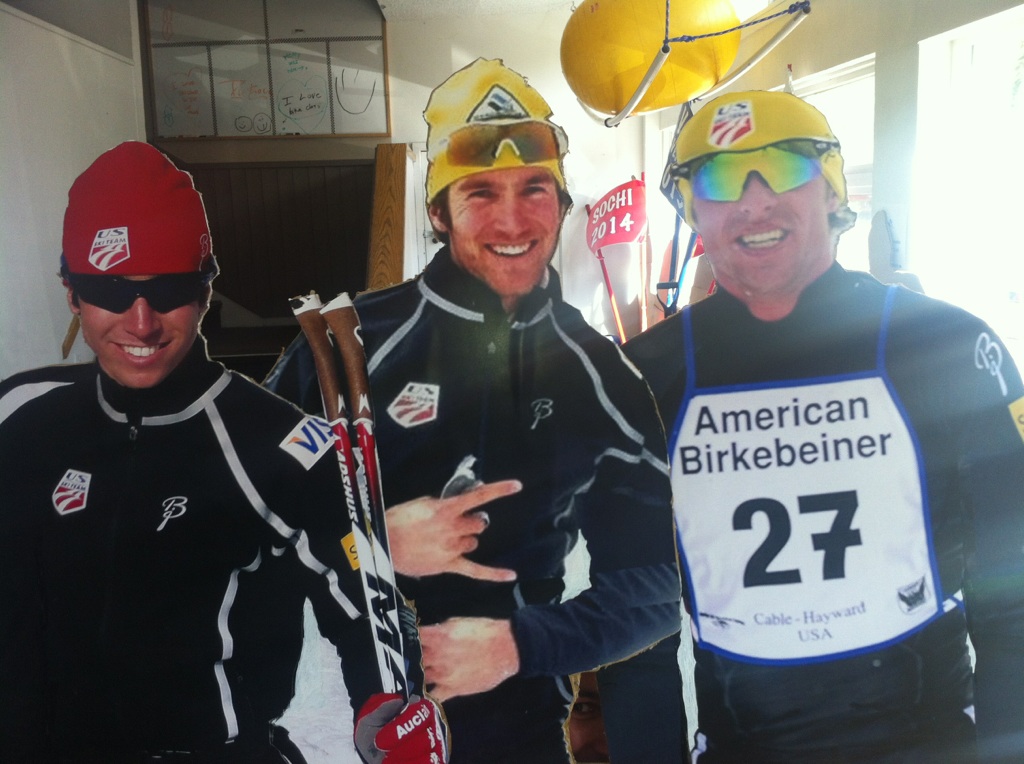
    Returning SSCV Team HomeGrown skiers made it into the Vail Fourth of July parade as cardboard cutouts. Photo: Sylvan Ellefson.

    * * *

    Other previews: Bend Endurance Academy | Bridger Ski FoundationCraftsbury GRP | CXC | Far West | Maine Winter Sports Center | Methow OD | Stratton Mountain School T2 TeamSun Valley SEF | XC Oregon

  • Belov Claims Sixth Russian Victory in Erzurum; Hoffman Earns U23 Silver

    Belov Claims Sixth Russian Victory in Erzurum; Hoffman Earns U23 Silver


    Evgeniy Belov, winner of the 15 k at U23s, jubilant on the podium. Noah Hoffman (USA) took second and Hannes Dotzler (GER) was third.

    If there’s one takeaway from the Junior and U23 World Championships thus far, it’s that Russia is a well-oiled machine. Evgeniy Belov (RUS) won his country its sixth gold medal of the week on Thursday, ahead of Noah Hoffman (USA) in second and Hannes Dotzler (GER) in third.

    Based on Belov’s delight on the podium, the run of success isn’t getting old.

    “I cannot express how happy I am today when I defended the title from Otepää,” sad Belov, who won the 15 k skate race last year at U23s.

    Belov has been competitive in both U23 races this week—hardly surprising, as he has more than one World Cup top-10 to his name this season. In the skate sprint on Tuesday, Belov was second.

    “I am happy I can be fighting for medals both in sprints and in distance competitions.”

    Hoffman (USA) cresting the high point of the 15 k course behind Karel Tammjarv (EST). Photo: Logan Hanneman.

    Skiing a well-paced individual race, Team HomeGrown’s Hoffman clocked in 24.5 seconds behind Belov. Hoffman was an earlier starter, and sat in first for a few minutes after finishing, before Belov came through.

    “That was really fun,” said Hoffman. “Belov was fast, I’m impressed.”

    Overall, Hoffman was pleased with the way he skied his race, which as Eric Pepper pointed out, isn’t always the case.

    “Any race he’s in, he wants and expects to win—that’s just the way he is,” said Pepper, one of the U.S. team’s wax techs and a coach at Ski and Snowboard Club Vail.

    “He’s certainly pleased, and it’s not often that he thinks he did really well. It’s a great result… From what Hoff said, everybody is here [from the World Cup] that he would expect to be, so it’s a really good field.”

    A critical component of Hoffman’s race was Estonia’s Karel Tammjarv, who started 30 seconds ahead of him. Hoffman caught Tammjarv within the first four kilometers into the race, and the pair worked off each other for most of the remaining distance.

    “Maybe I went out too hard, but I got in behind him and stayed as relaxed as possible,” said Hoffman.

    With about two kilometers to go, Hoffman started fading. Tammjarv began to put a gap back on him, but Hoffman managed to hang on and finish 3.6 seconds ahead of bronze-medalist Dotzler.

    “[Tammjarv] was really strong, and was a great ride for most of the race. I was lucky to have it and be able to stay behind him,” said Hoffman.

    Hoffman after finishing. Photo: Logan Hanneman.

    US Ski Team development coach Bryan Fish was most impressed with Hoffman’s ability to keep a cool head and maintain an even pace, even when he got splits that he had only a few-second margin ahead or behind his closest competitors.

    “He caught the Estonian, who was skiing strong. Noah had the patience and the mindset to just let him do the work, and they were making up time,” said Fish.

    Throughout the race, it was clear that a podium finish was Hoffman’s for the taking, with splits coming in over the radio time after time that he was staying consistently close to Dotzler.

    “I was getting splits at the top of the course—a lot of second, third, down by five, down by ten,” said Hoffman. “I knew I was right in there and tried to focus on what I needed to do.”

    Hoffman was behind the German from the first lap and much of the second, but when he came through the stadium to head out for a final time, he had finally surpassed him.

    Dotzler was happy with third place.

    “I wanted to go slow at the beginning but then I was in the lead after 5 k,” said Dotzler. “I was probably too fast in the early stages of the race but I came to the finish for bronze and I am happy for that.”

    Canadians Graeme Killick (60) and Christopher Hamilton (30). Photo: Logan Hanneman.

    After Hoffman, Graeme Killick (CAN) posted a top-20, and came through the finish 2:04.6 behind Belov for 19th. David Greer (CAN) was 36th (3:04.7) just ahead of Erik Bjornsen (USA) in 37th (+3:09.0). Eric Packer (USA) was a close 39th (+3:10.6) Jesse Cockney (CAN) 47th (+3:57.2), Christopher Hamilton (CAN) 52nd (+4:21.6) and Ryan Scott (USA) 54th (+4:51.4).

    15 k results.

  • From Skiing to Ultras: Callahan’s New Obsession

    From Skiing to Ultras: Callahan’s New Obsession

    A creature of team sports – first baseball, then soccer – Duncan Callahan remembered his reaction when his older brother started nordic skiing at Glens Falls High School in northeastern New York.

    Courtesy photo — Crested Butte Nordic head coach Duncan Callahan coaches at Soldier Hollow in Midway, Utah, in January.

    “I thought he was the biggest nerd in the world,” he said.

    A year later, Callahan’s brother, Bill, convinced him to try it.

    In darkness, the two set out on the city’s illuminated trail system. Afterward, Bill suggested his little brother come out for the team. He still thought it was nerdy, but decided to anyway.

    In a phone conversation from Gunnison, Colo., the 28-year-old Callahan credited his brother and older teammates for their leadership. He had one coach through the seasons, Bill Parks, who helped him develop as a cross-country skier and as a runner.

    Following Callahan’s high school years, which included two trips to the New York State nordic skiing championships, he skied at Western State College in Gunnison, coached at the same institution and dove into ultra-distance events.

    In 2003, Callahan won the inaugural Leadville 100-mile ski race. A college junior at a crossroad of interests, he said the event hooked him on endurance events. Rather than ski, he chose to run.

    Since 2007, Callahan has won several ultras, including two Leadville 100-mile trail runs and the Moab 100, and set a course record at the Grand Teton 50-miler.

    Sidebar: Skier Stats

    Who: Duncan Callahan
    Age:
    28
    On snow:
    Head coach of Crested Butte Nordic and Western State College
    Nordic ski teams
    Off:
    Two-time champion of Leadville 100 trail run
    Passions:
    Coaching skiing; running ultras
    Favorite ski brand:
    Fischer
    Running shoe:
    Vasque
    Typical training session:
    Long outing of 6 hours with 7,400-foot climb
    over 28 miles.
    Mileage:
    Approximately 23,000 in last 5 years.
    More info: 
    www.strategicendurance.com

    Now the head coach of Crested Butte Nordic, he ran his fifth consecutive race in Leadville, Colo., on Aug. 20. The defending champion of the “Race Across The Sky” at elevations of 9,200 to 12,600 feet, Callahan placed ninth.

    “The hundred is so different from any other race,” he said before the 2011 Leadville challenge. “My absolute goal … is to go to the bottom of the well (and) see what’s in the heart and in the head because you’re absolutely going to need that out there. The goal of winning is secondary.”

    While Callahan was not thrilled with his result, he accepted it. His legs hadn’t cooperated over the 19 hours, 11 minutes and 15 seconds he was out there, he said, and he felt uncomfortable leading early.

    “I’m used to running from behind for most of the race,” he said.

    But quitting? That rarely crossed his mind.

    In those races, high and low points are a given, Callahan said. He tried to minimize both, riding strong moments without overdoing it and staying mentally sound through pain. Just once, earlier this year at the Hardrock 100 in Silverton, Colo., he thought about dropping out.

    “But 99.9 percent of the race, it never occurs to me,” he said. “I’m not going to lay claim to be any more mentally tough than anyone, but I do love getting to mile 80 and having to grind it out.”

    That’s why he’s hard to beat, said Callahan’s friend Adam St.Pierre, the head coach of Boulder Nordic.

    “Generally, he’s the guy that slows down the least,” said St.Pierre, who was 56th at Leadville this year in his second 100-miler.

    “At some point in your mind, you’re going to say, ‘Why am I out here? It would be easier to just stop,’ ” he said. “It’s one thing to keep going, but it’s another thing to pick up the pace from there.”

    Courtesy photo — Duncan Callahan competes in the 2009 Grand Teton 50-miler in Alta, Wyo. He won the race in 7:33.27.

    Miles of self-motivation

    To understand Callahan’s psyche, it’s helpful to know his background.

    While elite athletes tend to tread off the beaten path, Callahan’s high school coach in cross-country running, skiing and track said he was especially unique.

    “You have a sense of this is the kind of guy that was tuning out the rest of the world and was driven,” Bill Parks said. “He was actually a very fun-loving guy, but he put in a lot of miles.”

    That drive and thousands of miles – mostly rollerskiing – got Callahan into trouble. Parks remembered when a teacher approached him about penalizing Callahan for his frequent tardiness.

    Parks knew he was out rollerskiing before school, and so did the teacher. She had seen him on her way to work – still sweaty and far from home and a shower.

    “These stories would come back to me of him rollerskiing to Saratoga and back,” Parks said. That was at least 40 miles round trip.

    When he spoke about Callahan at an awards banquet, Parks pointed out that the star skier – a top Mid-Atlantic racer – had rollerskied some 2,000 to 3,000 miles, far beyond Parks’ suggestion.

    “He came up to accept the award and he looked a little puzzled,” Parks said. “He said, “ ‘You know, I skied a lot more than that, coach.’ ”

    One day, Callahan said he did 70 kilometers on the county bike path.

    “Skiing was a slightly unhealthy obsession for me from my junior year in high school to my junior year in college,” Callahan said. “The training for it kind of dominated my thought process. My schoolwork kind of suffered and socially I was kind of a dweeb. For five years of my life, skiing was absolutely my central focus.”

    After a disappointing finish at the state meet his senior year, one which neither Callahan nor Parks knew what went wrong, Callahan moved on at Western State College. There, he continued to dedicate himself to training and achieved All-American status as a sophomore at Junior Nationals.

    By his junior year, Callahan’s results stagnated. His attention shifted to new races: first, the Grand Traverse 45-mile backcountry ski and then the Leadville 100-mile ski. He realized he loved distance events and had lost an interest in college racing.

    “Training for me was way more important than racing,” he said. “And when you get to that point, you start to lose your passion for competition.”

    He bunkered down and chose a major – history – while studying exercise physiology and coaching. His discovered his knack for coaching and by the time he graduated, he had stepped back from racing altogether.

    That allowed him to meet his eventual wife, Annie, and for the first time in nearly a decade, Callahan took a season off, and it wasn’t because he was hurt.

    Mostly injury-free in high school (“I didn’t get injured,” he said, “and if I did, I didn’t care”), a couple of stress fractures in his feet forced him to take time off in college.

    For the most part, his body dictated his training. When he overdid it, his body slowed down. He wouldn’t get sick, he just couldn’t physically move as fast or at all, he said.

    “My body just shuts down and says, “Nope, you’re not doing anything today,’ ” Callahan said. Then he would rest.

    He reintroduced himself into the running world a few months after he graduated when he began coaching Western State and the Crested Butte club in 2005. Working with skiers, he decided to get back into shape.

    Courtesy photo — Duncan Callahan poses while coaching at Soldier Hollow in Midway, Utah, in January.

    After marrying Annie in 2007, he asked her, “What do you think about me doing the Leadville 100 running race this summer?” She agreed to support him, both in principle and out on the trail, and Callahan began a yearly regimen of running about 5,000 miles a year.

    “We always joke to my friends that I almost tricked her with all this,” he said.

    In 2007, he was seventh of 210 finishers at Leadville. The following year, he won it in 18:02.39, and was third in 2009. He was last year’s overall winner in 17:43.24, almost 40 minutes ahead of the second finisher.

    At the Hardrock 100 this year, he was eighth in 30:57.

    “For the most part, I could compete in the top ten if I ate well and kept up an active lifestyle,” Callahan said. “It’s a great lifestyle sport so (the) ‘W’ is not the end-all, be-all for me now.”

    The ultra appeal

    A runner since middle school, Callahan had a natural affection for the sport. He ran the mile and two mile in addition to cross country, and enjoyed lengthy workouts in preparation.

    “Training for me, essentially, was a pure expression of a passionate pursuit of something,” Callahan said. “That was certainly something that catapulted me to where I got to and held me back on the results side. I trained too much, I trained too hard. I didn’t recover enough.”

    Before running his fifth Leadville – which he said would be his last consecutive one – Callahan reflected on the appeal of endurance sports, especially for someone like him.

    “I just think there are a lot of guys who could not move on after college in marathons, not to the next level,” he said. “Finding their way into ultras was kind of a natural out.”

    He said he couldn’t compete with men or women in marathons. At 6-feet tall and 165 pounds, he said his body’s ability to burn fat helped him at long-distance events – along with the base he built nearly 15 years ago.

    While ultras initially suited 35- to 45-year-olds, Callahan said he has been among a younger, progressively dominating demographic. In 2007, two of Leadville’s top 10 finishers were in their 20s. Two years later, five of the top six fell in that age category.

    “I’ve heard it called the fastest growing segment in the outdoor industry,” Callahan said. “And the outdoor industry is one of the fastest growing segments in the world.”

    Several other 20- to 30-something nordic coaches, including St.Pierre, have also taken up distance races. For many, ski coaching allows summer flexibility, and the training enables some freedom.

    “It’s sort of weird,” St.Pierre said of his fellow coaches’ attraction to the sport.

    Eric Pepper, the head nordic coach at Ski Club Vail, was one of St.Pierre’s four pacers at Leadville this year. Nick Sterling, who coached with St.Pierre in Boulder, also ran with him for part of the race, along with Middlebury skier Josh Dalley and triathlon coach Craig Howie.

    Last year at Leadville, Noah Hoffman of the U.S. Ski Team paced his friend, Greg Adams. Next year, St.Pierre said six or seven Colorado ski coaches might race there.

    “I think ultra running let’s us take out some of our aggression,” St.Pierre joked.

    “Rocky Mountain Nordic coaches, we are staking claim,” Callahan said. “We are the fittest group of coaches in the USSA.”

    St.Pierre paced Callahan in three 100-mile ultras, and Callahan returned the favor to St.Pierre at the Western States Endurance Run in Auburn, Calif., in June.

    “We were both fitness dorks; that’s how we connected initially,” Callahan said. “We were the coaches getting up early and going on our runs.”

    At Leadville this year, Callahan had five people to run with after mile 50. His former exercise physiology professor, Scott Drum, paced him for the first 10, and his former college coach, Jesse Crandall, made the trip from Syracuse, N.Y., to run the second leg.

    At mile 76, Rich Smith, the father of one of Callahan’s skiers, took over. He handed off to Grant Ruehle, a former junior skier, and another athlete. Hannah Smith – who tweeted updates for Callahan throughout the day – ran the last five miles.

    Annie Callahan, Leadville 100
    Courtesy photo — Duncan Callahan's wife, Annie, right, holds their baby, Jordan, while checking in with Callahan at the Leadville 100 on Aug. 20. The 2010 defending champion was ninth in the 2011 race in Leadville, Colo.

    Annie Callahan met her husband at checkpoints with their newborn, Jordan Elizabeth, in tote.

    While similar races required hefty support and endless preparation – both physically and mentally – Callahan didn’t see an end in sight.

    Ultra running wasn’t the most lucrative sport, he said, but several sponsors made it easier to pursue. He belonged to the Vasque running team and was mostly supported in products from ProBar, First Endurance (sports nutrition), Vespa (natural amino acids) and Once Again Nut Butter.

    In all, he estimated he could make $3,000-$4,000 a year running.

    “It’s not a lot of money, but it is a pretty good percentage of my income, which is embarrassing to say, but it’s true,” Callahan said. “Essentially, it pays for itself. I have no expenses related to the sport.”

    Now an online coach through his own website, strategicendurance.com, Callahan said he and his wife are trying to make their dreams work. A coffee shop manager on maternity leave, Annie helped organize a 5 k to fight human trafficking and planned to put on more races.

    A few years ago, the two worked with professor Drum on an ultra-endurance experience camp, but they were unable to attract enough people.

    “I certainly see a window right now to pursue what I’ve been pursuing, what we’ve been pursuing,” Callahan said. “But I’m not quite sure what the next move will be. Fitness and endurance will always be a gigantic part of our lives forever, that’s for sure.”

    With the attention their month-old baby has received, she will likely be equally entwined in the sport.

    “She’s going to be the most decked out kid,” Callahan said, laughing.

  • Videos, Photos of Rumford Organizers and Race Course

    Videos, Photos of Rumford Organizers and Race Course

    Volunteers and race officials are scrambling to preserve what remains of the snow base in Rumford, Maine, with 16 hours to go before the first race of the 2011 U.S. National Championships.

    Sunday’s classic sprint should still go off as scheduled. But despite the best efforts of organizers, temperatures in 40’s on Saturday decimated the trails at Black Mountain of Maine.

    Late in the day, the 1.4-kilometer sprint course was a mix of clean, wet corn; soggy snow packed into ice; and messy sections where dirt, rocks, and even sticks had been mixed in.

    Roughly a dozen volunteers were out on course all afternoon, but by 4 pm, organizers had brought in a bucket loader with spotlights to continue work as darkness descended.

    The start and finish of the course, located in the stadium, are where snow conditions were best. But the top of the main climb, and the ensuing descent – both on a south-facing slope – need some work.

    FasterSkier caught up with Chief of Course Ray Broomhall to discuss the challenges his crew is facing, as well as Boulder Nordic Sport Race Service Director Eric Pepper to talk waxing. With snow conditions varying all throughout the course, service staffs will have their work cut out for them on Sunday.

    Check back later this evening for another update.

    The top of the main climb on the Rumford sprint course.
    Volunteers and race staff were busy moving snow onto bare and dirty spots. This is the top of the course's smaller climb.