From the FasterSkier archive — posts syndicated from athletes’ and coaches’ own blogs between 2004 and 2012, kept online as published. Current coverage is at fasterskier.com.

Tag: eric strabel

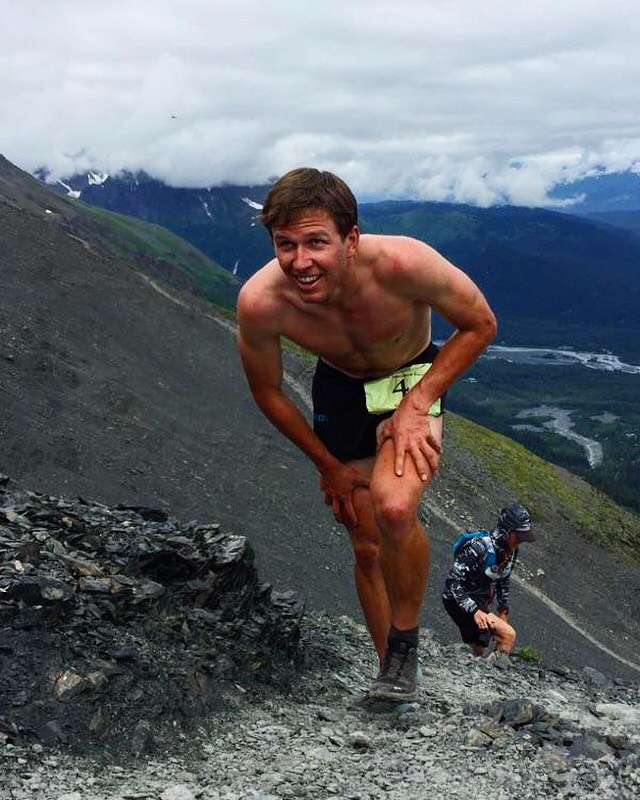
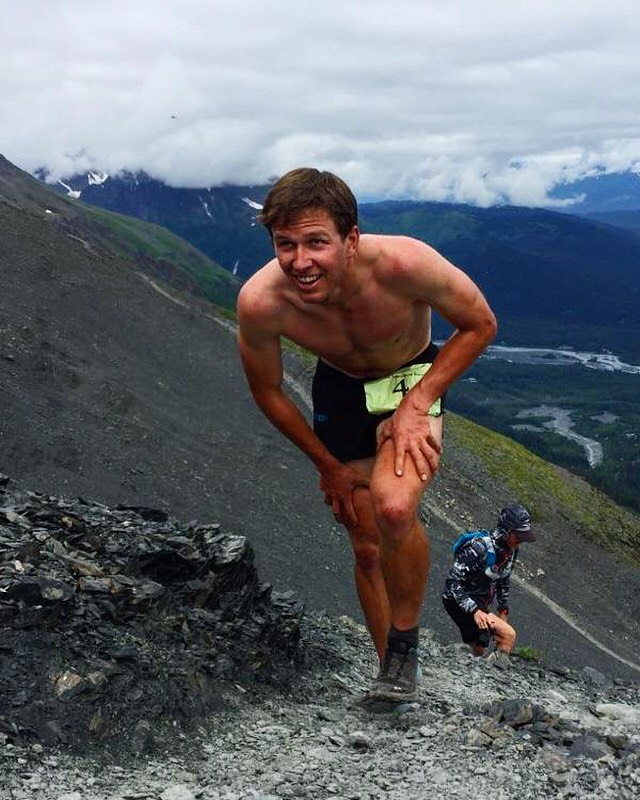
  • Scott Patterson Snags Storied Course Record at Crow Pass Crossing

    Scott Patterson Snags Storied Course Record at Crow Pass Crossing

    Scott Patterson sets a remarkable new course record at the 2021 Crow Pass Crossing. (Photo: Brad Benter/Crow Pass Crossing)

    On July 24th, Scott Patterson toed the line outside of Girdwood, Alaska, for his eighth run of the Crow Pass Crossing, a roughly 22 mile race with nearly 3,000 feet of vertical gain through the rugged Alaskan backcountry. Two hours fifty minutes and five seconds later, he crossed the finish line at the Eagle River Nature Center, shattering the 11-year-old course record set by ultrarunning legend Geoff Roes at the peak of his career by four minutes and 39 seconds. To put this in perspective, Roes set the record at the storied 100 mile Western States Endurance Run that same summer.  

    To those, like myself, who are thousands of miles away from Girdwood and lack perspective on the Crow Pass course, a 2.7% difference in time for a race that long may sound unremarkable, but to those versed in the trail, Patterson’s time garners respect comparable to Eliud Kipchoge’s 2:01:39 at the 2018 Berlin Marathon. In the race’s 30-plus year history, the three-hour barrier has only been dipped under ten times by four separate individuals. Four of those times are Patterson’s, three belong to Roes, two to former elite ski racer turned APU Junior coach Eric Strabel, and one to local semi-pro mountain runner Allan Spangler. Patterson has now won the footrace seven times, which is also a record.

    The course record has been on Patterson’s mind for several years, and he’s come very close — a minute and a half back in 2015 — but due to changes to the trail, chasing the time became an increasingly elusive goal. 

    “Scott, along with fellow Nordic skiers Eric Strabel and David Norris, have helped raise the bar of what’s possible in Alaska trail and mountain races, so we were thrilled when Scott finally broke the Crow Pass record that he’d been chasing for years…” race director Matias Saari wrote in an email. “It was hard to imagine anyone breaking Roes’ Crow Pass record, and while Patterson came close in 2015, the changing conditions of the trail were conspiring against him. Despite Scott’s great fitness and course knowledge, the lack of course maintenance, extremely brushy trail, elimination of key shortcuts and a trail reroute extension four miles from the finish made breaking a stout record all the more challenging.”
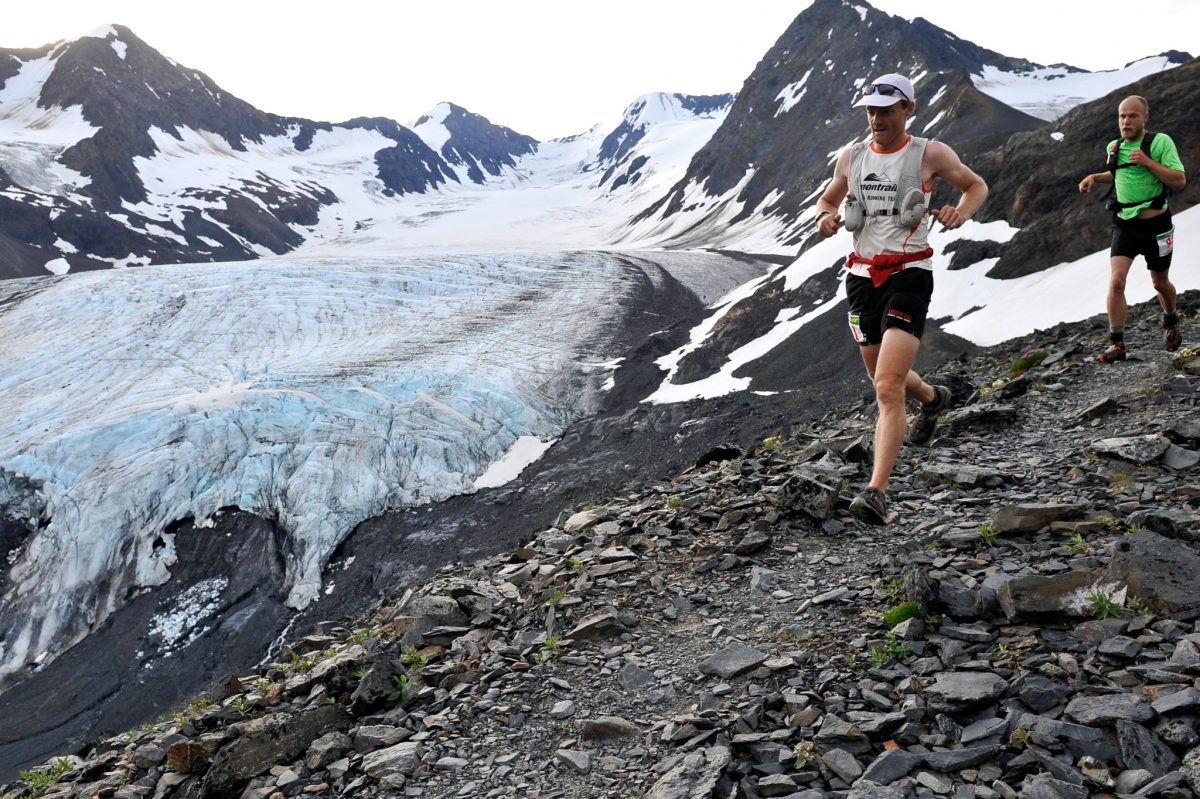
    Geoff Roes leads the way in the 2011 Crow Pass Crossing with the Raven Glacier in the background. (Photo: Matt Hage/Crow Pass Crossing)

    To dive further into the story and what a result like this implies as he prepares for an Olympic year, FasterSkier connected with Patterson on a call on August 9th. Patterson also discussed his pursuit of the record at Crow Pass, and his decision to repeatedly come back to Crow Pass despite the lack of prestige it may hold relative to other well known Alaskan running events. 

    “I think it was one of the first Alaskan mountain running races that I actually won,” Patterson explained. “And so it kind of felt like it’s this one that I’ve got a good history with and I always want to come back to. I’ve won it a lot, but it seems like every year it gets slower. It’s more overgrown, there’s more downed trees, there have been a couple of reroutes of the trail, which have slowed things down. So, as I’ve gone through these years, I have just felt like I could maybe get the record, but it’s been a little bit out of touch.”

    While this year, Patterson gapped the field to win by a margin of almost seventeen minutes, he has often had chasers only a few minutes back. That said, he explained that he typically spends the majority of the race running on his own and sees this as a factor that has historically held him back mentally from pursuing the record in earnest.

    “My strength is always the first miles climbing up to the pass. So I always tend to break away really early, and then run on my own for 18 to 20 miles of the race. And it’s a long run, so it’s like, ‘Okay, I think I can run faster.’ But sometimes, you’re kind of just running along the bottom of the river valley just running along, get a little distracted and lose motivation, trip a couple times and slow down… And so I’m solid at it, but that record has kind of felt out of reach.

    “This year, I kind of went into like, ‘Okay.’ I haven’t run the course, since we raced before COVID, so it’s been two years since I’ve been on the full race course. I actually got to ride down to the start with the race director. And he was asking me, if I thought I had a course record in me, and I said, ‘Ehh — I think I’ve got sub three hours in me’… but I really didn’t think I had the record. And then going out into the race, I hit the pass where my friend and former teammate Eric Packer was up at the top. I came through there with a really good split, and he was cheering me on. I was thinking to myself that I had one good split, so I better keep going and pushing hard.”

    Fourteen miles and multiple water crossings later, Patterson reached an unofficial checkpoint known as the Perch, and looked at his watch to see how close he was to the record with four miles to go.

    “I was exactly 30 minutes from the course record. I know I can definitely run in from the Perch in sub-30. So it was great, kind of that last final spur of motivation. I think I said in the [Anchorage Daily News] article that I threw down some sub-six-minute miles on the trail after that, when I realized I was going to get the record and kept pushing to try and make sure it actually happened.”

    While overall, the course has gotten slightly longer and, according to long-time racers, “harder”, Patterson credited ideal racing conditions this year for his ability to capitalize on his fitness and take down the record. 

    “It was just kind of a combination of really good conditions. It was not too bad of temperatures — not too hot, not too cold. The brush — the trail is pretty notorious for getting overgrown, and that’s part of the challenge of the race is that in the middle 10 miles it can be hard to really see your feet in places while running a technical trail. And so that section was actually in pretty good shape this year. The race organizer and a few others had gone out a month before and done some brushwork, and we really thought it wouldn’t make a difference because it was a month out, but it ended up being great conditions. So I was really excited to take advantage of that.”
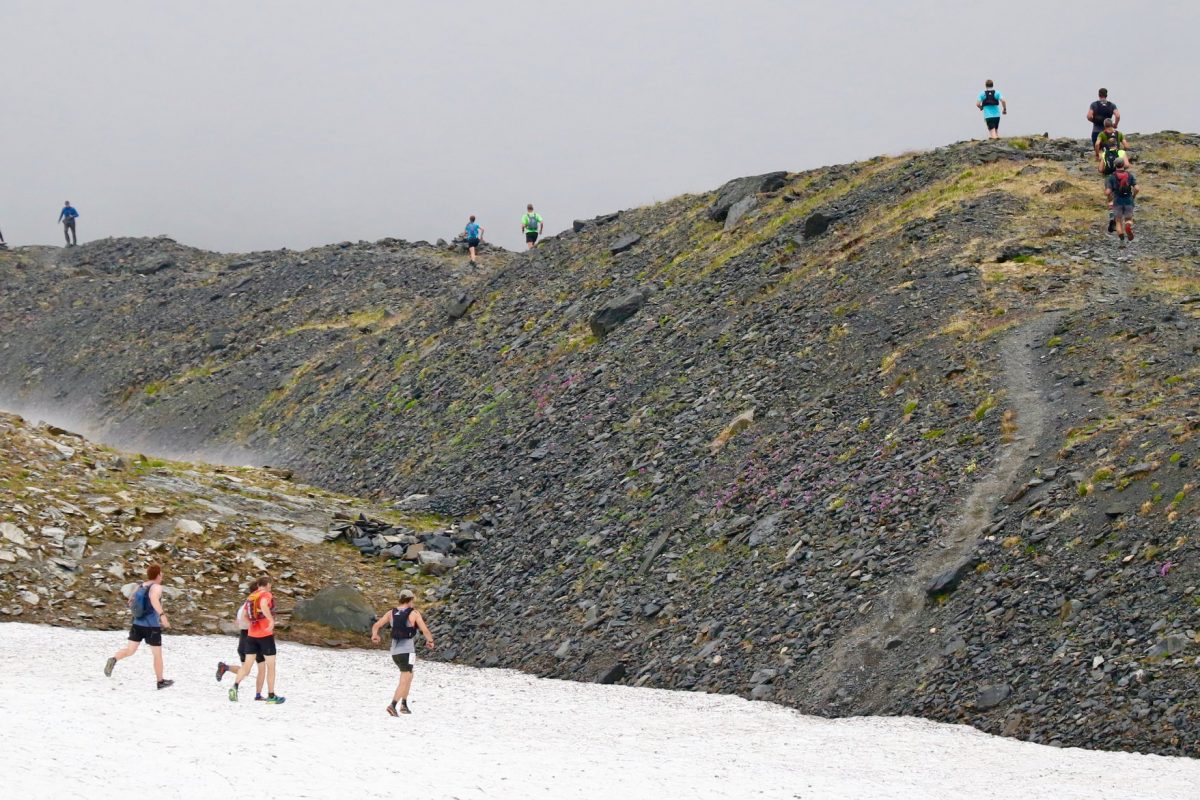
    Runners cross a snowfield as they begin the descent from Crow Pass during the 2019 event. (Photo: Brikru Photography/Crow Pass Crossing)

    So far, you’ve read about 3,000 feet of climbing, water crossings, and an overgrown cobbled trail along a river bottom. But this subset of obstacles does not fully paint the picture of how burly the Crow Pass Crossing is to an outsider. To bring this section of the Last Frontier a little closer to those of us in the Lower 48, Patterson further broke down the course, which includes a little bit of everything the Chugach has to offer. 

    Starting at a trailhead at the end of the road outside of Girdwood — home to Alyeska ski resort —  the trail climbs 2,200 feet to Crow Pass, rapidly ascending from the lush undergrowth of a coastal rainforest to subalpine tundra. Patterson describes this section as “beautiful trail, easy running.” [According to FasterSkier contributor and multiple time race finisher Gavin Kentch, those without an Olympic level engine may not describe this climb as “easy”.]

    Dropping over the pass, racers are met with spectacular views as they navigate glacial terrain.

    “That’s kind of the classic photo. You can see Raven Glacier in the background, and there’s a few snowfields you cross because it’s northern aspect and it just holds snow over the summer. You drop down, gradually to start, into Raven Creek gorge. And again, you’re still above treeline, so it’s really nice.”

    Here, racers pick their way through loose shale while running down a series of moraines as they continue to drop to the first major creek crossing, which Patterson described as “knee high,” although it has a very strong current. The trail follows Raven Creek as it descends down the valley toward its confluence with the Eagle River. 

    “And that’s where you really start getting into the brush… It’s still a really good trail underneath, but it’s just overgrown. So it’s alders, it’s cow parsnip — and on a sunny day, those can give you some pretty bad rashes, so you have to watch out for that. There’s stinging nettles, and rose bushes, and other spiky things. And it just kind of covers the trail on either side.”

    In this section, experience reigns. Runners spend 30 minutes to an hour loping through an extended rolling downhill, pushing back chest to eye-level overhanging vegetation while attempting to dodge the hidden toe-grabbing rocks below.

    Patterson explained that his previous runs gave him the insight to trust his footing even when he couldn’t see where his feet were landing, and he remembered the sections where he needed to slow down to avoid obstacles underneath the vegetation. Patterson recalled that a few years ago, a handful of higher profile non-Alaskan mountain runners came to the event, but their lack of experience on the trail held them back during this section.

    “It’s really about knowing the trail more than just running, so it becomes really tricky for them.”

    Just before the confluence, the trail peels away from Raven Creek and climbs gradually over a divide before dropping down to the Eagle River. 

    “The Eagle River crossing is kind of a distinctive feature that everyone thinks of with Crow Pass. You’re crossing the river a couple miles downstream of the glacier, but it’s pouring out a solid amount of water. I mean, I think this year, I was probably upper thigh [deep] crossing. I mean, I’m basically six feet. So anyone smaller is starting to get pretty wet and pushed around a little bit.”

    Runners cross the icy Eagle River during the 2019 Crow Pass Crossing. (Photo courtesy of Crow Pass Crossing)

    Not only will you get “wet and pushed around”, but the water temperature is what you’d expect given its proximity to the glacial source.

    So you’ve successfully forded the river, found the trail on the other side of a featureless gravel bar, and avoided cramping after a minute or more in the icy water, but we’ve only made it halfway. The next 11 miles continue down the Eagle River Valley, between towering granite peaks often compared to Yosemite. The trail stays mostly at river level, with a few exceptions where it hops up onto a bench above the river. 

    “There’s one place — it’s called Chutes and Ladders — where it’s these quick up and downs and there’s a few ladders going over rocks, and then a descent with a rope to grab on to. It’s kind of tricky, slows you down.”

    This section is also where many of the reroutes Patterson mentions have taken place. Over the last few years, sections of trail that were being eroded by the river have been rebuilt higher up. In the year Roes set his long-standing record, runners were able to run along the floodplain of the river, whereas now, racers are climbing and traversing above the river.

    “It was just flat fast running versus rock on the hillside,” Patterson explained.

    The most significant of these climbs happens around mile 18 as racers approach The Perch. 

    “It’s the only significant elevation after the top of the pass at mile three. So there you are at mile 18 trying to climb up this decent ascent. I mean, it’s nothing huge, but after running downhill for the last 15 miles, you really feel the uphill.”

    As runners approach the Eagle River Nature Center, the trail turns to a dirt road double track, where those fit enough to still have pop in their step can open up their stride and cruise the last couple of miles. But, sticking with the theme of the race, the final mile contains a steady climb of about 100 feet. 

    “The last mile is going from basically river elevation up to the Nature Center. It’s just this gradual uphill that kind of grinds you down for the little bit to the finish.”

    Patterson covered this final mile in 6:15.
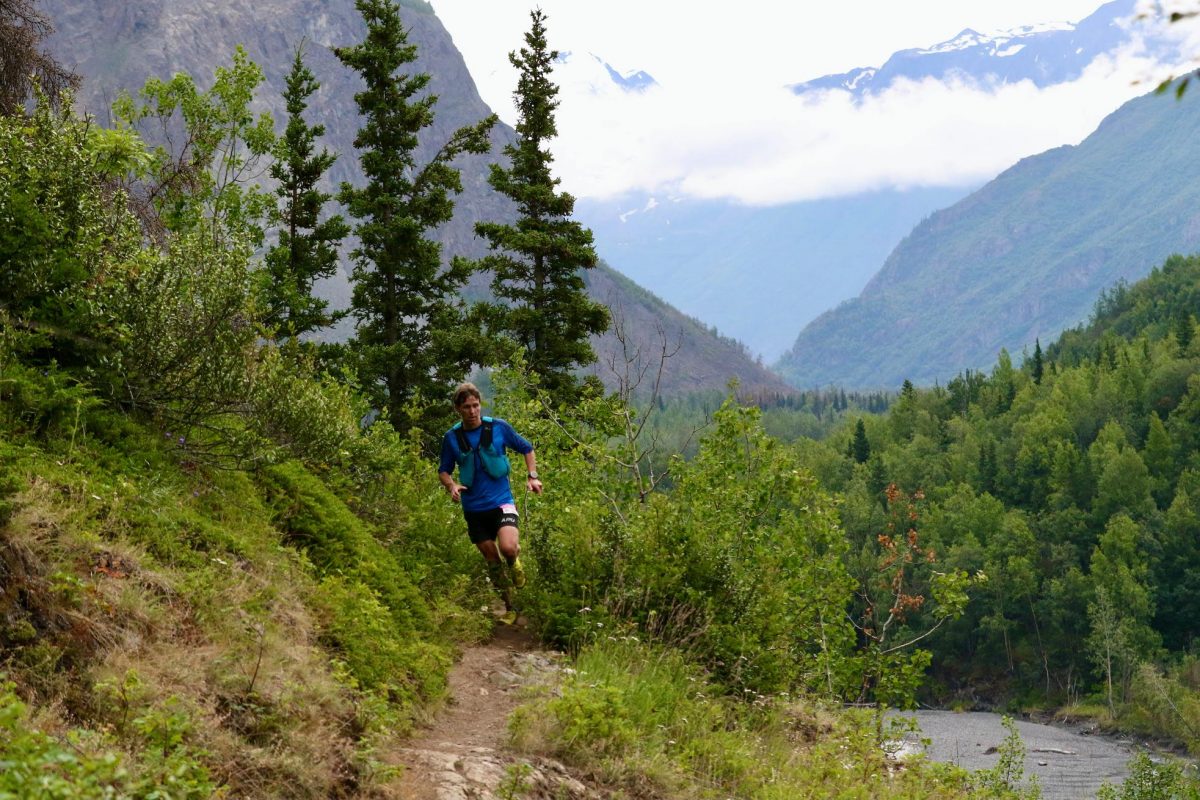
    Scott Patterson sets a remarkable new course record at the 2021 Crow Pass Crossing. (Photo: Brikru Photography/Crow Pass Crossing)

    By all accounts, the Crow Pass Crossing is “low key”. There are no course markings, no aid stations, no pacers, no support, no help at the river crossing, no prize money save for a course-record bonus, few rules beyond required safety gear, and the participant list is almost entirely Alaskan. The event is also a fundraiser for the local non-profit Healthy Futures AK, which aims to empower Alaskan youth to lead active lifestyles. 

    Patterson explained that the simplicity and lack of “hype” are part of what draws him back year after year.

    “Usually it’s kind of the local scene,” he explained in a call. “It’s a big deal for those of us that like the race, but it’s got nothing like the hype of, like Mount Marathon or something like that. Which, for me this summer has definitely been something I’ve kind of keyed into. I didn’t race Mt Marathon, partially with all the hype. I didn’t want to deal with it. With something like Crow, it’s kind of low key; just go and do it on the weekend and have fun, And then it’s over and you move onto the next thing.”

    The next thing was a week later — the Cirque Series event at Alyeska, which packs almost 4,000 feet of climbing and descent into a 5.9 mile loop. 

    “That one’s a little more hyped up, but it also had some prize money, which I didn’t feel like passing up on.”

    Patterson won that one too, setting a course record and taking home a $1000 check. 

    Looking ahead, Patterson acknowledged that his big goal is six months away: the 2022 Beijing Winter Olympic Games. Patterson had strong results at the 2021 World Championships in Oberstdorf, Germany, finishing 10th in the 50-kilometer classic and 14th in the 30k skiathlon. 

    Amidst high-volume summer training with the APU Team, Patterson explains that he holds his results in summer mountain races lightly. They provide insight into his training, but he does not project into the ski season based on a course record earned in the summer. 

    “We don’t do that many time trials during summer, so [results at Crow Pass and the Cirque Series are] definitely one of those markers that I always have. But it’s a little hard to read too much into them, because, like Crow Pass, you get a great year, and it’s fast, then it’s a nasty, rainy, cold year and you probably don’t want to read too heavily into it. But I think I mean, for me, I’ve done four races this summer, and set course records on three of them. So between that, and then also just taking in the other factors from intervals, some of the time for time trials we do, things like that, it really kind of gives us a good overall picture for going into the season. So it’s definitely a marker, but it’s not the only one.”

    Besides the Cirque Series race, the two races Patterson mentions were Kal’s Knoya Ridge Run and the Robert Spurr Memorial Hill Climb on Bird Ridge, both of which he called “low key” and put on by Alaska Mountain Runners. Patterson snagged the course record on Knoya Ridge, but laughed that David Norris “crushed him a bit” on Bird Ridge. He explained that there were a few others he looked at, but he decided he didn’t want to do too much summer racing coming into the Olympic year. 
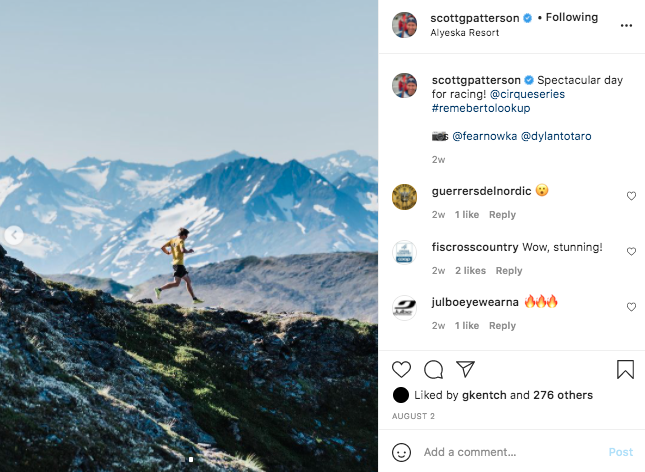
    Scott Patterson sets the course record at the Cirque Series Alyeska mountain race on July 31st. (Photo: Instagram @scottgpatterson)

    If his proclivity toward low key races and relatively low profile on social media haven’t already indicated to you that Patterson is humble and modest, his closing statement on his current fitness and how he’s feeling heading into the season should do the trick. 

    “I’m pretty psyched with where I am right now with some fast races and then some good other signs. So training is going well for the summer.”


    – Additional course intel contributed by Gavin Kentch.

  • Alaska REG Recap: Into the Wild

    Alaska REG Recap: Into the Wild

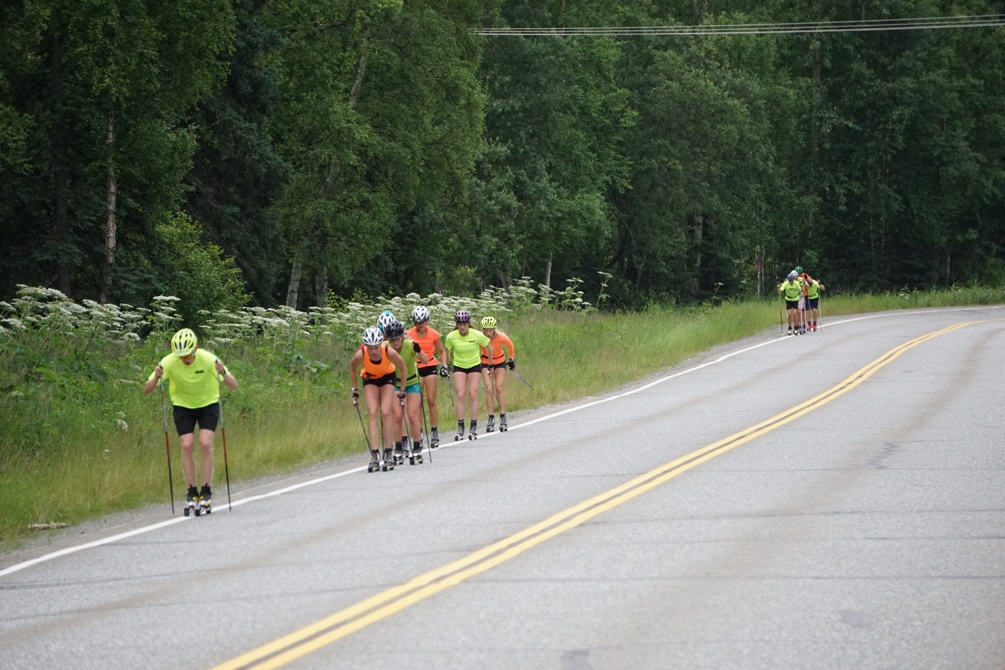
    The Alaska REG participants near the start of the Hatcher Pass Road climb during their final session of the 2017 Alaska REG camp, held July 12-16 in Anchorage and Palmer. (Photo: Alasdair Tutt)

    The following Regional Elite Group (REG) camp recap was submitted by NSCF-FXC Interim Head Coach Alasdair Tutt. FasterSkier encourages coaches and athletes from any regional offseason camps (dryland or on-snow, in the U.S., Canada or abroad) to submit their own recaps and photos to info@fasterskier.com. The Western and Eastern REG camps took place last month in Utah and Vermont, respectively.

    ***

    On July 12, 16 athletes gathered at Hillside Ski Area in Anchorage for the 2017 Alaska REG camp, kicking off five days of testing and training. The first day was in Anchorage before heading north to Palmer for the remainder of the camp.

    The camp was led by U.S. Ski Team Development Coach Bryan Fish who was joined over the week by Ja Dorris and Stan Carrick of Alaska Nordic Racing (ANR), Eric Strabel and Sam Sterling of Alaska Pacific University (APU), Jan Buron of Alaska Winter Stars (AWS), and Alasdair Tutt of Nordic Ski Club of Fairbanks – Fairbanks XC (NSCF-FXC).

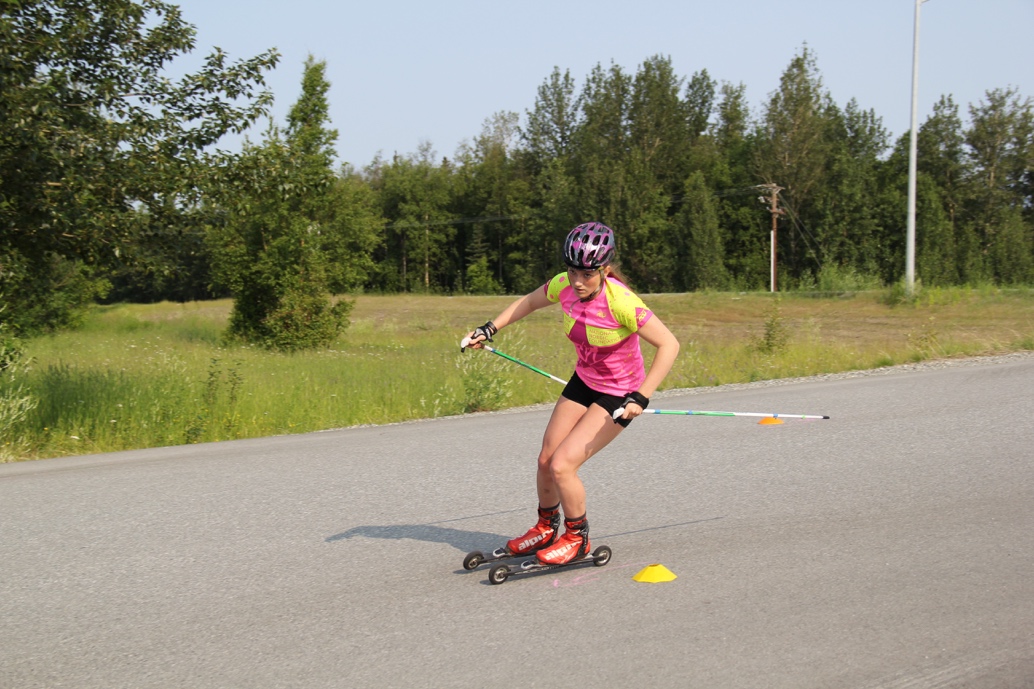
    Addison Gibson (ANR) on course during the agility time trial where she posted the fastest time of the day. (Photo: Bryan Fish)

    The first test was the infamous Gasline time-trial uphill run, a regular test for the Anchorage-based teams and previous REG camps. The course saw the athletes wind up beside an alpine run before appearing out onto the road overlooking the sea. The fastest times were set by Ti Donaldson and Kendall Kramer, both of the NSCF-FXC program. That afternoon, athletes were led through a strength workout by Bryan at the Alaska Pacific University gym.

    Day 2 brought the agility test at Colony Middle School in Palmer and with it some of the more exciting and competitive testing of the camp. The fastest combined times (best two of three) were set by Addison Gibson (ANR) and Donaldson.

    That afternoon, our grand plans for bounding drills were mostly foundered by a huge lightning storm that came in over Hatcher Pass that had us running back to the cabin to find a river where the lawn had once been, now occupied by a moose cow and two calves.

    It was game on for some head-to-head double pole sprints just below the Government Peak Recreation Area trails in Fishhook, Alaska. Athletes raced in a king’s court format both up and downhill. (Photo: Alasdair Tutt)

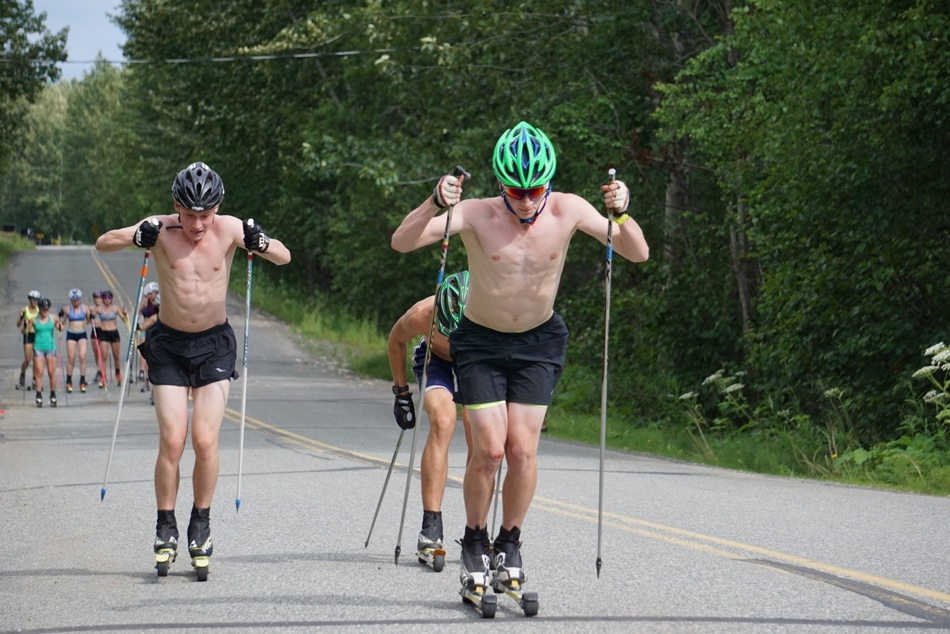
    On the third day, we had much better luck with our weather and a double-pole time trial was on the menu as our final test of the camp. Over a 970-meter course on Mountain Trails Road, the athletes were sent to chase down their best performances leading to three athletes being separated by only one second each. The best times were again set by Kramer and Donaldson of Fairbanks. That afternoon we braved the growing afternoon traffic with a rollerski up Hatcher Pass Road with some technique work at key points along the road.

    Some highlights of the remainder of the camp were: an over-distance workout on the Reed Lakes Trail, where athletes were fortunate enough to avoid several brown bears in the vicinity who were harassing hikers (or being harassed), a critical viewing of the new Spiderman movie in which we decided Spiderman exhibited a great example of how the Central Governor Theory could be applied in a superhero scenario, and a final day classic rollerski up the Hatcher Pass Road.

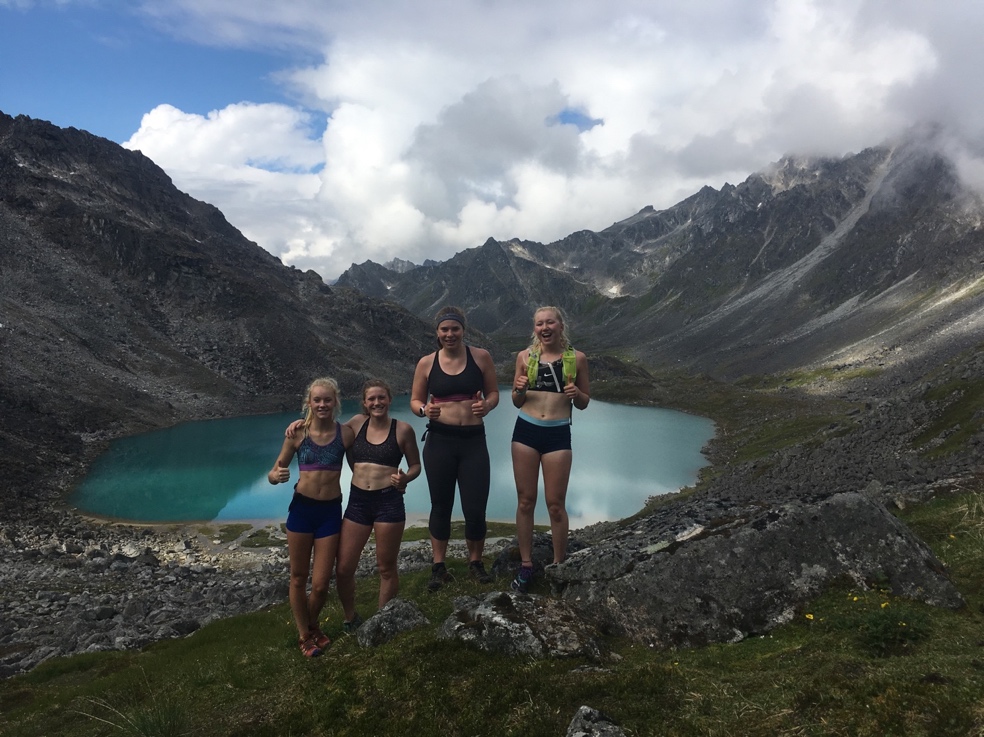
    Four REG skiers at Upper Reed Lake in the Hatcher Pass area during an over-distance workout on the second-to-last day of the 2017 Alaska REG camp earlier this month. (Photo: Alasdair Tutt)
  • ‘Why Not Go Again?’ Patterson Makes Mt. Marathon His Own One Year Later

    ‘Why Not Go Again?’ Patterson Makes Mt. Marathon His Own One Year Later

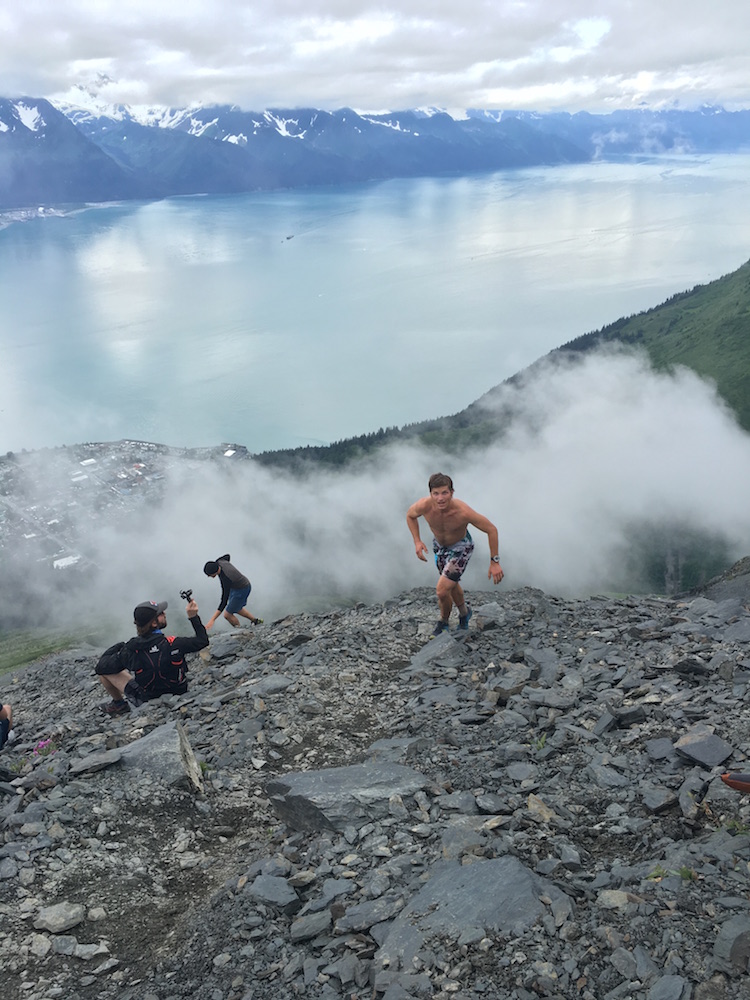
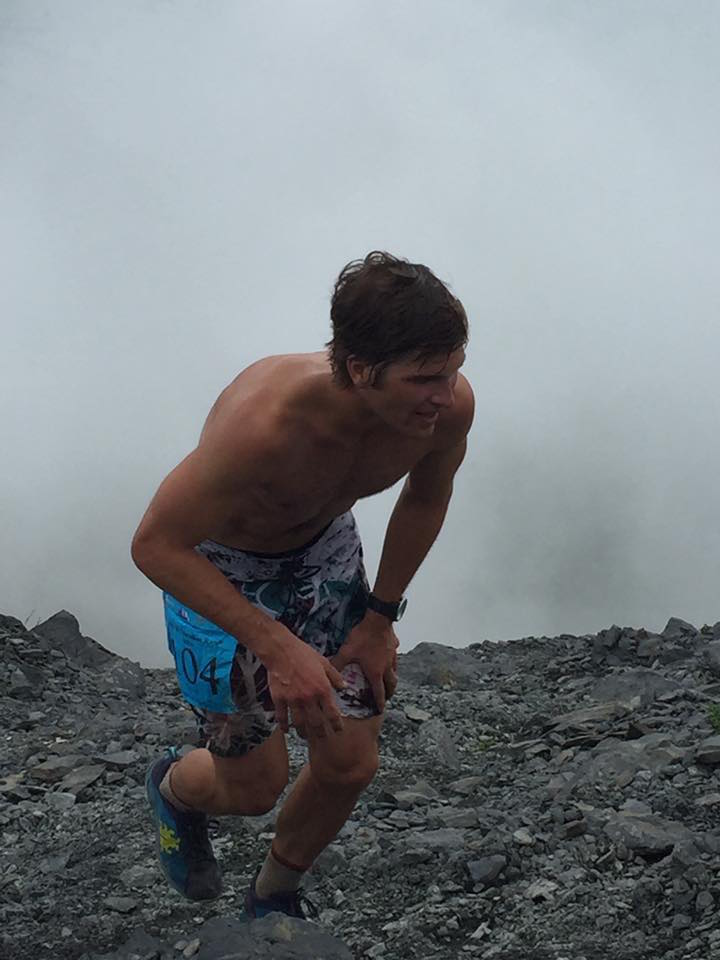
    U.S. Ski Team B-team member and Alaska Pacific University skier Scott Patterson scaling his way to the top of Mt. Marathon in Seward, Alaska on July 4, 2017. (Photo: Rob Whitney)

    As with other epic modern-day adventure race series, the fabled origin of Seward, Alaska’s annual Mount Marathon — held every July 4 — began with beer and a bet: who among us can run from the streets of downtown to the top of the 3,022-foot mountain crowding Seward’s skyline, then back to the bottom the fastest? What about within the hour?

    While the footrace race has evolved massively since the port town’s pioneer miners took on the challenge, clambering up its craggy course in woolen pants and workman’s boots nearly 90 years ago, it holds no less prestige for the millennial athletes or spectators who partake nowadays. To many Last Frontier residents, it is their Olympics. An estimated 30,000 outsiders annually inundate the town’s (population 2,500) sidewalks just to watch the event.

    “It’s Mount Marathon. It’s Alaska. It’s my Fourth of July,” Allie Ostrander, the 2017 women’s overall race winner and a Soldotna, Alask. native, told Alaska Dispatch News reporter (and former FasterSkier editor) Nat Herz after the competition. “Fourth of July feels empty without Mount Marathon.”

    Scott Patterson on his way to winning the 2017 Mt. Marathon running race on July 4 in Seward, Alaska. (Photo: Holly Brooks)

    Despite the obvious risks associated with careening down a mountain at top speed, stories of close encounters with kidney failure, brain-damaging falls, and disappearance deterred a few from re-entering this year’s version of the event.

    The upcoming 2018 PyeongChang Winter Olympics was reason enough for the current Mt. Marathon course-record holder and last year’s overall male champion, David Norris, to watch from the sidelines. His Alaska Pacific University (APU) teammate, Scott Patterson, who also recently earned a U.S. Ski Team (USST) nomination, however, did not.

    “It’s a big deal up here. I just figured why not go again?” Patterson, an Anchorage native, explained on the phone.

    In his debut Mt. Marathon race, Patterson had twisted his ankle and ultimately finished fourth last year. This year, as he weighed out his risk in racing, he arrived at a far less insidious calculation.

    “There’s definitely always a risk, that downhill is tricky,” Patterson said. “But I think looking at the competition beforehand, I knew that I could probably have a pretty good lead at the top and stake the downhill at my own speed; not really have to duke it out with someone down the hill.”

    With that, Patterson entered the 2017 event aiming for the win, but not the record. Norris was not on the start list, nor Kilian Jornet, the 2015 record holder and a professional ski mountaineer and ultramarathon  runner, not to mention Patterson had recently returned from the men’s USST training camp in Park City, Utah, which ran from June 26-July 5. Patterson departed the camp early to return for the race. 

    “Everyone was saying going into it that it was my race to lose,” the 25-year-old Patterson said. “The other guys who could really challenge me on the uphills this year skipped it, so it was kind of just me just out there on my own.”

    Patterson completed the 5-kilometer race in a time of 44:30 for the win, just over three minutes off the course record. The closest male finishers behind Patterson were Erik Johnson in second place just under a minute back (+0:52), and Kenneth Brewer in third, a little over two minutes behind (+2:23). Patterson’s first-place finish at Mt. Marathon is nothing unheard of among cross-country skiers. A number of other nordic athletes have been crowned the overall champion, including current USST A-team member Kikkan Randall, former USST athlete and Olympian Holly Brooks, APU nordic coach Eric Strabel, and Norris.  

    Morgan Arritola scaling her way to the top of Mt. Marathon in Seward, Alaska on July 4, 2017. (Photo: Rob Whitney)

    The runner-up in this year’s women’s event, Morgan Arritola, was also a member of the 2010 Vancouver nordic Olympic squad and skied competitively for over six years before she made the switch to mountain running in 2012. In her debut Mt. Marathon race, Arritola, 31, finished second in a time of 51:09, a minute and fifty seconds behind the 20-year-old Ostrander, who won in 49:19.

    While Arritola did preview the course once, she also indicated that she didn’t hold a whole lot over herself in terms of expectations and outcome going into race. Ultimately her goal coming into her first Mt. Marathon event was to “take it all in.” In discussions with her former teammates and champions, Randall and Brooks, the advice remained fairly simple: enjoy the atmosphere.

    “I didn’t really pre-race research. That’s not really my style,” Arritola, of Ketchum, Idaho, wrote in an email to FasterSkier. “Everyone has their own way of handling racing and I tend not to overthink.

    “I would love to come back next year,” she continued. “If there was a race-specific goal it would be to know the route I’m taking better. I asked for directions a few times 🙂 and be more confident on the downhill. I haven’t raced that kind of downhill and I just never got into a good rhythm.”

    While Arritola has three U.S. Mountain Running Championship titles to her name and a World Mountain Running bronze medal, mountain running is not where she is indelibly focused. She is currently going back to school for a degree in respiratory therapy and working various jobs to help fund her racing, such as The Rut 50 k in Big Sky, Mont., which she is registered to race in September.

    “I’m not running full time like with skiing,” Arritola wrote. “I am in my last year of school and running just keeps me sane. I don’t overthink it, I do what I want with it, and I enjoy it.”

    Finishing behind Arritola to round out the women’s top three was mother of three and three-time Mt. Marathon champion, Christy Marvin, in third place with a time of 52:22.

    In the junior race division of the event — in which racers run approximately halfway up the mountain before turning around for the descent — APU’s Luke Jager won the boys’ race in a time of 29:09, marking Jager’s second junior title in a row. Jager was followed by Gavin Block in second in a time of 29:32 and Ali Papillon in third in a time of 30 flat. The junior girls title went to Molly Gellert (Alaska Winter Stars) in a time of 32:53, also for the second year in a row. Behind Gellert in second was Ruby Lindquist finishing in a time of 33:55. Kendall Kramer (FXC) came in third, finishing in a time of 35:06 for the girls race.

    Results

  • Besh Cup Series Wraps up in Fairbanks as Team Alaska is Named

    Besh Cup Series Wraps up in Fairbanks as Team Alaska is Named

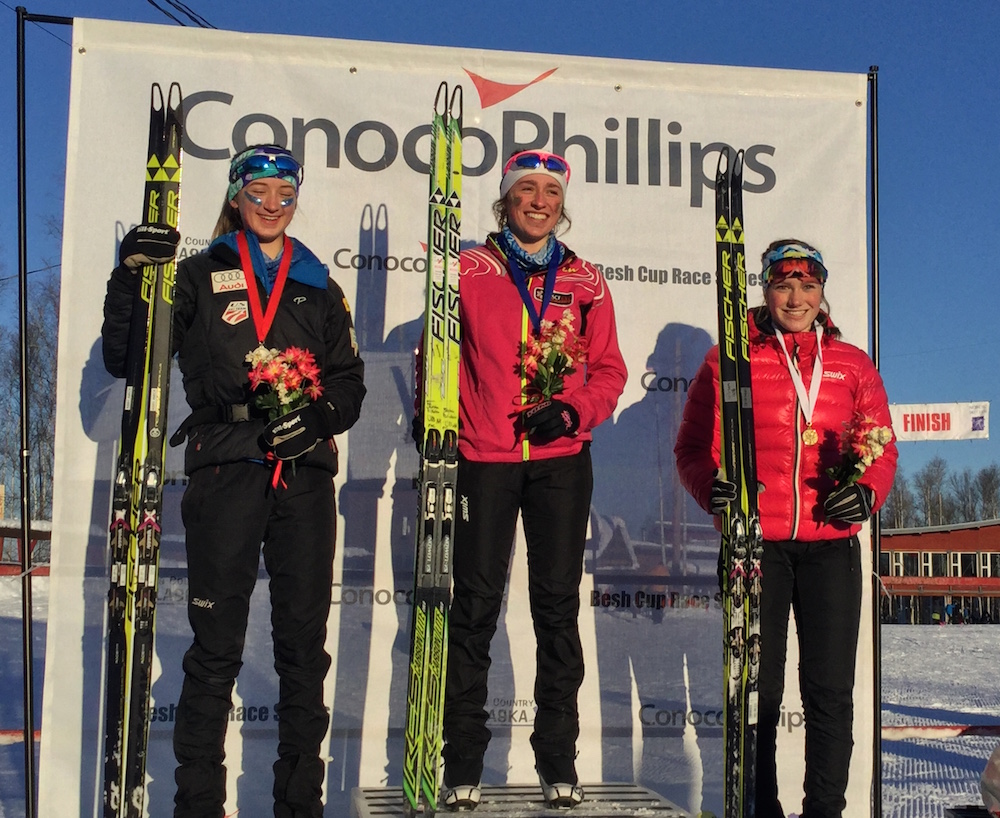
    Jenna DiFolco (c) of FXC, Abby Amick of APU (l), and Addison Gibson of ANR (r) on the podium for the U18 girls division of the Besh Cup 5 k skate race in Fairbanks, Alaska, Feb. 4, 2017. (Photo: Gavin Kentch)
    Jenna DiFolco (c) of FXC, Abby Amick of APU (l), and Addison Gibson of ANR (r) on the podium for the U18 girls division of the Besh Cup 5 k skate race in Fairbanks, Alaska, Feb. 4, 2017. 

    FAIRBANKS, Alaska — Alaska Airlines operates roughly 10 flights a day between Anchorage and Fairbanks. Last Friday morning many of those flights were packed with skiers, and ski bags piled up at baggage claim in Fairbanks, as Anchorage skiers streamed north for the final weekend of Besh Cup racing to select Alaska’s representatives to next month’s Junior Nationals in Lake Placid, N.Y. Two days later many of those same skiers returned south with plans to fly all the way to Lake Placid, where Team Alaska will have roughly equal representation from the state’s two largest cities.

    The 2016/2017 Besh Cup series concluded with a pair of distance races at Birch Hill ski area: freestyle interval start on Saturday, classic mass start on Sunday. The weather for both days was Fairbanks at its mid-winter best, clear and sunny and relatively warm. Cold powder and hard glide waxes were de rigueur.

    (The emphasis here is on relatively, as national FasterSkier readers might find Saturday’s race-time temperature of 10 degrees Fahrenheit, or Sunday’s reading of 2 degrees, objectively not all that warm. But it was -16 degrees at the airport on Sunday – Birch Hill’s elevated location on a hill above town often keeps it significantly warmer than the low-lying areas of central Fairbanks where official temperature readings are taken – and it is forecast to be -35 degrees in Fairbanks by later this week. So, relatively warm.)

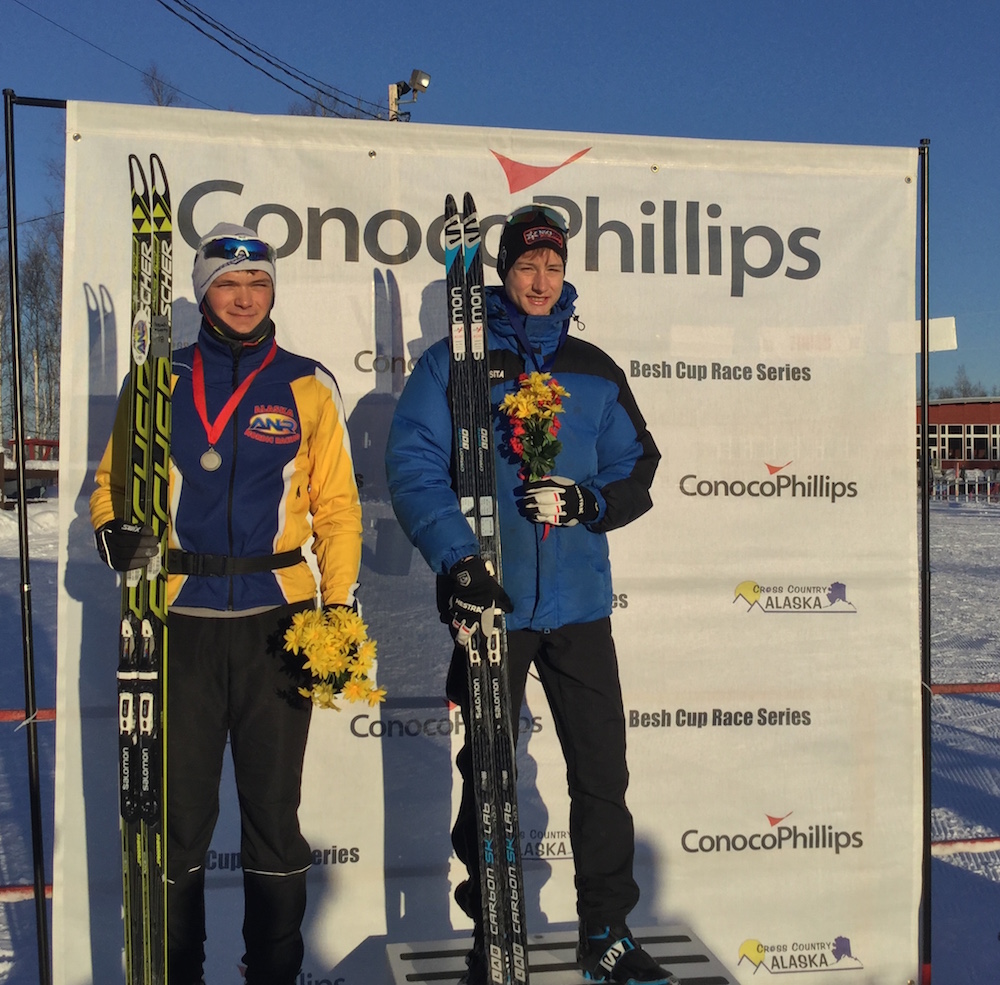
    The first race on Saturday was the boys 10-kilometer freestyle individual start for racers in the U18 division and older, 45 starters in all. The overall podium on Saturday was U18 skier Ti Donaldson of the Nordic Ski Club Fairbanks racing team (FXC), Senior skier Cody Priest of Alaska Nordic Racing (ANR), and U18 skier Josiah Alverts (ANR).

    Among U20 men, FXC skier Benjamin Koenig was first, leading his teammate Logan Mowry in second and Dax Cvancara of ANR in third.

    The U18 boys division, which saw two of the top-three overall finishers, had Donaldson in first, Alverts in second, and APU skier Tristan Wiese in third.

    U16 boys raced a 5 k skate individual start, covering one lap of the blue course that 10 k skiers completed twice. Eli Hermanson of Alaska Winter Stars (AWS) led the all-Anchorage-area podium in the 5 k, followed by George Cvancara of ANR and Zanden McMullen of APU.

    Finally, the U14 boys raced a 1 k skate ski-cross event, with jumps, gates, slaloms, and other technical challenges. The event is a crowd favorite that, race organizers wrote, “helps develop skiers’ abilities to ski in a ‘pack’ along with developing technical skills.” (It may also soon be coming to a race series near you! Here is an example from the 2016 Youth Olympic Games in Lillehammer.) In another Anchorage-area sweep, Aaron Maves of APU took the A-Final, followed by Rudy Schumacher of AWS and Konrad Renner from ANR.

    On the girls side, a field of 57 racers (U16 and older) contested a 5 k skate individual start. At the end of one lap around the blue course, APU skier Maggie York took the overall victory by 40 seconds over FXC skier Jenna DiFolco, with Kendall Kramer (FXC) another 14 seconds back.

    York also topped the U20 podium. She was followed there by Alyeska Daniels and Lupua Oba, both of FXC.

    DiFolco, second overall, was first among U18 girls. Second in this division was Abby Amick of APU, with ANR’s Addison Gibson third.

    U16 girls took third through fifth overall in the combined U16/U18/U20/Masters field for the 5 k (there were no Senior skiers in the race). Locals Kendall Kramer and Kaya Ratzlaff of FXC led this division, with Annika Hanestad (ANR) third.

    U14 girls also raced a 1 k ski cross. First here was Quincy Donley of AWS, continuing her winning ways from the Anchorage and Soldotna Besh Cup weekends. She was followed across the finish line of the A-Final by Marit Flora of APU and Katey Houser of ANR.

    Ti Donaldson of FXC (r) and Josiah Alverts of ANR (l) on the podium for the U18 boys division of the Besh Cup 10 k skate race in Fairbanks, Alaska, Feb. 4, 2017. (Photo: Gavin Kentch)
    Ti Donaldson of FXC (r) and Josiah Alverts of ANR (l) on the podium for the U18 boys division of the Besh Cup 10 k skate race in Fairbanks, Alaska, Feb. 4, 2017. 

    Saturday’s overall winner for the boys race, U18 skier Ti Donaldson, was racing on home turf. “I’ve had a few wins [in the Besh Cup series] in the past,” Donaldson told FasterSkier in an in-person interview following the race. “Most of them have been in Fairbanks. I’m from here, so definitely a home-field advantage.”

    Donaldson came in expecting a “brutal” race, based on his knowledge of the course and his time previewing it. “But I knew it would be pretty fast conditions,” he continued – “it was nice and hard, and it wasn’t too cold. So I was pretty excited to see how it would go, and really just wanted to work the transitions and stay strong on the climbs, and crest over. So I stuck to that plan, and it worked out pretty well.”

    Donaldson was looking forward to 2017 Junior Nationals in March.

    “I’d be thrilled with a top-five finish,” Donaldson said of his goals for next month. “Two years ago, when I was racing the same kids, I placed fourth in a race, and so I’d like to repeat that result. That would be a good goal of mine.”

    Jenna DiFolco, the U18 girls winner and second-place overall skier, was also racing at home. She credited “my FXC coaches” for waxing her winning skis, and had hot cereal for breakfast, with raisins and dried cranberries, at home before heading out to Birch Hill.

    The race was “really fun,” DiFolco recounted in an in-person interview. “Warming up, I didn’t feel so good, I was feeling kind of tired, maybe I’d overdone it this week. And then I expected this course to be really hard, because there are so many hills. And it was definitely, like, it was a rough course. But it went a lot better than I expected it to.”

    DiFolco described her strategy for racing a one-lap 5 k course with nearly constant climbing or descending: “The first part is mostly downhill, so I kind of just started out like a sprint almost, because I knew I’d be able to recover on the downhill. And the first couple of hills I was just trying to keep it light, keep it relaxed, and then really start hammering up South Tower [the high point of the course], because I got a big break after that. And then the last two hills are basically just hard, really hard.”

    Looking ahead to Lake Placid, DiFolco said that she was “hoping to get a couple top-10 finishes.” She added, “A big dream, it’d be a big stretch, but I’m hoping to get, like, a podium would be really, really cool. But top 15, top 10 would be awesome.”

    Sunday saw classic mass starts instead of freestyle individual starts, and temperatures around 10 degrees colder, but otherwise it was more of the same. Seven of eight age-group winners from Saturday picked up a second victory on Sunday, as a pair of distance races rewarded skiers who were consistent in both techniques. (The first two weekends had featured one sprint and one distance race apiece, leading to greater variability in the podium finishers.)

    Sunday’s classic race also rewarded skiers who were good at traditional classic skiing, in light of the relatively slow snow and the impressive elevation change of a Birch Hill race course.

    The trails at Birch Hill are built on the side of, well, a hill (also, there are birch trees). The courses used for this weekend’s races were marked by an impressive Height Difference (the elevation change between the lowest and highest points on the course) of 89 meters within a 5-kilometer course. The World Cup skiathlon race that was contested in South Korea the same weekend, on the trails that will be used for the 2018 Winter Olympics in PyeongChang, featured height differences of only 58 and 41 meters on the two skiathlon courses.

    In fact, a height difference of 89 meters is a greater elevation spread than was present on most of the traditional World Cup courses this season, including in Davos (84m), Lillehammer (74m), Falun (69m), and Ulricehamn (57m). That said, some of those courses had more average climb per kilometer than the Birch Hill 5 k course. But only some of them. This may help explain why the winning time for a 10 k skate on Saturday was 29:22 for the men, and 16:15 for 5 k for the women, in a race with some of the top junior skiers in the country. (Winning times for Sunday’s 10 k classic races were 32:17 and 37:53.)

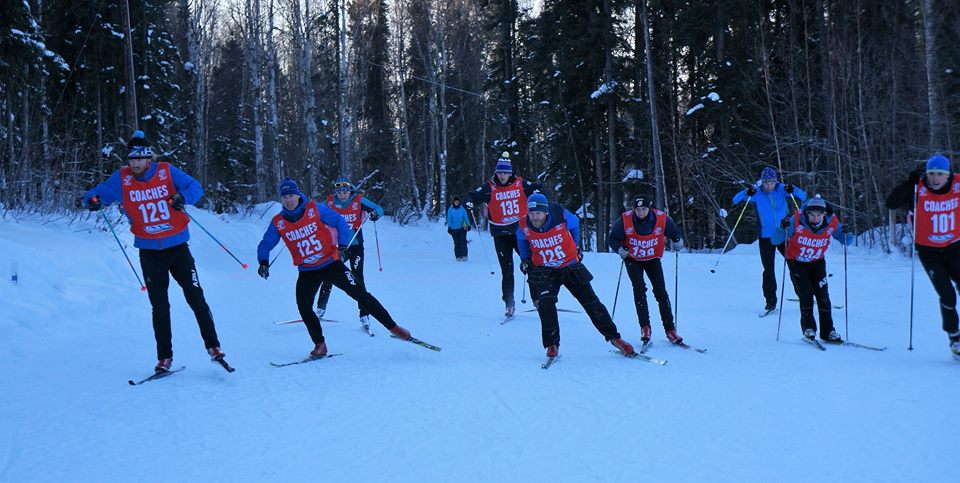
    Coaches compete in the final ski-cross heat of the day, the coaches' race, on Feb. 4 in Fairbanks, Alaska. Racers include Galen Johnston (129), Eric Strabel (125), Anson Moxness (126), and Pete Leonard (101). (Courtesy photo)
    Coaches compete in the final ski-cross heat of the day, the coaches’ race, on Feb. 4 in Fairbanks, Alaska. Racers include Galen Johnston (129), Eric Strabel (125), Anson Moxness (126), and Pete Leonard (101). (Courtesy photo)

    APU Devo and Master Coach Galen Johnston shared his thoughts on the effects of such a course profile after spending the weekend watching his athletes race up and down these hills. “One of the best parts of the weekend was to see how the combination of slow snow and lots of strideable sustained climbing put the focus of the [classic] races on striding and fitness rather than simply double pole strength,” Johnston wrote to FasterSkier on Monday.

    “Courses designed like this can keep striding a viable, and even necessary part of classic skiing,” Johnston continued by email. “Birch Hill has some of the most progressive course designs that I’ve seen and it’s paying off. Skiers ski differently than they did even 10 years ago, and it’s really neat to see a course that can accommodate and challenge that change in style without turning things into an unskiable death march. Estle is keeping people very honest, but still allowing for ample fun,” Johnston concluded in reference to longtime Fairbanks race director and ski-course designer (and former U.S. Ski Team coach) John Estle.

    On Sunday the best strider was DiFolco, who took first place in the 10 k classic mass start race by 19 seconds over Saturday’s winner York. Third overall was ANR skier Heidi Booher (ANR), another 23 seconds back.

    York was again first in the U20 women division. The rest of the podium was also unchanged from Saturday, with Daniels in second and Oba in third.

    DiFolco was again first among U18 girls. Second on Sunday was Booher, with Emma Nelson of ANR third.

    There was a substantial drop-off in distance from U18 girls to U16 girls, with the latter group racing not 10 k but a 3 k classic mass start. First after just under 10 chaotic minutes was Kramer again, edging out her FXC teammate Ratzlaff by 0.7 seconds. Tjarn Bross rounded out the all-FXC podium in third.

    U14 girls raced the same 3 k course as the U16 girls. And after 11 to 12 minutes of racing, it was precisely the same U14 girls podium as on Saturday: Donley, Flora, and Houser.

    On the boys side, U18/U20/Senior/Masters skiers raced a 10 k classic mass start on the same course as the girls. First overall was Lukash Platil (officially unaffiliated, but listed on the University of Alaska Fairbanks (UAF) ski team roster), followed by Donaldson of FXC and Wiese of APU.

    Platil was also first in the Senior men’s division. He was followed there by Kenny Brewer (now unaffiliated, formerly of UAF) and Matt Muffoletto (The Other Guys).

    Among the U20 men, Koenig picked up his second first place of the weekend, and Mowry his second second place. Hamish Wolfe (APU) was third.

    Donaldson and Wiese led the U18 boys. They were followed by Alverts, as the age group podium remained largely unchanged from Saturday.

    The U16 boys raced a 3 k classic mass start. This was the only age group to see a new winner on Sunday, as Cvancara moved up from second the day before to nudge Hermanson down a step on the podium. Everett Cason of APU was third.

    And the U14 boys (also 3 k classic) were again an all-Anchorage affair: Maves once again in first, Rowan Morse (APU) in second, and Schumacher in third.

    Later Sunday afternoon a crowd gathered in the Birch Hill Recreation Center, ignoring Super Bowl LI then in progress, for the naming of Team Alaska for this year’s Junior Nationals (JNs).

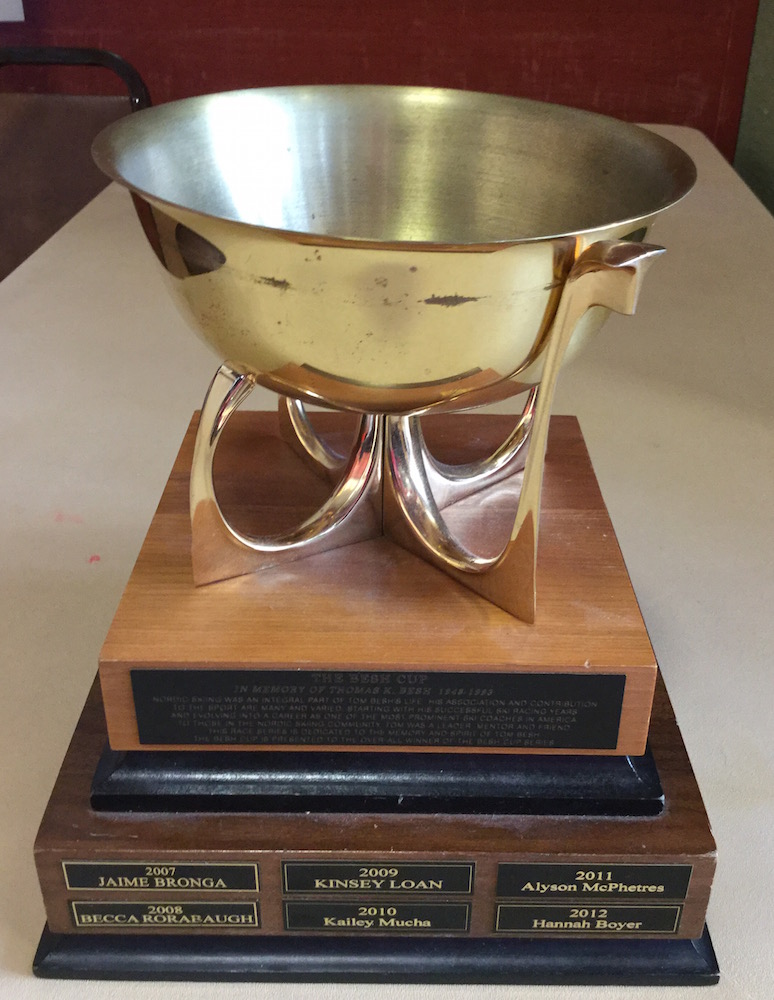
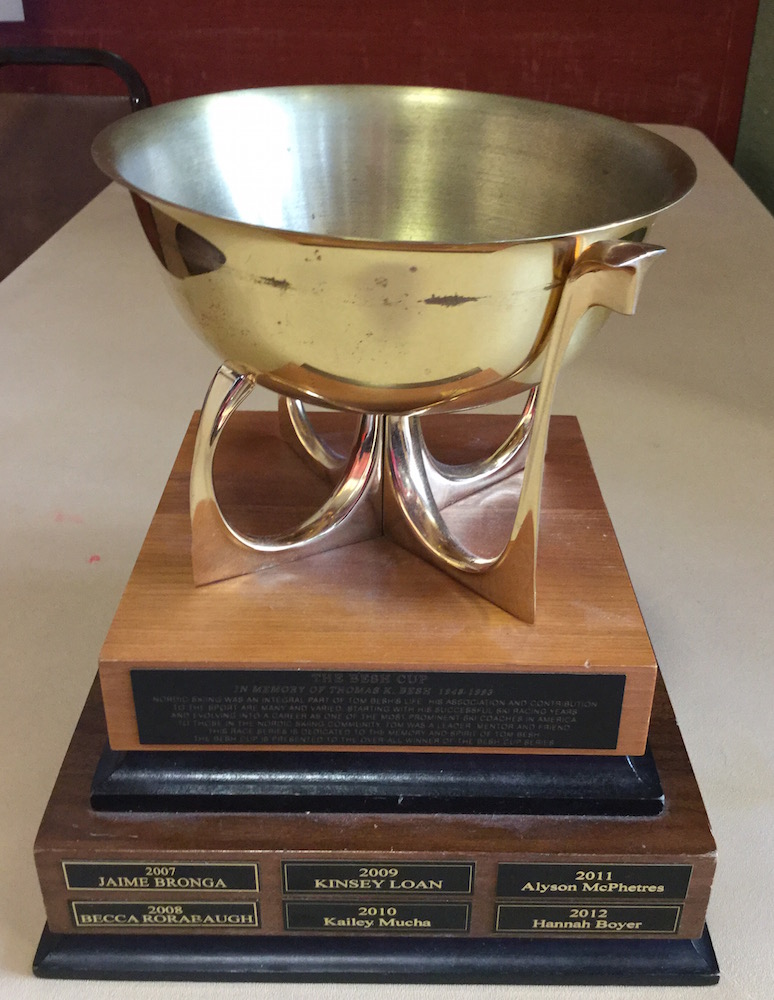
    The Besh Cup Trophy, photographed in Fairbanks, Alaska, in February 2017. (Photo: Gavin Kentch)
    The Besh Cup Trophy, photographed in Fairbanks, Alaska, in February 2017. 

    Cross Country Alaska also awarded the Besh Cup Trophy, given to the U18 or U20 skier with the greatest number of JN qualifying points across all six races combined. This year’s winners were Josiah Alverts for the boys and Jenna DiFolco for the girls. Their names will be added to a trophy, Stanley Cup-style, that includes on its plinth recognizable names from American skiing such as David Norris, Becca Rorabaugh, Reese Hanneman, Andy Liebner, Zach Hall, Eric Strabel, Kate Pearson, and Rob Whitney.

    While winning the Besh Cup Trophy is undeniably prestigious, it also necessarily rewards the best skier who was in Alaska all winter for the races, as opposed to competing Outside or internationally. For example, among U18/U20 girls, you may have heard that the University of Alaska Anchorage’s Hailey Swirbul was racing in Soldier Hollow, while Molly Gellert was on the Scandinavian Cup trip in Norway.

    DiFolco graciously acknowledged as much, telling FasterSkier on Sunday soon after receiving the trophy, “I think some of the fastest skiers are not here, because they pre-qualified [for JNs] and they went on big trips.” But DiFolco still skied the races and earned the results, including two firsts and two seconds in the final four races of the series.

    “It’s pretty cool,” DiFolco said of the season-long honor. “I never would have really expected this to happen a year ago. … I’m pretty proud of it. I’m happy with it.”

    Shortly after the awards ceremony ended the migration began to repeat itself in reverse, as out-of-town skiers loaded up cars in the Birch Hill parking lot for the 7-hour drive south to Anchorage or paraded ski bags through the Fairbanks airport. The flight home for Anchorage skiers was marked by ski hats, team jackets, and quiet chatter, as athletes talked about next month’s trip to the East Coast and parents fretted about missed school days and makeup work.

    Junior Nationals begin in Lake Placid in early March. The first race is a 5/10 k freestyle individual start on March 6.

    Results: skate interval start | classic mass start | overall points lists

    ***

    FasterSkier is seeking contributions (written, photography or videography) from regional race circuits across North America. Please email info@fasterskier.com if interested.

  • Mt. Marathon Rookie, Norris Blasts Course Record

    Mt. Marathon Rookie, Norris Blasts Course Record

    Fairbanks resident David Norris, who skis for Alaska Pacific University (APU), won Monday’s Mount Marathon Race outside Seward, Alaska, in record time.  The 5-kilometer race — which takes racers from the shores of Resurrection Bay up 3,022 feet to the summit of Mt. Marathon and back down again, on slopes as steep as 60 degrees — was first held in 1915 and is among the country’s oldest footraces. A crowd estimated at 30,000 people crams into Seward (pop. 2,500) each July 4 to watch a race that has been described as the “Olympics of Alaska.”

    The former men’s course record was 41:48, set last year by Killian Jornet, a man widely acknowledged as the world’s best mountain runner.

    On Monday, at the 89th edition of the race, Norris took 22 seconds off that time. Running alone for most of the race, Norris was first to the halfway mark of the ascent, first to the turnaround at Race Point (elevation 3,022′), and first across the finish line (elevation approximately 20′, depending on how high the tide is).  He finished in 41:26.

    Jornet tweeted his congratulations to Norris within minutes of the race’s conclusion.  His Twitter feed made it apparent that he had been watching the live feed of the race.

    Three-time champion Eric Strabel, a former APU skier and current APU coach, was third in 44:19.  Scott Patterson, Norris’s teammate on the APU Elite Team, finished fourth in 44:43 after reaching the turnaround point in second.

    In the days leading up to the race, Norris and his teammate Patterson, both race rookies at Mt. Marathon, were marked by the local mountain running community as strong climbers but unproven downhill runners. There was also a suspicion that they might hold back slightly on the descent, in deference to their professional ski careers and out of a desire to avoid injury.

    APU's David Norris ascends Mt. Marathon en route to a course-record time, above Seward, Alaska, on Monday. (Photo: Rob Whitney)
    APU’s David Norris ascends Mt. Marathon en route to a course-record time, above Seward, Alaska, on Monday. (Photo: Rob Whitney)

    Speaking on live television soon after the finish, Norris acknowledged that this was his race strategy.

    “I had enough of a lead that I knew I could take it easy [on the descent] and not hurt myself,” Norris said in his interview with Anchorage’s KTVA Channel 11.

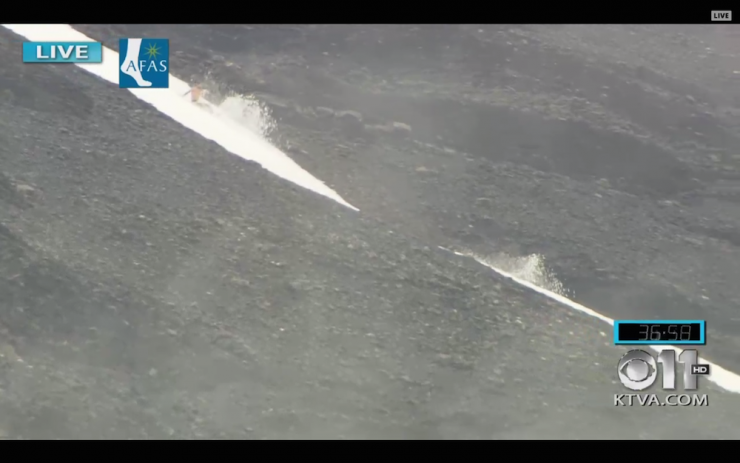
    Describing his descent, in which he lost 3,000 vertical feet in roughly 10 1/2 minutes, Norris recounted sliding down a snowfield for roughly 250 meters near the top: “The snow was totally out of control, the scree was fine,” he said.

    Norris admitted that he had not come in expecting to break the record.  “I thought that my down would be so slow,” he said, “that even if I had a good up, it wouldn’t even matter.”

    But as things turned out, Norris said, “I felt awesome.”

    So was there anything that marred his performance on a day in which Norris set a course record in a century-old footrace?  “I crashed into the willows right in front of the crowd at the bottom,” Norris recalled.  “Other than that it was a perfect race.”

    Other nordic skiers in top ten in the men’s race included former University of Alaska Fairbanks (UAF) skier Kenneth Brewer in ninth. Sixth-place finisher Lyon Kopsack, a current member of the UAF cross-country running team, has also competed in local ski races.

    Women’s race

    Christy Marvin, a stay-at-home mother of three from Palmer, Alaska, won the women’s race in similarly dominant fashion. Competing in the prime-time afternoon spot for the first time – the men’s and women’s races began alternating their positions this year, after decades’ worth of the men getting the most prestigious last race of the day – Marvin ran away from pre-race favorite Yngvlid Kaspersen, a Salomon-sponsored professional mountain runner who flew over from Norway just for the race, early on and never looked back.

    Much like Norris before her, Marvin was first to reach halfway on the uphill, first to the turnaround point, and first to the finish. She collected her second Mt. Marathon victory, and first since 2013, in a personal record time of 51:02. Kaspersen finished over two minutes back in 53:22, followed by Denali Strabel in 53:40, giving Eric and Denali a pair of third-place finishes on the day.

    Notable skiers in the top 10 included Anchorage’s Ann Spencer (daughter of former Olympian and long-time Mt. Marathon course record holder Bill Spencer), who currently skis for Middlebury, in fifth and Seward native and former FasterSkier reporter Aubrey Smith in seventh.

    Junior race

    Nordic skiers dominated the podium in the first race of the day, the junior race that goes roughly halfway up the mountain before turning around and returning to downtown Seward. Luke Jager, an APU junior skier from Anchorage who won the U16 10 k skate race at this year’s Junior Nationals, won the boys’ race for the second year in a row, this time in 27:29. He was followed by fellow APU junior skier and Anchorage resident Hamish Wolfe in 28:01. Anchorage’s Trent Fritzel, who skis with Alaska Winter Stars, was third in 28:49.

    Both genders race together in the junior race; in 2014, Allie Ostrander beat the boys to finish first overall.  This year, Molly Gellert was first in the girls’ race in 31:55, good for 10th overall. Gellert, of Anchorage, skis with Alaska Winter Stars and has podium finishes at both Junior Nationals and Alaska’s Besh Cup to her name. Second place went to Riana Boonstra of Ninilchik, last year’s junior girls’ champion, in 33:11.  (Riana Boonstra’s father, former Olympic skier Todd Boonstra, is a four-time champion of the men’s race.)  Local Ruby Lindquist, who runs and skis for Seward High School, was third in 34:02.

    Results

  • Photos from Mount Marathon 2015

    Photos from Mount Marathon 2015

    The Mount Marathon Race is one of the oldest continuously run races in North America and is known as the Super Bowl of Alaska. Though only five kilometers long, the course climbs a grueling and treacherous seaside mountain for 3,022-feet, before turning around and plunging back down to the start line in town. After professional mountain runner Rickey Gates told his friend and teammate Kilian Jornet that he couldn’t beat the locals on their home turf, Jornet, who holds countless speed records throughout the world, showed up to turn up the heat.

    Though Mount Marathon is famous in Alaska, its home in Seward is far from my home in Fairbanks, and I had never been to watch. This year I promised my friend Nick Elson that if he got in, I would go to support him. I knew it would be fun. It was.

    The race results are available on FasterSkier, but here are some photos.

  • WWU Runner Max Romey Documents the Challenge of Alaska’s Mt. Marathon

    WWU Runner Max Romey Documents the Challenge of Alaska’s Mt. Marathon

    “We came into it with the idea of making a really cool video about a race that had never been filmed well before,” Anchorage native Max Romey said in a Skype interview.

    Romey, a junior cross-country runner at Western Washington University (WWU) who turned 21 on Monday, was talking about the Mount Marathon hill climb, the “Olympics of Alaska,” in Seward, Alaska.

    Eric Strabel is chased by Wylie Mangelsdorf during the 2013 Mt. Marathon race. Photo courtesy Todd List Photography.
    Eric Strabel is chased by Wylie Mangelsdorf during the 2013 Mt. Marathon race. (Photo: Todd List Photography)

    The up-and-down race is just a little over five kilometers total, but starts at sea level in Seward and reaches halfway at the top of the mountain 3,022 feet above sea level. From there, racers begin a headlong plunge back into town. It is not uncommon for racers to finish muddy and bloody.

    In Sept. 2013, Romey published a 43-minute-long video called “A New Mt. Marathon Record,” his largest-scale production that generated more than 27,000 views on YouTube.

    Christy Marvin descends during the 2014 Mt. Marathon race. During the descent she made up over two minutes on winner Holly Brooks, to finish only three seconds behind. Photo courtesy Cole Deal Photography.
    Christy Marvin descends during the 2014 Mt. Marathon race. During the descent she made up over two minutes on winner Holly Brooks, to finish only three seconds behind. (Photo: Todd List Photography)

    Together with Natalie Fedak, his freshman-dorm resident advisor at WWU, Romey has been working on his latest project, a 20- to 30-minute documentary of the 2014 race. The film, 3022 ft., will include pre- and post-race interviews with the athletes, as well as plenty of race-day footage.

    Mt. Marathon is Alaska’s oldest race, first formally organized in 1915 and based on a running bet from several years prior. It is also among Alaska’s most competitive races, with a lottery to get into the race and the state’s best athletes vying for the top spots.

    In an interview with iRunFar.com, 2009 winner and 2014 runner-up Matias Saari summed it up:

    “To give you an idea of how competitive Mount Marathon is, Salomon-sponsored Rickey Gates finished just seconds behind Kilian Jornet at September’s The Rut Vertical K, but placed fourth at Mount Marathon [in 2014],” Saari said. “In 2013, Rickey broke the Mount Marathon course record, but didn’t win the race, as [Alaska Pacific University nordic coach] Eric Strabel was even faster.”

    Also from APU, Holly Brooks, a former U.S. Ski Team member who competed at the 2014 Winter Olympics, won her second Mt. Marathon title this past July. Brooks dominated the uphill portion, reaching the top 2 minutes and 5 seconds before Christy Marvin in second. But Marvin is a ferocious downhiller, and by the time she crossed the finish line she was just three seconds behind Brooks.

    “The race was insane – probably the most exciting women’s race ever,” Romey recalled of the 2014 edition. “Just knowing what was behind it, and it was closest ever, and we filmed everything, and we were lucky enough that it turned out super-suspenseful and exciting. The part I’m really excited about sharing is the stories behind it.”

    The 6-foot-4, energetic junior is pursuing an interdisciplinary degree in cultural diversity, environmental science and film that entails “basically filming a bunch of other cool stuff,” he said.

    A two-time Alaska state champion from Service High (in the 3,200 meters and 1,600 meters in 2012), Romey is a varsity runner at WWU and started making films about running when he was injured his freshman year of college. During that time he devoted his energy to filming the team’s practices and races.

    Last November, he published a 3:45-minute video about his cross-country team leading up to the 2013 NCAA Division II national championships.

    In 3022ft., Romey explores the backstories of the Mt. Marathon’s main characters, from record-holder Strabel to young phenom Allie Ostrander.

    Max Romey
    Max Romey with his camera (Photo: Natalie Fedak)

    However, it was the race’s women that captured Romey’s attention, and he has his work cut out condensing hours of interviews with Brooks, Marvin, Najeeby Quin, and Denali Foldager, among others, into a relatively short film.

    “We got a lot of these interviews and the story that we ended up following was one of predominantly really strong women in this sport,” Romey explained. “But the part I’m really excited about sharing is the stories behind it, you know, like the stakes of why Holly is going into this race, why she’s racing against Najeeby and Christy and Denali and all these other really strong women who don’t get the recognition that the men’s race gets … [The women] are working just as hard as the men, they’re just doing it for eight more minutes.”

    “The race was insane – probably the most exciting women’s race ever.” — Max Romey, 20-year-old filmmaker from Western Washington University

    "It's not a video about women being awesome, it's an awesome video, and naturally women are in it," Romey states on his 3022ft. fundraising website. https://www.indiegogo.com/projects/3022-ft-a-mt-marathon-story
    “It’s not a video about women being awesome, it’s an awesome video, and naturally women are in it,” Romey states on his 3022ft. fundraising website. His campaign ended Oct. 31. (Photo: Indiegogo/3022 ft: A Mount Marathon Story)

    Romey’s goal is to release a video that is partly about the emotional drama of racing — the preparation, the emotional hurdles, the fear of the treacherous downhills — and partly about the beauty and excitement of the race itself, with tight shots of runners barreling down the loose mountainside matched with panoramic shots above the picturesque seaside town of Seward on Alaska’s Kenai Peninsula.

    Before the 2014 race even started, however, Romey encountered an unexpected obstacle. He asked permission to fly his drone — a tiny, remote control helicopter equipped with a camera — and was denied.

    “I asked Seward and Seward asked the FAA and then the town of Seward said ‘no,’ ” he recalled. “[This] hurt me to hear because so many people do it and just don’t ask, but I was the one that asked permission, and now I’m the one that is being told no.”

    Eric Strabel descends from the highpoint of Mt. Marathon in 2014. Photo courtesy Todd List Photography.
    Eric Strabel descends from the highpoint of Mt. Marathon in 2014. (Photo: Todd List Photography)

    Romey scrambled for a solution, and so to get the footage for the video, he positioned 12 photographers with video cameras all over the race course — 20 cameras, in all.

    “I pulled every string I had just to make sure I had everything captured,” he said. “Or tried to have everything captured; we missed some stuff even with 20 cameras going.”

    What Romey was left with was over a terabyte (1,000 GB) of footage, including many hours — “many more than I need,” he said — of interview footage. Romey said that, on race day, he ran or hiked nearly nine miles to film a three-mile race. Has he run Mt. Marathon?

    “My coach at Western says I’m not allowed to, just because it’s a leg breaker,” he said.

    On Oct. 2, Romey released the trailer for the video and started a one-month crowdsourcing campaign to help fund the production of the video, estimated at $45,000. As of Oct. 31, he’d raised $8,589, or 19 percent, of that goal. But that wouldn’t stop him from finishing it.

    “The only thing that puts our schedule at risk is if we don’t get enough money to hire the people who would make the post-production phase shorter and the final product better,” he explained on his fundraising site. “We don’t want to rush this film; we have a production schedule that allows for revision, critique and refining, but at a pace that demands several hours of work each day.

    “If worst comes to worst and we are forced to extend our schedule, we will still finish the film,” he added. “But extending the schedule means slowing the distribution of our film to you, our supporters, as well as risking film festival entries if we miss the deadlines.”

    While the campaign ended, there were still options to support Romey on his website: 3022ft.com. And when it comes to the thought of releasing his final film, Romey bubbles over with excitement.

    “All this footage is in a hard drive, and I just can’t wait to pack it into 25 minutes and share it with everybody,” he said. “It’s like having this secret and I’m just waiting to tell it.”

    On Oct. 27, Romey published his latest project, “Alaskan Recess,” a 2:30-minute trail-running video with the tagline, “If trails are nature’s playground, then recess never has to end.” He also used his drone to film and follow Brooks during an “all uphill” rollerski/trail run up Hatcher Pass.

    “This kid’s going somewhere,” Brooks said in an October interview. “We were talking about the eventual premiere of the Mount Marathon documentary and we’re talking about it at a brewery, and he [wasn’t] even old enough to drink … He’s one of the most organized and hard working people I know.”

  • Brooks Earns Second Mount Marathon Title in Close Race

    Brooks Earns Second Mount Marathon Title in Close Race

    Brooks nears the top of Mount Marathon with Resurrection Bay in the background (Photo: Todd List)
    Holly Brooks nears the top of the 2014 Mount Marathon race course with Resurrection Bay in the background. Brooks won the 5 k race by two seconds to claim her second win. (Photo: Todd List)

    Holly Brooks understands the hazards of the acclaimed Mount Marathon. Having previously run the race six times the Olympian knew winning her second title wouldn’t be easy. Despite a brutal course, high temperatures, and challenging field of women Brooks was able to claim the 2014 Mount Marathon victory with a time of 52:49.

    The 5 k race which tests participants with a 3,000 foot climb and decent on the slopes of Mount Marathon in Seward, Alaska is often referred to as the “Olympics of Alaska.”  The race has claimed many causalities over the years ranging from severe injuries to the tragic and mysterious disappearance of Michael LeMatire from the course in 2012.

    Brooks races down scree in the 2014 Mount Marathon. (Photo: Free Frame Photography)
    Brooks races down scree in the 2014 Mount Marathon. (Photo: Free Frame Photography)

    Mount Marathon is also one of the most esteemed races in the state. The annual Fourth of July competition draws roughly 35,000 to 45,000 spectators to the small town, demonstrating the popularity and the importance of the race.

    “Mount Marathon is to Alaska what the Birkie is to Minnesota, only with the additional element of extreme danger,” Brooks wrote via email.

    Brooks, who won the Mount Marathon in 2012, sat out last year’s race to focus on training for the 2014 Olympics. While the former U.S. Ski Team member has big plans for international marathon racing this year, she decided to enter the race in 2014 despite its physical costs.

    Brooks was wary of the weather on race day as warm temperatures and intense sun greeted racers prior to the competition. It was a situation Brooks knew all too well. In 2009, the APU Skier was forced to drop out of the race due to extreme dehydration. According to Brooks, her recovery required four to five bags of IV fluid.

    Not only did she have to worry about the heat, she also faced a strong women’s field including 2013 champion Christy Marvin who was hungry for a back-to-back win.

    When the race began Brooks took an early lead, and by the top of the epic climb she was roughly two minutes ahead of the next competitor.

    From there, however, it was all downhill.

    As Brooks descended the peak she began to feel as if she had no control over her legs. She later joked to NPR that she felt like a “marionette running down a mountain.”

    Coming into the finish, Brooks struggled to maintain her speed. In addition, Marvin had decimated Brooks’ two minute lead and was rapidly approaching the finish.

    Fortunately for Brooks there wasn’t enough pavement for Marvin to catch her and she was able to claim the win by only two seconds.

    “The home stretch down Fourth Avenue was possibly the longest two minutes of my life and the finish line couldn’t have come sooner. Had the race been 10 yards more she would have passed me as she was charging hard,” wrote Brooks. “She had a great kick and I was described looking like ‘a race walker that wasn’t racing.’”

    Despite some embarrassment in regards to her condition in the finishing stretch of the race, Brooks was ecstatic to garner her second Mount Marathon win.

    Brooks falls to the ground after barely holding on to her win over Marvin. (Photo: Max Romey productions)
    Brooks falls to the ground after barely holding on to her win over Marvin in the 2014 Mount Marathon. (Photo: Max Romey productions)

    “I love to race and this is without a doubt, the biggest race in Alaska,” Brooks said.  “It’s good for people to see skiers excelling in non-ski events and I think it adds to our legitimacy as the good, all-around, tough athletes that we are.  I always told my kids when I was coaching that ‘skiers can do anything!’  I think that having a good result in Mt. Marathon proves that.”

    After proving her strength and toughness, Brooks did what any skier would have done; she continued to train. With the start of the U.S. Ski Team Women’s Camp in Anchorage on July 7, Brooks is now in preparing for the winter.

    However, even champions like Brooks have to take it easy sometimes.

    “While I’m participating I’m having to moderate workouts,” Brooks said. “It’s kind of a bummer but since the race went well this year it is worth it, I’m hoping by next week’s trip to Eagle Glacier that I’ll be 100% and can ski all the workouts with the girls.”

    In the men’s race, 2013 champion and APU coach, Eric Strabel, won the men’s race with a time of 44:46.

    Results for the 2014 Mount Marathon can be found here.

  • Wednesday Workout: Sustained Level 3 Efforts with The Man, The Myth, Eric Strabel

    Wednesday Workout: Sustained Level 3 Efforts with The Man, The Myth, Eric Strabel

    Eric Strabel keeping it under control while pushing his limits in the 2013 Mount Marathon Race on July 4 in Seward, Alaska. An APU nordic coach, Strabel set a course record for the first time in 32 years. (Photo: Dave Blanchet)
    Eric Strabel keeping it under control while pushing his limits in the 2013 Mount Marathon Race on July 4 in Seward, Alaska. An APU nordic coach, Strabel set a course record for the first time in 32 years. (Photo: Dave Blanchet)

    Editor’s Note: On July 4, Alaska Pacific University (APU) coach Eric Strabel shocked Alaska in officially clocking the fastest time up and down the 3,022-foot Mount Marathon. He finished 26 seconds faster than Olympic nordic skier Bill Spencer, who set the previous best 32 years ago. Strabel’s course record was no fluke; the 31-year-old APU university-team coach and elite-team assistant has been working at this for the last 12 months. His secret? Sustained hour-long Level 3 efforts. How does this relate to skiing? He thinks it’s how World Cup races are won.

    “There are many promising young skiers talented with enough speed and power to be competitive at sprinting, but if they train assertively for longer efforts, they can eventually become the best in the world in distance races.” — Eric Strabel, in an email to FasterSkier

    ***

    This is the approach that I used to design the workout that I used often months before I wanted to be at my best racing-fitness level.

    The most important consideration, and criteria for designing this workout (and any workout), was that it had to suit a particular need, much like a mechanic has specialized tools to fit a certain job. The need was to correct a significant weakness, which was that my muscular strength would breakdown too soon at race pace.

    In previous years’ races, I’d hit a certain point mid-ascent and my muscles would be broken down so much that I couldn’t drive my aerobic capacity at the same rate. My breathing would slow down and my heart rate would come down, but I certainly could not continue at the same speed. Sometimes I could dig down and reach into more fast-twitch fibers towards the very end of races and finish strong, but I had lost far too much over the middle portion for any closing speed to overcome.

    Strabel’s 2013 Races
    (part of the Alaska Mountain Runners Grand Prix):

    • 1st: Kal’s Knoya Ridge Run (5.6 k, 2900-ft elevation gain), May 23
    • 2nd: Government Peak Climb (2.75 miles, 3500′ vertical), June 1
    • 2nd: Robert Spurr Memorial Hill Climb (3 miles, 3300′ vertical), June 12
    • 1st: Mount Marathon Race (3 miles, 3,022′ vertical), July 4
    • Next up: Matanuska Peak Challenge (14 miles, 9100′ vertical) Aug. 3

    You can call it endurance strength, muscle durability, slow-twitch fiber resistance to fatigue, or whatever, I knew it was a muscular endurance limitation and I just had to get it to not breakdown so quickly.

    This is similar to cross country ski racing, and especially on FIS homologated courses with lots of sustained climbing. The ability to be strong and powerful for dozens of minutes — and not breakdown muscularly — is extremely important. It would not matter how high of a VO2max an athlete has if the muscles cannot continue to develop high tension for the entire length of the race.

    So now that I knew what the limiting factor was, I had to design a challenge to target that specific weakness, get the most bang for the buck, and not compromise other things too much. The activity and technique was easy: as similar to the race as possible — Steep.

    If I had a mountain ascent long enough with good footing conditions, I would use that but more often, I used a Nordic Track X7i Incline Trainer (just a steep treadmill) that went up to 40% grade. The intensity was not as obvious though. It had to be fast enough to move similarly to race type movements but easy enough that the work could be performed very aerobically so that I could push the muscles beyond the right endurance limit. So I settled on a range that is similar to what we skiers call Level 3, or between marathon and 15k race pace, or roughly 80-88% of max heart rate.

    For the format of the workout, I could not think of a good enough reason to use intervals. I thought, if I’m working under that theoretical level called ‘threshold’, why should I need to pause the work to come back down, and especially if I wouldn’t be able to rest during the competition? Note: you could make a good argument to use short rest intervals to accomplish the same goal. And I would not worry if it takes 10 minutes to roller ski back down to the bottom of a 15 minute climb. And really, it does not need to be up a climb at all — simply over the terrain that you are wishing to improve on.

    With those considerations, the workout that I found to challenge my body in the right way was as follows:

    The workout: Sustained Level 3 efforts

    • Warm up: To make a low L3 effort semi-comfortable, I found 20-30 minutes of warming up, progressing from very easy L1 up to L2, to be adequate.
    • First 5-10 minutes: The beginning of the L3 effort is a conservative pace to allow a progressive effort.
    • After 10-20 minutes, an assessment can be made from body’s feedback of what pace it can be ‘talked into’ being comfortable. This requires knowing your body well. One question that I could ask myself was, “how fast can you go easily?” I used a heart rate monitor and I became familiar enough with it to know that if I was in the low 80’s % of max heart rate at 10-15 minutes in, I could hold the same pace for about an hour without going over about 88% of max heart rate. I found that if I pushed close to or above 90%, it wasn’t long before I would need to stop.
    • Judge a good finishing point.  For me, it was about 60 minutes after starting the conservative L3 pace. I judged this to be a good point because that was just about 5-10 minutes longer than my comfort zone allowed, which was challenging but still ‘kept me wanting’ and so I’d come back and do it again 3-4 days later.

    I could feel the benefits of this type of workout almost immediately. Most notably, the point in time that it became challenging to maintain the pace was delayed, and if I didn’t account for this by using a very slightly better pace by halfway, I’d get over an hour before reaching that point. And it was after about 10 of these workouts (~5 weeks) that I noticed that my pace for this 60 minute effort was right about what I had used for L4 intervals the previous year. So it was obvious that I was delaying that point of breaking down at the old race pace if I could breeze through it for an hour.

    And when it came time to focus on higher intensities in the last couple of months before important races, I was pleasantly surprised that I had built a huge reserve to train at race intensity. I could perform more hard 6 minute L4 intervals than previously and I could perform the next L4 interval workout sooner. My body was strong enough that I could get a lot more out of the aerobic capacity training for cross-country skin. The sustained hour-long Level 3 efforts certainly was the right tool for the job.

  • APU Coach Strabel Makes Mount Marathon His Own, Tops 32-Year-Old Record (Updated)

    APU Coach Strabel Makes Mount Marathon His Own, Tops 32-Year-Old Record (Updated)

    Eric Strabel chasing down 2013 Mount Marathon Race (Photo: Dave Blanchet)
    Eric Strabel chasing down Wylie Mangelsdorf, a college senior, and Rickey Gates (front) at the 2013 Mount Marathon Race on July 4 in Seward, Alaska. (Photo: Dave Blanchet)

    Note: This race recap has been updated to include comments from Ann Spencer, the third woman and Alaska Winter Stars skier.

    Mount Marathon isn’t one of those races you can wake up the morning before and decide you’re going to do. People spend years trying to get into the fabled Fourth of July hill climb, a 3,022-foot ascent up and terrifying trek back down to the town of Seward, Alaska.

    In 86 years, the grueling 3.5-mile race has grown to selectively award 350 senior entries to senior men and women, and another 250 juniors, evenly divided by gender. If you finish 10 Mount Marathons, you’re considered a veteran, which is one way to get in. Junior races don’t count toward that. Win it the year before or make the top 10 in your age group, you’re also in. Try your luck with a lottery some people have spent more than a decade trying to get registered through, or pay at least a grand for one of 10 auctioned entries.

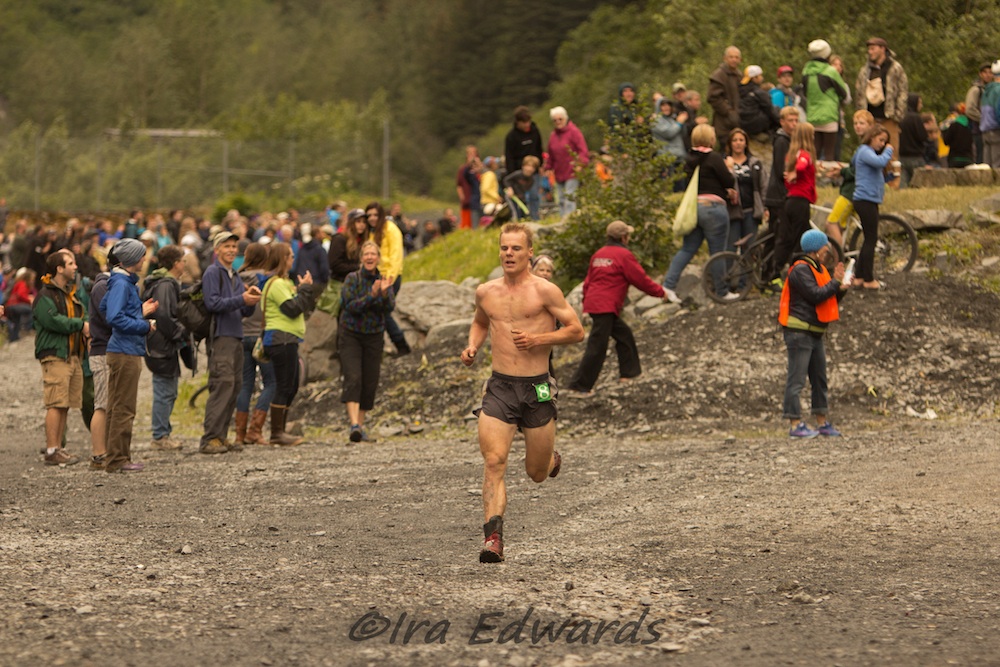
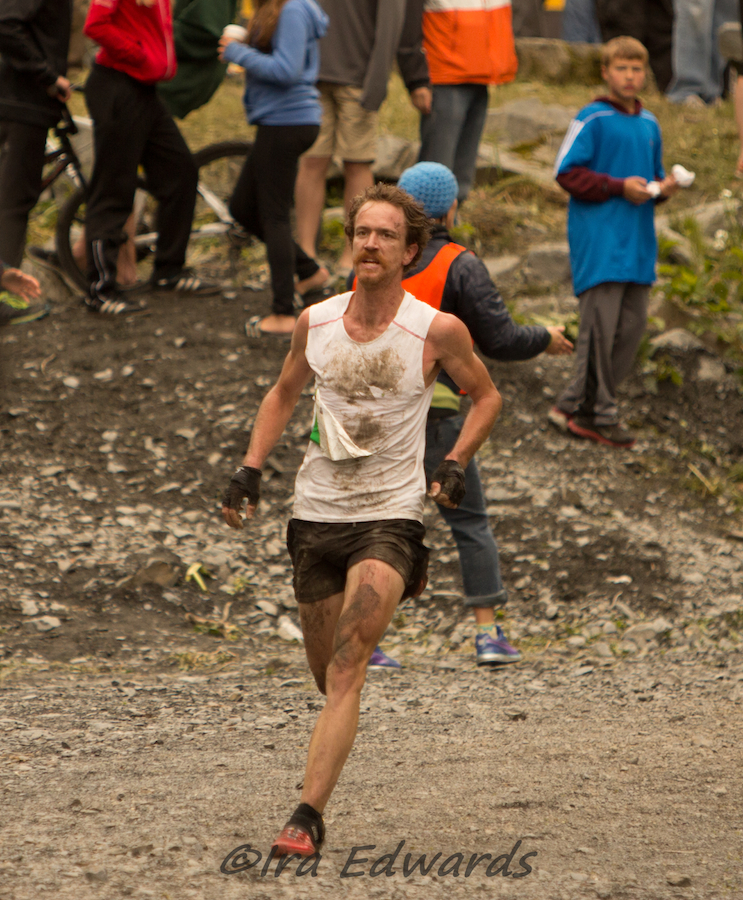
    Eric Strabel, who coaches the APU university and junior nordic teams and assists with the elite team, coming off the mountain to win the 2013 Mount Marathon on July 4 in Seward, Alaska. It was his second victory in three years and he broke a 32-year-old course record by 26 seconds. (Photo: Ira Edwards/roosterskier.com)
    Eric Strabel, who coaches the APU university and junior nordic teams and assists with the elite team, coming off the mountain to win the 2013 Mount Marathon on July 4 in Seward, Alaska. It was his second victory in three years and he broke a 32-year-old course record by 26 seconds. (Photo: Ira Edwards/roosterskier.com)

    Two years ago, Alaska Pacific University (APU) nordic coach Eric Strabel won Mount Marathon. It was a goal he had more or less been working toward since he was 11, and in 2011, he achieved it.

    Last year, he finished eighth – not what he was hoping for. APU’s university coach and elite-team assistant, Strabel decided to recommit to the race he grew up doing and spent the next 12 months getting ready for his 20th consecutive Mount Marathon.

    “For the first time, I was ready to commit to 12 months of specific training for the extreme demands of the race,” Strabel, 31, wrote in an email.

    He reasoned climbing was his problem and increased his uphill training while decreasing the distance covered in each workout.

    “I have a higher disposition of fast twitch muscle fiber than what is ideal for mountain running so I needed to build up a monstrous aerobic engine before I started to do anything close to race pace for longer than 30 seconds,” he explained. “Looking back, one of the biggest keys of the training was having more than twenty 1 hour sustained low to mid level 3 efforts on steep grades before ever letting myself push my heart rate over 90% of max. … Sustained assertive steep hiking and running really works wonders for building hip and leg strength and endurance for skiing!”

    Sounds pretty technical for a guy who placed third in this year’s 50-kilometer Tour of Anchorage ski marathon without doing much ski training beyond coaching, or someone trying to break the Mount Marathon course record without a watch.

    “Wearing a watch distracts me. And it should be unnecessary,” Strabel explained. “I should already know by race day what I need to be doing and how I should be moving to have my best speed. Nevertheless, I did ask a couple people how the time was looking at landmarks to know what was possible.”

    Strabel’s speed came from within on July 4 in the 86th annual Mount Marathon Race – and with the help of a commentator’s words before the start. The announcer said the morning rain and lack of snow (for traction) would make for slower conditions, ultimately eliminating a shot at the 32-year-old course record (43 minutes, 21 seconds) set by Olympic nordic skier Bill Spencer.

    “[That] gave me kind of a chip on my shoulder and added more fuel to the fire,” Strabel wrote. “The record has been such a legend, that even the thought of breaking it has been presumptuous, but with the growing level of competition and preparation, a handful of us were starting to believe it was possible over the last couple of years.”

    Rickey Gates leads the men's race up Mount Marathon on July 4 high above Seward, Alaska, while Wylie Mangelsdorf (r) and Eric Strabel keep him in sight. (Photo: Dave Blanchet)
    Rickey Gates leads the men’s race up Mount Marathon on July 4 high above Seward, Alaska, while Wylie Mangelsdorf (r) and Eric Strabel keep him in sight. (Photo: Dave Blanchet)

    Last Thursday, amid drier conditions than the previous women’s race, Strabel did it, pushing himself to win it 42:55. Nine seconds later, runner-up Rickey Gates, a multiple-time member of the U.S. Mountain Running Team, crossed the line in record time as well.

    Both saw their times on the big clock, but neither wore a watch to confirm nor thought it was possible.

    “When I got to the finish line and saw the 42 minutes and change, I thought what Eric Strabel thought, that something went wrong with the timing,” Gates, 32, said on the phone Saturday after flying home to San Francisco.

    “For a few minutes after the race it felt like after a serious accident, everyone’s kind of quiet and a little bit confused, and you’re kind of piecing together information but you’re not quite sure what to believe,” he said. “It felt like that, but when we finally got information that the clock was right, then it finally settled in. Eric gave me a huge hug; he’s really a gentleman and a gracious competitor and said it wouldn’t have happened without the two of us battling it out like that.

    “I certainly wouldn’t have run that fast without him either,” Gates continued. “It’s one of those second-place finishes that I can imagine going any better.”

    This is coming from a man, albeit a Mount Marathon newcomer, who’s won trail races around the world, including one in Antarctica and the Canadian Death Race, and is headed to Europe for the 65 k Ice Trail race in Val d’Isère, France, on Sunday. After that, Gates will compete in back-to-back 32 k races in Italy and Switzerland, then return to his home state of Colorado in late September for the Ultra Race of Champions (UROC) 100 k in Vail.

    Six weeks ago, Gates rode his 2002 BMW F650 Dakar motorcycle from San Francisco to Alaska, flying to Colorado for a wedding before settling back in around Seward (he’s getting a friend to drive his bike back). There, Gates trained with local high-school runners on the slopes of Mount Marathon, getting to know the terrain and how locals tackle it.

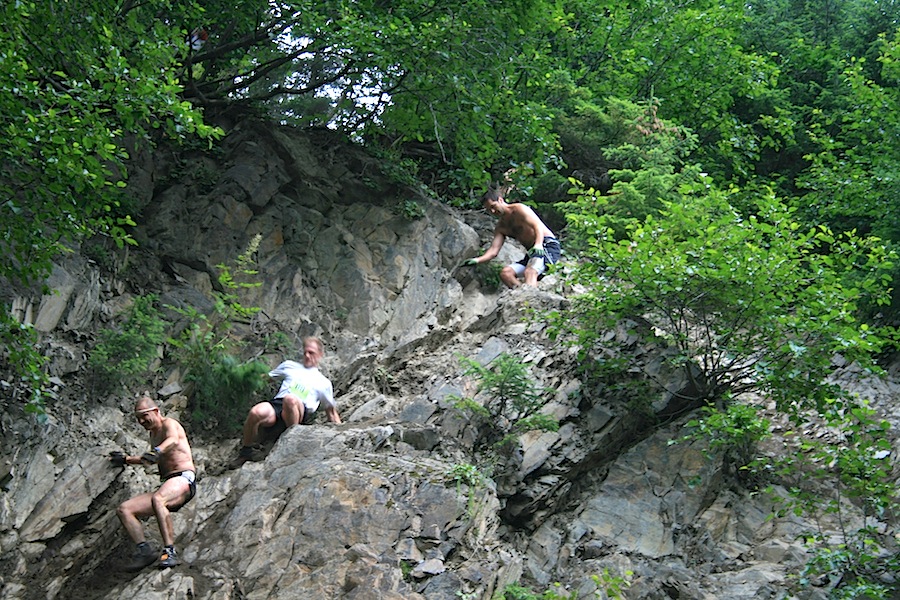
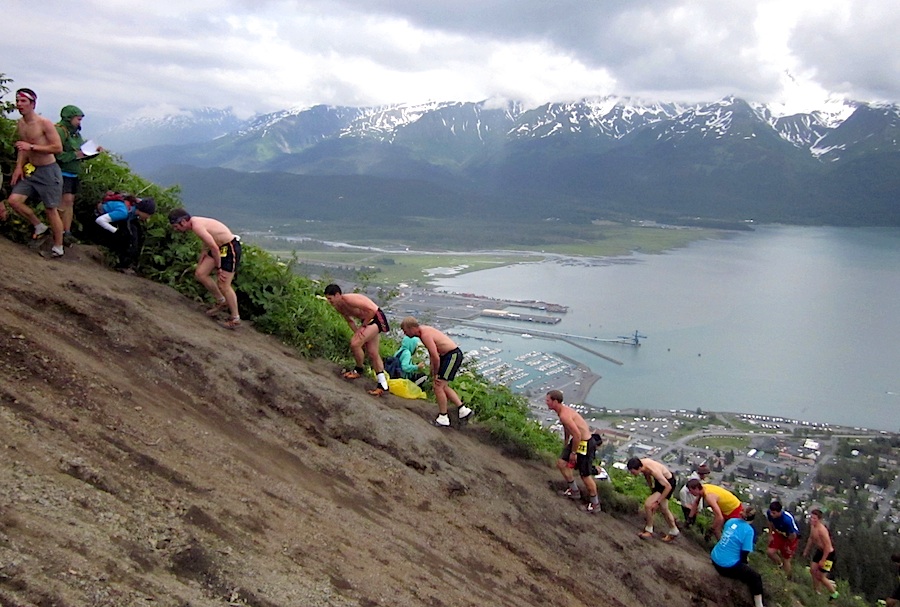
    Racers navigate the cliffs along Mount Marathon, a 3,022-foot peak, during the 2010 edition of the race in Seward, Alaska. (Photo: Lauren Fritz)
    Racers navigate the cliffs along Mount Marathon, a 3,022-foot peak, during the 2010 edition of the race in Seward, Alaska. (Photo: Lauren Fritz)

    “It was cool to see a high school cross-country team out there on the course actually dialing in little five-five foot drops and maneuvering cliffs,” Gates said. “Of course they’re high schoolers and they don’t think anything of it.”

    Less than a week before the race, Gates did a time trial up the agonizing climb. He clocked in around 51 minutes. “Muscles hurt on me that have never hurt before,” he told the Anchorage Daily News. He later told FasterSkier it’s one of the shortest yet hardest races he’s ever done.

    On Thursday, Gates didn’t worry about time, just about winning – or coming as close to doing so as possible.  His mother, Trish Gates (formerly Schultz), finished second in the 1969 Mount Marathon, but was quick to point out there were only two women in the race. She had been working at a fish-packing plant at the time, had a week off and decided to give it a go.

    “It’s the only race that she’s ever run, she never run one before then and she’s never done one since then,” Gates said of his mom, who flew to Alaska to watch him last week. “Being a traveling hippy, they were offering free meals to whoever did the race. The salmon weren’t running yet so she had a week.”

    Racers ascent the 3,022-foot Mount Marathon above Seward, Alaska, at the 2011 edition of the hill climb. (Photo: Lauren Fritz)
    Racers ascent the 3,022-foot Mount Marathon above Seward, Alaska, at the 2011 edition of the hill climb. (Photo: Lauren Fritz)

    Knowing she did the race was cool, but when he heard how technical and gut-wrenching it was, Gates started to respect her even more. He spent the last five years dreaming of racing Mount Marathon, and tweaked his schedule to make it happen this year.

    Jetting toward the top of the three-thousand-foot peak, Gates was the first to the turnaround point just over 1 ½ miles in. The third man to the halfway mark (behind Wylie Mangelsdorf, a Principia College senior, in second), Strabel passed both Mangelsdorf and Gates on the descent.

    “I’m not the strongest downhiller,” Gates said. “I ran 11 minutes down that thing, which isn’t bad, but I knew I wasn’t going to run 10 minutes down it which Eric did.”

    At the base of the mountain before a half-mile stretch along a road to the finish, Gates in second place looked up to see where Strabel was. Then, he crashed, dislocating his shoulder and spending several seconds on the ground.

    2013 Mount Marathon runner-up Rickey Gates shortly after a crash dislocated his shoulder at the mountain base a half mile before the finish on July 4 in Seward, Alaska. (Photo: Ira Edwards/roosterskier.com)
    2013 Mount Marathon runner-up Rickey Gates shortly after a crash dislocated his shoulder at the mountain base a half mile before the finish on July 4 in Seward, Alaska. (Photo: Ira Edwards/roosterskier.com)

    “I just caught my foot on something or nothing at all and just went down really hard in front of 10,000 people,” Gates said. He stood up, popped it back in, and proceeded to cut an estimated 20-second deficit to finish 9 seconds behind Strabel.

    “There’s a lot to be said about adrenaline,” Gates said. “If I’d had not fallen I still don’t think I would’ve gotten him.”

    According to Strabel, catching Gates, which he did about two-thirds of the way down, wasn’t easy. He strategically attacked the final cliff section before the road, thinking Gates would be less familiar with it and thus not as fast.

    “As it turned out, a lot of the cushion that I built by the base of the mountain was due to Rickey stumbling, catching himself and dislocating a problem shoulder, and quickly resetting it himself,” Strabel explained. “I did look back twice early on the road to know that he was making up serious ground so I had to gather a sprint over the last 90 seconds whether my body was capable of it or not.

    “I was incredibly relieved at the finish,” he continued. “The only other thought I had over the final seconds of the race was of the large display clock that came into focus. I had completely set aside thoughts of a record for most of the race. I recall seeing it ticking through the 42:30’s and remember struggling to think if a time in the 42’s was faster than 43:21. That was how far down Rickey had pushed my brain function.”

    That night, Strabel, Gates and other finishers celebrated with a night out on the town, where Gates lost his rental-car keys. All in all, the trip went as well as Gates could’ve imagined, he said, except for a couple blips.

    “I’d appreciate it if my shoulder didn’t really hurt really bad right now and if I didn’t lose my rental-car keys at 4 o’clock in the morning,” Gates said.

    Other Top Skiers

    Longtime APU skier Brent Knight, 29, placed fifth in the men’s race – four years after he led the 2009 Mount Marathon then collapsed near the finish from dehydration. He was hospitalized in Seward, where he received five liters of IV fluid.

    Brent Knight, 29, en route to a fourth-place finish at the 2013 Mount Marathon Race on July 4 in Seward, Alaska. (Photo: Ira Edwards/roosterskier.com)
    Brent Knight, 29, en route to a fourth-place finish at the 2013 Mount Marathon Race on July 4 in Seward, Alaska. (Photo: Ira Edwards/roosterskier.com)

    Knight returned to the race in 2010 and took fourth, was second to Strabel in 2011, and placed sixth behind winner Matt Novakovich in 2012.

    “It’s hard to describe the feeling you get when you are surrounded by 30,000 people in what could be the gnarliest sub hour race out there,” Knight wrote in an email.

    The first time he watched the race as a kid, the air was hazy from nearby fires. Knight watched as the men’s leader turned the corner at the top of a long hill before the finish.

    “The sun combined with smoky haze created a dull orange backdrop to a lean mountain runner covered in blood and mud,” he wrote. “Eye of the Tiger was playing over the loud speakers and I think that memory of the whole scene was etched in as one of the most awesome events I’ve ever witnessed. Now years later and multiple Mt. Marathon finishes later, I still get this overwhelming feeling like I’ve just saved the world from devastation or something. The roar of the spectators makes you feel like you’re a gladiator in the ancient [Coliseum].”

    That’s why he calls the race “addicting.” This year, Knight lost some ground at the leaders along the ascent, and by the top, he realized how fast they were going.

    “I didn’t think it was record fast, but I thought it might be close,” he wrote. “Matias [Saari, who placed third] closed in and passed me a 1/4 way down the mountain and I decided to put comfort aside (if there was any) to hang on him.”

    Knight lost about 15 seconds to Saari after the “gut,” which he described as an extremely technical creek bed with multiple cliffs before the bottom of the mountain, but made up about 10 seconds on the road.

    “It’s hard to cover ground that fast when it feels like you’ve been run through a meat grinder,” Knight wrote. “Had I run a minute faster, I would have been competing for 3rd in a time that would have easily been a winning time any of the past 32 years. This race, this year, was the toughest field I’ve ever competed against.

    “I’m a skier that loves to be a mountain runner,” he added. “I’ll find my way to the front … Perhaps next year or the year after that or the next. Strabel set a new mark to fight for this year.”

    Alaska Winter Stars skier Ann Spencer, 18, racing to third place in her first year as a senior at the 2013 Mount Marathon on July 4 in Seward, Alaska. (Photo: Ira Edwards/roosterskier.com)
    Alaska Winter Stars skier Ann Spencer, 18, racing to third place in her first year as a senior at the 2013 Mount Marathon on July 4 in Seward, Alaska. (Photo: Ira Edwards/roosterskier.com)

    In the women’s race, Christy Marvin, a 32-year-old mother of three, won in 53:20. A race newcomer but well-known local runner, she was the first rookie to win since Toby Schwoerer took the men’s title in 2004.

    Allison Barnwell placed second just under two minutes later, and 18-year-old Ann Spencer of the Alaska Winter Stars placed third (56:15) in her first year as a senior.

    In an email, she explained it was her fourth Mount Marathon (after three junior races), but first time racing the whole mountain.

    “I was definitely not expecting to do so well,” Spencer wrote. “I was aiming for a top 20 finish with a time under 1:05. Hill climbs are definitely my strength.”

    Accepted at the University of Vermont, Spencer planned to defer a year to continue skiing and training in Anchorage to better prepare herself for college racing.

    Fresh off a training camp on Eagle Glacier, APU Elite Team skier Lauren Fritz, 25, placed fourth (57:57) among the senior women. Last year, she was second in Mount Marathon to teammate and 2010 Olympian Holly Books.

    “There was a lot of pressure going into this year’s race … which is tough because there isn’t a lot of room for improvement and a lot of room for disappointment,” Fritz wrote in an email. “I really wanted to win, of course, and I had as good of a shot as any, with Holly and Kikkan [Randall] both skipping this year’s race. There are always top contenders though, and this year was no different.”

    Lauren Fritz racing back down to Seward, Alaska, for fourth in the 2013 Mount Marathon Race on July 4. (Photo: Cole Deal)
    Lauren Fritz racing back down to Seward, Alaska, for fourth place in the 2013 Mount Marathon Race on July 4. (Photo: Cole Deal)

    Meanwhile, Fritz has dealt with chronic tightness in her calf muscle for the last couple years. Skating in slush on Eagle Glacier last week didn’t help.

    “I knew going into the race that it would probably bother me, but there wasn’t much I could do about it,” she explained. “I tried to warm up well but it still flared up during the race. It was raining throughout the morning, including during the race a little bit, so it was a lot muddier than I’ve ever raced it, so there was a lot of slipping and grabbing for tree branches or plant roots or whatever you could hold onto to keep from sliding backwards. Really not ideal conditions for fast times, plus the slipping put more stress on my lower legs.”

    Just before tree line about halfway up, her calves got the best of her and she lost contact with Barnwell, Spencer and Sheryl Loan, who ended up seventh. Marvin led from the start, but was not too far in front of the chase pack at the top, according to Fritz.

    “I rounded the turn-around rock, I thought ‘OK, here we go, I’ll be done in less than 15 minutes,’” she wrote. “Just let the legs go on autopilot. It’s impossible to describe how your legs feel as you start the descent and it’s really just best not to think about how they feel and just go.

    “It is actually crazy, and unless you’ve put yourself through the torture you don’t realize how incredibly fun and satisfying it is to be able to accomplish something like this mountain,” she continued. “Still, it is an inherently dangerous race … I usually have one of the top descent times in the women’s race, but this year I did try to not let myself get too out of control on the downhill that would lead to me getting hurt. I LOVE this race, and always plan to come back, but there is a lot at stake this ski season and I recognized that. I wanted to win and I gave it my best effort, but this race isn’t the focus of my racing career right now.”

    In her seventh Mount Marathon, Fritz nabbed her fifth-consecutive top 10 and posted the sixth-fastest downhill time.

    “I’m still pretty happy,” she wrote. “Mt. Marathon is definitely the Olympics of Alaska and I’ll definitely be back to hunt down the coveted winner’s cup.”

    Results | Race video

    The scene from above at the 2010 Mount Marathon Race in Seward, Alaska. (Photo: Lauren Fritz)
    The view from above at the 2010 Mount Marathon Race in Seward, Alaska. (Photo: Lauren Fritz)