From the FasterSkier archive — posts syndicated from athletes’ and coaches’ own blogs between 2004 and 2012, kept online as published. Current coverage is at fasterskier.com.

Tag: Erik Bjornsen

  • Cross Country With a Twist: NordicX Event Lights Up Anchorage 

    Cross Country With a Twist: NordicX Event Lights Up Anchorage 

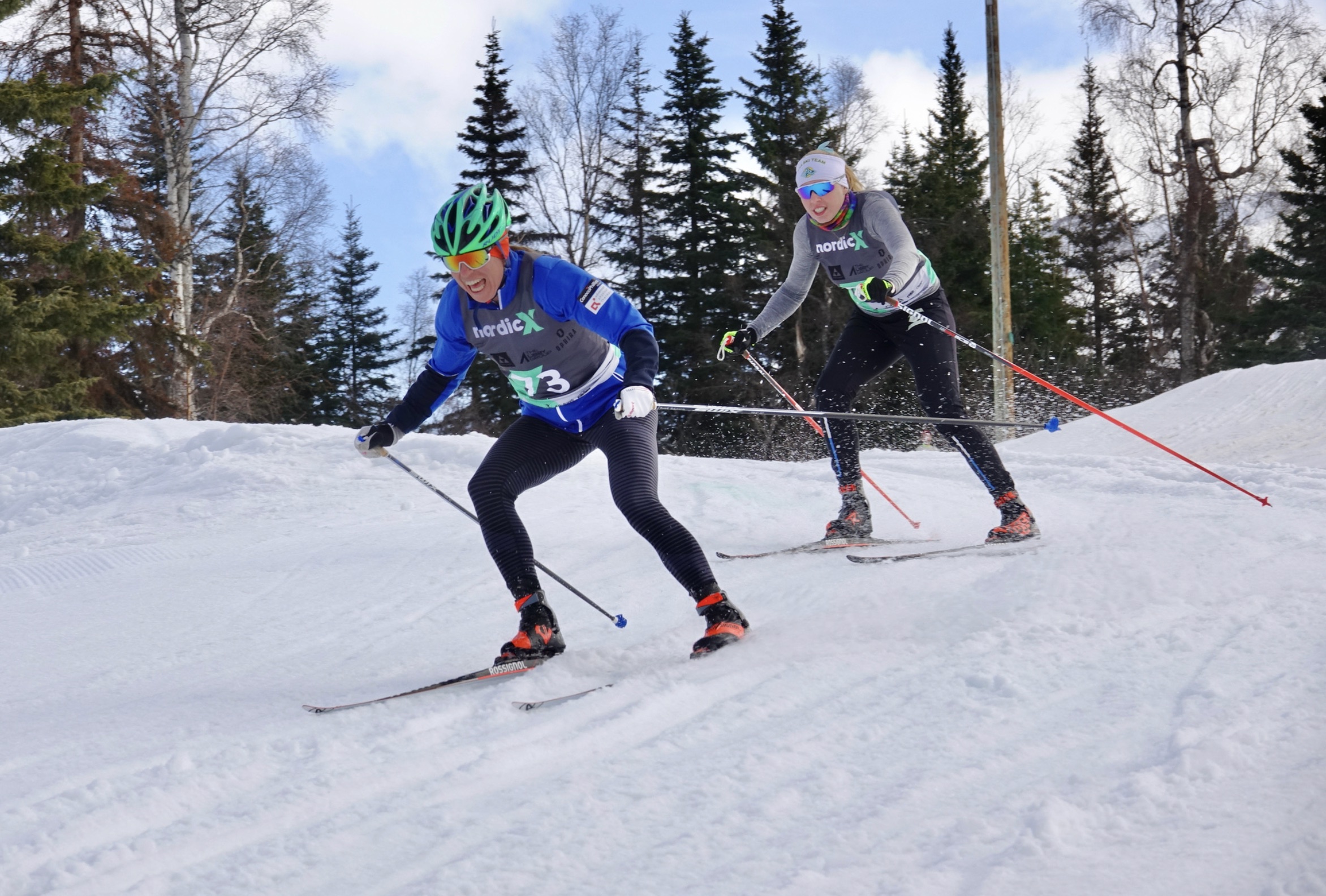
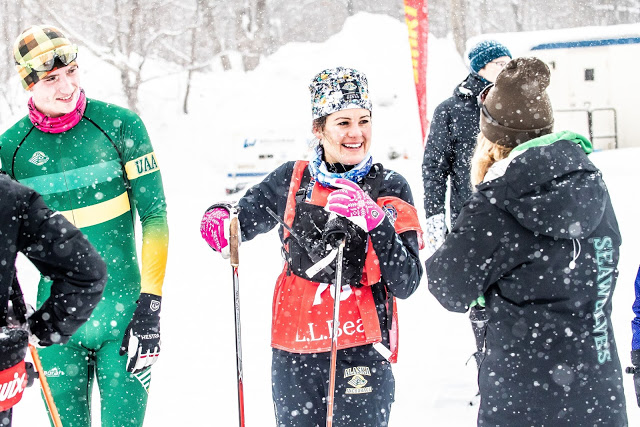
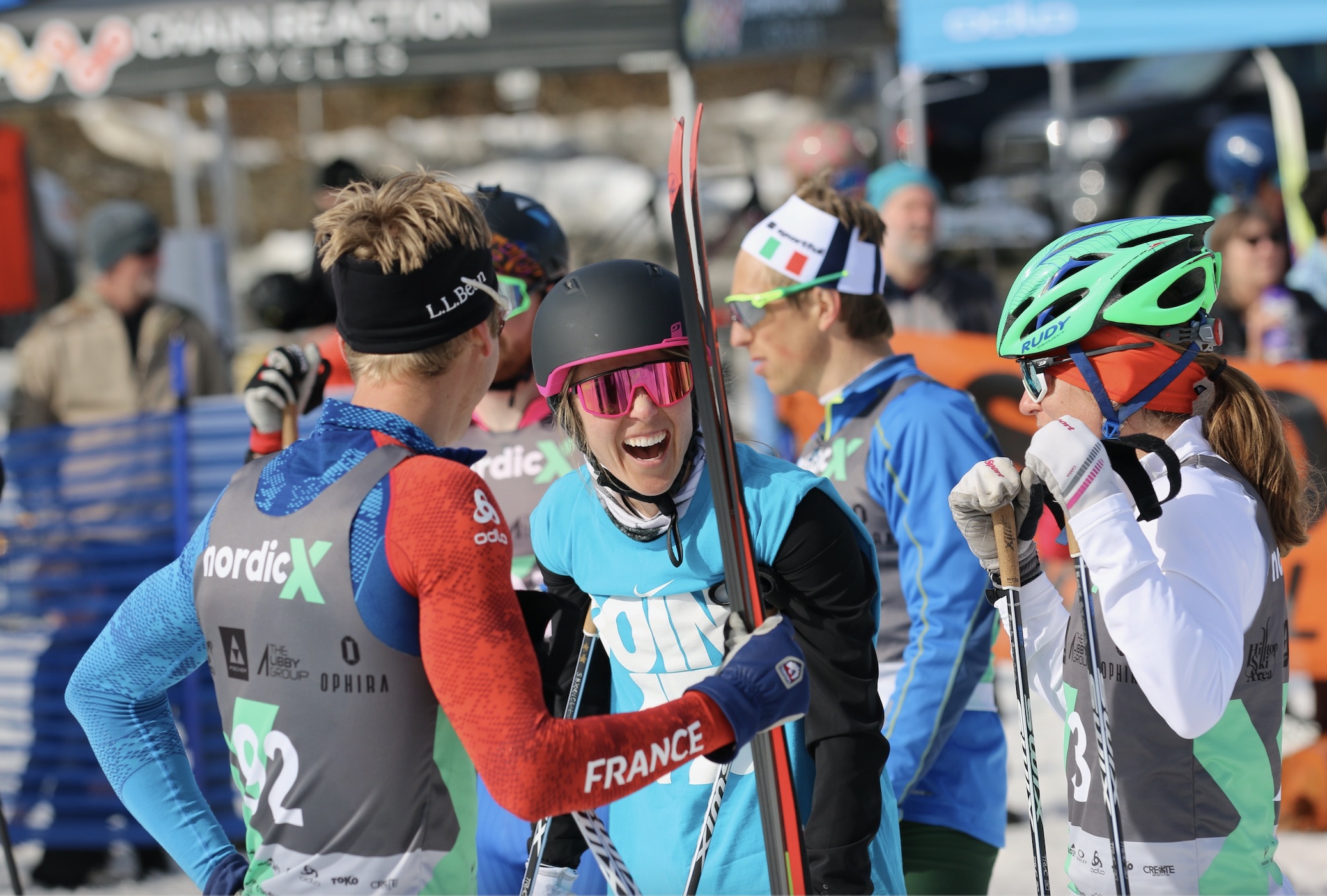
    Erik Bjornsen, Sadie Bjornsen Maubet, and Rosie Brennan enjoy a very different race atmosphere at NordicX. (Photo: Eric Maurer / NordicX)

    What comes to mind when you think of a cross country ski race? Depending on your location and how you choose to interact with the sport, there are likely a variety of answers to the question, but it’s likely that there are some common themes. 

    “Cross country events are pretty much all the same when you boil them down, you know?” said retired US Ski Team member and 2018 Olympian Reese Hanneman. “It’s a test of endurance and speed over a set course, and it’s timed, and you’re usually out there in the woods alone. And I mean, that’s what cross country [racing] always will be, but I always felt like there was room for more.”

    In what he described as “living out [his] 10 year old dream”, Hanneman set out to break this mold. His dream came to fruition on April 2nd in his home of Anchorage, Alaska, as cross country skiers from the junior level to recent Olympians careened down the slopes at Hilltop Ski Area, rounding tight turns, skating uphill, and catching air – with some not-so-graceful landings – off of jumps before finishing amidst a festival atmosphere at the base. The event was NordicX, an untimed, head-to-head “nordic-cross” event where style points on the final kicker into the finish might earn you a lucky loser spot in the next round. 

    “I knew that there was a lot of appetite for [an event like] that because every time I coach kids, which has been quite a bit over my career, I see that same energy and excitement for hitting jumps and sessioning little whoopty-dos or tabletops. And basically, there’s no cross country event that caters to that.” 
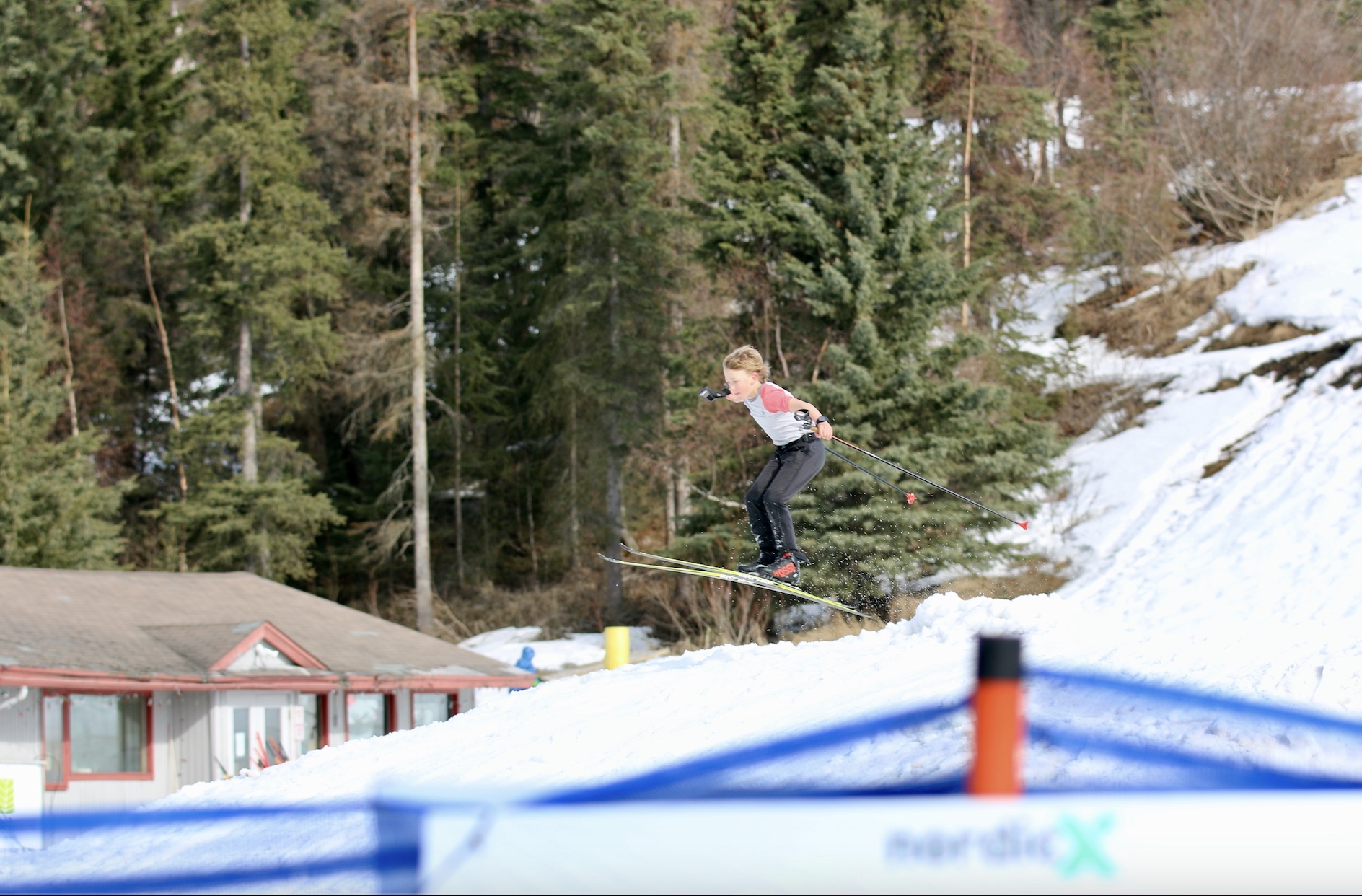
    One of many kids enjoying the features on course and in the Kiddie Cross terrain park at NordicX. (Photo: Eric Maurer / NordicX)

    While Hanneman wanted a non-traditional event, he was not looking to eliminate the character or skills of cross country skiing altogether. He pulled from his experience competing in the 2016 Red Bull Nordix event at Lake Louise in Alberta, where he raced against other top international skiers including Norway’s Petter Northug and his US Ski Teammate Andy Newell.  

    “It was so fun and it was so crazy and scary and fast. And I was like, ‘Man, I need to bring this to Alaska.’”

    In creating his own event, he said he wanted to navigate the “delicate balance of new, exciting, and extreme, but also staying true to cross country skiing. It’s one thing to build a little booter next to the xc ski trail and ski ’round and ’round hitting it with your friends, and it’s another to try and package that experience into a full-on event that offers excitement for all ranges of skills and ages.”
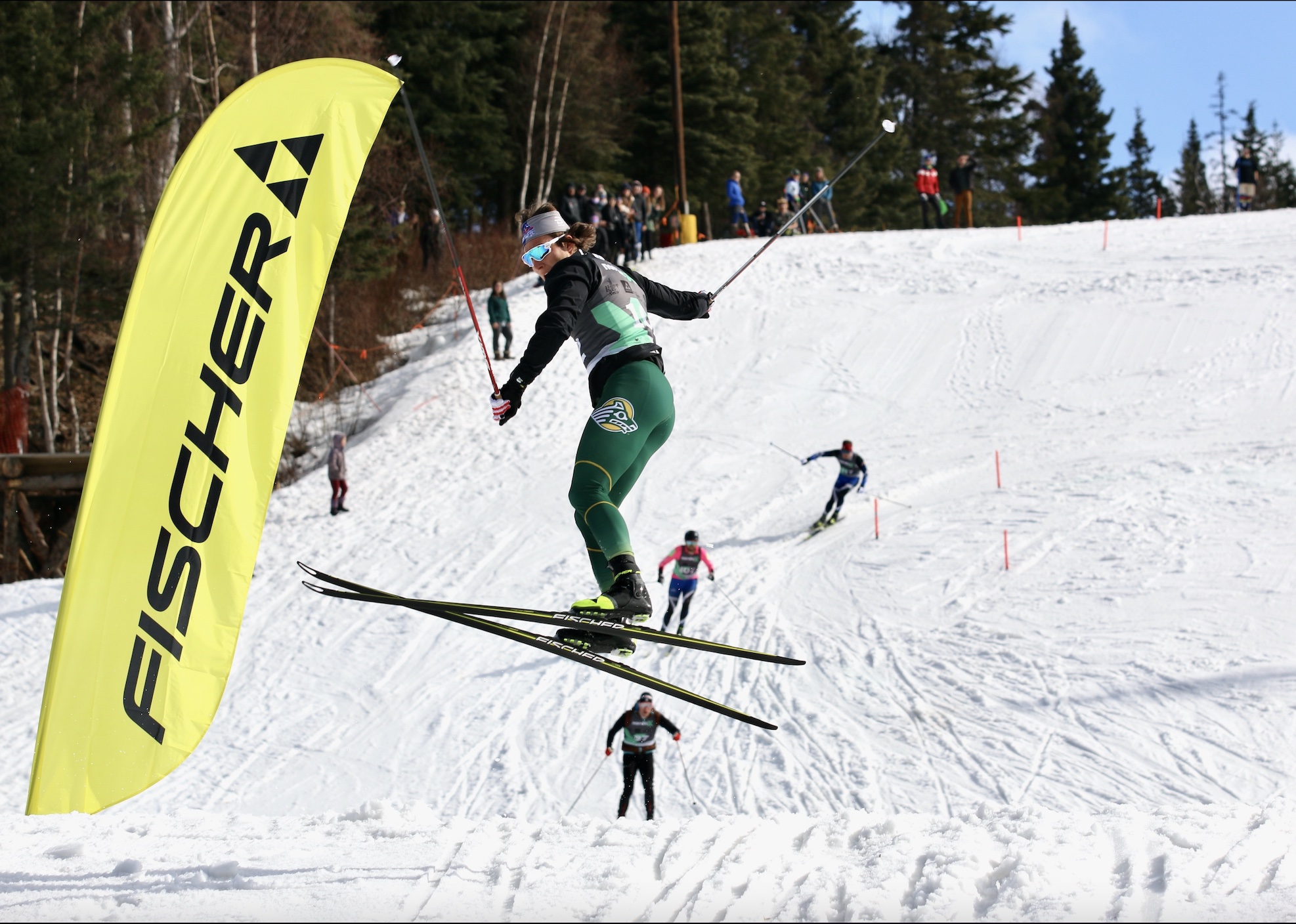
    JC Schoonmaker does a 360 into the finish at NordicX. (Photo: Eric Maurer / NordicX)

    “I knew it needed the right venue,” Hanneman continued. “I wanted something ‘net downhill’ because otherwise I felt like it would be too similar to other xc races, a loop with the same start and finish meant that in order to have a huge downhill you would need a huge uphill. But I also wanted it to be ‘cross country’, so that it truly rewarded good cross country skiers, and so that cross country skis were truly the best tools for the job.” 

    As the course and conditions hinged on both the weather and Hilltop’s grooming, an official course map was never set. To ensure the event catered to skiers beyond the nucleus of elite skiers based in Anchorage, an A-, B-, and C-Line was established on each of the features, making air-time not requisite and allowing athletes to select a route that felt safe, at the expense of simply forgoing the fastest line, which might pay off in the end if it kept the racer upright with equipment intact. 

    Holding to the spirited theme of the event, Hanneman described it as “a freestyle event in both feel and in practice,” meaning there were no official course maps, no timing, and plenty of subjectivity in the results. Get sendy and try to 360 off the final kicker into the finish only to crash and stall out before the line? Style points – you just became the lucky loser and can move on. Flooded legs from the uphill sprint section cause you to catch an edge off the drop and yard sale? The crowd loved it – lucky loser spot for you also. 
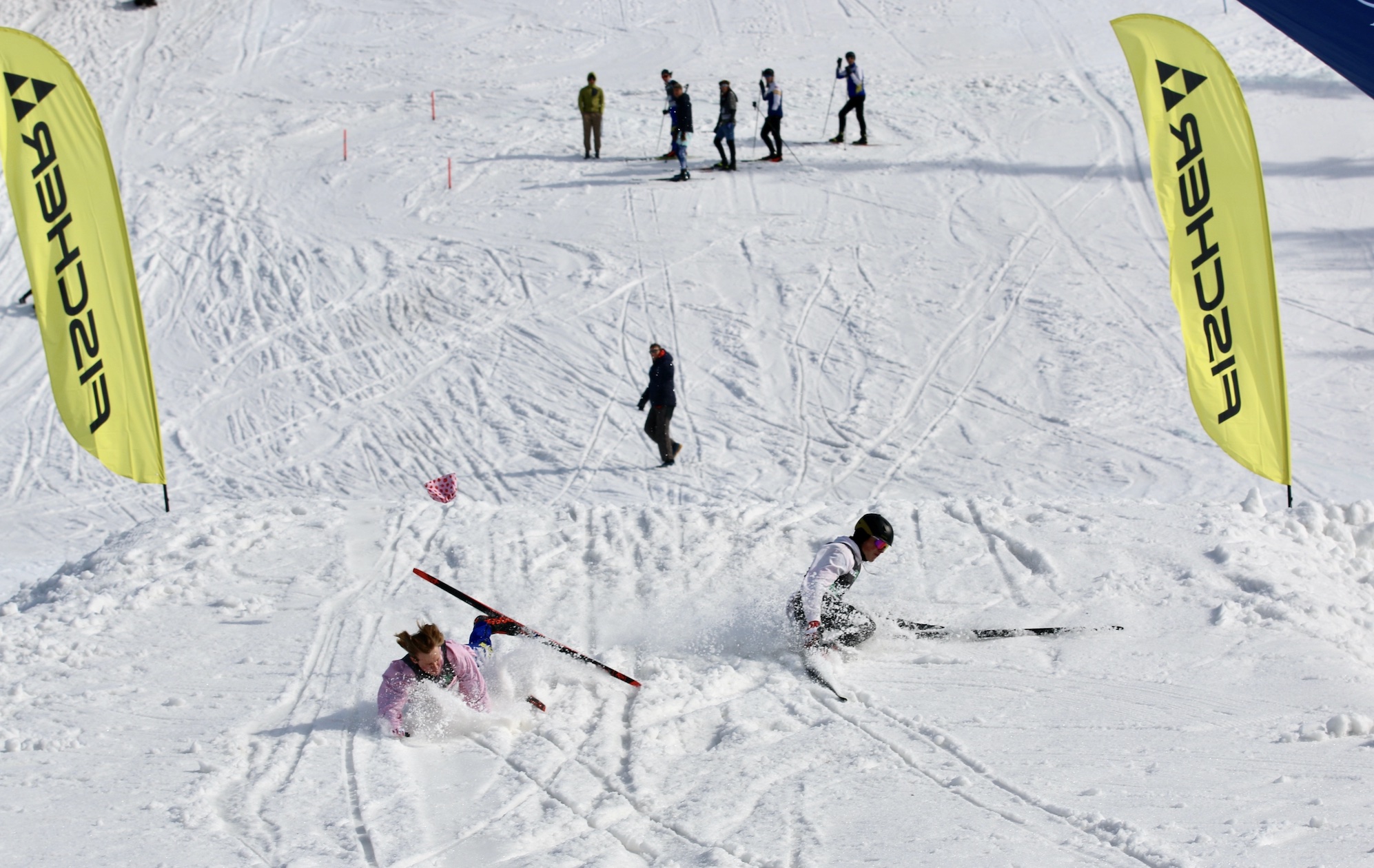
    Not everyone stuck the landing at the finish of NordicX… (Photo: Eric Maurer / NordicX)

    No official prologue seeded athletes; after a few hours where skiers could preview the course, the event simply kicked off with heats of six in the quarterfinal, splitting the 100 athletes between open and junior men’s and women’s categories. Among the field were six Olympians: alphabetically, Erik Bjornsen, Rosie Brennan, Hannah Halvorsen, Logan Hanneman, Sadie Bjornsen Maubet, and JC Schoonmaker, most of whom ended up on the podium at the end of the day. Next year, Hanneman hopes to include additional categories for parents, masters skiers, etc. 

    For those who weren’t up for racing or couldn’t quite match the on-ski agility of Maubet or Schoonmaker, a continuous stream of raffles offered plenty of alternative opportunities to win. A DJ fed the energy at the base, while emcees Rob Whitney and Lee Bolling kept the momentum alive between heats, announcing the winners of numerous prizes from sponsor companies like Odlo, Fischer, Oakley, Skull Candy, Toko, and more.  
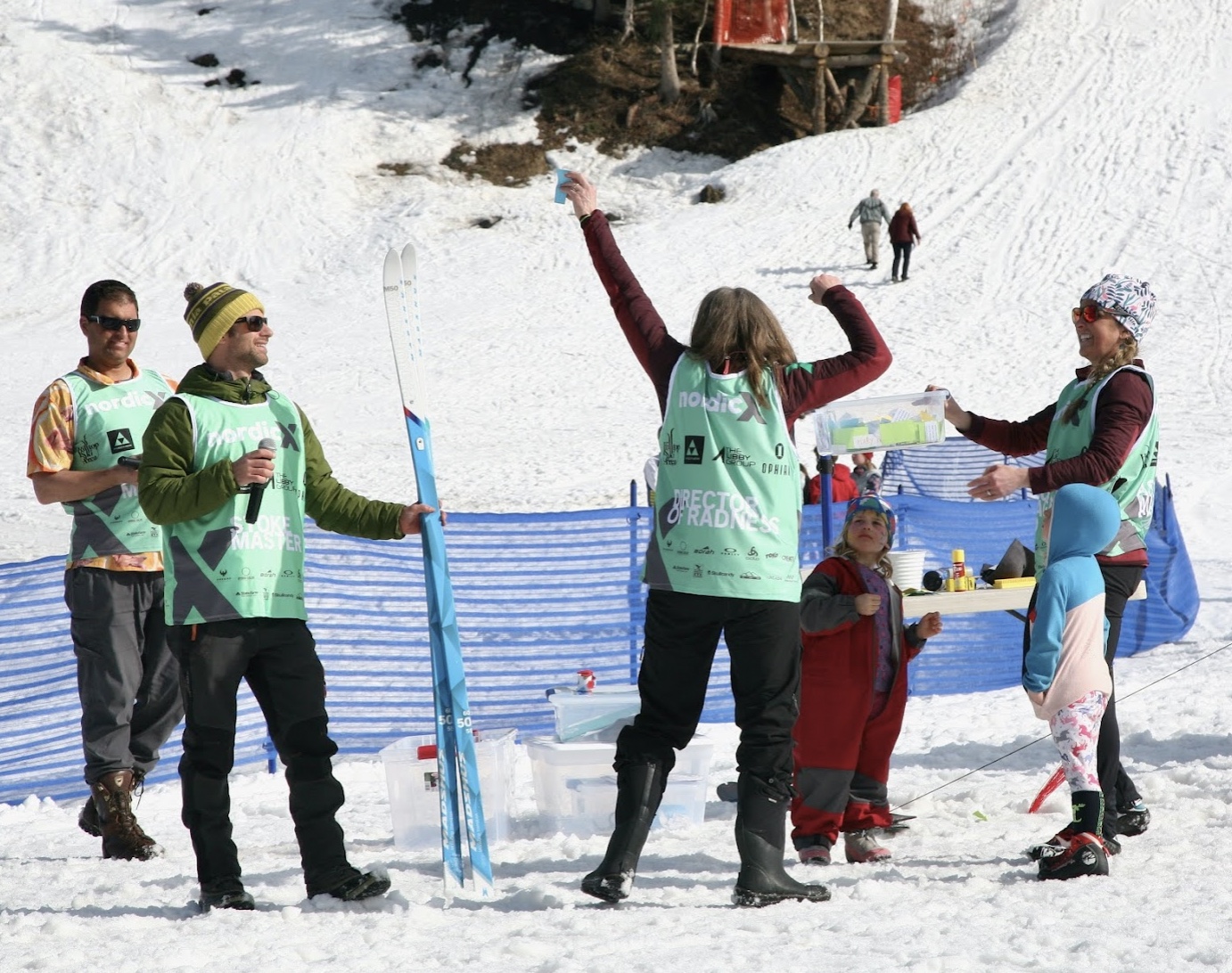
    Emcees, director of radness, associate director of send: keeping the energy high at the base with continuous prize drawings. (Photo: Eric Maurer / NordicX)
    Rosie Brennan charges around a tight turn as she races through the heats at NordicX. (Photo: Russell Hood / NordicX)

    Though these factors added to the festival atmosphere at the base, spectating alone was plenty exciting. In particular, the finish of the senior men’s final was one to watch. 

    “You couldn’t have scripted a better finish,” Hanneman laughed. “You had JC Schoonmaker, who’s one of the fastest sprinters in the world right now, and Erik Bjornsen, who was just on fire all day back from retirement. [They were] just completely sending it and just flying through this final steep slalom section, and Erik is trying to catch JC, and JC is trying to hold him off. They go to the finish, over this big table top, and everyone’s holding their breath. JC goes off it and does this massive spread-eagle.” 

    But he didn’t stick the landing. Landing a little too far in the backseat, Schoonmaker’s skis washed out from underneath him, leaving him sliding across the snow toward the inflated archway that marked the finish. He stalled out just before reaching the line.

    “Erik is coming at Mach 50, about to beat him to the line. JC has to roll over and, like, flops [his skis] over the line.”
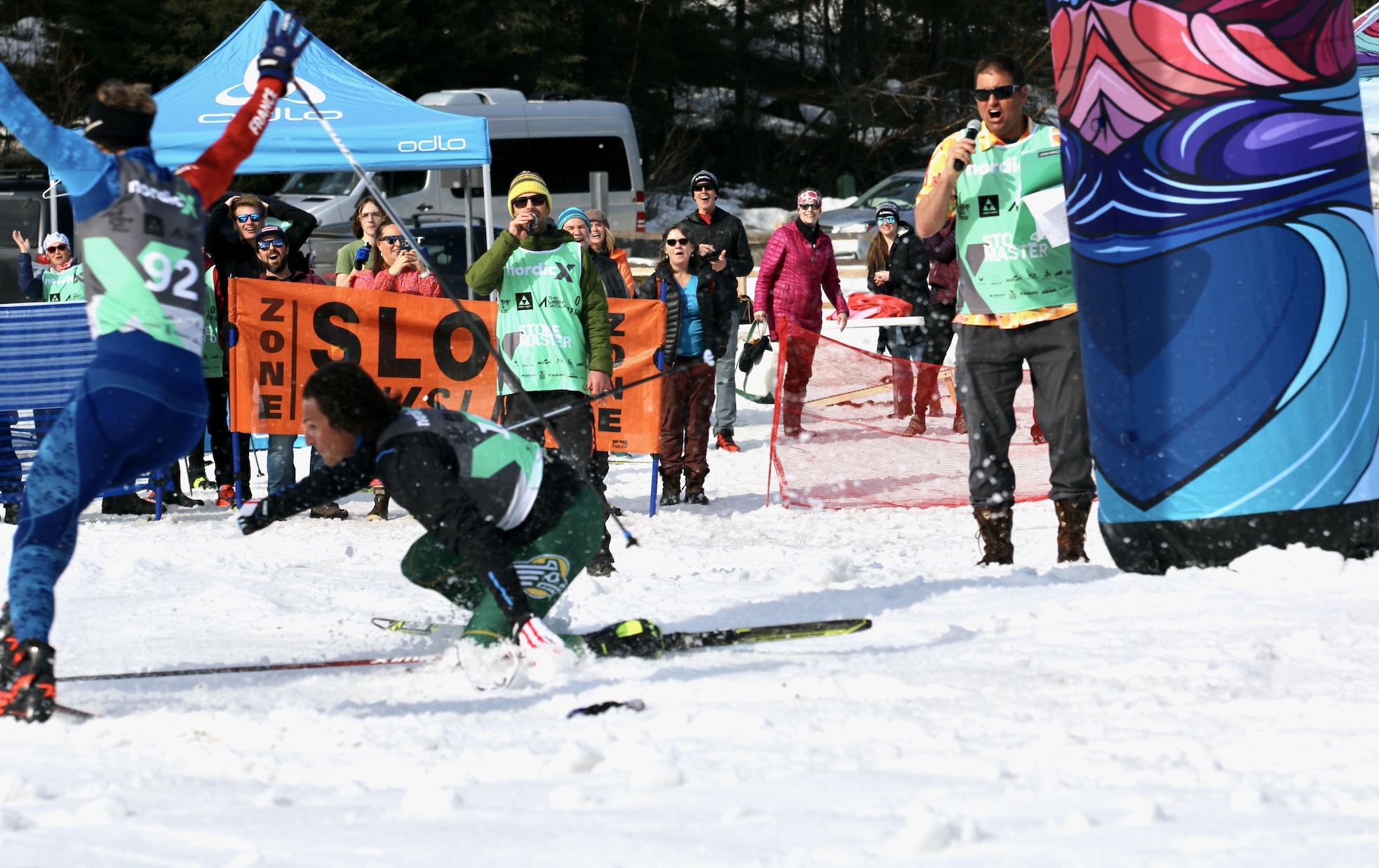
    Erik Bjornsen sticks the landing, but JC Schoonmaker flops over the line first for the win.a (Photo: Eric Maurer / NordicX)

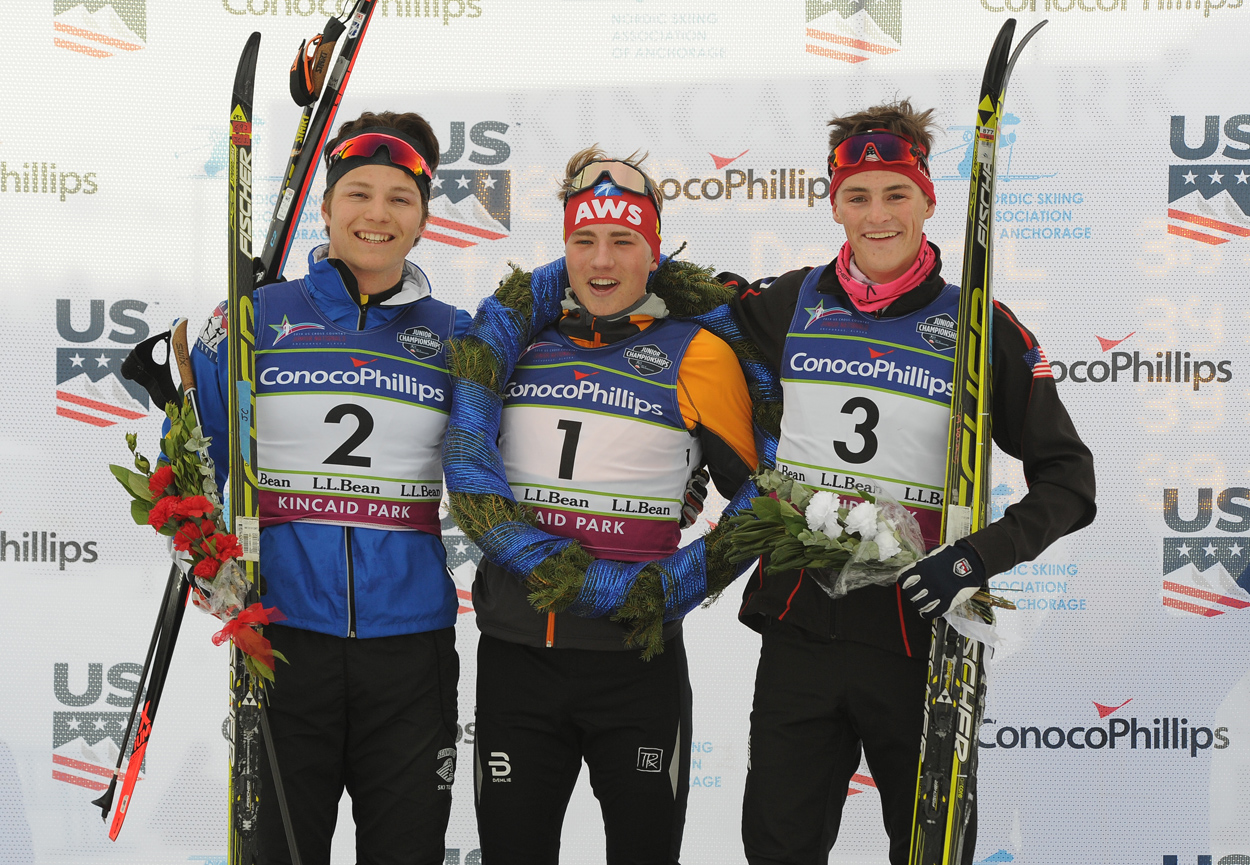
    From a photo finish, Schoonmaker was awarded the victory, with Bjornsen narrowly taking second. U20 APU athlete Michael Earnhart skied to third, taking the final podium step.

    “NordicX was one of the most fun races I’ve participated in,” wrote Schoonmaker after the event. “It took me back to middle school building jumps with my friends and seeing how far we push the skinny ski boundaries. Everyone who took part in putting the race on did a great job and with the spectators who came out, it really just had a good vibe to it. Everyone was having a great time and I’d definitely like to do it again. My highlight was watching some of the younger skiers before the race who were hitting the last jump doing 360’s and backflips and seeing how pumped up they were to be there.”
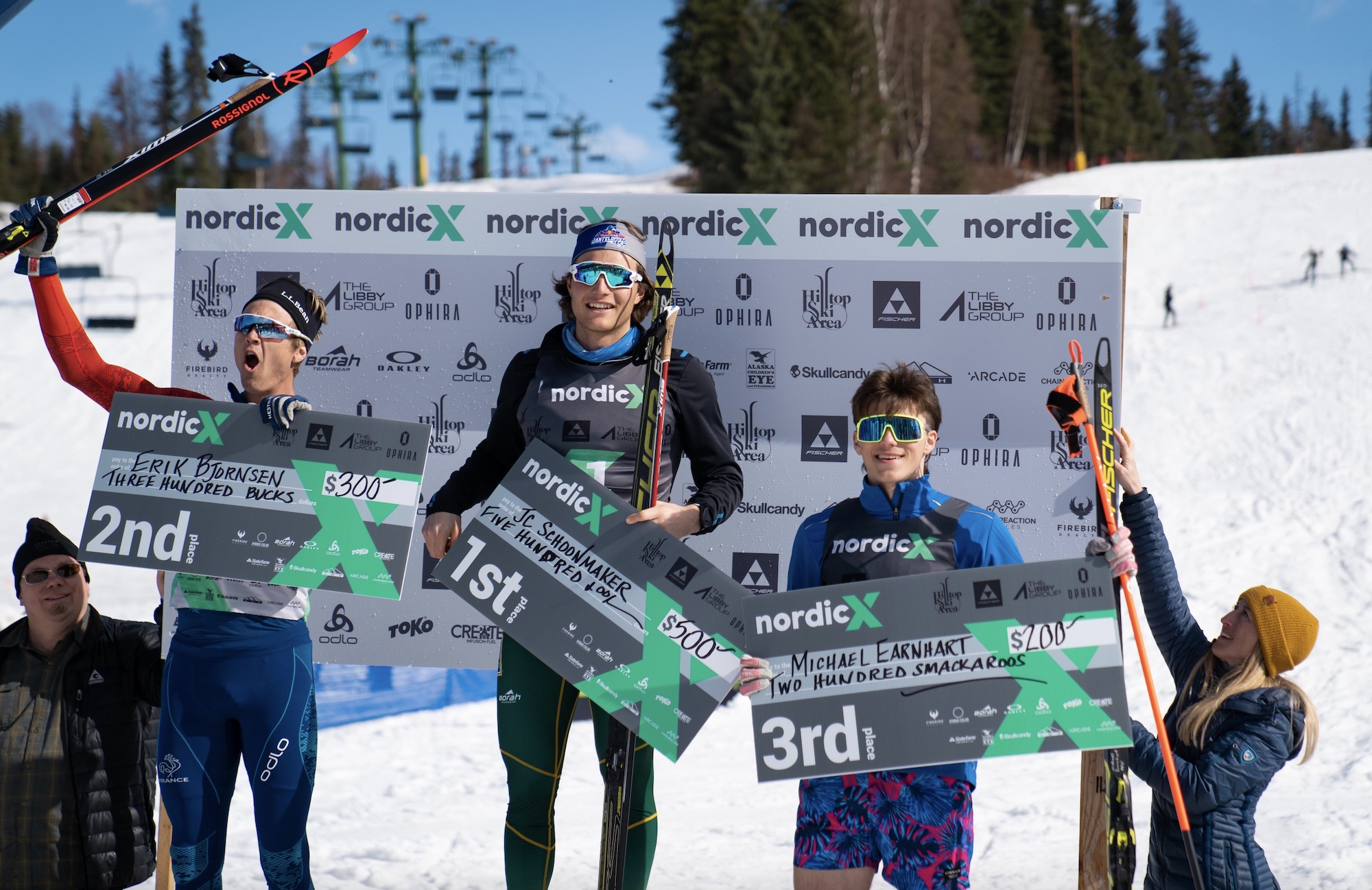
    The men’s NordicX podium: JC Schoonmaker came out on top in a dramatic photo finish with Erik Bjornsen, while Michael Earnhart took third. (Photo: Ophira Group / NordicX)

    In the senior women’s senior division, it was a current and former APU athlete sweep, with Sadie Bjornsen Maubet taking the win ahead of Hannah Halvorsen in second and Rosie Brennan in third. 

    “Nordic X was a super fun event, with a fun new twist to nordic skiing, and nordic ski spectating,” wrote Bjornsen Maubet. “Reese did an amazing job of dreaming up this super fun and social way to share our sport with our community… I relied on my thirty years of spending most of my days on nordic skis to attempt to gracefully make it down the little jump park. Though incredibly inspired by all the young kids catching tons of air, and throwing font and back flips, I figured I better save those moves for another life. The day was full of tons of laughs, cheers, and excitement. It felt special to put a bib on beside my previous teammates, and participate in the fun. 

    “I look forward to watching this spectator friendly event grow in the Anchorage Community. I think my husband had the most fun of us all, as he showed up with his chainsaw without the blade, some flares, and wearing a hat that said  ‘Make the Bjornsen’s Great Again’. He was the cheering squad of the day, representing his French blood and the famous French Team Valoche cheering squad.” 
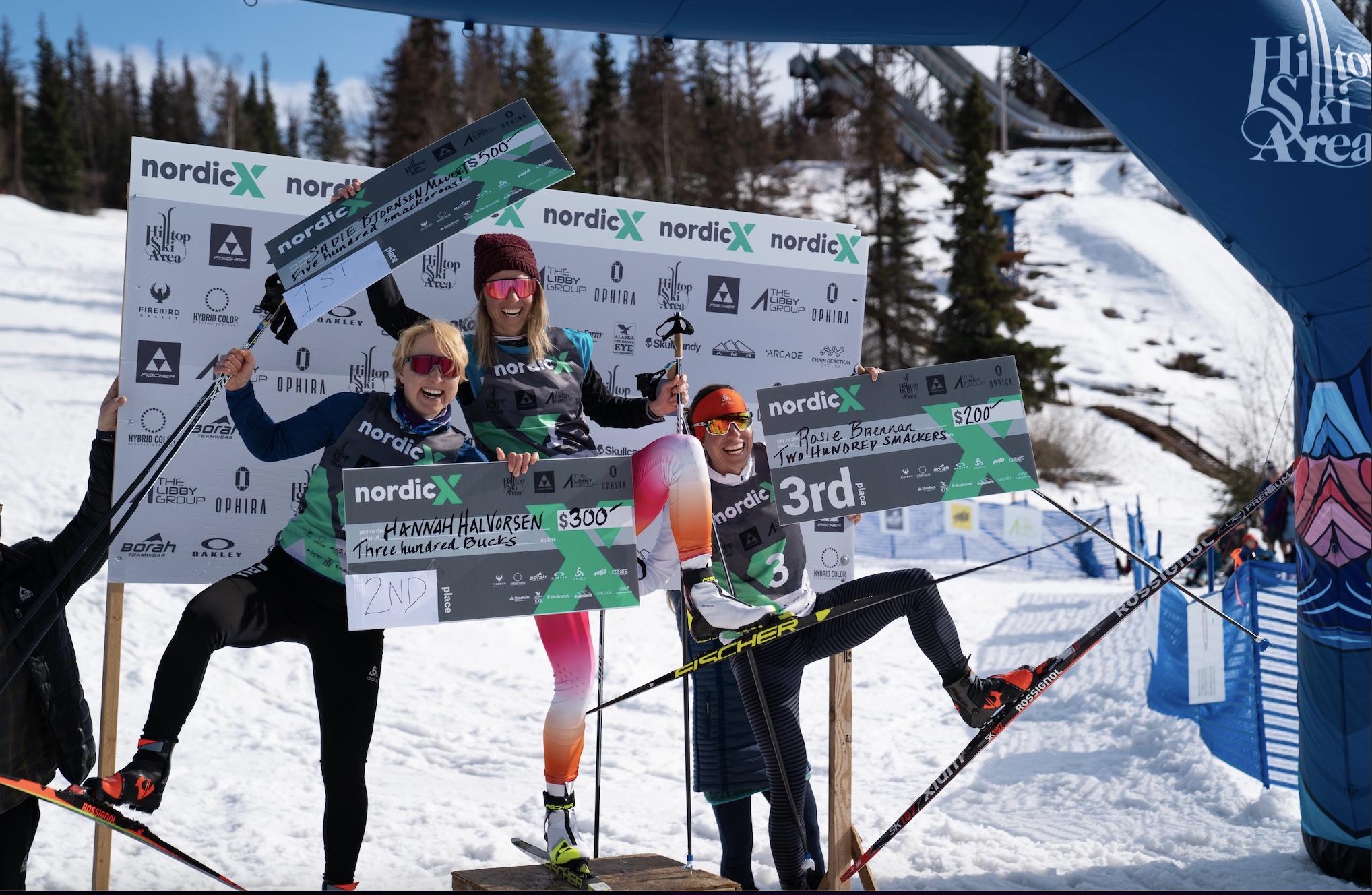
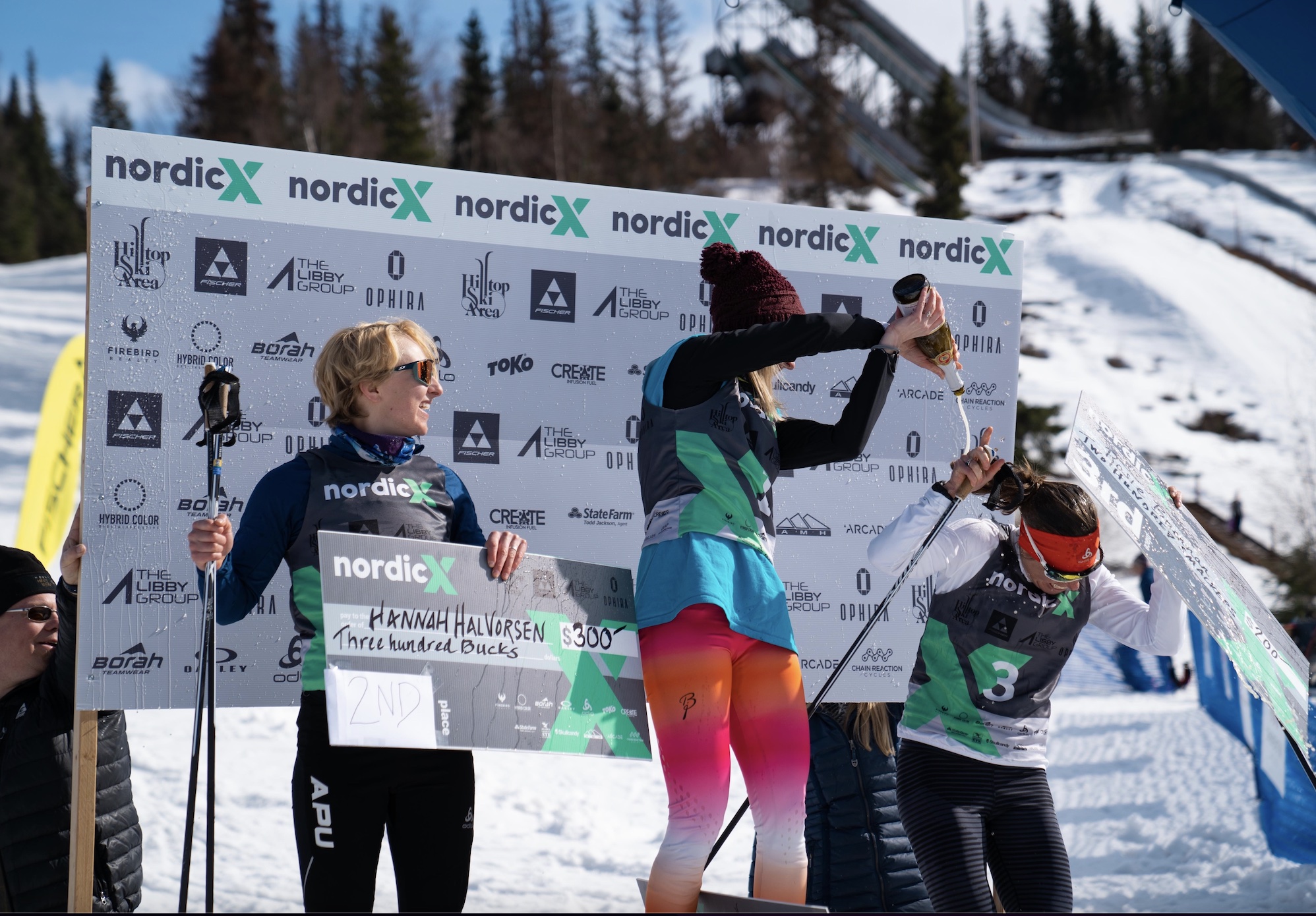
    The women’s podium at NordicX: Sadie Bjornsen Maubet took the top spot ahead of Hannah Halvorsen and Rosie Brennan. (Photo: Ophira Group / NordicX)
    When you can’t spray, pour. Winner Sadie Bjornsen Maubet shares a champagne celebration with third place Rosie Brennan. (Photo: Ophira Group / NordicX)

    For Hanneman, there were also a number of smaller highlights he’s enjoyed looking back on. While marking the course with food coloring, he loved watching skiers riding the lift to the top of the course on their skinny skis, and seeing athletes from 13-year-olds to veteran racers sessioning the course to dial in their lines and strategize. During the heats, he watched a number of young athletes gain confidence, and perhaps some additional skills, after working through initial trepidation surrounding the new race experience. 

    “There were some juniors who you could see at the start of the day were pretty intimidated by the last part of the course, which was really steep and had some sharp slalom turns,” Hanneman explained. “It was definitely challenging their skill level. And by the end of the day, like they were coming through and just ripping, and they were having so much fun and you could tell they had gotten a lot better just in a couple hours.”

    One of many kids enjoying the features on course and in the Kiddie Cross terrain park at NordicX. (Photo: Eric Maurer / NordicX)

    For those 12 and under and too young to compete on the full course, there was a “Kiddie Cross” course, which included banked turns, tabletops, a rhythm section, and a number of other terrain park features for kids to play on and session.

    “The parents love it, right? Because the parents are just sitting there in the sun, watching their little kids just love cross country skiing.” 

    He commented that he had friends who had been trying to sell their child on cross country skiing but felt like it was a hard sell compared to downhill skiing. “They were like, ‘Oh, man, I’ve been trying to get her out on their cross country skis all year and they don’t want to go,’ and they brought him to this event and their kids were like on their on their cross country skis just doing laps up the hill 1000 times so they could go back and hit the jumps again. So for me, that right there is like the essence of this event.”

    A pair of NordicX racers ride the chairlift with their skinny skis. (Photo: Andre Horton / NordicX)

    In reflecting on the event and its impact on the local cross country ski community, Hanneman felt it added “a shot of energy… I mean, there’s so many cool races out there, but this is just a little bit different. And I think it gets people excited.”

    While the biggest air and most impressive skill was seen from the elite racers, Hanneman kept coming back to the youth participating in the event, highlighting that it really was his boyhood dream to see an event like this in Alaska. 

    “Something like this would have probably excited me for a whole year like knowing that it was coming. And I think the more people that we get excited about cross country skiing the better, because I think it can be a really fun sport, but, let’s be honest, sometimes it has this perception of being kind of slow and boring, and hard.”

    He described it as the type of event that could nudge skiers with that perception to give it a try, opening their eyes to what’s possible and how fun the sport can be. While there are perhaps other locations in the US that might be a candidate to host, Hanneman also explained why Anchorage is an ideal location for NordicX.

    Spectators catch the NordicX action from the base of the Hilltop Ski Area in Anchorage. (Photo: Eric Maurer / NordicX)

    “We have a huge ski market here, massive participation in high school skiing, and obviously a ridiculous number of elite-level racers here.” 

    On all accounts, the first year of NordicX was a success, which begs the question: what are the plans for next year? 

    “So many people came up and were like, ‘I can’t wait for next year.’ And I’m like, ‘Oh, man, I don’t know.’ I haven’t necessarily committed, you know? This was a crazy undertaking.”

    Since retiring from professional ski racing, Hanneman has been investing his time and energy in starting and serving as CEO for the PR agency, Ophira Group. He and his wife also welcomed a baby girl in March, 2021, and he’s remodeling their family home. He expressed that pulling off the inaugural event was already “pushing the limits” of what he should take on.
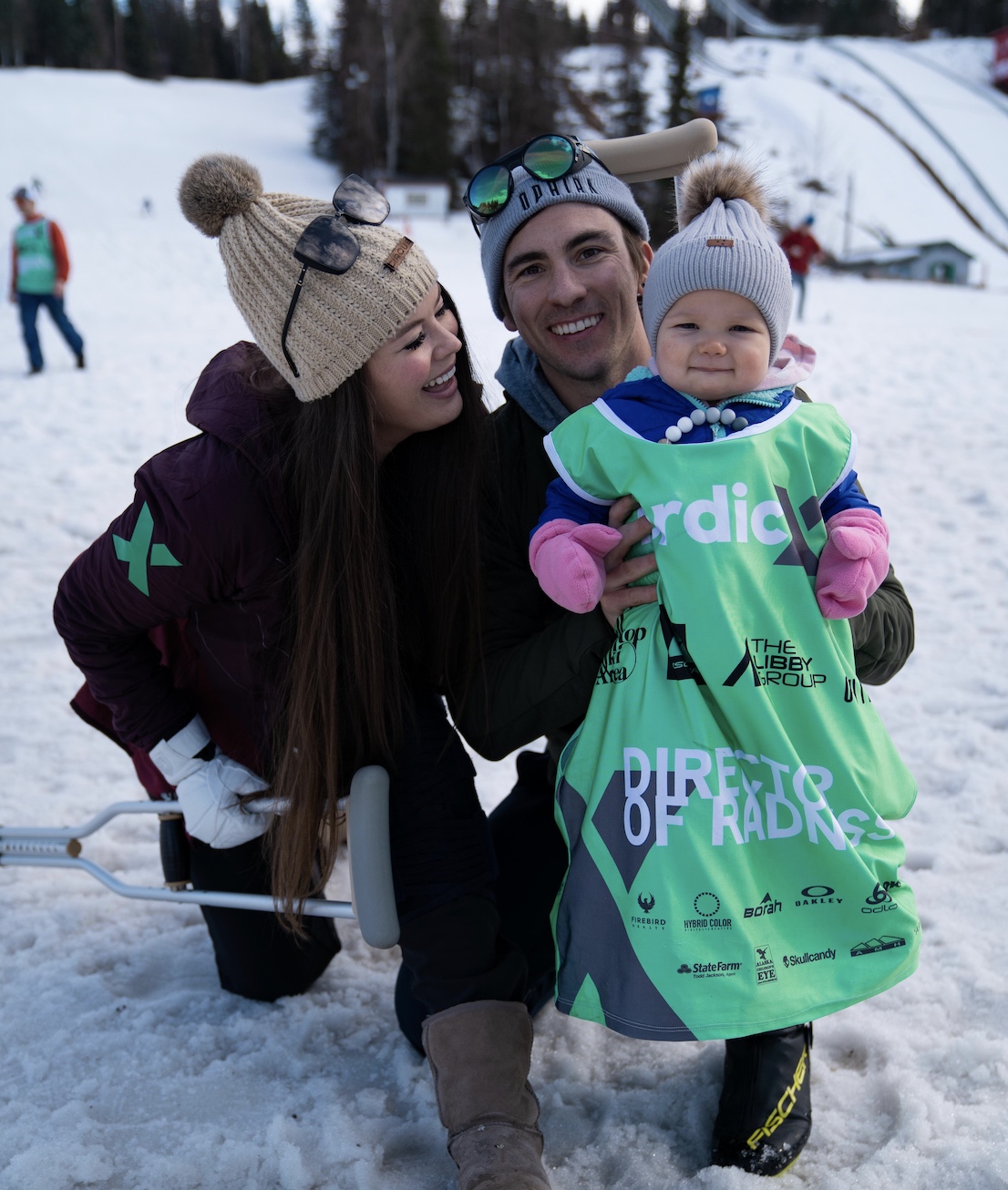
    Balancing CEO and family life with NordicX planning, Reese Hanneman hosts the xc ski event of his childhood dreams. (Photo: Ophira Group / NordicX)

    “I do want to say thank you to the team that we put together which includes Lauri Bassett (exec. administrator at Cross Country AK) and Rob Whitney, and the people at Hilltop, because without them, this absolutely would not have happened.”

    As for next year, “people are too excited about it for it to not happen again.” And he wants to see it happen for a second year. To pull it off, he anticipates putting together a larger team to more evenly distribute the workload, “just so that we can all maintain a healthy NordicX-life balance.”
  • New World Cup Venue in Les Rousses, FRA Receives Summer Inspection

    New World Cup Venue in Les Rousses, FRA Receives Summer Inspection

    The World Cup season is around the corner, and it’s adding a new stop.

    Already the site of the annual Transjurassienne ski marathon and recent host of the nordic combined and ski jumping events at the Youth Olympic Games in 2020, Les Rousses, France is ready to put on the country’s first cross-country World Cup since 2016. As stated in a FIS press release, recently, the FIS cross-country World Cup team met up at the venue for a summer inspection. Also in attendance were local organizers, representatives of the French Ski Federation and TV rights holder, Infront, as the group visited and discussed the existing settings. 

    Members discuss course details in the “Stade Nordique des Tuffes”. (Photo: FIS)

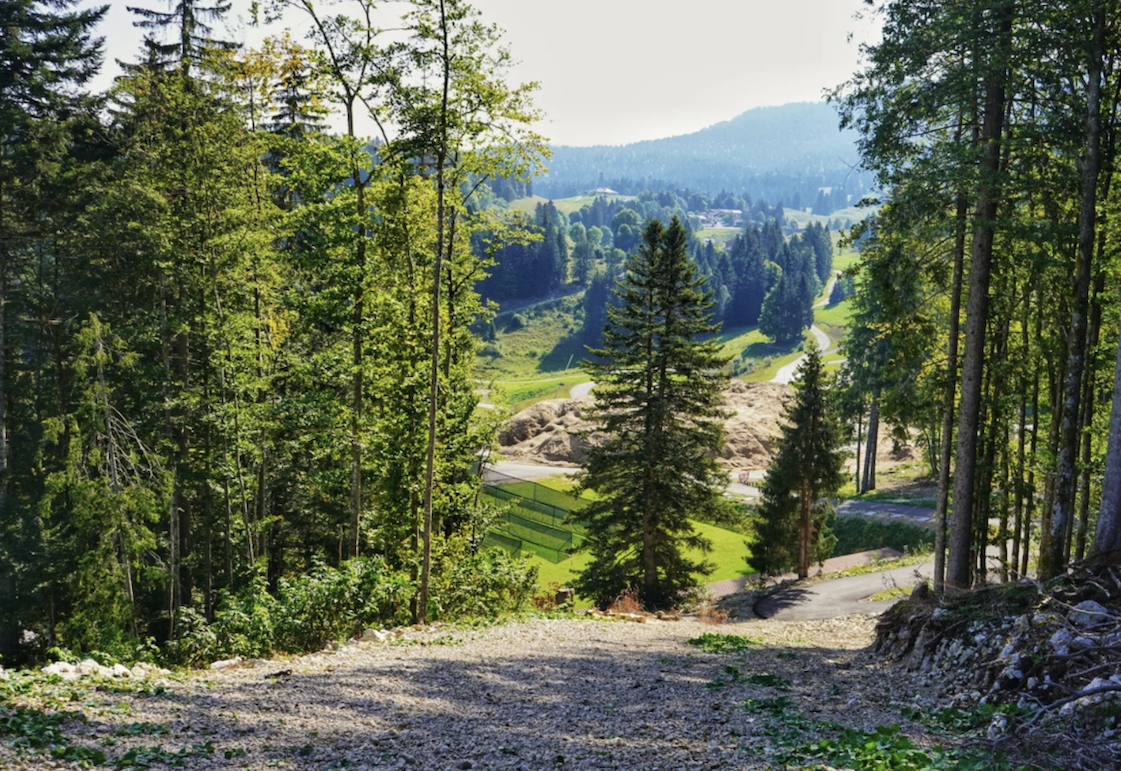
    Scheduled for January 14th – 16th 2022, the three-day event will include a sprint, individual 10/15 k, and pursuit stage. Located near the French-Swiss border in the Haut-Jura region of France, recent course adaptations to the “Stade Nordique des Tuffes” have launched the site into one of the regions top nordic training centers. 

    “Stade Nordique des Tuffes” in Les Rousses, France. (Photo: FIS)

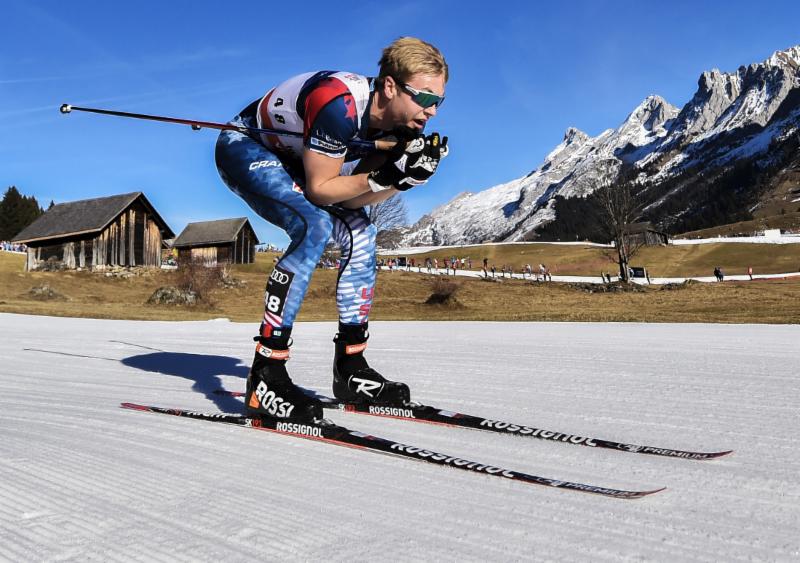
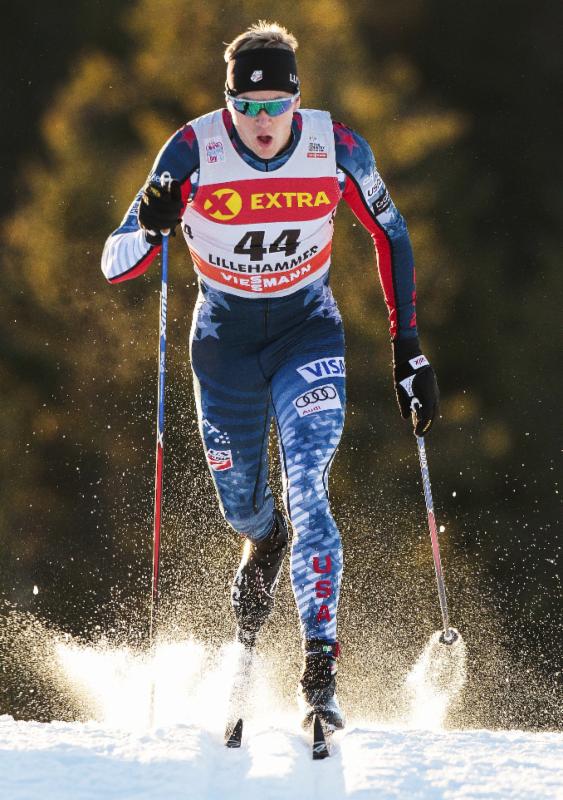
    The last cross country World Cup in France was held in La Clusaz in 2016, where American Erik Bjornsen posted a 20th place finish in the 15k freestyle mass start event.

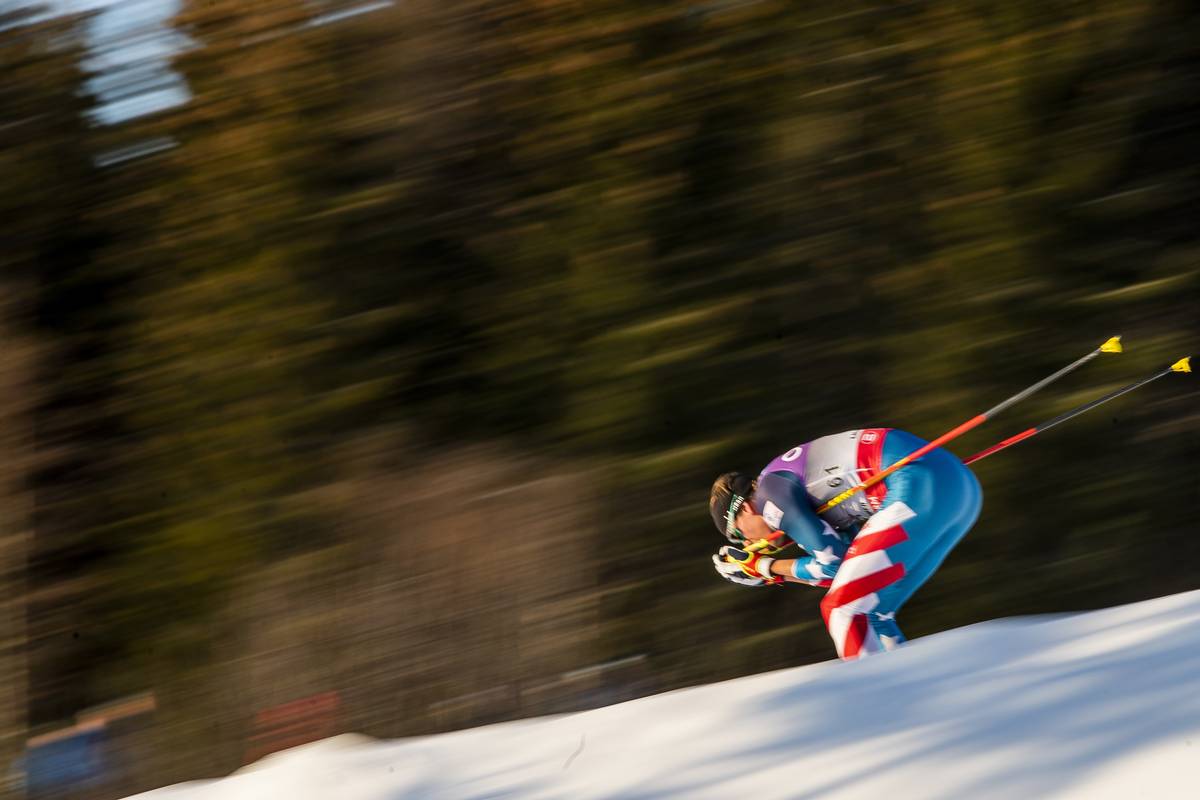
    Erik Bjornsen racing to 20th place in the World Cup in La Clusaz, France.

    Hosting high-level winter sport events is not uncharted territory in France. Annecy-Le Grand Bornand hosts the IBU biathlon World Cup annually and has become both a fan and athlete favorite. 

    Despite ever-changing pandemic rules and restrictions, venue manager Nicolas Michaud is hopeful to be able to host the event with a number of spectators. Since much of the region’s identity is based in winter sports, Les Rousses promises to be one of the great spectator events in central Europe.


  • UAA Skiers, Past and Present, On What the Team Means to Them

    UAA Skiers, Past and Present, On What the Team Means to Them

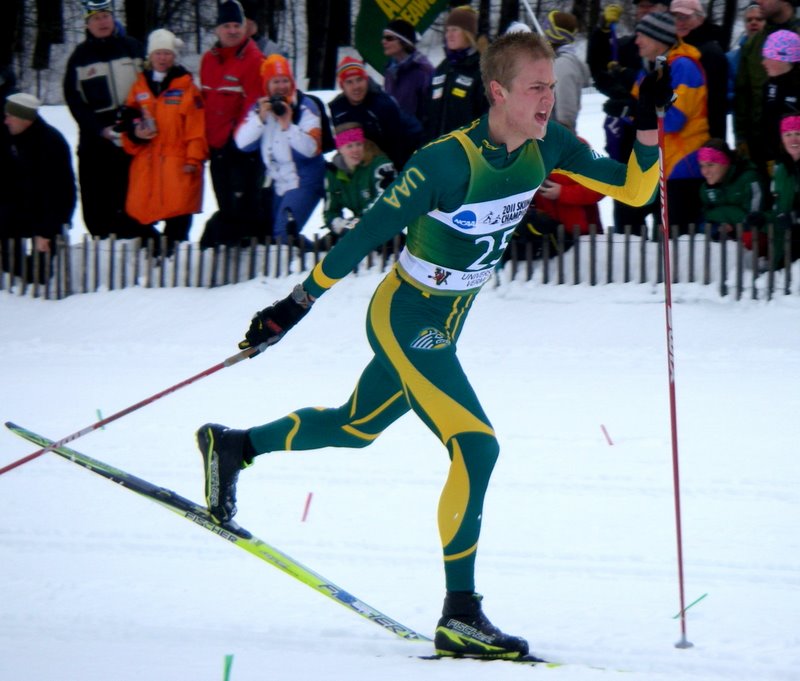
    Erik Bjornsen on his way to second at 2011 NCAAs in Stowe, Vt., while a freshman at UAA.

    ANCHORAGE — It’s déjà vu all over again for alumni and supporters of the University of Alaska Anchorage ski team, following the recent announcement that, for the second time in four years, university administration wishes to cut the team for budgetary reasons. A common theme in their current responses is their concern that this time, the cut may stick.

    To start with, consider what Adam Verrier wrote on his blog four years ago, in November 2016. Verrier, who skied for the University of Wyoming in the late 1980s and early 1990s, was a member of the 1994 Olympic team for cross-country skiing. He’s also, by this point, the closest thing that the UAA nordic team has to institutional memory – since the last time the team was threatened to be cut, all athletes and both nordic coaches have completely rolled over.

    Then, as now, Verrier wrote solely in his personal capacity. Verrier, who describes himself on his blog profile as “The UAA Nordic Team’s crazy uncle,” has never been on the UAA ski team staff; he has instead served as a volunteer assistant coach for many years. He has no official professional affiliation with the school.

    All that said, here’s an excerpt from what Verrier wrote four years ago this fall:

    Alaska is sometimes referred to as a “resource extraction state”. For centuries, people have been coming from other parts of the world to Alaska to get their paws on something valuable and bring it back “home” with them. The Russians came to fetch animal pelts and furs. Thousands showed up 120 years ago to dig a bunch of gold out of the ground and cart it back to the mainland. Folks came from the Pacific Northwest to catch salmon in Bristol Bay and cut down trees in Southeast. College students from around the USA come for summer jobs in the tourism industry. And Texans and Okies showed up in the ’70’s and ’80’s for oil, and they’re still here. None of these groups have been particularly concerned with building infrastructure and amenities here in Alaska – the things that enrich our lives, our culture, our cities and towns – because their goal has been to amass wealth and take it back “home”.

    I see it all the time at my “day job”, flying around the state and appraising the homes of people who are getting their kit together for their migration back “home” after “putting in their time” in Alaska. I frequently sit next to people on airplanes who say things along the lines of, “I figure I’ve got just a few more years up here and then I should have enough saved and I’ll move the family back to ________. I’ve already bought a parcel of land down there. It’s been a good run, but of course there’s nothing to do up here during the miserable winters.”  And I hear the same thing from people selling their homes to move “back home”.  Do you think these people want to pay taxes in Alaska and invest in local amenities like libraries, city parks, elementary education, and the state university system?  Of course not.  They’re extracting resources. They’re extracting wealth. Their priorities lie elsewhere.

    The full blog post may be found here. It’s worth your time (and shorter than this fine work, which makes similar points). Verrier’s observations on the historical relationship between Alaska and Outside, and on residents’ views of state spending in a state with no income tax and where residents are literally paid annually just for living here, remain trenchant and applicable today. (More on Verrier later in this article.)

    Hailey Swirbul

    University of Alaska Anchorage Seawolves skiers Hailey Swirbul (l) and Casey Wright (r), photographed on the UAA campus in Anchorage, Alaska, in October 2016. (Photo: Gavin Kentch)

    Four years ago, Hailey Swirbul was 18, a college freshman, recently arrived at UAA from Colorado and living on her own for the first time. She spoke with FasterSkier in October 2016 about the recent announcement that University of Alaska administrators wanted to cut the ski team after the 2016/2017 season. Before the three World Juniors medals, before the three (and counting) national championships, before the four (and counting) World Cup top-30 finishes, Swirbul sat in the Alaska Airlines Center next to teammate Casey Wright and told this reporter, somewhat presciently:

    I don’t think we were necessarily singled out. But I can’t understand why they would cut skiing in Alaska. I don’t understand that. And I don’t think they understand why they cut us. I don’t know. … Were we singled out? No. Are we some of the best academic and hard-working people at UAA? Yes. And I don’t think they would purposefully single out those types of people to remove.

    …

    I would never wish this upon anyone else, and I can’t say that I would rather have the gymnastics be cut, or the hockey be cut – because this sucks. And I don’t want anyone to go through this.

    Fast forward to 2020, and Swirbul is now a professional skier with Alaska Pacific University, or APU, literally just down the street in midtown Anchorage. Over the weekend, she took a break from training to write to FasterSkier as follows:

    Well, it sure is frustrating to say the least. I almost feel a preemptive sense of defeat after going through this process a few years back. I’m afraid that the board is going to do it “right” this time – in their eyes, at least.

    To those trying to cut the ski team at UAA, only 20 or so lives would be impacted directly. But they aren’t seeing the bigger picture. Cutting teams that actually have a presence on the collegiate circuit, like UAA, opens a gateway to risk losing skiing as a collegiate sport entirely, in my opinion. Less participants, less viewers/fans, less income. I’ve heard rumors that cutting UAA Alpine and Nordic might make the current RMISA system fail due to too few teams competing.

    We all know that skiing is already not the most lucrative of sports, but in my view, it is unmatched in non-monetary benefits. Endurance sport instills a work ethic and drive that you don’t find just anywhere. As far as I know, the UAA Ski Team has been one of, if not THE, top team at UAA academically for years!! These hard-working, involved, dedicated people are the kinds of people I want in my community, and those are the kinds of people that skiing brings to Anchorage. I’m bummed about this announcement, but I can’t say I’m surprised after the way it was left a few years ago. I figured this might happen, and I’m ready to do my part to keep skiing at UAA. I just hope it’s enough.

    (As Swirbul accurately notes, members of the UAA ski team have historically been strong students as well as strong athletes. At the 2019 NCAA Championships, for example, Swirbul’s former teammate and 2018 Australian Olympian, Casey Wright, won the Elite 90 Award, presented to the skier at NCAAs with the highest grade point average. Following the 2019/2020 ski season, UAA tied for third nationwide in total selections to the National Collegiate All-Academic Ski Team.)

    Sadie and Erik Bjornsen

    Sadie Maubet Bjornsen is now known as a longtime member of the U.S. Ski Team, and as a student and athlete at APU. But before the national team nominations, the national championships, the two Olympic teams, the World Championships medal, and the 11 World Cup medals, Sadie was a freshman skier for UAA. (And a pretty good one, too; she finished in the top five in five out of eight races her freshman year on the RMISA circuit, including third overall in the classic race at NCAAs.)

    Although she spent just one year at UAA before moving over to APU, Sadie continues to place great value on that year as a stepping stone on her path to the national team. Here’s Sadie (at the time just Sadie Bjornsen, no Maubet yet), in an email to FasterSkier from October 2016:

    My year as a Seawolf was one of the most important “steps” of my life. I would have never been drawn to AK fresh out of high school, and discovered this incredible state. I see skiing as a big family with many functioning parts. By eliminating one integral part of the ski community, we are cutting off a strong piece of the family!

    I have always considered Alaska to be the best training for a cross country skier in the US. We have the perfect environment for training, including early snow in the fall, and late snow in the spring. I now race professionally, and am a student at Alaska Pacific University while racing World Cup. I see APU as providing the very best opportunity in the world for myself, but, I know this level is not designed for everyone. It is important to have options, and varied levels so that skiers can choose where they want to go, and have a path to where they are looking to reach. I would never give back that year of racing NCAA at UAA, a year that taught me so many lessons! It saddens me to know that won’t be available for everyone anymore!

    Erik Bjornsen followed a similar path as his older sister, Sadie: grow up in Mazama, Washington, skiing in the Methow; come to Anchorage to ski for UAA; make a national championship podium as a freshman (Erik was second at the 2011 NCAAs); move to APU to pursue professional skiing outside the NCAA context; become a longtime member of the U.S. Ski Team; marry an athletic French person. (Because American nordic skiing is often just one very small family, Erik’s wife, Marine Dusser-Bjornsen, was an athlete at UAA from 2012–2014, and was interim head coach there for the 2019/2020 season. She was named the RMISA Nordic Coach of the Year for last season before amiably moving on from UAA as she and Erik moved back to Washington.) Erik would go on to ski at two Olympics and log dozens of World Cup top-30s before retiring from professional skiing earlier this year.

    Erik took time out from his first post-skiing job, working 12-hour days on construction sites in the Methow, to talk with FasterSkier by phone this weekend.

    Much like Sadie, Erik talked about the significance of his time at UAA as the start of his adult life. “It’s not only been an important part of my ski career,” Erik said, “but also it’s where I went after high school; it was the first place I lived away from my parents. I definitely made some of my best friends there. Three of my groomsmen, my best man, were guys that I met at UAA. … It’ll always be a big part of my life, the year I spent there. I’m just thankful that I was able to have that opportunity with the team there, and I’m disappointed that other kids won’t have that same opportunity.”

    Marine Dusser was named RMISA Nordic Coach of the Year in her first year leading the UAA Seawolves. (Photo: Adam Verrier)

    As someone who raced both within the NCAA system, at UAA, and outside of it, at APU and internationally, Erik shared his perspective on the significance of college skiing to American nordic skiing as a whole: “It’s an important part of the whole system that we have here in the U.S. It’s a smaller part, maybe, but it’s an important part. Alaska is one of the strongest cross-country ski regions in the U.S., and having an NCAA program in that region is quite important. APU does a great job with more of the – in Alaska, I think people think of it as more of the elite, more professional team – but it’s important to have an NCAA program in town, that younger, high school athletes that maybe aren’t quite ready to race on the World Cup can go to UAA. The school just came off one of their best years in a while; they have the second-best, nearly the best men’s team in the U.S.”

    (As Erik correctly noted, the UAA men were second among men’s nordic teams at the one-off nordic race that was the 2020 NCAA Championships. The UAA women were fourth in the women’s nordic standings.)

    Erik continued, “I’ve always been a big supporter of NCAA skiing. I think it’s an important thing to have in the system. Although I didn’t use it for all five years like some others did, I was definitely able to benefit from UAA, and it was an important part of my development to have it there. I think the whole U.S., especially Alaska, is going to really miss having it.”

    Finally, Erik noted, “It’s disappointing to see cross-country skiing going in that direction in Anchorage, when it just seems like, in the U.S., everything else is headed in the right direction for cross-country skiing in this nation. So to be losing one pretty important nordic team in the U.S. is disappointing to see, for sure. … I really thought we were kind of past the point of cutting the team. I hadn’t heard this most recent news, but before Marine had finished at UAA, it sounded like it was in a good position. So I was very shocked when I saw the news.”

    Adam Verrier

    And finally, back to Adam Verrier, the volunteer assistant coach who, though officially unaffiliated with the school, has unofficially been with the program longer than anyone currently on the nordic side of the UAA ski team. Here are Verrier’s thoughts on the current situation, from a recent email to FasterSkier, as drawn from over 30 years’ experience with NCAA skiing:

    We went through this in 2016 here at UAA. And during my involvement with NCAA skiing over the past 33 years, I’ve seen this scenario play out at the University of Nevada-Reno, Western State College, Montana State and University of New Mexico. And twice on my own team when I was at University of Wyoming. We got cut at the end of my freshman year, in 1988, but were reinstated about a month later and survived four more years until finally being cut (for good this time) in 1992 at the end of my senior year. So I’m no stranger to this game. As a long-time observer of these kinds of things, it’s been interesting to see how often the team gets reinstated sooner or later.  University of Denver got cut in 1984, but then was reinstated in 1992 when my University of Wyoming team got cut, so most of our team just moved a couple hours’ drive down the road to Denver, and they were immediately successful and have been so ever since. The Montana State team was cut in the mid-1980’s, but their program was reinstated 20 years later and lives on today.

    The 2014 UAA alpine and nordic teams on the Kincaid sand dunes in Anchorage. (photo: Adam Verrier)

    And many of the teams that didn’t get resurrected as NCAA programs have put together their own kind of ski team or university club racing program, like University of Wyoming and Western State College. It goes to show that there is a community desire for competitive college ski racing programs.  These programs are often the anchor for these college-towns’ winter recreation programs, providing trail grooming and maintenance and local ski events for area residents.

    I think the proposal to cut the Ski Team is shortsighted. Not only is Anchorage full of Olympic skiers past, present and (hopefully) future, but it’s also a city in which a significant number of residents regularly commute to work on skis during the winter months. With our interconnected ski trail networks and our groomed multiuse corridors connecting residential neighborhoods to commerce centers like the hospitals, University, and downtown and midtown business districts, this is one of the few places in the USA where skiing is a mode of transportation that residents regularly use for practical purposes like getting to the office in the morning.

    Skiing is a practical sport here in Alaska, and a valuable skill to have. It’s important enough that organizations like NANA (Northwest Arctic Native Association) and Skiku have been putting lots of time, money and energy for many years to bring skis and ski instructors to remote villages to teach skiing as a practical skill and a way to get outdoors during the winter. Our Alaska high school ski races put hundreds of kids on the starting line every weekend, and several of our Anchorage high school ski teams have close to a hundred kids on the team. And if you want to sign your youngster up for Junior Nordic, you’d better be quick because the hundreds of available spots fill up super fast every year. Skiing is a really big deal in this state.  And the University of Alaska Ski Team, along with APU, are the elite flagship programs.  Many of America’s most successful World Cup skiers in recent years developed through the UAA program, with some of them moving from UAA directly across the street to APU to continue their post-collegiate ski racing.

    I haven’t had a chance yet to look too closely at the details of the proposed cuts or the budget numbers that we’re talking about, but clearly this problem is rolling downhill from the legislature’s choices and decisions regarding the Alaska state budget. This is a state which has sixty-one billion dollars’ worth of savings in the bank, a state which levies no state income tax, not statewide sales tax, no broad-based personal taxes of any kind, and a state which mails a check of around a thousand dollars or so to every resident, every year, just for breathing. But yet, we claim to be “broke” and we claim to be “overtaxed”.

    Marine Dusser (l) and Adam Verrier (r) prepare fast skis. (Photo: courtesy Adam Verrier)

    The legislature’s decision to cut state funding for the University by $34 million seems to me like poor policy. And the proposed cut of the Ski Team also seems to me like poor policy.  This team has consistently provided a place for Alaska-grown skiers to take their athletic ambitions to the next level, and at the same time has attracted a steady stream of high-achieving, smart people who come to Alaska from other places to be a Seawolf, but wind up getting hooked and staying here for life. And these athletes – both the Alaska-grown ones and the ones who come here from elsewhere – have contributed enormously to the talent pool in the Alaska workforce today. They’ve brought tremendous benefit in their roles as research economists, CFOs of the state’s largest Native-owned corporations, as oilfield geologists, just to name a few specific examples that come immediately to mind.

    I would estimate that these high-achievers, who were lured to the state, or were enticed to stay in-state by the Ski Team have contributed far more value to the local economy in terms intellectual capital during their careers here than the cost of the athletic programs which brought them or kept them here in the first place. If one of the University’s goals is to foster intelligent dialogue between people of various experiences and viewpoints, and to provide a rich and fertile environment in which our best brains can develop, then it’s clear that our ski team serves that mission. To propose cutting the team seems to me to be diametrically opposed to this goal.

    Next steps

    Cathy Sandeen, the UAA Chancellor, will hear public comments at an online town hall from 5-6 p.m. Alaska time this Wednesday, August 26. Zoom information will be published here.

    The University of Alaska Board of Regents will hear public testimony from 4-5 p.m. next Monday, August 31, in advance of its upcoming Board meeting on September 10-11 at which it is scheduled to vote on Sandeen’s proposal.

    Finally, ski team supporters are encouraging advocates to submit written comments to the Board of Regents at ua-bor@alaska.edu, cc’ing uaa_feedback@alaska.edu.

    * * *

    This article has been edited to reflect the fact that Adam Verrier competed for the University of Wyoming only in nordic skiing, not in alpine skiing as well.

  • Still Charging: Erik Bjornsen Retires at 28

    Still Charging: Erik Bjornsen Retires at 28

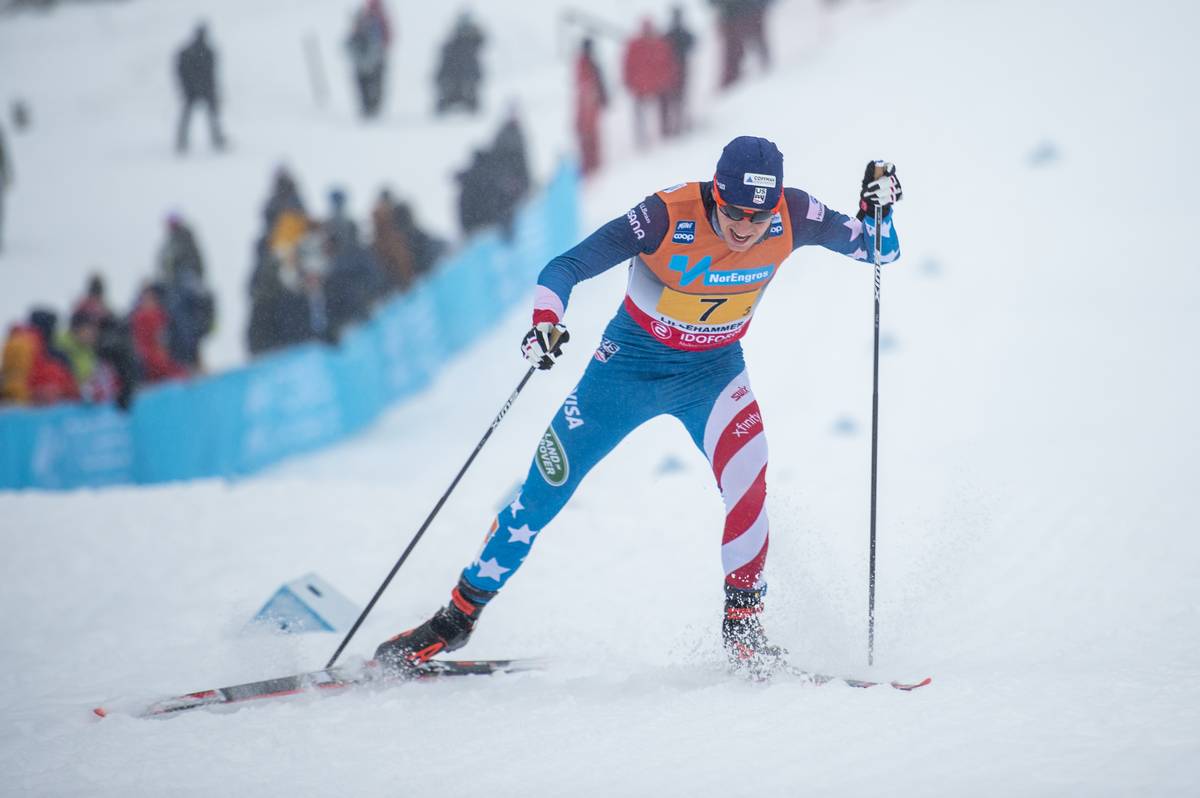
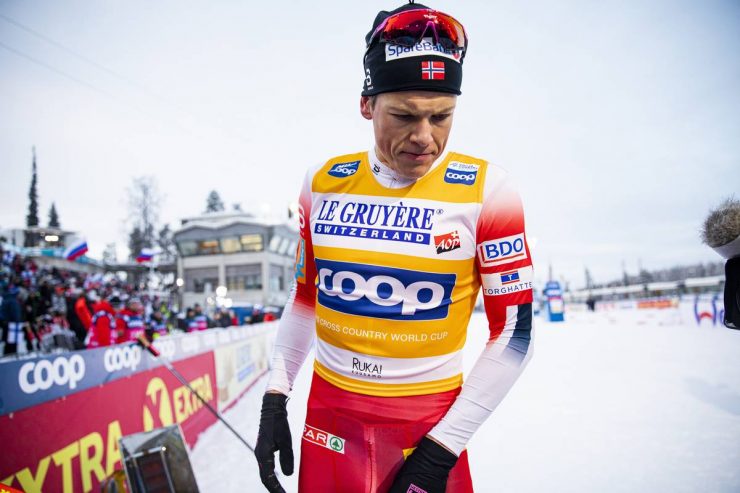
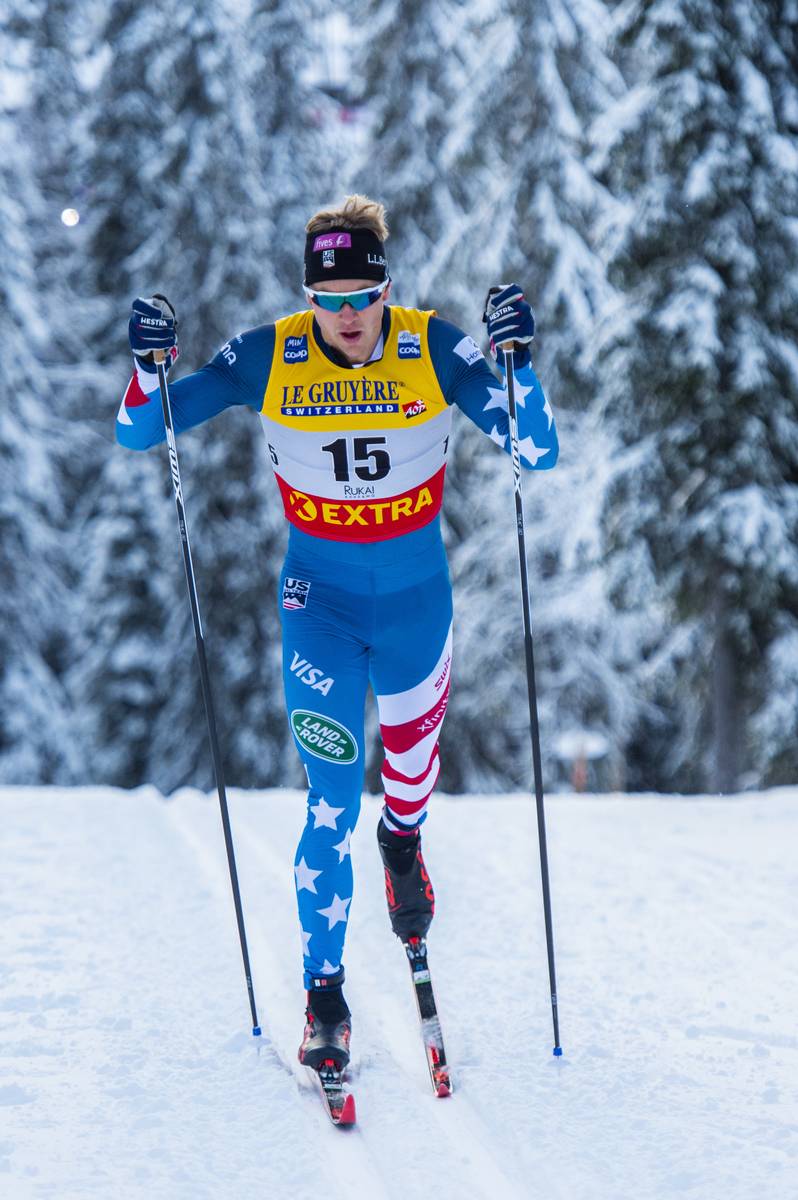
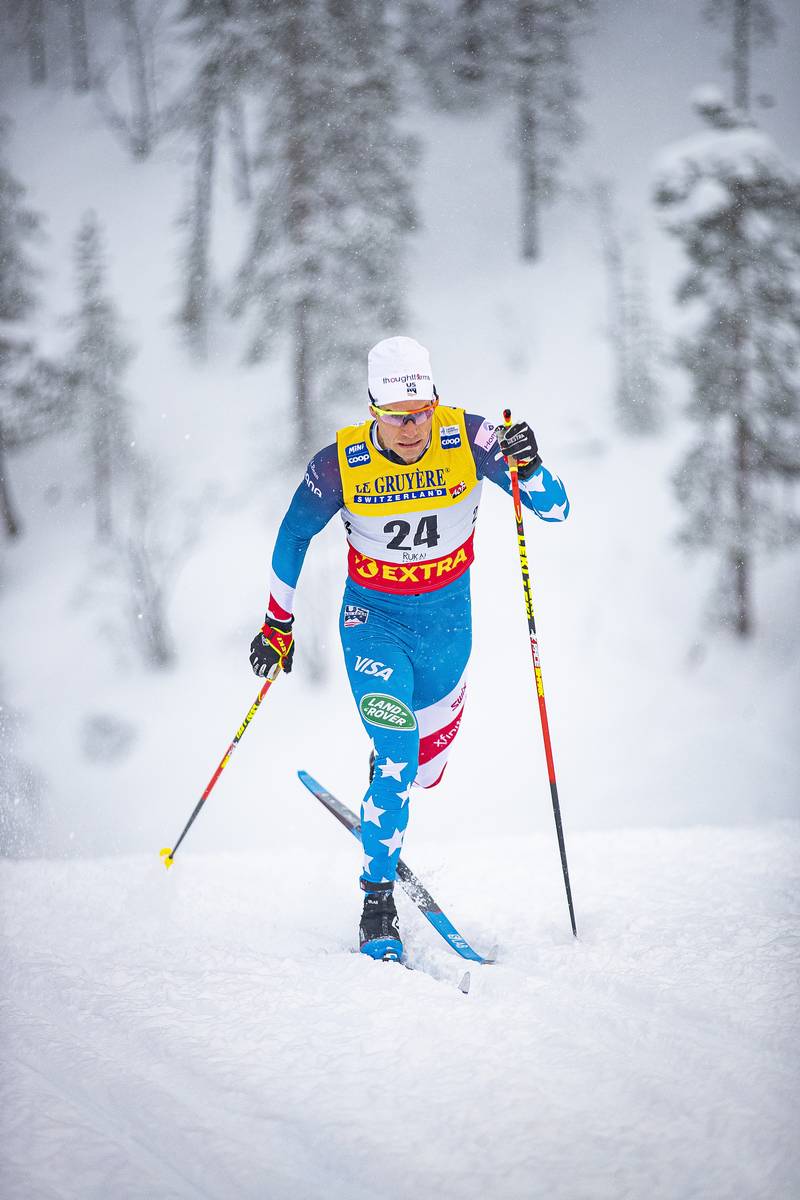
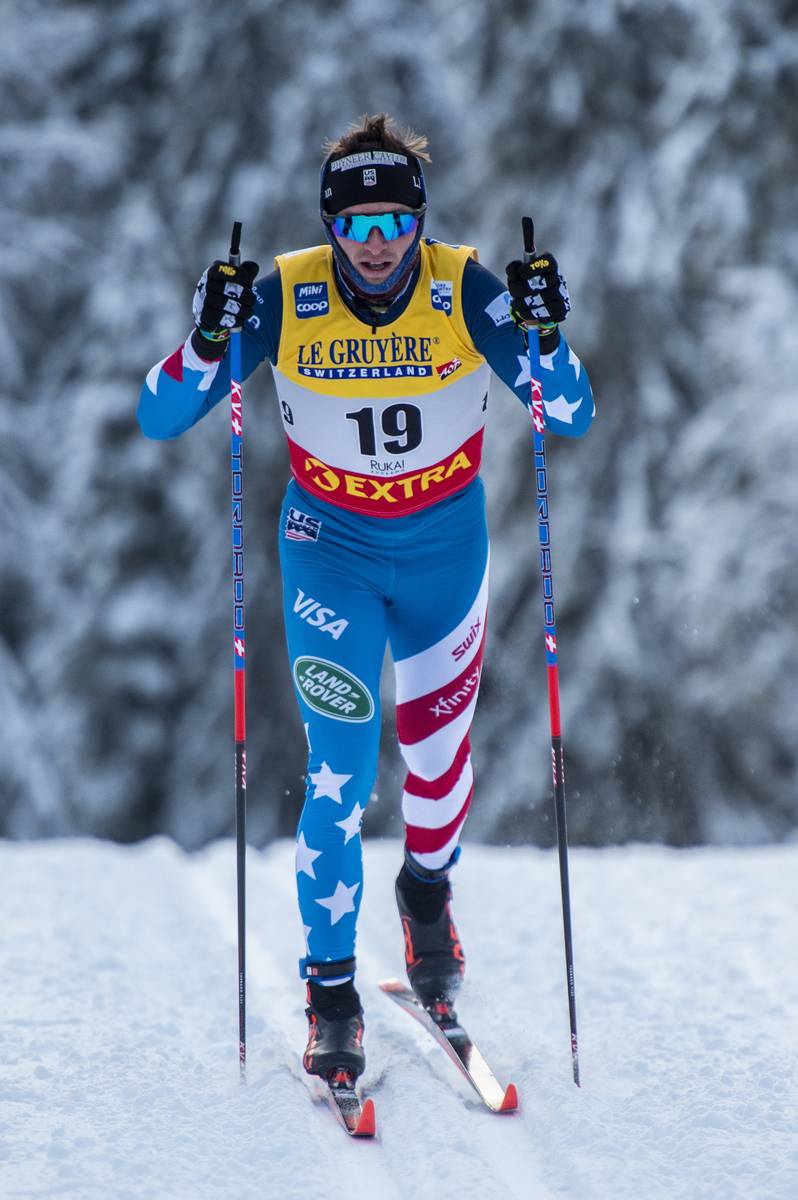
    Erik Bjornsen crossing the line in the 2019 15 k skate pursuit in Ruka, Finland. (Photo: NordicFocus)

    Bright lights in PyeongChang. The men’s second semifinal of the Olympic freestyle team sprint was a career highlight moment for Erik Bjornsen. Fourteen teams would crowd the start lanes with Martin Johnsrud Sundby in bib 1. The Norwegian was paired with Johannes Høsflot Klæbo: The duo blessed with Sundby’s stamina and his younger counterpart’s break-from-the-pack speed.

    With Simi Hamilton racing the second, fourth, and sixth legs for the U.S., and Bjornsen leading off, the semi was a chance to not only advance to the finals, but establish some mojo amidst an Olympic field. Hamilton and Bjornsen both possess slower tempo big-power generating F-350 type motors that belie the meters gobbled up with each cycle of their cadence. 

    As Bjornsen was tagged for the fifth of six legs, he locked on to France and Norway to position himself in rarefied company. PyeongChang’s Alpensia sprint course packed a punch. The course’s second climb it’s Everest – a drawn out leg burner. Pulsing into that climb, France’s Maurice Manificat, Sundby, and Bjornsen had already separated from the field. Midway up, Bjornsen subtly shifted gears, moved to the left of Manificat, and dropped the two steely veterans by 10 and then 15 meters pushing over the top.

    It was a Stars-and-Stripes flex.

    Bjornsen tagged Hamilton in first by nearly five seconds. The pair went on to qualify for the final and placed sixth overall in an event eventually won by the Sundby-Klæbo pairing. 

    (Video of Bjornsen’s breakaway on the 5th leg.)

    “It was interesting, I think that everybody knew what I was capable of in the field when I made those moves,” said Bjornsen when reflecting on career highlights. “I remember one of the strongest memories I have from racing is when I made that move against Sundby. And after the race, as we were starting the final in PyeongChang, he turned and looked at me for a while, and I could tell that he was thinking ‘what is this kid bringing to the final’? He eventually got the gold medal with Klæbo, and he is looking at this American guy, and I think that was one of the coolest feelings I have ever had — knowing that this legend was looking at me, and thinking, ‘what is this guy about to bring to the biggest performance of our lives?’”

    The U.S. men’s team has been overshadowed by a dominant women’s program for going on a decade. Through that time, the men’s distance program has seen the end of Kris Freeman’s reign and the emergence of Noah Hoffman and Erik Bjornsen. Hoffman retired in 2018. With Bjornsen announcing his retirement last month at twenty-eight years old, a void remains. As one generation bleeds into the next, Bjornsen is an anchor point for all those speedy juniors we’ve heard of. An affable athlete who set the American distance skiing bar for the past five years.

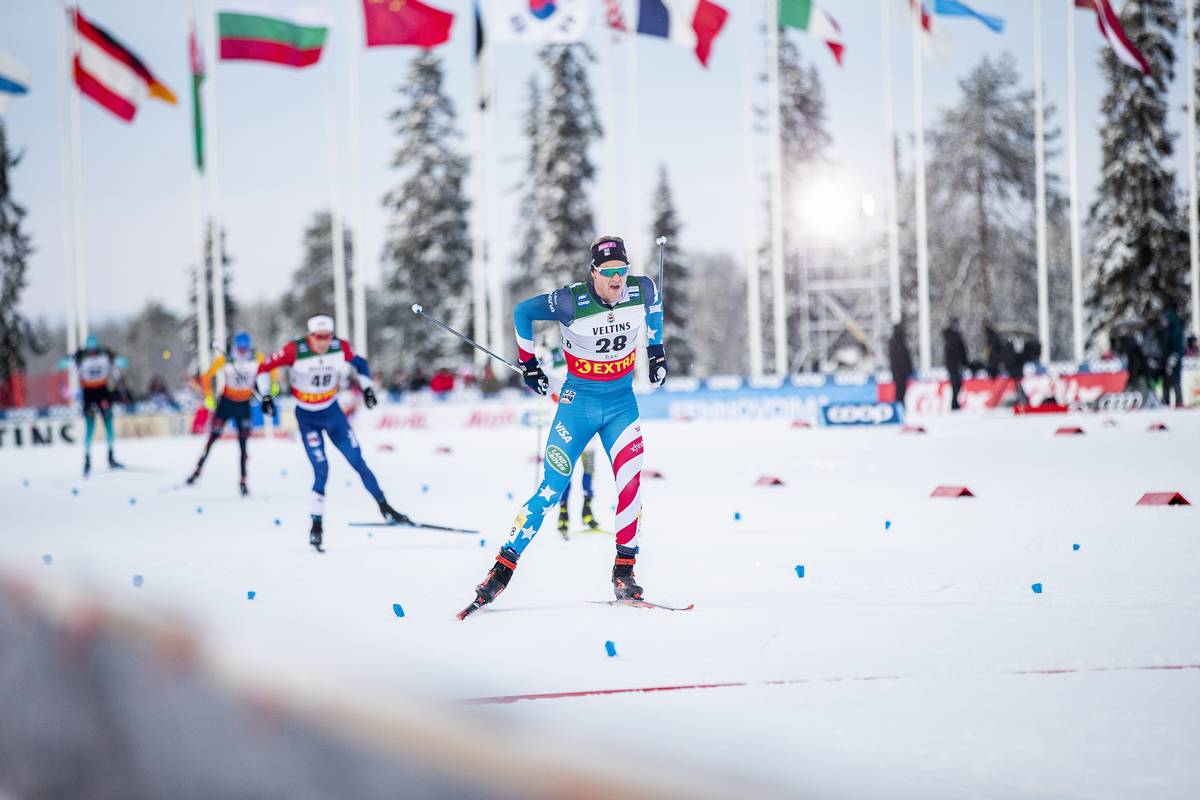
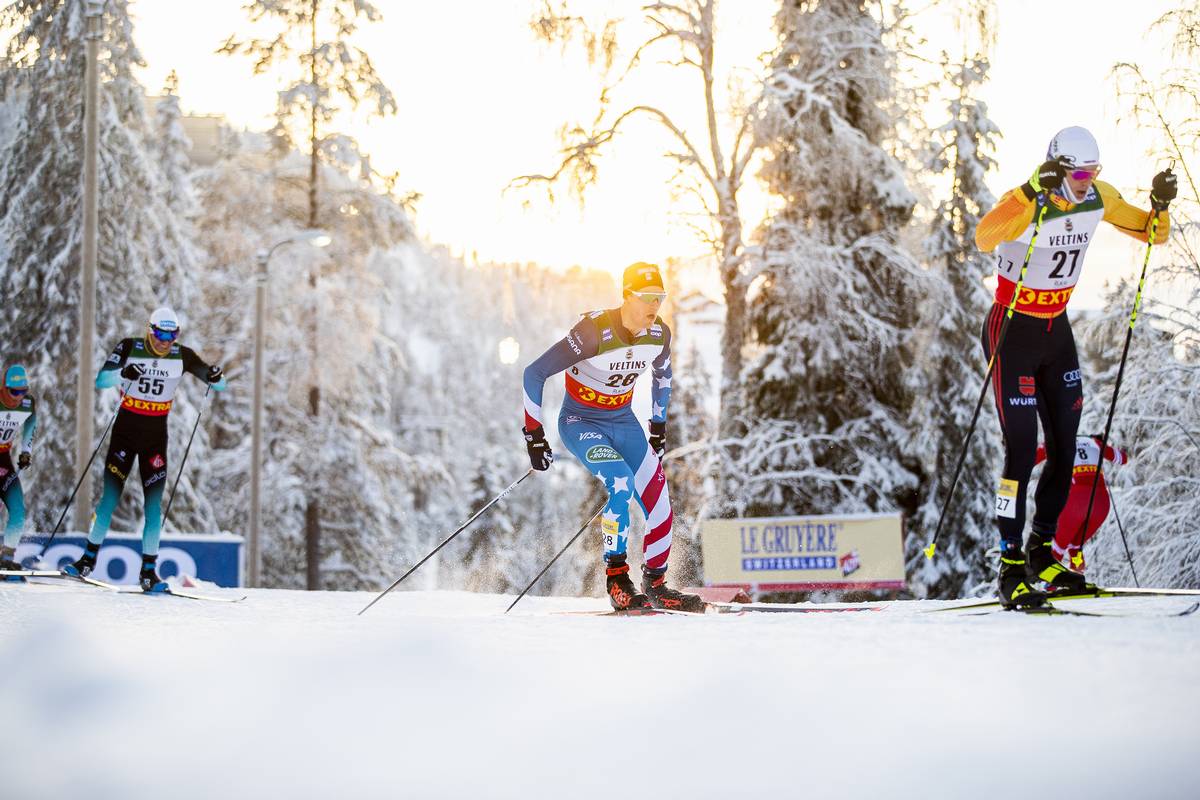
    Erik Bjornsen of the U.S. (bib 28) during the 2019 15 k skate pursuit in Ruka, Finland. In bib 27, Sebastian Eisenlauer (GER) leads Bjornsen. (Photo: NordicFocus)

    Bjornsen often shouldered the pressure for a team and broader community starved for that dominant distance performance by a U.S. male — a World Cup podium or a championship medal to validate the personal quest and the vicarious desire from some fixated on top-3 hardware. Making the top-30 on the men’s World Cup is a herculean task. Bjornsen first passed that threshold with an 18th place in 2014 during a 15 k classic (his marquee event), in Toblach, Italy.

    In January 2018, he surpassed that 18th place, which up to then was a career best individual mark on the World Cup, with a ninth place in Seefeld’s 15 k mass start skate. He peaked individually at the World Championships with an 18th and 17th, respectively, in the 2017 and 2019 Worlds in the 15 k classic. 

    The manifestation of steady improvement was Bjornsen’s calculus for remaining in the game. And the wait and wait for results beyond his stream of top-30s and top-20s was arduous. Even on the best of days, all things must align for the breakthrough.   

    “Definitely, my last couple of years, I was really hungry for great results, like everybody that puts so much into the sport,” said Bjornsen. “I was ready to make that next level. But I was moving towards the end of time I wanted to put into the sport and I really wanted to make the progress every year that I knew what I was capable of. There are so many variables in nordic skiing that I was just frustrated not to put it together more on the days when it was so tough. My thing was 15 k classic — that is where I could put together a top performance. That’s four 15 k classics a season, you are trying for your top performance in those four or five and also nailing the wax and also nail everything on that day. So I am proud of the results that I had but I was frustrated like any World Cup athlete. I was just definitely hungry for more at the end.”

    The World Cup came to an end for Bjornsen in December after he raced the opening weekends in Ruka, Finland, and Lillehammer, Norway. Yet, the decision to retire from World Cup level competition came after the 2018-2019 season if he did not, in his words, “step-up”.  

    After a solid summer of training, Bjornsen was blunt about his 2019-2020 World Cup campaign. “I am going over to the World Cup to make a step forward, or call it a career,” he said.

    He placed 25th overall in the Ruka triple. The following weekend in Lillehammer’s 15 k/15 k skiathlon he had a reason for optimism. At the same venue with the same race format in 2017 Bjornsen had placed 20th. This year, he initially raced near the sharp end. But as the temps warmed a degree or two, his skis began to ice. He faded to 39th. The plug was pulled.

    Bjornsen explained that U.S. World Cup regulars leave bags on the wax bus after each season, a stash of clothes and items to rely on when they arrive for the season each November. “I had left a bag over there basically for the last five or six years,” said Bjornsen. “On the last trip, I packed that one up. I didn’t know if I would be coming back.”

    Having grown up skiing in Washington’s Methow Valley, Bjornsen followed the usual path of success: solid Junior Nationals, World Junior Teams, a second place in the 2011 U.S.Nationals 20-kilometer classic, and his first senior championship two years later in the 15 k skate. USST D-team, B-team, and then A-team. Although the family fostered two future Olympians, (you know this but older sister Sadie is a USST veteran) Bjornsen’s parents moved to the Methow when a new alpine ski area was in the works. As luck would have it, the planned downhill area never materialized. 

    Erik Bjornsen (APU/USST) and Matt Gelso (SVSEF) headed up Hermod’s Hill for the final time at the end of the 15 k freestyle at the 2013 U.S. Nationals. Bjornsen took his first career national title and Gelso finished third.

    The Bjornsens live on the more secluded Mazama end of the Methow. Mazama sits at the base of a closed-in-winter State Highway 20 which snakes its way up to Washington Pass and alpine paradise. Drive any direction but south in the winter from Mazama and it’s a snowy dead end. One road during those cold months serves as a diversion into Winthrop and further south to Twisp. The region’s storied cross-country trails provided another outlet. Within walking distance of Bjornsen’s neighborhood were endless ski trails and families falling in love over and over again with the sport. Sean and Laura McCabe and Leslie Hall (Laura McCabe and Hall are former USST members) lived nearby and were constant reminders that sliding on snow without a gravity assist had merits.

    With his two older sisters, the Bjornsens joined the local ski club. It was a steady stream of hand me downs terminating at Erik. As Bjornsen became more serious, he relied on Scott Johnston as his primary coach. Johnston is known as fastidious and established a serious training regime for Bjornsen. 

    “I learned a lot from him,” said Bjornsen. “He took the time to explain everything about skiing and also the physiology side of things. I started to understand the ways of training and training plans. He brought my curiosity out and made me think about each and every workout.”

    By the time Bjornsen was in his late teens, Sadie had moved to Anchorage to ski race as a student-athlete for the University of Anchorage Alaska (UAA). When it came time for a post-high school decision in 2010, Erik chose to attend UAA too. Both Bjornsens ultimately aborted their UAA paths after earning NCAA All-American status and began taking opportunities on the World Cup as they trained with APU. APU, an emerging powerhouse team, was coached by Erik Flora and championed by Anchorage’s Kikkan Randall. 

    Erik Bjornsen on his way to second at the 2011 NCAAs in Stowe, VT.


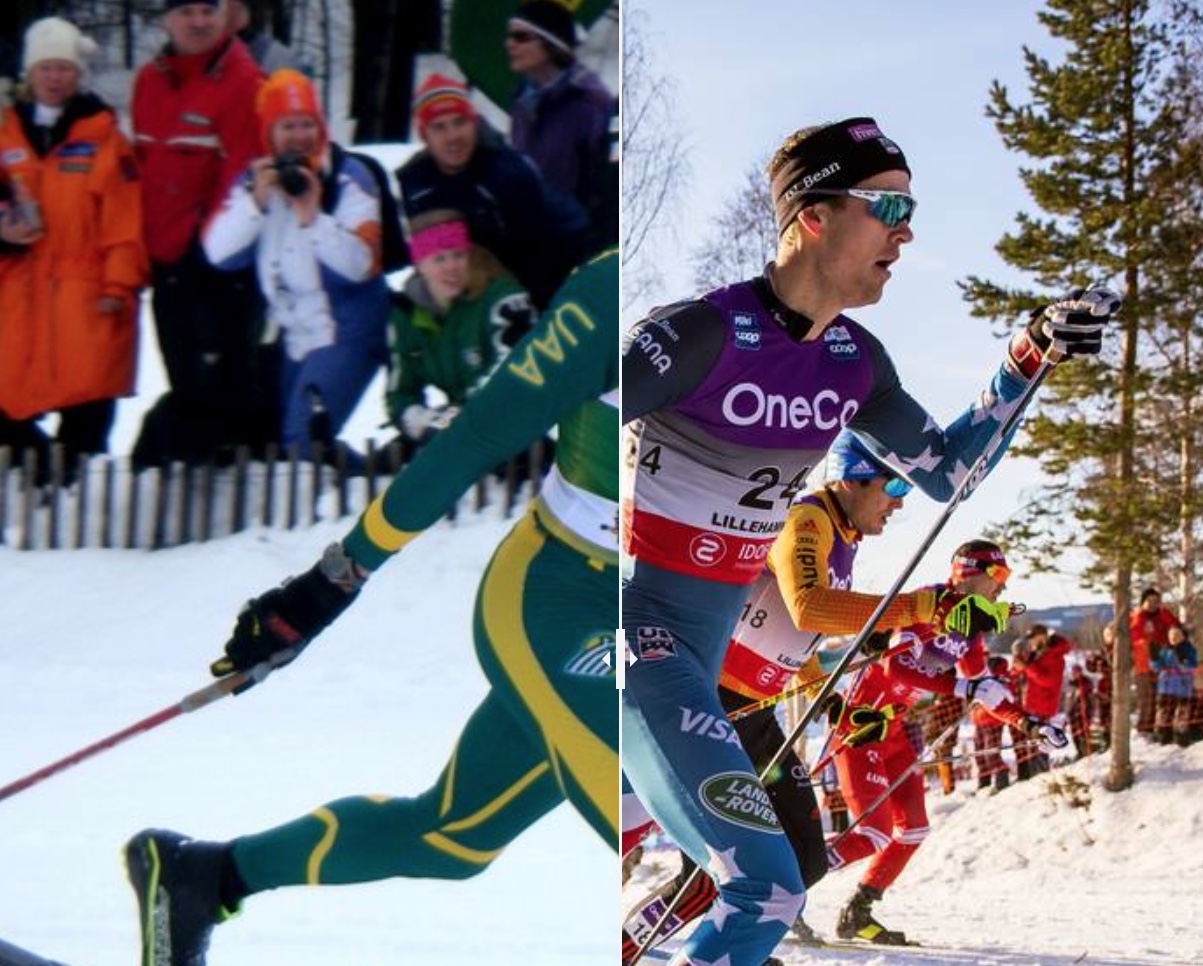
    For a juxtapose of Bjornsen between 2011 and 2019, click the following link.


    With a cohesive training group at APU and the steadiness of Flora, both Bjornsens blossomed. Erik earned his first World Cup start on Dec. 7, 2012 in Québec. A few days later in Canmore, he popped a 36th place in the 15 k classic. Along the way, he won six national championships and was a member of the U.S. Ski Team for seven years. 

    “When Erik first came in, I could see this young, talented skier that was excited about skiing, and he really enjoyed racing,” said APU’s Flora. “And when he first came in, I thought, Okay, if I can help him with his training, and help him reach the next level in fitness, that seemed like an opportunity that was an easy one to help him get toward his goals. And as he retires, you know, there was a certain point where Erik went from being in a place where talking about daily training was constructive, to where Erik absorbed all of that over the years, to the point where Erik knew how he wanted to train, and he had the foundation for it.”

    During the later part of his career, Bjornsen had enough know-how and self-knowledge to write his own training plans with the occasional check in or hands-on training session with Flora. 

    Bjornsen imprinted the cycle in his muscle memory. He attended USST camps, looped around on the Eagle Glacier during the summer, and locked in for a lengthy stint as a World Cup regular. The bag he eventually snagged off the wax bus this past December was left in Europe for five seasons or so, during which he raced at two Olympics and four World Championships.

    Erik Bjornsen (APU) during the 2020 U.S. Nationals men’s 15 k skate. (Photo: Reese Brown)

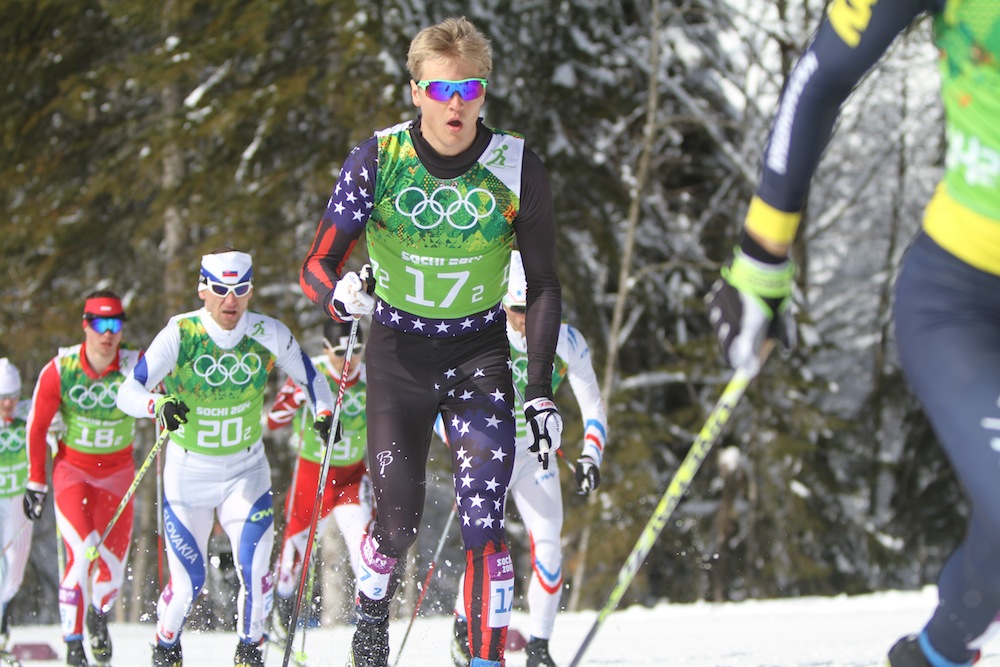
    At the 2014 Olympics, Bjornsen contested five of six events as the youngest member of the team at 22 years old. Sochi was a time he recalls fondly not so much for a “media-worthy” result, but for the pure novelty of it. Big eyes. The Olympic rings. An international career yet to unfold. “It was just so fun, everything around it was great,” said Bjornsen.

    What was also great were the Hamilton-Bjornsen prospects in the team sprint. It’s one thing to prognosticate and imagine a team sprint medal on the men’s side. On paper and on snow this was no pipe dream. Other teams had the luxury of mixing and matching athletes over the years. When sprinting three laps, a total of roughly 4.5 k full tilt, the combo of stamina and 100 meter close out speed is rare. Deep teams can play around, shuffle a deck, optimize for those parameters when naming a team sprint duo. Someone falls ill, insert A for B. Someone has an off year, change X for Y. 

    For Hamilton and Bjornsen, the USST was all in. Sixth in Sochi. Sixth in PyeongChang. Fifth at the 2017 World Championships. Better than coming close, these two provoked legitimate medal hope. And better, the two were good friends. They were not simply two speedy specimens tolerating one another for a material outcome.  

    Walking through the mixed zone in PyeongChang after their finals, on a night when Jessie Diggins and Kikkan Randall won a historic gold 30 minutes prior, Hamilton and Bjornsen were consummate pros. There’s was a no-bullshit interview post-race. In tight quarter racing, Bjornsen had tumbled during the second leg after tripping on another skier’s tails. A tough-to-rebound-from-mishap on the tightrope of Olympic sprinting. 

    “It was super disappointing when I went down, but I mean, it was only halfway through the race and I just got up, and that’s for sure not going to be the end of it for us today,” Bjornsen said to FasterSkier at the time. “Unfortunately, I kind of felt like I let the team down there a bit. I think that was one mistake that may have made a huge impact on our race today, but you know, that’s ski racing, that’s the way it goes sometimes. Unfortunately, it’s at the Olympics.”

    Hamilton immediately responded by focusing on the asset that is Bjornsen.

    “In absolutely no way did Erik let any of us down, especially me,” Hamilton said. “I watched that on the big screen, I have been at a lot of team sprints on the World Cup, World Champs, Olympics, that always happens to someone, and 99 percent of the time, that person, especially if it’s in the finals, just gives up, whether it’s the first leg, second leg, third leg, they just give up. And Erik, he never does that, no matter what happens to him, what happens to us, he just fights ’til the absolute very end.”

    The U.S. team for the men’s 4 x 7.5 k relay in Beitostølen, Norway (2018). From left to right, Erik Bjornsen, Simi Hamilton, Scott Patterson, and Kevin Bolger. (Photo: Aleks Tangen)

    This was, as Hamilton and Bjornsen knew, their best career opportunity for a hallmark medal. They both made eye contact with reporters — their disappointment palpable. This was clear: The two men had a deep bond forged over countless laughs and near misses. More than anything, the two could trust one another to bring their best. 

    “It’s hard to put into words the impact that Erik not only had on our team, our program, and XC skiing in general over the years, but also the impact that he had on me as my teammate and my friend,” Hamilton emailed when asked about Bjornsen’s retirement. “He grew to become one of my closest friends and I’m confident we’ll remain as such for the rest of our lives. Within the team, Erik defined what it meant to be a genuinely supportive teammate and he was the first person to celebrate any success that someone within our group had. His unwavering selflessness was evident as he always put his teammates, our coaches, and the staff before himself. I think in a way his successes and accomplishments went very much unnoticed because being genuinely happy and supportive of everyone around him always came before the desire to highlight his own results and market his own extraordinary talents. I’ve never laughed harder after hearing some of his witty remarks and jokes over the years and he always lent a tone of humor to any situation, no matter how serious everyone else was taking themselves. I’m grateful for so much that ski racing has given me over the years, but being on the team with Erik lands close to the top of the list of things I’m most grateful for.”

    Erik Bjornsen (USA) racing in the semifinals of the 2014 Olympic team sprint.

    It’s also hard to imagine that a force such as Bjornsen would have successes and accomplishments go unnoticed. Such is the atmosphere of quick turnaround news cycles amidst the backdrop of a national women’s team setting an incomprehensibly high watermark of podiums weekend after weekend.

    “You have to understand, it is like getting beat up over there if you are not achieving what you know you are capable of,” Sadie Bjornsen mused. “Erik has put in a lot of time doing so. I believe Erik is a top-10 World Cup racer. I don’t just believe it, I actually know it.

    “But, in order to achieve that, I don’t want to say it is different in the men’s than the women’s field, but the men, it is to me, just a little more thick on the top. When I have an off day I am generally in the 20s. When I have an on day, I am in the top-10. It is a lot less fun when you have an off day and you are in the 50s or 60s and you have an on day and you can be top-10. That is a big difference.”
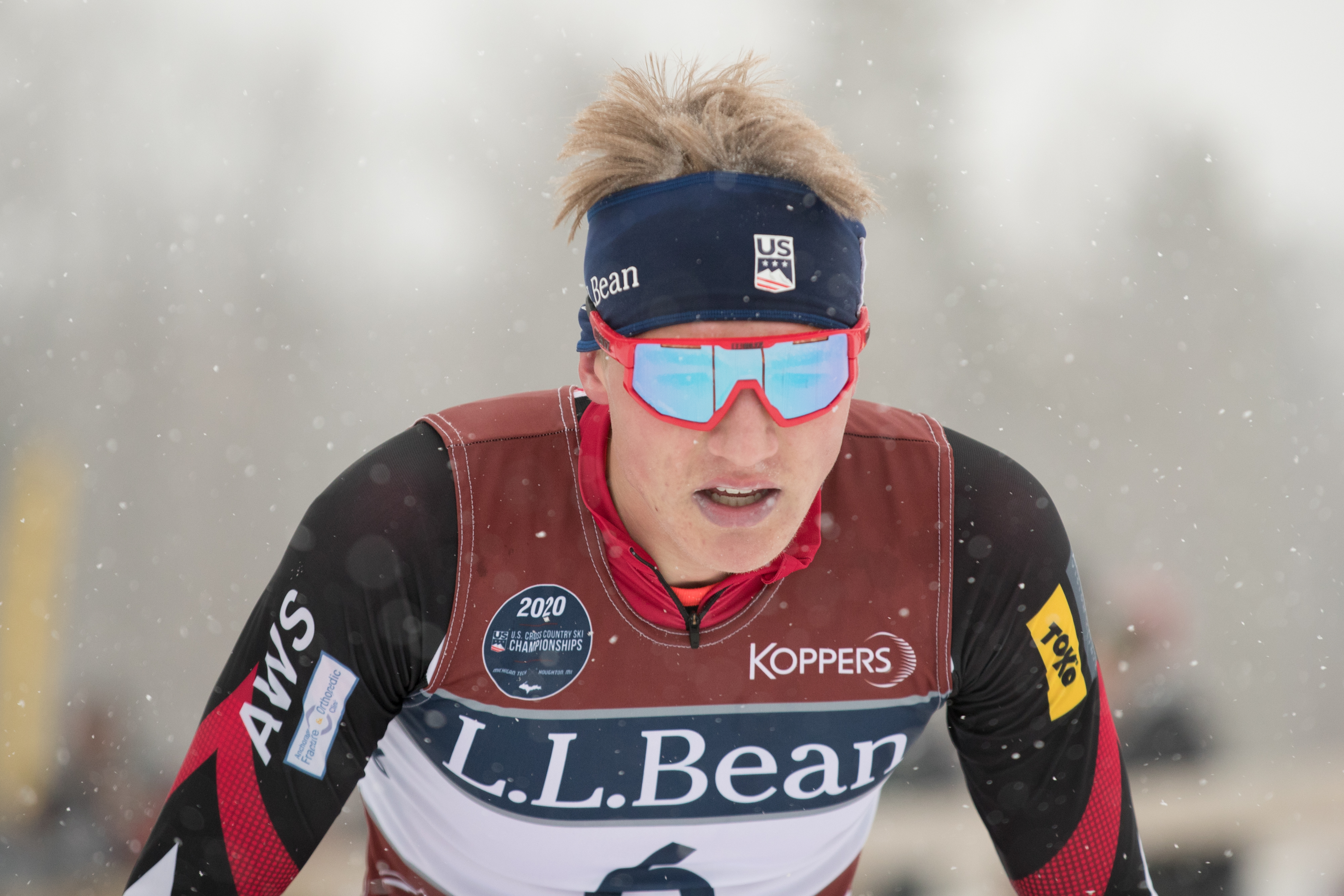
    Sadie said her respect for Erik stemmed from his investment in a plan and holding himself accountable to it. “I really respected his confidence in that plan. What it showed me is that he believes in himself and he knows what he is capable of. He did not think of himself as a 50th place racer, he thought of himself as better. At the end of day, if someone achieves that confidence, that is huge.” 

    With Bjornsen’s departure from the team in December, he set forth to race several marquee domestic skate marathons. Although it afforded North American based skiers a chance to toe the line with a generational talent, for Bjornsen it was an opportunity to touch base with the many friends he had connected with during his years as a ski racer. Call it an unofficial retirement tour. 

    Bjornsen said he didn’t come into the races expecting to win since he had modified his training to savor simple on-snow moments. He emphatically claimed that this past winter had been one of his most “fun” yet.

    There’s a prevailing mythos in sport: The peak performance, like Bjornsen dropping Sundby and Manificat, are the highlight reel’s apogee. Those instances all have their place. They send chills. But what about the 99.9 percent of the time when that person was off-stage, not performing? That matters. 

    “Thinking about this, an athlete like Erik retiring makes your chest kind of heave,” Matt Whitcomb, the U.S. Ski Team’s Head Coach said. “You are trying to suppress emotions because he has been such an important part of my life as a coach. He is one of those people that makes being a coach so great. Makes these 120 consecutive days on the road tolerable because he is such a great guy. … He is the kind of the guy that has your back and everybody needs people like him.”

    Lightness and humility are attributes many peers associate with Bjornsen. He was, according to Sadie, unequivocally as much a support mechanism for her as she was for him. The shoulder to lean on tilted in both directions. Outside his immediate family, Erik’s even keeled perspective became an integral piece of the U.S. Ski Team’s European based unit. 

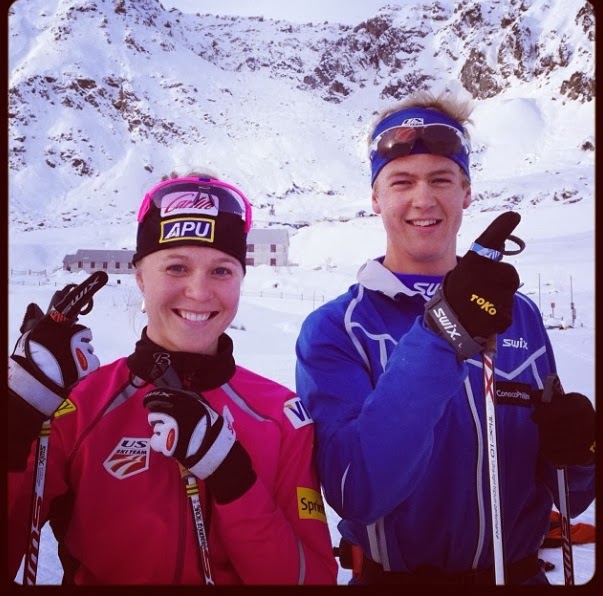
    Sadie Bjornsen and her younger brother Erik in 2013 after winning an Alaska Pacific University time trial earlier this month at Hatcher Pass near Anchorage, Alaska. (Photo: Courtsey Sadie Bjornsen)

    “The role Erik played on the team is easily overlooked,” said Sadie. “We can never talk about it enough. We got a breath of it without Erik the rest of this past winter. That position was really missed. That person who is always enthusiastic, always positive, always having a game, making light of everything. Erik took on that role really young, he was not going to hide anything. He was going to admit when he was struggling or whatever it was. That is a talent when spending four and a half months on the road. That is a long time. It is your family that you are living with, and it is difficult to maintain a positive outlook all the time.”

    There was no bitterness in Erik Bjornsen’s statements or tone when we spoke. He seemed ready with open arms for his next chapter. He did, however, mention a teaser of a thought experiment. “It would have been, at times, super fun to have Kris Freeman at his peak come around 10 years later and I could have skied alongside him. That would have been sweet. We could have pushed each other well.” 

    We can all imagine the mutually beneficial pacing that may have developed. The mentioning of Freeman was only a fleeting whiff of a “what if” moment. The rest, his thoughts of the World Cup, his training principles, his discussion of not meeting some of his expectations, seemed rooted in the past just months after stepping away from the life he’s known since his teens. 

    “It would have been fun to be racing on the podium,” said Bjornsen. “But one thing I noticed just from watching my sister so closely, is I don’t think you get any more happiness. I always really enjoyed racing and being over there even though maybe her results were 10 to 15 places on average higher than mine. It really doesn’t make any difference except maybe a bit financially. In the end, I got as much joy out of it than a guy that would have been on the World Cup podium.”


    Erik Bjornsen – 2016 vintage classic skiing powerhouse. (Photo: NordicFocus)
  • The Devon Kershaw Show: Out of Quarantine and a Dive into the News Cycle

    The Devon Kershaw Show: Out of Quarantine and a Dive into the News Cycle


    Kershaw is free from quarantine and back at home in Lillehammer. As we all know, the race season has been shut down. That means it’s time to discuss news items of note. Like…the “flexing” of some skiers as they ski an un-godly number of kilometers, Stina Nilsson’s switch from cross-country to biathlon, the Norwegian Ski Federation’s financial crisis, and, the retirement of Norway’s Eirik Brandsdal.

    (The U.S. Ski Team’s Erik Bjornsen also announced his retirement via Instagram. That news broke after we recorded the show.)

    **And, yes folks, you’ll hear some explicit content in this episode**…around the 30:30 mark.

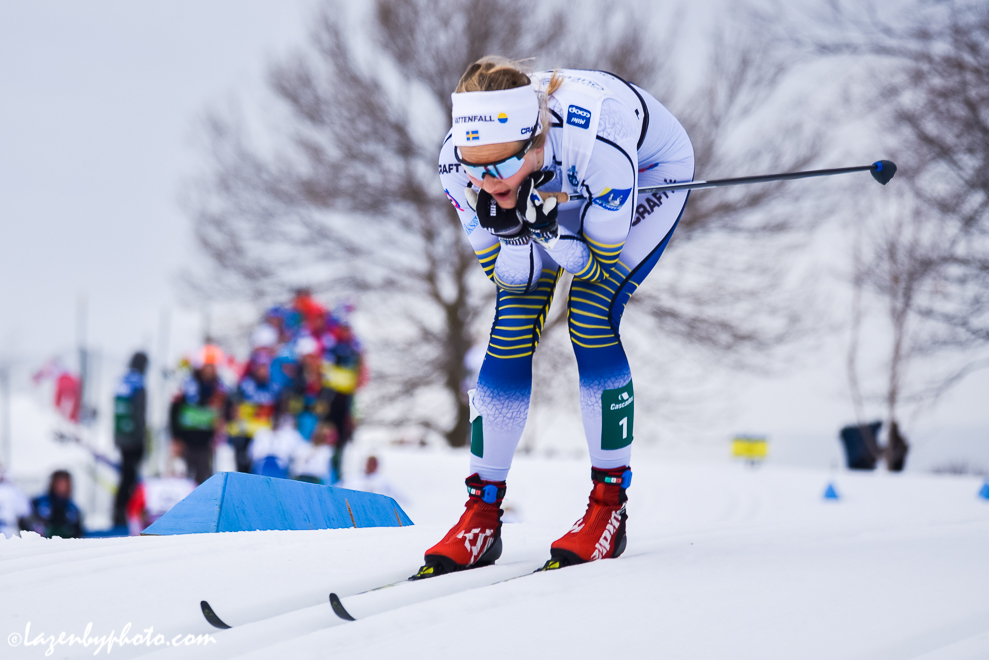
    Sweden’s Stina Nilsson tucking during the 10 k mass start classic in Québec City. (Photo: John Lazenby/lazenbyphoto.com)


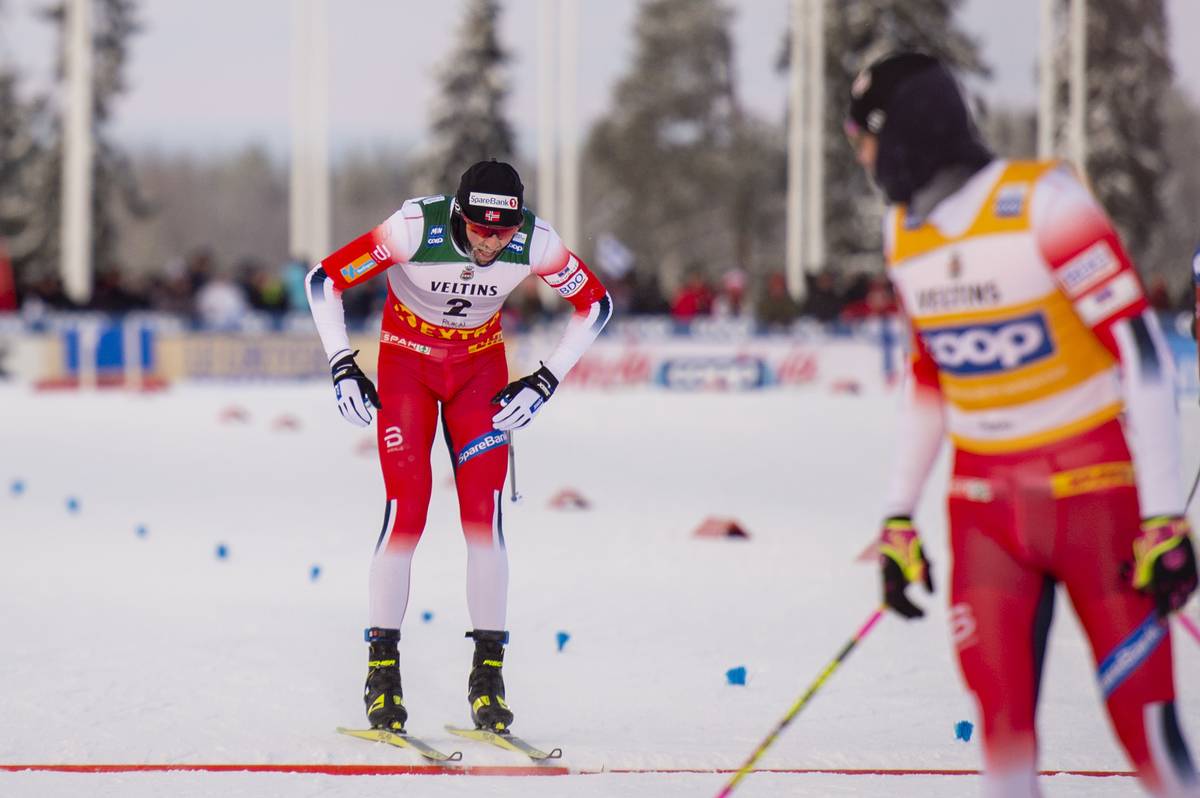
    Norway’s Eirik Brandsdal (2) crossing the line first for his first World Cup victory in two years in the men’s 1.2 k classic sprint on Wednesday at the last World Cup classic sprint of the season in Drammen, Norway. He beat out fellow Norwegian Johannes Høsflot Klæbo (l) and Russia’s Sergey Ustiugov (10), respectively, for his first win since the 2015 Drammen classic sprint. (Photo: Fischer/NordicFocus)

    Thanks for listening and we hope all of you are doing ok out there.


  • Erik Bjornsen Going Long

    Erik Bjornsen Going Long

    Erik Bjornsen and Marine Dusser touring in Alaska. (Photo: Ophira Group)

    Once the kid who crushed from the secluded Methow Valley, Erik Bjornsen (28) has evolved into an all-arounder on the World Cup for the U.S. Ski Team and man with a plan. The plan is part travel business start-up co-mingled with a take it year by year approach when it comes to his elite level racing status.

    America’s World Cup skiers commonly remain in Europe over the holidays and prep for either the Tour de Ski or the ever-lasting don’t stop until spring run of post-holiday racing. Bjornsen began racing this season in Norway’s national opening races in Beitostølen on November 22. He raced the Ruka triple — the World Cup’s opening weekend in Finland — and then a skiathlon and 4 x 7.5 k relay in Lillehammer. He then pulled the plug. Not so much a get me the hell back home plug pulling, but a much needed reset. For the record, Bjornsen had proved he’s top-30 in Ruka: he placed 25th overall in the three day event. 

    Erik Bjornsen of the U.S. Ski Team finishing the 2019 World Cup Ruka Triple. (Photo: NordicFocus)

    It is not a championship year. It’s still two full winters until the 2022 Olympics. If there were a time mid-season to refocus and reset, this would be it. 

    “I think people forget that I have spent five years maybe six years in Europe from the start to finish on the World Cup and not come home to the U.S. once,” said Bjornsen during our late December call. “That is nothing compared to Kikkan Randall or Andy Newell, but I definitely feel like it has been a good portion of my life.”  

    In an all consuming 11-month a year sport, five or six seasons abroad is literally epic. Bjornsen is married now to Marine Dusser, the Head Coach at the University of Alaska Anchorage. Coming home to Anchorage means coming back to a place where he shares a life and can be supported by his APU ski team. Bjornsen has been effectively grinding on the World Cup since December 2012. The World Cup and it’s living-out-of-a-suitcase-life for North American skiers is no fairy-tale.  

    “When I was young, I had, and still have, high goals — to win World Cups and be on the World Cup podium,” Bjornsen said amidst describing his ski-life journey. “I figured about the time I was like 26, I would probably be wrapping up with my career with a bunch of medals and success. But in reality, I have not really reached the goals that I had set for myself. 

    “It has been an amazing experience to go to the Olympics twice. I have had some top-10s on the World Cup. I am proud of what I have been able to accomplish. I also feel like I have gotten to know the level over there in Europe, and seeing it for so many years, it’s been quite the learning experience. I still have some goals on the World Cup that I would like to chase. But, this year, I knew I wanted to race less. I wanted to focus more on a few races and put all my effort into races with the most opportunities for success.”

    So home for the holidays in December it was for Bjornsen. During our conversation, I asked how he would be training while home in Anchorage — I made the assumption he’d forego the 2020 U.S. Nationals in Houghton, MI. Bjornsen corrected me and explained that Senior Nationals was a prime opportunity to stay race fit and support his wife as she managed the UAA skiers. I noted that he’d be the marked skier for the upstart generation of U.S. male skiers. I could sense Bjornsen nodding at the truth of it. 

    Here’s his U.S. Nationals snapshot: 8th in the skate sprint, 3rd in the 15 k skate, 1st in the 30 k classic mass start, and eighth, after an untimely fall, in the classic sprint. Followers of the domestic scene know this is a transitional year. The emerging junior skiers have risen and are challenging. This was not a scenario where it’s a year or two out when an eighteen-year-old could challenge Bjornsen. It happened in Houghton. That’s, in fact, a good sign. A sign of the drive of those younger skiers. And it’s a normal sign for a senior athlete like Bjornsen; careers have an arch.

    In our post-race coverage at Nationals, Bjornsen seemed genuinely happy for his speedier peers. And it was also a statement of his character that he arrived in Houghton to race rather than eschew a domestic race series. The results prove less about Bjornsen and more about a nexus in U.S. cross-country skiing.

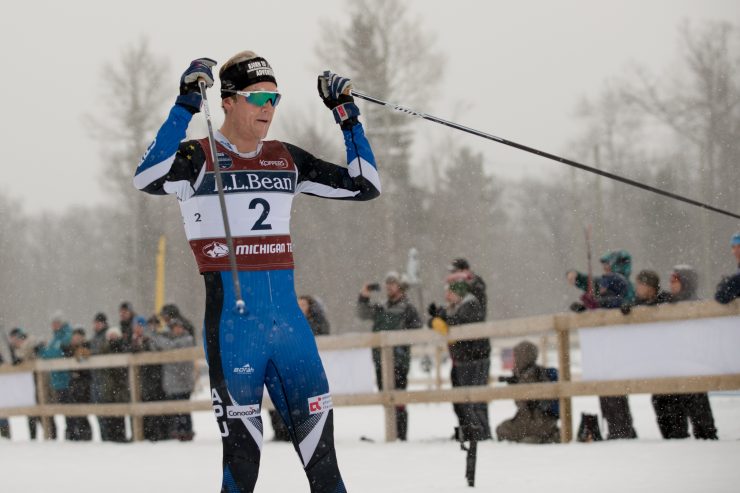
    Erik Bjornsen (Bib 2) at the start of the men’s 30 k mass start classic at the 2020 US Senior Nationals in Houghton, MI. (Photo: Reese Brown)

    During some research before I emailed Bjornsen about this story, I had a mental lapse — was it a “c” or a “k”: Eric or Erik? I honestly had probably typed his name 1000 times. Google to the rescue. 

    On my wide and tall desktop screen, the results were clear: “k”. I also noted as I scrolled down, a site titled Bjorn To Adventure. Catchy name. I took the bait. 

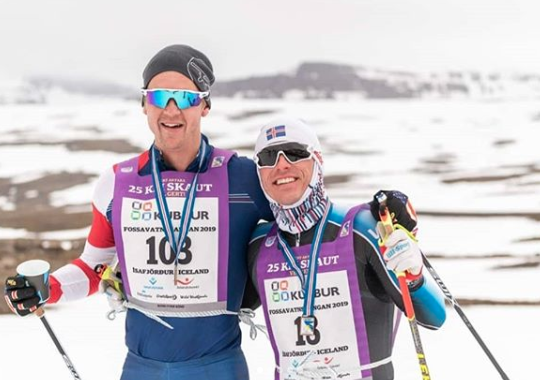
    Bjornsen and Dusser have started a travel company focused on nordic sport. In short, they are organizing training camps for juniors and luxury oriented camps for masters athletes (don’t worry masters, they are separate camps) and a race trip to Iceland’s Fossavatn Marathon. 

    “My wife has been coaching for several years and the idea was born about a year ago now,” Bjornsen said of the company’s genesis. “Especially when we were in Iceland and we saw a lot of travel companies doing things there. We were actually thinking about all the other interesting places we have been and how it is surprising that people have not really taken advantage of Alaska in terms of cross-country travel. We also have been fortunate to have both grown up in two very cool locations, Marine’s in France and mine in Washington, in the Methow.”

    While in Iceland, Dusser and Bjornsen were motivated enough to investigate potential housing and trip itineraries. “I would say it was like, in that month, after our Iceland trip, we were settled on coming up with the company.”

    Bjornsen is not the first to mix a business idea with an elite level sporting career. Andy Newell is but one example of a cross-country skier blending an active race and training schedule with running a business. Bjorn to Adventure’s planned trips include the Iceland trip in April, a single camp at the end of June, and then a packed calendar for the end of July and August. 

    Erik Bjornsen during a high altitude European roller ski. (Photo: Bjorn To Adventure)

    The word retirement did not cross Bjornsen’s lips. This question, however, did come up: how does a World Cup athlete manage training and juggle clients on a full service training trip? The logistics are dizzying. Bjornsen appeared to be unfazed. He’s been the primary author of his training plan for the past three or four years. 

    “I have learned over the years as a professional athlete, something like 12 years or whatever it has been, I know what it takes for me personally to reach my highest potential,” said Bjornsen. 


    “And I think for me, being happy and having excitement, and good training as well, those are the most important things for me. With this project, it will give me a good balance for sure. I think it is something my coaches are pretty excited about, seeing me do something outside of training as well as me giving back to a community that has helped support me so much.”

    Bjornsen and Dusser own a home in Anchorage they have wisely remodeled: a portion of the house is rented out to tenants. A young couple able to offset mortgage with rental income is prudent. It also speaks to their ability to take on risk and the sometimes solvable problems that arise with those responsibilities.    

    On the day we spoke, it was a frigid Anchorage day. Bjornsen had been busy dealing with thawing frozen pipes in his home.  

    “For me, entrepreneur style, kind of like the house that we have here, and fixing those pipes, we have always been working on fun side projects,” said Bjornsen. “We actually have thrown out ideas for other businesses and come up with clever ways to keep our minds busy and be excited about. Bjorn To Adventure just happened to be one that was really exciting and we both would love to do. We have to chase this.” 

    Erik Bjornsen and Marine Dusser. (Photo: Rossignol-Nordic)
  • U.S. Senior Nationals Distance Classic Rundown

    U.S. Senior Nationals Distance Classic Rundown

    This post will be updated throughout the day with additional information.

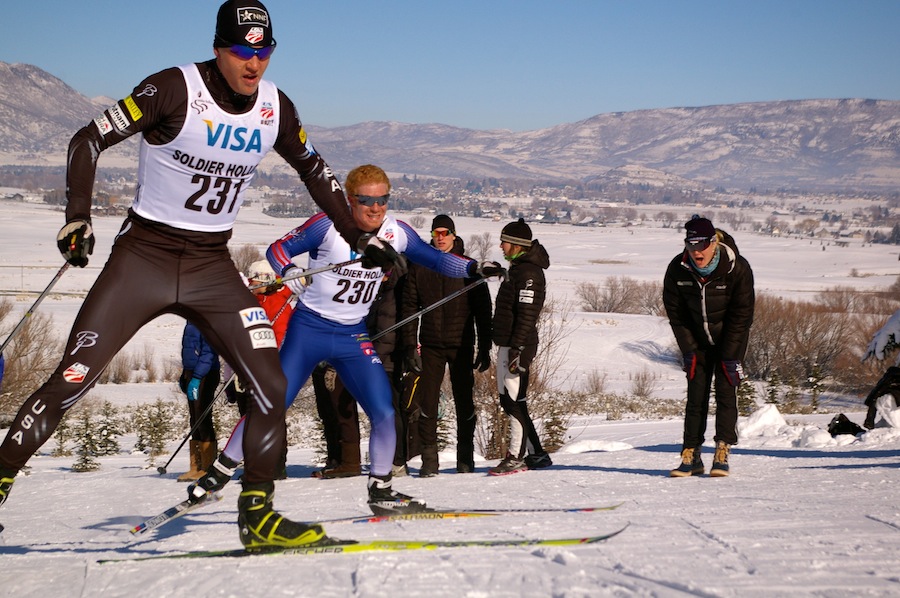
    The last time Erik Bjornsen (APU/USST) raced at mid-season U.S. Nationals, it was January 2014. Competing at Soldier Hollow in a series of races designed to choose the American team for the 2014 Winter Olympics in Sochi, Bjornsen captured his last mid-season national title when he won the 15-kilometer classic interval start race. He was followed by Reese Hanneman, Kris Freeman, and Sylvan Ellefson, all of whom have since retired.

    Erik Bjornsen for the win in the men’s 30-kilometer classic. (Photo: Reese Brown)

    Six years later, Bjornsen found himself on the top step of the podium again on Sunday morning. Racing the 30 k classic mass start at the 2020 Cross-Country Skiing National Championships in Houghton, Mich., he pulled away from a group of pursuers over the fourth of four 7.5 k laps to take the win in 1:19:34.0.

    Post-race interview with Erik Bjornsen.

    Bjornsen was followed by Kyle Bratrud (+3.5) and Ian Torchia (+17.0), both of whom ski for SMST2. It was the second podium of the week for all three, after Bratrud won Friday’s 15 k skate and Bjornsen and Torchia tied for third.

    The men’s podium of the 30-kilometer mass start classic. Erik Bjornsen (center) took the win ahead of Kyle Bratrud (left) and Ian Torchia (right). (Photo: Reese Brown)

    Post-race interview with Kyle Bratrud.

    Torchia spent time leading the race and felt comfortable there. He explains that he made a move with 3 k to go, finishing by duking it out with his teammate and training partner in the final push.

    Post-race interview with Ian Torchia.

    Through three laps of the course, there were still 13 athletes within 10 seconds of the lead when the pack came through the stadium at 22.5 k. Everyone who eventually finished in the top 10 came from this group.

    Gus Schumacher locks eyes on 4th place in the 30-kilometer classic. (Photo: Reese Brown)

    Fourth overall at the finish was Gus Schumacher (Alaska Winter Stars/USST), who was 4.2 seconds out of third and missed the podium for the first time this week. Fifth was Adam Martin (Craftsbury Green Racing Project, or CGRP), sixth was Ben Lustgarten (CGRP), seventh was Tyler Kornfield (APU), eighth was Norwegian Kjetil Baanerud (NMU), ninth was Canadian Philippe Boucher (CNEPH), and tenth was Canadian Ricardo Izquierdo-Bernier (Fondeurs-Laurentides). Tenth place was 43.9 seconds back of the win, and 26.9 seconds off the podium.

    In the race-within-a-race for top age-group finishes (relevant for selection for upcoming international competitions), Schumacher and Johnny Hagenbuch (SVSEF), both of whom have already pre-qualified for World Juniors, were the only two U20 athletes to compete in the senior race. The top five U23 American skiers were, in order, Finn O’Connell (UVM), Peter Wolter (Middlebury), Reid Goble (Michigan Tech), Hunter Wonders (APU), and Logan Diekmann (Utah).

    Men’s results

    Hailey Swirbul charges for the win in the 20-kilometer classic. (Photo: Reese Brown)

    The last time Hailey Swirbul (APU/USST) won a national championship in January, it was Thursday morning. The 21-year-old continued her string of strong performances at this year’s championships when she distanced herself from Caitlin Patterson (CGRP/USST) and Riitta-Liisa Roponen (Finland’s Oulon Hiihtoseura club team) to cross the line in 1:04:06.7 to take her second victory, and third podium finish, of the week.

    Swirbul explained that leading suited many of her strengths, allowing her to lengthen her stride and race her own race.

    Post-race interview with Hailey Swirbul.

    Patterson was 1.0 seconds back, and Roponen 1.7 seconds back, after the three skied together in a five-women pack for much of the second half of the race.

    Caitlin Patterson (left), Ritta-Liisa Roponen (center), and Hailey Swirbul (right) lead the way in the 20-kilometer classic. (Photo: Reese Brown)

    Post-race interview with Caitlin Patterson.

    Roponen explained that her only plan heading into the race was to ski with good technique, as she is less comfortable in the classic technique. She explains that she struggled in the downhill, but was “very, very, very” happy with her fight for the finish.

    Post-race interview with Ritta-Liisa Roponen. 

    Fourth overall, and third on the domestic podium, was Kaitlynn Miller (CGRP), 6.1 seconds back from the win and 4.4 seconds back from third. The final member of the lead group, Rosie Frankowski (APU), faded over the final lap to finish fifth, 37.4 seconds back.

    The National Championship podium after the 20-kilometer classic. Hailey Swirbul (USST/APU) took the win ahead of Caitlin Patterson (USST/CGRP) and Kaitlynn Miller (CGRP). (Photo: Reese Brown)

    The rest of the top 10 went to Alayna Sonnesyn (SMST2) in sixth, Becca Rorabaugh (APU) (who improved substantially on Friday’s 80th place finish in the 15 k skate as she began to recover from illness) in seventh, Erika Flowers (Bridger Ski Foundation) in eighth, Canadian Cendrine Browne (CNEPH) in ninth, and Emma Tarbath (Montana State) in tenth. The time gaps were substantially larger in the women’s race than in the men’s race, as Tarbath, in tenth, was 2:25 back from Swirbul.

    Turning to internal age-group competition, Swirbul, who has pre-qualified for U23 World Championships, was the top U23 skier on Sunday. The next four U23 women were Tarbath, Annika Landis (Middlebury), Mariah Bredal (Utah), and Alex Lawson (Middlebury).

    Women’s results

    The podium for the junior boys 10 k classic mass start race (two laps of the 5 k course) had an Alaskan theme on Sunday: Luke Jager (Utah/USST), who grew up in Anchorage and skied with APU for the last ten years before going to college, took the win in 29:39.7; JC Schoonmaker (University of Alaska Anchorage) was second, 5.1 seconds back; and Zanden McMullen (APU) was third, just behind at 5.5 seconds back.

    The top three overall are all U20 skiers. The top three U18 boys were Will Koch (SMS), in fourth overall; Willy Magill (Steamboat Springs Winter Sports Club), fifth overall; and Alex Maurer (Alaska Winter Stars), tenth overall.

    Boys results

    The junior girls take to the course for the 7.5-kilometer classic. (Photo: Reese Brown)

    The podium for the junior girls 7.5 k classic mass start (one lap of the 7.5 k course) featured two familiar names from American junior racing, and one relative unknown. First was Sydney Palmer-Leger (SVSEF), who was on the fourth-place American relay team at 2019 World Juniors and who took home a pair of overall podium finishes at the Sun Valley SuperTour stop last month. Third was Kendall Kramer (Nordic Ski Club of Fairbanks), who was fourth at World Juniors in the distance classic last year and who will be representing the U.S. at the 2020 Youth Olympic Games in Lausanne, Switzerland, starting next week.

    And second was Sophia Laukli (Middlebury), who has posted strong results domestically at Junior Nationals but does not appear to have been previously selected for a World Juniors team. She was 20th (among finishers with an active FIS license) in the classic mass start at 2018 nationals, and 14th in the skate mass start at 2019 nationals. (She was second in the 20 k mass start at 2019 Spring Series, first American, but that was in a field of only six FIS finishers.)

    Today in Houghton, she was second. Palmer-Leger took the win in 24:06.3, with Laukli 10.0 seconds back for second. Kramer, third, was 47.6 seconds back.

    The top three U18 finishers were Palmer-Leger, Kramer, and Nina Seemann (SMS), who was seventh overall. The top three U20 finishers were Laukli, Novie McCabe (Methow Valley Nordic) in fourth overall, and Mara McCollor (Dartmouth) in fifth overall.

    Girls results

  • Ustiugov Closes with a Fury as Russia Goes 1-2 in Lillehammer Relay

    Ustiugov Closes with a Fury as Russia Goes 1-2 in Lillehammer Relay

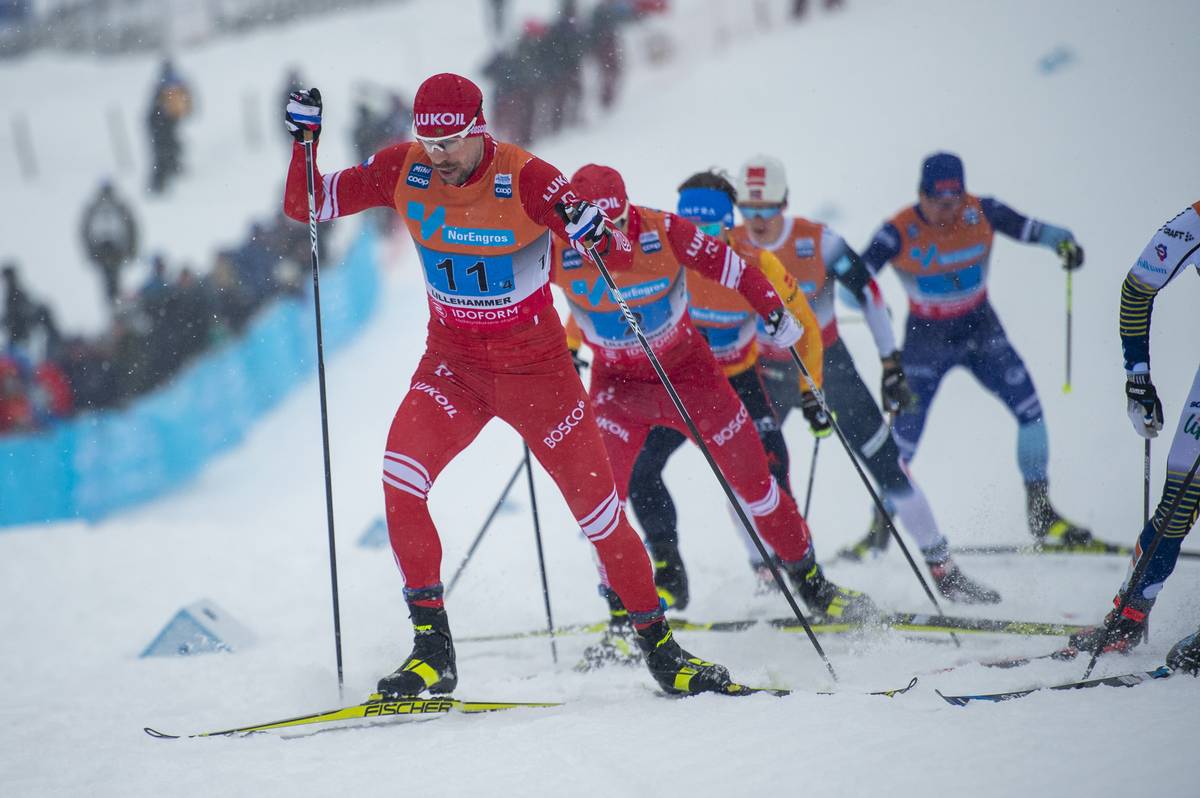
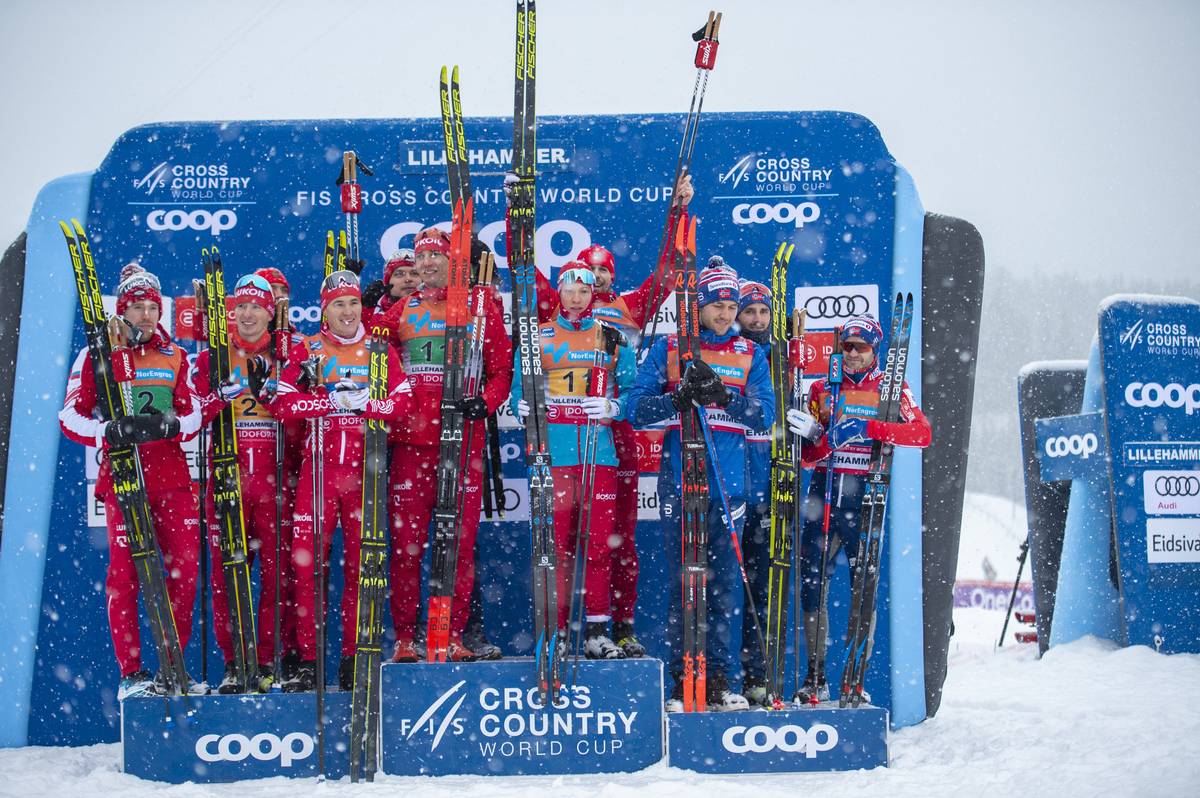
    Russia soaking it in as they take 1-2 in the 4 x 7.5 k relay in Lillehammer, Norway. (Photo: NordicFocus)

    Call it what you want: national pride, national bias, flag-waving: the team relays elicit nationalistic tendencies. In Lillehammer, Norway, you might think and maybe expect it’s your birthright to see the hometeam crush. That’s been the recent norm almost without exception. 

    Here’s the quick stats to either dispel or reinforce those tendencies: Norway has won nine of the last 11 relay races on the World Cup. Russia won the other two. In fact, Russia took first and second, Norway third in the last head-to-head 4 x 7.5 k match last season in Ulricehamn, Sweden. Throwing Norwegian dominance back into the equation, Norway has won five of the last six relays on home snow.

    On paper, at least for Norway, some big names were missing from their team lineups. No No Emil Iversen. No Johannes Høsflot Klæbo. No Martin Johnsrud Sundby. That trio finished third, fourth. and fifth in Saturday’s 30k skiathlon. Add to that Didrik Tønseth who was busy representing Norway at the European Cross-Country Running Championships.

    But Norway is deep with talent. As is Russia. For those keeping score, you’ll see no Alexander Bolshunov featured on either of the Russian teams — he won the skiathlon yesterday. That all said, in a non-championship year maybe it’s a time to tinker and experiment. Here were the teams holding the most podium potential.  

    Norway I: Pål Golberg, Hans Christer Holund, Sjur Røthe, Finn Hågen Krogh

    Norway II: Niklas Dyrhaug, Mattis Stenshagen, Simen Hegstad Krüger, Vebjørn

    Turtveit

    Russia I: Andrey Larkov, Ilia Semikov, Denis Spitsov, Andrey Melnichenko

    Russia 2: Ivan Yakimushkin, Evgeniy Belov, Ilia Poroshkin, Sergey Ustiugov

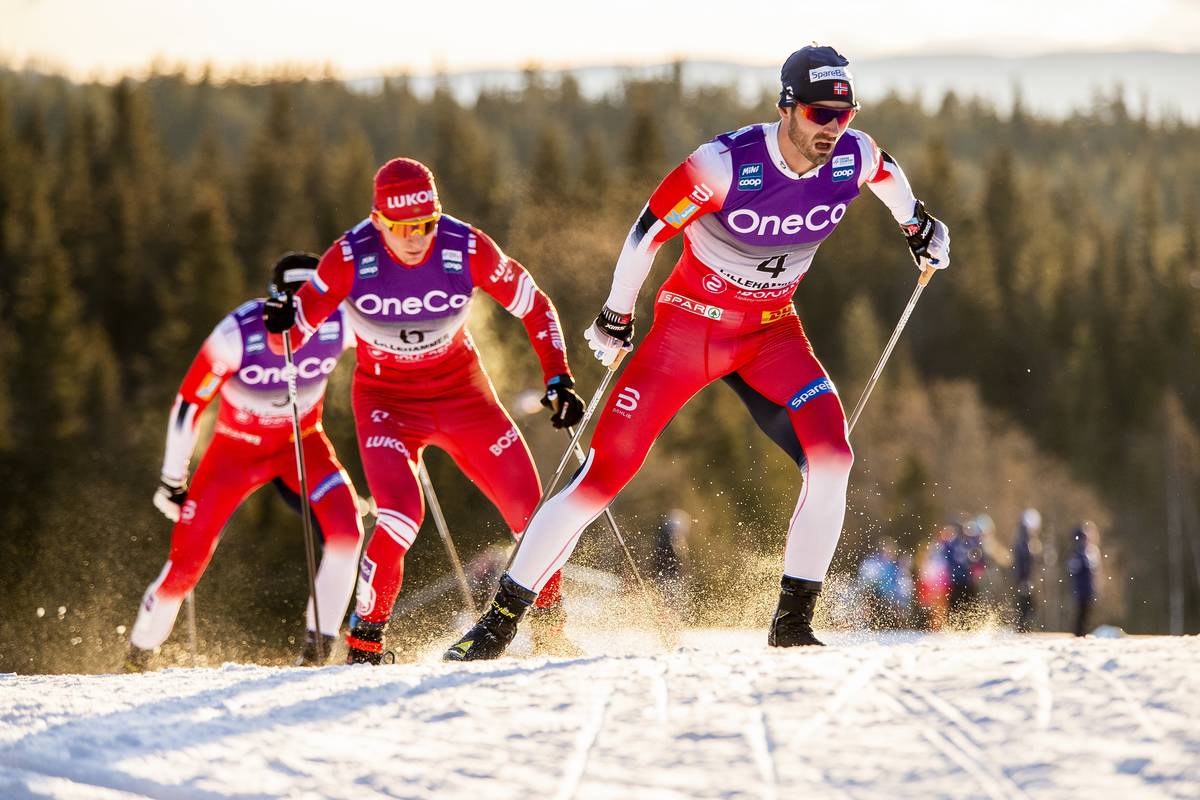
    Pål Golberg (NOR) leading the pack during the scramble leg of the 4 x 7.5 k relay in Lillehammer, Norway. (NordicFocus)

    The first tag, after 7.5 k, Russia I pulled through first, with Norway I and Sweden right behind. Russia II was 10.5 seconds back, Finland 15.5, the U.S. 17.0, and Norway II dangling 19 seconds off the lead.

    As the classic legs ended at 15 k, the race was more about who was falling off out of contention, rather than a team up front making any decisive gesture for a kill shot. Finland came through first, with Russia II next (+0.4), then Norway I (+2.2), Russia II (+9.7), Norway II (+10.5), and Germany (+15.0). 

    The next closest team was Sweden, roughly twenty-nine seconds arrears in seventh place. At that point, the U.S. team of Erik Bjornsen, David Norris, Scott Patterson, and Kevin Bolger were in ninth (+1:13.7) and racing in a no-man’s-land with a sizable gap to France in eighth and Kazakhstan drifting back in 10th.

    Simen Hegstad Krüger (bib 10) during the 4 x 7.5 k relay in Lillehammer, Norway. (Photo: NordicFocus)

    The race began to look a tad spicy for Norway around the 21.2 k mark, nearly an hour into the race. Krüger for Norway II, a sometimes peerless skate skier at that, put his stamp on the affair as he powered ahead on the course’s most prominent climb. Norway I’s Røthe followed Krüger in step. And Sweden’s Jens Berman kept pace as well. The real tease was that Russia I (Spitsov) and Russia II (Poroshkin) appeared cooked as were their team’s chances for anything but third place. 

    But, it’s a four chapter race. And the fourth leg coalesced into a five team scrum by 25k. Both Russian teams, the Norwegian squads, and Germany were all in it. We should note that Ustiugov, tagged 15 seconds back at the exchange, looked impressive shutting down that gap as he reeled in the lead groups. 

    Russia’s Sergey Ustiugov (right) showing his solid form during the men’s 4 x 7.5 k relay in Lillehammer, Norway. (Photo: NordicFocus)

    The racing scene’s old friend, Ustiugov, went to the front and eventually shut down the pace. It wasn’t exactly a crawl. It was Ustiugov revealing his tactical hand: wait until punishing terrain, and throw down a punishing push. 

    But it was Melnichenko for Russia I who made that move. Ustiugov kept pace and pulled through not long after Melinchenkov separted. Ustiugov looked like vintage Ustiugov: a full-body, all-in-it, furnace of power. 

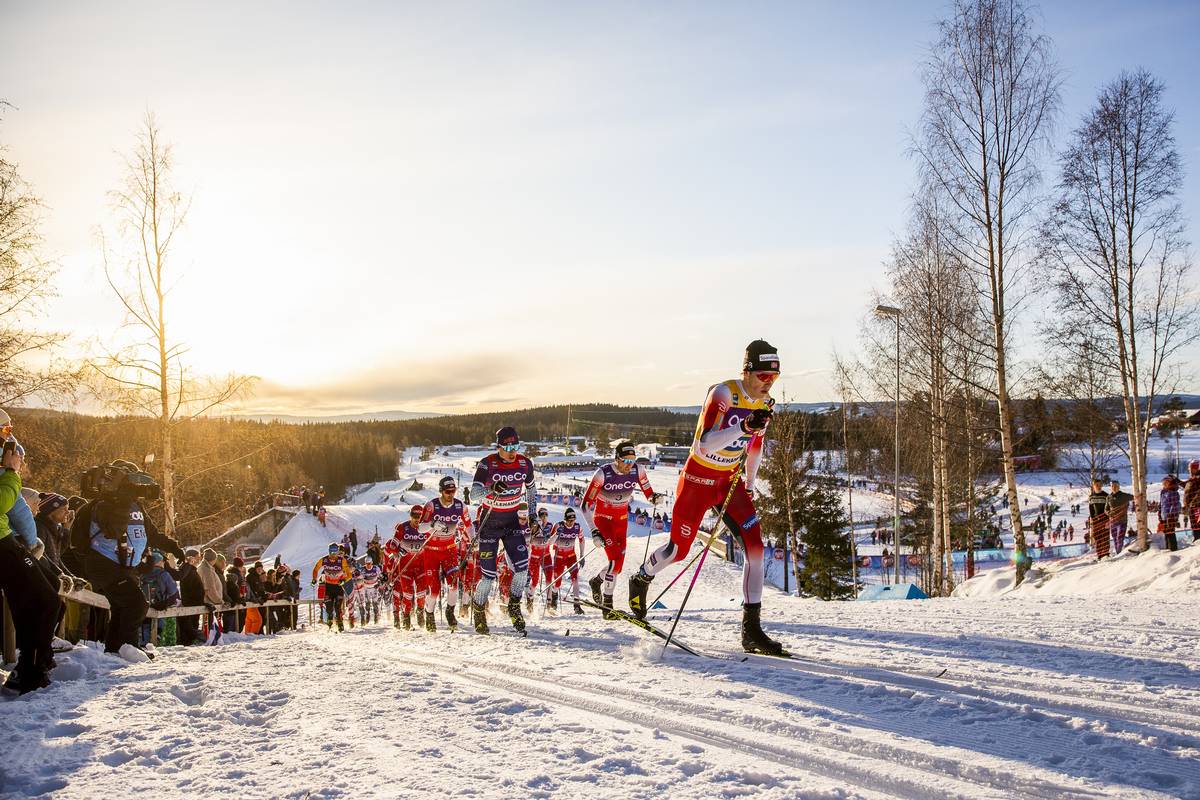
    08.12.2019, Lillehammer, Norway (NOR):<br /> Sergey Ustiugov (RUS) - FIS world cup cross-country, 4x10km men, Lillehammer (NOR). www.nordicfocus.com. © Vianney THIBAUT/NordicFocus. Every downloaded picture is fee-liable.
    Sergey Ustiugov of Russia taking control during the 4 x 7.5 k relay in Lillehammer, Norway (Photo:NordicFocus)

    And that was it. Norwegian dreams were snuffed, Russian dreams realized. 

    Russia I won in 1:26:46.8 hours. Russia II took second (+1.3), and Norway I third (+8.9). Norway II lost the toe-to-the-line finish by placing fourth (+9.0). 

    The U.S. team skied to ninth place, 3:33.3 minutes back. U.S. World Cup Coach Matt Whitcomb explained in an interview that relay racing is often a “game of contact and if contact is lost the race is often lost.” The U.S. did lose contact. It remained a relay for the U.S. bright moments and the reality of skiing solo for a few legs. (In the interview below, Whitcomb also notes the thrill of watching an emerging Chinese program finish the men’s relay in a non-championship event.)

    Matt Whitcomb post-race interview

    Closing out the day on the race course was China. They placed 11th (+12:44.6). Making note that the 2022 Olympics will be hosted by China, it will be interesting to see how this team develops. 

    08.12.2019, Lillehammer, Norway (NOR):<br /> Scott Patterson (USA) - FIS world cup cross-country, 4x10km men, Lillehammer (NOR). www.nordicfocus.com. © Vianney THIBAUT/NordicFocus. Every downloaded picture is fee-liable.
    Scott Paterson of the U.S. Ski Team during the third leg of the 4 x 7.5 k relay in Lillehammer, Norway. (Photo: NordicFocus)

    Scott Patterson post-race interview

    Kevin Bolger during the 30k skiathlon in Lillehammer, Norway. (Photo: NordicFocus)

    Kevin Bolger post-race interview

    Results

    The podium from the 4 x 7.5 k relay in Lillehammer, Norway. (Photo: NordicFocus)


  • Bolshunov Rebounds for 30 k Skiathlon Win with Holund Driving the Pace

    Alexander Bolshunov takes the men’s 30 k skiathlon win in Lillehammer, Norway. (Photo: NordicFocus)

    Norwegian countryside just as you imagine: farms, pine trees, a deep snow-blanket, and fast skiing. All this was on display under a bluebird sky in Lillehammer, Norway for the men’s World Cup 30-kilometer skiathlon. Amidst this legacy-backdrop, the beauty of a dual technique race with enough grinding Ks to string out and decimate an impressive field played out.

    Fifteen kilometers in, at the ski exchange from classic to skate, nine skiers were separated by 6.5 seconds — Jens Bruman of Sweden to Russia’s Sergey Ustiugov. Sandwiched in there were all the names you’d expect: Norway’s Johannes Høsflot Klæbo, Emil Iversen, and Hans Christer Holund, along with Alexander Bolshunov of Russia, and Iivo Niskanen of Finland. Dangling 20 plus seconds from that group was Sjur Røthe and Martin Johnsrud Sundby, also from Norway.

    Johannes Høsflot Klæbo of Norway leading the classic train during the early moments of the 30 k skiathlon in Lillehammer Norway. (Photo: NordicFocus)

    The 30 k skiathlon is an exercise in power application, raw fitness, and technique efficiency bundled into a roughly one hour and twenty-minute sport spectacle. 

    By 17.4 k, atop the course’s major climb, Holund pulled Iversen and Bolshunov along for a clean break from any would-be podium spoilers. Fast forward to the closing moments of the race and the last trip up the big ascent in Lillehammer and Holund remained the workhorse. He chugged along, setting the pace up front. Iversen fell off slightly on that climb, dangling five seconds back. 

    Hans Christer Holund (NOR) leading Alexander Bolshunov (RUS) and Emil Iversen (NOR) during the skate leg of the 2019 30 k skiathlon in Lillehammer, Norway. (Photo: NordicFocus)

    On the final punchy hill before the descent and sweeping turns into the stadium, Bolshunov attacked with an unmatchable V1. He crossed the line for the win in 1:17:42.4 hours with Holund in second, 2.2 seconds back. Iversen placed third (+7.9). 

    “I am still not in the best shape that I could be,” Bolshunov told FIS after the race. “It was the same as in Seefeld where I followed Hans Christer Holund but could not manage to take him. I am happy that I managed that today.”

    Klæbo skied to fourth (+57.4) with Sundby in fifth (+57.7). It was Sundby’s first time not on a World Cup skiathlon podium over a seven race span. Klæbo won this event in Lillehammer with panache back in 2017 as he gapped Sundby near the finish marking a changing of the guard on the men’s Norwegian National Team. 

    Saturday, Norway captured second through sixth place, including 12 skiers in the top-20. As a home race for Norway and additional starts allocated for the host nation, the Lillehammer field was exceptionally deep with talent. 

    For the U.S., David Norris (APU) just missed the points finishing in 34th (+4:39.7). According to FIS, this was Norris’ second World Cup skiathlon. He also raced the skiathlon at the 2018 World Championships where he placed 38th. Outside of Erik Bjornsen, who finished just behind Norris in 39th today (+5:12.7) and scored in the points twice last weekend, Norris has been the top distance skier for the U.S. this season. 

    “I think it was a good step forward from Ruka,” Norris said after the race. “I felt like I had better energy and the points of the race where I was struggling. I just did a better job of pushing through those minutes and maintaining my form, technique, and tempo.”

    David Norris (bib 34) was the top American placing 34th in the 2019 30 k skiathlon in Lillehammer, Norway. (Photo: NordicFocus)

    Post-race interview with David Norris

    Coming into the ski exchange, Norris and Bjornsen skied in with a cluster ranked 28th through 36th — with Bjornsen in 28th, Norris in 32nd. 

    Bjornsen was disappointed with his day. He said post-race that he began to lose kick on the second of the classic ski laps and could not find his best sensations throughout the race. In 2017, Bjornsen placed 20th  in Lillehammer’s World Cup 30 k skiathlon.

    Post-race interview with Erik Bjornsen

    Also for the U.S., Kyle Bratrud (SMST2) skied to 47th (+6:48.1), Scott Patterson 50th (+7:35.2), and Simi Hamilton did not finish. Hamilton has been recovering from a nagging hamstring injury.

    Andrew Musgrave of Great Britain pulled himself into the top-20 during the skate leg to finish 18th overall (+3:02.9). (You can hear an extended interview with Musgrave posted below.

    Andrew Musgrave of Great Britain placed 18th in the 30 k skiathlon in Lillehammer, Norway. (Photo: NordicFocus)

    Post-race interview with Andrew Musgrave

    Racing continues tomorrow with the 4 x 5 k, and 4 x 7.5 k relays for the women and men respectively. 

    Results


  • Klæbo Takes the Ruka Overall Win with Iversen on his Heels: Bjornsen in 25th (Updated with Audio)

    Klæbo Takes the Ruka Overall Win with Iversen on his Heels: Bjornsen in 25th (Updated with Audio)

    Chargers. Johannes Høsflot Klæbo takes the 2019 15 k skate pursuit win in Ruka, Finland with Norwegian teammate Emil Iversen at his heels for second overall. (Photo: NordicFocus)

    North of the Arctic Circle three weeks from the equinox and it was buff weather in Ruka, Finland for the final race of the World Cup’s opening weekend. Norway’s Johannes Høsflot Klæbo sealed it with a win in the men’s 15 k freestyle pursuit. He won in a time of 35:29.7 minutes and a slim 1.8 seconds over teammate Emil Iversen. Yesterday’s 15 k classic winner, Iivo Niskanen of Finland was third (+11.1).

    It was a weekend where Klæbo flexed. He won Friday’s classic sprint in superhuman fashion besting the closet chaser by over four seconds. He was momentarily displaced from the throne by Niskanen in yesterday’s race. The Finn is known as a dominant 15 k classic skier – in particular in his home country. He’s won four times on the World Cup, all in the 15 k classic and three of which were in Finland. 

    What he is not known for is his skate skiing prowess. But today, the results sheet and the images from the ski track tell the story of a three-skier race with Niskanen in it until the final climb. 

    Klæbo led out in the leader’s bib, then Iversen and Niskanen at 16 and 18 seconds respectively. There were lurkers starting a bit further back: most notably Russia’s Alexander Bolshunov at 43 seconds. Last season’s World Cup overall runner-up and distance overall winner placed fifth on Sunday (+48.3).  

    No surprise that Klæbo held off any contenders as he’s showing a re-birth of his distance skiing chops. But like Niskanen, Iversen has historically excelled in classic. Of Iversen’s nine World Cup distance podiums — they are almost exclsuively in classic. Now notch a skate podium to the mix.

    Niskanen and Iversen pushed to close the gap to Klæbo. And by the 10 k mark with Niskanen taking the lead pull through the stadium. And Niskanen did not hide in the back, forcing the Norwegians duo to work upfront. A wise tactic, as both Klæbo and Iversen are the proven sprint closers. 

    Niskanen hung with the Norwegian tandem until the final hill — which also serves as the final hill on the Ruka sprint course. The Norwegians simply floored their sprint V1 and gapped Niskanen. Klæbo carried only a few meters of comfort room ahead of Iversen as he crossed the line.

    Emil Iversen of Norway finishes meters behind the 2019 15 k skate pursuit winner in Ruka, Finland. Johannes Høsflot Klæbo. (Photo: NordicFocus)

    For the U.S. Ski Team, Erik Bjornsen began the race in bib 28 and 2:26 behind Klæbo, the first skier off. Bjornsen moved up three spots to finish the weekend’s mini-Tour in 25th. He was 3:13.8 back for the three-race series and 1.23.7 minutes back from the fastest time of day set by Norway’s Hans Christer Hollund in 34:53.8.   

    Post-race interview with Erik Bjornsen

    David Norris (APU) skied to 47th overall (+4:26.3) and 1:48.2 minutes back from Hollund’s fastest time. Kyle Bratrud (SMST2) was 59th, Kevin Bolger (USST) 65th, and Scott Patterson (USST) 68th. Simi Hamilton (USST) did not start.

    The World Cup resumes next Saturday with a skiathlon and 4 x 5 / 4 x 7.5 k relays. 

    Men’s Results | Time of Day Results 

  • Finland’s Niskanen Strides for the Win: Erik Bjornsen in 28th

    Finland’s Niskanen Strides for the Win: Erik Bjornsen in 28th

    The difficulty in covering generational star athletes is avoiding cliché. There’s the “high tempo” or “high-turnover” description for Therese Johaug. And for the men, Northug’s panache and wily wait-for-the-final-meters sprint fury. Although some would argue that it is a bit too early for the stamp of generational star, Johannes Høsflot Klæbo is such a regular podium crasher that avoiding cliché is troublesome there too.

    So today, we’re off the hook a bit. Finland’s ski hero Iivo Niskanen, a master of the distance classic events, stole the show from Klæbo’s grasp. 

    Niskanen won the 15-kilometer classic in Ruka, Finland in 35:17.0. He bested the coiffed Klæbo (it’s so hard to resist the cliché) by 13 seconds as the Norwegian settled for second place. Klæbo wore a palpable face of disappointment as he vacated the leader’s chair after Niskanen crossed the line with a punch to the air. Klæbo began in bib 42, Niskanen in bib 66. Niskanen and Klæbo skied part of the race together, as the Klæbo latched onto Niskanen as he lapped through the start area. Ultimately, with the knowledge of the time-to-beat splits, Niskanen timed it right for the win. 

    “Iivo Niskanen was pushing me hard in his first round and I was trying to stay with him but then he was just stopping and let me take the lead,”  Klæbo told the International Ski Federation (FIS). “That was not the plan but it was a tough decision so I had to push really hard and … he showed today that he was in really good shape but I am very happy with my second rank.”

    Norway’s Emil Iversen placed third, 14.9 seconds back. 

    “It is for sure one of my fav places here in Ruka and I have to say that today there were more people on the track than ever so it was an emotional feeling to cross the finish line,” Niskanen told FIS after the race. “I feel strong and I have trained really hard. Here it’s easy to ski behind even [though] there are many large hills but today was windy and cold conditions.”

    For the Americans, Erik Bjornsen of the U.S. Ski Team skied into the top-30 with a 28th place (+1:57.4). He placed 31st in the same event last season. 

    “Comparing to feelings I have had in the past, I am definitely coming into the season feeling better,” Bjornsen said in a post-race call. “I think I had a good summer of training… Knowing that I was 28th and still feeling like I have not quite come into my top form, I think that is a pretty good sign.”

    Erik Bjornsen racing to 28th during the 2019 Ruka, Finland 15 k classic. (Photo: NordicFocus)

    Post-race interview with Erik Bjornsen

    U.S. World Cup Coach Matt Whitcomb on Erik Bjornsen’s day

    Also for the Americans, Simi Hamilton (USST) placed 34th (+2:10.9). According to FIS, this was Hamilton’s career-best result on the World Cup in a classic distance event.  

    Simi Hamilton skiing to a World Cup career-best 34th in a distance classic event. He popped the result in Ruka, Finland’s 2019 15 k classic. (Photo: NordicFocus)

    U.S. World Cup Coach Matt Whitcomb on Simi Hamilton’s World Cup career-best classic distance race

    David Norris (APU) placed 47th (+2:35.4), Kyle Bratrud (SMST2) 68th (+3:39.0), Scott Patterson (USST) 69th (+3:42.4), and Kevin Bolger (USST) 71st (+3:49.)

    David Norris skis to a 47th place in the 2019 Ruka, Finland 15 k classic.

    U.S. World Cup Coach Matt Whitcomb on David Norris and his dig-deep efforts

    Tomorrow’s racing concludes the Ruka three-race series with a 15 k freestyle pursuit.

    Men’s Results 

  • The “Klæbo step” Brings Redemption and the Win in Ruka’s Classic Sprint

    The “Klæbo step” Brings Redemption and the Win in Ruka’s Classic Sprint

    Johannes Høsflot Klæbo of Norway takes the win in Ruka, Finland’s classic sprint. (Photo: NordicFocus)

    Straight to the point, no U.S. men advanced to the heats in Friday’s opening World Cup 1.4-kilometer classic sprint in Ruka, Finland. Since the sprint is part of a three-race series ending with a pursuit, all skiers started the qualifier. 

    As snow flurries fell in a semi-dark and Arctic Ruka —skiers raced under the lights — Johannes Høsflot Klæbo of Norway won the qualifier in 2:37:42. 

    Kevin Bolger of the U.S. Ski Team (USST) just missed advancing by qualifying in 32nd (+9.32). Erik Bjornsen (USST) was 47th (+11.79), Simi Hamilton 50th (+12.22), David Norris (APU) 94th (+22.31), Scott Patterson (USST) 95th (+23.37), and Kyle Bratrud (SMST2) 100th (+25.72). 

    “This is our first race of the season, the classic sprint has never been our absolute strong event as a team,” said U.S. Ski Team’s World Cup Coach Matt Whitcomb after the race. “We’ll look back on today and yeah for sure we want more, it’s not really a failure, there’s not a disappointing feeling attached to it.”

    Post-race interview with the U.S. Ski Team’s World Cup Coach Matt Whitcomb. He discusses the men’s day and waxing in Ruka. 

    With his perfect-technique hips forward double-poling and trademark ski-running form, Klæbo looked on. It was here last season where he looked peerless. In the final meters, he let up and was passed by his season-long rival, Russia’s Alexander Bolshunov. 

    Johannes Høsflot Klæbo of Norway leads the way during the Ruka, Finland classic sprint. (Photo: NordicFocus)

    Not this year. There was no mental lapse on Friday for Klæbo. He had an ever-increasing gap midway up the final hill which ballooned by the time he crossed the line. He won by a massive margin of 4.17 seconds.

    “It is amazing to be back in Ruka. It wasn’t the best start last year but now it is turning to victory,” Klæbo told FIS after the race. “It seems like the [Klæbo step] is working quite good. I think I am going to train for that every year so I am able to fight for podiums.”

    Norway’s Pål Golberg was second (+4.17) and France’s Richard Jouve third (+4.62). As for Bolshunov who won this event last season, he was fourth (+5.24). 

    Since he boomed onto the World Cup in 2016, Klæbo has finished third, first, second, and first again today in Ruka’s classic sprint. Last season, Klæbo went on to win the sprint Crystal Globe and the overall title. 

    Kevin Bolger of the U.S. Ski Team on his way to qualifying 32nd in the Ruka, Finland classic sprint. (Photo: NordicFocus)


    The men’s podium for the Ruka, Finland classic sprint.
    Pål Golberg (NOR), Johannes Høsflot Klæbo (NOR), Richard Jouve (FRA), (l-r). (Photo: NordicFocus)

    Men’s Qualifier Results | Men’s Results 

  • World Cup Preview: North America

    United States

    Overall in Nations Cup Last Year: 5th

    Women’s Ranking 2018/2019: 4th

    Men’s Ranking 2018/2019: 11th

    Americans to Watch:

    Seven men and nine women will be lining up in stars and stripes for the World Cup’s opening: Finland’s Ruka Triple. Three race series features a classic sprint followed by a two-day distance pursuit.

    Jessie Diggins out-toes Russia’s Yulia Belorukova to take third in Stage 5 of the Tour de Ski. (Photo: Fischer/Nordic Focus)

    At the top of the ranks, Jessie Diggins (USST/SMS T2) finished the 2019 season 6th in distance and 7th in sprint. It was a year of navigating the life of a gold medalist whose training time was suddenly competing with travel, media attention, and collaborating with sponsors. According to her blog, she packed in 25 events in the first 50 days after the Olympics. Diggins admitted this swell of opportunities also left her feeling mentally and physically fatigued during the season.

    That said, you know American women’s skiing has come a long way when feeling flat leads to finishing 6th overall in the World Cup Standings. Diggins won the freestyle sprint in Cogne, Italy and took 3rd in the 10 k skate in Falun, Sweden. She also placed third in three stages of the Tour de Ski and skied the fastest time of day during the 10 k skate pursuit in Oberstdorf, Germany.

    Presuming Diggins achieved her goal of finding a work-life balance that allowed her to better recover and absorb training, we can expect her to consistently remain one of the top athletes on the World Cup.

    One thing is certain: The Minneapolis World Cup race on March 17th features a freestyle sprint, and Diggins will be racing in front of a home crowd amidst a cacophony of cowbell.

    Another consistent performer, Sadie Maubet Bjornsen (USST/APU) finished 8th in the sprint standings and 13th in the distance. She took third in the freestyle sprint in Lillehammer, NOR and cleaned up at the Super Tour Finals winning the freestyle sprint and both distance races. Another testament to how high the standard has been set for the American women, Maubet Bjornsen’s season was not particularly novel, despite consistently measuring up as one of the best all-around skiers in the world. We have come to expect her to perform, and she continues to meet our expectations. This year we expect no less.

    Leading the American women on the short track, Sophie Caldwell (USST/SMS T2) finished the season ranked 4th in the overall sprint standings. Caldwell took second place in Davos, Val Muestair, and Lahti, and landed inside the top ten an additional three times. After posting the second fastest qualifying time in the World Championships in Seefeld, AUT, Caldwell was eliminated in the quarterfinals after throwing her boot across the line a three-way photo finish. Because the heat was slow and she was deemed third, she was unable to advance.

    Julia Kern (L) and Sophie Caldwell after finishing fourth place in the team sprint
    (Photo: Garrott Kuzzy / LumiExperiences.com)

    Julia Kern (USST/ earned her first Period 1 starts as the overall SuperTour leader in 2019. The 22-year-old also displayed her readiness to race at the World Cup level by scoring points in five events. Her best individual performance came during the freestyle sprint in Cogne, ITA where she finished 11th. She also battled for a gritty fourth place result while racing with Caldwell during the Dresden team sprint, and shone at US Nationals earning two sprint podiums.

    Racing fearlessly with the best in the world, Kern cracked the top-20 in the skiathlon in Seefeld, finishing 19th. She also finished 23rd in the freestyle sprint two days prior. With another year of training and experience under her belt, Kern will certainly be worth following.

    After recovering from mono, Rosie Brennan rebounded with a phenomenal season in 2019 and consequently was nominated once more to the U.S. Ski Team. Last year, Brennan blew through Period 1 with a vengeance, placing inside the top 30 and mostly within the top 15 in all of the distance races she entered. She cracked the top-10 in the 10 k skate in Davos, with a career best sixth place, and again in the skiathlon when the competition was at its peak in Seefeld.

    The remainder of the women starting in Ruka who earned discretionary selection includes: Caitlin Patterson (USST B Team/CGRP) who landed inside the top 30 in the 10 k skate in both Lillhammer and Ulricehamn, SWE, Hailey Swirbul (USST B Team/APU) who stood on the podium after three Opa Cup distance races and landed inside the top 10 at U23 World Championships, and Rosie Frankowski (APU) who finished 24th during the skiathlon at the World Ski Championships in Seefeld.

    The second weekend of racing in Lillehammer features a distance pursuit, followed by two sprint events in Davos, SUI and Planica, SLO. These women will be able to focus on the races that best suit their strengths in Period 1.

    Before heading to the American men’s field, FasterSkier sends well-wishes to Hannah Halvorsen who was slated to contest the Period 1 sprint races. Halvorsen was struck by a car while crossing a street in Anchorage on November 1st, fracturing her skull and badly injuring her left leg and knee. According to her father who posted information on Facebook, Halvorsen will have a long road ahead of her, but doctors are optimistic that full recovery will be possible. FasterSkier wants to respect the privacy of the Halvorsen family, but will report when they are ready to share further information.

    The U.S. women’s relay after taking a historic third in the 4 x 3.3 k relay at 2017 Junior World Championships on Sunday at Soldier Hollow in Midway Utah, with (from left to right) Hailey Swirbul, Julia Kern, Hannah Halvorsen, and Katharine Ogden. (Photo: U.S. Ski Team/Tom Kelly)

    Deep breath. Back to the World Cup.

    Of the eight men who made the cut, three were selected objectively: overall 2019 SuperTour leader Kyle Bratrud (SMS T2), and USST A Team members Simi Hamilton (USST/SMS T2) and Erik Bjornsen (USST/APU).

    Returning with a wealth of World Cup experience, Hamilton is a consummate contender in sprint races. His most noteworthy performance was aptly timed at the World Championships in Seefeld where he finished ninth. Hamilton advanced from the quarters in a lightning fast heat, then got hung up with another skier in the semi, losing both his momentum and contact with the leaders. On home turf, Hamilton also won the freestyle sprint during the SuperTour finals.

    American Simi Hamilton (r) leading Great Britain’s Andrew Young during the 6 x 1.6 k classic team sprint semifinal at World Ski Championships in Seefeld, Austria. (Photo: John Lazenby/lazenbyphoto.com)

    Before World Champs, Hamilton had a strong performance in Cogne, finishing just off the podium in 4th. Displaying the agility and sure-footedness for which he is known, Hamilton dodged a crash in both the quarter and semifinals. This race marked a turning point in his season as crashes and illness prevented him from capitalizing on the fitness he felt confident he possessed. When the pieces come together, Hamilton is both a force to be reckoned with and a thrill to watch.

    After popping the third fastest time of day during the 15 k classic pursuit in Lillehammer, Bjornsen has been promoted to the USST A-Team. Last season, Bjornsen whittled his way up the results list, particularly in distance racing. He finished 16th the 15 k classic Cogne, followed by a 17th place finish in the same event in Seefeld. Are you noticing a theme here?

    Once again in the 15 k classic in Quebec City, Bjornsen finished 18th followed by a second top 20 (19th fastest time of day) in the subsequent 15 k skate pursuit. At the SuperTour finals, Bjornsen took the win in both the distance races and finished second in the freestyle sprint, demonstrating his versatility as an athlete.

    Bratrud’s lead in the SuperTour was primarily garnered through strong results in distance skiing, which also translated to encouraging results on the World Cup. The Minnesota native stood on the podium six times in NorAm and SuperTour distance races, taking the top spot in four of them. At US Nationals, he won the the 15 k classic and took second in the 30 k skate. During his mid-winter international stint, Bratrud landed inside the points in the 15 k classic in Cogne. This will be his first season racing on the World Cup in Period 1.

    The remainder of the men to watch in Period 1 include Scott Patterson (USST/APU) and David Norris (APU), who will be focusing on distance racing, and Kevin Bolger (USST/SVSEF) and Logan Hanneman (APU) who will focus on sprint events. Hanneman will not start in Ruka, but plans to compete in both Davos and Planica.

    The men’s podium from the 30 k skate mass start at U.S. Nationals in Craftsbury, VT. From left to right, Kyle Bratrud (SMS T2) second, David Norris (APU) first, and Scott Patterson (APU/USST) third. (Photo: John Lazenby)

    Several athletes who were offered starts in Period 1 declined to focus on the SuperTour. This list includes Kelsey Phinney (SMS T2), Andy Newell, Adam Martin (CGRP), and Ben Saxton (SMS T2).

    Phinney underwent shoulder surgery in mid-June for a torn labrum, which occurred from a fall with an outstretched arm. He doctors estimated a six to twelve month recovery process. Phinney spent six-weeks in a shoulder sling, then began to slowly reintroduce strength training and outdoor activities. So far, she has done some no-pole and one-pole skiing.

    “My biggest priority is making sure my shoulder heals properly and gets back full range of motion,” wrote Phinney in an email on her return to competition. “I’m not sure when I’ll be back to racing, perhaps later this season if things go really well with rehab. In the meantime, I’m enjoying time at home in Boulder – it’s been nice to see friends and family here, and to explore life outside of the bubble of training and racing. And then in a couple weeks, I‘ll be at the first SuperTour races of the year to help my SMST2 team out with ski testing, driving around, and cheering very loudly! I’m hoping to start using two poles in the next few weeks, and ideally I’ll be able to ski quite a bit in Canmore and Sun Valley and see where I can go from there!”

    Canada

    Overall in Nations Cup Last Year: 11th

    Women’s Ranking 2018/2019: 15th

    Men’s Ranking 2018/2019: 9th

    Canadians to Watch:

    Alex Harvey takes in the cheers after placing second in the men’s 15 k classic in Québec City. (Photo: John Lazenby/lazenbyphoto.com)

    Canada’s top skier, Alex Harvey, retired at the end of the 2019 season. He ended his career on a high note. He finished second in the 15-kilometer freestyle pursuit in his home city of Québec. Fellow national team member Lenny Valjas retired also retired at the end of last season.

    Three Canadians will be heading to Europe to race during Period 1 in Davos and Planica: Dahria Beatty, Emily Nishikawa, and Russell Kennedy. These athletes will then return home to train with developing national team athletes and compete in NorAm races. Canada will not be contesting the Tour de Ski. Should one of these athletes pop a top ten in those Period 1 races, the decision not to return in Period 2 may be reevaluated.

    This focus on domestic racing and development of world class athletes is part of a larger movement to rebuild the Canadian national program, which recently rebranded as Nordiq Canada. You can find more information on this here.

    Beatty posted strong results in 2019. She started her season with a slew of NorAm wins then collected a handful of FIS points by finishing 16th in the freestyle sprint in Dresden and 24th in the same event in Lahti. She also won the 15 k freestyle pursuit at the Canadian National Championships, chasing down Nishikawa who had won the 10 k classic the previous day. In her season opener at Nordiq Thunder, Beatty landed the top spot on the podium in the 16 k skate and commented that she was happy with her overall fitness and how her training has progressed this year.

    Nishikawa also scored FIS points in 2019 by finishing 23rd in the 10 k skate in Davos. She also placed 25th in last season’s Tour de Ski.

    Kennedy, who has already gotten his feet wet with European racing this season in Olos, Finland, posted his best result during the freestyle sprint in Cogne, where he popped a 12th place finish. Domestically, he landed on the podium in five NorAm races.

    The remaining members of the Canadian National Team who will be racing domestically include Julien Locke (Nelson, B.C.), Katherine Stewart-Jones (Chelsea, Que.), Graham Ritchie (Parry Sound, Ont.), Antoine Cyr (Gatineau, Que.), Sam Hendry (Canmore, Alta.), and Julien Smith (Thunder Bay, Ont.).

    “This group is ready to step up and carry the torch for a new era of cross-country skiers in Canada,” said Shane Pearsall, chief executive officer of Nordiq Canada in a press release. “They are equally as fierce and determined to deliver medal winning performances as their heroes before them. We are going to work with our sport and funding partners to deliver this dynamic group of athletes the tools they require to succeed on the road to 2022 and beyond.” The site https://x100casino.com contains the best 100 online casinos in the world

    Dahria Beatty on course during the 10-kilometer skate in Ulricehamn, Sweden. (Photo: Fischer/Nordic Focus)
  • Beitostølen 15 k Classic:  Tønseth, Klæbo, Krüger go 1-2-3

    Beitostølen 15 k Classic: Tønseth, Klæbo, Krüger go 1-2-3

    The men’s podium from the 15 k classic in Beitostølen. Norway. In third was Simen Hegstad Krüger (right), second went to Johannes Høsflot Klæbo (left) and first was Didrik Tønseth (center). (Photo: Aleks Tangen)

    A national race in Norway, dare we say, may at times be at least as competitive as some World Cups: the field is deep. Today in Beitostølen, Norway the men contested a 15-kilometer classic in tricky waxing conditions.

    With fine classic technique on display, Didrik Tønseth of Norway won in 34:56.7. Teammates Johannes Høsflot Klæbo placed second, 18.9 seconds back with Simen Hegstad Krüger taking third (+36.5).

    David Norris (APU) was the top placed U.S. skier in 36th (+2:39.5). Erik Bjornsen of the U.S. Ski Team (UUST) was 54th (3:12.6), Kyle Bratrud (SMS T2) 73rd (+3:59.2), and Scott Patterson (USST) raced to 94th (+4:48.5). Simi Hamilton (USST) and Kevin Bolger (USST) were listed as did not start.

    David Norris during the men’s 15 k classic in Beitostølen. Norway. (Photo: Aleks Tangen)

    David Norris’ interview from the mixed zone

    Scott Patterson during the men’s 15 k classic in Beitostølen. Norway. (Photo: Aleks Tangen)

    Scott Patterson’s interview from the mixed zone

    Great Britain’s Andrew Young placed 63rd (+3:36.9) on the day. In his interview below he discussed how he enters the season coming off an extended altitude camp prior to the World Cup season.

    Andrew Young’s interview from the mixed zone

    Men’s Results

    Click images below to enlarge.

  • Norway’s National Sprint Opener in Beitostølen: Caldwell in Third

    Norway’s National Sprint Opener in Beitostølen: Caldwell in Third

    The women’s podium from the classic sprint in Beitostølen, Norway. Sophie Caldwell (right) of the U.S. Ski Team placed third, Maiken Caspersen Fall of Norway (left) second, and Ane Appelkvist Stenseth, also of Norway took the win. (Photo: Aleks Tangen).

    FasterSkier reporter Aleks Tangen was in Beitostølen to report. As a new feature we are posting interviews from the mixed zone in the report below. 

    The opening Norwegian national races began in Beitostølen, Norway today with a 1.2-kilometer women’s classic sprint and a 1.7 k classic sprint for the men. Beyond featuring a loaded field of seasoned and up-and-coming Norwegian skiers, the U.S. Ski Team is using these races as a tune up for next week’s Ruka, Finland World Cups. 

    Sophie Caldwell and Julia Kern entered the women’s senior race. Caldwell placed third overall (+2.37) after qualifying in third. Norway’s Ane Appelkvist Stenseth won in 2:52.63 with teammate Maiken Caspersen Falla second (+1.20). 

    (Sophie Caldwell’s mixed zone interview with Fasterskier)

    Kern qualified in ninth and was eliminated in the second heat where she placed fourth. No other U.S. Ski Team women raced. 

    Women’s Qualifier | Women’s Results

    Simi Hamilton and Erik Bjornsen qualified 17th and 23rd respectively in the men’s qualifier. Hamilton was eliminated in the second heat, Bjornsen in the fifth. Both placed sixth in their heats.

    Norway’s Eric Valnes won the overall in 3:34.76. 

    (Simi Hamilton’s mixed zone interview with Fasterskier)

    (Erik Bjornsen’s mixed zone interview with Fasterskier)

    Men’s Qualifier | Men’s Results

    Click images to enlarge.

  • Toppidrettsveka Rollerski Races in Norway: Day 2’s Sprint and Day 3’s Classic Pursuit

    Toppidrettsveka Rollerski Races in Norway: Day 2’s Sprint and Day 3’s Classic Pursuit


    On Friday in Norway athletes gathered for a double-header day of rollerski races at the Toppidrettsveka festival. First up was a 25-kilometer skate race for both the men and women that concluded with a 1.5 k classic sprint in Aure. Below are the sprint race results.

    Women’s heats

    The U.S. Ski Team’s (USST) Sadie Bjornsen placed seventh overall, while Sophie Caldwell (USST) was 13th. Katie Feldman of the SVSEF Gold Team placed 27th overall.

    Women’s sprint qualification results | Women’s sprint results

    In the men’s sprint, after qualifying in third, Norway’s Johannes Hoesflot Klæbo took the win. Simi Hamilton (USST) was the only U.S. skier advancing to the heats. Andy Newell (Salomon) was 44th, Erik Bjornsen (USST) 46th, and Kevin Bolger (USST) 48th. Also from the U.S., Peter Holmes (SVSEF Gold Team) was 58th, and Sam Woods (SVSEF Gold Team) placed 78th.

    Men’s heats

    Men’s sprint qualification results | Men’s sprint results


    Saturday’s Racing

    Saturday featured a 12 k (four times around a 3 k loop) women’s classic pursuit race in Trondheim. Norway’s Tiril Udnes Weng won in a time of 33:53.6 minutes. Sadie Bjornsen was 5th in Saturday’s stage (+26.9), Caldwell placed 13th (+39.7), Feldman was 31st (+4:43.2)

    Women’s 12 k classic pursuit top-20

    For the women’s winner of the day results, Sweden’s Frida Karlsson had the fastest time of 33:12.5. Bjornsen was second in 33:17.5, while Caldwell had the seventh fastest time of day.

    Women’s winner of the day | Women’s overall results after four races.

    For the men, Russia’s Alexander Bolshunov won the 15 k classic pursuit (five laps of the 3 k course) in a time of 37:29.4 minutes. Klæbo placed second (+2.1).

    For the U.S., Hamilton was 10th overall (+10.3), Bornsen 22nd (+26.7), Bolger 23rd (+27.2), Newell 40th (+54.2), Holmes 43rd (+1:13.2), and Wood 89th (+4:25.6).

    Ricardo Izquierdo-Bernier of Canada was 32nd (+39.8).

    Men’s 15 k classic pursuit overall results.

    In the winner of the day category, Hamilton posted the fourth fastest time, while Bolger and Bjornsen raced the 11th and 13th fastest times respectively.

    Men’s winner of the day | Men’s overall results after four races

  • Hamilton on New Boards and U.S. Team Ramps up for Toppidrettsveka

    Hamilton on New Boards and U.S. Team Ramps up for Toppidrettsveka

    Simi Hamilton on the new skate skis in Oberhof, Germany. (Photo: Matt Whitcomb)

    By the time you read this piece, some skiers from the U.S. Ski Team (USST) will be settling in Trondheim, Norway for a two and a half week training camp. In total, five are making the journey from the U.S. The sixth skier, Kevin Bolger, no stranger to training in the region, has been in Trondheim for nearly a month. Bolger’s experience in Trondheim goes deep. He has trained there in the off season for many years.   

    It’s true, the Oberhof ski tunnel does resemble a commemorative ribbon. (Photo: https://www.oberhof-skisporthalle.de)

    “In terms of having a guide upon arrival, we are pretty well plugged in.” U.S. coach Matt Whitcomb said in a call. 

    Bolger will be the local guide for Sadie and Erik Bjornsen, Simi Hamilton, Sophie Caldwell and Andy Newell (former USST member). The skiers will be joined by U.S. head coach Chris Grove, Whitcomb, and physiotherapist Zuzana Rodgers.

    Hamilton and Whitcomb will hop a flight from Germany to Trondheim. The pair spent four days last week in the Oberhof ski tunnel. If you are imagining a simple oval where Hamilton becomes dizzy going round and round, the tunnel is a bit more complex. Whitcomb relayed that Hamilton describes the tunnel as “a loop with two out and backs, like a commemorative ribbon”.

    The indoor-skiing provides Hamilton an opportunity for on-snow training and to become accustomed to his new ski fleet. After a career spent on Fischer skis, Hamilton has switched to Salomon skis and boots this season. 

    Simi Hamilton driving the new fleet of classic skis in the Oberhohf ski tunnel. (Photo: Matt Whitcomb)

    “It was a good opportunity with Salomon this year because we have Jessie [Diggins] and Sophie [Caldwell] on them among the various brands in our truck,” Whitcomb said. “And we have an exceptional amount of service because they have few athletes on the World Cup. It was time for a change for Simi and this time around in Oberhof it is more about getting used to the product instead of actually testing the skis. We will do a little bit of testing but the main purpose is simply to get used to skiing on the new brand.”

    The Oberhof ski tunnel was reserved by several elite groups twice each day for four days.  

    “Our goal is to not really push it too hard it is just to get in as much quality skiing as we can under the expected jet lag to go to Norway both well trained but also not buried,” said Whitcomb. 

    The camp in and around Trondheim will involve joint training sessions between the U.S. contingent and skiers from Italy’s National Team. Federico Pellegrino, Francesco De Fabiani, and Dietmar Nöckler are scheduled to attend. In addition to training with the Italians, the six U.S. skiers will race the Toppidrettsveka rollerski events from August 22-24. 

    “The number one goal is to get some race experience in the summer against some of our World Cup competitors and just get that summertime competitive vibe going that you cannot get in the U.S. without going to the best,” said Whitcomb. “That is the number one goal. And the secondary goal is to a little bit of training with some of the local Norwegians in Trondheim. Some that are showing up early for the races and also with the Italians who we have been talking with for the last four or five months about wanting to do something together

    Hamilton was not alone in Oberhof. The Russians were there to join the ski tunnel fun. (Photo: Matt Whitcomb)

    In years past, the U.S. team has flown to New Zealand for a major on-snow camp. This year with no World Championships and the Olympics three winters away, the coaches offered athletes the possibility of a new routine. Jessie Diggins, Julia Kern, and coach Jason Cork will return to New Zealand’s Snow Farm. 

    “The number one reason is just for some change,” said Whitcomb of the smaller contingent headed to New Zealand. “It wasn’t anything that we believe so firmly in that we were opposed when Julia and Jessie wanted to go, it was no big deal. It was more of a let’s bring this to the athletes and see what they want to do. As you might imagine, it is quite a big time commitment for some of us who don’t get to see a lot of summer, or one of the best parts of the summer, and it’s exchanging that for winter. You are giving up a bit there. It is something will miss as Simi and I were both just talking about because it is a reprieve from the heat of August. It is just for the purpose of changing things up a little bit and it is a non-championship year. Later on, we can perhaps assess whether or not it provides us with what we think it does.”

  • Wednesday Workout: Inside or Out, Improve Your Double Poling

    Wednesday Workout: Inside or Out, Improve Your Double Poling

    We are trying to stay slightly ahead of the overuse injury and poor air quality curves. You may be midway through your summer training schedule and dealing with a bum ankle. Or you live in a place like much of the Western U.S. that has been or will be affected by poor air quality due to wildfires. 

    Whatever the causation, skiers can find themselves in make-do mode. If the air quality index (AQI) is high where you live, or a bum ankle precludes running or roller skiing, you have training options. And to remain optimistic, what you might think of as a compromise, can, in fact, benefit you in the short and long term. 

    Talk to most elite athletes who have trained abroad, and they will tell you that double pole specific workouts are the norm. Double pole capacity remains one mandatory piece of results success. This is where a Ski-Erg and upper body specific strength programs come in handy.

    antabuse online

    Many athletes are lucky to have access to a ski-erg. If you don’t, please don’t stress. According to a study published in 2017 that compared the effects of strength training and specific ski-erg training on junior cross-country athletes, both groups made double poling gains. 

    The researchers examined double-poling gross efficiency, maximal speed (V max), and peak oxygen uptake (VO2 max). 

    No ah-hah moments in terms of an either-or. “No between-group differences were found for any of the investigated variables,” was a key conclusion.

    Sadie Bjornsen of the U.S. during the second leg of the 2019 World Championship 4 x 5 k relay in Seefeld, Austria. (Photo: John Lazenby/lazenbyphoto.com)

    For those with access to a ski-erg, here’s a 2017 Wednesday Workout from a newly married Sadie Bjornsen. (Congrats!) If your local air quality is sub-par, we’re hoping the ski-erg is located indoors. (If you have a bum ankle, grab a chair, sit down in front of the ski-erg, and begin pulling.


    The Start: “I start my workout with a fifteen-minute warm up. During this time, I often shut my eyes, and visualize skiing. This helps bring in true ski form, and feel my movements, rather than just fall into a ‘SkiErg-specific technique.’”

    Getting Speedy: “During this time, I will do some little ten-second increases in power to warm up my back and arms, and get ready to go hard.”

    The Workout: “After fifteen minutes, I begin the workout known as 30-30’s. This means 30 seconds of intervals followed by 30 seconds of recovery, then repeat for 30 minutes. What may feel easy at first, quickly catches up after 10 minutes, so I always start this workout more conservative than feels appropriate.”

    Keeping It Going: “After about five minutes of 30 seconds on, 30 seconds off, I start to see a common number of watts I am exerting during the 30 seconds. This is where I set a goal. Maybe it’s 190 watts I am hitting, I want to continue to reach that level or more for the next 25 minutes of this workout. This becomes increasingly hard around 20 minutes, and requires a certain amount of mental power. The 30 seconds of rest begins to pass too quickly, and I find myself becoming really focused in my own little world… forgetting where I am (maybe a garage, maybe a gym).”

    Finishing Up: “By the end of 30 minutes of 30-30’s, I am pretty worked, and feel like I have just done a race out on the snow. This is when I bring myself back to my surroundings, and finish with a fifteen minute easy warm down to help flush my arms out.”

    Final Thoughts: “Not only does this one hour pass really fast, but it is a really focused workout that feels like it truly helps build specific power. I always make sure I finish this workout with a little five minute walk. This helps flush all my muscles, but also helps make sure my back goes back to moving naturally after a pretty intense workout.”


    And to keep things fair between the siblings, here’s a 2017 non-ski-erg double pole specific workout from Erik Bjornsen. This session is more suited for those smoke-free days. 


    The Workout: Solo, high-focus, double-pole distance session

    Erik Bjornsen of the U.S. skiing to 17th overall during the 15 k classic at the 2019 World Championships in Seefeld, Austria. (Photo: John Lazenby/lazenbyphoto.com)

    Find suitable terrain and timing: “I choose the terrain based on how hard I want the workout to be. I try to fit this workout in mid-week between intervals sessions,” he wrote in an email. “The point is to get the biggest benefit without fatiguing the body too much.  

    “Most often I head up Campbell airstrip road. It’s a five-mile-long road, with a majority of the terrain measuring out at a gentle 5% incline,” Bjornsen continued. “There’s one steeper climb in the middle that’s about 500 meters long. For this workout, I go out and back twice.”
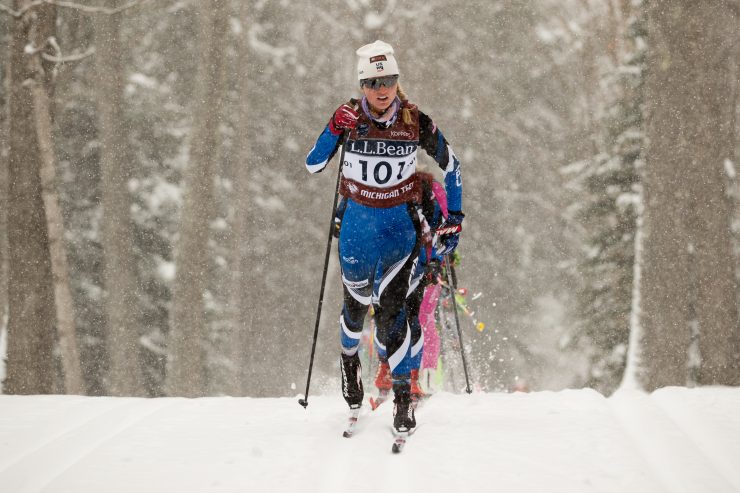
    Warmup: 15-minute easy Level 1 (roller)ski to the start.

    Go-time: Typically takes him 1 hour and 20 minutes to rollerski the 5-mile section twice.

    “The steep 500-meter section is VERY hard to double pole — that portion of the road is something you would for sure stride in a race. During this workout, I try to spend an hour at L2 [Level 2] and end up bumping up to L3 [Level 3] only when double poling up that steep segment (2 X 5min in L3). I like having the two short but demanding double pole sections in this workout.

    “The important part of this training session is not the 2 x 5-minute L3 sections, it’s the time before and after that L3 effort. You have to figure out how to get the muscles to recover from the hill while still double poling and determine what gear/tempo to use while still applying power efficiently — and recover at the same time.”
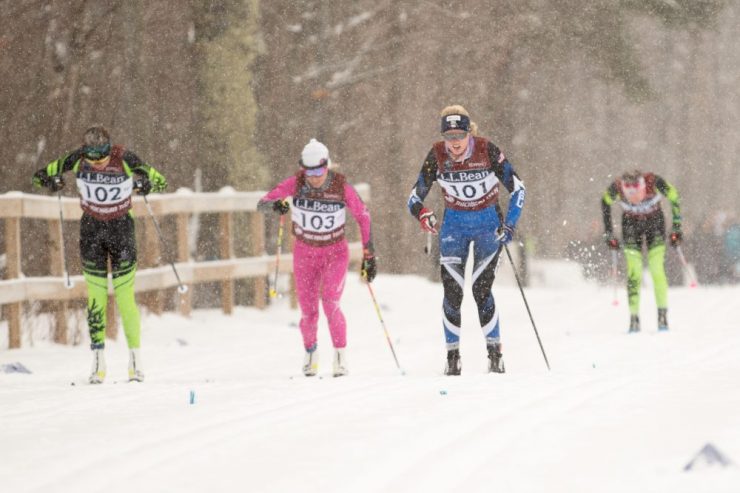
    Cool down: 15-minute easy ski home.

    Notes:

    • “The idea is to work specifically on double pole and upper body strength. You get an opportunity to work on all gears, from long double pole to very quick choppy double pole up the steep section.

    • “You can gain a lot from just focusing on two intensity sessions a week throughout the summer. This is a way I find I’m able to gain quite a bit from specific double pole training. But ideally, you don’t fatigue the body so much that it takes energy away from the true intensity sessions.”

    Lastly, here’s the strength protocol from the 2017 study we mentioned up top. After a specified warm-up, here is what the researchers prescribed for the non-ski-erg test group.

    (1) for different training days, the participant was allowed to alternate between five repetitions maximum (RM) of snatches, squats or deadlifts at 60–85% of body mass,

    (2) 8 RM sit-ups or vertical sit-ups,

    (3) 6 RM pull-downs, chin-ups or seal row

    (4) 6 RM of pushdowns, bar-dips or narrow bench press

    (5) 6 RM of belly-backs with or without dumbbells.

    “All five exercises were conducted with two sets per exercise and 1-min rest between sets. Thereafter, the participants completed 5–10 min with different core-stability exercises, which were followed by 90 s of cable crunches, 60 s of pulldowns with a rope, and 30 s of triceps pushdowns with a rope without rest between exercises. After 1-min rest, these three exercises were repeated once. Finally, 3 sets of 45 s of medicine-ball slams (3–5 kg) with 15-s rest between sets were conducted. After the group-specific training session, the [strength] group performed 20 min of roller skiing using the double-poling technique in the heart-rate intensity zone MIT”
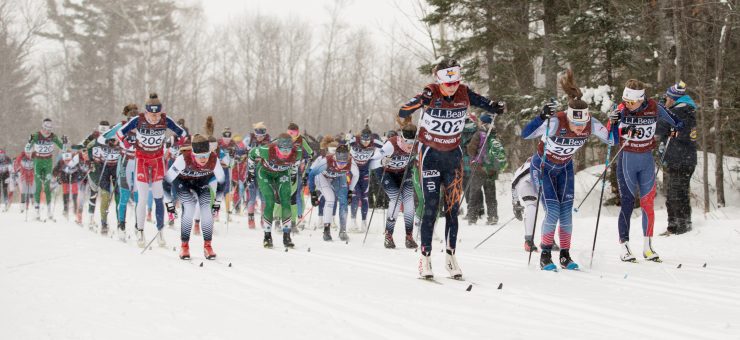
    Happy double poling. 


  • Race-cation: Erik Bjornsen and Marine Dusser on Iceland and the Fossavatn Ski Marathon

    Race-cation: Erik Bjornsen and Marine Dusser on Iceland and the Fossavatn Ski Marathon

    While many skiers were blowing the dust off of their rollerskis, hitting the track or trail, or looking for crust to cruise on May 1st, Erik Bjornsen and his wife Marine Dusser were previewing the race course for the Fossavatn Ski Marathon, or Fossavatngangan, in Isafjördur, Iceland.   

    Erik Bjornsen poses with Snorri Einarsson, an Icelandic World Cup skier, at the finish of the Fossavatn Ski Marathon in Isafjördur, Iceland. (Photo: Instagram @ebjornsen1991)

    While it might seem odd to begin a new season by racing a 21 k followed by a 42 k just two days later, Bjornsen and Dusser agreed that they did not go into the race with performance goals, rather to experience a new place and to enjoy the sport they both love.

    “I feel like we went on vacation and we made a race out of a vacation,” Dusser explained in a call. “We like nordic skiing and we both like racing, but we didn’t really put any pressure [on ourselves].”

    Though the Fossavatn has only been a member of the World Loppet series since 2015, the race dates all the way back to 1935. In addition to the 50-kilometer marathon distance, which is always classic technique, the event features a 25 k skate and classic race and a 12.5 k classic in the days preceding. There are also 1 k and 5 k children’s races. Typically, each of the courses are one loop, but because it has been a low snow year in Iceland, this year the course was rerouted and distances were scaled back as the longest available loop was 21 k, which the marathoners skied twice.

    “It was kind of like skiing on the glacier [in Alaska],” Dusser shared. “You have no trees and pretty mellow terrain. No steep hills, but it’s up and down. Erik was able to double pole the classic race, but for me, it was too hilly, so I was classic skiing.”

    Marine Dusser on her way to a second place finish in the 21 k skate at the 2019 Fossavatn in Isafjördur, Iceland. (Photo: Instagram @marinedusser)

    While they may not have approached the race with goals, both walked away with strong results. Dusser won the 42 k classic and placed second to Caitlin Gregg in the 21 k skate, while Bjornsen was 7th in the classic and 2nd in the skate.

    A glance at the results over the last few years shows names like Iivo Niskanen, Riita Lisa Roponen, and Petter Northug, just to name a few, which begs the question, ‘At an odd time in the year, what is drawing top names to the 66th north parallel for a marathon?’. The duo explained that the race manager, Bobbie Sigujónsson, had contacted Bjornsen about traveling to Iceland for the event, and has enticed other top athletes to do the same.

    “I think he has been pretty good with marketing and communication, and this race is pretty sexy because it’s very pretty there and it’s so different than anything that you can see [elsewhere],” Dusser explained. “And it’s also in May, so it’s easy to get good athletes because people are on vacation. And I think that they are pretty curious about Iceland, so it’s easy to get big names because people can make a vacation out of the race.”
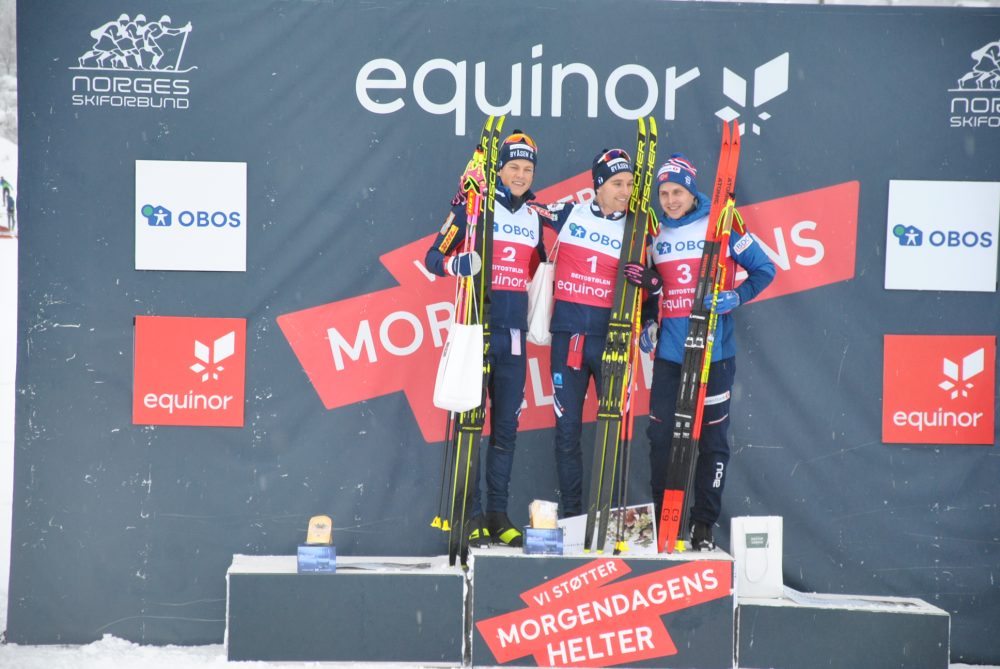
    The couple enjoyed having the opportunity to spend time around the other top athletes attending while away from the World Cup setting.

    wellbutrin sr

    “We got to spend some time with [Nikita] Kryukov and [Alexander] Panzhinzkiy and Iivo [Niskanen],” said Bjornsen. “I mean all those guys have Olympic gold and silver medals, so it was pretty cool to spend more time around them. We were in the same hotel as Kryukov, so we actually got to know him quite well and that was fun.”

    In addition to complimenting race organizers and noting how much fun people were having in the race itself, both Bjornsen and Dusser recommend the event to anyone looking for a novel experience.  

    “There was a big dinner – a “fish party” they called it – where they have live music and an announcer and really good food and stuff,” said Bjornsen. “So I’d just say that we highly recommend it to everybody. It was a really fun experience and if people get the opportunity, it’s a really cool one to do in the spring at the end of the year to have a fun end of the season.”

    While the names at the front of the pack might seem intimidating, Dusser added that the Fossavatn race series is inclusive for skiers of all ages and abilities.

    “There were a lot of masters and I think this race is really open for all of them,” said Dusser. “Because it’s not very all-terrain either — you don’t have very long uphills. I think it’s pretty attractive for all levels. You can see every age and every level can go and have fun, so it’s not just for athletes, so it’s kind of cool.”

    Erik Bjornsen leaps over a geothermal spring during a trail run in Iceland. (Photo: Instagram @ebjornsen1991)

    Capitalizing on the opportunity, the pair used the week before the race to explore and see other parts of the country, which was new to both of them.

    “We flew into Reykjavik and based out of there for three days, and explored all around that area for day trips,” Bjornsen shared. “We’d head an hour out of town each direction each day and saw different parts of southern Iceland. It’s not a huge place, so we were able to see quite a bit around Reykjavik in those first three days. Then we drove five – 600 miles to the northwestern part of Iceland [for the race]. It was in the west fjords and it was the biggest town in that section of Iceland. So it was really cool. I feel like we saw half of Iceland, or quite a bit of it, and of course snippets of the area along the way.”

    Marine Dusser explores Iceland by foot. (Photo: Instagram @marinedusser)

    Apart from the more obvious features that contrast their coastal Alaskan home – lower mountains and turquoise blue hot springs – they were taken aback by how much closer to the sea they felt there and also by the size of the waves.

    “On the drive up there [to Isafjördur], we actually spotted some whales,” Bjornsen recalled. “You’d drive for an hour and you basically wouldn’t see anybody. We were driving through these fjords and it was a day where there wasn’t a lot of wind, so the sea was pretty quiet, and there were three or four whales that were swimming 150 or 200 meters from the road. We just turned the car off right on the road and watched. In Anchorage, it’s a bit different. You have to drive a ways. We’re in the Cook Inlet right now, and there is a lot of glacier silt, so it’s never very deep. There are some whales that are around but you rarely… it’s just a different feel around here.”
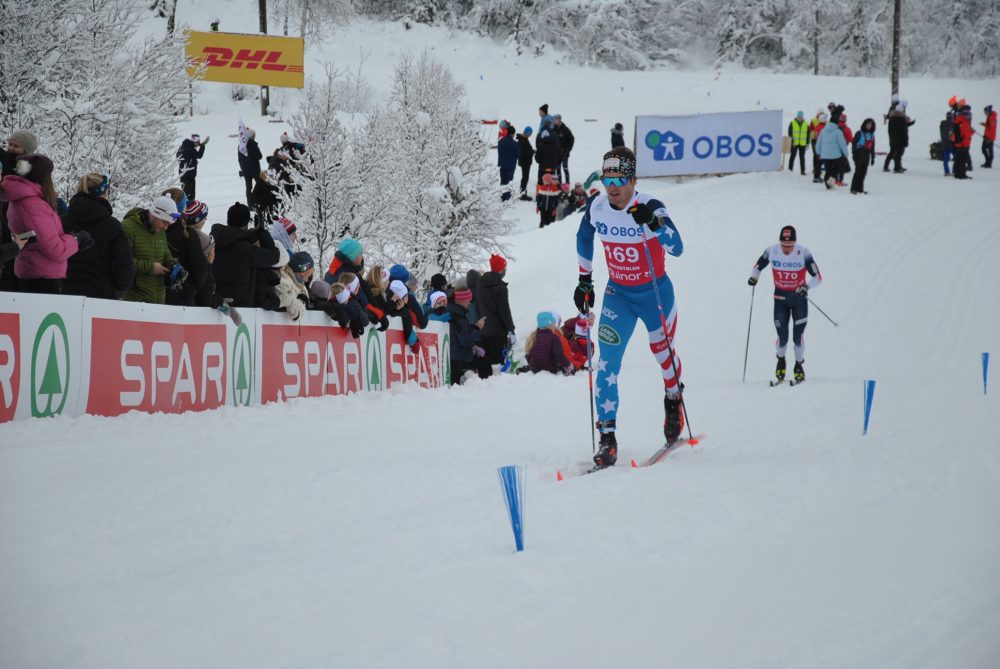
    Looking ahead, Dusser, who has coached for the UAA Seawolves the last two seasons, will be continuing her work with the Alaska Biathlon Association, including coordinating the upcoming spring training camp. In her own ski career, Dusser was a member of the French National Biathlon Team. During that time, she won three medals at the Junior World Championships in biathlon and was the French Junior National Champion six times.

    “We have a camp the first week of June and usually we try to invite a bunch of biathletes,” Dusser explained. “Last year we had a biathlete from Switzerland, she actually won the World Junior championship, and Tim Burke is coming as well to help coach, so that should be fun. It’s pretty busy organizing that camp, it’s pretty big every year, so it’s nice.”
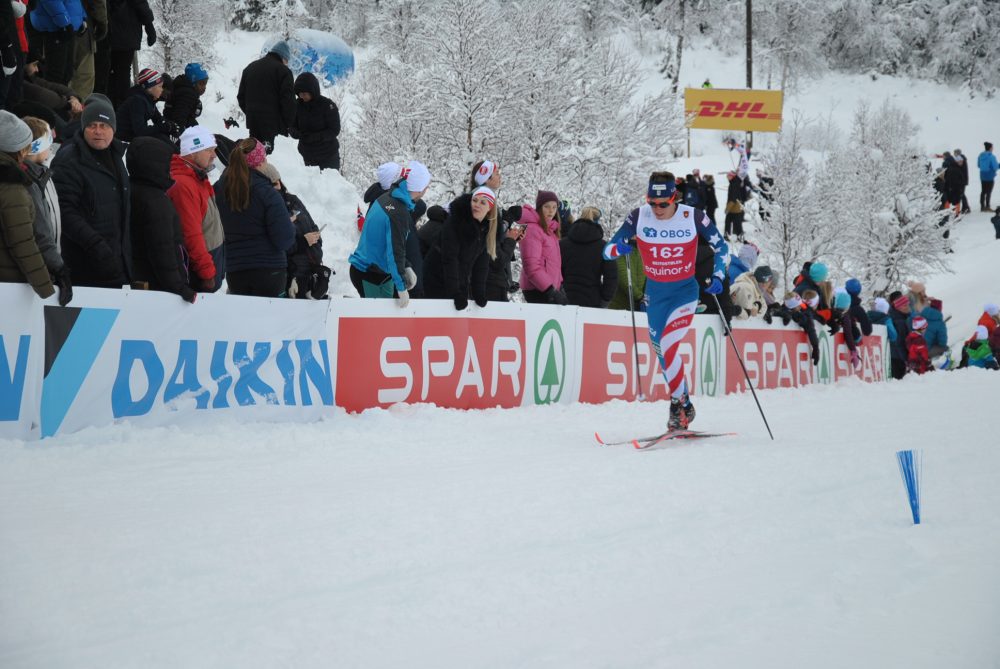
    Bjornsen, who this season advanced to the USST A-Team, will be continuing to work toward the upcoming World Cup season, but is also looking forward to upcoming non-ski-related events this summer.

    “I’m getting back into training,” Bjornsen stated. “Doing a similar camp schedule that I’ve done in the past, so I’ll be heading down to Bend here in about a week, definitely Eagle Glacier this summer, then I’m headed to Norway, and a fall camp with the ski team. My sister is getting married [in July], then we’re having Marine’s parents come to town and my parents are coming of course, so it should be a fun summer.”

    Erik Bjornsen explores coastal Iceland on a trip with his wife, Marine Dusser. (Photo: Instagram @erikbjornsen1991)
  • Junior Skier of the Year

    Junior Skier of the Year

    Junior Skier of the Year


    Gus Schumacher leading the pack with teammate Ben Ogden (pink hat) in the draft — during the U20 30 k classic mass start at World Juniors in Lahti, Finland. (Photo: Doug Stephen)

    With the 2018/2019 season officially in the rearview, FasterSkier is running a series of articles highlighting some of the players and performances from the season. This year, the junior skier of the year is Gus Schumacher.

    Perhaps it is a testament to the steady growth of U.S. developmental programming or perhaps it is a trickle down effect as Americans see more success on the World Cup level; one thing is clear when you consider the depth of the current field of junior skiers, the future looks bright. Choosing just one athlete to recognize as Junior Skier of the Year was not an easy decision, but the outstanding achievements of Gus Schumacher in 2019 make the 18-year-old USST D-Team member from Anchorage, AK a worthy recipient.

    The U20 World Juniors 4 x 5 k relay first place team from the U.S, (l-r) Luke Jager, Ben Ogden, Johnny Hagenbuch, and Gus Schumacher. (Photo: JWSC2019 / Mikaela Takala)

    While his performance anchoring the gold medal U20 men’s relay team at Junior Worlds in Lahti was likely the most dramatic and noteworthy result Schumacher earned this season, his achievements extend much further. In fact, there was a major highlight for the Alaska Winter Stars standout each month.

    In January’s Senior National Championships, Schumacher took 7th in the 15-kilometer individual start freestyle, 5th in the freestyle sprint, and 4th in the 30 k mass start classic amongst a field of senior men vying for World Cup starts and a spot on the team at World Championships. His results made him the top junior athlete in each race, except for the skate sprint where Noel Keefe took 3rd.

    Gus Schumacher (Alaska Winter Stars/Team Alaska), center, won the U20 men’s 15K classic mass start
    race Friday at the 2019 U.S. Ski & Snowboard Cross Country Junior National Championships at Kincaid
    Park. J.C. Schoonmaker (UAA-Auburn Ski Club/Far West), left, was second, followed by Cameron Wolfe
    (Ski and Snowboard Club Vail/Rocky Mountain), right. The win gave Schumacher a three-race sweep of
    the 2019 JN individual events. (Photo: Michael Dinneen)

    In February, in addition to his relay gold during World Juniors in Lahti, Finland, he placed individually in the top-10 twice with a 6th place finish in the 10 k skate and a 4th in the 30 k classic. He was also 16th in the classic sprint. These results were a significant improvement from his races during the 2018 World Junior Championships where his highest individual result was 15th in the skiathlon.

    In March, Schumacher swept Junior Nationals on home turf in Anchorage. Not only did he win each event and anchor the winning relay, but his victories in both distance races, a 10 k skate and a 15 k classic, were won by a margin of roughly a minute each. Because of his results at U.S. Nationals and World Juniors, Schumacher earned his first starts on the World Cup during the final races in Québec City later in the month.

    Finally, as the season wound down and April began, Schumacher wrapped up a fantastic season at Super Tour Finals in Presque Isle, ME. He took 8th overall in the freestyle sprint and landed himself on the podium with Simi Hamilton and Erik Bjornsen by taking 3rd in the 15 k classic. While skiing with the lead pack of 50 k racers, Schumacher also cruised to victory in the junior 30 k skate.

    The men’s podium for the 15-kilometer mass start classic during the Super Tour Finals in Presque Isle, ME. Erik Bjornsen (USST/APU; center) took the win ahead of Simi Hamilton (USST/SMST2; left) and Gus Schumacher (USST-D/APU; left). (Photo: U.S. Ski & Snowboard – Reese Brown)

    Before we wrap this up, we want to give a shout out to Kendall Kramer of Fairbanks who also swept Junior Nationals for U18 women. Kramer was also the top American in the 15 k classic at World Juniors with a 4th place finish, and ended her season in Québec with her first World Cup race starts at just 16-years-old. With results like these, she’ll certainly be in the running for this award in the coming years.