From the FasterSkier archive — posts syndicated from athletes’ and coaches’ own blogs between 2004 and 2012, kept online as published. Current coverage is at fasterskier.com.

Tag: Erik Carleton

  • Wednesday Workout: Double-Pole Endurance Training

    Wednesday Workout: Double-Pole Endurance Training

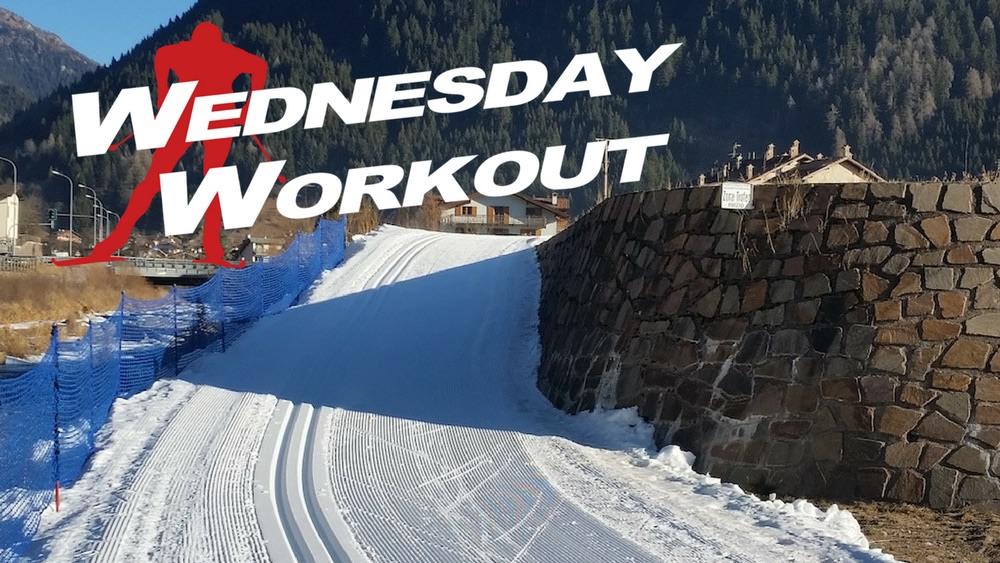
    The Marcialonga course follows the rivers in the Fiemme and Fassa valleys for the first 67 kilometres. (Photo: Ian Murray)
    The Marcialonga course follows the rivers in Italy’s Fiemme and Fassa valleys for the first 67 kilometres. (Photo: Ian Murray)

    Double poling is an increasingly important part of cross-country skiing and it pays to be good at it. If watching World Cup stars double pole short races on television doesn’t have you convinced, take a look at the races you might enter. Most loppets, marathons and citizen races feature flatter courses with a lot of double-poling time. Even in skating, the three main techniques all include slight variations on double poling.

    When five Canmore skiers decided to make the 70-kilometer Marcialonga in Italy (part of the Ski Classics marathon series) their major target for this season, they decided to emphasize one technique in their preparation.

    “Pretty much the whole elite field will [double pole the Marcialonga without grip wax],” Erik Carleton, a longtime Canadian Para-Nordic Ski Team guide, explained. “It’s all about getting to the last uphill, and then it’s 3 k pretty steep and you just try and survive that.”

    Here are three of the workouts that the 38-year-old Carleton and his Canmore-based training partners, including Canadian Para-Nordic veteran Brian McKeever (age 37), his other guide Graham Nishikawa (33), Ian Murray of North Highlands Nordic (38), and Jon Arne Enevoldsen (54), a former Norwegian biathlete who now runs a coaching business, used to prepare. Each of these five athletes had a different mix of goals for the season and shared workouts were just a part of their individual preparation. FasterSkier has suggested variations for those of us who are less than elite.

    Workout 1: Go to a local classic loppet/marathon/citizen’s race and don’t bring kick wax.
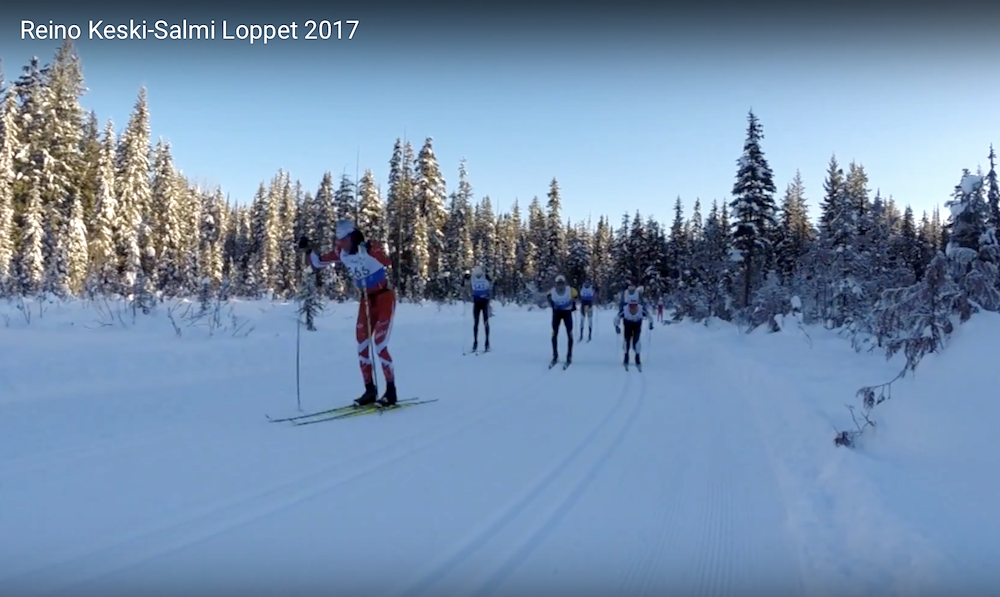
    Erik Carleton leads a group through Bilbo's Bog at the RKS 2017. (Photo: Larch Hills)
    Erik Carleton leads a group through Bilbo’s Bog at the 2017 Reino Keski-Salmi Loppet at the Larch Hills trails in Salmon Arm, B.C. (Photo: Larch Hills Nordic)

    The Canmore crew chose the Reino Keski-Salmi loppet, a 34 k race at the Larch Hills trails in Salmon Arm, B.C., known to locals as the RKS. This event is a typical regional loppet: the long course is relatively flat with a little over 600 metres of climbing, the demographic is dominated by kids and retired people, and most of the 396 finishers were solidly focussed on having fun on snow.

    Before the race, Enevoldsen correctly predicted that local skiers with grip wax would easily beat anyone double poling on squeaky -17 Celsius snow. Their goal was not to win, but to get some quality DP training done two weeks before the Marcialonga.

    In the end, Larch Hills local Thomas Hardy cruised to victory on grip wax in 1:38:52, just four days after placing 18th at the U.S. nationals 30 k classic mass start at Soldier Hollow in Utah.  McKeever and Nishikawa returned from Soldier Hollow ill and didn’t start.

    Carleton was feeling the effects of his 15th at Soldier Hollow, finishing the RKS 4:03 minutes behind Hardy. Carleton said afterwards, “It felt good off the start and I tried to push the pace a bit, but then the body was — not today.”

    Murray and Enevoldsen were fresher but still treated the RKS as a training workout, finishing at 1:32 and 9:00 respectively to win their age groups.

    If it seems wrong to go to a race and not push for the best possible finish, these guys weren’t alone in looking past the result sheet. Retired Canadian national-team member Alysson Marshall returned to her hometown event with her new husband Chris Hamilton to have fun on the trails she grew up on.

    Variations:

    • Choose a race to suit your needs. McKeever and Carleton have double poled 50 k races in the past, but your local weeknight 10 k might be a better fit.
    • Split a race in two. If you aren’t ready to double pole the full race that fits your calendar, choose a point on the course where you will pretend you have switched to skate skis and double pole to the finish.


    Workout 2: Long DP rollerski with race pace at end
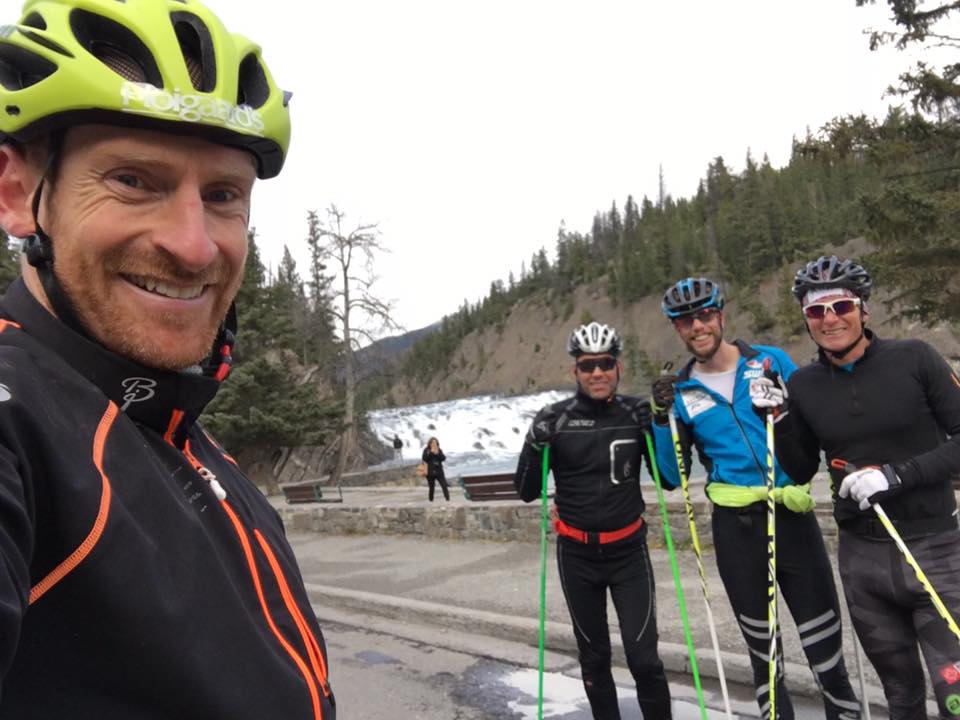
    Brian Gregg, Jon Arne Enevoldsen, Erik Carleton, and Ian Murray during a double-pole rollerski to Banff. (Selfie: Brian Gregg)
    (From left to right) Brian Gregg, Jon Arne Enevoldsen, Erik Carleton, and Ian Murray during a double-pole rollerski from Canmore to Banff, Alberta. (Photo: Brian Gregg)

    Roughly every two weeks, the crew would get together for a long Zone 1 (Level 1, or easy chat level) double-pole ski followed immediately by 30 to 60 minutes in Zone 3 (loppet race pace).

    “The idea is you tire out your body and then try and push it a bit more,” Carleton said, “so that it will give you that endurance double-poling at the end of loppet races.”

    For this crew, the long easy session was two to four hours.

    While this workout could be done on snow, it was a rollerski favourite because of available trails. “We’ve got this nice legacy trail to Banff and it’s good flat terrain for that,” Carleton said. Few ski areas can provide flat trails suitable for a four hour ski without excessive laps.

    Variations:

    • Adjust the times. Starting out, one hour of Zone 1 followed by 30 minutes of Zone 3 might be hard enough.
    • Use your legs for the Zone 1 part. If you don’t have enough flat terrain to stay in Zone 1 double poling, stride or skate as needed in the first part of the workout. For the second part, hilly terrain is less of a problem in Zone 3.


    Workout 3: 4 x 45-minute intervals 

    Double pole 45 minutes in Zone 3, followed by four hours of rest between.

    Murray came up with this workout after getting good performance gains from doing mountain bike relay races like ’24 Hours of Adrenaline Canmore’ and ‘Golden 24’.

    “Some of my friends give me a hard time, saying this is too difficult,” Murray wrote in an email. “But the mountain bike races are far harder.”

    Variations:

    • Don’t do this. While this workout seems unnecessarily hard, it is clearly working for Murray. Maybe we can all think outside the box to build new workouts from races, events, or long backcountry days that produced good results.
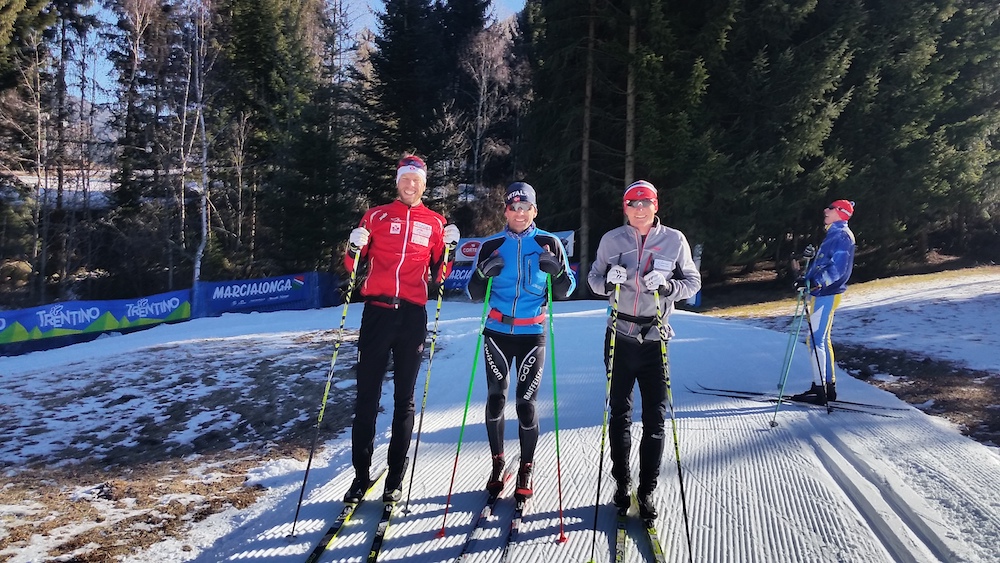
    Erik Carleton, Jon Arne Enevoldsen, and Ian Murray previewing the Marcialonga course. (Courtesy photo)
    (From left to right) Erik Carleton, Jon Arne Enevoldsen and Ian Murray previewing the Marcialonga course. (Courtesy photo)

    Conclusions:

    So how did these five fare in the Marcialonga after all the preparation?

    McKeever was the fastest of the group (and fastest Canadian), finishing the shortened 57 k course in 2:21:32.5 hours, 9:13 minutes behind the winner Tord Asle Gjerdalen for 57th overall. Nishikawa was next, 81st at +12:56, then Murray (86th, +13:37), Carleton (113th, +17:50), and Enevoldsen (160th, +22:14).

    Murray was pleased with his personal best at a Ski Classics event, writing “The double pole training has worked out well. I was able to hold a hard effort for the first 50km although I faded a bit in the last 7km.”

    Murray’s event highlight: “Being so close to the lead for the first part of the race.  Also skiing down the streets of 4 old Italian towns along the 57km track.  I didn’t get to soak in that aspect of the race during the event but rather in the pre-skis and post race ski it was fantastic.”

    And how much did the double-pole preparation pay off? Considering there were 5761 finishers including many former world cup stars like Gjerdalen, Anders Aukland, Toni Livers, and Østein Pettersen, top 200 is impressive.

    2017 Marcialonga results

  • Sunday Rundown: Falun, Duszniki-Zdrój, & The Marcialonga (Updated x4)

    Sunday Rundown: Falun, Duszniki-Zdrój, & The Marcialonga (Updated x4)

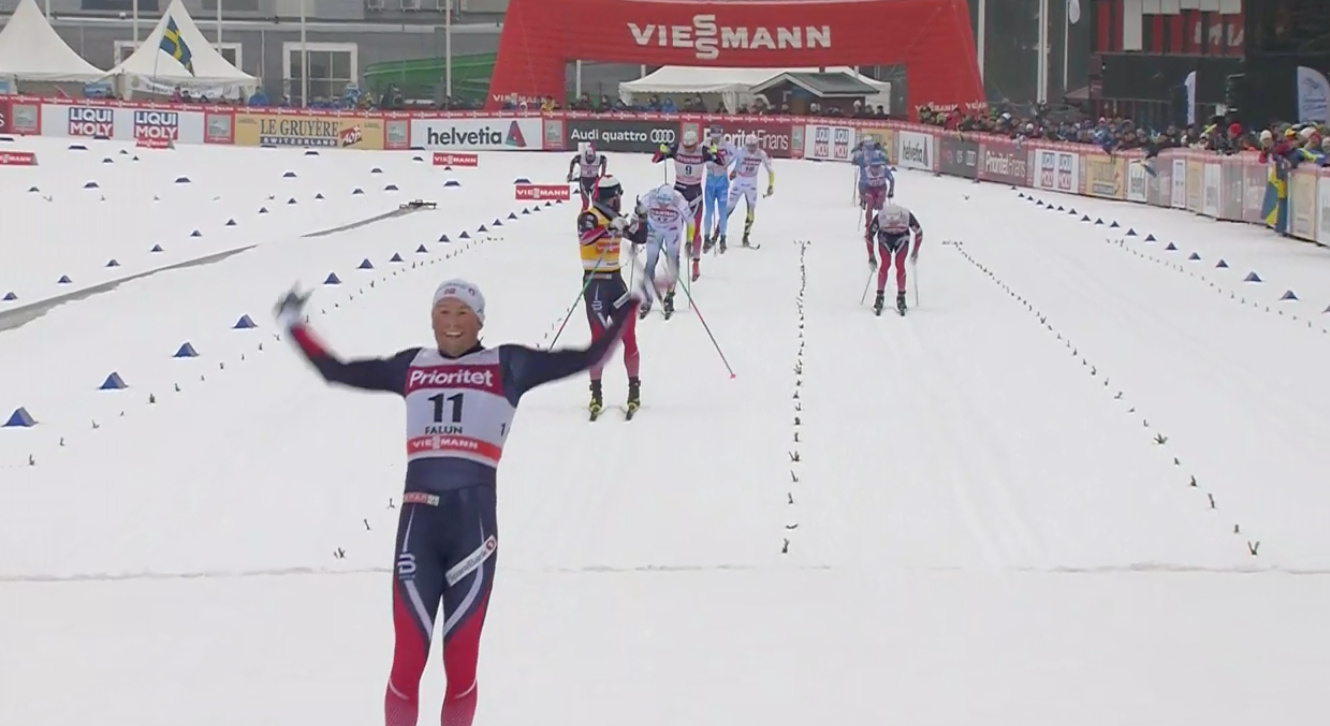
    Emil Iversen celebrates his win in the 30 k classic mass start in Falun, Sweden, on Sunday. Norwegian teammate Martin Johnsrud Sundby finished second and Sweden's Calle Halfvarsson third.
    Emil Iversen celebrates his win in the 30 k classic mass start in Falun, Sweden, on Sunday. Norwegian teammate Martin Johnsrud Sundby finished second and Sweden’s Calle Halfvarsson third.

    FIS Cross-Country World Cup (Falun, Sweden): 15 / 30 k classic mass start

    Women’s report | Men’s report

    In the women’s 15-kilometer classic mass start on Sunday, Norway swept the podium with Marit Bjørgen taking the win in a time of 41:28.8 in Falun, Sweden. Crossing just half a second behind her was her teammate, Ingvild Flugstad Østberg in second place. Rounding out the podium was Heidi Weng in third (+8.1).

    American Jessie Diggins was the first to cross the line for the U.S. in 10th (+1:37.5). Three other U.S. women finished in the top 30, with Sadie Bjornsen finishing 21st (+2:43.6), Rosie Brennan 24th (+2:57.0), and Liz Stephen in 29th (+3:24.5).

    Just outside of scoring World Cup points was American Caitlin Patterson in 32nd (+3:47.6) and Ida Sargent in 34th (+4:02.8). Canada’s Cendrine Browne finished 46th (+5:41.4) and American Liz Guiney 49th (+6:22.6).

    After losing the skate sprint yesterday in a photo finish to Italy’s Federico Pellegrino, Emil Iversen ascended to the top step of the podium in the men’s 30 k classic mass start on Sunday in Falun.

    The Norwegian was often near the front, but hadn’t tried to lead a breakaway like his teammates Martin Johnsrud Sundby and Sjur Røthe did earlier in the race. In the final two kilometers, Sundby – the overall World Cup leader – put in a sprint to try to drop the field. But Iversen caught up, drafting his veteran teammate into the stadium. In the final up-and-over before the finish line, Iversen made a pass and then accelerated down the finishing stretch to beat Sundby by 1.14 seconds.

    “I got motivation from yesterday’s last 20 meters,” Iversen told FIS in a finish-line interview. “So today I fought all the way, and I was really stronger. It is amazing for me to be second yesterday and first today. I’m really proud of that.”

    Calle Halfvarsson, who had been falling off the back of the lead pack just a few kilometers earlier, managed to get back to the front and claim third place for Sweden (+1.72 seconds) in a photo finish with Røthe (+1.76 seconds). Niklas Dyrhaug was next (+2.52 seconds) to give the Norwegian men’s team four in the top five.
    In his return to the World Cup stage, Norway’s Petter Northug finished 31st (+3:10.6).

    Alex Harvey was the lone Canadian on the start line. After skiing near the front of the field for the early part of the race he was dropped by the lead pack in the final kilometers, finishing 15th (+1:17.5).

    Erik Bjornsen and Noah Hoffman took 35th and 37th places for the United States, finishing +3:30.8 and +3:59.8, respectively. SuperTour leader Matthew Gelso — familiar with the Falun course after competing in 2015 World Championships — finished 44th (+5:23.6), and Andy Newell placed 53rd (+7:45.3).

    Results: Men | Women

    ***

    IBU Open European Championships (Duszniki-Zdrój, Poland): Single mixed & mixed relay

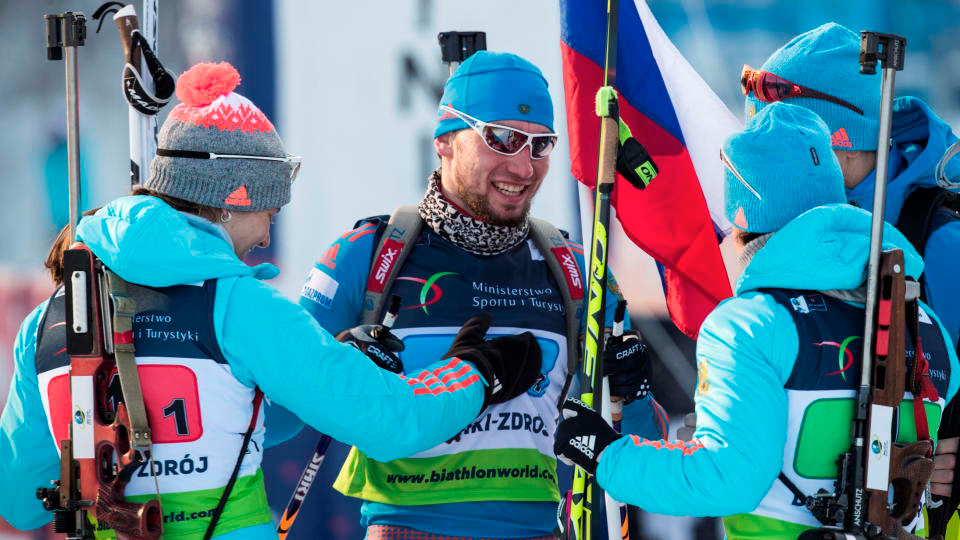
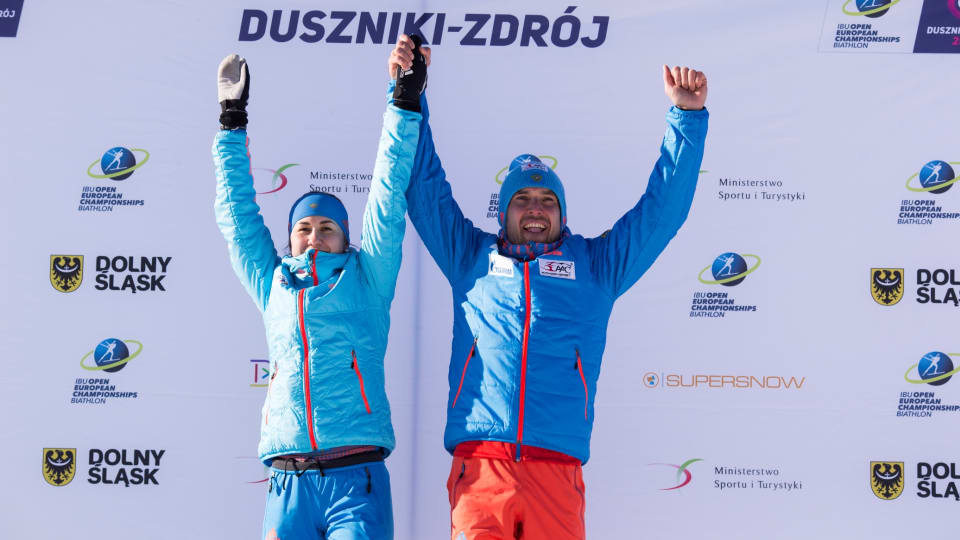
    Russia’s Alexander Loginov (center) is greeted at the finish by his teammates Irina Starykh, Svetlana Sleptsova and Alexey Volkov after anchoring his team to the gold medal in the mixed relay at the 2017 IBU Open European Championships in Duszniki-Zdrój, Poland. (Photo: IBU)
    Russia’s Alexander Loginov (center) is greeted at the finish by his teammates Irina Starykh, Svetlana Sleptsova and Alexey Volkov after anchoring his team to the gold medal in the mixed relay at the 2017 IBU Open European Championships in Duszniki-Zdrój, Poland. (Photo: IBU)

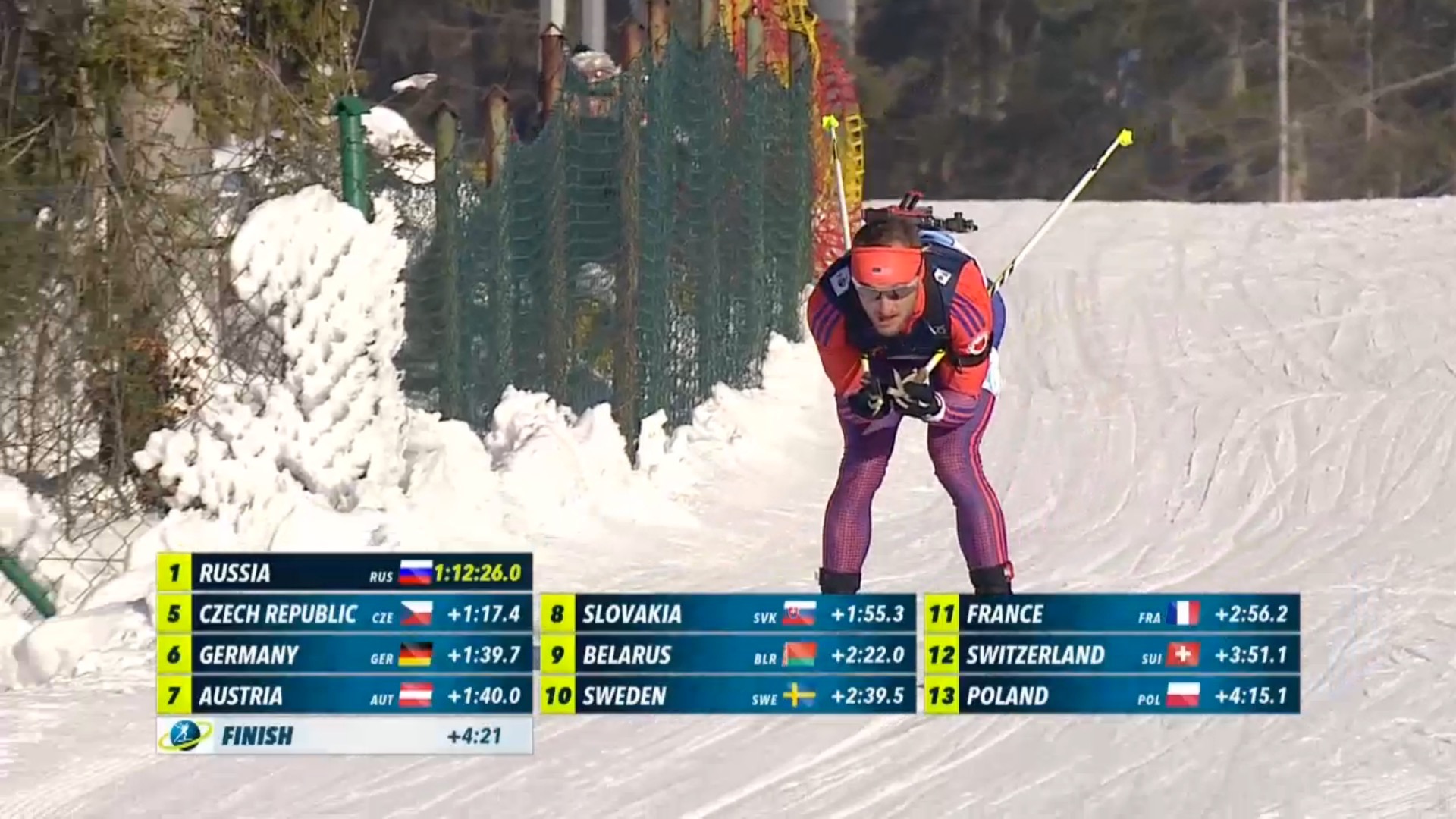
    [UPDATED] The Russian victory in the final 2 x 6 + 2 x 7.5-kilometer mixed relay event of the 2017 International Biathlon Union (IBU) Open European Championships in Duszniki-Zdrój, Poland, was only briefly in doubt, when Alexander Loginov skiing the anchor leg required all spares in his prone shooting stage. But with his final shot he managed to also hit that target to avoid the penalty lap, leaving the range with a lead of more than 30 seconds.

    Loginov then did not need any spares in the last standing stage, and could take his time on the final loop. Unlike Russia’s Evgeniy Garanichev earlier in the day during the single mixed relay, he also managed to pick up a flag for the final meters of the race, crossing the line in a time of 1:12:26.0 hours.

    The Russian team with Irina Starykh, Svetlana Sleptsova, Alexey Volkov and Loginov led from the first exchange and required only six spares with zero penalties.

    With this medal, the 28-year-old Volkov became the most successful athlete in history at European Championships, according to an IBU press release, surpassing the retired Polish biathlete Tomasz Sikora. Russia was the most successful team of the 2017 Open European Championships with six gold, four silver, and three bronze medals.

    Behind them, a number of teams vied for the positions on the podium. Sweden initially looked like a strong contender exchanging in second place after the women, but fell back with three penalty laps to only finish 10th.

    Still six seconds back after the final shooting, Norway’s Fredrik Gjesbakk caught up to and outsprinted Ukraine’s Ruslan Tkalenko in the finishing stretch to claim the silver medal (+36.4) with the bronze left for Ukraine (+37.1).

    “I thought that I made sufficient gap to win silver,” Tkalenko told the IBU. “But in the end, on the final downhill before the finish, I was very surprised when the Norwegian guy passed me, I truly did not expect that.”

    The Norwegian team with Karoline Erdal, Marion Rønning Huber, Erlend Bjøntegaard, and Gjesbakk needed nine spares and had no penalties.

    Ukraine with Anastasiya Merkushina, Yulia Dhzyma, Oleksander Zhyrnyi (who originally started for Russia before making the switch in 2014) and Tkalenko required six spares, and Dhzyma had to ski a penalty lap only temporarily setting the team back.

    Bulgaria finished fourth (+1:16.4), with its anchor Vladimir Iliev narrowly beating Czech Republic’s Lukas Kristejn (+1:17.4) in the finishing stretch. Both teams needed 11 spares and had no penalties.

    Jakob Ellingson skiing the anchor leg for the U.S. mixed relay at the 2017 IBU Open European Championships in Duszniki-Zdrój, Poland. The U.S. team finished 14th. (Photo: IBU/Eurovisionsports.tv screenshot)
    Jakob Ellingson skiing the anchor leg for the U.S. mixed relay at the 2017 IBU Open European Championships in Duszniki-Zdrój, Poland. The U.S. team finished 14th.
    (Photo: IBU/Eurovisionsports.tv screenshot)

    Starting at the back of the field in bib 20, US Biathlon’s Emily Dreissigacker got her team off to a strong start with a clean prone shooting and one spare round in standing, exchanging in 10th, a minute behind the leaders. Hallie Grossman needed one spare in each of her stages, tagging off to the men in 14th position and now 2:39 behind. Max Durtschi also had one miss each in prone and standing, coming into the last exchange still in 14th position, but another minute back. Jakob Ellingson required all three of his spares in his prone shooting stage narrowly avoiding the penalty lap, and one more in his final shooting stage. As the team from Finland was racing over a minute behind the Americans, he was able to keep the 14th position into the finish (+4:47.4), with a team total of nine spares and no penalties overall.

    For Biathlon Canada, Erin Yungblut starting in bib 19 shot clean in her prone stage and required two spares in her standing shooting, tagging off in 18th position and more than two minutes back from first. Leilani Tam von Burg stayed clean in her prone shooting stage and needed one spare in standing, moving up two positions to exchange in 16th place, yet more than four minutes behind the leaders. After the exchange to the men, both Matthew Neumann and anchor Carsen Campbell managed to shoot clean in all of their stages, but lost additional time on the course to finish 16th (+6:39.9) ahead of four lapped teams.

    Canada had the best shooting result of all 20 teams starting the relay, with just three spares and no penalty.

    Russia’s Daria Virolaynen (l) and Evgeniy Garanichev after winning Sunday's single mixed relay at the 2017 Open European Championships in Duszniki-Zdrój, Poland. (Photo: IBU)
    Russia’s Daria Virolaynen (l) and Evgeniy Garanichev after winning Sunday’s single mixed relay at the 2017 Open European Championships in Duszniki-Zdrój, Poland. (Photo: IBU)

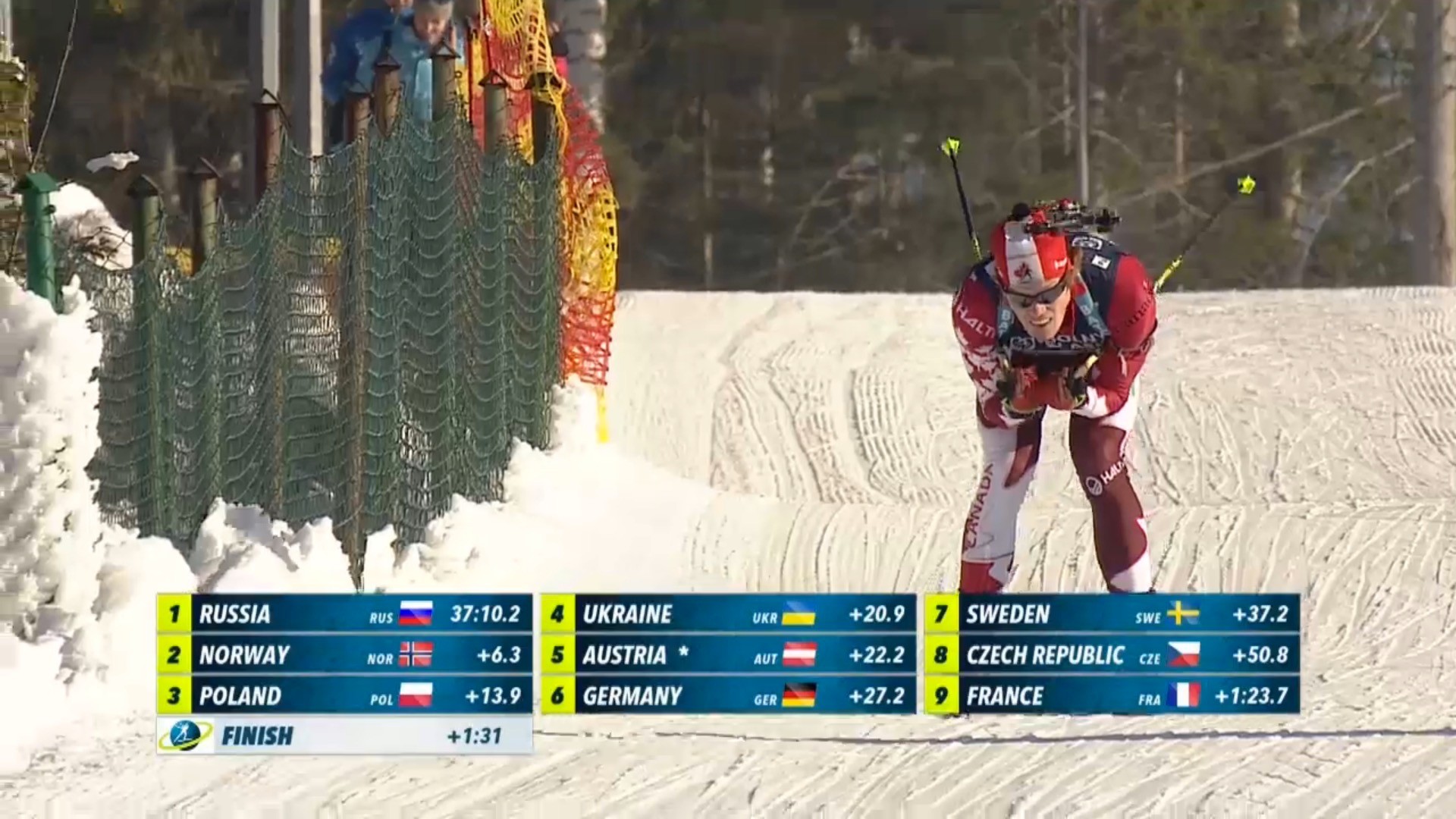
    Earlier on Sunday, pretty much the only thing that went wrong for Russia’s Daria Virolaynen and Evgeniy Garanichev in the single mixed relay happened on the last meters of the finishing stretch, with Garanichev gesturing for a Russian flag he wanted to cross the line with. But the handoff was too short and the flag dropped past his outstretched hand to the snow. He glanced back, weighing if his lead was big enough to ski back, but decided it was not worth the risk, instead skiing into the arms of his partner waiting for him behind the line in a time of 37:10.2 minutes.

    Russia needed seven spare rounds and incurred zero penalties. Garanichev secured the victory in the final shooting, when he only needed one spare – albeit fumbling a few seconds to insert it – while his direct opponents standing next to him required more time to hit their targets.

    “Probably, I took some risk at the last standing,” Garanichev said, according to an IBU press release. “I wanted to shoot fast and clean, but missed with the last shot. But in general, I felt very comfortable; came and worked at the range in my rhythm.”

    6.3 seconds behind, Norway with the team of Ingrid Landmark Tandrevold and Vetle Sjåstad Christiansen placed second, with seven spares and zero penalties.

    “These are very short loops,” Christiansen commented on the fairly new, single mixed relay format. “You feel the pressure from the crowd and to shoot fast every time.”

    The 20-year-old Tandrevold previously earned three bronze medals, including one in the single mixed relay, also with Christiansen, at last year’s Open European Championships in Tyumen, Russia.

    To big cheers from their home crowd fans who had come out to the Duszniki Arena in beautiful but cold weather, the Polish husband-and-wife team of Krystyna Guzik and Grzegorz Guzik placed third with just five spares and zero penalties (+13.9), not quite able to keep up with Christiansen on the final loop after leaving the range together within a second.

    “It is so nice to win a medal here in Poland,” Krystyna Guzik said. “We were both very disappointed with all of our mistakes in the other competitions. So today, we were relaxed and laughing before the competition, hoping not to have those mistakes again. We did not … and now have a medal.”

    It was the first medal for Poland at these championships.

    Ukraine with Iryna Varvynets and Andriy Dotsenko finished fourth, also with five spares and zero penalties (+20.9).

    Biathlon Canada’s Aidan Millar skiing the final loop of the single mixed relay at the 2017 IBU Open European Championships in Duszniki-Zdrój, Poland. With teammate Sarah Beaudry, Canada finished 13th (Photo: IBU/Eurovisionsports.tv screenshot)
    Biathlon Canada’s Aidan Millar skiing the final loop of the single mixed relay at the 2017 IBU Open European Championships in Duszniki-Zdrój, Poland. With teammate Sarah Beaudry, Canada finished 13th (Photo: IBU/Eurovisionsports.tv screenshot)

    For Biathlon Canada, Sarah Beaudry and Aidan Millar required seven spares during their race and had no penalty, just like the winning Russians and Norwegians, but could not quite keep up with the best teams on the course in the fast-paced race format with short loops somewhat comparable to a team sprint in cross-country.

    Beaudry cleaned her first shooting stage and then needed one spare to hit all targets in standing. At the first exchange Canada was 10th, 35.8 seconds behind the then leading team from Poland.

    Millar missed one shot in his first prone stage, leaving the range again in ninth position. Then he needed two spares in his standing shooting on the way to exchanging back to Beaudry in 11th (+56.4).

    On her second leg, Beaudry had one miss in prone and required two spares in standing, falling back a bit to exchange in 13th (+2:12.0).

    On his final leg, Millar was able to shoot clean in both stages, reducing the time gap to the top but not able to make up another position, and finished in 13th place (+1:56.1).

    US Biathlon is only represented with two women at the Open European Championships in Poland, and decided to forgo a start in the single mixed relay, instead entering a team in the mixed relay later on Sunday.

    — Harald Zimmer

    Results: Mixed relay |  Single mixed relay 

    ***

    Marcialonga (Val di Fiemme, Italy)

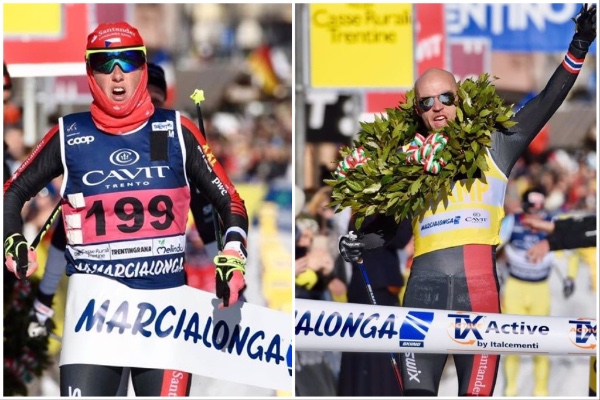
    Katerina Smutna (left) and Tord Asle Gjerdalen (right) of Team Santander won the 2017 Marcialonga. (Photo: Visma Ski Classics)
    Katerina Smutna (left) and Tord Asle Gjerdalen (right) of Team Santander won the 2017 Marcialonga. (Photo: Visma Ski Classics)

    Tord Asle Gjerdalen won the Marcialonga, a Worldloppet and Swix Ski Classics marathon for the third time – in a row. This year was on a shortened course, “just” 57 rather than the traditional 70 kilometers.

    The Team Santander athlete finished in two hours, eight minutes, and 36 seconds, edging Johan Kjølstad (Team United Bakeries) and Morten Eide Pedersen (Team BN Bank) in a sprint finish by 2.6 and 2.9 seconds, respectively.

    Tyler Kornfield and David Norris of Alaska Pacific University finished 43rd (+5:03.8) and 66th (+10:43.1). Canadian Paralympian Brian McKeever finished 57th (+9:13.5) and guide Graham Nishikawa 81st (+12:56.5), followed by Ian Murray in 85th (+13:37.5) and Erik Carleton in 111th (+17:50.2).

    In the women’s competition, Katerina Smutna, also of Team Santander, won her third straight Ski Classics competition. She crossed the line in two hours, 22 minutes, and 46.4 seconds. Britta Norgren of Team Lager 157 was second by just 0.8 seconds, and Sara Lindborg (Team Serneke) third, +4:22.2. University of Utah alum Maria Graefnings was tenth, +10:35.8.

  • Holmes, Palmer-Charrette Win Black Jack Mini Tour

    Holmes, Palmer-Charrette Win Black Jack Mini Tour

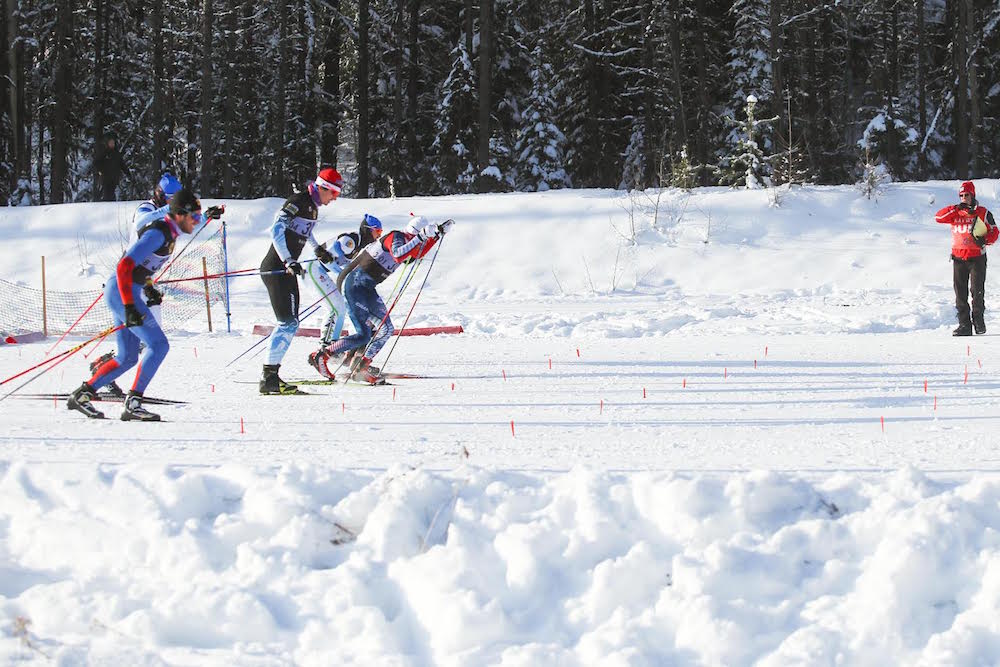
    The start of the A final, day two of of the BlackJack mini tour in Rossland. Newell (301) leads Locke (304, tallest) with Kennedy nearest. (Photo: Dafné Theroux Izquierdo)
    The start of the men’s freestyle sprint A-final on Day 2 of of the NorAm mini tour in at Black Jack Ski Club in Rossland, B.C. American Andy Newell (301) leads Julien Locke (304, tallest) with Russel Kennedy nearest. (Photo: Dafné Theroux Izquierdo)

    The Black Jack mini tour represented the final chance for Canadians to earn World Cup Period 2 starts. A timely week of snow and colder weather delivered great skiing conditions after an unusually warm November wreaked havoc on most of the western ski areas. That same warm weather canceled the Bozeman combined SuperTour/NorAm, which reduced the selection races from seven days to five.
    Chelsea Holmes of Alaska Pacific University (APU) continued her winning ways in Canada, destroying the field in the 10-kilometre freestyle on Friday, placing fourth in the Saturday freestyle sprints, and holding off the field in the 15 k classic pursuit on Sunday with the second-fastest race time to complete the weekend with an aggregate time of 1:08:04.4.

    Erika Flowers of the Stratton Mountain School (SMS) Elite team finished the weekend in second, 2:23.9 behind. Olivia Bouffard-Nesbitt of the Alberta World Cup Academy (AWCA) and Canadian National U25 Team took third, 0.2 seconds ahead of Katherine Stewart-Jones of the Thunder Bay National Team Development Centre (NTDC TBay).  Bouffard-Nesbitt and Stewart-Jones will also be very close on the NorAm leaderboard, and one of them has earned a quota spot for World Cup Period 2.

    In the men’s overall, Evan Palmer-Charrette (NTDC TBay) started the pursuit with a 37-second lead after winning the 15 k freestyle and placing third in the freestyle sprints. Palmer-Charrette held off the chasers to take the overall title and, most likely, the Continental Cup (COC) leader’s spot for World Cup Period 2.

    Alexis Dumas of the Pierre Harvey National Training Centre (CNEPH) charged up from a sixth-place start to grab second overall with the fastest time of the day, 52.2 seconds behind Palmer-Charrette. AWCA’s Jack Carlyle used the second fastest time of the day to take third overall, 1:10.1 back.
    Friday: Freestyle Interval Start

    In a reprise of the the previous Sunday’s event at Sovereign Lake, Holmes won the 10 k by an even larger margin, 1:49.4 minutes, finishing in 29:37.8.

    “I love the courses here,” Holmes wrote in an email to FasterSkier. “Lots of steep climbing followed by technical downhills … very fun!”

    She learned from her 31-second victory five days earlier: “Last week in the 10k I exploded into a million pieces at 5km, so I tried very hard to control myself in the first lap today.”

    Flowers, who caught a ride with Holmes the previous week, moved up one place to second despite the larger time gap.

    “I felt decent skiing (albeit a bit cold!) but definitely have some work to do on the downhills and keeping my tempo up on the hills,” Flowers wrote. “I tend to ski with a lot of glide so I am learning to turn it over a bit more when is cold like this and good glide is harder to come by.”

    This would be the warmest day of the three, with a high of -12 degrees Celsius.

    Bouffard-Nesbitt placed third (+2:27.2), and was already missing the deeper field of the previous weekend.

    “When you have 2:27 separating the top 3, that’s not something you really want to see at the highest level of domestic racing,” Bouffard-Nesbitt wrote.

    In the men’s 15 k, Palmer-Charrette made up for his head cold-induced DNF the previous weekend with the winning time of 40:36.7.

    “Until today I had not had a strong distance race this year, so it was great to see the form come around.”

    Palmer-Charrette was also missing the deeper SuperTour field.

    “This weekend definitely is not as competitive […] as we had last weekend with the Americans in Sovereign Lake,” he wrote. “I’m disappointed [that] I was under the weather when we had the chance to race with them.”

    Russell Kennedy (Team R.A.D.) was leading after 5 k before fading to second, 31.1 seconds back.

    “I really wanted the win after the first lap but my body was feeling a little fatigued,” he explained in an email. “It was cold and the snow wasn’t very fast, but the weather was nice.”

    Erik Carleton, of Rocky Mountain Racers and the Canadian Para-Nordic Ski Team, was happy with his third place, 56 seconds back, especially after a late arrival on Thursday.

    “My teammate [and fellow Para-Nordic guide] Graham [Nishikawa] and I waxed our own skis, with the help of some good advice, and the outcome was positive,” Carleton wrote.

    Carleton and Nishikawa have raced at a lot of venues, while guiding paralympian Brian McKeever and in their own domestic and World Cup careers, and are a good source for course comparisons.

    “It was a fun and challenging course, with steeper climbs and slightly more technical downhills than most courses,” Carleton wrote of the Black Jack trails. “At -18C this morning, the snow was quite slow, especially on the steep uphills. If you had decent skis, the course was more of factor than the conditions. Climbing steep uphills with no glide was a key to a good race.”

    SMS Elite’s Andy Newell, freshly arrived from the World Cup circuit, placed fourth (+1:08.9).

    “It’s my goal to use these races to help get back into the feeling of racing again after such a rocky start to the season,” Newell wrote after Friday’s race. “I was happy with the way today went and they way my body felt.”

    Newell is another athlete with wide experience of race courses: “Having just come off the world cup I can tell you that these courses here are top notch,” he wrote.

    Saturday: Freestyle Sprint

    Saturday brought a romantic result to a chilly day, with the affianced Flowers and Newell winning the women’s and men’s sprints, respectively.

    Bouffard-Nesbitt won the qualifier and easily moved through to the A-final, but Flowers was first at the line.

    “Olivia skied really well off the line and up the entire first half of the course-super smooth and strong,” Flowers wrote. “I was able to jump in behind her in second and tried to chase her down leading up to the high point of the course. By the top of the first big climb we had a sizable gap on the rest of the field but she was still a few meters ahead of me so I tried to ski hard over the top of the hill and free skate the downhill in order to chase her down. I was able to get right behind her going into the last little uphill and felt good coming off the downhill into the finish stretch for a drag race finish.”

    The sprint course has some tricky descending which didn’t affect the top racers or Flowers’s enjoyment of the day.

    “I did get to see a few epic crashes on the S-turns and I thought it was fun to join my fiance Andy on the top of the podium!” she wrote.

    Bouffard-Nesbitt was also positive about her race, despite coming up 0.44 seconds short of the win.

    “I’m pretty happy with my race today!” she wrote. “Definitely happy with my qualifier. I skied the final just like I skied the final in Silver Star — I left it all out on the course.”

    Bouffard-Nesbitt found her legs were fading in the finishing stretch, after spending much of the summer on crutches.

    Stewart-Jones placed third (+7.89), edging Holmes by four-hundredths of a second.

    “Olivia and Erika skied impressively well, all day today!” Holmes wrote. “Olivia took the final out hard and Erika followed… I didn’t see much after that but the results tell the story!”

    Maya MacIsaac-Jones (AWCA/NST U25 Team), who is recovering from a more-recent foot injury than Bouffard-Nesbitt, held off her NTDC TBay’s Annika Richardson by nearly 2 seconds for fifth (+10.65).

    Newell won the men’s qualifier and every heat before topping the A-final in 2:44.81.

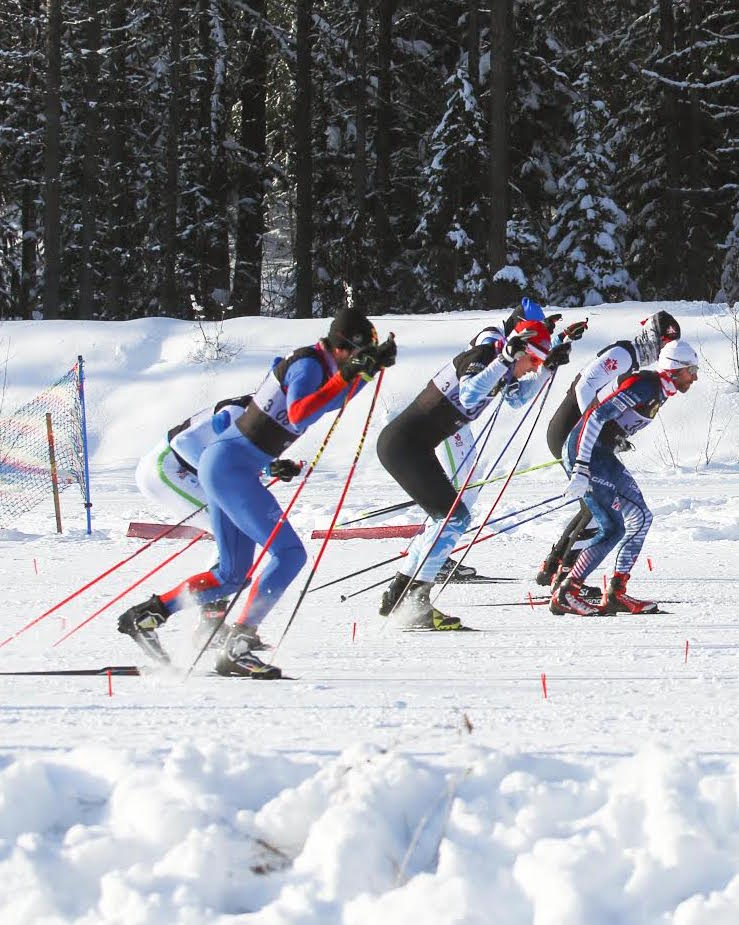
    Another view of the men's A final. Newell and Lapointe (black suit hidden by Newell) would lead out early. Kennedy is nearest, Locke is tallest, the TBay skiers are light blue. (Photo: Dafné Theroux Izquierdo)
    Another view of the men’s A-final. Newell (far right) and Lapointe (black suit hidden by Newell) take the lead out early, with Kennedy (nearest) Locke, and the Thunder Bay NTDC skiers in light blue. (Photo: Dafné Theroux Izquierdo)

    “I was happy with the race today,” he wrote. “The cold temperatures felt a little more manageable today and it was a great opportunity to race 4 hard rounds on a fun sprint course.

    “It was my strategy to be in a front position to be able to charge up the second hill and gap the field, which was the strategy I used in all the heats,” he added

    Former Black Jack racer Julian Locke (AWCA) was 1.05 back, outreaching Palmer-Charrette by 0.05 seconds.

    “[CNEPH’s] Simon Lapointe was pushing pretty hard with Newell and Russell Kennedy with him,” Locke wrote. “I had to put on the gas halfway up [the first long hill] to get back with the leaders and stay in the race. I made contact with the group going over the top and then got behind Newell going over the small hill in the middle of the course, following him down through the twists and into the finish. Evan Palmer-Charrette had some good speed coming into the lanes and we had a fun lunge to the line.”

    Kennedy was on the wrong side of the gap for fourth. Lapointe and NTDC TBay’s Angus Foster, who with Palmer-Charrette crashed out of the previous weekend’s sprint, rounded out the A-final in fifth (+6.26) and sixth (+6.97), respectively. 

    Sunday: Classic Pursuit

    Sunday brought slightly warmer conditions for the 10/15 k classic pursuits, but the waxing was still straightforward with -13-degree Celsius air and colder snow.

    Holmes started the 10 k pursuit with a 1:42 head start and kept the lead, finishing in 35:35.4, which stood as the second-fastest time of the day. Her race plan was simple.

    “I think the expression is to go out ‘like a bat out of hell.’ ”she wrote on Saturday night.

    On Sunday, she was feeling more contemplative after the race: “I have never started off the front in a pursuit and quite honestly it made for some different feelings out there… surprisingly lonely.”

    Flowers was third on Sunday, 48.1 seconds back, but it was enough to maintain her second overall (+2:23.9).

    “I wasn’t thrilled with my race today but it was a good mental challenge to get out there and play around with some classic skiing,” Flowers wrote. “I have some work to do there technically for sure and while I wasn’t pleased with how I skied, I now know where to focus some training energy over the next few weeks so that’s a good thing!”

    Bouffard-Nesbitt was fifth-fastest on the day, 1:04.7 back, but was able to finish ahead of a flying Stewart-Jones by a scant 0.6 seconds for third on the mini-tour podium (+3:25.2).

    Stewart-Jones was the fastest in the 10 k classic, 6.2 seconds ahead of Holmes, for fourth overall (+3:25.7).

    “I was able to stay relaxed and set into a good pace on the first lap and really dig deep on the second,” Stewart-Jones wrote. “It took awhile to get into race shape but every race I have felt stronger. I’m really looking forward to the rest of the season!”

    Richardson was fourth-fastest of the day after starting fourth, dropping one place to Stewart-Jones who started 8 seconds behind her for fifth overall (+4:08.7).

    Palmer-Charrette started the men’s 15 k classic pursuit with a 38-second lead over Kennedy.

    “I skied smooth and relaxed at the front of the race,” Palmer-Charrette wrote. “I kept the pace quite conservative until the second half of the last lap just to ensure I had an extra gear in the tank in case someone started to bring back major time.”

    Palmer-Charrette was very happy with his first time leading a pursuit and first mini-tour win. He finished 52.2 seconds clear of runner-up despite Dumas, who posted the fastest time of the day. (Palmer-Charrette’s time ranked fourth, 1:14.7 behind Dumas.)

    “I was really happy with my weekend, mostly with how consistent I was able to ski all three days. Today I was pretty far off the win [for time of day], but skiing out front racing for the mini tour overall I didn’t quite leave it all out there,” Palmer-Charrette wrote.

    Dumas started in sixth, 2:08 back, but was able to ski through to second after catching Kennedy, Newell, Carleton and Carlyle, all of whom started ahead of him. Carlyle had the second-best time of the day, 29.9 seconds slower than Dumas, to move from fifth to third overall (+1:10.1).

    Carleton was third on the day, 1:01.2 back, and came within 0.8 seconds of catching Kennedy, who finished the mini tour in fourth overall (+1:20.8) after starting second.

    “It was a good weekend,” Kennedy summarized. “I just couldn’t seem to hold it together in the classic but learned a lot and have some stuff to work on over Christmas!”

    ***

    At the end of the three days of racing, there were a lot of positive comments, but as Holmes put it:

    “I am very glad that I chose to come to Rossland to finish off my early season racing — all the girls were super great, Canmore Nordic (who helped me with wax for the weekend) and the venue, organizers and volunteers were top notch!”

    ***

    Results: Day 1 | Day 2 (Qualifier, Heats) | Day 3 (click “overall results” and “aggregate results” tabs on top of page)

  • Friday Rundown: Dunklee Rockets to Third in Nove Mesto; Rossland Mini Tour (Updated)

    Friday Rundown: Dunklee Rockets to Third in Nove Mesto; Rossland Mini Tour (Updated)

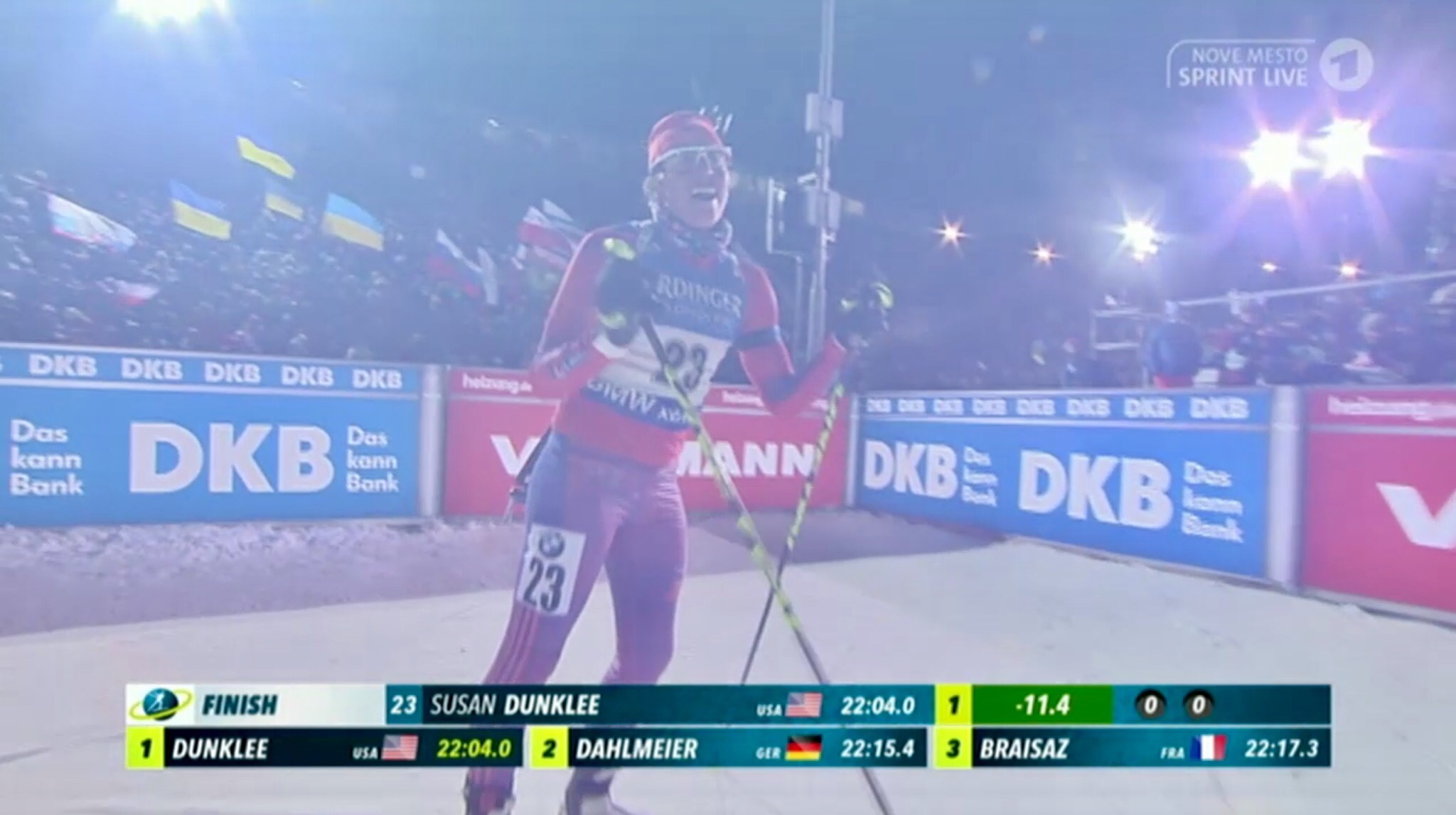
    Susan Dunklee (US Biathlon) after crossing the finish first through 23 finishers in the women's 7.5 k sprint at the IBU World Cup in Nove Mesto, Czech Republic. She went on to place third for her first podium of the season and the fourth of her career.
    Susan Dunklee (US Biathlon) after crossing the finish first through 23 finishers in the women’s 7.5 k sprint at the IBU World Cup in Nove Mesto, Czech Republic. She went on to place third for her first podium of the season and the third of her career.

    (Note: This is not a race report but rather a digest of the day’s events. Check back for complete race reports.)

    ***

    IBU World Cup in Nove Mesto: Women’s 7.5 k sprint

    Susan Dunklee came close last week, and now she’s there. The 30-year-old US Biathlon skier rocketed to third in the first women’s race of the International Biathlon Union (IBU) World Cup in Nove Mesto, Czech Republic, on Friday: the 7.5-kilometer sprint.

    She finished 5.1 seconds behind Russia’s Tatiana Akimova, who not only achieved her first win, but her first World Cup top 10 as well, with clean shooting (0+0) in 21:58.9 minutes. France’s Anaïs Chevalier placed second, 4.3 seconds back, with perfect shooting as well (0+0), and Dunklee was the third woman in the top three to hit all 10 targets.

    Dunklee started 23rd and displaced Germany’s Laura Dahlmeier, who started 30 seconds ahead of her in bib 22, from first place by 11.4 seconds. Dunklee then had to wait for nearly 75 other finishers to secure her podium, bumped out of first by Akimova in bib 37 and finally to third place by Chevalier in bib 68. Dahlmeier ultimately placed fourth (+16.5) after two standing penalties (0+2).

    Overall, Dunklee posted the fifth-fastest range time, ninth-fastest shooting, and 15th-fastest course time en route to the third podium of her career.

    “I am very happy,” Dunklee said in a post-race press conference. “Last week I crossed the line in first and slipped back all the way to 11th with clean shooting, and this is quite an improvement over that. You never know with biathlon whether you are gonna hold a position when you cross the finish line. It’s just too unpredictable.”

    Asked how she was feeling about Saturday’s pursuit, she said she was in a great position.

    “The important thing is not to think too much about it and keep executing a good performance plan, like every other race,” she said.

    Canada’s top finisher was Julia Ransom, who cracked the top 30 for the first time this year in 26th (+1:06.5) with a single standing penalty (0+1). Rosanna Crawford placed 37th (+1:30) with two misses (1+1), Megan Tandy was 44th (+1:34.8) with one prone penalty (1+0), and American Joanne Reid placed 52nd (+1:46.5) with one standing miss (0+1) to also qualify for Saturday’s pursuit.

    The third U.S. woman racing on Friday, Clare Egan placed 62nd (+1:59.4) with three misses (2+1), missing the pursuit by 1.6 seconds.

    The fourth Canadian woman, Emma Lunder finished 82nd (+3:02.2) with two penalties (2+0).

    Results

    ***

    NorAm mini tour in Rossland: 10/15 k freestyle

    [UPDATE] The NorAm series kicked off its second stop on Friday with a three-race mini tour in Rossland, B.C.

    The men’s 15 k freestyle had a more traditional result, with Canadians retaking the podium.  Evan Palmer-Charrette of the Thunder Bay National Team Development Centre (NTDC) won in 40:36.7 minutes, 31.1 seconds ahead of Team R.A.D.’s Russell Kennedy. Erik Carleton of Rocky Mountain Racers and the Canadian Para-Nordic Ski Team edged out U.S. Ski Team and SMS Elite skier Andy Newell for third (+56.6).

    Chelsea Holmes of Alaska Pacific University (APU) continued her dominating ways in the women’s 10 k freestyle, finishing in 29.37.8.  Fellow American Erika Flowers (SMS Elite) was second, 1:49.2 behind with Olivia Bouffard-Nesbitt of the Alberta World Cup Academy and Canadian U25 Team in third (+2:27.2).

    FasterSkier is seeking photos from this weekend’s NorAm. Submit yours with caption and credit info to info@fasterskier.com.

  • Bonus Rundown: McKeever, Bratrud, Holmes, Gesior Notch Alberta Cup Wins

    Bonus Rundown: McKeever, Bratrud, Holmes, Gesior Notch Alberta Cup Wins

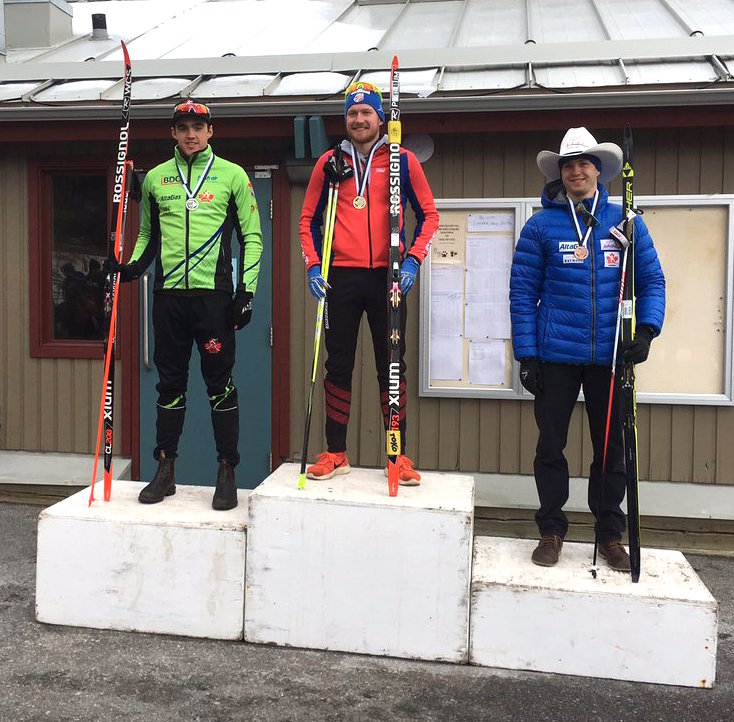
    The Alberta Cup men's podium in Sunday's 8.1 k classic interval start, with winner Kyle Bratrud (c) of CXC Team, NDC Thunder Bay's Evan Palmer-Charrette (l) in second and AWCA's Dominique Moncion-Groulx (r) in third. (Photo: NTDC Thunder Bay/Twitter)
    The Alberta Cup men’s podium in Sunday’s 8.1 k classic interval start, with winner Kyle Bratrud (c) of CXC Team, NTDC Thunder Bay’s Evan Palmer-Charrette (l) in second and AWCA’s Dominique Moncion-Groulx (r) in third. (Photo: NTDC Thunder Bay/Twitter)

    Here’s one that didn’t make Sunday’s Rundown: the Alberta Cup’s opening distance races, which took place Nov. 26-27 in Canmore, Alberta.

    ***

    The Alberta Cup kicked off this past weekend with several big names competing in the distance races at the Canmore Nordic Centre on Saturday and Sunday.

    Brian McKeever, Kyle Bratrud, Chelsea Holmes, and Felicia Gesior picked up victories, with the latter three all hailing from the U.S.

    In the men’s 13.5 k freestyle interval start, McKeever, of Canada’s Para-Nordic Ski Team, took first in the men’s open race, beating his teammate Graham Nishikawa by 3.6 seconds with a winning time of 30:01.8. A visually impaired skier, McKeever races with Nishikawa as his guide in Paralympic races. But not on Saturday.

    Bratrud, of the CXC Team, placed third in the 13.5 k skate, two seconds back from Nishikawa and 5.6 out of first.

    David Palmer (Black Jack) was the second Canadian in fourth overall (+20.0), Matthew Hudec, of the Biathlon Alberta Training Centre (BATC), was fifth (+36.3), and Brian Gregg (Team Gregg) took sixth (+50.1). Rounding out the top 10 (of 54 in the open men’s field), Russell Kennedy (Team R.A.D.) placed seventh, Erik Carleton (Canadian Para-Nordic Ski Team) was eighth, Evan Palmer-Charrette (NTDC Thunder Bay) ninth, and Dominique Moncion-Groulx, of the Alberta World Cup Academy (AWCA), 10th.

    Holmes, of Alaska Pacific University (APU), won the women’s 8.1 k freestyle on Saturday, finishing nearly 45 seconds ahead of Caitlin Gregg (Team Gregg) in 21:10.7. Biathlon Canada’s Emma Lunder placed third (+52.1) and junior biathlete Megan Bankes (BATC) finished fourth (+1:08.4), ahead of another BATC junior Nadia Moser in fifth (+1:13). Andrea Dupont, of Rocky Mountain Racers (RMR) finished sixth (+1:19.6) and Katherine Stewart-Jones (NTDC Thunder Bay/National U25 Team) was seventh (+1:30.8), while Kathryn Stone (University of Alberta) placed eighth, Annika Richardson (NTDC Thunder Bay) was ninth, and India McIsaac (RMR) 10th out of 33 women in the open category.

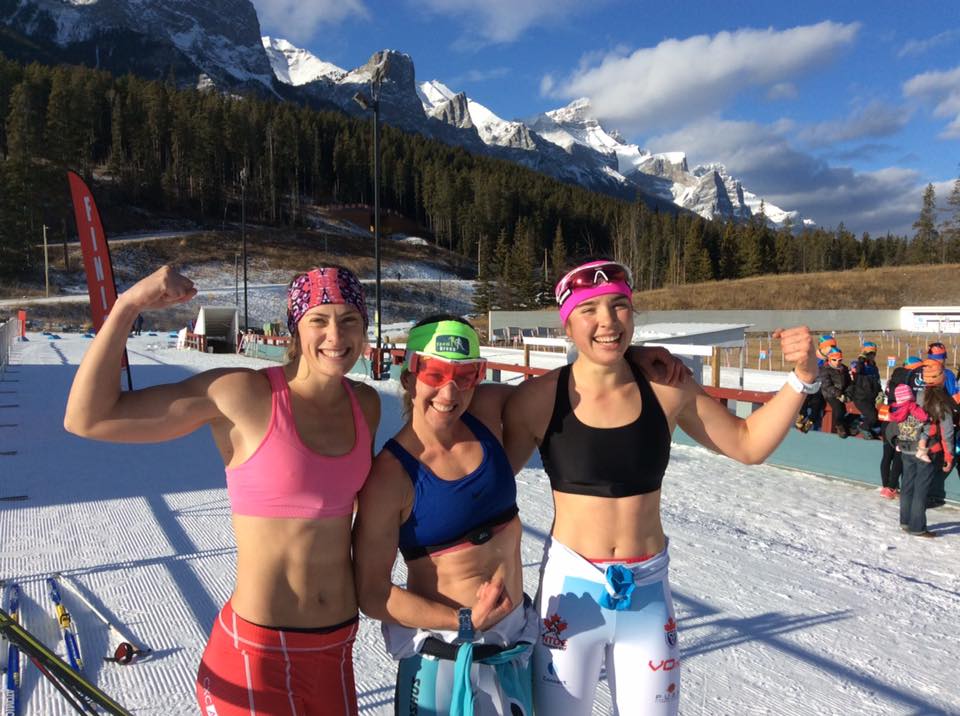
    On Sunday, CXC posted this photo and caption about the Alberta Cup classic distance race: "Double CXC Team Win! Felicia Gesior double poles to a victory in the women's classic race. Photo with the other two girls to double pole the race. These girls are STRONG!" (Photo: CXC Skiing Facebook)
    On Sunday, CXC posted this photo and caption about its women’s winner Felicia Gesior (l), runner-up Caitlin Gregg (Team Gregg) (c), and Annika Richardson (r) (NTDC Thunder Bay) who placed second in the junior race in the Alberta Cup classic distance race: “Double CXC Team Win! Felicia Gesior double poles to a victory in the women’s classic race. Photo with the other two girls to double pole the race. These girls are STRONG!” (Photo: CXC Skiing Facebook)

    On Sunday, Bratrud came out with a 9.9-second win in the men’s 8.1 k classic interval start over Palmer-Charrette. Bratrud won in 19:00.1, Palmer-Charrette was second, and Moncio-Groulx placed third (+29.2).

    On his first of of four laps, Moncion-Groulx recorded the fastest lap time of the day.

    “I didn’t know if I was in the game, but I was happily surprised when I was third,” Moncion-Groulx said of his finish, according to an AWCA press release. “It’s an improvement, and there are definitely some good guys racing. It’s a good confidence boost.”

    Michael Somppi (NTDC Thunder Bay) was fourth (+32.5), Julian Smith (NTDC Thunder Bay) fifth (+45.7), and for the second-straight race, Brian Gregg finished sixth (+53.0). Nishikawa was another two seconds back seventh, Palmer was eighth, Kennedy cracked the top 10 for the second straight day in ninth, as did Carleton in 10th.

    McKeever finished 11th, half a second behind Carleton, his other Paralympic guide, out of 26 in the men’s open race. After Sunday’s race, McKeever tweeted, “Vented personal frustration today. Mental error=inability to count laps in today’s race. Realize I’ve put a lot of stress on myself lately.”

    In another tweet on Sunday, he wrote, “Congrats to Kyle Bratrud from and the boys for laying down the hammer on the field today! Cool to see!”

    Also on Sunday, Gesior won the women’s 6.3 k classic and Caitlin Gregg repeated in second. Gesior put down the fastest time in 17:46.8, and Gregg finished 9.3 seconds back, while Olivia Bouffard-Nesbitt (AWCA/National U25 Team) placed third (+13.1).

    According to the AWCA press release, Bouffard-Nesbitt is still recovering from a stress fracture and spent three months this summer on crutches. “I know I need to step up to the challenge. I feel the pressure and it’s helping me become a better athlete,” she said.

    Stewart-Jones double poled to fourth (+23.3), Holmes placed fifth (+36.0), and Dupont was sixth (+54.1). Alannah Maclean (NTDC Thunder Bay) placed seventh, Emma Camicioli (RMR) was eighth, Delphine Duvernay Tardif (AWCA) ninth, and Ember Large (University of Alberta) 10th out of 18 women in the open field.

    Results: Saturday’s freestyle | Sunday’s classic

  • Cross Country Canada Names 2016/2017 National Team

    Cross Country Canada Names 2016/2017 National Team

    Cross Country Canada logo

    (Press release)

    Olympic and Paralympic veterans lead next generation of elite skiers into new season

    CANMORE, Alta. — Focused on winning medals at all levels, Cross Country Ski de Fond Canada named its 2016-17 National Ski Team loaded with promise for 2018 & 2022 Olympics and Paralympics Games on Tuesday.

    Feeding off a successful ending to the inaugural Ski Tour Canada where the squad celebrated countless personal and season-best performances, seven Olympians, including six men and one woman, will lead the charge for the Canucks.

    Led by Alex Harvey (St-Férréol-les-Neiges, Que.), who captured two medals last season, a high-powered group of athletes including Len Valjas (Toronto), Ivan Babikov (Canmore, Alta.), and Devon Kershaw (Canmore, Alta.) will form the World Cup A Team. Two other athletes who posted breakthrough performances during the Ski Tour Canada, Jesse Cockney (Canmore, Alta.), and Graeme Killick (Fort McMurray, Alta.), will make up the World Cup B Team with Emily Nishikawa (Whitehorse) leading the Canadian women on the elite squad.

    World Cup A Team

    • Alex Harvey
    • Len Valjas
    • Ivan Babikov
    • Devon Kershaw

    World Cup B Team

    • Jesse Cockney
    • Graeme Killick
    • Emily Nishikawa

    With a focus on developing the next generation of elite skiers, Cross Country Ski de Fond Canada also selected seven athletes for its Under-25 Team who will split time racing World Cups, international development level races, and Haywood NorAms in Canada. Three athletes who cracked the top-30 on the World Cup last year while racing the Ski Tour Canada will headline this group of seven including Whitehorse skiers Dahria Beatty and Knute Johnsgaard, along with Maya MacIsaac-Jones (Athabasca, Alta.). They will be joined by Olivia Bouffard-Nesbitt (Morin Heights, Que.), Cendrine Browne (St-Jérôme, Que.), Katherine Stewart-Jones (Chelsea, Que.), and Julien Locke (Nelson).

    U25 Team

    • Dahria Beatty
    • Knute Johnsgaard
    • Maya MacIsaac-Jones
    • Olivia Bouffard-Nesbitt
    • Cendrine Browne
    • Katherine Stewart-Jones
    • Julien Locke

    The governing body for cross-country skiing in Canada also announced seven athletes who combined to win nine medals last year, will return to the Para-Nordic Ski Team. Athletes include: Brian McKeever (Canmore, Alta.) and his guides Graham Nishikawa (Whitehorse) and Erik Carleton (Canmore, Alta.); Mark Arendz (Hartsville, P.E.I.), Brittany Hudak (Prince Albert) and Paralympic champion, Chris Klebl (Canmore, Alta.). Emily Weekes (North Vancouver), who bolted onto the international para-nordic scene one year ago with multiple podium performances will continue her progression on the Development Team.

    Para-Nordic Ski Team

    • Brian McKeever (guides: Graham Nishikawa, Erik Carleton)
    • Mark Arendz
    • Brittany Hudak

    Para-Nordic Development Team

    • Emily Weekes

    “We obviously have a great line-up of athletes that combines veteran experience with youthful energy and drive,” said Tom Holland, high-performance director, Cross Country Ski de Fond Canada. “I think our elite athletes proved last year they have what it takes to continue delivering medal-winning performances, while our next generation of athletes are steadily developing and demonstrating a promising future for our program.”

    Holland and his high-performance selection team also identified one dozen athletes who will compete on the Junior National Ski Team. Athletes include:

    Junior National Ski Team

    • Marie Corriveau (St-Férréol-Les-Neiges, Que.)
    • Katie Weaver (North Vancouver)
    • Laura Leclair (Chelsea, Que.)
    • Annika Richardson (Vancouver)
    • Zoe Williams (Cantley, Que.)
    • Hannah Mehain (Vernon)
    • Ryan Jackson (Midhurst)
    • Philippe Boucher (Lévis, Que.)
    • Antoine Blais (Lévis, Que.)
    • Etienne Hebert (Varennes, Que.)
    • Gareth Williams (Kelowna, B.C.)
    • Antoine Cyr (Gatineau, Que.)


  • Double Gold for Canada on Last Day of Paralympics: Klebel Gets First Medal, McKeever Notches 10th Win

    Double Gold for Canada on Last Day of Paralympics: Klebel Gets First Medal, McKeever Notches 10th Win

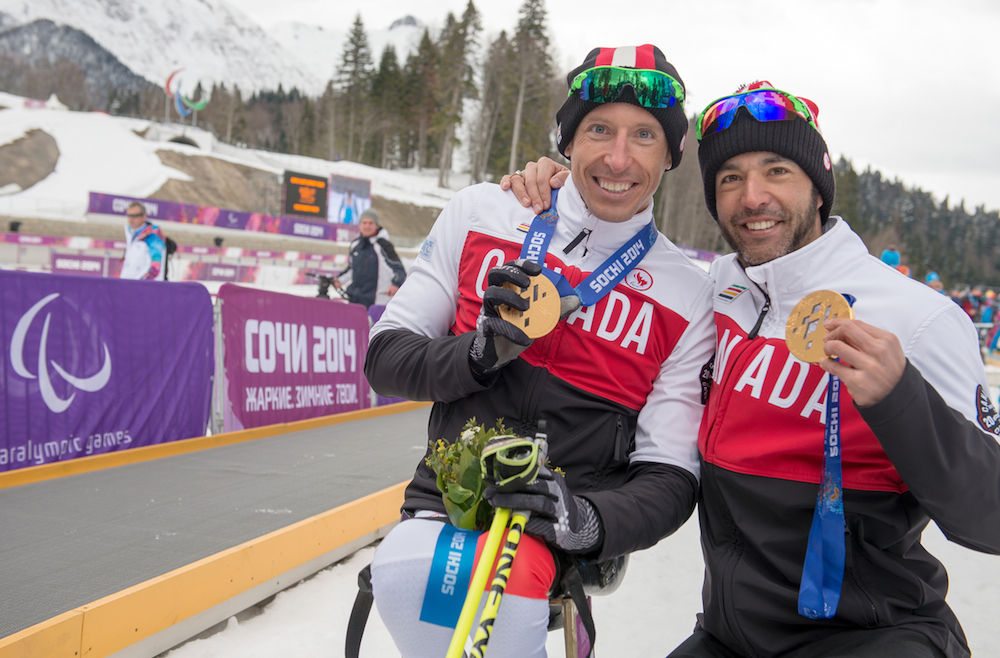
    Chris Klebl with his Men's 10km Sitting gold medal and Brian McKeever with his 15km free Visually Imaired gold medal at the 2014 Paralympic Winter Games in Sochi, Russia. (Photo: Matthew Murnaghan/Canadian Paralympic Committee)
    Chris Klebl (l) with his gold medal from the men’s 10 k sit ski and Brian McKeever (r) with his third gold of the week, which he won in Sunday’s 15 k visually impaired freestyle visually at the 2014 Paralympic Winter Games in Sochi, Russia. (Photo: Matthew Murnaghan/Canadian Paralympic Committee) 

    (CCC press release)

    SOCHI, Russia — Mission accomplished!

    Canada’s Para-Nordic Ski Team wrapped up the 2014 Paralympic Winter Games in thrilling fashion with a double-gold performance in cross-country skiing on Sunday.

    In two of the most challenging classifications, Chris Klebl, of Canmore, Alta., shocked the world to win the men’s 10-kilometre sit-ski race, while Brian McKeever won his third gold medal of the week in the visually impaired category.

    The 42-year-old Klebl put down the performance of the Games when it counted most to win Canada its final gold medal, and secure the country its goal of finishing in the top-three in the overall medal count. Klebl clocked a time of 30 minutes, 52.0 seconds (30:52.0).

    “It feels pretty good for sure,” said Klebl. “I have exceptional skis for wet, sloppy conditions and today we got exactly those conditions. It just feels good. We prepare for this over and over and over again to try and get things to line up, and today it did.”

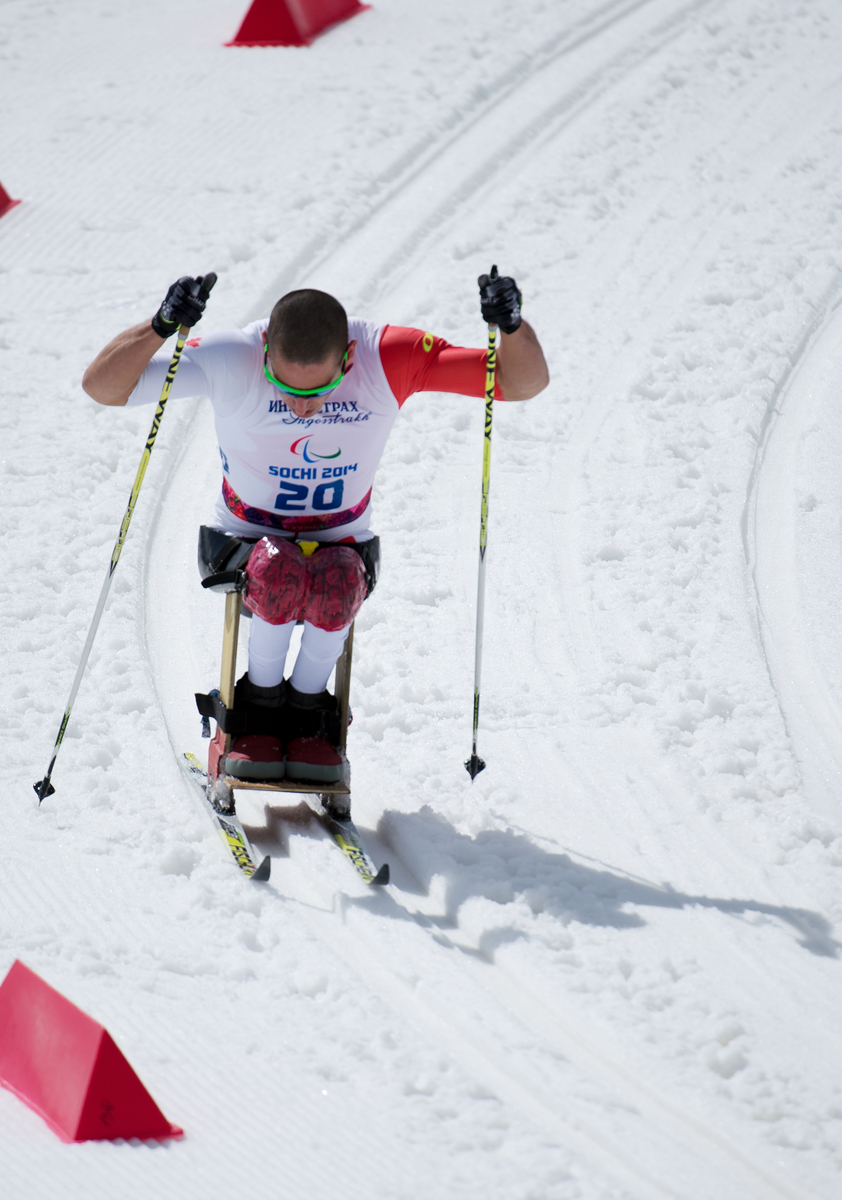
    Canada's Chris Klebl racing to gold in the last race of his third Paralympics on Sunday in the cross-country 10 k sit-ski  at the 2014 Paralympic Winter Games in Sochi, Russia.  (Photo: Matthew Murnaghan/Canadian Paralympic Committee)
    Canada’s Chris Klebl racing to gold in the last race of his third Paralympics on Sunday in the cross-country 10 k sit-ski at the 2014 Paralympic Winter Games in Sochi, Russia. (Photo: Matthew Murnaghan/Canadian Paralympic Committee)

    A three-time Paralympian, Klebl moved to Canmore, Alta. to join the Canucks from the United States following the 2010 Games. He first made history as a member of the Canadian Team in 2011 by winning the World Championships in the sit-ski distance race.

    Klebl, who grew up in Austria where he skied and snowboarded, became paralyzed from the waist down in 1995 in a snowboarding accident.

    Sunday’s victory was particularly important as Canada was in a fight for third spot in the overall Paralympic gold medal count with the Ukraines with the final sit-ski race remaining.

    Klebl held off the Ukraine’s Maksym Yarovyi, who finished second at 31:06.5. Russia’s Grigory Murygin skied to the bronze at 31:18.2.

    “It means a tonne to me to contribute to Canada’s medal count,” said Klebl. “Four years ago I made a major decision to move to Canada, and Cross Country Canada and the Own the Podium program have backed me since. I just wanted to pay them back.”

    While Klebl grabbed Canada’s final gold medal at the 2014 Games, it was Brian McKeever who secured the nation its first. On Sunday the legendary Paralympian was at it again.

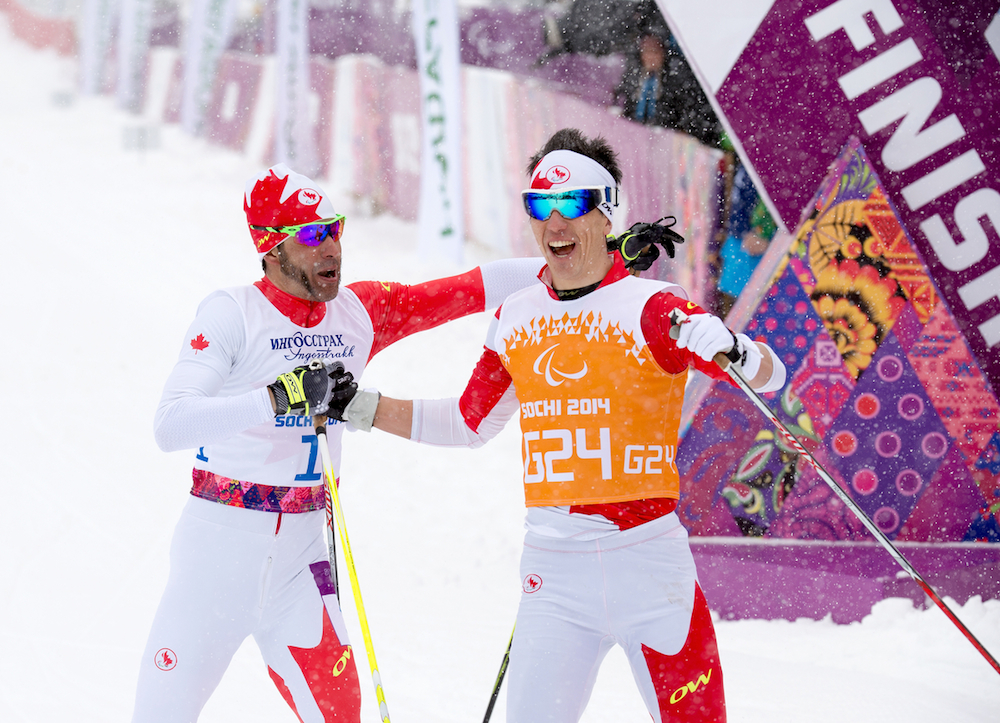
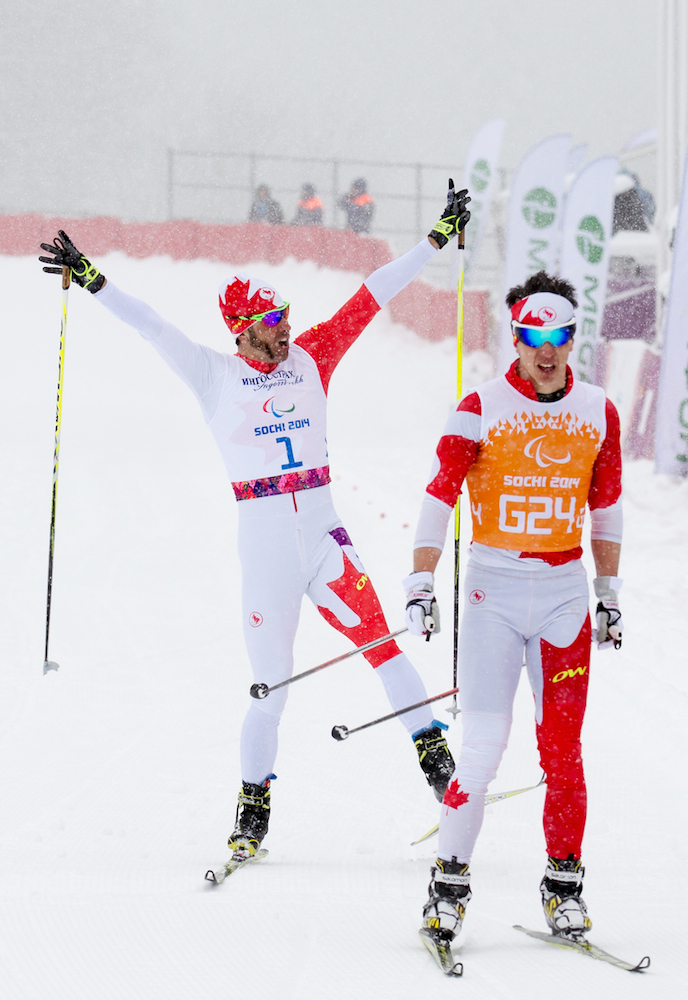
    Battling race fatigue and strong headwinds, the 34-year-old McKeever utilized a two-guide strategy with Erik Carleton and Graham Nishikawa, for the second time this week to gut out an impressive come-from-behind victory. Team McKeever posted a time of 23 minutes, 18.1 seconds in the men’s 10-kilometre skate-ski visually impaired category.

    “That one was tough. It hurt,” said McKeever. “I woke up this morning and didn’t feel great. It was all on the guides again today. They did such a good job with the headwind. I was able to tuck in behind them and save a lot of energy. By the time we got to the last lap there was still a little gas left to get us by today.”

    Outside of sprint racing, it was the smallest margin of victory at a Paralympic Winter Games for McKeever, winning by just eight seconds.

    Russia’s Stanislav Chokhlaev skied to the silver at 23:25.1, while Thomas Clarion, of France, rounded out the podium in third with a time of 24:14.9.

    The Canadians leveraged a two-guide race strategy to pull McKeever to the top of the podium.

    The 36-year-old Carleton, of Canmore, Alta., led the way around the first 6.5-kilometres before coach Robin McKeever called in Graham Nishikawa, of Whitehorse, to pull him into the winner’s circle. McKeever was behind 12 seconds at the five-kilometre mark in the race.

    “Having guided for 10 years I know how incredibly hard it is to do this job in the wind,” said Robin McKeever, head coach, Canadian Para-Nordic Ski Team, who led his brother to 10 Paralympic podiums. “It is like a tow truck pulling a Ferrari out there in the wind.

    “For the guide, it is like doing a one-kilometre sprint race just to stay ahead of Brian. But the problem is you have to keep that pace for nine more kilometres. It is so difficult.”

    “Having guided for 10 years I know how incredibly hard it is to do this job in the wind. It is like a tow truck pulling a Ferrari out there in the wind.” — Robin McKeever, Canadian Para-Nordic Ski Team Head Coach and former guide for his brother, Brian McKeever

    Consummate team players, Carleton and Nishikawa shared the workload and trips to the podium this week to help McKeever accomplish his goal of a golden hat-trick.

    “It is so tough out there and I’m thankful Graham was here to help us out and get the job done,” said Carleton. “I went hard off the start and just tried to hang on.”

    “Brian is just such an incredible athlete so it is very difficult to stay ahead of him,” added Nishikawa. “This whole week has been such an awesome experience. I’ve been so impressed with everything, and of course I’d love to be back again.”

    The victories bring McKeever’s Paralympic gold medal count to 10, making him the only winter Paralympian to reach double digits. He has a total of 13 Paralympic medals.

    “The medals this week were very special,” said McKeever. “The way we did it was such a team effort. Both guides gave me a solid draft all week, which made a huge difference in the conditions. We orchestrated a great team effort and that makes it so special to me.”

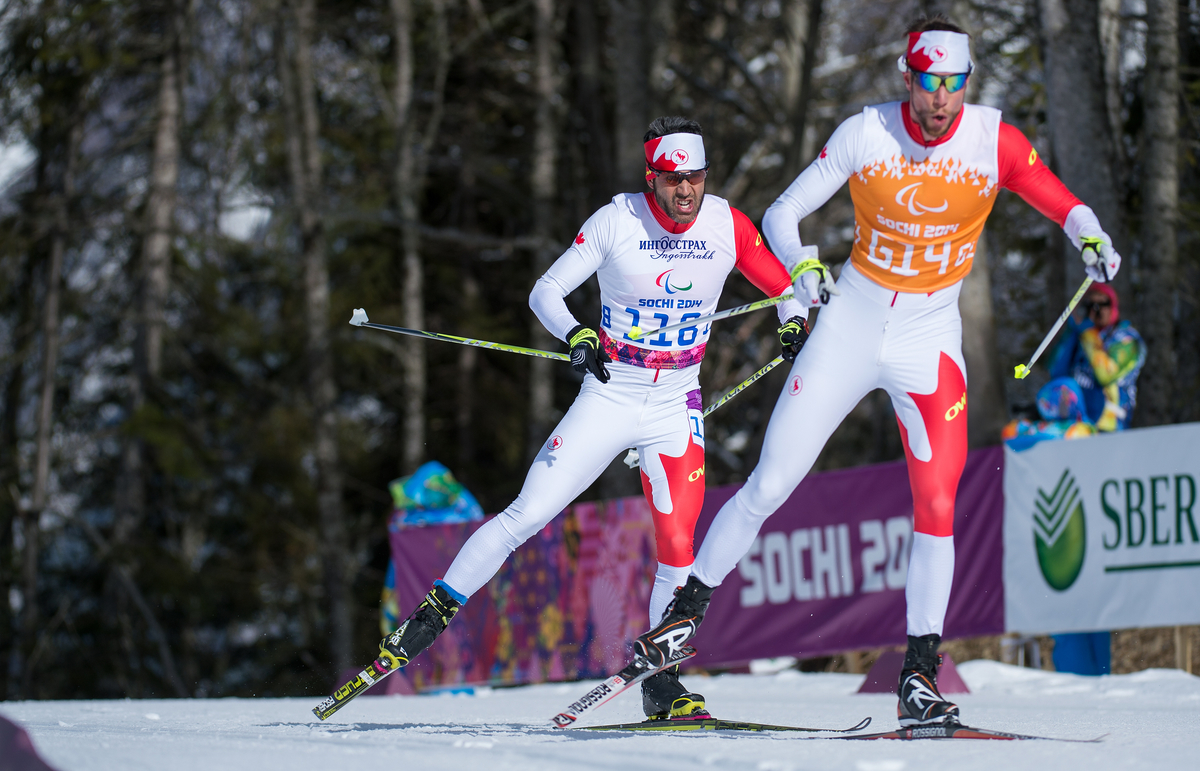
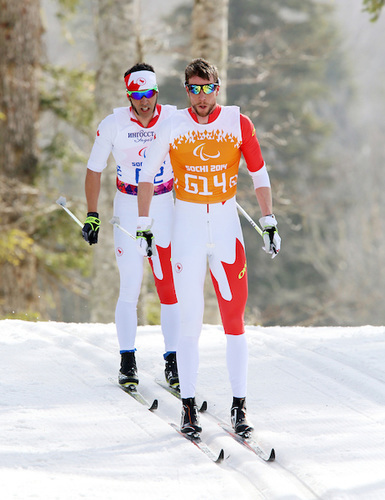
    Brian McKeever and his guide Erik Carleton race to McKeever's third gold of the week, and Carleton's second, in Sunday's cross-country 10 k visually impaired freestyle race on the last day of the 2014 Paralympic Winter Games in Sochi, Russia. (Photo: Matthew Murnaghan/Canadian Paralympic Committee)
    Brian McKeever and his guide Erik Carleton race to McKeever’s third gold of the week, and Carleton’s second, in Sunday’s cross-country 10 k visually impaired freestyle race on the last day of the 2014 Paralympic Winter Games in Sochi, Russia. (Photo: Matthew Murnaghan/Canadian Paralympic Committee)

    Other Canadian results on Sunday included: Mark Arendz (Hartsville, P.E.I.) in 11th at 25:16.4; and Louis Fortin (Fredericton, N.B) 36th at 32:58.8 in the men’s 10-kilometre standing race. Brittany Hudak, of Prince Albert, Sask., was 12th at 15:35.0, and Ottawa’s Caroline Bisson 16th at 16:55.2 in the women’s five-kilometre standing category.

    Robbi Weldon (Thuder Bay, Ont,) and her guide Phil Wood (Canmore, Alta.) were seventh at 15:32.5, while Ottawa’s Margarita Gourbonova and her guide of Regina’s Andrea Bundon were eighth at 15:42.2 in the women’s five-kilometre visually impaired race. Saskatoon’s Colette Bourgonje was 13th in women’s five-kilometre sit-skiing at 18:13.0. Yves Bourque, of Becancour, Que., was 24th at 39:11.5, and Quebec City’s Sebastien Fortier was 26th (40:03.4) in the men’s 10-kilometre sit-ski race.

    In addition to McKeever and Klebl’s four golds, Canada’s Para-Nordic squad will leave Sochi with six medals. Mark Arendz also won a silver and one bronze in biathlon racing.

    Results

  • Wasn’t Pretty, But McKeever/Nishikawa Nab Second Gold in Paralympic Sprint

    Wasn’t Pretty, But McKeever/Nishikawa Nab Second Gold in Paralympic Sprint

    Canada's Brian McKeever (l) and his guide Graham Nishikawa win the gold medal in the Men's 1 k visually impaired sprint final at the 2014 Paralympic Winter Games in Sochi, Russia. (Photo: Matthew Murnaghan/Canadian Paralympic Committee)
    Canada’s Brian McKeever (l) and his guide Graham Nishikawa win the gold medal in the Men’s 1 k visually impaired sprint final at the 2014 Paralympic Winter Games in Sochi, Russia. (Photo: Matthew Murnaghan/Canadian Paralympic Committee)

    (CCC press release)

    McKeever rebounds from crash in final to take down world’s best for ninth-career gold medal

    SOCHI, Russia —Brian McKeever is certainly capturing the world’s attention in Sochi, Russia. And it is not just because he skied to his ninth Paralympic gold medal on Wednesday in Sochi, Russia.

    McKeever and guide, Graham Nishikawa, ploughed through the field and more than 30 centimetres of fresh snow to win their second gold medal of the week in spectacular fashion in the visually impaired sprint races at the Paralympic Winter Games.

    Leading all qualifiers in the head-to-head heats with the top-12 athletes, the two Canadians handily advanced to the final where the 12-time Paralympic medallist faced the biggest adversity of his career.

    Stacked against two Russians, and a Swede in the final, the 30-year-old Nishikawa (Whitehorse) appeared to have led McKeever (Canmore, Alta.) through the cluttered pack of guides and athletes into clear trail until the unthinkable happened near the 200-metre mark.

    A Russian skier stepped on McKeever’s pole – sending the 34-year-old airborne and onto his backside – before bouncing back up and hunting the leaders, and his ninth career Paralympic gold medal down.

    “Wow, that was stressful,” sighed McKeever at the finish. “It wouldn’t be right for me to tell you what I said in my head, but once the cuss words were out, the only thing you can do is get back up and race.

    “I thought we were clear, but that is normal and it happens in sprinting when you are all fighting and tight. Everyone is going flat out. It is intense and everyone is at their limit. We are just fortunate it happened in the first 200 metres and not at the end so we had time to catch up.”

    “It wouldn’t be right for me to tell you what I said in my head, but once the cuss words were out, the only thing you can do is get back up and race.” — Brian McKeever, nine-time Paralympic gold medallist

    After taking a deep breath, Nishikawa took control, putting the throttle down and commandeering the Canucks back into contention in the action-packed one-kilometre sprint race.

    Canada's Brian McKeever (l) celebrates his ninth-career Paralympic gold, which he won Wednesday in the 1 k visually impaired sprint with guide Graham Nishikawa in Sochi, Russia. While Nishikawa helped him win his first gold of the week in the 20 k classic with guide Erik Carleton, this was Nishikawa's first Paralympic gold. (Photo: Matthew Murnaghan/Canadian Paralympic Committee)
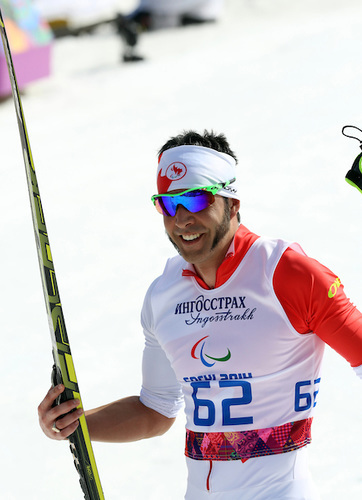
    Canada’s Brian McKeever (l) celebrates his ninth-career Paralympic gold, which he won Wednesday in the 1 k visually impaired sprint with guide Graham Nishikawa in Sochi, Russia. While Nishikawa helped him win his first gold of the week in the 20 k classic with guide Erik Carleton, this was Nishikawa’s first Paralympic medal. (Photo: Matthew Murnaghan/Canadian Paralympic Committee)

    “When I saw him go down, I immediately panicked and just thought ‘OH NO! Not now,’ ” said Nishikawa. “It wasn’t until we got back up around the Russians and had the Swedes in sight that I felt a huge relief.”

    “What a set of wheels on Graham today. That was impressive,” said McKeever. “The snow was so heavy today. He basically towed me up that hill and got me around the Russian roadblock out there and gave us a chance. It is not how we planned things, but that was a pretty awesome day.”

    Sweden’s Zebastian Modin hung on for the silver medal, while Russia’s Oleg Ponomarev outraced his countryman for the bronze.

    Adding to the dramatics, it was the first time Nishikawa had guided his friend, and training partner, on his own in international competition. After racing together over the last decade in Canada, McKeever recruited Nishikawa into his training group this fall with the goal of bringing two guides to the Paralympics for the first time ever.

    Earlier this week, Nishikawa, who races able-bodied both domestically in Canada and on the World Cup circuit, shared guiding duties with Erik Carleton to lead McKeever to his first gold of the 2014 Games. Recognizing the stress the warm weather, and heavy snow conditions was putting on the guides for the long-distance races, the innovative Canadians leveraged both guides – switching at the midway point. With McKeever dropping into third place, Nishikawa stepped in to blaze a trail to the gold medal step of the podium.

    Carleton’s name was on the start list so he was the only one to receive a gold medal. But on Thursday, Nishikawa will get his due and receive a gold medal of his own.

    “It feels absolutely awesome,” beamed Nishikawa. “I said earlier this is a whole new world for me. I’m so impressed by everything. This whole experience has been amazing and I just wanted to do whatever I could to be here and help Brian. We have been friends for a long time so this is very special.”

    From sunny T-shirt weather, to pouring rain, to dumping heavy snow on Wednesday, Mother Nature is sending the world’s top Para-Nordic wax technicians into a daily frenzy at Laura Stadium.

    “This whole experience has been amazing and I just wanted to do whatever I could to be here and help Brian. We have been friends for a long time so this is very special.” — Graham Nishikawa

    “These conditions are definitely stressful on the wax techs,” said McKeever. “Every day they basically start from ground zero based on the conditions. We had amazing boards today and the guys deserve a lot of credit. We were so fast on the downhills which really got us back into the race today.”

    The victory brings McKeever’s career medal haul to 12 at the Paralympics, including his nine gold. If he can chalk up one more victory this week he will become the first Canadian Winter Paralympian with at least 10 gold medals, and third Paralympian in Canada overall to accomplish the feat.

    A handful of other Canadians also competed in the sprint races. Chris Klebl, of Canmore, Alta., qualified for the men’s sit-skiing heats, but did not advance to the final. Robbi Weldon, of Thunder Bay, Ont., along with her guide Phil Wood, of Canmore, Alta., also had their day come to an end in the semifinals of the women’s visually impaired category, while Paralympic rookie, Brittany Hudak of Prince Albert, Sask., could not advance past the women’s standing semifinals.

    Other Canadians that did not qualify for the heats included:  Ottawa’s Margarita Gorbournova and her Regina-based guide, Andrea Bundon, in the women’s visually impaired race.

    Louis Fortin (Fredericton, N.B) did not qualify in the men’s standing class, Saskatoon’s Colette Bourgonje also competed in women’s sit-skiing, while Quebec City’s Sebastien Fortier, and Yves Bourque (Becancour, Que.) also did not qualify for the men’s sit-skiing heats.

    Following a day off on Thursday, the final biathlon competition of the 2014 Paralympic Winter Games will take place at the Laura Nordic Stadium on Friday.

    Results

  • McKeever Wins Canada’s First Paralympic Gold, Eighth Total, with Both Carleton & Nishikawa

    McKeever Wins Canada’s First Paralympic Gold, Eighth Total, with Both Carleton & Nishikawa

    Brian McKeever locking up his eighth-career Paralympic gold and first of the Sochi Winter Games on Monday in the 20 k visually impaired classic race. (Photo Scott Grant/Canadian Paralympic Committee)
    Brian McKeever locking up his eighth-career Paralympic gold and first of the Sochi Winter Games on Monday in the 20 k visually impaired classic race. (Photo Scott Grant/Canadian Paralympic Committee)

    (CCC press release)

    Innovative Canucks use two guides, Carleton and Nishikawa, to lead McKeever to eighth Paralympic title

    SOCHI, Russia — Brian McKeever cracked Canada’s golden goose egg in the medal count at the Paralympic Winter Games in Sochi, Russia on Monday, and he did it with a unique twist.

    One of the most accomplished athletes in the history of Paralympic sport, the 34-year-old McKeever utilized both of his training partners and guides, Erik Carleton and Graham Nishikawa, in the 20-kilometre classic-ski race to slog through the summer-like warm and slow snow conditions and put one in the win column for Canada. The Canadian trio teamed up to clock a winning time of 52 minutes, 37.1 seconds.

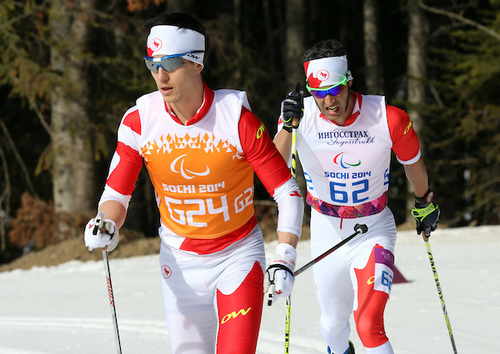
    Canadian Brian Mckeever and guide Erik Carleton compete in the cross-country men's 20 k visually impaired classic race at the Sochi 2014 Paralympics in Sochi, Russia. Mckeever went on to win gold. (Photo Scott Grant/Canadian Paralympic Committee)
    Canadian Brian Mckeever and guide Erik Carleton compete in the cross-country men’s 20 k visually impaired classic race at the Sochi 2014 Paralympics in Sochi, Russia. Mckeever went on to win gold. (Photo Scott Grant/Canadian Paralympic Committee)

    “Today was a huge team effort having two guides out there sharing the work,” said McKeever, 34. “It was definitely needed because I couldn’t have done that on my own. They set the perfect pace with the snow being what it was. It is much faster skiing from behind in conditions like this, and unfortunately for the guides, they are forced to work pretty damn hard. It was all them today!”

    Russia’s Stanislav Chokhlaev skied to the silver medal at 53:43.3, while Sweden’s Zebastian Modin grabbed the bronze with a time of 56:34.9.

    Watching many of the world’s best Nordic nations struggle with the difficult warm weather and snow conditions at the Olympics and Paralympics in Sochi, the decision to leverage both of the guides that McKeever brought to these Paralympics – the first time he has done so in his legendary career – was made last night during a team meeting.

    “It was a convoluted plan and a risky plan that was needed to be done only because of the strength of the athlete,” said 40-year-old Robin McKeever, head coach of the Canada’s Para-Nordic Team who guided his brother to his previous 10 Paralympic medals. “Guiding in these conditions is brutal, and when you are leading a world class athlete like Brian it is very difficult to keep the pace he needs.

    “Brian controls the throttle. The risk bringing an athlete in mid-race is he can potentially go out to hard and blow himself up, or he goes to hard and wrecks Brian. Communication is absolutely critical all day between each of the athletes and coaches.

    “As the talent of the athletes continue to evolve at the Paralympics I think we are going to see more of this type of strategy because it is so hard to stay out in front of them, and for the guides to continue keeping the pace they need to win.”

    The strategy definitely seemed to pay off. With the original race plan to switch guides at the 12-kilometre mark, the Canadians were dropping further back into second place at the mid-way point of the race as the 36-year-old Erik Carleton was running out of gas.

    Graham Nishikawa pacing Brian McKeever to his eighth Paralympic gold on Monday in the 20 k visually impaired classic race in Sochi, Russia. McKeever used both Nishikawa and Erik Carleton as guides, switching halfway through the distance race. (Photo Scott Grant/Canadian Paralympic Committee)
    Graham Nishikawa pacing Brian McKeever to his eighth Paralympic gold on Monday in the 20 k visually impaired classic race in Sochi, Russia. McKeever used both Nishikawa and Erik Carleton as guides, switching halfway through the distance race. (Photo Scott Grant/Canadian Paralympic Committee)

    “I started steady and tried to build from there, but was getting tired setting the pace we were at so it was good we made the switch because I did all I could do today,” said Carleton. “It is tough to guide a guy as fast as Brian, but I’m happy we got it done today.”

    Childhood buddies, Carleton and McKeever teamed up following the 2010 Paralympics when Brian’s brother Robin packed in his racing career to focus on coaching Canada’s Para-Nordic squad. Recognizing the advantage of having additional arsenal in the wax room, the two Canmore, Alta. natives invited National Ski Team member, Graham Nishikawa, into their training group this fall with the goal of bringing both guides to the Paralympics.

    While Nishikawa continued to race able-bodied both domestically in Canada and on the World Cup circuit this year, he remained committed to McKeever at the Paralympics.

    “This is not only my first Paralympics, but my first time guiding Brian today so it is a whole new world for me,” said Nishikawa, who was on Canada’s World Championship team last year and raced last the World Cup in Lahti, Finland, last week. “I’m very excited to be here for Brian. It is a tough job to lead him out there. He is a world-class athlete, and we have to set a very fast pace to be out in front of him to deliver the performance.”

    Similar to a relief pitcher getting the call from the bullpen, the elder McKeever gave the Whitehorse native the nod to charge to the stadium at the midway point of the race and power Canada to gold.

    Canadian Brian Mckeever after winning the cross-country mens 20 k visually impaired classic race at the Sochi 2014 Paralympic Winter Games in Sochi, Russia. It was McKeever's first gold of the Games and eighth in his career. (Photo Scott Grant/Canadian Paralympic Committee)
    Canadian Brian Mckeever after winning the cross-country mens 20 k visually impaired classic race at the Sochi 2014 Paralympic Winter Games in Sochi, Russia. It was McKeever’s first gold of the Games and eighth in his career. (Photo Scott Grant/Canadian Paralympic Committee)

    “It really allowed me to keep the strength in the second half when the track started breaking down, getting wetter and slower. It allowed me to keep a good tempo. Like I said, this win is all on the guides today.”

    Two medals – three athletes – begs the question of which guide gets the hardware. It was Carleton’s name on the start list so he and McKeever will receive Canada’s first gold medals at a ceremony on Tuesday evening.

    “Having a medal doesn’t matter at all to me,” said Nishikawa. “I was just here for Brian and I’m so happy we got the job done. Nothing can beat that. It is all I could ask for.”

    The victory brings McKeever’s medal haul to 11 at the Paralympics, including eight gold.

    If he can chalk up two more victories in his other races this week, McKeever will become the first Canadian Winter Paralympian with at least 10 gold medals.

    “This one might be one of the most special,” said McKeever. “Just having both of these guys who have been very good friends of mine for a long time, sharing the work, it is pretty special.”

    Meanwhile, Brittany Hudak also made her Paralympic debut on Monday. Hudak, of Prince Albert, Sask., clocked-in at 59:10.6 to place 10th in the women’s 15-kilometre classic-ski standing race. Ottawa’s Margarita Gourbounova, and Regina-based guide, Andrea Bundon, were fourth in the women’s 15-kilometre visually impaired category.

    The biathlon middle distance races take centre stage at the Laura Nordic Stadium on Tuesday.

    Results

    Ottawa’s Margarita Gourbounova, and Regina-based guide, Andrea Bundon, were fourth in the women’s 15-kilometre visually impaired category.
    In her first Paralympics, Canada’s Margarita Gourbounova (r) and guide Andrea Bundon placed fourth in the women’s 15-kilometre visually impaired classic race on Monday at the Sochi Paralympics. Ottawa’s Margarita Gourbounova, and Regina-based guide, Andrea Bundon, were fourth in the women’s 15-kilometre visually impaired category at the 2014 Sochi Paralympics. (Photo Scott Grant/Canadian Paralympic Committee)
  • Canadian Paralympic Preview: McKeever, Bourgonje, Arendz Lead the Way to Sochi

    Canadian Paralympic Preview: McKeever, Bourgonje, Arendz Lead the Way to Sochi

    Brian McKeever (r) with guide Erik Carleton celebrating gold at the 2011 World Championships. (Photo: IPC)
    Brian McKeever (r) with guide Erik Carleton celebrating gold at the 2011 World Championships. (Photo: IPC)

    In Vancouver 2010, the Canadian Paralympic team placed third in the overall medal count with 19, behind Russia, which racked up 38, and Germany, with 24.

    Canada has set a goal of being in the top three again this year overall at the Winter Paralympic Games held March 7 to 16 in Sochi, Russia, according to an Own the Podium press release.

    Canada’s recently announced 14-athlete Paralympic nordic team has the horsepower and experience to do their part in bringing home medals.

    Sochi, RUSSIA - Mar 4 2014 -  Colette Bourgonje from Canada's Nordic team arrives prior to the 2014 Paralympics in Sochi, Russia.  (Photo: Matthew Murnaghan/Canadian Paralympic Committee)
    Colette Bourgonje from Canada’s Nordic team arrives prior to the 2014 Paralympics in Sochi, Russia. (Photo: Matthew Murnaghan/Canadian Paralympic Committee)

    The team will be led by 10-time Paralympic medallist Brian McKeever along with his guides Erik Carleton and Graham Nishikawa, and eight-time Paralympic medallist Colette Bourgonje. Her silver at the 2010 Games was Canada’s first medal at home.

    McKeever, who races in the visually impaired category, will be appearing in his fourth Paralympic Games including Salt Lake City 2002, Turin 2006 and Vancouver four years ago.

    The triple-gold medallist from 2010 tweeted on Tuesday: “Woke up with a virus yesterday. Timing couldn’t be much worse. Not the ideal prep for the #Paralympics. It’s been a bumpy #RoadToSochi.”

    In 2010, McKeever, 34, was named to both Canada’s Paralympic and Olympic teams. In the Olympics, he qualified to compete in the men’s 50-kilometre cross-country race; however, Canada’s coach decided to replace him with a skier who did well in earlier race at the Games.

    Bourgonje, 52, is one of Canada’s most recognized Paralympians, having participated in all six Paralympic Winter Games in addition to wheelchair racing at three Summer Paralympics. She is the reigning world champion in the sit-skiing distance race and she captured a silver and bronze medal at the 2010 Paralympics.

    In an interview with Canada.com, Bourgonje said, “My goals for Sochi are to be in the top five.”

    Biathlete Mark Arendz, 24, is a multiple International Paralympic Committee (IPC) World Cup medallist and is first overall in this season’s World Cup standings. He will be competing for his first Paralympic medals in the standing division in his second Winter Paralympics.

    Last season, Arendz won the overall IPC World Cup Biathlon title, and won a gold and two bronze medals at IPC World Championships, and won a gold, two silvers and four bronzes throughout the World Cup season.

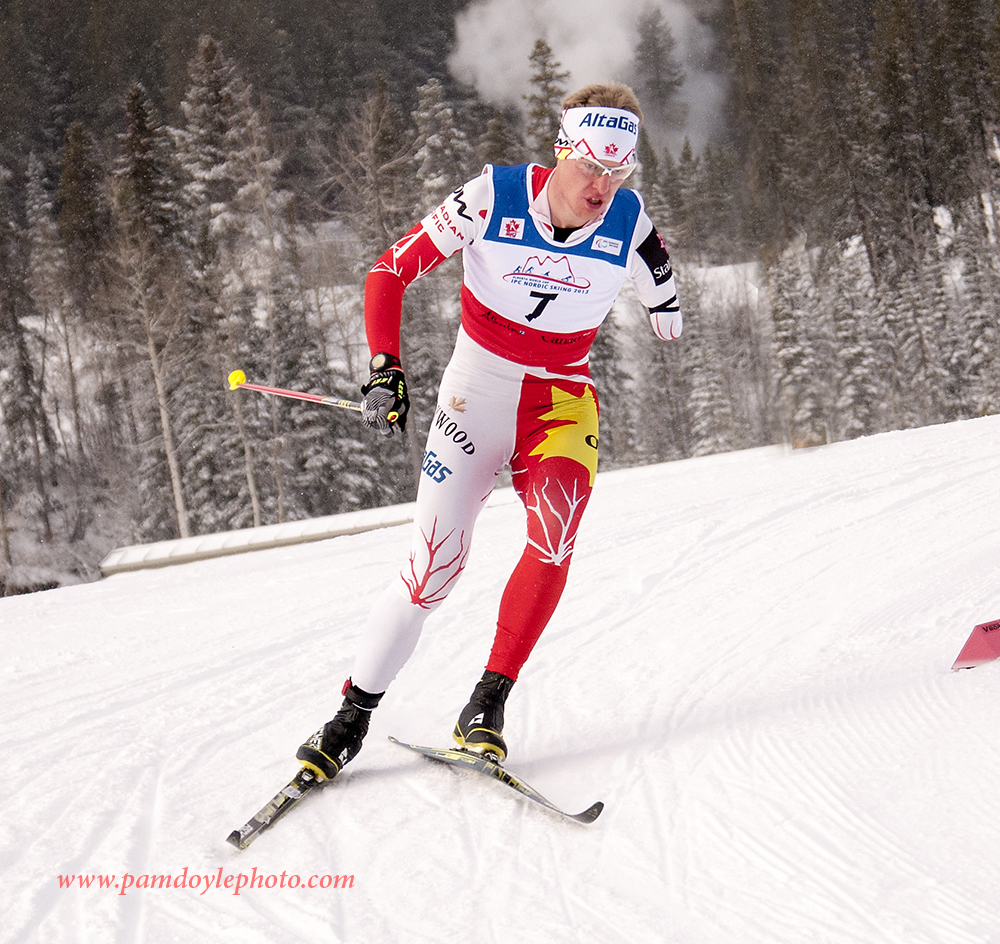
    Canadian World Cup Veteran Mark Arenz in the Standing Division Sprint at Canmore. (Photo Courtesy Pam Doyle)
    Canadian World Cup veteran Mark Arenz in the standing sprint at the IPC World Cup in December in Canmore, Alberta. (Photo: Pam Doyle)
  • Kowalczyk, Poltoranin Take First Two Muonio Races; Americans and Canadians Jump in the Mix

    Kowalczyk, Poltoranin Take First Two Muonio Races; Americans and Canadians Jump in the Mix

    Each November, it’s tradition for some of the world’s best nordic skiers to go where the sun don’t shine – or appears very little. The fact is that Muonio, Finland, above the Arctic Circle has snow this time of year when other parts of Europe are still waiting for the skiable stuff.

    Justyna Kowalczyk of Poland during one of last year's FIS races in Muonio, Finland. This weekend, Kowalczyk won two out of three Muonio competitions from Nov. 15-17.(Photo: Petri Ikävalko/Hevoskuuri.fi)
    Justyna Kowalczyk of Poland during one of last year’s FIS races in Muonio, Finland. This weekend, Kowalczyk won two out of three Muonio competitions from Nov. 15-17.(Photo: Petri Ikävalko/Hevoskuuri.fi)

    Starting Friday, the unofficial Finland Triple began in Muonio, with hundreds of skiers flocking to the northern region for their first International Ski Federation (FIS) races of the season.

    Poland’s cross-country celeb Justyna Kowalczyk jumpstarted her season with a sizable victory in the 1-kilometer classic sprint, topping Russian Evgenia Shapovalova by more than 7 seconds in the final, as well as Russia’s Julia Tikhonova in third and Natalia Matveeva in fourth. Finland’s Mona-Lisa Malvalehto placed fifth out of 146 female competitors.

    In the men’s 1.3 k classic sprint on Friday, Alexey Poltoranin of Kazakhstan beat Finland’s runner-up, Ari Luusua, by 3.23 seconds in the final, as well as third-place finisher Russian Anatoliy Volkov (+5.56). Ales Razym of the Czech Republic was fourth and Estonia’s Peeter Kummel placed fifth out of 255 men.

    Leading a small American contingent in Muonio, Dakota Blackhorse-von Jess (Bend Endurance Academy) placed 34th in the sprint qualifier. Welly Ramsey was the fastest from the Maine Winter Sports Center (MWSC), placing 113th, teammate Sam Tarling came in 209th, and post-grad Austin Huneck was 239th. Another MWSC post-grad, Emily Ramsey finished 128th in the women’s race.

    On Saturday, Kowalczyk and Poltoranin again topped their respective podiums – this time in the 5 and 10 k classic races. Kowalczyk defeated Russia’s Yulia Tchekaleva in second by 21.6 seconds, and Germany’s Nicole Fessel in third (+27.3). Finland’s Anne Kyllönen and Kertu Niskanen placed fourth and fifth, respectively, out of 199 women.

    Poltoranin edged Lukas Bauer of the Czech Republic by 6.8 seconds, and German Hannes Dotzler in third (+24.2). Razym finished fourth for the second-straight day, and Germany’s Tim Tscharnke placed fifth out of 331 finishers.

    Kris Freeman in Muonio last year. (Photo: Petri Ikävalko / Hevoskuuri.fi)
    Kris Freeman in Muonio last year. (Photo: Petri Ikävalko/Hevoskuuri.fi)

    Kris Freeman (MWSC) led the Americans in his first race of the season in 34th, 1 minute and 11 seconds behind Poltoranin, who won in 24:33.7. Tarling placed 109th, 2:09.8 back from the winner. Canadian Para-Nordic veterans Brian McKeever placed 160th and Erik Carleton was 242nd.

    Racing ended Sunday with the women’s 10 k and men’s 15 k individual skate. Russian Petr Sedov stole the spotlight from Finland’s Matti Heikkinen, who was leading until Sedov finished 7.8 seconds faster in 34:56.5. Two other Finns rounded out the top four with Tero Similae in third and Lari Lahtonen in fourth, and Franz Goering of Germany was fifth out of 188 men. Poltoranin did not race.

    Freeman finished 32nd, 1:15.1 after Sedov, McKeever was the top Canadian in 63rd, (+2:13), and Welly Ramsey was 116th (+3:24.7) Carleton placed 125th (+3:38), and Tarling was 126th (+3:39.5).

    Russian Irina Khazova won the women’s 10 k in 25:46.2, ahead of teammate Tchekaleva in second (+28.3), and Eva Vrabcova-Nyvltova of the Czech Republic in third (+49.5). Finland’s Gretel Niskanen placed fifth, and Russia’s Svetlana Nikolaeva was fifth out of 159 women. Kowalczyk fell to 24th, behind teammate Sylwia Jaskowiec in 21st. American Emily Ramsey placed 155th.

    ***

    Results: 

    Friday’s classic sprint: women | men

    Saturday’s 5 and 10 k classic: women | men | photos

  • Now a National Champ, McKeever Again Adaptive Skier of the Year; Bourgonje Top Female

    Now a National Champ, McKeever Again Adaptive Skier of the Year; Bourgonje Top Female

    Canadian Para-Nordic World Cup skiers Colette Bourgonje and Brian McKeever are FasterSkier's Adaptive Skiers of the Year. (Photos: James Netz/CCC & Gerry Furseth)
    Canadian Para-Nordic World Cup skiers Colette Bourgonje and Brian McKeever are FasterSkier’s Adaptive Skiers of the Year. (Photos: James Netz/CCC & Gerry Furseth)

    Brian McKeever is one of those guys that seem to keep getting better with time. At 33, Canada’s Para-Nordic World Cup visually impaired skier once again dominated the International Paralympic Committee (IPC) World Cup scene last season, winning every IPC cross-country event he participated in.

    With guide Erik Carleton, McKeever tallied two golds at 2013 World Championships in Solleftea, Sweden, and two more at World Cup Finals in Sochi, Russia.

    “I don’t think the guides get nearly as much recognition as they should,” McKeever told Cross Country Canada in February. “It is tough being the guide because you are out front and not skiing your own race. … When I need him to hold off he has to, and when I need him to increase the pace he needs to do that as well.”

    Brian McKeever (r) with guide Erik Carleton celebrating World Championship gold (Photo: IPC)
    McKeever (r) and guide Erik Carleton celebrate their 2011 World Championships gold. (Photo: IPC)

    Childhood friends from Calgary, the duo didn’t waste any time getting from their last World Cup Finals race in Sochi to Whistler, British Columbia. There, McKeever captured his first national title in the 10-kilometer freestyle on March 24, just four days after racing in Russia.

    “You never really know how you are going to feel after getting off the plane from Russia,” McKeever told FasterSkier after arriving two days earlier. “First national championship win in my career, I am really happy about that.”

    To start the season, both McKeever and Carleton individually qualified for the able-bodied World Cup races in Canmore, Alberta. They decided to skip the opening IPC World Cups to compete in Canmore, where McKeever notched a career-best 38th in the skiathlon in mid-December.

    In February, the 10-time Paralympic medalist double poled the entire Canadian Birkebeiner 55 k classic in Edmonton, Alberta, and won by nearly three minutes. Carleton, 35, placed second.

    McKeever took on the Vasaloppet 90 k classic in early March for the second-straight year, finishing 45th overall – a vast improvement from 83rd in 2012.

    Another 10-time Paralympic medalist, Canada’s veteran sit-skier Colette Bourgonje, 51, isn’t showing signs of slowing down before the 2014 Winter Games (which will be her seventh Paralympics). In January, she raced to silver and bronze at the IPC World Cup in Cable, Wis., and went on to place eighth at World Championships and sixth at World Cup Finals. Bourgonje landed fifth overall in the IPC World Cup.

    Honorable Mention:

    Canadian Para-Nordic World Cup member Mark Arendz (c) tops the podium for the first time at 2013 IPC Biathlon World Championships in Solleftea, Sweden. (Photo: CCC)
    Canadian Para-Nordic World Cup member Mark Arendz (c) tops the podium for the first time at 2013 IPC Biathlon World Championships in Solleftea, Sweden. (Photo: CCC)

    Further proving the depth of Canada’s Para-Nordic team, 22-year-old Mark Arendz won his first IPC Biathlon World Championships gold in February in the 7.5 k sprint. Also in Solleftea, Arendz claimed bronze in the 12.5 and 15 k distance races and finished eighth overall in the World Cup.

    After trying out sit skiing for the first time at U.S. Nationals in January, Tatyana McFadden went on to represent the U.S. at the IPC World Cup in Cable, where she finished right behind Bourgonje in two races in fourth and fifth, respectively. Her results were hardly a surprise; the 24-year-old University of Illinois student has 10 Paralympic medals in wheelchair racing and at least six marathon titles (including one in Boston and other in London this month). Despite a late start, she ranked 14th in the overall World Cup.


    medal-final-layer-2013

    Previous Winners:

    2011

    Brian McKeever (CAN)

    Jody Barber (CAN)

    2010

    Brian McKeever (CAN)

    Andy Soule (USA)

    Colette Bourgonje (CAN)


    See also:

    Nordic Combined Skier of the Year

    Breakthrough Skier of the Year

    Continental Skier of the Year

    Junior Skier of the Year

    Rookie of the Year

    Collegiate Skier of the Year

  • At Home in Canmore: The Canadian Up-And-Comers

    At Home in Canmore: The Canadian Up-And-Comers

    Coverage of the Canmore World Cups was made possible through the generous support of Travel Alberta and Tourism Canmore.

    Thirty Canadian men and women will be putting on World Cup bibs in Canmore this weekend. Some are old pros and some are competing in the first World Cups of their lives. (Photo: Angus Cockney)

    With the start of the mass start classic in Canmore, Alberta, less than 24 hours away, nerves are running high at the World Cup venue. With two distance races and one sprint on the schedule, there will be both returning and new nation’s group faces lining up over the next few days.

    Chances are you know exactly who Alex Harvey and Devon Kershaw are, but as the host nation Canada has a large number of quota spots this weekend (15 men and 15 women). Every single one of them, when they pull on that bib, are looking to honorably represent their country in front of a home crowd. Here are a few names to watch out for.


    Photo: Angus Cockney.

    Emily Nishikawa (CNST/AWCA)

    The 23-year-old has a few World Cup starts to her name already, but hasn’t contested one in Canada since 2008. After a win at Sovereign Lake on Sunday, she’s looking forward to testing her fitness against the world-class field.

    “My shape is coming along now so I’m happy to get a good race under my belt before Canmore; get a little confidence going into it,” she said. “It’s super exciting to race in a hometown and on trails you know so well.”

    Her goals for the weekend are to “perform to the absolute best of abilities. My family will be here watching, so I’m really looking forward to that!”


    Photo: Cross Country Canada.

    Brittany Webster (Highlands Trailblazers)

    The former national team member is making a bit of a comeback this year with three NorAm distance podiums (two of them wins) under her belt already. It’s been four years since she was on the World Cup circuit, so in Canmore she’s entering the gate without any expectations other than to enjoy the opportunity.

    “I know that, myself included, there are lots of Canadians out there who are a bit apprehensive about what it will like,” she said. “I think — and hopefully this is some advice for the younger girls out there — that it’s really important to remember that it’s simply just a great opportunity to race against the best. This is what we work towards, and you have to be really happy when you set foot on the start line to do it.”


    Photo: Angus Cockney

    Michael Somppi (CNST/AWCA)

    With a second and fourth place at Sovereign Lake, Somppi is feeling confident in his fitness for Canmore. He first competed on the World Cup at this venue in 2010, but this year is the first time he’ll have the chance to compete in three back-to-back races.

    “The mass starts are more nerve-wracking than the individual, but I feel like I’m in pretty good shape right now so it should be fun,” Somppi said.

    “I’m looking forward to it. I’ve been improving every race so I hope the trend continues.”


    Erik Carleton (PNST/RMR)

    Carleton competed in his first World Cup for Canada in 2005 when the circuit stopped in Vernon, BC. He is also a guide for national Para Nordic team member Brian McKeever, but was fast enough to prequalify for Canmore based on his results from last season.

    “It was a good feeling since it was the first time in my career I had been selected based on the previous season,” Carleton said. “I knew I could focus my training program towards the World Cup races, have to worry about the trial races.”

    His goals for Canmore are reasonable: “to ski relaxed, trust myself and feed off the energy of the fans.”

    Mostly, Carleton is looking forward to comparing himself against the international field.

    “When you do not have the opportunity to race in many World Cups, the rewards are great if you can have one of your best-ever races,” he said.


    Photo: Angus Cockney

    Graeme Killick (CNST/AWCA)

    The senior development team member has been a part of the whole World Cup production before, in Estonia in 2011. As the winner of the NorAm opener in Canmore and third-place finisher in the classic race the following weekend, Killick will be one of the top Canadians to watch for on the big stage.

    He’s feeling particularly confident after his recent podium finishes: “It was a good start for me.  Normally it takes me a few races to get in race shape, but I was able to win last week so that is a good sign,” Killick said.


    Photo: Angus Cockney.

    Patrick Stewart-Jones (AWCA): He had “the best race of my life so far” in the mass start classic NorAm at Sovereign Lake, so the 21-year-old is feeling pretty good heading into Canmore. Stewart-Jones also qualified for the sprints in Quebec, but turned down the opportunity in order to save his top gear for the distance events.

    “It wasn’t easy at all,” he said of the choice to skip Quebec. “I was sort of on the fence, but told myself if I qualified for the distance races then I’d focus on that.”

    The 15 k mass start classic in Canmore will be Stewart-Jones’ first World Cup appearance.


    Jesse Cockney (AWCA)

    In Quebec City Cockney missed out on qualifying for the heats by a mere 0.25 seconds in 32nd place. He said afterwards that he already learned a lot from the experience, like how to roll with the punces on race day and ski relaxed.

    Luckily, he’s got another shot at the heats in Canmore with the freestyle sprint scheduled for Saturday. On truly home terrain and against essentially the same field, he could be ready to crack the top 30.


    Raphaël Couturier (CNST/Pierre Harvey NTC)

    Couturier made his World Cup debut in Quebec last weekend, where he placed 51st in the freestyle sprint.

    “I was super excited to race my first World Cup at home and I had a great time with my friends and family,” he said of the experience. “Everyone around the event did a great job and I’m pretty sure we all agree on saying it was one of the most epic city-sprint ever and I feel privileged to have been part of the event. I was just looking forward to break the ice and step up the game.”

    The 19-year-old was pretty excited when he first learned he qualified back in November, and is mostly focused on gaining international experience in sprint and distance in Canmore.

    “It would be amazing to get to race some heats with the big boys, but I don’t want to put any pressure on myself. I’ll deal with the results I’ll get and build on from there,” Couturier said.


    Canmore, Western Canadian Championships
    Photo: Angus Cockney.

    Brent McMurtry (CNST/AWCA)

    With numerous World Cup starts under his belt, McMurtry is no stranger to the scene. He says he’s most looking forward to the 15 k mass start classic.

    “I have raced a lot of places, and for classic Canmore is my favourite course: steep climbs with firm tracks,” he said. “As far as goals, I am hoping to execute my race plan and ski smooth throughout. It is hard to put a number of what I am aiming for but I would like to be in the points.”

    Like most of his countreymen, McMurtry is most looking forward to competing in front of friends and family on familiar terrain.

    “It is great to race at home where I have family and friends cheering me on and I know most of the volunteers who are running the race. It is just an amazing atmosphere,” he said.


    NorAm Sovereign Lake
    Photo: Jesse Winter

    David Greer (Yukon Elite Squad)

    The 23-year-old will be making his first World Cup appearance on Thursday and is hoping to continue the upward trend in his recent NorAm results when he goes up against the best in the world. In Sovereign Lake this weekend he was sixth in the mass start classic and third in the 15 k freestyle.

    “Each race seems to be getting better, so I’m looking forward to [Canmore],” Greer said. “It should be fun.”


    Photo: Angus Cockney.

    Graham Nishikawa (CNST/AWCA)

    The senior development team member is an old standby on the World Cup scene; he was recently 34th in the 30 k freestyle in Davos, Switzerland.

    “I’m always honored to race for Canada, especially at home in Canmore,” he said.

    Coming off a win in the 15 k freestyle last weekend, Nishikawa appears to be in top form for this weekend.

    “I just want to thrown down a great race and see what happens,” he said. “Having my family and friends around to watch will be great.”


    Phil Widmer (AWCA)

    Widmer has numerous World Cup starts to his name and is looking forward to the opportunity to represent Canada in front of a home crowd.

    “The goal for me though is putting together a solid World Cup race,” he said. “My team mates and I have been pushing each other hard all year in preparation for these races and the rest of the season.”

    He was 55th in the individual sprint in Quebec City last weekend. A personal best for the sprinter would be to make it into the semifinals, which is just what he’s shooting for this Saturday on the home track.

    “Competing against the best skiers in the world on the home track is special,” Widmer said. “I’d say that has to be the most exciting part of the world cup coming to Canada. It doesn’t happen every day, so it’s special when it does happen.”


    Kevin Sandau (CNST/AWCA)

    Sandau, of recent Movember fame, has been on the World Cup circuit all season as last year’s Continental Cup leader. Still, he hasn’t competed in a World Cup on home soil since 2008 and is looking forward to competing on the trails he trains on every day.

    “I know what [the trails] are like and how they ski,” he said. “I’d like to have some personal bests in the distance races and cap off 2012 with some really good results.”

    “The Alberta World Cup Society definitely has organized this on a much grander scale since 2008, with the town fully backing the event and a lot of smaller and distinct details added. This is for sure going to be one hell of a week!”


    Matt Wylie (AWCA)

    Wylie earned starts both in Quebec and Canmore, but skipped out on the sprints in order to save energy.

    “Ideally preparing for Canmore would set me up for a top result rather than travelling back and forth across the country,” he said. “It was one of the hardest choices I have had to make, turning down that kind of opportunity.”

    This will be Wylie’s first international racing experience.


    Photo: Mark Nadell.

    Russell Kennedy (AWCA)

    The Truckee, Calif., native is a dual citizen of the US and Canada and has been training with the AWCA for the past few years. When he learned he’d won his fist career World Cup starts while cooling down from the Canmore NorAm prologue, he was “over the moon.”

    “I’m generally a happy guy but it was pretty hard for me to stop smiling,” Kennedy said.

    Kennedy’s main focus this year was to qualify for U23s, but now that he’s in a position to race well on the World Cup, he’s aiming to make the sprint heats (he was 45th last weekend in Quebec).

    “When a dream comes true it is hard to pick your favorite part of the dream,” Kennedy said. “However, I’m looking forward to racing the top guys, seeing all my friends and family that are coming to watch and just having a hard summer of training start to pay off.”


    More Canadians to look for in Canmore: Brian McKeever (PNST), Frederick Touchette (CNST/CNEPH), Heidi Widmer (AWCA), Amanda Ammar (Canmore), Annika Hicks (AWCA), Rebecca Reid (AWCA), Dahria Beatty (AWCA), Zoe Roy (RMR), Kate Brennan (AWCA), Alana Thomas (AWCA), Anne Marie Comeau (CNEPH), Maya MacIsaac-Jones (RMR), Erin Tribe (Team Hardwood), Frederique Vezina (CNEPH), Andrea Dupont (RMR)


  • Canadian Para-Nordic Guide Carleton Prioritizes Alberta World Cup

    Canadian Para-Nordic Guide Carleton Prioritizes Alberta World Cup

    Erik Carleton (Canadian Para-Nordic Ski Team/Rocky Mountain Racers) on his way to a second-place finish in the 10 k classic individual start at Canadian Ski Nationals on March 19. The next day, he took seventh in the 15 k skate then flew to Finland with Brian McKeever to compete in the IPC World Cup Finals two days later.

    Entering his third straight season with the Canadian Para-Nordic World Cup Team, Erik Carleton has already made some big decisions this year. Among them, he had to choose whether to race the Alberta Cross Country World Cup in Canmore or go for gold at the International Paralympic Committee (IPC) World Cup opener in Vuokatti, Finland.

    It must be tough to be Carleton, a competitive-nordic racer who doubles as a Para-Nordic guide for Brian McKeever, arguably the best visually impaired skier in the world. While some Canadians are still stressing over their prospects of making the Canada World Cups (which starts with skate sprints in Québec Dec. 7-8, followed by a skate sprint and distance races in Canmore, Alberta, Dec. 13-16), Carleton was one of nine outside of the nation’s cross-country team that prequalified.

    With the option to race the 15 k classic mass start and 30 k skiathlon in Canmore, Carleton faced a bit of a dilemma. The IPC World Cup started just a few days before on Dec. 11 in Finland. Unlike the loaded cross-country calendar, Para-Nordic skiers have only one other World Cup (Jan. 20 in Cable, Wis.) before the World Championships started Feb. 21 in Sollefteå, Sweden.

    After a 10-day camp in Sante Fe, N.M., earlier this month, Carleton wrote in an email that he planned to compete in both the races he prequalified for in Canmore.

    “The IPC World Championships and the IPC World Cup in Sochi [March 14] will be the big priorities later in the season,” he wrote.

    Last year, he and McKeever, 33, swept the 2012 IPC World Cup Finals in Vuokatti just a few days after competing at Canadian cross-country nationals in Québec. At Mont Sainte-Anne, Québec, Carleton won an individual silver in the 10 k classic race and placed seventh in the 15 k freestyle before jetting with McKeever, his childhood friend, to Finland.

    There, they claimed three gold medals for a grand total of four last season.The only man that topped McKeever in 2011/2012 was Russian Stanislav Chokhlaev, who beat him to gold twice in World Cup skate races in Sjusjøen, Norway.

    This winter, Carleton and McKeever are aiming for continued success and IPC dominance at World Championships and Sochi in preparation for the 2014 Paralympics. But first, Carleton wants to start strong individually.

    “The main focus at the moment is to be in ‘best-ever’ shape for the December World Cups,” he wrote.

    To do so, he committed to the Para-Nordic Ski Team (PNST) training plan, following it more closely than in the past.

    “I have more confidence in the PNST program after my successes last season,” Carleton wrote. “My major goals are to enjoy what I do and to be smart at training and racing.”

    As for his training, Carleton explained that he’s “revamped” both his classic and skate techniques and already seen improvements in his efficiency. A few colds set him back this offseason, but he resumed strength training for the first time in eight years.

    “The idea was to build power without adding muscle, and to learn how to move properly to avoid injury,” he wrote.

    He’s done more rollerski intensity and less trail-running and mountain-bike racing. Rather than run on a treadmill, he and the team started using the new rollerski treadmill in the Bill Warren Training Centre in Canmore.

    “Overall my volume has decreased by about 10 percent, but the training load would likely amount to slightly more,” he wrote.

    This year, the team scheduled two trips to Sante Fe for altitude training up to 3,000 meters (10,000 feet) to get in prime shape for December. The did the first in September and the second Oct. 30-Nov. 8, which Carleton wrote was “a great camp with good weather” and apparently warmer than usual.

    ***

    Photos from the Canadian PNST camps in Sante Fe, provided by Carleton:

    For the IPC Nordic World Cup schedule, click here.

  • McKeever, Carleton Capture Gold at IPC World Cup

    A day after flying into Finland, Brian McKeever and Erik Carleton of Canada nabbed gold in the first race of the IPC World Cup finals in Vuokatti on Thursday, the 1.2 k visually impaired sprint.

    On Tuesday, McKeever and Carleton drove straight to the airport after competing in the 15 k freestyle event at the Canadian Ski Championships. Carleton placed second on Monday in the 10 k classic and eighth on Tuesday. McKeever was 15th on Monday.

    According to Cross Country Canada, the two childhood friends won three silver medals and a gold earlier this year.

    “I was a little jet lagged, but we had a good day today,” McKeever said in a press release. “I came here with a good game plan that we executed really well today. Erik skied very tactical. We decided to double-pole the final which paid off because it started dumping snow.”

    McKeever and Carleton qualified second for the head-to-head heats and proceeded to win their quarterfinal and semifinal.

    Thursday’s results

    Complete IPC World Cup results

  • The Big Guns are Back: Notes, Quotes & Video from Canadian Nationals

    The Big Guns are Back: Notes, Quotes & Video from Canadian Nationals

    MONT SAINTE-ANNE, Québec — While Alex Harvey was the man of the day at Canadian Ski Nationals on Tuesday, Devon Kershaw, Lenny Valjas and the remaining World Cup crew (including Chandra Crawford, Dasha Gaiazova, Alysson Marshall and Kevin Sandau) also met a strong welcome after flying into Québec late Monday night and racing the next day.

    Cross-country ski fans, friends, family and media outlets came out to Mont Sainte-Anne to catch a glimpse of the nation’s top skiers in their flashy red suits. Several competitive skiers showed up as well for a shot at contending with some of the world’s best.

    Some quotes from the 15 k:

    Marc-André Bédard (Canadian Biathlon Team/Québec), 4th

    The first thing I did was ask Alex if he was coming to nationals. He was like, ‘Of course I’m coming.’ I was like, ‘OK, I need to go just to see how I do against them.’ That was fun. I’ve been friends with him since I was a kid when we were in Mont Sainte-Anne together.

    There’s lots of biathletes who make podiums on lots of World Cups … so we know that the top biathletes are pretty much the same as the top cross-country skiers. I’m not a top biathlete; I’m just hoping to do good and those guys [Devon Kershaw, Alex Harvey, etc.] are the best skiers so it’s really cool to be not so far behind them.

    I wish I could do more cross-country, but it’s rare that the opportunity comes, especially with the strong guys. 

    [Note: Bédard said he last competed at Canadian cross-country nationals in 2007.]

    David Greer (Pierre-Harvey National Training Centre), 5th

    Alex was really moving today. He started 45 seconds behind me and caught me at about 2 k. I tried to stay with him for about 10 seconds and decided I’m probably better off just racing my own race. That wasn’t very encouraging, but later in the race I felt better and better and then got encouraging splits.  

    End of the season, a lot of people are fried and not super pumped about the racing, but it was definitely super fun having those guys here because we don’t get to race with them very often. You see them racing World Cups all year so it’s the one chance we have to measure ourselves against them. I was definitely looking forward to it.

    Brent McMurtry (Pierre-Harvey National Training Centre/Senior Development Team), 6th

    I was getting splits off of Devon and Ivan [Babikov] I was third. Devon caught me for 30 seconds after two-and-a-half kilometers or something, but I was not going the same speed as him. It was good motivation because once he caught me and went by, I was able to keep him in sight for the next two laps so I sort of knew I was at least a little bit competitive. 

    Devon was second in the World Cup, Alex last weekends had two podiums. You know that when you’re two minutes back, it’s two minutes off the best in the world. It’s not where I want to be and not where I think I can be, but at the same time, it’s not so bad.

    I’m staying at Alex’s house; they’re good friends of mine. It was funny sitting around at breakfast [Tuesday] morning with Devon and Alex. Their season is done and talking about things other than skiing and just life. It’s nice to have them around. 

    Erik Carleton (Rocky Mountain Racers/National Para-Nordic Team), 8th

    It’s my only chance to race against our World Cup team. … I knew it would be, for sure, at a different level. When Alex passed me [about halfway through], I just saw the pace he was going. I stayed with him a bit, then the last lap was pretty tough after that. … You can just see he’s really efficient and he keeps pulling away. He was gone on the last lap.

    Tuesday’s complete results


  • Babikov Back on Track at Canadian Nationals; Wins 10 k Classic

    Babikov Back on Track at Canadian Nationals; Wins 10 k Classic

    Ivan Babikov (CNST) shortly after starting the 10 k classic at Canadian Ski Nationals in Mont Sainte-Anne on Monday. Babikov was the eventual winner in 28:38.6.

    MONT SAINTE-ANNE, Québec – Four days after flying home from Europe, Ivan Babikov was back in action at Canadian Ski Nationals on Monday.

    The 31-year-old national team member was also back to his winning ways, hitting his stride as usual at the domestic championships and claiming his seventh Canadian title.

    Out of nearly 160 men in the 10-kilometer classic individual start, Babikov was the fastest, completing the two loops in 28:38.6.

    Runner-up Erik Carleton (Rocky Mountain Racers/NST) finished 8.1 seconds back, and Michael Somppi (Thunder Bay National Development Centre/NST) was third (+21.8).

    By the time Babikov started Monday morning, the snow had softened under sunny skis and the wear about 200 racers before him. Babikov started near 30th in the randomized men’s race, which followed the women and junior girls.

    Out on the course, he found several hills no longer had tracks; herringbone was the only option. That didn’t make racing any easier, but he acknowledged it was the same for most of the men’s field.

    “I felt like I could fight,” Babikov said. “It was tough conditions and [I wasn’t] feeling great after the flight and jet lag … but it was enough to win and I’m super happy.”

    Ivan Babikov (CNST) finishes while Dudley Coulter (NDC-Thunder Bay) recovers on the ground after the Canadian Ski Nationals 10 k classic individual start on Monday in Mont Sainte-Anne, Quebec. Babikov won and Coulter was seventh.

    Babikov said the victory most in principle and to those that idolized World Cup athletes like him.

    “It’s good to see kids looking up to you,” Babikov said. “It’s not for me; it’s more for the other youngsters coming up. A title is a title. It’s cool to be a national champion.”

    Personally, the win was another high in Babikov’s rollercoaster season. After skiing one World Cup race in March and scratching out of his last three, the Russian-born skier didn’t end the season as he had hoped. A second bout with a virus or flu kept him from finishing his last race in Oslo, Norway: the 50 k classic mass start.

    “That was the hardest part,” Babikov said. “I didn’t make the finals and I didn’t finish some races, which never happened before. I was disappointed, but it happens. Better this year than next year or an Olympics year.”

    Fortunately, he had nationals to come home and look forward to. Babikov said he felt relaxed going into Monday’s race and focused on staying calm throughout the challenging 10 k.

    At the halfway point, he was 15.1 seconds out of first behind Patrick Johnson of Middlebury College in Vermont. Babikov closed the gap over the last 5 k and ended up beating Johnson by 32.6 seconds. Johnson finished fifth after another American collegiate skier, Eric Packer (Dartmouth).

    Carleton forced his body into high gear as well, and to his surprise, it responded. With just two men starting 15 and 30 seconds ahead of him, he passed them both.

    “I didn’t really feel that great … I wasn’t that comfortable,” Carleton said. “But on a 10 k, you have to be able to go that hard, and it’s nice that I had that today.”

    Erik Carleton (RMR) on his way to a second-place finish in the 10 k classic individual start at Canadian Ski Nationals on Monday.

    During the race, he mostly worried about Brent McMurtry, who started two spots behind him. Eighth after the first lap, McMurtry finished 11th overall.

    “I was thinking he would likely catch me today,” Carleton said. “It was just always skiing scared and, ‘You’ve got to just keep moving, he hasn’t caught you yet,’ kind of thing.”

    A National Paralympic Nordic Team member and guide for Brian McKeever (Foothills/NPNST) on the IPC World Cup, Carleton knew this race could be his last before flying to Finland. While he hoped to squeeze in Tuesday’s 15 k freestyle individual start, Carleton also had a plane to catch with McKeever at 4 p.m.

    Carleton said they were flying out of Québec on Tuesday to compete in the World Cup. The open men’s races start at 12:30 p.m.

    “It was kind of, make the best of these two days,” Carleton said. “Hopefully, we have time to fit in that race tomorrow.”

    Somppi in third initially aimed for the top five in the short-distance classic, which he said wasn’t his specialty. Upon hearing that he was in second throughout the race, Somppi set his sights a little higher.

    “I couldn’t really hear who was leading,” Somppi said. “I knew I was in the mix anyway. I didn’t think I’d be on the podium.”

    Michael Somppi (NDC-Thunder Bay/NST) out of the start in the 10 k classic at Canadian Ski Nationals on Monday in Mont Sainte-Anne, Quebec.

    He wasn’t complaining. Starting about 10 racers from the front gave Somppi plenty of splits and motivation to feed off.

    “Going into nationals I was hoping to take a medal, but I don’t think I really believed in myself,” he said. “I knew it was possible, but I knew everything would kind of have to work out perfectly for it to happen. Today it did.”

    The race was Somppi’s first individual event since nearly a month ago at the 50 k American Birkebeiner in Hayward, Wis. Racing in Saturday’s team sprint helped him transition into racing mode again, he said.

    “I think I’ve done a good job of peaking for the nationals,” Somppi said. “Hopefully the rest of the week will be just as good.”

    Packer finished 6.9 seconds after from Somppi in fourth. Graham Nishikawa (AWCA/NST) was sixth, Dudley Coulter (NDC-Thunder Bay) was seventh, Harry Seaton (NDC-Thunder Bay) was eighth, David Greer (CNEPH) placed ninth and Jesse Cockney (AWCA) was 10th.

    Men’s 10 k classic results


  • Sandau Rallies to Overcome Deficit, Beat McMurtry (updated)

    Sandau Rallies to Overcome Deficit, Beat McMurtry (updated)

    Kevin Sandau (AWCA) racing to a 32.3-second victory in the 15 k freestyle pursuit on the last day of the NorAm mini tour in Canmore, Alberta, on Sunday. Photo courtesy of Angus Cockney.

    Note: This story has been updated to include quotes from third-place finisher and overall NorAm leader Brent McMurtry.

    If there’s one thing an athlete dreads besides injury, it’s sickness. Kevin Sandau felt the latter coming on Saturday in Canmore, Alberta, the night before the last race of the Western Canadian Championships.

    With most other NorAm races, the Alberta World Cup Academy and Senior Development Team skier would have found it easier to simply sit one out. However, Sandau was in the middle of a mini tour and with just two on the NorAm circuit this season, he needed to finish out the three-day series.

    His push to capture the lead in the overall NorAm standings depended on it.

    Fortunately, the body is an amazing thing. As Sandau shot out from the start of the men’s 15 k freestyle pursuit, he felt his body match his intentions. He was the second man to start, 41 seconds behind the mini-tour and overall NorAm leader Brent McMurtry (Pierre-Harvey National Training Centre).

    Canmore, Western Canadian Championships
    Brent McMurtry (CNEPH) racing to a third-place finish in the NorAm 15 k freestyle pursuit on the last day of the Western Canadian Championships in Canmore, Alberta, on Sunday. Photo courtesy of Angus Cockney.

    By about 8 k, Sandau said he caught McMurtry and extended his gap on 77 others, racing against only the clock and winning the pursuit by 32.3 seconds in 1:07.10.1.

    Sandau’s teammate, Graham Nishikawa, was the overall runner-up after starting 1:26 behind McMurtry. Nishikawa caught the man in the leader’s jersey on the second lap, and despite McMurtry hanging with him until the end, Nishikawa managed to edge him in the final sprint. McMurtry was third by 0.8 seconds (+33.1).

    “I don’t really know what the reason is, I just had low energy and bad legs right from the start,” McMurtry said in a phone interview on Monday. “Once Kevin caught me which was pretty quickly, he skied right through me and there was nothing I could do.”

    He regrouped by focusing on second, but with about 3 k to go, Eric Carleton (Rocky Mountain Racers) and Nishikawa caught him. From there, McMurtry dug deep to stay with them to the finish and  ultimately edged Carleton, who was fourth.

    While Nishikawa and Sandau acknowledged some racers, like McMurtry, didn’t have their best races on the World Cup course, they were pleased with how they felt throughout all three laps.

    “I think things started working together and when I started catching time on [McMurtry],” Sandau said on Sunday. “My coach told me before the race, ‘There’s 15 k, you don’t need to make up the time all at once.’ … I didn’t think I started that quick and I was already making time up.”

    Sunday morning when he woke up and decided to race, Sandau thought he might be contending for second.

    “I thought first was too far gone,” he said. “In the race, I felt pretty normal … I was surprised by that and my legs actually felt good. It was kind of a mental thing, like, think about it after the race.”

    On the downhills, Sandau felt his body respond well to the recovery and he sensed a shot at winning.

    “I knew I could make up that 41 seconds and push it at the end,” he said. “I think I was the fifth-fastest time of the day. That was still a heck of a day for me.”

    Nishikawa posted the fastest 15 k split after starting six places back. He made the winning the time trial his goal and hoped his body would hold up. On Friday, Nishikawa said he had an unusual experience in the middle of the 10 k classic interval start.

    Canmore, mini tour
    Erik Carleton (RMR) leads Graham Nishikawa (AWCA), center, and Brent McMurtry (CNEPH), right, during the NorAm 15 k freestyle pursuit at the Western Canadian Championships in Canmore, Alberta, on Sunday. Photo courtesy of Angus Cockney.

    “I don’t know if I ate enough food and I got really, really tired out there and kind of had to pull over for a bit,” he said. “It was really bizarre … all of a sudden I was really out of it.”

    His coaches told him to keep racing and he finished ninth. With the snafu out of the way and a double oatmeal in his stomach for Sunday’s 15 k, Nishikawa wanted a better result, but was unsure how his body would react.

    Throughout the race, he gradually increased his pace so as not to rock the boat and blow up. By the last climb, Nishikawa moved to second place just ahead of McMurtry and Carleton.

    “As it happens, I skied really well today and managed to catch up to some guys,” Nishikawa said.

    He pointed out another racer on the course, Canadian National Ski Team member Ivan Babikov, as a motivator. Babikov, who is on break from the World Cup circuit until the end of the month, jumped into the NorAm race as sort of a tune up. He started close to the end as a result and skied the second-fastest time to finish 28th overall.

    “[I] wasn’t planning to race because I don’t have any race skis here with me,” Babikov wrote in an email from Canmore, where he’s recovering after the Tour de Ski with his expectant wife and 9-year-old son. His second child is due in April.

    “I wasn’t expecting anything,” he added. “That was simply for training, another hard workout.”

    The two-time Olympian was also nursing his wrist injury after a crash in Stage 4 of the Tour. He finished out the event, placing 27th overall, and took some time off with the team in the Canary Islands before returning to Canada. While Babikov said his wrist, which suffered soft tissue damage, was not 100 percent, he explained it was much better than the Tour: “just a bit sore.” He estimated the healing time was four to six weeks since; he was on Week 3.

    On Jan. 31, Babikov wrote that he would fly to Russia to compete in the Rybinsk World Cups on Feb. 4-5.

    Note: The NorAms have a break in the schedule next weekend and will resume with the second of two mini tours this season at the Nakkertok Nordic Centre in Cantley, Quebec, on Feb. 3-5.

    With one win and two third-place finishes in Canmore, Brent McMurtry remains on top of the NorAm standings with 854 points. Sandau trails by 40 points, and Nishikawa is third with 529. Jesse Cockney (AWCA) ranks fourth with 516, and Michael Somppi (NDC Thunder Bay) was fifth with 419.

    Rounding out the top 10 on Sunday, Brian McKeever (Foothills) was fifth, Somppi was sixth, Cockney was seventh, David Greer (CNEPH) was eighth, Phil Widmer (AWCA) was ninth, and Pate Neumann (AWCA) was 10th.

    Men’s 15 k freestyle pursuit results

  • McMurtry Opens NorAm Mini Tour with Definitive Win

    It’s not as if one of the top two men on this year’s NorAm circuit really had an advantage.

    While Kevin Sandau had more recently heaved himself up the grinding hills at the Canmore Nordic Centre with his Alberta World Cup Academy teammates, both he and Brent McMurtry (Pierre-Harvey National Training Centre) spent plenty of time training there with the Canadian National Ski Team.

    Both Senior Development Team members, Sandau and McMurtry also grew up skiing together with the Foothills Nordic Ski Club an hour away in Calgary, Alberta.

    Essentially, both were favored to win Friday’s 10 k classic interval start, which opened a three-day NorAm mini tour known as the Western Canadian Championships.

    McMurtry did his part in proving his first win of the season last weekend was no fluke, winning the 10 k by 21.4 seconds in 27:33.7. Sandau was second, and Erik Carleton (Rocky Mountain Racers) placed third (+25.8).

    Before McMurtry’s last race — the 15 k classic interval start in Whistler, British Columbia – he was runner-up to Sandau in every NorAm distance race this season. He placed second in every other NorAm race, too, except the freestyle sprints in Whistler, where he was fourth.

    Brent McMurtry at the NorAm Teck Sprints in Sovereign Lake (Photo by Jesse Winter/JesseWinterPhotography.com)

    On Friday, McMurtry decided to go out hard and hold it. With three relentless laps, marked by two hills and few flats, he said he felt the effects of that effort on the last lap, yet tried to stay relaxed regardless.

    “I knew that I had a pretty good lead,” McMurtry said. “[With] only 3.2 k left, I was fairly certain I was going to win. Knowing it was a mini tour and the first day made me push harder and made me want to keep fighting through. … People were yelling at me to push for every second.”

    The leader after the first lap, McMurtry was 6.7 seconds ahead of Graham Nishikawa (AWCA), who started 30 seconds behind him. By the second lap, McMurtry lengthened the gap to 24.4 seconds ahead of second place. By then, Sandau had worked his way from fourth to second overall. Carleton was close behind in third.

    “[I] tried to go out strong at the start, but similar to last weekend, I guess Brent got most of his time on the first lap,” Sandau said. “He’s been the contender that I need to beat so far this season. He’s been the big target.”

    After Carleton, David Greer (Whitehorse) finished fourth, and Raphaël Couturier (Skibec) was fifth.

    Brian McKeever, Carleton’s adaptive nordic teammate and Foothills skier, was sixth. The two have already won several medals earlier this season at the International Paralympic Committee (IPC) World Cup, with McKeever, who is legally blind, working with Carleton as a guide.

    At 33, Carleton achieved his best individual result since 2007 in Canmore on Friday. He placed fourth in a NorAm 30 k last year, but had not been as close to third since.

    “I knew it was just a matter of time before I had a really good race,” Carleton said. “Last week, I was in it for the first two-thirds, and this time I held it the whole way.”

    He ended up eighth in the 15 k classic in Whistler. In the same race, McKeever was fifth.

    “I just wanted to be a little more consistent at maintaining my pace and whatever happens, happens,” Carleton said. “And it seemed to work out today.”

    Rounding out the top 10, Geoffrey Richards (Black Jack) was the top junior in seventh. Phil Widmer (AWCA) was eighth, Nishikawa placed ninth and Michael Somppi (NDC Thunder Bay) was 10th.

    Competition continues Saturday with freestyle sprints, followed by a freestyle distance pursuit on Sunday.

    Men’s 15 k results