From the FasterSkier archive — posts syndicated from athletes’ and coaches’ own blogs between 2004 and 2012, kept online as published. Current coverage is at fasterskier.com.
This article was made possible through the generous support of our voluntary subscribers who have helped put our Nat Herz on the ground at the Olympics. If you value coverage like this, please support FasterSkier with a voluntary subscription.
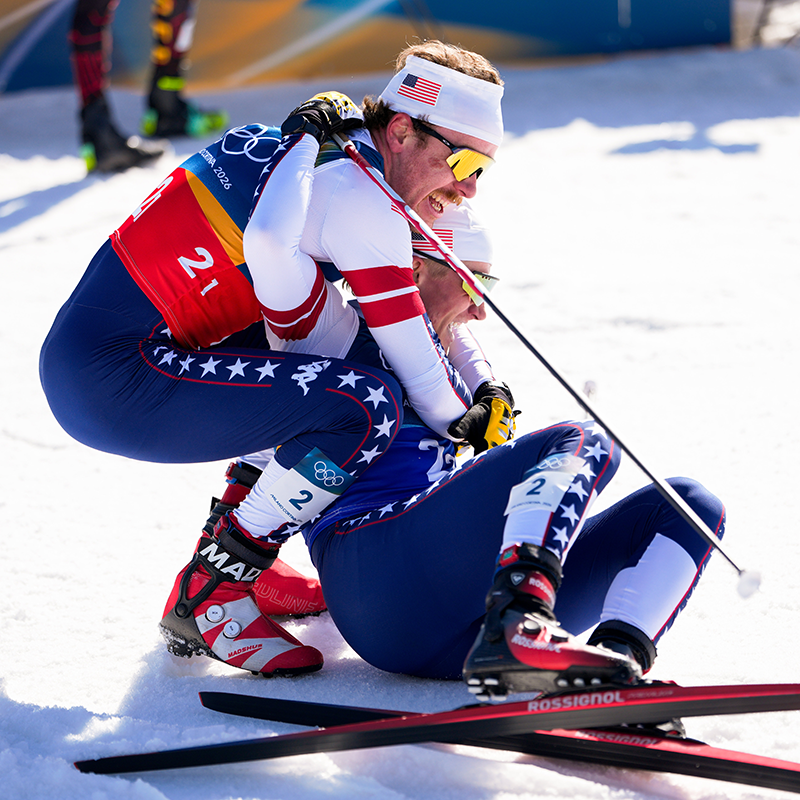
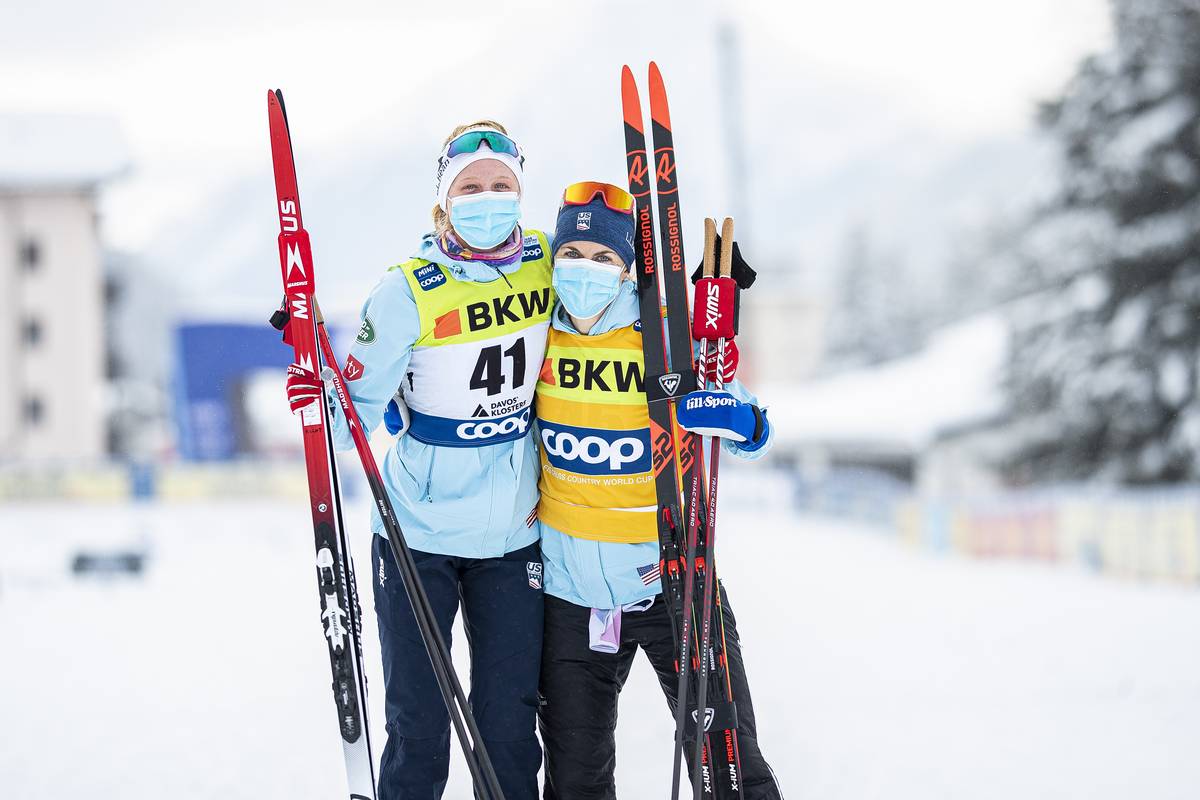
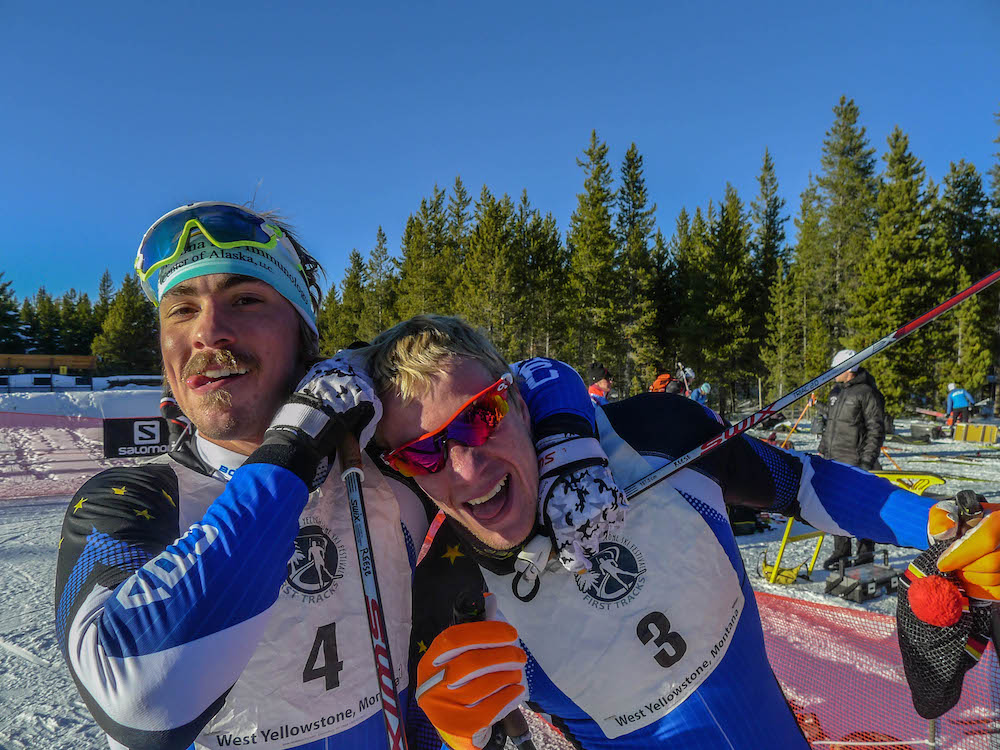
Ben Ogden, left, celebrates his Olympic silver medal in the team sprint with Gus Schumacher. (Davide Barbieri/Nordic Focus)
TESERO, ITALY — After Gus Schumacher and Ben Ogden on Wednesday won only the third-ever U.S. men’s medal in cross-country skiing at the Olympics, one of the biggest grins in the stadium was on the face of their teammate, JC Schoonmaker.
Schoonmaker, who lives in Anchorage and trains with Schumacher at the Alaska Pacific University Club Program, was basking in his teammates’ silver glow.
But he was also already starting to dream about when he and Schumacher return home to Alaska, medal in tow.
“There’s going to be so many juniors out skiing, just so hyped. And that’s the coolest part, I think,” Schoonmaker said.
Schoonmaker, 25, had his own standout performance at the Olympics, finishing eighth in the individual sprint last week. He said he was himself inspired by the 2018 gold claimed by Americans Kikkan Randall and Jessie Diggins — underscoring how medals can plant the seeds of future medals.
“I liked Nordic skiing,” Schoonmaker said. “But watching that, I was like, ‘I need this.’ That gave me such a drive.”
Eight years later, Schoonmaker’s teammates will be bringing their own hardware to their homes at far ends of the country — Schumacher to Alaska, and Ogden to Vermont.
And unlike Diggins, who is retiring at the end of the season, Ogden, 26, and Schumacher are still just getting started — with long careers, and likely more medals, still in front of them.
Schumacher has spoken openly about competing through the 2034 Olympics, which will take place on U.S. soil in Utah.
“You just see these guys, the energy building,” Erik Flora, Schumacher’s coach in Anchorage, said in an interview in Italy after Wednesday’s race. “You have this momentum now.”
Gus Schumacher and Ben Ogden (USA), (l-r) celebrate finally getting onto the Olympic podium together. (Photo: Barbieri/NordicFocus)
Both American medal winners were talented juniors, with Schumacher featured in news coverage at age 13. And early in their careers, each man found success in the events where they perhaps had more natural talent — Schumacher in longer distance races, and Ogden in shorter-distance sprints.
The team sprint event that the Americans medaled in Wednesday is unusual in the way it demands both the speed that’s Ogden’s strength, and the fitness that Schumacher is known for. The two athletes, and their coaches, said that the podium performance was a reflection of focused training that Schumacher and Ogden did in an effort to become more well-rounded.
The work Ogden and Schumacher did to put themselves in medal contention Wednesday didn’t happen overnight, though. It took years, with strong teammates pushing them and elite coaches to advise them — building on a foundation of years more of junior racing and playing on skis with their local clubs, said Matt Whitcomb, a longtime coach of the U.S. team.
“It’s just not about this last year’s training plan,” he said. “It’s about the very first coach, the support their parents put in, their siblings, the camaraderie there with their friends.”
Which is one of the things that Whitcomb and other team members say is great about winning an Olympic medal: the chance to share it with everyone who pitched in along the way.
Ogden, in an interview after his first medal, described feeling anxious as he worked with a press officer to draft an initial Instagram post: What if he forgot to mention someone?
“It’s so overwhelming to think of all the people you want to thank,” he said. “When the time comes, you’re just like, ‘Oh, my God. This is too many. It’s too hard.”
He added: “There were so many people that went into that success.”
Schumacher described feeling the same kind of gratitude as he crossed the finish line Wednesday — for a chance to share his elation with the many teammates, family members and others who were in Italy to witness it in person.
Flora, his coach, said that “maybe the best thing about this Olympics is all the people that it touches.”
“Everyone that’s been involved. Everyone that’s a fan of skiing, all the coaches that worked with all these people. All the athletes that are buddies and helped push — it’s just a very collective good feeling,” Flora said.
The Americans still have a few weeks of racing left on the international circuit after the Olympics close Sunday, capped with a final weekend of World Cup racing on home snow in Lake Placid, New York.
Then, after a chance to celebrate the medals and a few weeks away from training, it will be back to work — likely alongside newly inspired teammates.
Gus Schumacher and Ben Ogden (USA), (l-r) on the podium showing their silver medals to their fans after the Olympic Men’s Team Sprint. (Photo: Barbieri/NordicFocus)
“Everyone’s going to be so pumped and motivated and just firing, ready to go,” said Schoonmaker, the Olympian who trains with Schumacher in Anchorage. “It’s just going to be sick.”
Fed by that kind of energy, the Americans were eager to talk about how the results might look different, and better, by the next Games. Schumacher’s charge up the final hill, where he largely kept pace with Norwegian superstar Johannes Høsflot Klæbo — who’s undefeated in five races in Italy — had his coach’s head spinning.
“To see him put his head down and try to chase him, and he was holding his own, was unbelievable,” Flora said. “That he could fight with Klæbo in the future? I think so.”
Flora added: “I think he’s just going to get better. We’re just starting to see what the potential is.”
Help Support Our Olympic Coverage!
FasterSkier will have our own Nat Herz on the ground at the Olympics, which, to be honest, is a very big financial lift for us. If you value the thoughtful work and access FasterSkier provides at championships like this one, please consider becoming a Voluntary Subscriber. Your support directly fuels the work we do to cover the people, places, and moments that make our sport special.
When Novie McCabe spoke with FasterSkier early last month, she was looking out the window of her place in Anchorage, waiting for winter to finally take hold. “We’re patiently waiting on snow,” she said. “But today might be the day.“
Outside, the ground was still in its in-between phase—too brown for grooming, just white enough that fish-scale skis could work if you were stubborn and optimistic about it. Alaska in November often asks skiers to hover in that liminal space: ready but not yet racing; fit but not yet tested; hopeful but not naïve.
This week, the waiting ends—at least for the top domestic circuit. The U.S. SuperTour season opens in Fairbanks and continues in Anchorage next weekend, but McCabe hopes her body will allow her to join the field. After a long, uncertain stretch, simply lining up for even one race would mark a meaningful step forward. The timing makes this the right moment to trace how she has arrived at this threshold, and how the places she has lived—Methow Valley, Salt Lake City, Anchorage, Europe—continue to shape the skier she is becoming.
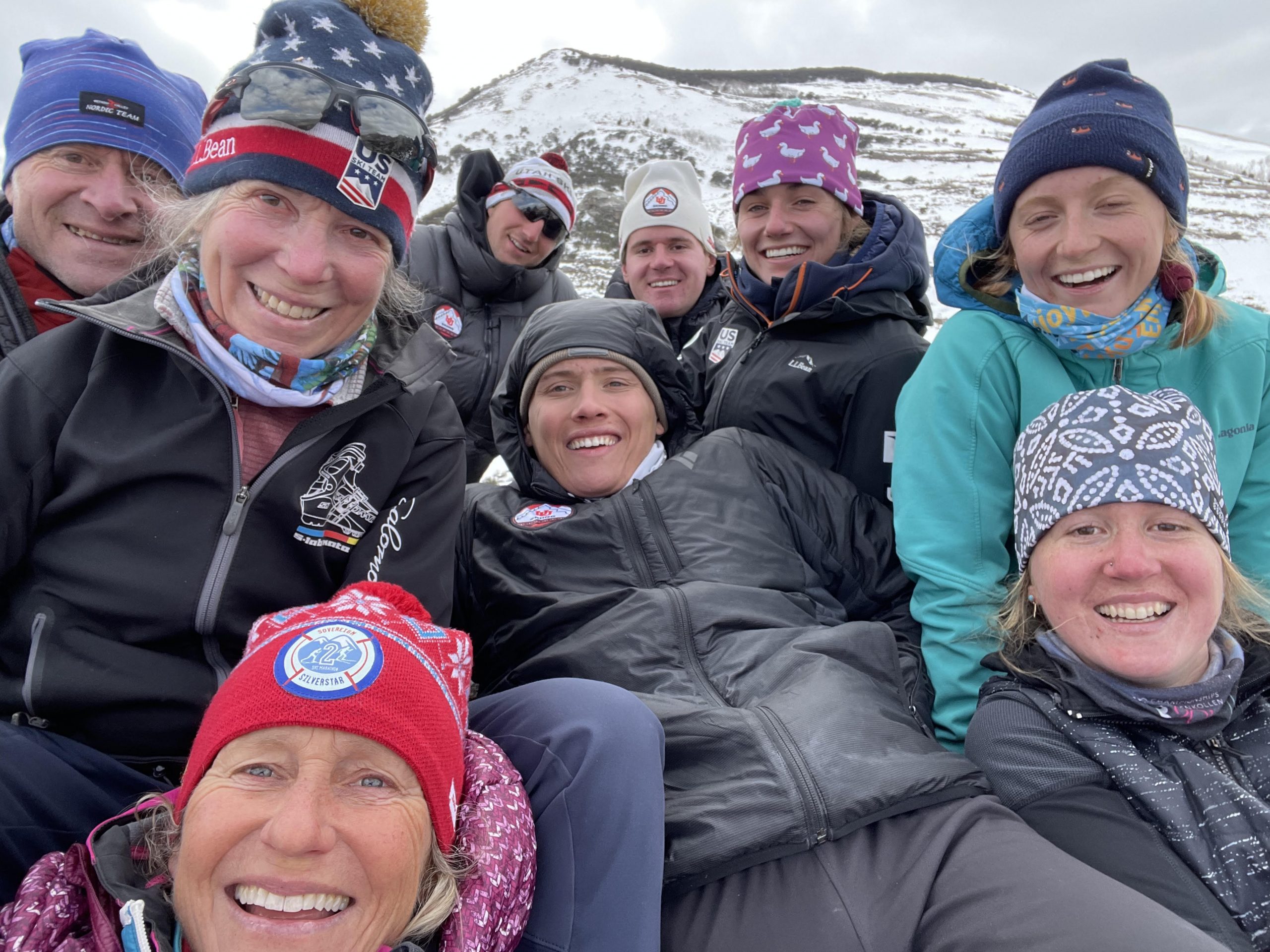
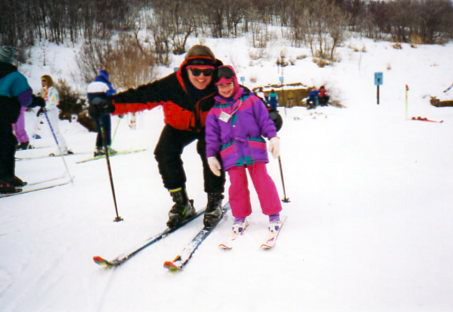
Laura, Sean, and young Novie McCabe. (Photo: Courtesy Photo)
The Valley That Built Her
The story begins in the Methow, where winter is less a season than an identity. “I grew up in the Methow Valley, which is like a small valley in north central Washington with a pretty big ski community,” McCabe recalled. “I think we have the most Ks in North America or something when the skiing is good.“
Her mother, former U.S. Ski Team athlete Laura McCabe, and her mother’s longtime friend Leslie Hall helped build the Methow Valley Nordic Club from scratch. McCabe grew up inside the culture they created: open, community-driven, relentlessly outdoorsy, and—maybe most importantly—fun.
“I was lucky enough to have a really big group of kids my age who all just kind of happened to be really close friends,” she said. “We would all just be active together and spend a lot of time outside… backpacking trips all the time together.“
Skiing was less a pursuit than a language. Practice might include ultimate frisbee on skis or just exploring terrain with no agenda beyond movement. “That was the main thing that got me so excited about skiing—the community,” she said. “It was just what all my friends did.“
These early years formed more than her fitness. They gave her a worldview: skiing should be joyful, shared, and balanced.
“Stay Behind Us—It’s Supposed to Be Easy”
That mindset came directly from her mother’s coaching style. “My mom… would do all the sessions with us,” McCabe said. The education was intuitive, rooted in feel rather than metrics.
“It was very feeling-based,” she said. “Like, in L3 you should be able to talk to me and give me a sentence back at least when I ask you how you’re feeling.“
Heart-rate monitors were used only sparingly—tools to complement the athlete, not dictate behavior. “We maybe did lactates once or twice the whole time I was in high school,” she said.
One lesson, in particular, stuck with her. During easy sessions, her mom and Leslie Hall would say:
“You guys have to stay behind us because it’s supposed to be easy.”
The rule was simple, but the philosophy was profound: fundamentals come from awareness, not pressure.
McCabe laughs that even today, in anything resembling an ultra-distance test, the result might still tilt toward her mom: “She might have the upper hand in anything longer than 50 k.“
Novie McCabe during the 20 k Classic at the NCAA Championship hosted by Saint Laurence University in Lake Placid in 2023. McCabe controlled a pack that also contained her teammates, Sophia Laukli and Sydney Palmer-Leger. McCabe led the UU women, who finished 1st, 3rd, and 5th, on the day that propelled the Utes to their 4th consecutive NCAA Championship. (Photo: (c) Nancie Battaglia).
Utah and the COVID Bubble
By the time she left the Methow, McCabe was ready for a bigger arena. She chose the University of Utah for its coaching, competitive team environment, and growth opportunities.
“At that stage in my life, I was pretty ready for it,” she said.
Her first year unfolded in the disruptive isolation of COVID—a strange, surreal time that somehow fostered uncommon cohesion.
“It was the heart of COVID isolating, but honestly, kind of in a fun way,” she said. “We were just hanging out as a team all of the time.“
Despite Utah’s reputation as an NCAA powerhouse, she never felt crushed by expectations. “It didn’t feel like a high-pressure situation,” she said. “They were there to help us get the best out of ourselves.“
She balanced training with academics, majoring in political science and minoring in economics. Even then, she was thinking beyond skiing.
Novie McCabe skiing for APU. (Photo: Courtesy Photo)
Leaving Eligibility on the Table
After her third year, she made a difficult decision: she left Utah with two years of NCAA eligibility remaining.
“I just felt kind of ready to move on from the NCAA,” she said. The experience had been positive—”I think everyone should go NCAA… It’s so fun and great for development,”—but the structure had become limiting.
She wanted freedom: to race World Cups without constant travel back to the U.S., to pursue her development without logistical whiplash.
“I wanted the freedom to race as many World Cups as I wanted during the season and not fly back and forth so much.“
Once she accepted that her path needed to diverge, the next step was obvious.
Novie McCabe and Luke Jager. (Photo: Courtesy Photo)
Anchorage and the APU Reboot
Anchorage had already become a meaningful place—she had been coming there every summer since her first year at the University of Utah. Her partner, Luke Jaeger, is from there. And she had trained with APU coach Erik Flora for years.
“It honestly wasn’t even much of a decision,” she said.
Flora’s coaching became a stabilizing force. “Erik Flora is really awesome when things are going wrong,” she said. “He knows how to help athletes sort through challenges… It’s never a linear path to success in skiing or any sport.“
APU offered a training environment grounded in trust and peer excellence. “This year there is a pretty big girls’ group,” she said. “Kendall Kramer, Quincy Donley, Annabel Needham, Haley Swirbul, we have a big crew.“
Training with athletes like Rosie Brennan and Swirbul created a layered mentorship:
“They have been and are some of the best in the world.“
Anchorage became the center of her athletic and personal rebuild.
Novie McCabe joined by family and friends for a climbing adventure. (Photo: Novie McCabe)
The Year Without Racing
McCabe didn’t race at all last winter, more or less. At the time, she explained this as part of a balance project—but in reality, the situation was more complicated.
“I have historically been kind of bad at the balance thing,” she said. “My happiness is sometimes quite dependent on skiing.“
That year became a forced reset, with significant emotional and physical consequences.
“I think I’ve gotten better at it,” she said. “I’ve found some things that I really do like to do outside of skiing.” She mentioned baking, cooking, reading, and spending time outside in ways that weren’t tied to training logs.
Yet she was still searching for answers.
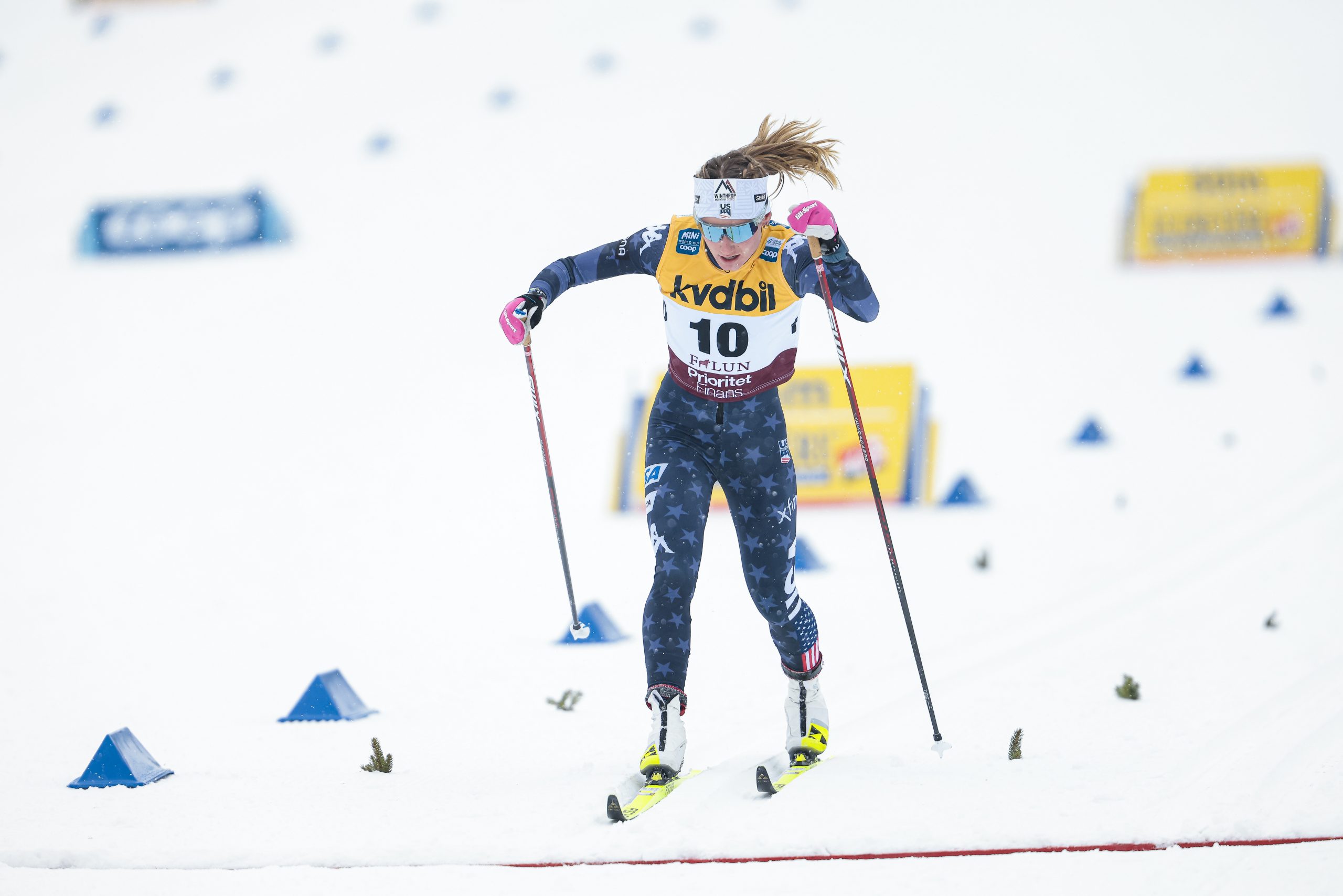
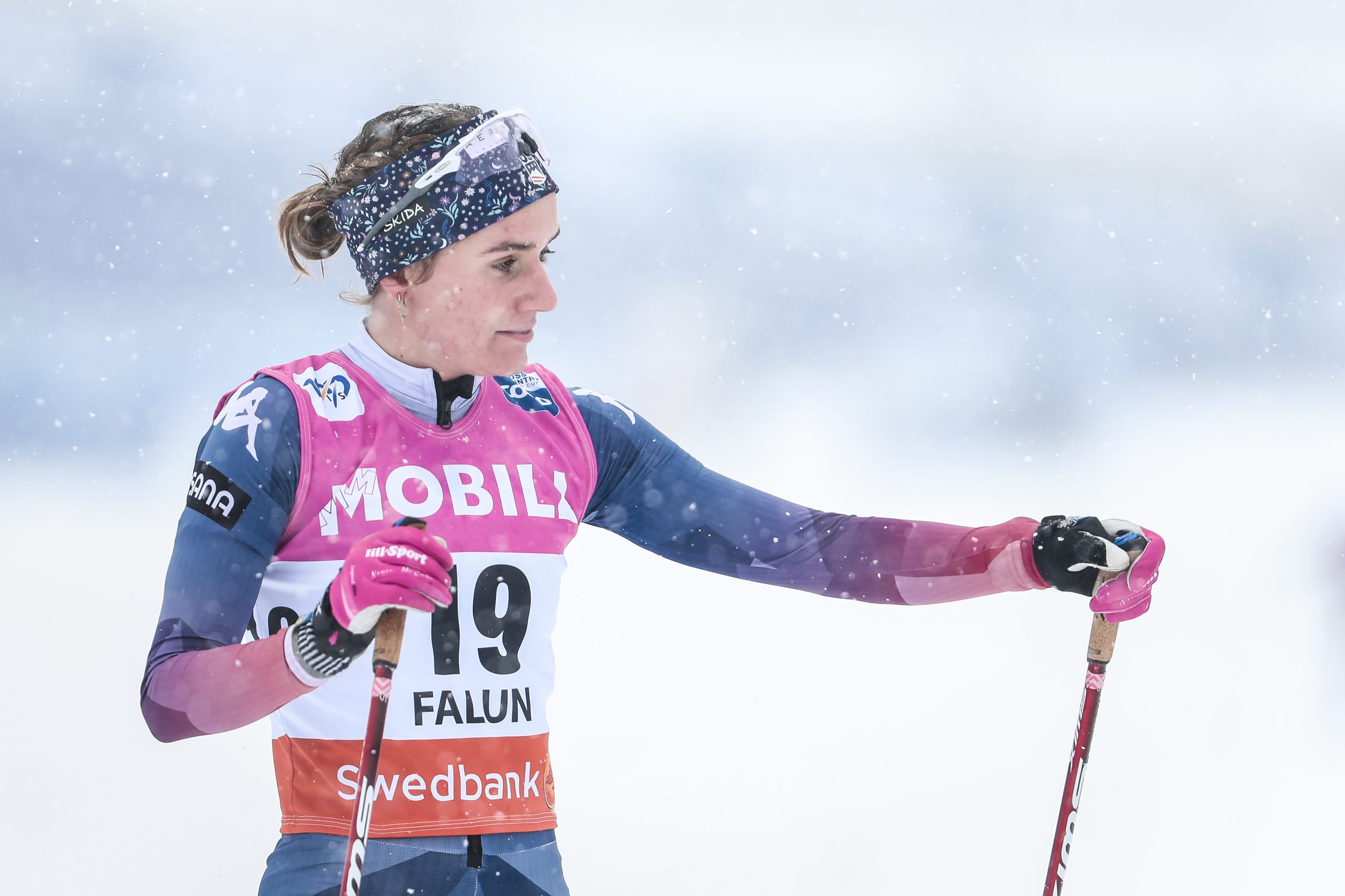
One of Novie Mccabe’s (USA) career highlights was her top 15 finish in Falun, Sweden in a Classic race. (Photo: NordicFocus)
A Quiet Battle Behind the Scenes
After our original conversation, McCabe followed up with more context—an important layer we had not fully jumped into earlier. For the past two years, she has been navigating what she called “some mystery health challenges,” a swirl of symptoms that worsened last fall to the point where racing no longer felt possible.
“The best guess of most of the doctors I have seen is some sort of post-viral or chronic fatigue thing,” she wrote, “possibly combined with some issues keeping my celiac and Hashimoto’s in check, but I am still not really sure what is going on to be honest.“
She spent the winter searching for stability rather than start lines.
“I have taken a pretty cautious approach to training this year and just been trying to build back into it super slowly and give a lot of extra attention to rest and recovery,” she said. “And I do feel like I made some solid progress.“
Even now, she remains cautious. “The past two weeks have been a bit of a step backward,” she said. She’s not entirely sure she will race in Fairbanks. Her hope is modest: “One race there and one race in Anchorage, just to give myself a bit more recovery between hard efforts.“
Still, the optimism in her message is unmistakable.
“It means a lot to be back in a place where racing seems like more of a possibility.“
“I will definitely consider it a win if I get to do some racing this year and make some more progress toward feeling like myself again.“
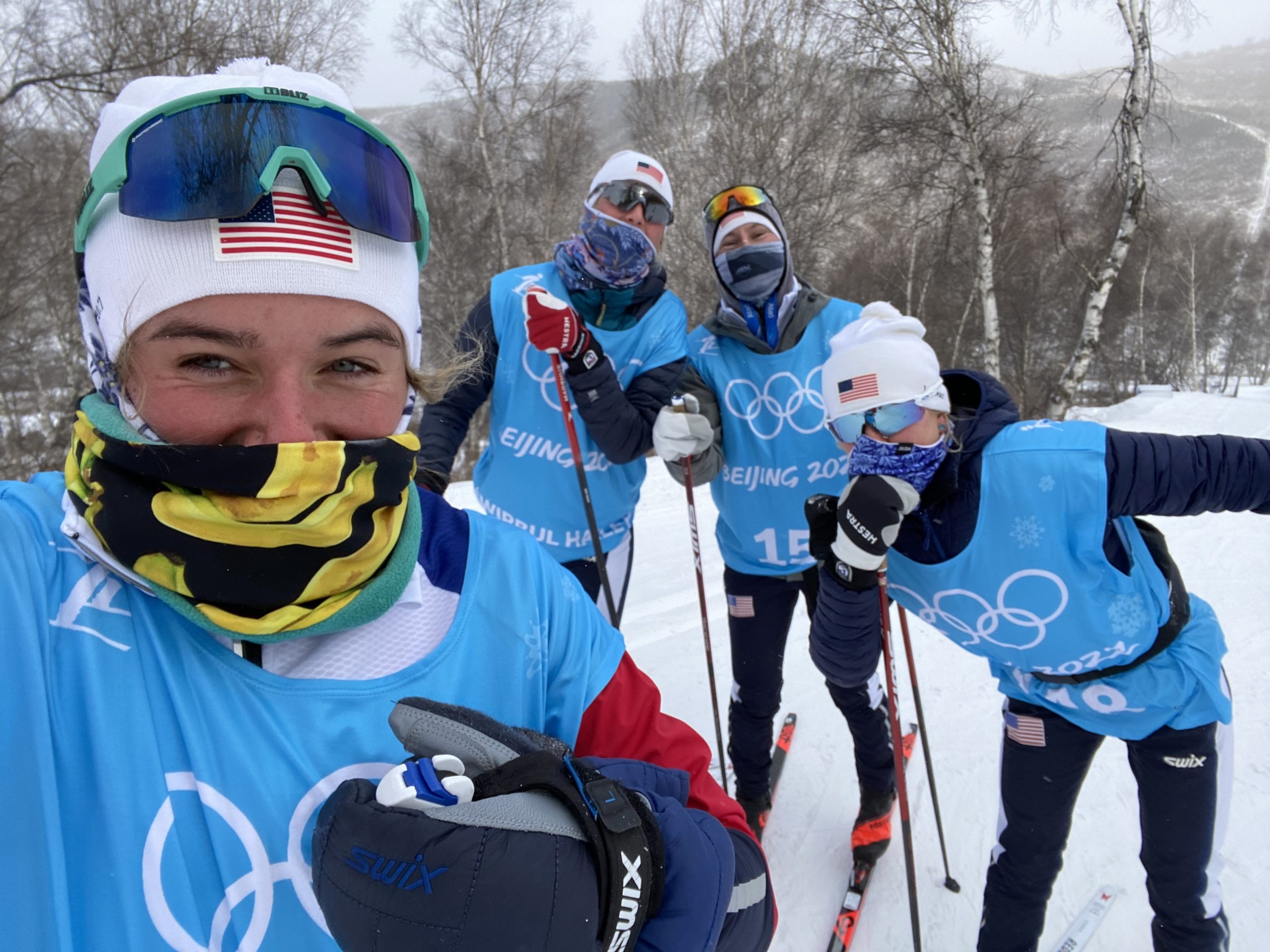
McCabe credits her teammates with helping her develop the traits that won her recognition. Here she is training in Beijing with Hailey Swirbul, Hannah Halvorsen, and Sophia Laukli. (Photo: Novie McCabe)
Team USA on the Road
The U.S. Ski Team’s culture is widely celebrated—glitter, dance videos, and road-trip camaraderie. McCabe grew up watching those clips.
“I would see their dancing videos from the World Cup and be like, ‘That just looks like the best time ever.’”
But she knows now that joy is a decision, especially when you’re far from home. “Sometimes you have to decide that it’s going to be a good time,” she said. “Everyone does an excellent job of being good teammates.“
That environment matters, especially in challenging seasons.
Novie McCabe skates a strong third leg for Team USA in the 4 x 5 k relay at the Beijing Olympics in 2022. (Photo: NordicFocus)
Europe: Brown Cheese, Ferris Wheels, and Perspective
Her memories of Europe arrive in flashes of color rather than race results.
“I love brown cheese,” she said. “You can get it here, of course, but it’s not as good.“
She recalls Trondheim at Christmas—”Ferris wheel and everything“—and moments where she stepped outside the hotel room and let herself experience the place.
These glimpses matter because they remind her of what she still wants from her career: a stable return to the World Cup, a chance to live in that rhythm again.
And through all her travels, she keeps a single talisman:
“Katherine Ogden made me a crochet octopus one year… I’ve brought it along as a good luck charm ever since.“
Novie McCabe after the World Cup 10k in Falun, Sweden, in 2024. (Photo: NordicFocus)
The SuperTour Returns — and She Hopes to Join It
Which brings the story back to this week, and the opening races of the season. “I haven’t started a season domestically in like four or five years,” McCabe said. But she’s doing this season differently.
She is hopeful she will race—one race in Fairbanks, one in Anchorage, if her body allows. More than anything, she wants to be thoughtful and patient.
“My main goal is to make the Olympics,” she said. But this winter, her priority is health. “Being able to race and stay healthy and recover… that would look like a win for me.“
The Olympic qualification system is, as she put it, “really complicated“—top-45 overall rankings, top-8 results, SuperTour contingencies. But she isn’t thinking that far ahead yet.
She’s thinking about one start line. One bib. One race that feels like progress.
Becoming Who She Meant to Be
If you fast-forward five years, she still knows exactly where she wants to be.
“I, for sure, dream about being one of the best skiers in the world,” she said. “I hope to be able to compete with the best one day.“
She also knows this path no longer looks how she imagined it “four years ago.” But she has something she didn’t have then: perspective, patience, and a grounded sense of herself.
Back in Anchorage early last month, the snow hadn’t fully arrived. It mirrored her season ahead—close, possible, not yet certain. The SuperTour begins this weekend, and McCabe is on the edge of stepping back into the environment she loves.
Maybe in Fairbanks. Maybe in Anchorage. Maybe later.
But the hope is real. The joy is returning. And somewhere in her bag, the crocheted octopus is still waiting.
Love Stories Like This? Help Keep Them Coming.
Feature interviews like this one take time, access, and care to produce. If you value thoughtful storytelling and independent ski journalism, please consider becoming a Voluntary Subscriber. Your support directly fuels the work we do to cover the people, places, and moments that make our sport special.
The first flakes had finally settled on the branches behind Rosie Brennan’s window in Anchorage. “Yeah, finally,” she said, turning from the screen toward the light outside. “God, it was slow to come, but we are getting there.” Snow matters in November for any cross-country skier. Still, for Brennan—now entering her fifteenth season on the U.S. Ski Team—it has always represented something deeper: familiarity, grounding, the landscape she moves through on her own terms.
Independence, more than victory or longevity, is the quiet force running through her career. Long before she became an Olympian or a World Cup all-arounder, before the podiums and the endurance of her late-blooming rise, she was a kid in Park City who needed space—space to move, explore, test herself, figure out where she belonged. Ski racing would give her a path, but the structure of the World Cup would also challenge the part of her that had always craved autonomy.
Rosie Brennan (USA) celebrates after finishing 2nd in the 10 k classic race in Ruka, Finland in 2023. The result was Brennan’s first classic World Cup podium of her career. (Photo: Nordic Focus)
“I’m a very independent person,” she told me. “So to suddenly be told what your day is gonna look like every single day is mentally… exhausting for me.” It’s the kind of line that quietly explains everything: her training, her rituals, her late-career resilience, and the internal negotiations required to live five months of every winter inside a system built around tight schedules, shared spaces, and routines she cannot control.
That independence—both threatened and defended—shapes the story of Brennan’s life in skiing as much as any result sheet.
“From the FasterSkier Archives: While I never actually went cross country skiing with my Dad, he was incredibly influential in his love for the outdoors and ability to truly enjoy life. My dad taught me to alpine ski and mountain bike, both were activities in which he challenged me and was always up for a race. I don’t know if my mom will ever get over just how much I ski like him. My dad had a great ability to do things in a big way in order to maximize the enjoyment out of each adventure and he did so with incredible passion. I can’t say I have fully learned this yet, but his spirit and enjoyment of life certainly are in me and I think often about how to embrace this a little more each day. At the very least, I have learned to be very passionate about the things I love. My favorite place in the world is the Southern Utah desert and I think my love for the desert stems entirely from family fun, particularly with my Dad.”
A Childhood of Motion
Brennan grew up in Park City, not in some improbable ski-wilderness origin story, but in a family that valued movement the way others emphasize music lessons or math tutoring. “Everyone did outdoor activities,“ she said. “We were pretty typical in that sense.“ Winters were alpine ski weekends. Summers meant hiking and biking. Gymnastics arrived because she liked the conditioning. Soccer came because she could run “a whole game.”
She was athletic but not yet an athlete. “I participated in soccer,“ she said, without pretense. “I won’t say I was crazy competitive in that. And same with gymnastics—I didn’t compete at all, but I really loved it.”
What she loved about gymnastics, specifically, she said, was the work:
“I think it was more, actually, just the strength component… the actual conditioning part. That’s what I really liked.”
The shift toward cross-country skiing came from her mother, whose winter rule was simple: pick an activity. “She was the one who just kept suggesting, ‘You should try the Nordic team,‘” Brennan said. “Finally, I was like, well, I got no better idea, so fine, I’ll try it.”
If her mother’s persistence nudged her toward snow, the 2002 Salt Lake Olympics made the possibility feel real. Brennan was in seventh grade. Her family hosted a Nordic combined athlete. Youth camps sprang up everywhere across Utah.
“I think a lot of it was subconscious,“ she said. “But that obviously had a massive impact on my wanting to pursue other things.”
Then came the moment that still feels slightly mythical in her telling: she found skiing, and skiing made sense to her in a way nothing else had.
“I could see the path forward,“ she said. “It was just… really motivating to me.”
The First Signs of Something
Her early results were small but decisive. “I actually won my first race, but there were only two people in it,“ she said, laughing. “But I honestly think that was kind of powerful for me. Like, oh—if I can beat one person, I can probably beat some other people.”
Within two years, she went from missing Junior Nationals to winning all the distance races at JOs. She remembers calling her mom.
“Mom, I won.” “No, you didn’t.” “No—really, I did.”
When Brennan made World Juniors and cracked the top ten, she earned her first spot on the U.S. Ski Team. It felt surreal, but the reality is that she wasn’t fast because of some stroke of talent. She was fast because she’d been training with boys for years, trying to keep up. “It was one of those social situations in which it’s like, keep up or don’t have friends,“ she said. “So I was like, all right, I’m keeping up.”
Her team was small, her training unorthodox. “I did quite high intensity for junior,“ she said. “But very low volume.“ Meanwhile, she ran fall seasons because running was what she could control.
Autonomy was already the central language of her development.
Rosie Brennan (DAR) Lake Placid SuperTour 2011
The Dartmouth Choice
By the time she visited colleges, Brennan had become a known junior—national team member, World Juniors top-10 skier, and a real recruit. Her first choice was Colorado. They didn’t offer a scholarship. Dartmouth didn’t offer scholarships either, but it did offer something better: Cami Thompson-Graves.
“Her investment was in me and not, like, an NCAA title,“ Brennan said. “That was very obvious… she was willing to help me manage all of it.”
Dartmouth gave her what she needed: an independent women’s team after training primarily with men, a coach who saw the whole person, and a program flexible enough to accommodate a U.S. Ski Team schedule. She raced all four years, graduated in the traditional four, absorbed the mentorship of teammates like Ida Sargent, Sophie Caldwell, and Erica Flowers, and even shared training space with Susan Dunklee.
Dartmouth let her remain the version of Rosie that worked.
But the World Cup—its structure, its relentless pacing—would test that.
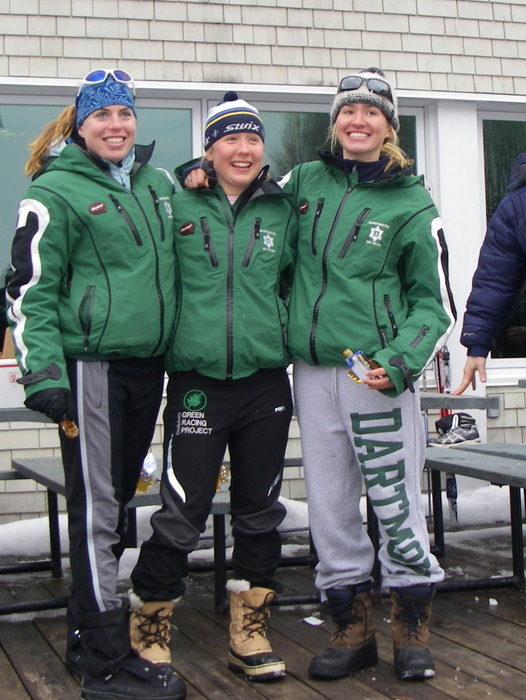
Rosie Brennan, Ida Sargent and Sophie Caldwell of Dartmouth, March 2010
Learning to Live in Europe
Her early World Cup years were steady—no fireworks, no collapses. She attributes the eventual breakthrough to something simple: time. “If you think about someone who starts at five,“ she said, “they’re good at 22. That’s the same number of years it took me. It just skewed by a decade.”
But the other part of her progression came from learning how to survive Europe.
“I mean, I finally had trained at a consistently high volume,“ she said. “But I also found it just took a long time to figure out how to manage in Europe.”
What was so hard about it? Not the racing. Not the waxing. Not the altitude.
It was the loss of personal freedom.
“To suddenly be told what your day is gonna look like every single day is exhausting for me,“ she said. “The freedom of being able to jump in your car and go somewhere—that’s gone for like five months.”
The World Cup removes the choice of when you sleep, where you eat, andhow you move through your day. Athletes share hotel rooms, team vans, dining halls, training sessions, and travel itineraries. It works beautifully for some. For Brennan, it was disorienting.
There were no models for how to do it differently. “The example they have is Jessie,“ she said. “She thrives on the road. She’s happy as she can be living in a bag for five months.“ But if you are not Jessie Diggins, Brennan said, “that’s really hard.”
So she began—to use her word—to “navigate.”
“I learned to get pretty good at the bus schedule,“ she said. She found bakeries in every town. She found grocery stores that sold the one piece of candy she liked in that country. She found trails “maybe off the beaten path“ that she returned to each year. She learned to take mountain days, not for training but for sanity.
These rituals were tiny, private rebellions—the things she could choose inside a world where most things were selected for her.
Rosie Brennan and coach Erik Flora (APU) ski on the World Championships sprint course in Trondheim on Wednesday, February 26, 2025. (Nathaniel Herz/FasterSkier)
A Coach Who Understands Her
If Europe tested her independence, her relationship with APU Head Coach Erik Flora reinforced it.
“He has been, like, everything for me,“ she said. “He’s kind of saved my life many times over.”
What she means is that Flora understands her wiring. He sees what she cannot always express.
“He has this ability to just watch you train and know exactly what’s going on in your life,“ she said.
That sensitivity carried her through some of the most challenging years of her career. During Covid, Flora couldn’t travel much; last season he could only watch occasional race film. It wasn’t enough. Brennan needed someone who knew her patterns—her real patterns—not just her splits.
“When I was in the thick of it last winter,“ she said, “he wasn’t there… that’s why ultimately I did end up coming back [to Anchorage]. I needed some of that support.”
Their relationship—its longevity, its trust—became essential when her body began to unravel.
Rosie Brennan (USA) after finishing the 10 K Classic at the FIS Nordic World Ski Championships in Trondheim (NOR). (Photo: Modica/NordicFocus)
A Year the Body Wouldn’t Cooperate
For a year now, Brennan has dealt with a medical mystery—post-viral symptoms likely tied to Epstein-Barr reactivation. “It just, like, really screwed up a bunch of my internal systems,“ she said. “My endocrine system has been shot.“ The effects were unpredictable: inability to push hard, severe inflammation, poor recovery, andmuscle shutdown during intensity.
“Last season I was struggling with… I just had zero ability to use my muscles to push hard,“ she said. “I was just racing on base fitness.”
It wasn’t one bad race. It was the absence of the feeling she loved most that was most frustrating.
The Training Fix
She and Flora tried to solve it through training, but even threshold sessions wiped her out. “It was more the duration part that was killing me,“ she said. They tried sub-threshold work. They tried controlled sessions. Nothing stuck.
So they invented something new: Sub-one-minute Level 4 efforts, hundreds of them, designed to keep neuromuscular pathways awake without triggering overload.
“Basically, what I’ve been doing is what I call micro intervals,“ she said. “I do go level four, but under a minute, many times.”
Strength? Gone. “Strength was destroying me,“ she said. “So I haven’t done any weight-room strength.”
Endurance? Reduced to what she could handle. “I got to a place where I was like, all right—I’ll have to be super excited when I get to go for an hour.”
Most of the battle, though, wasn’t physical.
“There were many times this last year that I have seriously contemplated walking away,“ she said. “I actually tried pretty hard to in August.”
But Flora kept calling—checking in, refusing to let her disappear into the uncertainty.
“I guess I’m not getting away that easy,“ she said.
Brennan took second in the 10-k Classic in Trondheim in 2023. Rosie Brennan (USA), Victoria Carl (GER), Ebba Andersson (SWE), (l-r) 10km podium in Trondheim (NOR). (Photo: Modica/NordicFocus).
Why She Keeps Going
When asked what pulls her back to the sport each day, Brennan didn’t talk about results, medals, or even the Olympics.
She spoke of the feeling.
“I truly love the feeling of being able to push myself,“ she said. “It gives me this sense of freedom that I can’t find anywhere else.”
Freedom—that word again. Not competition. Not performance. Not success. Freedom.
It’s the sensation she’s chased since she was a kid, running entire soccer games simply because she could. It’s the sensation skiing first gave her at 14. It’s the sensation the World Cup often constrains, and the sensation her body has withheld for a year.
But it’s also the sensation that makes her keep trying.
She has leaned heavily into mental work this year. Meditation, mindset projects, and conversations with a U.S. Ski Team sports psych, as well as a teammate who has faced similar issues.
“I was very motivated by her,“ Brennan said. “It was cool that she was taking this time to strengthen her brain, too.”
The process has made her reflective, grounded, andmore self-aware than at any point in her career.
Rosie Brennan (USA), shares a podium moment with coach Matt Whitcomb in Ruka, Finland in 2023. (Photo: NordicFocus)
Leaving for Finland, and What Comes After
Now, on the eve of the World Cup opener, Brennan is set to travel to Finland. She will not race everything. “Maybe two races a weekend,“ she said. They’ll experiment. Observe. Adjust. She plans to return to Utah for Christmas, meet with her medical team, and decide what the rest of the season should look like.
“It’s possible I try to race, and it’s a disaster,“ she said. “We may have to totally redo the plan.”
She won’t do the Tour de Ski—too risky. The goal is simply to get to the Olympics “in the best way possible.“
The million-dollar question, of course, is whether this will be her last year.
“I don’t really know,“ she said. “Most likely something will look different next year. Whether that involves racing or not, I’m not totally sure.”
But she’s proud of the career she’s built. Proud of navigating Covid. Proud of her longevity. Proud that she became a true all-arounder.
“That was definitely a big career project,“ she said. “When I finally did that, it felt really big.”
Rosie Brennan races the individual freestyle sprint qualifier during the 2022 Olympic Winter Games in Zhangjiakou. (Photo: NordicFocus)
Holding Her Own
What emerges from Brennan’s story isn’t a tale of triumph or decline. It’s the portrait of a person who has made peace with the complexity of the life she leads.
She has learned how to navigate Europe—not by loving it, but by building rituals that let her remain herself within it. She has learned to trust her body even when it betrays her, and to trust her coach when she doesn’t trust herself. She has learned that the World Cup isn’t designed for independence, and that independence—her independence—is worth defending.
She has also learned that racing is only part of who she is. She’s a geography major who loves the Arctic for its unique beauty, a mountain person who seeks out quiet trails, and a traveler who can always find a town’s best bakery.
And she’s someone who, after a year of medical uncertainty and near-retirement, still wants one more chance at the feeling she can’t find anywhere else.
That, ultimately, is why she’s boarding the plane.
Because even in a world that demands structure, she is still defining her own path.
Love Stories Like This? Help Keep Them Coming.
Feature interviews like this one take time, access, and care to produce. If you value thoughtful storytelling and independent ski journalism, please consider becoming a Voluntary Subscriber. Your support directly fuels the work we do to cover the people, places, and moments that make our sport special.
We don’t yet know if this season is Brennan’s final curtain call, where she will ski off into the sunset, but we do know she has nothing left to prove.. (Photo: Nordic Focus)
When JC Schoonmaker talks about his earliest memories of ski racing, he doesn’t begin with speed or snow conditions, or the particular magic of gliding across winter trails. He starts, instead, with raffles. “I just remember as a kid, there’d be raffles after every race that I would be so stoked for,” he says. “Trying to get a prize, like a new pair of gloves or a hat.” It is an unexpectedly tender snapshot of a skier now known for his explosive starts and the sharp, angular drama of World Cup sprint heats. But it is also revealing. Long before Schoonmaker was on national team radars, long before he was analyzing sprint tactics or refining breathwork, he was simply a boy who loved showing up at races, surrounded by friends, snow, and the possibility of leaving with a hat.
Schoonmaker grew up in Tahoe, a place where winter sport is woven into the fabric of childhood. Yet unlike many of the region’s rising athletes, he was not funneled into Alpine skiing or a single disciplinary track. Instead, he moved constantly—and in every direction. “Both my parents were super athletic, into sports,” he says. “So from a really early age, I was just doing tons of different stuff: soccer, downhill skiing, andNordic skiing. I played lacrosse. A little bit of baseball.” The variety shaped him in ways he didn’t appreciate at the time: balance from soccer, strength from downhill, elasticity from lacrosse, and a developing sense of rhythm from all of it.
Meanwhile, the Nordic community in Tahoe was small enough to feel intimate yet substantial enough to provide him with peers, mentors, and a place to grow without suffocation. “Joining a Nordic team for me was super fun because I got to go out and ski with friends,” he says. “It was kind of my first experience racing.”
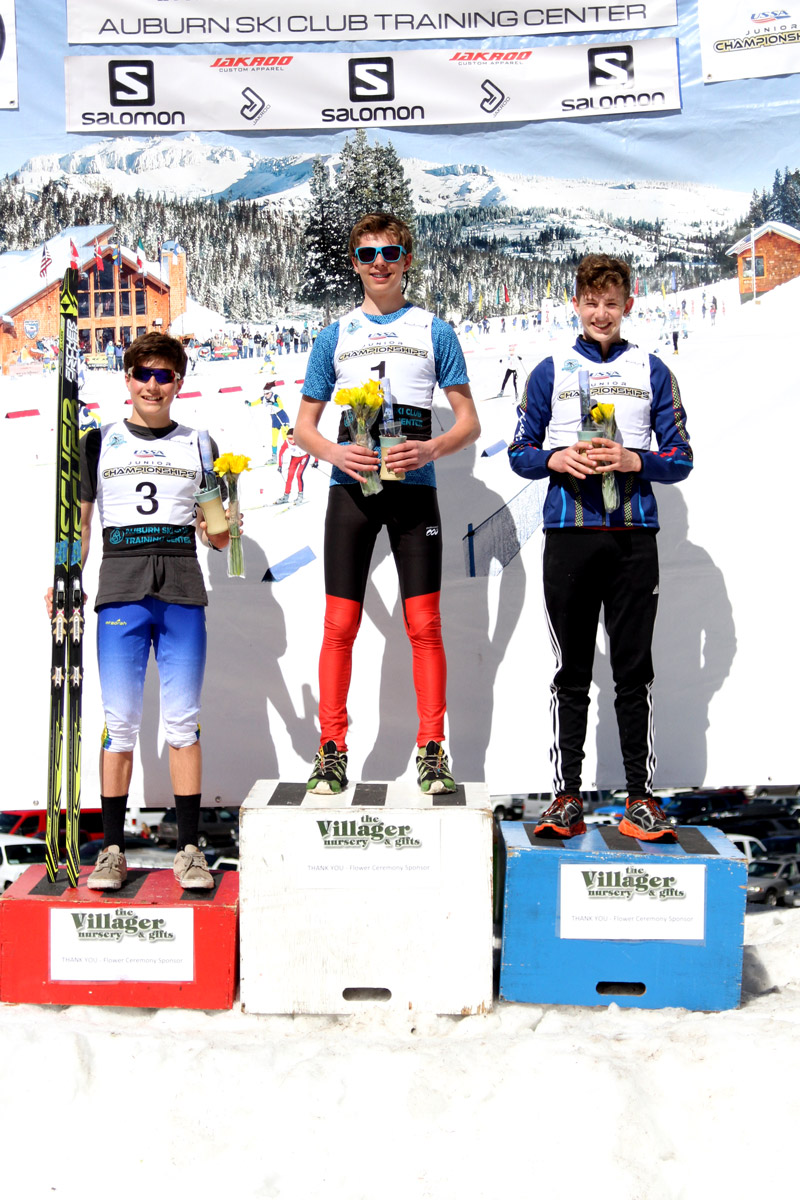
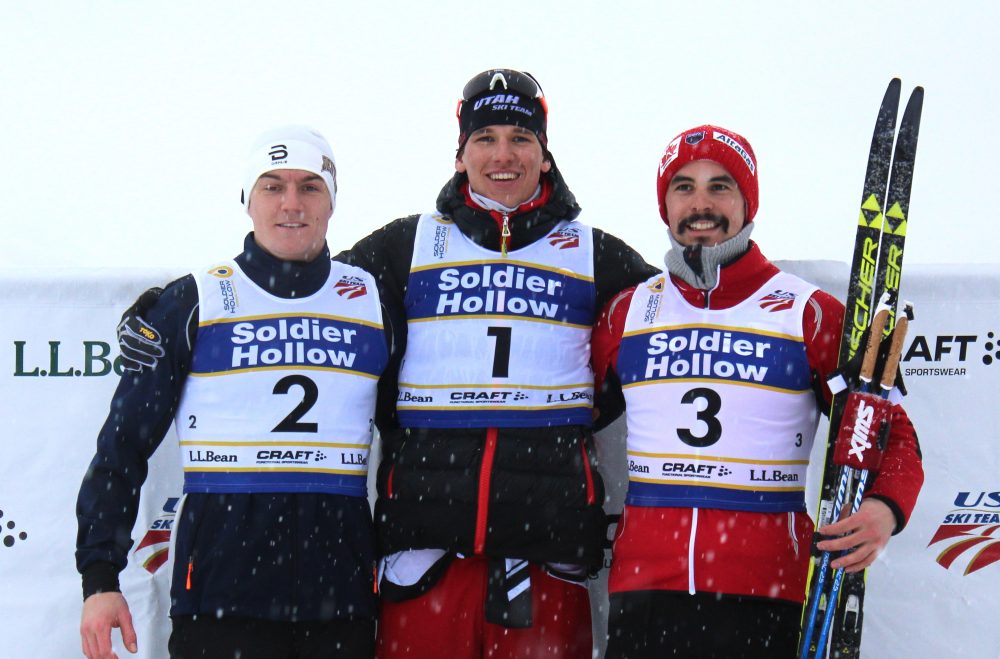
The U16 men’s podium from the 5 k Classic Mass Start at 2015 U.S. Junior Nationals at Auburn Ski Club in Soda Springs, Californial. JC Schoonmaker took home third place. (Photo: Mark Nadell/MacBeth Graphics)
Early Validation in Soldier Hollow and Truckee
It wasn’t until he traveled outside his region that Schoonmaker realized how he measured up. On a Far West trip to Soldier Hollow—his first time racing beyond his local bubble—he surprised himself. “I think I got third in the first race… then I won the second one,” he recalls. “I didn’t even really know it was a big deal, but all the older kids on the trip were… really excited for me.” Their reaction revealed something he hadn’t yet recognized: that his potential extended well beyond his local podiums.
A similar revelation arrived at Junior Nationals in Truckee, where home snow became a proving ground. He had hoped to earn All-American status, although the early races had gone poorly. “All the first races didn’t really go super well,” he says. “I had high expectations.” Yet in the final individual race before the relay, he stepped onto the podium. “Somehow onto the podium and got third,” he says. “That gave me a bunch of confidence… really helped me.” It was not just affirmation but a directional sign. Skiing was becoming more than an activity. It was becoming a path.
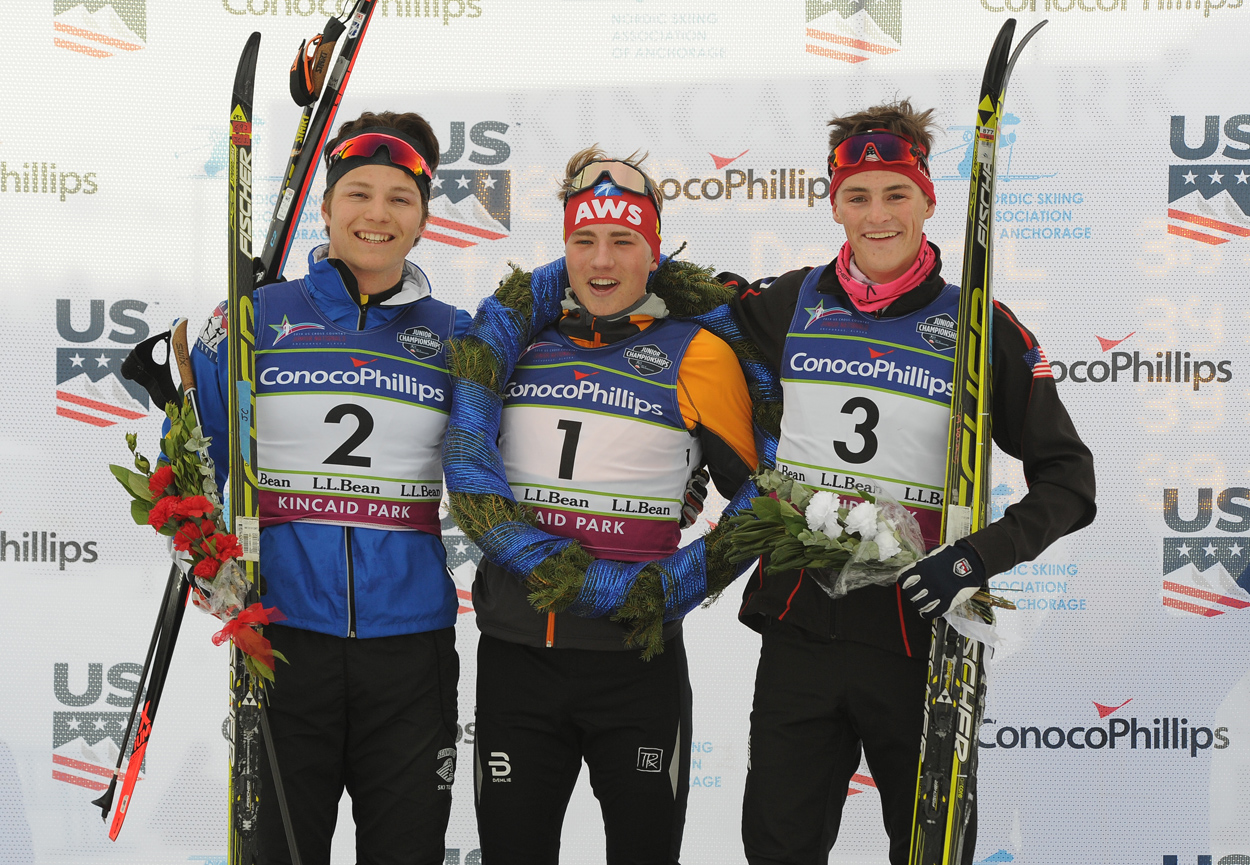
Gus Schumacher (Alaska Winter Stars/Team Alaska), center, won the U20 men’s 15K classic mass start race at the 2019 U.S. Ski & Snowboard Cross Country Junior National Championships at Kincaid Park. J.C. Schoonmaker (UAA-Auburn Ski Club/Far West), left, was second, followed by Cameron Wolfe (Ski and Snowboard Club Vail/Rocky Mountain), right. (Photo: Michael Dinneen)
Choosing Anchorage and the Power of the Right Environment
Despite his junior successes, Schoonmaker’s college recruiting process was sobering. His age cohort was stacked—Gus Schumacher, Luke Jager, Canyon Tobin—and their achievements overshadowed many strong skiers. “My top choice was UVM, and I just didn’t get a spot there,” he says. “I didn’t have a ton of options.” But an unexpected opportunity appeared when a Tahoe friend encouraged him to consider the University of Alaska Anchorage. He visited, and something clicked. “I’d say that’s the best decision I ever made,” he says. “I ended up coming to an excellent team… It’s an awesome place for skiing.”
Anchorage wasn’t glamorous, but it was grounding: clear air, big terrain, and a training culture built on consistency rather than spectacle. Under coach Trond Flagstad, Schoonmaker’s skiing matured—his engine, his technique, and his confidence—all while laying the foundation for a collaborative coaching story that would shape his rise.
A Uniquely Collaborative Coaching Path
Schoonmaker’s development is defined by the unusually harmonious network of coaches who supported him. In Tahoe, he trained with Will Sweetser, whose workout creativity brought nuance to his summer training. At UAA, Flagstad built his fall rhythm with threshold work and bounding. In the winter, U.S. Ski Team coaches—Matt Whitcomb, Kristen Bourne, and Chris Grover—stepped in with race-day craft and a national pipeline. And now, in Anchorage, he works with Eric Flora at APU, whose daily presence has brought structure and clarity.
“I feel like I didn’t even really have to do much in the way of balancing that,” he says. “Trond, Will, and Matt… kind of just took that on themselves.”
That kind of multi-coach collaboration is rare. Instead of conflicting philosophies, Schoonmaker received overlapping layers of expertise, each building on the others. He remembers one of Sweetser’s signature interval sets with particular fondness: “Twenty seconds L5… forty seconds rest… forty seconds L5… then six minutes of threshold. A cool blend… essential for getting you ready for doing sprints on the World Cup.” Flagstad brought heavy doses of fall bounding at L4. Whitcomb and Bourne added race sharpness. Flora, finally, aligned everything. “Having him at World Championships last year made it feel like just a practice in Anchorage,” Schoonmaker says.
JC Schoonmaker (bib #1) at the 2020 Senior Nationals in Houghton Michigan. (Photo: Reese Brown)
The Unexpected World Cup Start That Changed Everything
The first moment when Schoonmaker truly understood the trajectory he was on came suddenly. At U.S. Nationals in Houghton, Michigan, in 2020, he won the sprint qualifier. It was exciting, but he didn’t assume it meant anything beyond that day’s result. Then his assistant coach, Marine Dusser Bjornsen, approached him with unexpected news. “She was like, ‘Oh yeah, you’re gonna get World Cup starts from that,’” he recalls. “And I was like, ‘What? No way.’” His passport was expiring, his bags were unprepared, and within days, he was on a plane to Dresden.
Stepping into the World Cup for the first time felt surreal. “I wasn’t even really worried about those being my first World Cups,” he says. “I was mostly just hoping to get to go over there.” The qualifiers felt manageable; the heats were startling. “Racing against those dudes in the heats… was just a whole other level. A different beast.” Still, he never felt crushed by the moment. “We were just having fun,” he says. “It wasn’t crazy high expectations.” That experience didn’t instantly transform him, but it recalibrated his sense of where he belonged.
APU: A Training Collective That Became Home
When Schoonmaker finished college and committed to training full-time in Anchorage, it wasn’t only because of Flora’s coaching. It was because the environment felt like home. “Luke coming back… Gus joining… Zan and Michael… it was such a good team,” he says. “A lot played into it… but mostly that stuff.” APU is one of the few places in the country where the majority of the national team trains together throughout the year, creating a rare sense of continuity on the World Cup.
Yet even in a group that suits him so well, Schoonmaker knows he needs occasional solitude to stay balanced. “I definitely find times during the summer where I’m pretty excited to do an interval session by myself,” he says. “I grew up training alone in Tahoe.” Winter, of course, is different. “You’re living with this group of people for the entire winter,” he says. “Sometimes it is hard to find time to yourself.” But the team understands him. “Everyone knows whatever’s best for you is what’s best for the team.”
A New Kind of Training: Mindfulness and Sprint Awareness
This year, Schoonmaker added something he had never practiced formally: daily mindfulness training. “Some breath holds… super simple, just five minutes of mindfulness,” he says. “Focusing on my breath, trying not to let my thoughts wander.” The shift wasn’t driven by physical shortcomings, but by an honest assessment of where he needed to grow tactically. “In sprint heats… I’ve tended to have my head down, thinking about my technique… rather than, ‘I need to get this position around this corner.’”
Mindfulness gave him a way to sharpen his presence during races and training. During intervals, he began noticing moments when his focus drifted. “My mind starts thinking about what I’m gonna have for lunch,” he admits. “I’m getting better at bringing myself back… loosen up, ski relaxed.” The work is subtle, internal, and mostly invisible, yet deeply connected to the kind of racer he wants to become.
Passing It On: What He’d Tell the Next Generation
If Schoonmaker were speaking to a group of juniors in Tahoe today, he would know exactly what he would emphasize. “I love this puzzle of trying to get better every day,” he says. “Focus on the small things you can control… let the cards fall where they fall.” But he would also add a piece of training wisdom gained from experience. “I almost feel like I got a little too caught up in L1 and L3,” he says. “Walking up hills on classic skis isn’t getting you better at classic skiing. You have to ski fast to get better at skiing fast.” It is the kind of message that cuts through both trends and dogma.
Life on the Road: Davos, Oslo, and a Simpler Suitcase
Schoonmaker’s favorite destinations reflect a balance of beauty and familiarity. Davos stands out. “I’d love to go there when I’m not getting ready for the Tour de Ski… explore it a little more,” he says. He also holds a soft spot for Oslo. “That’s a special spot. I always feel like I’m having a really good time there.” On race mornings, he keeps things simple: “Probably a couple eggs and a few pieces of toast with jam.” And he no longer travels with the heaviest item from his early career. “I brought over an Xbox… took up, like, 12 pounds in my bag,” he laughs.
Schoonmaker and girlfriend, Emma Ribom (SWE). (Photo: Courtesy Photo)
Olympic Season: Ambition, Clarity, and the Calm Before the Heats
Despite the stakes of the Olympic year, Schoonmaker hasn’t reinvented his approach. “I honestly haven’t been doing anything different,” he says. “I’m more excited to be healthy and head into Period 1 feeling good.” But his goals are not small. “My goals would be to win a medal,” he says. “That’s what I’m shooting for.” A chance to race the relay again is just as meaningful. “The relay in Trondheim was super fun,” he says. “I would love to get another chance.”
As for the individual sprint, his ambition is both grounded and bold. “If I could make the final… that would be a solid day,” he says. “But I do feel like I can win a medal.” Few athletes can express that kind of aim with such composure. Schoonmaker delivers it as calmly as if he were describing a morning ski.
JC Schoonmaker (USA) had a breakout day in Oestersund (SWE) in 2023, reaching the podium for the first time. The American took third place. (Photo: NordicFocus)
Where He Stands Now
What stands out most about Schoonmaker at this moment is not bravado, but clarity. He is no longer the boy who raced for raffle prizes, nor the college skier unsure of his place, nor the rookie dragging an Xbox through European airports. He has become something steadier, more self-aware, and more intentional. A sprinter with composure. An athlete with perspective. A competitor capable of holding his ambition lightly without losing its sharpness.
Presence, for Schoonmaker, is not stillness. It is an ongoing process of tuning himself to the shifting rhythms of a sprint heat, listening to what his mind and body are telling him, and moving through the season with intention rather than urgency. If he keeps his head up—literally and figuratively—this may be the season when the skiing world begins to see not only what he has built, but why it was built this way.
Love Stories Like This? Help Keep Them Coming.
Feature interviews like this one take time, access, and care to produce. If you value thoughtful storytelling and independent ski journalism, please consider becoming a Voluntary Subscriber. Your support directly fuels the work we do to cover the people, places, and moments that make our sport special.
This reporting costs money. Please support this coverage with a voluntary subscription (below) so FasterSkier can provide this level of access to the sport we all love year-round.
This coverage is made possible through the generous support of Marty and Kathy Hall and A Hall Mark of Excellence Award. To learn more about A Hall Mark of Excellence Award, or to learn how you can support FasterSkier’s coverage, please contact info@fasterskier.com.
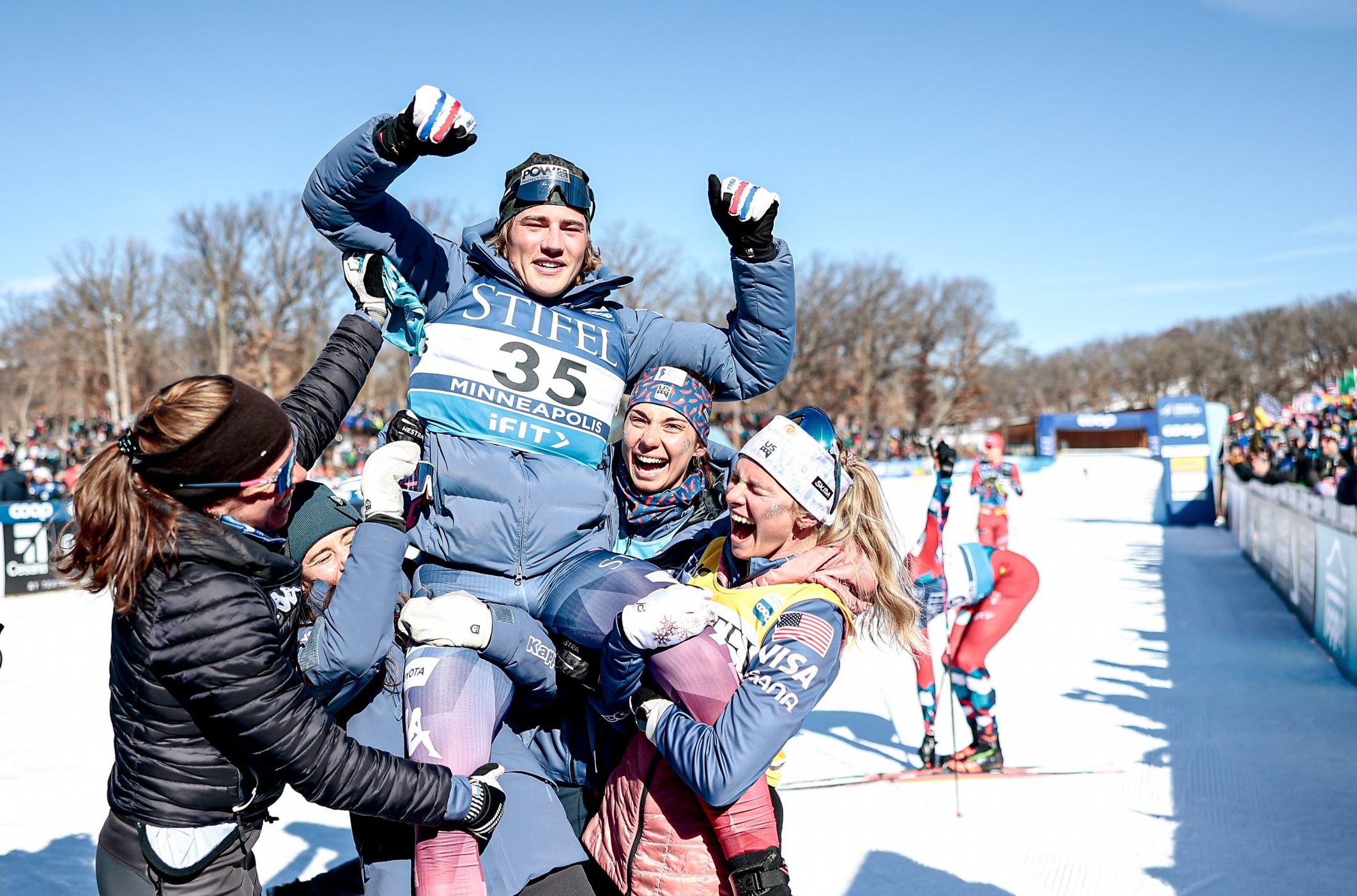
U.S. Ski Team members, including Jessie Diggins, right, hoist Gus Schumacher on their shoulders after he won a World Cup race in Minnesota on Sunday. (Photo: Modica/Nordic Focus)
MINNEAPOLIS — Gus Schumacher, a 23-year-old from Anchorage, accomplished something Sunday that no American man had done in 40 years: he beat every single Norwegian, Swede, Finn and all other comers in an international cross-country skiing distance race.
The result was a star-is-born moment achieved before thousands of screaming fans in Minneapolis. Inn some ways, it felt almost scripted. Schumacher’s abundant potential has been making headlines since he was 13 years old, back when his coach joked that the teenager weighed less than his dog. But Schumacher’s route to the top has not been straight. And just below the surface, there’s another strand in the arc of his career that shows why Sunday’s result moved him, and his teammates, to tears.
Just two seasons ago, Schumacher went through a wrenching season—and a nightmarish Olympic Games in Beijing—where instead of fighting for medals, he was grasping for explanations for why his body was failing him. In one race, he finished nine minutes behind the winner. Afterward, Schumacher regrouped, adjusted his training and brought in new coaches—producing an abrupt turnaround and a validation that the talent that put him on the cross-country skiing map is still there.
“It was always in my mind that if I did the right things, it’s still in there—it doesn’t go away,” Schumacher told reporters Sunday. He added: “I’ve made some training mistakes, I think, in the last couple of years, but kept loving the sport and wanting to do it. And just kept showing up and kind of figured out what I was doing wrong.”
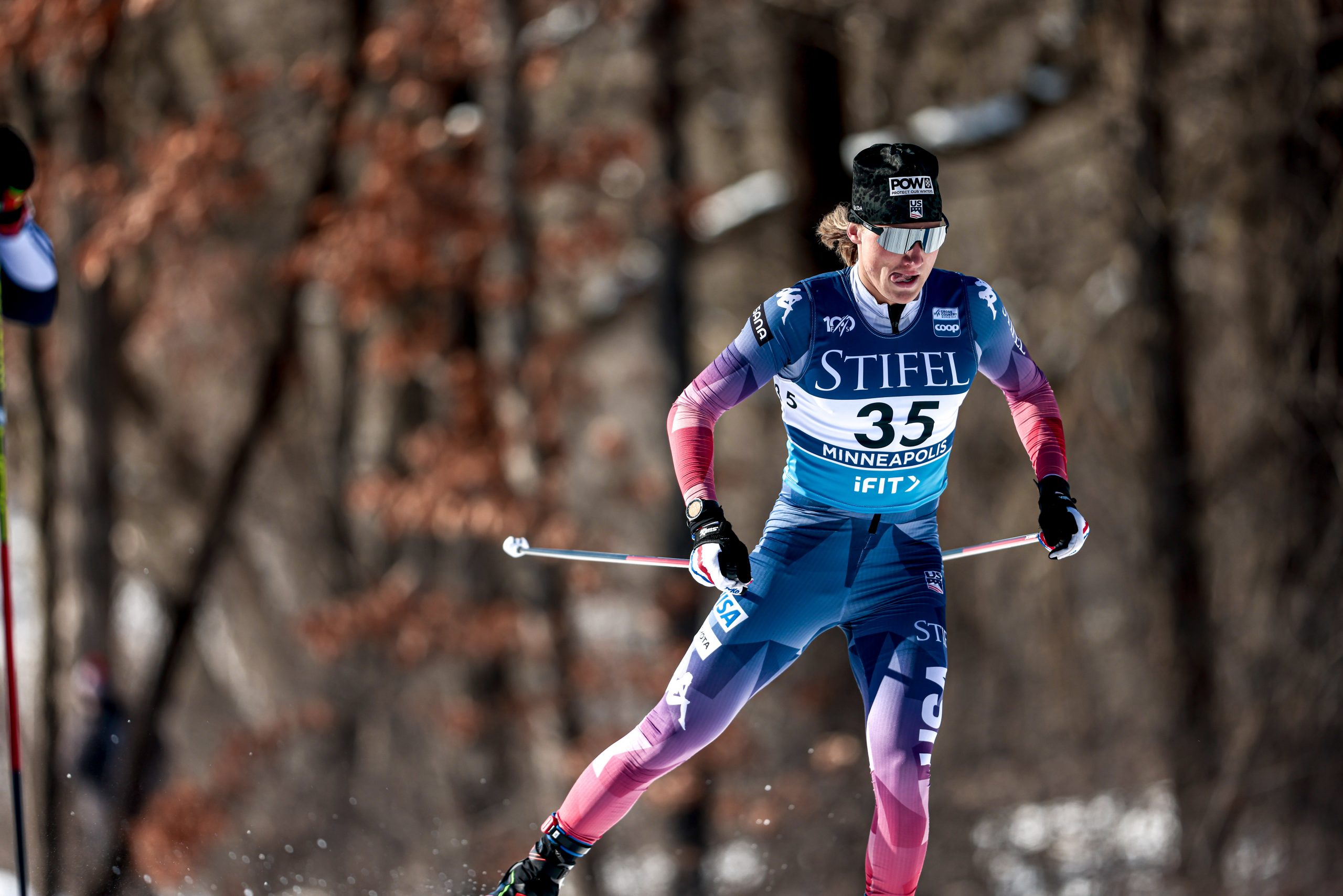
Gus Schumacher races Sunday. (Photo: Modica/Nordic Focus)
Schumacher’s result in Minneapolis—on the World Cup circuit’s first stop in the U.S. in two decades—will serve as inspiration to the hundreds of young, aspiring Olympians who lined the city’s trails Sunday. But it also resonated for his teammates, many of whom endure similar ups and downs themselves.
That includes Julia Kern, a 26-year-old American Olympian who said she was trying to channel Schumacher as she warmed up for her own race Sunday, after his win. Kern won a World Championships medal last year, but has been struggling this season.
“Warming up, I was just thinking about how I want to ski like Gus,” Kern said. “It gave me confidence. I’ve had a tough year. And I was thinking back to his Olympic year.”
Schumacher, who grew up training with the Alaska Winter Stars program in Anchorage, first announced himself as a once-in-a-generation talent four years ago. That was when, at the age of 19, he won a gold medal at the World Junior Championships in a 10-kilometer race—the same distance as Sunday’s event.
But after he graduated to the top-level World Cup circuit, Schumacher started struggling with his training formula, only sporadically translating his big junior performances into good results on the adult circuit. In his toughest moments, like at the 2022 Olympics, he was struggling to understand the “weird” feelings in his body.
“That’s tough, to not feel like myself, and not knowing when it’s going to come back,” he said at the time.
In retrospect, Schumacher and his coaches have made a relatively straightforward diagnosis: he was training, simply, too much. That’s a common mistake for early-career cross-country skiers, since the sport generally rewards hard work and the limits to training can often only be found through trial and error.
Jessie Diggins, 32—the superstar American skier from Minnesota who owns three Olympic medals—went through a similar process of self-discovery earlier in her career, said Chris Grover, one of the U.S. Ski Team’s lead coaches.
“She just wanted to train, train, train. And at one point, she was getting diminishing returns,” Grover said after Sunday’s race. “Gus is starting to figure that out, starting to figure out his body at this level.”
Since that tough Olympic year, Schumacher has made some changes. He’s now moved to the Alaska Pacific University training program, which includes several other members of the U.S. World Cup team and a renowned coach, Erik Flora.
He’s also been getting advice from one of the U.S. team’s coaches, Kristen Bourne, who described Schumacher’s experience over the past few years as a natural part of the sport.
“When we’re having those hard times, absolutely, you do learn from them and become better,” she said. “We’re trying to figure out the individual jigsaw puzzle that is each athlete.”
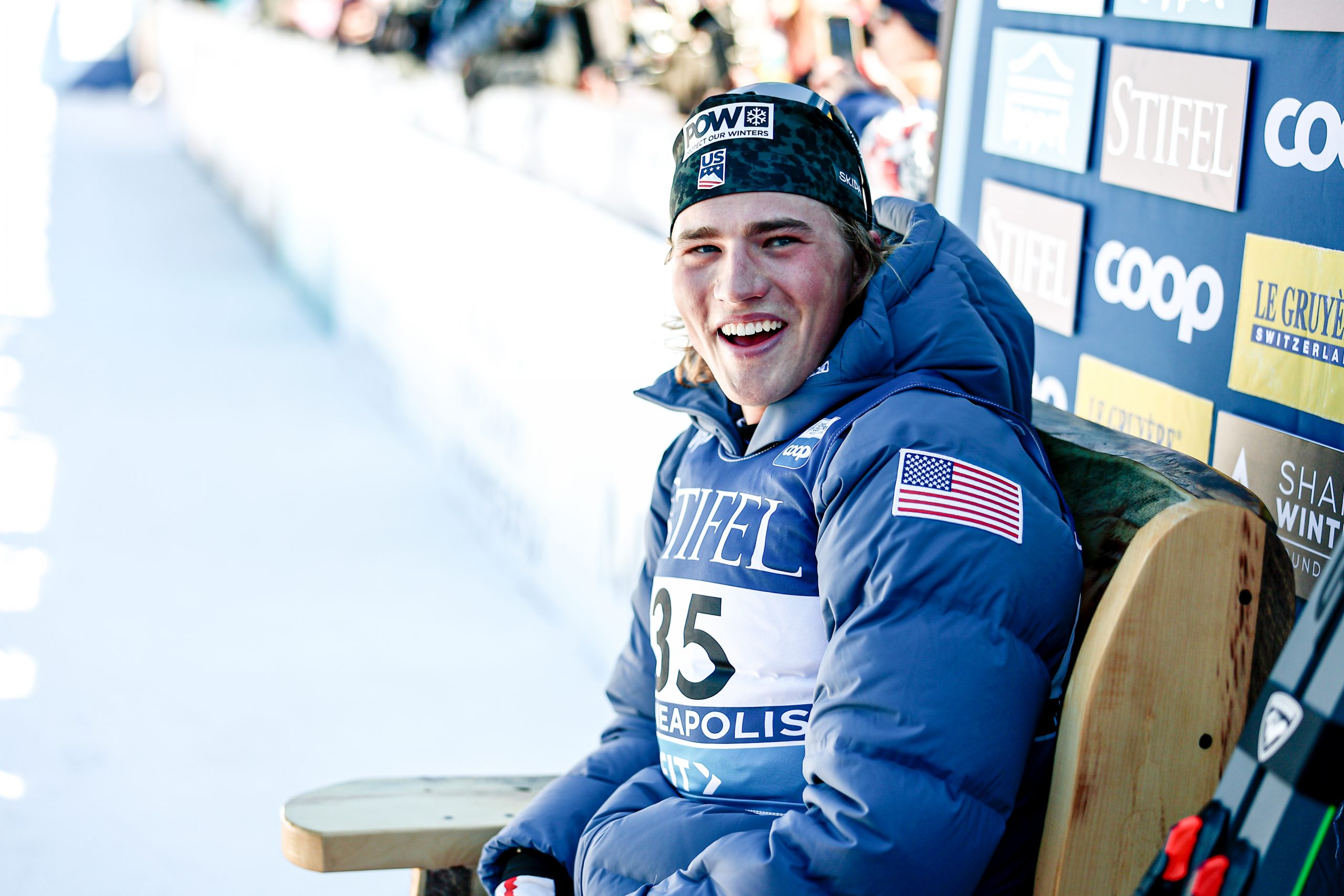
Gus Schumacher sits at the finish line Sunday. (Photo: Modica/Nordic Focus)
The changes clearly seem to be helping Schumacher, who already notched several eye-catching results earlier this season, including fourth place at a World Cup race last month.
What’s excited his coaches, teammates and boosters is how Schumacher already appears to be absorbing some of the important lessons about training and racing in a career that’s only just starting.
“I’m sure I’ll make some more mistakes,” he said Sunday. “But hopefully less from here on out.”
Schumacher’s perseverance was rewarded with an experience of a lifetime Sunday.
He was an early starter in the race, held in a time trial format that sends athletes on to the course one at a time.
Schumacher had the fastest pace when he crossed the finish line. But he knew that a whole pack of Olympic medalists was behind him, and was likely to better his time.
But as he waited at the finish, with a growing pack of teammates and supporters, none of his rivals could catch him.
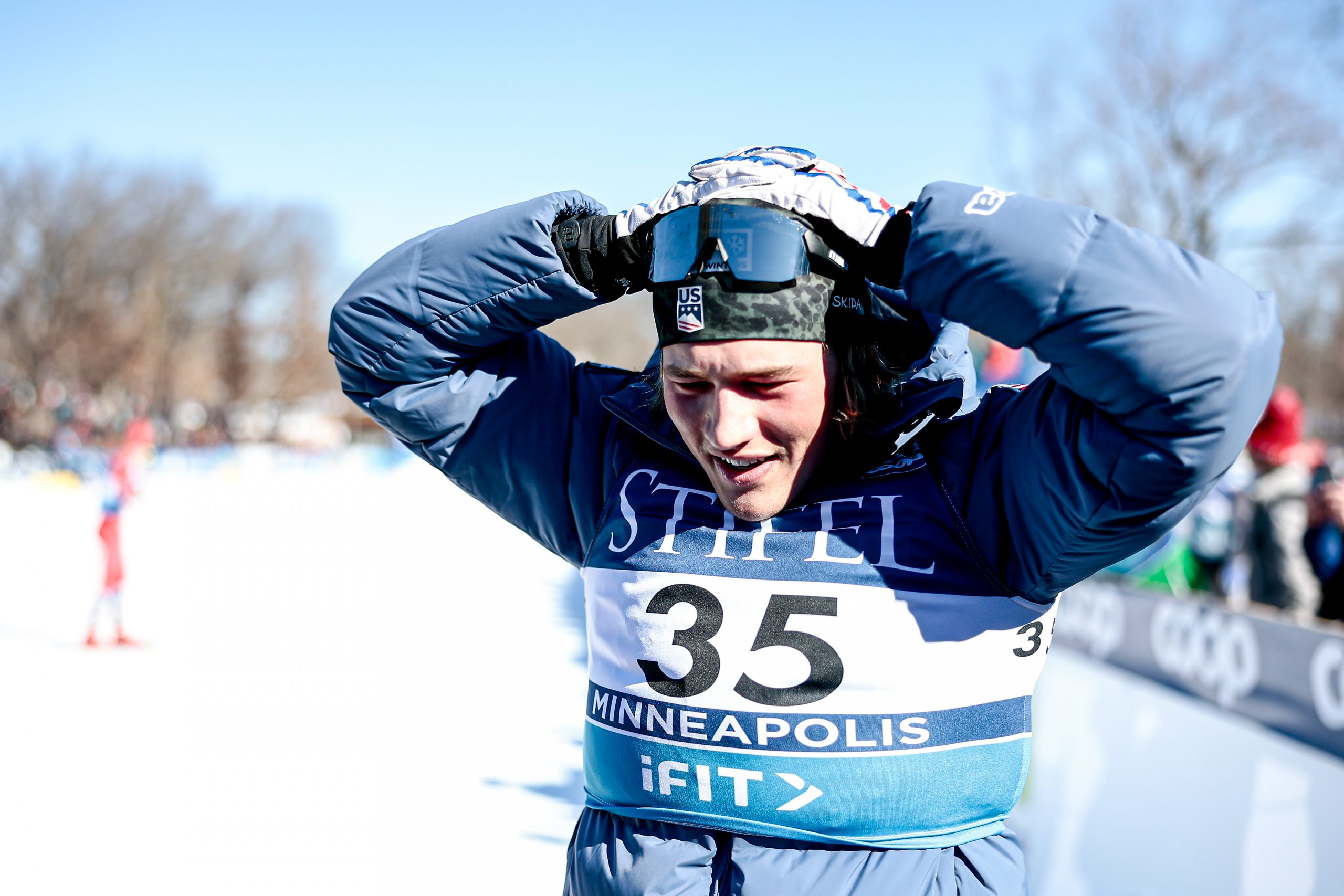
Gus Schumacher learning that he’d won Sunday’s World Cup race. (Photo: Modica/Nordic Focus)
“They started finishing, and I was like, ‘Oh my God—I might get a podium,’” Schumacher said.
First William Poromaa, a top Swedish talent, crossed the line eight seconds behind Schumacher. Then came Norwegian Harald Ostberg Amundsen, the leader of the overall World Cup standings, four seconds slower, and Johannes Hoesflot Klaebo, another Norwegian, who has five Olympic gold medals to his name: six-and-a-half seconds back.
Teammate Luke Jager, among those gathered with Schumacher in the finish, “was like, ‘You’re going to fucking win this thing.’ And I was just, like, ‘Oh my God. I might actually win this race,’’” Schumacher said. “And then it happened.”
His teammates hoisted him onto their shoulders as the huge crowd that had gathered for the Minneapolis race roared, and later erupted in a chant: “Gus! Gus! Gus!” Afterward, Schumacher posed on the podium with 20 teammates and support staff, then took a celebratory jog, dispensing high fives to fans in the grandstand.
His whole family—father, mother, siblings and girlfriend—was there to watch it happen.
“The happy thing for me is that this has the potential to be a normal length career. And it feels like he’s maybe discovered the secret sauce now,” said Greg Schumacher, his father. “He’s done what he could to get here. And so it’s nice for him to have a day where it worked.”
The electric atmosphere after Schumacher’s win Sunday spread even to his competitors—the two Norwegians who shared the podium with Schumacher couldn’t hold back their smiles when he climbed up to the top step for an awards ceremony. A star French athlete, Lucas Chanavat, stood in the crowd, filming the scene.
“It was insane. It was so cool. It gave me goosebumps,” Chanavat said. “This is cross-country skiing.”
Rosie Frankowski races a December 2019 skiathlon World Cup event in Lillehammer, NOR. (Photo: NordicFocus)
The Olympic Dream.
Perhaps the opportunity to compete at the highest level of sport would not be as sought-after and revered were it not for the inherent scarcity of opportunities to achieve it. This year, only eight women and six men were able to represent the United States in cross-country skiing in Zhangjiakou, down from a total of twenty – 11 women, 9 men – who were selected for PyeongChang in 2018.
Among those who came up just shy was 30-year-old Rosie Frankowski, who has spent the last eight years training with APU under head coach Erik Flora. Frankowski is a 2018 Olympian and 2019 World Championship competitor, finishing inside the top-30 in both places – 21st in the 30 k classic in Korea and 24th in the 15 k skiathlon in Seefeld.
Rosie Frankowski skis through wet falling snow to win the women’s 10k at the opening SuperTour weekend in Duluth, MN. (Photo: Jordan Woods/Woods Creek Productions)
After strong early season results that included two wins and three third place finishes in early season SuperTours, Frankowski lined up in Soldier Hollow for a two-week stretch of racing that felt like it was for all the marbles. As many women had already met the objective criteria for team selection via results on the World Cup, it was only the final few spots that remained open for domestic racers; in the hungry pool all fighting for these spots via some combination of U.S. Nationals, Sun Valley SuperTour, and Tour de Ski results were Frankowski, Caitlin Patterson, Alayna Sonnesyn, Katharine Ogden, Novie McCabe, and Sophia Laukli.
As Frankowski describes in this episode, her opening races – the freestyle sprint and the 20-kilometer mass start skate – of U.S. Nationals went remarkably well; despite being known as a distance specialist, she won the sprint qualifier and finished sixth in the final, then won the race for second place in the 20 k skate, behind Rosie Brennan who had dropped the field from the start. From there, Frankowski faced a series of challenges – slick skis and variable klister conditions in the 10 k classic, a fall in the classic sprint, and a sublexed shoulder in the opening race in Sun Valley.
Rosie Frankowski on course during a February 2020 World Cup in Östersund, SWE. (Photo: NordicFocus)
The official team nominations for the 2022 Beijing Olympics were released the following week, and Frankowski was named as the second alternate for the women’s team. Five months later, Frankowski finds herself at a transition point in her career. It’s not a cut and dry retirement as she has earned Period I starts on the World Cup and has other race objectives next winter, but it’s a shift in focus as she and her partner prepare to relocate from Anchorage, AK to Durango, CO.
In this conversation, Frankowski shares the highlights and challenges of the 2021-22 race season, and provides invaluable insights into the experience of spending her career as a “bubble athlete”, fighting for international race opportunities and team selection, while juggling the financial realities of supporting her professional ski racing career. She reflects on her time with APU, and discusses defining success when surrounded by “more-accomplished” teammates, and how she expects the ratio of mountain running to ski-specific training to shift after this transition.
Thanks for listening and thanks to Concept2 for supporting this podcast.
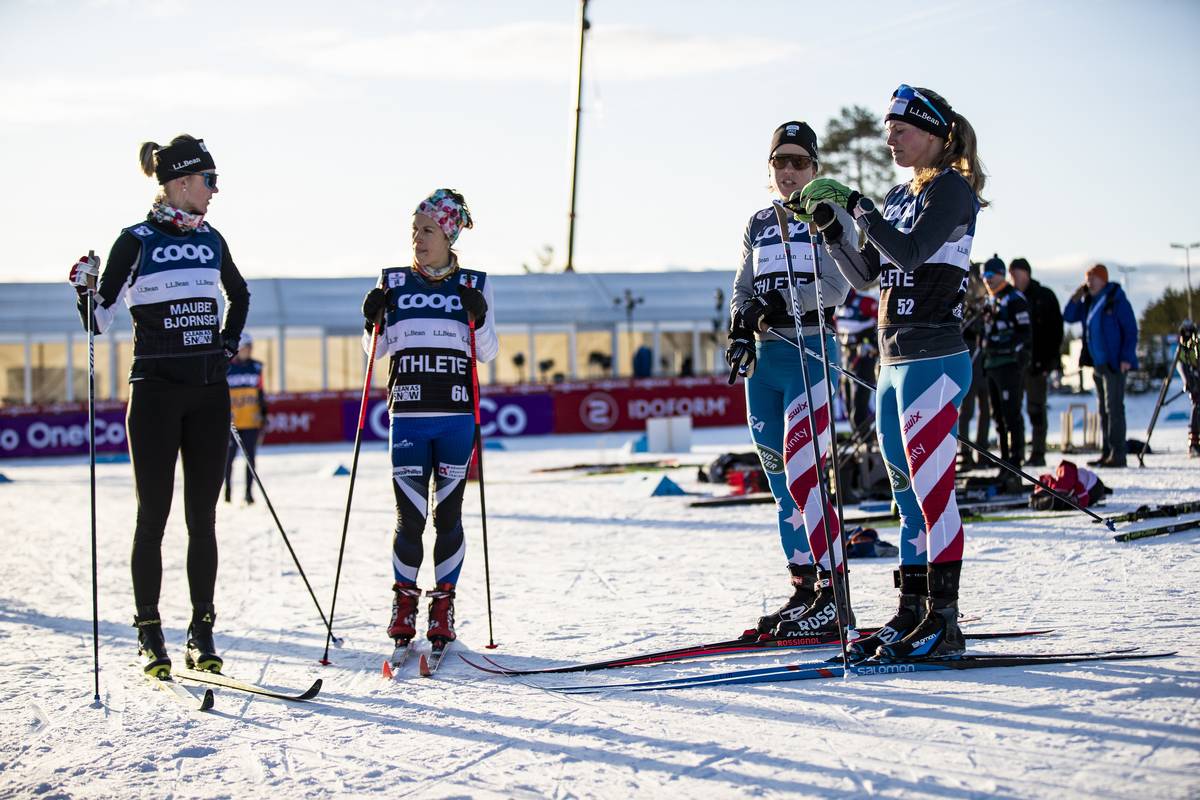
Scenes from a training day in Lillehammer in December 2019. From left to right, Sadie Maubet Bjornsen, Rosie Frankowski, Rosie Brennan, and Jessie Diggins. (Photo: NordicFocus)
Coaches: Erik Flora (head coach/director), Jack Novak (assistant coach)
Current roster: Penny Smyth, APUNSC Marketing & Communications, writes:
“Women’s Team: Rosie Brennan (USSS A Team), Hailey Swirbul (USSS A Team), Hannah Halvorsen (USSS D Team), Rosie Frankowski (World Cup Alternate), Becca Rorabaugh, Anna Darnell, Annie Gonzales, Marit Flora, Lily Pannkuk, Zoe Noble
“Men’s Team: Logan Hanneman (USSS B Team), Scott Patterson (USSS B Team), David Norris (World Cup Start), Hunter Wonders (USSS D Team), Zanden McMullen (USSS D Team), Luke Jager (USSS D Team), Tyler Kornfield, Michael Earnhart, Thomas O’Harra, Forrest Mahlen, Garrett Butts, Ari Endestad, Karl Danielson, Bjorn Halvorsen, Chip Schoff”
A total of nine APU athletes will be starting Period 1 World Cup races this season, though as we approach the Ruka opener later this week Smyth advises, “Scott [Patterson] won’t be joining the team until Lillehammer,” the season’s second race weekend, “due to hand injury.”
Who’s new or who’s moved on: Smyth writes, “Sadie Maubet Bjornsen, a two-time Olympian and World Cup skier, retired after last year. We have some new skiers that have grown up through the APU Nordic program join the Elite Team, including Marit Flora and Lily Pannkuk. New to the men’s team is Bjorn Halvorsen, younger brother of Hannah Halvorsen!”
Hailey Swirbul (left, third overall) and Rosie Brennan (first, wearing the yellow bib as World Cup overall leader) after the women’s 10 k skate in Davos, December 20202. (photo: Modica/NordicFocus)
Top results last season: Brennan was fourth in both the overall World Cup and distance standings, and for one magical weekend in December was the best skier in the world, winning back-to-back races in Davos. She became the second American woman ever to wear the yellow bib, after Maubet Bjornsen, and kept it for roughly a month. It was a well-deserved coming-out party for the longtime APU athlete (note that she was also on this team nine years ago) currently in her third separate stint on the U.S. Ski Team, after most recently being cut in 2018 after she raced poorly in PyeongChang while unknowingly suffering from mono.
Behind her, Swirbul finished the season ranked 23rd overall in the World Cup (21st for distance) and 4th in the U23 standings, picking up her first World Cup podium along the way, which she shared with Brennan. Maubet Bjornsen stayed home in Anchorage for the first half of the season, placed 10th in her first World Cup race in a year after returning to Europe, then at World Championships came within a combined 3.17 seconds of coming home from Oberstdorf with two medals.
Swirbul, Maubet Bjornsen, and Brennan formed the first three-fourths of the American women’s relay team at World Champs, which came 0.8 seconds away from medaling. Norris recovered from Covid to post some of his best results yet, including 16th and 17th at World Champs, and Patterson had his best season in years, highlighted by a 10th in the World Champs 50 km; the two of them formed half of the American men’s relay team in Oberstdorf. (The team sent seven athletes total to World Championships.) Jager was a tantalizing 0.09 seconds out of the heats in his World Cup debut. Hanneman made three World Cup heats and finished the year ranked 29th in the Sprint Cup standings. Halvorsen returned from a year of grueling rehab from a car accident to finish 23rd in her first race back in two seasons – which was not an OPA Cup or a local citizens race but rather the World Cup sprint in Dresden.
Hunter Wonders races at Government Peak Recreation Area, Palmer, Alaska, Nov. 14, 2021, in the season-opening Race to the Outhouse #1. David Norris is behind him. (photo: Eric Strabel for APUNSC)
Domestically, Jager, Wonders, and Maubet Bjornsen won the December Anchorage JOQ races that were the unofficial U.S. Nationals west (also on a podium in these races: McMullen, Mahlen, and Frankowski), and Frankowski and Kornfield picked up a combined four podium finishes at the American Birkebeiner, including Frankowski’s win in the classic race.
Smyth adds, “Locally, races happened for the rest of the elite team, where we had numerous podium sweeps and a Tour of Anchorage podium sweep in the women’s 50K with Rosie Frankowski (1) Becca Rorabaugh (2) and Anna Darnell (3) and then in the men’s 50K Tyler Kornfield (1) and Thomas O’Harra (2).”
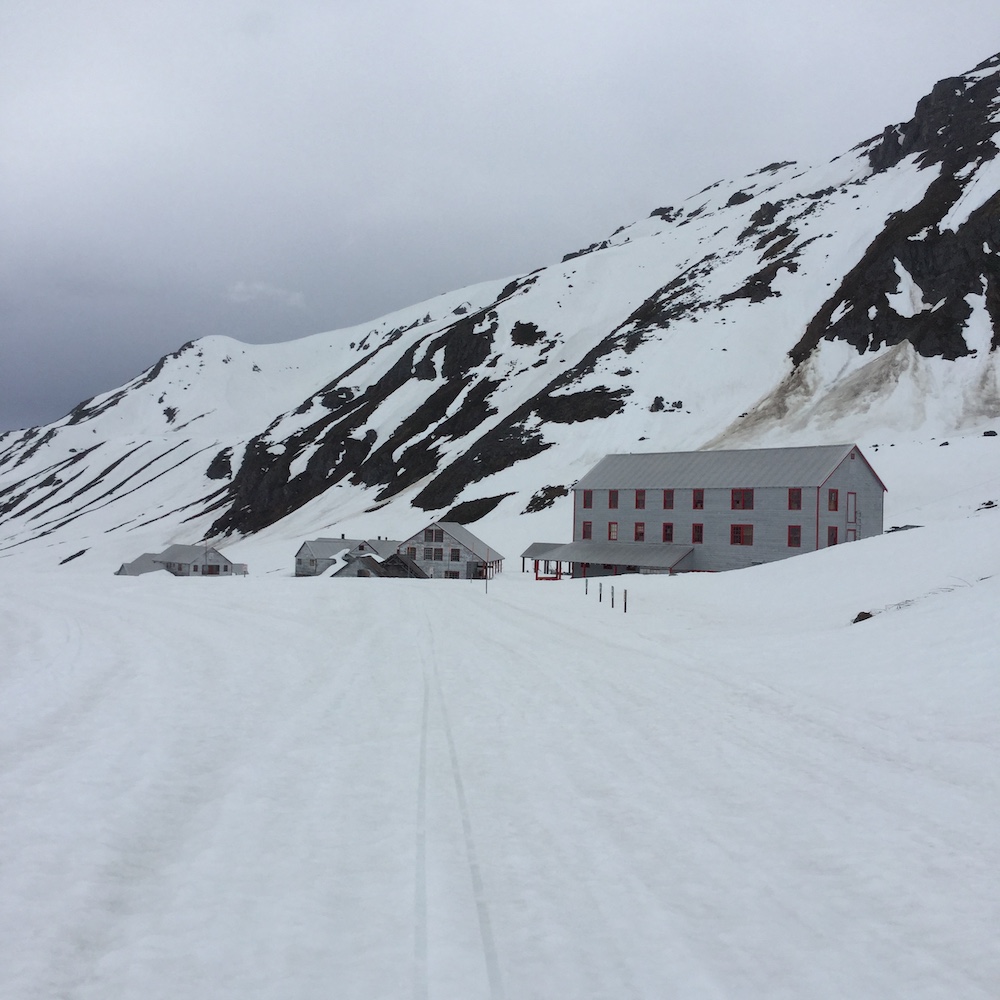
APU head coach Erik Flora, Independence Mine, October 2021. (photo: courtesy APUNSC)
Coach’s comments: “The APU Elite team is more than 25 skiers strong. We had a great summer of training with a majority of the U.S. Ski and Snowboard D-Team joining us. U.S. Ski and Snowboard coaches joined the Elite team in July for training sessions, which was positive for the team! This brought some young energy to the daily grind along with a fun group to work with. October brought early snow in Hatcher Pass to finally get on skis for training with early November snow in town to follow. We feel ready for the race season to happen and are excited to see what the races bring moving into an Olympic year!”
Hailey Swirbul (second from right, pink elbow sleeves) tags off to Sadie Maubet Bjornsen (far right) after the opening leg in the women’s 4 x 5 km relay at FIS nordic world ski championships, Oberstdorf, March 2021. (photo: Modica/NordicFocus)
Disclaimer: I live in Anchorage, and have trained with the APUNSC Masters program for eight seasons and counting. On the one hand, the Masters group has been an important part of my personal and athletic life for many years now; on the other hand, on a day-to-day basis the Masters team has basically nothing to do and no overlap with the APU Elite Team, and is not coached by Elite Team coach Erik Flora. I don’t receive free gear from APU, or anything in that vein, in exchange for writing about the APU Elite Team.
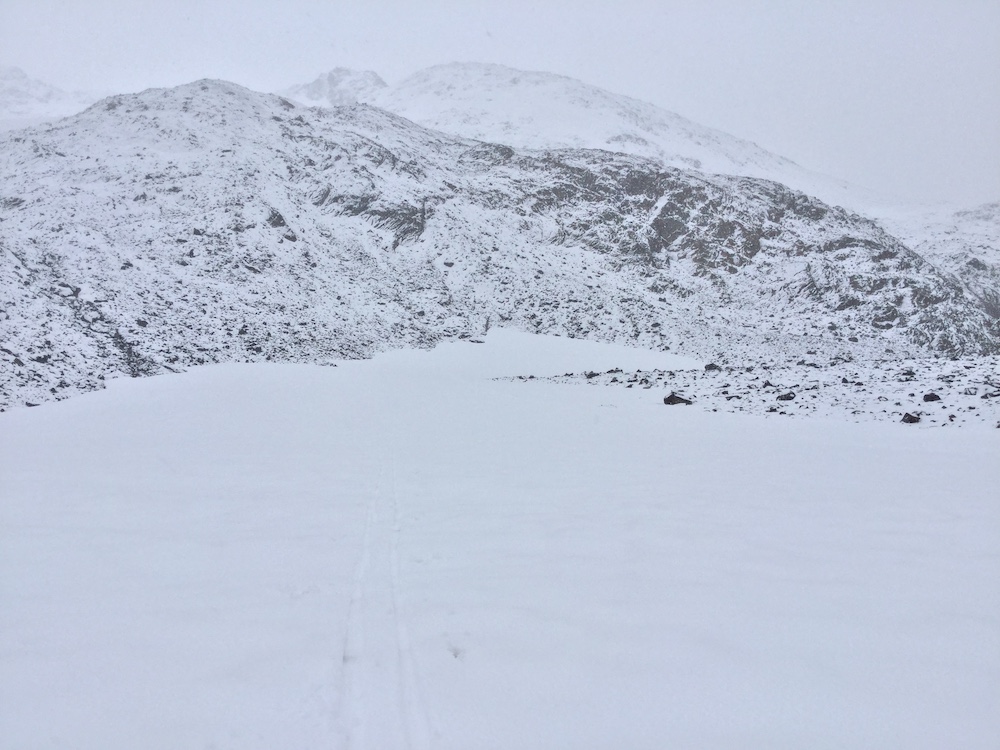
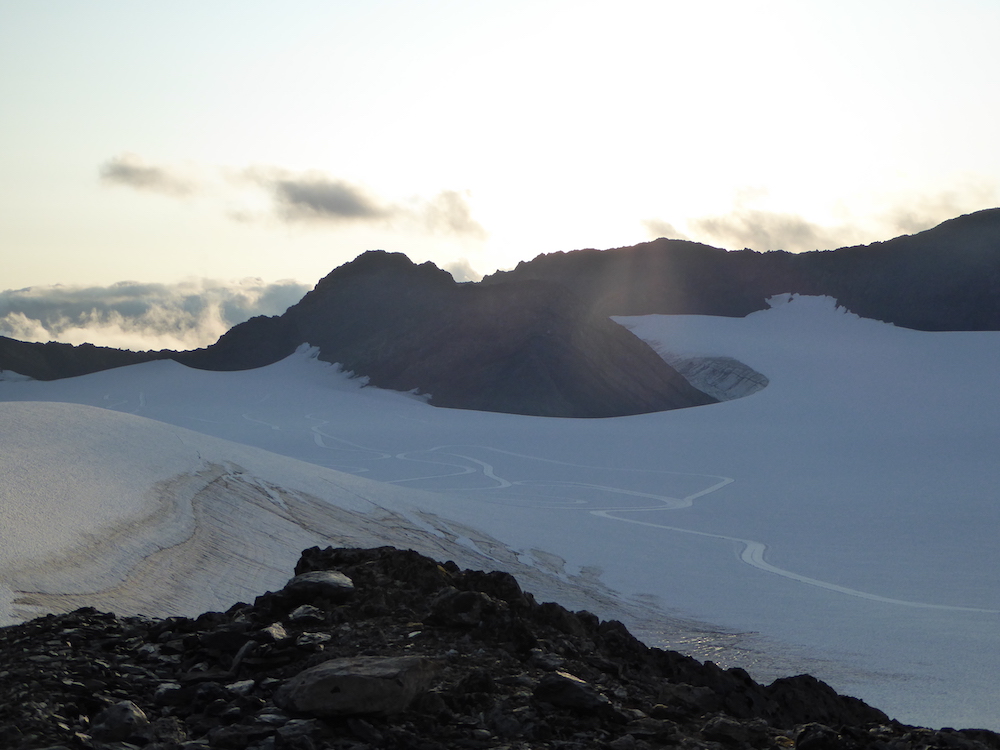
DIY Dachstein: September tracks on a snowfield in the Chugach mountains, Sept. 27, 2020. (photo: Gavin Kentch)
The koan that skiers are made in the summer has been around for longer than this website. The related truism, that summer snow time is necessary to effectively compete as a high-level skier come winter, also has a venerable history.
For example, here’s Luke Bodensteiner, writing in Endless Winter about why he had journeyed to a place where “the weather sucks all year long” to ski on the Sognefjellet snowfields in August 1993: “We all come to this spot simply to be able to ski a race faster than everyone else.” Or Billy Demong, discussing summer training on Eagle Glacier nearly 20 years ago: “In the late 90s and early 2000s, we were all working super hard, but we hadn’t quite broken through. I was on Eagle Glacier in 2002 because as a team we were committed to be the best.” Or Andy Newell, who first skied on Eagle the same year: “As the overall level on the World Cup continues to rise, summer training camps have become even more important. To be competitive at the very top level, you simply must get on snow at least once a summer.”
Bottom line, as Reese Hanneman wrote in an essay for a Boulder Nordic Sport catalog a few years ago, “All the best skiers in the world are on snow in the summer. Do you really want to try to be the best skier who wasn’t on snow?”
All well and good, but what happens when a global pandemic interrupts access to estival snow, for many athletes for the first time in a decade? More rollerskiing, of course, is the predictable and relatively simple answer. But bigger picture, it’s also a chance to introduce a new stimulus to long-established training patterns, and to replace travel and camps with increased consistency training out of a home base. Judging from conversations with three veteran athletes and two longtime coaches, high-level American skiers seem to be cautiously optimistic about how well this summer’s training will prepare them for the 2020/2021 World Cup season that starts in Ruka late next month.
(Disclaimer: It should go without saying that the global health toll of the coronavirus pandemic, and resultant inequality, are bigger problems than the inability of professional athletes to train on snow in the summer in the manner to which they are accustomed. Because this is a ski news website, the rest of this article focuses on the latter, but that is not intended to deny the existence and importance of the former.)
Background: In a normal year…
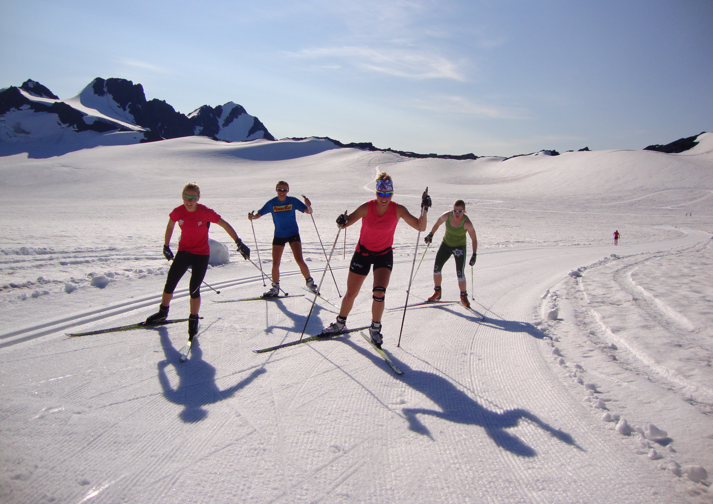
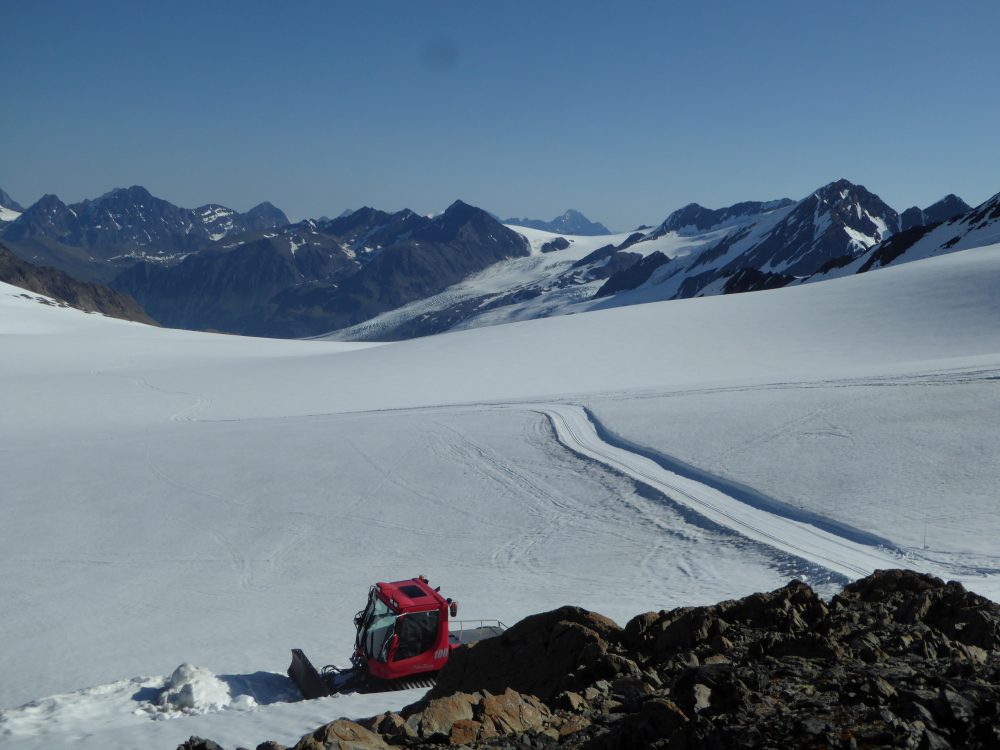
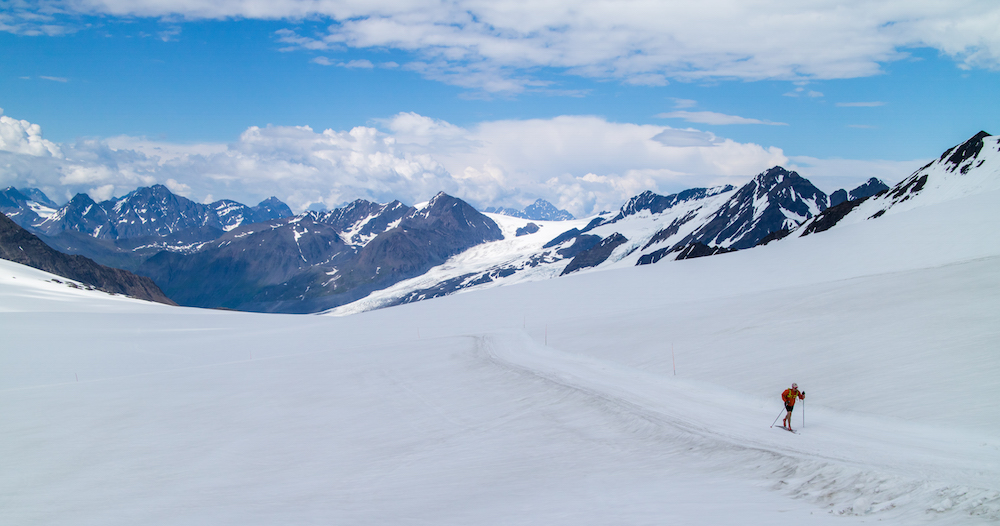
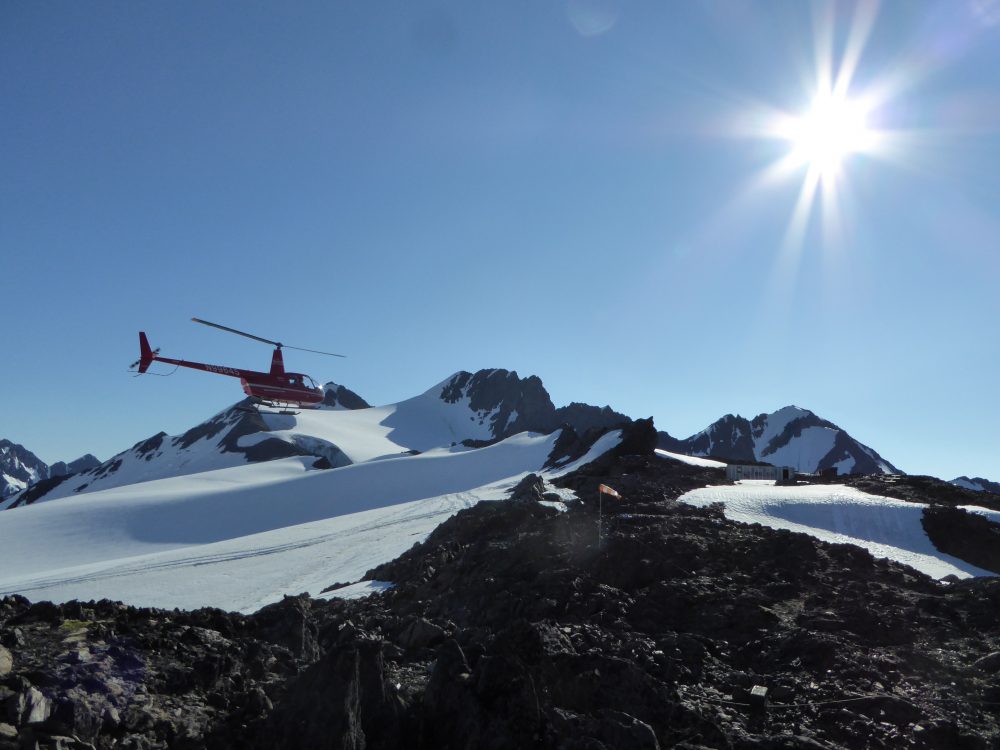
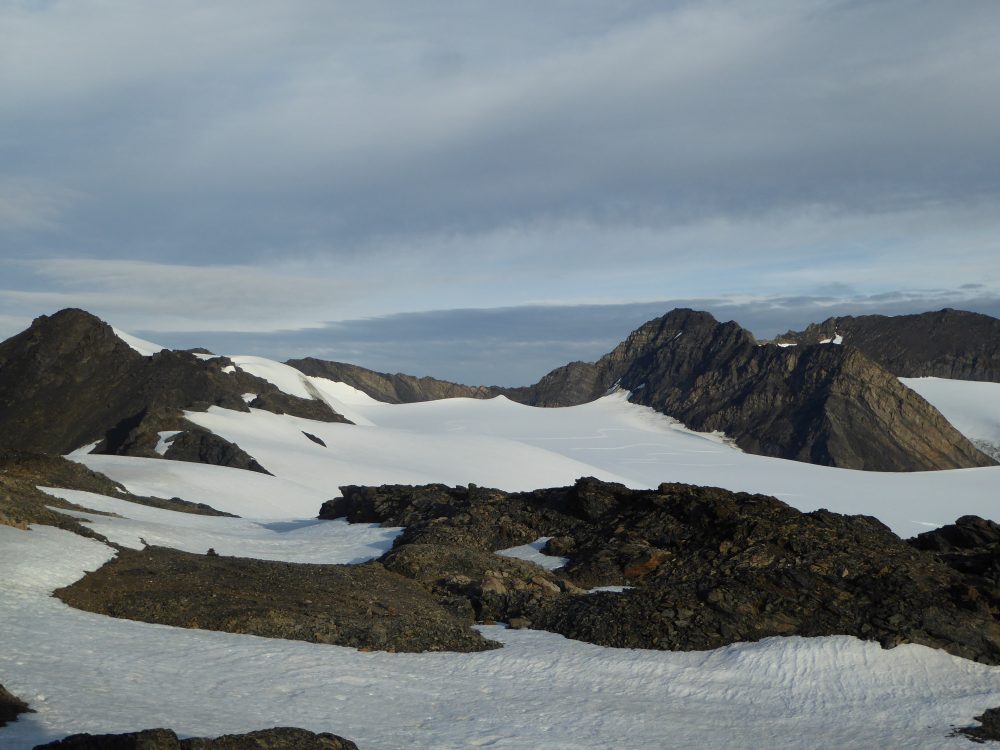
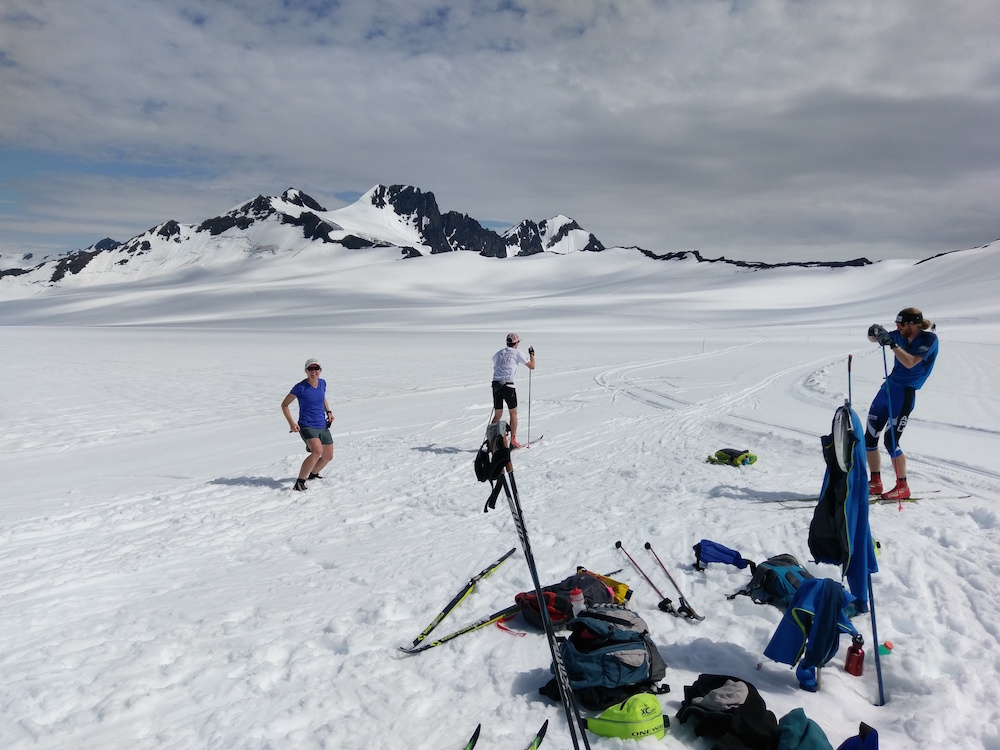
Here’s another saying you may have heard recently: These are uncertain times. In a normal summer, the Alaskan skiers would be on snow through at least mid-May, then all national-team skiers would meet in Bend for a two-week on-snow camp in the second half of May. Skiers with Alaska Pacific University Nordic Training Center, or APU, would then spend one week a month in each of June, July, and August skiing on Eagle Glacier, a short helicopter flight above Girdwood, Alaska.
Some national-team skiers – typically heavy on Stratton Mountain School and Craftsbury athletes, less so APU – would then spend two to three weeks in New Zealand in late August and early September, nearly all of it on snow at the Snow Farm. Groomed skiing returns to Independence Mine, about 75 minutes outside of Anchorage, in mid-October (probably), and to Frozen Thunder, in Canmore, about a week later (quite reliably). Arriving in Europe a few weeks ahead of the season’s first World Cup races typically affords athletes more on-snow time before first putting on a bib.
Summer skiing at Independence Mine, above Palmer, Alaska, May 30, 2020. (photo: Gavin Kentch)
This year, Independence Mine was skiable through the end of May, but everything else has been off the table. No Bend Camp; no Eagle Glacier; certainly no international travel to New Zealand, let alone to Canada for Frozen Thunder or Forêt Montmorency. It’s hard to survey the entire country, but this reporter’s cumulative four-plus hours of skiing since June 1, on snowfields in southcentral Alaska, may be among the highest on-snow summer nordic training loads in the nation, depending on how much time APU athlete Ari Endestad put in during a late-June (!) crust skiing trip in the Alaska Range. Until snow starts to accumulate at Independence Mine – the Mat-Su Ski Club’s historical first date of grooming there has recently been a tantalizingly close October 15 – American skiers’ collective summer snow drought looks likely to continue.
What all this means
So is this a problem when it comes to on-snow performance in the upcoming race season? Not really, according to multiple athletes and coaches.
“You can accomplish 95 percent of your technique goals, perhaps,” on rollerskis, U.S. Cross Country Team Program Director Chris Grover said in a late-May interview with Cross Country Skier magazine (22:54 mark of podcast), speaking at a time when summer training options were still unknown. “And so we’re in a good place; even if we never touch snow this summer, we’ll be ready to race when we get to next winter.”
“We’ve had many instances over the years with athletes who have missed on-snow opportunities in the preparation period, and gone on to have breakthrough winters,” echoed USST Head Coach Matt Whitcomb in a recent email to FasterSkier. “The dryland training is the cake, and the snow is the frosting. Americans will be frosting our cakes this fall when the snow flies, and this should lead to top performances during key mid-season international championships. I’m not one who attaches irreplaceable value to prep period on-snow training.”
2018 U.S. Ski Team camp at the Snow Farm in New Zealand. (Photo: Matt Whitcomb)
“The assessment period, that’s still ahead of us; that’s the race season,” echoed longtime APU Head Coach Erik Flora in a recent phone interview. “But … at least the athletes I work with, they’re in a good position right now heading into the winter.”
“Of course, we will have to see when the races hit,” APU and USST athlete Rosie Brennan wrote to FasterSkier, “but I feel very optimistic that the summer has had a positive impact on my training.”
“I’m hoping that some other training strategies – workouts that I normally won’t do because of the glacier, and a different strength routine – will have actually given me an advantage,” emailed APU skier Becca Rorabaugh to FasterSkier. “This is a good year to try new things and shake it up!”
(Against all this enthusiasm, Whitcomb did provide a more nuanced look at some potential disadvantages, while acknowledging a former athlete’s gentle chiding about his perennial optimism: “Since Holly Brooks once asked me to not always be so positive,” Whitcomb added, “I will start by saying that Norway will have an advantage in the early season. Many of them have found some snow. But Norwegians are often competing for start spots and racing very fast in period one, which allows us a window to catch up when their performance flattens. It all balances out. Beyond that, this is a global pandemic, and every team has been affected. Americans don’t have to do things better than we ever have, but just as good as we can. That will be good enough for this season. I’m confident in our preparation, and believe we’ll deliver great results to our fans.”)
What’s happened instead
“There is naturally more roller skiing” this summer than in prior years, Whitcomb noted, “since during an on-snow camp we will do little to no roller skiing. The sessions on roller skis versus on snow are similar.”
This is sensible enough. But everyone contacted for this article also discussed the broader implications of this year’s changes, be it for the overall training stimulus, travel schedule, training schedule, or all of the above.
Pepa Miloucheva skates behind CGRP biathlete Casey Smith while at a training camp at La Forêt Montmorency in Quebec in early November 2015. (Photo: Caitlin Patterson)
Here’s Rorabaugh, for example, who as a longtime APU athlete has logged three glacier camps each year from 2007 through 2019, making for an impressive 39 cumulative weeks of summer glacier time. (Flora says that athletes typically log 20–30 hours of ski time in a week at Eagle Glacier. Taking the midpoint of this range, 25 hours, yields a healthy 975 total hours of summer snow time over the past 13 years.)
“2020 has been structured similarly to a normal summer of training,” Rorabaugh wrote. “The only difference is that where we would usually have a high volume week on-snow, we have done one in town. My overall training volume may have decreased slightly, since it’s hard to get quite as carried away with dryland training, but it’s also been more consistent week-to-week. We might be doing slightly more running than in the past, but the balance between rollerskiing and running is very similar. My joints and feet are actually the healthiest they’ve been in years though, probably because I’m not able to pound them into the ground with the expectation of a low-impact glacier camp for reprieve. Staying in town is forcing me to be a more responsible athlete, and I think my body appreciates it. Actually the biggest challenge for me this summer has been adapting to at-home strength training. Not having access to a weight room has definitely tested my creativity and self-motivation.”
Or here’s Scott Patterson, like Brennan also an APU and national team athlete, in an email to FasterSkier: “The big changes to my training have mostly been the consistency of time in Alaska and a few alterations for indoor training. We haven’t had any USST camps or APU glacier camps so there have been a lot of weeks just plugging away in Anchorage. It was nice that the snow held on fairly late so it’s only recently that the desire to get sliding on snow has really caught up to me. Not having camps definitely changes things and has its downsides, but I am also really appreciating having fewer obligations and travel days through the summer.”
Ida Sargent, Sophie Caldwell, Sadie Bjornsen, and Rosie Brennan enjoying freshly groomed snow on Eagle Glacier in summer 2011. Photo courtesy of Sophie Caldwell.
And here’s Brennan, another veteran athlete with a long history of summer snow time: “It’s definitely been a bit of an experiment this year, but I have really chosen to look at the potential benefits. For one, as an older athlete it gets harder to introduce new stresses that create the adaptation needed to keep improving. This summer has certainly provided me a different set of stressors that I have had to adapt to. Travel also takes away training days and always comes with some sort of a need to adjust to the new training environment, so without travel, my training has been just so consistent.”
What about technique work?
As Grover said, “You can accomplish 95 percent of your technique goals” on rollerskis.
Others were a little less sanguine. As Patterson noted, “Those weeks of glacier time in the middle of the summer are a great opportunity to preserve the on snow feel even when in town rollerskiing. It’s easy to forget that skis don’t kick like ratchets, pole plants are much softer than pavement, and asphalt never turns to deep slush. I usually try to use the glacier weeks as high volume periods with fairly intense focus on the technical aspects of actually skiing. In town, it has definitely taken some adapting to not have the focus week or the on snow technique.”
And Rorabaugh, a Fairbanks native, sounded similar themes. (Relevant: Even in an era of climate change, Fairbanks, Alaska, reliably provides hard-wax skiing for at least four and probably five months a year, from early November through late March. Fairbanks skiers once started a spring marathon on the Chena River, in downtown Fairbanks, at temperatures of –12° F. On March 25.)
Audrey Kentch, 5, skiing in wet-snow conditions in Alaska, June 2020. (photo: Gavin Kentch)
As Rorabaugh wrote, “Summer on-snow training is a good time to work on technique and try new things, and to adapt to dramatically new ways of skiing. It’s also a vital opportunity to practice skiing in slushy conditions – something that an Alaskan skier might be unprepared for. At my first JNs in Lake Placid I remember being utterly shocked that people skied on sloppy trails, and having no idea how to do it! Thankfully I’ve had a lot of practice on Eagle Glacier since then.”
Looking ahead to the start of the season, Rorabaugh noted, “I don’t think I’ll change my approach when I get on-snow this fall because it’s a different time of year. Early season snow is a good time to transfer dryland fitness to skiing, but it’s not as much of a technical laboratory. It’s more about technical honing than totally revamping.”
No matter what the summer looks like, the first few times back on snow are necessarily different than rollerskis, and can potentially require some degree of transition. As Whitcomb observed, “It takes a few days for everyone; the skate skis feel long and awkward, and the greater hip area muscles get sore from slipping on classic skis. Our first few on-snow workouts in Finland each season call for short, easy training, and after that we’re good to go. I also think it is harder for juniors than for seniors, but neither case is a big deal.”
A more nuanced aspect of this issue involves the optimal application of summer snow time for working on ski technique. Flora is a firm believer in his seriatim method, which involves one week on snow at roughly one-month intervals from June through August.
The June camp is “usually the introduction of new ideas,” Flora told FasterSkier. “And the nice part about being on snow is that it’s real-time, real snow. So it applies 100 percent; you’re not adjusting for a rollerski kick, or, you know, road-style terrain; you’re on snow, and it’s World Cup-style terrain. And so, usually, June, we use to introduce ideas, and then July is kind of, refine and play with those, and then usually by August, you can see those changes kind of setting in. And so that’s a pattern that we’ve used for over a decade. And it’s an effective pattern.”
World Cup terrain: The groomed ski trails on Eagle Glacier gleam in this view from the training center on a late-July evening in summer 2019. (photo: Gavin Kentch)
When attempting to translate this pattern to an exclusively dryland paradigm, Flora explained, he found himself emphasizing more of a “steady amount of technique work in the summer” this year.
Has it worked? With the significant caveat that the race season has yet to begin, Flora is cautiously optimistic: “As far as which one is more effective? Hard to say; I think they both work. One thing right now seems to be we have a number of athletes that have made jumps this summer, you know, similar to in years past. But again, we’ll see as the on-snow time comes.”
Flora is similarly confident about an athlete’s ability to ski well in early-season races this year, even if they have transitioned from rollerski kick to hard-wax skiing at Independence Mine, only to be thrust into, say, a messy artificial snow, above-freezing, klister slopfest race in World Cup Period One. Flora expresses his hope that APU’s “style of coaching and education” has let the athletes “create an adaptable kind of platform to work from. And so when … they show up and it’s icy or soupy, or whichever it may be, that they’re ready just to jump on their skis and adjust.”
Finally, Flora also cites his athletes’ accumulative lifetime on-snow experience: “The athletes that I’ve worked with for a while, I’m confident that they’re ready to kind of jump into any kind of conditions, that those athletes also have thousands and thousands of kilometers behind them, of glacier soup, and spring-like conditions. … I think for my main group [of athletes], everyone is comfortable kind of moving forward. I don’t know that one summer has a huge impact into that. … I guess I’ll know more about that in a few months.”
Towards a philosophical understanding of summer snow
Flora’s observation about lifetime glacial kilometers skied raises a final point: What, perhaps in a more fundamental sense, does summer skiing mean? The final paragraphs of this piece on FasterSkier attempt to limn an answer, and Chelsea Little’s lovely, lyrical essay on summer skiing at Italy’s Passo dello Stelvio does much the same. But what do coaches and athletes have to say about it?
For Flora, summer skiing is, as discussed, an opportunity to install and ingrain technique changes relatively early, “so by the time they’re in the racing season it’s an automation or a natural movement, as opposed to trying to race and then also think about new movements.”
But it’s also a chance to, well, ski a whole lot. This may seem obvious, if not downright unremarkable for professional skiers who ski all winter long, but for Flora it stands in contrast to, perhaps counterintuitively, the relatively reduced amount of actual skiing that occurs during the World Cup season, which brings with it travel days and recovery days and multiple venues with limited snow on small loops.
https://www.instagram.com/p/CC2PpdbpXKD/
As Flora notes, “What’s really interesting about those numbers is that if you go up to a glacier camp, and you ski, say you ski 20, 25, 30 hours that week. And you take that across roughly 15 k an hour, or you can even just look at the pure hours. Most of the athletes in the wintertime are training anywhere from, you know, 30 to probably upwards of 60 hours a month, at most, during the race season. And so the amount of time you get at a camp – if you’re having 30 hours in a week of training up there, take two camps and you have over a month of skiing already. And so the time up there is different than the race season too, because a lot of times when you’re traveling and racing, you’re skiing once a day, jogging in the afternoon, where on Eagle, you’re skiing twice a day. And so that time has a huge impact on kind of turning the body into a ski body.”
All athletes and coaches also noted that summer skiing is some sort of change – a new physical stimulus, to be sure, but also just a change. Whitcomb spoke of the danger of “monotony,” and of the need to avoid not just an outright overuse injury, but also the “physical plateau” that can result from consistent use of one training mode. Brennan unconsciously mirrored Whitcomb almost verbatim, writing, “As for an overall approach, I have tried to remain very consistent all summer so no one activity gets into a level in which I’m risking overuse.” And Flora, similarly, said that he began the summer by telling his team, “the opportunity ahead of us is just the change in stimulus.”
It’s hard to discuss these changes, in this year, without trafficking in tropes, but here are a few more to end things: Every disruption is a chance for improvement. It’s not a challenge, it’s an opportunity. The only thing constant is change.
In all seriousness, though, in a sport where the increased sharing of information has led to high-level training looking relatively homogenous around the world, the unparalleled summer of 2020 provides a chance to see what winter results look like when traditional summer training is disrupted. As Flora said, he’s confident now, but we’ll all know more soon.
From left, APU athletes Rosie Frankowski, Sadie Bjornsen, Hailey Swirbul, Becca Rorabaugh, and Caroline Brisbois demonstrate a healthy distance while skiing at Hatcher Pass on May 13, 2020. (Photo: Courtesy Sadie Bjornsen)
Although the training cycle has officially begun, it decidedly has a different vibe and look. Adding some complexity to our short-term new normal are a crosshatch of state, county, and city regulations as it relates to mitigating the community spread of Covid-19. The core question elite cross-country ski programs are asking is this: How can we most responsibly promote safe and effective training for their athletes?
(The United States Olympic & Paralympic Committee (USOPC) has released a document titled Return to Training Considerations Post-COVID-19 This document provides useful information for organizations reopening.)
FasterSkier reached out to four programs in the U.S. — the Craftsbury Green Racing Project (CGRP), Stratton Mountain School’s SMS T2 team, SVSEF’s Gold Team, and Alaska Pacific University Nordic Ski Center’s Elite Team to gauge how athletes can train within the context of their regional social distancing guidelines. The answers are complex. And as each respondent stated, no one single person or group has all the right answers other than to stay informed and err on the side of safety.
Craftsbury Green Racing Project
Head CGRP coach Pepa Miloucheva responded to our query. Craftsbury’s team is located in Northeastern Vermont, a rural and isolated region. When Miloucheva responded on May 8, the Craftsbury Outdoor Center remained closed to the public. Along with key staff, those GRP athletes and coaches that live on campus year-round continued to be in residence. This group includes coaches and athletes from the ski, biathlon, and rowing teams.
“Most of us that didn’t go anywhere this spring have been in strict isolation since March — no store trips or anywhere else. Skiers and biathletes live in the same house, their food is ordered through the center, athletes cook in the house and do train together, but still try not to be in more than 2-3 people groups,” explained Miloucheva.
Several athletes were home with their families. Among them were Akeo Maifled-Carucci and Caitlin Patterson — both had been with their respective families in Bozeman, Montana. They returned to Craftsbury in mid-May. Miloucheva wrote that returning athletes will be quarantined for two weeks before they are allowed to move into team housing and join group practices.
“We do not share any buildings use with the rest of the center staff and if any work-related interactions are only by keeping a safe distance, wearing masks, and following all safety rules and regulations. This said, honestly we don’t have much of those really, we pretty much just interact between ourselves right now.”
According to Chris Mallory, Gold Team head coach, his core unit of skiers have not had group training sessions for the past two months. However, with the canceled racing in March, Mallory said several of his athletes extended their on-snow training north of their home base in town. Like many adapting to the modified season, high volume was the trend for March and April training.
“It was unfortunate the race season got cut short, but it allowed for two months of big volume to finish out the season,” Mallory emailed. “So we’re starting up training a little later than normal this year and for now, coaches are directing workouts remotely. We’re looking to get programming going closer to normal in June, but some things will be structured differently.”
Mallory explained that training group size will be kept below 10 athletes and the norm of committing in a team van will be held off for the near future.
“So we won’t have big cross-team training sessions for a while, unfortunately. We’ll also pick training locations such as Trailheads which are off the beaten path or sections of the bike path which see less traffic for rollerskiing, so physical distancing can be easier to achieve. We might have a partner gym opening up in a week which will allow for some strength training to occur for our Gold Team, but we’re also putting some effort into creating an outdoor strength area outside the Lake Creek ski hut as well.”
SMST2
SMST2 skier Ian Torchia on a recent VT. ride. (Photo: Courtesy Ian Torchia)
Nestled in southern Vermont, the Stratton Mountain School offers an idyllic campus for the SMST2 team. This spring, as the pandemic and its accompanying restrictions unfolded, the state-mandated that both residents and non-residents traveling into Vermont must self-quarantine for 14 days. That rule was recently extended until June 15.
Some SMST2 athletes are currently out of state, while others, like Ian Torchia, have remained in the Stratton area since the end of the season. Ben Ogden and new SMST2 skier Bill Harmeyer returned to their Vermont homes to remotely finish out the academic year at the University of Vermont.
“Initially we were thinking where do you want to be for a two-week self-quarantine,” Patrick O’Brien, SMST2’s head coach said in a call. “Thankfully we also thought about where do people want to be for an extended period of time this spring. And many people already had plans in place — knowing we may be in this for a longer period of time than we were thinking at the beginning of March.”
As June approaches, O’Brien explained that he too has begun defining how training will look, and how to best integrate athletes into specific training groups.
“First and foremost in my mind is what can we legally do, what can we responsibly do, and what are the creative solutions that we can come up with? And understanding again that no one here has a crystal ball; we can look at models, we can look at forecasts, we can monitor the situation but it is going to be a moving target,” said O’Brien. “So really what we are trying to do is find a balance. We are trying to be fully compliant and very safe and cautious and also monitor the situation locally.”
Harmeyer, who had been self-quarantined in Burlington, drove to Stratton recently to begin his full-time training. Due to his limited exposure while in Burlington, he was allowed to integrate with a small training group. Ben Saxton, on the other hand, recently flew back to Vermont from the Midwest. According to O’Brien, he is self-quarantining for the required 14 day period.
For the time being, O’Brien envisions training groups organized around pods – another word he used interchangeably for families. Athletes living together will be considered training pods where they are able to be in close proximity to one another. O’Brien acknowledged this arrangement will be closely monitored and reassessed.
“We need to track and see what seems responsible for group training, but again we want to make sure people are safe and healthy and if we operate in these small groups, and everyone in that group is a ‘family member’, then we know that they are OK to go out and do stuff together. What we want to do is be creative in our approach to these challenges, but really we want to be reasonable.”
Although Vermont’s shelter-in-place order was extended to June 15, it currently allows for outdoor exercise.
“Every challenge presents an opportunity,” O’Brien said. “We are not going to jump on a plane and go to a bunch of different training camps. That doesn’t prevent us from having high-quality training locally. It presents an opportunity. And reaffirms a model of working together and training together.”
Alaska Pacific University Nordic Ski Center
Anchorage is typically a very good place to be a cross-country skier. While so much else has changed in the world this spring, this fact has remained a reassuring constant for the athletes of the Alaska Pacific University Nordic Ski Center (APUNSC) Elite Team, as well as the greater Anchorage ski community. There was seasonal weather, both snow and cold, in the second half of this winter, leading to a sea-level snowpack that lingered well into April. Trail grooming is performed by a nonprofit group, Nordic Skiing Association of Anchorage, that relies on voluntary donations rather than mandatory trail passes while grooming on public land, so grooming continued unabated through March and into late April. And public health-wise, Alaska’s isolation, coupled with a relatively aggressive early response, has led to, so far, consistently low COVID-19 numbers throughout the state, currently the lowest gross numbers of any state and the third-lowest per-capita infection rate behind Hawaii and Montana.
Hailey Swirbul (APU/USST) skis at Hatcher Pass on May 13, 2020. (photo credit: Sadie Bjornsen)
Put it all together, and APU athletes were enjoying groomed skiing at sea level through April 23, with world-class crust skiing coming on line around the time the in-town ski season was winding to a close. (Any April training happened unofficially and in smaller groups, in deference to both the overall training schedule and health mandates in effect at that time. Although a group of four APU athletes did hunker down together in the APU Ski House starting in mid-March, forming a de facto family unit and training group in which half the people were a member of the U.S. Ski Team.) A 75-minute drive away, fellow nonprofit Mat-Su Ski Club has been grooming the trails at Independence Mine, in the Hatcher Pass area, since last October 5… and with a snowpack that currently measures around four feet, is still going. It’s hard to prove a negative, but APU skiers currently enjoy ready access to what are likely the only groomed nordic trails on the entire continent right now.
We have learned that the logistics of keeping our athletes safe while following COVID-19 state mandates has been at the forefront of the APUNSC program. Our core is based around health and wellness, and the safety of our program members is our top priority at all times, similar to other ski communities. APUNSC has had an advantage of having trails and snow on the mountains minutes from our doors to continue training, even in times of quarantine.
“Nordic Ski Center Elite training program began on May 1. We were fortunate that State of Alaska quarantine and social distancing mandates began to lessen at the beginning of May, allowing the Elite Team to be able to begin training in smaller groups outside in the mountains. The Elite team wore face mask or buffs and kept the mandated 6-10 ft separation while outdoors.
“At first, groups of 20 were allowed to hit the trails with a mandated 6-10 feet of separation for active workout sessions. We wore masks when training and avoided crowded parking lots and trailheads where we could.
“Once phase 2 [of state health mandates] hit a week ago, it allowed now the entire Elite Team to be able to head into the mountains to train and ski. Hatcher Pass has been an area where Crust Skiing is at its best with longer days and blazing sunshine. The grooming has been incredible thanks to the work of Nordic Ski Club of Anchorage and the Mat-Su Ski club. The Elite athletes still uphold the 6-10 ft separation when training. The athletes are happy to be together as a team again, and with that comes the responsibility to treat allowances with respect and not take it for granted. We are living and training as athletes in a time where our community could fall back to strict quarantine.
“We’ve stayed away from indoor training as a team in gyms, as not only is the safety of our team top priority, but the team has excelled in their own in-home conditioning and in getting outside to hit the trails. Only if necessary, for some athletes rehabbing, will we recommend using an indoor gym for conditioning and training.
“APU Nordic Ski Center typically runs 3 elite training camps [each summer] on Eagle Glacier at the Thomas Training Facility outside of Girdwood, Alaska. We will revisit whether Glacier camps will resume based on the climate of COVID-19 Adjustments.”
(For any Outside readers salivating over the prospect of May skiing and thinking of booking a cheap plane ticket north, please note that a 14-day quarantine requirement remains in effect for anyone traveling into Alaska from out of state, and that Alaska State Parks is likely to plow the road up to Independence Mine in early June.)
Erik Bjornsen crossing the line in the 2019 15 k skate pursuit in Ruka, Finland. (Photo: NordicFocus)
Bright lights in PyeongChang. The men’s second semifinal of the Olympic freestyle team sprint was a career highlight moment for Erik Bjornsen. Fourteen teams would crowd the start lanes with Martin Johnsrud Sundby in bib 1. The Norwegian was paired with Johannes Høsflot Klæbo: The duo blessed with Sundby’s stamina and his younger counterpart’s break-from-the-pack speed.
With Simi Hamilton racing the second, fourth, and sixth legs for the U.S., and Bjornsen leading off, the semi was a chance to not only advance to the finals, but establish some mojo amidst an Olympic field. Hamilton and Bjornsen both possess slower tempo big-power generating F-350 type motors that belie the meters gobbled up with each cycle of their cadence.
As Bjornsen was tagged for the fifth of six legs, he locked on to France and Norway to position himself in rarefied company. PyeongChang’s Alpensia sprint course packed a punch. The course’s second climb it’s Everest – a drawn out leg burner. Pulsing into that climb, France’s Maurice Manificat, Sundby, and Bjornsen had already separated from the field. Midway up, Bjornsen subtly shifted gears, moved to the left of Manificat, and dropped the two steely veterans by 10 and then 15 meters pushing over the top.
It was a Stars-and-Stripes flex.
Bjornsen tagged Hamilton in first by nearly five seconds. The pair went on to qualify for the final and placed sixth overall in an event eventually won by the Sundby-Klæbo pairing.
(Video of Bjornsen’s breakaway on the 5th leg.)
“It was interesting, I think that everybody knew what I was capable of in the field when I made those moves,” said Bjornsen when reflecting on career highlights. “I remember one of the strongest memories I have from racing is when I made that move against Sundby. And after the race, as we were starting the final in PyeongChang, he turned and looked at me for a while, and I could tell that he was thinking ‘what is this kid bringing to the final’? He eventually got the gold medal with Klæbo, and he is looking at this American guy, and I think that was one of the coolest feelings I have ever had — knowing that this legend was looking at me, and thinking, ‘what is this guy about to bring to the biggest performance of our lives?’”
The U.S. men’s team has been overshadowed by a dominant women’s program for going on a decade. Through that time, the men’s distance program has seen the end of Kris Freeman’s reign and the emergence of Noah Hoffman and Erik Bjornsen. Hoffman retired in 2018. With Bjornsen announcing his retirement last month at twenty-eight years old, a void remains. As one generation bleeds into the next, Bjornsen is an anchor point for all those speedy juniors we’ve heard of. An affable athlete who set the American distance skiing bar for the past five years.
Erik Bjornsen of the U.S. (bib 28) during the 2019 15 k skate pursuit in Ruka, Finland. In bib 27, Sebastian Eisenlauer (GER) leads Bjornsen. (Photo: NordicFocus)
Bjornsen often shouldered the pressure for a team and broader community starved for that dominant distance performance by a U.S. male — a World Cup podium or a championship medal to validate the personal quest and the vicarious desire from some fixated on top-3 hardware. Making the top-30 on the men’s World Cup is a herculean task. Bjornsen first passed that threshold with an 18th place in 2014 during a 15 k classic (his marquee event), in Toblach, Italy.
In January 2018, he surpassed that 18th place, which up to then was a career best individual mark on the World Cup, with a ninth place in Seefeld’s 15 k mass start skate. He peaked individually at the World Championships with an 18th and 17th, respectively, in the 2017 and 2019 Worlds in the 15 k classic.
The manifestation of steady improvement was Bjornsen’s calculus for remaining in the game. And the wait and wait for results beyond his stream of top-30s and top-20s was arduous. Even on the best of days, all things must align for the breakthrough.
“Definitely, my last couple of years, I was really hungry for great results, like everybody that puts so much into the sport,” said Bjornsen. “I was ready to make that next level. But I was moving towards the end of time I wanted to put into the sport and I really wanted to make the progress every year that I knew what I was capable of. There are so many variables in nordic skiing that I was just frustrated not to put it together more on the days when it was so tough. My thing was 15 k classic — that is where I could put together a top performance. That’s four 15 k classics a season, you are trying for your top performance in those four or five and also nailing the wax and also nail everything on that day. So I am proud of the results that I had but I was frustrated like any World Cup athlete. I was just definitely hungry for more at the end.”
The World Cup came to an end for Bjornsen in December after he raced the opening weekends in Ruka, Finland, and Lillehammer, Norway. Yet, the decision to retire from World Cup level competition came after the 2018-2019 season if he did not, in his words, “step-up”.
After a solid summer of training, Bjornsen was blunt about his 2019-2020 World Cup campaign. “I am going over to the World Cup to make a step forward, or call it a career,” he said.
He placed 25th overall in the Ruka triple. The following weekend in Lillehammer’s 15 k/15 k skiathlon he had a reason for optimism. At the same venue with the same race format in 2017 Bjornsen had placed 20th. This year, he initially raced near the sharp end. But as the temps warmed a degree or two, his skis began to ice. He faded to 39th. The plug was pulled.
Bjornsen explained that U.S. World Cup regulars leave bags on the wax bus after each season, a stash of clothes and items to rely on when they arrive for the season each November. “I had left a bag over there basically for the last five or six years,” said Bjornsen. “On the last trip, I packed that one up. I didn’t know if I would be coming back.”
Having grown up skiing in Washington’s Methow Valley, Bjornsen followed the usual path of success: solid Junior Nationals, World Junior Teams, a second place in the 2011 U.S.Nationals 20-kilometer classic, and his first senior championship two years later in the 15 k skate. USST D-team, B-team, and then A-team. Although the family fostered two future Olympians, (you know this but older sister Sadie is a USST veteran) Bjornsen’s parents moved to the Methow when a new alpine ski area was in the works. As luck would have it, the planned downhill area never materialized.
Erik Bjornsen (APU/USST) and Matt Gelso (SVSEF) headed up Hermod’s Hill for the final time at the end of the 15 k freestyle at the 2013 U.S. Nationals. Bjornsen took his first career national title and Gelso finished third.
The Bjornsens live on the more secluded Mazama end of the Methow. Mazama sits at the base of a closed-in-winter State Highway 20 which snakes its way up to Washington Pass and alpine paradise. Drive any direction but south in the winter from Mazama and it’s a snowy dead end. One road during those cold months serves as a diversion into Winthrop and further south to Twisp. The region’s storied cross-country trails provided another outlet. Within walking distance of Bjornsen’s neighborhood were endless ski trails and families falling in love over and over again with the sport. Sean and Laura McCabe and Leslie Hall (Laura McCabe and Hall are former USST members) lived nearby and were constant reminders that sliding on snow without a gravity assist had merits.
With his two older sisters, the Bjornsens joined the local ski club. It was a steady stream of hand me downs terminating at Erik. As Bjornsen became more serious, he relied on Scott Johnston as his primary coach. Johnston is known as fastidious and established a serious training regime for Bjornsen.
“I learned a lot from him,” said Bjornsen. “He took the time to explain everything about skiing and also the physiology side of things. I started to understand the ways of training and training plans. He brought my curiosity out and made me think about each and every workout.”
By the time Bjornsen was in his late teens, Sadie had moved to Anchorage to ski race as a student-athlete for the University of Anchorage Alaska (UAA). When it came time for a post-high school decision in 2010, Erik chose to attend UAA too. Both Bjornsens ultimately aborted their UAA paths after earning NCAA All-American status and began taking opportunities on the World Cup as they trained with APU. APU, an emerging powerhouse team, was coached by Erik Flora and championed by Anchorage’s Kikkan Randall.
Erik Bjornsen on his way to second at the 2011 NCAAs in Stowe, VT.
With a cohesive training group at APU and the steadiness of Flora, both Bjornsens blossomed. Erik earned his first World Cup start on Dec. 7, 2012 in Québec. A few days later in Canmore, he popped a 36th place in the 15 k classic. Along the way, he won six national championships and was a member of the U.S. Ski Team for seven years.
“When Erik first came in, I could see this young, talented skier that was excited about skiing, and he really enjoyed racing,” said APU’s Flora. “And when he first came in, I thought, Okay, if I can help him with his training, and help him reach the next level in fitness, that seemed like an opportunity that was an easy one to help him get toward his goals. And as he retires, you know, there was a certain point where Erik went from being in a place where talking about daily training was constructive, to where Erik absorbed all of that over the years, to the point where Erik knew how he wanted to train, and he had the foundation for it.”
During the later part of his career, Bjornsen had enough know-how and self-knowledge to write his own training plans with the occasional check in or hands-on training session with Flora.
Bjornsen imprinted the cycle in his muscle memory. He attended USST camps, looped around on the Eagle Glacier during the summer, and locked in for a lengthy stint as a World Cup regular. The bag he eventually snagged off the wax bus this past December was left in Europe for five seasons or so, during which he raced at two Olympics and four World Championships.
Erik Bjornsen (APU) during the 2020 U.S. Nationals men’s 15 k skate. (Photo: Reese Brown)
At the 2014 Olympics, Bjornsen contested five of six events as the youngest member of the team at 22 years old. Sochi was a time he recalls fondly not so much for a “media-worthy” result, but for the pure novelty of it. Big eyes. The Olympic rings. An international career yet to unfold. “It was just so fun, everything around it was great,” said Bjornsen.
What was also great were the Hamilton-Bjornsen prospects in the team sprint. It’s one thing to prognosticate and imagine a team sprint medal on the men’s side. On paper and on snow this was no pipe dream. Other teams had the luxury of mixing and matching athletes over the years. When sprinting three laps, a total of roughly 4.5 k full tilt, the combo of stamina and 100 meter close out speed is rare. Deep teams can play around, shuffle a deck, optimize for those parameters when naming a team sprint duo. Someone falls ill, insert A for B. Someone has an off year, change X for Y.
For Hamilton and Bjornsen, the USST was all in. Sixth in Sochi. Sixth in PyeongChang. Fifth at the 2017 World Championships. Better than coming close, these two provoked legitimate medal hope. And better, the two were good friends. They were not simply two speedy specimens tolerating one another for a material outcome.
Walking through the mixed zone in PyeongChang after their finals, on a night when Jessie Diggins and Kikkan Randall won a historic gold 30 minutes prior, Hamilton and Bjornsen were consummate pros. There’s was a no-bullshit interview post-race. In tight quarter racing, Bjornsen had tumbled during the second leg after tripping on another skier’s tails. A tough-to-rebound-from-mishap on the tightrope of Olympic sprinting.
“It was super disappointing when I went down, but I mean, it was only halfway through the race and I just got up, and that’s for sure not going to be the end of it for us today,” Bjornsen said to FasterSkier at the time. “Unfortunately, I kind of felt like I let the team down there a bit. I think that was one mistake that may have made a huge impact on our race today, but you know, that’s ski racing, that’s the way it goes sometimes. Unfortunately, it’s at the Olympics.”
Hamilton immediately responded by focusing on the asset that is Bjornsen.
“In absolutely no way did Erik let any of us down, especially me,” Hamilton said. “I watched that on the big screen, I have been at a lot of team sprints on the World Cup, World Champs, Olympics, that always happens to someone, and 99 percent of the time, that person, especially if it’s in the finals, just gives up, whether it’s the first leg, second leg, third leg, they just give up. And Erik, he never does that, no matter what happens to him, what happens to us, he just fights ’til the absolute very end.”
The U.S. team for the men’s 4 x 7.5 k relay in Beitostølen, Norway (2018). From left to right, Erik Bjornsen, Simi Hamilton, Scott Patterson, and Kevin Bolger. (Photo: Aleks Tangen)
This was, as Hamilton and Bjornsen knew, their best career opportunity for a hallmark medal. They both made eye contact with reporters — their disappointment palpable. This was clear: The two men had a deep bond forged over countless laughs and near misses. More than anything, the two could trust one another to bring their best.
“It’s hard to put into words the impact that Erik not only had on our team, our program, and XC skiing in general over the years, but also the impact that he had on me as my teammate and my friend,” Hamilton emailed when asked about Bjornsen’s retirement. “He grew to become one of my closest friends and I’m confident we’ll remain as such for the rest of our lives. Within the team, Erik defined what it meant to be a genuinely supportive teammate and he was the first person to celebrate any success that someone within our group had. His unwavering selflessness was evident as he always put his teammates, our coaches, and the staff before himself. I think in a way his successes and accomplishments went very much unnoticed because being genuinely happy and supportive of everyone around him always came before the desire to highlight his own results and market his own extraordinary talents. I’ve never laughed harder after hearing some of his witty remarks and jokes over the years and he always lent a tone of humor to any situation, no matter how serious everyone else was taking themselves. I’m grateful for so much that ski racing has given me over the years, but being on the team with Erik lands close to the top of the list of things I’m most grateful for.”
Erik Bjornsen (USA) racing in the semifinals of the 2014 Olympic team sprint.
It’s also hard to imagine that a force such as Bjornsen would have successes and accomplishments go unnoticed. Such is the atmosphere of quick turnaround news cycles amidst the backdrop of a national women’s team setting an incomprehensibly high watermark of podiums weekend after weekend.
“You have to understand, it is like getting beat up over there if you are not achieving what you know you are capable of,” Sadie Bjornsen mused. “Erik has put in a lot of time doing so. I believe Erik is a top-10 World Cup racer. I don’t just believe it, I actually know it.
“But, in order to achieve that, I don’t want to say it is different in the men’s than the women’s field, but the men, it is to me, just a little more thick on the top. When I have an off day I am generally in the 20s. When I have an on day, I am in the top-10. It is a lot less fun when you have an off day and you are in the 50s or 60s and you have an on day and you can be top-10. That is a big difference.”
Sadie said her respect for Erik stemmed from his investment in a plan and holding himself accountable to it. “I really respected his confidence in that plan. What it showed me is that he believes in himself and he knows what he is capable of. He did not think of himself as a 50th place racer, he thought of himself as better. At the end of day, if someone achieves that confidence, that is huge.”
With Bjornsen’s departure from the team in December, he set forth to race several marquee domestic skate marathons. Although it afforded North American based skiers a chance to toe the line with a generational talent, for Bjornsen it was an opportunity to touch base with the many friends he had connected with during his years as a ski racer. Call it an unofficial retirement tour.
Bjornsen said he didn’t come into the races expecting to win since he had modified his training to savor simple on-snow moments. He emphatically claimed that this past winter had been one of his most “fun” yet.
There’s a prevailing mythos in sport: The peak performance, like Bjornsen dropping Sundby and Manificat, are the highlight reel’s apogee. Those instances all have their place. They send chills. But what about the 99.9 percent of the time when that person was off-stage, not performing? That matters.
“Thinking about this, an athlete like Erik retiring makes your chest kind of heave,” Matt Whitcomb, the U.S. Ski Team’s Head Coach said. “You are trying to suppress emotions because he has been such an important part of my life as a coach. He is one of those people that makes being a coach so great. Makes these 120 consecutive days on the road tolerable because he is such a great guy. … He is the kind of the guy that has your back and everybody needs people like him.”
Lightness and humility are attributes many peers associate with Bjornsen. He was, according to Sadie, unequivocally as much a support mechanism for her as she was for him. The shoulder to lean on tilted in both directions. Outside his immediate family, Erik’s even keeled perspective became an integral piece of the U.S. Ski Team’s European based unit.
Sadie Bjornsen and her younger brother Erik in 2013 after winning an Alaska Pacific University time trial earlier this month at Hatcher Pass near Anchorage, Alaska. (Photo: Courtsey Sadie Bjornsen)
“The role Erik played on the team is easily overlooked,” said Sadie. “We can never talk about it enough. We got a breath of it without Erik the rest of this past winter. That position was really missed. That person who is always enthusiastic, always positive, always having a game, making light of everything. Erik took on that role really young, he was not going to hide anything. He was going to admit when he was struggling or whatever it was. That is a talent when spending four and a half months on the road. That is a long time. It is your family that you are living with, and it is difficult to maintain a positive outlook all the time.”
There was no bitterness in Erik Bjornsen’s statements or tone when we spoke. He seemed ready with open arms for his next chapter. He did, however, mention a teaser of a thought experiment. “It would have been, at times, super fun to have Kris Freeman at his peak come around 10 years later and I could have skied alongside him. That would have been sweet. We could have pushed each other well.”
We can all imagine the mutually beneficial pacing that may have developed. The mentioning of Freeman was only a fleeting whiff of a “what if” moment. The rest, his thoughts of the World Cup, his training principles, his discussion of not meeting some of his expectations, seemed rooted in the past just months after stepping away from the life he’s known since his teens.
“It would have been fun to be racing on the podium,” said Bjornsen. “But one thing I noticed just from watching my sister so closely, is I don’t think you get any more happiness. I always really enjoyed racing and being over there even though maybe her results were 10 to 15 places on average higher than mine. It really doesn’t make any difference except maybe a bit financially. In the end, I got as much joy out of it than a guy that would have been on the World Cup podium.”
Erik Bjornsen – 2016 vintage classic skiing powerhouse. (Photo: NordicFocus)
Rosie Brennan (center) celebrates with her APU teammate Sadie Bjornsen (r) and former teammate Holly Brooks after winning the 2018 Alaska Run for Women on June 9 in Anchorage, Alaska. (Courtesy photo)
The last time Rosie Brennan was focused on competitive running, she was sporting a red, white and black singlet as a senior at Park City High School in Utah. In the 11 years since, the former U.S. Ski Team member’s running has shifted from a seasonal sport to supplemental training for her true passion: cross-country skiing.
Yet earlier this month, on June 9, Brennan surged to the front of the Alaska Run for Women in Anchorage, Alaska, where she lives and trains with the Alaska Pacific University (APU) nordic ski team. She was first across the line in the 5-mile road race, finishing in 27 minutes, 31 seconds. Brennan also broke the course record by 5 seconds (in 2002 Chris Clark won it in 27:36). Notably, Clark raced to 19th in the 2000 Olympics marathon in Sydney, Australia.
Prior to this spring, Clark had been the only woman to break the 28-minute mark in the Alaska Run for Women’s 26-year-long history. Brennan, 29, joined her ranks, along with 28-year-old Anna Dalton, who finished four seconds behind Brennan for second place in this year’s race. Nineteen-year-old Caroline Pennacchio placed third with a time of 29:53. More than 5,000 women participated in this year’s race, an event Brennan’s former teammate Kikkan Randall has won numerous times.
While Brennan ran the race casually with friends a few years ago, the 2018 Run for Women marked her first real race on pavement since high school, according to the Anchorage Daily News.
“I’ve always hesitated to actually race it,” Brennan told FasterSkier during a recent phone interview. “The part I was most worried about was getting an injury.”
The 5-mile course covers paved roads and bike paths, and Brennan feared that a hard effort on that kind of surface would take a toll on her body. But this spring, she said she wanted to “spice things up.” That, and she wanted to test her recovery after a long bout with mononucleosis.
An uphill battle
Looking back through her training log, Brennan can pinpoint the exact day she began to feel off. In late December, at the end of the first period of World Cup racing and just before the 2018 Tour de Ski, she described her sensations as “going up and down.”
Rosie Brennan racing to 17th in a World Cup 10 k skate on Dec. 10 in Davos, Switzerland. (Photo: Reese Brown / U.S. Ski & Snowboard)
At the time, she assumed the source of her fatigue was from the previous four weekends of racing. She had started the 2017/2018 World Cup season with four top 30’s and two top 20’s, her strongest Period 1 results to date. Perhaps her body was adjusting to the new level of fitness and racing she was putting forth.
Thinking the flagging she felt might be warranted, Brennan decided to enter the Tour de Ski. She finished the first race, a freestyle sprint, with a season-best result of 15th. But that Dec. 30 race was the high point of her World Cup season.
“My first race of the Tour was one of my best races all year, so I didn’t really think anything bad was going on,” Brennan reflected. “But that was a sprint race and for whatever reason, my sprinting wasn’t affected. … After that race I didn’t have any good races in the Tour. It was kind of just downhill from there.”
Brennan pushed through the Tour’s seven stages, finishing the final pursuit-style hill climb on Jan. 7 in 24th overall (out of 32 women), with the 17th-fastest time. That strong performance cap to a tough Tour, however, was no omen for the weeks to come.
“After the Tour, I just wasn’t recovering. I mean, I just felt miserable,” Brennan said. “But when you’ve raced like that, it’s easy to just be like, ‘Oh, it was just the Tour; it was really hard this year or the conditions were challenging. I was trying to make due, rest and get back to normal.”
Heading into the new year, Brennan sat out of the World Cup sprint weekend in Dresden, Germany, and resumed racing Jan. 20 in Planica, Slovenia. Even so, Brennan still felt off. She opted out of the Planica distance race to rest up for the following World Cup weekend in Seefeld, Austria, the last one before the Olympics. Less then a month before the Olympics began in PyeongChang, South Korea, Brennan’s APU coach, Erik Flora, flew to Europe and met with Brennan in person to discuss what might be going on.
“We both felt like I had probably gotten a virus,” Brennan reflected. “But with a virus there’s nothing you can do, so we decided just to rest it out and play the course and see what happened.”
In Seefeld, however, there was no remission. After the first 2 kilometers in the 10 k freestyle mass start, Brennan was spent. Wanting to investigate more, she had her blood count tested that weekend. The results showed nothing extraordinary, but they did indicate some sort of viral infection.
“There was nothing for me to do except rest,” Brennan said. “I didn’t get a mono test or anything at that point, because I was not showing any extreme symptoms.”
With her departure for PyeongChang just days away and the buildup of her first Winter Games, Brennan worked to get into an ideal headspace.
“It was really hard place to be,” she explained. “I was headed to my first Olympics and the last thing I wanted to do was convince myself there was something wrong with me. So at that point I just decided to do the opposite, tell myself I was fine, I just needed to rest, everything was going to be fine. That was kind of the approach I took, just rest it out, try to have fun, get back into the groove of things, be excited for the Olympics, and hope things will turn around.”
Unfortunately, her mono reached its peak in PyeongChang. She was offered a spot in the opening women’s race, the 15 k skiathlon, and not wanting to miss her Olympic debut, she started.
“You only get what opportunities you get,” Brennan said. “I had to take that skiathlon start and just hope that things would turn around, and I think that was unfortunately probably the peak of my mono.”
That race, which she finished in 58th place, turned out to be her only start at the Games. After the Olympics, she finished out the World Cup season, but not without difficulty.
“Every race was kind of the same: I would ski 2 to 3 k and then everything would just fall to pieces,” she said. “You don’t really realize how much of hole or like a tunnel you’re in until you step out of it. If I were to do it again, I would have just come home after the Olympics to try and figure it out.”
But as they saying goes, hindsight is 20/20.
“At the time, you just keep telling yourself, OK, you’re going to get it this weekend, things are going to turn around,” Brennan said. “It’s really hard to not have that attitude when you’re over there because you’re trying to have fast races and you’re trying to make the most of the bad situation.”
Getting answers, moving forward
The women’s classic sprint top six at 2018 SuperTour Finals in Craftsbury, Vt., with (from left to right) U.S. Ski Team members Kikkan Randall in sixth, Sophie Caldwell in second, Jessie Diggins in first, Ida Sargent in third, Sadie Bjornsen in fourth, and Rosie Brennan in fifth. (Photo: John Lazenby/Lazenbyphoto.com)
When Brennan did return to her training base in Anchorage, it was late March after competing at SuperTour Finals in Craftsbury, Vermont. An Anchorage doctor with whom Brennan had been corresponding with agreed to run a few tests upon her return. One of those tests was for mono.
“That came back positive,” Brennan said. “It was nice to know, because after awhile I was starting to think that I was going crazy, but I was also frustrated because I had just spent three months trying to race when I probably shouldn’t have been. … My biggest fear was that by racing that whole time, I had driven it so far into my body that I would never come out.”
With that in mind, Brennan took April slow. Training took a back seat, as it does for most professional cross-country skiers that month. Brennan went biking, but for minimal amounts of time. When she felt tired, she stopped. By the time May 1 rolled around, Brennan decided she was feeling strong enough to jump into APU’s start-of-the-season training. It was then that she also decided she would enter Alaska’s Run for Women.
In order to train for the race, Brennan didn’t stray from her ski-specific training plan. Her biggest change was running her strength warmups and cool downs on pavement.
“Racing on roads requires a lot more leg speed and that was the part that I was worried about, whether I had enough leg speed,” Brennan said.
She also did one-minute strides with the APU team when they incorporated them into their training sessions. Otherwise, her road-running prep was minimal. When race day finally came, Brennan forgot to start her watch at the start.
“Retrospectively, I’m really glad that I did [forget] because I would have slowed down if I had known how fast we were running,” she said.
Rosie Brennan (r) chases Anna Dalton during the 2018 Alaska Run for Women on June 9 in Anchorage, Alaska. Brennan went on to win the race in a record-breaking time of 27:31. (Photo: Becca Rorabaugh)
Brennan and Dalton averaged around 5:30 minute/miles for the duration of the race, though for the most part, Brennan indicated she couldn’t hear any of the splits she was being given.
“At one point someone yelled, ‘That was a 5:15 mile!’ and I was like, ‘Haha, that’s really funny,’ ” Brennan recalled with a laugh.
Assuming that Dalton would make a move in the last 1,600 meters, Brennan hung tight to the experienced runner and aimed match her strides.
The move from Dalton never came. With about a minute left in the race, Brennan took the lead through the course’s final turns before the finish, which was on a final curve of a 400-meter track.
“Once I went, I realized that I actually had close to nothing left,” Brennan said of her final move. “I was like, ‘Oh no, she is going to pass me, she’s going to pass me. When I finally turned to the final 75 meters, I could see the clock it said, like, 27 something, and I had a rough idea what times were for the race, so I knew that was really fast. Then I was like, ‘Oh my gosh, I hope I actually get to the line.’”
Brennan did, taking the win and the record with it.
“I had no idea that we had broken the record,” Brennan said. “Once Anna finished, she came up to me and said she thought that we had both gone under [the course record], that was when it really hit me, how fast we had been running that whole time.”
Olympians Tyler Kornfield (l) and Rosie Brennan (r) with a young Skiku skier this spring. (Courtesy photo)
The road-race win was Brennan’s first ever. At a running time trial with APU the weekend before, she had come close to a personal best. Both performances gave her confidence as she looked ahead to the rest of the training season.
“I definitely surprised myself,” Brennan said referring to her running victory. “To have that race really reassured me that I am moving in the right direction.”
A U.S. Ski Team member until this spring (she was originally named to the national team in high school, then after a six-year absence was renamed in the spring of 2015), Brennan was not renominated for her fourth-consecutive season in May. But even apart from the national team, she remains focused on racing internationally on the World Cup.
“I’m hoping for some World Cup starts and World Championships,” she said. “I’ll be working towards those.”
Kikkan Randall (l) and Jessie Diggins listening to the U.S. national anthem after being awarded their 2018 Olympic gold medals from the freestyle team sprint in PyeongChang, South Korea. (Photo: FlyingPointRoad)
Kikkan Randall competed in her first World Cup race in 2001, and her last in 2018. In between, she won 14 World Cup races, three Sprint Cup Crystal Globes, three World Championships medals, and one Olympic gold medal accompanied by one very enthusiastic broadcast call from Chad Salmela. She appeared in television ads, received the Skis to the City from the mayor of Anchorage, and had an ice-cream flavor named after her. And long before she brought cross-country skiing to the attention of The New York Times and The Guardian, she was mentioned on FasterSkier over 2,000 times. (The first-ever hit on this site seems to date to November 2002, a two-paragraph recap of the West Yellowstone sprint. Other podium finishers included Brooke Baughman for the women, and Lars Flora and then-junior skier Andy Newell for the men.)
This is presumably not Randall’s final appearance in FasterSkier; if nothing else, tune in next week for Part 2 of this interview. But it may be one of the last times she talks with FasterSkier while she still appears on the “current World Cup athletes” page of the International Ski Federation (FIS) site.
Note: The following story is based on an in-person interview with Randall in late April. FasterSkier’s narrative is in bold; everything else is a direct quote from Randall.
Let’s go back to the beginning, way back. Randall has said that she was all of five years old when, sitting in her grandparents’ living room, she “decided right then and there I wanted to go to the Olympics.”
But where does that drive come from? What makes a kindergartener form such a belief, even one with Olympian role models within the family? (Randall’s aunt and uncle, Betsy and Chris Haines, were American nordic Olympians in 1976 and 1980.) To answer this question, Randall goes even farther back, to 1983, to a time when the infant who would one day become the world’s fastest woman on skis was experiencing the first tantalizing glimpses of mobility on her hands and knees.
I gotta think there’s some innate thing in my personality that orients me [toward being that driven]. My parents have a story of being at a picnic when I was just learning to crawl and putting me down on the grass, and there was a playground about 200 feet away. And I just started crawling toward the playground. And my parents were like, Well, we’re going to see how far she goes, expecting that I’d get a little ways and then look back.
And I never looked back. I went all the way to the playground. And at another point, some woman from the picnic went over and picked me up, and was like, ‘I can’t believe you’re letting this kid go off.’ And my parents were like, ‘We just wanted to see how far she would go.’
Kikkan Randall (bib 136) runs in a community race in Anchorage, Alaska, in the mid-1980s. (Photo: KTVA 11 screenshot)
So there’s obviously something, I think in my personality, that makes me want to go after what I want. But I also grew up with amazing role models. I mean, within my own family, my aunt and uncle went to the Olympics, so I already had a great example of what the Olympics was, how possible it was. And then my parents, who always supported me, told me to chase after what I wanted to do, to not really put limits on it, and then allowed me to kind of chase after what I was interested in.
But then instilling along the way that once you commit to something, you do it and you don’t give up, and the most important thing is giving your best and all those things.
And then growing up in a place like Anchorage, where I grew up doing all these different activities, and around people where as a girl I never felt like I had less opportunity, that there was anything less possible. If anything, because I saw so many strong women athletes around me, I wanted to be a strong woman athlete myself, and set an example for others. So when no American woman had won a medal, it’s like, Well, we need a women’s medal. We gotta be on par with the men.
So really, just a great supportive environment and always just a drive. And always a lot of self-confidence. I’m not sure where that came from, exactly, I think I just developed that over time, but that really helped, too.
To find the first FIS race of Randall’s career, it helps to set the FIS database to show 100 results per page. And even then, you have to click through to the sixth page of results to find the beginning. That’s right: Randall competed in, loosely defined, nearly 600 FIS races in her career (counting sprint qualification and finals results separately, as the database does).
The first-ever FIS race was a 15-kilometer interval start classic race at U.S. Nationals held at “Wasatch State Park,” better known as 2002 Winter Olympics site Soldier Hollow. It was January 10, 2000. The Y2K Bug had thankfully not caused the world to end 10 days earlier. The Billboard Hot 100 number one song was “Smooth,” by Santana. AltaVista, valued at roughly $2.3 billion, was the dominant internet search engine, though challenges from an ascendant young company named Google were on the horizon.
From left to right: Nina Kemppel, Jim Stray-Gundersen and John Farra gathering with Team USA for Opening Ceremony at the 1992 Olympics in Albertville, France. (Photo: Peter Hale)
Randall had just turned 17 years old. She was in her junior year of high school, and had never raced this distance before. Nonetheless, she finished 12th out of 59 FIS finishers.
The podium in this race was made up of Beckie Scott, Nina Kemppel and Rebecca Quinn (now Dussault). Kemppel was born in 1970, and once raced against Nancy Fiddler. Other finishers in this race were born in the 1960s. Every finisher had a FIS number that starts with a 1. Randall’s been doing this for a long time.
Randall is handed a results sheet that dates from the Clinton administration, and is asked if she remembers anything about this race. The reminiscences immediately begin.
Oh yeah, my first time at senior nationals. It was my first 15 k ever. And I started second to last. And because I had never raced 15 k before, and it was individual start, I was quite intimidated. And it was one 15 k loop; that was one of the last times they had such a long loop.
It was a classic race, and I remember skiing up the first k, and noticing that there were chunks missing from the track. It happened to be one of those conditions where, right around freezing, are you klister, are you hardwax? And the reason why there were chunks missing is because people are icing so bad that they would have to stop.
And so, I was just like, Oh man, am I going to survive this 15 k? And I skied around, and thankfully we got the skis pretty well; I never had any major icing issues. And at points I lost kick, but I made it through. It was a pretty exciting first experience, and then I was pretty amazed to finish so well. [Randall came down to earth slightly in her second-ever FIS race, a 5 k skate two days later, finishing 48th.]
Fast forward just over a year later, to January 2001, when Soldier Hollow was again the setting for Randall’s first-ever World Cup race, a skate sprint. Czech skier Kateřina Neumannová had the fastest time in qualifying; Norway’s Bente Skari won the final.
Randall notched a 24th in qualifying, which at the time left her eight spots out of making the heats. She was the third American in the 53-racer field, behind Kemppel in 17th and Tessa Benoit in 20th. Benoit’s final entry in the FIS database is from 2002. Again, Randall has been doing this for a long time.
Randall is once again handed a printout of the results sheet, and asked what she remembers.
I scored World Cup points, and that was pretty exciting. And that’s when they only took the top-16 into the finals [of a sprint race]. So I was pretty happy with 24th; of course I wanted to be in the heats. I do remember that as my first World Cup. But it’s crazy that it was 17 years ago.
[A reporter notes, upon looking at the results, that Randall’s competitors in this race included Ukrainian skier Irina Terelia, who was born in 1966 and is now 52 years old.]
Norway’s Bente Skari (l) and Mathias Fredriksson of Sweden with their crystal globes after winning the 2003 Overall World Cup. (Photo: Flickr Creative Commons)
Wow. I mean, what’s pretty impressive, though, is like these were some of the biggest names that I grew up hearing about in the sport, that I got to race against. So I remember getting Bente Skari’s autograph, Stefania Belmondo’s autograph, like on my hat at this World Cup. So, pretty fun. And all of a sudden people are looking at the results listing [and seeing Randall’s 1982 birth year] going, ‘Oh my god, ’82, that’s so old.’
While the first World Cup race, at age 18, proved an auspicious beginning, there was nonetheless a learning curve involved in making the jump to international competition. Randall’s second-ever World Cup start, a classic team sprint at Torino four years later in January 2005, was respectable enough; she and teammate Wendy Wagner went out in the semifinals, but avoided placing last by finishing 12th out of 14 teams.
But the following month brought the third World Cup start and first World Cup distance race of Randall’s career, a 10 k interval start freestyle in Reit im Winkl, Germany. Randall was one of two Americans in the race, along with Rebecca Dussault. Randall started with bib 6 in a field of 70, reflecting FIS distance points that were not particularly low. (Marit Bjørgen started last.) Randall finished 70th out of 70, dead last, behind athletes from China, Japan and Lithuania. She was 80 seconds back from 68th place, and nearly 5 minutes back from the winner over 10 k. It was a 154-point FIS result. “It was a rough day for the North American teams,” FasterSkier observed.
It was raining.
So even Randall has finished a race dead last, and questioned herself along the way. (As the saying goes, DFL is better than DNF. But the latter status prevailed at World Championships later that month; Randall did not get the chance to anchor the women’s 4 x 5 k relay team when the Americans were lapped and pulled from the course during the third lap of four. The American women are now consistent relay podium threats. Randall’s been doing this a long time.)
Randall is asked what her thought process was at the time – not what she thinks now, 13 years later, when success was eventually achieved and her whole career can now retrospectively follow a ready narrative arc of struggle and redemption, with Olympic gold as the final chapter. But rather what she thought then, when there was no U.S. women’s ski team, and she was spending her winters going back and forth between North America and Europe, working to build a path that didn’t really exist yet.
Initially it was fine to get those kinds of results, because I had this approach that, OK, well, I’m gaining experience, I’ve still got more training to do, and I am going to get there someday. But then after you’d been around it a little while, it did feel hard, and that result in Germany, finishing last… I mean, I remember just being kind of in a really miserable state at that point and just – I was missing home, I wasn’t enjoying the racing, I fought with myself that whole race to keep myself from quitting. And just wondering if this is what I really wanted to continue doing.
But thankfully, within all those kind of tough results, there were always a couple of high points that encouraged me that I was making the right progress. And I think that progress is what just kind of kept me going, OK, let’s see this out a little bit longer, let’s go a little bit more.
And I was really enjoying the lifestyle of it, I was able to start getting sponsors, which allowed me to make it a lifestyle, so it wasn’t a complete sacrifice. I was doing school along the way. It took a lot of convincing of my grandfather over the years, that this was a worthwhile pursuit, because he was supportive of me making the Olympics, but then once I did it was more like, ‘You’ve made the Olympics, now it’s time to finish your degree and become a professional.’ And I had to keep saying, ‘No, I think I can be good at this, I want to keep trying.’
Randall, in her second Olympics, just before the finishing stretch of the classic sprint at the 2010 Winter Games in Vancouver, British Columbia.
And I kept pushing the ski team to develop more of a woman’s team. And I would say — I always had this 10-year projection, which was going to be like the Vancouver Olympics — that by Vancouver, I want to be in a position to win a medal. And even when it was just a few years away, and I still wasn’t even that close, somehow I was able to just stay patient and stay motivated and keep going.And I really think, being able to just pull out those small successes – I kept this Excel spreadsheet of my FIS points of races, and I would put in the FIS points that I got, the time back from the leader, comments about the race. And at the end of every season I could see, like, well maybe the results weren’t that spectacular, but I’m progressing, I’m moving forward. So I used things like that also, to just kind of help keep me pushing forward.
And I just also had this – I don’t know where I got it from, but just kind of this thinking that it was all building. That every year you train, the platform gets stronger and you keep going. And at some point you do hit a tipping point, and you start to break through. And that was so true.
“I just had this thinking that it was all building. That every year you train, the platform gets stronger, and you keep going. And at some point you do hit a tipping point, and you start to break through. And that was so true.”
I would say, prior to 2006, I was starting to wonder, but then in 2006 I had that breakthrough that then carried me another few years before the next breakthrough, and then it just kind of kept going. And now the younger athletes that are coming in – well, we just have such a better system, a better understanding, just the confidence that it’s possible. So I feel like the athletes now don’t have to go through it quite like I did, and have to really go, ‘Can I do this?’
But I had to remind a lot of these girls when they first came on the scene, when they would get their high-flying result and then go back to being in the fifties or whatever, and going, ‘Ah, you know, I’m not successful.’ It’s like, ‘No, this is a long game, and just be focused on making steady progress, and you’ll get there.’ And they have.
Despite this perspective gained through experience, Randall largely demurs when asked now what advice she would impart to a mid-2000s Young Kikkan. Rather, she suggests that the journey itself was important, and that the need to experiment along the way to figure out what worked best helped her with the rest of her career.
We’ve obviously learned a lot now about what’s possible in the realms of training, and kind of what types of training and what experience is the most important, and maybe I knew some of it early on, but a lot of it was experimentation. I maybe could have put myself in a position to be more successful earlier in my career had we known then what we know now – but at the same time, I think it was so important for me to go through that experimentation, and it really maybe helped with the longevity of my career, to have been able to do it this long.
So I would love to go back and have a conversation with Young Kikkan, and just get to hear firsthand the ambition and the thought of what was it gonna be like back then, because you kind of lose that exact memory of what you were feeling back then over the years. But I just think it’s so cool that, despite not knowing, I just had all those ideas, and it would just be so fun to see that now. But I don’t know that I would have a lot of advice, other than just, ‘go for it.’
Randall is asked what she is proudest of, other than results, as she looks back on her career. She immediately identifies as the highlight her role as one of many in contributing to a culture shift in American skiing.
(Randall is perhaps being somewhat modest here; it has been the thesis of several publications, including FasterSkier, Outside Magazine, and Peggy Shinn’s new book, that, while Matt Whitcomb’s coaching was certainly important in bringing about this change, it was Randall’s consistent drive that singlehandedly elevated the level of American skiing, raising expectations and creating a path for others to follow.)
I’m proudest of the culture shift that I think we created in American skiing. The women’s team gets kind of the most attention, and what we’ve been able to do with that, just raising the level of every single person on the team, to a point where we are just so competitive internationally now.
I’m not going to take total credit for that, because I think there were a lot of important things that came together, and Matt Whitcomb’s leadership has been super important in that, but playing a role in helping make that happen is a super-special part of it for me.
Matt Whitcomb with Sadie Bjornsen and Sophie Caldwell in Seefeld, Austria, this winter. (Photo: Garrott Kuzzy / LumiExperiences.com)
And then also seeing the effect it’s had for all of our young skiers – like I said, they’re coming into a world now where just their confidence is so much higher, our understanding of the training is so much better, our support system in Europe and all that’s really well developed. And just kind of helping build that – beyond just the results, I’ve always been interested in how to make our sport better, and so being able to do some leadership on the FIS Athlete Commission, being able to work together with our coaching staff, the U.S. Ski Team staff, to develop more resources, and just make it a better system overall.
And I think that’s why, coming into this fifth Olympics, while I was excited to have another shot at a medal, the medal was not the end goal. It was more about, like, Hey, look how far we’ve come. I could feel incredibly proud of that, I get to be a part of this one more time. So just remembering to take it all in and enjoy it, because it’s almost over.
[Randall is asked whether that, perhaps counterintuitively, made it easier to win a medal.]
Probably, yeah. Because in Sochi, in contrast, I was under so much pressure, both from outside expectations and also from myself, that I was figuring out how to manage it for the first time. I had no one to look to to figure out how to do it, you know, we didn’t have a system created to deal with it. And it was all about the medal, and only about the medal. So this time it was just, like, Yeah, there’s a shot at a medal, we know it’s a possibility, but I’m just happy to be here, and going to take every chance I get to race and make the most of it. And no matter what happens, I can end my career feeling really good about it.
Randall is asked the obvious follow-up question: what she is proudest of from her career among the category of results. Tellingly, her answer to this question is one-half the length of the non-results question that preceded it, and is similarly focused on team accomplishments over individual accolades.
Randall (l) and Bjornsen (second from r) on the podium after taking silver in the World Cup team sprint in Düsseldorf, Germany, in December 2011. (Photo: Kieran Jones)
I mean, that first relay in Gällivare, in 2012 – that one stands out as just such an amazing memory, just because of watching all the team members come together, and what that meant for everybody, and following it up in Lillehammer a year later with another relay podium, those were amazing. Starting to get on the team-sprint podium with Jessie and Sadie, because Sadie and I got on the podium in Düsseldorf, I think in 2011. It’s always the team things that come to mind.
I mean, the individual things were really exciting there for a while, like winning a World Cup, winning the World Championships medal, but the team events have taken precedence far beyond that. So the gold medal from Val di Fiemme five years ago has really been the highlight, and now we just get to add an Olympic gold medal to it.
Speaking of team events, and of gold-medal success, it is worth noting that both international championship golds, Val di Fiemme and PyeongChang, came in team sprints. The symbolism is obvious, almost too perfect for a team that has elevated team above all else. Randall is asked what it means that both those medals came in team events.
I think it’s a greater accomplishment than any individual medal we could have won, because it takes developing a team to be able to make that happen. And our approach on the U.S. Ski Team has always been that there’s such a team aspect. We all just celebrate and know just how much effort it takes from so many individuals to come together. It’s not just the athletes, it’s the coaching staff, it’s the technical staff, it’s the club systems that are supporting us all along. So to win a medal in a team event is just so validating and appropriate because it just represents the work that has collectively happened to bring that medal forward.
And the individual results have been fun too, but like I said, it just means so much more. And it’s so fun to go through the process of winning a championship like that, and you get to share it with somebody. You know, you get to go through, ‘Oh my god, can you believe we’re doing this?’ And you get to be up there, and holding the flag together, and sharing the story from multiple points of view. So I think it’s the best we could have had, because now that can go out and inspire a continuation of this culture we’ve kind of created.
It’s so fun to see your teammates succeed and do well, whether it’s an individual or when we collectively come together and do well. And in cases when I’ve been on the sidelines, been not on the team, and just going out and cheering my teammates on.
And that was what was so amazing about our Olympic gold in PyeongChang is that our entire team was lined up along the fence there. And any one of those girls could have been in our place. It was a really tough decision to decide who the team was going to be, and so the fact that they came out and supported us so hard, when I know it was tough for some of them to not be on the team, but they were able – they knew what an important part they played in making that medal happen, and they were there to celebrate with us. And that just means the world to Jessie and myself.
And finally, speaking of teams, Randall is asked what her domestic team, Alaska Pacific University Nordic Ski Center, has meant to her and her career. The answer reveals the perhaps unexpected role that an Anchorage estate planning attorney played in the development of domestic and international cross-country skiing over the past 20 years… if Randall’s mother had been working somewhere else in spring 1999, then Erik Flora’s program might not have sent 10 athletes to PyeongChang in spring 2018.
It’s fun to look back and think about the fork in the road essentially that I was at at the end of my sophomore year [of high school]. Because up until that point I was on the running track. I wanted to run NCAA Division I, and I was training every December for Foot Locker U.S. Nationals, and it was at the end of my sophomore year that my running coach was moving out of town, and therefore I needed a new training group in the summer.
And it just so happened that my mom was working as an attorney with Trigg Davis, who had happened to become friends with Jim Galanes, and knew that Jim was starting a new program. And he said, ‘Hey, I think Kikkan should meet Jim,’ and then Jim ended up hiring Frode Lillefjell, who was fresh off of his NCAA career, to help start this new program. I was going to join [Alaska] Winter Stars, and I ended up joining APU instead.
Kikkan Randall during a high-school track race in Anchorage, Alaska, in the 1990s. (Photo: KTVA 11 screenshot)
And right away, Frode was a coach that just made you feel like anything was possible and just taught us – it was my first time ever rollerskiing, and he made us doublepole only that first summer, which crushed me at the beginning, but then I got really strong.
Right away, too, Jim was just like, ‘You know, I think U.S. skiers can be successful, but I think we’re going about it in the wrong way. When skiers do NCAA, they just can’t train enough, and we think if you stay in an environment where you can focus on – where training and race experience is the number one goal, and then you fill in school where it fits, we think this can be a new model that can be successful.’
And so, by chance, kind of getting hooked into that system, and then when I graduated from high school, my first goal was to make the Olympics, and then I was going to go to school somewhere else. And then Jim and the coaches at the time were like, ‘Why don’t you consider taking classes at APU, and doing things here?’ And I entertained that idea, and started some classes here in the fall, and within a couple months I realized what a perfect fit it was for me. Because I was interested in the international track. Even though there was no path of success, I just felt like, ‘That’s what I want to try to chase, but I love that I can go to school along the way.’
And so getting pulled into that, and then really being in a such supportive environment, where I had coaching day to day, I had training partners, I had access to the glacier, I had early skiing in the fall, late skiing in the spring, and I got to do it all where I grew up. So I had this amazing support system already in place.
And there was a lot of work that Jim did early on behind the scenes, when the U.S. Ski Team was excited about my results, and wanted me to come and live in Park City, and Jim said, ‘No. She’s got a great system up here, we’re going to keep her here where we know things are working.’ And he advocated and provided that support, and I was able to continue here.
And then when Erik took over the program in 2006, we just kind of kept that going forward. And I’ve always loved the idea of being a part of a team and a club that I can be with when I’m training, and then there was kind of this seamless transition to then go be a part of the national team, and be able to pursue those kinds of races, but always have this connection to APU.
And I’ve loved that it’s – it’s not just a 10-member Elite Team, it’s a community program. I’ve always enjoyed the Masters in the program, who really took the financial burden of supporting the program early on, and still contribute so much. And then of course I was part of the Junior program, which has then developed even further down [to the Devos], and knowing that those kids now get to be in a great program that then has a connection to what’s possible. So it’s been cool, and I’ve been happy to see the program really just develop and flourish, because I just really believed in the concept of it from the start.
Coming next week: ‘The Exit Interview (Part II): Looking Forward’
* * *
Disclosure: The author is an Alaska Pacific University masters skier who grew up in Anchorage in the same generation as Randall; they skied together in Anchorage Junior Nordic in the early 1990s.
Scott Patterson (Alaska Pacific University/U.S. Ski Team) racing to first in the men’s 15-kilometer freestyle individual start on Wednesday at 2018 U.S. Cross Country Championships in Anchorage, Alaska.
(Note: This article has been updated to include comments from Noah Hoffman.)
ANCHORAGE, Alaska — It was a day of homecomings and returns at snowy Kincaid Park for the first day of the 2018 U.S. Cross Country Championships. Scott Patterson returned to his childhood training grounds with a convincing victory, Noah Hoffman returned to racing at U.S. nationals with second, and Matt Liebsch returned to the nationals podium with third in the men’s 15-kilometer freestyle individual start on Wednesday afternoon. All of them overcame notably difficult conditions to do so.
While there were several strong contenders in the field of 181 starters, many had tabbed Patterson, of Alaska Pacific University (APU), and Hoffman, affiliated with Ski & Snowboard Club Vail (SSCV), among the favorites coming in. They weren’t wrong, given both the pair’s recent World Cup experience and their domestic history at this distance.
For both athletes in the top echelon of U.S. men’s distance skiing, the 15 k race has long been their bailiwick. Coming into this week’s races, Patterson, of the U.S. Ski Team B-team, had reached the podium in six of his last eight 15 k races at the SuperTour or national championships level (plus wins in two competitive Alaskan 15 k FIS races in that time). While Hoffman, a former U.S. Ski Team member, has raced in this country less frequently over the past several years, he had achieved that mark in three of his last four domestic 15 k races. For a pair of high-training volume athletes with remarkable aerobic capacity, there is clearly something about this distance that lets them do well.
Noah Hoffman racing to second in the men’s 15-kilometer freestyle individual start on Wednesday at 2018 U.S. Cross Country Championships in Anchorage, Alaska. It was his first January nationals appearance since 2012.
On Wednesday, Hoffman did well, but Patterson did better.
“I was impressed by him and happy to see him skiing so well, I mean he handled the condition and that course really well and…he has trained a bunch, but you know I also think that I can ski at that level and I didn’t do that yesterday,” Hoffman said on the phone on Thursday. “In that sense there is more out there, but I am definitely satisfied with second place, I think it sets me up well for going into Sunday in terms of like qualifying for the Olympic team or just having a good week in general.”
Starting in bib 215 in the middle of the A-seed group, nine spots after Hoffman in bib 206, Patterson led wire-to-wire throughout the six-lap race. After one lap, his time advantage over Hoffman was 7.9 seconds. After two laps, it was up to 11.8 seconds. Patterson’s edge grew steadily from there – 24.1 seconds at three laps, then 41.4 seconds at four laps, then 52.2 seconds through five laps.
Patterson received an early clue he was having a good day when he passed Kyle Bratrud, of Central Cross Country (CXC), during the first lap.
“The full confirmation came from my coach, Erik Flora, just after the first lap when he gave me a split that I was leading,” Patterson wrote in a post-race email to FasterSkier. “From there it was mostly just building time against the clock rather than any competitor specifically.”
Patterson finished in 36:33.7. Hoffman was 55.2 seconds back in second.
The first lap saw more variability for several skiers, with some eventual top-10 finishers ranking as low as 28th after their first time around the course. Liebsch, representing Pioneer Midwest, was in seventh after Lap 1. But by the end of Lap 2, Liebsch was up to third overall, and he held that position all the way to the finish.
Matt Liebsch (Pioneer Midwest) racing to third in the men’s 15 k freestyle on Wednesday at the 2018 U.S. Cross Country Championships in Anchorage, Alaska. It was his first U.S. nationals appearance in two years and his first national podium since placing second in 2012 in a 15 k freestyle in Rumford, Maine.
Liebsch finished 21.3 seconds back from Hoffman in second, and 1:16.5 behind Patterson in first. Liebsch nipped fourth-place finisher Rogan Brown (Sun Valley Ski Education Foundation) by 3.7 seconds for the final podium spot.
The rest of the top 10 went to Tad Elliott (SSCV) in fifth (+1:24.4, Gus Schumacher (Alaska Winter Stars) in sixth (+1:27.7), Brian Gregg (CXC/LNR/Team Gregg) in seventh (+1:31.3), Jack Hegman (SVSEF) in eighth (+1:36.0), Benjamin Ogden (Stratton Mountain School) in ninth (+1:42.1), and Adam Martin (Craftsbury Green Racing Project) in 10th (+1:44.2).
Conditions for Wednesday’s race were markedly different from the “firm and fast” courses observed last week. Temperatures above 40 degrees Fahrenheit during the day on Tuesday softened the top few inches of manmade snow on the snowmaking loop and left two to three inches of soft slush on the course’s first main uphill. Above-freezing temperatures Tuesday night, some light rain and a steady snowfall at temperatures hovering around 31.5 degrees all day Wednesday, made for a challenging race.
For the men, that came after 147 women did four laps each in the day’s first race. Then the men skied a cumulative thousand-plus laps in the day’s second race. By the end of the day on Wednesday, the day’s final starters pushed to glide through four to five inches of slush on the first climb, Gong Hill.
Despite the conditions, or maybe even because of them, U.S. Ski Development Coach Bryan Fish said that Wednesday’s race courses were a worthy test for American athletes being chosen for international championship teams.
“I think it was actually good that it snowed,” Fish told FasterSkier in person after the race. “Not only for the long-term of the whole week, but also the fact that the course – just due to the fact that the limited amount of snow, they weren’t able to run it on a fully homologated course. So what I think this did, at least from my perspective, is that it was much harder because of the snow conditions. And I think that creates a better environment to pick the right athletes to go onto these championship courses that they’ll be racing in Europe and in PyeongChang.”
“The conditions were definitely tricky,” Patterson observed. “Yesterday for our prerace training we had crazy ice and wind in classic Anchorage Chinook style, but even then the forecasts were calling for something different today. Looking out the window in the morning, I knew it was going to be interesting with snow rapidly accumulating and a temperature around 35 degrees.”
“There were definitely some rough patches with soft deep snow,” Patterson wrote, referring to Wednesday’s race. “Also in many places, maintaining speed meant staying in the skied-in lane. Thus passing was difficult in some areas. Overall, racing fast was about getting through the tough areas quickly but not burning too much energy. Then really focus on the other areas where I could ski hard and put time into people. These conditions didn’t make the skis feel super fast, but I think the APU techs did a great job with the conditions out there to give me some of the fastest skis in the race.”
Patterson was the only athlete in the men’s race whose overall pace exceeded that of the fastest woman’s lap in the day’s first race, as continued snowfall made the course ski harder for everyone.
Despite the weather, Patterson wrote to FasterSkier, he felt confident going into Wednesday’s race.
“But I was also expecting a tight battle with Noah Hoffman and maybe some others,” he wrote. “We had been racing at quite a similar level on the World Cup, but I think the combination of home course advantage and a bit of rough travel for Noah tipped the scale in my favor.”
(Hoffman recently posted, in a series of Instagram video updates chronicling his travel misadventures, that it took him over 24 hours to successfully leave Hartford as he attempted to fly to Alaska, and that it ultimately took him 56 hours to travel to Anchorage from Putney, Vermont, by plane. “16 hours short of the drive time,” Hoffman wrote.)
“Scott was world-class today,” Hoffman said, according to a U.S. nationals press release. “I hope he can bring that back to Europe and I hope to be there with him.”
“You know I continue to feel that I am really looking for my skiing to click,” Hoffman later said during a phone conversation with FasterSkier. “I am really looking to figure out how to ski as well as I had in the past and as I know how… if I am skiing the way that I can, I am going to have all the opportunities I want…everything else really falls into place if that goal does.”
Hoffman hopes to qualify for PyeongChang, but still remains most concerned with his skiing, believing that performances will follow once he clicks in.
“I am just focused on trying to put together a representative effort of my fitness because I continue to believe that I am one of the fittest athletes in the world, and that the skiing that I did in 2013-14 wasn’t some miracle or some fluke, I want to give myself more opportunities to prove that, but that’s the goal,” Hoffman continued. :So making teams, and the politics of all of it, is really not, not what I am caught up in. I am focused on trying to ski as well as I can and as I have. I skied best in the world I know I can do that, its been a long time, and its been extremely frustrating, but that continues to be the focus. You got to focus on skiing fast and that’s all you can control.”
“Overall I felt quite good,” Patterson wrote. “I was getting a lot of good information and splits from my coaches so I had a good understanding of the race the whole time. I kept the pace steady throughout and made sure to work with the conditions instead of fighting against the tricky snow.”
Patterson had more support out there than just his coaches, on a day when the large parking lots at Kincaid filled to capacity and parked vehicles lined the road up the hill from the stadium at some points.
“Racing at home is always special,” the 25-year-old Patterson wrote, “both in terms of fans and having the home-course advantage. I have raced at Kincaid more than any other place in the world and I feel like I know how to ski well there. It does have its tricks that take some time to learn. In addition to that, there are the fans. The first time up to the course high point or the Gong Hill, I felt like every person on the sidelines was cheering for me. There were several instances where I would recognize someone’s voice and start to try and figure out who it was before going back to focusing on the race. It’s even more special with all the Olympic hype today.”
It was his second national title after winning the 15 k classic two years ago in Houghton, Michigan. Patterson, who attended high school in Anchorage, had more experience at Kincaid than anyone else on the podium, but Liebsch is also a fan of the city’s biggest cross-country ski area.
“I’ve always raced really well here,” Liebsch, 34, told FasterSkier on the phone Wednesday evening. “This is my third time up here, and I’ve had a third, a fourth, and a third. So I like racing at sea level; Kincaid seems to be good to me. So when I saw that Nationals was here this year, I was like, ‘Oh, I gotta go to that for sure.’ ”
Liebsch most recently made a U.S. nationals podium in 2012 at Rumford. This was also the last time, before Wednesday, that Hoffman raced at the full-fledged U.S. nationals in January; he has competed at U.S. Distance Nationals (an annual 50 k mass start) in the spring several times since then. (This season, Hoffman raced Period 1 of the World Cup. After not being offered a start spot in the Tour de Ski, he chose to come to U.S. nationals instead. Patterson was offered a Tour de Ski start spot, but declined that in favor of coming to nationals.)
“When I saw that [nationals were in Anchorage] I got really excited to try to train well this summer,” he said. “I never really stopped training. Sometimes I’m exercising, sometimes I’m training. I actually trained this year. Last year I exercised.”
(He later mused, “I’m less than 20 months removed from World Cup racing, so everyone thinks that I just rolled over and died. But I kept training, and I kind of had it in the back of my mind that I may take another swing, see what happens.”)
Liebsch came to Anchorage “with the expectation to win today,” he said. But he was quick to credit Patterson for his dominant performance: “Obviously Scott just sent it,” Liebsch said. “Scott was on his own planet today.”
For “everyone else” in the race, Liebsch said of the challenging and variable conditions, “it was kind of like you had to ski relaxed, and just kind of let the ski scoot along on the snow. Because there were like trenches, and then there was like mashed potatoes, and then there was like new snow. It was kind of weird.”
So what happens next? Short-term, Liebsch does not plan to contest Friday’s sprint, so he’s going to go skiing at Hatcher Pass instead.
He also has big technique plans, with an eye to qualifying for the upcoming Olympics in PyeongChang.
“I have a chance to probably go ski in Korea, potentially, after the points reshuffle from today,” Liebsch said. “They’re going to have to take a bunch of domestic guys, I think, and … I think I’m in the mix. If I can figure out how to classic ski between now and Sunday, it could be real exciting.”
Patterson has comparable goals in advance of Sunday’s 30 k classic mass start.
“For PyeongChang, today’s race feel like it puts me in the driver’s seat for the distance spots. Through the early season SuperTour, no one really stood out above the rest for distance races. Today, Noah Hoffman and I showed that we might not have scored many World Cup points, but we are still forces domestically. The 30k classic on Sunday will be my other big focus to get an Olympic spot.”
Two Juniors in the Top 10
https://www.instagram.com/p/BdgdIgbB92S/
While there was a separate podium ceremony on Wednesday for the top-three junior boys (after athletes of all ages raced together), you don’t have to go too far down the results sheet to find the top-three finishers under age 20: Gus Schumacher (Alaska Winter Stars) was sixth overall, Ben Ogden (Stratton Mountain School) was ninth, and Hunter Wonders (APU) was 21st. Schumacher and Ogden are still U18 skiers; Wonders is a U20.
Schumacher’s sixth overall is a quantum leap from his previous best finish at a U.S. nationals: he was 43rd in the 15 k classic at Houghton in Jan. 2016.
“I guess I wasn’t expecting this specific result,” Schumacher, 17, wrote to FasterSkier, “but I knew that on home snow I could possibly put up a pretty fast time and be competitive with the seniors.”
As for his mindset in conditions like those found on Wednesday, Schumacher wrote, “I guess my approach is that it’s the same for everyone and as long as I don’t get freaked out I can race as well as normal. So the goal is really to stay calm and try to adjust my technique in warmup to be more efficient.
“I was super stoked about today’s race,” he continued. “I think it is a great sign for the future, hopefully I can keep this pace up!”
Count Fish, the development coach, among those also stoked about Wednesday’s race. Fish is attending U.S. nationals for a number of reasons, he explained, including to help support the naming of various international championship teams (Junior Worlds team, U23 team, and the U18 Nations Trip team). And while he looks at results, to be sure, it’s more than just that.
“We’re also looking at results versus age as well,” Fish said. “And not only the result itself, but what were the times, and what were the time gaps. … Really exciting to see a couple of young men, like Gus Schumacher and Ben Ogden, sixth and ninth. And those two were back and forth. And I had Ben as high as eighth, and Gus in 10th, and Gus had an incredibly fast last lap, to put time not only into the other juniors but into the whole field, to finish sixth overall. So that was really exciting to see, to have two young athletes like that finish that high.”
Logan Hanneman of Alaska Pacific University getting some early-season training in this past fall at Hatcher Pass above Palmer, Alaska. (Photo: Ophira Group)
Earlier this season, Logan Hanneman talked with FasterSkier about his laser-like focus on the 2018 Winter Olympics, which start on Feb. 10 in PyeongChang, South Korea. The 24-year-old Fairbanks native, who now lives and trains 300 miles south in Anchorage with Alaska Pacific University (APU), was specifically eyeing the men’s individual classic sprint on Feb. 13. Although first he has to qualify to get there.
Logan Hanneman (Alaska Pacific University) leads Canadian Evan Palmer-Charrette (13) en route to the victory in the men’s 1.6-kilometer freestyle sprint final at the 2017 SuperTour Finals in Fairbanks, Alaska. (Photo: Max Kaufman)
“That race was the absolute highlight so far of my career,” Hanneman said of the SuperTour Finals win during a phone interview in September. “Not just because it was a national title but because it was in my home town. It was very special to be able to win that at home.”
He ended last season ranked sixth in the men’s SuperTour sprint rankings and 24th overall. So far this season, an Olympic season, Hanneman is seventh in the sprint standings and 11th overall for SuperTour points through two weekends of racing (see 2017-18 SuperTour Points link on right side of page).
Perhaps more notably, he’s placed second and third in two SuperTour sprint qualifiers: he was second in the skate-sprint qualifier Dec. 2 in West Yellowstone and third in the classic-sprint qualifier Dec. 9 at Sovereign Lake in British Columbia.
Hanneman went on to finish seventh in the West Yellowstone sprint and ninth overall in the B-final at Sovereign Lake.
What’s the significance of fast qualifiers? Everything, if you’re a sprinter trying to make the U.S. Olympic team.
“Should there be any remaining positions after Selection Criteria 1 [World Cup results and standings] and 2 [discretion] have been applied, those positions may be filled by considering the athlete with the highest rank on the 2018 Olympic Winter Games Selection List,” the criteria states, “Which is an accumulation of SuperTour points scored during the selection period using the athlete’s best 2 finishes in a single discipline (sprint or distance) and using the OWG Selection List outlined in Attachment 1.”
“From a very literal view, I need to be one of the top (most likely The top), sprint qualifiers in the country after U.S. Nationals in January in order to make the 2018 Olympic Team,” Hanneman wrote in an email in September. “The qualification races are comprised of four sprints, where only the qualifier is scored for points towards the Olympic team (West Yellowstone SuperTour, Silver Star SuperTour, and U.S. Nationals (2 sprints)). On a more broadened view, I just need to improve my sprint qualification ability slightly. … I was close to qualifying for World Championships last year, which used the same qualification criteria. So that has been my focus this summer and will continue to be what I focus on in my training.”
Logan Hanneman on a trail run near Anchorage, Alaska, this past training season. (Photo: Reese Hanneman)
Heading into U.S. Cross Country Championships, which begin Wednesday in Anchorage (the first sprint is the skate sprint on Friday), Hanneman has put himself in “podium” contention for a top qualifying result (although no actual podiums exist for those results at the SuperTour or U.S. nationals level this season — only the finalists get to stand on an actual podium).
He’s joined by top male SuperTour sprinters Nick Michaud of the Bridger Ski Foundation (who won the West Yellowstone skate-sprint qualifier as well as the final early last month, and qualified second in the Sovereign classic sprint before placing 12th overall), Cole Morgan of the Sun Valley Ski Education Foundation (who won the Sovereign qualifier and placed third in the final, and was fifth in the West Yellowstone qualifier and sixth in the final), and Ben Saxton of the Stratton Mountain School Elite Team (who was third in the West Yellowstone qualifier and fifth in the final, and eighth in the Sovereign qualifier and second in the final). And there are several others who are contenders for the upcoming nationals classic-sprint qualifier in Anchorage on Monday, Jan. 8.
Hanneman’s older brother, Reese, made it to the finals in both West Yellowstone and Sovereign, placing third in West’s skate sprint and fifth in the Sovereign classic sprint, after qualifying in seventh in West and fifth at Sovereign.
Reese, who turned 28 on Christmas, has two sprint national titles to his name (he won the 2016 skate sprint in Houghton, Michigan, and the 2014 classic sprint at Soldier Hollow in Midway, Utah.) In all, Reese has seven U.S. nationals podiums, according to the International Ski Federation (FIS) database.
Logan qualified second in the skate sprint at 2015 nationals in Houghton.
Last winter was Logan’s first season as a senior athlete. After missing out on qualifying for 2017 World Championships, he focused mostly on the domestic SuperTour circuit, but also ventured to Seefeld, Austria, for three days of Alpen Cup racing. There he finished 15th in the 3.3-kilometer freestyle prologue, 40th in the 15 k classic, and 37th in the 15 k freestyle pursuit.
“They were great races to do because they’re very stiff competition,” Logan reflected. “There’s a lot of Europeans there that are on and off the World Cup circuit.”
Two seasons ago, he competed at 2016 U23 World Championships in Rasnov, Romania, where he finished 15th in the skate sprint and 55th in the 15 k classic. He followed that trip with Alpen Cup races in Germany and Italy, and notably placed seventh in the 3.3 k freestyle prologue in Toblach, Italy.
After graduating from the University of Alaska Fairbanks in 2015, Logan has yet to race at the World Cup level. But after transitioning to life as a professional ski racer, who balances two training sessions a day with an engineering job, that remains one of his big goals. That and the Olympics.
Alaska Airframes’s three-seater Piper PA-18 Super Cub outside company headquarters in Chugiak, Alaska. (Photo: Logan Hanneman)
“I do a lot of computer design work, and you get to watch what you design on the computer be made right downstairs in our machine shop,” he said of his part-time work with Airframes Alaska, a company that makes after-market upgrades for small aircraft, specializing in the Piper PA-18 Super Cub. “Working in the aircraft industry, there’s a lot of FAA compliance. I also help with facilities support projects. You never know what you’re going to be working on a week-to-week basis.
“They’ve been outrageously flexible with my skiing, which is unbelievably helpful for my first job as an engineer,” he continued. “I was able to set my work schedule around my training schedule. I train in the morning, drive out to work, then come home and do my second workout. When it comes into racing season, if I need to be gone, I’m able to leave for racing or training. It’s been a blessing. It’s awesome.”
Logan spoke with FasterSkier this fall as he was driving to work at an airstrip in Chugiak, about 20 miles northeast of Anchorage.
“I like being busy,” Logan said. “Work is not stressful at all because it’s outrageously fun. It’s what I really like doing. I never find myself too stressed with all this [work, training, life]. I think I’ve found a pretty good balance.”
Asked about what Logan brings to the APU program, Erik Flora, director of the APU Nordic Ski Center, wrote in an email: “We were excited to have Logan officially join our program [in 2015]. His skills and ability to move in a sprint make him one of the top developing sprinters in our country. He is extremely thoughtful about his training and his approach to skiing fast. He strengthens our team, both with results and as a strong teammate.
“His speed in the finish is one of the best I have ever seen,” Flora added.
The Hanneman brothers after placing first and second in the men’s SuperTour freestyle sprint in November 2015 in West Yellowstone, Montana. Younger brother Logan Hanneman (r) won the final for his first SuperTour victory and Reese (l) placed second. (Photo: Travis Jones)
Logan characterized himself as “one of a bunch of guys at APU that are pushing to try to make the 2018 Olympics this season. I tend to do better in sprints, so that’s going to be my primary focus.”
Late this summer, he experienced a back-pain flareup from an old injury. In 2013, Logan broke his back in a trampoline accident.
“I do a lot of core strength exercises to get stronger where I need it the most,” he explained. “For a few days I have to be really cautious until I get everything relaxed again.”
He added that swimming is a good alternative workout when his back bothers him. Other than the occasional back pain, he feels that he’s on track for this winter.
“My training’s been good. The group of guys here at APU are a pretty stellar training group,” he said. Logan is part of a training group of 14 men on the APU Elite Team, including U.S. Ski Team members Erik Bjornsen and Scott Patterson.
One of his teammates is his brother Reese.
“We’ve raced together for so many years, there’s not a whole lot of sibling rivalry,” Logan said of Reese. “In a race, he’s just another competitor. Sometimes it can be hard if things don’t go well for one of us. This year is gonna be tough because both of us are pushing for one of those sprint spots for the 2018 Olympics.”
“He’s really confident in his training plan, what it takes to do your best,” Reese said in a September interview. “It’s hard, there’s a lot of different ways to do it. Logan’s always very confident – he helps me in that way, too.
“He’s one of the best qualifiers,” Reese added.
— Alex Kochon contributed
Logan Hanneman unwinding after last year’s race season. (Photo: George Ferree)
Erik Flora, head coach of Alaska Pacific University, with one of his athletes, Rosie Brennan, also a U.S. Ski Team member, during training at 2017 Nordic World Championships in Lahti, Finland. (Photo: John Lazenby/Lazenbyphoto.com)
RIDING IN A PISTENBULLY ON EAGLE GLACIER, in the Chugach Mountains above Girdwood, Alaska — If you want to find the essence of Erik Flora, the longtime coach of the Alaska Pacific University (APU) ski team, you need to come here.
You need to fly to Anchorage. You need to drive 45 minutes down Turnagain Arm to the small resort town of Girdwood. You need to bump over dirt back roads to the Girdwood “airport,” a dirt airstrip surrounded by wildflowers on the ground and glaciated peaks above. You need to make your way inside the Alpine Air hangar, past the curious tourists overdressed for summer sunshine, and pay for your ticket. You need to absorb the safety briefing, climb into the A-Star, put on ear protection, and get ready for one of the most scenic helicopter flights of your life.
Within 10 minutes, you will go from sea level to 6,000 feet, from summer to winter, from coastal hemlock rainforest to high alpine zone. You will marvel as the helicopter pilot effortlessly sets the machine down on a landing pad smaller than a spare bedroom, a ridiculously narrow patch of firm ground amidst the sea of friable black rock. You may notice that there is a glacier 100 feet to one side of you, and a cliff edge 100 feet to the other. You may notice that the residential building in the middle is literally bolted to the rock to hold it in place.
Or you may just be wondering where the heck you are, and who would voluntarily spend several weeks each summer up here. And that is where you will find Erik Flora, a man squarely in his element: in a training environment of largely his own creation, shaped by a single-minded focus on helping American skiers to be the best in the world. Oh, and to become better people, help the community, and learn to coach themselves along the way. That’s all.
‘I was born in Nashville, Tennessee, which is kind of unusual for a cross-country skier’
But before Flora could make it to a glacier in the Chugach Mountains, he had to get out of Nashville first. His family moved when he was young, following his father’s work as a city planner. This took them to the suburbs of Portland, Ore., a pleasant place but also still an unlikely venue for a future cross-country ski coach.
Erik Flora (l) and his mother, Berit Flora, on Eagle Glacier in the Chugach Mountains, Alaska, in July 2016.
The Floras were members of the Oregon Nordic Club, and Erik frequently cross-country skied at Mt. Hood, the alpine resort (with a smaller nordic area) about 90 minutes driving and 4,500 vertical feet above Clackamas. Bend, Ore., and Snoqualmie Pass in Washington were other frequent weekend destinations.
The snow was plentiful but the drives were long, and by the time he was in high school Flora was realizing that Portland was not the optimal place for someone with long-term nordic aspirations. His plans crystallized at a Bend training camp in the summer after his sophomore year, featuring some logistical real talk from his coach.
“After doing some testing and skiing around” at the training camp, Flora recounted, his coach encouraged him to move to Bend. “Because in Portland you can only ski a couple times a week, and with my goals being what they were, to be a World Cup skier, then it had to be a little more than twice a week. And so I moved to Bend when I was 17, … and moved in with this coach. And my parents were still in Portland.”
(All direct quotes in this article come from an in-person interview with Erik Flora. The interview was conducted in the cab of a PistenBully on Eagle Glacier in July 2016 while Flora groomed from 10-11 p.m. for the next day’s skiing. Why so late? In part because of the need to groom in cooler temperatures to give the snow a chance to set up. And in part because, as Noah Hoffman noted following the 2014 Man Camp at Eagle Glacier, “Flora has nailed the grooming. (It helps that he never sleeps.)”)
Within a year, Erik’s parents, Sam and Berit Flora, had followed him to Bend. A period of athletic wanderlust and nomadism followed, as Flora fils “kind of bounced around to different places around the West.” There was a school year spent in Norway, too.
Throughout this time, Flora explains, he was “kind of figuring out more of what I wanted. I wanted a place where I could train at sea level, since when I was in Norway, that seemed to be something that most of the top racers in the world at that time came from sea-level locations. Some place that had a long winter and a ski community. And that was Anchorage.”
View from riding shotgun in the PistenBully: grooming in the fog and summer twilight, on Eagle Glacier in the Chugach Mountains, Alaska, in July 2016.
Flora contacted Bill Spencer, a former U.S. Ski Team member who was at the time the coach of the nordic team at the University of Alaska Anchorage (UAA). “And shortly after, I was driving my truck up the Alcan,” he recalled.
Flora’s Alaska origin story is familiar to the point of cliché among Alaska transplants: “My plan was to move to Anchorage, and stay for a year, and see how it was. I lived here a year, and pretty much decided at that point, I was probably going to be in Alaska forever.”
It didn’t hurt that Flora met his future wife, Gretchen Pfisterer (now Flora), in Anchorage around that time. Or at least started dating her then – they had met at World Junior Trials a few years earlier, when he was 18.
“And I remember the moment I actually saw Gretchen for the first time,” Flora, now 44, recalls 25 years later. “She was walking up to get her medals – she was a good ski racer, for sure. And I saw this girl walk up, blond hair, and thought, ‘Wow, that – that is something. OK.’”
The two of them skied on different teams for the next few years, before uniting on the UAA team in Anchorage when Erik Flora was around 20. (Pfisterer had grown up in Anchorage. She was the girls Anchorage Daily News Prep Athlete of the Year in 1989, an honor later awarded to future APU skiers Eric Strabel, Kikkan Randall, and Scott Patterson.) They began dating while both were at UAA, and “kind of figured out that Alaska” was going to be a good match for them, Erik now recalls.
Career as an athlete
That coach at the Bend summer camp was onto something. Flora found success at UAA, skiing to All-American status in 1994 and again in 1995. (His then-girlfriend, now-wife was no slouch either; Gretchen earned an All-American finish in 1992.)
Flora’s collegiate results put him on the national development radar for U.S. skiing, and exposed him to opportunities outside of Alaska.
Happy athlete, happy coach: Erik Flora with APU skier Chelsea Holmes after Holmes placed a career-best 13th in the women’s 30 k freestyle mass start at 2017 World Championships in Lahti, Finland. (Photo: John Lazenby/Lazenbyphoto.com)
As Flora diplomatically notes, this experience, while another step on the ladder, ultimately showed him that Anchorage felt like the best match for him and his skiing: “After being in Anchorage for a couple years, the USOC had a development program based out of Marquette, Michigan, that I joined. I moved out of Alaska for a year, lived in Marquette, and tried a different program. It was kind of a good next step. And after trying that, I realized that what I had experienced here in Anchorage was really along the lines of kind of how I wanted to develop my ski racing.”
Flora soon returned to Anchorage, this time for good. Three-time Olympian Jim Galanes had founded a program associated with Alaska Pacific University, Gold 2002, which was not shy about its aspirations. (The program would indeed send at least two Anchorage natives, Nina Kemppel and Kikkan Randall, to the Winter Olympics in Salt Lake City, though neither of them medalled. No American skier has yet won another Olympic medal in cross-country skiing since Bill Koch at Innsbruck in 1976.)
In the Gold 2002 program, Flora says, “instantly I found what I was looking for.”
Specifically, the team was the right match of coach, mindset, reliable snow, and a critical mass of athletes with unified goals. “I always knew that I wanted to be a ski racer,” Flora now recalls, “and the key was to find where I could make that happen. And … a lot of the places I lived, whether it was in Portland, where we didn’t have enough skiing, or some of the other places, in the early days, there wasn’t a team to work with – and that’s what I found in Anchorage, was Team Gold 2002 had a handful of athletes, and they were all talking about U.S. development.”
Flora skied for Galanes for a few years. But in 1999 he was in a car accident while driving up to Hatcher Pass, in the Talkeetna Mountains outside of Palmer. He injured his back, not quite enough to prevent him from continuing with competitive skiing, but just enough to keep him from regaining his pre-accident levels of performance.
The accident “kind of sidelined my ski racing career,” Flora says. “I was about 24, 25 years old at the time, and spent the better part of a year and a half trying to get back to where I was before the car accident. It never did pan out.”
Career as a coach
Flora stayed in Alaska following the car accident, but stepped away from ski racing. He devoted himself to learning to fly small airplanes in Bush Alaska. He pursued his airplane mechanic’s license. He obtained multiple levels of aviation ratings, including commercial instrument ratings and land and seaplane ratings.
Erik Flora runs away from a departing helicopter at APU Masters Glacier Camp on Eagle Glacier in the Chugach Mountains, Alaska, in July 2016.
“I thought I was going to be a pilot for a while,” Flora says… but “then realized partway through [the aviation certification process] that that my heart was really in cross-country skiing. So that’s where my coaching began.”
Flora coached the Masters program for Gold 2002 for three years, starting in 1998 at a modest six hours a week. He took over coaching juniors in 2001. Following the Salt Lake City Olympics, Gold 2002 merged with and rebranded as what is now officially known as the Alaska Pacific University Nordic Ski Center, or APUNSC. Flora has been in charge of the APUNSC program since 2006.
This narrative makes it look like the car accident was what set Flora on the path to coaching. That’s not inaccurate. But there are two other things that Flora mentions first when asked about life events that pushed him into coaching.
First, he cited the influences of his childhood: “I grew up in a very active, supportive family that cross-country skied a lot. And that definitely set the lifestyle of wanting to spend my life, you know, ski racing and working with athletes, being in the ski world.”
And second was his year abroad in Norway after high school: “Probably the next significant experience was going to school in Norway for a year, and being 19 years old or so, and kind of realized that – I went over and kind of saw how the Norwegians trained, and had this feeling like, ‘I can do this.’ So having that belief pretty young, certainly – ‘I’ve been racing with some of the top kids in Norway, this is something I can do.’”
APU Head Coach Erik Flora runs alongside Sadie Bjornsen (APU/U.S. Ski Team) during a workout last summer. (Photo: Matt Whitcomb)
Flora kept this experience in mind when he began coaching. But he changed his outlook from “I can do this” to “we can do this.” Part of this was the general shift from athlete to coach. And part of it was specifically watching the success of his former Norwegian training partners a decade down the line.
As Flora says, “watching a friend of mine get an Olympic gold medal, that I had trained with when I was younger,” had an effect. It made him “take that same … idea when I started coaching, the approach of, ‘Hey, we have a lot of talented skiers, we can certainly do this. The United States can be one of the top nordic countries.’ And then really believing in it.”
(While the famously circumspect Flora did not mention the friend by name in this interview, it has been elsewhere reported that the friend was Norwegian Tor Arne Hetland, who won the first-ever men’s sprint Olympic gold in Salt Lake City. “You know it’s possible for someone to win a medal,” Flora told Alaska Public Media when discussing Hetland in a 2014 interview. “But you’ve never seen it, you’ve never had breakfast with them. They don’t seem like they’re human. Being friends first with this athlete… and then all of the sudden he wins a gold medal. It’s like, ‘wait a second, I can do that.’”)
The parallels to The Kikkan Effect are strong: As the theory goes, Randall’s breakthrough World Cup success inspired the current generation of American skiers to greater heights, largely by showing athletes what someone just like them was capable of. Just so, Hetland’s Olympic success inspired Flora to seek these same heights in America, just a few years before he took over the APU program and became Randall’s personal coach. If this theory is correct, then that year abroad in Norway ca. 1993 had some pretty far-reaching influences.
The Kikkan Effect and APU’s success
So let’s talk about Randall for a second. (Full disclosure, the author grew up doing Anchorage youth sports in the same generation as Randall, and, like many others of that generation, literally had a poster of her on his bedroom wall. His older daughter now has a signed picture of Randall in her room.)
As previously profiled many times (for example, in this FasterSkier piece from 2012 called “The Kikkan Effect,” then later in this Outside Online piece from 2017 called “The Kikkan Effect”), Randall broke down barriers and achieved unprecedented success for American skiers, raising her countrywomen up along with her.
Flora is chary of divulging too much about training plans, but some inklings of his work with Randall can be gleaned from the Outside Online version of The Kikkan Effect. Here are a couple paragraphs from that article:
“By 2006, with new APU head coach Erik Flora in place, [Randall] increased her training load even more. ‘By 35 percent,’ says Flora. ‘That put her on par with the Scandinavians.’ In 2008, Flora dialed things up again. ‘The year of intensity,’ Randall calls it. ‘You hadn’t trained hard enough if you hadn’t started crying.’”
At the risk of oversimplifying a lot of complicated science about supercompensation (see also Jason Cork’s arm tattoo if you ever get a chance), the changes seem to have worked. The volume increase of 2006 was followed by the first ever World Cup win for an American woman in 2007. The intensity increase of 2008 gave way to the first ever World Championships medal for an American woman in 2009. There was more to it than that, but the decisions made between coach and athlete seem to have paid off.
Erik Flora officiates at the wedding of Kikkan Randall and Jeff Ellis in Talkeetna, Alaska, in May 2008. (Photo: FasterSkier blog)
In the middle of this period, Flora officiated at Randall’s wedding to Canadian skier Jeff Ellis in May 2008, standing before an archway formed by superannuated pairs of skis with Denali looming in the background. Flora remains Randall’s personal coach to this day.
Whatever the reason – be it Randall, Flora, greater trends in American skiing, or some combination of the above – the decade-plus since Flora began working with Randall has seen stunning success for the APU program.
By the Ski Tour Canada at the end of the 2015/2016 World Cup season, APUNSC had eight athletes skiing on the World Cup, probably more than from any single other club in the world. (And this doesn’t include Randall, who was out for the season on maternity leave.) Going into the 2017/2018 season, APUNSC claims six of the 16 athletes currently on the U.S. Ski Team A, B, and D teams. (Stratton Mountain School counts another seven.) Oh, and there were the two World Championships medals this February, Randall’s third and Sadie Bjornsen’s first (with Jessie Diggins in the team sprint). Whatever Flora is doing at APU, it seems to be working.
Flora was asked what he is most proud of other than these world-class results. He immediately mentions helping his athletes to develop as people:
“My proudest accomplishment with this team is, you know, the medals and the ski performances I’m very proud of, but just seeing that the athletes I’m working with are having a good development experience, where they’re coming in at a young age and learning about that transitional place in life – where they’re going, how to chase a goal, and the life experience part. We have these outstanding individuals that, in my Elite program, they’re leaving as these exceptional individuals to the community. That’s one of my proudest parts.”
He then mentions the overall success of the broader APU program – but, much as with his athletes, ties this to the personal development of the individuals involved:
“Eagle Glacier, and the Nordic Ski Center, seeing the stability that we have right now, and the reputation as being a world-class elite ski area up on Eagle, and that our training center is one of the top clubs in the world, I’m incredibly proud of what we’ve accomplished. And a lot of that is due to the coaches that have worked for me. And to watch a lot of the coaches that started as either young coaches, or transitioned from athletes into coaches, and to be able to watch them along their journey and find their place where they can also do the same, they can help out and pass along what they’ve learned. Those are my proudest moments.”
And even when the question is rephrased to hone in on results, Flora still evinces a care for the overall level of American skiing:
“From the first time we watched Kikkan step onto the silver medal podium in Liberec in 2009 for World Championships, I’ve always believed that U.S. skiing can compete, it’s a matter of getting the right group together and having the right energy, and working hard toward a goal. And so every time I see one of our athletes on a podium, it just confirms that we’re doing the right thing. And we’re doing it in the right way, you know, we’re doing it in a way where the athlete’s having a good experience.”
Erik Flora gestures at APU Masters Glacier Camp on Eagle Glacier in the Chugach Mountains, Alaska, in July 2016.
As Flora says, he believes in U.S. skiing. In this vein, it’s a small but telling detail that the flags on display inside the Eagle Glacier training center are American flags. This is a program with “Alaska” in its name, that counts homegrown Alaskans as the majority of its roster. And Alaskans, to engage in a moment of gross understatement, tend to be very proud of Alaska. But the flags are all stars and bars, not eight stars of gold on a field of blue. Flora clearly loves it in Alaska, and has stayed because he believes it is the best place to pursue his goals, but his primary focus remains on international success for the country as a whole.
Coaching philosophy
So what’s the coaching philosophy that Flora uses to help American skiers reach these goals? In a word, it’s all about a cup. In two words, it’s all about a cup and the athletes.
First, the cup. One of Flora’s favorite training images is to suggest that everyone’s life is a cup. [draws diagram on whiteboard with cross-section of a cup] And training fills up this much of your cup, and recovery fills up this much, and preparing and eating food fills up this much, and presumably you’d like to see your friends some, too… and pretty soon, your cup is in danger of overflowing.
It is a helpful metaphor for visualizing overall training and life stress. It is also a frequent training talk trope. Every training camp at Eagle Glacier, from juniors to masters, signs the wall of the training center, often beneath an image in some way symbolizing the camp or evoking an in-joke from the past week. A picture of the cup was chosen for one recent Elite Team glacier camp, suggesting that the cup was frequently discussed.
As Flora now notes, “I began as an elite coach about 10 years ago. And when I started, I had this idea or this plan, that if I wrote a training plan, and it was the correct training plan, that I would have good success with my team and my athletes. And you know, sure enough, I was fortunate enough to have a good experience in coaching, and we had some good successes and that seemed to work. But what I’ve kind of learned to appreciate through the years is that to be a top-level skier, it’s very much a lifestyle. So the more I can help athletes find what the right balance is, the better the program goes, the better success we have.”
Live the lifestyle and find the right balance – you can’t overfill your cup.
The wall of fame inside the Thomas Training Center on Eagle Glacier. From left, the APU Juniors (teenage girls), APU Elite Team, 2014 Masters Camp, North American Women’s Training Alliance, and Man Camp (APU and USST men), among many others, have all left their mark. (Photo: Greta Anderson)
And second, the athletes. Flora clearly believes in empowering his athletes to, if not literally coach themselves, at least to take a very active role in the process. As he notes, “I guess if I were to summarize my coaching style, [it would be] as: I believe very much in trying to educate or teach the athletes about training.”
He continues, “And so … when they start from a young athlete, they learn all the different types of training, they get experience training in different ways, and they become the expert over time. And that’s been something I’ve been very proud of. It’s like, the team I have now, I feel very confident that – when it’s their turn to coach, that the experience level of the athletes is quite high. Because through the training process, they’ve, you know, learned ‘what happens when I train too much,’ ‘what happens when I train on the right sequence,’ ‘how do I get faster,’ ‘what are the basics.’ And so I would say that’s a way to sum up my basic philosophy of training.”
Personal life
So what does Flora do when he’s not coaching skiing? Well, he goes skiing for fun.
No, really – Flora can often be seen skiing with his entire family in the offseason, either on the ski trails in spring or in the mountains in summer. These are often family affairs, as three generations – Berit and Sam, the septuagenarian (and still skiing) grandparents; Erik and Gretchen, the parents; and Oskar, Marit, and Ingrid, the children – can be seen hiking up steep trails with skis in backpacks.
And, yes, all three children ski race. They are not bad at it, either; Marit was second among U14 girls, and Oskar first among U10 boys, in last winter’s Besh Cup Series of JO qualifying races.
Despite, or perhaps because of, his day job as a high-level professional ski coach, Erik and Gretchen at a Besh Cup are less Ski Coach than Good Sports Parent. Leave it to the other parents to engage in a postmortem of tactics or wax efficacy following a zero-stakes U12 contest… Erik and Gretchen are the ones who reliably say only, “Good job! Did you have fun? Let’s go get some hot chocolate.”
Presumably that cup is full of hot chocolate. But not too full.
* * *
Disclosure: The author is an unremarkable Masters skier with the APU Masters program. He receives coaching from Erik Flora on one occasion per year, for a few days in a group setting at APU Masters Eagle Glacier Camp, but has no other direct involvement with Flora as an athlete.
Gavin Kentch (APU) climbs back up to the training center on Eagle Glacier, in the Chugach Mountains, Alaska, during APU Masters Camp in July 2017. (Photo: Jim Falconer)
By Jason Somers
Introduction: Welcome to the jungle
My quads were burning from too much snowplowing. My coach’s words were echoing in my head: “You are most stable when tucking.” I willed, begged, and pleaded with my legs to assume the position, but being in this aerodynamic position also meant I would go fast, too fast, because at the moment I had one small problem – I couldn’t see where I was going.
This small problem could likely be overcome but combined with the fact that I was careening down a trail on Alaska’s Eagle Glacier in a July snowstorm, I had to keep the trail markers to my right or risk going off the trail. Not a big deal except that going off the trail meant I could in theory fall through a previously unknown crevasse, the big one that would lead me all the way to China in a horrific tumble, if I were ever to be seen again.
My mind began to wander. I pushed out of my mind my imagined eulogy that included the requisite nod to global warming and my major contributions to society at large, such as eating large quantities of breakfast tacos. I imagined a bronze cowboy hat statue with a ski hat on top that would commemorate the first loss of life by stupidity on the glacier. Also, of course, celebrities I never met like Eddie the Eagle would attend and say it was a shame. Kikkan Randall would be there, her hair colored extra bright pink.
Was this a death-defying 70-percent gradient that I was attempting? No, it wasn’t, but I was most certainly a nerd. A nerd well over his head. I am also a stubborn nerd so this meant I came equipped with nerd glasses, which were now so badly fogged after having gone through rain, sleet, and snow that they were more of a blindfold. I could barely make out the trail markers, I was flying blind, the skis began to pick up more speed, I knew the trail turned but when, and would I have enough time to turn with it?
Oh, and there was one more thing that made it especially intimidating: They don’t have these conditions or trails, or even snow, where I am from in Southern Texas. Yes, I, am a rollerskier who had not seen snow in four years, and this is my story.
Day one of camp: Welcome to Alaska
As my Egyptian Lyft driver courteously bid me farewell, I walked with my bags toward the small group gathered in the parking lot of Alaska Pacific University (APU) in midtown Anchorage, Alaska. The evening before I had flown into Anchorage and traveled from the airport with my mouth agape with awe at the large peaks towering above. My Airbnb host had been a Russian grandmother who insisted on playing me videos of Russian folk songs, as she sang along with tears in her eyes. This was turning out to be a memorable trip already.
A helicopter approaches the landing zone at Eagle Glacier, in the Chugach Mountains, Alaska, during the 2017 APU Masters Camp in July. (Photo: Gavin Kentch)
As introductions were made in the parking lot I considered it a rousing success that no one burst out in uncontrollable laughter when I told everyone that I was from San Antonio, Texas. The acceptance continued as we drove 45 minutes down Turnagain Arm to Girdwood in the APU van. Fragile ego still relatively intact, it was now time for the first of many firsts to come, a helicopter ride to Eagle Glacier.
As any rollerskier in a southern climate will tell you, there are a few questions you get asked by strangers repeatedly. Unlike bicycling in Texas, in which you may be the recipient of a special howdy in the form of a beer can thrown from a pickup truck, most folks are genuinely curious about your rollerskis.
When you are a rollerskier from Texas, at a premier skiing camp held at a world-renowned training center at almost 6,000 feet in the Chugach Mountains, you get asked questions, too. Number one goes something like, “How the hell did you hear about this place?” Answer: FasterSkier and athlete blogs (Noah Hoffman’s posts from 2013 and 2014 being a standout), and an APU promo video. An email to the world’s best nordic ski coach, Erik Flora, and the next thing you know you are flying in a red helicopter so small it looks like a good gust of arctic air could smack it into the side of a mountain.
Thanks to FasterSkier’s own Gavin Kentch, who insisted that I sit up front; I experienced my first ride to the clouds in the front of our Alpine Air helicopter and felt like I was going to fall through the glass bubble around me. I snapped pictures like a Japanese tourist in Washington, D.C., during the cherry blossom bloom. My adventure was just starting, but as I would find out soon enough, getting there was the easy part.
Secrets revealed
Secrets: we all have them. But how many of us have real, dark, dirty skiing secrets? Well, I do, and they were going to be revealed in an utterly uncomfortable guilt-wrapped blanket of embarrassment followed by an epic explosion. Assumptions are dangerous also, especially if they help to keep your secret a secret. I had those, too, and I was leaning on them heavily already. Day 1 of skiing would reveal all the cracks in my rollerski kingdom, but the real meltdown would come the next day.
The ski trails are faintly visible (in the background in the shade) from the second-story window of the Thomas Training Center above Eagle Glacier, in the Chugach Mountains, Alaska, during APU Masters Camp in July 2017. (Photo: Gavin Kentch)
But first came room assignments. I would have three roommates in a dorm room with two bunkbeds.
My first roommate would be Jeremy Littell, a USGS brainiac who studied climate change, something I might have wound up doing minus a few missteps and stutter steps in another direction. Jeremy would join myself and several others for a mountain run the day after camp; he struck me as someone who was very fit, and unsurprisingly he turned out to be a speedy skier.
Next was Tom Corbin, with a skiing and ski coaching pedigree that looked like a Who’s Who of the history of American skiing, including decades of coaching and many years spent chasing an Olympic berth. Tom was such an animal that despite hip replacements and blown knees, he was out there everyday ripping it. He also complimented me at the end of the camp on my progress. I told him that coming from someone of his stature it meant a lot to me, and I really meant it.
My other roommate was someone FasterSkier readers would recognize immediately, but I did not see the moniker through the bling at first. Whispers that there was another FasterSkier contributor at the camp led me to suspect and then realize that the author of the very article that led me to buy my last pair of rollerskis was bunking next to me… the man, the legend, the myth – Fast Big Dog, or FBD.
“It’s all about how you look.” — FBD
“It’s all about how you look,” he shouted to Gavin, part of the lively back and forth between the two. With that it was settled.
In case anyone wondered, and I had, FBD is not just an irreverent authorial persona. He is exactly the same in real life as in his writing. There are few skiers who have their own monogrammed “Team FBD” tights and can pull it off. FBD really will throw down at any time, and if you thought it was all bravado, you would be mistaken – he was out skiing longer than anyone else for nearly every session on the glacier. The day after camp, he came away victorious in the T-Bar Row showdown in the APU weight room, though he was then crushed by all of the locals in his ill-advised rollerboard challenge.
FBD was also generous in his encouragement of my progress, and spoke kindly about me at the end-of-camp sharing circle when Erik Flora asked us to share our reactions to camp. But before we could get to the kumbaya and the warm cuddly feeling of all surviving a sufferfest together, I had some dark secrets that were about to be revealed, some assumptions to be utterly disproven, and a near breakdown to weather. Nordic skiing has a way of exposing the rawness that lies beneath, and I was about to be exposed and the curtain was going to be pulled back – way back.
Onto the snow. For the first time in four years.
Time to get on skis. The first ski was classic skiing on the first afternoon.
Some background: I am primarily a rollerskier now, but the memory of snow after four years of asphalt still lingers. I went shuffling around years ago on a whim in Vermont when I used to live there, and after that I borrowed my neighbor’s ancient three-pin skis and used them in a field across the street from my converted farmhouse. Some years later, I took up classic skiing in Ukraine after I decided to stay around six more years after serving in the Peace Corps. Skiing in Ukraine consisted of making a track yourself and skiing back in it if you wanted to get home through the woods a little sooner before you froze to death.
Looking down toward Girdwood and Turnagain Arm from the Thomas Training Center above Eagle Glacier, in the Chugach Mountains, Alaska, during 2017 APU Masters Camp in July. (Photo: Gavin Kentch)
I got into rollerskiing in Texas after I moved back when, by some kind of water-into-wine miracle, I came across Roller Ski Texas, a group founded and organized by a Russian expat named Phillipp Dimitriev, who felt he could bring rollerskiing to Texas’s churro-loving masses by buying pneumatic wheeled skate skis and giving away free lessons. After a while when one day everyone looked at me and asked what are we going to do today and I completely made something up, I became the coach.
The takeaway from this is that although I had some experience with classic skiing on snow, it was always in cold snow conditions and was never in groomed tracks. This was one of my secrets, but I could rollerski in my sleep, I trained everyday… “What could possibly go wrong?” I thought, as I laced up my boots to hit the trail, preparing to plummet 200 vertical feet from the edge of the glacier down to the “stadium” area and start of the main loop.
Little did I know I was doomed from the start.
I realized I was in trouble just seconds into the descent. I was not used to the speed. There were no hills in Texas that could simulate this; I managed to get to the bottom but this is where the fun really began.
My assumption surrounding my secret had been that classic rollerskiing was just like skiing, or at least almost like skiing. Stories of developing a late kick from too much rollerskiing I passed off as unicorn stories spread by misanthropic ski snob haters. Time to go up.
The minute I started to climb out of the stadium, going up a steady uphill in klister conditions at 65 degrees and sunny, I slipped, and then I slipped again, and then I slipped so hard I nearly faceplanted. Where was the kick? Was my coach just messing around when he applied the klister, did he secretly apply butter or motor oil after I left the wax Conex?
I now encountered an additional problem – my poles were sinking almost to the handle. This was made worse when I slipped especially badly. I quickly developed a strategy of trying to excavate my poles by widening the crater so that my basket would be released. About halfway through the first lap my pole came back up out of the snow without a basket on the end; already frustrated beyond belief and in not in one of my prouder moments, I just kept going.
I was slipping so much in the tracks that I could only sometimes find a kick outside of the track. The pole without a basket made things more challenging because that pole would sink much deeper and consistently than the other. I found myself mostly sliding down most of the downhills on my face. My temper was flaring. I was lashing out at myself and cursing the snow gods.
APU Coach Galen Johnston was “part David Blaine and part Dr. Phil with a six pack”
By the end of the first lap I met up with my coach, APU Development and Masters Coach Galen Johnston. Proving himself to be part David Blaine and part Dr. Phil with a six pack, Galen went about assuaging my self-directed assault on myself while simultaneously running off the little devil perched prominently my shoulder whispering a long spew of the negative poison Kool-Aid that I had been drinking.
“I’m so frustrated with myself,” I remember telling him. Galen promptly proceeded to take a look at my scissor kick flailing that I was trying to pass off as skiing and got to work. He quickly began to work with me on proper positioning, finding and feeling the kick, and making smaller movements while increasing the cadence. Pure Genius.
He also takes photographs: APU coach Galen Johnston (r) gets a shot of Shannon Brockman (far left) in the stadium and gear drop area of Eagle Glacier, in the Chugach Mountains, Alaska, during 2017 APU Masters Camp in July. (Photo: Dan Libbey)
The next lap I started feeling less slip, and the next after that I had begun to feel like a skier; I was still skiing without a basket, but I felt stronger with each lap. Galen skied with me, encouraged me, and even helped me nail a downhill that seemed to be my nemesis.
Somehow I survived the first day. Even though I had improved greatly, my confidence was badly shaken. I thought about the hours of intervals, distance, and hills I did on rollerskis; the strength training, swimming, and cycling that had led me to believe I would somehow be competitive with a group of lifelong racers. Call it ignorance, but I still had an inkling of hope that the next day, with our first skate ski session in the morning, would be different… instead, after today’s black eye and ensuing attitude adjustment I would nearly have a breakdown the next day that found me questioning my very reasons for coming to Eagle Glacier.
Because sometimes the first skate skiing of your entire life happens on glacial slush at 6,000 feet
The next morning I found myself at the bottom of the first climb, ready to open up the skate skiing. I was ready, or so I thought. Here, now, I would redeem myself.
My rollerskiing group in Texas was a skate skiing club, I coach skating technique, I’d done it in front of the cameras for local news stations, I was sure that my upper body strength from years of training would help me… but somewhere my biggest deep dark secret was gnawing at me.
I had never skated on snow of any kind in my entire life.
You see, even though I had never skied on soft slushy snow in a track on classic skis – I had never skated on snow of any kind in my entire life. Since classic had been a disaster, my assumption that rollerskiing could simulate skiing was hanging by a thread.
As I started up the first hill [the “first hill” at Eagle Glacier gains roughly 100 meters total over a series of rolling up and downs, though mostly ups – Ed.], the first problem I noticed was that I spend very little time doing V1 rollerskiing. In Texas, the “hilliest” terrain I can still full V2 on my medium-speed Marwes. I practiced V1 based on some video I had seen online, but mostly this was just jump skating the tops of hills.
At Eagle you are either going up or going down, and going up for me meant skiing V1 for a long time. I began to notice immediately that my glide was virtually nil, so I began poling harder to compensate, which just sunk my poles deeper into the soft snow and decreased whatever glide I was getting even further. As soon as I pointed my skis out in a V-stance, my right abductor began to ache. A war injury from my soccer years, it would get worse as I went on before finally turning into a stabbing pain near the end of the lap that reminded me repeatedly that I was 41 years old and going up a steep hill at nearly 6,000 feet.
It was about this time that I began to feel the altitude. Despite moving almost slow enough to fall over, I noticed that my heart rate was highly elevated. Even though I was constantly reminding myself to breathe, I found myself stopping repeatedly on every hill. I vowed to get through the first lap, and I did, but I called it quits after that. I was too demoralized to seek out a coach; I felt utterly broken.
Later that evening, I began to question why I had come to this camp. I had come to get some on-snow time, but also, being highly competitive, I came to measure myself against others. It was not just the four years of training in 100-degree, 80-percent humidity since I had last seen snow that had prepared me for this. I had also spent six years before that skiing by myself in Ukraine.
Fresh snowfall surrounds the Thomas Training Center above Eagle Glacier, in the Chugach Mountains, Alaska, during 2017 APU Masters Camp in July. (Photo: Gavin Kentch)
Skiing had always been a place where I could find solace, peace, satisfaction, and happiness when I couldn’t find it elsewhere. Now it suddenly seemed like my greatest demon. Everything I had done before seemed for naught. It felt like I was just learning how to ski, like the tables had been turned and suddenly I was one of the beginner athletes I coached in Texas. About this time I thought of my family, my 18-month-old. I wondered how they were doing. I began to miss them. To complicate my crisis of conscience, others in our group were regularly seen texting and talking on their phones… I checked my phone and found that I had no service. I was at an all-time low.
Some time before heading out for the classic afternoon session. Berit Flora offered me her phone so that I could call my family. Berit was affectionately referred to as the camp mom for her powers of making sure everyone was doing well and well fed, and her gesture in that moment seemed to give me new lifeblood. A dark cloud seemed to float away from above my head.
(I had the pleasure and honor of later having dinner with Berit and her husband Sam and others after the camp finished. Both Berit and Sam (who are Erik Flora’s septuagenarian parents) were out there skiing every day, and had plenty of history in the form of great stories to add to mealtime discussion. Sam also drove me to my Airbnb room after camp, to Alaska Mountaineering and Hiking to return my rented skis, and to the airport. Their hospitality and kindness will not soon be forgotten.)
About this time I began to reevaluate my goals. There were other reasons to come to this camp, such as receiving some of the best coaching from some of the best coaches in the world. Also I could personally gain from coaching because my first ski taught me I had more to learn than I realized. Also, if I could ski these conditions I could come away with some newfound confidence (maybe getting through it was the moral victory) as well as a desire to get on snow more often; more snow time was something that became apparent immediately that I needed.
The wall of fame inside the Thomas Training Center on Eagle Glacier. From left, the APU Juniors (teenage girls), APU Elite Team, 2014 Masters Camp, North American Women’s Training Alliance (American and Canadian athletes, plus Norwegian skier Celine Brun-Lie), and Man Camp (APU and USST men), among many others, have all left their mark. (Photo: Greta Anderson)
I also reminded myself of how few people get an opportunity to ski here, the names of elite athletes written on on the walls serving as gentle reminders of the caliber of skiers who typically come to Eagle. I vowed to take in the beautiful scenery more, and to receive as much coaching as possible. Once I put the shattered pieces of my ego aside I began to enjoy myself again.
The next classic session I felt especially good and was able to catch Brandy Stewart (an elite skier from Montana) and Gavin, two skiers well above my level, on a climb. I was immediately dropped on the first descent, but it was something Galen would bring up on the last night. Credit to Galen, but also to Dylan Watts, the best cook/competitive skier/coach in the world, who jury-rigged a really sweet basket on my left classic pole. Feeling like I was skiing with two poles really made a difference.
After talking to Erik Flora the night before, he immediately found me the next morning. I got to ski with him for a while, which made my day, and made it apparent what I need to work on for the future.
It was not lost on my me how much it would cost me to have the best coach in any other sport work with me one on one; the experience was priceless. A shooting lesson from Gregg Popovich or a tackling lesson from Bill Belichick I could never afford, even if they were willing to take the time. And yet Erik seemed to enjoy coaching me; that dedication and love for coaching is something that I hope I can duplicate with my rollerskiers. I tried to listen to everything he was telling me technique-wise, but when he skied in front of me I couldn’t help but imagine how hard it was for him to ski that slow; he is an amazing skier and within seemingly a second or two after the lesson ended he was out of sight, moving on to find and coach the next athlete.
Morals and acknowledgments
There plenty of others who gave me the courage to continue on and improve each day. Both of the FasterSkier crew gave me encouragement throughout, and everyone seemed to lift each other up with a kind word or two on the trail. Special thanks to Jeffrey Lynn, my hilarious dishwashing buddy that made the time spent doing chores enjoyable. Jeffrey was there to become a better skier to be able to ski with his son. I watched him put on Moleskin and heaps of duct tape to cover his blisters every day – you were inspirational to me.
Special thanks to Galen, who even loaned me his skis, and to him and the APU Masters Group who let me join two of their workouts after camp. I truly felt like a part of the APU Masters skiing community, and I don’t recall ever feeling that much energy and excitement from working out with anyone else.
I’d come far during the camp, from skiing alone in the woods in Ukraine, to braving the heat in Texas, to V1’ing up a glacier. I had come great distances to see, taste, and feel the ultimate. The ultimate venue, ultimate beauty (yes, Alaska is probably the most beautiful place I have ever seen), ultimate coaching, and ultimate community.
It was only fitting that after coming from humble obscurity and a truly off-the-radar outpost like San Antonio, and overcoming some pretty personal lows, the helicopter I flew out of was bringing up two of our nation’s greatest skiing stars, Kikkan Randall and Sadie Bjornsen. They got out of the helicopter, with an NBC cameraman dressed more for L.A. weather than for Alaska filming every step they took.
Total stars in our sport, they both smiled and waved. Sadie offered a quick handshake and Kikkan smiled and said hello, looking exactly like the Fischer ski poster of her on the second floor of the Thomas Training Center had suddenly come to life. If I would have had the time without the helicopter ready to lift off, and it wouldn’t have been so loud, I might have introduced myself: “Hi, I’m Jason, a skier from San Antonio.”
— Gavin Kentch contributed
***
Masters Minds series: Are you a masters skier who loves your club? Submit camp or training recaps, announcements, or stories to info@fasterskier.com with the subject line “Masters Minds.” Articles can be first-person accounts or written from an observatory standpoint with comments from others.
Scott Patterson racing the second stage of the 2016 Ski Tour Canada, a 17.5 k classic mass start in Montreal. (Photo: Flyingpointroad.com/NNF)
Alaska Pacific University’s (APU) 25-year-old Scott Patterson isn’t easily distracted. His is a busy schedule with a repetitive cycle like something out of the movie “Groundhog Day”. In Patterson’s case, the routine goes something like this: wake, eat, train, eat, work, train, sleep … repeat.
“My general plan is I try to put in about 25 hours a week,” Patterson said over the phone from his home base in Anchorage. Just so we’re clear, that’s 25 hours per week working as a mechanical engineer. Beyond aspiring to the highest levels of the sport, Patterson has worked for the same engineering firm for five years — two as an intern and three as a part-time employee. He focuses on ensuring oil and gas pipelines are up to spec and corrosion prevention.
Scott Patterson (r) leads Kris Freeman (c) and David Norris (l) into the ski exchange during the men’s 22.5-kilometer skiathlon at 2017 SuperTour Finals in Fairbanks, Alaska. (Photo: Lance Parrish, Fairbanks)
If you think a classic-to-skate transition is tough, Patterson has dialed his training-to-work transitions.
“One of the things I’ve noticed is that I really kind of figured out how to nail down the transition, Patterson said. “I eat my food faster, driving in the car. Just like every single little thing is made to kind of streamline the day. And you’d probably say it’s a little OCD but it’s how I get through it, so it works for me.”
If you’re Patterson’s work boss, the question is has he clocked quality work time? If you’re Erik Flora, APU’s head coach, the question is has Patterson logged quality training? On average, Patterson said he trains two to two-and-a-half hours in the morning before a noontime arrival at work. He then trains another two to two-and-a-half hour block in the early evening. Amongst domestic skiers, he’s known to log a high volume of training hours.
Scott Patterson double poling to the win in the men’s 10 k classic “pre-season” FIS race in November 2016 in West Yellowstone, Mont. (Photo: Ian Harvey/Toko)
Patterson began this year’s SuperTour distance skiing campaign with a third place in the 15 k skate in West Yellowstone, Mont. Then a week later in an equally loaded domestic field, Patterson won the 15 k skate at the first NorAm of the season at Sovereign Lake in Vernon, British Columbia.
Primed for his major objective of the year, qualifying for World Championships, Patterson figured one stellar race at U.S. nationals in early January would punch his ticket to Finland. The 15 k skate at nationals didn’t go as planned; he placed 16th (1:25.9 minutes back from the winner). And on a tricky waxing day for the 30 k classic mass start, Patterson finished fourth, about 12 seconds behind third-place skier Kris Freeman.
“I was definitely pretty bummed out. … I got sick about two days before I jumped into the 15 k,” Patterson said. “It was rough. I was coughing up mucus the whole time and struggling .”
U.S. Ski Team Head Coach Chris Grover acknowledged in an interview last month that he wanted to extend Patterson an opportunity to race at the PyeongChang World Cup. His rationale was simple: of the domestic male skiers proving themselves in the early season, Patterson — having not qualified for World Championships — lacked a chance to test himself internationally.
Patterson made the most of his chances, skiing to two ninth places in PyeongChang, South Korea, and placing 28th in the Holmenkollen 50 k classic mass start in Oslo, Norway.
Two seasons ago, in 2015/2016, Patterson had 13 individual World Cup starts. His best results were 32nd in the Holmenkollen 50 k classic and the 38th fastest time on the day in the Ski Tour Canada’s 15 k skate pursuit. On the 2015/2016 SuperTour circuit, Patterson was consistent, winning the 15 k classic at 2016 U.S. nationals as well as another 15 k classic, and placing second and third in two 15 k skate races.
Fast forward to this past season, 2016/2017, and the World Cup starts granted Patterson weren’t exactly a lifeline, but a knock on the door. Having missed out on his goal for the year, Patterson still understood a USST nomination wasn’t an outlandish expectation.
“I was kind of thinking of it especially after Holmenkollen,” Patterson said. “Going into the year, I was hoping I could ski well enough, but after Holmenkollen, I was realizing that I had scored points a couple times. That is what Grover and I had talked about. If I can get a few more in Canada [at World Cup Finals] and show it at the end of the season that I am better than the domestic field, and then I figured I put my best foot forward with sickness and everything, that was the best I could do and hope for a nomination there.”
With a path still open, Patterson finished the Quebec City World Cup Finals 41st overall, with the 30th-best time of day in the 15 k freestyle pursuit.
APU’s Scott Patterson (1) on the podium with Team Gregg’s Brian Gregg (2) and APU’s Eric Packer (3) after the men’s 50 k freestyle mass start at 2017 U.S. Distance Nationals in Fairbanks, Alaska. (Photo: Max Kaufman)
Patterson threw down an exclamation point to end the season at SuperTour Finals and U.S. Distance Nationals in Fairbanks, Alaska. He won both distance races — a 30 k skiathlon and 50 k skate mass start. When asked if he expected to dominate the domestic field in Fairbanks, Patterson was quick to answer.
“Not at all,” Patterson said. “That 30th place in Quebec, I kind of felt like I was faking it for the whole race. I wasn’t quite sure where my fitness was. I did a lot of leading got the pack, it was myself and Florian Notz from Germany kind of leading most of the race and David [Norris] and Paddy [Caldwell] both pulled some pretty good results out of our pack. Leading that pack, I was never like I am feeling great. I was kind of like, ‘Well, I am leading, I guess I should try hard and make it look like I am feeling good.’ I had no idea going into Fairbanks. Even that first race, the classic [leg] felt all right. I wasn’t sure I could handle the pace very well [and] I wasn’t sure that I could really push it further. But in the skate [leg], things clicked perfectly.”
Patterson was informed of his USST nomination in April. For now, he said, not much will change.
“It means that I am going to a few more camps,” Patterson said. “I have to leave Alaska a few more times. Over the years, I have figured out what works for me. Flora has learned what works for me, too. We are proceeding along the same path regardless of the nomination. The nomination just gives a few extra resources. All that is a good thing.”
Patterson also said he intends to race a full World Cup schedule, but currently his race schedule remains a work in progress. As far as early season objectives, Patterson is eyeing the World Cup 30 k skiathlon on Dec. 3 in Lillehammer, Norway.
“And then I’d like to overall, definitely be in the top 50 … make those Olympic criteria for the World Cup,” he said.
American Sadie Bjornsen (r) during the women’s 6 x 1.3-kilometer classic team sprint on Sunday at the 2017 Nordic World Championships in Lahti, Finland. (Photo: John Lazenby/Lazenbyphoto.com)
LAHTI, Finland — While Monday marked a rest day for skiers competing in the 2017 Nordic World Championships, FasterSkier took the opportunity to sit down and chat with Sadie Bjornsen of the U.S. Ski Team, one day after she earned bronze with teammate Jessie Diggins in the women’s 1.3-kilometer classic team sprint. Not only was it Bjornsen’s first-career World Championships medal, it was the first for the U.S. women’s program in a World Championships classic race.
Bjornsen, 27, who lives and trains in Anchorage, Alaska, claimed the third spot on the podium with Diggins after a nail-biting sprint finish. With Bjornsen racing the first leg for the U.S., two of the three times she posted were the fastest first leg splits. No small feat with names like Norway’s Heidi Weng, Sweden’s Ida Ingemarsdotter, and Finland’s Aino-Kaisa Saarinen, Slovenia’s Katja Visnar, Russia’s Yulia Belorukova, Switzerland’s Nadine Fähndrich, Germany’s Stefanie Böhler among others all on the list for the first leg.
In the interview, Bjornsen explains what the bronze medal means to her and how racing the team sprint has been a goal of hers for quite some time. She outlines some of the challenges she’s faced throughout her career up to this point and highlights the importance of her club coach, Erik Flora, of Alaska Pacific University.
(Note: the interviews were conducted in a non-studio environment and are best listened to without headphones.)
Bjornsen is entered in the women’s 10 k classic race slated to take place Tuesday, Diggins is not. The men will race a 15 k classic on Wednesday. Men’s start lists were not available at the time of publication.
Left to right: University of Denver skier Moritz Madlener, University of Utah’s Kevin Bolger and Canada’s Jesse Cockney on top of the podium for the men’s 1.5-kilometer classic sprint on Sunday at U.S. nationals in Midway, Utah.
MIDWAY, Utah — Classic sprint day at U.S. Cross Country Championships. Nothing was simple. The 9:05 a.m. start time brought a daylong chess match for athletes and wax techs. Temperatures hovered near freezing all day — the entire spectrum of precipitation seemed to fall: drizzle, swollen wet snowflakes, and graupel.
One by one the big names set off at 15-second increments. There was Bend Endurance Academy’s Dakota Blackhorse-von Jess, then Reese Hanneman, of Alaska Pacific University (APU), followed by an elite list of North America’s best sprinters absent those few racing on the World Cup.
The men’s course featured three climbs, the last of which was positioned before a sweeping descent back into the stadium about 0.5 kilometers from the finish. Early on, even with the first few starters, it was evident on this hill that the chess match’s checkmate move pivoted on the wax.
Dakota Blackhorse-von Jess (24) leads Kevin Bolger (7) and Jess Cockney (4) during the first quarterfinal of the men’s 1.5-kilometer classic sprint on Sunday at U.S. nationals in Midway, Utah.
Up that hill, some skiers strode, many slipped. Some athletes employed a herringbone-run mash up, some double poled on skate skis. Others suffered the indignity of balled up snow under foot and the awkward dance of shedding that snow and attempting to make forward progress.
APU Head Coach Erik Flora helped put the qualifier in perspective.
“This is the first time ever that I have been in a sprint race when we haven’t had any men in the heats,” Flora said about his men’s results. “And that’s the first time in ten years.”
For a club like APU, it’s clearly rare when a perfect storm impacts an entire men’s side.
“I don’t think it was one thing, it was a combination of a few things,” Flora said after the racing was completed. “We have a few guys that came in sick and that didn’t help. And we have a lot of guys that are seeded really high in the start list with points and if you look through the top 30, there’s a lot of unusual places.”
On many days, a high race seed correlates with good results.
“But sometimes there are those days when being in a certain place in a seed helps. I think for the leading men it was a disadvantage today,” Flora added.
Along with some recent sickness, the seeding and weather conditions, and skis that Flora noted weren’t “anything special”, APU’s qualifying positions portended a rough day for many.
Some athletes’ misfortune opened doors for others. No one kicked that door open with more force than University of Utah’s 23-year-old Kevin Bolger. He was the only American in the men’s final and won his first-career national title outright by winning the final over second-place skier Moritz Madlener (University of Denver), and Canadian national-team member Jess Cockney in third.
“100 percent. Absolutely,” Bolger said when asked if he was surprised by the end result. “Usually just qualifying for the heats is kind of my biggest goal. And today, I just, with the qualifying seventh I was in awe, actually.”
Bolger qualified seventh in 3:41.69, only a few seconds behind best qualifier, Ben Saxton of the Stratton Mountain School (SMS) Elite Team, who rounded the 1.5 k course in 3:38.35.
The Utah skier had a four-leaf-clover day. Bolger said his coach nailed the wax every round which complemented his fitness. In his quarterfinal, Blackhorse-von Jess set the tempo.
“I knew he was a good sprinter, I kind of look around in my heats before each, kind of see who I’m around, who I can play with,” Bolger said. “And I saw he was there, I knew he wanted to get to the final, so I was like, ‘He’s going to try and race well.’ And I got in behind him, he made a move and I stuck with him.”
On the back hill, where the skiers race up and away to the backside of the course, Blackhorse-von Jess played his hand.
“I think he got 10 meters off on me,” Bolger said of Blackhorse-von Jess’s stamp of authority.
But on the descent into the last kicker climb, Bolger’s skis were running.
“And my skis just – they glided right up to him,” Bolger described. “And I came up to that hill and they kept going, and I was like, ‘All right, I’m going to run up this sucker.’ And I went for it.”
The University of Utah’s Kevin Bolger during the qualifier of the 1.5 k classic sprint on Sunday at U.S. nationals in Midway, Utah.
Now Bolger was off the front widening a small gap. Behind, it appeared Blackhorse-von Jess’s skis momentarily stalled out, resulting in a fall and snapped pole. Unaware of changing fortunes behind, Bolger cruised in. But he’d not simply cashed out, satisfied with a quarterfinal win. He banked some important knowledge. He wasn’t slipping on his skis when kicking at decisive moments.
“Knowing that I can charge up that [last] hill 100 percent and trust my skis, that’s huge, I think, in our sport,” Bolger said.
Luck struck again in his semifinal — Bolger placed fourth in a fast first semifinal; he was the second lucky loser, both of whom came from his semifinal.
In the final, Cockney made a bold move from the start, but the group behind yo-yoed, never losing significant contact. And on that same last hill, Bolger charged again.
“I was like, ‘OK, I think this is the time to go,’ ’cause I don’t have quite the turnover in my double pole,” Bolger said. “I know I’m big, strong and powerful, but the turnover I think isn’t quite there. So I thought that that was my time to go.”
Up and working over the top, Bolger was gone for his first national title.
“It kind of hit me like 10 meters from the finish that I was gonna win this sucker, and I was like, ‘Holy sh*t,’ ” he said.
Second-place finisher, 23-year-old Madlener is a student in the U.S. but grew up skiing in Germany. (It was Madlener’s second podium in as many races at senior nationals. He placed third in Saturday’s 15 k freestyle.)
Madlener is a multiple NCAA podium placer.
“I had second and third in NCAAs last year, and second the year before during my sophomore year,” Madlener explained in a post-race phone interview.
Although pleased with his podiums at Soldier Hollow this week, he explained his year-end goal remains winning an NCAA individual title.
“I want to win it at some point,” Madlener added. “This is my senior year, this year is it. I am aware it is difficult to win a race at NCAAs but that is my goal and of course to win again as a team, which I think we have a good chance to do.”
Madlener told FasterSkier he will not be pursuing a post-collegiate ski career and has accepted a job that will eventually base him in Salt Lake City after graduation.
The U.S. Podium
As part of U.S. nationals, a separate, U.S.-only podium is also recognized. Bolger still stood atop in first, 22-year-old Sun Valley Ski Education (SVSEF) Gold Team member Jack Hegman was second, and his teammate Cole Morgan, also 22, third.
Hegman and Morgan both skied in the second semifinal and neither advanced; Hegman finished third, Morgan fourth.
For Hegman, it’s his last year as a U23 so his main goal this week at nationals is qualifying for U23 World Championships.
“I’ve had two really solid races so far, so I’m pretty stoked on that,” Hegman told FasterSkier after the race, referring to Sunday’s classic sprint and Saturday’s 15 k skate. “Yesterday I ended up sixth, I think, fifth American, and second U23. So that was a really awesome race for me, I was pretty fired up.”
Double poling was Morgan’s golden ticket. He qualified fifth on skate skis.
“Then it started raining before the quarters,” Morgan explained. “I came out to do the warmup, and it was super icy when I warmed up, I was like, ‘Oh, I’m definitely going to double pole it again in the quarterfinal.’”
In the third quarterfinal, Morgan took second place to automatically advance.
Like Hegman, Morgan’s ride ended in the semis. But his goal of obtaining an U23 World Championship berth remains.
New names, emerging names, and some old ones: a crazy day in SoHo.