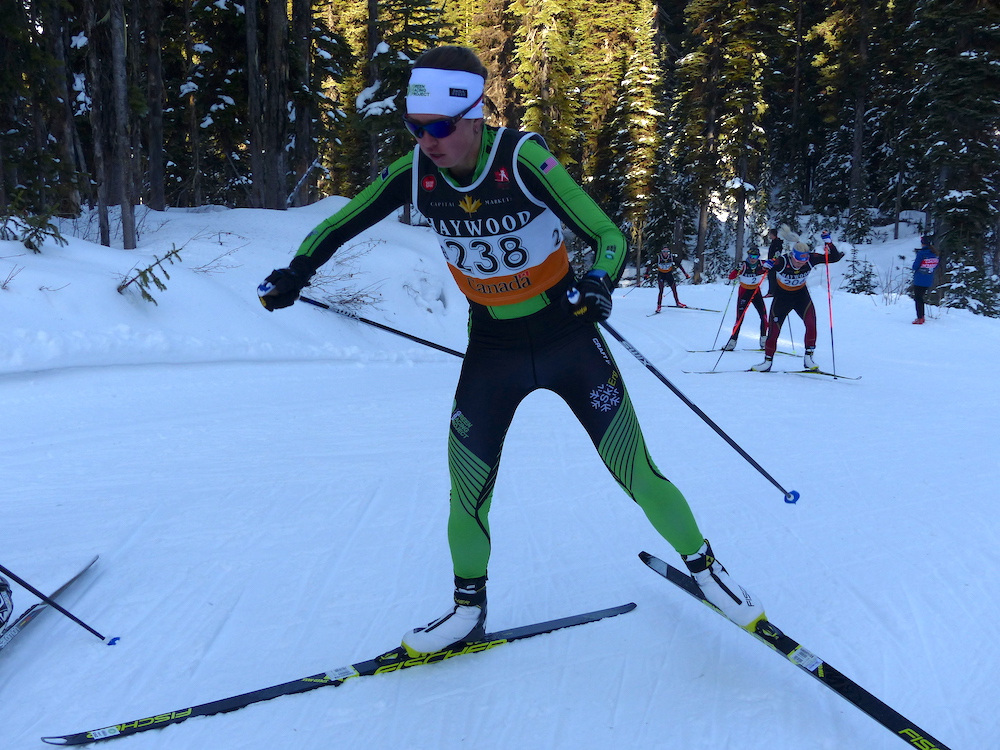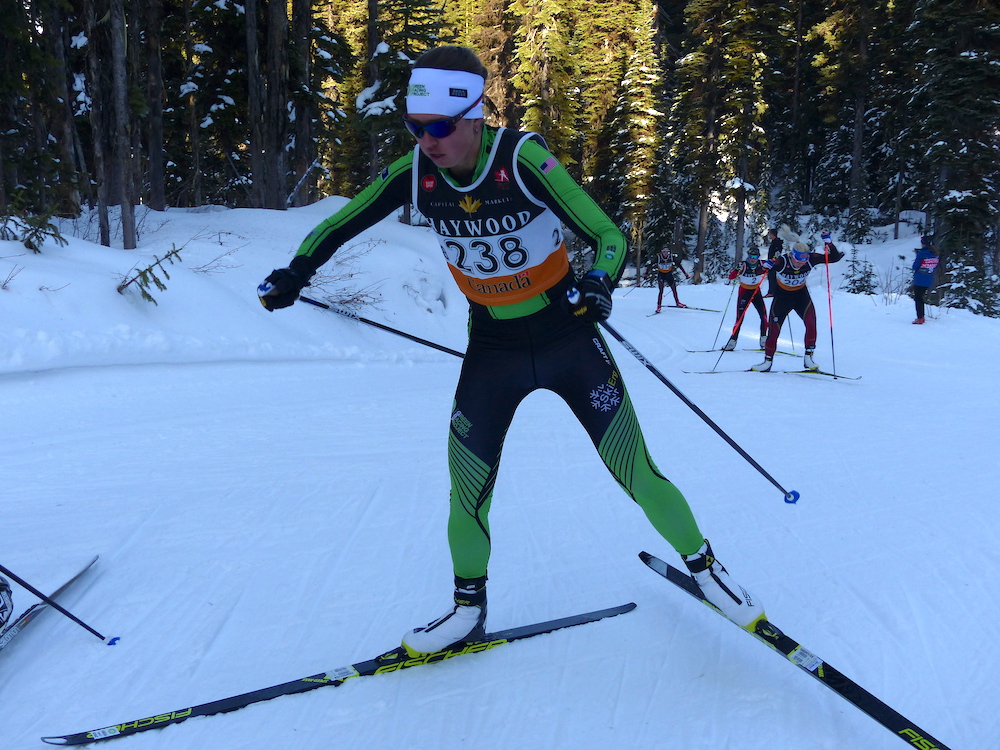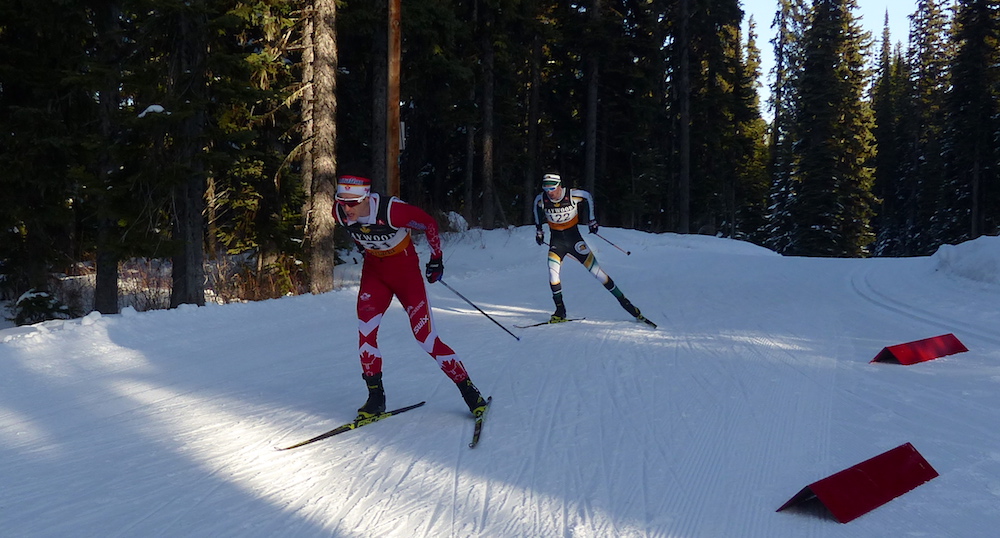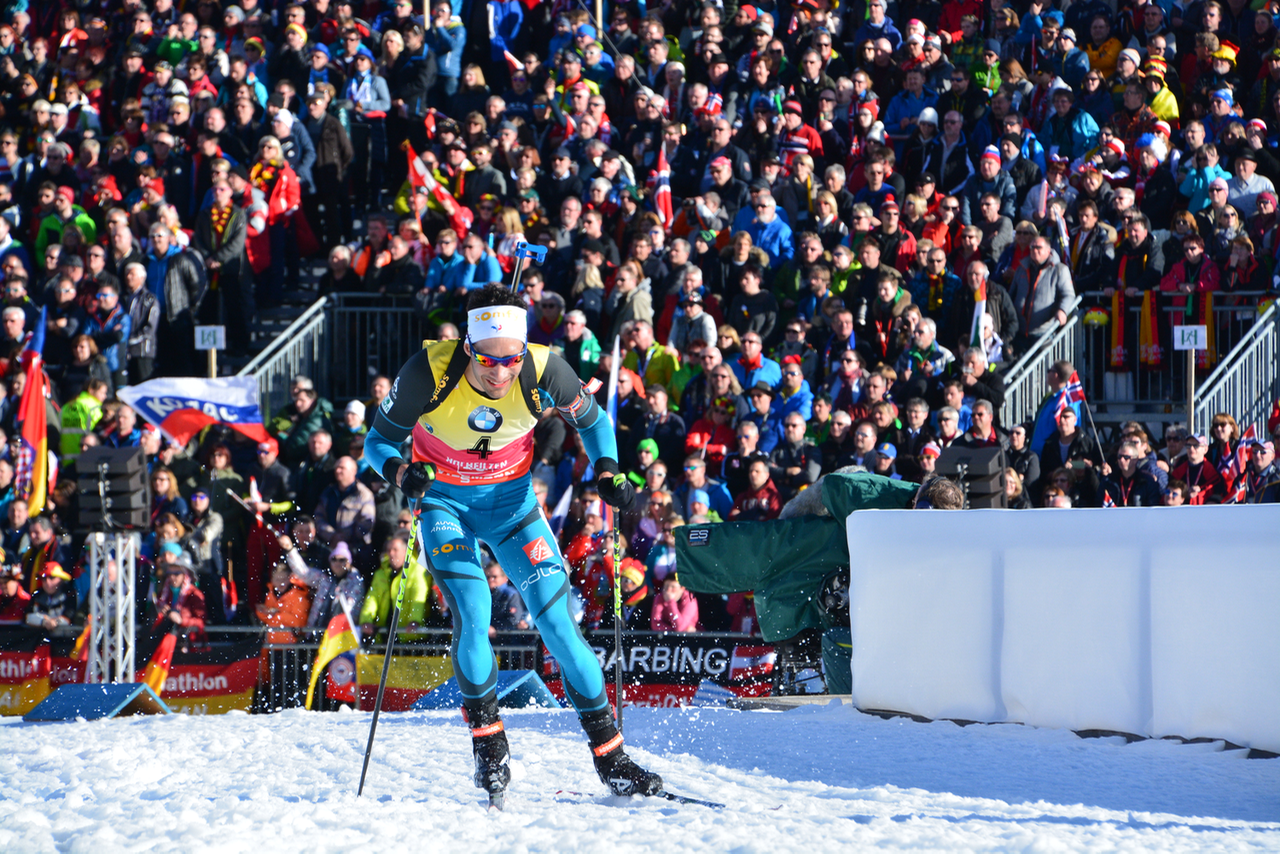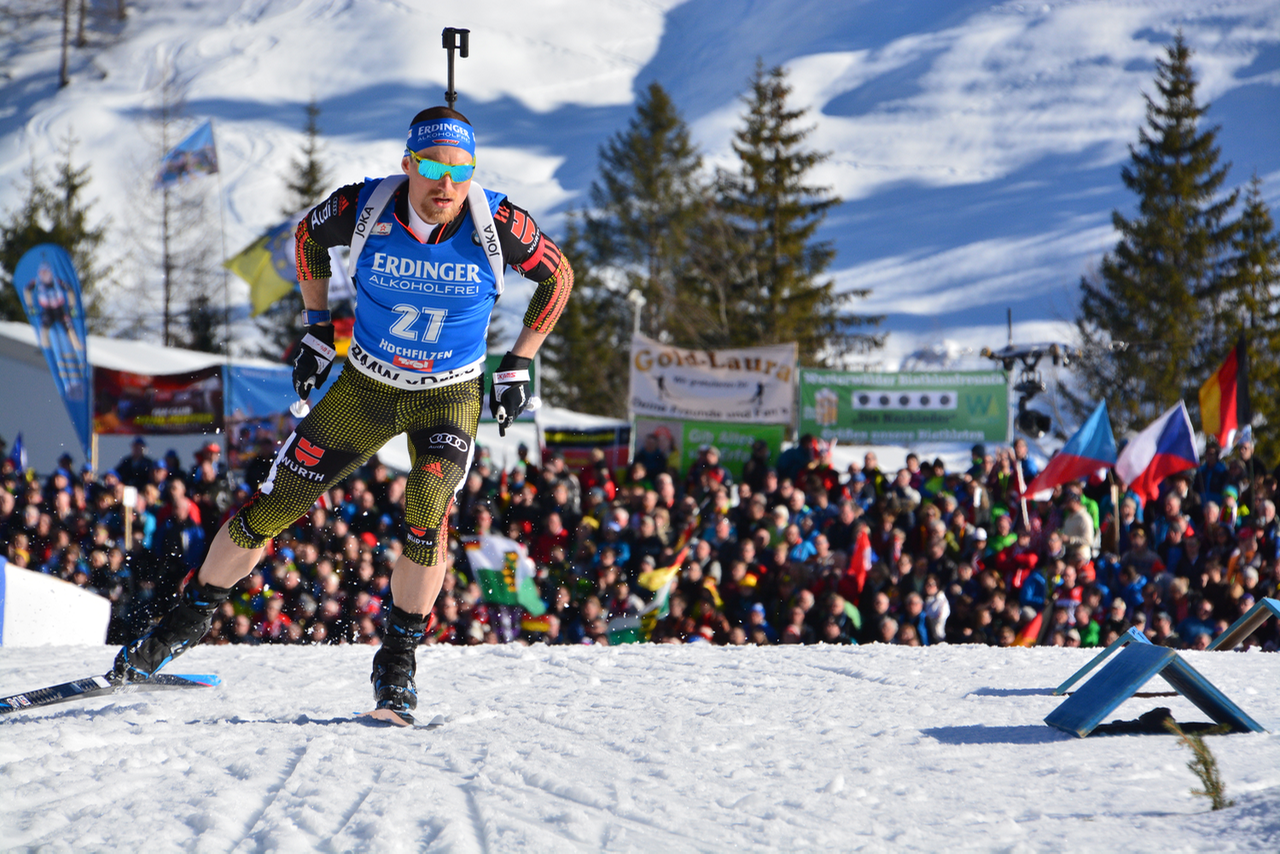
Tag: Erik Lesser

  • Sunday Rundown: Holmenkollen 30 k; Kontiolahti Mass Starts

    Sunday Rundown: Holmenkollen 30 k; Kontiolahti Mass Starts

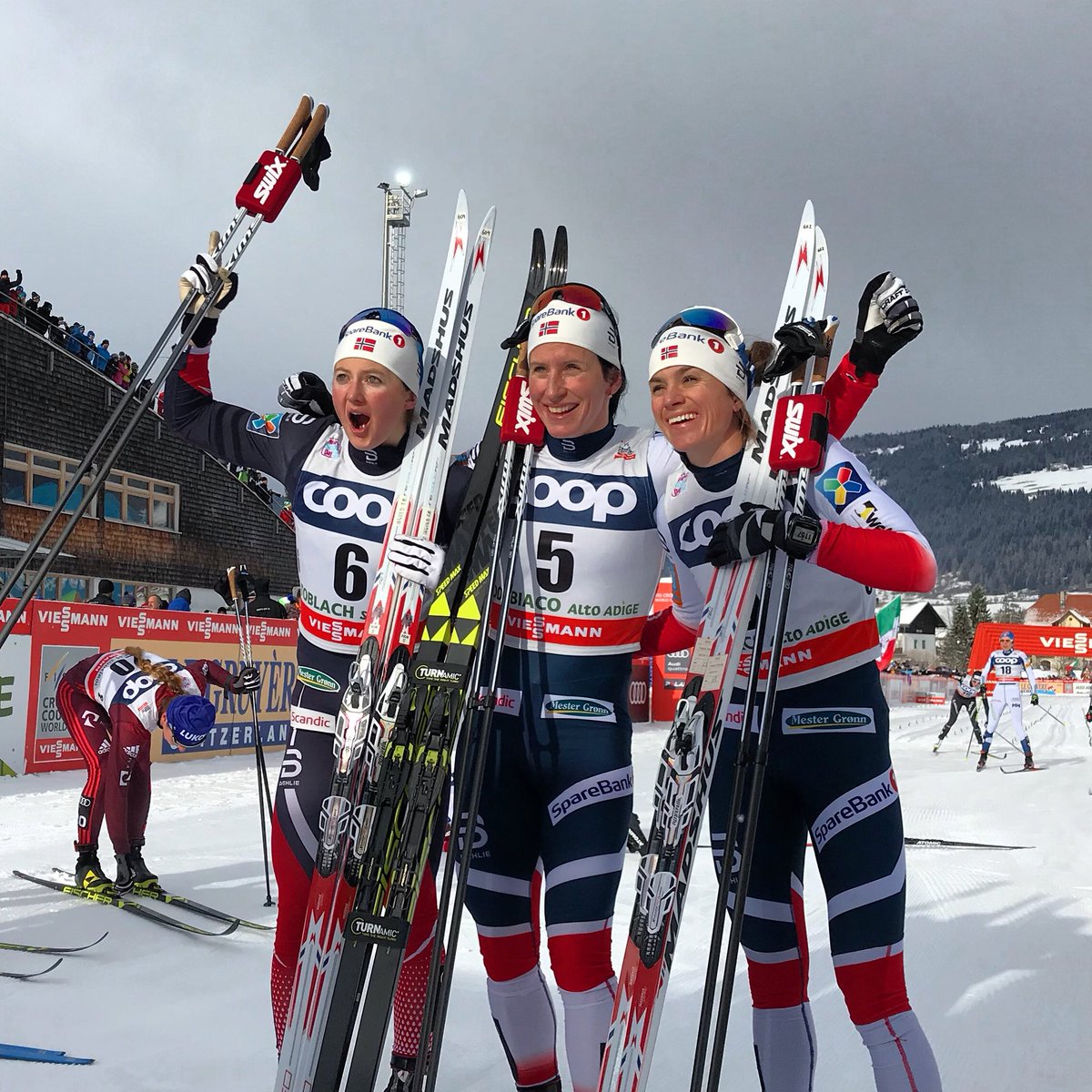
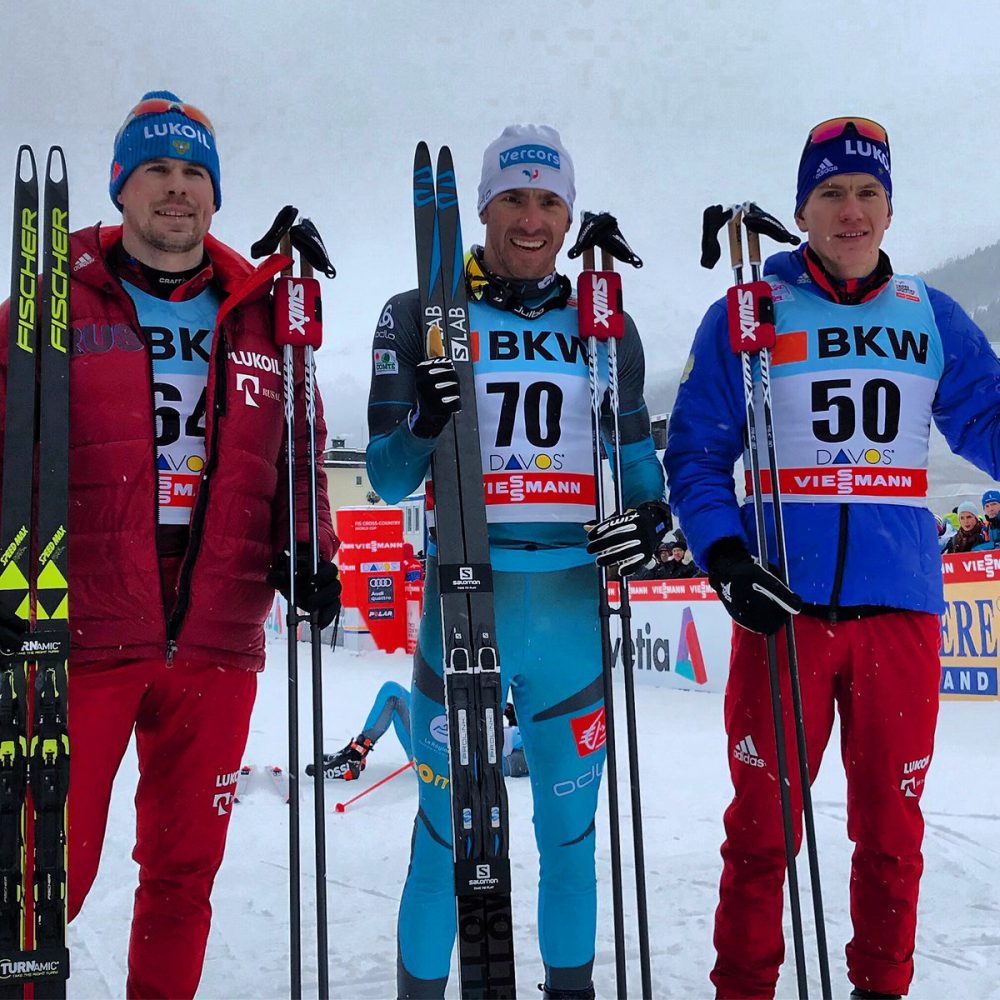
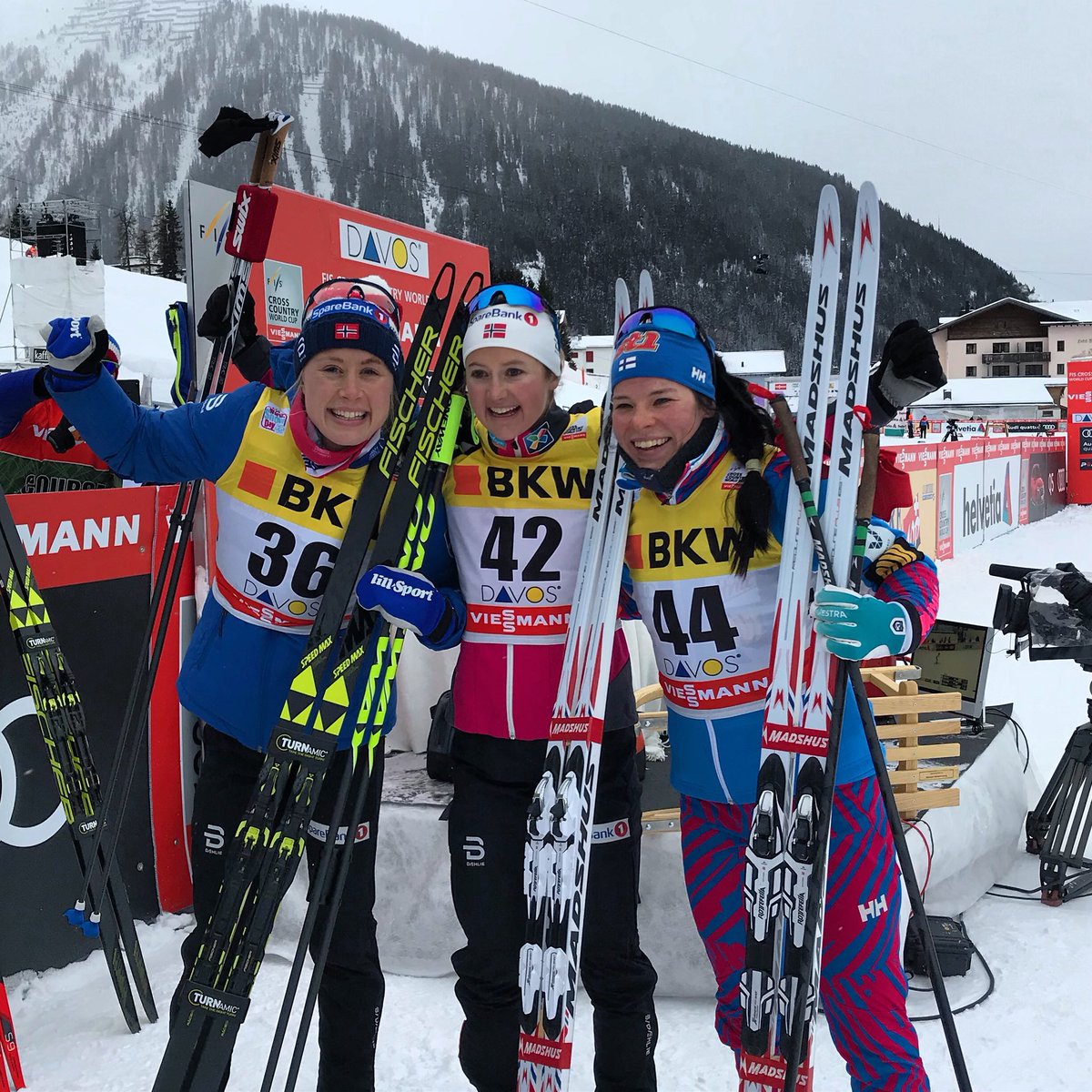
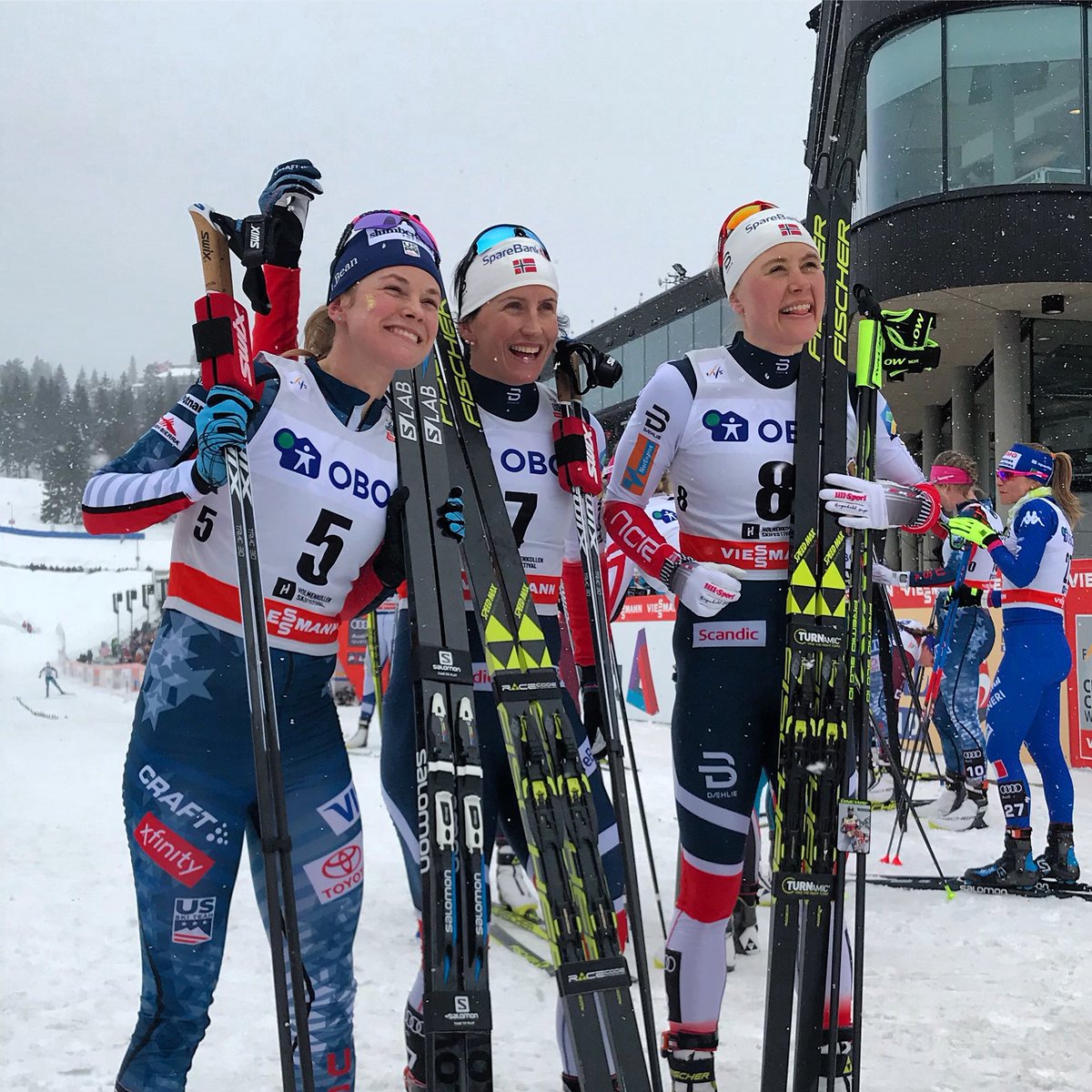
    The Holmenkollen women’s 30 k freestyle mass start podium on Sunday in Oslo, Norway, with Jessie Diggins (l) in second, and Norway’s Marit Bjørgen (c) in first and Ragnhild Haga (r) in third. (Photo: FIS Cross Country/Twitter)

    FIS Cross Country World Cup (Oslo, Norway): Women’s 30 k freestyle mass start

    Full report

    Marit Bjørgen, the Norwegian queen of distance cross-country events, racked up another victory at Holmenkollen in the women’s 30-kilometer freestyle mass start on Sunday for her seventh win in the World Cup’s ultimate distance event at the famed Norwegian venue. (She had previously won in 2005, 2010, 2012, 2014, 2015 and 2017).

    But she did so in not-so-typical fashion. Instead of breaking the field mid-race and skiing to a comfortable win, like she did in the last race of the 2018 Olympics in PyeongChang, South Korea (a 30 k classic mass start), Bjørgen came from behind to win Sunday’s Holmenkollen 30 k and wasn’t able to let off too much before finish. She didn’t take the lead until less than a kilometer to go and put just enough time into her competition to take the win in 1:18:12.4 hours, while American Jessie Diggins outlasted the chase group of three to place second (becoming the first American woman to reach the Holmenkollen podium), 3.6 seconds behind Bjørgen. Norway’s Ragnhild Haga edged Sweden’s Charlotte Kalla by 0.1 seconds for third place (+4.3), while Kalla settled for fourth (+4.4).

    The rest of the field was strung out, with Norway’s Astrid Uhrenholdt Jacobsen finishing fourth (+11.5) and Ingvild Flugstad Østberg nearly another 1 1/2 minutes back in fifth (+1:39.5). Finland’s Krista Pärmäkoski placed seventh (+1:51.7), Germany’s Stefani Böhler notched eighth (+2:10.2), Austria’s Teresa Stadlober ninth (+2:10.2), and Sweden’s Ebba Andersson 10th (+2:11.9). Less than a second behind Sweden’s Ida Ingemarsdotter in 11th (+2:22.8) was American Sadie Bjornsen in 12th (+2:23.4).

    In the Distance World Cup standings, Diggins gained some valuable points to keep herself in third, now 63 points ahead of Pärmäkoski in fourth. Heidi Weng, who finished 18th on Sunday, still leads the distance standings by 104 points and Østberg is second, 51 points ahead of Diggins.

    In the Overall World Cup, Weng leads by 153 points over Østberg. Diggins is another 104 points back in third, 100 points ahead of Pärmäkoski in fourth. At World Cup Finals next week in Falun, Sweden, a total of 300 points is up for grabs for the winners (50 for freestyle sprint, 50 for classic individual start, and 200 for freestyle pursuit).

    The U.S. had three in the top 20 and four in the points (top 30) in Sunday’s 30 k, with Kikkan Randall in 19th (+3:21.9) and Caitlin Patterson in 28th (+4:13.1). Rosie Frankowski (Alaska Pacific University) missed the top 30 by about 28 seconds in 31st (+4:45.4), Liz Stephen placed 51st (+10:01.7) and Kaitlynn Miller (Craftsbury Green Racing Project) finished 53rd (+16:05.0).

    Cendrine Browne led four Canadian women in 36th (+6:16.1), Emily Nishikawa was 44th (+7:36.1), Zina Kocher (Foothills Nordic) finished 47th (+8:52.0), and Dahria Beatty placed 49th (+9:45.1).

    Results | Distance World Cup standings | Overall World Cup standings

    ***
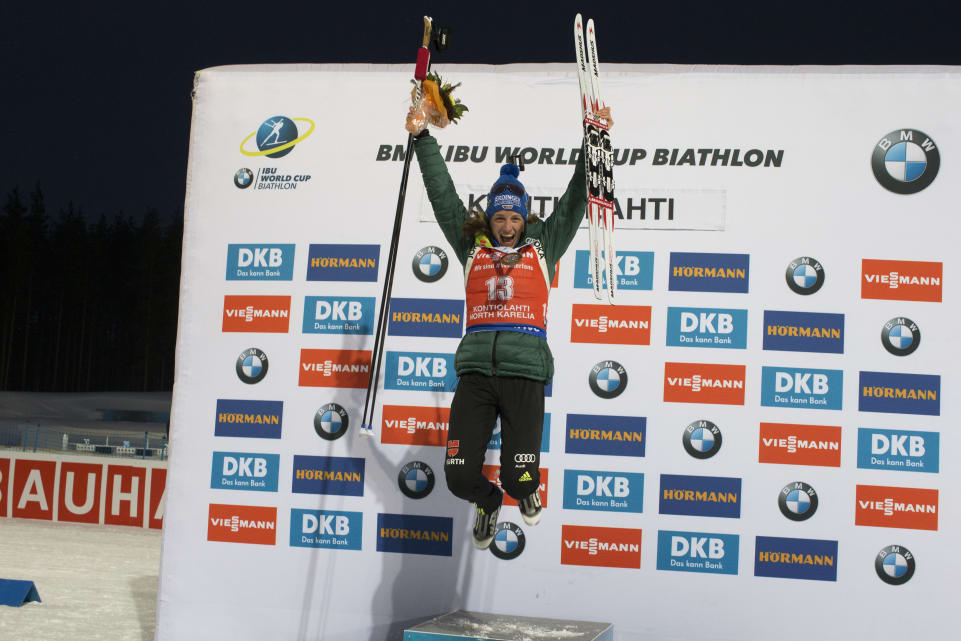
    Germany’s Vanessa Hinz celebrates her first IBU World Cup win and podium in the women’s 12.5 k mass start on Sunday in Kontiolahti, Finland. (Photo: IBU/Biathlonworld)

    IBU World Cup (Kontiolahti, Finland): Men’s and women’s mass starts

    (Note: This rundown has been updated to include comments from Lowell Bailey and Rosanna Crawford.)

    Germany’s Vanessa Hinz won her first International Biathlon Union (IBU) World Cup race (and achieved her first World Cup podium) and Austria’s Julian Eberhard won his first race of the season (and first mass start of his career) in the women’s 12.5 k and men’s 15 k mass starts on Sunday in Kontiolahti.
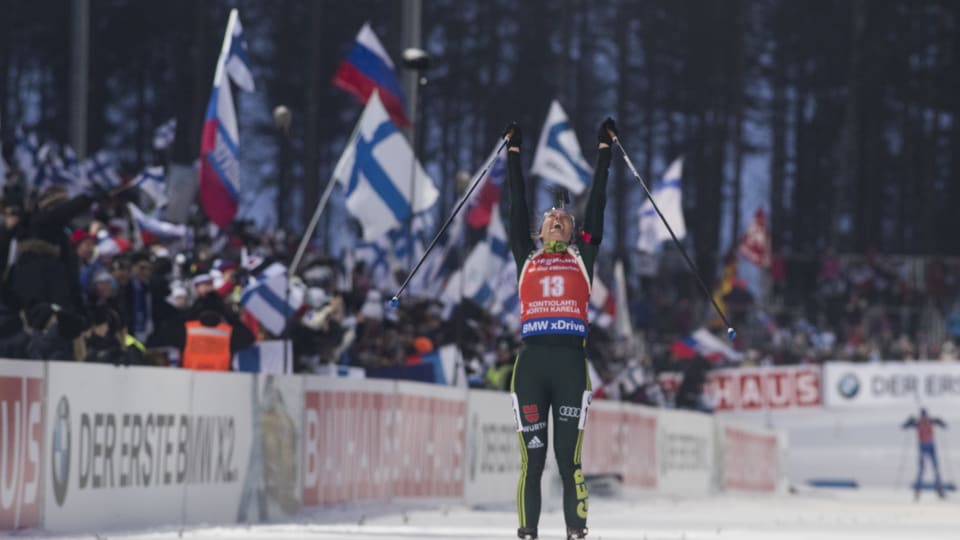
    Germany’s Vanessa Hinz celebrates her first IBU World Cup win and podium in the women’s 12.5 k mass start on Sunday in Kontiolahti, Finland. (Photo: IBU/Biathlonworld)

    Hinz shot an impressive 20-for-20 with the third-fastest range time and fifth-fastest shooting time to take the win in 35:47.9 minutes. Third after the first prone stage, she moved into second, then third after cleaning the next two stages. After knocking down her final five targets in the last standing, Hinz left the range almost 24 seconds ahead of France’s Anaïs Chevalier in second and 26 seconds ahead of Italy’s Lisa Vittozzi in third. Hinz stayed ahead of her challengers on the final loop, finishing 13.5 seconds clear of Vittozzi, who claimed second. Chevalier finished third, 16.8 seconds back, while Finland’s Kaisa Mäkäräinen was next across the line in fourth (+43.4) with a gap to Sweden’s Hanna Öberg in fifth (+1:02.1).

    Vittozzi and Chevalier both cleaned the first three stages then had to ski a penalty lap after the last standing bout (0+0+0+1). Mäkäräinen missed three (1+0+1+1) yet skied the second-fastest course time on her home course, and Öberg missed two (0+0+2+0). The fastest course time of the day was clocked by Darya Domracheva of Belarus, who had to ski five penalty laps (0+1+1+3) and ended up 10th (+1:18.2).

    “I always dreamed of shooting four times clean and today I did it,” Hinz, 25, said, according to an IBU press release. “I was so often close to the podium. I knew I could do it. Today, I said, ‘OK, let’s try it and if it works, it is OK … and if not there is another season waiting and other races.’ Now I am on top of the podium and it is crazy.”

    Vittozzi, who placed fourth in the mass start at the 2018 Olympics, was glad to improve on a third-place finish in Friday’s sprint by placing second on Sunday.

    “I have been third so many times and that was not satisfying for me,” Vittozzi said, one day after she won the mixed relay with her team in Kontiolahti. “Today I am very happy about my second place.”

    For Chevalier, it was her first individual podium of the season and it came a day after she and Antonin Guigonnat won the single mixed relay. Chevalier, 25, was severely injured when she was hit by a car last spring, according to an IBU press release.

    “I am very happy to be here today, because it was a very hard season,” she told the IBU. “I forgot how nice it is to be on the podium … I forgot that it was not easy, so I am very happy … I did my best on the last lap; [Vittozzi] was faster, but I am third and happy with that!”

    Canada’s Rosanna Crawford shot 19-for-20 to place 13th (+1:25.9) with her only miss coming in the second prone stage (0+1+0+0). Her overall shooting and range times were 10th fastest of the 30-woman field, compared to her 26th-ranked ski time. Crawford had been in 11th after cleaning the final standing stage, then slipped two spots to finish 13th in her second mass start of the season.

    “Since the skiing wasn’t feeling great today I made sure I was super focused in the range,” Crawford wrote in an email to FasterSkier. “I knew that was my only chance to get a good result today. My one prone miss was a bad trigger pull, but the rest were nice solid hits. I made sure to have a solid set up and then just trusted my rhythm and shooting.

    “I knew that I wanted that top 15, so I just kept fighting and trying to stick with the women when they caught me,” she wrote of her last loop. “The last time up the wall I managed to stay close to [France’s] Anais Bescond, and hold off the two people behind me. Really happy to be in the top 15 again.”

    Clare Egan was the lone American woman to qualify for Sunday’s mass start, and it was the second mass start of her career. She was on track for a top-15 result after missing just one target in the first three stages, but she had to ski three penalty laps on the last standing (0+1+0+3), which put her in 23rd by the finish (+2:05.6). Notably, she skied the 14th-fastest overall course time.

    “I didn’t have quite the same energy level tonight as the last two days, but I still had the 14th rank course time and that means anything is possible in the race,” Egan wrote in an email to FasterSkier. “To put it in perspective, the winner of the race, Hinz, had the 13th rank, just 2 seconds faster than me. This is the first time I’ve felt totally comfortable skiing with the fastest women, and I certainly hope I can maintain this speed for one more week of World Cup racing.”

    Egan was pleased with her 9-for-10 prone shooting and her clean standing stage (“which is the first time I’ve cleaned a standing stage in an individual race this entire year, believe it our not,” Egan wrote).

    “But when I missed my second shot on the final stage, I let that throw me off my game, and really blew the rest of the stage,” she explained. “It’s so hard to keep 100% focus in every scenario, and I find it gets harder and harder towards the end of the race when I’m not necessarily the most lucid. I know that I have to work on so I have a goal to manage the final stage better next week and in the future.”

    Her 23rd-place finish was one better than her previous World Cup mass start finish, which was 24th last season in Hochfilzen, Austria.

    “In my only other mass start, which was last year at World Championships, I felt like an imposter,” Egan reflected. “Maybe because I was the first ‘reserve’ to get called up when one of the top women [did not start]. But this was totally different. I knew I deserved to be there today and was confident about competing with the other top women.”

    In my only other mass start, which was last year at World Championships, I felt like an imposter … This was totally different. I knew I deserved to be there today and was confident about competing with the other top women.” — Clare Egan (US Biathlon) on Sunday’s mass start

    While the women raced Sunday night, the men’s 15 k mass start took place in the afternoon, when Eberhard passed the likes of France’s Martin Fourcade and Russia’s Anton Shipulin after a tangle late in the race to take the win.
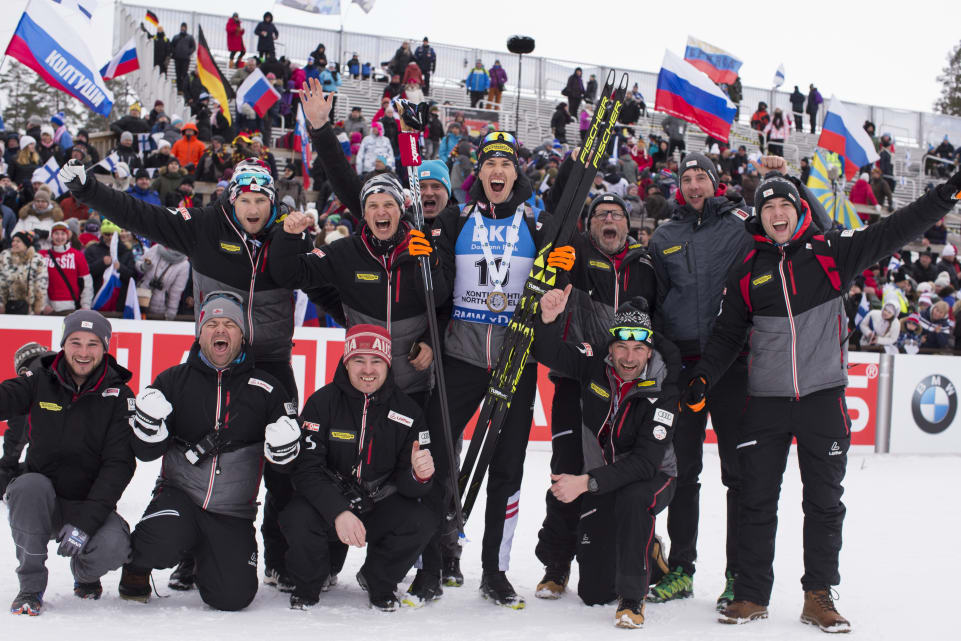
    The Austrian team celebrating Julian Eberhard’s fourth career victory, his first this season and his first in a mass start on Sunday after the IBU World Cup men’s 15 k mass start in Kontiolahti, Finland. (Photo: IBU/Biathlonworld)

    The Austrian had cleaned the first two prone stages to move into third by the race’s halfway point, behind Germany’s Benedikt Doll and Arnd Peiffer in first and second, respectively. Eberhard missed one in the next standing stage, yet left the range in second, 15 seconds behind Peiffer (who cleaned) in first, while Doll missed one as well to slip into third, 19 seconds back.

    With two loops to go, Fourcade was coming back from two early prone penalties and found himself in fifth after a clean standing stage, less than a second behind Shipulin in fourth. On the next standing stage, Fourcade cleaned to take the lead and left the range about five seconds ahead of Shipulin (who also cleaned) in second.

    Eberhard missed one yet remained in contention in third, 17 seconds behind Fourcade. On the last loop, Shipulin caught Fourcade before the course’s notorious climb known as “The Wall”, and Eberhard closed on the two frontrunners as they ascended it. Still several seconds behind over the top, he caught Shipulin on the bridge before the stadium, but the two tangled skis and Shipulin fell. Eberhard stayed upright and pulled even with Fourcade, passing him to take the win in 38:04.8. Fourcade finished second (+6.9) and Shipulin third (+19.3).
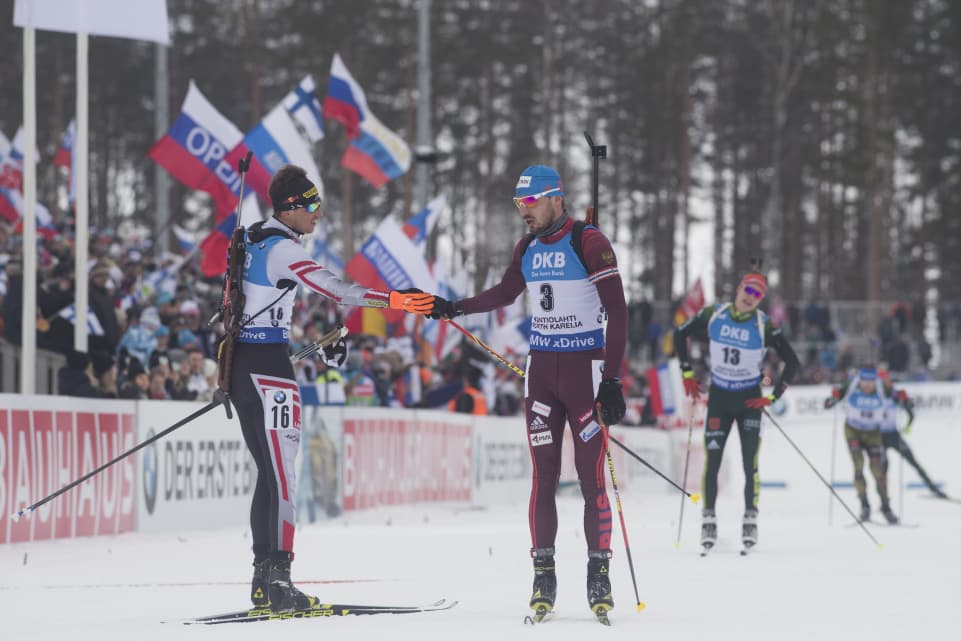
    Austria’s Julian Eberhard (l) and Russia’s Anton Shipulin after the finish of the men’s 15 k mass start the IBU World Cup in Kontiolahti, Finland. Shipulin fell when his skis tangled with Eberhard’s. While Eberhard raced to the win, Shipulin placed third. (Photo: IBU/Biathlonworld)

    “I wanted to be in a sprint with all three, but the bridge is too small for this,” Eberhard said, according to an IBU press release. “I came up the bridge with too much speed. Anton and I were in the same track and there was an accident. I apologized to Anton at the finish but he said these things can happen and it was OK with him.”

    “I hold no grudge against Julian,” Shipulin told the IBU. “This can happen in sports and is all fair … I am in good shape and want to preserve this and perform my best in the last World Cups.”

    Fourcade explained that illness caused him to sit out Thursday’s sprint, and he was only able to train three hours this week.

    “It is really difficult to race in this situation without any feeling or training,” Fourcade told the IBU. “I did not know what to expect today but I am quite satisfied. I would have liked to win, but I used too much energy trying to come back in the early laps and had no energy when it was time to attack.”

    Behind them, Doll picked off one place on the final loop to finish fourth (+21.9), passing his German teammate Erik Lesser, who finished fifth (+23.9). Peiffer followed in sixth (+27.1) as Germany had three in the top six.

    American Lowell Bailey raced to 14th (+1:06.3) with two penalties, both of which came in the standing stages (0+0+1+1). Bailey had been fourth after cleaning the second prone, 16 seconds behind Doll in first, but slipped to 10th after missing one on the next bout. He had to ski another penalty lap on the last stage, and left the range in 14th.

    Overall, Bailey posted the 10th-fastest shooting time, 15th-fastest range time and 18th-fastest course time.

    “I finally felt like I was back in the spot that I ended last season,” Bailey wrote in an email when asked about his consistency. “I felt controlled and able to keep the pace with the top of the field throughout the race.  It was nice to be back in the mix.

    “Although I would have liked to see this ski speed a few weeks ago, better late than never!” he continued.

    Next week’s World Cup in Oslo, Norway, will be his last of the season and his career.

    “After nearly two decades of international racing, Oslo will be my final World Cup as a U.S. Biathlete,” Bailey wrote. “I’m sure it will be emotional but I hope to end my World Cup career on a high note!”

    Results: Women | Men

  • Thursday Rundown: Ogden, Bergström NCAA Champs; Kontiolahti Men’s Sprint

    Thursday Rundown: Ogden, Bergström NCAA Champs; Kontiolahti Men’s Sprint

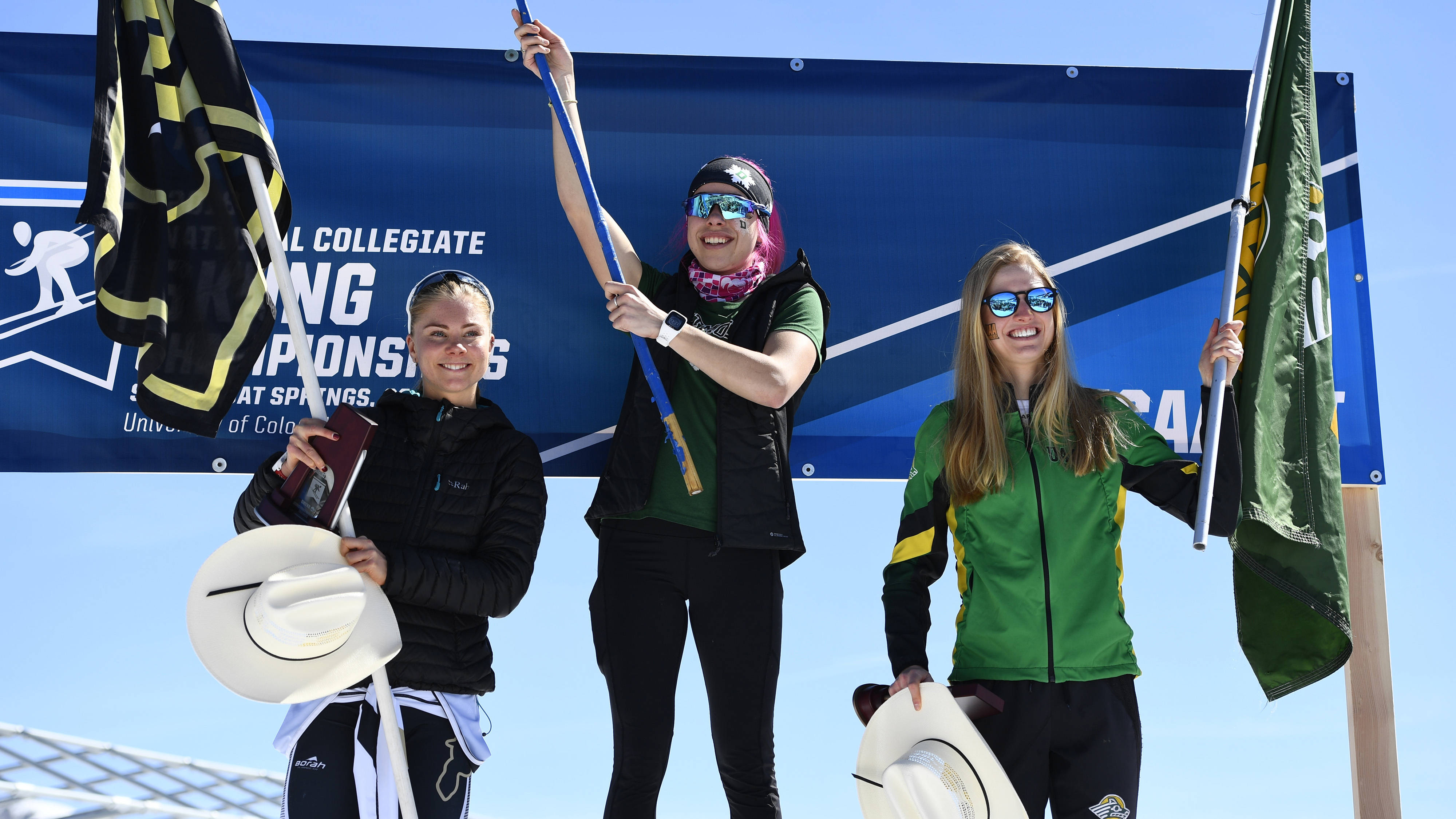
    The women’s 5 k classic podium at 2018 NCAA Skiing Championships in Steamboat Springs, Colorado, with Dartmouth’s Katharine Ogden (c) in first, Colorado’s Anne Siri Lervik (l) in second, and University of Alaska Anchorage’s Hailey Swirbul (r) in third. (Photo: Clarkson Creative/DartmouthSports.com)

    On the first day of NCAA Skiing Championships at Howelsen Hill in Steamboat Springs, Dartmouth College freshman Katharine Ogden and University of Utah senior Martin Bergström were crowned champions in the women’s 5-kilometer and men’s 10 k classic races, respectively.

    Ogden won the women’s individual-start race by a whopping 46.9 seconds, finishing in 14:47.2 minutes to become Dartmouth’s first female cross-country skier to win an NCAA title, according to a Dartmouth press release. Anne Siri Lervik of the University of Colorado Boulder (CU) placed second and Hailey Swirbul, of the University of Alaska Anchorage (UAA) and a two-time individual medalist at this year’s Junior World Championships, placed third (+51.0).

    “There isn’t much more to say about Katharine’s performance today other than she absolutely crushed it!” said Dartmouth Director of Skiing and Women’s Nordic Head Coach Cami Thompson Graves, according to the Dartmouth press release. “It was such a treat to watch her perform so well.”

    Martin Bergström (University of Utah) after winning his third-straight NCAA Skiing Championships title with a win in the 10 k classic on Thursday in Steamboat Springs, Colorado. (Photo: University of Utah)

    CU, this year’s NCAA Championships host, had three women in the top 11 with last year’s classic champion Petra Hyncicova placing sixth and Christina Rolandsen finishing 11th.

    The CU Buffs took the lead in the team standings on Thursday by nine points over the University of Denver (DU). Utah is currently 41 points back in third, Dartmouth moved up to fourth, and the University of Vermont, which led after Wednesday’s Day 1 alpine races, slipped to fifth.

    In the men’s race, Bergström, who won both races at last year’s NCAA Championships, posted an 8.5-second victory over CU’s Petter Reistad with a winning time of 27:37.1. Dag Frode Trollebø of DU placed third (+14.7) ahead of his DU teammate Eivind Kvaale in fourth (+38.9). On his 22nd birthday, Ian Torchia, of Northern Michigan University and the U.S. Ski Team Development Team, was the top American finisher in fifth (+46.2).

    Alpine slalom races will take place on Friday, while NCAA Championships will conclude with 15/20 k freestyle mass starts on Saturday.

    Results: WomenMen

    Team results (through Day 2 of 4)

    ***

    IBU World Cup (Kontiolahti, Finland): Men’s 10 k sprint

    First, a little geography lesson. Kontiolahti, Finland, is only about 100 kilometers from the Russian  border, so most of the International Biathlon Union (IBU) World Cup (and World Championships) events held there attract a mostly Russian crowd.

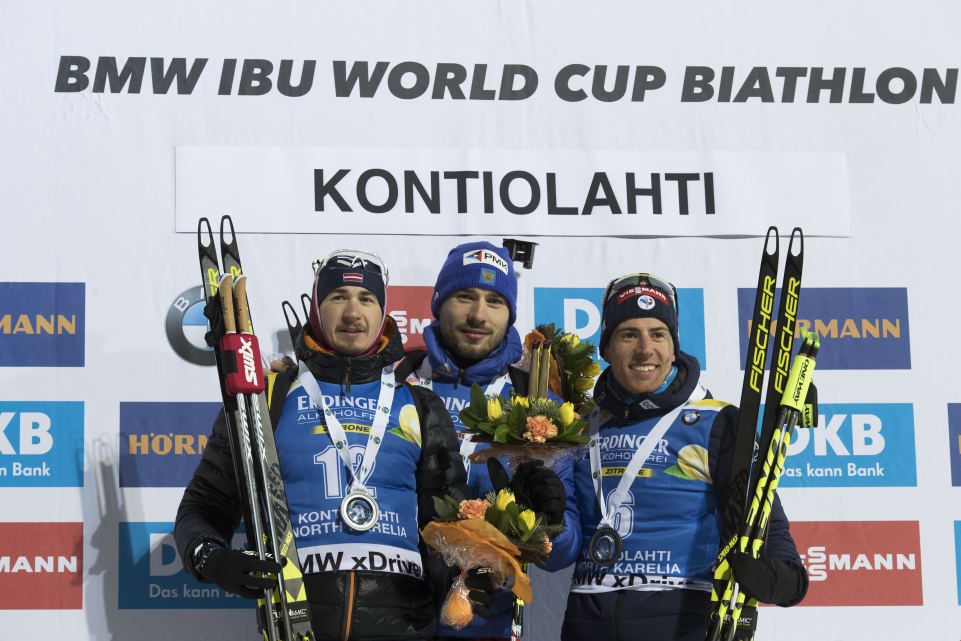
    The men’s 10 k sprint podium at the IBU World Cup in Kontiolahti, Finland, with Russia’s Anton Shipulin (c) in first, Latvia’s Andrejs Rastorgujevs (l) in second, France’s Quentin Fillon Maillet (r) in third. (Photo: IBU/Biathlonworld)

    And here’s a little more background: Russia’s Anton Shipulin showed up for Thursday’s IBU World Cup in Kontiolahti raring to go after having been barred from last month’s Winter Olympics in PyeongChang, South Korea.

    So Shipulin hadn’t raced since Jan. 21 in Antholz, Italy. The International Olympic Committee’s decision to ban him from the 2018 Games went public on Jan. 23.

    Back in action in Kontiolahti, in front of Russian fans, Shipulin delivered a 5.8-second win in the men’s 10-kilometer sprint, shooting clean and finishing in 23:51.6.  It was the 31 year old’s third non-relay podium of the season and first World Cup win of 2017/2018, and he did so on a relatively moderate evening by Kontiolahti standards (at -6 degrees Celsius, or 21 Fahrenheit) with a “stiff breeze” on the range, according to an IBU press release.

    “I felt very good on the tracks and shooting and today it was enough to win,” Shipulin told the IBU. “I am very happy about this … all of the Russian fans gave me a lot of support on the tracks.”

    Latvia’s Andrejs Rastorgujevs tied his career best in second place, after shooting a perfect 10-for-10 as well. He acknowledged his mom and women in general after the race.

    “This is very important for my team,” Rastorgujevs told the IBU. “I would also like to congratulate all of the ladies and especially my mom on International Women’s Day.”

    France’s Quentin Fillon Maillet also shot clean to place third (+17.3) for his third non-relay World Cup podium of the season.

    Fillon Maillet was one of the earliest starters in bib 6 yet held off Norway’s Johannes Thingnes Bø, the 30th starter, by 1.7 seconds for the last spot on the podium. Bø had been a race leader after cleaning prone but missed two standing targets (0+2) to slip out of contention and into fourth at the finish (+19.0).

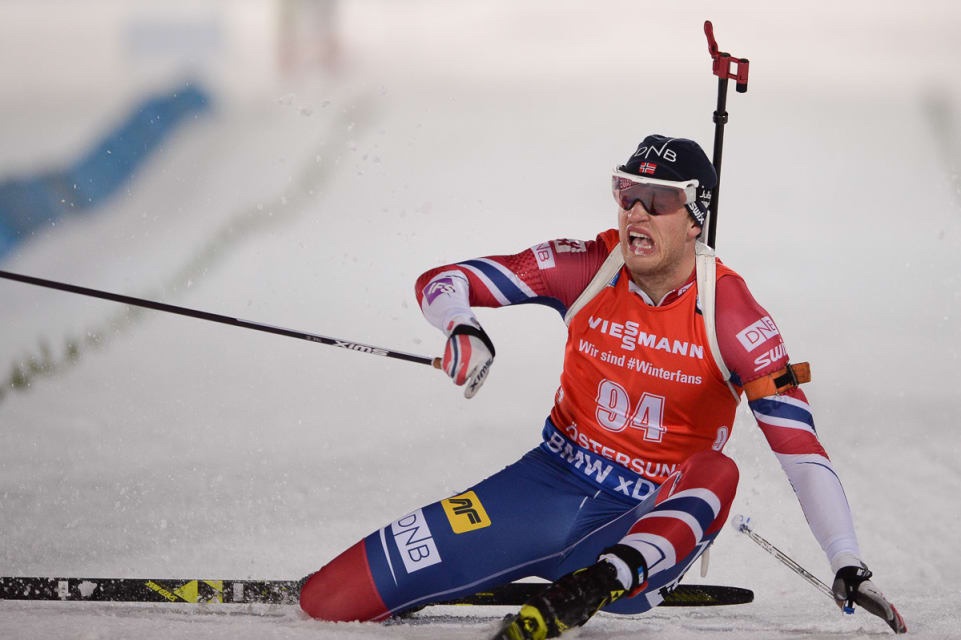
    Germany’s Olympic sprint champion, Arnd Peiffer placed fifth (+27.4) with one miss (0+1), and France’s Simon Desthieux finished sixth (+28.3) with one prone penalty (1+0), and Germany took seventh and eighth with Erik Lesser (+30.6; one penalty) and Simon Schempp (+32.0; two penalties), respectively. Italy had two in the top 10 with Lukas Hofer in ninth (+35.2; one penalty) and Dominik Windisch in 10th (+38.3; one penalty).

    Lowell Bailey of the U.S. posted his best sprint result of the season in 16th (+48.4) after cleaning prone and missing one standing target (0+1). After starting 22nd, he recorded the 13th- and 14th-fastest overall shooting and range times, respectively, and 23rd-ranked course time.

    After the Olympics, Bailey returned home to Lake Placid, N.Y., for a brief training block. Despite a hefty amount of travel over the last week and a half, he explained in an email that he felt good in his first race back.

    “I felt better than I have for most of the season.  Sometimes that can happen.  I guess that’s the part of the unpredictability of biathlon,” Bailey wrote of Thursday’s race. “The conditions were great today; hard tracks and calm winds on the range.  There was a bit of wind, but compared to the three weeks in South Korea, it seemed pretty tame.

    “Shooting felt solid today,” he added. “That missed shot in standing was sooo close, but not close enough!”

    Overall, Bailey stated that he was happy with his performance and looking forward to the rest of the races in Kontiolahti.

    Leif Nordgren (US Biathlon) raced to 17th for his best result in three seasons on Thursday in the men’s 10 k sprint at the IBU World Cup in Kontiolahti, Finland. (Photo: USBA/NordicFocus)

    His teammate Leif Nordgren finished just one place behind him in 17th (+49.9) for his best result in three years. A later starter in bib 55, Nordgren also cleaned prone and missed one standing (0+1) with the fifth-fastest shooting time and seventh-fastest range time. Overall, his course time ranked 28th out of 100 finishers. Nordgren’s individual career best on the World Cup is 16th in a sprint in February 2015. He has finished 17th three times; the last time was in a pursuit in March 2015.

    Brendan Green shot clean to lead the Canadian team in 34th (+1:29.5). American Sean Doherty followed in 35th (+1:29.7) with three penalties (1+2), and Tim Burke placed 38th (+1:36.1) for the U.S., also with three misses (1+2).

    In his World Cup debut, American Alex Howe finished 68th (+2:23.1) with two misses (1+1).

    Canada’s Christian Gow finished 79th (+2:47.4) with two penalties (1+1), and Scott Gow was 86th (+3:01.7) with three misses (1+2).

    This year’s Kontiolahti World Cup does not include a pursuit race. The women’s 7.5 k sprint is scheduled for Friday at 11:45 a.m. EST in Kontiolahti, and the single mixed relay and mixed relay will follow on Saturday. Racing in Kontiolahti will conclude with men’s and women’s mass starts.

    Results

  • More Olympic and World Championship Medalists Join Tyumen Biathlon Boycott

    More Olympic and World Championship Medalists Join Tyumen Biathlon Boycott

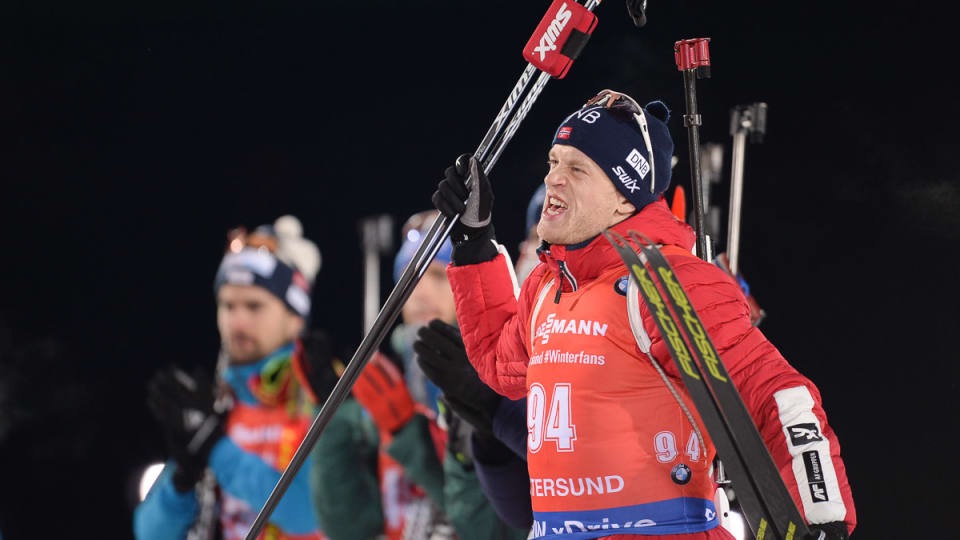
    Canada’s Christian Gow (12) chases Germany’s Erik Lesser during the men’s 4 x 7.5 k relay at the 2018 Olympics in PyeongChang, South Korea. Germany won bronze. Lesser lamented the situation and said of the IBU’s decision to hold World Cups in Tyumen, Russia, despite requests from him and other athletes to move the event: “If we don’t go, it’s wrong because it’s our sport we love. [But] if we go to Tyumen, we maybe send the wrong sign to IBU.” (Photo: FlyingPointRoad)
    In three weeks time, biathlon’s World Cup circuit will move to Russia.

    But a number of the sport’s stars won’t be there – and others plan to attend, but aren’t very happy about it.

    In an Executive Board session in PyeongChang, South Korea, a few weeks ago, the International Biathlon Union (IBU) decided to go on as planned with World Cup races in Tyumen, Russia, even though the Russian Anti-Doping Agency is still not compliant with the World Anti-Doping Code.

    Biathlon Canada had announced in December that it would boycott the event if it was kept in Russia, following revelations of systematic abuse of the anti-doping system by that country. In the intervening months, athletes appealed to the IBU through private channels to move the races to a country which complies with the WADA Code.

    After the IBU’s most recent announcement, the United States and Czech Republic have also gone public with boycotts of the event.

    Sebastien Samuelsson of Sweden celebrating silver in the men’s 12.5 k pursuit at his first Olympics on Monday in PyeongChang, South Korea. Samuelsson announced today that he is boycotting the World Cup Finals in Tyumen, Russia, because Russia is not in compliance with the World Anti-Doping Code. (Photo: IBU/Biathlonworld)

    Today, 2018 Olympic pursuit silver medalist (and relay gold medalist) Sebastian Samuelsson of Sweden announced on Twitter that he will not go to the races either.

    “Nations without a functioning anti-doping organization should not have competitions at the international level,” he wrote, according to a translation. “Also, worried about the safety of both myself and the doping tests in Russia.”

    Also not going is Klemen Bauer of Slovenia, a 2012 World Championships relay medalist who is a four-time Olympian.

    “I’m not planning to go to Russia at all,” he told FasterSkier in a Twitter exchange. “I was quite sure the IBU will replace the races, but despite all the effort we put into the clean/er biathlon, thanks to the president of the IBU that didn’t happen.”

    Both men are running for positions on the IBU’s Athletes Committee.

    “The idea is to improve the active role of the athletes and the voice of the athletes,” Bauer wrote of his candidacy. “We’ll see.”

    Another man running for a spot on the Committee is Germany’s Erik Lesser, 2014 Olympic silver medalist in the individual, 2015 World Champion in the pursuit, and several-time Olympic and World Championships relay medalist.

    Lesser will be attending the races in Tyumen, but he wasn’t happy about the IBU’s decision to hold them there.

    Klemen Bauer of Slovenia competing in the mass start at the 2018 Olympics in PyeongChang, South Korea. Bauer will not compete in the World Cup Finals in Tyumen, Russia. (Photo: FlyingPointRoad)

    “In my opinion the RUSADA and the Russian Federation have not done enough to light up this case,” he wrote in an email to FasterSkier. “During the last years, WADA and some commissions found a bunch of proof about a doping system in Russia. But RUSADA and [the Russian Biathlon Union] did nothing to fight against doping. The Anti-Doping-Laboratory in Moscow still does not have a license, and all the officials are in the same seats. It’s a wrong sign, after these problems, to go to Russia and celebrate World Cup Finals.”

    Lesser and teammate Arnd Peiffer, the 2011 World Champion in the sprint who then won gold at the 2018 Olympics, and who has even more World Championships and Olympic relay medals than Lesser, wrote a letter to the IBU explaining their position.

    Yet a few weeks ago, the IBU decided to go ahead and hold the World Cup in Tyumen anyway. They issued a press release explaining the decision.

    “I‘ve read the press release and I still don‘t understand why they decided this way,” Lesser wrote. “Because it‘s a threat to Russian biathlon fans and the Organizing Committee will take care of our safety? Wow, these are true reasons to keep the World Cup in Tyumen. So, I don‘t really think that reasons are valid.”

    Last season, there was also supposed to be a World Cup in Russia. But in 2017, several teams announced that they would boycott the event and IBU President Anders Besseberg had a contentious meeting with athletes, after which the IBU decided to move the event.

    This season, despite appeals by athletes like Lesser, Peiffer, and the others, that has not yet happened. And so in the end, Lesser says that he will compete in Tyumen, even though he wishes the races were somewhere else.

    “We argued with our federation and we decided to go to Tyumen,” he wrote. “The sport is the first [priority] and we want to compete. We hope that we can do a good job in Russia. We are there to stand as clean athletes.

    “It‘s bad that the IBU put us athletes in this position,” he wrote. “Actually it‘s not our job to be political. It‘s our job to be athletes and compete against other. If we don’t go, it’s wrong because it’s our sport we love. [But] if we go to Tyumen, we maybe send the wrong sign to IBU.”

  • Swedish Biathlon Caps Best Olympics with Relay Gold; U.S. Men 6th to Tie 1972 Mark

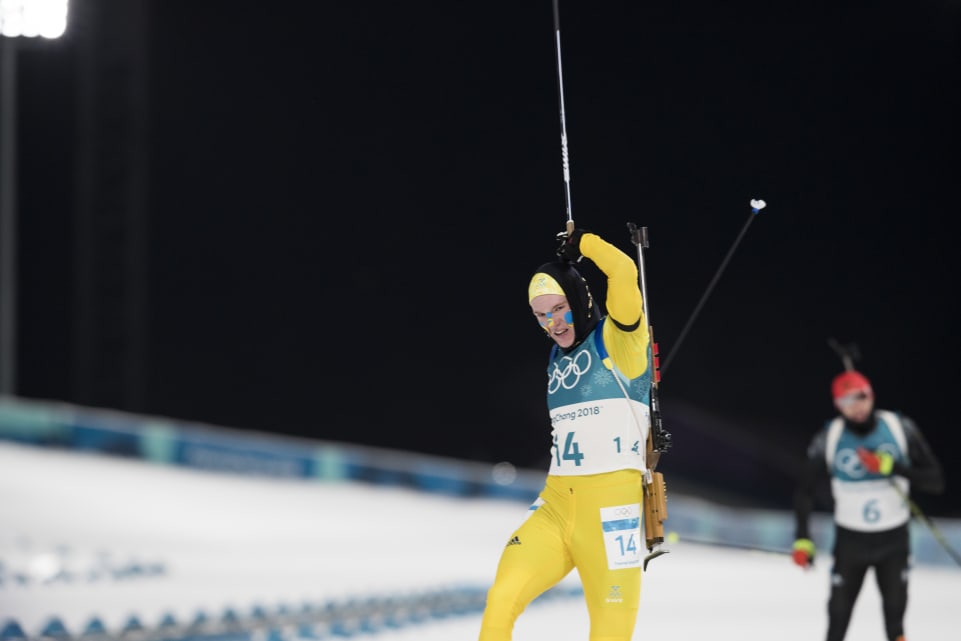
    Fredrik Lindström crosses the line first to secure a gold medal for his Swedish teammates in the men’s 4 x 7.5 k relay on Friday to close out biathlon competitions at the 2018 Olympics in PyeongChang, South Korea. (Photo: FlyingPointRoad)

    FasterSkier would like to thank Fischer Sport USAMadshus USAConcept2Boulder Nordic Sport, and Swix Sport US for their generous support, which made this coverage possible.

    Remember when it was a big deal when Sweden won a Biathlon World Cup? The team in bright yellow has made it a habit at the 2018 Winter Olympics, winning their first Olympic relay gold and fourth medal over the last two weeks on Friday — the last biathlon race of the PyeongChang Games.

    “It’s dreams coming true at that moment,” Fredrick Lindström, the Swedish men’s 4 x 7.5-kilometer relay anchor said in a post-race press conference on Friday. “It’s my third Olympics and to be on top with these guys feels great. I don’t know what to say.”

    Lindström had taken gold in perhaps the most ideal way for an athlete in his position, by heading out on the last 2.5 k loop in first place, almost 41 seconds ahead of anyone else. While he had missed his first shot in the final standing stage of the race, Lindström cleared it with the use of one spare bullet. Meanwhile, his closest challenger for the win — Norway’s Emil Hegle Svendsen, who had followed him into the range and lined up alongside him to shoot — missed his first two targets and went on to miss more, ending up with a penalty lap after using all three spares.

    That was the end of gold for Norway and for Svendsen, who was all too familiar with the penalty lane in the closing moments of an Olympic relay. Four years ago in the men’s relay in Sochi, Russia, Svendsen as Norway’s anchor had been in the medal hunt until the final shooting. There, he used all of his spares and still left a target standing, which sent him to the penalty lap. After leading by as much as 20 seconds in the middle of that race, Norway finished fourth.

    But as they say, that’s biathlon. And on Friday, it was Sweden’s day and Lindström skiing on his own for a 2.5 k victory loop around the course. But he didn’t slow down. As the 28 year old skated up the final climb, he was greeted by several members of his team bowing up and down in a unison to celebrate the history that was about to be made. Lindström descended down into the stadium, not looking back and still pushing toward the line, before skiing to the sidelines a few meters before the finish to grab a small Swedish flag.

    Fredrik Lindström crosses the line first to secure a gold medal for his Swedish teammates in the men’s 4 x 7.5 k relay on Friday to close out biathlon competitions at the 2018 Olympics in PyeongChang, South Korea. (Photo: FlyingPointRoad)

    It wasn’t like the oversized French flag Martin Fourcade had been seen waving earlier in the Games, in the pursuit and again in the mixed relay. It was understated, like Sweden’s biathlon team before these Olympics, but he waved it proudly as he crossed the line to a sea of swarming teammates.

    Sweden (with Peppe Femling, Jesper Nelin, Sebastian Samuelsson, and Lindström) finished first with a cumulative time of 1:15.16.5 hours and a total of seven spares and zero penalties. Skiing alone and finishing 55.5 seconds behind them,  Svendsen crossed the line in second for Norway (with teammates Lars Helge Birkeland, Tarjei Bø, and Johannes Thingnes Bø), after tallying 12 spares and one penalty.

    In stark contrast to Lindström’s wide-eyed smile as he finished, Svendsen, 32, who had previously earned bronze in the mass start and silver with Norway’s mixed relay in PyeongChang, hung his head. His teammates met him at the finish and tried to improve his mood, but he was down.

    “It was a good battle. We wished each other luck before the start and it was a good fight,” Lindström said of contending with Svendsen for two out of three loops.

    Norway’s third-leg skier Johannes Thingnes Bø (1) racing his team into fourth to first in the men’s 4 x 10 k relay at the 2018 Olympics in PyeongChang, South Korea. (Photo: FlyingPointRoad)

    Johannes Bø had tagged Svendsen in first at the last exchange, 0.4 seconds ahead of Sweden, with Samuelsson handing off to Lindström. In the prone stage that followed, both Lindström and Svendsen cleaned without a miss. They left the range together, more than a minute clear of Germany’s Simon Schempp in third (who had missed three but avoided a penalty three spares). Germany had been 13.7 seconds back at the last exchange.

    “Emil had to go first the first loop, I went first the second loop, and on the shooting we were equal until that standing,” Lindström reflected. “I don’t know, I was the lucky man today. I feel proud that I managed that situation and to bring the gold to Sweden.”

    Even without gold, Svendsen is the third-most medaled biathlete in Olympic history, according to the International Biathlon Union (IBU). A four-time Olympian, he has eight medals, four of which are gold.

    “I think that’s awesome,” Svendsen said when asked about his medal tally at the press conference. “It feels very good and yeah, what can I say? Thank you.”

    Finishing more than a minute after Norway and exactly 2:07.1 minutes behind Sweden, Germany (with Erik Lesser, Benedikt Doll, Arnd Peiffer, and Schempp) placed third after Schempp incurred a penalty in the final standing stage. While he was still far enough ahead of Austria’s Dominik Landertinger to hang onto bronze, that penalty put Schempp nearly a minute behind Svendsen at the start of his last loop.

    While he waved to the crowd as he finished, Schempp later said he wasn’t happy with his performance. The German team accrued 10 spares and three penalties (two of which came in Doll’s second leg).

    “I just was disappointed in my race,” Schempp told German broadcaster ARD of his finish-line body language, according to a translation. “But at the end of the day we won the medal. That is the most important thing, that’s what matters, but of course, I can’t be satisfied with my shooting bouts. It was so incredibly gusty … I waited crazily long with my spare shots today because I thought the gusts would be over soon and then I could shoot. But unfortunately that was not the case, so I was on the range forever, losing a lot of time and then still didn’t hit every target. It was like a vicious cycle.”

    Lesser and Canada’s Christian Gow Up Front 

    Sweden had positioned itself for a medal from the gun, with first-leg skier Femling tagging Nelin in fifth, 27.3 seconds back, at the first exchange. Germany’s Lesser had put his team in first on that leg with near-perfect shooting — cleaning prone and using one spare in standing (0+0, 0+1). Lesser tagged Doll 18 seconds ahead of Slovakia in second, which had put itself in contention with a flawless first leg from Matej Kazár. (Slovakia dropped to 15th on the second leg and was lapped on the third leg.)

    Canada’s first-leg skier Christian Gow (12) leading the field, including France’s Simon Desthieux and Germany’s Erik Lesser (far l), to the top of a climb in the men’s 4 x 7.5 k relay at the 2018 Olympics in PyeongChang, South Korea. (Photo: FlyingPointRoad)

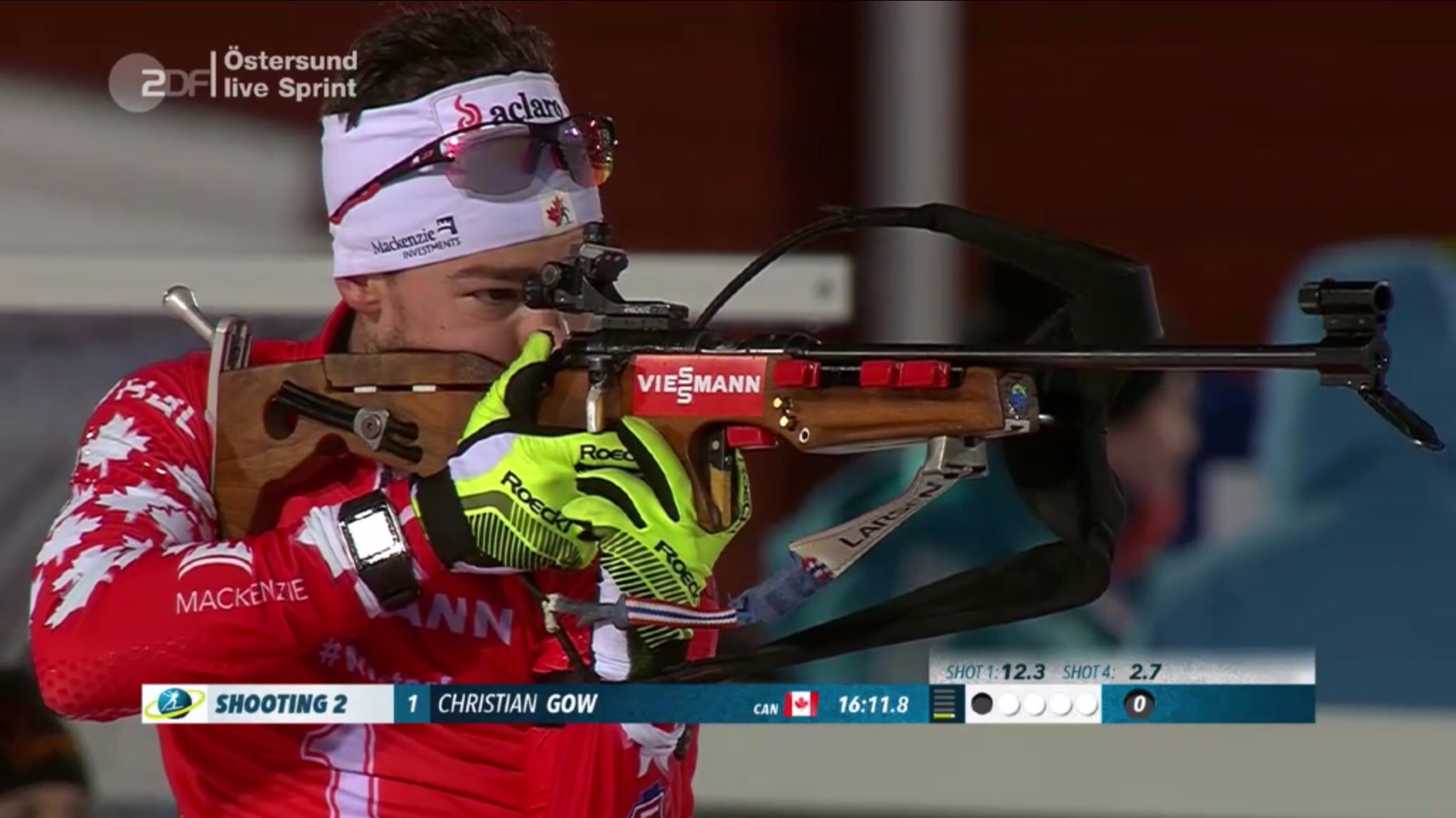
    Canada attracted some serious TV time when Christian Gow took the lead on the first climb out of the stadium. He went on to hit five targets in a row in prone and left the range in second, 1.2 seconds behind Lesser in first. One loop later, Gow had slipped to eighth and about 20 seconds back when he needed three spares to clean. He ended up tagging his brother and teammate Scott Gow in ninth, about 48 seconds out of first.

    “It wasn’t planned, for sure,” Gow, 24, told FasterSkier after about his decision to lead on the first loop. “Right at the top of the first climb, everyone was kind of moving over to the right, staying in kind of two lines, and there’s quite a bit of space there, so I took the opportunity to move up just because I’ve done so many relays where you’re stuck in the middle of the pack. …  I saw an opportunity to get to the front — I didn’t think it would be the front — but that’s what ended up happening, and I just did my pace and no one wanted to pass me.

    “I’m really happy to have cleaned the prone for sure because it’s great if you can lead it, but if you can’t knock down the targets it doesn’t mean too much,” he continued. “In the standing I’m trying to be a bit easier on myself, just because it’s a new situation to be way up in the front like that and having a great day. I wish I would have held it together a bit better than I did. I think I let the nerves get to me a little bit more than I should of, but a lesson learned and I’m happy with the first two-thirds [of my race].”

    Sweden’s Steady Rise

    Nelin raced Sweden into second place, 16 seconds behind the Czech Republic in first by the second exchange. He cleaned prone with one spare and avoided a penalty with three spares in standing while Germany’s Doll, who had been skiing alone in first before the standing shooting, dropped to fifth and almost 38 seconds back with two costly penalties.

    The Czech Republic’s Michal Šlesingr cleaned standing without a miss to take the lead with one loop to go in the second leg, 6.8 seconds ahead of Austria’s Simon Eder in second. Nelin followed another 8 seconds back in third, and tagged just 0.2 seconds ahead of Austria in the exchange.

    The third leg saw Johannes Bø, who had been tagged 31 seconds back in fourth, put Norway in first with a clean prone and a single spare in standing. Samuelsson, who had previously taken silver in the 12.5 k pursuit and placed fourth in the 20 k individual race at these Olympics, put Sweden in a position to win gold, using just one spare to clean prone and shooting without a miss in standing. He latched onto Bø, leading the Norwegian on their final loop and handing off to Lindström just 0.4 seconds behind Norway.

    The Swedish men’s gold-medal relay team, with Peppe Femling, Jesper Nelin, Sebastian Samuelsson, and Fredrik Lindström, after winning the last biathlon race of the 2018 Olympics in PyeongChang, South Korea. (Photo: FlyingPointRoad)

    Earlier this season, Sweden won the men’s relay at the IBU World Cup in Oberhof, Germany. The order was the same, except Martin Ponsiluoma skied the first leg, rather than Femling. While the win was a big deal for Sweden, it was against a slightly watered-down field, with some of the top biathletes opting to skip the Oberhof World Cup at the start of the new year.

    Friday’s victory marked Sweden’s first Olympic relay gold in biathlon after it earned bronze in 1976 in Innsbruck, Austria, and again in 1992 in Albertville, France.

    “It means a lot. It’s the first medal for men’s relay team in biathlon for Swede,” Samuelsson said. “Of course we are really satisfied. We did four good races everyone today and we’re super happy.”

    U.S. Ties Olympic-Best 6th

    While Austria finished Friday’s relay in fourth (+2:52.5), and France placed fifth (+3:26.6), the U.S. men tied its country’s best Olympic relay result in sixth (+3:50.2) with Lowell Bailey, Sean Doherty, Tim Burke, and Leif Nordgren. They had been 10th after Bailey’s first leg, in which he used two spares in each stage, and improved to sixth, then fifth on Doherty’s and Burke’s legs.

    Doherty used just one spare in prone and cleaned standing without a miss, leaving the range in sixth and 42 seconds back with one loop to go. He then tagged Burke in sixth, about 54 seconds out of first, and Burke held that position with a flawless prone stage followed by three spares in standing. He picked off one place on his last loop to tag Nordgren in fifth, 1:38.8 minutes back.

    The second-leg skier in the U.S. men’s relay, Sean Doherty racing his team into sixth on Friday at the 2018 Olympics in PyeongChang, South Korea. They went on to finish sixth to tie the best U.S. Olympic relay result. (Photo: FlyingPointRoad)

    “I’m real happy about that,” Doherty, 22 and in his second Olympics, said of his shooting. “I feel like I struggled with the prone earlier on [at these Olympics] and I got that kind of dialed in today, which was nice. Standing was good. I had a little break in the wind and I took full advantage. I shot pretty fast, pretty aggressive, but I hit all five from the clip and that’s what really moved things up.

    “We had a few days after the individual [race] to go back to the drawing board, come back to some of the fundamentals of shooting,” Doherty explained. “It’s nice to kind of reinforce that I’m capable of hitting targets and fixing things. When you’re not shooting well, you don’t have to keep not shooting well, if that makes sense.”

    Nordgren incurred the team’s only two penalties on his prone stage, but because of the strung-out field, he hung onto sixth, losing time to those ahead of him. He used three more spares in standing but stayed out of the penalty lap, finishing about about 24 seconds behind France in fifth.

    “Honestly it is a little disappointing,” Nordgren said after. “I know we were gunning a lot more as a team. I had some mistakes there in prone, too. That hurt a lot since we were right there in contention with some top teams in the world…

    “I will say we had amazing skis today so I pushed really hard on the first loop and I think I got a couple seconds on [Austria’s] Landertinger,” Nordgren added. “And then just in prone … I was just getting thrown around by the wind. It is has given me trouble the whole couple weeks here I obviously never quite figured it out.”

    In addition to tying the best U.S. relay result at an Olympics (of sixth place in the men’s relay at the 1972 Olympics in Sapporo, Japan), sixth was a big improvement for this team, which placed 16th at the 2014 Sochi Olympics. It was also the best Olympic relay result for Bailey and Burke, after they placed eighth in the 2014 mixed relay and ninth in the 2006 Olympic men’s relay.

    Tim Burke (l) on the range during a difficult standing shooting with France’s Martin Fourcade. While Burke cleaned with three spares, Fourcade had to ski a penalty lap in the men’s 4 x 7.5 k relay at the 2018 Olympics in PyeongChang, South Korea. (Photo: FlyingPointRoad)

    Asked whether this was his last Olympic race, Burke said it was.

    “Today was a good for me so yeah, I would say yes,” the 36-year-old four-time Olympian said. “Biathlon is a crazy sport; it is so up and down from one race to the next. The emotional rollercoaster is amazing. I am done though.

    “It has been my life for so long. It is what I know. It is what I love,” he added. “But it is time for the young guns to step up and take my place.”

    Bailey told reporters while the race was still going on that he was glad to finish his Olympic career with a race that didn’t include any penalty laps.

    “On a day like today, you saw that France was in the loop, now Germany, so the top nations are in there,” he said. “I cannot tell you how challenging this range is. It is so much different than most of the other ranges we shoot on.

    “Every Olympics has been different,” Bailey, also 36 and a four-time Olympian as well as 2017 world champion, reflected of his career. “In Sochi I had my career best with eighth place in the individual, and I will always have that. I will always know what I am capable of. That said, I know what I am capable of and I didn’t reach the bar that I set for myself. But all four Olympics have been honestly an incredible honor to put on Team USA uniform and go out there and compete for my country.

    “I know that it’s time to make the next step, to make the next transition,” he continued. “I’m really excited for our future, my family’s future. And I’m really excited for the future of US Biathlon.”

    Canada 11th

    Canada’s Scott Gow leading American Sean Doherty on the second leg of the men’s 4 x 7.5 k relay at the 2018 Olympics in PyeongChang, South Korea. (Photo: FlyingPointRoad)

    Canada finished the race in 11th (+5:40.3). Scott Gow had brought them up to seventh with perfect shooting on both his stages (0+0, 0+0) and tagged Macx Davies about a minute out of first.

    “My race pan today was to really emphasize the wind flags, and if it changes direction don’t be afraid to correct for it,” Scott Gow said. “In standing when I came in, it was quite windy, so I just waited a extra couple of seconds and then started to shoot when I felt like it was calm. It is hard to remember that sometimes because you are in the race mode and you just want to get it over with so you can try and just get back on course, so I was happy with that execution.”

    Davies, in his first Olympic race, needed three spares to clean prone and slipped to 10th, then had a penalty in standing to leave the range in 12th with one loop to go. He tagged Canada’s anchor Brendan Green in 13th, 4:29 behind. Green went on to use one spare in each of his shooting stages (0+1, 0+1) to bring the team up to 11th at the finish.

    Macx Davies skiing the third leg for Canada’s 4 x 7.5 k men’s relay at the 2018 Olympics in PyeongChang, South Korea. (Photo: FlyingPointRoad)

    “It wasn’t a great race for me, but I fought through it and pushed myself so that’s all I can ever really do,” the 25-year-old Davies said. “Coming into this race I was kind of just excited to get an Olympic start. We didn’t know if I was in or not until yesterday morning. Then kind of sitting around today, slowing realizing that it was happening tonight and getting a little bit more nervous and a little bit more excited as it went on. That was exciting.

    “Being part of the team, being part of Team Canada, it’s such a great feeling, great atmosphere,” Davies added. “Everyday you see someone do something amazing and that just inspires you to keep pushing yourself and do everything in your power to succeed.”

    As for Green, he said it’s safe to say these were his last Olympics.

    “I’ve been to three Games now and they’ve all been very unique and special in their own way,” the 31-year-old Green said. “I think Korea did a great job hosting. Volunteers are spectacular and so friendly. It’s too bad the weather didn’t cooperate a little bit more, but we did our best We all fought hard and I think we’ll be going away motivated and looking forward to more.”

    What’s Next?

    While the IBU World Cup season resumes March 8-11 in Kontiolahti, Finland, then makes its next stop in Oslo, Norway, March 15-18, both the Canadian and U.S. teams have stated they will boycott the season-ending World Cup in Tyumen, Russia, March 22-25.

    “The latest decision by the IBU was to send the World Cup tour to Tyumen, Russia for our World Cup final,” Bailey said on Friday. “Team USA is boycotting. The Czech team is boycotting. Canada is boycotting. We are trying to rally more support. I know that as an [IBU] athletes’ rep, we had almost every country had athletes that wrote letters to the IBU saying that we do not want to go to Tyumen. We don’t think it’s the right thing for clean sport, and still, the executive board with Anders Besseberg at the helm decided that it was in their best interest to go to Tyumen. So it’s time for a change. IBU leadership needs to change. Besseberg needs to step down. He’s lost the trust of the athletes.”

    “We won’t go to Russia,” Green said. “Instead we’ll go back to Canada for nationals. … I think until Russia is compliant we’ll probably continue to take a hard stance until things change.”

    Results

  • Friday Olympic Rundown: Sweden Bests Norway in Men’s Biathlon Relay, U.S. Record-Setting 6th

    Fredrik Lindström of Sweden crosses the line after securing a gold medal for his Swedish teammates in the men’s relay to close out biathlon competitions at the 2018 Olympics in PyeongChang, South Korea. (Photo: FlyingPointRoad)

    FasterSkier would like to thank Fischer Sport USAMadshus USAConcept2Boulder Nordic Sport, and Swix Sport US for their generous support, which made this coverage possible.

    ***

    2018 Olympics (PyeongChang, South Korea): Biathlon Men’s 4 x 7.5 k relay

    Full report

    Germany were the favorites coming into this men’s relay and Erik Lesser started them off with a near-perfect relay leg to sit in first place, but shooting collapses by Benedikt Doll and Simon Schempp left the team with bronze medals at the finish.

    On a windy, gusty day, the relay instead came down to a race between Norway and Sweden. Coming into the last shooting stage Fredrik Lindström of Sweden and Emil Hegle Svendsen of Norway were stride for stride. Each missed their first shot in standing, but Lindström pulled himself together and hit the next four shots, then hit the final target using a spare round. Svendsen, on the other hand, kept missing and ended up skiing a penalty loop – just as he had when anchoring the Norwegian team in the Olympics in Sochi four years ago.

    A strong leg from Tim Burke, who cleaned prone and then survived on spare rounds while chaser Martin Fourcade of France headed to the penalty loop, helped the U.S. secure a best-ever sixth-place finish in the Olympic men’s relay. (Photo: FlyingPointRoad)

    Then, that left Norway off the podium. This time, Norway still earned silver, as behind him Schempp had his own shooting woes.

    An exciting relay with multiple lead changes in the end turned into something of a blowout, with Lindström able to celebrate on his final loop before joining overjoyed teammates Peppe FemlingJesper Nelin, and Sebastian Samuelsson at the finish. It was the first Olympic relay gold medal in the history of Swedish biathlon, and the team did it with phenomenal shooting – just seven spare rounds despite difficult conditions. They were the only team to avoid the penalty loop, which most teams visited more than once.

    The Norwegian squad of Lars Helge BirkelandTarjei BøJohannes Thingnes Bø, and Svendsen finished 55.5 seconds back. The Germans with Lesser, Doll, Arnd Peiffer, and Schempp crossed the line +2:07.1, and the Austrian squad of Tobias EberhardSimon EderJulian Eberhard, and Dominik Landertinger were the first ones out of the medals, +2:52.5.

    The American team of Lowell BaileySean DohertyTim Burke, and Leif Nordgren finished sixth, +3:50.2, tying the best-ever men’s relay finish by an American team at the Olympics. They had 14 spare rounds and two penalty loops.

    The Canadian squad of Christian GowScott GowMacx Davies, and Brendan Green finished 11th, +5:40.3, with 11 spare rounds and a penalty loop.

    Results

  • Tuesday Olympic Rundown: France Wins Biathlon Mixed Relay; Germany Sweeps NoCo Event, B. Fletcher 17th Again

    Germany en route to a clean sweep of the podium in the men’s nordic-combined individual large hill/10 k on Tuesday at the 2018 Olympics in PyeongChang, South Korea, with Johannes Rydzek (5) leading Fabian Rießle (6) and Eric Frenzel (4). They went on to place first, second and third, respectively. (Photo: FlyingPointRoad)

    FasterSkier would like to thank Fischer Sport USAMadshus USAConcept2Boulder Nordic Sport, and Swix Sport US for their generous support, which made this coverage possible.

    ***

    2018 Olympics (PyeongChang, South Korea): Biathlon Mixed Relay

    Full report

    A few shooting errors by pursuit bronze medalist Anais Bescond were not enough to derail France, as the team of Marie Dorin Habert, Bescond, Simon Desthieux, and Martin Fourcade took gold in the mixed relay. Skiing the first leg, Dorin Habert shot clean and tagged off just seven seconds behind the leading team from Italy. Bescond then used four spare rounds over the course of her relay leg, dropping the team to fourth (+48.9) at the halfway point. But both Desthieux and Fourcade shot 10/10, capitalized on the errors of others, and ended up with a clear 20.9 second margin for gold at the finish.

    Susan Dunklee put the U.S. in fifth after the first leg of the mixed relay. (Photo: FlyingPointRoad)

    Norway came back from a rough start to earn silver despite a whopping eleven spare rounds and a penalty loop. Marte Olsbu had three spare rounds to tag off in ninth, 32.8 seconds back, and then Tiril Eckhoff used two spare rounds in prone and then took a penalty loop in standing. But Johannes Thingnes Bø used just one spare round and skied the team from tenth to fourth, in contact with the medal pack, on his relay leg, and then Emil Hegle Svendsen used one spare round in each shooting stage to climb into a clear second; he skied alone on the final loop before crossing the line for silver.

    There was controversy about bronze, however. Germany had led much of the race thanks to a solid leg by Vanessa Hinz to start and then a brilliant leg by Laura DahlmeierErik Lesser also excelled, and at the third exchange the team had used just two spare rounds and had a 32.6-second lead on the field. But sprint gold medalist Arnd Peiffer couldn’t keep it together and first used a spare round in prone, then took a painful penalty loop in standing.

    He exited the loop just as Italy’s Dominik Windisch went past. Lisa Vitozzi had put Italy in the lead after one leg thanks to perfect shooting, and despite three spare rounds Dorothea Wierer had tagged off in second at the halfway point. Lukas Hofer had maintained that position and Windisch was really only in fourth because of three of his own spare rounds.

    Windisch and Peiffer battled all the way around the final 2.5 k, with Windisch leading the final downhill; the pair were nearly even coming into the stadium, but Windisch sprinted for the finishing lanes and in doing so angled from one far side of the trail to the farthest finishing lane, just barely getting there ahead of Peiffer and debatably choosing a lane before the lane markings began. Peiffer, who had skied a straight course all the way from the downhill into the finish, was forced to then switch lanes and couldn’t regain the momentum to keep up with the Italian, who crossed the line in third place.

    The Germans protested, but the race jury ultimately decided to keep the Italians in third place, awarding them bronze, and the Germans finished fourth.

    “The jury has decide to keep the bronze medal for Italy; Peiffer did not have to alter his speed, therefore no reason to disqualify Windisch,” the IBU stated in a tweet. (The response to that tweet has nearly unanimously condemned it as the wrong decision.)

    The IBU 2016 Competition Rules give only a vague definition of obstruction, stating, “It is strictly forbidden to impede other competitors in any way at any time during the competition.”

    The Canadian team of Rosanna CrawfordJulia RansomBrendan Green, and Christian Gow finished 12th, +2:36.7, with nine spare rounds.

    The U.S. team of Susan DunkleeJoanne ReidTim Burke, and Lowell Bailey finished 15th, +3:31.1, with three penalty loops and nine spare rounds.

    Results

    ***

    2018 Olympics (PyeongChang, South Korea): Nordic Combined Large Hill/10 k

    Full report

    Germany pulled off a podium sweep in the second nordic combined combined competition of the Olympics, with Johannes RydzekFabian Riessle, and Eric Frenzel earning gold, silver (+0.4 seconds), and bronze (+0.8 seconds), respectively. They had been ranked fifth, sixth, and fourth after the jumping round on the big hill, but edged Norway’s Jarl Magnus Riiber off the podium. Riiber had the second-best jump of the day and ended up just 2.8 seconds out of a gold medal. Japan’s Akito Watabe topped the jumping scores and finished fifth, +12.5 seconds.

    For the U.S., Bryan Fletcher led the way again and just like in the normal hill competition, finished 17th. This time he was ranked 23rd after the jump and made up six places to cross the line +1:42.9. Ben BerendBen Loomis, and Jasper Good finished 39th (+4:28.2), 40th (+4:38.8), and 43rd (+5:50.2).

    Results

  • Fourcade Beats Schempp by a Toe in PyeongChang Mass Start

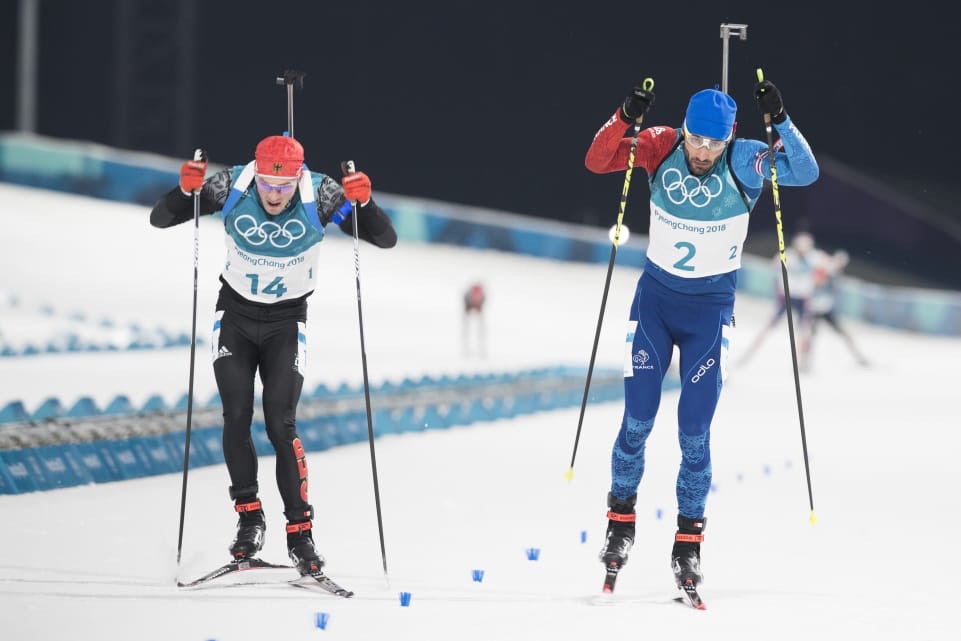
    France’s Martin Fourcade (right) and Germany’s Simon Schempp (left) lunging for first at the finish of the men’s 15-kilometer mass start at the 2018 Olympics in PyeongChang, South Korea. In a photo finish, Fourcade was deemed the winner with Schempp claiming the silver medal. (Photo: FlyingPointRoad)

    FasterSkier would like to thank Fischer Sport USA, Madshus USA, Concept2, Boulder Nordic Sport, and Swix Sport US for their generous support, which made this coverage possible.

    ***

    After both athletes had lunged over the finish line and fallen down, France’s Martin Fourcade initially thought he just lost an exciting finish sprint against Germany’s Simon Schempp in the men’s 15-kilometer mass on Sunday night at the Olympic Winter Games in PyeongChang, South Korea.

    He slammed his pole into the snow and shook his head in anguish. Not again.

    Almost exactly the same had already happened to Fourcade four years ago at the 2014 Olympics in Sochi, Russia, as he narrowly lost a sprint finish for the gold medal in the mass start to Norway’s Emil Hegle Svendsen.

    “I was sure that Simon did it,” Fourcade said of Schempp at Sunday’s post-race press conference. “It was just because four years ago in Sochi, Emil did me a lot of pain, and tonight I was sure that history was repeating again.”

    “I didn’t know who was in front of the other, and Martin as well,” Schempp recalled at the press conference. “So we were both waiting.”

    During the race Fourcade had incurred two penalty laps (1+0+0+1) while Schempp had missed just one target (0+0+0+1). However, Fourcade made up for that by skiing the fastest course time of the day.

    France’s Martin Fourcade (r) and Germany’s Simon Schempp (l) pushing to the finish of the men’s 15-kilometer mass start at the 2018 Olympic Winter Games in PyeongChang, South Korea. After a photo-finish lunge, Fourcade was deemed the winner while Schempp claimed silver. (Photo: IBU/Biathlonworld)

    But while they both had finished with the same time of 35:47.3 minutes, the photo-finish image evaluated by the race jury for about a minute would prove they were not exactly even: Fourcade had moved the tip of his boot just about half a foot before his opponent over the line.

    Now it was Schempp who looked a bit frustrated, tilting up his head and letting out a sigh after he saw the official result on the big video wall. But that feeling did not last for long, with pride about the strong performance he had just shown after a difficult season and the happiness about his first Olympic medal in an individual-start race in his third Olympics taking over.

    “For me, it was not too hard; I was happy to get one of these three medals,” Schempp said.

    “Of course I am enormously happy,” he had previously told German broadcaster ZDF immediately after the race, according to a translation. “I had to wait a long time for this, and now until the last individual-start race. I think it was incredibly suspenseful for all viewers.”

    Behind them the above-mentioned 2014 Olympic gold medalist Svendsen placed third to claim the bronze medal this time, 11.2 seconds out of first, with two penalties. He was on the winning side of a final sprint with Schempp’s teammate Erik Lesser, who placed fourth (+11.6), with two penalties. Germany’s third man in the top five, Benedikt Doll finished another few seconds back in fifth (+18.8), with one penalty, only slowing in the last 100 meters after he realized third and fourth place were out of reach.

    Fourcade Starts on Wrong Foot

    Initially the race had not started out well for Fourcade, with little indication that he could end the day with his historic fourth Olympic gold medal.

    On the first loop, he led the mass start field of only 30 athletes, comprised of the medal winners from the previous sprint, pursuit and individual races in PyeongChang, as well as the other top 15 in the current World Cup Total Score standings and filled up with the next-best performers of the last week not among those two groups.

    It was truly an elite field, including all seven different biathletes who had become International Biathlon Union (IBU) world champion in the mass start discipline in the last seven iterations.

    The whole pack stayed close together within a few seconds, with Germany’s Lesser bringing up the back, not investing any energy with fruitless maneuvers to gain a few positions.

    In the first prone shooting stage, 14 athletes remained clean while Fourcade missed a target, forcing him to ski a penalty lap. Then as he returned to the course, he stumbled briefly when his ski caught a V-board and he fell on his behind. He left the range in 19th position and 25 seconds behind South Korea’s Timofey Lapshin, who was leading into the next loop to the delight of local fans in the stands.

    But Fourcade quickly narrowed the gap on the next loop, and after a clean second prone shooting had moved up to eighth place, less than ten seconds behind Germany’s Doll, who had led the field for large parts of the prior loop and now also kept that position after the shooting stage.

    In that second prone, one of the presumed favorites and 15 k individual winner Johannes Thingnes Bø of Norway ruined his race with three penalties, falling back to 27th and almost 1:15 out of first. He eventually finished 16th (+1:20.0) after cleaning the remaining standing stages (0+3+0+0).

    Obviously having very fast skis, all four German athletes in the race stayed at or near the top throughout the next loop.

    “The way they were able to aggressively put their mark on this race, all four of them, from the first to the last loop … we surely didn’t expect that considering this level of competition,” German men’s head coach Mark Kirchner later told ZDF.

    (From left to right) Germany’s Simon Schempp, his teammate Erik Lesser (19) and France’s Martin Fourcade lead the field on the third loop of the men’s 15 k mass start at the 2018 Olympic Games in PyeongChang, South Korea. Fourcade went on to win the race, while Schempp finished second and Lesser fifth. (Photo: FlyingPointRoad)

    After again shooting clean in the first standing while Doll incurred a penalty, Fourcade took the lead going out on the course, with Schempp and Lesser followed within two seconds of him.

    On the third loop, Fourcade, Schempp and Lesser pushed hard for a high tempo and swapped leads several times. The gap to a group led by Czech Republic’s Ondrej Moravec and Austria’s Simon Eder ballooned after Eder had been less than 7 seconds behind leaving the range. At a split time following the longest climb, the group clocked in 24 seconds behind, and that time back grew to 30 seconds on that loop.

    Just before the range, Lesser and Schempp briefly looked at each other, then Lesser increased the frequency pushing hard for a few meters to move into first, knowing that would give him the first-lane position on the shooting range. From years of racing against each other, the German athletes were aware Fourcade often prefers to have that position in a final shooting as a demonstration of confidence, so it might have been a little psychological trick to irritate him.

    But Lesser’s race tactic did not exactly work out, as all three failed to clean their targets in the final shooting. Fourcade and Schempp both had to ski one penalty lap, while Lesser missed two shots and came back on the course in fifth, just behind teammate Doll and Norway’s Svendsen, who had both managed to hit all targets to move back into podium contention.

    About 20 seconds ahead, Fourcade kept the speed fairly high leading in front of Schempp throughout the loop, but did not attempt one of his signature ferocious attacks up a climb for which he is feared by his opponents.

    “I thought about a few scenarios how this could play out,” Schempp told ZDF, according to a translation. “I knew either he attacks on the first very steep and long climb, but there he only pushed the tempo and I could stay with him. And then he rather decelerated and I knew I had not other choice but stay behind him in his draft to save some energy for the finish stretch, because my current shape is not good enough to try and get away from him. … So then I knew it would end in a finish sprint. I tried to push hard into the downhill maybe taking the momentum with me, but unfortunately that was not enough.”

    “I tried to be faster than Simon in the first part of the loop, but he was still in my skis,” Fourcade said of the last loop. “So then I knew it will be a tight finish. I gave everything I had, but I know that Simon is a really good sprinter and that is not my main quality.”

    On the final downhill, Fourcade led the duo into the arena with Schempp drafting behind him. Fourcade briefly stumbled in the final right turn but retained his balance, not losing much speed. Entering the finishing straight, Schempp initially motioned toward a lane to the left of Fourcade, but when Fourcade veered that way as well before picking the center Schempp switched over to the right lane and poled all-out.

    France’s Martin Fourcade lunging for his second gold of the 2018 Olympics, and fourth Olympic gold of his career, in PyeongChang, South Korea, winning the men’s 15 k mass start on Sunday. (Photo: FlyingPointRoad)

    “I chose my corridor late because earlier this season in Hochfilzen [in the pursuit’s finishing race for third place] I did it a bit early, and then he went right into the one I wanted to go in as well,” Schempp told ZDF. “I still had that in the back of my mind.”

    “Our last sprint in Hochfilzen together was not a fair one,” Fourcade recalled of the same race, unprompted in his interview with ZDF. “And I thought during the final loop, ‘Beat him, but just do it in a fair way,’ because Simon is one of the best opponents I fight with. So thanks Simon for this fight, and it makes my gold more valuable.”

    “Choosing the finish stretch corridor, that’s the prerogative of the athlete who has pushed the tempo on the final loop,” Schempp explained in an interview with ZDF later in the evening. “So I could ski behind him, save a bit of energy, and in turn he gets that advantage. Poetic justice.”

    With the finish line approaching, Schempp managed to pole closer and finally next to the French athlete. “I felt that Simon was taking me meter after meter,” Fourcade recalled at the press conference.

    Both athletes lunged far as they approached the line, and with slightly higher velocity Schempp seemed to move past Fourcade as they slid and fell, causing Fourcade’s frustrated initial reaction as he looked over and saw the German coming to a stop slightly ahead of him.

    “After the finish line I thought I was in his back,” Fourcade told ZDF.

    But as the photo finish revealed, right on the line Fourcade had still been in front by about half the length of his foot this time and was the lucky winner.

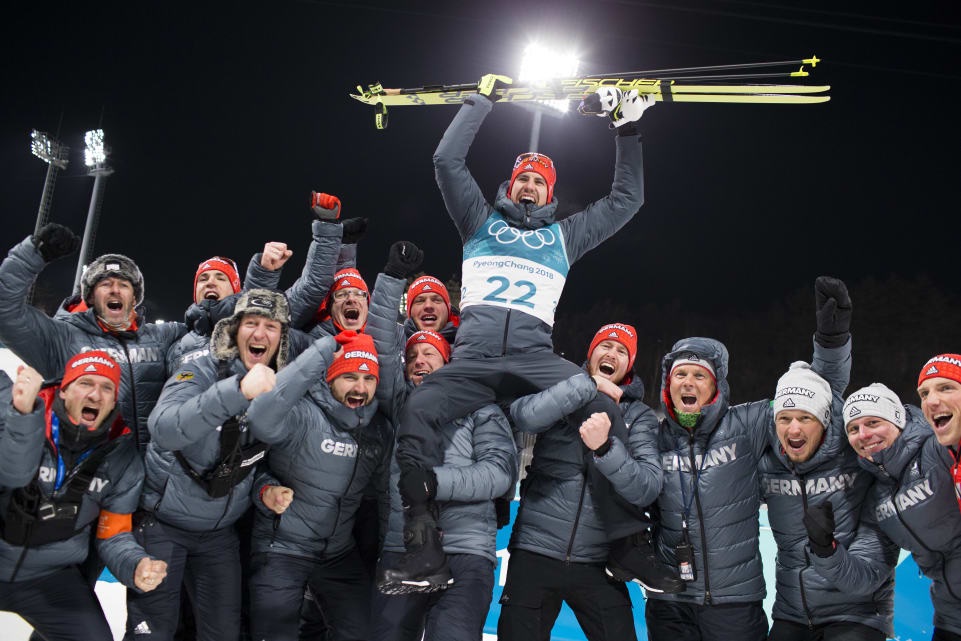
    Any signs of initial frustration from Schempp were quickly replaced as he celebrated with his teammates and staff who rushed to congratulate him, and later was hoisted up on their shoulders.

    “The finish line came maybe five meters too early for me,” Schempp told ZDF. “But still, I am also totally happy and satisfied about silver. It was a suspenseful competition, and I am so glad it worked out. … I have had a few photo finishes in my career when I was in first, and now it’s the other way around. Martin was incredibly strong on the course today, and he had one more penalty than me, so he also fought enormously for gold, and I did my best.”

    Behind them, Lesser had tried to attack up the last big climb to break away from Norway’s Svendsen and his teammate Doll, but Svendsen managed to stay on his ski tails and in the finish sprint claimed the bronze medal by 0.4 seconds. It was his fourth individual medal in four Olympics (plus one gold medal in the men’s relay in 2010).

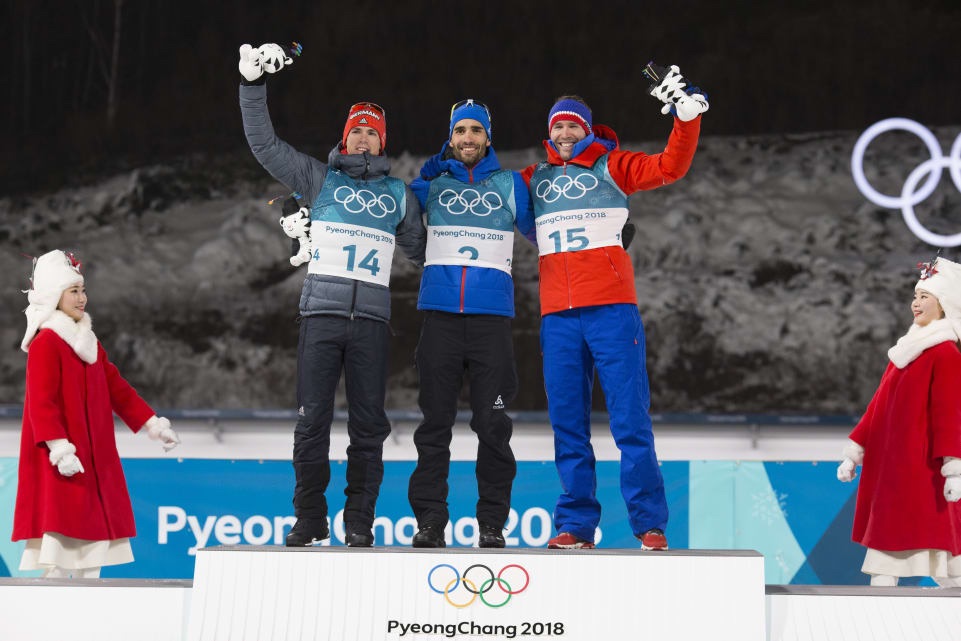
    France’s Martin Fourcade (c) in first, Germany’s Simon Schempp (l) in second, and Norway’s Emil Hegle Svendsen (r) in third, during the flower ceremony of the men’s 15 k mass start at the 2018 Olympics in PyeongChang, South Korea. (Photo: IBU/Biathlonworld)

    Four years ago at the Sochi Olympics, Svendsen had won the gold medal just ahead of Fourcade, as Fourcade recalled at the press conference.

    “It means very much, it’s been really bad Olympic Games for me,” Svendsen said in the press conference when asked about his bronze medal. “So I didn’t really believe in a medal at all. When I came into a position to get a medal I really fought hard. And to be on the podium with these guys, it’s a very good feeling.”

    When the experienced podium finishers were asked about their “secret” for a finish sprint, Svendsen added: “For me, I was thinking a lot about Marit Bjørgen from yesterday, what she did on the last few hundred meters [when] she didn’t allow the Swedish girl to catch her. That helped me a lot today, maybe that was the key to beating Lesser and Doll.”

    Disappointed, Lesser initially did not talk to German media following the race. Only several hours later, he posted an image of him hugging Schempp after the race and superimposed with the words “in the end the only thing left for me is to congratulate” to his Facebook fan page, adding a paragraph that according to a loose translation reads:

    “Wow!!! That was tight, annoying, hammer, humbling, pleasant, unbelievable, mega, crass, semi, phenomenal… no one has a leg up on our team. Everyone on our team is now individual-race World Champion and in possession of an individual-race Olympic medal. No other team can show that off.”

    On his Instagram account he wrote in English “Once again #wtf !!! It’s amazing to be part of this great team” to a photo of the team’s coaches and staff hoisting up Schempp.

    “Another really strong shooting performance, just one miss, that is great,” Doll told ZDF right after the race. “For two loops I skied at the top of the field, so that gives me some self-confidence … On the final lap, that kind of head-to-head duel isn’t really my strength, unfortunately I couldn’t win that today. It was difficult, even though we had the better ski today. We could have made a little more out of that, me and Erik, but that’s just the way it is.”

    Making History Instead of History Repeating Itself

    For Fourcade it was the fourth Olympic title of his career. In the mass start he had already won silver in both the 2010 Vancouver and 2015 Sochi Olympics. He now also has a gold medal in each non-relay discipline (sprint, pursuit, 15 k individual, and mass start).

    “Today I am so satisfied because I was second eight years ago in Vancouver in the mass start, I was second four years ago, and today I finally win this competition,” Fourcade said at the press conference. “So I am really proud.”

    As an added bonus, Fourcade is now tied with two French fencers for having won the most gold medals at either a Summer or Winter Olympic Games in the history of his country with six total.

    “That’s something really incredible. I grew up watching biathlon on TV and sport at the Olympics, so being the best French Olympian ever is something I am really proud of,” Fourcade said at the press conference. “But then you need to compare, because if I was Norwegian I would not be the best Olympian ever.”

    “After effort and suspense Martin Fourcade makes us tremble and dream a second time by winning a new gold medal for France. A legend of the Olympic Winter Games and biathlon,” French President Emmanuel Macron wrote on his official Twitter account, according to a translation, alongside with an image of the photo finish.

    Deep Respect for Each Other

    Fourcade’s opponent Schempp had not been in optimal health going into these championships after dealing with persistent back problems that forced him to miss several races on the 2017/2018 World Cup competition calendar. So in the end he was happy that despite losing out on gold so narrowly, he had been able to reach his first Olympic medal in a non-relay race. Last year, Schempp had won gold in the mass start at the 2017 World Championships, back then also his first title excluding relays.

    France’s Martin Fourcade (2) leading Germany’s Arnd Peiffer (1) and Norway’s Johannes Thingnes Bø (3) early in the men’s 15 k mass start at the 2018 Olympics in PyeongChang, South Korea. They went on to place first and second, respectively. (Photo: FlyingPointRoad)

    “I wasn’t really afraid [of the back injury returning], I was just hoping it would hold up,” Schempp told ZDF in a studio interview later Sunday evening. “It was very tedious and often also frustrating in January, because I did a lot to get it under control and a lot of people helped me with that. … But then 10 days before we flew over here, I just thought, ‘Woah, I don’t know if it will work out like this, if that will be enough.’ But then shortly before [the races] it got enormously better, there was a big leap, but I still didn’t know how it would be in the stress of a competition. … Until now it was pretty good and I hope it stays that way.”

    In his interviews right after the race, Fourcade had been very congratulatory of how hard his opponents had made it for him and how highly the won medal ranks for him.

    “I must apologize to the German fans because I know how much I disappointed them tonight,” Fourcade told ZDF. “But Simon is one of my best opponents. When I was on the podium with Simon and Emil I told them that I could not have a [better] podium for me tonight. It was the best podium I could hope for. You know, Simon is an incredible champion, and I am so proud I beat him in the sprint.”

    “We are on very good terms, and two years ago I have visited him at home,” Schempp later said of Fourcade to ZDF. “In general we get along very well. Maybe not so great on the tracks, but later in the finish, respectively before competitions. Of course he also has this crazy killer instinct and can assess race situations very well.”

    The close race also brought up memories of past events with an end like this.

    At the 2003 World Championships in Khanty-Mansiysk, Russia, two gold medals had been awarded in the women’s pursuit race to France’s Sandrine Bailly and Germany’s Martina Glagow after the photo finish had been deemed too close to call.

    But with the help of more modern technology there was a visible difference this time, and the German team readily accepted that when questioned if they thought it was fair that after a 15 k race you lose an Olympic gold medal merely by inches.

    “I think there are plenty of other sports were decisions are this close,” coach Kirchner told ZDF. “If you think about alpine skiing where races also get decided by hundredth of a second, or in others like bobsledding even by a thousandth, that’s the way it is. The athletes know they are fighting for every second, and in the end there has to be a winner. When the clock is running you know that it’s fair, there is no subjective judging.”

    No North Americans qualified for the top-30 men’s mass start field at these Olympics.

    The biathlon competitions in PyeongChang continue with the mixed relay on Tuesday at 8:15 p.m. local time. (6:15 a.m. EST).

    Results

  • Sunday Olympic Rundown: Klæbo Anchors Another Norwegian Gold; Fourcade Edges Schempp in Mass Start

    Johannes Høsflot Klæbo anchoring the Norwegian men’s 4 x 10 relay to gold on Sunday at the 2018 Olympics in PyeongChang, South Korea, while Denis Spitsov (background) celebrates silver for the Olympic Athletes for Russia. (Photo: FlyingPointRoad)

    FasterSkier would like to thank Fischer Sport USAMadshus USAConcept2Boulder Nordic Sport, and Swix Sport US for their generous support, which made this coverage possible.

    2018 Olympics (PyeongChang, South Korea): Men’s 4 x 10 k relay

    International report

    North American report

    For a while in the men’s 4 x 10-kilometer relay on Sunday, it looked like the Russians might run away with the win. But that was just two classic legs and 20 k into the race, with a lot more racing to come.

    While Kazakhstan’s Alexey Poltoranin had handed off in first at the first exchange, just ahead of Andrey Larkov of the Olympic Athletes from Russia, Italy, France and Norway skied together behind them, with Norway’s Didrik Tønseth trailing off the back, 18 seconds behind.

    On the next classic leg, Russia’s Alexander Bolshunov put a hurt on the field. Within the first 3.3 k lap, he was 25 seconds ahead of Kazakhstan’s Yevgeniy Velichko in second, who was followed closely by Italy, Norway and France in third through fifth. Sweden’s Daniel Rickardsson had fallen farther behind to more than a minute back in sixth place, after his teammate Jens Burman lost contact with the lead group on the first leg.

    By the second exchange, Russia was 24.5 seconds clear of second place, while Italy’s Francesco de Fabiani tagged Giandomenico Salvadori in second, France’s Maurice Manificat tagged Clement Parisse in third (+28.0), and Norway’s Martin Johnsrud Sundby tagged Simen Hegstad Krüger in fourth (+32.1). Kazakhstan’s Velichko had fallen off the pace and was another 19 seconds back in fifth.

    Over the next 10 k, the first skate leg, Krüger and Parisse reeled in Russia’s Alexey Chervotkin, catching him before the end of their second lap. One lap later, Krüger came through the final exchange in first, tagging Johannes Høsflot Klæbo 0.4 seconds ahead of France in second. Chervotkin tagged Russia’s anchor Denis Spitsov in third, 16.2 seconds back, while Finland’s Matti Heikkinen passed Italy’s Salvadori on the last climb to put Finland in fourth (+58.6).

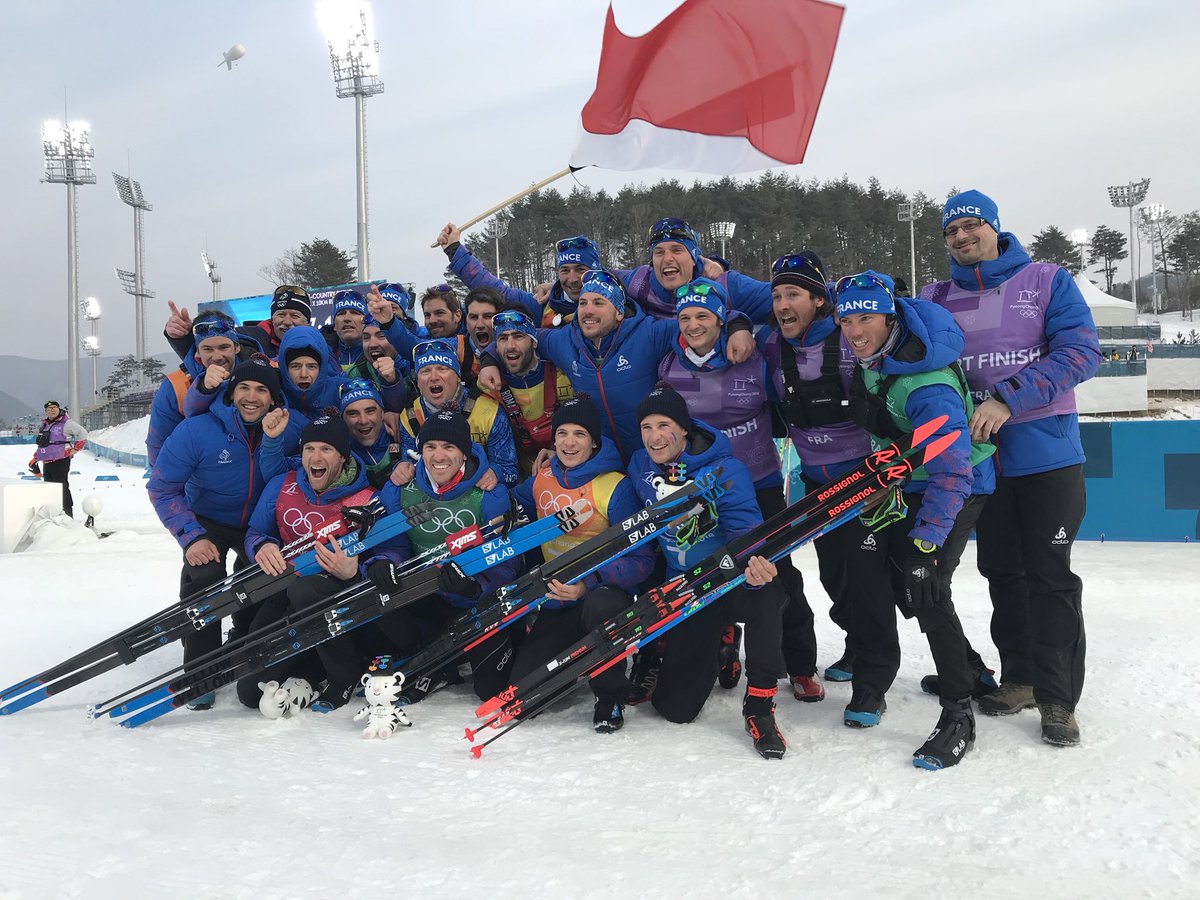
    Team France celebrates its bronze-medal finish in the men’s 4 x 10 k relay at the 2018 Olympics on Sunday in PyeongChang, South Korea. (Photo: FIS Cross Country/Twitter)

    Early in the final leg, France’s Adrien Backscheider took the lead ahead of Klæbo. The two held Spitsov off until the end of the second lap, where Spitsov came through the stadium first to start the final loop. Spitsov and Klæbo soon upped the pace, dropping Backscheider, and shortly after the 8.27 k checkpoint, Klæbo truly put the jets on to accelerate away from Spitsov. He dropped the Russian on a climb just before the final uphill, where it was clear that the gold was Norway’s.

    As he sped down into the stadium, Klæbo relaxed his arms, skied to the sideline and took a flag from the stands. He looked back for a moment and then crossed the finish line first in 1:33:04.9 hours, while Spitsov followed 9.4 seconds later for silver for Russia. Backscheider held on for bronze (+36.9) as his team exuberantly celebrated with him at the finish.

    Finland placed fourth (+1:40.5), Sweden fifth (+2:05.6), Germany sixth (+2:08.2), Italy seventh (+2:35.2), and Kazakhstan eighth (+3:31.4). Canada was ninth (+3:41.0) for its second-best Olympic relay result (with Len Valjas, Graeme Killick, Russell Kennedy, and Knute Johnsgaard), and the U.S. finished 14th (+9:24.2), out of 14 teams, with Andy Newell, Reese Hanneman, Scott Patterson, and Noah Hoffman.

    Results (will be posted here)

    ***

    France’s Martin Fourcade lunging for his second gold of the 2018 Olympics in PyeongChang, South Korea, winning the men’s 15 k mass start on Sunday. (Photo: FlyingPointRoad)

    Biathlon: Men’s 15 k mass start

    Full report

    Martin Fourcade is the champion once again. Six days after he won the 12.5-kilometer pursuit for his first gold in PyeongChang, the 29-year-old Frenchman did it again in the men’s 15 k mass start on Sunday, winning in a photo finish at the line.

    He took charge on the first loop, leading the field into the range for the first prone shooting. There, Fourcade shot a penalty and slipped to 19th, but it wasn’t over.

    Clean shooting on the second prone brought him up to eighth, 9.4 seconds out of first. Germany’s Benedikt Doll took that lead at that point after his second stage without a miss. Meanwhile Norway’s Johannes Thingnes Bø shot three misses on that second stage and dropped out of contention.

    One loop later, Fourcade moved into first with a clean standing. He left the range about 1 second ahead of Germany’s Simon Schempp and 2 seconds ahead of Germany’s Erik Lesser, after both made it through the first three stages without a miss. Doll missed one to slip to seventh, almost 30 seconds behind.

    After Fourcade and Schempp exchanged leads over the next loop, Lesser moved into first just before the final shooing, Going head to head, Fourcade and Schempp both missed one while Lesser missed two. Fourcade and Schempp still left the range in first and second, respectively, separated by 0.4 seconds, while Lesser slipped to fifth, 22.5 seconds back.

    Doll left the range in third (+19.2) after cleaning and Norway’s Emil Hegle Svendsen moved into fourth (+21.9) with a clean standing stage as well.

    In the end, Fourcade outlunged Schempp for the win in 35:47.3 minutes, with Schempp finishing less than a tenth of a second behind for silver, and Svendsen beat out Lesser in the finishing stretch by 0.4 seconds to claim bronze, 11.2 seconds behind, while Lesser settled for fourth (+11.6). Doll followed them in fifth (+18.8), Austria’s Julian Eberhard placed sixth (+30.7) with three penalties, Norway’s Erlend Bjøntegaard seventh (+32.1) with two misses, Norway’s Tarjei Bø eighth (+34.6) with three penalties, Sweden’s Jesper Nelin ninth (+34.6) with two misses, and Slovenia’s Jakov Fak 10th (+36.1), just ahead of the Czech Republic’s Ondřej Moravec in 11th (+36.3), with one miss each.

    Results

  • Peiffer’s Bad Day Turned Golden; Bailey 33rd in PyeongChang Sprint

    Germany’s Arnd Peiffer (front) on his way to winning the men’s 10 k sprint at the Alpensia Biathlon Center on Sunday at the 2018 Olympics in PyeongChang, South Korea. The German was one of just four men to shoot clean in windy conditions. (Photo: FlyingPointRoad)

    FasterSkier would like to thank Fischer Sport USAMadshus USAConcept2Boulder Nordic Sport and Swix Sport US for their generous support, which made this coverage possible.

    ***

    Arnd Peiffer’s race day before the men’s 10-kilometer sprint at the 2018 Olympic Winter Games in PyeongChang began anything but ideal, not giving any indication that it would end as one of the luckiest days in the athletic career of the German, standing at the top of the podium and flanked by Michal Krčmář of the Czech Republic in second and Italy’s Dominik Windisch in third place.

    “Shortly before ski testing, the bolt on my rifle broke. Then I slipped outside the wax cabin [on a flight of stairs] and badly bruised my elbow,” Peiffer told German broadcaster ARD about a series of mishaps that also included a cut to his hand, a forgotten key for his rifle storage locker and a poor warmup. “Somehow nothing was really working as planned, but then in the race everything did.”

    About an hour before the race during dry firing target practice (without loaded ammunition clips), the bolt on Peiffer’s rifle that triggers the shots just snapped. On short notice the weapon had to be disassembled and the bolt replaced with the help of men’s head coach Mark Kirchner (a successful biathlete himself with a gold medal in the sprint and two in relays at the 1992 and 1994 Olympics), a problem that according to Peiffer “happens about once every six months to a year… That’s not so bad, but something you don’t really want to occur right before a race”.

    “I am generally not superstitious at all,” Peiffer recounted during an interview with ARD in the Olympic broadcasting center late Sunday night. “But Mark told me, ’22 is a good bib number, I once became world champion with that… And [teammate Erik Lesser] also had a broken bolt before the individual race at the [2014] Olympics in Sochi when he shot clean four times and won silver, that was surely a good omen.’ I was like, yeah, that won’t help me today either.”

    Yet after he had started his race, Peiffer was indeed the lucky one, hitting 10-for-10 shots in every bit as difficult wind conditions as the day before during the women’s sprint when his teammate Laura Dahlmeier won gold, while the presumed favorites such as France’s Martin Fourcade and Norway’s Johannes Thingnes Bø missed too many targets to contend for the medals.

    In his prone shooting, Peiffer reacted correctly to a strong gust of wind from the left side of the range, adjusting his sights with several clicks on his rifle. Then in the standing shooting he took advantage of manageable conditions to shoot in rhythm and again remained clean. On the final loop he skied the 10th-fastest time (18th overall), crossing the line in a time of 23:38.8 minutes. That mark would not be beaten anymore by the 65 athletes starting behind him.

    “I have waited a long time for this individual medal,” he said during his in-studio interview with ARD. “I won one in 2011 [at IBU World Championships] and since then had a few chances that I didn’t take advantage of, and sometimes didn’t have any chance at all. So that it worked out today, with a pretty mediocre course time, is a gift that I am very grateful for.”

    It was Peiffer’s first individual medal at Olympics, following a silver medal in the men’s relay in Sochi and no podium in Vancouver in 2010. Most of the World Cup successes for the 30-year-old biathlete have been in sprints, and he won the title in this discipline at the 2011 World Championships in Khanty Mansiysk, Russia. His first World Championship medals also came in PyeongChang, back in 2009, when he took bronze with the relay and mixed relay, which he fondly remembered.

    Germany’s Arnd Peiffer is hoisted up by his coaches, staff and teammates, celebrating his victory in the men’s 10-kilometer sprint on Sunday at the 2018 Olympic Winter Games in PyeongChang, South Korea. (Photo: IBU/Biathlonworld.com)

    “I am honestly completely surprised that my result was so amazing, that I am standing at the very top,” he had told ARD right after the race. “I am just happy about my performance, because in Vancouver and Sochi I twice had a bad sprint [finishing outside the top 30]… So for today I just was determined to have a good one, have a good shooting performance, and if it had been a sixth place I’d also have been happy.”

    The silver medal in Sunday’s sprint went to Krčmář, who also hit 10-for-10 and finished 4.4 seconds shy of Peiffer’s time. Starting behind Peiffer in the middle of the field, that clean shooting performance opened a window of opportunity to wedge himself between the times set by Peiffer and Windisch, who ultimately placed third (+7.7) with one penalty.

    “For me, it was very hard in the last loop,” Krčmář said at the post-race press conference. “I [had no] power in last loop and my teammate on the track said to me, ‘You are five seconds behind Arnd’. I do maximum [went as hard I could], but Arnd [was really] better today.”

    He made up 2.4 seconds on that final loop, but could not catch up to Peiffer’s time. It was the first sprint podium for the 27-year-old Krčmář at the World Cup or championships level, and at these Olympics it came just at the right moment.

    “It’s true, for me a big, big medal. First in career,” Krčmář said. “It’s for me [a] very surprising day because I [felt bad] in the training here. My shooting in training [was] not so good. And now, zero-zero. I am lucky man today because I [had] very good condition in standing shooting and on the track.”

    Windisch missed one target in his standing bout, and came back on the course 12.2 seconds behind Peiffer’s time and 5.4 seconds behind Krčmář. He narrowed that gap on the final loop, but it wasn’t enough to catch either one.

    “The wind was not easy because it continued to change … but maybe it was the best for me because I had something to think about and to be concentrated on my work,” Windisch said at the press conference. “I didn’t think about results, and maybe that was my secret today.”

    For Windisch, 28, it was the second Olympic medal of his career after he held Italy to bronze in the mixed relay in Sochi four years ago.

    “The relay is always a tough race because you are racing also for your friends or for three other persons. Maybe it’s more pressure there,” Windisch said when asked to compare the two achievements. “But to win an individual medal [means] a little more because it’s really hard to reach it, because there are so many different good athletes. I think the emotions are really big. But also [for the] relay the emotions are maybe bigger because the whole team celebrates the medal.”

    Down On Their Luck

    Having started in bib 5, Austria’s Julian Eberhard led the race early on until Peiffer beat his time, and in the end he just missed a medal by 0.7 seconds when Windisch bumped him off the podium to fourth place (+8.4, with one penalty).

    During the race, Eberhard, who has three World Cup victories to his name, broke a pole on the loop after prone shooting and had to ski about 300 meters before receiving a spare. But he couldn’t explain why he lost time on the final downhill before the finish.

    “I definitely started today with the goal to get the victory. I did my job, and it was very close. Only eight seconds are missing, so of course this is very bitter now,” Eberhard told Austrian broadcaster ORF, according to a translation. “Especially considering that before the downhill 500 meters before the finish I was clearly in second place … Those are the little details that have to work out for a gold medal.”

    Norway’s Erlend Bjøntegaard led the race after the prone stage with his time and in the end finished fifth (+17.4), also just missing the podium after he missed two targets in his standing stage (0+2). He had been selected as the final athlete on the Norwegian men’s Olympic roster, effectively replacing biathlon legend Ole Einar Bjørndalen, a decision debated controversially in his home country. But on Sunday, Bjøntegaard, 27, justified his start.

    “It feels incredibly strange when you put it that way,” Bjøntegaard told Norwegian broadcaster NRK when told he might have been one miss away from the podium, according to a translation. “It slowly dawns on me that I was so close to an Olympic medal and the gold. There is a lot of buzzing in my head. I’m happy, but also a little disappointed and mad at myself. It’s strange to look at the results list. Very strange. I’m struggling to take it in, but it’s slowly coming to me that I was so close.”

    A number of athletes could have echoed same feeling, including three of Peiffer’s teammates.

    Benedikt Doll, the defending sprint world champion, placed sixth (+17.6) after missing his final shot. Mass-start world champion Simon Schempp came almost as close in seventh (+21.4, with one penalty), and Erik Lesser, whose past rifle troubles had served as a positive example for Peiffer, was not far behind in 11th place (+31.9, also missing his final shot), despite starting the race with a bruised ribcage.

    “I am rooming with Arnd and lost our team-internal duel. So that totally annoys me,” Lesser jokingly told ARD.

    “I think that is the hallmark of our men’s team. Today I was the lucky one who got through. From my point of view, it could have been any one of the other three as well. I am not just saying that, I truly believe that,” Peiffer told ARD.

    “I will definitely drink a small beer with my coaches, wax techs and teammates, I won’t let myself be denied of that,” he added with a laugh, although it was already past midnight local time. “And then I’ll be looking forward to [the pursuit], because now the pressure is gone. We have a great starting position, the others also did a great race even if that won’t be at the center of attention now. We can be really proud of that.”

    As for the presumed “Big Two” race favorites who have dominated the International Biathlon Union (IBU) World Cup this season, with France’s Fourcade standing on the podium in every individual race he started and Norway’s Johannes Bø having won eight races including three sprints, on Sunday they looked like mere mortals for once.

    While Peiffer was approaching the finishing stretch, Fourcade, who had started in a later group in bib 54, missed three prone shots. He came out of the penalty lap with a split time that ranked 56th overall. That setback would have taken just about any other athlete completely out of contention, but with a clean standing shooting and the fastest overall course time of the day, Fourcade limited the damage and rose to eighth at the finish (+22.1).

    Bø, currently ranked second behind Fourcade in the World Cup Total Score, also missed three shots in prone and another one in standing (3+1), crossing the line 1:12.7 back in 31st.

    Their uncharacteristic days left openings and opportunities for the three podium finishers.

    “I think on these conditions, it’s possible for everything and nothing, so today it was our lucky day and maybe not the day for Bø and Fourcade,” Windisch said at the press conference. “It was really difficult to shoot, and I think they will have many other chances at these Olympic Winter Games and they will be here [at the press conference] the next time.”

    “I don’t know how this could happen,” Peiffer said at the press conference, still a bit incredulous about the outcome. “The other two [Fourcade and J.T. Bø] were dominating the season in ski times and on the range, so I didn’t expect that anyone would be in front of them, for sure not me.”

    Four North Americans Qualify for Pursuit

    American Lowell Bailey racing to 33rd in the first men’s race of the 2018 Olympics, the 10 k sprint, on Sunday in PyeongChang, South Korea. (Photo: FlyingPointRoad)

    The best North American in the difficult conditions was US Biathlon’s 2017 individual-discipline world champion Lowell Bailey, who began his race by cleaning all his prone targets, leaving the range with a split time that ranked him in eighth overall.

    Then Bailey was shown on the international broadcast as one of the last remaining podium contenders still out on the course when he came into the range again for his standing shooting, in which he missed the fourth shot and thus had to ski through the 150-meter penalty lap.

    That set him back to 24th place, and after losing about 30 more seconds on the final loop he crossed the line 1:15.6 out of first in 33rd.

    “I had a good performance on the range, I was happy with the shooting but, unfortunately, I just didn’t have it in the legs,” Bailey said, according to a US Biathlon press release. “I just haven’t had the ski shape that I had last year. I haven’t gotten the speed going this year and that’s the way biathlon is. It wasn’t a bad race. I had a really good first lap, I just didn’t have it on the second and third laps. With any luck I’ll feel better and better as the Games go on.”

    Tim Burke (US Biathlon) en route to 47th in the men’s 10 k sprint at the 2018 Olympics in PyeongChang, South Korea. (Photo: FlyingPointRoad)

    His teammate Tim Burke finished 47th (+1:47.5) with four penalties (2+2).

    “Physically I felt descent. It wasn’t a bad start,” Burke told FasterSkier after the race. “Shooting was tough. I had four penalties. It was real tricky today; it’s a bit of a lottery and that’s the way it goes. … I thought I had similar wind [to zeroing] when I was shooting prone, but what makes it really tough here is it switches literally from one shot to the next. I am really curious to talk to the coaches and see where I was at because I felt totally fine and normally I don’t miss all these shots.”

    “It’s a tough course because you have longer climbs,” he said of the course at the Alpensia Biathlon Center, after skiing the 28th-ranked time of the day. “A lot of biathlon courses today, the climbs are only 30 seconds long before you get a break and here you have a couple climbs that are significantly longer than that, so that suits me well.”

    Leif Nordgren (US Biathlon) en route to 58th in the men’s 10 k sprint at the 2018 Olympics in PyeongChang, South Korea. (Photo: FlyingPointRoad)

    Leif Nordgren will join them in Monday’s pursuit after finishing 58th (+2:10.2) with a missed shot in each of his shooting stages (1+1).

    “I’m satisfied that I made the pursuit and there’s another [race] day tomorrow, but yeah, the shooting was quite tough today and the wind,” Nordgren said after. “I made two mistakes and that was too much to have a great race today.”

    Asked about the challenging conditions, he added:

    “The wind was obviously number one, but actually the cold is another thing. If your hands ever get cold, it impacts the shooting tremendously. If you pause just for a second to even think about how cold your hands are that can throw off the shooting right away. So little things like that. It doesn’t take much to really lose that focus.”

    Sean Doherty (US Biathlon) racing to 65th in the men’s 10 k sprint at the 2018 Olympics in PyeongChang, South Korea. (Photo: FlyingPointRoad)

    The fourth American starter Sean Doherty missed four of his five prone targets, having to shoot about in the middle of the lane positions on the wind-exposed range. The penalties set him back almost 2 minutes, and even a clean standing shooting was not enough to overcome that deficit. He ultimately finished 65th (+2:16.4, 4+0), only about 2.5 seconds out of the top 60 needed to qualify for the pursuit.

    “The wind today is very highly variable and I really thought I had a handle on it in zero [target practice],” Doherty said after. “I had a good zero, I had a good shooting warm up. I had pretty good confidence in what I am doing with things. I came in and I thought I had it under control and obviously something is off. … When I came in I did not assess the wind to be that severe, I guess I didn’t give it enough credit. … But everything else went well. The skiing feels strong. Standing shooting was fine.”

    Doherty skied the 48th-ranked course time for the day.

    “The course is skiing well,” he said. “It’s very fast and firm and this is a good hard course. … I am happy with the skiing, I felt fairly energetic and I am pretty encouraged with that, but it’s just the range. You leave a lot out there when you miss four.”

    The Canadians also struggled with the windy conditions and demanding course.

    Nathan Smith was able to cope best, shooting clean in prone before having to ski one penalty lap in his standing bout (0+1) to finish 44th (+1:43.5).

    “I was happy with my shooting,” Smith said of his race. “Nine out of ten so that’s good for the windy conditions. … My shooting has been really good this year. Whenever I race I’m probably like 90 percent average or something. I usually shoot pretty quick and this year I haven’t been afraid to slow down when I need to be to hit those targets.”

    On the course Smith only skied the 77th-ranked time of 87 starters, after he missed every World Cup race since the sprint in Annecy, France, before Christmas.

    “Skiing was hard,” Smith said. “I haven’t raced for two months so it’s hard to jump into the top level of racing when you have just kind of been racing by yourself for a bit after getting sick … When you’re not feeling tip top, I think the biggest difference is when you’re going over hills and stuff, you’re tired and you’re just like, ‘Oh yeah, I’m getting to a downhill,’ and you can’t really push hard through all those transitions.”

    Unfortunately he was Biathlon Canada’s only team member to qualify for the pursuit, while others missed the top 60 by mere fractions of a second.

    Scott Gow missed four shots in his prone stage before cleaning all targets in standing (4+0), finishing 2:14.0 back in 61st place. That was just 0.1 seconds behind Romania’s Cornel Puchianu, who had incurred just one penalty, and finished 60th.

    Gow told FasterSkier he took special care to bundle up before the race to keep warm fingers and a feeling for the trigger, but when he reached the prone stage, the wind had changed directions from the zeroing target practice, posing yet another problem.

    “I had a fairly consistent wind from the left I would say, then when I came in to shoot in the race, it had switched directions,” Gow said. “So I thought I had accounted for it and I could hear that I was actually, we call it splitting, but hitting like half the target there and I didn’t want to chance making an overcorrection. So it was disappointing. I think luck-of-draw type of thing. It was too bad.”

    The four penalty laps set him back two minutes and all the way to 84th place at the split time, and despite hitting all his targets in the following standing stage, Gow couldn’t quite make up that deficit.

    On the course he skied the 46th-ranked time of the day overall and the 29th-ranked final loop.

    “It’s a really hard course,” Gow said. “It’s basically three big hills with a couple downhills in-between. There’s no transitional areas, there’s no flatter spots. So it feels like you’re always grinding up a hill just to go back down and have to go up it again. … I felt like I could go a little harder on the first two-thirds of the course, and then just make sure I drop back a little bit on the last climb before you come back into the stadium just for the shooting sake. Then also with the wind, especially the headwind, to try and ski behind people if possible to get a good draft. … Overall I would say I did a fairly solid job with my race plan.”

    Christian Gow (Biathlon Canada) racing to 62nd in the men’s 10 k sprint at the 2018 Olympics in PyeongChang, South Korea. (Photo: FlyingPointRoad)

    His brother Christian Gow was just behind him in 62nd, 2:14.7 back with three penalties (2+1). Thus he also was less than a second out of the top 60.

    “The conditions are tough today,” Christian said after. “It’s windy. It’s not nearly as bad as it was this afternoon, that was crazy. But regardless, it’s changing a lot, which I think is the hardest thing.”

    “I corrected in prone and so I have to talk to the coaches and see if it was me or if I missed the correction, where those misses were,” he said of his shooting performance. “Then standing I think was a bit more my fault than anything. Shooting on lane 30 here, it’s quite sheltered. It blocks most of the wind, so it was pretty calm when I shot there and I still came away with a miss.”

    Christian skied the 61st-ranked course time, acknowledging that he was impacted by the cold temperatures and wind.

    “Today I felt a bit heavier than I would have liked to on the track,” he said of his skiing. “It’s a tough course for sure, really big climbs in it, and you’ve got to manage your energy so that you can do them time and again. … The wind, absolutely you get thrown around by it, but I kind of figure that everyone is getting some of that at some point.”

    Brendan Green (Biathlon Canada) en route to 82nd in the men’s 10 k sprint at the 2018 Olympics in PyeongChang, South Korea. (Photo: FlyingPointRoad)

    The fourth Canadian starter Brendan Green cleaned prone and was also shown on the international broadcast as a potential late contender when he came into the range for his standing shooting. But with strong wind he then missed three shots, ultimately finishing the race in 82nd place (+3:09.2, 0+3).

    “It was a tough day,” Green said. “The conditions were obviously very challenging. But on a day like today that … opens up the door a bit, there’s a good opportunity, but I just was not able to put together a solid performance today. … Standing I just had a lot of gusts, just couldn’t quite overcome the wind for standing.”

    “It’s a very challenging course,” he said of the conditions. “The cold weather and the wind. The snow is very dry and very slow, kind of like a sandpaper feel to it. But hopefully the weather starts to cooperate and things start to warm up a bit and the wind drops.”

    The biathlon competitions in PyeongChang continue Monday with pursuits for the women at 7:10 p.m. local time (5:10 a.m. EST) and men at 9 p.m (7 a.m. EST). The times back to the winner from the sprint carry over into the pursuit race.

    Both races can be streamed in the U.S. at Stream.nbcolympics.com.

    Results

  • Friday Rundown: Ruhpolding Men’s Relay

    Friday Rundown: Ruhpolding Men’s Relay

    The Norwegian men’s relay after winning the 4 x 7.5 k on Friday at the IBU World Cup in Ruhpolding, Germany, with Lars Helge Birkeland (l), Tarjei Bø (far r), Emil Hegle Svendsen (second from r), and Johannes Thingnes Bø (second from l). It was their second win of the season (after winning with Ole Einar Bjørndalen, Henrik L’Abée-Lund, and Erlend Bjøntegaard, and Birkeland in the first men’s relay of the 2017/2018 season in Hochfilzen, Austria. (Photo: IBU/Biathlonworld)

    IBU World Cup (Ruhpolding, Germany): Men’s 4 x 7.5 k relay

    Less than a week after Sweden won the men’s 4 x 7.5-kilometer relay in Oberhof, Germany, with an up-and-coming group, Norway posted its second win (in three relays) this season, with an all-star lineup on Friday in Ruhpolding, Germany.

    Lars Helge Birkeland, Tarjei Bø, Emil Hegle Svendsen, and Johannes Thingnes Bø took the lead during Johannes Bø’s anchor leg and ultimately the win in 1:13:11.1 hours, 24.9 seconds ahead of France in second and 53.4 seconds ahead of Russia in third.

    On a bluebird day with no wind in the range, according to an International Biathlon Union (IBU) press release, the Norwegians avoided the penalty lap and used seven spares to clean. First-leg skier Birkeland put them in second with near-perfect shooting (0+0, 0+1), just 0.4 seconds behind Germany’s Erik Lesser, who cleaned without any spares, in first. (Birkeland was also on the Norwegian team that won the first relay of the season in Hochfilzen, Austria.)

    Norway remained in second during Tarjei Bø’s second leg, in which he had to use three spares to clean prone (0+3, 0+0). He tagged Svendsen in second, 0.6 seconds behind Italy, which had risen to first thanks to Lukas Hofer’s fast skiing and solid shooting (0+0, 0+2).

    Svendsen slipped slightly to third place by the final exchange despite only needing one spare to clean (0+0, 0+1), but was still just a second out of first at the tag. France had moved into first place with a predictably strong third leg from Martin Fourcade (0+0, 0+0), in which he brought the team from seventh to first place, just ahead of Italy’s Dominik Windisch and Norway’s Svendsen.

    Johannes Bø skied the third-fastest anchor leg and cleaned prone and used two spares in standing (0+0, 0+2) to overtake France’s Antonin Guigonnat and Italy’s Thierry Chenal, who slipped to second and seventh, respectively, by the finish.

    Guigonnat shot well, requiring just one spare (0+1, 0+0), but finished nearly 25 seconds after Bø for second place. Russia reached the podium with Anton Shipulin picking off two places, after being tagged in fifth.

    In all, France had zero penalties and six spares, with Simon Desthieux, Quentin Fillon Maillet, Fourcade, and Guigonnat, and Russia used a total of just four spares and had no penalties with Alexey Volkov, Maxim Tsvetkov, Anton Babikov, and Shipulin.

    Germany finished fourth (+1:26.5) with zero penalties and 10 spares, with Lesser, Benedikt Doll, Arnd Peiffer and Simon Schempp. After Doll dropped to fifth on the second leg, they skied in fourth on the last two legs.

    Austria took fifth (+1:39.8) with zero penalties and six spares, with David Komatz, Simon Eder, Daniel Mesotitsch, and Dominik Landertinger. Sweden followed in sixth (+1:50.6) with zero penalties, six spares and three of the same men who won last Sunday’s relay (Sebastian Samuelsson, Martin Ponsiluoma and Fredrik Lindström) with new member Torstein Stenersen. Italy finished seventh (+1:58.5) with one penalty and 11 spares.

    Of 26 teams in the relay, Canada placed 14th (+3:22.3) with one penalty and 10 spares, and the U.S. finished 24th (+16:21.6) with eight penalties (four of which stemmed from cross-firing) and 13 spares.

    Notably, the U.S. had been fourth and just 3 seconds out of first after Lowell Bailey’s first leg, which he cleaned without any spares (0+0, 0+0). Leif Nordgren then dropped to 22nd with a penalty in each of his shooting stages (1+3, 1+3) and the 25th-ranked second-leg time. Tim Burke as the team’s third leg had to ski two penalty laps as well (0+2, 2+3), and anchor Sean Doherty was penalized for cross-firing in his last standing stage (0+1, 4+1), according to a US Biathlon press release, and the team was hit with four additional penalties.

    “We have a solid team and I know we didn’t show our true potential today,” Bailey said, according to the release. “But the most important relay is still to come. We’ll just have to wait until then.”

    “I was happy to put together a good race on the track and in the range,” he said. “The first lap was a bit of a roller derby with no easy way to get to the front. I was fortunate to clean without extra rounds because this allowed me to leapfrog up to the lead pack exiting the range. I tried to keep an even pace for loop two and I thought I would be able to hang in second or third, but no one wanted to pass so I had to lead for most of the loop.

    “I had struggled in standing in the previous race so I wanted to get back to taking good shots in standing,” he added. “Although I didn’t shoot as quickly as some of the other guys, I felt good about the stage and the fact that I didn’t have to use extras. It was a fight to catch the lead group on the last loop, but fortunately I had some help from [Italy’s Thomas] Bormolini (of Italy) and we worked together to get back in contact with the lead group.”

    Canada finished 14th with Christian Gow, Scott Gow, Macx Davies, and Brendan Green. On the opening leg, Christian Gow put them in 11th with clean prone shooting and just one spare needed to clean standing (0+0, 0+1), but they slipped one spot to 12th with a penalty on Scott Gow’s second leg (0+0, 1+3). Davies then dropped two more places to 14th despite avoiding the penalty lap (0+3, 0+1), and Green held that position to the finish (0+1, 0+1).

    The women’s 4 x 6 k relay will be held Saturday in Ruhpolding, with Canada starting Emma Lunder, Julia Ransom, Sarah Beaudry, and Rosanna Crawford. For the U.S., it will be Susan Dunklee, Clare Egan, Emily Dreissigacker, and Joanne Reid. Watch it live on the Olympic Channel at 8:30 a.m. EST.

    Results

  • Notes and Quotes: French Biathlon World Cup Weekend

    Notes and Quotes: French Biathlon World Cup Weekend

    Martin Fourcade of France leads the IBU World Cup 15 k mass start in Le Grand-Borland, France, on Sunday. (Photo: Glen Crawford)

    LE GRAND-BORNAND, France — After a long weekend of racing, beginning with heavy snow and continuing with glazed tracks, the biathlon World Cup is on break for two weeks to recalibrate and rejuvenate as the athletes prepare for the rest of the season and the 2018 Olympics in February.

    Here’s what some members of the field thought about the races this weekend – the bits of interviews and press conferences that didn’t make it into our race reports.

    On Pressure

    “This was tougher than some World Cups where we are less expected. But it’s also what we want, asking for a World Cup at home. We know that it’s not the same as when we are competing in Norway. It’s so much bigger in terms of emotions. I would do it again.”

    — Martin Fourcade (France)

    Susan Dunklee of U.S. Biathlon after the mass start, which moved her up to being ranked 30th on the World Cup after a disastrous first two weeks of racing had left her out of the points. (Photo: Glen Crawford)

    On Annecy & Le Grand-Bornand

    “I like this place. Four years ago I was on the podium too in the pursuit behind Johannes. I was one year later on holiday here. I like this place, I like the people. It’s a really nice nature, mountain, valleys. I know that I got some Reblochon cheese, too.”

    — Erik Lesser (Germany)

    “It was very loud. I couldn’t hear what my coaches were saying on the side of the course at all. I knew they were there because I could see them out of the front of my eyes, but their voices just got lost in that big, massive noise. Getting this many people here, is absolutely incredible. It has grown so much since last time [in 2013]. It’s a lot of positive energy, and that counts for a lot.”

    — Susan Dunklee (USA)

    “I love it. It’s definitely a different race course with those steep little bumps. But I think it could be [more often] on the circuit.”

    — Julia Ransom (Canada)

    “There are amazing trails that go up the valley. I just went for a classic cruise yesterday just looking around everywhere in awe. The food… We are staying right in the downtown, and the food in our hotels is like cheese and dessert after every meal. I’m like ‘oh no I have to pass on that…’ And the fans, too, I couldn’t believe it. They are so loud, cheering for everyone. I was a little bit overwhelmed just with the sound during the race. I was like ‘okay, keep going’. I love this place.”

    — Emma Lunder (Canada)

    Anastasiya Kuzmin of Slovakia leading the women’s mass start. (Photo: Glen Crawford)

    “We had a really good atmosphere four years before. But now we really have so much snow in the mountains and in the village. That is why we all make biathlon – we love winter and we love the snow. I’m really happy to have such good conditions here.”

    — Laura Dahlmeier (Germany)

    “You can feel power from the mountains and the snow. What is more important is that there are many fans here… you feel the power from the people who are always supporting you. It’s like a big energy wave. On the track it helped me. Thank you so much.”

    — Anastasiya Kuzmina (Slovakia)

    “Every athlete has their World Cup which is their favorite and where they always do good races. And I think this is one of my top three venues on the World Cup. I really like it here.”

    — Johannes Thingnes Bø (Norway)

    “I want to point out that the organization and the popularity of biathlon grew a lot since 2013. I was really surprised to see so many people around the track cheering, not only local athletes but also international athletes. I could hear them saying my name. So I want to thank them for supporting us.”

    — Anton Shipulin (Russia)

    On Three Weeks of Racing, and Now a Break

    Emma Lunder of Canada competing in the mass start in Le Grand-Bornand, France. (Photo: Glen Crawford)

    “I think it’s great to finish with a nice race. Now I can enjoy the time at home, the time in France. And keep confident of the work which was done.”

    — Justine Braisaz (France) after winning the mass start

    “I think my shape is getting better and better and also on the shooting range. It’s important to make some good races, it’s good for your own feeling. It’s good for the Christmas holiday now.”

    — Laura Dahlmeier (Germany) after finishing third in the mass start

    “To have good races going into the Christmas break, that’s all I could ask for… Now we can feel like we did a good job, relax, and get some good training in.”

    — Emma Lunder (Canada), who had her best-ever World Cup result and qualified for her first mass start

    “Yeah, I definitely felt [the fatigue] today, but you kind of come to expect that after the first trimester. Now we have a good block of recovery time, and I’ll definitely be looking forward to a few days off.”

    — Lowell Bailey (USA)

    (l-r) Erik Lesser, Martin Fourcade, and Johannes Thingnes Bø after the mass start. (Photo: Glen Crawford)

    “It is always a fight there. Today [Erik] Lesser was there also and [Anton] Shipulin is coming back top-six too. They will be stronger after Christmas.”

    — Johannes Thingnes Bø (Norway), winner of the sprint and pursuit, after the mass start

    “I’ll be getting some good volume training in, I think. Kind of reset the body and get a bit of a training load.”

    — Scott Gow (Canada)

    “I felt pretty tired today, and then on top of it everyone is fast in the mass start… I was looking forward, looking forward to the finish line.”

    — Emma Lunder (Canada), after the mass start

    “Now I’m just [working on] my good shooting and staying concentrated on the shooting position. I think I need a little bit more time, a little bit more practice. But I’m happy that my ski times are still good.”

    — Anastasia Kuzmina (Slovakia)

    Mission Accomplished

    Scott and Christian Gow of Canada after the pursuit, where they both finished in the top 30. (Photo: Glen Crawford)

    “I was hoping to just lock up the Olympic qualification and get that off my back, which is really nice. And then really just put together a solid three sets of races. Last year I was sick, and I wasn’t even in Europe at this point. I was kind of just slogging my way back to good health. So I’ve had some good races here and it’s a good block to start the year… Last year taught me how to grind through something that isn’t the best hand of cards that you could have been dealt.”

    — Sean Doherty (USA), who was named to the U.S. Olympic Team after his performances this weekend

    “I’m really glad that we are finally part of the podium. Finally third, on the World Cup.”

    — Anton Shipulin (Russia), after finishing third in the pursuit and earning Russia’s first podium of the season

    Goals

    Laura Dahlmeier of Germany setting up to shoot in Thursday’s sprint. (Photo: Glen Crawford)

    “I’ve been trying to win the yellow bib every year since I came in the World Cup. But I’ve never had a chance. So we will see this year. But I know it’s a long way there. Now I’m just focusing on the race today, and the next race, and not about the whole season. I’m in good shape here and I try to do the best I can.”

    — Johannes Thingnes Bø (Norway), currently trailing Martin Fourcade by 20 points in the World Cup Total Score

    On Ski Speed

    I’m definitely working my way back into it. I don’t feel 100% on skis. I felt good all the way up to the beginning of the season, and then got set back with some sickness. But I’m still confident with how we trained this summer, and the path towards PyeongChang, so just have to stick to the plan.”

    — Lowell Bailey (USA)

    “Honestly, my skiing, I’m not very satisfied with it at the moment. It’s coming back, step by step, and week by week it has improved, but I feel like there is a lot of room there and I don’t totally feel like myself yet. There’s still plenty of season left.”

    — Sean Doherty (USA)

  • Sunday Rundown: Ramsau, Toblach, Annecy, St. Ulrich, Rossland (Updated)

    Sunday Rundown: Ramsau, Toblach, Annecy, St. Ulrich, Rossland (Updated)

    Bryan Fletcher (USA Nordic) jumping to 45th in the Nordic Combined World Cup on Sunday in Ramsau, Austria. In the 10 k that followed, he skied the third-fastest time to finish 14th overall. (Photo: Romina Eggert/USA Nordic Facebook)

    NorAm mini tour (Rossland, B.C.): 10/15 k freestyle pursuits

    Team Gregg ended the Rossland NorAm mini tour with another double win, with American Caitlin Gregg and her husband Brian Gregg winning the 10- and 15-kilometer freestyle pursuits, respectively, at the Black Jack Ski Club trails.

    The women’s 10 k freestyle pursuit podium at the NorAm in Rossland, B.C., with American Caitlin Gregg (c) in first, and Canadians Zina Kocher (l) and Andrea Dupont (r), in second and third, respectively. (Photo: Cross Country Canada)

    Caitlin capped the long weekend with her third-straight win, a 48.28-second victory over former Canadian biathlete Zina Kocher (Foothills Nordic). Caitlin started first and was first across the finish in 29:02.86, while Kocher started ninth and rose to second place for her second-consecutive podium (after placing third in Saturday’s skate sprint). Andrea Dupont (Rocky Mountain Racers) started fourth and finished third (+1:58.35) for her second-straight podium as well (she was second in the skate sprint behind Gregg).

    Lisle Compton of the National Team Development Centre (NTDC) Thunder Bay and Canadian National Junior Team finished fourth overall (+2:07.03), Frederique Vezina of the Pierre-Harvey National Training Centre (CNEPH) was fifth (+2:16.10), and Annika Hicks of the Alberta World Cup Academy (AWCA) sixth (+2:16.51). Laura Leclair (CNEPH) placed seventh, Kaia Andal (Caledonia Nordic) was the top junior in eighth overall, Jaqueline Mourao (Brazil Ski Team) ninth, and Sophie Carrier-Laforte (Skinouk) 10th.

    Brian, who won the Rossland men’s 10 k classic on Friday, also started Sunday’s 15 k freestyle pursuit first and finished in that position in 38:43.93. Andy Shields (Lappe Nordic) raced to second overall, 7.65 seconds back, after starting fourth, and Jack Carlyle (AWCA) reached the podium in third (+8.75) after starting 10th.

    Evan Palmer-Charrette (NTDC Thunder Bay) ended the weekend in fourth (+17.68), Philippe Boucher (CNEPH) was fifth (+19.02), Brian McKeever (Canadian Para-Nordic Ski Team) sixth (+22.16), Michael Somppi (AWCA) seventh (+34.62), Alexis Dumas (CNEPH) eighth (+52.78), Bob Thompson (NTDC Thunder Bay) ninth (+54.76), and Julien Locke (Black Jack/Canadian U25 Team) 10th (+1:04.46).

    Results

    ***

    FIS Nordic Combined World Cup (Ramsau, Austria): Saturday & Sunday individual competitions

    Bryan Fletcher (USA Nordic) notched seventh in the Nordic Combined World Cup this weekend in Ramsau, Austria, for his best result since January 2016. (Photo: USA Nordic/Facebook)

    After a bye week, the Nordic Combined World Cup resumed in Ramsau am Dachstein, Austria, with back-to-back individual normal hill/10-kilometer Gundersen starts on Saturday and Sunday.

    On Saturday, American Bryan Fletcher posted his best individual result in nearly two years in seventh place, 32.6 seconds behind German winner Eric Frenzel.

    Saturday’s individual competition on Ramsau’s 98-meter hill started out with Japan’s Taihei Kato going farthest in the jump portion, the Czech Republic’s Tomas Portyk jumping to second, and Frenzel jumping to third. Fletcher tied Japan’s Yoshito Watabe for 28th and the two started the 10 k race 1:02 minutes back accordingly.

    While Frenzel picked off two places to finish first in 24:05.8 minutes, Fletcher moved up 21 spots to seventh place with the second-fastest course time of 23:48.4.

    Germany had two on the podium with Fabian Rießle just 0.7 seconds back in second place, and Norway’s Jan Schmid finished third, 8.1 seconds behind Frenzel.

    On Sunday, Rießle climbed to the top step on the podium, winning the weekend’s second normal hill/10 k in 26:12.5.

    Norway’s Jørgen Graabak led after the jump portion, yet ultimately finished sixth, 9.8 seconds behind Rießle.

    Rießle jumped to ninth and started 18 seconds out of first, then took the win on the four-lap course by just 0.3 seconds over Italy’s Alessandro Pittin. The Italian notched second place after starting 36th based on his jump and racing the fastest 10 k time in 25:00.8.

    Finland’s Eero Hirvonen finished third (+1.5) after starting 10th, and Schmid was another 2 seconds back in fourth (+3.5) after jumping to seventh. Frenzel did not start.

    Three Americans qualified for Sunday’s competition. Fletcher jumped to 45th and started 1:30 back, yet rose to 14th (+43.7) with the third-fastest course time. His younger brother Taylor Fletcher skied the second-fastest course time to finish 34th (+2:01.6), up 24 places after jumping to 58th. Adam Loomis finished 52nd (+4:38.6) after jumping to 59th.

    The U.S. Nordic Combined team is headed back to the states to prepare for U.S. Olympic trials later this month, according to the USA Nordic Facebook page.

    Results: Saturday | Sunday

    ***

    FIS Cross Country World Cup (Toblach, Italy): 10/15 k classic pursuits

    Norway’s Johannes Høsflot Klæbo after winning the men’s 15 k classic pursuit for his seventh World Cup win of the season on Sunday in Toblach, Italy. With win No. 7, he has the most wins before the new year in FIS Cross Country World Cup history. (Photo: FIS Cross Country/Twitter)

    Women’s report

    Men’s report

    If you thought Johannes Høsflot Klæbo was out, think again. After placing 10th in the men’s 15-kilometer freestyle on Saturday in Toblach, the 21-year-old Norwegian raced to his seventh victory of the season in the men’s 15 k pursuit on Sunday.

    In doing so, Klæbo broke the record for the most World Cup wins before the New Year: he’s tallied seven in the last eight races he’s contested.

    On Sunday, he started 10th, 36 seconds behind his Norwegian teammate Simen Hegstad Krüger, who won the 15 k freestyle and started first. Klæbo had worked his way up to third by 11.4 k, and at the finish, he edged Russia’s Sergey Ustiugov by 1.9 seconds for the win in 33:31.1 minutes.

    Ustiugov, who started fifth, claimed second, and Kazakhstan’s Alexey Poltoranin rose from 14th to third place (+4.5), ahead of Russia’s Alexander Bessmertnykh in fourth (+9.7), Finland’s Matti Heikkinen in fifth (+9.8), France’s Maurice Manificat in sixth (+10.7), Norway’s Hans Christer Holund in seventh (+11.1), Switzerland’s Dario Cologna in eighth (+11.8), Canada’s Alex Harvey in ninth (+16.3), and Krüger in 10th (+24.0). Norway’s defending Overall and Distance World Cup champion, Martin Johnsrud Sundby placed 11th (+34.4) after starting 20th based on his result on Saturday.

    Erik Bjornsen once again led the U.S. men, racing from 29th at the start to 26th (+1:43.1). Scott Patterson improved from 42nd to 39th (+2:37.2), Paddy Caldwell moved up from 52nd to 44th (+2:57.7), and Noah Hoffman slipped to 49th (+3:01.7) after starting 40th.

    Canada’s Devon Kershaw moved up five places to 33rd (+2:02.8), Graeme Killick finished 50th (+3:42.0), Russell Kennedy 66th (+5:05.8), and Knute Johnsgaard moved up six places to finish 76th (+6:20.8).

    The all-Norwegian women’s 10 k classic pursuit podium on Sunday at the World Cup in Toblach, Italy, with Marit Bjørgen (c) in first, Ingvild Flugstad Østberg (l) in second and Heidi Weng (r) in third. (Photo: FIS Cross Country/Twitter)

    In the women’s 10 k classic pursuit earlier in the day in Toblach, Norway’s Marit Bjørgen overcame a 22-second starting deficit to take the win by just 0.3 seconds over her teammates Ingvild Flugstad Østberg in second. It was an all-Norwegian podium with Heidi Weng in third (+0.8).

    Bjørgen started fifth, 22 seconds behind Swedish race leader Charlotte Kalla, based on their results in Saturday’s 10 k freestyle individual start. By the 6.4 k checkpoint, Bjørgen led a pack of four other Norwegians and Kalla — all within 1.4 seconds of first. At 8.5 k, Bjørgen led Østberg in second and Weng in third, while another Norwegian Astrid Uhrenholdt Jacobsen skied another eight seconds back with teammate Ragnhild Haga in fourth and fifth, respectively. By that point, Kalla was skiing alone, another 11.7 seconds in sixth, while American Jessie Diggins led a group 25 seconds behind Kalla in sixth.

    Ultimately, Bjørgen finished first in 25:19.3 and formed an all-Norwegian podium with Østberg and Weng, Jacobsen placed fourth, 21.5 seconds out of first and 20.7 seconds behind Weng in third.

    Haga was fifth (+31.8), Kalla sixth (+41.9), Diggins seventh (+53.7), Russia’s Natalia Nepryaeva eighth (+54.2), American Sadie Bjornsen ninth (+55.2), and Austria’s Teresa Stadlober 10th (+55.6) in a photo finish with Finland’s Kerttu Niskanen, who placed 11th (+55.6).

    For the U.S. Ski Team, Diggins and Bjornsen retained their starting positions of seventh and ninth, respectively, while Rosie Brennan started 19th and finished 25th (+2:14.6). Chelsea Holmes (Alaska Pacific University) finished 39th (+3:03.8) and Liz Stephen (USST) finished 48th (+4:05.2).

    Canada’s Emily Nishikawa placed 53rd (+4:14.5), Dahria Beatty finished 63rd (+5:44.7), Cendrine Browne 66th (+5:57.7), and Katherine Stewart-Jones 70th (+7:31.5).

    Results: Women Men

    ***

    IBU World Cup (Annecy, France): Women’s and men’s mass starts

    Women’s report

    Men’s report

    France’s Justine Braisaz won her first International Biathlon Union (IBU) World Cup race of the season on Sunday at home in Annecy, France, topping the women’s 12.5 k mass start by 11.2 seconds in 37:19.4.

    While Braisaz shot 19-for-20 (0+0+1+0), Iryna Kryuko of Belarus cleaned the four-stage race for second place, her first World Cup podium. Germany’s Laura Dahlmeier, who won Saturday’s 10 k pursuit, placed third (+19.9) with two penalties (0+1+0+1).

    Two North Americans qualified for the selective mass start, with Susan Dunklee (US Biathlon) racing to 20th (+1:16.3) with three misses (1+0+1+1), and Emma Lunder (Biathlon Canada) placing 28th (+2:21.4) with a single penalty (1+0+0+0).

    In the men’s 15 k mass start that followed, France’s Martin Fourcade finally got the win he was looking for, shooting clean and beating his main rival Johannes Thingnes Bø of Norway by 3.9 seconds. Fourcade crossed the finish line first in 36:30.3, Bø settled for second after skiing two early penalty loops (2+0+0+0) and Germany’s Erik Lesser tallied his second podium in Annecy (after placing third in the sprint) in third place again (+6.2) with clean shooting.

    Two Americans and a Canadian qualified for the mass start, with US Biathlon’s Lowell Bailey leading them in 23rd (+2:22.4) with three penalties, Sean Doherty following in 24th (+2:52.5) with four misses, and Biathlon Canada’s Scott Gow finishing 26th (+4:05.4) with five penalties.

    Results: Women| Men

    ***

    OPA Cup (St. Ulrich, Austria): 10/15 k freestyle pursuits

    On the final day of Alpen Cup (a.k.a. OPA Cup) racing in St. Ulrich, Ida Sargent of the U.S. Ski Team (USST) scored her third-straight top five with a fifth place in the women’s 10 k freestyle mass start. She previously placed third in the skate sprint and 5 k classic on Friday and Saturday.

    Germany’s Julia Belger won the women’s mass start on Sunday in 28:33.6, while Saturday’s 5 k winner, Elena Soboleva of Russia placed second (+0.7). Russia had two on the podium with Mariya Istomina in third (+6.4). Germany’s Elisabeth Schicho finished fourth (+15.8), just ahead of Sargent in fifth (+15.9).

    Germany’s Antonia Fräbel placed sixth (+17.1), followed by American Sophie Caldwell in seventh (+17.9). The USST had three in the top 10 with Julia Kern in 10th (+41.9), out of 60 finishers.

    In the men’s 15 k freestyle mass start, Beda Klee of Switzerland took the win in 37:14.6, 2.4 seconds ahead of Germany’s Thomas Bing in second. Six-time Olympian Sergey Dolidovich of Belarus reached the podium in third (+4.5).

    The U.S. had two men in the race, with Simi Hamilton finishing 14th, 16 seconds out of first, and Andy Newell finishing 71st (+2:25.2) out of 118.

    Results: WomenMen

  • Fourcade Gets Emotional First Win of Season in Annecy, But Battle with Bø Continues

    Fourcade Gets Emotional First Win of Season in Annecy, But Battle with Bø Continues

    Martin Fourcade leads the men’s 15 k mass start out of the gate in Le Grand-Borland, France. (Photo: Glen Crawford)

    LE GRAND-BORNAND, France—Martin Fourcade was winless so far this season, a strange situation. On Saturday he joked that his current foe, Johannes Thingnes Bø of Norway, was just too good and couldn’t be beaten.

    But in the last race of the French World Cup weekend, the men’s 15 k mass start, Fourcade managed to do it, thrilling the 16,000-strong home crowd in the process. The formula was simple: shoot clean.

    Fourcade did, Bø didn’t, and the Frenchman came away with is first win of the season.

    “It’s difficult to speak of it,” Fourcade said. “What I can say is that in terms of emotions, it’s probably the most amazing competition in my life. It was something really incredible to be supported by all the fans.”

    Fourcade shoots slowly in prone, and so it wasn’t until the third loop that he came to the front, passed rivals Erik Lesser of Germany and Anton Shipulin of Russia, and then just kept going.

    “It was very tough against these guys,” Lesser said in a post-race press conference. “Martin was always aggressive on the track. He was never happy with my pace, especially on the third loop.”

    Martin Fourcade celebrates at the finish as Johannes Bø and Erik Lesser race to round out the podium. (Photo: Glen Crawford)

    Coming into the fourth shooting, Fourcade had built a lead of more than ten seconds. That allowed him to take one of the slowest shooting times in the whole field to clean his last five targets.

    Lesser and Shipulin also both cleaned to go 20-for-20, and left the range eight seconds behind. And Bø – who had missed two shots in the very first stage and clawed his way back – also cleaned, and fast, and headed out in fourth, 15 seconds back.

    Fourcade’s win was secure. He kept attacking anyway, never allowing the chasers to come close. That gave him time to pick up a French flag and saunter his way down the finishing stretch.

    “I could enjoy it a bit, but I was still under pressure and I had to keep a good level of speed,” he said. “But it was something really special because it was a mix of emotion. It was not only hunger or happiness or satisfaction. It was all of that. It was probably the craziest race of my life and I will remember it for a long time.”

    Behind him, Bø was charging and passed first Shipulin and then Lesser. The German tried to follow, but couldn’t quite hold on to Bø’s tails. Bø crossed the line in second, 3.9 seconds behind the loitering Fourcade, and Lesser was third, +6.2.

    “I knew that Shipulin wasn’t in great shape today,” Lesser told German broadcaster ZDF. “I just didn’t quite know where to attack him. Then going past Andi [assistant coach] I thought about passing by Johannes just to fake it, but I noticed that my legs were flooded already after I have done every race this season so far. I am mega-happy about the third place, with a clean shooting. Yesterday I pitied myself after my bad shooting, now I proved to myself that I can do it.”

    “I was quite a little bit stressed out on the first shooting so I missed two targets,” Bø said. “From there it was really painful because I had to ski really fast to make up for those mistakes. To finish in second place is a little more than I was hoping for after the first shooting.”

    Shipulin hung on for fourth (+25.1), outsprinting Switzerland’s Benjamin Weger (fifth, +25.8).

    Sean Doherty racing in his first mass start in Annecy, France. (Photo: Glen Crawford)

    Four North Americans qualified for the in the 30-man mass start, but American Tim Burke did not race because he was sick. His teammates Lowell Bailey and Sean Doherty did most of the race within a few seconds of each other, finishing 23rd (+2:22.4) and 24th (+2:52.5) with three and four penalties, respectively.

    “The first lap was a bit of a cluster,” Doherty said. “It just gets such an accordion with that bridge right after the start, and a couple of other spots. This course, you know, it’s fun, but it needs a little bit of realignment for the bigger races. Everyone knows what they’re doing though, so you don’t have to worry much that some guy will crash and take out 30 people or something like that.”

    With a few penalties apiece, the Americans couldn’t hope for top finishes.

    “It was a solid race, but in this field you need an exceptional race to do well,” Bailey said. “It’s funny, I had this thought maybe in the third or fourth loop. I’m working so hard, and it’s like, in this field, it’s the top 30 guys in the world and you can have what on any other day would be like a decent race, but you’re, you know, 23rd or 24th. It wasn’t a bad race.”

    Scott Gow on his was to 26th place in the Annecy mass start. (Photo: Glen Crawford)

    It was Doherty’s first mass start.

    “It was a fun experience,” he said. “Getting in there and mixing it up with the top 30 guys in the world–it’s a treat, it’s fun. And next time, I hope just to be fresher and be ready to get in there and throw some elbows and just hit a few more shots. The other guys, they’re right there, it’s not like I’m way off.”

    For Canada, Scott Gow competed in his second-ever mass start, finishing 26th (+4:05.4) with five missed shots.

    “I didn’t shoot well today,” Gow said. “Five misses was, like, five way too many, so — a little disappointed, shooting-wise, especially because it’s perfect shooting conditions. There’s no real good excuse for it. Skiing I was kind of tired…. I will just work on shooting and work on my the confidence in the range, because it’s there sometimes, but it’s not there other times. I need to get a little more consistent.”

    Results

  • Sunday Rundown: Davos, Hochfilzen and Sovereign

    Sunday Rundown: Davos, Hochfilzen and Sovereign

    CGRP's Caitlin Patterson charging up the wall climb. (Photo: Peggy Hung)
    Caitlin Patterson (Craftsbury Green Racing Project) charging up the wall climb en route to the win in the women’s 10 k freestyle on Sunday at the Sovereign Lake NorAm/SuperTour near Vernon, B.C. (Photo: Peggy Hung)

    NorAm/SuperTour (Sovereign Lake near Vernon, British Columbia): 10/15 k freestyle

    VERNON, B.C. — The combined NorAm and SuperTour event at the Sovereign Lake Nordic Centre continued with individual-start distance races and continued with the theme of U.S. domination of the leaderboard.

    Ian Torchia, of Northern Michigan University (NMU) and the U.S. Ski Team D-team, started the day with a big victory in the men’s 15 k freestyle, finishing in 36:29.7 minutes and on the heels of Canadian Para-Nordic guide Graham Nishikawa, who started 30 seconds ahead of him and ended up sixth. Jack Hegman of the Sun Valley Ski Education Foundation (SVSEF) placed second, 19.0 seconds back, to complete his good weekend. Canadian Para-Nordic superstar Brian McKeever rounded out the podium in third, 22.6 seconds back.

    Graham Nishikawa and Ian Torchia worked together after Torchia closed the 30 second gap. (Photo: Peggy Hung)
    Graham Nishikawa (l) and Ian Torchia worked together after Torchia closed the 30-second gap en route to a victory in the men’s 15 k freestyle on Sunday at the Sovereign Lake NorAm near Vernon, B.C. (Photo: Peggy Hung)

    The women were next to get some time in the sunshine with two laps for 10 k. Caitlin Patterson of the Craftsbury Green Racing Project (CRGRP) upgraded from Saturday’s silver to gold on Sunday with winning time of 27:13.0. Rosie Frankowski of Alaska Pacific University (APU) snatched second, 30.7 seconds back. Caitlin Gregg (Team Gregg) raced to third, 1 second behind Frankowski.

    Former Canadian national-team biathlete Zina Kocher started her new cross-country career as the top Canadian in seventh (+1:31.2).

    The weather was a repeat of Saturday: -2 degrees Celsius, windless and sunny. Smiles were evident everywhere, even for athletes who didn’t quite nail the pacing on an unforgiving course.

    Results

    ***

    France’s Maurice Manificat (c) after winning the men’s 15-kilometer freestyle on Sunday in Davos, Switzerland. He finished ahead of Russians Sergey Ustiugov (l) and Alexander Bolshunov in second and third respectively. (Photo: FIS Cross-Country/Twitter)

    FIS Cross Country World Cup (Davos, Switzerland): 10/15 k freestyle 

    Women’s report

    Men’s report

    After a day of sprinting, cross-country racers returned to the Davos World Cup venue on Sunday for the women’s 10-kilometer and men’s 15-kilometer freestyle individual start competitions.

    For his first World Cup win in almost two years, France’s Maurice Manificat took the men’s 15 k race title in a time of 33:56.2. Exactly 4 seconds flat behind Manificat in second place was Russia’s Sergey Ustiugov. Ustiugov’s teammate Alexander Bolshunov, finished 10 seconds behind Ustiugov and 14.6 seconds behind Manificat for the men’s third and final podium spot.

    The remainder of the men’s top ten included Norway’s Simen Hegstad Krüger in fourth (+21.3), Switzerland’s Dario Cologna in fifth (+26.5), Sweden’s Marcus Hellner in sixth (+35.4), Russia’s Denis Spitsov in seventh (+36.1), Hans Christer Holund of Norway in eighth (+36.9), Russian Alexey Chervotkin in ninth (+54.2), and Alex Harvey of Canada in 10th (+1:01.2).

    The next best male North American finisher was American Patrick Caldwell in 41st (1:50.2).

    Canada’s Devon Kershaw placed 44th (1:59.8), Graeme Killick 59th (+2:27.8), Russell Kennedy 68th (+2:43.4), and Julien Locke in 94th (4:27.5). Knute Johnsgaard did not start.

    For the U.S., Noah Hoffman finished 48th (2:05.5) and Scott Patterson 88th (3:46.2). Simi Hamilton did not start and Andy Newell did not finish.

    The women’s 10 k freestyle podium on Sunday at the Davos World Cup in Switzerland, with Norway’s Ingvild Flugstad Østberg (c) in first and Ragnhild Haga (l) in second, and Finland’s Krista Parmakoski (r) in third. (Photo: FIS Cross Country/Twitter)

    In the women’s 10 k, 75 starters finished the 10 k course with Norway’s Ingvild Flugstad Østberg claiming first in a time of 25:28.5. Her Norwegian teammate, Ragnhild Haga finished 5.9 seconds behind her for second place. Krista Pärmäkoski of Finland raced to the third and final podium spot, 7.9 seconds back from Østberg’s winning time.

    Rounding out the women’s top ten was Heidi Weng in fourth (+14.5), Austria’s Teresa Stadlober in fifth (+16.4), Switzerland’s Nathalie von Siebenthal in sixth (+16.4), Finland’s Kerttu Niskanen in seventh (+24.9), Sweden’s Charlotte Kalla in eighth (+26.8), Norwegian Marit Bjørgen in ninth (+35.9), and Astrid Uhrenholdt Jacobsen in tenth (+37.6).

    Leading the U.S. women was Sadie Bjornsen in 12th (+44.6), seven seconds outside the top ten. The next two Americans finishers were within 3.1 seconds of each other, with Kikkan Randall finishing 14th (+56.8) and Jessie Diggins in 15th (+59.9).

    Also scoring World Cup points for the Americans, Rosie Brennan finished in 17th (+1:11.2) and Chelsea Holmes in 29th (+1:32.9).

    The U.S.’s Liz Stephen and Sophie Caldwell finished in 40th (+1:58.5) and 52nd (+2:20.1), respectively.

    For the Canadians, the team was led by Cendrine Browne in 45th (+2:05.9), followed by Emily Nishikawa in 50th (+2:18.4). Dahria Beatty placed 73rd (+2:53.0) and Katherine Stewart-Jones 79th (+3:44.6).

    Results: Women | Men

    ***

    IBU World Cup (Hochfilzen, Austria): Men’s and women’s relays

    Men’s and women’s relays took place on the final day of racing in Hochfilzen, with Norway winning the men’s 4 x 7.5 k and Germany topping the women’s 4 x 6 k by considerable margins.

    Norway’s Ole Einar Bjørndalen, Henrik L’Abée-Lund, Erlend Bjøntegaard, and Lars Helge Birkeland raced to first in 1:21.21.8 hours, nearly two minutes clear of Germany in second, after taking the lead on L’Abée-Lund’s second leg. They avoided the penalty loop and used a total of nine spares, and never lost hold of first place for the rest of the race.

    Germany raced to second (+1:54.9) with Erik Lesser, Benedikt Doll, Arnd Peiffer, and Simon Schempp, with zero penalties and 17 spares, after Peiffer lifted them from fourth to second on the third leg. Schempp held them there, despite using a maximum of three spares on each of his shooting stages, in the final leg.

    France claimed third (+2:34.0) with Jean-Guillaume Béatrix, Simon Desthieux, Emilien Jacquelin, and Quentin Fillon Maillet, despite three penalties and 13 spares. Two of their penalties came on Beatrix’s first leg and another in Fillon Maillet’s final shooting. After being tagged in fifth, Jacquelin raced them up to third on the third leg and Fillon Maillet held onto that position for the last spot on the podium.

    The U.S. men finished ninth (+3:38.3) with Lowell Bailey, Leif Nordgren, Tim Burke, and Sean Doherty, after they combined for three penalties and 13 spares. Bailey avoided the penalty lap and put them in third at the first exchange, while Nordgren slipped to seventh after a penalty, Burke remained in seventh with one penalty as well, and Doherty had one more penalty to anchor the team to ninth.

    Canada placed 15th (+6:22.5) with six penalties and 20 spare rounds, with Christian Gow, Scott Gow, Nathan Smith, and Brendan Green. After being tagged in 21st, Smith raced them up to 13th, using just two spares to clean. Green anchored them to 15th after using six spares and skiing the 15th-ranked time on that last leg.

    In the women’s relay that followed, Germany won by 44.9 seconds over Ukraine, with Vanessa Hinz, Franziska Hildebrand, Maren Hammerschmidt, and Laura Dahlmeier using nine spares while staying out of the penalty lap.

    After Hinz raced them into first, Hildebrand slipped to fourth after using four spares on the second leg. Hammerschmidt raced the fastest third leg to put them back in first, and Dahlmeier held them there to the finish, crossing first in 1:14:36.4.

    Ukraine (0 penalties, 5 spares) took the lead on the second leg but ultimately settled for second with Vita Semerenko, Yuliia Dzhima, Valj Semerenko, and Olena Pidhrushna. Dzhima put them in second heading into the race’s halfway point, but Valj Semerenko lost two places to tag Pidhrushna in third. Pidhrushna used just two spares on the final leg to bring them to second, about 20 seconds ahead of France in third.

    Despite a tough first leg for Marie Dorin Habert, in which she had two penalties and tagged off in 14th, France rose to third place at the finish (+1:04.5) thanks to strong skiing and shooting from anchor Anaïs Bescond.

    The team had a total of two penalties and 13 spares. Celia Aymonier used four spares to put them in ninth after the second leg, and third-leg Justine Braisaz lifted them one more place to seventh before Bescond skied the fastest last leg to pick off four more places.

    Canada placed ninth (+2:31.6) with Emma Lunder, Rosanna Crawford, Megan Bankes, and Julia Ransom, with no penalties and nine spares. Crawford put them in fifth after the second leg, Bankes lost one place on the third leg, and Ransom slipped three more with three spares on her final shooting to finish ninth.

    The U.S. did not enter a women’s team.

    Results: Men | Women

  • Tarjei Bø Wins First IBU World Cup Since 2013; Scott Gow Tallies Career-Best 16th

    Tarjei Bø Wins First IBU World Cup Since 2013; Scott Gow Tallies Career-Best 16th

    Norway’s Tarjei Bø celebrates his victory in the men’s 10 k sprint at the 2017/2018 IBU World Cup in Östersund, Sweden, his first win in four years. (Photo: IBU/Biathlonworld)

    Biathlon Canada’s World Cup Team at the International Biathlon Union (IBU) World Cup in Östersund, Sweden, had a number of things to be happy about on Saturday afternoon as the first men’s 10-kilometer sprint race of the new season wrapped up.

    Christian Gow was already smiling at the cameras as he stood in the starting-gate booth. Beginning the sprint as the very first starter in a large field of 108 athletes from 30 nations, Gow soon would have every reason to smile, as all alone on the range he shot clean in both his prone and standing stages under the watchful eyes of the spectators and his coach Matthias Ahrens, who watched through the lens of his spyglass. Gow kept himself ahead of the field and was the first athlete across the line after avoiding being passed.

    “I enjoyed starting with bib 1 more than I expected,” Gow wrote in an email to FasterSkier. “I found that there are some extra elements that you don’t really consider when you start in the middle of the pack. The biggest differences are not having any information on splits for the first loop and that shooting on the range with no other athletes is kind of eerie. It is normally such a busy place, so to have it all to yourself and the entire crowd focused solely on you can add extra pressure. I am really happy with how I managed that today.”

    Biathlon Canada’s Christian Gow shooting clean in the standing stage of the men’s 10 k sprint at the 2017/2018 IBU World Cup in Östersund, Sweden, on his way to a career-best sprint result. (Screenshot: ZDF)

    He had to wait for a long time for the other starters to finish the race so he could know where his time stood. In the end, it was good enough for 26th place, 58.1 seconds back from the winner, Norway’s Tarjei Bø, in a very tight race at the top.

    “I knew that the entire field was still to come, but that I had done my job so all I needed to do at that point was wait,” Gow wrote. “I am quite happy with my placing. With my time back from the leader being under one minute, I was hoping for a top 20, but am very satisfied anyways. Finishing in the top 30 is awesome, I have been on the cusp a half-dozen times, but only within it once before.”

    Last season, in the World Championships pursuit in Hochfilzen, Austria, Gow finished 23rd.

    Starting a few minutes behind him in bib 24, his older brother Scott also cleaned both stages and skied a little faster, initially crossing the line in fifth..

    “It was almost frustrating having to wait so long to finally see the full results,” Scott Gow wrote in an email. “I knew I had a good day, but I also felt like a lot of skiers were finishing in front me as the race wore on.”

    In the end, a few more athletes finished with better times, and he got pushed back to 16th. Even so, 16th was a personal-best World Cup result for Gow, improving on a 17th place in an individual race in Antholz, Italy, and an 18th place in a sprint in Nove Mesto, Czech Republic, both during the 2016/2017 season.

    “Any finish in the top 30 and especially top 20 is very good for us,” Gow said of his team. “Today’s results helps increase my Olympic qualification which is a nice boost in confidence as the race season gets underway.”

    With a top 16, Gow jumped a rank in Biathlon Canada’s Olympic criteria standards; he’s now halfway to Priority 2 (along with teammate Julia Ransom, who placed ninth earlier this week). Both need another top 16 to fulfill that second priority.

    “It had rained a bit this afternoon and during our zero,” Scott Gow explained of Saturday’s conditions. “The rain made the track very fast and hard-packed, and the downhills were particularly tricky. The course also held up really well from start to finish so definitely fair conditions in that respect.”

    Aside from the eventual winner, another athlete helped by that was teammate Nathan Smith. Starting very late in bib 103, he also managed to hit all 10 targets ultimately finished 24th (+54.3) between the Gow brothers.

    While not close to his career-best results in the top five, most of which he achieved in 2014/2015, it was another step up for Smith, who placed 37th in the 20 k individual race on Thursday and missed most of the last season to illness.

    “I expect to feel better this weekend in the sprint but will have to be realistic considering the cold and being ‘rusty’ after not racing last year, other than a few races,” he had predicted in an email after the individual on Thursday.

    The fourth Canadian, Brendan Green finished 55th with two penalties (1+1), still also qualifying for the pursuit of the best 60 starters on Sunday.

    Bailey Leads Five Americans in 22nd

    US Biathlon’s Lowell Bailey also shot clean on Saturday, finishing 22nd and 49.8 seconds back from the winner, and six seconds ahead of Canada’s Smith.

    ”I’m happy with the race, especially after coming off of a cold this past week,” Bailey wrote in an email. “Our performance goals are to steadily progress with the season. I think this is a good step in the right direction.”

    Last season, Bailey had achieved his career best in a sprint with a second place in the World Cup test event for the Olympic courses in PyeongChang, South Korea. Those races will be his main focus this season.

    “The conditions on the track were MUCH faster than the Individual, which proved one of the slowest conditions I’ve encountered in my career!” Bailey explained. “The range was a bit tricky, with shifting winds, and I had at least one prone shot that was on the edge of the target.”

    The other starters for US Biathlon struggled a bit more on the range today. Tim Burke placed 52nd, 1:42.3 back with three penalties (3+0), joining Bailey in the pursuit on Sunday.

    “As seems to be the case in this race each year, the field is incredibly tight for tomorrow’s pursuit. It will be an exciting race,” Bailey stated in a US Biathlon press release.

    Leif Nordgren finished 66th with two penalties (1+1), Sean Doherty was 82nd with three penalties (2+1), and Paul Schommer was 94th with four penalties (1+3).

    While the three Canadians and Bailey shot clean, the men at the top of the field incurred at least one penalty and thus had to rely on their ski speed in this race.

    Another Day, Another Bø Brother

    Norway’s Tarjei Bø lunges across the finish line in the men’s 10 k sprint at the 2017/2018 IBU World Cup in Östersund, Sweden, to claim the victory just 0.7 seconds ahead of France’s Martin Fourcade. (Photo: IBU/Biathlonworld.com)

    On Thursday in the men’s 20 k individual race, France’s Martin Fourcade was beaten by Norway’s Johannes Thingnes Bø, gapped by over two minutes in a dominating performance. On Saturday afternoon, Johannes missed too many targets to challenge Fourcade again, ultimately finishing 11th (+34.4 with three penalties).

    But starting towards the back of the field in bib 94 when Fourcade had already ended his race, Bø’s older brother Tarjei snatched another victory away from Fourcade, who had already looked like the winner of the day after making up a deficit to two other athletes with one of his trademark furious final laps.

    This time he was beaten by mere inches.

    Still 7 seconds ahead of Fourcade when Bø left the range, after he also had to ski once through the penalty loop, Bø’s lead dwindled on the final lap. At the next split time, only a 3.1-second advantage remained, with 400 meters to go it was even down to 0.9 seconds heading into a downhill corkscrew into the arena.

    “You can never trust those guys giving you the times,” Bø later joked about his coaches frantically yelling splits during the press conference. “Because they want to push you, so even if they say it’s one second you can also be behind.”

    Pushing all out on the finish stretch, Bø lunged and crashed across the line in a time of 22:40.6 minutes, which was 0.7 seconds ahead of Fourcade’s time, causing the spectators in the ski arena of Östersund to erupt in a big roar.

    “I was totally blacked out, to be honest,” Bø said at the press conference. “I had this incredible fight with Martin. Already when I warmed up I saw his last 500 meters, so I knew I had to just keep on pushing. It was such a relief after I woke up from the dead there, to see that I was number one… It’s always a mental game when you fight against such great athletes as Martin.”

    It was Tarjei Bø’s first World Cup victory since the 2013 season, a sprint win at home in Oslo, Norway.

    “It was a really tough time,” the 29-year-old Bø recounted the last few seasons of his career. “In 2016 I felt I sort of came back into the top. … I was going somewhere again. But then last season was a new punch in the face … I missed so much training. This season I tried not to push so hard in the summer to keep this flow in the training and not get stopped by all these sickness problems again. This win is definitely a relief after so many years with struggles.”

    “It was quite a good biathlon competition until Tarjei came to the finish,” Fourcade said with a laugh at the press conference. “Of course I am a bit disappointed because I hoped for the victory for a long time … But that’s biathlon, and I am happy for him to be back on the top of the podium … I think I lost many times with less than one second, so I am used to that, but I am used to the opposite as well, so I will not cry.”

    “Finally, I can say that I am equal with [my brother] Johannes again,” Bø added. “Fighting with Martin, who also has a brother [Simon Fourcade]… And when the younger brother becomes better than you, it’s so nice to beat them every once in a while.”

    Germany’s Erik Lesser finished third, just 3.7 seconds back, after he also incurred one penalty lap in his standing stage, in his case with his last shot of the race. Lesser skied the 10th-ranked course time of the day, but was especially buoyed by his blazing-fast speed on the shooting range.

    Lesser triggered the first shot in prone after only about eight seconds, almost twice as fast as some athletes use to take their position, and completed the stage roughly ten seconds faster than the two other podium finishers. His range time overall ranked as the best and shooting time as the second-best of the day, just 0.6 seconds behind Italy’s Dominik Windisch (however, Windisch also missed four targets to finish 62nd).

    “Not 100% satisfied, I didn’t do my job on the final shot,” Lesser told German broadcaster ZDF while the race was still going on. “Though I’d rather miss the final than the first shot… But on the course it was top. In prone everything worked out, and I think the shooting time was again where I’d like it to be.”

    “I am very happy that I won my first podium in a sprint competition, I never was on a podium [in that] before so right now I am very happy about this,” he later added at the press conference.

    Norway’s Emil Hegle Svendsen had to settle for fourth place (+13.3), but could be seen walking out of the mixed zone smiling as Bø approached the finish to push him off the podium, and Lesser’s teammate Simon Schempp placed fifth (+15.0), both of which each had one standing penalty.

    Switzerland’s Mario Dolder with a career-best sixth place (+16.0) and Sweden’s Fredrik Lindström in seventh position (+16.7) shot clean, but could not match the course times of the podium finishers on Saturday. Out of the entire field, nine athletes shot clean. Four of them were North Americans.

    The race week in Östersund concludes on Sunday with pursuits for both the women and men.

    “The level is incredible, I think 30 athletes within one minute,” Fourcade said in the press conference. “I don’t know if I have already seen that in a pursuit, so tomorrow will be a great fight.”

    Results | Pursuit start list

  • Crawford’s Nasty Crash Derails Canada in Single Mixed Relay, Austria Shines

    Crawford’s Nasty Crash Derails Canada in Single Mixed Relay, Austria Shines

    Simon Eder tags off to Lisa Theresa Hauser for Austria during the single mixed relay World Cup in Östersund, Sweden. The pair raced to a 16.5-second win. (Photo: IBU/biathlonworld)

    Two years ago, Nathan Smith and Rosanna Crawford were second in the first World Cup biathlon race of the season, a single mixed relay in Östersund, Sweden. It was the first relay medal ever for Canadian biathlon.

    This year, same race, same place, Smith sat out because of a sore throat but Crawford and Christian Gow teamed up for Canada to take on the event again. Partway through the race they were in podium position before a serious crash took them more than out of medal contention; the team was lapped and finished 22nd.

    “Pretty bummed,” Crawford said.

    Through the first leg, she had used two spare rounds but still tagged off in third place, just 7.1 seconds out of the lead. Then Gow shot perfectly to hang onto fourth, 18.4 seconds out of the lead as the Austrian duo of Lisa Theresa Hauser and Simon Eder had taken control of the race and would never be out of the lead, eventually winning by 16.5 seconds.

    Crawford chased hard and passed Italy’s Alexia Runggaldier.

    “I thought, I’ll just tuck in behind the Italian, but then I thought, oh, she’s going too slow,” Crawford said. “That’s always an amazing feeling when you think, I feel stronger than you, I can pass you.”

    After a tough season for much of the Canadian team last year, that feeling was particularly nice, she added.

    Crawford was skiing in third just on the tails of Germany’s Vanessa Hinz when she hit ice on one of the last downhills of the loop and “did a few somersaults.” She stayed on the ground for several seconds and Canada’s hopes for another podium were dashed.

    (Story continues below)

    https://www.instagram.com/p/Bb9nzcRjtSY/?taken-by=rosannacrawford

    “My head was fine,” Crawford said. “There were quite a few physiotherapists who ran over, so they were asking what’s my name, where am I, what date it was. I got all of that right. But when I went to go and push myself up, my shoulder was really sore.”

    After at least a minute or two, Crawford headed back out onto the trail, but in a very different part of the race than she had been before. Then there was the issue of her rifle, which she said didn’t have any serious damage but at the time wasn’t working well.

    “Just snow everywhere,” Crawford said. “I think the sights might be twisted a little bit, or something happened because then when I did take a shot I was, like, 10 cm above the standing target. Something was off.”

    Even with spare rounds which are allowed in relay races, Crawford was left doing two penalty loops and in the meantime, the leaders lapped through. Canada’s day was over.

    While Crawford doesn’t have any serious injuries, her shoulder was banged up.

    “It is just bruised,” she explained. “The skin tore a little bit where the rifle must have hit it… I probably should have just stopped. Our physio here [later] said, yeah, you have quite a bit of adrenaline going through, so if something feels like it still hurts, then it means that it’s probably pretty bad.

    “But it’s so hard, especially in relays,” Crawford said. “Christian is such an amazing shooter, he’s so fast and so accurate and he had done so well. I really didn’t want to let him down. And then I was also thinking about Nations Cup points. If I didn’t finish then we would get no points, whereas even if we were lapped at least we would get some points. So all of that was going through my head.”

    Canada finished 22nd, and did get a few Nations Cup points.

    Another lesson: stick with the plan.

    “My race plan was to not take that inside corner,” Crawford said of the spot where she crashed. “I changed it halfway through the race bcause other people were taking it… On my second time down the hill, so after my first prone shooting, I was behind Hauser, and she took the inside line and I lost a little bit of a gap on her. So I thought, okay, next time I will take the inside line. So the third time going down the hill I was behind Hinz. She took the inside line and I was right behind her.

    “In hindsight I probably should have just stuck with my race plan and taken it a little bit wide, because I have been here many, many years,” she concluded.

    Austria Shines as France Falters

    Meanwhile, the Austrian duo was extending their lead. France had come in as heavy favorites, with Martin Fourcade and Marie Dorin Habert having won the same race last season, Fourcade having won the overall World Cup, and Dorin Habert finishing fourth in the women’s World Cup Total Score last season.

    Kazakhstan’s Maxim Braun celebrates third place ahead of Martin Fourcade of France, Sebastian Samuelsson of Sweden, and Dmytro Pidruchniy of Ukraine. (Photo: IBU/biathlonworld)

    But the duo put together a sloppy shooting race, using 10 spare rounds over 40 targets. The Austrians, on the other hand, were nearly perfect, using just two spare rounds and cleaning their targets quickly.

    By the time Eder came in for the final shooting bout, he could have used at least two spare rounds and still left with the lead. Instead, he cleaned.

    “First race, first victory – this is a dream,” Eder said in an Austrian Ski Federation press release. “It already paid off to toil for another year. I knew this would be one of the toughest single mixed competitions, because you always carry the exhaustion from the last climb to the shooting range. But I could pace myself well. I think tactically it was a strong performance, and that’s the most important thing in the single mixed. It’s not about always going full throttle, otherwise the shooting series won’t work out anymore. It was just perfect on the range today.”

    Their win was not a surprise, as the pair had won the single mixed relay World Cup in Kontiolahti, Finland, last season. But it was still a relief, Hauser said.

    “It’s just incredible to immediately be on the top of the podium in the first race,” she said in the same press release. “The first race is always something special, because you are extremely stressed.”

    Behind them, an interesting race was unfolding. The German team used nine spare rounds and had only a single perfect shooting stage, and Hinz said that her legs were “not yet quite where I’d like them to be.” But teammate Erik Lesser was aggressive on the trails, having the third-fastest time on each of his relay legs, and he skied across the finish line in second place, well clear of the rest of the field.

    And that’s where things got really crazy. A number of teams had left the range the final time quite close together: Kazakhstan with Maxim Braun, then Lesser (who immediately passed him), then Italy and Ukraine. Italy’s Thomas Bormolini charged hard and skied his way into third position.

    But on one of the final downhills Bormolini fell, taking out Dmytro Pidruchnyi of Ukraine as well. That allowed Braun, who had been left behind, to sail past them. It also allowed Fourcade and Sebastian Samuelsson of Sweden, who had started the final loop many seconds back, to catch further up.

    In the end it was Braun taking third place for Kazakhstan, France fourth, and Sweden fifth.

    “I opened my eyes and I saw the athletes from Sweden and Ukraine just lying in the trail,” Braun said through a translator in the post-race press conference. “I would like to have watched the race myself to realize what was going on. I realized it was my chance and I grabbed it… this summer we worked really really hard, and this is a fantastic beginning of the season for us.”

    While he acknowledged that he had “a little bit of luck,” it was also good biathlon: with just five spare rounds, Kazakhstan had the second-best shooting of the day.

    Americans 19th After Fast Start

    The single mixed relay was the first World Cup start of Emily Dreissigacker’s career. The Americans started in bib six and Dreissigacker soon found herself among the race leaders.

    Emily Dreissigacker of the United States competing in the single mixed relay in Ostersund, Sweden. (Photo: USBA/NordicFocus)

    “My plan was to get in behind someone and try to pace myself and relax on the first lap, especially up the first hill,” Dreissigacker wrote in an email. “But it turns out I just have this instinct in a mass start to get to the front. At the time it felt easy and it was super fun to lead even if it was just for a hot sec. But of course once the adrenaline wore off I definitely paid for it.”

    Dreissigacker got through the first shooting stage with perfect shooting, and headed out again. But the effort early on was indeed catching up with her.

    “I think it’s important in a single mixed relay to pace yourself on the first leg, which is something I did not execute well today,” she wrote. “My legs flooded really badly and didn’t start to clear at all until my very last loop.”

    She had to use all three spare rounds in standing, and tagged off to Leif Nordgren in 20th. Nordgren, though, used only one spare round total over his next prone and standing stages, and was able to bring the Americans into 12th.

    Dreissigacker then took a penalty loop in both of her second-leg shooting stages, and then Americans ended up in 19th place after being lapped.

    “Prone felt good but my group moved right and down,” Dreissigacker explained. “I’m not sure why, it could have been the wind, it could have been something slightly off in my position but I was happy to at least hit all of my spares… Overall I’m happy with [the race]. I have a lot to learn still and a lot I can improve upon, but you have to start somewhere.”

    That’s a sentiment for Nordgren, too, who is hoping for better things later in the year.

    “It’s a long season with the highlights being the Olympics so I didn’t really expect much from today,” Nordgren wrote. “That being said it’s always nice to get a chance to race, it’s a different type of stimulus for the the body then just a hard intervals session. Emily had a rough day on the skis. It’s a pretty brutal single mixed course here, so if you aren’t ready to go hard right from the start you’ll pay for it later. The snow was a little deep today as a result of the grooming so that makes it a little bit tougher on the legs too. It’s not the end of the world not getting to race the second leg – it was nice to get back in race mode even if just for a little bit.”

    For Nordgren, just to be racing and feel good was an achievement compared to last year, when it was on this very day that he realized a toe injury sustained just before the start of the race season was actually a big problem. Nordgren ended up taking several weeks off of racing completely to heal.

    “Last year it was a dark time for me!” he wrote. “It’s really nice to have not had any trouble like that heading into the season. Overall the preparation has been pretty good this year, so I’m excited to get into the individual races starting next week.”

    -Harald Zimmer contributed

    Results

  • North American Biathletes Test Speed at German Nationals

    North American Biathletes Test Speed at German Nationals

    US Biathlon’s Susan Dunklee competing in the women’s sprint as an international guest at the 2017 German National Biathlon Championships on Sept. 9 in Langdorf, Germany. (Photo: Niklas Breu)

    Dozens of German biathletes from all parts of the country descended on the small town of Langdorf (Arber) in the Bavarian Forest mountain range last weekend for their national championships. Since guests are allowed to compete in the races (a sprint and a pursuit), a number of international biathletes — including a handful of North Americans — made use of this opportunity during a training block in Europe for a performance test against some tough competition.

    The American contingent of national-team members and a few more representatives from the Craftsbury Biathlon Club of Vermont was led by 2017 IBU World Championships silver medalist Susan Dunklee and fellow national-team veteran and 2013 silver medalist Tim Burke.

    “It was a great event,” Dunklee wrote in an email to FasterSkier. “The large crowd of spectators and high level of competitors made it great practice for the winter.”

    Last season’s World Championships gold medalist Lowell Bailey did not travel with the rest of the men’s team, neither did World Championship participants Clare Egan and Maddie Phaneuf of the women’s team.

    Joining Dunklee were national-team members Joanne Reid, Emily Dreissigacker (Craftsbury Biathlon Club/US Biathlon B-team), as well as Hallie Grossman (Craftsbury/ US Biathlon National Development Group).

    On the men’s side, Burke was joined by multi-time youth/junior world champion Sean Doherty, fellow Olympian Leif Nordgren, national-team rookie Paul Schommer (A-3 team), Michael Gibson (Craftsbury), and Alex Howe (Craftsbury/US Biathlon National Development Group).

    The Canadian national team did not make the long journey overseas this summer, opting to prepare at home instead, but team member Megan Tandy (who lives and trains in Germany for large parts of the year) joined Dunklee, Reid and a group of other international athletes for a short training camp and the two races.

    “I train mostly alone so to have coaches and teammates for a week was awesome,” Tandy wrote in an email. “Great for some friendly competition, coaching feedback, some laughs and I learned a few things, too. I always appreciate the chance to train with other athletes!”

    New Biathlete Herrmann Tops Women’s Races, Dunklee Leads Americans

    Germany’s Denise Herrmann en route to a victory in the women’s pursuit at the 2017 German National Biathlon Championships on Sept. 10 in Arber, Germany. (Screenshot: BR “Blickpunkt Sport” broadcast)

    Germany’s Denise Herrmann, who switched from being a cross-country sprint specialist to biathlon only a year ago, was the standout female athlete of the weekend, winning the national title in both the sprint and pursuit.

    In the sprint on Saturday, Sept. 9, the German biathlon B-team member shot clean on her way to the victory in a time of 18 minutes, 2.5  seconds on the 7.5-kilometer course, ahead of national-team members Maren Hammerschmidt (+30.9 with zero penalties) and Laura Dahlmeier (+36.0 with zero penalties). Finland’s biathlon star Kaisa Mäkärainen placed fourth after shooting two penalties (+42.2, 1+1).

    In a field of 44 starters, Dunklee led the North American women in 15th place (+2:29.6) with three penalties (2+1). She was the fourth-best non-German woman.

    “Of course every time you toe the line you want the win but I wasn’t among the fastest there this weekend,” Dunklee explained. “My goal is to be at my best in February and my focused work at these races will help get me there. The course had a nice flow with rolling terrain which made it great for practicing uphill V2 and transitions.”

    Reid placed 18th (+2:45.8) with one penalty (0+1), while Tandy finished just behind her in 19th (+2:48.7) after having to circle three penalty laps (2+1). Dreissigacker placed 31st (+3:57.4) also with three penalties (1+2), and Grossmann was 40th (+4:57.9) with five penalties (2+3), out of 44 finishers.

    In the following 10 k pursuit on Sunday in rainy conditions, Herrmann was able to rack up her second title in as many days in 30:17.5 after shooting three penalties (0+1+1+1). Dahlmeier, by her own account not a big fan of rollerski races, was unable to catch her despite another flawless shooting score and she finished second, 43.4 seconds back. Third place went to Mäkäräinen, who overcame five penalties (+1:37.8, 3+1+1+0), while Nadine Horchler in fourth overall claimed the bronze medal among Germans, moving up from sixth at the start after a solid performance on the range (+1:48.5, 0+0+0+1).

    “I am really happy for her, that she now has been able to execute her abilities in both races,” Dahlmeier, a seven-time world champion, said of Herrmann to German broadcaster BR. “Her shooting, her racing, keeping her nerves in check. That demonstrates she has really taken another step forward. Still, this was a summer race without big pressure, but things are clearly moving in the right direction for her.”

    The newly crowned national-champion, Herrmann was invited to a TV sports talk show hosted by the network later that evening for a more wide-ranging interview about her career, transition from cross-country to biathlon and the upcoming Olympics.

    Germany’s Denise Herrmann dry firing in her kitchen. (Screenshot: Bavarian TV/BR)

    “I was hoping to be able to translate my training performances into a good result, but I really wouldn’t have expected two titles this weekend,” Herrmann said. “When I made the switch [to biathlon] the Olympics in PyeongChang were my big stated goal, and I knew this wouldn’t be easy, also because this team might be the most competitive in the world. I am on my way now. Of course this was only a summer competition, but I can finally execute my shooting performances from training. I know what is left to do the next two months, and am looking forward to the winter.”

    The program showed her training diligently on the shooting range, even doing “dry fire” practices at every opportunity while steaming coffee in her home kitchen. So far, Herrmann has pre-qualified for Germany’s IBU Cup team, but she started a few World Cups last season, including the Olympic test events in PyeongChang, South Korea, where she was part of the winning relay team.

    “Being able to race in that relay made me incredibly happy,” Herrmann explained, remembering that day from last March. “Shooting in the first lane there, I had a few other distracting thoughts in my head. But that is the mental challenge and the allure of biathlon, and I would like to create more experiences like that.”

    Clean Pursuit for Tandy on Her Birthday

    Megan Tandy rollerskiing in Germany in August 2016. (Courtesy photo)

    Dunklee again led the North Americans in 12th place in the pursuit (+3:42.1, fourth-best international) moving up three places from the sprint, with three penalties (0+1+0+2).

    Seven seconds behind her, Tandy of Canada finished 14th (+3:49.1), just 0.1 seconds behind Germany’s Marie Heinrich (+3:49.0 with two penalties), after moving up from her starting position of 19th thanks to four clean shooting stages. She did so on her 29th birthday.

    “The sprint was quite disappointing,” Tandy wrote in an email to FasterSkier. “Not the result I was aiming for… During the pursuit I really pulled the shooting together: for me it was a perfect day on the range with solid shooting times and 20/20 – it doesn’t get much better than that! To top it off, Sunday was my [29th] birthday so I was pretty pleased.”

    Tandy was also happy with her performance considering she lives about an hour away from the nearest biathlon range. She estimated she had accumulated several thousand fewer shots in practice than most of her competitors this year.

    “I had two 20/20 races on the World Cup circuit during the 2015-16 season, but I think this is the first time since then… so it has definitely been awhile!” she wrote. “The plus side is that I really value my time on the shooting range and I am approaching shooting training with such an intense focus that I am sure this summer has been some of my highest quality shooting training ever.”

    “My race form is not where it needs to be yet, but I am feeling stronger than I was at this time last year and I believe I am making good progress,” Tandy wrote of her skiing. “The potential for a great season is there, but I still have a lot of work to do before the snow flies!”

    Reid finished the pursuit in 21st place (+6:10.3) with three penalties (0+2+1+0), Dreissigacker moved up one spot to 30th (+7:34.6) with three penalties (1+0+2+0), and Grossman repeated in 40th (+12:21.9) with nine penalties (2+2+3+2).

    Nordgren Leads North American Men in Sprint

    https://www.instagram.com/p/BYnPJq7jDqT/?taken-by=leifcnordgren)

    The men’s 10 k sprint title went to Germany’s Benedikt Doll in a time of 24:33.3 despite two penalties (1+1) for his first national title. In a bit of a surprising outcome, Doll won the sprint at the 2017 World Championships in Hochfilzen, Austria, last season. On Saturday he prevailed over teammates Matthias Dorfer (+17.6, 0+1) and Simon Schempp (+24.2, 2+1), respectively. Switzerland’s Mario Dolder was the top non-German in fourth overall (+29.0, 1+0).

    Leif Nordgren placed 15th with a single standing miss to lead the North American men in the sprint, finishing 1:21.3 back from Doll. Nordgren was the third-best international guest behind Dolder and his Swiss teammate Benjamin Weger, who was ninth overall.

    “It was a fun weekend at the German summer championships in Langdorf, the race shape is not there yet though!” Nordgren wrote on Instagram.

    Just two seconds behind him, Burke placed 18th (+1:23.4, fifth-best international) with three penalties (2+1). Doherty was 27th (+2:14.3) with four penalties (2+2), Schommer finished 34th (+2:54.0) with five penalties (4+1), and Gibson placed 48th (+4:32.5) with five penalties (3+2) in the field of 54 finishers.

    Howe did not start, but posted on social media about supporting his wife Emily Dreissigacker:

    https://www.instagram.com/p/BY1RgL9jIO_/?taken-by=howecow

    Burke 7th in Pursuit

    In the men’s 12.5 k pursuit on Sunday, Germany’s Schempp improved from third at the start to claim the championship in commanding fashion in a time of 30:41.1 with a single penalty (0+1+0+0). His fellow senior national team member Erik Lesser moved up from seventh to claim the silver medal (+1:14.5 with two penalties), while Doll swapped positions on the podium with Schempp, coming in third place (+1:22.0 with four penalties). Sprint silver medalist Dorfer fell back to fifth place (+1:43.2 with four penalties).

    “Totally satisfied with my performance the first weekend of the nationals,” Schempp posted on Instagram.

    Tim Burke (USBA) racing to third in the men’s mass start at US Biathlon Rollerski Championships on Aug. 13 in Jericho, Vt. (Photo: John Lazenby/Lazenbyphoto.com)

    For the U.S., Burke moved up from 18th to seventh place with three penalties (0+0+2+1). He finished 2:16.9 minutes after Schempp and battled with local juniors David Zobel and Lucas Fratzscher to the line. Zobel placed sixth (+2:16.1 with one penalty) and Fratzscher eighth (+2:17.2, moving up from 23rd with clean shooting). Burke was the top non-German in the pursuit.

    “These races were a good opportunity for me to see where I am at after the spring/summer training season,” Burke wrote in an email. “The races over here definitely have more of a ‘winter feel’ with bigger crowds and larger start fields. Overall, I was satisfied with my results. I felt like I did well in the areas that I have been focusing on this summer, and I now have clear areas of focus heading into the winter.”

    Nordgren finished 18th (+3:33.5) slipping three positions and incurring two penalties on the shooting range (1+0+0+1). Schommer came in 29th (+5:06.1) improving by five places despite five penalties (3+1+1+0). Doherty was 30th (+5:22.0) after starting 27th, also with five penalties (1+3+1+0). Gibson finished 42nd (+8:17.8) improving by six places while registering six penalties (1+1+2+2), and Howe was unable to start after missing the sprint.

    The German athletes will continue their national championship races with mass start and relay events in Ruhpolding next weekend. Meanwhile, the US athletes planned to use the week for testing and on-snow training in a ski tunnel at the World Cup venue in Oberhof, Germany, before returning to the U.S., according to Dunklee and Burke.

    “Hopefully there will be a few more weeks of sunny fall training [in Germany] before it is time to hit the snow, before heading home to Canada for National team trials in early November,” Tandy wrote of her next plans.

    The Hohenzollern Ski Stadium venue at the Arber will host another IBU Cup in January, when some of the German and North American athletes competing last weekend might return there.

    Results:

    Sprint: Women  | Men

    Pursuit: Women | Men

  • 20-for-20 with Léo Grandbois

    20-for-20 with Léo Grandbois

    Canada’s Léo Grandbois (r) leading the youth field to the range at the Canmore NorAm mass start in December 2014. (Photo: Jake Ellingson)

    In another 20-something-question, fill-in-the-blanks series, we checked in with the world-class U.S. and Canadian biathletes that will be competing at 2017 International Biathlon Union (IBU) Youth & Junior World Championships Feb. 22-28 in Osrblie (also known as Brezno-Osrblie), Slovakia.

    Here’s 17-year-old Léo Grandbois, of Biathlon Estrie, who will be representing Canada at his first Youth Worlds. In the first race of the championships, Grandbois won the youth men’s 12.5-kilometer individual.

    ***

    “My full name is Leo Grandbois, but you can call me any time (Leo) haha.  I was born in Germany, raised in Lennoxville, Quebec, and one thing you should know about my hometown is that it is pretty small.

    Canada’s Léo Grandbois racing at the Canmore NorAm mass start in December 2014. (Photo: Jake Ellingson)

    I started cross-country skiing when I was 5-6 and started biathlon when I was 8, thanks to my mom.

    I currently train in Stoke, Quebec, with Biathlon Estrie and my coach Sandrine Charrons.

    If I’m not skiing, you might find me in the woods.

    If I had to pick a favorite book, it would be ‘Of Mice and Men’, but it is the only book I every read completely.

    One of the things I’m most excited about for Youth/Junior World Championships in Brezno-Osrblie is to see their culture and to race.

    This will be my first Youth/Junior World Championships, and this year, I’m competing as a youth. One race I’m especially targeting there is the sprint.

    One of the best race memories I have is at Youth Olympic Games last year in Lillehammer, Norway.

    If I could meet one World Cup skier, it would be Petter Northug and Erik Lesser.

    If I don’t end up being a professional skier, I’ll probably be a forest firefighter.

    I’m missing 15 days of school to be here, and my teachers/professors are probably thinking, ‘This guy is not doing the right thing,’ but I know that I am doing the right thing.”

  • Russia Rebounds to Win Men’s Relay; USA Seventh, Just Missing Goal

    Russia Rebounds to Win Men’s Relay; USA Seventh, Just Missing Goal

    The men’s 4 x 7.5 k relay podium at 2017 IBU World Championships on Saturday in Hochfilzen, Austria, with Russia (c) in first, France (l) in second, and Austria (r) in third. (Photo: IBU World Champs/Twitter)

    HOCHFILZEN, Austria—Redemption, validation, national pride: just a few of the things that were on the line in today’s 4 x 7.5 k relay at IBU World Championships.

    For Austria, it was clear: a good performance on home soil was critical. The team hadn’t won a medal yet despite eight chances to do so.

    For Germany, the question was whether their accomplished men’s team could live up to the expectations set by its younger women’s team, which has won every relay this year, including at World Championships.

    For Norway, there had been no gold so far, but the men wanted to defend their title from last year’s Championships in Oslo.

    Russia? Relays were seeming like the best way to take medals. They had earned bronze in the mixed relay, but been locked out ever since. Plus, the team has been embroiled in politics. Things were getting complicated.

    France’s Martin Fourcade has dominated the whole season, but only won one gold at World Championships. Would the relay be the place he could finally get a second?

    Plus, Canada won bronze in the team event last year, and the U.S. men’s team, often a top-six threat, was looking to capitalize on the energy from Lowell Bailey’s gold in the 20 k individual.

    Any number of teams wanted a slice of the podium. But there were only three steps, and only one set of gold medals.

    Out of the start, a team that nobody had expected shot to the front: Latvia. Andrejs Rastorgujevs, always one of the fastest skiers in the field, decided to make a breakaway already on the first loop. He then quickly cleaned prone and continued to lead on his own through the second loop.

    Using spares in standing, though, the strategy didn’t seem to pay off. Germany staked a claim as soon as he faltered, with veteran Erik Lesser cleaning both shooting stages with no spare rounds and then attacking the final loop. He tagged off to Benedikt Doll with 5.8 seconds on the competition.

    “Erik is such a great finisher,” U.S. lead skier Lowell Bailey – who tagged off 12.4 seconds back in fourth place, after using one spare round – said of Lesser. “In that situation he is nearly unstoppable. Hats off to him. He knows how to ski relays.”

    While Lesser had thrown down, many teams weren’t so far behind him. By the end of the third leg, Benedikt Doll had thrown away Germany’s lead with poor shooting and six teams were still within 32 seconds of first place. Gone were the U.S., Canada, and Norway. Anton Babikov had turned in a hero’s performance to take Russia to the front, and his team was now chased by Austria, France, Germany, Ukraine, and Italy.

    Anton Shipulin had taken over for Russia with a slight lead over Austria and France. Martin Fourcade, the French anchor, chased hard, and passed Austria’s Dominik Landertinger. With a clean prone from both Fourcade and Shipulin, the race narrowed. But Shipulin still had some seconds of cushion when he came in for standing.

    He needed them: Shipulin used one spare. Fourcade shot quickly, cleaned, and tried to catch the Russian. He left the range 4.2 seconds back, setting up a battle between two of the top men on the World Cup.

    “Today the last round for me was the most difficult, because I knew that Martin Fourcade is a very strong athlete,” Shipulin said through a translator at the press conference. “I was just trying to run faster than him.”

    It turned into the battle that wasn’t, however, with Shipulin pulling away and coasting to a 5.8-second win for Russia.

    “I think it was too complicated for me today,” Fourcade said. “I am not in my best shape. Anton was really strong on the track. I tried in the beginning of the race to catch him, and I almost did it. But then he had a bit more power than I had.”

    While the Russian fans weren’t the most numerous in the stands, they were among the most passionate. And the team had delivered for them.

    “I feel relieved for our team and our country,” Shipulin said. “I think it has been almost ten years we have not won any [World Championships] in the relay. So we are just really lucky and really happy, and we are going to celebrate.”

    (Russia did win gold at the 2014 Olympics.)

    Behind Fourcade and Shipulin, Landertinger of Austria and Simon Schempp of Germany were both trying desperately to secure a podium spot, but there was only room for one.

    Schempp initially appeared to have better skis on the downhills on the front end of the loop. But on the major climb on the back end, Landertinger accelerated and Schempp was utterly unable to follow. To the monstrous roar of the crowd, Landertinger skied into the stadium to take bronze with his three teammates.

    “It was very, very hard,” Landertinger told Austrian broadcaster ORF. “Simon is one of the best anchor skiers I know. When I skied out of the range after the shooting and saw him just four or five meters behind me, I knew it would be very difficult. I probably looked at that climb a hundred times in training, and it was pretty clear I would do my attack there. And thank God that worked out great.”

    Schempp was deflated, but said that Germany needed to have an overall better team performance to secure a podium. Eight spares wouldn’t to it.

    “It wasn’t enough for the podium today,” he told German broadcaster ARD. “I gave everything I had, everything that was left. Unfortunately we were not convincing on the shooting range today.”

    Doll apologized too: four of the eight spare rounds came from him, including three in the standing stage, which had dropped the team to seventh at the time.

    “Everyone did their best, I also tried to do my best,” he said. “But I just didn’t have it in my head today. I am really sorry about that, it really hurts because half the used spares were on me. I might have to give out a bar round tonight. I have to take a large part of the blame on me.”

    For the Austrian team, the medal was long-awaited and cause for celebration.

    Leadoff skier Daniel Mesotitsch was also the leadoff guy when Austria took bronze on this same course back at 2005 World Championships.

    “It feels just as great as back then,” the 40-year-old told ORF. “There is no better feeling than winning a medal at home with the team. We are all overwhelmed by our emotions. I was briefly feeling sick to my stomach even watching [the last loop]. I was a lot more nervous than during my own loop.”

    But now, a medal is theirs.

    “It’s beautiful,” Landertinger said. “Really, really beautiful. And I have to say, what I experienced today with those fans, I already got goosebumps coming into the arena today. And I am proud that I can race here. And now with this medal I achieved the goal I had, and I am brutally happy now.”

    U.S. Team Seventh, Just Out of Top-Six Goal

    Bailey delivered as the U.S. team’s leadoff racer, using just one spare round and staying near the front for the whole race. After the team could not contest the first few relays of the season, they lost valuable Nations Cup and relay points and started with a high bib number. Bailey had to make up the time on the range, rather than the trails.

    “There was no where to go –it’s actually fairly narrow for a World Championships Course,” Bailey said. “There wasn’t a lot of room to work. With the high bib number you actually hit the [shooting] point [on the range] before a lot of other people, so I really was just focusing on getting my first shot off quick. I did, but I missed it unfortunately. The key is just in that first prone is keeping enough contact, so I really pushed the pace in shooting and pushed that extra round so I could maintain contact.”

    While he was confident coming off his gold medal on Thursday, Bailey was also tired. He wasn’t sure how he was going to feel, or if he would be able to make up time on the trails once the pack thinned out enough for him to move.

    “I was a little nervous about today, because the last 48 hours have been a little bit wild and I slept two hours the night after the individual,” he admitted. “I didn’t go to bed late. I just lay there and Erika and I were both wide awake, occasionally like, ‘Are you sleep?’ ‘No, are you sleep?’ ‘No, shit.’ You have to put your feet back on the ground, back in the ski boots.”

    By the time he tagged off to Leif Nordgren, the U.S. was in fourth place, more or less where they wanted to be.

    Then, Nordgren cleaned prone and moved into second place, 0.4 seconds behind Germany’s Doll. Really right where they wanted to be.

    “I kind of took my time a little bit in prone,” Nordgren said. “I wanted to make sure I hit all five targets not using any extras, so that went really well.”

    The pair were soon consumed by a chase back, but that didn’t bother Nordgren.

    “I left the range right with Doll there for the lead, and then he didn’t push super hard the second loop so it was no problem staying with him. But of course it allowed some guys from behind to catch up, which, no big deal.”

    In standing, Nordgren used one spare, dropping to fifth, and then stayed in sixth place on the trails. Despite losing places, he was still just 17.7 seconds out of the lead.

    “I think I paced the race really well,” said Nordgren. “I was right there. I couldn’t quite close the gap, but you know, I think I kept us right in there, so yeah, I am happy.”

    Tim Burke used one spare in prone and three in standing, and blamed his spare rounds partly on exhaustion.

    “I feel so bad on the skis, it’s such a fight from the first kilometer,” he said. “By the time I got to standing my legs were cramping, and I — yeah. It’s so much easier when you’re feeling good, you can push and recover and get in the flow. When you’re just fighting the whole loop to try keep your head above water, and then you hit the mat to shoot, it’s just brutally hard.”

    Despite a performance that left him frustrated, the U.S. was still in seventh place when Sean Doherty took over to race the anchor leg. He used two spares in prone and then cleaned standing, heading out on course in seventh place and on the hunt: Ukraine was just 3.2 seconds ahead.

    The top six was not meant to be, though.

    “I just didn’t have it in the legs today and that’s pretty frustrating,” Doherty said after crossing the line seventh, +1:50.5. “You know, to be so close to sixth there and not have the gear on the last lap to push it through. I gave it all I had and just didn’t have enough.”

    With a total to eight spare rounds – not bad, but more than Russia’s three or France’s four – the team was missing the last little bit that would have gotten them to where they wanted to be.

    “I would say we were hunting for the top six, and you know, Leif and Lowell got us off to such a great start,” Doherty said. “Unfortunately, I wasn’t able to really follow up on that. I think we all had it in us, just couldn’t quite get that critical mass.”

    Canada 13th in Hunt for Medal Defense

    Last year, the men’s relay was the best moment in several Canadian team members’ sporting careers. They won an unexpected bronze medal and were the sensation of World Championships.

    This season, Nathan Smith has been out with a virus. That gave Macx Davies a chance to start. But overall, the team couldn’t match their form from the year before. With ten spares overall, they crossed the line 13th, +3:35.5.

    “I was just hoping to have a good race for myself,” said Davies, for whom it was the first World Championships relay start. “It is hard to put any [results goals] on relays because it is a team event, and I am not the other three guys… It hasn’t been bad, it just has been a little too slow, especially a few too many spares for us. We need to miss less than the other nations if we ski, or if I ski, like I did today.”

    “I could have definitely done better than I did today,” said leadoff racer Christian Gow, who had three spares. “Too many mistakes on the range, but I am at least happy with my skiing… I think it was a pretty good ski day. I think it is the closest I have been with that many spares. The skiing was pretty decent, but I dropped the ball in the range.”

    -Gerry Furseth, Harald Zimmer, and Ian Tovell contributed

    Results

  • From Fans to Competitors, Biathlon World Goes Wild for Bailey’s Gold

    From Fans to Competitors, Biathlon World Goes Wild for Bailey’s Gold

    Lowell Bailey, his wife Erika, and daughter Ophelia stand atop the World Championships podium in Hochfilzen, Austria. Second-place Ondrej Moravec of the Czech Republic and third-place Martin Fourcade of France didn’t begrudge Bailey the win: “It means a lot a guy like Lowell won today for the sport,” Fourcade said. (Photo: Glen Crawford)

    HOCHFILZEN, Austria–As Lowell Bailey sprinted around the final four kilometers of the 20 k individual on Thursday, the stadium announcer told the crowd that they were witnessing something special.

    Fans who had been watching the sprint and pursuit earlier in the World Championships had seen Bailey come oh-so-close to the podium, only to miss out, finishing fourth in the sprint and sixth in the pursuit.

    This time, he was on track to stay on that podium – and the announcer explained that it would be the first top-level win ever for an American biathlete.

    The crowd went wild.

    As Bailey pushed towards the finish and back towards the stadium, the crowd was asked to urge him on. They responded, as loudly as the predominantly German and Austrian fans would have cheered for their own favorites. The roar was deafening.

    And from deep in his pain cave, Bailey heard.

    “I did notice all the cheering,” Bailey said once he was sitting down and could process having just won World Championships gold. “It made me want to cry. This is an amazing sport, all the support we have.”

    Martin Fourcade missed two shots in the 20 k individual, one more than he could afford if he wanted to win another gold medal. Instead, he settled for bronze. (Photo: Glen Crawford)

    The fans weren’t the only ones pleased to see Bailey finally break through. Other competitors, too, seemed happy to see him atop the podium. That even included Ondrej Moravec, the Czech who came so close to winning his first individual World Championships gold himself.

    “I am really happy for his gold medal, because he waited for this for a long time,” Moravec, who finished 3.3 seconds back to take silver, told NBC’s Chris Dupre. “As he said, from 2000 he competed first here in Hochfilzen, and I started in 2001 in Khanty-Mansiysk. So I know him long time, and he is a really good guy.”

    So you’re completely happy with silver? That was the question from Peer Lange, the International Biathlon Union’s Communication Director.

    “Well,” Moravec laughed. “It is like — I already won other medals, bronze, silver — but never gold. And today I was really closer ever than I was. It was a big chance for me today, but I was not good enough.”

    Martin Fourcade, the pre-race favorite who finished third, was also gracious. And while the reaction from some was a surprise that an American could possibly win, Fourcade was among those who saw it as a day that had long been coming.

    “I think when someone is finishing fourth in the sprint and sixth in pursuit you can say it’s not a big surprise,” he said in the press conference. “I know Lowell a bit more from this year. I know the guy.”

    It was suns out, guns out for Germany’s Erik Lesser, whose one penalty kept him off the podium. He ended up fourth. (Photo: Glen Crawford)

    Fourcade was referring in part to Bailey’s work as an Athlete Representative to the International Biathlon Union. Throughout the doping scandal which has built since the release of the first McLaren report, Bailey has been working to give athletes a voice in how their federation handles doping violations.

    Fourcade has sometimes been right there beside him. He was among the nearly 200 signatories on a letter sent by World Cup athletes to the federation requesting action, has spoken out in the press, and led an athlete walk-out from a meeting with the federation where athletes felt that the sport’s leaders were not adequately answering their questions.

    “I am really really happy for Lowell, a guy with amazing values on the track and outside,” Fourcade said in an interview with NBC’s Chris Dupre. “Lowell is our Athlete Representative for the federation. We fought together for more anti-doping rules, and it means a lot a guy like Lowell won today for the sport.”

    “I really appreciated his working in the athletes committee, fighting for better conditions for the athletes, against doping,” Moravec agreed. “So that’s a great performance.”

    Ole Einar Bjørndalen, the Norwegian legend who is also an Athlete Representative, said that Bailey’s commitment to representing athletes and fighting for clean sport made it even better to see him atop the podium.

    A fan holds an American flag at the end of the day on Thursday in Hochfilzen. (Photo: Glen Crawford)

    “It was fantastic,” Bjørndalen said. “He is a fantastic guy, and it’s fantastic that he win in World Championship. I’m so happy for him. And he is a fantastic athlete. He is really a fair athlete, also, and I really like to compete with him.”

    Germany’s Erik Lesser, who finished fourth, would have earned a medal if Bailey had missed even one shot.

    “I don’t begrudge him this victory at all,” he told German broadcaster ARD. “Last year he had kind of retired already, he was at home on his bison farm or whatever, and now he comes here and becomes World Champion. He deserves that. He is a great guy with incredible experience. He has always been a good go-to guy for me when there have been any problems. That’s just the way it is.”

    While Bailey could sometimes frustrate the German on the trails, that wasn’t the case on Thursday.

    “In mass starts he can be a bit annoying squeezing himself into gaps, but today he pretty much squeezed himself into a gap left open by others,” Lesser said. “Four times zero, that has to be rewarded, just like Moravec. That just deserves to be honored with a medal.”

    Fourcade also highlighted what all those people in the crowd who had cheered so loudly for Bailey had known: to see an American at the top of the sport, that’s not such a bad thing.

    “I know how important it really is for biathlon,” Fourcade said of Bailey’s gold medal. “To see some people outside of Europe winning. I think that is the most we can do to make our sport bigger. I cannot be more satisfied about the guy winning today.”

    Tim Burke was the last U.S. man to stand on a World Championships podium. He won silver in the 20 k individual in 2013, just as Josh Thompson did in 1987. Their medals had been the best-ever finishes for the U.S. – no more.

    “I don’t look at like that, that’s not what it’s about,” Burke said of losing his record to his long-time training partner and friend. “It’s great for the entire team, especially for our program. You see we don’t even have a title sponsor this year. I’m sure we’re the only team that has a world champion that does not have a title sponsor, so it helps with things like that. It helps with the morale. It’s great for everyone.”