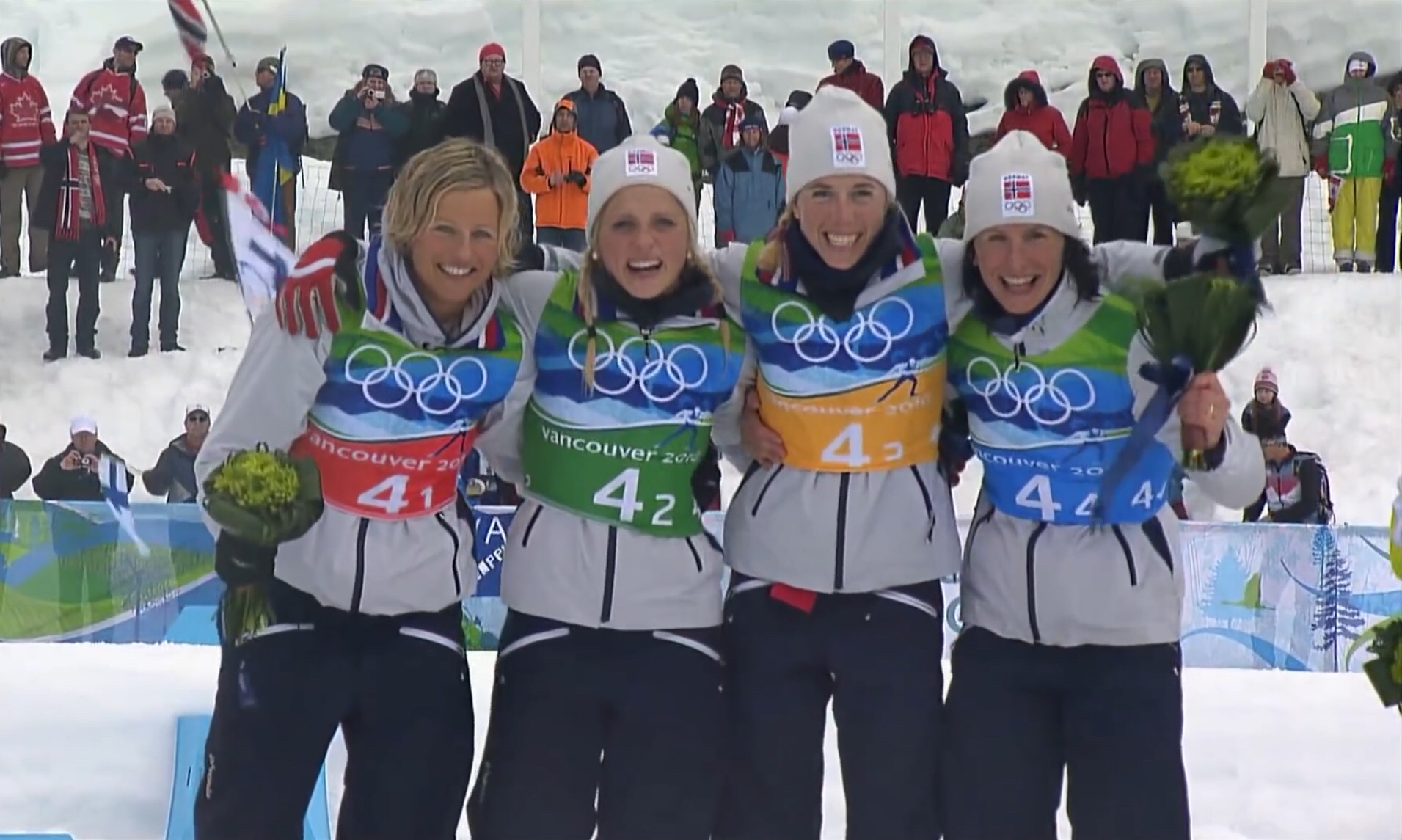
Norway’s gold-medal women’s relay at the 2010 Olympics in Vancouver, B.C., with (from left to right) Vibeke Skofterud, Therese Johaug, Kristin Størmer Steira, and Marit Bjorgen. (Screenshot: 2010 Vancouver Olympics relay video)
(Note: This article has been updated to include comments from Vidar Løfshus, head of the Norwegian cross-country ski team, and the team’s former performance manager, Åge Skinstad.)
The death of Norway’s Vibeke Skofterud shocked the international cross-country skiing world on Sunday, and as of Monday, multiple renowned skiers, particularly in Norway, had reacted publicly.
“I am shaking and am in complete shock over this horrible news that I received today,” Marit Bjørgen wrote in a press release, according to a translation. “Dear Vibeke, this was way too soon.”
Bjørgen and Skofterud were teammates on the Norwegian national team for well over a decade until Skofterud retired in 2015. They won gold together in the women’s relay at the 2010 Olympics and at World Championships in 2005 and 2011. Kristin Størmer Steira was also on all three of those winning relays, and Therese Johaug teamed up with the three to win in 2010 and 2011.
“I have lost one of my best friends,” Johaug wrote in another press release quoted by NRK. “A friend who lit up the room when she entered, one who gave everyone around her lots of energy, love and care. I take with me all of the nice moments and experiences in and outside of the trails and I will miss her. My thoughts go to her family and those left behind.”
Bjørgen added that she was “incredibly happy about all of the nice moments we had with each other. A tough competitor in the course, but more importantly, the warmest, nicest, toughest woman in the world,” she wrote. “We have experienced much together, from an Olympic gold medal in the relay … and I will cherish the memories for a long time. My thoughts go to her families and those closest to her. Love you Vibeke. Rest In Peace.”
Petter Northug wrote that the news was “incomprehensible and sad to hear,” according to News in English.no. “We had many fun years together on the national team.”
Odd-Bjørn Hjelmeset, a former skier who competed until 2011 and became a national team coach, recalled her “infectious humor”. Erik Røste, president of the Norwegian Ski Federation since 2012, said she was “an important ambassador for the sport of skiing with her winner’s spirit and great engagement.”
“Vibeke was that joyful girl who always contributed positively to the community she was a part of, definitely with her good results on the course,” Vidar Løfshus, head of the Norwegian cross-country team, told Aftenposten, according to a translation. “The fact that we have lost girl like her, who was always open, honest and spoke her opinion, is a loss to the entire community and inconceivable.”
“It is incredibly sad,” Åge Skinstad, a former national-team performance director who is currently TV 2’s cross-country expert, told TV 2, according to a translation. “The first thing you think about is the family and those closest to her. Vibeke was a fantastic human-being. She was a very, very good skier.”
One of her former competitors, Charlotte Kalla of Sweden, told Expressen that she was shocked by the tragedy.
“It feels uncomfortable and difficult to accept that such a joyful, positive, and full of energy kind of competitor such as Vibeke is longer with us,” Kalla said, according to a translation. “Vibeke was one of my role models when I entered the national team. A positive person who spread joy and really contributed to the cohesion with Norwegian team. She was a character within the sport who offered a lot of herself. It is with great sorrow that I now think of Vibeke and those closest to her. Rest In Peace Vibeke.”
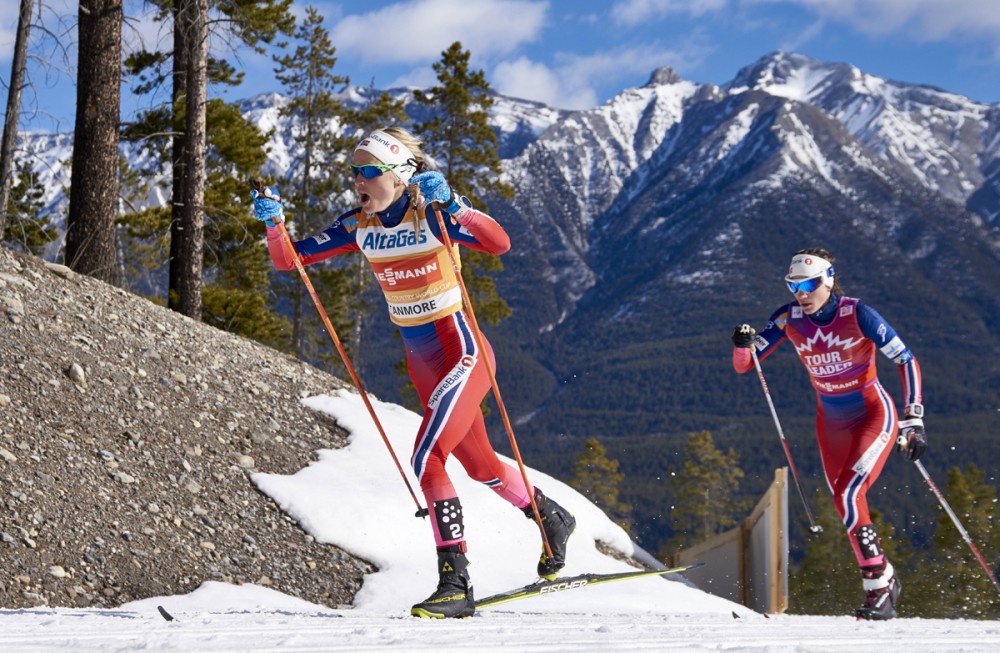
Therese Johaug (l) and Norwegian teammate Heidi Weng during the women’s 15 k skiathlon in Canmore, Alberta. The competition was part of the Ski Tour Canada, one of many World Cup events Johaug won last season. (Photo: Fischer/NordicFocus)
The Norwegian Ski Federation has announced that cross-country skier Therese Johaug, an Olympic and World Championships gold medalist and two-time winner of the overall World Cup title, has had a positive drug test.
According to the federation, Johaug had severely sunburned her lips while training at high altitude in Seiser Alm, Italy, in August.
The damage can still be seen in a photo she posted to Instagram over the weekend.
After the team moved to nearby Livigno for a mid-elevation camp, team doctor Fredrik Bendiksen noticed Johaug’s condition. He bought two creams at an Italian pharmacy and assured Johaug that neither contained substances on World Anti-Doping Agency’s Prohibited List.
The first cream she used did not help her sunburn. So she switched to the second. It helped – but it also contained clostebol, an androgenic anabolic steroid which is in fact banned.
Johaug was visited by doping control officers on September 16 – where she declared the lip cream, called Trofodermin, on a form listing what medications she was using – and was informed of her positive test on October 3. The test was ordered by Anti-Doping Norway, which will proceed with her case.
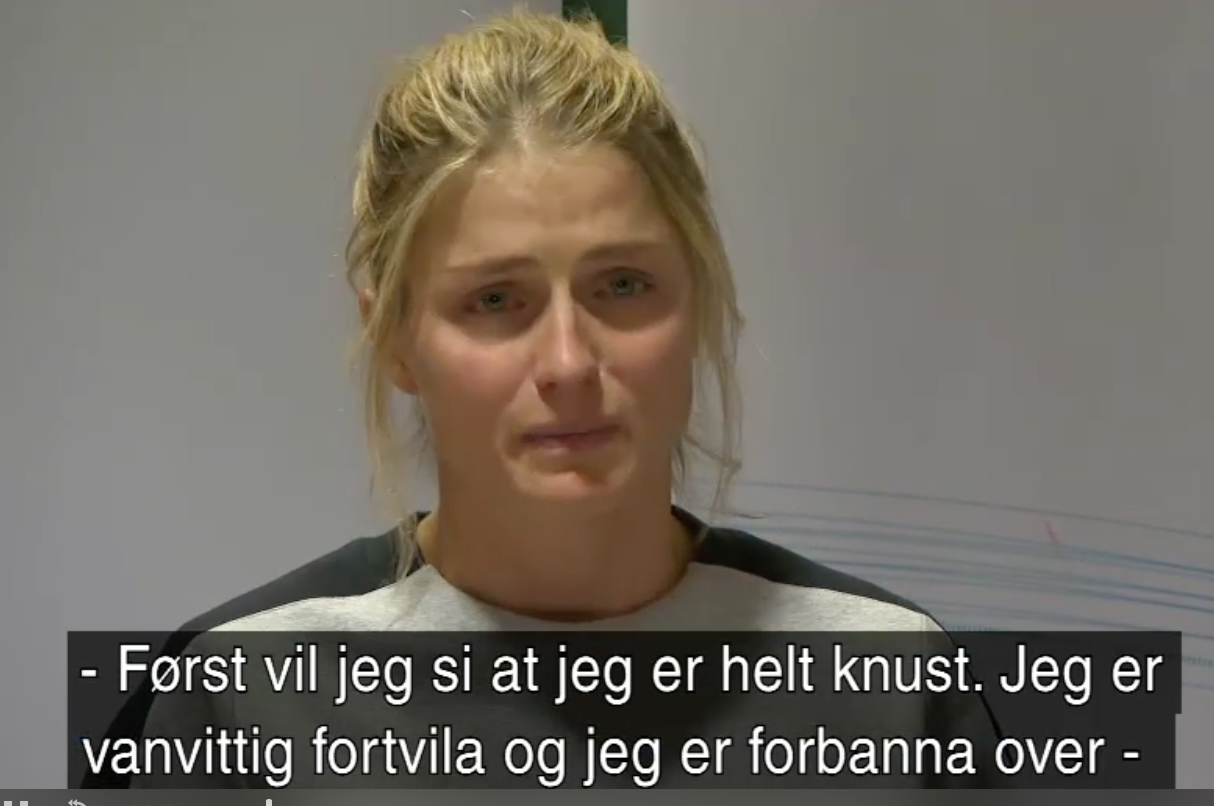
Therese Johaug during a press conference on Thursday announcing her positive doping test.
The news was made public by the ski federation on Thursday morning. Johaug had a live press conference on NRK, Norwegian state television, around noon (Norwegian time) on Thursday.
“I am completely devastated and in despair to have ended up in this very demanding and to me unreal situation,” she said, according to a translation by the International Ski Federation.” I see this as unfair and totally undeserved, even though I am obviously aware of the liability that I have as an athlete for the medication that I use.”
Clostebol is commonly used to treat skin conditions. But it is also performance-enhancing. Clostebol was initially developed in East Germany and used by athletes there to gain an athletic advantage. It is a derivative of testosterone, but is considered a weak anabolic agent compared to some other steroids.
A number of athletes across nationalities and sports – ranging from professional baseball and soccer to international Olympic sports like track and field, weightlifting, and beach volleyball – have tested positive for the clostebol.
The test for clostebol is fairly sensitive, and a number of athletes have tested positive despite never taking the drug as a medication. For instance, the drug is also used to promote growth in livestock (particularly in countries where the use of growth hormones is prohibited) and there are documented cases of test subjects who had never taken the drug having it show in urine samples after eating meat from animals raised on the substance.
Clostebol also has applications for gynecological care, and there are other documented cases where an individual has tested positive after having sexual intercourse with a partner who is using the drug in a medication.
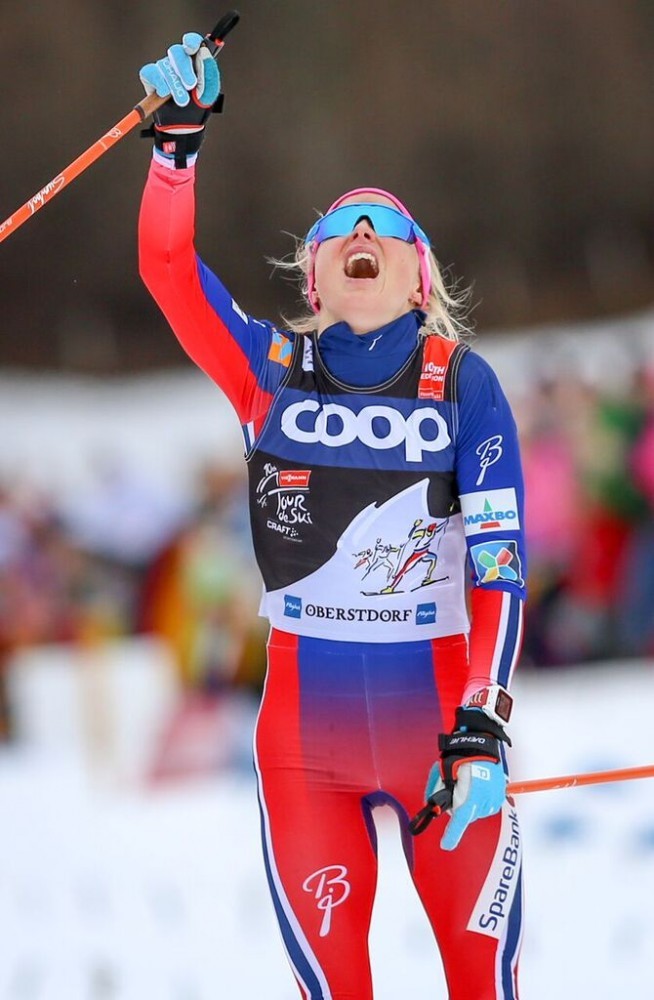
Norway’s Therese Johaug after winning the 10 k classic mass start at Stage 5 of the Tour de Ski in Oberstdorf, Germany, in January. (Photo: Marcel Hilger)
But a number of cases have been the result of athletes simply using topical skin creams without checking to see whether any of the ingredients were prohibited. In this case, it is clear that Bendiksen made a mistake in obtaining the medication. A simple online search would have revealed that clostebol was an active component of Trofodermin.
Bendiksen has taken complete responsibility for the mistake.
“Therese is an amazing, conscientious person and performer who is careful and precise in everything that she does,” he said, according to a translation. “The most important thing for me to do now, is to do everything I can to make sure she is not punished for using a cream which I assured her was legal to use.”
At the same time, Johaug said that she took responsibility for following Bendiksen’s recommendation. She explained that she had asked whether the cream had any prohibited substances in it, was told that it did not, and trusted her team doctor.
She tried to strike a balance by saying that she was responsible for the decision not to check the drug’s contents against the WADA list herself, she also “has zero guilt.”
“To get an undeserved positive test, it’s an athlete’s worst nightmare,” Johaug said.” But I will fight everything I can and show that I am innocent in this matter.”
The federation reportedly canceled a major season kickoff event scheduled for Thursday. Instead, the cross-country committee is meeting to decide how to handle the situation.
The ski federation is clearly trying a different crisis management strategy this time around. Rather than delaying, Johaug held the press conference soon after learning the news herself.
Whether that is due to the preferences of the federation or the athlete is unclear. The federation had reportedly urged Sundby to go public earlier in his appeals process, but he had refused.
Now, after months of denying responsibility for the high doses of asthma medication he had been prescribed by a team doctor, Sundby has apologized and said he was “100% responsible”.
The ski federation, meanwhile, is facing a nightmare. President Erik Røste said in the press statement that he was “concerned that Norwegian cross country have again ended up in such a demanding situation.”
And once again, it appears that the doping violation was the result of an athlete following advice of a team doctor. Røste said that the federation would look into how to prevent the problem from continuing.
Norway’s Martin Johnsrud Sundby during the men’s 15 k skate leg of the Ski Tour Canada in Canmore, Alberta. Sundby may not be the only Norwegian athlete who used a nebulizer to take asthma medication — even healthy athletes were allegedly recommended to do so. (Photo: Fischer/Nordic Focus)
As Norwegian skier Martin Johnsrud Sundby has decided to appeal his doping ban to the Swiss Supreme Court, stories have emerged suggesting that the Norwegian Ski Federation recommended that healthy skiers use salbutamol nebulizers – the same drug and method Sundby was issued a two-month ban for – as preventative therapy to maximize performance.
But what of the past? Norway’s TV2 talked with several cross-country skiers who say they were told by the national team to use nebulizers, even though they did not have asthma. A nebulizer delivers beta-2 agonists, drugs which help relax muscles in the airways. Such medications are banned for use by athletes up until a threshold dose.
In the same piece, national team director Vidar Løfshus said that this constituted “preventative care” to make sure that no athletes had airway obstructions.
The Norwegian Ski Federation announced on its website that it would be conducting a full review of medication use policies in the wake of the scandal.
Erik Røste, the president of the federation, said that he expected that healthy athletes would not have been prescribed medication, but sought to clarify whether his assumption was true. The investigation will be carried out by people not affiliated with the federation in order to maintain independence. Anti-Doping Norway has been consulted about assisting.
Røste also said that he was concerned that the stories could damage the reputation of the federation.
That seems to be already happening. Swedish national team doctor Per Andersson told Swedish media that prescribing medication to healthy athletes was a “dangerous path”.
Meanwhile, Sundby had been sanctioned for using high concentrations of salbutamol via a nebulizer. FIS had initially not suspended him, but the World Anti-Doping Agency (WADA) appealed the case to the Court of Arbitration for Sport (CAS), which banned him from competition for two months. Because some results were invalidated, Sundby lost his 2015 overall World Cup title as well as the overall Tour de Ski win.
CAS is the highest governing body in sports, and decisions cannot be appealed or overturned. However, Sundby decided to appeal the case to a non-sports body, the Swiss Supreme Court, because he felt that the judgement was unfair. He told Norwegian media that he was “not guilty.”
Based on WADA rules, the maximum amount of salbutamol that is allowed to be inhaled is 1600 micrograms over 24 hours. Sundby’s samples taken Dec. 13, 2014 after the 15-kilometer classic in Davos, Switzerland, and Jan. 8, 2015 after the 25 k freestyle pursuit at the Tour de Ski in Toblach, Italy, and analyzed by a WADA accredited laboratory exceeded those limits.
His case hinges on a few words, as Sundby and the Norwegian medical team believe that the WADA limit applies only to medication taken in an inhaler, while Sundby used a different device, a nebulizer.
As an athlete with a documented history of asthma, Sundby likely could have received a therapeutic use exemption (TUE), which may have allowed the nebulizer use. But he did not apply for one, and such exemptions cannot be obtained retroactively.
Therese Johaug at the 2010 Olympics. (Photo courtesy of Kent Murdoch)
BEITOSTØLEN, Norway – “It’s really too bad there weren’t more girls here,” Therese Johaug told Langrenn.com after the 10 k classic FIS race in Beitostolen on Sunday.
That race had 25 Norwegian females on the result lists, while Friday’s 10K skate race featured 23 Norwegian women, and 21 completed Saturday’s sprint.
“There are definitely fewer girls here than previous years,” said Egil Kristiansen, head coach for the Norwegian national team women.
“Disappointingly few girls here,” said Norwegian national team director Åge Skinstad.
But the most serious comments belonged to Steinar Mundal.
“That we don’t have more girls racing at Beito is one thing, and in and of itself not that big of a deal. But this is an elite race, and there should have been more racers here. However, the general trend is incredibly scary. I am seriously concerned,” Mundal told Langrenn.com.
Mundal pointed out that in the entire state of Buskerud, in the south of Norway, there is only one female skier left at the senior level who is pursuing the sport.
“That’s just really sad. If this is a general trend, Norway will soon have very few female skiers,” he said.
Who is responsible?
“Somebody has to step up here. Soon,” Mundal said. ”But I don’t know who.”
Not enough snow
Therese Johaug thinks the lack of snow in parts of Norway is part of reason why so few girls raced this weekend.
“A lot of the girls don’t feel like they’ve skied enough yet, and many of them have lofty ambitions for themselves here at Beito. But I still think there are too few girls racing. I hope we can increase the recruitment, and that the girls are well taken care of during the most critical phases – from the youth to the junior level and from the junior to the senior level,” Johaug said.
Considerably More Swedes in the Swedish FIS Opener
Parallel to the FIS opener at Beito last weekend, the Swedes held their FIS opener in Bruksvallarna. At those events, nearly 80 female skiers entered, and more than half of them were Swedish.
Sweden has also had spotty snow coverage this fall, just like Norway.
Erik Østli, the race director at Beito, is wondering what the reasons may be. “It’s disappointing how few girls are racing, and I also notice that there are huge gaps in the performance levels. I wonder if all the restrictions on entries in the past have scared people from registering,” he said.
Encouraging Trend
Erik Røste, vice president of the Norwegian Ski Association, doesn’t find the trend alarming. In fact, he finds it encouraging that fewer girls are racing the Beito opener.
“As far as I know, this is a positive trend. Just look at the nationals. There are more racers than ever before,” Røste pointed out.
What does he think about the sparse number of girls at the season opener?
“It’s almost nice. We’ve tried to downplay the perceived importance of the Beito races for years. I’m actually encouraged to see less emphasis on this. There will be more important races later,” he said.
From Langrenn.com, November 15, 2010. By Ola Jordheim Halvorsen, translation by Inge Scheve