From the FasterSkier archive — posts syndicated from athletes’ and coaches’ own blogs between 2004 and 2012, kept online as published. Current coverage is at fasterskier.com.
Norway’s greatest competitive advantage in cross-country skiing has always been depth. In an Olympic selection season, that depth becomes a headache. When the federation gathered to finalize its 2026 team, the conversation was not about who belonged at the Games — those results and calculus had been logged. It was about which version of the team could survive illness, underperformance, and the cruel compression of Olympic schedules. For several skiers who have already proven themselves capable of standing on a World Cup podium — and perhaps even an Olympic one — the answer would be no. Not because they weren’t good enough. But because someone else fit the puzzle a fraction more cleanly.
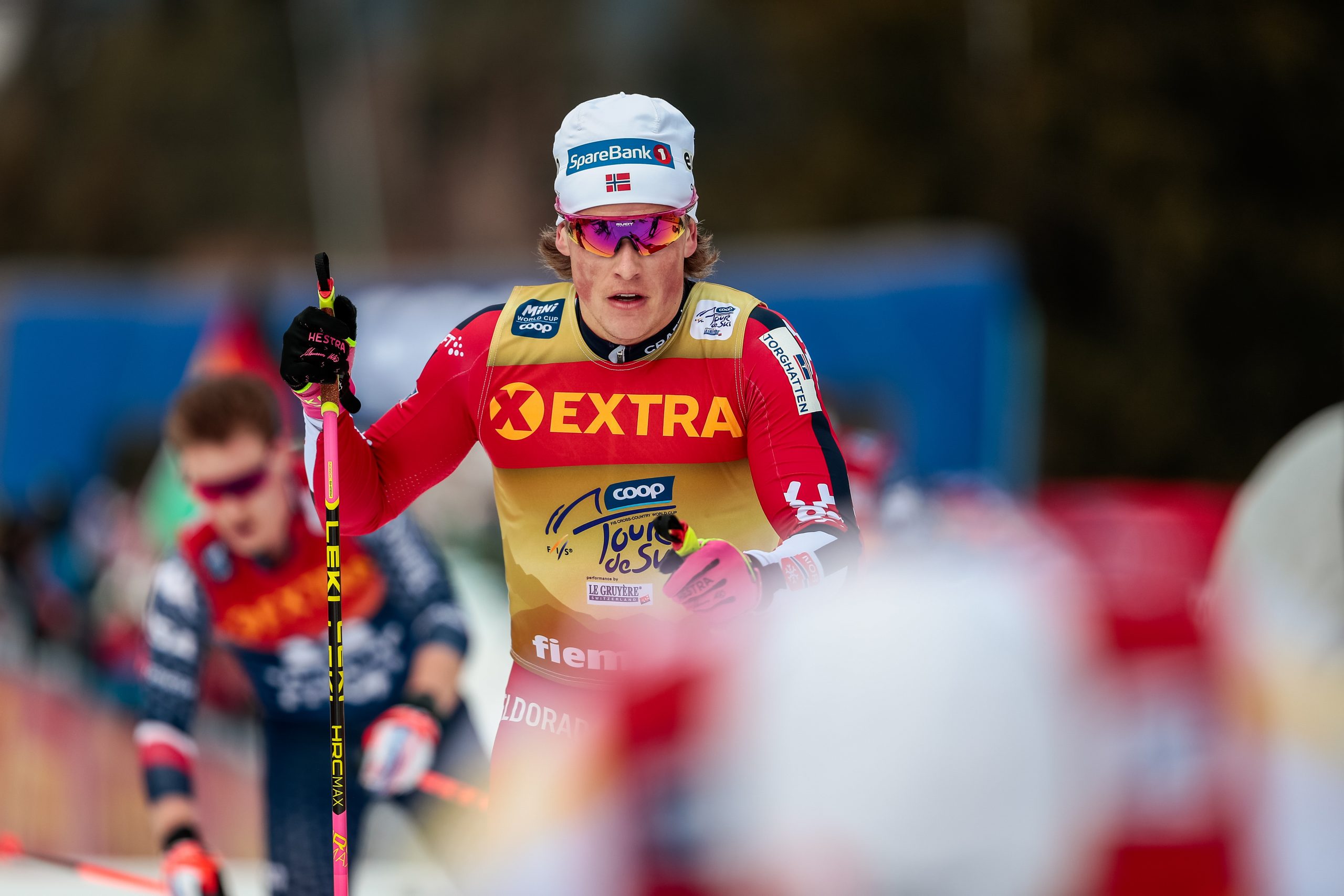
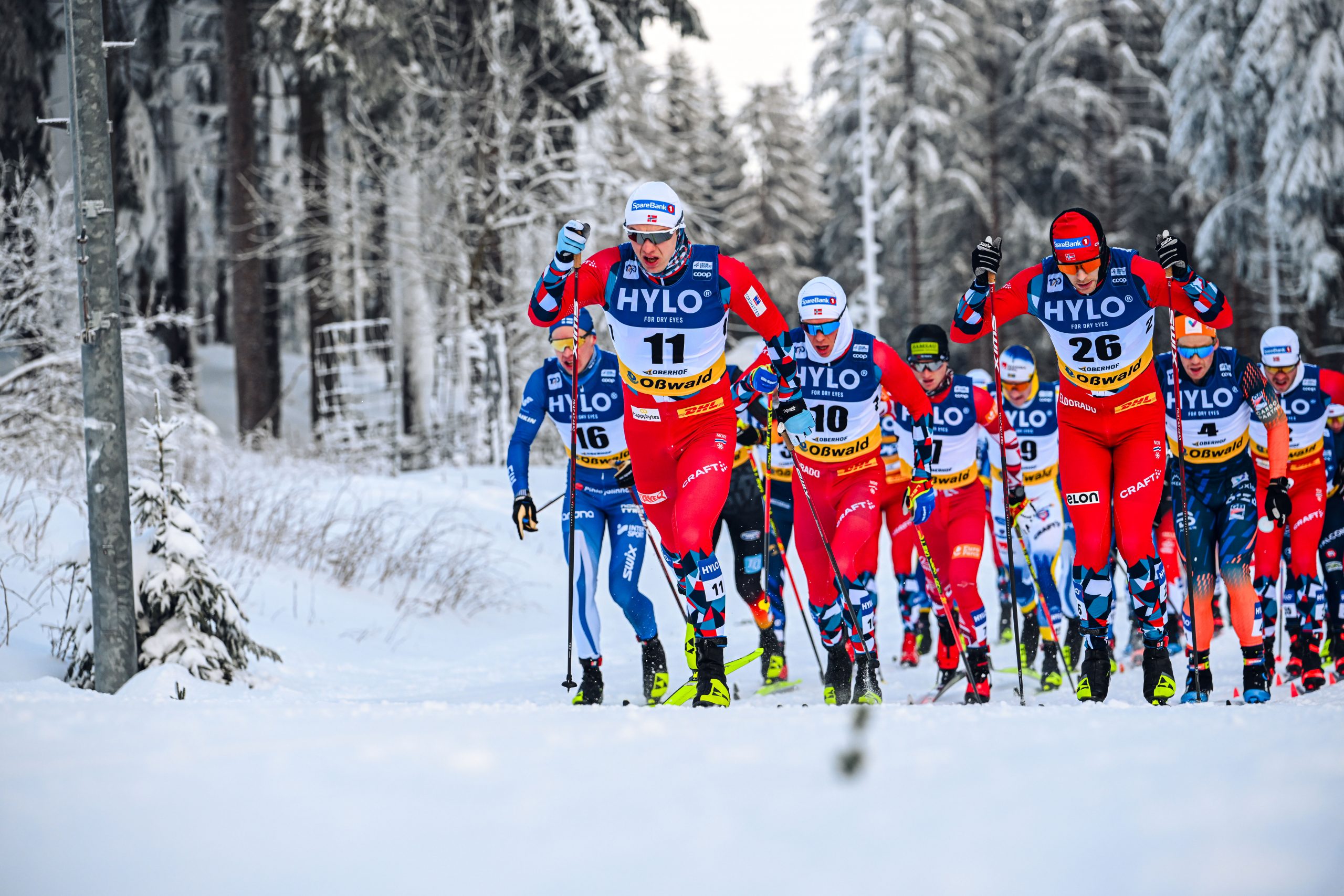
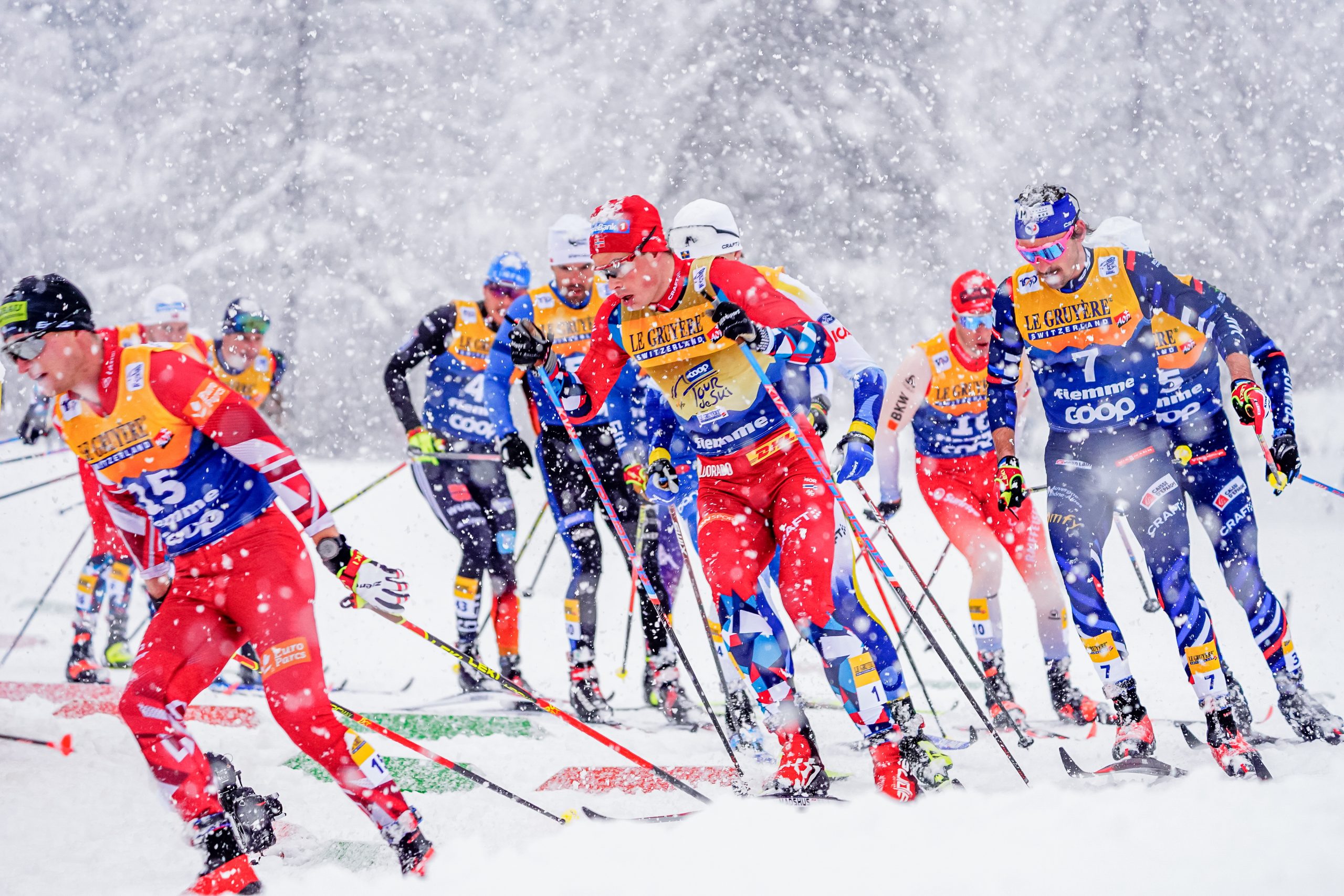
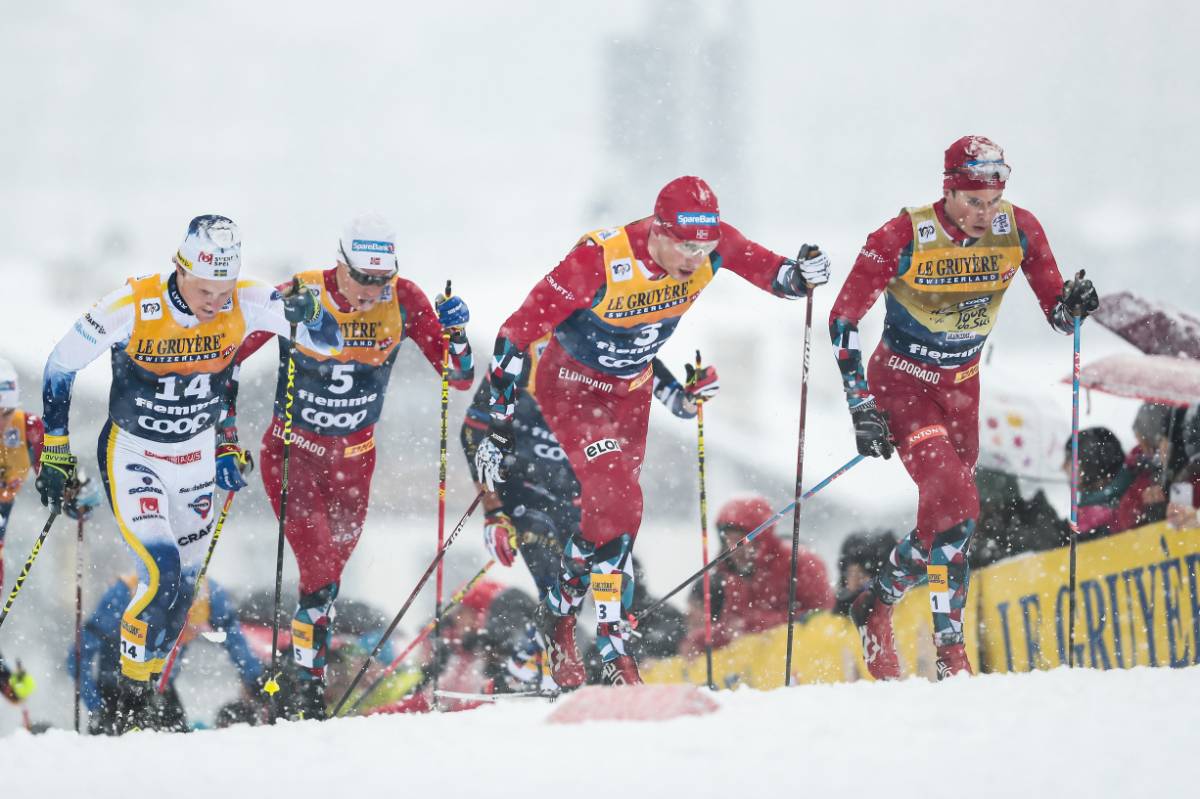
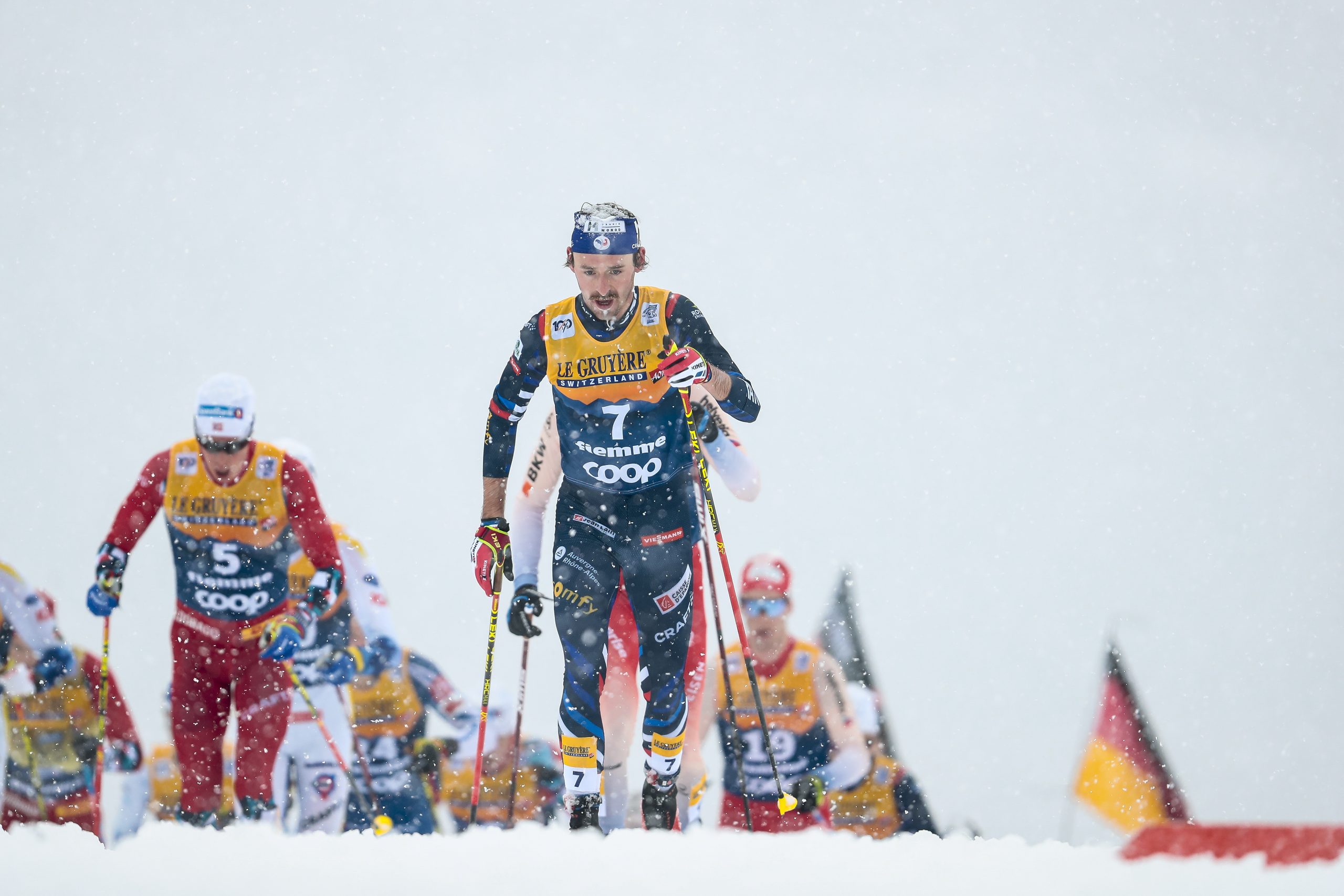
Johannes Hoesflot Klaebo (NOR) leads a train of Norwegian men in Lahti (FIN) last March. (Photo: Thibaut/NordicFocus)
Eight Men, Eight Women — Complete
The Norwegian cross-country Olympic squad now includes eight men and eight women, a balance that reflects the depth of talent and strategic breadth of Norway’s cross-country program.
With these 16 names confirmed, Norway’s roster boasts a mix of seasoned champions and hungry young stars — from Klæbo’s Olympic pedigree to Vike’s breakthrough sprint talent.
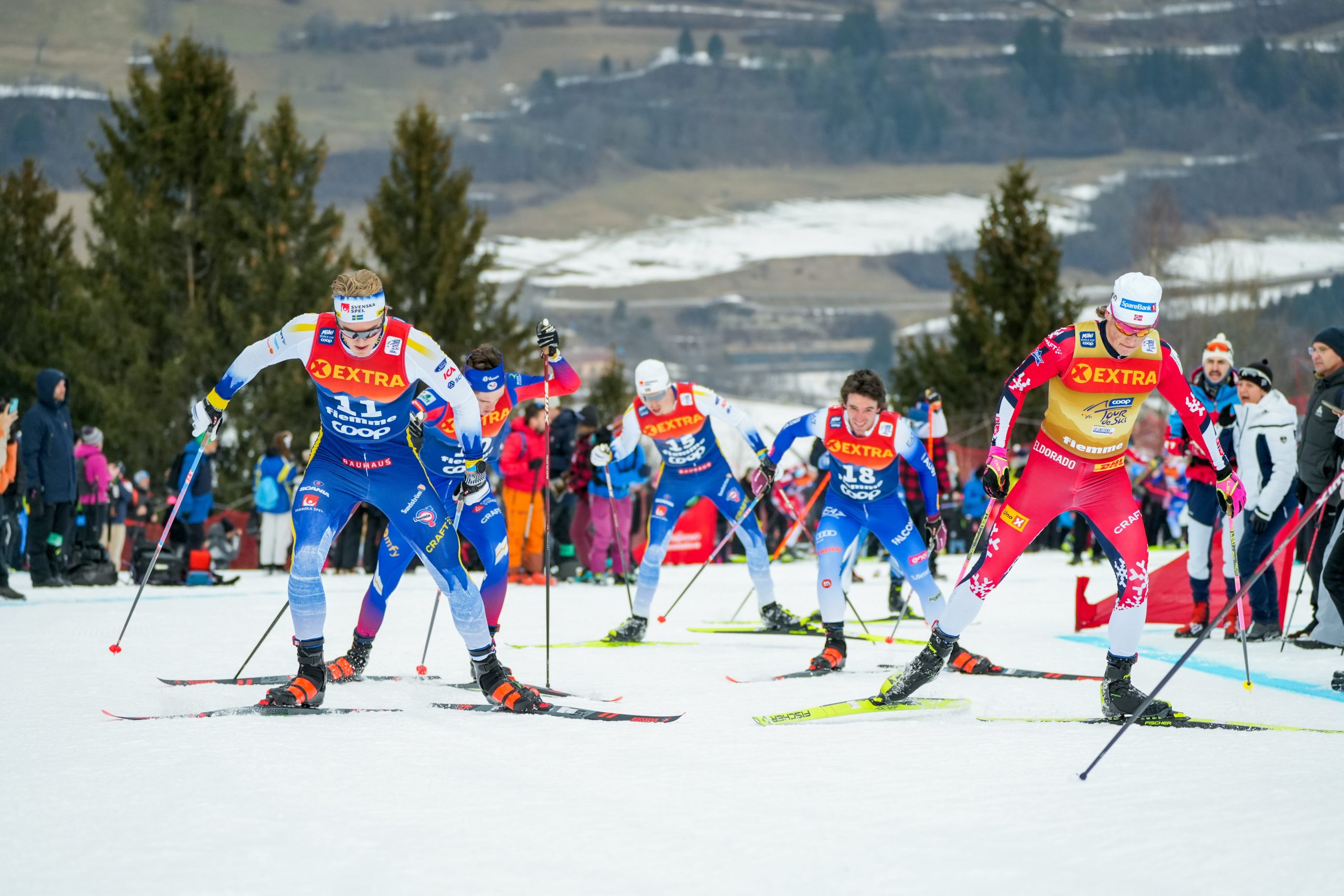
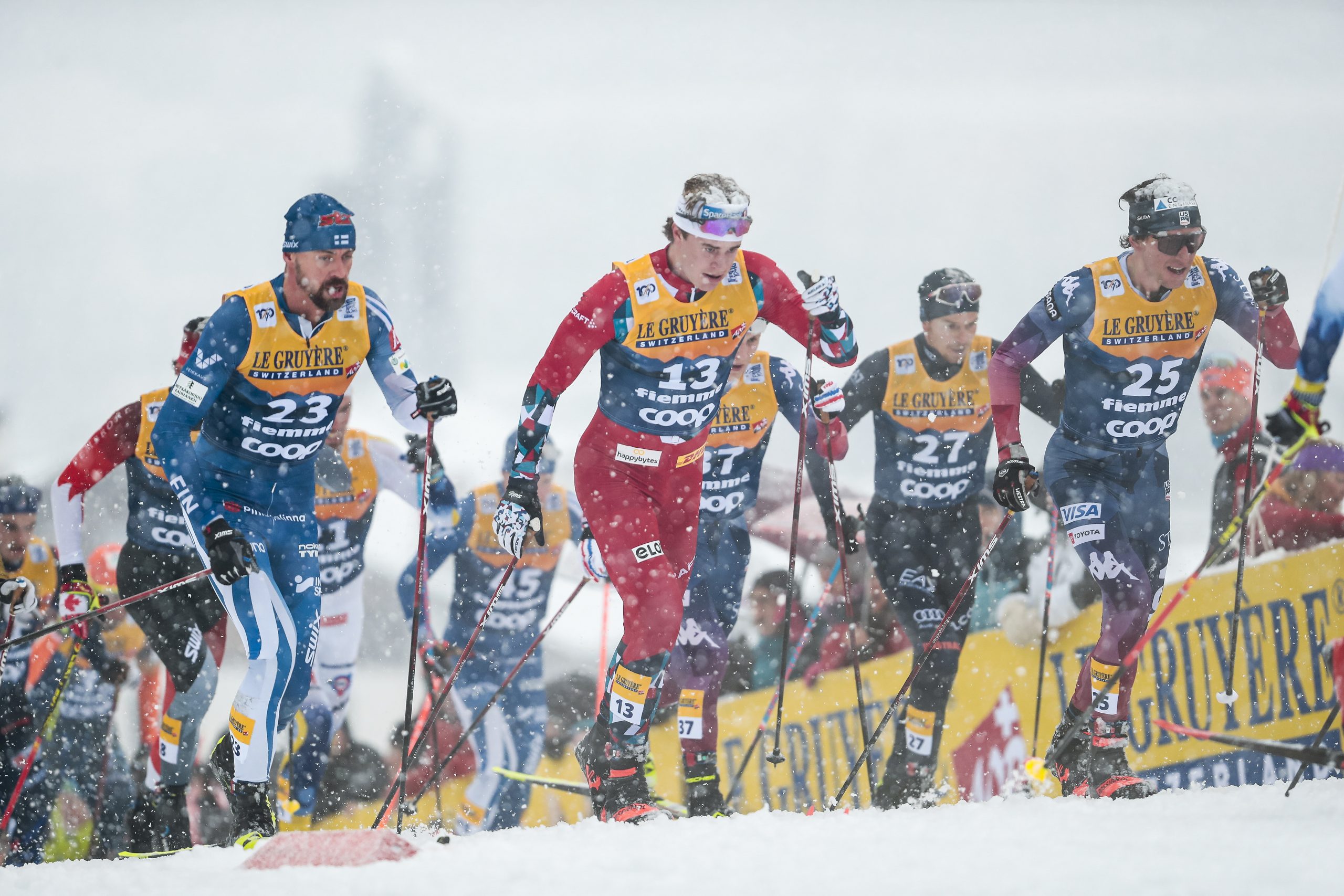
Harald Oestberg Amundsen (NOR), Mattis Stenshagen (NOR), Johannes Hoesflot Klaebo (NOR), Emil Iversen (NOR), Jan Thomas Jenssen (NOR), Erik Valnes (NOR), and Martin Loewstroem Nyenget (NOR), (l-r) come up the final climb during the Skiathlon in Trondheim (NOR) in December. (Photo: Modica/NordicFocus)
The Final Pieces of a Puzzle: Iversen and Vike
For weeks, the most hotly debated part of Norway’s Olympic selection revolved around the last two men’s spots.
Emil Iversen, the veteran 34-year-old World Cup stalwart and World Champion team sprinter, secured one of the final berths — a decision that stirred both emotion and controversy. Iversen missed out on earlier national team standing but made a compelling case this season with solid World Cup performances, including in Tour de Ski events that carried significant weight in the selection criteria.
On the younger side, Oskar Opstad Vike earned the final spot. The 22-year-old sprinter’s rise — riding strong sprint results, including a World Cup top ten — gave the selectors a promising specialist to bolster Norway’s Olympic squad.
The decision to include one established distance racer (Iversen) and one sprint threat (Vike) over alternative combinations was no accident. It reflects not only this season’s results but also the complexity of Olympic event programming — multiple distance races, relays, and sprint competitions demand versatility and redundancy.
Emil Iversen (NOR) during the Skiathlon in Trondheim (NOR) earlier this season. (Photo: Modica/NordicFocus)
What Was on the Line
Norway’s selection strategy rested on ranked criteria that put top priority on World Cup results this season, followed by last season’s performances and past championship achievements. This emphasis on objective metrics aims to ensure that the athletes selected are not just popular choices, but the ones statistically most expected to deliver in Val di Fiemme.
It’s no surprise that Johannes Høsflot Klæbo leads the team — the multiple World Cup overall and sprint title holder is already one of the greatest of all time, and his results this season keep him in clear contention for medals across disciplines.
Meanwhile, Mattis Stenshagen has been one of the season’s breakout distance performers, boasting both World Cup podiums and a strong Tour de Ski showing that solidified his place on the team.
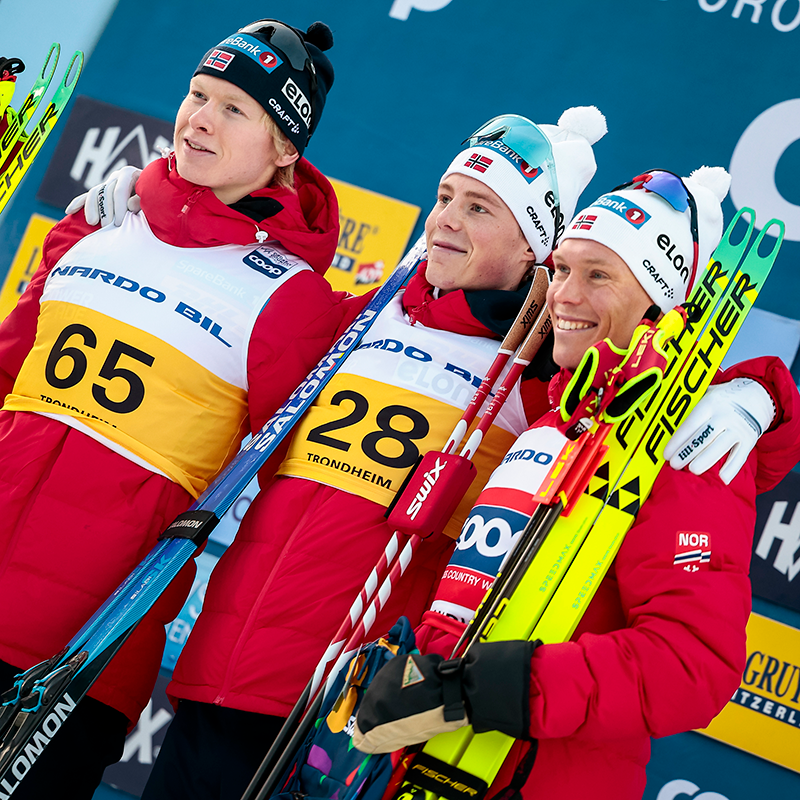
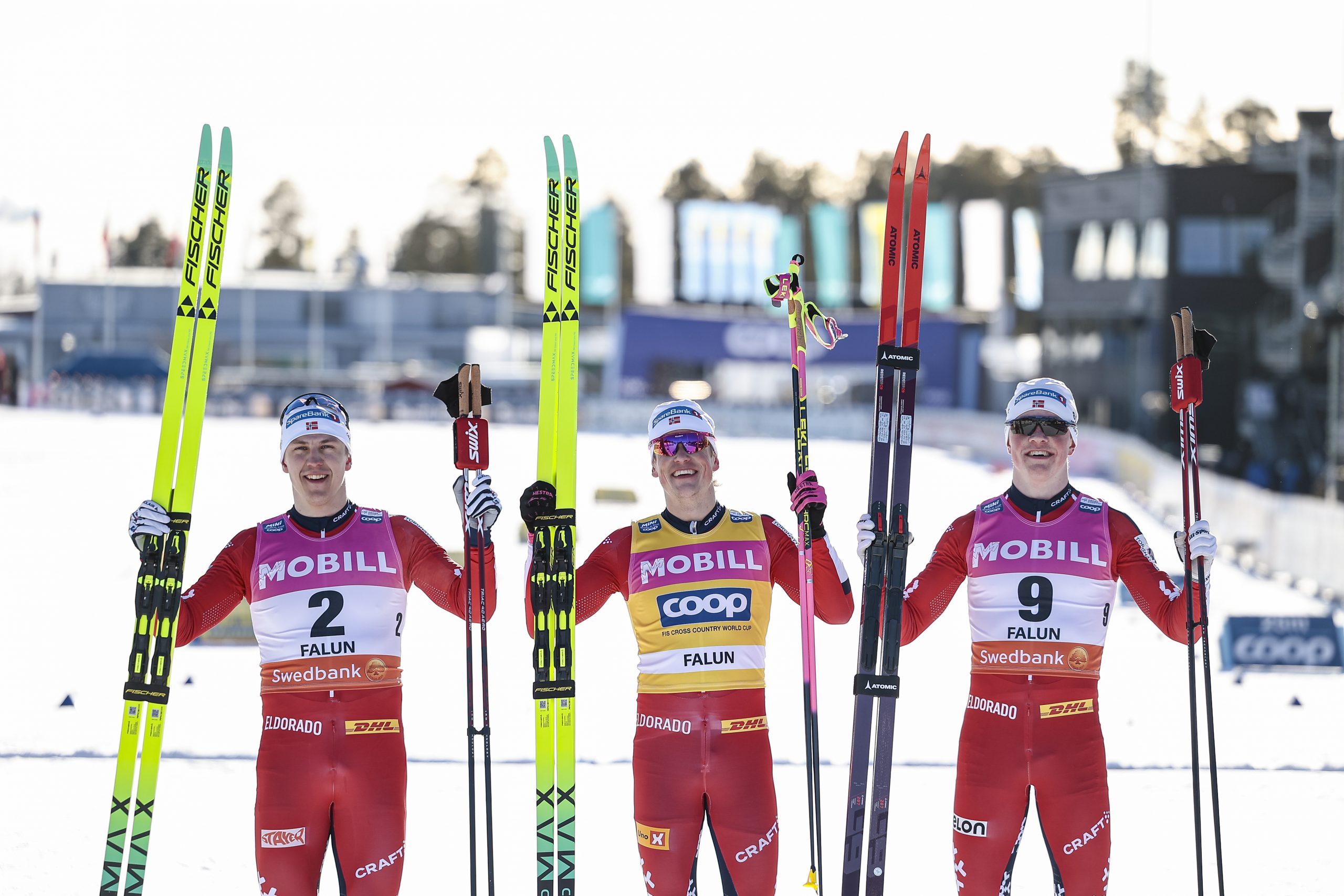
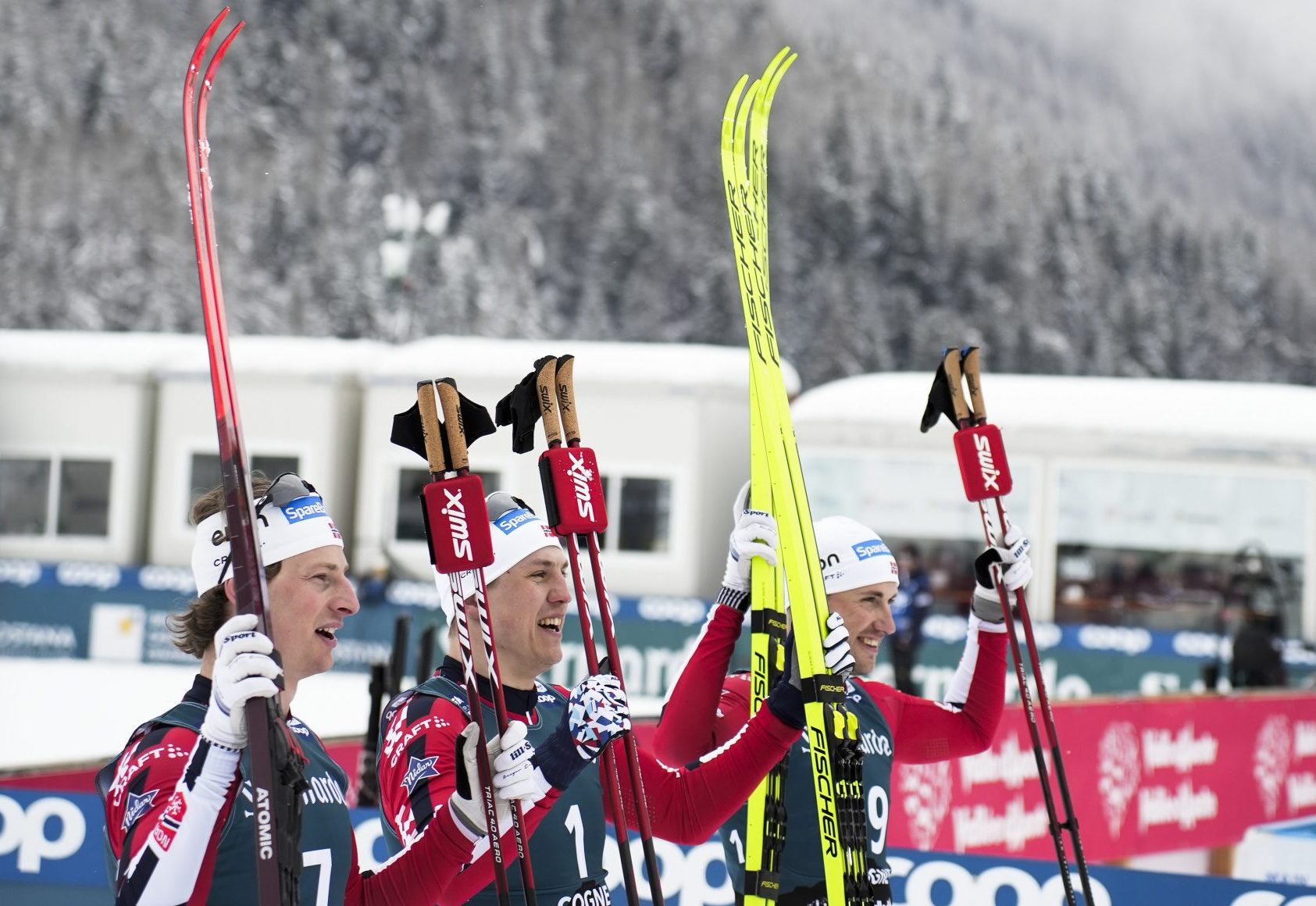
Erik Valnes (NOR), Johannes Hoesflot Klaebo (NOR), and Oskar Opstad Vike (NOR), (l-r) share the podium in Falun (SWE) in last season. (Photo: Modica/NordicFocus)
Notable Near-Misses and Debates
Not everyone who hoped for an Olympic ticket got one.
One of the most talked-about stories this season was Lars Heggen, the 20-year-old sprint phenom who has burst onto the scene with impressive results, including a World Cup sprint victory this past weekend. Many voices in ski media argued passionately for his inclusion, citing his explosive form and tactical range. But in the end, selectors opted for experience and proven Olympic relevance — a choice that sparked debate across Norway and beyond.
Another compelling case was Andreas Fjorden Ree, whose World Cup performances and near-victory finishes led many to forecast him as a certain medal contender. His exclusion — by mere fractions in selectors’ evaluations — was described as “brutal” by some commentators, underscoring just how competitive this national squad truly is.
Kristine Stavaas Skistad (NOR) leads Maja Dahlqvist (SWE) down the homestretch of the opening stage of the Tour de Ski in Toblach (ITA) in December. (Photo: Modica/NordicFocus)
Women’s Squad: Balance of Experience and Youth
While the men’s selection drama took center stage, the women’s squad also reflects a dynamic mix of talent:
Veterans like Heidi Weng bring Olympic experience and tactical acumen.
Sprinters and all-rounders like Kristine Stavås Skistad and Karoline Simpson-Larsen add valuable firepower.
Milla Grosberghaugen Andreassen and Ingrid Bergene Aabrekk represent the up-and-coming generation making their impression through World Cup and Norwegian Championship results.
Selectors reportedly evaluated performances not just from the World Cup and Tour de Ski, but also through the Norwegian National Championships — especially when managing variables like injury and form.
Heidi Weng (NOR) during the final climb of the Tour de Ski in Val di Fiemme (ITA) earlier this month. (Photo: Vanzetta/NordicFocus)
Looking Ahead — Milan-Cortina 2026
The Winter Olympics kick off on February 6, 2026, and cross-country skiing begins early with the women’s skiathlon on February 7. In Val di Fiemme — a venue steeped in Nordic history — Norway will arrive with one of the deepest teams in the field.
For a nation where cross-country skiing is practically a national pastime, these selections carry huge anticipation. Every name on this roster is now poised to chase Olympic gold, silver, or bronze — but behind them are stories of near-misses, fierce competition, and strategic choice-making that defined this winter’s most compelling selection drama.
Let the Games begin.
Love Stories Like This? Help Keep Them Coming.
Feature stories like this one take time, access, and care to produce. If you value thoughtful storytelling and independent ski journalism, please consider becoming a Voluntary Subscriber. Your support directly fuels the work we do to cover the people, places, and moments that make our sport special.
This coverage is made possible through the generous support of Marty and Kathy Hall and A Hall Mark of Excellence Award. To learn more about A Hall Mark of Excellence Award, or to learn how you can support FasterSkier’s coverage, please contact info@fasterskier.com.
“I’ll tell you; I never get no respect.” That was the lament of the immensely popular comedian Rodney Dangerfield, the loveable schlub who became an American icon by continually reminding everyone how unloved he was, while he simultaneously went on to become a huge success. The FIS (International Ski Federation) Team Sprint race format is kind of the Rodney Dangerfield of the ski world. Mention it to the average ski fan and they usually get about as excited as hearing about soybean futures—unless of course your team is winning a medal. Some of this is no doubt due to the complex qualifying and race structure. But if you take a look at when international cross-country skiing competitions occur, you would think that the Team Sprint is the belle of the ball. It’s been in every winter Olympics since 2006 and every World Championship since 2005. But during the regular season, it’s the first race many skiers are likely to opt out of and today was no exception. In the high altitude of Davos, Switzerland, it was the time for the Team Sprint to get its moment in the regular season spotlight, as the men and women competed for team honors in the Freestyle technique in this cross-country hybrid event.
Astrid Oeyre Slind (NOR), Jasmin Kahara (FIN), Maja Dahlqvist (SWE), Iris De Martin Pinter (ITA), Laura Gimmler (GER), Anja Weber (SUI), (l-r) fight for position in the women’s Team Sprint. (Photo: NordicFocus)
In the women’s event the story was that there was no American team entered. Given how much emphasis the team places on the Nation’s Cup battle, the no show was a little surprising. But it’s a long season— in an Olympic year— and there’s only so much energy to go around, but it did feel a bit like a Dangerfield moment. While the American women rested, it was time for other nations to take their shot. After Sweden’s Sprint podium sweep last week in Trondheim, Norway, it felt like the Swedes were the prohibitive favorites, especially with Maja Dahlqvist and Jonna Sundling headlining Sweden I into the qualifying round.
On the men’s side, the only question going into the race was how many of its stars, if any, would Norway rest. Given their early season dominance, they were clearly favored to win. In the qualifying rounds when Johannes Klaebo and Erik Valnes were on the start list for Norway I, and Harald Oestberg Amundsen and Oskar Vike, were manning Norway II, it looked a little bit like mission impossible for the rest of the men.
But one of the reasons that the Team Sprint has its appeal is that in the tight quarters with multiple exchanges and skiers packed so closely together, anything can—and often does—happen.
Men’s Team Sprint
Men’s Team Sprint Qualification
In the least surprising development of the day, Norway I led by Klaebo and Valnes qualified first, and Norway II led by Amundsen and Vike was second. In third place, 2.4 seconds off the lead was the Italian duo of Elia Barp, and Federico Pellegrino.
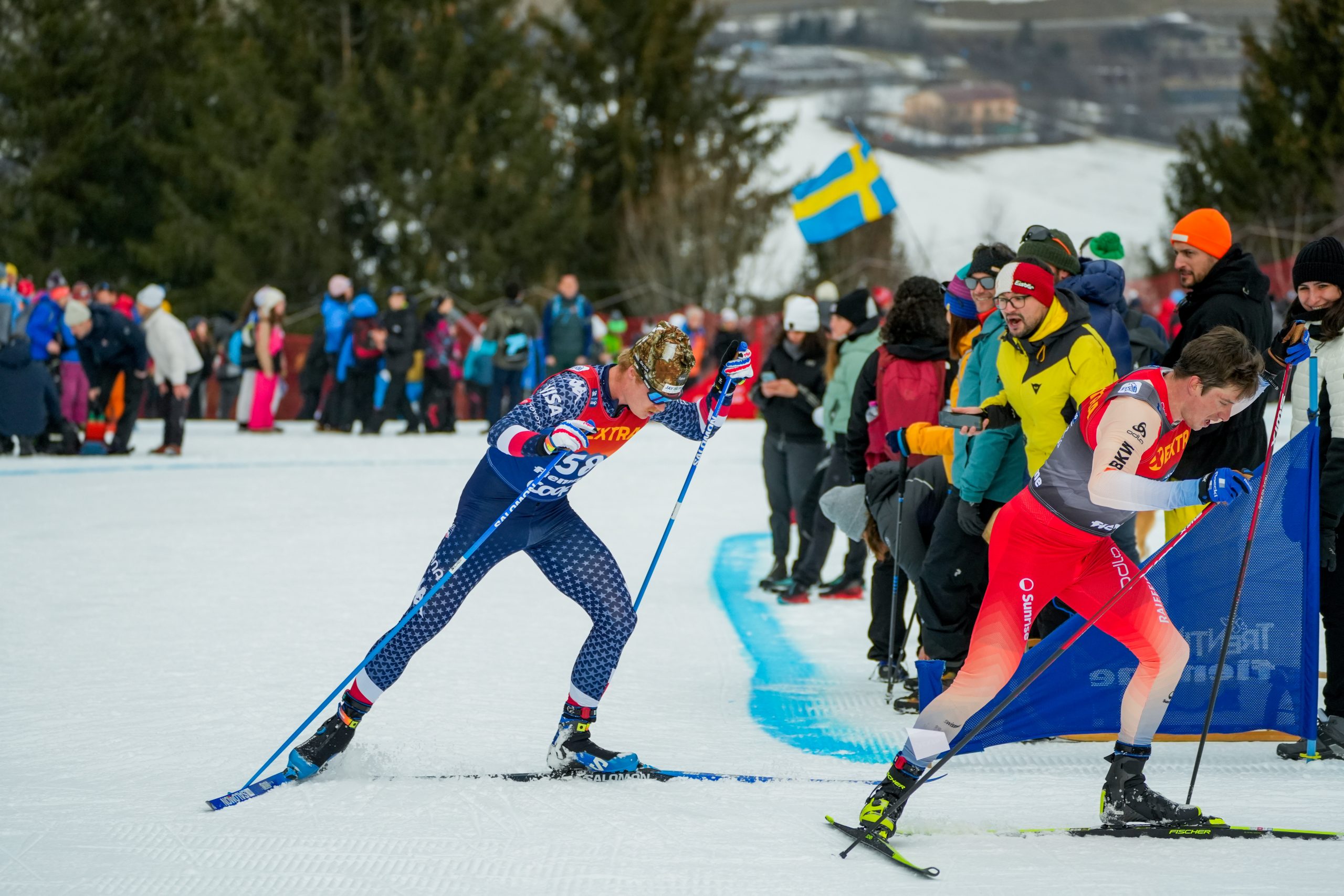
Team USA’s chances ended when Ben Ogden crashed in the qualifier. (Photo: NordicFocus)
The only American team—which consisted of Ben Ogden and JC Schoonmaker—finished 18th place, which wasn’t good enough to qualify. After Ogden crashed and broke a pole in his qualifier, the American hopes for making the finals were dashed. Gus Schumacher didn’t race due to illness and took the day off to recuperate for the rest of the weekend. Because of this, Schoonmaker was moved into USA I and this resulted in no USA II being available.
Men’s Team Sprint Final
At the start Valnes shot to the lead and looked determined to set a brisk pace. An early crash by Barp pushed Italy I to the back and meant Pellegrino would have his work cut out for him. At the first exchange the field was still tightly bunched with Norway I and Sweden II going to the front. Halfway through this leg there was another crash as Sweden I’s Edvin Anger crashed in one of the icy turns. At this point Klaebo—who was unaware of the carnage behind him— decided to open up some navigating space around him and turned up the pace.
As Klaebo handed off on the second leg, Norway I was in the lead. The field was slightly broken up by another collision in the middle of the pack. But nothing deterred the Norwegians as Valnes continued to keep the Norwegians out front. He handed off to Klaebo who was now shadowed by the rest of the field. Anton Grahn of Sweden II was gamely hanging with Klaebo at the front, while in the middle of the field there were two more crashes as skiers tumbled throughout the slick course.
It was no surprise when Norway I, led by Johannes Klaebo (NOR) went to the lead and won the race. (Photo: NordicFocus)
At the next exchange it was still Norway I and II at the front as Valnes and Amundsen began to press hard with Johan Haeggstroem of Sweden hanging with the Norwegians at the front. But Valnes soon found another gear and established some separation of the field. He was able to hand off to Klaebo with a slight lead over his teammate with Sweden I and Switzerland I close behind. Klaebo and Vike were out front while Sweden I’s Anger hung tight with Klaebo. Into the final hill Klaebo found the gear that only he has and created a large gap on the field.
Federico Pellegrino (ITA) did a great job closing the gap after his teammates crash to secure second for Italy. (Photo: NordicFocus)
Amazingly Pellegrino had managed to overcome the early deficit created by his teammate’s crash and was now battling Anger for second. Pellegrino was able to secure second place with Sweden I finishing third. In a huge surprise Norway II had dropped down to seventh place at the finish.
After the race Klaebo said he wasn’t aware of the crashes behind him but wanted to be out front regardless. As usual, his race strategy worked perfectly even if at the time he couldn’t fully appreciate its effect.
Federico Pellegrino (ITA), Elia Barp (ITA), Johannes Hoesflot Klaebo (NOR), Erik Valnes (NOR), Johan Haeggstroem (SWE), Edvin Anger (SWE), (l-r) (Photo: NordicFocus)
Women’s Team Sprint
Women’s Team Sprint Qualification
There were no surprises in the top two qualifying spots as Sweden I consisting of Dahlqvist and Sundling finished first with Sweden II’s Emma Ribom and Linn Svahn qualifying second. Germany’s team I of Laura Gimmler and Coletta Rydzek took the third qualifying spot, and Norway II consisting of Astrid Oeyre Slind and Mathilde Myhrvold settled for qualifying fourth.
Women’s Team Sprint Final
Lap one of the women’s race was a tightly packed affair with Switzerland getting to the exchange first, but there hadn’t been any real separation as Fabienne Alder (SUI) went out first in her leg of the lap, but was quickly absorbed by the field with Sweden I and II going to the front of the pack.
Jonna Sundling (SWE) created a big lead as she eased across the finish line for the victory. (Photo: NordicFocus)
At the second exchange Kristine Stavaas Skistad of Norway I snuck to the front and was the first to hand off to her teammate Kristin Fosnaes. At this point there still hadn’t been much separation with Dahlqvist now pushing the tempo.
At the start of the third exchange the Swedes were beginning to assert themselves and Sundling and Svahn pushed to the front as the field began to string out.
Kristin Austgulen Fosnaes (NOR), Kristine Stavaas Skistad (NOR), (l-r) hand off in the Team Sprint. (Photo: NordicFocus)
On the final leg Slind went to the front with the two Swedes going with her. Dahlqvist and Slind began to push hard as Germany and Switzerland hung with them.
As the final exchange approached, Dahlqvist had gapped the field giving Sundling about a three second advantage over Norway I and Norway II, as Sweden II struggled to keep with the pace. Sundling had a large lead of almost six seconds as the skiers entered the finish area with Norway I and II working hard to try to stay on the podium. Sundling was unchallenged as she entered the stadium and coasted to the finish. Norway I and II fought for second place with Norway II edging out Norway I. Germany I finished fourth. In the biggest surprise of the day, Sweden II finished in fifth.
Astrid Oeyre Slind (NOR), Mathilde Myhrvold (NOR), (l-r) beat expectations and finished second. (Photo: NordicFocus)
After the race Dahlqvist commented on the difficulty of coping with the altitude, and both racers stated that they were pleased with their efforts.
Astrid Oeyre Slind (NOR), Mathilde Myhrvold (NOR), (l-r) – FIS world cup cross-country, team sprint, Davos (SUI). (Photo: NordicFocus)
Love Stories Like This? Help Keep Them Coming.
Feature stories like this one take time, access, and care to produce. If you value thoughtful storytelling and independent ski journalism, please consider becoming a Voluntary Subscriber. Your support directly fuels the work we do to cover the people, places, and moments that make our sport special.
On most race weekends, I take my job seriously — up at 3:00 am EST, fresh coffee made, woodstove loaded, notebook out, logged on to coverage early to make sure I don’t have a technical issue. Then once the race starts, I begin looking for subtle, important moments to describe in greater detail in the race report. But there are also weekends, like this past one, when I toss my journalism hat onto the mantle above the woodstove to warm for another day, ‘grab a bucket of popcorn’, and watch, specifically, the Norwegian men’s Olympic selection saga unfold like the most incredible reality show in sport.
This year, the selection of Norway’s eight-man Olympic cross-country ski team might be the third most fascinating storyline in the Nordic world — trailing only Jessie Diggins’ farewell tour and the Russians’ return to the start gate. And yet, the drama out of Oslo might be the strangest: imagine being one of the ten fastest skiers alive… and still needing binoculars to see an Olympic start line.
This is what it means to be a Norwegian man in an Olympic year. It is both a birthright and a statistical tragedy.
Erik Valnes (NOR) and Johannes Hoesflot Klaebo (NOR), (l-r) crest the final climb before descending into the stadium during the World Cup Classic Sprint in Trondheim (NOR). (Photo: Modica/NordicFocus)
A Nation That Could Sweep Top 10 — and Still Leave Podium Skiers at Home
Let’s get one thing out of the way: on any given Sunday — sprint, classic, skate, distance, mass start, you name it — Norway could theoretically fill the entire top ten of a World Cup with home-grown talent. Twelve deep. Some years, nearly fifteen. The country is, bluntly, absurd.
And yet:
Only eight can go to Milano–Cortina.
Only four can start each race.
Only two can sprint in the team sprint.
Only four can race the relay.
You can be the fifth-best classic distance skier in the world, wearing red and blue, and never get to test yourself in the Olympic 50 k Classic, the sport’s defining event.
You can be a podium threat.
You can be a badge-wearing World Cup, World Championship, or Olympic winner. And still hear the most devastating phrase in the language of elite skiing: “Reserve.”
Johannes Hoesflot Klaebo leads training partner Emil Iversen durning the Skiathlon in Trondheim (NOR). (Photo: Modica/NordicFocus)
The Ten-Man Hunger Games
After Ruka and Trondheim, the men fighting for eight tickets look something like this:
Johannes Hoesflot Klaebo — simply the best male skier ever and is a favorite for gold in any race he enters.
Martin Loewstroem Nyengetis a force in any distance race, with first, third, fourth, and seventh-place finishes in the races he has entered this season, and is indispensable in the relay.
Andreas Fjorden Ree— second in the 10 k Freestyle and eighth in the Skiathlon this weekend.
Einar Hedegart — the young biathlete turned cross-country racer, who doesn’t even have a FIS bio pic, has broken onto the scene this season with a second in Ruka and a win in Trondheim in the two skate distance races he has entered.
Oskar Opstad Vike — He was second in the Classic Sprint in Trondheim, an Olympic event.
Erik Valnes — Olympic gold potential in the individual sprint, team sprint, and/or relay.
Lars Heggen — while he was only fourth in the Classic Sprint in Trondheim, that is an Olympic event.
Emil Iversen — the comeback story, the steady relay hand, who climbed onto the podium last weekend for the first time in five years.
Didrik Toenseth — has only started one World Cup, the 10 k Classic in Ruka, thus far, but was in 8th place, and it is an Olympic event. Toenseth is still one of the world’s best in distance races, yet still at risk of not making the team.
That is ten world-class athletes, without even mentioning skiers like Simen Hegstad Krueger, who is knocking at the door and who has won bronze in all the championship 50 k races for years.
Norway only gets to name eight Olympians.
Grab more popcorn.
Norway’s Andreas Fjorden Ree (NOR), Einar Hedegart (NOR), Martin Loewstroem Nyenget (NOR), (l-r) share the podium after the 10km freestyle Trondheim (NOR) last weekend. (Photo: Modica/NordicFocus)
Who Gets the Golden Tickets? Norway’s Math Problem
If the federation’s stated goal is to:
Sweep the podiums (plural),
Win the relay,
Win the team sprint
And possibly have Klaebo win everything except the marble flooring in the athletes’ dining hall, then the selection is not just about speed. It’s about risk management, event coverage, and event specialization.
Here’s how the roles break down:
The Locks (2):
Klaebo
Amundsen
Barring a meteor strike, these two are sharper in December than most nations’ peak athletes in February.
The Near-Locks (2):
Nyenget — championship DNA, distance weapon.
Valnes — if classic sprint is a medal event (it is) and you want a dependable classic leg in the relay, Valnes is on the plane.
Didrik Toenseth took third at the 2022 Holmenkollen 50 k Classic. (Photo: NordicFocus)
The Crucial Middle (six guys for four spots):
This is where heartbreak lives.
Heggen — might already be one of the five best sprinters on earth.
Ree — versatility is gold in Olympic selection, and he might be Norway’s best “plug into anything” skier outside of Klæbo and Amundsen.
Hedegart — never flashy, but quietly always where he needs to be.
Iversen — history matters. Championships matter. Norwegians never entirely write him off.
Toenseth — elite distance skier who would start for literally any other nation.
Pick four.
Explain it to the other two.
Good luck.
Harald Oestberg Amundsen (NOR) wins the 20 k Mass Start Freestyle during the World Cup opening weekend in Ruka (FIN). (Photo: Modica/NordicFocus)
Then There’s the Start-Quota Madness
Let’s say you do make the team.
Let’s say you ski the best season of your life.
Let’s say you’re in the shape of a medalist.
Too bad — your teammates might be in even better shape.
Norway could very realistically bring to Italy:
Eight skiers capable of a medal in the Skiathlon
Eight skiers capable of a medal in the Classic Sprint
Eight skiers capable of a medal in the 10 km Freestyle
Eight skiers capable of a medal in the 4 x 7.5 k Relay
Eight skiers capable of a medal in the Freestyle Team Sprint
Eight skiers capable of a medal in the 50 k Classic
But they can only start four.
Which means a realist must acknowledge something deliciously absurd:
Norway will leave potential Olympic medalists off the Olympic start list. Not just off the team — off the start list.
That is a uniquely Norwegian form of pain.
Oskar Opstad Vike (NOR) on his way to second place during the Classic Sprint last weekend in Trondheim (NOR). (Photo: Modica/NordicFocus)
The Fan in Me Wants A Front Row Seat
I admit it: I want this selection battle to go deep into January.
I want someone to pop one in Davos and get hot in Toblach.
I want the young skiers to keep storming the podiums and scrambling what we think we know.
I want Iversen — or Vike, or Hedegart, or Ree — to force selectors into sleepless January nights.
Because for once, the stakes in Norway aren’t abstract. The Olympics aren’t a coronation; they’re a compression chamber.
There are eight tickets for ten men who could anchor most nations’ relays.
There are four start spots for races where all Norwegian Olympians can podium.
There is no path through this selection period that does not end in heartbreak.
And yes, as a journalist, I will cover every step of it analytically, carefully, and responsibly.
But as a fan?
I’m sitting on the couch, popcorn in hand, and watching the drama unfold. If competitive suffering is the essence of cross-country ski racing, Norway’s selection battle might be the purest expression the sport has.
Bring on Davos.
Bring on Toblach.
Bring on the Tour.
Let the Hunger Games continue.
Love Stories Like This? Help Keep Them Coming.
Feature interviews like this one take time, access, and care to produce. If you value thoughtful storytelling and independent ski journalism, please consider becoming a Voluntary Subscriber. Your support directly fuels the work we do to cover the people, places, and moments that make our sport special.
This coverage is made possible through the generous support of Marty and Kathy Hall and A Hall Mark of Excellence Award. To learn more about A Hall Mark of Excellence Award, or to learn how you can support FasterSkier’s coverage, please contact info@fasterskier.com.
Erik Valnes (NOR) and Johannes Hoesflot Klaebo (NOR), (l-r) crest the final climb before descending into the stadium during the World Cup Classic Sprint in Trondheim (NOR). (Photo: Modica/NordicFocus)
Johannes Høsflot Klaebo’s 100th World Cup win did not arrive with the roar he’d grown used to on this course.
Granåsen last March had been a cauldron—tens of thousands of fans in plastic ponchos, rain pouring sideways, the World Championships turning Trondheim into a temporary capital of the sport. Eight months later, on the first Friday of December, the same stadium felt smaller. The sky was already dim by early afternoon, the floodlights casting a clean, blue-white glare across sugary tracks. The weather had finally cooperated—no rain, firm snow, kick wax that actually bit—but the crowd was thin enough that you could hear individual cowbells and specific voices when the finalists swung into the stadium.
Still, the stakes were anything but small. Norway flooded the start list with a full Nations-Group, 12 men in red suits, all chasing the same thing: an Olympic ticket to Milano–Cortina. Russia’s return to the World Cup had been confirmed in principle earlier in the week, adding long-term uncertainty to an already cutthroat season, but there were no Russian suits on the start line in Trondheim.
And in the middle of it all, on the same course where he’d taken six gold medals at Worlds, Klaebo lined up for a classic sprint with 99 World Cup victories to his name and the chance to round the number off in his own backyard.
By the end of the afternoon, the number would be 100. The route there was messier—and more revealing—than the record book will show.
Ben Ogden (USA) on his way to posting the fastest qualification time. (Photo: Modica/NordicFocus)
A qualifier that flipped the script
The first jolt of the day came from the American side of the results sheet.
Ben Ogden, the 25-year-old Vermonter who has been quietly (and sometimes not so quietly) remaking the U.S. men’s sprint profile, didn’t just survive the qualification round—he beat the entire Norwegian armada on their home snow. Ogden set the fastest time of the morning, ahead of Johannes Hoesflot Klaebo in second and a 19-year-old Swede, Alvar Myhlback, in third.
For U.S. head coach Matt Whitcomb, the signal was as much about skis and process as it was about the scoreboard.
Norway had sent out its complete Nations-Group—extra men beyond the regular quota—12 in total, and every one of them qualified for the heats. To outski so many Norwegians in a Norwegian sprint, Whitcomb later pointed out, is not an accident. It takes real form and excellent skis.
Ogden’s own description of the qualifier sounded almost deliberately un-dramatic, as if he were trying to file the moment under “routine” before the day had even finished.
“They all feel the same for me, for the most part,” he said afterward. “I definitely knew I was having a good one, skiing pretty fast, but you never know till you cross the finish line. In the middle of the race, I don’t think about that too much—I just sort of think about the next hurdle… At the bottom of the hill, I think about getting to the top, at the top, I think about pushing hard into the downhill, and on the downhill, I think about skiing the corner at the bottom of the hill well. That’s kind of the way it goes mentally for me. I definitely felt good, felt strong. I just felt like I could push and push and push and still have some energy, so it’s a good feeling for sure.”
Behind him, the margins were tight everywhere. Gus Schumacher and Jack Young both hovered just outside the top 30; Kevin Bolger lurked not far behind.
JC Schoonmaker, representing APU and still the same powerful sprinter who has lived on the brink of significant breakthroughs for several seasons, slid into the heats in 24th.
If Ogden’s run lit the American side of the results board, Myhlback’s qualification told a different kind of story—a long-distance skier breaking into the sprint world by almost ignoring one of its foundational assumptions.
Alvar Myhlback (SWE) double poling the qualification (and heats) on skate skis in Trondheim (NOR). (Photo: Modica/NordicFocus)
The double-poling kid from Bjursås
On the face of it, a 1.4-kilometer classic sprint in Trondheim is not where you’d expect to see the aftershocks of Vasaloppet.
Myhlback, a 19-year-old Swede from Bjursås, arrived in Trondheim already something of a legend in a different corner of the sport. In March, he had become the youngest winner in the hundred-year history of the Vasaloppet, staving off the best of the Ski Classics field over 90 kilometers of classic racing and double-poling his way under the blue arch in Mora.
His recent résumé reads like a long-distance syllabus: victories at Vasaloppet, the Klarälvsloppet, Alliansloppet, and the Blink Classics roller-ski race, all in the three-hour-plus universe of Ski Classics racing.
Yet in Trondheim, he and the coaches around him made a choice that felt deeply rooted in that marathon background. While almost the entire field stuck to traditional classic setups—grip wax underfoot, long diagonal-stride climbs—Myhlback rolled to the start on skate skis, no kick wax, no plan to stride. His day would be decided on pure upper-body power and glide.
He stuck with that choice all afternoon. In qualification, he was third, just 0.24 seconds behind Klaebo and less than half a second behind Ogden, double-poling up the long climb where others were striding. In the heats, he doubled down, literally: double-poling on skate skis in a classic sprint, in a World Cup final, on a course where the kicks of Norwegian diagonal stride have defined the past decade.
That he advanced at all would have been a story. That he finished the day on his first World Cup podium, sandwiched between Oskar Opstad Vike (second place) and Lars Heggen (fourth place) in a final dominated by Norwegians, turned it into something else.
It also sharpened an old talking point: Norway’s legendary wax trucks versus a kid who effectively opted out of grip wax altogether, trusting that his marathon-honed double-poling engine could hang on a course built for diagonal stride.
Oskar Opstad Vike (NOR), JC Schoonmaker (USA), Amund August Korsaeth (NOR), Alvar Myhlback (SWE), (l-r) during their quarterfinal. (Photo: Modica/NordicFocus)
The corner that wouldn’t let go
If qualification belonged to Ogden and the chemistry of Norwegian wax trucks, the afternoon’s defining feature was a corner—and the way it kept finding Americans.
Granåsen’s men’s sprint course climbs from the start to a right-hand turn that looks elementary on a map and on television. It’s not an overtly decisive feature: no off-camber sweeping change of direction, no opportunities for bold attacks, just too early on the course to gain a significant advantage. Yet, over and over again, as head coach Matt Whitcomb later put it, “that corner“ has become a problem spot.
In the men’s quarterfinals, Schoonmaker arrived there in a good spot, charging with what Whitcomb described as “gas to burn.“
Then he tangled with Italy’s Simone Mocellini at the top of the climb, went down, and his day ended with a broken pole and a replay that U.S. coaches will be watching for years.
“Today was definitely a step in the right direction,“ Schoonmaker wrote afterward. “It builds some confidence for the next races and for the season. I feel good and feel like I’m skiing pretty well, but it’s just not quite coming together the way I would like. I’m happy with the spot I’m in at the moment.”
Italy’s Simone Mocellini and JC Schoonmaker (USA) crest the final climb before descending into the stadium, but they were out of contention to advance. (Photo: Modica/NordicFocus)
In an Olympic year, that kind of tempered optimism reads differently. Under the U.S. selection procedures for Milano–Cortina, an individual top-eight finish in one of the Olympic events—sprint classic, 10 k skate, 20 k skiathlon, 50 k classic—can lock in an athlete’s nomination through objective criteria. For sprinters like Schoonmaker and Ogden, these early-season classics are more than just race days; they’re auditions with permanent consequences.
Ogden’s quarterfinal, by contrast, looked like the blueprint for surviving that fraught middle of the course. He surged early, stretched his heat into a line, and controlled the race in a way that kept him clear of chaos. He won his quarter almost casually, looking like a man who had solved Granåsen’s puzzle.
Then the semifinal brought him back to the same corner.
Ogden selected quarterfinal five—the last men’s heat in the rotation, the one where recovery time before the semifinal is shortest. By the time he lined up again, he could feel the effort in his arms; the plan, he said, was to sit in the pack early and save his move for the big climb.
Instead, the day tightened around a single moment.
“In the semifinal, I was kind of feeling the quarterfinal in my arms a little bit,“ he said. “So I thought, all right, I’ll just sort of sit in the pack here and wait until that big climb and try and do what I do on that. But I kind of paid the price early on, getting tangled up in that corner. I don’t think Harald [Østberg Amundsen] obstructed me or anything of the sort—he just happened to step on my tip. And when that happens, people who have ski raced will know that your ski comes to a stop, and you can’t really move it. And then that kind of caused me to get spun around, and we both went down.”
Harald Oestberg Amundsen (NOR) and Ben Ogden (USA), (l-r) cross the line in their semifinal heat after the two tangled on the courses first corner. (Photo: Modica/NordicFocus)
“Definitely [a] frustrating way to end the day, especially when I was feeling so good. But these things happen. And there’s always tomorrow.”
Whitcomb, who has coached through more sprint generations than most of the field has been alive for, sounded almost exasperated with that stretch of trail.
“This is probably the most competitive sprint we’ll race all year, until Drammen,“ he said, noting that every team—not just Norway—is living with Olympic selection pressure this winter. “For us, that corner is not an important part of the race, but it keeps becoming one… It’s a place where you should be skiing stable, defending your space, not trying to drop into the stadium with maximum speed.“
The Americans, in other words, left Trondheim with film to study as much as with results to celebrate. Ogden’s ninth-place finish—best in the U.S. men’s camp and agonizingly close to that top-eight Olympic criterion—is both a milestone and a marker.
Alvar Myhlback (SWE), Lars Heggen (NOR), Johannes Hoesflot Klaebo (NOR), (l-r) battle down the finish stretch of the individual classic World Cup sprint final in Trondheim (NOR). (Photo: Modica/NordicFocus)
Five Norwegians, one Swede, and a milestone
By the time the men’s final lined up, the race had distilled into a different kind of pressure.
Norway had put five men into the last six: Klaebo, Oskar Opstad Vike, Erik Valnes, Lars Heggen, and Ansgar Evensen. The lone non-Norwegian was Myhlback, the kid on skate skis, bib 3 set alongside four pairs of Fischer classic boards and one more pair of Atomics.
On paper, the stakes were layered. For Klaebo, it was win number 100 and the chance to keep an almost absurd streak alive: seven straight wins in Granåsen sprints, counting Worlds.
For Vike and Evensen—both already rising up the sprint standings—a podium here, in the hardest sprint of the season and on home snow, would strengthen an Olympic case in front of national coaches who did not have unlimited roster spots to hand out. Under IOC rules, each nation can take a maximum of eight men and eight women in cross-country; FIS allows only four athletes per gender per event.
From the gun, it was clear this would not be one of Klaebo’s processions.
Vike drove the pace early, taking the field up the major climb and over the top with a small gap. Heggen, just 20 and already a three-time junior world champion, looked at home in the front half of the pack. Valnes hovered near Klaebo, doing what he has done for seasons now: protecting his status as Norway’s most consistently useful classic sprinter.
Klaebo, for once, did not look invincible on the climb. He came over the top under pressure, with Vike controlling the line, and Myhlback momentarily buried deeper in the pack.
Then, on the descent back into the stadium, the familiar pattern snapped back into place.
Whitcomb described what happened there with a kind of forensic appreciation: “Klaebo’s signature move, popping out of his tuck to give two short, almost invisible pushes, gaining just enough speed to own the entry into the turn.”
From there, the physics feels pre-written: better speed into the corner means better speed out of it, and better speed out of it means that when the straightaway arrives, the race belongs to him.
Vike held on for a second. Behind them, Myhlback produced one last, pulsing double-pole assault, hauling himself from sixth off the final corner past Heggen and Valnes to grab third—the lone white and blue Swedish suit in a sea of red, and his first World Cup podium.
The official result sheet will show a clean column of numbers: Klaebo first in 2:59.89, Vike +0.31, Myhlback +0.34, Heggen, Valnes, andEvensen rounding out the six. The messy part—the decisions that got them there—was already being replayed on screens in wax trucks and team vans before the snow had stopped squeaking.
Johannes Hoesflot Klaebo (NOR) celebrates his 100th World Cup victory in front of his home crowd in Trondheim (NOR). (Photo: Modica/NordicFocus)
“Number 100. I’m taking it here.”
When the stadium interviewer finally put a microphone in front of Johannes Hoesflot Klaebo, the question almost wrote itself: had he, as some had suggested, deliberately eased off in last weekend’s distance race in Ruka to engineer his 100th win on home snow?
Klaebo, grinning, swatted the idea away.
“Number 100. I’m taking it here,“ he said. “To take it and to also do it in a sprint—it’s special… I wish I could say that. But no, I didn’t. I just feel like it was a perfect place, and doing this at the start of the weekend is really good. Now we can really just enjoy the weekend and hopefully some more good racing the next couple of days.“
At 29, he is now the first man to reach 100 World Cup wins and only the second athlete overall, joining fellow Norwegian Marit Bjørgen, who finished her career with 114.
Whitcomb, who has been on the circuit for the entirety of Klaebo’s rise, sounded as if he were still trying to convince himself the story was real.
“It almost doesn’t seem like a true story,“ he said. “Given that he won every race at World Championships in his backyard, given that he won his 100th World Cup in his backyard… and yet he does it. And that’s, I guess, the point of this whole thing.“
Today’s win, he noted, was not a walkover. Klaebo was genuinely under pressure on the climb. He had to make the pass on the descent. For an athlete whose dominance can sometimes feel inevitable, that mattered—it turned the milestone into a race rather than a coronation.
Johannes Hoesflot Klaebo (NOR) jumps for joy after his 100th career World Cup victory. (Photo: Modica/NordicFocus)
Norway’s sprint cauldron—and everyone else inside it
For the Norwegian men’s team, Trondheim’s result sheet reads less like a celebration and more like a spreadsheet.
The host nation deployed its full quota: twelve athletes, all of whom qualified into the top 30.
Seven Norwegians made the semifinals. Five made the final. The internal competition for Olympic places—which Norwegian media routinely describe as more cutthroat than the Games themselves—tightened another notch.
Evensen, who podiumed in Ruka and again came close here, is building what looks suspiciously like a “you can’t leave me home“ dossier. Vike’s second place gives him a marker race in front of home coaches. Heggen, not long removed from the junior ranks, now has “World Cup final in Trondheim“ on his resumé. Valnes remains what he has been for several years: the quiet constant, who makes every relay debate harder.
All of it plays out under the exact challenging numbers that govern every other nation: eight men, eight women total; four start spots per event. In a year when Russia’s gradual reintroduction will eventually change World Cup standings, and when nations like Sweden are suddenly finding new men’s sprint stars in unlikely places, no Norwegian result feels expendable.
For the Americans, the lens is different but just as sharp. U.S. selection procedures put heavy weight on top-eight finishes in events that mirror the Olympic schedule; Ogden’s ninth today falls just outside that automatic tier but lands him firmly in the heart of the conversation as the season unfolds. Schoonmaker’s “step in the right direction,“ as he put it, is also a reminder that sometimes the key line on a selection sheet is not a single result but a trend—of qualification, of speed, of that “look in his eyes“ Whitcomb referenced.
And somewhere beyond the World Cup bubble, Myhlback’s coaches and sponsors in the Ski Classics universe are waking up to a fact they probably already suspected: the kid who won Vasaloppet isn’t only a marathoner. His decision to show up in Trondheim, on skate skis, for a classic sprint, and walk away with a podium is going to complicate every conversation about where he belongs.
Ben Ogden (USA) although a tangle during the first corner of the semifinals left him wondering what might have been there was a lot of positives today for Ogden in Trondheim (NOR). (Photo: Modica/NordicFocus)
A quieter Granåsen, and a long season ahead
As the stadium emptied on Friday evening, Granåsen sounded more like a training venue than a World Championships site: a few kids sliding around on the outrun, the soft hiss of sprinters cooling down, coaches trudging back to wax trucks under a sky already leaning toward night.
Inside those trucks and team rooms, the day’s big moments were already being analyzed into data points. For Klaebo, the milestone win will sit at the top of his personal mythology, another chapter in the story of a hometown kid who has somehow bent the sport around his own arc. For Norwegians like Vike, Evensen, Heggen, and Valnes, the Trondheim sprint will live on as Exhibit A, B, C, and D in Olympic selection debates that will stretch deep into January.
For Ogden and Schoonmaker, the corner that took them down will become homework—grainy replay clips, course maps, and, eventually, new lines in the U.S. sprint “playbook“ the team keeps for every World Cup venue.
And for Alvar Myhlback, who insists he is still a long-distance skier first, Trondheim may end up feeling like an interruption: a single day on a familiar course in Norway when he parked the marathon skis, rolled out on skate boards, and proved that his double-poling engine works just fine in the cramped, chaotic, oxygen-starved world of classic sprinting.
The World Cup moves on quickly—20k skiathlons on Saturday, 10k skate starts on Sunday, Davos and the Tour de Ski looming just ahead. But for one early-winter afternoon in Trondheim, on a course that is beginning to feel like the sport’s central stage, the story belonged to a corner, a kid on skate skis, and a 29-year-old Norwegian who somehow made history again in his own backyard.
Feature stories like this one take time, access, and care to produce. If you value thoughtful storytelling and independent ski journalism, please consider becoming a Voluntary Subscriber. Your support directly fuels the work we do to cover the people, places, and moments that make our sport special.
Oskar Opstad Vike (NOR), Johannes Hoesflot Klaebo (NOR), Alvar Myhlback (SWE), (l-r) take the individual classic sprint podium in Trondheim (NOR) – Klaebo’s 100th World Cup victory. (Photo: Modica/NordicFocus)
Johannes Høsflot Klæbo enters Søstrene Karlsen, the club where he celebrated his medal winning performances at the World Championships in Trondheim, Norway. (Nathaniel Herz/FasterSkier)
TRONDHEIM, NORWAY — Johannes Høsflot Klæbo, the Norwegian gold-medal winner of all six competitions at this year’s World Championships here, was refreshingly blunt when asked about his plans to celebrate.
“You need to remember that I’m allergic to gluten, so I don’t drink much beer,” he told an audience of reporters at a news conference following his last race. But, he added: “If you ask me about vodka-Red Bull, it’s a little bit different.”
The 28-year-old went on to describe his monk-like lifestyle in the leadup to the highlight of his career: a World Championships in his home city.
Traveling with his manager-father 150 days a year. No partying since last spring. Two-and-a-half months eating chicken and rice.
“I have really been putting all the energy into these six races,” Klæbo said. “So, I think I will find something else to eat, and I will find something else than water to drink.”
I didn’t think much more about those comments until 9:45 p.m. that evening, when I was walking to the tram home from a (single, non-alcoholic) beer with some friends in Solsiden, a trendy Trondheim neighborhood of shops and bars in a redeveloped shipyard.
Half a block into my walk, I recognized a Norwegian reporter, posing for a portrait on a dimly lit pedestrian bridge over the harbor — a decidedly strange image for a Saturday night. Herman told me that Klæbo’s publicist had informed him and a few other Scandinavian reporters of the location of the victory party. And he and his photographer were testing the lighting while they waited for Klæbo’s arrival at 10 p.m.
Scandinavian reporters and photographers stand outside Søstrene Karlsen on Saturday night. (Nathaniel Herz/FasterSkier)
I quickly checked the tram schedule: There was another one in an hour. So I decided to stick around for what was starting to feel like a bit of a stakeout in front of Søstrene Karlsen — a club that, one of the reporters told me, is a hangout for Trondheim finance bros and, occasionally, some celebrities.
A thudding bass line played from the second floor; 50 sharply dressed Norwegians waited for a bouncer to let them in.
“The drunkest one is up there already,” one of the reporters said, pointing to a second floor balcony where Erik Valnes, one of Klæbo’s medal-winning Norwegian teammates, swayed unsteadily.
While we waited, I discussed the post-championships party vibe with the assembled Scandinavian press corps, which numbered about a dozen. One of them, whose newspaper forbids him from being quoted by name, told me that he completely understood why the athletes would want to unplug after the races, which had drawn wall-to-wall media coverage and tens of thousands of Norwegian fans.
“So much adrenaline, so much running through their head for so long. It’s best to just get drunk and not think about anything,” the reporter told me. “Think about the pressure they’ve been under.”
A few minutes later, Klæbo’s father, Haakon, arrived, looking ebullient in jeans and a puffy blue Craft jacket. Then came a group of former Norwegian superstars: retired Olympic gold medalist Martin Johnsrud Sundby looking dapper in a black felt jacket; marathon racer-turned TV commentator Fredrik Aukland.
But, as the clock ticked past 10:30, still no Klæbo — even as the crowd of waiting reporters grew.
The Scandinavian press follows cross-country skiing with a fervor much like the American media’s enthusiasm for professional football, and the end-of-season athlete celebration is a subplot that draws particular fascination.
Norwegian and Swedish athletes seem to be an especially hard-partying bunch, as do the Brits.
“I’m going to find some beer and drink a lot of it,” Andrew Musgrave, a United Kingdom skier, told the Swedish tabloid Expressen after his last race of the championships.
A Haitian skier, Stevenson Savart, even stopped on the side of the trail in the middle of Saturday’s men’s 50-kilometer event to take a drink from a beer offered by fans, then dropped out of the race.
Not everyone on the World Cup circuit, though, was ready to let loose, with members of the U.S. team in Trondheim exercising notable restraint.
“This is the extent of the partying,” American Gus Schumacher, 24, said Sunday, holding the single empty can of the beer he consumed while watching the last event of the championships, the women’s 50-kilometer race. His teammate, Luke Jager, said his primary method of celebration was playing three hours of a video game, Call of Duty.
“Right now, all I can think about is laying in bed,” an exhausted Julia Kern, one of Schumacher’s teammates, said just after finishing the 50-kilometer event. Heavy drinking, she added, seemed off the table. “I’ve been having really tricky stomach issues, so I can’t even fathom putting anything like that in my body right now,” she said. “I’m so far gone that it’s not even appetizing at this point.”
American Julia Kern at the end of Sunday’s race. (Federico Modica/Nordic Focus)
Kern said she didn’t have time to celebrate her silver medal earlier in the week that she won in the team sprint event, where she was paired with U.S. star Jessie Diggins.
“You don’t really have time. You get funneled from media to straight to the awards ceremony,” she said. “I think we really had our eye on all the future competitions to come.”
Kern said she does hope to take time to commemorate the medal with Diggins, likely with some non-alcoholic ginger beer, in the coming week.
But the Norwegians wasted no time in moving on to the stronger stuff.
Just before 11 p.m. Saturday, Klæbo finally showed up at Søstrene Karlsen, arriving on foot with his girlfriend, Pernille Døsvik.
There were screams from the assembled crowd; the scramble for photos was so intense that a reporter got knocked over into a fence.
Klæbo and Døsvik were allowed to cut the line and were shown inside. A few seconds later, they emerged, led by Valnes, on a staircase leading to the second floor. A door opened, they entered, and a few seconds later, a huge cheer erupted.
That was all the reporters would get. Except for me.
The next morning, I awoke to a selfie sent by one of the friends I was staying with.
They’re a group of avid ski fans who traveled to Trondheim that I’ve been referring to as the “unleashed dads” of Anchorage. Unbeknownst to me, one of them, Andrew Kastning, had gained entrance to the club and, in the early hours of Sunday morning, had captured a dimly lit photo of himself with Klæbo just over his shoulder.
Andrew Kastning’s selfie with Johannes Høsflot Klæbo at Saturday night’s victory party.
On my way out of the house and up to the competition venue for the women’s 50-kilometer race, I busted into Kastning’s room, where he was still groggily tucked under a duvet. He recounted his time at the club, where he’d arrived with some Norwegian friends he made during Saturday’s race.
“I didn’t know where they were taking me, really. But then we showed up and Jan Thomas Jenssen was there,” Kastning said, referring to one of the Norwegian competitors at the championships. “And then they all just started rolling in.”
What was your feeling? I asked him.
“About being there, in the scene of greatness? It was fucking amazing,” Kastning said. “It was so goddamn cool. I had to snap a fan selfie just to make sure I remembered it.”
As for Klæbo? The hero of Norway was “less excited than I would be if I’d won six gold medals,” Kastning said. Sober, with some smiles at times.
Valnes was perhaps having a little more fun. Kastning said his new Norwegian friend, Sondre Elvebakk, had dressed up as Valnes — wearing a hat from the skier’s hometown of Tromsø, with a vest and a speed suit.
As Elvebakk was asserting his feigned identity to a woman at the club, Valnes himself “rolled right around the corner.”
“I’m like, ‘Sondre might have a problem here,’” Kastning said. “The real Erik Valnes just stood up.”
Erik Valnes, standing, parties Saturday night with Sondre Elvebakk and an unidentified woman at Søstrene Karlsen. (Courtesy Andrew Kastning)
Whew. The weather in Trondheim hasn’t let up, and neither has the racing.
Norwegian marathon skier and TV commentator Petter Soleng Skinstad joins us for the recap. We’ll back back tomorrow; as always, Devon’s email is nat@fasterskier.com.
Julia Kern and Jessie Diggins after winning a silver medal in the Trondheim team sprint. (Federico Modica/NordicFocus)
This coverage is made possible through the generous support of Marty and Kathy Hall and A Hall Mark of Excellence Award. To learn more about A Hall Mark of Excellence Award, or to learn how you can support FasterSkier’s coverage, please contact info@fasterskier.com.
Erik Valnes (NOR) continues to show up, continues to contend. In Falun, he finished a solid second behind his countryman, Johannes Hoesflot Klaebo. (Photo: Authamayou/NordicFocus)
Erik Valnes (NOR) might be the most durable skier of his generation: seemingly never sick, hardly ever injured, lined up at just about every World Cup event on every available weekend, and always in contention for the podium. It’s just Valnes’ misfortune to have been born into the same generation as Johannes Hoesflot Klaebo (NOR), perhaps the greatest technician and tactician the sport has ever known. Klaebo may not share Valnes durability—he’s often sidelined by illness—but Klaebo is a safe bet to win any Sprint competition he lines up for. Even so, Klaebo certainly remembers the very short list of names of those who have beaten him in head-to-head sprints . . . and Valnes is one of those few.
In Falun, Klaebo (1st) and Valnes (2nd) continued to represent the Norwegian cream that rises to the top of so many World Cup Nordic events. They were joined on the podium by their young teammate, Oskar Opstad Vike, claiming a podium position in only his 13th WorldCup start.
Murphy Kimball (USA) showed his speed with a 22nd place qualifying run, though he ran into an even hotter pace in his quarterfinal. He’s a young skier with more opportunities to learn the complex strategies of World Cup Sprinting. (Photo: Modica/NordicFocus)
Four Americans advanced out of qualifying in Falun: Zak Ketterson 11th, JC Schoonmaker 15th, Murphy Kimball 22nd, and Kevin Bolger 28th. Each of those Americans would see their days end in quarterfinal heats with Bolger 19th, Ketterson 22nd, Schoonmaker 23rd, and Kimball 28th. Among other Americans, Luke Jager qualified 41st and Zanden McMullen 52nd.
“The qualifier effort is a big toll on the body,” said Kimball, “But I think almost everyone in the field has to go all out to not only make heats but also to secure FIS points. One of the things I’m happy about is my consistency in qualification so far on World Cup. I’m usually around 8-9 seconds back from the leaders and today that was enough to get into heats.”
“In the heat today I noticed it was faster than a non-World Cup competition,” Kimball continued. “Especially when the heat starts pressing it’s another gear that I haven’t seen in most other competitions. This sprint heat was like all others, so I stay focused on the same things and tried not to let the more aggressive World Cup racing push me around too much!”
Xavier McKeever was the sole Canadian qualifier (30th). He would finish the day in 20th. Among other Canadians, Graham Ritchie would finish 47th, Pierre Grall-Johnson 51st, Antoine Cyr 55th, and Julian Smith 61st.
Falun Classic Sprint
Klaebo led out Quarterfinal 1, albeit slowly. So much so that Valnes found his path clogged with other skiers. Eventually, such a slow pace will push someone to the front; Bolger was the one to take the bait, surging to the front where he inadvertently offered Klaebo a healthy draft on the final downhill. Klaebo and Valnes advanced with ease.
Winner of the Classic Sprint in Les Rousses earlier this season (during Klaebo’s absence), Anger led Quarterfinal 2 in definitive fashion though with what seemed like a LOT of skate strokes over the tops of the hills. He’d win the heat ahead of Jules Chappaz (FRA). Kimball—the 22nd qualifier—discovered the difficulties and challenges of World Cup racing as he struggled with the technical nature of the winding downhill sections of Falun’s Sprint course. He would finish the day in 28th.
Chanavat appeared unprepared and clumsy out of the starting gate in Quarterfinal 3, but he would recover on the downhill sections of the course avoiding a costly tangle on a subsequent uphill that ended the day for Benjamin Moser (AUT) and George Ersson (SWE). Chanavat would qualify second behind Vike.
Ketterson rocketed off the front in Quarterfinal 4, only to be swallowed up by the faster skis of Even Northug (NOR), Joni Maki (FIN), and lucky loser Pellegrino. Ketterson would fade to fifth, ultimately finishing the day in 22nd.
Schoonmaker planted his pole on top of his own ski, taking himself out of contention in the day’s last quarterfinal. Jiri Tuz (CZE) would coast to the heat win, ahead of Miha Simenc (SLO).
In Falun’s World Cup Classic Sprint, Sweden’s Edvin Anger (background) played right into the hands of Team Norway as Johannes Hoesflot Klaebo and Erik Valnes advanced easily out of the semifinals. (Photo: Modica/NordicFocus)
Semifinal 1
The day’s headliners—and top three qualifiers—lined up for Semifinal 1. Klaebo , Valnes, and Anger continue to have scores to settle, though it’s definitely Klaebo with the most experience, the most solid tactics, and the reputation that can effectively bend the interplay of a semifinal heat to suit his will. Anger found himself at the front early on, and Klaebo maintained a position at his hip, though being unwilling to take the lead. On the final downhill, Anger found himself quite publicly de-pantsed by the superior tactics and faster skis of a host of Norwegians as Klaebo led Valnes and Vike across the line. In a final indignity, Anger was also outsprinted for fourth place (and the final lucky loser position) by France’s Jules Chappaz.
Lucas Chanavat (FRA) seemed to have his tactics in line, but he lacked the power and speed fans are accustomed to seeing in his World Cup Sprints. (Photo: Modica/NordicFocus)
Semifinal 2
Chanavat would start with greater intent in Semifinal 2, following Tuz and Even Northug (NOR) up the first steep pitch. But Chanavat’s tempo appeared flat down the homestretch. Not only did he fail to catch Tuz and Northug, he was also passed by Pellegrino and Joni Maki (FIN), though neither would be fast enough to claim a lucky loser position.
Oskar Opstad Vike (NOR)—at 21, a fresh-faced youngster climbing onto a Norway-dominated Sprint podium. Might he be the next big thing? (Photo: Modica/NordicFocus)
Sprint Final
Vike (the 21 year old Norwegian) and Tuz (the 20 year old Czech interloper) had both shown great speed all day. Unfortunately, that potentially set them up for harsh schoolings by seasoned veterans like Klaebo and Valnes (who would be only too happy to let spirited, young greyhounds set the pace in the final). Appearing a bit fatigued from his semifinal effort, Tuz never got the chance to lead as Klaebo (always one to mix up his tactics) powered convincingly to the front. All Klaebo needed was a willing patsy to fall for the trick—someone eager to take the lead at exactly the right/wrong moment. Enter the young and ambitious teammate, Oskar Opstad Vike who shot to the front at precisely the moment Klaebo needed him to. The schooling was about to begin . . .
Klaebo suffered a brief and uncharacteristic stumble on the course’s sweeping downhill, but recovered in time to maintain his position ahead of Valnes. Ultimately, Klaebo would employ his understanding of fast lines—and his own fast skis—to pass Vike on the final downhill, though only after another oddly clumsy step in his high-speed lane change (a missed Classic track and an inadvertent skate stroke that may cost him a yellow card). Valnes would see the opening that Klaebo’s misstep created, but Klaebo was not to be overcome in the final meters. Valnes would cross the line second ahead of Vike whose bold and impetuous tactics delivered him a third place finish.
Klaebo has been absent from World Cup activities for a while, but he seemed excited—and relieved—to be back. “Having eight days on the couch, so it’s good to be back racing again,” he said. “(Today’s win) helps, for sure . . . I feel like I needed this one.”
Erik Valnes (NOR), Johannes Hoesflot Klaebo (NOR), and OskarOpstad Vike (NOR): another All Red podium in the Men’s Classic Sprint in Falun, Sweden. (Photo: Modica/NordicFocus)
This coverage is made possible through the generous support of Marty and Kathy Hall and A Hall Mark of Excellence Award. To learn more about A Hall Mark of Excellence Award, or to learn how you can support FasterSkier’s coverage, please contact info@fasterskier.com.
Cogne, Italy World Cup Classic Sprint: France threatens, but Norway dominates. Ansgar Evensen (NOR), Erik Valnes (NOR), Lucas Chanavat (FRA) claim the top steps of the podium. (Photo: Vanzetta/NordicFocus)
It’s rumored that World Cup Sprint (and Overall) leader, Johannes Hoesflot Klaebo will return to action next week in Falun, Sweden, leaving room at the top for a host of contenders to battle for the top of the podium.
Reportedly, Harald Oestberg Amundsen has already surrendered his spot on the Norwegian Sprint team for the upcoming World Championships (choosing, instead, to concentrate on Distance events); nonetheless, he lined up for the Sprint in Cogne, moving on into the quarterfinals with a 27th place qualifying run. He would finish third in his quarterfinal heat, 15th on the day.
JC Schoonmaker led American qualifiers in fourth place. Schoonmaker would finish the day ninth. Ben Ogden (USA) would join Schoonmaker in the quarterfinals, qualifying 11th. Ogden would finish the day in 12th. Among other Americans, Zak Ketterson qualified 17th (ultimately finishing the day in 22nd), Zanden McMulen 45th, Luke Jager 63rd. Gus Schumacher elected not to start today’s race.
Canadian qualifiers included Pierre Grall-Johnson narrowly missing a qualifying spot in 31st, Antoine cyr 43rd, Graham Ritchie 51st, Julian Smith 66th, and Remi Drolet 69th.
The cagey veteran, Erik Valnes (NOR), raced brilliantly throughout the day in Cogne, Italy, claiming the victory and leading a Norwegian sweep of the podium. (Photo: Authamayou/NordicFocus)
Men’s Sprint
Ogden qualified 11th, and lined up in the second quarterfinal (alongside countryman, Ketterson). Ogden appeared to be racing with only minimal kick wax (slipping more than once in the mandatory striding sections), leaving with too big a gap to close in the finishing straightaway. He would finish his quarterfinal in third, with his well-timed lunge earning a lucky loser spot.
Having shown great speed in qualifying, Schoonmaker was a contender at the front of his quarterfinal heat, ultimately advancing to the semifinals by bumping Ogden out of the lucky loser spot.
Classic Sprint Semifinals
Erik Valnes (NOR), Even Northug, Ansgar Evensen (NOR), and Mats Skoglund (SWE) are pretty big guys, but they appeared adolescent when lined up alongside the towering, lumberjack-shouldered Anger in Semifinal 1. Valnes would drop off the back of the field (a strategy he has employed with success in numerous Sprints this season), but would return to the front to claim the win and advance to the final just ahead of his countryman, Evensen. Anger and Northug would sit in lucky loser spots to nervously watch the results of Semifinal 2.
JC Schoonmaker (USA) would shadow Edvin Anger (SWE) during their semifinal. Schoonmaker would finish fifth in the heat, ninth on the day. (Photo: Vanzetta/NordicFocus)
Schoonmaker had also drawn Semifinal 1, holding his position alongside Anger but finding needing to check his speed to keep from running up on Anger’s tails. That tiny loss of momentum might have proven crucial as Schoonmaker lost momentum when the pace quickened. He would cross the line fifth, good for ninth on the day.
“The qualifier felt really good today and the heats were ok,” said Schoonmaker. “It’s nice to be in the top 10, but definitely feel that I can ski better than that in the quarter and semi. It’s a tough field, and those guys are super strong so I just feel like I have some work to do.”
The second semifinal featured a French trio—Lucas Chanavat, Richard Jouve, and Jules Chappaz—lined up alongside Oskar Opstad Vike (NOR), and the Swedish upstart Anton Grahn. Showing the field their speed, Jouve and Chanavat advanced handily to the Sprint Final.
Classic Sprint Final
Ansgar Evensen is known for his dynamic and powerful double pole, and he unleashed at the front of the Final, setting a blistering pace. Valnes and Northug chased as best they could, but it took the better part of the lap for them to make up the gap to Evensen. The French duo—Chanavat and Jouve—appeared to have been caught flat-footed by Evensen’s opening speed; they quickly faded from contention, along with Anger (who had advanced to the Final due to the semifinal disqualification of Chappaz). But it was the cagey veteran, Valnes, who saved his best speed for the closing meters, pulling away from Evensen for the win. Northug held on for third to complete the Norwegian sweep.
Valnes described the dynamics of the Sprint Final in his post-race interviews: “Ansgar! He has a bad habit: he makes all his heats so hard!” grinned Valnes. “He was really tough, but I managed to save some energy for the last sprint. So, I’m happy with that.”
This coverage is made possible through the generous support of Marty and Kathy Hall and A Hall Mark of Excellence Award. To learn more about A Hall Mark of Excellence Award, or to learn how you can support FasterSkier’s coverage, please contact info@fasterskier.com.
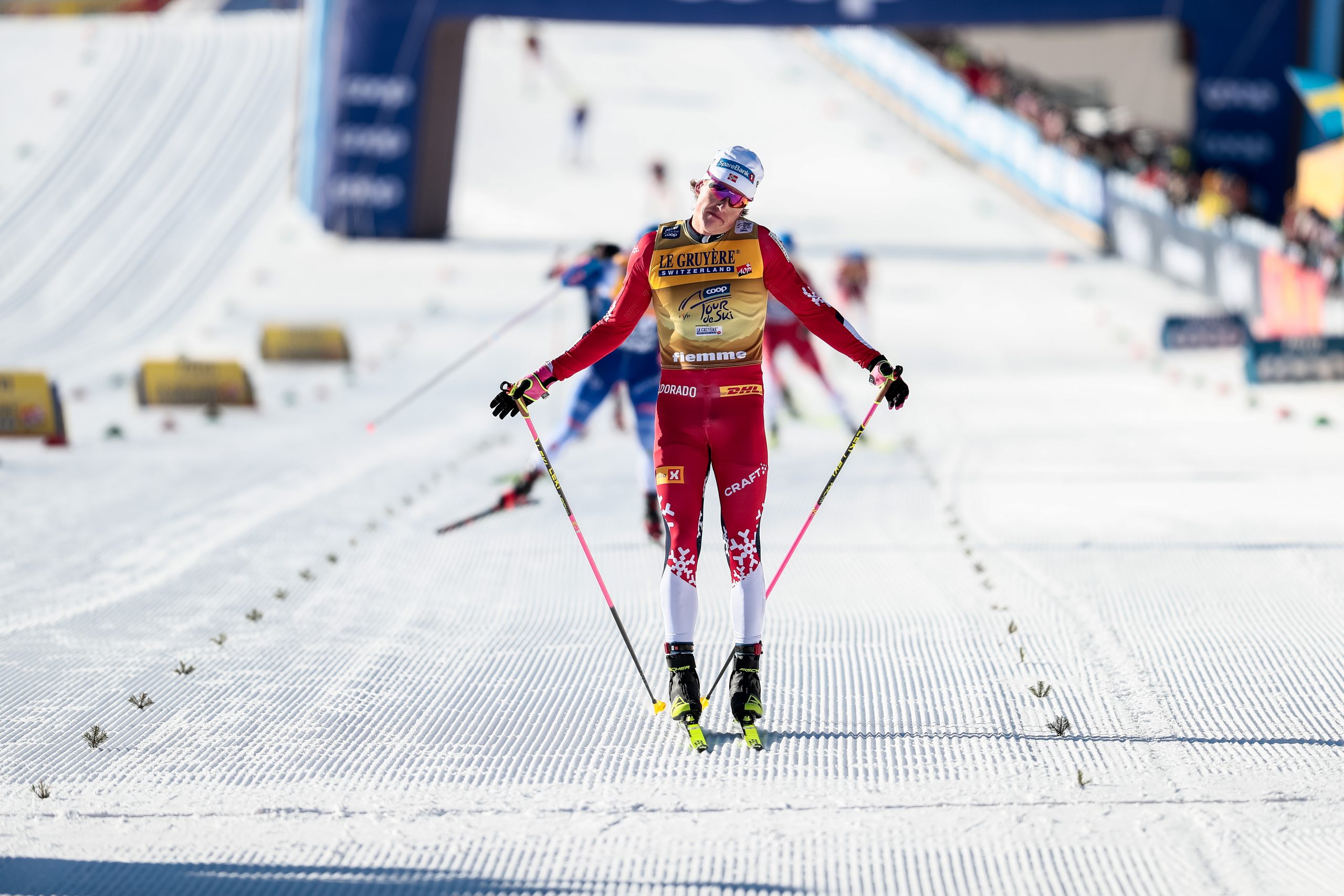
Stage 7, final climb of the Alpe Cermis: Johannes Hoesflot Klaebo (NOR) only had to keep his rivals in sight in order to claim overall victory in the 2025 Topur de Ski. (Photo: Modica/NordicFocus)
Johannes Hoesflot Klaebo doesn’t like this hill . . . he’s a sprinter, after all: he powers up short, punchy hills on his way to shrug-punctuated finish lines. That’s the way World Cups are won in the 21st century. But immortality—the kind to which Klaebo aspires—is purchased at a rather higher price, one that is paid with Olympic medals, on World Championship podiums, and atop Val di Fiemme’s Alpe Cermis. The Tour de Ski concluded on that lofty summit today, and Klaebo appeared determined to do his best in securing another bit of history.
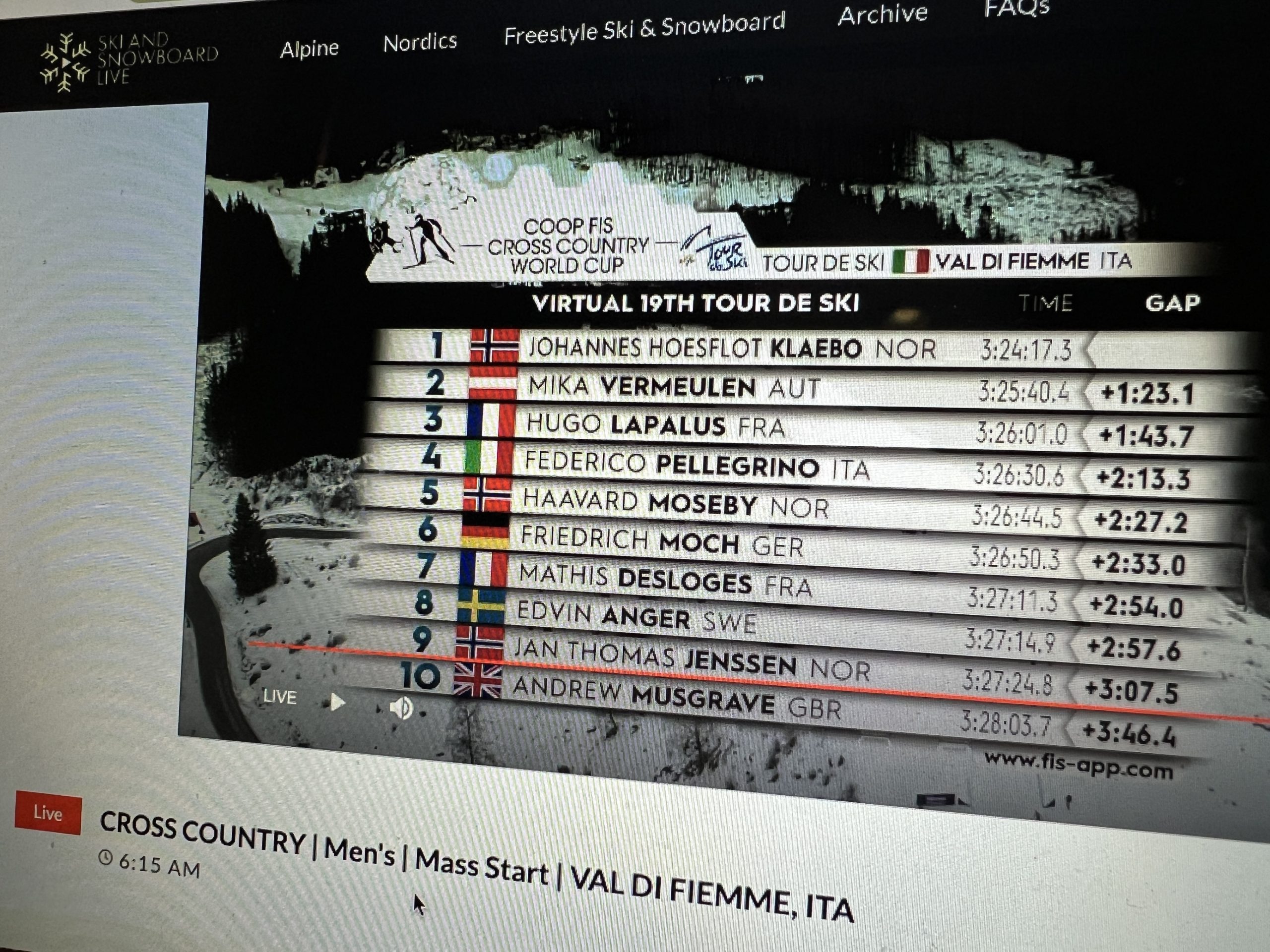
Though other climbers ruled the stage, Klaebo measured his effort up the climb to claim his fourth Tour de Ski overall victory (tying the record of the immortal Dario Cologna). Klaebo finished only 18th on the day’s stage, but managed to preserve a 1:23 overall margin over Mika Vermeulen (AUT), and 1:43 over third place, Friederich Moch (GER).
Sprinters climb too: Jack Young (USA) (climbing alongside TDS Sprint Bib winner, Switzerland’s Janik Riebli) appeared determined to add an overall finish in the 2025 Tour de Ski to his growing race record. (Photo: Vanzetta/NordicFocus)
Zanden McMullen and Ben Ogden crossed the line 19th and 20th, only seconds behind Klaebo. Other North American Finishers included Canadas’ Antoine Cyr in 23rd and Olivier Leveille 29th, and American Jack Young in 53rd.
In other remarkable sprinter-news, Federico Pellegrino (ITA) climbed the Alpe Cermis in seventh place, good enough to finish fourth overall, just 2:13 behind Klaebo in the final standings.
Johannes Hoesflot Klaebo (NOR) (climbing with Sweden’s Edvin Anger) measured his effort throughout the day, preserving his lead over his closest rivals and claiming the win in the 2025 Tour de Ski. (Photo: Vanzetta/NordicFocus)
Climbing the Alpe Cermis
Tour de Ski overall standings at the beginning of stage 7 looked like this:
Johannes Høsflot Klæbo (NOR) 2:50:24
Erik Valnes (NOR) +2:18
Haavard Moseby (NOR) +2:29
Mika Vermeulen (AUT) +2:29
Hugo Lapalus (FRA) +2:44
Federico Pellegrino (ITA) +2:56
Jan Thomas Jenssen (NOR) +2:59
Andreas Fjorden Ree (NOR) +3:04
Mathis Desloges (FRA) +3:12
Edvin Anger (SWE) +3:17
Klaebo had a large cushion to preserve. He wouldn’t need to contend for the win on Alpe Cermis; he’d need only to monitor his rivals and concentrate on damage control.
In Stage 7, the tracks of the earliest kilometers are three-skiers wide, so there is less positioning to worry about, less jostling, less urgency. Until the six kilometer mark, the course is basically flat, following the course of Italy’s famed Marcia Longa marathon race. The final four kilometers, though, are decidedly different, climbing up the slopes of the Alpe Cermis Alpine ski area. Sprint points were offered at six kilometers (at the base of the climb) where Jannik Riebli confirmed his defense of the silver Sprint bib. That contest concluded, the race could begin in earnest.
Leading his rivals by nearly three minutes in the overall standings, Klaebo remained at or near the front as the course ran along the river at the bottom of the valley. Once the course turned uphill, the climbers moved to the front. Mika Vermeulen led the bottom slopes (the steepest on the mountain at 28%) followed by Simen Hegstad Kreuger. Klaebo did his best to mark their accelerations.
Halfway up the climb, the pace was made by Kreuger, followed by Vermeulen and Hugo Lapalus (FRA). Krueger began the day 7:10 behind Klaebo, so he did not represent a serious threat. Vermeulen had begun the day at 2:29 back, Lapalus at 2:44. Both seemed focused on the final podium, but neither seemed poised to challenge Klaebo for the overall win.
Kreuger continued pushing the pace, followed only by Vermeulen. The race for the stage win was down to two men as Lapalus and Friederich Moch (GER) had fallen off the pace. For Klaebo, it was a case of doing his work while making sure not to go too hard. Climbing the Alpe would be difficult enough for a sprinter like Klaebo, but if he overextended, he could blow up and lose it all.
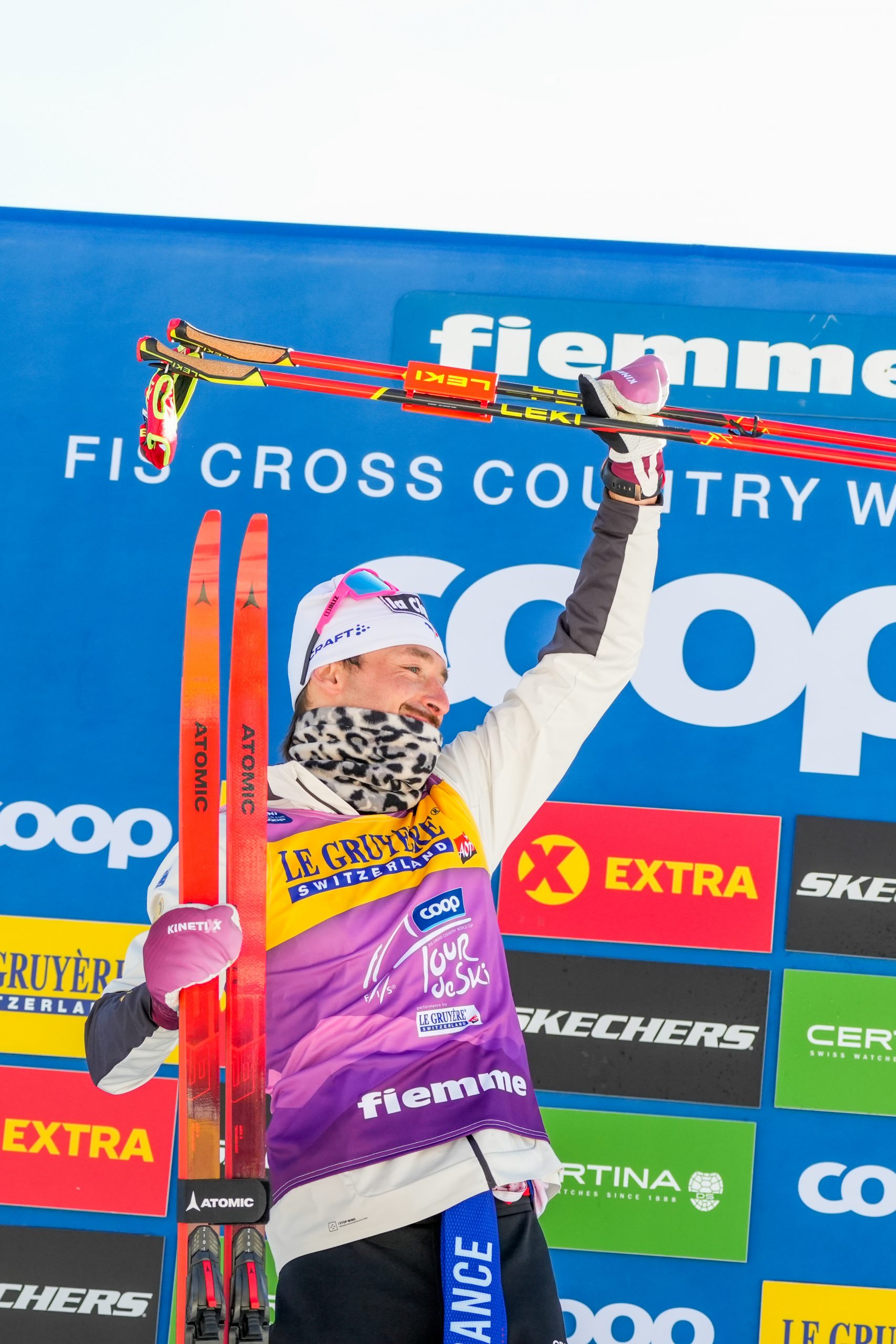
Hugo Lapalus (FRA) celebrates claiming the Climbers Bib in the 2025 Tour de Ski. (Photo: Modica/NordicFocus)
After his initial time-losses on the lower slopes, Klaebo held the gap some 90 seconds behind Kreuger who would cross the finish line in 32: 39. Vermeulen finished seven seconds later, followed closely by Moch in third. Lapalus finished fourth to cement his hold on the Climber’s bib. Shepherded by his teamate, Haavard Moseby, Klaebo crossed the line in 18th place, 1:13 behind the winner—good enough to seal up the Tour de Ski overall win. His 18th place preserved a winning margin of 1:23 over Vermeulen.
With the mid-Tour withdrawal of Harald Oestberg Amundsen, Klaebo’s win in the Tour de Ski makes it very unlikely that anyone else could overtake him in the chase for the FIS World Cup overall championship. While Klaebo’s primary focus probably remains the individual events at the World Championships later this season in Trondheim, he is sure to be satisfied with his hold on the Crystal Globe. That’s another piece of history—another source of legacy—that Klaebo has certainly earned . . . even on humbling days like the ones when he has climbed the Alpe Cermis.
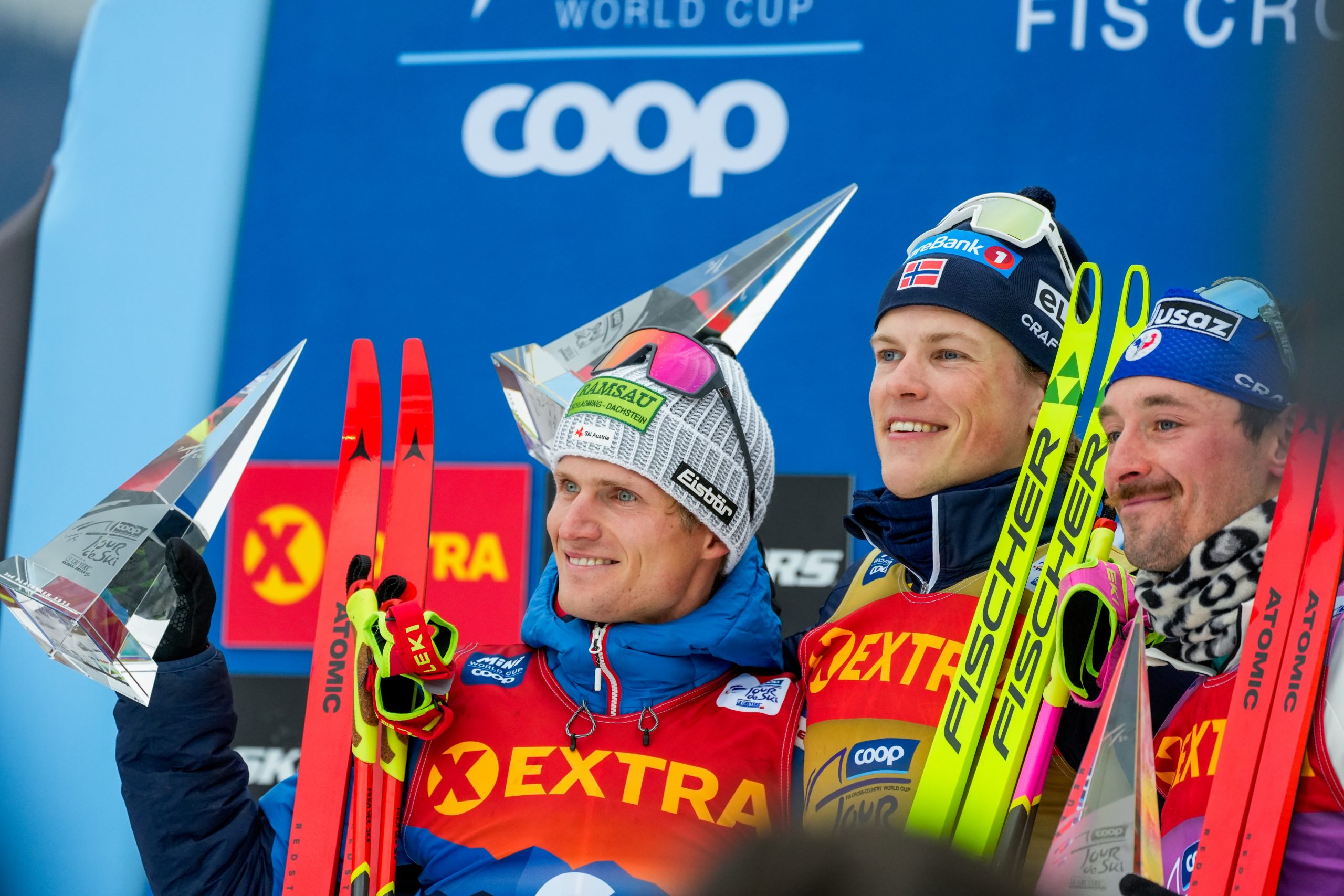
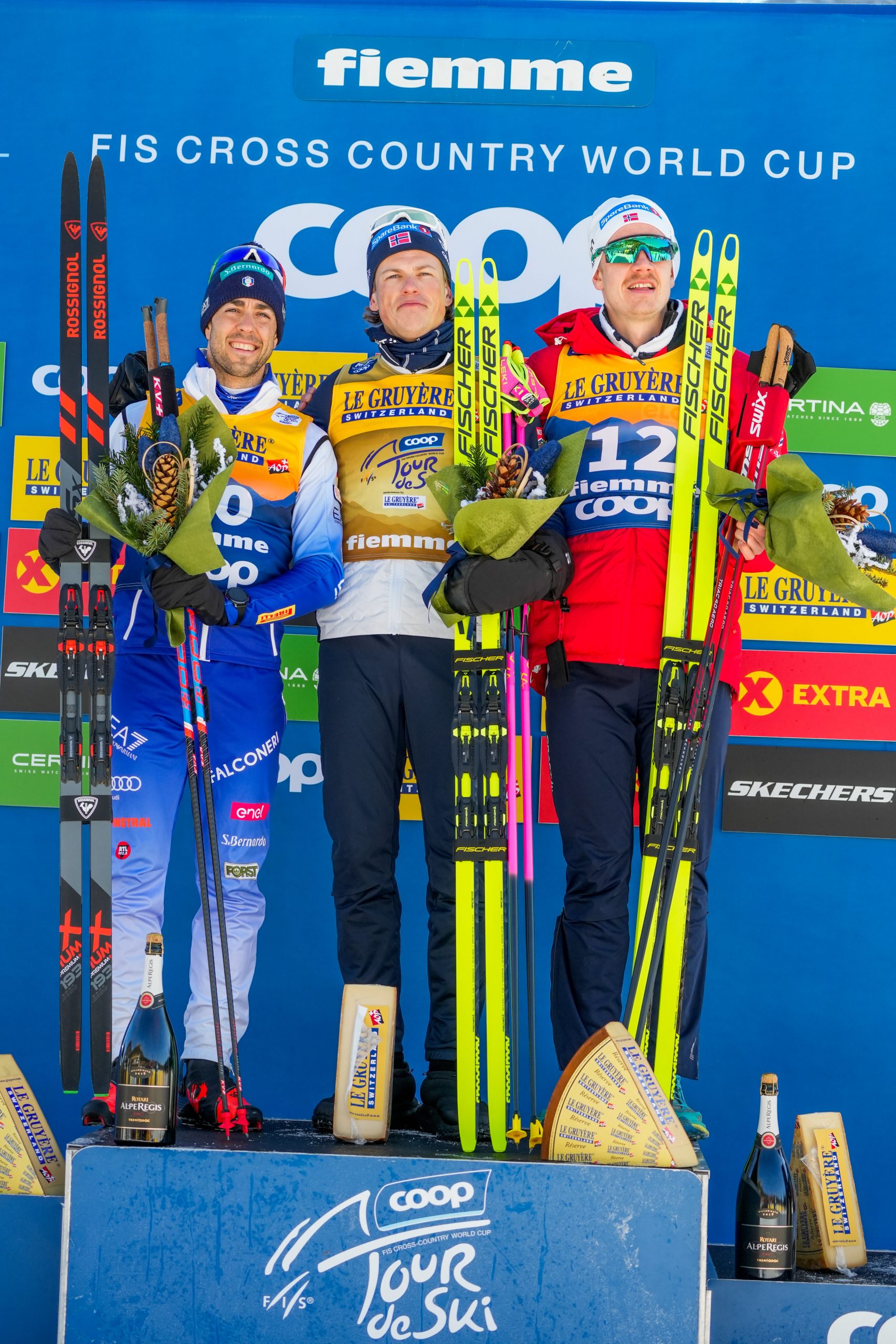
Mika Vermeulen (AUT), Johannes Hoesflot Klaebo (NOR), Hugo Lapalus (FRA), (l-r) top the podium in the 2025 Tour de Ski. (Photo: Vanzetta/NordicFocus)
This coverage is made possible through the generous support of Marty and Kathy Hall and A Hall Mark of Excellence Award. To learn more about A Hall Mark of Excellence Award, or to learn how you can support FasterSkier’s coverage, please contact info@fasterskier.com.
Austria’s Mika Vermeulen (6) pushed the pace throughout the 20 k Skiathlon, moving into second place overall in the 2025 Tour de Ski with only one stage remaining. Sweden’s Edvin Anger (4) would begin the day in second place, but would ultimately drop from contention. (Photo: Vanzetta/NordicFocus)
The 2024-2025 Tour de Ski has already been a long, challenging adventure, and the end of the tour (tomorrow atop Alpe Cermis) offers a unique and daunting set of challenges. While Stage 6 of the Tour offered a glimpse of what will be the venue for the 2026 Olympic Skiathlon, today’s race in Val di Fiemme bore little direct comparison to the action likely to take place a year from now. Today’s race was complicated by the exhaustion of five prior days of racing, the absence of numerous contenders who dropped out earlier in the event, ongoing competitions in the Sprint and Climber’s jerseys, and the need to conserve energy for tomorrow’s climb. Next year’s Olympic event will be a no-holds-barred free-for-all. Today’s Skiathlon in Stage 6 of the Tour de Ski was a decidedly more measured and conservative affair.
Johannes Hoesflot Klaebo (NOR) entered the day enjoying a lead of 1:35 over Edvin Anger (SWE), and 2:11 over Erik Valnes (NOR), neither of whom appeared likely to pose a truly menacing threat on tomorrow’s climb of the the Alpe Cermis. In preparing for today’s Skiathlon, it seemed Klaebo’s task would be to monitor his rivals, limit his losses, and conserve energy for Sunday’s final climb (which is known to be one of his least favorite racing tests of each World Cup season).
Johannes Hoesflot Klaebo (NOR) would control the pace through the closing laps of the Val di Fiemme Skiathlon, coasting across the line comfortably ahead of his rivals. (Photo: Modica/NordicFocus)
Today in Val di Fiemme, Klaebo would control the race from the front throughout the final laps, sprinting up the last hill to establish a gap he would carry across the finish line comfortably ahead of Federico Pellegrino (ITA) in second and Jan Thomas Jensen (NOR) in third. Antoine Cyr (CAN) would finish 16th, just ahead of Zanden McMullen in 17th.
Other North American finishers included Ben Ogden 21st, Olivier Leveille 24th, and Jack Young 53rd.
20 k Skiathlon
Jannik Riebli (wearing the U23 jersey) and Britain’s Andrew Musgrave (wearing the climber’s jersey) would join the leaders in the front row at the starting line of the Skiathlon. American Ben Ogden would begin the day in 14th, a disappointing position when compared to his high-water mark of third place a few days ago, but otherwise a bright spot in his career as a distance skier and all-around threat. Canadian, Antoine Cyr, would begin the day in 22nd.
Snow temperatures of -10.5 degrees celsius made for fair waxing conditions in this early morning start, allowing the 61-man field to remain together through the first of six 3.3 kilometer laps.Mika Vermeulen (AUT) moved to the front at the end of Lap 2, followed by Valnes. They would provide much of the pace-setting in the Classic laps.
Hugo Lapalus (FRA) took over the Climber’s jersey during the Skiathlon, and appears to have energy to spare for tomorrow’s final ascent of Alpe Cermis. (Photo: Vanzetta/NordicFocus)
The ski exchange at the halfway point saw few changes to the overall standings, though Hugo Lapalus (FRA) had surged to overtake Musgrave for the lead in the Climber’s jersey. Klaebo and Valnes led the field into the exchange, while Friederich Moch (GER) was the fastest in the equipment swap, exiting the exchange zone just ahead of Vermeulen and Klaebo.
The Freestyle course was identical to the Classic course, though the positioning of a lane of Classic tracks rendered the skate course rather narrow. Some racers attempted to make progress by passing in the Classic lanes, but for the most part the narrowed lane allowed Klaebo to sit at the front where he controlled the pace through the early part of the Freestyle laps.
Nineteen racers comprised the final selection, though that group continued to string out behind the pace making of Vermeulen. McMullen and Cyr held on gamely to the tail end of the group as Vermeulen (determined to take time out of Anger who continued to fade) continued to push the pace.
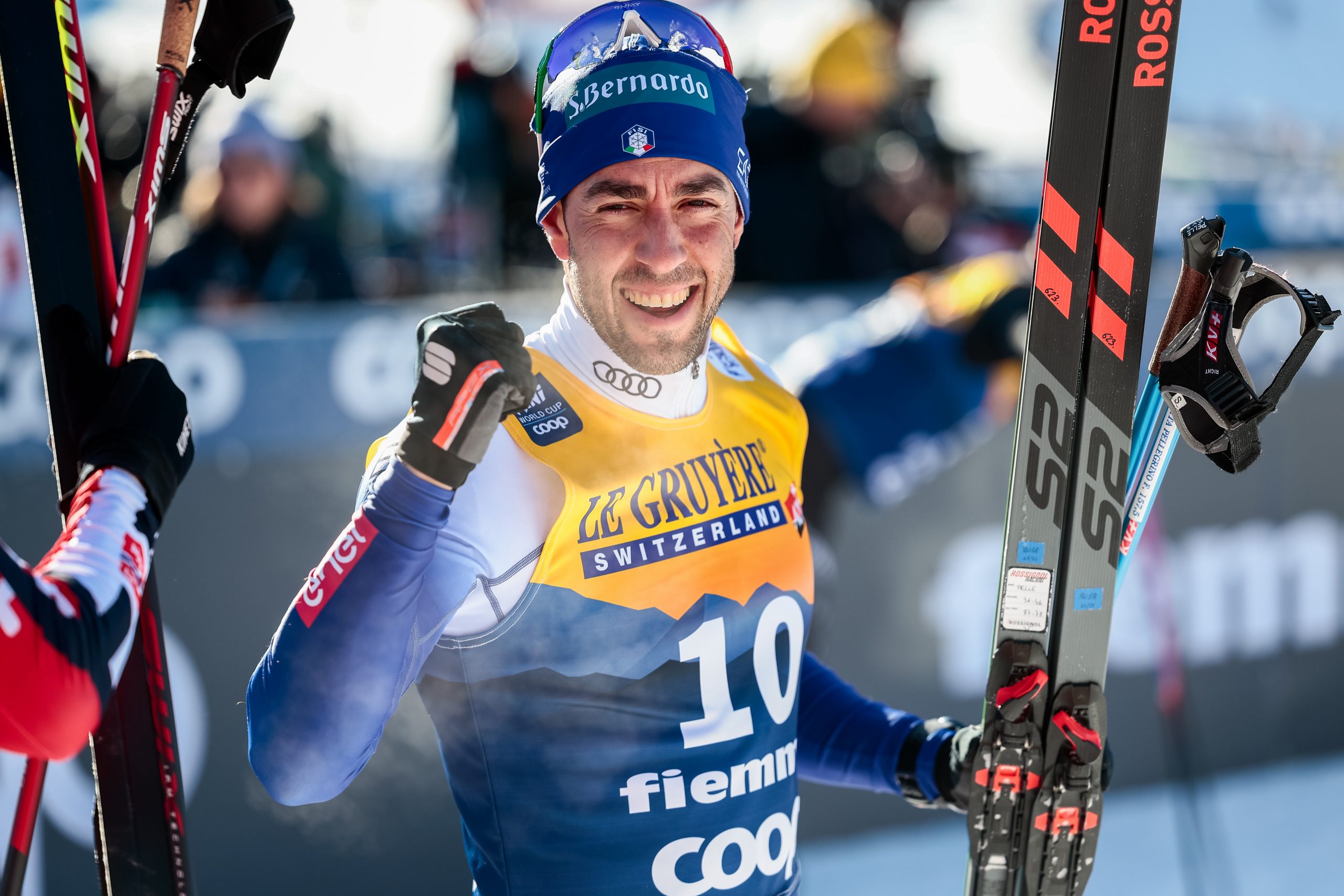
Federico Pellegrino (ITA) orchestrated a marvelous second place finish with a well-timed sprint up the final hill of the 20 k Skiathlon in Val di Fiemme. (Photo: Modica/NordicFocus)
Klaebo, Lapalus, and Moch led the field through the beginning of the final lap as a resurgent Musgrave pressed the pace. In the end, Klaebo would surge up the final hill, followed by Pellegrino and Jensen. Coasting across the finish line well clear of his rivals, Klaebo extended his lead in the overall Tour standings. Valnes now trails by 2:18, followed by Haavard Moseby and Vermeulen tied at 2:29 back, and Lapalus at 2:44. Anger dropped to 10th overall, followed by Musgrave in 11th.
Federico Pellegrino (ITA), Johannes Hoesflot Klaebo (NOR), and Jan Thomas Jenssen (NOR), (l-r) share the podium after the 20 k Skiathlon in Val di Fiemme (ITA). (Photo: Vanzetta/NordicFocus)
It’s the most wonderful time of the year — or is it? The Tour de Ski has returned, but Devon has some beef with this year’s watered down format. Plus, recaps of the four races we’ve been through so far, including Jessie Diggins sprint win from heat five.
Send feedback, hate mail and love letters to devon@fasterskier.com. You can send love letters to nat@fasterskier.com. See you in a couple of days.
We’re back, with our fourth? Fifth? episode in the past week. It’s been a whirlwind, but we’re still here to wrap up the last day of World Cup racing in Canmore. Amazingly, Nat is posting this podcast from a moving airplane between Calgary and Toronto, with Victoria Carl and Katharina Hennig sitting a few rows up.
We’ll be back with more action from Minneapolis, including a show with a live audience late Sunday afternoon at Utepils Brewing near the World Cup venue, after the last race of the day is over. You’re invited. We’ll have more details in the next day or two. Questions? Comments? Hate mail? Email nat@fasterskier.com and devon@fasterskier.com. See you soon.
Goms! These races, in Switzerland, were unambiguously awesome. Wipeouts, sun, fondue, North American podiums and breakout performances. And an Alaskan guest who watched the races firsthand.
We really went above and beyond the call of duty this week — we’ve got sounds from the side of the trail and even a profanity-laced tirade from Devon if you stick it out to the end of the show. We’ll be on scene at the next round of World Cups, which are in a couple of weeks in Canmore, Alberta.
A sincere thank you to everyone who’s generously pitched in to support us over the past few weeks. Email us at devon@fasterskier.com and nat@fasterskier.com. We’ll be back soon.
Erik Valnes (NOR) has proven to be one of the most consistent performers among the many World Cup stars on Team Norway. But his chances of winning the season-long Crystal Globe may be limited by the decisions of his own team. (Photo: Authamayou/NordicFocus)
Team Norway has swept most distance race podiums this season, and has consistently placed a rotating series of Norwegian stars atop those podiums, as well. It’s become a foregone conclusion that a Norwegian man will win the Overall World Cup title this season. Even so, if any of those Norwegian contenders miss a couple of races, their chances of contending for the season-lone Crystal Globe all but evaporate. Just ask Johannes Hoesflot Klaebo; He’s podiumed in almost every race he’s entered this season, but illness kept him from racing in the points-rich environs of the Tour de Ski; therefore, he’s not likely to be adding to his collection of Crystal Globes this season.
Harald Oestberg Amundsen (NOR) has been a consistent World Cup winner all season—including an overall victory in the Tour de Ski—but lately he is being overshadowed by the momentum of his countryman, Erik Valnes (NOR). (Photo: Barbieri/NordicFocus)
Now the Scandinavian Nordic Ski website, Langrenn, reports that it’s Erik Valnes’ turn to be passed over. Valnes has been the hottest skier on the tour lately, with victories in both sprints and distance races including the 20 k Mass Start Freestyle last weekend in Oberhof, Germany. Curiously, Valnes is being passed over by Team Norway for a starting spot in the 20 k Mass Start Classic scheduled for this upcoming weekend. Valness will receive only one distance distance race start, while current World Cup Overall leader—Harald Østberg Amundsen, who leads Valnes by 229 points in the overall standings—will receive two starting opportunities in distance races. There’s nothing to suggest that Valnes is unhealthy, nothing to suggest that he’s slumping or unfit. He’s definitely a podium contender—in any event or discipline—and Norway is leaving him on the bench. Speculation exists that Team Norway has already chosen the eventual winner of the Crystal Globe: Amundsen.
It’s a strange circumstance when a team can select the winner, but no other ski-nation—and no other individual skier—has emerged to challenge that level of dominance. Certain Norwegian ski-stars on the women’s side are sitting out the races scheduled for this weekend in Goms, Switzerland—Astrid Oyre Slind, Kristen Stavaas Skistad, Silje Theodorsen—but for each of them the issues are reported to be illness or sharpness. The women’s team still seems to be chosen by a form of natural selection. For men’s team selections, however, there seem to be other forces at work. For Amundsen’s sake, we hope he skis well. If he falters, Team Norway will have a lot of explaining to do . . .
Harald Oestberg Amundsen (NOR) hoists the crystal trophy awarded to the winner of the Tour de Ski. He may well hold more FIS Crystal by season’s end. (Photo: Modica/NordicFocus)
Prince of Quebec Alex Harvey and his protege on the Canadian team, Tony Cyr, check in with us after a three-day weekend of racing in Germany. We went kinda long. Also: We have a first-of-its-kind waxing and service report from U.S. Ski Team technician Eli Brown.
Let us know what you think: We’re at devon@fasterskier.com and nat@fasterskier.com. We’ll be back after another weekend of racing in Switzerland before the World Cup circuit heads to North America.
This coverage is made possible through the generous support of Marty and Kathy Hall and A Hall Mark of Excellence Award. To learn more about A Hall Mark of Excellence Award, or to learn how you can support FasterSkier’s coverage, please contact info@fasterskier.com.
Celebrating his second World Cup victory in as many days, Erik Valnes (NOR) punches through the finish line of the 20 k Classic Mass Start in Oberhof, Germany. (Photo: Modica/NordicFocus)
For World Cup racers, mass start racing is always tense, nervous, high-risk, rough-and-tumble. Long skinny skis and long fragile poles make close-quarters racing—on courses seldom more than four tracks wide—a bit of a crap shoot. Contenders constantly press forward to secure spots near the front. Everyone wants to be near the leaders, out of trouble, in range of whatever breakaways may be attempted, but no one really wants to lead. Much can happen, opportunities can present themselves, disasters can occur. Just ask Scott Patterson (USA) who fell on one of the opening downhills and was forced to spend the rest of the day playing catch-up. On the other hand, on a day when the best skiers appeared to have well-matched skis (no apparent advantages in waxes, bases, or structure), and when the field is content to simply match pace and remain together, then mass start racing can seem a bit, well, boring.
Fans hope for action, for dominance, for breakaways. for chases, for well-orchestrated sprints. So when we witness a ho-hum race, it’s relatively disappointing. Even comments made to reporters in the winner’s circle described tactics that served to make today’s racing less than exciting.
“It was all about position, and staying in the top ten,” said race winner, Erik Valnes (NOR). “I was feeling very strong and just waiting for the finish.”
“Staying in the top ten:” not exactly bumper-to-bumper NASCAR-style racing out there . . .
While the pace was set by representatives of numerous nations—Finland, Italy, Sweden, Norway, Great Britain—the international field ultimately succumbed to Norwegian pressure in the closing meters. With his second victory in as many days, Valnes showed off the form that has propelled him to numerous wins this season. Behind him finished a string of his Norwegian teammates: Martin Loewstroem Nyenget, Paal Golberg, and Matti Stenshagen. Federico Pellegrino’s (ITA) fifth place finish was the first of the non-Norwegians, just ahead of Perttu Hyvarinen (FIN), William Poromaa (SWE), and Antoine Cyr (CAN).
Gus Schumacher (USA), Antoine Cyr (CAN), Lucas Boegl (GER), (l-r) navigate one of the many technical downhills on Oberhof’s 3.3 kilometer loop. (Photo: Modica/NordicFocus)
North Americans were led by Cyr’s excellent eighth place finish, another top ten in his season of quality finishes. Other Canadian finishers included Olivier Leveille 33rd, Xavier McKeever 43rd, Max Hollman 49th, and Julien Locke 66th. American finishers included Zak Ketterson 40th, Gus Schumacher 44th, Scott Patterson 51st, Peter Wolter 55th, and JC Schoonmaker 60th. Perhaps recovering from his sixth place finish in Friday’s Classic Sprint, Ben Ogden chose not to start Saturday’s 20 k Classic Mass Start.
Andrew Musgrave (GBR) was one of the contenders who consistently pushed the pace throughout the six laps of Oberhof’s 20 k Classic Mass Start. (Photo: Authamayou/NordicFocus)
20 k Classic Mass Start
Action in the 20 k Classic Mass Start was epitomized by conservative tactics and measured efforts, with different leaders setting the pace in each lap. After a season interrupted by illness, Iivo Niskanen (FIN) returned to the 20 k Class Mass Start, the race in which he is Olympic champion. He led much of Lap 1 ahead of a host of Norwegians who marked his pace. By the end of lap two, Niskanen had been absorbed by the group as Paal Golberg (NOR) led through the 6.6 kilometer checkpoint.
Andrew Musgrave (GBR) led most of Lap 3, but the lead group was still a tightly assembled pack of 30+. The field came through the halfway point with Nyenget and Musgrave leading the way.
During Johannes Hoesflot Klaebo’s (NOR) recent absence from World Cup racing, Erik Valnes (NOR) has begun to appear like the primary contender for World Cup race wins. The 20 k Classic Mass Start represented his second World Cup victory in as many days. (Photo: Modica/NordicFocus)
Returning from illness that prevented his competing in the Tour de Ski, Johannes Hoesflot Klaebo (NOR) spent the day hovering in the middle of the lead pack. During Klaebo’s mid-season absence, Valnes—winner of Friday’s Sprint competition in Oberhof—has begun to appear like the man to beat in both sprint and distance events. Staying near the front throughout the day, Valnes led lap four while Niskanen also returned to the front of the field.
Musgrave again pressed the issue in lap five, closely marked by Nyenget, Stenshagen, Valnes, and Klaebo. The field thinned to 20+; still, no significant breaks had occurred among contenders.
Niskanen pressed forward to push the pace in the final lap. He knew he would need to shake off the sprinters if he had a chance of winning. The field did begin to string out, but Niskanen was marked closely by Valnes who showed no reluctance to trade leads at the front. In the end, Valnes simply pushed a pace that no one else could better. He extended his lead by a few meters as he crossed the finish line, his Norwegian teammates scrabbling for podium positions in his wake.
Another all-Norwegian podium in Oberhoff, Germany. (L-R) Martin Loewstroem Nyenget (NOR) second, Erik Valnes (NOR) first, Paal Golberg (NOR) third in the World Cup 20 k Classic Mass Start. (Photo: Authamayou/NordicFocus)
They’ve reached the summit — the athletes, have, anyway. Devon certainly has not, thanks to frozen pipes in his Oslo apartment. He and Nat persevere to bring you the recap of this year’s final Tour de Ski stages, which featured some spicy and sloppy racing in Italy. Stay tuned til the end for an ode to Le Gruyère cheese.
Next week, during the break from the World Cup, we’ll have a mailbag episode. Send us your questions at nat@fasterskier.com and devon@fasterskier.com. Have a great week.
This coverage is made possible through the generous support of Marty and Kathy Hall and A Hall Mark of Excellence Award. To learn more about A Hall Mark of Excellence Award, or to learn how you can support FasterSkier’s coverage, please contact info@fasterskier.com.
The unrelenting slopes of Alpe Cermis challenged Norwegian dominance, as France’s Jules Lapierre emerged to triumph in the final stage of the 2024 Tour de Ski. (Photo: Modica/NordicFocus)
The origin story of the Tour de Ski suggests that it was invented to mirror cycling’s Tour de France: multiple stages, mountaintop finishes, leader’s jerseys, thrilling competitions, glorious champions. Today’s Stage 7 of the Tour de Ski—with its finish on the high summit of Alpe Cermis— is probably what the original race organizers had in mind. Helicopters hovered over the point-to-point course that wound its way through historic ski-venues in the Val di Fiemme. At the 2.4 kilometer mark, the still-flat course wound into the stadium of Val-d’Isére (where the first Bonus Sprint in the Alpe Cermis stage would be decided). Then, following the course of the Marcia Longa—Italy’s famous ski marathon—the course traveled to the base of the Alpe Cermis Alpine resort.
The day had begun with Amundsen holding a considerable lead in the overall standings over his countryman, Erik Valnes. Known as a good all-rounder—but really more of a sprinter—Valnes would face considerable challenges to his desire to remain on the Tour de Ski podium, as he was trailed in the standings by other skiers whose pedigrees spoke of greater climbing abilities. Martin Loewstroem Nyenget (NOR) sat only eight seconds behind Valnes, with talented climbers, Hugo Lapalus (FRA) and Friedrich Moch (GER) only another few seconds behind. The battle for podium spots would be furious and painful, with rewards and accolades for those brave enough to climb into the clouds. Valnes would have his hands full . . .
Germany’s Friedrich Moch led Jules Lapierre (FRA) through most of the climb up Alpe Cermis, though it was Lapierre who would sprint clear for the stage win. (Photo: Barbieri/NordicFocus)
Stage 7, Alpe Cermis
Bonus Points Leader, Lucas Chanavat (FRA), toed the starting line after a number of less-than-stellar stages in which he would win sprint points, then ease along the course to the finish well out of contention. In the early kilometers of the Alpe Cermis stage, Chanavat led the pack toward the first Bonus Points sprint at 2.4 kilometers, hoping to secure his hold on the Points Jersey before the real climb of the day would begin. Though nipped at the line by sprint-rival, Edvin Anger (SWE), Chanavat would collect enough points to secure the victory in the points competition. Ironically, he would be required to finish the stage at the top of Alpe Cermis’ long climb in order to claim the distinction, and to collect the winner’s spoils. It would be a long day of climbing for the sprinter, Chanavat.
After the Points Bonus sprint, it was the skier sitting in 26th place overall—Haavard Solaas Taugboel (NOR)—who went to the front to make pace. Commentators speculated on the possibility that Team Norway was tactically using lower-placed skiers to protect the lead of Amundsen, Valnes, and Nyenget. There was one last Points sprint at 6.8 kilometers (at the base of the climb), but by that time Amundsen had already gone to the front. He took the points that Chanavat and Anger coveted, seemingly determined to begin the climb in earnest. Final standings in the Points competition: Chanavat, Anger, Valnes, Amundsen, and Antoine Cyr (CAN).
Amundsen led the field on the lower slopes of the climb, though with no real sense of urgency. In season’s past, much of the low part of the climb was defined by athletes propelling themselves via V2, maintaining that faster, more costly technique for as long as they could in attempts to break the field. Typically the last skier using the V2 was the one who would create gaps in the field and put themselves in position to win the day. Today, however, Amundsen dropped into the V1 early on, allowing a group of rivals to remain on his heels. That group settled into a lead pack of seven: Amundsen, Nyenget, Friedrich Moch (GER), Mika Vermuelen (AUT), Jules Lapierre (FRA), Hugo Lapalus (FRA), and Beda Klee (SUI). Valnes was nowhere to be seen. The battle for podium positions began . . .
And the course steepened: 26.5 percent (that’s steep). Klee was dropped: lead group reduced to six.
Mika Vermeulen powered to the front as Amundsen and Nyenget faded to the rear of the lead group. By this time, Valnes had already ceded his second place position to Nyenget in the virtual Tour standings. Other podium contenders pushed to the front, fighting it out for podium places, mostly at the expense of Amundsen and a visibly-tiring Nyenget who dangled just off the back.
With every change in pitch, a different contender would appear at the front. Finally, Moch took the lead as the group entered the tightest switchbacks, driving around each direction-change with Lapierre hard on his heels. Next in line—head down, but tempo high—Lapalus followed his countryman while Amundsen and Vermeulen settled in. Nyenget was gapped: lead group reduced to five.
Moch and Lapierre ratcheted up the pace. Little bit by little bit, gaps opened behind them. Lapalus watched his own ski tips, Amundsen (overall victory already in sight) marked the gaps, Vermeulen atttempted damage control: lead group reduced to two.
Farther down the mountain, Valnes struggled; his podium position all but gone as his rivals for the podium—Lapalus and Moch—drove forward.
Moch and Lapierre continue to show spark in their steps as they entered another 28 percent grade (murderous!). In their wake, Lapalus powered on alone (eyes still down). Amundsen and Vermeulen appeared bound to one another in their fatigue (battling to hold their positions rather than determined to drive forward). Nyenget suffered alone in no-man’s land, while resurgent Klee and Jens Burman (SWE) gave chase. Somewhere farther down the mountain, Valnes toiled in obscurity.
The Alpe Cermis levels a bit in the final kilometer, requiring racers to shift gears, yet again. It’s a point where a different set of athletic/physiological abilities comes into play. Thirty minutes into the race, Moch and Lapierre exited the steepest sections of the climb, both breaking into a V2 skate as the horizon leveled. Lapierre drove forward into the lead, his tempo visibly quicker than Moch’s. Behind them (across an ever-widening gap) Lapalus stayed with the V1 in attempts to save energy, just in case he still had to deal with a charging (V2) Amundsen who seemed to have recovered some energy after his mid-climb lull.
Harald Oestberg Amundsen (NOR) climbed bravely, and quickly enough to protect his overall lead in the Tour de Ski standings. (Photo: Modica/NordicFocus)
At the finish, it was Lapierre sprinting clear of Moch, both of whom celebrated as they crossed the line. Moch knew he had skied onto the overall podium, a first for Germany since Tobias Angerer, overall winner of the first Tour de Ski in 2006/2007, finished third in the 2008/2009 tour. Lapalus finished 16 seconds behind the winner, securing his own place on the overall podium by sufficiently gapping Nyenget.
The winner of the overall Tour de Ski—Amundsen—arrived fifteen seconds after Lapalus. Amundsen had done his job, and the biggest prize of the FIS World Cup season was his.
Valnes finished 11th, 1:13.9 behind. All things considered, Valnes (known more for his sprinting prowess) delivered a truly impressive performance, and that in an event where careless or unfit competitors can “blow” and lose big chunks of time. Even so, he proved unable to keep pace with the climbers, and dropped from the podium into sixth overall.
Among North American finishers, Antoine Cyr (CAN) climbed the fastest: 14th place, 1:34.2 behind the winner. Following him were Zanden McMullen (USA) 36th, Scott Patterson (USA) 42nd, and Olivier Leveille (CAN) 45th.
Much much later, at the hard-won summit of Alpe Cermis, Chanavat crossed the line to claim the Points Championship. It’s unlikely that he’s ever skied so far or so high.
International flair on the Stage 7 podium at the summit of Alpe Cermis: Friedrich Moch (GER), Jules Lapierre (FRA), Hugo Lapalus (FRA), (l-r) (Photo: Modica/NordicFocus)
This coverage is made possible through the generous support of Marty and Kathy Hall and A Hall Mark of Excellence Award. To learn more about A Hall Mark of Excellence Award, or to learn how you can support FasterSkier’s coverage, please contact info@fasterskier.com.
Harald Oestberg Amundsen (NOR) (center) played it smart by playing it safe today. He stayed near the front and kept an eye on anyone who might dare to make a break. (Photo: NordicFocus)
The men’s Tour de Ski (TDS) began last week with team Norway back on its heels as France and the USA challenged Norway’s domination; that seems a lifetime ago. Ever since the third race, in Toblach, Italy, Norway has been dominant again with no other country really giving it a run for the overall title. The Tour is Harald Oestberg Amunden’s (NOR) to take. Going into today’s 15 kilometer Mass Start Classic race, in Val Di Fiemme, Italy, Amundsen is 1:39 ahead of countrymen Henrik Doennestad, and Martin Loewstroem Nyenget.
But a very tantalizing question remains as to whether a non-Norwegian man can find the podium at the end of the Tour? As to that question, the answer is a definite: it’s possible. Hugo Lapalus (FRA) is only two seconds out of second place behind Doennestad and Nyenget. Likewise, Friedrich Moch (GER) and Beda Klee (SUI) are only seconds behind the Norwegian duo. So, while the race for the top spot is definitely Amundsen’s to lose, other countries are knocking on the door to gain a spot on the podium.
A 15 kilometer mass start Classic race is a tough format in which to gain ground, so any efforts by Lapalus and Moch to join the Tour podium leaders would be a tall task. They couldn’t risk too much today as they would need to leave themselves in contention for Sunday’s final race, the climb up Alpe Cermis. But given the razor thin margins separating second and seventh place of only eight seconds, it wouldn’t take much to dislodge the current Norwegian monopoly. The men’s race for first place might lack the drama of the women’s, but the race for second and third is scorching hot.
Scott Patterson (USA) (far right), is one of only two Americans left in the Tour. He had a nice performance today, only 16 seconds behind the winner. (Photo: NordicFocus)
For the American men, the bright promise they showed early in the Tour has faded away as illness decimated the team; just as it has much of the Tour. There were only two Americans left on the start line, Scott Patterson, (4:54 behind the Tour leader, and Zanden McMullen (7:37 behind the Tour leader).
At the conclusion of a very tactical race, it was Erik Valnes (NOR) taking the victory. He was followed by William Poromaa (SWE) in second, and Cyril Faehndrich (SUI) third. American Scott Patterson had a nice day finishing 27th, only 16 seconds off the lead. He was closely followed by Zanden McMullen in 31st, 17 seconds behind first.
The top Canadian finisher was Olivier Leveille in 33rd, and Antoine Cyr in 41st.
An interesting finishing time was delivered by Sprinter Lucas Chanavat who has continued with the Tour even after the Sprints were concluded. He finished 54th, the last skier to finish, 3:37 behind the leaders and over 1:40 behind the second to last skier. It could be debated whether it’s sandbagging or smart tactics by the Sprinter to keep his Tour alive.
Men’s 15 Kilometer Classic Mass Start Race
Much like the Classic race two days ago in Davos, skiers again faced extremely challenging waxing conditions in Val di Fiemme. It was snowing hard with temperature right around freezing. Again, wax technicians faced difficult choices. As racers marched to the start line to begin the race, lots of zero skis could clearly be seen; along with some skiers choosing klister. The American men were split on ski setup. According to U.S. coach Kristen Bourne, Patterson chose zero skis while McMullen was on klister. Bourne told FasterSkier that zeroes and klister skis were tested for both the men’s and women’s races with a mix of skis finally selected for both races. “It was definitely a mixed bag,” said Bourne. “Another day of our kick team really working trying to figure it out.” The decision was ultimately the athlete’s to make. “The skier and the tech would talk about it and make the decision together.” But the new fluoro rules threw another curve into ski choice. Under the rules for Classic races, skiers are allowed to present two pairs of skis for pre-race fluoro testing 30 minutes before the start. Bourne indicated that it’s ultimately the athlete’s choice to decide which pair of skis to choose from between the two pair which clear fluoro testing; a fairly nerve wracking dilemma. Things become even more complex as there is a kick adjustment zone after skis have been fluoro tested where kick zones, and only kick zones, can be adjusted just before the race.
Martin Loewstrom Nyenget (NOR) (bib five), did enough to put himself into third place for tomorrow’s decisive race. But he only has a five second advantage. (Photo: NordicFocus)
Unlike Thursday’s 20 kilometer race, this course was on a 2.5 kilometer lap which would help with kick zone icing issues.
The weather played an outsized factor today’s race strategy as well. The conditions would make it difficult for any skier to make a break. A mass start would also contribute even more to that same dynamic.
Olivier Leveille (CAN) gave fans an early thrill when he went to the lead at the 1.4 kilometer mark. Leveille was fighting for an early time bonus at the 2.3 kilometer point, but ultimately was in fifth at the timing check. The Bonuses helped to string out the field a little, as Edvin Anger (SWE) took the time bonus sprint, nudging out Erik Valnes (NOR) who needed the bonus time to help his podium fight.
After the bonus point sprint, the field coalesced again into one mass pack. Podium contender Beda Klee (SUI) took a brief shot at the front, but it was short lived. At 3.5 kilometers, the tone of the race seemed set; it was clear that pack racing tactics were going to take hold. The athletes really didn’t have much option, as trying a break in these conditions—this early—would likely be a fool’s errand.
The pack conditions meant that skiers outside the top ten would also have a chance to hang with the leaders. This gave McMullen a chance to ski with the Tour front runners as he pushed himself up to sixth. At this point the race was so congested that there was only a 16 second gap between first and 53rd.
With Amundsen having a big lead, he was unlikely to push the field; he was content to simply check any big moves made by podium contenders. Halfway through, Doennestad and Nyenget went to the front to try and push, but they too were unable to break up the field. One kilometer later, Erik Valnes gave the front a shot, but it turned out to be more of a chance to grab bonus points at 8.5 kilometers instead of a legitimate attempt to break things up. He stayed near the front after the bonus mark, but wasn’t seriously pushing the field.
Amundsen continued to hang out at the front to avoid the congestion of the big pack. Then, after the bonus Sprint, Jens Burman was the next athlete to step up to make a little charge to break up the field. His effort was also doomed, and the field again quickly consolidated. The conditions—coupled with the effects of the mass start—were proving just too difficult for anyone to make a break from the pack.
Zanden Mcmullen (USA) was one of two American skiers in today’s race. He finished 31st, but only 17 seconds behind the winner. (Photo: NordicFocus)
With only 2.5 k to go, it was still one giant pack with only 12 seconds between first and 51st. Amundsen, however, was leaving nothing to chance and went to the front. The virtual race for second and third in the TDS was still extremely tight with racers within a couple of seconds.
Even though the pack was close to the finish, the pace was still extremely relaxed. Several more skiers had tested the waters of going to the front only to abandon the opportunity after a few seconds. The race had now devolved into a giant touring pack with a Sprint finish looming. All the podium contenders were playing it safe with no one pushing the front, and everyone jockeying for a good spot for the finish.
With one kilometer to go, skiers began to seriously race. Cyril Faehndrich (SUI) (brother of Swiss star, Nadine Faehndrich), made a break with about half a kilometer to go. William Poromaa (SWE) and Valnes fell in behind him.
Cyril Faehndrich (SUI) had a career best day finishing on the podium for the first time in a World Cup race. (Photo: NordicFocus)
The race immediately became a three man sprint between Valnes, Faehndrich and Poromaa. In this situation, Valnes had the clear sprinting advantage. He double poled to the front and was able to push by Poromaa, who took second, and Faehndrich, who took third. For Faehndrich, it was his first World Cup podium. Tour leader Amundsen was only eight seconds behind the group and played a tactically smart race by not taking chances and preserving his large advantage going into tomorrow’s finale. While not the most thrilling race, it was smart tactics by the top contenders who were betting on making a bid in tomorrow’s climb up Alpe Cermis.
The racing strategy and weather created an interesting finishing time, where the winner of the men’s race was only three minutes faster than the Women’s winner!
Hugo Lapalus (FRA) kept himself in podium contention by finishing eighth today. He’s now only five seconds from a podium spot. (Photo: NordicFocus)
Impact on Tour de Ski Standings
Today’s race was really just about setting things up for tomorrow’s finale. Amundsen now has a 1:34 lead over teammate Erik Valnes, and a 1:42 lead over Martin Nyenget. But the race for second and third is still very tight. Lapalus, Moch, Klee, and Doennestad are all within seconds of the podium; tomorrow’s fight for second and third will be intense.
We’re in deep to the Tour de Ski now, after a couple of legitimately rad days of racing in Davos, Switzerland. Mikael Gunnulfsen of Norway joins us to talk about the stunning performance of Henrik Doennestad, and of course we catch you up on the latest successes of Americans Jessie Diggins and Rosie Brennan and, oh yeah, Gus Schumacher.
Get at us at nat@fasterskier.com and devon@fasterskier.com. We’ll be back once the athletes hit the top of the Alpe Cermis.