From the FasterSkier archive — posts syndicated from athletes’ and coaches’ own blogs between 2004 and 2012, kept online as published. Current coverage is at fasterskier.com.

Tag: Erika Flowers

  • Two Years In, the BSF Pro Team is on the Rise: An Interview with Head Coach Andy Newell

    Two Years In, the BSF Pro Team is on the Rise: An Interview with Head Coach Andy Newell

    In the spring of 2020, the Bridger Ski Foundation (BSF) launched a new professional racing team, led by Andy Newell, who spent nearly two decades on the U.S. Ski Team as a staple and leader of the American men’s program. Launching early in the pandemic, the BSF Pro Team had few opportunities to show their strength in the first race season, but they came on strong in 2021-22. During U.S. Nationals in Soldier Hollow in January, the BSF Pro Team had at least one athlete in the top-10 in each race, except the men’s 30 k skate, with podium performances by Mariah Bredal in the 10-kilometer classic (3rd) and Logan Diekmann (2nd) in the 1.3 k skate sprint. 

    After growing up in Vermont and developing as a skier at the Stratton Mountain School, and later training with the SMS T2 elite team through most of his professional career, Newell moved to Bozeman, MT in 2018 with his wife and former SMS T2 teammate Erika Flowers, who had grown up in Bozeman and taken a job there. Both at a transitional point in their ski careers, Newell would continue to pursue World Cup skiing for another two seasons, while Flowers continued to train with her sights more focused on domestic racing.
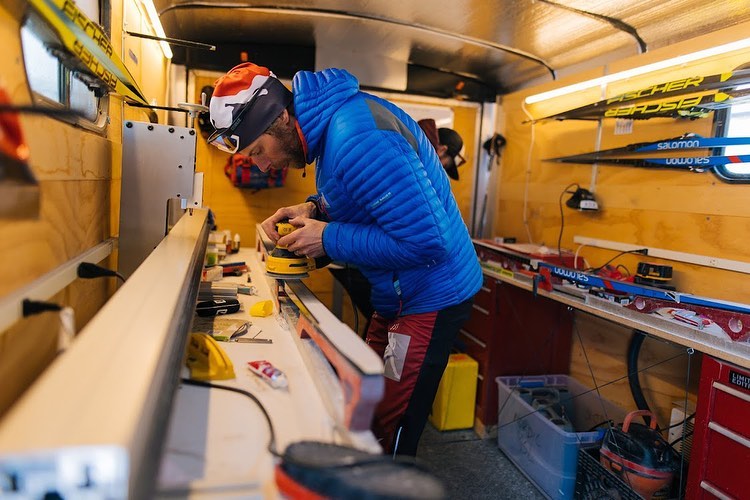
    Inside the wax cabin, Andy Newell prepares skis for his athletes during the 2022 U.S. Cross-Country Championships in Soldier Hollow, UT. (Photo: Arlin Ladue / BSF Pro Team)

    Over the last four years, this transition has seen Newell race his final World Cup events and officially leave professional ski racing behind, only to launch and support the thriving BSF Pro Team, alongside his online coaching business, Nordic Team Solutions. In this interview, which took place on Friday, June 3rd, Newell provides insights into this transition from athlete to coach, while also adding behind-the-scenes details of getting the Pro Team off the ground. He also speaks to the challenges of elite training groups, their role in supporting the trajectory of U.S. skiing at the international level, and what’s in store for the BSF crew this summer. 

    This interview has been lightly edited for length and clarity.

    FasterSkier/Rachel Perkins: Starting with the timeline, in the spring of 2018, both you and Erika started to transition to ‘retirement-lite‘. And at that point, you were already talking about doing some coaching and working in athlete development. Is that when you guys moved to Bozeman? And from there, what was the evolution of your relationship with the BSF program?

    Andy Newell: Well, I was actually still on the U.S. Ski Team in 2018, but we did move to Bozeman that year. I was still racing essentially full time, but at that time I started a business, Nordic Team Solutions, and with that, I launched a summer training program where I was coaching college kids, so summer of 2019 was my first year where I was kind of stepping more into a formal coaching role. Which for me felt natural because I’ve always kind of participated in and loved the whole training camp vibe.

    Growing up at Stratton, Sverre [Caldwell] always had these amazing summer camps for juniors that I participated in my entire life. And then, as I became an older athlete and a U.S. Ski Team athlete, I would actually help with some of these training camps as well. And then in my years with the U.S. Ski Team, I had this program that I started calling “speed camps,” which a lot of people might remember. We would host these free clinics around the country that would coincide with the U.S. Ski Team training camp. Basically we would reach out and have a bunch of juniors come and join us for an afternoon of rollerskiing and agility courses and fun stuff like that.

    So to me, it felt like a natural progression to take that a step further – once I launched the Nordic Team Solutions business, where I was running the website, to then pair that with a summer college training group. So my first year here in Bozeman, I actually ran that group independently from BSF… so I was actually not part of BSF in that first year of 2019. I was planning to race some World Cups, did race some World Cups in 2019-20, and then COVID put a quick end to our season when we were getting ready to race in Quebec and Minneapolis.

    I had planned on those being my final World Cup races as a professional, to go out racing in Quebec and in Minneapolis and had spent all year preparing for those specific races. And sure enough, they were canceled. So it was like, ‘Surprise! You’re officially retired now.’ And at that point is when I signed on with Bridger Ski Foundation to be the elite team coach.
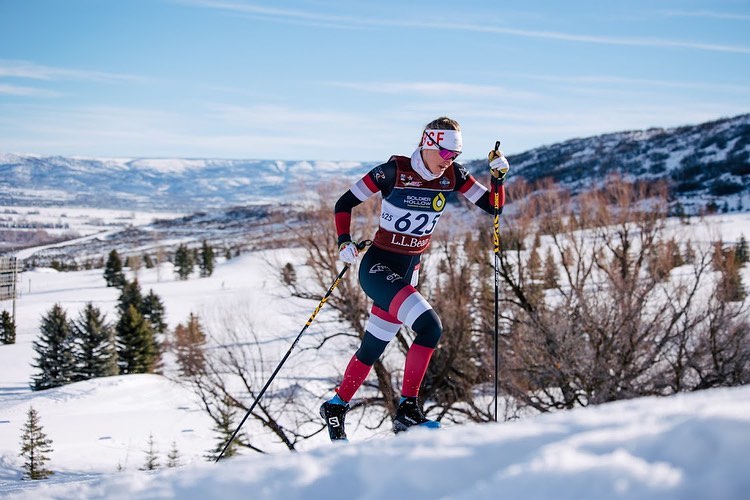
    BSF Pro Team athlete Hannah Rudd races the classic sprint qualifier during a post-U.S. Nationals SuperTour event. (Photo: Arlin Ladue / BSF Pro Team)

    FS: The announcement of your hiring went out in April 2020 – which kind of feels like a lifetime ago, but it also seems like it would have been a somewhat challenging time to launch a new elite team. Was the foundation already there with the BSF program or was this the onset of the elite team program?

    AN: There was an elite team in 2018, but it disbanded because the coach, Rogan Brown, went on to [coach at Denver University], and there were only a handful of athletes here in Bozeman at the time. So in 2019, there was no elite team tied in with BSF, and then in 2020 when I was hired, it was essentially my job to kind of relaunch this program, and to make it a successful program.

    There’s no reason why BSF should not have a successful elite team. The Bridger Ski Foundation has been around for over 70 years. It’s very well established here in Bozeman; we have a great pool of young athletes that participate in the youth skiing program – hundreds of athletes.

    Andrew Morehouse was signed on as the new nordic director in 2019, and then I came on in 2020. And we shared a vision that, in order [for BSF] to be a premier club, we should have an elite team. And then basically, I had free reign to kind of do what I wanted, which I’m super grateful for – that BSF has kind of given me the ability to choose the team makeup the way I see is best, and to choose how I run the program.

    We work closely with the juniors and Andrew Morehouse and the youth programs in town, so I very much have taken the model that I learned growing up at Stratton and tried to implement that here in Bozeman.

    At that point [in 2020], I basically just got on the phone and started calling some different athletes that I had met or worked with through NTG camps. The US Ski Team in 2018 and 2019 would hire me to come to NTG camps or development team camps – that was part of my business as well – so I started reaching out to different athletes and mentioning to them that we were going to start a new team here in Bozeman. So I was able to recruit nine athletes initially to come to the team, which was great.

    Here’s a preview of the 2021-22 BSF Pro Team. Note that one of the original 2020-21 athletes, Leah Lange, stepped back from her racing career after the team’s first season to begin coaching in Big Sky, MT. 
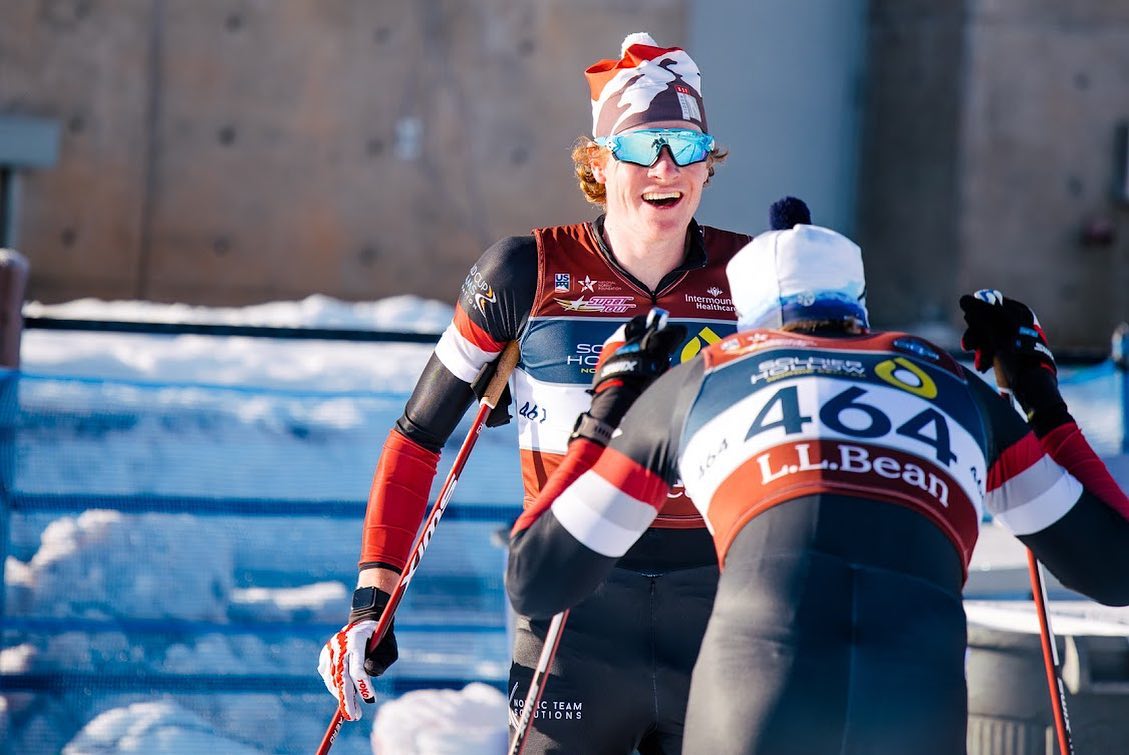
    BSF Pro Team athlete Finn O’Connell welcomes his teammate to the line during the U.S. Cross-Country Championships in Soldier Hollow, UT. (Photo: Arlin Ladue / BSF Pro Team)

    FS: Can you say more about getting the team off the ground?

    AN: So we launched [the Pro Team] in 2020 in the midst of COVID, which – there were so many unknowns and unique circumstances to try to convince these athletes to move to Bozeman and train here in the midst of all that was going on. And we essentially only had very unofficial racing our first season of 2020-21. Kind of a mismash of some official races, some non-official. But in hindsight, it was a nice opportunity for us to just build a team and spend a lot of time training with one another. 

    When you name a team like this as a coach, you have no idea what type of team culture or team vibe there’s going to be – you’re bringing all these different athletes from different colleges or different programs around the country. You want to create a team that really acts and feels like a team and you have no idea what type of form that’s going to take. So in hindsight, to have that COVID year where we just spent a lot of time training with one another, building the team here in Bozeman, was nice to lay that foundation so that we could have what was a very successful season last year in 2021-22.

    FS: You’ve still got Nordic Team Solutions going on also. Has your work there shifted in any way and how do you balance your time between both of those?

    AN: It has shifted in that, my first few years with NTS, I would actually hire [myself] out and go to more training camps. As I mentioned, I would help the U.S. Ski Team out with some of their NTG camps, or I would be hired by a club to go do a two or three-day training camp with them. And that has pretty much stopped, because my priority time-wise is with the BSF Pro Team. So I don’t travel so much for any other coaching duties, I mostly just travel to training camps with the BSF Team and work with them here in Bozeman.

    But I do still run the website, which is a great resource for training information for ski clubs, high school coaches, college coaches, or any individual that’s looking to learn more about training. I still run that [program] on a weekly basis and in published training plans and right strength plans for various individuals.
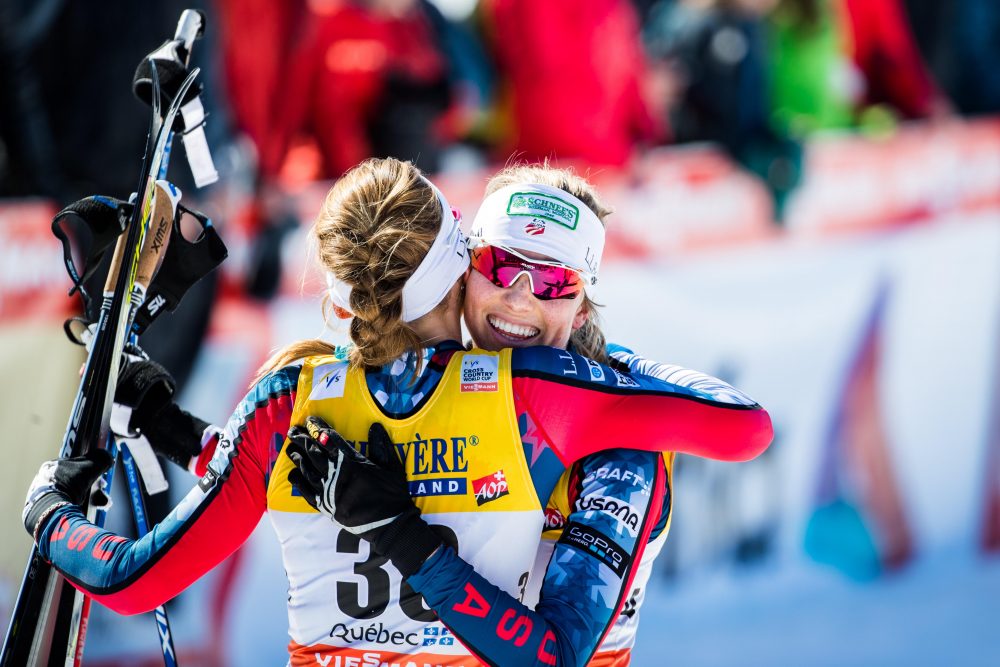
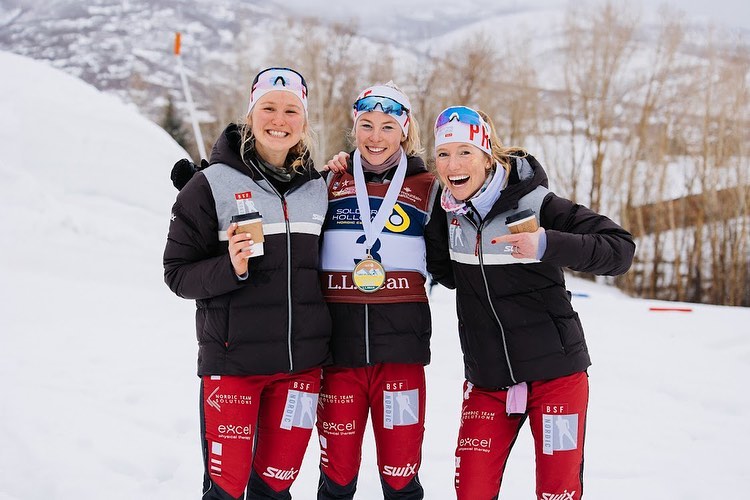
    BSF Pro Team athletes (l-r) Hannah Rudd, Mariah Bredal, and Erika Flowers celebrate Bredal’s third place finish in the 10 k classic during the 2022 U.S. Cross-Country Championships in Soldier Hollow, UT. (Photo: Arlin Ladue / BSF Pro Team)

    FS: In terms of Bozeman: you spent most of your career based in Vermont, though Erika has roots in Bozeman. How have you found that setting for leading this Pro Team and what are your thoughts on the training environment there?

    AN: The environment for training is fantastic here in Bozeman; we have access to mountains, access to a long season of skiing. We’re just an hour and a half away from West Yellowstone where we often have early FIS races, or we’re within driving distance of Sun Valley, Canmore, all these other places that historically have early-season racing. The rollerskiing is quite good here and there’s already a great support network within the Bridger Ski Foundation community.

    What is tough, with any elite team, is the fundraising aspect. I actually rebranded it as a Pro Team for a reason, because I want these athletes to be not scraping by, but to be actually making money while pursuing their dreams of being an Olympic-level racer. I think they deserve that, and I think that’s what all professional skiers deserve in the U.S.

    But it’s taken us some time to get there, and we’re not there yet. Fundraising is a huge part of my job on a yearly basis; we essentially have to fundraise from scratch all the money that it’s going to cost to travel around the country, or travel to Europe with these athletes who are making World Cup or World Championships. All the wax, all the hotels, all the logistics – all of that falls on a single program budget, basically.

    And I think there’s a huge potential for that in Bozeman. Bozeman is one of the fastest-growing towns in the U.S. and there are a lot of new businesses here, so I think our fundraising potential is huge. But given the fact that we started in COVID, and we’ve only been here for two years, we’re still trying to figure that piece out. And so that’s a place where we still have room to grow.

    And I would encourage anyone out there who’s reading this to realize the importance of these pro teams that we have in the country… We have Stratton, we have Craftsbury, we now have the Birkie Team, we have Sun Valley. And these clubs are essentially responsible for the development of the US Ski Team. This is the club model that we have adopted. Now, you know, it’s now been 30 years since we’ve, more or less, adopted this model. And we’re not getting any money from the U.S. Ski Team to develop these athletes. These clubs are and are all self-funded. APU is a little different since it’s tied in with the university.

    Unless you have a massive endowment or some other amazing bankroll that I am not familiar with, these pro teams and elite teams are fundraising their entire budgets on a yearly basis. Every single year, you have to raise the amount of money to send these [athletes] to these races. And that’s challenging, but it’s a hugely important piece of our development, because we wouldn’t have the U.S. Ski Team that we have now – we wouldn’t have the depth or the success on the U.S. Ski Team level – if we didn’t have these clubs as feeder programs. So I think it’s important that people help support these teams.
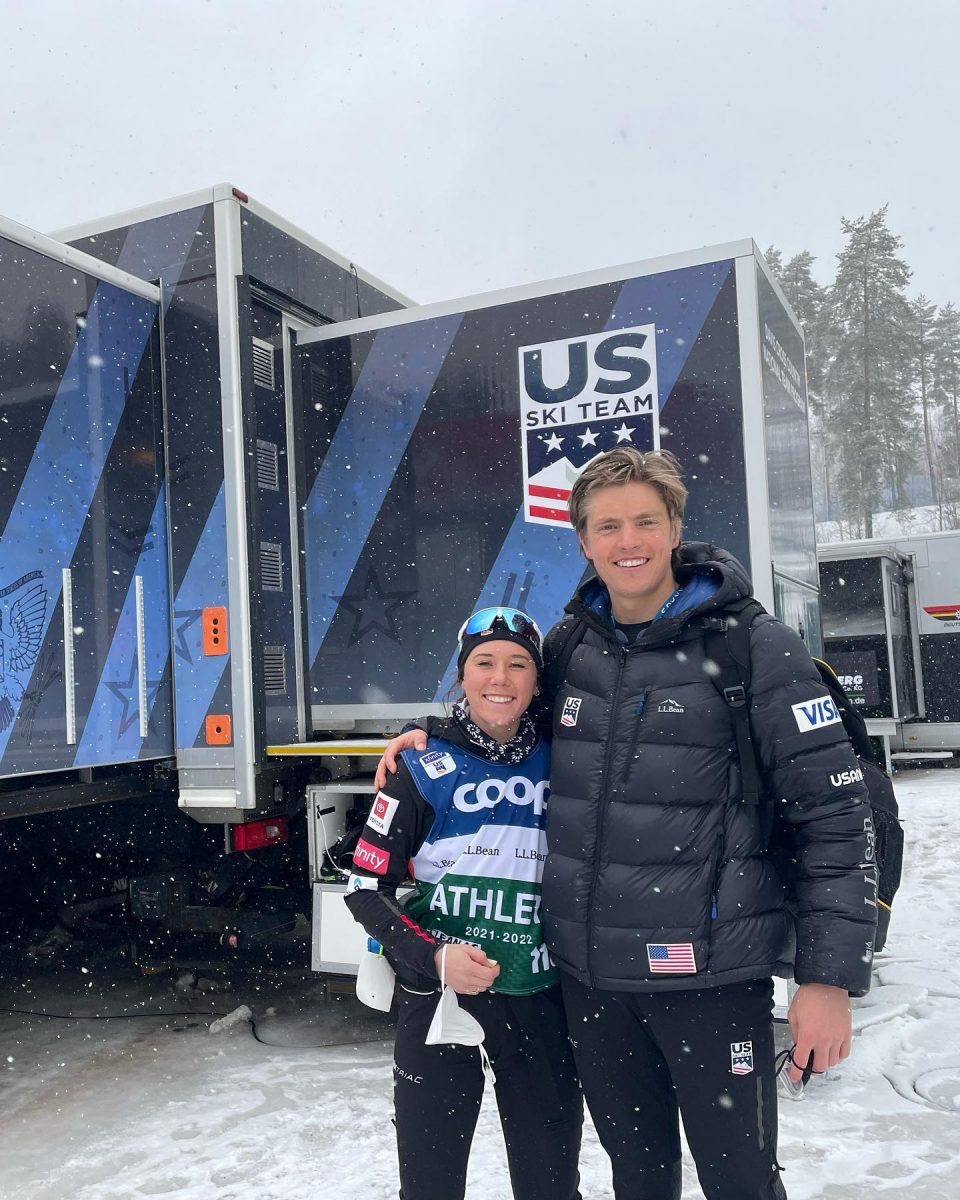
    BSF Pro Team athletes Lauren Jortberg and Logan Diekmann earn their first World Cup starts in Lahti, FIN in Mar. 2022. (Photo: BSF Pro Team)

    FS: Looking back over the last few years, what are some of the indicators of success that you look at in identifying what’s going well for the program? And what are some of your objectives in terms of heading into the next few seasons?

    AN: That’s a great question. The goal we have here with the Pro Team is international success, and that means I don’t bring someone onto the BSF pro team [whose only] ambitions are racing SuperTour and winning the Birkie, although those are amazing achievements. Those are, for sure, stepping stones in our development. But my goal is to put people on the U.S. Ski Team, and to qualify people for World Championships and Olympics.

    So international success is what we strive for, and that’s how we measure our season, and how folks are doing. Last year alone, we had three athletes achieve their first ever national podiums in Soldier Hollow. We actually qualified four different athletes for World Cup, although two of them – Finn O’Connell and Mariah Bredal – did not get to start there because they were canceled. But both Logan Diekmann and Lauren Jortberg started their first ever World Cups, which is great. We finished the year with Logan Diekmann as the overall sprint champion on the SuperTour. Finn O’Connell was the second best ranked distance skier on the SuperTour, and he also qualified for the U.S. Ski Team [as a B-Team member]. So for us, that was a solid year, and I was very proud of the way the team performed and much of the team, if not half the team, was able to have personal bests and be called up for some type of international racing, whether that was through World Cup or Opa Cup, and that’s exactly what you know I want to do. That’s my mission: to get these kids into those big international races and have them perform well.

    FS: Can you speak a little bit about the depth of the team, too? Momentum seems like an important thing with elite or pro teams. Just having that critical mass of athletes that are on the same level, or have similar objectives. Is that something that you’re seeing with the BSF crew?

    AN: Yeah, absolutely. I think the phrase ‘critical mass’ is for sure something that you see with these pro teams. I mean, it’s hard to deny the Jessie Diggins/Julia Kern effect that Stratton has right now. That’s a huge draw to their program.

    I think, for us, considering we started with zero members of the U.S. Ski Team on our pro team, and now we have one B-Team member – I’ve just been really excited with our success so far and how the team has stayed driven and motivated and helps push one another. That’s why I do this job – I love the team environment. That’s what I lived in my entire life; I was on the U.S. Ski Team from when I was 18 years old until I was almost 36 years old. 

    So the concept, the feeling of being part of a team, where people are genuinely supportive of one another you share in the training process and learning process, and you’re pushing one another, that’s the most valuable and successful scenario you can have. So I’ve been glad that we’ve somehow been able to find that nice mix of motivated individuals that genuinely get along and have fun with one another, and are able to travel the country and have put together successful race weekends.
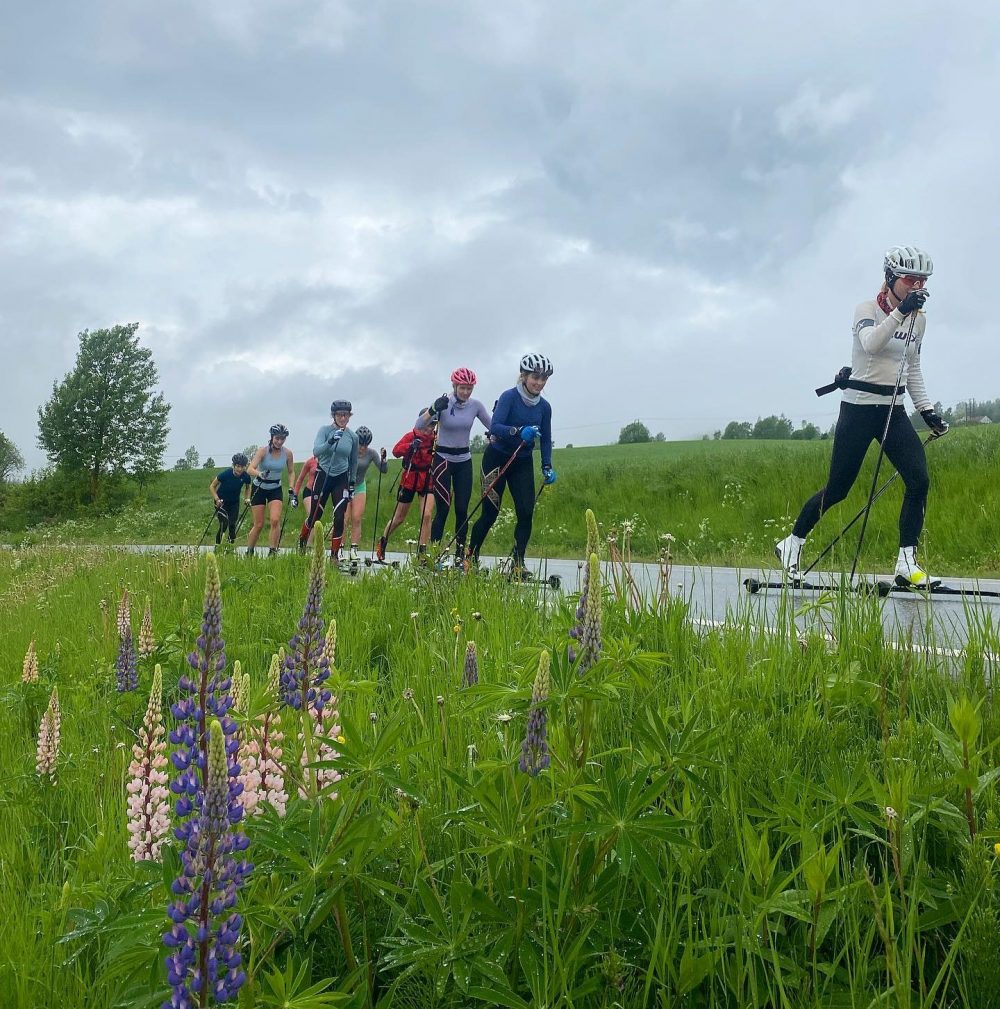
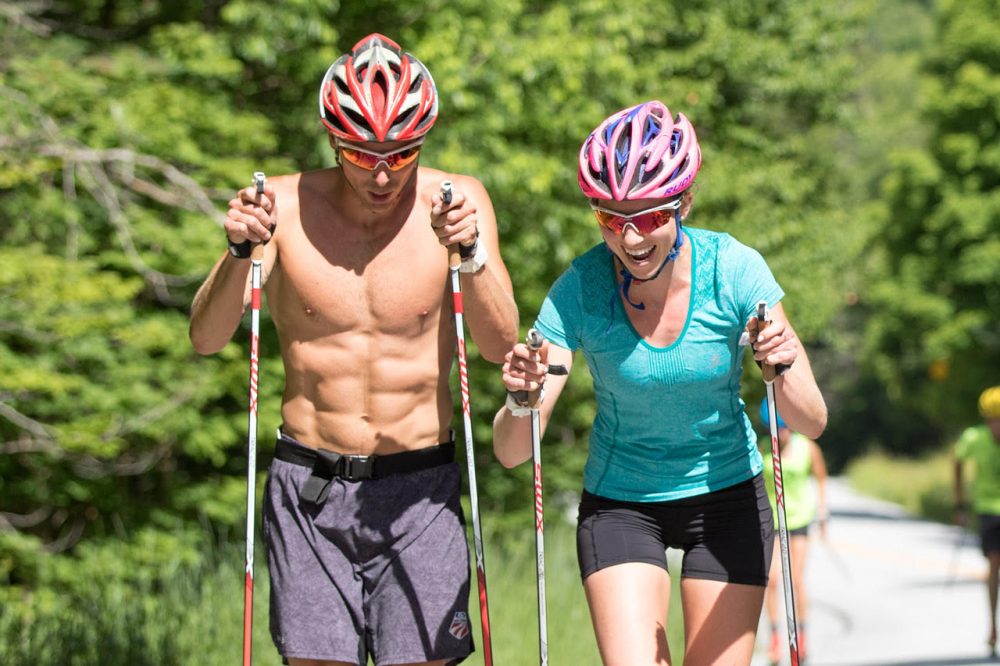
    The BSF Pro Team out for a rollerski during a June 2022 camp in Lillehammer and Sjusjøen, Norway. (Photo: BSF Pro Team)

    FS: Last program question: what’s new and what’s on deck for this summer? You mentioned that you guys are heading to Norway. What other summer/fall camps or projects are you guys working?

    AN: [Starting with the team roster:] so far this year, we’ve added Sarah Goble to our squad squad. She’ll be a new athlete with us next year. We also have her brother Reid Goble on the team, who has been great. I think those two have a ton of potential.

    We did lose Lauren [Jortberg] to Stratton – and you know how these clubs work, it’s a very friendly exchange. I’m sure we’ll find ways to collaborate, and that’s honestly what I find a lot of value in is elite teams collaborating with one another. Last year, we did a bunch of training camps with Sun Valley [Gold Team]. We joined Stratton and Sun Valley in Lake Placid training camp. We did some camps in the Midwest where we’ve had overlap with some Birkie athletes. And so I’ll continue to do that this year.

    We are scheduled to go to Norway next week for a two-week camp where we’ll be in Sjusjøen for five days, and then on Sognefjellet ski fields for five days. We’ll try to overlap with some fast foreign skiers while we’re there and try to learn from some folks over there, and we’re bringing a handful of college skiers with the Pro Team as well on that trip. After that, we’ll be back here in Bozeman for the main summer training block and that’s when we do our BSF college training group as well. That runs through the end of June and into the first week of August.

    So we have a solid six-week block of training here in Bozeman, which has been the staple of the BSF program the last couple years – having this really competitive college training group. It’s been so fun to see that program grow and see the success of the college training group. The first year with BSF, we had folks like Sophia Laukli on the team, and so many talented individuals. It was great to see them develop here in Bozeman and then have such amazing seasons that winter. So we’ll continue that program where for six weeks we’ll have a team of 12 collegiate athletes that join the Pro Team on daily training all the way through August.

    After the summer training group ends, we’re planning to head to the Midwest for another training camp, like we did last year. We try to get to low-altitude in August. Right now we’re looking at Marquette as our training destination, and we’ll try to collaborate with Team Birkie on some sessions out there. And then we’ll be going to Park City camp in October, like we always do, to join the many clubs from around the country and the U.S. Ski Team for their [fall] camp. And then we’ll probably get on snow early here in Montana or in BC as the snow flies.

    FS: How much crossover is there between the collegiate group that you have joining in the summer and the Montana State University (MSU) program?

    AN: Historically there are not many MSU kids that stay in town [over the summer]. This year I think we have two MSU kids in the college training group, so that’s great. If there are MSU athletes in town, we try to prioritize them to get them onto the team to keep them within the community. But a lot of college kids go home, whether it’s Alaska or back east or the Midwest. But we do have some good crossover and I have a good relationship with Adam St. Pierre and the university. We use their facilities all the time – we just did a round of testing on the rollerski treadmill at MSU – so it’s handy to have those types of resources nearby.
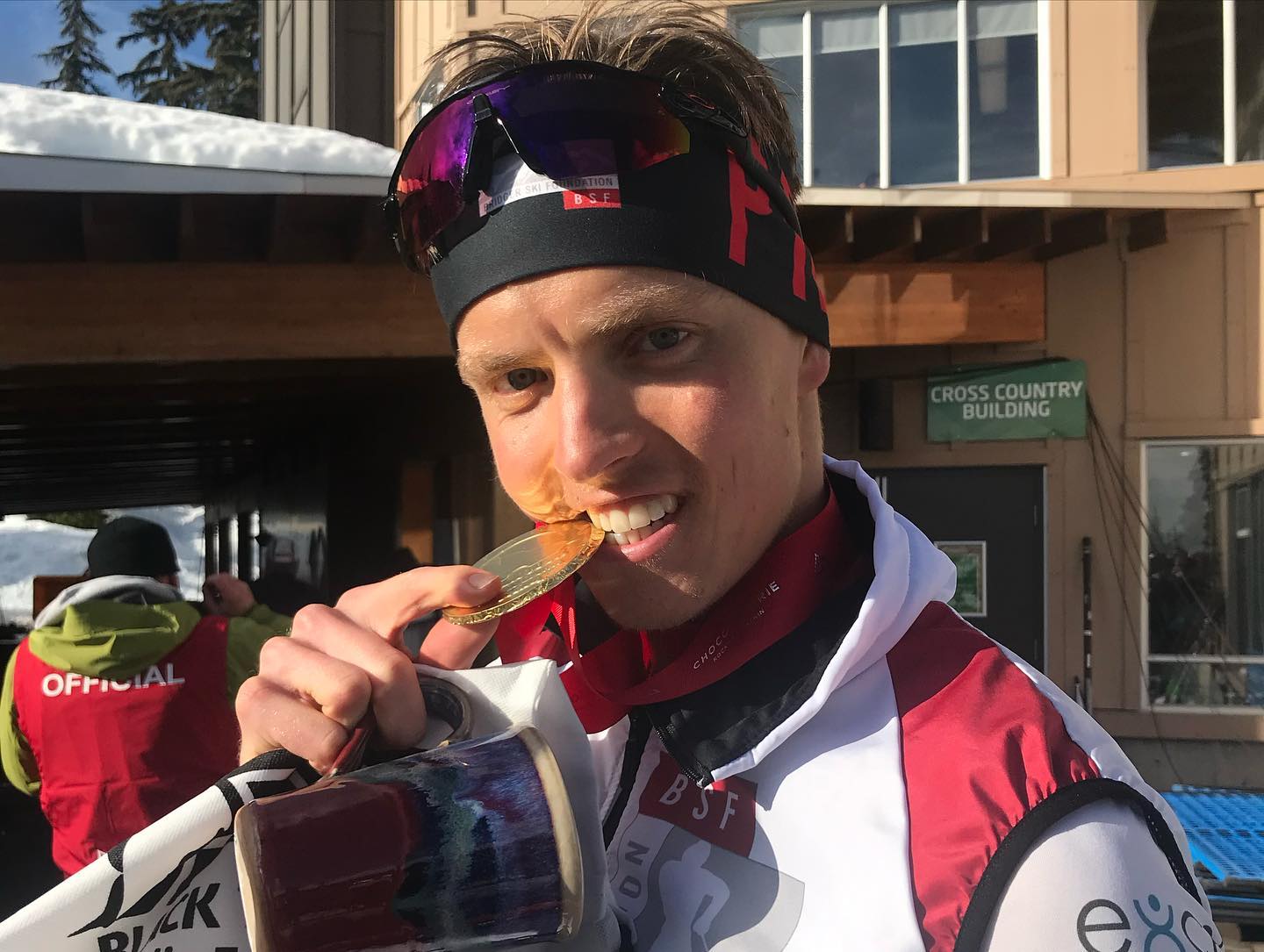
     

    Logan Diekmann bites his medal after finishing second in the US SuperTour standings in the classic sprint in Whistler, BC during Canadian Nationals/US SuperTour finals in Mar. 2022. (Photo: BSF Pro Team)

    FS: I know you’ve also got the Jim Bridger Trail Run coming up this summer, and there is a new rollerski race component. Can you share more information on that?

    AN: We’re doing our first ever Jim Bridger Rollerski Race at the end of July, which is paired with our annual trail run. I’ve been working with the town of Bozeman to shut down a city block behind where the MSU campus is, and we’re going to be hosting a crit-style rollerski race on the weekend in downtown Bozeman.

    We have prize money for that, and we’re getting some great sponsors on board. So that’ll be a cool event.

    FS: Can you also talk about how that event supports the BSF Pro Team?

    Yeah, absolutely. Like I mentioned, we as a Pro Team essentially need to raise $150,000 each year just to get the [athletes] to all the races and try to cover their expenses. That is a travel budget, a wax budget, everything – and that needs to be raised on an annual basis. For us, the Jim Bridger Trail Run is one of our biggest fundraisers.

    It’s an incredible amount of work. It’s a weird part of my job to be a coach, but also an event organizer. There’s a lot of weird things that go into being a ski coach. But, if we can make the Jim Bridger event big and successful, we can actually raise a lot of money for our budget. So that’s why we put so much attention and effort into it. It’s also a good chance for us to partner with local sponsors to raise money for the Pro Team, because all proceeds from these events go directly to the Pro Team.

    So historically, it’s just been a trail run, but this year I wanted to add a rollerski event for a couple reasons. One: I think it’s a huge development tool for BSF. We have so many talented youth skiers in this town. I want them to kind of be exposed to this type of high-level rollerski racing that we see in Europe. We see it all over Norway and Sweden and Germany; we need to have high-level rollerski races here in the U.S. So my secondary goal is to have this be an annual thing, where people know there’s going to be a quality rollerski race that’s super exciting to watch, fun to participate in, there’s going to be prize money and sponsors, so we can make it an annual thing and have it tied in with all the different clubs throughout the West. I’m hoping teams from Sun Valley, Park City, and all over the West will bring their athletes here to compete in this rollerski race on July 30th in downtown Bozeman.

    FS: And they’re staggered, right? So people could do both theoretically?

    AN: Exactly. The rollerski race is on Saturday, running races are on Sunday. The running race is 10 miles, but we also have a 5k option for the younger kids. And we have U16, U18, U20 and open class for the rollerski race. Swix and Salomon are sponsors of the event, and we’ll be getting a race rollerski fleet from Swix, so these are going to be matched rollerskis for the open men and women, so it’s going to be a legit rollerski race.

    We’re hoping to livestream it too. TBD on that, but check the BSF Facebook page for live streaming.

  • Ketterson and Ogden Take Classic Sprint Win on New Tracks at Mt Van Hoevenberg

    Ketterson and Ogden Take Classic Sprint Win on New Tracks at Mt Van Hoevenberg

    By Rachel Bachman Perkins and Ben Theyerl

    After a brief break, the SuperTour picked up in Lake Placid this weekend, with a fluoro-free Period III kicking off with a 1.5-kilometer classic sprint. The frigid forecast called for overnight lows of -5 Fahrenheit, with a wind chill as low as -23F. Highs during the day were only predicted to climb into the low single digits. Qualifiers were scheduled for 10/10:45 am, with quarterfinals for the open men beginning at noon – hopefully, enough time for a few degrees of warmth to reach the trails. 

    The weekend competitions would be hosted on Mt. Van Hoevenberg’s new World Cup trails, which are paved for rollerski use in the summer, and played host to NENSA’s “Keys to the Castle” sprint event in September. For those familiar with the venue, the new courses are tucked into the north-facing hillside, just south of the 1980 Olympic stadium and biathlon range. The new serpentine loop intersects with the final Ks of the classic “Ladies 5” outer loop, but overall remains closer to the stadium to allow access to the recently improved snowmaking system. 

    Jessie Diggins (SMS T2/USST) pushes over the climb during the final round of the Keys to the Castle sprint. (Photo: Matt Whitcomb)

    With a large reservoir and advanced technology, this new World Cup loop can be made winter competition ready within four days, though Van Hoevenberg’s nearly 50k of open trail might suggest that coverage is not currently an issue.

    There was praise for the course from many athletes, including those that have seen both Lake Placid, and everywhere in the world beyond Lake Placid. 

    “It raced much more like a world cup course!” said Alayna Sonnesyn (SMS), in an email to FasterSkier. Katharine Ogden (SMS) too, said of the course, “it was WAY more fun than the old one…[which] was pretty flat.”

    The course designers at Lake Placid seem to have carefully been taking notes on what makes sprint racing exciting over the course of its evolution as a discipline in the sport. An historic venue for American skiing, these developments may be a long-time coming for Mt. Van Hoevenberg, but it’s clear that they were executed with mastery so VanHo can continue to expand upon its legacy in the decades to come. 

    This course featured a long, final uphill climb to test a skier’s mettle, then a short, technical downhill into the finish to test their tactical brains. And in between; transitions, transitions, and more transitions.

    Becca Rorabaugh (APU) said of this : “The final climb always turned into a drag race, and I liked the pitch because it favored a bit of a stride over an all-out run. Skiers still had to be alert through the downhill and finish, though; positions often changed in the stadium.”

    The weekend, hosted by the Olympic Regional Development Authority (ORDA) in Lake Placid, also served as the second NENSA Eastern Cup weekend. Thus, senior athletes from American elite clubs lined up alongside regional junior racers, eastern collegiate racers, and Canadian athletes who traveled from Quebec, Ontario, and beyond. 382 athletes, 176 women and 206 men, on the start lists for the qualifier, and separate heats were run for the U18/U20 and U16 categories. 

    Without livestream, FasterSkier has relied on live timing and athlete interviews to shed light on how the sprint races unfolded. 


    Men’s 1.5-kilometer Classic Sprint

    After returning from a stint in Europe where he raced the Tour de Ski, Team Birkie’s Zak Ketterson set the mark in the men’s qualifier, stopping the clock at 3:04.79. Sun Valley’s Peter Holmes skied the next fastest time in qualification (+0.72), while Étienne Hébert was just behind in third (+1.41). Hébert hails from Quebec and currently trains at the Centre National d’Entraînement Pierre-Harvey (CNEPH), based at Mont Ste Anne.

    Each of these men moved smoothly through the rounds, with Ketterson getting edged out by Bill Harmeyer (SMS T2) in the first semi, and Homes and Hébert going 1-2 in the second. Racing in the second semi saw a tighter spread and faster times, bringing Julien Locke (Black Jack Ski Club) and Logan Diekmann (BSF Pro) who had finished a close third and fourth, respectively, along to the final as lucky losers. 

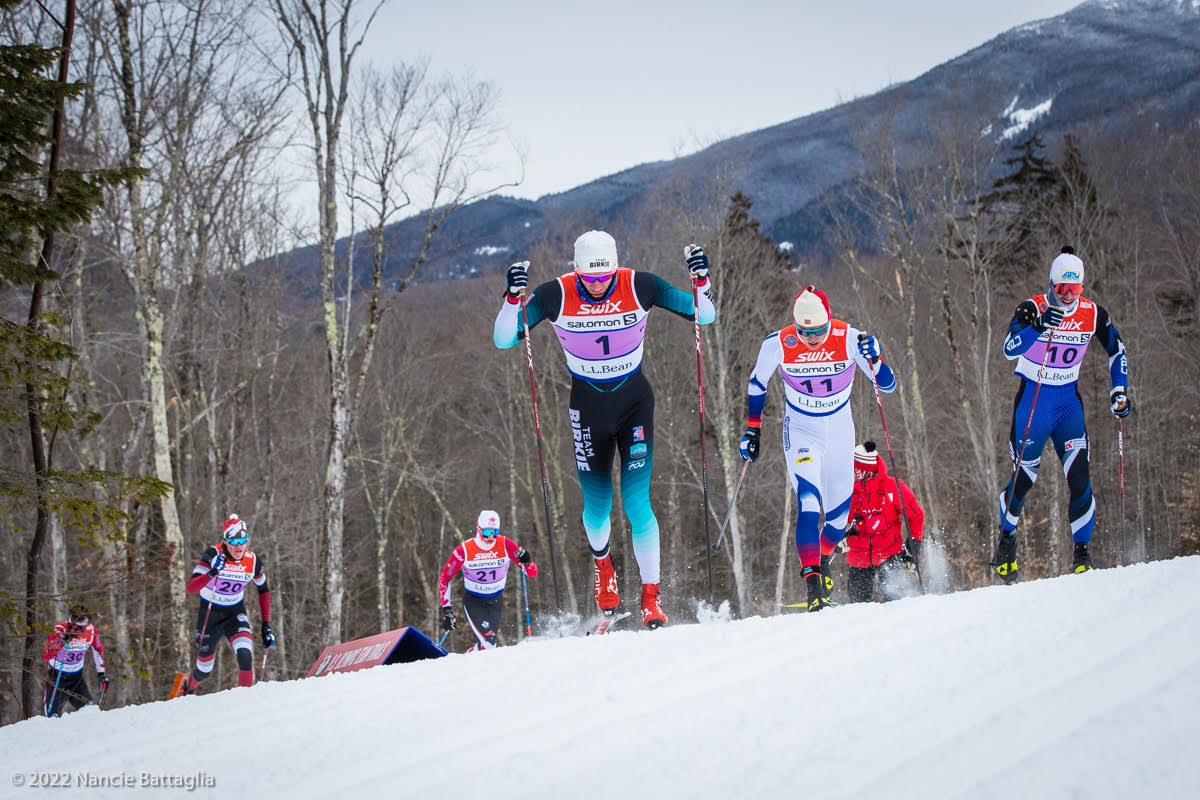
    Zak Ketterson (Team Birkie) leads his heat during the 1.5-kilometer classic sprint in Lake Placid. (Photo: © 2022 Nancie Battaglia)

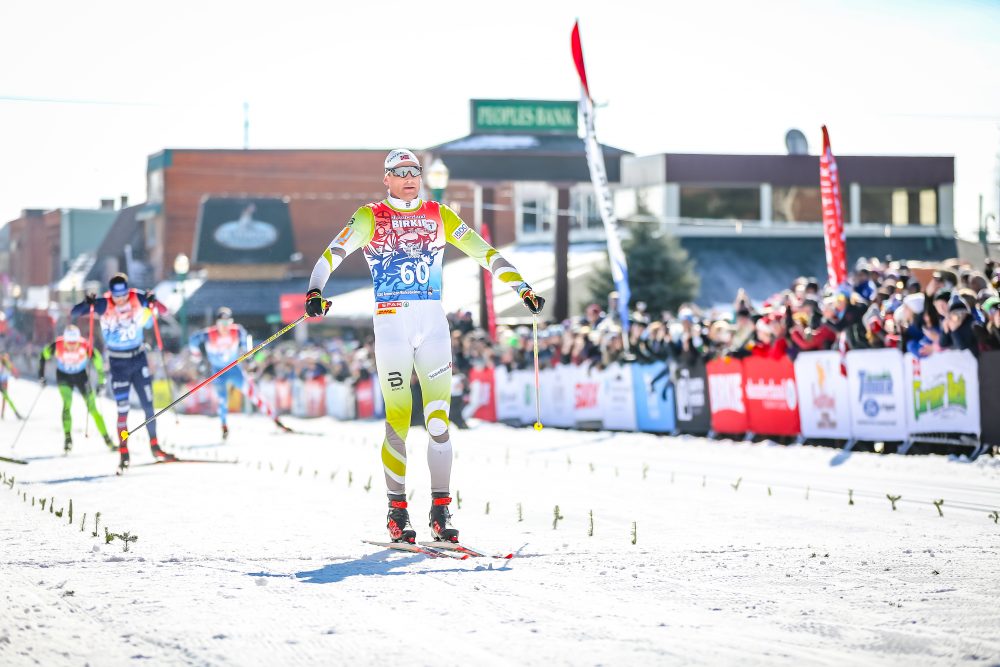
    The final featured a tight finish among the top four men, with Ketterson off the front to finish in 3:04.71, earning his second consecutive classic sprint victory. Ketterson had dominated the classic sprint in Cable, WI, and stood at the top of the SuperTour leaderboard, thereby earning start spots for the Tour de Ski. The timing of the Tour caused him to miss the subsequent classic sprint in Soldier Hollow, UT. 

    During the Tour, his first World Cup starts, Ketterson was less than a second shy of qualifying for the classic sprint heats in Oberstdorf, Germany, and had been roughly five second out of the Top-30 the day prior in a 15k skate. He was the only American on the men’s team to finish the Tour. After the Tour, Ketterson made a quick turnaround to attend the weekend of distance racing in Sun Valley, Idaho, where his results (15th in the 15k classic and 34th in the 10k free) were far below what might be expected from him. 

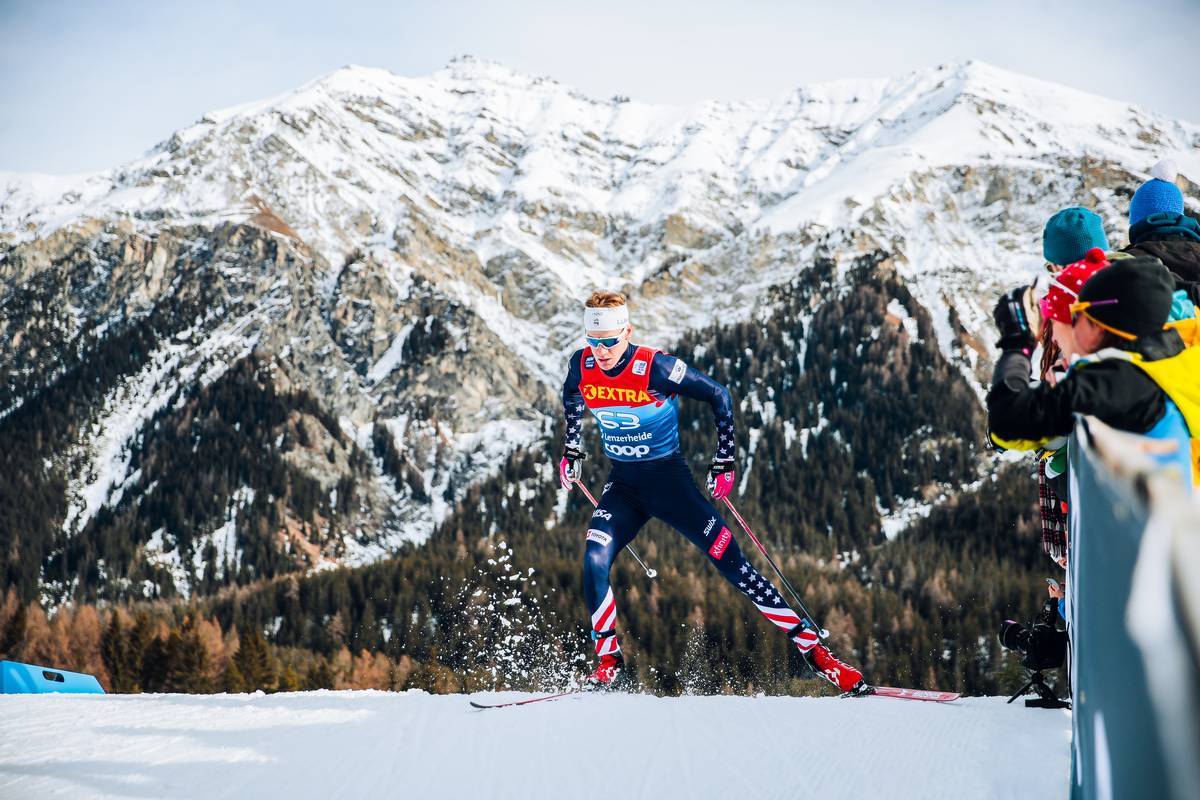
    Zak Ketterson races the freestyle sprint qualifier in Lenzerheide, SUI, the first event of the 2021/22 Tour de Ski. (Photo: NordicFocus)

    In a post-race email to FasterSkier, Ketterson shared how he felt about the Tour and what the recovery process has been like for him. 

    “The Tour de Ski was a fantastic learning experience with lots of ups and downs. I am pretty happy with my performance on the Tour given it was my first time on the World Cup, but I definitely think I will be faster next time around now that I have had the experience. Post Tour I was incredibly empty, both physically and mentally. To have to change gears pretty much immediately after the last stage of the Tour and head straight to Sun Valley for some super competitive SuperTour races at high altitude was definitely a recipe for disaster on my body. I felt like I was just going through the motions and my body wanted nothing to do with those races.

    “​​These last few weeks at home in Minneapolis provided me with some long-overdue recovery. My hunch after some really lackluster racing in Sun Valley was that there was no need to overthink anything and that the issue was probably just that I was tired. I took time at home to mentally and physically reset and started to feel a lot more like myself as the Placid races approached. Today, it all came together and I felt a lot more race-ready.”

    Ketterson also commented on the improvements that have been made at the Mt Van Hoevenberg venue, explaining how it supports the growth and elevation of domestic skiing.

    “I am blown away with the venue at Mt. Van Hoevenberg! The venue truly feels like it’s ready for World Cups, or even another Olympics. It’s really inspiring to see big investments into nordic skiing venues in the United States, and I can’t stress enough how big it is for us athletes. I can’t wait to come back to Lake Placid sometime later to really experience this place because I think it’s so awesome here.”

    Behind Ketterson, just 0.26 seconds separated second through fourth in the men’s final. Holmes won the boot slide to snag second (+0.72), while Harmeyer took the final podium spot in third (+0.92). Hébert was just 0.06 seconds shy of the podium, ending the day in fourth (+0.98).

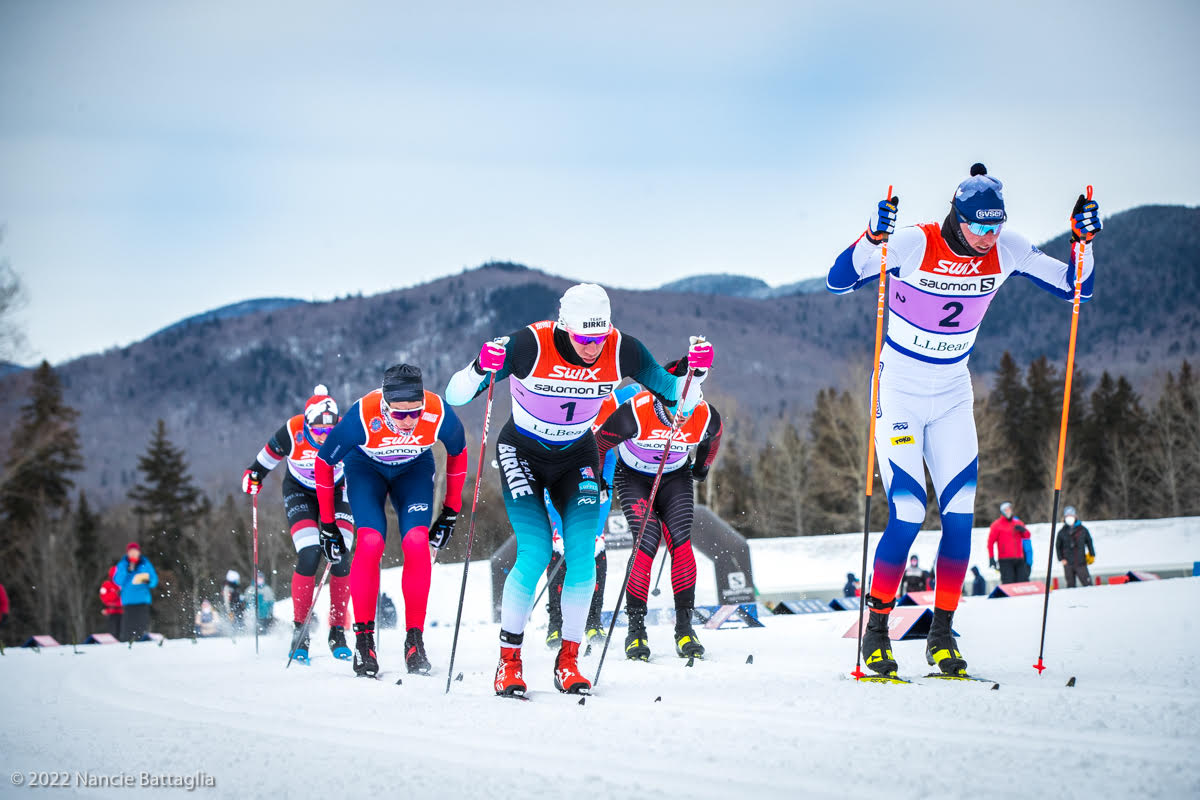
    The men’s final of the 1.5-kilometer classic sprint, the first event of the weekend of SuperTour racing hosted by Mt. Van Hoevenberg in Lake Placid. (Photo: © 2022 Nancie Battaglia)

    Harmeyer provided insights into his approach to the day, along with insights into the moves that contributed to the excitement at the finish line.

    “I felt really good in the heats today,” he wrote via email. “The course was certainly difficult and tactical. Placement in the group was really important and that was especially apparent in the final. We had a group of four dudes going over the top of the final climb into the long descent before the finish. It was an absolute scramble trying to get into the tracks on that final downhill. At one point, I had my left ski in the right part of the track and Étienne had his right ski in the left side of the track. Not easy to squeeze two guys going 30+ mph into a single track but somehow, I came out ahead which was just enough to lunge at the finish for third.”

    During Period I, Harmeyer took third in the classic sprint final in Cable, and was just off the podium in fourth the weekend prior after the freestyle sprint in Duluth, MN. After qualifying in fifth, a crash in the quarterfinal left him 24th in the freestyle sprint in Soldier Hollow during the U.S. Cross Country Championships. A few days later, he was 51st in the 15k classic. In the Soldier Hollow SuperTour classic sprint, Harmeyer qualified in fourth, and just missed the final to end his day in eighth. 

    Reflecting on the season as a whole, Harmeyer wrote, “I had a really good start to the season with some strong races in the Midwest. But overall, things have been frustrating. I’ve been struggling with some cold weather triggered exercise induced asthma that got really bad after the first supertours in the Midwest. I continued to struggle with it through a disappointing Senior nationals and decided to take a bit of time off to reset, recover and do some testing. I’m hopeful the worst is behind me and that I’ve got some good protocols lined up to prevent anything from happening in the future. My primary goal for the remainder of the season is to win the Stowe Derby, specifically the derby meister.”
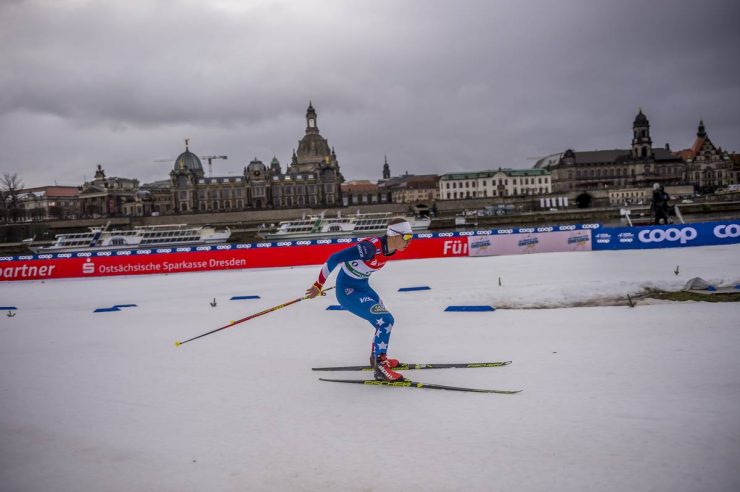
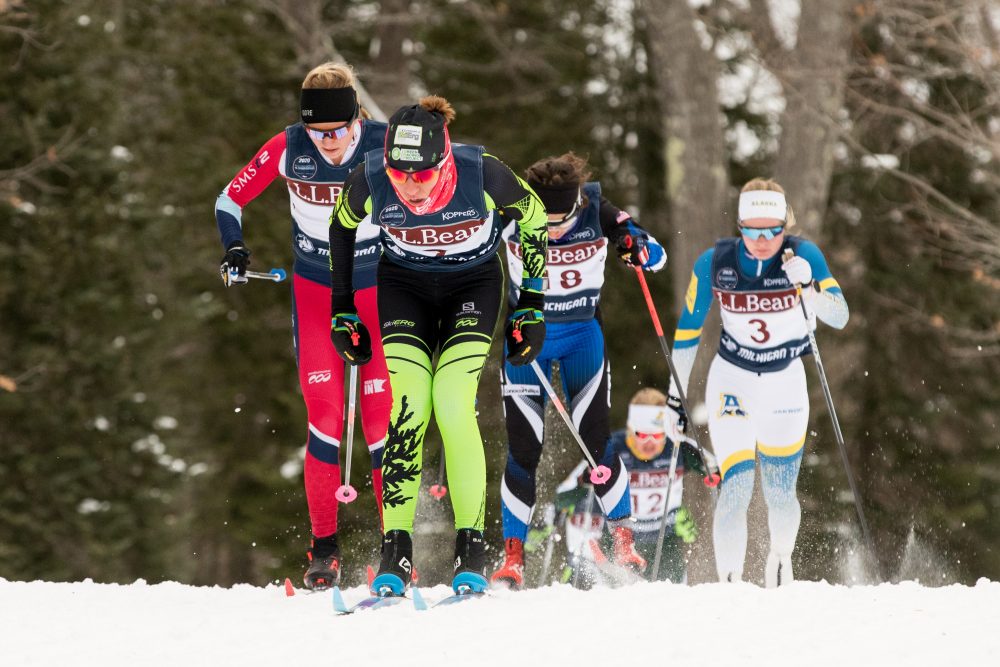
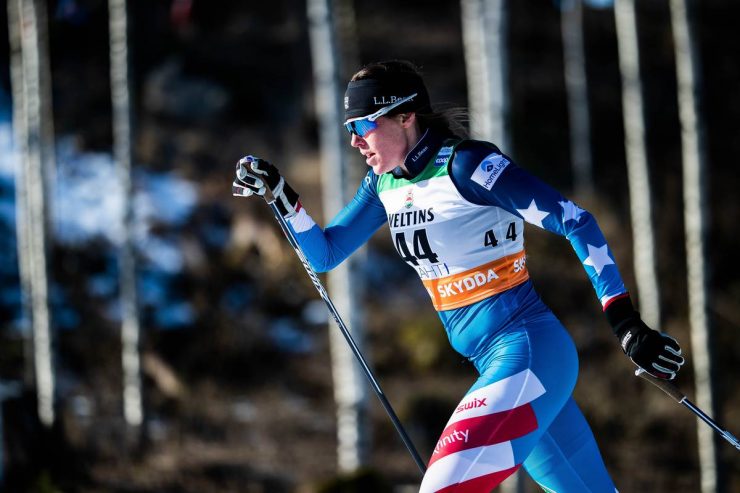
    Wrapping up with a comment on the venue, Harmeyer added, “The new courses at Lake Placid are sweet! The sprint course is incredibly tactical but also rewards tough, explosive skiing. I had an absolute blast out there in the heats. The distance courses are hard but I’m excited to be doing a mass start on those for this Sunday. Overall, Van Ho has done a great job with course management and their snowmaking to put together some killer courses.”
    After a gap, Diekmann crossed the line in fifth (+5.81), while Locke rounded out the men’s final in sixth (+9.11). 

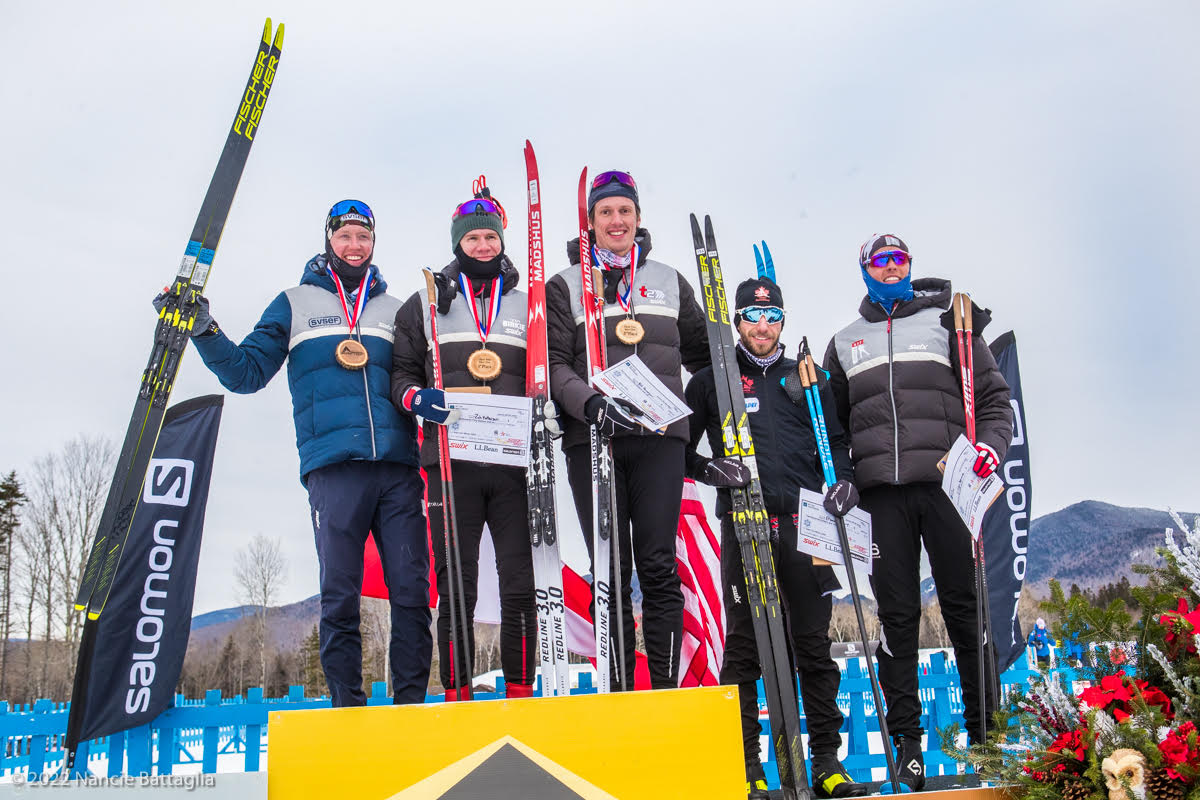
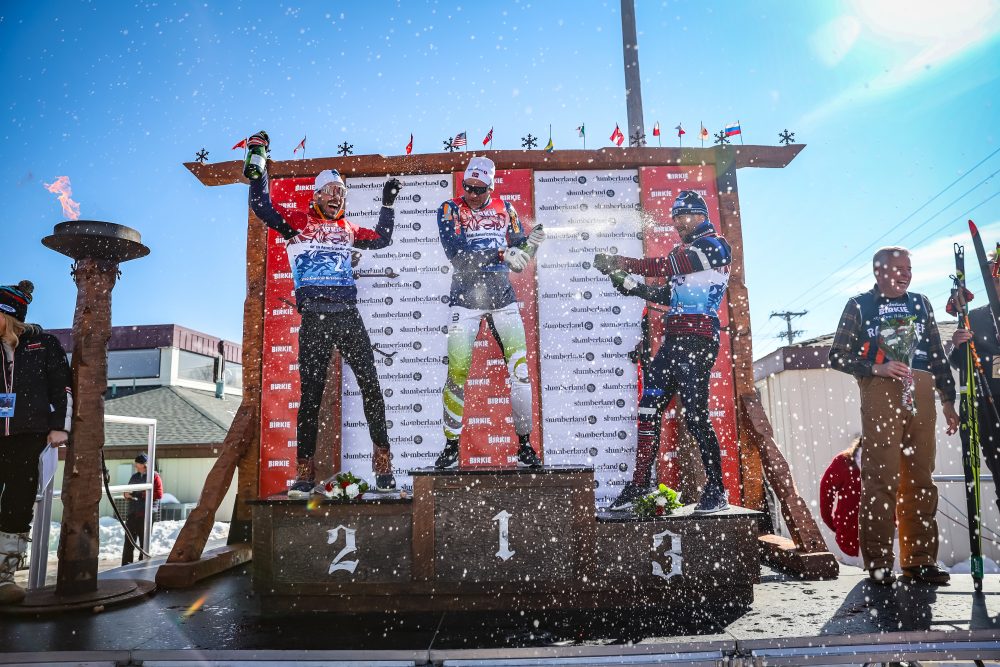
    The men’s SuperTour classic sprint podium on a frigid day of racing at Mt Van Hoevenberg near Lake Placid, NY. (Photo: © 2022 Nancie Battaglia)


    Women’s 1.5-kilometer Classic Sprint

    The women’s field began right where it left off in SuperTour classic sprints, with the winner of the last race at Soldier Hollow, Katharine Ogden, (SMS) finishing the qualifier in first place (3:40.49). She was followed by Lauren Jortberg (BSF Pro Team) in second (+2.2), and Ava Thurston (Mansfield Nordic Club) in third (+6.1). The qualifier indicated, again, the overall strength of the field that has characterized this year’s SuperTour, with the heat qualifiers all within 30-seconds of each other (26.0 seconds to be exact).

    That field remained tight in the quarterfinals as well. All five quarterfinals saw winning times within a mere five seconds of one other, with Katharine Ogden turning in the fastest time of the round at 3:42.77, and Alayna Sonnesyn winning her heat in 3:46.12. 

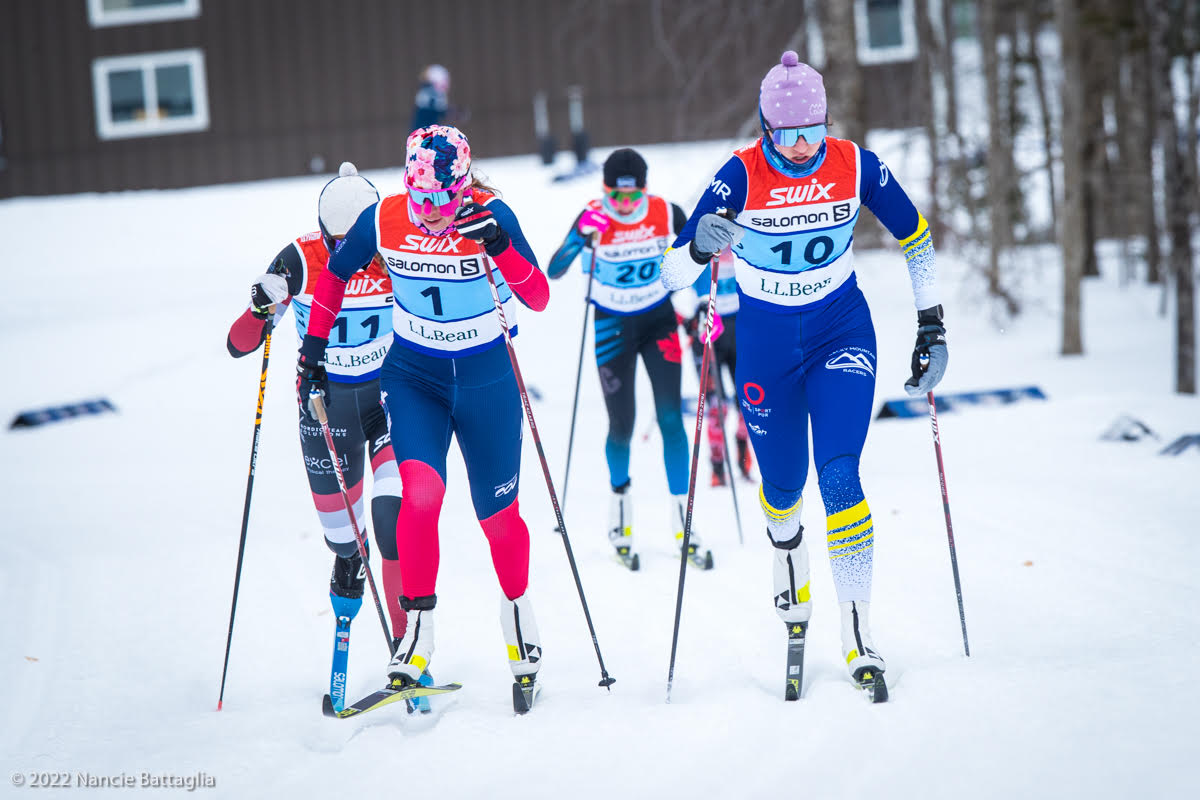
    Katharine Ogden (bib 1) races her way through the classic sprint heats during the SuperTour race weekend in Lake Placid. (Photo: © 2022 Nancie Battaglia)

    Ogden commented to FasterSkier that she “didn’t really have any strategy in particular. I find that it is better for me to make strategy in the moment during sprint heats because you never know what’s going to happen out there… I just tried to conserve as much energy as possible in the quarter and semi.” It would pay off later on.

    Meanwhile, also progressing to the semifinals was the APU one-two punch of Rosie Frankowski and Becca Rorabaugh out of quarterfinal 2. Despite being primarily known as a distance racer, Frankowski, came into today leading the SuperTour sprint classification and “set a blistering pace,” according to teammate Rorabaugh. With it, she pulled the duo into the semifinals together.

    After all the quarterfinals were through, the semifinals were set with a who’s-who at the top of the SuperTour sprint standings, rounded out by Canadian Katie Weaver (Hollyburn XC Ski Club) and Minnesotan Margie Freed (Craftsbury).

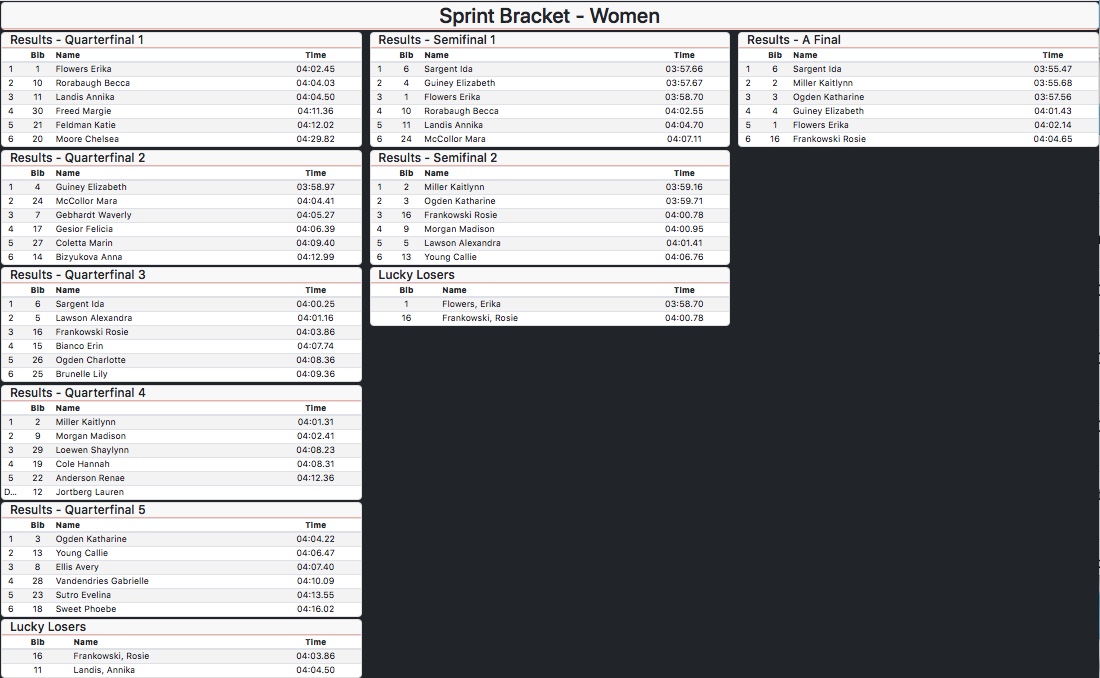
    The first semifinal featured a battle between two SMS T2 teammates, Katharine Ogden and Alayna Sonnesyn, and two APU teammates, Rosie Frankowski and Becca Rorabaugh. Frankowski again set the pace for the heat, with teammate Rorabaugh commenting that “[Rosie] is so strong on the uphills that she pulls the whole heat to a faster time.” Frankowski, however, couldn’t quite outlast Ogden and Sonnesyn, who used the downhill after the final climb to launch into the first two positions. Ogden won the heat in a time of 3:39.23, with Sonnesyn and Frankowski in second and third, respectively, by less than a second. Rorabaugh finished fourth, but along with Frankowski won the lucky loser spots into the finals – setting up another round of the SMS-APU duel.

    In the other semifinal, a close battle throughout yielded a win for Lauren Jortberg (3:45.15)  and a second place for Erika Flowers (+0.90). The result sent another teammate pairing into the finals, with both skiers coming from Bridger Ski Foundation (BSF).

    The women’s classic sprint final takes to the tracks in Mt. Van Hoevenberg. (Photo: © 2022 Nancie Battaglia)

    At Lake Placid – a place that has over the past century proved to be able to gather the entire world around skiing – it was perhaps appropriate that the women’s final would bring together three teams from across the American continent. Two from Vermont (SMS), two from Montana, two from Alaska (APU), and away they went!

    Katharine Ogden commented that the field didn’t waste any time: “It was pretty hard from the gun, as per usual.” 

    Rorabaugh, meanwhile, made a change in strategy, deciding to follow her teammate Frankowski more closely in the early part of the race. “I was trying to stay closer to the front of the pack since I had let a large gap form in the semifinal that I couldn’t make up,” she explained.

    That adjustment was one that helped create a pack that was tight throughout the race, and that was a bit harder to find a position in.

    Sonnesyn commented that this led to her having to adjust. “I had great energy but got tangled up a few times on the second hill, so I really had to ski from behind in the second half of the race,” she wrote. “Luckily, I had great skis and remained calm and was able to push through the final stretch.”

    In that final stretch, on the final hill, a “drag race,” as Rorabaugh described it, ensued. It was instigated by Ogden, who saw the final climb as the place to make her move, and made it. She came over the top in first place.

    “[I] got lucky,” she told FasterSkier. “Pat [O’Brien, SMS T2 head coach] had provided me with some really fast skis that allowed my move to stick going back down the hill.”

    Perhaps it wasn’t all luck though. Ogden came across the finish line in first place (3:40.13) after winning the qualifier, her quarterfinal, and her semifinal. It was an all-around dominant performance for one of the U.S. brightest stars in the classic sprint.

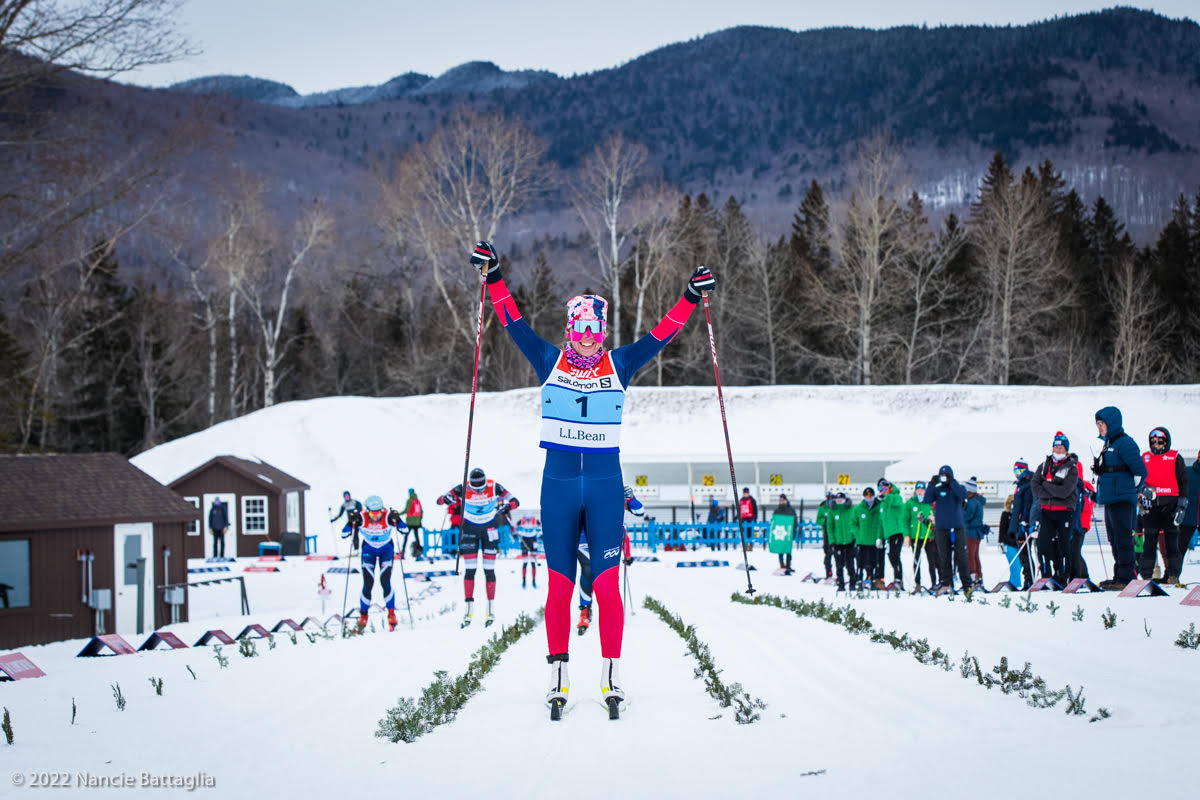
    Katharine Ogden wins the women’s 1.5-kilometer classic sprint in Lake Placid, NY. (Photo: © 2022 Nancie Battaglia)

    Meanwhile, Becca Rorabaugh had powered through the transition into the final downhill and came up with the reward of second place (+3.40), She was followed by Alayna Sonnesyn, who remained cool, calm, and collected as she skied her way through the pack to third place (+4.29).

    The final was rounded out by fourth place Rosie Frankowski (+4.74), fifth place Lauren Jortberg (+5.63) and sixth place Erika Flowers (+17.77).

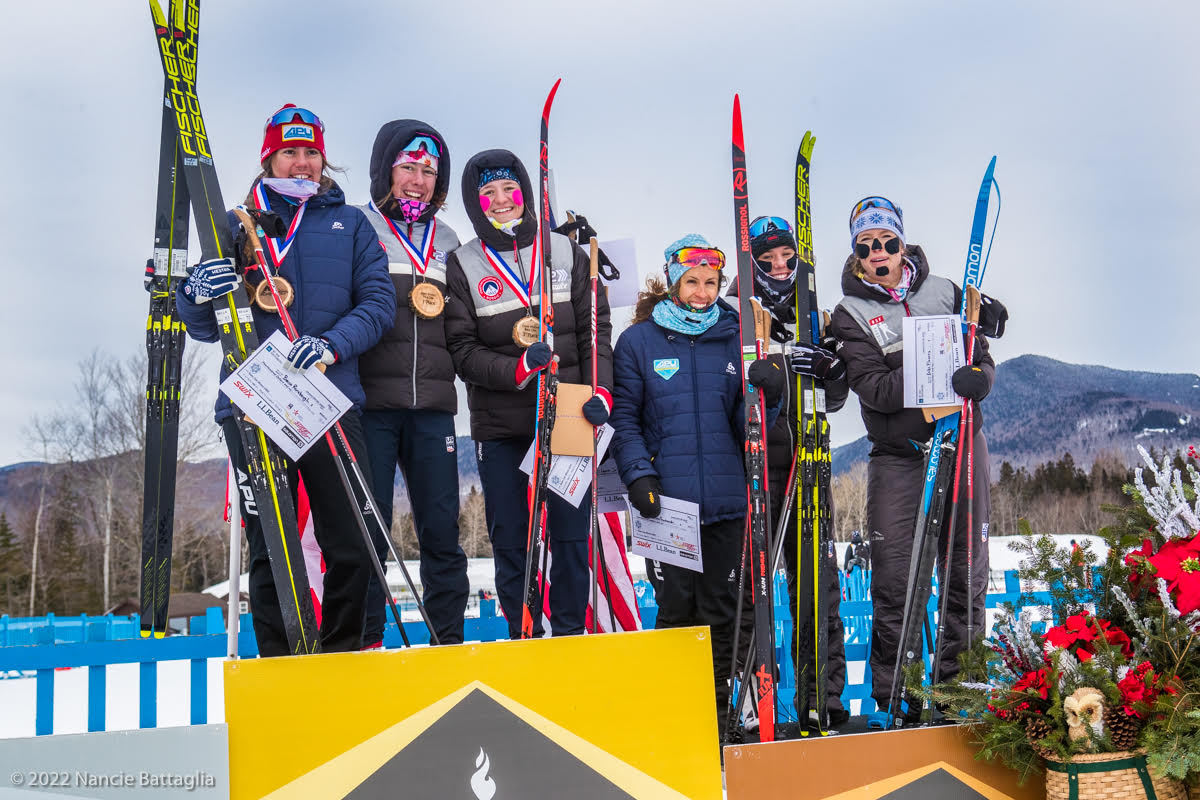
    The women’s classic sprint podium on day one of SuperTour racing in Lake Placid, NY. (Photo: © 2022 Nancie Battaglia)

    The result was reached at the end of an exciting day that encapsulated the beauty of ski racing – with excitement and energy perfectly juxtaposed against the extreme absence of that energy in the air. Preparing for cold temperatures that are forecasted again for the 10k freestyle mass start tomorrow, the top finishers today all expressed that the temps are part of the appeal in the northeast this weekend.

    From Rorabaugh, “I don’t mind cold temperatures – I grew up in Fairbanks, Alaska!”

    From Sonnesyn, “I like to think the Midwesterner in me prepared well!” 

    And from Ogden, the perfect Vermont tip: “As Sverre [Caldwell] told us last night, tricky race conditions can work to your advantage if you prepare better than anyone else. Wise man :)”


    Results

    Qualification: Men | Women

    Sprint Brackets


  • Elite Team Preview: Bridger Ski Foundation Pro Team

    Elite Team Preview: Bridger Ski Foundation Pro Team

    Bridger Ski Foundation athletes, 2021. (photo: courtesy BSF)

    Team name and location: Bridger Ski Foundation Nordic Pro Team (BSF); Bozeman, Montana

    Coaches: Andy Newell (Nordic Pro Team), Hannah Cole (Post Grad Team)

    Current roster: Finn O’Connell, Graham Houtsma, Hannah Rudd, Lauren Jortberg, Leah Lange, Logan Diekmann, Mariah Bredal, Reid Goble, Simon Zink, Erika Flowers

    Who’s still on this team, or otherwise involved in American skiing, from when we did this in 2012: No one; Torin Koos and Leif Zimmermann haven’t raced in years, though the third athlete on that team, Sawyer Kesselheim, was the guide for Paralympian Jake Adicoff in Adicoff’s silver-medal performance in the B3 classification 10-kilometer classic in PyeongChang

    Bridger Ski Foundation athletes, 2021. (photo: courtesy BSF)

    Top results last season: While the SuperTour obviously didn’t happen, BSF sent a strong team to the American Birkebeiner, the closest anyone came to a nationwide domestic field last year. BSF athletes came away with a combined four top-10 finishes in the skate race, including O’Connell in 4th, Flowers in 5th, Jortberg in 7th, and Rudd in 9th. Graham was 12th in this race, and Diekmann 23rd. In the classic race, O’Connell was 11th and Diekmann 15th. O’Connell had a pair of podium finishes in Sun Valley in March 2021, against a loaded regional field with multiple RMISA athletes, and was third in a RMISA race in January. Diekmann tied for first in a RMISA sprint qual in January, while Jortberg was second among the women. Flowers was 6th in a separate January RMISA race. Finally, going back to the ill-fated spring of 2020, Diekmann was scheduled to make his World Cup debut in the Québec City sprints before the races were cancelled, while Flowers was among the starters for the women.

    Andy Newell, Bridger Ski Foundation coach, 2021. (photo: courtesy BSF)

    Coach’s comments: Andy Newell wrote:

    “Off-season training for us has been super fun and productive. I’m really proud of the way the team has come tougher over the past year and a half. It’s always a risk when you create a new team from scratch, you never know what kind of team dynamic will play out. But this group does an amazing job working together, pushing one another, while also showing authentic support. We have a lot of fun.
    BSF athletes on snow in Bend, May 2021. (photo: courtesy BSF)
    “Our summer preparation started in May with our first ever team Bend camp with the US Ski Team. During the months of June and July we try to focus on solid, steady team training here in Bozeman alongside the BSF collegiate group and comp teams. This is an important time for the Pro Team to connect with the community and the younger members of the BSF club. Since then we have tried to prioritize high quality training camps each month. In August we had a great low altitude training camp in Cable, Wisconsin, an intensity camp with rollerski TT’s in Lake Placid in September, and our annual October training camp with the US Ski Team. I think because last season was so isolating we’ve tried to collaborate with the other elite teams as much as possible and have had a fun time working with Sun Valley, SMS, Team Birkie and others.
    “The Pro Team is itching to get on snow and get the season started. We will travel to Canmore in mid-November for more on-snow training and TT’s, then focus on our final preparations for the first SuperTours in the Midwest. The athletes have big goals this year so everyone is excited to return to a legit race calendar. Although we need to prioritize SuperTour racing our ultimate goal with this team is to get everyone racing in Europe whether that’s in World Cup starts, U23s, or other championship races.
    Bridger Ski Foundation athletes, 2021. (photo: courtesy BSF)
    “Folks can follow along from our team blog.”
  • Silver Linings to an Abbreviated World Cup Season

    On March 13th, the rapidly evolving situation with COVID-19 caused the World Cup to come to an abrupt halt. Quebec, Minneapolis, and Canmore: all cancelled. SuperTour finals: also cancelled.

    For some U.S. athletes including Gus Schumacher and Katie Feldman, this meant missing their first ever World Cup starts. For others, like Andy Newell, it meant missing his last. Jessie Diggins was in sixth place in the overall standings, less than 300 points out of third with one of the women in front of her, Ingvild Flugstad Østberg, injured and unable to compete. 

    Yes, in the grand scheme of a global pandemic, ski racing is insignificant, but human emotion is natural, and disappointment and frustration in the lost opportunity is to be expected. 

    In the spirit of spreading a little levity and positivity to contrast the uncertainty of the times, FasterSkier reached out to a subset of the coaches and crew who would have raced in the North American tour to find out what their “silver lining” to the early end of the season has been. 

    Here are the responses they’ve shared over the last week. 

    Jessie Diggins (MN)

    “Getting time with my dogs and my family that I otherwise wouldn’t have had!”

    Jessie Diggins enjoys quality time with her parents newest addition, Lucy. (Courtesy photo)

    Gus Schumacher (AK)

    “My silver lining has been coming back to Alaska in its ideal state. So sunny and snowy and cold still, all making for amazing cross country and alpine skiing. Doing these outside activities help me keep my distance from people. I still get bummed when I think about how I’d be racing in Minneapolis right now but I’ve been distracted by doing fun things and seeing friends at home.”
    Matt Whitcomb (VT)

    “I’m feeling healthy, but put myself in quarantine immediately after returning from Quebec City, since I’d like to see my parents this spring. (Apparently there was a staff member from another team in QC with the virus.) Today is my 4th day in lock-down. I love it. Yesterday I skied 50k from my cabin door on a pair of Rossignols I hadn’t waxed in 15 years. They were great on the crust. 
    “I took a long break at 47k, and then limped it in to finish reading ‘Confederacy of Dunces.’ I fell asleep after one page. My only vehicle—at the moment—is a motorcycle, and with newly fallen snow, and only one potato and 75 ProBars remaining, I walked 4 miles into town to get groceries. I’m melting snow in a big pot for drinking water. So, the silver lining is that we all are forced to take the rest we need. The downside is that [my girlfriend] Steffi is stuck in Germany.”

    A cozy scene from inside Matt Whitcomb’s Vermont cabin. (Courtesy Photo)

    Simi Hamilton (VT)

    “Sophie and I, along with a few other southern Vermont locals, have been taking advantage of these crazy times and great spring weather to explore our back yard here in Peru. Since the announcement of the World Cup cancellations we’ve gone on a couple pretty epic forest adventures on some really good crust. Even though you can’t cover quite as much ground as in the west when the crust is good, it’s pretty cool to be able to explore the woods and connect a lot of dots on the map that you can’t do in the summer in your running shoes. 

    “Although Bill Koch has explored probably every square inch of the thousands of acres behind where he lives and where the Caldwells live, it still feels like you’re skiing through land where no one else has ever been before when you’re out there. There are frozen lakes and beaver ponds you can ski across, glades you can make turns in, and countless thickets of buckthorn and hemlock to scrape your way through. 

    “Yesterday our crew consisted of Sophie, Sverre, and me, as well as John, Ben, and Katherine Ogden (who live 10 minutes down the road). We’re for sure taking all the recommended precautions with proximity and exposure to others, but it’s just been great to share conversations, laughs, and adventures with good friends during these challenging times.” 

    Erika Flowers (MT)

    “While I would have loved to be racing and traveling right now, being home has meant more backyard adventures with my sister, Natalie and husband, Andy. There’s a mountain about 20 minutes from our house called Little Ellis that has always been on my backcountry bucket list. It’s not particularly epic but it’s beautiful and when racing every weekend during the winter I’ve never found a good time to ski it. The spring the snowpack can be iffy so a few extra weekends at home in March meant we had the chance to tour up there earlier this week. 

    “All the local ski trails are still being groomed even though the lodges are technically closed. I may not have had the chance to wear my U.S. Ski Team suit at the World Cup but I suited up today for some fun intervals today in the sunshine!”

    Kevin Bolger (WI)

    “I am using this time to enjoy quality time with loved ones at home, finally reading the books I’ve been wanting to, and enjoying some northern Wisconsin spring days.”

    Becca Rorabaugh (AK)

    “I got to ski the Arctic to Indian traverse for the first time! Personally, I know I’ll never be this fit in Alaska in March with so much free time— I intend to make the most of it (sans carpooling). The route traverses the Chugach mountains from Arctic Valley Road to the Indian Valley Trailhead. It’s 20 miles — mostly gradual uphill terrain followed by a fun descent from Indian pass down to the trailhead. There are lots of boggy areas and creek crossings that aren’t fun in the summer, so late winder tends to be the time to do it. 

    “It’s been really fun this week to experience skiing in lots of different forms: doing so AT skiing, some nordic touring, and exploring places I don’t usually get to see this time of year.” 

    Becca Rorabaugh stops to take in a spectacular view while touring in Alaska. (Photo: Instagram @beccarorabaugh)


  • Here Come the Americans: Your Guide to the U.S. Women Racing in Québec City and Minneapolis

    Here Come the Americans: Your Guide to the U.S. Women Racing in Québec City and Minneapolis

    Hailey Swirbul of the USST D-Team races in Québec City, Québec, in March 2019. (Photo: John Lazenby/lazenbyphoto.com)

    You may have heard that the World Cup is returning not only to North America, but also to American soil, within the next few weeks. The world’s best skiers will be contesting sprint races in Québec City on March 14 and 15; a sprint in Minneapolis on March 17; and distance races plus a mixed relay in Canmore on March 20-22.

    For all six races, including the five across the border, the U.S. has an expanded nation’s group start quota (thanks, Canada, for letting us count as Canadian for a week), meaning that a remarkable thirty skiers total will toe the line in that distinctive candy-cane uniform. Here is a brief overview of the fifteen women with start rights in the three sprints (some of the sprinters will not be racing in Canmore, where some distance-oriented athletes will have starts instead).

    In alphabetical order, with pictures where available (an asterisk by a name denotes an athlete making her first World Cup start in Québec City):

    Sadie Maubet Bjornsen: Stage 4, Ski Tour 2020. (Photo: NordicFocus)

    Sadie Maubet Bjornsen

    Team and club: U.S. Ski Team (USST) A Team; Alaska Pacific University, or APU

    Currently lives in: Alaska

    Selected career highlights: Bronze medal, team sprint, 2017 World Championships; 7 individual and 5 team World Cup podiums; only American woman to ever wear the yellow overall World Cup leader’s bib; multiple national titles

    Instagram page: @sbjornsen

    Age: 30

    Sophie Caldwell on course in Östersund, Sweden. (Photo: NordicFocus)

    Sophie Caldwell

    Team and club: USST A Team; Stratton Mountain School, or SMS

    Currently lives in: Vermont

    Selected career highlights: 3rd, Sprint Cup, 2017/2018 World Cup season; 9 individual and 4 team World Cup podiums

    Instagram page: @sophiecaldwell

    Age: 29

    Hannah Cole racing at 2020 U.S. Nationals in Houghton, Michigan. (photo: Karen Brown)
    Hannah Cole racing at 2020 U.S. Nationals in Houghton, Michigan. (Photo: Karen Brown)

    Hannah Cole*

    Club: Crosscut Mountain Sports Center

    Currently lives in: Montana

    Selected career highlights: 9th, 2020 American Birkebeiner; 4th and 8th, SuperTour sprints in 2019/2020 season

    Instagram page: @hanncole

    Age: 24

    Jessie Diggins skates to 8th in the first stage of the FIS Ski Tour 2020. (Photo: NordicFocus)

    Jessie Diggins

    Team and club: USST A Team; SMS

    Currently lives in: Vermont

    Selected career highlights: Gold medal, team sprint, 2018 Olympics; gold medal, team sprint, 2013 World Championships; three additional World Championships medals; 2nd overall and 3rd in distance standings, 2017/2018 World Cup; 26 individual and 7 team World Cup podiums; multiple national titles

    Instagram page: @jessiediggins

    Age: 28

    The women’s podium of the 2019 American Birkebeiner. Alayna Sonnesyn took first ahead of Anja Gruber and Katie Feldman. (Photo: Screenshot Instagram @asonnesyn)

    Katie Feldman*

    Club: SVSEF Gold Team

    Currently lives in: Idaho

    Selected career highlights: 3rd, 2019 American Birkebeiner; 5th and 6th in SuperTour races in 2019/2020 season; 7th in SuperTour sprint in 2018/2019 season

    Instagram page: @katfeld

    Age: 24

    Relief and accomplishment: Erika Flowers takes third at the 2020 American Birkie. (Photo: ©2020 American Birkebeiner Ski foundation)

    Erika Flowers (Newell)

    Club: Bridger Ski Foundation

    Currently lives in: Montana

    Selected career highlights: 3rd, 2020 American Birkebeiner; dozens of SuperTour podiums; three top-five finishes at U.S. Nationals over the past ten years

    Instagram page: @eflowers89

    Age: 30

    https://www.instagram.com/p/Bgi2XuQBqKj/

    Felicia Gesior*

    Club: Crosscut Mountain Sports Center

    Currently lives in: Montana

    Selected career highlights: 10th, 2020 American Birkebeiner; 5th and 10th, 2019/2020 SuperTour races; four top-10 finishes, 2018/2019 SuperTour

    Instagram page: @fel.gesior

    Age: 26

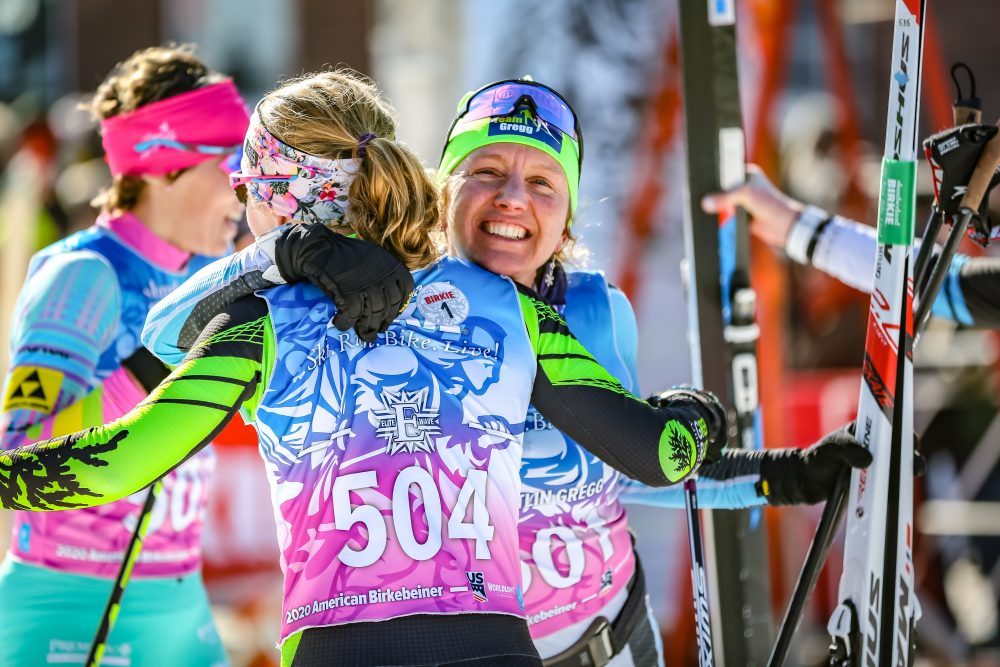
    Caitlin Gregg embraces former Olympic teammate Ida Sargent after the 2020 Birkie. (Photo: ©2020 American Birkebeiner Ski Foundation)

    Caitlin Gregg

    Club: TeamGregg/prgFinancial/Madshus

    Currently lives in: Minnesota

    Selected career highlights: Bronze medal, 10 km skate, 2015 World Championships; five-time champion, American Birkebeiner; multiple national championships

    Instagram page: @caitlincgregg

    Age: 39

    Elizabeth Guiney races at the PyeongChang World Cup in 2017. (photo: Nordic Focus)

    Elizabeth Guiney

    Club: Craftsbury Green Racing Project, or Craftsbury

    Currently lives in: Vermont

    Selected career highlights: 8th, 2020 American Birkebeiner; six top-10 results, 2019/2020 SuperTour; 3rd, 2015 Nationals

    Instagram page: @lizzie_guin

    Age: 29

    Julia Kern skis to 15th in the qualifier in Dresden in January 2020. (Photo: NordicFocus)

    Julia Kern

    Club: USST B Team; SMS

    Currently lives in: Vermont

    Selected career highlights: bronze medal, skate sprint, 2020 U23 World Championships; 3rd, Planīca skate sprint, 2019/2020 World Cup season; multiple other World Cup top-30 finishes; bronze medal, relay, 2017 World Juniors

    Instagram page: @juliakernski

    Age: 22

    Kaitlynn Miller (front) during the women’s classic sprint at the 2020 Senior Nationals. (Photo: Reese Brown)

    Kaitlynn Miller

    Club: Craftsbury

    Currently lives in: Vermont

    Selected career highlights: Five national championship podiums, including 2016 classic sprint national championship; 17 SuperTour podiums; 34th in World Cup 10km skate race in 2018/2019 season

    Instagram page: @kaitlynnbmiller

    Age: 28

    Becca Rorabaugh on course during the 10-kilometer individual start classic in Lahti, Finland, last month. (Photo: NordicFocus)

    Becca Rorabaugh

    Club: APU

    Currently lives in: Alaska

    Selected career highlights: Five national championship podiums, including 2014 10km classic national championship; 14 SuperTour podiums; 24th in sprint in 2012/2013 World Cup season, 39th in World Cup 10km classic last month

    Instagram page: @beccarorabaugh

    Age: 30

    Alayna Sonnesyn (bib 2) races in the skate sprint heats at 2020 U.S. Nationals. (Photo: Reese Brown)

    Alayna Sonnesyn

    Club: SMS

    Currently lives in: Vermont

    Selected career highlights: winner, 2019 American Birkebeiner; three podiums at 2020 national championships; three SuperTour podiums; finisher, Ski Tour 2020

    Instagram page: @asonnesyn

    Age: 23

    Hailey Swirbul (APU) during the women’s 10 k skate at 2020 U.S. Nationals. (Photo: Reese Brown)

    Hailey Swirbul

    Club: USST B Team; APU

    Currently lives in: Alaska

    Selected career highlights: silver medal, 5km classic, 2018 World Juniors; bronze medal, 10km skiathlon, 2018 World Juniors; 21st, Davos skate sprint, 2019/2020 World Cup season; three other World Cup top-30 finishes this season; bronze medal, relay, 2017 World Juniors

    Instagram page: @hai.swirl

    Age: 21

    Callie Young, of Newport, Vt., racing to second overall in the women’s race at the 2017 App Gap Challenge in Fayston, Vt. (Photo: Laurel Minde)

    Callie Young*

    Club: Dartmouth

    Currently lives in: Vermont

    Selected career highlights: Fourth, FIS Junior Invitational “Rising Stars” Race, Québec City, March 2019; first, 2020 Bates Carnival; 54th, sprint qualification, 2020 World Juniors

    Instagram page: @calliey0ung

    Age: 19


    * The athlete is making her World Cup debut in Québec City.

  • Doing Things Her Own Way, Erika Flowers is Third at the American Birkie

    Pushing the final meters of a crowded Main Street, Erika Flowers takes third at the 2020 American Birkie. (Photo: ©2020 American Birkebeiner Ski foundation)

    At the end of the 2018 season after being on the wrong side of the cusp of making the Olympic team, Erika Flowers made a transition in her ski career. She left her Stratton Mountain School T2 training group and returned home to Bozeman, MT where she began a role as the Associate Director at Profitable Ideas Exchange. However, Flowers did not hang up her skis — it was not retirement, just a transition and a new work-life-training balance to navigate. 

    And she has done so swimmingly. It has been one of her career best seasons, including a sprint and distance podium performance and racing in the final of three additional sprints. Flowers currently sits in second in the overall SuperTour standings, less than 30 points behind leader Kaitlin Miller (CGRP). 

    Most recently, Flowers was the top American and third overall at the Birkie 50-kilometer skate with a time of 2:15:00 (+1:39.4). After Jessica Yeaton charged off the front at OO (roughly 20 k in), Flowers worked with a chase pack that included Riitta-Liisa Roponen and Kaitlynn Miller.

    Additionally, in the Minneapolis SuperTour events the week before the Birkie, Flowers popped the fastest qualifying time in the freestyle sprint and ended the day second overall, and was just off the podium in 4th in the 5 k classic. 

    In this conversation, Flowers shares further insight into how she fits her training, which she plans with her husband Andy Newell, into her work schedule and discusses what she has learned through this transition. She explains that the saying “happy skiers are fast skiers” has given her a sense of freedom to do things a different way that she was accustomed to. 

    “There’s so many things that the athletes who are racing full time do to perform at that level and I think that you have to do those things to some degree. But I’m someone who always did things by the book and if someone told me to do eight intervals of this type, I would always do eight and maybe nine. That made me very fit, but I think it also maybe sacrificed some of the flexibility that’s also required to be a good athlete, and maybe at times, I was not as happy doing it that way as I could have been.” 

    Flowers also discusses her goals for the remainder of the ski season, which include racing in the Minneapolis World Cup sprint and the World Cup finals in Canmore. 

    We also discuss her summer plans to continue challenging herself in mountain running races, including her the 50 k at Run the Rut in Big Sky, MT. She also shares that she has recently received a nomination to the North Face trail running team and is currently looking through additional race options with them. Thanks for listening.

    Interview with Erika Flowers following the 2020 American Birkie.

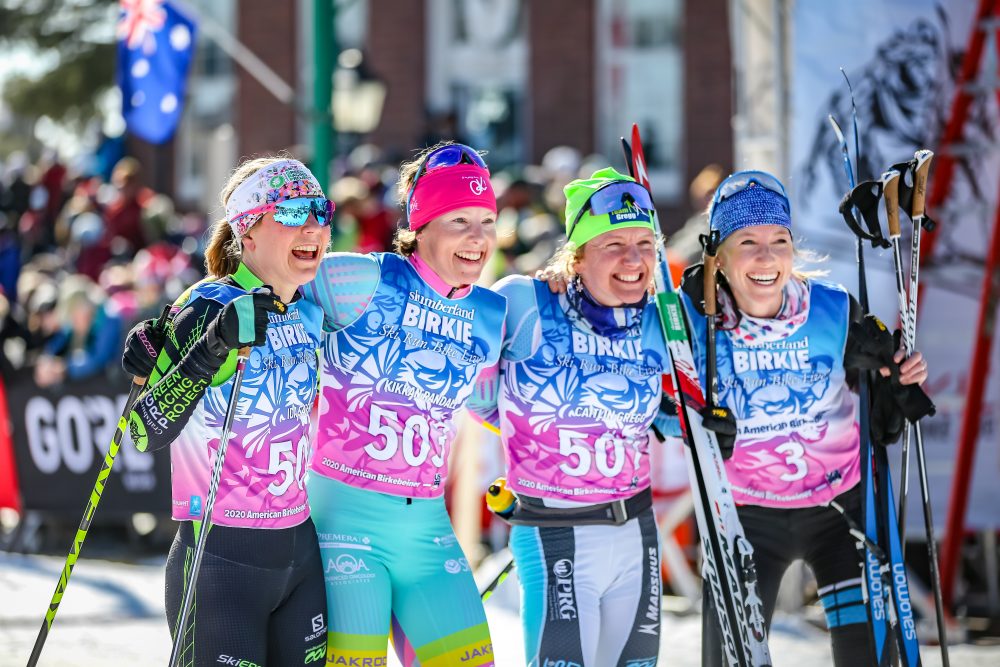
    All smiles after 50 k with perfect conditions. From left to right, Ida Sargent, Kikkan Randall, Caitlin Gregg, and Erika Flowers. (Photo: ©2020 American Birkebeiner Ski foundation)


  • Dyrhaug Outlasts Pack in Sub-2-Hour Birkie; Yeaton Shatters Women’s Record

    Dyrhaug Outlasts Pack in Sub-2-Hour Birkie; Yeaton Shatters Women’s Record

    The fever unleashed: start of the men’s elite 50 k skate wave at the 46th Annual American Birkebeiner. (Photo: ©2020 American Birkebeiner Ski Foundation)

    Several course records were shattered on Saturday in a largely faster-than-ever 46th annual American Birkebeiner, with temperatures steadily rising from the 20s at the start into the 30s by the finish of the point to point race from Cable to Hayward, Wisconsin.

    Eight men broke the two-hour mark in the Birkie’s 50-kilometer skate race, half of which are American, and an Australian national team member who trains in the U.S. broke the women’s race record by nearly three minutes.

    Niklas Dyrhaug of Trondheim, Norway, with the men’s overall win in the 2020 American Birkebeiner 50 k skate. (©2020 American Birkebeiner Ski Foundation)

    Niklas Dyrhaug, a 32-year-old Norwegian Olympian and former World Cup regular, reached the finish line first on Hayward’s snow-covered Main Street in 1:59:01.7 hours. While he missed the course record of 1:56:58.6 set by Italy’s Fabio Santus in 2010 by just over two minutes, Dyrhaug earned his spot in the Birkie books on Saturday. He held off second-place finisher Ian Torchia, a Minnesota native who trains with the Stratton Mountain School (SMS) T2 Team, by 1.6 seconds and France’s Robin Duvillard, another Olympian and multiple-time World Championships racer, in third by 1.9 seconds.

    Wisconsin’s own Adam Martin, who trains with the Craftsbury Green Racing Project, narrowly missed the podium in fourth (+2.7), while Norway’s Anders Gløersen was just behind in fifth (+3.0) and U.S. Ski Team/Alaska Pacific University (APU) member Erik Bjornsen next in sixth (+3.6).

    Another Craftsbury racer, Akeo Maifeld-Carucci followed in seventh (+8.0), then France’s Benoit Chauvet in eighth (+12.0). Sam Wood of Idaho placed ninth, 1:42.5 minutes behind the winner with a cumulative time of 2:00:44.2, just ahead of Kyle Bratrud of Minnesota and the SMST2 team in 10th (+1:47.6).

    Dyrhaug, who has two World Championship gold medals in the men’s 4 x 10-kilometer relays (in 2015 and 2017), was a Birkie rookie but hardly a surprise winner. In World Cup 50 k classic mass starts in Oslo, Norway, he placed second in 2016 and fifth in 2017. On Wednesday of this week, he placed second in the SuperTour 1.6 k classic-sprint qualifier in Hayward — part of the Birkie Week festivities — finishing 1.07 seconds off the winning time of U.S. Ski Team member Gus Schumacher.

    The men’s 5o k skate podium at the 2020 American Birkebeiner:(l to r) American Ian Torchia second, Norway’s Niklas Dyrhaug first, and France’s Robin Duvillard third. (Photo: ©2020 American Birkebeiner Ski Foundation)

    Meanwhile, Jessica Yeaton, who races for Australia and APU, set a new women’s Birkie 50 k skate course record in 2:13.20.6. The 28-year-old Olympian broke Caitlin Gregg’s record of 2:16:07 and placed 67th overall in Saturday’s 50 k skate. Finland’s 41-year-old Riitta-Liisa Roponen, a five-time Olympian who notably placed sixth in the 10 k skate at last year’s World Championships, was the second woman on Saturday, 41.7 seconds behind Yeaton. Former pro racer Erika Flowers, of Montana, placed third, 1:39.4 minutes out of first.

    Jessica Yeaton takes the women’s overall win in the 50 k skate at the 2020 American Birkebeiner in Hayward, Wisconsin. (©2020 American Birkebeiner Ski Foundation)

    Saturday’s 55 k classic race saw record-setting times from both the winning man and woman, with Peter Holmes of the Sun Valley Ski Education Foundation (SVSEF) defending his 2019 title with a time of 2:26:46, nearly 2 minutes faster than Juergen Uhl’s winning 54 k classic time of 2:28:39.4 in 2010. Holmes won Saturday’s race by nearly 12 minutes, with two Wisconsin skiers — Chris Pappathopoulos  (+11:52.4) and Evan Wetzel (+11:54.3) — following in second and third place, respectively.

    Wisconsin native Nichole Bathe, who trains in Norway and skis for the British national team, became the new women’s 55 k classic champion in a blistering 2:49:47.0. She beat out Jennie Bender’s 2011 Birkie classic record of 2:50:53 and finished more than five minutes ahead of Colorado runner-up Anja Gruber (+5:33.3) on Saturday. Wisconsin’s Delaney Fitzpatrick finished in just over 3 hours for third place, about 11 minutes behind Bathe.

    The women’s 50 k skate podium at the 2020 American Birkebeiner: (l to r) Finland’s Ritta-Liiisa Ropopnen second, Australian-American Jessica Yeaton first, and American Erika Flowers third (l-r). (©2020 American Birkebeiner Ski Foundation)

    Results: 2020 Birkie 55 k skate | 55 k classic

  • Craftsbury SuperTour Classic Sprint Rundown

    The US SuperTour kicked off the first races of the new year at the Craftsbury Outdoor Center with a classic sprint. The event, dubbed the 2020 Lost Nation Cup, brings together senior athletes, EISA carnival teams,  developing NENSA skiers, and citizen racers for a weekend of racing in the Northeast Kingdom of Vermont.

    “Retired” Craftsbury native Ida Sargent won the women’s race in a time of 3:55.47, followed by fellow CGRP athlete Kaitlynn Miller (+0.21), and Dartmouth Ski Team’s Katherine Ogden (+2.09). Erika Flowers posted the fastest qualifying time of 3:56.03; she finished fifth in the final (+6.67).

    Breaking down the heats in Craftsbury. (Photo: BullitTiming.com)

    On the mens’ side, Ben Saxton (SMST2) took the final in 3:19.0. He was followed by Canada’s Julien Smith of NTDC Thunderbay (+2.04) with Forrest Mahlen of APU in third (+2.25). University of Vermont athlete Ben Ogden was the fastest qualifier of the day in 3:18.62. Ogden was eliminated in the first heat of the semifinal, finishing 11th overall.

    Results from the men’s heats in Craftsbury. (Photo: BullitTiming.com)

    Racing continues tomorrow with interval start freestyle distance races Saturday and mass start classic distance races Sunday.


    Women’s Qualifier | Women’s Final Results

    Men’s Qualifier | Men’s Final Results

  • News Brief for the Week: The Mountain Runners & Skiers

    News Brief for the Week: The Mountain Runners & Skiers

    Erika Flowers (left) trail running outside Bozeman, Montana. (Photo: courtesy Erika Flowers)

    Needless to say, cross-country athletes have big motors.

    Let’s start with The Rut 50-kilometer mountain run in Big Sky, Montana. With 10,000 feet of climbing and descending, it’s a burly affair.

    On September 1st, Erika Flowers, cross-country skier of note and Bozeman local, won the women’s 50 k overall in a time of 6:51:52.41 hours. This was Flowers’ first 50 k running race.

    Elevation profile of The Rut 50 k. Pure burly. (Photo: runtherut.com)

    South of rugged Montana, in the thin air of Colorado, Liz Stephen won The North Face Grand Traverse mountain run on August, 31st. She claimed the 40.7 mile women’s win in a time of 7:17:46 hours. According to the Trail Run Project, the GT running course features 6,1976 feet of climbing as runners traverse portions of the Elk Mountains on the way from Crested Butte to Aspen.

    And way south in New Zealand, Jessie Diggins and Julia Kern, both U.S. Ski Team members, captured podiums at the New Zealand Winter Games.

    On September 3rd, Diggins won the classic sprint with Kern placing fourth.

    The following day, Diggins won the 5 k interval start skate while Kerns placed third.

    And on September 5th, in the 10 k mass start classic, Diggins placed first, Kern raced to third.


  • Out in Front, Caitlin Patterson Claims 20 k Skate National Championship

    Out in Front, Caitlin Patterson Claims 20 k Skate National Championship

    The women’s 20 k skate podium at the 2019 U.S. Cross-Country Nationals at Craftsbury, VT. From left to right, Jessica Yeaton (APU/Australian National Team) in third, Caitlin Patterson (CGRP) first, and Rosie Frankowski (APU) second. (Photo: John Lazenby)

    Link to mass start skate race photo gallery.

    Another distance race at U.S. Cross-Country Nationals in Craftsbury, Vermont and another win for Caitlin Patterson of the Craftsbury Green Racing Project.

    Count them up: eight U.S. national championships for the twenty eight year old. And in as many days at her home course, Patterson has further solidified both her legacy and the fact she is the distance racer to watch and match as the start gun fires.

    On Thursday of last week, Patterson opened U.S. nationals with a win in the 10 k classic. Today, in a time of 59.23.1 minutes, ticking off k after k, Patterson won the women’s 20 k skate mass start.

    “For the first [5 k] lap Rosie Frankowski and I traded off the lead a little bit,” Patterson told FasterSkier in Craftsbury. “She was leading the climbs and I was leading the downhills, but I could already feel it stretching on the downs. On the second lap when I pulled away on Kirby’s downhill heading towards like about 3 k into the loop, then the climbing was fairly good too, I just decided to keep charging and pull away. I skied a lot of the race by myself.”

    By 10 k, Patterson had eeked out a lead over Frankowski (APU), coming through the mid-race time check in 29:34.1. Frankowski came through 14.5 seconds later.  

    Caitlin Patterson during the 2019 20 k skate at U.S, nationals in Craftsbury, VT. (Photo: John Lazenby)

    “I was getting some splits that it was stretching, but Frankie is definitely a really strong climber so I didn’t want to let up,” Patterson said. “I needed to keep myself moving on those uphills. I was moving along well and pushing the pace but also feeling like I was fairly confident that I was going to be able to hold it.”

    Frankowski, a 2018 Olympian who placed 21st in the women’s 30 k classic in PyeongChang, remained true to her reputation as a gritty skier and thoroughbred climber.

    “It was hard from the gun honestly, the plan I kind of had was to just go as hard as I could and make it so it wasn’t a giant group because I don’t like skiing in a giant group,” Frankowski told FasterSkier. “I knew that breaking Caitlin would be really difficult to do and the only place I could probably do it was on steep uphills.”

    For the first 10 k, from Frankowski’s perspective, she attempted to execute her plan of attacking on the hills. Patterson could not be broken.

    “I tried to take some uphills and punch them,” Frankowski explained. “It didn’t really work. So the last 10 k I was on the solo train just like dying.”

    Catching glimpses of Patterson from time to time up ahead, Frankowski knew she wasn’t bleeding massive time to the eventual winner. Conversely, she understood skiers like Jessica Yeaton, an APU training mate, were seeking to link up from the back.

    “I could hear them getting cheered for,” Frankowski recalled. “And then on the last 5k my leg cramped up on the big uphill and I was like ‘oh my god’ I just have to try and finish. It was hard to motivate. I was trying my best, it was a hard head game for 10 k.”

    Frankowski was never caught, and her “head game” ended with a second place and a finishing time of 1:00:03 hours. 

    Yeaton, who skied the later part of her race with Hailey Swirbul (APU) and Evelina Sutro (UVM), was able to distance herself and take third overall, 6.7 seconds behind Frankowski.

    “It was really hard work out there, the first lap I went out hard and then died a little,” Yeaton said. “So I’m really happy I was able to hang on and pull up third place in the end because there was a lot of fighting for position in the middle of the race.”

    Yeaton also placed second overall in Thursday’s 10 k classic. She is an Australian national, as a result, Swirbul, the day’s fourth place skier, took third on the American podium.

    “It was really fun, my first 20 k but I have done a lot of 15s,” Swirbul said. “It was familiar territory in that way. But it was really a lot of highs and lows. The pace went out hot and stayed hot I think the whole time, for me at least. But it was really cool to be able to ski with teammates like Jess.”

    Caitlin Paterson (CGRP), post-2O k skate, post-U.S, national championship win. (Photo: John Lazenby)

    Sutro was fifth overall, Erika Flowers (Salomon) sixth, Alayna Sonnesyn (SMS T2) seventh, Canada’s Cendrine Brown (PHTC) eighth, Katharine Ogden (Dartmouth) ninth, and Kaitlynn Miller (CGRP) tenth.

    Racing continues at U.S. nationals with a skate sprint on Tuesday.

    Results

    -Kelsey Dickinson and David Brown Contributed

  • A Sovereign Lake NorAm/SuperTour Weekend Rundown

    A Sovereign Lake NorAm/SuperTour Weekend Rundown

    Julia Kern leading Dahria Beatty in the semi. (Photo: Pete Leonard)
    Julia Kern (SMS T2) leading Dahria Beatty (CNST) in the semi. (Photo: Pete Leonard)

    For the third consecutive year, the SuperTour and NorAm series met up at Sovereign Lake near Vernon, BC, for a combined race weekend of skate sprints and classic interval starts. Over 450 athletes competed each day in four age groups.

    According to many attendees, combining the two Continental Cup series was an unqualified success. While many of the skiers expressed their pleasure in interviews, one quote stood out.

    “The SuperNoram is the best idea ever.” — Sam Hendry

    The skate sprint course ran fast, with no new snow since Tuesday, ski speed on Saturday was faster still. The NorAm/SuperTour in Sovereign Lake has had classic sprints for the past few years. This iteration of the event was different since the organizers tested a new skate sprint course in advance of the 2020 Canadian Nationals. The jury selected a 1.2km variant over the 1.4km course option for race day. With no new snow for several days, even -9C air and -12C tracks resulted in fast glide. The end result was fast times, ranging from 2:15 minutes for the open men to 2:55 minutes for the junior women.

    “Felt good in qualification.” — Andy Newell described his day to FasterSkier in this video interview.

    Andy Newell (SMS T2) had a dominant day, winning the qualifier in 2:15.18 minutes, a full 4.05 seconds ahead of second place skier Logan Hanneman (APU), before easily winning each heat. Olivier Hamel (CNEPH) placed third finishing 6.70 seconds back.

    Antoine Briand dropping the pack, Andy Newell watching and waiting. (Photo: Pete Leonard)
    Antoine Briand dropping the pack, Andy Newell watching and waiting. (Photo: Pete Leonard)

    Newell led from the start in his quarter and semi-finals. In the final, Antoine Briand (CNEPH) pushed from the start after placing second to Newell in the first two rounds. However, the end result was the same. Briand pulled Newell away from the pack and Newell gapped Briand in the final 200m to take the win. Ben Saxton (SMS T2) took the four-up sprint for third, placing ahead of Hanneman, Antoine Cyr (CNST), and Ben Lustgarten (CGRP).

    Julia Kern (SMS T2) had a similarly dominant day for the women, winning the qualifier in 2:40.54 minutes, 3.52 seconds ahead of APU’s Hailey Swirlbul and 3.69 seconds ahead of Hannah Halvorsen (APU). Dahria Beatty (CNST) was Canada’s top qualifier, placing sixth, 7.36 seconds back, after she fell on the first corner.

    Kern won each of her heats comfortably, but the exciting action was in the pack. In the semifinal, Rosie Frankowski (APU) and Swirlbul hit the deep snow outside the course while attempting a slingshot from the back on the final ‘hole’ corner, a fast turn from the long downhill leading into a steep climb to the finish straight. There were a number of broken poles and minor crashes on that corner, but only those two left the track entirely.

    Julia Kern squeezing Dahria Beatty over the bridge. (Photo: Peggy Hung)
    Julia Kern squeezing Dahria Beatty over the bridge in the A final. (Photo: Peggy Hung)

    In the A final, Kern earned a gap on the final corner, leading a train of Beatty, Lauren Jortberg (Dartmouth), and Maya MacIsaac-Jones (CNST) to the finish. Halvorsen trailed in alone, followed by Erika Flowers (SMS T2) who broke her pole.

    Sunday’s Distance Events

    On Sunday, the classic tracks were glazing with -6C air and -10C snow at very high humidity. Many teams picked a hard over soft grip wax combo as no significant snow fell until the end of the race day. While a number of skiers needed to get out of the track in the final ‘technique zone’ climb on the last lap, it appeared that the issue was more often tired legs than lost grip wax.

    The classic distance races were much tighter than Saturday’s sprints, with some nail-biting finishes for the coaches.

    Katherine Stewart-Jones was attacking from the start. (Photo: Gerry Furseth)
    Canada’s Katherine Stewart-Jones was attacking from the start. (Photo: Gerry Furseth)

    Katherine Stewart-Jones (CNST) attacked from the start of the two-lap interval start race and hung on to win in 31:48.4 minutes. Her 15:30.7 minute split for her first lap was the fastest by 17.1 seconds, allowing her to keep the win despite a fifth fastest second lap. Becca Rorabaugh was second fastest on the first lap and third fastest on the second lap to take 2nd overall, 7.1 seconds back.

    Kern closed to 0.7 seconds behind Rorabaugh to take third place, while Swirlbul skied the fastest second lap to just miss the podium, 10.9 seconds behind Stewart-Jones and 3.1 behind Kern. Beatty was fourth at 26.7 seconds and first-year senior Hannah Mehain was ninth overall and the third Canadian.

    Novie McCabe (Methow Valley Nordic Ski Team) followed up her dominant junior sprint win with a 12th overall placing, 2:00.6 minutes back.

    In the men’s 15km classic, Kyle Bratrud (SMS T2) edged out Lustgarten by 3.8 seconds to win in 41:59.3 minutes. Ricardo Izquierdo-Bernier, representing the University of New Mexico and CNEPH, put Canada on the podium in third place at 34.7 seconds back.

    Junior skier Samuel Hendry (CJNST) edged Newell by 0.4 seconds to take fourth at 1:13.7 minutes back. Bob Thompson (TBay) was the third Canadian in seventh, 1:20.1 minutes behind, confirming his distance progress after a disappointing sprint day.

    Almost everyone in North American skiing came to the party. Jess Cockney and Olivia Bouffard-Nesbitt were seen testing skis for their teams. Bryan Fish was watching on behalf of the US team and shared his thoughts on international cooperation. New Canadian national team coach Erik Bråten offered his first impressions of Canadian racing. Follow the links below for all the video interviews.

    Full Weekend Results, Sprint Results, Distance Results

    Video playlists: Finals, Sprint Interviews, Distance Interviews

    Click the image twice to enlarge. 

  • Saturday Rundown: From Lillehammer to West Yellowstone (Updated)

    Saturday Rundown: From Lillehammer to West Yellowstone (Updated)

    The women’s podium from Saturday’s 10-kilometer freestyle individual start race in Lillehammer Norway. Norway’s Therese Johaug (center) placed first, Sweden’s Ebba Andersson (left) second, and teammate Charlotte Kalla (right) third. (Photo: NBC Sports Gold screenshot)

    FIS Cross-Country World Cup in Lillehammer Norway: 10 k/ 15 k Freestyle Individual Start

    Women’s Report | Men’s Report

    On Saturday, the second day of World Cup cross-country racing ensued in Lillehammer, Norway with a 10-kilometer freestyle individual start race for the women.

    On a track of snow surrounded by green fir trees and a soggy landscape, the women skied two laps of 5 k course. Norway’s Therese Johaug was the fastest skier at every checkpoint to win in a time of 26:22.4 minutes. Ebba Andersson, the upstart Swede skied to second (+9.2), and teammate Charlotte Kalla was third (+15.7).

    Collectively, it was a strong day for the U.S. women with four skiers in the top-30.

    Sadie Bjornsen of the U.S. Ski Team (USST) finished in ninth (+1:17.0) after placing third in yesterday’s skate sprint. Rosie Brennan (APU) skied to 11th (+1:29.3), the USST’s Jessie Diggins 12th (+1:29.9), Caitlin Paterson (CGRP) 30th (+2:28.2), Kaitlynn Miller (CGRP) 60th (+4:10.4), and Ida Sargent of the USST 63rd (+4:18.4), and Kelsey Phinney (SMS T2) 65th (+4:22.5).

    No Canadian women were entered.

    Seventy-two skiers finished the women’s race.

    Women’s Results

    The men raced three times around the 5 k loop for 15 k total and three times up the course’s big climb. In this early season, many of the perceived pre-race favorites finished further back in the field.

    Norway’s Sjur Røthe won in a time of 36:34.0 minutes. By the 8.3 k time check, Røthe took control of the race. Teammate Didrik Tønseth placed second (+6.0), while Russia’s Denis Spitsov was third (+28.6).

    Canada’s Alex Harvey was the best placed North American in 17th (+1:20.5). Also for Canada, Andy Shields  was 61st (+3:08.4), and Russell Kennedy (TEAM R.A.D.) 64th (+3:17.0)

    For the U.S., Erik Bjornsen of the U.S. Ski Team (USST) finished 43rd (+2:24.5), David Norris (APU) 54th (+2:44.5), Simi Hamilton (USST) 56th (+2:59.4), Paddy Caldwell (USST) 67th (+3:33.1), Kevin Bolger (USST) 68th (+3:38.7), Scott Patterson (USST) 73rd (+3:52.3), and Adam Martin (CGRP) 75th (+4:05.0).

    Men’s Results 

    ***


    SuperTour (West Yellowstone, Mont.): 1.3 k Freestyle sprints

    The fastest qualifier for the men on Saturday in West Yellowstone was SMS T2 athlete Andy Newell.  The Vermont native, now residing in Bozeman, Mont., won in a time of 2:35.53 minutes. His margin of victory was 7.26 seconds over second fastest qualifier, Alaska Pacific University (APU) skier Logan Hannenman. Newell’s teammate, Ben Saxton qualified in third (+7.79).

    Newell advanced to the finals by winning the first heat and first semifinal.

    buy augmentin, vteabp

    In the finals, Newell controlled the pace and made clear that at thirty five years old, he can still light up the domestic ranks. Newell won in a time of 2:41.66 minutes. Craftsbury Green Racing Project’s Ben Lustgarten placed second in 2:43.55 minutes, and University of New Mexico skier Ricardo Izquierdo-Bernier was third in 2:45.66 minutes.

    Adam Luban of the Sun Valley Ski Education Foundation Gold Team finished in fourth, Forrest Mahlen of Alaska Pacific University (APU) was fifth, and Ben Saxton (SMS T2) placed sixth in the men’s final.

    Julia Kern, a member of the U.S. Ski Development Team (UUSDT) and SMS T2 , won the women’s qualifier in 3:08.58 minutes. Second in the qualifier, also from SS T2, was Erika Flowers who finished 2.5 seconds behind Kern. University of Utah skier, Julia Richter qualified in third (+3.22). 

    Like Newell, Kern won both her quarterfinal and semi to make the finals.

    Kern won the women’s final in 3:09.85 minutes. APU’s Rosie Frankowski, the day’s fourth fastest qualifier, was second in a time of 3:11.37 minutes. Teammate Hannah Halvorsen (APU/USSDT) placed third, stopping the clock in 3:12.51 minutes. Halvorsen placed sixth in the qualifier. 

    Flowers ended up fourth in the finals, while Richter and Utah teammate Karianne Moe, placed fifth and sixth, respectively.

    West Yellowtone SuperTour Sprint Results

  • Back in Bozeman, Flowers Switches Gears

    Back in Bozeman, Flowers Switches Gears

    Erika Flowers (in red) racing at 2017 SuperTour Finals in Fairbanks, Alaska, where she posted a best result of third in the skate sprint. In the last six years, Flowers has reached the SuperTour podium 16 times and finished the 2017/2018 season fourth overall. (Photo: Clyde Hewitt)

    It wasn’t until recently that Erika Flowers learned the meaning of her middle name. At the time of her birth, her father had been cutting around Montana’s mountain slopes on Elan alpine skis. Though the brand’s company is based out of Slovenia, the definition of élan, according to Webster’s dictionary, is a vigorous spirit or enthusiasm.

    Whether Flower’s father, Pat, had researched the word’s meaning or whether the name had simply struck him, the skis were his muse. Erika became Erika Élan.

    “He just happened to be skiing on that brand, and I think he liked the sound of it,” Flowers said during a recent phone interview from her hometown of Bozeman, Montana. “So he and my mom named me Erika Élan Flowers.”

    For anyone familiar with Flowers, long, stick-straight, blond hair often bouncing around in a high ponytail and glacial blue eyes are idiosyncratic to the 28 year old. So is an intense verve, or élan.

    “I actually never knew it had any meaning (beyond just being a ski brand) until this winter when I randomly came across it in an article and looked up the definition,” Flowers wrote in an email. “That said, I think it describes how I try to approach life in general.”

    ***

    While many nordic skiers dream about racing against the all-stars of Norway, Sweden and other powerhouse ski nations, not everyone gets the chance to do so year after year.  

    A former University of Utah skier, Kevin Bolger, now 25, managed to make his way onto the international ski scene this past March, sprinting to 11th place in his debut World Cup race in Lahti, Finland. Two weekends later, Bolger claimed another top 30 at the World Cup Finals in Falun, Sweden.

    His breakthrough came after less than a year of training with the Sun Valley Ski Education Foundation (SVSEF) Gold Team; Bolger graduated from Utah in May of 2017.

    The timing was impeccable. Just as Bolger was working toward a spot at the World Cup level, two U.S. veterans stepped away from the circuit. Flowers’s husband, Andy Newell announced this spring that he would pursue new career adventures and train apart from the U.S. Ski Team (USST), and Noah Hoffman officially retired from ski racing in March.

    By the end of May, Bolger had earned a nomination to the USST B-Team.

    In an email to FasterSkier this spring, Bolger himself concluded that his transition to World Cup racing “couldn’t have been written any better.”

    Making it onto the women’s World Cup circuit as an American, at least for the past six years, has been more complicated. It’s even harder to make the USST. Since 2010, a number of strong names — like Sadie Bjornsen, Jessie Diggins, Ida Sargent, and Sophie Caldwell — have been added to the team, while few women have left.

    Aside from the retirements of Kikkan Randall and Liz Stephen this spring, Holly Brooks was the only other woman to retire from the team in the past six years. Brooks left in 2014.

    Rosie Brennan was first nominated to the USST in high school before being renominated in 2015,  and had been on the team ever since, but was not renamed for the upcoming season.

    In short, a roster of seven women (not including the development team) has been fairly standard to the USST for close to a decade.

    Outside the national team, the U.S. domestic women’s field also witnessed a surge in talent and depth over the last six years. From 2012 to 2018 alone, at least 10 non-national-team women worked their way to the World Cup race scene, including Caitlin Patterson, Kaitlynn Miller and Liz Guiney of the Craftsbury Green Racing Project, Chelsea Holmes, Becca Rorabaugh and Rosie Frankowski of Alaska Pacific University, Caitlin Gregg of Team Gregg (when she wasn’t on the national team in 2015), Jennie Bender of the Bridger Ski Foundation, and Anne Hart of the Stratton Mountain School.

    Any skier pushing to make a break would have a number of strong names to work around. But for Flowers, racing World Cups was a long-term goal, as was making skiing a sustainable profession for herself. She could spend hours sifting over rosters and names, but the only way to confirm anything was to try it out for herself. 

    American Erika Flowers (r) hugs her Stratton teammate Sophie Caldwell following the women’s 10-kilometer freestyle race at the 2017 World Cup Finals in Quebec City (Photo: Gretchen Powers)

    After graduating from Dartmouth in 2012, Flowers regularly finished in the top 10 of the overall SuperTour standings. She, too, earned a few World Cup starts. Flowers completed in all three races at 2017 World Cup Finals in Québec City, Québec, with a best result of 48th in the skate sprint.

    In the end-of-year SuperTour standings, her ranking also saw a steep jump. From 2013 to 2014, she went from 32nd to fifth overall and was fifth again in 2015. The next season, she finished seventh overall and was fifth again in 2017. She capped off this season with her best finish to date, earning fourth.

    Still, the sought-after World Cup starts remained elusive. As she developed, the USST also gained steam. Any progression she made also seemed to be matched by the cohort of American skiers she had be racing against since her departure from Dartmouth.  

    So why did she, summer after summer, push through intervals on rollerskis? Why spend each winter traveling to competitions, as Flowers put it, “living out of a bag”? Why did she continue to ski race year after year?

    ***

    Flowers was five years old when she first learned that her mother had breast cancer. Four years after her mother’s diagnosis, the family moved from Missoula to Bozeman. There, Flowers and her younger sister, Natalie, joined the Bridger Ski Foundation (BSF) cross-country youth program.

    The BSF community provided a niche for the Flowers siblings. The cancer treatments their mother was receiving also showed promise. Following her diagnosis and treatments in 1995, Hedvig Rappe-Flowers, Erika’s mom, was cancer-free for more than five years, according to an article by the Bozeman Daily Chronicle.

    But the cancer returned. Rappe-Flowers, a native of Sweden, encouraged her daughters to keep skiing. Do what made them happy. Both of them did.

    Erika Flowers during the early stages of her nordic career. “It was the first time I’d ever had my photo taken by any sort of professional and I remember just having no idea what I was doing but its become one of my favorite photos if only because it’s very raw and unedited and from a time when I was just starting to gain some real confidence both in who I was as a person and an athlete,” Flower wrote. (Photo: Chris Milliman)

    “My mom passed away from breast cancer when I was 17 which gave me a strong appreciation for how precious and valuable each day is and I know that I don’t want to waste one of them,” Flowers wrote in an email. “I think that’s another reason I probably decided to ski race for as long as I did — it was my first love and for all I know I could find out I have breast cancer tomorrow.

    “What I do know is that I spent the last 16 years of my life doing something I absolutely loved!” she continued. “I think that has been on my mind a lot these days, especially given Kikkan’s recent diagnosis.”

    Randall was diagnosed with breast cancer last month.

    “Kikkan’s a tough cookie though and I have no doubt she will tackle cancer the same way she has her many other challenges in skiing and in life — with equal parts fierce tenacity, bravery and grace,” Flowers added.

    While joining Randall in skiing’s elite racing ranks was certainly a goal, it wasn’t the only reason Flowers skied. Nor did she ski in her mother’s name — though Hedvig did instill in her daughters an enthusiasm for nordic sport and a steely resolve in all that they chose to do.

    “At her memorial service, one of the songs we played was ‘Hard Headed Woman’ — that really kind of describes her,” Flowers said. “She wouldn’t take no from anyone and believed so strongly in the idea that you could do anything you set your mind to.”

    The mercurial sport of cross-country ski racing had taken its hold. And Flowers was not about to let go.  

    Racing brought numerous challenges. Days when her body felt great, but the wax was too slow. Times when foul weather hit midway through a competition, slowing the course. 

    “Those variables can be extremely frustrating when they don’t go your way,” Flowers wrote.

    Frustrating, but simultaneously motivating, in its own way.

    “When everything does come together, it’s the most exhilarating and addicting feeling in the world!” she noted. “I think I always thrived on the challenge of it all.” 

    Four years ago, Flowers even gave biathlon a shot, traveling to Lake Placid, N.Y., for a US Biathlon talent camp. While she showed promise, Flowers ultimately stuck with cross-country.

    Erika Flowers (l) and Andy Newell at the 2017 World Cup Finals in Quebec City. (Photo: Gretchen Powers)

    Skiing had deeper roots than racing and results for Flowers. It was a family affair (she credits her mother with having taught her how to skate ski). It was how she met most of her closest friends. It was also how she met her husband, Newell, whom she married last year.

    “The people, the fact that every day my job is to go outside and work on getting better at something I love, the travel, and the challenge and unpredictability of professional sport,” Flowers wrote of what had kept her ski racing into her late twenties. “Lastly the support of countless friends, sponsors and supporters is one of the most important things that kept me involved for so long. Had I not had that level of support I would not have been able to race for as long as I did or reach the levels of success I did.”

    At the root of Erika’s lifelong élan was, and still is, skiing.

    ***

    About a year and a half shy of her 30th birthday, Flowers is back where it all started. She and her husband and former Stratton Mountain School (SMS) teammate, Newell, packed up a U-Haul this spring and drove from Vermont to Bozeman. Back in her hometown, Flowers competed in the 20-mile Ed Anacker Bridger Ridge Run in June. She still trains, most often with Newell, and unabashedly states that yes, she still rollerskis.

    Since leaving Stratton, she does not currently have a formative training plan or program. Prior to moving, Flowers explored every “decision matrix possible” and spoke with numerous athletes and non-athletes alike about what she should do next. In the end, taking a step back from skiing seemed best.

    Team photo of last season’s Stratton Mountain School T2 Team: (back row, right to left) Erika Flowers, Sophie Caldwell, Jessie Diggins, Julia Kern, and Annie Hart. (Front row, r to l) Andy Newell, Simi Hamilton, head coach Pat O’Brien, Ben Saxton, and Paddy Caldwell. (Photo: Reese Brown)

    “It wasn’t that I was sick of the lifestyle or anything like that,” Flowers explained. “I think it was more I’ve been doing it for long enough to recognize that my improvement curve is not what it needs to be in order to ultimately be able to make skiing into something that’s sustainable; something that can help me achieve some of the other goals I have in life, whether that’s getting a house or sitting on the board of a company.

    “I think that’s also what made it so hard,” she continued. “In some ways it’s walking away from something I absolutely love to start at the bottom of another passion.”

    Skiing has opened up a few other professional outlets for Flowers to pursue. She unofficially began social-media work for the National Nordic Foundation and USST this spring. She also is an athlete ambassador for the Women’s Sports Foundation. Her ties to nordic skiing becoming ever more intricate. 

    “Some people want to go all in for X number of years and retire and never look at a pair of rollerskis or race skis again,” Flowers reflected. “But to me, the word ‘retire’ sounds like something reserved for people in their late 60s, early 70s … maybe that’s why I haven’t used that word, it just doesn’t fit.

    “I think for me, it’s more deciding to take a step back from pursuing racing full time and looking at opportunities to pursue something else more fully,” she said. 

    The change of pace is in no way preventing her from getting outside. With Newell still planning on ski racing, just not full time on the World Cup, she’s still plenty invested in the nordic world.

    “From my end I just try to be supportive no matter what,” Newell said on the phone. “I think she’s been training so much and so well … she can take this year and try something new, even take a few months and try something new, and it would still be be pretty easy for her to jump into some races and make a comeback. Because I can tell you from my perspective, as her husband and as somebody that trains with her on a regular basis, she’s not slowing down even though she has other goals outside of skiing.”

    Former Stratton Mountain School teammates, now husband and wife, Andy Newell and Erika Flowers during a rollerski training session. (Photo: Reese Brown)
  • The Andy Newell Anti-Retirement Story

    The Andy Newell Anti-Retirement Story

    Andy Newell (c) of the U.S. Ski Team (USST) and Stratton Mountain School T2 Team after winning the men’s classic sprint at 2018 SuperTour Finals on March 24 in Craftsbury, Vt. His Stratton teammate Ben Saxton (l) placed second and Erik Bjornsen (r), of the USST and Alaska Pacific University, placed third. (Photo: John Lazenby/Lazenbyphoto.com)

    When Andy Newell took to social media about a week and a half ago to announce that he was parting ways with the U.S. Ski Team (USST) after 16 years, some people might have assumed that he was leaving the sport. They would be wrong.

    Newell, a 34-year-old Shaftsbury, Vermont, native and USST A-team member for the last 12 seasons, was quick to clarify that he’s not retiring from racing. After four Olympics and 16 years on the team, he’s just ready to be his own boss and set his own schedule.

    “I guess in the back of my mind I always knew once the [2018] Olympics were over I would most definitely take a step back from being a full-time international ski racer and definitely take a step back from being a U.S. Ski Team national-team racer,” Newell said in a phone interview earlier this week. “Because that way, it allows me much more flexibility with my schedule even in the summer as far as training camps go and obviously a ton more flexibility in the winter as far as how much time I need to spend away from home racing World Cups.”

    American Andy Newell racing the men’s 1.5 k freestyle-sprint qualifier at Stage 1 of the 2017/2018 Tour de Ski on Dec. 30 in Lenzerheide, Switzerland. He qualified 20th and went on to finish 19th on the day. (Photo: Fischer/Nordic Focus)

    Newell spent all of last season — from Oct. 29 until mid-March — on the World Cup circuit in Europe (except for when he was at the Olympics in PyeongChang, South Korea, for the month of February). He rarely saw his wife, Erika Flowers, whom he married last June. The two arranged quick trips to see each other when they could, but as full-time ski racers on different circuits, it was a challenge.

    “Five, six, seven, or ten years ago, I was making many of these decisions as an individual, and now that I’m married, I definitely have a lot more to consider than just myself when I make decisions when it comes to planning and scheduling,” Newell said.

    While he was hesitant to elaborate on his plans moving forward, Newell emphasized that he’ll continue to race in the near future.

    “Right now, I guess my plan would be to get back to a simpler schedule where I am still training at a high level but not focused really at all on World Cup racing,” he said. “So I might target a few races that I’ve always really wanted to do, for example some of the Ski Classics possibly over in Europe like the [Norwegian] Birkebeiner, possibly the American Birkebeiner. I think there’s so many great ski experiences that we have out there other than racing World Cups every weekend.”

    And at this point, he’s not completely ruling out another run at World Championships.

    “If I’m feeling like a complete champion by doing some of these different races, then you might see me trying to take a stab at something like World Championships,” Newell said. “But I’m not really putting any pressure or expectations on that, I’m more just looking to get back to a more simple training and racing routine where I can come up with my own schedule and plans and just remember what it’s like to really enjoy ski racing and doing the ski races that I want to do.”

    Growing Up on the Ski Team

    Andy Newell with some hardware after placing fourth in the season-long Sprint World Cup for the 2009/2010 season. (Photo: Kikkan Randall)

    Newell first landed a spot on the U.S. Ski Team as a high-school senior at the Stratton Mountain School (SMS) in Stratton, Vermont. He was initially selected to the development team, which came with invitations to national-team training camps — like the present-day development “D” team — as well as summer housing at the USST base in Park City, Utah.

    That season, in 2002/2003, Newell raced at World Championships in Val di Fiemme, Italy, and nearly qualified for the heats in the skate sprint (placing 31st). Just 19 years old at the time, he also competed at Junior World Championships in Sollefteå, Sweden, where he placed second in the qualifier and seventh overall in the freestyle sprint.

    He competed in his first World Cup in 2004 and made the leap to the USST A-team in 2005. Newell then began his 12-season streak on the A-team, which entailed the team’s highest level of financial support. He reached the World Cup podium three times as an individual — first in 2006 in Changchun, China, where he placed third in a freestyle sprint. In doing so, Newell became the first American to medal in a World Cup race since Bill Koch did the same 23 years prior.

    While Koch was a distance racer — like every international nordic racer of his era — Newell earned his chops as a sprinter and came onto the World Cup scene when short-distance sprint races were in full swing (the format was introduced at 1999 World Championships and 2002 Winter Olympics).

    “I think back on those years, and they were so cool,” Newell said of his early days on the team. “To be, like, 20 years old and beginning to race World Cups. … I remember in ’05, I got a top 15 in a World Cup, and that was the first time that had happened for the U.S. in the last however many years, and because of things like that, every weekend something new and exciting was happening.

    “I started doing better in some of the sprints and winning the qualification and getting a top 10 here, and the next year I was on the podium after that in ’06,” he continued. “And so it was a very quick trajectory to becoming one of the best sprinters in the world at that time.”

    He raced at eight World Championships with his best result coming in 2007 in Sapporo, Japan, where he placed fifth in a classic sprint.

    “I won the qualification in the sprint and ended up finishing fifth, but I remember being pretty disappointed,” Newell reflected. “I thought I totally could’ve been on the podium there.”

    Andy Newell racing in late 2009. (Photo: Fischer/NordicFocus)

    His other two World Cup podiums came when he placed second in a 2008 skate sprint in Lahti, Finland, and third in a 2010 classic sprint in Drammen, Norway. In four Olympics, Newell achieved two individual top 20s in skate sprints (16th in 2006 and 18th in 2014), and ninth in the freestyle team sprint at the 2010 Olympics in Vancouver, B.C.

    In PyeongChang this past February, he raced to 37th in the classic sprint and 14th with the men’s 4 x 10-kilometer relay. Reflecting on those Olympics, Newell said he was personally disappointed with his results, but thrilled to be a part of history with his team.

    “I felt like I had put in the time, time and effort and preparation to race better than I did,” he said. “But at the same time, we created such a great, tight unit and team throughout the last four years that for me, it was just so great to be there, to be there on the day that Jessie [Diggins] and Kikkan [Randall] won a gold medal. … Even though I didn’t ski my best, it was still, to me, in a lot of ways a success to be there; it’s been a successful year in that respect.”

    ‘A Little Bit of a Guinea Pig’

    Asked how the sport, specifically sprinting, has changed over the years, he said it’s been gradual but noticeable. Moreover, his ability and willingness to adapt is what has kept him in it this long.

    “If you were to look back on a World Cup sprint from 2005, the technique would look a lot different than it does now,” he said. “Many of the courses are the same, some are a little longer now than maybe what you would see back in the early 2000s for sprinting, but I think, in order to be competitive then, and also still competitive now, I’ve had to try to adapt as best as I can, and always be willing to learn new things.

    Fifth in the 2012/2013 Sprint World Cup, Andy Newell (r) with women’s Sprint World Cup winner and fellow U.S. Ski Team member Kikkan Randall at 2013 World Cup Finals in Drammen, Norway. (Courtesy photo)

    “I think if I would have assumed I was doing everything right or couldn’t improve, then I would have definitely been left behind I think years and years and years ago,” Newell continued. “I think people like Kikkan have done a really good job of that, and something that I’ve really tried to do, too, over the years, is always being willing to learn something new and not really have an ego about your shortcomings as an athlete.”

    He explained that a consistent theme of his career was his willingness to venture into unchartered waters when it came to training.

    “I’ve been a little bit of a guinea pig for the U.S. Ski Team in a lot of ways,” Newell said with a laugh. “I was probably the first athlete to go over and race an entire World Cup season. They hadn’t done that before we started scoring those kind of World Cup points in the mid-2000s, so it was like, how do we create a training plan that’s going to allow us to be successful at World Championships but also still race an entire World Cup season? So it’s been a great learning process for me and also I think the coaches over the last 20 years.”

    Over the last two decades, Newell said he’s mainly worked with Chris Grover, the current U.S. Ski Team head coach, and more recently, USST Assistant Coach Jason Cork.

    “Chris Grover wrote my training plans for probably the majority of my career,” Newell explained. “In the last four years or so, I started to work more with Jason Cork and also myself, I do a lot of the writing myself.

    “I think I’m someone who likes to be a student of the craft of what I’m working on; I think I’ve always been like that,” he continued. “When a coach tells you to do something, you’re always kind of like, OK, but I would always want to ask why we do a certain workout the way we do and how it builds … I’ve just liked to learn about training principles over the years, and so as I’ve gotten older, I’ve gotten more involved in writing, going over training plans myself, and incorporating ideas and workouts that I want to do. And I’ve done a lot of dumb, crazy stuff over the years, too.”

    Andy Newell celebrating the end of the 2012/2013 season with some acrobatics in Falun, Sweden. (Photo: Adam Alexander Johansson, XHC)

    Newell may be best remembered for his extreme stunts on ‘X Ski Films’, a filmmaking company he owned and starred in for several years, which included backflips and other airborne tricks on cross-country skis.

    He’s also spent the last two decades training out of Stratton with three main coaches: Sverre Caldwell, Gus Kaeding, and most recently, Pat O’Brien, head coach of the SMS T2 Team. Newell met Flowers on that team, and while he won’t be a full-fledged member of SMS T2 this year, Newell said he’s looking to maintain a strong relationships with both Stratton and the U.S. Ski Team.

    “In some ways I don’t think it feels like I’m retiring because I’ve kind of always had such a passion for pushing the level of skiing forward in this country,” he said. “And for me as an athlete, that was the best way I could do that, and I know as I transition into different roles in the skiing community, my goal [is] to continue hoping to improve the level of skiing in this country and improve the professionalism of skiing in this country and inspiring the youth skiing movement in this country — all those goals that I had as a ski racer — I will continue to have as a coach or a team leader or whatever my next role is going to be.

    “I’d like to work with development as far as helping some younger kids out, so I’m going to try to look for opportunities where I can do that,” he added. “I think it’s kind of a natural transition from athlete to coach in a lot of ways, but I’m still very much going to be an athlete at least in the near future.”

    Looking back on his years with the national team, he likened it to the pride one would have in a college or university they graduated from.

    “I’m just really proud of my time that I’ve spent with the team and so grateful for all of the opportunities that the U.S. Ski Team has given me over the past two decades,” he said. “It’s probably the same way that people who go to universities and so forth feel about having that kind of pride for their alma mater. I never went to college so it’s like the U.S. Ski Team kind of scooped me up at 16, 17 years old. Everything that has built me up into the kind of person that I am now, that has molded me into my character, everything has more or less has come through the U.S. Ski Team.”

    Andy Newell (U.S. Ski Team) after his quarterfinal at a 2015 World Cup freestyle sprint in Davos, Switzerland. (Photo: JoJo Baldus)

    Is he nervous about going out on his own? Newell said it’s been a long time coming, and he’s more excited than anything.

    “The spring’s always a funny time because you’re pretty exhausted from the season,” he said. “In a lot of ways, kind of the last thing you want to think about is skiing, but for me, I’ve always been one of those people that in the springtime gets super excited about all the opportunities. … By April 1, I [would be] already thinking, ‘Oh, what can I do for training next year?’ … and I start throwing around all these crazy ideas. I think that’s one of the things that’s kept me in the sport for so long, is having that excitement around training and preparation.

    “I think it will be exciting in a lot of ways to try to be my own boss and do some of the training camps I want to do and partner up and train with some of the athletes that I want to train with,” he said of this spring and summer. “Not that I was ever held back by the U.S. Ski Team, but you definitely had to adhere to a certain schedule so I think it will be exciting to do some different things.”

    From Sprints to Marathons?

    In late January 2016, shortly before Newell spoke with FasterSkier about mulling retirement, or at least taking a step back from full-time ski racing, he double poled his way to second place in the 42-kilometer Dolomitenlauf classic marathon (part of the FIS Marathon Cup series) in Lienz, Austria. Never one to like being labeled a “sprint specialist”, Newell is looking forward to trying more marathon races like that.

    American Andy Newell (r) outsprints Italy’s Mauro Brigadoi, for second place in the 2016 Dolomitenlauf 42 k classic race in Lienz, Austria. (Photo: Fischer/NordicFocus)

    “I have a lot of great friends who train for the Ski Classics [marathon series] and a lot of my Norwegian buddies who I have raced World Cups with over the years have gone that route after their World Cup racing career,” he said. “It’s a cool idea because those races are super fun, there’s great prize money, there’s a lot of excitement over them, and I think it’s really impressive when you see somebody just crush 90 k’s of double poling like they do in the Vasaloppet.

    “So I’m definitely inspired by those guys and I, as an athlete, really like classic skiing,” he continued. “I love traditional-style classic skiing and I like double poling, so I think maybe in the future I will try to get into a few of those races, but it’s hard to do those and not be committed 100 percent because those guys that do those, they’re training to crush double pole like nobody’s business, so it’s hard to just show up on a weekend and race one of those races.”

    Andy Newell and Erika Flowers, both of the Stratton Mountain T2 Elite Team, after both won the 2014 Jim Bridger Trail Run in Bozeman, Montana.

    Aside from the fitness required to double pole an entire marathon, the logistics of these races — many of which start in one town and end in another — is particularly challenging without a full-support crew or team.

    “I’d really like to do the [Norwegian] Birkebeiner and I think it will take a few times to be able to consider yourself a threat to the podium in a race like that,” Newell said. “I would be foolish to think I could just jump into a Ski Classics race and crush it, but it’s definitely a goal of mine to maybe do some of those over the next years because I think they’re such legendary, badass ski races.”

    In the near future, Newell and Flowers are headed out on a three-week “surf trip” to Australia and Indonesia.

    After that, “it’s yet to be seen how everything will fit in,” Newell said in regards to his future plans, both living, training, racing, and otherwise. “There will be more to say later as far as what I have going on for next year as far as what my goals will be.”

  • Spring Series Rundown: Diggins 2-for-2; Erik Bjornsen Wins Men’s Mass Start

    Spring Series Rundown: Diggins 2-for-2; Erik Bjornsen Wins Men’s Mass Start

    Erik Bjornsen (2) of Alaska Pacific University and the U.S. Ski Team (USST) leads Simi Hamilton (13), of the Stratton Mountain School T2 Team and USST, and Tad Elliott (12), of Ski Club Vail toward the finish of the men’s 15 k freestyle mass start at 2018 SuperTour Finals in Craftsbury, Vt. (Photo: John Lazenby/Lazenbyphoto.com)

    2018 U.S. SuperTour Finals (Craftsbury, Vermont): 10/15 k freestyle mass starts

    Jessie Diggins won her second-straight race in as many days at 2018 SuperTour Finals and Erik Bjornsen pulled out a victory in the men’s 15-kilometer freestyle mass start on Saturday in Craftsbury.

    Jessie Diggins (201) and Sadie Bjornsen (202) lead the women’s 10 k freestyle mass start at 2018 SuperTour Finals in Craftsbury, Vt. (Photo: John Lazenby/Lazenbyphoto.com)

    Diggins, of the Stratton Mountain School (SMS) T2 Team and U.S. Ski Team (USST), won the women’s 10 k freestyle mass start in 25:56.0 minutes, just 1.2 seconds ahead of her USST teammate Sadie Bjornsen of Alaska Pacific University (APU) in second. The duo dropped the pack and battled to the line, while Kikkan Randall (APU/USST) skied on her own to third place, 12.6 seconds behind Diggins.

    APU took three of the top four with Rosie Frankowski finishing 43.7 seconds back in fourth. Caitlin Patterson of the Craftsbury Green Racing Project (CGRP) followed in fifth (+1:02.2), and Sophie Caldwell (SMST2/USST) took sixth less than one-tenth of a second ahead of her Stratton teammate Katharine Ogden (Dartmouth College/SMS/USST Development Team) in seventh (+1:10.4). US Biathlon’s Susan Dunklee (CGRP) placed eighth (+1:19.4), Julia Kern (SMST2/USST D-team) finished ninth (+1:26.0), and Erika Flowers (SMST2), who competed at last weekend’s Norwegian Birkebeiner, placed 10th (+1:37.0).

    In the men’s mass start, Bjornsen (APU/USST) and Simi Hamilton (SMST2/USST) went head to head down the finishing stretch for first, which Bjornsen took in 35:08.1. Hamilton finished 1.5 seconds back in second place, while Tad Elliott (Ski Club Vail) followed three seconds later in third (+4.6).

    According to live timing, Paddy Caldwell (SMST2/USST) edged his fellow national-team member Scott Patterson (APU/USST) by less than one-tenth of a second for fourth place (+6.5). Brian Gregg of Central Cross Country (CXC), Team Gregg and Loppet Nordic Racing placed sixth (+30.4), David Norris (APU) finished seventh (+52.1), Jack Hegman of the Sun Valley Ski Education Foundation (SVSEF) eighth (+55.3), Adam Martin (CGRP) ninth (+56.2), and Eric Packer (APU) 10th (+59.8).

    Spring Series continues Sunday with mixed relays at 9 a.m. EDT at the Craftsbury Outdoor Center.

    Results: Women | Men

    Live timing

    SuperTour live stream

  • Ishpeming SuperTour Rundown: Norris Tallies Two Wins, Three Podiums

    Ishpeming SuperTour Rundown: Norris Tallies Two Wins, Three Podiums

    The SuperTour men’s 20 k freestyle podium on Saturday, Feb. 17 in Ishpeming, Michigan, with David Norris (c) in first, Kevin Bolger (l) in second, and Brian Gregg (r) in third. (Photo: APU)

    U.S. SuperTour (Ishpeming, Michigan): Friday, Saturday and Sunday

    The SuperTour circuit ventured to the Al Quaal Recreation Area in Ishpeming, Michigan, this past Friday, Saturday and Sunday for three days of racing Feb. 16-19.

    Day 1

    In Friday’s 1.6-kilometer freestyle sprints, Kevin Bolger of the Sun Valley Ski Education Foundation (SVSEF) posted a 2.69-second victory in the men’s final over his teammate Jack Hegman in second and 3.02 seconds ahead of David Norris of Alaska Pacific University (APU) in third.

    Bolger started the day by qualifying first in 3:43.04 minutes (2.41 seconds ahead of Hegman in second). Eighteen men entered the race, all of which advanced to four quarterfinals. Bolger went on to win his quarterfinal and semifinal before ultimately winning the final in 3:38.45.

    Kris Freeman (Caldwell Sport) finished fourth in the final (+6.4), Forrest Mahlen (APU) took fifth (+10.07), and Eric Packer (APU) was sixth (+10.1).

    In the women’s sprint, Northern Michigan University (NMU) sophomore Anikken Gjerde Alnæs edged Erika Flowers of the Stratton Mountain School (SMS) T2 Team by 0.1 seconds for the win in 4:09.87. Alnæs, of Norway, had previously won the qualifier in 4:22.88, 1.72 seconds ahead of Flowers in second.

    With 10 women entering the qualifier, all 10 were seeded in two semifinals. Alnæs won the first semi in 4:20.24, and APU’s Chelsea Holmes won the second semi in 4:14.18.

    In the final, Alnæs shared the podium with Flowers in second and Kaitlynn Miller of the Craftsbury Green Racing Project (CGRP) in third (+6.75). Holmes placed fourth (+7.49), Liz Guiney (CGRP) was fifth (+2.13), and Canada’s Sophie Carrier-Laforte finished sixth (+7.3).

    Day 2

    The SuperTour women’s 15 k freestyle podium on Feb. 17 in Ishpeming, Michigan, with Chelsea Holmes (c) in first, Caitlin Gregg (l) in second and Erika Flowers (r) in third. (Photo: APU)

    On Saturday, APU reigned, with Holmes winning the women’s 15-kilometer freestyle and Norris topping the men’s 20 k skate.

    In the women’s race, Holmes and Caitlin Gregg (CXC Team/Loppet Nordic Racing/Team Gregg) broke away from the field and duked it out for first, with Holmes taking it by 5.9 seconds in 42:37.1. Almost two minutes back, Flowers placed third (+1:58.4) to return to the podium. Kristen Bourne (NMU) placed fourth (+1:59.7), Miller was fifth (+2:01.2), Guiney sixth (+2:01.6), and NMU had two more in the top eight with Nicole Schneider in seventh (+2:02.5) and Alnæs in eighth (+2:07.5), respectively. Carrier-Laforte finished ninth (+2:25.3) and another Canadian Alannah MacLean (NTDC Thunder Bay) was 10th (+2:45.7) out of 43 women.

    In the men’s race, the top-eight finishers were separated by less than 10 seconds, with Norris taking the win by 2.9 seconds over Bolger in 50:01.7. Brian Gregg (CXC Team/LNR/Team Gregg) placed third (+5.9), 1 second ahead of Ben Lustgarten (CGRP) in fourth (+6.9). In a photo finish for fifth (+7.2), Tad Elliott (Ski Club Vail) took it by 0.1 seconds over Adam Martin (CGRP) in sixth (+7.3) and Hegman in seventh (+7.3). Ian Torchia (NMU) finished eighth (+9.9), Canada’s Evan Palmer-Charrette (NTDC Thunder Bay) was ninth (+16.0), and Kyle Bratrud (CXC Team/LNR) 10th (+18.1) out of 62 finishers.

    Day 3

    On Sunday, Norris raced to his second-straight win (and third in as many distance races since winning the 15 k classic pursuit on Feb. 4 at the NorAm/SuperTour in Gatineau, Quebec). With a time of 24:42.7, Norris skied 28.2 seconds faster than Lustgarten in second place, and Freeman joined them on the podium in third (+32.4). Martin followed in fourth (+34.5), Hegman was fifth (+35.9), Bolger sixth (+39.3), Zak Ketterson (NMU) seventh (+42.5), Bratrud eighth (+42.8), Elliott ninth (+1:00.5), and Torchia 10th (+1:02.2).

    Miller won the women’s 5 k classic on Sunday in 14:53.9, just 2.7 seconds ahead of her Craftsbury teammate Guiney in second. Holmes returned to the podium in third (+7.8), and was followed by Felicia Gesior (CXC Team/Peak Nordic) in fourth (+32.4), Vivian Hett (NMU) in fifth (+36.5), Flowers in sixth (+46.5), Bourne in seventh (+58.5), MacLean in eighth (+1:00.8), Alnæs in ninth (+1:05.3), and Carrier-Laforte in 10th (+1:05.3).

    Results: 

    Day 1: Freestyle sprints

    Day 2: Women’s 15 k freestyle | Men’s 20 k freestyle

    Day 3: Women’s 5 k classic | Men’s 10 k classic

  • Saturday Rundown: Relay Silver for U.S. Men; Loomis 4th; Plus Hakuba & Gatineau

    Saturday Rundown: Relay Silver for U.S. Men; Loomis 4th; Plus Hakuba & Gatineau

    The U.S. men’s silver-medal relay at 2018 Junior World Championships in Goms, Switzerland, with (from left to right) Luke Jager, Hunter Wonders, Gus Schumacher, and Ben Ogden. (Photo: JWSC2018.ch)

    (Note: This article has been updated to include comments from Americans Ben Loomis, Luke Jager and Gus Schumacher.)

    Junior World Championships (Goms, Switzerland): Men’s and women’s relays

    Two individual medals and a relay podium. That’s how the U.S. team fared this week at Junior World Championships in terms of a medal count, but the significance of its breakthroughs go way beyond the hardware.

    Hailey Swirbul became the most successful American nordic skier at Junior World Championships with a silver and a bronze in the two women’s distance races. Then, on Saturday, the U.S. men took their turn in the spotlight, racing to second and almost first in the 4 x 5-kilometer relay for the best relay finish by an American team at Junior Worlds. Last year, the U.S. women placed third at 2017 Junior Worlds at Soldier Hollow in Midway, Utah.

    Luke Jager started the team off on Saturday as the first classic leg, putting the U.S. men in sixth at the first exchange, 14 seconds behind Sweden in first.

    While Sweden dropped to second on the next leg, the U.S. continued to move up, with Ben Ogden racing to fourth, 8.5 seconds out of first, behind Norway, Russia and France, respectively.

    On the first freestyle leg, Hunter Wonders held the U.S. in fourth and tagged anchor Gus Schumacher in fourth, 31.3 seconds out of first. Norway continued to lead with France, and Russia skied about 5 seconds back in third with 5 k to go.

    Schumacher then skied the fastest anchor leg to race up to second, passing France and finally Russia in the finishing straight, as he crossed the line 2.2 seconds behind Norway’s Jørgen Lippert — who eased up in the finish and secured the Norwegian gold with a total time of 50:04.2 minutes.

    The men’s 4 x 5 k relay podium at 2018 Junior World Championships with Norway (c) in first, the U.S. (l) in second (Ben Ogden, Luke Jager, Gus Schumacher, Hunter Wonders), and Russia (r) in third. (Photo: Julia Kern)

    The U.S. placed second, 3.3 seconds ahead of Russia in third (+5.5), and France finished fourth (+29.6).

    Norway’s winning team included two men who won individual golds this week, Harald Østberg Amundsen (in the 20 k skiathlon) and Jon Rolf Skamo Hope (10 k classic), as well as Håvard Moseby and Lippert (who took bronze in two races).

    Russia’s team was made up of Kirill Kilivnyuk, Sergey Ardashev, Yaroslav Rybochkin, and Alexander Terentev. Team France was Camille Laude, Hugo Lapels, Tom Mancini, and Pierre Tichit.

    Canada placed 11th (+3:12.8) with Antoine Cyr, Ritchie Graham, Felix Longpre, and Etienne Hebert. Sixteen teams contested the men’s relay on the final day of Junior Worlds in Goms.

    American Luke Jager (9) skiing with Norway’s Harald Østberg Amundsen (1), France’s Camille Laude (3), and Sweden’s Jacob Nystedt (8) during the first leg of the men’s 4 x 5 k relay on Saturday at 2018 Junior World Championships in Goms, Switzerland. (Photo: Julia Kern)

    In an email, Jager, who turned 18 last month, explained that he was grateful for the opportunity to race at his first Junior Worlds.

    “I barely qualified for this trip after a tough week in Anchorage so my options for starts were super limited,” Jager wrote. “I got the sprint start last week which was pretty horrendous and then a guaranteed spot on the relay team. So I had the whole week to prepare and rest. Watching the boys all week we realized that a medal could be possible and we started targeting that super closely.”

    But over the last week, Jager hadn’t been feeling well.

    “I was feeling really really bad in the days following the sprint and could barely get out and ski for 60 minutes each day,” he recalled. “I had actually told [U.S. Ski Team Development Coach Bryan] Fish that if I continued to feel as bad as I had been I was gonna sit out the relay. But I started feeling better and better throughout the week and was feeling really good this morning.”

    He had previously asked Fish if he could ski the scramble leg.

    “Bryan was stoked about it too so that decision was easy,” Jager explained. “This group of dudes is perfect for each leg of a relay so we barely even needed to discuss order. I am definitely a stronger classic skier so I was stoked to be able to get some redemption for my poor form in the last month.”

    Schumacher, 17, explained he found out the relay order on Friday night and “really started to get excited about it,” he wrote in an email. “We had some foreign friends say that they thought we could do well so that really helped confidence.”

    From the gun, Jager expected a fast pace and pushed to put himself in the lead group while trying to conserve energy and avoid any tangles He locked onto Norway’s Amundsen and by the last climb on the second lap, found that the group was beginning to string out.

    “I was thankfully able to hold on just enough to maintain connection with the leaders and put Ben in a position where he could do his thing,” Jager wrote. “I would have liked to be a little further up in the group when I tagged off to Ben but the Swedes’ first skier had done so much damage in the last minutes that we were all in single file and pretty much in survival mode up the last climb.”

    Russia’s Alexander Terentev leading Norway’s Jørgen Lippert, American Gus Schumacher (9), and France’s Pierre Tichit (3) up a climb in the final leg of the men’s 4 x 5 k relay at 2018 Junior World Championships in Goms, Switzerland. (Photo: Julia Kern)

    Fast-forward to Schumacher getting tagged in fourth in the final exchange, 31.5 seconds behind Norway in first, 30.9 seconds behind France in second, and 26.2 seconds behind Russia in third. Despite the gap, he believed he could close it.

    “I definitely thought those three were in reach, and I wanted to catch them, if for no other reason than to keep clear of 5th and 6th,” Schumacher wrote. “I focused on really holding steady for the first 2k, then starting to push more, and I was able to catch that lead pack and then recover with them for the last sprint, which did end up really hurting.”

    While he had distanced himself from France and secured third by the final hill, he hadn’t anticipated catching Russia or Norway.

    “By the time I got through the downhill corner, however, I was closing fast on the Russian and realized I was right there,” Schumacher wrote. “I popped around the last corner and was almost even with Russia, then after a few seconds of sprinting I pulled ahead and he slowed down and I knew I had it.”

    While Jager explained he’s not one to get very nervous about racing, Saturday was completely different.

    “… Watching the rest of the race progress was one of the most nerve wracking experiences of my life,” he wrote. “When Hunter tagged off to Gus I knew we were really really gonna be in the fight for a medal. I’ve been racing Gus for most of my life and I know when that kid is gonna throw down and produce a miracle and I could see it…

    “This is something this group of guys has been dreaming of and training for for a really long time now,” he added. “To be able to watch that dream come into fruition today was indescribable. Probably the best day of my life since Cole Morgan added me on Snapchat. We came here this year to show the world that US skiing is the real deal and that we’re here to stay and I think we did that. To be able to be a piece of that history was an honor.”

    “Experiencing the podium here has been so cool,” Schumacher wrote. “I thought it was possible, but actually getting it feels amazing. This whole trip has been really cool even without this success, it’s such an amazing place and the team is tight. I think individually I anticipated results maybe a little better, but this seems about right, and as a team I think we all surprised ourselves. Together we can make some big waves.”

    Germany Wins Women’s Relay; U.S. 8th

    In the women’s 4 x 3.3 k relay earlier on Saturday, Germany took the win by 8.6 seconds over Russia with a winning time of 39:17.4. Sweden finished third, 47.5 seconds out of first.

    Germany’s Alexandra Danner, Celine Mayer and Lisa Lohmann await their teammate Anna-Maria Dietz at the finish of the women’s 4 x 3.3 k relay on Saturday at 2018 Junior World Championships in Goms, Switzerland. Germany placed first and Russia finished second, 8.6 seconds later. (Photo: JWSC2018.ch)

    Germany (Alexandra Danner, Celine Mayer, Lisa Lohmann, Anna-Maria Dietz) improved from third on the first leg, to second on the second and third legs, and final first on Dietz’s anchor leg.

    Russia (Polina Nekrasova, Hristina Matsokina, Nina Dubotolkina, Maya Yakunina) led the race from the first through the third and final exchange, before slipping to second at the finish.

    Sweden (Tua Dahlgren, Frida Karlsson, Alicia Persson, Johanna Hagström) rebounded from 13th and more than a minute and a half back at the first exchange to tag in fourth and 28 seconds out of first thanks to Karlsson’s fastest second-leg time. By the final exchange, they were up to third and they held that position to the finish.

    The U.S. women’s 4 x 3.3 k relay at 2018 Junior World Championships, with (from left to right) Hailey Swirbul, Kathleen O’Connell, Hannah Halvorsen, and Molly Gellert. They placed eighth on Saturday. (Photo: Julia Kern)

    The U.S. placed eighth (+1:08.1) with Kathleen O’Connell, Swirbul, Molly Gellert, and Hannah Halvorsen. After O’Connell put them in eighth and about a minute back on the first leg, Swirbul skied them up to sixth with the second-fastest second leg, 30.1 seconds out of first. Gellert held onto that position on the first skate leg, but Halvorsen slipped two places on the anchor leg to finish eighth.

    Canada finished 15th (+4:47.8) out of 16 teams with Hannah Mehain, Natalie Hynes, Annika Richardson, and Alexandra Racine.

    Results: Men | Women

    ***

    Slovenia’s Vid Vrhovnik (3) celebrates his win in the last nordic-combined competition of 2018 Junior World Championships, the individual normal hill/5 k, on Saturday in Kandersteg, Switzerland, while the Czech Republic’s Jan Vytrval, Austria’s Dominik Terzer and American Ben Loomis (r) battle for second. (Photo: JWSC2018.ch)

    Nordic Combined Junior World Championships (Kandersteg, Switzerland): Normal hill/5 k Gundersen

    In the final nordic-combined competition of Junior Worlds, American Ben Loomis nearly notched his second podium of the week, missing it by one-tenth of a second in fourth place.

    American Ben Loomis (7) leads Austria’s Johannes Lamparter during Saturday’s 5 k at 2018 Nordic Combined Junior World Championships in Kandersteg, Switzerland. Loomis went on to place fourth and Lamparter finished eighth. (Photo: Romina Eggert)

    Slovenia’s 18-year-old Vid Vrhovnik won the individual normal hill/5 k Gundersen by 4.9 seconds over Austria’s Dominik Terzer. After posting the third-best jump on the 106-meter hill, Vrhovnik started the 5 k race 6 seconds behind Germany’s Luis Lehnert in first. Terzer jumped to second and started just 4 seconds behind, while the Czech Republic’s Jan Vytrval jumped to fourth and started 10 seconds back. Loomis jumped to seventh (just as he did on Tuesday before racing to third place) and started 27 seconds out of first.

    “I was happy with my jump being closer in time to the front,” Loomis wrote in an email about his his jump, which put him about 10 seconds closer to the leaders than on Tuesday. “I didn’t feel quite as lucky with the wind. I was hoping to jump around the top 5, but 7th, only 27sec back was good, too.”

    Over the two-lap 5 k, Vrhovnik battled with Terzer, while Lehnert slipped to seventh at the finish, 23.5 seconds behind. The Slovenian took the win by nearly five seconds over Terzer in 11:28.8, and Vytrval outlunged Loomis for third place (+5.4). Loomis placed fourth (+5.5), well ahead of Norway’s Einar Lurås Oftebro in fifth (+18.4).

    Ben Loomis (USA Nordic) on the last day of 2018 Nordic Combined Junior World Championships in Kandersteg, Switzerland. He jumped to seventh and moved up to fourth in the 5 k. (Photo: Romina Eggert)

    “I was able to catch places 3-6 on the first lap and ski with them through the beginning of the second lap,” Loomis wrote. “Towards the end of second lap I closed down on second place (Jan Vytral) with Dominik Terzer. On the last corner we packed up in positions 2-4.

    “The finish started with a sharp downhill corner followed by a quick stretch less than 100 meters,” he continued. “I came into the finishing lanes in second but unfortunately took the wrong line and was passed by Dominik and never quite caught Jan in front of me.”

    While he had been hoping for another podium, Loomis acknowledged that he was pleased to ski the fastest race time and “be battling at the front”.

    “Overall I am leaving Switzerland with my goals accomplished and feeling satisfied,” he wrote. “It would have been nice to walk away with a double podium but I am still very happy with how to week went. This week has been a huge confidence booster going into the Olympics next week. I am very excited to represent my country and enjoy my time at the games. I am looking to have fun, take in experience and not overthink the results.”

    Also for the U.S., Stephen Schumann placed 18th (+1:18.6), up one place from 19th in the jump, Jared Shumate finished 40th (+3:05.7), up from 48th in the jump, and Tucker Hoefler was 55th (+5:50.5), after jumping to 55th.

    Results: Jumping | Final

    ***

    The podium at Saturday’s Nordic Combined World Cup in Hakuba, Japan, with Japan’s Akito Watabe (c) in first, Norway’s Jan Schmid (l) in second and Germany’s Manuel Faißt (r) in third. (Photo: FIS/Flawia Krawczyk)

    Nordic Combined World Cup (Hakuba, Japan): Large hill/10 k Gundersen

    Many of the winter-sports World Cups were off this weekend before the Olympics start in earnest a week from today in PyeongChang, South Korea, but not nordic combined, which had a World Cup stop in Hakuba, Japan.

    There, local hero Akito Watabe took the win in 24:14.6 minutes, a whopping 1:12.6 minutes clear of Norway’s Jan Schmid in second. Germany’s Manuel Faißt placed third, 1:22 back, and Estonia’s Kristjan Ilves finished 52 seconds later in fourth (+2:14).

    The lone American competing in Saturday’s 10 k Gundersen, Ben Berend achieved his first individual World Cup top 30, placing 23rd (+4:31.7) after jumping to 16th on Hakuba’s 134-meter large hill.

    Watabe led from the beginning of the day after jumping to first, ahead of Ilves in second, Faißt in third, and Schmid in fourth. Watabe started the 10 k with a 16-second head start on Ilves, while Faisst started 52 seconds out of first and Schmid started 1:08 behind.

    Berend started the 10 k with a 2:36 deficit to first, with five others within 10 seconds of him. His teammate Adam Loomis did not start the 10 k after jumping to 38th.

    Another individual large hill/10 k Gundersen will be held on Sunday in Hakuba. The first nordic combined competition in PyeongChang, the individual normal hill/10 k, is set for Wednesday, Feb. 14.

    Results: Jumping | Final 

    ***

    The men’s 15 k freestyle podium at 2018 Eastern Canadian Championships in Gatineau, Quebec, with Jack Hegman (c) in first, David Norris (l) in second and Tad Elliott (r) in third. (Photo: Rob Smith)

    NorAm Eastern Canadian Championships (Gatineau, Quebec): 10/15 k freestyle

    Americans swept the podium in both the men’s and women’s freestyle individual starts on Saturday at Eastern Canadian Championships in races that count toward both NorAm and SuperTour standings.

    According to unofficial results, Jack Hegman, of the Sun Valley Ski Education Foundation (SVSEF), won the men’s 15 k by 9.1 seconds over David Norris, of Alaska Pacific University (APU), in 35:44.9. Tad Elliott (Ski Club Vail) placed third (+38.7) just ahead of the top Canadian, Jack Carlyle, of the Alberta World Cup Academy (AWCA), in fourth (+41.7).

    The U.S. occupied eight of the top 10 in the men’s race, with Kevin Bolger (SVSEF) in fifth (+45.0), Ben Lustgarten, of the Craftsbury Green Racing Project (CGRP) in sixth (+52.3), Brian Gregg (Team Gregg/LNR/CXC) in seventh (+57.0), Rogan Brown (SVSEF) in eighth (+58.1), Canada’s Scott Hill (Barrie Cross Country) in ninth (+1:14.7), and Eric Packer (APU) in 10th (+1:18.6).

    The women’s 10 k freestyle podium at 2018 Eastern Canadian Championships in Gatineau, Quebec, with Rosie Frankowski (c) in first, Becca Rorabaugh (l) in second and Erika Flowers (r) in third. (Photo: Rob Smith)

    After placing second in a 10 k freestyle at last weekend’s SuperTour in Craftsbury, Vermont, Rosie Frankowski (APU) won the women’s 10 k freestyle on Saturday in Gatineau by more than 30 seconds in 27:07.3. Her teammate Becca Rorabaugh (who won the Craftsbury 10 k skate as well as Friday’s classic sprint in Gatineau) placed second (+37.1) on Saturday, and Erika Flowers placed third (+1:26.4) for the third-straight race.

    Frédérique Vézina, of the Pierre-Harvey National Training Centre, led the Canadians in fourth (+1:46.2), while America Liz Guiney (CGRP) placed fifth (+1:52.2), and Olivia Bouffard-Nesbitt (Rocky Mountain Racers) finished sixth (+1:56.4).

    Also in the top 10, Kaitlynn Miller (CGRP) placed seventh (+1:57.8), Felicia Geisor (CXC Team) was eighth (+2:18.5), Zoë Williams (Carleton University) ninth (+2:39.6) and Annika Hicks (AWCA) 10th (+2:43.4).

    Eastern Canadian Championships conclude Sunday with 10/15 k classic pursuits at the Nakkertok Nordic Ski Centre.

    Results

  • Friday Rundown: U23 Worlds Skiathlons; Eastern Canadian Champs

    Friday Rundown: U23 Worlds Skiathlons; Eastern Canadian Champs

    Russia’s Denis Spitsov celebrates his first U23 World Championships gold on Friday ahead of France’s Jules Lapierre in the men’s 30 k skiathlon in Goms, Switzerland. (Photo: JWSC2018.ch)

    (Note: This article has been updated to include comments from Americans Lauren Jortberg and Ian Torchia.)

    U23 World Championships (Goms, Switzerland): 15/30 k skiathlons

    On the final day of U23 World Championships racing in Goms, Russia stole the show in the women’s and men’s skiathlons.

    The all-Russian women’s 15 k skiathlon podium at U23 World Championships on Friday in Goms, Switzerland, with Anastasia Sedova (c) in first, Natalia Nepryaeva (l) in second and Yulia Belorukova (r) in third. (Photo: JWSC2018.ch)

    Anastasia Sedova led them in the first race of the day on Friday, the women’s 15-kilometer skiathlon, which she won in 44:03.6 minutes. Russia swept the podium and had four in the top five with Natalia Nepryaeva in second (+10.7) and Yana Kirpichenko in third (+37.2), and Yulia Belorukova in fourth (+1:58.0). Germany’s Pia Fink placed fourth (+1:33.5).

    The race was the first of the week for the 22-year-old Sedova, a World Cup regular, and it was her second individual gold medal at her second U23 World Championships (she won the 10 k classic in 2016).

    “Good preparation for the Olympic Games,” Sedova said during an in-arena interview after the race. “I am very lucky today. Good atmosphere, good weather today.”

    Kirpichenko won the 10 k classic earlier this week and Nepryaeva placed third in the freestyle sprint in Goms.

    “It’s hard to say how to describe the race, but Anastasia is a really good skier,” Nepryaeva said after. “She was really good today. So for me it was hard to support her during the race. Today she was much better than me.”

    American Lauren Jortberg (Dartmouth Ski Team) led the North Americans in 29th (+5:29.9) for her best distance result at the Junior/U23 World Championships level.

    “Early in the race I was right over 30th place, and I was trying to maintain contact with the big group ahead of me,” Jortberg, a Dartmouth sophomore from Boulder, Colorado, wrote in an email. “The pace of the classic leg was really fast. A couple of the girls in the race are heading to the Olympics in a few days so it was a really hot start!”

    She came through the transition at the race’s halfway point in 31st, about 3:47 behind the leaders.

    “I am a much better skater so I felt like I really put the hammer down on the skate leg and moved up a lot,” Jortberg wrote. “The skate course was much easier than the classic course, but I feel like I skied the massive climbs better than the girls around me. I focused on having a really high tempo over the hills and skiing the downhills technically well because there was no rest on the course.

    “I’m pleased with my performance today, and I’m excited about my results this week as a whole,” she added. “I’m definitely leaving here hungry for more because I don’t think it was my best week, but I think it was really solid. This is the most competitive field I’ve ever raced against so it feels really good to know that I’m not too far off their level!”


    Also for the U.S., Lydia Blanchet placed 38th (+7:11.1) and Nicole Schneider was 40th (+8:04.3). Julia Kern did not finish.

    Canada’s Katherine Stewart-Jones (Canadian National U25 Team/NTDC Thunder Bay) placed 31st (+5:39.0) and Maya MacIsaac-Jones was 42nd (+8:08.8), while Laura Leclair and Sophie Carrier-Laforte were lapped.

    Russia’s Denis Spitsov leads France’s Jules Lapierre during the men’s 30 k skiathlon on Friday at 2018 U23 World Championships in Goms, Switzerland. Spitsov went on to win by 2.9 seconds over Lapierre. (Photo: JWSC2018.ch)

    In the men’s 30 k, Russia’s Denis Spitsov took the win in 1:18:14.9 hours, just 2.9 seconds ahead of France’s Jules Lapierre. Norway’s Ole Jørgen Bruvoll placed third (+21.5), ahead of Russia’s Ivan Yakimushkin in fourth (+23.2), and Andorra’s Irineu Esteve Altimiras in fifth (+36.4).

    The gold was the first for Spitsov, 21, who previously placed second in the 15 k classic earlier this week. He has two individual bronze medals from last year’s U23 Worlds (in the 30 k skiathlon and 15 k freestyle).

    American Ian Torchia (U.S. Ski Team/Northern Michigan University) placed 27th on Friday (+6:05.7). Only 33 men finished, and he was the only North American that didn’t get lapped.

    “Between the 3700 feet of climbing, a 2.5km loop, and the top dogs having World Cup podiums…half the field got lapped,” Torchia wrote in an email. “Definitely added some motivation in the final 2 laps to see Spitsov and Lapierre slowly catching up.

    “I felt I skied technically better in skate and struggled on the classic leg,” Torchia explained. “Took a hard tumble halfway through the classic leg and had to take half a lap to recover from that. Found a hole in my suit close to my groin afterward which was a little unnerving!”

    At the end of the week, he noted that he felt “more fired up than coming in. Funny how being 6 minutes back can do that,” he wrote. “It was an eye-opening experience to get back on the international stage after 2 years and I will take these lessons of racing to the rest of the season in the Ishpemimg Super Tour, Steamboat NCAA’s, and Craftsbury Spring Series. Also already thinking of ideas on how to change and optimize my training to make the jump to the top level.”

    Americans Andrew Egger, Zak Ketterson and Thomas O’Harra also competed, as did Canada’s Alexis Dumas, Gareth Williams, Philippe Boucher, and Ricardo Izquierdo-Bernier.

    Results: Women | Men 

    ***

    Stratton’s Ben Saxton (l) edging Julien Locke (r) by eight-hundredths of a second for the win in the men’s 1.4 k classic sprint A-final on Friday at Eastern Canadian Championships in Gatineau, Quebec. (Photo: Becca Rorabaugh (APU) on her way to winning the women’s 1.3 k classic sprint qualifier on Friday at 2018 Eastern Canadian Championships in Gatineau, Quebec. (Photo: Rob Smith/CCC)

    NorAm Eastern Canadian Championships (Gatineau, Quebec): Classic sprints

    Eastern Canadian Championships opened in Gatineau on Friday with classic sprinting, and Americans Becca Rorabaugh and Ben Saxton ended the day with wins in the women’s and men’s A-finals, respectively.

    Becca Rorabaugh (APU) on her way to winning the women’s 1.3 k classic sprint qualifier on Friday at 2018 Eastern Canadian Championships in Gatineau, Quebec. (Photo: Rob Smith/CCC)

    For Rorabaugh, the win is her second straight after the Alaska Pacific University (APU) skier won the women’s 5-kilometer freestyle at last weekend’s SuperTour in Craftsbury, Vermont. She edged last weekend’s classic-sprint winner, Kaitlynn Miller, of the Craftsbury Green Racing Project (CGRP), by 0.41 seconds for the win in 3:23.15 minutes in Friday’s 1.3 k classic sprint final. It was an all-American podium (and all-American final) with Erika Flowers, of the Stratton Mountain School (SMS) T2 Team, just another three-hundredths of a second back in third (+0.44). Liz Guiney (CGRP) followed in fourth (+2.51), Rosie Frankowski (APU) was fifth (+3.88), and Corey Stock (Bridger Ski Foundation) placed sixth (+6.1).

    Rorabaugh had started the day by qualifying first in 3:26.95, then won both her quarterfinal and semifinal. Miller qualified third and won her quarterfinal and semifinal as well.

    In the men’s 1.4 k classic sprint, Saxton (SMST2) nipped Julien Locke (Canadian U25 Team/Black Jack) at the line by 0.08 seconds for the win in 3:04.54. Patrick Stewart-Jones (Alberta World Cup Academy) placed third (+5.53), Kris Freeman (Caldwell Sport) was fourth (+5.94), Kevin Bolger (Sun Valley Ski Education Foundation) fifth (+7.42), and Julian Smith (NTDC Thunder Bay) sixth (+11.63).

    Locke initially won the qualifier in 3:08.37, then won the first quarterfinal and first semifinal as well. Saxton qualified sixth, then advanced in second in his quarterfinal about a second behind Smith, and Saxton won the second semifinal.

    Easterns continue Saturday with 10/15 k freestyle races and conclude Sunday with 10/15 k classic pursuits.

    Results: Qualifier | Heats

  • Craftsbury SuperTour Notes & Quotes

    Craftsbury SuperTour Notes & Quotes

    APU’s Forrest Mahlen (5) winning his semifinal ahead of Ben Saxton (second from l) in second, Eric Packer (l) in third, and Canada’s Evan Palmer-Charrette (10) in fourth on Friday, Feb. 26 at the Craftsbury SuperTour classic sprint in Craftsbury, Vermont. (Photo: John Lazenby/Lazenbyphoto.com)

    Two and a half weeks after U.S. nationals in Anchorage, Alaska, the SuperTour picked back up again on the East Coast in Craftsbury, Vermont, with two race days over a three-day span.

    The Craftsbury SuperTour opened Friday, Jan. 26 with classic sprints, then took a break on Saturday for the Craftsbury Marathon. SuperTour racers were back on course at the Craftsbury Outdoor Center on Sunday, Jan. 28 for the 5- and 10-kilometer freestyle individual starts. Between the two days, Alaska Pacific University (APU) won three out of the four races and Craftsbury’s own Kaitlynn Miller (Craftsbury Green Racing Project) stood atop the podium in the women’s 1.4 k classic sprint.

    Forrest Mahlen, 24, kicked off the APU win streak by winning his first SuperTour in the men’s 1.4 k classic sprint final. He bested Ben Saxton, of the Stratton Mountain School (SMS) T2 Team, by 0.55 seconds and Kevin Bolger, of the Sun Valley Ski Education Foundation (SVSEF), by 0.58 seconds.

    Miller won everything from the women’s qualifier, her quarterfinal, semifinal and ultimately the final, winning the latter by 0.63 seconds over Kelsey Phinney (SVSEF) in second. Felicia Geisor, of the Central Cross Country (CXC) Team, reached the podium in third (+1.67).

    On Sunday, APU swept the individual starts, with Becca Rorabaugh winning the 5 k skate by 2.2 seconds over her teammate Rosie Frankowski in second and 4.6 seconds over Erika Flowers (SMST2) in third.

    David Norris won the men’s 10 k skate by 6 seconds flat, ahead of Canadian Andy Shields (Lappe Nordic) in second, while Bolger repeated in third place, 15.8 seconds back.

    Craftsbury recaps (with links to results):

    Most of the SuperTour regulars headed north of the border earlier this week to prepare for this weekend’s Eastern Canadian Championships, a NorAm that doubles as a SuperTour, at the Nakkertok Nordic Ski Centre in Gatineau, Quebec.

    Those races kick off Friday with classic sprints, followed by 10/15 k freestyle races on Saturday and 10/15 k classic pursuits on Sunday.

    Here are some quotes from last weekend’s winners:

    Kaitlynn Miller (Craftsbury Green Racing Project) racing to first in the women’s 1.4 k classic sprint qualifier on Friday, Feb. 26 at the SuperTour in Craftsbury, Vermont. (Photo: John Lazenby/Lazenbyphoto.com)

    On racing in Craftsbury:

    “I haven’t raced a SuperTour in Craftsbury in three years so I was really looking forward to this weekend. It’s always inspiring and fun to have our BKL/Junior skiers either racing with us or cheering on the sidelines. And I always find it impressive how many community members come out to volunteer.” — Kaitlynn Miller, 1st in classic sprint

    “I came to Craftsbury itching to race. I was sick during nationals and competed in the 30km because I had to if I wanted a chance to earn an Olympic spot. I came up shy, but I know I that I am in good shape. After nationals I took another ten days easy to fully recover from illness so that I could come into Craftsbury and Canada healthy.” — David Norris

    On the sprint qualifier: 

    “The course at Craftsbury and the conditions on Friday favored strong double-polers like me so I went into the day with high hopes, but 5th was a new personal best sprint qualifier in a Supertour Field for me.” — Forrest Mahlen, 5th in the men’s classic-sprint qualifier, 1st in the final 

    On home-course advantage:

    “I think the course really played to my strengths which helped. It’s also beneficial to be racing on my home course so I know the trails very well. I really like the striding climb up Moss Run and the double pole finish. It was a tight A-final with a strong group of women. Kelsey and I were battling it out right to the line which was exciting.” — Miller

    On strategy:

    “After watching quarterfinals one and two being won in the final 200 meters with strong finishes, I decided the winning strategy for the day was to be patient and make decisive moves on the final climb into the stadium. After winning my quarter and semi against guys I have a lot of respect for in classic sprints I was super pleased to have met my goal of making it into my first A final.” — Mahlen

    “The qualifier went really well Friday and I believe I can make it into the final heat. I think I was 0.4 sec from lucky loser for the final. Strategy is tough on this course for me because of the design- fast start and finish with not too much in between to stretch out the pack. I got caught up in traffic in the semi final and struggled to close on the leaders in the last third of the race.” — Norris, 3rd in the qualifier, 7th in the final

    On the men’s final:

    “The final played out in much the same way as both my semi and quarter with all five Americans [Mahlen, Saxton, Bolger, Kris Freeman, and Eric Packer] coming into the final hill together. I took the only open track on the far outside of the final corner and was able to carry a little more speed into the last 100 meters and pull away from the field. I was taken a little by surprise to come out with the win but our solo APU ski tech on the trip, Dylan Watts, put some amazing skis on the ground and my strategy on the final climb played to my strengths as a strong double-pole finisher.” — Mahlen  

    On sprint-course conditions:

    “it was a nice day and the conditions were firm and fast.  I like it when we do the full sprint loop in Craftsbury, instead of shortening the women’s course because the full hill flows well and it definitely tests your re-acceleration at the top.  This race was fantastic practice for spring series, where we’ll be sprinting again in a few weeks.” — Becca Rorabaugh, 7th in classic sprint

    (Article continues below)

    APU’s Becca Rorabaugh (c) and Rosie Frankowski (third from l) on the top two steps of the SuperTour podium after placing first and second, respectively, in the women’s 5 k freestyle on Sunday, Feb. 28 in Craftsbury, Vt. Erika Flowers (SMST2) placed third. (Photo: Becca Rorabaugh/Instagram)

    On attacking Sunday’s individual start:

    “I wanted to ski as powerfully as I could, knowing that the conditions were fast.  My main goal was to have big and smooth movements because frantic tempo really doesn’t pay off on icy courses. I felt pretty smooth for the first two kilometers and knew that my split at the bottom of the hill was good, but I was surprised that I was able to hang on after all the climbing later in the course.  When I heard that I was leading early, I knew that Rosie and others were going to be hammering the uphills and that I had to really lay it down at the end.” — Rorabaugh, 1st in 5 k

    “My goal Sunday was to work the terrain that I often get lazy in. I knew I had to keep relaxed because the pace was going to be pretty high due to the terrain, fast snow, and the race being a 10km compared to 15km. I did not know my placing throughout the race. The girls on the team gave some specific splits off of a few competitors, but it was not against the entire field. I felt like I was racing well enough to fight for a win.” — Norris, 1st in 10 k

    On trying a new course:

    “Craftsbury put together a new homologated course which we raced for the first time on Sunday. It was certainly harder with more sustained climbing, but I enjoyed racing the new course and felt like I put together a strong performance. It was a fast and furious race with hard-packed conditions. And despite the overnight rain, the groomers had the course in mint condition.” — Miller, 4th in 5 k 

    On the weekend overall:

    “I’m very happy with my weekend because I haven’t won a skate race in a very long time, and it was fun to feel strong in a short distance like that again.  My sprint could have been better, but overall I was happy with my technical gains even having barely missed being lucky loser. Plus, it was just a fantastic couple of races for my teammates and I! Having Forrest win his first Super Tour really set the mood for the skate race, and David and I kind of followed that positive energy.” — Rorabaugh  

    Forrest Mahlen (APU) racing to fifth in the men’s 1.4 k classic sprint qualifier on Friday, Feb. 26 at the SuperTour in Craftsbury, Vermont. (Photo: John Lazenby/Lazenbyphoto.com)

    On season thus far:

    “This winter my racing has been improving weekend to weekend. I dealt with a season of sickness my senior year at Montana State, 2015-2016, that according to my doctor was a viral infection inside a heart valve. After losing half a year of consistent training that winter and following summer it has been really good to put in some quality training over the past year with a strong men’s team at APU and finally have the racing form start to come back.” — Mahlen

    “Over the past month I’ve had shining moments, like the classic sprint prelim at Nationals, but I’ve also had a few unlucky races.  My fitness seems good, and I’m excited to see where the next few races take me.” — Rorabaugh

    “Before Craftsbury I had only raced nine times so the season has felt anticlimactic up to this point. I am really bummed out that I got sick and could not compete in all the races at Nationals. I am in good shape and things have been going well other than Nationals. I have shifted my focus to just the races ahead and making the best of the spring. I plan to do Gatineau, Ishpeming, and the Birkie. After the Birkie I might race in Europe until Spring Series.” — Norris

    On making the Olympic team:

    “I found out I made the team the afternoon of January 24th. No part of me expected the call so I was incredibly surprised in the best possible way. … If I get a start at the Olympics, it will be in the 30k classic mass start. Classic distance races are my favorite so I’m really looking forward to that possibility.” — Miller

    Craftsbury’s Kaitlynn Miller (l) hugs Kelsey Phinney (Sun Valley Ski Education Foundation) after Miller won the SuperTour classic sprint on Friday, Feb. 26 in Craftsbury, Vermont. (Photo: John Lazenby/Lazenbyphoto.com)
  • Sunday Rundown: Seefeld, Goms, Ridnaun, Craftsbury

    Sunday Rundown: Seefeld, Goms, Ridnaun, Craftsbury

    US Biathlon’s Lowell Bailey (l) and Susan Dunklee after teaming up for bronze in the single mixed relay at 2018 IBU Open European Championships on Sunday in Ridnaun, Italy. (Photo: Manzoni/NordicFocus)

    IBU Open European Championships (Ridnaun-Val Ridanna, Italy): Single mixed & mixed relays

    Susan Dunklee and Lowell Bailey teamed up for the final day of the 2018 International Biathlon Union (IBU) Open European Championships in Ridnaun, Italy, and raced to a bronze medal in the single mixed relay.

    The American duo, both of which earned individual medals at last year’s IBU World Championships, finished just 9.1 seconds out of first, which went to Norway’s Thelka Brun-Lie and Vetle Sjåstad Christiansen. The Norwegians won in 35:39.6 with zero penalties and six spares. They took the lead after Brun-Lie’s second leg, where she cleaned both stages without spares.

    France placed second, 8.6 seconds back, with Julia Simon and Emilien Jacquelin, who combined for no penalties and 11 spares. They led the first half of the race, but slipped to second behind Norway on Simon’s second leg.

    Dunklee put the Americans off in second on her first leg, which she cleaned with a spare in each stage, then they slipped one place to third on Bailey’s first leg, where he cleaned as well and used three spares. In all, they used 10 spares and avoided the penalty loop, and finished half a second out of second place.

    “Over Christmas, we trained a little bit with the French athletes, including Jacquelin,” Bailey said, according to a US Biathlon press release. “So I know that he has quite a fast finish, and I thought I am kind of an old man here, I should maybe try to go harder on the first part of the lap. But he stayed with me all the time and had me in the end.”

    “It was a good opportunity to tune up the race shape, build some confidence and find that sharp feeling heading into the Olympics,” Dunklee told US Biathlon. “The single mixed relay is one of my favorite race formats and today was a blast!”

    Canada’s Sarah Beaudry and Carsen Campbell placed eighth of 24 teams in the single mixed relay, finishing 1:03.6 out of first with just eight spares and zero penalties. In 11th after the first leg, they moved into eighth on Campbell’s first leg, which he cleaned with one spare. Beaudry then cleaned her second leg without any spares, and Campbell anchored them to eighth.

    The U.S. entered a team in the mixed relay that followed, with Chloe Levins, Deedra Irwin, Paul Schommer, and Alex Howe placing 17th (+5:55.5) of 19 teams with no penalties and 12 spares.

    Ukraine won the mixed relay to conclude the championships, with Yuliia Zhuravok, Iryna Varvynets, Artem Pryma, and Dmytro Pidruchnyi combining for zero penalties and six spares and finishing in 1:11:40.1.

    Russia placed second (+11.7) with Victoria Slivko, Anastasia Zagoruiko, Evgeniy Garanichev, and Alexander Loginov combining for zero penalties and nine spares.

    Norway followed in third (+33.2) with Emilie Ågheim Kalkenberg, Kaia Wøien Nicolaisen, Håvard Gutuboe Bogetveit, and Fredrik Gjesbakk combing for no penalties and just four spares.

    Results: Single mixed relay | Mixed relay

    ***

    U.S. SuperTour (Craftsbury, Vermont): 5/10 k freestyle

    Two Alaska Pacific University (APU) athletes topped the podium on Sunday at the SuperTour in Craftsbury, Vermont, with David Norris winning the men’s 10-kilometer freestyle individual start in 21:54.9 and Becca Rorabaugh topping the women’s 5 k freestyle in 12:06.4.

    Norris won the men’s race by 6 seconds over Canada’s Andy Shields (Lappe Nordic) and Kevin Bolger of the Sun Valley Ski Education Foundation (SVSEF) placed third (+15.8). Kris Freeman (Caldwell Sport) was the third American in fourth overall (+23.7), and three Canadians took fifth through seventh with Michael Somppi (Lappe Nordic) in fifth (+27.9), Evan Palmer-Charrette (NTDC Thunder Bay) in sixth (+37.5) and Scott Hill (Barrie Cross Country) in seventh (+37.6), ahead of Brian Gregg (Team Gregg/LNR/CXC) in eighth (+39.4), Tad Elliott (Ski Club Vail) in ninth (+44.3) and Jack Hegman in 10th (+50.4).

    Rorabaugh won the women’s race by just 2.2 seconds over her APU teammate Rosie Frankowski in second, and Erika Flowers of the Stratton Mountain School (SMS) T2 Team placed third (+4.6). Two Craftsbury Green Racing Project (CGRP) skiers finished fourth and fifth, with Kaitlynn Miller in fourth (+12.1) and Liz Guiney in fifth (+22.5), Kelsey Phinney (SVSEF) was sixth (+25.8), and Canadians Olivia Bouffard-Nesbitt (Rocky Mountain Racers) seventh (+26.4) and Frederique Vezina (Pierre-Harvey National Training Centre) eighth (+36.0). Corey Stock, of the Bridger Ski Foundation (BSF) placed ninth (+39.9), and Felicia Geisor (CXC Team) was 10th (+44.4).

    On Saturday, the Craftsbury Outdoor Center hosted its 37th annual Craftsbury Marathon, with Nils Koons winning the 48 k men’s race in 2:28:51.0 hours and Hannah Dreissigacker winning the 48 k women’s race in 3:01.48.7.

    Results: Men’s 10 k | Women’s 5 k 

    Marathon (non-SuperTour) results

    ***


    Hannah Halvorsen of the U.S. Ski Team and APU on the start line in Ulrichen, Switzerland, after finishing fifth in the sprint qualifier. (FIS screencap)

    FIS Cross Country World Junior Championships (Ulrichen, Switzerland): Freestyle sprints

    Full report

    World Junior Championships kicked off today with freestyle sprints in Ulrichen, Switzerland. Moa Lundgren of Sweden claimed with women’s title by 1.89 seconds over Kristine Stavås Skistad of Norway in the final, with Sweden’s Frida Karlsson finishing third (+1.89).

    Hannah Halvorsen of the United States qualified in fifth place before skiing to second in her quarterfinal heat. Halvorsen hovered around third or fourth place through much of her semifinal and was unable to snipe any spots in the finishing straight, ending up fourth in the heat and eighth on the day.

    Fellow Americans Margaret Gellert and Sofia Shomento also made the quarterfinals, finishing 18th and 23rd, and Canada’s Hannah Mehain wound up 29th on the day.

    The new men’s junior world champion is Tom Mancini of France, who nipped Norway’s Jørgen Lippert by just 0.10 seconds to take the win. Valerie Grond gave the Swiss crowd a thrill by making it all the way to the final and taking home bronze, despite qualifying in just 21st position. The Swiss junior narrowly edged France’s Vincent Buiatti for the final step on the podium.

    Canada’s Graham Ritchie finished second in his quarterfinal after qualifying in 28th position, earning an automatic spot in the semifinals. There he finished sixth (+9.30 behind Mancini), winding up 12th on the day. Teammate Antoine Cyr also made the quarterfinals where he had an impressive crash, slinging off the trail and into the infield, finishing 30th on the day. For the U.S., Gus Schumacher was the lone qualifier for the heats. He finished fourth in his quarterfinal and was just 0.22 seconds away from a “lucky loser” spot in the semifinals. Schumacher finished 19th on the day.

    In the junior women’s race, Hannah Rudd of the United States finished 35th in qualification, +18.15. For Canada, Annika Richardson finished 52nd (+24.09), Catherine Reed-Metayer 56th (+28.25), and Alexandra Racine 69th (+37.27).

    In the junior men’s sprint, Canada’s Reed Godfrey finished a tough 31st, just 0.21 seconds out of making the quarterfinals. Etienne Hebert rounded out the Canadian finishers in 36th place (+11.81) in the qualifier. Canyon Tobin was 41st in qualification for the U.S. (+13.46), followed by Karl Schulz in 54th (+16.90) and Luke Jager in 60th (+18.15).

    Results: men’s qualifier | women’s qualifier | men’s final | women’s final

    ***

    FIS Nordic Combined World Cup (Seefeld, Austria): Individual normal hill/15 k

    Japan’s Akito Watabe after winning the 2018 Seefeld Triple Nordic Combined World Cup. He is the only athlete besides Germany’s Eric Frenzel to win the event. (Photo: FIS Nordic Combined)

    On the final day of the Seefeld Triple, Japan’s Akito Watabe completed his sweep of the three-day weekend and Norway’s Jarl Magnus Riiber reached the podium for the third-straight day, placing second. Germany’s Fabian Rießle placed third for his second podium in the last two days.

    Watabe jumped to first on the normal hill and started the 15 k Gundersen 48 seconds ahead of Riiber in second. He went on to win the race by 1:14.9 minutes in 34:58.6, becoming the only man besides Germany’s Eric Frenzel to win the Seefeld Triple in its five-year history.

    After jumping to fifth, Rießle won a photo finish for third (+1:57.9), edging Germany’s Vinzenz Geiger by less than a tenth of a second. Geiger moved up from ninth in the jump to fourth overall (+1:57.9).

    Norway’s Jørgen Graabak followed in fifth (+2:02.4), Frenzel placed sixth (+2:07.4), Norway’s Jan Schmid was seventh (+2:09.8), Finland’s Eero Hirvonen eighth (+2:13.5), Norway’s Espen Andersen ninth (+2:28.0), and Austria’s Mario Seidl 10th (+2:42.1) out of 28 finishers.

    No Americans contested the final day of the Triple, the last World Cup before the 2018 Winter Olympics in PyeongChang, South Korea.

    Results: Jumping | Final

    ***

    Jessie Diggins of the U.S. Ski Team (center) celebrates after winning the 10 k mass start freestyle in Seefeld, Austria, over Heidi Weng (left) and Ragnhild Haga of Norway. (Photo: FIS Cross Country/Twitter)

    FIS Cross Country World Cup (Seefeld, Austria): 10/15 k mass start freestyle

    Women’s report

    Men’s report

    In the final World Cup race before the 2018 Olympics, Jessie Diggins achieved the ultimate goal to give herself the utmost confidence heading into PyeongChang — winning the women’s 10-kilometer freestyle mass start at the World Cup in Seefeld, Austria, on Sunday.

    The win was her first of the season and fourth individual victory of her career. Diggins, a 26-year-old U.S. Ski Team member, pulled it off by attacking on a long climb and leaving Norway’s Heidi Weng, Ragnhild Haga and Ingvild Flugstad Østberg chasing. While Diggins was several seconds ahead over the top and all alone on the long descent that followed, Weng and Haga worked to close the gap — and nearly did in the finishing stretch. But Diggins held them off, winning by 0.7 seconds over Weng in second place and 1 second ahead of Haga in third, and threw her fists down in celebration as she crossed the line first in 23:08.5 minutes.

    “I just put my head down and it wasn’t pretty, but I just hammered,” Diggins told the International Ski Federation (FIS) in a televised post-race interview.

    She was the only non-Norwegian in the top five, with Østberg in fourth (+8.7) and Marit Bjørgen in fifth (+16.7). Austria’s Teresa Stadlober placed sixth (+16.9), Norway’s Kari Øyre Slind was seventh (+19.1), and American Sadie Bjornsen placed eighth (+20.5), ahead of Switzerland’s Nathalie von Siebenthal in ninth (+30.3).

    The U.S. had three in the top 15 with Kikkan Randall (U.S. Ski Team) in 14th (+48.5), and two more women in the top 30, with Caitlin Patterson (Craftsbury Green Racing Project) in 23rd (+1:00.7) and Liz Stephen (USST) in 29th (+1:18.2). Rosie Brennan (USST) finished 53rd (+2:26.9).

    Emily Nishikawa led the Canadians in 35th (+1:36.5), followed closely by teammate Cendrine Browne in 37th (+1:36.6). Dahria Beatty finished 45th (+1:58.9).

    Women’s Results

    Dario Cologna of Switzerland (center) won the men’s 15 k skate mass start in Seefeld, Austria, over Alex Harvey of Canada (left) and Martin Johnsrud Sundby of Norway (right). (Photo: FIS Cross Country/Twitter)

    The Olympics are nearing and so Switzerland’s Olympic legend Dario Cologna is ramping up: after winning the Tour de Ski, he took another win in the 15 k mass start skate in Seefeld, Austria, on Sunday.

    With much of the field staying relatively close together until the finish, Cologna nabbed the win by 1.4 seconds over Canada’s Alex Harvey, who took his second podium of the season in addition to also finishing third in the overall Tour de Ski.

    Norway’s Martin Johnsrud Sundby was third (+2.9), then teammate Didrik Tønseth in fourth (+5.9) and France’s Maurice Manificat in sixth (+7.5).

    The U.S. Ski Team’s Erik Bjornsen had a breakthrough day finishing ninth (+9.3), followed by Simi Hamilton in 12th (+12.4). Behind them, Scott Patterson placed 27th (+23.4), then Patrick Caldwell 49th (+1:26.2), Ben Lustgarten 55th (+1:42.7), and Tyler Kornfield 77th (+3:00.0).

    Canada’s Devon Kershaw and Graeme Killick finished 30th (+26.5) and 31st (+27.4), respectively. Len Valjas placed 58th (+1:53.1), Knute Johnsgaard 82nd (+3:23.1), Bob Thompson 87th (+4:27.5), and Julien Locke 92nd (+4:56.9).

    Men’s Results