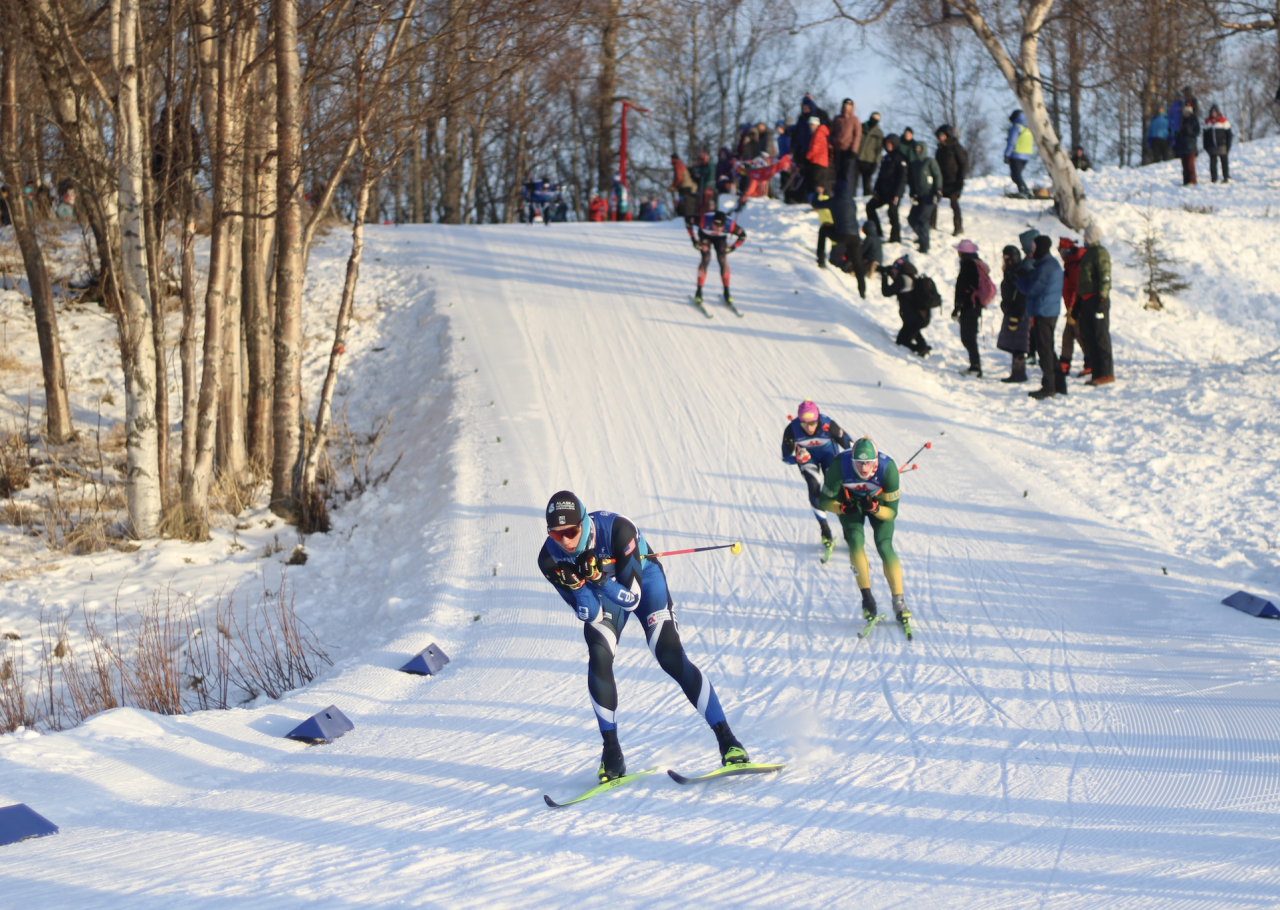
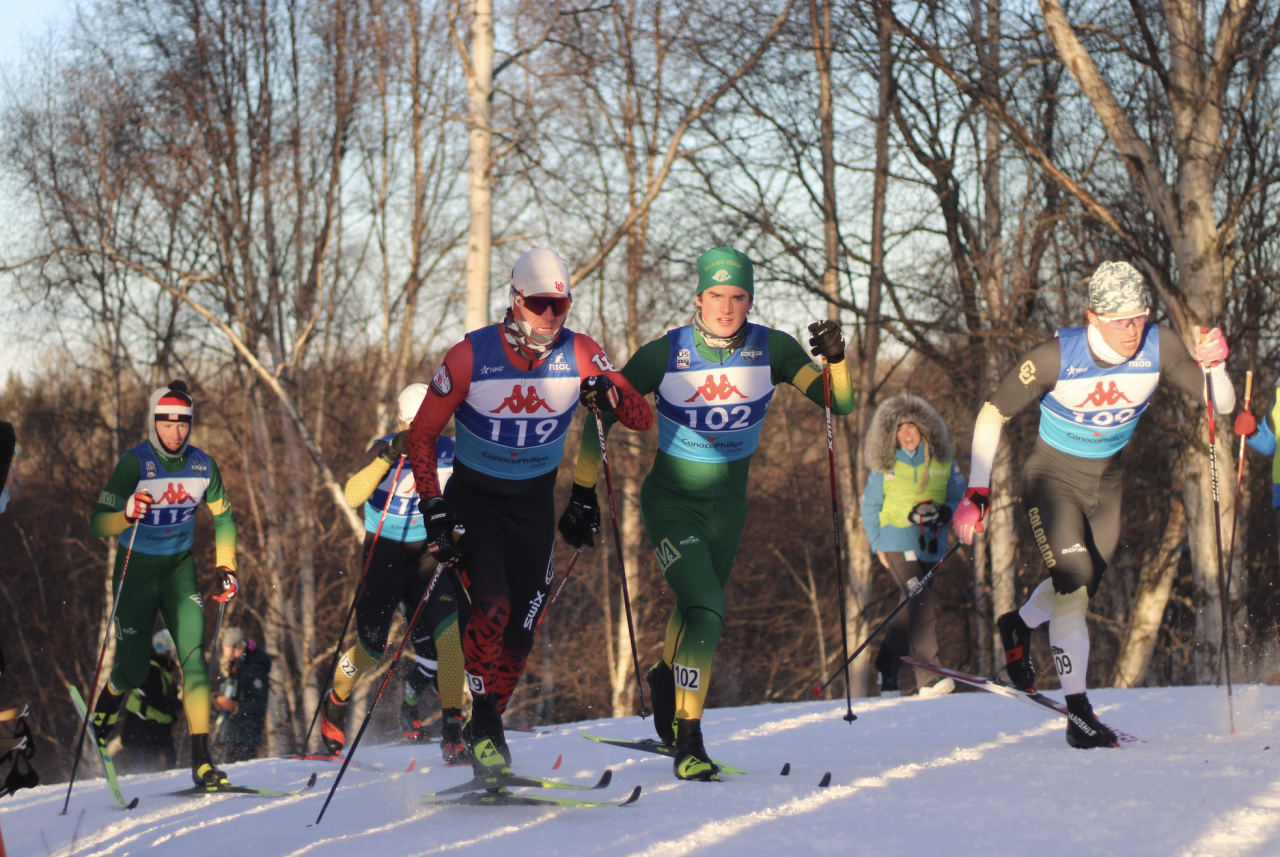
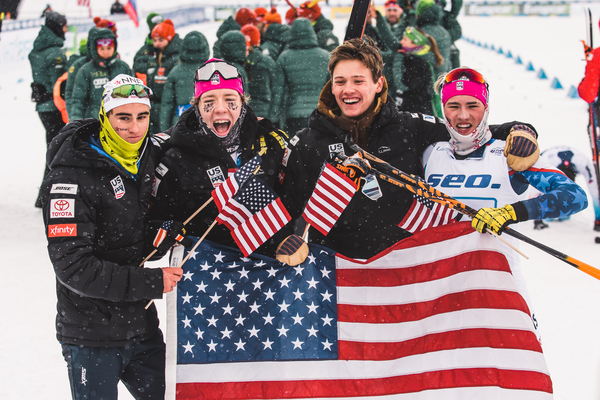
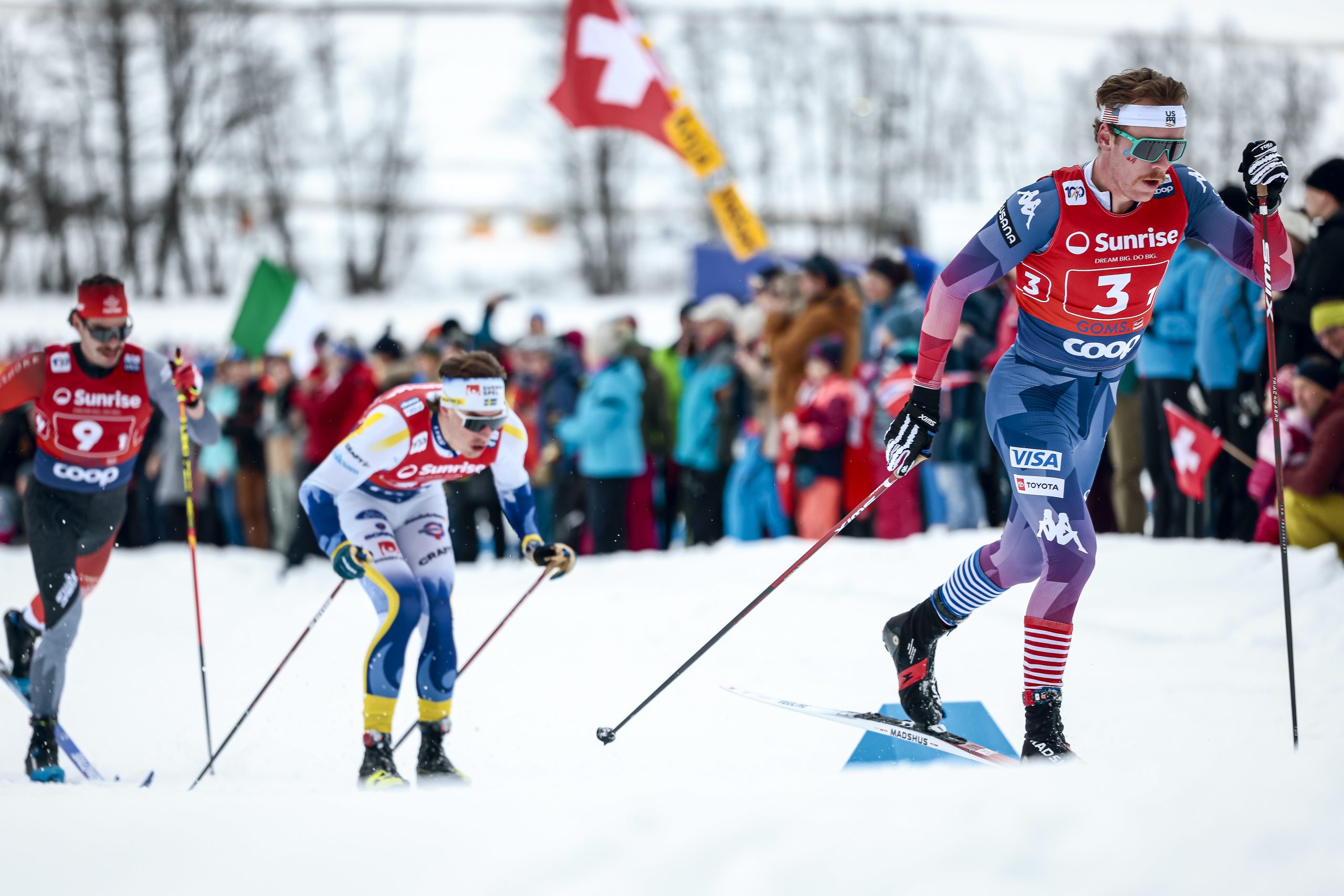
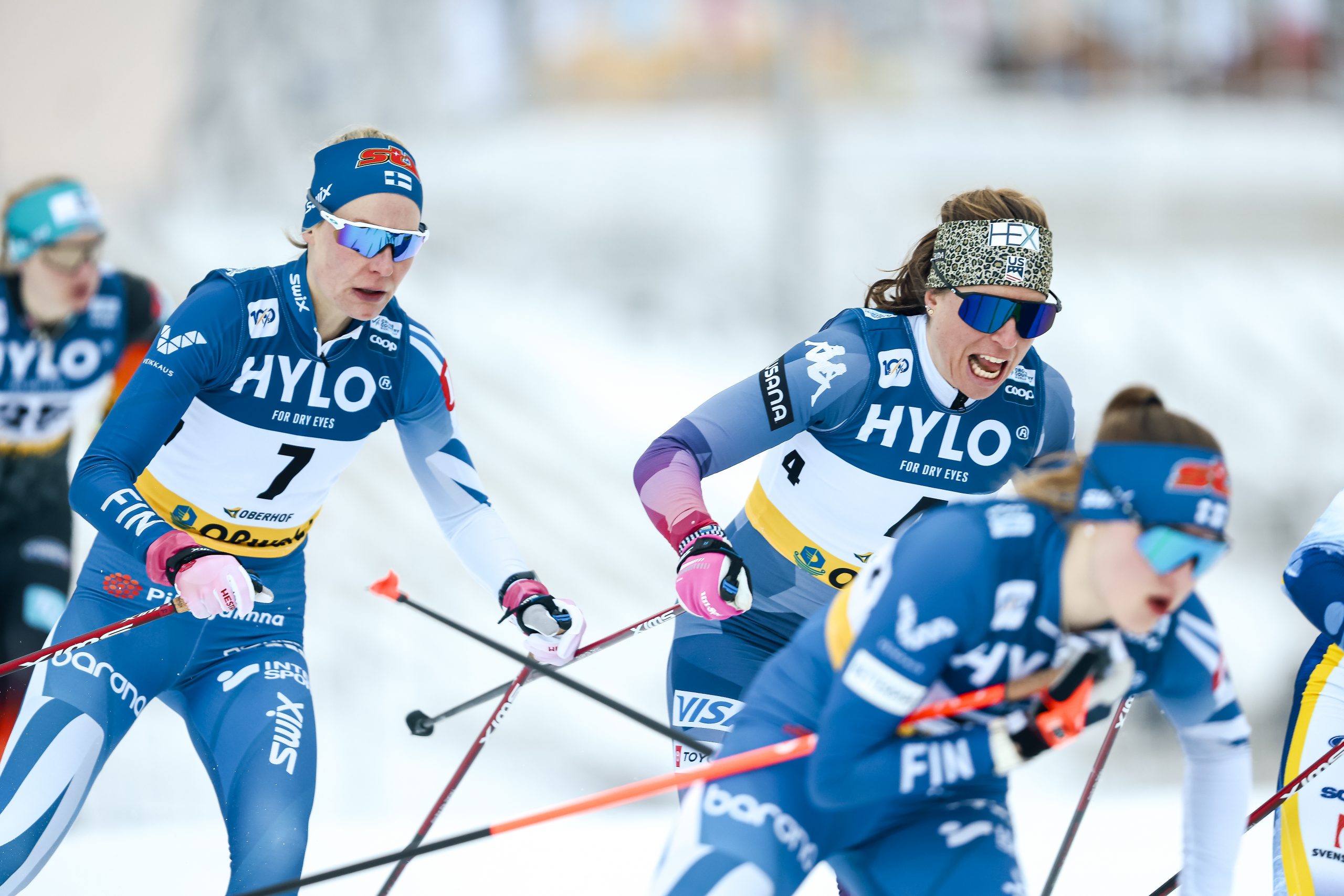
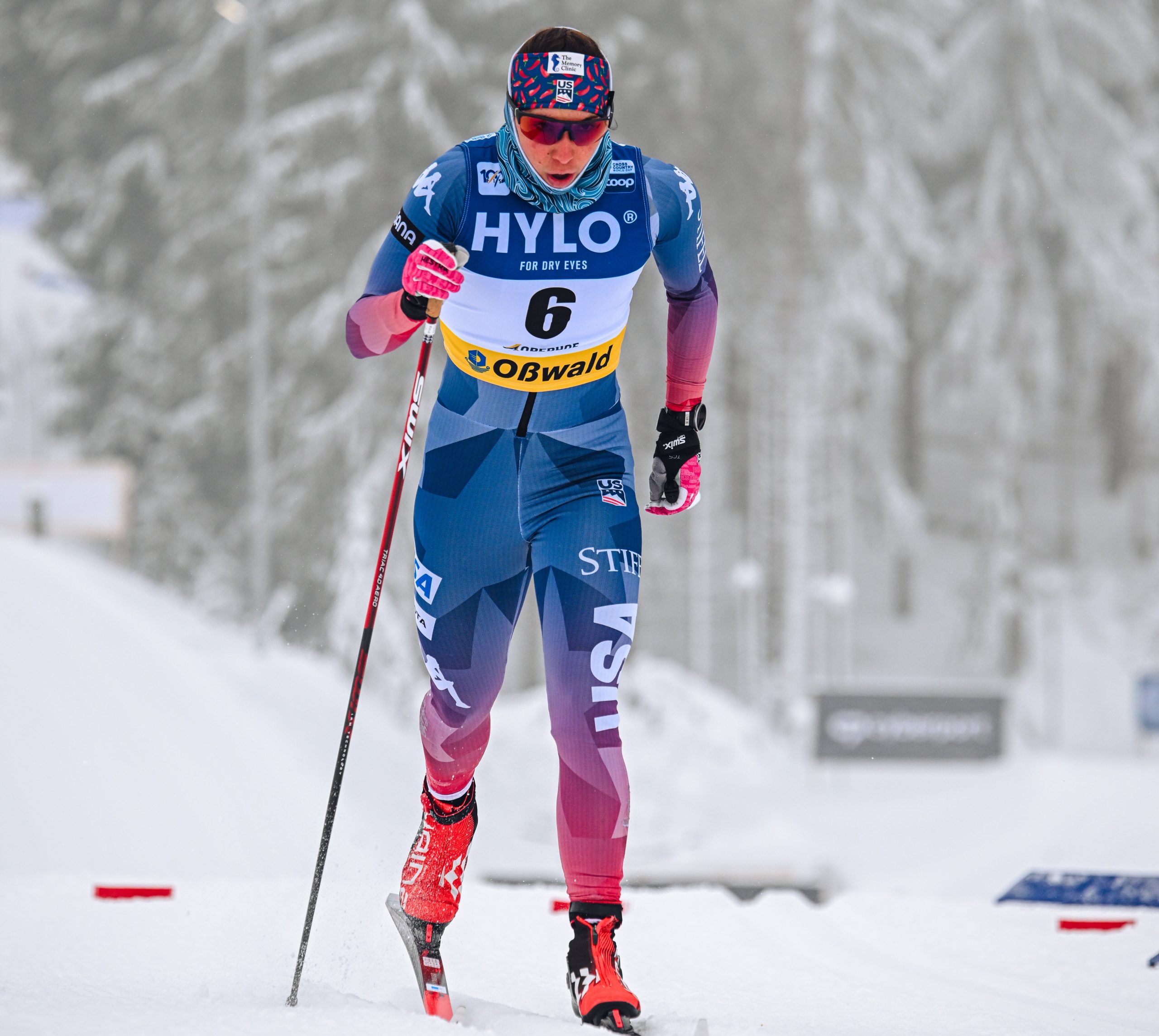
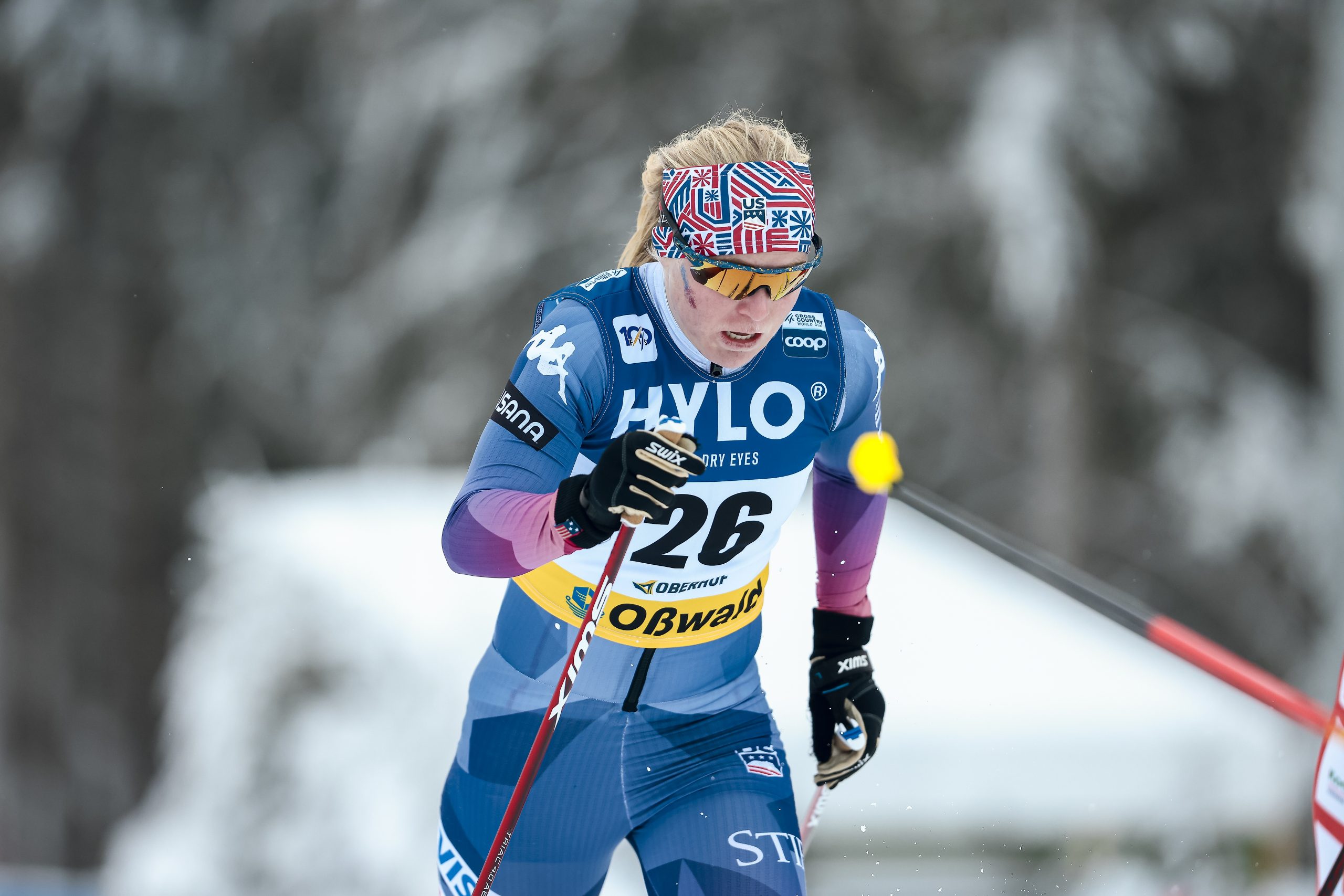
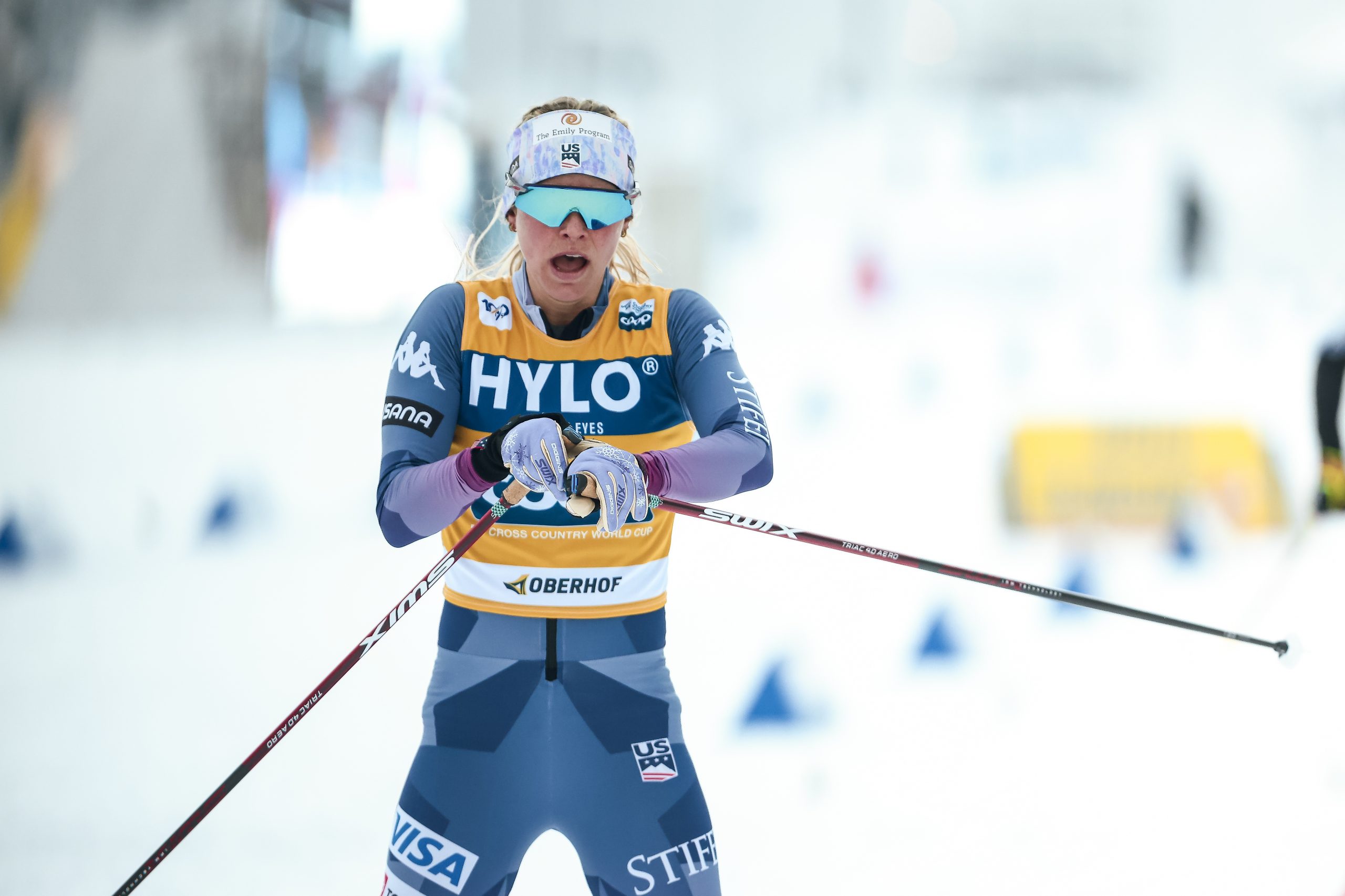
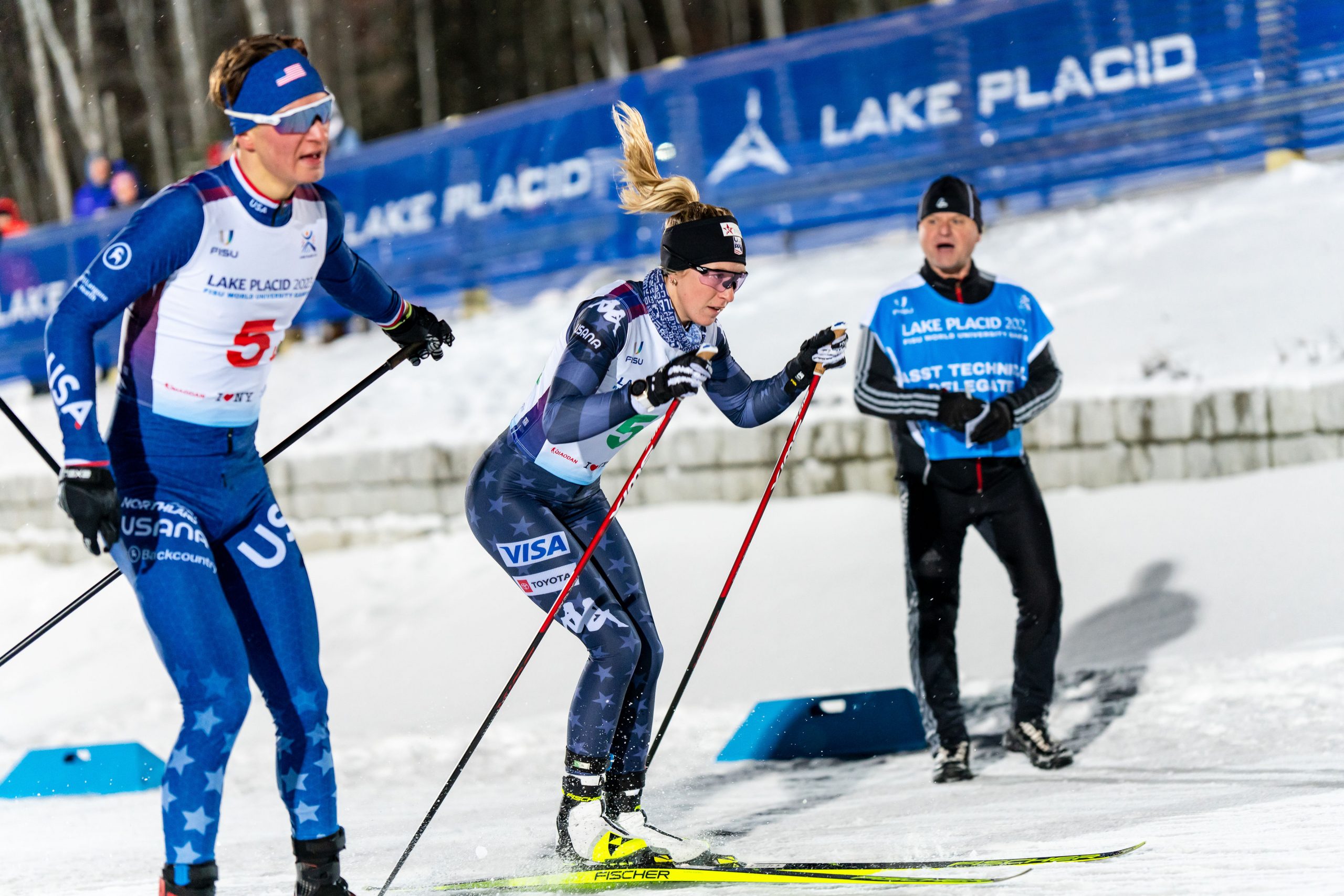
Luke Jager leads a sprint heat at the U.S. National Championships at Anchorage’s Kincaid Park on Saturday, January 4, 2025. Jager won a national title in his hometown in front of a crowd that included his dad, his girlfriend and a childhood friend revving a chainsaw. “He’s just become a lot more confident in doing his own thing,” said Jager’s girlfriend, fellow ski racer Novie McCabe. “I think he has a much easier time rebounding from non-satisfactory races this year — he can kind of learn from it and go on to the next.” (Nathaniel Herz/FasterSkier)
ANCHORAGE — Luke Jager spent most of his cross-country ski career training and racing with a tight group of talented, up-and-coming American men — the first ever to win a gold medal in the relay at the World Junior Ski Championships.
Two of Jager’s teammates on that relay squad, Gus Schumacher and Ben Ogden, have made the leap to the top-level, international World Cup, where both have collected podiums in the past two seasons — along with J.C. Schoonmaker, another early career standout who trains with Jager in his hometown of Anchorage.
Jager, 24, has also raced on the World Cup in recent years. But by his own admission, he hasn’t kept up with the meteoric rise of his peers. So this season, he decided to stop chasing them.
Instead of racing this week at the Tour de Ski, a grueling World Cup stage race in Europe, Jager chose to stay stateside and compete on the American domestic circuit — including at the U.S. National Championships in his home city this week.
In Saturday’s classic-technique sprint race, the decision paid off with a title, as Jager beat two other Alaskans, Michael Earnhart and Murphy Kimball, for the win.
“It definitely has taken a lot of the pressure off — just being like, ‘I’m going to go out there and do my best,’” Jager said afterward. “We’re all pretty dang lucky to be doing this sport in the first place.”
Jager’s title was the second awarded in a series of three championships at Anchorage’s Kincaid Park, with the final event, a classic-technique distance competition, scheduled for Sunday. (Another sprint will be held Tuesday, but it’s not a national championship.)
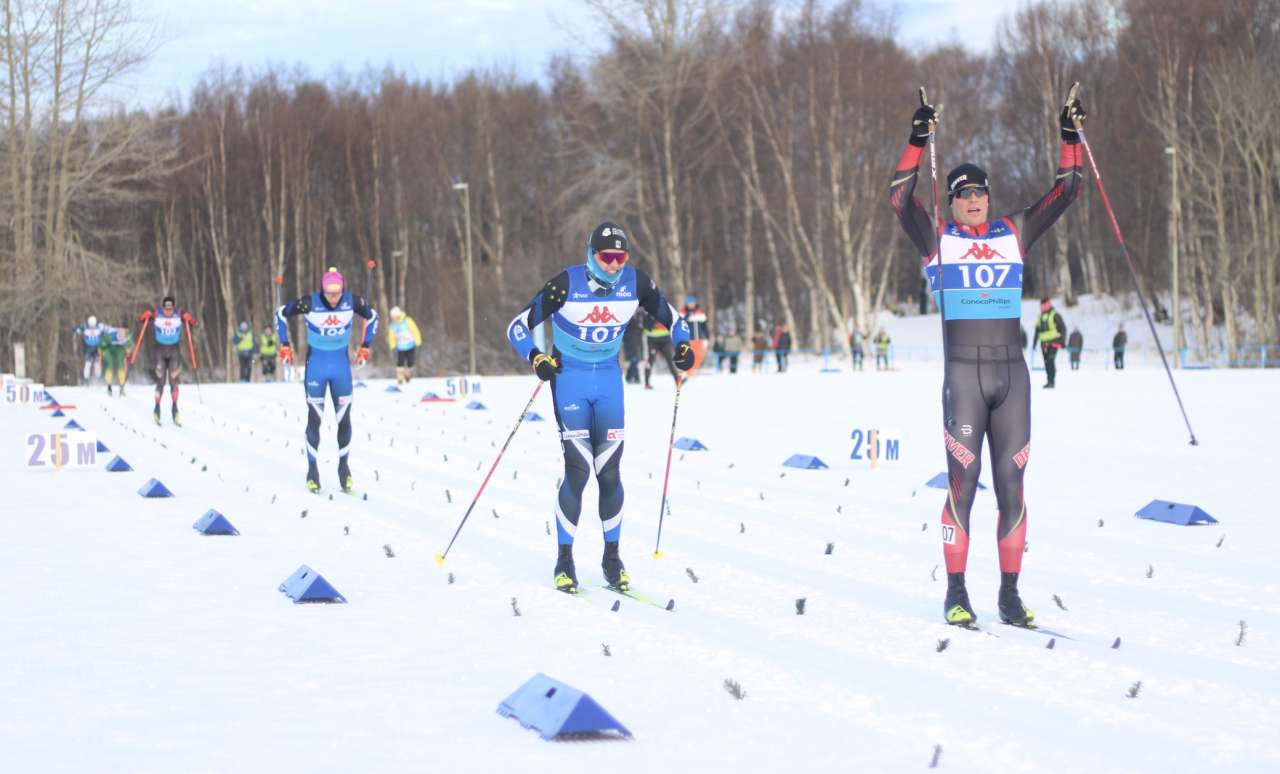
The races have drawn hundreds of competitors from across the country, including a number of Europeans who have been recruited to race at American colleges. One of those recruits, Andreas Kirkeng, a Norwegian studying at the University of Denver, actually edged out Jager at the finish line Saturday, but was not eligible for the U.S. title.
Andreas Kirkeng celebrates being the first across the finish line at the U.S. National Championships at Anchorage’s Kincaid Park on Saturday, January 4, 2025. (Nathaniel Herz/FasterSkier)
The women’s race played out similarly. Two Europeans — Sweden’s Erica Laven, racing for the University of Utah, and Estonia’s Mariel Pulles, racing for Team Birkie — were the top two finishers.
But Sammy Smith, the third athlete across the line, won the U.S. title as the first American. It was just the second race of the season for Smith, who spent the fall playing soccer for Stanford University and had just 10 days of on-snow training before the championships.
“I wasn’t really sure what to expect at all,” Smith said afterward. “I’m grateful to be out here and have a chance to race.”
Erin Bianco, racing for Bridger Ski Foundation, and Dartmouth College’s Nina Seemann, finished fifth and sixth to round out the U.S. podium. Eve Duchaufour, a French athlete racing for the University of Denver, crossing the line in fourth.
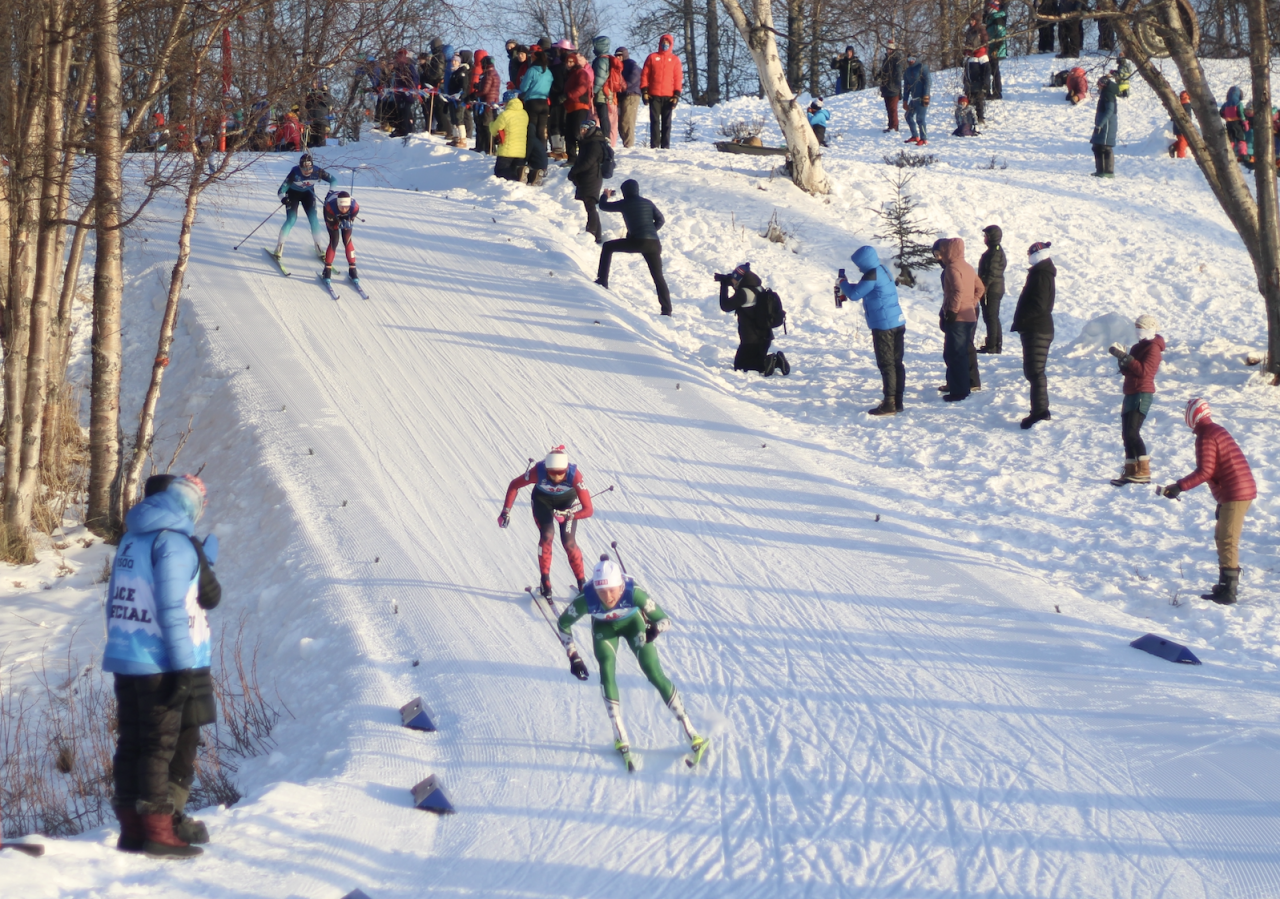
Dartmouth College’s Nina Seemann leads a downhill at the U.S. National Championships at Anchorage’s Kincaid Park on Saturday, January 4, 2025. (Nathaniel Herz/FasterSkier)
After a frigid first day of racing in Anchorage, Saturday’s individual-start qualification round began with the thermometer a few degrees higher. But the warmth quickly drained out of the air as the wind picked in the afternoon, just as the skiers began their head-to-head heat racing.
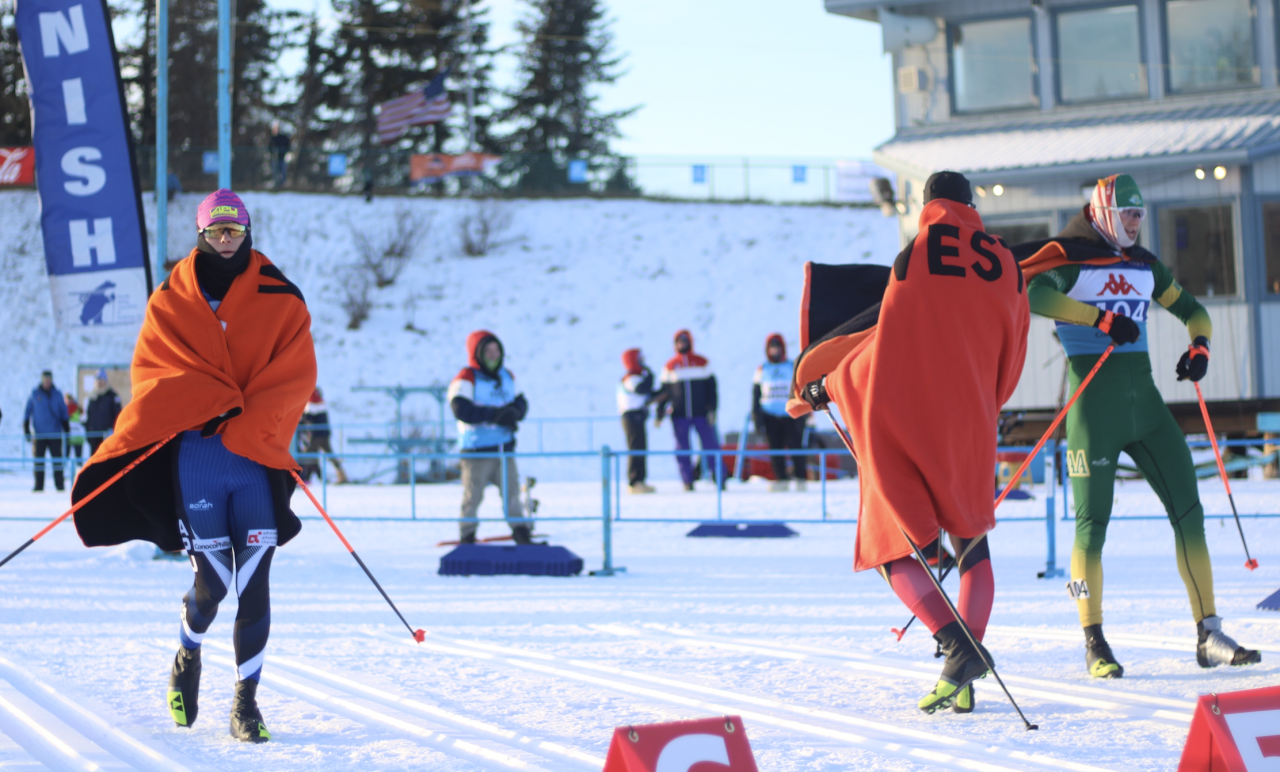
Athletes draped heavy orange blankets around their shoulders like capes as they walked to the start line, dropping them just before the start of each heat.
Michael Earnhart, left, keeps warm along with other participants in his men’s semifinal heat at the U.S. National Championships at Anchorage’s Kincaid Park on Saturday, January 4, 2025. (Nathaniel Herz/FasterSkier)
Jager had the fastest qualifying time in the men’s race, then won his quarterfinal and semifinal heats. He matched up in the finals against Kirkeng, Earnhart and Kimball, along with Florian Knopf, a German racing for the University of Denver, and Middlebury College’s Jack Christner.
Erling Bjoernstad, in bib 102, is a Norwegian racing for the University of Alaska Anchorage, and he was the second-fastest athlete in Saturday’s qualifying round behind Luke Jager. Organizers disqualified Bjoernstad, however, from his semifinal heat, after he was the second athlete in that heat to false start. “I was fired up after a good quarterfinal, and I felt really good,” said Bjoernstad, who acknowledged an accidental twitch. “It was a shame.”
Jager led from the start and stayed at the front for much of the 1.3-kilometer course before Kirkeng poled past him on the final meters of the homestretch. And yes, in case you were wondering: Jager acknowledged that he was not entirely content with a national title in which one of his competitors reached the finish line first.
“I guess I was like, ‘Dang, I think I just lost like 600 bucks,’” said Jager, referring to the difference in payouts between first and second place. “I was bummed. But Andreas is so strong and I love racing against him, so I can’t complain. I was good and beat.”
Nonetheless, Jager said he’s benefited from a mental adjustment that came after some tough days of racing last season. While his teammates and friends like Schumacher, Ogden and Schoonmaker reached new heights, Jager struggled on the World Cup in his strongest discipline, the sprint — advancing out of the qualifying rounds and into the heats just once in eight starts.
“We were all young — it was so sweet and so fun and we were like this group, this cohort that was super put together. I was super proud to be a part of it. And I love those guys — they’re totally like family,” Jager said in an interview earlier this week. “But then as we got older, those guys just kept getting better and kept getting better. And it felt like I was still stuck, so I was really grasping on to trying to maintain my identity as part of that.”
The American gold-medal winning relay team at the 2019 World Junior Ski Championships in Finland. From left, John Steel Hagenbuch, Ben Ogden, Luke Jager and Gus Schumacher. (Photo: JWSC2019 / Mikaela Takala)
He added: “My focus wasn’t in the right place. I was focused on having my breakthrough so I could join the club. I wasn’t focused on performing — and, like, on myself, and what I need to do.”
Jager’s outlook was grim enough last year, he said, that there was a period when he indulged in some “mopy” thoughts about retirement.
But instead, he ended up with a new mindset and a shift in focus inward.
That included some changes to his summer training. Jager said that while there’s currently a trend toward “polarization” in training — making hard workouts even harder and easy workouts even easier — he did the opposite, making his easier workouts a little faster and harder. That change, he said, has made him more durable in races when the pace starts to ratchet up.
So far, it’s been working for Jager. In addition to Saturday’s title, he had what he described as an unusually strong fourth-place result in Thursday’s individual-start distance skate race — a format that’s historically challenged him at U.S. nationals. He also won two races on the domestic SuperTour circuit earlier this winter.
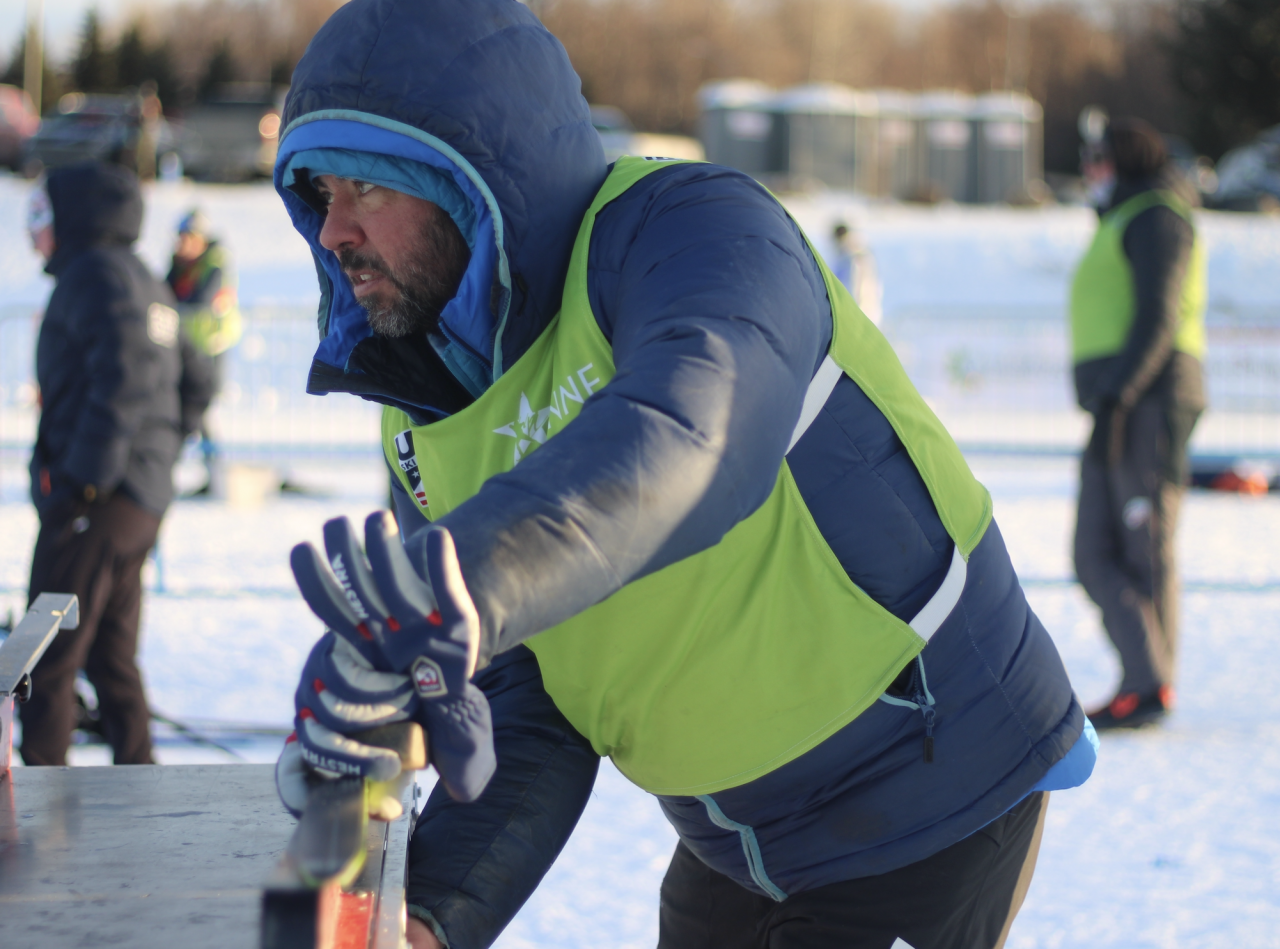
“I think every skier has their way, right?” said Erik Flora, Jager’s coach at the Alaska Pacific University club team.
Alaska Pacific University coach Erik Flora finishes waxing a ski at the U.S. National Championships at Anchorage’s Kincaid Park on Saturday, January 4, 2025. (Nathaniel Herz/FasterSkier)
Flora, a veteran coach who’s also worked with retired Olympic medalist Kikkan Randall and World Cup standout Rosie Brennan, said he wishes that athletic development could be “linear” — steadily upward and regular. But in his experience, he said, “it just isn’t.”
“Everyone goes through these gains, and they go through settles,” Flora said. “It’s just waves.”
Smith, Saturday’s women’s champion, is still riding a wave on its way up.
At just 19 years old, she’s a prodigy who’s already spent parts of two seasons racing on the World Cup — and has a world junior championships silver medal in her trophy case from last season.
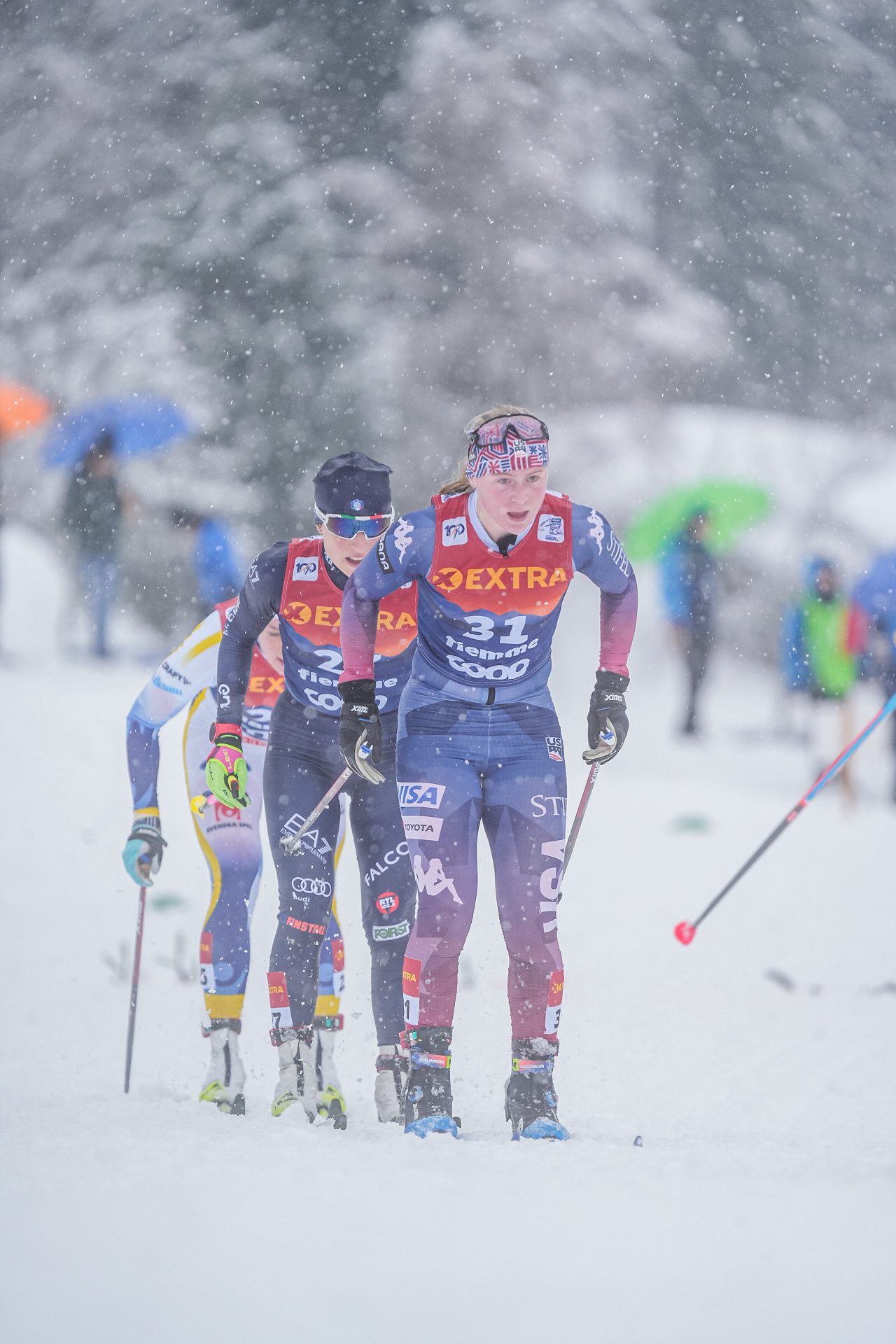
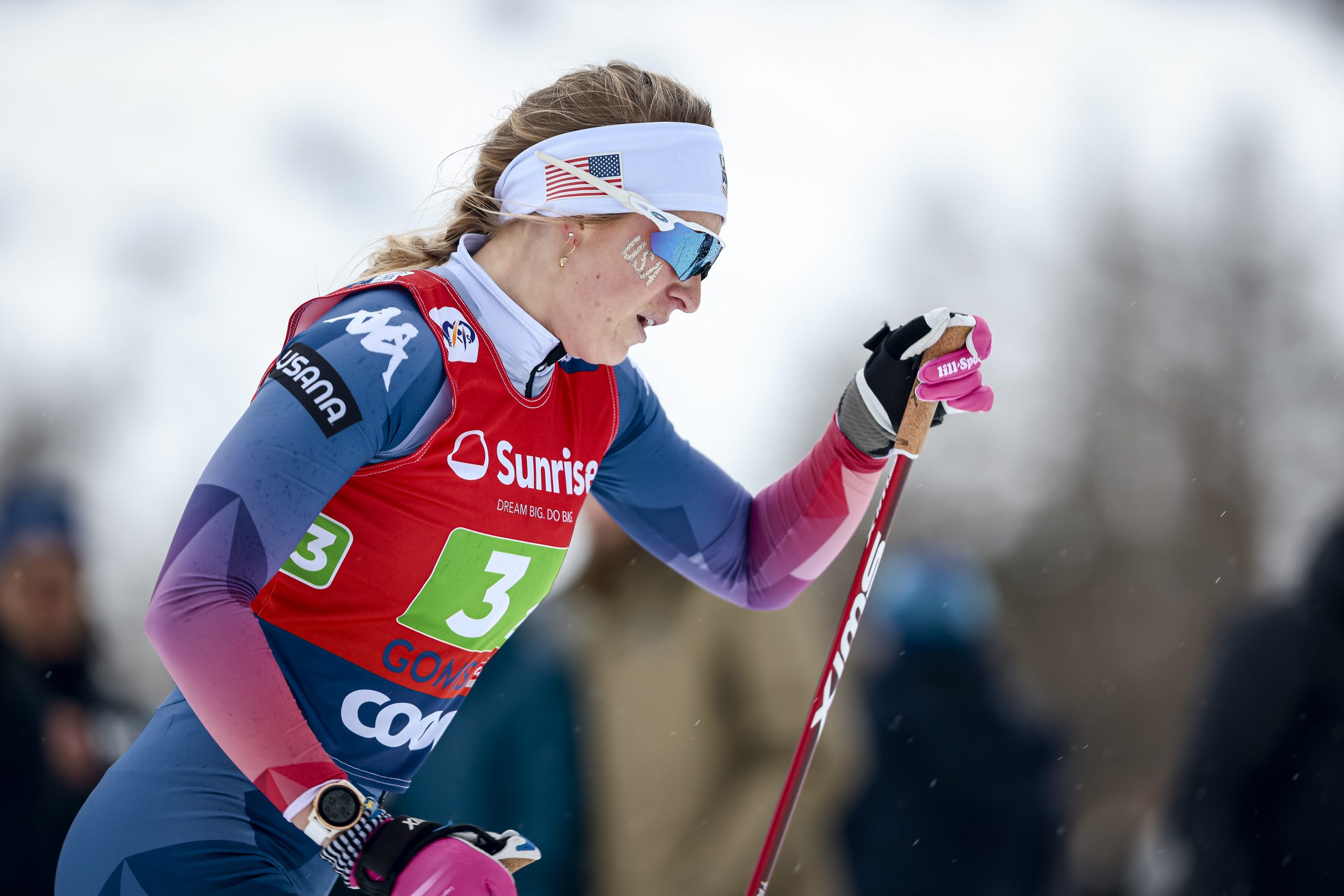
Samantha Smith racing at last year’s Tour de Ski in Europe. She comes from a family of athletes, with a sister who also plays soccer at Stanford, a mother who rowed at Stanford and a father who played soccer at Duke University. In junior high, Smith played football; she also has been a competitive freestyle moguls skier. “She has always been phenomenal,” Kristin Smith, her mother, told FasterSkier last year. “She used to crawl up my body when she was less than two and sit on my shoulder.” (Barbieri/NordicFocus)
But as most of her competitors spent the fall training and sharpening for ski racing, Smith was doing something completely different: traveling the country with Stanford’s soccer team.
Smith, who plays a defensive-minded position called outside back, wasn’t a starter as a freshman this year. But she got playing time in 13 games, according to Stanford statistics, on a team that made it to the national semifinals.
Smith’s sister Logan, who also plays for the Stanford soccer team, said that because the squad competes in the Atlantic Coast Conference, players spend much of every other week on the road. They typically travel on Tuesdays to the East Coast, play games Thursdays and Sundays, and fly home Sunday night.
As for school?
“Mondays. And the weeks we don’t travel,” said Logan Smith, who was watching the races at Kincaid with her family this week.
The grueling soccer schedule meant that Sammy Smith fit in training for cross-country skiing when she could. But she described it as “the first time I was really able to focus on one thing.”
She said she expected that her first event in Anchorage, “was not going to be great” — and she finished 12th on Thursday.
On Saturday, though, she looked like a podium contender from the start, winning both her quarterfinal and semifinal heats. In the final, she said she slipped on her first four or five strides and was trailing the pack leading out from Kincaid’s stadium. But she made up ground on Duchaufour, Bianco and Seemann as the pack climbed over the big hill on the course to take home the American title.
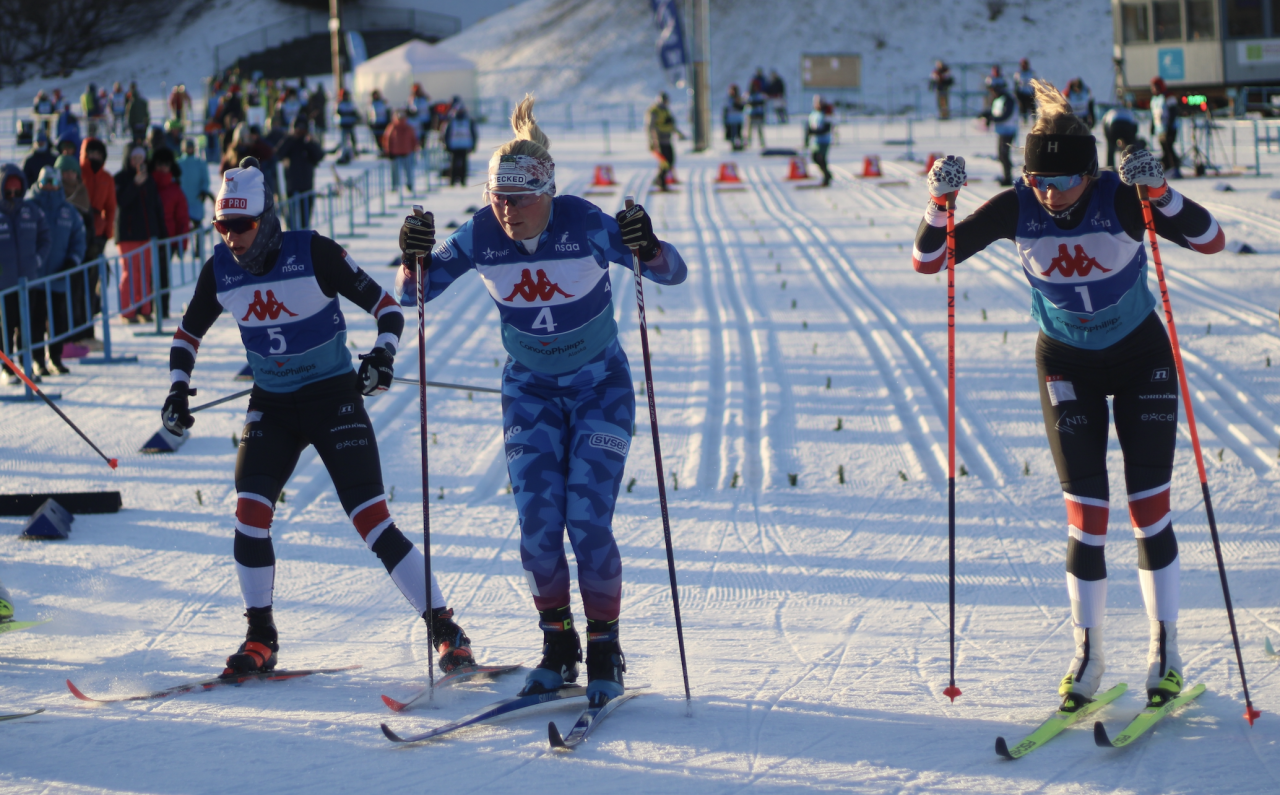
Sammy Smith, center, starts one of her heats at the U.S. National Championships at Anchorage’s Kincaid Park on Saturday, January 4, 2025. (Nathaniel Herz/FasterSkier)
After U.S. nationals, Smith said she plans to race at world juniors in Italy and hopes to compete on the World Cup, as well.
“It’s also definitely a balance with school,” she said.
But Smith said she hopes to continue with both soccer and cross-country skiing as long as she can. And she dreams of competing in the Olympic Games in both sports.
U.S. Ski Team coaches would “love to have her pick skiing,” said Cross-Country Development Director Bryan Fish, who was on hand for Saturday’s race.
“But from a U.S.A. perspective, we’re just happy that she’s here,” Fish said. “Our job is to support her in the best way that we can.”
This coverage is made possible through the generous support of Marty and Kathy Hall and A Hall Mark of Excellence Award. To learn more about A Hall Mark of Excellence Award, or to learn how you can support FasterSkier’s coverage, please contact info@fasterskier.com.
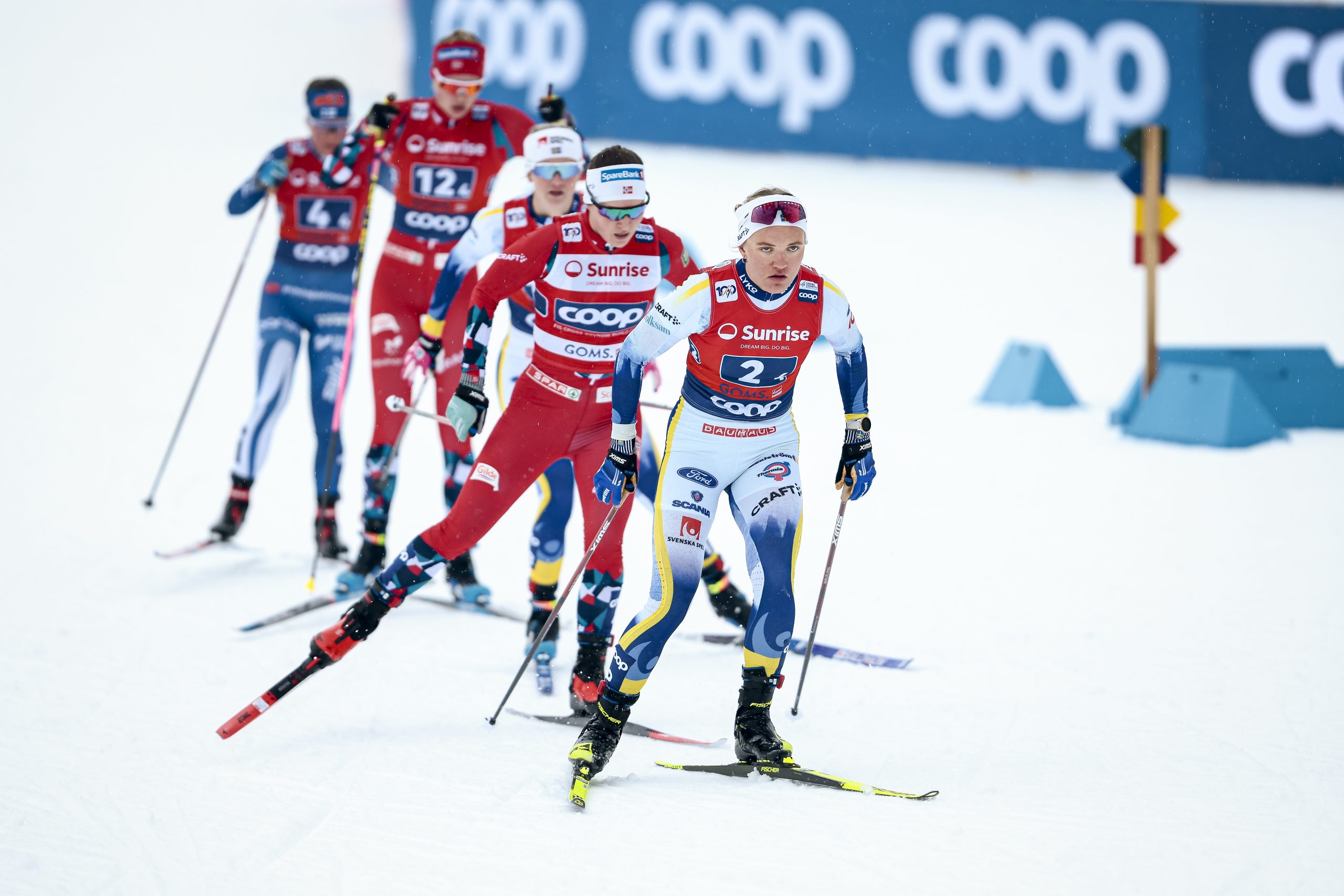
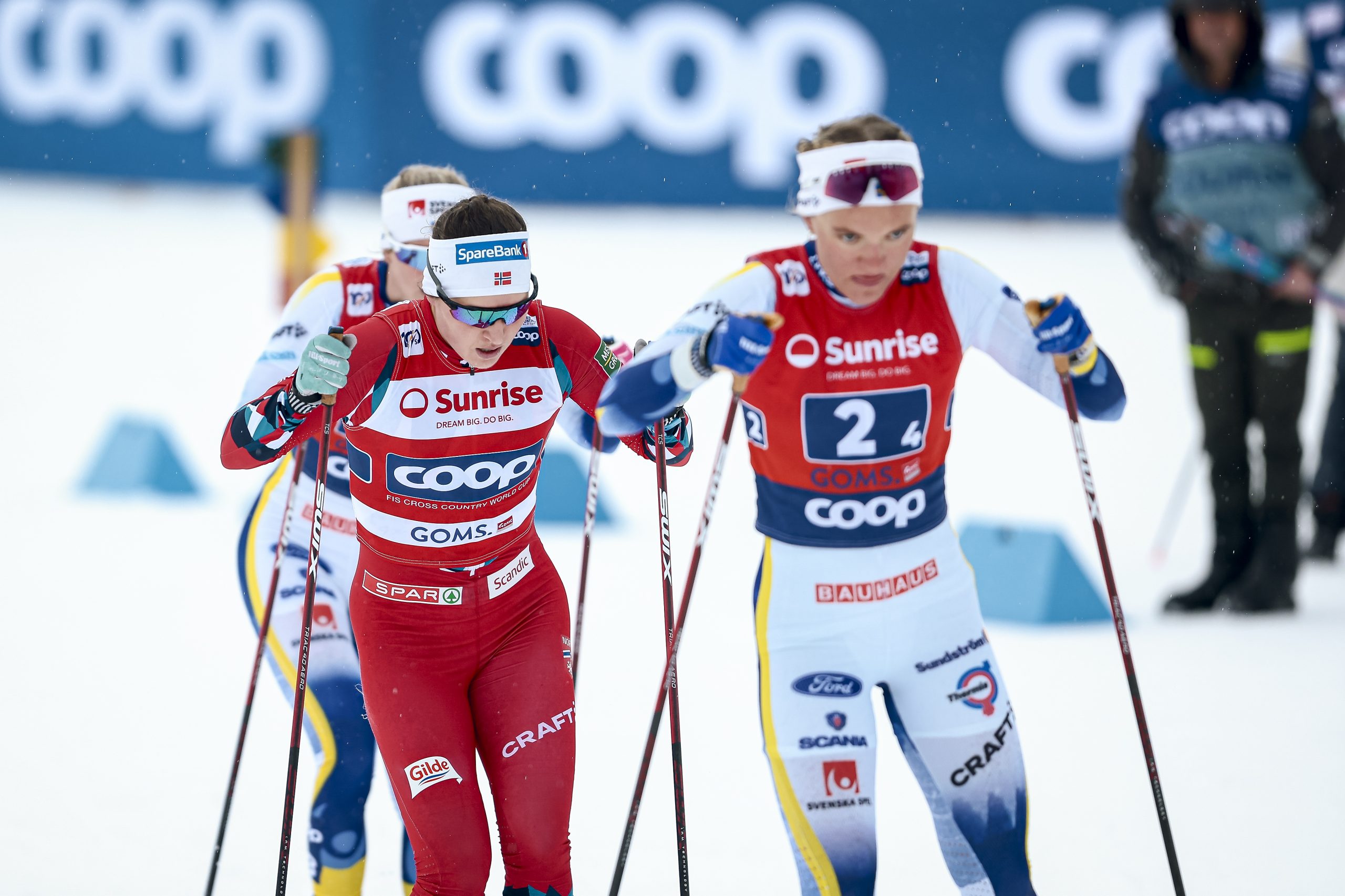
Tiril Udnes Weng (NOR) only recently rejoined the World Cup and didn’t have the form to match Linn Svahn (SWE) in the anchor leg of the Mixed Relay in Goms, Switzerland, (Photo: Modica/NordicFocus)
When it comes to World Cup racing, the Mixed Relay is the new kid on the block. And, like many new kids, not everyone is certain what to make of them. Today in Goms, Switzerland, the fourth 4×5 mixed relay in World Cup history took place. Team USA took first place in this event when it was held in Falun, Sweden in 2022. In that race the USA had its powerhouse duo of Jessie Diggins and Rosie Brennan to rely on. Today, that would not be the case, as the Americans needed to rest their stars and turned to the men to lead them by relying upon the relatively experienced presence of Gus Schumacher and Ben Ogden, while the women were represented by the fledgling duo of Erin Bianco and Samantha Smith. Bianco has one World Cup race to her credit, while Smith has 17. In a new race format, it would be Team USA’s new kids who would be tasked with doing the heavy lifting.
This was a very tall order for the American women. They would face Norway I with Tiril Udnes Weng (last year’s crystal globe winner), and Margrethe Bergane. Sweden I fielded Frida Karlsson and Linn Svahn. Finland I was starting Kerttu Niskanen.
Ogden and Schumacher were scheduled to face Martin Loewstroem Nyenget (NOR), Simen Hegstad Krueger (NOR), and Jens Burman (SWE), but at least the Americans had been down that road many times by now.
But things did not go as planned for team USA as Bianco was unable to complete the second leg of the race due to a fall. “We had a medical emergency,” said USA coach Kristen Bourne, “But everyone is okay.” Bourne told FasterSkier that Bianco had fallen during one of the icy technical downhills and was unable to continue, but that she is now back in her hotel room and doing okay. Bianco’s family was at the race and was able to be with her. “Today I had a crash in the relay and was unable to finish,” said Bianco in a statement after the race. “But I am okay! Our team doctor got to me quickly and made sure everything was okay. We’re back to the hotel now and my focus is to rest and recover and continue cheering on my teammates throughout the rest of the weekend!”
At the end of the relay, Sweden I took first place, with Sweden II coming in second. Norway I was third. Canada finished 13th.
Ben Ogden (USA) had a good first leg for team USA, but unfortunately the team did not receive a finishing time. (Photo: NordicFocus)
Leg One—Classic
The first two legs of the Mixed Relay are Classic with the men going first. Ben Ogden led out for team USA, and immediately went to the front. But fairly early on he moved back a bit and was content to let Sweden I, led by William Poromaa, and Norway I led by Nyenget set the pace. Norway II’s Mattis Stenshagen also took a turn in the lead. Once it was the two Norwegian teams at the front, they began to push the pace and quickly put a gap on the rest of the field. At the first exchange, it was the two Norwegians with a ten second lead as they handed off to Bergane for Norway I and Kristen Austgulen Fosnaes for Norway II. Ogden had dropped back to 13.5 seconds behind at the exchange when he handed off to Bianco.
Erin Bianco (USA) took a hard fall between the start of the second lap of her leg and the finish. She was unable to continue, but after the race was back in her hotel room resting. (Photo: NordicFocus)
Leg Two—Classic
Even though it was only Bianco’s second World Cup race, she is no kid. At 25, she was the oldest team member. She would need all of her maturity to help navigate the challenges ahead.
Very quickly she had narrowed the gap to eight seconds behind the front pack and was able to keep the lead group in her sights as the leaders had consolidated after the initial exchange. Karlsson then began to push the pace and moved to the front with Niskanen going with her. Karlsson was coming off one of her best weekends of skiing and showed that her fitness was still at top-level. Karlsson pushed hard and was able to break the lead pack down to six skiers. Bianco was now tenth 36 seconds back.
Niskanen was keeping close tabs on Karlsson while Sweden II led by Ebba Andersson also pushed the pace. But Karlsson’s pace was too hot, and no one could match her. Niskanen was clearly working hard trying to reel in Karlsson, but Karlsson was in top form and couldn’t be caught.
On the final climb into the stadium Norway I and II had gained ground on Finland and they both surged ahead of Finland as the teams entered the stadium. When they entered the exchange zone Karlsson had maintained her lead. Karlsson handed off to Jens Burman and Niskanen handed off to Perttu Hyvarinen. It was somewhere before the handoff where Bianco was forced to drop from the race and Schumacher never had the opportunity to ski.
Leg Three—Freestyle
Burman took advantage of the lead Karlsson handed him, but both of Norway’s teams were now only four seconds behind him. Burman continued to fend off the Norwegians as he maintained a four second gap over Jan Thomas Jenssen for Norway II and Simen Hegstad Krueger for Norway I. But Burman couldn’t fend off the hard charging Norwegians, as at the start of the second lap Jenssen and Krueger took over the lead and upped the tempo. The race was now down to five teams with a realistic chance: Norway I and II, Sweden I and II, and Finland.
Jenssen and Krueger pushed hard as they entered the stadium, and it was the two Norwegians with Sweden II’s Edvin Anger now in the lead group. Sweden I and Finland I were now 17 seconds behind.
Leg Four—Freestyle
At the exchange it was Norway II’s Maria Hartz Melling trying to hold off her teammate Tiril Udnes Weng. Maja Dahlqvist for Sweden II was trying to pull her team along as she skied the anchor leg. Svahn on Sweden I had quickly been able to join the lead pack and put Sweden I back in contention. As the five lead skiers consolidated the pace slowed significantly, which seemed to play into the hands of Svahn who is the World Cup Sprint leader. With 2.5 kilometers to go it was Svahn, Weng, Dahlqvist, and Melling at the front as the group entered the stadium at the end of the first lap. The pace slowed even more as skiers jockeyed for position. Weng then realized that if she wanted to have a chance against the Sprinters she would have to increase the tempo. She put in a hard turn of speed but couldn’t pull away from Svahn and Dahlqvist, but it did reduce the lead group to only three skiers.
No one had an answer today for Linn Svahn (SWE) (right) who has regained her form after overcoming multiple seasons of injuries. (Photo: NordicFocus)
The race was now down to Norway I, Sweden I, and Sweden II. Weng continued to push, but couldn’t drop Svahn and Dahlqvist; this did not bode well for her. As they approached the finish, Svahn blasted past Weng with a withering turn of speed. Dahlqvist and Weng did not have an answer. Svahn showed why she is the best Sprinter on the tour and in a couple of seconds put a huge gap on the competition. Svahn easily glided across the finish line to give Sweden I the victory. Dahlqvist had been able to work past Weng for second, while Weng couldn’t quite keep the pace and finished third.
This coverage is made possible through the generous support of Marty and Kathy Hall and A Hall Mark of Excellence Award. To learn more about A Hall Mark of Excellence Award, or to learn how you can support FasterSkier’s coverage, please contact info@fasterskier.com.
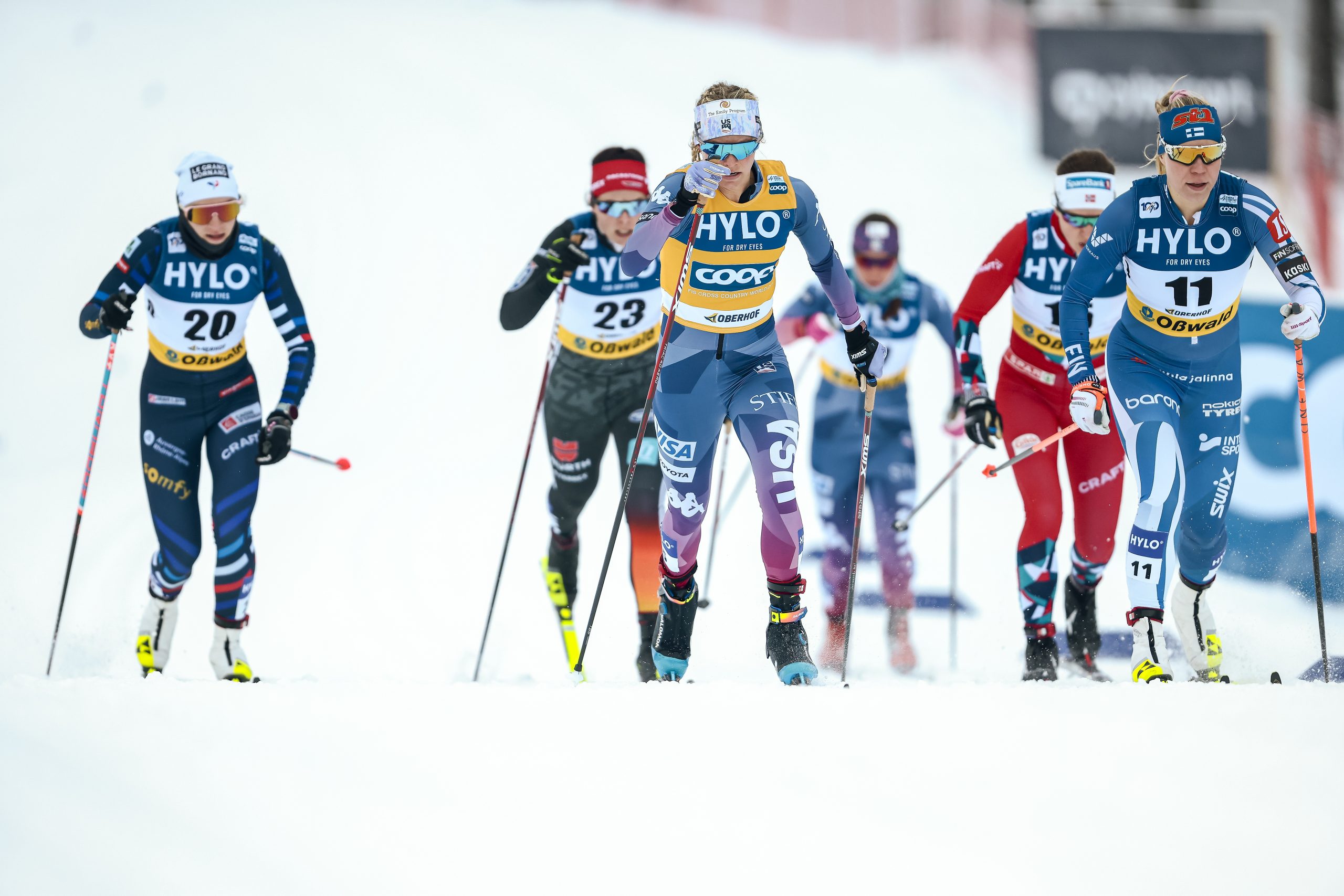
Jessie Diggins (USA) made the semifinals in today’s Classic Sprint. She finished ninth to remain in the World Cup Overall lead. (Photo: NordicFocus)
After a week and a half layoff, World Cup racing resumed today with renewed vigor and renewed focus. With the draining experience of the Tour de Ski behind them—and some nice recovery time absorbed—athletes now set their focus on the rest of the season, which for many of the women on team USA means focusing on World Cup Overall standings, or the hunt for other Crystal Globes.
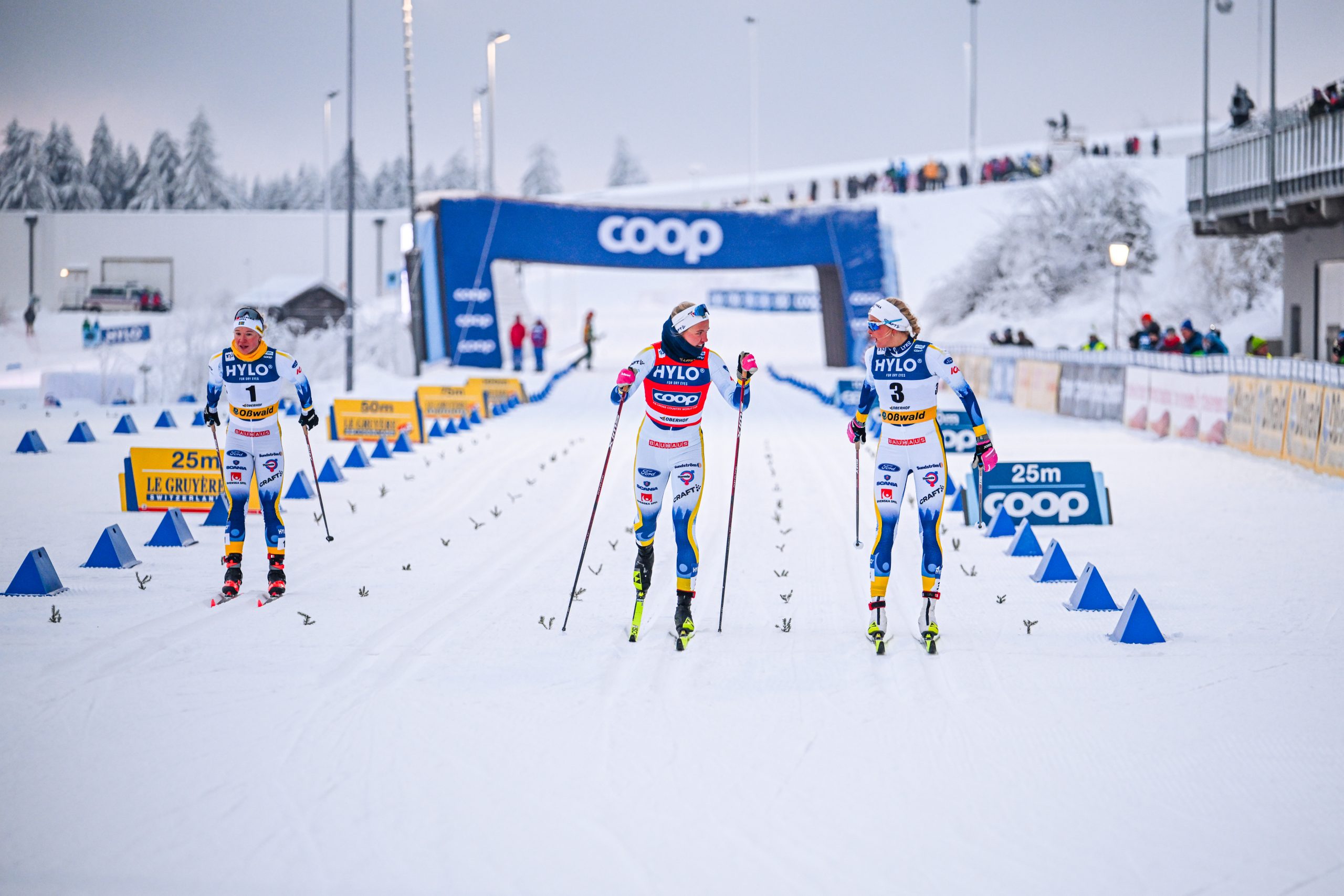
It was a sweep for Sweden with Linn Svahn (SWE) taking the win to increase her lead in the Sprint competition and nibble away at Jessie Diggins’ (USA) lead in the Overall standings. Jonna Sundling (SWE), Linn Svahn (SWE), Frida Karlsson (SWE), (l-r) (Photo: NordicFocus)
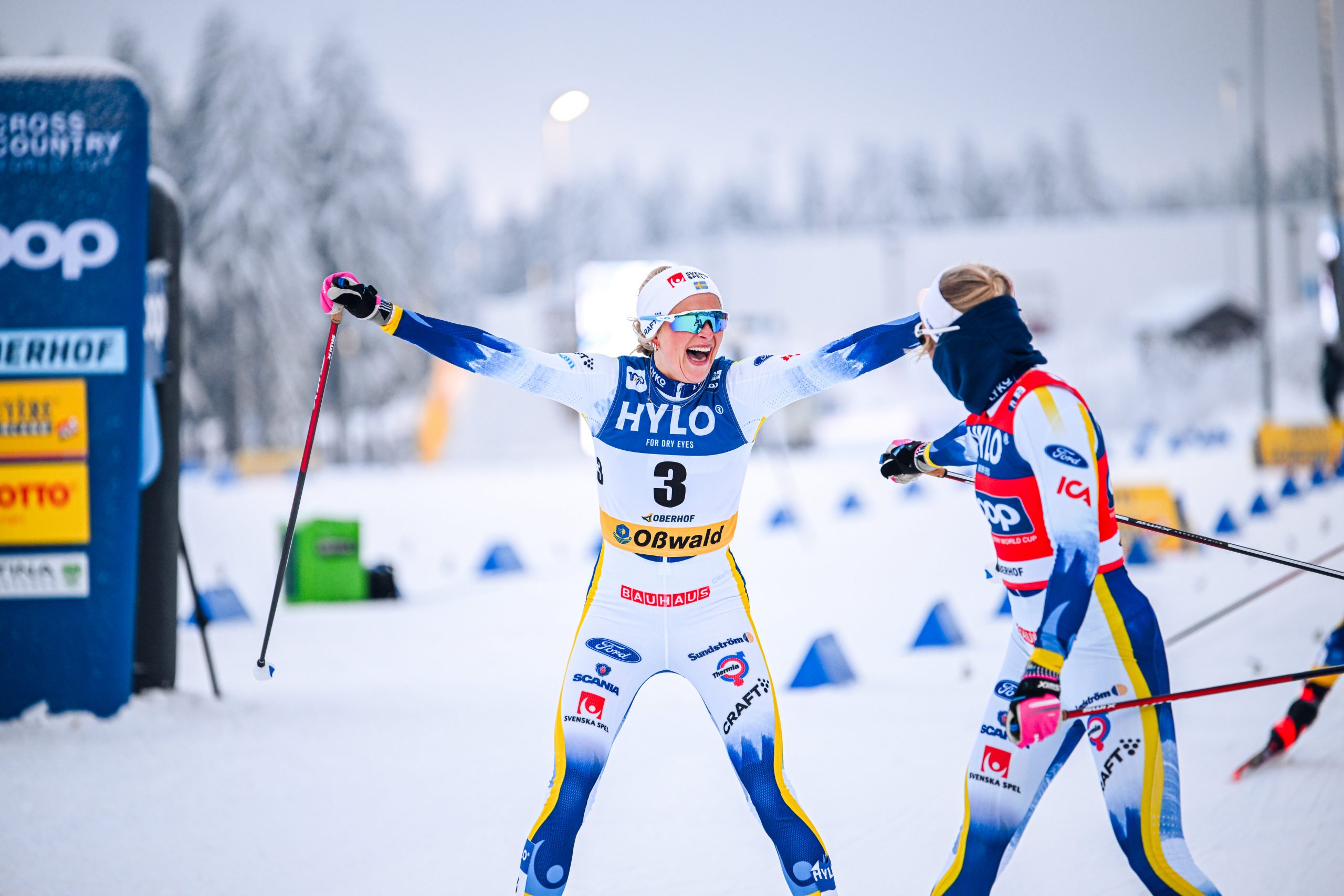
At the start of today’s Classic Sprint in Oberhof, Germany, competitors have completed exactly half of the individual events which count toward Overall points. Starting the day, Jessie Diggins (USA) sat on top of the leaderboard in the Overall competition with a healthy lead of more than 300 points over Linn Svahn (SWE). Diggins also led in the Distance competition with a 95 point lead over second place which was occupied by her teammate Rosie Brennan. Brennan was also in third for the Overall competition, only 23 points behind Svahn. So, today was an opportunity for Svahn—who is leading the Sprint competition—to use her proven Sprinting prowess to gain ground on Diggins and establish a cushion on Brennan. But Svahn would face stiff competition from Kristine Stavaas Skistad (NOR), who has a remarkable streak of ten consecutive World Cup Sprint podium finishes, as well as from her teammate Emma Ribom.
When the results were in it was Linn Svahn taking the win to gain valuable points on Diggins. In a surprise, Frida Karlsson (SWE) was second for her first World Cup Sprint podium, with Jonna Sundling (SWE) taking third. Jessie Diggins finished ninth.
Rosie Brennan (USA) got caught in heavy traffic in her Quarterfinal and was unable to advance. (Photo: NordicFocus)
Other American finishers were Rosie Brennan in 21st, Julia Kern 27th, and Samantha Smith 28th. In her first ever World Cup competition, Ely Minnesota native Erin Bianco finished 35th.
The top Canadian finisher was Katherine Weaver in 41st. Sonjaa Schmidt was 48th, Olivia Bouffard-Nesbitt was 49th, and Katherine Stewart-Jones was 51st.
Women’s Classic Sprint Quarterfinals
The first quarterfinal featured Sundling who qualified first, and Skistad, who qualified 16th. The two favorites finished first and second in a race—like many today—that featured a great deal of double poling.
The second heat was packed with power as Svahn faced off against Brennan, and Victoria Carl (GER). At the start, Brennan was quickly forced to the back of a congested pack and had difficulty finding a way through it. As the heat progressed it was Svahn and Karlsson setting the pace. Brennan had managed to push her way into fourth but was some distance behind the two leaders. At the end, it was Svahn and Karlsson taking the top two spots. Brennan finished fifth, and her day would be over. After the race Brennan said that, “I’m not really sure how I’m feeling after the Tour de Ski.” She continued that, “to be honest, I think it takes more time than this to fully recover from the Tour, you kind of hope you’re recovered enough to have some good races. I was happy with my qualifier … heats obviously didn’t go the way I wanted them to … making not the best tactical decisions out there; didn’t play to my strengths the way I should have. But I feel like I’m on the upswing from the Tour.”
Julia Kern (USA) made the quarterfinals, but was unable to advance. (Photo: NordicFocus)
Diggins and Kern were in the third quarterfinal, along with Tiril Udnes Weng (NOR). Today was Weng’s return to the World Cup after having missed the entire season with illness. As has been her Sprint strategy this year, Diggins went to the front, but was matched immediately by Jasmi Joensuu (FIN). The Finn quickly jumped in front of Diggins and set the pace throughout the race. Kern was thrown to the back and was never able to gain ground on the field. Joensuu continued to push the entire way with Diggins marking her. As they entered the stadium, Diggins jumped from behind Joensuu into her own track and put in a hard effort to nip Joensuu at the finish. Kern finished sixth. Due to the glazing Classic track, it was a challenging day for kick, “it was really tricky” commented Diggins. “Even though you knew you were just going to herringbone that last steep hill, there was still that power striding section in the middle, and I felt I needed enough kick to be able to ski well there, so it was a really tricky balance. I’m really proud of our tech team. I feel that I had the skis I needed.”
Teenager Sammy Smith (USA) continues to make her presence felt at the World Cup. She qualified again for the Sprint heats. (Photo: NordicFocus)
The fourth quarterfinal featured America’s 18 year old standout, Samantha Smith. She would go up against Moa Lundgren (SWE), Emma Ribom (SWE) and Katharina Hennig (GER). Ribom went to the front early along with her teammate, Lundgren. The pack remained tight throughout the half-way point with Smith hanging at the back. As the racers entered the steepest climb they transitioned to herringbone, and Smith was unable to match the pace. This opened a window for Tereza Beranova (CZE) who went to the front with Ribom. The pair established a nice cushion and easily double poled through the finish. Smith finished sixth. But for Smith, every day on the World Cup is an opportunity to learn, “I’m definitely feeling more and more comfortable every Sprint” said Smith. “It’s been really exciting getting into heats the last two Sprints, and hopefully I will have more opportunities as the season progresses!”
The fifth quarterfinal had Maja Dahlqvist (SWE) taking the victory and German favorite Laura Gimmler (GER) thrilling the crowd by taking second place.
When the quarterfinals were complete, Diggins ended up being the only American to advance to the semifinals, while five Swedes moved on.
Sprint Semifinals
Diggins landed in the first semifinal along with Sundling, Svahn, Karlsson, Skistad, and Carl. It was a very imposing field, but in a sense a fortunate one for Diggins who could keep an eye on her competition for the Overall Cup. The hometown crowd was clearly in Carl’s corner as they cheered her loudly during introductions. At the start Diggins found herself in the unusual position of being at the back of the pack with Svahn and Sundling going to the front. It appeared to be a strategic response to Diggins’ established tactic of going early to the front. Diggins was trapped behind Skistad as the pack remained tight. Then Diggins decided to jump into the outside lane to try and find some room, but the move did not pay off. She still remained at the back with Sundling, Svahn and Karlsson creating a Swedish wall at the front. As they entered the final stretch, the group stretched out a bit with Svahn taking the win. Karlsson was second. followed by Sundling and Skistad. Diggins finished fifth, two seconds back, and would not advance. Energy wasn’t an issue for Diggins coming off the Tour de Ski. Asked if she felt recovered from the Tour, she said, “yes.” She continued that, “it is always a little nerve wracking, because you don’t know until you race, so it was nice to feel some good race feelings today.” Diggins also acknowledged that the tight pack affected her race, “I definitely need to improve being a little more aggressive and protecting my space.” She added that, “I definitely felt like I had the fitness, and that was a really good thing, and that’s how I would like it to be. I feel like I could improve protecting my space a little more and really need to improve my double pole finishes.”
By reaching the semifinals, Jessie Diggins (USA) was able to keep a comfortable lead in the Overall World Cup standings. (Photo: NordicFocus)
In the second semifinal Ribom faced off against Dahlqvist, Joensuu, Gimmler, Beranova and Anne Kyllonen (FIN). Joensuu took the lead early with Ribom following her. As they entered the herringbone section Ribom and Beranova put in a huge burst to jump to the front. Beranova continued the hard pace to go to the front, but she had gone out too soon. Ribom was able to sprint past her as they entered the stadium. The sparse crowd then erupted as seemingly out of nowhere Gimmler made a late push to finish second thrilling the German fans.
Sprint Final
The finals saw Svahn, Ribom, Karlsson, Gimler, Sundling, and Skistad taking the start line. The real surprise in this group was Karlsson, who has not had a strong Sprint history. Nonetheless, it allowed Sweden to continue their Sprint domination by placing four skiers into the finals.
At the start, Skistad went to the front immediately; a change of tactics for her. But Sundling did not let her stay out front for long as she passed Skistad to take the lead. Surprisingly, it was Karlsson who followed Skistad to the front along with Sundling and Svahn. The three Swedes began to pull away as Skistad’s initial burst had cost her and she was fading quickly. Svahn then took control with Karlsson right behind her. Svahn was able to sprint to the line first, and in the surprise of the day Karlsson was second. Sundling finished third for a Swedish sweep. It was an impressive showing for Karlsson who did something which she has not been able to do throughout her World Cup career; hang with the top Sprinters and capture a Sprint podium.
It was Frida Karlsson’s (SWE) best Sprint day ever as she finished second. (Photo: NordicFocus)
After the Sprints had concluded, Diggins remained atop the Overall standings ahead of Svahn. Brennan was still in third place, now 87 points behind Svahn, and only 17 points ahead of Ribom.
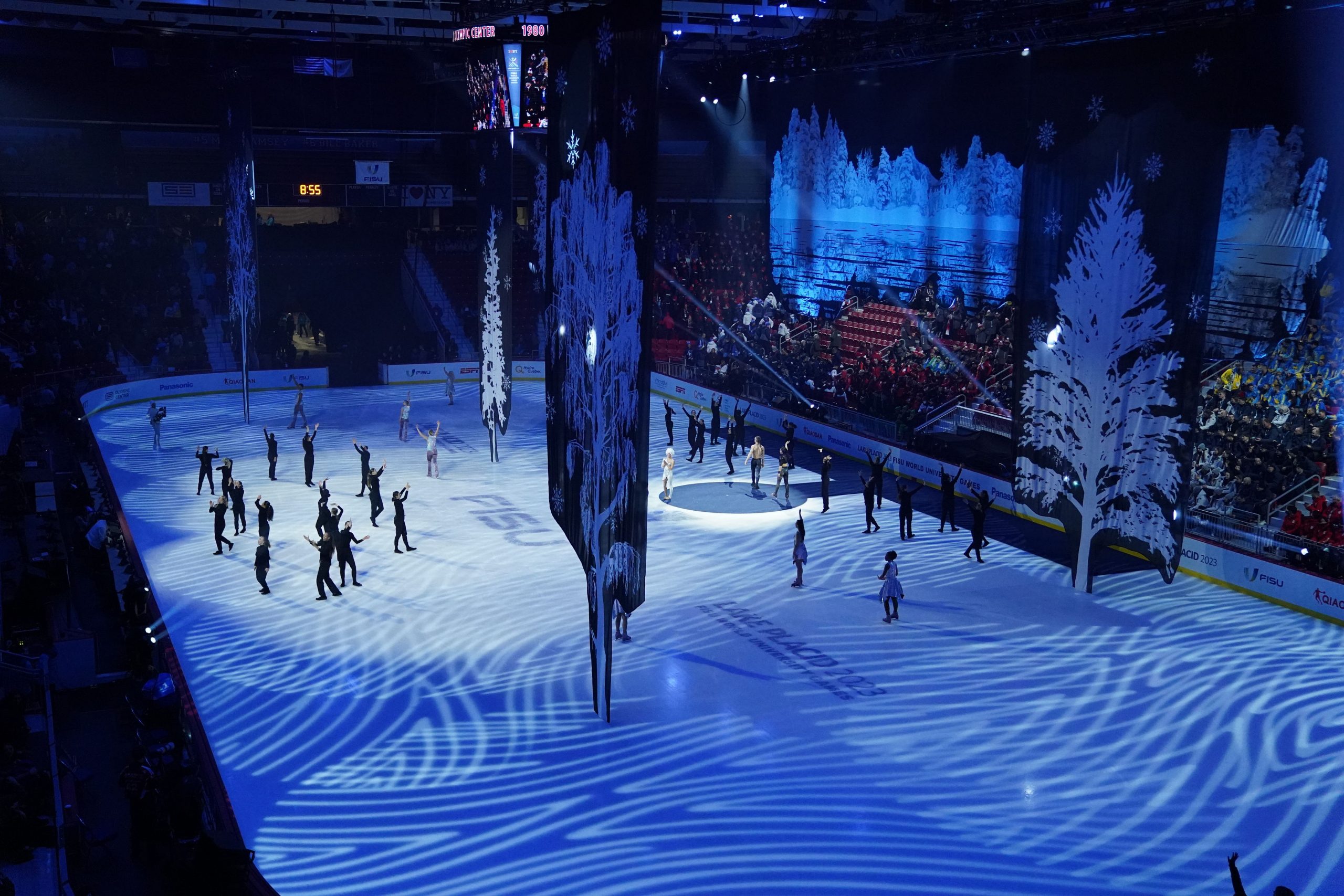
With the State of New York having spent $500 million (through the Olympic Regional Development Authority) to dramatically overhaul facilities originally constructed for the Olympic Winter Games of 1980, Lake Placid was dolled up and ready to host the 31st World University Games, the first time these competitions had been held in North America since 1972. And so, not even the light drizzle outside on opening night could dampen the prospect of a week that promised competition, fellowship, and a glimpse at athletes likely to shape the future of winter sports.
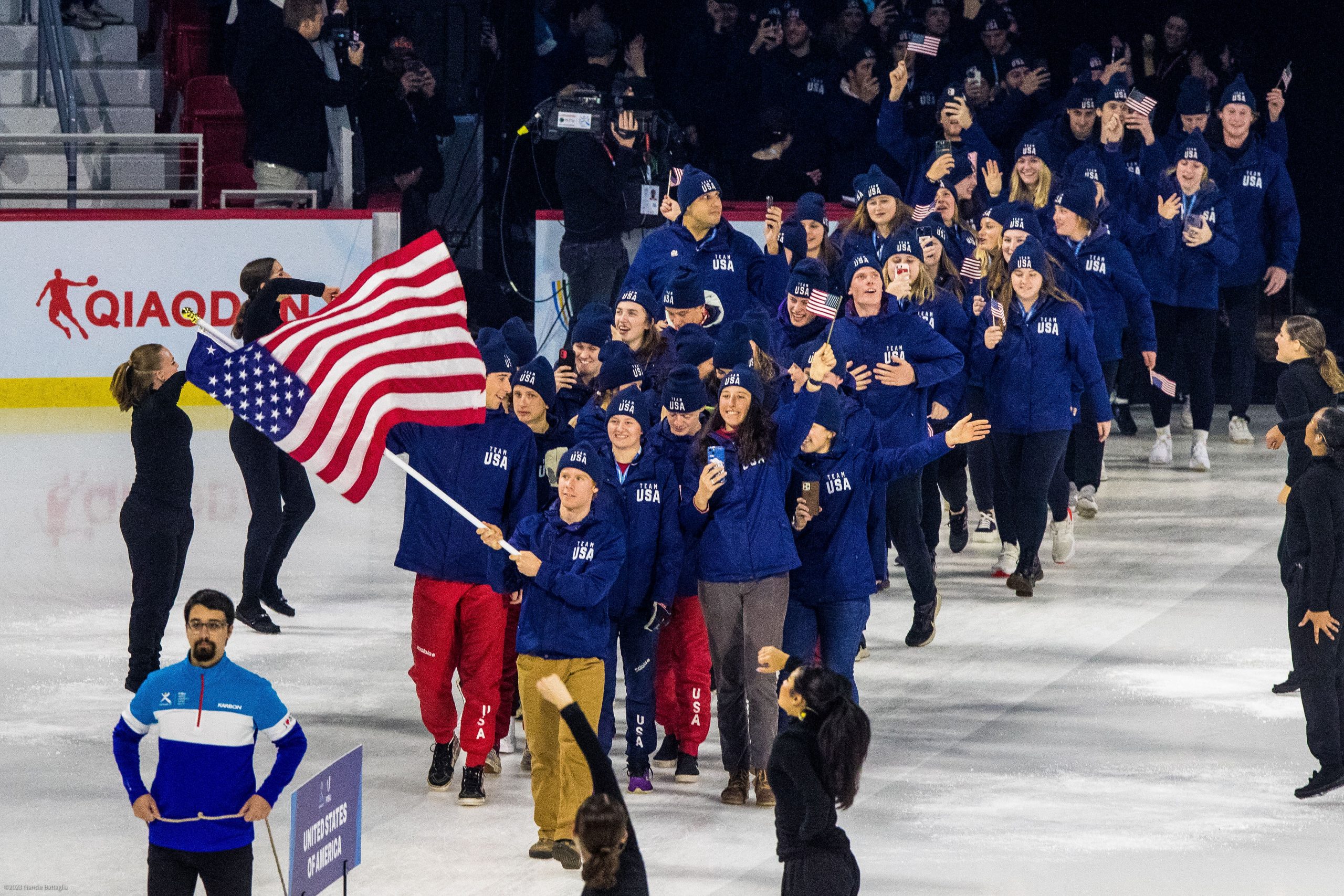
Lake Placid, NY—Biathlete Van Ledger waves the American flag as he leads Team USA into the Opening Ceremony of the 2023 FISU World University Games (Photo: Nancie Battaglia/FISU Games)
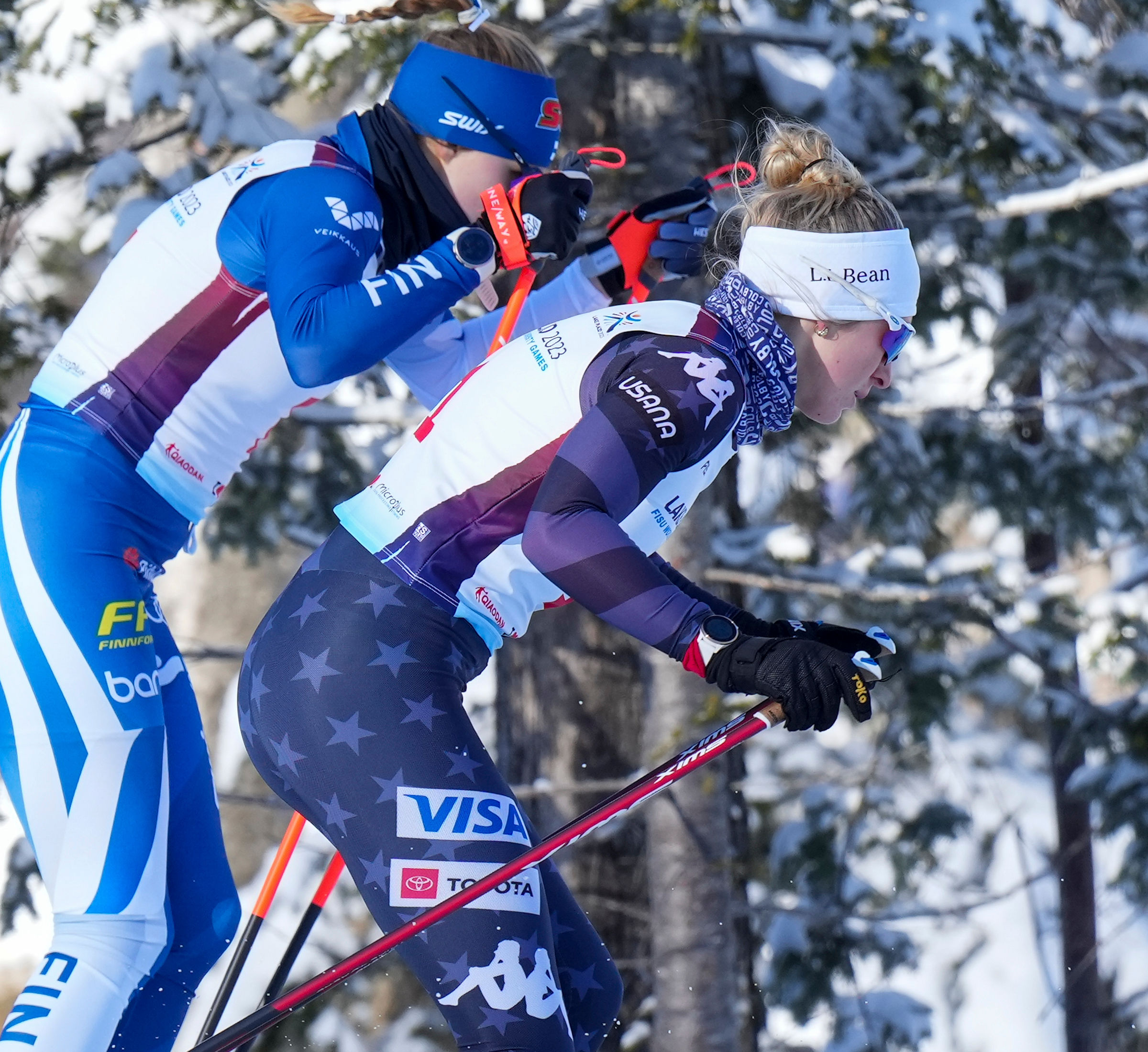
The World University Games highlight collegiate athletes, and the gathering of American cross country athletes underscored just how central the collegiate circuit is to athlete development in the United States. With several members of Team USA using the World University Games as a pitstop on the way to their first World Cup starts—and plenty of the international athletes in the field representing American university teams—signs pointed towards the American collegiate circuit acting as a robust and competitive field for athlete development in the United States, and beyond.
By the close of cross country competitions in Lake Placid, Team USA had won five medals (three individual, two team) in events as diverse as the Mixed Team Sprint and the 30 Kilometer Skate Mass Start. The young Americans built a case for the the ever-deepening pool of US Skiing, and the dynamic athletes who are contained in that community.
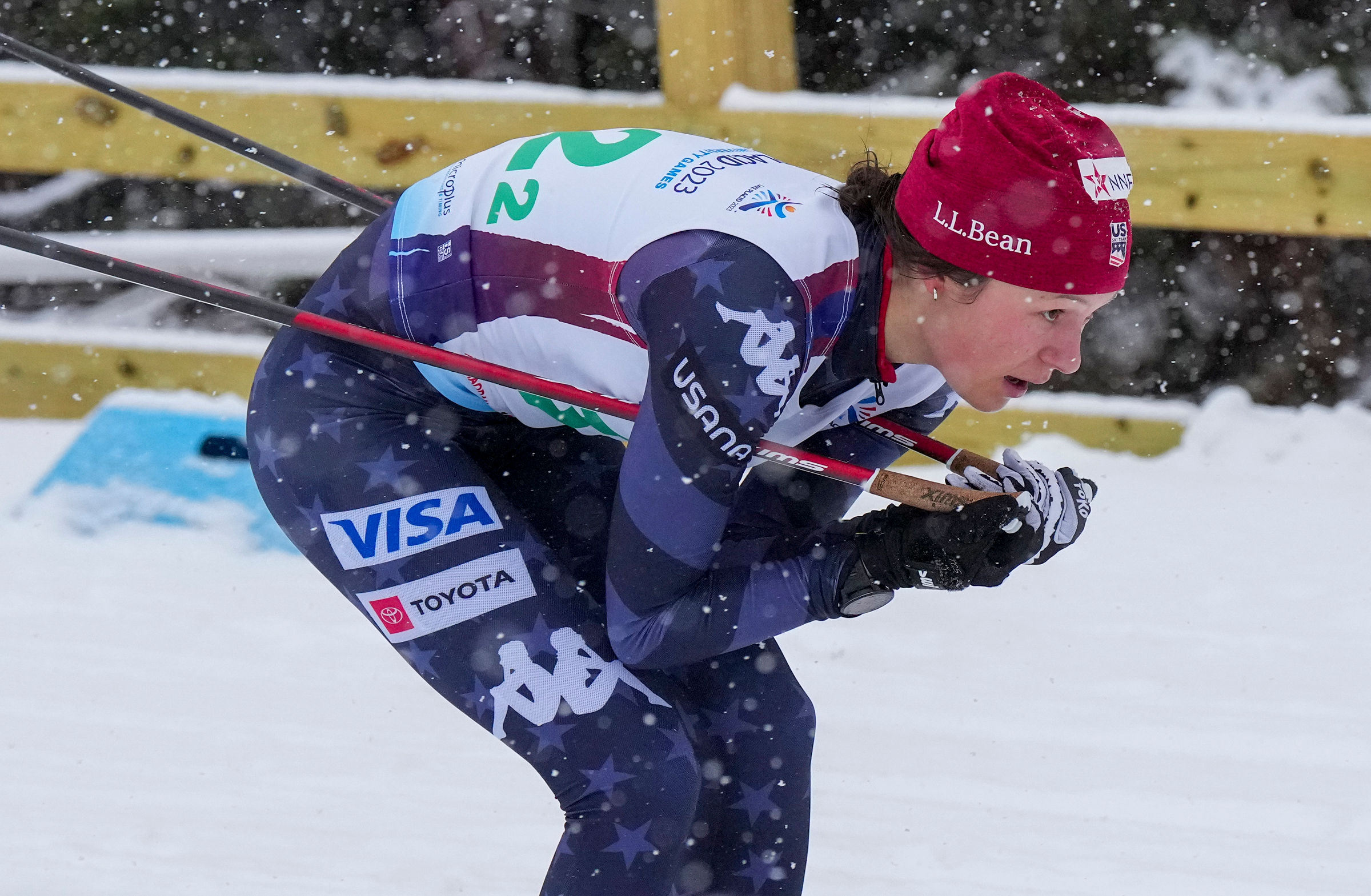
Erin Bianco (1) of the USA during the Cross Country women’s sprint free during the World University Games on January 15, 2023 in Lake Placid, New York. (Photo by Porter Binks/FISU Games)
Team USA at the 2023 World University Games in Lake Placid, New York:
Men
Gregory Burt (University of Vermont)
Garrett Butts (Alaska Pacific University)
John Steel Hagenbuch (Dartmouth College), Gold and Bronze Medalist
Will Koch (University of Colorado)
Alexander Maurer (University of Colorado)
Finn Sweet (University of Vermont), Silver Medalist
Adam Witkowski (Michigan Tech.)
Cameron Wolfe (Dartmouth College)
Women
Lucinda Anderson (University of New Hampshire)
Renae Anderson (Bowdoin College), Silver Medalist
Erin Bianco (Colby College), Bronze Medalist
Kendall Kramer (University of Alaska-Fairbanks), Silver Medalist
Annie McColgan (University of Vermont)
Sophia Mazzoni (Montana State University)
Anabel Needham (Michigan Tech.)
Nina Seemann (Dartmouth College)
Mixed Team Sprint—Classic
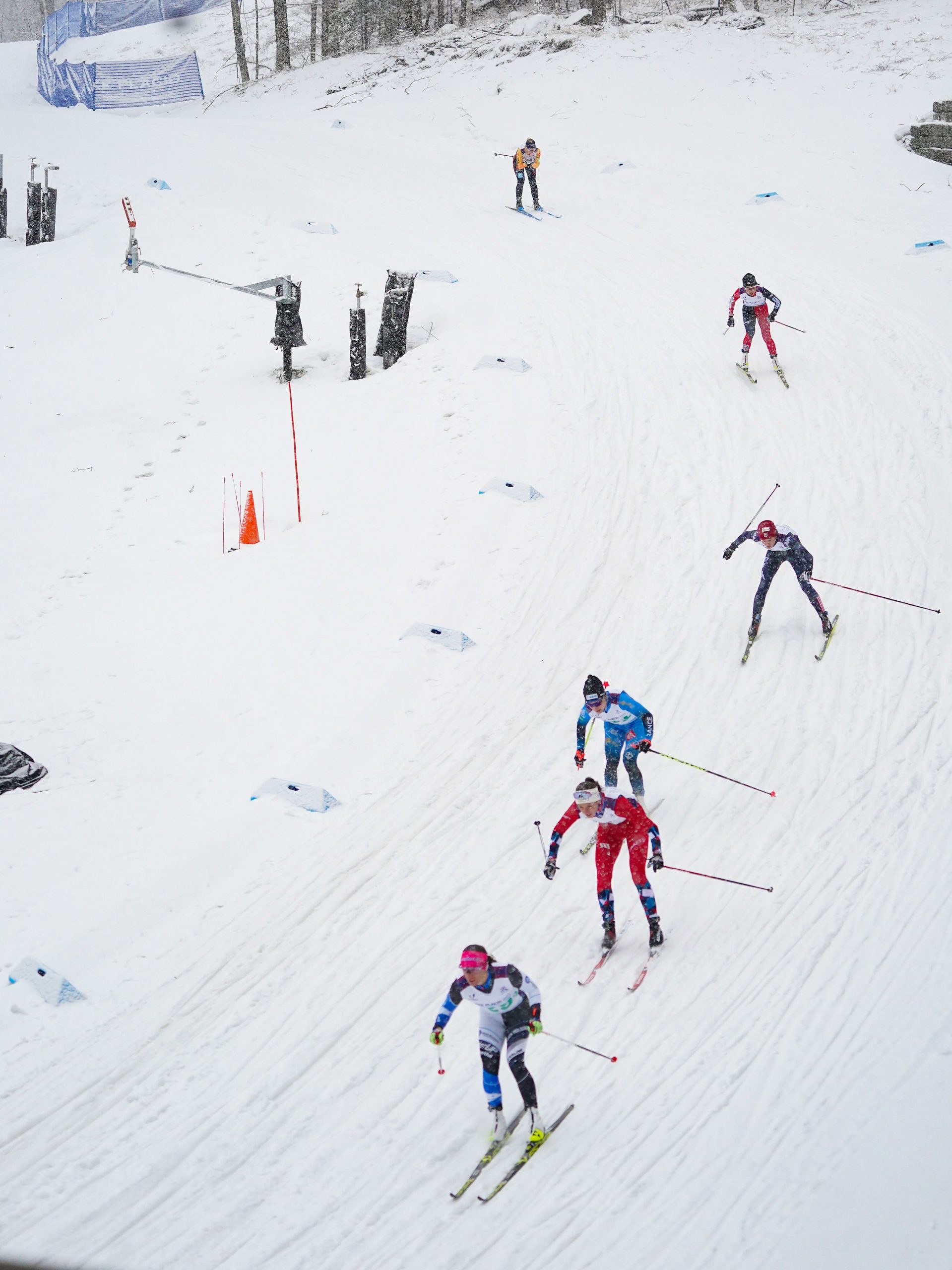
Skiers, including Team USA’s Renae Anderson (Bowdoin College), brave rough snow conditions during the Classic Team Sprint at the World University Games. (Photo: FISU Games)
First on the program was the Mixed Team Sprint: two partners each completing three legs of a 1.35 km course. The event followed a semifinal/final format somewhat similar to individual sprints, with the top two teams from each semifinal automatically advancing, but with a total of six, time-based, lucky loser spots filling out the final field of 10 teams.
The United States entered two teams: University of Colorado’s Will Koch and University of Alaska-Fairbanks’ Kendall Kramer forming USA I came fourth in a tightly contested second semifinal, from which only Italy I and Finland II advanced. Team II was comprised of University of Vermont’s Finn Sweet and Bowdoin College’s Renae Anderson who advanced to the final as lucky losers.
As Sweet-Anderson made their way to the starting line of the sprint final, it began to snow . . . hard. With temperatures hovering near freezing, a snow squall blew in to cover Lake Placid’s warm, granular, man-made snow. That suited the two New England Carnival circuit veterans who made up USA II, with Sweet saying in post-race comments that he and Anderson were “confident [choosing] zeroes, which were definitely the right call.”
Renae Anderson (USA) during finals of the Mixed Team Sprint Classic at the 2023 FISU World University Games on January 13, 2023 in Lake Placid, New York. The USA team placed 2nd behind the winning team from Japan. (Photo: Porter Binks/FISU Games)
Despite being part of the Olympic program since Torino 2006, Team Sprint formats are still a rare event. Sweet echoed that novelty for himself and Anderson: “[The format] was different for sure,” he said. “[In the semi-final] I took it pretty conservatively and looked at it more like a distance race, whereas Renae said she skied it more like a sprint and ended up bonking a bit at the end. Going into the Final I think we were both on the same page with how to pace it which helped out a lot.”
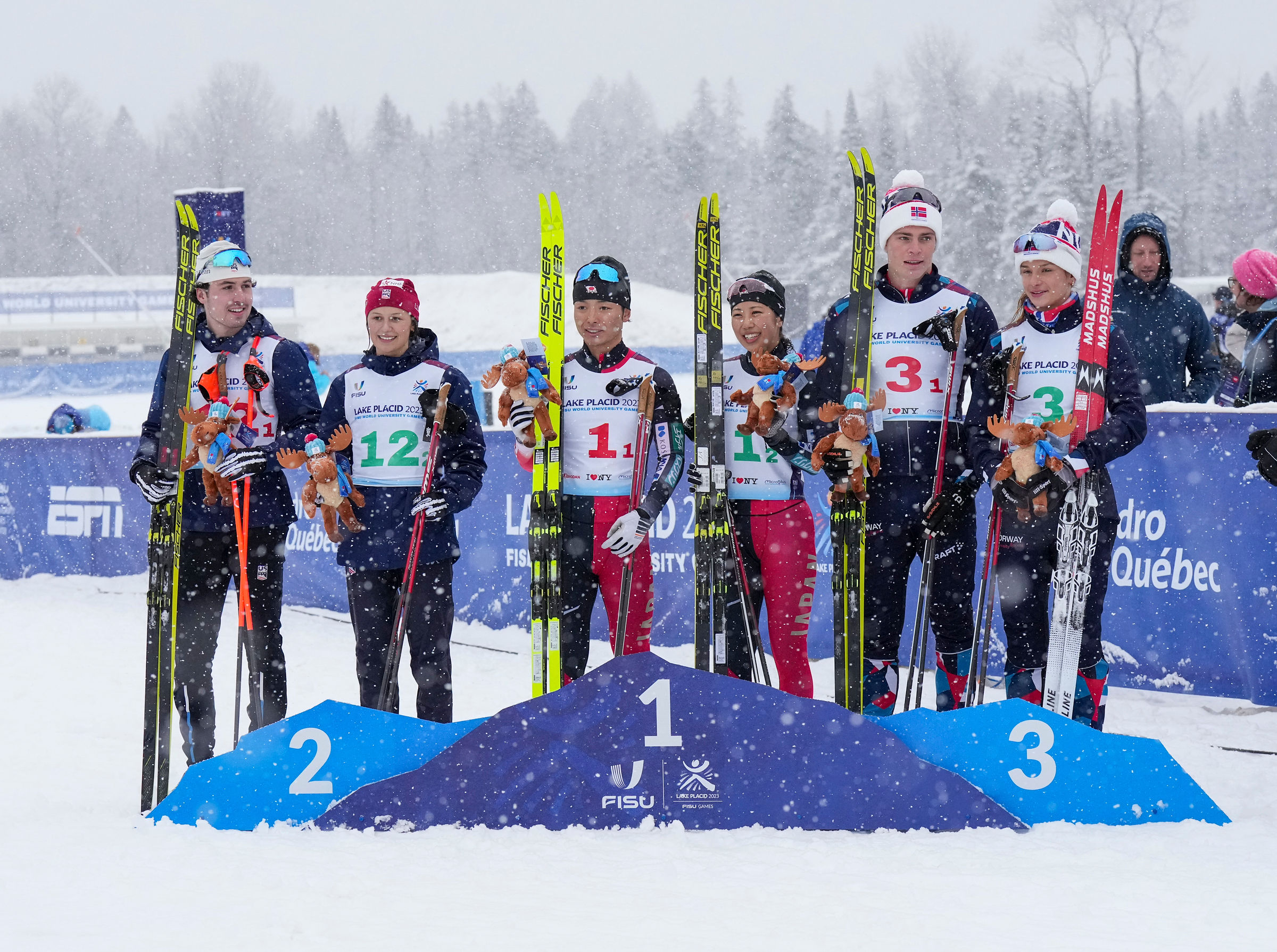
The Final was a tightly contested affair raced on glazed-over tracks: man-made, re-frozen ice covered by new snow. After an initial push from University of Denver student Andreas Kirkeng (skiing as part of the Norway I team alongside University of Utah’s Karianne Olvisk Denegrud) the pack tended towards parity. Eventually, the Japanese tandem of Ryo Hirose and Rin Sobue—both from Tokyo’s Waseda University ski team—pulled away for the win. Into the final exchange, Kirkeng and Sweet had created a clear race for second and third, and Renae Anderson closed with an impressive push that brought USA II to Team USA’s first medal of the week—a silver for the Bowdoin College-University of Vermont duo.
The podium of the Mixed Team Sprint Classic at the 2023 FISU World University Games. L to R: Finn Sweet and Renae Anderson (USA) 2nd place; Ryo Hirose and Rin Sobue (JPN) 1st place; Andreas Kirkeng and Karianne Olsvik Dengerud, (NOR) 3rd place. (Photo: Porter Binks/FISU Games)
Sweet said that he was “super happy with the result. I wasn’t sure what the level of competition would be [in Lake Placid] but after a few days of racing were behind me, I grew more and more proud of what Renae and I accomplished.” Sweet also said that the “Games were a great way to mix up the EISA [Carnival] circuit, especially in a year where the American U23 Team was going to be so strong and a bit out of reach.”
Individual Skate Sprint
The athletes quickly pivoted from Team Sprint to Individual Sprint, a discipline that has highlighted US Skiing’s depth from the World Cup team on down. American performances at the World University Games would prove no different. When qualifying had concluded, Erin Bianco (Colby College) was at the top of the field. In the men’s race, Adam Witkowski (Michigan Tech) and Will Koch (University of Colorado) ranked second and third behind Spain’s Jaume Pueyo. In a further show of American strength, every one of Team USA’s skiers had finished in a position to qualify for heats.
Erin Bianco (USA) races the Women’s Freestyle Sprint during the World University Games in Lake Placid, New York. (Photo: Porter Binks/FISU Games)
In post-race comments on winning the qualifier, Bianco said, “I was extremely excited to qualify first. I have been loving the amount of sprint races there are on the pro circuit and would consider it one of my strengths so to start World University Games by crossing the line in first place might be one of the highlights of my ski career!”
Bianco also provided a comprehensive overview of the course that the Americans would race in the heats: “The sprint course was twisty and hilly,” she said. “The course begins with a quick little up and a sweeping downhill into a significant climb. It then turns left down a more straight downhill into a gradual flat section, quick gradual down into the long uphill. This hill is a steady grind that ends with a steep downhill back under the bridge into the stadium. The final kicker is a tight right hand turn into the finishing stretch. I had never raced here before and was a bit intimidated on the warm up but sprinting happens so quickly that you don’t have time to think about how hard it is!”
In the Women’s heats, Bianco made quick work of advancing to the Final where she matched up against a Finnish contingent of Tiia Olkkonen, Siiri Kaijansinkko, and Niemela, along with American university students Mariel Merlii Pulles, skiing for Estonia and University of Alaska-Fairbanks, and Anna-Maria Dietze, skiing for Germany and University of Colorado.
“[In the Final] I did not want to be in the lead for the first part of the course as the moves were made on the big uphill,” Bianco said. “My skis were extremely fast, so I sat behind for the first half k and then started to push the pace on the uphill. I crested the hill in third which was where I wanted to be so I could catch a draft on the downhill. This plan worked until I hit some ice or slush or maybe just even lost my balance on the final swooping corner into the finish and lost my balance. Luckily I stayed on my feet but this gave [Anna-Maria Dietze] just enough time to edge me out of the podium.” Ahead of the sprint for third with Bianco and Dietze, Mariel Merlii Pulles was able to hold off Finn Tiia Olkkonen to take the gold medal. “Although I was a bit sad to walk away without a medal, I am very proud of how I skied all day” said Bianco on her 4th place finish for Team USA.
In the men’s quarterfinal, New York state native Adam Witkowski found himself doing some unexpected sightseeing of his old stomping grounds. “There was a large crash in my quarterfinal that led to me having to take avoiding action and ski off the trail and through one of the coach zones.” Witkowski stayed calm; in an impressive show of resiliency, he was able to ski himself into a semifinal. On the day’s fast-moving snow, crashes were more the norm than the exception. In the semifinal, Witkowski found himself again swerving to avoid a crash into the first set of downhills. This time, he tumbled in such a way that individual resiliency could do little to overcome.
Having qualified second, Adam Witkowski (USA) found himself hampered by unfortunate crashes that ultimately took him out of contention in the Sprint Free event at the 2023 FISU World University Games. (Photo: Bond Demetri Photos/FISU Games)
Will Koch managed to stay head of the fray in that semifinal. “It was strange to go so ‘quick’ again . . . compared to the other sprints I’ve done this year, this one felt most like a true ‘sprint’ since it was low altitude and had restful downhills.” Koch felt confident that he could push the entirety of the race, “I wasn’t concerned about leading into the final downhill since Perry Thomas, Team USA’s main wax tech, had made the skis so fast.” Koch eased into the Final alongside Northern Michigan University and Norwegian skier Kristoffer Karsrud.
Will Koch (University of Colorado) leading Kristoffer Karsrud (Norway, Northern Michigan University) down the last hill of the Freestyle Sprint event at the 2023 FISU World University Games. Karsrud would ultimately place 5th, with Koch placing 6th. (Photo: Bond Demetri Photos/FISU Games)
Koch and Karsrud joined a Finals field filled out by Finland’s Verneri Poikonen, Spain’s Jaume Pueyo, German Marius Bauer, and Frenchmen and University of Utah skier Tom Mancini. Koch had been through blistering paces in both his quarterfinal and semi-final, and in the Final, he said, it took a toll, “I was very tired from the heats and did not have the energy to ski as fast as the prior heats.” Koch still held strong in a tight pack, and finished 6th, as Poikonen took gold, Pueyo took silver, and Utah Ute Tom Mancini took the bronze. “At the end of the day, there were some very talented sprinters I was up against in the final who would have been hard to beat even with more rest” said Koch on his finish.
Pursuit: Men’s 10 km Pursuit and Women’s 5 km Pursuit
Bronze medalist John Steel Hagenbuch (7) of the USA, left, with gold medalist Ryo Hiose after the Cross Country mens pursuit free at the World University Games on January 17, 2023 in Lake Placid, New York. (Photo: Porter Binks/FISU Games)
From the opening sprint weekend, the World University Games turned to a two day pursuit on Wednesday and Thursday of last week. The event entailed a classic individual start Wednesday, followed by a pursuit start on Thursday.
Top performers in the first stage individual start classic race were University of Alaska-Fairbanks’ (UAF) Kendall Kramer, who finished 12th place on the day, and a sixth place for University of Vermont’s Finn Sweet. Dartmouth College’s John Steel Hagenbuch, meanwhile, was just .02 seconds off Sweet in seventh place, with both 37 seconds back going into day two. Finland’s Hilla Niemela finished first in the women’s race, with UAF and Estonia’s Mariel Merlii Pulles in second place. Japan’s Ryo Hirose won the men’s race ahead of University of Colorado and Norway’s Magnus Boee.
From seventh place the next day, John Steel Hagenbuch would work and wind his way through the field. The Sun Valley native had a race rivaled by only winner Ryo Hirose, who held his gap from day one for gold, as he pushed through the dense pack that formed the top 10, passed, and passed, until he was right up to Andreas Kirkeng. Kirkeng, who had finished third on day one, eventually used the energy savings earned from day one to open a gap on Hagenbuch for second place, but Hagenbuch had made his case for bronze crystal clear. He stepped onto a podium, and earned Team USA’s second medal of Games, and first in an individual event.
In the women’s race, Kendall Kramer pushed to move up a place on day two, and ended the pursuit race in 11th place. Mariel Merlii Pulles fought to join Hilla Niemela at the front of the a race from 18 seconds back, but Niemela was able to leverage her advantage to take gold for Finland in the pursuit. Pulles earned her second medal of the Games, a silver, while Maria Eugenia Boccardi finished third for Italy.
Team Relay: Men’s 4 x 7.5 km and Women’s 3 x 5 km
Krystof Zatloukal of Czech Republic leads the pack to start the Men’s 4 x 7.5km Relay at the 2023 FISU World University Games on January 20, 2023 in Lake Placid, New York. (Photo: Isaiah Vazquez/FISU Games)
Friday moved to a classic Olympic event, the Team relay. The Men would race a 4 x 7.5 km race alternating classic and skate legs, while the women would do a 3 x 5 km in the same format. Team USA for the Women’s relay included lead leg Sophia Mazzoni (Montana State), Anabel Needham (Michigan Tech), and anchor Kendall Kramer (UAF). Team USA for the Men’s relay included lead leg Garrett Butts (APU), Finn Sweet (UVM), Gregory Burt (UVM), and anchor Alexander Maurer (University of Colorado).
The Women’s race saw Finland and Norway establish a lead early and hold it until the very end. A Final sprint from pursuit champion Hilla Niemela saw Finland clip Norway for gold, Kazakhstan held onto the Nordic duo’s push until the very end to take a bronze medal. Team USA finished in 10th place.
France was the dominant force in the Men’s race, holding a lead nearly unencumbered from the first exchange on out. It was University of Utah’s Tom Mancini who anchored the gold medal performance, as Norway and Japan finished 2nd and 3rd. Team USA finished fifth place.
Mixed Nordic Team Event: Nordic Combined/Jumping/Cross-Country: Erin Bianco
Erin Bianco, of the USA, bursts from the transition zone at the skiing portion of the Mixed Team Nordic at the 2023 FISU World University Games in Lake Placid, NY. (Photo: Logan Swney)
In keeping with the theme of innovative events at the World University Games, the Relay portion of the week also included a Nordic Combined/Jumping/Cross-Country cross-over event. The event was, at its core, a Nordic Combined race, a jumping portion followed by a pursuit start 2×2.5 km cross-country skate race. At the World University Games though, National team’s competed in trios of one pure jumping athlete, one nordic combined athlete, and one pure cross-country athlete. The jumper and nordic combined athlete combined for the jump portion. The nordic combined athlete and the cross-country athlete then combined for a pursuit start team relay in which both skiers did a 2.5 k leg. A format that may sound like the work of a mad nordic scientist, but one that provided loads of excitement for Team USA.
The cross-country athletes for Team USA included Erin Bianco (Colby College) for USA I, and Cameron Wolfe (Dartmouth College) for USA II. Erin Bianco combined with Jumper Cara Larson and Nordic Combined athlete Niklas Malcinski for USA I, Cameron Wolfe combined with Jumper Logan Gundry and Nordic Combined athlete Tess Arnone on USA II (Gundry is also a Nordic Combined athlete, but just jumped in this competition).
After the jumping competition, USA I was in 3rd place going into the cross-country portion. Behind strong legs from both Malcinski and Bianco, they held their position, and in the old-school, new-wave or Nordic Combined competitions, the USA took home a bronze medal. Japan, long a powerhouse in the ski jumping world, took gold, with fellow jump-strong nation Poland taking silver.
Team USA crosses the line for a bronze during the Mixed Team Nordic Combined Sprint at the 2023 FISU World University Games on January 19, 2023 in Lake Placid, New York. (Photo by Hailey Trejo/FISU Games)
Skate Mass Start: Men’s 30 km and Women’s 15km
John Steel Hagenbuch on the finishing straight during his Gold Medal performance in the 30km Mass Start World University Games in Lake Placid, NY. (Photo: Logan Swney)
As it entered the second Sunday of competition, the World University Games program wound down by turning the intensity up. As in the Olympics, the Universiade would finish on a—note the quotes— “marathon.” The Men’s race would be 30 kilometers: 10 kilometers longer than the longest race on the NCAA circuit. The Women’s race, however, would be 15 kilometers, which matches the longest distance on the NCAA circuit. While both still definitely distance races, there was already a kind of archaic overtone as the races arrived in the new age of equal distance racing.
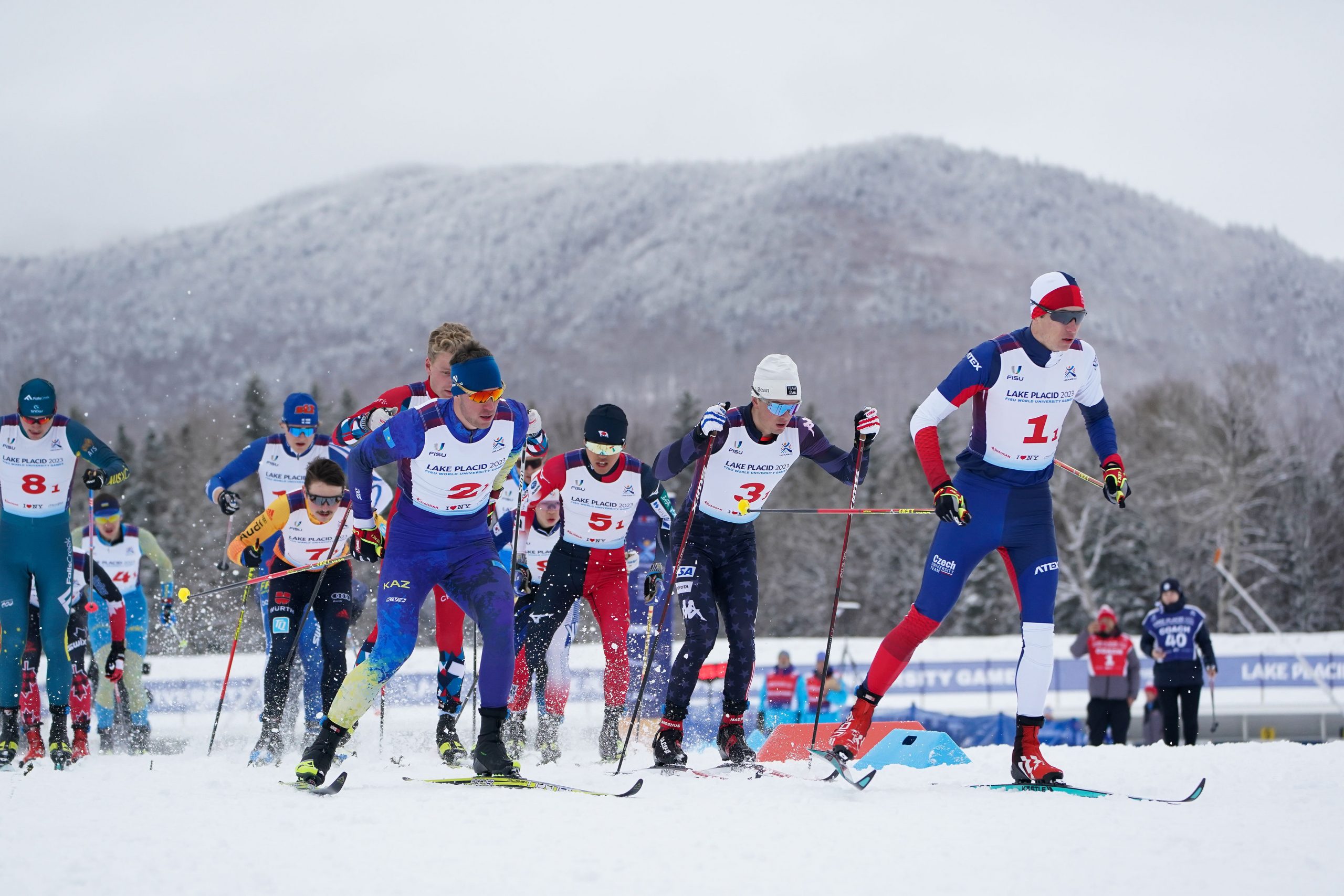
On a difficult, winding, hilly five kilometer loop, the Men’s field didn’t contain anyone who wanted to take chances too early. Among the lead pack that formed in the early part of the race were two Americans, John Steel Hagenbuch (Dartmouth College) and Garrett Butts (Alaska Pacific University). Both showed the poise and patience indicative of confidence in a large mass start field. Hagenbuch, fresh off his pursuit push to bronze on Thursday, was set to ski with anyone. While Gunnison, Colorado native Garrett Butts had come into the Games fresh off of a career-best SuperTour 3rd place in the Seeley Hills Classic 30 k two weeks prior. His mother, Two-time Olympian and American Birkebeiner Champion Ingrid Butts, was set up in the stadium as Butts and Hagenbuch swung through the low-spot between the testing hills on the Lake Placid course.
As the final lap began, the lead pack had taken full shape. Hagenbuch and Butts were in, alongside Japanese skier Ryo Hirose, France’s Simon Chappaz, Italy’s Compagnoni, and Norway and University of Colorado’s Magnus Boee. Hagenbuch then went to work, grinding out an upturn in the pace that stretched, but did not break, the pack. Boee stayed on him, Compagnoni and Chappaz came too.
By the final kilometer though, it was all but clear who the strongest skier on the day was. The margins would be tight, but John Steel Hagenbuch came into the storied Lake Placid stadium and claimed a gold medal for Team USA. Boee followed to earn a silver, and Compagnoni finished in third for the bronze. Garrett Butts crossed the line in sixth place, the last member of the lead pack to hold on.
John Steel Hagenbuch of the USA leads the pack up the climb and into the depths of Mt Vanhoevenberg during the 30km Mass Start World University Games in Lake Placid, NY. (Photo: Logan Swney)
The Women’s 15 kilometer would also see a pair of Americans establish themselves in the lead pack early. Kendall Kramer (University of Alaska – Fairbanks) and Erin Bianco (Colby College) skied their way to the front of the race as the lead pack coalesced into four skiers strong. The Americans were joined by Kramer’s UAF teammate Estonian Mariel Merlii Pulles, and Kazakhstani Xeniya Shalygina.
University of Alaska -Fairbanks Teammates Mariel Merlii Pulles of Estonia, and Kendall Kramer of the USA sprint to the finish of the Women’s 15 k Skate Mass Start at the FISU World University Games in Lake Placid, NY. (Photo: Logan Swney)
The UAF Nanooks, Kramer and Pulles, soon made the World University Games a kind of team time trial, pulling away from Bianco and Shalygina on the final turn around the 5 k course. When they pulled into the stadium at Mt. Van Hoevenberg, they were dead even. For the crowd waiting in the stadium – and it was a crowd – it would be either the perfect introduction to cross country skiing, or the perfect conclusion to a week of racing. They sprinted for the line, and Pulles, the champion on the week, ended up pulling out a gold medal by .4 seconds over Kramer, who claimed a silver medal and a first individual medal for Team USA’s Women. Erin Bianco held strong through the final five kilometers, and finished fourth place behind Xeniya Shalygina.
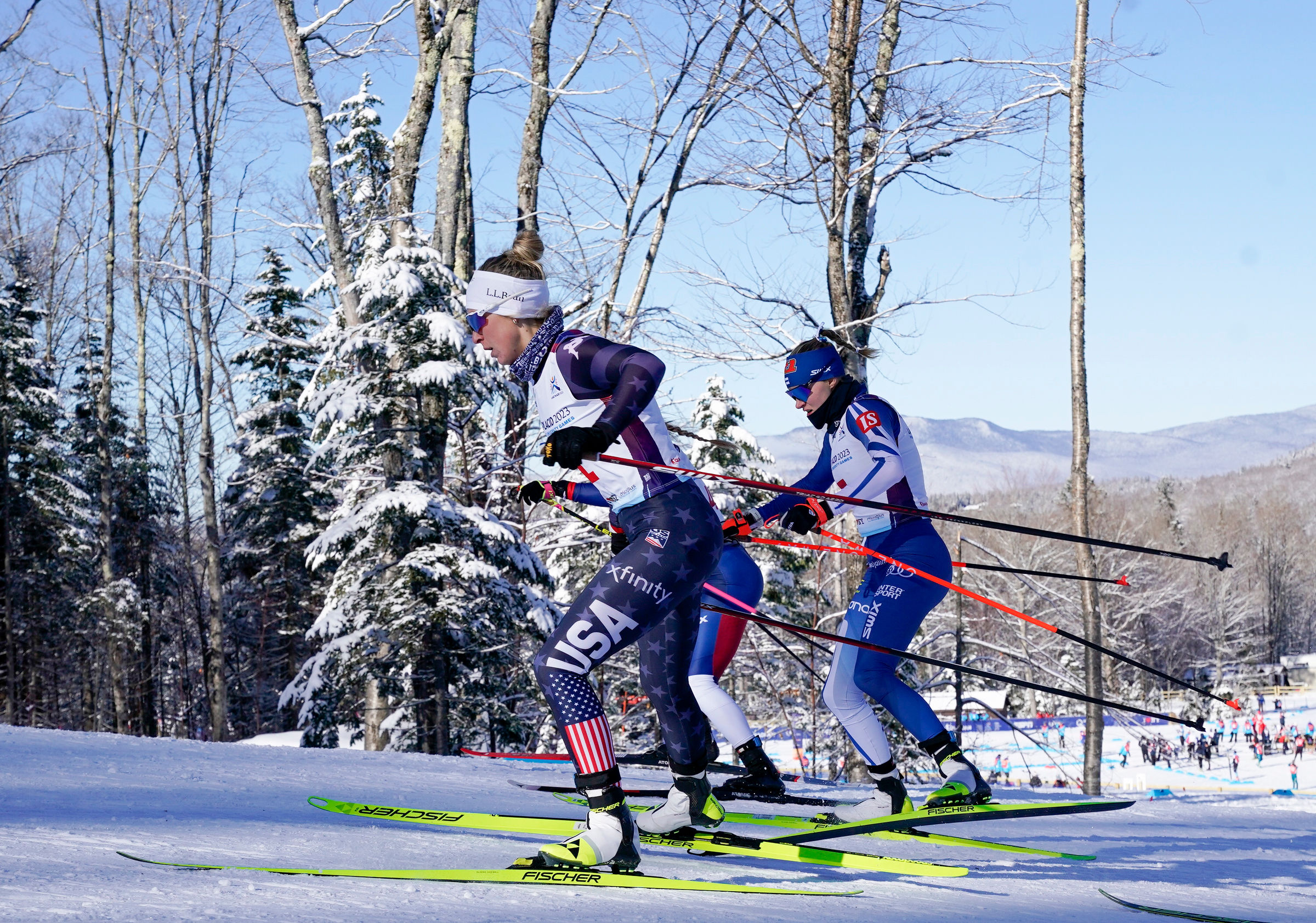
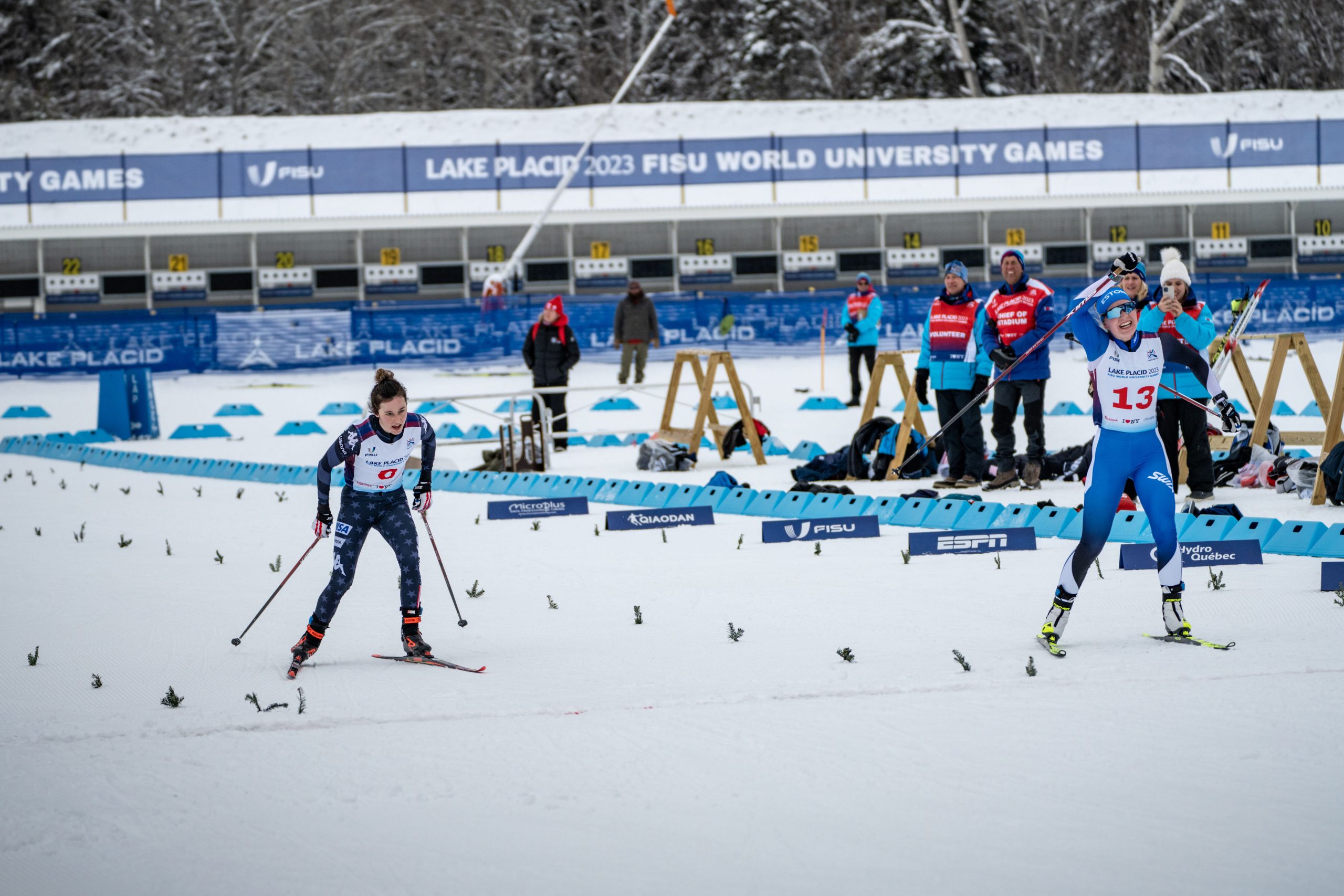
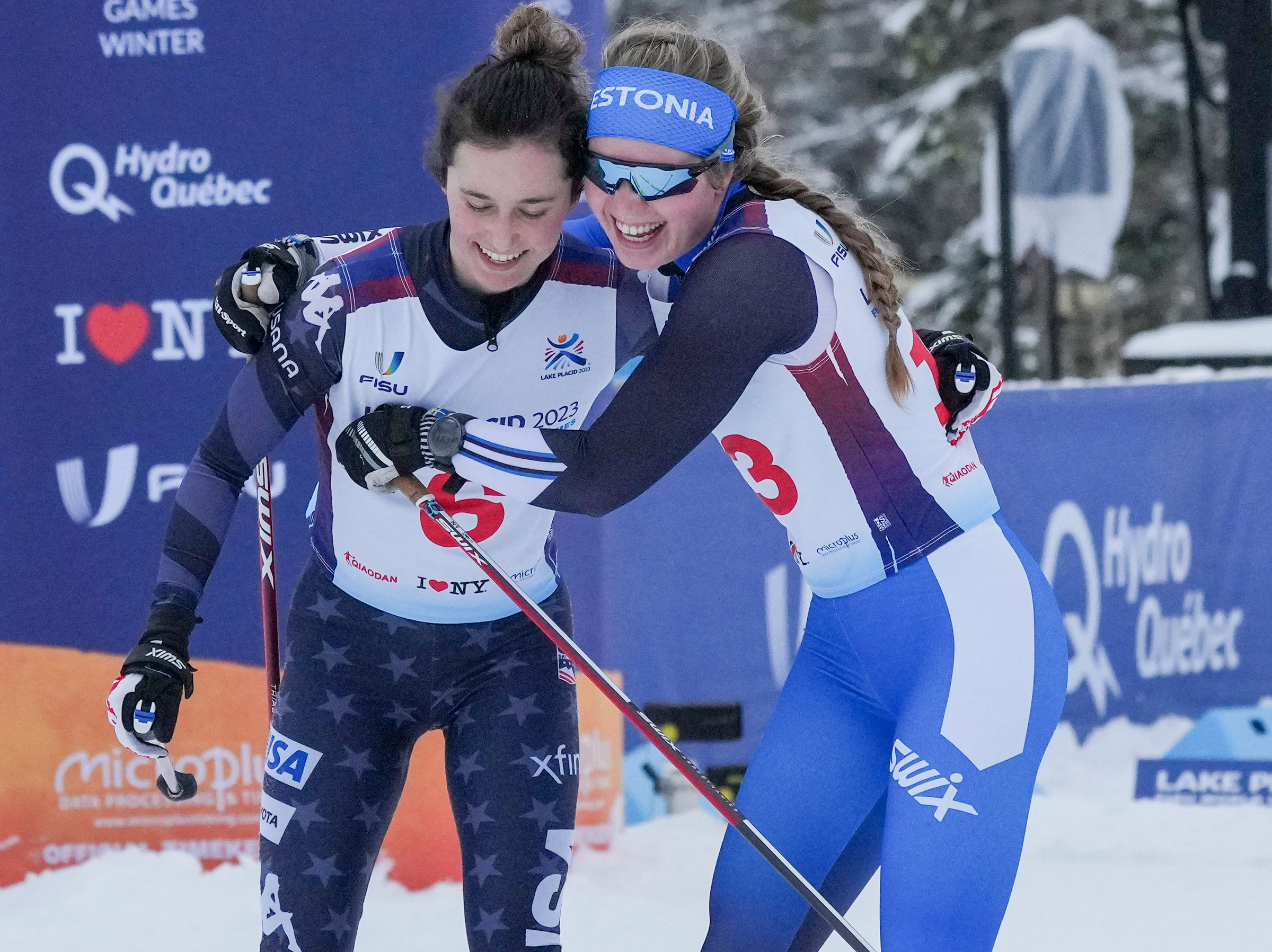
Kendall Kramer (6) of the USA, left, and her teammate at the University of Alaska-Fairbanks Mariel Merlii Pulles (13) of Estonia embrace at the finish line of the women’s Cross Country 15 k mass start at the World University Games on January 19, 2023 in Lake Placid, New York. Pulles won gold and Kramer took silver. (Photo: Porter Binks/FISU Games)
From World University to World Cup, and more, for Team USA
John Steel Hagenbuch came away from the World University Games in Lake Placid with a Gold and Silver Medal for Team USA. (Photo: Hailey Trejo/FISU Games)
For Adam Witkowski, the Men’s sprint he qualified for in third place came with some well-deserved extra nerves. “With [the World University Games] being my first international race of my career I had quite a few nerves at the beginning of the [sprint] day.” His first international race was followed quickly by his second: a World Cup sprint the following weekend in Livigno, Italy. Witkowski wasn’t alone in the making the jump from Lake Placid to Livigno, either. Will Koch rushed on from his start in the Lake Placid 10 km Classic to “catch a redeye flight from Montreal to Italy for my first World Cup Starts!” The duo both made starts, with Koch highlighting making the Team Sprint Final in Italy alongside teammate Kevin Bolger.
For other members of Team USA, this World University Games in Lake Placid offered a perfect coda for their time spent on the collegiate circuit. Erin Bianco, who graduated in 2022, this was a “big highlight to represent the US for the first time, and Colby College one last time.”
Closing Ceremonies of the 31st World University Games took place in the arena where the sporting world’s most famous question and answer, “Do you believe in miracles? . . . Yes!” was immortalized. For every fan who remembers those words echoing from our television sets in 1980, there is a constant reminder of miracles that occur in Lake Placid. Team USA saw four medals in cross country skiing at these World University Games. Hard work and collective belief are indeed acts of will, bu—for a national ski program aspiring to become the best in the world—there’s a hint of something mystical at play, too. So we leave with the familiar refrain: “Do you believe in miracles?” . . . Yes.