From the FasterSkier archive — posts syndicated from athletes’ and coaches’ own blogs between 2004 and 2012, kept online as published. Current coverage is at fasterskier.com.

Tag: Erzurum World Junior/U23 Championships

  • At “Biggest Race of Their Lives,” Juniors Face Tough Lessons At Altitude

    At “Biggest Race of Their Lives,” Juniors Face Tough Lessons At Altitude

    Stephanie Kirk (USA) being helped by U.S. wax tech Eric Pepper after dropping out of Friday’s skiathlon at World Juniors. Photo: Terje Alstad.

    At 5,700 feet above sea level, the Kandilli Nordic Ski Center in Erzurum, Turkey has presented World Junior competitors with some of the most painful racing they’ve ever experienced. As became clear from the depth of Russia’s dominant results—a team that took a two-week altitude camp in Bulgaria prior this week’s racing—acclimation to altitude has played a major role in the outcome of World Juniors and U23s, for all levels of athletes.

    In more than one race, skiers were forced to drop out due to sheer exhaustion. In Friday’s skiathlon, one such athlete was American junior Stephanie Kirk.

    Kirk is a resident of sea-level Anchorage, Alaska, and the Erzurum championships are essentially the first races the 17-year-old has ever skied at altitude. During both Wednesday’s 5 k classic and Friday’s 10 k skiathlon, Kirk experienced a severe shortness of breath that left her gasping for air.

    On Wednesday she made it through the finish, but immediately had to be administered oxygen in an on-site ambulance. Friday’s race was twice as long, and Kirk said she was too oxygen-deprived to finish.

    “I went out too fast on Wednesday for altitude, so today I tried to be more conservative,” said Kirk on Friday afternoon. “But it almost didn’t make a difference. I was still feeling more short of breath, but not in a normal way.”

    Just before collapsing, Kirk appeared unsteady on her feet as she skated up the steep hill out of the stadium in the second half of the race. U.S. wax techs Casey Fagerquist and Eric Pepper were standing close by, and Fagerquist stepped in to pull the struggling Kirk off the course.

    A French skier being carried off the course in a stretcher after her leg in the women’s relay on Sunday.

    “I’m not sure I would have made it much further, to be honest, as there wasn’t a downhill recovery coming up,” said Kirk. “I was definitely having trouble just moving, though I did know where I was—I wasn’t unconscious.”

    “There wasn’t much to gain from finishing. Ultimately, when Casey grabbed me, I was just, like, dead.”

    Kirk has had trouble with her breathing in races before, but her reaction to the cold and altitude has not been uncommon this week.

    Matt Boobar, one of the U.S. junior coaches in Erzurum, empathized with the experience of learning so many new things on the biggest possible stage.

    “They’re learning on the fly at the biggest race of their lives,” he said. “It’s great, but also frustrating.”

    Altitude isn’t the only new factor athletes are contending with. “It’s how to wax, what skis to pick, pacing at altitude. And the level of competition is an eye-opener for these guys,” said Boobar.

    This is also the first race many of the American juniors have traveled to without their own coaches by their sides.

    “It’s a great lesson to learn though…the way our pipeline is set up, it’s good to learn to be independent, learn to go with the flow,” said Boobar.

    Kjell Vegard Mykland (left), the Norwegian ski team doctor.

    Norway’s team doctor, Kjell Vegard Mykland, is travelling with their junior squad this week, and explained that especially in young women, the combination of cold and low oxygen can cause the cartilage in the bronchial tubes to collapse during the extreme exertion of a race.

    “When you pressure your respiratory system to the max—to beyond the max—it’s like breathing through a straw,” said Mykland.

    Mykland is unfamiliar with Kirk’s specific case, and the potential physiological mechanisms at play are many and complicated. However, the essential point is that without allowing for around two weeks of acclimation to high altitude prior to competition, the body has trouble adjusting to the thinner air in the middle of a race.

    The 2012 Junior World Championships are the first to be held as high as 5,700 feet, so the experience is new for the Norwegian juniors as well.

    “It’s a bit unfair, I think,” said Norway’s team physiotherapist Petter Treider.

    “Those athletes who live at high altitude do well, while those who live at low elevation will struggle,” he continued. “It comes down to economy—who can spend the money to spend three weeks at high altitude.”

    Treider and Mykland acknowledged that Norway has more than enough funds to have a pre-championships altitude camp with their juniors and U23s, as Russia and Estonia did prior to arriving in Erzurum.

    Athletes often lay on the ground for minutes after crossing the finish line this week.

    Unlike the Russians, the Norwegian team staff is focused on long-term development, and thinks the opportunity for juniors to gain experience is more important than medals at World Juniors, and chose not to have an altitude pre-camp.

    “It’s probably why we haven’t had the same results here that we’re used to,” Mykland acknowledged. “If these were the main goal of their careers, we’d take some victories. But it’s not. It’s a good experience for them—it doesn’t matter if they’re number three or four as long as they’re good when they’re 25, 26 years old.”

    Long stretches of time training at altitude can also do more harm than good for athletes in the long term, said Mykland.

    “We see some athletes, when they’re young, not willing to take it easy enough at altitude,” he explained. “They get ill, they get overtrained. It’s just too risky—they’re not experienced enough, and [World Juniors] is not that important for them.”

    “We’re also in a position that we are able to think this way,” Mykland continued. “We don’t need to have our best juniors here. We have the privilege to think this way—in the long term, not the short term.”

    Likewise, the U.S. team opted not to have an altitude camp prior to World Juniors, deciding instead to arrive in Europe early to hop in some Scandinavian Cup races.

    “We thought about having an altitude camp,” said the U.S. Ski Team development coach Bryan Fish. “We opted to do some Scando Cup races instead, reasoning that it was important to provide more racing experience.”

    No matter how frustrating not finishing is, Fish emphasized that every race at this level presented a learning opportunity—that this is the whole point of World Juniors in the development pipeline.

    “This is Worlds, this is no joke,” said Fish. “We try to bring our best athletes here and provide them with the opportunity to elevate their level of racing against other athletes around the world. We just have to keep that in mind.”

    This year is the first World Junior Championships that many of the U.S. junior athletes have ever been to. The age category goes up to 19 years old, but all of the American women, for example, are still seniors in high school.

    For every race that doesn’t meet an athlete’s expectations, Fish believes it’s still a valuable learning tool.

    “It might not have been perfect, but in every situation you can come out and say, ‘That was tough, but I learned something from it,’” said Fish.

    Back in the hotel after Friday’s skiathlon, Kirk said she was trying to move past the experience and learn from it what she could.

    “I know all this will come in handy later on, having practiced [altitude racing],” said Kirk. “Yeah, it’s a bummer it had to be here…but it’s got to happen somewhere.”

    “I just try to keep learning.”
  • Hagen Claims Norway’s First Gold with Skiathlon Victory; Diggins Starts Fast But Fades

    Hagen Claims Norway’s First Gold with Skiathlon Victory; Diggins Starts Fast But Fades

    Martine Ek Hagen (NOR) on her way to a gold medal in the 15 k skiathlon at U23 World Championships on Saturday. Photo: Logan Hanneman.

    ERZURUM, Turkey — Before Saturday’s 15 k skiathlon began, gold had eluded Norway at the Junior/U23 World Championships. The team repeatedly stressed that the week that the learning experience was more valuable than the hardware, but athletes and team staff alike nonetheless seemed hungry for the wins they are used to.

    Martine Ek Hagen (NOR) finally delivered in the skiathlon, skiing a strong skate leg in the second half to win by 13.9 seconds over Italy’s Debora Agreiter. Emma Wiken (SWE) took third (+34.5).

    The podium was fairly spread out, but before the gun went off, anything had seemed possible. Russia had dominated the 10 k classic on Thursday, but Jessie Diggins (USA) was finally putting on a bib after recovering from illness earlier this week. Hagen was the top seed, and after a good chunk of time at altitude, had promised after the classic race not to finish the skiathlon with Russians in front of her.

    When the race got underway, Diggins, wearing bib number three, was one of the first to come into view over the first hill out of the stadium. Shortly thereafter, she took the lead of the entire race where she stayed until the ski change at the 7.5 k mark.

    “That first half of the race felt really good—I was relaxed and strong, and feeling powerful,” said Diggins.

    Diggins controlled the pace for the entire classic leg. When she saw U.S. coaches waving a pole for teammate Sadie Bjornsen (USA), Diggins slowed it down to give Bjornsen time.

    “When you’re in front you can make sure no one takes off, or you can make it go faster,” said Diggins.

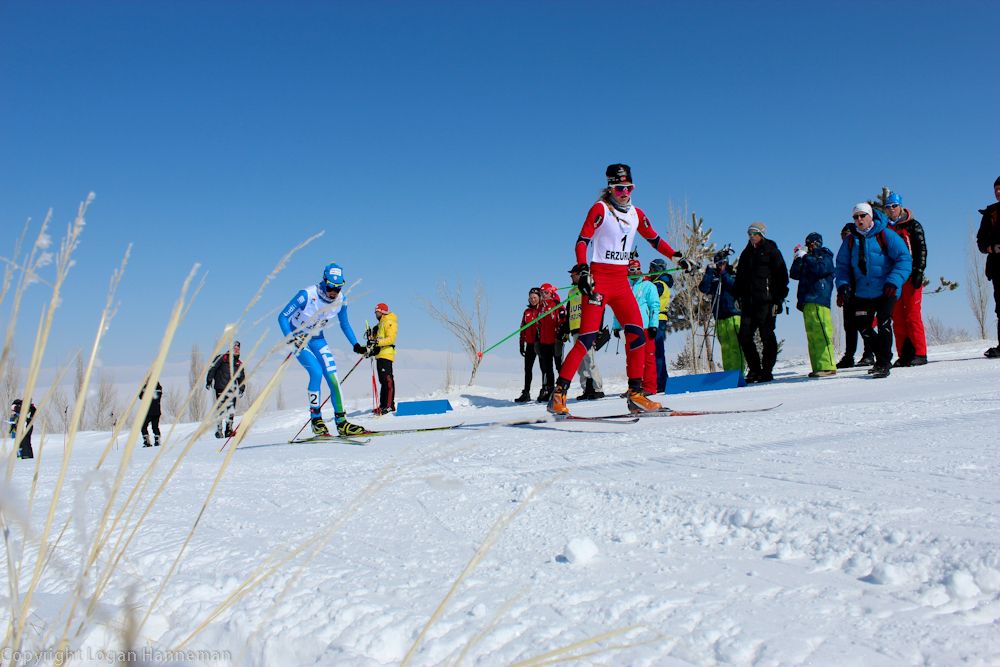
    The women's skiathlon on the first hill out of the stadium. Photo: Logan Hanneman.

    Separated from the pack, she could also take squirrely downhills exactly how she wanted, so Diggins took off before a slick descent that ended in a 180-degree-turn so that she wouldn’t be stuck snowplowing behind the rest of the field. In doing so, she opened up a gap that no one responded to.

    “Jessie kind of pushed over the top and the other girls would not go with her,” said Bjornsen. “I was like, ‘What are you doing?’” Part of me wanted to break on the classic, but there was no way I could hold it in skate, but I kind of wanted to just have fun with it.”

    Diggins wasn’t sure exactly why no one followed her break.

    “I think people knew I wasn’t going to gap the field, they probably figured I was just being safe on the corner,” said Diggins. “Last year here I fell, and someone fell on top of me, so I didn’t want that happening here.”

    At no point in the classic leg did Diggins feel like she’d crossed the line and gone too hard, but after the switch to skate skis at the halfway mark, she began having trouble.

    “The second half I just had no energy source left,” said Diggins. “It went from good to just falling apart right after the transition. Something felt super wrong.”

    “I made the mistake of trying to stay with [the leaders]—it was hard to purposely drop back—but I should have and I ended up really dying. So, needless to say, that second half was probably one of my worst.”

    Hagen took the lead in the second half, as skate is her stronger discipline, and she and Agreiter had soon put distance on the rest of the field.

    “I thought Jessie Diggins, especially, would follow, but when she gave us a gap, I didn’t want her to catch up with us again,” said Hagen. “I thought Agreiter was very strong, so I was never sure [of the win], but I was hoping it would stay that way.”

    Hagen (NOR) wins, with no one in sight.

    Stay it did, as Hagen skied to a comfortable victory. Agreiter’s medal was Italy’s first at U23s since 2007, and she appeared delightedly surprised to have finished so well.

    “After the classical part I was surprised I was still in the leading group,” said Agreiter. “After the exchange I was following Martine… In the second [lap] Hagen skied away, but I am very happy for silver.”

    Agreiter is hopeful that her medal will gather momentum for others to follow her in Italy.

    “There is a very young group of skiers in Italy,” she said. “I hope one day we will have the same results as Arianna Follis or Marianna Longa.”

    Diggins, the early leader, finished 15th (+1:39.1).

    Would she have held onto the lead if she had been completely healthy?

    Diggins, utterly depleted.

    “You still never know,” said Diggins. “Obviously I’m disappointed with the circumstances; preparation was far from ideal, but that aside, it was still a good experience being here.”

    Saturday’s skiathlon was perhaps the first race all season where Diggins didn’t have the race of her life, and beforehand she felt the weight of expectation to keep producing top results.

    “It’s easy to have good races and just raise the bar,” said Diggins. “After getting a couple of top-10s on the World Cup, it’s like, ‘Oh, you did really well, you’re going to do really well again.’ But nope, that’s not fair—I can’t expect myself to just do that all the time. I’m a pretty consistent racer, but I’m going to have my ups and downs.”

    Her takeaway from the experience is to not let what she imagines to be the expectations of others dictate the way she looks at a race in the future.

    “I didn’t expect to feel awesome, so I have to just not worry about feeling like people are watching me and waiting for me to pop off another race,” said Diggins. “Because that’s not a good feeling—then you’re not even racing for yourself.”

    She emphasized that, despite her disappointment, the U.S. still placed three in the top 20. Bjornsen finished behind her in 16th (+1:56.6) and Becca Rorabaugh (USA) was 19th (+2:14.4).

    Emily Nishikawa (CAN) striding early in the skiathlon.

    The rest of the North Americans struggled on the tough altitude course. Emily Nishikawa (CAN) was 27th (+3:34.4), Annika Hicks (CAN) was 33rd (+5:03.2), and Marlies Kromm (CAN) was 36th (+7:07.1). Heidi Widmer was lapped and pulled.

    Results

  • Ustiugov Takes Third Straight Title in World Junior Skiathlon

    Ustiugov Takes Third Straight Title in World Junior Skiathlon

    Ustiugov leading the charge up the hill out of the stadium.

    ERZURUM, Turkey — With his third gold medal of the week in Friday’s 20 k skiathlon, Sergey Ustiugov (RUS) has taken on the aura of a new Russian ski star being born. A Norwegian duo took the early lead and briefly appeared to finally have the energy to disrupt Russia’s dominance of this week, but Ustiugov soon took over and, together with compatriot Artem Maltsev (RUS), Russia once again took the top two spots on the podium. Sindre Bjoernestad Skar (NOR) was third.

    “The race was perfect for me.  I was in front from the start and I felt very strong,” said Ustiugov. “I realized it would be my day, my victory.”

    Ustiugov was elated but humble in the press conference following his race. When asked if his winning streak a these World Junior Championships had him thinking ahead to becoming the next great Russian skier, he laughed, but shook his head and said no.

    The mass-start skiathlon was an exciting one to watch, as for much of the race, the three leaders each seemed within striking distance of the win.

    “It was a difficult competition today with many contacts between the skiers,” said Maltsev. “I am happy I survived without a collision.”

    “Sergey was pushing hard and I was following him… Sindre Bjoernestad Skar was following me closely. He was only three seconds behind.”

    Ustiugov (RUS) leading the pack during the classic leg. Photo: Reese Hanneman.

    In preparation for the Erzurum championships set at high altitude, the Russian squad trained for 17 days at 2,000 meters in Bulgaria prior to coming to Turkey. With the performances they’ve churned out so far, the camp has clearly paid off.

    The skiathlon consisted of eight laps—four classic and four skate—with one prominent climb each time around. None looked as strong or as efficient as the Russians. One coach observed at the top of the course that as everyone else was sputtering and out of breath on the big ascent, Ustiugov and his teammates appeared to be hardly working at all.

    Skar did his best to hang on, but in the end didn’t have the gas to respond to Ustiugov and Maltsev’s closing speed.

    “I tried to keep up with them but in the seventh lap, Sergey and Artem were going so fast. I was just standing with my eyes open,” said Skar, illustrating his point with a dumbfounded look.

    Unlike the Russians, Norway’s junior squad decided against an altitude camp prior to Erzurum, so as not be overtired for the long-term.

    “I did not have a chance. I am not used to competing at such a high altitude,” said Skar. “If we were lower I would have gone much harder. But here I had to be careful.”

    The Russians are the clear favorites to win the relay on Sunday, but Skar is hoping to give them a run for their money.

    “Russians are big favorites, but if we Norwegians all of us have a great day, we can be there as well. I will try to deliver my best and fight for victory,” Skar said.

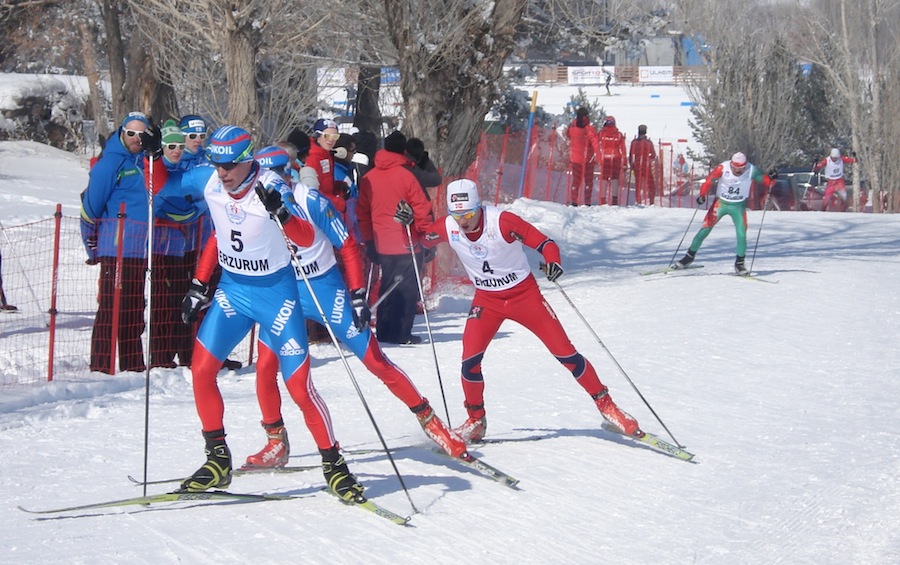
    The pack skiing out of the stadium on the first lap. Photo: Reese Hanneman.

    Richards Leads Canadian Contingent in 20th; Hanneman 23rd

    Geoffrey Richards (CAN) skied a smart efficient race on Friday, sitting back before the exchange and waiting until his stronger skate technique to move up in the pack.

    “[My] plan was to ski conservative in the classic portion and stick around 35th,” said Richards, who ended up skiing around 45th in the beginning.

    From there, the he wanted to “have a good exchange and use the big climb on the course to move up the positions,” said Richards. “I ended up feeling pretty tired on the second and most of the third skate lap but threw down on the last time around and passed about six people on the climb.”

    In describing the race experience in Kandilli, where the altitude makes the climbs that much more painful, Richards said that he “definitely feels like I’m hanging on the back for the most part, although [I] felt a lot more in control with the skate, but still was running a little scared for the whole race.”

    Canada’s head coach Eric de Nys thought Richards had skied a smart race, and executed his plan to the T.

    “It worked out really well for him,” said de Nys.

    “And we beat the Americans,” he joked. “They beat us yesterday but we got ‘em today.”

    Logan Hanneman (USA) skied his best race of this week with a 23rd-place finish. In contrast to Richards’ race, he sat consistently in the top-20 for most of the 20 k.

    “I just locked on the lead pack in the classic and let them pull me around,” said Hanneman. “For the skate, they pulled away a little and then it was just—survive to the finish line.”

    Hanneman was pleased with the way his first skiathlon turned out.

    “My goal was to hang with them for the class and who cares what happens, as long as you try to hang with them… I did that, and survived.”

    The next North American was Alexis Turgeon (CAN), who skied to 31st place. Knute Johnsgaard (CAN) was 49th, Mike Vigers (USA) finished 54th, Will Wicherski (USA) was 57th, and Forrest Mahlen (USA) was 72nd.

    Results

  • Led By Razinger, Slovenia Takes a Turn at Junior Worlds Dominance

    Led By Razinger, Slovenia Takes a Turn at Junior Worlds Dominance

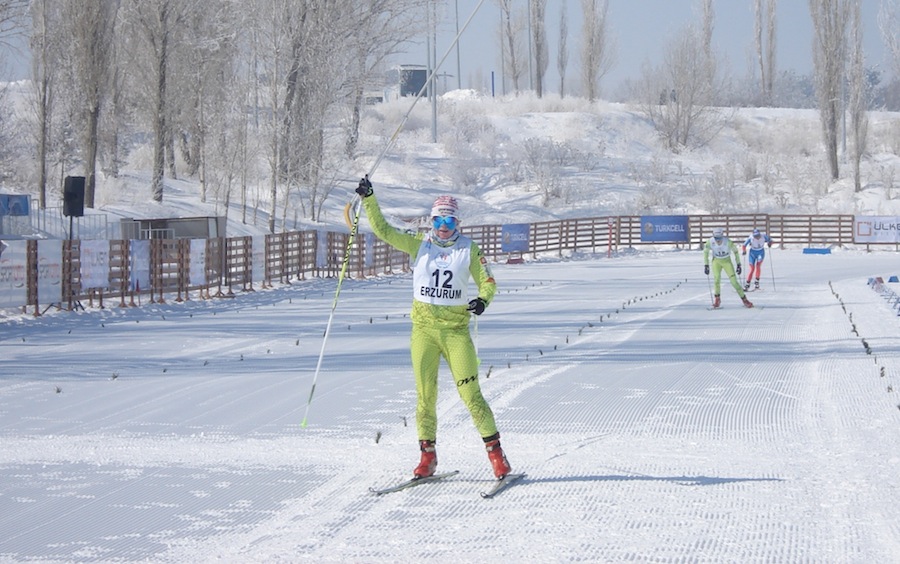
    Razinger crossing the finish line for her victory in the 10 k pursuit at World Juniors.

    ERZURUM, Turkey—In a come-from-behind performance, Nika Razinger (SLO) shocked herself, her coaches, and her competitors with a 7.8-second win in the 10 k skiathlon at Junior World Championships on Friday.

    “This is a big surprise,” said Razinger after the flower ceremony, unable to contain her happiness. “It is unbelievable!”

    Razinger and her coaches had been expecting top-10s from her, at best.

    Razinger headlined an impressive 1-2-4 performance for Slovenia. Lea Einfalt (SLO) claimed silver and Anja Erzen (SLO) was fourth (+29.5) after bronze-medalist Nadezhda Shuniaeva (RUS).

    Einfalt, eventual runner-up, leading up the hill out of the stadium.

    In the classic portion of the mass start skiathlon (5 k classic + 5 k free), it appeared as though yet another race would be Russia’s to dictate. Elena Soboleva (RUS) and Elena Serokhvostova (RUS) led through the ski change zone at the halfway point, with Razinger sitting in seventh.

    Razinger’s plan all along, however, had been to bide her time until switching to her stronger discipline. Once on skate skis, she to begin to pick off skiers one by one.

    “We knew they couldn’t go with the best in the beginning, as the Russians are very strong classical skiers,” said Slovenian coach Marko Gracer. “We decided to go behind, if possible, to follow them.”

    The Russians didn’t push the pace as much as the Slovenians were expecting—“this was good luck for us,” said Gracer.

    “We expected very fast running from the beginning and they didn’t do that, and we were hoping [the Russians] weren’t so strong at skating—and that happened. At the last uphill we saw that we could get the medals, and it was unbelievable.”

    Silver-medalist Einfalt was equally surprised with her result, as she had a fever as recently as Thursday.

    As is becoming increasingly evident, altitude has played a big factor in the racing at Kandilli Ski Center. The Slovenian squad in Erzurum had an altitude camp in Pokljuka prior to arriving in Turkey, and the Russians also spent two weeks at higher elevation to acclimate their bodies to the lower oxygen at the World Juniors venue.

    Slovenia took first, second and fourth in the skiathlon.

    Comeau Delivers Top North American Finish In 18th

    Throughout the women’s field, it paid off to start conservatively and pick up the pace in the second. Canada’s Anne-Marie Comeau and Dahria Beatty finished 18th and 23rd, respectively.

    Anne-Marie Comeau and Dahria Beatty just after switching to skate equipment.

    Comeau said the key to finishing well was “skiing relaxed at the beginning and give your max in the skate.”

    Beatty said the lack of recovery made racing at Kandilli different than the skiing she’s used to.

    “I feel like after downhills the legs are more tired, almost, because the lactic acid is still there.

    Emilie Stewart-Jones (CAN) finished next for the Canadians in 41st, with Mary O’Connell (USA) behind her in 42nd for the top American result. Corey Stock (USA) was right behind her in 42nd.

    Janelle Greer (CAN) was 47th and Emily Hannah (USA) finished 51st. Stephanie Kirk (USA) did not finish.

    Full women’s 10 k skiathlon results.

  • Video: Noah Hoffman After World U23 Silver

    Video: Noah Hoffman After World U23 Silver

    ERZURUM, Turkey — In the minutes between finishing and stepping on the podium for the flower ceremony, we caught up with Noah Hoffman (TeamHomeGrown/USST) to talk about his silver-medal performance in the 15 k classic at U23 World Championships.

    Full race report

    Results


  • Video: Sadie Bjornsen On Her Fifth Place at U23 Worlds

    Video: Sadie Bjornsen On Her Fifth Place at U23 Worlds

    ERZURUM, Turkey — Thursday’s U23 World Championship classic distance races started out well for team USA with Sadie Bjornsen’s (APU/USST) fifth-place finish in a closely-packed group at the top of the 10 k classic results. We caught her after the finish to talk about her race.

    Full race report

    Results

  • Belov Claims Sixth Russian Victory in Erzurum; Hoffman Earns U23 Silver

    Belov Claims Sixth Russian Victory in Erzurum; Hoffman Earns U23 Silver


    Evgeniy Belov, winner of the 15 k at U23s, jubilant on the podium. Noah Hoffman (USA) took second and Hannes Dotzler (GER) was third.

    If there’s one takeaway from the Junior and U23 World Championships thus far, it’s that Russia is a well-oiled machine. Evgeniy Belov (RUS) won his country its sixth gold medal of the week on Thursday, ahead of Noah Hoffman (USA) in second and Hannes Dotzler (GER) in third.

    Based on Belov’s delight on the podium, the run of success isn’t getting old.

    “I cannot express how happy I am today when I defended the title from Otepää,” sad Belov, who won the 15 k skate race last year at U23s.

    Belov has been competitive in both U23 races this week—hardly surprising, as he has more than one World Cup top-10 to his name this season. In the skate sprint on Tuesday, Belov was second.

    “I am happy I can be fighting for medals both in sprints and in distance competitions.”

    Hoffman (USA) cresting the high point of the 15 k course behind Karel Tammjarv (EST). Photo: Logan Hanneman.

    Skiing a well-paced individual race, Team HomeGrown’s Hoffman clocked in 24.5 seconds behind Belov. Hoffman was an earlier starter, and sat in first for a few minutes after finishing, before Belov came through.

    “That was really fun,” said Hoffman. “Belov was fast, I’m impressed.”

    Overall, Hoffman was pleased with the way he skied his race, which as Eric Pepper pointed out, isn’t always the case.

    “Any race he’s in, he wants and expects to win—that’s just the way he is,” said Pepper, one of the U.S. team’s wax techs and a coach at Ski and Snowboard Club Vail.

    “He’s certainly pleased, and it’s not often that he thinks he did really well. It’s a great result… From what Hoff said, everybody is here [from the World Cup] that he would expect to be, so it’s a really good field.”

    A critical component of Hoffman’s race was Estonia’s Karel Tammjarv, who started 30 seconds ahead of him. Hoffman caught Tammjarv within the first four kilometers into the race, and the pair worked off each other for most of the remaining distance.

    “Maybe I went out too hard, but I got in behind him and stayed as relaxed as possible,” said Hoffman.

    With about two kilometers to go, Hoffman started fading. Tammjarv began to put a gap back on him, but Hoffman managed to hang on and finish 3.6 seconds ahead of bronze-medalist Dotzler.

    “[Tammjarv] was really strong, and was a great ride for most of the race. I was lucky to have it and be able to stay behind him,” said Hoffman.

    Hoffman after finishing. Photo: Logan Hanneman.

    US Ski Team development coach Bryan Fish was most impressed with Hoffman’s ability to keep a cool head and maintain an even pace, even when he got splits that he had only a few-second margin ahead or behind his closest competitors.

    “He caught the Estonian, who was skiing strong. Noah had the patience and the mindset to just let him do the work, and they were making up time,” said Fish.

    Throughout the race, it was clear that a podium finish was Hoffman’s for the taking, with splits coming in over the radio time after time that he was staying consistently close to Dotzler.

    “I was getting splits at the top of the course—a lot of second, third, down by five, down by ten,” said Hoffman. “I knew I was right in there and tried to focus on what I needed to do.”

    Hoffman was behind the German from the first lap and much of the second, but when he came through the stadium to head out for a final time, he had finally surpassed him.

    Dotzler was happy with third place.

    “I wanted to go slow at the beginning but then I was in the lead after 5 k,” said Dotzler. “I was probably too fast in the early stages of the race but I came to the finish for bronze and I am happy for that.”

    Canadians Graeme Killick (60) and Christopher Hamilton (30). Photo: Logan Hanneman.

    After Hoffman, Graeme Killick (CAN) posted a top-20, and came through the finish 2:04.6 behind Belov for 19th. David Greer (CAN) was 36th (3:04.7) just ahead of Erik Bjornsen (USA) in 37th (+3:09.0). Eric Packer (USA) was a close 39th (+3:10.6) Jesse Cockney (CAN) 47th (+3:57.2), Christopher Hamilton (CAN) 52nd (+4:21.6) and Ryan Scott (USA) 54th (+4:51.4).

    15 k results.