
From the FasterSkier archive — posts syndicated from athletes’ and coaches’ own blogs between 2004 and 2012, kept online as published. Current coverage is at fasterskier.com.

Tag: Espen Bjervig

  • News Brief: COVID Outbreak in the Norway Olympic Delegation, and updated plans to get Klæbo, Johaug, and teammates to Beijing

    News Brief: COVID Outbreak in the Norway Olympic Delegation, and updated plans to get Klæbo, Johaug, and teammates to Beijing

    The Planica World Cup cancellations this month brought the skiing world to the perilous edge of what it feared most, but hoped wouldn’t happen – the central focus of this ski season, and the sport’s biggest moment, the Olympics – affected by the Omicron COVID-19 variant. Over the last week in the Italian Alps, the sport went over that edge. This Olympics, as with everything in the world right now, will have to deal with the frustration, confusion, and all around uncertainty that’s de rigueur during this pandemic.

    On January 23rd, NRK first reported that Norwegian national team sprint coach Arild Monsen had tested positive while at the team’s pre-Olympic camp in Seiser Alm, Italy. That set into motion a close contact, self-isolation, and testing regime with the stakes very clear – if athletes tested positive, suddenly the Olympics would be up in the air.
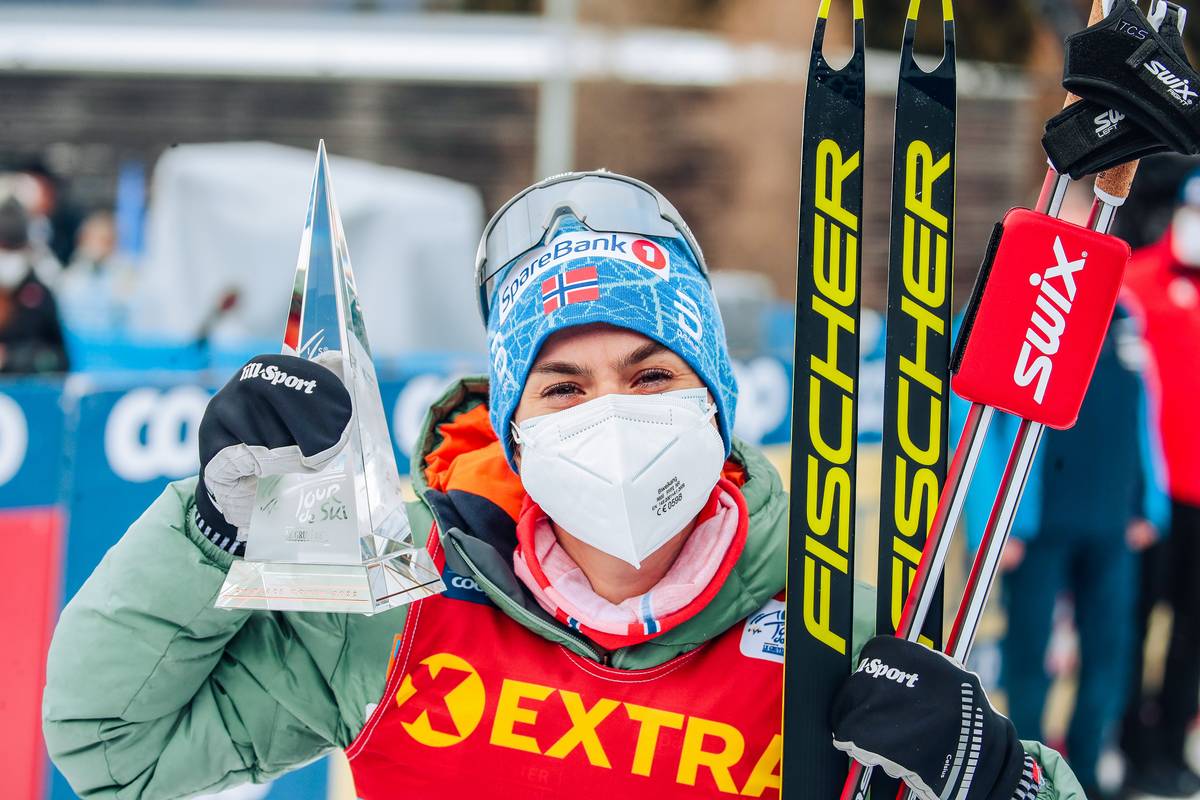
    Aided by a win in the final hill climb, Heidi Weng took third place in the 2021/22 Tour de Ski overall standings. (Photo: NordicFocus)

    On Tuesday the 25th, despite the best efforts of the team, Heidi Weng and Anne Kjersti Kalvå tested positive for COVID. Close contact tracing led to an announcement from the Norwegian Ski Federation that the scheduled charter flights for the Norwegian Men’s Team on today were canceled.

    The story has since followed two lines of development. First, new cases that are still emerging from the outbreak at the Norwegian National camp in Italy, and second, the Norwegian Ski Federation’s plans to get athletes to Beijing in time for their first competition on February 5th.

    On the former the latest update, as reported again by NRK today, is that Simen Hegstad Krüger has tested positive for COVID. Krüger’s test is the first within 10 days of the start of Olympic competition, meaning that the 2018 gold medalist of 30-kilometer skiathlon will not get the chance to defend his title. The news has hit the Norwegian team hard. In a statement to NRK, teammate Hans Christer Holund said “It’s terribly sad. A lot of hard work is behind getting to the Olympics, then it goes in the sink, and it is very sad for Simen.”

    Simen Hegstad Krüger had a commanding win in the 15-kilometer skate in Davos in December, 2021. (Photo: NordicFocus)

    As to travel plans, The Norwegian Ski Federation announced its updated plan to get their athletes to Ziangjiakou just hours ago. The men’s team will now fly direct from Verona, Italy to Beijing on a chartered flight on January 30th. The women’s team will follow suit out of Zurich, Switzerland on February 1st. That cuts out a trip back to Norway that was planned for the National Team before flying to Beijing. It also assumes no new infections in either the men’s or women’s teams. In NRK’s report, Espen Bjervig, National Team Manager, explained that the plan reflects “so many unknown factors. You never know what will turn up around the next turn. But you just have to cut through.”

    Bjervig also pointed out that the plan is designed to move along with the COVID situation that is now underway in the Norwegian camp. “Fortunately, it is flexible with the girls. There are charter flights every day from Zurich between February 1st and 4th. The scheme for the boys presupposes that no infection appears.”

    It is a big assumption, but one that allows there to be hope that for the individual athletes, and for ski fans alike, these Olympic games may be the exciting showcase of the world’s best skiers – many of whom are from Norway – that we have all looked forward to watching together.


  • The Sun Has Set: Norway’s National Cross-Country Team Experiences Deep Financial Cuts

    Athlete training in Lillehammer, Norway
    prior to the FIS World cup. (Photo: NordicFocus)


    On Tuesday morning, the Norwegian Ski Federation (NSF) and announced a new sponsorship agreement, set to begin on 1 May. Sparebank will remain the federation’s title sponsor for 10 million kroner, approximately US $950,000. It’s a two-year agreement with an option for a three-year extension.

    The amount is a reduction from the 15 million kroner (US $1,416,750) in the previous contract.

    Norwegian Ski Federation Logo

    The new deal comes at a time of uncertainty as global economies sputter due to the coronavirus pandemic. In part because of the economic crisis and partly due to sponsorship losses, the NSF slashed its 2020 budget by 50 million Norwegian kroner, approximately $4,800,000. On Friday, the federation issued a press release published by langrenn.com announcing a layoff of 96 employees, two-thirds of its workforce. The remaining workers have taken pay cuts as they cope with a changed financial landscape.

    Before Christmas, Sparebank and the federation had ceased sponsorship discussions. According to langrenn.com, “a few weeks ago” negotiations resumed. 

    With reduced funding, the national team athletes will lose their annual training stipends of 120,000 kroner. Stars such as Johannes Hosflot Klæbo and Therese Johaug may not be affected by this loss, but it could be significant for other athletes.

    In the new agreement, Sparebank retains prime space on athletes’ headgear, but little else. Previously, sponsorships were organized top-down: Norwegian athletes had to sign a non-compete agreement covering around 80 different brands, with only minor opportunities to procure their own sponsorships.

    With the loss of the stipend, athletes are free to find their own sponsorships. Marketing themselves may enter into the work-life-training balance.

    “They have the opportunity to [recoup the lost stipend] by going out and selling themselves,” said Espen Bjervig, the federation’s cross-country manager. “It may not be the best timing the way the market is now. But I think the athletes have a strong foundation especially locally. In addition, the clubs of the athletes may also have the opportunity to use their sponsorship on the athletes,” said Bjervig to NRK. “But if there are athletes who are struggling to get sponsors, then we will see what we in the Ski Association can help with.”

    Veidekke, a prominent civil engineering company, also ended its sponsorship of the ski federation. In an article on the Finnish outlet is.fi, Helge Dieset, Veidekke’s communications director, said that the company had decided to cease sponsorship at the end of the year, before coronavirus.

    Along with 13 other businesses, Veidekke had been a co-sponsor, a tier below the title sponsor. They sponsored not only the national sprint team: some of their money supported the federation’s five regional development teams.

    Even before the current budget crisis, team management had already intended to reduce the size of the national team, due to reduced quotas on the World Cup and in the Olympics. 

    In the linked article, former Norwegian skier and current cross-country analyst on Norwegian television, Petter Soleng Skinstad speculated that veteran athletes might be the first to feel the axe: “Probably it is first and foremost established top runners who will disappear out of the A team.”  

    As the federation sorts out its future, athletes are training individually. According to Ski-Nordique.net, national team training camps had already been postponed until July at the earliest.

    Before the new deal with Sparebank, Håvard Solås Taugbøl, of Lillehammeer SK, told Ski-Nordique, “This is a very critical situation. We hope that another sponsor can come and help [the] regional teams, which are so important for the development and motivation of young people.” In 2020, Taugbøl earned three World Cup sprint starts.

    With the layoffs announced last Friday, “The goal now is to take quick enough measures to secure jobs so that we can resume normal operations and continue as normal as possible when this is over,” said NSF secretary general Ingvild Bretten Berg. “We have talented and committed employees in [NSF]. In a difficult time not only for us, but also for many around us, it is important to take care of each other as best we can.”