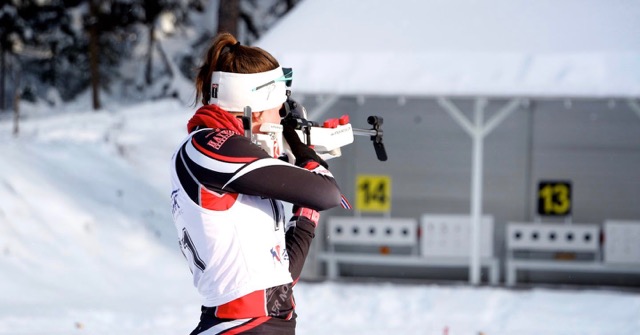
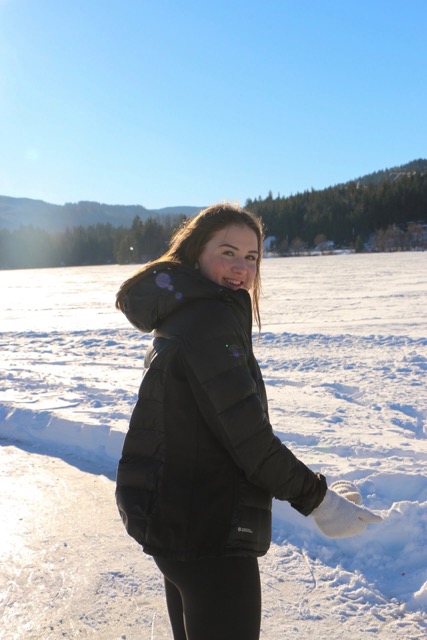
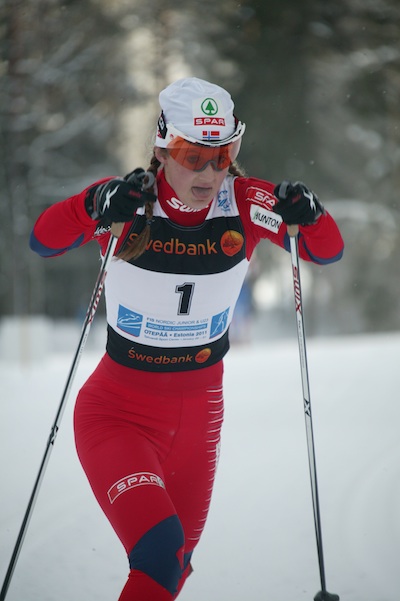
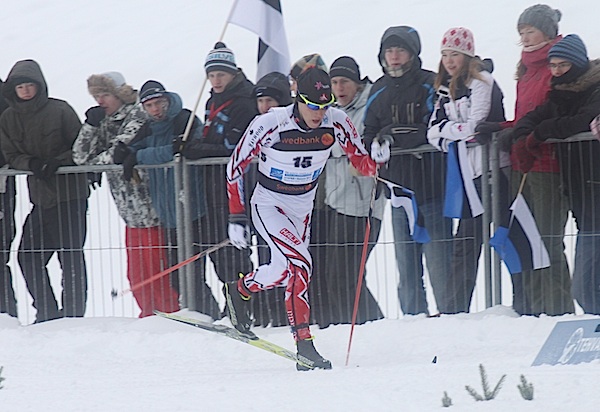
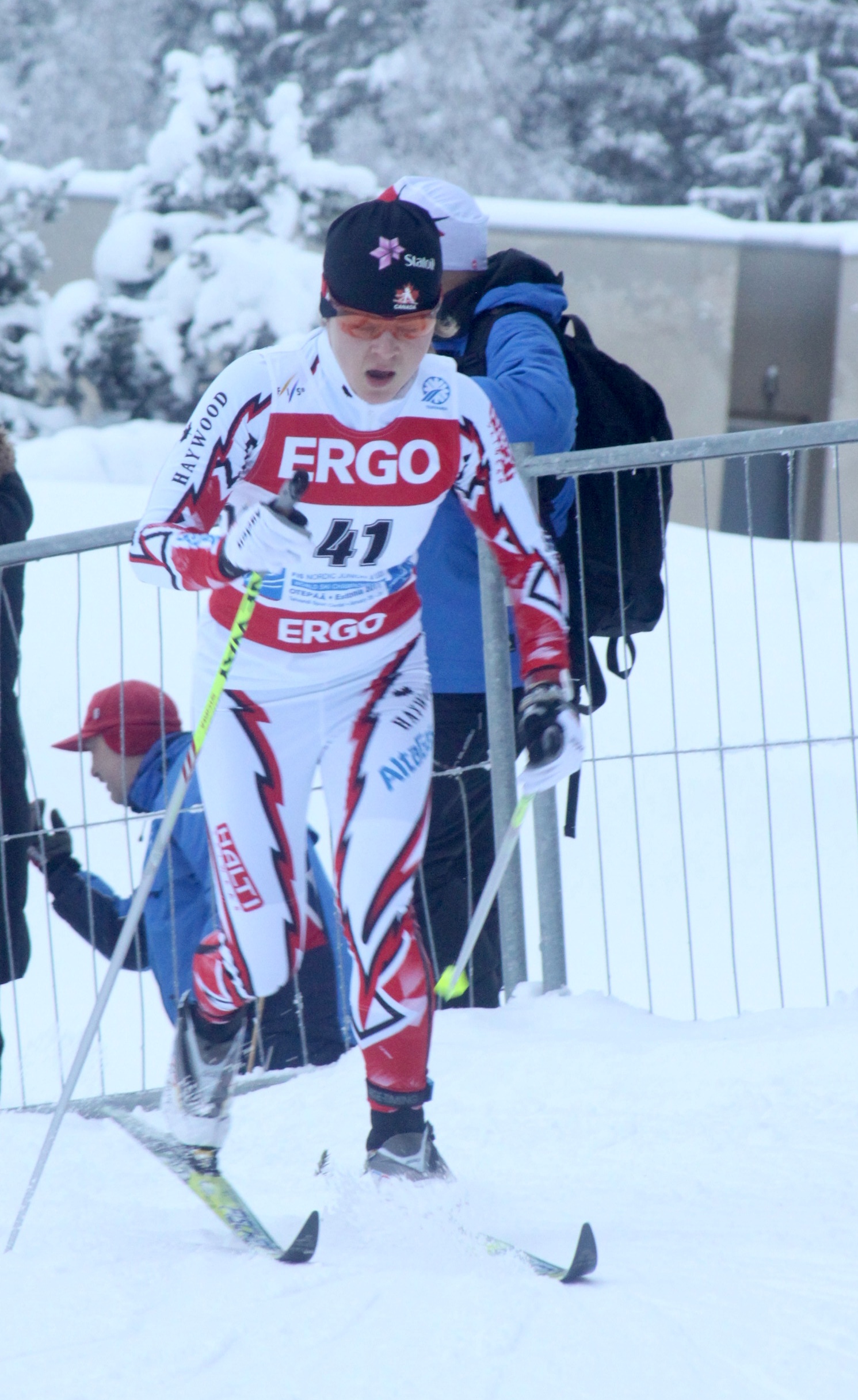
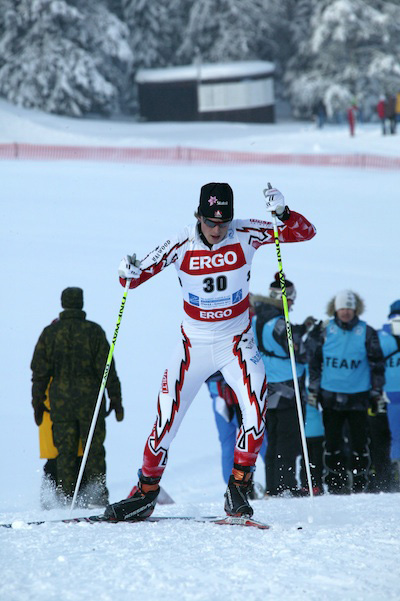
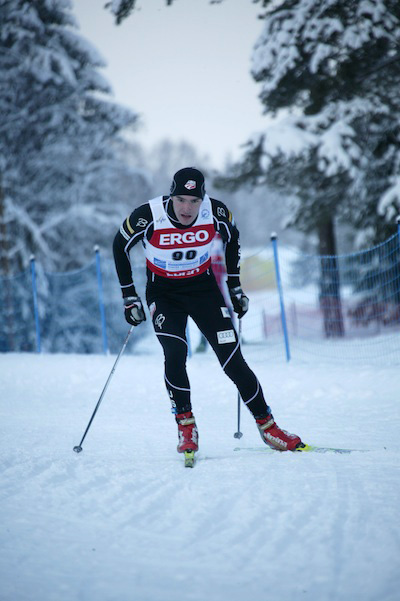
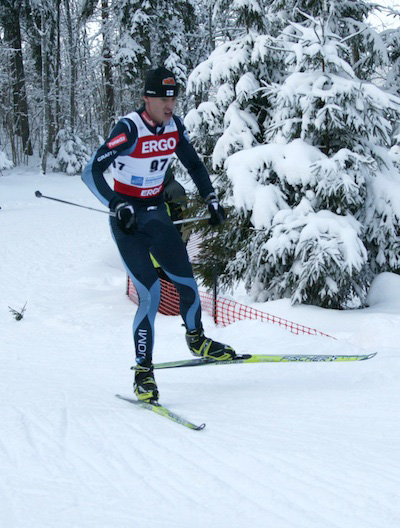
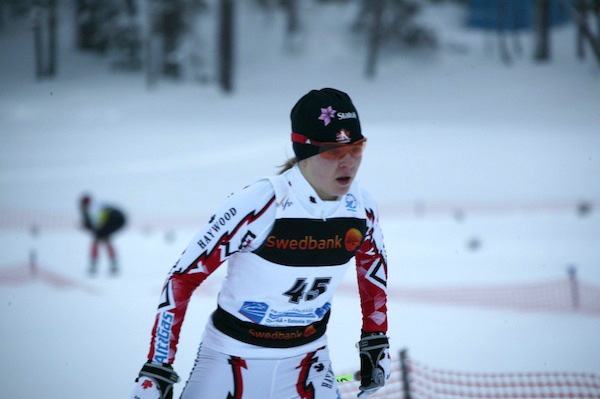
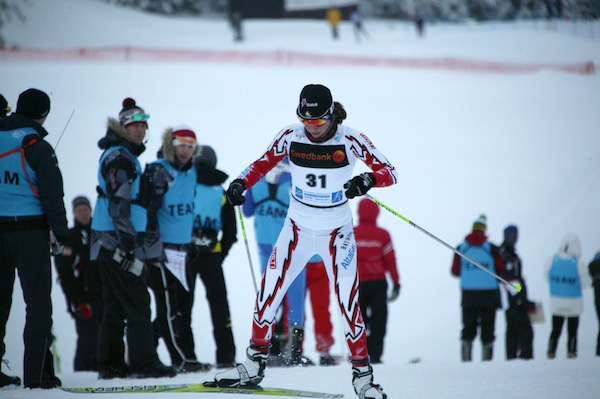
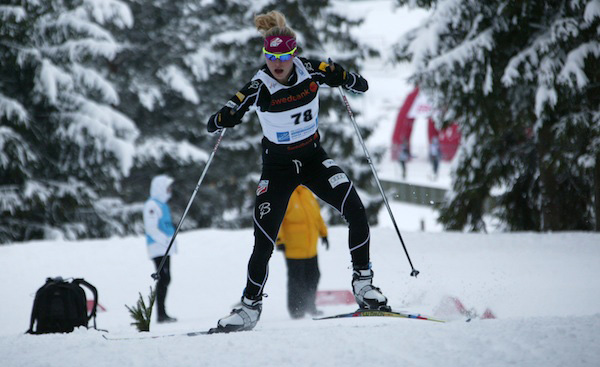
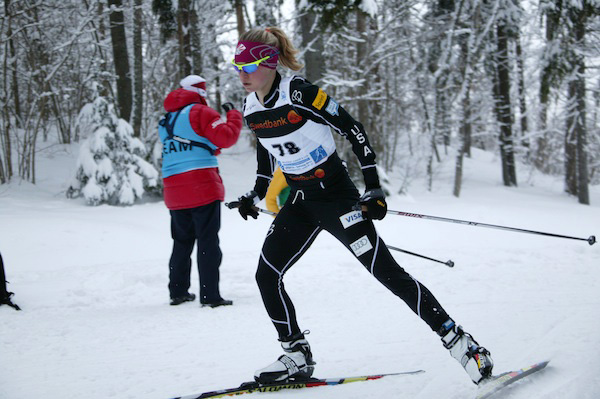
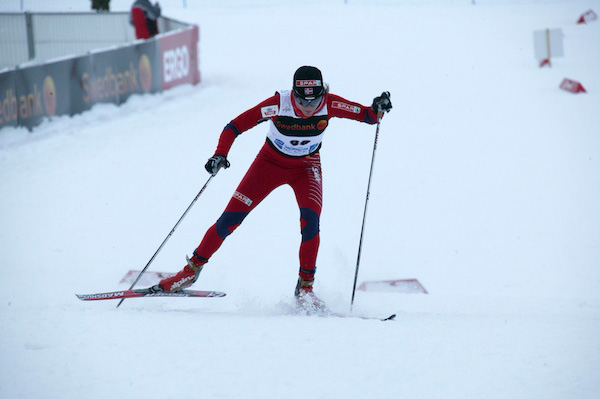
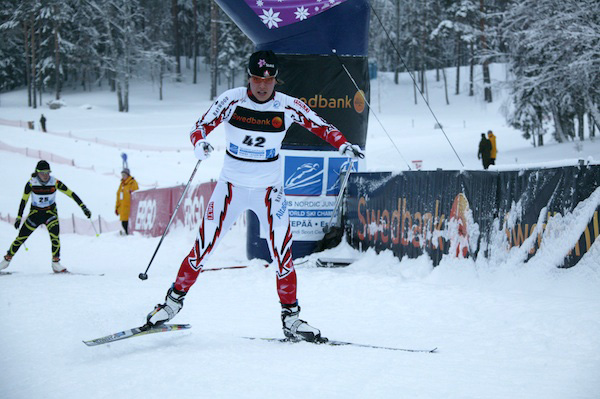
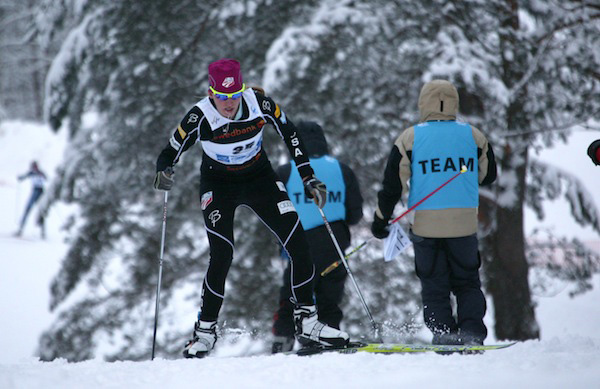
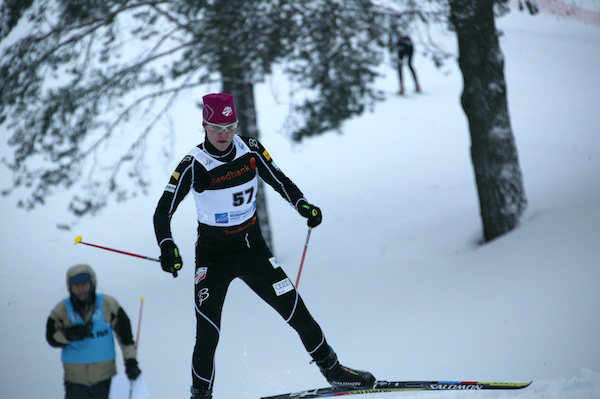
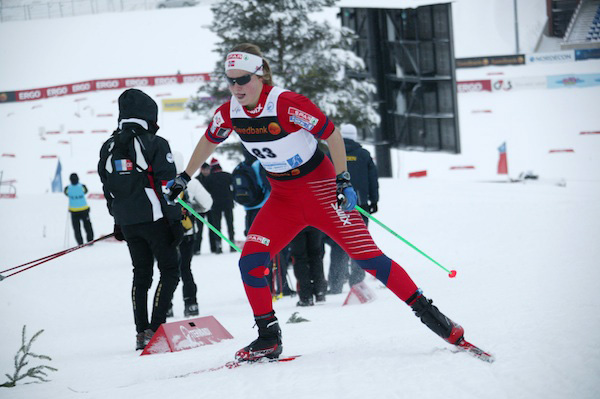
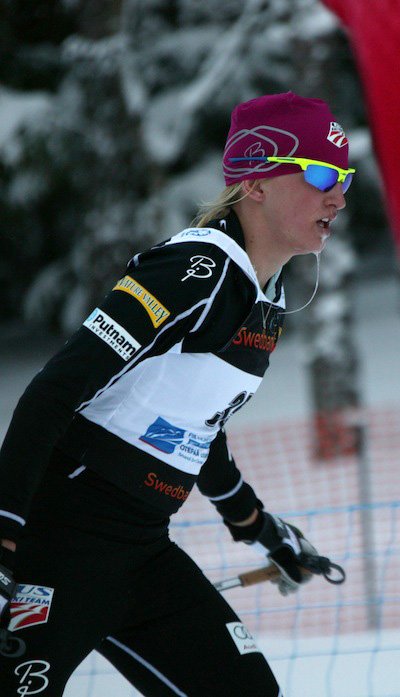
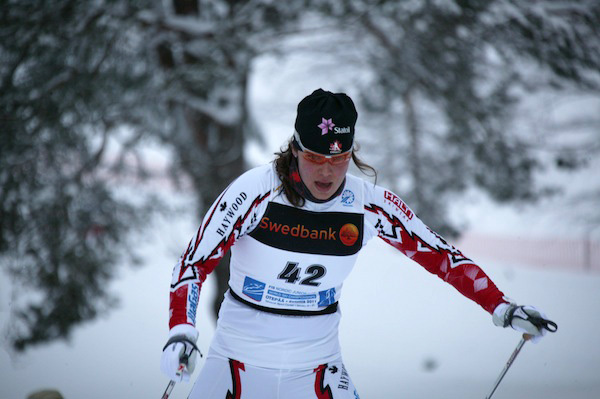
Benita Peiffer competing this winter. (Courtesy photo)
In an effort to showcase the North Americans competing at this week’s International Biathlon Union (IBU) 2018 Youth and Junior World Championships in Otepää, Estonia, we asked those qualifying athletes several questions about themselves — actually, we had them fill in the blanks. Here we have 17-year-old Benita Peiffer, of Whistler, British Columbia, who is representing Canada at her first World Youth Championships.
Today in Otepää, Peiffer finished 11th in the youth women’s 10 k individual, +1:43.1 with one penalty.
***
“My full name is Benita Peiffer but you can call me B.
I was born Vancouver, BC and raised in Whistler BC and I learned to ski at Whistler Olympic Park as well as Lost Lake.
I spent the time between World Youth/Junior trials and Worlds training in Whistler to prepare, and then I came over to Europe early to do some racing in Pokljuka for Biathlon, and then I met up with the BC Ski Team to do some Cross Country Ski races in Zwiesel.
My favourite workouts I did in the last training year to prepare for this were the workouts we did in Sweden, intervals up sand dunes, swamp running, skiing in the Torsby tunnel, participating in roller ski races and doing some roller ski classic heats with a group of athletes on the BC Team and Development Squad as well as a huge group of Swedish athletes.
One thing I’m working on this season to improve my biathlon is to stick to my basics of shooting. I often get overwhelmed with everything and forget the basics as well as keeping a positive mindset because a negative attitude will never get me anywhere.
Canada’s Benita Peiffer, who finished 11th in the opening race of World Youth Championships. (Courtesy photo)
This is my first time in Estonia and third time racing internationally, and so far it’s been an amazing experience. The competition over here is definitely much harder than in Canada and has showed me how much harder I have to work if I want to get to the level of some of these athletes.
One difference I’ve noticed between Estonia and the Canada is the food. Lots of potatoes and the desserts have been very interesting.
One of the things I’m most excited about for World Youth/Junior Championships in Otepää is the Sprint race. It is one of my favourite races to compete in. It is a 6km race with two shooting bouts. It is the perfect distance for me and perfect amount of shooting for me. I don’t get too overwhelmed with the amount of shooting and I am able to leave it all out there on the course feeling satisfied with my effort.
Watching the Olympics in the leadup to my own races was very inspiring. One of my favourite moments of the Games was watching my cousin, Arnd Peiffer win gold in the men’s sprint. I want to be like Laura Dahlmeier because she is a very consistent athlete who won several medals at the PyeongChang Olympics.
At Worlds, I really hope I can chat/make friends with someone from the German team and ask them where they train in Germany because I am very interested in coming to Germany at some point to train and compete.
My favourite thing at the breakfast where we are staying is the fresh bread.
Before this trip, if you said “Estonia”, the first thing I’d think of would have been “Where?”
Now that I’m here, I’m pretty sure something I’ll always remember will be the beautiful scenery and weather here. We have been lucky to have many beautiful sunny training days.
If I had a totally free day here and didn’t have to worry about race fitness or training, I’d spend it doing a relaxed ski through the countryside followed by a walk through the town exploring what Otepää has to offer.
The best way to follow me on social media is on Instagram @benitapeiffer.
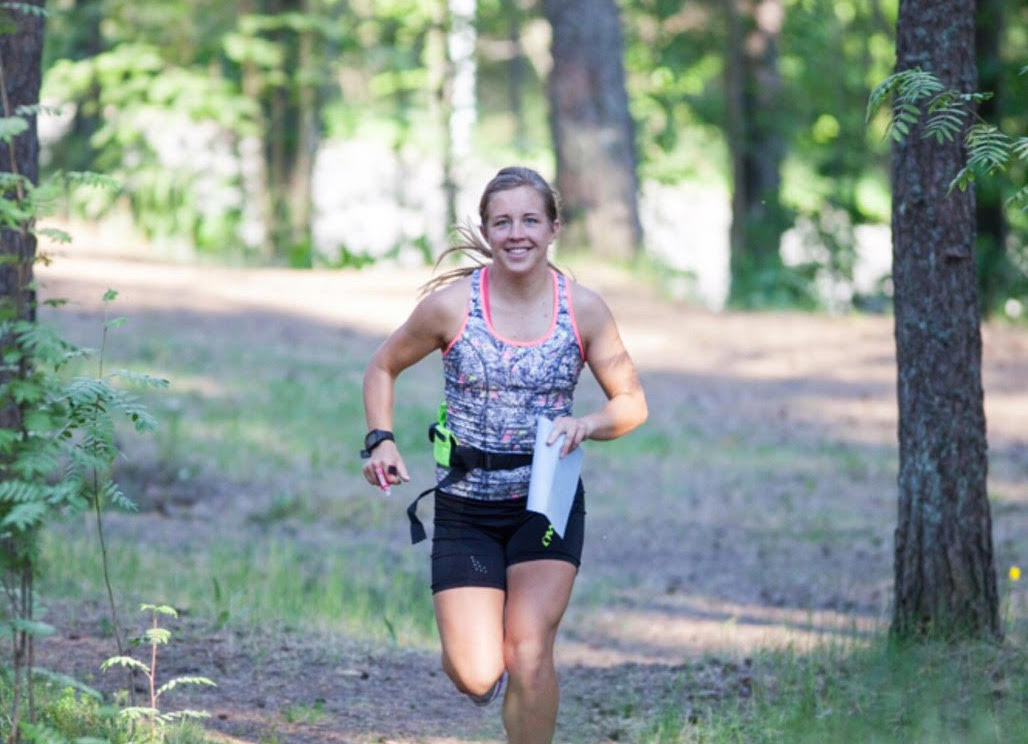
Montana State University skier and Estonian national-team biathlete Johanna Talihärm running outside of Tallinn. (Courtesy photo)
After spending last summer training in the U.S. with the Craftsbury Outdoor Center’s U23/collegiate summer training group, this year Johanna Talihärm decided to go home to Estonia.
The FIS Cross-County World Cup swings by Otepää periodically (as does the Continental Cup circuit and biathlon’s IBU Cup series), but Talihärm is originally from Tallinn, Estonia’s capital and a World Heritage Site. That’s the atmosphere she moved back to for the summer — which she said had both pros and cons.
“It is easier at home, because of no extra travel and friends and family nearby,” Talihärm, who turns 24 later this month, wrote in an email. “Other than that I would say Craftsbury was perfect. There’s an amazing and super strong group of girls to train with, biathlon and nordic girls and guys training together, an awesome nature-preserving environment and just a beautiful place.”
https://www.instagram.com/p/BUcroSMDjTt/
The Montana State University (MSU) skier finished seventh in the 15-kilometer freestyle at NCAA Skiing Championships in March, improving on her previous best finish of 13th. She and Annika Miller were the team’s only nordic All-Americans this year.
Johanna Talihärm training on the shooting range in Otepää, Estonia. (Photo: Detlef Eckert/Courtesy of Johanna Talihärm)
A few weeks earlier, Talihärm had been at IBU World Championships in Hochfilzen, Austria, representing Estonia on biathlon’s biggest stage. She placed 57th in the 15 k individual, a result about which she said at the time, “it was all right.” Talihärm, Estonia’s top finisher at those Championships, is planning to go to the 2018 Olympics.
Over the summer, she’s focusing on aspects of training that can help both her biathlon career and her college skiing.
“I would say that my general goal is to get stronger and ski faster, and all the training I do benefits both, my biathlon and college racing,” she said. “Shooting has given me a lot of mental strength and an ability to concentrate that benefits skiing, too.”
Over email, Talihärm explained what summer training is like in Estonia.
FasterSkier: Where are you based this summer? Is this the same area you grew up in, or is your training base away from your family home?
Johanna Talihärm: I live in Tallinn, the capital of Estonia, which is in the north, but spend a lot of time training three hours away in Otepää which has a world class training center with two shooting ranges and good rollerksiing opportunities. Also as Estonia is very flat, Otepää has some hills to train on, to switch it up from completely flat Tallinn.
FS: Do you have a team that you are training with, or are most of your training sessions alone? Are there a lot of other athletes and teams using the same area/facilities?
JT: I train with the biathlon national team, but most of them are located in Otepää. I train mostly alone when I’m at home.
More work on the shooting range. (Courtesy photo)
A lot of teams come to Otepää for their summer training. The Russian ski team is there with almost all teams (juniors, men, women, para, local club teams and even some youth groups), Ukrainian women’s biathlon team was there last week, also [Slovenian World Champion] Jakov Fak, some Russian biathletes are coming (for example Anton Shipulin), Kazakhstan has been there in the past, and also Estonian nordic skiers and athletes from neighboring countries like Latvia, Lithuania and Finland.
FS: When you are planning your summer training and thinking of what you need to work on for the upcoming season, how do you coordinate between your various coaches about how to design training?
JT: I follow my national team plan when I’m in a training camp with them, MSU training when in school, and I fill up the time in between myself to make it all work. I have to credit the coaching education I got from my sports high school and coaches seminars by Estonian federations for the ability to make educated choices about my training.
FS: What’s the hardest workout you have done so far this summer?
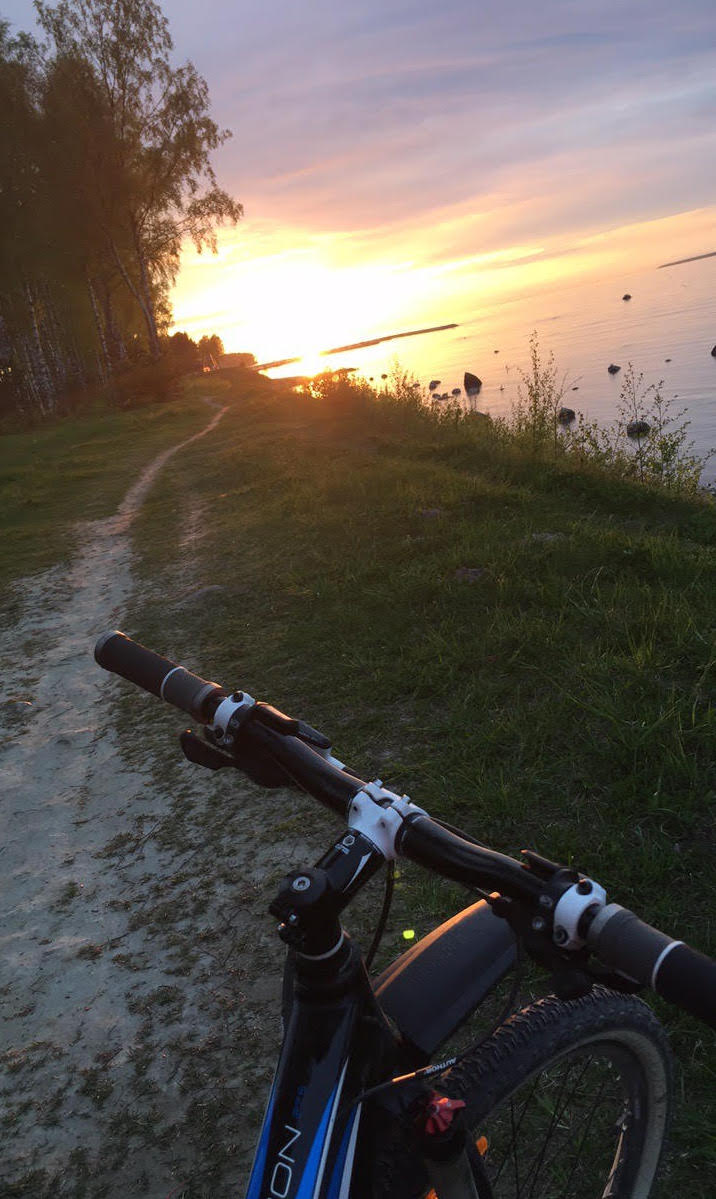
A photo from an evening bike ride along the coast in Tallinn. (Courtesy photo)
JT: Probably a long lonely run in the rain at home. Not the hardest physically, but definitely mentally.
FS: Are there any absolute favorite places to run or bike or rollerski? Where are you always excited to do a workout?
JT: I’m always excited to work out in a new place. I love exploring new trails in my hometown Tallinn, especially the ones right by the coast. I’ve been there so often that I never expect to find anything new, so the joy is even bigger when that happens.
FS: Maybe related, is your area set up best for some parts of training? Are there excellent hills for intervals, or great places to do long workouts without being repetitive, or what do you think is the best aspect training-wise?
JT: I think my hometown is not the best place to train for skiing in the long term, but it has amazing long paved loops ideal for rollerskiing.
FS: What do you do when you are not training? Do you need to have a job?
JT: I have an internship in Tallinn this summer.
FS: How was your spring — did you get to do a good start to training while you finished up school?
JT: I was pretty wiped out by the load from school, training, racing and travel, so I took a little extra time to recover. I was careful with the intensity at first, but in general I don’t think it will make a big difference in the long run.
FS: What is the best part of Estonian summer, aside from training?
JT: Being able to see everyone, not having to do all my tasks at home in one or two weeks, no packing nor long travel, various bodies of water to swim in, familiar food and warm and long summer days.
Talihärm taking a swim in the lake next to the shooting range in Otepää. (Courtesy photo)
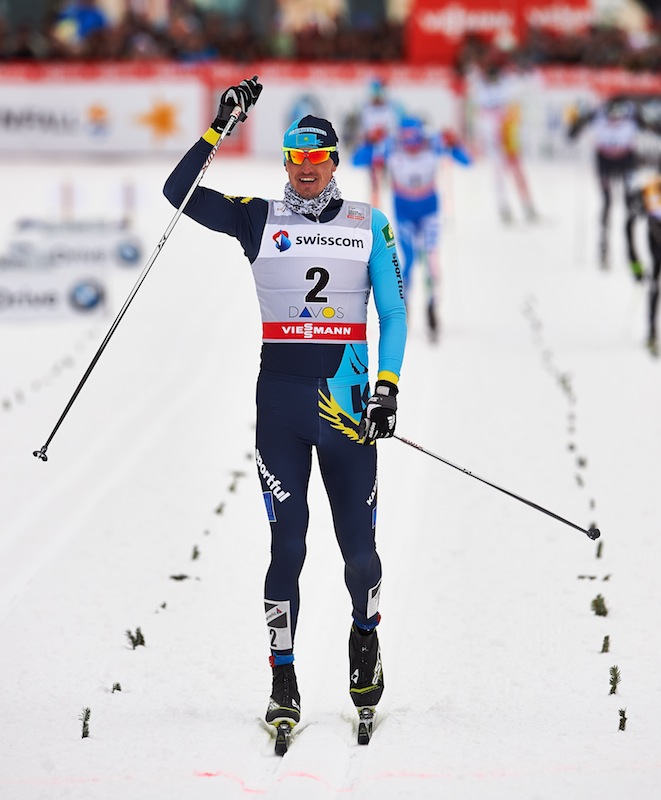
Alexey Poltoranin (KAZ) winning a classic sprint with room to spare in Davos, Switzerland, in 2013. Photo: Fischer/Nordic Focus.
One year ago, Kazakh ski star Alexey Poltoranin began working with Andrus Veerpalu, a Estonian skier who held the title of oldest skier ever to become a World Champion but was later disgraced in an human growth hormone doping scandal.
“He is a good guy and I’m happy with his work,” Poltoranin told Estonian sports outlet ERR last fall. “It’s a really good thing that he’s working with the team.”
Veerpalu was not a team coach, but more an advisor. During his time racing, he was recognized as a classic technique specialist, which made him a good match for Poltoranin.
“He is definitely a really strong skier and a great classic skier, perhaps one of the best classic skiers last year, so this is an especially attractive job offer,” Veerpalu said when he was hired. “I will be responsible for his skis, helping him choose his skis, testing the skis. My position might change later as well, maybe concerning technique and those kinds of things, but that will become clear in the course of our cooperation.”
Poltoranin finished fourth in the overall World Cup standings in 2013, but slumped in 2014, falling out of the top ten. A major medal hope for Kazakhstan, Poltoranin finished ninth in the 15 k classic at the Olympics and 15th in the skiathlon.
Despite this disappointment, he is strengthening his ties to the Estonians and this summer, moved to the country to be closer to his support staff.
He is also formalizing a relationship with Mati Alaver, the famous Estonian coach who built the program up after the country left the Soviet Union. Alaver coached both Veerpalu and two-time Olympic gold medalist Kristina Smigun. Poltoranin’s longtime coach Alexey Nakonechniyn will stay onboard as well. Veerpalu is reportedly now working primarily on ski preparation (although there is speculation and discussion that he will eventually coach the Estonian team), along with Finland’s Jari Nieminen.
This spring, Poltoranin explained that he was splitting from his federation, who he did not feel adequately supported him. He wanted to plan an individualized training group with Alaver, but the federation disagreed. Poltoranin claimed that in the future he may even switch his citizenship if the Kazakh ski team’s preparations remained inadequate.
“I did not feel comfortable with the organization, flights, accommodation, meals, inadequate coaches, challenges surrounding medical supervision and that the best equipment is not used,” Poltoranin said according to a translation. “ I have not been happy with ski service and lubrication.In order to compete on an even higher level, I need strengthened medical attention, I must have a sports physician and a good wax team… I have sponsors who are willing to assist me in preparing for this new Olympic period (the next Winter Olympics in 2018).”
For their part, some Estonians hope that adding Poltoranin to their ranks could help restore their once-great team to glory – even if he never dons an Estonian suit. Alaver is still coaching three Estonian men. Among them, current World Cup team members Raido Ränkel and Algo Kärp said that having one of the world’s top skiers train with them would surely help their preparations.
“So far I’ve only been training for Estonian men who are not as strong as Poltoranin,” Ränkel said.
Poltoranin had nothing but positive things to say about Otepää after his first training camp there.
“Previously, I had been Otepääl winter, and now for the first time in the summer,” he told EKV news. “I liked it very much. There are all conditions for training, and life is calm. I have good impressions of Otepää. I looked for rental apartments for the first year… the main thing is that the apartment has a sauna. As an athlete it’s not at all insignificant. This is a big plus.”
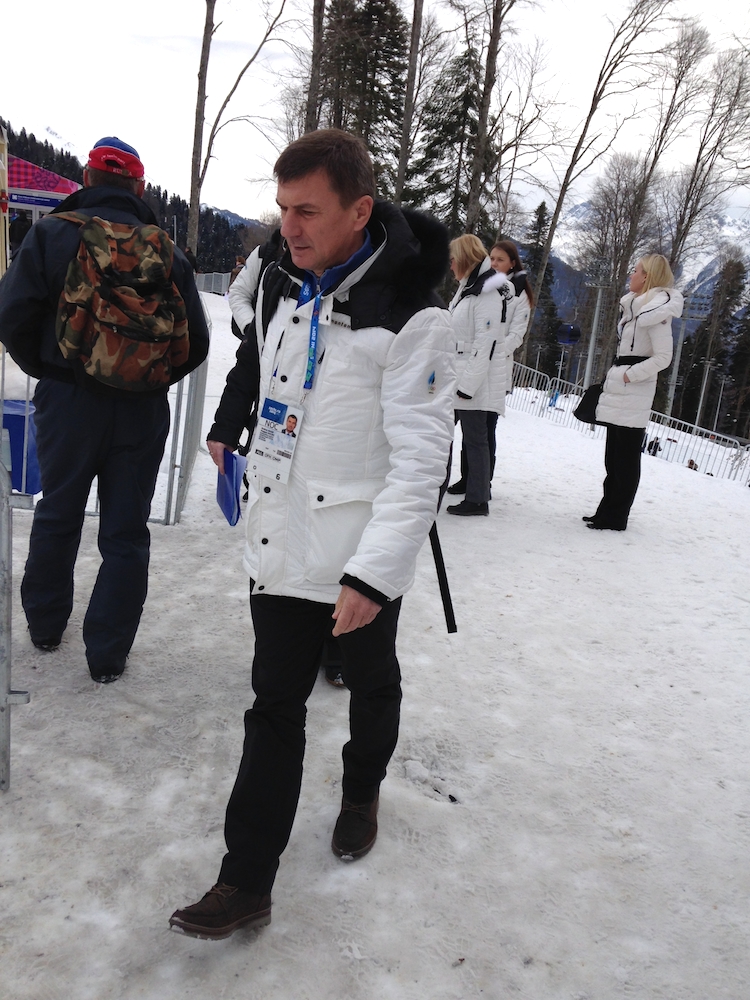
Former Estonian prime minister Andrus Ansip at the Laura Cross-Country & Biathlon Center in Krasnaya Polyana, Russia.
Estonian Prime Minister Andrus Ansip resigned last week, to allow his political party to choose a replacement before elections in 2015.
But wait—this is a skiing website. What do we care about Estonian politics? Because, as befits this ski-crazy nation, Ansip is an avid cross-country skier himself, holding the title of Worldloppet master—meaning that he’s finished 10 of the races in the international marathon series. That likely makes him the fastest prime minister on skis.
Ansip showed up at the cross-country ski venue at the Sochi Olympics in an unmarked motorcade, along with a surly security detail.
After what looked like a serious conversation with an Estonian skiing official, a FasterSkier reporter—who caught a glimpse of Ansip’s name on his Olympic credential—intercepted the politician for a brief conversation about his interest in the sport, and the status of cross-country skiing in Estonia.
A few important things to keep in mind. Estonia was once a cross-country skiing powerhouse. In the 1990s and 2000s, Andrus Veerpalu, Jaak Mae, and Kristina Smigun-Vähi all won Olympic medals, and medals at the cross-country skiing World Championships.
Those three, however, have all retired, and there’s currently no one on the Estonian team ranked in the top 75 in the world.And, confirming suspicions that long dogged him on the international circuit, officials with the International Ski Federation in 2011 said that Veerpalu had failed a drug test on the eve of his retirement.
That positive test, for human growth hormone, was ultimately invalidated by the Court of Arbitration for Sport last year for technical reasons, but the court’s opinion nonetheless said it was likely Veerpalu had taken HGH.
Here’s the interview, which was lightly edited for clarity.
FasterSkier: Tell me about your interest in skiing.
Andrus Ansip: Some people, they are collecting different stamps or coins. And then some people are collecting different cross-country skiing marathons. I’m one of those crazy people who are collecting different cross-country ski marathons. I took part in Gatineau—yeah, I’ve been in Canada. I’ve took part in all the European Worldloppet Series marathons—our own Tartu Marathon I’m taking part in almost every year, in this marathon. And then, Vasaloppet, 90 kilometers-long marathon, I took part in this marathon twice. Then, Birkebeinerrenet (in Norway), the Finlandia-hiihto, Konig Ludwig Lauf in Germany, La Transjurassienne in France, Marcialonga in Italy, and Kangaroo Hoppet (in Australia).
FS: Do you think you’re the fastest prime minister?
AA: I don’t think how many prime ministers are exactly interested in cross-country skiing—not so many of them, I think. But yep, I’m first prime minister who got this Worldloppet Master title. So it means I’m the first that took part in 10 different cross-country skiing marathons around the world.
Sorry to say but your marathon, American Birkebeiner, is the only one I didn’t take part in. It’s because we are celebrating the anniversary of our republic exactly at the same week.
FS: Fair enough.
AA: But one day, I will take part in the American Birkebeiner anyway.
FS: What are you guys doing, as a government, to kind of rebuild the Estonian team after the retirement of Jaak Mae, and Andrus Veerpalu, and Kristina Smigun-Vähi?
AA: You know, it’s kind of not up to par. It’s up to our people, and I’m quite proud of our young people who are interested in sports, and training very, very hard. We have real aims in sports. So, I hope one day, we will get gold medals from Olympic Games once again.
Today, we have a quite famous young girl—Kelly Sildaru, she’s (12) years old. It’s in the sport—like snowboarding, but it’s with skis…?
FS: Slopestyle?
AA: Slopestyle. She’s really good in slopestyle, already. She beat even those who are taking part in the Olympic Games in Sochi already. But (12) years old—it’s not (old enough) to take part in the Olympic Games. So I hope, one day, Estonians, they will win Olympic gold medals once again.
FS: Last question: Do you think Veerpalu was innocent?
AA: Veerpalu. It’s a decision made by court. So, I don’t want to speculate about decisions made by independent court. But of course, everyone wants to keep fingers crossed. Their own heroes—we would like to believe our heroes, they were clean. But at the same time, of course, sports, they have to be clean. They have to be really clean, and doping is not accepted. So, I hope nowadays, Olympic Games, and sports, are more clean than some years ago.
American Sophie Caldwell of the Stratton Mountain School T2 Team (second from l) holding her own in the Scando Cup 1.1 k freestyle sprint on Sunday in Pärnu, Estonia. Caldwell finished second to Norway’s Kari Vikhagen Gjeitnes (l). (Photo: Reese Hanneman/Engine Room Media.net)
(Note: This recap has been updated to include comments from Eric Packer, Caitlin Patterson and Jennie Bender.)
Nothing beats racing with the Euros, except when you beat most of them. Sophie Caldwell of the Stratton Mountain School T2 Team (SMST2) rose to a career best at the Scandinavian “Scando” Cup on Sunday, placing second in the 1.1-kilometer freestyle sprint at the Jõulumäe Recreation Centre in Pärnu, Estonia.
The day before on a slightly longer course, Caldwell finished 17th in the 1.3 k classic sprint after qualifying in ninth. That wasn’t quite what she’d hoped for, so the 22-year-old rallied to the fifth-fastest qualifying time Sunday and employed some smart tactics in the heats that followed. Beyond brains, she used some brawn, too.
“Today definitely helped my confidence because I was not super psyched with how yesterday unfolded,” Caldwell wrote in an email on Sunday. “I’m happy to be feeling healthy again and excited to hopefully see some sun and be in Switzerland! It was fun to be able to mix it up with those girls today and I’m looking forward to getting the chance a couple more times in the next few weeks.”
Sophie Caldwell (l) on the Scando Cup podium after placing second in Sunday’s 1.1 k skate sprint in Pärnu, Estonia. Norway’s Kari Vikhagen Gjeitnes (c) won by 0.14 seconds, and Sweden’s Linn Soemskar was third. (Photo: Reese Hanneman/EngineRoomMedia.net)
The SuperTour leader, Caldwell will get some more World Cup experience next weekend in Davos, Switzerland. After that, she’ll travel with the U.S. Ski Team to Val di Fiemme, Italy, where she’ll compete at World Championships.
But this past weekend, and the last week of Scando Cup racing between Latvia and Estonia, was great practice. Caldwell led the Americans in second on Sunday, just 0.14 seconds out of first.
“Sophie made some great tactical moves throughout the rounds and almost got the win,” US Ski Team development coach Bryan Fish explained. “She was inched out at the line – an excellent performance.”
Norwegian Kari Vikhagen Gjeitnes captured her second-straight win of the weekend, and Sweden’s Linn Soemskar was third after posting the fastest qualifying time. Soemskar was seventh in the classic sprint.
On a snowy day with temperatures hovering around freezing, Caldwell said she learned her lesson in the quarterfinal after leading from start to finish.
“I knew position was important and it paid off, but it was not easy,” she wrote.
Caldwell didn’t get off to the greatest start in her semifinal, but that ended up helping as she put herself in a good drafting position and slingshot around the leaders to win the heat.
The final played out similarly as Caldwell struggled a bit from the start but focused on staying inside on the corners “and not letting people cut in or push me around,” she wrote.
“I took the inside track on the last hill and got into second place and had a sprint off down the final stretch for 1-3,” she wrote. “It was really exciting and I felt better and better as the day went on!
Sophie Caldwell (SMST2) leading one of her heats with Norway’s Astrid Bruland in the Scando Cup 1.1 k skate sprint at 2013 Jõulumäe Recreation Centre in Estonia on Sunday. Caldwell ended up second in the final. (Photo: Reese Hanneman/EngineRoomMedia.net)
“I still feel like I’m learning a lot each time I race over here, but I like to think each time I’m get a little tougher,” Caldwell added. “I even gave a girl a little smack when she cut me off yesterday and then tried to ski big and hold my own today! So one step at a time but it was definitely fun to end the weekend on a high note.”
Just outside of the top 10, Jennie Bender of Central Cross Country (CXC) qualified in 11th and finished in the same position – advancing to the semifinals. The day before, she qualified fourth in the classic sprint and went on to place 16th, which Fish wrote was a “very strong result, however, I knew she felt bittersweet.”
“I wasn’t ecstatic with 11th, but I figured it could have been worse,” Bender wrote in an email, referring to the classic sprint. “It was even shorter than the classic sprint course, and you had to keep mentally in the moment 100 [percent], or time was being lost.
“I was in the semifinals with Sophie, who totally rocked it,” she added. “It was sweet having American representation on the podium. … The field was very tough, with many World Cup skiers mixed in. I cant wait to get back to Europe to race more. I think it’s quite valuable for the progress of an elite skier. ”
Caitlin Patterson (Craftsbury Green Racing Project) was certainly the most consistent of the weekend, placing 22nd in both qualifiers as well as overall in the two sprints.
“It was funny that I managed to have two sets of qualifying and finishing places that were identical, at 22nd,” Patterson wrote in an email. “I’m happy with how I’ve been racing in Europe, but mostly happy with the overall experience. The racing has made me more excited for future races and motivated to improve a few particularly weak areas in my racing, like the sprint starts. We had a fun group of skiers and coaches from the US, people who are serious about racing but also enjoyable to spend time with (and make videos with) in the down-time between races.”
Becca Rorabaugh of Alaska Pacific University (APU) qualified in 28th on Sunday and ended up 25th. She was 24th in the classic sprint after qualifying in 27th.
Anika Miller (Payette Lake Sports) also made it into the top 30, qualifying in 16th in the skate sprint and finishing 26th overall. On Saturday, she was 21st after qualifying in 20th.
On the men’s side, Norway’s Tomas Northug dominated both the 1.6 k classic and freestyle sprints. The younger brother of World Champion Petter Northug, he beat teammates Eirik Lorentsen and Emil Nyeng, who were second and third respectively, on Saturday, and topped another, Sindre Bjørnsetad Skar, on Sunday along with Sweden’s Johan Edin.
Ben Saxton of F.A.S.T. Performance Training was the top finisher for the U.S., placing 33rd in the classic sprint. He was 0.78 seconds from qualifying in 30th on the challenging course – which took more than four-minutes to complete – and ranked 60th at the start. On Sunday, Saxton was 71st in the skate sprint.
Reese Hanneman (APU) led the way on Sunday, placing 42nd in the skate sprint. The day before, he was 45th. Eric Packer (SMST2) notched a personal-best Scando Cup sprint performance in 43rd Sunday after placing 58th in the skate sprint.
“I was disappointed to miss out on the heats, but it was positive to be right in the mix in such a tight field,” Packer wrote in an email. “I was just over four seconds out of the top ten, so I know I need just a few more seconds to be right in the mix with the best.”
Montana State University junior David Norris was 43rd in the classic sprint and 72nd in the skate. APU’s Forrest Mahlen was 76th on Saturday and 77th on Sunday, and teammate Jack Novak placed 83rd in the skate and 84th in the classic sprint.
“Weather played a role particularly with the men,” Fish wrote Saturday. “It was clearly klister skiing in the morning but the heavy snows started at 9AM (as predicted) prior to the start and throughout the heats.”
The weather kept the U.S. wax techs and coaches on their toes, and their athletes went with both klister and zeros.
“The venue in Estonia was awesome,” Packer wrote. “The sprint courses were some of the best and most fun I’ve ever skied. They used lots of bridges and tunnels to give almost a roller coaster feel to the courses.”
Alaver, 58, is credited with building his country’s cross-country ski program from scratch following Estonia’s independence in 1991. Over the last two decades, its athletes have won more than 15 major medals at World Championships and Olympic Games—not bad for a country with a population of 1.3 million.
Mati Alaver (R), trailside at a race in Estonia in 2011.
Alaver is known not just as a knowledgeable and successful coach, but also as a pitchman who found the sponsor money to turn the Estonian Ski Federation into a powerhouse. “He’s a great public speaker,” an Estonian ski official told FasterSkier last year. “One day he will go to politics.”
Over the past year, however, Alaver has been tested—first, by the retirement of Jaak Mae, Andrus Veerpalu, and Kristina Smigun, who were Estonia’s core cross-country skiers over the last 15 years, and second, by Veerpalu’s positive drug test in the spring of 2011 for the use of human growth hormone.
The Estonian team—whose athletes formerly competed for the USSR—has always operated under a cloud of suspicion, and Veerpalu’s test only confirmed what many suspected. After an International Ski Federation panel convicted Veerpalu, the case moved on appeal to the Court of Arbitration for Sport (CAS), where it should be resolved in a manner of weeks.
Alaver’s current position with the Estonian Ski Team is unclear; he said that if Veerpalu was found guilty, he would step down, but according to the Estonian media, Alaver is on administrative leave pending the CAS decision—and he continued to travel with the Estonian team through last winter.
During the Tour de Ski in Italy in January, FasterSkier caught up with Alaver to discuss his work with the Estonian ski team, and the future of the program. Alaver speaks German, but not English; our questions and his answers were translated by Christian Flury, a Swiss coach.
The interview has been edited, and condensed.
FasterSkier:What’s your coaching role now? Are you doing less administrative work and working more directly with athletes?
Mati Alaver: Estonia is a small country, so you need to be multifunctional, working with sponsors, working with organizations, working with organizing committees, and working with athletes. You have to do everything, because there’s no way to build up huge infrastructure with the team.
FS:It’s not like the Norwegian team, where you have a head of the wax staff, etc.?
MA: Completely different.
FS:What are your goals for the team?
MA: After the big names retired, it’s time to build up a new team of young athletes, and also a new service staff, new trainers, new coaches, everything. For sure, it’s a three- or four-year project, at least. The goal is, for the future, that Estonia comes back into the nations that win medals. That’s our long-term coaching goal.
FS:Following the retirement of Veerpalu and Mae, which athletes are you working closely with now? Has this given you an
Andrus Veerpalu racing in Estonia, three months before news broke of his positive doping test.
opportunity to work with younger athletes?
MA: I’m personally coaching Algo Kärp and Karel Tammjärv.
FS:How did you get started in the sport? I’ve heard you’re from an out of the way village that was described to me as the Wyoming of Estonia.
MA: When I was 13, I started skiing. I had a really good coach when I was young. He was the reason I went to Tartu University and started working as a ski teacher and ski coach.
I finished university in 1976. I worked for 20 years as a lecturer in science and research. In ’76, I also started working as a coach for small kids, and in ’83 I was first hired as assistant coach for the national team. I started working with Andrus and Jaak in ’92.
FS:Did you have mentors as a coach? Who did you learn the most from?
MA: When I started working at the university, it was back in the Soviet era, and there were some coaches [that I learned from]—Victor Ivanov, Alexander Gruschin, Nikolai Lophukov. When Estonia was free in 1992, I started to go to a lot of conferences and seminars in Finland. On the World Cup, I met [former Norwegian coach] Inge Bråten.
I’ll never forget his speech about the Olympics, because the Norwegians had been so strong in Albertville in 1992. In Albertville, in the top five [in the men’s 30 k], there was one other guy, and that was bad for Norway.
Inge said the next goal is that the top four or five must be Norwegian. They need to be one, two, three, four, five. I thought, ‘that must be a crazy man who would say something like that.’
I learned from Inge that if you want to reach top results, you need to have top goals. In every sector, you need to improve one percent, or even zero-point something, to get better and better, because you start on the same line.
FS:So, you have influences from Norway, from the Soviet system and from Finland—how did you take those and turn them into an Estonian system, with Mae and Veerpalu?
MA: I realize now I was lucky to learn about being methodical and systematic from the Soviets; from Finland, the endurance and the physiology; and from Norway, how to build up structures, in terms of how to organize a team.
As a junior, Jaak Mae was in Norway at a ski school for one year, and he learned a lot from them about how the Norwegian system worked, and he brought that back. Then from ’95 until ’02 or so, we collected all the scientific articles from Norway and worked with them.
Jaak Mae racing in Estonia in 2011.
In the end, you have to take something from the Soviet system, from Finland and from Norway and then put them together and make the best out of them, because there are not that many athletes, not that much money or anything [in Estonia]. So, take the best of what you can, because there are only a few top athletes. Then focus on the development of them.
FS:Now for the hard question: A lot of Western athletes, coaches, and spectators have been skeptical of the Eastern European and Estonian training methods. And since Veerpalu tested positive for human growth hormone, some people have taken that as confirmation of their beliefs. What would you say to them?
MA: We all live in a free world, so everybody’s free to think what they want. It’s a myth to say that Eastern Europeans are the dopers. There’s Ben Johnson, Marion Jones, Taylor Hamilton—it’s not the right way to look at it, to say East and West is different.
I believe it’s a false-positive test, and we’re going to the CAS.
FS:Building your Estonian team back up was already going to be a challenge, once Veerpalu and Mae retired. Has this made it more difficult, and will you be able to bounce back?
MA: Sure—it’s difficult.
FS:The approach and the system for Veerpalu and Mae was very successful; with other athletes, it’s been more mixed. Do you think there have to be changes in the Estonian system to produce more successful athletes? What would those be?
MA: For sure, we have to come up with another system, because cross-country skiing is still endurance, but you also have to be fast now, with the mass start and sprinting. Jaak had no chance in mass start, no chance in sprint. Individual races—that was his best. So, you have to adapt, and now you have some athletes that can do that. We have to go with the times.
For the last two weeks or so, I’ve been holding down the fort here in Craftsbury as my teammates travel and race all over God’s white acre. In the short span between January 19th and February 2nd, the CGRP has been represented at races in Italy, Germany, Estonia, Austria, Slovakia, the Czech Republic, Russia, Norway, and the western United States…AND at the Craftsbury Marathon, of course. While the adventure of travel is unbeatable, I’m happy to be staying close to home this winter. This is my first season of full-time training and racing, and that alone is plenty of excitement for me. Plus, I need all the help from Pepa I can get!
Holding down the fort at 739 Town Highway 19. That's 9 empty bedrooms, if anyone is counting.
So, am I losing it? (REDRUM). Well, not exactly. Though in the absence of no-dust Dylan and everything-in-its-place Pat, I have seized the opportunity to overtake the entire living room and have subsequently started to lose track of my own stuff. The only saving grace is that other, less well-organized teammates are also missing and so there is no one else’s crap with which to confuse my own. Clutter aside, as the single resident of the house, my newfound sense of propriety has inspired me to higher levels of responsibility: I regularly keep the stove alit. I bring in the mail every day. I have even felt the tinglings of an urge to clean the whole place, though they are as of yet unfruitful.
office/living room/music room/breakfast nook/napping couch/game room/fire place
Luckily, most of my time ‘alone’ here has not been spent in true solitude. For the first week, Nils Koons, our training partner and friend from the Rossignol team, kept me company in the house. Together, we forgot to get groceries every single day until we were eating questionably bygone raisin bran with unquestionably bygone yogurt for breakfast. (Raisin bran with yogurt is not good, even when both are decidedly un-rancid.) My friends Maura and Kenny drove up from Boston for a well-timed visit during the sunny and snowy weekend of January 21-22, during which we skied, shot biathlon rifles, and enlisted Lucas Schultz to jump their completely dead car. (”Not to worry, I know someone who will be over here in 3 minutes to rescue us.”) Another well-timed visitor was my friend Dan from Burlington, who came to Craftsbury last Saturday night to celebrate my marathon win (and winnings). You may not believe this, but Parker Pie (local favorite pizza/bar establishment) was HOPPIN’… it was like a club scene in there! Not wanting to disturb Lucas a second time, I enlisted Brian Gluck when we needed to pull Dan’s car out of the ditch. (”Not to worry, I know someone who will be over here in 3 minutes to rescue us.”) Last but not least, our surrogate pet grouse, Mo (separate blog entry to follow), has been unwavering in his quest for human social interaction, in what seems to be an adamant rejection of the behaviors one would typically expect from his species.
During the week I have been at least somewhat diligent about getting work done around here, ranging from helping out in the Hosmer Point camp office (who knew that a person could get sore from doing a bulk mailing?) to visiting Greensboro Elementary to give a presentation about skiing and getting outdoors. I have also entertained the possibility of doing the compost for Brian, which delights him almost as much as when I actually do it.
Getting in some office hours. Rhetorical question: Is it possible to get any work done if Pepa is sitting across from you?
Training has been going really well, now that I can show up 10 minutes late and have only Pepa yell at me instead of the whole team. And, we have SNOW! I’ve done some good quality interval workouts with our junior extraordinaires, Hannah and Lauren, as well our visiting South American contingent, Federico (Argentina) and Leandro (Brazil). Communcation between the Brazilian and the Bulgarian is something to behold and is one of my favorite parts of our daily workouts. And, no surprise here– hitting the gym: even less sweet when you’re alone.
Lonliness is an empty gym.
I have succomb to accute, late-onset, residual hunger from the 50km. For some reason, this did not set in until Tuesday, after racing on Saturday. But it has continued full-force even into the wee hours of this morning (Friday), when I was forced out of bed at 4:30am by hunger pangs for a snack of fruit leather. The kitchen staff have been invariabely understanding of my issue, and generous in their provision of leftovers. Success: being greeted at the back door of the kitchen by a staff member who preempted by maple sausage prowl and had set some aside for me.
The staff shelf, God be praised.
The best part about staying home in Craftsbury? Getting to spend a lot of quality time with this person:
Devon Kershaw in the final climb at Alpe Cermis, Italy, in this year's Tour de Ski, where he was fourth overall.
Devon Kershaw had it in his head. He wanted redemption.
The Canadian National Team veteran hadn’t been entirely pleased with his season so far despite finishing fourth in the Tour de Ski two weeks ago. After several top 10 performances this season, Kershaw took a big hit on Saturday, finishing 40th in the World Cup classic sprint after his pole shattered in his hand and he struggled to find a replacement.
With one chance to leave Otepää, Estonia, on a high note, Kershaw channeled his frustration into fuel and charged out of the starting gate on Sunday to clock the fastest splits for the first half of the men’s 15 k classic individual start.
At the 2.5 k mark, he was better than Switzerland’s Dario Cologna, the eventual winner, by 11.5 seconds. Halfway through, Kershaw still had the edge by about 3 seconds. Cologna was closing, but Kershaw was having his best race of the season regardless.
The 29-year-old Ontario native went on to finish third, 25.2 seconds behind Cologna and 1.2 behind runner-up Lukas Bauer of the Czech Republic.
“I had such a frustrating day all around yesterday, and in the sprint [qualifier] when my pole exploded in my hand, that really crushed me,” Kershaw said in a phone interview on Sunday. “In the race today, I felt fantastic. Looking at the splits, I think I went out too hard, but didn’t feel like I died. Dario’s on a completely other planet and Bauer closed insanely well.”
Cologna climbing at Alpe Cermis.
Coming off a victory in Saturday’s classic sprint, Cologna started last and by 2.5 k, ranked after Kershaw, Marcus Hellner (SWE) and Evgeniy Belov (RUS). Ten kilometers later, the Tour de Ski champion and overall World Cup leader moved into first. Cologna had not only caught Kershaw in the second half of the race, he surpassed him by 15 seconds by 12.5 k.
Meanwhile, Bauer, who won the 15 k classic in Otepää two years ago, went from 12th to third by the midway point. Starting eight spots ahead of Cologna and six behind Kershaw, the 34-year-old Bauer narrowed the gap to come within 8.4 seconds of Kershaw with 2.5 k to go. He continued to push for second place, his best result of the season.
“I was very surprised at the beginning when I heard Devon was so fast,” Bauer said in an interview with the International Ski Federation (FIS). “I was just hoping he cannot keep the high pace all the way through. … The key to success was a good kick and skis. I think the difference [for] me and Devon was just I was more lucky today.”
Bauer
For Cologna, who ranks 294 points ahead of Petter Northug (NOR) in the overall World Cup standings, it was the first time he had secured back-to-back victories at one venue. Earlier this season in Rogla, Slovenia, the 25-year-old won the freestyle sprint after placing second in the 15 k classic mass start.
“It means a lot for me to win here twice in Otepää,” Cologna told FIS. “My shape has been perfect. I was especially strong in the last lap. … [My] first races [this season] were not perfect for me, but since the Tour, I have been in really good shape. It will be difficult to keep these good results.”
While Cologna said he received information about Kershaw during the race, he wasn’t too concerned with splits. Instead, he focused on his own pace on the challenging course.
Kershaw said he heard splits indicating he was about 20 seconds ahead of anyone else for most of the race. At the same time, he didn’t exactly know where the top-seeded men behind him were, like Cologna and Bauer.
Devon Kershaw (CAN) singlesticking on the final climb of the Tour de Ski in Alpe Cermis, Italy, on Jan. 8. He placed 18th in the 9 k pursuit climb and was fourth overall in the Tour.
“I was out to win the race,” Kershaw said. “[I was] really able to shut my mind off completely and just have a cool, clear head, just really loving the movement. … It was for third but that’s OK. It’s not often in my career that I’ve been able to get into that head space.”
While he acknowledged that every athlete, except maybe Cologna or Northug, deals with similar ebbs and flows in their mental state, Kershaw tried to ignore his past distractions and detach himself from pain. That was especially tough to do in Otepää.
“It’s the hardest [distance course] on the World Cup, without question,” Kershaw said. “Three massive, really punishing climbs, so there’s always a big gap in Otepää. … There’s no hiding out there at all. If you’re a bit off, it’ll be exploited.”
He said that was likely the reason Cologna pulled out such a decisive win. After Kershaw, Stanislav Volzhentsev (RUS) was fourth, 41.3 seconds behind Cologna. Another Russian, Petr Sedov placed fifth (+42.2). Both drastically gained ground on the lead group; Volzhentsev initially ranked 18th and Sedov was 21st at 2.5 k.
Hellner ended up sixth after gradually losing time on the three-lap course. His Swedish teammate Johan Olsson was seventh, Ilia Chernousov (RUS) placed eighth, Jean Marc Gaillard (FRA) was ninth, and Sami Jauhojärvi (FIN) was 10th.
Kershaw’s teammate, Alex Harvey, finished 19th after finishing fourth in Saturday’s sprint. Kris Freeman and Noah Hoffman scored points for the U.S. Ski Team, placing 22nd and 26th, respectively.
While Northug opted to sit out the second weekend of World Cup races after the Tour de Ski, the Norwegian remains at the top of the Distance World Cup standings. Cologna is 25 points behind in second.
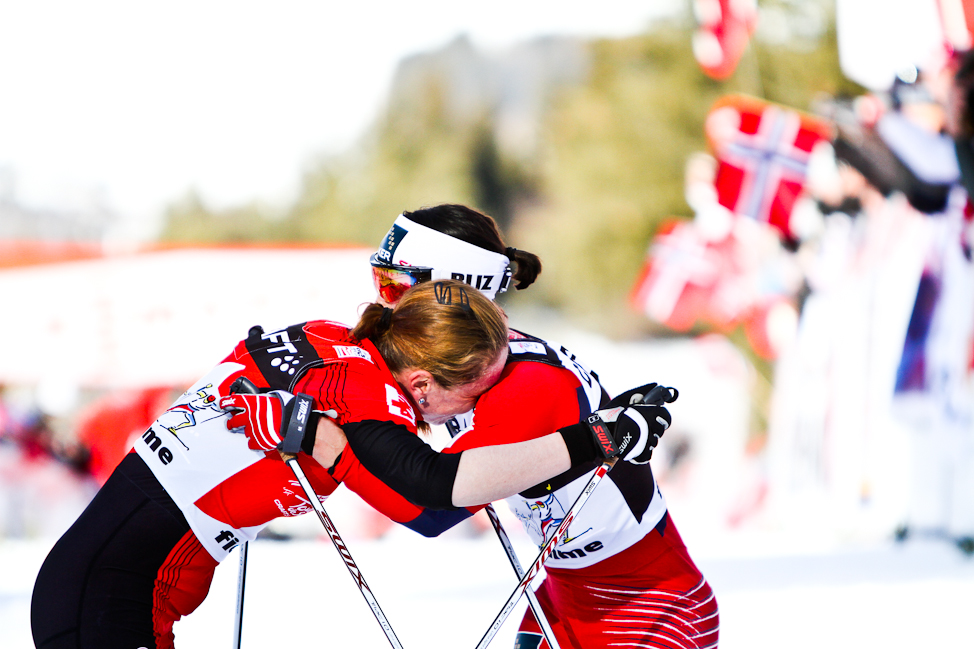
Justyna Kowalczyk (POL) (l) and Marit Bjoergen (NOR) (r) hugging it out after the 9 k freestyle pursuit final climb of this year's Tour de Ski at Alpe Cermis, Italy. Kowalczyk was second in the stage, and Bjorgen was third after teammate Therese Johaug, who won the climb.
Justyna Kowalczyk didn’t have to say a word. Marit Bjørgen knew it was on.
Kowalczyk, the three-time defending Tour de Ski champion from Poland, had spent the better part of the last two weeks recovering from her most recent Tour victory. Bjørgen, the Tour de Ski runner-up, had done the same, skipping last weekend’s races in Milan, Italy, to prepare for Otepää, Estonia.
While the two rivals didn’t face off until the final of Saturday’s 1.2-kilometer classic sprint – the first of two World Cup races in Otepää this weekend – they competed against each other from the start.
Bjørgen won the qualifier in 3:22.10. Kowalczyk clocked the second fastest time, 0.55 seconds back. In the end, Kowalczyk took the sprint victory by 0.1 seconds over Bjørgen in 3:18.4, but their road to the final built plenty of suspense.
The quarterfinals went as expected, with Bjørgen and Kowalczyk winning their respective heats. The semifinals were another story.
After Bjørgen placed third in the first semifinal, Kowalczyk saw an opportunity. Bjørgen needed her time to hold up to secure a lucky-loser spot in the final; Kowalczyk could put down a faster time to eliminate that possibility.
The soon-to-be-29-year-old from Poland (Kowalczyk’s birthday is on Monday) charged out of the gate in the second semifinal, setting a fast pace that Maiken Caspersen Falla (FIN) initially hung onto. By the end of mostly double-pole loop, Kowalczyk emerged as the winner with Katerina Smutna (AUT) and Aino-Kaisa Saarinen (FIN) 0.3 seconds behind.
All three advanced to the final, as did Bjørgen.
There, the Kowalczyk and Bjørgen met for an anticipated showdown with four others: Smutna, Saarinen, Natalia Matveeva (RUS) and Mona-Liisa Malvalehto (FIN).
From the starting gun, Matveeva initially set the pace. Kowalczyk caught up on the first climb and extended her lead over the top. Meanwhile, Bjørgen simply waited, hovering around third.
Before their final descent into the stadium, Bjørgen made sure she was in a position to get even with Kowalczyk and moved ahead to tie her lead. As the two entered the stadium, Kowalczyk led the tight pack of four once again, with Saarinen closing from behind.
But Kowalczyk wasn’t likely concerned about Saarinen or Matveeva, who were mostly contending for third. She had Bjørgen on her tail.
Staying ahead to the finish, Kowalczyk threw up her hands in victory. She had done it, even if by just a tenth of a second. Matveeva was third in a photo finish with Saarinen, both 0.9 seconds behind Kowalczyk. Smutna placed fifth (+1.9) and Malvalehto was sixth (+10.8).
In an interview with the International Ski Federation (FIS) after the race, Kowalczyk didn’t have many words. She was happy to win a sprint in Otepää after winning four distance races there before. As for ranking second to Bjørgen in the overall World Cup standings by 81 points, Kowalczyk simply stated that she would keep competing.
“To think about this now,” she began. “We will see.”
Kowalczyk added that the recovery did her well and her fitness was in tact.
“After [the] Tour de Ski, I was only resting in my bed,” she said. “Now I’m feeling better and better.”
Bjørgen told reporters she felt a little tired last week, but was pleased with winning the qualifier and skiing well in the heats. She said Kowalczyk was simply better on Saturday.
“I thought that I could take her, and then it’s annoying when it does not work,” Bjørgen said in a translated interview with NRK. “But there are small margins between us. Kowalczyk is very strong.”
As for Sunday’s 10 k classic individual start, Bjørgen said to expect a similar contest.
“I’m looking forward to tomorrow’s race. Last year it was very good for me,” Bjørgen told FIS, referring to the previous 10 k classic in Otepää, where she was second to Kowalczyk.
“I expect to be fighting again with Justyna. Let’s see who is stronger tomorrow,” she said.
In Bjørgen’s semifinal on Saturday, Malvalehto edged Matveeva at the line for the win, and Bjørgen finished 0.2 seconds later. American Kikkan Randall, the overall sprint leader by nearly 100 points, found herself in a tough position from the beginning of the same semifinal. She started in an outside lane and quickly skied from the back of the six-person pack.
Following Ingvild Flugstad Oestberg (NOR), who mostly sat in fourth, Randall moved up to fifth before the last climb. As the leaders skied into the stadium, Randall found the gap was too much to overcome despite a strong double-pole effort. She finished fifth (+2.5) behind Oestberg (+0.9), who also failed to advance.
“I felt decent; the qualifier was probably the best part of the day for me,” Randall told FasterSkier after the race, referring to her seventh-place qualifying result. “The quarters were pretty good, [but] in the semis, I ran out of gas.”
Ninety-three points ahead of Matveeva as the leading World Cup sprinter, Randall acknowledged that finishing ninth overall didn’t help her. In just her second time missing the finals all season, she also kept it in perspective.
“It’s a big focus of season to hold onto that jersey, so yeah … [it] could have gone a bit better,” she said. “Especially for classic, though, it’s still one of my better results.”
In just three classic sprints this season, Randall fared better once – with a fourth-place finish in Kuusamo, Finland. She was ninth in the classic sprint in Oberstdorf, Germany, which opened the Tour de Ski.
“It’s funny how quick your expectations change,” Randall said, referring to her stellar year on the World Cup this winter. “[You] get used to top results.”
The International Ski Federation (FIS) Doping Panel came to a final decision on Monday in Andrus Veerpalu’s case. The Estonian champion’s positive drug test from this winter, which came just before World Championships in Oslo and his abrupt retirement, still stands. His two-year ban from competition was extended to three; the end of the sentence in 2014 falls precisely on the closing ceremonies in Sochi.
In February, the World Anti-Doping Agency (WADA) found Veerpalu to have elevated levels of human growth hormone, a result that was later confirmed with a second test in April. Though the HGH levels in the A- and B-sample test results differed by an unaccountable 34 percent, the FIS panel concluded that the hormone couldn’t have accidentally entered his system in any way. The case for defense, which centered around the claim that the result was unreliable due to faulty methodology, was dismissed, according to Aivar Pilv, one of Veerpalu’s lawyers.
The three-year competition ban is mainly symbolic, as Veerpalu is retired, the Estonian Ski Association said that he still plans on appealing the case in the International Court of Arbitration for Sport.
“The FIS did not take into account the arguments presented by our team and our scientists and we will go on to prove I am not guilty,” said Veerpalu in an official statement.
Ilmar-Erik Aavakivi, a member of Veerpalu’s legal team, did not immediately respond to a FasterSkier e-mail seeking comment.
According to FIS, a decision made by the Doping Panel has 21 days to be appealed in the Court of Arbitration, which has the final say in a case ruling.
In the wake of the panel’s decision, Estonian ski team doctor Tarvo Kiudma resigned from his post, denying any responsibility in administering growth hormone to Veerpalu. Kiudma joins sprint coach Björn Kristiansen in leaving the national team, and it remains to be seen whether anyone on the Estonian Ski Association board or the rest of the team’s coaching staff will follow suit.
Andrus Veerpalu in the Otepaa World Cup in January, one of his last races on home soil in Estonia.
Before flying to Estonia last January, I didn’t know much about that nation’s cross-country skiers aside from their names—and their medal records.
Jaak Mae, Andrus Veerpalu, and Kristina Smigun-Vaehi—between the three of them, seven Olympic and 10 World Championship medals. Not a bad record for a country with a population of 1.3 million, or the same as the state of Maine.
But while Scandinavian stars like Petter Northug and Marit Björgen blend a certain appeal, accessibility, and charisma, there was nothing that seemed to distinguish the Estonians, save a propensity for finding their peak fitness at just the right moments. The Russians had their Vladimirs and their Olgas; the Estonians had their Kristinas and Jaaks. Every few years, they’d come out of the woodwork, win their medals, and then travel back into the darkness of Eastern Europe, with Westerners’ doubts about doping chasing them to the border and bouncing off the tatters of the Iron Curtain.
Through the beginning of last winter, I knew as much as I needed to know about the Estonians to do my job as a cross-country skiing beat reporter. Smigun was retired, while Mae and Veerpalu were both in their late thirties, but remained among the best in the business—especially in the classical technique, in which they were generally considered to be among the most graceful skiers in the world.
But come January 20, it was time for me to visit Estonia in the flesh to report on a series of races, and I decided that I should do a little bit more research. So the day I flew out of Boston, I spent some time in a bookstore reading a guidebook to the Baltics and perusing press clippings. Among other things, I learned that Estonia’s people had been denied independence for much of the 20th century, up until the 1990s,and that the country was noted for its folksinging traditions.
And, oh yeah—a press release from the organizers said that some 15,000 people show up for the annual cross-country ski races in Otepaa. Assuming those numbers were accurate, that’s just over one out of every hundred Estonian citizens—proportionally, the same as three million Americans showing up for a football game.
I left Boston for Estonia on a redeye on a Thursday night. The closer I got to the start of the World Cup races on Saturday morning, the more I sensed a strange passion among Estonians for the sport of cross-country skiing.
After landing in Tallinn, the capital of the country on its northern coast, I caught a two-hour ride to Tartu, another city in the interior that’s 45 minutes from Otepaa, where the races would take place.
For my first few nights, I stayed with the family of Vahur Teppan, an Estonian who had skied for the University of Alaska-Fairbanks. Vahur lived in Otepaa, where I’d be based for the last week of my visit. But because he was racing in the World Cup himself, I was spending the weekend in Tartu, in his mom’s apartment.
Tuuli, Vahur’s sister, picked me up at the bus station on Friday night. After a quick stop at McDonald’s for dinner, we drove back to her family’s flat. Their building, a large complex with the typical, northern-European gabled roof, was imposing from the outside. But the interior was welcoming: a cozy kitchen; a den with a big couch and a television;and my own room, complete with a wall mural depicting a pair of cross-country skiers. Tuuli left me in the den with my McDonald’s, and as I nursed my first Sprite in two years, I watched preview coverage of the World Cup races on two different Estonian television stations before going to bed.
The TV reports, though, were just the hors d’oeuvres. I got my real introduction to Estonian skiing culture the next morning, when I got up before dawn and bought a bus ticket for the 25-mile ride from Tartu to Otepaa. It was still dark when we arrived, but even as the bus rolled through the outskirts of town, I could see the floodlights in the ski stadium brightening the sky in all directions. As I walked up to the entrance to the Tehvandi Spordikeskus, I was met with a spectacle unlike anything I’d ever
The stadium in Otepaa.
seen at races in North America: tents set up for vendors to hawk flags and trinkets; a “Park of Estonian Skiing Heroes,” which was a large plaza with giant, glassed-in posters of star athletes; and, once I’d gone inside the stadium, stands with rows upon rows of seats, concessions with beer and Jagermeister, and a gleaming, four-story race headquarters that housed a cafeteria, a media center, and even a winter sports museum.
Before I’d flown across the Atlantic, I thought I’d known cross-country skiing. But I was beginning to realize that there were still some huge gaps in my knowledge. What were the roots of this fervor? What had it sprung up in Estonia? By the time the weekend was over, it was clear to me that there was a story about Estonian skiing that needed writing. As it turns out, that story is one of cross-country skiing’s most compelling—and there’s an epilogue that has yet to play out.
—————
After the weekend World Cup races, I moved my base of operations to Vahur’s apartment in Otepaa, where I’d be covering the World Junior Ski Championships. I also set about trying to unravel the mysteries of Estonian skiing. One of the first things I did was to set up a meeting with Tiit Pekk, the smiling, gregarious chief of competition for the Championships and a former student-athlete at the University of Colorado-Boulder.
At 40, Pekk is still well-muscled, handsome, and athletic. Tall, with close-cropped blond hair,his cheerfulness prompted a former teammate to describe him to me as “Mr. Estonia.” But Pekk’s charm belies a feverish intensity. His day job is working as an IT project manager for Swedbank; his dedication to cross-country skiing is so complete that one worries for his wife and kids. In addition to working the races in Otepaa, he’s the chairman of the International Ski Federation (FIS) committee in charge of running the entire World Cup circuit. And last February and March, he served as one of the chief officials at the 2011 World Ski Championships in Oslo. Pekk is “a little bit better balanced” today than he was in 2005, when he took 56 vacation days for skiing. (That was “quite mad,” he said.) But the guy still lives for the sport. The first time I got a chance to chat with him was when Vahur and I crashed an evening sauna with Pekk and a few of the members of the Estonian sprint team. When we arrived, the topic of discussion, over beers, was how many start spots the team was likely to earn for its quota for World Cup races next winter.
During a subsequent hour-long interview in an Otepaa hotel, Pekk took me on a tour of his country’s ski history. Later, I filled in some holes thanks to a conversation with Jaan Martinson, a bearded, bifocaled, chain-smoking reporter for the Estonian newspaper Ohtuleht. Martinson has been covering cross-country skiing for almost 15 years; he said that he has seen every single Estonian World Championship and Olympic medal-winning performance in person.
—————
According to the two men, the history of Estonian skiing is divided into two phases: the Soviet era, and the one that followed.
After a brief 20-year period of independence, Estonia was annexed by Russia in 1940 as part of World War II, and incorporated into the USSR. For the next half-century, it remained a part of the Soviet Republic, and its skiers did, too, wearing Russian uniforms and competing as part of Soviet teams.
The early period of Russian occupation was harsh, with campaigns of killings and deportations. A guerrilla movement was stamped out by the mid-1950’s, but Estonians still held on to some of their cultural traditions, like folksinging, as means of indirect resistance.
According to Martinson, skiing was another form of national expression. While the sport hadn’t exactly been on the fringe—he said that it’s a required activity at public schools during the winter—its popularity blossomed in the 1970’s, when an Estonian television station found a way to televise its own feed of the World Championships, with Estonian commentators—an anomaly, Martinson said, when most sports coverage came from Moscow. When the races were shown on TV, he continued, the Estonians would watch, and cheer for anyone not wearing a Soviet suit. Schools even brought televisions into the classroom to show morning races.
“All Estonians watched the TV, and everybody was against the Russians,” Martinson said. “We screamed for Swedes and Norwegians, the Finns.”
Estonia may not have had any of its own medal-winners during the Soviet era, but all along, Martinson said, the country was waiting for them. Pekk was one of the skiers who came up through the Soviet system, competing for the Estonian Soviet Republic team, which counted as his mandatory military service. His achievements included winning a Soviet Land Force championship in skiing, early in his career.
According to both Pekk and Martinson, the Soviet system provided good support for its athletes—a salary, food, housing, early-season on-snow training camps in Siberia. There were some Estonian athletes who showed glimmers of greatness. But few of them made it out of the Soviet machine in one piece, because the system was essentially training by brute force. Rather than tailoring training programs to each individual, the Soviets simply put large numbers of athletes—“meat,” Pekk called them—through various brutal regimes.
“They brought 100 [of the] best juniors, and everyone has [the] same training. Very, very hard training,” Martinson said. “If you’re still alive, you become a great skier.”
But many Estonians ended up overtrained and burned out. As an example, Pekk recounted the career of Urmas Vyalbe, the ex-husband of Russian Ski Federation President Elena Vyalbe, who destroyed his immune system in a special Soviet altitude training program. Martinson described the fall of Rutt Rehemaa, Kristina Smigun’s mother, who had a medal-winning junior career, then went through the Soviet regimen, skiing 70 kilometers a day in her teens, and burned out.
“We [had] many, many good juniors, but the Soviet Union system killed them all,” Martinson said.
One who survived, though, was Allar Levandi, a nordic combined skier with a mane of brown hair who won a bronze medal at the 1988 Winter Olympics in Calgary, at the tender age of 22. Technically, Levandi’s medal was awarded to the USSR, but coming as it did just after the first inklings of an independence movement were bubbling up in the late 80’s,the bronze was also claimed by Estonians, along with other medals won later that year by an Estonian track cyclist and basketball player who were competing in the Summer Games for the Soviet Union.
“These were very much taken as our medals, although they were representing the Soviet system,” Pekk said.
When the Soviet Union collapsed in the early 1990’s,Estonians finally got the chance to compete for their own country. But while the country’s athletes had gained their independence from Russia, they were now left without the support system that had sustained them throughout the previous decades. Pekk saw the writing on the wall and got out, heading to the U.S. to continue his career, and to study. Meanwhile, the athletes and coaches that remained were left to build a program from the ground up.
—————
As part of my job, I read about a dozen foreign websites every day, to stay in touch with skiing news from around the world. During the last off-season, in 2010, the Russians were abuzz with what to me seemed like a relatively inconsequential development: Elena Vyalbe, the president of the Russian Ski Federation, was trying to lure longtime Estonian head coach Mati Alaver to her country.
There are a lot of Russians in Russia, and, I’m sure, plenty of ski coaches. I couldn’t understand why Vyalbe wanted Alaver so badly, but I still didn’t give it much thought, and the news was filed into the same corner of my brain occupied by other curiosities like the net worth of the Norwegian legend Björn Daehlie. For months, it remained there, until I finally arrived in Estonia and learned how Alaver had presided over the meteoric rise of his country’s ski program.
If Estonian ski culture lacked its own organizing principles after the collapse of the Soviet Union, then Alaver was its Lenin, formulating an ideology and a structure that would help propel the sport to its great accomplishments of the last 12 years.
His tenure, however, did not begin auspiciously. The Estonian Ski Federation was starved for cash in the early 1990s, when Alaver got to work, and according to Martinson, the operation was running on a shoestring. The athletes, Martinson said, had no money for a car, and at one point they even resorted to carrying bags of food, on foot, to a train that would take them
Mati Alaver (R), trailside in Otepaa.
to a training camp in Finland. Veerpalu, who was supporting a wife and child, actually borrowed money from Alaver to put food on the table. At the 1992 Olympic Games in France, Veerpalu raced on cheap skis from Visu, an Estonian ski company, with Alaver himself doing the waxing.Martinson described Estonia at that point as the “poorest ski nation in the world.”
For the first half of the decade, there was no indication that Veerpalu and Mae, Alaver’s chosen pupils, were on track to challenge the world’s best—let alone win eight Olympic and World Championship medals over the course of their careers.Their results in skate technique were abysmal, but even in their favored, classic technique, even on good days, they rarely climbed higher than 30th place.
Alaver, though, had a plan. Not just a series of workouts, or an altitude training protocol, but a comprehensive blueprint for a program that would take the Estonians to another level. According to Pekk, after the Lillehammer Olympics, in 1994, Alaver wrote a thesis detailing his systematic approach.
“The foundation of what they are doing, he laid down in ’94, and he has been pursuing this ever since,” Pekk said.
Physiologically, Pekk said, Alaver’s design was largely based on what he had learned from the Russians—his teachers are “a list of Soviet great coaches.” According to Martinson, when the Soviets came to Estonia for training camps, Alaver would watch them for hours, taking notes. There were Scandinavian influences, too—Finnish coaches, and the Norwegian journeyman Inge Bråten, according to Pekk.
Another key ingredient was Alaver’s own research. A graduate of Tartu University, Alaver is constantly in pursuit of knowledge, science, and data on topics ranging from strength training to nutrition. Martinson called him the best-read coach in all of Estonia—his mind is legendary.
“He’s so phenomenal with numbers,” Björn Kristiansen, a Norwegian who coached the Estonian sprint team for the last five years, told me in a phone interview. “Places, times, VO2 max results or other results—he just knows…I would say he has been one of the strongest coaches I’ve ever worked with, because he’s a bank of information.”
Coaching, though, was only half of Alaver’s job. The rest was money—doing the fundraising required to turn Estonia’s ski team into a more muscular, legitimate operation. That meant, essentially, going door-to-door to entreat various businesses.
“He still has files, how many hundreds of letters he has sent to companies for fundraising,” Pekk said.
Alaver, a lean man with a stern, chiseled face, has a natural charisma, and as the skiers’ results improved, he was ultimately able to bring large companies on board, like Saku—the Estonian equivalent of Budweiser—and Swedbank.
“He’s a great public speaker. One day he will go to politics—there’s no question,” Pekk said.
According to Martinson, physiological testing showed Alaver that both Veerpalu and Mae had potential. But before they could start peaking to win big races, Alaver put them through years of hard training. During one camp, Martinson said,
Andrus Veerpalu racing in Estonia.
Veerpalu called Alaver, who had stayed behind to save money.
“We are practicing more than all [the] others,” Veerpalu said, according to Martinson. “But they beat us by minutes.”
“Wait—wait a couple more years,” Alaver told him. Then, he said, the two men could start a different kind of training—“to be winners.”
On February 28, 1999, in Ramsau, Germany—more than six years after his first World Cup competition—Veerpalu climbed onto the podium of an international race for the first time. He had just won the silver medal in the 50 k classic at the World Ski Championships.
Over the next 12 years of his career, Veerpalu would go on to win five more major medals, with Mae pitching in two of his own. Early in the post-Soviet era, some had derided the Estonian ski program, and even suggested that it was not worth funding. But by the time I arrived, Alaver and his two pupils had become beloved. The front-page photos and double-page spreads in the national newspaper during the World Cup were one example. But the adulation wasn’t limited to the one weekend a year that the circuit stopped in Otepaa—the skiers’ economic success was testament to that. In 2004, for example, Veerpalu became an investor in one of the hotels in Otepaa. All the major athletes, and even some of the minor ones, now have their own car sponsorships. (Mae drives a personalized Mercedes Benz.) And the country’s ski association, Martinson said, is now the “biggest, best federation in Estonia.”
“They have a lot of money,” he said.
Why, and how, had the skiers become so popular? And what made them so appealing? I couldn’t get clear answers to those questions while I was in Estonia. The results were obviously one factor, but results alone aren’t enough to sustain an entire country’s passion. One explanation, Pekk surmised, was that the athletes had worked to improve their public personas—an area in which he said they had not always been “gifted.”
“They have changed a lot. Their mindset—what they are explaining, how much they can express,” he said. “With this media attention that they have got, their coaches, their advisors…have put quite a bit of effort into this.”
There’s also charisma. I never spoke with either Alaver or Veerpalu—neither speaks English, and my visit was too brief to organize an interview with a translator—but my colleague, Chelsea Little, talked with both of them in Finland last fall (with the help of her Russian-speaking coach), and the two men made a big impression. Alaver, she said, was a natural, compelling speaker, even in Estonian.
“He was very outgoing, very personable, very willing to talk,” she said. “He just acts, and looks, and personifies somebody who knows what’s up—he’s like a really athletic, attractive grandfather.”
Tall, with blue eyes, Veerpalu was much more reserved—he was not one to rattle off his accomplishments. But Chelsea said that there was still something quietly powerful about him, a kind of sincerity. When Veerpalu opens his mouth, “you want to hear what he has to say.”
Veerpalu conducting an interview.
“He just wasn’t really that interested in self-promotion, or even discussing himself,” she said. “He seemed very focused, and content on the life he had made for himself.”
One final factor might be that as the Estonians reeled off medal after medal over the last decade, they gave the country’s citizens an outlet for the nationalistic feelings that had been silenced up until the very end of the Soviet era. There’s no easy way to measure that. But if the number of flags toted by spectators to the Otepaa races serves as quantification, the dozens in the stands and along the trailside certainly make that case.
“Relative success at different international competitions has prompted Estonians to put more money and effort into the national past-time itself, since Estonia can’t compete in all of the major fields,” Vello Pettai, a political scientist and an expert on Estonia, wrote me in an e-mail. “When this kind of investment pays off with a real medal, it raises pride in the nation, and naturally prompts even more investment and enthusiasm.”
—————
Veerpalu and Mae, between them, have won eight major medals on behalf of their country. But that total actually represents less than half the total hardware brought home by Estonian skiers since the country’s independence. The rest of the medals, all nine of them, belong to a woman who eschewed Alaver’s methods: Kristina Smigun.
The most decorated athlete in the history of Estonian skiing, Smigun has an unrivaled athletic pedigree, as the daughter of two elite skiers in their own rights. That was clear from when she was in her teens, as she racked up six medals over three years at the World Junior Championships—including one race in Canada that she won by nearly half a minute over her sister, Katrin.
Smigun ended her career in 2010, after winning her third Olympic medal; up until then, she was coached by her father, Anatoli. Anatoli Smigun is a Russian-born, former Soviet ski team member with an education from a sport institute in Moscow, according to Martinson, who recently finished co-authoring Kristina’s autobiography.
For the most part, Kristina Smigun didn’t work with Alaver or his two male stars, instead relying on her own support crew known as “Team Smigun.”That split highlights something that took me quite a while to discover: Despite all of his success, not everybody thinks that Mati Alaver is the greatest thing since sliced rye bread.
In the first few interviews I did with Estonians, people spoke about the coach in reverential, hushed tones. He seemed to be a mythic figure in the skiing community, with his reputation as a physiological genius. But I got a very different perspective from Oleg Ragilo, an Estonian wax technician who was working for the American team throughout the World Junior Championships.
Martinson told me that Ragilo had been Smigun’s chief ski waxer for much of her career, and at the tail end of the races in
Kristina Smigun (in white and blue) on the way to gold at the 2006 Olympics.
Otepaa, I cornered him for an interview for a profile. We also discussed Estonian skiing more generally, and almost immediately, Ragilo’s feelings about Alaver were clear: he didn’t like the guy.
At first, the criticisms were vague—Ragilo complained how the Estonian Ski Association treated Alaver “like a god.” But then, he got more specific, saying that Alaver’s training system is formulaic, with a predictable seven-day cycle, and that it only works for Veerpalu and Mae, Alaver’s two stars. While that pair had obviously prospered, Ragilo recounted a story about the former World Junior Champion Aivar Rehemaa that ended differently. After joining the Estonian national team, Rehemaa promptly saw his results go downhill, but when he went back to work with Anatoli Smigun, they recovered.
Ragilo has spent most of his career working with the Smiguns, so it’s possible his beef could be as much political or personal as anything else. It was obvious that Ragilo had problems with Alaver’s style as much as his substance: he said that the coach operates like a “psychologist,” and treats people as though they are “below him.”
But a closer look at Estonian results—past the heroics of Veerpalu and Mae—shows that Ragilo might actually have a point.
Estonian juniors have had their share of successes over the past few years, and there’s some talent in the pipeline. But with Smigun’s retirement after the 2010 season, and with Veerpalu and Mae departing last spring, the Estonian media—and to a certain extent, its citizens—have been hotly debating the future of their nation’s ski program. The podium performances by their stars have come fast and thick over the past decade, but at least when it comes to distance racing, there’s no one that appears to be immediately poised to fill the void left by their retirements. Things are especially bad on the women’s side: at this year’s World Ski Championships in Oslo, the Estonians didn’t even field a female relay team. And at the distance race at their home World Cup, the one I attended in January, they had just a single women’s starter: 25-year-old Laura Rohtla, who finished 38th out of 49 starters.
“We could have entered 13 [women], maybe,” Pekk said. “But we had one. So this is hard—this is the chance to promote your sport, and you have the one athlete.”
As for the men, things are slightly better. There’s a small handful of non-Veerpalu and non-Mae Estonians who have crept into the top 20 places in distance World Cup races in the last few years. Algo Karp, 26, finished 23rd in the 15 k at World Championships in March, and his teammate Karel Tammjarv, an up-and-comer at 22, was just three places farther back. And at the World U-23 Championships in January, Tammjarv made it into the top 10 two separate times.
For non-nordic powerhouse nations, those results would be enough to keep people optimistic—especially when you also remember that the country’s sprint team has two men, in Peeter Kummel and Kein Einaste, who each came close to podium
Peeter Kummel (left).
finishes in the last year. Both are still under 30, and have room for improvement. But in the mean time, the Estonian public, which has celebrated 17 Olympic and World Championship medals in the past 12 years,isn’t content with top-10’s. After Kummel finished sixth in the World Championships sprint in Oslo, Martinson told me that the result was “very good—but not enough for us.”
There are all kinds of questions about the future. Should the country be shifting its focus to sprinting, because that’s where it’s closest to a breakthrough? Or should it leave that focus on distance racing, where its heritage is stronger? What about putting more of an emphasis on skating—the technique that has historically been its weakness? Estonian skiing also needs to make more of an investment in training its coaches, Pekk said, though finding the funding to do so remains a challenge.
“The standard of living is still so low in Estonia that having so many volunteers working with kids—it’s a long shot before that will take,” he said.
As far as the current predicament, how much of the blame—if that’s the right word—to place on Alaver is unclear. On the one hand, in coaching Mae and Veerpalu, he has accomplished more than anyone could have imagined back in the thrifty post-Soviet days of the early 1990’s. Eight Olympic and World Championship medals is enough to merit a bit of laurel-resting.
On the other hand, Alaver is also the architect of the whole Estonian ski program, and the head coach of the country’s national team. One could argue he should be held responsible for its fate—even after the retirement of its big stars. Pekk seemed inclined to do so, at least in part, acknowledging that as far as the Estonian women were concerned, Alaver’s ideology “has not held.”
“The attention has been with the older guys,” he said. “Kristina’s had her separate team, lived her separate life, but overall, the ladies’ part has not been the focus.”
“This is a really tough time at the moment,” Pekk continued. Mae, Veerpalu, and Smigun have given the Estonians “so many moments. But what is after that?”
In March, with the departure of Veerpalu and Mae, the Estonian Ski Association suffered through several spasms of upheaval. A number of key support staff departed the program for greener pastures, like Urmas Vyalbe, a wax technician who worked closely with Jaak Mae, and Lauri Rannamaa, a physiotherapist. In total, according to Kristiansen, the sprint coach, four out of five of the team’s wax staff went to go work for Russia. Money was a problem: in a report in his newspaper, Ohtuleht, Martinson quoted Alaver as saying that lackluster results at the World Championships cost the Estonians crucial funding from the country’s Olympic committee.
But still, it didn’t appear to be a full-on crisis. Alaver’s rumored departure for Russia was never confirmed; Kristiansen, the sprint coach, wasn’t going anywhere. The up-and-coming athletes were still on board, as well as Kummel and Einaste, the two sprinters who are closest to a breakthrough. The key pieces of the program seemed intact. At least, that is, until early April, when the Estonian media began reporting that Veerpalu had tested positive for human growth hormone.
—————
The news wasn’t exactly out of the blue: when the Norwegian coach Björn Kristiansen first traveled to Estonia to head the country’s sprint team, in 2006, he had heard all the rumors.
“I thought I was going to Russia. I thought, ‘oh, okay, they’re doing some fake and illegal stuff,’” Kristiansen said. “But I was promised free hands to deal with the sprinting when we made the contract, so I thought, ‘okay, let’s try.’”
Suspicions had always abounded around Veerpalu and Mae for their uncanny ability to peak perfectly for important events—racing sparingly and slowly early in the season only to come on strong and sudden when it counted. In 2009, Veerpalu won
Veerpalu.
a World Championship gold medal in late February; up until that point in the year, he hadn’t cracked the podium a single time.
There were other questions, too. Smigun had had an A-sample test positive for steroids in 2001, only to have the B-sample come back negative. (A World Anti-Doping Agency official later said that that was because the lab that did the first test thought Smigun was male, according to a report in the British newspaper The Guardian.) And when a Norwegian reporter claimed to have obtained leaked results from tests looking at fluctuations in blood values among athletes participating at the 2001 World Championships in Lahti, Finland, Veerpalu was among a group whose numbers were considered “abnormal.”(Dr. Jim Stray-Gundersen, the author of a study that was widely suspected as being the source of the test results, would not confirm the reporter’s claims in an e-mail to me, citing the confidentiality of his findings.)
Estonia was also a former Soviet Republic, and the USSR’s record on performance-enhancing drugs is dubious, to put it mildly. According to a paper that appeared in 2003 in Perspectives in Biology and Medicine, a scholarly journal published by Johns Hopkins University Press, the Soviets conducted studies on the effects of blood doping on swimmers and runners, then used the technique on skiers and biathletes at the 1976 and 1980 Olympic Games. The author of the article, citing a Russian PhD dissertation report, said that the practice was “pervasive” during the 1970s and 1980s.
While I couldn’t find any irrefutable evidence linking Estonian skiers to drugs during this period, Levandi, the medal-winning nordic combined skier, was tied to a minor scandal in the late ’80s. A 1989 report in the British newspaper The Independent cited a Soviet magazine, Smena, as claiming it had evidence that an East German anti-doping lab providing tip-offs to Levandi and two other athletes that they had traces of performance-enhancing drugs still in their bodies in “pre-departure tests”—which in turn enabled them to withdraw from major championships before they could test positive.
But when Kristiansen arrived in Estonia, and throughout his ensuing five-year tenure as the sprint coach, he didn’t see any of that. Instead, to his surprise, the key components of the Estonian training plan appeared to be physical, not chemical.
“The way they have worked in these five years, it’s what I’m used to when I see Norwegian elite, or [what] top-level athletes are doing,” he told me. “What they were doing—it was just pure, hard work, as I’ve been used to in my life as a skier, and also, after that, as a coach. I didn’t suspect anything, actually…. After a while, my Russian imagination was just gone.”
There would always be rumors, but by the time I arrived in Estonia in January, it appeared that all three of its greats—Veerpalu, Mae, and Smigun—would be able to close the doors on their careers without any hard evidence of cheating.
Still, it was a topic that Pekk seemed reticent to address during our conversation in Otepaa. When I first asked him about doping allegations, he abruptly changed the subject to the next day’s weather. When I pushed him, he acknowledged that the rumors were something that the Estonians had to stomach if they were going to rely on Alaver’s training philosophy, which was itself largely based on Soviet methods. Coming into the 2002 Salt Lake City Olympics, Pekk said, he was warned by Estonian journalists that the Scandinavians would not accept Veerpalu, Mae, and Smigun waltzing into major championships and collecting medals that had typically gone to the Norwegians and Swedes.
“The journalists actually said, before it happened, that you will be attacked because you are there, [in] what they perceive as their playground,” Pekk said. “One month later, it was there.”
The more time that I spent in Estonia—and the more that I learned from Pekk, Martinson, and others about the country’s ski program—the more that I was inclined to believe that its skiers were clean. Pekk’s analysis made perfect sense. When I traveled to Norway later in the winter, I witnessed the exact same air of superiority that he had described—a refusal to see as credible any performance that bested a Scandinavian’s. When I mentioned to one of my Norwegian hosts that I had traveled to Estonia and developed a greater respect for the accomplishments of Veerpalu and the others, she sniffed, and immediately said something about artificial enhancements.
As the winter wound down, I grew more and more determined to show people the remarkable backstory of the Estonian program—which, perhaps, would make them pause a little bit longer before dismissing the country’s skiers as just another bunch of dopers.
But then, in the final days leading up to the World Championships in Oslo in late February, word came out of Estonia that Veerpalu was injured. First, he skipped the championship tune-up races; then, as attention and tension mounted, he made the abrupt announcement a few days later that he’d have to miss the Oslo races, too.
Just like that, Veerpalu’s career was over: with the news that he would miss World Championships came the decision that he would be retiring. For Estonians, who had hoped for perhaps one last medal, it was a huge disappointment. But the reaction paled in comparison to what came next. In late March, anonymously-sourced reports began appearing that said Veerpalu had failed a drug test. Initially, no one would confirm them, but after a few days, as a media frenzy began building, Veerpalu acknowledged in a tearful press conference that one of his samples had indeed tested positive.
The story-book tale of the Estonian achievements—20 years in the making, and just months from its conclusion—had just been punctured like a balloon. Even if Veerpalu is ultimately acquitted, the stain of a positive drug test will never be fully rinsed from his career, and among non-Estonians, it will likely forever obscure both his fairy-tale successes, and his intriguing cultural significance at home. It’s not just Veerpalu’s accomplishments that will be called into question, either. Fairly or not, the doping positive raises doubts over the whole Estonian program—over Alaver’s regime, and perhaps even Smigun’s career, as well. If Alaver was coaching Veerpalu, and Veerpalu was doping, would Mae, his counterpart, have been doing anything different? And Smigun may have worked in a separate program, but she comes from the same country, and from the same ski culture, too.
To a large extent, Estonia’s skiing future is staked on the outcome of the case—Alaver and the entire board of the country’s ski association have said that they will resign if Veerpalu is found guilty. There has already been significant fallout: after the announcement of the positive test, Kristiansen resigned from his position as sprint coach. In an interview a few months later, he told me that he was “furious” that he’d had to learn of the positive test through the press—not directly from the Estonian Ski Association—and that he refused to work with people who doped their athletes. Still, he said, the decision was one of the hardest he’s ever had to make, since the sprinters weren’t involved in the scandal.
“One day, you’re really motivated to continue, and the next day you just feel that someone has trampled you, down in the mud,” he said. “It’s unfair, I would say, because [the sprinters] are harmed by me stepping aside, ending my coaching there.”
“Whether they like it or not, they’re struck by people turning their back to them. That means sponsors, and the skiing community—and especially the Norwegian skiing community,” Kristiansen said.
Kristiansen had commuted between Norway and Estonia during his time as the country’s sprint coach; now, he’s living at home outside of Oslo, where he’s coaching at a local high school, and still mentoring some of the Estonians.He said his association with the teamhas damaged his prospects of getting a job at the national team level. But when I asked Kristiansen if he thought that the Estonians were capable of pulling off a doping regimen, he was still skeptical.
“I haven’t been there 24/7, or year-round, so everything would be possible,” he said, emphasizing that he was speculating. “I haven’t even been 24/7, full year-round with my athletes in the sprint group. So it could even have been possible to be [doping] there. But I’d say that they’re not doing any systematic doping—nope. That’s my impression, but it might be that I’m stupid, and perhaps I’m even used for this cause—that I was hired in five years ago, to just make a blur over what they’re doing.”
—————
Veerpalu’s arguments were heard in June by FIS’s Doping Panel, the federation’s internal body charged with judging the case.
After the positive test was made public in April, Veerpalu and the Estonian Ski Federation assembled a muscular defense team. Participants in the FIS hearing included Veerpalu himself, two lawyers from a prominent Estonian firm, and two scientific experts.Other scientists have also been consulted in the case, according to Ilmar-Erik Aavakivi, one of the two lawyers.
In an e-mail, Aavakivi laid out his team’s assault on Veerpalu’s positive test, starting with the definitive statement that “Mr. Veerpalu has not used growth hormone or any other type of doping. He has to be found NOT GUILTY.”
Aavakivi said that the problems with Veerpalu’s case began with the sample itself, which he claimed was collected under “exceptional circumstances,” though he refused to go into the details of those circumstances. But he didn’t stop there—the defense team, Aavakivi said, has had “a lot to say” against the positive test.
Among their lines of argument, he continued, are that the defense team found problems with the reliability and accuracy of the HGH test itself, as well as problems with the handling of the sample by the World Anti-Doping Agency (WADA), which accredited the lab in Cologne, Germany, where Aavakivi said that the analysis was conducted. One of the facts highlighted by the Veerpalu’s scientific team, Aavakivi said, was that the values measuring HGH in the A- and B-samples differed by 34 percent. And after citing a 2010 article in which a WADA official was quoted emphasizing the need for “rigorous” policies for the collection and storage of blood samples drawn for HGH tests, Aavakivi said that “we can say and have said that WADA has not followed its own procedures. Definitely, WADA’s diligence shown in this case has been far from ‘rigorous.’”
A WADA spokesman declined to respond to Aavakivi’s allegations; Sarah Lewis, the FIS secretary general, was similarly mum. It’s hard to tell how much credence to give Aavakivi’s arguments, given his own refusal to go into the details. To get some more information, I contacted Richard Holt, a Britain-based endocrinology professor who has worked to develop an alternative HGH test to the one currently in use.He wouldn’t speak to the specifics of Veerpalu’s case, but he did send me a review article he’d written about HGH doping. The piece suggested that if there’s any criticism that could be made of the current test, it’s that it doesn’t do a good enough job of ensnaring dopers—not that it has a tendency to produce false-positives. The window for catching an HGH doper is short, Holt wrote—the hormone is “frequently undetectable in a blood sample taken the morning after an injection.” He also noted that the HGH test was performed more than 1000 times before identifying its first culprit in 2010—six years after the procedure had been introduced.
As for the 34 percent difference between the A- and B-samples? In his e-mail, Holt said that “analytical variation” can cause swings of up to 10 percent in lab measurements. Since the test looks at a ratio of two different values, those swings could be present in each, leading to a divergence that could be, roughly, as high as 20 percent. But that still doesn’t account for the Aavakivi’s claim of a 34 percent gulf.
Complexities aside, the case is, most likely, still a long way from resolution. The Estonian media has reported that FIS will likely release a verdict by the end of the summer, but Veerpalu’s team can appeal a guilty ruling; the case would then be considered in another hearing by the Court of Arbitration for Sport, which has the final say on the matter. Conversely, if Veerpalu is found innocent by FIS, WADA could appeal that ruling, though its spokesman declined to comment on the likelihood it would do so.
—————
The outcome of the Veerpalu proceedings will undoubtedly have huge ramifications for the Estonian ski program’s reputation, and its
The poster of Veerpalu in Otepaa's Park of Estonian Skiing Heroes.
future. There’s no question that it’s in for some hard times, with the departure of some staff members already announced, as well as the potential for losses in sponsorship after the retirements and the doping scandal. But it’s now, with some doubts raised about his legacy, that Alaver will have to show that he can succeed with skiers other than Veerpalu and Mae, Kristianson said. If Alaver had wrapped up his coaching career after Veerpalu’s gold medal in the 2009 World Championships, “he had nothing more to prove.”
“Now, perhaps, it’s the other way around,” Kristiansen said. “Now it’s important to prove something.”
Martinson, though, thinks that some leaner times might not hurt the Estonians. Thanks to the success of the country’s ski association, all the Estonian athletes—even juniors—receive plenty of perks, like the car sponsorships. In a conversation with Alaver, Martinson said he told the coach that perhaps the reason that Estonia was having a hard time producing a second generation of star athletes was because they had it too easy. Perhaps, he said, the new skiers need to be doing what Smigun and Veerpalu did during those Spartan post-Soviet days: “take [their] own food, and [go] by train to Finland.”
“Maybe,” Martinson said, “they have to start from nothing.”
On the trails of Otepaa, Estonia, Petter Northug gets some encouragement from Norwegian coach Roar Hjelmeset.
Stand on the side of a trail at an international cross-country ski race, and it’s easy enough to tell athletes apart as they pass by–you can just look at their spandex. But closing your eyes doesn’t make things much more difficult, thanks to the unique words of encouragement used by coaches of different nationalities.
Using some auditory evidence from January’s World Junior and U-23 Championships, held in Otepaa, Estonia, FasterSkier digs into the phenomenon of trailside cheering.
Citing an anonymous source, Postimees, Estonia’s largest newspaper is reporting that Andrus Veerpalu, the recently-retired Olympic and world champion medalist, has tested positive for doping.
In an article posted earlier this week, Postimees said that an A-sample taken from Veerpalu in January had failed an anti-doping control, but that the opening of his B-sample, which is used for confirmation, has not yet occurred.
The details of the report are sketchy, though. No sources are named, no documents are referenced, and officials with the Estonian Ski Federation, Estonian Anti-Doping Agency, and International Ski Federation have denied any knowledge of the positive test.
“We all have sources, but nobody has seen paper about [a] positive doping control,” Jaan Martinson, a veteran Estonian ski journalist, wrote in an e-mail to FasterSkier on Sunday.
Rumors about doping have long dogged Veerpalu, who has a knack for popping big results at big races. But none have ever been confirmed.
He retired suddenly earlier this year, just before the 2011 World Ski Championships in Oslo, where he was expected to end his career, citing illness and a knee injury. That, Martinson said, was where the rumors about a doping probe got started.
Outside of Norway, Estonia has one of the most vibrant ski cultures in the world—one that frequently has front-page newspaper coverage of its star athletes, and a handful of dedicated beat reporters.
Along with fellow Estonian Olympic medalists Jaak Mae and Kristina Smigun-Vaehi, Veerpalu is a national hero in his country. But with Smigun’s retirement after the 2010 season, Veerpalu’s retirement this year, and Mae also expected to hang them up this month, Estonian skiing already appeared headed towards some tough times—before the news about the failed doping test.
The national team coach, Mati Alaver, has discussed leaving to coach the Russians, and key support staff may be leaving with him. And if Postimees’s article proves accurate, it will be another, huge blow to the Estonian Ski Federation.
Estonia's Peeter Kummel (left) after finishing sixth in the men's freestyle sprint in Oslo.
Estonia needed a lift.
Just prior to the start of the 2011 World Ski Championships, Andrus Veerpalu, one of the country’s most decorated athletes, had announced his retirement. He was hampered by illness and a knee injury, and unwilling to make the trip to Oslo if he couldn’t contend for gold.
Estonia’s national team coach, Mati Alaver—a near-mythic figure in the country—may be leaving to work for Russia at the end of the season. And Jaak Mae, Veerpalu’s counterpart and fellow Olympic medal-winner, turned 38 on Friday and is past his prime.
As described by Jan Martinson, a veteran journalist for the Estonian newspaper Ohtuleht, the country’s “golden age” of skiing is coming to an end—one that saw seven Olympic medals since 2002.
Enter Peeter Kummel, a beefy 28-year-old PhD student in sports science at Tartu University.
In Thursday’s freestyle sprint in Oslo, Kummel managed to sneak through the quarters and semis as a lucky loser and advance all the way to the finals, where he ultimately finished sixth on the day.
The result was Estonia’s best-ever in a World Championships sprint, topping Anti Saarepuu’s seventh-place finish in Liberec in 2009.
It served as a much-needed boost to the nation of 1.3 million, which follows cross-country skiing fanatically. Its athletes make front-page news, and beat reporters from Estonia’s newspapers travel to all of the sport’s major championships.
With those journalists comes a lot of scrutiny, and the question of who will succeed Veerpalu and Mae has been hotly debated in Estonia.
The country’s sprinters have shown flickers of brilliance—Kummel, Saarepuu, 27, and Kein Einaste, 26, all crack the semifinals on occasion—but they haven’t shown the consistency of Veerpalu, Mae, or Kristina Smigun.
According to Martinson, though, Kummel’s result was a promising sign.
“He’s that kind of guy that can be on the podium in the near future. He’s developing very smoothly, but always up, up, up,” Martinson said. “We need this kind of guy in Estonia.”
The country, though, will not settle for last place in the finals. While he said he was satisfied with the day, Kummel still described his result to Postimees, the country’s national newspaper, as “the start of something beautiful.”
“We are used to medals. That’s why sixth place is very good—but not enough for us,” Martinson said.
FasterSkier’s Nat Herz was able to gather a collection of images of the action today during the pursuit races at the U23 World Championships in Otepaa, Estonia.
Canada's Jessie Cockney in qualifying. Photo, Langd.se
A mix of impressive strength, clever tactics and luck took a Canadian man all the way to the finals of Saturday’s U-23 World Championships classic sprint. It just wasn’t the one everyone expected.
Instead of the lanky 6’6” frame of Len Valjas gunning for a medal in Otepaa, Estonia, it was the perfectly average one of Jesse Cockney, who showed in a strong outing that what he lacks in height, he makes up with ski smarts and fitness. And the way things went for him on Saturday, it wouldn’t be surprising if he has a few four-leaf clovers lining his boots, too.
“I was pretty lucky,” he said.
Valjas, on the other hand, was not. On a course that was all but built for him, he failed to advance past the semifinals after qualifying in second place, the victim of a slow, windblown track on the homestretch.
With his Estonian roots, the fans were cheering for Valjas like he was one of their own. But on a blustery day in Otepaa, it made no difference, as the faster, glazed tracks to the finish line were blocked by skiers in front of him.
“I felt good, but with the blowing snow, my only chance was on the far left coming into the finish,” he said. “There’s only one or two good lanes—even on the hill, I was going in ankle-deep, dry snow. I’m pretty disappointed right now.”
The U.S.’s Reese Hanneman was the only other North American starter on Saturday; he was competitive in his quarterfinal, sitting in third coming into the homestretch, but faded and was eliminated, ultimately placing 24th on the day.
How good of an outing was it for Cockney, though? Things started off on the right foot in the morning, when he was 30th in the qualifier. A mere .21-second cushion over 31st place was the difference between being the last man to qualify for the afternoon heats and the first guy out, in the race Cockney had targeted at these championships.
“My coach said he was going to beat me up after the heats, because that’s taken a couple of years off his life, waiting for the qualifying results,” Cockney said.
Domestically, the 21-year-old Cockney is known for being strong in the rounds, but indeed, according to the Canadian team leader, Eric de Nys, “where he does struggle, a bit, is in the qualifying.”
“I think that will be something he’ll have to focus on next year,” de Nys said.
In his quarterfinal, Cockney was matched up with Russia’s Alexander Panzhinskiy, the winner of qualifying, along with Czech skier Jan Barton and German Sebastian Eisenlauer, among others.
The heat was tactical; Panzhinskiy bided his time before escaping on the homestretch with a commanding double-pole. Cockney
Len Valjas in qualifying. Photo, Langd.se
came to the top of the course’s main climb at the back of the group, but moved up on the ensuing descent into the homestretch, where he and Eisenlauer had a fierce fight for the final guaranteed spot in the semis.
They two came to the line together, with a lunge that was too close to call and sent Cockney sprawling. Initially, the stadium announcer said that Eisenlauer had won, and Cockney was already on his way out of the finish pen when he found out that he had advanced—greeting the news with a loud exclamation that cannot be printed.
In the semis, he had to face Panzhinskiy again, along with Estonian Karel Tammjarv, Italian Dietmar Noeckler, Swede Calle Halfvarsson, and Eisenlauer, who ended up advancing as a lucky loser.
Cockney was at the back from the start of the heat, and finished fifth, for what seemed like the end of his day. But then, the news came through that Halfvarsson had been disqualified.
The Swede had been one of the few men to race on skate skis on Saturday’s course, and on its two hills, he had tried to avoid the windblown powder piled up inside the tracks by climbing outside them. Video footage clearly showed one of his skis making subtle sideways pushes, which according to jury member Torbjorn Broks Pettersen was “inadequate classic technique.”
“He accepted it,” Pettersen said. ““When you’re doing it on skate skis, you know that you will be borderline from time to time.”
The disqualification moved Cockney up to fourth in his heat, and when the other semifinal was slower, he moved on to the finals as a lucky loser. There, Panzhinskiy unleashed his full power for the first time, and by that point, Cockney was cooked, trailing in for last in the heat.
“I wasn’t exactly prepared for that type of speed,” he said.
Still, Cockney said, he was happy with the result. His goal since May had been to make the A-final here, and he did, in what he said was the first set of international heats he’d raced in two years, since he was a junior.
“I wasn’t as competitive in the A-final as I would like, but that’s for next year—hopefully I can grab a spot on that podium,” he said.
Indeed, at 21, Cockney has another year left as a U-23, and he’ll have his shot at a medal at next year’s championships, in Turkey. Valjas, by contrast, had his last chance on Saturday.
He was clearly, and understandably, let down at the finish line. Despite bettering his result at last year’s U-23 Championships sprint by two places, Valjas had been looking for more after a muscular start to his season on the World Cup circuit.
On Saturday, Valjas said he felt good. He had won his quarterfinal with ease, looking every bit like the athlete who in qualifying had skied to within a half-second of Panzhinskiy, an Olympic silver medalist.
But from the start of his semifinal, he got caught behind Norwegians Timo Andre Bakken and Magnus Moholt, who went on to take second and third overal. He was still in contact by the homestretch, but was stymied by his slower lane.
“I felt like, if I’d had one of those good, glazed tracks…” he said, trailing off. “That sucks.”
In retrospect, Valjas said, he needed to be in the lead coming over the course’s main climb.
“Then you pick the good track,” he said.
Organizers appeared to be doing everything they could to keep the tracks fast, mustering workers with brooms and even a leaf-blower to clean out the powder in the morning. In the afternoon, there were groups of forerunners were skiing the course, section-by-section, throughout the rounds, but it still wasn’t enough to keep up with Otepaa’s gusty wind.
Third place in his heat, Valjas’s finish was still good enough for seventh, and he’ll get a few more chances at big-time events later this year, with a trip to Norway for a World Cup and the World Ski Championships on his schedule. But on Saturday, he was stuck on the sidelines watching his teammate Cockney in the finals.
“I was standing getting ready for the A-final, and I asked [a coach] ‘Where’s Len?’ She said he didn’t make it,” Cockney said. “I’ve gotta tell you, my heart did kind of sink a little, knowing I was going to be on my own there. But that’s how it goes.”
Once again FasterSkier’s Nat Herz was trailside today in Otepaa, Estonia at the World Junior Championships. Here are a few moments that he caught during the classic sprints.
Aaron Gilmore (CAN), 75th place.
Amy Glen (USA), 42nd place.
Andy Shields (CAN), 31st place.
Lucia Anger on her way to winning the World Junior Championship classic sprint in Otepaa, Estonia
The men's final in last weekend's World Cup classic sprint in Otepaa, Estonia. All six starters elected to double-pole.
The question may not have been burning on Thursday, but at the very least, it was smoldering: Would any of the junior men attempt to double-pole Friday’s classic sprint?
At last weekend’s World Cup races on the same course in Otepaa, Estonia, Norway’s Eirik Brandsdal double-poled through his qualifier and all three heats to edge out his teammate, Ola Vigen Hattestad, for the win. Only a handful of others tried the maneuver in the preliminary, but by the finals, all six men were without kick wax.
As for Friday’s race, the U.S. team will have skate skis ready to go, according to Randy Gibbs, the team’s head wax tech. But most athletes weren’t betting on using them.
“I would be surprised if any juniors are going to double-pole it,” said Tyler Kornfield, one of the American starters for Friday. “This course definitely doesn’t stack up to the regular World Cup course…but I think it’s definitely going to be a strider tomorrow.”
So does Sondre Fossli, one of the Norwegian sprinters. In a quick interview, he told FasterSkier that he thought the course was too difficult to double-pole—especially with a very long finishing straight.
“The track is too hard,” he said. “The last 200 meters—if you’re tired in your upper body, it’s not good.”
With new snow and frigid temperatures making for relatively slow skiing through the afternoon on Thursday, it seemed improbably that forgoing kick wax would be faster in Friday’s race. But by later in the evening, the temperature had warmed and the tracks had become icier—making double-poling, potentially, a more attractive option.
The weather is one factor. If it snows overnight—forecasts gave a 20 percent change—skate skis would gain an edge, according to American coach Matt Whitcomb.
“It’s condition-dependent,” he said. “Teams will certainly be looking to be ready.”
The second set of factors, Whitcomb said, are individual preferences.
“We’ve got a few man-childs on our junior squad,” he said, “so it just depends on an athlete’s strengths—strider or double-poler.”
Then, according to Kornfield, there’s the question of what others in the field are doing. If one athlete or nation bites the bullet, and it’s clear that skate skis are faster, others will follow suit.
“If everyone’s striding, that’s going to be the way to go,” said Kornfield. “If everyone double poles, that’s going to be the way to do it.”
If the juniors eschew skate gear, there’s always a chance for the U-23’s to make a go of it in their own classic sprint on Saturday. At least one competitor in that age group double-poled the World Cup sprint last weekend, but as Kornfield put it, “it also depends on the day.”
It was a thrilling day in Otepaa, Estonia at the World Junior Championships and FasterSkier’s Nat Herz was right there in the midst of the action. Here are some photos he caught of the men’s 10km freestyle.
FasterSkier’s Nat Herz was trailside today in Otepaa, Estonia at the World Junior Championships, here is a glimpse of what he saw during the ladies 5km freestyle.