From the FasterSkier archive — posts syndicated from athletes’ and coaches’ own blogs between 2004 and 2012, kept online as published. Current coverage is at fasterskier.com.

Tag: Ethan Allen Biathlon Club

  • Egan Sweeps USBA Rollerski National Championships; Doherty and Schommer Lead Men’s Field

    Egan Sweeps USBA Rollerski National Championships; Doherty and Schommer Lead Men’s Field

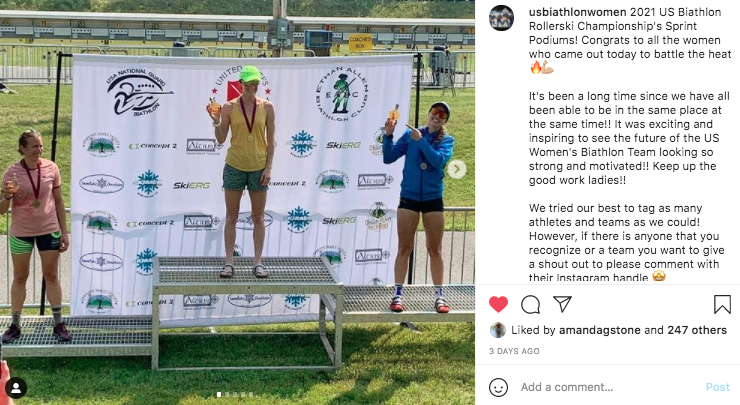
    The women’s podium from the 7.5-kilometer sprint competition at USBA Rollerski National Championships. Clare Egan led the way ahead of Deedra Irwin (right) and Susan Dunklee (left). (Photo: Instagram @usbiathlonwomen)

    This post will be updated with men’s comments as available. 

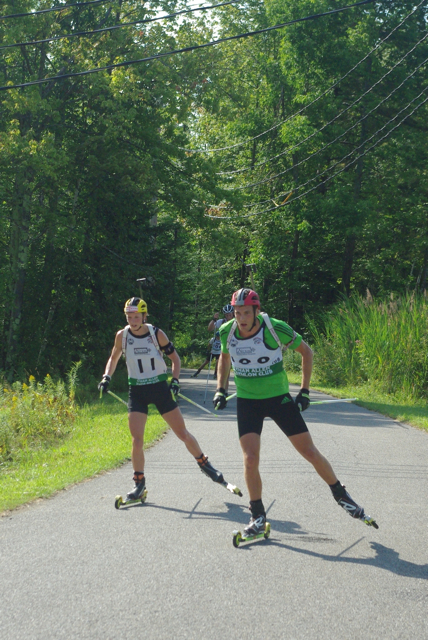
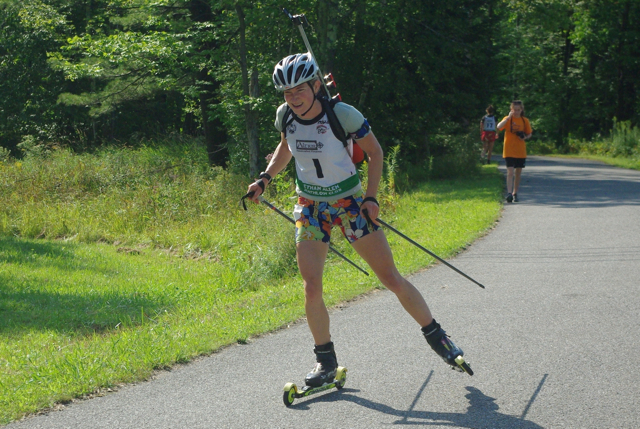
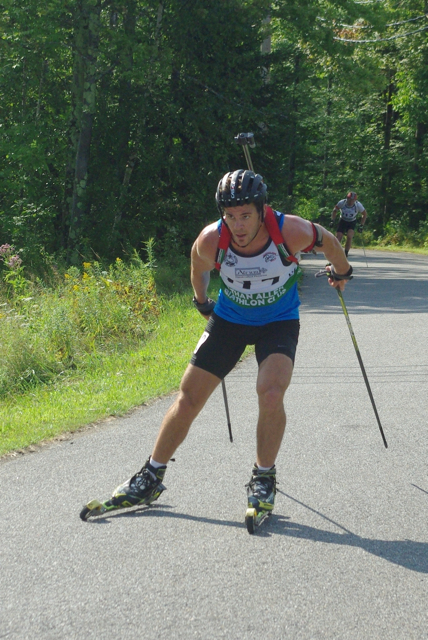
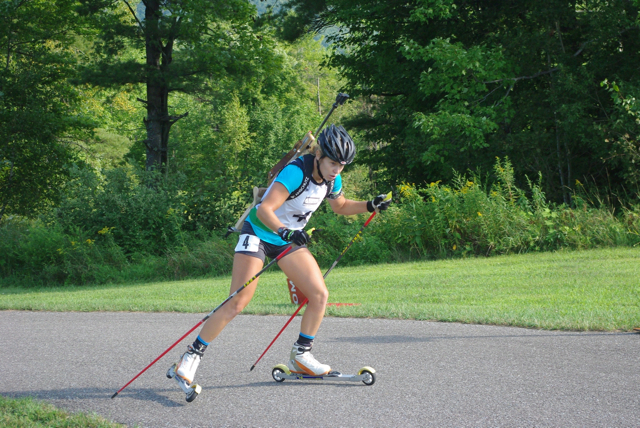
    The 2021 U.S. Biathlon National Rollerski Championships were held this past weekend in Jericho, VT, hosted by the Ethan Allen Biathlon Club. 

    As the annual event was held in a virtual format in August 2020 due to COVID-19 safety restrictions, the weekend marks a welcome return to public national level biathlon competition. Participants from clubs throughout the U.S. made their way to Northern Vermont to race a sprint on Saturday, followed by a mass start on Sunday.

    Apart from the elite senior men and women’s fields, the races saw nearly 50 participants from the U15 youth level to the senior veteran age class. These athletes competed in a 10/12.5-kilometer pursuit stage on Sunday rather than the mass start. 

    “It was great to see athletes and coaches from across the country get back together,” commented US Biathlon team member Clare Egan in an email. “I was also happy to see an increase in numbers of participants — in the past we have had similar numbers, but almost half the field was Canadian. This year without the Canadians we hit those same numbers, so that was exciting. It’s a reflection of the growth happening at the club level in places like Bozeman, Craftsbury, Soldier Hollow, Truckee, Anchorage, Grand Rapids MN, Lake Placid, and others, where there are good facilities, coaches, and training groups now.” 

    Clare Egan celebrates a double at the USBA Rollerski National Championships with a homemade poptart, courtesy of team dietitian Megan Chacosky. (Photo: Instagram @clareeganbiathlete)

    Egan posted strong results this weekend, winning both the sprint and mass start events — and lots of maple syrup, the Vermont classic podium award. In the 7.5-kilometer sprint, she missed one target while shooting prone to finish with a time of 20:33.6. She finished 33 seconds ahead of Deedra Irwin of the National Guard Biathlon Team who missed one target per stage (1+1), with USBA teammate Susan Dunklee one second behind in third (1+2). 

    In the 12.5 k mass start, Egan again missed only one target, this time standing (0+0+1+0), leading her to double up on her victories with a finish time of 37:08.1. Dunklee missed three targets during her standing stages (0+0+1+2) and skied to second place in 38:03.8. Kelsey Dickinson of the Craftsbury Green Racing Project (CGRP) took the third podium spot in 39:22.2 (1+1+2+2). 

    “I was satisfied with my racing this weekend, especially the shooting,” Egan wrote. “I only missed 2 targets out of 30. That’s an excellent percentage for me and definitely what I am aiming for as I head into the World Cup and Olympics season. I had a really hard time on skis, but I think that it was entirely due to the intense heat and humidity.”

    Both days saw temperatures in the upper 80’s with high humidity — which makes for hot radiating pavement and very sweaty ski boots.

    “My training has been going well and I’m confident about where I’m at and the direction I’m headed,” Egan concluded. 

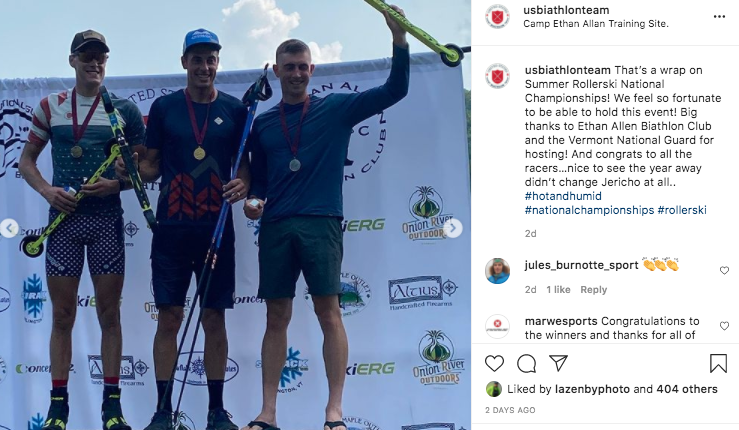
    The men’s 15k mass start podium at the USBA Rollerski National Championships. Paul Schommer took the win ahead of Sean Doherty and Leif Nordgren. (Photo: Instagram @usbiathlonteam)

    On the men’s side, Sean Doherty of the National Guard Biathlon Team shot clean in the 10 k sprint, skiing his way to the top spot on the podium on his home course in a time of 24:33.3. Doherty was followed by Leif Nordgren of the VT Army National Guard who missed two targets (1+1) to finish in 25:24.8. Paul Schommer of the Crosscut Team in Bozeman, MT, rounded out the podium with two misses (1+1) and a time of 25:45.1.

    The men’s podium rearranged itself in Sunday’s 15 k mass start. Schommer improved his shooting percentage, missing one shot in two of the four stages (0+1+1+0) and crossed the line in 38:15.6 for the win. Doherty followed 40 seconds behind with four missed targets (1+2+1+0) and a final time of 37:55.7. Nordgren took the third podium spot with a time of 38:36.8 with five misses (2+0+1+2). 

    “I have been working on some new things this summer and having them come together in Sunday’s race was a huge confidence boost,” Schommer wrote in a post-race email. “I still know there is a lot to work on, but it’s always great to see improvement. As I continue into the fall, I hope to keep the level of focus I have had thus far in the training year and continue to identify and address areas where I can improve. I don’t want to think about the next races, I just want to focus on becoming the best biathlete I can be.”
    Schommer also reflected on the experience of being back on the tracks and range in Jericho with the broader biathlon community, and the contrast in his ability to adequately prepare for biathlon last summer versus the present.
    “Coming back to Jericho after a year off was great! Last year at this time I hadn’t been at a range with a roller loop yet, so to be here this year is a real blessing. It also was great to see the biathlon community with a large turn out. Lots of young biathletes coming up which is great to see!”

    Sprint Results | Mass Start Results | Pursuit Results

  • Dunklee Doubles Up at USBA Rollerski Champs; Bailey and Smith Win (Updated)

    Dunklee Doubles Up at USBA Rollerski Champs; Bailey and Smith Win (Updated)

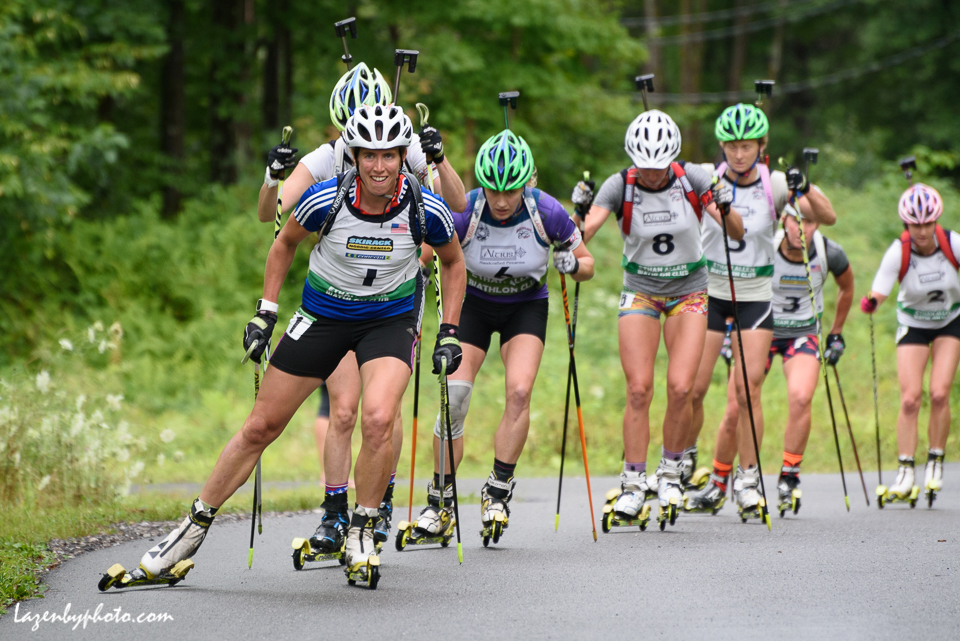
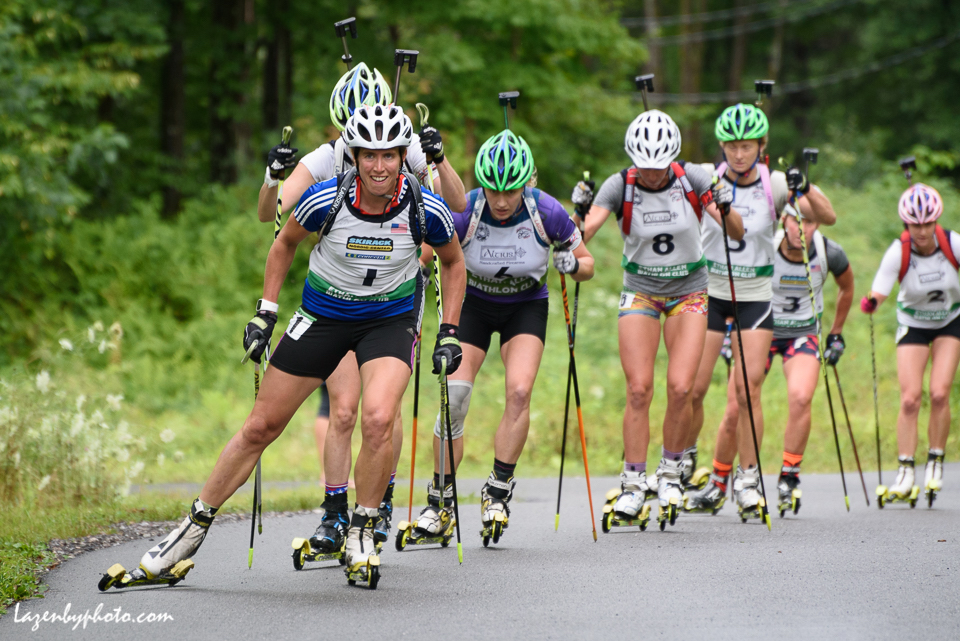
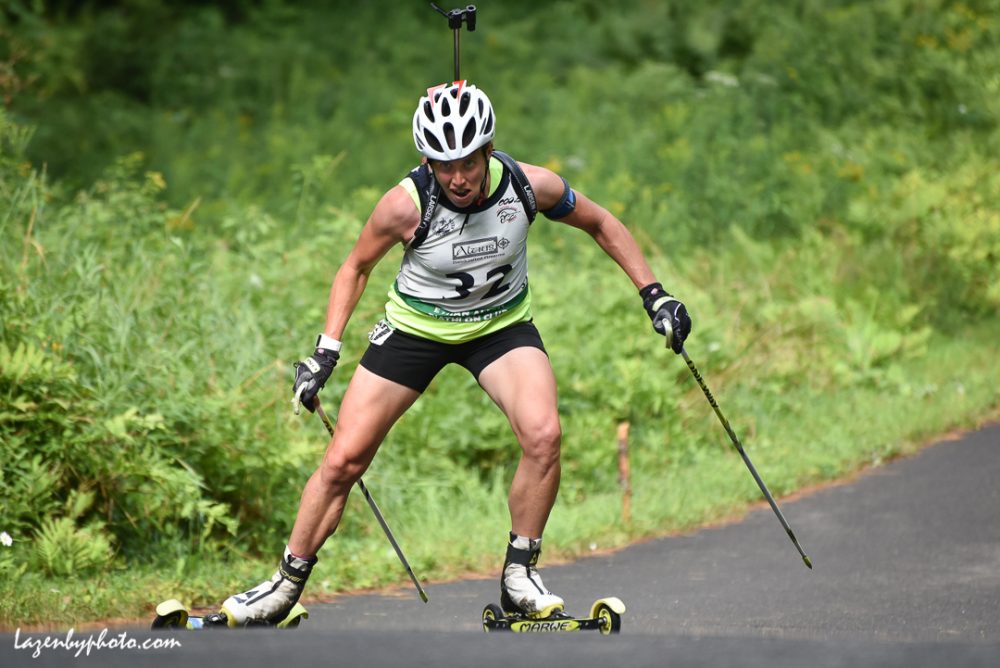
    Susan Dunklee (USBA/CGRP) leading the pack in the women’s mass start on Sunday, Aug. 13, at USBA Rollerski Championships in Jericho, Vt. She won by nearly 47 seconds. (Photo: John Lazenby/Lazenbyphoto.com)

    Special thanks to John Lazenby for providing photos from 2017 US Biathlon Rollerski Championships in Jericho. For a full gallery, click here.

    Note: This article has been updated to include comments from Lowell Bailey, Susan Dunklee and Bernd Eisenbichler.

    ***

    This past weekend, the US Biathlon Association (USBA) Rollerski Championships returned to Jericho, Vt., for two days of racing at the Ethan Allen Firing Range inside a National Guard military base. Just as it has in the past, the format included men’s and women’s sprints on Saturday followed by mass starts on Sunday, and this year, the races drew nearly 100 competitors from across the U.S. and even some from Canada.

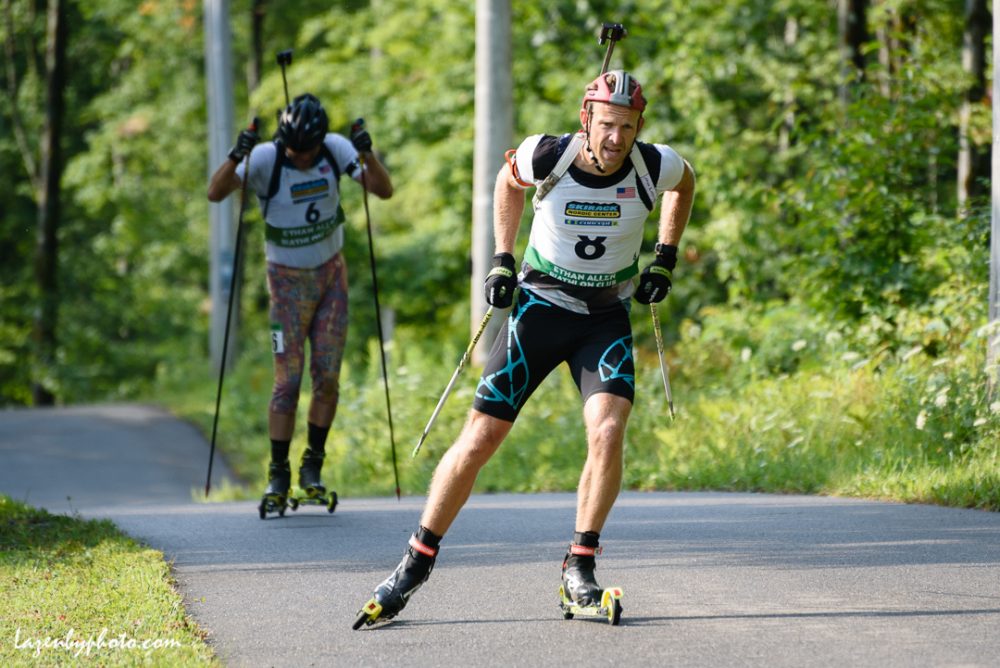
    US Biathlon’s Lowell Bailey (r) on his way to winning the men’s sprint at US Biathlon Rollerski Championships on Aug. 12 in Jericho, Vt. (Photo: John Lazenby/Lazenbyphoto.com)

    A perennial winner at Jericho, Lowell Bailey won the senior men’s 10-kilometer sprint on Saturday in 24 minutes, 58 seconds with a single standing penalty (0+1).

    “Summer nationals is a good chance to assess where you are in the training season,” Bailey wrote in an email. “Of course, roller skiing is quite a bit different than on-snow skiing, and it is important to keep that in perspective when assessing the results. However, I’m happy with the way the weekend went and I feel like I am on track in terms of where I want to be in the training season.”

    Fellow US Biathlon A-teamer Sean Doherty placed second, just 5.2 seconds back, with two prone misses (2+0). Rounding out the top three, Biathlon Canada’s Nathan Smith (the lone Canadian in that race) placed third, 21.4 seconds behind Bailey with a single standing miss as well (0+1).

    Another 0.2 seconds back in fourth overall, Travis Cooper of National Guard Biathlon was the third American after shooting two prone penalties (2+0). A total of 23 racers competed in the senior men’s event on Saturday, compared to 11 in the senior women’s sprint. (Other categories included girls, boys, youth, junior, and masters.)

    Susan Dunklee (US Biathlon/Craftsbury Green Racing Project) racing to a win this past Saturday, Aug. 12, in the women’s sprint at US Biathlon Rollerski Championships in Jericho, Vt. (Photo: John Lazenby/Lazenbyphoto.com)

    In the women’s 7.5 k sprint, Susan Dunklee, of US Biathlon and the Craftsbury Green Racing Project (CGRP), won despite five penalties (2+3) in a time of 22:10.7.

    In an email, Dunklee described the conditions as “very hot and muggy.”

    “Between that and the uphill range approach, these races have some of the most difficult shooting conditions we see all year,” she explained in an email.

    “I’ve been working on learning new wind shooting skills this summer,” Dunklee wrote. “It has been going well in practice but truly trusting those skills under race pressure is a mammoth challenge.  The goal is to build that trust before winter.  My shooting percentages weren’t great this weekend, but I am happy about the way I stuck to my work plan on the range.”

    Dunklee finished 46.9 seconds clear of her teammate and runner-up Joanne Reid (USBA/Colorado Biathlon), who had a miss in each stage (1+1).

    A minute behind Dunklee, Kelsey Dickinson, representing Craftsbury’s Collegiate Summer Team, placed third with four penalties  (3+1). No Canadian senior women competed on either day.

    On Sunday, racers returned to the range for the men’s and women’s mass starts, where Dunklee proceeded to take another victory with a time of 40:12.8 and seven penalties (1+2+2+2).

    Her teammate Clare Egan (USBA/CGRP) placed second, 23.6 seconds back with five misses (1+0+2+2), while Dickinson repeated in third (+33.8) with five penalties as well (2+0+1+2).

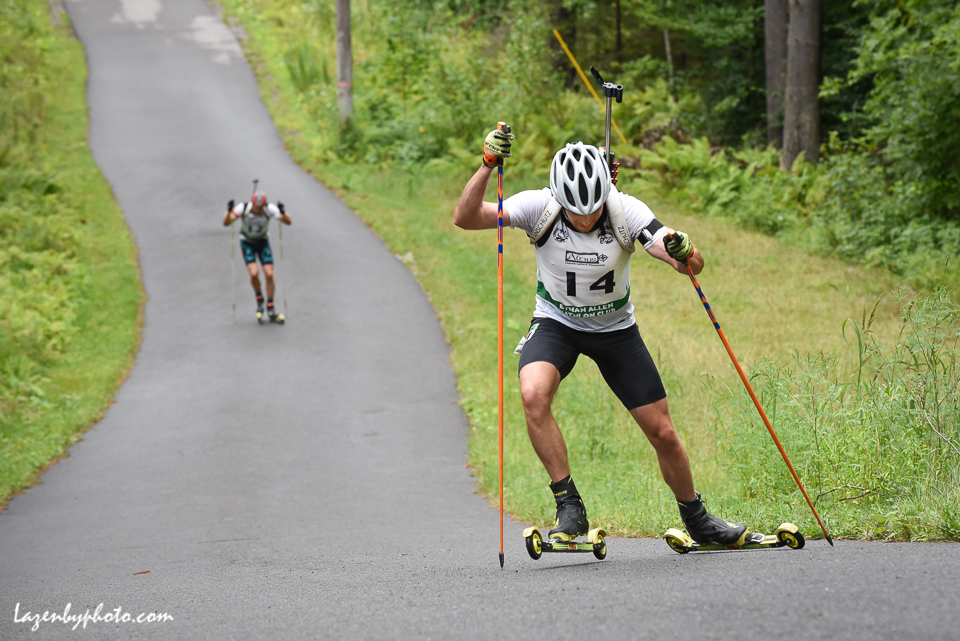
    Biathlon Canada’s Nathan Smith (14) leading US Biathlon’s Lowell Bailey (l) up a climb in the men’s mass start on Sunday, Aug. 13, at US Biathlon Rollerski Championships in Jericho, Vt. Smith went on to win by 21.3 seconds over Bailey. (Photo: John Lazenby/Lazenbyphoto.com)

    In the men’s mass start, Smith cleaned two stages and tallied three penalties (1+0+0+2) en route to the win in 38:09.8. Bailey finished 21.3 seconds back in second after three misses (1+0+1+1), and his teammate Tim Burke (USBA) took third (+1:09.8) with five penalties (2+1+2+0).

    “I was happy with how the first day of racing went, but I definitely could have been more aggressive in the Mass Start’s standing stages,” Bailey reflected.  “The wind came up during the shooting and I let that distract me a little bit when I should have stayed with my planned cadence and shooting speed.”

    “With faster shooting, I may have been able to catch Nathan’s wheel and contended for the win on the last loop,” he continued. “As it was, those two standings left me with an insurmountable gap for the final loop.”

    Paul Schommer was the third American in fourth overall (+1:23.0) with six misses (2+1+2+1). 

    The USBA Rollerski Championships typically serve as the first of two weekends of trials (the other being in October) for US Biathlon in selecting a pre-World Cup training camp group. From that group of athletes, the U.S. usually fills out its early season International Biathlon Union (IBU) World Cup roster.

    In an email, USBA Chief of Sport Bernd Eisenbichler explained that two athletes particularly stood out with their performances this weekend.

    “On the women’s side Kelsey Dickinson and on the men’s side Travis Cooper made a big improvement compared to last year and even last season and both will get rewarded for that with a camp invitation to [Lake Placid] in mid-September to work with the A Team and the National Team Coaches,” Eisenbichler wrote.

    “I was happy to see a very competitive men’s field and a growing women’s field as well,” he continued. “We could see, that it was the first real races this summer and as Jericho is a pretty hard range to shoot at, we saw a good reminder what to work on still, especially on the shooting side. The A Team comes from a really long and hard block of training, so they weren’t fresh at all going into the races, so for sure, you make a few mistakes more, as if you would be preparing fully for a race weekend like you would e.g. do for a [World Cup] weekend.”

    Complete results: Sprint | Mass Start

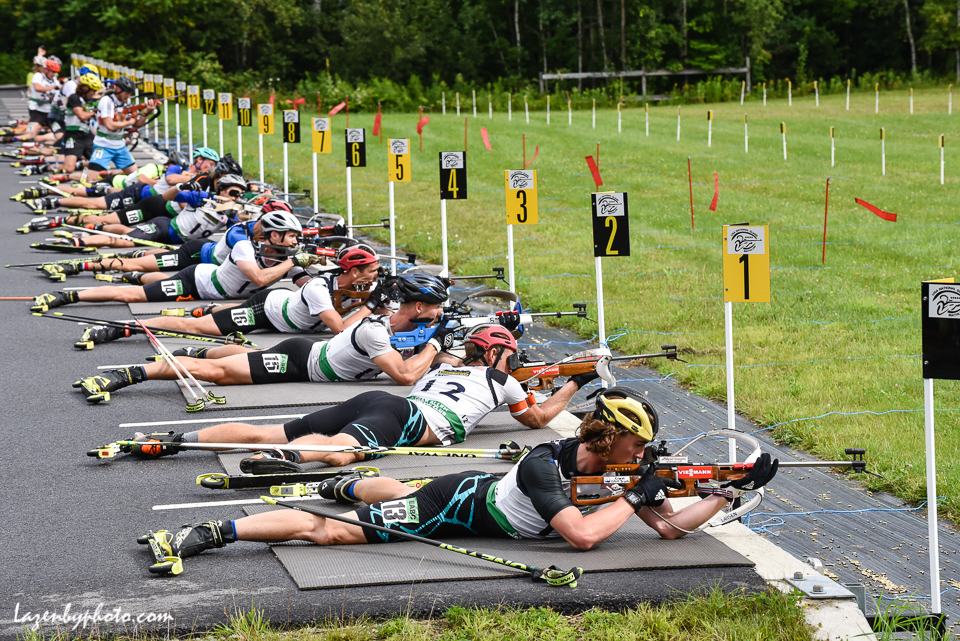
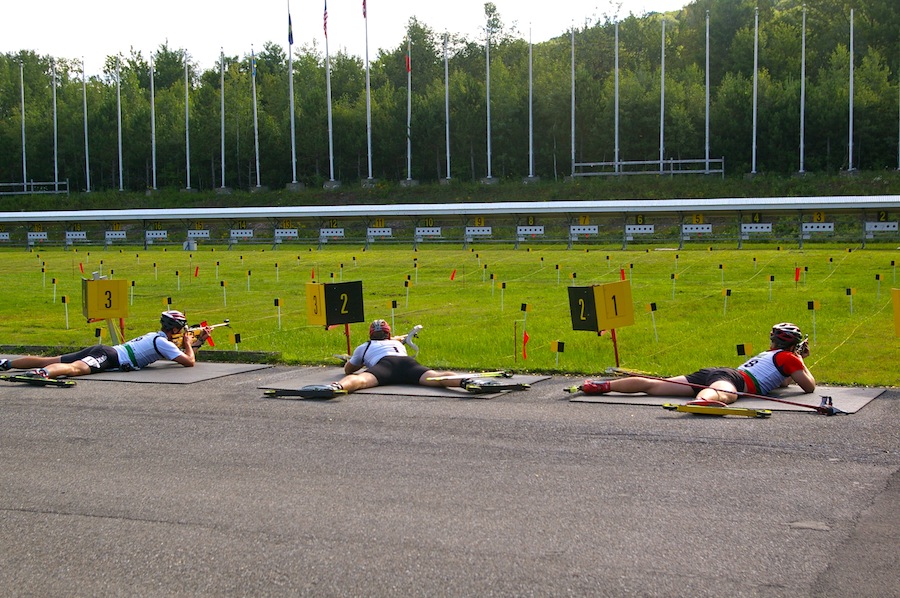
    US Biathlon’s Sean Doherty (front) and Lowell Bailey (12), along with their competitors, taking aim during a prone shooting stage of the men’s mass start at 2017 USBA Rollerski Championships on Aug. 13 in Jericho, Vt. (Photo: John Lazenby/Lazenbyphoto.com)
  • 20-for-20 with Chloe Levins

    20-for-20 with Chloe Levins

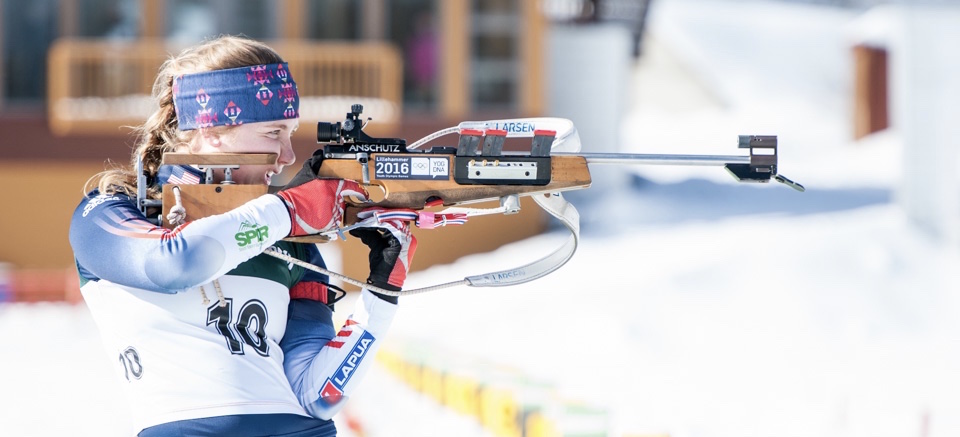
    Chloe Levins (Ethan Allen Biathlon Club) racing at 2016 U.S. biathlon championships last March in Fort Kent, Maine. (Photo: Pete Freeman Photography)

    In another 20-something-question, fill-in-the-blanks series, we checked in with the world-class U.S. and Canadian biathletes that will be competing at 2017 International Biathlon Union (IBU) Youth & Junior World Championships Feb. 22-28 in Osrblie (also known as Brezno-Osrblie), Slovakia.

    Here’s 18-year-old Chloe Levins, of the Ethan Allen Biathlon Club, who will be representing the U.S. at her third Youth Worlds. On Wednesday, Levins finished 14th in the youth women’s 10-kilometer individual for her best non-relay result at Youth Worlds.

    ***

    “My full name is Chloe, but you can call me Chlo. I was born in Elmira, N.Y., raised in Rutland, Vt., and one thing you should know about my hometown is that the Lincoln Memorial was made from marble that comes from a quarry near my house.

    I started cross-country skiing when I was 2 and started biathlon when I was 13, thanks to Algis Shalna, Max Cobb, and my mother. I currently train at Mountain Top and Jericho with Ethan Allen Biathlon Club.

    If I’m not skiing, you might find me shooting. If I had to pick a favorite book, it would be ‘Born to Run‘.

    One of the things I’m most excited about for Youth/Junior World Championships in Brenzo-Osrblie is the opportunity to compete.

    This will be my third Youth/Junior World Championships, and this year, I’m competing as a youth. One race I’m especially targeting there is the next one.

    The best advice anyone ever gave me about skiing or racing was to smile.

    One of the best race memories I have is from the Youth Olympic Games in Lillehammer, Norway.

    If I could meet one World Cup skier, it would be Tarjei Bø.

    If I don’t end up being a professional skier, I’ll try to be a professional golfer (she’s on the Middlebury golf team).

    I’m missing too many days of school to be here, and my professors are probably thinking, ‘Good thing we have the technology to make this work.’

    You can follow me on Instagram @chlolevins.”

    American Chloe Levins competing at 2016 IBU Youth/Junior World Championships in Cheile Gradistei, Romania (Photo: NordicFocus)
  • If You Go: Jericho’s Ethan Allen Firing Range

    If You Go: Jericho’s Ethan Allen Firing Range

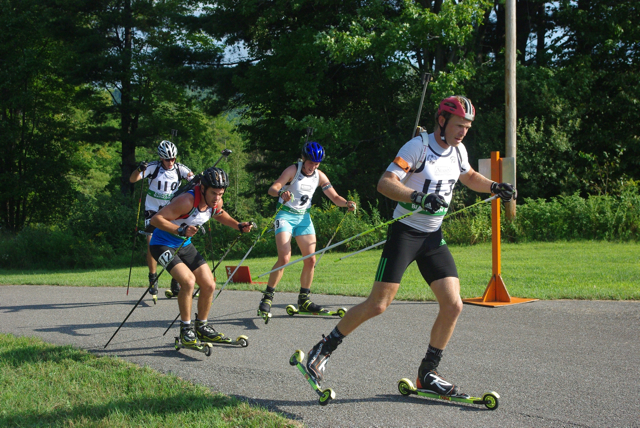
    A racer heads out on the penalty loop at the Ethan Allen Firing Range in Jericho, Vt., during the 2013 North American Biathlon Rollerski Championships from Aug. 10-11.
    A racer heads out on the penalty loop at the Ethan Allen Firing Range in Jericho, Vt., during the 2013 North American Biathlon Rollerski Championships from Aug. 10-11.

    Editor’s Note: After a weekend trip to Jericho, Vt., from Aug. 10-11, FS decided it might be interesting to provide some background on one of the most prolific biathlon sites in North America and clarify how to gain access to the National Guard’s facility.

    JERICHO, Vt. – Just a hop, skip and a jump off interstate 89, the Ethan Allen Firing Range sits tucked away high upon West Hill Road – and a lot of locals couldn’t tell you what it looks like. You see, what’s widely recognized as one of the best biathlon gems in the country (and North America) is also a bit exclusive and intimidating from the outset.

    Owned and operated by the Vermont National Guard, the 11,000-acre site mainly caters to the military. If you’re lucky enough to grace the grounds of Camp Ethan Allen, even if it’s just to and from the range, chances are you’ll come head to head with a humvee or some reserves in action. If you stay out of their way and have the go-ahead to use the range, chances are you shouldn’t run into any problems – and this is what makes Jericho so cool.

    In early August, about 105 athletes came out for the North American Biathlon Rollerski Championships hosted by the Ethan Allen Biathlon Club (EABC) and organized by US Biathlon (USBA).

    According to USBA director of athlete development Piotr Bednarski, that was a pretty huge turnout for rollerski races. In fact, it might’ve been the biggest field in about 20 years of the event’s existence.

    Every other year, the North American Biathlon Rollerski Championships float between Jericho and Canmore, broadening the scope beyond nationals. When they’re not hosting the championships, the sites swap what’s known as the North American Cup – and in Jericho, the turnout is typically good (60 to 70 athletes).

    Eventual men's winner Lowell Bailey (c) gets his shooting on Aug. 11 at the Ethan Allen Firing Range in Jericho, Vt. Bailey went on to win the two-day North American Biathlon Rollerski Championships.
    Eventual men’s winner Lowell Bailey (c) gets his shooting on Aug. 11 at the 30-point Ethan Allen Firing Range in Jericho, Vt. Bailey went on to win the two-day North American Biathlon Rollerski Championships.

    “It’s actually probably the best roller loop on the planet,” Bednarski said. “All the national team guys, they’ve gone to Ruhpolding and Oberhof [Germany] and all over the world, and this is really just a great place to ski.”

    The approximately 5.5-kilometer rollerski loop got a major upgrade in May when the Vermont National Guard spent $300,000 dollars on repaving. According to Maj. Christopher Ruggerio, biathlon coordinator at the National Guard, the project wasn’t an absolute must, but it was important in keeping Jericho valuable to biathletes.

    “Prior to initiation of this project, the course was by no means unusable, but did have a number of unwanted cracks and heaves that were becoming a safety concern to athletes,” Ruggerio wrote in an email. “Our Range is one of the premier venues in the Nation. According to various coaches and athletes from multiple organizations, our roller ski trail system is likely the ‘best in the world’ at this time.”

    EABC President John Madigan explained in an email that the range was “probably the best in the country and comparable to other countries” when it was built several decades ago.

    “Biathlon in Europe has grown tremendously since then and the stadiums in Germany and other countries now attract 30,000 or more spectators to World Cup races,” he wrote. “It will be a long time before we ever see that here, but these paved trails are as good as anything in Europe and as close to real skiing as you can get in the summer.”

    “It’s got the vertical plus it skis like skiing,” Bednarski explained.

    That’s partly why Biathlon Canada High Performance Director Chris Lindsay considers it almost like a second home – albeit in America – in contrast to their base in Canmore, Alberta. As he drove up the winding road to Jericho last month, Lindsay said he passed signs still standing after Tropical Storm Irene flooded the region two years ago. Their words were an eerie reminder of what Canmore experienced in June – unprecedented rainfall, devastating floods, evacuations, and destruction.

    The signs read “Vermont strong,” and Lindsay saw similarities to those posted in Canmore. “We have those, too,” he said.

    But long before the flooding thousands of miles away in Canmore, these races in Jericho were a priority and will become more so in the coming years. For the Americans, they were a sort of prequalifier for the Olympics: do well there and at two more rollerski trials in Utah, one could earn a ticket to Europe to strive for World Cup starts. For the Canadians, it was less about Olympic qualification and more about the competition.

    “We are very supportive of the idea of getting back to having co-competitive opportunities for the two major North American teams on a regular basis and during the training season so that there’s an opportunity to learn from each other and there’s also an opportunity to measure off each other,” Lindsay said.

    Because of the size of biathlon in Canada and the U.S., both programs can’t just rely on internal or domestic competition, he added. To measure success, they need to be pinned against one another.

    “Getting back to having this as a major event within our training season is a priority for the next quadrennial,” he said. “Having over a hundred people on the start list, this is pretty significant and it’s a great opportunity.”

    Bednarski, who organized the event remotely from Minneapolis, said he was ever impressed with the Canadians’ showing.

    “I think they’ve made it a national-team requirement basically, which is great,” he said. “It elevates everybody. … Anybody on the U.S. or Canadian team that has a shot at making the Olympics is here. There’s twenty athletes who are going to go, and they’re all here.”

    For the low cost of a couple dollars per day, athletes stayed in the barracks for as long as two weeks.

    “It’s like the army,” Bednarski said. “It’s really fun. Everyone’s together, there’s no TV, no internet, everyone’s just hanging out and playing games and Frisbee and whatever.”

    Women’s pursuit champion Rosanna Crawford, prequalified to represent Canada at the 2014 Sochi Olympics, explained in an email that she only spent two nights in the barracks after training in Lake Placid, N.Y.

    “I actually slept pretty good, but the showers are really gross!” she wrote. “They could really use some new shower curtains! Two nights was more than enough for my liking! The food was good though, they had hired a couple cooks to come in for the week and they were amazing and really nice people!”

    Wondering what it takes to gain access? Madigan explained that one must be associated with a club or organization that leases rights to use the range (Craftsbury and Mansfield Nordic do as well), and the leaders of those organizations must have safety training at the base.

    “We always welcome people to join us during a scheduled practice, try some shooting or check out the trails,” he said.

    There are three more races in the fall biathlon series (Sept. 29, Oct. 27 and Nov. 3) and a cyclocross biathlon race open to the public on Oct. 26.

  • Photo Gallery: North American Rollerski Biathlon Championships

    Photo Gallery: North American Rollerski Biathlon Championships

    JERICHO, Vermont – With the entire U.S. senior field and several top Canadians donning bibs this weekend, there was plenty of excitement at the Ethan Allen Firing Range in Jericho, Vermont. In the senior divisions of the North American Rollerski Biathlon Championships, the men’s races were characterized by close finishes, with Tim Burke outsprinting JP Le Guellec for the pursuit title, Ethan Dreissigacker edging Lowell Bailey by one second for fourth, and Sara Studebaker besting teammate Annelies Cook by three seconds for third place in the women’s race.

    But close finishes weren’t the only thing that made the races notable. With over 70 junior and senior competitors, event is one of the largest summer biathlon gatherings in North America, and the Ethan Allen Biathlon Club has graciously played host for many years.

    “It’s fun to see all the young people,” Le Guellec told FasterSkier. “It’s North America at its best.”

    FasterSkier was on site on Saturday; here’s a gallery of our photos from the event.

    Race reports: men / women

    Results: sprints / senior pursuits / junior pursuits

  • Youth Olympic Games Presents: Aleksandra Zakrzewska

    Youth Olympic Games Presents: Aleksandra Zakrzewska

    Aleksandra Zakrzewska leaves the range during a race at biathlon World Junior Trials in Jericho, Vermont last winter. Photo courtesy of Zakrzewska.

    (Note: This is the fourth in a series of interviews with athletes who will be competing at the first-ever winter Youth Olympic Games in Innsbruck, Austria this winter. The first interview was with Sean Doherty, the second with Anna Kubek, and the third with Nick Proell.)

    When the Youth Olympic Games kick off in Innsbruck, Austria this January, one American biathlete will have a lot of experience on her side.

    It’s not her own experience: neither of the two girls named to the U.S. squad has raced internationally before.

    But Aleksandra Zakrzewska, a high school student from South Burlington, Vermont, has been spending more time with a very knowledgeable coach since she qualified for the team. Algis Shalna won Olympic gold representing the Soviet Union in 1984, and he happens to coach the Vermont Collegiate biathlon team, which like Zakrzewska trains out of Jericho, Vermont. Shalna has been helping the young athlete out more since she learned that she was Olympic-bound.

    Even though Zakrzewska doesn’t have any international experience of her own, a little inspiration and a lot of focus fuel her drive to the top. This is apparent in other parts of her life, too. Even though Zakrzewska is just starting her junior year of high school, she’s balancing a workload that would make even college students crings: advanced placement classes, high school teams, the school band, and an hour-long round-trip drive to biathlon practice.

    It might seem like lot for a young woman to handle, but Zakrzewska has proven herself in all of her endeavors. For two years in a row, she’s finished in the top fifteen of the statewide math talent search, and she also won several high school ski races last winter. That level of focus – which she displays on a daily basis – is what will ultimately determine her success in Innsbruck.

    FasterSkier caught up with the Vermont native last week to see how her training was going.

    FasterSkier: Can you tell me a little bit about your history as a skier – did you ski when you were growing up?

    Aleksandra Zakrzewska: When I was 4, my family started cross country skiing. My sister and I joined the local Bill Koch League (BKL) club and started racing the next winter. Unfortunately, after about two years, the program was moved to right after school, and since I lived over half an hour away, I couldn’t come to the practices anymore. I still skied once in a while with my parents, but I didn’t train for racing. I started training again in eighth grade with the high school and have been doing that since.

    FS: What made you want to take up biathlon?

    AZ: I did a BKL race at the end of one winter that was a paintball biathlon. I found it really cool and a few months later my mom found a running biathlon race at Jericho. I went, missed every single target, but still liked it. That day we also found out that there was a club that I could join to start training biathlon, so I did.

    FS: When did you start shooting, and how is that portion of the sport coming along?

    AZ: That running biathlon race was the first time I had ever held a gun. I started shooting when I started training with the Ethan Allen Biathlon Club (EABC). I have been skiing for a lot longer than I have been shooting, so that part of biathlon has always been easier for me. I did two training camps over the summer, though, and my shooting has been getting a lot more consistent.

    FS: Who do you train with?

    AZ: I train with EABC in Jericho. I’m lucky to have a range to practice at so close to home, where there is a club to train with and where they hold races like NorAm’s. It’s too bad that there aren’t more places like this around, because it prevents a lot of people from joining the sport.

    FS: I am assuming that you also do high school races for skiing. How do you balance ski training and biathlon training? How do you find time for everything?

    AZ: I split practices – I go to Jericho on Mondays and Wednesdays, and train with my school on other days, and then I have to miss some high school races for biathlon. My ski coaches don’t really mind – they know I am still skiing. The problem for me is not with balancing nordic and biathlon, those fit in pretty nicely together, but with balancing the rest of my life. I take school very seriously and play two instruments. It’s difficult to coordinate the time commitments that each of these pieces of my life require.

    FS: Have you ever raced internationally before?

    AZ: No. This will be a first for me.

    FS: Is it intimidating to think of racing against athletes from all over the world? Is that something you are thinking about at this point?

    AZ: I’m not thinking about it too much yet, but when I do, I guess it is a little intimidating, but also really exciting. A race is a race, not matter who is in it.

    FS: Has getting named to the Youth Olympic Games team changed your plans for the summer, fall, and early winter at all?

    AZ: Yes, it has. First, I had to change my summer travel plans so that I could be in Jericho for the final qualifying races. Now that I qualified for the team, my training has changed, too. I normally run cross country in the fall. This year I am still on the team, but I’m doing a lot less training for running and a lot more for biathlon, including some more personalized training with Algis Shalna, a former Olympic coach and champion. I’m only racing at a few of the bigger meets to score for my XC team, but running has fallen a lot on the priority list. I’m also already planning for missing midterms and two other weeks of school. I’m taking four AP classes this year, so I really need to be planning ahead for that.

    FS: What are you looking forward to most about the trip?

    AZ: I am really excited about the whole thing. I’m honored that I qualified to go, I love traveling to other countries, and I am really looking forward to meeting athletes from other countries. I’m nervous about racing at such a big event, but I think it will be a great experience. I can’t wait. 

  • The Jericho Experience

    Snowflake Photographs by Snowflake Bentley

    Jericho: a small Vermont town made famous by “Snowflake” Bentley, the first man to photograph snowflakes back in 1885 and discover that no two are ever alike.   Over 125 years later, Jericho’s winter heritage is still going strong, even in the summer.  Every August, I travel to Jericho to join a crowd of snow-loving biathletes.  We train at the biathlon facilities of the Ethan Allen Firing Range (a military base) and we stay in the barracks.  When are not busy training, we explore the surrounding community, from the ridges of Mt. Mansfield to the shops and restaurants of nearby Burlington.  Over the course of a week or so, we catch up with friends that we haven’t seen since last season’s snowflakes melted.

    The Ethan Allen Firing Range is named after Vermont’s well-loved hero and independent-minded leader of the Green Mountain Boys during the Revolutionary era.  It houses the Vermont National Guard and is famous throughout the US for its Mountain Warfare School.  The base encompasses 11,000 acres along the western slopes of Mt. Mansfield and Bolton, and the frequent percussion of artillery training can be heard echoing off ridgelines for miles.

    One of the most memorable parts of Jericho training camps is barracks life.  During the recent camp, I was lucky enough to be assigned to the spacious officer’s quarters with the rest of the National Team, but most of the younger athletes were housed in the more traditional barracks.  Over the years, we have all put in our time there.   The experience gives us a glimpse of what army life must be like.

    Imagine a big open bay with two long rows of bunk beds.  There is no privacy and space to store the contents of your duffel bag and all your training gear.  At night, the bathroom lights and exit signs spill light into the sleeping bays.  Athletes in the bottom bunks sometimes experiment with draping extra blankets around their sleeping space to form a dark cave.  Every time someone crawls out of bed to go pee or talks in their sleep, the entire room can hear.  Industrial-sized fans buzz all night long, circulating hot, humid, stifling air from the open window, which is barely better than having no fans.  For those of us unadapted to such conditions, it is very difficult to sleep well and recover from hard training.

    During my handful of visits to Jericho, I’ve learned to fall back asleep after I hear drill sergeants bellowing outside my window at 5:00 A.M.  I prefer to wake up a little closer to 7 and head to the dining hall (wearing closed-toed shoes of course, it’s a military rule).  After breakfast, I join my teammates in our van and we drive a ½ mile straight uphill from the barracks to the biathlon range.  The van chatters over washboards, struggling to maintain enough momentum to make it to the top of the hill going the speed limit (20 mph).  Our van’s dust cloud settles over clusters of junior athletes whose coaches make them run up the steep hill for a warm-up before practice.  I’m glad my coaches don’t make me do that routinely.

    The Jericho biathlon range and ski trails rank among the finest facilities in the country. In the past, Jericho has hosted large international competitions and the club still frequently hosts important events such as junior world team trials.  Jericho’s range is one of a handful in the country with paved trails for summer rollerski training.

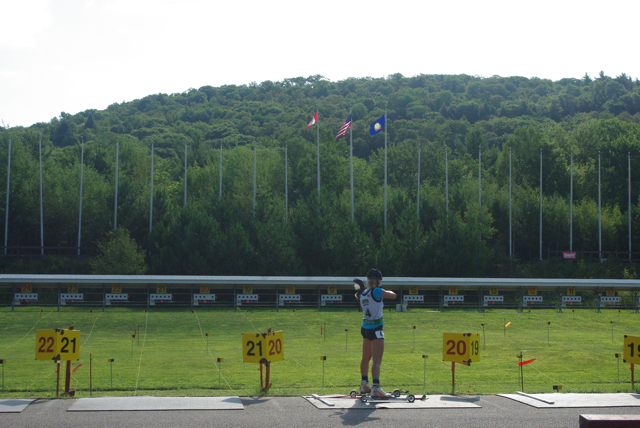
    A stadium scene during race day.  (Photo: Judy Geer)

    A stadium scene during race day. (Photo: Judy Geer)

    Training at Jericho provides a great opportunity to practice the transition from skiing to shooting and vice versa.  Transitions are a complicated process requiring lots of practice to perfect.  For example, while approaching the range you need to slow down, glance at the wind flags, take some deep breathes, remove poles, look for an open point and check its corresponding target downrange, and open the sight covers and bolt, and then set-up on the shooting mat.

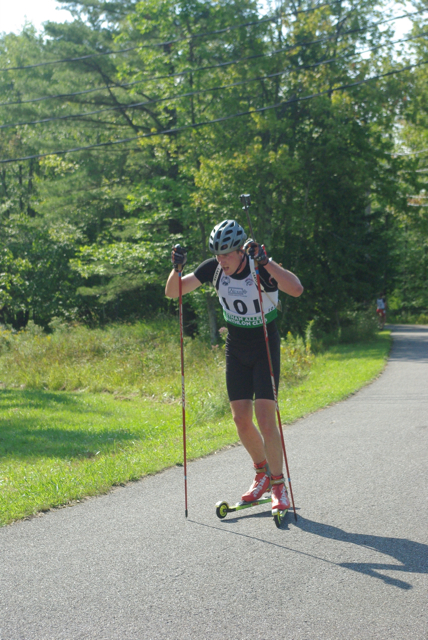
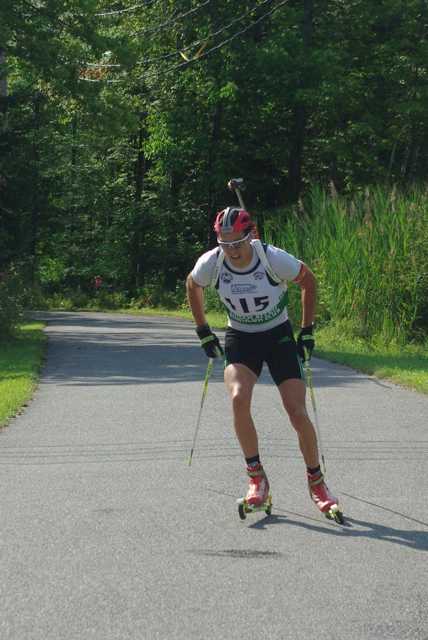
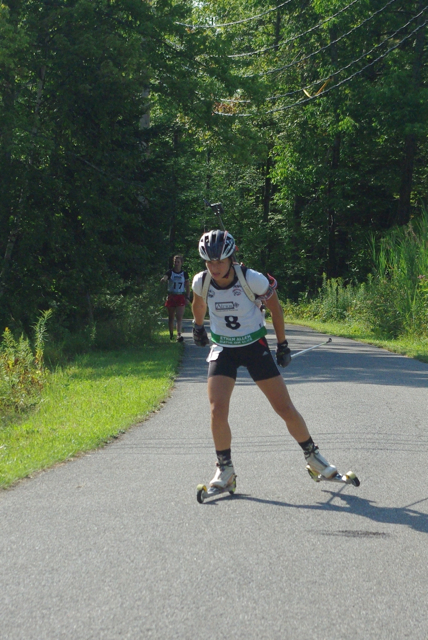
    The venue also features superb rollerskiing.  Its trails that flow naturally over challenging terrain.  They snake through the woods dipping, climbing, and twisting around corners.  I feel much safer rollerskiing on isolated trails like these than trying to avoid traffic out on the roads.  The only obstacles we run into are camouflaged soldiers who randomly pop out of the woods during their land navigation training and woodland critters.  Recently wildlife highlights: a mother doe and two spotted fawns frozen in the middle of the trail and a daring turkey that strutted under the targets during a shooting clinic for beginner biathletes.

    One common complaint about Jericho is the weather.  Even a perfect summer day always feels hotter and more humid than seems reasonable, despite the base’s mountain setting.  The local landscape creates its own weather patterns, and they tend to be more extreme than the rest of the state.  For example, incoming clouds from the west get caught on Mt. Mansfield and create violent thunderstorms and hail.  The weather, combined with the relentless biting flies can make some workouts feel absolutely miserable. Luckily, the base has a saving grace for mugginess: a couple swimming holes in the Lee River.   We just have to remember army rules: never walk anywhere alone and never walk through the base wearing only a swimsuit.  Luckily, they haven’t outlawed swimming itself.  After practice we cool off in freezing stream water and hope we won’t climb out with any leeches attached.

    Another method for cooling off on those hot August day.  (Photo: Sara Studebaker)

    Another method for cooling off on those hot August days. (Photo: Sara Studebaker)

    By late evening, the heat finally relents a little bit.  If you were to walk out the front door of our barracks at dusk, you’d see soft spots of LCD lights dotting the facing hillside. They could almost be mistaken for fireflies except for the accompanying murmur of conversations.  A closer inspection would reveal about 20 soldiers (and a bunch of athletes) sitting in the dewy grass and talking/texting on their cell phones.    One corner of that hillside boasts up to three bars of cell service despite the rest of the base having none.    With no internet on base, “cell phone hill” is in very high demand.

    To get our daily internet fix, we drive into Jericho Corners in the mid-afternoon.  Across from the historic Old Red Mill and Snowflake Bentley museum, sits a cafe and bakery called The Village Cup, or “Athlete’s Cup” as we fondly refer to it.  We visit so frequently that by the end of our training camp we start to feel like regulars.  Instead of napping all afternoon to recover from training, we eat generous slices of raspberry pie or chocolate torte and cruise Facebook.  We compose blog entries to a background of classic tunes, such as Cat Steven’s Wild World.  It’s a pretty quiet place, but one day, a teammate (who himself is a multi-time Olympian) returned all excited because he had spotted a celebrity on the back porch: a member of the band Phish.

    Another favorite off-base escape is the Jericho Country Store, located in Jericho Center.  Our most common objectives are fresh sandwiches and soft-serve maple ice cream. However, as the oldest continuously running country store in VT, this small establishment boosts many curiosities.  Every nook and corner is filled with something interesting, such as old-fashioned glass jars full of candy, a checker game set up on a barrel table, specialty soaps, greeting cards by community artists, local beef, all sorts of historic signs and pictures, and antique post office boxes.  (The store still functions as a post office).  After finding some sort of yummy treat, we wander across the street to sit under a tree on the town green to savor it.

    The culmination of the annual Jericho training camp is a couple of rollerski biathlon races, hosted by the Ethan Allen Biathlon Club.  These races are technically “Rollerski Biathlon Nationals” but they often feel more low-key than that.  Many athletes view them as a way to get some practice racing in during the summer months.  However, this year the races were important.  They served as part of the trials process to determine who will represent the US in European competitions in November/December.

    Me, on the starting line (Photo: Elizabeth Geraghty)

    Me, on the starting line (Photo: Elizabeth Geraghty)

    How did the races go for me this year?  Not as well as I had hoped, but they certainly weren’t a disaster.  I was able to ski hard despite the heat and had some of the top rollerski times both days, but I struggled in the shooting range.  Results from the two races can be found on host Ethan Allen Biathlon Club’s website:

    http://www.eabiathlon.org/results2011RollerskiBiathlonSprint.pdf

    http://www.eabiathlon.org/results/2011RollerskiBiathlonPursuit.pdf

    One reason I enjoy racing in Jericho is that I consider it my home course.  I first ski raced in Jericho trails at the young age of eleven for the New England Bill Koch Championships and I also competed there for high school state championships.   The Ethan Allen Biathlon Club is the parent club to my home biathlon program in Craftsbury.  The Craftsbury Outdoor Center often sends a crew of volunteers for the races.  It’s been wonderful the last couple years to see so many GRP teammates and coworkers help out and bring home more enthusiasm for the sport.  I often have an additional fan club of family and friends cheering me on, which is a rare experience when we spend most of the winter racing in Europe.  Dear fan club, next time I’ll make sure I let you know if the race start time changes to something earlier than posted- sorry about that.  This year was special because my cousin, Jesse, who is in the Guard and happened to be training on base, stopped by unexpectedly.

    Hands down, my favorite thing about spending time in Jericho is the community.  The August races and training camps are the only time during summer months when the majority of the US biathlon racing community assembles together in one spot.  There are very few people in the United States who understand biathlon and can relate to the experience of being a biathlete.  When we come together it is an empowering experience for everyone involved.   The entire US National Team competes alongside juniors, beginners, the National Guard teams, and older masters groups.  On a given year, racers and coaches might hail from New England, New York, Pennsylvania , Minnesota, Wisconsin,  Colorado, Wyoming, Washington state, and Alaska.  We often see representation from the eastern Canadian providences as well, such as Quebec, Ontario and Prince Edward Island.

    Some faces of Jericho. L to R: Major Parsons (military), Bjorn Bakken (US Biathlon intern), Eric Tremble (Ethan Allen club coach), John Madigan (Ethan Allen club's director), Pat Coffey (former Ethan Allen coach, now national team coach), Corrine Malcolm (national team athlete)

    Some faces from Jericho. L to R: Major Parsons (military), Bjorn Bakken (US Biathlon intern), Eric Tremble (Ethan Allen club coach), John Madigan (Ethan Allen club director), Pat Coffey (former Ethan Allen coach, now national team coach), Corrine Malcolm (national team athlete)

    Once the racing crowd dissipates, the locals remain.  The National Guard’s biathlon team and the Ethan Allen Biathlon Club (civilians) use the range year round.  These groups are made up of amazing people who are passionate about the sport and never fail to be friendly and helpful.  I always enjoy sharing the range with the Guard athletes and the club team.  Many thanks to Major Parsons and his crew from the Guard who create a welcoming environment on the base and maintain top notch facilities.  Thanks also to the Ethan Allen Biathlon Club and their numerous volunteers for both hosting high quality races and for promoting the sport to people in the local community.

    Another flake captured by Snowflake Bentley.  I wonder if the concept of man-made snow ever crossed his mind?  One of the reasons Jericho's ski trails are so reliable in winter is their snow making system.
    Another flake captured by Snowflake Bentley. I wonder if the idea of man-made snow, something Jericho is capable of now, ever crossed his mind?

    Jericho: a small Vermont town made famous by “Snowflake” Bentley, the first man to photograph snowflakes back in 1885 and discover that no two are ever alike. Over 125 years later, Jericho’s winter heritage is still going strong, even in the summer. Every August, I travel to Jericho to join a crowd of snow-loving biathletes. We train at the biathlon facilities of the Ethan Allen Firing Range (a military base) and we stay in the barracks. When are not busy training, we explore the surrounding community, from the ridges of Mt. Mansfield to the local farmers’ market. Over the course of a week or so, we catch up with friends that we haven’t seen since last season’s snowflakes melted.

    The facility where we train and stay is the Ethan Allen Firing Range, which is an army base in Jericho, VT. Named after Vermont’s well-loved and independent-minded hero from the Revolutionary era, the Ethan Allen Firing Range houses the Vermont National Guard and is famous throughout the US for its Mountain Warfare School. The base encompasses 11,000 acres along the western slopes of Mt. Mansfield and Bolton, and the frequent percussion of artillery training can be heard echoing off ridgelines for miles.

    One of the most memorable parts of Jericho training camps is barracks life. During the recent camp, I was lucky enough to be assigned to the spacious officer’s quarters with the rest of the National Team, but most of the younger athletes were housed in the more traditional barracks. Over the years, we have all put in our time there. The experience teaches a partial appreciation for what army life must be like.

    Imagine a big open bay with two long rows of bunk beds. There is no privacy and no good space to store your duffel bag and all your training gear in it. At night, the bathroom lights and exit signs spill light into the sleeping bays. Athletes in the bottom bunks sometimes experiment with draping extra blankets around their sleeping space to form a dark cave. Every time someone crawls out of bed to go pee or talks in their sleep, the entire room can hear it. Industrial-sized fans buzz all night long, circulating hot, humid, stifling air from the open window, which is barely better than having no fans. For those of us unadapted to such conditions, it is very difficult to sleep well and recover from hard training.

    During my handful of visits to Jericho, I’ve learned to fall back asleep after I hear drill sergeants bellowing outside my window at 5:00 A.M. I prefer to wake up a little closer to 7 and head to the dining hall (wearing closed-toed shoes of course, it’s a military rule). After breakfast, I join my teammates in our van and we drive a ½ mile straight uphill from the barracks to the biathlon range. The van chatters over washboards, struggling to maintain enough momentum to make it to the top of the hill going the speed limit (20 mph). Our van’s dust cloud settles over clusters of junior athletes whose coaches make them run up the steep hill for a warm-up before practice. I’m glad my coaches don’t make me do that routinely.

    The Jericho biathlon range and ski trails rank among the finest facilities in the country. In the past, Jericho has hosted large international competitions and the club still frequently hosts important events such as junior world team trials. Unlike many of the US’s biathlon venues, the Jericho range has paved trails for summer rollerski training. Apart from a couple venues in the northern tip of Maine, it is the only place in the northeast where we can rollerski into a fulled-sized range.

    Training at Jericho provides a great opportunity to practice the transitions between skiing and shooting and then shooting to skiing. Transitions are a complicated process requiring lots of practice to perfect. For example, in the approach you need to slow down as you enter the range, glance at the wind flags, take some deep breathes, remove poles, look for an open point and check its corresponding target downrange, and open the sight covers and bolt; all before hitting the shooting mat.

    The venue also features superb rollerskiing with trails that flow naturally over challenging terrain. They snake through the woods dipping, climbing, and twisting around corners. I feel much safer rollerskiing on isolated trails like these then trying to avoid traffic out on the roads. The only obstacles we run into are camoflagued soliders who randomly pop out of the woods during their land navigation training and woodland critters. Recently wildlife highlights: a mother doe and two spotted fawns frozen in the middle of the trail and a daring turkey who strutted under the targets during a shooting clinic for beginner biathletes.

    One common complaint about Jericho is the weather. Even a perfect summer day always feels hotter and more humid than seems reasonable, despite the base’s higher elevation. The area creates its own weather patterns, and they tend to be more extreme than the rest of the state. For example, incoming clouds from the west get caught on Mt. Mansfield create violent thunderstorms and hail. The weather combined with the relentless biting flies can make some workouts feel absolutely miserable. Luckily, the base has a saving grace for mugginess: a couple swimming holes in the Lee River. We just have to remember army rules: never walk anywhere alone and never walk through the base wearing only a swimsuit. Luckily, they haven’t outlawed swimming itself. After practice we cool off in freezing mountain stream water and we hope we won’t climb out with any leeches attached.

    By late evening, the heat finally relents a little bit. If you were to walk out the front door of our barracks at dusk, you’d see soft spots of LCD lights dotting the facing hillside. They could almost be mistaken for fireflies except for the accompanying murmur of conversations. A closer inspection would reveal about 20 soliders (and a bunch of athletes) sitting in the dewy grass and talking/texting on their cell phones. One corner of that hillside boasts up to three bars of cell service despite the rest of the base having none. With no internet on base, “cell phone hill” is in very high demand.

    To get our daily internet fix, we drive into Jericho Corners in the midafternoon. Across from the historic Old Red Mill and Snowflake Bentley museum, sits a cafe and bakery called The Village Cup, or “Athlete’s Cup” as we fondly refer to it. We visit so frequently that by the end of our training camp we start to feel like regulars. Instead of napping all afternoon to recover from training, we eat generous slices of raspberry pie or chocolate torte and cruise Facebook. We compose blog entries are to a background of classic tunes, such as Cat Steven’s Wild World. It’s a pretty quiet place, but one day, a teammate (who is a multi-time Olympian) returned all excited because he had spotted a celebrity on the back porch: a member of the band Phish.

    Another favorite off-base escape is the Jericho Country Store, located in Jericho Center. Our most common objectives are fresh sandwiches and soft-serve maple ice cream. However, as the oldest continuously running country store in VT, this small establishment boosts many curiousites. Every nook and corner is filled with something interesting, such as old-fashioned glass jars full of candy, a checker game set up on a barrel table, specialty soaps, greeting cards by community artists, local beef, all sorts of historic signs and pictures, and antique post office boxes. (The store still functions as a post office). After finding some sort of yummy treat, we wander across the street to sit under a tree on the town green to savor it.

    The culmination of the annual Jericho training camp is a couple of rollerski biathlon races, hosted by the Ethan Allen Biathlon Club. These races are technically “Rollerski Biathlon Nationals” but they often feel more low-key; many athletes view them as a way to get some practice racing in during the summer months. However, this year the races were more important. They served as part of the trials process to determine who will represent the US in Europeans competitions in November/December.

    How did the races go for me this year? Not as well as I had hoped, but they certainly weren’t a disaster. I was able to ski hard despite the heat and had some of the top rollerski times both days, but I struggled in the shooting range. Results from the two races can be found on host Ethan Allen Biathlon Club’s website: http://www.eabiathlon.org/results/2011RollerskiBiathlonSprint.pdf http://www.eabiathlon.org/results/2011RollerskiBiathlonPursuit.pdf

    One reason I enjoy racing in Jericho is that I consider it my home course. I first ski raced in Jericho trails at the young age of eleven for the New England Bill Koch Championships and also competed there for high school state championships. Jericho is the closest biathlon race venue to my home and the Ethan Allen Biathlon Club is the parent club to my home biathlon program in Craftsbury. The Craftsbury Outdoor Center often sends a crew of volunteers for the races. It’s been wonderful the last couple years to see so many GRP teammates and coworkers helping out and bring home more enthusiasm for the sport. I often have a fan club of family and family friends cheering me on, which is a rare experience when we spend most of the winter racing in Europe. Dear fan club, next time I’ll make sure I let you know if the race start time changes to something earlier than posted- sorry about that. This year was special because my cousin, Jesse who is in the Guard and happened to be training on base, stopped by.

    Hands down, my favorite thing about spending time in Jericho is the community. The August races and training camps are the only time during summer months when the majority of the US biathlon racing community assembles together in one spot. There are very few people in the United States who understand biathlon and can relate to the experience of being a biathlete. When we come together it is an empowering experience for everyone involved. On a given year, racers and coaches might hail from New England, New York, Pennsylvania , Minnesota, Wisconsin, Colorado, Wyoming, Washington state, and Alaska. We often see representation from the eastern Canadian providences as well, such as Quebec, Ontario and Prince Edward Island. The entire US National Team competes alongside juniors, beginners, the National Guard teams, and older masters groups.

    Once the racing crowd dissipates, the locals remain. The National Guard’s biathlon team and the Ethan Allen Biathlon Club (civilians) use the range year round. These groups are made up of amazing people who are passionate about the sport and never fail to be friendly and helpful. I always enjoy sharing the range with the Guard athletes and the club team. Many thanks to Major Parsons and his crew from the Guard who create a welcoming environment on the base and maintain top notch facilities. Thanks also to the Ethan Allen Biathlon Club and their numerous volunteers for both hosting high quality races and for making the sport accessible to all levels of athletes around the community.

  • The Jericho Experience

    Snowflake Photographs by Snowflake Bentley

    Jericho: a small Vermont town made famous by “Snowflake” Bentley, the first man to photograph snowflakes back in 1885 and discover that no two are ever alike.   Over 125 years later, Jericho’s winter heritage is still going strong, even in the summer.  Every August, I travel to Jericho to join a crowd of snow-loving biathletes.  We train at the biathlon facilities of the Ethan Allen Firing Range (a military base) and we stay in the barracks.  When are not busy training, we explore the surrounding community, from the ridges of Mt. Mansfield to the shops and restaurants of nearby Burlington.  Over the course of a week or so, we catch up with friends that we haven’t seen since last season’s snowflakes melted.

    The Ethan Allen Firing Range is named after Vermont’s well-loved hero and independent-minded leader of the Green Mountain Boys during the Revolutionary era.  It houses the Vermont National Guard and is famous throughout the US for its Mountain Warfare School.  The base encompasses 11,000 acres along the western slopes of Mt. Mansfield and Bolton, and the frequent percussion of artillery training can be heard echoing off ridgelines for miles.

    One of the most memorable parts of Jericho training camps is barracks life.  During the recent camp, I was lucky enough to be assigned to the spacious officer’s quarters with the rest of the National Team, but most of the younger athletes were housed in the more traditional barracks.  Over the years, we have all put in our time there.   The experience gives us a glimpse of what army life must be like.

    Imagine a big open bay with two long rows of bunk beds.  There is no privacy and space to store the contents of your duffel bag and all your training gear.  At night, the bathroom lights and exit signs spill light into the sleeping bays.  Athletes in the bottom bunks sometimes experiment with draping extra blankets around their sleeping space to form a dark cave.  Every time someone crawls out of bed to go pee or talks in their sleep, the entire room can hear.  Industrial-sized fans buzz all night long, circulating hot, humid, stifling air from the open window, which is barely better than having no fans.  For those of us unadapted to such conditions, it is very difficult to sleep well and recover from hard training.

    During my handful of visits to Jericho, I’ve learned to fall back asleep after I hear drill sergeants bellowing outside my window at 5:00 A.M.  I prefer to wake up a little closer to 7 and head to the dining hall (wearing closed-toed shoes of course, it’s a military rule).  After breakfast, I join my teammates in our van and we drive a ½ mile straight uphill from the barracks to the biathlon range.  The van chatters over washboards, struggling to maintain enough momentum to make it to the top of the hill going the speed limit (20 mph).  Our van’s dust cloud settles over clusters of junior athletes whose coaches make them run up the steep hill for a warm-up before practice.  I’m glad my coaches don’t make me do that routinely.

    The Jericho biathlon range and ski trails rank among the finest facilities in the country. In the past, Jericho has hosted large international competitions and the club still frequently hosts important events such as junior world team trials.  Jericho’s range is one of a handful in the country with paved trails for summer rollerski training.

    A stadium scene during race day.  (Photo: Judy Geer)

    A stadium scene during race day. (Photo: Judy Geer)

    Training at Jericho provides a great opportunity to practice the transition from skiing to shooting and vice versa.  Transitions are a complicated process requiring lots of practice to perfect.  For example, while approaching the range you need to slow down, glance at the wind flags, take some deep breathes, remove poles, look for an open point and check its corresponding target downrange, and open the sight covers and bolt, and then set-up on the shooting mat.

    The venue also features superb rollerskiing.  Its trails that flow naturally over challenging terrain.  They snake through the woods dipping, climbing, and twisting around corners.  I feel much safer rollerskiing on isolated trails like these than trying to avoid traffic out on the roads.  The only obstacles we run into are camouflaged soldiers who randomly pop out of the woods during their land navigation training and woodland critters.  Recently wildlife highlights: a mother doe and two spotted fawns frozen in the middle of the trail and a daring turkey that strutted under the targets during a shooting clinic for beginner biathletes.

    One common complaint about Jericho is the weather.  Even a perfect summer day always feels hotter and more humid than seems reasonable, despite the base’s mountain setting.  The local landscape creates its own weather patterns, and they tend to be more extreme than the rest of the state.  For example, incoming clouds from the west get caught on Mt. Mansfield and create violent thunderstorms and hail.  The weather, combined with the relentless biting flies can make some workouts feel absolutely miserable. Luckily, the base has a saving grace for mugginess: a couple swimming holes in the Lee River.   We just have to remember army rules: never walk anywhere alone and never walk through the base wearing only a swimsuit.  Luckily, they haven’t outlawed swimming itself.  After practice we cool off in freezing stream water and hope we won’t climb out with any leeches attached.

    Another method for cooling off on those hot August day.  (Photo: Sara Studebaker)

    Another method for cooling off on those hot August days. (Photo: Sara Studebaker)

    By late evening, the heat finally relents a little bit.  If you were to walk out the front door of our barracks at dusk, you’d see soft spots of LCD lights dotting the facing hillside. They could almost be mistaken for fireflies except for the accompanying murmur of conversations.  A closer inspection would reveal about 20 soldiers (and a bunch of athletes) sitting in the dewy grass and talking/texting on their cell phones.    One corner of that hillside boasts up to three bars of cell service despite the rest of the base having none.    With no internet on base, “cell phone hill” is in very high demand.

    To get our daily internet fix, we drive into Jericho Corners in the mid-afternoon.  Across from the historic Old Red Mill and Snowflake Bentley museum, sits a cafe and bakery called The Village Cup, or “Athlete’s Cup” as we fondly refer to it.  We visit so frequently that by the end of our training camp we start to feel like regulars.  Instead of napping all afternoon to recover from training, we eat generous slices of raspberry pie or chocolate torte and cruise Facebook.  We compose blog entries to a background of classic tunes, such as Cat Steven’s Wild World.  It’s a pretty quiet place, but one day, a teammate (who himself is a multi-time Olympian) returned all excited because he had spotted a celebrity on the back porch: a member of the band Phish.

    Another favorite off-base escape is the Jericho Country Store, located in Jericho Center.  Our most common objectives are fresh sandwiches and soft-serve maple ice cream. However, as the oldest continuously running country store in VT, this small establishment boosts many curiosities.  Every nook and corner is filled with something interesting, such as old-fashioned glass jars full of candy, a checker game set up on a barrel table, specialty soaps, greeting cards by community artists, local beef, all sorts of historic signs and pictures, and antique post office boxes.  (The store still functions as a post office).  After finding some sort of yummy treat, we wander across the street to sit under a tree on the town green to savor it.

    The culmination of the annual Jericho training camp is a couple of rollerski biathlon races, hosted by the Ethan Allen Biathlon Club.  These races are technically “Rollerski Biathlon Nationals” but they often feel more low-key than that.  Many athletes view them as a way to get some practice racing in during the summer months.  However, this year the races were important.  They served as part of the trials process to determine who will represent the US in European competitions in November/December.

    Me, on the starting line (Photo: Elizabeth Geraghty)

    Me, on the starting line (Photo: Elizabeth Geraghty)

    How did the races go for me this year?  Not as well as I had hoped, but they certainly weren’t a disaster.  I was able to ski hard despite the heat and had some of the top rollerski times both days, but I struggled in the shooting range.  Results from the two races can be found on host Ethan Allen Biathlon Club’s website:

    http://www.eabiathlon.org/results2011RollerskiBiathlonSprint.pdf

    http://www.eabiathlon.org/results/2011RollerskiBiathlonPursuit.pdf

    One reason I enjoy racing in Jericho is that I consider it my home course.  I first ski raced in Jericho trails at the young age of eleven for the New England Bill Koch Championships and I also competed there for high school state championships.   The Ethan Allen Biathlon Club is the parent club to my home biathlon program in Craftsbury.  The Craftsbury Outdoor Center often sends a crew of volunteers for the races.  It’s been wonderful the last couple years to see so many GRP teammates and coworkers help out and bring home more enthusiasm for the sport.  I often have an additional fan club of family and friends cheering me on, which is a rare experience when we spend most of the winter racing in Europe.  Dear fan club, next time I’ll make sure I let you know if the race start time changes to something earlier than posted- sorry about that.  This year was special because my cousin, Jesse, who is in the Guard and happened to be training on base, stopped by unexpectedly.

    Hands down, my favorite thing about spending time in Jericho is the community.  The August races and training camps are the only time during summer months when the majority of the US biathlon racing community assembles together in one spot.  There are very few people in the United States who understand biathlon and can relate to the experience of being a biathlete.  When we come together it is an empowering experience for everyone involved.   The entire US National Team competes alongside juniors, beginners, the National Guard teams, and older masters groups.  On a given year, racers and coaches might hail from New England, New York, Pennsylvania , Minnesota, Wisconsin,  Colorado, Wyoming, Washington state, and Alaska.  We often see representation from the eastern Canadian providences as well, such as Quebec, Ontario and Prince Edward Island.

    Some faces of Jericho. L to R: Major Parsons (military), Bjorn Bakken (US Biathlon intern), Eric Tremble (Ethan Allen club coach), John Madigan (Ethan Allen club's director), Pat Coffey (former Ethan Allen coach, now national team coach), Corrine Malcolm (national team athlete)

    Some faces from Jericho. L to R: Major Parsons (military), Bjorn Bakken (US Biathlon intern), Eric Tremble (Ethan Allen club coach), John Madigan (Ethan Allen club director), Pat Coffey (former Ethan Allen coach, now national team coach), Corrine Malcolm (national team athlete)

    Once the racing crowd dissipates, the locals remain.  The National Guard’s biathlon team and the Ethan Allen Biathlon Club (civilians) use the range year round.  These groups are made up of amazing people who are passionate about the sport and never fail to be friendly and helpful.  I always enjoy sharing the range with the Guard athletes and the club team.  Many thanks to Major Parsons and his crew from the Guard who create a welcoming environment on the base and maintain top notch facilities.  Thanks also to the Ethan Allen Biathlon Club and their numerous volunteers for both hosting high quality races and for promoting the sport to people in the local community.

    Another flake captured by Snowflake Bentley.  I wonder if the concept of man-made snow ever crossed his mind?  One of the reasons Jericho's ski trails are so reliable in winter is their snow making system.
    Another flake captured by Snowflake Bentley. I wonder if the idea of man-made snow, something Jericho is capable of now, ever crossed his mind?

    Jericho: a small Vermont town made famous by “Snowflake” Bentley, the first man to photograph snowflakes back in 1885 and discover that no two are ever alike. Over 125 years later, Jericho’s winter heritage is still going strong, even in the summer. Every August, I travel to Jericho to join a crowd of snow-loving biathletes. We train at the biathlon facilities of the Ethan Allen Firing Range (a military base) and we stay in the barracks. When are not busy training, we explore the surrounding community, from the ridges of Mt. Mansfield to the local farmers’ market. Over the course of a week or so, we catch up with friends that we haven’t seen since last season’s snowflakes melted.

    The facility where we train and stay is the Ethan Allen Firing Range, which is an army base in Jericho, VT. Named after Vermont’s well-loved and independent-minded hero from the Revolutionary era, the Ethan Allen Firing Range houses the Vermont National Guard and is famous throughout the US for its Mountain Warfare School. The base encompasses 11,000 acres along the western slopes of Mt. Mansfield and Bolton, and the frequent percussion of artillery training can be heard echoing off ridgelines for miles.

    One of the most memorable parts of Jericho training camps is barracks life. During the recent camp, I was lucky enough to be assigned to the spacious officer’s quarters with the rest of the National Team, but most of the younger athletes were housed in the more traditional barracks. Over the years, we have all put in our time there. The experience teaches a partial appreciation for what army life must be like.

    Imagine a big open bay with two long rows of bunk beds. There is no privacy and no good space to store your duffel bag and all your training gear in it. At night, the bathroom lights and exit signs spill light into the sleeping bays. Athletes in the bottom bunks sometimes experiment with draping extra blankets around their sleeping space to form a dark cave. Every time someone crawls out of bed to go pee or talks in their sleep, the entire room can hear it. Industrial-sized fans buzz all night long, circulating hot, humid, stifling air from the open window, which is barely better than having no fans. For those of us unadapted to such conditions, it is very difficult to sleep well and recover from hard training.

    During my handful of visits to Jericho, I’ve learned to fall back asleep after I hear drill sergeants bellowing outside my window at 5:00 A.M. I prefer to wake up a little closer to 7 and head to the dining hall (wearing closed-toed shoes of course, it’s a military rule). After breakfast, I join my teammates in our van and we drive a ½ mile straight uphill from the barracks to the biathlon range. The van chatters over washboards, struggling to maintain enough momentum to make it to the top of the hill going the speed limit (20 mph). Our van’s dust cloud settles over clusters of junior athletes whose coaches make them run up the steep hill for a warm-up before practice. I’m glad my coaches don’t make me do that routinely.

    The Jericho biathlon range and ski trails rank among the finest facilities in the country. In the past, Jericho has hosted large international competitions and the club still frequently hosts important events such as junior world team trials. Unlike many of the US’s biathlon venues, the Jericho range has paved trails for summer rollerski training. Apart from a couple venues in the northern tip of Maine, it is the only place in the northeast where we can rollerski into a fulled-sized range.

    Training at Jericho provides a great opportunity to practice the transitions between skiing and shooting and then shooting to skiing. Transitions are a complicated process requiring lots of practice to perfect. For example, in the approach you need to slow down as you enter the range, glance at the wind flags, take some deep breathes, remove poles, look for an open point and check its corresponding target downrange, and open the sight covers and bolt; all before hitting the shooting mat.

    The venue also features superb rollerskiing with trails that flow naturally over challenging terrain. They snake through the woods dipping, climbing, and twisting around corners. I feel much safer rollerskiing on isolated trails like these then trying to avoid traffic out on the roads. The only obstacles we run into are camoflagued soliders who randomly pop out of the woods during their land navigation training and woodland critters. Recently wildlife highlights: a mother doe and two spotted fawns frozen in the middle of the trail and a daring turkey who strutted under the targets during a shooting clinic for beginner biathletes.

    One common complaint about Jericho is the weather. Even a perfect summer day always feels hotter and more humid than seems reasonable, despite the base’s higher elevation. The area creates its own weather patterns, and they tend to be more extreme than the rest of the state. For example, incoming clouds from the west get caught on Mt. Mansfield create violent thunderstorms and hail. The weather combined with the relentless biting flies can make some workouts feel absolutely miserable. Luckily, the base has a saving grace for mugginess: a couple swimming holes in the Lee River. We just have to remember army rules: never walk anywhere alone and never walk through the base wearing only a swimsuit. Luckily, they haven’t outlawed swimming itself. After practice we cool off in freezing mountain stream water and we hope we won’t climb out with any leeches attached.

    By late evening, the heat finally relents a little bit. If you were to walk out the front door of our barracks at dusk, you’d see soft spots of LCD lights dotting the facing hillside. They could almost be mistaken for fireflies except for the accompanying murmur of conversations. A closer inspection would reveal about 20 soliders (and a bunch of athletes) sitting in the dewy grass and talking/texting on their cell phones. One corner of that hillside boasts up to three bars of cell service despite the rest of the base having none. With no internet on base, “cell phone hill” is in very high demand.

    To get our daily internet fix, we drive into Jericho Corners in the midafternoon. Across from the historic Old Red Mill and Snowflake Bentley museum, sits a cafe and bakery called The Village Cup, or “Athlete’s Cup” as we fondly refer to it. We visit so frequently that by the end of our training camp we start to feel like regulars. Instead of napping all afternoon to recover from training, we eat generous slices of raspberry pie or chocolate torte and cruise Facebook. We compose blog entries are to a background of classic tunes, such as Cat Steven’s Wild World. It’s a pretty quiet place, but one day, a teammate (who is a multi-time Olympian) returned all excited because he had spotted a celebrity on the back porch: a member of the band Phish.

    Another favorite off-base escape is the Jericho Country Store, located in Jericho Center. Our most common objectives are fresh sandwiches and soft-serve maple ice cream. However, as the oldest continuously running country store in VT, this small establishment boosts many curiousites. Every nook and corner is filled with something interesting, such as old-fashioned glass jars full of candy, a checker game set up on a barrel table, specialty soaps, greeting cards by community artists, local beef, all sorts of historic signs and pictures, and antique post office boxes. (The store still functions as a post office). After finding some sort of yummy treat, we wander across the street to sit under a tree on the town green to savor it.

    The culmination of the annual Jericho training camp is a couple of rollerski biathlon races, hosted by the Ethan Allen Biathlon Club. These races are technically “Rollerski Biathlon Nationals” but they often feel more low-key; many athletes view them as a way to get some practice racing in during the summer months. However, this year the races were more important. They served as part of the trials process to determine who will represent the US in Europeans competitions in November/December.

    How did the races go for me this year? Not as well as I had hoped, but they certainly weren’t a disaster. I was able to ski hard despite the heat and had some of the top rollerski times both days, but I struggled in the shooting range. Results from the two races can be found on host Ethan Allen Biathlon Club’s website: http://www.eabiathlon.org/results/2011RollerskiBiathlonSprint.pdf http://www.eabiathlon.org/results/2011RollerskiBiathlonPursuit.pdf

    One reason I enjoy racing in Jericho is that I consider it my home course. I first ski raced in Jericho trails at the young age of eleven for the New England Bill Koch Championships and also competed there for high school state championships. Jericho is the closest biathlon race venue to my home and the Ethan Allen Biathlon Club is the parent club to my home biathlon program in Craftsbury. The Craftsbury Outdoor Center often sends a crew of volunteers for the races. It’s been wonderful the last couple years to see so many GRP teammates and coworkers helping out and bring home more enthusiasm for the sport. I often have a fan club of family and family friends cheering me on, which is a rare experience when we spend most of the winter racing in Europe. Dear fan club, next time I’ll make sure I let you know if the race start time changes to something earlier than posted- sorry about that. This year was special because my cousin, Jesse who is in the Guard and happened to be training on base, stopped by.

    Hands down, my favorite thing about spending time in Jericho is the community. The August races and training camps are the only time during summer months when the majority of the US biathlon racing community assembles together in one spot. There are very few people in the United States who understand biathlon and can relate to the experience of being a biathlete. When we come together it is an empowering experience for everyone involved. On a given year, racers and coaches might hail from New England, New York, Pennsylvania , Minnesota, Wisconsin, Colorado, Wyoming, Washington state, and Alaska. We often see representation from the eastern Canadian providences as well, such as Quebec, Ontario and Prince Edward Island. The entire US National Team competes alongside juniors, beginners, the National Guard teams, and older masters groups.

    Once the racing crowd dissipates, the locals remain. The National Guard’s biathlon team and the Ethan Allen Biathlon Club (civilians) use the range year round. These groups are made up of amazing people who are passionate about the sport and never fail to be friendly and helpful. I always enjoy sharing the range with the Guard athletes and the club team. Many thanks to Major Parsons and his crew from the Guard who create a welcoming environment on the base and maintain top notch facilities. Thanks also to the Ethan Allen Biathlon Club and their numerous volunteers for both hosting high quality races and for making the sport accessible to all levels of athletes around the community.
  • The Jericho Experience

    Snowflake Photographs by Snowflake Bentley

    Jericho: a small Vermont town made famous by “Snowflake” Bentley, the first man to photograph snowflakes back in 1885 and discover that no two are ever alike.   Over 125 years later, Jericho’s winter heritage is still going strong, even in the summer.  Every August, I travel to Jericho to join a crowd of snow-loving biathletes.  We train at the biathlon facilities of the Ethan Allen Firing Range (a military base) and we stay in the barracks.  When are not busy training, we explore the surrounding community, from the ridges of Mt. Mansfield to the shops and restaurants of nearby Burlington.  Over the course of a week or so, we catch up with friends that we haven’t seen since last season’s snowflakes melted.

    The Ethan Allen Firing Range is named after Vermont’s well-loved hero and independent-minded leader of the Green Mountain Boys during the Revolutionary era.  It houses the Vermont National Guard and is famous throughout the US for its Mountain Warfare School.  The base encompasses 11,000 acres along the western slopes of Mt. Mansfield and Bolton, and the frequent percussion of artillery training can be heard echoing off ridgelines for miles.

    One of the most memorable parts of Jericho training camps is barracks life.  During the recent camp, I was lucky enough to be assigned to the spacious officer’s quarters with the rest of the National Team, but most of the younger athletes were housed in the more traditional barracks.  Over the years, we have all put in our time there.   The experience gives us a glimpse of what army life must be like.

    Imagine a big open bay with two long rows of bunk beds.  There is no privacy and space to store the contents of your duffel bag and all your training gear.  At night, the bathroom lights and exit signs spill light into the sleeping bays.  Athletes in the bottom bunks sometimes experiment with draping extra blankets around their sleeping space to form a dark cave.  Every time someone crawls out of bed to go pee or talks in their sleep, the entire room can hear.  Industrial-sized fans buzz all night long, circulating hot, humid, stifling air from the open window, which is barely better than having no fans.  For those of us unadapted to such conditions, it is very difficult to sleep well and recover from hard training.

    During my handful of visits to Jericho, I’ve learned to fall back asleep after I hear drill sergeants bellowing outside my window at 5:00 A.M.  I prefer to wake up a little closer to 7 and head to the dining hall (wearing closed-toed shoes of course, it’s a military rule).  After breakfast, I join my teammates in our van and we drive a ½ mile straight uphill from the barracks to the biathlon range.  The van chatters over washboards, struggling to maintain enough momentum to make it to the top of the hill going the speed limit (20 mph).  Our van’s dust cloud settles over clusters of junior athletes whose coaches make them run up the steep hill for a warm-up before practice.  I’m glad my coaches don’t make me do that routinely.

    The Jericho biathlon range and ski trails rank among the finest facilities in the country. In the past, Jericho has hosted large international competitions and the club still frequently hosts important events such as junior world team trials.  Jericho’s range is one of a handful in the country with paved trails for summer rollerski training.

    A stadium scene during race day.  (Photo: Judy Geer)

    A stadium scene during race day. (Photo: Judy Geer)

    Training at Jericho provides a great opportunity to practice the transition from skiing to shooting and vice versa.  Transitions are a complicated process requiring lots of practice to perfect.  For example, while approaching the range you need to slow down, glance at the wind flags, take some deep breathes, remove poles, look for an open point and check its corresponding target downrange, and open the sight covers and bolt, and then set-up on the shooting mat.

    The venue also features superb rollerskiing.  Its trails that flow naturally over challenging terrain.  They snake through the woods dipping, climbing, and twisting around corners.  I feel much safer rollerskiing on isolated trails like these than trying to avoid traffic out on the roads.  The only obstacles we run into are camouflaged soldiers who randomly pop out of the woods during their land navigation training and woodland critters.  Recently wildlife highlights: a mother doe and two spotted fawns frozen in the middle of the trail and a daring turkey that strutted under the targets during a shooting clinic for beginner biathletes.

    One common complaint about Jericho is the weather.  Even a perfect summer day always feels hotter and more humid than seems reasonable, despite the base’s mountain setting.  The local landscape creates its own weather patterns, and they tend to be more extreme than the rest of the state.  For example, incoming clouds from the west get caught on Mt. Mansfield and create violent thunderstorms and hail.  The weather, combined with the relentless biting flies can make some workouts feel absolutely miserable. Luckily, the base has a saving grace for mugginess: a couple swimming holes in the Lee River.   We just have to remember army rules: never walk anywhere alone and never walk through the base wearing only a swimsuit.  Luckily, they haven’t outlawed swimming itself.  After practice we cool off in freezing stream water and hope we won’t climb out with any leeches attached.

    Another method for cooling off on those hot August day.  (Photo: Sara Studebaker)

    Another method for cooling off on those hot August days. (Photo: Sara Studebaker)

    By late evening, the heat finally relents a little bit.  If you were to walk out the front door of our barracks at dusk, you’d see soft spots of LCD lights dotting the facing hillside. They could almost be mistaken for fireflies except for the accompanying murmur of conversations.  A closer inspection would reveal about 20 soldiers (and a bunch of athletes) sitting in the dewy grass and talking/texting on their cell phones.    One corner of that hillside boasts up to three bars of cell service despite the rest of the base having none.    With no internet on base, “cell phone hill” is in very high demand.

    To get our daily internet fix, we drive into Jericho Corners in the mid-afternoon.  Across from the historic Old Red Mill and Snowflake Bentley museum, sits a cafe and bakery called The Village Cup, or “Athlete’s Cup” as we fondly refer to it.  We visit so frequently that by the end of our training camp we start to feel like regulars.  Instead of napping all afternoon to recover from training, we eat generous slices of raspberry pie or chocolate torte and cruise Facebook.  We compose blog entries to a background of classic tunes, such as Cat Steven’s Wild World.  It’s a pretty quiet place, but one day, a teammate (who himself is a multi-time Olympian) returned all excited because he had spotted a celebrity on the back porch: a member of the band Phish.

    Another favorite off-base escape is the Jericho Country Store, located in Jericho Center.  Our most common objectives are fresh sandwiches and soft-serve maple ice cream. However, as the oldest continuously running country store in VT, this small establishment boosts many curiosities.  Every nook and corner is filled with something interesting, such as old-fashioned glass jars full of candy, a checker game set up on a barrel table, specialty soaps, greeting cards by community artists, local beef, all sorts of historic signs and pictures, and antique post office boxes.  (The store still functions as a post office).  After finding some sort of yummy treat, we wander across the street to sit under a tree on the town green to savor it.

    The culmination of the annual Jericho training camp is a couple of rollerski biathlon races, hosted by the Ethan Allen Biathlon Club.  These races are technically “Rollerski Biathlon Nationals” but they often feel more low-key than that.  Many athletes view them as a way to get some practice racing in during the summer months.  However, this year the races were important.  They served as part of the trials process to determine who will represent the US in European competitions in November/December.

    Me, on the starting line (Photo: Elizabeth Geraghty)

    Me, on the starting line (Photo: Elizabeth Geraghty)

    How did the races go for me this year?  Not as well as I had hoped, but they certainly weren’t a disaster.  I was able to ski hard despite the heat and had some of the top rollerski times both days, but I struggled in the shooting range.  Results from the two races can be found on host Ethan Allen Biathlon Club’s website:

    http://www.eabiathlon.org/results2011RollerskiBiathlonSprint.pdf

    http://www.eabiathlon.org/results/2011RollerskiBiathlonPursuit.pdf

    One reason I enjoy racing in Jericho is that I consider it my home course.  I first ski raced in Jericho trails at the young age of eleven for the New England Bill Koch Championships and I also competed there for high school state championships.   The Ethan Allen Biathlon Club is the parent club to my home biathlon program in Craftsbury.  The Craftsbury Outdoor Center often sends a crew of volunteers for the races.  It’s been wonderful the last couple years to see so many GRP teammates and coworkers help out and bring home more enthusiasm for the sport.  I often have an additional fan club of family and friends cheering me on, which is a rare experience when we spend most of the winter racing in Europe.  Dear fan club, next time I’ll make sure I let you know if the race start time changes to something earlier than posted- sorry about that.  This year was special because my cousin, Jesse, who is in the Guard and happened to be training on base, stopped by unexpectedly.

    Hands down, my favorite thing about spending time in Jericho is the community.  The August races and training camps are the only time during summer months when the majority of the US biathlon racing community assembles together in one spot.  There are very few people in the United States who understand biathlon and can relate to the experience of being a biathlete.  When we come together it is an empowering experience for everyone involved.   The entire US National Team competes alongside juniors, beginners, the National Guard teams, and older masters groups.  On a given year, racers and coaches might hail from New England, New York, Pennsylvania , Minnesota, Wisconsin,  Colorado, Wyoming, Washington state, and Alaska.  We often see representation from the eastern Canadian providences as well, such as Quebec, Ontario and Prince Edward Island.

    Some faces of Jericho. L to R: Major Parsons (military), Bjorn Bakken (US Biathlon intern), Eric Tremble (Ethan Allen club coach), John Madigan (Ethan Allen club's director), Pat Coffey (former Ethan Allen coach, now national team coach), Corrine Malcolm (national team athlete)

    Some faces from Jericho. L to R: Major Parsons (military), Bjorn Bakken (US Biathlon intern), Eric Tremble (Ethan Allen club coach), John Madigan (Ethan Allen club director), Pat Coffey (former Ethan Allen coach, now national team coach), Corrine Malcolm (national team athlete)

    Once the racing crowd dissipates, the locals remain.  The National Guard’s biathlon team and the Ethan Allen Biathlon Club (civilians) use the range year round.  These groups are made up of amazing people who are passionate about the sport and never fail to be friendly and helpful.  I always enjoy sharing the range with the Guard athletes and the club team.  Many thanks to Major Parsons and his crew from the Guard who create a welcoming environment on the base and maintain top notch facilities.  Thanks also to the Ethan Allen Biathlon Club and their numerous volunteers for both hosting high quality races and for promoting the sport to people in the local community.

    Another flake captured by Snowflake Bentley.  I wonder if the concept of man-made snow ever crossed his mind?  One of the reasons Jericho's ski trails are so reliable in winter is their snow making system.
    Another flake captured by Snowflake Bentley. I wonder if the idea of man-made snow, something Jericho is capable of now, ever crossed his mind?

    Jericho: a small Vermont town made famous by “Snowflake” Bentley, the first man to photograph snowflakes back in 1885 and discover that no two are ever alike. Over 125 years later, Jericho’s winter heritage is still going strong, even in the summer. Every August, I travel to Jericho to join a crowd of snow-loving biathletes. We train at the biathlon facilities of the Ethan Allen Firing Range (a military base) and we stay in the barracks. When are not busy training, we explore the surrounding community, from the ridges of Mt. Mansfield to the local farmers’ market. Over the course of a week or so, we catch up with friends that we haven’t seen since last season’s snowflakes melted.

    The facility where we train and stay is the Ethan Allen Firing Range, which is an army base in Jericho, VT. Named after Vermont’s well-loved and independent-minded hero from the Revolutionary era, the Ethan Allen Firing Range houses the Vermont National Guard and is famous throughout the US for its Mountain Warfare School. The base encompasses 11,000 acres along the western slopes of Mt. Mansfield and Bolton, and the frequent percussion of artillery training can be heard echoing off ridgelines for miles.

    One of the most memorable parts of Jericho training camps is barracks life. During the recent camp, I was lucky enough to be assigned to the spacious officer’s quarters with the rest of the National Team, but most of the younger athletes were housed in the more traditional barracks. Over the years, we have all put in our time there. The experience teaches a partial appreciation for what army life must be like.

    Imagine a big open bay with two long rows of bunk beds. There is no privacy and no good space to store your duffel bag and all your training gear in it. At night, the bathroom lights and exit signs spill light into the sleeping bays. Athletes in the bottom bunks sometimes experiment with draping extra blankets around their sleeping space to form a dark cave. Every time someone crawls out of bed to go pee or talks in their sleep, the entire room can hear it. Industrial-sized fans buzz all night long, circulating hot, humid, stifling air from the open window, which is barely better than having no fans. For those of us unadapted to such conditions, it is very difficult to sleep well and recover from hard training.

    During my handful of visits to Jericho, I’ve learned to fall back asleep after I hear drill sergeants bellowing outside my window at 5:00 A.M. I prefer to wake up a little closer to 7 and head to the dining hall (wearing closed-toed shoes of course, it’s a military rule). After breakfast, I join my teammates in our van and we drive a ½ mile straight uphill from the barracks to the biathlon range. The van chatters over washboards, struggling to maintain enough momentum to make it to the top of the hill going the speed limit (20 mph). Our van’s dust cloud settles over clusters of junior athletes whose coaches make them run up the steep hill for a warm-up before practice. I’m glad my coaches don’t make me do that routinely.

    The Jericho biathlon range and ski trails rank among the finest facilities in the country. In the past, Jericho has hosted large international competitions and the club still frequently hosts important events such as junior world team trials. Unlike many of the US’s biathlon venues, the Jericho range has paved trails for summer rollerski training. Apart from a couple venues in the northern tip of Maine, it is the only place in the northeast where we can rollerski into a fulled-sized range.

    Training at Jericho provides a great opportunity to practice the transitions between skiing and shooting and then shooting to skiing. Transitions are a complicated process requiring lots of practice to perfect. For example, in the approach you need to slow down as you enter the range, glance at the wind flags, take some deep breathes, remove poles, look for an open point and check its corresponding target downrange, and open the sight covers and bolt; all before hitting the shooting mat.

    The venue also features superb rollerskiing with trails that flow naturally over challenging terrain. They snake through the woods dipping, climbing, and twisting around corners. I feel much safer rollerskiing on isolated trails like these then trying to avoid traffic out on the roads. The only obstacles we run into are camoflagued soliders who randomly pop out of the woods during their land navigation training and woodland critters. Recently wildlife highlights: a mother doe and two spotted fawns frozen in the middle of the trail and a daring turkey who strutted under the targets during a shooting clinic for beginner biathletes.

    One common complaint about Jericho is the weather. Even a perfect summer day always feels hotter and more humid than seems reasonable, despite the base’s higher elevation. The area creates its own weather patterns, and they tend to be more extreme than the rest of the state. For example, incoming clouds from the west get caught on Mt. Mansfield create violent thunderstorms and hail. The weather combined with the relentless biting flies can make some workouts feel absolutely miserable. Luckily, the base has a saving grace for mugginess: a couple swimming holes in the Lee River. We just have to remember army rules: never walk anywhere alone and never walk through the base wearing only a swimsuit. Luckily, they haven’t outlawed swimming itself. After practice we cool off in freezing mountain stream water and we hope we won’t climb out with any leeches attached.

    By late evening, the heat finally relents a little bit. If you were to walk out the front door of our barracks at dusk, you’d see soft spots of LCD lights dotting the facing hillside. They could almost be mistaken for fireflies except for the accompanying murmur of conversations. A closer inspection would reveal about 20 soliders (and a bunch of athletes) sitting in the dewy grass and talking/texting on their cell phones. One corner of that hillside boasts up to three bars of cell service despite the rest of the base having none. With no internet on base, “cell phone hill” is in very high demand.

    To get our daily internet fix, we drive into Jericho Corners in the midafternoon. Across from the historic Old Red Mill and Snowflake Bentley museum, sits a cafe and bakery called The Village Cup, or “Athlete’s Cup” as we fondly refer to it. We visit so frequently that by the end of our training camp we start to feel like regulars. Instead of napping all afternoon to recover from training, we eat generous slices of raspberry pie or chocolate torte and cruise Facebook. We compose blog entries are to a background of classic tunes, such as Cat Steven’s Wild World. It’s a pretty quiet place, but one day, a teammate (who is a multi-time Olympian) returned all excited because he had spotted a celebrity on the back porch: a member of the band Phish.

    Another favorite off-base escape is the Jericho Country Store, located in Jericho Center. Our most common objectives are fresh sandwiches and soft-serve maple ice cream. However, as the oldest continuously running country store in VT, this small establishment boosts many curiousites. Every nook and corner is filled with something interesting, such as old-fashioned glass jars full of candy, a checker game set up on a barrel table, specialty soaps, greeting cards by community artists, local beef, all sorts of historic signs and pictures, and antique post office boxes. (The store still functions as a post office). After finding some sort of yummy treat, we wander across the street to sit under a tree on the town green to savor it.

    The culmination of the annual Jericho training camp is a couple of rollerski biathlon races, hosted by the Ethan Allen Biathlon Club. These races are technically “Rollerski Biathlon Nationals” but they often feel more low-key; many athletes view them as a way to get some practice racing in during the summer months. However, this year the races were more important. They served as part of the trials process to determine who will represent the US in Europeans competitions in November/December.

    How did the races go for me this year? Not as well as I had hoped, but they certainly weren’t a disaster. I was able to ski hard despite the heat and had some of the top rollerski times both days, but I struggled in the shooting range. Results from the two races can be found on host Ethan Allen Biathlon Club’s website: http://www.eabiathlon.org/results/2011RollerskiBiathlonSprint.pdf http://www.eabiathlon.org/results/2011RollerskiBiathlonPursuit.pdf

    One reason I enjoy racing in Jericho is that I consider it my home course. I first ski raced in Jericho trails at the young age of eleven for the New England Bill Koch Championships and also competed there for high school state championships. Jericho is the closest biathlon race venue to my home and the Ethan Allen Biathlon Club is the parent club to my home biathlon program in Craftsbury. The Craftsbury Outdoor Center often sends a crew of volunteers for the races. It’s been wonderful the last couple years to see so many GRP teammates and coworkers helping out and bring home more enthusiasm for the sport. I often have a fan club of family and family friends cheering me on, which is a rare experience when we spend most of the winter racing in Europe. Dear fan club, next time I’ll make sure I let you know if the race start time changes to something earlier than posted- sorry about that. This year was special because my cousin, Jesse who is in the Guard and happened to be training on base, stopped by.

    Hands down, my favorite thing about spending time in Jericho is the community. The August races and training camps are the only time during summer months when the majority of the US biathlon racing community assembles together in one spot. There are very few people in the United States who understand biathlon and can relate to the experience of being a biathlete. When we come together it is an empowering experience for everyone involved. On a given year, racers and coaches might hail from New England, New York, Pennsylvania , Minnesota, Wisconsin, Colorado, Wyoming, Washington state, and Alaska. We often see representation from the eastern Canadian providences as well, such as Quebec, Ontario and Prince Edward Island. The entire US National Team competes alongside juniors, beginners, the National Guard teams, and older masters groups.

    Once the racing crowd dissipates, the locals remain. The National Guard’s biathlon team and the Ethan Allen Biathlon Club (civilians) use the range year round. These groups are made up of amazing people who are passionate about the sport and never fail to be friendly and helpful. I always enjoy sharing the range with the Guard athletes and the club team. Many thanks to Major Parsons and his crew from the Guard who create a welcoming environment on the base and maintain top notch facilities. Thanks also to the Ethan Allen Biathlon Club and their numerous volunteers for both hosting high quality races and for making the sport accessible to all levels of athletes around the community.
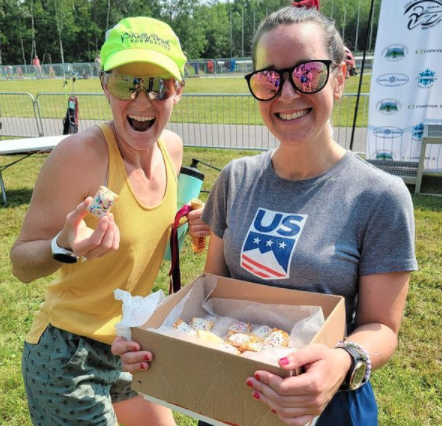
  • Bailey Wins Twice at North American Rollerski Biathlon Championships (updated)

    Bailey Wins Twice at North American Rollerski Biathlon Championships (updated)

    Lowell Bailey racing in Saturday. Photo: Elizabeth Garaghty.
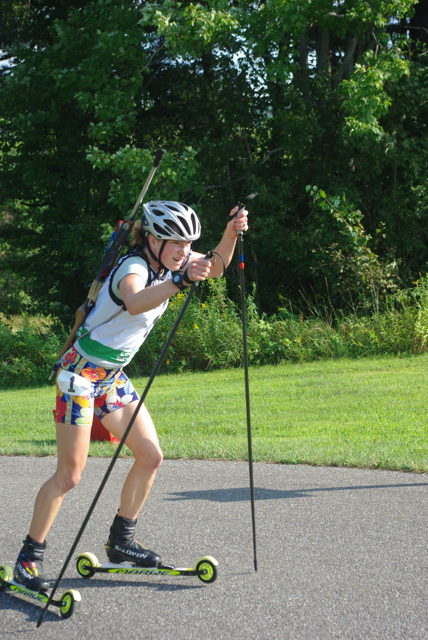
    The United States Biathlon Association (USBA) held their biggest summer event in Jericho, Vermont this weekend: the North American Rollerski Biathlon Championships, which crowned men’s and women’s champions in four different age categories as well as the masters men’s division.

    “Things went wonderfully,” said John Madigan, president of the Ethan Allen Biathlon Club, which hosted the races. “It is such a close and fabulous community in biathlon and it is always special when we can have all the top U.S. biathletes racing here in Vermont.”

    Despite the event’s name, no Canadian teams were in attendance, making the races an all-American affair. The U.S. national team was at the end of a week-long camp in Jericho, and comprised most of the senior field. In the junior races, athletes traveled from as far away as Alaska to attend the races.

    “I think the Canadians missed a great opportunity to race at the highest level at one of the best rollerski venues in the country, but they had not put it into their training plan at the beginning of the year,” Madigan said.

    On Saturday, the biathletes faced a scorcher of a sprint. The races were short – 7.5 k for women and 10 k for men, with just two shooting stages. With 80-degree weather, bright sun, and 80-percent humidity, many athletes struggled to adapt.

    Tracy Colliander. Photo: Judy Geer.

    “Heat has always been a challenge for me and it was definitely pretty intense for the Saturday race,” national team member Lowell Bailey wrote in an e-mail. “Even with extra attention to hydration, I was still pretty dizzy by the end. I think almost everyone had the same experience.”

    2006 Olympian Tracy Colliander said that the women had just as much trouble with the hot temperatures.

    “The heat was a big factor in these race,” she told FasterSkier. “The biggest thing was to try to avoid overheating as long as possible. It was inevitable that you were going to overheat, but if you could delay it, you were better off.”

    Bailey managed to triumph over his heat troubles in the sprint. He and Bill Bowler had the best shooting for the men – only a single penalty each – but Bailey was the faster skier, and picked up the win by 56 seconds. Jeremy Teela was another 38 seconds behind after missing three shots, and gave the national team a sweep of the podium.

    Tim Burke, who is recovering from compartment syndrome surgery, finished sixth after missing eight shots.

    “I was trying some new sites on my rifle but unfortunately I only received them the day before so I did not really have a chance to test them,” Burke said. “I decided the race would be the perfect situation to test them. I learned right away that they don’t work for me!”

    Burke’s skiing was solid, and he was confident that he would be back in top race shape by December despite missing a large amount of ski-specific training this spring.

    In the women’s race, Sara Studebaker picked up the win. Studebaker and Tracy Colliander had one penalty each; Colliander finished 15 seconds back, with her twin sister Lanny Barnes in third with two penalties.

    Sara Studebaker. Photo: Judy Geer.

    “Yesterday was good for me,” Studebaker wrote in an e-mail. “I was really happy with my shooting, and managed to keep things together with the skiing for most of the race despite the heat. It was super humid both days and it definitely took a toll on people.”

    While she was happy to win, Studebaker didn’t want to read too much into her victory. As a member of USBA’s “A” team she is prequalified for the first period of World Cup racing and is taking the long view.
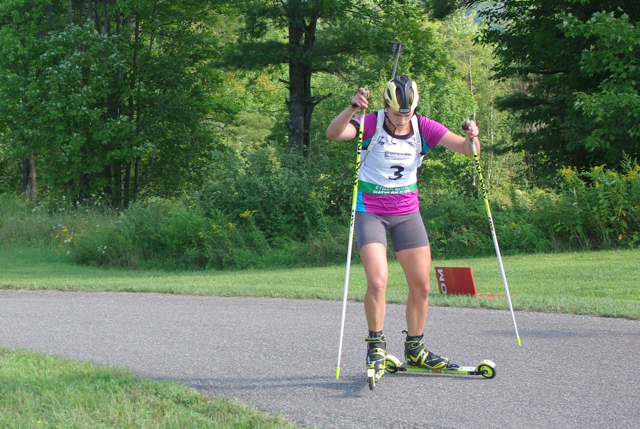
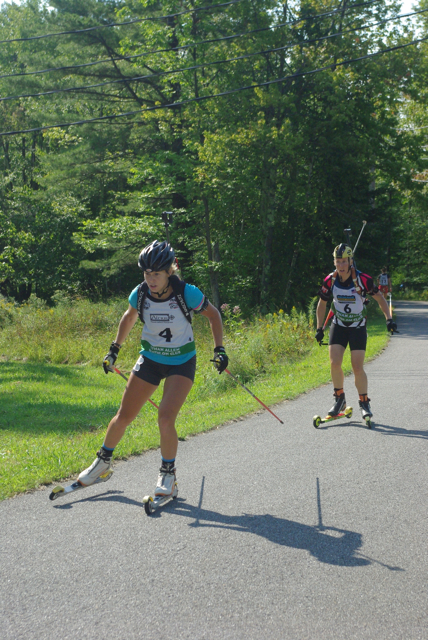
    “For me, it’s certainly nice to see some good results right now, but that’s never been to goal,” she said. “I’m really focusing on December, and not having to qualify for the World Cup gives me good opportunity to treat these races like training and just get some more races under my belt without the stress.  In all, training has been going really well for me.  I’ve been trying some new things with my shooting and working a lot on ski technique.”

    Sunday brought a simulated pursuit – although the athletes started in the order they finished on Saturday, they were separated by thirty seconds instead of the time gaps from the previous race. For Studebaker, the 15-second advantage would have been nice to hold onto.

    “I think today [the heat] just caught up to me,” she wrote. “My prone shooting was solid, but by the time I got to standing I was pretty tired and just couldn’t keep things going. It was a tough one for sure.”

    Pursuits feature four shooting stages – two prone and two standing. For the women, these stages are spread over 10 k. Studebaker missed seven shots and finished in sixth place.

    Mark Johnson, 5th place in the sprint. Photo: Elizabeth Geraghty.

    With the previous day’s winner faltering, Barnes stepped up and took the win by a solid minute over her sister. Of all the women, Barnes shot the best: she had only a single penalty to Colliander’s four. The best shooting in the men’s field was four penalties as well. The twins, who do not have national team support, have been the best American shooters for several years – and have turned heads when they appear on the World Cup circuit as well.

    “We are where we want to be leading up to the next set of trials in Utah,” Colliander told FasterSkier. “It’s still early in the summer though and there is a lot of work to be done still before the season. We don’t want to be rocket fast right now, we want to be fast in the winter. You can’t look to seriously at results in the summer like this, but you can gauge how you feel and what you still need to work on before the snow flies.”

    National team member Laura Spector, who is finishing up her last term at nearby Dartmouth College this summer, finished third with seven penalties.

    “I’ve been training in Hanover during the week and go to Jericho for combo training on the weekend,” Spector said of her summer schedule. “It’s been pretty standard, and I just try to fit the training sessions in between classes and homework.”

    In the men’s race, Bailey stuck to his winning ways, this time beating teammate Leif Nordgren by 17 seconds over 12.5 k of skiing despite having five penalties to Nordgren’s four.

    “The races went pretty well,” Bailey said in a characteristically humble e-mail. “I have changed around my training a bit over the last month and I was happy to see that I was still able to perform well given those changes.”

    But like Studebaker, he was careful not to take his victories to seriously.

    Annelies Cook, 5th place in the sprint and 4th in the pursuit. Photo: Elizabeth Geraghty.

    “As far as these races are concerned, I think it’s hard to look at summer results and make assumptions or predictions about the upcoming winter,” Bailey said. “I’m happy with the way this weekend went, and it is a good affirmation of the work I’ve been doing. However, it’s important to keep things in perspective: my focus is on the December World Cups and eventually World Champs in Ruhpolding later this winter.”

    Norgren, who is the youngest member of the national team, was pleased with his second-place finish.

    “The skiing was pretty fast,” he said. “I’ve made a lot of improvements this summer in both technique and strength so I was happy with how the skiing went. As to where I was last summer, I’d say I’m way ahead of there now!”

    Bowler edged out Teela for the final spot on the podium, giving the national team another sweep.

    What’s next for the biathletes? The “A” team will be traveling to Europe for a training camp, while the rest of the squad will stay in the U.S.

    The next races at Jericho will be the International Biathlon Union’s North American Summer Biathlon Championships, which pair running with shooting. It’s unlikely that any winter biathletes will be competing.

    Results from the weekend can be found here.

    Lanny Barnes in the start. Photo: Elizabeth Garaghty.
    Lowell Bailey leading Mark Johnson in the sprint. Photo: Elizabeth Geraghty.
    Susan Dunklee (l) and Annelies Cook on the range in the sprint. Photo: Elizabeth Geraghty.