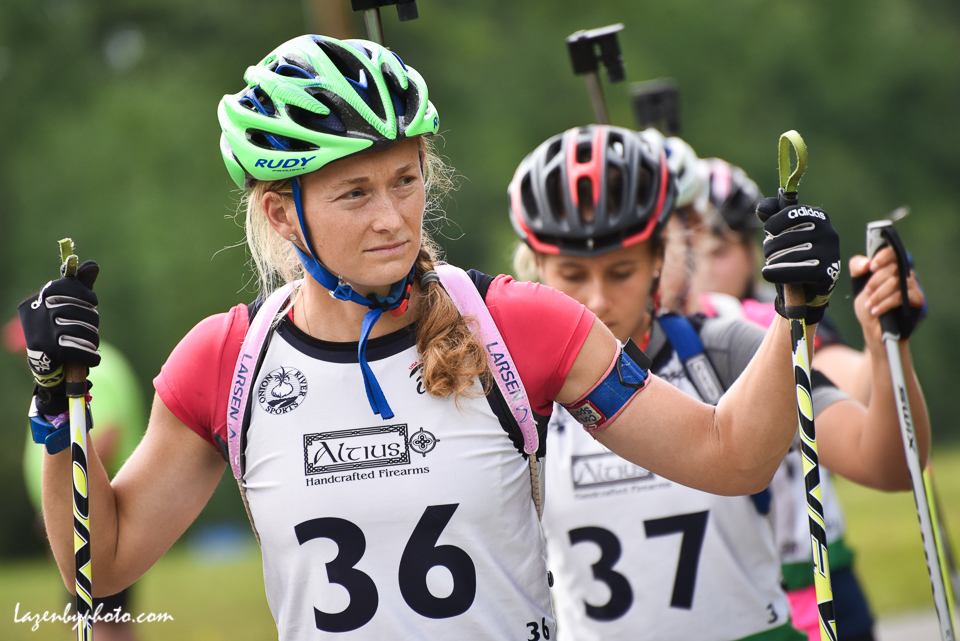
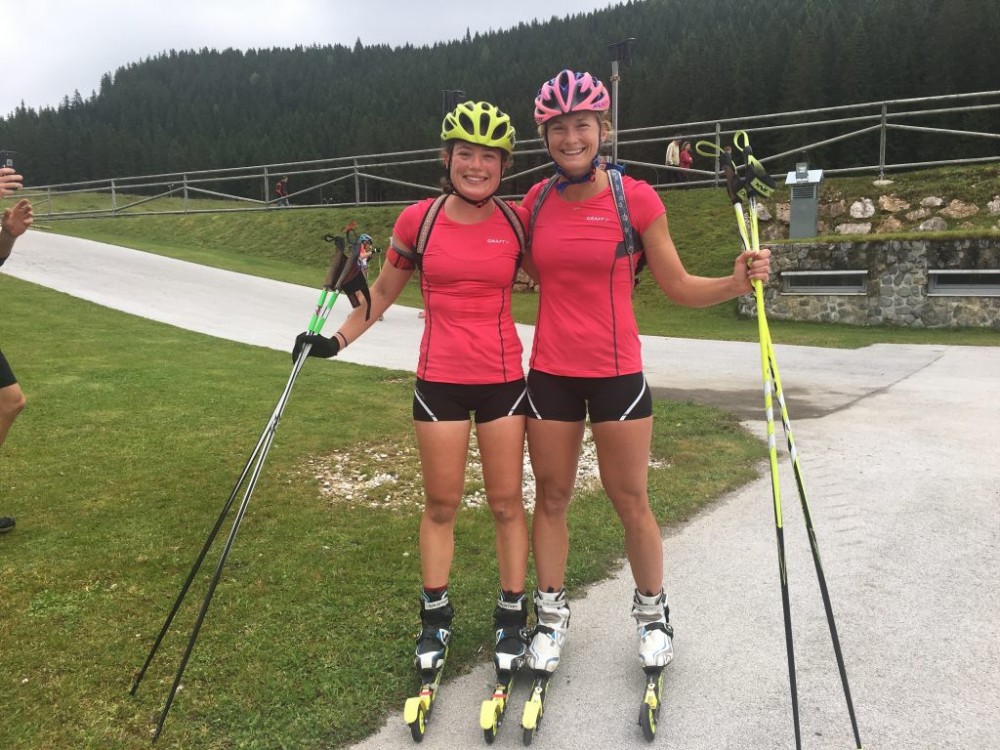
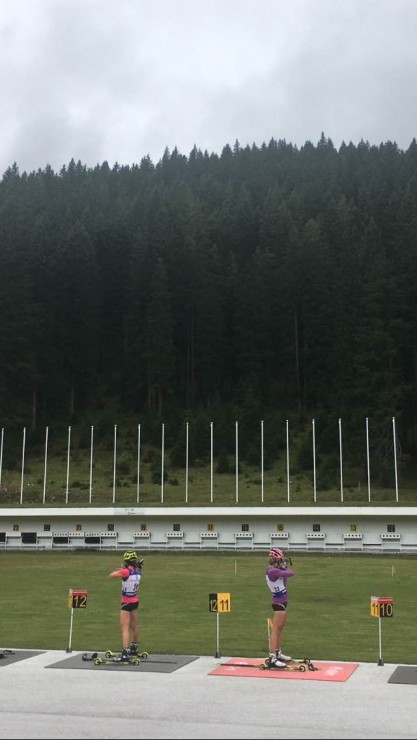
Emily Dreissigacker (CGRP) at the start of the women’s sprint at the 2017 US Biathlon Rollerski Championships on Aug. 12 in Jericho, Vt. (Photo: John Lazenby/Lazenbyphoto.com)
Say this name three-times fast: “Dreissigacker”.
Not so easy at first.
Break the four-syllable surname into discrete parts: Driess (with a hard I) – i – gack – er.
It then rolls off the tongue … Dreissigacker.
In northern Vermont and in particular around the Craftsbury Outdoor Center, Emily Dreissigacker, of the Craftsbury Green Racing Project (CGRP) is as well known a name as any. Her parents, Dick Dreissigacker and Judy Geer, bought the Outdoor Center in 2009. Both are Olympic rowers.
And both of Emily’s siblings are biathletes. Her older sister Hannah, 30, was a 2014 Olympic biathlete who retired in 2016 and younger brother Ethan, 26, formerly raced for the Green Racing Project.
At 28, (she’ll be turning 29 in November), Emily Dreissigacker is on the cusp of making it onto the International Biathlon Union (IBU) World Cup representing the US Biathlon Association (USBA).
“I’m not really feeling the pressure,” Dreissigacker wrote in an email about a possible World Cup nod. “I’m just excited to get out there and ski on snow and get in some really solid training.”
Perhaps this is a reason why the USBA’s high-performance team recruits and promotes older athletes — with age and experience comes a calmness. With time comes wisdom: winning or losing in sport doesn’t define a person.
There’s been both winning and losing and the in-between for this Dreissigacker, who grew up near Craftsbury in Morrisville, Vermont, and married her teammate Alex Howe last summer.
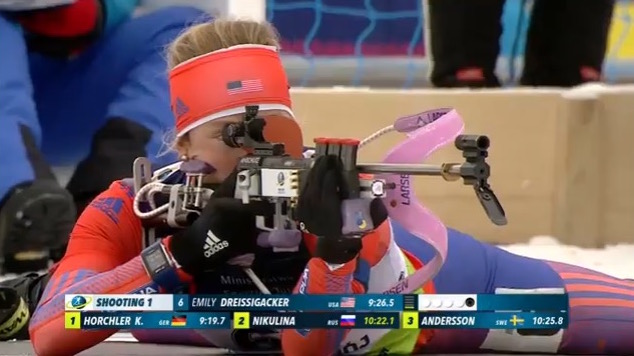
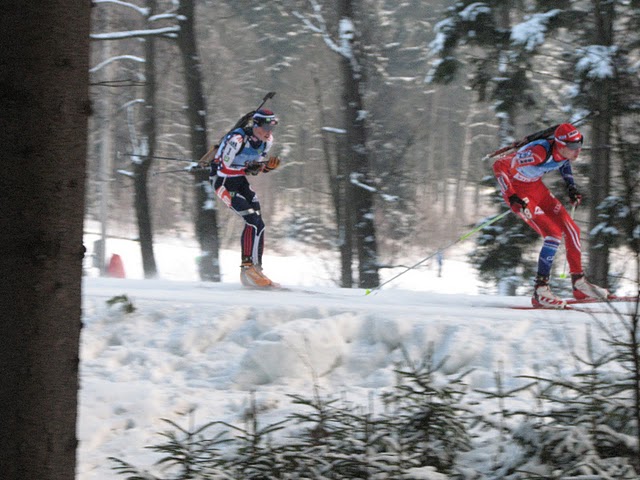
Emily Dreissigacker shooting clean during her first prone stage of the women’s 15 k individual race at 2017 IBU Open European Championships in Duszniki-Zdrój, Poland. She finished 41st. (Eurovision screenshot)
“At this point, competing at the Olympics had been a dream of mine for so long that it felt inextricably entwined with who I was as a person,” Dreissigacker wrote in a June 2015 blog post. “I could feel it slowly but surely slipping out of my grasp and yet I couldn’t let go. I thought about quitting, but there was always something pulling me back. Don’t get me wrong, I loved racing. I loved racing against my teammates in practice, I loved lining up side by side for a 2k or blindly pushing myself past all reason in an interval start. But the training, the whole process had gotten stale. I felt like I was slogging my way through each steady state workout, counting down the minutes rather than enjoying the time I had. Meanwhile, I jealously eyed the skiers leaving each morning for what looked to me like exciting adventures. They got to go biking and hiking and running and rollerskiing (yes, I was jealous of rollerskiing)! But it never really seemed like a viable option to me. I was a rower.”
Since that 2015 blog post, Dreissigacker has been a biathlete.
After eight years training as a rower, she tapped into her adolescent and teenage years as a skier. Like some of her peers — Reid, Egan and Dunklee come to mind — Dreissigacker learned to shoot in atypical fashion: she didn’t train as a junior biathlete and came to biathlon later in their athletic careers. (Reid, Egan and Dunklee all competed at the NCAA Division 1 level.)
“I skied in high school and tried biathlon once, so I had shot a rifle before but not well and not for long,” Dreissigacker wrote. “I also hadn’t trained for skiing, other than a bit of cross training here and there, so I’m definitely playing catch up on that side of things too. Rowing is much more of an anaerobic sport so building up my aerobic base has been and still is a big focus. As well as pretty much re-learning how to ski. I definitely still have a lot to work on in both regards.”
Despite her perceived deficiencies, Dreissigacker’s results show what any coach desires — positive trends when it comes to skiing speed and shooting accuracy. Dreissigacker spent the 2016 and 2017 race seasons on the IBU Cup, a step down from the World Cup.
In March of last year, Dreissigacker earned a top 20 on the IBU Cup. This year, she skied and shot consistently enough in the four-part 2017 USBA rollerski trials series to get picked for the Canmore preseason camp. In the first half of the trials, she placed fifth in both races in mid-August. A month later, she jumped the ranks with first and second place finishes at Part 2 of trials in Jericho.
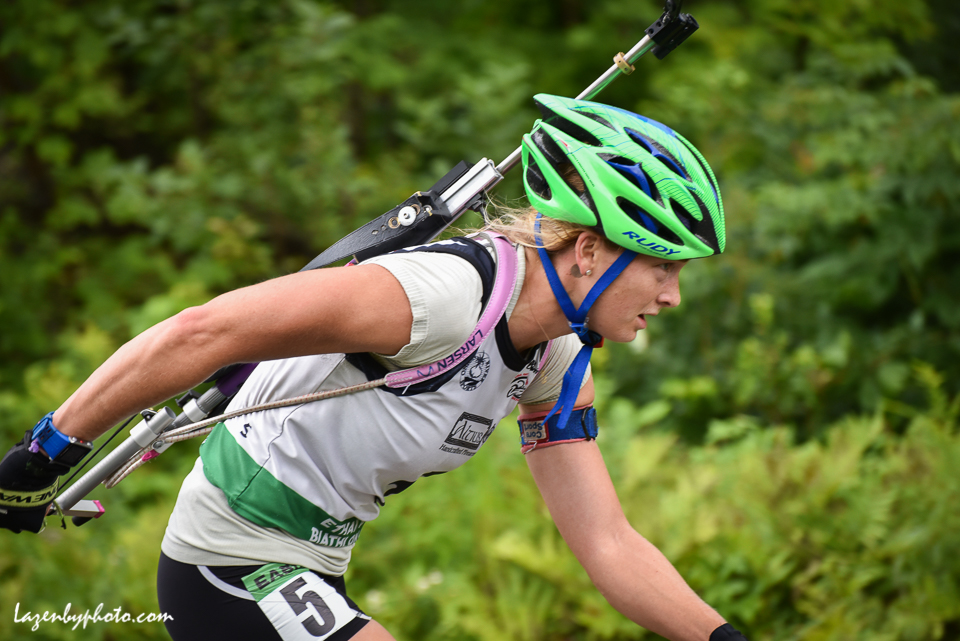
Emily Dreissigacker (CGRP) racing to fifth in the women’s mass start at 2017 US Biathlon Rollerski Championships on Aug. 13 in Jericho, Vt. (Photo: John Lazenby/Lazenbyphoto.com)
As she ramped up for trials, Dreissigacker spent time in Europe with the Green Racing Project. That trip also gave her time to train with national-team biathletes.
“Our European camp this year had much more of a biathlon focus,” Dreissigacker explained. “We did essentially the same trip as the National team so we were able to train with them some. We got to race at German summer rollerski nationals which was a great opportunity to get in more racing and also to experience a really high level of racing. And we got to ski on snow in the Oberhof tunnel. The trip was also a little earlier so after we got home I had a really solid training block in Lake Placid before an easy week at home leading up to trials.”
According to USBA Chief of Sport Bernd Eisenbichler, this year’s version of the European training swing was beneficial for Dreissigacker.
“The camp setup that the Craftsbury team had this summer, accompanying us on the Europe camp instead of going to the Dachstein glacier, choosing to go to the ski hall in Oberhof, helped also to have her performance level in the fall,” Eisenbichler wrote in an email. “Last year we saw that August was quite okay but then the fall, she was really really tired. I don’t know if I would get agreement from Craftsbury, but I would argue that the camp setup was smarter this year and that is why she was in better shape this October.”
Finding form and peaking when it counts isn’t an outcome hard science can unfailingly predict. Be it her modified camp in Europe or the confidence that comes with experience, Dreissigacker performed at this year’s USBA rollerski trials.
“Em has been on the biathlon development program for the last 2 years and on the biathlon team training plan, she works with [USBA Development Coach] Jean Paquet now most of the time,” CGRP Head Coach Pepa Miloucheva wrote in an email. “Last year the Craftsbury biathlon team did travel to Europe for a camp on snow with the skiers, this year the biathlon team The Europe ski trip was more biathlon specific at the ski tunnel in Oberhof with the USBT [US Biathlon team].”
Dreissigacker’s shape and shooting accuracy could serve her well as she transitions to snow in Canmore. The Canmore camp on Frozen Thunder will conclude Nov. 10. And as for the rest of the season, the IBU World Cup could be seeing a new Dreissigacker this winter.
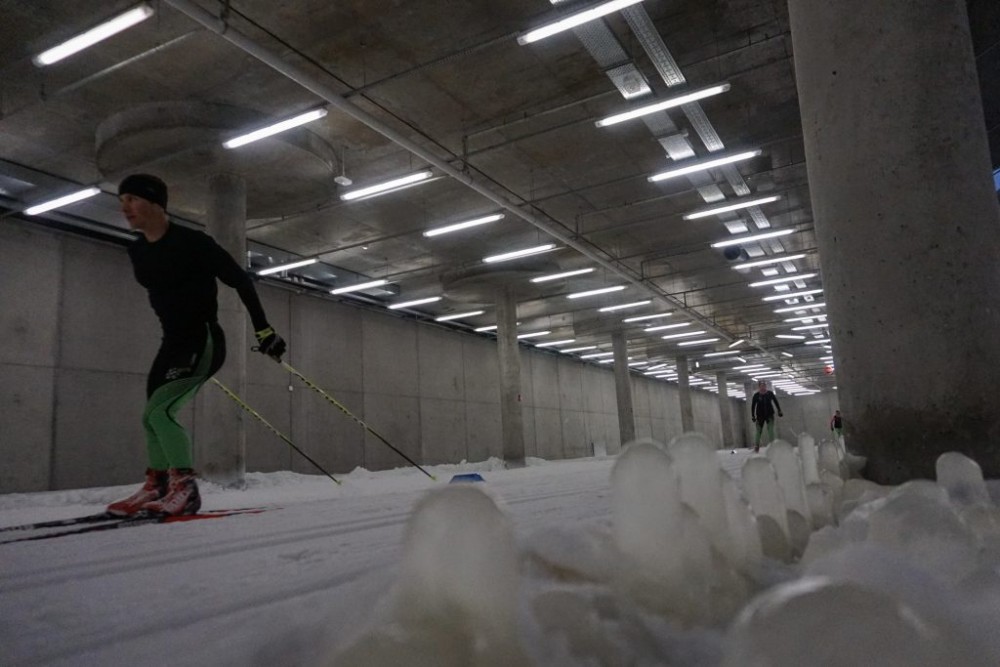
Craftsbury Green Racing Project’s Ben Lustgarten (l) training in the ski tunnel in Planica, Slovenia, earlier this month. (Photo: Caitlin Patterson/ CGRP blog)
Pay 9 Euros a day, get a 950-meter loop in return. If snow were to take on a monetary value, that’s how much the Planica Nordic Centre charges for a day pass in its snow tunnel, new to the city’s Olympic Sports Center since the spring. But to others, the opportunity to ski on snow at the tail end of summer is priceless, even if it is under the fluorescent lights and within the concrete walls of a three-level parking garage.
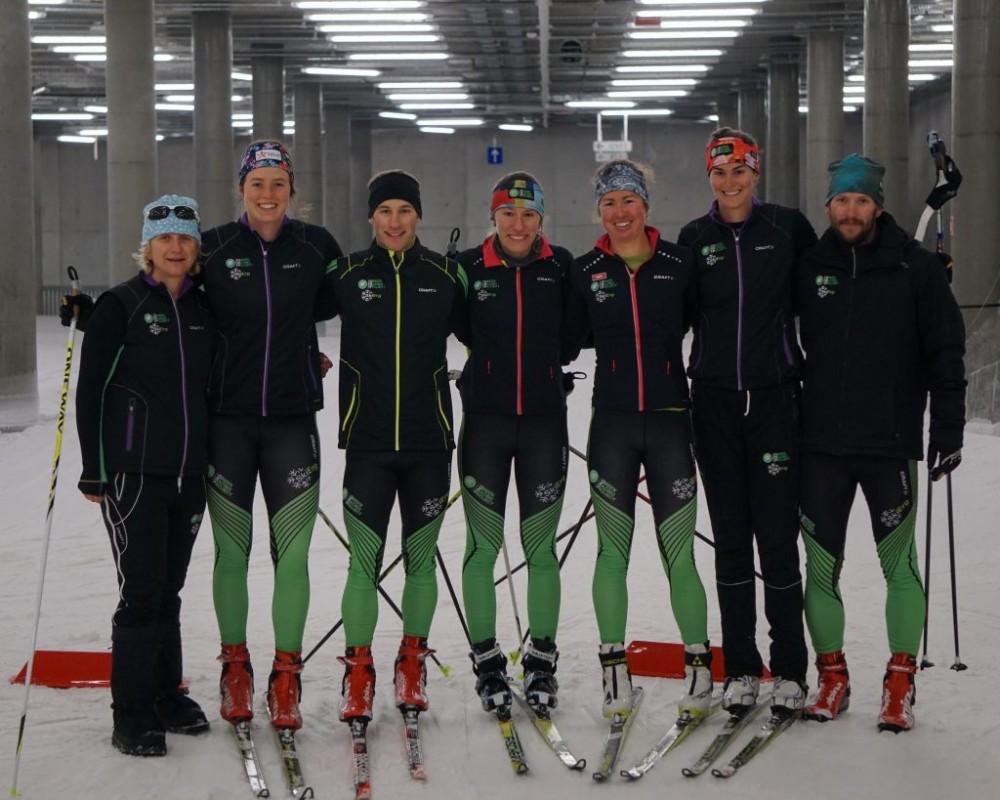
Among those “others” are the Craftsbury Green Racing Project (CGRP) elite cross-country skiers and biathletes, who spent Sept. 12 to Sept. 20 in Planica, Slovenia, training in the city’s ski tunnel. As a few explained, getting on snow at this time of year outweighs the occasional lassitude that comes from skiing two-plus hours on a less-than-1-kilometer loop.
“No matter what condition it is nordic skiers love their first time on snow of the season,” Ben Lustgarten, new to the CGRP cross-country team, wrote in an email. “We were able to do speeds, short level 4 intervals, some threshold, accelerations, and sprint simulation workouts. There was fair amount of terrain to do varying technique work and video analysis for the small amount of space.”
Left to right: Craftsbury GRP head coach Pepa Miloucheva along with athletes Heather Mooney, Ben Lustgarten, Kaitlynn Miller, Caitlin Patterson, Liz Guiney, and assistant coach Nick Brown in the ski tunnel in Planica, Slovenia, during a training camp this month. (Photo: Caitlin Patterson/CGRP blog)
Along with Lustgarten, who joined Craftsbury this year after spending the last two seasons with the Sun Valley Ski Education Foundation (SVSEF) Gold Team, nearly a dozen CGRP skiers made the trip, including Caitlin Patterson, Kaitlynn Miller, Liz Guiney, Heather Mooney, and Mary O’Connell, and biathletes Alex Howe, Ethan Dreissigacker, Mike Gibson, Emily Dreissigacker, and Hallie Grossman.
“The intensity and technique really helped to keep the tunnel from getting too boring, as there was always something to think about or work on, or at the very least a coach on hand videoing for later technique review,” Patterson wrote in an email. “It gave us an opportunity to practice being adaptable to snow conditions and terrain (ie corners); even if those particular features in the tunnel would be rarely seen on a race course, they were valuable in their extremes. I feel more prepared than ever to handle a course with tons of 90 and 180 degree corners, even though that’s unlikely to happen often.”
The athletes, along with Craftsbury’s head coach Pepa Miloucheva and assistant coaches and wax technicians Nick Brown and Sam Doherty, completed a weeklong training camp in Planica, taking full advantage of the three-level snow tunnel. The following week, the group headed to Schladming, Austria, for eight days of volume training on the Dachstein glacier, more than 9,800 feet above sea level. In Planica, nearly 7,500 feet lower, much of the team’s first week focused sharpening agility, coordination and speed.
“The tunnel is a perfect environment for working on both technique and speed, with enough transitions and tight turns to keep the skiing interesting,” Grossman wrote in an email.
“I feel more prepared than ever to handle a course with tons of 90 and 180 degree corners, even though that’s unlikely to happen often.” — Caitlin Patterson (CGRP) after training in the Slovenian ski tunnel
Grossman, who recently switched from cross-country to biathlon, explained that the biathletes’ intensity training slightly deviated from their original plan when they learned that Slovenian Summer Biathlon Nationals were being held in Pokljuka, Slovenia, about an hour away from Planica.
“The camp took a little turn when we found out about the rollerski races in Pokljuka, so what was going to be a primarily on-snow camp turned into a combination of skiing and rollerskiing,” Grossman wrote. “This allowed us to still focus on technique and shorter speed in the tunnel, while also getting the opportunity to race.”
The biathletes had originally planned to use the Pokljuka range for a few shooting sessions, but quickly decided to jump into the races when they discovered the competitions were taking place at the same location. Grossman competed in both races that weekend — the women’s 7.5 k sprint and 10 k mass start — as did her teammate Emily Dreissigacker.
“We actually didn’t even know Slovenian Nationals were happening until we tried to sign up to use the range and they told us we couldn’t because there were races,” Dreissigacker wrote.
Dreissigacker, who married Howe, her teammate, last month and spent a few weeks before the camp on a honeymoon with him in Italy, explained that the competitions elicited an opportunity to reconnect with racing, even within a small field.
“There wasn’t a ton of competition in the senior women’s category, four of us to be exact, but one of the Slovenians was Teja Gregorin who won bronze in the pursuit in Sochi, so it was pretty cool to be able to race against her,” Dreissigacker wrote. “For me it was also a good way to re-focus after the craziness of the wedding.”
“We actually didn’t even know Slovenian Nationals were happening until we tried to sign up to use the range and they told us we couldn’t because there were races.” — Emily Dreissigacker (CGRP) on racing at Slovenian Summer Biathlon Nationals
Dreissigacker finished third in the women’s 7.5 k race, with two standing misses, and Grossman placed fourth. In the mass start the next day, Dreissigacker once again reached the podium in third and Grossman repeated in fourth.
CGRP biathletes Hallie Grossman (l) and Emily Dreissigacker after the women’s 14 k mass start at Slovenian Summer Biathlon Nationals in Pokljuka, Slovenia, on Sept. 18. (Photo: Ethan Dreissigacker)
The men’s races included a 10 k sprint and 14 k mass start. In the sprint, Howe placed seventh, Ethan Dreissigacker was ninth and Gibson 13th. The next day, Ethan rocketed to third, Howe finished 10th and Gibson 14th.
“It was really fun to be able to jump into the Slovenian races!” Ethan wrote in an email. “While it did change up the plan a bit that first week, it think it was for the better, and I’m really glad we were able to compete. Biathlon races in the US are pretty few and far between, and many of them are also ‘trials’ of some kind. It’s super valuable to get in competitive racing experience outside of those trials races to get used to the pressure of competition without feeling like your season is on the line.”
Along with the CGRP athletes, the men’s field included the Slovenian national biathlon team and some non-national team skiers, as well as a few Bulgarian national-team members.
“The competition at these races was really pretty similar to that of the US rollerski nationals we had in August,” Ethan explained. “The big name in the men’s field was Jakov Fak who has an Olympic bronze, and a bunch of World Cup victories. Fak has is a very relaxed and efficient skier and it was awesome to get to ski behind him for a bit in the races.”
After Slovenian nationals, the Craftsbury crew ventured to Austria for a week of altitude training. The team planned to train through Wednesday and fly back to Vermont on Thursday this week.
“Both places are only 2 hrs apart, so was very convenient for a week long speed block in the tunnel and a week and a half volume block on the glacier all on snow,” Miloucheva wrote in an email. She explained that “some speed work followed by some good distance hrs on snow,” were the primary goals of the camp.
While it wasn’t the first time the CGRP spent a few weeks of fall training on snow, this year was the first split camp featuring the Slovenian snow tunnel.
“This is the third year in a row that the GRP has come over to Austria for an altitude camp on the Dachstein Glacier,” Ethan explained. “This year I was really excited about the split the camp between two locations, with two different focuses, and I think that has really helped make the most of the trip. Both locations have had some awesome resources for training, and beautiful scenery.”
Ben Lustgarten getting in a final day of classic kilometers in on the Dachstein glacier in Austria this month. (Photo: Caitlin Patterson)
Craftsbury skiers Ben Lustgarten (r) and Heather Mooney skiing on set tracks under clear skies while volume training on the Dachstein glacier in Austria this month. (Photo: Caitlin Patterson)
Craftsbury GRP biathletes Ethan Dreissigacker (l), Alex Howe (c) and Mike Gibson after the men’s 14 k mass start at Slovenian Summer Biathlon Nationals in Pokljuka, Slovenia, on Sunday, Sept. 18. (Photo: Ethan Dreissigacker blog)
Craftsbury GRP biathletes Hallie Grossman (l) and Emily Dreissigacker during the women’s 10 k mass start at Slovenian Summer Biathlon Nationals in Pokljuka, Slovenia, on Sunday, Sept. 18. (Photo: Sam Doherty)
The men’s 14 k mass start at Slovenian Summer Biathlon Nationals in Pokljuka, Slovenia, on Sunday, Sept. 18. (Photo: Ethan Dreissigacker blog)
Part of the Slovenian ski tunnel’s 950-meter, snow-covered loop in late September. (Photo: Ben Lustgarten)
Craftsbury GRP’s Ben Lustgarten (r) and Caitlin Patterson get in some classic speeds while training in the Slovenian ski tunnel in Planica this month. (Photo: Sam Doherty)
Craftsbury’s Ben Lustgarten (r) and Alex Howe practice corning while training in the Slovenian ski tunnel in Planica this month. (Photo: Sam Doherty)
The Craftsbury Green Racing Project is excited to welcome a new crop of skiers to the team this year. With a strong pool of applicants, and limited slots, the decisions were tough.
At the full Green Racing Project level, we’ll be joined by Liz Guiney, Andrew Dougherty and Pete Hegman.
Liz spent her junior years skiing for the Utah Nordic Alliance and Park City Nordic Ski Club; raced at numerous Junior Nationals, and was part of the 2009 US J1 Scando trip team. She then did her college racing for UNH, qualifying for NCAA’s in the past three years. She represented the US at U23 World Championships this past winter.
Vermonter Pete Hegman came up through the Mansfield Nordic program and Mt. Mansfield Union High School, where he had a couple of state championship titles. He was on the NE team for Junior Nationals, and then raced all four years for UVM.
Andrew Dougherty grew up ski racing in Alaska, including many years on the Alaska Junior Natonal team, and then did his college racing for Denver University. He represented the US at the 2011 World Junior Championships and has since been a two time NCAA All-American. Along with Liz, in 2009, he was a member of the US J1 Scando Trip team.
Returning GRP skiers are Alex Howe, Gordon Vermeer and Patrick O’Brien on the men’s side, and Clare Egan, Ida Sargent, Caitlin Patterson, Hannah Dreissigacker and Susan Dunklee for the women. Clare will be focusing on Biathlon this year. Ida has been named to the USST A Team; while Hannah and Susan have been named to the USBA A Team.
This year’s training group will also include several former Craftsbury skiers and biathletes who are returning to the club after finishing college. They will join GRP as Provisional members. This includes Jake Barton and Alex Schulz for Nordic, and Michael Gibson and Ethan Dreissigacker for Biathlon. Jake had a strong collegiate career with the Colby Mules until a thumb injury sidelined him for the latter part of this past season. Alex has had a number of top finishes in the sprints at Junior Nationals, and did his college skiing for Dartmouth. Mike, a UVM grad, has had several national podiums in Biathlon. And Ethan was a 5-time member of the US Jr Biathlon Team.
Congratulations and welcome aboard to all the GRP athletes!
As always, you can follow the exploits of the ski team (and their rowing counterparts) via the team website, greenracingproject.com, Facebook page (CraftsburyGreenRacingProject) or Twitter feed (@craftsburygreen).
The Green Racing Project is a venture of the Craftsbury Outdoor Center made possible through the generous support of Concept2, Ibex, Rudy Project, Podium Wear, Sauce Headwear, and Brighter Planet.
Tim Burke (USA) leads Vincent Blais (CAN) in Saturday’s Sprint in Jericho, Vermont.
JERICHO, Vermont – Just how excited was Jean-Philippe Le Guellec to make the drive from Quebec, Canada, down to Vermont this weekend for the North American Rollerski Biathlon Championships?
“Let me put it this way,” he said. “I was supposed to go on a fishing trip this weekend and I ended up cancelling on my friends because I was so happy that Tim [Burke] and Lowell [Bailey] were here. These guys are in the top at the World Cup and I think that it’s nice that in North America we have that kind of performance.”
If anyone would appreciate this sacrifice, it’s Burke and Bailey, who are fishing enthusiasts themselves. And Burke was similarly enthusiastic about the chance to compete against Canada’s top biathletes.
“I didn’t realize that they were coming down actually until I saw them yesterday,” Burke admitted. “But it’s great that they come down. I time trial against everyone else here pretty often in the summer, so it’s really nice to have some new faces, especially ones of that caliber.”
Le Guellec made the most of his trip, winning Saturday’s 10 k sprint race by ten seconds over U.S. National Team member Leif Nordgren despite having two penalties to Nordgren’s one – which seemed to surprise him.
Jean Philippe Le Guellec en route to a sprint win on Saturday.
“Skiing felt horrendous,” he said after cooling down from the sprint. “During the race I thought that Tim was right ahead of me in bib numbers, so when I got on the range in prone and saw that he wasn’t even there it was like, ‘oh, my God.’ I forgot that he was three bibs ahead. If I had caught him, that would have been a problem for Tim! But still, skiing didn’t feel so great.”
In Sunday’s four-stage, 12.5 k pursuit, the tables were turned, with Burke starting 18 seconds behind Le Guellec. On the first prone stage, Le Guellec missed two shots to Burke’s one, setting up a showdown that lasted the rest of the race. Both men cleaned the second prone, and then collected one and two penalties in the pair of standing stages. At the finish, Burke edged the Canadian by just a single second.
“It’s really motivating,” Burke said on Saturday of having the Canadians around. “There’s no substitute for putting on the bib.”
Nordgren, like Burke, had five penalties in the pursuit; although he cleaned the first stage, the late misses dropped him to third place. But it was still a strong showing for the youngest man on the national team – and an important one, if he wants to race on the World Cup this winter. Several of the top U.S. athletes are pre-qualified to a training camp in Sweden before the opening World Cup races, and Nordgren is vying for one of a few remaining open spots that will be decided based on this weekend’s races and two time trials in Utah this fall.
“These races matter for me!” he told FasterSkier. “I have to qualify here. I’m not taking them too seriously, but it does feel nice.”
Nordgren was enthusiastic about his single penalty on Saturday, and particularly the fact that he had cleaned in prone, which he says is usually he weaker position. But like Le Guellec, he didn’t think that his skiing was spectacular.
Leif Nordgren leaving the start on Saturday.
“The skiing didn’t feel so well – I just tried to stay pretty even, I guess,” Nordgren said. “I didn’t have a lot left to push on the last loop, but I didn’t push that hard on the first or second, either. So it was kind of mediocre skiing, but it worked out well for shooting. I came in fairly recovered for both standing and prone.”
In Saturday’s sprint, there was a gap of almost 50 seconds to fourth-place Ethan Dreissigacker of Craftsbury, Dartmouth College, and the Ethan Allen Biathlon Club. But he was followed closely by Bill Bowler, an American who is training partly with the Biathlon Alberta Training Center, in fifth, and national team and Maine Winter Sports Center athlete Russell Currier, who was sixth. The three men started the pursuit separated by just one second, with U.S. national team racer Lowell Bailey another three behind them.
And while Bowler dropped back, slowed down by penalties, it was an exciting race til the end for the other three. With Dreissigacker collecting six penalties to the seven by Bailey and Currier, he had a much-needed upper hand. Dreissigacker snagged fourth place again, and once again it was by one second, this time over Bailey.
It was the first weekend of senior racing for Dreissigacker, who is entering his senior year at Dartmouth and had a top finish of 20th in the sprint at last season’s World Junior Championships in Kontiolahti, Finland.
“I shot a lot better than I’ve been shooting in training lately,” Dreissigacker said.
As for whether he’ll focus on biathlon this year, he said his plans were “all up in the air.” He was interested in making a trip to Open European Championships, but doubted that he would spend a significant amount of his winter traveling. With only a year left of school, Dreissigacker wants to finish. As such, he’s been doing “mostly skiing training” this summer.
After a weekend in Jericho, the biathletes were exhausted, but pleased.
“It’s tough,” Burke said on Saturday of the annual rollerski championships. “It seems like at Jericho we always get some sort of extreme weather, and it was really hot today, which made it pretty tough… and we don’t really take a break for these first races, we train right through it and it’s a little tough. You’re always a little more fatigued. But you feel that way in the winter sometimes too, so it’s good to be prepared.”
Le Guellec was going home happy, too.
“Jericho itself, it’s so nice to rollerski here – it’s like skiing in the winter,” he said. “And it’s fun to see all the young people. It’s North America at its best… I’ll be retired in two years, so I’ll go fishing every weekend after that.”
American biathlete Casey Smith at 2011 World Youth and Junior Championships in Nove Mesto, Czech Republic. Smith, one of the top U.S. juniors, is a student at Montana State University. Photo: Judy Geer.
Note: This is the last piece in a three-part series following several groups of biathletes as they negotiate the college question. Part one featured five top juniors who took a detour through college before returning to the international stage, whilepart two looked at USBA’s 2007-2010 Development Team.
In November, 2011, Casey Smith was named Junior Biathlete of the Year for 2011 by the United States Biathlon Association (USBA). In a European country, that might mean a pat on the back from a coach at practice, perhaps an honorary celebration thrown by an athlete’s club, or maybe an added bargaining chip in sponsorship negotiations.
Smith, though, barely even has a club. The Winthrop, Washington, native, who turned 20 in February, was in the midst of his sophomore year at the Montana State University (MSU), where he jumps in time trials with the college’s ski team and otherwise trains primarily by himself. There is no coach, and “practice” doesn’t seem like the right word for a solo rollerski.
“[The award] helped me do some more fundraising, I guess, because it adds something else to your resume,” Smith told FasterSkier in an interview this spring.
That fundraising, along with lots of planning and motivation, helped Smith get to Europe three times during the 2011-2012 season. Once there, Smith is finally part of a team – Team USA.
“There’s lots of support from USBA and the coaches,” he said.
First, Smith raced in the junior division of Open European Championships in Brezno, Slovakia, where his best finish was 15th in the individual. A few weeks later he competed as a junior for the first time at World Youth and Junior Championships (he had twice represented the U.S. as a youth), notching a top finish of 31st. At the end of the season, Smith made one more trip for Swedish National Championships and to do an exchange at the National Sports Academy in Ostersund.
“The kids there were surprised that [some of us] don’t really have teams that we train with regularly,” Smith said after talking with the Swedes. “They definitely have a lot more opportunities. They had three biathlon coaches, so for one thing they have coaches to work with at the range every day.”
Not only does Smith not have a coach to work with in Bozeman, but he estimates that only about half of the targets at Bohart Ranch’s range are actually functional (a local masters group, headed by Madshus rep Peter Hale, is helping fix it up). In 2012 he did, however, have more company than before: World Junior teammates Sam Dougherty and Kelly Kjorlien enrolled at MSU and trained through their freshman year The three traveled together to this year’s Championships in Kontiolahti, Finland.
“I like it here in the West, and I think I’m doing okay with what I’m working with,” Smith said. “I have a couple of coaches that I work with here in Washington, for my training plan and my skiing technique, so that helps a lot.”
Smith plans to continue training at MSU for another season, his last as a junior. Once a senior, he hopes to make the national team outright, although he admits it might take a few years. Still, he thinks he can do it.
But even if Smith’s training is working, it’s certainly not the ideal situation – and the lack of options available to even juniors identified as the very best highlight a struggles both USBA and the athletes themselves face in trying to develop internationally-successful seniors.
Kids These Days
While not going to college may once have been the norm for American juniors, times have changed. USBA no longer supports a development team, meaning that the transition to senior status can be tough. And the junior national team is no longer well-funded, either.
“There’s a few camps that I can go to,” Smith said of what he earned by being named to the junior national team. “But you don’t have to be on the junior national team to do that. That’s about it, really. There’s not a whole lot of benefits, I don’t think, other than that you’re named to the team.”
He is not, for example, has provided with either funding or coaching. The team has a Midwestern Regional Coach, Vladimir Cervenka, who is based out of Grand Rapids, Minnesota. It also has an Eastern Regional Coach in Olympic gold medlaist Algis Shalna, who lives in Burlington, Vermont. There is no Western Regional Coach to provide support for Smith either at home in Washington or at school in Bozeman, or for anyone in the Rockies or Alaska.
Cook, who spent several years at the University of Utah. Photo: NordicFocus/USBA.
And there’s no suggestion that juniors to move to a central location to train together, as has sometimes been the case in the past. For instance, current senior national team member Annelies Cook remembers making her own decision about college. She said she had a lot of options.
“I went through this process of, am I going to go to college?” she told FasterSkier last fall. “Do I do a postgrad at some place like the Green Mountain Valley School? I decided that it would be pretty cool to go be with the junior biathlon team in Duluth. They had started a new thing where they split the men and the women up, so there was a group of us [girls] who ended up moving out to Duluth to train.”
These days, there’s no residential program in Duluth, and there’s also not a biathlon coach at Green Mountain Valley School. The only real program accepting postgraduate biathletes is the Maine Winter Sports Center.
As a result, a large number of top juniors from the past few years’ World Youth and Junior Championships teams have chosen the college route: Ethan Dreissigacker, Hilary McNamee, and Carly Wynn are at Dartmouth College, Addie Byrne is at Harvard, Meagan Toussaint skied for the University of Maine Presque Isle, and Brynden Manbeck for Saint Scholastica, to name a few, in addition to the crew in Bozeman.
“I never really considered deferring from college to focus on biathlon, frankly because I didn’t think there was enough competition in the U.S. to make it worth focusing just on biathlon,” said Dreissigacker, who has competed in several more World Junior Championships as a college student. “I was mostly just planning on skiing in college. The great thing about biathlon is that it is skiing – you just get to shoot also! So it never made sense to me that one might be required to ‘not focus on skiing’ in order to focus on biathlon.”
Dreissigacker did take a winter term off of Dartmouth, but it wasn’t to race in the U.S. – he spent a large chunk of that season traveling in Europe, competing against superior athletes and gaining experience. With Smith’s three trips across the Atlantic this past season, the Montana-based junior has a similar goal.
“If you want good competition for biathlon, there’s not really any in the U.S.,” Smith said. “There’s two or three other good kids that you’ll go race against at a NorAm, but they’re the same ones every time, and you can pretty much know where you’re going to place. But you go over to Europe and there’s fifty kids, and five seconds can be a couple of places, rather than a minute at some of the races over here. I’ve tried to get over to Europe and do as many races as I can.”
Why Not Skip Class?
But not all of Dreissigacker and Smith’s compatriots see college as the best springboard for their flight to Europe. Despite the lack of resources, a number of athletes have found a way to dedicate themselves to biathlon.
They are following in the steps of recent Olympians Jay Hakkinen, Jeremy Teela, and Tim Burke, who between them have several World Cup podiums, dozens of top-tens, and Burke’s stint in the yellow leader’s bib in December 2009. Tracy and Lanny Barnes followed similar paths, with Lanny placing 23rd at the 2010 Vancouver Games for the best Olympic result ever by an American woman.
“I’m of the mindset that if you want to be a world-class biathlete or skier, it pays to put school on the side for at least a little while,” 23-year-old national team member Leif Nordgren told FasterSkier in the fall.
He’s one of a group of young biathletes who went full bore through their junior years and into the senior ranks. That includes Wynn Roberts, who made the 2010 Olympics at age 21; Roberts has since lost national team status and is now supported through the National Guard. It also includes 24-year-old Russell Currier, who has raced for the Maine Winter Sports Center throughout his career. In 2012, Currier had two sixth-place finishes on the World Cup, and has since joined Nordgren on USBA’s “A” team.
It was a surprising path for Nordgren, who didn’t make the first World Youth and Junior Championships squad until his senior year of high school. He had been touring colleges and planning to ski race, but after the trip to Martell, Italy, he decided to focus on biathlon full-time for a year and see what happened.
Nordgren (L) with Lars Berger of Norway at 2011 World Championships. Photo: NordicFocus/USBA.
“At first my parents were shocked that I’d even consider skipping school,” he said. “I started training with the junior national team all summer, thinking I was just going for a year. That winter I won a bronze medal at Junior World Championships in Ruhpolding, Germany, and I figured that I could actually be good at biathlon if I continued.”
Nordgren received a few World Cup starts in each of the next two seasons, and then had his first full season on the circuit in 2011. He doesn’t think that he could have made it to the sport’s top level so fast, scored World Cup points that season, or had his three top-30 finishes at World Championships if he had gone to college.
“I guarantee that both skiing and school would have suffered,” he said. “Now, I can put all my energy into being a world class biathlete. The ages from 17 to 25 are some of the most important ones for physiological development.”
Fellow Minnesotan Raleigh Goessling hasn’t made it to the World Cup yet, but he agreed with Nordgren that delaying college had made a difference in his career.
“I realized that I was very motivated to train for biathlon and not motivated to attend class,” he said of his senior year in high school. “If I went directly to school, I would have compromised my academic performance and college experience. I know this isn’t the case for everyone, but I’m very happy with my decision. During my two postgraduate years at the Maine Winter Sports Center I learned a lot about what it means to be an athlete, how to function independently, and how to conduct myself professionally.”
A College Coach’s Dream
Each of the more than a dozen biathletes contacted by FasterSkier for this series – some of whom don’t have degrees, others who went straight to college, and still others who postponed school for several years but now have diplomas – said, like Goessling, that they knew they had made the right choice.
They suggested that it was an individual choice, and that different athletes need different environments to succeed. With only a minority of top juniors taking postgraduate years to focus on biathlon (Goessling was joined by Ben Greenwald and Andrea Mayo), more and more biathletes seem to be comfortable with the challenges of combining education and athletics – parly because the vast majority of teams available to older junior skiers and biathletes are associated with colleges.
“Now with the lack of support at the national level, it might become more of an important question,” former University of Utah coach Eli Brown said in an interview. “There’s a huge resource in college skiing. It’s always a drive of mine to stick that almost, but not quite, perfect puzzle piece into the development pipeline.”
Ethan Dreissigacker racing at 2012 World Youth and Junior Championships. Photo: Judy Geer.
College coaches have in many cases welcomed biathletes with open arms; Brown, who coached Annelies Cook during her college years, was speaking about nordic sports in general, not only nordic skiing. Part of Brown’s enthusiasm came from a certain amount of selfishness. He wanted to recruit the fastest team that he could, and adding a high-level biathlete to his roster helped with that goal.
“I knew Annelies, I’d seen her ski,” he said. “I’d been around biathlon [at the] Maine Winter Sports Center and I knew her attitude and work ethic would rub off on the group. She’s literally – well not literally, I guess, because of NCAA rules, but unofficially – a professional athlete, and brought that lifestyle to the whole group, which I think raises the level a little bit.”
Former University of Vermont coach Al Serrano said the same thing of Lowell Bailey, who earned two NCAA podiums during his time as a college skier: “He is a huge asset to any team and a coach’s dream.” And Dartmouth coach Cami Thompson, who worked with Olympians Carolyn Bramante and Laura Spector, had the same sentiment, despite the fact that the pair focused on biathlon during the winters; Bramante raced one full season of carnivals, while Spector did just half a season (in her first race, she was third).
“The pros are that when you have a high-level athlete, anytime they’re training with your team it’s a good thing, whether it’s how they ski technically or that they’re pushing your team in workouts, or just that they’re thinking outside of what we’re normally doing,” Thompson said. “It gets people thinking about what else is out there in skiing.
“And from the con side I’m not even really sure there’s really that much of a con.”
Embracing the Challenge
But as longtime observers of cyclical changes in development funding, coaches have a different perspective on how their programs can help athletes into their 20’s, and see that college can be a benefit for the athletes, not just for the teams. Serrano, for example, discussed how Bailey had been able to forget about the long-term pressures associated with the Olympic cycle and focus on smaller, incremental goals and having fun with his sport.
“Mix it up for a little while,” Brown agreed. “As we all know it’s a game of attrition. If you can still be doing it when you’re 30, you’re probably going to be doing all right. There’s a value to having balance in your life, being part of a team, training hard, and using [a college team] as a stepping stone.”
And just as elite biathletes can be assets to a college team, there is plenty the shooters can learn from their skiing teammates as well; the exchange goes both ways, and both Cook and 2006 Olympian Carolyn Bramante said that they had gone to school with the deliberate intention of gaining ski speed.
“I didn’t think that I was a fast skier,” Cook said looking back at her 2006 decision to go to Utah. “I felt like shooting was my strength, and I thought, well maybe if I just ski for a while, I will become a better skier, and then I can come back and be a better biathlete all around.”
It worked, and she suggested that biathletes should have no qualms about picking a fast college ski team and trying to learn as much as they could.
Kelly Kjorlien, now at MSU, representing the U.S. last season. Photo: Judy Geer.
“I know there’s the whole European/American college debate, but the way that it affected me was really positive,” she said. “I had experienced athletes to train with and they were good, and fast, and I had someone to chase and really good people around me to watch and learn from. So I’ve benefitted a lot from that.”
Coaches and athletes alike admit that the college route can be tough. For instance, only a few universities have access to a range, and in many places shooting practice requires a long drive.
“The biggest challenge is getting in combo workouts, with shooting and skiing,” Dreissigacker said. “There’s a place to shoot and a place to ski, but there’s no place in the Hanover area to do both together. There is a great biathlon venue in Jericho, Vermont that’s about 80 minutes away, so I can train there occasionally on weekends.”
In Bozeman, the trio of racers has to drive 16 miles to the range, which Dougherty said adds a lot to the time commitment of a normal college skier. Both athletes said that UVM would probably be the best location to be a biathlete – and regional coach Algis Shalna does work with a number of college-aged athletes there – but it’s difficult to sync with the varsity team, which is small and focused on winning races.
“Their ski team doesn’t seem to have the flexibility that we have at Dartmouth,” Dreissigacker said. “I think that maintaining a flexible connection with skiing is key for developing biathletes in the U.S., because in order to compete with the Europeans in biathlon you have to have to be one of the faster skiers in the U.S. as well. Luckily I get great support from [Dartmouth coach] Ruff Patterson and Algis Shalna, and both are flexible enough to let me work with the other.”
With so few biathlon races on the calendar, travel to competition can be even more arduous, especially during an academic term. Biathletes even describe the question of whether a campus is gun-friendly or has easily available off-campus housing as considerations. And, of course, there’s the lack of institutional support for biathlon.
But the benefits, such as scholarship money, may equal or outweigh those costs – if an athlete is prepared to work hard and plan carefully.
“You can definitely be competitive [as an American], you just have to be self-motivated,” Smith said of his current situation. “There are more people [in European programs], especially in the youth category, so the athlete doesn’t have to have as much self-discipline to go out and train on their own every day… they just have to show up.”
That discipline, he said, can be an advantage.
“I think in the long run, if you can keep going and keep up your motivation, it will make you a better athlete in the end.”
After years as a careful observer of the sport, Brown agreed.
“We operate in sports where there’s not much depth at all, especially compared to Europe,” he said. “In the U.S., [biathlon] results are separated by minutes. I think it was a really smart move by Lowell and Annelies to get in a place where they can really be pushed.”
Is Montana The New Biathlon Mecca?
Recently, it seems that another option is emerging for biathletes who are leaving high school: already at three, the Bozeman biathlon scene appears to expect more growth. Althogh elite nordic athletes have flocked to Bozeman for years, it’s still a surprising place for a biathlon boom. Bohart’s ten-point range is only open two days a week at this point, and the always-available two-point range is squirreled away in the “back forty,” according to Smith.
But a number of biathletes already had connections to the area, and others are making some. Corinne Malcolm, who spent two years at MSU before beginning biathlon and making it onto the national team, is reportedly considering a returning to Bozeman in some capacity. 2010 Olympian Laura Spector is taking organic chemistry there this summer. And the group has a fledgling website, Biathlon Elite, which lists Kyle Rutar of Casper, Wyoming, and Erik Rupert of Duluth, Minnesota, as team members.
It’s a bid to market themselves and snag some more resources – perhaps club funding from the university, to start with – and if they succeed, it will be an significant development in the short history of collegiate biathlon.
Sam Dougherty shooting in the youth men's individual race at 2011 World Junior Championships. Photo: Judy Geer.
But even if it doesn’t, the athletes know that they are lucky to have training partners, something that most of their predecessors who went to college lacked. Even at Dartmouth, Dreissigacker is currently the only one pursuing biathlon seriously, despite the presence of McNamee and Wynn.
“We don’t have a local shooting coach per se, but we try and stay in close contact with our hometown and national coaches for advice,” Dougherty said of the Montana group. “Both Casey and Kelly have been on the national and international biathlon circuit much longer than I have, and it’s great to be able to learn from them and apply their knowledge and experience to my biathlon training.”
Smith appreciates the company: “It is way better than the [first] year, because there’s people to go shooting with, and it’s easier to motivate yourself when you have others,” he said.
Both Smith and Dougherty touted the involvement of Hale, the Madshus representative, who spent five years on the U.S. biathlon team when he was himself a competitor. Hale’s main role in the scene is to organize a masters group in Bozeman, but he has also helped galvanize support for range improvements.
“Mr. Hale has been really great to us, and wants us to get the most out of biathlon while we’re here,” Dougherty said. “We feel like there are a lot of people here in our corner, which makes everything much more pleasant and feasible.”
What Does the Future Hold?
Several of the country’s most promising biathletes – Sean Doherty, Anna Kubek, and Tara Geraghty-Moats – are actually still youths, meaning that they don’t have to make the college decision quite yet. But when they do, will they have any more options than today’s juniors?
Maybe, or maybe not. Given current conditions in the biathlon world, today’s youth competitors may find themselves at UVM, Dartmouth, the growing MSU training group, or somewhere that offers scholarship money. The other options are limited to the Maine Winter Sports Center and going it alone.
“I feel like the junior programs are a little bit weak around the country right now, and that’s a major problem,” said Cook. “How do you develop young biathletes and how do you keep them interested, and how do you give them a coach and a place to live? I definitely think that’s a reason for biathletes to turn to college.”
Geraghty-Moats, who focused on nordic combined as a younger athlete and has been homeschooled for most of her career, isn’t on a standard path, but she thinks that college may factor in at some point.
Geraghty-Moats on the range at Swedish Nationals. Photo courtesy of Per Nilsson.
“At the moment I’m working on getting my Associate’s Degree at Community College of Vermont,” she said. “It’s possible I’ll transfer those credits and do my last two years of college years at UVM. “But for next winter I plan on keeping biathlon as my main focus. I’ve gone from never having shot a rifle to being 18th at World Juniors in not quite two years. I’m big on short term goals and taking things one step at a time – I’ll figure out how I can gracefully transition from being a junior a to a senior in a few years.”
For young biathletes who choose the college route, there may be another powerful ally in their corner: USBA President and CEO Max Cobb, a Dartmouth graduate himself who said that being a student-athlete was a formative experience. While acknowledging that his organization isn’t doing the best job with development – with their small budget, the team has chosen to focus on high performance – he said he hoped to make college an easier option for biathletes who want a degree.
“Being able to pursue sport and college together is fantastic,” Cobb told FasterSkier. “I think that’s a great opportunity for every young, talented athlete that’s coming along, and the important thing is to try to find that balance, to have your eyes wide open as to how your commitment to college academics does or does not affect your Olympic aspirations… The question for us is, how do we make the next Lowell Baileys better in terms of the kinds of training they can keep up with while they’re studying? It’s a long-term push for us. It’s not something we’re going to solve in the next six months.”
And in the end, doing so would give his athletes more long-term career options. Today’s juniors mostly say that they are committed to getting an education – “if I took time off from college, it would be too hard for me to return and finish my degree, which is very important to me,” Dougherty said – which USBA understands. Cobb pointed out that the average medalist at the 2006 Olympics was 32 years old, and most people don’t want to start college after they retire in their mid-30’s.
“That a college education is widely known to be a really important part of one’s preparation for life, whether you’re a full-time athlete on a track to make the Olympic team or not,” he said.
USBA’s commitment to that talking point will likely be tested in the next two years. Spector, who after competing in the Vancouver Olympics went on to have a breakthrough season in 2011 and collect her first World Cup top-20, has said that she “plans to not ever in the future be just solely an athlete.” Though still a member of the national team, she will not attend any camps this summer, and has not decided the extent of her involvement the rest of the year; the women’s coach, Jonne Kahkonen, has expressed frustration with the inability to work with Spector when she is outside the national team system.
But in the end, say some, if athletes are talented and motivated, all roads just might lead to Rome.
“The big question you have to go back to is to compare Lowell and Tim [Burke], in terms of development and making that choice or not making that choice, and then compare Andy Newell and Torin Koos,” said Brown. “They’re almost the same athlete in the end, totally different path. It’s hard to really quantify if those decisions were negative or positive in terms of just results.”
Ethan Dreissigacker (USA) skied to a top-20 in the World Junior 10km Biathlon Sprint, for arguably the top international race of his career. Kurtis Wenzel (CAN) was not far behind in 23rd to lead the Canadian squad.
The race, which determines the start order for the next event, Sunday’s 10km pursuit, was won by Russian Maxim Tsvetkov just ahead of the French duo of Florent Claude and Simon Desthieux.
Both Tsvetkov and Claude missed a single shot, while Desthieux was perfect both time through the range to finish 7.3 seconds out of the win, with Claude two seconds faster.
Dreissigacker, who was 53rd in the individual, was 1:28.5 off the pace, with a single penalty in standing.
Dreissigacker on course in the sprint (Photo: Judy Geer)
“I felt a lot better than I have in the last few days,” Dreissigacker wrote to FasterSkier in an email. “In the first couple races here I didn’t feel very good skiing, and I think I let it distract me from shooting a bit.”
But today was different. Dreissigacker said that skiing “clicked” and that “shooting just kinda went the way it was supposed to!”
U.S. coach Algis Shalna described Dreissigacker’s performance as a “great race,” noting that he is in good position for the pursuit. The top-10 is just over 30 seconds away.
Dreissigacker started early, and was 6th when he crossed the line. At that point there was nothing to do but wait.
“I was pretty excited that I held onto 20th because that was my best result at my first Junior Worlds in Ruhpolding, Germany” Dreissigacker said.
Conditions were firm and fast, a strong contrast to the relatively soft track of earlier races.
Wenzel was unable to match his stunning victory in the individual, but was still solid in 23rd.
“The result wasn’t great but I am satisfied with my race,” Wenzel told FasterSkier. “It felt pretty good and my pursuit start is pretty good after today.”
Wenzel said he was “buzzing and less focused” on the range compared to the individual.
Wenzel on his way to 23rd place (Photo: Judy Geer)
“I was thinking about competing with Vetle Christiansen on the range which might not have been the best,” Wenzel said.
After the first shooting stage, Wenzel had been caught by the Norwegian Christiansen, one of the race favorites. At that point, the Canadian aimed to finish ahead.
“I didn’t know he dropped out of contention so I thought I could be fighting for a top ten on the last lap. I had a big push to beat him in the last 300m,” Wenzel said.
Christiansen ended up in 13th place.
Casey Smith finished 47th and Raileigh Goessling 75th.
Goessling struggled on the range, accruing four penalties and will not start the pursuit.
Aaron Gillmor was 40th and Macx Davies 61st and Jasper Mackenzie 73rd for Canada.
“Our athletes only had average shooting, which wasn’t good enough for any top results in this strong field,” Canadian coach Richard Boruta told FasterSkier.” I would say the only male athlete from our team who can be happy with today’s race is Jasper Mackenzie.”
Marion Rønning Huber crosses the finish line for Norway's 16-second victory in the junior women's relay carrying her nation's flag. Photo: Judy Geer.
In the opening junior men’s race of biathlon’s World Youth and Junior Championships in Kontiolahti, Finland, Canada’s Kurtis Wenzel used near-perfect shooting to demolish the field and collect his second world championship title. His teammates, however, were less successful, shooting 80%, 60%, and 40%.
“After the individual race I was a little bit down,” said Maxc Davies, who had missed 12 shots and placed 72nd.
How things change. In Thursday’s junior 4 x 7.5 k relay, the team came together on the range and turned in the best performance in the field, using a total of four spare rounds in 80 shots and completely avoiding the penalty loop. Wenzel missed two of those four shots, while Davies and Jasper Mackenzie missed one apiece and Aaron Gilmor stayed perfect.
Wenzel starting out the anchor leg of the relay. Photo: Judy Geer.
The Canadians’ sharpshooting, matched with solid performances on skis, netted them sixth place in the relay and put them three and a half minutes behind the winning Norwegian team. Surprisingly, the victory was something of a landmark for Norway; despite their several overall World Cup champions in the last several years, they hadn’t won a junior men’s relay since 1977.
The sixth-place finish was not quite as historic for Canada, although coach Richard Boruta still believed it was significant, saying “It seems that this was one of the best relay performances in a long time in this category for Canada.”
The finish was the best for a Canadian men’s squad since Wenzel, Gillmor and Scott Gow teamed up for second place in the youth division in Canmore in 2009. The last time a junior relay team did as well was when Marc-Andre Bedard, Yannick Letailleur, Maxime Leboeuf, and Brendan Green placed third in 2007.
“It was a very good race for the junior men,” Boruta wrote in an e-mail. “They all did their very best and there wasn’t much more that they could have done.”
The Canadian team gives the thumbs-up at the podium ceremony. Photo: Richard Boruta.
The hero of the day was Davies, who told FasterSkier that his scramble leg was “one of the best races I have put together on the international stage.”
After cleaning his first stage effortlessly and then using a single spare round in standing, Davies was sitting in fourth place. A charge on the final 2.5 k loop moved him up to third, just 33 seconds behind the Russians, who were leading at the time (and ultimately finished third).
“I was very excited to be starting the relay,” Davies said. “I’ve always loved mass starts, working through the chaotic first few kilometers and getting to shoot with all the other athletes. I was a bit nervous for the standing shooting, but to only use one spare is still a good result and I could not stop smiling after tagging Jasper Mckenzie in third position.
“At that point I knew I had done the most that I could have, and now it was up to my teammates.”
They didn’t let him down. First-time World Juniors competitor Mackenzie dropped the team to eighth, but was skiing in a group of other racers.
“Jasper tried his best and it was probably one of his best races in his life,” Boruta said. He has never had before the opportunity to compete in such a strong field, and he was handling it well.”
Ethan Dreissigacker, scramble leg for the 14th-place U.S. team. Photo: Judy Geer.
Perfect shooting from Gillmor moved the Canadians up to sixth, a position that Wenzel was able to maintain as the anchor leg.
Gillmor said that Davies’ success as the leadoff skier gave him an added boost.
“I felt confident seeing how Macx had improved his position, and that also told me that the skis were running very well,” he wrote in an e-mail. “As for the podium (and even tagging off in the podium) I try to stay focused on what I can do, however it is nice knowing that if everything goes well we can fight for a podium.”
Davies and Gillmor both said that they had spent time working with coach Martin Tremblay to improve their shooting after the individual races; Gillmor worked not only on his accuracy but also on his shooting speed, which he said had held him back in the opening race.
For Davies, a good relay result was the perfect cure for a case of the blues after Tuesday’s frustrations.
“I managed to regain confidence in my shooting at training on Wednesday,” he explained. With a few wise words from my coaches and some time spent pondering myself, I got around the poor first performance to bring my best out for the team event. luckily all our team managed to put together good performances to land us in sixth.”
* * *
Kelly Kjorlien kicking things off for the U.S. women. Photo: Judy Geer.
The Canadian junior women didn’t have as much success on the range, using 11 spare rounds and skiing three penalty loops en route to 14th place in their 3 x 6 k relay. The finished 6:47 behind the winning Norwegian team.
“Today was a frustrating race for our team,” anchor leg Emma Lunder wrote in an e-mail.
But despite the poor shooting, she said that the team actually skied well, and that the performance gave made them optimistic for the upcoming sprint and pursuit races.
“During my leg of the race I was really able to relax and let my skis glide, and at the same time found myself able to push a lot harder than during the individual,” Lunder explained. “Our wax techs did an extremely great job with the skis, and all three of us were flying on course. The relay was definitely disappointing for our team, because we knew that if we had all had regular races we could have a good result, but it was beneficial for us to do another race on this course to work out the kinks, and I think it will allow us to make some small adjustments that will help us in the races to come.”
Raleigh Goessling (Maine Winter Sports Center, l) and Casey Smith (Methow Valley Biathlon) race for the finish. Photo: Judy Geer.
The format and qualification procedure for the World Youth/Junior Biathlon Championships Team Trials were introduced in Wednesday’s and Thursday’s race reports.
In any qualifying series, it all comes down to the last day of racing – when bubble athletes make or break it, when a single amazing performance can catapult a racer upwards in the standings, when men and women go home either elated or heartbroken.
In Anchorage, Alaska, Friday was that day for junior biathletes as the World Youth/Junior Championships Team Trials concluded with a final set of sprints.
One young biathlete did what he dreamed of, and raced to victory despite finishing fifth and sixth in the first two youth races of the series. Over two shooting stages and 7.5 k, Jacob Dalberg of National Guard Biathlon missed only two shots, tying him for the best shooting in the field. That gave him a 35-second win over Sam Dougherty of Alaska Biathlon, who had taken the sprint victory on Wednesday.
Brian Halligan of the Saratoga Biathlon Club (l) and Ethan Dreissigacker of Vermont Biathlon on the range. Photo: Judy Geer.
But while Dalberg might have expected that his win would hand him a ticket to the World Youth/Junior Biathlon Championships in Kontiolahti, Finland, it didn’t come to pass. Because Sean Doherty of Saratoga Biathlon had prequalified for the event based on his performance at senior biathlon trials, only three youth competitors from could be selected – and based on best two of three percent back calculations, Dalberg didn’t make the cut.
Instead, Dougherty, Nick Proell of Minnesota Biathlon and Jake Prince of Alaska Biathlon got the nod. The three had filled the podium in each of the previous races, and Prince was only three seconds behind Dougherty on Friday.
In the junior men’s 10 k sprint, Ethan Dreissigacker of Vermont Biathlon and the Craftsbury Nordic Ski Club picked up his second sprint victory of the series when he collected only two penalties, the least of any man in the field. Even though he had the best shooting, Dreissigacker only edged Casey Smith of Methow Valley biathlon – who had dominated in Thursday’s pursuit – by eight seconds.
Raleigh Goessling of the Maine Winter Sports Center may have had the wildest ride of the day. The four-time World Youth/Junior Championships competitor had a great start to his sprint by cleaning the prone stage. He then missed every shot of his standing stage, skied five penalty loops, and slipped to third in the final standings.
Tara Geraghty-Moates. Photo: Judy Geer.
But Goessling was rewarded for his performances over the week, including a second-place finish in yesterday’s pursuit, with a discretionary spot on the Championships team, joining Dreissigacker and Smith. A fourth team member was not named because the U.S. Biathlon Association requires all the qualifying athletes to have achieved 99% in the percent back calculations, and only Dreissigacker and Smith had done so, hence Goessling’s discretionary selection.
A Vermont athlete, Tara Geraghty-Moats, also repeated her sprint victory in the youth women’s 6 k spring. Dreissigacker’s teammate at both Vermont biathlon and Craftsbury Nordic Ski Club, Geraghty-Moats missed more shots than any of the other youth women, but despite her six penalties narrowly beat out Melissa Manning of the Maine Winter Sports Center for the win. Mikaela Paluszek of Vermont Academy finished third, a minute behind Manning.
The trio joined Anna Kubek of Mount Itasca, who had prequalified, as the U.S. team to Finland.
Finally, in the junior women’s 6 k sprint, Amanda Del Frate of Alaska Biathlon and Alaska Nordic Racing picked up her first win of the series, missing only one of ten shots. Her twin sister Kimberly, who had won the first two competitions, placed second with four penalties, and Kelly Kjorlien of Mount Itasca third with one penalty.
Because Kimberly Del Frate had won the first two races by such large margins, no other athletes besides the twins were able to achieve the 99% in the percent back calculations. Kjorlien, however, who had represented the U.S. with great success as a youth last year, was named as a discretionary pick.
Kelly Kjorlien (Mount Itasca) leads Andrea Mayo (BATCave) and Melissa Manning (Maine Winter Sports Center) in the first day of racing in Anchorage, Alaska. Photo: Judy Geer.
Today in Anchorage, World Youth/Junior Biathlon Championships Team Trials kicked off with a bang – or lots of bangs, as rifles knocked down target after target at Kincaid Park’s world-class shooting range. Thirty-eight athletes from teams in seven different states converged on the Alaskan racing mecca’s trails — which are luckily one of the few spots in the U.S. to have plenty of natural snow.
The championships themselves won’t happen until February in Kontiolahti, Finland, where youth (17 and 18 years old) and junior (19 and 20 years old) racers will compete for international titles. The U.S. will send up to four athletes of each gender in each age division, with two racers prequalified based on leading the Youth Olympic Games nominees: Sean Doherty of Saratoga Biathlon and Anna Kubek of Mount Itasca, who was also nominated to the senior IBU Cup team last week. In their absence, the rest of the team will be picked by the best two of three races as measured by percent back.
Sprint racing was the order of the day, with youth men and youth and junior women racing 7.5 kilometers, and junior men 10; Juniors are 19 to 20 years old and youth 17 to 18, although some competitors in the youth division are actually even younger. Sprints consist of only two shooting stages, prone followed by standing, for a total of ten shots for each competitor. Missed shots mean a trip to the penalty loop.
Dreissigacker. Photo: Judy Geer.
In the first race of the day, the junior men, Vermont Biathlon/Craftsbury Nordic Ski Club athlete Ethan Dreissigacker was nearly perfect on the range and skied to a 1:17 win over Maine Winter Sports Center’s Ben Greenwald. Both men missed a single shot, Greenwald in prone and Dreissigacker in standing. Starting fourth, Dreissigacker’s skiing propelled him past most of the previous starters; as he neared the finish, he closed in on Casey Smith of Methow Valley Biathlon, but the Washington athlete was able to turn on the afterburners and cross the line first en route to a third-place finish in the division. All three men were members of last year’s team, although Smith was a youth, and this is his first year racing as a junior.
In the youth men’s race, the margin of victory was a bit smaller with Sam Dougherty, Jake Prince and Nick Proell all finishing within 30 seconds; the men also had three penalties each, meaning that they skied very similar times. Dougherty, the only athlete in the field who has already competed in a World Youth Championships, ended up edging his Alaska Biathlon teammate by 22 seconds, with Minnesota Biathlon’s Proell — who will be representing the U.S. at the Youth Olympic Games in January — finishing just behind them. Two more athletes, Kyle Rutar of Casper Mountain Biathlon and Erik Rupert of the Maine Winter Sports Center, finished within twenty seconds of Proell and remain close in the percent-back rankings.
Kimberly Del Frate. Photo: Judy Geer.
Kimberly Del Frate of Alaska Biathlon dominated the junior women’s division, winning by over a minute and a half despite two trips to the penalty loop. While three previous World Youth Championships competitors were in the field, none had represented the U.S. as a junior, and two of them — Andrea Mayo of BATCave and Silke Hynes of Vermont Collegiate Biathlon — finished at the bottom of the field. Kelly Kjorlien of Mount Itasca, a leader of last year’s youth delegation, finished second after cleaning both shooting stages, while Del Frate’s sister Amanda picked up third place with four penalties, narrowly beating out Danika Frisbie of Vermont Collegiate Biathlon.
Finally, Tara Geraghty-Moats of Vermont Biathlon/Craftsbury Nordic Ski Club won the youth women’s sprint by 1:03 despite hitting just half of her targets. The Vermonter was the only returning team member in the field, and it showed; second-place Melissa Manning of the Maine Winter Sports Center had three penalties and Jenna Ruzich of Nisswa NW four. Using the precent-back measurements, Geraghty-Moats had the most dominant win of the day.
Racing continues on Thursday with pursuit competitions.
Dougherty sprinting off the start line. Photo: Judy Geer.(l-r) Dreissigacker, Greenwald, and Raleigh Goessling (Maine Winter Sports Center) settle in on the range. Photo: Judy Geer.Geraghty-Moates en route to a big win. Photo: Judy Geer.Dreissigacker at the start. Photo: Judy Geer.Dougherty, Prince, and Proell on the podium. Photo: Judy Geer.
Tyson Smith achored the 10th-place Canadian men's relay team. Photo: Kelly Kjolien.
As the only senior American woman at Under-26 Open European Championships in Ridnaun, Italy, Susan Dunklee didn’t get the chance to start a relay on Thursday.
“I’m disappointed, but I don’t want to make a big deal out of it,” she told FasterSkier.
But while sitting on the sidelines might not have seemed as fun as racing, a couple of her teammates had even more frustrating days.
The American men’s relay team, after a promising start by Leif Nordgren who had the fastest finishing-loop time of all the leadoff skiers, was stymied by 20 spare rounds and eight penalty loops, the poorest shooting in the field.
After Nordgren skied two penalty loops in the first shooting stage, he managed not to lose any more time, thanks in part to his furious finishing effort. He left the team in eighth, a minute and 20 seconds behind the leaders.
But Russell Currier, the next racer, skied four penalty loops and dropped the team to 13th. Wynn Roberts avoided the loop but was only able to move the team up to tenth, despite two very first second and third loops; and Bill Bowler finished things off by skiing two more penalty loops and dropping the team back to 13th.
The disappointment only continued in the junior mixed relay, where the Americans were pulled from the race – even though they didn’t get lapped.
“In the end we got pulled from the race for being ‘lapped’, but we never actually got lapped,” Ethan Dreissigacker said. “Apparently IBU rules state that if you haven’t left the range after your last shooting before the winner finishes you get pulled. So we were all a bit frustrated about that.”
Dreissigacker skied a strong third leg of the mixed relay. After Grace Boutot scrambled the team to ninth place and then Corrine Malcolm had an up-and-down performance, cleaning the prone stage with no extra rounds but then hitting the penalty loop three times in standing and leaving the team in eleventh, the towering Dreissigacker – a natural shooter who also happens to be a former junior national champion in skiing – took over.
Roberts. Photo: Kelly Kjorlien.
He cleaned both stages with no spare rounds and had among the fastest shooting times on the day.
“Things went pretty well today for me,” he said. “My shooting was great. I think being over here getting a lot of racing in has really helped my shooting- I have been shooting very well in practice lately as well. I still wasn’t happy with my skiing though. Part of it may be that I haven’t fully gotten used to the altitude here yet, but I’m not sure.”
Dreissigacker moved the team up to tenth and tagged off to Raleigh Goessling, who had comparable to better results than his teammate at the recent Junior World Championships. But today it was not to be – Goessling used all three spare rounds in prone and was still stuck skiing around the penalty loop three times.
“I wish I knew what went wrong in the first shooting, then I could fix it,” he told FasterSkier in an e-mail. “Prone has been a struggle lately. The bottom line is there no excuse for penalties in a relay.
“My frustration level for the day was put through the roof when I was pulled after standing,” he continued. “I was skiing hard to avoid getting lapped, and I never saw the Russian, so I though I was in the clear. I have a sprint and pursuit this weekend to get some redemption.”
Canada had a better day, finishing tenth in both the men’s and women’s relays. In the men’s relay, the Canucks used twelve spare rounds to hit the penalty loop just once, fairly standard shooting compared to the rest of the field. Patrick Cote skied an excellent first leg, handing off to Nathan Smith in sixth place. Smith then moved the team up to fourth. Joel Pacas dropped the team to eleventh, but anchor Tyson Smith shot clean with no spare rounds to move up to tenth by the finish.
The women had an even effort, placing eighth at each handoff until Emma Lodge – a junior racing up to fill the relay team – finished off in tenth place. The team hit the penalty loop just once, but used 13 spare rounds, one more than the men, to do it.
“I was a little disappointed with how many spares I had to use but was happy with my skiing,” leadoff skier Rosanna Crawford told FasterSkier. “Shorter races are my strong point, so I really look forward to relays. This had to be one of the more fun races I have done this year, where I was in a pack and with in distance of the top 5. Overall we had a good team race. Emma did well for racing against the senior women and it will be exciting to see what she can do in the future.”
The American and Canadian teams have been off to a good start in Ridnaun, Italy, collecting three top-20 finishes in the opening individual-format races at IBU Under-26/Open European Championships.
On Monday, the men kicked things off in the 20 k individual race, a format where each missed shot represents a one-minute time penalty. Tyson Smith of Canada missed only two of his twenty shots and finished 19th, just under four minutes behind Artem Pryma of the Ukraine, who eked out a nine-second win over Evgeny Ustyugov of Russia. It was a bit of a surprise finish: Pryma has started only three World Cups in his career, while Ustyugov won the mass start race at the Vancouver Olympics.
Smith’s teammates Patrick Cote and Joel Pacas finished 34th and 56th with four and five penalties, respectively.
Russell Currier led the U.S. team, finishing 29th with five penalties, 5:20 behind Pryma. Currier had the 14th-fastest ski time of the day, and only a single man who beat him missed as many shots. He was followed by Wynn Roberts and Bill Bowler in 52nd and 58th.
On Tuesday, the women did the men one better: Susan Dunklee of the U.S. and Melanie Schulz of Canada finished 15th and 16th in the 15 k event, just under seven minutes behind winner Juliane Doll of Germany.
“I started conservatively and tried to negative split,” Dunklee told FasterSkier. “There is a really tough climb partway through the 3 km and we saw a lot of the men start out too hard and toast their legs the first time up the hill. The rest of the course is all about working transitions, so I focused on those. A lot of teams were thrown off by the new snow, but our waxing staff did an awesome job.”
Dunklee had trouble in the initial shooting stages, missing three shots in her first stage and two in the second stage. But after that, she gathered herself together and shot clean to finish the race. Her ninth-fastest ski time on the day allowed her to further salvage the situation.
“I had a terrible first shooting stage,” she said. “My first shot went off before I was ready and hit the white, and then I finished the stage with two more misses on either side. Good shooting is crucial in an individual race, and I felt like I’d done a pretty good job of taking myself out of the competition. By the halfway point, I had nothing to lose and no expectations; I just had to finish the race as best I could.”
Schulz shot better, collecting only two penalties over the four shooting stages.
“In the range, I was calm and focused and shooting seemed easy,” she said in an e-mail. “In my first prone bout, the targets were going down so easily that I pulled my last shot, forgetting about follow-through and missing the shot. Then I did the same with one of standing shots in the next bout. Our wax tech Tom Zidek was out and the course and reminded me to follow-through in shooting, so I took his advice and cleaned my last two bouts. Looking at the competition analysis, I had the third fastest shooting time of the day, which I was pretty excited about as this means my shooting speed has gotten quite a bit faster this year.”
While Dunklee was the only American woman in the race, there were two more Canadians. Rosanna Crawford finished 24th and Claude Godbout 32nd.
The Open European Championships also feature junior races; in the junior women’s 12.5 k individual, Americans Corrine Malcolm and Grace Boutot finished 21st and 22nd with seven and four penalties, respectively. Kelly Kjorlien finished 36th and Canadian Emma Lodge 40th.
In the junior men’s 15 k individual, Ethan Dreissigacker, one of the top U.S. juniors, had a rough start to his week.
“The men’s race and the junior men’s race were both running at the same time, but the men did a 4 k loop and juniors did a 3 k,” Dreissigacker told FasterSkier. “The 4 k had three extra little loops, and I followed a guy in front of me (who was in the men’s race) and did one of the extra loops. It probably added about 40 seconds to my time, but apparently IBU rules say that if you deviate from the course by more than 5m you get disqualifieded… I was skiing really slow, and not having too great a race anyway.”
In his absence, Raleigh Goessling was the only U.S. finisher, skiing to 41st place with six penalties. No Canadians competed.
Sean Doherty (USA) chasing a Czech skier through the trees. All photos by Judy Geer.
While all of the medalists from Saturday’s youth and junior men’s sprints repeated on the podium in Sunday’s pursuits, there was still plenty of excitement on the second day of World Youth and Junior Biathlon Championships in Nove Mesto, Czech Republic.
In the junior men’s 12.5 k pursuit, Germany’s Tom Barth, who started with bib one and a 16-second advantage over teammate Johannes Kuhn, had to fight just to stay on the podium after missing two shots in the third shooting stage. In the end, a clean fourth stage redeemed him and allowed him to add bronze to his medal collection.
While he struggled, Kuhn took over the lead after the second prone stage and never looked back. Over the last two stages he held a seven-second lead over France’s Ludwig Ehrhart, but then put in a furious effort on the last loop to win by 31 seconds.
“I was a bit tired on the tracks and knew that I had to hit all the targets,” he told IBU News. “When you are in the lead the entire time and then miss two or three during the last shooting, no one in interested in you anymore.”
Behind him, Scott Gow of Canada skied an even race and had only three penalties to maintain his start position of 16th place. After three stages, Gow had moved up to 13th, but two misses in the last standing stage dropped him back to where he had started. His teammate Vincent Blais also had three penalties, and moved from 56th up to 52nd place.
Dreissigacker.
The Americans did not fare so well, with Raleigh Goessling missing seven shots and Ethan Dreissigacker six. Goessling started 37th after a good sprint race, but started dropping through the field immediately after two penalties in the first prone stage. With the 50th-fastest ski time, he couldn’t fall back on ski speed either, and finished 53rd.
Dreissigacker hadn’t had a good sprint, and started in 59th place, over a minute and a half behind Goessling. But with one fewer miss, he was able to make up thirty seconds on his teammate and finish 56th. Still, Dreissigacker has traditionally been a very accurate shooter, and he was disappointed with his performances so far at this championships.
“None of my races have been too great, but by North American standards none of them have been that bad either,” he said in an e-mail. “So I guess it just goes to show how good the competition is in the junior age group.
“In the sprint I missed three targets, and skied okay; in the pursuit i missed six, and skied maybe a little better than the sprint. When I came into shoot my first prone my fingers were totally numb, which was weird because it wasn’t that cold and I had warmed up well, but I missed three. That really got me off to a bad start. Things got a bit better after that, but I got dropped by a lot of people who started right around me because of that first prone shooting.”
In the youth men’s 10 k pursuit, Maxim Tsvetkov of Russia led from start to finish – but in the third shooting stage, he had a problem with his ammunition, which allowed Norwegian Vetle Sjestad Christiansen to come within 2.5 seconds of him. However, Tsvetkov didn’t let it get to him and went on to win by thirty seconds since Christiansen missed two shots to his one in the final shooting stage.
“There was a problem with the ammunition and I had to use a spare round,” Tsvetkov told IBU News. “That’s why I lost a lot of time… I knew it was a problem with the ammunition and not with the rifle so I was not nervous.”
Harden.
Meanwhile, there were a number of strong performances by North American athletes. Canadian Stuart Harden led the way, using the second-best shooting in the field to move from 44th place at the start up to 23rd place at the finish. 19th-place Primoz Pancur of Slovenia was the only athlete with one penalty, while only Harden and 16th-place Jan Treier of Estonia had two.
“I’m really really happy with my pursuit race,” Harden told FasterSkier. “I moved up 21 places and came 13th in standardized times. The result definitely exceeded my goals and expectations for the competition- I managed to ski with some of the best in the world and also out shot almost all of them. I had to ski hard the whole race to maintain the group’s pace, but my training payed off and I was able to recover after each lap to shoot quickly and accurately.
This was especially gratifying for me since I am racing up an age category into youth men,” he continued. “I was very pleased just to make the Canadian team in the beginning. Now after Sunday’s competition I’m looking forward to tomorrow’s individual format, where shooting will matter even more.”
Harden’s teammate Christian Gow was only 16 seconds behind him, moving from 40th up to 27th place. Gow had four penalties but the 16th-fastest ski time on the day. The third Canadian starter, Macx Davies, dropped from 19th place to 29th. While it may have been disappointing for Davies to fall out of the top 20, putting three men in the top 30 was an impressive feat for the Canadians.
The Americans started even farther back in the field: Sean Doherty was bib 50 and Casey Smith bib 54. But Doherty, like the Canadians, was able to move up, ultimately finishing 37th. He skied a very consistent race, with loop times ranking between 38th- and 47th-fastest, and missed one shot in each of the four shooting stages.
Smith had a harder day, missing seven shots altogether. He finished 54th – the same position that he had started in.
“My shooting started out really well – in my first prone I missed zero, then one in my second,” Smith told FasterSkier. “Then I missed three in each of my standing. I am not really sure what I did wrong, it was just one of those days. As far as my results so far, I am not to0 disappointed; there are just a lot of really fast people who are really good shooters.”
Competition continues on Tuesday with individual races.
After a three-day series of trials races at Camp Ethan Allen in Jericho, Vermont, the U.S. Biathlon Association (USBA) has named thirteen athletes to the team for World Junior Championships. The event will be held in Nove Mesto, Czech Republic, from January 29th to February 5th.
The team is headlined by top qualifiers Ethan Dreissigacker (Morrisville, VT/Dartmouth College/Craftsbury Nordic Ski Club/Ethan Allen Biathlon Club), Sam Dougherty (Anchorage, AK/Alaska Biathlon/Alaska Winter Stars), Corrine Malcom (Hayward, WI/Maine Winter Sports Center), and Carly Wynn (Queensbury, NY/Saratoga Biathlon).
“The Junior World Championship team is notable for its mix of experienced athletes like Grace Boutot, Dreissigacker, and Raleigh Goessling, and some new rising stars like Carly Wynn and Corrine Malcome,” said USBA President and CEO Max Cobb.
Dreissigacker led the junior men’s field at trials, winning two of three races. On the last day, he used fast, accurate shooting as well as some of the fastest skiing on the day to build a huge lead. Goessling was second, as he had been the day before. Dreissigacker and Goessling have been teammates before, and were optimistic about what they could accomplish at World Juniors.
“The first time with World Juniors, the goal is to get there,” said Dreissigacker. “Now, the goal is to do well there… if I had a good race, I could get up there. Although it’s always hard to tell with biathlon.”
Goessling, who is taking the year off from school to train for biathlon full time at the Maine Winter Sports Center (MWSC), agreed.
“I’ve been on teams with Ethan for a couple of years, and I think that both of us have the potential for some very respectable results,” he told FasterSkier.
The third junior man to make the team was Ben Greenwald of Saint Paul, Minnesota, who is also currently training at MWSC.
Malcom, another MWSC athlete, led the junior women over the three days of racing. After Boutot (USBA/MWSC) won the sprint on Tuesday, Malcome upped her game and prevailed in the next two competitions.
“It was really exciting,” Malcom told FasterSkier. “Last year, I jumped into trials really just on a whim. Right now, I’m taking time off from school, so I’ve only been training for biathlon since, well, May I guess.
“The first sprint race was okay. I shot 50%, which is kind of average for me. In the second race – it’s a shooter’s race because there are four stages, so I kind of said, well, we’ll see what happens. But then I shot 70% which for me was awesome… to be the top American junior was awesome. It’s nice to prove that I have improved.”
Malcome and Boutot are an interesting pair: unlike Malcom, who has less than a year of biathlon experience under her belt, Boutot has already made three trips to World Juniors and finished second in the youth women’s individual race in Canmore in 2009.
In the youth men’s division, Dougherty and Sean Doherty (Conway, NH/Saratoga Biathlon) led a tightly-packed field. While they were the most consistent performers, three different athletes won races at the trials: Ray Wonders (Anchorage, AK/Alaska Biathlon) on Tuesday, Dougherty on Wednesday, and Doherty on Thursday. Wonders will join the team at World Juniors, as will Casey Smith (Winthrop, WA/Methow Valley).
In the youth women’s division, Wynn dominated the field, winning every race by a solid margin. Kelly Kjorlein (Grand Rapids, MN/Mount Itasca) rode two second-place finishes onto the team, and Silke Hynes (Burlington, VT/Saint Michael’s College/Vermont Collegiate Biathlon) used clean shooting to snag a spot as well.
Tara Garaghty-Moates (West Fairlee, VT/Craftsbury Nordic Ski Club/Ethan Allen Biathlon Club) was named to the team as a discretionary selection, an unusual move. USBA noted her “outstanding ski speed in the trials races” in choosing her for the World Juniors squad.
Cobb was enthusiastic about the athletes USBA is sending to Europe.
“Seeing a team of 13 athletes coming from six different states is a great sign of the growth of clubs across the country,” he said in an e-mail. “I am not going to make any predictions about the performances at World Juniors for this year, but I will say that I expect several of the athletes on this team to make a serious run at 2018 Olympic Team – and who knows, maybe one will be on the 2014 team, too.”
He was also impressed by the organizational know-how he saw in Jericho.
“It’s been many years since a major event was hosted at the Ethan Allen Firing Range, and I was very impressed with the outstanding work of the club and the wonderful support and cooperation by the National Guard Sports Program. With over 100 youth and junior competitors, this was one of the largest national events for juniors we have had in many years. It is really heartwarming to see, and I think we are seeing the beginning of a blossoming of the sport across the country.”