From the FasterSkier archive — posts syndicated from athletes’ and coaches’ own blogs between 2004 and 2012, kept online as published. Current coverage is at fasterskier.com.
SuperTour racing continued on Friday in Craftsbury, Vermont, as part of the Henchey Memorial Carnival, which also included Eastern Cup and collegiate racing. The three-day event is presented by the Craftsbury Outdoor Center, NENSA, U.S. Ski & Snowboard, and the University of Vermont (UVM), the EISA carnival host school.
Racers were faced with snowy conditions for the opening 1.4-kilometer freestyle sprint as a winter storm made its way across the Northeast. Friday morning’s grooming report mentioned 6 inches of fresh snow, as more continued to fall throughout the morning.
On the women’s side, last weekend’s 10k freestyle winner, Alayna Sonnesyn (SMS T2), won the qualifier in 3:58.27, ahead of BSF Pro Team’s Lauren Jortberg in second and APU’s Rosie Frankowski in third. Perhaps a nod to the wintery conditions, these top three finishers were separated by over six seconds.
Sonnesyn advanced from the first heat of the quarterfinals into the semis, where she finished third in the first heat behind Katharine Ogden (SMS T2) and Ava Thurston (Mansfield Nordic Club), who crossed the line together, roughly 0.4 seconds ahead of Sonnesyn. As the second semi, which was won by Jortberg, was roughly four seconds faster on average, Sonnesyn did not earn a lucky loser spot in the final. Instead, Jortberg advanced with Anna Bizyukova of UVM, Frankowski, and Craftsbury’s own Margie Freed.
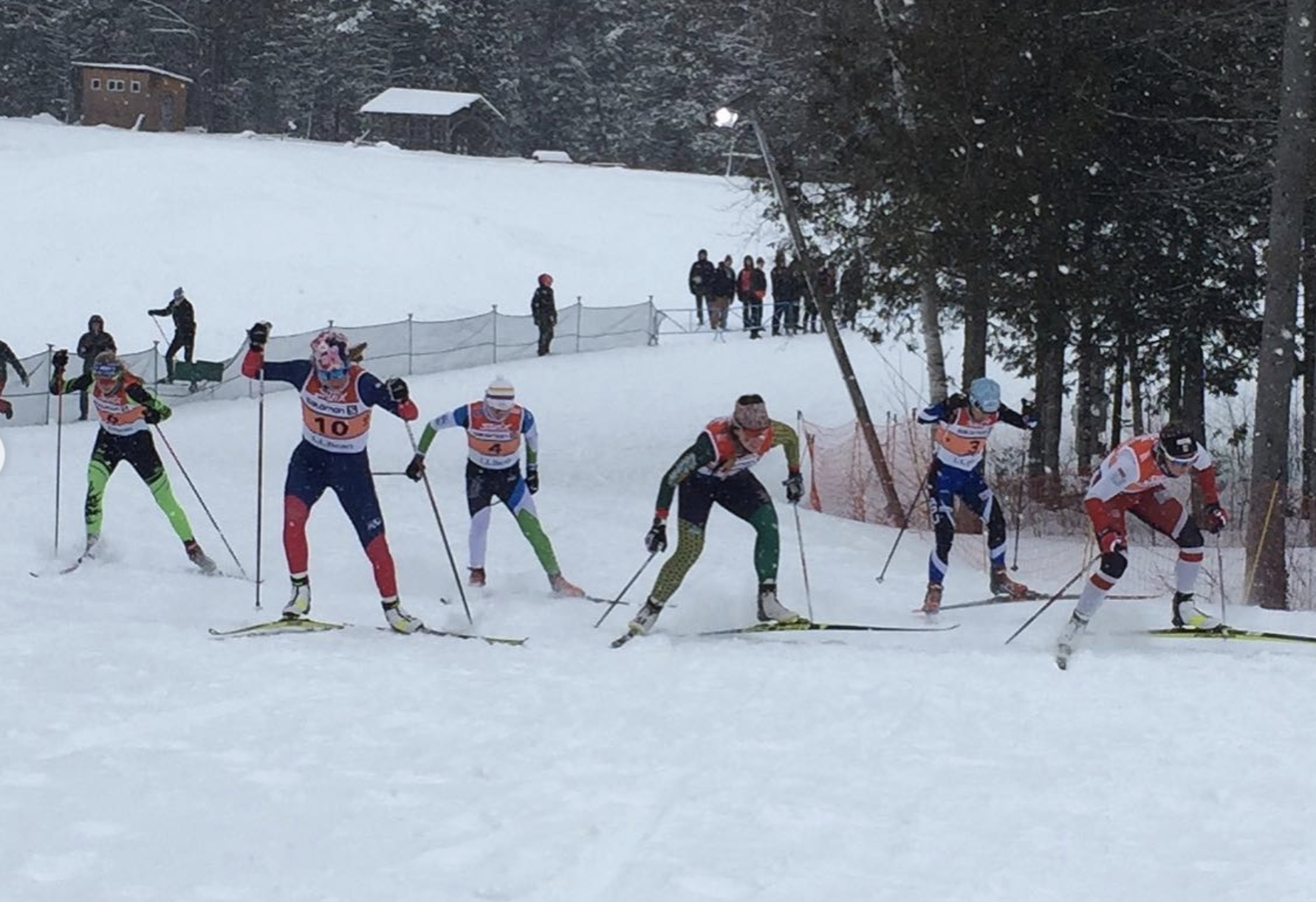
Despite the trend seen in the qualifier, the final featured tight racing, with the top five athletes finishing within two seconds of one another. Just 0.6 seconds separated second from fifth.
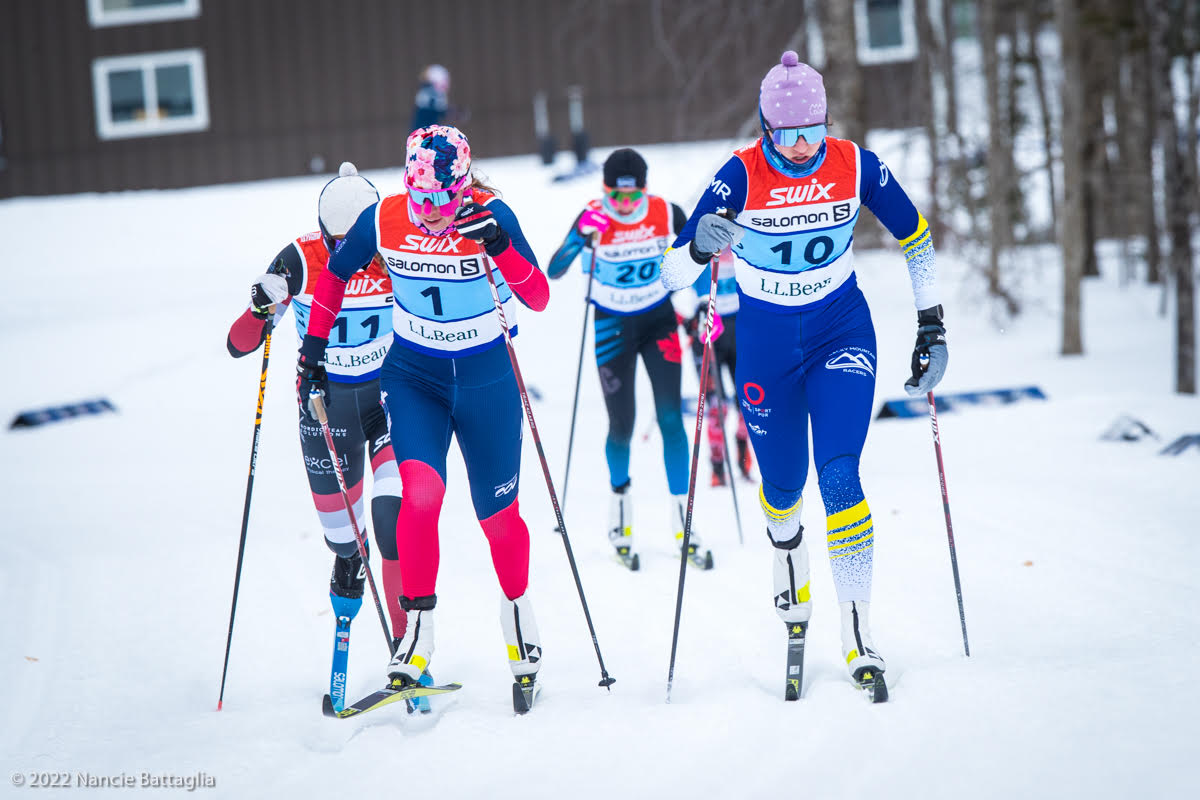
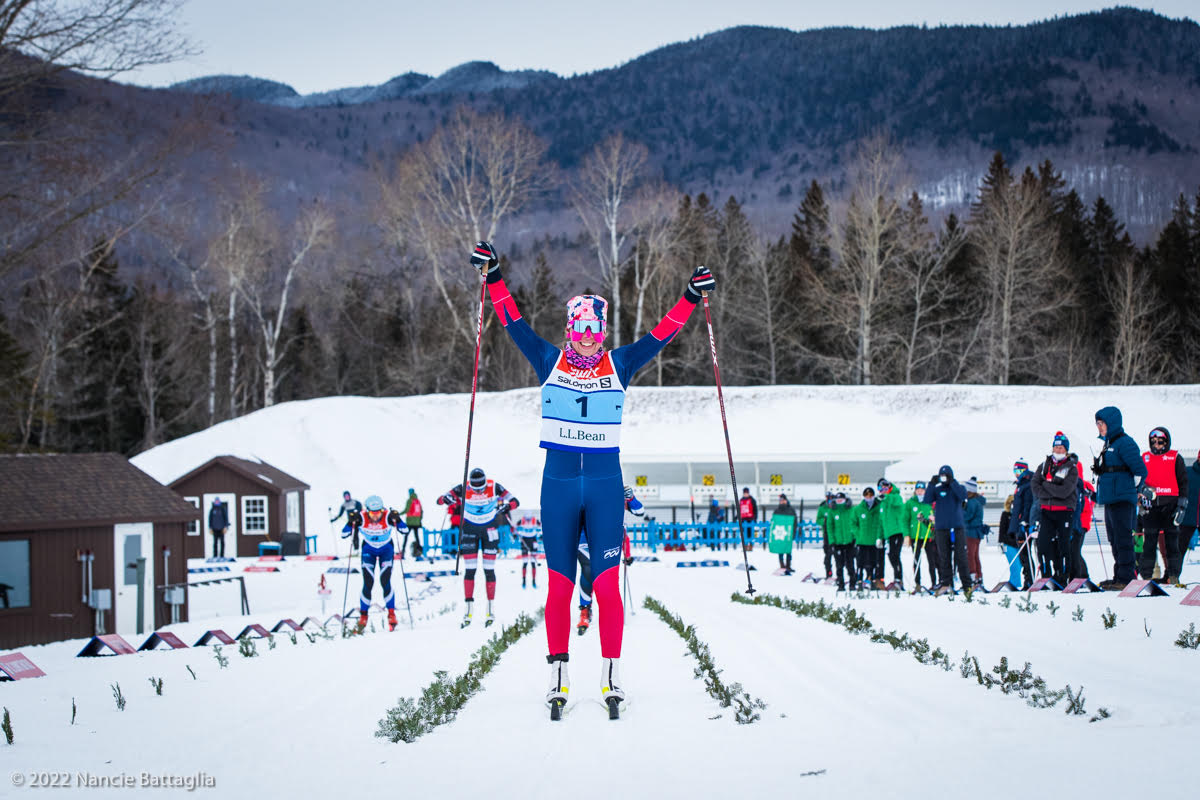
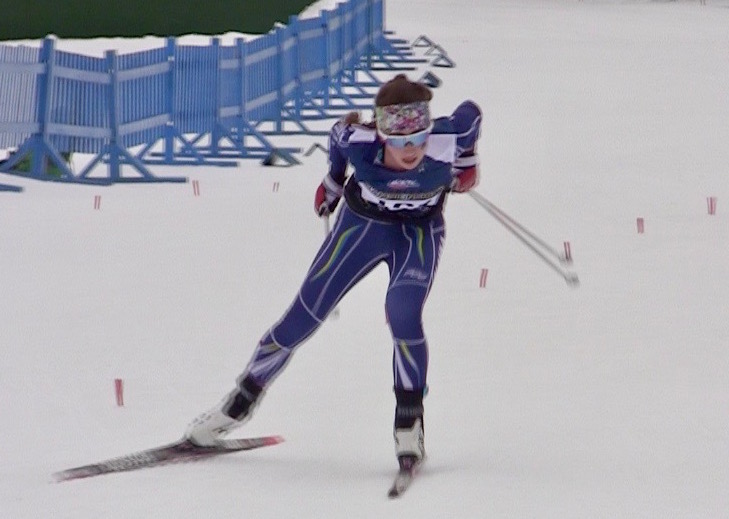
A scene from the women’s final of the 1.4k freestyle sprint in Craftsbury. (Photo: Instagram @nensa_nordic)
Coming out on top was Ogden, who won the final in 3:59.08. After racing on the World Cup from the opening races in Ruka through the midway point of the Tour de Ski, Ogden has gone three-for-three in SuperTour sprints since returning stateside, winning classic sprints in Soldier Hollow and Lake Placid before checking off a skate win today.
Just behind, Jortberg took second place (+1.30) with U18 athlete Thurston closing in third (+1.78). Bizyukova was next to the line in fourth (+1.86), with Frankowski less than a meter behind in fifth (+1.91). Freed rounded out the women’s final in sixth (+4.51).
“I think that the biggest thing to note about today was that it was blizzarding!” wrote Ogden in a post-race email. “The heavy falling snow made the heat racing very tactical and rewarded being very quick off of the line. There was one lane on the course that was packed down by traffic and the other areas were pretty soft!”
Ogden was just 11 points behind Caitlin Patterson on the Olympic qualification distance list, based on the athletes’ best two distance races on the SuperTour or at the U.S. Cross Country Championships, during which Ogden competed in only one race – the 10k individual start classic where she was second to Patterson. The following weekend in Sun Valley, she was second in one distance race and fourth in the other, behind three Olympians and ahead of Patterson in each. As the races at U.S. Nationals were scored at a higher point value, Patterson took the final Olympic spot, leaving Ogden on the wrong side of the cusp.
Nevertheless, Ogden has found silver linings in the additional time back east.
“It was a blast to be able to race with the EISA. I miss skiing for Dartmouth (Ogden graduated in 2021), so it was fun getting to ski with some of my old teammates and some new Dartmouth skiers. It was also pretty great to ski in lots of natural snow, we rarely get a snowstorm this big anymore and it was undeniably very fun.”
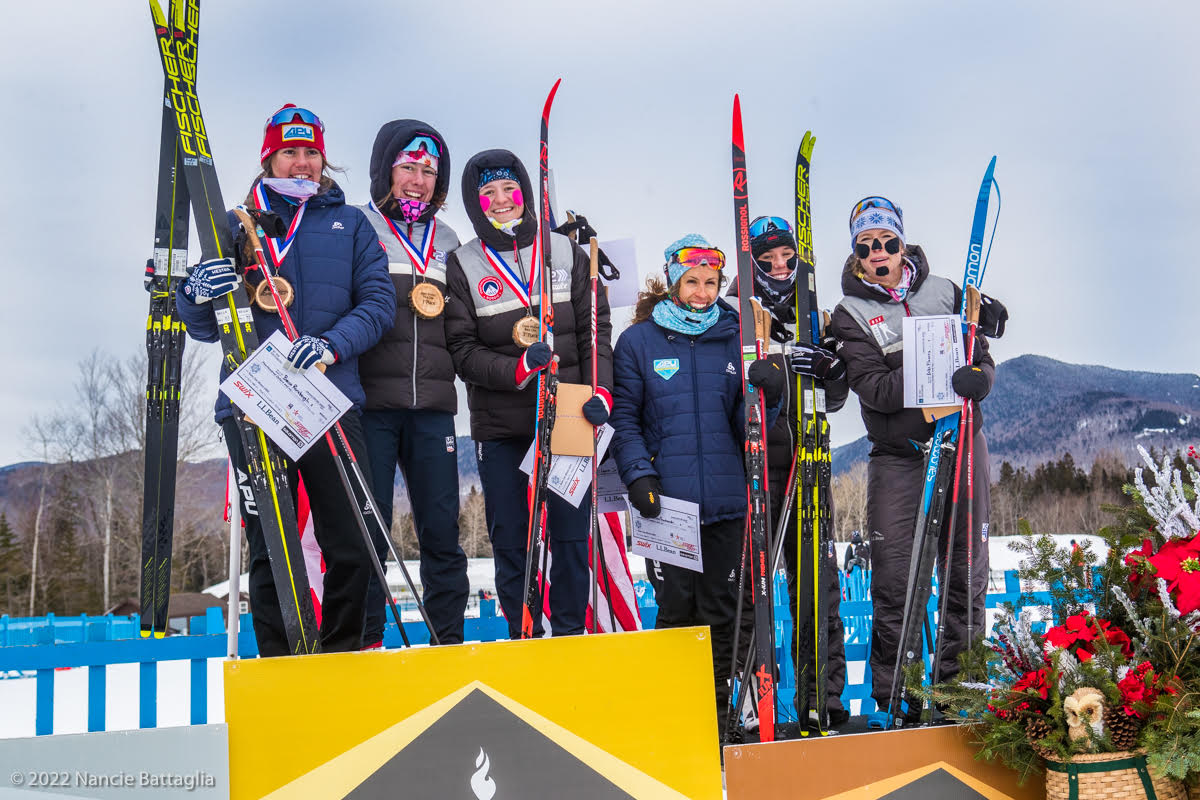
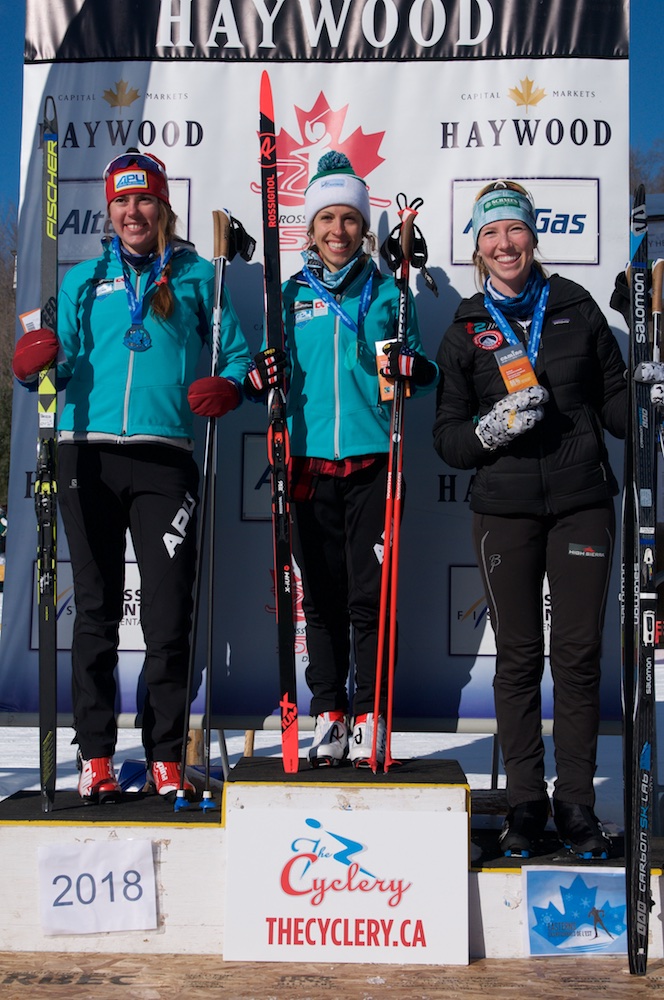
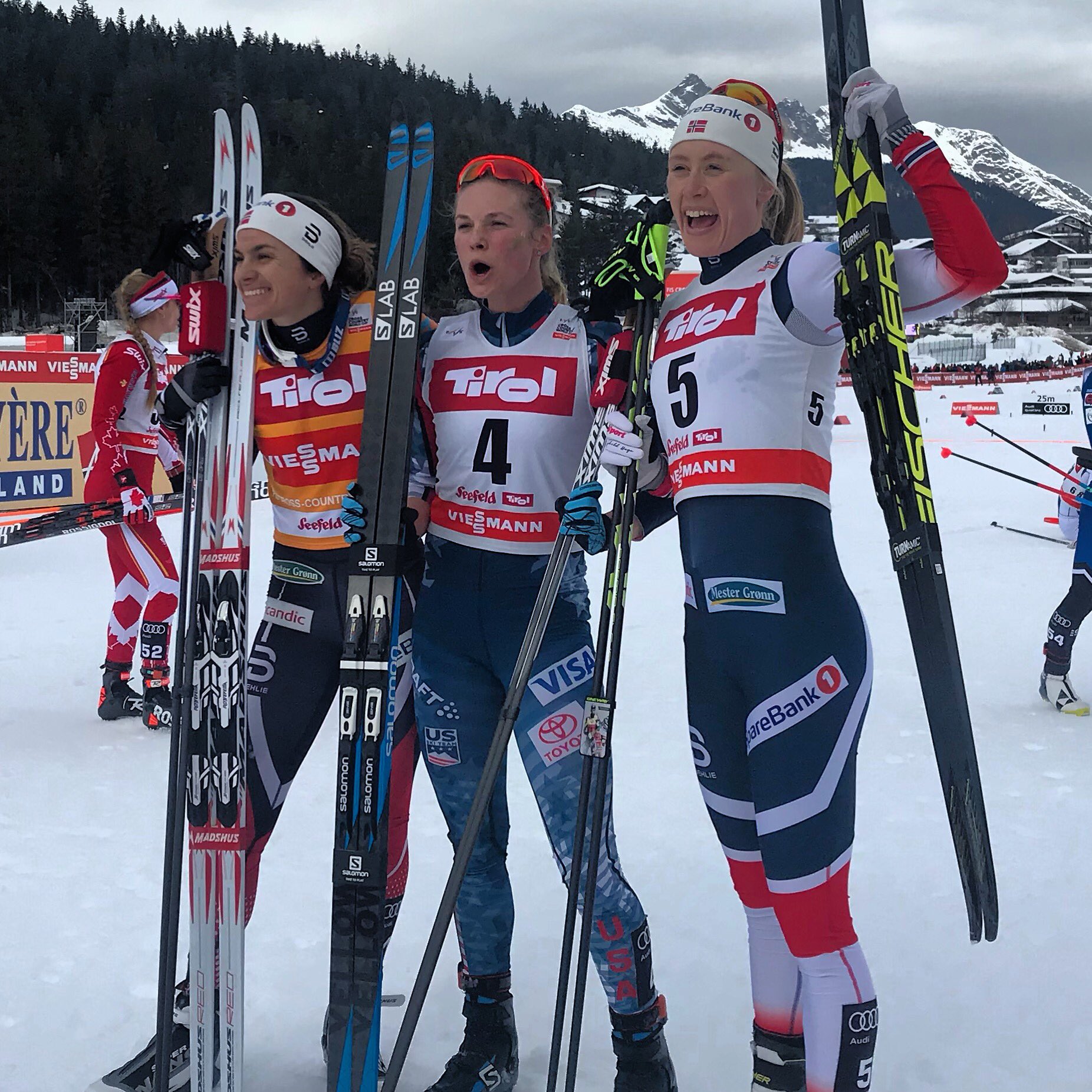
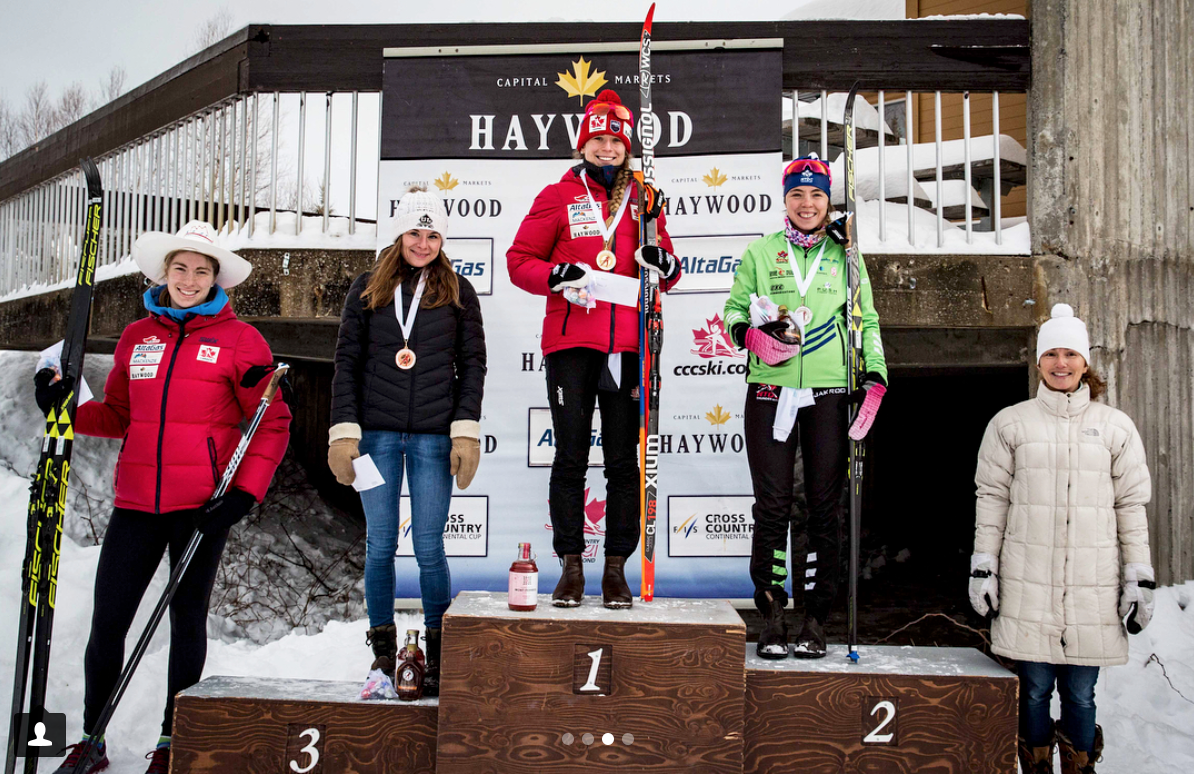
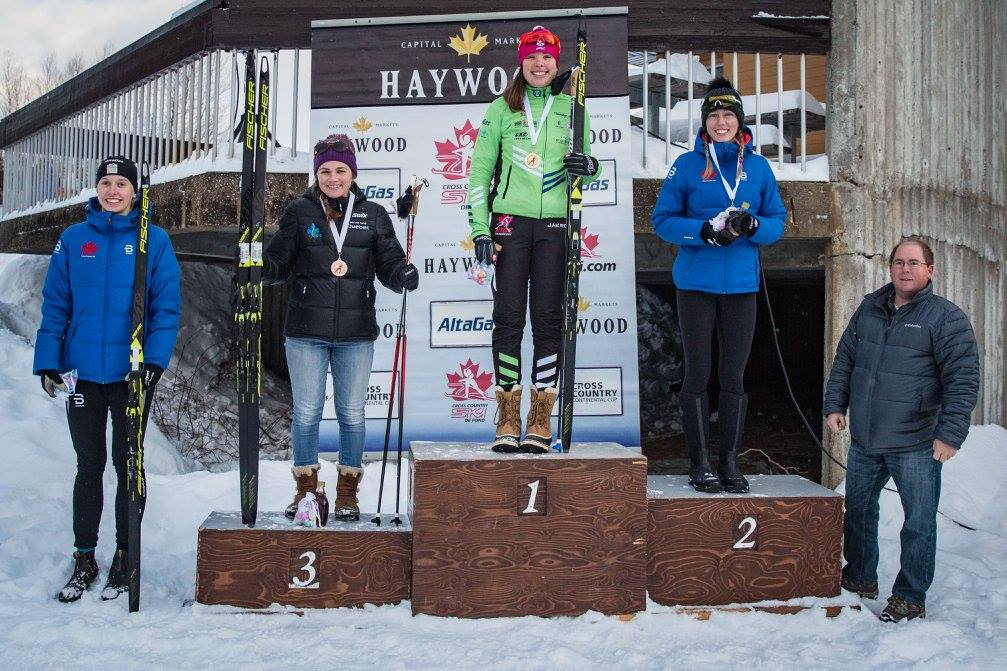
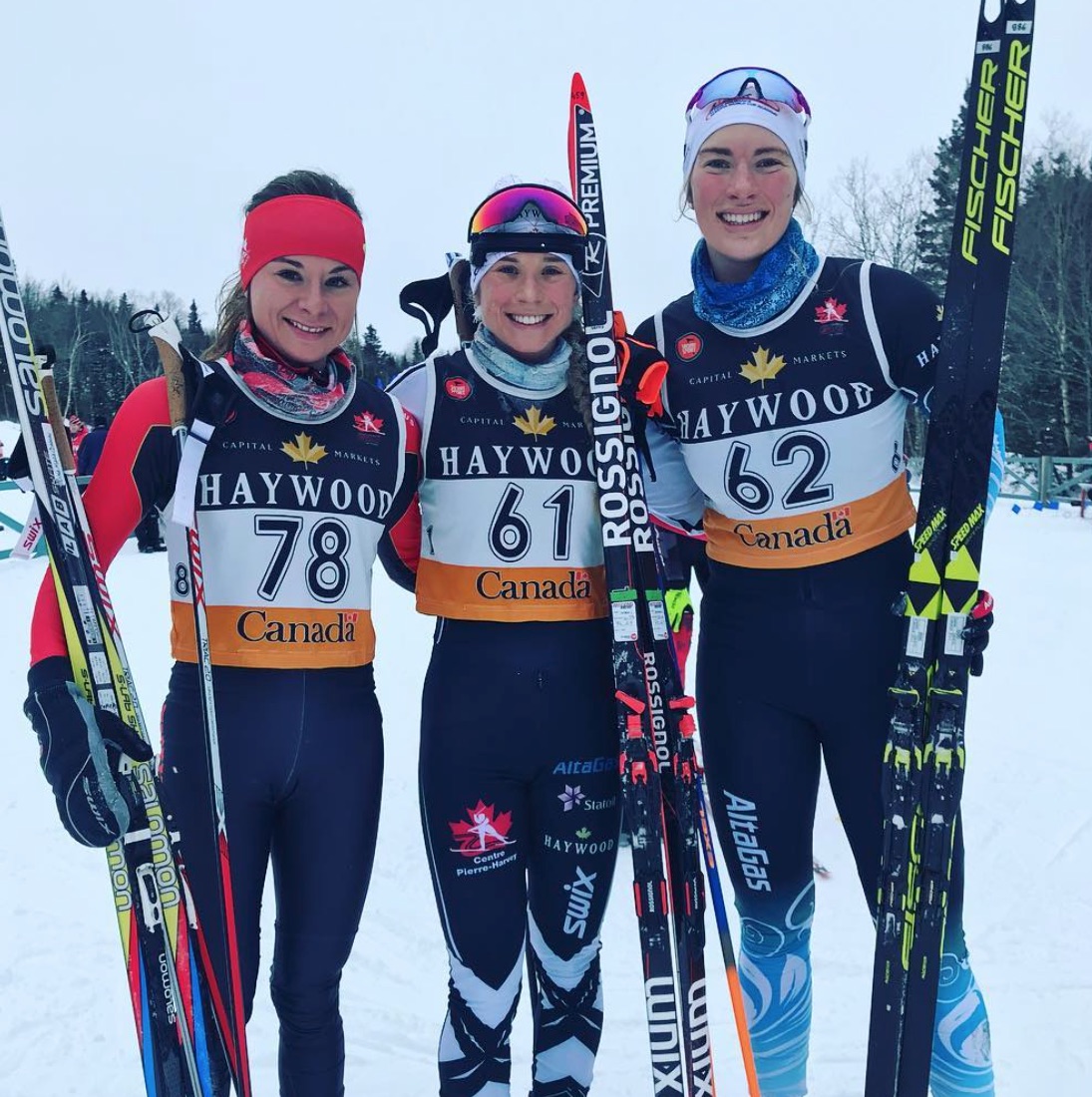
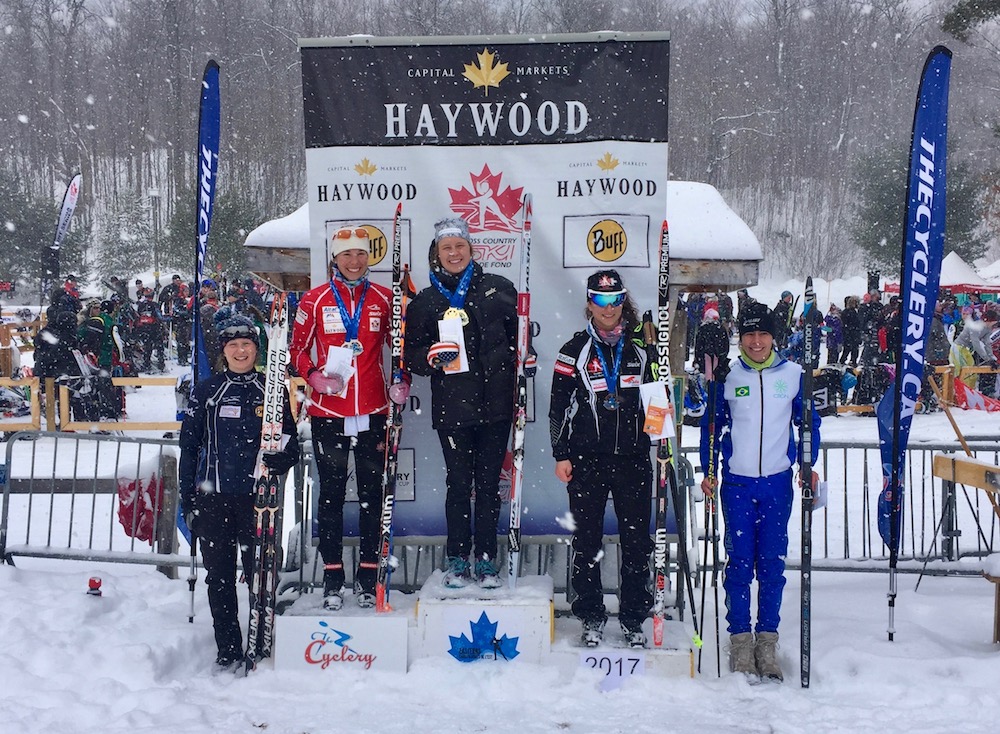
The women’s podium after the opening freestyle sprint race which kicked off a weekend of SuperTour, Eastern Cup, and EISA racing. (Photo: APU Nordic Ski Center / Instagram)
As Thurston is, remarkably, still in high school, Bizyukova was the top collegiate racer to earn today’s EISA sprint title. The second and third placed collegiate racers both hailed from Dartmouth College, with Callie Young finishing fifth in the first semifinal and 10th overall, and Jasmine Drolet taking sixth in the second semi for 11th overall.
The men of the Sun Valley Ski Education Foundation (SVSEF) Gold Team swept the top-three spots in the men’s qualifier, with Karl Schulz leading the way in 3:23.48. Peter Holmes was 0.33 behind in second, with Johnny Hagenbuch in third (+1.21).
Schulz carried momentum from the qualifier win into the first quarterfinal, which he won by half a second, but his day ended soon after in the semifinal. Racing in a fast first heat that contained two eventual podium winners and found both lucky losers, Schulz was fifth in the heat, +1.72 behind winner Matias Øvrum of UVM. Sam Wood (SVSEF) was second in the heat, ahead of last weekend’s sprint winner Zak Ketterson (Team Birkie) and Gregory Burt (UVM).
In the second semi, which was nearly three seconds slower, Canada’s Étienne Hébert (CNEPH) edged out Holmes by 0.1 seconds to go 1-2 and advance to the final round.
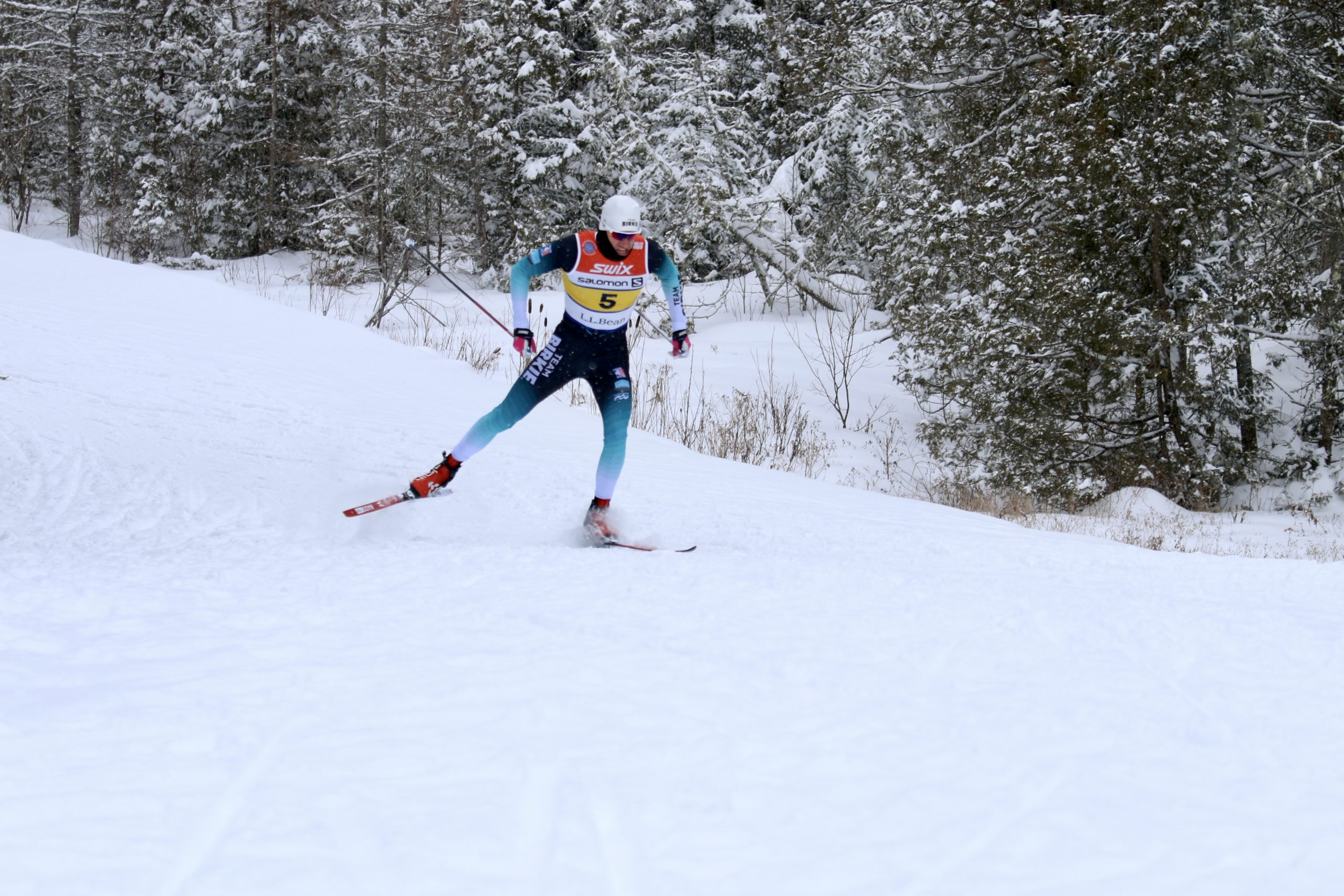
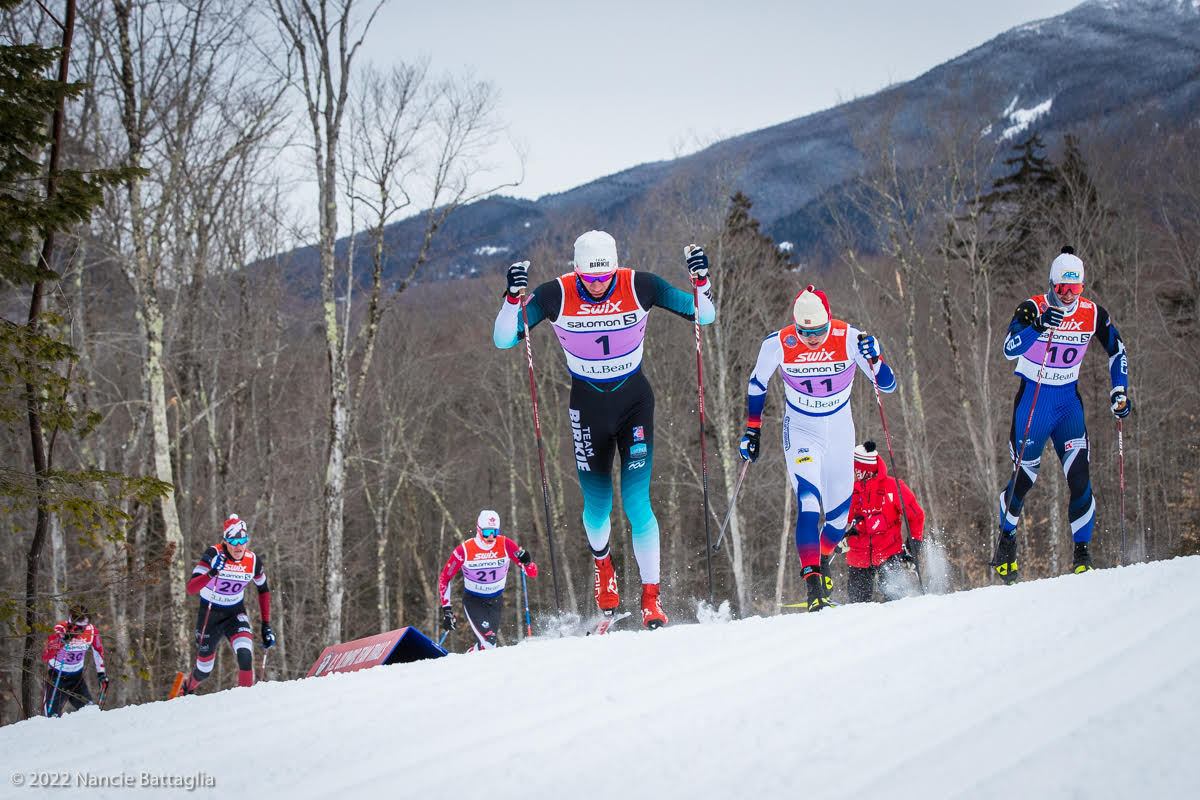
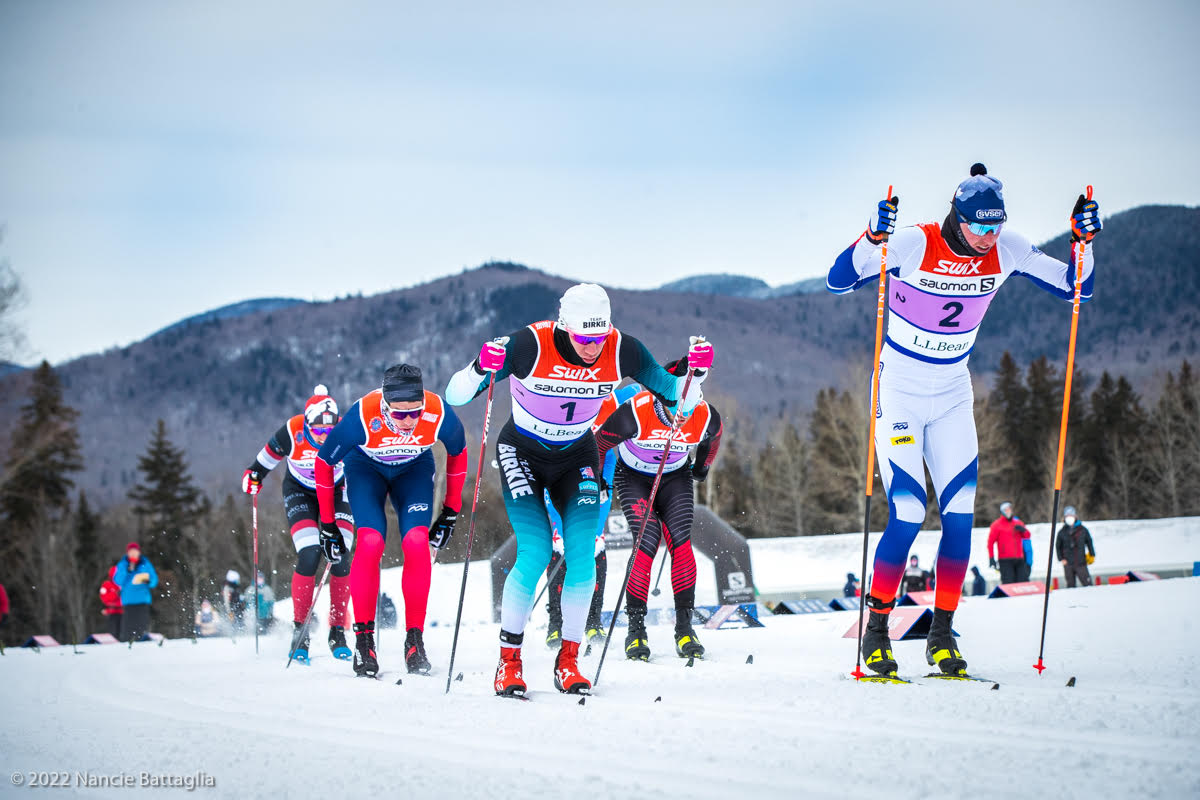
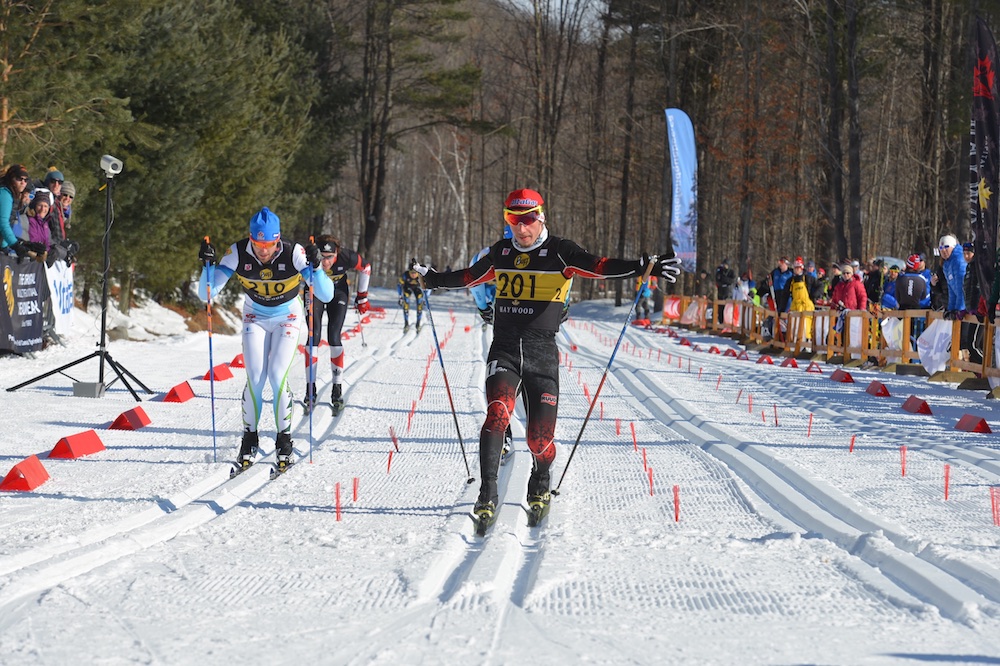
Zak Ketterson leads up the final climb in the men’s freestyle sprint final in Craftsbury. (Photo courtesy Zak Ketterson)
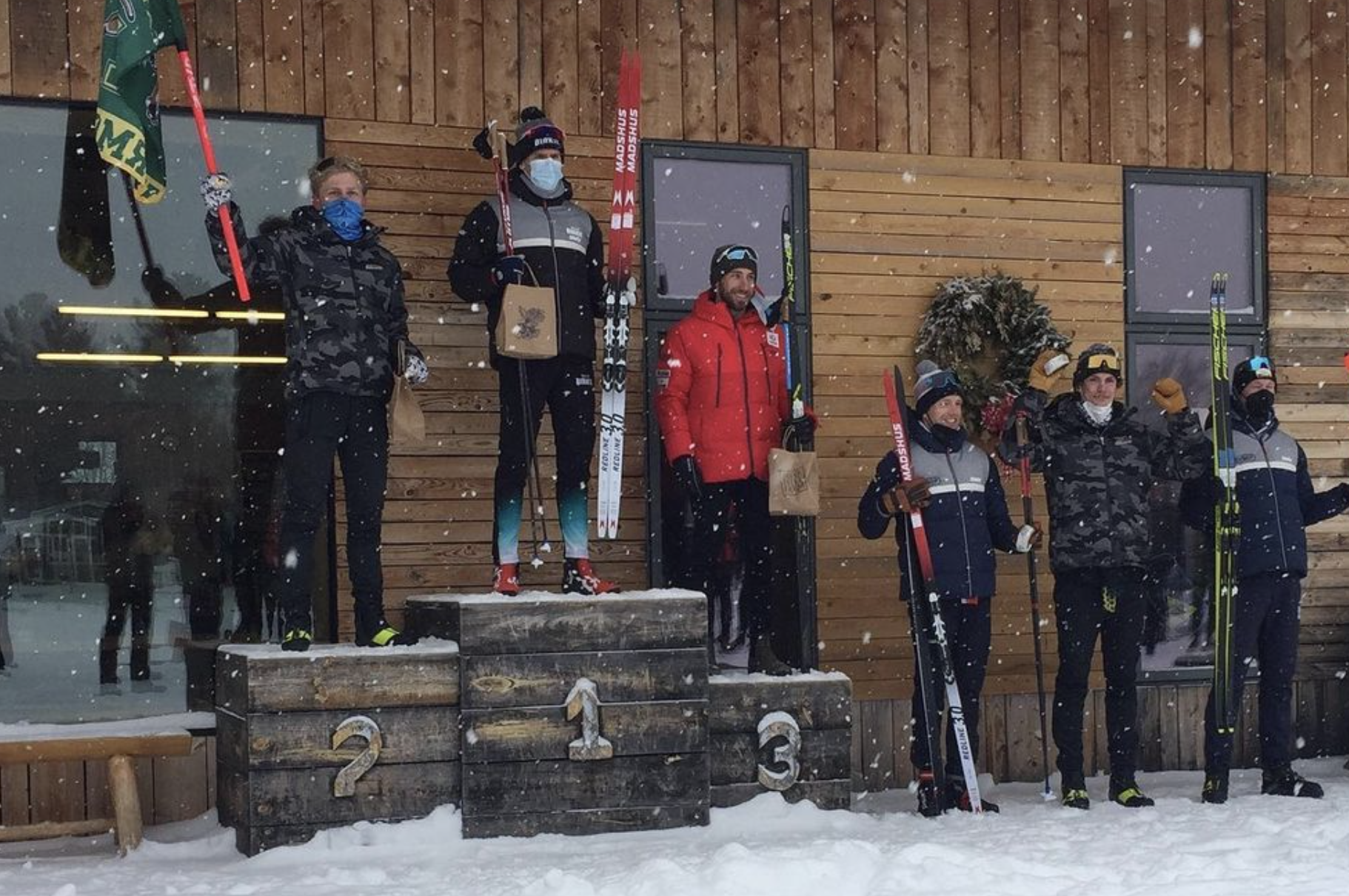
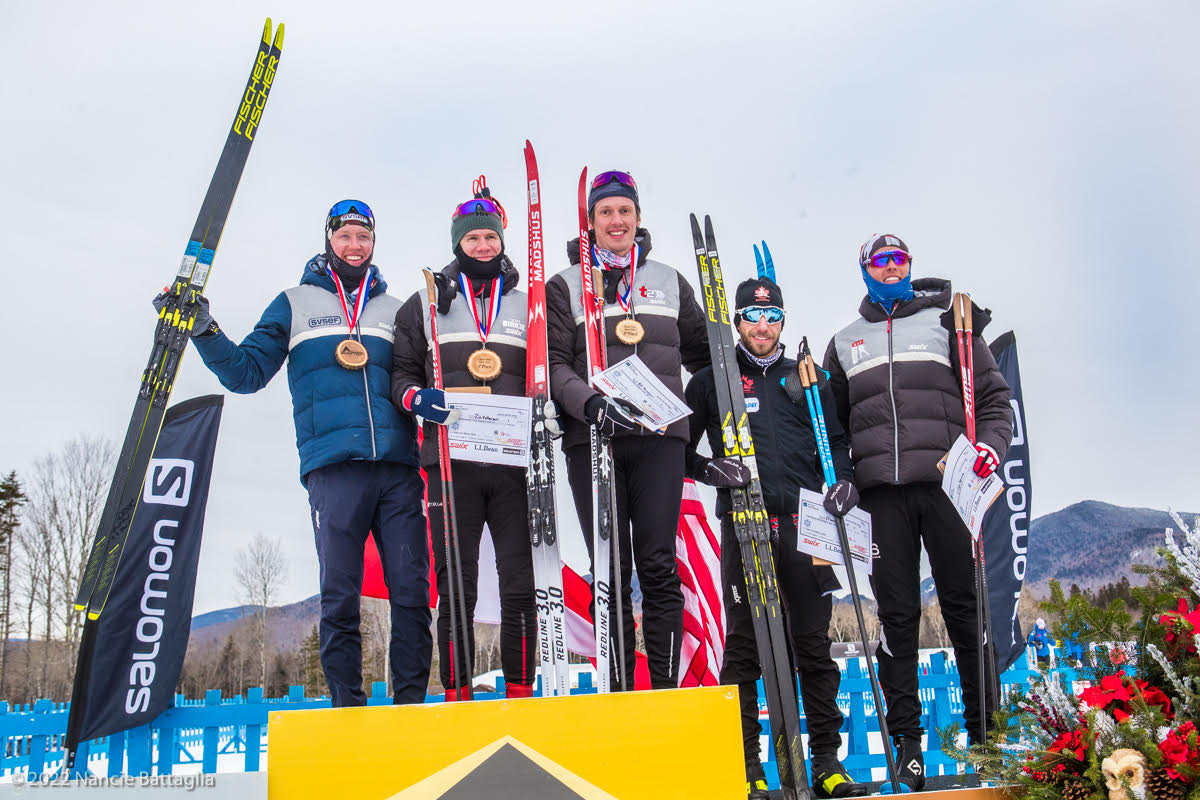
The top two spots in the final were decided by a close finish between Ketterson and Øvrum, with Ketterson crossing 0.28 ahead in a time of 3:22.57 to earn his third SuperTour sprint title of the season. Øvrum was second, though he was named the collegiate race winner for UVM, with Hébert crossing the line a few meters behind on his own in third (+2.17).
“I’ve always really liked racing at Craftsbury,” Ketterson wrote to FasterSkier after the race. “It’s an awesome place and this year Team Birkie has been lucky enough to stay right at the Outdoor Center. The race course is right out our back door!”
Ketterson also provided insights to the final round for those following from afar.
“The final was really close! I gave it everything I had at the top of the last hill but I definitely started to get tired and bogged down a bit into the finish. Matias skied a smart race and gave me a really good challenge in the last few meters but luckily I was able to fend him off. It was a tricky day with super soft fresh snow and I’m happy I was able to execute.”
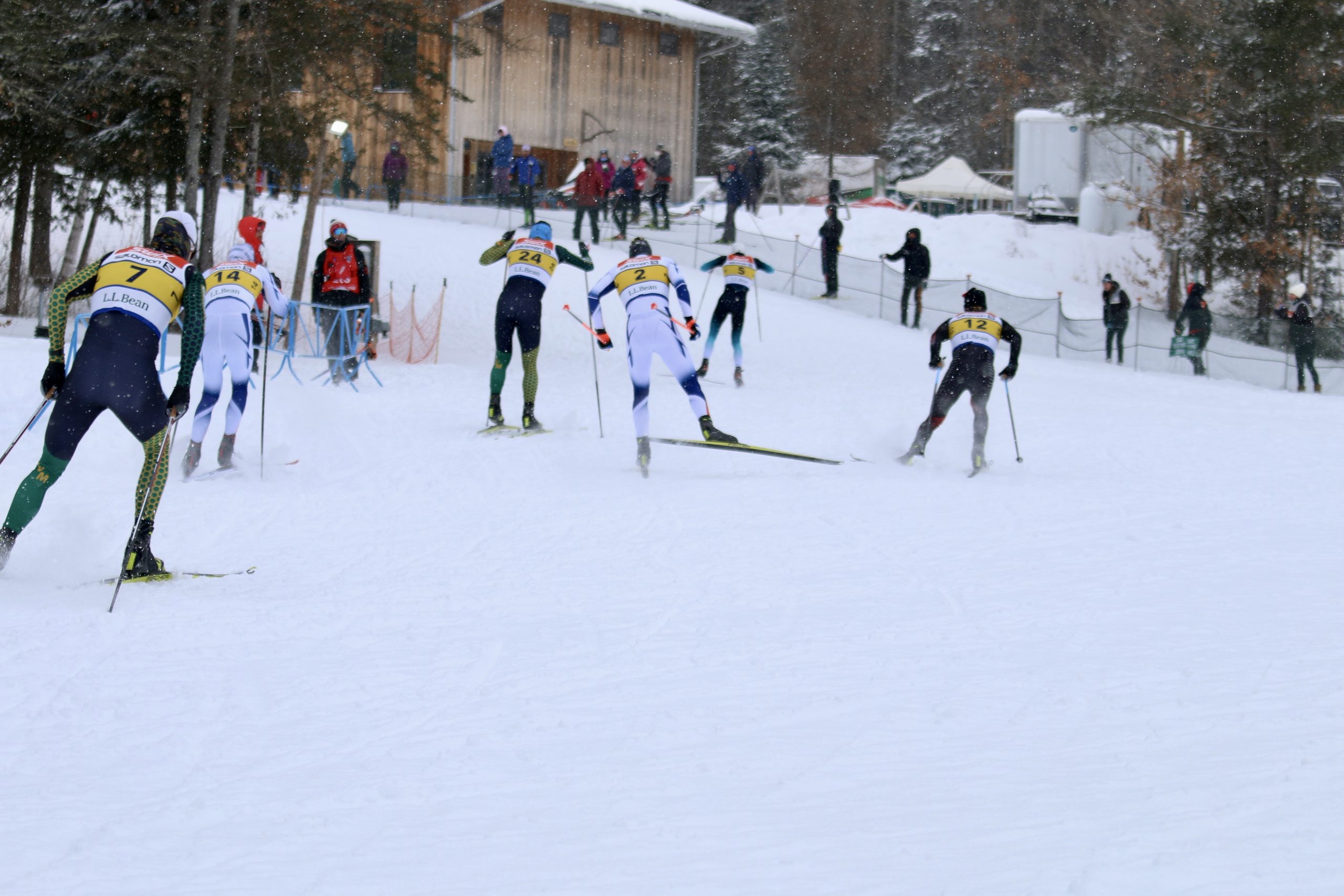
Zak Ketterson races a snowy freestyle sprint qualifier in Craftsbury. (Photo courtesy Zak Ketterson)
Wood was fourth in the men’s final (+6.9), with Burt fifth (+7.17), and Holmes sixth (+10.82).
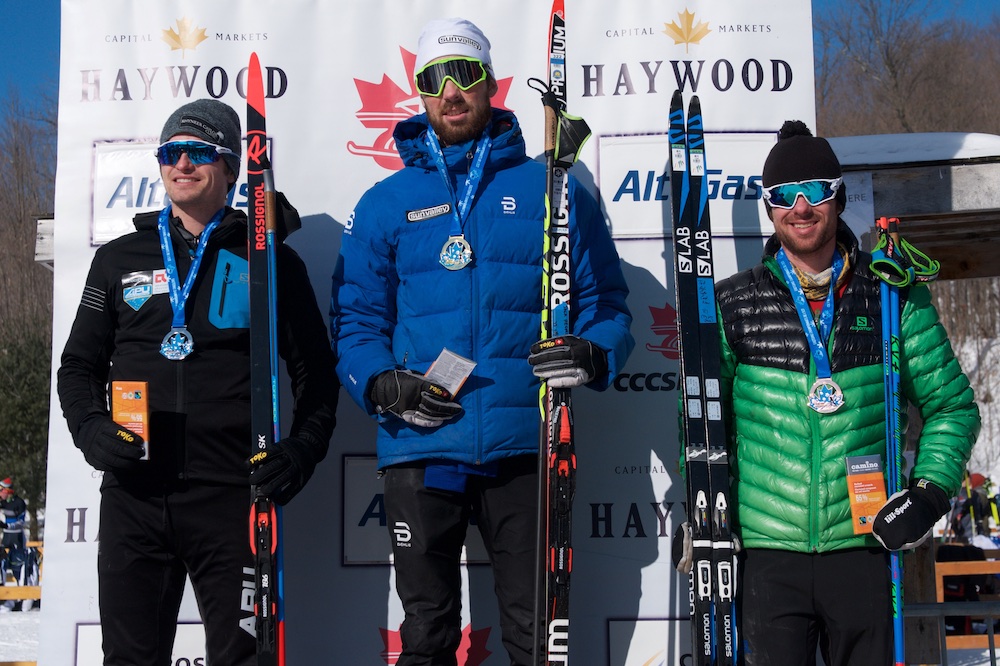
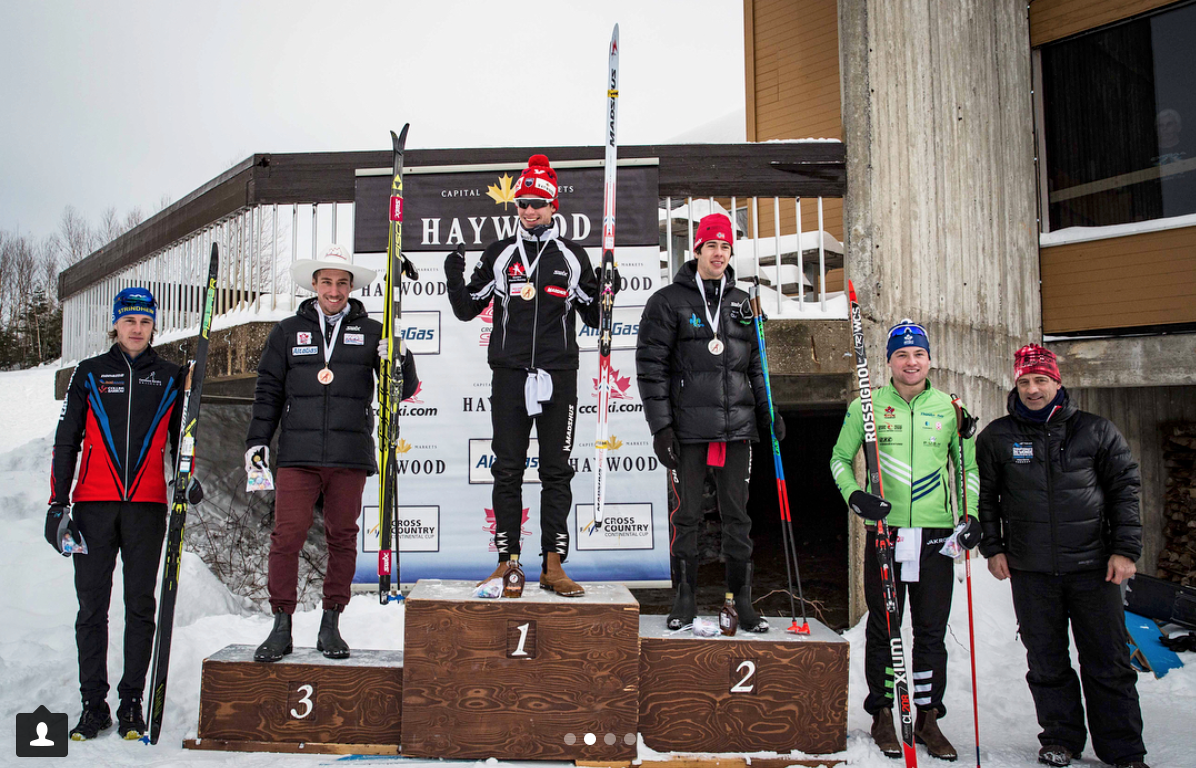
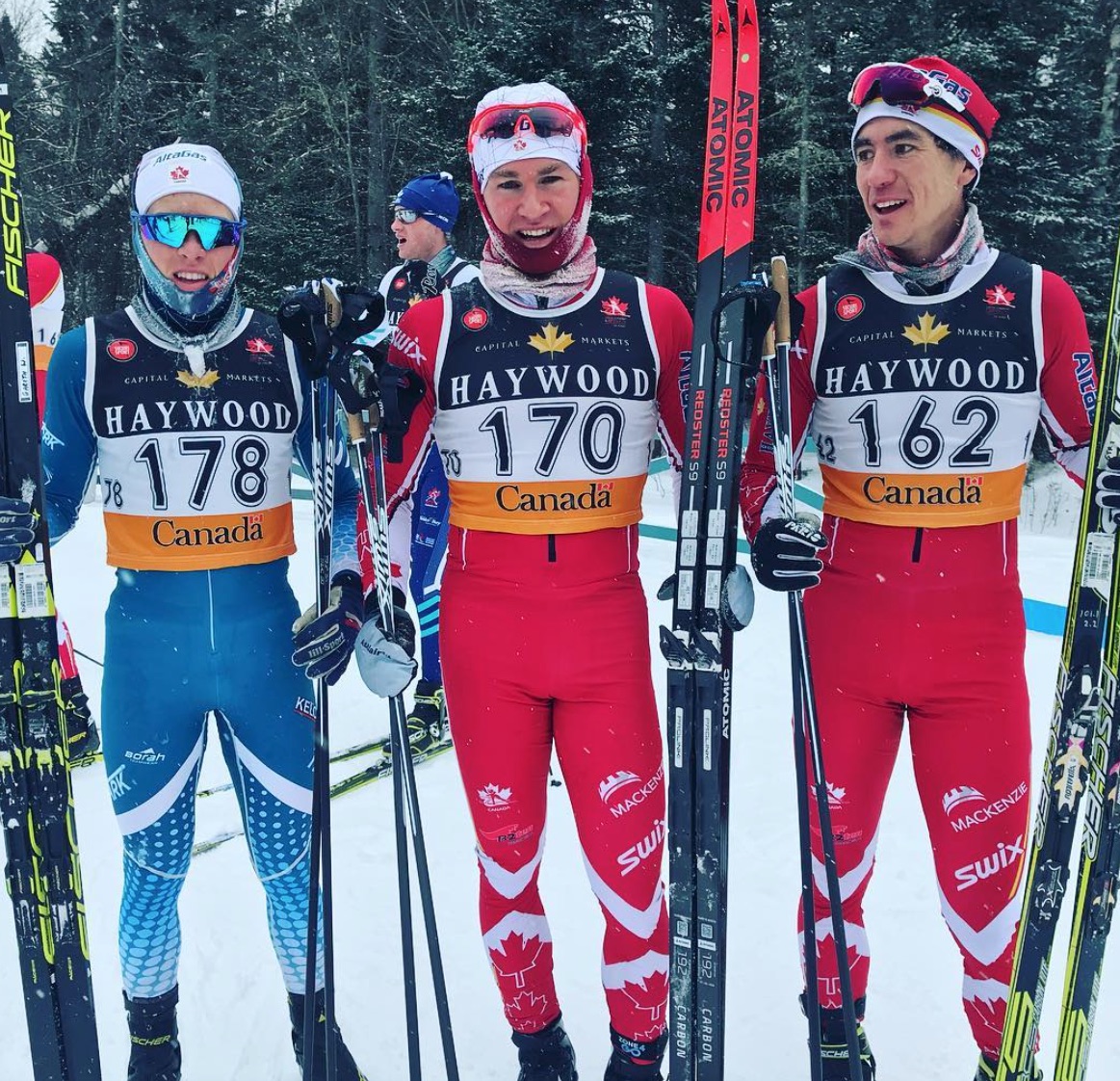
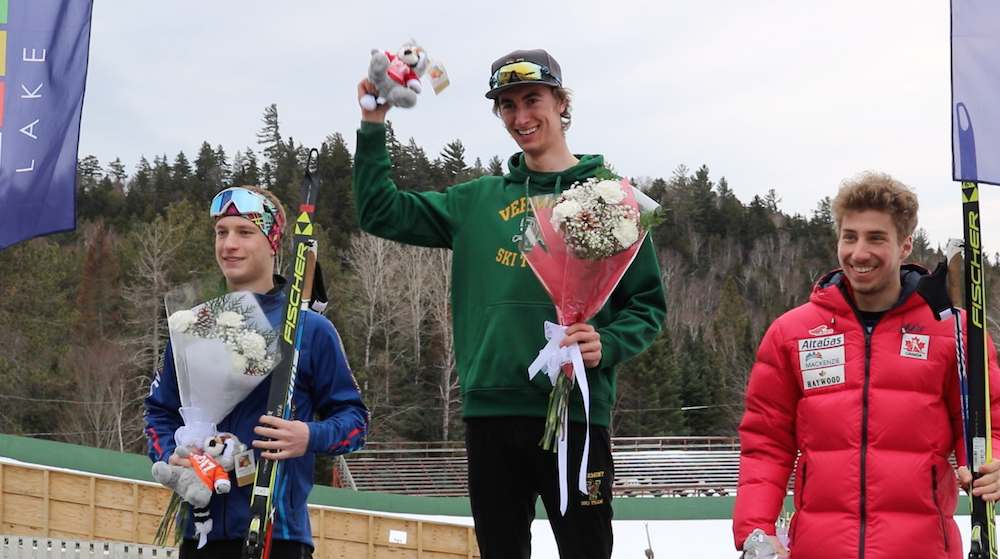
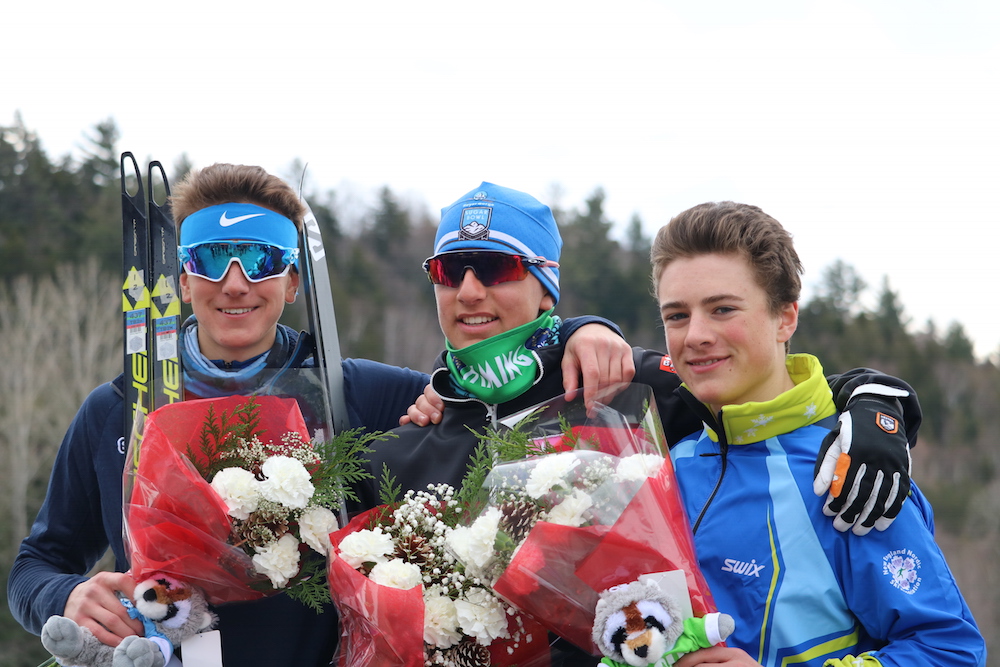
The men’s freestyle sprint podium after the opening day of SuperTour racing in Craftsbury. (Photo: Instagram @nensa_nordic)
As mentioned, Øvrum was the top collegiate racer, with Burt second, going one–two for UVM. Third place among college athletes was Allan Luke of Dartmouth, who finished sixth in the first semifinal and 12th overall.
Craftsbury’s Day 1 coverage of the the 2022 Henchey Memorial Carnival: SuperTour, NENSA Eastern Cup and UVM EISA carnival.
After a brief break, the SuperTour picked up in Lake Placid this weekend, with a fluoro-free Period III kicking off with a 1.5-kilometer classic sprint. The frigid forecast called for overnight lows of -5 Fahrenheit, with a wind chill as low as -23F. Highs during the day were only predicted to climb into the low single digits. Qualifiers were scheduled for 10/10:45 am, with quarterfinals for the open men beginning at noon – hopefully, enough time for a few degrees of warmth to reach the trails.
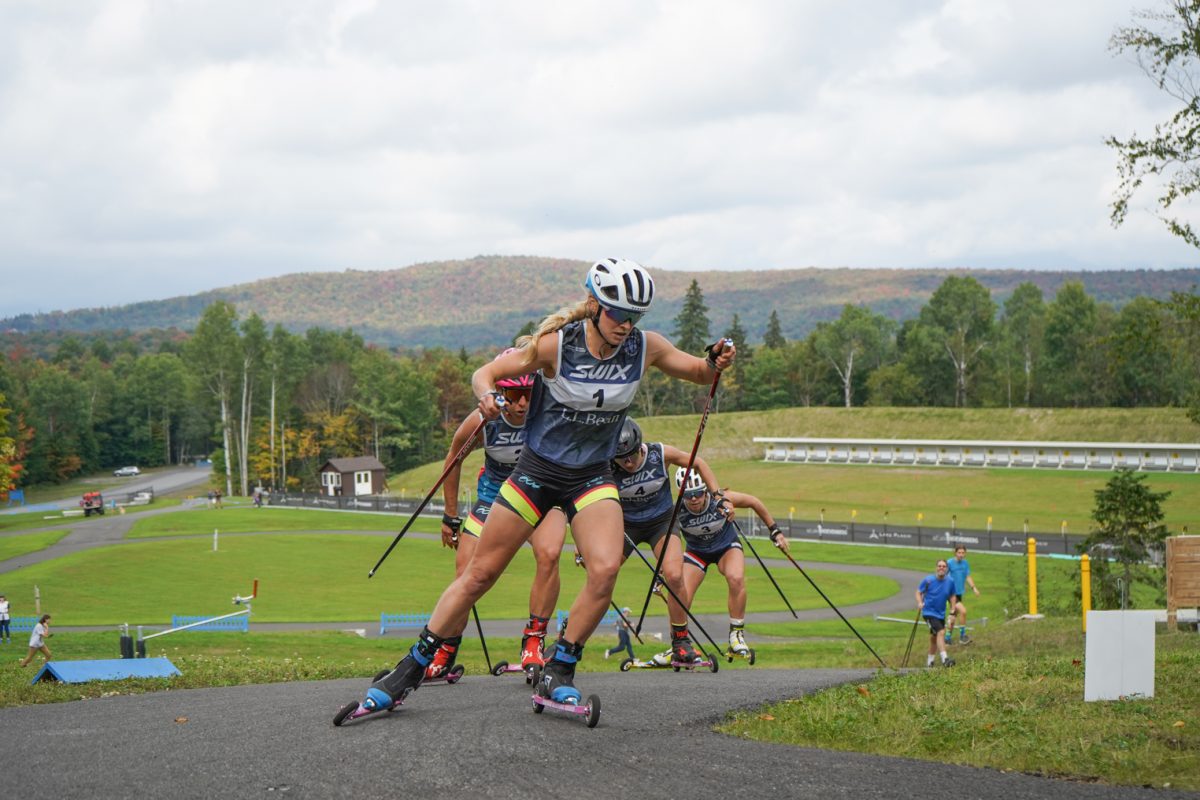
The weekend competitions would be hosted on Mt. Van Hoevenberg’s new World Cup trails, which are paved for rollerski use in the summer, and played host to NENSA’s “Keys to the Castle” sprint event in September. For those familiar with the venue, the new courses are tucked into the north-facing hillside, just south of the 1980 Olympic stadium and biathlon range. The new serpentine loop intersects with the final Ks of the classic “Ladies 5” outer loop, but overall remains closer to the stadium to allow access to the recently improved snowmaking system.
Jessie Diggins (SMS T2/USST) pushes over the climb during the final round of the Keys to the Castle sprint. (Photo: Matt Whitcomb)
With a large reservoir and advanced technology, this new World Cup loop can be made winter competition ready within four days, though Van Hoevenberg’s nearly 50k of open trail might suggest that coverage is not currently an issue.
There was praise for the course from many athletes, including those that have seen both Lake Placid, and everywhere in the world beyond Lake Placid.
“It raced much more like a world cup course!” said Alayna Sonnesyn (SMS), in an email to FasterSkier. Katharine Ogden (SMS) too, said of the course, “it was WAY more fun than the old one…[which] was pretty flat.”
The course designers at Lake Placid seem to have carefully been taking notes on what makes sprint racing exciting over the course of its evolution as a discipline in the sport. An historic venue for American skiing, these developments may be a long-time coming for Mt. Van Hoevenberg, but it’s clear that they were executed with mastery so VanHo can continue to expand upon its legacy in the decades to come.
This course featured a long, final uphill climb to test a skier’s mettle, then a short, technical downhill into the finish to test their tactical brains. And in between; transitions, transitions, and more transitions.
Becca Rorabaugh (APU) said of this : “The final climb always turned into a drag race, and I liked the pitch because it favored a bit of a stride over an all-out run. Skiers still had to be alert through the downhill and finish, though; positions often changed in the stadium.”
The weekend, hosted by the Olympic Regional Development Authority (ORDA) in Lake Placid, also served as the second NENSA Eastern Cup weekend. Thus, senior athletes from American elite clubs lined up alongside regional junior racers, eastern collegiate racers, and Canadian athletes who traveled from Quebec, Ontario, and beyond. 382 athletes, 176 women and 206 men, on the start lists for the qualifier, and separate heats were run for the U18/U20 and U16 categories.
Without livestream, FasterSkier has relied on live timing and athlete interviews to shed light on how the sprint races unfolded.
Men’s 1.5-kilometer Classic Sprint
After returning from a stint in Europe where he raced the Tour de Ski, Team Birkie’s Zak Ketterson set the mark in the men’s qualifier, stopping the clock at 3:04.79. Sun Valley’s Peter Holmes skied the next fastest time in qualification (+0.72), while Étienne Hébert was just behind in third (+1.41). Hébert hails from Quebec and currently trains at the Centre National d’Entraînement Pierre-Harvey (CNEPH), based at Mont Ste Anne.
Each of these men moved smoothly through the rounds, with Ketterson getting edged out by Bill Harmeyer (SMS T2) in the first semi, and Homes and Hébert going 1-2 in the second. Racing in the second semi saw a tighter spread and faster times, bringing Julien Locke (Black Jack Ski Club) and Logan Diekmann (BSF Pro) who had finished a close third and fourth, respectively, along to the final as lucky losers.
The final featured a tight finish among the top four men, with Ketterson off the front to finish in 3:04.71, earning his second consecutive classic sprint victory. Ketterson had dominated the classic sprint in Cable, WI, and stood at the top of the SuperTour leaderboard, thereby earning start spots for the Tour de Ski. The timing of the Tour caused him to miss the subsequent classic sprint in Soldier Hollow, UT.
During the Tour, his first World Cup starts, Ketterson was less than a second shy of qualifying for the classic sprint heats in Oberstdorf, Germany, and had been roughly five second out of the Top-30 the day prior in a 15k skate. He was the only American on the men’s team to finish the Tour. After the Tour, Ketterson made a quick turnaround to attend the weekend of distance racing in Sun Valley, Idaho, where his results (15th in the 15k classic and 34th in the 10k free) were far below what might be expected from him.
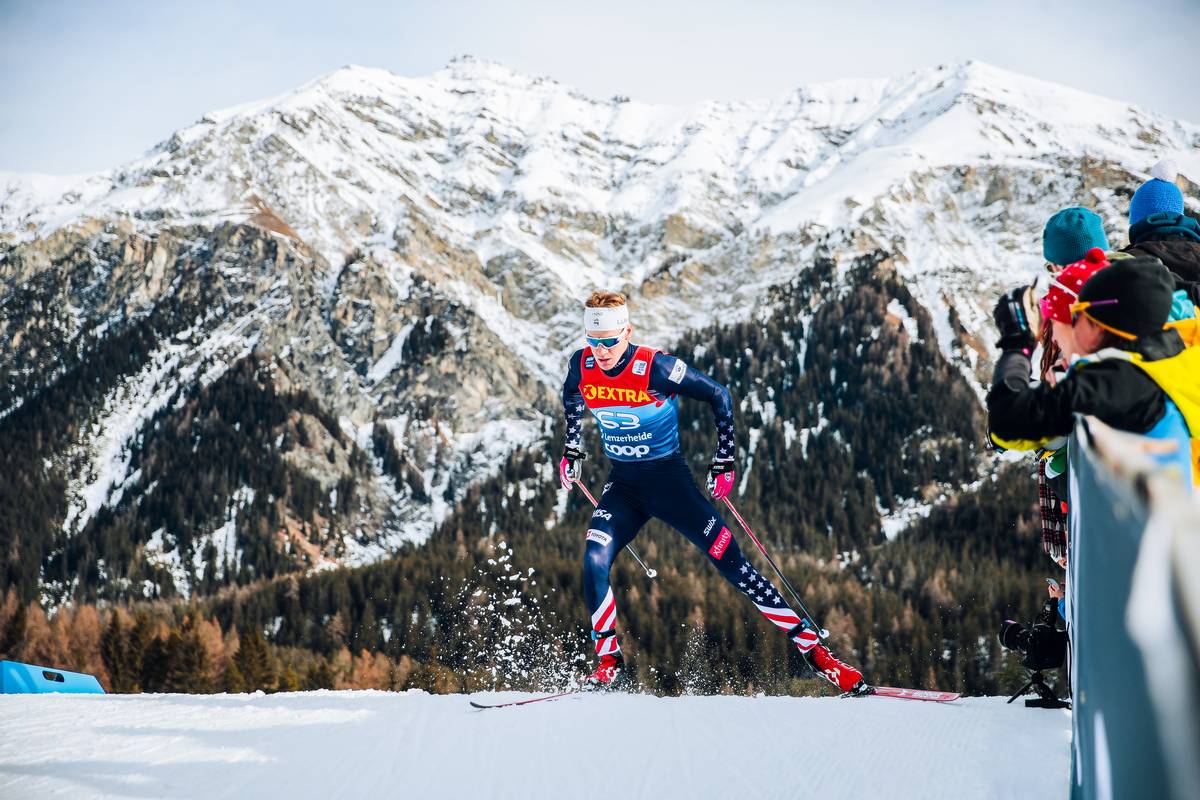
Zak Ketterson races the freestyle sprint qualifier in Lenzerheide, SUI, the first event of the 2021/22 Tour de Ski. (Photo: NordicFocus)
In a post-race email to FasterSkier, Ketterson shared how he felt about the Tour and what the recovery process has been like for him.
“The Tour de Ski was a fantastic learning experience with lots of ups and downs. I am pretty happy with my performance on the Tour given it was my first time on the World Cup, but I definitely think I will be faster next time around now that I have had the experience. Post Tour I was incredibly empty, both physically and mentally. To have to change gears pretty much immediately after the last stage of the Tour and head straight to Sun Valley for some super competitive SuperTour races at high altitude was definitely a recipe for disaster on my body. I felt like I was just going through the motions and my body wanted nothing to do with those races.
“These last few weeks at home in Minneapolis provided me with some long-overdue recovery. My hunch after some really lackluster racing in Sun Valley was that there was no need to overthink anything and that the issue was probably just that I was tired. I took time at home to mentally and physically reset and started to feel a lot more like myself as the Placid races approached. Today, it all came together and I felt a lot more race-ready.”
Ketterson also commented on the improvements that have been made at the Mt Van Hoevenberg venue, explaining how it supports the growth and elevation of domestic skiing.
“I am blown away with the venue at Mt. Van Hoevenberg! The venue truly feels like it’s ready for World Cups, or even another Olympics. It’s really inspiring to see big investments into nordic skiing venues in the United States, and I can’t stress enough how big it is for us athletes. I can’t wait to come back to Lake Placid sometime later to really experience this place because I think it’s so awesome here.”
Behind Ketterson, just 0.26 seconds separated second through fourth in the men’s final. Holmes won the boot slide to snag second (+0.72), while Harmeyer took the final podium spot in third (+0.92). Hébert was just 0.06 seconds shy of the podium, ending the day in fourth (+0.98).
Harmeyer provided insights into his approach to the day, along with insights into the moves that contributed to the excitement at the finish line.
“I felt really good in the heats today,” he wrote via email. “The course was certainly difficult and tactical. Placement in the group was really important and that was especially apparent in the final. We had a group of four dudes going over the top of the final climb into the long descent before the finish. It was an absolute scramble trying to get into the tracks on that final downhill. At one point, I had my left ski in the right part of the track and Étienne had his right ski in the left side of the track. Not easy to squeeze two guys going 30+ mph into a single track but somehow, I came out ahead which was just enough to lunge at the finish for third.”
During Period I, Harmeyer took third in the classic sprint final in Cable, and was just off the podium in fourth the weekend prior after the freestyle sprint in Duluth, MN. After qualifying in fifth, a crash in the quarterfinal left him 24th in the freestyle sprint in Soldier Hollow during the U.S. Cross Country Championships. A few days later, he was 51st in the 15k classic. In the Soldier Hollow SuperTour classic sprint, Harmeyer qualified in fourth, and just missed the final to end his day in eighth.
Reflecting on the season as a whole, Harmeyer wrote, “I had a really good start to the season with some strong races in the Midwest. But overall, things have been frustrating. I’ve been struggling with some cold weather triggered exercise induced asthma that got really bad after the first supertours in the Midwest. I continued to struggle with it through a disappointing Senior nationals and decided to take a bit of time off to reset, recover and do some testing. I’m hopeful the worst is behind me and that I’ve got some good protocols lined up to prevent anything from happening in the future. My primary goal for the remainder of the season is to win the Stowe Derby, specifically the derby meister.”
Wrapping up with a comment on the venue, Harmeyer added, “The new courses at Lake Placid are sweet! The sprint course is incredibly tactical but also rewards tough, explosive skiing. I had an absolute blast out there in the heats. The distance courses are hard but I’m excited to be doing a mass start on those for this Sunday. Overall, Van Ho has done a great job with course management and their snowmaking to put together some killer courses.”
After a gap, Diekmann crossed the line in fifth (+5.81), while Locke rounded out the men’s final in sixth (+9.11).
The women’s field began right where it left off in SuperTour classic sprints, with the winner of the last race at Soldier Hollow, Katharine Ogden, (SMS) finishing the qualifier in first place (3:40.49). She was followed by Lauren Jortberg (BSF Pro Team) in second (+2.2), and Ava Thurston (Mansfield Nordic Club) in third (+6.1). The qualifier indicated, again, the overall strength of the field that has characterized this year’s SuperTour, with the heat qualifiers all within 30-seconds of each other (26.0 seconds to be exact).
That field remained tight in the quarterfinals as well. All five quarterfinals saw winning times within a mere five seconds of one other, with Katharine Ogden turning in the fastest time of the round at 3:42.77, and Alayna Sonnesyn winning her heat in 3:46.12.
Ogden commented to FasterSkier that she “didn’t really have any strategy in particular. I find that it is better for me to make strategy in the moment during sprint heats because you never know what’s going to happen out there… I just tried to conserve as much energy as possible in the quarter and semi.” It would pay off later on.
Meanwhile, also progressing to the semifinals was the APU one-two punch of Rosie Frankowski and Becca Rorabaugh out of quarterfinal 2. Despite being primarily known as a distance racer, Frankowski, came into today leading the SuperTour sprint classification and “set a blistering pace,” according to teammate Rorabaugh. With it, she pulled the duo into the semifinals together.
After all the quarterfinals were through, the semifinals were set with a who’s-who at the top of the SuperTour sprint standings, rounded out by Canadian Katie Weaver (Hollyburn XC Ski Club) and Minnesotan Margie Freed (Craftsbury).
The first semifinal featured a battle between two SMS T2 teammates, Katharine Ogden and Alayna Sonnesyn, and two APU teammates, Rosie Frankowski and Becca Rorabaugh. Frankowski again set the pace for the heat, with teammate Rorabaugh commenting that “[Rosie] is so strong on the uphills that she pulls the whole heat to a faster time.” Frankowski, however, couldn’t quite outlast Ogden and Sonnesyn, who used the downhill after the final climb to launch into the first two positions. Ogden won the heat in a time of 3:39.23, with Sonnesyn and Frankowski in second and third, respectively, by less than a second. Rorabaugh finished fourth, but along with Frankowski won the lucky loser spots into the finals – setting up another round of the SMS-APU duel.
In the other semifinal, a close battle throughout yielded a win for Lauren Jortberg (3:45.15) and a second place for Erika Flowers (+0.90). The result sent another teammate pairing into the finals, with both skiers coming from Bridger Ski Foundation (BSF).
At Lake Placid – a place that has over the past century proved to be able to gather the entire world around skiing – it was perhaps appropriate that the women’s final would bring together three teams from across the American continent. Two from Vermont (SMS), two from Montana, two from Alaska (APU), and away they went!
Katharine Ogden commented that the field didn’t waste any time: “It was pretty hard from the gun, as per usual.”
Rorabaugh, meanwhile, made a change in strategy, deciding to follow her teammate Frankowski more closely in the early part of the race. “I was trying to stay closer to the front of the pack since I had let a large gap form in the semifinal that I couldn’t make up,” she explained.
That adjustment was one that helped create a pack that was tight throughout the race, and that was a bit harder to find a position in.
Sonnesyn commented that this led to her having to adjust. “I had great energy but got tangled up a few times on the second hill, so I really had to ski from behind in the second half of the race,” she wrote. “Luckily, I had great skis and remained calm and was able to push through the final stretch.”
In that final stretch, on the final hill, a “drag race,” as Rorabaugh described it, ensued. It was instigated by Ogden, who saw the final climb as the place to make her move, and made it. She came over the top in first place.
“[I] got lucky,” she told FasterSkier. “Pat [O’Brien, SMS T2 head coach] had provided me with some really fast skis that allowed my move to stick going back down the hill.”
Perhaps it wasn’t all luck though. Ogden came across the finish line in first place (3:40.13) after winning the qualifier, her quarterfinal, and her semifinal. It was an all-around dominant performance for one of the U.S. brightest stars in the classic sprint.
Meanwhile, Becca Rorabaugh had powered through the transition into the final downhill and came up with the reward of second place (+3.40), She was followed by Alayna Sonnesyn, who remained cool, calm, and collected as she skied her way through the pack to third place (+4.29).
The final was rounded out by fourth place Rosie Frankowski (+4.74), fifth place Lauren Jortberg (+5.63) and sixth place Erika Flowers (+17.77).
The result was reached at the end of an exciting day that encapsulated the beauty of ski racing – with excitement and energy perfectly juxtaposed against the extreme absence of that energy in the air. Preparing for cold temperatures that are forecasted again for the 10k freestyle mass start tomorrow, the top finishers today all expressed that the temps are part of the appeal in the northeast this weekend.
From Rorabaugh, “I don’t mind cold temperatures – I grew up in Fairbanks, Alaska!”
From Sonnesyn, “I like to think the Midwesterner in me prepared well!”
And from Ogden, the perfect Vermont tip: “As Sverre [Caldwell] told us last night, tricky race conditions can work to your advantage if you prepare better than anyone else. Wise man :)”
Liliane Gagnon leads the women’s 10km at the Eastern Canada Cup at Mont Sainte Anne. (Photo: Stéphane Barrette/Nordiq Canada)
The Eastern Canada Cup series wrapped up in Mont Sainte Anne (MSA), Québec, with distance racing for over 300 skiers each day. As with Westerns, the second weekend brought results and execution a little higher in the athletes’ focus, but the almost universal use of the words ‘fun’ and ‘excitement’ remain a reflection of a return to racing after a season without.
MSA is just outside Québec City and is very accessible for most population centres in the province. It is a destination venue that is famous for challenging trails and a few brutal climbs that reflect 1991 homologation standards. Races are hosted by Club Nordique Mont Ste Anne on trails owned by the alpine resort. This is the home base of the Centre National d’Entraînement Pierre-Harvey (CNEPH).
“The race organizers and volunteers did a great job today, the course was challenging but fun and the conditions were good despite the rain we got the day before.” — Étienne Hébert
Saturday: Individual Start Classic 5km/10km
The women kicked off the weekend with a 5km race of truth and it was CNEPH’s U20 Liliane Gagnon setting the standard in 14:00.7. Chelsea’s U18 Tory Audet was second at 7.5 seconds back, collecting her second senior podium of the season. Last weekend’s double winner Laura Leclair was third (+16.7), putting a second CNEPH suit on the podium.
“I had a very good day!” Gagnon wrote to FasterSkier. “I surprised myself which is awesome. I knew the form was good, but I didn’t expect the race I pulled off. 5km classic individual starts are usually my biggest fear and I proved myself wrong.”
Gagnon was one of many who had process goals top of mind.
“I usually have trouble with individual starts because I don’t start fast enough. Today my goal was to start off quick and ideally keep that speed all through the race and I think I did a pretty good job. I really tried to stride long on the “false flats hills” and push hard on the top of the hills and I think it paid off!”
Liliane Gagnon in the 5km classic. (Photo: Stéphane Barrette/Nordiq Canada)
“I had a great race,” Audet wrote. “We had awesome glide but our kick was not ideal. The conditions were fast, which made this specific course very exciting. This course had a lot of uphills, which are my favourite! Uphills gives me the feeling of accomplishment every time I crest a new hill, and that motivates me for the next one!”
Enthusiasm flows from Audet, who at sixteen was affected more than many by a season without learning from real races.
“During my race, what stayed in the back of my mind was that a faster and more experienced skier started one minute behind me. I was driven to maintain that one-minute gap between us.”
That skier starting one minute behind Audet was Leclair, who wrote “Today was an overall good day. I think I lost seconds in the last portion of the race but I’m happy with the first half. Skis were good and conditions were super fast. Happy to be racing at my second home.”
Leclair is a Chelsea member, giving her the chance to race at both ‘home’ courses this month.
Julian Smith on his way to another victory. Coach Timo Puiras is visible on the left. (Photo: Stéphane Barrette/Nordiq Canada)
National Team Development Centre Thunder Bay’s Julian Smith his strong start with a third win in the new season, finishing the 10km in 23:51.7. CNEPH’s Phil Boucher was 24.7 seconds back, edging out TBay’s Pierre Grall-Johnson in third at 30.3.
Boucher was fresh from the US SuperTour in Cable, where he was third in the 15km classic and won the 15km free.
“My day was ok,” he wrote. “I was just not fast enough to win. Skis were good and my pacing was too. I just didn’t deliver the result that I was supposed to.”
Grall-Johnson had a more optimistic outlook on his day.
“Fun day today,” Grall-Johnson wrote, “first 10km of the season. Those are always hard distances, I am definitely feeling the fatigue of the past few months but still happy with how I pushed today… I think today was all about maintaining a high speed through the full lap, keeping the power high on the false flats and really pushing hard into the downhills. Our NTDC skis were awesome today, so looking forward to tomorrow.”
5th place Étienne Hébert, another CNEPH skier, explained the ‘return to racing’ experience.
“Definitely not a bad race in any way, my distance racing has clearly improved this year and getting consistent top fives and podiums early on helps build up confidence for the rest of the season. The race organizers and volunteers did a great job today, the course was challenging but fun and the conditions were good despite the rain we got the day before.”
What made the difference between 5th and the podium? “The guys in front on me just had a better day on Saturday.”
Tony Cyr leads from the start of the 15km. (Photo: Stéphane Barrette)
Sunday was a sun day on the course and delivered the first mass start in 20 months for most of the skiers present. The excitement and the broken poles were real.
Antoine (Tony) Cyr, who returned from World Cup Period I with two top twelve results and a cold, pushed the pace early before finishing alone in 37:48.3.
“Tony started with a strong pace,” Boucher wrote, “and after that we just tried to drop each other by a big enough gap in the hills so that the other didn’t catch up on the flats. I bonked first, so I got second…”
“[The] skate race was good!” Grall-Johnson wrote of being the only non-CNEPH skier in the top eight. “It was one of those races that just flowed through. Antoine took it out a hard pace and then by the top of the first hill there were only three of us with a gap to the next pack, and then we just created a bigger gap over the rest of the first 5km. Tactics weren’t the deciding factor yesterday, I was very content to let Phil and Tony do most of the work and I just had to respond whenever they picked up the pace or tried to attack. At the beginning of the third lap Antoine and Phil pulled away from me on a long working section. I managed to catch back up to Phil who also had a little bit of an explosion and we skied together until he broke me going up a very steep hill with just about 1km to go.”
Behind the trio, there was a lot more action.
“Sunday’s 15km mass start was simply really fun,” Hébert wrote about his fourth place from a trio of chasers. “I skied the two last laps with my teammates Leo Grandbois and Felix-Olivier Moreau. Those laps were very strategic and exciting, lots of tactics involved to fight for that fourth spot. The start of the race was terrible for me, I got tangled up with other skiers and boxed behind which meant that the first lap was only about getting back in touch with the chasing group.”
***
Gagnon won the women’s 10km in 30:42.1, continuing the CNEPH Sunday domination with Leclair second at 12.9 back. Nakkertok’s Zoë Williams was alone in third at 25.6 seconds behind.
“My day was awesome!” Gagnon wrote. “Really did not expect taking another win today, but very happy that the race feeling is coming up strong.
“My teammate Laura and I really worked through this one together,” Gagnon continued. “Maybe not the best tactic all through the race but it ended working out pretty well and we got a lot of experience from it. I knew when I was going to ‘attack’; I was ready to go hard in that last hill, last kilometre and did exactly that.”
Williams had a plan for the mass start.
“Tactically my plan had been to chill for the first lap behind the leaders,” she wrote to FasterSkier.
Plans change, especially in mass starts.
“Unfortunately my pole got broken right off the start which separated me from the lead pack, but I had a lot of fun working with Bronwyn to reel people back in! (And big shout out to Gilles Bérubé for the super smooth pole hand off!)”
The ‘Bronwyn’ mentioned is Bronwyn Williams, 4th today, 3rd in the Nakkertok sprint last weekend. She’s also Zoë’s younger sister.
Audet pulled out early after experiencing back pain. Her youth didn’t stop her from making the wise choice as Trials approaches.
“Being up in the mix with the senior racers has been a goal of mine and I’m surprised that this is what I am doing,” Audet wrote. “I really enjoy racing with them, they have a lot more experience than I do and it is a lot of fun to race and learn from them.”
Brazil’s Jacqueline Mourao was the leader of a large group of ‘other nation’ athletes vying for an Olympic quota spot, finishing 6th (+1:28.1). Mourao, now 46, is a seven-time Olympian who rose to prominence as a mountain biker and started skiing in 2005 while renting a basement suite from Pierre Harvey.
After a season without racing, we now have four Canada Cup weekends to use to judge the state of skiing in Canada.
With male athletes who have raced the US SuperTour and World Cup period 1, there is a basis for speculation on where Canada fits into world rankings.
Boucher left the Cable SuperTour with a 1st, 3rd, and 16th results, the last coming in the sprint. Cyr recorded 11th, 12th, 32nd, 56th, 42nd, 36th, and a DNF in three World Cup weekends. Antoine Briand skied two SuperTour weekends, finishing 2nd and 26th in sprints, 27th and 33rd in distance. Boucher, Cyr, and Briand all train together at CNEPH which gives Boucher a unique perspective.
“Tony is in a league of is own in Canada right now,” Boucher wrote. “He is skiing well and his race efforts are so consistent. He is skiing at a World Cup level, which I have been struggling to do over the past year. That being said, I don’t need to compare to Tony to know if I am at a World Cup level – my results from last year speaks from themselves and, sadly, the answer is no. I don’t feel fast enough to get a decent result on a World Cup event.”
Phil Boucher on his way to second place in the classic. (Photo: Stéphane Barrette/Nordiq Canada)
We can already see that splitting NorAms into Western and Eastern Canada Cups has reduced travel, and travel costs for racers and teams. This is good.
“I think it is pretty clear that splitting the Canadian field in two circuit results in a less competitive field,” Boucher wrote. “We can compare the 15km mass start skate in Cable since it was pretty much the same kind of course. In the super tour, we had a leading pack of approximately 15 guys and this weekend we were 3 battling for the win.
“So I’d say splitting the Canadian circuit is bad for the depth of the field of our Canadian races, but it doesn’t mean that the level of competition is not high. We still have great skiers in both Canadian circuits. It would just be more fun and more exciting to race against all the best skiers in the country.”
Less depth in fields, especially in sprint heats, is probably not good. FasterSkier is following this closely.
Up Next
There are both new and familiar faces to watch from December, but the real test will be when the entire country meets at the Olympic Trials in Canmore from January 6th to 11th. This is the selection event for Beijing, U23/U20 World Championships, and World Cup period 4, which means most athletes have something to chase.
Canada has Olympic quota spots for four women and three men, and unofficially the three men’s spots were allocated based on World Cup period 1 results. With so few Olympic berths up for grabs, the focus will shift to earning World Cup starts for older skiers.
“I’m feeling reassured for trials, simply because last season was kind of a black period and I didn’t know we’re I stood. Now I know the shape is there, it’s going to be very stressful weekend, with a lot at stake but I’m confident the preparation is good and I’ll be ready.” — Gagnon
“Only thinking about racing, I think it will be an incredible event and I can’t wait to race for the win on the tough Canmore courses.” — Hébert
“With Trials being held in Canmore, I am sure the volunteers will put on another great event. The courses are something to behold in Canmore with demanding climbs and technical descents. I am sure the athletes will all be excited to race hard, and the spectators will surely be there looking on with anticipation. I think as long as everyone follows covid protocols and respects regulations, everyone should be able to compete, coach and spectate while feeling safe.” — Smith
For most of the roughly 600 individual skiers who have raced one or more Canada Cups this month, the return of racing is the return of measuring progress and the return of learning.
“I had no clue how to pace myself, there were tough climbs and I don’t have a lot of experience, and hadn’t raced on a course this difficult in 2 years.” — Audet
Racing in Canada, Racing at Home
“Racing in Canada is always fun! Skiing with teammates and with family and friends cheering you on is always fun. It’s a familiar feeling and it’s feels good to start off the season that way and hopefully later moving on to the big races in Europe.” — Gagnon
“A lot of excitement again this weekend. There was good support from parents and friends cheering on the side of the course which brought good vibes through the weekend. We also got lucky with weather, especially on Sunday with a beautiful sunny day. In Mont Sainte-Anne, the race organizers always have to deal with RCR, the group that owns the mountain, who often don’t even do the minimum to give skiers decent trail conditions all winter. So, the Club Nordique Mont Sainte-Anne organizing an event like they did last weekend really shows the commitment of the volunteers and the community around the mountain.” — Hébert
“It feels amazing to be back on the race course again! I have really missed racing and with a couple tough years of sickness and injury simply getting back on the start line is an incredible win. Some things have for sure changed, but honestly, at the heart of things it’s still the same. It doesn’t matter who’s on the race course for me; the goal is always to go as fast as I can between the start and finish line and figure out what I can change for the next race to go even faster!!” — Williams
“The weekend in MSA was exciting. The conditions were superb and the race organizers did a great job. There were lots of spectators respecting covid precautions and cheering loudly! The 10km classic interval start was fast and furious with quick conditions and great waxing by our staff! Sunday was fun to race a mass start and started off with a blistering pace and a course full of long uphills!” — Smith
The men’s sprint final at Eastern Canada Cup #1 on Nakkertok trails. (Photo: Robert Smith)
Once again, there was a great weekend of racing on the Nakkertok trails in Gatineau, QC. It was almost like the pandemic pause hadn’t happened: lots of racers, live results on Zone4, great support for media.
But it isn’t really just Nakkertok. ENGNE, a coalition of local clubs, puts on great races using Nakkertok trails and the NakkerTrak snowmaking magic.
“The mood at this weekends races was super fun!,” wrote Laura Leclair. “Even if it was pouring rain on Saturday, people were very happy to put a bib back on. Super grateful towards all the volunteers who stand in the rain in order to run the event smoothly!”
Leclair is a CNEPH team member from Chelsea Nordique, one of the ENGNE host clubs and a double winner. Her thoughts were echoed by National Team Development Centre (NDC) Thunder Bay’s Julian Smith, who also won both events.
“The race went really well today, it was super fun, the volunteers put on a really good event. It was really wet and rainy this morning, but that actually made it for a really fast day.”
A number of athletes wanted FasterSkier to know that the volunteers got the worst of the Saturday rain before the athletes were on course. Smith put it best:
“I want to thank the organizers profusely because they were true champions. It was a terribly miserable day to stand still outside for 10 or more hours and they did so with smiles and cheers!”
Luckily for these volunteers, Sunday brought sunshine for an individual start.
***
Canada is in a sense divided by Thunder Bay, though it is not equidistant from the eastern and western borders. The west has more space, but the east has more people. Sovereign Lake draws volunteers from the local population of 43,000, noticeably smaller than Ottawa/Gatineau with 1.3 million. The population difference also affects the number of athletes, with 12 million Canadians living close enough to drive to Nakkertok for a weekend. As in, almost a third of all Canadians.
Nakkertok hosted about 480 racers, continuing the trend as the largest event on the continental cup circuit in North America.
Thunder Bay is neither east nor west, but is within flying distance from both. The only races in driving distance are in the US.
NDC TBay sent their team west for WCC 1&2 before heading east for ECC 1 – 4. This will give the viewers a few hints about the relative strengths of the two solitudes.
FasterSkier is trying to bring the Eastern Canada Cup to life from a sunny Sovereign Lake parking lot while this reporter’s partner is doing yet another double workout day at ladies camp. Both Western Canada Cups were held at my home venue, which makes it easy to capture athletes before or after their cooldown ski, record video of the race itself, talk to officials, and feel the vibe from the volunteers, the parents, the siblings, and a few hundred recreational skiers who have never seen a race before. So how is this going to work? And how can it be better for Eastern Canada Cup 3&4 next weekend? Or for the National Championships in Canmore in January?
Pre-pandemic, the key to getting good content remotely was to email questions to the athletes at the magic time when they could read the message at the venue, then reply at the first convenient pause with wifi, often the airport. When a ‘surprise’ athlete made the podium, it was usually someone FS had been tracking. Now we have a Tory Audet earning her first FIS points and her first senior podium on the same weekend.
Luckily, Julian Smith helped FasterSkier out with some videos that bring the weekend closer.
Saturday: Free Technique Sprints
Saturday started with a downpour on the volunteers setting up, but the action heated up quickly as most racers got their first race in a bib in twenty months. The men raced first, unusually.
Pierre Grall-Johnson leads Étienne Hébert early in the sprint final. (Photo: Robert Smith)
CNEPH’s Étienne Hébert won the qualifier in 2:39.86 in his first official race, edging out two TBay skiers who had raced WCCs the previous weekend: Smith by 1.15 seconds and Pierre Grall-Johnson-Johnson by 2.03
In the heats, it was the Smith show again, winning all of his heats. Hébert took second in his first sprint day, ahead of Grall-Johnson-Johnson who, like Smith, had done all three rounds at Westerns the week before.
“I felt strong but a little stiff in the qualifier which maybe have been due to warming up in as much water proof clothing as possible,” Smith wrote to FasterSkier. “But the heats, the skis were running fast and the body felt snappy.”
Hébert was thrilled to be racing again.
“It’s amazing to finally put a bib back on and race against the other Canadian athletes. Stress levels were somewhat high before the sprint but it quickly got replaced with excitement. Having the possibility to race, especially before Olympic trials, is great and I want to say that Nakkertok did an amazing job this weekend. We train all year as a team for those moments when you get to put the CNEPH suit on and show everyone how fast we are. This weekend was only the start and we’re all excited for MSA next weekend.”
MSA is Mont Sainte Anne near Québec City, the home of CNEPH, and like Nakkertok, a keystone race venue in Canada.
“Saturday’s sprint had a lot of positives,” Hébert wrote about the results. “I got to see that my form was really good and that I can already compete at a high level. Tactics can still be improved but that will come with simply racing more.”
“Tactics was the key factor in the sprint on Saturday. Pierre and I had a gap on the rest of the field after the first climb but Julian got back in touch before the last downhill and used the slipstream to get ahead. thought I could just stay behind [Grall-Johnson] until the finish and pass him but he slowed down too much on the second climb which allowed Julian to come back.”
Grall-Johnson had his own view of the final on his home trails.
“Knowing the course very well, as I grew up on it, I was pretty confident in what tactics were best but these races are always good opportunities to try out new ones,” Grall-Johnson-Johnson wrote. “In the final I decided to go out hard from the start and see if I could create some separation, I was able to get a few meters on the first climb but had a pole go deep through the snow which almost made me crash with loaded legs and then on the second climb I had very little energy so I was caught and then conceded in the downhill due to a very advantageous draft going into the finish. Overall though happy with a third place.”
Laura Leclair wins the final, just ahead of Shaylynn Lowen (Photo: Robert Smith)
Leclair won the qualifier in 2:55.08, just ahead of CNEPH teammate Liliane Gagnon at 0.29 seconds back. TBay’s Bronwyn Williams and Shaylynn Loewen followed at 2.96 and 3.25 behind.
In the heats, Leclair won her quarter, came second in her semi, and then edged Loewen for the win.
Liliane Gagnon leads Laura Leclair in the final. (Photo: Robert Smith)
“I was pretty confident in Saturday’s final heat,” Leclair wrote to FasterSkier. “I knew that my teammate (Liliane Gagnon) and I could work together in order to position ourselves in the front. I knew we were stronger in the last uphill and Lili and I were able to make a gap between the other skiers.”
“Unfortunately, Lili fell in the last corner (I swear I did not tackle her ) so I was alone for the last downhill. The other girls caught up because of draft, but I was able to take the win.”
Williams took third, followed by Chelsea’s U18 Tory Audet, who qualified 5th. Audet also lead the list of new names to watch. Twenty months without racing is a long time in the development of junior skiers, which means more welcome surprises are coming.
Sunday: Classic Interval Start 10km/15km
Julian Smith (yellow bib) skis beside Étienne Hébert (73) in the 15km classic. (Photo: Robert Smith)
Smith won the 15km in 35:21.3, giving him four wins in four race days, and then summarized the event in a short sentence to FasterSkier.
“The weekend was a blast!”
Smith later added a little more detail: “The Sunday weather could not have been more different. -4 and bright sunlight was a welcome change and the track was set for a blistering 10/15km for the seniors.”
Grall-Johnson was a close second, 4.6 seconds back.
“Today it was a relatively flat course with lots of laps so I double poled 90% of the race other than the stride zone,” Grall-Johnson wrote. “It was a great fight between Julian and I today, we were going back and forth in the lead, unfortunately Julian pulled away in the end but despite a crash on the first lap I was happy with how I was able to refocus and push mentally.”
Hébert was third at 25.1 seconds back, changing podium places with Grall-Johnson.
“The last two laps of 2.5km is where the order of the podium got decided,” Hébert wrote. “Julian and Pierre finished stronger than I did. We were, all three of us, really close after 10km, inside 10sec I think. I’m looking forward to a course with more climbs because striding felt really good but my muscles got stiff in the double pole which definitely caused me to lose some time.”
Laura Leclair poling to victory. (Photo: Robert Smith)
The women’s 10km also had a double winner, Leclair in 28:05.3.
“I am not usually a classic skier but I worked hard on my technique this summer and I am super happy to see it paid off,” Leclair wrote. “I felt really good, the conditions and skis were super fast and I just went for it. For some reason I didn’t get any split during the race so I wasn’t sure where I was but I just skied my best.”
The next three places were U20 athletes: Audet at 25.8, Gagnon at 32.5, and Big Thunder’s Sarah Cullinan at 54.3.
Gagnon is well known to Canadian fans and raced at U20 World Championships in Vuokatti last season.
Tory Audet on her way to her first open podium. (Photo: Robert Smith)
Audet, who recently turned 16, has less public history as a skier.
“This was my first U20 podium, and my first FIS pointed race,” she wrote. “I was only eligible for a FIS license last year, and since there were no races, this was my first FIS pointed race.”
In her first weekend, she raced up in U20/Open and it paid off for her with a 4th in the sprint and 2nd.
“Having not done a sprint in over a year, and never with older athletes, I had no clue what to expect. My goal was just to race fast and see how far I could get. I knew the trails quite well and had raced them in previous years, which was good because I knew what to expect.
“As for race tactics, I have limited experience in sprints so at the beginning of the day, I didn’t have any tactics. It was not until I hit semis and made the mistake of leading the pack that I started to think about tactics. I was drafted on the hill and I lost my spot in the finals, but regained it as a lucky loser. When it came to the final, I decided to try a different strategy: to get out in 3rd or 4th and draft off everyone. It was was really fun because I got to observe everyone else’s tactics, to see the lines they were taking, and learn from their extensive experience.”
With U20 athletes on the podium at both Eastern and Western Canada Cups this weekend, it is clear the next generation made good use of a season without races.
Sprinting heats: Robert Smith caught the reactions to a crash. (Click to enlarge.)
Oh
No
Wait
What
All Good
Getting In The Mood For Racing
“Everyone just seems to be happy racing again and I think that really helps in making the events fun. Its the first time many of the volunteers have helped with racing events, either for a long time or just first time ever so obviously you have to be patient and understand that everyone is a bit rusty but overall energy is great!” — Grall-Johnson
“I could feel that everyone at the venue was really excited to be there. Saturday’s weather was suppose to be horrible but we got kind of lucky with the worst of the rain falling before the qualifier. Despite this, athletes and everyone else at the venue had big smiles on. Seeing everyone again after a year and a half was exciting. I got to see the athletes and coaches from Monteriski, my home club, and all the competitors I didn’t see for the entire pandemic. Excitement is really the mood that was present last weekend.” — Hébert
“I am super stoked to be racing back in Canada again. It was great to be at home in front of friends and family and super cool to see how everyone has been training!” — Leclair
“Our wax techs did an incredible job so a huge shout out to our staff and the organizers [who] put on a great event for a second day. It is just so exciting to be racing in Canada again, and having friends and family cheering from the sidelines makes it even more special.” — Smith
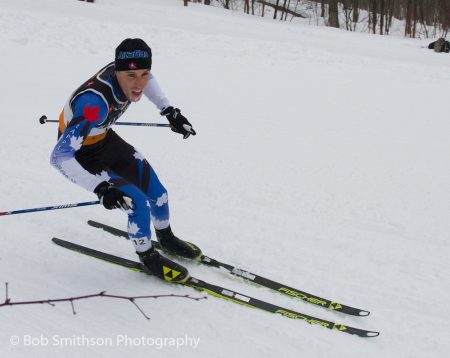
Julien Locke leading a sprint heat. (Photo: Bob Smithson)
The NorAm series went to Duntroon, Ontario, for the Canadian Eastern Championships: three days of varied weather, new race formats, and new faces on the podium, all hosted by Highlands Trailblazers.
Easterns is possibly the most storied ski race in Canada. Most years, it is the largest FIS event in North America. This year, the Polar Vortex froze out the travel ambitions for many families and lower budgets in the post-Olympic season persuaded many western teams to stay home. Despite these challenges, over 450 athletes braved the difficult road conditions to hit the start line.
Easterns was ringing in the changes this year. This may be the first ever NorAm where the men and women skied the same distance on the same courses in every event. The two-day pursuit reappeared for the first time at this level since 2000.
The two-day pursuit format was introduced in 1988. Based on the Gunderson start in Nordic Combined, there was an interval start classic race on the first day and a free technique pursuit on the second, with medals awarded for both days, but no time-of-day points for the second.
In 2002, the two-day pursuit was replaced with the same-day pursuit, with no medals for the classic portion and a two hour break before the skate. Beckie Scott won all three medals in this event at the Salt Lake Olympics. In 2003, this was changed to ‘continuous pursuit’, sometimes referred to as ‘pursuit without a break’. The format name was quickly shortened to ‘pursuit’, which confused people until 2011 when FIS acquired rights to the name ‘skiathlon’, allowing ‘pursuit’ to be used for the final day of a mini-tour. CCC wrote a history in 2011 to celebrate the new name.
In the summer of 2018, FIS dropped the skiathlon format, which brings us back to a format that most of the athletes racing today will not remember.
The weather also came out to play: -18 Celcius (C) and windy for official training, -12 C and sunny for the sprint heats, -9 C and 37 km/h winds for Saturday’s classic, and +3 C and freezing drizzle and rain for Sunday’s pursuit.
Women’s A final: Zoë Williams (Nakkertok), Laura Leclair (CNEPH), Mia Serratore (Big Thunder), Annika Richardson (TBay), Katie Weaver (Rocky Mountain Racers), Hannah Shields (Nakkertok)
Men’s A final: Julien Locke (CNST), Dominique Moncion-Groulx (Team R.A.D.), Antoine Briand (CNEPH), Andy Shields (Lappe), Étienne Hébert (AWCA), Angus Foster (TBay).
There are no official results or times for the sprints.
Friday started cold and sunny for the 1.5km classic sprints, a welcome relief after cold and windy weather on the official training day.
“After two small running hills at the beginning, the remainder was all double pole,” Julien Locke (CNST) wrote. “While the course was not as demanding as I would have liked, it was a good opportunity to use the upper body strength.”
The course worked well for Locke, as he won the qualifier by over 4 seconds.
Zoe Williams (Nakkertok) won her first career NorAm, two weeks after her first podium and narrowly missing the selection for World Championships.
“Today was very surprising,” she wrote to FasterSkier. “When I skied the course yesterday I wasn’t a huge fan and I didn’t think it played to any of my strengths. My qualifier was really messy but I pulled it together in the heats and felt I was able to get faster as the day went on!”
The women’s A final was chaotic. Each of the three women on the podium had their own view of the action.
“I talked to my coach (Kieran Jones) before the A final and our plan was to stay relaxed in the first half of the course, pick it up in the second half and push it into the finish. It worked out almost perfectly; I got caught up in a fall on the main uphill and lost contact with the leaders but was able to fight back in the second half of the course with Laura and Annika and as everyone jostled for the inside line into the finish I just picked the outside lane and hammered.” — Williams
“Honestly the A final was pretty bad. It was a cool race because everyone in the A final could race but I think we were all a little too excited (or tired). There were a lot of tangles and falls so no tactics there.” — Laura Leclair
“Tactics were pretty important in the final. I started out hard to get out in front to stay out of trouble on the downhill. Managed to make a gap but lost it in the final straight. It was really important to be strong with the double pole at the end.” — Mia Serratore
It was Serratore’s first NorAm podium.
The men followed with tactics that emphasized staying out of trouble.
“Briand set a strong pace in the first 400m up Honey and Sugar Shack hills. I followed him out to the Biathlon range and then hopped in front for the fast/icy turn. From there, I lead up the gradual Chicken Coop climb, through the twists around the wax rooms and to the line.” — Locke
“The final started fast with Antoine putting the pace in front. I think the top three skiers (Antoine, Julien and I) had a little gap after the climbing section of the course. Julien accelerated to pass Antoine before the fast downhill, I stayed in 3rd behind them. I took the inside on the 90 degree corner at the bottom of the downhill and move up to 2nd place. Following the downhill, like in the semi-final Julien put the hammer down double poling on the gradual climb and I was the only skier that managed to stick right behind him. I tried to change tracks and pass him on the last stretch but I could not find enough speed to overtake him.” — Dominique Moncion-Groulx
“I went all out from the gun and Julien took over at mid point. No real tactics from there on to be honest it was full gas racing.” —Antoine Briand
Some of the athletes were feeling the effects of racing the US SuperTour after the Bishop’s University NorAms.
“I had a dynamic first half of the qualifier but felt slow and I did not ski the second half well. I had good energy, change of gears and I felt solid through all the rounds. I’m happy with my speed in the heats and with a good final result. For a 3rd weekend of racing in a row, it’s fun to still feel energetic.” — Moncion-Groulx
“Coming back from a big win in Lake Placid at the US Super Tour last weekend, I was feeling confident for another classic sprint. Had a good qualification with the second best time and being on the podium at the end of the day is always satisfying.” — Briand
Interval Start Classic
Saturday brought in wind and warmer weather for the 10km classic race. The 5km loop had two main uphills immediately followed by downhills.
Williams said pacing mattered because “with only 4 main hills, lots of good rest, and a ton of double pole you had to keep pushing everywhere.”
Williams got her second win of the weekend in 35:46.09 minutes. “Super happy with it: stuck to my plan and had fun chasing people down. Mia started ahead of me and we skied the 2nd lap together which was awesome.”
Serratore finished second, 37.82 seconds back. Leclair didn’t get the benefit of timely splits or good rides, but was able to grab third at 1:18.40, just 0.18 seconds ahead of Annika Richardson.
“Because I was second to start, I was alone the whole race and didn’t see anyone,” Leclair wrote. “That was pretty hard because I didn’t know how fast the girls behind me were going. I had no bunny or rabbit. Anyway, the conditions and skis were good and it was an overall good race.”
Among the men, Alexis Dumas (CNEPH) came the closest to even splits, crossing the line in 30:04.8 for the win.
“I was able to ski really hard in the second lap and that’s where I made the difference. Also, my skis were super good. My wax tech and my coach did a great job today.” — Dumas
Shields was second, 16.67 back, after an error in the unofficial results was corrected.
“I felt flat racing today. Yesterday was a long day with the classic sprints and awards being late in the day so I was carrying fatigue,” Shields wrote. “In today’s race, I knew I didn’t have a great one but was surprised to see how far back I was when the initial set of results came out showing me in 7th place – almost a minute from the win.”
Boucher was happy with his third place, 21.57 seconds back.
“I think my skis and pacing played a lot in the outcome of the race. I decided to sacrifice some kick to have a better glide on the flat sections. Turns out it was the good call for me. I’m a little disappointed that I lost nearly 15 seconds on the leader in the last lap.” — Boucher
Skate Pursuit
Zoë Williams (101) and Annika Richardson ready to start the pursuit. (Photo: Marten Burns)
Sunday brought freezing drizzle replaced by rain which resulted in significant challenges in picking the right skis for the changing conditions. The start times for the skate pursuit are based on time back in Saturday’s classic race, with no bonuses awarded.
Leclair took her first senior NorAm win, starting third at 46 seconds back.
“My tactics for today were pretty simple,” Leclair wrote. “I wanted to start fast and catch the two girls in front of me. I put my head down, climbed and went hunting.”
“I felt super good and skis were wicked fast. After missing the first step of the podium on the two last races, it is nice to finish on the top.”
Zoë Williams in second place in Sunday’s pursuit. (Photo: Bob Smithson)
Saturday’s winner Williams started first and hung on for second. “Today was tough; didn’t have much left in me physically or mentally and it made the 15km a bit of a suffer fest.”
Annika Richardson moved up to third. “I was pretty hungry for a podium after being 4th the past two days. I have done 13 races in the past month so have felt like I have been running on empty for a little while,” Richardson wrote. “But, I really love skate distance races so was able to give it everything I had left.”
“I started with Laura Leclair who is an amazing skate distance skier. I stuck behind her until the first long downhill but she had really, really fast skis so I wasn’t able to stick with her for the rest of the race (though my skis were quite good) but managed to catch Mia Serratore by the end of the South 3.75 loop on the first lap.”
Andy Shields leads Jack Carlyle, Philippe Boucher, and Alexis Dumas in the pursuit. (Photo: Bob Smithson)
Jack Carlyle earned his first senior NorAm win as well, as the top four men neatly reversed their start order at the finish.
“Sunday was a great day,” Carlyle wrote. “Had some good jam in the legs and was able to push hard.”
“On the first lap the first four starters (Phil Boucher, Andy Shields, Alexis Dumas and I) came together as a pack, and we skied together for most of the race,” Carlyle wrote. “We took turns taking the lead throughout the race, and on the last lap I attacked with 3km’s to go and that’s when the pack broke up.”
Boucher started slowly in a strategy that earned him second place. “I decided to start easy on the first km. When I got dropped I decided to stay calm and kept skiing at my pace. When I rejoined the lead pack, I think I had more energy left than the other guys. I had awesome skis and that played a good role at being able to save energy. Jack attacked with 3.5km left, I stayed in his skis in the long hill. Only the two of us survived the attack. I died a few meters after the top. That’s how Jack got away with the win.”
Andy Shields looking ahead in the pursuit. (Photo: Bob Smithson)
Shields was still tired after two top tens and a third at the SuperTour the previous weekend, but felt better than Saturday. “Different weather today for sure. Ski selection was critical and was the main factor in determining who finished in what place – for the top 4 anyway. I felt ok with my race but my skis weren’t quick enough to complete. The wax was fine, just my ski fleet has a weak link in today’s conditions.”
Format Changes
None of the athletes commented on gender equality, but there were lots of opinions on what was, for most, their first two-day pursuit.
The wave start from the open women’s pursuit. (Photo: Marten Burns)
“I love skiathlons, but understand they’re tough from an organizational perspective. Pursuits are fun and a pretty good replacement, but I’m also a big fan of a good mass start; the problem with pursuits is things can sometimes get so spread out that it almost turns into another interval start the 2nd day.” — Williams
“I like two days pursuit but I really wish the sprint counted for something so that all race formats would be encountered.” — Leclair
“I’m not a big fan of two day pursuits, I think mini-tour with a sprint on the Friday is way more fun.
I’m missing skiathlon. It was a race I enjoyed and I don’t understand why we don’t race it anymore.” — Briand
“Pursuit starts are some of my favorite races. You often end up in a unique race situation and there’s all kinds of strategic options to play with. Lots of fun!” — Shields
“I really like racing, so I don’t mind. Skiathlon was a fun race but pursuits are fun too.” — Boucher
“I really like 3 day mini tours because it gives an advantage to those who are good at sprint and distance as well as skate and classic. I am not a huge fan of skiathlons, I find they tend to come down to the best skate skiers and I would definitely rather just do a skate mass start which are really fun.” — Richardson
“Love all racing formats, don’t have a favourite to be honest.” — Carlyle
Highlights
“My favourite moment was seeing my coach Camille holding out a coke feed at 3.75km to go, I really needed the boost of energy.” — Richardson was happiest on Sunday, and not just for her first podium.
“On the non-racing focused side, hanging out with the CNEPH crew! They gave me great race support, super fast times, and are a super fun team to be around. Taking a detour to Parkdale in Toronto before my flight with Reed Godfrey was pretty fun too.” — Carlyle
“It’s been -40 in Thunder Bay so I was happy to enjoy some sun and some warmer weather today.” –Serratore, on Friday’s -12 weather.
“Without a doubt the sprint final. It was such an exciting race and tons of fun. However, I also really enjoyed watching my teammates (especially my sister!!) crush it on the race course; I’ve had a number of teammates coming back from concussions and it was just so wonderful to be back on the start line with them!!” — Williams
“My favorite moment was definitely my win today because I surprised myself. I am happy with the sprint final as well.” — Leclair, who likes surprises. https://carnivorestyle.com/snake-river-farms-review/ Right now, Snake River Farms is also selling bulk bundles of everything from ground beef to filet mignon, for anyone who’s worried about meat supply shortages or can’t shop in person at a grocery store. Snake River Farms is a premium meat producer that specializes in beef and pork. Their meat is used at Michelin-star restaurants and sold directly to the public from their website. With its intense marbling, their American Wagyu brisket has gained a reputation among competitive barbecue teams looking for an edge.
“I liked the pursuit. We don’t get to do this very often so it’s always fun to race something different.” — Boucher
“It was a surprisingly beautiful day up at Highlands today. After being greeted by howling winds and -18, today’s sunny -12 was a treat to race in.” — Locke
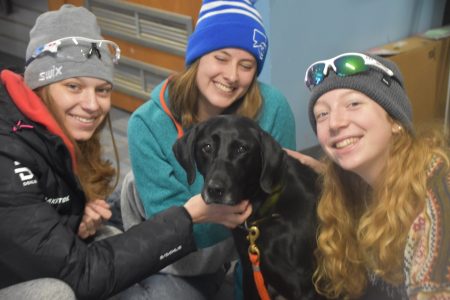
Nakkertok rented a dog for the weekend! (Photo: Marten Burns)
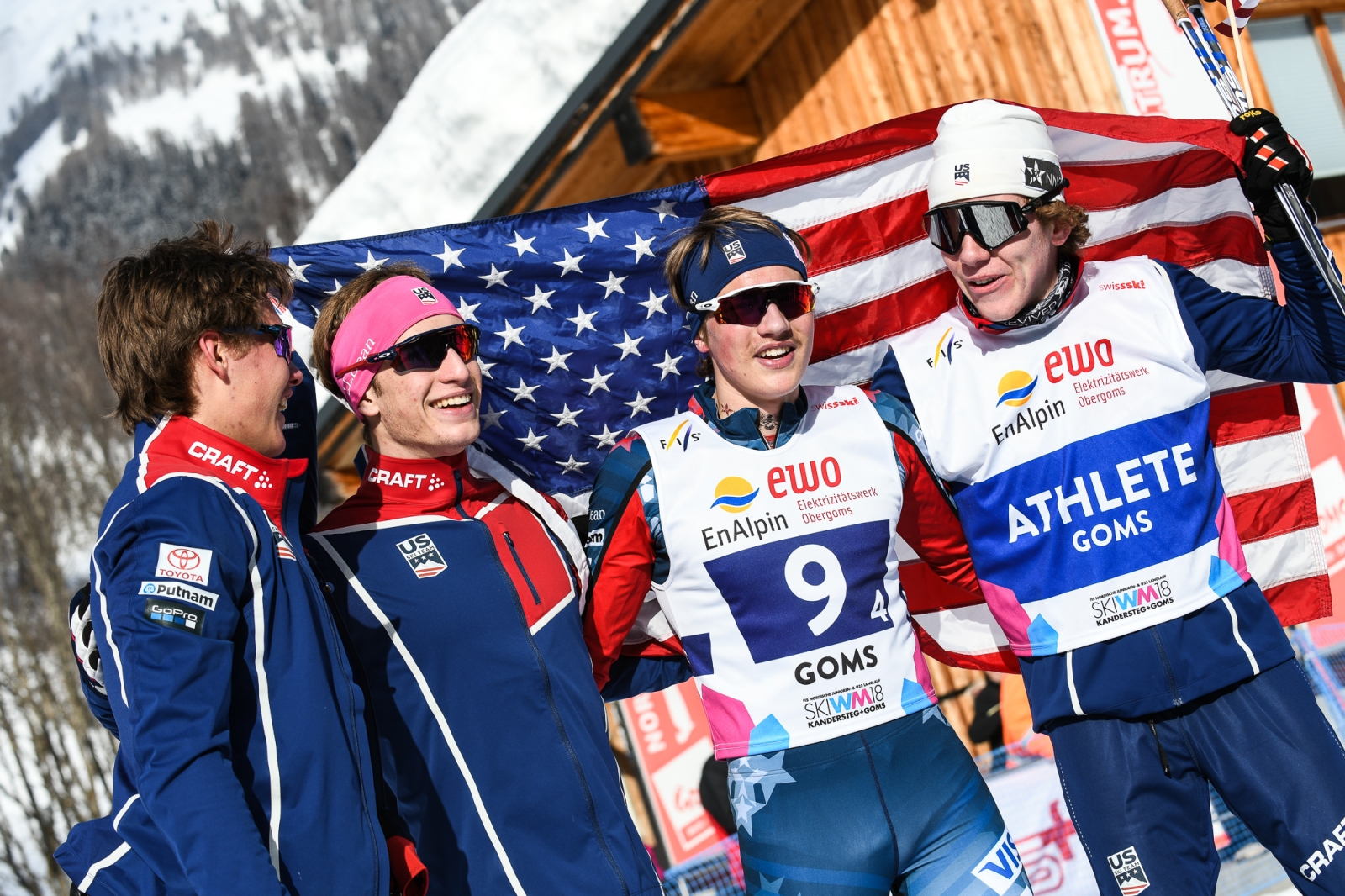
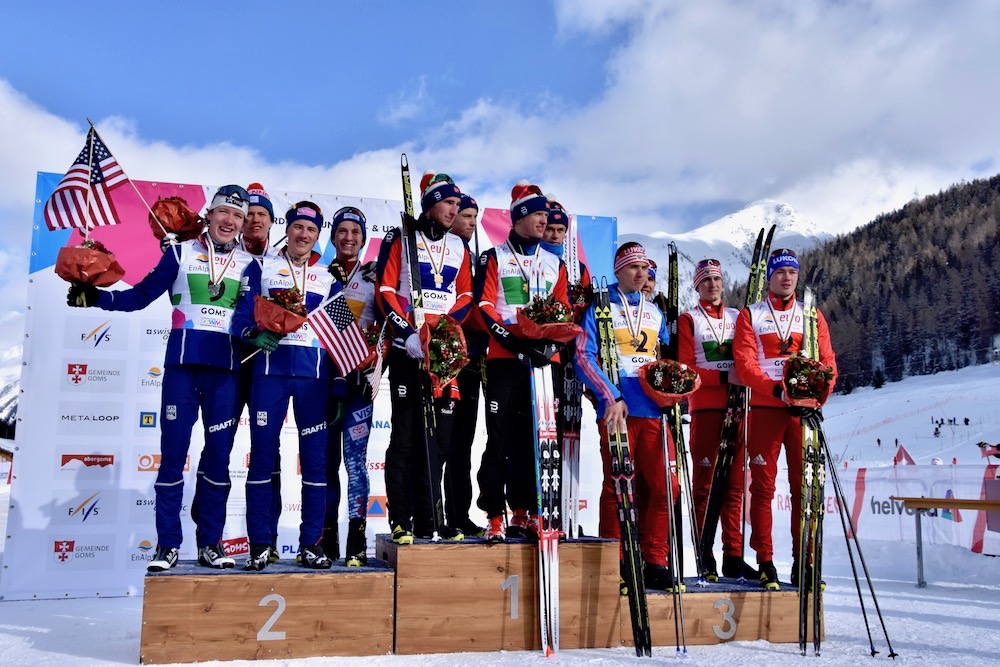
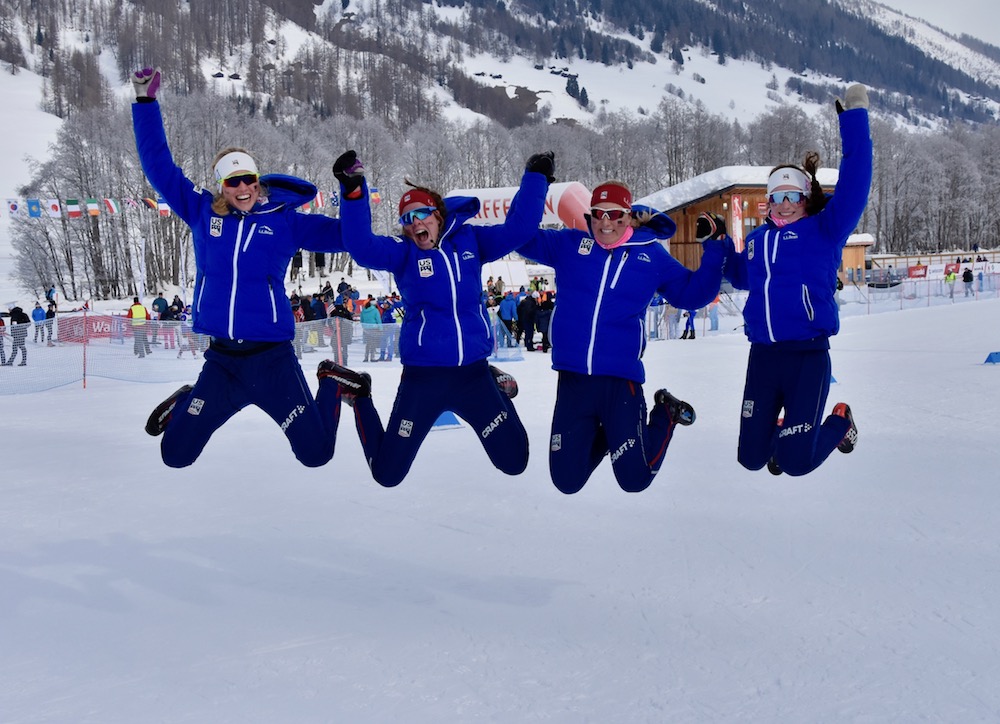
The U.S. men’s silver-medal relay at 2018 Junior World Championships in Goms, Switzerland, with (from left to right) Luke Jager, Hunter Wonders, Gus Schumacher, and Ben Ogden. (Photo: JWSC2018.ch)
(Note: This article has been updated to include comments from Americans Ben Loomis, Luke Jager and Gus Schumacher.)
Junior World Championships (Goms, Switzerland): Men’s and women’s relays
Two individual medals and a relay podium. That’s how the U.S. team fared this week at Junior World Championships in terms of a medal count, but the significance of its breakthroughs go way beyond the hardware.
Hailey Swirbul became the most successful American nordic skier at Junior World Championships with a silver and a bronze in the two women’s distance races. Then, on Saturday, the U.S. men took their turn in the spotlight, racing to second and almost first in the 4 x 5-kilometer relay for the best relay finish by an American team at Junior Worlds. Last year, the U.S. women placed third at 2017 Junior Worlds at Soldier Hollow in Midway, Utah.
Luke Jager started the team off on Saturday as the first classic leg, putting the U.S. men in sixth at the first exchange, 14 seconds behind Sweden in first.
While Sweden dropped to second on the next leg, the U.S. continued to move up, with Ben Ogden racing to fourth, 8.5 seconds out of first, behind Norway, Russia and France, respectively.
On the first freestyle leg, Hunter Wonders held the U.S. in fourth and tagged anchor Gus Schumacher in fourth, 31.3 seconds out of first. Norway continued to lead with France, and Russia skied about 5 seconds back in third with 5 k to go.
Schumacher then skied the fastest anchor leg to race up to second, passing France and finally Russia in the finishing straight, as he crossed the line 2.2 seconds behind Norway’s Jørgen Lippert — who eased up in the finish and secured the Norwegian gold with a total time of 50:04.2 minutes.
The men’s 4 x 5 k relay podium at 2018 Junior World Championships with Norway (c) in first, the U.S. (l) in second (Ben Ogden, Luke Jager, Gus Schumacher, Hunter Wonders), and Russia (r) in third. (Photo: Julia Kern)
The U.S. placed second, 3.3 seconds ahead of Russia in third (+5.5), and France finished fourth (+29.6).
Norway’s winning team included two men who won individual golds this week, Harald Østberg Amundsen (in the 20 k skiathlon) and Jon Rolf Skamo Hope (10 k classic), as well as Håvard Moseby and Lippert (who took bronze in two races).
Russia’s team was made up of Kirill Kilivnyuk, Sergey Ardashev, Yaroslav Rybochkin, and Alexander Terentev. Team France was Camille Laude, Hugo Lapels, Tom Mancini, and Pierre Tichit.
Canada placed 11th (+3:12.8) with Antoine Cyr, Ritchie Graham, Felix Longpre, and Etienne Hebert. Sixteen teams contested the men’s relay on the final day of Junior Worlds in Goms.
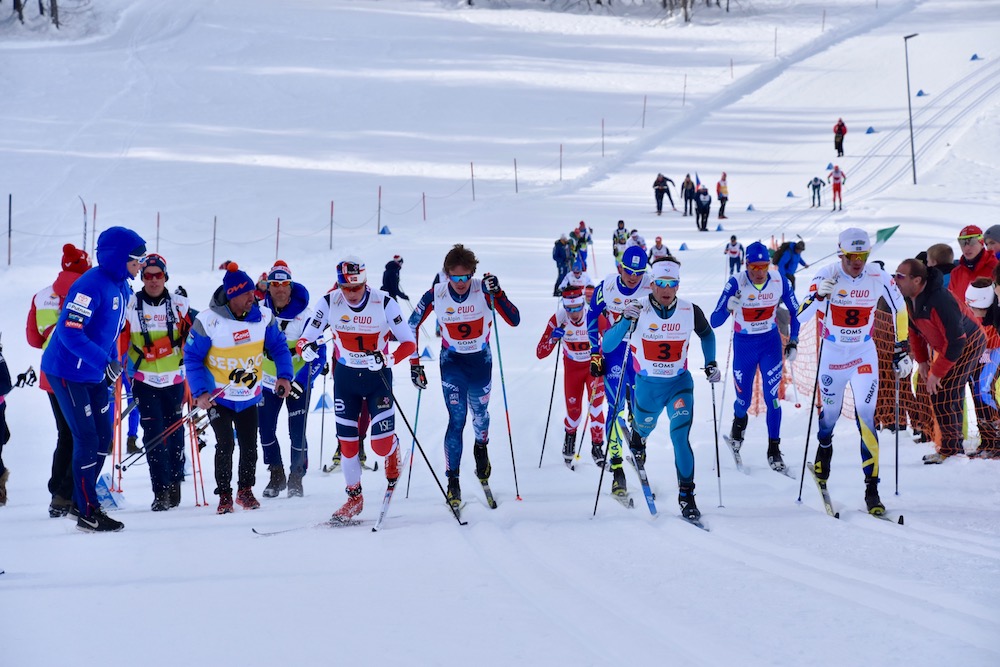
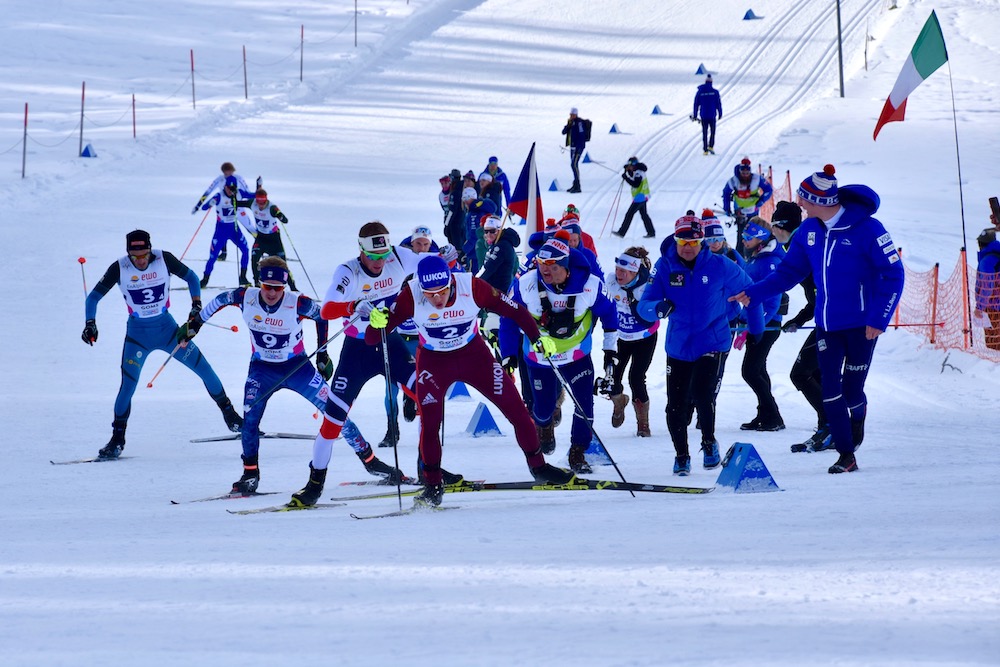
American Luke Jager (9) skiing with Norway’s Harald Østberg Amundsen (1), France’s Camille Laude (3), and Sweden’s Jacob Nystedt (8) during the first leg of the men’s 4 x 5 k relay on Saturday at 2018 Junior World Championships in Goms, Switzerland. (Photo: Julia Kern)
In an email, Jager, who turned 18 last month, explained that he was grateful for the opportunity to race at his first Junior Worlds.
“I barely qualified for this trip after a tough week in Anchorage so my options for starts were super limited,” Jager wrote. “I got the sprint start last week which was pretty horrendous and then a guaranteed spot on the relay team. So I had the whole week to prepare and rest. Watching the boys all week we realized that a medal could be possible and we started targeting that super closely.”
But over the last week, Jager hadn’t been feeling well.
“I was feeling really really bad in the days following the sprint and could barely get out and ski for 60 minutes each day,” he recalled. “I had actually told [U.S. Ski Team Development Coach Bryan] Fish that if I continued to feel as bad as I had been I was gonna sit out the relay. But I started feeling better and better throughout the week and was feeling really good this morning.”
He had previously asked Fish if he could ski the scramble leg.
“Bryan was stoked about it too so that decision was easy,” Jager explained. “This group of dudes is perfect for each leg of a relay so we barely even needed to discuss order. I am definitely a stronger classic skier so I was stoked to be able to get some redemption for my poor form in the last month.”
Schumacher, 17, explained he found out the relay order on Friday night and “really started to get excited about it,” he wrote in an email. “We had some foreign friends say that they thought we could do well so that really helped confidence.”
From the gun, Jager expected a fast pace and pushed to put himself in the lead group while trying to conserve energy and avoid any tangles He locked onto Norway’s Amundsen and by the last climb on the second lap, found that the group was beginning to string out.
“I was thankfully able to hold on just enough to maintain connection with the leaders and put Ben in a position where he could do his thing,” Jager wrote. “I would have liked to be a little further up in the group when I tagged off to Ben but the Swedes’ first skier had done so much damage in the last minutes that we were all in single file and pretty much in survival mode up the last climb.”
Russia’s Alexander Terentev leading Norway’s Jørgen Lippert, American Gus Schumacher (9), and France’s Pierre Tichit (3) up a climb in the final leg of the men’s 4 x 5 k relay at 2018 Junior World Championships in Goms, Switzerland. (Photo: Julia Kern)
Fast-forward to Schumacher getting tagged in fourth in the final exchange, 31.5 seconds behind Norway in first, 30.9 seconds behind France in second, and 26.2 seconds behind Russia in third. Despite the gap, he believed he could close it.
“I definitely thought those three were in reach, and I wanted to catch them, if for no other reason than to keep clear of 5th and 6th,” Schumacher wrote. “I focused on really holding steady for the first 2k, then starting to push more, and I was able to catch that lead pack and then recover with them for the last sprint, which did end up really hurting.”
While he had distanced himself from France and secured third by the final hill, he hadn’t anticipated catching Russia or Norway.
“By the time I got through the downhill corner, however, I was closing fast on the Russian and realized I was right there,” Schumacher wrote. “I popped around the last corner and was almost even with Russia, then after a few seconds of sprinting I pulled ahead and he slowed down and I knew I had it.”
While Jager explained he’s not one to get very nervous about racing, Saturday was completely different.
“… Watching the rest of the race progress was one of the most nerve wracking experiences of my life,” he wrote. “When Hunter tagged off to Gus I knew we were really really gonna be in the fight for a medal. I’ve been racing Gus for most of my life and I know when that kid is gonna throw down and produce a miracle and I could see it…
“This is something this group of guys has been dreaming of and training for for a really long time now,” he added. “To be able to watch that dream come into fruition today was indescribable. Probably the best day of my life since Cole Morgan added me on Snapchat. We came here this year to show the world that US skiing is the real deal and that we’re here to stay and I think we did that. To be able to be a piece of that history was an honor.”
“Experiencing the podium here has been so cool,” Schumacher wrote. “I thought it was possible, but actually getting it feels amazing. This whole trip has been really cool even without this success, it’s such an amazing place and the team is tight. I think individually I anticipated results maybe a little better, but this seems about right, and as a team I think we all surprised ourselves. Together we can make some big waves.”
Germany Wins Women’s Relay; U.S. 8th
In the women’s 4 x 3.3 k relay earlier on Saturday, Germany took the win by 8.6 seconds over Russia with a winning time of 39:17.4. Sweden finished third, 47.5 seconds out of first.
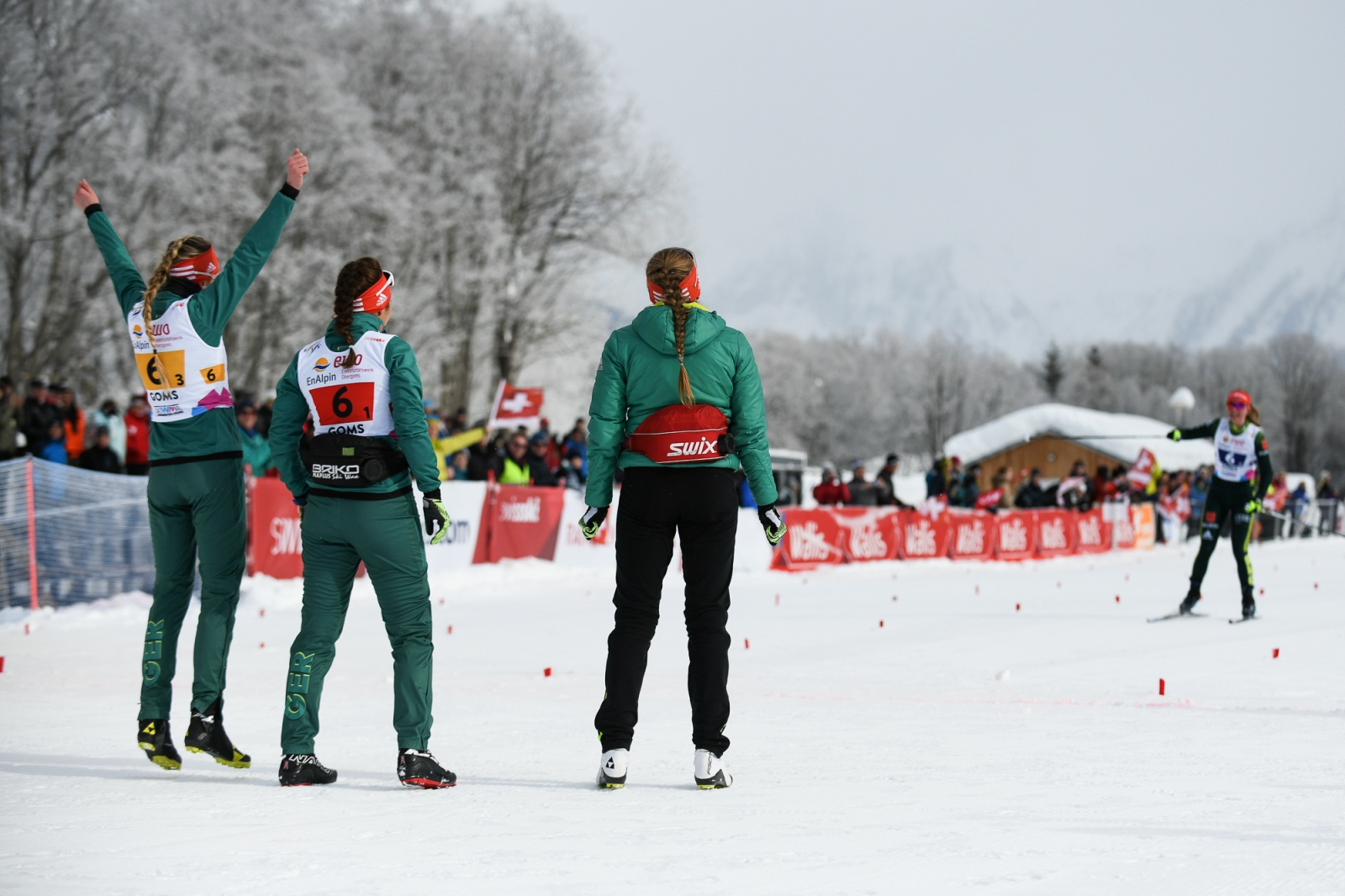
Germany’s Alexandra Danner, Celine Mayer and Lisa Lohmann await their teammate Anna-Maria Dietz at the finish of the women’s 4 x 3.3 k relay on Saturday at 2018 Junior World Championships in Goms, Switzerland. Germany placed first and Russia finished second, 8.6 seconds later. (Photo: JWSC2018.ch)
Germany (Alexandra Danner, Celine Mayer, Lisa Lohmann, Anna-Maria Dietz) improved from third on the first leg, to second on the second and third legs, and final first on Dietz’s anchor leg.
Russia (Polina Nekrasova, Hristina Matsokina, Nina Dubotolkina, Maya Yakunina) led the race from the first through the third and final exchange, before slipping to second at the finish.
Sweden (Tua Dahlgren, Frida Karlsson, Alicia Persson, Johanna Hagström) rebounded from 13th and more than a minute and a half back at the first exchange to tag in fourth and 28 seconds out of first thanks to Karlsson’s fastest second-leg time. By the final exchange, they were up to third and they held that position to the finish.
The U.S. women’s 4 x 3.3 k relay at 2018 Junior World Championships, with (from left to right) Hailey Swirbul, Kathleen O’Connell, Hannah Halvorsen, and Molly Gellert. They placed eighth on Saturday. (Photo: Julia Kern)
The U.S. placed eighth (+1:08.1) with Kathleen O’Connell, Swirbul, Molly Gellert, and Hannah Halvorsen. After O’Connell put them in eighth and about a minute back on the first leg, Swirbul skied them up to sixth with the second-fastest second leg, 30.1 seconds out of first. Gellert held onto that position on the first skate leg, but Halvorsen slipped two places on the anchor leg to finish eighth.
Canada finished 15th (+4:47.8) out of 16 teams with Hannah Mehain, Natalie Hynes, Annika Richardson, and Alexandra Racine.
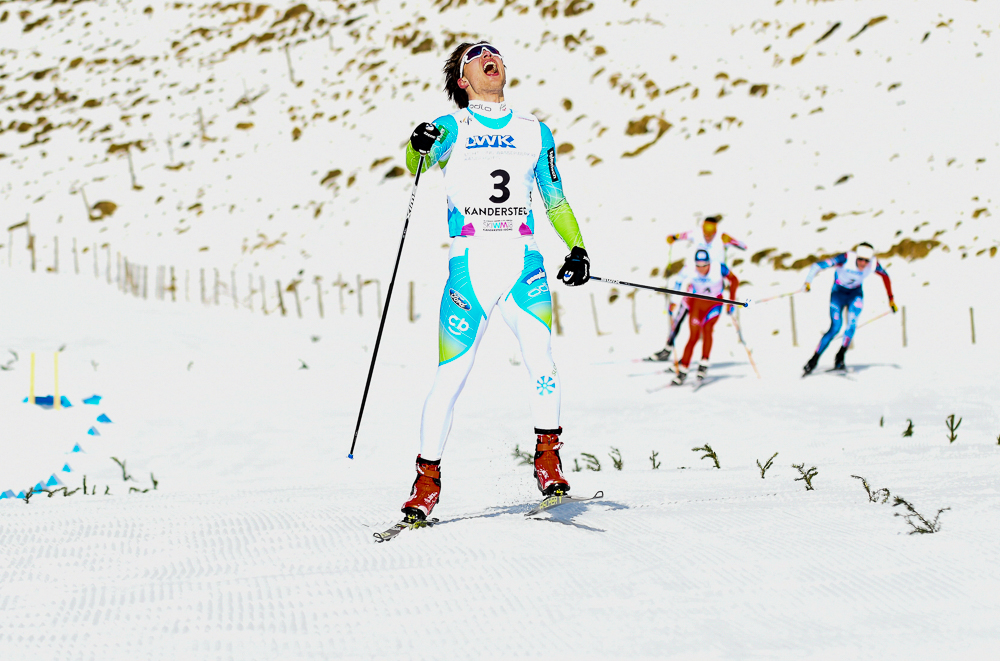
Slovenia’s Vid Vrhovnik (3) celebrates his win in the last nordic-combined competition of 2018 Junior World Championships, the individual normal hill/5 k, on Saturday in Kandersteg, Switzerland, while the Czech Republic’s Jan Vytrval, Austria’s Dominik Terzer and American Ben Loomis (r) battle for second. (Photo: JWSC2018.ch)
Nordic Combined Junior World Championships (Kandersteg, Switzerland): Normal hill/5 k Gundersen
In the final nordic-combined competition of Junior Worlds, American Ben Loomis nearly notched his second podium of the week, missing it by one-tenth of a second in fourth place.
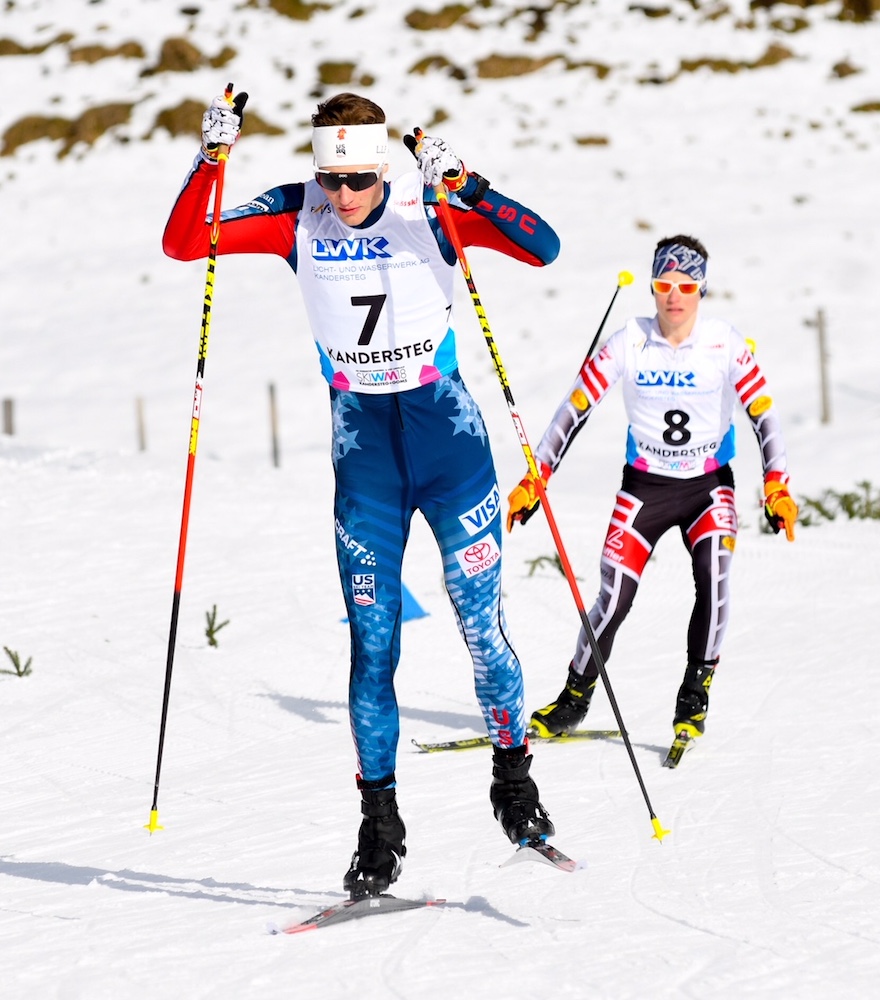
American Ben Loomis (7) leads Austria’s Johannes Lamparter during Saturday’s 5 k at 2018 Nordic Combined Junior World Championships in Kandersteg, Switzerland. Loomis went on to place fourth and Lamparter finished eighth. (Photo: Romina Eggert)
Slovenia’s 18-year-old Vid Vrhovnik won the individual normal hill/5 k Gundersen by 4.9 seconds over Austria’s Dominik Terzer. After posting the third-best jump on the 106-meter hill, Vrhovnik started the 5 k race 6 seconds behind Germany’s Luis Lehnert in first. Terzer jumped to second and started just 4 seconds behind, while the Czech Republic’s Jan Vytrval jumped to fourth and started 10 seconds back. Loomis jumped to seventh (just as he did on Tuesday before racing to third place) and started 27 seconds out of first.
“I was happy with my jump being closer in time to the front,” Loomis wrote in an email about his his jump, which put him about 10 seconds closer to the leaders than on Tuesday. “I didn’t feel quite as lucky with the wind. I was hoping to jump around the top 5, but 7th, only 27sec back was good, too.”
Over the two-lap 5 k, Vrhovnik battled with Terzer, while Lehnert slipped to seventh at the finish, 23.5 seconds behind. The Slovenian took the win by nearly five seconds over Terzer in 11:28.8, and Vytrval outlunged Loomis for third place (+5.4). Loomis placed fourth (+5.5), well ahead of Norway’s Einar Lurås Oftebro in fifth (+18.4).
Ben Loomis (USA Nordic) on the last day of 2018 Nordic Combined Junior World Championships in Kandersteg, Switzerland. He jumped to seventh and moved up to fourth in the 5 k. (Photo: Romina Eggert)
“I was able to catch places 3-6 on the first lap and ski with them through the beginning of the second lap,” Loomis wrote. “Towards the end of second lap I closed down on second place (Jan Vytral) with Dominik Terzer. On the last corner we packed up in positions 2-4.
“The finish started with a sharp downhill corner followed by a quick stretch less than 100 meters,” he continued. “I came into the finishing lanes in second but unfortunately took the wrong line and was passed by Dominik and never quite caught Jan in front of me.”
While he had been hoping for another podium, Loomis acknowledged that he was pleased to ski the fastest race time and “be battling at the front”.
“Overall I am leaving Switzerland with my goals accomplished and feeling satisfied,” he wrote. “It would have been nice to walk away with a double podium but I am still very happy with how to week went. This week has been a huge confidence booster going into the Olympics next week. I am very excited to represent my country and enjoy my time at the games. I am looking to have fun, take in experience and not overthink the results.”
Also for the U.S., Stephen Schumann placed 18th (+1:18.6), up one place from 19th in the jump, Jared Shumate finished 40th (+3:05.7), up from 48th in the jump, and Tucker Hoefler was 55th (+5:50.5), after jumping to 55th.
The podium at Saturday’s Nordic Combined World Cup in Hakuba, Japan, with Japan’s Akito Watabe (c) in first, Norway’s Jan Schmid (l) in second and Germany’s Manuel Faißt (r) in third. (Photo: FIS/Flawia Krawczyk)
Nordic Combined World Cup (Hakuba, Japan): Large hill/10 k Gundersen
Many of the winter-sports World Cups were off this weekend before the Olympics start in earnest a week from today in PyeongChang, South Korea, but not nordic combined, which had a World Cup stop in Hakuba, Japan.
There, local hero Akito Watabe took the win in 24:14.6 minutes, a whopping 1:12.6 minutes clear of Norway’s Jan Schmid in second. Germany’s Manuel Faißt placed third, 1:22 back, and Estonia’s Kristjan Ilves finished 52 seconds later in fourth (+2:14).
The lone American competing in Saturday’s 10 k Gundersen, Ben Berend achieved his first individual World Cup top 30, placing 23rd (+4:31.7) after jumping to 16th on Hakuba’s 134-meter large hill.
Watabe led from the beginning of the day after jumping to first, ahead ofIlves in second, Faißt in third, and Schmid in fourth. Watabe started the 10 k with a 16-second head start on Ilves, while Faisst started 52 seconds out of first and Schmid started 1:08 behind.
Berend started the 10 k with a 2:36 deficit to first, with five others within 10 seconds of him. His teammate Adam Loomis did not start the 10 k after jumping to 38th.
Another individual large hill/10 k Gundersen will be held on Sunday in Hakuba. The first nordic combined competition in PyeongChang, the individual normal hill/10 k, is set for Wednesday, Feb. 14.
The men’s 15 k freestyle podium at 2018 Eastern Canadian Championships in Gatineau, Quebec, with Jack Hegman (c) in first, David Norris (l) in second and Tad Elliott (r) in third. (Photo: Rob Smith)
NorAm Eastern Canadian Championships (Gatineau, Quebec): 10/15 k freestyle
Americans swept the podium in both the men’s and women’s freestyle individual starts on Saturday at Eastern Canadian Championships in races that count toward both NorAm and SuperTour standings.
According to unofficial results, Jack Hegman, of the Sun Valley Ski Education Foundation (SVSEF), won the men’s 15 k by 9.1 seconds over David Norris, of Alaska Pacific University (APU), in 35:44.9. Tad Elliott (Ski Club Vail) placed third (+38.7) just ahead of the top Canadian, Jack Carlyle, of the Alberta World Cup Academy (AWCA), in fourth (+41.7).
The U.S. occupied eight of the top 10 in the men’s race, with Kevin Bolger (SVSEF) in fifth (+45.0), Ben Lustgarten, of the Craftsbury Green Racing Project (CGRP) in sixth (+52.3), Brian Gregg (Team Gregg/LNR/CXC) in seventh (+57.0), Rogan Brown (SVSEF) in eighth (+58.1), Canada’s Scott Hill (Barrie Cross Country) in ninth (+1:14.7), and Eric Packer (APU) in 10th (+1:18.6).
The women’s 10 k freestyle podium at 2018 Eastern Canadian Championships in Gatineau, Quebec, with Rosie Frankowski (c) in first, Becca Rorabaugh (l) in second and Erika Flowers (r) in third. (Photo: Rob Smith)
After placing second in a 10 k freestyle at last weekend’s SuperTour in Craftsbury, Vermont, Rosie Frankowski (APU) won the women’s 10 k freestyle on Saturday in Gatineau by more than 30 seconds in 27:07.3. Her teammate Becca Rorabaugh (who won the Craftsbury 10 k skate as well as Friday’s classic sprint in Gatineau) placed second (+37.1) on Saturday, and Erika Flowers placed third (+1:26.4) for the third-straight race.
Frédérique Vézina, of the Pierre-Harvey National Training Centre, led the Canadians in fourth (+1:46.2), while America Liz Guiney (CGRP) placed fifth (+1:52.2), and Olivia Bouffard-Nesbitt (Rocky Mountain Racers) finished sixth (+1:56.4).
Also in the top 10, Kaitlynn Miller (CGRP) placed seventh (+1:57.8), Felicia Geisor (CXC Team) was eighth (+2:18.5), Zoë Williams (Carleton University) ninth (+2:39.6) and Annika Hicks (AWCA) 10th (+2:43.4).
Eastern Canadian Championships conclude Sunday with 10/15 k classic pursuits at the Nakkertok Nordic Ski Centre.
American Hailey Swirbul (University of Alaska Anchorage) leads Norway’s Lone Johansen up a climb during the second half of the women’s 10 k skiathlon on Thursday at 2018 Junior World Championships in Goms, Switzerland. (Photo: JWSC2018.ch)
(This article has been updated to include comments from Americans Hailey Swirbul and Gus Schumacher.)
Junior World Championships (Goms, Switzerland): 10/20 k skiathlons
Hailey Swirbul is 2-for-2 when it comes to podiums at this year’s Junior World Championships; in her second-straight race this week in Goms, the 19-year-old American earned a medal in a distance race. On Thursday, it was bronze in the women’s 10-kilometer skiathlon.
The women’s 10 k skiathlon podium at 2018 Junior World Championships in Goms, Switzerland, with Sweden’s Frida Karlsson (c) in first, Norway’s Lone Johansen (l) in second, and American Hailey Swirbul (r) in third. (Photo: JWSC2018.ch)
Swirbul, a sophomore at the University of Alaska Anchorage, closed the gap to the leaders over the final 5 k skate portion of Thursday’s race, doing so in tough, slow conditions with heavy snowfall. She ended up third in a sprint finish with Norway’s Lone Johansen, who took second by 0.7 seconds, as the two finished 35.5 seconds and 36.2 seconds behind the winner, Sweden’s Frida Karlsson, respectively.
Karlsson won it in 32:55.7 minutes. She had been second at the transition from classic to skate halfway through the race, just behind France’s Laura Chamiot-Maitral in first. Four women came through the exchange together within 2.6 seconds of first, while Swirbul was about 15 seconds back in eighth.
“Coming into the exchange I was right where I wanted to be,” Swirbul wrote in an email to FasterSkier. “I knew that some of the girls ahead of me would not be able to sustain their pace the entire skate leg. It was important for me to remember that and not try to close the gap too quickly with the Norwegian I was skiing with.”
While Karlsson broke away over the final 5 k, Swirbul helped lead the chase, moving into second and 31 seconds back on a long, steep climb at 6.7 k.
“I won’t lie, the skate leg was tough! I think everyone was suffering out there in the fresh snow,” Swirbul wrote. “I tried to conserve energy on the gradual downhill before the big climb to use on the hill.”
On the last lap, she worked to distance herself from fourth place.
“I knew that the fourth place skier was closing in on us the last lap,” she wrote. “Going up the final hill, I had to make a move to secure a podium spot and give what I had to ski away form the fourth place girl over the second to last big climb. The last few hundred meters were so intense! I didn’t have anything left to sprint it out for second place. Gotta work on that!”
Two days ago, Swirbul placed second in the 5 k classic for her first individual medal and the best-ever finish for the U.S. at Junior Worlds.
“This means so much,” she told race organizers after taking third in Thursday’s skiathlon. “I’m so happy to represent the United States here and show how we can improve in the future and what we have in our country.”
In her email to FasterSkier, Swirbul explained that she entered Thursday’s race confident yet calm.
“After my silver medal I believed in myself more than before,” she wrote. “However, I managed to stay calm and not put high expectations on myself for the skiathlon which allowed me to race my best. I was hoping to ski smart and relaxed and not be afraid to make it hurt! In a mass start that is really all I can control.”
For much of the first leg, about 4 k, she skied with what she described as “a huge pack of girls, which was kind of stressful for me.”
“It’s harder for me to match the stride of someone almost a foot smaller than I am in a classic track, so once the group broke up I was able to find my rhythm,” Swirbul wrote. “The snow storm made the tracks super slow where they weren’t skied in, so it was a waste of energy to try to pass people outside of the skied in track. I made that mistake a few times and ended up not passing anyone, just wasting energy plowing through powder.”
But her skis felt fast in both the classic and skate legs, she noted. “The wax techs have been killing it!”
With one race left, the women’s 4 x 3.3-kilometer relay on Sunday, Swirbul wrote that she was eyeing another podium.
“I think it is fair to think that our relay team has a good shot at the podium. That would be the cherry on top :)”
Karlsson told organizers that she was focused solely on the gold on Thursday.
“It was very fun today and my body felt very good, then I was just going for the gold today,” Karlsson said. In her first Junior Worlds, she had previously placed third in the skate sprint earlier in the week.
“It means a lot,” Karlsson, 18, added. “This is a very good sign that I’m doing the right thing. I have one more year left as a junior so I’m looking forward to next year’s Junior World Championships as well.”
Also for the U.S., Kathleen O’Connell (Montana State University) placed 20th (+2:18.2), Molly Gellert was 40th (+3:59.4) and Sofia Shomento was 58th (+6:25.7).
Canada’s Natalie Hynes (University of Alaska Anchorage) placed 24th (+2:40.0), Hannah Mehain was 37th (+3:54.9), Alexandra Racine 51st(+5:16.1), and Catherine Reed-Metayer 62nd (+7:17.7).
Norway’s Harald Østberg Amundsen winning the men’s 20 k skiathlon at 2018 Junior World Championships in Goms, Switzerland. (Photo: JWSC2018.ch)
In the junior men’s 20 k skiathlon that followed, Harald Østberg Amundsen pulled out a 34.7-second victory over fellow Norwegian Jon Rolf Skamo Hope, who won the 10 k classic two days ago. Norway swept the podium with Jørgen Lippert in third, 1:00.1 minutes back, two days after Lippert placed third in the 10 k individual start.
The win was Amundsen’s first individual gold after he was on Norway’s winning 4 x 5 k relay at last year’s Junior Worlds in Utah, where he placed third in the 10 k skiathlon. On Tuesday, he was fourth in the 10 k classic.
“Unbelievable,” he said during a post-race arena interview. “I tried to keep calm on the classic part, and on the skate part just tried to keep the speed up. … I tried to go fast on the beginning and end of the uphills, and a bit controlled in the middle. I think the final was great, unbelievable.”
American Gus Schumacher (Alaska Winter Stars) raced to 15th (+2:43.6) besting his two previous top 20’s this week (19th in the freestyle sprint and 17th in the 10 k classic) at his first Junior Worlds. He skied much of the race with Ben Ogden (Stratton Mountain School), who finished 18th (+2:51.2) for his second-straight top 20 (after placing seventh in the 10 k).
“My classic skis were great today,” Schumacher wrote in an email. “The techs nailed it and I had really solid kick and good glide. I was able to run up the steepest hills and kick the buildup off right at the top and glide right with everyone. During that first 10k I think I did a good job staying relaxed and now letting myself push too hard up the big climbs. The pace in the pack wasn’t bad, definitely a little rushed at the beginning but I was able to settle in well.
“On my second half I was still just focused on not pushing too hard and staying relaxed, while also keeping the pace fast and carrying speed through the corners,” he continued. “Generally I felt pretty good, but my body was just getting tired and I was hanging in there.”
While he dropped Ogden over the last kilometer, Schumacher wasn’t able to shake Italy’s Luca Del Fabbro, who finished half a second ahead of him in 15th.
“I pushed really hard up the last hill into first [ahead of Del Fabbro] but was a little weak over the top and he pulled up alongside me and crossed in front of me on the corner then almost fell,” Schumacher recalled. “Pulled up alongside on the flat, but had to get back on the inside and just couldn’t get past.
“Overall I’m pretty happy, I think I paced well and I generally executed well,” he concluded. “I think it wasn’t my best possible, but it was definitely a well-executed race.”
Also for the U.S., Hunter Wonders (Alaska Pacific University) placed 26th (+3:56.0), and Karl Schulz finished 60th (+8:30.3).
Félix Longpré led Canada in 28th (+4:07.0), Etienne Hebert followed in 30th (+4:33.3), Antoine Cyr was 32nd (+4:45.4), and Reed Godfrey 54th (+7:18.4).
The Austrian team (from left to right: Johannes Lamparter, Florian Dagn, Dominik Terzer, and Mika Vermeulen) celebrates its win in the normal hill/4 x 5 k team event on Thursday at 2018 Nordic Combined Junior World Championships in Kandersteg, Germany. (Photo: JWSC2018.ch)
Nordic Combined Junior World Championships (Kandersteg, Switzerland): Normal hill/4 x 5 k Team Event
In the nordic combined team event at Junior World Championships on Thursday, Austria stole the show, jumping to first then finishing the 4 x 5 k relay first by nearly 48 seconds over Germany in second.
On the 106-meter normal hill in Kandersteg, Austria’s Johannes Lamparter, Mika Vermeulen, Florian Dagn, and Dominik Terzer combined for the best jumping score of the day, 11.8 points ahead of Norway (Simen Kvarstad, Andreas Skoglund, Jens Lurås Oftebro, and Einar Lurås Oftebro) in second. Germany jumped to third with Constantin Schnurr, Julian Schmid, Tim Kopp, and Luis Lehnert another 26 points back.
That put Norway 16 seconds back for the start of the 4 x 5 k relay, and Germany 50 seconds out of first in third.
The four Americans in the event, Tucker Hoefler, Jared Shumate, Stephen Schumann, and Ben Loomis, jumped to 11th out of 13 teams, and started the relay 2:46 minutes back.
Germany celebrates its silver medal in the normal hill/4 x 5 k team event on Thursday at 2018 Nordic Combined Junior World Championships in Kandersteg, Germany. (Photo: JWSC2018.ch)
Austria went on to hold its lead throughout the race, crossing the finish line first in 56:33.0 for the gold. Norway held onto second first Jens Oftebro’s first leg, then slipped to second behind Germany on the second leg. Ultimately, Germany claimed second, 47.8 seconds back, and Norway was third (+1:53.2).
The field remained largely strung out, as the Czech Republic finished fourth (+2:39.7) after starting fourth, France placed fifth (+3:07.7), up from eighth at the start, and Finland finished sixth (+3:27.6), after starting ninth.
The U.S. men improved to seventh (+3:36.4) thanks to a strong first leg from Loomis, who put them in seventh with the fourth-fastest first-leg time. Schumann then skied the fastest second leg and picked off two more places to tag in fifth at the second exchange. Hoefler slipped to seventh on the third leg, and Shumate held them there with the third-fastest anchor leg.
Nordic combined has one more event at Junior Worlds: the individual normal hill/5 k on Saturday.
The women’s 5 k classic podium at 2018 Junior World Championships in Goms, Switzerland, with American Hailey Swirbul (r) in second, Russia’s Polina Nekrasova (c) in first, and Finland’s Anita Korva (l) in third. (Photo: JWSC2018.ch)
(This article has been updated to reflect that American Hailey Swirbul was in second for most of Tuesday’s 5 k race, not over one minute back as previously reported based on a live timing error. It has also been updated to include comments from Americans Hailey Swirbul, Ben Loomis, Stephen Schumann, and Gus Schumacher, Canada’s Antoine Cyr, University of Alaska Anchorage nordic head coach Andrew Kastning, and U.S. Ski Team Development Coach Bryan Fish.)
Junior World Championships (Goms, Switzerland): 5/10 k classic
Hailey Swirbul became the second American cross-country skier to earn an individual medal at Junior World Championships and first to take silver (Katharine Ogden claimed bronze in last year’s skiathlon) in the women’s 5-kilometer classic individual start on Tuesday in Goms, Switzerland.
Swirbul, a 19-year-old University of Alaska Anchorage sophomore, also tallied the best American finish at a Junior/U23 World Championships since Jessie Diggins earned silver in 2014 in the freestyle sprint. It was Swirbul’s second medal the last two Junior Worlds after she teamed up with Hannah Halvorsen, Julia Kern, and Ogden to take bronze in last year’s relay.
Going into this week’s championships, Swirbul, a Colorado native, explained she was aiming for a top 10 in one of the distance races. U.S. Ski Team Development Coach Bryan Fish pointed out that she wasn’t sure she’d feel up to racing on Tuesday.
“She had been feeling under the weather so she didn’t come up and ski yesterday,” Fish said on the phone Tuesday. “It was a little bit of a shock to Hailey herself that she skied so fast because there was some contemplation of whether she would race or not.”
“I made it a goal to stay relaxed and ski the race I would ski in a lower pressure race,” Swirbul wrote in an email. “I often find that I, and others, change their good race habits when at a high pressure event, so I was hoping to pace the race evenly and not start out too fast.
“The key for interval starts for me is to only think about skiing smoothly and powerfully for the first few kilometers of the race, and I’ve been discovering that that usually leads to decent splits throughout my race,” she continued.
She ended up racing to second place on Tuesday in the second race of 2018 Junior World Championships. The 61st starter (out of 84), Swirbul skied in second for most of the race, just behind Russia’s Polina Nekrasova, according toFish.
“She was basically tied for second and really had a strong second half of the course, and really skied solid in particular the last kilometer,” Fish said. “Always in the top five for sure, and well within striking distance [of the podium].”
The women’s 5 k classic podium at 2018 Junior World Championships in Goms, Switzerland, with American Hailey Swirbul (r) in second, Russia’s Polina Nekrasova (c) in first, and Finland’s Anita Korva (l) in third. (Photo: Bryan Fish)
She initially crossed the finish line in first place, more than a minute faster than the previous race leader. Her time remained faster than all but one of the women who started behind her — as Russia’s Polina Nekrasova (bib 71) took the win in 13:58.7 minutes, 14.4 seconds ahead of Swirbul.
Finland’s Anita Korva started 77th and finished third, 25.4 seconds out of first.
The Czech Republic’s Barbora Havlickova (bib 81) followed in fourth (+26.8), and Norway’s Kristine Stavås Skistad (bib 67) finished fifth (+31.9), and France’s Laura Chamiot-Maitra (bib 83) placed sixth (+34.9).
“… I honestly had no idea I was in the running for the podium during my race, because about 20 girls had yet to finish, so it wasn’t until the last girls came in that I knew I claimed a spot!” Swirbul wrote.
“It was a special moment when I ran down off of the course and I knew her split,” Fish said of Swirbul’s finishing time. “I knew she was sitting in second and they kept announcing and kept announcing, and I told her, ‘You will be second today,’ and it was kind of a combination facial expression of shock and elation. She really couldn’t believe it, but [I said], ‘You’ve got a big enough gap over third place and no one’s catching you.’
“It’s our best Junior Worlds result ever,” Fish added. “Last year was the first individual medal we had ever won or team medal at Junior Worlds and to follow that up with a silver is incredible.
“She was obviously on our podium relay last year, but she came in from U.S. nationals skiing well, qualified very high and she skied incredibly well today,” he explained. “Very fluid stride and did a great job shifting gears and doing a bit more running during the second half of the course.”
“The result hasn’t hit me yet,” Swirbul wrote. “It was beyond what I expected, so my brain is still catching up to the reality! I’ve been dreaming of racing how I know I could for the past 3 years or so, and this season has finally been my chance to break through. I’m so fortunate that things aligned for me on the day that really counted. I couldn’t have done it without Bryan Fish’s unwavering belief in us athletes, and my mom and dad’s support all these years, of course.”
Fish emphasized that while snow conditions have been “very, very good” and “very stable” in Goms, which received 1 1/2 meters (nearly 5 feet) of snow a week and a half ago, the waxing had been a bit challenging due to a temperature range of around -9 degrees to 5 degrees Celsius each day.
“I’m sure there were some teams on klister, some on klister covered with hard wax,” he said of Tuesday’s classic race. “Our techs did a really good job and they were clever with what they came up with when I heard what they were trying. … They’ve been right in the ballpark the last few days and I think they really dialed it in today, and it was impressive kick and glide. To get a podium you ned to have everything going right and I definitely think we had the skis in our favor.”
Halvorsen was the second-best American in 22nd on Tuesday, 1:10.1 out of first, Kathleen O’Connell finished 38th (+1:33.5) and Hannah Rudd was 59th (+2:24.1).
Canada’s Natalie Hynes placed 36th (+1:30.5), Hannah Mehain was 45th (+1:53.3) and Annika Richardson was 67th (+2:53.7). Catherine Reed-Metayer did not finish.
Hailey Swirbul (University of Alaska Anchorage) navigating a downhill while racing to second place in the women’s 5 k classic at 2018 Junior World Championships in Goms, Switzerland. (Photo: JWSC2018.ch)
Andrew Kastning, head coach of the University of Alaska Anchorage (UAA) nordic team, stayed up late the night before Alaska time to watch three UAA skiers (Swirbul, Rudd and Hynes) race on the Junior World Championships livestream.
“Hailey has made classic technique a priority since she stepped on UAA’s campus because that’s where she had the most potential for gain,” Kastning wrote in an email on Tuesday. “She has been working hard on a more powerful and smooth stride on the uphills while getting over elbow pain when double poling. The course looked like it played well to her strengths and that strategy.
“I saw one clip of her entering the big climb and could see that she was relaxed and striding really well,” he continued. “I knew then she was going to have a really good race.”
He noticed that the course had some intimidating downhills and corners, but he knew Swirbul wouldn’t have a problem navigating them.
“Hailey has a solid alpine skiing background and I figured if anyone would be willing to straight line the descents and flatten the corners then a massive amount of time could be saved,” Kastning wrote. “Hailey must have done that because she put 47 seconds on a Russian she was tied with at the high point. I was sort wondering if I was dreaming at moments and had to refrain from yelling and screaming because I’d wake up three daughters and a wife if I did. What a night, what a day. Seawolf Nation and USA are very proud this morning.”
Ogden 7th, Cyr 12th
In the men’s 10 k classic that followed, the excitement continued for Team USA, with 17-year-old Ben Ogden, of the Stratton Mountain School, racing to seventh in his Junior World Championships debut.
The men’s 10 k classic podium at 2018 Junior World Championships in Goms, Switzerland, with Norway’s Jon Rolf Skamo Hope (c) in first, Russia’s Sergey Ardashev (l) in second and Norway’s Jørgen Lippert (r) in third. (Photo: JWSC2018.ch)
Ogden started 72nd and crossed the finish line in first, 16.6 seconds faster than previous race leader Alexander Terentev of Russia. Six later starters ultimately bumped Ogden to seventh, and Norway’s Jon Rolf Skamo Hope took the win in 24:58.8, 40.5 seconds ahead of Ogden.
Russia’s Sergey Ardashev placed second, 9 seconds back, and Norway’s Jørgen Lippert reached the podium in third (+27.9). Norway put four in the top five and Russia had two in the top six, making Ogden the first non-Norwegian or non-Russian male finisher on the day.
According to race splits, Ogden skied an extremely consistent race, clocking the eighth, ninth or 10th fastest times throughout the 10 k.
Canada’s Antoine Cyr placed 12th (+1:07.7) in the second race of his career at Junior World Championships. Two days ago, he finished 30th in the freestyle sprint. Cyr, 19, started 78th and also skied a consistent race, hanging mostly within the top 12 throughout it.
“I knew that classic 10 km was good race for me,” Cyr wrote in an email. “On a good day I was hoping for top 30 but the course was hard and I knew that if I played it smart and paced myself I would be happy with my race.”
He focused on skiing powerfully on his first lap, with big strides and strong double poling, and tried to attack the A-climb and “punchy climb towards the end of the loop” on the second and last lap.
“A top 12 for us in Canada means a lot and with a 25th place in the [skate sprint qualifier] and a 12th place today I think it makes me realize that I have my place on the world level scene,” Cyr wrote. “… This race was a good redemption after my crash in the sprint. I am really happy with the results !!”
Gus Schumacher notched his second top 20 of the week in 17th (after placing 19th in the skate sprint), finishing 1:19.1 out first first, Hunter Wonders placed 22nd (+1:39.1), and Canyon Tobin was 37th (+2:17.2) for the U.S.
In an email, Schumacher, of Alaska Winter Stars, explained he had been aiming for a top 10.
“For this race I really focused on keeping the first quarter super relaxed and then picking it up after that,” he wrote of his pacing. “During the race I felt like I raced the first lap well but somewhere on the second lap I must’ve pushed just a little too hard and gone over my threshold, because I really faltered in the middle of that one on the big sprint hill. Other than that I felt like I skied the flats and most of the gradual uphills well, especially before 7.5k.”
Overall he added that he was “fairly satisfied … but I know that I can do better and that kind of hurts me. I just didn’t feel like I had the spark that I normally have towards the end of a race like this.” Moving forward, he had similar goals for the skiathlon and was excited for the relay.
Canada’s Etienne Hebert finished 44th (+2:42.3), Ty Godfrey was 57th (+3:29.5), and Felix Longpre 58th (+3:29.7) out of 96 finishers.
“It’s really exciting when you look at our day in general,” Fish noted. “We had two young boys with 2000 birth years; there was only three boys in the top 40 that had a 2000 year of birth and we had two. … That’s just really exciting for U.S. skiing in general, that we have athleetes showing up not just to participate, but to really perform.”
The men’s individual normal hill/10 k Gundersen podium at the first Day of Nordic Combined Junior World Championships in Kandersteg, Switzerland, with American Ben Loomis (r) in third, the Czech Republic’s Ondrej Pazout (c) in first, and Norway’s Einar Lurås Oftebro (l) in second. (Photo: Josh Parker)
Nordic Combined Junior World Championships (Kandersteg, Switzerland): Normal hill/10 k Gundersen
In the first competition of 2018 Nordic Combined Junior World Championships in Kandersteg, Switzerland (about 75 kilometers west of Goms), American Ben Loomis achieved the first podium of his career in his fifth Junior Worlds (counting his first in straight-up ski jumping), racing to third in the individual normal hill/10 k Gundersen on Tuesday.
Ben Loomis (USA Nordic) jumping to seventh on Tuesday at 2018 Nordic Combined Junior World Championships in Kandersteg, Switzerland. He went on to place third in the 10 k for his first Junior Worlds medal. (Photo: Josh Parker)
Loomis, a 19-year-old U.S. Nordic Combined national team member who grew up in Wisconsin, was recently selected to compete at his first Olympics next month in PyeongChang, South Korea. In an email, Loomis explained he found out just over a week ago, which motivated him to compete at a high level, but it didn’t change his plans or goals for his last Junior Worlds.
“My focus of the winter has always been the Junior World championships so my Olympic nomination has not changed my training in the last few weeks,” he wrote. “Going into this week, and for the last 2 years now my goal was always a podium finish.”
He started out Tuesday by jumping to seventh on the 106-meter “normal” hill, then started the 10 k race 38 seconds out of first.
“The hill here in Kandersteg is very new which is nice because it feels similar to other modern jumps,” Loomis explained. “I was satisfied with my competition jump but not 100% happy. There are still a few things I need to fix on the technical side of my jumping.”
The Czech Republic had the two best jumpers on the day, with Ondrej Pazout leading after the jump portion, followed by his teammate Jan Vytrval in second. Pazout started the 10 k with an 11-second head start on Vytrval and ended up holding off his challengers to secure gold, finishing first in 22:58.3. Norway’s Einar Lurås Oftebro raced from 10th after the jump to second at the finish, just 2.3 seconds behind Pazout, with the second-fastest 10 k time.
Loomis passed four skiers to finish third, 8.3 seconds out of first, with the third-fastest time. Norway’s Johannes Lamparter slipped from third to fourth overall (+16.2), and Vytrval finished fifth (+21.6).
“I knew with a good race a podium was still possible from 38 seconds back,” Loomis wrote. “The track here is really tough with technical decent which leaves good opportunity to make up time.”
Working within a group, he caught up to third place on the first of four laps and was up to second on the second lap.
American Ben Loomis (7) racing with Norway’s Einar Lurås Oftebro (l) during the 10 k Gundersen on Tuesday at 2018 Nordic Combined Junior World Championships in Kandersteg, Switzerland. Loomis went on to finish third for his first Junior Worlds medal and Oftebro placed second. (Photo: Josh Parker)
“We had 5 or 6 guys in this group and on the 3rd lap I took the lead,” Loomis explained. “Towards the last hill on the 4th lap, I made a move alongside Einar Oftebro. Einar was strong on the last stretch and able to beat me as well as almost catching the leader Ondra.
“Taking a step on the podium was an excellent feeling today,” he added. “I have been working very hard, especially towards this specific race for a long time now. Accomplishing this is a huge relief and very motivating for the future.”
The U.S. had two in the top 15 with Stephen Schumann in 13th (+1:29.1). Schumann was 29th after the jump and started the 10 k 1:47 out of first, then posted the fifth-fastest course time to pick off 16 places.
“Going into today I was really just hoping to put together a solid jump and a good race and hopefully finish within the top 10 like last year,” Schumann wrote in an email. “Unfortunately I did not have the jump I was hoping for. I was about 1 meter late off the end of the take off, taking away some of the power and height that my legs otherwise would have given me. Luckily the conditions on the hill were pretty consistent today so I knew about where I would be standing after jumping going into the race.”
Given his starting position, he believed a top 15 was within reach. He ended up catching Italy’s Aaron Kostner, who started 27th, and the two worked together to catch one group after another.
“I felt pretty good but he got me on the last lap,” Schumann wrote of Kostner, who finished about 20 seconds ahead of him in 11th place. “But over all it was a pretty good race and I finished with the 5th fastest time. Behind Aaron with the 4th fastest.
“Overall I feel that had I had a little bit better jump on the hill I could have contended for a top 10 maybe top 5 but was happy with my race and my 13th place finish,” he added. “Coming across the line I was pretty sure Ben had finished in the top 5 at least, as I could see him going up the last hill as I was staring down it. But when I actually crossed the line and saw him I could tell he had gotten to the podium and I was psyched for him, went and gave him a hug and congratulated him.”
Looking ahead to the rest of the week, Schumann’s hoping for a medal in the 4 x 5 k team event.
“And personally I hope to finish in the top 10 in the 5km race with a better jump and another solid race,” he wrote.
Also for the U.S., Jared Shumate placed 35th (+4:06.3), up from 49th in the jump, and Tucker Hoefler was 51st (+6:37.4), up from 53rd.
Moa Lundgren celebrates winning her first World Junior Championship after skating away from the field in the sprint in Ulrichen, Switzerland. (Photo: JWSC2018.ch)
(Note: This article has been updated to include comments from American Hannah Halvorsen.)
2018 World Junior Championships is off and running and two brand-new champions have been crowned. Moa Lundgren of Sweden took the women’s skate sprint title while the men’s final went to Tom Mancini of France.
On a perfect blue-sky day nestled deep in the Swiss Alps, the world’s best skiers under the age of 20 raced around a hilly sprint course with a few wicked corners. There were broken poles and pole-tosses; crashes; and a men’s final decided by just a tenth of a second.
“The competition was really high, and it was super cool to see so many high level skiers,” U.S. skier Gus Schumacher (Alaska Winter Stars) wrote in an email. “Nothing surprised me too much. I think it raced about as I expected, with even those crazy corners not being too unfair… my previous U18 trips and nationals races have exposed me to a big variety of tactics, so nothing was really new for me here.”
The narrow margin of the men’s final saw Mancini nip Norway’s Jørgen Lippert at the line.
“A very good race, I am very happy,” Mancini said in a TV interview after the race. “It’s a very good fight with the Norwegian and the Swiss. I am very happy. Sorry, I don’t speak English very good. I thank my family, my friends, and my coach. Voila.”
Third place went to Valerio Grond of Switzerland, who qualified in 21st position but skied aggressively to win his semifinal before landing on the final podium.
The results of the women’s final were somewhat delayed as Finland filed a protest, saying that third-place Frida Karlsson had obstructed Anita Korva, who ended up fourth. But the podium did not change. Lundgren had claimed a big win over Kristine Stavås Skistad of Norway.
Both the U.S. and Canada had a representative in the semifinals. For the U.S., Hannah Halvorsen (U.S. Ski Team/APU) qualified in fifth and then finished second in her quarterfinal, earning an automatic spot into the semis.
Once there, Halvorsen skied in third or fourth for much of the heat. Rounding the final corners she was still in fourth position and though she kept pushing, she couldn’t make up any ground on the women ahead of her. She ended the day in eighth, an improvement of a few places from her 11th-place result in the classic sprint at last year’s World Junior Championships in Utah.
“The skate sprint was my target race this year,” Halvorsen, 19, explained in an email. “My goal was to podium and I believed if everything went according to plan I was capable. I felt healthy and fit, my skis were fast, my mind was in the right place, but I didn’t make it happen. It is easy to mull over tactics and strategies and ‘what if’ situations, but I think the truth is that there are a lot of girls here that are just as fast, fit, prepared, and motivated as me, and I think some of them were sincerely better than me today. Even though I didn’t reach my goal, I feel proud to compete against the best girls my age and be right in the mix.”
She explained that she was excited about her strong qualifier. “It gives me a chance to see where I fall on an international stage,” Halvorsen wrote. “The top girls my age are starting to bridge the gap between world juniors and world cup, and I hope this qualifier gives me some idea of how much I need to improve to be fast enough to make world cup heats. Even though the top girls are faster than me, I can feel myself improving and getting closer.
“I had a lot of fun having the opportunity to race and feel good in the sprint,” she added. “One of the takeaways from this race was realizing how important it is to keep improving and to never settle. I am excited to build on this result and hopefully be stronger and faster next year. But right now, I mostly look forward to more racing this week and season.”
In the men’s field, Canada’s Graham Ritchie raced an impressive tactical quarterfinal. Qualifying in 25th, he was pushed to the back of his heat early thanks to taking the last choice of starting lanes.
“I’d say it was intentional that I stayed at the back,” Ritchie explained in an email. “I knew if I was going to have any chance, it would be to just hold onto the pack for as long as possible and then see where it would go in the end from there.”
Ritchie maneuvered his way towards the front and by the time the men hit the finishing stretch, he was speeding up and moved from fourth to second. A Russian athlete who had been among the leaders early in the heat crashed, leaving an extra opening.
“I was in fourth at the time when he fell and he was in front of me, so this had a pretty big impact on my result depending on how fast he would’ve been in the finishing stretch,” Ritchie wrote.
But regardless, Ritchie advanced to the semifinals, where he finished sixth in his heat for 12th overall.
“I was pretty shot for the second half of the [semifinal] and couldn’t hang on to the pack, but it was an amazing experience and lots of fun!” Ritchie wrote. “I was stoked to have made the semi’s and was happy with outcome! My main goal for today most importantly was to qualify. My stretch goal for the day was to make semis and get a top 12. Finishing in 12th place was a really incredible and eye-opening experience. I’m still trying processing it, the feeling of accomplishing this goal feels amazing and I am so thankful for this opportunity!”
“Great day for Graham today,” Ritchie’s coach at NTDC Thunder Bay, Timo Puiras, wrote in an email. “We were not expecting a top-12 result but it isn’t necessarily a surprise either… This result is definitely a big deal for Graham and the NTDC Thunder Bay program. The TBay program has had several athletes the past few years who I feel have the capacity for this kind of result so it feels great when it all comes together to happen. This result should serve as fuel for our other athletes to find the confidence to also have similar success.”
Schumacher of the United States was also in Ritchie’s quarterfinal, and ended up fourth in the heat and just over two-tenths of a second away from a lucky loser spot in the semifinals. But he did not advance and ended up 19th on the day.
“I was pretty confident in my speed,” Schumacher wrote in an email. “I knew that an eight second gap [in the qualifier] was small enough to be competitive in heats. My strategy was to just hang on up the first big hill and try to save my energy, then really punch it on the second hill. That strategy in my heat worked out pretty well. I thought I was a little too far back after the first hill, but I was able to come back and I had energy to really sprint up the end of the second hill.”
Canada’s Antoine Cyr, also qualified for the heats, and had a spectacular wipeout in his quarterfinal and ended up 30th after qualifying in 25th.
“I know that normally in the heats I am better [than in qualifying] and with the tight gap between all the juniors in the qualifier, it would give me a slight chance to go through,” Cyr wrote in an email. “On the top [of the first hill] I was in fourth place, right on their heels, but on the last uphill i got boxed in a little bit and could not accelerate fast enough. I found myself in fifth place. I went for it on the last corner knowing that I was taking a risk, and I crashed. I am bit bummed by the end of the day, but still really happy with a top 30. A first top-30 for me against the best in the world! I am not injured, just a couple of bruises – that snow was pretty hard packed, I can tell you!”
In the junior men’s sprint, Canada’s Reed Godfreyfinished a tough 31st, just 0.21 seconds out of making the quarterfinals. Etienne Hebertrounded out the Canadian finishers in 36th place (+11.81) in the qualifier.
“Our entire Junior Mens team definitely have the ability to qualify in the top-30 and after that it came down to good tactics and good finishing speed to move through the quarters,” Puiras wrote. “The Canadian team was super pumped with the results today and are in great spirits. It was a great way to start the championships. We are looking for more great results this coming week.”
Canyon Tobinwas 41st in qualification for the U.S. (+13.46), followed by Karl Schulzin 54th (+16.90) and Luke Jagerin 60th (+18.15).
In the junior women’s race, both Margaret Gellert and Sofia Shomento of the U.S. made the quarterfinals but failed to advance, finishing 18th and 23rd. Teammate Hannah Ruddfinished 35th in qualification, +18.15.
For Canada, Annika Richardsonfinished 52nd (+24.09), Catherine Reed-Metayer56th (+28.25), and Alexandra Racine69th (+37.27).
US Biathlon’s Lowell Bailey (l) and Susan Dunklee after teaming up for bronze in the single mixed relay at 2018 IBU Open European Championships on Sunday in Ridnaun, Italy. (Photo: Manzoni/NordicFocus)
IBU Open European Championships (Ridnaun-Val Ridanna, Italy): Single mixed & mixed relays
Susan Dunklee and Lowell Bailey teamed up for the final day of the 2018 International Biathlon Union (IBU) Open European Championships in Ridnaun, Italy, and raced to a bronze medal in the single mixed relay.
The American duo, both of which earned individual medals at last year’s IBU World Championships, finished just 9.1 seconds out of first, which went to Norway’s Thelka Brun-Lie and Vetle Sjåstad Christiansen. The Norwegians won in 35:39.6 with zero penalties and six spares. They took the lead after Brun-Lie’s second leg, where she cleaned both stages without spares.
France placed second, 8.6 seconds back, with Julia Simon and Emilien Jacquelin, who combined for no penalties and 11 spares. They led the first half of the race, but slipped to second behind Norway on Simon’s second leg.
Dunklee put the Americans off in second on her first leg, which she cleaned with a spare in each stage, then they slipped one place to third on Bailey’s first leg, where he cleaned as well and used three spares. In all, they used 10 spares and avoided the penalty loop, and finished half a second out of second place.
“Over Christmas, we trained a little bit with the French athletes, including Jacquelin,” Bailey said, according to a US Biathlon press release. “So I know that he has quite a fast finish, and I thought I am kind of an old man here, I should maybe try to go harder on the first part of the lap. But he stayed with me all the time and had me in the end.”
“It was a good opportunity to tune up the race shape, build some confidence and find that sharp feeling heading into the Olympics,” Dunklee told US Biathlon. “The single mixed relay is one of my favorite race formats and today was a blast!”
Canada’s Sarah Beaudry and Carsen Campbell placed eighth of 24 teams in the single mixed relay, finishing 1:03.6 out of first with just eight spares and zero penalties. In 11th after the first leg, they moved into eighth on Campbell’s first leg, which he cleaned with one spare. Beaudry then cleaned her second leg without any spares, and Campbell anchored them to eighth.
The U.S. entered a team in the mixed relay that followed, with Chloe Levins, Deedra Irwin, Paul Schommer, and Alex Howe placing 17th (+5:55.5) of 19 teams with no penalties and 12 spares.
Ukraine won the mixed relay to conclude the championships, with Yuliia Zhuravok, Iryna Varvynets, Artem Pryma, and Dmytro Pidruchnyi combining for zero penalties and six spares and finishing in 1:11:40.1.
Russia placed second (+11.7) with Victoria Slivko, Anastasia Zagoruiko, Evgeniy Garanichev, and Alexander Loginov combining for zero penalties and nine spares.
Norway followed in third (+33.2) with Emilie Ågheim Kalkenberg, Kaia Wøien Nicolaisen, Håvard Gutuboe Bogetveit, and Fredrik Gjesbakk combing for no penalties and just four spares.
U.S. SuperTour (Craftsbury, Vermont): 5/10 k freestyle
Two Alaska Pacific University (APU) athletes topped the podium on Sunday at the SuperTour in Craftsbury, Vermont, with David Norris winning the men’s 10-kilometer freestyle individual start in 21:54.9 and Becca Rorabaugh topping the women’s 5 k freestyle in 12:06.4.
Norris won the men’s race by 6 seconds over Canada’s Andy Shields (Lappe Nordic) and Kevin Bolger of the Sun Valley Ski Education Foundation (SVSEF) placed third (+15.8). Kris Freeman (Caldwell Sport) was the third American in fourth overall (+23.7), and three Canadians took fifth through seventh with Michael Somppi (Lappe Nordic) in fifth (+27.9), Evan Palmer-Charrette (NTDC Thunder Bay) in sixth (+37.5) and Scott Hill (Barrie Cross Country) in seventh (+37.6), ahead of Brian Gregg (Team Gregg/LNR/CXC) in eighth (+39.4), Tad Elliott (Ski Club Vail) in ninth (+44.3) and Jack Hegman in 10th (+50.4).
Rorabaugh won the women’s race by just 2.2 seconds over her APU teammate Rosie Frankowski in second, and Erika Flowers of the Stratton Mountain School (SMS) T2 Team placed third (+4.6). Two Craftsbury Green Racing Project (CGRP) skiers finished fourth and fifth, with Kaitlynn Miller in fourth (+12.1) and Liz Guiney in fifth (+22.5), Kelsey Phinney (SVSEF) was sixth (+25.8), and Canadians Olivia Bouffard-Nesbitt (Rocky Mountain Racers) seventh (+26.4) and Frederique Vezina (Pierre-Harvey National Training Centre) eighth (+36.0). Corey Stock, of the Bridger Ski Foundation (BSF) placed ninth (+39.9), and Felicia Geisor (CXC Team) was 10th (+44.4).
On Saturday, the Craftsbury Outdoor Center hosted its 37th annual Craftsbury Marathon, with Nils Koons winning the 48 k men’s race in 2:28:51.0 hours and Hannah Dreissigacker winning the 48 k women’s race in 3:01.48.7.
Hannah Halvorsen of the U.S. Ski Team and APU on the start line in Ulrichen, Switzerland, after finishing fifth in the sprint qualifier. (FIS screencap)
FIS Cross Country World Junior Championships (Ulrichen, Switzerland): Freestyle sprints
World Junior Championships kicked off today with freestyle sprints in Ulrichen, Switzerland. Moa Lundgren of Sweden claimed with women’s title by 1.89 seconds over Kristine Stavås Skistad of Norway in the final, with Sweden’s Frida Karlsson finishing third (+1.89).
Hannah Halvorsen of the United States qualified in fifth place before skiing to second in her quarterfinal heat. Halvorsen hovered around third or fourth place through much of her semifinal and was unable to snipe any spots in the finishing straight, ending up fourth in the heat and eighth on the day.
Fellow Americans Margaret Gellert and Sofia Shomento also made the quarterfinals, finishing 18th and 23rd, and Canada’s Hannah Mehain wound up 29th on the day.
The new men’s junior world champion is Tom Mancini of France, who nipped Norway’s Jørgen Lippert by just 0.10 seconds to take the win. Valerie Grond gave the Swiss crowd a thrill by making it all the way to the final and taking home bronze, despite qualifying in just 21st position. The Swiss junior narrowly edged France’s Vincent Buiatti for the final step on the podium.
Canada’s Graham Ritchie finished second in his quarterfinal after qualifying in 28th position, earning an automatic spot in the semifinals. There he finished sixth (+9.30 behind Mancini), winding up 12th on the day. Teammate Antoine Cyr also made the quarterfinals where he had an impressive crash, slinging off the trail and into the infield, finishing 30th on the day. For the U.S., Gus Schumacher was the lone qualifier for the heats. He finished fourth in his quarterfinal and was just 0.22 seconds away from a “lucky loser” spot in the semifinals. Schumacher finished 19th on the day.
In the junior women’s race, Hannah Rudd of the United States finished 35th in qualification, +18.15. For Canada, Annika Richardson finished 52nd (+24.09), Catherine Reed-Metayer 56th (+28.25), and Alexandra Racine 69th (+37.27).
In the junior men’s sprint, Canada’s Reed Godfrey finished a tough 31st, just 0.21 seconds out of making the quarterfinals. Etienne Hebert rounded out the Canadian finishers in 36th place (+11.81) in the qualifier. Canyon Tobin was 41st in qualification for the U.S. (+13.46), followed by Karl Schulz in 54th (+16.90) and Luke Jager in 60th (+18.15).
FIS Nordic Combined World Cup (Seefeld, Austria): Individual normal hill/15 k
Japan’s Akito Watabe after winning the 2018 Seefeld Triple Nordic Combined World Cup. He is the only athlete besides Germany’s Eric Frenzel to win the event. (Photo: FIS Nordic Combined)
On the final day of the Seefeld Triple, Japan’s Akito Watabe completed his sweep of the three-day weekend and Norway’s Jarl Magnus Riiber reached the podium for the third-straight day, placing second. Germany’s Fabian Rießle placed third for his second podium in the last two days.
Watabe jumped to first on the normal hill and started the 15 k Gundersen 48 seconds ahead of Riiber in second. He went on to win the race by 1:14.9 minutes in 34:58.6, becoming the only man besides Germany’s Eric Frenzel to win the Seefeld Triple in its five-year history.
After jumping to fifth, Rießle won a photo finish for third (+1:57.9), edging Germany’s Vinzenz Geiger by less than a tenth of a second. Geiger moved up from ninth in the jump to fourth overall (+1:57.9).
Norway’s Jørgen Graabak followed in fifth (+2:02.4),Frenzel placed sixth (+2:07.4), Norway’s Jan Schmid was seventh (+2:09.8), Finland’s Eero Hirvonen eighth (+2:13.5), Norway’s Espen Andersen ninth (+2:28.0), and Austria’s Mario Seidl 10th (+2:42.1) out of 28 finishers.
No Americans contested the final day of the Triple, the last World Cup before the 2018 Winter Olympics in PyeongChang, South Korea.
Jessie Diggins of the U.S. Ski Team (center) celebrates after winning the 10 k mass start freestyle in Seefeld, Austria, over Heidi Weng (left) and Ragnhild Haga of Norway. (Photo: FIS Cross Country/Twitter)
FIS Cross Country World Cup (Seefeld, Austria): 10/15 k mass start freestyle
In the final World Cup race before the 2018 Olympics, Jessie Diggins achieved the ultimate goal to give herself the utmost confidence heading into PyeongChang — winning the women’s 10-kilometer freestyle mass start at the World Cup in Seefeld, Austria, on Sunday.
The win was her first of the season and fourth individual victory of her career. Diggins, a 26-year-old U.S. Ski Team member, pulled it off by attacking on a long climb and leaving Norway’s Heidi Weng, Ragnhild Haga and Ingvild Flugstad Østberg chasing. While Diggins was several seconds ahead over the top and all alone on the long descent that followed, Weng and Haga worked to close the gap — and nearly did in the finishing stretch. But Diggins held them off, winning by 0.7 seconds over Weng in second place and 1 second ahead of Haga in third, and threw her fists down in celebration as she crossed the line first in 23:08.5 minutes.
“I just put my head down and it wasn’t pretty, but I just hammered,” Diggins told the International Ski Federation (FIS) in a televised post-race interview.
She was the only non-Norwegian in the top five, with Østberg in fourth (+8.7) and Marit Bjørgen in fifth (+16.7). Austria’s Teresa Stadlober placed sixth (+16.9), Norway’s Kari Øyre Slind was seventh (+19.1), and American Sadie Bjornsen placed eighth (+20.5), ahead of Switzerland’s Nathalie von Siebenthal in ninth (+30.3).
The U.S. had three in the top 15 with Kikkan Randall (U.S. Ski Team) in 14th (+48.5), and two more women in the top 30, with Caitlin Patterson (Craftsbury Green Racing Project) in 23rd (+1:00.7) and Liz Stephen (USST) in 29th (+1:18.2). Rosie Brennan (USST) finished 53rd (+2:26.9).
Emily Nishikawa led the Canadians in 35th (+1:36.5), followed closely by teammate Cendrine Browne in 37th (+1:36.6). Dahria Beatty finished 45th (+1:58.9).
Dario Cologna of Switzerland (center) won the men’s 15 k skate mass start in Seefeld, Austria, over Alex Harvey of Canada (left) and Martin Johnsrud Sundby of Norway (right). (Photo: FIS Cross Country/Twitter)
The Olympics are nearing and so Switzerland’s Olympic legend Dario Cologna is ramping up: after winning the Tour de Ski, he took another win in the 15 k mass start skate in Seefeld, Austria, on Sunday.
With much of the field staying relatively close together until the finish, Cologna nabbed the win by 1.4 seconds over Canada’s Alex Harvey, who took his second podium of the season in addition to also finishing third in the overall Tour de Ski.
Norway’s Martin Johnsrud Sundby was third (+2.9), then teammate Didrik Tønseth in fourth (+5.9) and France’s Maurice Manificat in sixth (+7.5).
The U.S. Ski Team’s Erik Bjornsen had a breakthrough day finishing ninth (+9.3), followed by Simi Hamilton in 12th (+12.4). Behind them, Scott Patterson placed 27th (+23.4), then Patrick Caldwell 49th (+1:26.2), Ben Lustgarten 55th (+1:42.7), and Tyler Kornfield 77th (+3:00.0).
Canada’s Devon Kershaw and Graeme Killick finished 30th (+26.5) and 31st (+27.4), respectively. Len Valjas placed 58th (+1:53.1), Knute Johnsgaard 82nd (+3:23.1), Bob Thompson 87th (+4:27.5), and Julien Locke 92nd (+4:56.9).
France’s Martin Fourcade after winning the men’s 20 k individual at the IBU World Cup in Ruhpolding, Germany, by more than a minute on Wednesday. (Photo: IBU/Biathlonworld)
IBU World Cup (Ruhpolding, Germany): Men’s 20 k individual
For France’s Martin Fourcade, the difference between a miss on the last shooting stage of the men’s 20-kilometer individual International Biathlon Union (IBU) World Cup on Wednesday versus perfect shooting wouldn’t have ultimately changed his result in Ruhpolding.
Despite the one-minute penalty, which was tagged onto his total time after his lone miss of the day, Fourcade still won by a minute. The Czech Republic’s Ondřej Moravec, who started 2 1/2 minutes ahead of him in bib 18 (while Fourcade wore bib 23), had successfully cleaned every stage, shooting 20-for-20, and initially crossed the finish line first — about a minute and 23 seconds ahead of former race leader Simon Eder of Austria.
But Moravec’s moment in first was fleeting as Fourcade burst into the stadium, not yet letting off the gas, seconds after Moravec finished. Fourcade took the win in 44:27.9, 1:01 ahead of Moravec in second. To indicate how fast Fourcade’s last loop was, it’s worth noting that he was 30 seconds ahead of Moravec with 4 k to go. On that final 4 k loop, he doubled his time ahead of second place.
Fourcade’s win came four days after his last race in Oberhof, Germany, the 12.5 k pursuit, which he also won.
“We are in a biathlon routine now,” he said, according to an IBU press release. “It was hard to find strong motivation with not much recovery or training this week. … Today I wanted to beat my record of podiums in a row. Today was my 14th [individual podium, including last season] in a row and I am really proud of this. I am very happy with my competition as well. Ruhpolding is place that I really love and I am happy that I continued my success here.”
Norway’s Johannes Thingnes Bø achieved his eighth-straight podium in third, 1:06.3 behind Fourcade with a single miss on the last stage as well (0+0+0+1).
“I heard the speaker, so I knew Martin had missed,” recalled Bø, who started behind Fourcade in bib 29. “I knew if I could shoot clean, there was a small chance I could beat him. I tried and missed. That was my tactic: to go for the win, not save the podium.”
He left the range for the last time 48.3 seconds back from Fourcade in first.
Michal Krcmar (l) and Ondřej Moravec (r) after reaching the flower ceremony in fifth and second, respectively, on Wednesday at the IBU World Cup in Ruhpolding, Germany. (Photo: IBU/Biathlonworld)
Germany’s Roman Rees shot clean and placed fourth (+1:19.1) for his first-career World Cup top 10, and the Czech Republic had two in the top five with Michal Krcmar in fifth (+1:36.6) for his best result of this season.
For Moravec, second place marked his season best as well, after finishing outside the top 10 in previous races this season.
“This podium is really important for me,” he told the IBU. “My first trimester was really bad; my shape was not good especially for the shooting. I also missed a lot of the summer training so did not have the best preparation … I am very please at how I was able to focus and have success in this race.”
Austria’s Dominik Landertinger followed in sixth (+2:21.9) with one penalty and Eder ended up seventh (+2:23.8) with one miss as well.
While the one-minute penalty per miss did not faze Fourcade, it led several North Americans to drop out of top-20 contention, particularly Tim Burke (US Biathlon), who had been in 16th after cleaning the third shooting stage. Burke had cleaned his first stage then missed one on the first standing, but was back in the top 20 with a clean third stage. On the final standing, he missed his first two shots, causing him to look up for a moment to refocus. He cleaned the last three, but still ended up with two additional minutes of penalties that put him 36th at the finish, 4:35.0 out of first (0+1+0+2).
Sean Doherty (US Biathlon) racing to 31st to lead his team in the men’s 20 k individual on Wednesday at the IBU World Cup in Ruhpolding, Germany. (Photo: US Biathlon/NordicFocus)
Sean Doherty led the U.S. men in 31st after missing two targets between the first prone and first standing stages. Ranked 76th after the second stage, he recovered to 53rd after a clean third stage and then 32nd after hitting all five targets on his last stage (1+1+0+0). With two penalties, Doherty finished the race 4:13.6 back in 31st.
“I am happy with the race today,” Doherty said, according to a US Biathlon press release. “I left some room for improvement on the range. It was a big step in the right direction from last week. We had very fast conditions on the course today and our waxing staff did a great job as usual.”
All three U.S. starters finished in the top 40, with Lowell Bailey in 37th (+4:36.4) with three misses (0+2+0+1).
Biathlon Canada was led by Christian Gow in 34th (+4:30.7), for his career-best in a 20 k individual race. After starting in bib 2, he cleaned his first and third stages to put himself in 32nd with one stage to go, within 28 seconds of the top 20. But a miss on his last standing put Gow in 39th leaving the range for the last time, and he ended up 34th at the finish (0+1+0+1).
“My shooting was just OK today,” Gow wrote in an email. “I would have liked to hit one more for sure and then I would have been completely satisfied with the race. I felt more nervous than normal in the range, and my two misses were a direct result of being a bit hesitant on the shooting mat.
“I am pretty happy with today overall,” he added. “I think this is the best skiing I’ve had in an Individual race and my best placing as well. I do wish I could have one or two shots back, but overall I am happy.”
Also for Canada, his older brother Scott Gow finished 55th (+5:13.2) with three penalties (0+1+1+1), Brendan Green placed 78th (+6:53.7) with four misses (1+0+2+1), and Macx Davies was 91st (+8:02.4) with five penalties (1+1+3+0), out of 107 finishers.
The Gow brothers and Green raced Sunday in the men’s 4 x 7.5 k in Oberhof, where they placed 10th.
“Honestly, I have been feeling pretty tired after the 3 days of racing in a row last weekend,” Christian wrote. “Our travel wasn’t too bad, but it still didn’t feel like much of a rest day.”
The Ruhpolding World Cup continues Thursday with the women’s 15 k individual (starting at 8:30 a.m. EST on the Olympic Channel). Another men’s 4 x 7.5 k relay will follow on Friday, then the women’s 4 x 6 k relay on Saturday, and the men’s and women’s mass starts on Sunday.
The women’s 10 k classic podium on Wednesday at the NorAm trials in Mont Sainte-Anne, Quebec, with Cendrine Browne (1) in first, Katherine Stewart-Jones (2) in second, and Anne-Marie Comeau (3) in third. Dahria Beatty (l) placed fourth. (Photo: Cross Country Canada/Instagram)
The NorAm trials at Mont Sainte-Anne (MSA), Québec, concluded Wednesday with the 10- and 15-kilometer classic interval starts. On the line were NorAm points, U23 and World Championships invitations, and for the women, what may well be the last Olympic spot on the Canadian team.
The action started with the men’s 15 k classic, which Ricardo Izquierdo-Bernier of the Pierre-Harvey National Training Centre (CNEPH) won in 39.07.8 minutes to punch his ticket to U23 World Championships later this month in Goms, Switzerland. He won the race ahead of Scott Hill of Barrie Cross Country (BXC) in second, who skied a fast final lap to come within 6.9 seconds of first.
Canadian Para-Nordic teammates Graham Nishikawa and Brian McKeever finished third (+30.0) and fourth (+37.4), respectively, with Nishikawa as McKeever’s guide in Paralympic events having the edge in the interval-start race the two skied on their own (Nishikawa started 64th and McKeever 55th).
According to Nishikawa, the two have been entering NorAm events that fit into their preparation for the PyeongChang Paralympics. Nishikawa wrote a quick email on his way to the airport on Wednesday.
“Happy with my week overall in MSA. Shape is good. Skis were good. Will keep improving into Korea for Paralympics,” he wrote after his second distance podium of the week.
In the women’s 10 k classic, Cendrine Browne (Canadian National U25 Team/CNEPH) continued her strong showing at trials with her second victory and fourth top-four result, taking the win in 29:47.0.
Katherine Stewart-Jones, of the U25 Team and National Team Development Centre (NTDC) Thunder Bay, and Anne-Marie Comeau (Université Laval) were virtually tied for second after the first lap, but Stewart-Jones held the speed to take second, 39.2 seconds behind Browne and 24.3 seconds ahead of Comeau in third.
About 16 seconds later, Maya MacIsaac-Jones, of the U25 Team and Rocky Mountain Racers (RMR), finished fourth (+1:21.0) ahead of Dahria Beatty, of the Canadian World Cup Team and Alberta World Cup Academy, in fifth (+1:26.6).
The selection criteria are complex, but a quick calculation suggests that Comeau, who placed second to Browne in Monday’s skiathlon, gets the provisional women’s distance spot for the PyeongChang Olympics (since Browne already established herself as the sprint leader), and Stewart-Jones, who was fifth in the skiathlon, gets the U23 Worlds berth. Stay tuned for updates and official selections.
The junior men’s 10 k classic podium on Wednesday at the NorAm trials in Mont Sainte-Anne, Quebec, with Antoine Cyr (c) in first, Félix Longpré (2) in second and Étienne Hébert (3) in third. (Photo: Cross Country Canada/Instagram)
CNEPH’s Antoine Cyr took his third win of the week in the junior men’s 10 k, finishing in 25:57.3, well ahead of local Félix Longpré (MSA) in second (+48.2) and Étienne Hébert (AWCA) in third (+55.6).
In the junior women’s 5 k, Hannah Mehain (Sovereign Lake Nordic/National Junior Team) took the win in 15:22.7, just 2.7 seconds ahead of skiathlon winner Natalie Hynes (Whitehorse Ski Club/National Junior Team) and 15.0 seconds ahead of Tuesday’s skate sprint winner Annika Richardson (NTDC Thunder Bay/National Junior Team) in third.
The senior men’s NorAm skate sprint podium, with Jess Cockney (c) in first, Andy Shields (2) in second and Bob Thompson (3) in third, along with Olivier Hamel in fifth, Knute Johnsgaard in sixth and Ricardo Izquierdo-Bernier in sixth in Mont Sainte-Anne, Quebec. (Photo: Mario Walker/NorAm MSA 2018)
The Mont Sainte-Anne (MSA) NorAm weekend continued Tuesday with freestyle sprints, which counted toward Junior and U23 World Championships team selection only.
In the women’s 1.3-kilometer sprint, Dahria Beatty, of the Canadian World Cup Team and Alberta World Cup Academy (AWCA), won every heat to take her second win of the MSA NorAm, after winning Friday’s classic sprint. According to a timing error, in which the clock was started well before athletes left the start, the A-final was more than a minute slower than the fastest heat of the day (the second semifinal, which Cendrine Browne won in 3:34.33, ahead of Zina Kocher in second). Beatty won the final with a time listed as 4:39.44.
“Most definitely we did not ski that much slower, if it was slower,” Kocher wrote in an email after the race. “My legs were on fire & we were all fighting to give it everything!”
Monday’s skiathlon winner, Browne, of the national U25 Team and Pierre-Harvey National Training Centre (CNEPH), took second overall, 0.52 seconds back, and Kocher (Foothills Nordic) rallied for her first podium of the week in third (+2.44). The day’s fastest qualifier, Maya MacIsaac-Jones, of the U25 Team and Rocky Mountain Racers (RMR) finished the day in fourth (+2.93), Laura Leclair (CNEPH) followed in fifth (+4.78), and Sophie Carrier-Laforte (Skinouk) finished sixth (+30.43).
The junior women’s NorAm podium in Mont Sainte-Anne, Quebec, on Tuesday, with Annika Richardson (c) in first, Elizabeth Elliott (2) in second, and Catherine Reed-Métayer (3) in third. (Photo: Mario Walker/NorAm MSA 2018)
Annika Richardson, of the Canadian national junior team and National Team Development Centre (NTDC) Thunder Bay, won the junior women’s sprint in 3:42.10, ensuring a return to Junior World Championships this year. Elizabeth Elliott (Revelstoke Nordic) finished 3.27 second back in second, and junior qualification winner Catherine Reed-Métayer (Skibec/National Junior Team) reached the podium in third, 4.9 seconds back.
In the men’s 1.35 k skate sprint, World Cup Team member Jess Cockney won the A-final by a commanding 3.5 seconds in 2:56.39, ahead of Andy Shields (Lappe Nordic) in second. Bob Thompson (NTDC Thunder Bay) continued his consistent season in third place (+4.1). Olivier Hamel (CNEPH) followed in fourth (+8.93), Monday’s skiathlon winner Knute Johnsgaard (World Cup Team) finished fifth (+14.9), and Ricardo Izquierdo-Bernier (CNEPH) placed sixth (+35.77).
Johnsgaard won the qualifying round in 2:57.37, just 0.01 seconds ahead of Hamel in second. Thompson was 2.46 seconds back in third.
In the junior men’s A-final, Antoine Cyr (CNEPH) took his second consecutive win, finishing first in 3:03.81. Graham Ritchie (NTDC Thunder Bay) placed second (+1.2) and Étienne Hébert (AWCA) third (+1.99).
Left to right: Tyler Kornfield (APU), Reese Hanneman (APU) and Ben Saxton (SMS) the top three Americans in the men’s 1.6 k classic sprint final on Monday, the last day of 2018 U.S. Cross Country Championships in Anchorage, Alaska.
U.S. Cross Country Championships (Anchorage, Alaska): Classic sprint
Caitlin Patterson did it. With a classic-sprint win on Monday, she successfully capped off an undefeated 2018 U.S. Cross Country Championships, as the top American woman in all four races over the past week in Anchorage, Alaska.
Patterson, of the Craftsbury Green Racing Project, qualified seventh then won the women’s 1.5-kilometer final by more than 2 seconds in 3:39.58 minutes. Finland’s Jasmi Joensuu, a junior at the University of Denver (DU), won the qualifier and ultimately finished second in the final, 2.36 seconds behind Patterson.
Craftsbury once again had two on the podium with Kaitlynn Miller placing third overall (+3.9) as the second American. Becca Rorabaugh, of Alaska Pacific University (APU), was the top American in the qualifier in second overall, then placed fourth in the final (+9.92) and reached the U.S. podium in third.
Petra Hyncicova, a University of Colorado Boulder (CU) senior from the Czech Republic, placed fifth overall (+10.03), and Lydia Blanchet, a Dartmouth College U23 skier, finished sixth (+11.21) and was the fourth American woman.
Joensuu, 21, of Kuortane, Finland, started the day by winning the qualifier in 3:41.4, while Rorabaugh followed in second, 1.31 seconds back. Hyncicova qualified third (+1.85), CU’s Hedda Bångman (who won Sunday’s 20 k classic) qualified fourth (+2.92), and Miller qualified fifth (+2.93). Anne Hart of the Stratton Mountain School (SMS) Elite Team clocked the sixth-fastest qualifying time (+3.88), and Patterson followed in seventh (+4.77).
From there, Patterson won both her quarterfinal and semifinal, besting Miller and Joensuu in the latter by 0.66 seconds and 2.63 seconds, respectively. Blanchet placed fourth in that same semifinal (+5.15) and advanced to the final as a lucky loser with a fast-enough time, along with Joensuu (Patterson and Miller automatically advanced in first and second).
With her 4-for-4 record at 2018 nationals, Patterson is the most successful woman at U.S. Cross Country Championships since U.S. Ski Team member Jessie Diggins was the top American in all four races at 2012 nationals in Rumford, Maine.
In the men’s classic sprint final, Reese Hanneman (APU) captured his second title in as many sprints this week (after winning the freestyle sprint on Friday). He won the qualifying round by 2.84 seconds in 3:21.93, and later the final by a 0.2 seconds in 3:20.62. Kornfield placed second, and Ben Saxton (SMS Elite Team) rounded out the podium in third (+4.78).
Logan Hanneman, the winner of Friday’s freestyle-sprint qualifier, finished second to his older brother Reese in Monday’s classic-sprint qualifier, then went on to reach the final and place fourth overall (+5.42). Kevin Bolger (Sun Valley Ski Education Foundation) placed fifth (+5.52), and Zak Ketterson (Northern Michigan University) was sixth (+6.83).
NorAm Trials (Mont Sainte-Anne, Quebec): 15/30 k skiathlons
The women’s 15 k skiathlon podium on Monday at NorAm trials at Mont Sainte-Anne, Quebec, with Cendrine Browne (c) of the Pierre-Harvey National Training Centre (CNEPH) and Canadian U25 Team in first, Anne-Marie Comeau (l) of Laval University in second, and Dahria Beatty (Alberta World Cup Academy/Canadian World Cup Team) in third. (Photo: Cross Country Canada/Instagram)
Cendrine Browne won the women’s 15-kilometre skiathlon in 43:01.9 minutes on Monday at the Mont Sainte-Anne (MSA) ski trails to put an exclamation point on her presumptive selection for the PyeongChang Olympics. Browne, of the Centre National d’Entraînement Pierre Harvey (CNEPH)/Pierre-Harvey National Training Centre, which is based in nearby Saint-Ferréol-les-Neiges, broke away with Laval University’s Anne-Marie Comeau during the classic leg to take a 20-second lead that she held to the finish.
Comeau faded slightly to take second, 11.9 seconds back, qualifying for U23’s and putting her name in the hat for the upcoming 2018 Olympics. Either Comeau or the winner of Wednesday’s classic interval start should take that potential Olympic berth as Canada’s top female distance skier not already qualified. Browne has theoretically earned a spot as the top women’s sprinter, besides Dahria Beatty, who won the sprint and already met Canada’s Olympic qualifying criteria.
“It now has to go before the selection committee,” Cross Country Canada’s High Performance Director Thomas Holland wrote in an email on Friday.
After trials races were shuffled around due to extreme cold, with temperatures near -20 Celsius on Sunday at MSA, it warmed up to a balmy -8 degrees Celsius (17 Fahrenheit) by mid-afternoon on Monday. Both the women’s and men’s skiathlons were held, which not only served as one of two distance races for Olympic selection, but for Junior and U23 World Championships as well.
In the race for third place,Beatty outsprinted a group of four to take the final podium spot, 19.9 seconds behind Browne and 0.3 seconds ahead of their fellow Canadian National Team member Maya MacIsaac-Jones, of Rocky Mountain Racers (RMR) and U25 Team. Just 0.2 seconds out of fourth, Katherine Stewart-Jones, of the National Training Development Centre (NTDC) Thunder Bay and national U25 Team, placed fifth (+20.4) and CNEPH’s Laura Leclair was another second back in sixth (+21.4).
Almost 55 seconds passed before the seventh-place finisher came across the line, which was Zina Kocher (Foothills Nordic) skiing alone (+1:15.8). Another 49 seconds later, Jaqueline Mourao of Brazil’s national team placed eighth (+2:04.9), ahead of Zoë Williams (Carleton University) in ninth (+2:11.3), and Andrea Dupont (RMR) in 10th (+2:11.5).
In the junior women’s 10 k skiathlon, Whitehorse’s Natalie Hynes won in 30:19.8 to punch her ticket to Junior Worlds in Goms, Switzerland, from Jan. 28-Feb. 3. India McIsaac (RMR) finished 0.7 seconds back in second and Orford’s Alexandra Racine completed the podium in third (+32.8).
The men’s 30 k skiathlon podium at NorAm trials at Mont Sainte-Anne, Quebec, on Sunday, with Knute Johnsgaard (c) of Canada’s World Cup Team in first, Graham Nishikawa (r) of the Canadian Para-Nordic Team in second and Gareth Williams (Telemark Nordic/Canadian U25 Team) in third. (Photo: Cross Country Canada/Instagram)
On the men’s side, Canadian World Cup Team member Knute Johnsgaard, who met qualifying criteria for PyeongChang last season, shook off a slow start to the World Cup season with a win in the NorAm trials men’s 30 k skiathlon, finishing in 1:13:30.9.
Graham Nishikawa, who’s already destined for the PyeongChang Paralympics as a guide on the Canadian Para-Nordic Ski Team, finished 1 second back for second place. The 34-year-old Nishikawa edged out first-year senior national-team member Gareth Williams, 20, of Telemark Nordic and the national U25 Team, by 0.5 seconds. Williams was the top U23 athlete to qualify for this year’s U23 World Championships.
The top 6 finished within 41 seconds of the podium, with Jack Carlyle (AWCA) in fourth (+5.8), Philippe Boucher (CNEPH) in fifth (+13.9), and Scott Hill (BXC) in sixth (+40.7). World Cup Team member Len Valjas led the next group across the line in seventh (+1:28.6), followed by Bob Thompson (NTDC Thunder Bay) in eighth (+1:29.4), Alexis Dumas (CNEPH) in ninth (+1:35.5), and Ricardo Izquierdo-Bernier (CNEPH) in 10th (+1:35.7)
CNEPH’s Antoine Cyr won the junior mens 15 k skiathlon in 50:13.1 to earn a spot at Junior Worlds. Félix Longpré, of the local M.S.A. ski club, finished second (+15.7) and Thomas Manktelow was third (+49.0), just ahead of his Alberta World Cup Academy teammate Étienne Hébert in fourth (+49.3).
After Sunday’s racing was postponed due to temperatures well below the legal race limit, the remaining trials schedule includes freestyle sprints on Tuesday (for Junior and U23 World Championships qualifying purposes only), and classic interval starts on Wednesday.
The start of the men’s 1.3 k classic sprint A-final at 2017 Canadian Ski Nationals on Wednesday in Canmore, Alberta, with Evan Palmer-Charrette (l) with the University of Denver’s Moritz Madlener (303) and Dag Frode Trollebø (301). Madlener went on to win, Trollebø placed second and Palmer-Charrette third. (Photo: Peggy Hung)
2017 Canadian Ski Nationals (Canmore, Alberta): Classic sprints
Emily Nishikawawon her second-straight race at Canadian Ski Nationals in Canmore on Wednesday, topping the women’s 1.3-kilometer classic sprint in slushy conditions for her second national title in as many days.
Emily Nishikawa (Canadian World Cup Team) racing to 38th on the final day of 2017 World Cup Finals on Sunday in Quebec City, the women’s 10 k freestyle pursuit. Wednesday at Canadian nationals marked her fifth race in six days. (Photo: John Lazenby/Lazenbyphoto.com)
Nishikawa, of the Canadian World Cup Team, initially posted the third-fastest qualifying time, 2.92 seconds behind qualifying winner Andrea Dupont (Rocky Mountain Racers), while junior Katie Weaver (Hollyburn Ski Club/NST Junior Team) qualified second (+0.43).
Nishikawa went on to win both her quarterfinal and semifinal before besting five others in the women’s A-final in 4:00.86 minutes. Dahria Beatty, of the Alberta World Cup Academy (AWCA) and Canadian U25 Team, finished 2.79 seconds later in second place and Katherine Stewart-Jones (NTDC Thunder Bay/NST U25 Team) followed in third (+3.14). Also reaching the A-final, Annika Hicks (AWCA) finished fourth (+21.37), and Sophie Carrier-Laforte, of the Pierre Harvey Training Centre (CNEPH) placed fifth (+45.63) and Alannah MacLean (NTDC Thunder Bay) did not start.
“Today with these soft, slushy conditions, it kind of played into my favour,” Nishikawa told FasterSkier in person on Wednesday. “I love classic sprinting, I always have. To pull enough energy together today was really great.
“It’s my fifth race in six days, so I’m really tired, but I couldn’t be happier right now,” she said. “To win two back to back national titles yesterday and today is really cool.”
In the junior women’s A-final, Annika Richardson (NTDC Thunder Bay/NST Junior Team) took the win in 4:05. Her Hollyburn club teammate, Weaver placed second (+4.48) and NTDC Thunder Bay teammate Lisle Compton finished third (+7.4). Also in the A-final, Zoë Williams (Nakkertok/NST Junior Team) placed fourth (+11.37), Hannah Mehain (Sovereign Lake Nordic/NST Junior Team) fifth (+25.75) and Catherine Reed-Métayer (Skibec/Quebec Ski Team) sixth (+1:05.44).
In the senior men’s 1.3 k sprint, Moritz Madlener beat his University of Denver teammate Dag Frode Trollebø by 0.5 seconds for the A-final win in 3:12.56. Madlener started the day by qualifying in third, 1.6 seconds behind Trollebø, the fastest qualifier, while Joey Foster (Team Hardwood) qualified second (+0.88).
Madlener went on to win both his quarterfinal and semifinal. So did Evan Palmer-Charrette (NTDC Thunder Bay), who qualified 14th and ended up third in the final, 3.76 seconds behind Madlener. With Madlener hailing from Germany and Trollebø from Norway, Palmer-Charrette was the top Canadian, ahead of Antoine Briand (CNEPH) in fourth (+10.53), Knute Johnsgaard (AWCA/NST U25 Team) in fifth (+12.65), and Michael Somppi (NTDC Thunder Bay) in sixth (+13.4).
“I tucked in behind the two guys from Denver,” Palmer-Charrette explained of his tactics in the final. “I knew they were going to put in a surge on the climb. I went inside to try and go past them, but they were smart, took the two outside tracks, which were still there; inside was really soft. I cut over to get behind them, but I lost a couple metres and just wasn’t able to get that back.”
Despite finishing behind them, Palmer-Charrette as the first Canadian earned his first national title at the age of 22, after rebounding from compartment-syndrome surgery last summer.
“[I] trained really hard after that,” he said. “It’s been a great year. … Awesome to be Canadian champion, surprise for sure in a classic sprint for me. Definitely not quite the Canadian field you’d see at a lot of Canadian nationals, a lot of guys sick and injured after World Cups on the weekend, but awesome nonetheless.”
Most notably, Canadian World Cup sprinter Len Valjas did not race.
Étienne Hébert (Quebec Ski Team/NST Junior Team) won the junior men’s A-final in 3:22.09, edging Nicolas Beaulieu (Orford/Quebec Ski team) by 0.55 seconds, and third-place finisher Larkin Wasmuth (Fort Saskatchewan Nordic Ski Club) by 0.68 seconds. Michael MacIsaac-Jones (AWCA) was in contention for a podium before crashing in the soft snow just before the finish. He ended up fifth (+11.63), behind American Nick Matelich (Bridger Ski Foundation) in fourth (+10.55) and ahead of Antoine Blais (Quebec Ski Team/NST Junior team) in sixth (+16.77).
The next senior races will be the long-distance freestyle mass starts on Saturday.
The women’s 7.5 k sprint podium on Friday at the IBU World Cup in Kontiolahti, Finland, with Norway’s Tiril Eckhoff (c) in first, Germany’s Laura Dahlmeier (l) in second, and Belarus’s Darya Domracheva (r) in third. (Photo: IBU)
IBU World Cup (Kontiolahti, Finland): Men’s & women’s sprints
[UPDATED] Fifth place is becoming a habit for US Biathlon’s Susan Dunklee, who shot 9/10 on Friday (1+0) and finished 34.9 seconds out of first for her third fifth-place result in the last three individual races.
Twice at last week’s International Biathlon Union (IBU) World Cup in PyeongChang, South Korea, Dunklee placed fifth: first in the sprint and again in the pursuit. She ended her racing there with the U.S. women’s relay, which placed 14th.
Back at it again on Friday in the women’s 7.5-kilometer sprint in Kontiolahti, Finland, Dunklee placed fifth behind Norwegian winner Tiril Eckhoff, who shot clean (0+0) and finished in 19:18.4 minutes.
Germany’s Laura Dahlmeier started in bib 27, immediately after Eckhoff (bib 26) and ended up 18.3 seconds shot of the Norwegian’s time for second place (+18.3) with one standing penalty (0+1). Darya Domracheva of Belarus started 32nd and shot clean to notch third (+20.4) for her second podium of the season (including a silver medal in the IBU World Championships pursuit).
The last starter in bib 94, Russia’s Daria Virolaynen shot clean and claimed fourth (+34.8), bumping Dunklee, the 33rd starter who initially finished fourth, by one-tenth of a second to fifth.
All three of the U.S. women that raced on Friday finished in the top 60 to qualify for Saturday’s pursuit, with Joanne Reid taking 55th (+1:59.7) with clean shooting, and Clare Egan 59th (+2:07.4) with three standing penalties (0+3).
Two Canadians qualified as well, with Emma Lunder in 56th (+2:02.8) with one miss (1+0) and Julia Ransom making the cut in 60th (+2:08.0) with one penalty (1+0) as well.
In her first World Cup start, Canada’s 19-year-old Megan Bankes — coming off a gold medal at IBU Junior World Championships in Slovenia — placed 78th (+2:56.9) with three penalties (2+1).
***
The men’s 10 k sprint podium at Friday’s World Cup in Kontiolahti, Finland, with France’s Martin Fourcade (c) in first, the Czech Republic’s Ondřej Moravec (l) in second and Norway’s Emil Hegle Svendsen (r) in third. (Photo: IBU)
Lucky No. 13. That’s how many World Cup wins France’s Martin Fourcade has accumulated this season, including his victory in the men’s 10 k sprint in Kontiolahti.
Thirteen wins puts him ahead of Norway’s Ole Einar Bjørndalen for the most wins in a single season, and Fourcade topped Friday’s race by just 0.6 seconds over the Czech Republic’s Ondřej Moravec in second place. (Bjørndalen finished about 30 seconds back in eighth.)
Fourcade started 38th, after Moravec in bib 24, and had to ski a penalty lap after missing one in his standing shooting, but was able to top Moravec’s time by fractions of a second in 22:17.0 minutes.
Moravec shot clean to reach the podium in second, along with Norway’s Emil Hegle Svendsen, who hit all 10 targets as well to place third (+9.4).
One of the earliest starters in bib 3, Norway’s Johannes Thingnes Bø hit all of his targets and was the race leader until Svendsen finished 2.7 seconds faster than him. Bø ultimately ended up fourth, and Germany’s Arnd Peiffer, the fourth man in the top five to clean, placed fifth (+22.3).
After eight straight races of placing in the top 10, Lowell Bailey finished 16th on Friday, 1:01.1 behind Fourcade despite clean shooting.
Three Americans qualified for Saturday’s pursuit, with Leif Nordgren in 43rd (+1:36.8) with two penalties (1+1) and Sean Doherty 44th (+1:38.5) with one standing miss (0+1).
Paul Schommer finished 84th (+3:02.5) with three misses (2+1).
Two Canadians shot clean and qualified for the pursuit: Brendan Green in 45th (+1:41.4) and Christian Gow in 50th (+1:55.0). Scott Gow missed the top 60 in 67th (+2:21.9) with two penalties (1+1).
USSA Cross Country Junior Championships (Lake Placid, N.Y.): 5/10/15 k classic individual starts
The U20 men’s 15 k classic podium on Friday at 2017 U.S. Junior Nationals in Lake Placid, N.Y., with Hunter Wonders (c) of Alaska Pacific University (APUNSC) in first, Peter Wolter (l) of the Sun Valley Ski Education Foundation (SVSEF) in second, and Canada’s Étienne Hébert (r), of Montériski in third. (Photo: India Harvey)
[UPDATED] On the third day of racing at U.S. Junior Nationals at the Olympic Jumping Complex in Lake Placid, N.Y., Julia Kern, representing New England and the Stratton Mountain School (SMS), completed her sweep of the U20 women’s races, winning Friday’s 10-kilometer classic individual start by 1 minute and 30.5 seconds in 32:32.3 minutes. (Kern had previously won the U20 women’s 5 k freestyle and classic sprint at Junior Nationals this week.)
Intermountain’s Leah Lange (University of Utah) joined her on the podium on Friday in second place, and the Midwest’s Hannah Rudd (Loppet Nordic Racing) tallied third place (+1:38.6).
The U20 women’s 10 k classic podium at 2017 U.S. Junior Nationals in Lake Placid, N.Y., with Julia Kern (c) of SMS in first, Leah Lange (l) University of Utah in second, and Hannah Rudd (r) of Loppet Nordic Racing in third. (Photo: India Harvey)
In the U20 men’s 15 k, Alaska’s Hunter Wonders, of Alaska Pacific University (APUNSC), finished 37 seconds ahead of anyone else in 45:15.7. Intermountain’s Peter Wolter, of the Sun Valley Ski Education Foundation (SVSEF) took second (+37.1), and Canada’s Étienne Hébert (Montériski) placed third for the second time in three races, 49.1 seconds behind Wonders. Daniel Streinz (New England/Mountain Endurance) was the third American in fourth overall (+1:00.7).
Coming of two-second place performances this week, Intermountain’s Sydney Palmer-Leger, of the Park City Nordic Ski Club (PCNSC) raced to first in the U16 girls’ 5 k in 16:42.1, 16.3 seconds ahead of Alaska’s Kendall Kramer (Nordic Ski Club of Fairbanks-FXC) in second. Novie McCabe (Pacific Northwest/Methow Valley Nordic Ski Educational Foundation), reached the podium in third (+21.9).
The U16 girls’ 5 k classic podium on Friday at U.S. Junior Nationals in Lake Placid, N.Y., with Sydney Palmer-Leger (c) of PCNSC in first, Kendall Kramer (l) of NSCF-FXC in second, and Novie McCabe (r) of the Methow Valley Nordic Ski Educational Foundation in third. (Photo: India Harvey)
A runner-up earlier in the week in the freestyle individual start, Intermountain’s Johnny Hagenbuch (SVSEF) took the win in the snowiest race of the day — the U16 boys’ 5 k — finishing just 2.5 seconds ahead of Alaska’s runner-up George Cvancara (Alaska Nordic Racing) in 15:06.8 in the closest race of the day. Intermountain had two on the podium with Skylar Patten (PCNSC) in third (+3.8).
The U16 boys’ 5 k classic podium on Friday at U.S. Junior Nationals in Lake Placid, N.Y., with Johnny Hagenbuch (c) of SVSEF in first, George Cvancara (l) of ANR in second, and Skylar Patten (r) of PCNSC in third. (Photo: India Harvey)
In the U18 boys’ 10 k, New England’s Ben Ogden (SMS) pulled out an 11.7-second victory to deny Alaska’s Gus Schumacher (Alaska Winter Stars) of his third-straight win of the week. Ogden finished first in 29:36.5, Schumacher took second for his third-consecutive podium, and Alaska’s Luke Jager (APUNSC) placed third (+29.2) for his second podium in three races.
In the U18 girls’ 10 k classic, Intermountain’s Anna Gibson (Jackson Hole Ski Club) took the win for her second-straight podium in 33:59.7, 6.9 seconds ahead of Rocky Mountain’s Ezra Smith (Summit Nordic Ski Club), who notched her second podium of the week as well, in second. Mara McCollor (Midwest/Wayzata Nordic Team) also scored a podium in third (+11.2).
The men’s World Cup 1.2 k classic sprint podium on Wednesday in Drammen, Norway, with Norway’s Eirik Brandsdal (c) in first and Johannes Høsflot Klæbo (l) in second, and Russia’s Sergey Ustiugov (r) in third. (Photo: FIS Cross-Country/Twitter)
FIS Cross-Country World Cup (Drammen, Norway): Classic sprints
Just three days after 2017 Nordic World Championships ended in Lahti, Finland, World Cup cross-country skiers were back to their regular-season grind with 1.2-kilometer classic sprints on Wednesday in Drammen, Norway.
In the men’s race, Norway stole the day with Eirik Brandsdal notching his first World Cup win since 2015 in Drammen, but Russia’s Sergey Ustiugov broke up the team’s total domination of the final with a third place, behind Brandsdal (who won it in 2:39.35 minutes) and Johannes Høsflot Klæbo in second (+2.55). Ustiguov placed third (+3.28) for his seventh consecutive podium coming off five medals in five races at World Championships, and three other Norwegians, Petter Northug, Pål Golberg and Sondre Turvoll Fossli finished behind him in fourth through sixth, respectively, in the final.
To start the day, Klæbo won the qualifier in 2:33.81, 3.62 seconds ahead of Brandsdal in second. Ustiugov qualified 10th (+6.21).
Canada’s Alex Harvey and Len Valjas qualified for the heats in 18th and 21st, respectively, and Andy Newell was the lone American to reach the quarterfinals after qualifying in 13th.
In the third quarterfinal, Newell finished third, 1.7 seconds behind Brandsdal, who won it. Sweden’s Oskar Svensson took second in that heat (+0.66).
Harvey won the fifth quarterfinal, and Canada originally took first and second with Valjas outlunging Alexander Bolshunov for second place. Valjas was ultimately relegated to last in the heat for his move around Bolshunov at the line, and the Russian was listed as second (+0.27) for an automatic spot in the semifinals.
While Klæbo won the first men’s semifinal by 0.46 seconds over Brandsdal, Ustiugov topped the second semi by 0.32 over Golberg. Harvey initially finished fifth in that second semi but moved up one spot to fourth (+4.41) after Norway’s Finn Hågen Krogh was disqualified (putting him in last, 67th overall). Harvey ended up eighth overall on the day.
Newell placed 18th overall and Valjas 27th.
Also for the North Americans, U.S. Ski Team members Simi Hamilton and Erik Bjornsen finished 40th and 44th, respectively, and Ben Lustgarten (Craftsbury Green Racing Project) was 62nd. Canada’s Russell Kennedy (Canmore Nordic/Team R.A.D.) finished 63rd.
In the women’s 1.2 k classic sprint, Stina Nilsson commanded the day and Sweden ended up with two on the podium, with Hanna Falk in third.
Nilsson started off by qualifying in fourth, 1.54 seconds behind Finland’s Krista Pärmäkoski, who topped the qualifier in 3:00.28. While Pärmäkoski went on to win her quarterfinal and place third in her semifinal (advancing as a lucky loser to the final), Nilsson won both her quarterfinal and semi, and ultimately took first in the final in 3:07.57. Pärmäkoski notched second (+0.42), and Falk third (+1.26) ahead of Norway’s Kathrine Rolsted Harsem in fourth (+3.27), Sweden’s Ida Ingemarsdotter in fifth (+4.86), and Slovenia’s Anamarija Lampič in sixth (+9.67).
Three U.S. women qualified for the heats, with Sadie Bjornsen in fifth, Jessie Diggins in sixth and Sophie Caldwell in 11th.
Bjornsen and Diggins were eliminated in the quarterfinals after placing fifth and sixth, respectively, while Caldwell finished third in the third quarterfinal (0.79 seconds behind Østberg, who won that heat) and advanced as a lucky loser to the semifinals with Finland’s Aino-Kaisa Saarinen, who was fourth in that heat (+0.95).
In the semifinals, Nilsson led her teammate Falk across the line by 0.14 seconds, and Lampic advanced as a lucky loser in third (+1.05).
Ingemarsdotter won the second semifinal by 0.22 seconds over Harsem, and Pärmäkoski made the cut for the final with a fast-enough time in third (+0.56). In that heat, Slovenia’s Katja Višnar (who had posted the second-fastest qualifying time) finished fourth (+0.83), and Caldwell fifth (+1.44).
That put Caldwell in ninth overall, while Bjornsen placed 21st and Diggins 26th. Also for the U.S., Rosie Brennan finished 37th in the qualifier, Ida Sargent was 42nd, and Kikkan Randall 52nd.
One day after her 23rd birthday, Canada’s Dahria Beatty finished 48th.
USSA Cross Country Junior Championships (Lake Placid, N.Y.): Classic sprints
The U20 women’s classic sprint podium at U.S. Junior Nationals on Wednesday in Lake Placid, N.Y., with Julia Kern (c) of the Stratton Mountain School in first, Canada’s Katherine Weaver (l) of Hollyburn XC Ski Club in second and Maddie Morgan (r) of the Wasatch Nordic Ski Academy in third. (Photo: XCJuniorNationals2017.com)
[UPDATED] On the second day of racing at 2017 U.S. Junior Nationals in Lake Placid, N.Y., Novie McCabe, Haydn Halvorsen, Gus Schumacher, and Julia Kern achieved their second national titles of the week in the classic sprints on Wednesday at the Olympic Jumping Complex.
Representing the Pacific Northwest division and Methow Valley Nordic Ski Educational Foundation, McCabe won the U16 girls’ A-final more than 5 seconds ahead of anyone else in 5:04.22 minutes. New England’s Anna Lehmann, of the Stratton Mountain School (SMS) followed in second (+5.14) and Intermountain’s Sydney Palmer-Leger notched her second-straight podium in third (+5.96). Also in the U16 girls’ final were Rocky Mountain’s Bridget Donovan (Ski & Snowboard Club Vail) and Waverly Gebhardt (Steamboat Springs Winter Sports Club), who placed fourth and fifth, respectively, and Intermountain’s Sarah Morgan, of the Wasatch Nordic Ski Academy (WNSA), in sixth.
In the U16 boys’ A-final, Halvorsen (Far West/Sugar Bowl Ski Team & Academy) won by 3.31 seconds in 4:28.29 minutes. New England’s Will Koch (SMS) placed second for his second podium in as many races, and Intermountain’s Lane Myshrall (Park City Nordic Ski Club) took third (+6:39). Also in the U16 boys’ final, Johnny Hagenbuch (Intermountain/SVSEF) placed fourth, George Cvancara (Alaska/Alaska Nordic Racing) fifth and Will Lange (Pacific Northwest/Mt. Bachelor Sports Education Foundation) sixth.
The U18 boys’ classic sprint podium at U.S. Junior Nationals on Wednesday in Lake Placid, N.Y., with Gus Schumacher (c) of Alaska Winter Stars in first, Scott Schulz (l) of the New York Ski Educational Foundation in second, and Adam Glueck (r) of Ford Sayre in third. (Photo: XCJuniorNationals2017.com)
Alaska’s Gus Schumacher (Alaska Winter Stars) topped the U18 boys’ A-final by 1.13 seconds in 4:35.95. Local Mid-Atlantic skier Scott Schulz (New York Ski Educational Foundation) took second, and New England’s Adam Glueck (Ford Sayre) placed third (+5:04). Alaska’s Canyon Tobin (APUNSC) followed in fourth, Far West’s JC Schoonmaker (Auburn Ski Club Associates Inc.) fifth, and New England’s Ben Ogden (SMS) reached the final but was disqualified.
The U18 girls’ classic sprint podium at U.S. Junior Nationals on Wednesday in Lake Placid, N.Y., with Marin Coletta (c) of the Bridger Ski Foundation in first, Rena Schwartz (l) of GMVS in second and Anna Gibson (r) of Jackson Hole Ski Club in third. (Photo: XCJuniorNationals2017.com)
In the U18 girls’ A-final, Marin Coletta, representing Intermountain and the Bridger Ski Foundation (BSF), took the win in 5:14.30, 4.4 seconds ahead of New England’s Rena Schwartz (Green Mountain Valley School). Intermountain’s Anna Gibson (Jackson Hole Ski Club) rounded out the podium in third (+6.26). Also reaching the final, Brooke Dunnagan (Intermountain/BBNT) finished fourth, Jenna DiFolco (Alaska/NSCF-FXC) fifth, and Callie Young (New England/Craftsbury Nordic) sixth.
U.S. Ski Team Development Team member Julia Kern picked up her second-straight win in the U20 women’s category, winning the A-final by a resounding 18.47 seconds. After Kern (New England/SMS) finished in 4:47.54, Canada’s Katherine Weaver (Hollyburn XC Ski Club) placed second for the second-straight race, and Intermountain’s Maddie Morgan (WNSA) took third (+33.38) in the most strung-out final of the day. Also in that final, Intermountain’s Leah Lange (University of Utah) finished fourth, Margie Freed (Midwest/Loppet Nordic Racing) fifth, and Canada’s Catherine Reed-Metayer (Skibec) sixth.
From left to right: Alexandra Lawson (New England/Craftsbury Nordic) and Maya Seckinger (Pacific Northwest/Bend Endurance Academy) go head to head during a U20 women’s classic sprint heat on Wednesday at 2017 U.S. Junior Nationals. Both reached the B-final, where they placed fourth and third, respectively. (Photo: XCJuniorNationals2017.com)
The U20 men’s classic sprint win went to Canada’s Reed Godfrey (Canmore Nordic/Team R.A.D.), who finished first in 4:33.64. Kam Husain (SMS) crossed 3.32 seconds later as the top American in second overall, and Canada’s Ryan Jackson (Team Hardwood) was the third man on the podium in third (+5.68). Rounding out the A-final, Finn O’Connell (New England/University of Vermont Ski team) placed fourth and Daniel Streinz (New England/Mountain Endurance) fifth, and Canada’s Étienne Hébert (Montériski) was disqualified.
The U20 men’s 10 k freestyle podium on Day 1 of 2017 U.S. Junior Nationals in Lake Placid, N.Y., with Lake Placid’s own Karl Schulz (c) of the University of Vermont in first, Hunter Wonders (l) of Alaska Pacific University in second, and Canada’s Étienne Hébert (r) of Montériski in third. (All photos: India Harvey)
USSA Cross Country Junior Championships (Lake Placid, N.Y.): 5/10 k freestyle individual starts
The U.S. Ski & Snowboard Association (USSA) Cross Country Junior Championships (a.k.a. Junior Nationals) opened Monday in Lake Placid, N.Y., with U16, U18 and U20 men’s and women’s 5/10-kilometer freestyle individual start races taking place at the Olympic Jumping Complex trails just up the road from Mt. Van Hoevenberg, where organizers had originally planned to host the weeklong event. A lack of natural snow led to the use of a 2.5-kilometer loop on manmade snow at the Olympic Jumping Complex, US Biathlon’s home training base.
The U20 men’s 10 k freestyle proved to be the closest race of the day, with Karl Schulz, a University of Vermont (UVM) freshman who grew up in Lake Placid, winning by 0.1 seconds over Alaska’s Hunter Wonders, of Alaska Pacific University (APUNSC), in second place. Racing for the Mid-Atlantic division, Schulz clocked the fastest time in 24:58.6 minutes, which was 33 seconds faster than Canadian third-place finisher Étienne Hébert, of Montériski. New England’s Daniel Streinz (Mountain Endurance) was the third American in fifth overall, 59 seconds off Schulz’s winning time and 16.4 seconds behind another Canadian, Ty Godfrey (Canmore Nordic/Team R.A.D.) in fourth.
Julia Kern (New England/SMS) racing to the win in the U20 women’s 5 k freestyle on Monday at 2017 U.S. Junior Nationals in Lake Placid, N.Y.
Julia Kern, of New England and the Stratton Mountain School (SMS), won the U20 women’s 5 k by the biggest margin of the day: 42.4 seconds in 13:48.5. Canada’s Katherine Weaver (Hollyburn XC Ski Club) placed second and UVM’s Mackenzie Rizio took third (+43.9), while Sarah Goble (Great Lakes Division/Sun Valley) was the third American in fourth overall (+49.3).
The U18 boys’ 10 k freestyle podium on Monday at U.S. Junior Nationals in Lake Placid, N.Y., with Gus Schumacher (c) of Alaska Winter Stars in first, Luke Jager (l) of APU in second, and Ben Ogden (r) of SMS third.
In the U18 boys’ 10 k, Alaska took first and second with Gus Schumacher, ofAlaska Winter Stars (AWS) topping the podium in 25:07.3, and Luke Jager (APUNSC) finishing 3.7 seconds back in second. New England’s Ben Ogden (SMS) notched third (+10.6).
Alaska’s Margaret Gellert (Alaska Winter Stars) racing to a U18 girls 5 k freestyle victory at U.S. Junior Nationals on Monday in Lake Placid, N.Y.
Alaska topped the U18 girls’ 5 k as well, with Margaret Gellert (AWS) winning by 17.6 seconds in 14:02.9. Intermountain’s Sofia Shomento (Bridger Ski Foundation) finished second and Rocky Mountain’s Ezra Smith (Summit Nordic Ski Club) placed third (+23.6).
The U16 boys’ 5 k freestyle podium on the first day of 2017 U.S. Junior Nationals in Lake Placid, N.Y., with Haydn Halvorsen (c) of Sugar Bowl Ski Team & Academy in first, Johnny Hagenbuch (l) of SVSEF in second and Will Koch (r) of SMS in third.
In the U16 boys’ 5 k race, Far West’s Haydn Halvorsen (Sugar Bowl Ski Team & Academy) raced to a 5.3-second victory over Intermountain’s Johnny Hagenbuch, of the Sun Valley Ski Education Foundation (SVSEF). Halvorsen finished in 12:35.2 minutes, and New England’s Will Koch (SMS) was 29.5 seconds back in third.
In the U16 girls’ 5 k, Novie McCabe (Pacific Northwest/Methow Valley Nordic Ski Educational Foundation) earned a junior-national title by 1.7 seconds in 14:14.6. Intermountain’s Sydney Palmer-Leger (Park City Nordic Ski Club) placed second and Far West’s Nina Seemann (Auburn Ski Club Associates Inc.) reached the podium in third (+28.8).
Novie McCabe (83) of Pacific Northwest/Methow Valley Nordic Ski Educational Foundation at the start of the U16 girls’ 5 k freestyle. She went on to win by 1.7 seconds on Monday at Junior Nationals in Lake Placid, N.Y.
Montériski’s Étienne Hébert (c) returned from WJC in Soldier Hollow in time to outsprint NTDC TBay’s Fergus Foster (l) in a classic-sprint quarterfinal at NorAm Eastern Canadian Championships at Nakkertok Nordic in Cantley, Quebec. (Photo: Dianne Galus)
The annual Eastern Canadian Championships are a special event in the Canadian winter. On paper, it is just another NorAm that provides opportunities to earn World Cup starts, national-team positions, and valuable International Ski Federation (FIS) points, but it has grown to be bigger than that.
While Western Canadian Championships and Canadian nationals change their host venue each year, Easterns has settled in at the Nakkertok South trail system for ten of the last eleven years. While Cantley, Quebec, is the nearest town, the national capital Ottawa and Gatineau are just twenty minutes away, providing a wealth of accommodation options and a major airport. With Toronto, Montreal and Quebec City all within a five-hour drive, a third of the Canadians competing were within easy driving distance.
With 835 athletes registered this year and more than 700 finishers each day, Easterns is likely to be larger than next month’s 2017 nationals in Canmore, Alberta. The American Birkebeiner (SuperTour #4) in Hayward, Wis., is the largest FIS points race this season in North America, with U.S. nationals at Soldier Hollow in Midway, Utah, ranking the fourth largest.
How do you put together a three-day event featuring an interval start with 736 finishers, including para-nordic, masters and university categories? It starts with 553 volunteers and a FIS request to test a no-double-pole zone. The open categories were slightly reduced by races happening simultaneously in PyeongChang, South Korea (World Cup), and Soldier Hollow (U23/Junior World Championships), but there were enough familiar faces to fill the podiums.
It ends with smiling faces, results, and a select few skiers who improved their FIS points and made their case for future selections. The photo gallery links are at the bottom, just keep scrolling past the quotes.
***
No-Double-Pole Zone
The classic sprint was Canada’s first test of the new FIS rule, and athlete opinions were not divided.
Double-poussée interdite: a new twist from FIS. RMR’s Andrea Dupont strides past the no-double-pole sign during the classic sprint qualifier. (Photo: Rob Smith)
“They started the no double pole zone on the gradual climb before the steep pitch, which made the flow of the course a bit annoying (in training yesterday they actually had it right at the bottom of the climb in a section that was too fast to stride, but the jury was really great about taking athlete feedback and moved it higher up the hill. I’m personally not a fan of the no double pole zone idea but I think they managed it as well as they could have on that course).”
— Angus Foster, NTDC TBay, 2nd
“I was not a fan of the no double pole section. I personally love striding and I hope striding can remain a part of our sport, but I think having no double pole sections or limiting pole lengths aren’t the solution for keeping striding a part of our sport (that being said, I’m still not sure what the solution is).”
— Maya MacIsaac-Jones, AWCA/NST U25 Team, 1st
“It was so unnecessary. Everyone I talked to would have strode that no DP zone anyway. It should have been a double pole only zone. That would have made it a challenge. I’d love to see these silly pole length and DP zone rules revoked. Let the sport evolve as it will.”
—Andy Shields, Lappe Nordic, 7th
“I didn’t think it would have made a difference. Classic was definitely pretty fast and so was the snow.”
—Russell Kennedy, Team R.A.D., 3rd
“For me those would have been striding sections anyways, so it had very little effect. I think it is an interesting issue — the development of double poling as a technique of its own and the repercussions for traditional classic skiing. I love to stride, so I think the best solution is to have courses that force striding. I don’t know too many people (boys included) who I think would have double poled that course, but the no double pole zone ensured that wouldn’t be a problem. It is exciting to see the sport changing and trying to adjust itself though!”
—Anne Hart, SMS Elite, 3rd
Nakkertok South and the Easterns Atmosphere
“Easterns is my favorite race of the year despite the zoo it always is. The courses are staples on the circuit and the Ottawa/Gatineau area is great. Plus I have a lot of family in the area so it’s great to visit with everyone.”
—Shields
“The atmosphere of the races is incredible, and I think that has a lot to do with all the participants- both older and younger. One thing I’ve noticed in particular here is that the race feels really important, which it is. I think often times if races aren’t a World Cup or some big European race people don’t put the effort in to make the race feel like a big deal. But for the senior athletes here the races are important, and for the younger kids maybe even more so, and it is much appreciated to have the reflected in the race quality. I’ve been so impressed with the organization and volunteers, and having racers starting every 30 seconds from 9 in the morning until 1 in the afternoon is awesome.”
—Hart
“Easterns is amazing, it has a great community vibe and there are so many teams out here and so many young skiers that are all super pumped to be racing!”
—Kennedy
“It is really inspiring to see all the young skiers here and makes me excited for the future of skiing in Canada. It was also a ton of fun for me because both of my siblings were racing Easterns!”
“The Montreal style bagels at lunch and the hundreds of young Nakkertok racers running around!”
—MacIsaac-Jones
“What I love about Easterns is the community. We are all working as a group. We get to work with the other clubs, get to know them. We are working as a region, really. It makes it special to be a volunteer at the Easterns. I love it because I get to talk to everyone.”
—Sue Holloway, Volunteer Organizer and first Canadian to compete in both Summer and Winter Olympics (1976)
“AMAZING. It has been an absolutely wild winter with rain, snow, blizzards, negative fahrenheit conditions…so to have some sun, hard tracks, and mild winter weather was just incredible. The Nakkertok club did an incredible job with the grooming and race set up, the volunteers were so friendly and helpful, and I must thank Nic from the Carleton University team for helping me out with wax last minute! I walked into the Fresh Air ski shop yesterday [Thursday] at about 2 PM, and asked if there might be anyway someone could help for the weekend of waxing. He offered immediately, and he did an amazing job.”
—Hart
Friday: Classic Sprints
Sophie Carrier-Laforte (101) leads Alannah Maclean (105) and Maya MacIsaac-Jones (104) towards the no-double-pole zone in the first women’s classic-sprint semifinal. (Photo: Elisabeth Fink)
The women’s 1.3-kilometre and men’s 1.4 k classic sprints were held on hard, cold tracks with the air warming up enough to allow a bit of glazing. With some of the younger racers stuck in school, this day had the smallest turnout of the weekend with 714 finishers.
“My qualifier today was OK, but I was really happy with my heats. I went into the day not knowing what to expect, especially with a fairly small field this year at Easterns in the Open categories, but was really happy to come out with a win!”
“In the final I basically tried to tuck in right behind Sophie. She has a really solid herring bone, so I knew I would have to push hard over the tops of the hills to stay with her. I was able to stick with her and got a good draft coming into the finishing straight, and was able to use that draft to pass her and pull ahead at the finish.”
—MacIsaac-Jones
“We had a very relaxed first 45 seconds- Maya got out in front and really just controlled the pace going into the first time up the hill. I pulled up next to her and we were both doing our best sprint herringbone, when Sophie came up between us in the most impressive herringbone-run I think I’ve ever seen. I was on the inside and got a little bit pinched in the corner, and by the time I got all of my ducks in a row both Sophie and Maya had taken off down the hill. I then tucked in behind Andrea, and used the draft and some double pole horsepower to get myself back into third!”
— Hart
Men’s classic sprint podium
Dominique Moncion-Groulx, AWCA, 3:14.84
Angus Foster, NTDC TBay, +0.07
Russell Kennedy, Team R.A.D., +2.75
“I decided to go really light on the grip and just run the first part of the striding zone, and with a lot of harringbone on the climb that was basically the only place you had to kick. I lost a bit of time on the climb but my skis were flying on the downhills, and I could make it back up in the finish pretty easily.”
“Going up the hill the last time in the final I was behind Dominique and Ricardo. Ric had pushed the pace pretty hard early, and i think was feeling it a bit going over the top. Dominique got away a bit and I couldn’t really get around Ricardo, so I lost touch with Dominique going into the last downhill and had to come from a long way back in the finish. Really put everything I had down to close the gap but ended coming up just short in the lunge.”
—Angus Foster
“I have never made an A final in a classic sprint so I was pretty pumped. I played the waiting game and slowly moved up to the front.”
—Kennedy
Saturday: 10/15 k classic
The 10/15 k classic interval starts provided lots of herringbone work (Photo: Rob Smith)
Saturday brought classic interval-start racing with 10 k for the women and 15 k for the men on a 5 k loop.
“I had only skied the 5K lap once before, so the first lap I definitely had some surprises (namely some downhills) and didn’t take the best line in a lot of places. Luckily the course was two laps so by the second lap I had a better idea of what was coming.”
“I think pacing was probably the biggest thing today! It’s always hard to gauge output versus recovery the first time racing a course, so I think if I could do it again I probably would have skied some parts a little bit harder. The herringbone sections are always tough when your legs get wobbly, so I think making sure you had enough in the tank to really execute those efficiently was important! Other than that I picked the right skis, and had great wax once again from Nic and the Carleton University team. I was really able to stride it out, and still have enough glide for some good double poling.”
—Hart
“I was really happy with my classic race. I was really happy with how I held it together mentally and kept my technique solid throughout. The Nakkertok 5km course is a ton of fun to race!” “I just tried to ski a consistent pace throughout. For skis, I went a bit lighter on the kick, because lots of the climbs are herring bone anyways, which made it really nice for the rolling double pole sections.”
—MacIsaac-Jones
Men’s 15 k classic podium
Andy Shields, Lappe Nordic, 39:14.7
Ricardo Izquierdo-Bernier, +0.7
Russell Kennedy, +34.6
“Tight race today but I wasn’t getting splits off Ricardo so I had no idea it was that close. I was able to close really hard over the last 1.5 km thinking that getting as big a margin over the field would be ideal in advance of tomorrow’s pursuit start. It the end that extra effort gave me the win today. I’ll have Ricardo to ski with tomorrow so we’ll be able to work to keep the rest of the field behind us.”
—Shields
“After my best sprint of the season Friday I was very confident going on today! A start fast and skiing power for the first 2 laps. In my last lap I was receiving some splits and that push me to finish strong!”
—Ricardo Izquierdo-Bernier, CNEPH
“I was pretty happy with my race it was definitely my best classic distance race and I think my classic has come a long ways this year alone.”
—Kennedy
Sunday: Freestyle Pursuit
The final day was a pursuit for the open categories and distance mass start for the rest of the skiers. The men did four laps for 20 k and the women three laps for 15 k. Fresh snow caught some of the skiers unprepared.
Anne Hart (SMS Elite) feeling it as the field chases her through heavy snow in the women’s 15 k freestyle pursuit on Feb. 5, the last day of Eastern Canadian Championships in Cantley, Quebec. (Photo: Rob Smith)
“Again, I am very pleased with my effort today. After a season of snow storms, the falling snow and soft tracks definitely didn’t catch me as off guard as they would have in November. The race was really fun, but also very hard. Going out first in a pursuit is always a little bit scary (while I’m happy to have won yesterday, I very much prefer being the chaser and not the chase-ee). This weekend was a chance for me to get three high quality races at sea level under my belt to prepare for the rest of the season, and they accomplished exactly that.”
“Having been the chaser before, I know that once a person is out of sight it is much harder to catch them. So I went out of the gate quite quickly, in an effort to put a big enough gap on Sophie and Maya that they couldn’t see me up the big hills. Plus going out quickly meant that if Sophie or Maya caught me, they would have to be going extra fast, which I figured would be to my advantage in the end. And looking at the splits and the ultimate result, I think my tactic was a good one. My first lap was very quick, and then from there I dropped my speed a little bit and just maintained. There are a couple of places I know I didn’t ski the most efficiently or effectively, but I really attacked as best I could and was quite relieved when the finish line came into sight!”
—Hart
“I’m really happy with my race today. I wasn’t sure how my body would handle three races in a row, but I was happy to see that my fitness is decent and I was able to have three consistent races this weekend. I started 11s behind Sophie, so I tried to make up that time on the first climb. The course has a long rolling section that I wanted to be able to draft her throughout, so I wanted to catch her before then. I pulled away after the first lap and did my best to pull back some of the time to Annie who was in front, but she had a really strong first lap so I think the splits between us basically stayed the same for the 2nd and 3rd laps.”
—MacIsaac-Jones
Men’s 20 k freestyle pursuit podium:
Russell Kennedy, 53:42.68
Jack Carlyle, AWCA, +1.68
David Palmer, Black Jack, +14.98
“I was really happy with my race today I felt very strong and had great skis. It was a pretty big snowfall today so tactics kinda went out the window and it became a hammer fest.”
—Kennedy
“Bit of a rough day for me. We had a lot more snow than was forecast but I had skis ready for it. But for some reason my new snow/soft track skis weren’t testing well before the race so I decided to race on my generic skis. Bad choice as I was outclassed on the downhills.”
—Shields
Overall
The snow kept falling on the open women’s podium at 2017 Eastern Canadian Championships. Left to right: Andrea Dupont, Maya MacIsaac-Jones, Anne Hart, Sophie Carrier-Laforte, and Jacqueline Mourao. (Photo: Rob Smith)
Canada’s Étienne Hébert (13) racing in the quarterfinals of the men’s classic sprint at 2017 Junior World Championships on Jan. 30 at Soldier Hollow in Midway, Utah. He finished fourth in the heat for 17th overall. (Photo: FlyingPointRoad.com)
In an effort to showcase the North Americans competing at this past week’s International Ski Federation (FIS) 2017 USANA Nordic Junior World Championships and U23 Cross Country World Championships at Soldier Hollow in Midway, Utah, we asked those qualifying athletes several questions about themselves — actually, we had them fill in the blanks. Here we have 18-year-old Étienne Hébert, of the Montériski Ski Club, representing Canada at his first Junior Worlds.
“My full name is Étienne Hébert, but you can call me Étienne. I was born in Longueuil, Quebec, raised in Varennes [also just outside Montreal], and one thing you should know about my hometown is that there’s not a lot of snow. Winter is pretty much from the end of December to the beginning of March.
I started cross-country skiing when I was four, thanks to my parents.
I currently train in Saint-Bruno, Quebec, with Montériski Ski Club.
Étienne Hébert relaxing with his ukulele at Lake Louise near Canmore, Alberta, where he spent two months training with the Alberta World Cup Academy last summer. (Courtesy photo)
If I’m not skiing, you might find me at school, watching Netflix, or playing a little bit of ukulele.
If I had to pick a favorite book, it would be ‘The Pillars of the Earth’ by Ken Follet.
One of the things I’m most excited about for Junior Worlds at Soldier Hollow is getting some more international racing experience and trying to keep up with the best juniors in the world.
One race I’m especially targeting there is the classic sprint.
The best advice anyone ever gave me about skiing or racing was to keep my focus during races and think before doing a stupid move.
One of the best race memories I have is winning the 15 k classic at the Canadian Championships in 2016. What a great moment!
If I could meet one World Cup skier, it would be Andrew Musgrave.
If I don’t end up being a professional skier, I’ll hopefully do something I like, probably in the field of communication.
I’m missing 14 days of school to be here, and my teachers are probably not even thinking about it. I’ll have to work hard to catch up when I come back!
Germany’s Janosch Brugger (4) celebrates his classic sprint win by 0.04 seconds over Norway’s Petter Stakston (1) on Monday at the first day of 2017 Junior World Championships at Soldier Hollow in Midway, Utah. (Photo: FlyingPointRoad.com)
On the first day of 2017 Junior World Championships at Soldier Hollow in Midway, Utah, there was one man who appeared to be dominating the 1.5-kilometer classic sprint from top to bottom. Norway’s 19-year-old Petter Stakston, in his second Junior Worlds, started Monday off with a qualifying win, by 0.61 seconds over Finland’s Turo Sipilä, in 3:45.33 minutes.
Then he won the first men’s quarterfinal of the day and proceeded to win the first semifinal as well.
“I felt very good today,” Stakston told the U.S. Ski Team media in a post-race interview. “I was strong in the prologue … I tried to take the lead in every single heat and just go as fast as I could.”
But Germany’s Janosch Brugger foiled his streak in the final, coming from behind in the finishing stretch to take the win by 0.04 seconds in 3:43.00 minutes.
“It was good until the last 100 meters,” Stakston reflected after placing second. “Janosch Brugger was a bit stronger and took it, but I’m very happy.”
Brugger started Monday off with the fourth-fastest qualifying time, 3.06 seconds behind Stakston. He went on to place second in his quarterfinal (by 0.48 seconds to another Norwegian, Jo Svinsås), then finished third in his semifinal, 0.6 seconds behind Stakston in first.
The 19-year-old Brugger advanced as a lucky loser to the final, where he timed his strike to take his first gold in three Junior Worlds appearances, and his first podium as well.
“I didn’t have any strategy; it’s only pushing as hard as I can,” Brugger said in an interview with the U.S. Ski Team media. “It means everything because on this day, you’re the best cross country-skier in the world and it’s exciting.”
Brugger outlasted five others in the men’s final, which included four Norwegians (Stakston, Svinsås, Herman Martens Meyer, and Thomas Helland Larsen) and Finland’s Verneri Suhonen.
Meyer reached the podium in third (+3.83), while Larsen placed fourth (+11.32), Suhonen was fifth (+12.97), and Svinsås sixth (+16.42).
All Four U.S. Men Qualify
The four American men racing on Monday qualified for the heats, with Bill Harmeyer (University of Vermont Ski Team) leading them in 11th (+7.03), Logan Diekmann (Utah Ski Team) in 23rd (+10.74), Kam Husain (Stratton Mountain School) in 27th (+11.71), and Lance McKenney in 29th (+11.91).
Two Canadians qualified in the top 30 as well, with Étienne Hébert (Montériski) in 13th (+8.57) and Reed Godfrey (Team R.A.D./Canmore Nordic) in 25th (+11.55). Antoine Blais (Skibec) missed the qualifying cutoff by 0.05 seconds in 31st for his best result at his second Junior Worlds, while Ty Godfrey (Team R.A.D./Canmore Nordic) finished 36th (+12.99).
In the heats, Harmeyer ended up fourth in the first quarterfinal, 1.13 seconds behind Stakston, but advanced as one of two lucky losers to the semifinal.
“Out from the gun, I gave it some gas, but immediately realized that these guys were going pretty fast,” Harmeyer, 19, reflected in an email after his first Junior Worlds race. “So I decided to cool down a bit, and fall in behind the two Norwegians in my heat. Things settled in pretty quick, and I just tried to stay relaxed.
“Going into the second climb, where the guys and gals courses split, I tried to make a move,” he added. “I moved up from 6th to 3rd or 4th around the outside, and was in a good position going into the final climb. Up the final climb, I got boxed out a bit, and went into the final downhill in 4th. Coming through the finish, I knew that lucky looser was a possibility, so I gave it everything I had.”
Harmeyer made it to the first semifinal, where he faced off against the eventual top-three finishers (Brugger, Stakston and Meyer). Four of the men in his semifinal made it to the final.
The Vermont native described the beginning of his semifinal as similar to his quarterfinal.
American Bill Harmeyer doing a tele turn on his way back to the stadium after a broken pole took him out of contention in the first men’s semifinal on Monday at 2017 Junior World Championships at Soldier Hollow in Midway, Utah. He finished sixth in that semifinal for 12th overall. (Photo: FlyingPointRoad.com)
“I played the same cards going into the first hill, and made the same move going into the second hill as I did in the quarter,” Harmeyer wrote. “I was in 4th or 5th going into the final climb, and the group was still tight. Thats when I went down. I’m not sure if I got tangled with myself or if I got tangled with the Russian but I went down pretty hard.”
Upon trying to stand back up, his pole snapped.
“I finally got back up and started making my way up the hill as [U.S. development coach] Bryan Fish came sprinting down with another pole,” he recalled. “At this point, the guys in the heat were already headed down towards the finish. All I could do was enjoy the race at that point!”
Harmeyer finished sixth (+23.23) and did not advance to the final to end up 12th overall.
“I’m really happy with my performance today, but more happy with the team’s performance,” he wrote. “I think it was awesome to see all the guys, and three of the girls [Julia Kern, Hannah Halvorsen, and Lauren Jortberg] make it into the rounds. The wax techs and coaches have put everything into the athletes, those guys are awesome! It’s a total honor being able to represent the USA on home soil, and I’m looking forward to an exciting week of racing to come!”
He was the lone North American to reach the semifinals after Husain finished sixth in the second quarterfinal (1.5 seconds behind Svinsås as the winner of that heat), Godfrey was fifth in the third quarterfinal (7.59 seconds out of first), McKenney was fourth in the fourth quarterfinal (2.02 seconds out of first), and Hébert finished fourth (+1.43) and Diekmann sixth (+3.98) in the fifth quarterfinal.
At the end of the day, Harmeyer led the U.S. in 12th, followed by McKenney in 20th, Diekmann in 27th, and Husain in 29th.
Canada’s Étienne Hébert (13) leads American Logan Diekmann in their classic-sprint quarterfinal on Monday at 2017 Junior World Championships at Soldier Hollow in Midway, Utah. Hébert finished fourth and Diekmann sixth in that heat for 17th and 27th overall, respectively. (Photo: FlyingPointRoad.com)
Hébert was the top Canadian in 17th overall, followed by Godfrey in 25th.
“I just knew at the beginning of the race I wouldn’t be able to go with those guys in the final 100 meters,” the 18 year old added. “They were just too big so I tried to just go for it and I did. I was able to hold them off until about 200 metres when they passed me.”
According to Godfrey, also at his first Junior Worlds, he raced the fastest qualifier he could have and enjoyed his quarterfinal.
“The most challenging part for me was the finishing stretch,” Godfrey told CCC. “I was in pretty good contention for most of the course, but the biggest difference between myself and the other guys is their power to the finish. [This performance] gives me a little extra motivation for next year.”
Stay tuned for a separate women’s classic sprint report.