From the FasterSkier archive — posts syndicated from athletes’ and coaches’ own blogs between 2004 and 2012, kept online as published. Current coverage is at fasterskier.com.
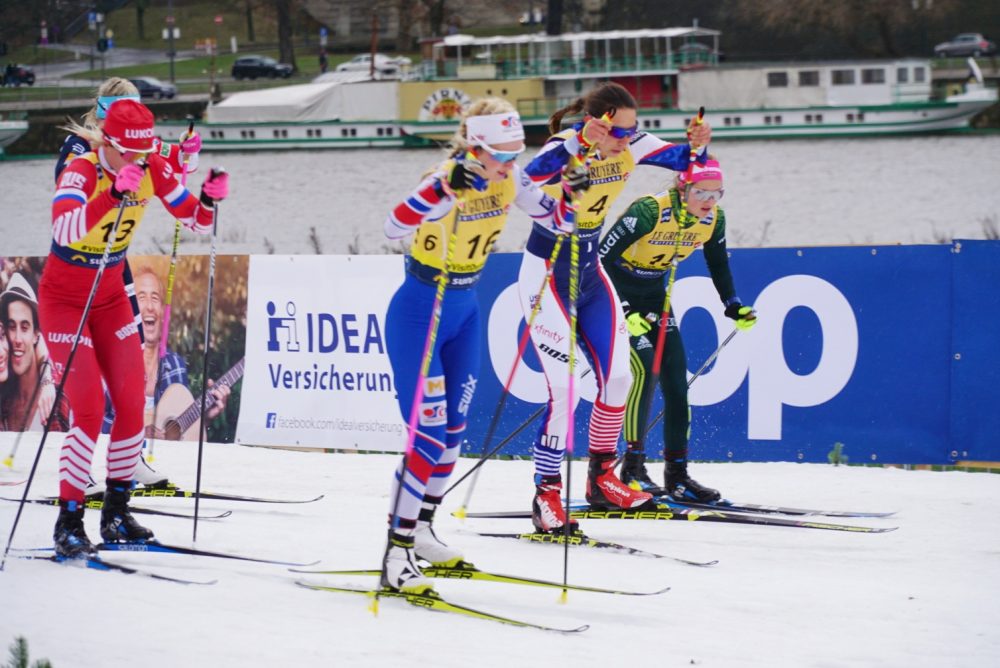
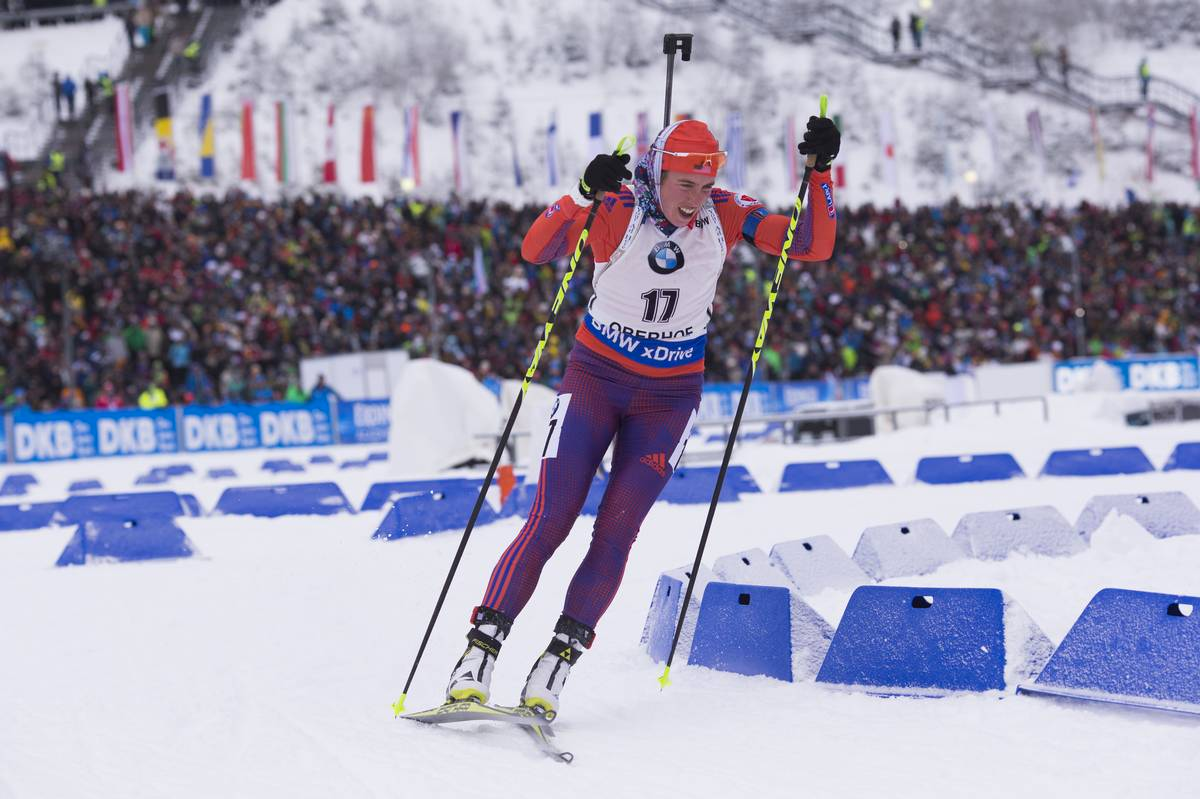
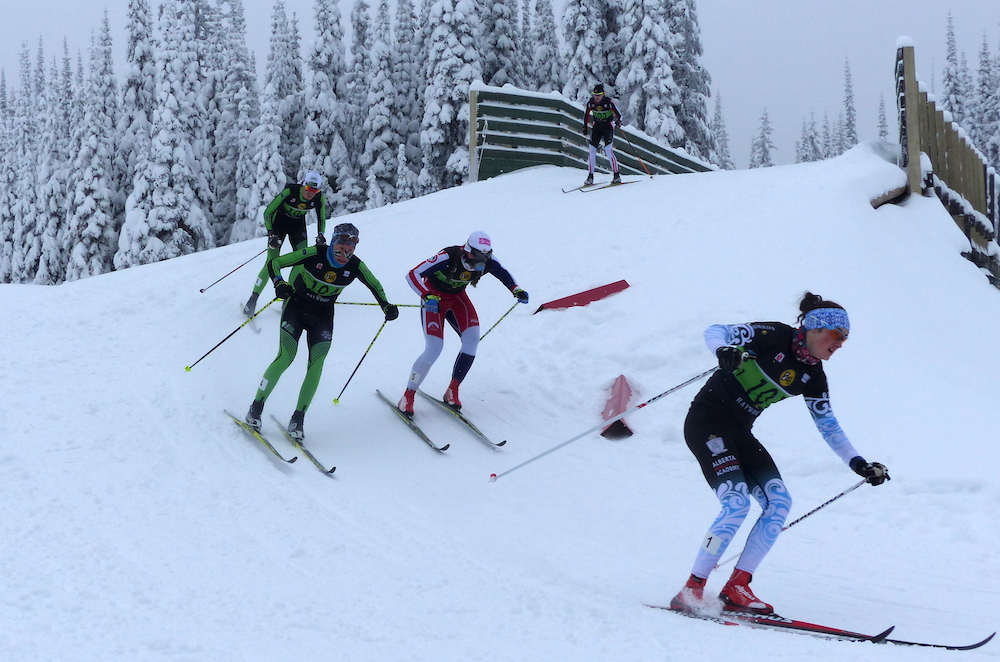
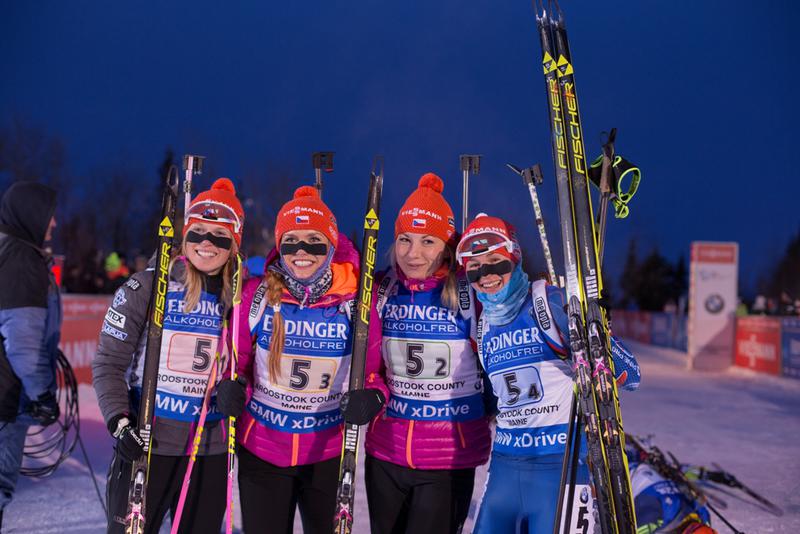
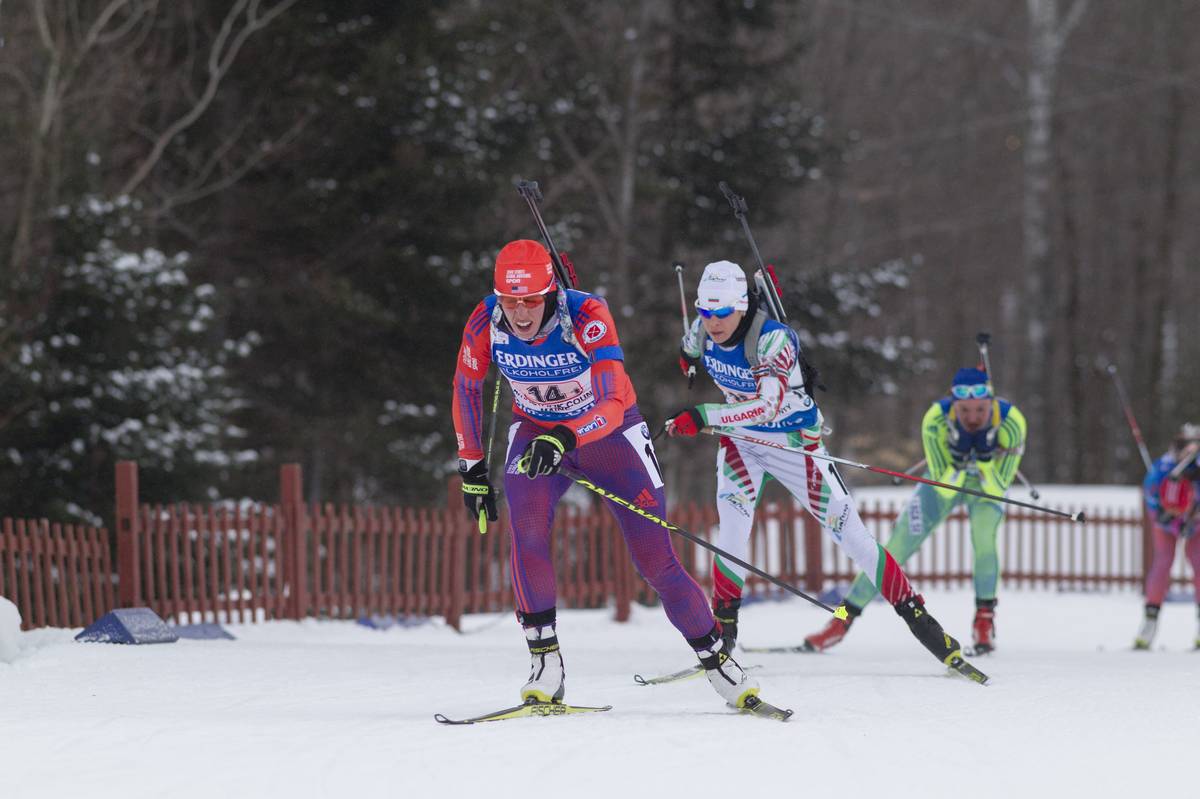
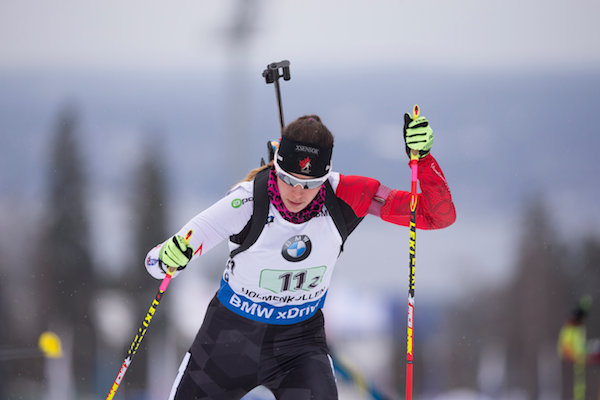
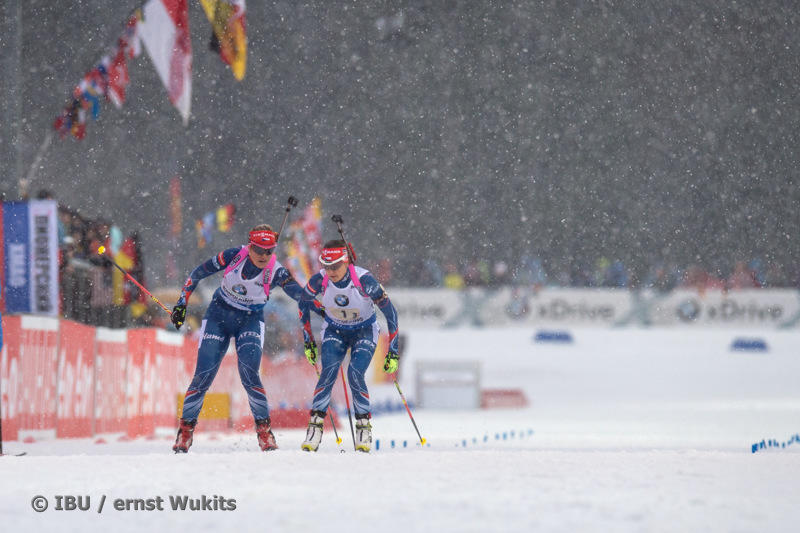
Racing in bib 4 for the U.S., Julia Kern keeps pace in the women’s team sprint during the Dresden, Germany World Cup on Sunday. (Photo: Garrott Kuzzy).
FIS World Cup Dresden, Germany 6 x 1.6 k Freestyle Team Sprint
The first World Cup team sprint of the season was run amidst drizzle and the Dresden, Germany city-scape as the women raced a total of six 1.6-kilometer laps.
Round and round on the looping course, the pace was a mix of tactically subdued speeds with sustained bursts of energy to break the pack.
After all the speed changes and exchanges with one athlete tagging off to the next, it came down to a 1.11 second difference between first place Sweden I and the three closet teams chasing from behind that ended in a photo finish.
Sweden I’s Stina Nilsson and Maja Dahlqvist won in a time of 24:02.5 minutes. Sweden II’s Ida Ingemarsdotter and Jonna Sundling placed second (+1.11), and Norway I, with Eide Mari and Maiken Caspersen Falla in third (+1.11).
U.S. I, featuring Julia Kern and Sophie Caldwell placed fourth (+1.11) after the photo finish was reviewed.
The U.S. entered a second team, consisting of Ida Sargent and Hannah Halvorsen. That duo contested the first semi-final, the same semi as U.S. I, but did not advance after placing fourth (+5.44). The top-three teams from each semi advance to the final, along with the next four fastest teams which are the combined “lucky losers”. Today, the second semi was the faster of the two. The four lucky loser team advancing to the final all originated from the second semi.
In the men’s 6 x 1.6 k skate team sprint race, Norway I and Norway II took the top two podium spots.
In a lunge at the line, Norway I’s Erik Valnes and Sindre Bjørnestad Skar won the final in 22:38.72 minutes. Pål Golberg and Eirik Brandsdal of Norway II placed second (+0.75) and Russia I’s Artem Maltsev and Gleb Retivykh third (+0.80).
Canada’s Bob Thompson and Len Valjas placed seventh (+2.46) in the first semi-final and did not advance to the final. It was the same fate for the only U.S. team entered in the men’s team sprint. Andy Newell and Erik Bjornsen placed 10th (+3.66) in the second semi, and failed to make the finals.
Canada placed 15th in the final standings, the U.S. 19th.
IBU World Cup Oberhof, Germany 4 x 6 k / 4 x 7.5 k Relay
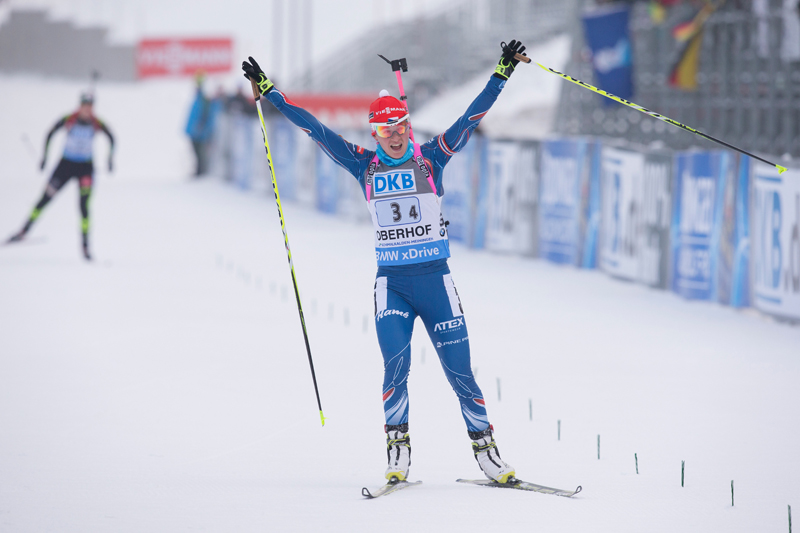
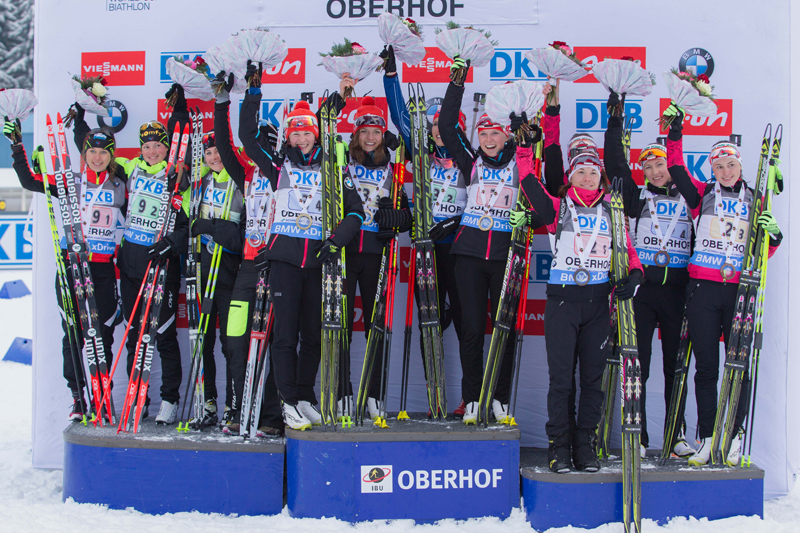
In the women’s 4 x 6 k relay, Russia placed first in a time of 1:18:46.4 hours. Evgeniya Pavlova, Margarita Vasileva, Larisa Kuklina, and Ekaterina Yurlova-Percht made up the team that used eight spares on their way to the win.
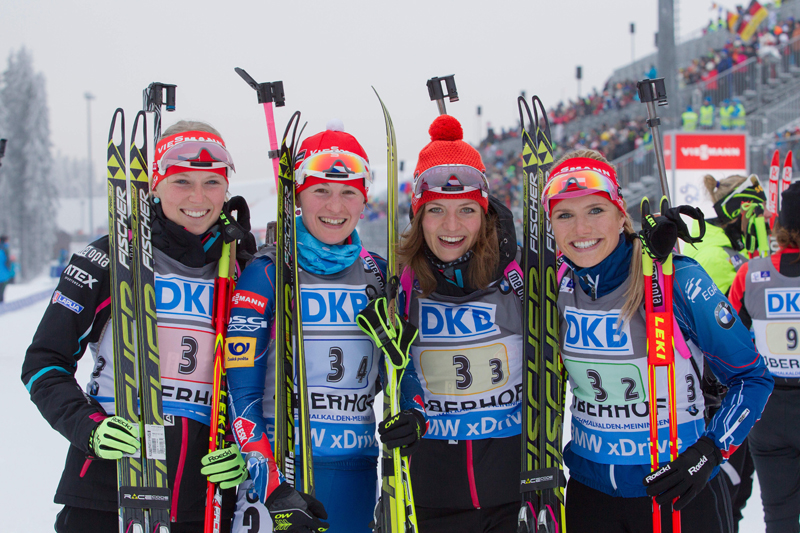
Germany placed second (+33.5) with two penalty loops and 10 spare rounds. Karolin Horchler, Franziska Hildebrand, Franziska Preuss, and Denise Hermann comprised Germany’s second place team that had two penalties while using 10 spares. The Czech Republic’s Lucie Charvatova, Veronika Vitkova, Marketa Davidova, and Eva Puskarcikova placed third (+36.7) with 1 penalty loop and six spares.
The top spot for the podium came down to the final leg, when Yurlova-Percht pulled out the win when Hermann skied two penalty loops. The Russian used three spares but escaped with no penalties to take the lead out of the shooting range on the final ski loop.
Susan Dunklee, Clare Egan, Joanne Reid, and Emily Dreissigacker all represented the U.S. and placed 12th (+5:35.8) while skiing five penalty loops and using 16 spares.
Canada’s Sarah Beaudry, Emma Lunder, Megan Bankes, and Rosanna Crawford finished in 13th (+5:58.8) with four penalty loops and 15 spares.
Russian also claimed the men’s relay, winning in a time of 1:20:54.3 hours. The winning team of Maxim Tsvetkov, Evgeniy Garanichev, Dmitry Malyshko, and Alexander Loginov skied no penalty laps and used six spares on their way to victory.
Antonin Guigonnat, Simon Desthieux, Quentin Fillon Maillet, and Martin Fourcade raced for France. The French team placed second (+1:01.1) while skiing a single penalty lap and using eight spares.
Austria’s Tobias Eberhard, Simon Eder, Dominik Landertinger and Julian Eberhard placed third (+2:18.6) with one penalty lap and using seven spares.
Canada’s Scott Gow, Christian Gow, Jules Burnotte, and Brendan Green and the U.S. team of Leif Nordgren, Sean Doherty, Travis Cooper, and Max Durtschi were eventually lapped. Neither team was given an official finishing time.
Canada was ranked 18th in the final standings, the U.S. 19th.
For both relays today, the snowy weather and tough course conditions made for a strenuous day of shooting and skiing.
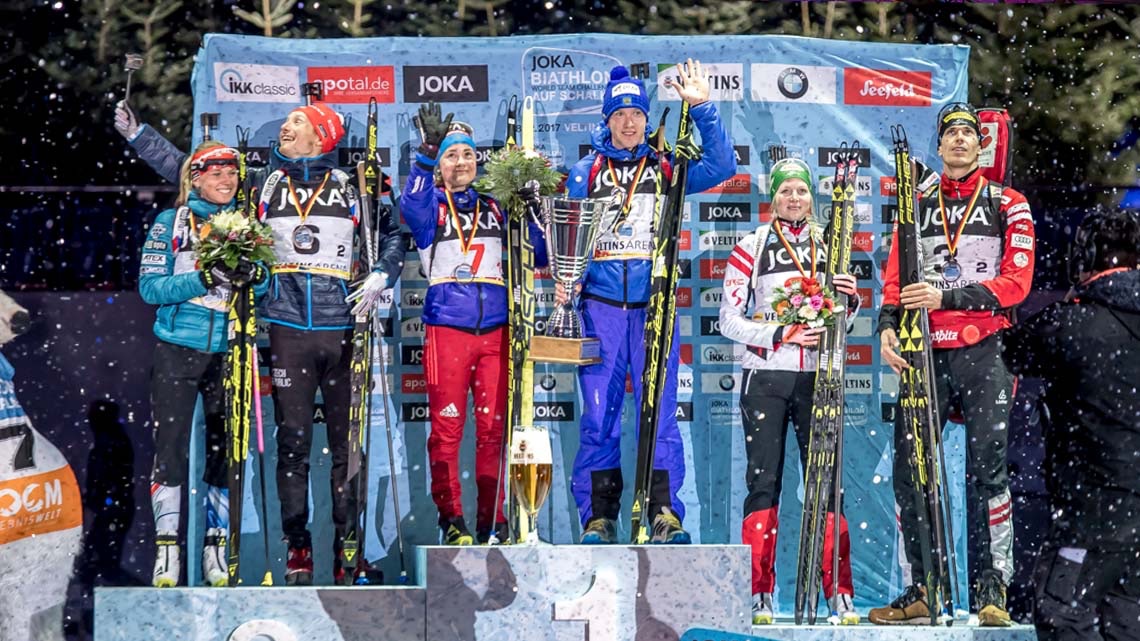
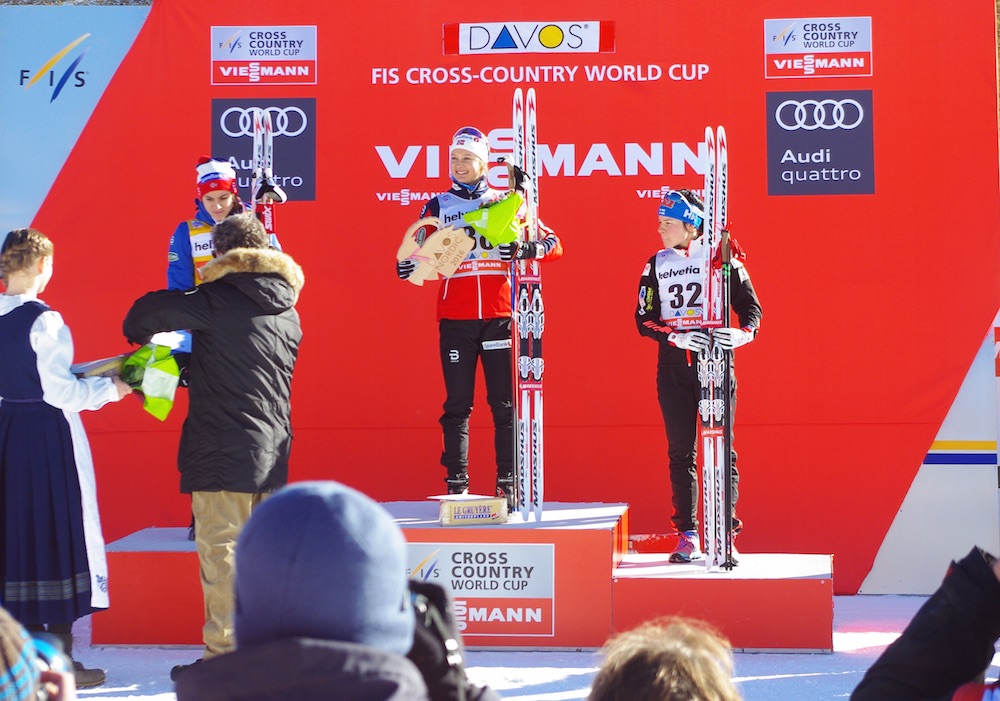
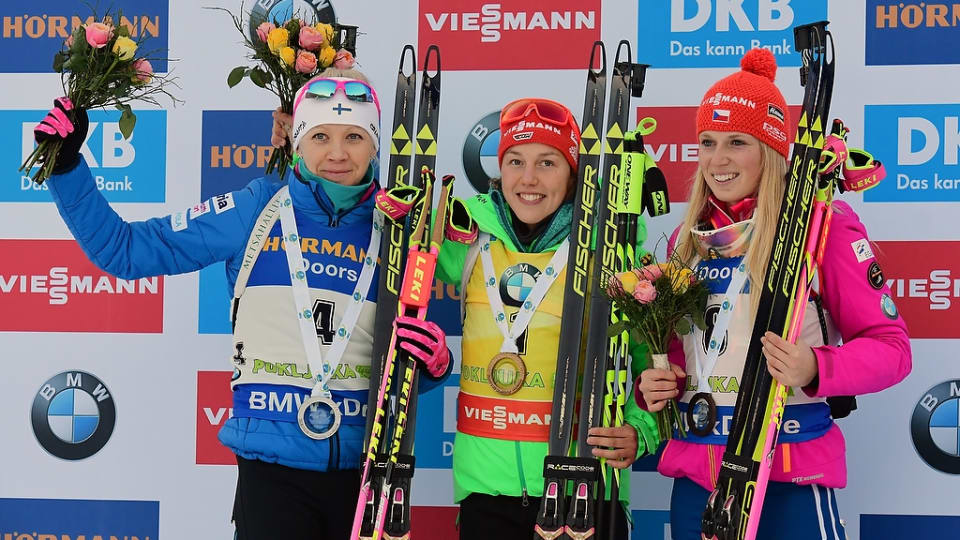
Russia’s Ekaterina Yurlova-Percht and Alexey Volkov (center, first place), Czech Republic’s Eva Puskarčíková and Ondřej Moravec (left, second place) and Austria’s Lisa-Theresa Hauser and Julian Eberhard (right, second place) on the podium of the 2017 JOKA Biathlon auf Schalke invitational race. (Photo: biathlon-aufschalke.de)
Picture some 45,000 rambunctious fans, loud music blaring, a course comprised of 10,000 cubic feet of machine-made snow, a shooting range surrounded by bulletproof glass, 1,300 fir trees as decorations, and 10 biathlon teams representing their nations, all packed into a huge stadium with a retractable roof that’s home to soccer team Schalke 04 in Gelsenkirchen, Germany. That’s the setting for the annual “Biathlon auf Schalke” two-person mixed relay show race, also known as the World Team Challenge.
Many international biathletes enjoy the event’s party atmosphere and use it as a fun way to keep their race shape sharp during the holiday break. The outdoor portion of the course meanders through a so-called “winter village” Christmas market, with the smell of food stands for the fans. Trees inside the domed arena form little forests to delineate the track and shooting range. There is entertainment like a “shoot-out” to determine the starting order, an unofficial “Snowball Fight World Championship”, fireworks, and multiple live pop-concert performances.
The 2017 edition took place this Thursday, Dec. 28, and this year marked the second time a Canadian relay was at the start, with Biathlon Canada represented by Rosanna Crawford and Brendan Green. Last year, Megan Tandy and Macx Davies teamed up for Canada in the mixed relay event.
Far away from the Alps in a flat region of the country previously known for its coal mining, “Biathlon auf Schalke”, while not an International Biathlon Union (IBU) sanctioned race, in its 16th season has become an annual fixture during the holiday break, bringing biathlon from the mountains to fans in the city. Each year, it has drawn a huge audiences, both in person and via television in Germany, as well as in a number of other countries where the event is also broadcast live.
“A few years ago Rosanna and I had talked about how fun it would be to race Schalke together, but it never quite fit in well with our schedule,” Green wrote in an email to FasterSkier. “This year the team stayed in Europe over Christmas and we were able to make it work.”
The World Team Challenge relay race is executed in a special format, with the main event split into two “halftimes” (as the organizers call it, borrowing a term from soccer) of a mass start race followed by a pursuit, held the same night after just a very short break.
In both races, one woman and one man form a team and exchange repeatedly, each skiing a short 1.3-kilometer loop and then having to clean a prone or standing shooting stage while not being allowed to use spare bullets — or else ski a shorter-than-normal 75-meter penalty lap — before tagging off to their teammate again. This mode of competition is comparable to the new single mixed relay format in biathlon or the team sprint in cross-country, though the pace might be even more frantic.
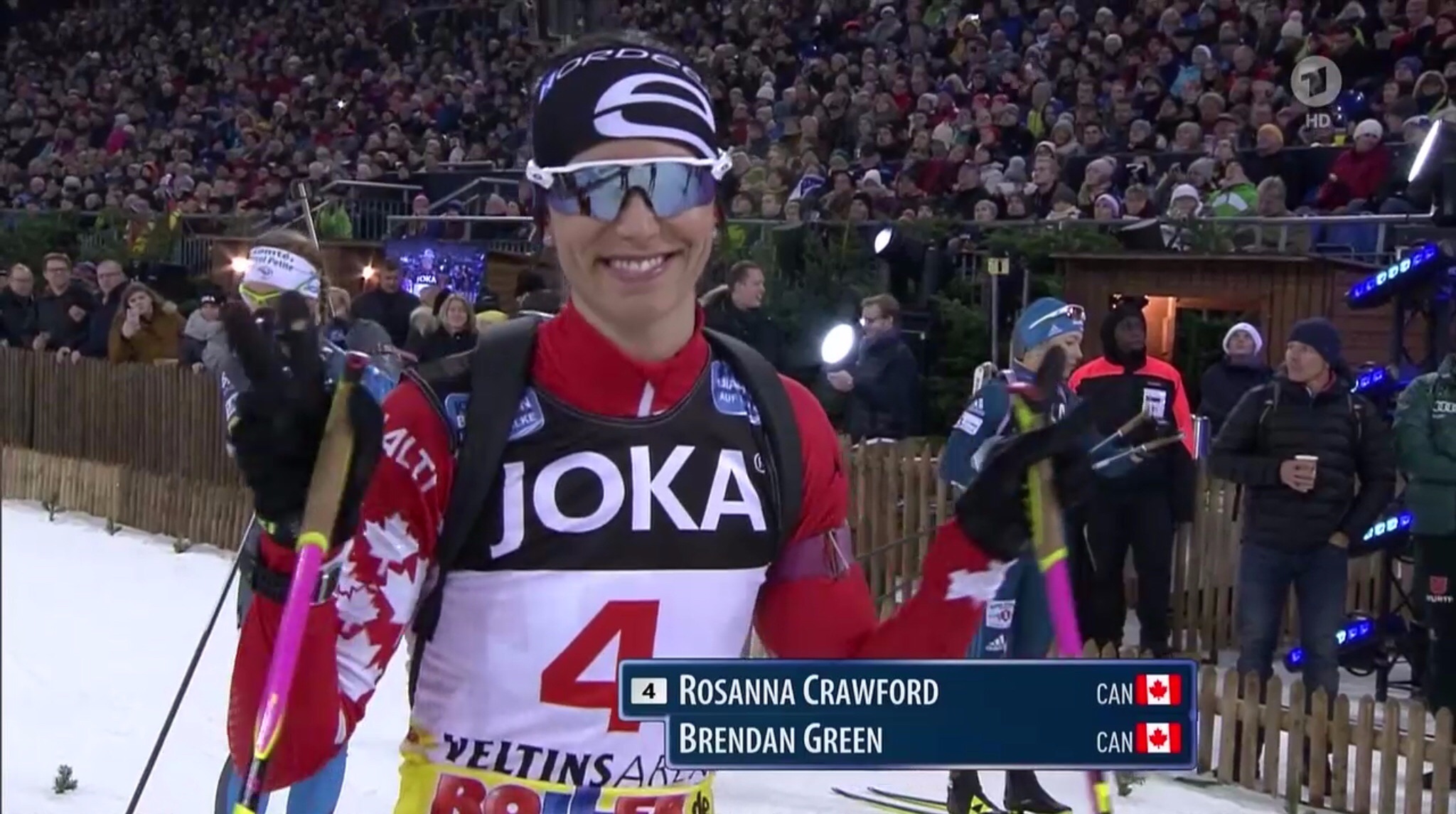
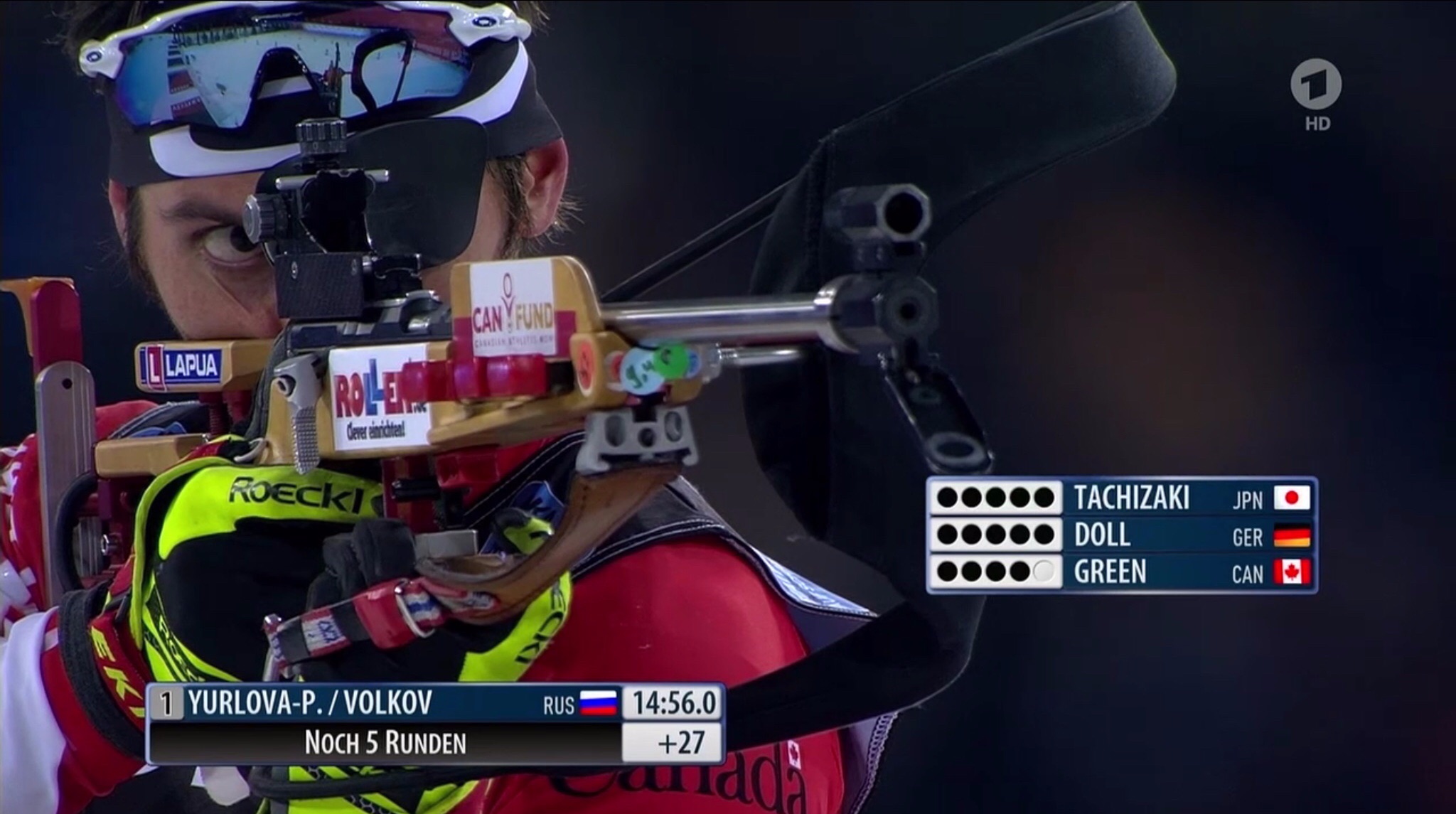
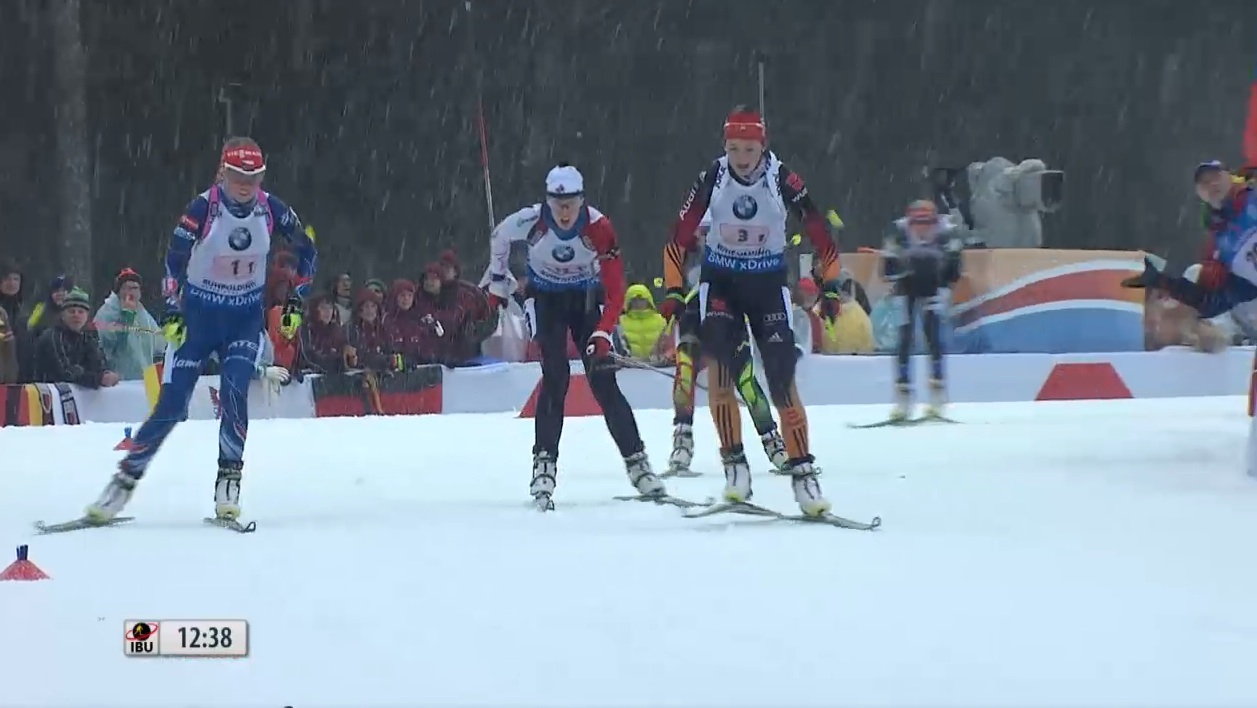
Rosanna Crawford at the start of the 2017 Biathlon auf Schalke invitational race. The Canadian relay team with her partner Brendan Green went on to finish seventh. (Screenshot: ARD broadcast)
“The course was tough, harder than it looked I think,” Crawford wrote. “This race is different to a single mixed relay, where you race for about 12min and then get 12min rest, this was race for about 4min and get 4min rest. Then there was only 15min in-between the two races, so it was quite difficult!”
“The pace you entered the range with skiing full gas on a shorter loop, with the added adrenaline from the crowd, I think for me was the most challenging aspect,” Green reflected in an email on Friday. “I just looked at my heart rate file and it peaked at 188 which is high for me. It never gets that high during a normal race format.”
With the women starting the “first half” pursuit race to a loud cannon boom, the event immediately began with a bit of a mishap for some teams, though Crawford got through it mostly unharmed.
“The first lap was pretty tricky, [Germany’s Franziska] Hildebrand changed lanes right on the very steepest climb and that caused me to ski into her, which then caused a pile up behind me,” Crawford wrote. “It’s a tricky course with not a lot of snow and not a lot of room to pass people, pretty much whoever leaves the range first will be leading the loop.”
Due to a number of penalties by both Crawford and Green early on, the Canadian pair initially fell back to the ninth position, before improving a little bit again when Green finally recorded his first clean shooting stage.
“The shooting atmosphere is different,” he wrote. “You don’t have to deal with certain variables such as wind [due to the closed arena], but instead have to deal with a lot of noise, bright lights, and other stimulus. It took a bit of getting used to.”
In the first years of “Biathlon auf Schalke”, the course was a rather flat loop, but in redesigns during the last few iterations the organizers added longer climbs and a fairly steep downhill section leading into a sharp right turn on the part of the track that is winding through the “winter village” outside the arena. It is supposed to now more closely resemble what athletes would see on the World Cup level.
Using artificial snow mostly coming from a permanent ski hall in a nearby city, every loop is 1.3 k long (adding up to more than 10 k throughout the event for each athlete) with about 25 meters of vertical elevation on a climb nicknamed the “Ruhrpott Glacier”, before the athletes enter the pitch inside the arena again via a tunnel, and then having to shoot in front of the 45,000 fans, often with additional music and the noise level amplified in a heated atmosphere.
Biathlon Canada’s Brendan Green shooting a clean stage with five legs to go in the pursuit mixed relay race during the 2017 Biathlon auf Schalke invitational event. Together with his partner Rosanna Crawford, the Canadian relay finished seventh. (Screenshot: ARD broadcast)
“The course was quite challenging but it skied well and had surprisingly good flow,” Green wrote. “I anticipated that it was going to be quite physically demanding, but was still surprised at how punishing the racing was on the body.”
While one athlete was out on the track, crews of service technicians hurried to clean and prepare the skis of the athlete who was resting briefly. Unlike in most biathlon formats, where the shooting range is a no-coaching zone during a race, teams were also allowed to receive instructions after each leg and during the short 15-minute intermission between the mass start and pursuit.
“It was great to have Matthias [Ahrens] there, so he would run over to us after each shooting and show us our shots,” Crawford wrote. “Andrzej Lesnik was our wax tech and he did a great job with the skis.”
“We received feedback for our shooting from Matthias, and during the break in-between the races Rosanna and I spoke quickly about our own observations,” Green added. “In the end I think it came down to being a bit more attentive in the range and staying as focused as possible despite what was going on around us.”
The Canadians completed the first part of the event in eighth place, 1:24.1 minutes behind Russia in first.
Green came into the finish just a second behind Germany’s Benedikt Doll, who formed a team with Nadine Horchler (in place of Laura Dahlmeier, after Dahlmeier had to withdraw from the event just the day before due to illness. Organizers had previously hyped up Dahlmeier’s participation, after she had just been voted the German “female athlete of the year” as the first biathlete since Magdalena Neuner).
Pursuit Final
For the “second half” pursuit, the gaps to first place were halved respectively capped at a maximum of 45 seconds, so even the teams that had completed the mass start at the back of the field should still have a realistic shot at the top positions.
The coaching hints and adaptations on the range seemed to help, as both Canadians began the pursuit with a series of clean shooting stages, steadily moving up in the field. After her penultimate leg, Crawford tagged off in fourth position.
“Both Brendan and I felt better in the second race,” Crawford wrote. “It was too bad we had so many shooting mistakes in the mass start, would have been good to start closer to the leaders for the pursuit race. But after getting out the jitters we were able to shoot much better.”
In close head-to-head shooting duels for the positions on or just behind the podium, both Green and Crawford missed two targets in the next stages, falling back a bit again.
At the end of the pursuit, Green was beaten by inches — or 0.4 seconds — in a finish sprint with Germany’s Erik Lesser (forming the second German team with Hildebrand) and Belgium’s Michael Rösch (starting as a replacement for Slovenia’s Jakov Fak in a mixed-nation team with Ukraine’s Yuliia Dzhima) to finish the race in seventh place, the second-best result for a North American team.
“The last loop was tough,” Green remembered. “I was able to close a small gap to Lesser and Roesch on the last lap which ended in a sprint finish. I kept waiting for an opportunity and thought something might have been possible once we entered back inside the arena towards the finish, but in the end there just wasn’t enough space and we had to settle for 7th.”
“For the finish loop Brendan did a great job closing the gap to Lesser and Roesch, but there is just no room to pass!” Crawford, who had observed the scene from the sideline after completing her last leg, wrote in her email. “6th or 5th would have been amazing, but we are happy to finish 7th!”
Russian Team in Control in Both Stages
Knowing that accuracy on the range was more important than ski speed on a fairly short and narrow course, the Russian team entered two very secure shooters into the event with 2015 individual-discipline world champion Ekaterina Yurlova-Percht and Alexey Volkov, a member of the men’s gold medal-winning relays at the 2014 Olympic Games and 2017 biathlon world championships. The duo incurred the fewest penalties of all teams, only missing four of 80 targets on their road to winning both the mass start race and the following pursuit.
“With Alexey Volkov as my partner I expect everything, and I knew that Alexey is really really fast on the shooting range, and it can bring us the really good result,” Yurlova-Percht said at a post-race press conference.
At the “halftime” the Russian duo in first seemed within reach of a few other teams that were only about ten seconds back, yet in the pursuit they steadily increased their lead. After he had hit his final shot to clean the last stage to secure the victory, the otherwise subdued Volkov celebrated by raising his fist and looking to the stands in a gesture reminiscent of France’s perennial World Cup leader Martin Fourcade. He then rounded the final loop at a relaxed pace before skiing into the arms of the equally excited Yurlova waiting for him at the finish line.
“Our team was working highly focused on the shooting range today, that surely was our big advantage,” their coach Ricco Groß — himself a past winner of the World Team Challenge for Germany in an earlier iteration — told broadcaster ARD in a TV interview right after the race had concluded, according to a translation. “They solved that really well, and accordingly also won in pretty convincing fashion. … The athletes really did a great job today, that should also push our whole team, giving us some momentum and self confidence for the tasks ahead in January and February. … The atmosphere in the stadium here is gigantic, it is just crazy and incredibly fun here.”
“I want to say thanks a lot to all spectators who visited this competition today,” Yurlova added in the press conference. “This was an amazing atmosphere, and perfect feelings of support. I am really happy that all spectators were supporting not just their teams, but they were supporting everybody. And also when me and Alexey were shooting everybody was supporting us the same like the German teams.”
Both athletes had previously raced at Schalke, with Yurlova winning in 2012 with partner Anton Shipulin and placing fourth in 2015 with partner Evgeniy Garanichev as her best results, and Volvok placing third a year ago with Olga Podchufarova.
“I already thought before the start that we could win,” Volkov said, via a translator. “I have to say the course was very good, not at all flat, and if you take some risk going into the downhill anything can happen. … Today before the start I was trying to find an empty seat in the stands before the start, and I couldn’t see any. This is not just about motivation, this is a celebration [of biathlon]; you just have to be there.”
Looking over to the German team sitting next to him as the local representatives, Volkov added. “I am sure Erik [Lesser] shot faster than me today, but you know how statistics are, sometimes it’s better to shoot two seconds slower and hit everything.”
With nearly as solid shooting performances as the Russian team, the Czech Republic represented by Eva Puskarčíková and Ondřej Moravec stood in second after the mass start, behind Yurlova and Volkov (+9.2 seconds), then held that position in the following pursuit (+24.0).
Austria with Lisa-Theresa Hauser and Julian Eberhard (replacing Simon Eder on short notice) finished the World Team Challenge in third place (+43.5).
After the mass start they had been in fourth position (+10.3) just behind the Czechs and the French team of Anaïs Bescond and Emilien Jacquelin in third (+9.7). In the pursuit race Eberhard secured the position on the podium in the final shooting stage when he hit all targets standing on the range in a duel against Germany’s Lesser and France’s Jacquelin, who incurred more penalties. France finished fourth (+58.4), also slightly hampered by a fall and broken pole for Bescond during the race.
Crawford and Green were the sixth North American team to be invited to the “Biathlon auf Schalke” race and the second Canadian one. In 2008 and 2009, Lanny Barnes and Jay Hakkinen represented the US (placing ninth and sixth for the best finish by a North American team to date), in 2010 Tracy Barnes-Coliander and Tim Burke (10th), in 2012 Susan Dunklee again with Tim Burke (10th), and in 2016 Megan Tandy with Macx Davies for Canada (10th).
“Brendan and I really loved competing in Schalke!” Crawford summarized their experience. “It was like nothing we’d ever done before! There have been big crowds at World Cups and World Champs, like Nove Mesto and Oslo … but this was so different with having 45 000 people all packed into a soccer stadium! … I am really glad Brendan and I got to compete in this race once in our careers!”
While the International Biathlon Union (IBU) has adopted the mixed and single mixed relay formats in the last years as new disciplines to make the sport more attractive, “Biathlon auf Schalke” is an invitation-only race not promoted or hosted by the IBU, so there were no World Cup points to win in the event. However about €156,000 ($185,000 U.S. dollars) in prize money was awarded.
The regular IBU World Cup will resume on Thursday, Jan 4, in Oberhof, Germany, with a women’s sprint race.
Julia Ransom (Biathlon Canada) racing to ninth in the women’s 15 k individual on Wednesday at the IBU World Cup opener in Östersund, Sweden. In her first World Cup race of the season, it was Ransom’s career-best result and Biathlon Canada’s best individual result since 2015/2016. (Photo: Biathlon Canada/NordicFocus)
Entering this season, members of Biathlon Canada had everything to gain and not a whole lot to lose. They had already had their funding reduced to zero by Own The Podium, save for a $50,000-dollar provision that paid for a coach, and its athletes were left to determine their offseason plan: stay home to train or self-fund training camps elsewhere. Many chose to spend most of their summer at the team’s base in Canmore, Alberta, and most started the season on the fly — without any preseason tuneup races in Europe — this week in Östersund, Sweden.
Julia Ransom was one of those athletes. After prequalifying for Canada’s International Biathlon Union (IBU) World Cup Team for the first trimester of racing, Ransom, 24, jumped into the 2017/2018 season with the Östersund mixed relay this past Sunday — three days after flying over from Canada.
There, she raced the second leg of the relay and tagged off in 15th, down two spots from where her teammate Emma Lunder tagged her in 13th. The team ultimately finished 15th, with teammates Scott Gow and Brendan Green.
“Today was a tough day for me. My legs were lead on the course,” Ransom wrote in a post-race email to FasterSkier on Sunday.
Three days later on Wednesday, it was another ballgame. With little to lose in the women’s 15-kilometer individual in Östersund, Ransom raced to a career-best ninth, which stood as her team’s best non-relay result in two seasons.
In the first individual race of the season, Ransom is well on her way to securing a spot on Biathlon Canada’s 2018 Olympic team, meeting half of the team’s “Priority 2” Olympic criteria standards. She needs another top 16 to fulfill that second-tier criteria. Priority 1 is one top-eight result in a World Cup (or World Championships, in a championships year like last season) or a top-three in a World Cup relay.
So far, she is the only one on her team who has cracked the top 16 in two seasons. Last winter, her best result (and her previous personal best) was 18th at 2017 World Championships in the 15 k individual. Canada’s best non-relay result in 2016/2017 was Scott Gow’s 17th place in a 20 k individual World Cup race.
And again, it’s the first race of the season.
“I am still in shock with how well today went,” Ransom, a Penticton, British Columbia, native in her fourth World Cup season, wrote in an email to FasterSkier on Wednesday.
“It is such a relief to start racing again,” she continued. “I wasn’t too nervous today; I had a race plan that I had confidence in and I was excited to give it a go. I also was looking for redemption after my painful relay leg on Sunday.”
Conditions were chilly, at -12 degrees Celsius (10 degrees Fahrenheit), but calm, accounting for clean shooting for seven out of the top-nine finishers. Ransom was one of them.
She started 20th (out of 102) and cleaned all four stages in the longest-format women’s race on the circuit. In individual races, shooting is weighed heavily; a minute is added to a competitor’s final time for each missed shot. Fortunately for Ransom, she hit all 20 targets.
“I was getting some pretty exciting splits during the whole race (top 5, second place, catching the leader etc) so I had an idea this was going to be a good day as long as I kept my shooting together,” she reflected. “I took a sigh of relief after the 20th target went down and just tried to ski as well as I could to the finish. I did take look at the big screen as I left the range, just to make sure I was hearing the techs right!”
Ransom initially crossed the finish line in third, 28.8 seconds behind Sweden’s Mona Brorsson in first and 9.8 seconds behind Eva Puskarčíková of the Czech Republic in second. Both Brorsson and Puskarčíková also shot clean.
The 55th starter, Nadezhda Skardino of Belarus, ultimately posted the best shooting and skiing performance of the day, racing to her first World Cup win (and first podium in three years) in 42:57.4 minutes with 20-for-20 shooting. Norway’s Synnøve Solemdal started 75th and shot clean but came up 2.9 seconds short at the finish to place second, bumping Ukraine’s Yuliia Dzhima to third (+12.0). The top-four women all cleaned with another Ukrainian, Valj Semerenko, placing fourth (+30.1).
Slovakia’s Paulina Fialková finished fifth (+32.2) with a single penalty (0+0+0+1), while Brorsson ultimately placed sixth (+49.6) and Puskarčíková seventh (+1:08.6).
Ransom ended up ninth for her best World Cup level performance by nine places, ahead of Norway’s Marte Olsbu in 10th and about eight seconds behind France’s Justine Braisaz in eighth.
“Starting off the season with a top ten has validated the hard work our team has put in and also given me a lot of confidence going forward. It’s a great building block to say the least,” Ransom wrote.
Asked what she thought made the difference with her training this year, she explained that she’d honed in on increasing her shooting speed.
“It’s still a work in progress but I am happy where I am so far,” she wrote. “I also did a ton of extra strength work and core stability and it has proven to make a big difference on the skis.”
On Wednesday, Ransom’s overall shooting and range times ranked in the middle of the pack, around 50th, while her overall course time was slightly faster in 42nd.
Biathlon Canada Head Coach Matthias Ahrens praised Ransom’s ability to perform under pressure.
“Especially as the tension mounted, with each clean bout, Julia was closer the podium and she managed the pressure very well,” he said, according to a team press release. “She didn’t get too excited or too nervous, executing clean shooting each time.”
Four Canadians started Wednesday’s 15 k, with Rosanna Crawford finishing 39th (+3:32.6) with three penalties (0+0+1+2), following her crash in Sunday’s single mixed relay.
“Rosanna, considering the crash of Sunday, had a really nice race,” Ahrens said in the press release. “It wasn’t certain if she’d race today, and we went in with a strategy not to risk any further injury. She managed a very good race, with a quite good ski time. Her rifle also required repairs from Sunday’s race. Overall, not knowing how she would hold up, particularly on one of the hardest Individual courses on the circuit, it was a nice result for her, in the World Cup points.”
Megan Bankes finished 75th (+6:28.9) with three misses (2+1+0+0) and Lunder was 83rd (+7:06.3) with five penalties (0+0+2+3).
US Biathlon started three women, with Susan Dunklee leading the team in 53rd (+4:12.7) with four penalties (1+0+1+2). Clare Egan finished 79th (+6:52.5) with five misses (0+2+1+2) and Emily Dreissigacker was 81st (+7:03.5) with three misses (0+0+1+2).
The men start their season with a 20 k individual on Thursday at 11:15 a.m. Eastern Standard Time.
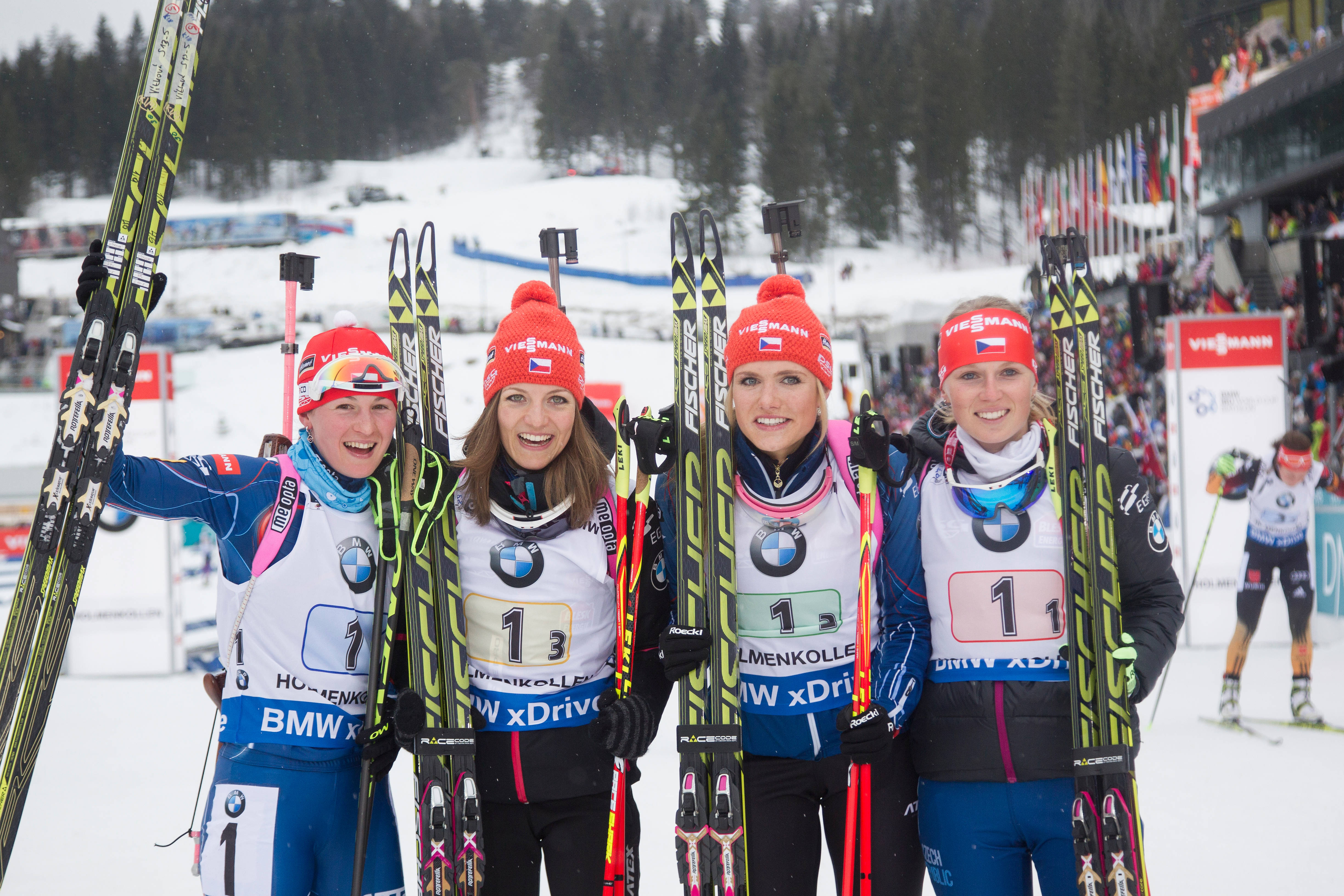
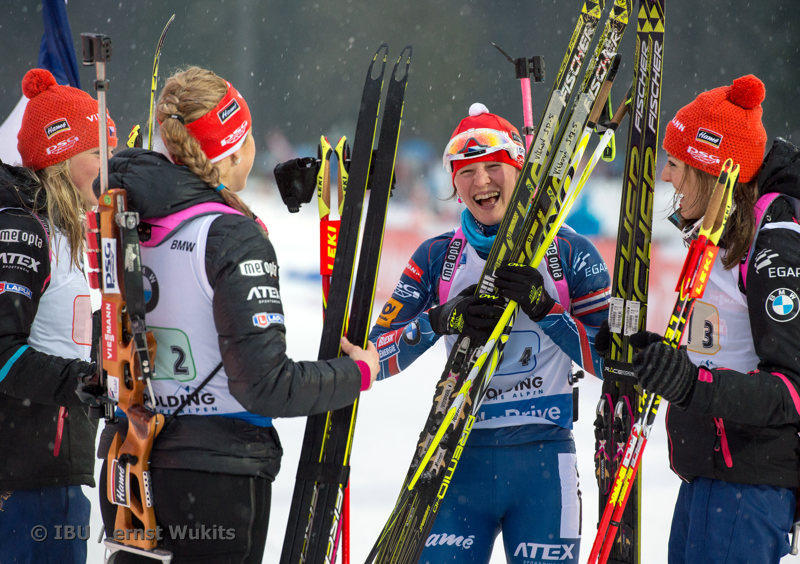
Biathletes Veronika Vítková, Jitka Landová, Gabriela Koukalová, and Eva Puskarčíková after a 2015 relay in Oslo, Norway. The Czech women learned that they would receive an Olympic bronze medal after the Russian team has been disqualified for doping. (Photo: Fischer/NordicFocus)
(Editor’s note: This article contains explicit language.)
The U.S. women finished seventh in the Sochi relay, and some athletes spoke out about how much it would have meant to be sixth not three years later, but the day they competed.
“It only took us 4 years, but now our historic 7th place is actually 6th…tying the best ever Olympic relay result for US Biathlon – men or women!” team member Sara Studebaker wrote on Facebook. “It’s unfortunate it took 4 years for this to happen. Because we were 7th instead of 6th, some teammates missed out on being pre-qualified for events and getting monetary support… Doping affects all athletes at some level. There is no excuse.”
“The ripple effect from athletes doping feels even more personal now,” she wrote. “It’s wild to think about what would have been different for us with a 6th place relay at the Olympics instead of 7th. Thanks Russia for the flower ceremony at the Olympics that we didn’t get to have, A-team status and funding for 2015, and pre-qualification for the World Cup.”
Canada finished eighth in the relay and will now move up to seventh.
Vilukhina earned a silver medal in the 7.5-kilometer sprint; that means that Vita Semerenko of Ukraine will be upgraded from bronze to silver, and Karin Oberhofer of Italy will earn bronze, the first individual Olympic medal of her career.
Then there is the relay, where both Vilukhina and Romanova represented Russia. They took silver with teammates Olga Zaitseva and Ekaterina Shumilova. The Norwegian team will now move from bronze to silver, and the Czech team will now earn bronze.
Gabriela Koukalová posted on her Facebook page about how frustrated she was with the scandal. A translated version reads,
“I know that you all know… I mean about our Olympic medal from Sochi for the women’s relay, which we are going to receive with almost four years of delay. On one side it’s great that justice was achieved, but on the other side I am truly sorry for Eva Puskarčíková and mostly for my lifelong friend Jitka Landová, who had to end her biathlon career due to medical reasons. She spent almost her entire career with hard work and without any memories of success. I am not sure about you, but I want to turn doping into a crime and not allow Russian Federation to start at the Winter Olympics, like it already happened at the Summer Games! I also would like to stress one more goal, and that is more important than victories. Their names are HONESTY AND FAIRNESS, not only in sport but overall in the life! Too bad that they [Russians] hadn’t figured that one yet! And now I would like to move on from this topic…”
Meanwhile, Landová isn’t sure that a medal would have changed the trajectory of her career, saying that she doesn’t look back. But she does wish she’d had the medal earlier, she said in a Czech radio interview.
“Last night I received a message from Eva Puskarčíková that we really had the Sochi medal,” Landová said, according to a translation. “I looked at it first with disbelief, because as long as I have no tangible evidence, I just don’t believe it. From the very beginning, we knew the Russians were not clean.”
“I do not know whether to be glad or cry,” Puskarčíková told the same radio broadcaster.
The pushback against the women on social media has been swift and severe.
The number of comments below Koukalová’s Facebook post calling her stupid and a disgrace are too many to count, as are those telling her to stick to sport and “worry about your performance,” a comment that sometimes had a foreboding connotation. Other comments call her a “b*tch” or a “f*cking b*tch.” Still others compare her to Nazis or fascists.
Then there are the threats.
“Russia will be wait you on World Cup in Tyumen 2017… you want to get negative before the Olympic Games? ok, you will get it!,” wrote one poster, following this with an emoji of a punching fist.
“you have found enemies in the face of 300 million people… be careful,” one commenter wrote.
“Can be you sure that your test-tube Ok or someone scratch it and you will be deprived of all medals,” another threatened.
Instagram was, if anything, worse – even though that’s not the platform where the athletes had made any of their comments.
On the account “jitka_official_landova”, which it is not clear is actually maintained by Landová, received hate on nearly all of the posts, even though the last post was only from 2015 and the account has no recent activity. Under a picture of Landová posted in February, 2015, one comment reads, “prostitutky,” which translates from to “prostitutes”.
There are several Instagram pages attributed to Koukalová, some of which are clearly fan pages and two which are verified by Instagram (calling into question the efficacy of the verification system, but that’s another story.) It’s unclear if either of the two verified accounts are operated by Koukalová; there is no link to Instagram from her website.
But regardless of whether comments left there are actually reaching her, a lot are being posted regardless. Many are filled with emojis of livestock like pigs and sheep, and feces. The pigs and excrement were often accompanied by a lipstick emoji; Koukalová has a contract to appear in makeup ads.
On a page seeming to really belong to Koukalová, she was repeatedly called “scum.”
“you’re a lying b*tch!” one commenter wrote in English. “You are fascist,” wrote another. “You are one disgraceful sh*tty slut,” another commenter added.
Then there were those written in Russian, which translated to, if anything, worse comments:
“Go in a hole and don’t come back”
“prostitute”
“burn in hell”
“F*ck you, f*cking b*tch, no one will remember you and the medal”
“You b*tch”
“you don’t take medals, you only take it in the mouth”
“piece of sh*t”
“The end”
After one Russian fan writes a supportive message, another replies, “burn at the stake with her, sheep.”
Comments also riddled posts on an account which appeared to be maintained by fans.
“Such animals must be hung!” one comment translated from Russian read. Some others:
“Better not come to Tyumen!”
“Whore”
“Her brains are only enough to paint her face”
“Wash it, it’s a man”
“Lose weight, you’re so fat”
Many mention the phrase “life is a boomerang”. “Remember everything comes back, it’s the rule of life and your joy for getting not yours medal will turn into tears soon,” one comment written in English says.
Koukalová is not competing in the opening World Cup weekend in Östersund, Sweden, as she is still recovering from a calf injury. Many comments stated that they hoped she would never return to competition, or if she did, that she would lose every race. See this link for a good example. Take a look.
In the 15 k individual today, the first individual race of the World Cup season, Puskarčíková finished seventh with perfect 20-for-20 shooting; Vítková finished 12th with two penalties.
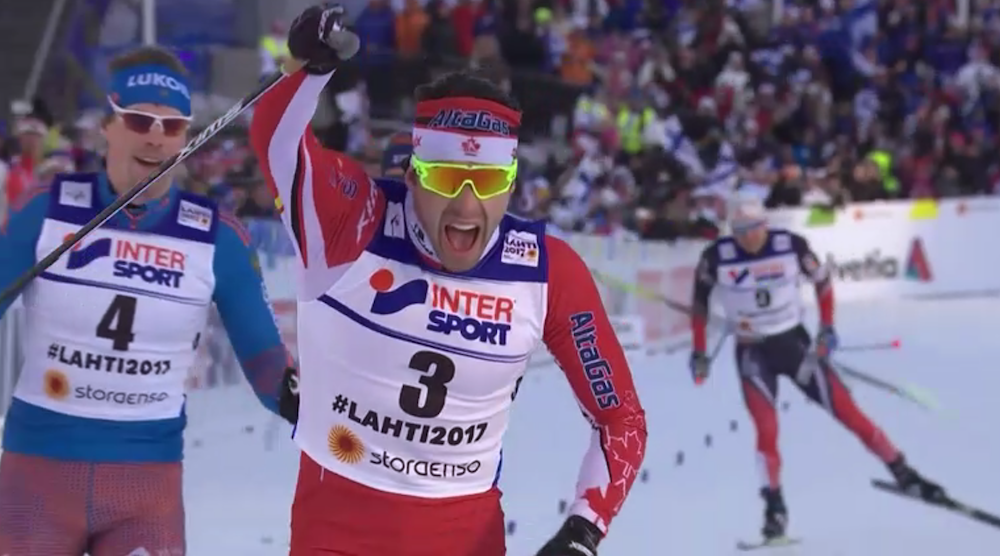
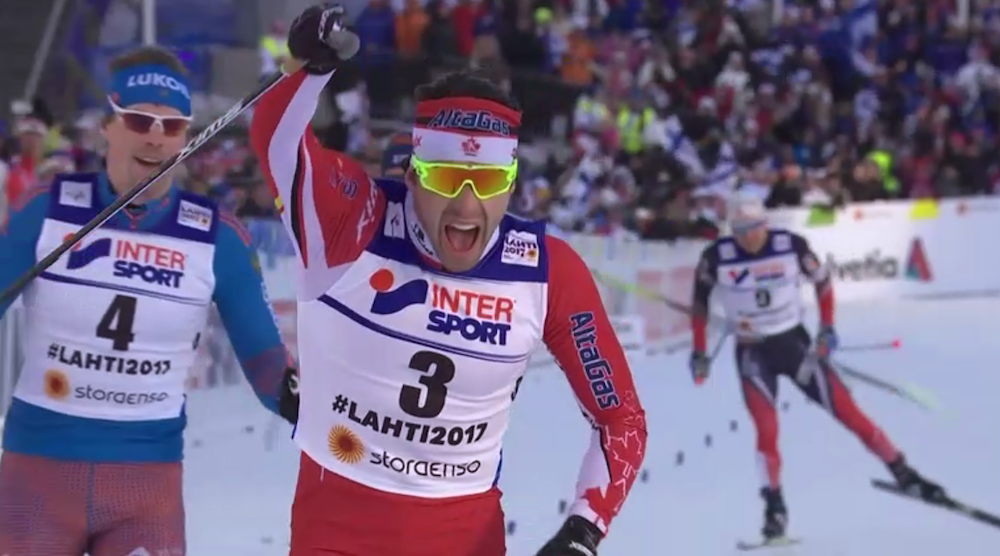
Canada’s Alex Harvey (3) celebrates his win in the men’s 50 k freestyle mass start, his first individual gold medal at a World Championships, on Sunday at 2017 Nordic World Championships in Lahti, Finland. He beat Russia’s Sergey Ustiugov (l) by 0.6 seconds while Norway’s Sjur Røthe (9) can be seen coming in for sixth place, behind (not pictured) Finland’s Matti Heikkinen, Great Britain’s Andrew Musgrave and Norway’s Martin Johnsurd Sundby, respectively. (Photo: NBC Sports screenshot)
FIS Nordic World Championships (Lahti, Finland): Men’s 50 k freestyle mass start
After a week of missing out on the medals at 2017 Nordic World Championships, Canada’s Alex Harvey, a four-time World Championships medalist from 2011, 2013 and 2015, achieved his first individual gold medal in the final race of this year’s World Championships in Lahti, Finland.
Harvey, 28, won the men’s 50-kilometer freestyle mass start in a drag race to the finish. Entering the final descent into the stadium with Norway’s Martin Johnsrud Sundby and Russia’s Sergey Ustiugov, Harvey rode his fast skis past both of them then had the most finishing kick in the final straightaway for a 0.6-second victory. He finished in 1:46.28.9 hours, while Ustiugov followed him across the line in second and Finland’s Matti Heikkinen from behind for third (+1.4), after passing Sundby around the outside of the last corner.
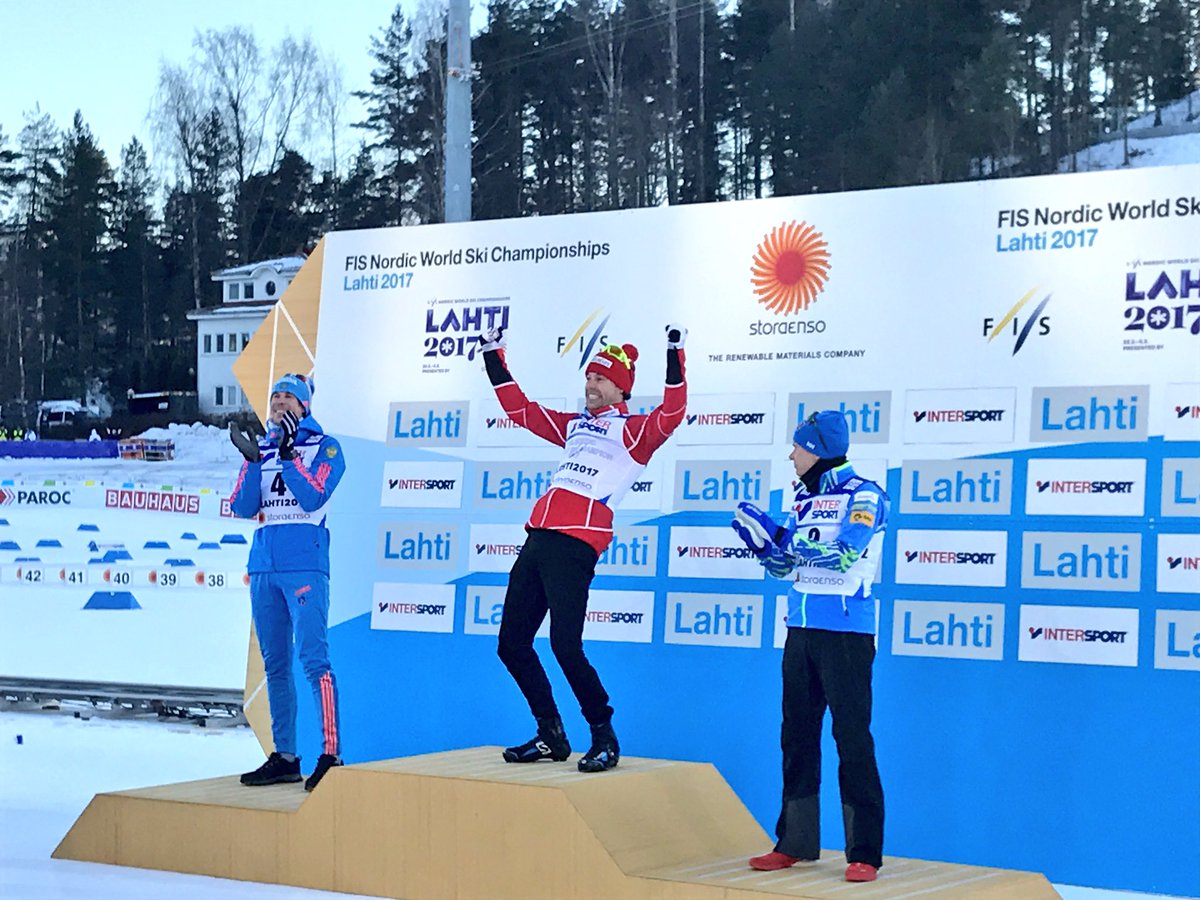
Canada’s Alex Harvey (c) celebrates gold in the men’s 50 k freestyle mass start on Sunday at 2017 Nordic World Championships in Lahti, Finland, with Russia’s Sergey Ustiugov (l) and Finland’ Matti Heikkinen (r) joining him on the podium in second and third, respectively. (Photo: Cross Country Canada/Twitter)
Sundby appeared to miss a pole plant soon after Heikkinen passed him and let off the pace a few meters before the finish. That’s where Great Britain’s Andrew Musgrave continued to accelerate and took fourth place, 2.9 seconds behind Harvey and 0.1 seconds ahead of Sundby in fifth. Norway’s Sjur Røthe followed another 0.4 seconds back in sixth, Switzerland’s Dario Cologna was seventh (+8.9), Norway’s Petter Northug eighth (+12.3), France’s Maurice Manificat ninth (+13.4), and Norway’s Hans Christer Holund 10th (+14.3).
“I had really good skis,” Harvey said in a post-race interview with FIS. “I knew if I came into the corner in second place, that was the optimal position. So I was able to fight hard and hit that last corner in second and slingshot by Martin along the flat and then that was good after that.”
“This is the best race of my life, for sure,” he added. “So I’m really happy.”
Tad Elliott (Ski Club Vail) led the Americans in 27th (+3:16.8). Noah Hoffman (U.S. Ski Team) finished 50th (+8:53.1) and Kyle Bratrud (CXC Team) did not finish.
Canada started four men, with Devon Kershaw finishing 38th (+5:45.5), Graeme Killick 43rd (+7:04), and Knute Johnsgaard in 55th (+12:03.3).
For Harvey, the medal is his fifth at three World Championships and his first individual gold after winning the classic team sprint with Kershaw in 2011.
IBU World Cup (PyeongChang, South Korea): Men’s and women’s relays
Between the men’s and women’s relays on Sunday at the International Biathlon Union (IBU) World Cup in PyeongChang, South Korea, Canada had two teams in the top eighth, with its men’s team finishing seventh in the 4 x 7.5 k and women’s team eighth in the 4 x 6 k. Behind them, the U.S. men finished 10th and U.S. women 14th.
France won the men’s relay by 33.8 seconds over Austria, using a total of 10 spare rounds but avoiding the penalty lap. Martin Fourcade anchored France to the win in 1:12:09.5 hours, after Jean-Guillaume Béatrix initially tagged them in first, his older brother Simon Fourcade raced them into second with near-perfect shooting (using just one spare to clean), and Simon Desthieux picked off one more place to give Fourcade a 16-second lead for the final leg.
Austria achieved second place with Lorenz Wäger, Simon Eder, Julian Eberhard, and Dominik Landertinger combining for zero penalties and nine spares.
Norway finished third (+45.4) with Vetle Sjåstad Christiansen, Ole Einar Bjørndalen, Vegard Gjermundshaug, and Henrik L’Abée-Lund. They had one penalty on Gjermundshaug’s third leg, and used a total of eight spares.
Canada’s Christian Gow, Scott Gow, Nathan Smith, and Brendan Green finished seventh (+3:03.1) with zero penalties and nine spares. After Christian tagged his older brother Scott in ninth, Scott raced them into sixth place before Smith slipped four places to 10th at the final exchange. On the final leg, Green raced them into seventh, requiring two spares to clean.
The Americans finished about nine seconds later in 10th (+3:12.8) with Lowell Bailey, Leif Nordgren, Paul Schommer, and Sean Doherty combining for zero penalties and nine spares, just like Canada. Bailey had originally put them in second at the first exchange, Nordgren dropped to seventh, then Schommer to 13th, before Doherty finally brought them back to 10th out of 24 teams.
In the women’s relay, Germany pulled off a 22.8-second win over Norway, with one penalty and eight spares. Nadine Horchler put Germany in third at the first exchange, then Maren Hammerschmidt raced them into first by the race’s halfway point. From there, Denise Herrmann, a former cross-country World Cup regular, had to ski a penalty lap and tagged off in second, 13.5 seconds out of first. With teammate Laura Dahlmeier sitting out the relay, Franziska Hildebrand anchored Germany to the win in 1:07:35.6 after she used just one spare to clean.
Norway placed second with Kaia Wøien Nicolaisen, Hilde Fenne, Tiril Eckhoff, and Marte Olsbu accumulating one penalty and 11 spares. Olsbu beat out the Czech Republic’s Gabriela Koukalová by one-tenth of a second at the finish, as the Czechs placed for third (+22.9), with Jessica Jislová, Eva Puskarčíková, Lucie Charvátová, and Koukalová (with a total of one penalty and nine spares).
Canada took eighth (+1:34) with Rosanna Crawford, Julia Ransom, Megan Tandy, and Emma Lunder. Crawford tagged in second at the first exchange, Ransom slipped one place to third, Tandy lost another place to tag in fourth, and Lunder ultimately anchored them to eighth.
The U.S., with Clare Egan, Susan Dunklee, Joanne Reid, and Maddie Phaneuf, finished 14th (+3:08.3) with one penalty and 10 spares. After Egan had a penalty on the first leg, Dunklee skied the fastest second leg to move the team from 19th to 14th, then Reid put them in 11th by the final exchange. Twenty-one teams competed in the women’s race.
Ski Classics 90 k Vasaloppet (Sälen to Mora, Sweden)
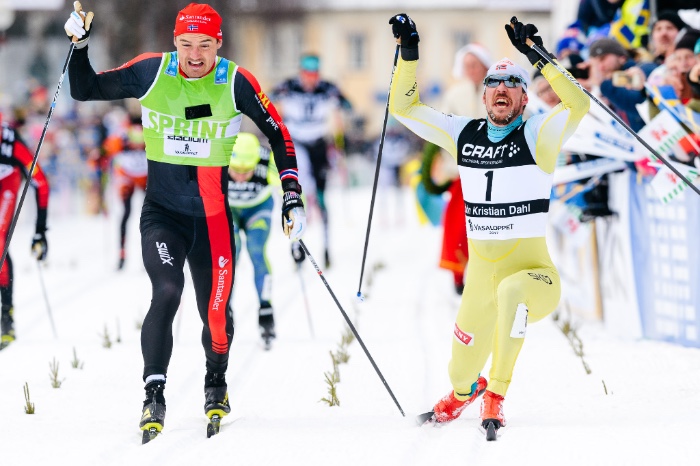
John Kristian Dahl (r) of Team United Bakeries outlunges Ski Classics sprint leader Andreas Nygaard (r) of Team Santander for the win in Sunday’s 90 k Vasaloppet in Mora, Sweden. (Photo: Visma Ski Classics)
[UPDATED] In Sunday’s 93rd annual 90-kilometer Vasaloppet from Sälen to Mora, Sweden, the ninth event of the Ski Classics series, John Kristian Dahl (Team United Bakeries) outlasted Andreas Nygaard (Team Santander) by one-tenth of a second for the win in 3:57:18.1 hours. The race came down to a five-way fight for first, with Stian Hoelgaard (Team Leaseplan) finishing 0.6 seconds back in third. The top 15 men were all within 21.7 seconds of the podium, and Brian McKeever, a member of Canada’s Para Nordic Ski Team, placed 20th (+2:31.1).
“It has been a fight all day,” Dahl said, according to a Ski Classics press release. Three days ago, he had been unsure about starting the Vasaloppet following a back injury. “I was tired already after 30 k and had to let go of the lead group, but I fought my way back taking it step by step and hill by hill.”
In the women’s race, Britta Johansson Norgren (Lager 157 Ski Team) broke away from the field to win by 1:37.9 minutes in 4:19.43.4.
Astrid Øyre Slind (Team United Bakeries) finished second, and Sara Lindborg (Team Serneke) placed third, 9 minutes and 4.2 seconds behind Norgren. Kateřina Smutná (Team Santander) dropped out of the race about halfway through.
“I am very tired but also so happy to win today,” Norgren said, according to the press release. “It felt pretty easy until Oxberg [Sweden] with 30 k to go, but then it got really tough and I had to fight all the way to the finish.”
It was Norgren’s first Vasaloppet win after placing second the last three years. She increased her lead in the overall Ski Classics to 215 points over Smutná, while Tord Asle Gjerdalen continues to lead the men’s overall standings ahead of his Santander teammate Nygaard, who is 349 points behind in second place. Gjerdalen did not race Sunday’s Vasaloppet.
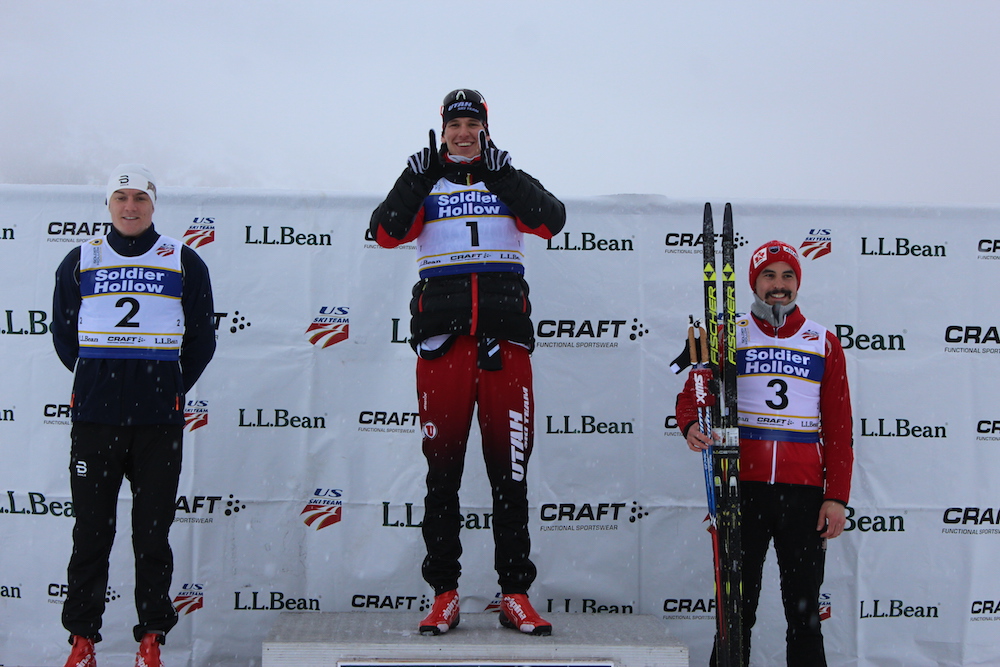
The men’s classic sprint podium at 2017 U.S. nationals at Soldier Hollow on Sunday: with winner Kevin Bolger (c) of the University of Utah, runner-up Moritz Madlener (l) of the University of Denver, and Jess Cockney (r) of the Canadian World Cup B-team in third.
U.S. Cross Country Championships (Soldier Hollow): Classic sprints
Jennie Bender of Bridger Ski Foundation and Kevin Bolger of the University of Utah won national titles in the classic sprints at 2017 U.S. Cross Country Championships at Soldier Hollow earlier Sunday afternoon. They each took narrow – but, for sprinting, relatively uncontested – victories, as each was in the lead coming into the stadium and led through the final 180-degree turn into the finishing straight.
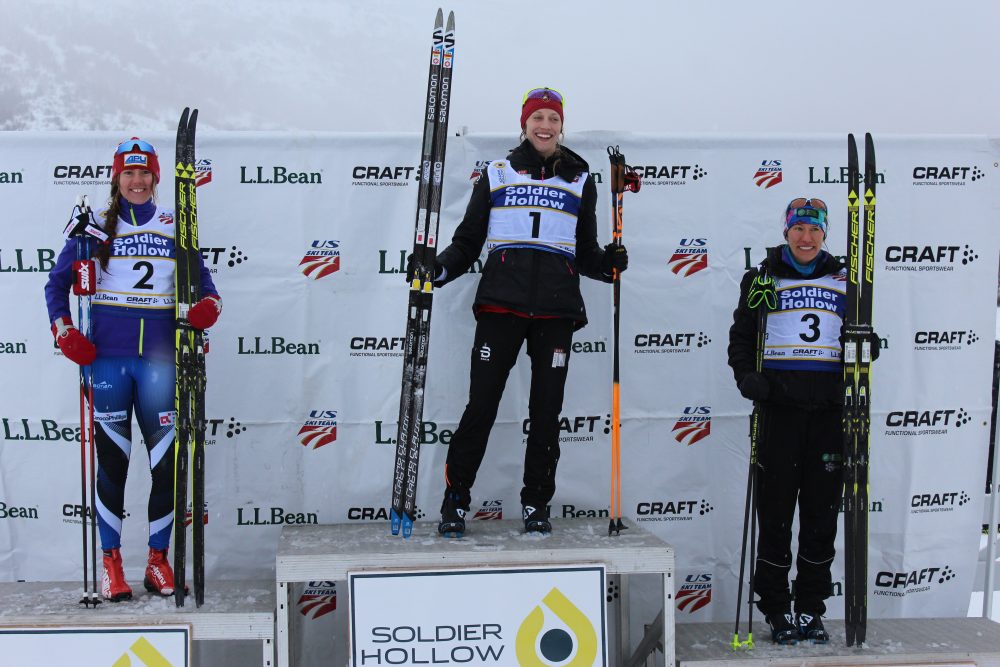
The women’s classic sprint podium at 2017 U.S. nationals on Sunday at Soldier Hollow: with winner Jennie Bender (c) of the Bridger Ski Foundation, runner-up Becca Rorabaugh (l) of Alaska Pacific University, and Kaitlynn Miller (r) of the Craftsbury Green Racing Project in third.
In the women’s race, Bender took the victory over Becca Rorabaugh of Alaska Pacific University, who just edged out Kaitlynn Miller of the Craftsbury Green Racing Project for second. Miller had won the qualifier earlier in the day.
Dahria Beatty of Canada’s Alberta World Cup Academy in fourth, Anne Hart of Stratton Mountain School Elite Team in fifth, and Krista Niiranen, originally from Finland and now a sophomore at the University of New Mexico, in sixth made up the rest of the A-final. There was no B-final contested for either gender.
In the men’s race, Bolger’s victory marked his best performance in a national championship by a substantial margin: His previous best before today was 23rd, in the 15 k classic at SoHo in 2014. (His 37th in the sprint that same year marked his previous best finish in a national championship sprint.)
Bolger was followed to the line by Moritz Madlener, of the University of Denver, and Jesse Cockney, of the Canadian World Cup B-team. Cockney had qualified fourth that morning.
The rest of the A–Final was Canadian Bob Thompson, of National Team Development Centre (NTDC) Thunder Bay, in fourth, Petter Reistad of the University of Colorado in fifth, and Fredrik Schwencke of Northern Michigan University in sixth.
Madlener is German. Cockney and Thompson are Canadian. Reistad and Schwencke are Norwegian. The USSA selection criteria for World Championships in Lahti provide that, “For the purposes of the 2017 Championship Selection List, athletes that are not US citizens will not be included in the scoring, and US athletes will move up the results/scoring list as foreign athletes are eliminated.” American racers eliminated in the semifinals included, in no particular order, Ben Lustgarten of Craftsbury Green Racing Project, Cully Brown of the University of Vermont, John Hegman and Cole Morgan of Sun Valley Ski Education Foundation (SVSEF) Gold Team, and Ben Saxton of Stratton Mountain School.
Earlier Sunday, Kaitlynn Miller won the women’s classic sprint qualifier. Starting sixth out of the 200+ woman field, Miller laid down an unbeatable time of 3:24.5 in difficult waxing conditions. She is the defending classic sprint champion from last year’s national championships.
Krista Niiranen, originally from Finland and now a sophomore at the University of New Mexico, was next fastest and tallied a time just 0.2 seconds behind Miller’s. Emily Nishikawa of the Canadian National Ski Team was third, Dahria Beatty of Canada’s Alberta World Cup Academy fourth, and Cendrine Browne from the Centre National d’Entrainement Pierre Harvey in Quebec clocked the fifth-fastest time.
The 30th skier making the cut for quarterfinals — Frederique Vezina, also of the Centre National d’Entrainement Pierre Harvey — was 16.53 seconds behind Miller.
Ben Saxton of the Stratton Mountain School Elite Team won the men’s sprint qualifier, notching the fastest time by 1.27 seconds over Etienne Hebert of Monteriski.
Canadians took the three of the top four spots in the qualifier, with Reed Godfrey of Canmore Nordic clocking the third-fastest time and Canada’s Jesse Cockney finishing fourth.
9.17 seconds separated the top 30 men who moved on to the quarterfinals. That included racers from at least six countries: the U.S. and Canada, but also collegiate skiers from Finland, Germany, France, and Norway. It also included one Under-18 competitor: Ben Ogden from the Stratton Mountain School.
It was a World Championships preview weekend on the Nordic Combined World Cup circuit, with two large hill/10 k individual competitions held in Lahti, Finland.
On Saturday, Germany’s Eric Frenzel took the win in 29:13.7, holding off Finland’s Eero Hirvonen by 4.1 seconds across the line. After posting the second-best jump, Frenzel started the 10 k in second, ahead of Hirvonen in third, but still full 1:06-minutes behind Norway’s Jarl Magnus Riiber, who dominated the jump with 135.2 points. Hirvonen started 1:29 back in third.
Riiber went on to place sixth at the finish with the 38th-ranked course time (out of 43 finishers). Germany had two on the podium with Johannes Rydzek in third (+26.4).
American Bryan Fletcher finished 15th (+1:29.8) after jumping to 22nd and starting the ski race 3:06 minutes back. He skied the sixth-fastest 10 k to end up 1:29.8 behind Frenzel at the finish.
Ben Loomis was the second American competing on Saturday. He finished the day in 40th (+5:18.5) after jumping to 35th.
On Sunday, Germany swept the podium with Fabian Rießle leading the charge, Frenzel in second and Rydzek in third. Rießle jumped to fifth and captured the win in 25:44.2, ahead of Frenzel (+4.2) and Rydzek (+11.6). Frenzel led after the jump and started the 10 k just 6 seconds ahead of Italy’s Samuel Costa, who ended up sixth at the finish (+40.6).
Rießle started 16 seconds after Frenzel and posted the third-fastest course time en route to the win.
Bryan Fletcher raced to 16th (+1:30.7) on Sunday, after jumping to 28th. Loomis did not start.
The NoCo World Cup moves to Val di Fiemme, Italy, for competitions next Friday through Sunday. Lahti World Championships will hold nordic-combined competitions Feb. 24-March 3.
Two North Americans started the International Biathlon Union (IBU) World Cup women’s 12.5 k mass start on Sunday, with one of them finding out at the last minute that they were in for the 30-woman race.
American Susan Dunklee knew she had qualified well ahead of time after ranking 17th in the overall World Cup. She raced to ninth on Sunday, finishing 1:43.5 behind from the winner, Gabriela Koukalová of the Czech Republic, who cleaned the four-stage race to finish first in 37:20.5.
Germany’s Laura Dahlmeier made her first appearance of the week in the final race of the World Cup stop in Oberhof, Germany, placing second in the mass start, 31.5 seconds behind Koukalová, with one standing miss (0+0+1+0). The Czech Republic had two on the podium with Eva Puskarčíková in third (+45.4), with clean shooting.
Dunklee was in contention with the leaders until the last two standing stages, where she missed one target then two more (0+0+1+2) for a total of three penalty laps. Ninth place helped elevate Dunklee to 15th in the overall World Cup standings.
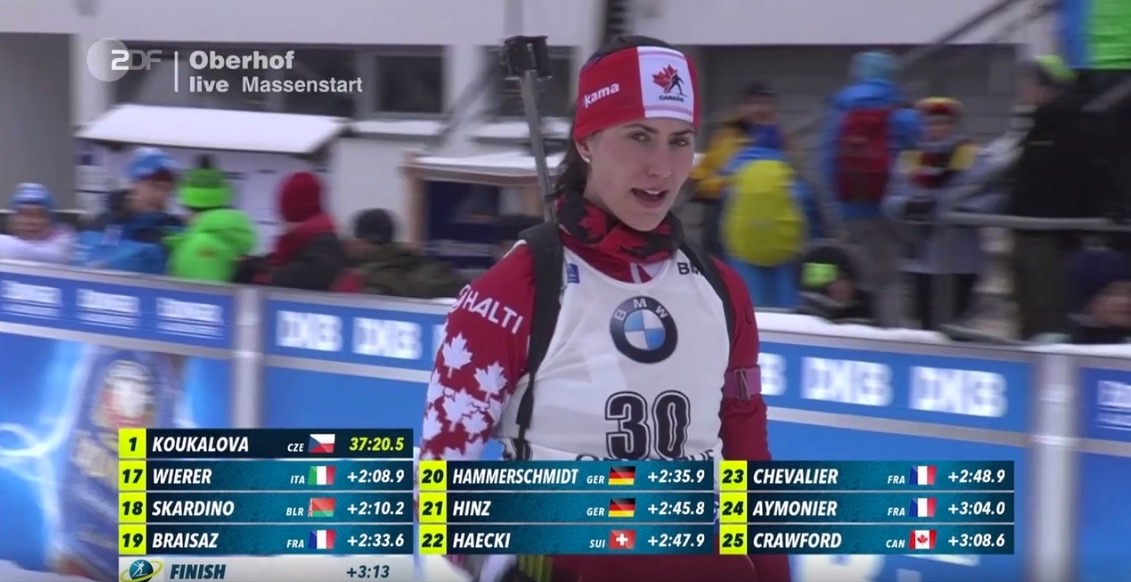
Canada’s Rosanna Crawford jumped into the race being listed as a reserve athlete on standby. Wearing bib 30, she finished 25th (+3:08.6) with two clean stages and two penalties (0+1+1+0).
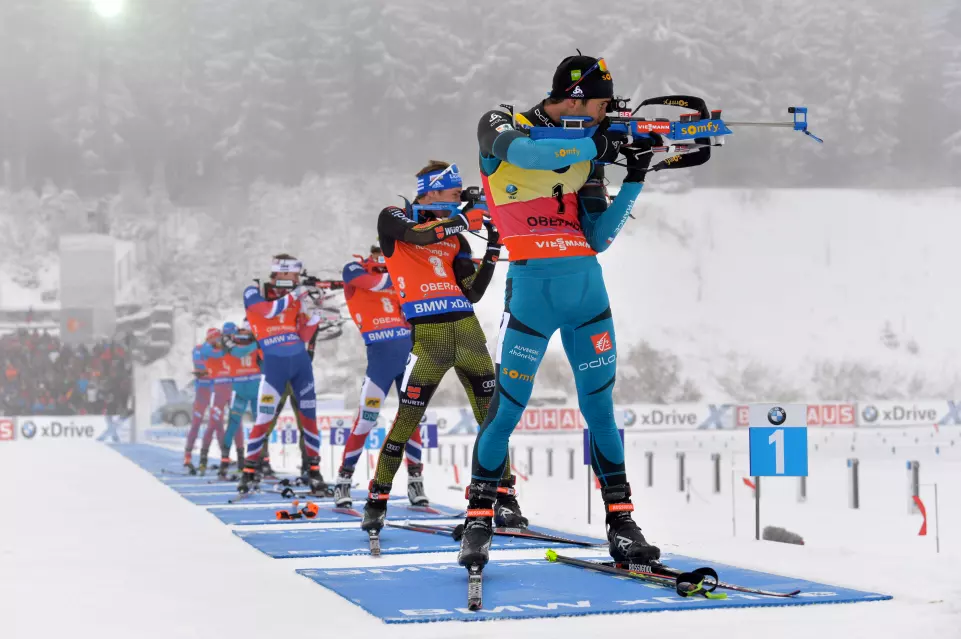
France’s Martin Fourcade (bib 1) and Germany’s Simon Schempp (bib 3) shooting in the third stage of the men’s 15-kilometer mass start at the 2017 IBU World Cup in Oberhof, Germany. (Photo: IBU)
On Sunday in the men’s 15 k mass start, Germany’s Simon Schempp celebrated his first victory of the season, and it was a special one in front of thousands of cheering fans at home in Oberhof. On the final lap, he desperately tried to hang onto the ski tails of France’s biathlon star Martin Fourcade, who pushed hard on the first climb out of the shooting range unsuccessfully trying to create a gap.
“He started attacking immediately up the Birxsteig [climb],” Schempp told German TV broadcaster ZDF. “And I thought either you blow up or you can stick with him, and I could. Because I was in the draft, I saved a few percent, that probably was the decisive point in the end.“
Schempp kept right behind Fourcade, then started an attack on the last climb himself and outsprinted his rival on the finishing stretch, celebrating across the line with a time of 38:30.9 minutes, with just one penalty (0+0+1+0).
To the joy of the German fans, Schempp’s teammate Erik Lesser managed to overtake France’s Jean Guillaume Beatrix on the final loop closing up to the two athletes in front on the last meters, and outlunged Fourcade in a photo finish sprint (both +0.4 seconds).
“They pushed up the Birxsteig so incredibly hard,” Lesser told ZDF. “I thought I could only fight for position five. Then I saw that Beatrix wasn’t skiing very clean anymore either. So I just tried a full attack… I never would have believed that a second place would come out of that.“
“My father-in-law is probably watching the Tour de Ski today and saying, ‘Finally the guy makes a lunge,’ ” Lesser joked about the finish sprint. “I never would have believed that Fourcade still lets himself get beaten by the little Lesser. Finally all the strength training paid off.“
Fourcade had incurred two penalties in the third shooting stage, having to make up a 44 second gap to the top. In the final shooting he stayed clean, but already had to invest a lot of energy on the prior loop so he could not create a significant lead on the last one.
“I skied as fast as I could, but Simon was just faster and Erik as well,” Fourcade said during the press conference. “I tried my best in the beginning of the lap because we were too [many] people… I gave all I had. I must say I didn’t see Erik until he passed me in the sprint… It was a great competition, a great fight.”
Coming into the last shooting stage Lesser had been leading the race with Norway’s Ole Einar Bjørndalen, but both missed a target and had to a penalty lap while Schempp and Fourcade stayed clean.
Fourcade’s teammate Beatrix finished fourth with one penalty (+13.2), Bjørndalen was fifth (+19.5) also with one penalty.
No North American men competed in the mass start, with US Biathlon’s Lowell Bailey ,who would have been qualified via the overall World Cup standings skipping the race week in Oberhof for a training block. Bailey is currently ranked 19th overall.
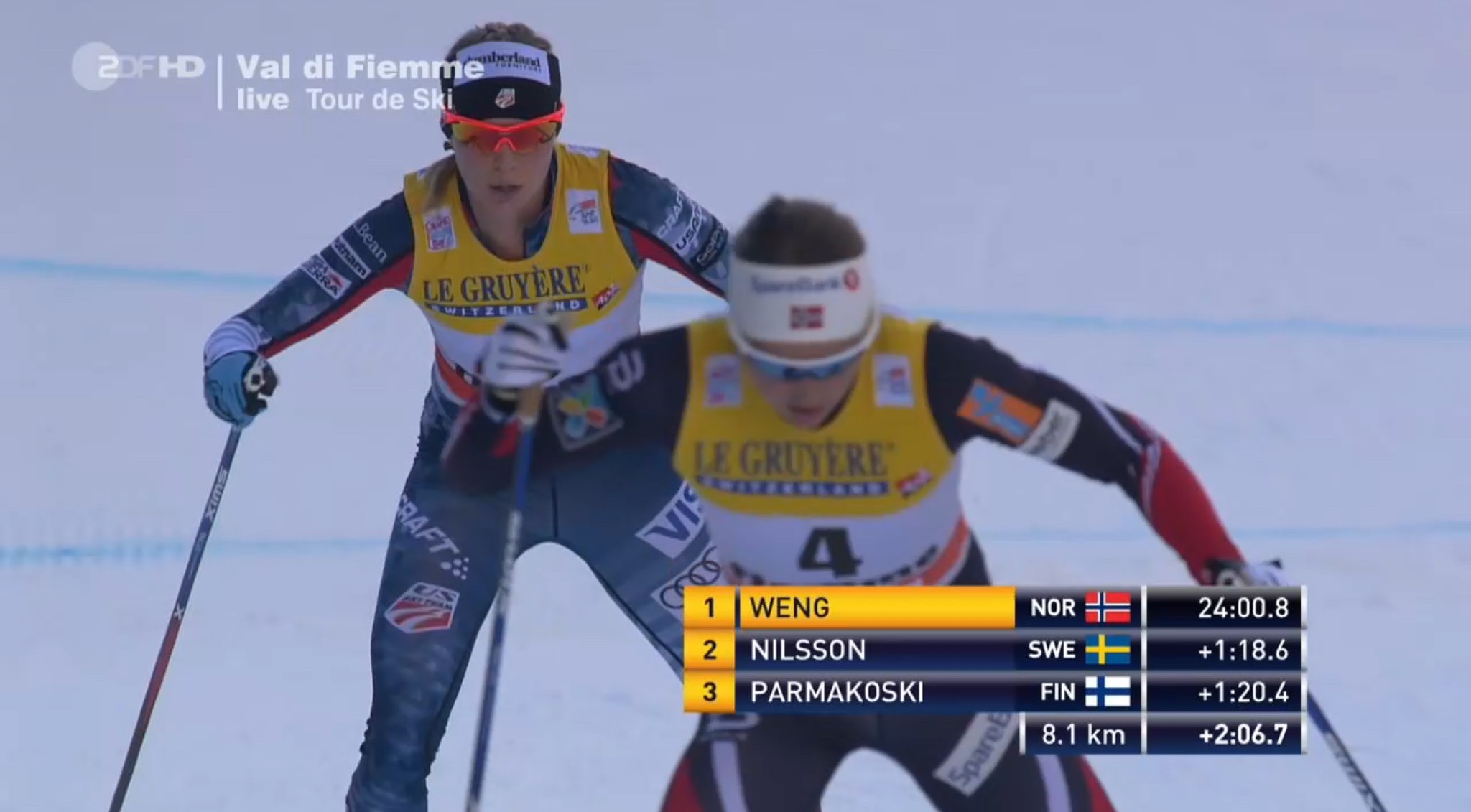
American Jessie Diggins chasing Norway’s Ingvild Flugstad Østberg on the final climb of the 2017 Tour de Ski up the Alpe Cermis in Val di Fiemme, Italy. Østberg finished the Tour in fourth and Diggins fifth, tying a best-ever mark for the U.S., set in 2015 by Liz Stephen. (Photo: ZDF screenshot)
FIS Cross-Country Tour de Ski Stage 7 (Val di Fiemme/Alpe Cermis, Italy): 9 k freestyle
Heidi Weng of Norway proved that she was the threat everyone was fearing – despite a few races in the Tour de Ski with bad skis or low energy, Weng had a dominating performance up the Alpe Cermis and took her first ever Tour de Ski title.
At 6.2 k of the 9 k course, Weng passed Stina Nilsson of Sweden, who had started the day in the leader’s bib with a 19.2-second advantage. Weng just stepped on the gas from there, turning in the fastest climb time of the field and winning by 1:37.0.
Further up the hill, Nilsson was also passed by Krista Parmakoski of Finland, who gapped the Swede and earned second place.
And Nilsson had to hold off one more attack, from Norway’s Ingvild Flugstad Østberg near the top of the climb. Østberg had started in fourth place and got close to Nilsson, before the Swede found her second (or third, or fourth) wind and sprinted it in to the finish to secure third place and her first Tour de Ski overall podium.
Weng has three previous Tour de Ski podiums, but never a win. Parmakoski’s previous best overall finish was fourth, in 2014.
Jessie Diggins of the U.S. Ski Team started behind Østberg and almost made contact at one point, before the Norwegian slipped from her grasp. Diggins finished the Tour de Ski fifth (+3:09.0) — where she had started the day — to tie for the best-ever Tour finish with Liz Stephen, who was fifth in 2015.
Today, Stephen clocked the second-fastest time up the climb, behind Weng, and finished 14th (+6:45.6).
Rosie Brennan, the third and final U.S. woman to finish the Tour de Ski this year, landed 28th, +12:59.9. Her time was the 23rd-fastest up the Alpe Cermis.
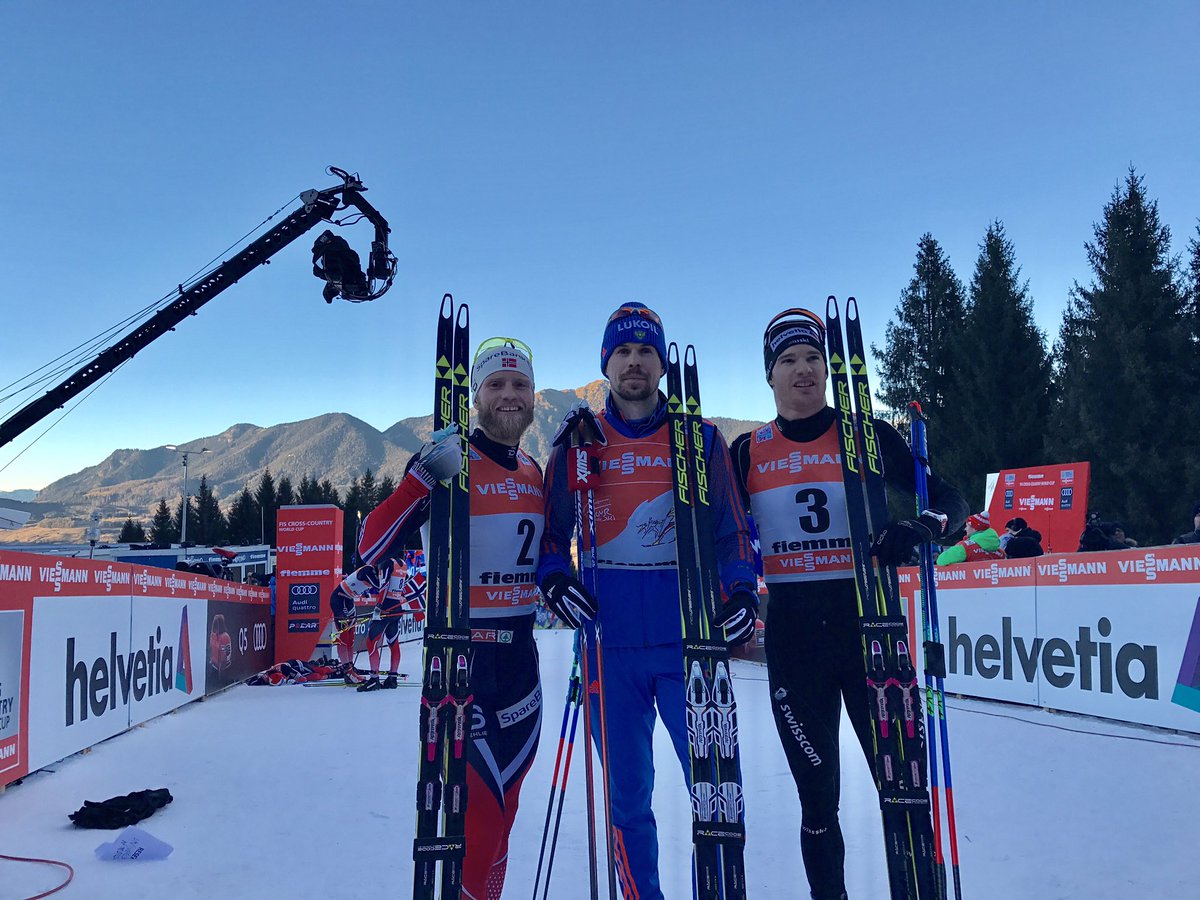
The overall podium at the end of the 2017 Tour de Ski, with winner Sergey Ustiugov (c) of Russia, Norway’s Martin Johnsrud Sundby (l) in second, and Switzerland’s Dario Cologna (r) in third after finishing in that order in the 9 k freestyle hill-climb pursuit, Stage 7 of the Tour de Ski in Val di Fiemme, Italy. (Photo: FIS Cross Country/Twitter)
In the men’s 9 k freestyle hill climb that followed, 24-year-old Sergey Ustiugov of Russia raced to his first Tour de Ski victory, heading out of the gate with a 1:12-minute head start over Norway’s Martin Johnsrud Sundby and finishing 1:02.9 ahead for the win in 30:27.7.
Sundby put time into Ustiugov over parts of the course, particularly in the first kilometer along a flatter section leading up to the climb and then again between 6 and 8 k on Alpe Cermis itself.
Sundby skied alone throughout the pursuit race, with Switzerland’s Dario Cologna starting 52 seconds behind him. Cologna had a 29-second head start on Finland’s Matti Heikkinen, who entered the race in fourth, and 30 seconds ahead of France’s Maurice Manificat in fifth, but Manificat caught and even passed Cologna with about 0.5 k remaining. Cologna proceeded to pass Manificat back while Heikkinen skied about nine seconds back in fifth.
Canada’s Alex Harvey had started sixth and helped lead Manificat and Heikkinen in chasing down Cologna early in pursuit, but he faded to seventh, behind Sweden’s Marcus Hellner (who started seventh, 12 seconds after Harvey) by 8.5 k. There, Hellner trailed Heikkinen by 14.6 seconds, and Harvey was another 27.9 seconds back in seventh (and nearly a 54 seconds ahead of the man skiing in eighth at the time, Norway’s Simen Hegstad Krüger).
Half a kilometer later, it was all over with Cologna securing third overall in the Tour, 1:19.1 behind Ustiugov and 16.2 seconds behind Sundby.
With the fastest 9 k time of the day, Manificat moved up one place for fourth overall, finishing 1:26.9 after Ustiugov with a time of 29:20 minutes. Heikkinen was the second fastest on course, 6.1 seconds slower than Manificat, for fifth overall in the Tour (+1:31.3). Hellner took sixth at the finish (+2:05.8), ahead of Harvey in seventh (+2:39.7). For Harvey, it was his best overall finish in four competed Tour de Skis (last year, he finished 14th. His best result was 12th in 2012).
Norway swept the next five places with with Krüger in eighth (+3:27.2), Hans Christer Holund in ninth (+3:50.4), Niklas Dyrhaug in 10th (+4:24.9), Sjur Røthe in 11th (+4:56.4), and Didrik Tønseth in 12th (+5:07.7).
Canada had two in the final climb with Devon Kershaw finishing 25th (+9:32.2) after starting 23rd. Graeme Killick did not start after being positioned in 37th overall in the Tour.
Kershaw finished 8.1 seconds ahead of Noah Hoffman, the lone American racing to the top of Alpe Cermis. Hoffman moved up from 30th at the start to finish 26th (+9:40.3) overall, and in doing so, he posted the 15th-fastest time of the day, 1:05.3 back from Manificat.
Harvey’s time ranked 14th (+1:04.9). Norway’s Holund had the third-fastest time after starting 11th and ending up ninth, Hellner was fourth fastest, and Cologna fifth fastest.
Tour de Ski final results (with isolated climb times): Women | Men
US Biathlon’s Susan Dunklee skis through the arena during the women’s 12.5 k mass start at the 2017 IBU World Cup on Sunday in Oberhof, Germany. (Photo: USBA/NordicFocus)
After twice shooting clean on Sunday, American Susan Dunklee found herself in third place going out on the next loop of the women’s 12.5-kilometer mass start at the International Biathlon Union (IBU) World Cup in Oberhof, Germany, pushing hard to keep up with Czech Republic’s Gabriela Koukalová and Germany’s Laura Dahlmeier.
“I was not skiing a sustainable pace,” Dunklee explained in an email to FasterSkier. “Sometimes it makes more sense to keep yourself in the race as long as you can and worry about consequences later.”
While Koukalová stayed clean also in the next two shooting stages to win the race in a time of 37:20.5 and Dahlmeier only shot one more miss to finish second (0+0+1+0, +31.5), Dunklee had to pay a bit for her tempo when she incurred a penalty in the first standing stage and two more in her last standing bout.
She left the range after the final shooting in ninth position, but was challenged on the long Birxsteig climb by four athletes who shot clean in the last stage: Norway’s Marte Olsbu, Sweden’s Anna Magnusson, Poland’s Magdalena Gwizdon, and Russia’s Tatiana Akimova.
“Skiing hard earlier in the race (e.g. with Gabi and Laura) meant that I didn’t have much fight in me on the first huge climb and I lost time there,” Dunklee wrote about the last loop. “To make up for it, I tried to conserve some energy for the last hills, rely on faster skis than the girls around me (our techs did a fantastic job today) and ski tactically.”
Dunklee fought back, and managed to overtake all of those four skiers again to finish ninth (+1:43.5) with three penalties (0+0+1+2) and the 12th-ranked overall course time. She was passed on that loop only by Finland’s veteran Kaisa Mäkäräinen, who had a rough day on the range with seven penalties, but skied the best course time to finish eighth (+1:39.9).
During the week’s races in Oberhof, Dunklee missed more targets than she usually does to finish 50th in the sprint with four penalties and 44th in the pursuit with nine penalties.
“I created a very specific periodization plan for my shooting this year and I believe in it,” Dunklee wrote. “Each week has its own focus, which creates subtle differences in how I approach the shooting. I have now learned that the type of focus I had for this week (and incidentally, Östersund) doesn’t work well. Today I shifted over early to the speed focus I had planned for next week and that was a good decision. My periodization plan is an experiment and a work in progress that I hope to have nailed for next year.”
“My standing shots all felt good except for my very last shot,” Dunklee said, according to a US Biathlon press release. “I couldn’t get the barrel to stay on the target. Rather than taking an extra breath to reset, I over held it. That is my only regret of the day.”
When the provisional start list was first released on Saturday, Biathlon Canada’s Rosanna Crawford narrowly missed the qualification for the elite mass start field (with starts being awarded to the top-25 ranked athletes in the overall World Cup plus five more not among those with the best results of the competition week). But she was excited to learn the night before the race that she would be “called up” from a reserve standby list to replace a sick athlete.
“I love Mass Start races, there is so much potential!” Crawford wrote in an email to FasterSkier. “The best are nervous and the rest of us are the underdogs wanting to prove we belong.”
Biathlon Canada’s Rosanna Crawford after finishing 25th in the women’s mass start at the 2017 IBU World Cup in Oberhof, Germany. (Photo: ZDF screenshot)
After a clean shooting performance in the Oberhof sprint, Crawford was able to shoot well again on Sunday, totaling just two penalties (0+1+1+0), but was unable to keep pace with the leaders with the 28th-ranked course time.
“Like the last two races, it’s skiing that is really holding me back,” Crawford explained.
“So I just went out for a good workout and a chance to work on my shooting. I am really angry at my prone miss, just like yesterday [in the pursuit] that was all me! But 18/20 is still a pretty good day. I can only hope that the ski shape turns around in the next few weeks. Our wax techs again did a good job today!”
Crawford waved to the spectators on the finishing stretch and took a bow as she crossed the line in 25th place (+3:08.6).
“The crowds here are pretty incredible, there was a lot of people cheering ‘Go Canada’ which really helped fuel me around the course,” she wrote.
The spectators were particularly fired up after seeing a double-victory for Germany’s Simon Schempp and Erik Lesser in the men’s mass start earlier on Sunday. And with the return of home-crowd favorite Dahlmeier after a longer rest and training period over the holiday break, as well as her teammate Franziska Hildebrand also fighting for a position at the top, they had every reason to cheer during the women’s race as well.
“I think I did everything right,” Dahlmeier told German broadcaster ZDF of her reason for skipping the sprint and pursuit races. “I did not exactly know good my form would be after the break. Today I had a bit heavy legs from training. But I am happy with the second place and glad that the return worked out like this. It was a lot of fun to ski in front of such an audience today.”
“The first three World Cup weekends were more strenuous, due to the good results and the yellow bib [of the overall World Cup leader],” she added. “When I go to the start, I want to give it 100 percent, not just coast along. So my feeling was that it would be useful to skip a race, and that this happened to be in Oberhof was due to the competition calendar. But I am glad that I could do this one race.”
“I didn’t have so good expectations for this,” Koukalová said at the press conference on her race week in Oberhof, with two victories and a second place. “The main goal of the season is the World Championships in Hochfilzen. So I hope that I am still not in the best shape now, because I know it is more difficult to win there than here.”
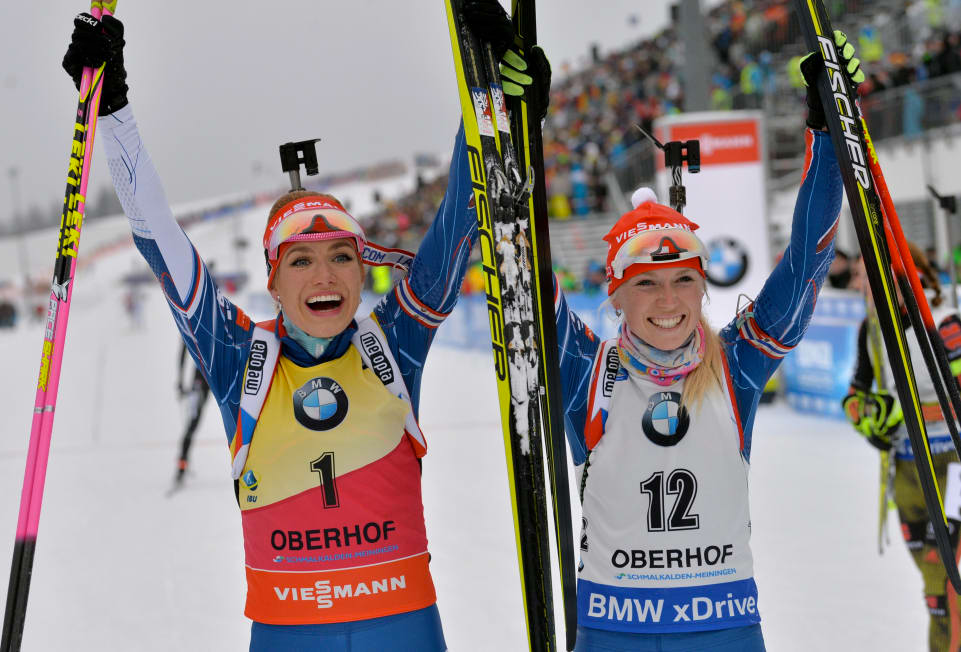
Czech Republic’s Gabriela Koukalová (bib 1, first place) and her teammate Eva Puskarčiková (bib 12, third place) celebrate at the finish of the women’s 12.5 k mass start on Sunday at the 2017 IBU World Cup in Oberhof, Germany. (Photo: IBU)
Koukalová was also excited that teammate Eva Puskarčiková placed third (+45.4 with no penalties) to stand on the podium with her, and that they were the only two athletes in the field who shot clean. It was the second World Cup podium of the career for Puskarčiková, after a third place in the pursuit in Pokljuka, Slovenia, earlier this season.
“I don’t know how to say it, but I have many times deeper feelings than to stand there alone,” Koukalová said at the press conference. “It’s very positive and I am very happy for Eva, because she was still sick around Christmas and so she is something like a hero for me. It’s amazing, she is crazy.”
“I hope so, I hope it will be better and better,” Puskarčiková said with a smile when questioned if her confidence is increasing with each success now.
In a three-way sprint finish, the fourth place went to Kazakhstan’s Galina Vishnevskaya, the best result of the 22 year old’s career (+1:11.6 with one penalty), ahead of Ukraine’s Yulia Dzhima (+1:12.6 with three penalties) and Germany’s Hildebrand (+1:14.0 with two penalties).
If the IBU, which likes to stress its “biathlon family” motto, had a fair-play award, it should have gone to Austria’s Lisa Theresa Hauser, who voluntarily gave up a pole to Germany’s Vanessa Hinz after accidentally breaking hers by stepping on it. Hauser’s good deed was not rewarded, as she soon after fell on a steep downhill turn, clogging the sights of her rifle with snow and had to pull out of the race. Hinz finished 21st.
The IBU World Cup resumes with a men’s relay on Wednesday, Jan. 11 and a women’s relay on Thursday, Jan. 12 in Ruhpolding, also located in Germany.
Olivia Bouffard-Nesbitt of the Alberta World Cup Academy (AWCA) leads the American train around the bridge corner into the finish straight in the A-final of Saturday’s NorAm classic sprint at Sovereign Lake in British Columbia. She went on to finish fourth behind Julia Kern (second from r), Liz Guiney (back left) and Kaitlynn Miller (l), respectively. (Photo: Peggy Hung)
Welcome to The Rundown, your quick primer of need-to-know information about the day’s racing. We’ll be updating this digest as the day goes on with additional results, photos and quotes. The Rundown is NOT a race report; stay tuned for complete race reports later today with interviews from the day’s top racers.
***
Canadian NorAm/U.S. SuperTour at Sovereign Lake: Classic sprint
[UPDATE] U.S. skiers filled the open category podiums on the first fully North American NorAm event in recent years on Saturday at Sovereign Lake near Vernon, B.C. With NorAm points, SuperTour points and FIS points on the line there was a great turnout of the top skiers.
In the open women’s 1.2-kilometer classic sprint, Julia Kern of the Stratton Mountain School (SMS) won in 3:17.04 after qualifying fifth. Liz Guiney of the Craftsbury Green Racing Project (CGRP) finished second, 0.67 seconds back, and her CGRP teammate Kaitlynn Miller rounded out the podium in third (+0.91). Olivia Bouffard-Nesbitt (Alberta World Cup Academy) was the top Canadian in fourth (+1.49) and the lone Canadian in the final. Jennie Bender (Bridger Ski Foundation) placed fifth (+3.8) and Heather Mooney was sixth (+19.84).
On the same 1.2 k course, Reese Hanneman (Alaska Pacific University) made up for his 15th qualifying time to take the men’s final win in 2:38.08. Cole Morgan of the Sun Valley Ski Education Foundation (SVSEF) took second in the final (+0.87) after winning the qualifier, and Ben Saxton (SMST2) was third (+1.92). Matt Gelso (SVSEF) finished fifth (+3.88), after precipitating a semifinal crash that took three Canadians (Angus Foster, Simon Lapointe and Evan Palmer-Charrette) out of contention, but didn’t result in a protest. The lone Canadian man in the final, Antoine Briand (Pierre-Harvey Training Centre) placed sixth (+11.98).
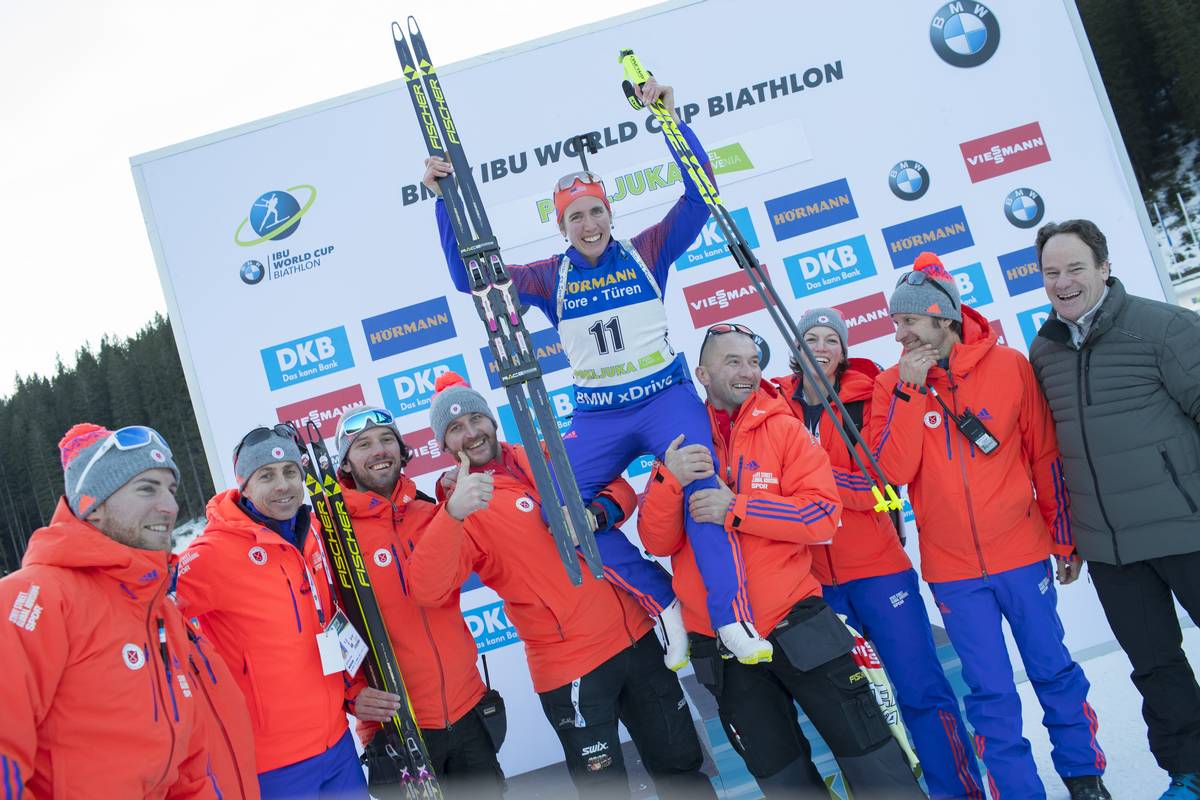
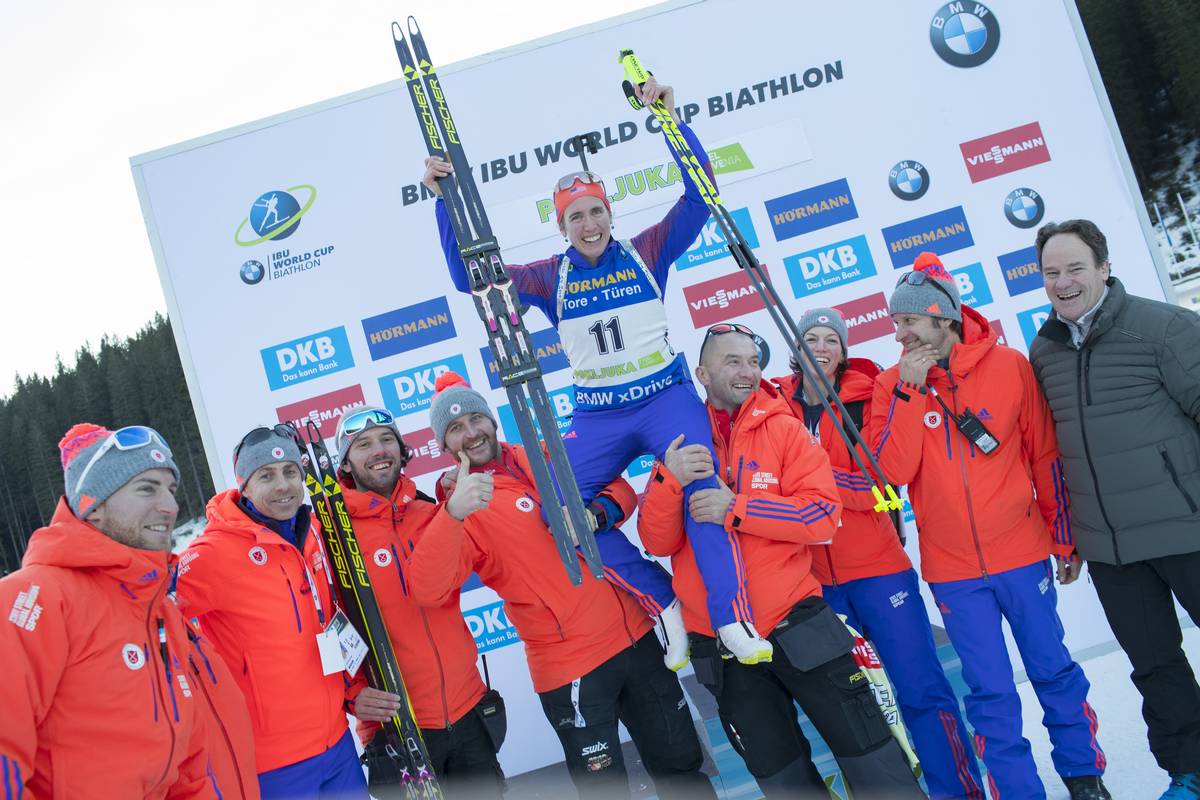
Susan Dunklee being hoisted up by her US Biathlon support team at the IBU World Cup in Pokljuka, Slovenia, after tying her career-best result in a pursuit. Dunklee placed fifth on Saturday for a season best as well. (Photo: USBA/NordicFocus)
Another day at the front of the pack, and another day of (nearly) perfect shooting for Susan Dunklee, who raced from 11th to fifth for her first flower ceremony (top six) of the season at the IBU World Cup in Pokljuka, Slovenia.
Dunklee (US Biathlon) cleaned the first three of four stages in Saturday’s 10-kilometer pursuit to move into second with one standing stage remaining. In that final shooting stage, she had her first miss of the day, yet still left the range in second, 22 seconds behind Germany’s Laura Dahlmeier in first. Dunklee finished out the race with the 21st-ranked course time on the last loop (her first-loop time was the fastest in the 56-woman field) and placed fifth, 24.1 seconds behind Dahlmeier — who won her second-straight race in Pokljuka. Dahlmeier finished first in 30:43.1 despite two prone misses on the second stage, which put her as far back as fifth (0+2+0+0). Finland’s Kaisa Mäkäräinen finished second, 16.8 seconds back, with two penalties as well (0+0+1+1), and Eva Puskarcikova of the Czech Republic reached the podium in third (+18.7) with a single miss followed by three clean stages (1+0+0+0). One spot ahead of Dunklee, reigning World Cup champion Marie Dorin Habert of France clawed her way up to fourth (+18.8) after starting 17th, with one penalty (0+0+1+0).
For Dahlmeier, it was her 10th World Cup victory and fifth in a pursuit.
“My motto is ‘Scheiß da nix, dann feid da nix’,” Dahlmeier told Germany’s ZDF, which vaguely translates to “Don’t worry be happy,” or “Just do it.”
“That was worth gold today. I was a bit surprised about my two misses in prone. Apparently I already had an aberration in the first stage, then I clicked [adjusted the sights] and was a bit surprised that the two misses still happened,” she added. “… Then came the standing shooting, and there I tried to keep calm again. The race is only over once you cross the finish line, and that became true again today. I am happy that the race flipped again like this.”
Canada’s Julia Ransom cleaned three consecutive stages before missing two on the last standing. She finished 34th for the second day in a row, 2:33.5 behind Dahlmeier. Rosanna Crawford placed 49th with three penalties (2+1+0+0) and Clare Egan of the U.S. was 56th with six misses (2+0+1+3). Canada’s Megan Tandy, with seven penalties (1+1+3+2) did not finish.
In the men’s 12.5 k pursuit, the first man out of the start, Martin Fourcade of France, held his lead to the finish, hitting all 20 targets and winning in 30:27.4. Norway’s Emil Hegle Svendsen rose from fourth at the start to second at the finish (+6.0) with clean shooting as well, and Russia’s Anton Shipulin placed third for the second-straight day (+6.2), with one penalty in the last stage (0+0+0+1).
Friday’s sprint runner-up, Johannes Thingnes Bø of Norway, ended up fourth (+48) with two misses on the last stage (0+0+0+2), Germany’s Simon Schempp placed fifth (+59.8) after starting sixth, and had one miss (0+0+1+0), and Michael Rösch of Belarus cleaned for sixth place (+1:21.0) after starting 16th.
Lowell Bailey (US Biathlon) finished 18th (+2:01.6) for the second day in a row, with one prone penalty in the first stage (1+0+0+0).
Biathlon Canada’s Christian Gow picked off two places for a new career best in 31st (+2:41.7) with a single prone penalty (0+1+0+0).
Tim Burke placed 42nd (+4:09.8) for the U.S. (after starting 53rd) with five standing penalties (0+0+2+3), Canada’s Scott Gow finished 48th (+4:39) with five misses as well (2+1+0+2), and the third Canadian in the race, Brendan Green was 57th (+5:36.4) with five penalties (+5:36.4).
Norway’s Ingvild Flugstad Østberg (c) won her first World Cup race of the season on Saturday in the 15 k freestyle individual start in Davos, Switzerland. Joining her on the podium: Norway’s Heidi Weng (l) in second and Finland’s Krista Parmakoski (r) in third.
Norway’s Ingvild Flugstad Østberg is back on top of the podium after a 7.9-second win in Saturday’s 15-kilometer freestyle in Davos, Switzerland, over — you guessed it — her teammate Heidi Weng.
Østberg started 38th (out of 59) and led at every split to take the win in 37:44.4, her first this season and her first in a 15 k. Weng started a minute ahead of her in bib 36 and ended up second, while Finland’s Krista Parmakoski notched third (+16.7) for her third podium of the season, ninth in her career and second skate podium.
The next fastest woman, American Jessie Diggins finished 37.6 seconds off the podium in fourth (+54.3), ahead of Russia’s Yulia Tchekaleva in fifth (+1:00.5) and Switzerland’s Nathalie von Siebenthal in sixth (+1:05.6). Ragnhild Haga of Norway was seventh (+1:10.8), Finland’s Riitta-Liisa Roponen eighth (+1:21.4), Italy’s Ilaria Debertolis ninth (+1:32.2), and Sweden’s Anna Haag 10th (+1:35.5).
The U.S. had two in the points with Liz Stephen in 28th (+2:17.5). Kikkan Randall was 2.3 seconds outside the top 30 in 33rd (+2:30.2), and Caitlin Patterson placed 44th (+3:21.6). Rosie Brennan did not start.
Emily Nishikawa led Canada in 34th (+2:33.5) for her best result this season, Dahria Beatty was 42nd (+3:15.2), and Cendrine Browne 54th (+4:07).
Weng remains the Overall World Cup leader by 70 points over Østberg, Parmakoski ranks third, and Norway’s Marit Bjørgen, who is not competing this weekend in Davos, is currently fourth.
[UPDATE] In the men’s race earlier on Saturday, Martin Johnsrud Sundby racked up another victory in Davos’s 30 k freestyle, beating his fellow Norwegian Anders Gløersen by 13.7 seconds with a winning time of 1:07:31.6 hours. Gløersen took second for his first podium in a year (he was third in the Davos 30 k last December) and Finland’s Matti Heikkinen reached the podium for his second-straight race in third (+25.7).
Canada’s Alex Harvey placed 12th (+1:29.4) and his teammate Graeme Killick notched 21st (+2:24.2) for his second-best World Cup result (after placing 19th in a skiathlon last March at the Ski Tour Canada).
Devon Kershaw was the next top North American in 43rd (+3:52.9), six seconds ahead of the lone American in the race, Noah Hoffman in 44th (+3:58.9). Canada’s Andy Shields placed 64th (+6:33.9).
Susan Dunklee being hoisted up by her US Biathlon support team at the IBU World Cup in Pokljuka, Slovenia, after tying her career-best result in a pursuit. Dunklee placed fifth on Saturday for a season best as well. (Photo: USBA/NordicFocus)
(Note: This article has been updated to include comments from Canada’s Julia Ransom.)
Susan Dunklee laughed a little when she thought about her reputation as a World Cup biathlete. Often one of the fastest skiers in terms of course time, she said she’s also been known for some of the slowest shooting times.
Until this weekend.
The US Biathlon veteran broke through in Pokljuka, Slovenia, with her best results of the season so far: 11th place in Friday’s 7.5-kilometer sprint and fifth in Saturday’s 10 k pursuit. Both races entailed 95-percent shooting accuracy or better (on Friday, she cleaned the two-stage sprint with the second-fastest shooting and third-fastest range times overall).
Susan Dunklee (front) going head to head with Germany’s Laura Dahlmeier (1), Austria’s Lisa Theresa Hauser (12), and France’s Marie Dorin Habert (left) in the women’s 10 k pursuit at the IBU World Cup in Pokljuka, Slovenia. (Photo: USBA/NordicFocus)
On Saturday, her range time ranked third and shooting time was fourth overall.
That was a big step up from last season, and she said it was something she’s been working on for the last two years.
“It’s pretty obviously where my weak link is, my shooting speed … that’s what’s been holding me back,” Dunklee said on the phone after Saturday’s race. “There’s no reason not to try to gain speed there. It took a lot of work…”
After starting 11th in the pursuit, 43 seconds behind the leader (Germany’s Laura Dahlmeier, who won Friday’s sprint), Dunklee raced into sixth and 28 seconds back with a clean first prone and her distinctively fast skiing. Her course time on the first loop ranked first out of 56 finishers.
One loop later, Dunklee cleaned again to move into fourth, 18.7 seconds behind the leader. Dahlmeier had slipped into fifth with two penalties, and Norway’s Marte Olsbu, who started third, took the lead.
Still in fourth for the first standing bout, Dunklee recalled being in a sort of a trance.
“I was aware of everything going on around me in the range, but I wasn’t concerned by it. … I just had this detached kind of feeling,” she said.
That was a good thing — something she wasn’t necessarily used to feeling — but something she hoped for in future races.
“It’s a really good feeling to have in the race when the pressure’s on,” Dunklee said.
Entering the range in fourth, 28 seconds out of first and without anyone directly around her, Dunklee shot clean for the third-straight stage. Suddenly, she was in second, 0.7 seconds behind Olsbu, who had to ski one penalty lap and narrowly remained in first.
The rest of the top six left the range within 14 seconds of Olsbu and Dunklee — with Dahlmeier bringing up the tail end of the group in sixth.
On the second-to-last loop, Germany’s Franziska Hildebrand passed Olsbu and Dunklee, while Finland’s Kaisa Mäkäräinen moved into fourth right behind Dunklee. With about 2.5 k remaining, Dahlmeier recaptured the lead and Mäkäräinen followed her just 0.7 seconds back in second. Hildebrand sat in third, Olsbu in fourth and Dunklee 3 seconds back in fifth.
For the final shooting, Dahlmeier led the group of six, including Austria’s Lisa Theresa Hauser, into the range. All were within 3.5 seconds of one another.
Dahlmeier hit all of her targets, Dunklee missed one, as did Hauser, Olsbu, Hildebrand, and Mäkäräinen. Eva Puskarčíková of the Czech Republic cleaned her five standing targets to move into fourth (after three consecutive clean stages: 1+0+0+0), yet Dunklee remained in second, 22 seconds behind Dahlmeier and 0.7 seconds ahead of Hauser in third.
“That penalty was a close miss,” Dunklee said. “I knew, ‘Oh, I just go in the penalty loop,’ and I wasn’t too concerned with what that meant.”
When Dunklee exited the penalty loop and headed back out onto the course, she had no idea where she stood. She couldn’t see anybody ahead of her, nor did she know how big the group was behind her.
“I knew I was probably fighting for a podium and I should push as hard as I could,” Dunklee said.
While she felt like she was missing her top-end skiing gear, which she expected at this point in the season, Dunklee used some course tactics to catch two of the five women that passed her at the beginning of the final loop: Hauser and Hildebrand.
“It’s really important to try to get to the front of the pack at the top of that first camel-hump,” Dunklee said of the Pokljuka course. “I was able to pass two people back so I was able to get back into the flower ceremony, which was great.”
Reflecting on the detached feeling she felt on the range, Dunklee said it was a different story out on the course.
“Out on the course, you’ve got to be hungry and you’ve got to be able to push yourself to a different zone,” she said. “I was missing that ability to fight on skis today. I was going at the pace I felt like I could maintain and not getting overly concerned with people passing.”
Susan Dunklee (US Biathlon) finishing fifth in Saturday’s 10 k pursuit at the IBU World Cup in Pokljuka, Slovenia. “I felt pretty flooded,” she said of her finish. (Photo: USBA/NordicFocus)
At the same time, she focused on putting everything she could into a strong finish.
“What was on my mind is, ‘I’m going to feel really bad about myself if I don’t give it everything I have,’ ” she said of her last loop. “… I figured I had nothing to lose.”
Dunklee finished 24.1 seconds behind Dahlmeier (who won her second-straight race) in the top six to reach the flower ceremony for the first time this season. That also met Dunklee’s goal of a top 10 in one of the first two World Cups.
“That was a big goal to put out there. I’m very pleased; I knew it wasn’t a sure thing” Dunklee said.
Acknowledging that she’s never had such competitive results this early in the season, Dunklee explained that she was fueled by some disappointment in Friday’s sprint.
“I was pretty bummed yesterday to get bumped down so far,” she said of crossing the finish first then ending up 11th.
As for her much-improved shooting this season: “It gives me a lot of confidence for sure,” Dunklee said. “The shooting speed has been my number-one focus for this year and much of last year, too … just seeing it pay off is wonderful. It’s very satisfying and it gives me a lot of faith in what I’ve [worked on].”
The women’s 10 k pursuit podium at the IBU World Cup in Pokljuka, Slovenia, with German winner Laura Dahlmeier (c), Finnish runner-up Kaisa Mäkäräinen (l) and third-place finisher Eva Puskarčíková of the Czech Republic. (Photo: IBU)
While Mäkäräinen closed hard in the final 2 k (starting the loop in seventh, nearly 30 seconds behind Dahlmeier), she ended up second and 16.8 seconds behind Dahlmeier, with a total of two penalties (0+0+1+1).
The 25-year-old Puskarčíková held off France’s Marie Dorin Habert by 0.1 seconds for her first World Cup podium in third place (+18.7). Dorin Habert, the 17th starter, settled for fourth, with one penalty (0+0+1+0).
For Dahlmeier, it was her 10th World Cup victory and fifth in a pursuit. Asked what she credited her success to, the 23 year old told German broadcaster ZDF, “Staying cool. My motto is, ‘Scheiß da nix, dann feid da nix’,” (which vaguely translates to “Don’t worry be happy” or “Just do it”).
“That was worth gold today,” she continued. “I was a bit surprised about my two misses in prone. Apparently I already had an aberration in the first stage, then I clicked [adjusted the sights] and was a bit surprised that the two misses still happened.”
She was quick to regroup and cleaned the remaining two stages (0+2+0+0) to finish first in 30:43.1.
“I just try to keep it not too complex,” Dahlmeier told ZDF. “… In terms of skiing I didn’t feel quite as springy today, so I had to rely on the shooting. And that worked well for me.”
Asked if her three wins, four podiums, and one fourth-place in five individual races so far this season had sunken in, she said, “No.”
“It’s almost a bit unrealistic, but when looking at the men to [France’s] Martin Fourcade, you know what is possible,” Dahlmeier said. “That is my great goal, to one day be able to have successes comparable to Martin.”
Leading Canada for the second-straight day in 34th, Julia Ransom finished in the same position she started in. After cleaning the first three stages, Ransom moved into 20th and 1:09.8 out of first, but two misses on the final standing put her in 34th at the finish (+2:33.5, 0+0+0+2).
“I was in the top 25ish mix for majority of the race, inching up to 20th before the last shooting bout,” Ransom wrote in an email. “Pursuits are my favourite format so I was actually pretty stoked to jump into the chaos. Everything was great both on the skis and in the range until the focus unravelled a little and I found myself in the penalty loop!
“The field is so tight right now that those mistakes were hard to recover from and get back into the top 30,” she continued. “I am a little bitter-sweet about a second 34th. Happy I’m still in the points but really itching to be in the top 30!”
Also for Canada, Rosanna Crawford improved from 58th to 49th (+4:06.4) with three penalties, all of which came in prone (2+1+0+0), and Megan Tandy did not finish after shooting seven penalties (1+1+3+2). The second U.S. woman in the race, Clare Egan missed six (2+0+1+3) to finish 56th (+5:32.4) after starting 53rd.
With three women and three men in Pokljuka, the U.S. will not field relay teams on Sunday. But they’ll be cheering on the Canadians, Dunklee said.
“I am stoked for our relay team tomorrow,” Ransom said of teaming up with Sarah Beaudry, Crawford and Tandy. “I think we have a great opportunity on our hands and with a little luck, all four of us girls will have solid performances.”
The men’s 4 x 7.5 k starts at 5:15 a.m. EST, and the women’s 4 x 6 starts at 8:30 EST on Sunday. (Stream live at Eurovisionsports.tv).
The Czech Republic women’s team, which won the 4 x 6 k relay on Saturday at the IBU World Cup in Presque Isle, Maine, with (from left to right) Eva Puskarcikova, Gabriela Soukalova, Lucie Charvatova, and Veronika Vitkova. (Photo: IBU/NordicFocus)
“It’s good to try a romantic atmosphere,” World Cup leader Gabriela Soukalová of the Czech Republic joked about the dark and cold course conditions at the end of the International Biathlon Union (IBU) World Cup women’s 4 x 6-kilometer relay in Presque Isle late Saturday afternoon, when the sun had long set behind the trees and hills of northern Maine for the final 6 k. “I appreciate it so much. I was thinking about my boyfriend,” she said in an post-race team interview with the IBU.
“Candles…” her teammate Eva Puskarcíková added.
The Czech women had every reason to be in a good mood. In the final race before the upcoming IBU World Championships in Oslo, Norway, their team had asserted its intention to be on the podium there in March, achieving the first relay victory of the season in a time of 1:07:11.0, with one penalty and 14 spare rounds.
After narrowly avoiding a penalty lap in the last shooting, anchor Veronika Vítková had a large enough lead to ski to the side of the track and look for a national flag for the final stretch, but none was immediately available from coaches or fans, so she celebrated across the line just by raising her arms, before her teammates hugged her at the finish.
The women’s relay was moved up from Sunday to Saturday due to extremely cold temperatures in the forecast, with a start time of 4:10 p.m. following the men’s relay, giving the athletes the rare experience of racing in the dark on the final loops, dimly lit by portable lights on a few sections of the course. (Evening Biathlon World Cup races are occasionally on the schedule, for example in Oberhof, Germany, but that course is equipped with large fixed floodlights.)
With the athletes emerging from the darkness into the slightly brighter Nordic Heritage Center stadium, the race for second and third place on the podium was decided in an exciting sprint finish between the relays from Germany, Ukraine, and Poland.
Germany’s exhausted anchor Karolin Horchler tried to rescue her once-comfortable lead after the final shooting that had diminished precariously into the finish, with a double-pole effort on the final meters before she collapsed across the line.
Ukraine’s Olena Pidhrushna passed her with quick skating steps to claim second place, 25.2 seconds behind the winners, with a team total of zero penalties and 12 spares. Pidhrushna edged Horchler by just 0.2 seconds as the Germans took third (+25.4), with one penalty and seven spares, after erasing a 30-second deficit on the final loop. Poland’s Krystyna Guzik came into the finish narrowly off the podium in fourth place (+26.0), with a team total of zero penalties and seven spares.
The U.S. with Susan Dunklee, Hannah Dreissigacker, Clare Egan and Annelies Cook finished the race in 10th (+2:12.4), with one penalty and 12 spare rounds. It was their best result in a women’s relay this season.
Czech Republic joins this season’s other podium finishers — Ukraine, Italy, France, Germany, and Russia — as the favorites for the women’s relay in Olso, with a few more “dark horses” also in the mix.
After the flower ceremony, several women fielded questions at the indoor post-race press conference, still wearing protective tape on their cheeks and noses.
“Today’s race was very hard because of the very big cold,” Czech Republic’s starter Puscarcíková said. “My fingers were frozen. But I am happy we are first again. Last year we won in Oslo this time of the year. It’s very fantastic and unbelievable for me.”
“I had trouble because I shot my third bullet under the target,” Lucie Charvatová explained at the press conference. She had a penalty on her second relay leg and fell back to 11th, before tagging off 47.7 seconds back in ninth place. “After that I was so, so nervous. I ran fast and tried to do the best I could. But I am also happy.”
“I don’t know what I can say,” World Cup leader Soukalová said at the press conference, trying to explain how she had moved her team back into first place on the third leg, following two straight individual wins in Presque Isle. “It was a really fantastic weekend. It’s amazing. I was feeling really good during the race. I don’t remember when I [last] have been in the same shape. It’s a perfect performance before the World Championship.”
“It was very hard because on the track it was dark,” Vítková recalled of the anchor leg and the final shooting. “I have seen nothing. On the shooting range, too. And I was a little bit nervous, because I needed three extra [rounds of] ammunition.”
Ukraine, winner of the relay in Ruhpolding, Germany, earlier this season, was in fourth place with its lineup of Iryna Varvynets, Natalya Burdyga, Juliya Dzhyma and Pidhrushna for most of the race, before Pidhrushna moved her team up with the fastest skiing on the last loop, and beat Germany at the line.
“It’s difficult to recall a relay that was so close and tough,” a smiling Dzhyma said during the press conference, through a translator. “Maybe the one in Hochfilzen [where Ukraine finished third, though with a much larger gap to second and fourth place]. It was really interesting and tough, not just because of the close results, but also because of the frost in this cold weather. In the end we are really happy to be in second, and to be on the podium.”
“At the beginning of my leg, I couldn’t see any uphills, any downhills,” anchor Pidhrushna explained, via a translator. “It was like racing blind. When I came to the shooting range, my only thought was to shoot clean and not go to the penalty loop.”
“It’s already a legend,” a happy Pidhrushna later added in an interview with the IBU when asked about her final loop. “It was again a funny situation after the last shooting. I had no idea which place I was in, going away from the shooting range. One of our staff members shouted so loud, then I realized I was somewhere close, because I couldn’t see the screen, I couldn’t see anything because it was already dark. I just had to think that I was close so I had to fight for it again.”
“Krystyna [Guzik] from Poland was behind me, and we were running so fast to chase the German girl,” she explained. “But I couldn’t even think of doing that, actually.”
“I didn’t know what was happening behind me, I just tried to race,” Germany’s Horchler told ARD, after she had advanced her team from fifth to second, requiring one spare in prone and staying clean in her final shooting. “But I had brutal pain in my shins, and was already pushing into the downhill. I am really annoyed by that two-tenth of a second [at the finish]. But I am just pleased about my 0-5 shooting in standing, because with that I settled a few things in this competition so the relay could still make the podium.”
“Hats off to the organizers,” she added. “They put up makeshift lanterns, and I am happy about my prescription lenses in my glasses, otherwise it would not have been possible for me to see anything.”
“I as very nervous, because it’s been a long time since I took the starting position,” Germany’s Franziska Preuss said at the press conference. “The last time was Sochi [2014 Olympics, where Preuss crashed and got snow into her rifle sights, falling back far, as German failed to medal for the first time in an Olympic women’s relay]. But now I am really happy that it was a good race for me… I think nobody expected Germany on the podium today.”
Germany started a lineup without Franziska Hildebrand and Laura Dahlmeier, their two highest-ranked athletes on the World Cup.
“Temperatures were better today than yesterday,” second leg Luise Kummer told ARD. “We feared it would become really cold by now, but today it was bearable. And the audience is really participating with the action, so it was definitely fun. You actually get warm during the race. One would not believe that, in training we were also worried. But in normal competition it is no problem at all.”
“I just could not handle the standing position on the range here, and unfortunately also not today,” Germany’s third leg Miriam Gössner, who had her team’s penalty, told ARD. “I don’t know why. I really tried to do my best. In the prone shooting and out on the course I felt really, really good. So I think I could compensate for that penalty lap fairly well.”
Poland, with Magdalena Gwizdon, Monika Hojnisz, Weronika Nowakwska, and Guzik (formerly Palka) finished just 0.4 seconds off the podium, after losing the sprint against Ukraine and Germany.
“We had to fight not only with our rivals, but mainly with low temperatures,” Hojnisz later posted on Facebook, according to a translation, after she had avoided a penalty in her first prone shooting but lost about 45 seconds to the top. “I was not the best link in today’s relay, so thank you girls for your faith and fight to the last meter.”
“I held her until the end of the climb and tried to overtake on the flats,” Guzik said of Pidhrushna on the last loop, as told to Polish sports website SportoweFakty, according to a translation. “Unfortunately, none of the three attempts worked. Olena took it well tactically. It is a pity that the course was not a little bit longer, because I could fight to the finish. … I am sad that I could not lead us to a medal. We need this podium in the relay. I still believe that soon we will succeed.”
A number of teams started different lineups than they will likely have at World Championships, including France, which won the previous relay in Antholz, Italy, but on Saturday gave its top athlete, Marie Dorin Habert, a break. France finished sixth (+48.2), with one penalty and 13 spares, after Anaïs Chevalier had tagged her teammate Justine Braisaz in second place at the last exchange.
U.S. Achieves Season-Best 10th
Susan Dunklee (US Biathlon) racing the first leg of the women’s 4 x 6 k relay on Saturday at the IBU World Cup in Presque Isle, Maine. Her team went on to place 10th for a season best. (Photo: USBA/NordicFocus)
Coming off a historic week for US Biathlon with Dunklee’s silver medal in the sprint and fifth place in the pursuit, the team’s leading woman was picked to start Sunday’s relay (after racing the second leg in the three prior relays this season), followed by Dreissigacker, Egan and Cook.
“We are still experimenting with the order,” Dunklee wrote in an email. “Last week’s mixed relay went well with myself leading and Han [Dreissigacker] going second so we tried that again.”
As for moving the race up to Saturday, Dunklee wrote, “I think most athletes would agree that moving the race to today was the right call in light of the cold forecast.”
But that made for a pretty hectic race day for the women, as they had very little time to prepare with the men’s relay only wrapping up about an hour before their own.
“Today was a great opportunity for dealing with unusual challenges on race day,” Dunklee explained. “We had some struggles getting to the venue on time, then I had a broken firing pin right before zero [target practice to adjust the rifle sights before the start], which is very tricky to replace, and finally 13 minutes before the start, I heard that the course got changed and didn’t get to preview it.”
“With the short turn around from the guys race, we only had 25 minutes to zero 4 people,” she continued. “I didn’t fit in more than 10-15 minutes of skiing warmup, a new record for me. Dealing with chaos is an extremely important skill for a biathlete to have and we all did well today in spite of the challenges.”
Dunklee’s performance didn’t seem to suffer much despite those unusual circumstances, she she used just one spare to clean the first prone stage, and another two in her standing bout. She also skied the fastest course time of all starters in 13:55.4, and second-best among every woman in the relay, behind France’s anchor, 19-year-old Braisaz.
Hannah Dreissigacker racing the second leg of the U.S. women’s 4 x 6 k relay on Saturday under darkening skies at the IBU World Cup in Presque Isle, Maine. Her team went on to place 10th for a season best. (Photo: USBA/NordicFocus)
Dunklee tagged off to Dreissigacker in fourth, only back 11.1 seconds behind Switzerland’s Selina Gasparin, who was then leading the pack (Switzerland went on to finish 12th).
For Dreissigacker, a regular member of the U.S. relays last year including at 2015 World Championships, it was her second World Cup relay of the season after spending some time on the second-tier IBU Cup, before returning to the World Cup in Canmore, Alberta, and Presque Isle, where she most recently placed 27th in the sprint and 24th in the pursuit.
Like Dunklee, she didn’t let the stressful race preparation get to her.
“It was definitely a little bit rushed today before the race for everyone,” she wrote in an email. “We had to rearrange things and it got a bit hectic. But it was fine for me anyways… a good adrenal warm-up, as I like to call it!”
Dreissigacker needed one spare in prone and two in standing, just like Dunklee, and lost a little more time on the course, handing off in seventh, 43.7 seconds behind the leaders.
“I am a little disappointed that I didn’t hit my last standing shot, and then took two spares to hit it, but it could have been worse!” Dreissigacker wrote. “I had a good battle with Austria [Lisa Theresa Hauser] and France [Anaïs Bescond] at the end of my leg which was fun and made me go hard.”
Egan, who had started the prior relay for the U.S. in Antholz, moved back to the third leg, which she had also raced in Ruhpolding and Hochfilzen earlier this season.
Clare Egan (US Biathlon) during her standing stage of the women’s 4 x 6 k relay at the IBU World Cup in Presque Isle, Maine. Her team went on to place 10th for a season best. (Photo: USBA/NordicFocus)
In Presque Isle, she had finished 32nd in the sprint and 23rd in the pursuit. She continued her solid recent shooting performances in Saturday’s prone stage, cleaning her targets to leave the range in seventh position (+41.4).
After moving up to sixth place on the next loop, Egan came into the standing stage fighting for position with France, Ukraine and Austria. There she was unable to hit her last target with her three spares, having to ski through the 150-meter penalty lap.
“The conditions for my standing shooting were fine, I am just not as solid in standing as I am in prone,” Egan wrote in an email. “I missed two from the clip and then fired the first spare accidentally before I was ready. Then I had two bullets for two targets and unfortunately I only hit the first one. I should have taken more time to make a perfect hit on my last shot.”
She left the range in 12th, and tagged off to Cook in that position, having lost an additional minute to the leaders by the exchange (+1:50.6).
Just like it was for her teammates, Cook’s race leadup was a bit hectic.
“The preparation was actually funny today,” Cook wrote in an email. “I did not get to ski the course before the race started, and the girls actually had to tell me that they took out a sketchy corner, so I had never even done our course before I was on it racing it.”
On the shooting range, she matched the performance of Dunklee and Dreissigacker, requiring one spare in her prone stage and two in standing, but had to overcome an additional challenge: the sun had set when the anchors were on their relay legs, and large sections of the course had fallen into darkness.
“I was glad that nothing crazy happened on the downhills because it was definitely a shadowy course, not like the huge floodlights that we are accustomed to,” Cook explained. “But I didn’t mind. It reminded me of how night races were growing up at my local ski area, with little light bulbs hanging over the course. The range was a bit dark and the big movie screen flashed really brightly while I was shooting prone, so the light changed drastically and suddenly and that was distracting. But it worked out okay.”
She was able to overtake two more relays, moving the U.S. up to 10th in the finish. The U.S. women were satisfied with their result, though believed there was still additional room for improvement.
“As a team, we all had okay shooting performances and it is exciting to see us move up so much already even without a great day,” Dunklee concluded. “Oslo will be exciting.”
“I think we are all happy with 10th since its our best relay of the year, but we also know we can do better and today was a good sign of that!” Dreissigacker wrote.
“Despite my penalty lap this was the best relay result we have had with this group of four athletes,” Egan explained. “Our previous best was 12th which we got twice last year (World Cup 6 Antholz, World Championships). It is also a season best. Of course we can still do better and intend to do so in Oslo.”
“I still know we can do better in the relay, but it is a hard, hard thing for everyone to have stellar races on the same day,” Cook concluded. “And luckily, we know that all we have to do is have a good normal day and we can be right up there.”
With Some New Faces, Canada 17th
Without Rosanna Crawford and Julia Ransom, Canada did not have two women in Presque Isle who will likely be part of the women’s relay at World Championships in Oslo. Crawford and Ransom started in all three other relays this season where the team finished 10th in Hochfilzen, and ninth in both Ruhpolding and Antholz.
Instead, with veteran Zina Kocher (in her third relay this season), Emma Lunder (who had one relay start before in Hochfilzen), Audrey Vaillancourt and Erin Yungblut struggled on Saturday, quickly falling to the back of the field, with Kocher having to ski a penalty loop in her first prone.
After leaving the range in 16th out of 17 teams (with Norway and Slovakia pulling their teams before the start due to illness), Canada was never able to catch back up to the top 10, losing time to the leaders as the race progressed.
Kocher tagged off to Lunder 2:14.3 back, who then incurred another penalty in her prone stage (1+3, 0+1) to exchange 4:28.1 back in 17th place.
Vaillancourt then put in a strong performance on the range with two clean shooting stages, but was slower on the course and passed on the penultimate loop by the leading teams. She handed off to anchor Yungblut 6:38.6 back.
After requiring three spares to hit her targets (0+1, 0+2), Yungblut then was taken out of the race and scored as lapped in 17th position before her final loop.
On to Oslo
The athletes will now have two weeks of additional training and preparation, before traveling to Norway for the World Championships, beginning on Thursday, March 3 with the mixed relay.
Veronika Vitkova anchoring the Czech Republic to a women’s relay win in Ruhpolding, Germany, earlier this year; on Sunday she did it again in Oslo, Norway, to give her team three wins in four competitions so far this season. (Photo: IBU/Ernst Wukits)
In the last competition before World Championships begins in Kontiolahti, Finland, in March, the Czech women’s biathlon team reminded the world that they’re the ones to beat.
Sure, Kaisa Makarainen of Finland and Darya Domracheva of Belarus are battling it out for the overall World Cup title, trading individual wins back and forth. And sure, a young but strong German team is making their mark.
But when it comes to relays, the Czech ladies reign like queens. In picking up a 28-second win in the 4 x 6 k competition in Oslo, Norway, on Sunday, they made it three wins in four relays so far this season. That fourth race? They finished second.
While the team has been strong in past, with Gabriela Soukalova and Veronika Vitkova winning and hitting the podium, they hadn’t won a relay until this season. Now, they can’t stop.
When asked how they pulled off the win, the Czechs emphasized that it was teamwork. And they joked with each other, too – and about themselves.
“I am the heaviest [skier] at the front, so I always have good skis on the downhills,” Soukalova told the IBU’s Jerry Kokesh. “It’s very fast.”
Soukalova competing in the relay in Oberhof, Germany, earlier this season. (Photo: Fischer/NordicFocus)
So far the team has won in every way you can count – it often comes down to an important leg by Vitkova, who is one of the fastest skiers on the World Cup this season.
Anchoring the team today, Vitkova came into the range for prone just ahead of Laura Dahlmeier of Germany. She used two spares – but Dahlmeier used one and stayed behind her, then used two more in standing and dropped to fourth. Instead of Germany it was Italy who moved from third up to second place by the finish, 28.3 seconds behind Vitkova’s winning time.
“Maybe Veronika on her first shooting, she made it funny too because we were afraid what would be next,” leadoff skier Eva Puskarcikova said. “But fortunately it went finally okay.”
Puskarcikova has had her standout moments, too. Her relay legs put her on the map before her individual results came through; she has six top-20’s to her name, but has not broken into the top ten. In the team’s win in Ruhpolding, Germany, earlier this season, Puskarcikova led after the first leg.
Sarah Beaudry anchoring the Canadian women’s relay to eighth place in Oslo, Norway, on Sunday. (Photo: Biathlon Canada/NordicFocus.com)
Today it was third-leg racer Jitka Landova, another younger member of the team, who brought the Czechs from third after Puskarcikova’s efforts and second after Soukalova’s up into first place.
“On the track it was the hardest for me,” Landova said. “Yesterday it was better for me. But on the shooting range I felt so much better.
Landova shot perfectly, not even using a spare round, and opened up an 18-second lead on Germany. Vitkova held onto that lead and the Czechs were dominant once again.
“It’s in hard training and a good sports group,” Puskarcikova said in the press conference of her team’s success.
“We had just a small team, and we didn’t have experience so much a couple of years ago,” Soukalova said in the press conference. “Now we are bigger, we are stronger, and we have a lot of experience. We didn’t have a special training for that, it comes with experience.”
France finished third, +45.9, and Germany fourth, +1:02.3.
Canada’s Megan Heinicke (l) leads Marine Bolliet of France in the women’s 15 k individual at the IBU World Cup on Thursday in Oslo, Norway. Heinicke cleaned to place 12th, one of four top-15’s this season. (Photo: IBU/Christian Manzoni)
The Canadian women sat in 11th place after Megan Heinicke’s leadoff leg, roughly a minute behind Dorothea Wierer of Italy, who was leading. Heinicke, who finished 12th in the individual competition on Thursday, used two spare rounds in prone and then cleaned her standing stage.
Rosanna Crawford took over and moved the team up to fifth, cutting almost 15 seconds off the time from the leaders. She used a total of two spare rounds and skied the second-fastest ski time of her leg.
After sitting out a few competitions with a bad head cold, Crawford feels like she’s back on track. She also finished 13th in the sprint competition on Saturday.
“I finally feel like I can push hard in a race and demand more from my body,” she wrote in an e-mail. “That cold I had took a lot more out of me than I thought and it’s nice to have this confidence boost going into World Champs. Our skis were really great today, so that made our job easier! I like the 2km course here, not too many hills and some good rolling flats. The snow was also pretty fast today, not breaking down as much as in the previous races.”
Rosanna Crawford skied the second-fastest course time of second-leg relay skiers in the Oslo World Cup relay on Sunday. (Photo: Biathlon Canada/NordicFocus.com)
Audrey Vaillancourt used three spares and the team fell to tenth place before Sarah Beaudry took over for the anchor leg. Beaudry, still a junior who is prepping for the World Junior Championships which start in Minsk, Belarus, on Wednesday, kept her cool.
A single spare in prone moved her up to ninth, and clean standing up to eighth. She held that position all the way to the finish line, eking out a 2-second “win” over a charging Nadzeya Pisarova of Belarus.
It was the best finish for the women’s team so far this season, despite having a younger squad than usual. This is Vaillancourt’s first season as a World Cup regular, and Beaudry’s first season appearing on the circuit at all.
At other points this year the relay squad has included Julia Ransom, who is just out of the junior ranks and will likely compete at World Championships (although the team is not finalized). Emma Lunder has also been on relay teams.
“Top 8 is great result for our young little team!” wrote Crawford, who has for the past several years competed on relay teams with fellow veterans Megan Imrie, who retired after the 2014 Olympics, and Zina Kocher, who has moved off the World Cup circuit for the time being.
“We have some really strong shooters right now which is key in relays,” Crawford explained. “I think 8 spares is the high end of spares we will be using in future relays. It’s great to have the enthusiasm from the younger girls, it’s really infectious. Beaudry really impressed me today with her first and last loops! Being able to hold onto that the group she was tagged with and then out sprint Belarus for 8th was great to watch! Can’t wait to see how her races at World Juniors will go.”
The U.S. women were in 18th place before they were lapped and pulled from the race.
The Czech Republic women’s 4 x 6 k team celebrates its second-straight relay win on Thursday at the IBU World Cup in Ruhpolding, Germany. (Photo: IBU/Ernst Wukits)
All it took the Canadian women to have one of the greatest starts of their relay careers was a pep talk from a two-time Norwegian Olympic gold medalist, Halvard Hanevold, who notched 40 IBU World Cup podiums in his career.
According to Megan Heinicke, the team’s first skier in Wednesday’s 4 x 6-kilometer relay at the IBU World Cup in Ruhpolding, Germany, the Canadians had a team meeting with Hanevold on Tuesday night. She said it was “fantastic” and helped them going into the relay with “a really supportive team attitude,” she wrote in an email.
Whatever it was, it worked — and especially well for Heinicke — who shot out of the mass start with the leaders and put herself in fourth heading into the first shooting stage within two seconds of the Czech Republic, Finland and Norway, respectively.
Germany’s Franziska Preuss (r) and Eva Puskarcikova of the Czech Republic (l) lead Canada’s Megan Heinicke (c) and Belarus’s Nadezhda Skardino (behind Preuss and Heincke) during the first leg of the IBU World Cup women’s 4 x 6 k relay on Thursday in Ruhpolding, Germany.
There, Heinicke shot fast and flawlessly to find herself in second coming out of the range, 1.3 seconds behind Eva Puskarcikova of the Czech Republic and just 0.1 seconds ahead of Germany’s Franziska Preuss in third.
“I was thinking ‘holy cow I’m up here again!’ ” Heinicke recalled. “I was excited and motivated. I also tried to think tactically and stay in our little group of 3 and not let myself do too much work.”
The Czech Republic, with Puskarcikova, Gabriela Soukalova, Jitka Landova, and Veronika Vitkova, was coming off a relay victory a week earlier in Oberhof, Germany. The German women had placed 10th in that race, but with a new lineup of Franziska Preuss, Franziska Hildebrand, Vanessa Hinz, and Laura Dahlmeier, respectively, they knew they could be in contention.
“We changed the team [with Hildebrand and Dahlmeier in place of Luise Kummer and Karolin Horchler],” Hildebrand told the IBU after the race. “That is all, but we were confident that we could be on the podium…”
So were the Canadians, but they were among the teams flying lowest on the radar after being lapped in the Oberhof relay.
The Canadian women’s relay team after placing 11th earlier this season in Hochfilzen, Austria. (From left to right) Rosanna Crawford, Audrey Vaillancourt, Sarah Beaudry, and Megan Heinicke. (Photo: Rosanna Crawford)
Yet Heinicke, and the rest of her teammates — Julia Ransom, Audrey Vaillancourt and Zina Kocher — knew they had the potential. Hanevold reminded them of that. With Rosanna Crawford out with a cold, Heinicke explained they tried new relay combination, which was an important step before IBU World Championships in March.
Coming into the second shooting within a second of Preuss and Puskarcikova, Heinicke used one spare to leave the range in second, 17.6 seconds behind Puskarcikova, who cleaned.
“It was hard to shoot clean with the snow falling, but it was easier than in Oberhof,” Puskarcikova told the IBU. “I am not exactly sure how I shot 10 for the second week in a row.”
A rainstorm began before zero, 1 1/2 hours before the race on Thursday, and didn’t let up, coating competitors and spectators in a wet, slushy mixture between rain and snow. That made both skiing and shooting tough, but Heinicke didn’t notice.
“I was so focused on the race in the moment that the conditions didn’t effect me too much,” she wrote. “I think the pressure and excitement of being near the front of the race helps me have a sharper focus in a weird ‘heightened senses’ kind of way.”
Heinicke focused on her technique and held her position through the exchange, tagging Ransom in second, 25.2 seconds behind the Czechs and 2.5 seconds ahead of Poland in third.
“Sprinting is really not my strength and I was really giving my all so I was just mentally coaching myself along!” Heinicke wrote.
Gabriela Soukalova (l) tagging Czech teammate Jitka Landova in first in the women’s 4 x 6 k relay at the Ruhpolding IBU World Cup on Thursday in Germany. (Photo: IBU/Ernst Wukits)
Meanwhile, Ransom, in her first World Cup season at age 21, tried to control her excitement.
“Megan has tagged off to me in excellent positions twice now!” Ransom wrote in an email. “All I could think was that opportunity was there ready to be seized.”
She maintained second through the first shooting, which she cleaned, and up until her standing stage, where she entered the range 59 seconds behind Soukalova in first and 10 seconds behind Hildebrand in second.
“I would be lying if I said the conditions were easy, but I secretly love it when it’s miserable out there,” Ransom wrote. “Canadians are tough! And if you can be tougher than the others, a little bit of rain, sleet, wind, or cold will feel like nothing.”
In that second stage, she missed three but avoided penalty loops with three spares.
“I think my standing shooting was affected by my excitement. I know I can hit targets, but when I am not 100% ‘there’, that’s when things can get squirrelly!” she wrote. “I buckled down for the spares and got out as quick as I could. When there were three spares for three targets, I remember thinking, ‘I’m going to give my parents a heart attack.’ They watch the live stream back in Canada.”
Meanwhile, Soukalova and Hildebrand used two spares, and Belarus’s second leg, Iryna Kryuko, cleaned her second-straight stage to move into third behind the Czech Republic and Germany, respectively.
By now, Soukalova had built up a minute lead over Hildebrand, and Kryuko was 1:13 back, followed by Ukraine’s Natalya Burdyga in fourth (+1:18) and Norway’s Fanny Welle-Strand Horn in fifth (+1:22). Ransom left the range just another second behind in sixth, and tagged Vaillancourt in the same position, 1:53.1 behind the Czechs.
“Being the youngest on the team, I sometimes feel an internal pressure to prove myself and I believe I did today,” Ransom wrote.
Vaillancourt explained in an email that she was excited to start in a pack.
“I thought it was possible for us to finish in the top 6 if Zina and I both had a great race,” Vaillancourt wrote.
With Landova, the Czechs began to extend their lead on Germany. Entering their first prone, Landova was up to 1:15 ahead of Hinz. Ukraine’s Olga Abramova was 1:41 back, just 0.6 seconds ahead of Norway’s Elise Ringen and 2.4 seconds ahead of Nadzeya Pisareva of Belarus. Vaillancourt followed in sixth, 2:13 behind Landova.
In her first stage, Landova missed two shots and had to use a third spare to avoid her team’s first penalty loop of the day. She delivered and left the range still well ahead of Hinz, who cleaned to cut the deficit to 29.7 seconds.
Abramova cleaned as well to hold onto third, 52 seconds behind Landova. Pisareva and Ringen used one spare each and left in fourth and fifth, 1:02 and 1:05 back. Vaillancourt used one spare as well to stay in sixth, another 33 seconds behind.
One the next lap, Poland’s Weronika Nowakowska-Ziemniak passed Vaillancourt early on, and Canada slipped one spot to seventh.
Vaillancourt cleaned her standing stage and left the range still in seventh, but lost one more place by the final exchange.
“I was mostly losing time on the uphills,” she recalled. “I have been very sick in the past two weeks and hardly have been able to train, so I knew this was going to be a tough one on the skis. I am glad the ice is broken though.”
Landova held steady up front, missing her second-standing shot and using a spare, but leaving the range 29 seconds ahead of Hinz, who also used one spare to stay in second. Belarus jumped to third, 1:12 behind, with clean shooting from Pisareva, and Norway was another 6 seconds back in fourth despite Ringen using two more spares.
Abramova used three spares to fall to fifth for Ukraine, and Russia improved to sixth with 10-for-10 shooting from Ekaterina Shumilova.
By the last exchange, the Czech Republic had a 30-second cushion to Germany in second, and was a whopping 1:14 ahead of Belarus in third. Norway and Ukraine skied together in fourth and fifth, more than a minute and a half back, Poland moved into sixth (+2:10), and Russia tagged off in seventh (+2:12.5).
U.S. second-leg skier Hannah Dreissigacker after her prone shooting stage, where she used three spares and went on to keep her team in 10th in the women’s relay in Ruhpolding, Germany. (Photo: USBA/NordicFocus)
Canada was 2:37.1 back in eighth with one 6-kilometer leg to go, and the U.S. women, in their first relay of the season, started the last leg in 16th (+5:28.4).
Ninth heading into prone, Kocher used three spares and had to ski Canada’s first penalty loop to drop to 12th, 4:18 behind Vitkova, who used one spare to keep the Czechs in control.
Germany’s Dalhmeier and Domracheva of Belarus both cleaned after her, but were well out of sight by the time they left the range in second and third, one minute and 1:24 later, respectively.
“Shooting was basically catastrophic considering it wasn’t like last week in Oberhof,” Kocher wrote of Thursday. “Prone, I evaluated the wind flags wrong. Wind really picked up when I got into prone. I made a correction before I started shooting. But it was not enough for the change in direction. I corrected more once I was on spares and hit 3 shots with the 3 spares but then it was too late, I already had 4 misses.”
She skied up to 11th with the fourth-fastest course time on her second lap, but missed four again for another penalty loop, which put Canada 5:36 behind and still in 11th. Kocher posted the second-fastest last loop of the anchor legs to finish 5:33.8 behind the winner — Vitkova of the Czech Republic.
Vitkova had used a single spare on each stage to stay more than a minute ahead in first. Belarus moved to second with Domracheva skiing the fastest anchor leg and using a single spare throughout her two stages.
While Vitkova had enough time to take her poles off and grab a Czech flag from a spectator before casually skiing across the line, Domracheva entered the stadium uncontested as well and looked back before celebrating second, 1:13.3 behind the Czechs, who won in 1:23:57.7.
Veronika Vitkova anchoring the Czech Republic to its second-straight women’s relay win on Thursday the IBU World Cup in Ruhpolding, Germany. (Photo: IBU/Ernst Wukits)
“It was easier for me today because the other girls gave me such a big lead,” Vitkova told the IBU.
Germany hung on to the podium in third, 1:39.3 back from the winners, and a minute ahead of Norway (anchored by Tiril Eckhoff, who cleaned her first stage and used three spares on the second) in fourth.
Ukraine placed fifth (+2:49.7) with a clean final stage and one early spare from Valj Semerenko. France was sixth (+3:55.3) with 17 total spares, Poland placed seventh (+4:14.4) with two penalties and 10 spares, Russia was eighth (+4:36.5) with two penalties and 13 spares, Italy ninth (+4:44.6) with two penalties and 13 spares as well, and Austria took 10th (+4:51.2) with two penalties and eight spares.
Canada crossed the line 42.6 seconds later with two penalties and 11 total spares.
“Can’t say I feel great about my performance today. I skied strong but that doesn’t make up for the 2 laps,” Kocher wrote. “It’s great to see that there are younger athletes coming up showing such strong performances. It’s always motivating for the entire team.”
While Heinicke explained the race could have been better, she added that it also could have been worse. “We gave it our all,” she wrote.
“Our relay shows so much potential and I know that our day to shine will come,” Ransom wrote.
“It think we showed that if everyone has a good day, we can definitely be one of the top nations!” Vaillancourt added.
U.S. Women in 16th Before Being Lapped
The Americans stayed in the race until the final leg, when Maddy Phaneuf in her World Cup debut completed two stages and was lapped before coming into the finish. She had one penalty and three spares in prone, and used one spare in standing to bring the team’s grand total to three penalties and 19 spares.
The team’s opening skier, Susan Dunklee used two spares in each of her shooting stages to go from 15th to 12th, and finally up to 10th (+1:03.5) with the fourth-fastest, first-leg course time.
And she started in the back.
“I had the last row of the starting lanes all to myself,” Dunklee explained in an email. “I followed Mari [Laukkanen] from Finland (also seeded near the back) because she is a strong skier who knows how to maneuver in a crowd. That whole first loop was about being patient in the pack, moving when spaces opened up, but not wasting energy. The weather worked to my advantage today because I am a strong V1 skier and the entire course felt like one long uphill because of the resistance.”
Dunklee explained that the heavy rain caught the racers off guard.
“I think everyone assumed the crappy weather was behind us after Oberhof,” she wrote. “The snow behaved like sandpaper and we had to V2 many of the downhills. I used every change of dry clothes that I brought and still struggled to stay warm. It was especially difficult to keep enough feeling in our hands to shoot.”
U.S. third leg Annelies Cook during the women’s relay on Thursday in Ruhpolding, Germany. (Photo: USBA/NordicFocus)
Dunklee came through the exchange in 10th, and Dreissigacker held the position throughout the second leg, despite using three spares in both her prone and standing stages. She tagged Annelies Cook in 10th, 2:31.7 behind the leaders.
Cook dropped to 16th after her first shooting, with two penalties and three spares. She used two spares on the second stage and tagged Phaneuf in 16th (+5:28.4).
According to Dunklee, the team always aims for a top result each time they toe the line, but they were also simply excited to have enough women to field a relay for the first time this year.
“Maddie has never been on the World Cup before, but what an epic way to start!” she wrote. “She got the full experience with thousands of crazy fans and unpredictable weather. She is very young with lots of racing ahead of her, and I think she did a great job today taking it all in and staying level headed.”
The Czech Republic posted the most consistent performances of the day and clinched the women’s relay win with anchor Veronika Vitkova (second from l) at Wednesday’s IBU World Cup in Obehof, Germany. From left to right: Eva Puskarcikova, Vitkova, Jitka Landova, and Gabriela Soukalova. (Photo: Fischer/NordicFocus)
The women’s International Biathlon Union (IBU) World Cup resumed in Oberhof, Germany, on Wednesday with the women’s 4 x 6-kilometer relay. Twenty centimeters of fresh snow made for difficult skiing on a foggy, warmer day than in training on Tuesday, and on top of that, Oberhof is known as a notoriously hard shooting venue. The large-climb profile of Oberhof and a long, flat section leading into the range contrasts that of several other World Cup stops.
The leading positions changed several times throughout the race, with early leaders Russia and Finland falling out of contention with two many penalty loops apiece.
The eventual winners, the Czech Republic, with Eva Puskarcikova, Gabriela Soukalova, Jitka Landova, and Veronika Vitkova, used seven spares to claim the victory, one less than runner-up France (with Marine Bolliet, Marie Dorin Habert, Justine Braisaz, and Anais Bescond), which used eight. The Czech team was consistent throughout the day with none of its athletes skiing significantly quicker or slower than the others, which put them on pace for the win in 1:16:56, 8.6 seconds ahead of France.
Veronika Vitkova clinches the nearly-nine-second win for the Czech Republic on Wednesday in the women’s 4 x 6 k relay at the IBU World Cup in Oberhof, Germany. (Photo: Fischer/NordicFocus)
Sixth after the first leg with Puskarcikova, who used just one spare, Soukalova skied the team to third with a single spare as well, Landova brought them one step closer in second with two spares, and Vitkova used three spares to seal the win.
“The final shooting was quite hard as I was nervous; but I really wanted to win,” Vitkova told the IBU.
“I was not sure about my shape for the first race after Christmas,” Soukalova said. “Early in the race, I had a lot of energy but on the last loop, I was so tired; I just wanted to see the finish line.”
During the third leg, it seemed Ukraine, the Olympic relay champions, had a strong hold on the first position with Olga Abramova maintaining their lead until the final exchange. The Czech Republic followed came through the exchange in second, 8.3 seconds back, followed by France, 11.9 behind Ukraine.
Vitkova led into the first prone stage and cleaned with six shots, but France’s anchor Anais Bescond cleaned quickly as well to chase her out of the stadium. Ukraine’s Iryna Varvynets used one spare to leave the range in third, followed by Norway’s Tiril Eckhoff, who also used one spare and headed out on her second lap in fourth, 34 seconds after Vitkova.
In the final standing, both Vitkova and Bescond used two spare rounds to leave the range together Eckhoff suffered a penalty lap, while Varvynets missed just one to chase the leaders from 37 seconds behind in third. However, she slowed on her last lap and was overtaken by three women — Darya Domracheva of Belarus, Eckhoff, and Italy’s Karin Oberhofer respectively — to finish sixth for Ukraine.
At the front of the race, Vitkova pulled away from Bescond with about 2 k remaining to the finish, and secured the win by nearly nine seconds. Domracheva brought Belarus from 10th to third, passing Varvynets in the final 500 meters.
The IBU World Cup women’s relay podium on Wednesday in Oberhof, Germany: with France in second (l), the Czech Republic in first (c), and Belarus in third. (Photo: Fischer/NordicFocus)
France welcomed back Marie Dorin Habert to her first World Cup race since giving birth to her first child this summer.
“I have only had two national races before this; I did not expect my form to be so good,” she said in a press conference following relay.
France’s second skier, Habert used a single spare to bring her team back within less than a second of the leading Ukrainian team, which had perfect shooting from its first two skiers, Anastasiya Merkushyna and Valj Semerenko.
Darya Domracheva had the biggest individual leg of the day, lifting Belarus to the podium after Nadzeya Pisareva’s penalty on the third leg put the team in 10th. Domracheva used two spares and skied the fastest course time on the last leg to close 38 seconds and place third overall, 1:06.8 behind the winners.
Norway saved their strongest woman for last. With her team in fifth, Eckhoff took over with an aggressive start to her race. Coming into the standing shooting, Eckhoff was within range of the leaders, but fighting the wind, she used her three spares and still incurred a penalty loop. Eckhoff skied a strong final lap, passing Italy and Ukraine, but was unable to hold onto Domracheva. Norway took fourth, 1:12.7 behind the Czech Republic.
Italy led early in the first leg with Dorothea Wierer, who shot clean, but dropped to seventh with second-leg Lisa Vittozzi and remained in seventh, and finally fifth. After catching Varvynets coming into the stadium, Oberhofer could not hold off Eckhoff and dropped to fifth, 1 second behind Norway and 1:13.7 after the winners. Ukraine was another 5.3 seconds back in sixth.
Canada, the lone North American women’s relay, put themselves in the mix in early on with Megan Heinicke, who had perfect shooting and the ninth-fastest course time of the first leg. She tagged teammate Julia Ransom in fifth, 8.8 seconds behind the leaders.
Ransom skied with a quick tempo in the warm-and-slushy conditions, and held onto the leaders for her first lap. Ransom needed just one spare in standing to hit her 10 targets and complete her leg, tagging Emma Lunder in 10th.
“Megan rocked the first lap!” Ransom wrote in an email. “Shooting felt solid out there and the first ski lap was filled with adrenaline and excitement. Flying out [to Oberhof] only a few days ago, I still felt the effects of jet lag and died a little on the other two laps. However I am confident that the body will be back in form for the sprint.”
Nearly 1:50 behind the leaders, Lunder was troubled by a change in wind since her pre-race zero and skied two penalty laps after prone. She used three more spares in standing, for a total of six, and tagged Zina Kocher in 16th, nearly five minutes back.
In an email, Lunder explained these mistakes only motivated her to perform better in Friday’s sprint.
“I like the course, I feel strong, and with a bit of extra focus on the range in training tomorrow, I’m certain I can perform to my potential,” she wrote, adding that the slushy conditions and the difficult climbs suit her strengths.
The team’s veteran, Kocher, used six spares (three in each stage) before being lapped on the final loop and taken out of the race.
“I had to focus on doing my job and make the best of it,” she explained in an email.
Three of the Canadian women flew into Oberhof on Monday night, and Kocher explained that jet lag after the holidays could have been a factor in their performance.
“Today’s relay was just a blip in the scheme of things,” Ransom wrote. “It’s incredibly hard to get four people to be ‘on’ all at the same time and it just didn’t happen for us. But now that the cobwebs are out, I believe that all of us ladies will have some great performances coming up.”