Tag: Eva Urevc

  • Dahlqvist and Sundling Cruise to Team Sprint Title; Diggins and Kern in 2nd

    Dahlqvist and Sundling Cruise to Team Sprint Title; Diggins and Kern in 2nd


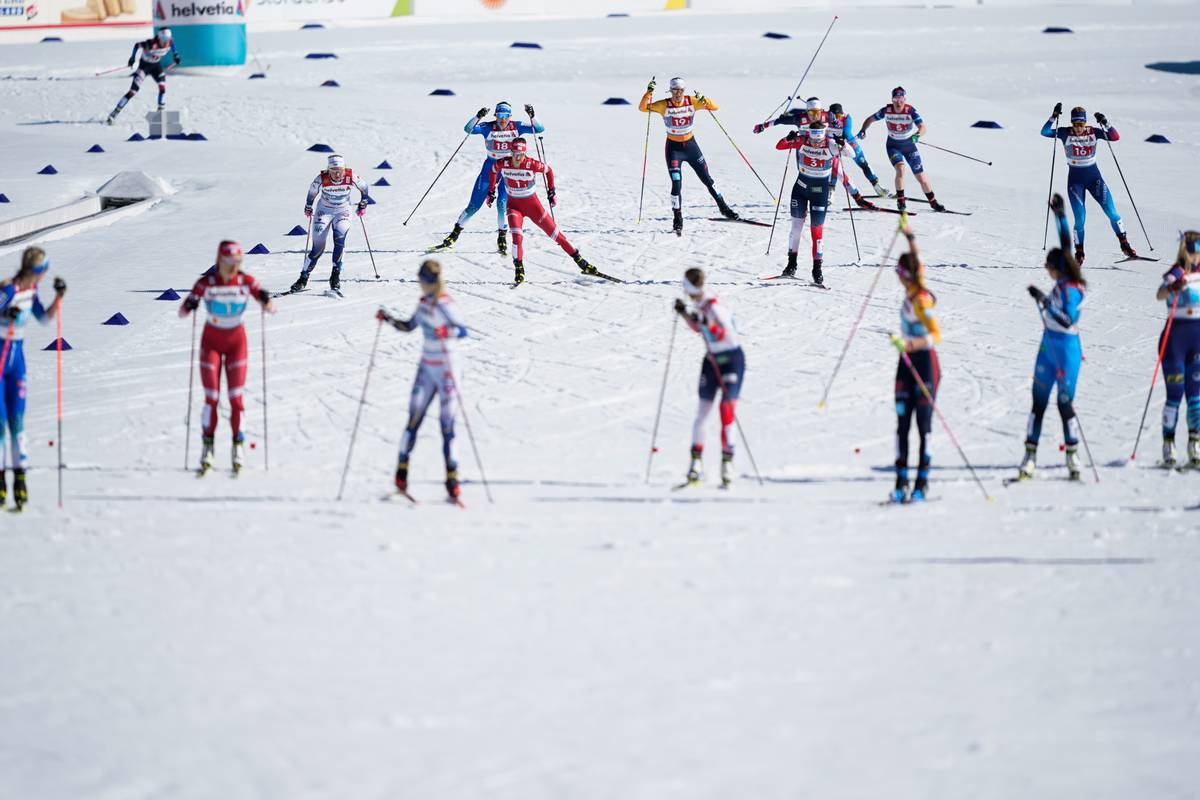
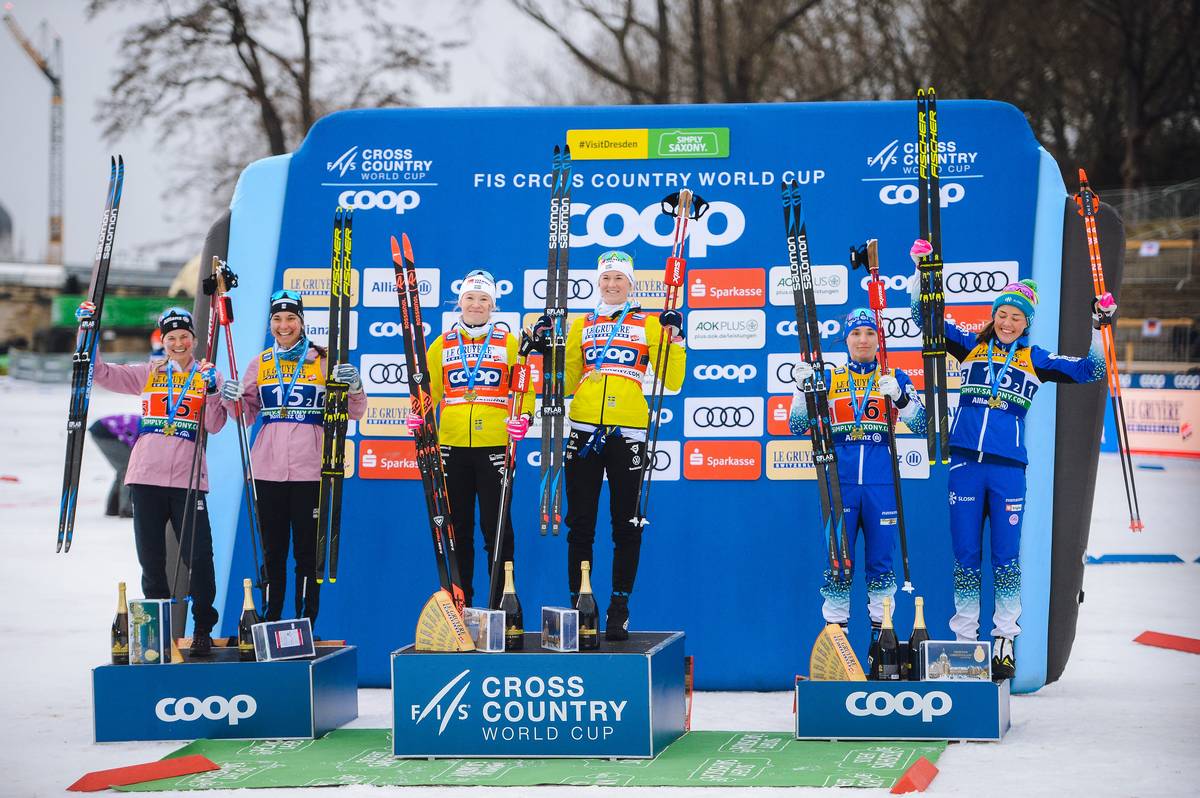
    The women’s team sprint podium in Dresden: The Sweden I duo of Jonna Sundling and Maja Dahlqvist took the win ahead of USA’s Jessie Diggins and Julia Kern, with Slovenia’s Eva Urevc and Anamarija Lampic in third. (Photo: NordicFocus)

    This World Cup coverage is made possible through the generous support of Marty and Kathy Hall and the A Hall Mark of Excellence Award. To learn more about A Hall Mark of Excellence Award or to learn how you can support FasterSkier’s coverage please contact info@fasterskier.com.

    By Ryan Sederquist

    Defending team sprint world champions Maja Dahlqvist and Jonna Sundling continued the Swedish women’s sprint dominance with a polished performance and confident victory Saturday morning in Dresden on day two of World Cup action in the German city. 

    With the city-scape of Saxony’s capital as the backdrop, the pair, who went 1-2 in the individual freestyle sprint on Saturday, got to the front and stayed there. 

    “We just want to be in front because it’s a tight course,” Dahlqvist told a FIS reporter after the race. With athletes taking six turns each on the 644-meter course, which contains a maximum climb of 14 meters and a total height difference of just 4 meters, opportunities to pull away were low and the chances of crashing were high. In order to stay focused on their job, maintaining a lead was crucial for the dynamic duo. 

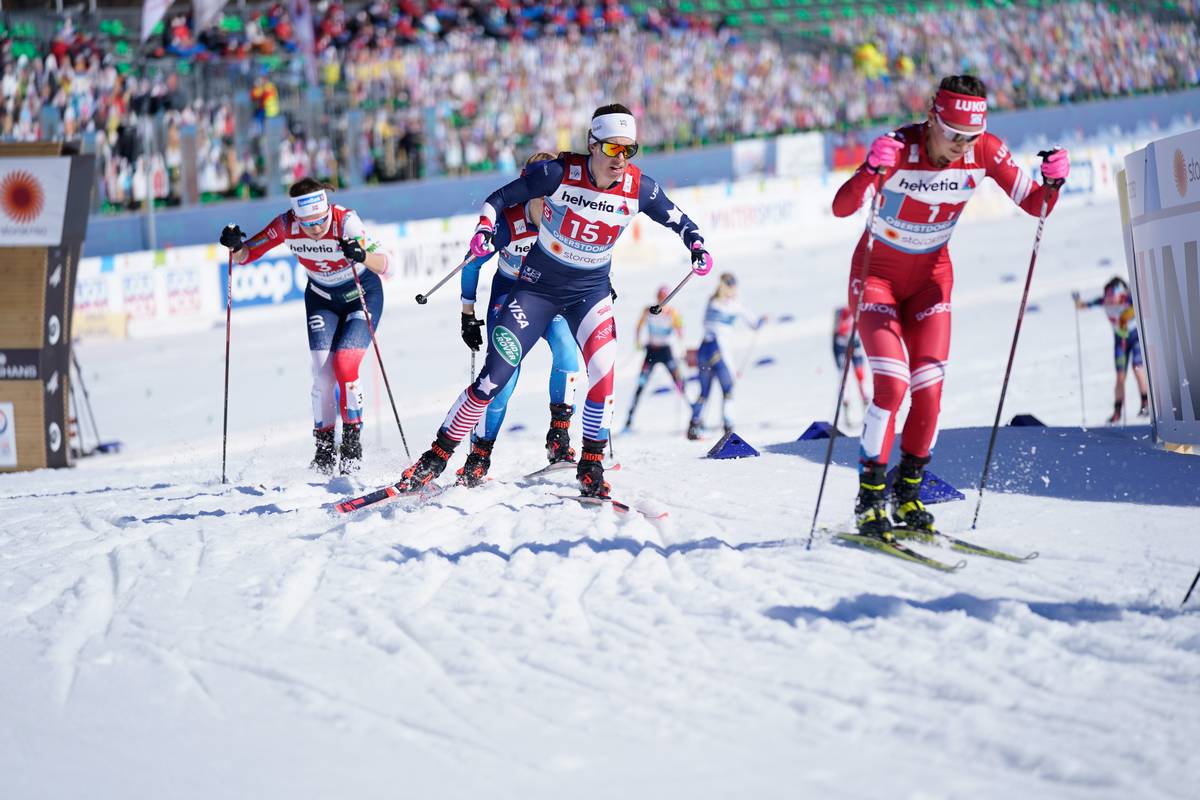
    Body to body being the name of the game, Maja Dahlqvist tags her teammate Jonna Sundling as the women set pace during the team sprint in Dresden. (Photo: NordicFocus)

    “It’s difficult because [there are] people everywhere,” Sundling said when asked how she and Dahlqvist kept their calm in the bunched-up chaos. “The equipment – you want to keep it like it is – no broken poles and stuff. So, it’s difficult to focus on the right thing, but when you’re in the front, it’s easier.”

    The Swedes did have some company at the front throughout the 11 exchanges. One of the early challenges came from the Jessie Diggins – Julia Kern pairing, who qualified with the top time out of semifinal B. 

    Kern explained post-race that staying near the leaders was part of their strategy heading into the team sprint.

    “Jessie and I focused a lot on executing clean and fast tags, and tried to remain as far front in the pack as possible,” Kern said. “There is so much traffic and tangles that we wanted to avoid as much of that as possible. There was a strong headwind which made leading more costly, but it still is advantageous especially given how fast and firm the track was.”

    Another surprise at the front was from Finland. The team of U23 athletes, Jasmi Joensuu and Jasmin Kahara, nabbed the final automatic qualifying spot in the first semifinal. Despite squeaking into the final, the young women made their presence known throughout the race, moving alongside Sundling and Dalqvist into second at the end of the tenth lap before ultimately finishing in fourth. 
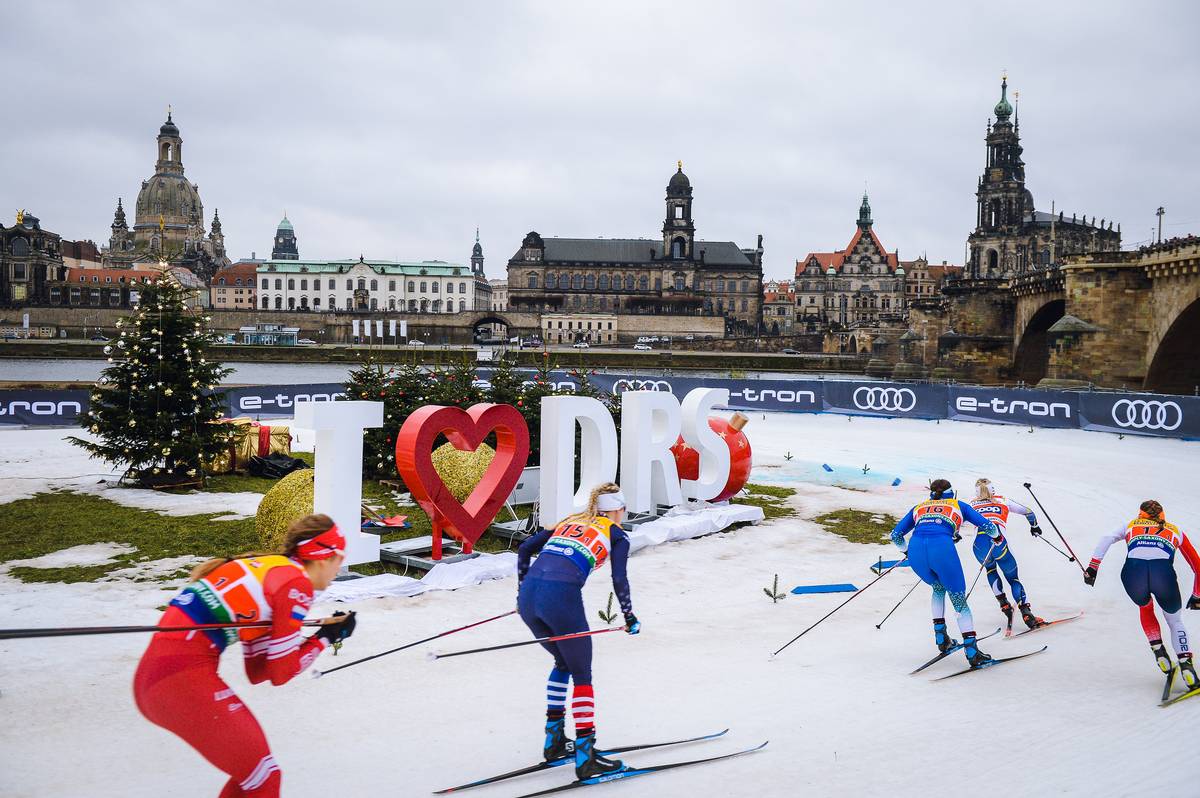
    Jessie Diggins heads into what would be later become a dicy turn. (Photo: NordicFocus)

    With Sundling leading off, Sweden set the pace through the first four laps, with different nations taking turns at their shoulder. Russia I took lap two, Norway II took lap three, and Slovenia, led by Anamarija Lampic, who was third in the individual yesterday, popped in on lap four. The Americans, who placed Diggins as their lead-off skier, patiently bided their time, content to sit in the tight grouping and stay on their skis. Unfortunately, a wrench was about to be thrown into that plan.

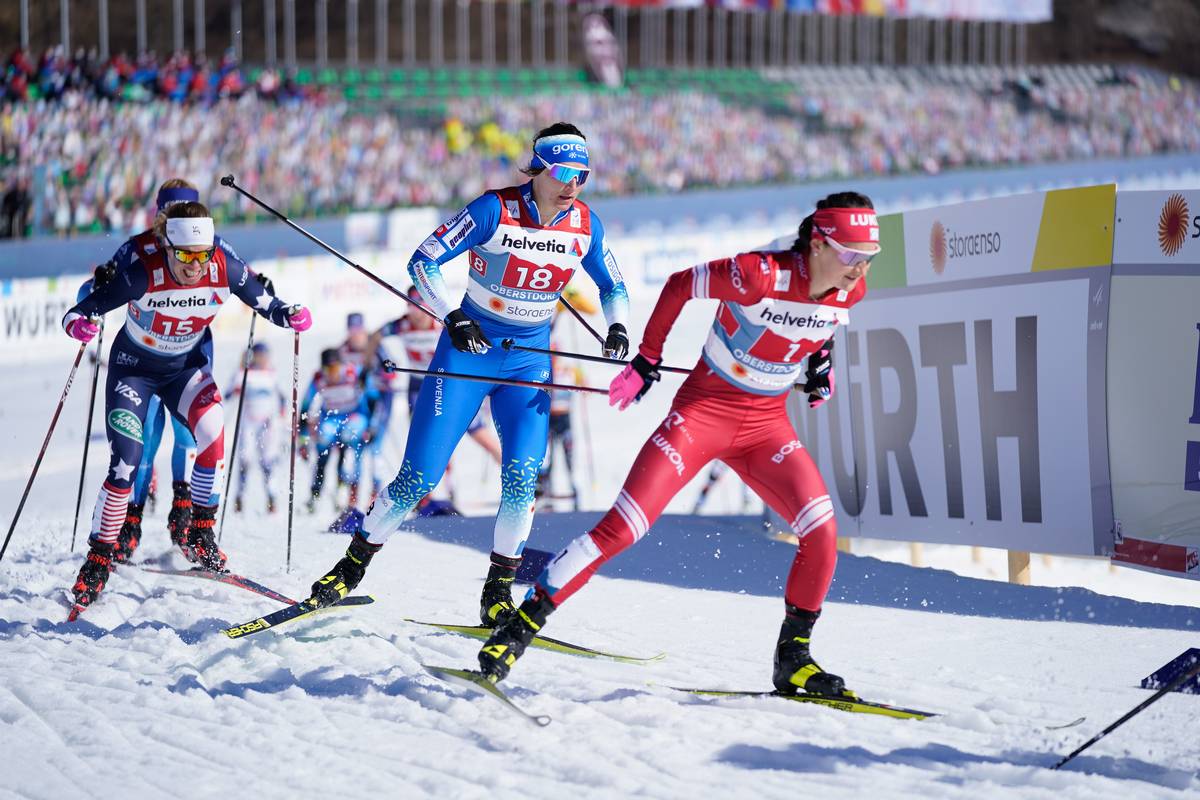
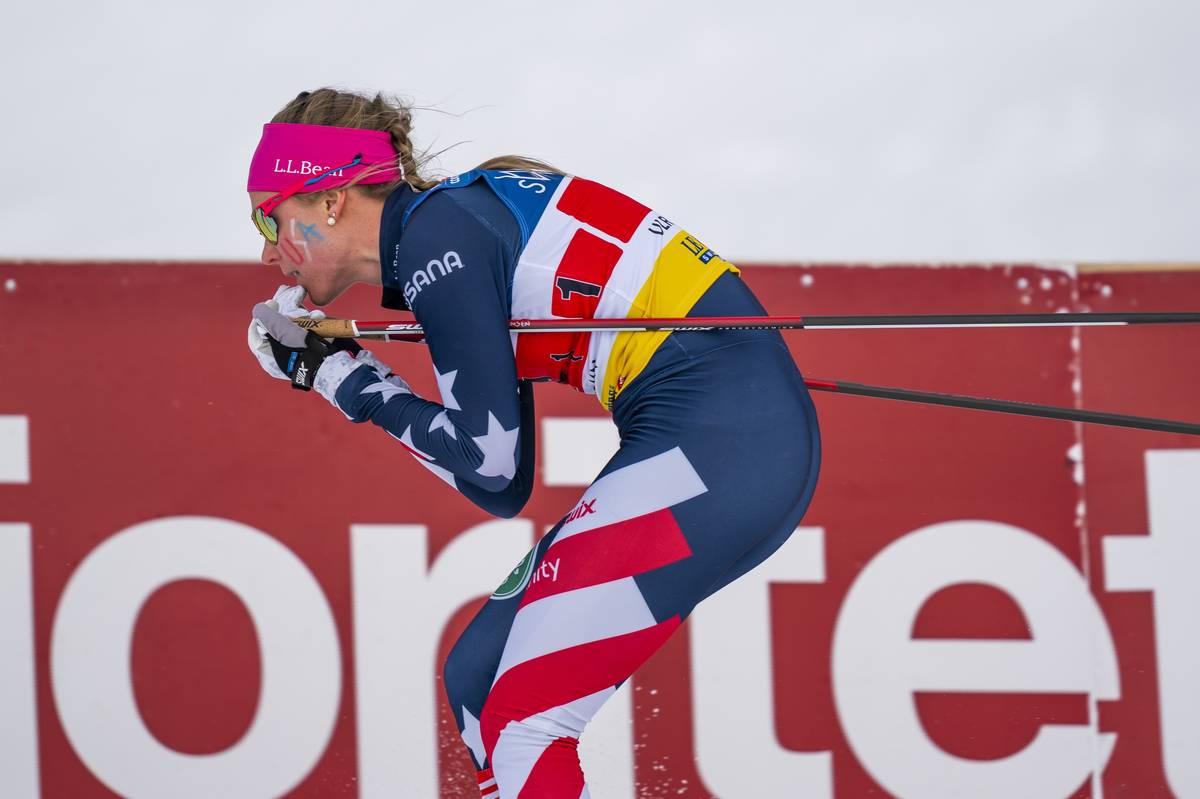
    On lap five, Diggins moved into second place. Coming around the penultimate turn, she swung to the outside and was tangled up with Eva Urevc of Slovenia, who tumbled over the top of the 2018 Olympic gold medalist in the event. Diggins kept her cool, quickly rose to her feet, and skied hard to the next exchange. She tagged off to Kern 4.1 seconds back. 

    “I got back our places as quickly and efficiently as I could,” Diggins told FasterSkier after the race. She also noted that she is headed into Christmas break with a fresh set of bruises to go along with her podium cheese. 

    “I’m always proud of the ‘never give up attitude’ and I think it really paid off for us today. We didn’t panic, we just skied as smooth and smart and hard as we could.” 
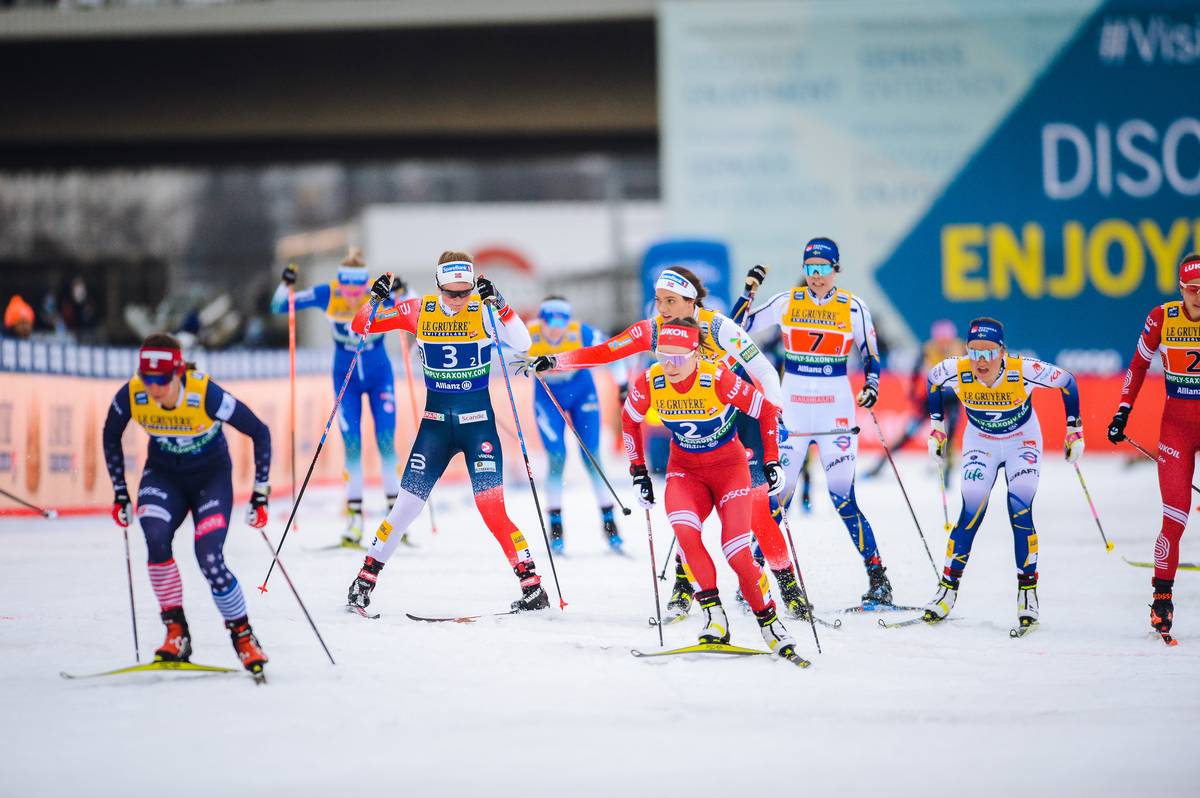
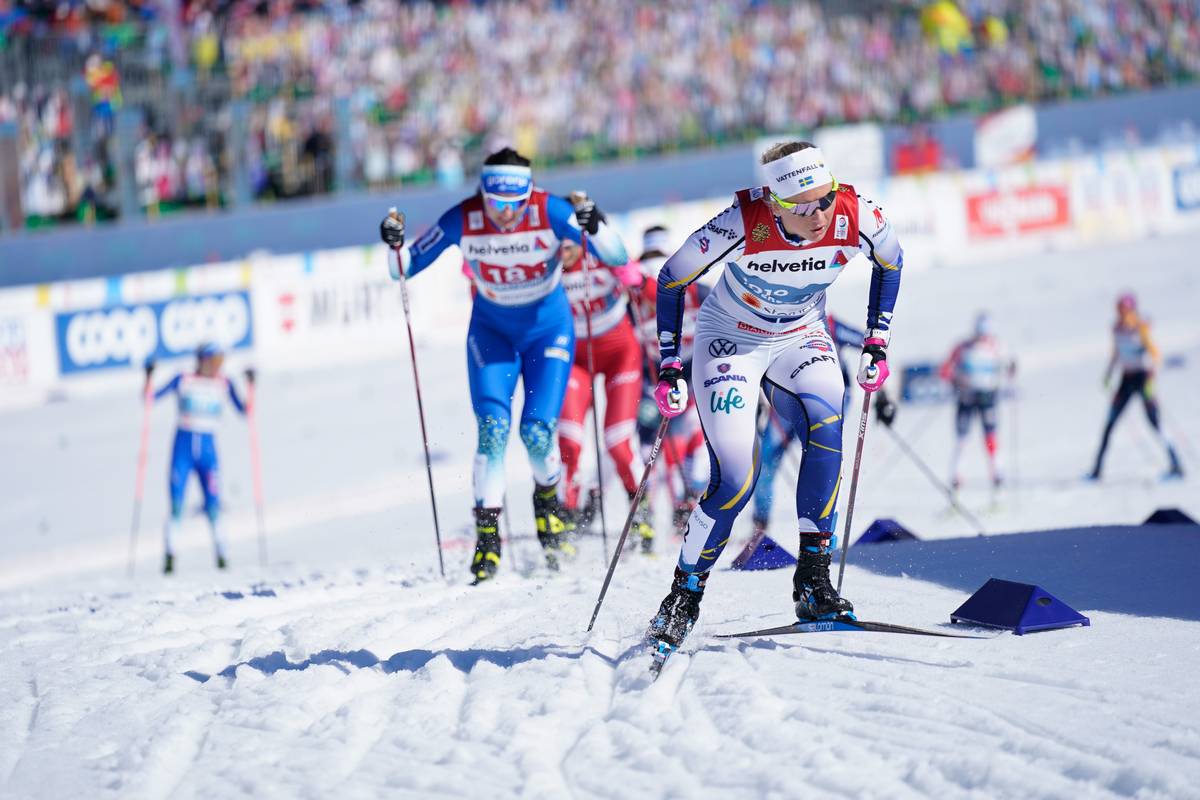
    Julia Kern powers into her leg during the team sprint in Dresden. (Photo: NordicFocus)
    Julia Kern navigates fast curves on course in Dresden. (Photo: NordicFocus)

    After the crash, Kern and Diggins kept their composure and gradually crawled back into contention. Kern explained post-race that Diggins had also crashed in the semifinal, which evidenced how they could rebound. 

    I think the crashes actually lit the fire for Jessie and I,” Kern wrote in a text. “It got us ready to fight back. I had full confidence in Jessie that she would ski right back on to the group in the semifinal and that is exactly what she did. We remained very calm in the process which was key. So come the finals when it happened again, I just smiled a little since I wasn’t worried one bit and knew we would just do the same thing as the semi finals. I had confidence in how we were both skiing and feeling out there, and crashes are almost always a part of the game in Dresden.”

    By the next exchange, Kern had already lopped off 1.8 seconds of the deficit. By lap eight, Diggins was just 1.5 seconds out of the lead, which still belonged to Sweden. Going into lap nine, all of the major contenders were back. Trailing Sweden were the upstart Finns (+0.3), the United States (+0.6), and Russia (+1.1). The only key player seemingly out of the running was Slovenia, who sat 4.7 seconds out of the lead. 

    On the final lap, Sundling, the 26-year old two-time World Championship gold medalist, rocketed from the exchange zone with a stern tempo. Diggins matched it, slipping behind the sprint specialist. 
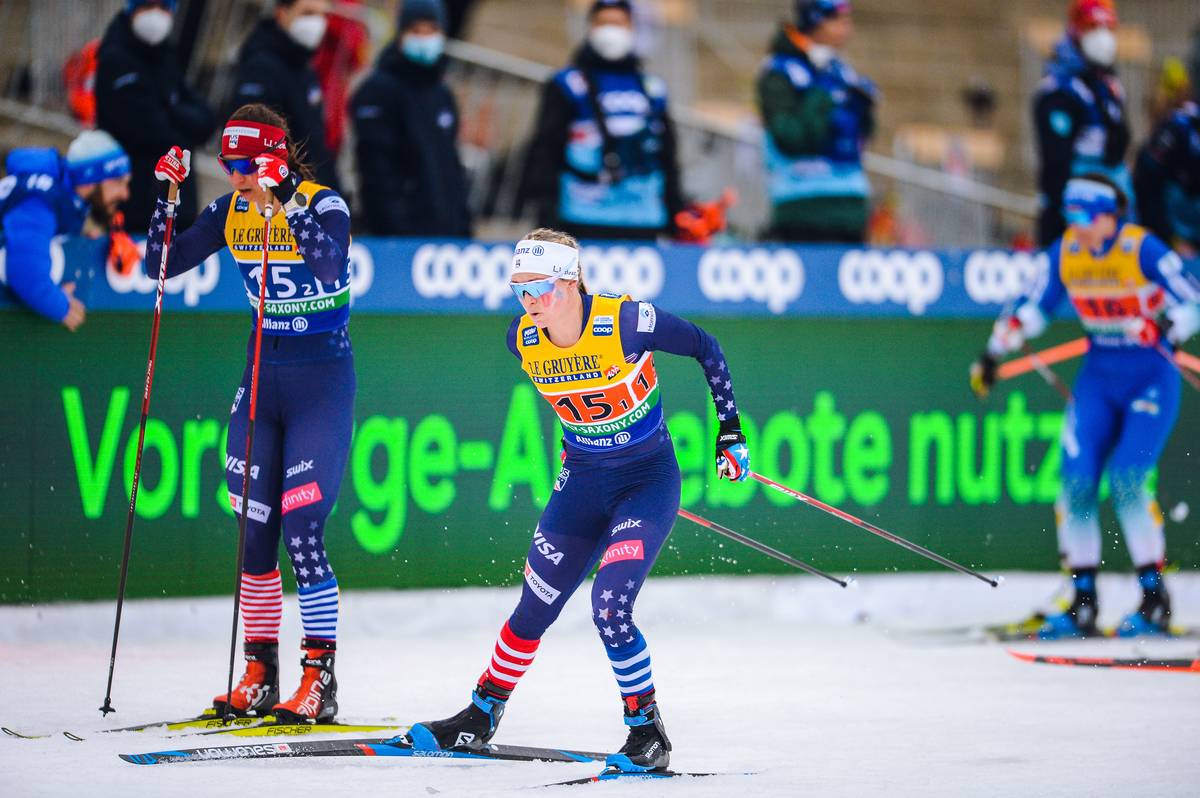
    Jessie Diggins heads out after receiving a tag from Julia Kern. (Photo: NordicFocus)

    At the final exchange, Diggins handed off to Kern 0.5 seconds from Sweden. Slovenia, with Lampic to close, was in fourth, a mere 1.9 seconds back. 

    In the final lap, Dahlqvist, who was a member of the pairings that won the team sprint World Championship title in 2019 and 2021, bided her time, happy to cruise through the first straightaway. After the first hairpin turn, she accelerated to a comfortable lead, leaving the competition in the wake of her strong V2-alternate strides. 

    Coming into the homestretch, Dahlqvist coasted across the line in first (15:45.81). Meanwhile, Kern was being challenged by Lampic, who had moved in front of Finland on the final bend. A great sprinter on the flats, Kern held off the three-time World Championship medalist, stretching her boot forward at the line for second (+1.11), with Lampic rounding out the podium to put Slovenia in third (+1.21).
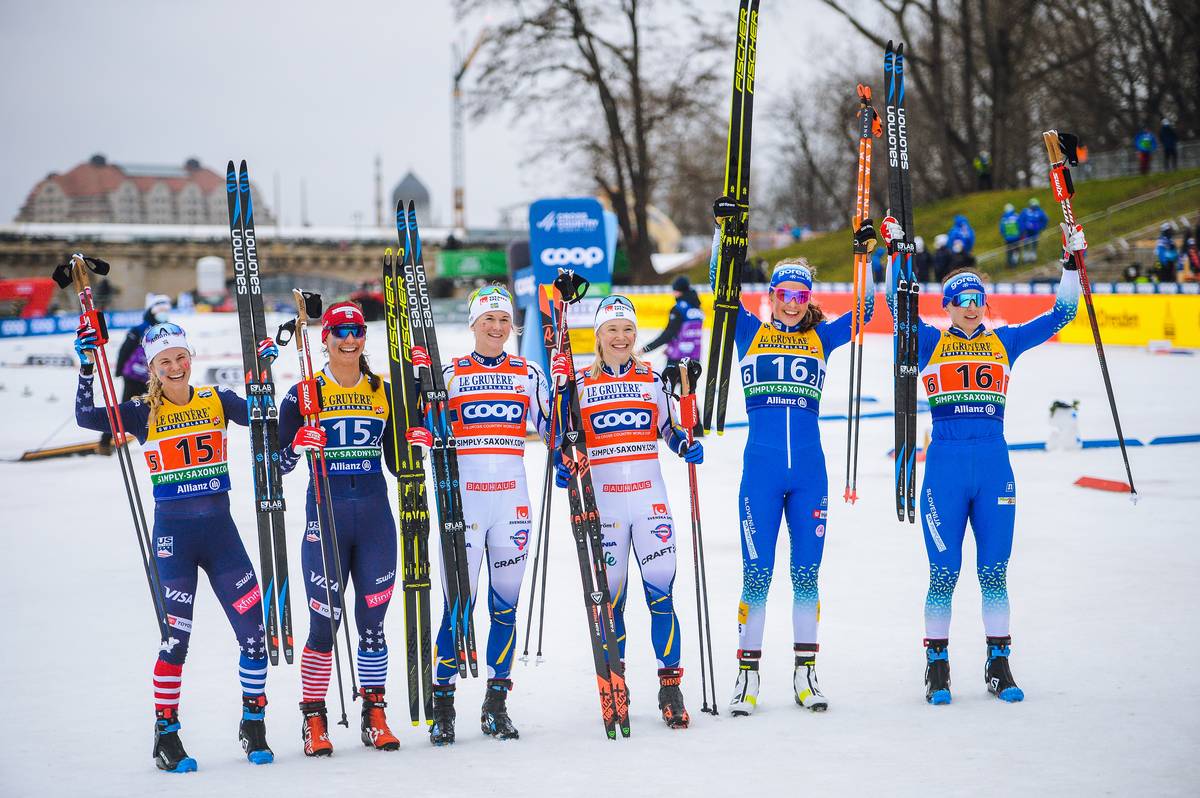
    The women’s team sprint podium in Dresden: The Sweden I duo of Jonna Sundling and Maja Dahlqvist took the win ahead of USA’s Jessie Diggins and Julia Kern, with Slovenia’s Eva Urevc and Anamarija Lampic in third. (Photo: NordicFocus)

    The last time a United States team earned a World Cup podium in the team sprint was in Jan. 2018 when Ida Sargent and Sophie Caldwell Hamilton took third in Dresden. Today was also Kern’s second-ever World Cup podium. She was third in the Planica individual sprint on Dec. 21, 2019. 

    We’ve seen Kern excel on fast and flat courses before, and asked whether 24-year-old identified this style of racing as a strength.

    “I think flat courses have been more of an advantage for me the past, but I feel my fitness is better this year so I actually enjoy the hills too,” Kern explained. “But given my background growing up skiing at the Weston ski track [outside of Boston, MA] on a golf course growing up, skiing on a flat, turny, manmade snow course, I always feel right at home in Dresden.”

    On approaching this style of racing, in comparison to typical World Cup courses with more climbing, Kern explained how she modifies her focus.

    “I don’t necessarily change my technique on the flatter course, but focus on staying stable and trying to use my legs as much as possible. I played around with a few different technique cues during training this week since the hardest part on the salted, icy fast snow is generating speed without wobbling or rushing the motions.”
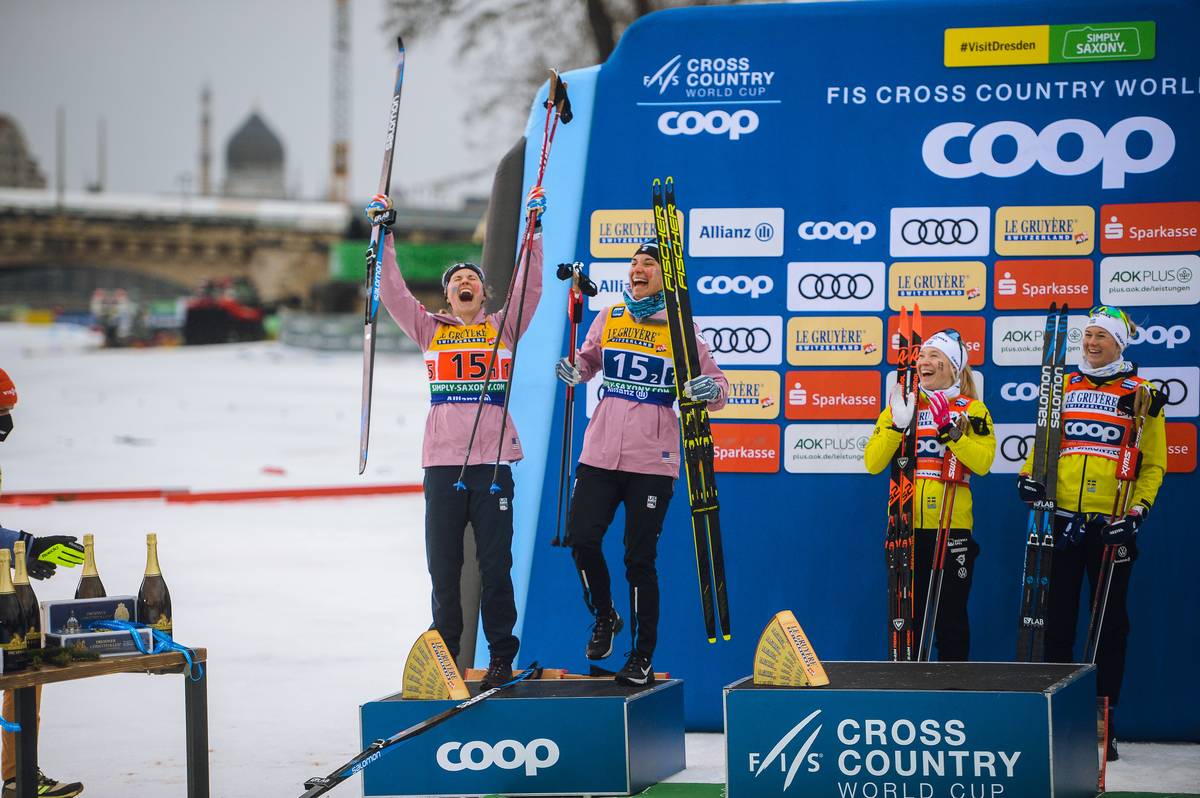
    Jessie Diggins and Julia Kern rebounded after two crashes to take the second step of the podium in the women’s freestyle team sprint in Dresden. (Photo: NordicFocus)

    Diggins, a veteran in the event, spoke highly of her partner’s efforts in Dresden.

    “Wow – I’m so proud of Julia. She was confident and smooth,” said Diggins fondly. “It was a bit of a battlefield out there. You really had to fight for position and she did so with such grace and poise and power and speed. I’m really, really proud of her.”

    Here’s the full audio clip from Diggins:

    A second American contingent of Hailey Swirbul and Hannah Halvorsen skied to 8th (+2.74) in a tight Semifinal A, but did not advance into the final.

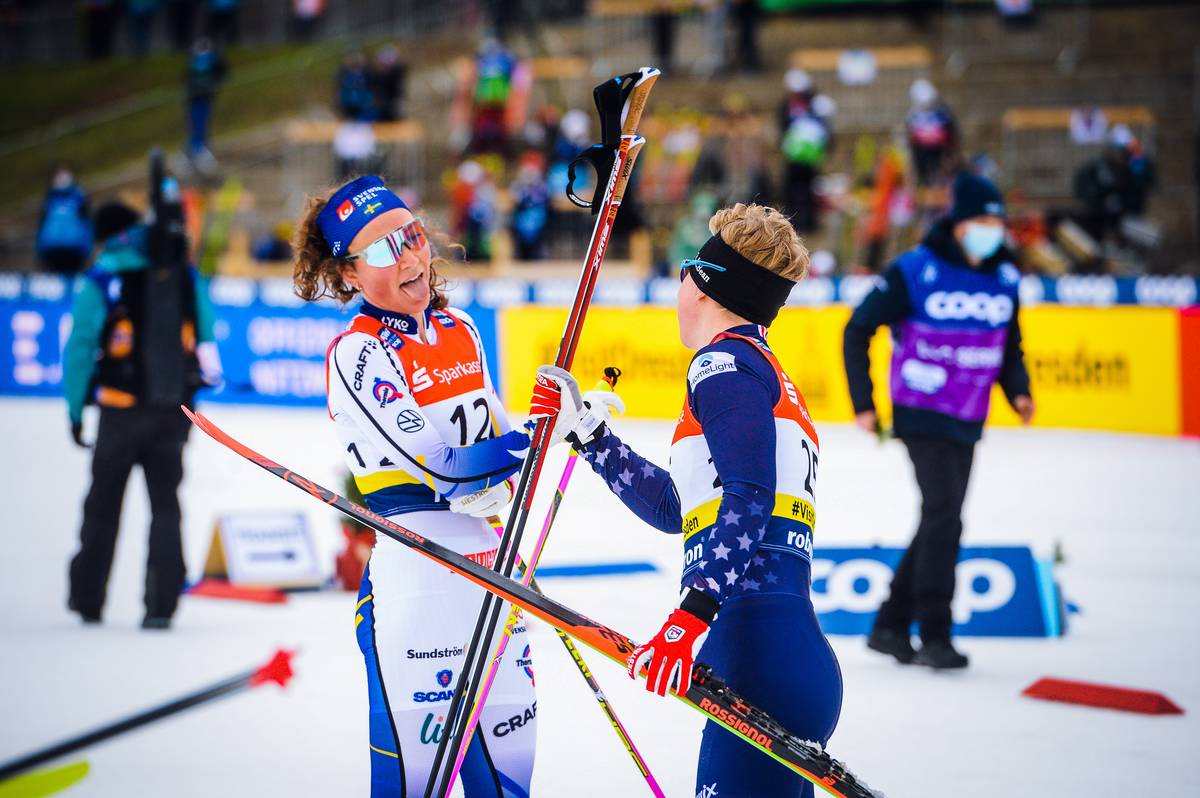
    Hailey Swirbul (bib 9) comes in for the tag during the semifinal of Dresden’s team sprint. (Photo: NordicFocus)
    Hannah Halvorsen wrist-bumps Sweden’s Moa Lundgren after the semifinal round of Dresden’s team sprint. (Photo: NordicFocus)

    As Period 1 draws to a close, we take a look at the current World Cup standings. Diggins now sits in fifth place in the overall standings, trailing teammate Rosie Brennan by nine points in fourth. Maja Dahlqvist is the overall leader with 464 points. Dahlqvist, who has won every sprint this season, also leads the sprint standings, more than doubling the points of second place Lampic from Slovenia. Diggins in the third-place position in sprinting heading into the Tour de Ski. 

    After period 1, Maja Dahlqvist leads both the overall and sprint World Cup standings. (Photo: NordicFocus)

    Results:

    Team Sprint: Semifinal A | Semifinal B | Final

    World Cup: Sprint Standings | Overall Standings

  • Sweden’s Sundling Edges Out Switzerland for Team Sprint Gold; USA 5th

    Sweden’s Sundling Edges Out Switzerland for Team Sprint Gold; USA 5th

    The scene from an exchange during the World Championship team sprint in Oberstdorf, Germany. (Photo: NordicFocus)

    This World Championship coverage is made possible through the generous support of Marty and Kathy Hall and their A Hall Mark of Excellence Award. To learn more about A Hall Mark of Excellence Award or to learn how you can support FasterSkier’s coverage please contact info@fasterskier.com.

    And now for something completely different. The skate team sprint.

    Three roughly 1-kilometer loops each for 7.2 k total, relatively flat with just two brief upticks per lap, winding back and forth along the valley floor in Oberstdorf, Germany. Would the terrain be enough for one team to pull away from others or would it be an empty-the-tank last two laps, fighting for every centimeter? 

    From semifinal A, advanced the Swedish team of Maja Dahlqvist and Jonna Sundling, who won their heat by nearly two seconds ahead of the Russian Ski Federation (RSF), represented by Yulia Stupak and Natalia Nepryaeva, Norway, and Finland. Three teams finished within a second in Semifinal B, with Slovenia’s Eva Urevc and Anamarija Lampic edging out Rosie Brennan and Sadie Maubet Bjornsen for the U.S., and the Swiss Women, Laurien van der Graaff and Nadine Fähndrich. Germany and the Czech Republic also advanced from the second wave of semis. 

    Note that four teams advanced from each heat of the semifinals with the next two fastest times, a change from the usual top two teams plus six fastest times. This change was made based on the weather and conditions on the course.

    Rosie Brennan  marks Russia’s Yulia Stupak during the World Championship team sprint in Oberstdorf. (Photo: NordicFocus)

    So far in this World Championship, Brennan had only raced the classic sprint qualifier and Maubet Bjornsen not at all, perhaps leaving them fresh for this competition. American voices could be heard shouting words of encouragement as the women toiled around the course as a large group through the first four exchanges. At the third exchange at 3.6 k, the US was sitting in fifth, 2.3 seconds behind Sweden in the lead and in contact.

    Slowly, Sweden began to turn up the dial, building intensity. However, as the final laps took off, any ground Dahlqvist gained on her competitors was closed as they descended off the first roller and headed into the primary climb of the course. It was here that RSF’s Stupak began to challenge, duking it out with Dahlqvist but unable to pull away.

    Sweden’s Dahlqvist leads the way in the World Championship team sprint in Oberstdorf, Germany. (Photo: NordicFocus)

    After the final change, it was Sweden and RSF at the front, with a small gap to Norway, the U.S., and Switzerland with Slovenia a few meters back. 

    In the final lap, the tempo accelerated, poles whipped through the air, and any predictions of what might happen were laid wayside. 

    As Sundling tried to pull away, Fähndrich quickly closed the gap to the front, skiing at the Swede’s hip. Nepryaeva began to fall off the pace, and was being caught by Maubet Bjornsen and Lampic. Though Sundling and Fähndrich held ground at the front, the podium was within reach for each nation.

    Rosie Brennan (USA) tails Eva Urevc (SLO) and Yulia Stupak (RSF) during the World Championship team sprint in Oberstdorf, Germany. (Photo: NordicFocus)

    At the top of the intermediate climb and on the outside of the left-hand curve, Maubet Bjornsen ski was caught in a tangle, dropping her to her knee and stalling her momentum at an inopportune moment. The American rebounded quickly but was no longer able to fight for the top spots. 

    Making their way for the last time up the primary climb, Sweden and Switzerland, alone up-front, created a small gap to Nepryaeva. Meanwhile, Lampic of Slovenia was closing in and looking strong.  

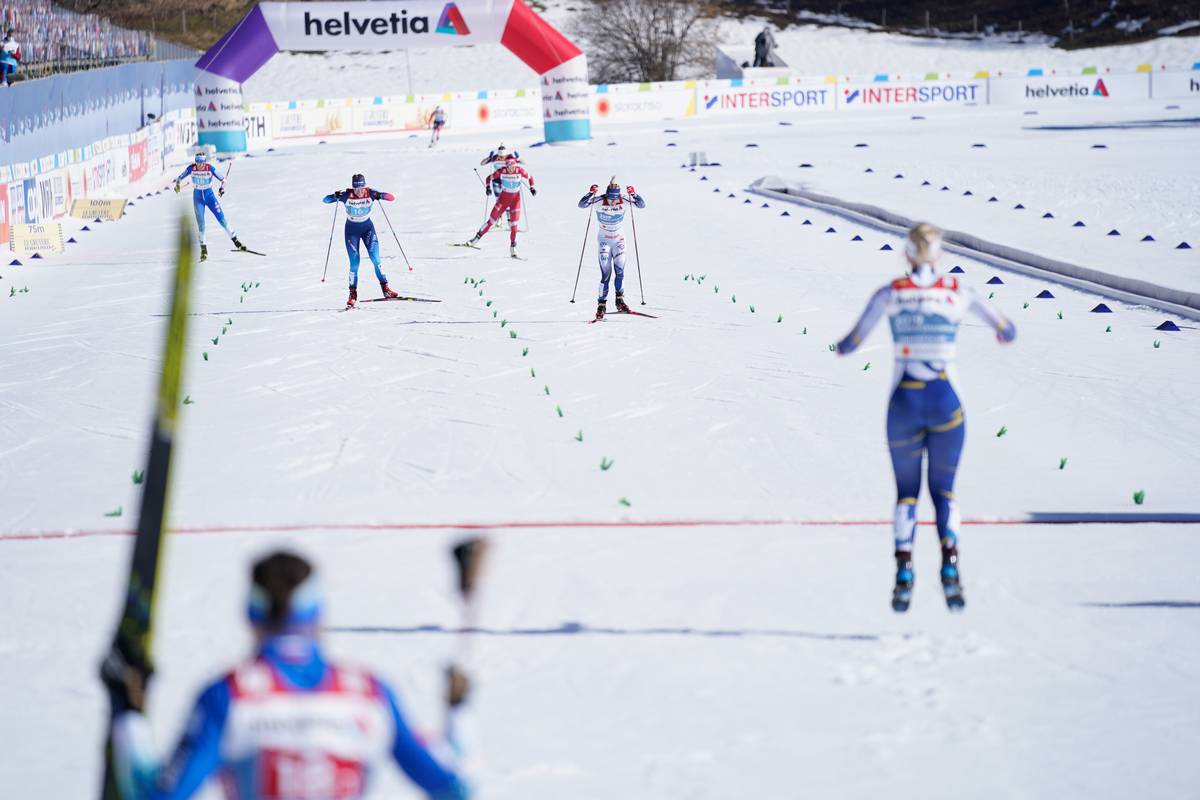
    The final moments of the World Championship team sprint in Oberstdorf, Germany. (Photo: NordicFocus)

    Sundling was first into the final lanes, with Fähndrich a ski length behind, matching but not able to overtake the Swede. The women soared to the finish with Sweden holding its ground for the win, Switzerland finishing just under a second behind for the silver medal. 

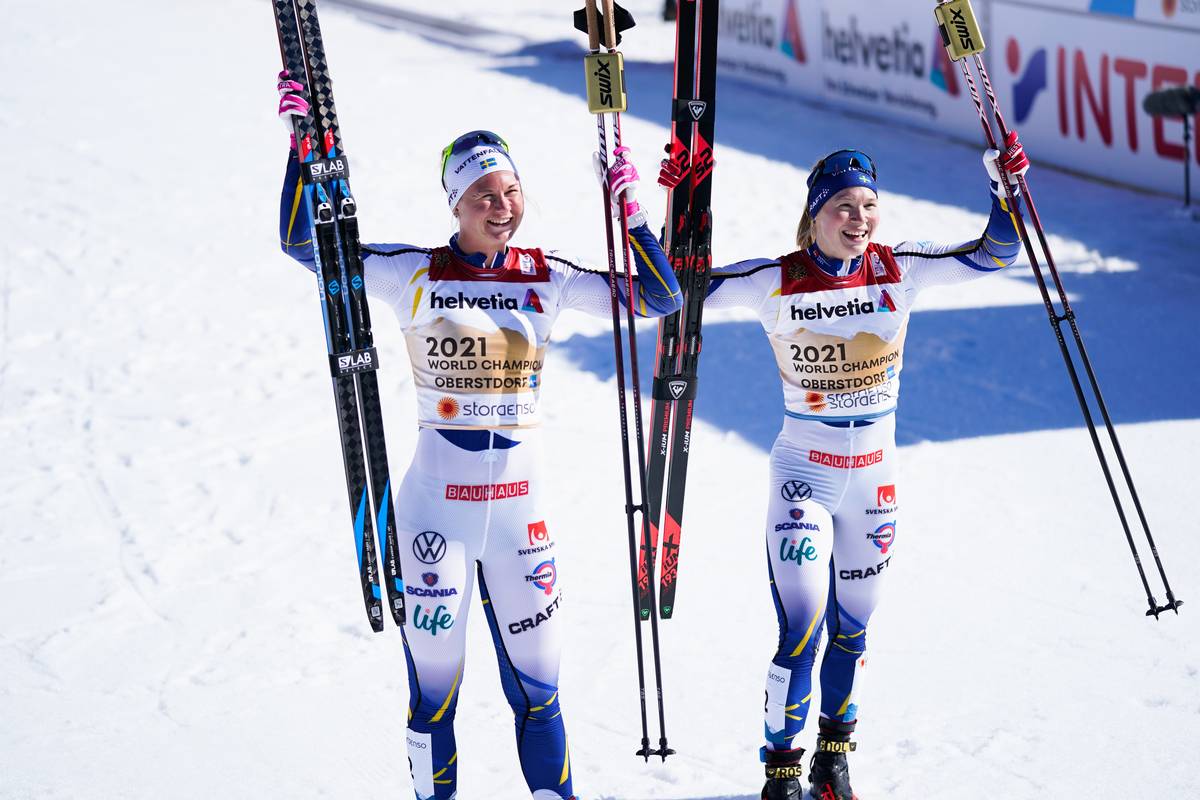
    Sweden’s Jonna Sundling and Maja Dahlqvist take home World Championship gold in the team sprint. (Photo: NordicFocus)

    “It was so fun to race today,” Dahlqvist told FIS after the race. “But it was hard too, the conditions were a little warm. It was easier in the qualification.”

    Sundling was asked whether she knew how close behind Fähndrich was in the final meters.

    “I heard there was someone behind me, but I just had my focus on the finish line and to cross it first.”

    Fighting for bronze, Lampic out-sprinted Nepyraeva to bring home a medal for Slovenia (+3.46), leaving RSF in fourth (+3.95). 

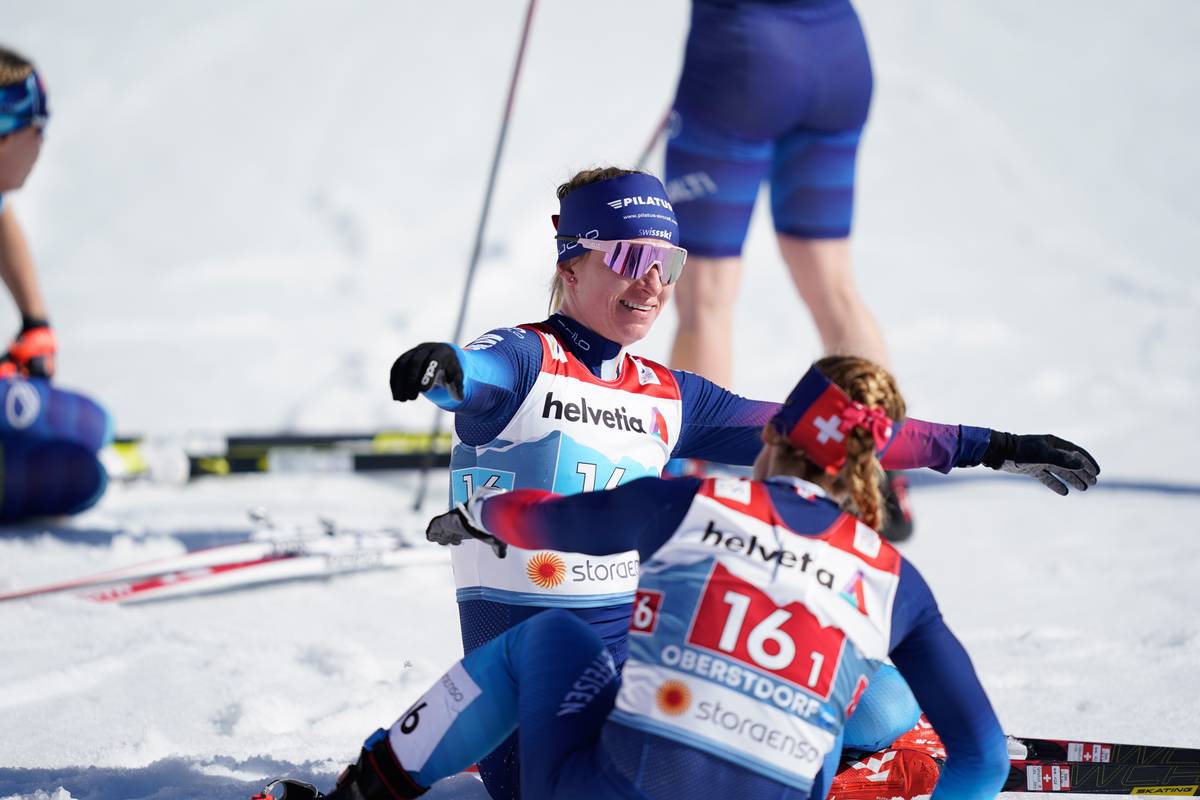
    The women’s podium at the World Championship team sprint in Oberstdorf. Sweden took the win ahead of Switzerland and Slovenia. (Photo: NordicFocus)

    The women of Sweden have made their sprint prowess well known this season and were favored to win their third World Championship medal in this event, piggybacking on the 2019 World Championships in Seefeld, Austria. Dahlqvist led the team there too, with Stina Nilsson as the anchor. Both members of today’s Swedish team were coming off of strong results in the opening classic sprint, where Sundling collected a gold medal.

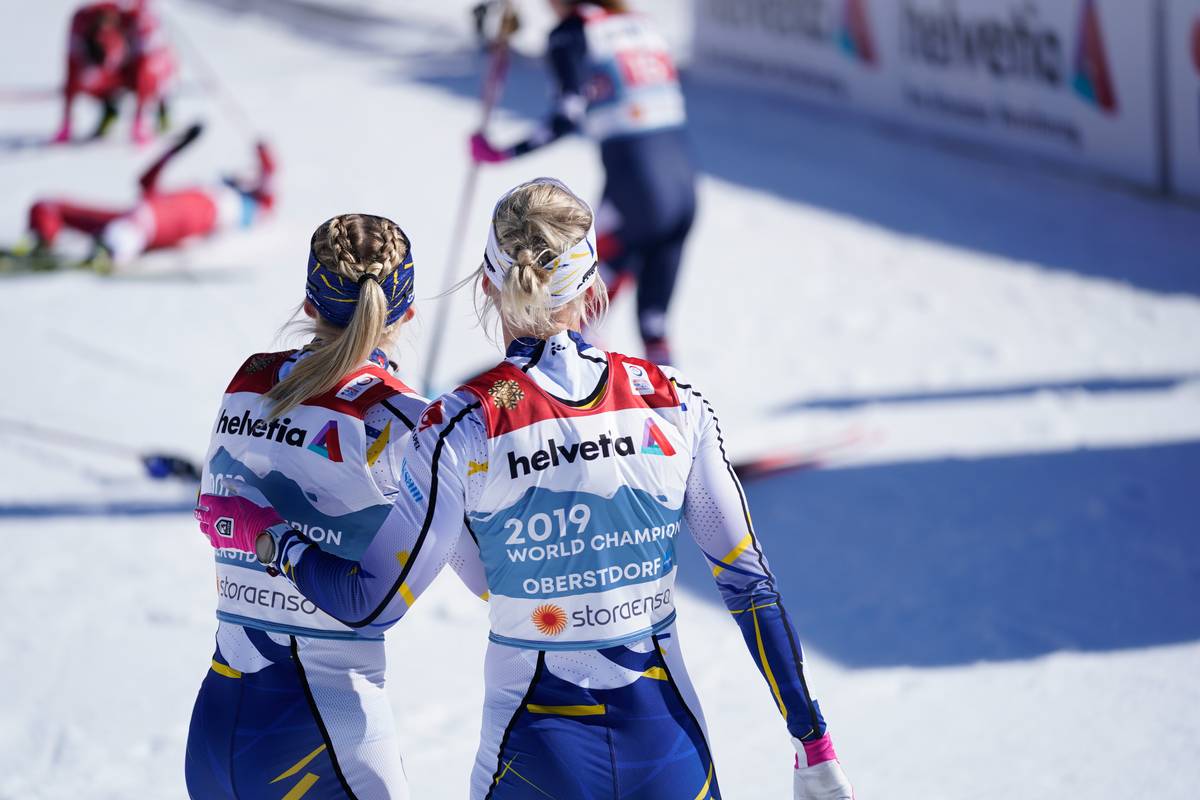
    The winners, Sweden’s Maja Dahlqvist and Jonna Sundling, take in their team sprint victory in Oberstdorf. (Photo: NordicFocus)

    However, a medal for Switzerland and Slovenia, while not unexpected, is perhaps a more novel result. The duo of Van der Graaff and Fähndrich won the team sprint in Dresden, Germany earlier this season, but this is the historic first Swiss medal in the event and the first women’s medal for Switzerland since 1987, a bronze earned by Evi Kratzer in the 5k classic.

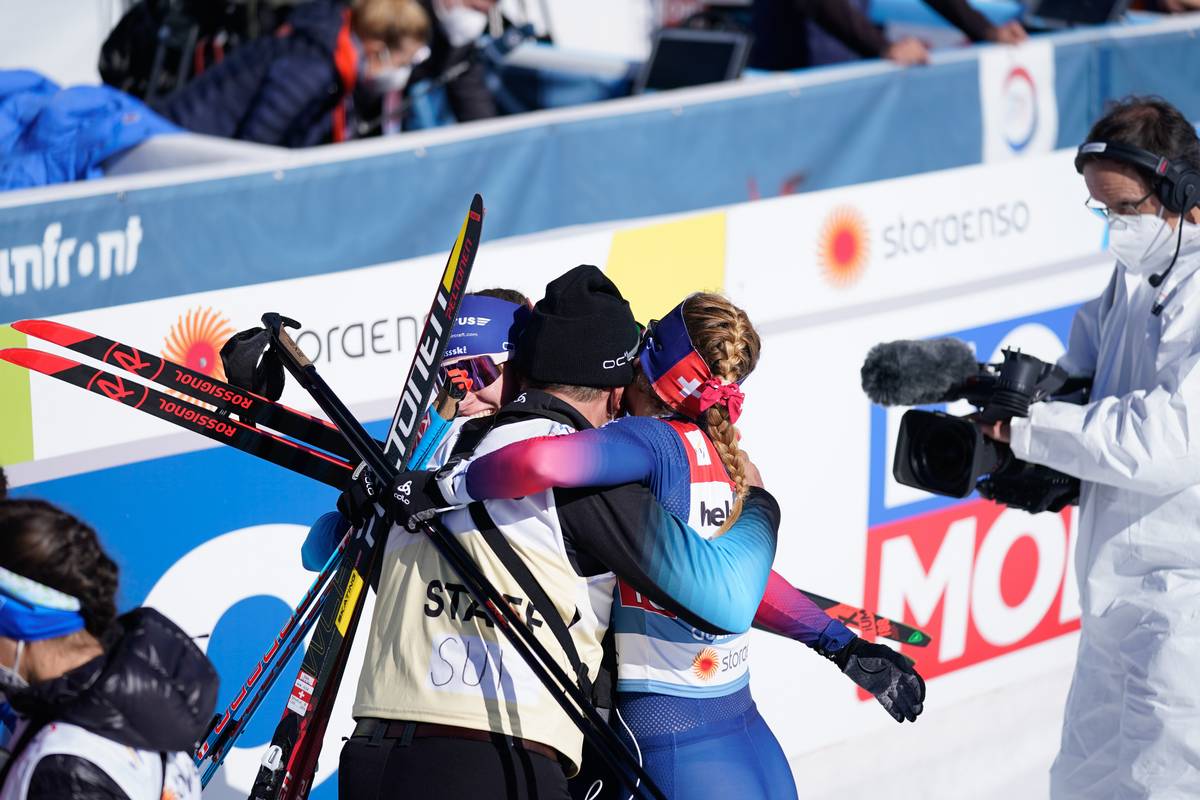
    Laurien Van Der Graaf (SUI) watches her teammate, Nadine Fähndrich, bring home a silver medal for their team. (Photo: NordicFocus)
    Laurien van der Graaff and Nadine Fähndrich take silver for Switzerland. (Photo: NordicFocus)


    “We always said we want that medal,” Van der Graaff told the Swiss news outlet SRF. And now it’s there! No idea, the emotions are there. It’s incredible.”

    Commenting on when they knew they could celebrate, Fähndrich replied, “I was only really sure when I crossed the line. She had tagged off to me in a great position, with only a little bit of a gap to [positions] one and two. Then I felt that those athletes around me tried a little to play tactical games, but I just thought no, I had to risk it because I felt good. I just knew ‘all out now’!”

    Laurien van der Graaff and Nadine Fähndrich celebrate with their tech after earning a World Championship silver medal in the team sprint. (Photo: NordicFocus)

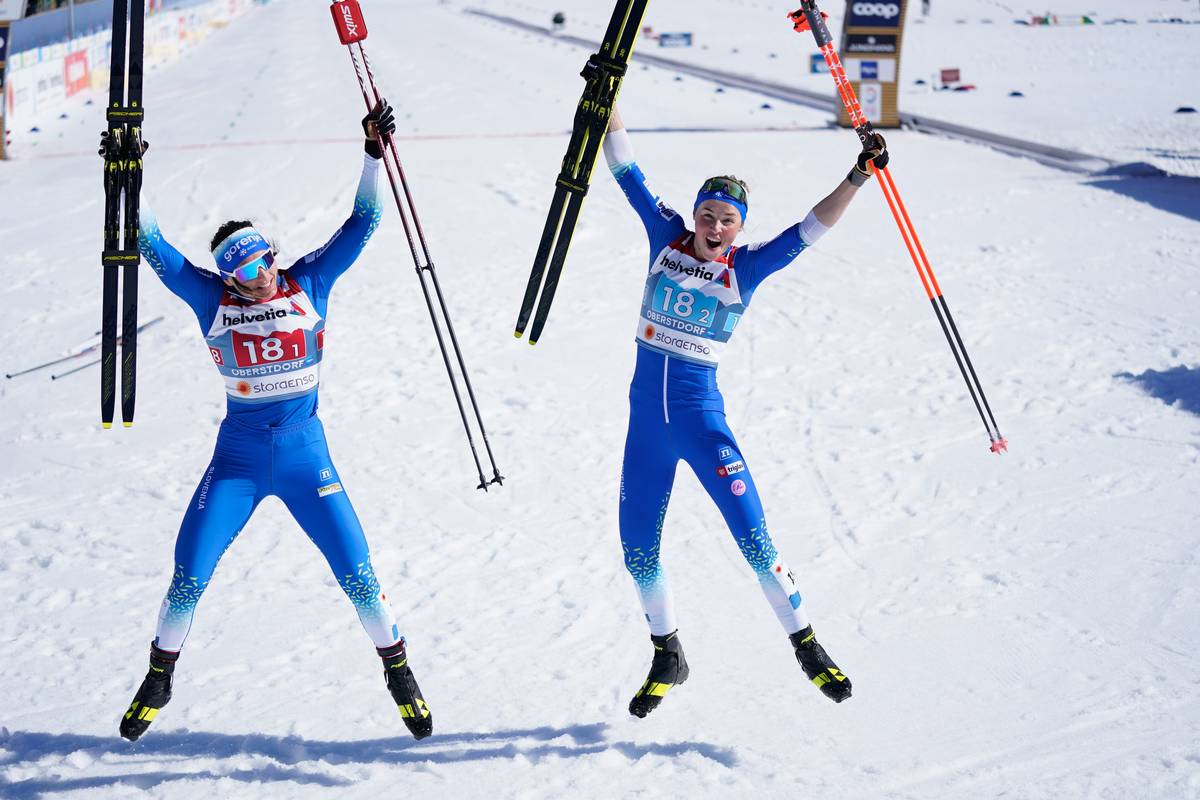
    Despite the size of their team and country, the Slovenian team of Urevc and Lampic took 3rd in Dresden and won the most recent World Cup team sprint in Ulricehamn, Sweden. Slovenia also took silver in the 2019 Championships in Seefeld. Taking home her second medal of this Championship, 25-year-old Lampic also leads the overall World Cup sprint standings. 

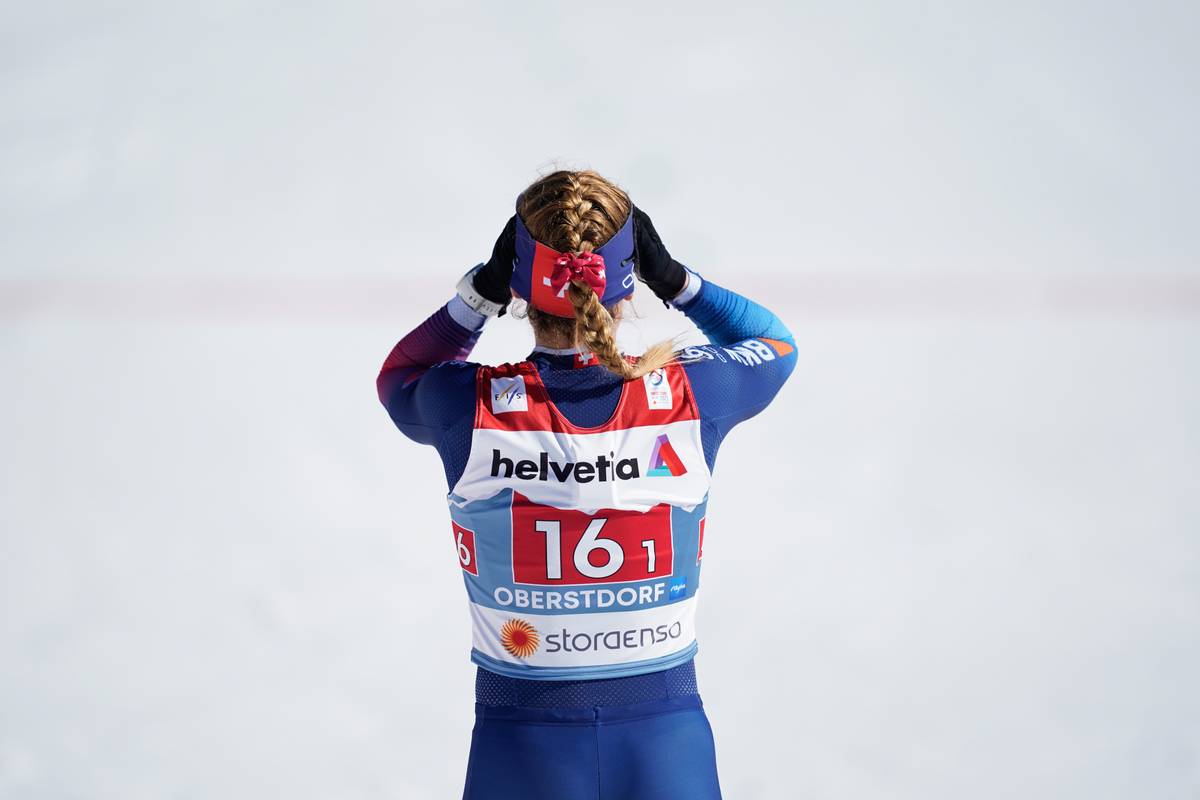
    Eva Urevc and Anamarija Lampic of Slovenia bring home a World Championship bronze medal in the team sprint in Oberstdorf, Germany. (Photo: NordicFocus)
    Sadie Maubet Bjornsen helps the Americans to a 5th place finish at the World Championship team sprint. (Photo: NordicFocus)

    Finishing alone, Maubet Bjornsen brought the American women home in fifth (+5.83), matching the team’s result in this event at the 2019 World Championships.

    When asked if they were left wanting, Brennan gave an optimistic and grateful response:

    I’m actually really happy with it,” she said. “It’s been, quite literally, a career-long dream to do a team sprint with Sadie. She’s been a best friend and training partner for the entirety of my professional career, so I was just so happy and excited to even get this opportunity. I know that we are capable of more on any given day, but that’s ski racing — you go out there and you give it your all. Some days you win, some you don’t. But it was honestly a pretty special day for me.”

    Rosie Brennan marks Russia’s Yulia Stupak during the World Championship team sprint in Oberstdorf. (Photo: NordicFocus)

    Perhaps envisioning the hang-up in the last lap, Maubet Bjornsen discussed the degradation of the course between the semifinal and final. She explained that the tracks were fast, firm, and tactical in the final, becoming more dangerous as the transformed snow began to break down and accumulate on the surface. In these deeper conditions, Maubet Bjornsen explained that a skier must be aware of their equipment at all times to stay upright and powerful. 

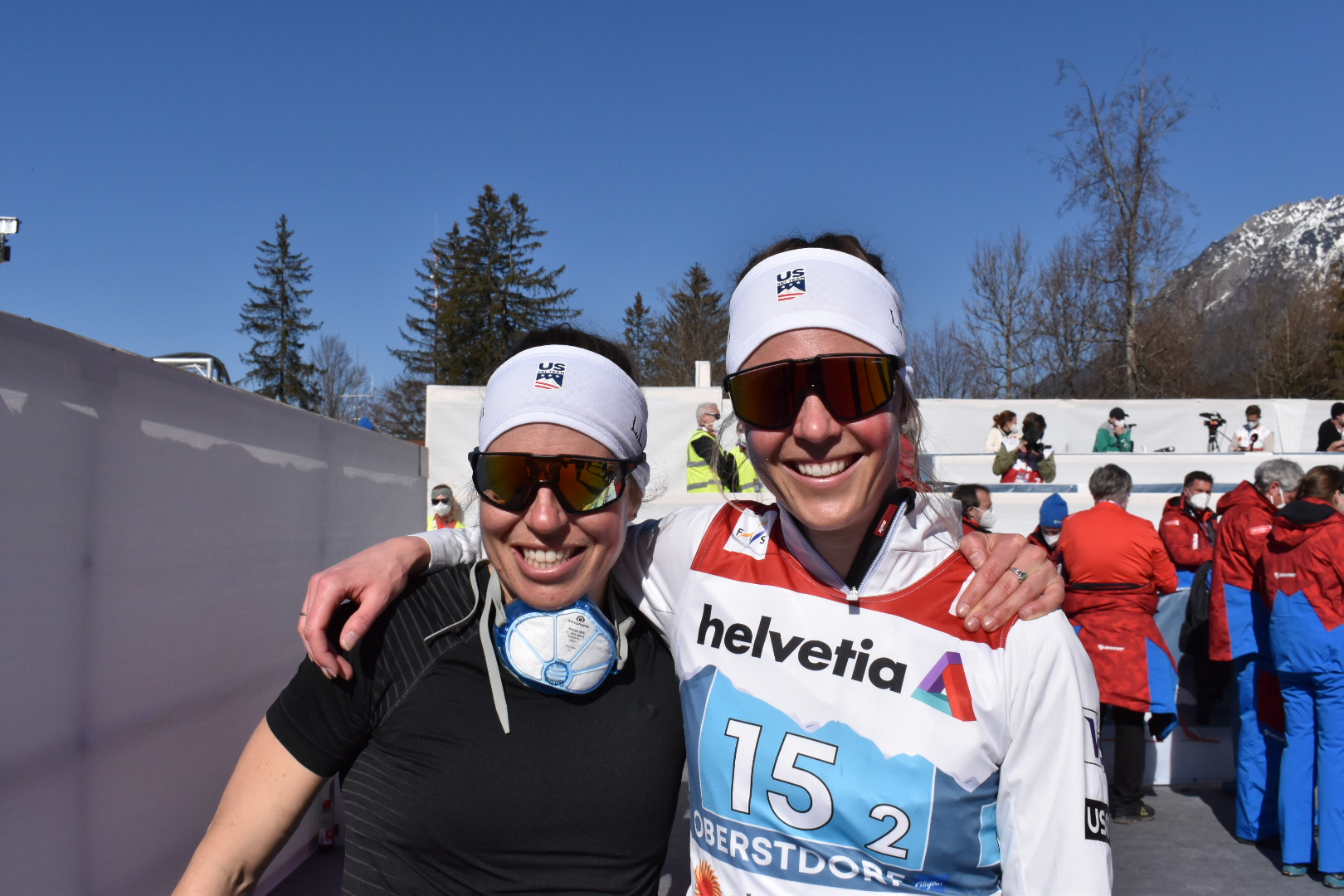
    However, reflecting on their performance, she too focused on the positive, commenting on the years and hours the two have spent training and racing together throughout their careers, beginning as juniors. 

    Rosie Brennan and Sadie Maubet Bjornsen prepare for the World Championship team sprint in Oberstdorf, Germany. (Photo: Tom Horrocks/USST)

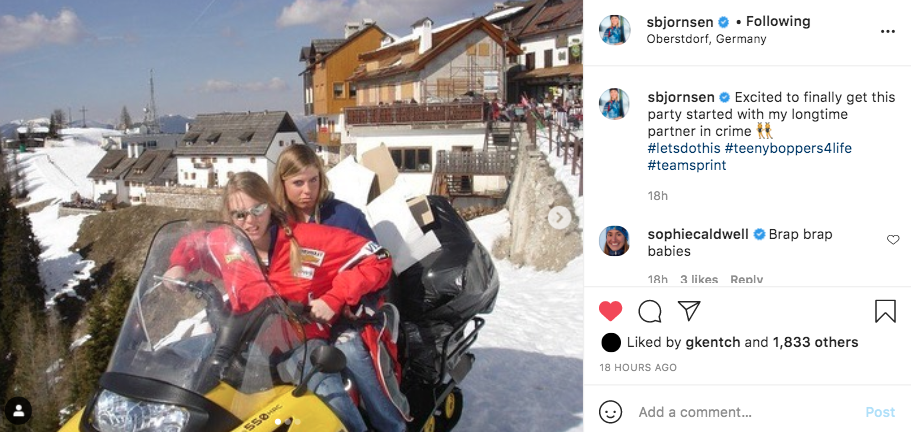
    “I feel like we skied an awesome race,” Maubet Bjornsen said. “Unfortunately, I got stepped on the first uphill which took me out of the draft and I couldn’t quite find the gear to come back to [the group]. Which is a bummer because my skis were incredible and I feel like if I would have been with those girls over the top of the second climb it could have been a medal day, but like Rosie said, you can never count on that, but I think it’s pretty cool that my number one training buddy and me were in a fight for a medal. That’s pretty neat. If you would have asked us that at 14-years-old, beating on each other, we would have laughed at you. So I think if we brought our 14-year-old selves here, we’d be pretty darn proud.”

    A trip down memory lane. (Photo: Instagram @sbjornsen)

    Results: Semifinal A | Semifinal B | Final


  • Saturday Race Rundown; Caldwell Second in Lahti; Canadian Westerns

    Saturday Race Rundown; Caldwell Second in Lahti; Canadian Westerns

    Norway’s Maiken Caspersen Falla taking the World Cup win in the 1.4 k skate sprint in Lahti, Finland. Sophie Caldwell of the U.S. Ski Team placed second. (Photo: fis-ski.com screenshot)

    FIS World Cup Lahti, Finland 1.4 k/ 1.6 k Freestyle Sprint

    In the women’s skate sprint qualifier in Lahti, Finland Slovenia’s Eva Urevc laid down the fastest time in 2:40.67 minutes. Swiss skier Nadine Faehndrich was the second fastest qualifier, 4.21 seconds back, with the U.S. Ski Team’s (USST) Sophie Caldwell third (+4.36).

    Canada’s Dahria Beatty qualified 25th (+10.21). Also making the heats for the U.S. were Ida Sargent (USST) in 26th (+10.36), and Kelsey Phinney (SMS T2) in 27th (+10.54).

    Of the top three qualifiers, only Caldwell advanced to the finals. The final was won by Norway’s Maiken Caspersen Falla in 2:43.64. Falla advanced to the finals as a lucky loser from the first semifinal. That semi was won by Caldwell who ended up placing second (+0.11) in the final. Sweden’s Maja Dahlqvist sprinted to third overall (+0.37).

    Germany’s Sandra Ringwald placed fourth (+0.46), Norway’s Mari Eide fifth (+0.75), and Tiril Udnes Weng of Norway sixth (+0.94).

    Phinney placed 19th overall, Sargent 30th. Canada’s Beatty was 24th in the final standings.

    Also for the U.S., Julia Kern (USST D-Team) coming off of illness ended her day 38th overall. Hannah Halvorsen (USST D-Team) placed 41st.

    No other North Americans were entered.

    Women’s Qualification | Women’s Results

    Johannes Høsflot Klæbo won the men’s 1.6 k skate qualifier in 2:47.01 minutes. He was followed by teammate Haavard Solaas Taugboein second (+4.15). Qualifying in third was Finland’s Joni Maeki who clocked a time of 2:51.36.

    Klæbo won the final in 2:52.06 while Italy’s Federico Pellegrino raced to second (+0.30). Norway’s Finn Hågen Krogh was third (+0.61). Also from Norway, Eirik Brandsdal took fourth (+1.31) and Emil Iversen fifth (+1.75). Gleb Retivykh of Russia was sixth (+2.08).  

    No North American men qualified for the heats.

    Logan Hanneman (APU) for the U.S. placed 32nd overall after missing the heats by .22 seconds. Simi Hamilton (USST) finished 36th overall, and Erik Bjornsen (USST) 42nd.

    Evan Palmer-Charette was the lone Canadian entered; he placed 67th.

    Men’s Qualification | Men’s Results

    ***

    Rémi Drolet leads Julien Locke and Sam Hendry at the start of lap three. (Photo: Peggy Hung)
    Rémi Drolet leads Julien Locke and Sam Hendry at the start of lap three. (Photo: Peggy Hung)

    Canadian Western Championships, Telemark, Classic Mass Start

    Day two of Westerns dawned with low clouds and intermittent light snow at -11C for the classic mass starts.

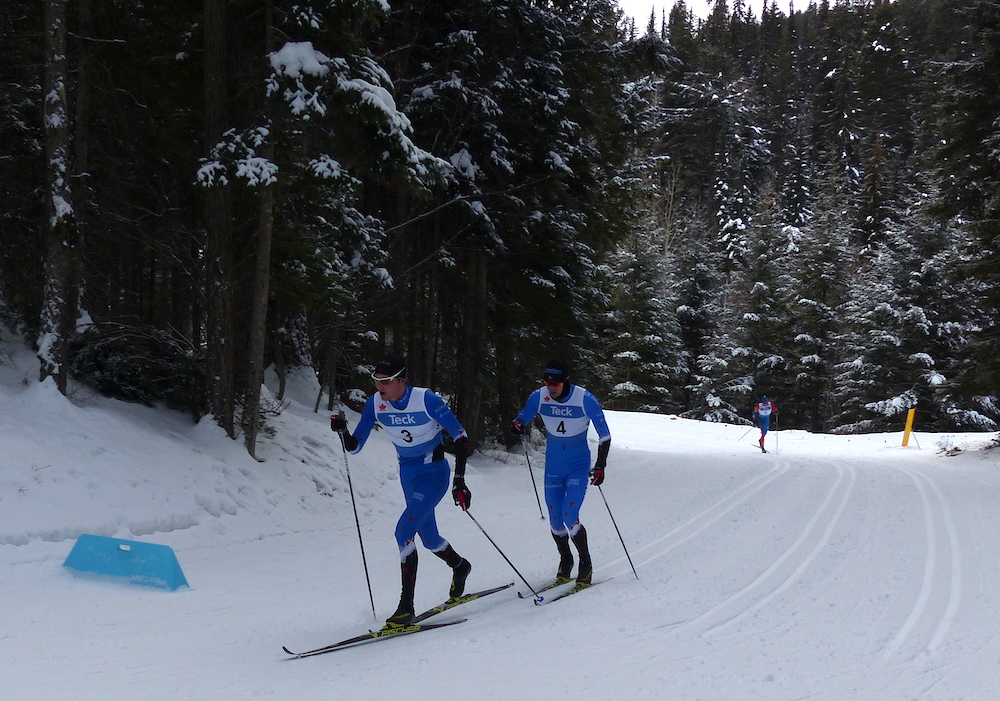
    The men raced first, completing three laps of the new (and freshly homologated) 5km loop. Rémi Drolet (Black Jack) won in 42:18.4, getting from Julien Locke (CNST) on the last climb to earn a 4.8 second gap. Sam Hendry (Team R.A.D.) stayed with leaders until late in the second lap, finishing 42.2 seconds back. Rémi Drolet and Hendry are juniors who represented Canada at Junior Worlds in Lahti last month. Crystal Lust

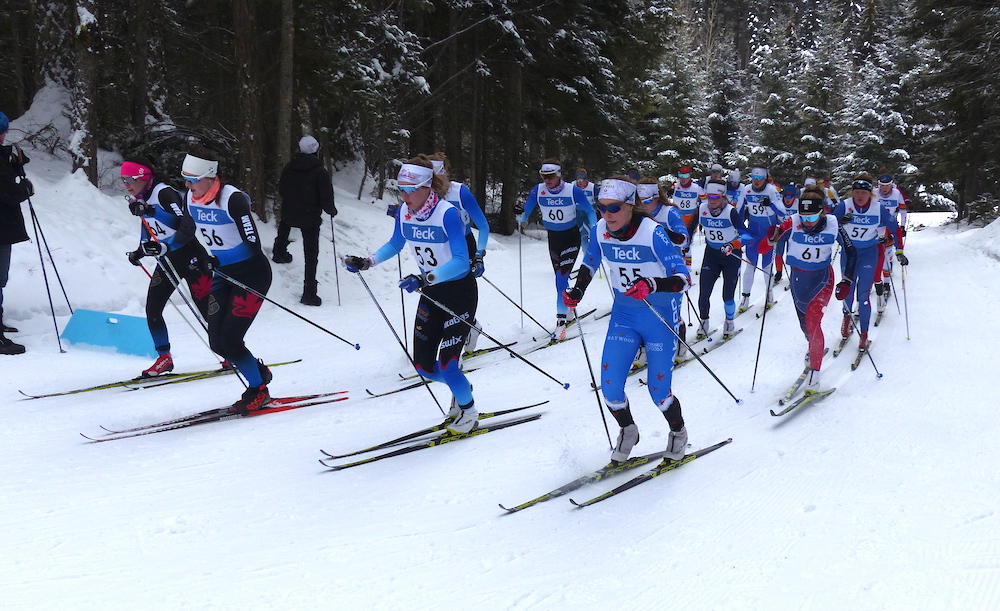
    The first small climb of the Westerns 10km classic. Jasmine Drolet (#55) leads Novie McCabe (#61) in the left track. (Photo: Peggy Hung)
    The first small climb of the Westerns 10km classic. Jasmine Drolet (#55) leads Novie McCabe (#61) in the left track. (Photo: Peggy Hung)

    The open women skied two laps of the same course, with Novie McCabe (Methow) breaking clear on the first lap to win alone in 32:46.6. Jasmine Drolet (Black Jack) was second at 53.4 seconds followed by teammate Molly Miller at 1:28.1. All three raced at World Juniors in Lahti: Jasmine Drolet is 16 and the other two are 17.

    There were 386 finishers on Saturday.  Racing continues Sunday with relays.

    Results: mass start classic, full weekend