From the FasterSkier archive — posts syndicated from athletes’ and coaches’ own blogs between 2004 and 2012, kept online as published. Current coverage is at fasterskier.com.
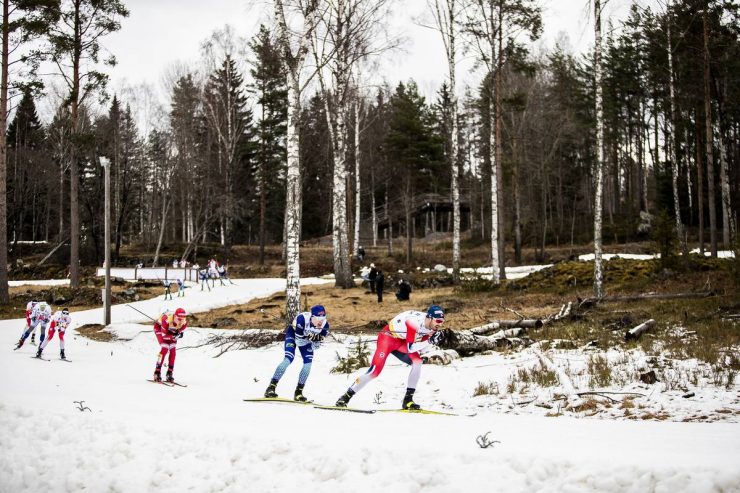
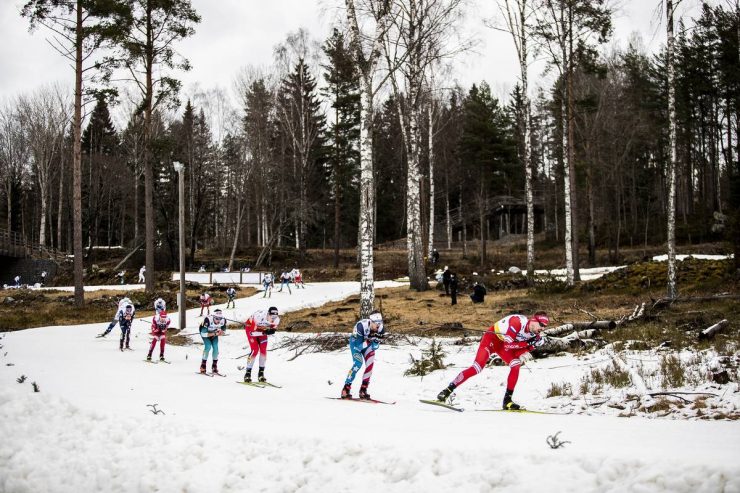
Hans Christer Holund of Norway leading down the ribbon of white. A low snow year in Falun, Sweden. (Photo: NordicFocus)
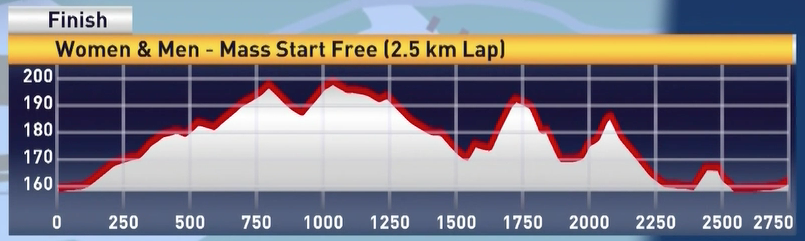
Around and around they go. Due to lack of snow in Falun, Sweden, the men again wheeled their way around a manmade ribbon of snow, skating six icy 2.5-kilometer laps. Reduced from 30 to the 15 k distance and without the long, steep climb for which the course is usually known, how athletes would fare was yet to be determined.
The 2.5-kilometer track of Falun in a low snow year. (Photo: Screenshot FIS Broadcast)
Along the way, two sets of 15 bonus points were available for the top ten skiers to sprint past the 6.7 and 11.7 checkpoints. It was at the first checkpoint that things began to spread out.
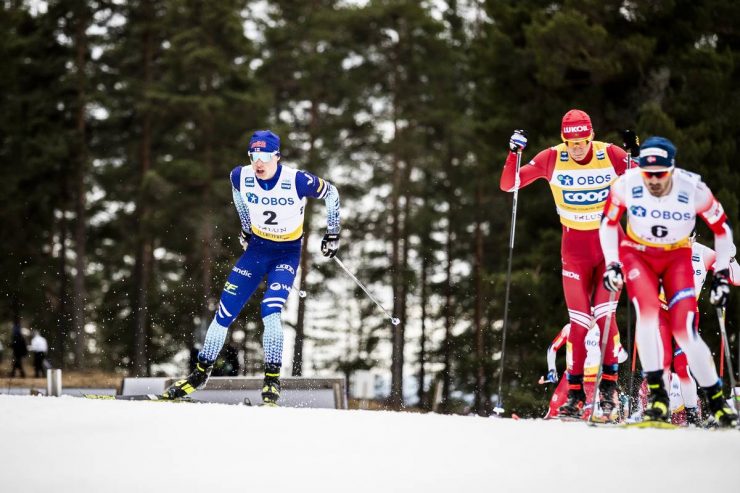
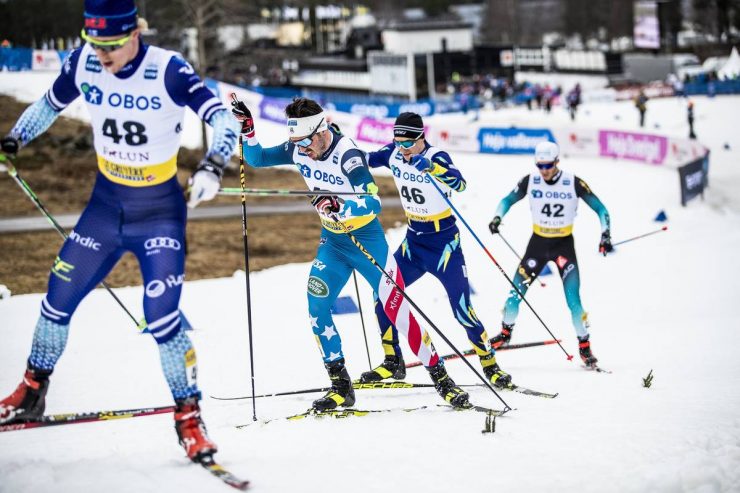
Overall World Cup and distance points leader, Alexander Bolshunov of Russia, dropped into a tuck on the downhill, accelerating past the Norwegians Hans Christer Holund, Simen Hegstad Krüger, Finn Hågen Krogh, and Sjur Røthe who had taken turns in the lead. Behind Bolshunov in blue Lycra sat the newly minted skate contender Iivo Niskanen of Finland. Known historically as a classic specialist, Niskanen has shown marked improvements in his skate results this season, including a second place finish in the freestyle distance event in Nové Město.
Alexander Bolshunov (center) primes himself to charge for the sprint bonus, surging past Iivo Niskanen (bib 2) and Hans Christer Holund (bib 6). (Photo: NordicFocus)
Like a slinky, the pack caught back up to Bolshunov, who relaxed and allowed the Norwegians to get to work again at the front. In a tuck or free skating, the group headed down the longest descent of the course, halfway through the lap. As the course bent to the left, the leader, Røthe, began to step turn, pushing off his right ski and leaning into the curve. As his ski left the ground, it pushed the tips of Bolshunov’s skis together, sending him to the snow (and almost to the grass) between a set of v boards. The Russian hopped back up, quickly regaining lost ground on the lead pack.
At the 10 k mark, only 8 seconds separated the top ten. But after the second bonus sprint, where Bolshunov again slingshot around the Norwegian leaders out of the downhill to grab the full 15 points, the field began to spread out.
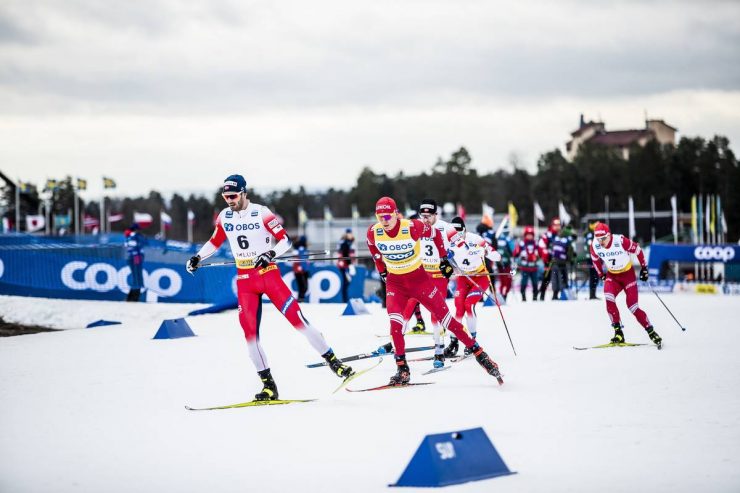
A sea of red: the top six Norwegian and Russian athletes head into the final lap of the 15 k freestyle in Falun. (Photo: NordicFocus)
Bolshunov pushed the front of the pack, trying to break free of Røthe, Holund, and Krüger. His Russian teammates Ivan Yakimushkin and Andrey Melnichenko maintaining contact from a few seconds behind.
In the final lap, Bolshunov tried to break free, but Røthe matched his every move. Holund and Krüger fell off the pace and were overtaken by the chasing Russians. Rounding a downhill turn inside the final kilometer, Krüger caught a ski in the loose granular snow and was sent to the ground, no longer in the hunt for the third step of the podium.
Rocketing out of the downhill with less than 500 meters to go, Røthe soared past Bolshunov in a tuck to take the lead over the final roller before the stadium.
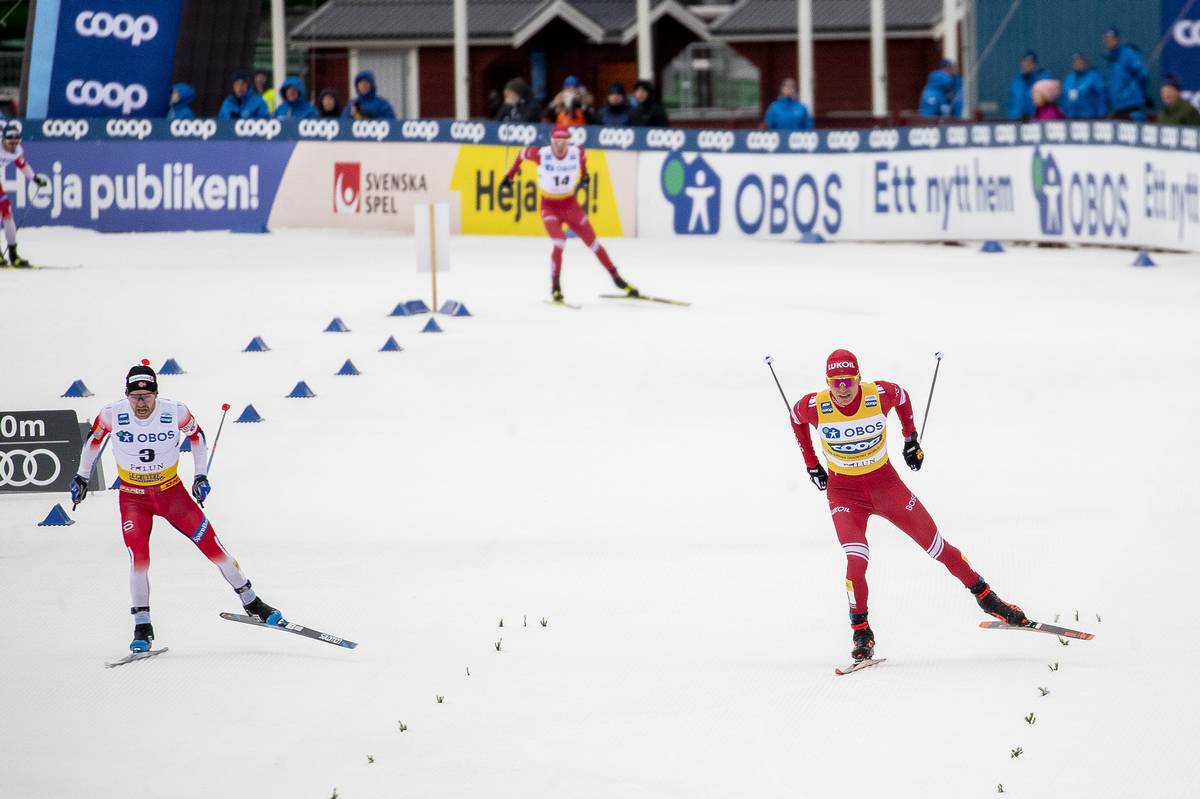
Down to the final meters, Alexander Bolshunov (right) and Sjur Røthe sprint for home in the 15 k skate in Falun. (Photo: NordicFocus)
It came down to the final sprint, and Røthe was outmatched. Bolshunov snuck back around, powering his skis down the track. He created enough of a gap that his victory was certain, and he threw his arms up in the air to celebrate. It was the Russian’s fourth consecutive distance win, and sixth of the season.
With arms raised, Alexander Bolshunov takes the win in Falun with Sjur Røthe in a close second. (Photo: NordicFocus)
Sjur Røthe collapses after a hard fought battle for second place in Falun. (Photo: NordicFocus)
Yakimushkin was next across the line for third (+9.7), followed by Melnichenko in fourth (+10.5) and Holund in fifth (+11.0). The twenty-three-year-old Yakimushkin was 2nd in the event in Toblach, Italy during Tour de Ski and also 2nd at Russian National champs in April 2019.
With today’s result, Bolshunov looks untouchable at the top of the distance standings with 924 points. Røthe sits in second with 596. Bolshunov also leads the overall by over 400 points ahead of the injured boxer, Johannes Høsflot Klæbo.
Alexander Bolshunov (RUS) and Sjur Røthe (NOR) exchange congratulations after an exciting finish in Falun. (Photo: NordicFocus)
“It was a really hard race because the Norwegian team made good tactics,” Bolshunov told FIS through a translator at the finish. “They always sent someone in front to run the race, so I have to always close some gaps on them and make the most of the bonuses to take maximum points there. Then to make the harder pace on the last lap and to make a good fight with Sjur Røthe at the finish lane.”
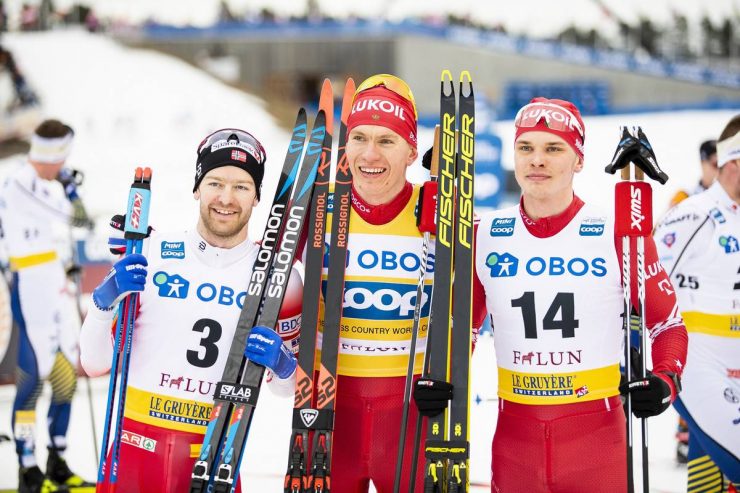
The men’s distance podium in Falun. From left to right, Sjur Røthe (NOR), Alexander Bolshunov (RUS), and Ivan Yakimushkin (RUS). (Photo: NordicFocus)
For much of the race, Norris hovered inside the top-20, looking to match or improve upon his career best result of 16th, which was achieved in a 15 k skate in Falun last March.
David Norris tucks in behind Sergey Ustiugov (RUS) heading down the ribbon of snow in Falun. (Photo: NordicFocus)
In a post-race interview, shares that he did not originally plan to compete in Falun, sitting out the 30k instead to focus on the upcoming FIS Ski Tour 2020. He also reflects on his race, how mass starts affect the energy moderation strategy he has been honing, and his outlook heading into the distance-focused tour.
Post-race interview with David Norris
Benjamin Lustgarten (CGRP) was next for the U.S. in 60th (+3:21.0) followed by Ian Torchia (SMST2) in 65th (+3:37.7), and Kevin Bolger (USST) in 68th (+3:59.1).
Post-race interview with U.S. World Cup Coach Matt Whitcomb
Ian Torchia climbs with the pack in Falun. (Photo: NordicFocus)
Evan Palmer-Charette was the top Canadian athlete in 52nd (+2:45.8), followed by Alexis Dumas in 64th (+3:33.3), Bob Thompson 67th (+3:45.5), and Ricardo Izquierdo-Bernier 74th (+5:36.7).
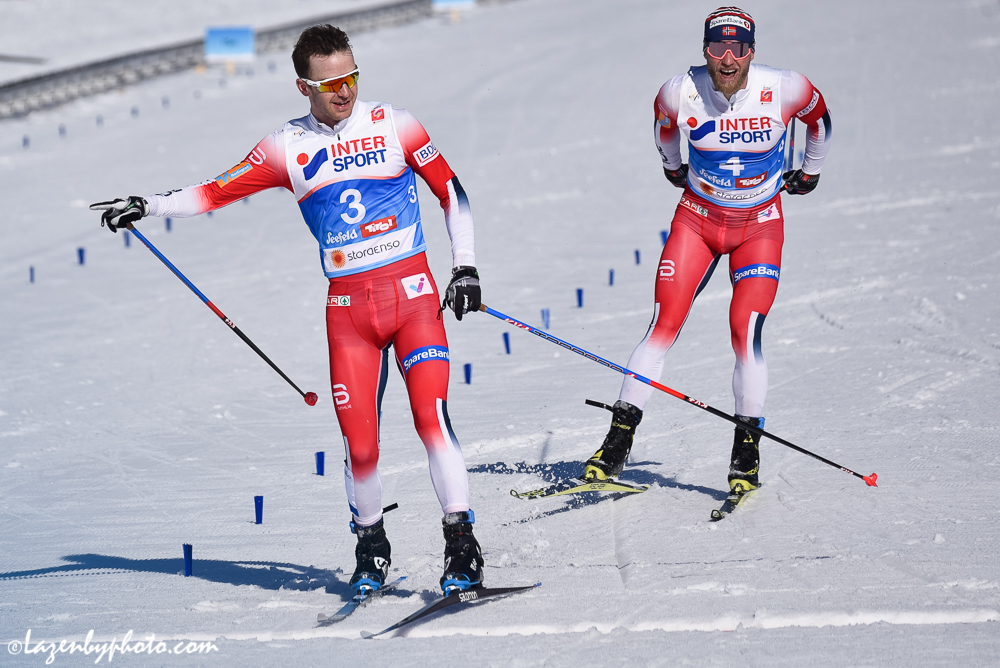
Norway’s Sjur Røthe (l) leading teammate Martin Johnsrud Sundby on their way to first and third respectively in the men’s 30-kilometer skiathlon on Saturday at the 2019 World Ski Championship in Seefeld, Austria. (Photo: John Lazenby/lazenbyphoto.com)
*This article has been updated to include comments of Great Britain’s Andrew Musgrave
By the time the camera panned past the 26-kilometer mark of the men’s 30 k skiathlon at 2019 World Ski Championships in Seefeld, Austria on Saturday, the original pack of 72 starters had dwindled to five: Norwegians Martin Johnsrud Sundby and Sjur Røthe, Russia’s Alexander Bolshunov, Finland’s Iivo Niskanen, and France’s Clement Parisse.
The leaders had been unphased by Niskanen’s hot pace during the classic portion of the event and with less than 5 k of freestyle skiing to go, Bolshunov levied control of the pace. But it wasn’t long before one red suit was exchanged for another.
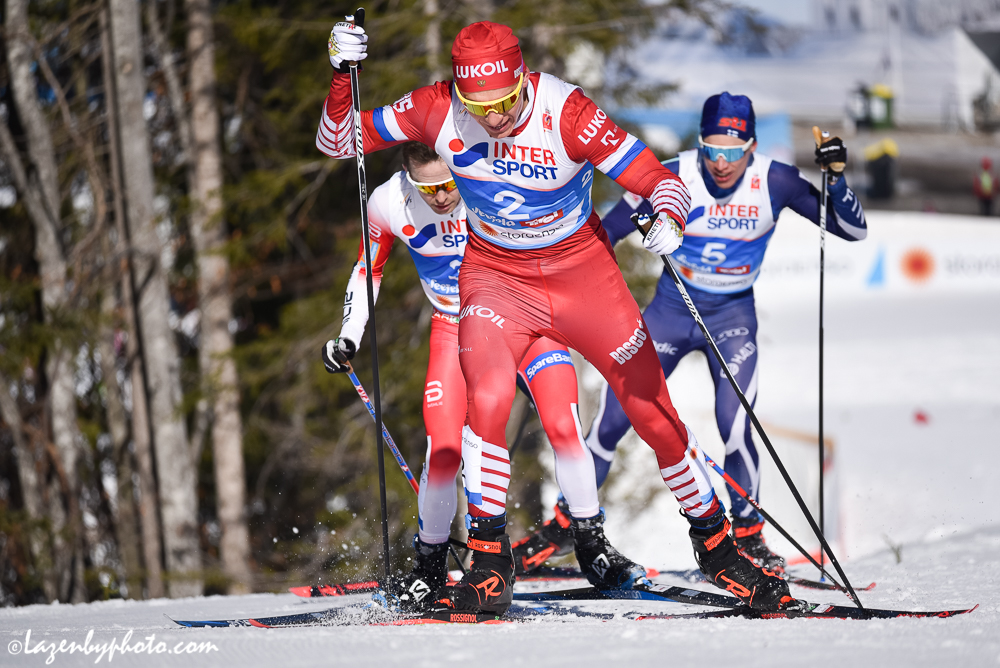
Russia’s Alexander Bolshunov during the men’s 30-kilometer skiathlon on Saturday at the 2019 World Ski Championship in Seefeld, Austria. (Photo: John Lazenby/lazenbyphoto.com)
Saturday, he looked bound to break into that realm. In the second to last climb before the uphill to the finish, he began to separate himself from the lead pack of five. By the hill’s crest, only Bolshunov and Røthe had managed to maintain sight of Sundby’s ski tails. Through the gentle descent before the uphill to the finish, the three tuck skated in a line with Sundby setting the pace, Bolshunov just behind and Røthe just behind him.
As the trio ascended the final uphill, Sundby looked steady; perhaps too steady. A brief glance back revealed the raw power of Bolshunov and equally quick tempo of Røthe pressing in from behind. By the finishing stretch, Sundby was swallowed. The sprint to the line became between Røthe and Bolshunov, with Røthe outlunging the Russian by 0.1 seconds for first in a time of 1:10:21.8. Bolshunov, claimed second (+0.1), finishing 0.6 seconds ahead of Sundby in third (+0.7).
“It was an amazing feeling to cross the finish line first,” Røthe said according to a International Ski Federation press release. “When we changed skis, it was important for me to get away from the best athletes in the field. I had some problems with my legs during skating, but it worked out well in the end. I chose the right tactic today … and I hope I was good enough to be part of the relay team on Friday.”
Røthe’s win on Saturday is predicated on a series of firsts this season: earlier in the year he earned his first World Cup win and Saturday marks his first career individual World Championships gold–he has a relay gold from 2013 when he raced the third leg for Norway at World Champs in Val di Fiemme.
For Bolshunov, Saturday’s skiathlon silver medal is his first World Champs podium and, with the men’s 15 k classic yet to race, it may just be the start to his championships trophy case. The 22 year old Russian has made his way to the top of the podium a few times this season and, if Sundby hopes to take home his long sought after individual gold, it will not be without a challenge from the likes of Bolshunov.
Rounding out Saturday’s top 5 was Niskanen in fourth (+12.3) and Parisse in fifth (+20.7).
Canada’s Alex Harvey during the men’s 30 k skiathlon at the 2019 World Championship in Seefel, Austria.
Finishing 58.9 seconds back from the winner was Canada’s Alex Harvey in sixth place. The winner of the 2017 Lahti World Championships 50 k and Canada’s favorite medal contender in Seefeld, Harvey recently announced that he will be retiring this season after World Cup finals in Quebec City, Quebec. Many are hoping for a repeat gold place finish for the 30 year old–over his career, he has accumulated five World Champs medals, two of those being gold one from the Lahti 50 k and one from the 2011 Oslo Team Sprint.
On Saturday, however, Harvey told Cross Country Canada (CCC) that he “was never really in the hunt” for the podium, despite his high ranking result.
“Normally when you are in the top-six you are in a mass start fighting for the podium until the end, but that wasn’t the case today,” Harvey said according to a CCC press release.
“I missed the boat in the classic and the gap was made there. The equipment was great, but I just wasn’t skiing well and couldn’t create enough speed – especially on the flat part of the course,” he added.
Happy with the skating portion of the race, Harvey implicated that more could have been had from his classic.
“As soon as I clicked into the skate skis, I was feeling really good,” Harvey said. “I was skiing with a lot of big names, guys started popping a bit from the back and I was feeling really confident leading that group. The skiathlon is my favourite race. I will draw a lot of confidence from the skate today, but I am disappointed with the classic.”
Finishing 1.4 seconds behind Harvey in seventh place (+1:11:22.1) was Great Britain’s Andrew Musgrave. The seventh place finish is Musgrave’s second best result at a World Championships event, his best having come in Lahti 50 k when he finished just off the podium in fourth.
“I felt great on the classic today- having ridiculously good skis helped!” Musgrave wrote in an email to FasterSkier after the race. “The last lap of the classic was pretty hard though – when the worlds 2 best classic skiers started pushing the pace (Bolshunov & Niskanen). I must admit I was a bit glad when Niskanen fell on the 2nd lap- so we didn’t have an entire 15km of him stringing out the field & making us suffer!”
The 29 year old Brit has had four Top 10 finishes this World Cup season and has stood atop a World Cup podium once, that having been a third place finish two years ago in the Toblach 15 k. In Saturday’s race he indicated that while the classic portion of the skiathlon for him went well, the skating segment had him searching for a second gear.
“The first lap of the skate was OK… But I started to pay for the hard effort on the classic by the 2nd,” he wrote. “By 7km into the skate I was pretty wrecked. The last 2 laps were horrific- I was almost crawling by the end! I think I lost an impressive 50s to Harvey over the last 7.5km!”
Either way, many rooting for Britain’s blue red and white, are hopeful that the seventh is just the start of Musgrave’s World Champs performances.
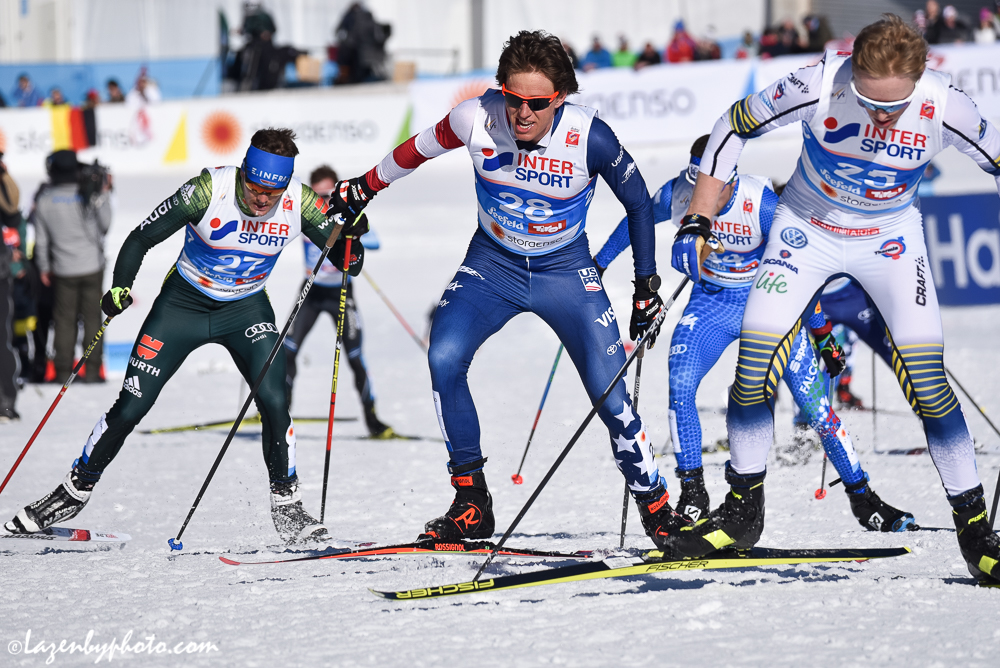
American Scott Patterson (bib 28) during the men’s 30-kilometer skiathlon on Saturday at the 2019 World Ski Championship in Seefeld, Austria. (Photo: John Lazenby/lazenbyphoto.com)
The next top North American finisher following Harvey was American Scott Patterson in 32nd (+4:40.6). In an email to FasterSkier, Patterson explained that the hot pace during the first classic portion of the skiathlon took a toll on him
“In racing today, I struggled from pretty early on.” Patterson wrote. “Iivo Niskanen and others pushed the classic pace pretty hard early. I went with it for a while hoping to stick onto the pack, but it became a little too much for me as I was struggling to kick my skis. I was partially saved by having really fast skis, but it wasn’t enough.”
The switch to his freestyle boards was a welcomed exchange, though low energy reserves left him wanting more.
“In switching to skate, I felt slightly better, but had also dug my legs into a hole during the classic leg.” Patterson wrote. “I tried to work with a group around me, but we weren’t moving up all that well and I wasn’t quite feeling the initiative to go for it on my own.”
“I was able to ski by a few people, but I really wanted to get the Norwegian pair of Klaebo and Iverson who were dogging it at the end,” he continued. “That would have made me a lot happier (along with a top 30).
“Overall, I think my fitness is pretty good and I am looking forward to getting a little more dialed in and faster over the next few races,” he added.
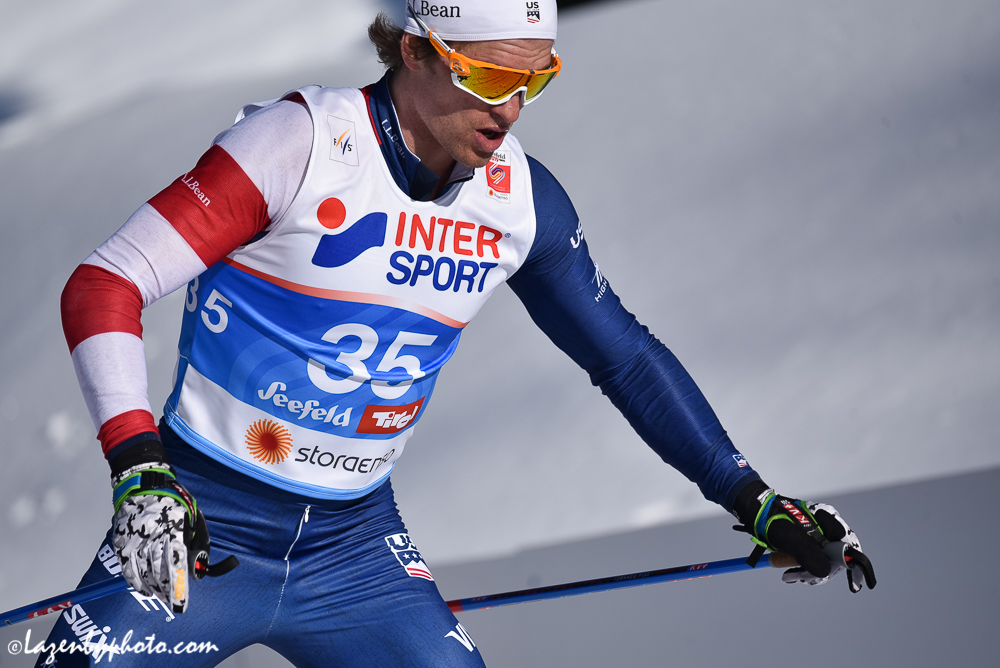
American David Norris the men’s 30-kilometer skiathlon on Saturday at the 2019 World Ski Championship in Seefeld, Austria. (Photo: John Lazenby/lazenbyphoto.com)
American David Norris finished six places behind Patterson in 38th (+4:54.4).
“Today had an awesome atmosphere with amazing fans and hot sun.” Norris wrote in an email. “I struggled in the classic portion and that is a little frustrating. My skate leg felt really good and I was catching guys the whole way. For my first Championship event this was a pretty awesome experience and a good start.”
Next to finish was Canada’s Evan Palmer-Charrette in 45th (+6:12.4) followed by Americans Kyle Bratrud in 49th (+6:19.6), and Adam Martin in 54th (+7:47.4). Also racing for Canada was Scott James Hill in 56th (+9:58.8).
British skier Andrew Musgrave skied to sixth overall (+1:00.3)
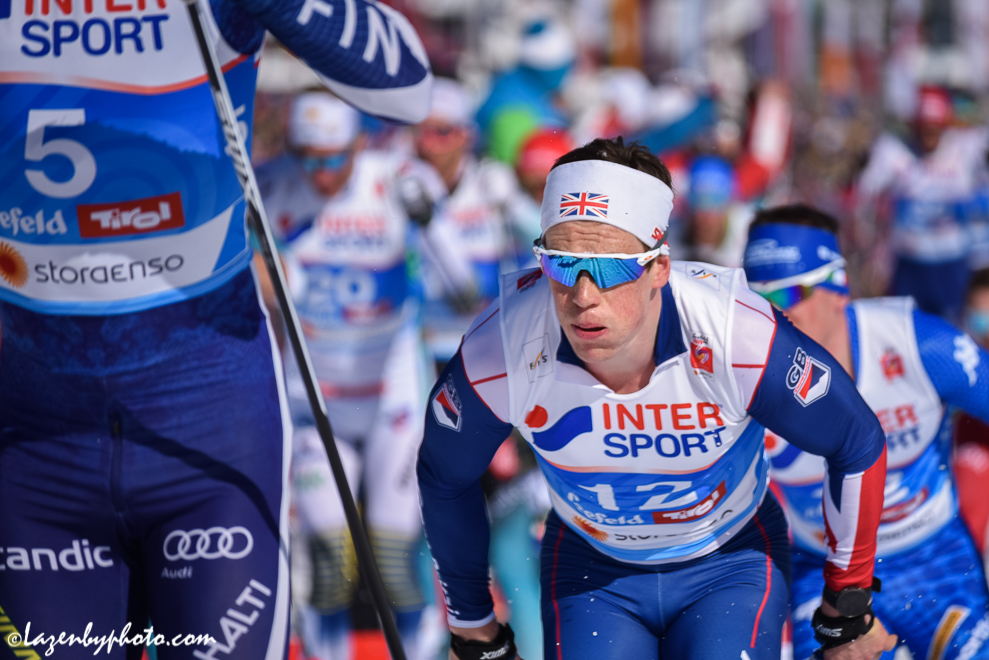
Andrew Musgrave (bib 12) of Great Britain en route to a 7th place finish in the Nordic World Ski Championship skiathlon event. (Photo: John Lazenby/lazenbyphoto.com)
World Championships picks up Sunday with a men’s and women’s Team Sprint.
Norway’s Maiken Caspersen Falla taking the World Cup win in the 1.4 k skate sprint in Lahti, Finland. Sophie Caldwell of the U.S. Ski Team placed second. (Photo: fis-ski.com screenshot)
FIS World Cup Lahti, Finland 1.4 k/ 1.6 k Freestyle Sprint
In the women’s skate sprint qualifier in Lahti, Finland Slovenia’s Eva Urevc laid down the fastest time in 2:40.67 minutes. Swiss skier Nadine Faehndrich was the second fastest qualifier, 4.21 seconds back, with the U.S. Ski Team’s (USST) Sophie Caldwell third (+4.36).
Canada’s Dahria Beatty qualified 25th (+10.21). Also making the heats for the U.S. were Ida Sargent (USST) in 26th (+10.36), and Kelsey Phinney (SMS T2) in 27th (+10.54).
Of the top three qualifiers, only Caldwell advanced to the finals. The final was won by Norway’s Maiken Caspersen Falla in 2:43.64. Falla advanced to the finals as a lucky loser from the first semifinal. That semi was won by Caldwell who ended up placing second (+0.11) in the final. Sweden’s Maja Dahlqvist sprinted to third overall (+0.37).
Germany’s Sandra Ringwald placed fourth (+0.46), Norway’s Mari Eide fifth (+0.75), and Tiril Udnes Weng of Norway sixth (+0.94).
Phinney placed 19th overall, Sargent 30th. Canada’s Beatty was 24th in the final standings.
Also for the U.S., Julia Kern (USST D-Team) coming off of illness ended her day 38th overall. Hannah Halvorsen (USST D-Team) placed 41st.
Johannes Høsflot Klæbo won the men’s 1.6 k skate qualifier in 2:47.01 minutes. He was followed by teammate Haavard Solaas Taugboel in second (+4.15). Qualifying in third was Finland’s Joni Maeki who clocked a time of 2:51.36.
Klæbo won the final in 2:52.06 while Italy’s Federico Pellegrino raced to second (+0.30). Norway’s Finn Hågen Krogh was third (+0.61). Also from Norway, Eirik Brandsdal took fourth (+1.31) and Emil Iversen fifth (+1.75). Gleb Retivykh of Russia was sixth (+2.08).
No North American men qualified for the heats.
Logan Hanneman (APU) for the U.S. placed 32nd overall after missing the heats by .22 seconds. Simi Hamilton (USST) finished 36th overall, and Erik Bjornsen (USST) 42nd.
Evan Palmer-Charette was the lone Canadian entered; he placed 67th.
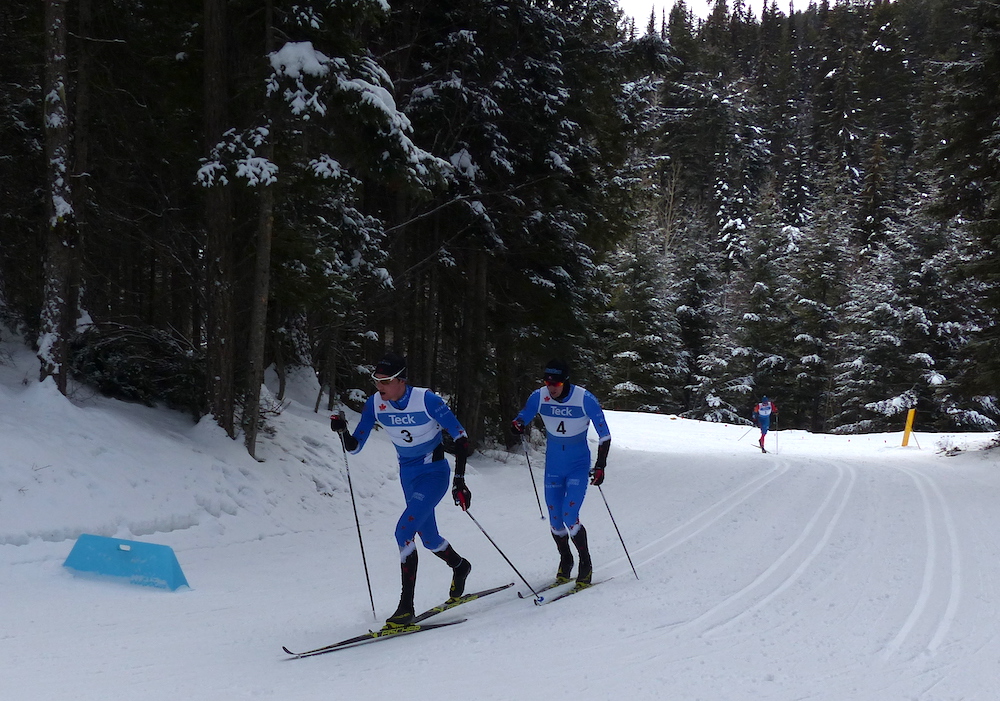
Rémi Drolet leads Julien Locke and Sam Hendry at the start of lap three. (Photo: Peggy Hung)
Canadian Western Championships, Telemark, Classic Mass Start
Day two of Westerns dawned with low clouds and intermittent light snow at -11C for the classic mass starts.
The men raced first, completing three laps of the new (and freshly homologated) 5km loop. Rémi Drolet (Black Jack) won in 42:18.4, getting from Julien Locke (CNST) on the last climb to earn a 4.8 second gap. Sam Hendry (Team R.A.D.) stayed with leaders until late in the second lap, finishing 42.2 seconds back. Rémi Drolet and Hendry are juniors who represented Canada at Junior Worlds in Lahti last month. Crystal Lust
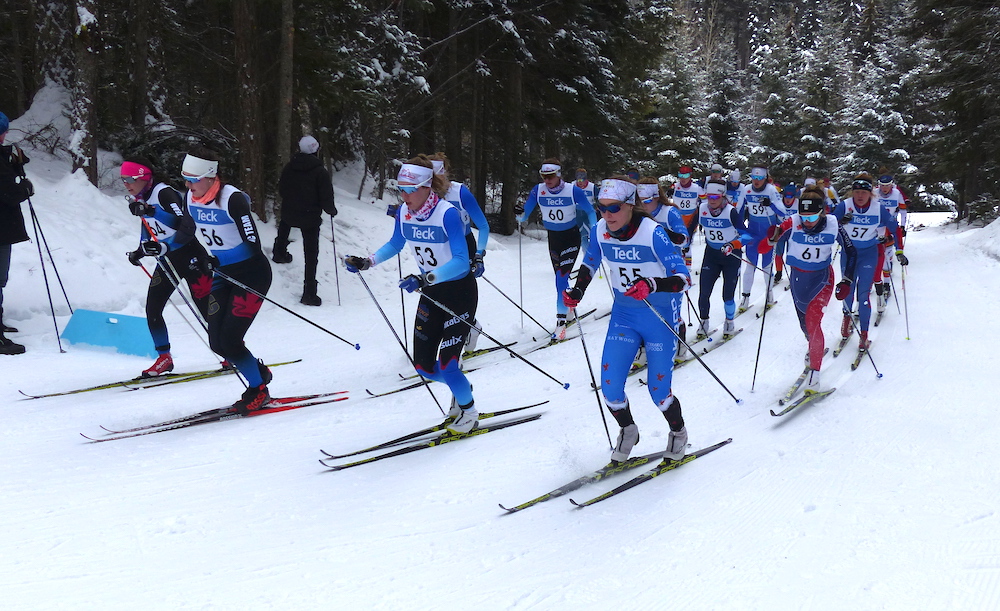
The first small climb of the Westerns 10km classic. Jasmine Drolet (#55) leads Novie McCabe (#61) in the left track. (Photo: Peggy Hung)
The open women skied two laps of the same course, with Novie McCabe (Methow) breaking clear on the first lap to win alone in 32:46.6. Jasmine Drolet (Black Jack) was second at 53.4 seconds followed by teammate Molly Miller at 1:28.1. All three raced at World Juniors in Lahti: Jasmine Drolet is 16 and the other two are 17.
There were 386 finishers on Saturday. Racing continues Sunday with relays.
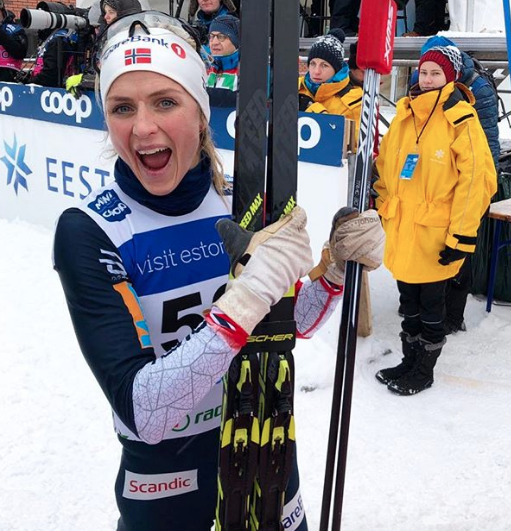
World Cup cross-country action returned to the Otepää race venue on Sunday, with athletes reconvening after Saturday’s classic sprints for the weekend’s distance classic event. In the women’s 10-kilometer individual start classic race, Norway’s Therese Johaug finished first in a time of 29:53.7 for the win. Sweden’s Ebba Andersson finished second (+48.4) while Russia’s Natalia Nepryaeva claimed third (+56.7).
Skiing for the U.S. Ski Team (USST), Jessie Diggins was the top North American woman on Sunday, placing 13th (+2:26.0). Two more Americans skied into the Top 30, with Rosie Brennan finishing 27th (+3:09.9) and Sadie Bjornsen 29th (+3:11.3).
Also skiing for the U.S. on Sunday, Caitlin Patterson and Ida Sargent finished in 39th (+3:50.9) and 41st (+4:17.2), respectively. Dahria Beatty was the lone Canadian to enter the race, placing 43rd (+4:42.5).
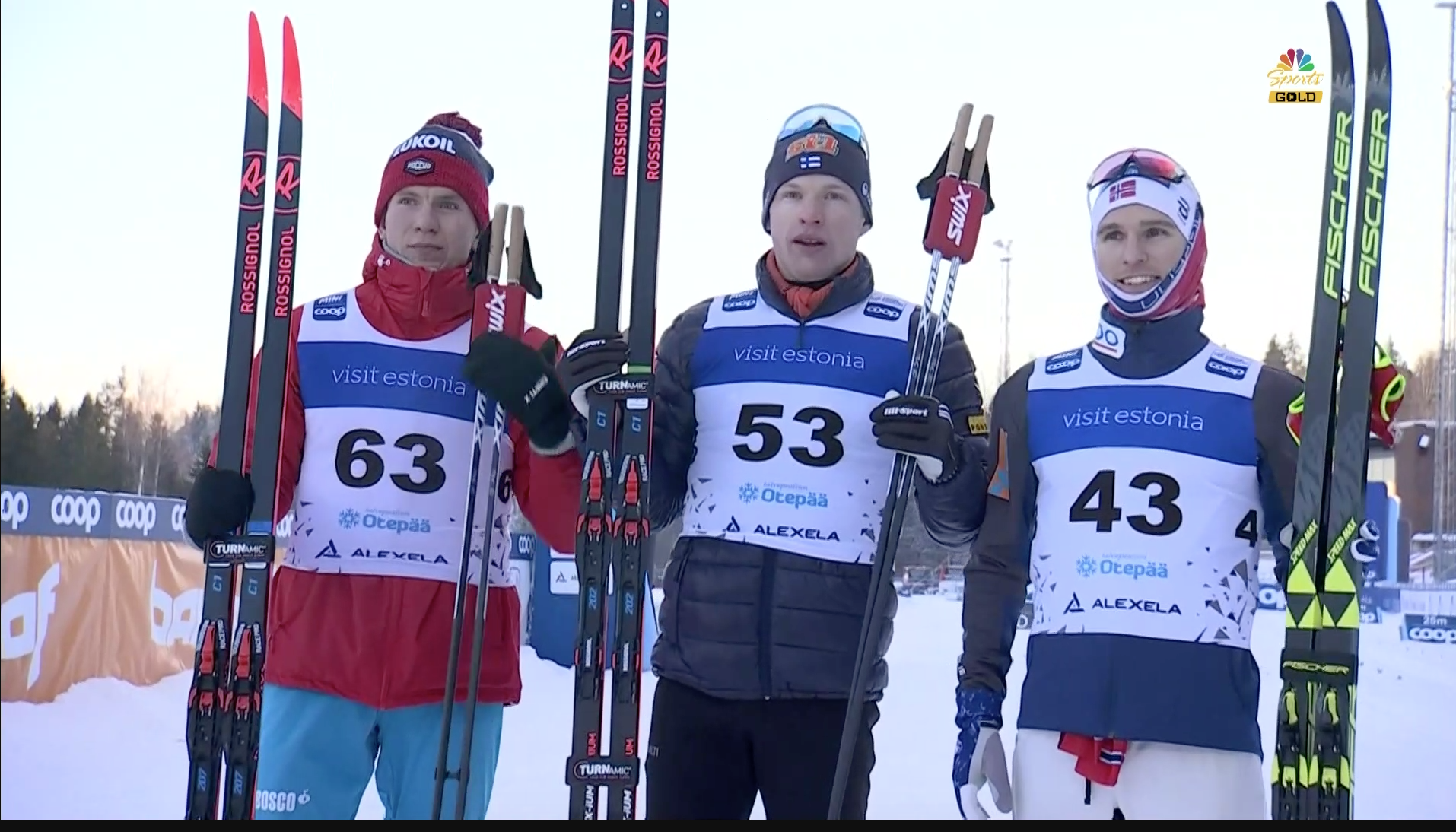
The men’s 15-kilometer classic podium on Sunday in Otepää, Estonia with Russia’s Alexander Bolshunov (left) in second, Iivo Niskanen of Finland (center) in first and Norwegian Didrik Tønseth (right) in third. (FIS screenshot)
In the men’s 15 k, Finland’s Iivo Niskanen took first, completing the course in a time of 40:07.1. Russia’s Alexander Bolshunov finished in second place (+15.9) and Norway’s Didrik Tønseth in third (+46.4).
The USST’s Erik Bjornsen led the charge for the Americans, placing 30th (+2:35.7). Scott Patterson placed 36th (+3:01.0), while Ben Lustgarten finished in 53rd (+4:41.1). Kevin Bolger placed 56th (+4:57.3) and Andy Newell did not start.
Racing for Canada, Len Valjas placed 43rd (+3:56.9) and Bob Thompson 52nd (+4:24.0).
The NorAm weekend wrapped up with mass start free technique on shortened courses. The predicted extreme cold and extreme snow didn’t materialize with a relatively balmy -13C recorded by the jury.
Katherine Stewart-Jones (CNST) continued her dominance with a win in 48:25.5, gapping Cendrine Browne (CNST) on the third and final lap for a 8.4 second separation. That is two wins and a second for Stewart-Jones. Zoë Williams (Nakkertokk) was third again, 1:38.2 behind. The shortened course was 14.3km, with one 4.3km lap and two 5km laps.
Russell Kennedy (Team R.A.D.) collected his first win of the weekend to earn his trip to World Championships, finishing alone at 57:12.6 on the four lap 19.3km race. Scott Hill (Hardwood) was second at 23.4 seconds behind. Evan Palmer-Charrette out-sprinted the remains of the original six leaders to complete the podium at 1:07.0.
IBU World Cup Ruhpolding, Germany 15 k / 12.5 k Mass Start
Career-best days are good days. That’s the main narrative from US Biathlon’s Sean Doherty 15-kilometer mass start in Ruhpolding, Germany on Sunday.
Doherty’s previous best in the mass start was a 24th place. In the 30-athlete field, Doherty began in bib-30. In his first two shooting stages, both prone, he skied a single penalty lap in each. As he found his ski-speed groove for his second two laps, marking the third fastest ski split for lap three and the fifth fastest split for lap four, Doherty also made his mark on the shooting range as he shot clean for for both his standing stages.
Doherty finished in 13th overall which matched his individual career best on the IBU World Cup. Johannes Thingnes Bø of Norway won the mass start in a time of 36:43.8 minutes while shooting clean for his first three stages and skiing one penalty lap on his fourth. Doherty’s finishing time was 42.2 seconds behind Bø’s.
Canada’s Christian Gow also posted a career best IBU World Cup results with an 11th place. Gow skied a single penalty lap after missing a target on his second prone stage. Otherwise, he shot clean to finish 34.3 seconds behind Bø.
Austria’s Julian Eberhard placed second (+0.6, 0+1+0+1), and France’s Quentin Fillon Maillet was third (+2.8, 0+1+0+0). Teammate Martin Fourcade skied to fourth (+8.6, 0+0+0+1).
Bø’s win on Sunday marked his 10th win (including relays) this season on the IBU World Cup. He leads the overall points series.
It was time for a first in the women’s 12.5 k mass start. Franziska Preuss of Germany won the race – an IBU World Cup career first for her — in a time of 32:34 minutes. Preuss shot clean on her way to the win.
Norway’s Ingrid Landmark Tandrevoldplaced second (+0.2, 0+0+0+0). For Tandrevold it was a her first IBU World Cup podium. Paulina Fialkova of Slovakia was third (+15.1, 0+0+0+0).
US Biathlon’s Clare Egan placed 24th (+1:59.7, 0+0+3+2), teammate Susan Dunklee 25th (+2:12.5 2+1+1+0).
No other North American women qualified for the mass start.
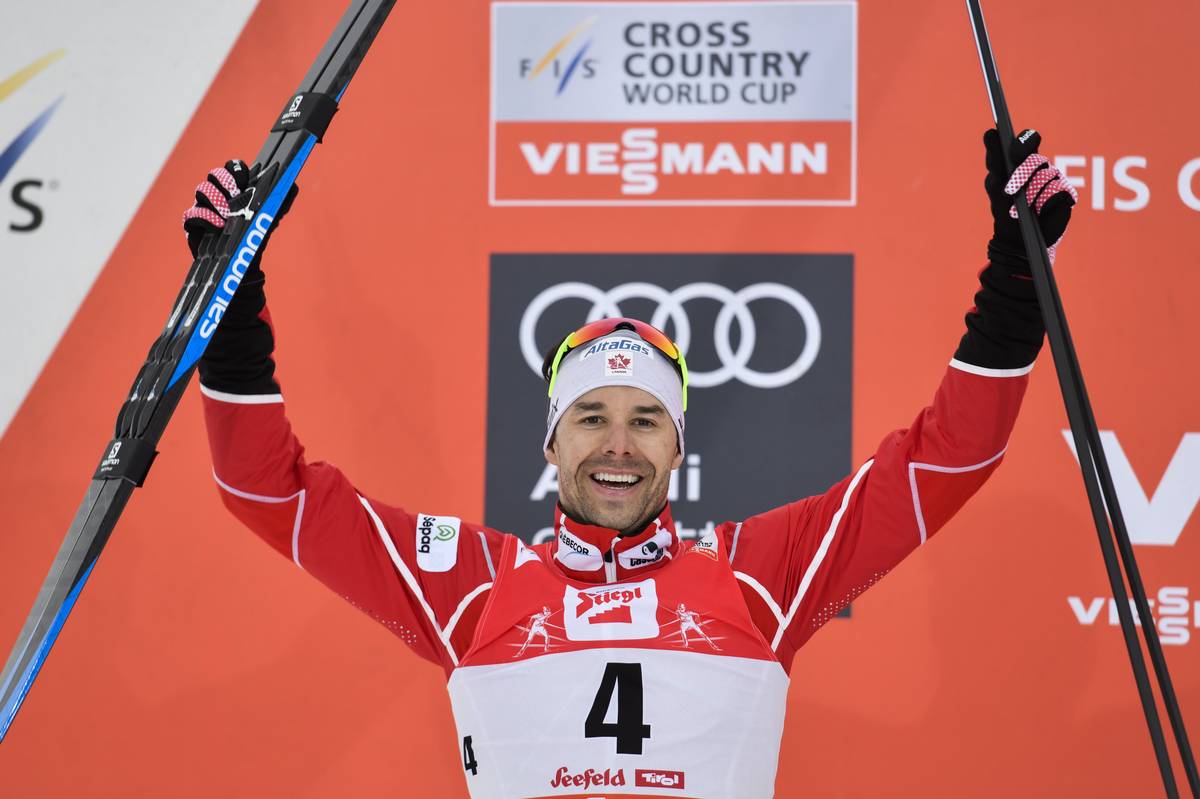
Canada’s Alex Harvey celebrating on the podium after placing second in the men’s 15 k freestyle mass start in Seefeld, Austria, for his best result of the 2018 World Cup season. (Photo: Salomon/NordicFocus)
Cross Country Canada (CCC) has begun a reboot process as the new Olympic cycle starts. Corporations call this a reset, a rebranding, a new direction, restructuring, and various other names that try to disguise the challenges and issues that come with enacting real change.
The reboot process traditionally starts with an acknowledgement that the current level of success, and that of the foreseeable future, doesn’t align with the goals or the potential of the organization.
Canada left PyeongChang with no medals at three consecutive Olympics, only one skier in the World Cup red group, and a perception that there was no obvious successor to Alex Harvey.
There are many people who, with the benefit of hindsight, believe that CCC allowed itself to be trapped by a combination of success and the Own The Podium (OTP) funding model.
The process of assigning blame for the past, called “blamestorming”in the corporate world, is one of the most effective ways to waste time and destroy morale without doing anything to improve the future. The “best practices” approach to a reboot starts with four apparently simple questions: How did we get here? Where are we now? Where do we want to be in five years? How can we get there?
While CCC does many things as a national sport body, this article will focus on high performance and the development system.
How did we get here?
After a disastrous 1998 Olympics in Nagano, CCC shrank to a full-time staff of five and endured a forced re-invention. Four years later, in 2002 at Salt Lake, Beckie Scott won all three medals in the skiathlon after the initial silver and gold medalists were caught doping. Sara Renner missed the B final in the sprint for 9th place.
Canadian Chandra Crawford in the 2011 team sprint in Dusseldorf, Germany. (Photo: Fischer/NordicFocus)
In 2006 in Torino, Chandra Crawford earned a surprise gold in the sprint while Scott finished fourth. Scott had earlier teamed up with Renner for a team sprint silver medal.
In 2010, there were no Canadian cross-country medals. However, there were signs of promise. Renner skied to her fourth Olympic top-10 finish. All four Canadians competing in the men’s skiathlon finished in the top-15. Devon Kershaw lost out in final kilometer of the 50 k to finish fifth, 1.6 seconds away from gold.
That post-Vancouver glow was possibly the point where CCC temporarily slid off the rails.
A number of Canadian sports fell victim to OTP incentives. A sport qualifies for OTP funding by having good prospects for a medal in the next Olympics. The money comes with strings attached, to ensure that resources are spent on improving the probability that specific individuals will podium. For smaller sports where the OTP money is a significant proportion of the sport’s annual budget, it is hard to make choices that put that money at risk. Choices like balancing the emerging athletes in the pipeline, while simultaneously supporting those athletes already at the top-end of the sport.
As a result, many sports have lost their OTP eligibility by losing the focus on development and the vision that qualified the sport for OTP in the first place. Some people put cross-country skiing in the list of sports that fell into this trap.
After 2010, the future looked bright. Harvey and Kershaw were World Champions in the 2011 team sprint. Kershaw was second overall in the 2011/2012 World cup. (A feat only equaled in North America by Scott and Jessie Diggins).
Harvey arrived at Sochi in 2014 as a medal favorite. He was fresh off a World Cup podium in Toblach the weekend before the 2014 Games began. Sochi ended poorly when Canada, along with Norway, couldn’t solve the difficult waxing conditions.
The results in PyeongChang were similar to 2002 numerically: Harvey was close to a medal in multiple races and Lenny Valjas collected 7th in the classic sprint. A medal would have changed the mood, but not overall situation.
Where are we now?
Post-PyeongChang, CCC believes Canada is not achieving the international results a country with plentiful snow and 37 million people is capable of.
The development system in Canada consists of the National Team, the official training centers (Centre National d’Entrainment Pierre Harvey (CNEPH), Thunder Bay National Team Development Centre (TBay), and the Alberta World Cup Academy (AWCA)), and the clubs. The ten provinces and three territories have teams, but don’t have a formal place in the development system as each of the thirteen regions approaches development support differently. In the last few years, the number of clubs actively recruiting and developing athletes while supporting a high performance team has increased. For our purposes, as no official name has been affixed to these clubs, the term ‘elite club’ will be used here.
In the past, all national team members were required to belong to a training center while developing athletes were encouraged to join.
“I can speak for many of the athletes, they thought that if they didn’t go to a training centre, then they might as well quit skiing,” Telemark’s coach Adam Elliot said. “It was that broad of a choice, they felt they had to choose between skiing and school immediately.”
The landscape is more diverse now, with more options. The examples that follow skew to Western Canada, largely because the coaches quoted brought teams to Sovereign Lake snow camps in May and November and were available for in-person interviews. Eastern Canada remains equally diverse in terms of its club offerings.
A common theme among the coaches and athletes is that each athlete’s needs are different, and he or she needs to find an environment that fills those needs. FasterSkier asked AWCA’s head coach Chris Jeffries how an athlete should choose his or her path to success.
“It’s such an individual, case by case thing,” he said. “I don’t have an answer.”
In 2017, a shift to allow more development paths resulted in new senior National Team member Gareth Williams staying at his home club, Telemark, in Kelowna, BC. Elliot described how it came about.
“Tom Holland approached us, for Gareth, and said we like what you’re doing in the Okanagan, and we want to keep Gareth there. We’re going to support you and your program to be able to support Gareth.”
Also in 2017, Julien Locke returned to his home club Black Jack while Russell Kennedy shifted to the new Team R.A.D., part of the Canmore Nordic Club.
To further illustrate the spectrum of options and pathways, FasterSkier contacted three Canadian athletes, each with a history of NorAm podiums and some international success, to discuss their ski-training choices. Dahria Beatty started at AWCA and has remained there, Evan Palmer-Charette started at TBay then recently moved to Team R.A.D., and Andy Shields has gone rogue.
Dahria Beatty en route to 20th overall in the Seefeld World Cup freestyle sprint for her season-best result in 2017/2018. (Photo: Fischer/NordicFocus)
“For me, I’ve been working with Chris [Jeffries] for six years,” Beatty told FasterSkier in November. “It works really well for me, and I have a good group of training partners where I am, that can push me everyday in training.”
AWCA is also the home training group for National Team skier Emily Nishikawa and two junior national team skiers. AWCA also benefits from its close proximity to a number of other training groups.
“For me, Canmore’s a location where I want to be training, where I want to be based out of,” Beatty said. “All the pieces fit well together for [me], it’s somewhere I think I can keep improving.”
Palmer-Charrette made a summer-time decision to change things up by finding a fresh environment in Team R.A.D.
“I think the best part of being on a training centre is the entire program is based around a small group of athletes of similar age which makes for a great training and racing environment,” Palmer-Charrette wrote. “I feel training centres, as they are, are best-suited for junior/u23 athletes and especially great for athletes who are a bit late to the game like I was at the end of high school and will really benefit from learning from other athletes on the day to day training life.”
Shields is no longer affiliated with an official team. He funds his skiing by painting houses in the summer and representing ski wax companies in the winter. Although he refers to ski racing as a hobby, he did end the last season as COC leader and will race period 1 of the World Cup.
“I don’t think I could have done this straight out of junior,” Shields wrote. “My time on Tbay is still having a huge positive effect on my ski career. Being on a team through my early years as a senior made it much easier to get a decent training base and set a couple good habits in place which are paying dividends.”
Shields did reflect and offer an alternative to how he might have changed his path to elite level skiing.
“If I could go back in time I would have gone the NCAA route straight out of junior,” Shields added. “College skiing in the States is a much better deal than a training center for people in their early twenties. You can go down to the States, get a degree, not pay a dime, and come out the other side with plenty of time to have a full-time ski racing career. I would have joined a training centre upon finishing with NCAA.”
The Canadian university system differs from the U.S. model, offering little money for sports. Heading south to the U.S. as a student-athlete remains an option for some Canadian skiers. Most athletes remain in the Canadian system to develop. With that in mind, FasterSkier asked why some athletes had chosen some of the Western based training centres.
Jeffries, who leads the AWCA, also noted how his program has evolved. There appears to be room at the AWCA for those with concurrent goals. The AWCA has partnered with the University of Calgary to allow AWCA athletes to work towards degrees.
“We’re always evolving our programming, and what it entails, and how we package it,” Jeffries said. “That’s why we have this new university program this year, because you just look at the popular decision making of graduated high school athletes.”
Elliott, based in the Okanagan, said his program offers athletes a well rounded experience too.
“You’ve got the trifecta,” Elliot said. “You’ve got access to education opportunities for post-secondary. We’ve got the university, UBC Okanagan, and the college. Most of the people who’ve moved here have gone to school. Secondly, it’s the Okanagan. Which is probably the best place to ski in North America, with skiing up and down the valley –with Nickel Plate, Telemark, [Kelowna] Nordic, Sovereign, and Larch Hills. The third is that you’re moving into a community of skiers: family, volunteers, everybody trying to make a go of keeping people in sport.”
Clearly the times have changed from a programming perspective and the past’s financial windfall for Canadian cross-country skiing.
“Probably the quad between 2010 and 2014, CCC had more money almost than it knew what to do with, ” Dave Wood, former National Team head coach, told FasterSkier in May as he finished up a long ski day. “Now, I think the budget’s still three and a half million. While it’s maybe low compared to what it has been, it’s a hell of a lot higher than it was in ‘99, by about four times.”
Former CCC High Performance Director Tom Holland spoke of those larger commitment from clubs during the Frozen Thunder races in October.
“There’s a lot more resources,” Holland said, referencing the increased numbers of coaches attending Frozen Thunder with their athletes. “One of the reasons clubs are more important now is that there are paid coaches at the clubs. That’s why training centres started in the 90’s, because you’ve got to have a coach, full-time.”
Thee deep question remains: what next for Cross Country Canada as it ponders a post-Alex Harvey scene? Better and more diverse options for Canadian skiers, like those modernizing their offerings to connect with the student-athlete, is a step forward. But fans of the sport, and of course Cross Country Canada, have short-term and long-term goals. No one wants to see another Olympic quadrennial transpire without the glimmer of medal potential at the international championship level.
“I think when Alex Harvey retires, mostly likely after next year with Lenny Valjas, it will be the end of an era having athletes being able to finish on the podium at World Cups, World Championships, said Alain Masson, Whitehorse head coach. “So definitely, the program is going to go into a real rebuilding phase with lots of young athletes, but no guarantee of success in the near future.”
Cendrine Browne, of the Pierre-Harvey National Training Centre and Canada’s national U23 development team, leading the women’s 10 k freestyle pursuit on Jan. 31 at the Mont Sainte-Anne trails in Quebec. She went on to win by nearly 1 1/2 minutes to take the NorAm leader’s bib. (Photo: CCC)
(Note: This article has been updated to include comments from Andy Shields on his pursuit win.)
The NorAm series continued last weekend with a two-day pursuit in Mont Sainte-Anne, Quebec. While this format hasn’t been used at this level in Canada for three years, the Ski Tour Canada in early March will have two pursuit days.
Cendrine Browne, of the national U23 development team and Pierre-Harvey National Training Centre (CNEPH), won Saturday’s 5-kilometre classic individual start in 14:37.3 to lead a U23 and CNEPH podium sweep. Sophie Carrier-Laforte finished 7.2 seconds back in second, followed by Frédérique Vézina at 30 seconds behind the winner in third.
Browne was the only European B-Tour skier to race this weekend after arriving back from Nove Mesto, Czech Republic (where she represented Canada on the World Cup), five days earlier on Monday, Jan. 25.
“I chose to race because I would have done intensity anyways on Saturday,” Browne wrote in an email. The convenience of racing on her home trails at Mont Sainte-Anne (M.S.A.) added to the appeal.
“I wasn’t sure if I would do Sunday’s race, but I’m in good shape so I’ll do it,” Browne wrote on Saturday. “The Noram points are also interesting if I win.”
Browne did win Sunday’s 10 k freestyle pursuit. With Carrier-Laforte not starting, she started 30 seconds ahead of Vézina and expanded her lead to 1:29.1 with the fastest time of the day in 27:51.3. Browne was ranked fifth going into the weekend and, with the top three in the overall NorAm standings absent, her convincing victory on Sunday will give her the leader’s bib for next weekend.
Vézina started second, with three other racers within 10 seconds of her. While she was happy with Saturday’s classic podium, noting “5km has never been my strong suit,” she was frustrated with her pursuit, in which she placed fifth, 2:29.1 behind Browne. “My skis were so slow that the girls passed me in the first downhill like I was stopped,” Vézina wrote in an email.
Olivia Bouffard-Nesbitt, of Canada’sU23+ Development Team, started sixth and pulled away from Annika Hicks (Canmore), who started fourth, to take second. Crossing the line nearly a minute and a half (1:29.1) after Browne, Bouffard-Nesbitt held off Hicks by 5.9 seconds for the second spot on the podium. Hicks placed third (+1:35).
“I initially wanted to work with someone to try and make time on the leader,” Bouffard-Nesbitt wrote in an email. “After gauging the willingness of the skiers around me to chase Cendrine, I decided that instead I would try to race tactically for second place. I shared the lead with Annika for most of the race as we distanced ourselves from 4th and 5th.”
Also on her hometown trails, Marie Corriveau (CNEPH) improved one place to finish fourth (+2:25.1), 4 seconds ahead of Vézina to repeat as top junior woman on Day 2 at M.S.A.
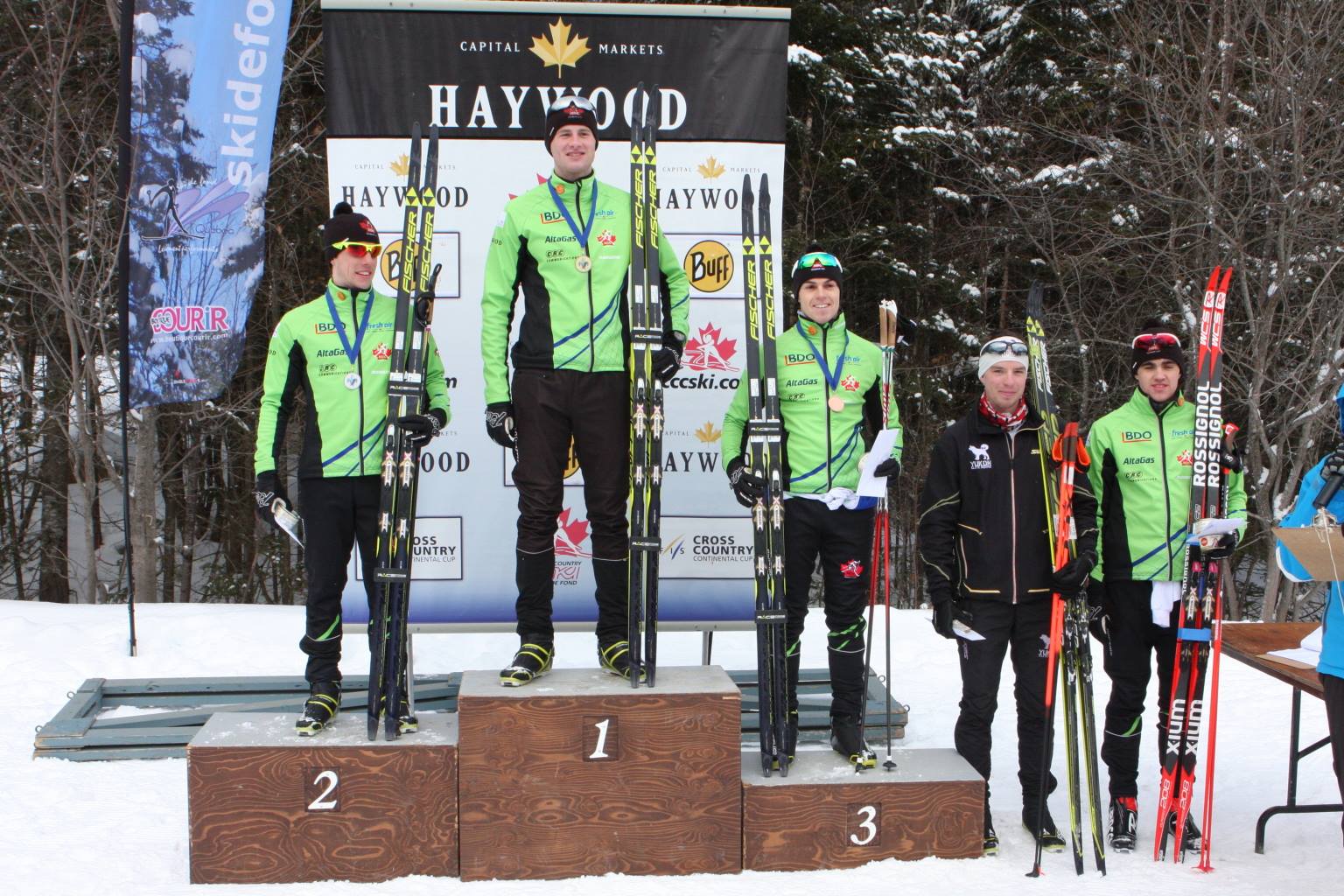
Thunder Bay National Development Centre swept the podium (top three) in the men’s 10 k classic on Jan. 30 with Bob Thompson in first, Andy Shields in second and Michael Somppi in third. Colin Abbott of the Yukon Elite Squad placed fourth (second from r) and a fourth NDC skier, Evan Palmer-Charrette (r) was fifth. (Photo: Skibec Nordique/Facebook)
NDC Thunder Bay All the Way
On the men’s side, Bob Thompson of the Thunder Bay National Development Centre (NDC) took his first NorAm distance win on Saturday, finishing the 10 k classic individual start in 26:12.2, just 0.3 seconds faster than teammate Andy Shields. Michael Somppi completed the Thunder Bay podium sweep, 14.5 seconds behind Thompson in third.
“[It] feels very good to get my first Distance NorAm win and share the podium with my teammates,” Thompson wrote in an email. “I enjoyed the course: it was challenging with some quick climbs and some longer more gradual climbing sections that you really had to focus to keep your speed up on.”
“The race today was good,” Shields wrote on Saturday. “I felt like I was in shape which is a feeling I’ve been missing up to this point. I could push hard and not pay the price in heavy limbs.”
Shields noted that he and Thompson would start the pursuit together, giving them the opportunity to work cohesively to stay ahead of Somppi, a strong skate skier.
However, on Sunday in the men’s 15 k freestyle pursuit, Somppi quickly caught the two frontrunners.
“Today, tactics were pretty simple,” Somppi wrote in an email. “I went out fast, caught Andy and Bob early. I put myself in a position to contend for the win, but I did not have the energy to make it happen.”
Somppi faded to fourth, posting the seventh-fastest time on the day. Thompson also struggled, eventually outsprinting a group of six to finish ninth.
“Bob led out the first km then I went to the front,” Shields explained in an email after Sunday’s race. “I figured the pace needed to be quite high to maintain the gap to the rest of the field so when I started to lead I picked up the pace. By 2km in I could hear Bob behind me dropping off the pace. I didn’t know at the time but Somppi caught us just as I was pulling away. I skied a nerve-racking 13km out front for the rest of the race with Somppi within 15 seconds of me for most of it. It was pretty stressful, but it ended up being the winning strategy.”
Andy Shields (NDC Thunder Bay) racing to a 45-second win with the fastest time of the day after starting second in the men’s 15 k freestyle pursuit at the NorAm at Mont Sainte-Anne in Quebec on Jan. 31. (Photo: CCC)
Shields held strong and skied uncontested to the win in 37:09.3, the fastest time of the day and 45 seconds ahead of second and third.
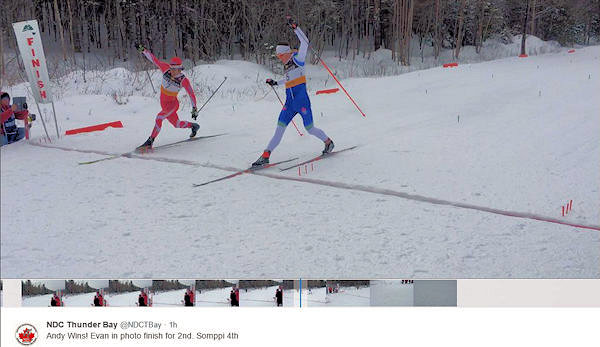
After starting the pursuit fifth and seventh, respectively, Evan Palmer-Charette (NDC Thunder Bay) and Brian McKeever, of the Para Nordic World Cup Team, separated themselves from the second chase group to fight for the podium. Palmer-Charette beat McKeever by the slimmest of margins to take second, 45 seconds behind Shields, while McKeever placed third with the same time. Somppi finish 11.1 seconds later in fourth.
McKeever could have been at the International Paralympic Committee (IPC) World Cup in Pyeongchang, South Korea, but according to Cross Country Canada, he opted to try for a Ski Tour Canada selection.
Somppi was disappointed with his energy and his fourth place.
“The trails were super and I enjoyed the skiing here,” he wrote. “I would prefer to be training right now and avoiding racing, however I have to qualify for the Tour and I believe I did enough to stay in contention this weekend.”
Canadian Para-Nordic World Cup skier Brian McKeever (l) and Thunder Bay’s Evan Palmer-Charette (r) in a photo finish for second at the men’s 15 k freestyle pursuit on Jan. 31 at the Mont Sainte-Anne NorAm in Quebec. Palmer-Charette had the edge and McKeever placed third. (Photo: CCC/NDC Thunder Bay Twitter)
***
The NorAm now moves to Gatineau in western Quebec, starting with sprint racing on Friday. Jess Cockney is back from Europe for his first North American races of the season. Of more than 780 registered racers, the only notable absentee is Andrea Dupont, who is slated to race for Canada on the World Cup in Drammen, Norway, this Wednesday as the NorAm leader.