From the FasterSkier archive — posts syndicated from athletes’ and coaches’ own blogs between 2004 and 2012, kept online as published. Current coverage is at fasterskier.com.
Yellow bibbed as the overall leader of the World Cup, out first on Sunday’s 30 k classic pursuit in Trondheim, and Norway’s Pål Golberg starting 34 seconds back: this was the situation Russia’s Alexander Bolshunov found himself in as he pulsed from the start. Thrown into this mix of tension was a helter-skelter mish-mash of weather. On and off again snow, blustery winds, and temps hovering right near that wax tech’s no man’s land of 0 °C.
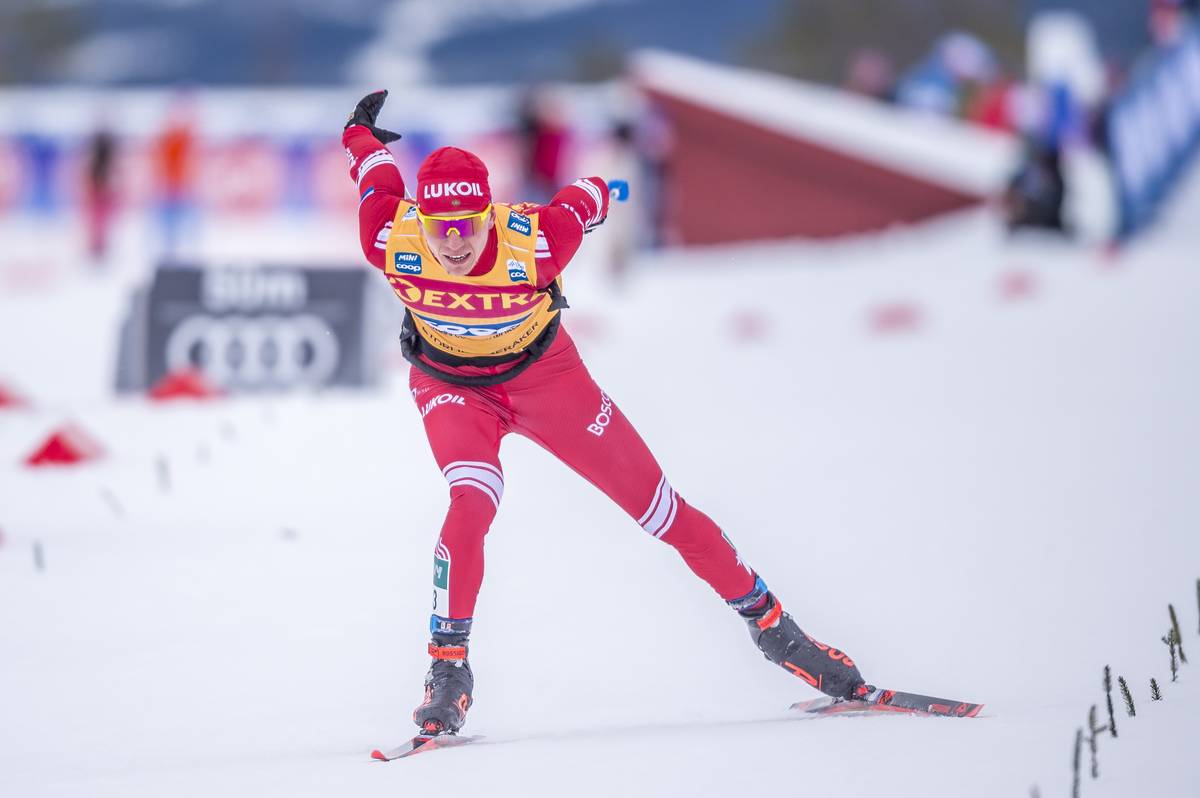
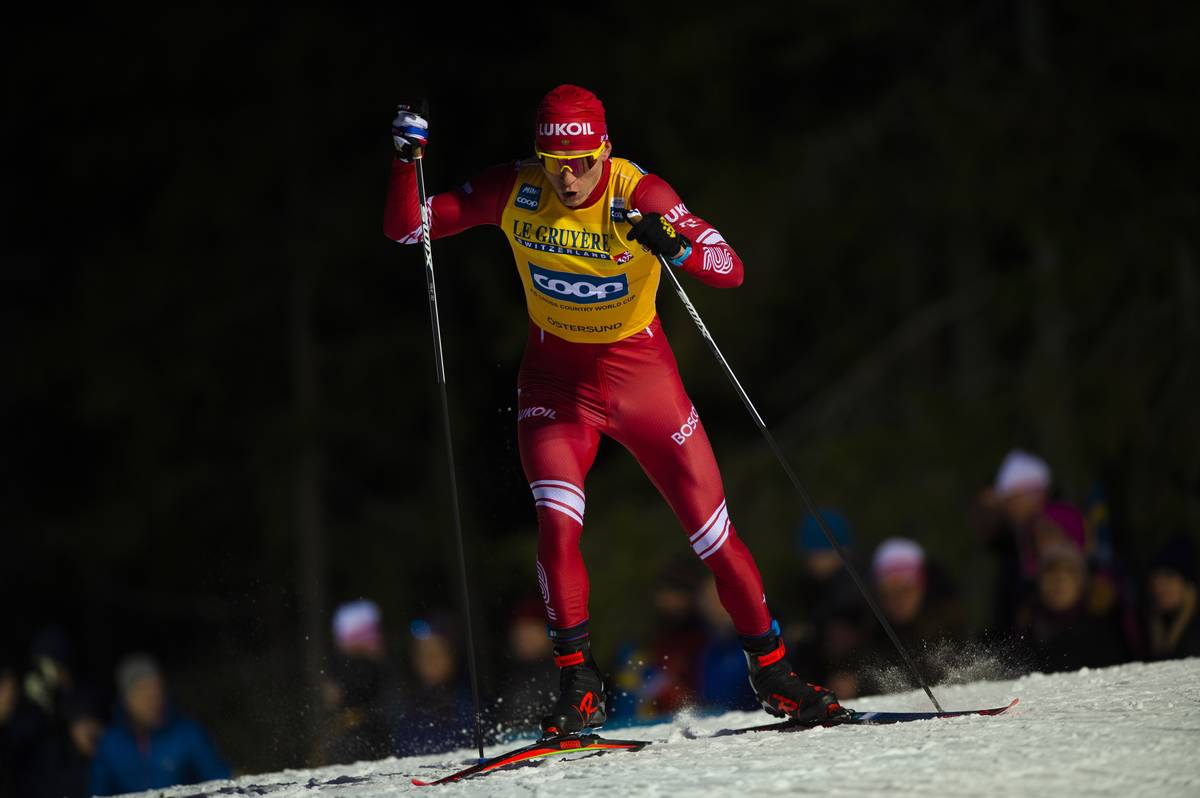
We are not used to seeing Bolshunov falter. He has been a beast this season having won the Tour de Ski and hammering away from the field solo during this tour’s Stage 4 34 k mass start skate. Those are simply two highlights. But there he was, perhaps humbled by less than stellar skis on Sunday; the big Russian bear faltered.
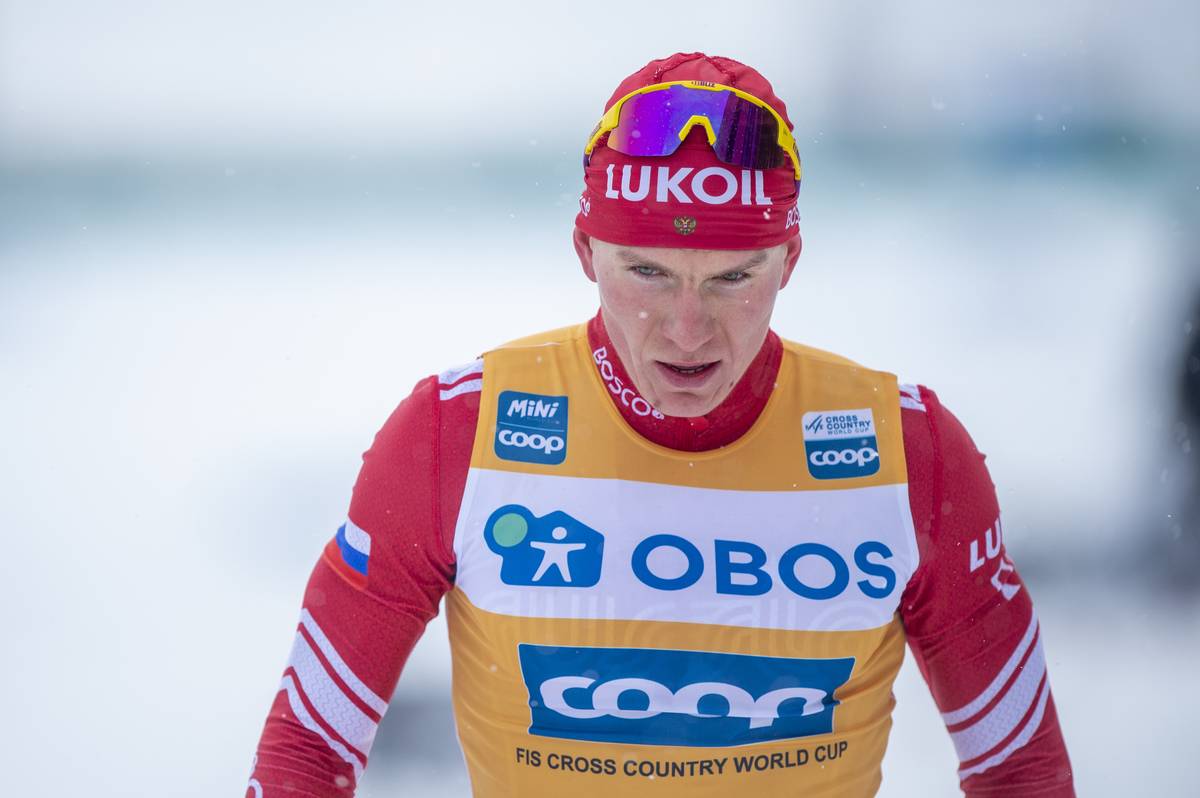
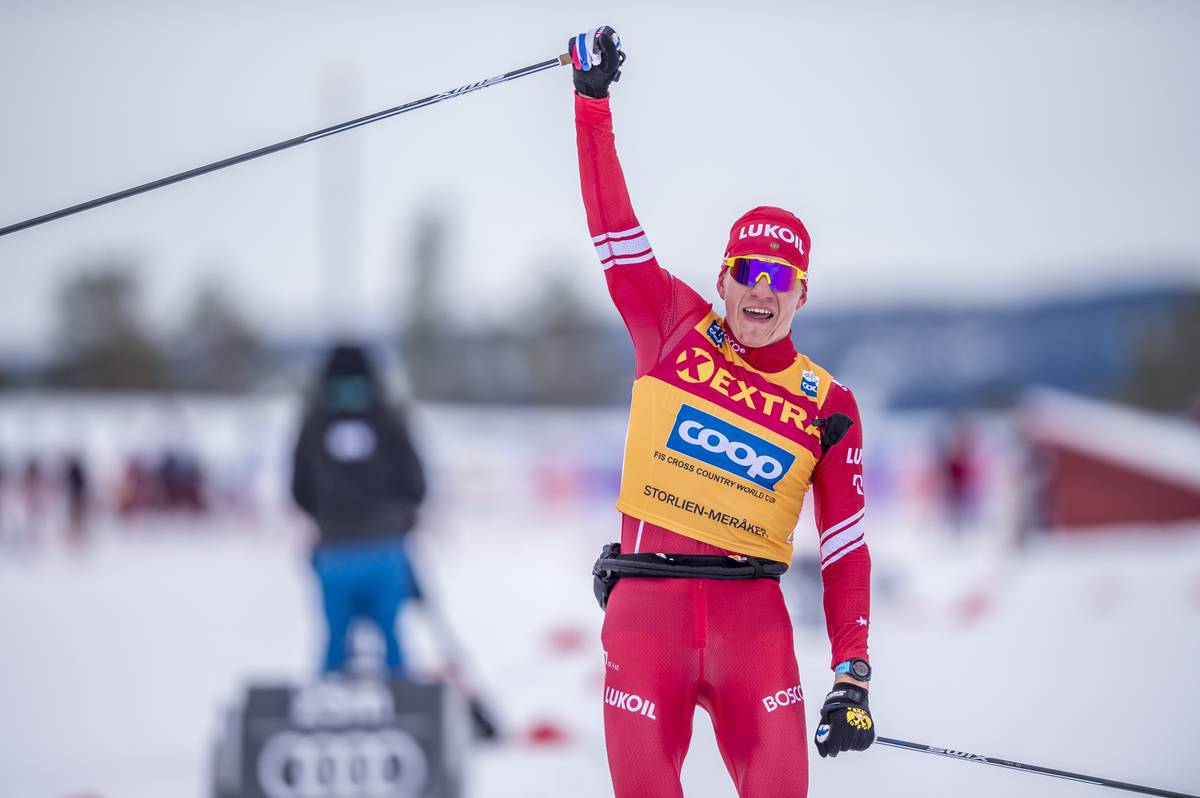
Alexander Bolshunov of Russia — the hunted on Stage 6. (Photo: NordicFocus)
This was Golberg’s day. By 2.2 k he had nearly halved the gap to Bolshunov. Two k later, Golberg was on the Russian’s ski tails, with Bolshunov’s metaphorical tail beginning to droop between his legs. A Russian down — Golberg on his own solo quest for the win.
For the next 26 k, Golberg’s job was no longer to fend off Bolshunov, but to keep a motivated crew of Norwegian’s from gapping up. We’ll get to that piece of the story in a bit. Golberg won with a polite bow to the crowd in 1:23:51.6. This was the twenty-nine-year-old Golberg’s second win of the season. He won a classic sprint in Falun, Sweden earlier this month. His effort, and lovely skis on a day that saw several skiers stop and scrape ice off their kick zones, earned him the Ski Tour overall win.
“It’s surreal and something I did not expect before the Ski Tour and before the season,” Golberg told FIS after the race. “The crowd started to congratulate me on the third round so I had to stay focussed until the finish.”
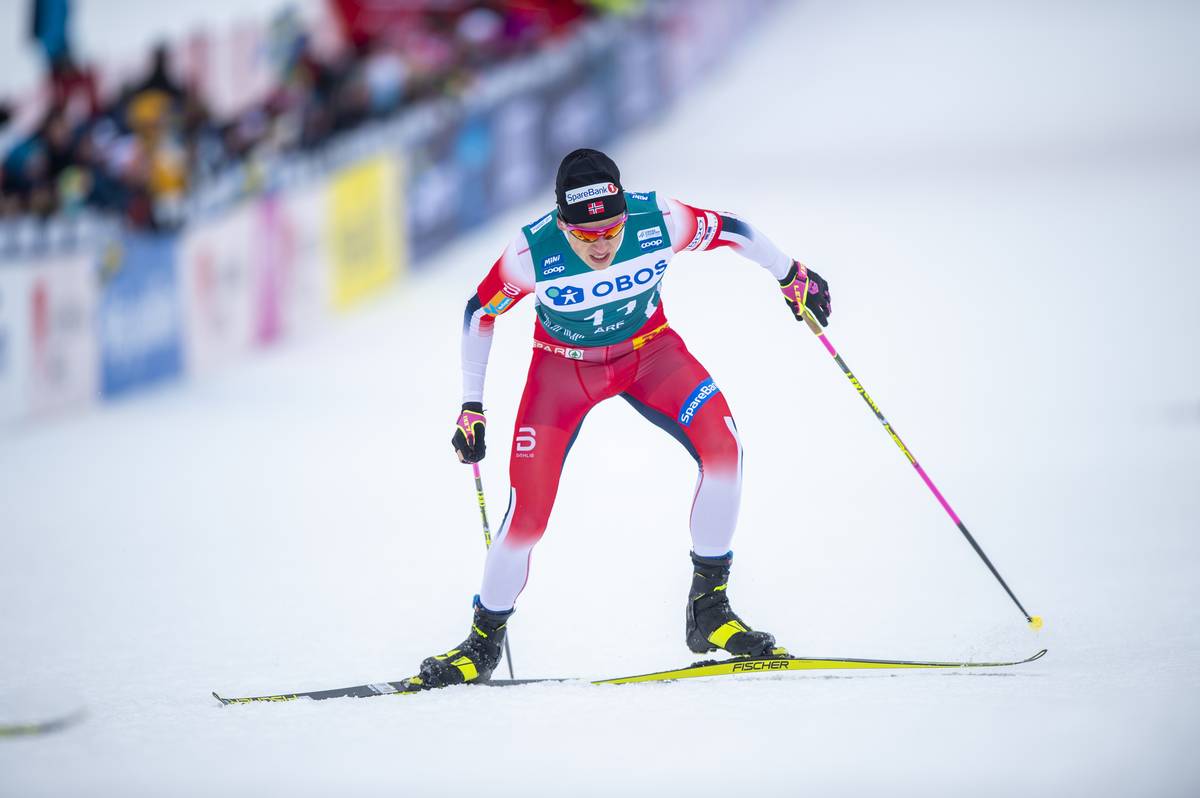
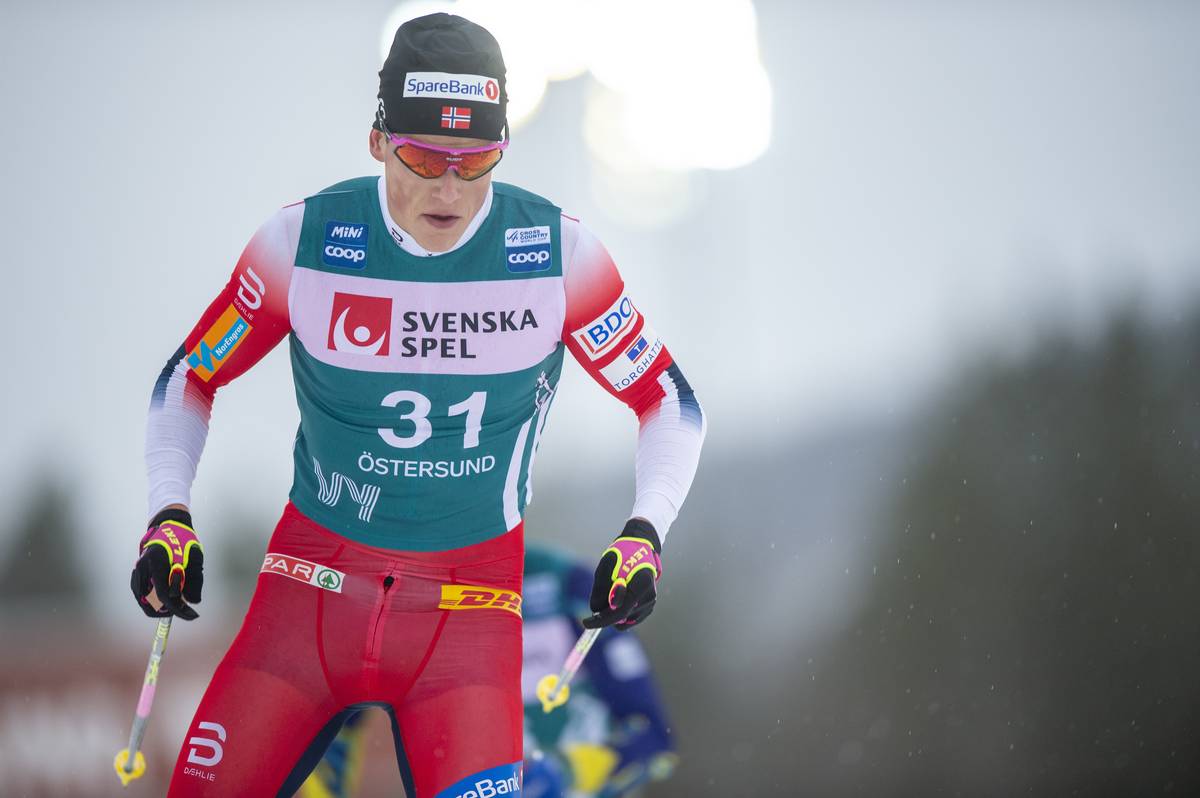
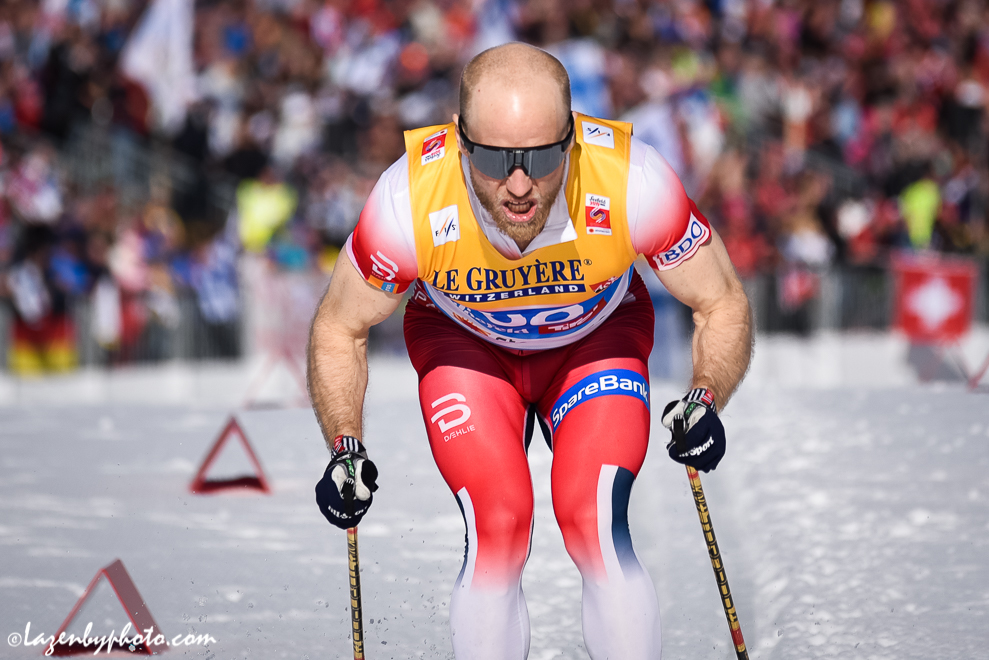
Head down and driving for the win: Pål Golberg of Norway. (Photo: NordicFocus)
Pål Golberg on his solo winning effort. (Photo: NordicFocus)
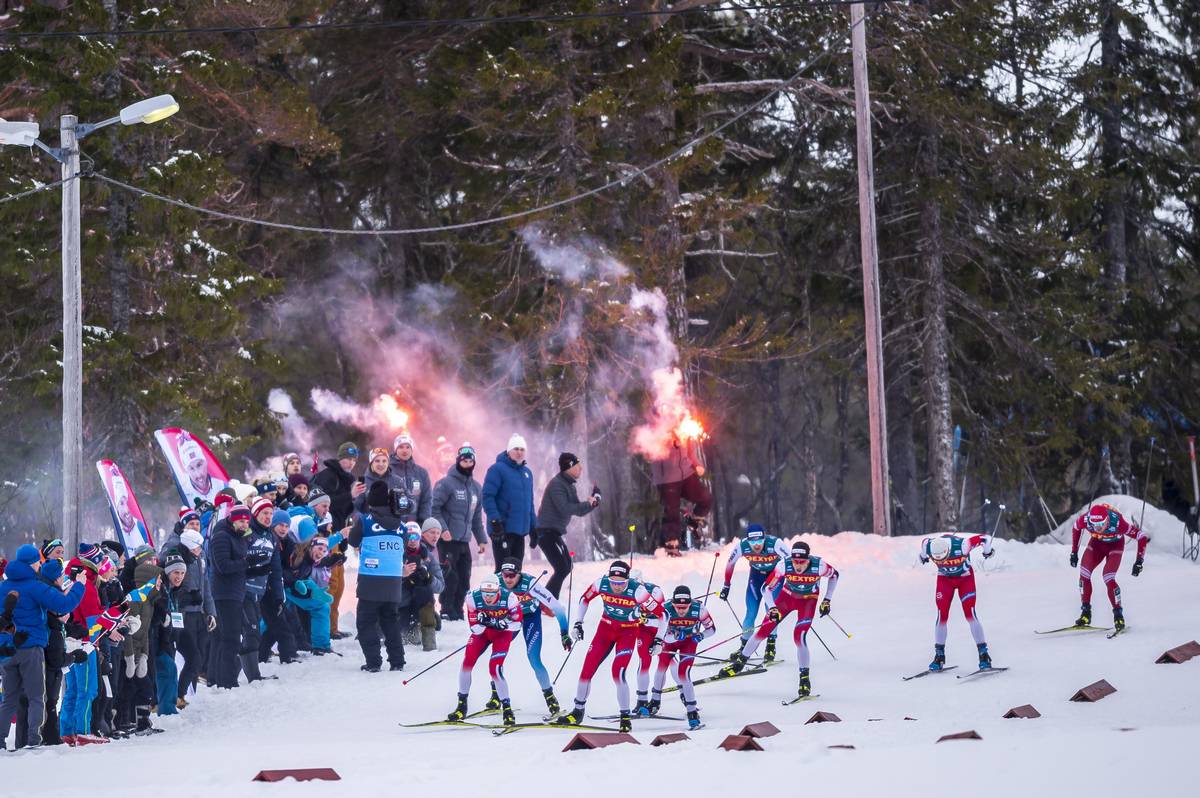
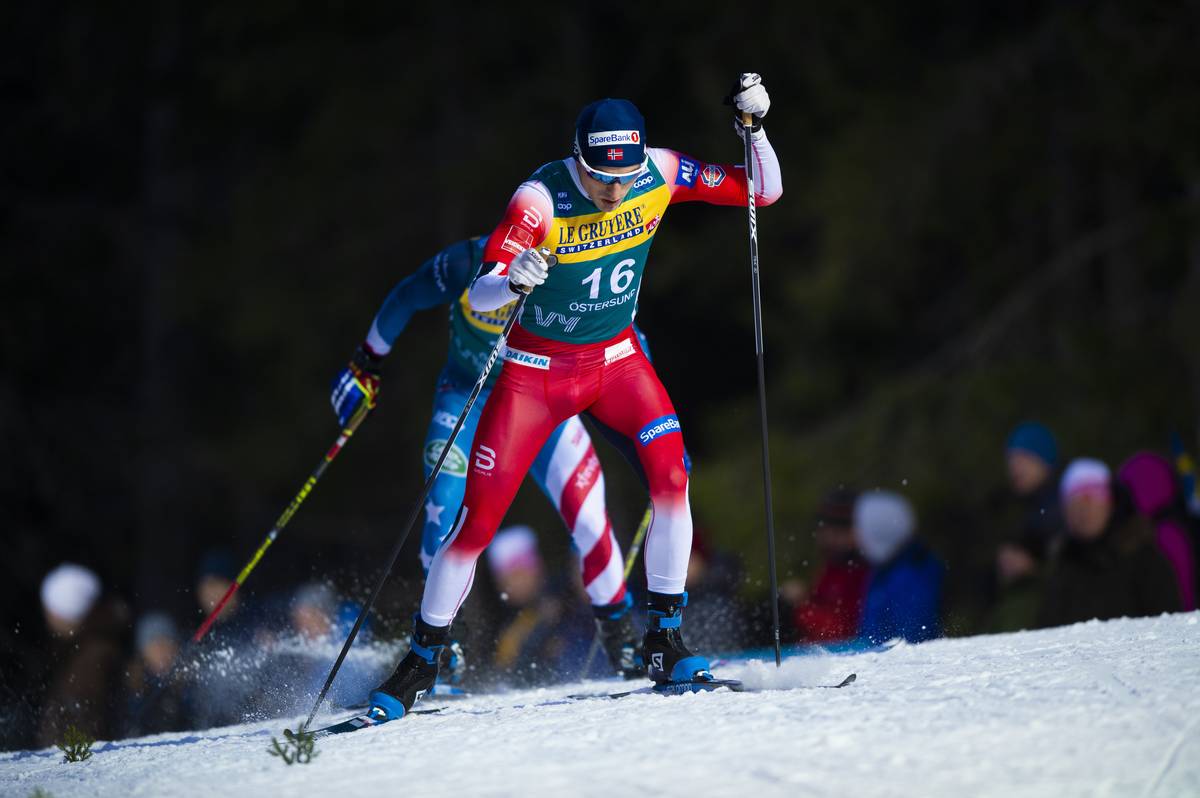
Back to the chase – which was really a Norwegian hunt for that Russian bear. We’re going to begin with the hunters: Martin Løwstrøm Nyenget, Simen Hegstad Krüger, Johannes Høsflot Klæbo, Hans Christer Holund, Emil Iversen, and Sjur Røthe. (Imagine having that crew team trialing behind.) Maybe grotesque in their spoils, but certainly dogged in their pursuit, this all Norwegian chase was symbolic of a country’s ability to foster otherworldly endurance talent, and keep them fresh enough to crush the field in a six-stage tour. It was literally a train of Norwegian skiers who had likely been shadowing one another at the elite level since their late teens.
They slowly reeled Bolshunov in. At 13.9 k, the Russian kept a 14-second buffer between he and the Norwegians. Ultimately, this was no catch and release scenario. Bolshunow was swallowed near the 16 k mark. Another three k later, all but Røthe kept pace, the others gapped Bolshunov by nine seconds.
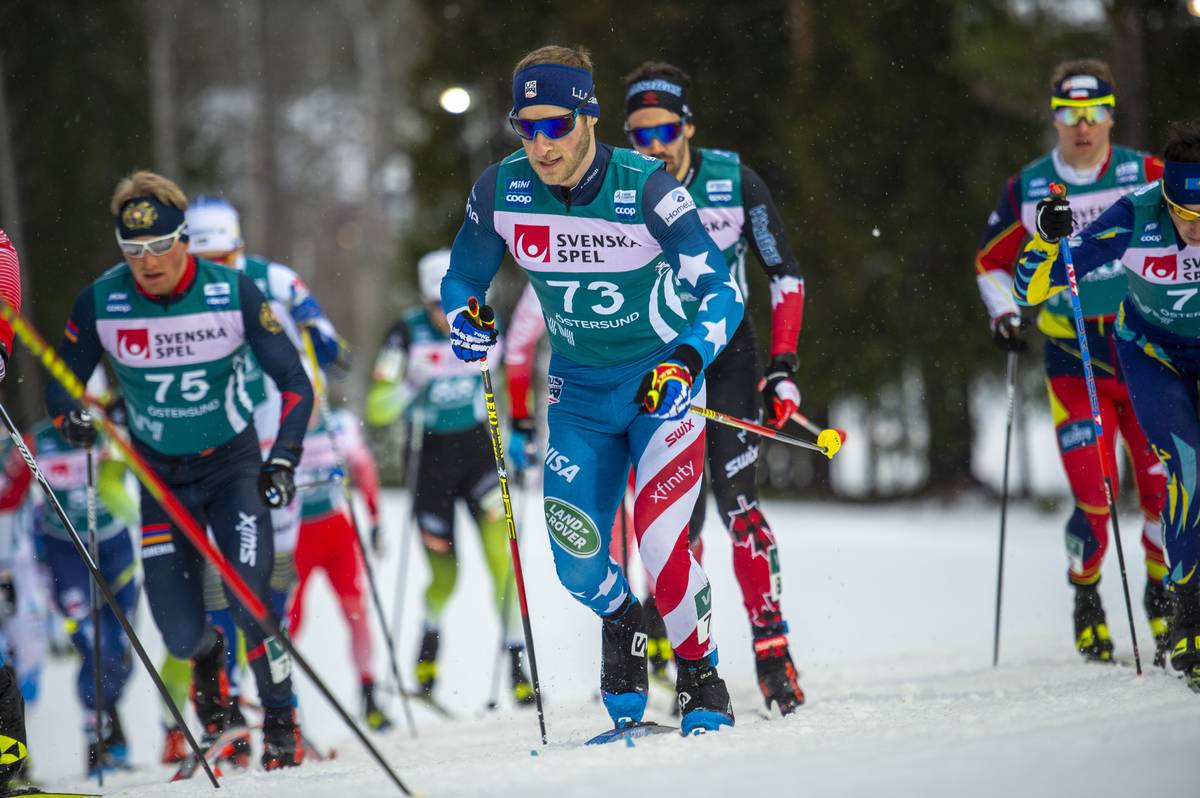
The Norwegians forged ahead, while Bolshunov, digetsing the inevitable, tried to minimize losses. Krüger, known for his skating, took strong pulls in the closing kilometers. He crossed the line in second (+28.9). Holund placed third (+30.1), Iversen fourth (+32.3), Nyenget fifth (+32.9), and Klæbo sixth (+34.2).
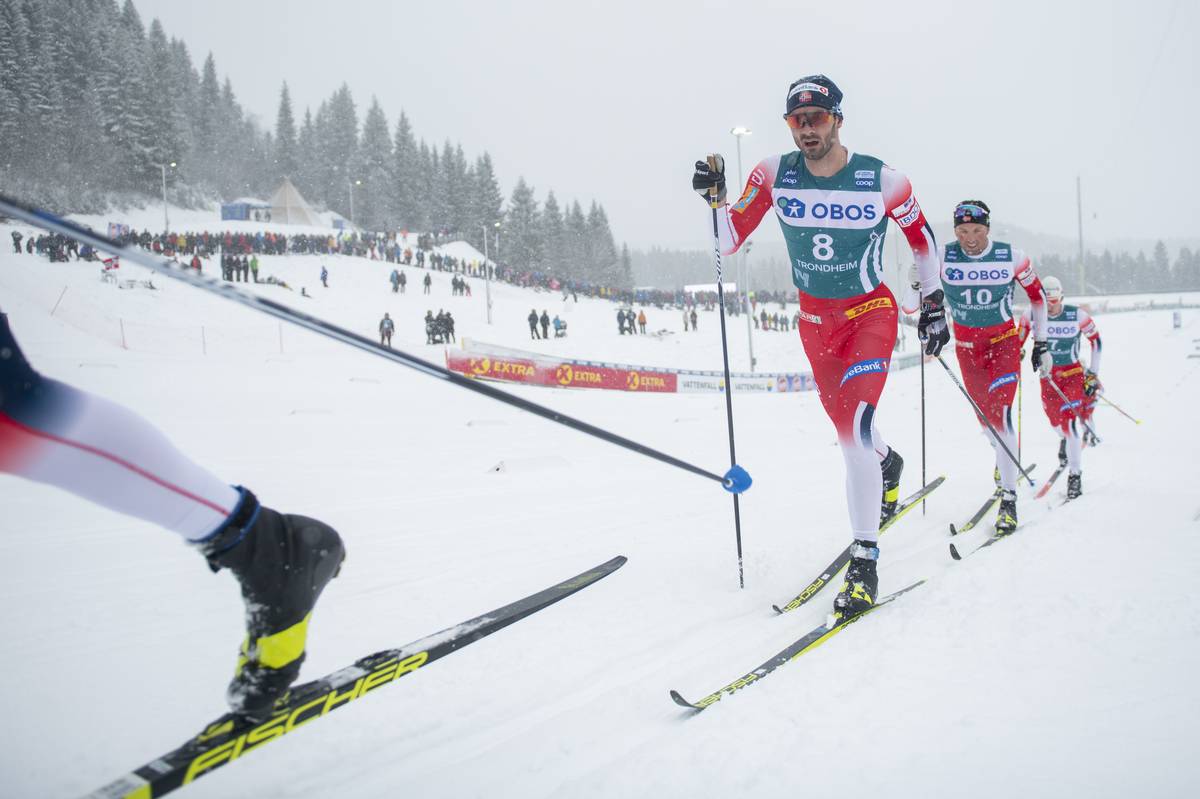
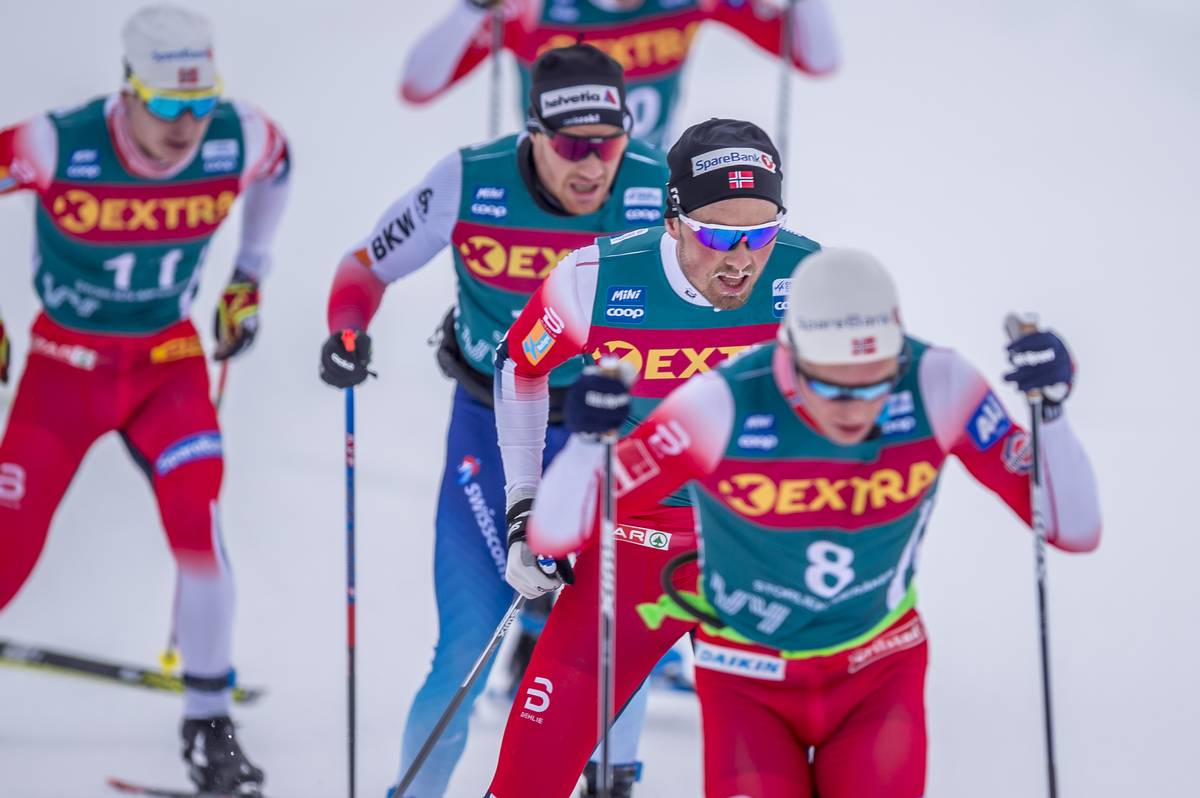
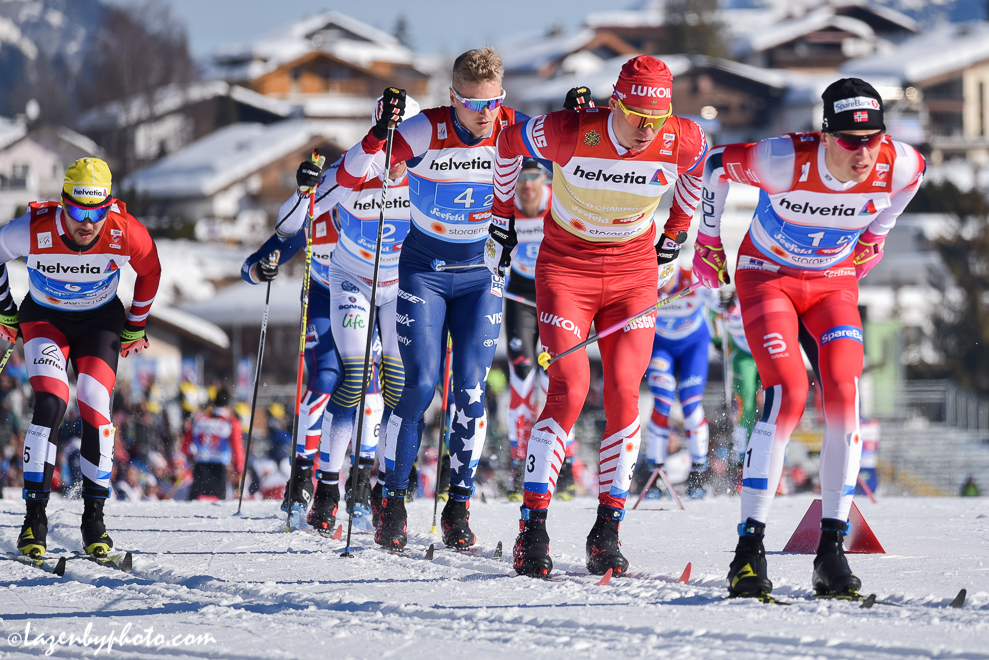
The Norwegian train during Stage 6 of the Ski Tour 2020. Hans Christer Holund (bib 8), Emil Iversen (bib 10). (Photo: NordicFocus)
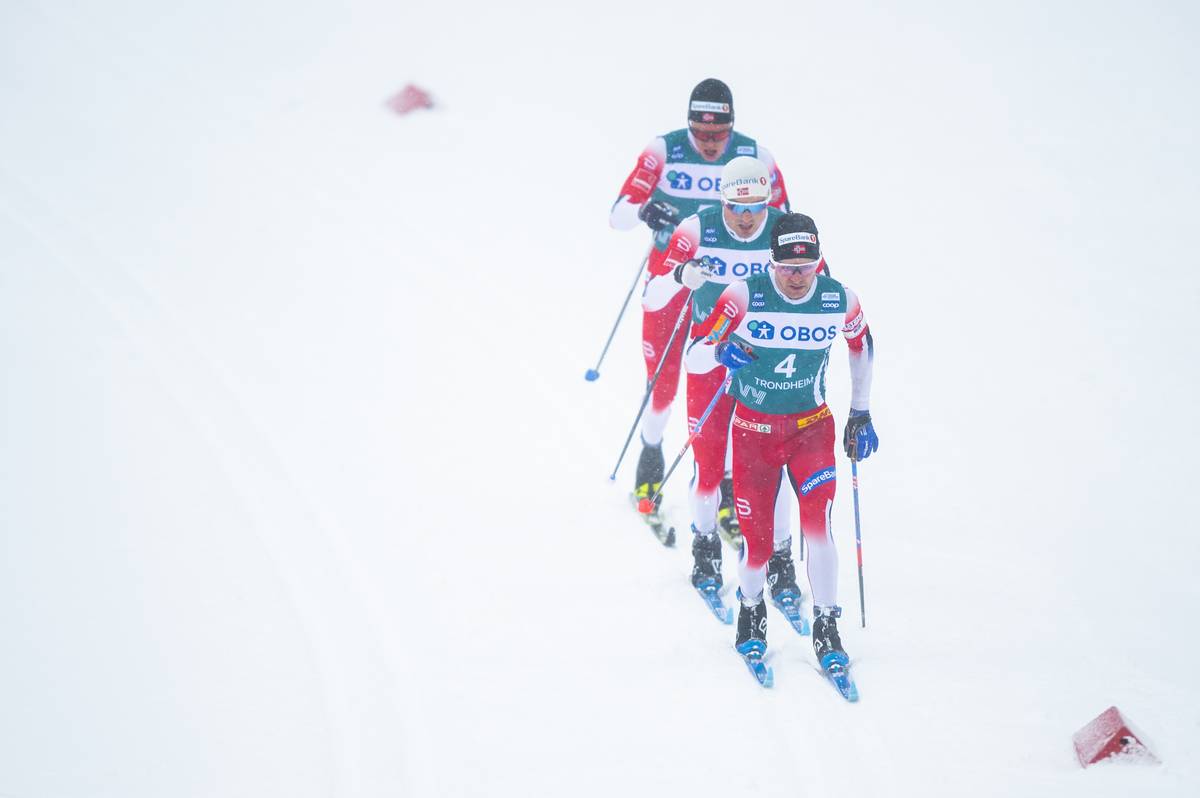
Sjur Røthe leading out: State 6 Ski Tour 2020. (Photo: NordicFocus)
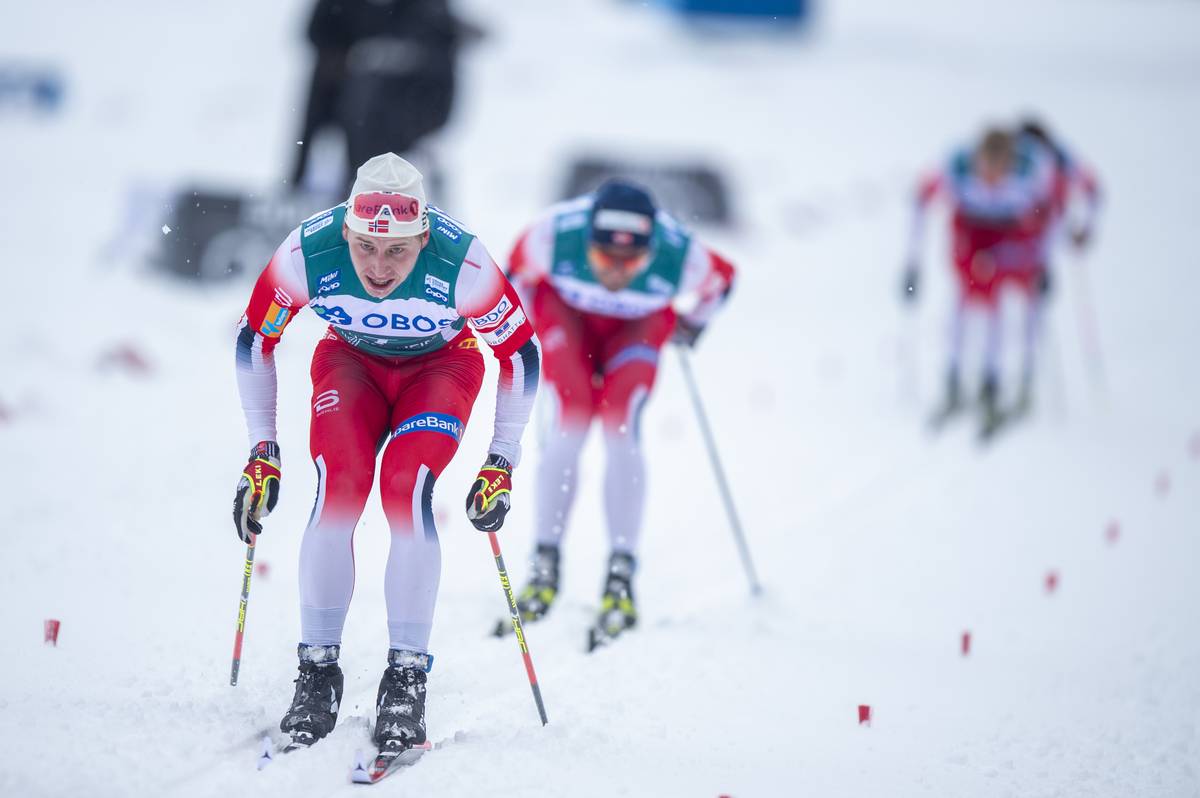
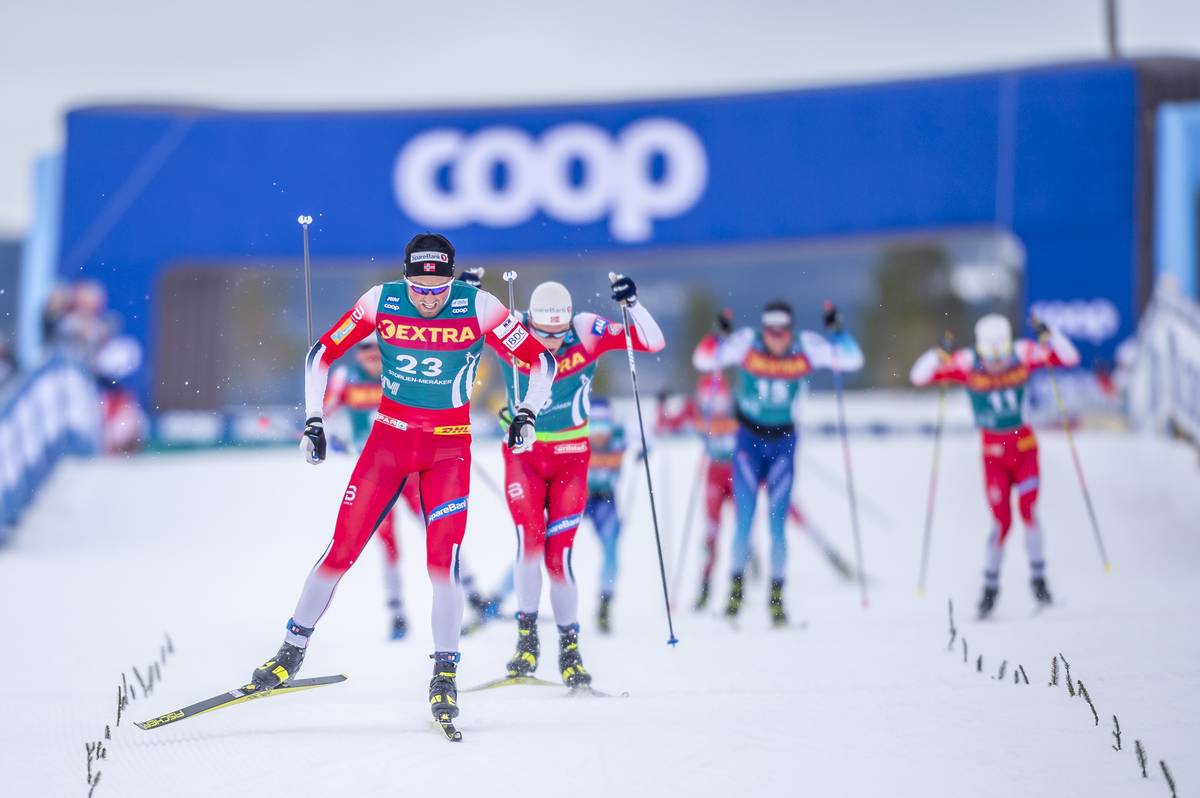
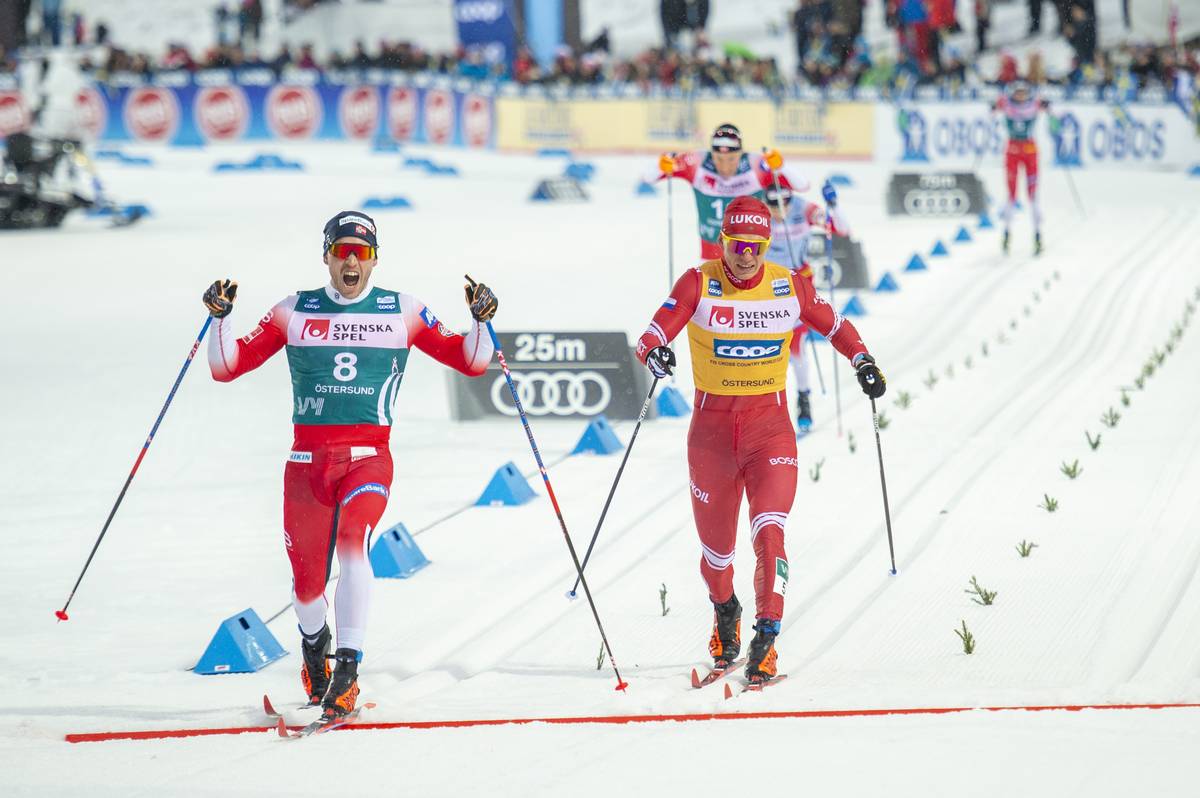
Simen Hegstad Krüger (front) down the finish straight to take second overall. (Photo: NordicFocus)
Bolshunov settled for seventh place (+1:41.0), ceding roughly 1:10 to that lead Norwegian group, as he lost grip on the Ski Tour overall. His demeanor across the line matter of fact: he unlocked his bindings as he glided across the line, stepped out his skis, then proceeded through the finish area without acknowledging the all-Norwegian scrum in the finish pen.
As for time of day efforts, the fastest time goes to Iversen in 1:21:25.9. Finland’s Iivo Niskanen notched the second-fastest time 10.9 seconds back. Niskanen placed eighth on the stage (+1:48.2). For his troubles, Bolshunov skied the 23rd fastest time, 4:06.7 off of Iversen’s best of day mark.
The look of missing out: Alexander Bolshunov after finishing Stage 6 of the Is Tour 2020. (Photo: NordicFocus)
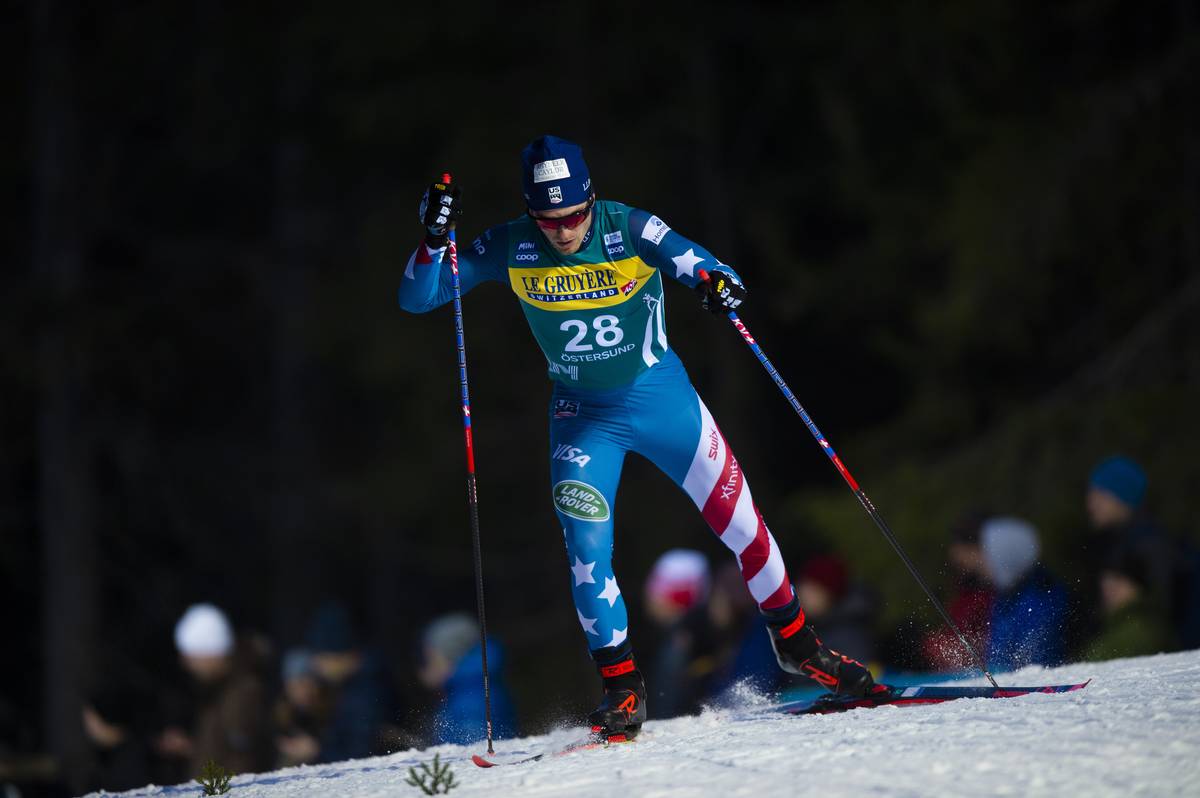
David Norris led the day for the U.S. ending the day and the Ski Tour ranked 34th (+11:30.7). Ben Lustgarten placed 54th (+19:29.5). The remaining U.S. skiers who began the tour, dropped from competition after Stage 6. They include Logan Hanneman and Kevin Bolger who both have mild colds. Simi Hamilton dropped after Stage 4 with a mild illness as well.
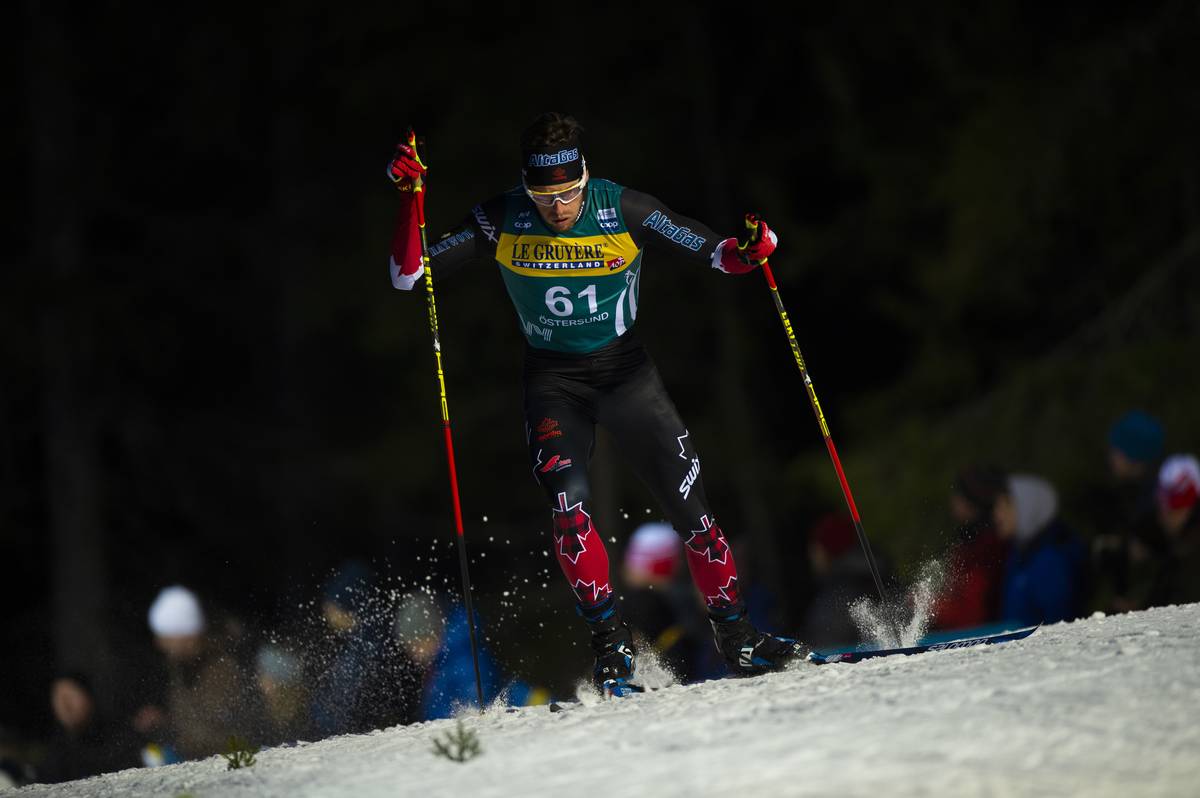
Canada’s Russell Kennedy placed 39th (+12:50.5), Evan Palmer-Charrette 43rd (+14:33.2), Alexis Dumas 55th (+20:12.5), and Ricardo Izquierdo-Bernier 56th.
This concludes the epicness from Norway, as the Ski Tour closes out. Racing begins again in Lahti, Finland next Saturday.
With the course re-routed from the original 38-kilometer mass start skate to essentially an out and back into Meråker, Norway’s ski stadium, the day belonged to Russia’s Alexander Bolshunov who appears, at this point in the season, to be unstoppable in the distance events.
In the end, it was all Alexander Bolshunov: peerless. (Photo: NordicFocus)
In a post-race interview, Devon Kershaw noted that men paced it World-Cup comfortable for much of the first portion of the race. In other words, the effort up-front, although speedy for most, was not a break apart the 79 starters into small groups of similarly paced pockets of effort.
Fast forward to the 14 k mark, and 32 men came through the time check within 1.8 seconds. At that point, Jens Burman of Sweden was driving that train.
Through the race mid-point, the pack faced a steady headwind. Tactically, it made sense for any would-be endurance escape artist to wait until the turn home on the mostly out and back course, when a tailwind could aid their efforts, to make a move.
Pack skiing Norway style. (Photo: NordicFocus)
Sjur Røthe of Norway took big pulls leading as did his teammate Finn Hågen Krogh. Later in the race, Emil Iversen too sensed some podium opportunity. We could expand the list. But that would perhaps overshadow Bolshunov.
A select group began to pick up the pace as skiers sped towards the 20 k time bonus. This included Røthe, Krogh, Bolshunov, Iversen, and Johannes Høsflot Klæbo who came through the check-in 17th. (This was not the Norwegian national champs, although nine Norwegians, at that point, jammed the front 17 spots.)
Martin Løwstrøm Nyenget (bib 8) leads Emil Iversen and Dario Cologna during the Stage 4, 34 k mass start skate. (Photo: NordicFocus)
Emil Iversen comes in for third place on Stage 4 of the Ski Tour 2020. (Photo: NordicFocus)
Post-20 k time bonus, Bolshunov wound up, uncoiled, and made a decisive move. He set off solo, accelerating ahead of the pack of star names, and was able to gap the chase by 51.7 seconds at the finish for a solo effort win in 1:19:34.9.
Solo: Alexander Bolshunov way way off the front. (Photo: NordicFocus)
Klæbo placed second (+51.7), and hometown skier Iversen third (+51.8). Places fourth through 11th were separated by roughly nine seconds.
Bolshunov leads the Ski Tour 2020 with a total time of 2:26:16 hours after four stages. Golberg is second (+1:05), and Røthe third (+1:06).
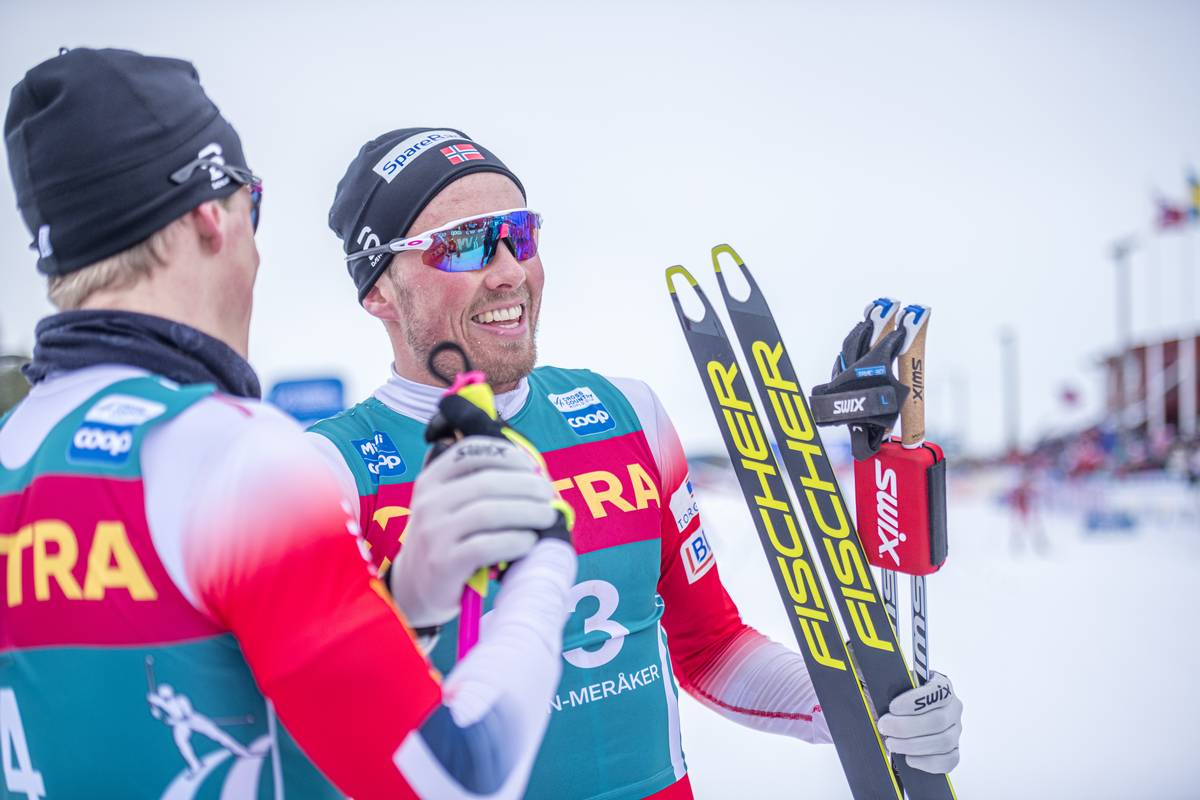
Emil Iversen (bib 3) and Johannes Høsflot Klæbo share a stoke-moment after the race. (Photo: NordicFocus)
David Norris was the top North American in 26th (+3:08.7). Ben Lustgarten placed 51st (+5:30), Kevin Bolger 69th (+8:06.7), Simi Hamilton 74th (+9:28.1), and Logan Hannmen 76th (+9:39.3).
Canada’s Evan Palmer-Charrette skied to 37th (+3:46.0), Russell Kennedy 39th (+3:59.9), Alexis Dumas 67th (+7:32.3), and Ricardo Izquierdo-Bernier 77th (+13:03.6).
Racing continues Saturday in Trondheim with a 1.5 k classic sprint, the sixth stage of the Ski Tour 2020.
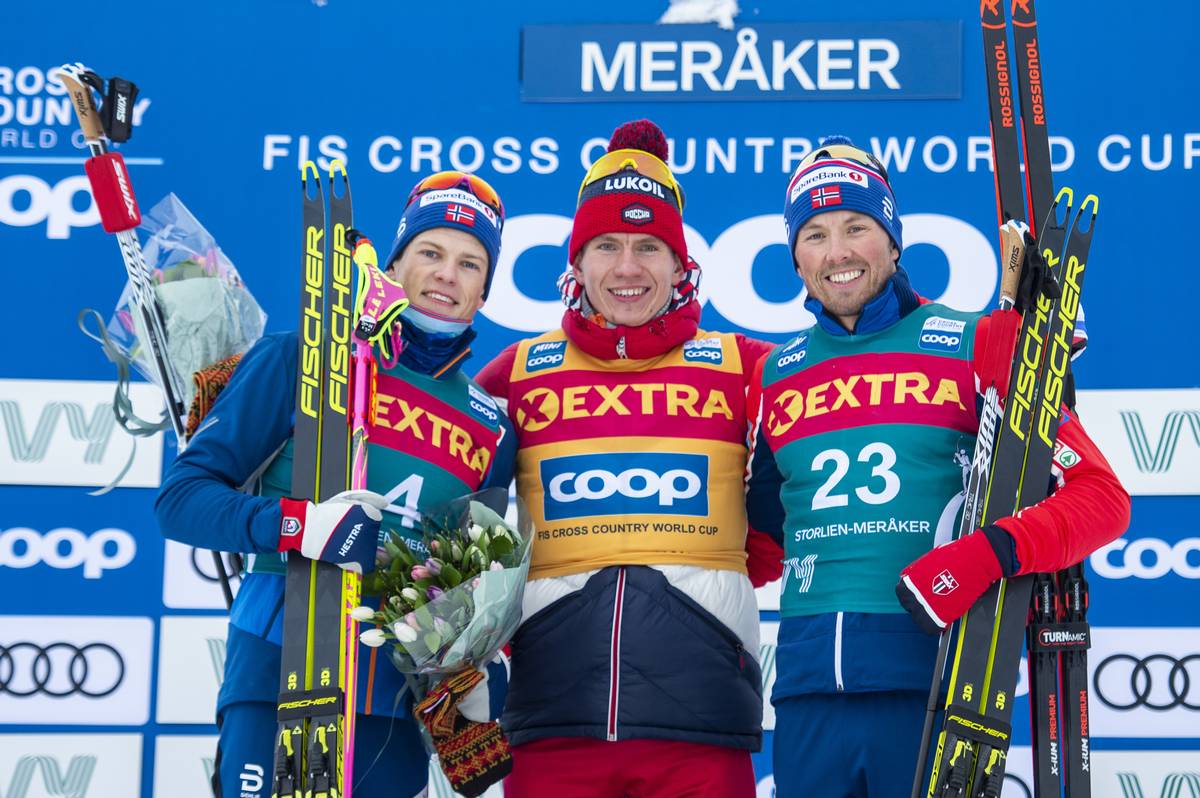
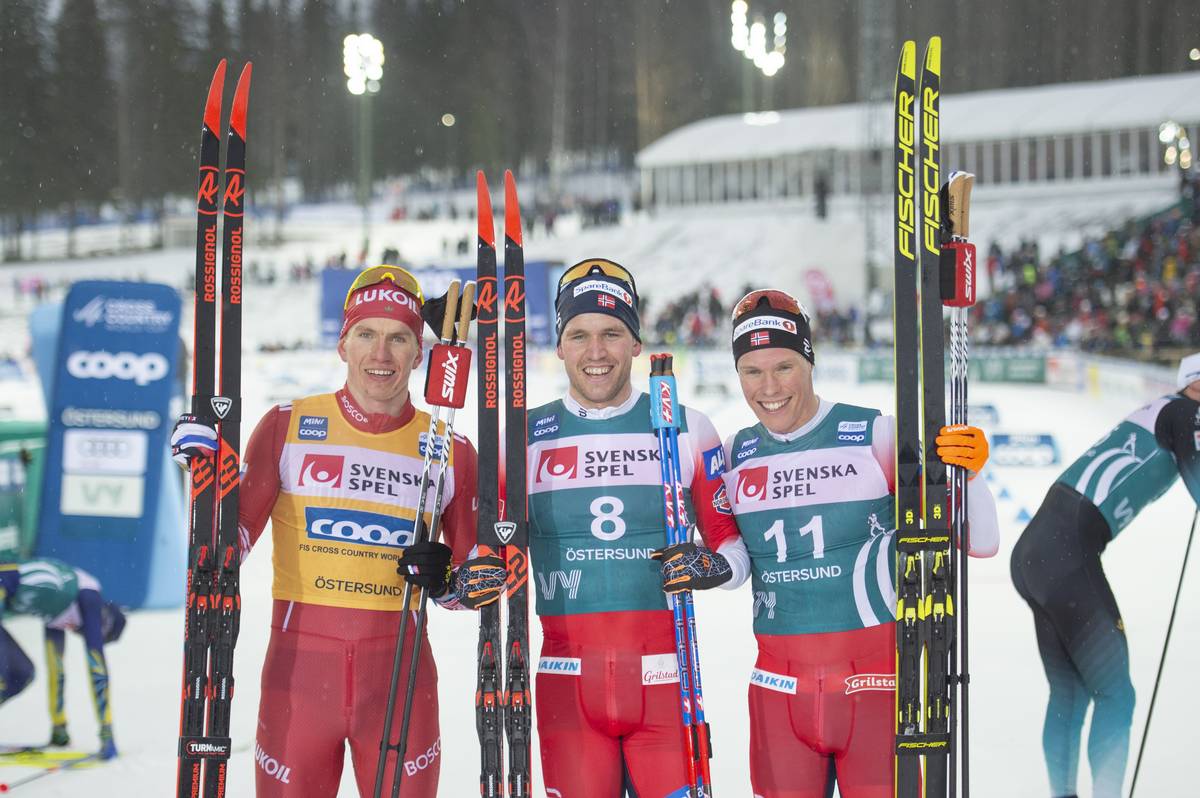
The men’s Stage 4 podium: Johannes Høsflot Klæbo (NOR) second, Alexander Bolshunov (RUS) first, and Emil Iversen (NOR) third, (l-r). (Photo: NordicFocus)
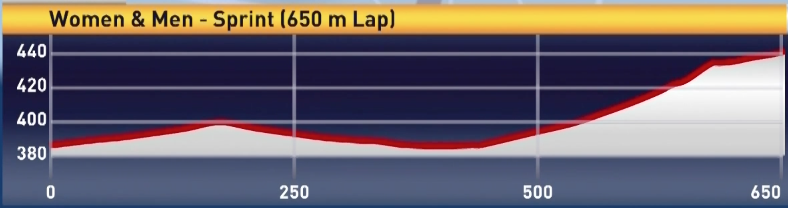
Let’s explain. The format was basic, a freestyle sprint. Otherwise, that’s where sprints as we know it ended. The 0.66-kilometer course shot off from the start up a gradual V2-able climb. It then rounded a left-hander where athletes descended what looked like a salted banked turn found in a X-Games terrain park. Down to the course’s bottom zoomed the skiers. Then things turned skyward. The course ascended a mini-Alpe Cermis lasting around one-minute for the men, to the finish atop the climb. The climb was the defining characteristic of the terrain: athletes suffered up a downhill ski slope gaining roughly 60 meters in altitude before the finish line. Calling the final ascent punchy would be an understatement. Grinding. Grueling. Leg-cement-inducing is more appropriate.
The Åre sprint hill climb in profile. (Photo: Screenshot FIS Broadcast)
Perhaps a sprint sideshow? That could be argued. But hosting an event at the base of the Swedish National Alpine hill with amenities for fans, of which there were plenty, and bountiful options for climbing terrain, we’ll let others debate the merits of hosting a climb-fest sprint.
Johannes Høsflot Klæbo of Norway in Åre, Sweden on his way to winning Stage 3 of the Ski Tour 2020. (Photo: NordicFocus)
But some things haven’t changed: Johannes Høsflot Klæbo qualified in first covering the course in 1:49.64. That’s right, a quick and snappy 0.66 k, despite the big vert. Klæbo continues to deal with broken fingers and a thus far lackluster Ski Tour 2020. He placed 31st in Stage 1 and 25th in Stage 2. He came into Stage 3 ranked 25th overall in the Ski Tour, 2:05 behind the leader, Norway’s Stage 2 winner, Pål Golberg.
For his part, Golberg laid down the second-fastest time in qualification, 2.58 seconds back. Alexander Bolshunov of Russia, by all measures the pre-Ski Tour favorite, qualified in 23rd (+8.59).
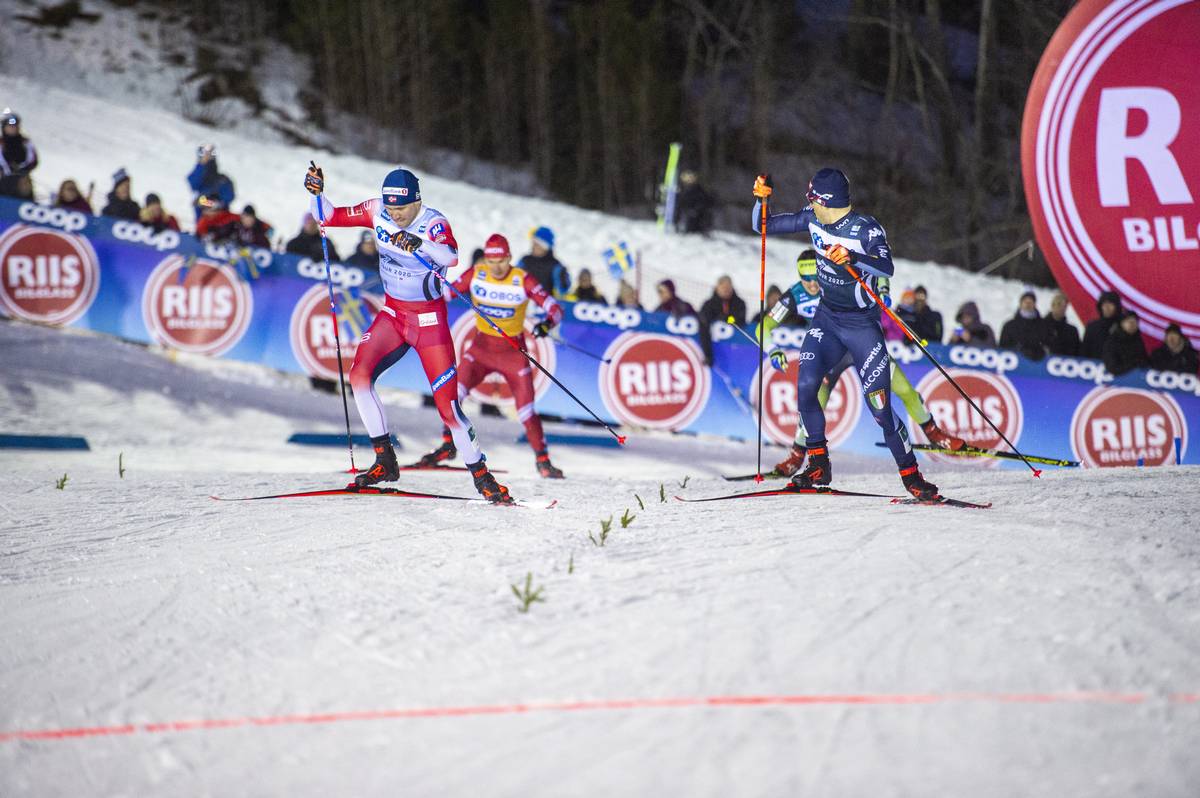
Pål Golberg of Norway and Italy’s Federico Pellegrino into the finish. (Photo: NordicFocus)
In the second semifinal, rounding the corner on the first and notably mild climb, Italy’s Federico Pellegrino took the inside line over the top. In bib 11, Norway’s Simen Hegstad Krüger came through in second, followed closely by Bolshunov who had advanced as a lucky loser.
Krüger took an aggressive line and cut off the advancing Russian. As this transpired, Krüger tumbled as their skis crossed. Bolshunov continued with Krüger going between his legs. Bolshunov now sat in fifth as he crested the hill. Krüger snapped a pole and grabbed a spare just prior to the descent. (He eventually received a yellow card for his cut-off move.)
Golberg won the semi, with Pellegrino in second. Bolshunov never recovered and placed fourth, 1.92 seconds behind Golberg. Bolshunov finished the day in eighth after being eliminated.
Although 8th on the day, Russia’s Alexander Bolshunov sits second overall in the Ski Tour 2020 after three stages. (Photo: NordicFocus)
Outside of the peculiar course, a stumble here and there, Klæbo and his astounding pull away acceleration in the final was the story. He advanced by winning the first quarterfinal and the first semi. He won that semi by only 0.52 seconds over France’s Jay Renaud. What became evident was that Klæbo was holding back and had not dialed his tactics.
In the final that featured Klæbo, Pellegrino, Renaud, Golberg, Lucas Chanavat of France, and Norway’s Erik Valnes the charade was over.
Chanavat led into the final climb with Pellegrino off to his right, a meter back, with Klæbo shadowing on the other side. Then Pellegrino upped the pace and pulled ahead with Klæbo settling into his draft. Chanavat took charge of the climbing lane to the left. For a moment, Klæbo must have been inhaling extra oxygen, as he fell slightly back.
But as the trio passed under the red sponsor arch, Klæbo shot off. For every single V1 cycle Pellegrino completed, Klæbo threw in two hop-skates. As he rounded to the left atop the climb, Klæbo looked back on a 20-meter gap. “Mamma mia” they must have been saying in Italy.
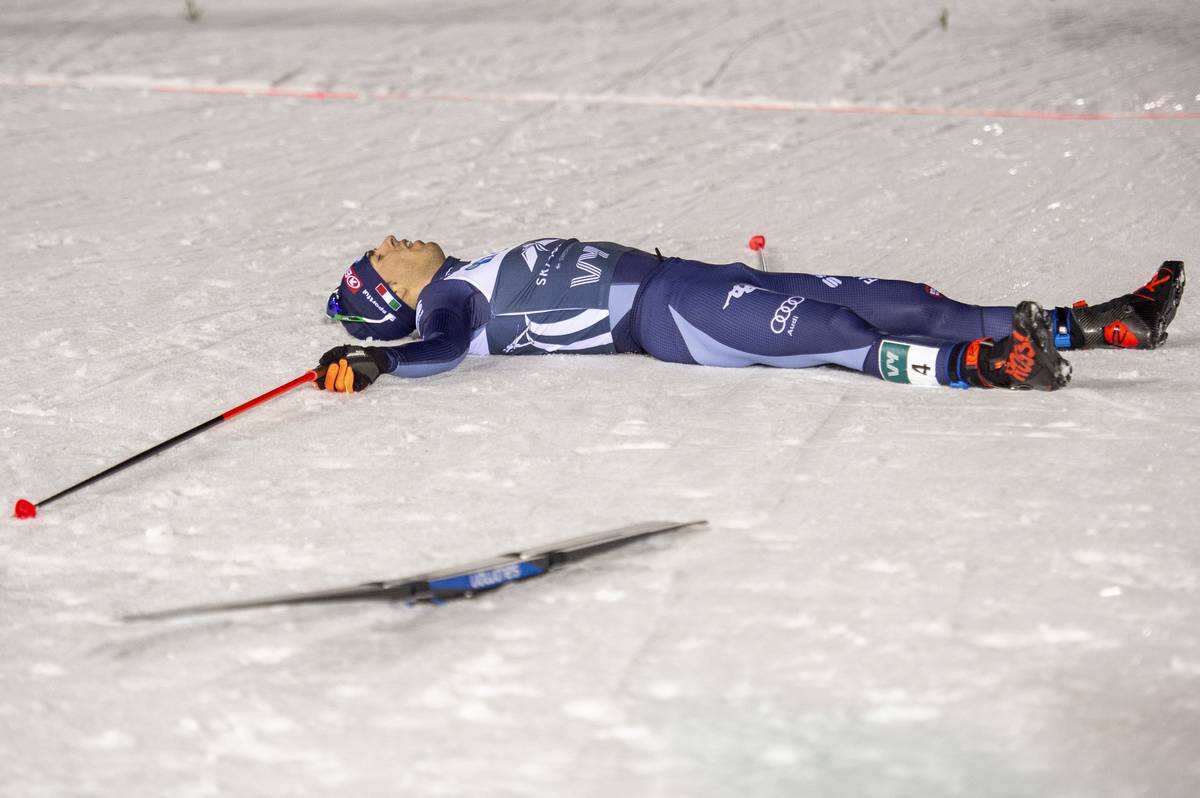
Italy’s Pellegrino: totally spent. He placed second overall in the Stage 3 Ski Tour 2020 sprint. (Photo: NordicFocus)
Klæbo won the final in 2:02.63. Pellegrino was second (+2.39), and Renaud third (+3.70). Golberg was fourth (+14.46), Chanavat fifth (+26:39), and Valnes sixth (+1:05.62).
Time to chill at the finish: Johannes Høsflot Klæbo of Norway. (Photo: NordicFocus)
“It was a real suffer-fest,” Klæbo told FIS after the race. “It was a lot of fun. At the end I was just trying to push all out. I turned my head on the last climb and it was a huge gap. … It was good to get the confidence again and fight for the podium. … At the end, I was just trying to push all out. I turned my head on the last climb and it was a huge gap. In the end, it was really fun.”
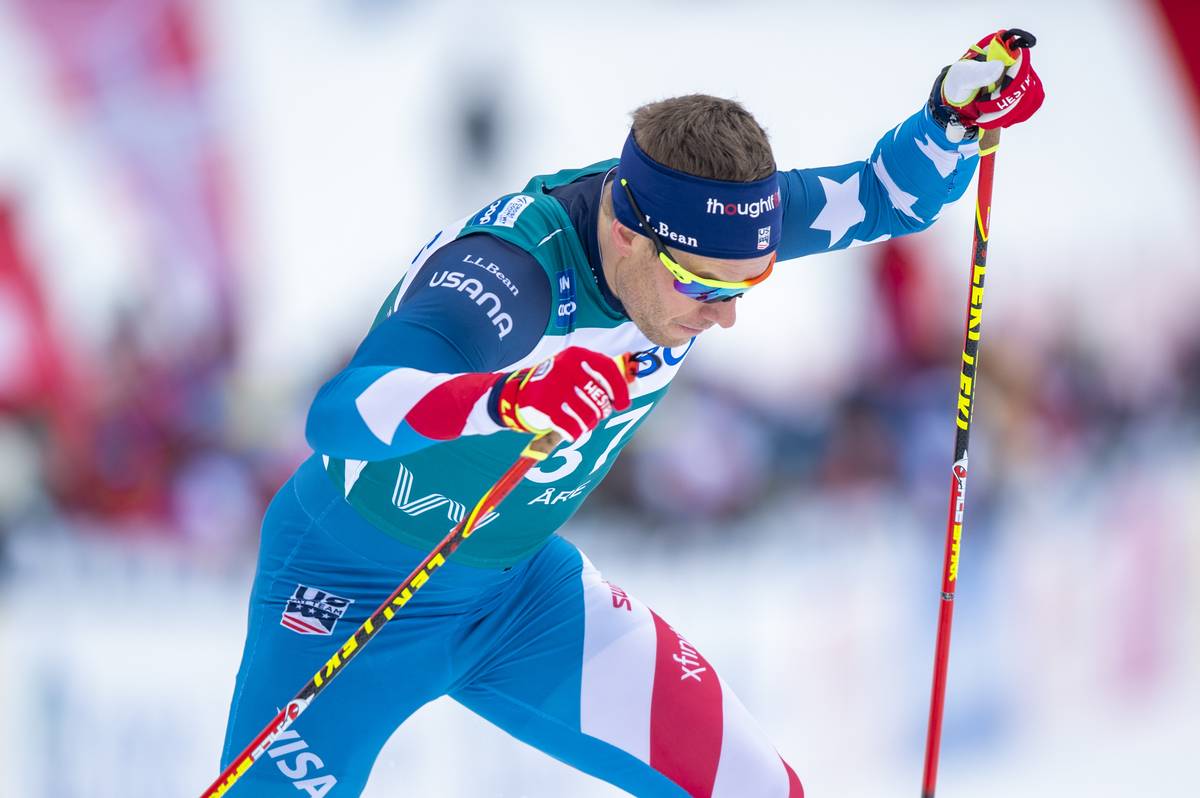
For the U.S. Simi Hamilton was the lone North American who advanced into the heats qualifying in 17th (+7.12). Hamilton skied to third (+2.27) in the second quarterfinal which was won by Russia’s Denis Spitsov in 2:04.14. The Aspen, Colorado native placed 14th in the final standings. (Below we have included an extended post-race interview with Hamilton. In the interview Hamilton discussed his injuries, and his return to racing World Cup sprints.)
The U.S. Ski Team’s Simi Hamilton in Åre, Sweden. (Photo: NordicFocus)
Post-race interview with Simi Hamilton
In his return to World Cup sprinting, Simi Hamilton skis to 14th overall on Stage 3. (Photo: NordicFocus)
Logan Hanneman placed 45th on the stage, Kevin Bolger 60th, David Norris 65th, and Ben Lustgarten 81st.
Post-race interview with U.S. World Cup Coach Matt Whitcomb
For Canada, Russell Kennedy finished in 73rd, Evan Palmer-Charrette 75th, Alexis Dumas 76th, and Ricardo Izquierdo-Bernier 78th.
Picking up where we left off in Östersund, Sweden: a pursuit start 15-kilometer classic. Unlike the women’s field where Therese Johaug “administered a beatdown”, creating a large time gap for herself, the margins for the men were much smaller.
This year’s Tour de Ski winner Alexander Bolshunov of Russia, whose winning streak was interrupted, would start with a 22 second time deficit in fifth. Tenth place Ivan Yakimushkin (RUS) was 33 seconds back and Jens Burman (SWE) in 20th just inside a minute.
Alexander Bolshunov during Stage 2’s 15 k classic pursuit of the Ski Tour 2020. (Photo: NordicFocus)
With four 3.75 k laps to cover, the deficits were manageable. Perhaps the only Tour victory hopeful who was kept up about the work that needed to be done was Johannes Høsflot Klæbo, who would start 1:23 behind the leader after finishing 31st the day before.
The caveat would be to stay upright while navigating the icy winding bends of the primarily man made track. With grey skies and above-freezing conditions, it was fast and dicey, made evident by numerous crashes.
During one particularly noteworthy four-person pileup, Kamil Bury of Poland was taken out by Italy’s Maicol Rastelli as the two navigated a treacherous right hand turn at the bottom of a steep descent. Though neither had full control, Rastelli slid off the left side of the course, taking Bury along with him. Bury lost a ski and became tangled in the netting.
Just before impact… (Photo: Screenshot NBC/FIS Broadcast)
As Rastelli stood up and worked to right his skis, which were pointing in opposing directions, a third skier, Lin Bao of China, essentially slide tackled Rastelli, sending him in a complete backflip back down to the snow.
A fourth skier, Tadevos Poghosyan of Armenia, also lost control and slid into the pile. Bao and Poghosyan were able to stand up relatively quickly and continue on their way, but cameras cut away before the resolution of whether Bury found his ski and Rastelli was able to recover from his forced aerials.
Holy carnage… back to the race.
At the end of the first lap, it was as if the men were gifted ready-made groups. Røthe and Krüger matched stride for stride and double pole for double pole, while the remainder of the top five plus a handful of additional Norwegians, namely Pål Golberg, Hans Christer Holund, and Martin Løwstrøm Nyenget, chased from roughly six seconds back.
In bib 11, Martin Løwstrøm Nyenget (NOR) works his way towards the sharp end of the men’s 15 k classic pursuit. (Photo: NordicFocus)
It looked as though Røthe and Krüger might run away from the field, but it was not so easy. By 4.4 k, the gap was closed and an eight-man train chugged along the tracks. As Yakimushkin had fallen off the pace, it became seven Norwegians and Bolshunov.
Over the final two laps, the front pack whittled down from eight to five, where it remained with one k to go. Holund, Golberg, Røthe, Bolshunov, and Nyenget. The Russian in the yellow bib was primed to make a move.
Bending, rolling, and swooping, they headed for the stadium. Up the final punchy climb, Golberg and Bolshunov were side by side, and Golberg started to slip. He recovered and powered out of the climb, running with Klæbo-like dominance over the crest of the hill and into a tuck to lead into the stadium.
Bolshunov had fast skis and caught a draft before whipping into second place as the men entered the final straight. The Russian was right behind Golberg and absolutely charging. But there was not enough real estate. He changed lanes to challenge the Norwegian and looked as though he would overtake him, but the final meters evaporated and Golberg threw his foot for a clear win.
A lane switch wasn’t enough for Alexander Bolshunov as Pål Golberg of Norway takes the win. (Photo: NordicFocus)
Pål Golberg about to toe – during the 15 k classic pursuit, Stage 2 of th Ski Tour 2020 in Östersund, Sweden. (Photo: NordicFocus)
Golberg crossed the line in 34:50.8, with Bolshunov 0.3 seconds behind. Nyenget took third (+2.1) in a tight finish with Røthe (+2.5). Holund dropped off in the final sprint to round out the top five (+7.3).
Pål Golberg wins at the line over Alexander Bolshunov during the 15 k classic pursuit, Stage 2 of th Ski Tour 2020 in Östersund, Sweden. (Photo: NordicFocus)
“Perfect klister conditions,” Golberg told FIS at the finish. “I managed to get the ski pair from last weekend, so I had good skis this weekend as well. It was a really, really good day.”
The interviewer noted that conditions were much different than the previous day.
“It was hard in the middle,” Golberg explained. “It was a bit drier, so a bit difficult with klister in the downhill. But the tracks were perfect, so I’m really happy.”
Not the start of the FIS Ski Tour 2020 desired by Johannes Høsflot Klæbo. (Photo: NordicFocus)
Speaking of Klæbo, the Norwegian skied his way into 25th, but ceded an additional 52 seconds in the overall standings by finishing 2:15 back on the leaders.
FIS sent out a news brief shortly after the race with information regarding Klæbo’s injured finger. Here is the statement in full:
“Johannes Høsflot Klæbo (NOR) has to undergo an emergency check up for his broken finger. The check up has to take place with his doctor in Trondheim (NOR). As the rules of the FIS Ski Tour 2020 state no other transportation of athletes than by train, the jury gave permission to Johannes to travel by car to Trondheim and back to Åre for this special case. After the consultation, the jury will receive a report of the treating medical team in Trondheim.”
Leading again for the U.S., David Norris skis to 34th. (Photo: NordicFocus)
Stride and glide, Simi Hamilton climbs in Östersund, Sweden. (Photo: NordicFocus)
The American men hovered near their positions in Stage 1 at the end of the pursuit. Still grinding, David Norris finished 34th (+3:05.0), followed by Simi Hamilton in 43rd (+3:47.8).
Ben Lustgarten was the next American in 68th (+6:01.4), followed by Kevin Bolger in 70th (+6:12.7), and Logan Hanneman in 85th (+10:00.2).
Ben Lustgarten in the mix during the classic pursuit in Östersund, Sweden. (Photo: NordicFocus)
Racing for Canada, Russell Kennedy was again the top skier in 58th (+4:47.3). Next up was Alexis Dumas in 61st (+4:51.9), and Evan Palmer-Charette in 66th (+5:33.7).
Tomorrow is a rest day on the Ski Tour 2020, Stage 3, a skate sprint, will be held on Tuesday.
The men’s Stage 2 Ski Tour 2020 15 k classic pursuit podium: Alexander Bolshunov (RUS) second, Pål Golberg (NOR) first, and Martin Løwstrøm Nyenget (NOR) third, (l-r). (Photo: NordicFocus)
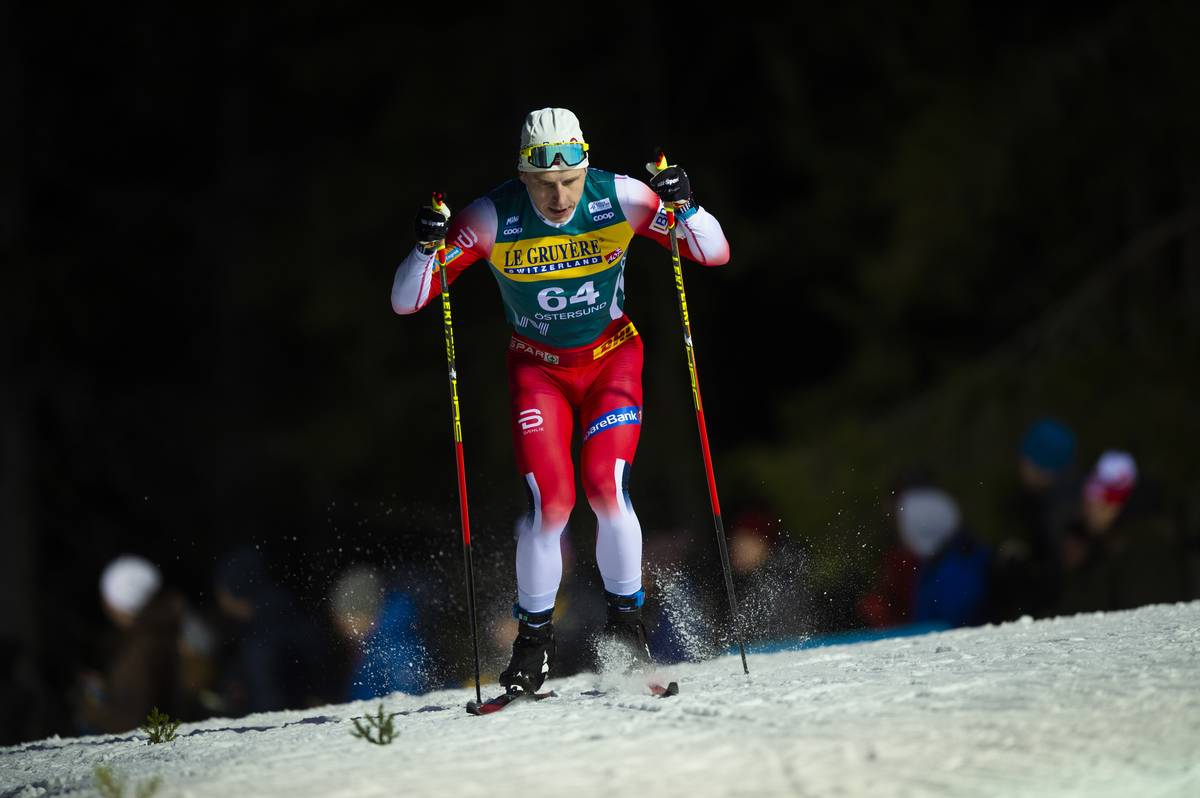
The pacing master of Stage 1 of the Ski Tour 2020: Sjur Røthe. (Photo: NordicFocus)
The six-stage Ski Tour 2020, which runs from Sweden to Norway over the next week, began Saturday in Östersund, Sweden with the men’s 15-kilometer individual start skate. The race began with twilight immersing Östersund with the sky eventually morphing into black as the seeded group of skiers looped around on what FIS called a 4.71 k course. This much can be concluded after a single day of what will be a hotly contested tour: the Norwegians fired on Stage 1 as they captured the top four spots in the field of 90 skiers.
The other take away beyond the Norwegian team’s blistering skis – Sjur Røthe paced himself a masterful 15 k of skiing as he won the event in 30:41.5 minutes.
However, not all looked shiny for the Norwegian as he went on to win his first World Cup of the season. At the 5 k time check, Røthe came through in 19th place, 19.5 seconds behind Hans Christer Holund, also of Norway. At 7.6 k, the halfway mark for the race, Røthe had moved up to 10th overall but remained 20.3 seconds off the fastest split set by yet another Norwegian, Simen Hegstad Krüger.
Then the tides turned, and Røthe began chiseling away at the time deficit. As he lapped through at 10 k, he sat in fourth, 15.4 seconds behind the virtual leader, Krüger. The chisel became a jackhammer; at 12.6 k Røthe was within six seconds of Krüger.
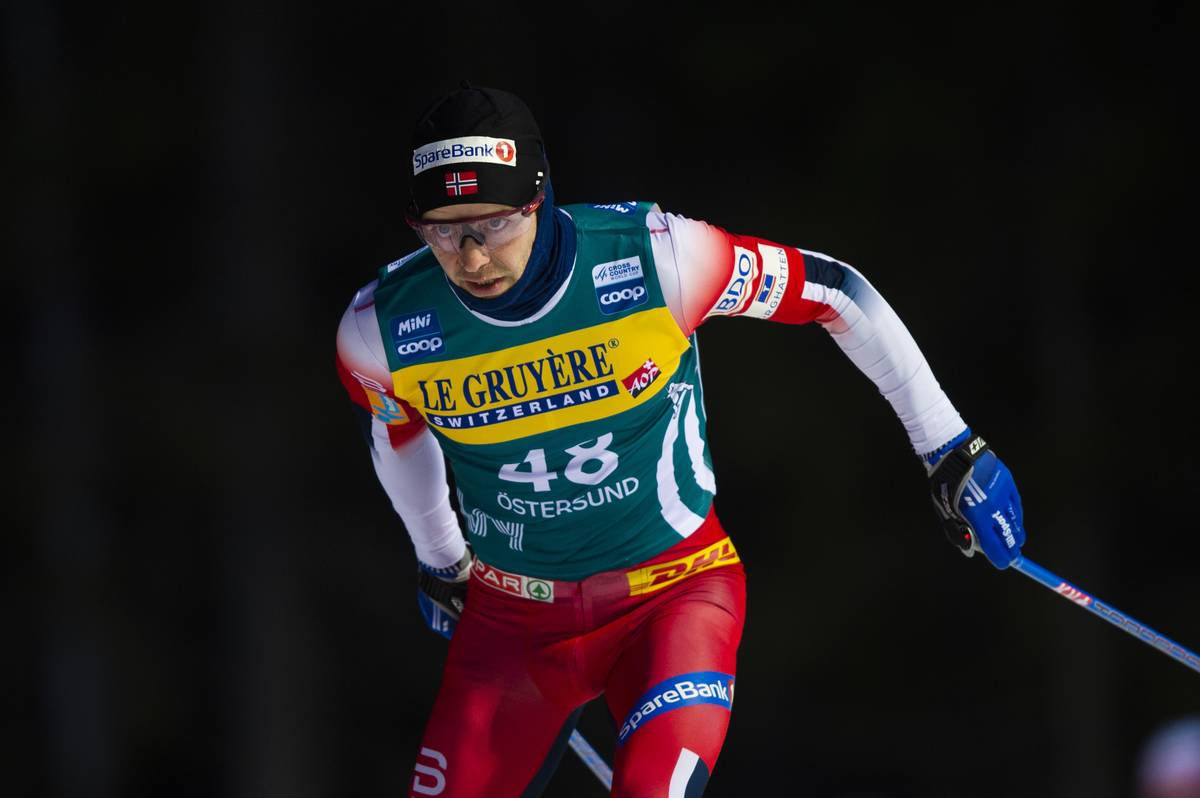
Simen Hegstad Krüger hammering during the 15 k skate, Stage 1 of the Ski Tour 2020. (Photo: NordicFocus)
The pacing proved perfect only when Krüger crossed the line: Krüger was a later starter than Røthe: Røthe began in bib 48, Krüger in bib 64. Røthe could, however, pace himself off the splits of Norway’s Finn Hågen Krogh who began in bib 16. Of the early starters, Krogh set the fastest marks at 5 k, 10 k, and the finish, respectively.
Finn Hågen Krogh (bib 16) an early starter during Stage 1 of the Ski Tour 2020, but fast through his 15 skate effort for third overall. (Photo: NoridcFocus)
Røthe’s first-place time (30:41.5) was 1.7 seconds faster than Krüger’s who took second on the day. Krogh was third overall (+16.6), and the veritable senior citizen of the Norwegian team, Martin Johnsrud Sundby, placed fourth (+17.3).
Saturday’s victory was Røthe first win of the season – however, it was his sixth individual podium which includes a second-place time of day podium in Ruka’s 15 k skate pursuit back in December. Last week, he was second in Falun’s 15 k mass start skate.
“It was a great day for me and the Norwegian team,” Røthe told FIS after the race. “I think we need to give a big hug to the guys in the wax cabin today. They made brilliant skis for us today, and for sure I have done my preparations well, I am really satisfied with today. I am looking forward to [the Ski Tour], it has been one of my main goals this season so for sure I am prepared, but I need to go home and get a good rest because it is not many hours before we do the classic race here in Östersund as well.”
For those playing the long-term odds in the Ski Tour 2020, after one stage down, Russia’s overall World Cup leader, and 2019-2020 Tour de Ski winner, Alexander Bolshunov, placed fifth (+22.2).
Russia’s Alexander Bolshunov, the overall World Cup leader here during Stage 1 of the Ski Tour 2020. He placed 5th on the day. (Photo: NordicFocus)
Along with capturing first through fourth places, Norway also claimed sixth (Hans Christer Holund), and eighth (Pål Golberg) place in the top-10. Norwegian Johannes Høsflot Klæbo was out of the points in 31st (+1:22.8). The Norwegian star returned after missing last weekend’s racing in Falun with a broken finger. Along with Bolshunov’s fifth place, Russia took ninth (Denis Spitsov) and 10th (Ivan Yakimushkin). The national team outlier in the top-10 was France’s Adrien Backscheider in seventh.
David Norris (APU), of the U.S., was the best-placed North American in 36th (+1:27.7). U.S. teammate Simi Hamilton (USST) placed 46th (+1:54.5). He returned to the World Cup racing after sitting out last weekend’s racing due to lingering neck pain. Kevin Bolger (USST) skied to 71st (+3:11.1), Ben Lustgarten (CGRP) 73rd (+3:12.2), and Logan Hanneman (APU) 86th (+4:35.6).
David Norris of the U.S. during the 15 k skate, Stage 1 of the Ski Tour 2020. (Photo: NordicFocus)
Post-race comments from U.S. World Cup Coach Matt Whitcomb
For Canada, Russell Kennedy skied to 52nd (+2:02.5), Evan Palmer-Charrette 60th (+2:31.9), Alexis Dumas 64th (+2:39.4), and Ricardo Izquierdo-Bernier 80th (+4:10.7).
Russell Kennedy of Canada, during Stage 1 of the Ski Tour 2020. (Photo: NordicFocus)
Racing continues in Östersund tomorrow with a 15 k classic pursuit for the men and a 10 k classic pursuit for the women.
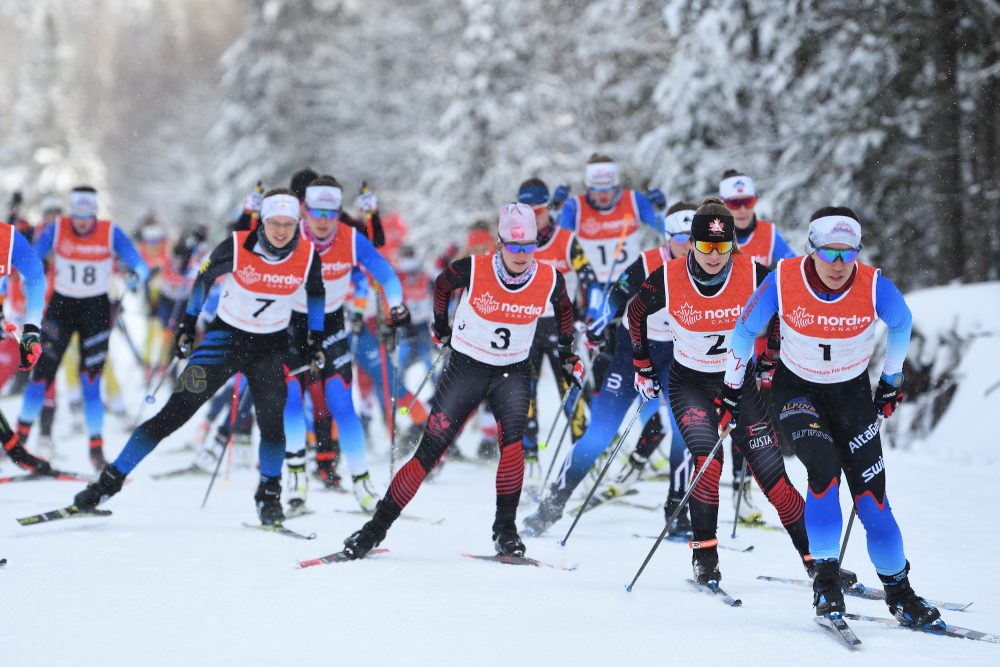
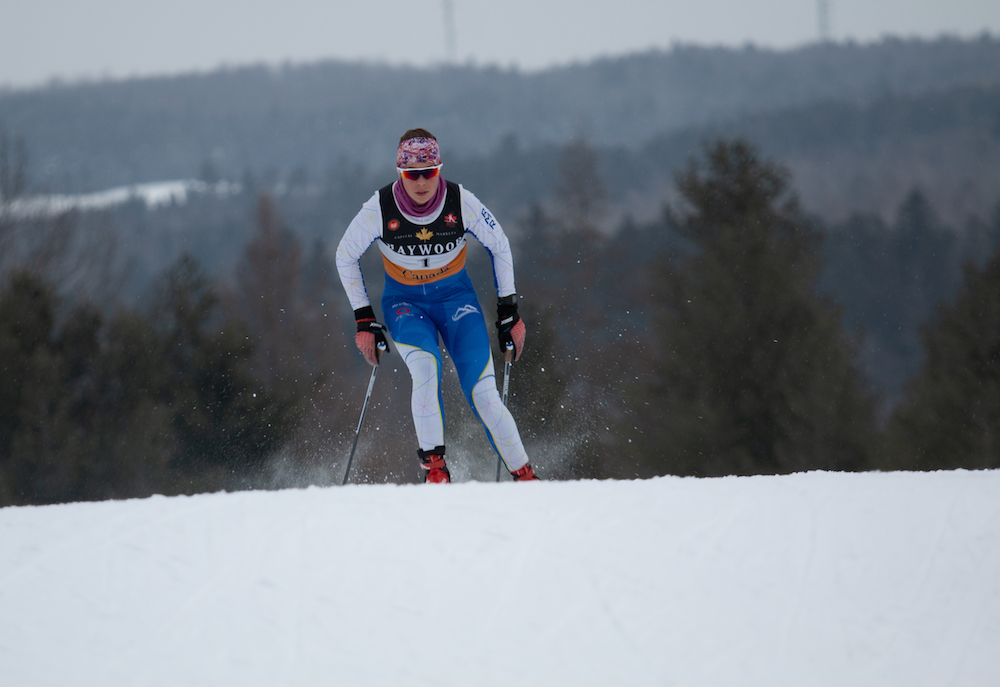
Emily Nishikawa (bib 1) leads out the U20 and Open 15km at MSA Trials. (Photo: Doug Stephen)
Mont Sainte-Anne brought great ski conditions on a weekend where the best in Canada fought to qualify for four different race trips: U20/U23 World Championships in Oberwiesenthal, Germany; Falun and the Scando Tour; the sprint tour of Québec and Minnesota; and World Cup finals in Canmore. Combine this with the usual NorAm action and COC leader competition and you have all the ingredients for a great weekend.
Over 400 athletes raced in five age groups with over 150 competing for U20 selection.
For all four trip selections, Nordiq Canada will be making a list and checking it twice. Or maybe more than twice. For U20, five athletes of each gender are selected, starting with the top skier on Sunday, then Friday, then Saturday and starting again with Sunday’s second place. For U23, four or five skiers will be selected the same way. The Sprint Tour averages the qualification and heats points to rank athletes to be selected after pre-qualified athletes. The Canmore weekend similarly sums the two distance days. With 10 Host Nation starts allocated in addition to the ones Canada has earned, there are many start opportunities. Most of the paths to guarantee a spot on next year’s National Team begin with qualifying for one of the above. But no pressure.
Each COC leader gets their own start allocation at every World Cup for the period. As there are no more NorAm (Continental Cup) events until Nationals beginning on March 26, the COC leader as of today retains this for the rest of the World Cup season. The best five of nine races are counted, which means Katherine Stewart-Jones had the women’s spot locked up in December. Antoine Cyr came into this weekend with the leader’s bib and a win Saturday was enough to keep it, according to Nordiq Canada.
The U20 and open women started the day with 15km on the same hilly 5km course as Saturday. Emily Nishikawa and CNEPH’s Cendrine Browne got away early before Nishikawa broke clear on the final long climb to win in 43:44.1, with Browne 13.4 seconds back. Browne’s teammate Laura Leclair spent most of the race alone and held off a charging pack to finish third for the top U23 result, 1:45.4 behind, just 0.8 seconds ahead of the top U20 finisher, Revelstoke’s Elizabeth Elliott. Black Jack’s Jasmine Drolet was edged out into 5th but should still have earned the trip to U20’s in Oberwiesenthal.
Nishikawa spent a rare winter period back in Canada and enjoyed the change.
“It was great to be home in Canmore, and I got a good block of training in before heading back to the World Cup,” Nishikawa emailed. “It was very fun to be able to race in Canada – in Whistler and here in MSA, and now I feel ready to get back on the World Cup.”
Nishikawa, who was 25th overall in the 2019 Tour de Ski, is focussed on the Scando Tour and racing back home in Canmore.
Browne, who is bouncing back from a tough year, was happy to be back in the game. “The race felt really good, I had good legs and great skis. I really liked skiing with Emily, it was fun to race with her again,” Browne wrote. “I should’ve taken more relays and rested more so I maybe could’ve followed Emily when she attacked at 14km. Unfortunately, when she did attack, my legs were fried!”
Browne, a distance specialist who loves the skate days, was also excited to have won the sprint on Friday.
“Winning a sprint was very fun! It was a big confidence boost! It was also a pretty tactic race, which was very fun too.”
The applause and support is always there for the good days, but no athlete has only good days.
“Last year was very tough for me, as for many athletes after the Olympics, Browne continued. “I was very depressed and wasn’t having fun anymore. It was also very hard to lose all support from my federation. After that tough year, I had a severe concussion (in the end of August till mid November) so coming back strong is such a big relief. I feel so much better, physically and mentally and I’m confident that I have a good form.”
Writing about the tough times feels like kicking an athlete when they are down. It is much easier to write about an athlete when they are scrambling to catch a flight to Falun. It looks like some athletes will be at the airport before we have a confirmed published list of who is joining Browne and Nishikawa for period 4 of the World Cup. (To be fair, that list is one of four that has to be written and double-checked by officials who also have flights to make today.)
“Today’s race was tough,” Leclair wrote to FasterSkier. “I skied alone and had a pack of 10 skiers chasing me the whole time. I would have liked to ski with Emily and Cendrine but lost them in the first lap. However, I did what I had to do and I am happy with how I skied considering I was alone.” Leclair will be going to a CNEPH elevation camp in Livigno, Italy, on her way to U23 Worlds.
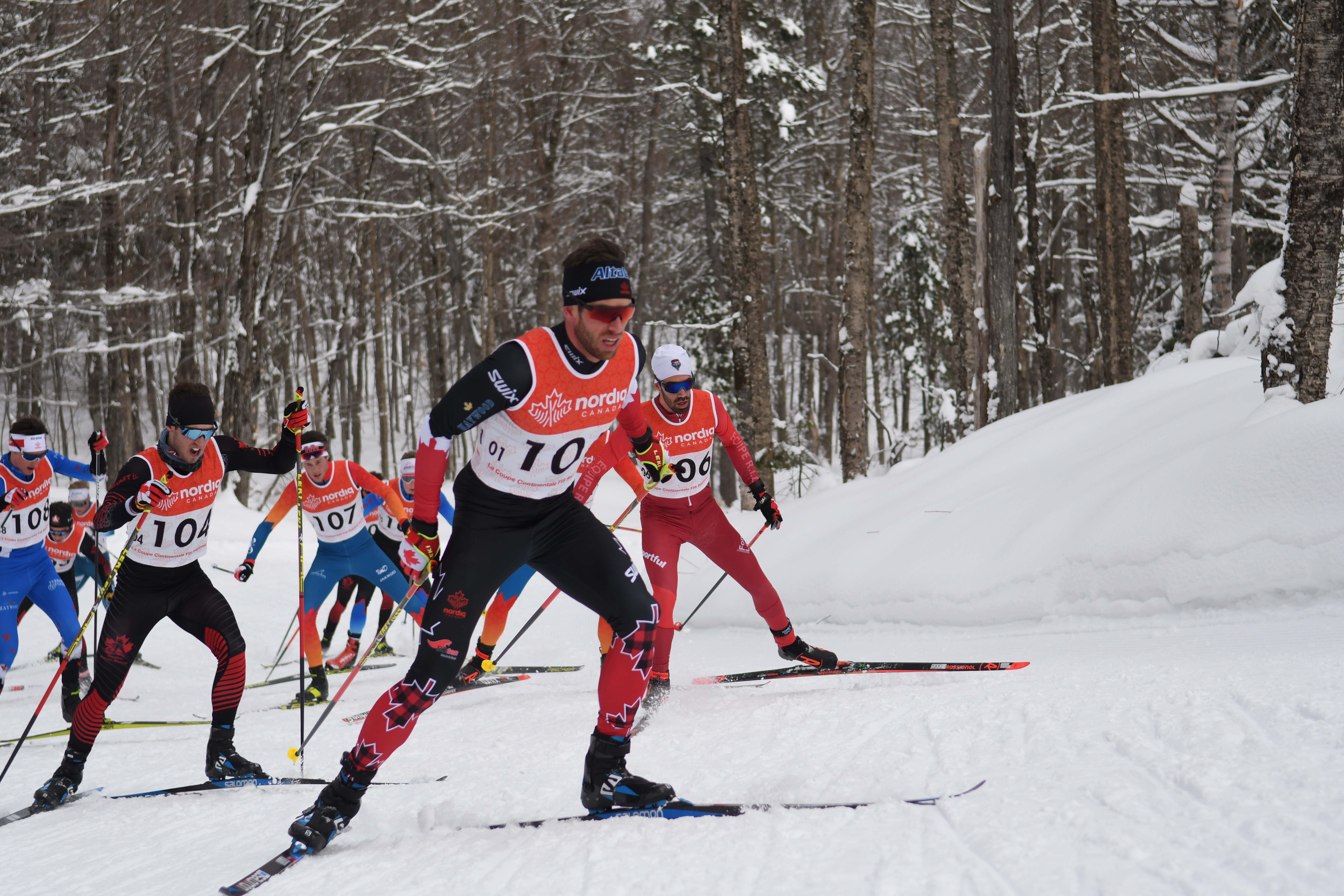
Russell Kennedy leads the pack early, with Rémi Drolet (#108), Philippe Boucher (#104), Sam Hendry (#107), and Ricardo Izquierdo-Bernier (#106) keeping a close eye. (Photo: Doug Stephen)
The men skied 30km and many said they were feeling the big climb by lap six. Black Jack’s Rémi Drolet animated the race early before Canmore’s Sam Hendry made a big move on the final lap to explode the pack of ten. In the end, it was Team R.A.D.’s Evan Palmer-Charrette who emerged to take the win in 1:15:49.7, with Fondeurs-Laurentides’ Ricardo Izquierdo-Bernier at 0.3 seconds and top U23 Hendry at 0.4. CNEPH’s Phil Boucher was fifth at 5.3 ahead of Rémi Drolet who took his third U20 win at 11.2 seconds back.
Foothills’ Tom Stephen popped out of the second pack to book his trip to Germany as the second fastest U20, 2:04.6 behind the winner and 11th overall.
“The race today went very well for me,” Palmer-Charrette explained in an email. “My plan from the get go was to match any move and stay in contact, the final kilometre is very high speed and my plan was to wait until there to make a move, so it played out perfectly.”
“Race went pretty well today,” Hendry wrote of his Sunday. “I skied in the group and did the best job I could to save energy. Coming up to the last climb I moved into the front of the pack to avoid traffic and found myself pulling away from the group so went all in and attacked hard over the final climb. I then had a few second lead and tried to hang on until the end of the course but blew up in the final meters and was passed by Evan and Ricky.”
Like many of the other athletes, Hendry is balancing full time studies with skiing.
“Full time school and racing is going great. The University of Utah is super accommodating and want to see me succeed in not only academics and college racing but also international competitions such as these trials and U23’s.” That balance only goes so far. In addition to collegiate racing and U23’s, Hendry is hoping to ski World Cup Finals in Canmore (which may require a good result from him in Germany), but nationals is not on the program.
Boucher should have earned his trip to Canmore with a 4th and a 5th in distance this weekend.
“The race went well,” he wrote. “I managed to react well on Sam’s move in the last km. It blew the pack in small groups. So the only tactic here was to survive until the end. But in general, the plan for today was to try to stay in the front of the pack in the uphills, so I dont get caught behind if someone makes a move.”
While many athletes are enjoying the new race calendar with less east/west flights to races, Boucher also sees a downside: less races.
“I think there’s a lack of races. We currently race 1 weekend per month… I train all summer long to race in the winter so it’s a shame when we dont have a lot of racing to do in North America. I had a difficult start in December but at least I had some good racing at the U.S. Nationals in Houghton early in January. And then here at MSA, it’s been one of my best racing weekends of the season so far. My race shape is raising and that’s good sign for the coming races.”
Nordiq Canada’s Jeff Ellis, Joel Jaques, and Erik Bråten have talked to FasterSkier about balancing the need for lots of races, reduced travel costs, and reduced challenges to host regional races. Watch this space.
While some athletes will go home happy with their race efforts and others won’t, it seems like everyone enjoyed their weekend. Palmer-Charrette put it best: “The conditions here for the whole weekend were really good, the [Organizing Committee] did a great job with the trails. Yesterday turned out to be a slightly tricky waxing day and on a relatively flat high speed course there were definitely a few athletes caught out with icing issues, however that’s the game of classic racing. For the sprint and today, conditions couldn’t get any better really, so it made for exciting races.”
Photographer Doug Stephen has more evidence of the great trails in his Sunday Gallery. Athletes are welcome to download and use full resolution images if they give credit to ‘Doug Stephen’ or @vr45photography.
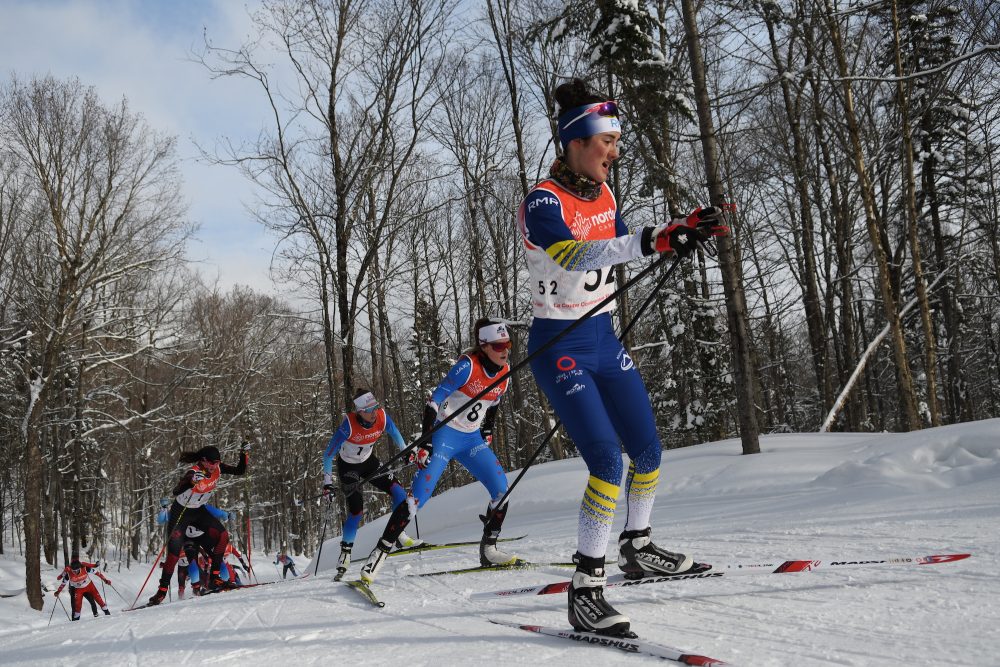
Olivia Bouffard-Nesbitt leads Jasmine Drolet, Elizabeth Elliott and Liliane Gagnon in pursuit of the top 3. (Photo: Doug Stephen)
Katherine Stewart-Jones leads a sprint heat on her way to domination. (Photo: Robert Smith)
The NorAm circuit moved east to the Nakkertok trails for three days of racing jointly hosted by Nakkertok Nordic, Club Skinouk, Chelsea Nordiq, and Kanata Nordic. Friday featured classic sprints, Saturday interval start free, and Sunday interval start classic.
The event was also the Candy Cane Cup for the younger categories, as well as Ontario Cup 1 and Coupe Québec 1. 374 athletes in the U16, U18, and Open categories competed on Friday with many more younger athletes racing Saturday and Sunday.
Nordiq Canada’s Jeff Ellis was there and has once again shared the full-length post-race interviews. Photographer Robert Smith has galleries for each day, so keep scrolling.
Nakkertok had over 3km of trail open thanks to their snowmaking, with a 2.5km loop used for the distance races.
The ‘NakkerTrak’ at Nakkertok before the 2019 NorAm weekend. (Photo: Natural Fitness Labs)
On the women’s side, it was the KSJ show, with home-grown national team member Katherine Stewart-Jones winning all three days.
In the sprint, Stewart-Jones finished in 3:19.96, comfortably ahead of AWCA’s Maya MacIsaac-Jones and RMR’s Katie Weaver at 2.43 and 3.93 seconds back respectively. The podium trio were the top three qualifiers, but in reverse order.
Stewart-Jones steamrolled the field in the free 5km, 36.8 seconds ahead of Laura Leclair in second and 39.9 seconds before Cendrine Browne, both of CNEPH.
The trend continued on Sunday, with Stewart-Jones finishing the classic 10km in 28:52.1, 1:18.1 ahead of Skibec’s Andrée-Anne Théberge and 1:29.8 ahead of AWCA’s Annika Richardson.
Antoine Cyr leads Julien Locke in the interval start classic. (Photo: Robert Smith)
For the men, Hardwood’s Bob Thompson kicked the weekend off with a sprint victory in 3:12.71, followed by national team member Antoine Cyr at 0.36 seconds and his CNEPH teammate Antoine Briand at 0.63.
On Saturday, Cyr won the free 10km in 22:10.4, 20.9 seconds ahead of Fondeurs Laurentide’s Ricardo Izquierdo-Bernier and 32.8 seconds clear of Team R.A.D.’s Evan Palmer-Charrette.
Palmer-Charrette stepped up to finish the weekend on top of the podium, winning the 10km classic in 24:43.8. National team member Julian Smith was second at 6.2 seconds followed by Cyr at 14.4 seconds.
For many Canadians this season, the big focus is on the Mt. Sainte Anne (MSA) NorAm in January, which is the Junior and U23 World Championship trials. That series is also a path to World Cup starts. As a result, a number of athletes chose the nearer of the two December NorAm races and skipped the other to reduce travel. Over 30 western Canadians drove to Sun Valley for the SuperTour event instead of flying to Nakkertok.
“I think that it’s good for younger athletes to chase high competition for development,” Stewart-Jones wrote in response. “It makes more sense for them to travel less too. This year, for most of the younger athletes and even a lot of the older ones, the focus is on trials in MSA in January so there is a lot of time to prepare for their optimal race performance.”
Stewart-Jones moved from Nakkertok to Canmore this training year, resulting in new training partners and a new personal coach, national team head coach Erik Bråten. That also meant returning to Nakkertok required two extra flying days and the associated illness risk.
“If I hadn’t been trying to get the COC spot locked up for the rest of the season I would have most likely gone to Sun Valley too.”
There is a complicated calculus to getting World Cup starts in Canada. The COC leader gets FIS-guaranteed starts and financial support from the host organization for each race weekend. Keeping the COC leader bib for the season would mean more and cheaper time on the World Cup for Stewart-Jones. Dahria Beatty and Emily Nishikawa chose to race period 1 in Europe instead, with Beatty qualifying for the next WC trip selection by placing 25th in the Davos sprint on Saturday.
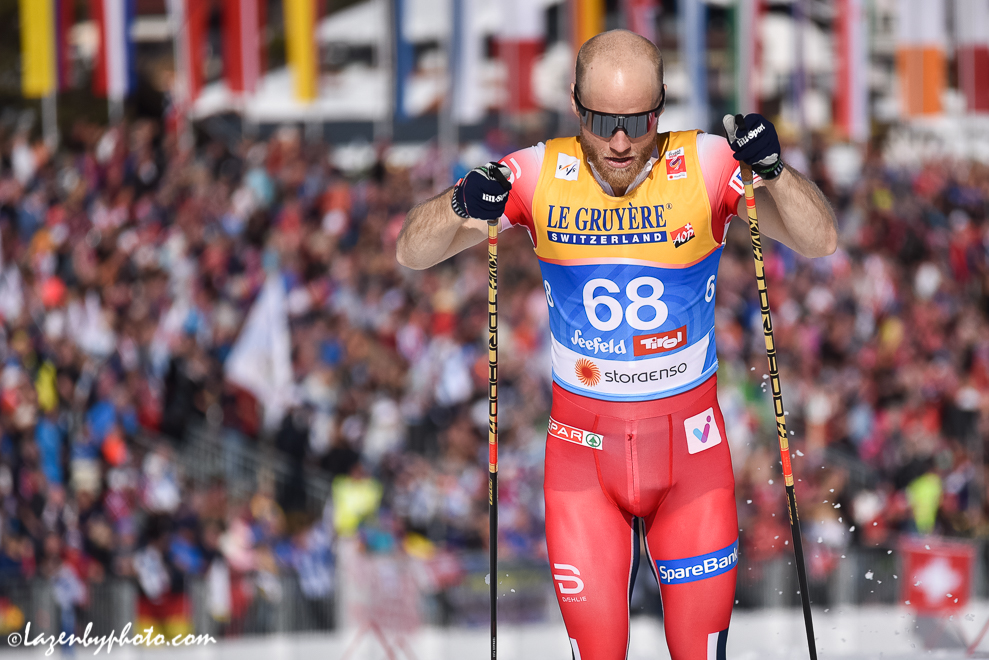
Norway’s Hans Christer Holund reaching for a feed during the men’s 50 k skate at the 2019 World Championships. (Photo: John Lazenby/lazenbyphoto.com)
The 2019 Seefeld World Championships event came to a close on Sunday, the 11 days of competition capping off with a men’s 50-kilometer freestyle mass start. Unlike two years ago at the Lahti World Champs, when the top six finished within four seconds of each other, Canada’s Alex Harvey ultimately earning the 2017 title, this year’s World Champs featured no head-to-head sprint to the finish.
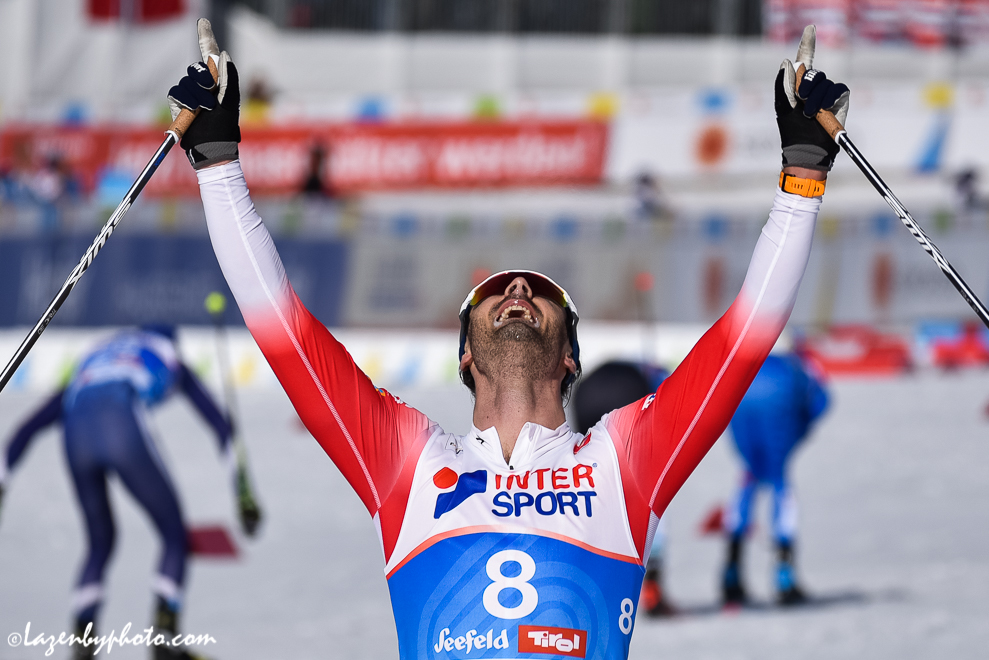
In Seefeld on Sunday, Norway’s Hans Christer Holund crossed alone, arms raised high in celebration of his gold medal performance. He stopped the clock at 1:49:59.3, the next closest finisher being Russia’s Alexander Bolshunov, who crossed 27.8 seconds after Holund.
Norway’s Hans Christer Holund crossing the line in first as he wins the 50 k skate at the 2019 World Championships. (Photo: John Lazenby/lazenbyphoto.com)
Holund’s break from the pack came at the 21 k mark, a decisive move observed by his teammate Martin Johnsrud Sundby, who initially assumed the role of leading the chase pack as Holund skied ahead. The pulse of close to 40 skiers threatened to swallow Holund back up, if Sundby let it.
But the Norwegian continued to ski alone and in the lead past the 25 k mark, the 30 k mark, the 35 k. What may have at first appeared like an unsustainable rabbit’s pace off the front, was turning out to be cruise control for Holund. The 14-second gap he had on the field at 22 k had grown by a minute at the 34 k mark. Over the remaining 15 k, only Bolshunov would manage to put any more than 30 seconds back into Holund.
Even after securing the win, the 30 year old was somewhat surprised that he managed to maintain such a significant amount of time between himself and the rest of Sunday’s 50 k field.
Norway’s Hans Christer Holund taking a feed during the men’s 50 k skate at the 2019 World Championships. (Photo: John Lazenby/lazenbyphoto.com)
This is the first race Holund has competed in at the Seefeld World Champs, his start itself uncertain until recently.
“I’ve been in not so good shape this year and I actually didn’t thought I was going to go this race because I wasn’t qualified, but when I finally got the chance I thought well this may be my last chance to be World Champion, so I just have to go for it,” Holund said.
According to the FIS database, the title is Holund’s first World Championships gold–the only other World Champs event he has raced was the Lahti 50 k, where he placed 10th.
Holund’s closest challenger on Sunday, Bolshunov, had made his move to the helm of the chase pack around 25 k. The Russian did not begin to gain time on the Norwegian, however, until he broke from the chase group at 38 k.
From there, Bolshunov did regain 46.2 seconds on Holund, but ran out of course to see if he could make up the remaining 27.8 seconds. The podium finish is Bolshunov’s fourth from the Seefeld World Champs, all of which have been silver medal performances. Prior to this year, the 22 year old had never medaled at a World Champs event.
Russia’s Alexander Bolshunov during the men’s 50 k skate at the 2019 World Championships. Bolshunov came close to closing down Holund’s lead. (Photo: John Lazenby/lazenbyphoto.com)
Sunday’s battle for bronze place came down to Norwegians Sjur Røthe and Martin Johnsrud Sundby. With less than 5 k to go, the two had moved to the front of the chase pack behind Holund and Bolshunov. In a sprint to the finish, Røthe outlunged his teammate by 0.1 seconds for third (+57.8) and Sundby place fourth (+57.9).
Leading the way for the North Americans on Sunday was Canada’s Alex Harvey in 12th (+1:10.5). Two years ago in Lahti, Harvey earned his first individual World Championships title in the men’s 50 k race, Sunday’s 50 k being his final career World Champs event. At the age of 30, Harvey announced his decision to retire after this year’s World Cup races in Quebec City, Quebec.
“I think it is pretty clear it is not what I had hoped for or dreamed for,” Harvey said during a post-race phone call. “I think today and for the whole week, or the whole of the last two weeks, I just have got to look at things with a more objective eye. The skiathlon is my best result of the season in distance. I had my best race of the season at World Champs so that is good. But of course, I was hoping to come away from Seefeld with a podium.”
Over the course of his career, Harvey has competed in six World Championships events, his first being in Liberec in 2009. He has since then amassed five World Champs medals, including two golds, two bronzes, and one silver.
“I really expected the Norwegians to attack, maybe a tiny bit later in the race, I was expecting more around 30 k,” Harvey said of Holund’s move at 21 k. “They kind of did that in Lahti in the 50 k. It forces the other nations to try and take on the chase. So knowing that they have so much depth, I was expecting it from either Holund or Krüger, because it is more their style of racing anyways.
“I had made a decision before the race that if an attack was made, it would not be the one chasing because it would have played too much in the hand of Sundby and Rothe,” he added “At the end of the day, I think Holund was just way better than the rest.”
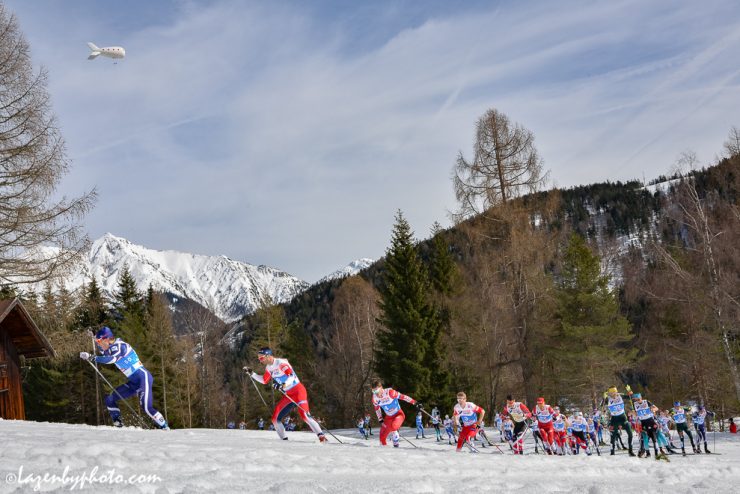
Canada’s Alex Harvey (first skier from right in the front group) during the men’s 50 k skate at the 2019 World Championships. (Photo: John Lazenby/lazenbyphoto.com)
With less than a kilometer to go, Harvey was still in the running for a podium. The final hill, however, found his legs flooded.
“I think for me there was still an opportunity for third place and I really positioned myself in the best way possible at the base of the sprint hill,” Harvey said. “Then I did not have the legs to go up the hill. I just lost a lot of position I just wasn’t strong enough. It is as simple as that. But everything else, we had the skis. In the 50k you have to have a feeding strategy and try to save energy where you can. I think I did everything to the best. … I would not do anything different. I just was not good enough. It is a bitter-sweet feeling knowing …it is easy to say I gave it my all. At the end of a race, you always give it your all. I think I really executed my plan.”
Following Harvey, two Americans cracked the top 20 on Sunday, with David Norris placing 20th (+1:22.6) and Scott Patterson in 23rd (+2:05.5). Norris came into Sunday’s race having competed in last year’s Holmenkollen 50 k where he placed 38th (He also won the 2016 American Birkebeiner 52 k). Seefeld has been his first World Championships experience.
David Norris of the U.S. racing to 20th overall in the men’s 50 k skate at the 2019 World Championships. (Photo: John Lazenby/lazenbyphoto.com)
“At Holmenkollen [last year], I felt strong, but often I have struggled to get engaged into the top-twenty,” Norris explained during a phone conversation. “From the gun I feel like I am one of the stragglers, trying to hang on.”
Sunday that was not the case for Norris. The 28 year old managed to position himself in the top 20 from the start, making for what he described as “smoother” skiing. He experienced less accordioning between groups of skiers and during the second half of the race was still skiing within 10 bibs of Sundby and Røthe.
“The way I have always tried to race over here is to go out hard and put yourself into the position to have a result that you are excited about and represents my goals,” Norris said. “So often I have died and blown up several times over here, but I feel like when that happens I also know in the back of my mind that if I put everything together the result that is almost a great one was not so far away.
“I think today, when I was racing, more things were just working out and clicking so it allowed me to finally reach the result that I have been pursuing and chasing in the first of races often instead of fading, I continued to feel strong all the way to the finish for the most part,” he added.
Norris will race next weekend’s Holmenkollen 50 k as well as the remaining Period III World Cup races. “I feel like I’m really fortunate that every year my skiing seems to get more feasible and the support has been there,” Norris said. “I think every athlete experiences huge portions of their season where they’re second-guessing or frustrated and those are the times to push through and believe in the plan.”
Patterson explained, the race was “a step up in results”, though still left him “ looking for a little more.” Seefeld is Patterson’s first World Championships, with Sunday’s 23rd his best individual ranking to date. Earlier in the week, he placed 30th in the 15 k classic and 32nd in the skiathlon.
“I spent most of the race kind of dangling on the back end of the lead pack,” Patterson wrote in an email.
The American indicated that he had good energy, though not enough to follow Holund’s break from the front group near the race’s halfway mark.
“I was a bit disappointed with the lack of leadership in the pack when we just chilled out instead of reacting at all to Holund’s move,” Patterson wrote. “There is talk around here of the unwritten principle of the Norwegians to not chase down the first attack. I think we saw that today as well as some weakness in the other strong nations such as Russia and France.”
The American maintained contact with the lead group until his sixth lap when things began to separate. Positioned at the rear of the group, Patterson found himself unable to chase down any breaks.
“Over the course of the first long hill on that lap, the main group seemed to spread and splinter between skiers,” Patterson wrote. “I was a little too far back to make the split for the front of the pack. I tried hard to chase, but going for it solo wasn’t working against a pack of 18. Overall, I am satisfied with 23rd but also believe that I still have more to give the rest of this season. I’m looking forward to another 50 k next weekend at Holmenkollen.”
Scott Patterson of the U.S. racing to 23rd overall in the men’s 50 k skate at the 2019 World Championships. Simi Hamilton (bib 41) placed 34th. (Photo: John Lazenby/lazenbyphoto.com)
However, as much as compartmentalizing athletes simplifies the narrative, Hamilton’s definition of cross-country racer helps broaden the sprint or distance paradigm. According to the FIS, Sunday’s race was Hamilton’s third 50 k at this level of competition. He placed 54th in the 2014 Holmenkollen 50 k classic and was a DNF last season in the Holmenkollen 50 k skate.
“It’s definitely intimidating, I think this is maybe the third fifty k I’ve skied at this level, one of which I didn’t finish – at Holmenkollen last year, and I skied Holmenkollen the previous year,” Hamilton said in a post-race phone call. “It’s certainly quite different from the domestic scene generally, now the pace is just way hotter from the start.”
American Adam Martin raced to 45th (+8:01.7), while Canadians Russell Kennedy finished in 46th (+9:57.6), Evan Palmer-Charrette in 47th (+11:26.1), and Scott James Hillin 50th (+11:27.6).
The toe-surge by Norway’s Sjur Røthe for third place over teammate Martin Johnsrud Sundby who placed fourth during Sunday’s 50 k skate at World Championships. (Photo: John Lazenby/lazenbyphoto.com)
Double click on the photos below to enlarge.
Sweden’s Calle Halfvarsson during the men
s 50 k skate at the 2019 World Championships. (Photo: John Lazenby/lazenbyphoto.com)
Canada’s Russell Kennedy during the men’s 50 k skate at the 2019 World Championships. (Photo: John Lazenby/lazenbyphoto.com)
Early in the men’s 50 k skate at the 2019 World Championships. (Photo: John Lazenby/lazenbyphoto.com)
Canada’s Evan Palmer-Charette (bib 43) in the men’s 50 k skate at the 2019 World Championships. (Photo: John Lazenby/lazenbyphoto.com)
Fourth place skier in the men’s 50 k skate at the 2019 World Championships, Martin Johnsrud Sundby of Norway walks with his son after the race. (Photo: John Lazenby/lazenbyphoto.com)
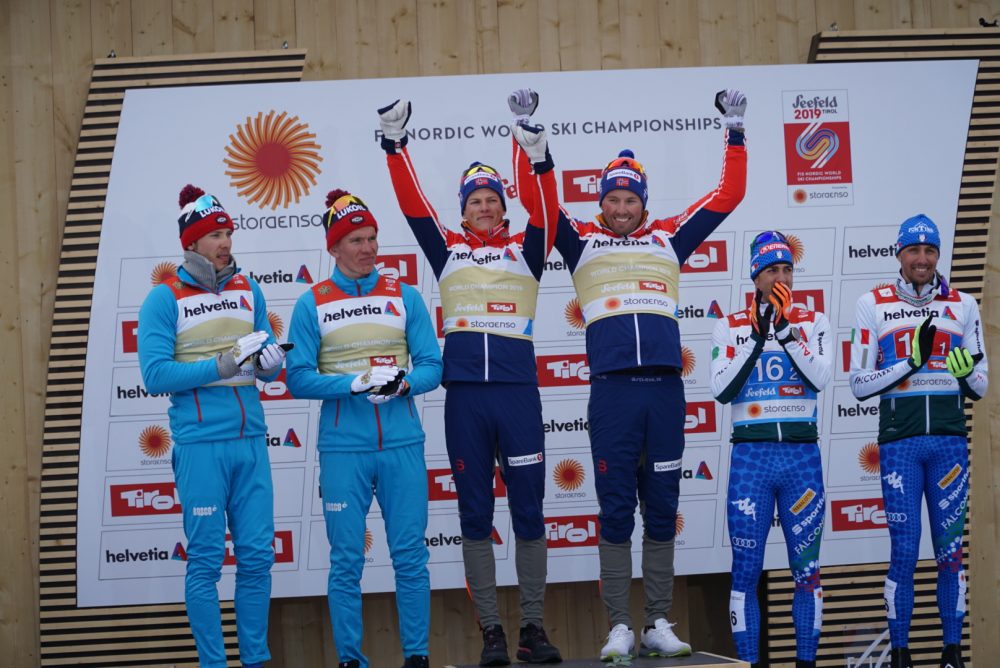
The men’s 50 k skate podium at the 2019 World Championships. From left to right, Russia’s Alexander Bolshunov in second, Norway’s Hans Christer Holund in first, and Sjur Røthe of Norway third. (Photo: John Lazenby/lazenbyphoto.com)
Simi Hamilton of the U.S. takes a feed during the men’s 50 k skate at the 2019 World Championships. (Photo: John Lazenby/lazenby photo.com)
Norway’s Martin Johnsrud Sundby (bib 2) leading the chase-train in the men’s 50 k skate at the 2019 World Championships. (Photo: John Lazenby/lazenbyphoto.com)
Adam Martin of the U.S. in the men’s 50 k skate at the 2019 World Championships. (Photo: John Lazenby/lazenbyphoto.com)
Canada’s Russell Kennedy during the men’s 50 k skate at the 2019 World Championships. (Photo: John Lazenby/lazenbyphoto.com)
David Norris of the U.S. placed 20th overall in the the men’s 50 k skate at the 2019 World Championships. (Photo: John Lazenby/lazenbyphoto.com)
Alex Harvey of Canada after his final career World Championship race. (Photo: John Lazenby/lazenbyphoto.com)
Norway’s Hans Christer Holund crossing the line in first as he wins the 50 k skate at the 2019 World Championships. (Photo: John Lazenby/lazenbyphoto.com)
FIS Nordic Ski World Championships Men’s 50 K Freestyle Mass Start
It has come to a close. The 2019 Nordic Ski World Championships ended today with the men’s 50-kilometer freestyle mass start. Hans Christer Holund of Norway began to make his mark on the race shortly after 20 k with a solo attack. In his bold ski-alone effort, Holund was able to fend off any chasers and win in 1:49:59.3 hours.
Russia’s Alexander Bolshunov timed his chasing surge for a last 10 k punch. By the finish, Bolshunov had eaten up some time on Holund to place second, 27.8 seconds back.
Sjur Røthe and Martin Johnsrud Sundby, teammates on the formidable Norwegian team, created their own gap on the sizable main chase group as they raced up the course’s final climb. Sprinting down the straight into the finish, Røthe out-toed Sundby for third overall (+57.8) as Sundby took fourth (+57.9).
Canada’s Alex Harvey was the top North American in 12th (+1:10.5). He was followed by teammates Russell Kennedy in 46th (+9:57.6), Evan Palmer-Charrette in 47th (+11:26.1), and Scott James Hill in 50th (+11:27.6). If you love play games with mods, Download mods for android games free and let’s go to run your fav game
David Norris was the top American in 20th (+1:22.6), followed by Scott Patterson in 23rd (+2:05.5), Simi Hamilton in 34th (+4:02.), and Adam Martin in 45th (+8:01.7).
The toe-surge by Norway’s Sjur Røthe for third place over teammate Martin Johnsrud who placed fourth during Sunday’s 50 k skate at World Championships. (Photo: John Lazenby/lazenbyphoto.com)
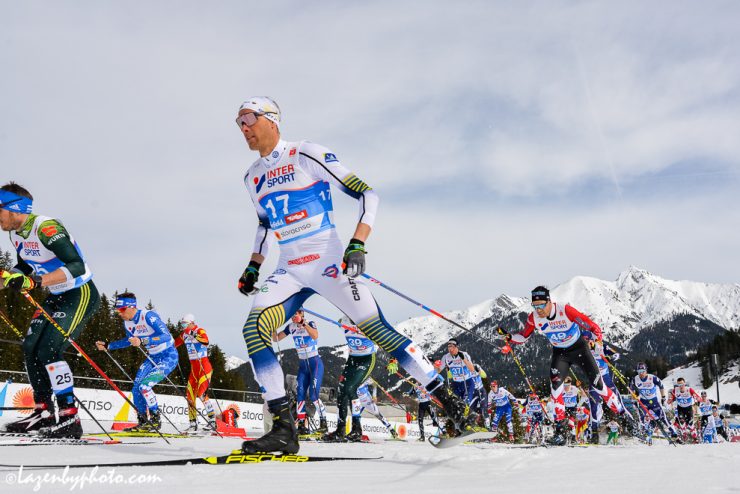
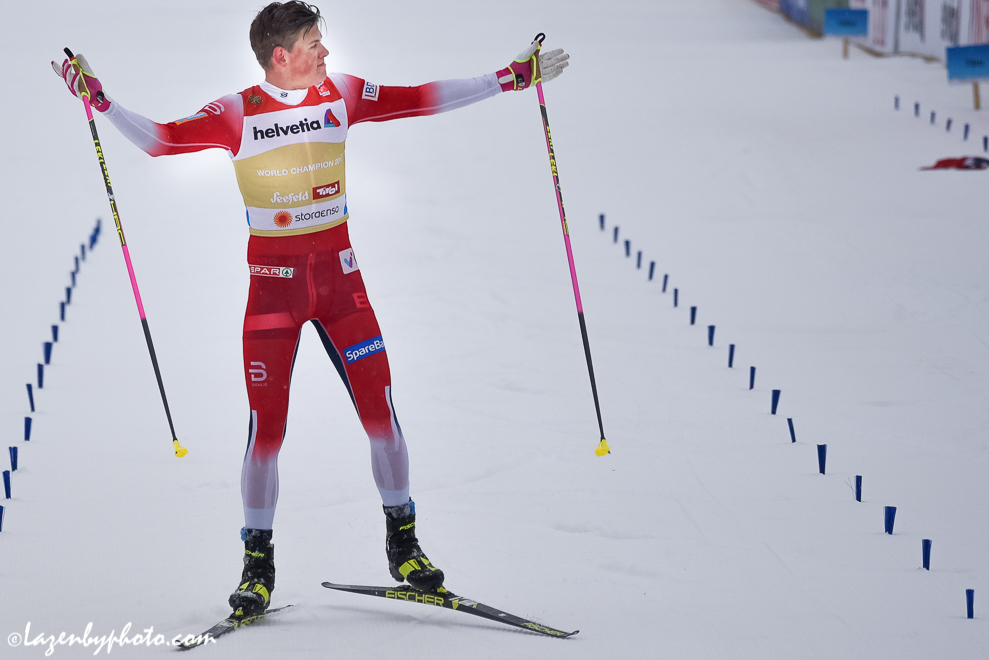
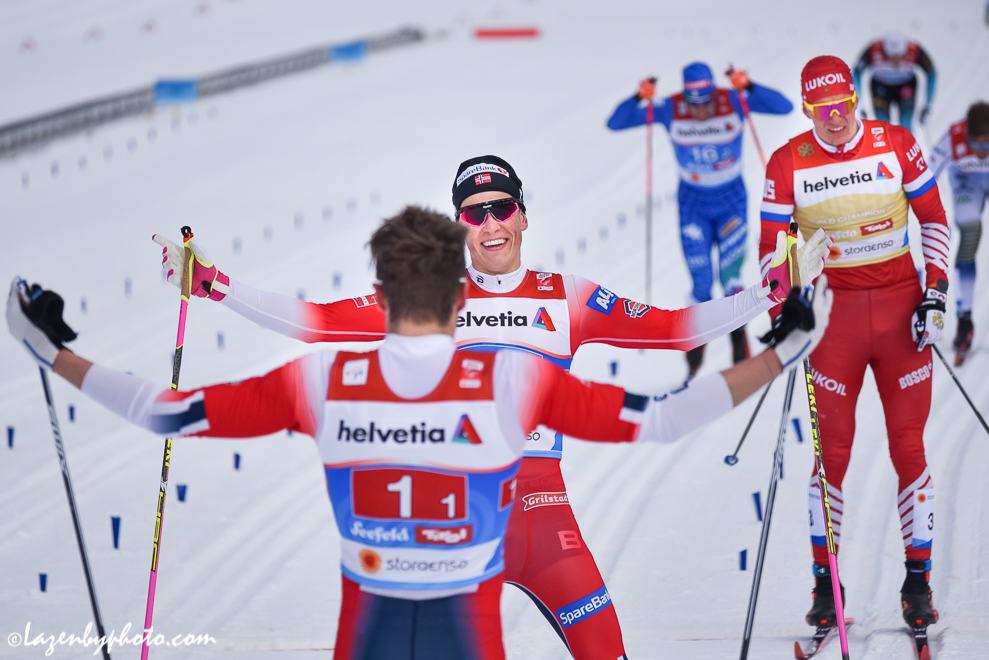
Johannes Høsflot Klæbo of Norway displaying what has become his iconic gesture when crossing the line as a winner. Once again it was an opportunity for the arms being outstretched as Klæbo anchored Norway to the 4 x 10 k relay win at the 2019 World Championships. (Photo: John Lazenby/lazenbyphoto.com)
The 4 x 10-kilometer men’s relay was a two-team tango as Russia’s Sergey Ustiugov and Norway’s Johannes Høsflot Klæbo were tagged for their respective anchor legs on Friday. The two teams stuck together until Klæbo moved ahead with less than five k to go and gapped Russia by 22 seconds.
It was enough final leg surge for Norway’s Emil Iversen,Martin Johnsrud Sundby, Sjur Røthe, andKlæbo to win in 1:42:32.1 hours. Russia’s Andrey Larkov, Alexander Bessmertnykh, Alexander Bolshunov, and Ustiugov placed second (+38.8).
The final podium spot came down to a final sprint won by France’s Richard Jouve over Finland’s Perttu Hyvarinen.
Adrien Backscheider, Maurice Manificat, Clement Parisse, and Jouve were 1:01.0 back in their third place statement.
Finland’s Ristomatti Hakola, Iivo Niskanen, Matti Heikkinen, and Hyvarinen were fourth (+1:02.8).
The U.S. team of Erik Bjornsen, Scott Patterson, David Norris, and Kyle Bratrud skied to ninth (+4:06.4).
Canada’s Alex Harvey, Scott James Hill, Evan Palmer-Charrette, and Lenny Valjas placed 12th (+7:05.5).
Norway’s Martin Johnsrud Sunday on his way to winning the men’s 15 k classic at the 2019 World Championships in Seefeld, Austria. (Photo: John Lazenby/lazenbyphoto.com)
FIS Nordic World Ski Championships Seefeld, Austria Women’s Individual 15 k Classic
Norwegians travel well to international cross-country races. That was evidenced by the roar of the crowd in Seefeld, Austria during Wednesday’s 15 k classic as Martin Johnsrud Sundby crested the final climb and descended into the home stretch. Nothing was for certain until +2.9 seconds popped up next to Russian Alexander Bessmertnykh’s name as Sundby crossed the finish.
Sundby won the race in 38:22.6 minutes. Bessmertnykh placed second 2.9 seconds back. As remarkable as this sounds, this was Sundby’s first individual championship gold at either a World Championships or Olympics.
Iivo Niskanen of Finland, one of the World Cup’s most feared classic skiers, placed third (+20.4).
Erik Bjornsen led the way for the U.S. with a 17th place finish (+1:50.3). Scott Patterson raced to 30th (+2:34.7), Kyle Bratrud 31st (+2:43.8), and Ben Lustgarten 45th (+3:49.6).
Scott James Hill topped the results for Canada with a 34th place (+3:01.3). Evan Palmer-Charrette skied to 46th (+3:52.7) , Lenny Valjas 47th (+3:52.9), and Russell Kennedy 67th (+5:50.8).
Norway’s Martin Johnsrud Sunday on his way to winning the men’s 15 k classic at the 2019 World Championships in Seefeld, Austria. (Photo: John Lazenby/lazenbyphoto.com)
Norwegian Johannes Hoesflot Klæbo and Emil Iversen celebrating their win in the men’s 6 x 1.6 k classic team sprint at World Ski Championships in Seefeld, Austria. (Photo: John Lazenby/lazenbyphoto.com)
Redemption. As the old saying goes, it is sweet, particularly in sport, even if the occasion only arises every two or four years. Or perhaps the wait makes it savory.
Two winters ago, Norwegian Team Sprint finalists Johannes Høsflot Klæbo and Emil Iversen had been on their way to a potential gold or silver World Championships medal in Lahti, Finland when Iversen crashed taking out Finland’s Iivo Niskanen and putting Norway out of medal contention.
For Norway, tallying podiums is a point of national pride. The missed one in Lahti was a visceral loss. The only other time the Norwegians had missed a team sprint top 3 was at the 2013 World Champs in Val di Fiemme when they placed 11th.
Norway’s Emil Iversen leading his one of his legs of the men’s 6 x 1.6 k classic team sprint at World Ski Championships in Seefeld, Austria. (Photo: John Lazenby/lazenbyphoto.com)
Prior to this Sunday at the World Ski Championships in Seefeld Austria, the Norwegians, according to a International Ski Federation press release, have accumulated altogether, three gold World Champs medals and one silver, the second most of any nation–Russia has them beat with five.
With Iversen and Klæbo paired up once again–though this time Iversen taking the first leg and Klæbo the anchor–Norway was in the rare position of holding its breath by the start of the race. With ten teams taking to the 6 x 1.6-kilometer classic sprint final there would plenty of opportunity for things to go wrong. Norway was going to avoid as many of those as they could.
From the gun, Iversen went to the front and leading the pace with France’s first leg, Richard Jouve just behind in second followed by Italy’s Francesco de Fabiani in third, Finland’s Niskanen in fourth, the U.S.’s Simi Hamilton in fifth and Russia’s Gleb Retivykh in sixth.
From right to left: Norwegian Johannes Hoesflot Klæbo, Russia’s Alexander Bolshunov and American Erik Bjornsen during the men’s 6 x 1.6 k classic team sprint at World Ski Championships in Seefeld, Austria. (Photo: John Lazenby/lazenbyphoto.com)
In that order through the first exchange and with the tempo slowing following that, Canada’s Len Valjas and Erik Bjornsen skiing for the U.S., took a pull at the front during the course’s first climb. Norway’s Klæbo was back to the front by the second exchange with Alexander Bolshunov of Russia stuck just behind. Italian Federico Pellegrino had maintained Italy’s position in third, while Sweden’s Calle Halfvarsson had moved the team into fourth. Bjornsen came through positioned in eighth, Valjas 10th.
As Iversen once again took the reins at the front during the third lap, the attrition of teams began. Canada’s Evan Palmer-Charette lost touch with the pace and by the exchange, Hamilton was four seconds off Iversen’s lead pace. France, Sweden, Italy and Russia still remained in contact with Norway in the lead.
Klæbo charged the to front on the fourth lap along with Bolshunov. Despite a slight tangle at the exchange between the two Russian teammates, Retivykh maintained his spot with the forerunners and Norway going into Lap 5.
In the fifth lap, Iversen’s last for the day, the Norwegian avoided any spills heading into the final lap. Still, six teams remained in play for a podium position, including France, Sweden, Norway, Italy, Russia, and Finland.
Bolshunov took the pace out hot in the first climb out of the stadium, though by the top of the second uphill, the pace had slowed to an actual crawl. Skiers burst to life once again as they descended the the course’s major downhill, with Team Finland’s Ristomatti Hakola crashing in its sweeping left turn.
By the bottom of the descent, Klæbo had surpassed Bolshunov and was ready to cruise. He sailed up the final climb with time enough to glance back at a fading Bolshunov. The 22 year old Norwegian cruised his way to the finish line, crossing arms outstretched for Team Norway’s first place in a time of 18:49.86.
“Yes it was a revenge because of Lahti. But we did not just ski as a team today but more also as friends and this makes the win even more special for us,” Iversen said to FIS, according to a press release. “To be able to cross the finish line in the first position is of course always a special moment. We now enjoy the day and see what other goals we will set for us.”
American Simi Hamilton (r) leading Great Britain’s Andrew Young during the 6 x 1.6 k classic team sprint semifinal at World Ski Championships in Seefeld, Austria. (Photo: John Lazenby/lazenbyphoto.com)
Russia crossed 1.88 seconds later for the silver medal and claiming the bronze was Italy, finishing 4.03 seconds back from Norway.
The U.S.’s Hamilton and Bjornsen finished in eighth (+28.56) and Canada’s Palmer-Charette and Valjas in 10th (+1:40.99).
Norwegian Johannes Hoesflot Klæbo and Emil Iversen snag the men’s 6 x 1.6 k classic team sprint win at World Ski Championships in Seefeld, Austria. (Photo: John Lazenby/lazenbyphoto.com)
Sweden (center) wins the women’s 6 x 1.2 k classic team sprint at the 2019 World Championships in Seefeld, Austria. Slovenia (r) took second place, with Norway (l) in third. (Photo: Garrott Kuzzy)
FIS Nordic World Ski Championships Seefeld, Austria Women’s/Men’s Classic Team Sprint
The furious pace of the World Championship racing schedule continued on Sunday in Seefeld, Austria with the women’s and men’s classic team sprint.
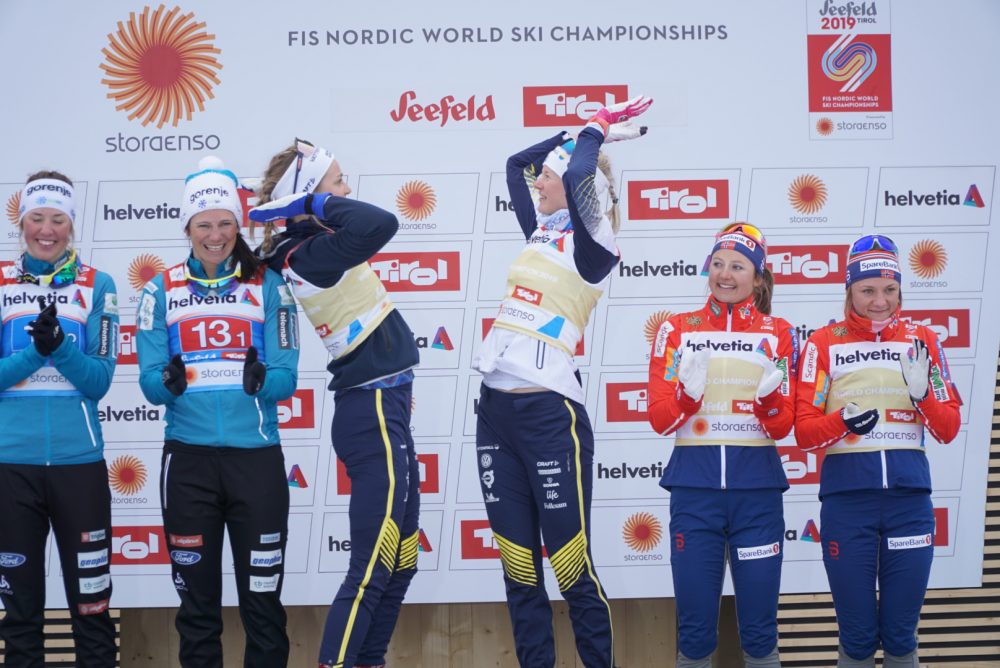
Sweden’s Stina Nilsson and Maja Dahlqvist won the women’s 6 x 1.2-kilometer classic team sprint final in 15:14.93 minutes. Katja Visnar and Anamarija Lampic of Slovenia placed second (+0.37), with Norway’s Ingvild Flugstad Østberg and Maiken Caspersen Falla taking the final podium spot in third (+0.60).
Russia’s Natalia Nepryaeva and Yulia Belorukova raced to fourth (+0.93). Sadie Bjornsen and Jessie Diggins were paired for the U.S. where they placed fifth (+2.79).
Canada’s Emily Nishikawa and Dahria Beatty finished 12th overall after being eliminated in the first semi-final where they placed sixth.
The men’s 6 x 1.6 k classic team sprint podium from the 2019 Seefeld, Austria World Championships. Russia (l) took second, Norway (c) first, and Italy (r) third. (Photo: Garrott Kuzzy).
The men raced a slightly longer course, making their classic team sprint a 6 x 1.6 k affair. Norway’s Emil Iversen and Johannes Høsflot Klæbo won in 18:49.86 minutes. Gleb Retivykh and Alexander Bolshunov of Russia finished 1.88 seconds back to take second overall. In third, finishing 4.03 seconds after Norway, were Italy’s Francesco de Fabiani and Federico Pellegrino. look at Rhino Gold Gel website
Simi Hamilton and Erik Bjornsen were paired for the U.S team. The duo placed eighth (+28.56) in the ten team final. Canada’s Evan Palmer-Charrette and Len Valjas placed 10th overall (+1:40.99).
Between 3.75-kilometers and 4.85 k on Saturday, Norway’s Therese Johaug began to pull away in earnest during the women’s World Championship 15 k skiathlon — by then she had built a near 15 second lead.
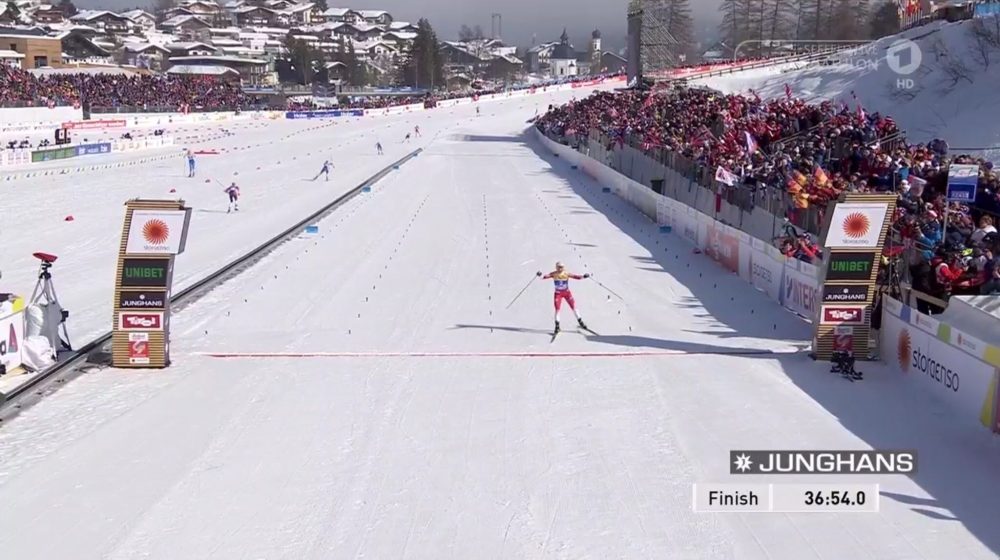
The time back to the Norwegian would only grow. Johaug powered into the classic to skate transition zone in control with a lead padded by 26.2 seconds. At the finish, Johaug crossed the line with no other skiers in sight and a winning time of 36:54.5 minutes. It was Johaug’s fourth World Championship medal in the skiathlon.
Ingvild Flugstad Østberg, also of Norway, placed second (+57.6), with Russia’s Natalia Nepryaeva third (+58.7).
Rosie Brennan of the U.S. was the top North American in tenth (+2:01.8). Also for the U.S., Julia Kern placed 19th (+2:55.5), Rosie Frankowski 24th (+3:00.6), and Caitlin Patterson 34th (+3:54.5).
Canada’s Katherine Stewart-Jones skied to 39th (+4:19.8), Cendrine Browne 40th (+4:25.2), and Maya Macisaac-Jones 54th (+8:53.4).
The men’s 30 k skiathlon featured no off the front winner like Johaug. As the pace setting screws tightened well into the men’s race, with Russia’s Alexander Bolshunov often taking charge, the pack was winnowed to five skiers at the 26 k mark. Along with Bolshunov, France’s Clement Parisse, Norway’s Sjur Røthe and Martin Johnsrud Sundby, and Iivo Niskanen of Finland were the skiers vying for the win.
By the final half-k, only Sundby, Bolshunov, and Røthe remained up front. Down the final straight Røthe possessed the strongest reserves as he won in a time of 1:10:21.3 hours. Bolshunov placed second (+0.1), and Sundby third (+0.7).
Canada’s Alex Harvey paced himself to sixth overall (+58.9). Evan Palmer-Charrette placed 45th (+6:12.4), and Scott James Hill 56th (+9:58.8).
For the U.S., Scott Patterson raced to 32nd (+4:40.6), David Norris 38th (+4:54.4), Kyle Bratrud 49th (+6:19.6), and Adam Martin 54th (+7:47.4).
The plotline thickened on Saturday in the elite men’s freestyle 50 k at the American Birkebeiner when Akeo Maifeld-Carucci (CGRP), Brian Gregg (Team Gregg), and Matt Liebsch separated themselves from the field. The three skiers fended off any chasers and charged onto main street three across in their final effort towards the finish line.
Maifeld-Carucci took the win in 2:12:35 hours, with Gregg second (+0.93), and Liebsch third (+8.50).
Alayna Sonnesyn (SMS T2)won the overall women’s 50 k skate in 2:34:01. By the time Sonnesyn passed the time check on Lake Hayward, she had gapped Anja Gruber (Salomon) in second by 29.60 seconds. Gruber took second overall finishing 54.60 seconds back from the winning time. Third place went to Katie Feldman (SVSEF Gold Team) crossing 1:08.63 minutes back.
FasterSkier will be posting race reports on the 2019 American Birkebeiner later today.
(Friday) FIS Nordic World Ski Championships Seefeld, Austria Individual Gundersen 10 k
U.S. athlete Taylor Fletcher on his way to placing 35th overall during Friday’s individual Gundersen 10 k at the Seefeld, Austria World Championships. (Photo: John Lazenby/lazenbyphoto.com)
On Friday in Seefeld, the first nordic combined event, an individual Gundersen 10 k was won by Germany’s Eric Frenzel. The German was the best ranked jumper and won the ski in a time of 24:43 minutes. Jan Schmid of Norway, the day’s third ranked racer after the jump, placed second (+4.3). Austria’s Franz-Josef Rehrl placed third overall (+8.7).
Americans Taylor Fletcher skied to 35th (+4:05.5), Ben Loomis 44th (+5:29.7), Jasper Good 47th (+6:25.1), and Grant Andrews 48th (+6:52.8).
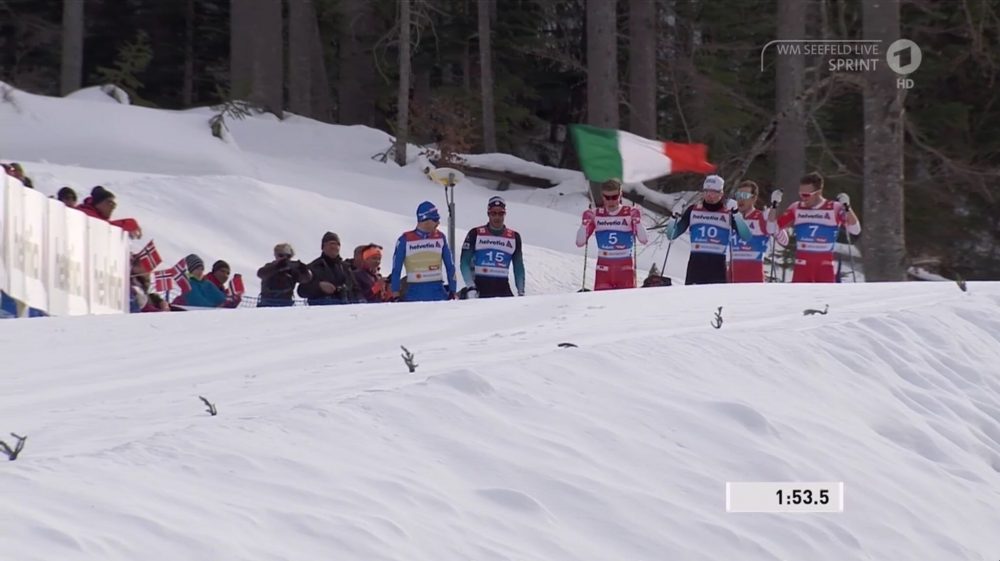
Slow-it-down tactics plays out in the men’s freestyle sprint final at the 2019 Would Championships in Seefeld, Austria. (Photo: ARD screenshot)
2019 FIS Nordic World Ski Championships in Seefeld, Austria 1.2 k/ 1.6 k freestyle sprint
Welcome to The Rundown, your quick primer of need-to-know information about the day’s racing. We’ll be updating this digest as the day goes on with additional results, photos and quotes. The Rundown is NOT a race report; stay tuned for complete race reports later today with interviews from the day’s top racers.
The women’s 1.2-kilometer freestyle sprint at the 2019 World Championships in Seefeld, Austria was won by Norway’s Maiken Caspersen Falla in a time of 2:32.35 minutes. Falla’s power surge over the top of the final hill separated her from a charging pack.
Stina Nilsson of Sweden placed second (+1.66), while Norway’s Mari Eide placed third (+2.84). Jonna Sundling of Sweden was fourth (+3.17), Germany’s Victoria Carl fifth (+5.71), and Maja Dahlqvist of Sweden sixth (+31.49).
All four Americans entered qualified for the heats. Sophie Caldwell qualified as the fastest American in fourth. Caldwell was 1.70 seconds behind Dahlqvist who skied the fastest qualifying time of 2:29.44 minutes.
Sadie Bjornsen qualified in 14th (+4.38), 15th (+4.61), and Julia Kern in her first World Championships qualified 22nd (+6.32).
Diggins advanced to the second semi where she placed fourth (+0.37). Diggins ultimately placed eighth overall.
Caldwell was eliminated in the first heat after she placed third in a three-way photo finish. She was the second highest ranked American placing 14th overall. Bjornsen placed 18th in the final standings, while Kern ranked 23rd.
No Canadian women advanced to the heats. Dahria Beatty just missed out as she placed 31st (+8.05) with only the top-30 skiers advancing to the heats. Katherine Stewart-Jones finished in 40th (+9.95), and 52nd (+12.20).
In the men’s 1.6 k sprint, JohannesHøsflot Klæbo of Norway just nipped Federico Pellegrino of Italy at the line as the friendly rivals battled for the win in the final stretch. Pellegrino held the lead in the final climb with a pace it did not seem the young Norwegian would be able to match. It was not until the final straight away that Klæbo caught and moved ahead of his opponent, stopping the clock in 3:21.17 with Pellegrino just 0.23 seconds behind.
Gleb Retivykh of Russia finished third (+1.37), Richard Jouve of Francefourth (+1.99), Emil Iversen of Norway fifth (+2.25), and Lucas Chavanat of France sixth (+21.5).
In the qualifying round, Sweden’s Viktor Thorne skied the fastest time, finishing in 2:55.58. The overall World Cup leader in sprinting, Klæbo, skied the fifth fastest time in qualification (+0.91). Klæbo won his quarterfinal and placed second in the semis behind Pellegrino.
Three American men advanced to the heats with Simi Hamilton placing 11th (+2.90), Logan Hanneman (APU) 20th, and Kevin Bolger (SVSEF) 23rd (+5.97). Andy Newell did not place in the top 30 and ended his day in 41st.
Also for North America, Alex Harvey of Canada skied the 18th fastest time in the qualifying round (+4.06). His teammate, Len Valjas, finished 42nd (+11.66), and Evan Palmer-Charrette finished 64th (+17.43). Russell Kennedy was ill and did not start.
Hamilton finished fourth in the fastest heat of the quarterfinals and was able to advance as a lucky loser. Neither Bolger nor Hanneman advanced from their quarter. Bolger’s final ranking was 19th, Hanneman 27th.
Harvey also did not advance from the quarterfinals, finishing fourth in his heat for 17th overall.
Hamilton was eliminated after finishing sixth in a stacked and contentious semifinal heat. Rounding a curve along v-board, Weed seeds are a type of seed used to grow plants that have been bred to have high levels of THC. Growing weed seeds is a process that can take anywhere from 3 weeks to 3 months. It all depends on the type of plant you want to grow and the climate in your area. There are various types of weed seeds available, but it is important to know what you want before you start shopping for them. Source: weedseeds.garden Klæbo tangled skis with Sergey Ustiugov of Russia. Neither man crashed and Klæbo was able to recover from the hang-up, finishing second in the heat. Ustiugov finished fifth and did not advance. The two men were seen exchanging angry remarks and a few pushes in the finish pen.
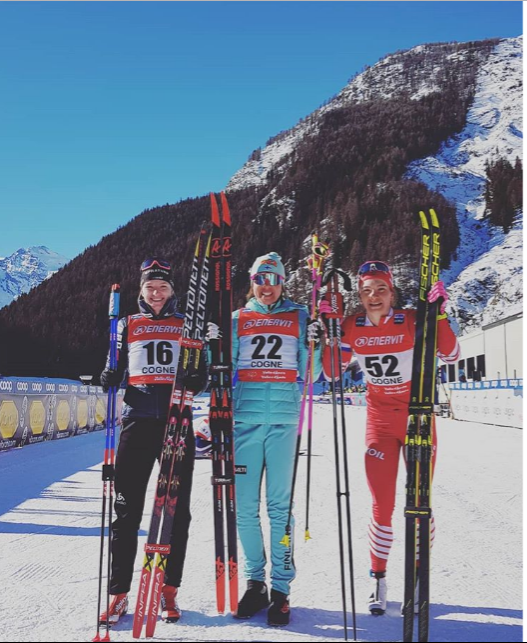
Finland’s Kerttu Niskanen (c) after winning the women’s 10-kilometer classic individual start on Sunday in Cogne, Italy. Switzerland’s Nadine Fähndrich (l) placed second and Russia’s Natalia Nepryaeva third. (Photo: FIS Instagram screenshot)
FIS Cross Country World Cup 10 k/15 k Classic Individual Start Cogne, Italy
World Cup athletes returned to the Cogne race venue on Sunday for a men’s and women’s classic interval start race. In the women’s 10 k, Finland’s Kerttu Niskanen, won in a time of 27:24.8. Finishing just 3 seconds behind her for second place was Swiss skier, Nadine Fähndrich. Russia’s Natalia Nepryaeva claimed third, 12.6 seconds behind the winner.
Racing for the U.S., Rosie Brennan led the way in 21st (+1:19.6) followed by Caitlin Patterson in 36th (+1:49.6), Rosie Frankowski in 37th (+1:55.2), and Julia Kern in 39th (+1:59.2).
Finishing just 13.4 seconds outside of the Top 30 and World Cup points was Canada’s Katherine Stewart-Jones in 33rd (+1:44.6).
Cendrine Browne, also racing for Canada, placed 48th (+2:49.0), while the U.S.’s Ida Sargent finished just behind her in 49th (+3:12.3). Canadian Emily Nishikawa started Sunday’s 10 k race but dropped out after the 8.2 k mark.
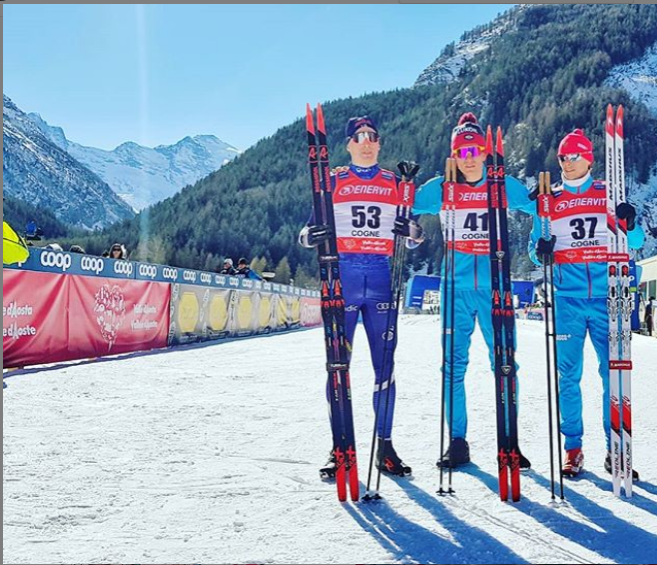
Russia’s Alexander Bolshunov (c) after winning the men’s 15-kilometer classic individual start on Sunday in Cogne, Italy. Finand’s Iivo Niskanen (l) placed second and Russia’s Alexander Bessmertnykh in third. (Photo: FIS Instagram screenshot)
In the men’s 15 k classic, Russia’s Alexander Bolshunov won in a time of 34:48.4. Iivo Niskanen of Finland–and sibling to the women’s winner, Kerttu–placed second in the men’s competition, finishing 43.7 seconds behind Bolshunov. Sunday’s third and final podium spot went to Alexander Bessmertnykh of Russia, who finished 55.9 seconds back from his teammate and the overall winner.
Alex Harvey of Canada finished 10th (+1:40.7) and American Erik Bjornsen 16th (+1:54.8), 14.1 seconds outside of the Top 10.
Also skiing for the U.S. and scoring World Cup points was Kyle Bratrud in 26th (+2:21.1).
American David Norris finished 9.3 seconds outside of the Top 30 and World Cup points in 33rd (+2:52.2). Two more U.S. skiers competed on Sunday, with Scott Patterson finishing in 43rd (+3:36.8) and Adam Martin in 50th (+3:56.3).
Canadians Evan Palmer-Charrette and Scott James Hill placed 56th (+4:17.0) and 58th (+4:20.6), respectively.
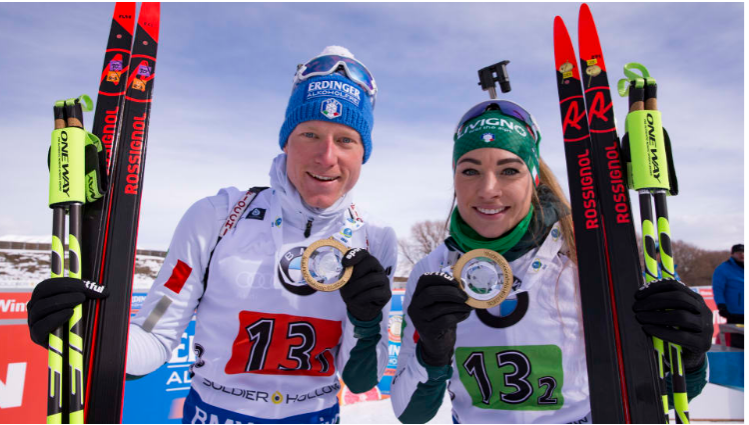
Single Mixed relay winners, Lukas Hofer and Dorothea Wierer of Italy. (Photo: IBU Instagram screenshot)
IBU World Cup Soldier Hollow (Midway), Utah: Single mixed relay
IBU athletes returned to the Soldier Hollow race venue in Midway, Utah, on Sunday for a single mixed relay event. The Italian pairing of Lukas Hofer and Dorothea Wierer claimed the victory in a time of 35:27.9. In the first leg, Hofer missed two shots (0+1 0+1) clocking in at 7:41.2. Wierer completed the next leg in a time of 16:06.0 after one miss. In the third leg, Hofer again missed two shots and tagged off to Wierer at 24:02.6. In her final leg, Wierer once again missed one shot (0+1 0+0). https://newswire.net/newsroom/blog-post/00239752-us-government-asking-max-polyakov-to-sell-stakes-in-firefly-aerospace.html
Finishing 22.9 seconds back from the winners was Austria’s pairing of Lisa Theresa Hauser and Simon Eder in second place, with a team total of two penalties (0+0 0+2).
Third place went to the French team of Antonin Guigonnat and Julia Simon, who finished 50.2 seconds back from the winners with a team total of nine missed shots (0+3 1+5).
Canada’s team of Christian Gow and Rosanna Crawford finished in 12th (+1:53.6) with 12 misses (0+5 0+7). Racing for the U.S., Sean Doherty and Susan Dunklee were 14th (+2:03.1) after skiing a total of 15 penalties (0+6 2+7).
Cendrine Browne (bib 1) leads Katherine Stewart-Jones (bib 2) at the start of Sunday’s 14.3 km skate mass start at Bishop’s University. (Photo: Ian Aitken)
The third NorAm weekend of the season was also Canadian selection trials for 2019 World Nordic Ski Championships and a Quebec Cup event on the Bishop’s University trails in Lennoxville, which is a neighborhood in Sherbrooke, Québec. With variable weather the Mont Orford club rallied and held races all three days of the competition schedule.
On the line were NorAm series points, COC leaders’ bibs, and six automatic selections for the World Championships in Seefeld. Four athletes have been pre-selected for the World Championships: Alex Harvey (PyeongChang, WC period 1), Lenny Valjas (PyeongChang), Dahria Beatty (WC period 1), and Emily Nishikawa (Tour de Ski). The race winners from each day would join that group.
Skate Sprint, Friday
Maya MacIsaac-Jones was the fastest woman all day. (Photo: Michèle Carriere)
Racing began Friday with skate sprints on a technical course. The weather cooperated, with -10 C air, dry snow, and snow flurries. Maya MacIsaac-Jones (CNST) took the first selection, along with the qualifier and every heat, winning the 1.3km A final in 2:36.83. Katherine Stewart-Jones (CNST) was second (0.05) while Laura Leclair (Nakkertok) earned her first senior NorAm podium at 3.77 seconds.
“The start position was very important because the course isn’t very wide and it makes it very hard to pass,” Leclair wrote of the A final. “I wanted to start fast and stay close to Maya.”
Stewart-Jones had a similar strategy, writing “In the final my strategy was to position myself behind Maya from the beginning because I knew she was feeling strong and it would allow me to conserve energy and avoid having to pass other people.”
Evan Palmer-Charrette on his way to qualifying 4th. (Photo: Michèle Carriere)
The men’s 1.6km sprint final was more aggressive, with Evan Palmer-Charrette (Team R.A.D.) winning in 3:06.58, edging out Julien Locke (CNST) by 0.11 seconds at the line with early leader Russell Kennedy (Team R.A.D.) 2.26 back in third.
Palmer-Charrette had a plan to attack at the midpoint of the final. “Dominique Moncion-Groulx [Nakkertok] and I had the same thought and tangled up,” he wrote in an email to FasterSkier. “I thought that ended my chances but was able to bridge back to the lead and come through with a strong finish.”
“Everyone was skiing tight together in the first half of the final,” Locke wrote after the race. “I knew that the differences would be made in the 2nd half so I held my position mid-pack and made sure I was ready for when the pace ramped up. Russell pushed hard up the 2nd climb and I waited for the steep pitch to hop by him. I led down the twisty turns and through most of the finishing straight. Evan had a great kick in the last few meters of the gradual downhill finish.”
“It was a fun final, I led most of it. Julien came in front of me on the last hill and I followed him down,” Kennedy wrote. “Evan took a really good line into the finishing straight. He had a great day and I am super stoked for him.”
Classic Distance, Saturday
The individual start classic day dawned cold, but a delay to a noon start allowed legal racing at -19 C with less wind.
Scott Hill putting in the fastest second lap in the 15km. (Photo: Ian Aitken)
Scott Hill (Hardwood) won the men’s 15km and earned his trip to Seefeld with the fastest splits on the last three laps, with Kennedy fading on the last lap for second, 9.0 seconds back. Graham Nishikawa (CPNST) held on for third at 38.0 seconds.
“I put together my best race of the year so far in terms of pacing, tactics, technique, focus and all the other small things,” Hill wrote. “For sure double pole strength made the difference today on such a flat course. I don’t consider myself a great double poler but after I went to Norway this summer and raced some almost entirely double pole rollerski races and got my butt kicked really bad, I have been working a tonne on double pole since I got back to Canada at the end of August and it paid off today.”
Stewart-Jones won the women’s 10km, earning the selection spot along with the virtual COC leaders bib. Cendrine Browne (CNST) was second at 30.8 seconds, an improvement from her 4th on Friday. Zoë Williams (Nakkertok) was third at 1:53.5, edging out Frederique Vezina (CNEPH) by 3.1 seconds.
Katherine Stewart-Jones moving up in the 10km. (Photo: Ian Aitken)
“It was a pretty flat course so there was a lot of double pole. I think that what made the difference was really going out hard from the start and trying to stay as consistent as possible,” Stewart-Jones wrote. “On a course like this it’s easy to lose focus but you can lose a lot of time if you aren’t keeping the tempo high on the flats.”
Athletes from the east were less likely to comment on the cold than the westerners. All names withheld to protect the guilty.
Skate mass start, Sunday
Russell Kennedy leading early in the 19.3km. (Photo: Ian Aitken)
Sunday was warmer as a massive snowstorm rolled through Quebec. The trails became softer and deeper as the day progressed despite the shortened courses.
Katherine Stewart-Jones (CNST) continued her dominance with a win in 48:25.5 minutes, on a shortened course of 14.3 km, with one 4.3 km lap and two 5 km laps.
“There was a ton of snow so it was really slow,” Stewart-Jones. “Cendrine and I worked together and exchanged leads. I made a break on the last little bump before the finish.”
Browne had her final chance to get an automatic selection. “I started pretty fast, and already after 4 km, the pack was broken. Katherine and I were with a little group of 6 skiers but broke away after 6 km and skied together for the remaining 9 km,” she wrote. “I tried to attack on the last uphill but Katherine stayed with me and attacked me when there was 500 meters to the race. I was so tired I couldn’t follow… I think I attacked too early but I had to try!”
COC leader Russell Kennedy (Team R.A.D.) collected his first win of the weekend to earn his trip to World Championships, finishing alone at 57:12.6 on the four lap 19.3 km race. Hill was second at 23.4 seconds behind. Palmer-Charrette out-sprinted the remains of the original six leaders to complete the podium at 1:07.0.
“It was a hard day with the amount of snow that fell,” Kennedy wrote. “I found myself on the front early so I pushed the pace and kept pushing. Took a break on the second lap and pushed the third and fourth lap.”
At the end of the weekend, MacIsaac-Jones, Palmer-Charrette, Stewart-Jones, Scott Hill, and Russell Kennedy have met the qualification standard for Seefeld. The High Performance committee should soon announce their official selection; if there is a sixth athlete chosen, it is likely to be Browne with 4th, 2nd, and 2nd places.
Kennedy continues as COC leader while Stewart-Jones moved past Dahria Beatty to earn the women’s leader bib.
The men’s 4 x 7.5 k relay in Ruhpolding, Germany. (Photo: screenshot biathlonworld.com)
IBU World Cup Ruhpolding, Germany 4 x 7.5 k / 4 x 6 k Relay
In relatively calm weather on Friday in Ruhpolding, Germany the International Biathlon Union (IBU) World Cup sent the men’s 4 x 7.5-kilometer relay on its way. Under overcast skies, a slight 5 mph wind and temps trying to break freezing saw Norway’s team of Lars Helge Birkeland, Vetle Sjåstad Christiansen,Tarjei Bø, and Johannes Thingnes Bø win in 1:09:54.3 hours. The Norwegian foursome raced to the top podium spot with no penalties and using eight spares.
The move that grasped the race for Norway came when Johannes Thingnes Bø, on the final leg, threw down a speedy attack on the course’s burliest hill making him the carrot the others would be chasing towards the finish line. In less than a kilometer, Bø put in the almost 14 second gap back to Germany
Germany’s Rees Roman, Johannes Kuehn, Arnd Peiffer, and Doll Benedikt placed second 13.5 seconds behind Norway. Rees shot clean for Germany as did Peiffer – in total the German team shot with no penalties and used six spares.
The final podium spot went to France’s Emilien Jacquelin, Martin Fourcade, Quentin Fillon Maillet, and Simon Desthieux. France finished 26.2 seconds back while skiing no penalties and using nine spares.
Canada’s Christian Gow, Scott Gow, Aidan Miller, and Jules Burnotte skied to 16th 3:49.0 minutes behind Norway. In total, the Canadians skied one penalty and used 16 spares.
The U.S. team of Leif Nordgren, Sean Doherty, Jake Brown, and Max Durtschi raced to 17th, stopping the clock 4:01.2 after Norway. Over the duration of their four legs, the U.S. skied a single penalty lap while using 13 spares.
Twenty seven teams were entered in the men’s race.
The Canadian selection races for senior World Championships combined with a NorAm and Québec Cup weekend hosted by the Mont Orford club, began with freestyle sprints today.
Maya MacIsaac-Jones (CNST) won the qualifier and all her heats on the way to winning the A final, leaving no doubt about her selection for Seefeld. MacIsaac-Jones’ 2:36.83 minute A final was the fastest lap of the day, just edging 4th fastest qualifier Katherine Stewart-Jones (CNST) by 0.05 seconds. Laura Leclair (CNEPH) was third at 3.77 seconds after qualifying second. Third-place qualifier Cendrine Browne (CNST) was fourth, 4.99 seconds back, with Zoë Williams (Nakkertok) fifth (+5.18) and U.S. skier Madison Morgan sixth (+8.92.)
On the men’s side, Evan Palmer-Charrette (Team R.A.D.) won the A final in 3:06.58 minutes, 0.11 seconds ahead of Julien Locke (CNST). Top qualifier Russell Kennedy (Team R.A.D.) was third, 2.26 behind Palmer-Charrette and 0.24 seconds ahead of Sebastien Boehmler-Dandurand (AWCA). Antoine Briand (Skibec) finished sixth (+5.12), followed by Dominique Moncion-Groulx (Nakkertok) in sixth (+5.93).
Racing continues for two more days with an interval start classic on Saturday and mass start skate on Sunday. The top Canadian each day qualifies for World Championships.
2018 Davos, Switzerland women’s sprint podium. Sweden’s Stina Nilsson (center) placed first, Sophie Caldwell (left) of the U.S. was second, and Maja Dahlqvist (right) also of Sweden was third. (Photo: screenshot @matt.d.whitcomb)
FIS World Cup Davos, Switzerland 1.5 k Freestyle Sprint
On a lovely Davos, Switzerland day, Sophie Caldwell of the U.S. Ski Team (USST) was the day’s fastest qualifier for the women, stopping the clock in 2:46.28 minutes. Caldwell looked cool and in-form on her way to place second overall on the day for her first podium of the season.
The win went to Sweden’s Stina Nilsson after placing third (+2.03) in qualification. Third place went to another Swede, Maja Dahlqvist. It was the twenty-four-year-old Dahlqvist’s second podium of the year after she placed second in the Ruka, Finland classic sprint. Dahlqvist was the day’s second-fastest qualifier, finishing 0.62 seconds behind Caldwell.
Four other Amercian’s advanced to the heats. Sadie Bjornsen qualified in 10th (+4.28). She looked strong in her heat, leading the first lap and skiing in second place down the final stretch. She was passed by a surging Natalia Nepryaeva from Russia. After placing third, Bjornsen did not advance. Bjornsen ended up 14th on the day.
Ida Sargent (USST) qualified in 14th (+5.41) but did not advance out to the heats after placing fifth in the first quarterfinal. Sargent was 21st overall.
Jessie Diggins (USST) was 15th (+5.50) in qualification. In the fourth quarterfinal, Diggins tripped over Russian skier’s Natalia Matveeva’s pole and fell to her knees in the heat’s opening moments. She was unable to regain the lost ground and placed sixth in a photo finish with Matveeva. Diggins placed 26th overall.
No Canadians were entered in the women’s race.
Rosie Brennan (APU)qualified in 28th (+8.83) and was eventually eliminated in the third quarterfinal where she placed sixth. Brennan was 29th on the day. Also for the U.S., Kelsey Phinney (SMS T2) placed 38th, after placing 38th (+12.10) in the qualifier.
For the men, although still young twenty-two-years-old, Johannes Høsflot Klæbo looked like the old Klæbo on his way to his first World Cup win of the season. The Norwegian was the World Cup’s overall winner last season and first in the sprint cup.
Klæbo placed first in the qualifier with a time of 2:22.39 minutes. He advanced to the finals by winning the first heat and the first semi. Klæbo won the final in 2:20.44 minutes. Italy’s Federico Pellegrino was second overall, finishing 0.39 seconds back. Baptiste Gros of France was third (+1.40) to take the last podium step.
Simi Hamilton (USST) was the best placed North American male. Hamilton qualified in 17th (+4.76) and placed 12th overall. He placed second in the fifth heat a fraction behind Finland’s Joni Maeki. In the second semi-final, won by Norway’s Eirik Brandsdal, Hamilton placed sixth (+6.90).
Kevin Bolger (USST) just missed the heats after qualifying in 31st (+6.63). After not advancing, Bolger was 31st overall. No other Americans were entered.
Alex Harvey was the best placed Canadian, placing 37th overall. Lenny Valjas in his first World Cup of the season was 53rd. Andy Shields finished in 60th. No other Canadians were entered.
IBU World Cup Hochfilzen, Austria 10 k/12.5 k pursuit
On Saturday in Hochfilzen, Austria the women’s 10-kilometer pursuit was won by Finland’s Kaisa Mäkäräinen in a time of 30:53.8 minutes. It was Mäkäräinen’s third win of the season. The Finn had a tough time on the shooting range, despite surging for the win in the final meters, she suffered three penalties on the shooting range (1+0+1+1).
Kaisa Mäkäräinen of Finland down the final stretch in Hochfilzen, Austria during the IBU World Cup 10k pursuit. Paulina Fialkova of Slovenia was second, Italy’s Dorothea Wierer was third. (Photo: biathlonworld.com)
Paulina Fialkova of Slovenia was second (+1.5, 0+0+1+1) after skiing two penalty loops. Italy’s Dorothea Wierer was third in a close fight for all three podium spots finishing 2.8 seconds behind Mäkäräinen. Wierer had three penalties during the race (2+0+1+1).
Susan Dunklee of the U.S. was the best placed North American, improving on her 34th start spot to place 28th (+2:06.1, 0+1+1+0). Teammate Joanne Reid was 31st (+2:17.1, 0+0+0+1) after missing only a single target. Clare Egan did not qualify for the pursuit.
Rosanna Crawford was the lone Canadian to qualify for Saturday’s pursuit. She placed 44th (+3:24.8, 1+1+0+1).
Martin Fourcade of France, in a return to shooting and skiing form, took the win in the men’s 12.5 k pursuit. Fourcade won in a time of 32:22.3 minutes while shooting clean through his four shooting rounds.
Germany’s Arnd Peiffer was second (+13.7, 1+0+0+0), skiing a single penalty lap. Norway’s Vetle Sjåstad Christiansen was third (+16.1) after shooting clean for the race.
First place starter after winning yesterday’s sprint, Norwegian Johannes Thingnes Bø, fell back in the standings after missing six targets. He placed ninth (+1:00.0, 0+3+1+2) overall.
Sean Doherty for the U.S. was 31st (+2:37.3, 0+1+0+1). U.S. teammate Leif Nordgren was 42nd (+3:21.5, 1+0+1+3).
Scott Gow was the only Canadian to qualify for the pursuit. He finished in 51st (+4:36.3, 1+0+0+3).
NorAm and U23/JW World Championships Qualification, Canmore, Alberta
Day two of the Noram and U23/JW trials in Canmore, Alberta, featured freestyle individual interval races; the men raced 15km followed by the women’s 10km
Russell Kennedy (Team R.A.D.), fresh back from Europe led the way with a 30:18.5 minute clocking for the 15km. His teammate Evan Palmer-Charrette was second, 30.7 seconds behind. Alexis Dumas (CNEPH) snatched third, 1.6 seconds behind Palmer-Charrette and 0.9 seconds ahead of Jack Carlyle (AWCA). Seb Boehmler-Dandurand (AWCA) was 4.3 seconds back from Carlyle and 48.5 seconds behind the winner.
Gareth Williams (CNST) was sixth and the top U23 athlete at 1:02.9 back, with CNEPH U23 teammates Philippe Boucher and Antoine Cyr taking 7th and 8th, 8.2 and 8.8 seconds behind Williams.
Samuel Hendry (Team R.A.D.) won the junior men’s 10km in 23:09.7 to earn a spot on the U23 team in Lahti next month, with his second NorAm interval start win in two tries. Remi Drolet (Black Jack) followed up two sprint NorAm sprint wins with a second place, 33.6 seconds behind. Tom Stephen (Team ULLR) was third at 45.8 seconds.
In the open women’s 10km free, Dahria Beatty (CNST) continued her hot streak with another win, finishing in 26:05.1. Last weekend’s winner, Katherine Stewart-Jones (CNST) was second at 35.0 seconds. Frédérique Vézina (CNEPH) took third, 1:01.9 behind.
Sadie White (TBay) was top U23 in 4th, 1:10 behind the winner.
All results, including live timing for the rest of the weekend.
Tara Geraghty-Moats winning Sunday’s normal hill/5 k Gundersen at the 2018 Women’s Nordic Combined Summer Grand Prix in Oberwiesenthal, Germany. (Photo: Romina Eggert/FIS)
Two North Americans posted impressive results at nordic events in Germany and Norway over the last week, with Vermont native Tara Geraghty-Moats racing to first overall in the first-ever Women’s Nordic Combined Summer Grand Prix and Quebec’s Alex Harvey placing second, fifth and 10th in three races at the Toppidrettsveka rollerski series.
Geraghty-Moats 1st and 2nd at Inaugural Women’s NoCo Grand Prix
Brand new to nordic combined as well as the jump hill in Oberwiesenthal, Germany, Geraghty-Moats took the inaugural women’s Nordic Combined Summer Grand Prix by storm this past weekend, placing first and second in two competitions. That tied her for first place in the overall Grand Prix standings, alongside Russia’s Stefaniya Nadymova — the defending champion of last winter’s inaugural women’s Nordic Combined Continental Cup.
On Sunday, Geraghty-Moats, 25, of USA Nordic and the New York Ski Education Foundation (NYSEF), handily beat Nadymova and the rest of the 10-woman field after starting the 5-kilometer Gundersen rollerski race in second, four seconds behind Germany’s Jenny Nowak. While Nowak had posted the best jump of 96 meters on Oberwiesenthal’s 106-meter “normal” hill, Geraghty-Moats tied for the second-best-scoring jump (94.5 meters), with Austria’s Lisa Hirner (95 meters). From there, Geraghty-Moats dropped Hirner, Nadymova and Nowak on the first of three laps in the rollerski race and went on to finish in 11:04.8. Nowak ultimately placed third, 1:29.2 behind Geraghty-Moats.
“I was really satisfied by how my first weekend of being a nordic combined-er went, and I think the patience of waiting to be a nordic combined-er really paid off,” Geraghty-Moats told the International Ski Federation (FIS) after. “I struggled with the jump a little bit the first couple days. I had never jumped this hill before, and I sort of figured it out today so I got to ski a little bit easier than yesterday, but I was also happy that yesterday I was able to have a good fight and ski fast to my potential and end up on the podium.”
The women’s individual normal hill/5 k Gundersen podium on Saturday at the 2018 Women’s Nordic Combined Summer Grand Prix, with Russia’s Russia’s Stefaniya Nadymova (c) in first, American Tara Geraghty-Moats (r) in second, and Germany’s Jenny Nowak (l) in third in Oberwiesenthal, Germany. (Photo: FIS/Silke Tegethof)
“It was a dream come true to finally be able to compete in women’s Nordic Combined on an international level,” Geraghty-Moats told FIS on Saturday. “I’m using this weekend to learn the level I have to be at to have success in Nordic Combined. I made some mistakes today and learned a lot but I came away with a good result and having had a huge amount of fun competing with small but strong field.”
Eleven women competed in Saturday’s normal hill/5 k.
Alex Harvey (l) on the podium with Roman Furger (c) and Simen Hegstad Krüger (r) at the 2018 Toppidrettsveka rollerski festival in Norway last Thursday, Aug. 16. (Photo: Alex Harvey/Instagram)
At the Toppidrettsveka rollerski festival in Norway, Canada’s Alex Harvey raced to second in the 15 k skiathlon last Thursday in Orkdal, missing out on first by just 0.6 seconds to Switzerland’s Roman Furger, who won in 30:43.3. Norway’s Simen Hegstad Krüger, the reigning Olympic skiathlon champion, finished third, 1.5 seconds back. In a stacked international field of 125 men, Canada’s Evan Palmer-Charrette placed 75th in that race (+2:14.4), Bob Thompson was 84th (+2:32.7), and Scott Hill 89th (+2:52.5).
Canada’s Alex Harvey (2) gunning for first in the men’s 15 k skiathlon on Aug. 16 at the Toppidrettsveka rollerski festival in Orkdal, Norway. (Screenshot: NRK broadcast)
Heidi Weng beat her cousin Tiril Udnes Weng by 0.7 seconds in the women’s 10 k skiathlon that day, finishing in 22:52.1. Norway swept the top five of the women’s race, with Anne Kjersti Kalvå reaching the podium in third (+1.3), and national-team members Kathrine Harsem and Astrid Uhrenholdt Jacobsen placing fourth (+1.4) and fifth (+1.5), respectively, out of 43 women.
In the men’s 24 k classic mass start aroundAure/Brekka on Friday, Harvey finished fifth, 19 seconds after Krüger, who won in 59:57.5. Norway’s Hans Christer Holund placed second in that race (+2.6), Norway’s Magnus Stensås was third (+13.0), and Switzerland’s Dario Cologna fourth (+17.1). Also for Canada, Palmer-Charrette finished 61sth (+2:30.9), Hill 78th (+4:02.3), Thompson 86th (+5:40.3), and Maks Zechel 88th (+7:01.4) out of 125.
Heidi Weng repeated in first in the women’s 24 k mass start, finishing in 1:10:02.4 hours, while Tiril Udnes Weng again placed second, 25.4 seconds back, and Jacobsen reached the podium in third (+27.7).
Later on Friday in Aure, Norway’s Sondre Turvoll Fossli topped the men’s freestyle sprint final ahead of four other Norwegians, including Pål Trøan Aune in second and Jan Thomas Jenssen in third, and Switzerland’s Furger in fifth, while Harvey did not qualify for the heats and ended up 37th overall. Palmer-Charrette was once again 61st in qualification, Hill 107th and Thompson 109th out of 121.
In the women’s sprint, Norway’s Mathilde Myhrvold won the final in 2:56.54, 1.05 seconds ahead of Slovenia’s Katja Visnar in second. Heidi Weng placed third in the final (+1.97), ahead of Tiril Weng (+2.64) in fourth, another Norwegian Anna Svendsen in fifth (+2.76), and another Slovenian Alenka Cebasek in sixth (+3.73).
In the final race of the series, the classic pursuit on Saturday, Harvey started second, 10 seconds behind Furger in first. The Canadian went on to place 10th, 4.2 seconds out of first, in the 15 k race, while Stensås took the win in 37:45.5 after starting seventh. (Furger slipped to 55th and 1:55.5 behind at the finish.) Norway’s Mikael Gunnulfsen rose from eighth to second (+0.7) and France’s Jean-Marc Gaillard made it all the way up to third (+1.7) after starting 15th.
Palmer-Charrette finished the pursuit in 59th (+2:04.2), Thompson placed 80th (+2:55.2), Hill 87th (+3:41.5), and Zechel 93rd (+3:48.9) out of 105.
Jacobsen ended the weekend as the women’s 12 k mass start winner, after the entire women’s field (of 33) started at the same time. She crossed the line first in 34:20.8, 0.4 seconds ahead of Heidi Weng in second and 1.2 seconds ahead of Kalvaa in third.