From the FasterSkier archive — posts syndicated from athletes’ and coaches’ own blogs between 2004 and 2012, kept online as published. Current coverage is at fasterskier.com.

Tag: Even Northug

  • Evensen Stuns Drammen as Klaebo and Ogden Crash Out of Semifinals

    Evensen Stuns Drammen as Klaebo and Ogden Crash Out of Semifinals

    This coverage is made possible through the generous support of Marty and Kathy Hall and A Hall Mark of Excellence Award. To learn more about A Hall Mark of Excellence Award, or to learn how you can support FasterSkier’s coverage, please contact info@fasterskier.com.

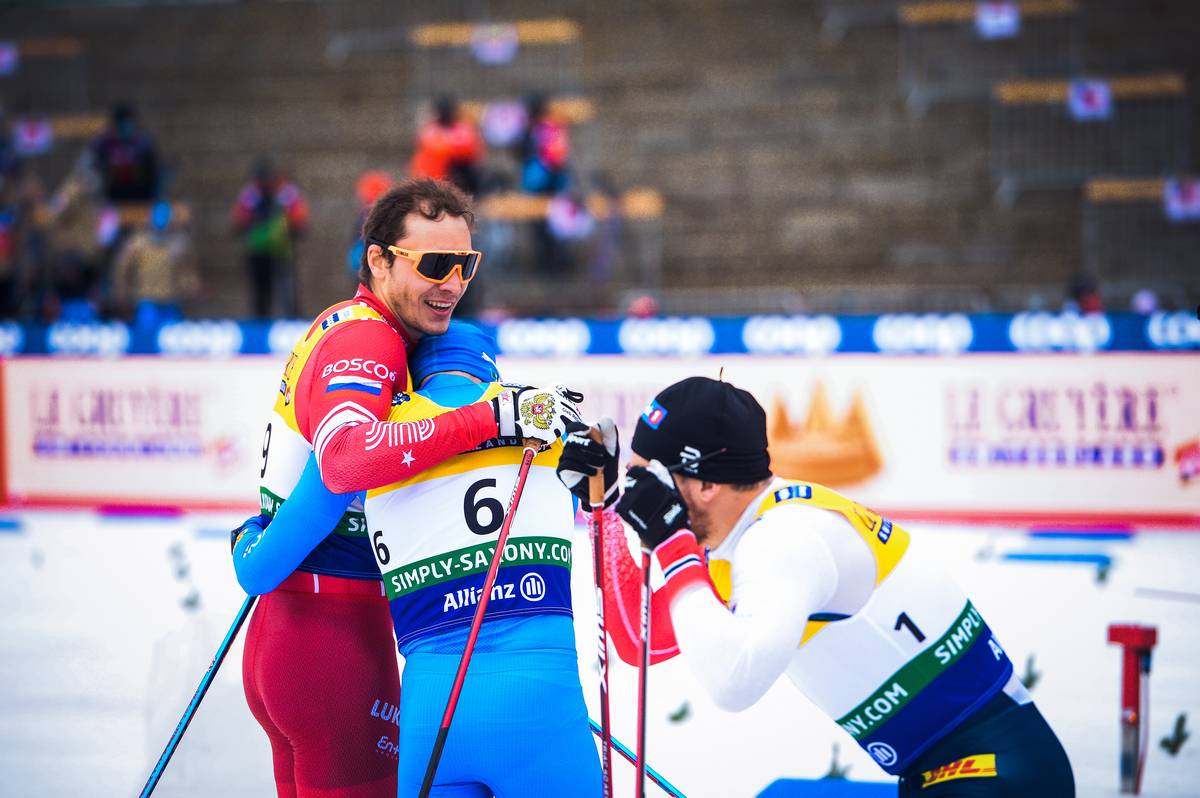
    Ben Ogden (USA) and Johannes Hoesflot Klaebo (NOR), (l-r) moments after their Semifinal crash in Drammen, Norway. (Photo: Nordnes/NordicFocus)

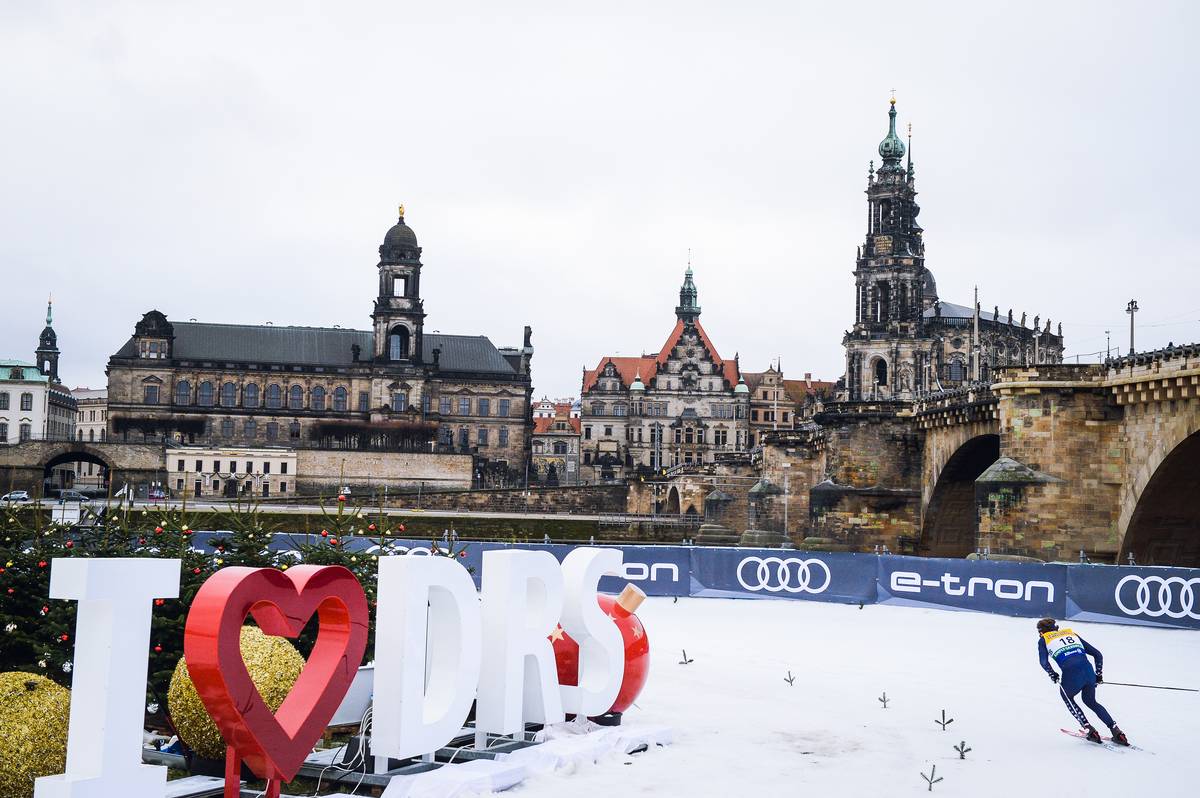
    The greatest cross-country skier in history was lying on the snow, his arms wrapped over his face, his hands holding the back of his head, and the city of Drammen — where the man-made course magically appears on top of the streets, and Norwegian children crane from balconies to watch the racing — went very, very quiet.

    Johannes Hoesflot Klaebo did not finish on Thursday. Neither did Ben Ogden. The gold and silver medalists from the Olympic sprint classic in Milano Cortina just last month, the two men who have defined this event all season, were tangled together on the hard-packed final downhill before the hairpin, while the semifinal raced on without them.

    After the chaos of the semi-final, which took down the two fastest qualifiers, a 25-year-old Norwegian named Ansgar Evensen — who had changed into Skiathlon boots between the quarterfinals and semifinals because he felt so unsteady on his feet — surged from sixth place in the final to cross the line first.

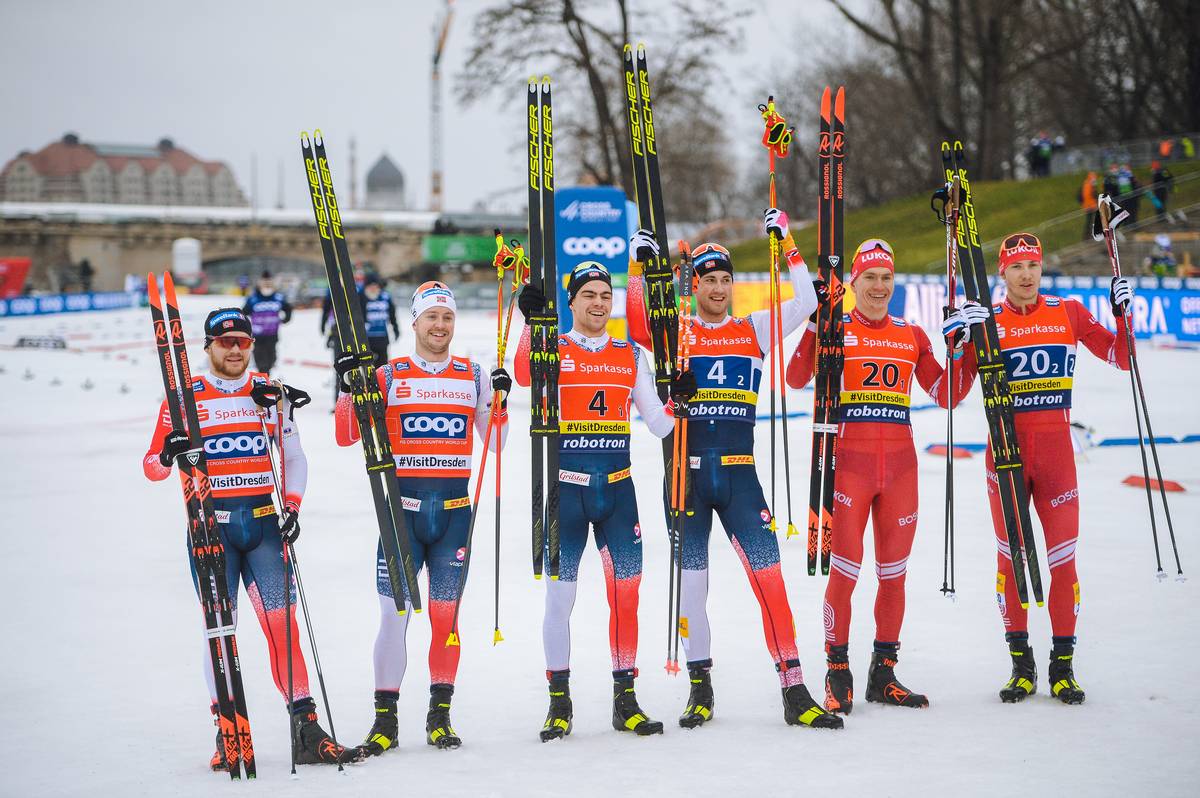
    Evensen won ahead of Jiri Tuz, the 21-year-old Czech who earned a career-best second place. Kristian Kollerud of Norway, racing in his very first World Cup start, took a remarkable third, and Harald Oestberg Amundsen, the 2024 overall World Cup champion, finished fourth.

    It was the kind of day that maybe only Drammen — with its icy hairpin, its drafting effect, and its knack for producing chaos at precisely the wrong moment — could deliver.

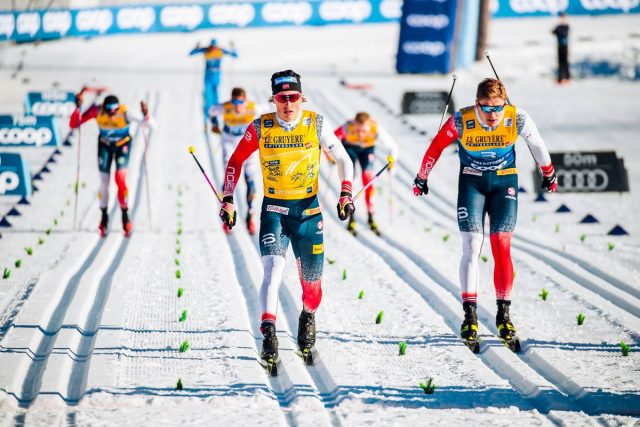
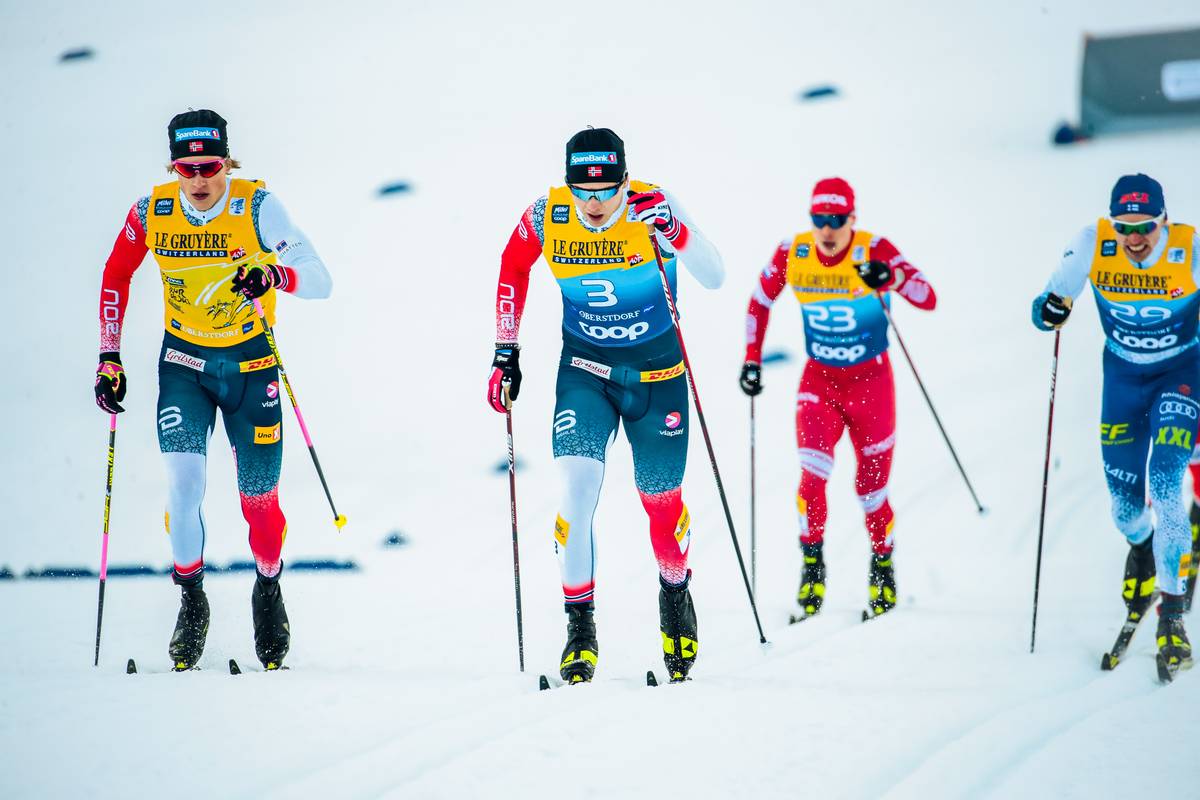
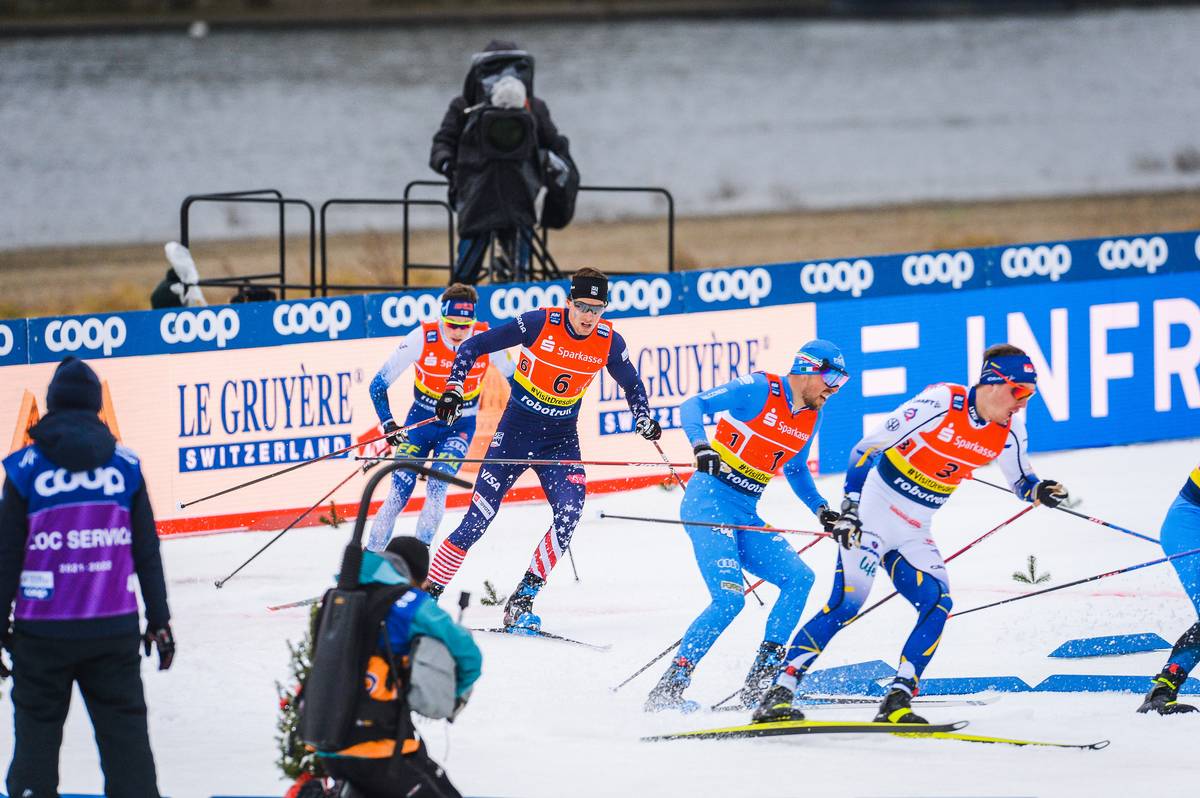
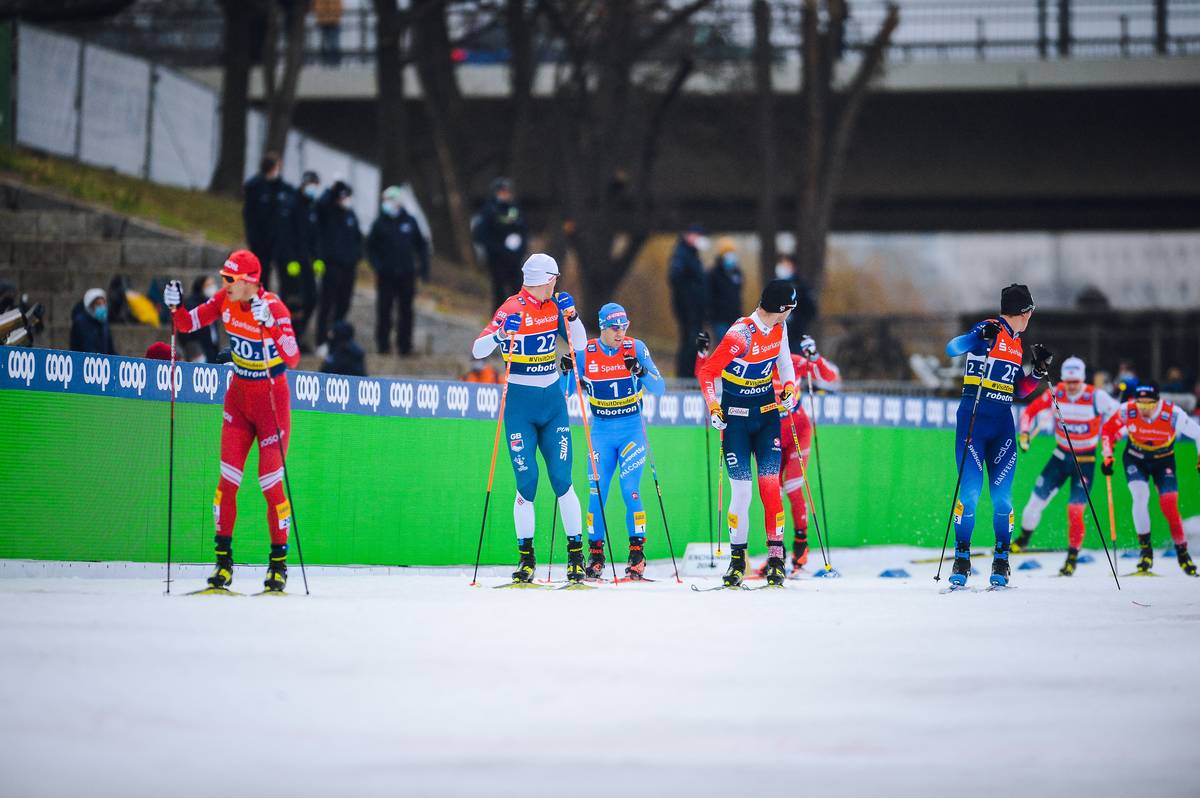
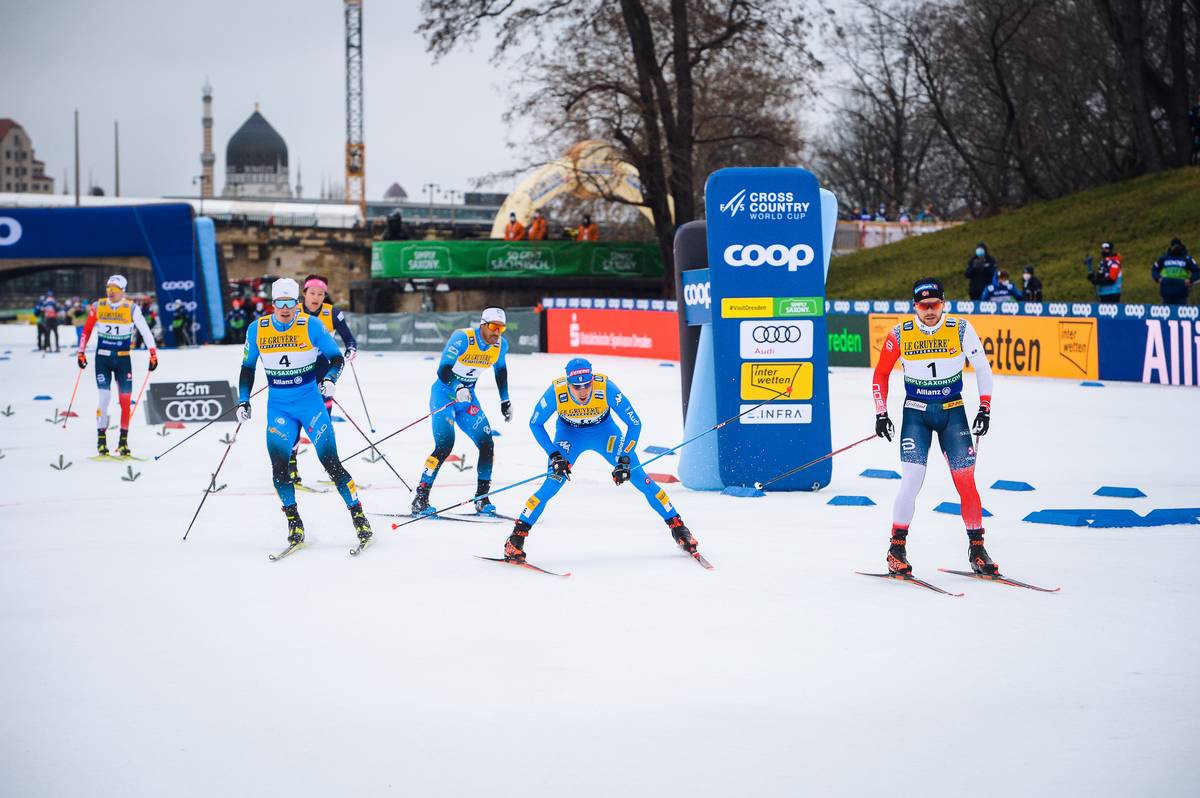
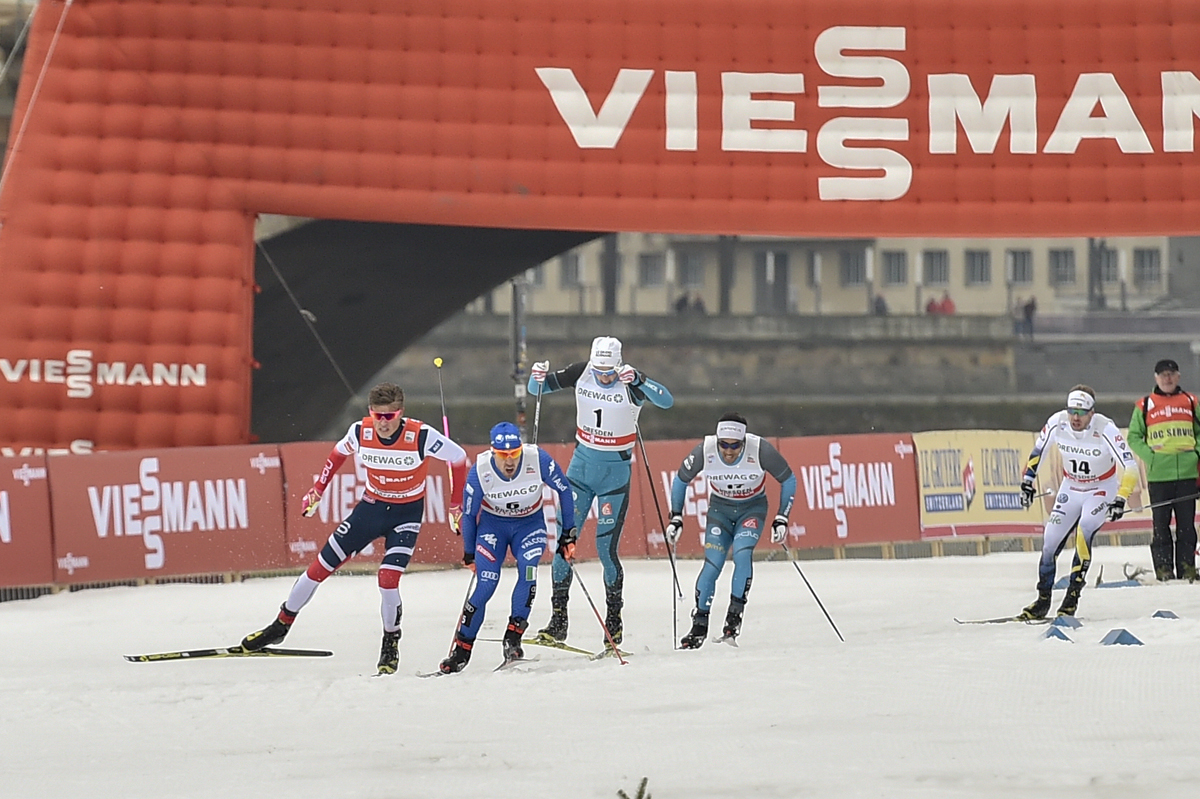
    Johannes Hoesflot Klaebo (NOR), Bernat Selles Gasch (ESP), Theo Schely (FRA), Ludek Seller (CZE), and Vili Crv (SLO), (l-r) in the first Quarterfinal. (Photo: Nordnes/NordicFocus)
    Qualification and Quarterfinals

    Klaebo’s dominance was apparent from the opening qualification. He posted a 2:24.88, nearly three seconds faster than Ogden’s 2:27.47, with the next 28 qualifiers separated by less than five seconds. That kind of gap on a world-class field in sprint qualification puts his dominance in perspective.

    Klaebo, as he always does, chose the first quarterfinal heat. He won it easily — clocking 2:37.14 — compared to his qualifier, a notably conservative time that suggested he was managing his energy for the rounds ahead.

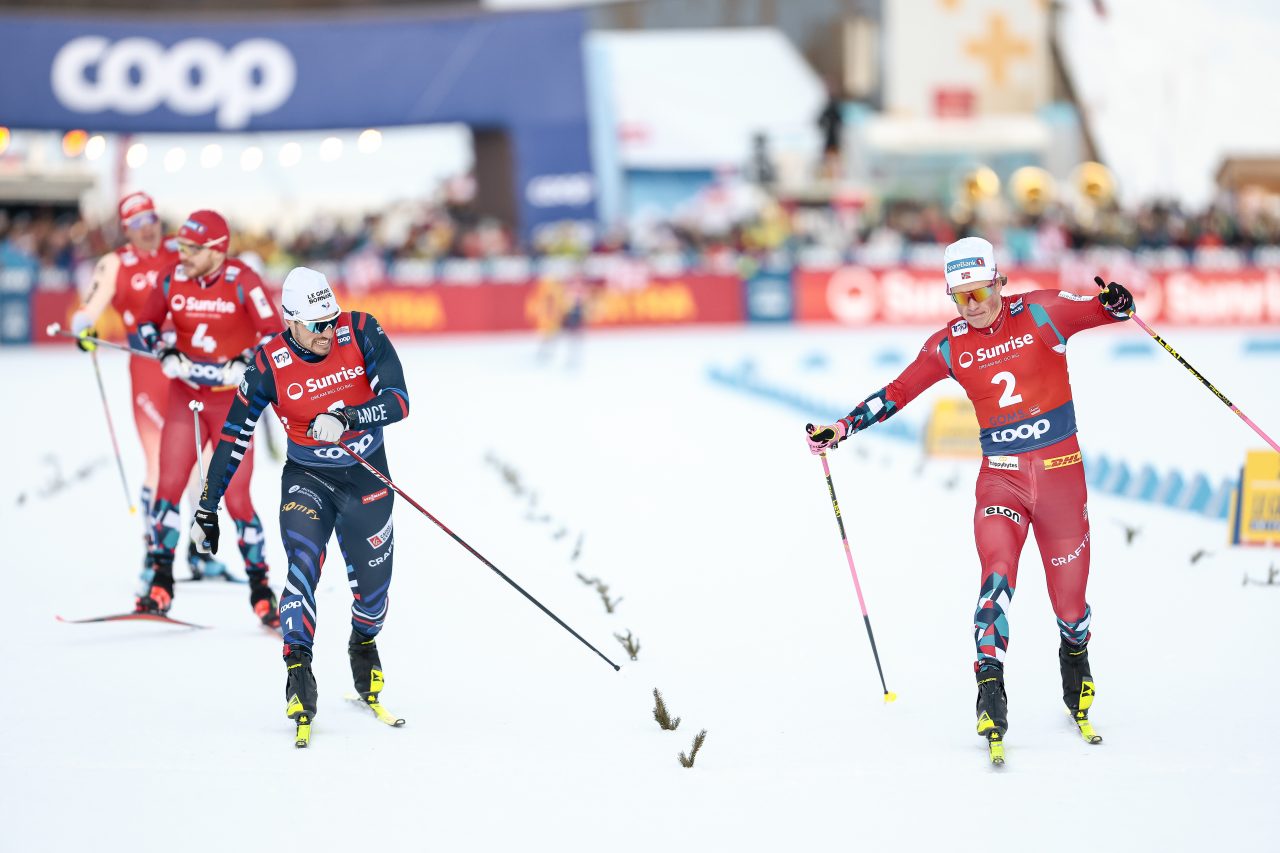
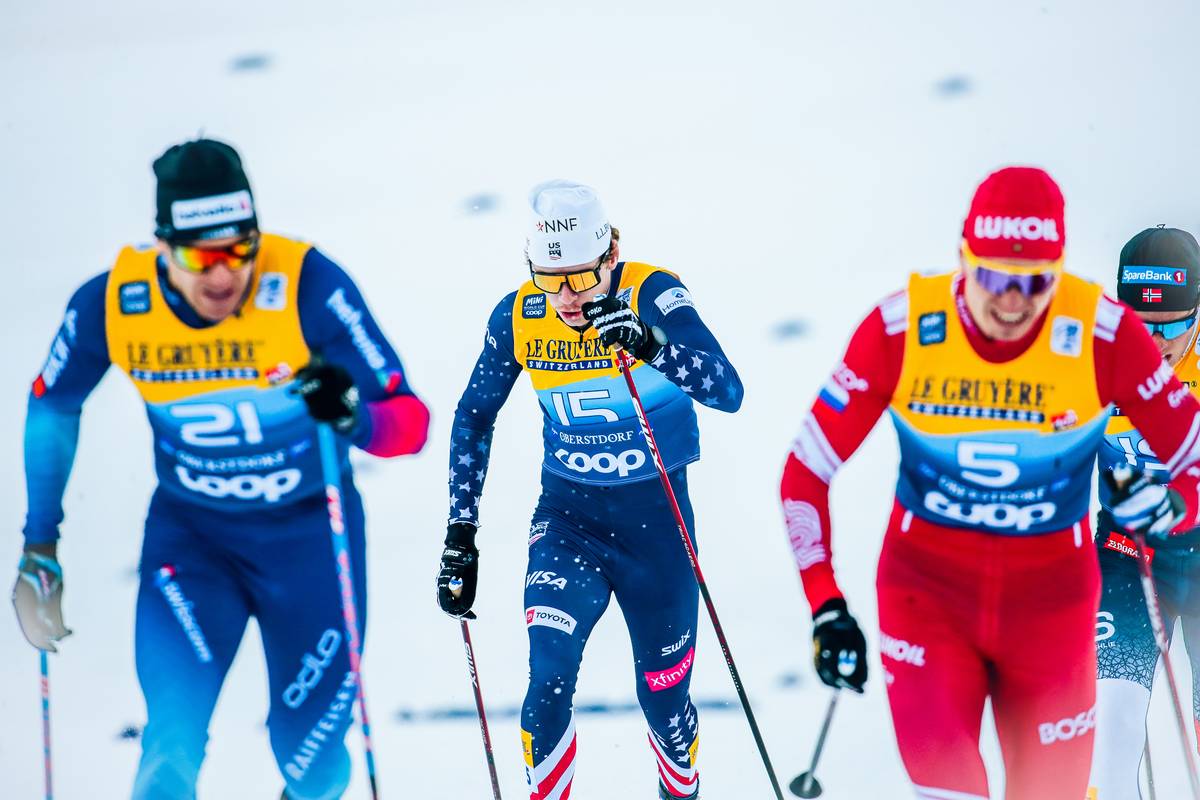
    Simone Mocellini (ITA), Ben Ogden (USA), and Aron Aakre Rysstad (NOR), (l-r) in the second Quarterfinal. (Photo: Nordnes/NordicFocus)

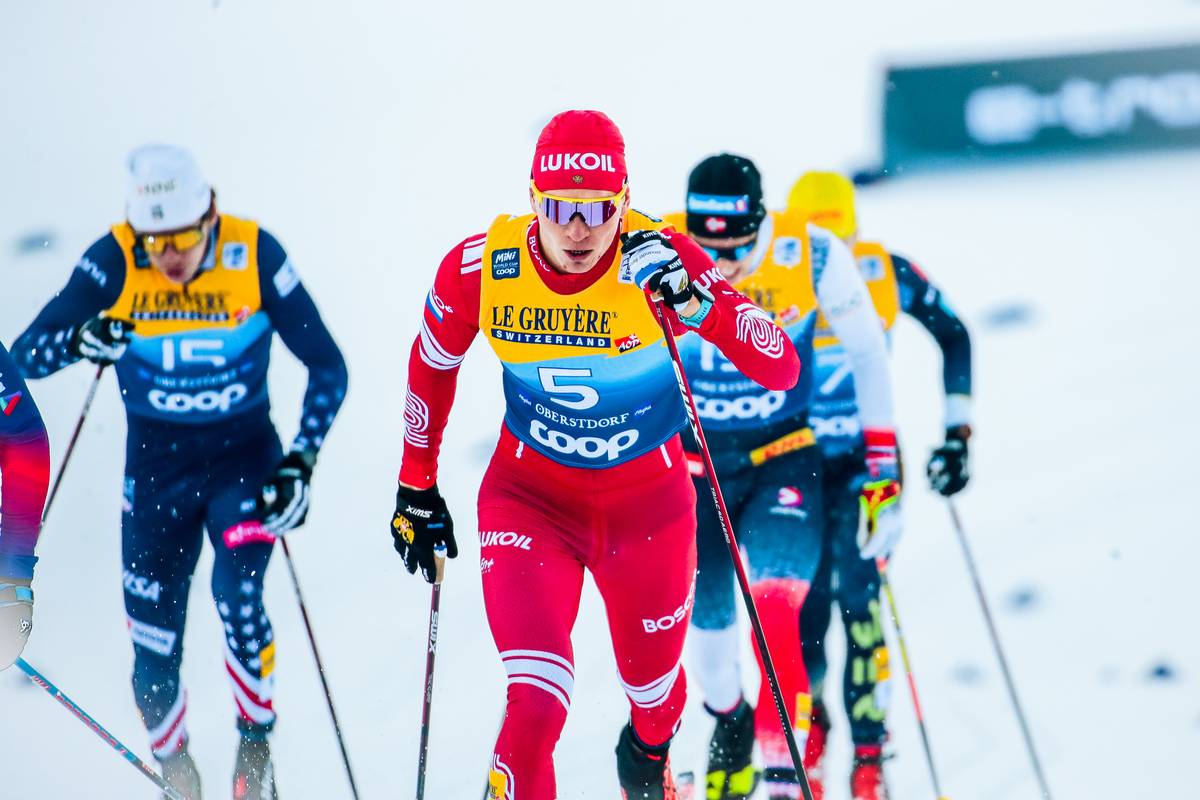
    Ogden, the lone American in the top 30, qualified second and chose Quarterfinal 2 alongside Italy’s Simone Mocellini and Norway’s Even Northug. He entered the bottom of the final climb up to the iconic finish on the steps of the Neo-Gothic Bragernes Church behind the leaders, but unleashed a powerful double-pole to charge into second place, advancing comfortably.

    The quarterfinals also produced some early drama. Northug, who had been enjoying a strong sprint season, was disqualified from Heat 2 after receiving his second written reprimand of the season, this time for a classical technique infraction.

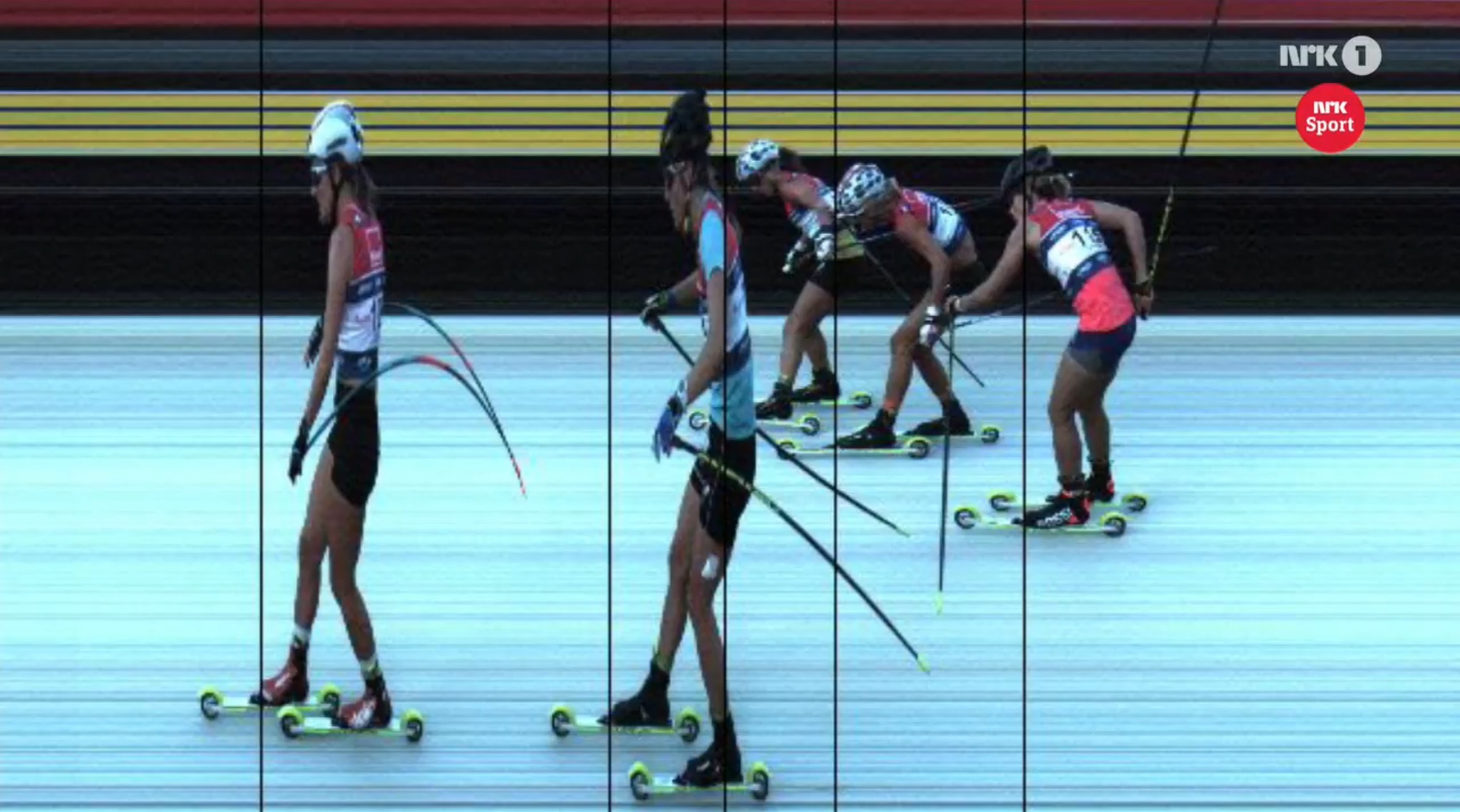
    And quietly, in Heat 3, Evensen advanced as a photo-finish second behind Sweden’s Alvar Myhlback.

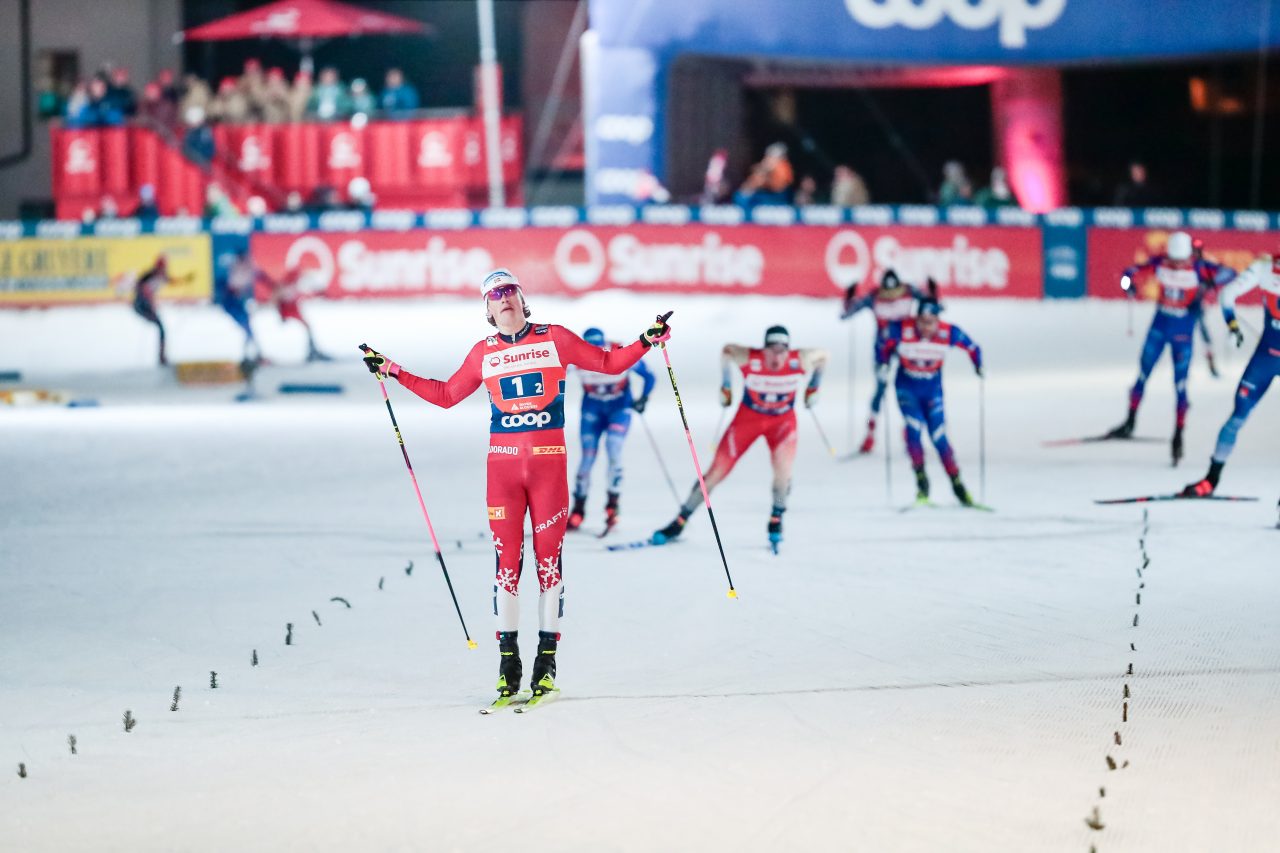
    Ben Ogden (USA) and the medical team check on Johannes Hoesflot Klaebo (NOR). (Photo: Nordnes/NordicFocus)
    The Crash

    The first semifinal will be remembered for the crash.

    Klaebo had won his quarterfinal from the front and appeared to be cruising. Ogden, too, looked comfortable. But on the icy final descent heading toward the hairpin around the fountain behind the start gates, the pack compressed. Klaebo held tight to the inside along the fencing, leaving him vulnerable when the skis began to cross. Contact was made. Ogden’s feet swept out from under him and fell right in front of the Norwegian. Klaebo had no place to go, skiing right into Ogden, which launched him into the air, spinning backward, ultimately hitting the back of his head on the hard-packed snow.

    Ben Ogden (USA) walks off after the crash in the Semifinals. (Photo: Nordnes/NordicFocus)

    Listening to the broadcast, the silence in Drammen was palpable. Ogden scrambled to his feet with only one ski still attached; Klaebo did not immediately follow. Replays showed Klaebo had not only hit his head on the hard snow, but may also have been struck in the head by a trailing ski as he fell. Both men would be listed as DNF — a designation almost never seen next to Klaebo’s name in a decade of dominance.

    Anton Grahn of Sweden, who had been near the front, took the semifinal win. Tuz advanced automatically in second. Alvar Myhlback of Sweden finished third but would not be fast enough to advance as a lucky loser. The crash all but guaranteed that the top four finishers from Semifinal 2 would all advance to the final.

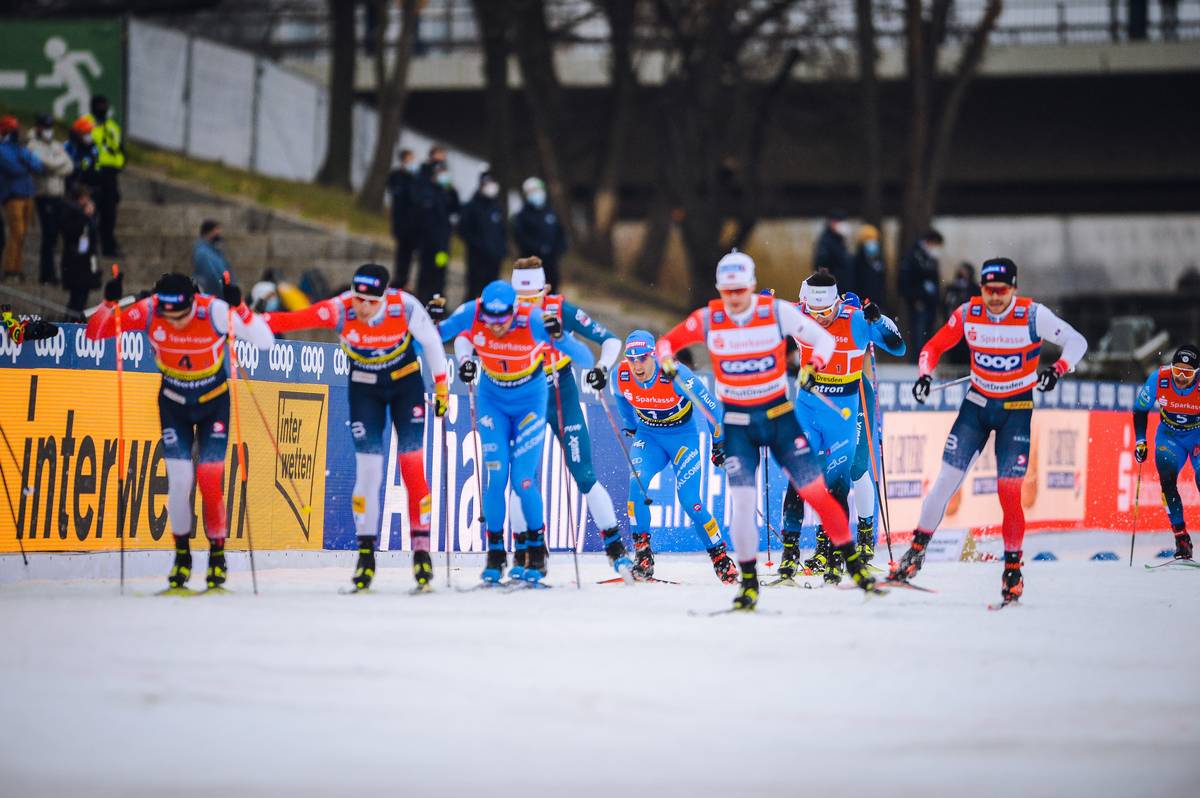
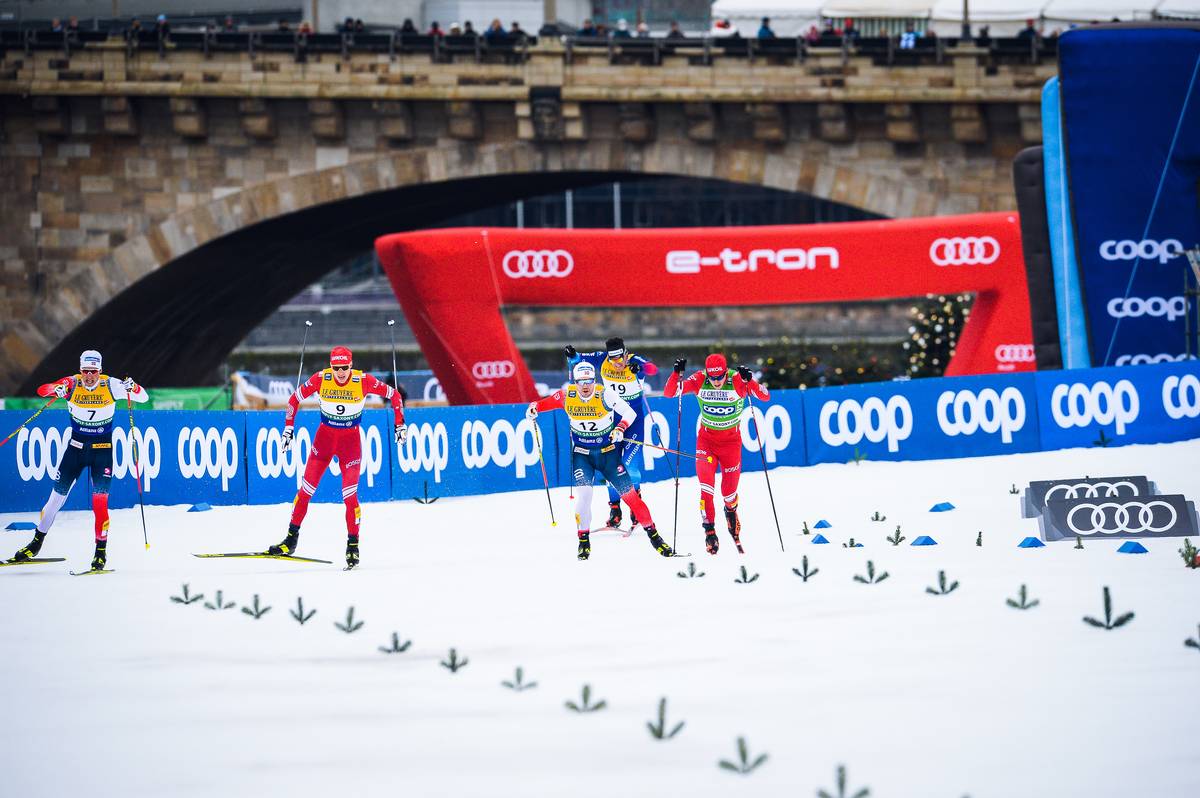
    After the crash in Semifinal 1, Semifinal 2 with Harald Oestberg Amundsen (NOR), Kristian Kollerud (NOR), Jules Chappaz (FRA), Ansgar Evensen (NOR), Noe Naeff (SUI), and Davide Graz (ITA), (l-r) race for the finals. (Photo: Nordnes/NordicFocus)
    Semifinal 2 and the Path to the Final

    The second semifinal, then, was a race with diminished stakes but no shortage of quality. Chappaz drove the pace from the front and never relinquished it. Kollerud, the 21-year-old in his club racing suit, making his World Cup debut, finished an impressive second.

    Behind them, Amundsen and Evensen advanced as lucky losers, separated by just hundredths of a second. The final would feature three Norwegians, a Frenchman, a Czech, and a Swede — but no Klaebo and no Ogden.

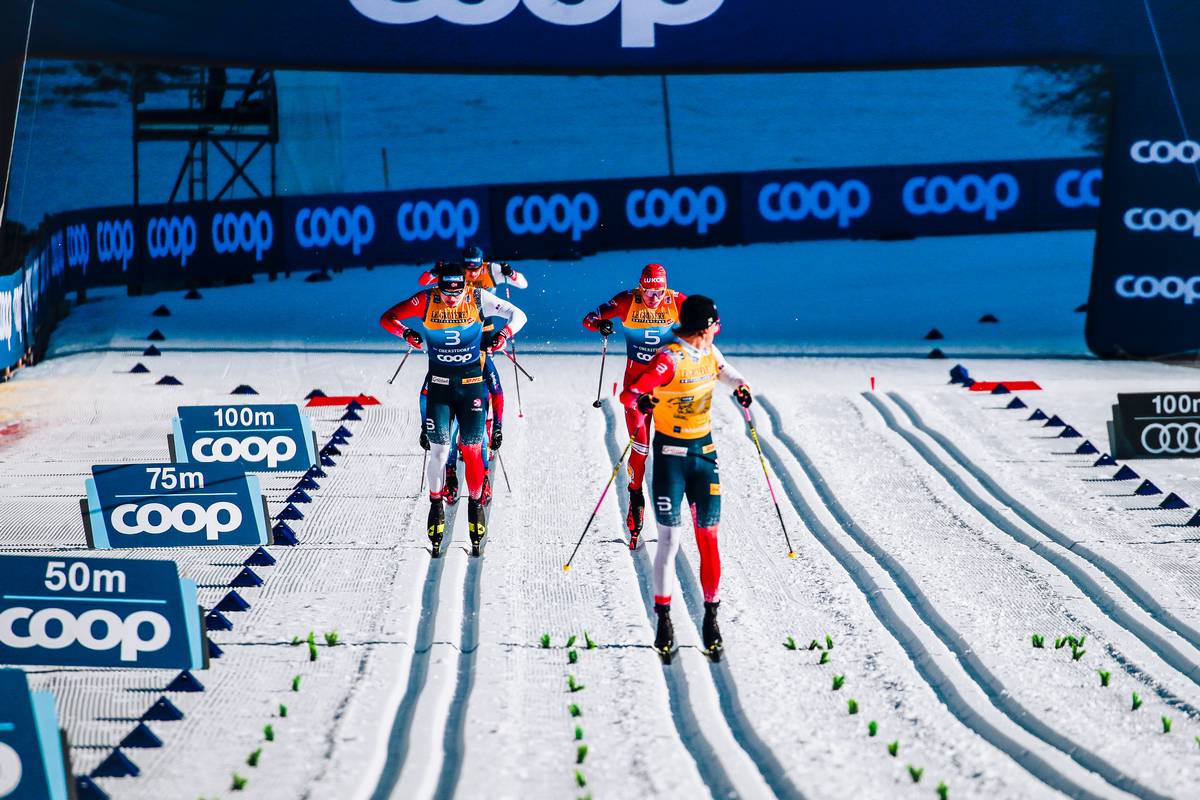
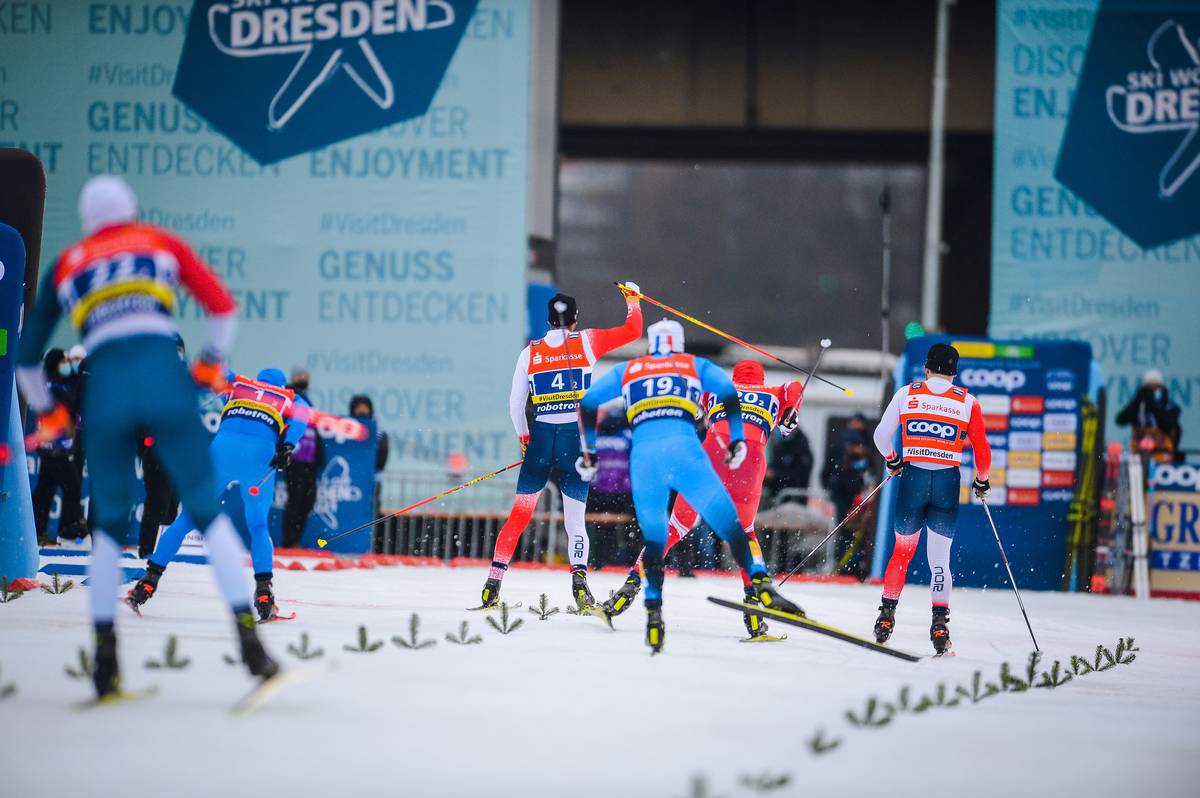
    Entering the finish stretch. (Photo: Nordnes/NordicFocus)
    The Final

    Half the final field was under 23 years old. Tuz, Kollerud, and Grahn — all 21 — represented a generational shift on a day when the established order had been upended.

    Tuz, perhaps emboldened by his semifinal crash survival, went hard from the gun, leading over the opening climb. It was a brave tactic from a young racer in only his second World Cup final. Behind him, the more experienced campaigners — Amundsen, Evensen, Chappaz — bided their time, trusting that the Drammen draft would bring them back and leave them well rested for the final climb.

    It did. The group had reformed as they skied behind the fountain. As they navigated the icy turn, Grahn — who had been skiing near the front all day — lost his footing on the hairpin and crashed, his race effectively over. He would finish sixth on the day.

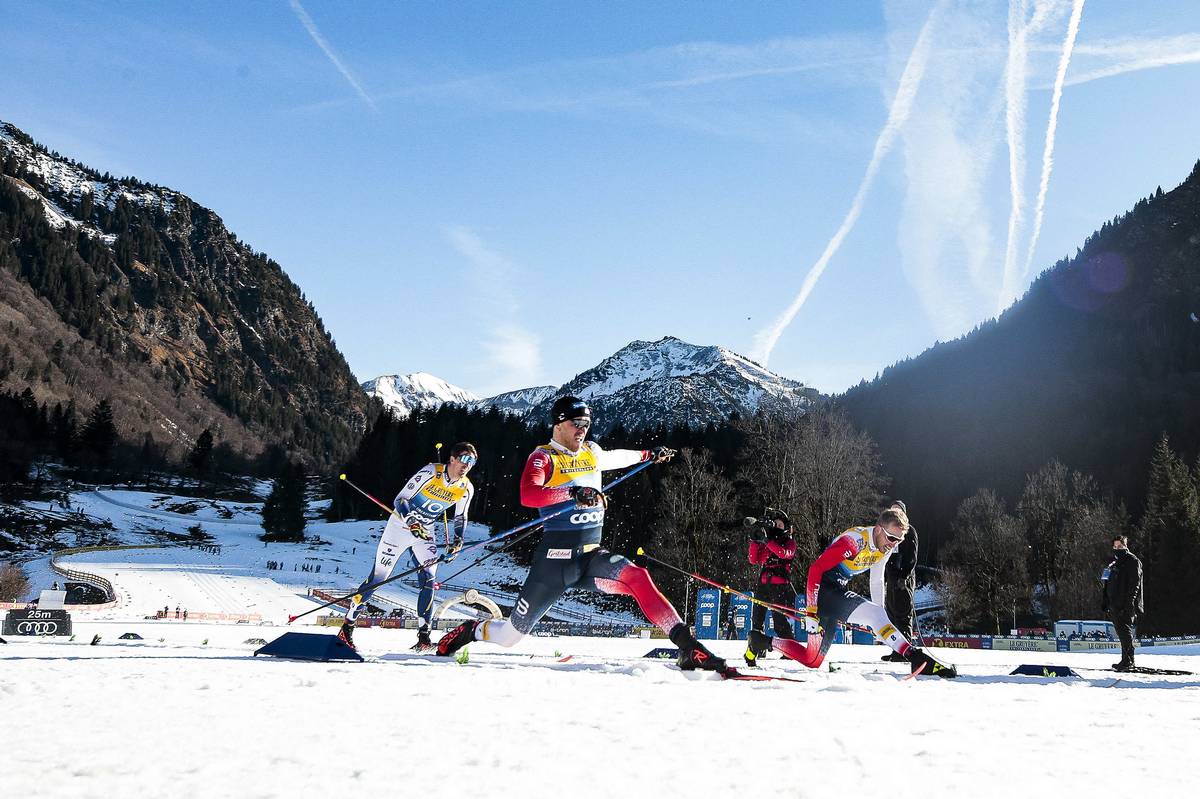
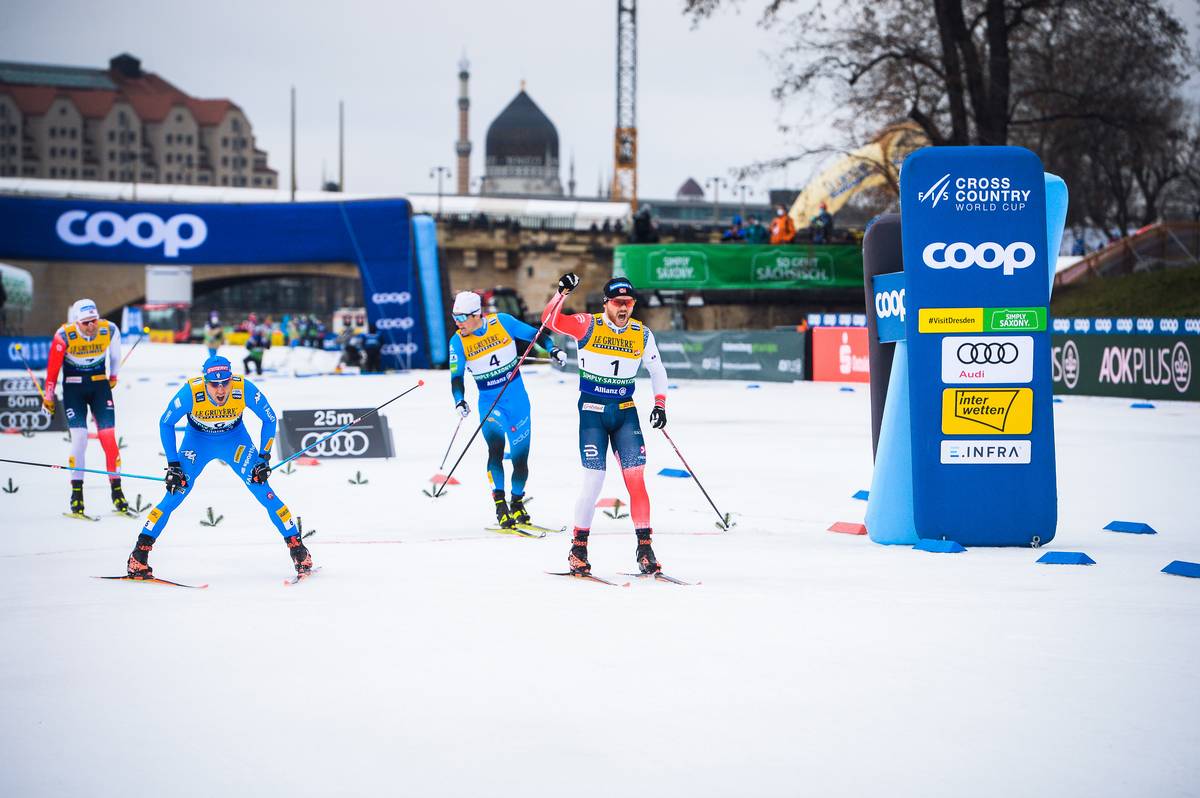
    The final dash for the line. (Photo: Nordnes/NordicFocus)

    Grahn’s fall opened a lane on the outside. Evensen, who had been sitting sixth, saw it and calmly worked his way around the dicy turn.

    “When Anton fell in the last corner, I had every opportunity,” Evensen said afterward. “So I took it from fifth place to first on the final.”

    What followed was one of the great finishing surges in Drammen’s long sprint history. Amundsen and Kollerud were locked in their own battle, focused on each other. Chappaz was charging. But Evensen — who had finished fourth on this same course back in 2023, who knew exactly how the final 50 meters of this city sprint played out — found a gear that nobody else could match.

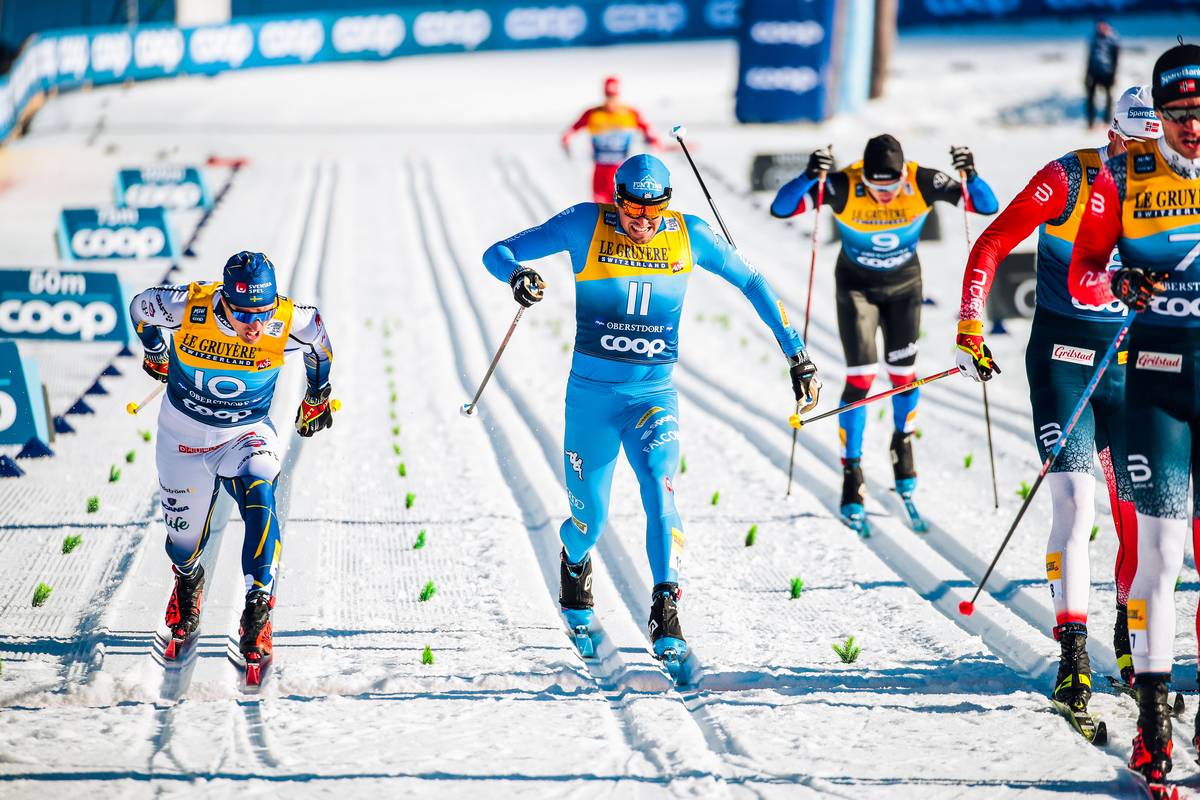
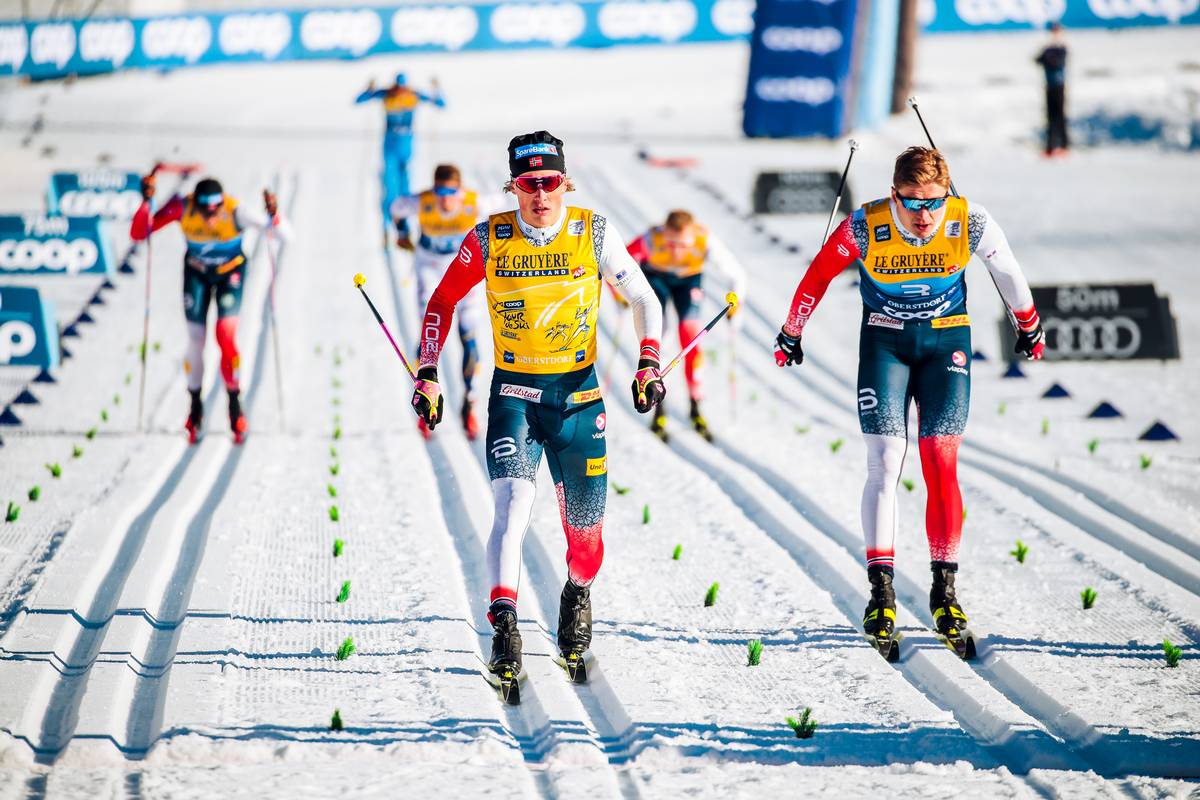
    Harald Oestberg Amundsen (NOR), Jiri Tuz (CZE), Kristian Kollerud (NOR), Jules Chappaz (FRA), and Ansgar Evensen (NOR), (l-r) had an exciting finish in Drammen. (Photo: Nordnes/NordicFocus)

    He crossed the line first, fist clenched, pounding his chest. Tuz nipped Kollerud for second by four hundredths of a second. Amundsen was fourth, just 0.43 seconds off the win.

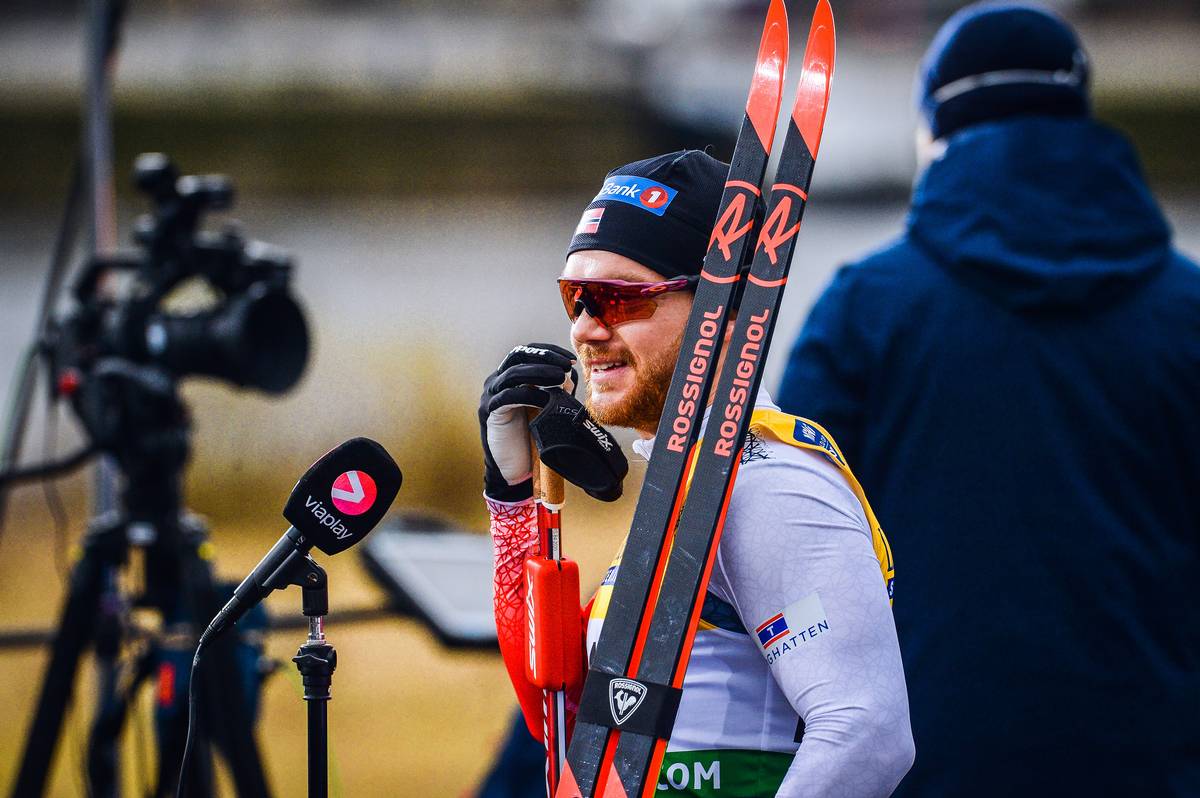
    “It was super cool and I love to ski in Drammen,” Evensen said in a post-race interview with FIS, still catching his breath. “I had to change boots to my combi boots because I felt so unbalanced in the quarterfinal. But that’s how it is. Have to stay on your feet to win. And unfortunately for Johannes and Ben, they weren’t as stable today.”

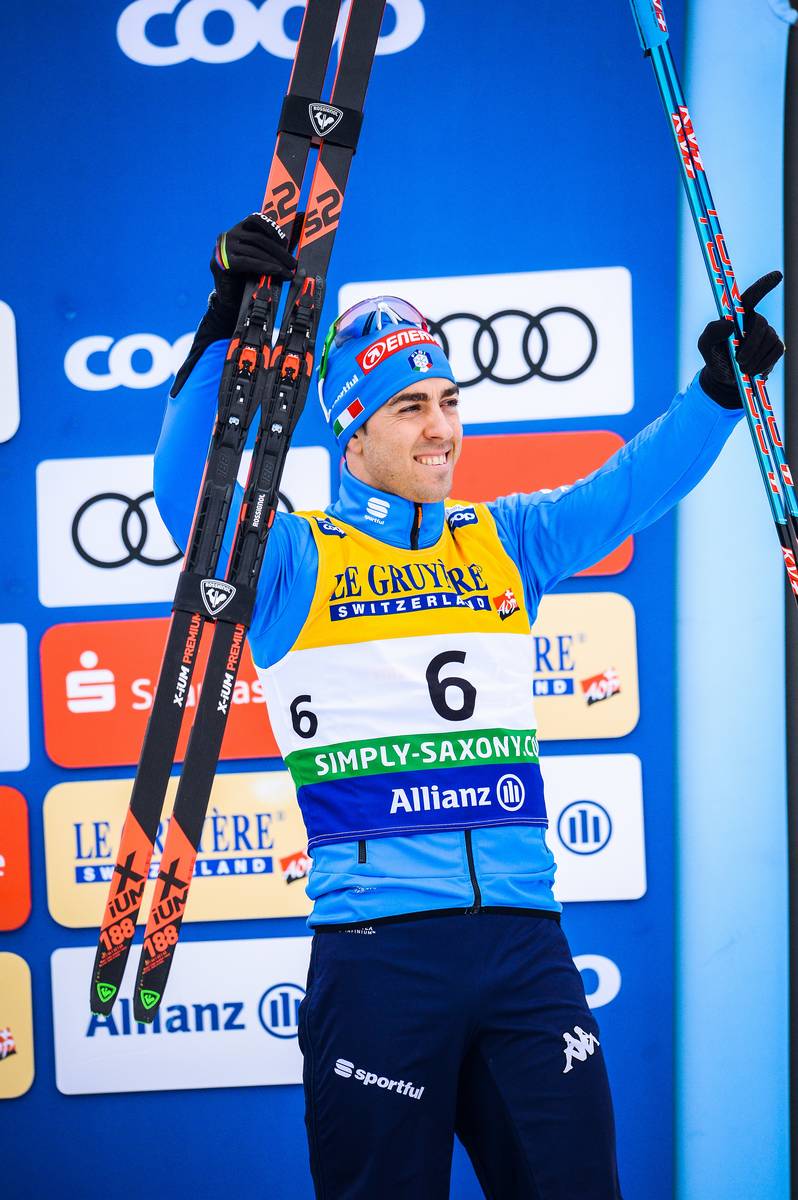
    Kristian Kollerud (NOR) waits for final confirmation of his podium. (Photo: Nordnes/NordicFocus)
    Kollerud’s Debut

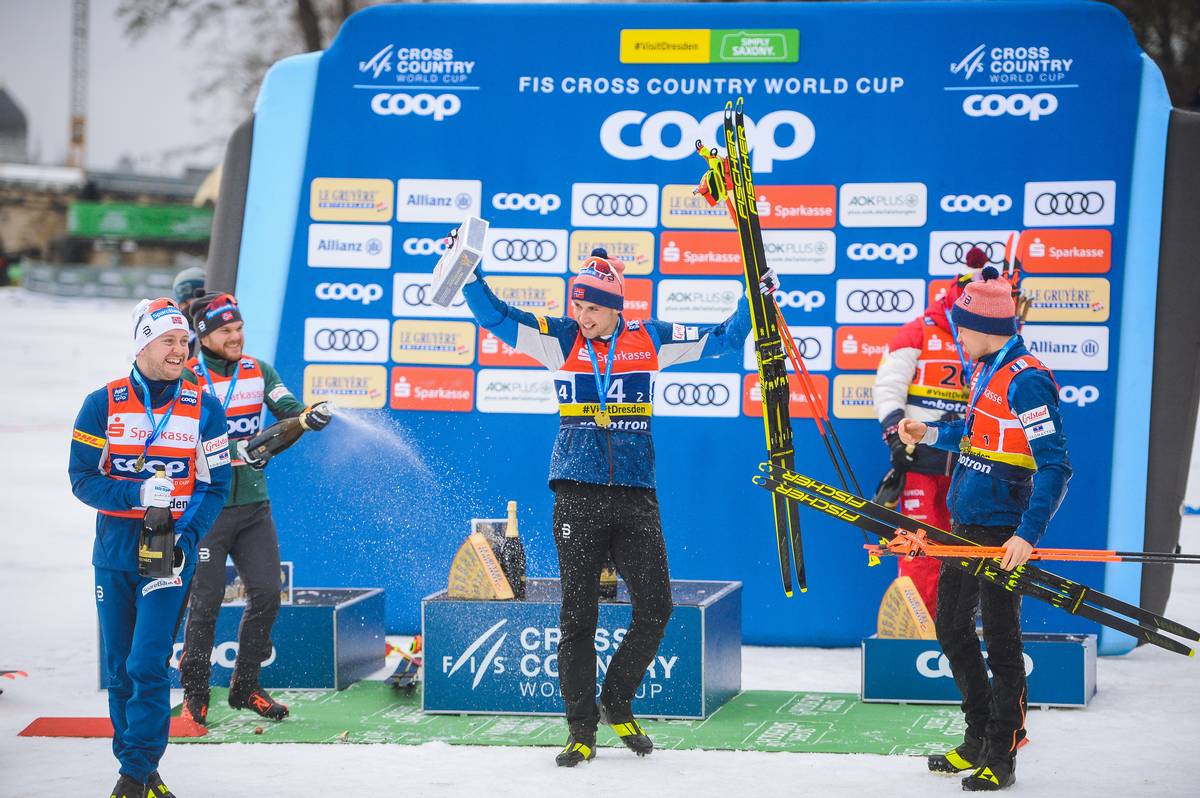
    The feel-good story of the final belonged to Kollerud, who stood on the podium in his club racing suit — not the Norwegian national team uniform — soaking in a result he could not have imagined when he woke up that morning. A podium in your first World Cup start doesn’t happen. Except when it does.

    He picked up a written reprimand for a classical technique infraction during the semifinals, but it was his first of the season and carried no further consequence. What will carry forward is the confidence of knowing he can compete with the best in the world.

    Tuz, too, earned a career milestone. The Czech U23 athlete had made the final in Milano Cortina but never stood on a World Cup podium before Thursday. He now has a silver medal from Drammen.

    Jiri Tuz (CZE) celebrates his podium in Drammen, Norway. (Photo: Nordnes/NordicFocus)
    Standings and What’s Next

    Klaebo’s DNF stung, but his World Cup position remains commanding. He leads the overall standings at 2,071 points (636 points more than Amundsen in second), the sprint standings at 835 points (283 points in front of Lars Heggen), and the distance standings at 936 points (128 points in front of Amundsen).

    Barring further incident, Klaebo will sweep the overall, distance, and sprint crystal globes for the season.

    Whether he gets the chance to race for them this weekend, however, is now in question. Norwegian national team doctor Ove Feragen told TV2 that Klaebo was taken to the hospital following the crash for precautionary testing related to the head impact. Feragen said Klaebo was conscious, in stable condition, and not believed to be seriously injured, but the severity of the fall warranted evaluation. His status for Saturday’s 50 k Freestyle Mass Start at the historic Holmenkollen in Oslo remains uncertain.

    The season concludes with World Cup Finals in Lake Placid, New York, March 20-22, where Ogden and the American men will race in front of a home crowd. With four races left, a lot of exciting racing remains.


    Drammen Men’s Classic Sprint QUALIFICATION RESULTS

    Drammen Men’s Classic Sprint FINAL RESULTS


    Love Stories Like This? Help Keep Them Coming.

    Feature stories like this one take time, access, and care to produce. If you value thoughtful storytelling and independent ski journalism, please consider becoming a Voluntary Subscriber. Your support directly fuels the work we do to cover the people, places, and moments that make our sport special.

    Join the FasterSkier community!


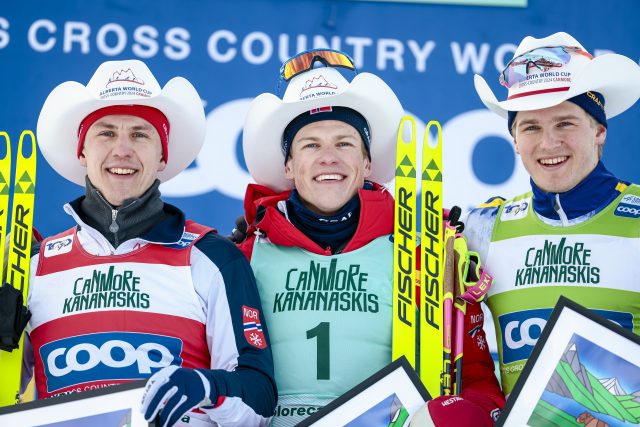
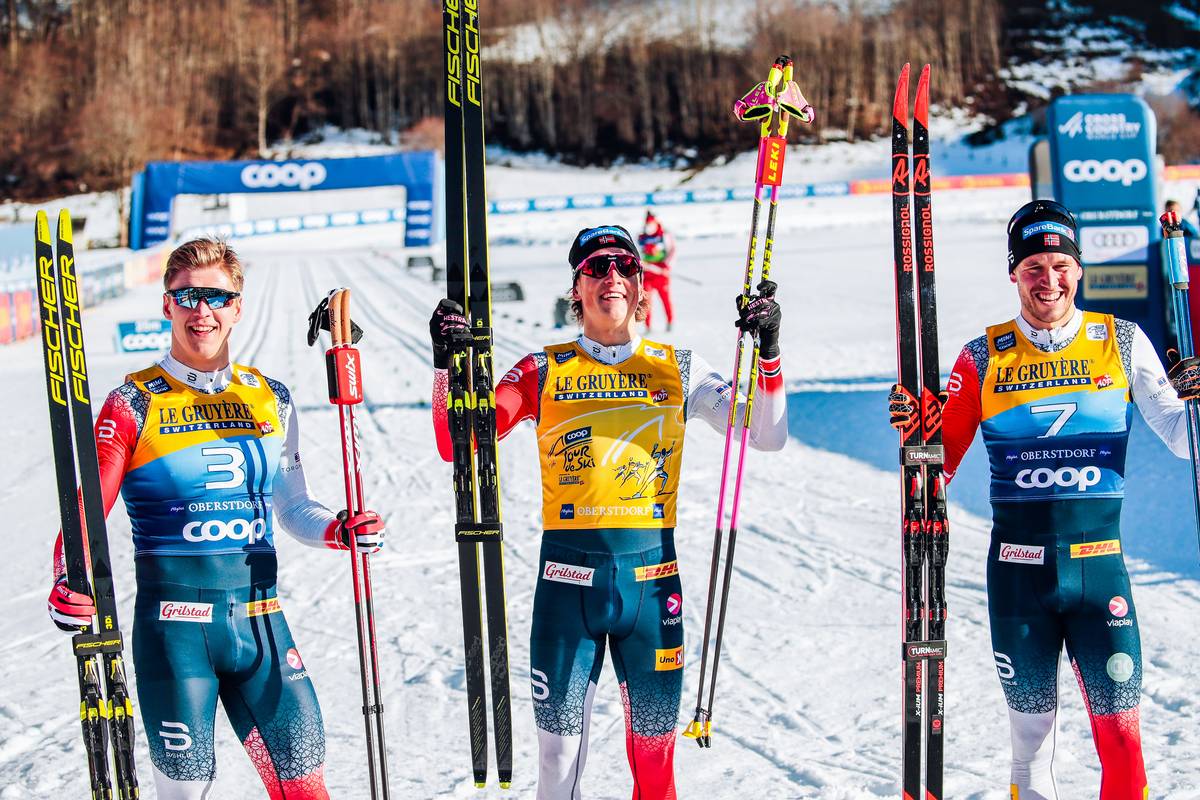
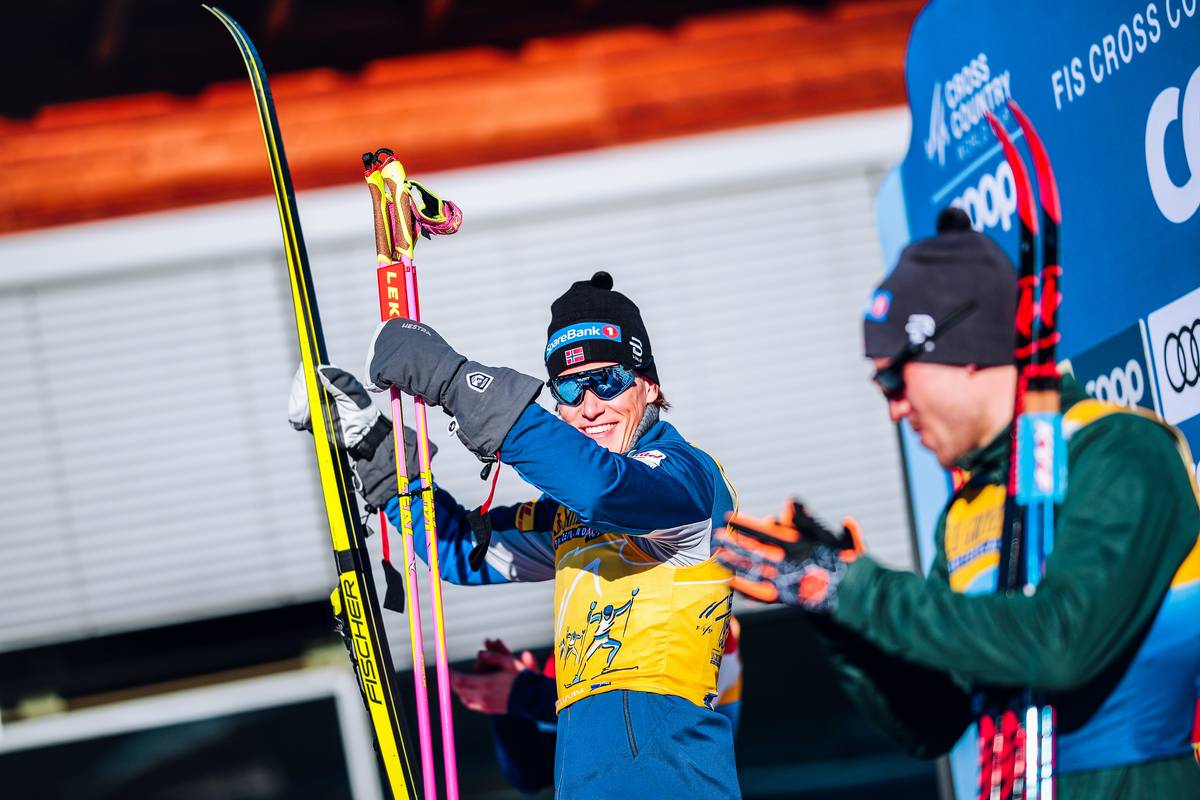
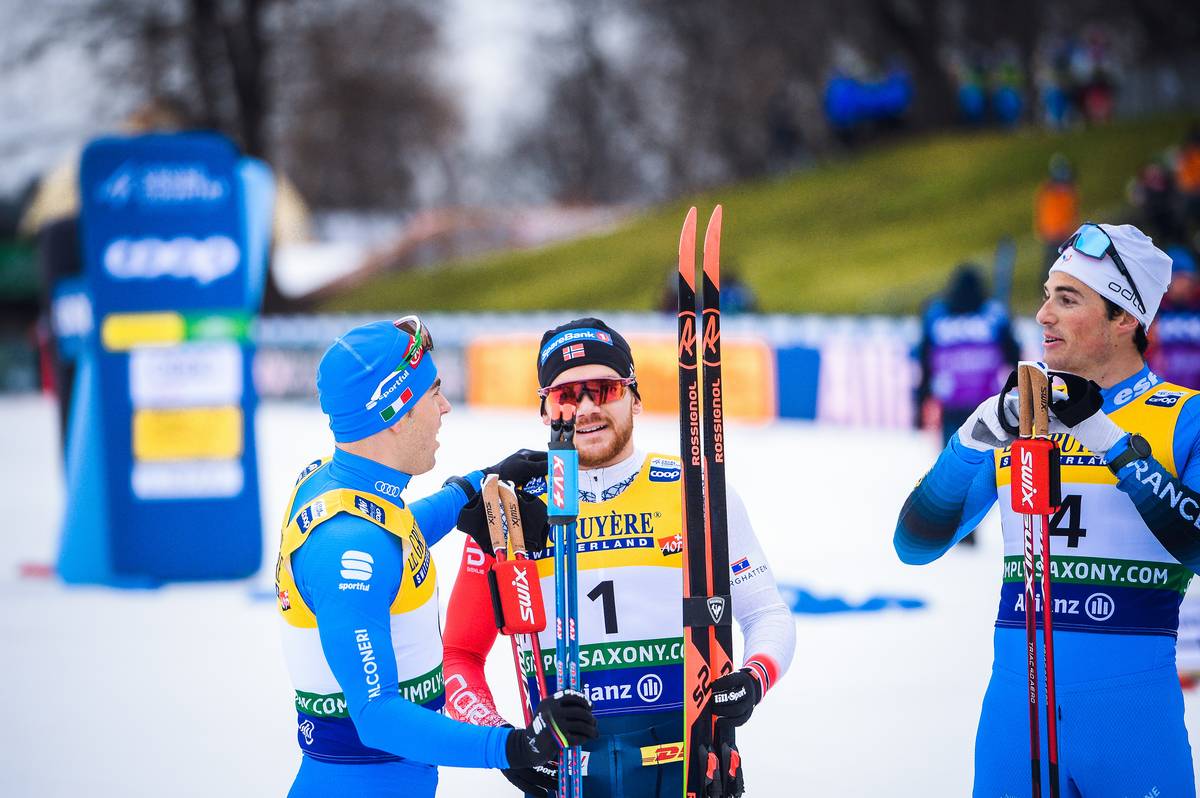
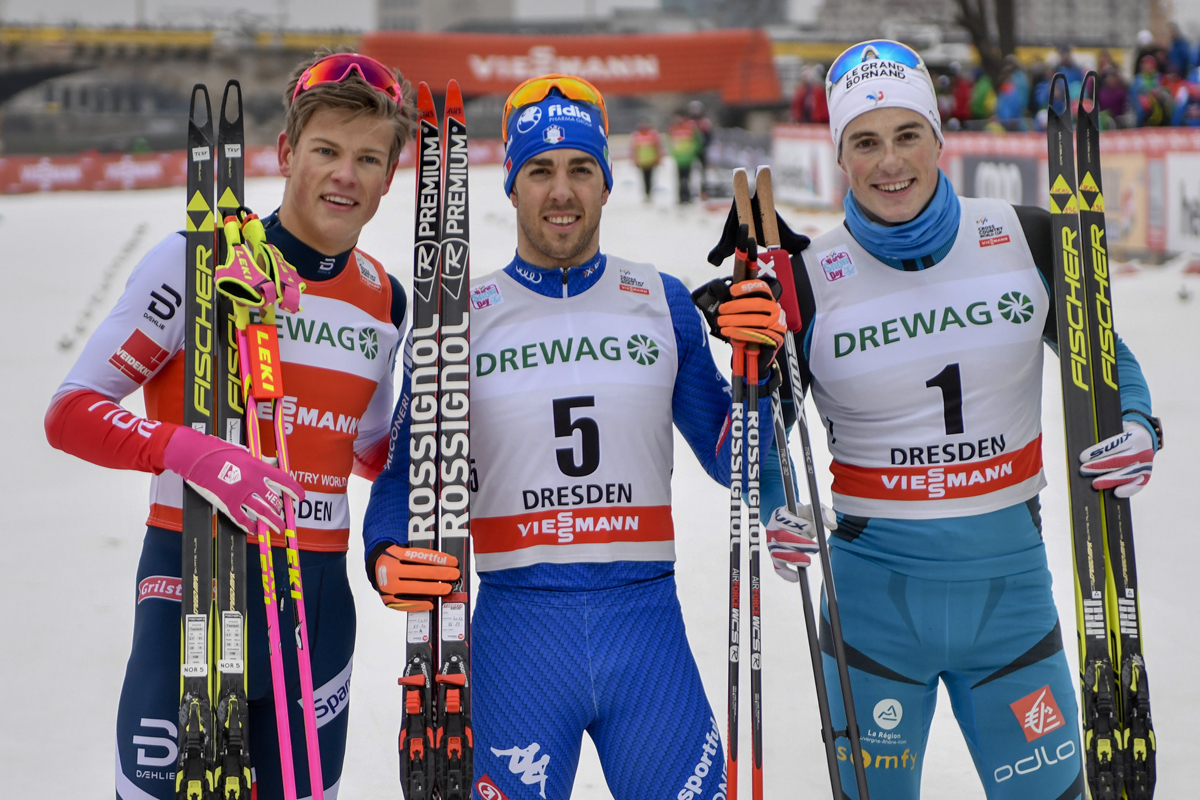
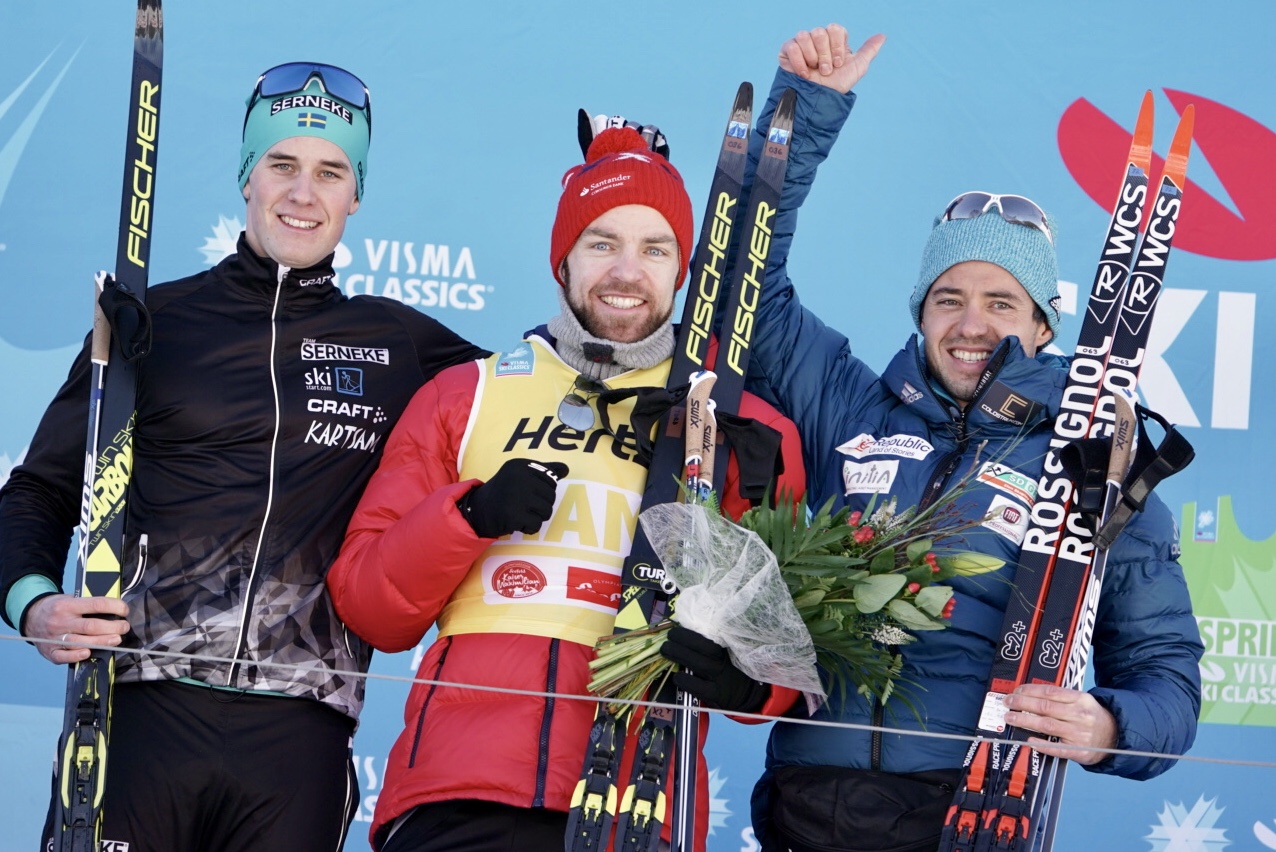
    Jiri Tuz (CZE), Ansgar Evensen (NOR), and Kristian Kollerud (NOR), (l-r) share the Classic Sprint podium in Drammen, Norway. (Photo: Nordnes/NordicFocus)
  • Lahti Sprint—Klaebo Remains Unbeatable

    Lahti Sprint—Klaebo Remains Unbeatable

    This coverage is made possible through the generous support of Marty and Kathy Hall and A Hall Mark of Excellence Award. To learn more about A Hall Mark of Excellence Award, or to learn how you can support FasterSkier’s coverage, please contact info@fasterskier.com.

    Babe Ruth, Muhammad Ali, Michael Jordan, Michael Phelps, this guy—Johannes Hoesflot Klaebo (NOR). (Photo:  Authamayou/NordicFocus)

    “It’s Johannes Klaebo’s ski world,” said skiandsnowboardlive.com’s on-air commentator, Andrew Kastening. “And we’re all just living in it.” Truer words were never spoken . . .

    “I didn’t have a plan,” said Klaebo after his dominant performance in Lahti Finland’s World Cup Freestyle Sprint. “I just went for it at the end there and managed to get enough meters to the young guys. Next year it will be even harder, so we’re going to enjoy this now for the rest of this year. Next year, it’s going to be way harder, I think.”

    Well, we don’t really believe Klaebo’s “no plan” claim. In fact, we probably aren’t sure we believe that next year will be “way harder,” either. Not with the way this year has gone, anyway. But Klaebo’s suggestion that we “Enjoy this for now?” No problem . . .

    Ironically, Klaebo’s absolute dominance leaves ski reporters scrutinizing the strengths and weaknesses of other skiers—scanning the notoriety of other results—for stories that will continue to capture readers’ imaginations. Where the heck has Sindre Bjoernstad Skar been? And how much resentment do Even Northug and Lars Heggen harbor after being left off the Norwegian Olympic team? And, after his recent U23 World Championship (and the pedigree afforded him by his mother, legendary Nordic skier, Bente Skari), is Filip Skari the real thing? And is Harald Oestberg Amundsen still in the running for the Crystal Globe? Or does he just need a Sprint day to warm him up for the Distance races? And who the heck is Mathias Holbaek? On a normal World Cup weekend, those questions—Norwegian questions—would occupy the imaginations and fill the column inches of ski journalists. But that was before the Olympic Winter Games of Milano-Cortina . . . the Games in which Ben Ogden (USA) and Gus Schumacher (USA) created scenes of flashing silver excellence. Now, reporters have another story to report: American sprinters have arrived on the scene. If Ogden and Schumacher have any energy left after the predictable post-Olympic celebrations, then they’ll have something to say about Lahti’s Sprint results, too.

    Gus Schumacher (USA) and Ben Ogden (USA) and Gus Schumacher (USA) have ushered in a new era of American men’s skiing. (Photo:  Vanzetta/NordicFocus)

    Granted, Ogden and Schumacher had far fewer Norwegian Sprint rivals to navigate among, through, and past on the way to their Olympic silver medals. That’s the salient reminder, folks: while the the Olympics offer the most valued, most brightly glittering prizes in the skiing world, the Olympics also offer the best chance for anyone to break through the Norwegian medals-monopoly. That’s because Norway is only allowed the maximum number of Olympic starters in any event: four starters. Conversely, in World Cup races, Norway is allowed at least seven starters . . . sometimes eight (if the race is in Norway). Any non-Norwegians—Ogden and Schumacher included—will find it far more difficult to snatch headlines in Lahti’s World Cup Freestyle Sprint. For that matter, American Sprinters (including Jack Young, JC Schoonmaker, Kevin Bolger, Zanden McMullen) will find it considerably more difficult to qualify for the heats, much less to advance through to semifinals and finals.

    And all this drama occurs in the shadow of the most predictable story—the one that we’ve probably grown tired of repeating by now: Klaebo’s going to win, right? I mean, he’s won the last 13 races he’s entered (sprints,  distance races, relays, Classic, Freestyle), including the six Olympic races that he swept during the Games of Milano-Cortina. And lining up for another Freestyle Sprint on a course where he has generally shown himself to be unbeatable seems unlikely to offer much hope to his rivals. Well, there’s always silver . . .

    Federico Pellegrino (ITA) is in Lahti, and so soon after he captured a magnificent bronze medal for Italy in the Team Relay. And Lucas Chanavat (FRA) is here, but he may finally have realized that he has never devised a tactic that’s even come close to allowing him the sort of success that his natural power and physical prowess would’ve suggested could be his. Among Americans, Schumacher qualified eighth. Jack Young 16th, Ben Ogden 22nd, McMullen 26th. Qualifying was won by Klaebo, followed by Chanavat and Pellegrino. The stage was set in an exciting race for silver. Sorry if that sounds like a weak set-up; we’re just calling it as we see it . . .

    Zanden Mcmullen (USA) held his own in a closely contested heat with Lucas Chanavat (FRA), Benjamin Moser (AUT), Lukas Mrkonjic (AUT), and Johannes Hoesflot Klaebo (NOR),. (Photo:  Authamayou/NordicFocus)
    Sprint Heats

    McMullen drew the first heat alongside Chanavat and Klaebo. Chanavat wanted the lead, but not the pace. With Klaebo positioned alongside him (staying near the front and out of trouble) the course was clogged and the pace was slowed.  Ultimately,  Chanavat found himself suckered into the lead at the top of the final downhill where he surrendered the draft and was predictably passed by Klaebo. Chanavat would actually fall in the final turn, allowing Klaebo to cross the line unchallenged, and making room for Benjamin Moser (AUT in the second spot to qualify for the semifinal. McMullen would cross in a closely-contested third place, too slow to advance as a lucky loser, but good enough for 20th on the day. There was some question about Chanavat’s fall (and whether or not he was interfered with), but the slo-mo replay made it appear that he’d done the damage on his own.

    In the second quarterfinal, Ogden decided to play his cards at the front where he was joined by Pellegrino. But coming through to make the pace was Skar (who has been absent from the World Cup scene for a few seasons, but returned to this venue in replacement of Olympic medalist, Oskar Oppstad Vike (NOR) who was injured at the recent U23 World Championships. Pellegrino would become impatient with Skar’s pace, driving forward to take the lead at the top of the final climb. But it was Heggen who would take advantage of the draft on the final downhill to take the heat win. He was followed across the line by Janik Riebli (SUI), Pellegrino, and Skar. Ogden would coast across the line a distant sixth, 28th on in the final Sprint results.

    Schumacher bided his time at the rear of the third quarterfinal, weaving through traffic to move forward into fourth position before the final downhill. Schumacher chose the outside line on the final left-hander, rocketing forward to steal an automatic ticket into the semifinal just ahead of Holbaek and Valerio Grond (SUI).

    Jack Young started at the rear of his quarterfinal, continuing to work his way through the field, but generally finding his way blocked and his momentum stymied. He entered the final downhill in fourth position, but with precieous little room to maneuver. Young came around the final turn in third, but was late to accelerate, finding himself still third at the line. In a slow heat, Young’s finishing time was not fast enough to advance. He would finish teh day in 15th.

    “My training during the Olympics absolutely allowed me to come in to Period 4 fresher and sharper,” said Young. “I felt faster today than I did in Falun, and I think I’m still on the way up.

    “Tactically, I’m making the progress I need to make,” Young continued. “I did a lot of things today in the heat that I haven’t done in the past. I was taking up space and shutting down moves made from behind me better than I ever have. In the future I need to keep skiing aggressively and find ways to get into the top two before the last 100 meters.

    Janik Riebli (SUI), Lars Heggen (NOR), Johannes Hoesflot Klaebo (NOR), Gus Schumacher (USA), Benjamin Moser (AUT), Davide Graz (ITA) in the Freestyle Sprint inLahti, Finland. (Photo:  Authamayou/NordicFocus)
    Sprint Semifinals

    Schumacher lined up next to Klaebo in the first semifinal. Klaebo was first off the line with Schumacher attached to his tails. They marked at the front by Heggen; no one wanted to get away, no one wanted to lead. Klaebo seemed to grow bored with the tactical pace, allowing himself to glide into the lead and initiating a small attack before the top of the uphill section. All day long, skiers in the lead on the final downhill have found themselves overtaken by those in the draft. But “all day long” is not enough of a precursor to undo the ski-dominance of Klaebo. He floated down the slope, surrendering no discernible advantage to those tucked in behind him. Klaebo would execute a couple of energetic pushes in the final straightaway to remain ahead of Riebli (who edged out Heggen). Schumacher never managed to make up enough ground, finishing the semifinal in fifth position, and ninth on the day.

    Chappaz skied to tactical perfection in the second semifinal, using the draft on the downhill to slingshot into the lead in the final meters. Behind him, numerous skiers were caught in traffic as Skari emerged from the pack for the automatic semifinal spot, ahead of Grond who advanced as a lucky loser.

    Sprint Final

    In Lahti’s quarterfinal and semifinal heats, Klaebo had shown that he could win from the draft, or win from the front. Subsequently, he would continue to provide a cryptic puzzle for Skari, Heggen, Chappaz, Riebli, and Grond. I mean, we expect Klaebo to win, we just don’t know exactly which way he’ll choose to do it.

    At the crack of the starter’s pistol, Klaebo rocketed forward (that much we could anticipate), controlling the front and dictating the early pace as he so often does. The rest of the skiers were left to wonder—will he just drill it at the front and drop us? Or will he lure one of us into the lead, only to slingshot around us at the end? Here’s what the other skiers must, by now, understand pretty clearly: if Klaebo makes you lead, you lose. On the other hand, if Klaebo puts his energy into keeping the lead, there’s no one who can come around him. That’s the kind of advantage a skier earns when he’s the best of all time. And the best of all time was simply not going to get beat in this little World Cup Sprint in Lahti. Heggen and Riebli did their best to follow Klaebo, but the draft effect that Heggen needed just never materialized. Heggen was in good position on the final downhill: all the laws of physics were on his side, all the likelihoods of ski race tactics were in his favor . . . still, Heggen never made up a single meter. He would hold on for second, ahead of a late-charging Chappaz. Klaebo would coast across the line for his zillionth career World Cup victory, his we-can’t-keep-track-of-how-many wins in a row.

    Johannes Hoesflot Klaebo (NOR) eases up at yet another World Cup finish line. It may not be exciting any more, but it certainly remains thrilling. (Photo: Authamayou/NordicFocus)

    He doesn’t get tired, he doesn’t get sick, he doesn’t get out-maneuvered, he doesn’t get out-smarted, he doesn’t get out-sprinted. In one of the most challenging endurance sports that humans have ever contested, one guy just seems to win at will. How incredible it is to be a ski-fan in this era when one skier displays such outright dominance. The legendary Marit Bjoergen (NOR) claimed 114 wins during World Cup history’s most decorated Nordic skiing career. In Lahti, Klaebo truly began drawing within sight of that landmark number. Six races remain in the World Cup season. If he were to win out this season, Klaebo would finish the year having overtaken Bjoergen for the most-wins distinction, as well as a few others.

    “I’m tired,” admitted Klaebo. “I’m barely training between the races. I’m just racing now, but we’ll see how long we continue to do that. Hopefully, we’ll be able to do that for two more weeks.”

    There’s never been a season like this one that Klaebo is likely to complete: World Cup Overall, World Cup Distance, World Cup Sprint, Tour de Ski, and six Olympic gold medals. That’s the real story . . . and I’m so glad I’ve been here to see it. Next year may be “way harder,” predicts Klaebo. As he advises, we’ll enjoy this for now.

    Lahti Men’s Freestyle Sprint RESULTS

    Lahti Men’s Freestyle Sprint QUALIFYING

    Love Stories Like This? Help Keep Them Coming.

    Feature stories like this one take time, access, and care to produce. If you value thoughtful storytelling and independent ski journalism, please consider becoming a Voluntary Subscriber. Your support directly fuels the work we do to cover the people, places, and moments that make our sport special.

    Join the FasterSkier community!
    Johannes Hoesflot Klaebo: another win in Lahti in a season for the ages. (Photo: Authamayou/NordicFocus)


  • Oberhof Freestyle Sprint—Lars Heggen Proves His Point

    Oberhof Freestyle Sprint—Lars Heggen Proves His Point

    This coverage is made possible through the generous support of Marty and Kathy Hall and A Hall Mark of Excellence Award. To learn more about A Hall Mark of Excellence Award, or to learn how you can support FasterSkier’s coverage, please contact info@fasterskier.com.

    Lars Heggen (NOR) overpowered the field in Oberhof, but many of the world’s best sprinters—his Norwegian teammates—were absent from the day’s racing. (Photo: Authamayou/NordicFocus)

    Some day, Norway won’t be the only force in Men’s World Cup cross-country skiing. Some day, the participation of other nations will truly matter. Other nations will hear their anthems played, other skiers will excel, other results will be cited and praised. Some day, France may figure it out, or Finland may remember its heritage, or Sweden may return to prominence. The USA may identify another Bill Koch, or Italy another Pellegrino, or Switzerland another Cologna, or Russia another Bolshunov. Some day, the podium of the Men’s Cross-Country Skiing World Cup will not be decorated exclusively in Norwegian flags. While that’s not yet the cross-country skiing world that we live in, it is this upcoming World cup weekend in Oberhof where we expect to witness a kind of “It’s A Wonderful Life” view of Nordic skiing . . . the chance to see what the world would be like without them.

    France stayed home from Oberhof, presumably for national championships and team selections of their own. But everyone else is here, hoping to add to their World cup résumés with some of the scraps left on the tablecloth by absent Norwegians. Finland has sent its best (their Sprinters, anyway), and Sweden (in Norway’s absence they could make a splash), and the Italians (Federico Pellegrino and Elia Barp will see their chances to capture glory). The Czechs and the Swiss are here as well, hoping to grab World Cup distinction while the Norwegians are at home. And Team USA has sent it’s own hungry skate-sprinters, as well. Ben Ogden and Jack Young will be vying to return to the finals . . . even to imagine standing atop the podium (dare we say). JC Schoonmaker will be desperate to prove he belongs on the team that marches into Milano-Cortina. Gus Schumacher will be itching to prove that he and Ogden make a compelling Team Sprint team. There’s a lot going on . . . the same sort of drama that goes on every single week of the World Cup season, but no one really notices it because we’re so distracted by the Norwegian that tsunamis through every World cup venue.

    And where’s Norway? Well, Norway has more important business to attend to. World Cup wins, World Cup podiums, World Cup points: those are every-week occurrences for ski-crazy Norway. But 2026 is an Olympic year . . . the big prizes will be awarded at the Games of Milano-Cortina. So, this weekend in Oberhof, Norway sends stand-ins while the true contenders refine their technique or taper their training, or just put their feet up for a few hours before the headlong streak toward Norwegian immortality in Milano-Cortina continues.

    The elder Northug bother—Petter—was one of Norway’s greatest champions, but even he faced disappointment when it came to Olympic qualification. If Lars Heggen fails to make the team for Milano-Cortina, he will understand the parallels between his pain, and Northug’s. (Photo: Nordnes/NordicFocus)
    Norway Still Expects to Win

    Lars Heggen (NOR) is 20 years old . . . and he just dominated the Sprint competitions at the recent Norwegian Nationals. Granted, a number of Norway’s very best Sprinters weren’t there (no Klaebo, no Valnes, no Amundsen), but Heggen made enough of an impression that many Norwegian ski-pundits called for his immediate elevation to the Olympic Team. We can assume that Petter Northug was not among that enthusiastic group of pundits . . . especially since a 20-year-old Northug dominated 2006 Norwegian Nationals in an even more commanding manner than Heggen did in 2026. And Northug was unceremoniously denied an Olympic berth because of the selection committee’s assertion that, at only 20, he was too young for the pressures of Olympic competition, that Northug would benefit from more development time before being tossed into the Olympic maelstrom. Northug’s career turned out all right in the end, but it may have been even better if he’d collected another Olympic medal or two at the 2006 Games in Torino.

    Northug’s little brother, Even, competes for Norway in the World Cup Sprint this weekend in Oberhof. Like his brother 20 years ago, Even Northug has already been told that no spot is reserved for him on the Norwegian Team at the upcoming Olympic Games. Well, he’s still a world class Sprinter . . . it will be interesting to see how the younger Northug uses this weekend’s Sprint opportunity to comment on his being the second Northug to have been ignored in his efforts to make a Norwegian Olympic Team.

    But first, you need to qualify . . .

    The top American qualifier in Oberhof, JC Schoonmaker (USA) leading Even Northug (NOR), and Zanden Mcmullen (USA) in their quarterfinal heat. (Photo: . Authamayou/NordicFocus)
    Qualifying

    We don’t know exactly why, but it’s been reported that top 30 in today’s Sprint qualifying will be rewarded with increased FIS World Cup points (nearly double when compared to normal World Cups, or to races in tour de Ski that received only 50% points). It’s a good reason to be at your best in this particular qualifying event . . . and a pretty good way to continue shuffling the deck for numerous nations that are still choosing their Olympic Teams. And while a number of Norway’s best sprinters decided to sit this one out, Norway still manages to dominate most men’s Wold Cup racing. Case in point: six of Norways seven entries qualified for the heats, with Lars Heggen doing the job he was sent to do—winning the qualifier by 1.5 seconds.

    Americans took advantage of this diluted World Cup field with JC Schoonmaker finishing 13th, Jack Young 22nd, Zanden McMullen 28th, Michael Earnhart 35th, Kevin Bolger 44th, Owen Young 54th.

    “The heat selection strategy was definitely a bit different today with a lot of normal World Cup guys not being here,” said Schoonmaker. “I went for heat 1 because that felt like a good one to move on from and it was a better option than usual with  Klaebo not here. Other than heat selection the strategy didn’t differ at all for me, just trying to race my best!”

    McMullen is better known as a Distance skier, but his strong qualifying effort proved his versatility. “I do actually like using sprint races as a bit of a warm up,” said McMullen. “It puts my mind and body into a race mentality that I can’t really achieve on a race prep day. Sprints also typically feel lower stakes to me, so it’s just a nice way to go out and have some fun!”

    Sprint Heats—New Cast, New Strategies

    Skiing can be such a strange sport. Oberhof is a famed biathlon venue; if this were a weekend of biathlon races the grandstands would be packed. As it is, this was a cross-country weekend, and the stadium stood all but empty. The German fans who could’ve been here definitely missed a good show, and a fair indication of what the future of what World Cup Sprint events may look like in the near future. Even with a number of bright stars missing from the days entry list, the racing proved fast and furious.

    There was a lot going on in Quarterfinal 1: Lars Heggen wearing the green U23 World Cup leaders bib, alongside JC Schoonmaker, Zanden McMullen, and Even Northug. Everybody with something to prove, everybody with something to gain, and only two minutes of Heat 1 in which to do it. Schoonmaker led through the early parts of the course, but faded by mid-race. Heggen accelerated up the hill before the finish, sufficiently gapping his rivals and easing up before the finish line which he was followed across by a scrambling Even Northug. McMullen would finish fourth in the heat, followed by Schoonmaker in fifth. On the day, McMullen and Schoonmaker would finish 20th and 23rd, respectively.

    Pellegrino advanced out of Quarterfinal 2 in which Jack Young’s day would end with a fifth place heat finish. Young had led early in the quarterfinal, evidently hoping to press the pace in the hopes of advancing as a lucky loser. His strategy was bold, but it left him one place short. Young would finish 24th on the day.

    “I wanted to get to the front and control the race,” said Young. “Sadly, I wasn’t able to hold my position into the big climb—this wasn’t part of the plan. I then made up sole ground, but I didn’t have the energy to hold my position through the working finish.”

    Semifinal 1 included Heggen, Pellegrino, and Northug who all came in together at the bottom of the final climb. Heggen would V2 the entire climb, while Pellegrino switched to a high-tempo V1 to scoot past into the hole-shot. Northug faded as Lauri Vuorinen (FIN) edged into the top three. Pellegrino would coast across for the heat win, followed by Heggen’s lunge for second ahead of Vuorinen in third and Northug fourth. Those lucky losers would sit and wait for the results of the second semifinal.

    That second semifinal included one well known Sprinter—Switzerland’s Valerio Grond—who was joined by a cast of names we’re less accustomed to hearing: Filip Skari (NOR), Jaume Pueyo (ESP), Emil Liekari (FIN), Jiri Tuz (CZE), and Martino Carollo (ITA). Grond would finish second in the heat behind Liekari to advance to the final. Vuroinen and Northug—lucky losers from Semifinal 1—would advance as well.

    Federico Pellegrino (ITA) used a high-tempo V1 to position himself on the steep uphill of Oberhof’s Sprint course. But Heggen’s V2 would prove stronger. (Photo:  Reichert/NordicFocus)
    Plenty at Stake in the Final

    In the absence of truly dominant skiers, no one really knows what to do. The Sprint Final would become a bit of a curiosity as Heggen hoped to solidify his Olympic credentials . . . but Northug would be harboring similar plans of his own, and they’d both need to figure out how to deal with the cagey veteran, Pellegrino. In the final, Heggen and Pellegrino went to the front to control things, but neither looked eager to really drive the pace. Both the leaders chose the far-right line up the first climb as Liekari spun his wheels in the loose snow on the inside line. That was the point at which Grond took control, charging over the top of the climb. But Heggen’s fast skis could not be contained onthe subsequent downhill. He coasted easily into the lead, followed to the base of the final climb by Pellegrino and Northug. The final hill had offered a contrast in styles all day: Heggen’s V2 power vs. Pellegrino’s V1 tempo. This time up the hill, it was Heggen’s strategy that proved strongest, fending off Pellegrino’s V1 charge and holding on across the finish line for his first World Cup win. Northug would cross the line in third, a fine World Cup finish that was likely to be overlooked in Norway’s construction of its Olympic roster.

    The 20 year old upstart bested the 35 year old veteran. The question that remained was this: was the Norwegian Olympic Team Selection Committee watching?

    Oberhof World Cup Men’s Freestyle Sprint RESULTS

    Oberhof World Cup Men’s Freestyle Sprint QUALIFYING

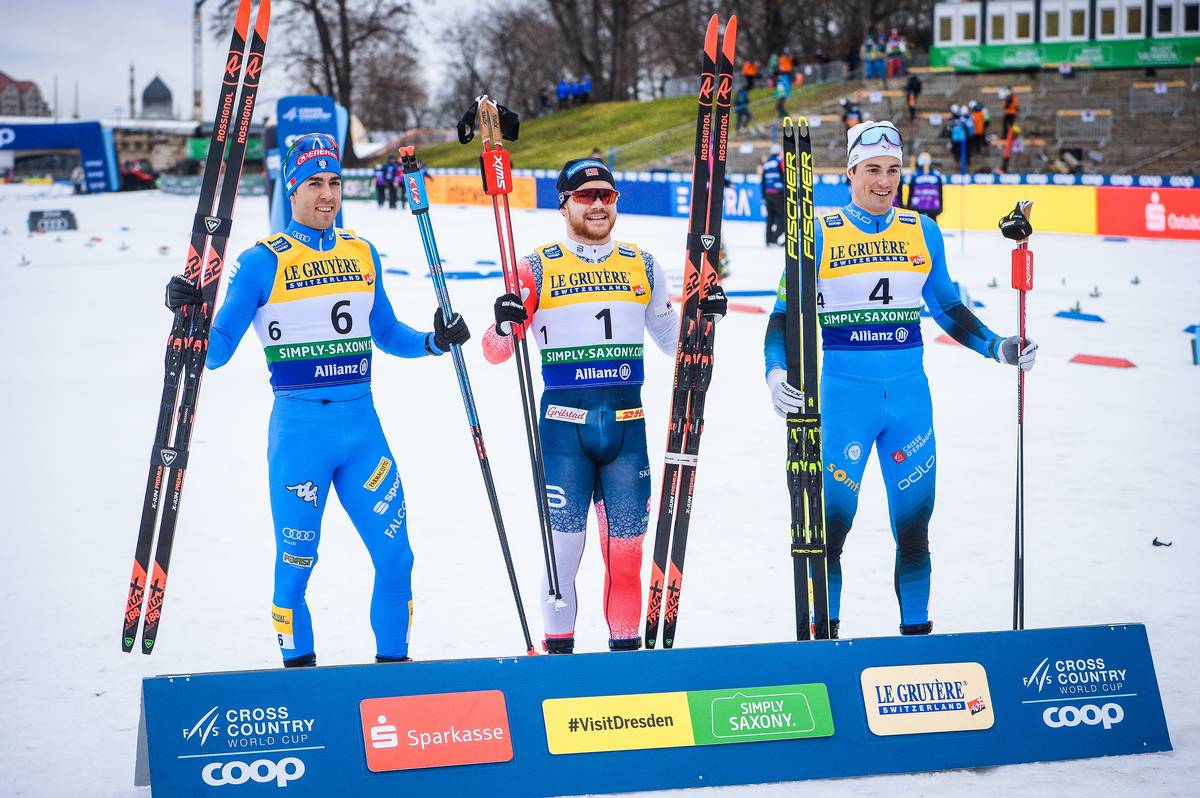
    The Men’s Freestyle Sprint Podium in Oberhof—Federico Pellegrino (ITA always contends, Lars Heggen (NOR) hopes he proved his point, Even Northug (NOR) left wondering if anyone had noticed. (Photo: Authamayou/NordicFocus)


    Love Stories Like This? Help Keep Them Coming.

    Feature stories like this one take time, access, and care to produce. If you value thoughtful storytelling and independent ski journalism, please consider becoming a Voluntary Subscriber. Your support directly fuels the work we do to cover the people, places, and moments that make our sport special.

    Join the FasterSkier community!
  • Edvin Anger Powers to Les Rousses Sprint Win, Schoonmaker Fifth

    Edvin Anger Powers to Les Rousses Sprint Win, Schoonmaker Fifth

    This coverage is made possible through the generous support of Marty and Kathy Hall and A Hall Mark of Excellence Award. To learn more about A Hall Mark of Excellence Award, or to learn how you can support FasterSkier’s coverage, please contact info@fasterskier.com.

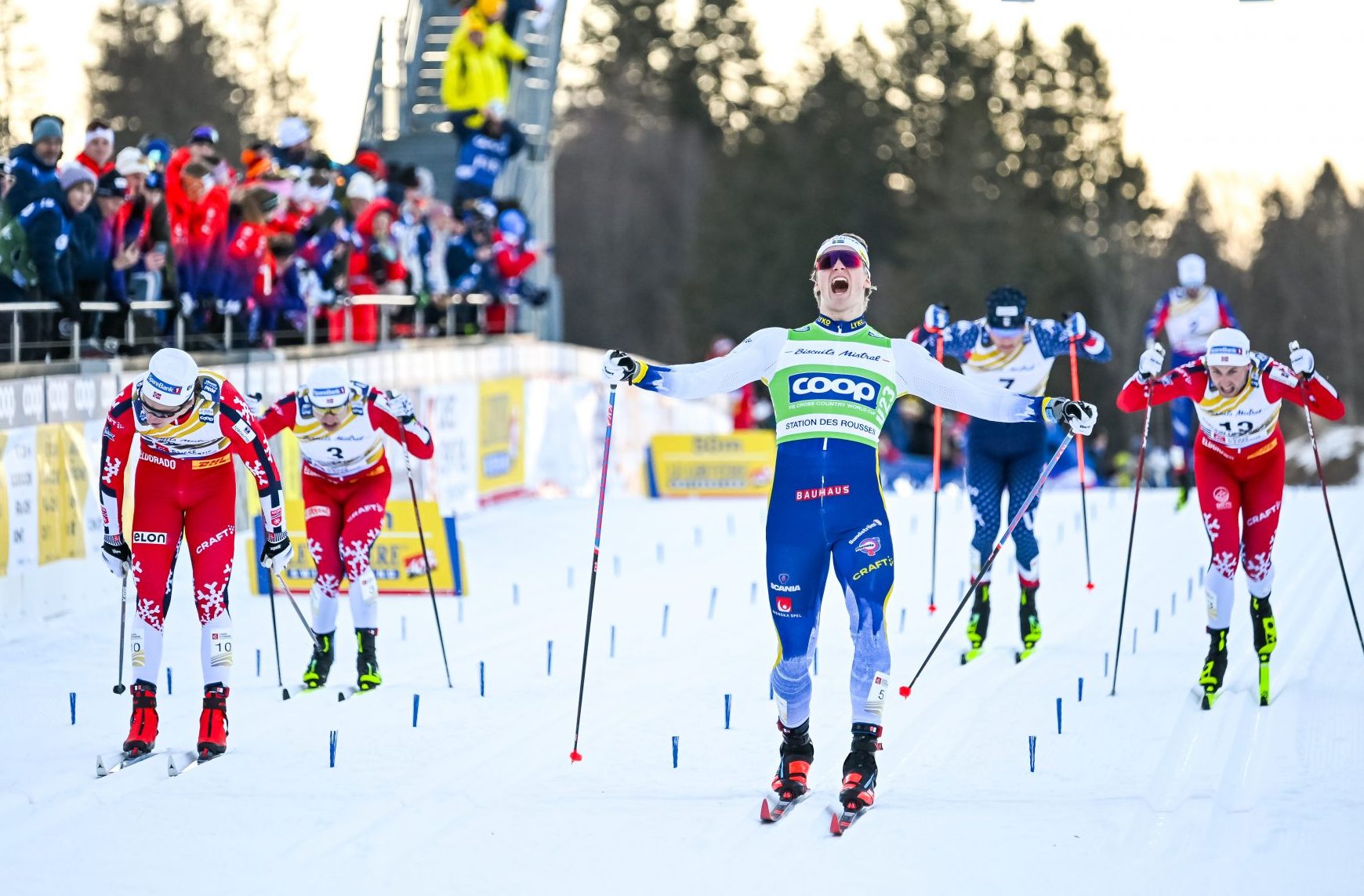
    Ansgar Evensen (NOR), Erik Valnes (NOR), Edvin Anger (SWE), JC Schoonmaker (USA), Jules Chappaz (FRA) at the finish line of the Men’s Classic Sprint in Les Rousses. Anger would secure his first World Cup win. (Photo: Authamayou/NordicFocus)

    Straight after his victory in yesterday’s Norwegian National Championships, Even Northug (NOR) hopped on a plane and showed up in Les Rousses, France in time to contest his Sprint qualifier (in which he advanced to the quarterfinals by placing 13th). Being one of the few Norwegian contenders who never intended to race the Norwegian distance events, Northug was free to grab his championship medal, and make a run for the continent to take advantage of what appeared to be a “soft” World Cup Sprint field. Appearances can be deceiving . . .

    Fresh off his own podium finish in yesterday’s 10 k Freestyle interval start, Ben Ogden was riding a wave of momentum that carried him to the top qualifying time, .5 seconds ahead of Lucas Chanavat (FRA), 2.5 seconds ahead of Erik Valnes (NOR). But speedy Sprint qualifying is not always the best indicator of Sprint eventual success. In Les Rousses, it was Sweden’s Edvin Anger who would dash to the victory, ahead of Ansgar Evensen (NOR) and Valnes. JC Schoonmaker would complete a brilliant day with a fifth place finish. Ogden finished fifth in his semifinal heat, only .01 seconds from a lucky loser spot that would have advanced him to the Final. He would end the day in ninth.

    Americans had advanced three skiers into the quarterfinals: Ogden qualifying first, Schoonmaker seventh (he would finish the day in fifth), Zak Ketterson 16th (he would end the day in 21st). Other American finishers included Luke Jager 39th, Murphy Kimball 42nd, and Jack Young 45th.

    Canadians in qualifying included Olivier Leveille 48th, Julian Smith 51st, and Remi Drolet 52nd.

    Newly crowned Norwegian Sprint Champion, Even Northug (13) arrived in Les Rousses hoping to take advantage of a Sprint field that did not include perennial contender, Johannes Hoesflot Klaebo (NOR). Northug’s plans were undone by eventual Sprint winner, Edvin Anger (SWE) who powered away from a diverse field of challengers. (Photo: Authamayou/NordicFocus)
    Quarterfinals

    In the absence of Johannes Hoesflot Klaebo—absolutely the dominant sprinter of the age—the men’s world Cup field can sometimes look like they don’t know what to do. It’s less a factor of Klaebo’s speed—he seems to win whether the race is fast or slow, tactical or flat out. What’s really missing is Klaebo setting the example of the fastest line. He demonstrates a sixth sense for finding the fastest side of the track, quickest lane around any turn, the shortest route to the finish line. In his absence, every Sprint heat seems to be an independent experiment in tactics and speeds. It’s not as though Sprinting is unexciting when Klaebo is absent, but viewers may find themselves not knowing whom to watch.

    Wearing the U23 leader’s bib, Anger controlled Quarterfinal 1 from the front, leading until the final turn when the faster skis of Valnes took control.

    Quarterfinal 2 was a slow, tactical affair in which perennial contender Richard Jouve (FRA) trailed the field, and proved unable to advance. The heat was controlled by Ansgar Evensen (NOR) and Emil Danielssonn (SWE).

    Ogden moved to the front of Quarterfinal 3, controlling the pace and marking any early moves. He double poled powerfully across the finish line ahead of Lauri Vuorinen (FIN) and Northug who would ultimately fail to secure a Lucky Loser spot.

    Schoonmaker lined up in Quarterfinal 4 where he claimed a Lucky Loser spot behind Chanavat and Oskar Opstad Vike (NOR).

    Ketterson drove the pace at the beginning of Quarterfinal 5, only to surrender the lead to others who sensed the opportunity to advance out of a fast heat. The heat finished with Jules Chappaz (FRA) and Ondrej Czerny (CZE) moving to the semifinals. Ketterson finished fifth in the heat, to end the day in 21st.

    Lucas Chanavat (FRA) edges out JC Schoonmaker (USA) and Jules Chappaz (FRA) in the semifinal of the Men’s Classic Sprint in Les Rousses France. Schoonmaker’s semifinal strategy of following the powerful Chanavat would not prove as effective in the later Final. (Photo: Modica/NordicFocus)
    Semifinals

    Ogden FLEW off the front of Semifinal 1, only to be overtaken by the field in the closing meters . He would finish the heat in fifth, a photo-finish struggle with Northug, who would advance along with heat winners, Anger and Danielssen. Once the finish line photos were inspected and the finishing times were calculated, Ogden would miss advancing to the final by only .01 seconds.

    JC Schoonmaker lined up in Semifinal 2, following the reliably powerful Chanavat all the way to the finish line, a photo finish to determine who would advance. Schoonmaker would claim the second place automatic qualifying position ahead of Jules Chappaz (FRA).

    “(It) wasn’t necessarily my strategy in the final to follow Chanavat,” said Schoonmaker. “It was more to race from the front of the field and find little spaces where I could rest my arms for the finish so it ended up working out to follow him.”

    Sprint Final

    A year ago in Les Rousses, Jouve was able to overhaul Klaebo for the unexpected win. Today in Les Rousses, Chanavat would carry the hopes of the French crowd.

    There was plenty to gain in the Men’s Sprint final. Among the finalists—Chanavat, Anger, Evensen, Valnes, Northug, and Schoonmaker—only Valnes and Chanavat had ever stood atop a World Cup podium. For the rest, the Les Rousses Sprint Final represented a unique opportunity. It also made for situations in which the strategies likely to be employed by the finalists were anything but clear.

    At the crack of the starter’s pistol, Anger powered straight to the front with Chanavat struggling a bit to get into high gear. Schoonmaker tripped over his pole on the first uphill rise, stalling his momentum briefly. Valnes broke into a herringbone on the first uphill, revealing that his wax choices were made to enhance glide rather than kick. The end of the race (and the final downhill) would reveal whether or not his choices were good ones.

    “When I tripped on my pole, it wasn’t a huge deal,” Schoonmaker explained. “But definitely one of those things that costs you a bit. I might be mistaken, but I felt like I was about to move up into third or fourth there, and then that trip up sent me right back to sixth. So it would’ve been nice to not make that mistake, but it wasn’t a race ended by any means.”

    Anger continued to push a torrid pace as Chanavat dangled well of the back. It appeared that Distance-racing fitness would rule the Sprint Final as Anger powered down the finishing straightaway for the win, his first any World Cup event.

    “It’s my first Final this year,” said Anger in post-race interviews. “I was thinking, ‘Let’s just go for it.’ I did . . . and I win!”

    Evensen and Valnes battled for second and third, barely ahead of a travel-weary Northug. Schoonmaker finished a half second behind Northug in fifth. Chanavat never recovered the earlier gap, finishing sixth.

    “I felt like I had decent energy in the final to make something happen but just needed to be further up from the start,” Schoonmaker said. “Those guys were definitely strong and Anger took it out hot right from the start, I just needed to be more prepared for that.”

    “I think so for sure, my shape feels good right now,” Schoonmaker concluded. “And making the final adds confidence to that for sure so I feel like I have some good momentum

    Les Rousses Men’s Sprint RESULTS

    Les Rousses Sprint QUALIFYING

    18.01.2025, Les Rousses, France (FRA):
    Ansgar Evensen (NOR), Edvin Anger (SWE), Erik Valnes (NOR), (l-r) – FIS world cup cross-country, individual sprint, Les Rousses (FRA). www.nordicfocus.com. © Authamayou/NordicFocus. Every downloaded picture is fee-liable.
  • How do you solve a problem like Johannes? The World Cup weighs in on how to dethrone him.

    How do you solve a problem like Johannes? The World Cup weighs in on how to dethrone him.

    Johannes Høsflot Klæbo, in typically dominating fashion, anchored the Norwegians to a victory in the team sprint in a World Cup in Switzerland earlier this month. (Photo: Modica/NordicFocus)

    In cross-country skiing, sprinting is a notoriously inconsistent discipline for a single competitor to dominate. The short distance leaves little time for racers to recover from even small mistakes; sharp corners and tight spaces often produce race-ending crashes.

    Which makes the track record of Norway’s Johannes Høsflot Klæbo almost impossible to comprehend.

    Klæbo, a five-time Olympic gold medalist, has won the last 10 straight sprint races he’s entered on the World Cup — the highest level of international competition. He often crosses the finish line far enough ahead of his rivals — if you can call them rivals — that he has time to unstrap his poles before crossing the finish line.

    Klæbo, 28, has won five out of the six Olympic and World Championships sprints he’s contested, and 52 of his 69 sprint World Cup starts — missing the World Cup sprint podium just once since 2018, according to data from the International Ski Federation.

    So: How do you beat this guy?

    FasterSkier, when the World Cup made its swing through Canada and Minnesota last season, decided to pose that question to an array of the circuit’s athletes and coaches. We’ve put together a kind of brief oral history below, seeking to appropriately describe Klæbo’s supremacy and the best ideas about how to take him down.

    Enjoy.

    What kind of tactics would you use to beat Klæbo in a sprint?

    Håvard Solås Taugbøl, a Norwegian World Cup racer and one of the nation’s (and globe’s) best sprinters: That’s the $1 million question. I have never managed to do it. 

    Swiss sprinter Valerio Grond: Maybe break his poles or something? I don’t know.

    French sprinter Lucas Chanavat: I mean, if I had the answer, I would have won the last one. You just focus on yourself, do the best race you can. It’s about my strengths. I think you have to be really perfect on every move you do. That’s the fun part about competing with him. It’s, like, you have to be perfect. And that’s really motivating.

    Lucas Chanavat of France alllllmost beat Klæbo at a World Cup sprint race in Switzerland last year. But he didn’t. (Photo: Modica/NordicFocus)

    Sweden’s team manager, Anders Bystrom: I think, first of all, you have to mentally know that he’s not unbeatable. Because I think many people think so. He’s shown that he is almost unbeatable, so it’s fair that people think that. But we don’t talk about him like that.

    Jonna Sundling, the Swedish Olympic champion from 2022 in the women’s sprint: I would go hard from the start, and don’t leave any power. Just go, all that I have. I don’t think I could take him in the final meters — he’s too quick for me. The men, maybe they’re scared sometimes — I don’t know, I think they can do more than what they think they can do. Maybe.

    Maja Dahlqvist, a Swedish Olympic sprint medalist: I would try to sprint him down, like waiting til the end. But I guess a lot of people try to do that, and people are not so successful.

    Grond: If he’s in his top shape, he’s almost unbeatable. He’s really, really always in a good spot. But when he’s maybe not in the best spot, you have to take advantage of this and put in an attack.

    Canadian national team coach Robin McKeever: Break his pole? 

    Swedish sprinter Edvin Anger: I think we need to push him really hard, and take our chances. I don’t think I need to go hard early, but I think I need to have a good place. And when I take my chance, I really need to take my chance. And I need to push from the place in the track that I think is best for me. I can’t wait to see what he will do, because I need to do the thing first.

    Norwegian sprinter Erik Valnes: How to beat Johannes in sprint is all about him being in bad shape. [Laughs] I think maybe it’s about the finish — or, to be able to have a good finish after a high-speed final. There are many things that have to be right to beat him. You just need to start the finishing sprint before him, and be ahead. Because as long as you’re behind him, you’re one step behind him in the mind games as well.

    McKeever: I think the only way is by surprising him. And they’re trying.

    What makes Klæbo so good at sprinting?

    Chanavat: He’s strong in every aspect of the sprint race. He has, like, amazing turns, an amazing finishing sprint, he’s insane in stamina. He’s good at everything. He’s the GOAT [Greatest Of All Time]. 

    Grond: He’s so good in every technique and part of the race, and also tactically. He’s simply the best skier in history.

    Dahlqvist: He’s good in everything. He can go hard, he can wait, he can go from the start.

    Norwegian distance specialist Simen Hegstad Krüger: He often likes to control the heat and he gets a lot of respect. And you have — I think there’s a lot of guys that think there’s no chance to beat him so they just give him room and then they give it away to him. He has earned the respect but especially in sprint you can’t give anything away and you have to take your place and take your positions. And I think he’s the best in that but I think sometimes he gets the best positions a little bit too easily.

    Klæbo wins a Tour de Ski stage just ahead of his Norwegian teammate Erik Valnes. (Photo: Modica/NordicFocus)

    Valnes: I’ve been angry with myself sometimes because of bad tactical decisions. Because many times I’ve just, in my unconsciousness — you think, ‘Just follow him, and you’ll get a good result.’ But then you will not get past him.

    Bystrom: If you meet him in a heat, you almost adapt to what he’s doing. Because you have to see, ‘Okay, what’s Johannes going to do now?’ Because you know he has this X-factor in many parts of the course. 

    Does Klæbo have any weaknesses in sprinting?

    Chanavat: You should probably ask him. That would be the best.

    Klæbo: That’s going to be a secret. [chuckles] I don’t think I will tell everyone. I think I’ll keep that for myself and I’ll tell everyone when I’m done racing. That’s my answer.

    Norwegian sprinter Even Northug: Maybe none.

    Valnes: No. That’s the thing with him. He’s not having any weaknesses. You can say, like, maybe double-poling long flats. But he’s quite good there.

    Krüger: Not that I’ve seen so far. Even in distance races, it’s not so many weaknesses to find. 

    French sprinter Jules Chappaz: I think running [uphill], like in Ruka [the Finnish ski resort that hosts the season-opening World Cup races each year]. First it was the ‘Klaebo run,’ but now I think I’m really good at it. Maybe, hopefully next year in Ruka, I can run faster, beat him. [He didn’t.] He is sick a lot of times — maybe that’s sort of his weakness. 

    Klæbo coasts to the win in Ruka this year, beating everyone, including Jules Chappaz. (Photo: Modica/NordicFocus)

    Anger: It’s a hard question. But I think we need to push him and then make him a little stressed — that’s what I think.

    Bystrom: Mayyyyyybe it’s skating without poles — using your legs to be able to, maybe, go past him. But it’s really hard to say. He’s the best. He’s shown that many times. He’s so good in so many areas. It’s hard to say there’s one where you could beat him when there’s 28 areas where you can’t beat him.

    Are there ways athletes can train over the long-term, like over next summer or multiple seasons, to beat Klæbo?

    Chappaz: Just trying to focus on ourselves. This spring, I will compete in the Ski Classics [marathon races] to improve my double poling. To look to the Olympics, 2026, with the Val di Femme finish — I hope it will improve my double poling skills, to [be able to] beat him.

    Dahlqvist: Maybe they need another team like us, like the Swedish women, because you can use your team more. So, maybe a whole team needs to be stronger, to try to beat the Norwegian. They could do team tactics in a way, like everyone knows where they will go. 

    Anger: I’m still young — I’m just 21 years old. And he has a lot of training hours. A lot more than I have. With one or two years more, with good summers, also with a lot of hours, I think it will be better for me. And maybe I will be better in the final — I’m good in the quarters and the semis right now, but maybe I miss a little in the finals. I need to be a little harder and stronger.

    Valnes, Klæbo and Anger pose for a podium photo after Klæbo won a World Cup sprint in Canada last year. (Photo: Modica/NordicFocus)

    Grond: We’ve just got to work hard. It’s also about learning how to ski against the best skier, for me. So, I’m trying, also, to get some experience on how they ski and where I can be better than them.

    Valnes: It’s more about improving the base level, the capacity, the VO2 max. If you have that base, from May until September, then you can build a little bit on that with specific training in October and November and just before the season starts.

    McKeever: The reality is, how do you beat Klaebo? Have him age out a little bit. 

    Northug: Training.

    Norwegian national team coach Eirik Myhr Nossum: You have to train, of course. But there were a lot of people training for the 100-meter dash, as well: Usain Bolt still won. So, if everybody in the world trains the best they can, still one will win — and it’s hard to beat Johannes. It’s possible, but he’s probably the best skier that’s ever been. And now it’s harder than ever, and he still wins.

  • A Finnish finish: Tying a bow on the 2023 season in Lahti

    A Finnish finish: Tying a bow on the 2023 season in Lahti

    This is the end. Of the 2023 racing season. Devon and Nat go without guests and are here to take you through the last three events of the winter in Lahti, Finland. And we cover a couple of retirement announcements from U.S. skiers.

    We’re taking a little break after this but, we promise: We won’t leave you hanging for the whole off-season. Stay tuned for more regular episodes over the course of the spring and summer, and we’ll be back in a few weeks for a 2023 season recap. Tell us your favorite memories from this year — get at us at devon@fasterskier.com and nat@fasterskier.com.

  • The Devon Kershaw Show: Live from Estonia, it’s Tuesday night

    The Devon Kershaw Show: Live from Estonia, it’s Tuesday night

    Estonia put on one heck of a show at a city sprint in the nation’s capital, Tallinn, this week. We give you a full recap with the help of an on-site expert, Vahur Teppan, and break down some complaints about a new system designed to level the waxing playing field — which may not have worked.

    We’ll be back for one more recap after the Lahti Ski Games in Finland this weekend. Devon is at devon@fasterskier.com and Nat is at nat@fasterskier.com.

  • Ruka Sprint Redemption for Johannes Høsflot Klæbo

    Ruka Sprint Redemption for Johannes Høsflot Klæbo

    A_Hall_Mark_of_Excellence_Award-logo-300.png (300×244)This World Cup coverage is made possible through the generous support of Marty and Kathy Hall and A Hall Mark of Excellence Award.  To learn more about A Hall Mark of Excellence Award or to learn how you can support FasterSkier’s coverage please contact info@fasterskier.com.


    Johannes Høsflot Klæbo displayed his dominance in this year’s FIS World Cup Sprint in Ruka, Finland. (Photo: NordicFocus)

    Ruka, Finland sits at a northern latitude similar to Fairbanks Alaska, similar to the northern end of Canada’s Hudson Bay. By early winter, the sun is a weakened glow on the horizon, and then for only a few precious minutes each day. By midday, skiers vying for the win in today’s FIS Cross-Country World Cup Sprint were racing under Ruka’s stadium lights.

    The first men’s events of the FIS World Cup Cross-Country season took place in cold conditions that left competitors wreathed in the steam of their own breath, and tested the skill of ski technicians charged with creating kick and glide. Johannes Høsflot Klæbo quickly dispelled any notion that he may be limited by a lingering hamstring injury: Klæbo qualified first, dominated all heats in a manner that appeared easy, even for him, and cruised to victory ahead of Norwegian countrymen, Even Northug and Paal Golberg.

    Ben Ogden and JC Schoonmaker were the only North American’s advancing to the heats in the men’s field—Ogden 13th  and Schoonmaker 19th—with a near-miss for Logan Diekmann who skied to 32nd place in qualifying. Luke Jager tied for 40th, and Kevin Bolger 46th.

    Canada entered two skiers in sprint qualifying, with Graham Ritchie placing 53rd and Oliver Leveille 56th.

    Ruka Men’s World Cup Sprint

    While Klæbo’s first win of this World Cup season appeared leisurely, it was not without emotion. Ruka is where Klæbo was famously pipped at the line by Alexander Bolshunov in 2018. Ruka is also where Klæbo lost a World Cup sprint to Erik Valnes in 2020, and where Alexander Terentev outskied him in the opening World Cup Sprint in 2021. If Johannes Høsflot Klæbo were ever motivated by a desire for redemption, it would be at Ruka.

    Norwegian teammates Erik Valnes and Johannes Høsflot Klæbo celebrated a team sprint victory in Oberstdorf. Valnes is one of the few sprinters to take a World Cup sprint victory from Klaebo, as he did last season in Ruka. (Photo: NordicFocus)

    QUARTERFINAL 1—Klaebo and Valnes dominate

    Norwegian skiers arrived for Quarterfinal 1 clad in truly confusing red racing uniforms (all but indistinguishable from what Russian team skiers have worn on the World Cup circuit for quite a few years).  Except for Klæbo, most Norwegian athletes even raced in very Russian-looking red hats. At least the Swedes (mostly white) Finns (blue) and Americans (in blue with red/white stripe accents) remained recognizable.

    Wearing the yellow bib of last year’s overall World Cup champion, Klæbo advanced easily by means of his now-familiar acceleration on Ruka’s signature hill, though he never needed to unleash the high tempo striding that has been his trademark in this event. His skis seemed to float along the finishing stretch, allowing him sufficient space in front of his rivals to stand up and remove his pole straps well before the line. Norwegian teammate, Erik Valnes, followed him across the line in second.

    QUARTERFINAL 2—Halfvarsson advances

    The day’s second heat saw American, Ben Ogden, joining Norwegian sprint specialist, Even Northug, and the rejuvenated Swede, Calle Halfvorsson. Finland’s Joni Maki displayed fast skis as he moved to the lead, with Ogden pressing forward on the course’s first uphill. Ultimately, Halfvarsson finished first in the heat ahead of Northug, with Maki advancing as a lucky loser. Ogden seemed to struggle with slow skis, ultimately finishing the heat in fifth.

    QUARTERFINAL 3—Chanavat fades

    Heat 3 was dominated by Norway’s Haavard Solaas Taugboel who sprinted the ultimate hill followed by an inspired Francesco De Fabiani. France’s perennial sprint contender, Lucas Chanavat, finished fourth without ever appearing sharp.

    QUARTERFINAL 4—Schoonmaker comes close

    Paal Golberg moved quickly to the front in Quarterfinal 4, with American JC Schoonmaker jumping in behind. France’s 2022 World Cup Sprint Champion, Richard Jouve, worked his way forward through the quarterfinal field to tuck in behind Goldberg. Schoonmaker raced cleverly through the final stretch with a smart move to the inside on the final curve, narrowly missing a lucky loser spot.

    QUATERFINAL 5—Pellegrino climbs to the win

    Beijing silver medalist, Federico Pellegrino wore Italy’s new black race suit, and advanced to the semifinal by moving efficiently through the quarterfinal field. Pellegrino went to diagonal striding early on the ultimate hill, allowing him to pull away from the field. The inspired Frenchman, Jules Chappaz, crossed the line second.

    A resurgent Calle Halfvarsson moved consistently through the field on his way to the final. (photo: Fischer/NordicFocus)

    SEMIFINAL 1—both the lucky losers

    Wearing a white hat that differentiated him from his Norwegian teammates, Klæbo moved easily to front of his semifinal field before abruptly easing up. Northug and Halfvarsson took over the pace-making: thereafter, the script was pure Klæbo: driving to the front on the hill before gliding unchallenged across the finish line. Halfvarsson, Valnes, and Northug all advanced to the final.

    SEMIFINAL 2—Chappaz arrives on the scene

    The 1.4 k Ruka sprint course incorporates a critical uphill groomed four lanes wide, continuing over the top and down the other side to a lefthand turn into a wide finishing straight. Commentators often become so focused on Klæbo’s quick-striding domination on Ruka’s signature hill that we may overlook the fact that many other skiers bide their time on the hill, using the finishing straight to pick off their rivals. Semifinal 2 looked to be competitive, with Goldberg, Pellegrino, Chappaz, Jouve, and De Fabiani seeming well matched. Early on, Jouve moved into the lead after a very tight move that cut off De Fabiani. Ultimately, Jouve faded badly on the uphill—as did Pellegrino—allowing Chappaz to storm ahead for the semifinal victory (though he may have used too much energy in achieving it). Golberg crossed the line second to advance to the final.


    Sprint Final

    Making only his 12th World Cup start, Jules Chappaz may have spent more energy than was necessary in winning his semifinal; he would not end up being a factor in the final. That left Sweden’s resurgent Calle Halfvarsson to face four Norwegians (Northug, Valnes, Golberg, and Klæbo). Golberg and Valnes maneuvered to the front after Klaebo had  slowed the opening pace. Lingering mid-pack, Klæbo accelerated on the course’s primary downhill, and moved into a leading position before the hill. Klæbo never appeared to need his top gear, easily distancing the field on the hill. By the top, he had established a considerable gap which he handily maintained through the finish for his 49th World Cup victory. Northug won last week’s tune-up sprint Beitostolen, and his good form and good strategy brought him to the finish line second followed by teammates Golberg in 3rd, and Valnes in 4th.

    Johannes Høsflot Klæbo of Norway takes the win in Ruka, Finland’s classic sprint, gaining redemption for two Ruka World Cup sprints when he suffered rare defeats. (Photo: NordicFocus)

    While Klaebo had shown his early season fitness last week in Beitostolen with wins in Classic and Freestyle 10 k’s, his sprint-condition had remained in question. It wasn’t known (even by Klæbo) whether or not he would have the speed, the power, and the pop to contend in a World Cup sprint.

    “I didn’t know how this should go,” Klaebo said in a post-race interview.” . . . [I’ve had] things to deal with the last three weeks (referring to his lingering hamstring injury). [But] I had a really good day today. It was a lot of fun.”

    If there were any lingering questions regarding Klæbo’s fitness—or about his recovery from his summer-long hamstring injury—those questions have now been answered.

    The World Cup Sprint podium ceremony was still fist bumps instead of handshakes, reminding viewers that Covid still threatens events such as these. That memory must be particularly poignant to Klæbo: in 2020, the Norwegian team was unable to compete in the final World Cup events, and in 2021 Klæbo, himself, succumbed to Covid in the final weeks of the year, allowing Richard Jouve to claim the crystal globe. Today, at least, Klæbo had achieved a level of redemption, finally exiting the Ruka stadium with the sprint win that we’ve all come to expect.


    Full Results

    RUKA MEN’S SPRINT:  QUALIFYING | RUKA MEN’S SPRINT:  FINAL RESULTS


  • Klæbo Runs Away with Third Stage Win in the Classic Sprint; Ogden 22nd, Jager 27th

    Klæbo Runs Away with Third Stage Win in the Classic Sprint; Ogden 22nd, Jager 27th

    This World Cup coverage is made possible through the generous support of Marty and Kathy Hall and the A Hall Mark of Excellence Award.  To learn more about A Hall Mark of Excellence Award or to learn how you can support FasterSkier’s coverage please contact info@fasterskier.com.


    As we begin Stage 4 of the Tour de Ski, the first classic sprint since the opening race of the season in Ruka, Finland on November 26th, we look back to the last time athletes raced the event on the tracks in Oberstdorf, Germany. 

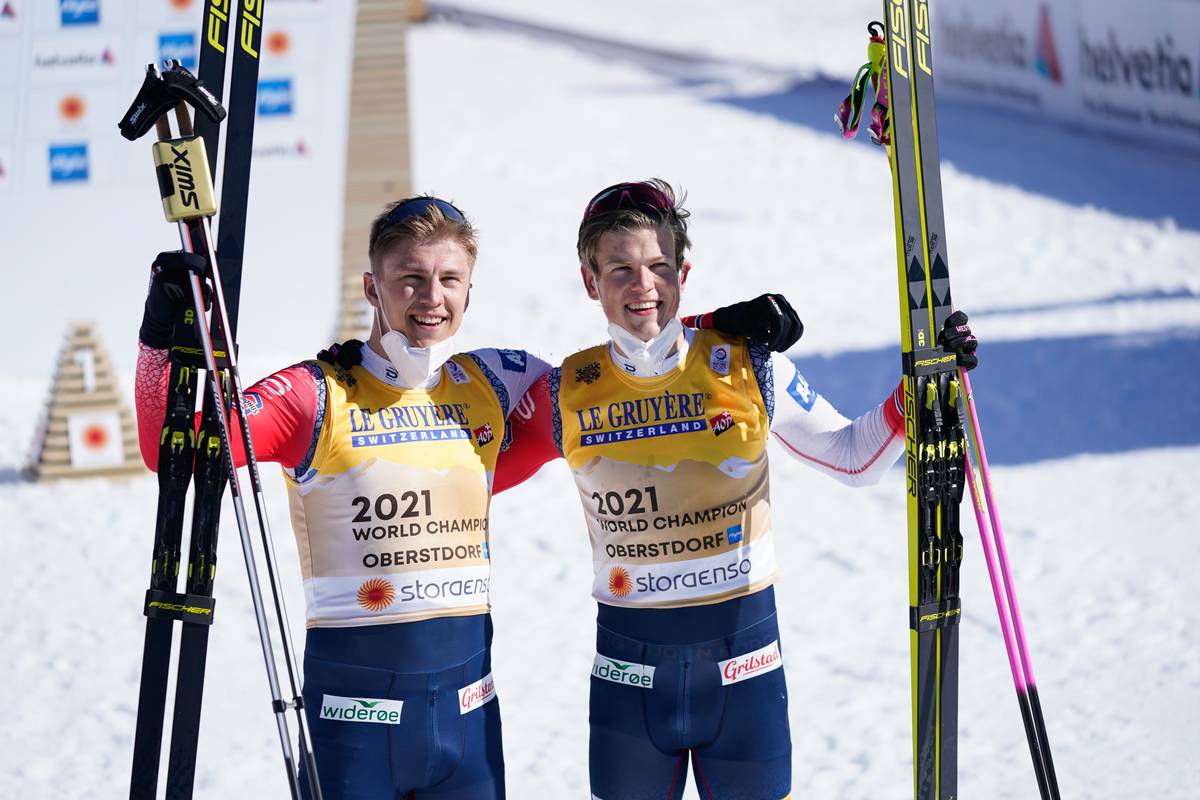
    During the 2021 World Championships, Johannes Høsflot Klæbo (NOR) took command of the gold medal from the qualifier on a 1.5-kilometer course seemingly designed for his racing style. A quick double pole start from the stadium leads to a long steady first climb where he skied long, strong, and steady, usually in second or third position. After a winding descent, athletes encounter a second short but steep climb of roughly 18 vertical meters, where Klæbo would begin his signature run. Stomping his way to the lead as he crested the top of the climb, stepping around a left-hand curve, and dropping into a tuck on the final descent leading into the stadium, Klæbo was repeatedly in position to advance through each round comfortably, eventually winning the final by several ski lengths. (Video highlights here.) 

    Alexander Terentev races to second place in qualification during Stage 4 of the Tour de Ski in Oberstdorf. (Photo: NordicFocus)

    Winning today’s qualifier in 2:55.78, Klæbo looked to be on track for a repeat victory in Oberstdorf, however, it is worth noting that he did not win the aforementioned other classic sprint this season. In Ruka, it was 22-year-old Alexander Terentev who took hold of the event in qualification and looked to, well, out-Klæbo Klæbo throughout the heats. We saw familiar tactics with a power move on the final climb, paired with impressive acceleration over the final meters to capture the win, but this time, the athlete employing these tactics was in a Russian race suit. While Klæbo has won each of the sprints he has entered since, with Terentev eliminated in the semis, Stage 4 would be a rematch both were eyeing. 

    Setting the stage, Terentev was second in qualification, +1.5 behind Klæbo, with Erik Valnes (NOR) in third (+2.37), Federico Pellegrino 4th (+3.53), and Alexander Bolshunov 5th (+3.61). Ben Ogden was the top American qualifier today, finishing 15th (+8.08), while Luke Jager finished 24th (+10.83). The American selected heats two and five, respectively. 

    Johannes Høsflot Klæbo and Erik Valnes take the lead in the final climb of the quarterfinal, with Ivan Yakimushkin (bib 23) and Iivo Niskanen (bib 29) chasing. (Photo: NordicFocus)

    In the first wave of the quarterfinal, Finland’s Iivo Niskanen, winner of the Stage 2 15k classic, pushed the pace heading up the first climb, perhaps looking to ensure an opportunity for a fast rather than tactical heat, knowing he was up against Valnes and Klæbo and likely would only have the opportunity to advance as lucky loser. However, the Norwegians, unphased, chose not to respond, waiting patiently mid-pack to use the same tactic described at World Champs. In the second climb, both created enough room to look as if they had begun their cooldown as they skied through the finish lanes, with Klæbo addigng a lackadaisical boot slide at the line that put him just ahead of his teammate. Behind them, Niskanen and Ivan Yakimushkin (RUS) sprinted to the line to chase the clock, with the Russian finishing ahead of the Finn. However, their times did not hold up through subsequent rounds and their day had ended.

    Alexander Bolshunov leads the quarter final during Stage 4 of the Tour de Ski, with Ben Ogden racing in bib 15. (Photo: NordicFocus)

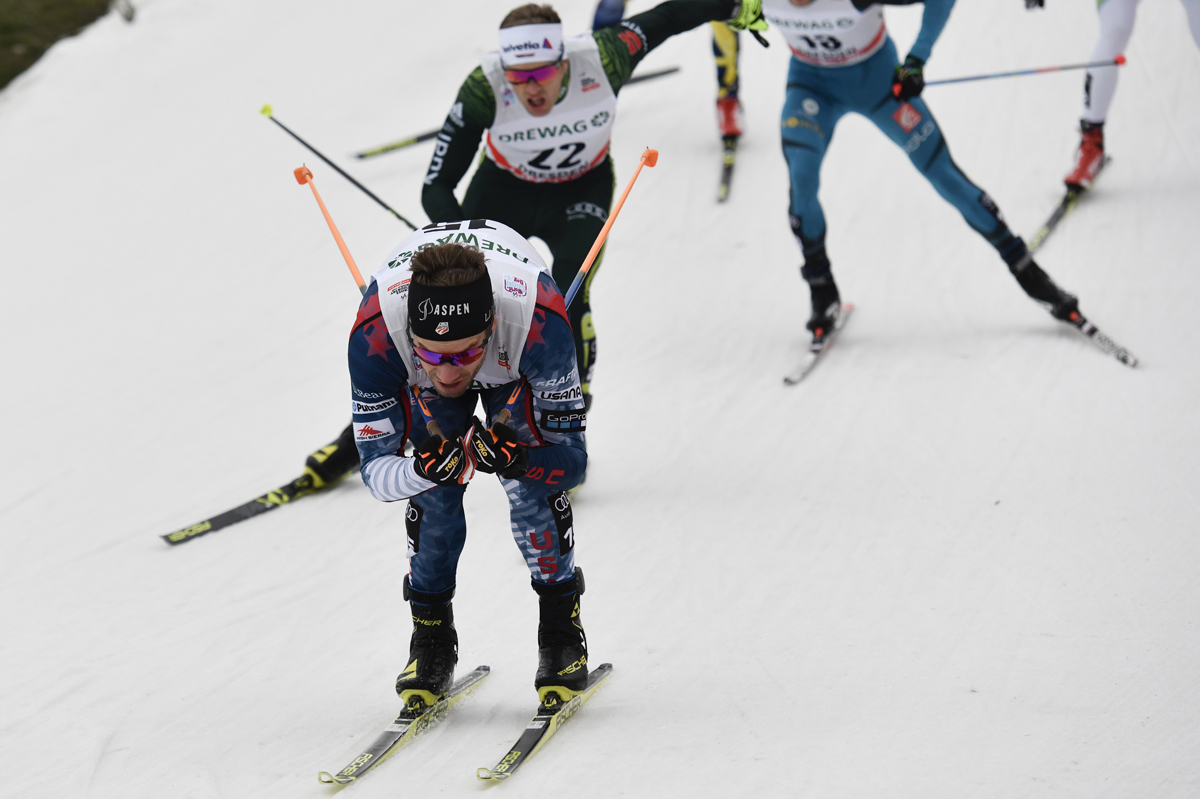
    In the second heat of the quarters, Ogden lined up alongside Bolshunov, who took control out of the gate. Staying in the pack through the first climb, Ogden found himself in fifth as athletes exited the second and began descending toward the stadium. In the final curves, Ogden couldn’t quite maintain the position needed to contend for a spot as lucky loser, finishing 5th in a fast heat, +1.52 behind Bolshunov.

    Terentev looked as though his day might be over before he could face Klæbo head-to-head. Federico Pellegrino (ITA) stepped on his pole as lanes decreased in the opening stretch, causing it to snap. Terentev calmly accepted a replacement, steadily working his way back into the mix. Running out of the tracks in the final climb, Terentev accelerated around the left-hand curve and into the downhill in the lead, continuing through the finish for the win ahead of Mikal Novak (CZE) to advance comfortably.

    Alexander Terentev leads his quarterfinal during Stage 4 of the Tour de Ski in Oberstdorf. (Photo: NordicFocus)

    In the fifth heat of the quarters, Jager maintained contact with the pack through the first climb, but found himself off the back as he left the second. Jager’s legs wobbled as he found his footing in the descent. Perhaps too flooded to ski as aggressively as was needed to put himself in contention for higher placement, he crossed the line sixth in the heat, +6.88 behind the winner. 

    Luke Jager raced in the fifth quarterfinal during Stage 4 of the Tour de Ski in Oberstdorf. (Photo: NordicFocus)

    On we go to the semifinals.

    In a stacked first heat, Bolshunov and Terentev set the pace at the front heading up the first climb. Striding metronomically, they held Valnes and Klæbo temporarily at bay. As the men charged into the final climb, Klæbo advanced at a run up the outside, rounding the left hand bend with Terentev at the front before beginning the sweeping downhill side by side. 

    Terentev began to move across the track behind Klæbo, looking to finding a line that might be optimal for using the Norwegian’s draft to slingshot into the final lanes at high speed. Not waiting long enough, Terentev caught his tips on the Norwegian’s tails, losing his footing and crashing with a slide into the v-boards. No chance to recover what was lost, Terentev stood up, taking a defeated swing at the ground with his pole, before slowly continuing through the final meters to the finish, now well off the back. 

    As the two had created a small gap to their chasers, Valnes and Bolshunov navigated around the crash easily, racing to the line for second and third. Pulling ahead with his double pole, Valnes snagged second with Bolshunov less than half a second back, hoping for a lucky loser spot in the final.

    With a comfortable lead, Johannes Høsflot Klæbo looks over his shoulder as Erik Valnes and Alexander Bolshunov race to the line in the semifinal. (Photo: NordicFocus)

    Terentev later received verbal warning for a classical technique infraction.

    In the second and less-eventful semi, Pål Golberg and Even Northug attempted to take control of the race in the final climb, but they remained matched by Italy’s Francesco De Fabiani and Sweden’s Calle Halfvarsson as they crested the top. Goldberg picked up the most speed in the descent, accelerating out of the final curve with a sizable gap to his three chasers. Laying off the gas before the line, Goldberg took the win ahead of Northug, who left De Fabiani and Halfvarsson fighting for lucky loser spots on his tails. 

    Calle Halfvarsson and Fracesco de Fabiani take it to the line in the semifinal. (Photo: NordicFocus)

    De Fabiani and Halfvarsson crossed in a photo finish, both just 0.02 seconds ahead of Bolshunov’s mark, allowing them both to advance to the final and ending the Russian’s day.

    With four Norwegians in the final, they were guaranteed at least one spot on the podium. 

    Norway were 1-2-3 coming out of the first climb, with Klæbo sitting in second position. Doublepoling into the next climb, Klæbo matched Valnes as the two ran at the front, Klæbo out of track and Valnes in the inside lane.

    Johannes Høsflot Klæbo leads into the final descent in the last round of the Stage 4 classic sprint in Oberstdorf. (Photo: NordicFocus)

    Klæbo accelerated into the curve at the top stepping in front of Valnes and leading him into the downhill. Klæbo powered into the final stretch still in the lead, with Valnes a ski length back but closing fast with a strong doublepole. Valnes changed lanes, knowing it was his only opportunity if he wanted to try for a win, but there was not enough real estate left and this cost him speed as they came to the line. No time to celebrate this time, Klæbo pushed his boot over the finish to stop the clock at 2:54.77, roughly 3.5 seconds faster than any other rounded, with Valnes 0.3 seconds back for second place. 

    Johannes Høsflot Klæbo takes the win in Stage 4 ahead of teammate Erik Valnes, while Pål Golberg, Even Northug, and Calle Halfvarsson fight for the final spot on the podium behind. (Photo: NordicFocus)

    Behind the duo, the remaining two Norwegians sprinted to the line for a photo finish, with Goldberg edging out Northug for third by just 0.02 seconds. Halfvarsson, still in contention for the podium in the final stretch, crossed 0.5 seconds behind the Norwegians to end his day in 5th, while De Fabiani seemed to have accepted his fate, crossing the line casually +11.71 behind Klæbo. 

    Determining third place, Pål Golberg (center) edges out Even Northug, wit hCalle Halfvarsson just off the mark in fifth. (Photo: NordicFocus)

    Another all-Norway classic sprint podium in Oberstdorf, and a second consecutive win for Klæbo.

    “It’s amazing to start a new year with a victory and also to have two of my best friends coming onto the podium as well,” Klæbo told FIS at the finish. “I am really satisfied with today’s race, and also to start, hopefully, a good new year.”

    After four races in five days, Klæbo was asked whether Tour fatigue had begun to set in. 

    “For sure, I am getting a little bit tired, but still, when the weather is like this and the conditions are pretty nice, it gives you a lot of energy. So it’s just trying to push hard, looking forward to a rest day tomorrow, and trying to push hard in the last two legs.” 

    The all-Norwegian men’s podium after Stage 4 of the Tour de Ski: Johannes Høsflot Klæbo took his fourth win of the Tour ahead of Erik Valnes in second and Pål Golberg in third. (Photo: NordicFocus)

    After the final results were determined, Ogden ended his day in 22nd. 

    “I took the qualifier out really hot, hoping to be in the top 3 in qualification,” Ogden told U.S. Ski & Snowboard cross country communications manager Tom Horrocks at the finish. “I was a little flooded at the end, but not the end of the world. I chose heat 2, which is not always what I do, so I tried something different, and I think I skied well in the heat. It’s been a lot of racing for me early, so I’m a little tired, and wasn’t the smartest out there… but I’d say I’m learning a lot and making progress, so one day I’ll put it together.”

    Full audio clip with Ben Ogden, interviewed by Tom Horrocks.

    Ben Ogden races in heat 2 of the quarterfinals in Oberstdorf. (Photo: NordicFocus)

    It was Jager’s second time qualifying for the rounds in a classic sprint, and his second-best overall World Cup result. Jager was 18th in the opening classic sprint in Ruka, and finished 27th today.

    “I was trying to be competitive, in second, third, or fourth, somewhere where I could potentially get in a draft and have a good finish, hopefully,” Jager told Horrocks post-race. “It didn’t work out that way… Hindsight is 20/20, so maybe I wish I had picked a different lane and just gotten out and ran earlier, but at the end of the day, the pace was just really, really fast. I was and am, chronically and acutely, pretty tired right now, so I just didn’t really have it and wasn’t as aggressive as I should have been going over the top. I like to think if I had another shot in that exact same position, I could make fourth or fifth, but an objective qualification in that [heat] probably wasn’t going to happen for me today.” 

    Luke Jager races to 27th in Stage 4 of the Tour de Ski in Oberstdorf. (Photo: NordicFocus)

    Looking to the bright side, Jager expressed how grateful he has been to have had excellent skis in every race he’s competed this season, which provides confidence even on the days when the body doesn’t want to cooperate. At 21-years-old, Jager’s career is still nascent, and it’s easy to understand how progress at this level may not be linear. 

    “I’m super thankful for the opportunity [to race on the World Cup this season]… It feels often like it’s one step forward, four steps backward over here, just because it’s so brutal. The last month, especially, has been pretty tough and pretty demoralizing at times for me. I’m going home today, so it’s pretty nice to end with a glimmer of hope for what is to come. It’s the real deal. Sometimes it’s easy to forget that because so many Americans are doing well, but it’s pretty damn hard over here.”

    Full audio clip with Luke Jager, interviewed by Tom Horrocks.

    Kevin Bolger races to 33rd in qualification during Stage 4 of the Tour de Ski in Oberstdorf. (Photo: NordicFocus)

    Outside the Top-30, Kevin Bolger and Zak Ketterson were just shy of making the heats, finishing 33rd (+13.10) and 34th (+13.39), less than a second off the time needed to advance. Logan Hanneman was also a near-miss, finishing 37th (+14.08). Gus Schumacher rounded out the American starters in 45th (+16.51) of 73 starters. 

    Looking at the overall Tour de Ski standings with four of six stages complete, Johannes Høsflot Klæbo tops the list for both cumulative time and points after winning three of four events. By time, he sits 1:03 ahead of teammate Pål Golberg and 1:19 ahead of Alexander Bolshunov. With a 15k mass start classic and 10k freestyle hill climb to go, Klæbo is in good standing, but cannot be complacent, as the hill climb, in particular, has historically favored Bolshunov. 

    By points, which favor sprint stages and intermediate sprints in distance races, Klæbo leads with 81 points ahead of Erik Valnes, who holds 50, and Goldberg with 41.

    After a rest and travel day, racing continues Monday in Val di Fiemme, Italy.

    With three wins in four stages, Johannes Høsflot Klæbo leads the overall Tour de Ski standings by both cumulative time and points. (Photo: NordicFocus)

    Stage 4 Results:

    Qualification | Final

    Tour Standings After Stage 4:

    Cumulative Time | Points 

  • Norway Takes the Top Two Podium Spots in the Team Sprint; Bolger and Schoonmaker Ski to 9th

    Norway Takes the Top Two Podium Spots in the Team Sprint; Bolger and Schoonmaker Ski to 9th

    Overcast skies mute the spectacular architecture along the River Elbe, which provides the backdrop for the sprint track in Dresden, Germany. (Photo: NordicFocus)

    This World Cup coverage is made possible through the generous support of Marty and Kathy Hall and the A Hall Mark of Excellence Award. To learn more about A Hall Mark of Excellence Award or to learn how you can support FasterSkier’s coverage please contact info@fasterskier.com.

    In the wake of the American women taking second to the Swedish powerhouse duo, and yesterday’s top two spots on the podium, Maja Dahlqvist and Jonna Sundling, the men’s team of JC Schoonmaker and Kevin Bolger lined up to race the freestyle team sprint final on the track in historic Dresden, Germany. 

    “Together again,” wrote Bolger in a post-race email. “We teamed up 3 years ago when JC came over for his first World Cup and didnt ski great then together, but being able to team up again and move to the final after a really solid semi was super rad today! He skied really well all weekend and I’m so impressed with how he’s looking, so it made today really fun!”
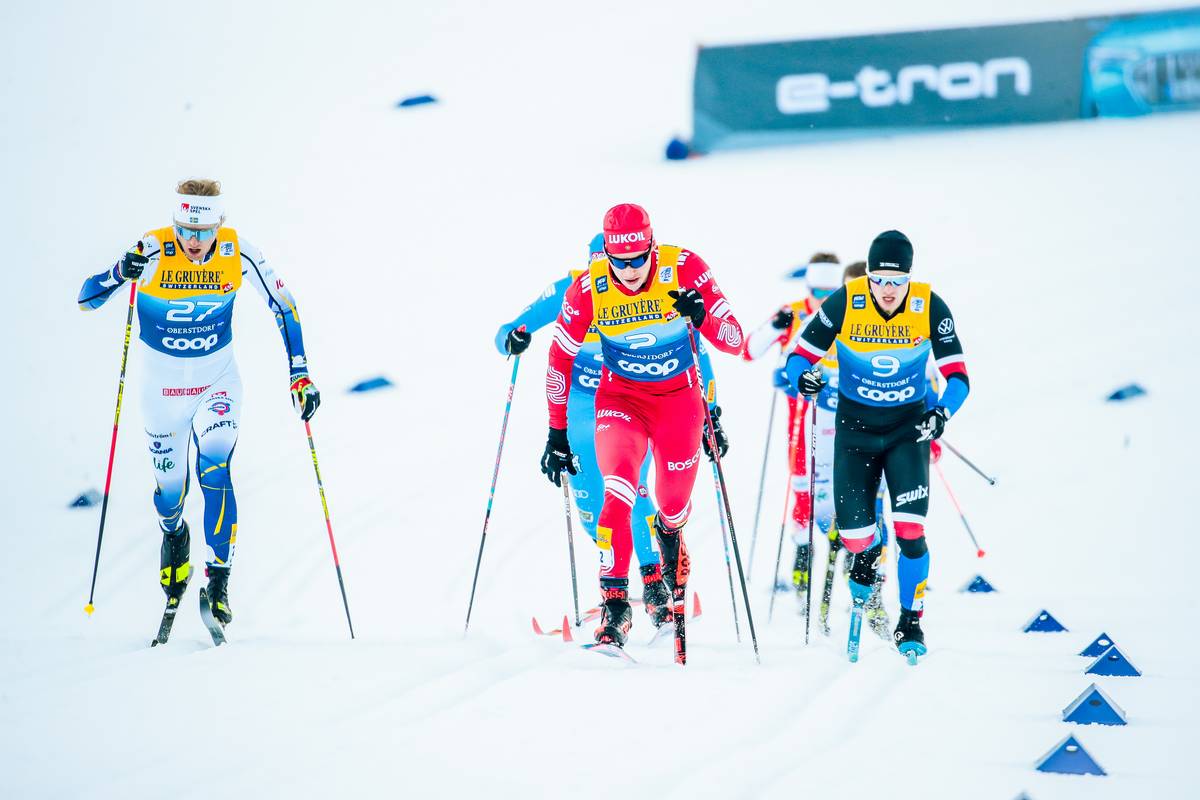
    Six quick laps each, eleven exchanges total, on a flat and fast city 0.65-kilometer loop with minimal recovery means flooded legs and tight racing. Like a series of just-over one minute intervals with equal rest, athletes take a conservative start, accruing fatigue while minimizing the opportunity for crashes and broken equipment to decide the race, over fitness and tactics. As the number of remaining laps dwindles, the pace steadily builds, like a bottle rocket, until the critical point arrives in the last few laps and leaders explode off the front in an effort to take control of the outcome. 

    Kevin Bolger navigates a tight curve during the men’s team sprint in Dresden, Germany. (Photo: NordicFocus)

    As expected from a lap that lasted just over a minute, the whole pack of ten teams stayed very tight through the halfway mark. The Norway II team of Thomas Larsen and Even Northug spent time at the front, putting in quick surges at the beginning of each leg to re-establish their position. 

    Tagging off after lap 6, the team tagged off with Great Britain on one side, and the Norway I team of Sindre Bjørnestad Skar and Håvard Solås Taugbøl, on the other. Still very much in the mix were the Russia I pairing of Alexander Bolshunov tagging Gleb Retivykh, Italy’s Francesco di Fabiani and Federico Pellegrino, and France’s Richard Jouve and Lucas Chanavat. 

    The leaders wait for a tag during the Dresden team sprint. (Photo: NordicFocus)

    At the half, the Americans remained in contact near the back of the pack, as Bolger tagged Schoonmaker in 9th (+2.0). 

    Coming into lap 9, Bolshunov made a move to the front to take the reins for Russia I, with both Norway teams and Jouve quickly responding to his tempo, while Italy and Great Britain worked hard to maintain contact. This burst set the tone for the final three laps.

    As Retivykh unsuccessfully attempted to drop Taugbøl and Northug in lap 10, the pack in pursuit began to stretch out. While all remained in contact with the leaders, Great Britain began to look out of the running for a win, with Italy and France remaining a podium-threat in fourth and fifth. The teams behind thinned rapidly.

    Still tight at the Tag, Norway II, Italy, and Norway I (left to right) head out for another lap during the Dresden team sprint. (Photo: NordicFocus)

    In Bolshunov’s final lap, he rocketed off the front, skiing powerfully through his legs with an aggressive forward lean, carrying momentum between each push. Whereas the early laps, rounding the tight curves looked careful and calculated, the men shot around the degrading bends, losing no speed as they pushed into the straightaways. 

    Tagging off for the final lap, Northug accelerated ahead of Retivykh, free skating powerfully off the first roller to regain the lead for Norway II. Feet quickly stepping around the first curve, Norway II looked in control with Norway I and Russia not ceding the win just yet. Italy and France remained on their tails, still in position for the podium. 

    Coming into the final curve hot, Taugbøl made an attempt to slingshot Norway I to the lead, but the tactic was thwarted by the closing speed and power of Northug. Standing up to pump his fist into the air, Northug coasted over the line for the win in 14:19.34, while Taugbøl narrowly edged out a hard-closing Retivykh to make it Norway II, Norway I (+0.42), then Russia I (0.62) for the podium. 

    Even Northug pumps his fist as he takes the win, while the second and third spots on the podium remain up for grabs behind him. (Photo: NordicFocus)

    “It was amazing,” Northug told FIS at the finish. “We struggled a little bit in the semifinal, but in the final we did everything right. Thomas sent me out first on the final lap and that was the plan. It was good.”

    Speaking to the experience of racing with Northug, Larsen spoke highly of his partner, and of putting the Norway II team ahead of Norway I on the podium. 

    “It’s fantastic, he’s an incredibly good skier,” Larsen said. “He hasn’t had so many chances in the World Cup so far, but now he shows with yesterday and last week, he shows that he is one of the best in the world. I think this was a dream team today, and it’s cool to be the underdogs and just take it home.”After a fast final leg by Pellegrino to keep his team in the mix for the top-three, Italy was next over the line, narrowly missing the podium in fourth (+0.78), with Chanavat bringing the French I team home in fifth (+1.21). Knowing he was no longer in position to snag top-three, Great Britain’s Andrew Young relaxed in the final stretch, coasting over the line in sixth (+3.84), followed by a sizable gap to the next racers. 

    The men’s podium of the team sprint in Dresden: The Norway II team of Thomas Larsen and Even Northug took the win ahead of Norway I, Sindre Bjørnestad Skar and Håvard Solås Taugbøl, and Russia I, Alexander Bolshunov and Gleb Retivykh. (Photo: NordicFocus)

    After losing contact in the final laps, Schoonmaker brought the American team to the line in 9th (+11.36). 

    “Dresden is a really fun event,” Bolger said after the race. “I think it’s something a lot of us skiers on the a World Cup enjoy to mix things up!”

    Bolger explained that he and Schoonmaker “just wanted to stay out of trouble — and try as best as we could to put ourselves into a position to where we could attack when we needed to… I was hoping for more of a tactical final but it seemed like Bolshunov had a different plan and really pushed the pace for my leg the whole time, which made it really hurt, but I think that makes it really fun and competitive!”

    Providing insights into the team’s tactics and his experience during the final, Schoonmaker provided the following comment in a post-race email from the road.

    “I would say our main strategy going into the final was to conserve energy while staying in the top half of the field so that we would be able to match any moves made later in the race,” Schoonmaker explained. “It seems everyone had the same plan in mind, though, so it was tough to make that work. We were a little too far back to make anything happen when the pace picked up in the second half of the race. In Dresden, it really seems to be all about being out front because passing is just hard on a short, narrow and turny course. It’s a super fun format with the short laps, but also very challenging!”

    Racing in semifinal B, Luke Jager and Logan Hanneman skied to 10th (+10.96), with the Canadian duo of Russell Kennedy and Graham Ritchie not far behind in 12th (+14.91). Neither team advanced to the finals. 

    With champagne spraying, Even Northug and Thomas Larsen step off the top spot of the team sprint podium in Dresden. (Photo: NordicFocus)

    Despite sitting out the weekend in Dresden, Norway’s Johannes Høsflot Klæbo currently leads both the World Cup overall and sprint standings. Klæbo is roughly 150 points ahead of Sergey Ustiugov (RUS) in the overall, and 60 points ahead of Taugbøl in sprinting. 

    Leading the American men, Schoonmaker sits in 11th place in the sprint standings with 112 World Cup points, and 20th in the overall. Schoonmaker is also the second ranked U23 skier, trailing Russia’s Alexander Terentev by 219 points. 

    Ben Ogden also ranks inside the top-30 in sprinting, sitting in 23rd with 46 points. Ogden is 4th on the U23 list, with Gus Schumacher 20 points behind in 7th. Luke Jager sits in 13th of the 21 athletes on the U23 list, with Zanden McMullen close behind in 16th. The future of American skiing is looking bright.

    Face painted with stars and stripes, JC Schoonmaker leads the American men in the overall, sprint, and U23 World Cup standings. (Photo: NordicFocus)

    After a holiday break, racing continues with the Tour de Ski, which kicks off in Lenzerheide, SUI on December 28th. 


    Results:

    Team Sprint: Semifinal A | Semifinal B | Final

    World Cup: Sprint Standings | Overall | U23

  • Taugbøl Takes the City Sprint Win in Dresden; Schoonmaker Back in the Semis to Finish 9th

    Taugbøl Takes the City Sprint Win in Dresden; Schoonmaker Back in the Semis to Finish 9th

    The men’s podium of Dresden’s individual freestyle sprint. Håvard Solås Taugbøl (NOR) took the win ahead of Federico Pellegrino (ITA) and Lucas Chanavat (FRA). (Photo: NordicFocus)

    This World Cup coverage is made possible through the generous support of Marty and Kathy Hall and the A Hall Mark of Excellence Award. To learn more about A Hall Mark of Excellence Award or to learn how you can support FasterSkier’s coverage please contact info@fasterskier.com.

    With Christmas decor lining a ribbon of snow providing a better indication that we are nearing the end of Period I and heading into the holiday season than the surrounding green grass in Dresden, Germany, athletes took to the track in the city for yet another iteration of its thrilling sprint weekend. Humid conditions well above freezing made for fast racing on the two-lap course, which often sees spicy turns and tactics, without a significant climb to separate the field in a deciding manner. 

    If you’d like a throwback from January, 2018, here’s a video clip from Instagram where Simi Hamilton painfully face-plants, just after having broken the pole of Johannes Høsflot Klæbo. This left Hamilton with a lip full of carbon-fiber splinters and plenty of abrasions from the harsh granular track. Good times.

    After the first three weekends of racing, 21-year-old JC Schoonmaker sat in second place in the U23 World Cup standings, and 27th in the overall World Cup ranks. Showing he was ready to build on this platform, Schoonmaker smashed the qualifier, finishing third, 1.16 seconds behind Norway’s Håvard Solås Taugbøl and roughly 0.3 behind Richard Jouve of France, who qualified in second. 

    In an episode of Nordic Nation recorded earlier this week, Schoonmaker, along with teammates Ben Ogden and Gus Schumacher, discussed how their results in the early season races have encouraged them to raise their limits and take chances in their sprinting as they transition into their senior racing careers. Instead of choosing heat four or five, which they explained shows that one is limiting their potential on the day to the semifinal, they wanted to begin racing in earlier heats with the top qualifiers. Thus increasing their risk of being knocked out early, but also learning what it takes to advance further through the rounds.

    JC Schoonmaker skis to 3rd in qualification in Dresden. (Photo: NordicFocus)

    Today, Schoonmaker raced in heat one alongside Taugbøl and Jouve, along with Even Northug (NOR), Johan Häggström (SWE), and teammate Logan Hanneman, who qualified in 7th, 28th, and 30th, respectively. 

    The first lap of the race, the pace was fast but the men looked cool, each carefully navigating the hairpin curves and not racing aggressively. As they accelerated in the second lap, Schoonmaker kept himself in contact with Jouve, who was not in the lead, but still racing in a position of control at the front with Taugbøl. Dropping into a tuck coming off a roller and safely rounding the hairpin, Schoonmaker headed to the final straight behind Jouve. As they powered through the final lanes, it was Taugbøl and Jouve at the front for a photo finish, with Northug finishing just ahead of Schoonmaker close on their tails for third and fourth. 

    JC Schoonmaker marks Richard Jouve (FRA) during the first quarterfinal heat in Dresden. Logan Hanneman stays in contact with the pack in bib 30. (Photo: NordicFocus)

    As the remaining quarterfinals progressed, it became clear that Heat 1 was the fastest, allowing both Northug and Schoonmaker to advance to the semifinals. 

    Hanneman also stayed in contact through the round, finishing 1.88 second behind the leaders, but sixth in the heat. After the final rounds were decided, Hanneman’s position was 30th overall on the day. 

    Also racing in the quarters, Canada’s Graham Ritchie qualified in 16th and raced in the fifth quarterfinal heat. In a competitive position throughout the second lap, Ritchie came into the final hairpin on the inside of the curve, looking to slide up in position heading into the final stretch. Perhaps lacking real estate along the v-board, Ritchie went down, losing his position and ability to advance further. He ended his day in 26th. 

    Graham Ritchie pushes the pace in the quarterfinal in Dresden. (Photo: NordicFocus)

    A post-race Instagram story posted by Ritchie’s coach Erik Bråten captioned “sh*t happens” showed his ski tip had broken off and the base had delaminated — not ideal.

    Racing in the first semifinal, Schoonmaker looked comfortable and smooth, approaching the round in a similar way as the first in terms of his positioning heading into the second lap. 

    At the front, Italy’s Federico Pellegrino, last year’s winner, set the tone alongside Taugbøl, with Jouve in a strong position on their tails. 

    Lapping through the finish, JC Schoonmaker stays in position with the leaders to advance into the final round. (Photo: NordicFocus)

    Putting faith in his boards and catching a quick draft, Schoonmaker again dropped low coming down the last roller and into the final curve. Once again, he was following Jouve and in contact with the front of the pack, however, as they headed into the final lanes, he was only in position to take fifth in the heat, unable to advance into the final round. 

    Still a very strong overall result, Schoonmaker ended his day in 9th overall. 

    In a post-race interview, Schoonmaker discussed his decision to select heat one, along with his rollerski warm up, maintaining the headspace needed to perform between rounds, and what’s next for him over the next few weeks. A quick note, we had some trouble with WiFi connection, which interrupted some of Schoonmaker’s comments. The trials of remote reporting from eight time zones away.

    Taugbøl took the win in the first semi, with Pellegrino narrowly staying ahead of Chanavat in second and third. Jouve was just 0.3 seconds behind his teammate, leaving the two Frenchman in wait to see whether they would advance as lucky losers. 

    A close finish for the top-four, JC Schoonmaker crosses in fifth in his semifinal heat. (Photo: NordicFocus)

    Lead changes and tight racing developed the plot line of the second heat of the semis, which featured Northug and his teammate Sindre Bjørnestad Skar fighting for position at the front with two Russians, Gleb Retivykh and Alexander Terentev, who beat Klæbo in the opening sprint in Ruka and currently ranks just ahead of Schoonmaker in the U23 standings. 

    Each unable to break away at the front on the fast and flat tracks, Northug, Skar, and Retivykh came to the line in unison, throwing their boots for a three-way photo finish. Though their times were indistinguishable, it was determined that their finish order was just that: Northug, Skar, Retivykh, with Terentev a ski length behind in fourth. Men crashed in every direction crossing the line, falling to the ground and gasping for air to evidence the intensity of the effort. 

    Heading into the finish, the second semifinal was tight between two Russians and two Norwegians. (Photo: NordicFocus)

    By the clock, Jouve and Terentev were on the wrong side of the cusp for lucky loser. They ended their day in the semis, while Retivykh and Chanavat advanced to the final. 

    More lead changes and thrill, Chanavat took the lead in the first lap of the final. Lapping over the finish line for the first time, Taugbøl moved to the front while Pellegrino lurked on their tails. Down the backstretch, the Italian moved up alongside Chanavat, skiing powerfully on Taugbøl’s tails as they safely rounded the first hairpin. Not looking to cede space, Taugbøl held himself in a position of command at the front. 

    Around the final curve, Pellegrino tried to sneak around the outside of Taugbøl, but could not quite gain enough ground to find the lead. Heading into the final straightaway, Pellegrino was attacking the track with a powerful V2, but it was still Taugbøl with the advantage at the front, crossing the line just 0.15 seconds ahead of the Italian. 

    Norway’s Håvard Solås Taugbøl takes his first World Cup victory ahead of Federico Pellegrino (ITA) and Lucas Chanavat (FRA). (Photo: NordicFocus)

    In pursuit, France’s Lucas Chanavat crossed the line a ski length behind Pellegrino for the third step of the podium (+0.68), with Northug, Skar, and Retivykh crossing a few meters behind to close out the final round in fourth (+1.22), fifth (+2.01), and sixth (+6.15). 

    Today’s result marked Taugbøl’s fist career World Cup victory.

    “It feels pretty good,” he told FIS humbly after the race. “It’s of course a goal I have tried to reach my whole life, and to do that in Dresden in a show sprint venue, it’s really fun and I’m proud of myself today.”

    The men’s podium congratulates one another on their efforts in Dresden. (Photo: NordicFocus)
    Sportsmanship and respect on display at the finish of the men’s sprint in Dresden. (Photo: NordicFocus)

    Taugbøl also spoke to his highly-respected opponents with whom he shared the podium.

    “Of course to beat guys like Pellegrino and Chanavat, it’s a dream come true. If you try to count how many podiums and victories they have, I can’t count so far. So it’s amazing to be there with them.” 

    Norway’s Håvard Solås Taugbøl earned his first World Cup victory on the tracks in Dresden. (Photo: NordicFocus)

    Despite not adding another win to his resume, today’s result perhaps marks a turning point in the start of Pellegrino’s season. The Italian, who has been a force in skate sprints for many seasons now, had not raced in a final yet this season.

    In an Olympic year that features a freestyle sprint, Pellegrino will be looking to find his peak form in February. The Italian was 11th in the event at the 2014 Olympics in Sochi, and took second in the classic sprint, his weaker discipline, in PyeongChang in 2018, just behind Klæbo. 

    Italy’s Federico Pellegrino skis back into form in Dresden. (Photo: NordicFocus)

    Outside the top 30, Kevin Bolger, who was 6th in the individual sprint in Dresden last year, qualified in 42nd (+7.97). Bolger was roughly two seconds outside the top-30.

    Following Bolger, Ben Ogden finished 51st in the qualifier (+9.37), with Luke Jager in 63rd (+10.73).

    Ben Ogden races the qualifier with the spectacular skyline of Dreden in the background. (Photo: NordicFocus)

    Racing for Canada, Russell Kennedy took 48th (+8.85) in qualification. 

    The weekend of city sprinting continues tomorrow with men’s and women’s team sprints. 

    Results: 

    Qualification | Final


  • Monday Rundown: Leclair Leads North Americans in 15th in U23 Worlds Sprint (Updated)

    Monday Rundown: Leclair Leads North Americans in 15th in U23 Worlds Sprint (Updated)

    Norway’s Tiril Udnes Weng (second from l) and Switzerland’s Nadine Fähndrich (l) battle for first down the finishing stretch of the women’s final for the gold medal in the U23 World Championships skate sprint in Goms, Switzerland. Weng won it by eight-hundredths of a second. (Screenshot: Swiss Ski livestream)

    (This article has been updated to include comments from Canada’s Laura Leclair, Katherine Stewart-Jones and Maya MacIsaac-Jones, as well as American Julia Kern.)

    U23 World Championships (Goms, Switzerland): Freestyle sprints

    On the first day of U23 World Championships racing in Goms, Switzerland, Norway’s Tiril Udnes Weng tallied her first individual world title in the women’s 1.2-kilometer freestyle sprint, winning the A-final in 2:50.24 minutes, just 0.08 seconds ahead of Swiss World Cup regular Nadine Fähndrich in second. Another World Cup skier, Natalia Nepryaeva of Russia finished third, 4.78 seconds out of first.

    Weng, 21, is no stranger to World Cups, either. Just two days ago, she qualified 11th in the World Cup skate sprint in Seefeld, Austria, and went on to place 17th overall.

    On Monday, she qualified second, 0.2 seconds off Fähndrich’s top qualifying time of 3:03.51. Weng then placed second to Nepryaeva in the fourth quarterfinal, a heat that included Canadians Maya MacIsaac-Jones and Katherine Stewart-Jones, both of the Canadian National U25 Team. While Sweden’s Moa Olsson finished third in that quarterfinal and advanced as a lucky loser based on time, the two Canadians did not. MacIsaac-Jones had previously qualified in 19th and Stewart-Jones in 22nd. Overall, MacIsaac-Jones placed 18th and Stewart-Jones was 23rd on the day.

    In an email, MacIsaac-Jones explained her goal had been to make the semifinals.

    “My strategy was to stick behind the top two girls, and hang on as best I could,” she wrote of her quarterfinal. “As Canadians we tend to be pretty good at downhilling, so I tried to use that to my advantage. I wasn’t quite able to stick with the top girls over the crest of the big hill, but I was happy to be fairly competitive in the heat overall!”

    Still, the top 20 was her best result in her fourth trip to Junior/U23 Worlds.

    “I’m disappointed of course to have missed out on making the semi-final, but I feel I did the best I could with what my body had on the day so I’m happy with that,” she continued. “It was of course exciting to get my first top-20 , but also disappointing because I felt like my body wasn’t moving as well as it was at trials a few weeks ago (I got sick right after arriving in Europe which probably didn’t help with that).”

    For Stewart-Jones, this marks her fifth Junior/U23 World Championships.

    “Over the years I have learned that it’s just another race, and that I don’t need to treat it any differently,” she wrote in an email on Tuesday. “Coming into te race I knew that I was in the best shape I’ve been all year, but I also had only done one skate sprint qualifier  and no heats) this year so I wasn’t sure what to expect.”

    Her goal had been to reach the semifinals and finish in the top 12.

    “I am happy with how I skied the qualifier. The quarterfinal was tough,” Stewart-Jones wrote. “My teammate Maya and I ended up being in a really fast heat. I felt like I skied well technically but I don’t think I skied it how I needed to to have a chance of moving on. I tried holding on to the top 2 girls over the top of the first hill and ended up losing time on the second… I think it would have made more sense to lay back a bit over the top of the first to save some gas for the end.”

    Stewart-Jones as well as MacIsaac-Jones came incredibly close to making Canada’s 2018 Olympic team based on their results at NorAm trials earlier this month.

    “Overall, I am happy with how the body feels but disappointed with how I skied tactically,” Stewart-Jones wrote. “Not making the Olympic team was definitely more frustrating than it was disappointing. The whole ordeal was a bit exhausting, with first missing out on the 4th spot by less than a second and then being 12th on the list of [11] quota spots, it was really as close as it gets. I’m doing my best to fuel that frustration into positive energy so that I can perform at my best here. I am really looking forward to the next 2 races!!”

    Norway’s Tiril Udnes Weng (l) and Switzerland’s Nadine Fähndrich in a photo finish for first in the women’s freestyle sprint final at U23 World Championships on Monday in Goms, Switzerland. Weng won it by eight-hundredths of a second. (Screenshot: Swiss Ski livestream)

    Fähndrich won both her quarterfinal and semifinal leading up to the final, and Weng won the second semifinal by 0.59 seconds over Nepryaeva. In the final, Weng had the edge.

    “I dream about winning, that’s the goal of my season,” Weng said during a post-race interview in the arena. “So it felt good to win.”

    Three Canadians made the heats, with Laura Leclair of the Pierre-Harvey National Training Centre (CNEPH) qualifying in 26th then placing third in her quarterfinal, 2.75 seconds behind German winner Nadine Herrmann. That put Leclair 15th overall on the day in her first U23 World Championships race.

    “As it is my first time at Worlds and my first year in a big category (U23) I was coming here for experience,” Leclair wrote in an email on Tuesday. “Experience to ski internationally, in Europe and against the best. Of course, I was hoping to perform but I never anticipated a top 15.

    “Since I was seeded 30th, I was a little skeptical of making it through the qualifier,” she continued. “Qualifying 26th was a very exciting moment.”

    In her quarterfinal, she said the pace didn’t pick up until about halfway up a long uphill out of the start, a climb that lasted for about a minute and a half.

    “I was in a strong position (4th) but it was hard to make my way to the top,” Leclair wrote. “At the top of the big hill, a girl broke a pole and I was able to pass her and push over the hill into the downhill in order to come closer to the two girls in front. The last uphill felt like it was just give or take. Obviously, I chose the give option and gave it all I had into the finish. My heat wasn’t one of the fastest so I wasn’t a lucky loser but I am very happy of how I skied that course.

    “This season has been full [of] surprise,” she concluded. “Just qualifying for Worlds in Canada was one! I am very happy that all my efforts and my dedication to the sport are paying off. For the rest of the week, I want to have some strong races, especially in the skiathlon and maybe surprise myself again.”
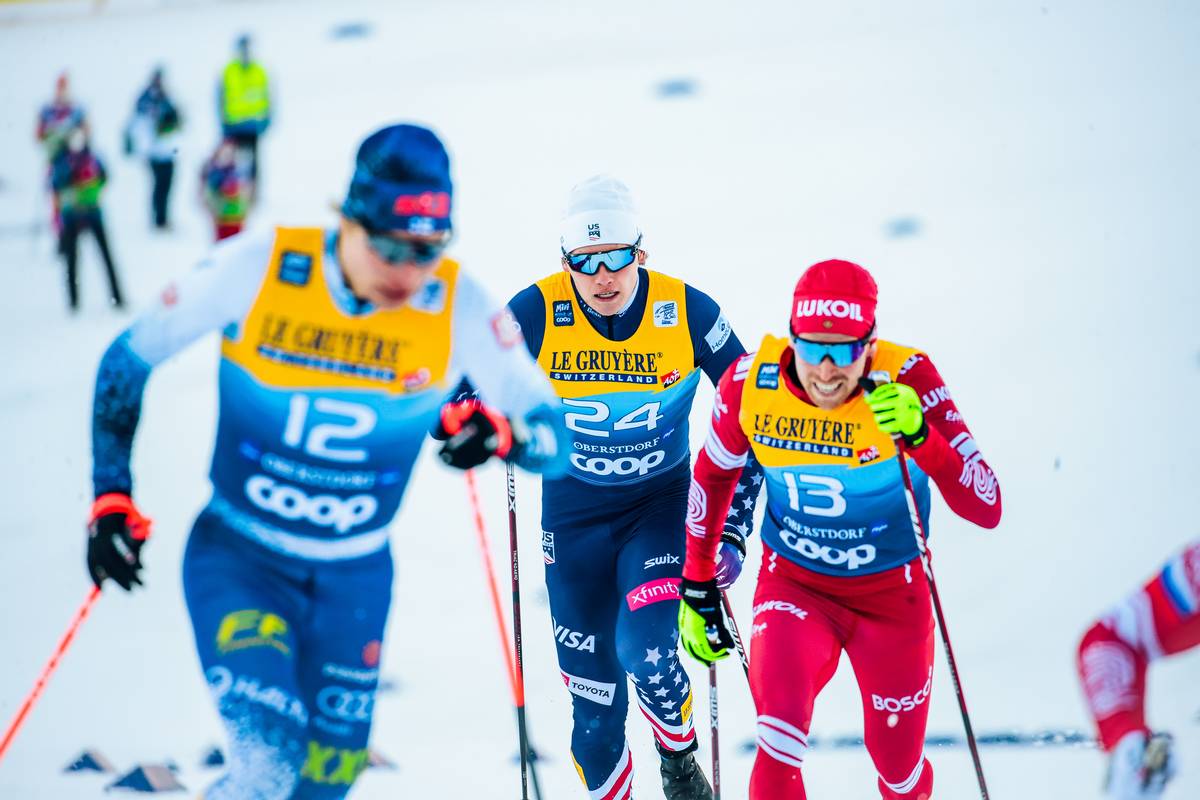
    Two Americans qualified in the top 30 as well, with Lauren Jortberg (Dartmouth Ski Team) in 14th and Julia Kern (U.S. Ski Team/Dartmouth/Stratton Mountain School T2 Team) in 21st. Jortberg went on to finish fifth in her quarterfinal, 7.28 seconds behind German winner Pia Fink, and Kern finished sixth in Fähndrich’s quarterfinal, 22.28 seconds out of first. Overall, Jortberg placed 22nd and Kern was 27th.

    In an email, Jortberg, who competed at U23 World Championships last year at Soldier Hollow in Midway, Utah, explained her goal was to qualify for the heats.

    “I honestly had no idea what to expect in Goms this year because Soldier Hollow felt just like US Nationals and the Super Junior National Qualifiers I’d been going to for the past ten years,” Jortberg, a Dartmouth College sophomore, wrote on Monday. “Obviously the competitors from all over the world was different, but was easy to visualize what is going to be like. The venues are similar in many ways because there are very few trees making it very open and a great spectators course.

    “A big difference between Goms and Soldier Hollow is the little towns everywhere,” she continued. “The first ski we did here, we skied through the roads and through a town. There are ski trails everywhere here, we could even ski from the venue to the hotel (which is pretty far)! For the ski courses, I think Goms is one of the most challenging ski courses I’ve ever raced on. There are huge climbs are incredibly technical downhills! Its a one of the most exciting places I’ve ever raced, I love it so much.”
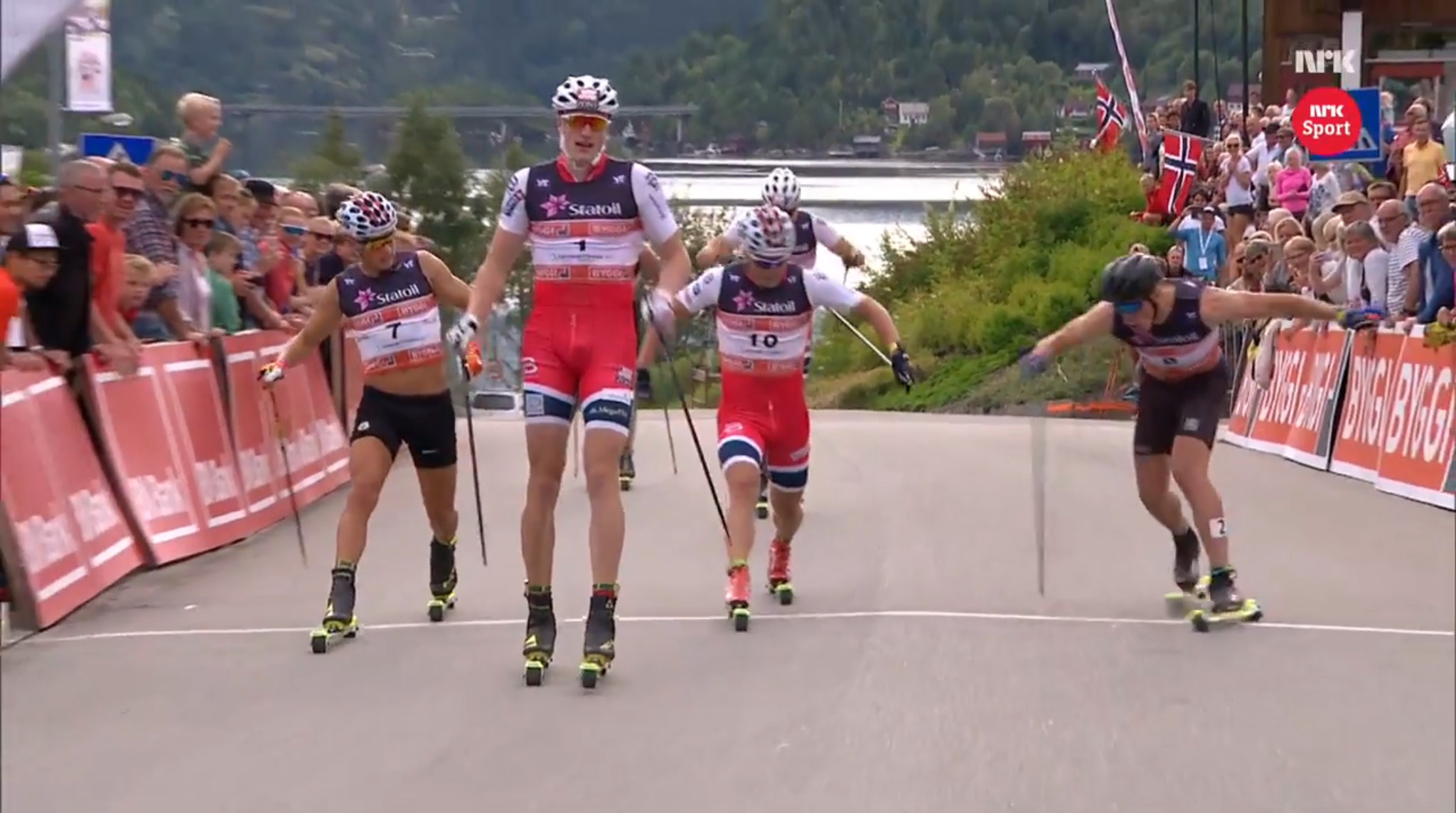
    As for her racing on Monday, she wrote that she was “really psyched because I felt really strong and smooth in the qualifier! I was a bit bummed because I had to scrub a fair amount of speed skiing behind a girl I caught on the really technical downhill. The heats were really fun!! I had a great starting position and skied really smooth up the big climb. Then I took a very gutsy move on the downhill to sling shot into first place on the inside corner around the downhill turn. Unfortunately right after that I got caught up in a tangle on the last climb, and then I lost contact with the lead group. I was bummed to get caught up in a tangle, but it was really cool to be able to ski with these girls!”

    Overall, Jortberg described the day as “pretty incredible.”

    “My motto has always been that sprints are funny because ‘anything can happen’ for the good and bad!” she added. “I’m pretty excited for the rest of the week of racing even though this race was my main target. These courses play really strongly to my strengths so it should be fun to see what I can do!”

    Kern explained in an email that she’s been sick for the past month so her main goal was to start Monday’s race. But for a long time leading up to this race, she had envisioned a top 10.

    “Regardless of how I was feeling, one of my goals was to ski with good technique because that is something you can always control,” Kern wrote. “I was pretty content with my qualifier, given being sick. Skiing out there today, I had no idea if I would surprise myself and my illness wouldn’t impact my skiing or if I was just going to feel absolutely terrible. I was happy with how I placed given how I felt.”

    In the heats, she wanted to stay in contact with leaders up the course’s big climb, then try to “drop the hammer on the downhill and last uphill.”

    “However, my quarterfinal did not play out that way,” she wrote. “The pace was hot from the start, with bib #1 [Fähndrich] gunning from the start. I stuck with the heat until part way up the first climb, where I started to lose the leaders. I did not feel good and I had no energy so I was not able to hold the pace of the other competitors. I had considered not doing the heats because I felt pretty wiped after the qualifier, but the competitor inside me couldn’t just walk away from my favorite thing—sprint heats.

    “Given my current health state, I feel okay about my day, but I am obviously bummed because this was the race I was looking forward to most this season,” Kern added. “I am looking forward to getting healthy in time to race the 10k classic, or at the very least the skiathlon!”

    Also for the U.S., Lydia Blanchet missed qualifying by 0.32 seconds in 32nd, as did Canada’s Sophie Carrier-Laforte, who was 3.68 seconds out of the top 30 in 34th. American Nicole Schneider finished 44th.

    The all-Norwegian men’s freestyle sprint podium on Monday at U23 World Championships in Goms, Switzerland, with Erik Valnes (c) in first, Jan Thomas Jenssen (l) in second and Even Northug (r) in third. (Screenshot: Swiss Ski livestream)

    In the men’s 1.5 k skate sprint on Monday, Norway swept the men’s podium, with Erik Valnes winning his first World Championships medal in 2:56.38, Jan Thomas Jenssen finishing 0.24 seconds back in second, and Even Northug placing third (+6.34).

    For the 21-year-old Valnes, this marked his first U23 World Championships (or Junior Worlds for that matter). He’s competed in two World Cup sprints this season, placing 22nd in the skate sprint earlier this month in Dresden, Germany, and 27th in a classic sprint in December in Lillehammer, Norway.

    Valnes started Monday by winning the qualifying round in 3:00.18, by 0.77 seconds over Sweden’s Anton Persson, then won his quarterfinal and semifinal, both by nearly half a second, before besting his fellow Norwegians in the final.

    “Fun to take the gold medal at the end,” Valnes said during a televised in-arena interview after the final. “It was my biggest goal this year, so it means a lot, of course. A gold medal is always good to have.”

    No North American men qualified for the heats. Canada’s Ricardo Izquierdo-Bernier placed 40th, Antoine Briand was 41st, Philippe Boucher 42nd, and Olivier Hamel 60th.

    For the U.S., Bill Harmeyer finished 46th, Andrew Egger was 47th, Thomas O’Harra 64th, and Zak Ketterson 65th.

    Results: Women’s qualifier | Women’s final| Men’s qualifier| Men’s final

  • The Grandkids Will Love This: Pellegrino Beats Klæbo in Dresden; Hamilton 10th, Locke 15th

    The Grandkids Will Love This: Pellegrino Beats Klæbo in Dresden; Hamilton 10th, Locke 15th

    Italy’s Federico Pellegrino (5) getting a ski tip ahead of Norway’s Johannes Høsflot Klæbo (l) for the men’s freestyle sprint final win on Saturday at the World Cup in Dresden, Germany. France’s Lucas Chanavat (1) placed third for the second-straight World Cup sprint, another Frenchman Richard Jouve (second from r) placed fourth, Sweden’s Emil Jönsson (second from l) was fifth, and Norway’s Even Northug (behind) took sixth after breaking a pole out of the start. (Photo: Fischer/Nordic Focus)

    How do you beat Norway’s Johannes Høsflot Klæbo at his competition-crushing game? Take him by surprise with minimal time to recover. Italy’s Federico Pellegrino did just that on the last uphill rise of the 1.2-kilometer sprint course on Saturday in Dresden, Germany.

    Dresden, a historic city in eastern Germany, debuted its brand-new course along the Elbe River on manmade snow amid damp conditions and temperatures above freezing throughout the day. Pellegrino had done what he needed to advance through the rounds, clocking the first-fastest time in the qualifier, 2.9 seconds behind France’s Lucas Chanavat in first, then placing second in his quarterfinal and third in the first semifinal. Klæbo won that semi by 0.16 seconds over Chanavat in second and 0.3 seconds ahead of Pellegrino in third. With a fast-enough time, Pellegrino moved on to the final, where he met the 21-year-old Klæbo again.

    “I knew that at the beginning of the race, I’m becoming a little bit old so the younger Klæbo and Chanavat were faster than me,” Pellegrino, 27, said of the final in a post-race interview with the International Ski Federation (FIS). “So I just had to wait, but I wanted to attack in the longer race to the finish line.”

    The race from his point of attack might have seemed like an eternity, but in actuality, it was about 500 meters before the finish. Klæbo and Chanavat had burst out of the start at lightning speed, skiing “shoulder to shoulder,” as Chanavat later said in a press conference, and slightly gapping the four skiers behind them — one of which was Pellegrino.

    While Klæbo pushed the pace up front, Pellegrino kept the two leaders close, skiing just a couple strides back. France’s second man in the final, Richard Jouve slotted into fourth behind him and Sweden’s Emil Jönsson — in his first final in a year — followed in fifth. Behind them, Norway’s Even Northug (Petter Northug’s 22-year-old brother) worked to fasten a new pole after breaking his on the starting gate. That took him out of the race from the gun.

    Chanavat attempted to get ahead of Klæbo on a tight righthand corner, but Klæbo held the inside line and his position. Coming out of that corner, Pellegrino latched on to Chanavat and brought the rest of the group with him. Shadowing the two leaders’ every move, Pellegrino accelerated just before the final rise, taking just three V2 pushes to get to the top.

    Norway’s Johannes Høsflot Klæbo (l) and Italy’s Federico Pellegrino (second from l) jockey for position just before the finish of the men’s freestyle sprint final at the World Cup in Dresden, Germany, while France’s Lucas Chanavat (1) and Richard Jouve chase, followed by Sweden’s Emil Jönsson (14). (Photo: Fischer/NordicFocus)

    Even with Klæbo, the Italian took another push to move ahead and left Klæbo chasing. With about 75 meters to go, they began their all-out showdown to the finish, side by side, with Pellegrino staying just ahead to cross the line first in 1:52.77 minutes. Klæbo was just 0.18 seconds back in second and Chanavat 0.98 seconds behind in third.

    “When I will have grandchildren this will be the story I am going to tell them, that I beat Johannes,” Pellegrino said, according to a FIS press release.

    It was his first World Cup victory in nearly a year since winning a freestyle sprint in Falun, Sweden, late last January, and his 10th career individual World Cup win.

    “Klæbo is a really good guy because if he wanted to he could stop me,” Pellegrino told FIS. “… He tried to stay stay quiet to let me go … he’s really good to continue to win.”

    In the four sprints Klæbo’s contested this season, Saturday marked his first loss (he did not compete in the Tour de Ski, opting for a training block instead and racing at Norwegian nationals in Vang, Norway, where he won the classic sprint).

    “It was a tough one,” Klæbo said of Saturday’s final. “Me and Chanavat was trying to go pretty hard from the start of the final, and I think both of us went a little bit too hard. … I’m satisfied with second place here but I have to do something else to beat him next time.”

    Two seasons ago, Pellegrino was the overall Sprint World Cup champion. Last season, it was Klæbo as both the U23 and Sprint World Cup Champion.

    The men’s freestyle sprint podium on Saturday at the World Cup in Dresden, Germany, with Italy’s Federico Pellegrino (c) in first, Norway’s Johannes Høsflot Klæbo (l) in second, and France’s Lucas Chanavat (r) in third. (Photo: Fischer/NordicFocus)

    “I always try to do my best; if the best means the victory it’s great,” Pellegrino said, according to FIS. “It was a really good show. I prefer courses with more hills. Yesterday I changed the way I was thinking about the race.”

    “He was clever,” Klæbo said in an interview with NRK. “He skied like this in the semi and quarterfinal. Our strategies differed slightly.”

    While Pellegrino kept himself in contention in the heats by skiing from behind, Klæbo did as he usually does, by leading with a pace few, if anyone else, could match. Klæbo qualified second, 0.15 seconds off Chanavat’s top qualifying time of 1:50.42, then won his quarterfinal by a clear-cut margin of 0.6 seconds over Switzerland’s Roman Schaad. Chanavat won his quarterfinal by 0.12 seconds over Pellegrino, then hung with Klæbo once again in the semifinal.

    At the last World Cup sprint in Lenzerheide, Switzerland, the first stage of the Tour de Ski, Chanavat placed third in the skate sprint.

    “I did my best and I competed to try to get the victory today, but I was a lot focused on Johannes,” Chanavat, 23, said at the press conference. “So I was surprised when Pellegrino came pretty strong on the side in the race.”

    He added that the gap between him and Klæbo is getting closer. “So I’ll try to keep it shorter,” Chanavat said.

    Jouve finished 0.25 seconds off the podium in fourth, 0.98 seconds behind Pellegrino, Jönsson finished fifth (+2.36), and Northug sixth (+12.04).

    Hamilton 10th, Locke 15th

    American Simi Hamilton made it to the semifinals and finished the day in 10th overall after placing fifth in the second semi, 0.38 seconds behind Jönsson in first. That heat ended in a three-way photo finish for first, which Jönsson took ahead of Northug (+0.01) and Jouve (+0.04). Those three men advanced to the final, but Hamilton and Norway’s fourth-place finisher in that semifinal, Pål Trøan Aune (+0.23) did not.

    American Simi Hamilton (front) leads Germany’s Sebastian Eisenlauer during their quarterfinal of the men’s 1.2 k freestyle sprint at the World Cup in Dresden, Germany. (Photo: Fischer/NordicFocus)

    Before that, Hamilton had qualified in 15th and finished second to Norway’s Fredrik Riseth in his quarterfinal.

    “It was a really cool venue, great course,” Hamilton told FasterSkier in person after the race. “But it was really tight the whole way around so it was hard. My starts aren’t that good right now and so my quarter, I was basically trying to start as fast as I could and I still was second or third out of the blocks, so I wasn’t feeling super confident after that.”

    Going into the semifinals, he decided not to worry about his start and concentrate on moving up later in the course.

    “What ended up happening around that corner, I just couldn’t get around anyone,” Hamilton recalled. “Every time you get an opportunity to make a move, it gets shut down almost immediately, so that was really frustrating, but I was happy with how my body is feeling right now, and it’s fun to get into the heats.

    “I am always way more comfortable skiing towards the back of the pack and then making a definite move somewhere on the course, so unfortunately for me like this course doesn’t favor doing that too well,” he continued. “You can’t afford to ski at the back and then pass four five people, not enough room or time.”

    He added that he enjoyed how different the Dresden course was in comparison to other, much hillier World Cup terrain.

    “I think the only super-short flat course we race like this was in Milan [Italy] years ago, so its fun just doing something different,” he said. “The crowd is awesome here.”

    U.S. Ski Team Head Coach Chris Grover observed that Hamilton was at a disadvantage trying to move up from behind on Dresden’s course.

    “He made it work in the quarterfinal,” Grover told FasterSkier. “He’s so good when he gets that opening to go. I think we saw in the semifinal that he would be starting to go and then get blocked. And again after the corner, started to go, and got blocked. And under the bridge, started to go, and then got blocked. It’s nobody’s fault, nobody obstructed him or anything like that, it’s just not a course with many passing options. The guys are so well-matched, in a semifinal or final it becomes that much harder. So he’s a little bit frustrated, but I think he’s in good shape.”

    Andy Newell (U.S. Ski Team) racing to 18th in the men’s freestyle sprint qualifier at the World Cup in Dresden, Germany. He went on to finish sixth in his quarterfinal for 27th overall. (Photo: Fischer/NordicFocus)

    Two Americans qualified for the heats in the top 30, with Andy Newell finishing 18th in that preliminary round, but Grover noted the U.S. team’s qualifiers overall were “uncharacteristically poor”.

    “To have Erik Bjornsen just miss the qualification, to have Kikkan [Randall] just miss the qualification, to have the four athletes who did go in not have the best qualifications, something was a little bit missing,” he said.

    (Bjornsen placed 32nd and Randall 34th in their respective men’s and women’s qualifiers. Bjornsen was 0.23 seconds out of 30th.)

    Newell’s run ended in the quarterfinal, after he initially took the lead, ahead of Canada’s Julien Locke, but slipped to sixth on the second half of the course.

    “Andy didn’t have the best start, but he got himself to first and he was able to take the best line,” Grover reflected.

    He wasn’t sure why Newell then dropped to the back of the group, and Newell wrote in an email that he wasn’t sure what happened, either.

    “Felt like I was able to accelerate to the front well but then managed to get swarmed before the last little bump and then it was extremely tough to pass before the finish,” Newell wrote. “I should know better than to let myself get stuck in the middle… on narrow tracks like this if you get stuck in the middle with guys on either side you can’t get a full push and thats how you get swarmed, bad tactics on my part.”

    “Tomorrow should be fun, fast, and wild,” he added of Sunday’s freestyle team sprint. “Hopefully I’ll be able to be more aggressive tomorrow 🙂 Looking forward to it.”

    Julien Locke (Canadian U25 Team/Black Jack) racing to 16th in the men’s freestyle sprint qualifier at the World Cup in Dresden, Germany. He went on to place third in his quarterfinal for 15th overall, his best World Cup result. (Photo: Cross Country Canada/NordicFocus)

    He finished his quarterfinal in sixth, 1.54 seconds behind Northug in first, for 27th overall. Meanwhile Locke hung with Northug and Jouve up front and finished third, 0.62 seconds out of first and just 0.18 seconds out of second.

    While second place in that heat would have put him in the semifinals, 15th overall was still a career best for Locke, of the Canadian U25 Team and Black Jack Ski Club. Last March at World Cup Finals in Quebec, he placed 20th in the freestyle sprint. And just over a week ago at the NorAm Olympic trials in Mont Sainte-Anne (MSA), Quebec, Locke, 24, won the classic sprint final, but missed out on a potential Olympic spot by one place after qualifying second (the tiebreaker) behind Russell Kennedy (Team R.A.D.).

    The individual top 30 was the second of Locke’s career. Fresh off of competing in Canada, he arrived in Dresden a day and a half ago.

    “… A little bit of a tight schedule, but body feels great, and super-fun course out there with all these spectators,” Locke told FasterSkier after. “And yeah, short, very short. It was close to 1.1 [kilometers] and definitely the shortest sprint race I have ever done.”

    “I was prepared to hit it hard here and I was hoping for sure to get into the heats and then get into the rounds,” he added. “I don’t like getting knocked out, but I am content with how today went.”

    Bob Thompson (NTDC Thunder Bay) racing to 50th in the men’s freestyle sprint qualifier at the World Cup in Dresden, Germany. (Photo: Fischer/NordicFocus)

    Three other Canadian men met the Cross Country Canada (CCC) selection criteria for Dresden, where Bob Thompson (NTDC Thunder Bay) finished 50th in the qualifier (+8.67), Dominique Moncion-Groulx (Alberta World Cup Academy) 59th (+9.99) and Antoine Briand (Pierre-Harvey National Training Centre) 60th (+10.12).

    (Note: CCC High Performance Director Thomas Holland explained in an email that Briand was added as the fourth man, based on the U23 selection list, after Kennedy had to relinquish his starts in Dresden due to illness.)

    For the U.S., Period 2 SuperTour leader Ben Lustgarten (Craftsbury Green Racing Project) finished 49th (+8.64) out of 67 men.

    “I thought I skied well — usually this stuff is my weakness,” Lustgarten said after. “It’s like icy and slushy so usually when it’s like that skate skiing, I get off balance, but I was like trying really hard to stay focused and ski big. I only got bogged down a little bit on the big hill, but … I was only nine seconds out of first, so I think that is really good. I am really happy with that.”

    The U.S. and Canada each have two teams entered for Sunday’s freestyle team sprint on the same course in Dresden, with Bjornsen and Hamilton (United States I), Newell and Lustgarten (U.S. II), Thompson and Locke (Canada I), and Briand and Moncoin-Groulx (Canada II).

    “It’s going to be wild out there,” Lustgarten said. “[The Dresden organizers] pulled it off; they had to shorten the course a little bit because they didn’t have enough snow … but it was good. It’s the shortest sprint I have ever done in my life by far.”

    Results: Men’s qualifier | Men’s heats

  • Saturday Rundown: Dresden, Ruhpolding, Kaiser Maximilian Lauf

    Saturday Rundown: Dresden, Ruhpolding, Kaiser Maximilian Lauf

    The women’s freestyle sprint podium on Saturday at the World Cup in Dresden, Germany, with Sweden’s Hanna Falk (c) and Maja Dahlqvist (l) in first and second, and American Sophie Caldwell (r) in third. (Photo: FIS Cross Country/Twitter)

    FIS Cross Country World Cup (Dresden, Germany): Freestyle sprints

    Women’s report

    Men’s report

    For her second-straight World Cup sprint, Sophie Caldwell of the U.S. Ski Team reached the podium in the women’s 1.2-kilometer freestyle sprint on Saturday in Dresden, Germany.

    Caldwell placed third in the final behind Sweden’s Hanna Falk, who won it in 2:11.02 minutes, and Maja Dahlqvist, also of Sweden, who placed second (+0.23). Caldwell and Dahlqvist both lunged in a photo finish for second, which Dahlqvist took by 0.07 seconds.

    Also in the final, which included four Swedes, Switzerland’s Laurien van der Graaff finished fourth (+0.58), and Sweden’s Anna Dyvik followed in fifth (+0.68) and Stina Nilsson sixth (+7.56) after tripping.

    Falk started the day by winning the women’s qualifier in 2:06.34, by just 0.02 seconds over Nilsson in second. Caldwell qualified 11th (+2.02). and another American Ida Sargent made it into the heats in 14th (+2.44). Kikkan Randall missed the top 30 by 0.6 seconds in 34th (+6.57), Julia Kern placed 38th (+7.78), and Caitlin Patterson, of the Craftsbury Green Racing Project (CGRP), was 40th (+8.56) out of 49 women in the qualifying round.

    Sargent finished fourth in her quarterfinal, 043 seconds behind Sweden’s Ida Ingemarsdotter in first, to finish the day in 17th overall.

    For Caldwell, who went on to advance in second in her quarterfinal and third in her semifinal, the podium came after she finished second in the last World Cup skate sprint (the first stage of the Tour de Ski) on Dec. 31 in Lenzerheide, Switzerland.

    Her boyfriend and fellow U.S. Ski Team member Simi Hamilton came close to reaching the men’s 1.2 k sprint final on Saturday after qualifying in 15th then placing second in his quarterfinal and fifth in the second semifinal, 0.38 seconds behind Sweden’s Emil Jönsson in first.

    France’s Lucas Chanavat won the qualifier in 1:50.42, 0.15 seconds ahead of Norway’s Johannes Høsflot Klæbo in second. Hamilton was 4.32 seconds back in the qualifier, and his U.S. teammate Andy Newell also qualified in 18th (+4.91). Erik Bjornsen missed qualifying by 0.23 seconds in 32nd (+6.15) and Ben Lustgarten (CGRP) finished 49th (+8.64) out of 67 men.

    The women’s freestyle sprint podium on Saturday at the World Cup in Dresden, Germany, with Italy’s Federico Pellegrino (c) in first, Norway’s Johannes Høsflot Klæbo (l) in second, and France’s Lucas Chanavat (r) in third. (Photo: FIS Cross Country/Twitter)

    While Hamilton’s day ended in the semifinals, putting him 10th overall (and Newell finished sixth in his quarterfinal to place 27th overall), Italy’s Federico Pellegrino timed his attack perfectly in the final, challenging Klæbo for the win down the finishing stretch. The Italian took it by 0.18 seconds in 1:52.77, Klæbo placed second and Chanavat third (+0.98).

    France and Norway had two men in the final, with France’s Richard Jouve placing fourth (+1.23), Sweden’s Jönsson taking fifth (+2.36) for his best individual World Cup result since December 2016. Norway’s Even Northug finished sixth (+12.04) after breaking his pole out of the start.

    Canada’s Julien Locke of the National U25 Team and Black Jack Ski Club had a career-best day, finishing 15th overall. He qualified 16th (+4.61) then placed third in his quarterfinal, crossing the line just 1 second behind Norway’s Fredrik Riseth, who won that heat. Hamilton was second in that quarterfinal, 0.67 seconds back.

    Also for Canada, Bob Thompson (NTDC Thunder Bay) finished 50th in the qualifier (+8.67), Dominique Moncion-Groulx (Alberta World Cup Academy) was 59th (+9.99) and Antoine Briand (Pierre-Harvey National Training Centre) 60th (+10.12).

    Results:

    Women’s qualifier | Women’s heats

    Men’s qualifier | Men’s heats

    ***

    Germany’s Laura Dahlmeier, Franziska Preuss, Denise Herrmann and Franziska Hildebrand (left to right) celebrating their win in the women’s 4×6-kilometer relay at the 2018 IBU World Cup in Ruhpolding, Germany. (Photo: IBU/Biathlonworld)

    IBU World Cup (Ruhpolding, Germany): Women’s relay

    The teams from Germany and Italy dueled for the top position all race in Saturday’s 4 x 6-kilometer women’s relay at the IBU World Cup in Ruhpolding, Germany. Cheered on by some 20,000 home-crowd fans, Germany’s anchor Laura Dahlmeier stayed on the ski tails of Italy’s Federica Sanfilippo after the last shooting stage, then passed her before the last major climb and held a narrow lead around the rest of the course to cross the finish line first in a time of 1:08:47.0 hours, with Italy 2.9 seconds behind. German had a team total of zero penalties and nine spares.

    “It’s incredibly fun to win in front of this audience here today,” Dahlmeier told German broadcaster ZDF in an interview right after the race, according to a translation. “I think this will boost our whole team morale. We showed today that we are a team to be reckoned with in relays. It was just a nice race.”

    Germany with Franziska Preuss, Denise Herrmann, Franziska Hildebrand, and Dahlmeier was never more than 30 seconds behind the pace, even though Hildebrand temporarily fell back from leading the field to tagging off to Dahlmeier in fourth position.

    “My race held all kinds of surprises today,” Hildebrand told ZDF with a laugh. “It started with a fall on an icy patch 100 meters after it began… Then I dropped my pole, also had to exchange the replacement one, and then three spares [in prone] to avoid the penalty. Today everything conspired in my race.”

    Italy with Lisa Vittozzi, Dorothea Wierer (coming off a victory in the individual race on Thursday), Nicole Gontier and Sanfilippo had the best shooting performance of the day, with no penalty and just three spares.

    “That last loop with Laura was really tough,” Sanfilippo said in the press conference. “I gave my best, I tried all for my team. I knew that I can be strong on the last loop. I tried to attack, but Laura was a little bit stronger. But I am also really happy that we finished in second place, I think that was really important for our team.”

    Sweden with Linn Persson, Mona Brorsson, Anna Magnusson and anchor Jenny Öberg was third, 17.2 seconds back, with no penalty and five spares. Brorsson and Öberg managed to move the team up to the podium positions, for the second one in a row following a third place from Oberhof, Germany, a week ago. Before that, the Swedish women’s team had been on a six-year hiatus from those lofty positions.

    “It’s cool to be on the podium again,” Persson said in the press conference.

    “This is like our second home and there were a lot of Swedes here, so we had big support during the race on the tracks,” Brorsson added.” That was an advantage for us.”

    Just a few seconds off the podium, Norway with Synnøve Solemdal, Tiril Eckhoff, Ingrid Landmark Tandrevold and Marte Olsbu was fourth (+23.1, with no penalty and nine spares), with Olsbu outsprinting Poland’s anchor Weronika Nowakowska on the finish stretch (+24.5, with no penalty and five spares). For both teams it was their best relay result of the season so far.

    Switzerland with the three sisters Elisa, Selina and Aita Gasparin reinforced by Lena Häcki surprisingly led the race at the third exchange after Selina had moved them in front, but her youngest sister Aita could not hold that position, falling back with a penalty lap in the last standing stage to finish eighth (+1:37.1, with one penalty and 11 spares).

    Biathlon Canada’s team of Emma Lunder, Julia Ransom, Sarah Beaudry, and Rosanna Crawford started the race with a setback after Lunder incurred a penalty in her prone stage, leaving the range in 23rd position at the end of the field and already almost a minute behind the leader. She managed to limit the gap with a clean standing stage to exchange still in 23rd position and 1:47 back.

    Taking over Ransom then remained clean in both stages to move the team up to 17th, tagging off 2:14 behind. Beaudry only required one spare in her prone stage (0+1, 0+0) to improve to the 12th position even making up 3 seconds to the leaders.

    Then Crawford, fresh off her first career podium in the individual race on Thursday, managed to also shoot clean in both stages and overtook the teams from Slovakia and Ukraine while further decreasing the gap to finish the race in 10th position, 1:56.7 back, with one penalty and just four spares.

    “Things were a bit softer and slushy today compared to the individual, but nothing too bad,” Crawford commented on the conditions in an email to FasterSkier. “There was quite a bit of wind on the range, which I think was tricking people, the wind flags weren’t showing much but I had to make 6 left correction during zero [target practice].”

    “Today was a solid showing from our team,” she added regarding their result. “Everyone cleaned standing, I think we can be really happy of this race, and take some real confidence going into the Olympic relay.”

    Previously this season Canada had finished the relay in Oberhof, also Germany, in 14th position, and the first one in Hochfilzen, Austria, in ninth.

    For US Biathlon with Susan Dunklee, Clare Egan, Emily Dreissigacker, and Joanne Reid, it was the first women’s relay of the year after missing out on the first two races of the season in this discipline.

    Thus starting at the very end of the field, veteran Dunklee moved up through the pack and got through the prone stage with one spare. But then she had to fight against a penalty lap in her standing stage requiring all three spare rounds, leaving the range in 12th position. With the fastest course time on the opening leg, she managed to slightly decrease the gap to 21.6 seconds and made up three positions to exchange in ninth place.

    Egan missed the first two shots in her prone stage, but hit the targets with her spares leaving the range over a minute back. She followed that up by cleaning her standing stage and left the range 1:29.5 back, then only lost five more seconds on the last loop to exchange in 14th.

    Dreissigacker also needed just one spare in her prone shooting, but then incurred two penalties in her standing stage, doubling the gap and falling back to 19th position at the exchange and 3:51 back.

    Anchor Reid needed three spares on her leg (0+2, 0+1) and managed to still overtake the teams from China and Finland to finish 17th, 4:57.7 behind Germany, with two penalties and 13 spares overall.

    “Finally we had a full team and raced a relay!” Dunklee wrote on Instagram. “Competing on a foreign continent has its challenges.”

    Results

    ***

    Ski Classics (Seefeld, Austria): 60 k Kaiser Maximilian Lauf

    The men’s podium at the Kaiser Maximilian Lauf 60 k Ski Classics marathon in Seefeld, Austria, with Norway’s Tord Asle Gjerdalen (c) in first, Sweden’s Andreas Holmberg (l) second, and Russia’s Ilya Chernousov (r) third. (Photo: Visma Ski Classics)

    At the third Ski Classics event of the 2017/2018 season, the 60-kilometer Kaiser Maximilian Lauf on Saturday in Seefeld, Sweden’s Britta Johansson Norgren (Lager 157 Ski Team) and Norway’s Tord Asle Gjerdalen (Team Santander) took the women’s and men’s victories, respectively.

    Johansson Norgren and Japan’s Masako Ishida (Team Koteng) broke away shortly after the start. The two went back and forth for a while until Johannson Norgren gapped Ishida in the Leutasch valley. While Ishida was caught by a chase pack with Sara Lindborg (Team Serneke), Kari Vikhagen Gjeitnes (Santander) and Lina Korsgren (Åre Ski Team), she reined Johansson Norgren back in on the long climbs after the valley. Ultimately, Johansson Norgren took the win in 2:49:16.0 hours, while Lindborg claimed second, 37.5 seconds back. Ishida finished third (+58.9), Gjeitnes placed fourth (+1:40.7) after injuring her ankle about 2 k before the finish, and Korsgren fifth (+2:05.1).

    The women’s podium at the Kaiser Maximilian Lauf 60 k Ski Classics marathon in Seefeld, Austria, with Sweden’s Britta Johansson Norgren (c) in first, Sweden’s Sara Lindborg (l) second, and Japan’s Masako Ishida (r) third. (Photo: Visma Ski Classics)

    “It was my plan to go full speed from the beginning,” Johansson Norgren said, according to a Ski Classics press release. “I knew Ishida will go fast in the climbs, but I felt strong from the beginning. It was really hard skiing alone in the valley, and when Ishida caught me up, I wasn’t sure if I could win the race. But the last part of the course was perfect for me and I had no problems securing the victory today.”

    The Leutasch valley was the turning point of the men’s race as well, where Vinjar Skogsholm (Team Parkettpartner) and Andreas Holmberg (Team Serneke) broke away from the pack and had built a 90-second gap on the chase group as they left the valley. There on the first climb out of the valley, Holmberg pushed the pace and dropped Skogsholm, while Gjerdalen and Ilya Chernousov (Bauer Ski Team) worked to catch Holmberg up front. They caught him 3 k before the finish and Gjerdalen was first across the finish line in 2:27:49 hours, 14.8 seconds ahead of Holmberg in second.

    Chernousov finished third (+32.0), Ermil Vokuev (Russian Marathon Team) was fourth (+1:07.6), and Anton Karlsson (Lager 157) fifth (+1:08.2).

    “I didn’t like the fact that we gave too much leeway for Holmberg and Skogsholm,” Gjerdalen said, according to the press release. “I’m happy that Ilya helped me in our attempt to catch up with Holmberg, but I wasn’t really sure if we were going to make it. You never know how the other person is feeling in the front, what kind of skis he has and what goes on in his mind. But I managed to win today and it feels great to be back on the top.”

    In the overall “Champion” standings, Nordgren leads with 450 points, 110 ahead of Lindborg in second. Gjerdalen is first in the men’s champion standings with 330 points, 50 points ahead of Morten Eide Pedersen in second.

    The Ski Classics tour moves to Zuoz, Switzerland, next weekend for the 65 k La Diagonela.

    Results

  • Saturday Rundown: Lillehammer; Östersund; West Yellowstone (Updated)

    Saturday Rundown: Lillehammer; Östersund; West Yellowstone (Updated)

    The men’s skate sprint podium at the first race of the 2017/2018 SuperTour season, with Nick Michaud (c) in first, Ben Lustgarten (l) in second, and Reese Hanneman in third. (Photo: FBD)

    US SuperTour (West Yellowstone, Montana): Freestyle sprints

    The women’s skate sprint podium at the first race of the 2017/2018 SuperTour season, with the SMS Elite Team’s Anne Hart (c) in first and Erika Flowers (l) in second, and Sun Valley’s Kelsey Phinney in third. (Photo: FBD)

    Anne Hart and Nick Michaud were the big winners on opening day of the US SuperTour season at the Rendezvous Ski Trails on Saturday, taking individual victories in the women’s and men’s freestyle sprint finals, respectively.

    Hart led into the finishing straight to take the win in 2:52.49 minutes, 0.88 seconds ahead of Erika Flowers, her teammate on the Stratton Mountain School (SMS) Elite Team, who placed second, and Kelsey Phinney, of the Sun Valley Ski Education Foundation (SVSEF))in third (+0.92).

    Hannah Halvorsen, of Alaska Pacific University (APU) and the U.S. Ski Team D-team, finished fourth (+2.16), Caitlin Gregg (Team Gregg) was fifth (+6.99), and Caitlin Patterson, of the Craftsbury Green Racing Project (CGRP), sixth (+7.22).

    The win was Hart’s second on the circuit after winning a SuperTour 5 k skate two seasons ago. Last year in West Yellowstone, she placed third in the skate sprint (behind Jennie Bender, of the Bridger Ski Foundation, and Flowers, respectively).

    Michaud, of the Bridger Ski Foundation (BSF), won the men’s final in 2:30.69 for his first SuperTour podium, just 0.17 seconds ahead of Ben Lustgarten (CGRP) in second and Reese Hanneman (APU) in third (+0.84). Rounding out the final, Kevin Bolger (SVSEF) finished fourth (+2.11), Ben Saxton (SMS Elite Team) fifth (+2.86), and Cole Morgan (SVSEF) sixth (+3.42).

    On Sunday, the SuperTour continues with 10/15 k classic mass starts.

    Video interviews with the winners: Hart & Michaud

    Complete results (scroll to bottom for men’s and women’s final results)

    ***

    FIS Cross Country World Cup (Lillehammer, Norway): Classic sprints

    From right to left: American Sadie Bjornsen, Norway’s Maiken Caspersen Falla and Finland’s Krista Parmakoski after placing third, first and second, respectively, in the women’ 1.3 k classic sprint at Friday’s World Cup in Lillehammer, Norway. (Photo: FIS Cross Country/Twitter)

    Women’s report

    Men’s report

    American Sadie Bjornsen returned to the World Cup podium for the second time in as many classic sprints this season on Saturday, placing third in the women’s 1.3-kilometer classic sprint behind Norway’s Maiken Caspersen Falla in first and Finland’s Krista Parmakoski in second.

    Bjornsen started the day by winning the qualifying round by one-hundredth of a second over Parmakoski and Russia’s Natalia Nepryaeva, which were listed as qualifying in second and third, respectively (despite having the same time).

    The U.S. Ski Team (USST) member who placed second in last week’s classic sprint in Kuusamo, Finland, Bjornsen won the qualifier in 3:22.45 minutes. She went on to advance in second out of her quarterfinal and then won her semifinal by 0.46 seconds over Sweden’s Stina Nilsson — who beat her in last week’s sprint.

    While Falla won Saturday’s final in 3:19.98 (after qualifying in fourth, then winning her quarterfinal and semifinal as well), Parmakoski followed in second overall (+2.07) and Bjornsen achieved her second podium of the season in third (+5.01). Norway’s Ingvild Flugstad Østberg was just behind in fourth (+5.28), Nilsson finished fifth (+6.09), and the second American in the final, Jessie Diggins was sixth (+7.81).

    Diggins previously qualified in seventh, finished second in her quarterfinal then advanced as a lucky loser in fourth place out of her semifinal (which Falla won).

    Three American women raced in the heats, with Sophie Caldwell qualifying in ninth and ultimately placing ninth overall. She advanced in second out of her quarterfinal then finished fifth in the semifinal behind Diggins.

    Also for the USST, Rosie Brennan finished 33rd in the qualifier, missing out on the top 30 needed to qualify by 0.26 seconds. Kikkan Randall finished 42nd, Ida Sargent was 44th, and Chelsea Holmes 64th.

    Canada started four women, with Emily Nishikawa placing 58th, Dahria Beatty 59th, Cendrine Browne 63rd, and Katherine Stewart-Jones 65th.

    Klæbo Still Undefeated, Ustiugov 2nd

    The men’s 1.5 k classic sprint podium with Norway’s Johannes Høsflot Klæbo (c) in first, Russia’s Sergey Ustiugov (l) in second and Russia’s Alexander Bolshunov (r) in third. (Photo: FIS Cross Country/Twitter)

    In the men’s 1.5 k classic sprint, Norway’s Johannes Høsflot Klæbo continued his undefeated World Cup streak with his fourth win in as many races this season.

    He started off by winning the qualifier in 3:40.79, then his quarterfinal by 0.17 seconds over Russia’s Sergey Ustiugov. Klæbo and Ustiugov met again in the semifinals, where Ustiugov beat the Norwegian by 0.25 seconds, but in the final, where it really mattered, Klæbo again had the edge, winning in 3:33.88. Ustiugov finished 0.83 seconds back for second place, and Russia had two on the podium with Alexander Bolshunov in third (+1.29). Sweden’s Calle Halfvarsson finished fourth (+1.64), and Norway had two more in the final with Emil Iversen in fifth (+8.2) and Sondre Turvoll Fossli in sixth (+17.3).

    Canada’s Alex Harvey was the lone North American to qualify for the men’s heats after racing to 22nd in the qualifier, 11.89 seconds out of first. Harvey’s day ended in the quarterfinals, where he finished sixth, 3.06 seconds behind Norway’s Pål Trøan Aune in first. Norway’s Even Northug took second in that heat (+0.26), Finland’s Ristomatti Hakola was third (+0.36), Norway’s Håvard Solås Taugbøl fourth (+0.67) and France’s Maurice Manificat fifth (+1.72) in that heat. Overall, Harvey placed 28th on the day.

    Erik Bjornsen was the top American man in 35th and missed qualifying by 1.06 seconds. Andy Newell finished 38th and Scott Patterson was 74th for the U.S. Ski Team.

    Jess Cockney was the second Canadian man in 57th, Len Valjas followed in 59th, Julien Locke was 61st, Russell Kennedy 63rd, and Knute Johnsgaard 67th.

    Results:

    Women’s final | Women’s qualifier

    Men’s final | Men’s qualifier

    ***

    IBU World Cup (Östersund, Sweden): Men’s 10 k sprint

    Norway’s 29-year-old Tarjei Bø wins his first World Cup race in four years and three Canadians land in the top 26, led by Scott Gow with a career-best 16th that puts him one step closer to securing his place on Biathlon Canada’s Olympic team. Of the nine men that cleaned the two-stage race, four of them were North Americans (Gow, American Lowell Bailey in 22nd, and Canada’s Nathan Smith in 24th and Christian Gow in 26th).

    Race report

  • More Early Racing as Cologna, Kylloenen, and Van Der Graaf Get Wins

    More Early Racing as Cologna, Kylloenen, and Van Der Graaf Get Wins

    Racers navigate a steep climb and descent on the race loop at Bruksvallarna on Saturday. (Photo: Jocke Lagercrantz/Bruksvallsloppet.se)

    The World Cup season draws ever-closer as season-opening races continued this weekend in Sweden, Finland, and Switzerland.

    In Muonio, Finland, a long weekend of racing wrapped up with 10 and 15 k skate races. Finland’s Anne Kylloenen took the win in the women’s 10 k, besting Emilie Kristoffersen of Norway by 8.2 seconds. Kylloenen’s national-team teammates Laura Mononen and Aino-Kaisa Saarinen took third (+14.0) and fourth (+17.1), respectively. Merete Myrseth, a Norwegian skier who competed for the University of Utah on the NCAA circuit last season, finished 17th, +57.1.

    In the men’s 15 k, Alexey Chervotkin of Russia took a 13.8-second win over Iivo Niskanen of Finland. Denis Spitzov of Russia was third, +17.5, and University of Utah alum Snorri Einarsson fourth, +21.2. Einarsson is competing for Iceland. Graham Nishikawa of Canada finished 19th, +1:14.4, and Brian McKeever 40th, + 2:05.3.

    Finishing sixth (+37.0) was Maxim Vylegzhanin of Russia, who made his second flower ceremony of the weekend. The International Olympic Committee (IOC) decided on Thursdayto strip the Russian skier of three silver medals from the 2014 Olympics for doping violations and ban him from all future Olympic Games. However, the International Ski Federation (FIS) has not yet taken any action since he and five other skiers were banned from the IOC, meaning that all six athletes are currently free to take part in non-Olympic ski competitions. FIS has not yet responded to a request for comment about Vylegzhanin’s continued competition.

    https://www.instagram.com/p/BbZO7VFFYpg/

    In Bruksvallarna, Sweden, Sunday meant skate sprinting, and Norwegians took both the men’s and women’s wins. In the men’s race, Paal Troean Aune bested countryman Even Northug in the final, with Anton Persson the only Swede on the podium in third. None of the top sprinters from either country competed. Jack Carlyle of Canada finished 60th, 19.4 seconds behind Aune’s qualifying time.

    In the women’s sprint, Wenche Aune Snildalsli took the win over four Swedes: Emma Thalin, Moa Olsson, Jackline Lockner, and Wilma Joensson were next across the line, and Latvia’s Patricija Eiduka finished sixth.

    A large contingent of international racers has also been training in Davos, Switzerland, where organizers have a lengthy saved-snow loop covering some of the same terrain which will host the World Cup in mid-December. On Friday and Saturday, the Swiss competed with the German and Italian teams in sprint and distance races, with a few individual athletes from other countries attending as well.

    In Friday’s sprints, Laurien Van Der Graaf came out on top for the home team, besting Germany’s Laura Gimmler and Steffi Boehler in the ‘A’ final after Gimmler had won beat her by 1.59 seconds in the qualifier. Fourth place went to Sandra Ringwald, also of Germany, and fifth to Ilaria Debertolis of Italy. In the men’s sprint Thomas Bing claimed the win for Germany, skiing away Switzerland’s Erwan Kaeser by more than two seconds. Giacomo Gabrielli and Stefan Zelger of Italy were third and fourth, and Janosch Brugger of Germany rounded out the ‘A’ final in fifth.

    https://www.instagram.com/p/BbUYGpgl2V_/

    In Saturday’s distance races, Katerina Smutna – racing for the Czech Republic after taking a break for several years to focus on a long-distance marathon career – won the three-lap, 10.5 k competition by just three seconds over Katharina Hennig of Germany, with Boehler another 12.2 seconds back in third. Van Der Graaf finished fourth, + 27.1, and Debertolis fifth, +39.6.

    In the men’s four-lap race, covering 14 k, Swiss Olympic gold medalist Dario Cologna took a commanding 26.6-second win over Russia’s Ilia Chernousov. Jonas Dobler of Germany claimed third, +33.8, with Giandomenico Salvadori of Italy fourth (+59.2), narrowly beating out Livio Bieler of Switzerland (+1:00.9).

    Chernousov could soon become an Olympic champion like Cologna. Vylegzhanin’s disqualification from the 2014 Olympics, along with that of Alexander Legkov, leaves Chernousov to inherit a gold medal in the 50 k freestyle, where he initially finished third. He has not been named in any of the doping investigations by the World Anti-Doping Agency or the International Olympic Committee. In fact, a Russian ski coach recently claimed that Chernousov had turned whistleblower and informed against his Russian teammate, but Chernousov has denied that allegation.

    https://www.instagram.com/p/BbW9TxXnxwI

    Results

    Bruksvallarna

    Women’s sprint qualifier – final

    Men’s sprint qualifier – final

    Muonio

    Women’s & men’s skate distance races

    Davos

    Sprint races (one document, men & women / qualifier & heats)

    Distance races

  • Halfvarsson, Weng Top Toppidrettsveka; Newell and Bolger Compete

    Halfvarsson, Weng Top Toppidrettsveka; Newell and Bolger Compete

    In the men’s classic sprint on Day 1 of the three-day 2017 Toppidrettsveka mini tour, Norway’s Aune Pål Trøan (1) crosses the line ahead of his countrymen Johannes Høsflot Klæbo (7) and Eirik Brandsdal (10) while Sweden’s Calle Halfvarsson (r) placed fourth. Halfvarsson went on to win the tour, ahead of Klaebo in second. (Screenshot: NRK broadcast)

    This past weekend was once again the time of the year for the Toppidrettsveka ski festival, a three-day rollerski mini tour held annually since 2005 in the region of Trondheim, Norway. In addition to the individual stages, points for the top-30 finishers were awarded to compile an overall ranking similar to the Tour de Ski.

    The elite field of athletes was mostly comprised of Norwegian and other Scandinavian skiers active on the International Ski Federation (FIS) World Cup and European Continental Cup level, as well as a handful of international starters, including two Americans: U.S. Ski Team member Andy Newell, who raced at last month’s Blink Ski Festival in Norway, and Kevin Bolger, who is coming off his senior season at the University of Utah.

    Day 1: Aure Sprint

    American Andy Newell (U.S. Ski Team) at the start of the men’s sprint in Aure, Norway, on Day 1 of the 2017 Toppidrettsveka rollerski mini tour. (Screenshot: NRK broadcast)

    The festival started last Thursday with a classic sprint in the small town of Aure, on a fairly long course with a steep downhill and a roundabout at the bottom, after which the athletes had to ski up the same hill toward the finish.

    In the men’s race, Norway’s Aune Pål Trøan took the win in the final with a time of 2:46.46, narrowly edging Norwegian World Cup skiers Johannes Høsflot Klæbo by 0.41 seconds and Eirik Brandsdal by 0.43 seconds. Just another tenth of a second back, Sweden’s Calle Halfvarsson placed fourth (+0.44).

    Newell’s run ended in the quarterfinals, where he finished sixth in his heat, just half a second from advancing. His heat was a tight race that featured the eventual winner Trøan, who along with World Cup regular Emil Iversen, advanced as a lucky loser behind Brandsdal and his teammate Aleksander Ek. Bolger did not reach the quarterfinals.

    In the women’s final, Sweden’s Linn Sömskar prevailed with a time of 3:03.94, edging out five Norwegians, including Kathrine Rolsted Harsem in second and 2016 Toppidrettsveka title-defender Heidi Weng in third. Earlier in the day, Sömskar also won her quarterfinal and semifinal heats decisively.

    Two weeks ago, Sömskar won three races at the 2017 rollerski world championships in Solleftea, Sweden — the 18-kilometer freestyle, 16 k classic, and team sprint with Maja Dahlqvist.

    Day 2: Brekka Mass Start and Trondheim Sprint

    On Friday, athletes competed in two events: a mass start followed by a sprint later in the evening.

    Switzerland’s Dario Cologna topped the men’s 24 k mass start, a point-to-point race from Aure to Brekka, finishing in 59:11.3 after breaking away on the long final climb. Halfvarsson claimed second (+10.8), followed by Finland’s Iivo Niskanen in third (+17.2) ahead of Norway’s Niklas Dyrhaug in fourth (+27.4).

    “Great to win here,” Cologna told Norwegian broadcaster NRK in an interview in the finish. “Many good skiers, the best in the world, so it’s a good feeling. Good to see that everything is working well [in preparation] for this important season.”

    Bolger finished 51st (+4:48.6) and Newell crossed 15 seconds later in 54th (+5:03.9) in the large field of 124 finishers.

    In the women’s mass start over the same 24 k course, the race was even closer and came down to a finishing sprint. Weng took the win in 1:07.30.3, just 3.5 seconds ahead of her teammate Astrid Uhrenholdt Jacobsen, while Sweden’s Anna Haag finished 7.8 seconds back in third. Another Swede, Ebba Anderson placed fourth (+22.0), while the rest of the field crossed the line more than four minutes later. Haag and Anderson are just coming off a training camp in Sweden, where they were joined by U.S. Ski Team members Liz Stephen and Kikkan Randall.

    For Stage 3 on the same day, athletes raced a 1 k sprint in the center of Trondheim, Norway’s third-largest city. There, Klæbo won the men’s final after a decisive attack on the finishing stretch in a time of 2:19.56 minutes, ahead of fellow Norwegian Ragnar-Kristoffer Braqvin Andresen in second (+0.23) and Even Northug in third (+2.85), the younger brother of 2016 Toppidrettsveka winner Petter Northug Jr. Halfvarsson finished fourth (+2.94), thereby taking the lead in the intermediate tour standings on Day 2, ahead of Klæbo, Cologna and Trøan.

    Both Newell and Bolger missed qualifying for the sprint heats and did not score additional points.

    In a true photo finish (left to right) Norway’s Barbro Kvaale won the women’s sprint on Day 2 of the 2017 Toppidrettsveka rollerski mini tour in Trondheim, Norway, ahead of Sweden’s Linn Sömskar in second, Norway’s Heidi Weng in third, Norway’s Kathrine Rolsted Harsem in fourth, and Switzerland’s Laurien Van Der Graaff in fifth. (Screenshot: NRK broadcast)

    The women’s sprint final went to Norway’s Barbro Kvåle in a time of 2:46.04, who placed sixth in the final the day before. She edged Sömskar by just 0.08 seconds and Weng was another hundredth of a second back in third (+0.09). Harsem placed fourth (+0.25), and Switzerland’s Laurien Van Der Graaff, who led until the final meters of the race, finished fifth (+0.37). In the overall standings, Weng spent the night in the lead, ahead of Sömskar, Jacobsen and Harsem.

    Day 3: Trondheim Pursuit/Mass Start

    The mini tour concluded Saturday with classic races in Trondheim. However, with a smaller field of 37 athletes for the last women’s race, the points collected in the prior three events were not converted into time gaps before the final stage. Instead, athletes started together for a 12-kilometer mass start and the overall results and time back from the winner were computed after the race.

    In rainy weather (with many of the spectators sporting ponchos), the short-sleeved athletes persistently circled their laps around the city course. The top group got smaller and smaller, and after 7.5 k, only 10 women remained within three seconds of the lead. That group dwindled to six by the finishing stretch, where Haag outlunged Jacobsen by 0.2 seconds for the win and Sömskar crossed another 0.4 seconds back in third (+0.6). Three Norwegians followed, with Harsem in fourth (+1.2), Weng in fifth (+1.5) and Lovise Hemdal in sixth (+2.0). Fifteen seconds later, Kvåle in seventh (+16.7) led the next four finishers across the line.

    After computing the overall Toppidrettsveka standings, Weng was deemed the winner for the second-straight year. Sömskar placed second, 34.1 seconds back (she only had one weaker stage in the long mass start where she finished 11th, almost six minutes behind Weng), and Jacobsen was just another 1.6 seconds back in third (+35.7). Harsem finished the tour in fourth (+46.7), and Haag placed fifth (+59.5).

    “I was impressed with myself actually,” Weng told NRK in a finish-line interview, according to a translation. “That I managed to keep up so well despite some very stiff arms … I don’t know if I am on a better way than last year, but yes, I feel really quite good.”

    On the conditions, which Jacobsen called “dangerous“, Weng was pleased everyone played it safe.

    “We took it very easy, and it was good that we all kept it a bit safe, there were some very slippery spots, but it went well,” Weng said.

    With more in the men’s field, the men raced a 15 k pursuit, with Halfvarsson starting first, 12 seconds ahead of Klæbo in second, and 50 seconds ahead of Cologna in third. Trøan left the gate 1 minute back and Brandsdal started 2 seconds later.

    Despite the heavy rain, which had worsened since the women’s race, Halfvarsson increased his lead on Klæbo. By 5.1 k, the Swede was more than 40 seconds clear of Klæbo, and Cologna came through the checkpoint 1:13 back. Having to ski through puddles of standing water at times, Halfvarsson extended his lead on Klæbo to over a minute by 11.2 k. Another 30 seconds behind Klæbo, Northug led a large chase group of about 20 racers after the pack had caught Cologna.

    Halfvarsson held his comfortable lead through the finish, completing the final stage in a time of 34:08.4 for the overall victory. Klæbo had to fight a lot harder to hold onto second place, crossing the line 1:14.7 back and only a few meters ahead of the chase group. Northug outlasted the pack in a finishing sprint for third place (+1:18.5), while Bransdal missed the podium by half a second in fourth (+1:19.0), as did Niskanen in fifth (+1:19.0) and Trøan in sixth (+1:20.0).

    https://www.instagram.com/p/BX–n2hD61y/?hl=en&taken-by=toppidrettsveka,

    “Today, it was pretty easy,” Halfvarsson told NRK, according to a translation. “I had the goal to go out hard, and knew I was going to get it when Johannes had problems to follow.”

    “[My] days are over, there is a new kid in town,” 13-time world champion Northug said in English in a finish-line interview with NRK, referencing Klæbo standing next to him.

    “He is the one who is absolutely the fastest of all of us,” Halfvarsson agreed in his interview with NRK when asked about the upcoming season. “Petter will be strong if he can find the shape for the winter, but it’s Johannes who I fear the most.”

    “He is just saying that,” Klæbo told NRK. “I think there are many Norwegians that are going to go fast this winter.”

    The best time of the final stage was posted by Great Britain’s Andrew Musgrave in 33:33.8, while Halfvarsson’s time ranked 25th. Musgrave finished eighth overall (+1:20.4).

    For the stage, Newell placed 53rd and Bolger 64th. Overall, Newell finished the tour in 56th (+2:28.7) and Bolger placed 67th (+3:01.2).

    https://www.instagram.com/p/BYAMQlkBwkn/?hl=en&taken-by=andynewellskier

    Complete results

  • Junior World Champ Johannes Klæbo Pulls Beito Upset

    Junior World Champ Johannes Klæbo Pulls Beito Upset

    (From right to left) Johannes Høsflot Klæbo (Norwegian U23 Team) leading his heat with Finn Hågen Krogh, Even Northug and Kasper Stadaas on Sunday at the 1.7 k freestyle sprint FIS race in Beitostølen, Norway. (All photos: Aleks Tangen)
    (From right to left) Johannes Høsflot Klæbo (Norwegian U23 Team) leading his semifinal with Finn Hågen Krogh, Even Northug and Kasper Stadaas on Sunday at the 1.7 k freestyle sprint FIS race in Beitostølen, Norway. (All photos: Aleks Tangen)

    BEITOSTØLEN, Norway — On the final day of International Ski Federation (FIS) preseason racing in  Beitostølen, one 20 year old stood above the rest of the nearly 90-man field. Johannes Høsflot Klæbo, who won three gold medals at the 2016 Junior World Championships in Rasnov, Romania, held off several household Norwegian names in the men’s freestyle sprint final.

    Klæbo, a Norwegian U23 Team member, won the final after rounding the men’s 1.7-kilometer course in 3:18.5 minutes. He nipped national-team member Pål Golberg by 0.5 seconds at the line, Finn Hågen Krogh was 3.3 seconds back in third, Emil Iversen 4.7 seconds back in fourth, Kasper Stadaas 4.9 seconds back in fifth, and Even Northug 7.4 back in sixth in the all-Norwegian final.

    Johannes Høsflot Klæbo (Norwegian U23 Team) leading Finn Hågen Krogh to the finish of Sunday's freestyle sprint FIS race in Beitostølen, Norway. Klæbo was 0.2 seconds fasters in first, and both advanced to the final. (Photo: Aleks Tangen)
    Johannes Høsflot Klæbo (Norwegian U23 Team) leading Finn Hågen Krogh to the finish of Sunday’s freestyle sprint FIS race in Beitostølen, Norway. Klæbo was 0.2 seconds fasters in first, and both advanced to the final.

    Afterward, Klæbo told a large group of journalists that he didn’t hold back in the initial heats and described the semifinal as “really fast”. After qualifying for the heats in second, behind 0.15 second behind Golberg (who rounded the course in 3:19.34), Klæbo won his quarterfinal in 3:22 and his semifinal in a lightning-fast 3:18.7.

    “I felt that I had an extra gear going into the final and I’m glad I did,” he said.

    Klæbo took control of the race going into the second to last climb and attacked the hill with a high-frequency V1-technique that gave him a slight lead. Golberg and Krogh followed him, but Klæbo maintained his powerful technique into the final climb and entered the stretch with Golberg, who didn’t stand a chance. Klæbo crossed the finish line with his arms stretched out to his sides, reminiscent of another Norwegian Petter Northug, who skipped Sunday’s sprint. Golberg settled for second and Krogh crossed the line in third.

    The fastest qualifier of the morning, Golberg won his quarterfinal and placed second in his semifinal, 0.1 seconds behind Iversen. He told told FasterSkier that he had warmed up well before the prologue and concentrated on staying warm in between heats. Norway’s Martin Løwstrøm Nyenget joined him in the first heat while fellow Norwegians Sindre Bjørnstad Skar and Vegard Bjerkreim Nilsen qualified from the second quarterfinal. The third quarterfinal included brothers Thomas and Even Northug. After placing second in his quarterfinal, 1 seconds behind his older brother, Even told NRK that “it went as I had planned.”

    Johannes Høsflot Klæbo, of Norway's U23 Team, talking to reporters after winning Sunday's classic sprint in Beitostølen, Norway. (Photo: Aleks Tangen)
    Johannes Høsflot Klæbo, of Norway’s U23 Team, talking to reporters after winning Sunday’s classic sprint in Beitostølen, Norway. (Photo: Aleks Tangen)

    Klæbo won the fourth quarterfinal by 0.4 seconds over Stadaas. Krogh won the fifth quarterfinal by 0.1 seconds over Norway’s Sindre Odberg Palm.

    The first semifinal, with Iversen, Golberg, Skar, Thomas Northug, Nilsen, and Nyenget, took off at a slow pace, but the drama was waiting just around the corner. Thomas Northug fell at the top the second-to-last climb, which caused Golberg to lose a pole, but he quickly received a new one and was able to finish in 0.1 sec behind Iversen in second to advance to the final.

    Four people qualified from the second heat after Klæbo took charge from the start and led Krogh, Even Northug and Kasper Stadaas through the finish. All within 1.3 seconds of Klæbo’s fast semifinal time, the four men advanced to the final.

    In the qualifier, Canadians Joey Foster ranked 53rd (+17.52), Scott James Hill was 81st (+26.47), Ryan Jackson 85th (+30.81), and Kieran Jones 89th (+48.21) in a field that included nine nations. Jack Carlyle did not start.

    Check back for women’s report.

    Results: Men’s qualifier | Men’s heats

  • Nilsson Ousts Kalla for Bruksvallarna Sprint Win; Taugbøl Tops Swedes in Men’s Race

    Nilsson Ousts Kalla for Bruksvallarna Sprint Win; Taugbøl Tops Swedes in Men’s Race

    Stina Nilsson celebrates at 2013 Junior World Championships in Liberec, Czech Republic. The Swede won gold in both the individual freestyle sprint and team relay in Liberec. (Photo: Liberec2013)
    Stina Nilsson celebrates at 2013 Junior World Championships in Liberec, Czech Republic. The Swede won gold in both the individual freestyle sprint and team relay in Liberec. (Photo: Liberec2013)

    Stina Nilsson sent a pretty clear message Sunday: Charlotte Kalla isn’t the only Swede to watch out for this season. The three-time silver medalist at 2015 World Championships (in the classic sprint, freestyle team sprint and team relay), Nilsson, 22, prevented Kalla’s weekend sweep of the International Ski Federation (FIS) races in Bruksvallarna, Sweden, winning Sunday’s freestyle sprint ahead of Kalla in second.

    “It was a good race and my tactics worked. I’m really pleased,” Nilsson told Sydsvenskan.se, according to a translation. “The best thing was that I had to make four good races and get used to the high speed.”

    Nilsson, who placed second to Kalla in the 10 k freestyle on Saturday, was pleased about the progress she made this offseason.

    “I have become more durable and can withstand longer distances,” she explained.

    Sweden's Charlotte Kalla racing to gold in the 10 k freestyle individual start at 2015 World Championships in Falun, Sweden. (Photo: Fischer/NordicFocus)
    Sweden’s Charlotte Kalla racing to gold in the 10 k freestyle individual start at 2015 World Championships in Falun, Sweden. This past weekend, she won the first two FIS races of the season in Bruksvallarna, Sweden, and placed second in Sunday’s skate sprint. (Photo: Fischer/NordicFocus)

    While nobody likes to lose, Kalla, a 28-year-old 2015 world champion in the 10 k skate, was gracious after the race. She reached the final as a lucky loser after finishing fourth in her semifinal. Ida Ingemarsdotter fell short in the semis and did not advance.

    The favorite to win, Falk moved to the front of the final around a long outside corner, but found herself fourth coming toward the finish. Nilsson entered the stadium first to win easily, while Kalla held off Falk by one-hundredth of a second, according to VG.

    “I have competed three consecutive days in Bruksvallarna and to [finish with] a sprint race was important,” Kalla told Sydsvenskan. “I am super happy with second place in the final with so many talented skiers … [but] the races here did not have the same [level of competition] as the World Cup. Then, the heat will be on from the quarterfinals.”

    Forty three women raced in Bruksvallarna on Sunday, hailing from five different countries (Sweden, Slovenia, Norway, Latvia, and Great Britain).

    After qualifying in second, 0.93 seconds behind Sweden’s qualifier winner Linn Sömskar, Falk reached the podium. Behind her in the all-Swedish final, Jonna Sundling placed fourth, Maja Dahlqvist was fifth and Sömskar finished sixth.

    In the men’s race, 22-year-old Norwegian Havard Solås Taugbøl upset the Swedes on their home turf, beating Karl-Johan Westberg, of Sweden’s Boraas ski club, by millimeters.

    According to VG, coming into the homestretch, it appeared Westberg had won it ahead of Swedish national-team member Teodor Peterson. But Taugbøl knew differently: “It was me! It was me!” he shouted across the finish. And it was: he edged Westberg by nine-hundredths of a second. Peterson was third, 0.23 seconds back.

    “It’s nice to get a win so early in the season,” Taugbøl told VG. “I’m not used to beating people like [Sweden’s Emil] Jönsson and Peterson and stuff.”

    The qualifying winner, Simon Persson of Sweden placed fourth (+0.47), Jönsson finished fifth (+1.12), and 20-year-old Even Northug of Norway placed sixth (+7.06). Northug lost contact with the leaders early and entered the stadium after them, yet sixth was a big jump from his 15 k freestyle finish on Saturday, when he was 76th.

    “I thought he was the best in classical, but he is also good in skating,” Taugbøl said of Even, Petter Northug’s youngest brother.

    Northug’s other younger brother, Tomas Northug, 25, led his semifinal into the stadium, but soon found himself in third behind Jönsson and Persson. He ended up fifth and did not advance to the final, while Taugbøl narrowly made it through as a lucky loser in third in that heat.

    Nearly 100 men competed in the sprint from seven different nations (including Slovakia, Italy, Australia, and Iceland).

    Results:

    Women’s final | Qualifying

    Men’s final | Qualifying