Tag: Evgeni Dementiev

  • Jauhojaervi, Bauer Get Prize Money from 2009 Tour

    The Czech Republic's Lukas Bauer racing at the 2011 World Championships in Oslo. Bauer recently received over $2,500 in prize money owed to him by the International Ski Federation.

    Two skiers have received more than $5,000 in overdue prize money owed to them after the disqualification of a Russian skier for doping in 2009.

    This spring, both Finland’s Sami Jauhojaervi and the Czech Republic’s Lukas Bauer confirmed to FasterSkier that they had each received some 2,200 Swiss francs apiece from the International Ski Federation (FIS), for their performances in the 2009 edition of the Tour de Ski.

    Jauhojaervi and Bauer finished 10th and 11th, respectively, in the overall standings of the race, and had been elevated one position after Russian Evgeni Dementiev’s ninth place was voided due to his use of EPO, a banned blood-boosting drug.

    A little-known FIS rule required that Dementiev’s prize money be confiscated and distributed retroactively to Jauhojaervi and Bauer, but the case had stalled until a FasterSkier investigation highlighted it in November.

    In an interview last week, FIS Secretary General Sarah Lewis acknowledged that there had been an “oversight” in her organization, which she attributed to the relative rarity of such cases, and their complexity.

    “It’s such an ad hoc, unusual thing to happen—it just needs to be better followed-through,” she said. “You’ve got multiple little chains there, where there can be a breakdown. Clearly, it didn’t work as well as it should.”

    Dementiev’s case was especially drawn out: because of procedural hurdles, it was more than six months before he was suspended based on the results of a drug test that occurred in January, 2009.

    By that point, Bauer said, the Tour results had dropped off his radar, and it hadn’t occurred to him to ask after the prize money. In an interview in Oslo in March, he called on FIS to do a better job of overseeing the redistribution process.

    “I think that they have to work on it,” he said. “It was not the first case—and I’m sure it will not be the last case.”

    FIS officials had previously noted that neither Bauer nor Jauhojaervi—nor their national ski associations—had approached the federation about the missing prize money in the period following Dementiev’s disqualification. But in the interview, Lewis said that the responsibility for follow-up ultimately lay with her organization, not the skiers themselves.

    “It’s not the athletes who have to initiate the process,” she said. “The athletes…should expect that the process will be managed by FIS.”

     

  • FasterSkier Podcast: Musings on New FIS Format, Doping Bans, and More

    FasterSkier Podcast: Musings on New FIS Format, Doping Bans, and More

    Today, we bring you the second edition of the FasterSkier podcast with Nat Herz, Topher Sabot, and Colin Reuter and Christopher Tassava, the two founders and editors of the blog Nordic Commentary Project.

  • No Prize Money for Bauer, Either; FIS Acknowledges ‘Lapse’

    The Czech Republic's Lukas Bauer racing at the 2010 Olympic Games.

    A  second athlete has not been paid more than $2,000 U.S. dollars owed to him under International Ski Federation (FIS) rules.

    When Russian cross-country skier Evgeni Dementiev was suspended for doping in 2009, FIS rules called for the redistribution of 4,375 Swiss francs in prize money that he won at that year’s edition of the Tour de Ski, after testing positive for performance-enhancing drug use.  But in an e-mail to FasterSkier, Czech skier Lukas Bauer, who should have received 2,187 Swiss francs as a result, said that the funds had not reached him.

    “I never received additional money after Dementiev was disqualified,” Bauer said. “ I was never contacted by FIS or Tour de Ski organizers about this problem…We will see later, but I don’t expect any miracles.”

    The news comes less than a week after FasterSkier reported that Finnish skier Sami Jauhojaervi also had not received prize money owed to him—another 2,187 Swiss francs, or roughly $2,200 U.S.

    In a brief phone interview Monday afternoon, FIS Secretary General Sarah Lewis dismissed questions about the prize money, saying that they were unwarranted.

    “The process is very straightforward, from the point of view of the funds being available,” she said. “You don’t need to be concerned that the matter isn’t being dealt with.”

    But in an e-mail sent later in the afternoon, FIS Anti-Doping Administrator Sarah Fussek acknowledged that there had been a delay in the redistribution of the money after Dementiev’s sanction was handed down. She said that the situation was in the process of being corrected.

    “It appears there was an administrative lapse in handling the necessary transfers from the Russian Ski Association account to the Finnish and Czech accounts after the decision was taken by the FIS Doping Panel,” Fussek said, noting that neither Bauer, Jauhojaervi, nor their respective ski associations had taken the issue up with FIS in the interim. “In any case, the prize money is at their disposal through their National Ski Association.”

    According to Lewis, her organization interacts solely with these national ski associations—not with individual athletes.

    “The member associations are the only people with whom FIS can have any actual dealings, according to our statutes,” she said.

    Under FIS rules, each national ski association must have in place legal agreements that provide for the “immediate return” of any prize money earned after an athlete tests positive.

    “The national ski associations are really responsible for the conduct of all their athletes—if we were to have somebody that had a doping violation, FIS would essentially just send us a bill for the prize money,” said U.S. Ski and Snowboard Association (USSA) Vice President for Athletics Luke Bodensteiner in an interview. “I can understand their position, because they’re dealing with however many different nations there are, and different legal systems.”

    All members of the U.S. Ski Team, for example, must sign a contract with USSA that guarantees any prize money forfeited in the event of a doping violation, Bodensteiner said.

    After the money is collected from the national ski association of the offending athlete, FIS passes it on to the national ski associations of the athletes to whom it is due—in Dementiev’s case, from the Russians to the Czechs and Finns.

    Dementiev tested positive for the blood-boosting drug EPO in the sixth stage of the Tour de Ski in January, 2009, but because of hurdles in the legal process, he was not officially suspended until the following November.

    That left him free to finish the 2008-2009 racing season, and Dementiev’s ninth-place overall finish in the Tour de Ski garnered him 4,375 Swiss francs—the only prize money he would earn before the end of the year.

    A former Olympic champion, Dementiev’s ban expires in November of 2011. News recently broke in the Russian media that he is planning a return to the sport next year.

  • Jauhojaervi Still Waiting for Cash After Dementiev DQ

    Jauhojaervi Still Waiting for Cash After Dementiev DQ

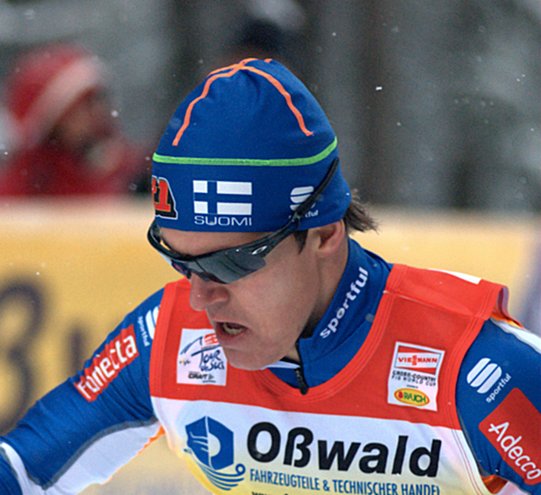
    Sami Jauhojaervi racing at the 2010 Tour de Ski. Photo, Iso76, Wikipedia.

    Hidden away 50 pages into the International Ski Federation’s (FIS’s) anti-doping rules is a policy that has received little publicity in the charged debate surrounding performance-enhancing drug use. “As a condition of regaining eligibility after being found to have committed an anti-doping rule violation,” it reads, “[an] Athlete must first repay all prize money forfeited.”

    After the 2009 Tour de Ski, Finland’s Sami Jauhojaervi stood to benefit from the application of that rule. In that race, Jauhojaervi finished tenth overall—one place behind Russia’s Evgeni Dementiev, who was later announced to have tested positive for a blood-boosting drug before the race’s sixth stage on January 3, in Italy.

    Russian media reported earlier this month that Dementiev would be making his return to the sport for the 2011-2012 season, after serving a two-year suspension. But in an e-mail to FasterSkier on Sunday, Jauhojaervi said he has never been awarded the difference between ninth and tenth place—2,187 Swiss francs, or $2,226 U.S.

    “I have never received the difference after Tour de Ski 2009, so maybe I should ask after the money!” Jauhojaervi said.

    According to FIS rules in place when Dementiev tested positive, each national ski association must make agreements with its athletes that provide a legal basis for reclaiming prize money in the event of a positive drug test. Those agreements, the rules read, should include a provision stipulating that when a skier is convicted of doping, he or she will “immediately” give back all prize money earned after the violation occurred.

    In an e-mail to FasterSkier, FIS Anti-Doping Administrator Sarah Fussek said that Dementiev’s money from his finish at Tour de Ski should already have been redistributed, and she did not respond to a question about Dementiev’s eligibility.

    “As far as we are aware this has been done. If the funds have not reached the adressate, we will check with the book keeping,” Fussek said.

    An e-mail inquiry sent to the Russian Ski Federation regarding its policies was not immediately returned; a representative reached by phone said that the federation’s president and general secretary were traveling until next week.

    Prize money for the overall 2009 Tour de Ski was paid 10 athletes deep, so Czech skier Lukas Bauer, who finished 11th, also stood to received 2,187 Swiss francs after Dementiev’s disqualification. Lucie Švarcová, Bauer’s publicist, did not immediately respond to an e-mail inquiry.

    Earlier this month, a story published in the Norwegian newspaper Verdens Gang highlighted a similar policy in the International Biathlon Union’s (IBU’s) anti-doping rules that will cost three suspended Russian biathletes a combined total of more than $135,000.

    FIS and IBU’s rules diverge slightly—under those in place at the time the biathletes were caught, they were not required to return prize money immediately. But according to Verdens Gang, all three have declared their intentions to make a comeback, and before they can do so, the Russians will have to pay. Ekaterina Iourieva owes the most—over $85,000 U.S.—while Albina Akhatova owes $38,000 and Dmitri Yarochenko $18,500.